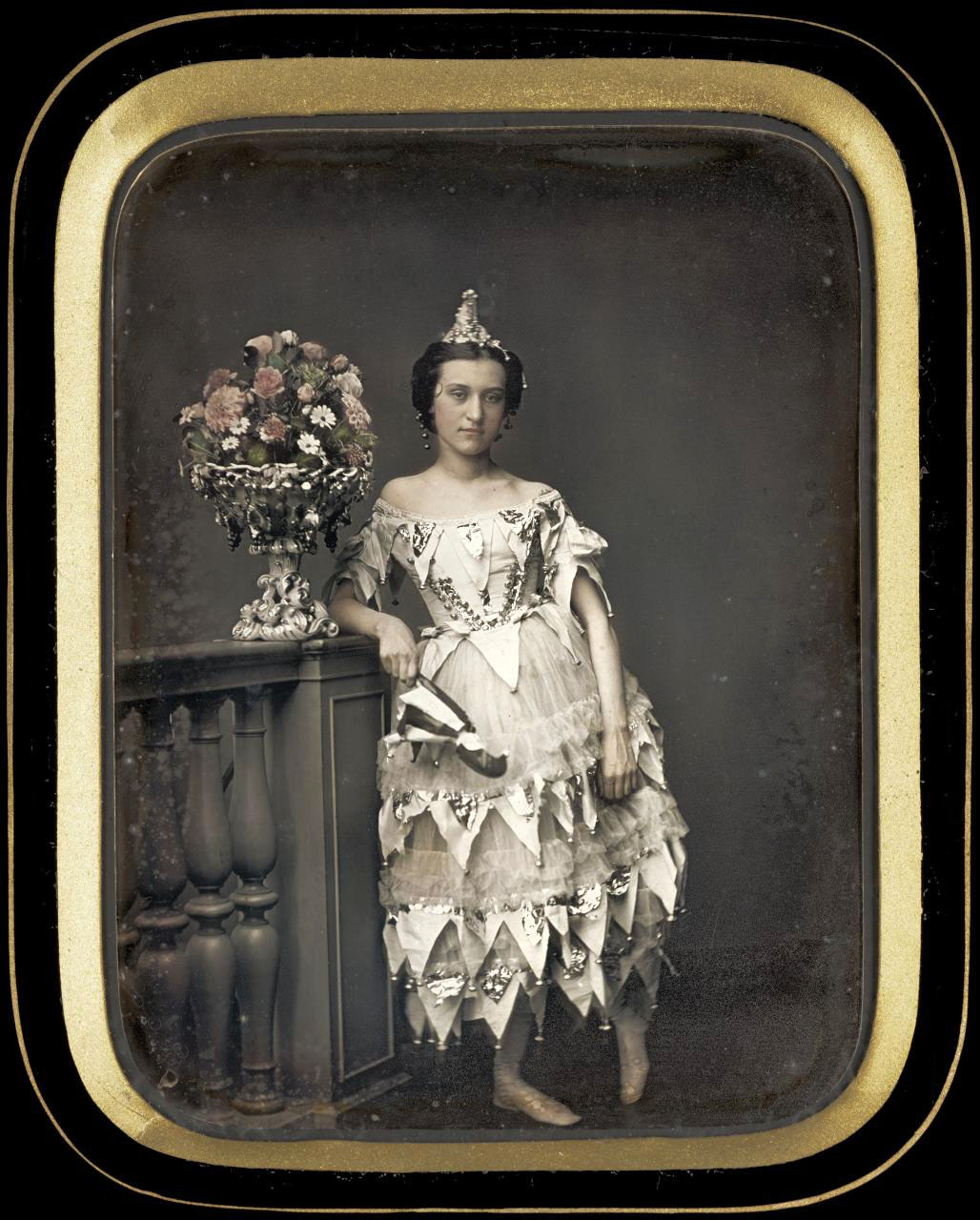
Victor Plumier (Belgian, 1820-1878) Lady in Costume About 1850 Daguerreotype, half plate 5 1/2 × 4 1/2 inches The Nelson-Atkins Museum of Art Gift of the Hall Family Foundation
Past present
Magnificent photographs that bring past presence into present consciousness.
Costume. variedly, the term “costume,” indicating clothing exclusively from the eighteenth century onward, can be traced back to the Latin consuetudo, meaning “custom” or “usage.”
Gesture. late Middle English: from medieval Latin gestura, from Latin gerere ‘bear, wield, perform’. The original sense was ‘bearing, deportment’, hence ‘the use of posture and bodily movements for effect in oratory’.
Expression. the action of making known one’s thoughts or feelings. a look on someone’s face that conveys a particular emotion. late Middle English: from Latin expressio(n- ), from exprimere ‘press out, express’.
The emotions and the sentiments, the gestures and the expressions.
The actor and the stage, the photographer and the sitter.
The staged photograph and the tableaux vivant.
The Self and the Other.
Today, something happens when we look at these photographs. Today, the social spaces, gestures and expressions in these photographs are not fixed, monological re-presentations or presences. Our experience of the photographs enables them to be seen as nodes within a network caught up in a system of social and cultural references, whose unity is variable and relative.1
Thus,
” …in my reading (of the photograph), I relied upon a number of semiological systems, each one being a social / cultural construct: the sign language of clothes, of facial expressions, of bodily gestures, of social manner, etc. Such semiological systems do indeed exist and are continually being used in the making and reading of images. Nevertheless the sum total of these systems cannot exhaust, does not begin to cover, all that can be read in appearances.”2
The intertextuality of images.
Dr Marcus Bunyan
1/ Roland Barthes. “From Work to Text” and Michel Foucault. The Order of Things: An Archeology of the Human Sciences in Kurt Thumlert. Intervisuality, Visual Culture, and Education. [Online] Cited 10/08/2006. No longer available online
2/ John Berger and Jean Mohr. Another Way of Telling. New York: Pantheon Books, 1982, p. 112
Many thankx to the Nelson-Atkins Museum for allowing me to publish the photographs in the posting. Please click on the photographs for a larger version of the image.
“There is no perfection, no infinite completeness. But always, there is a way to move toward being whole. The capital letter, the Self is a wholeness that does not and will never exist. It is a direction that I move toward no matter the meanders of my feet.”
Kendrick VanZant
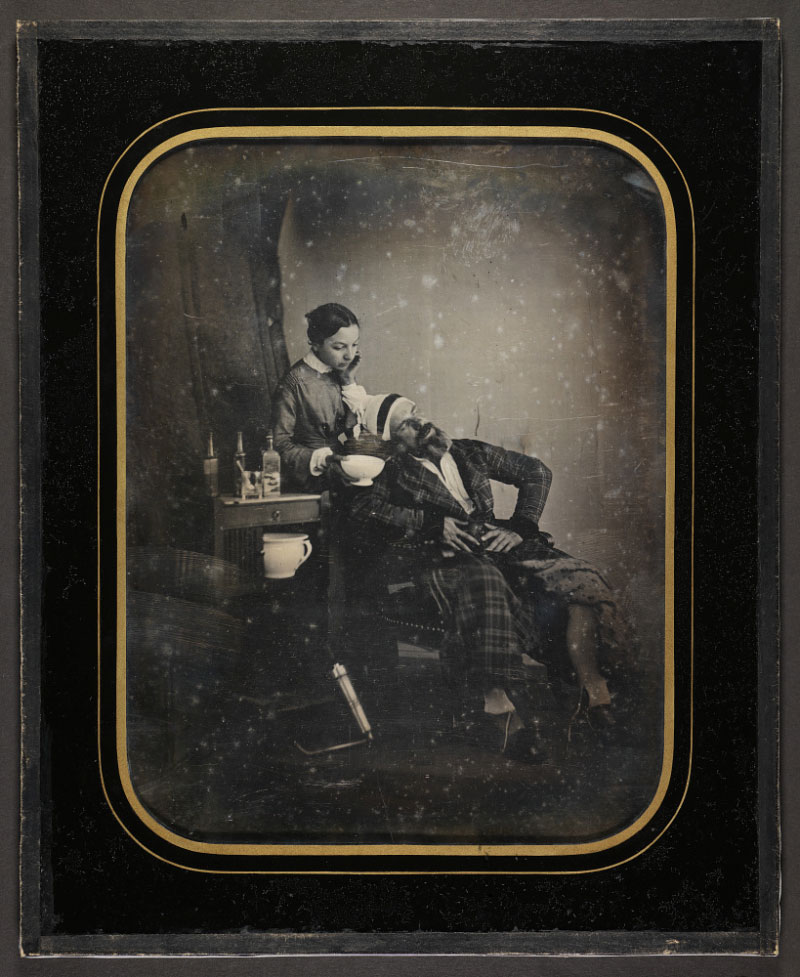
Camille Dolard (French, 1810-1884) Self-portrait as ailing man c. 1843-1845 Daguerreotype Plate (whole): 8 1/2 × 6 1/2 inches (21.59 × 16.51cm) Mat: 10 3/8 × 8 3/8 inches (26.37 × 21.29cm) The Nelson-Atkins Museum of Art Gift of the Hall Family Foundation
French painter Camille Dolard briefly embraced photography in the 1840s as an innovative creative tool. This daguerreotype, and the one in the next case, are from a group of three theatrical self-portraits created by Dolard in his studio. Here, the artist performs for the camera, posing with props and costumes as a patient in the care of his attentive wife. In the other plate, he uses a similarly theatrical approach, depicting himself smoking a hookah (a water pipe used to smoke tobacco) while lounging on a patterned rug.
Text from the Nelson-Atkins Museum website
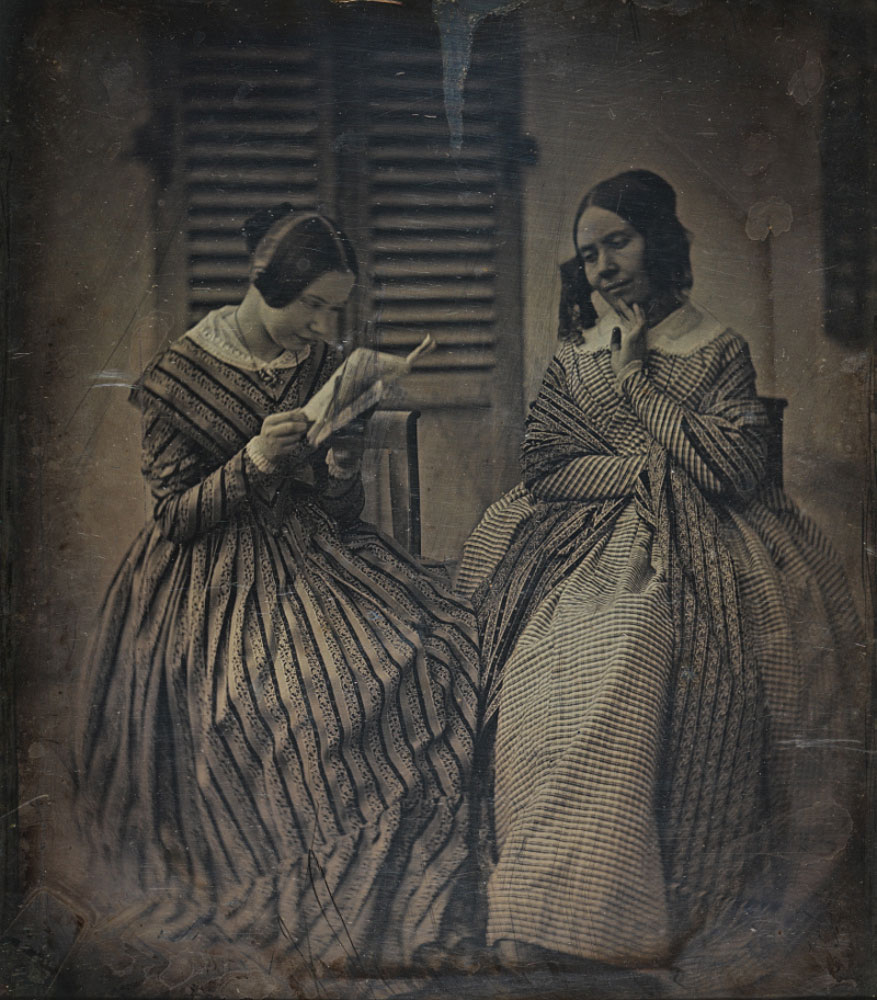
Jean-Pierre Thierry (French, 1810-1870) Two ladies reading a letter c. 1845 Daguerreotype Plate (quarter): 4 1/4 × 3 1/4 inches (10.8 × 8.26 cm) Mat: 6 1/16 × 5 1/8 inches (15.39 × 13.03 cm) The Nelson-Atkins Museum of Art Gift of the Hall Family Foundation
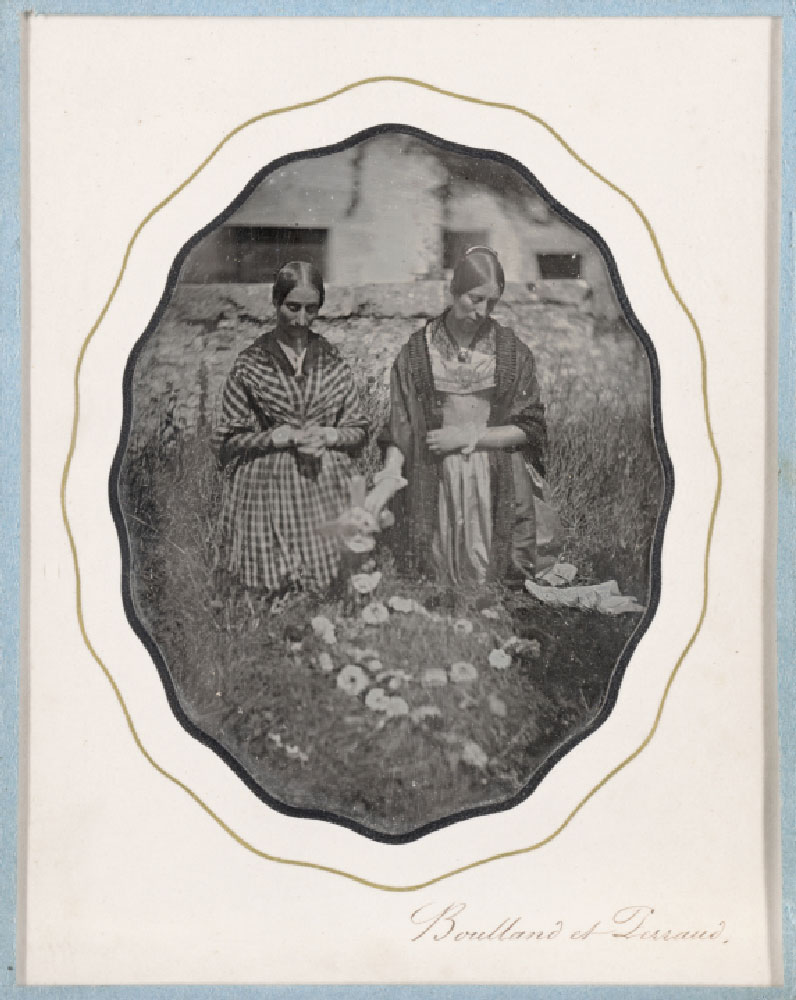
Philibert Perraud (French, 1815 – after 1863) Deux femmes se recueillent sur la tombe d’une etre cher … (Two women at the grave of a loved one) c. 1845 Daguerreotype Plate (quarter): 4 1/4 × 3 1/4 inches (10.8 × 8.26cm) Mount: 5 1/8 × 4 1/8 inches (13.02 × 10.48cm) The Nelson-Atkins Museum of Art Gift of the Hall Family Foundation
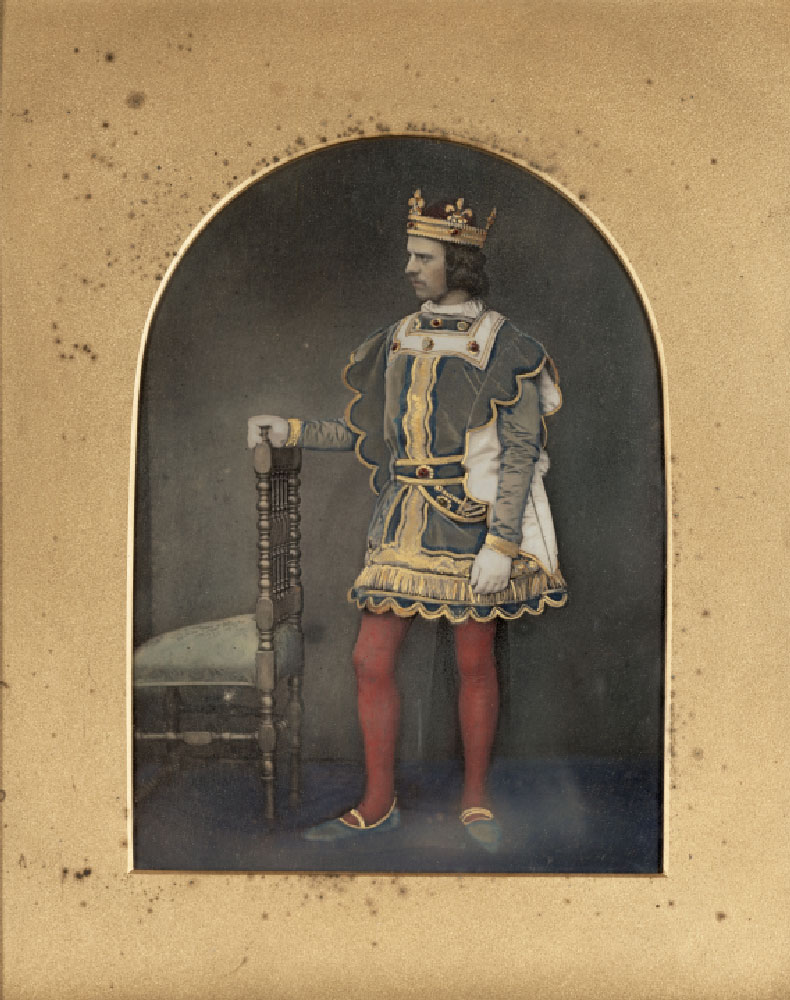
Unknown photographer Actor in Costume c. 1850 Daguerreotype Plate (three-quarter): 6 × 4 1/2 inches (15.24 × 11.43 cm) Case (open): 8 1/8 × 13 1/4 × 3/8 inches (20.64 × 33.66 × 0.95 cm) Case (closed): 8 1/8 × 6 5/8 × 5/8 inches (20.64 × 16.83 × 1.59 cm) The Nelson-Atkins Museum of Art Gift of the Hall Family Foundation
Though the pose and expression in this photograph are stiff, the extensive hand-colouring enlivens the portrait, drawing attention to the fine details in the actor’s costume. Sitting for a daguerreotype portrait in the 1850s required patience and a certain degree of stamina. Photographic exposure times – which varied according to plate sensitivity and studio lighting – typically ranged from three to 30 seconds. Studio props, such as chairs and head braces, were used to help sitters remain as motionless as possible for the duration of the exposure.
Text from the Nelson-Atkins Museum website
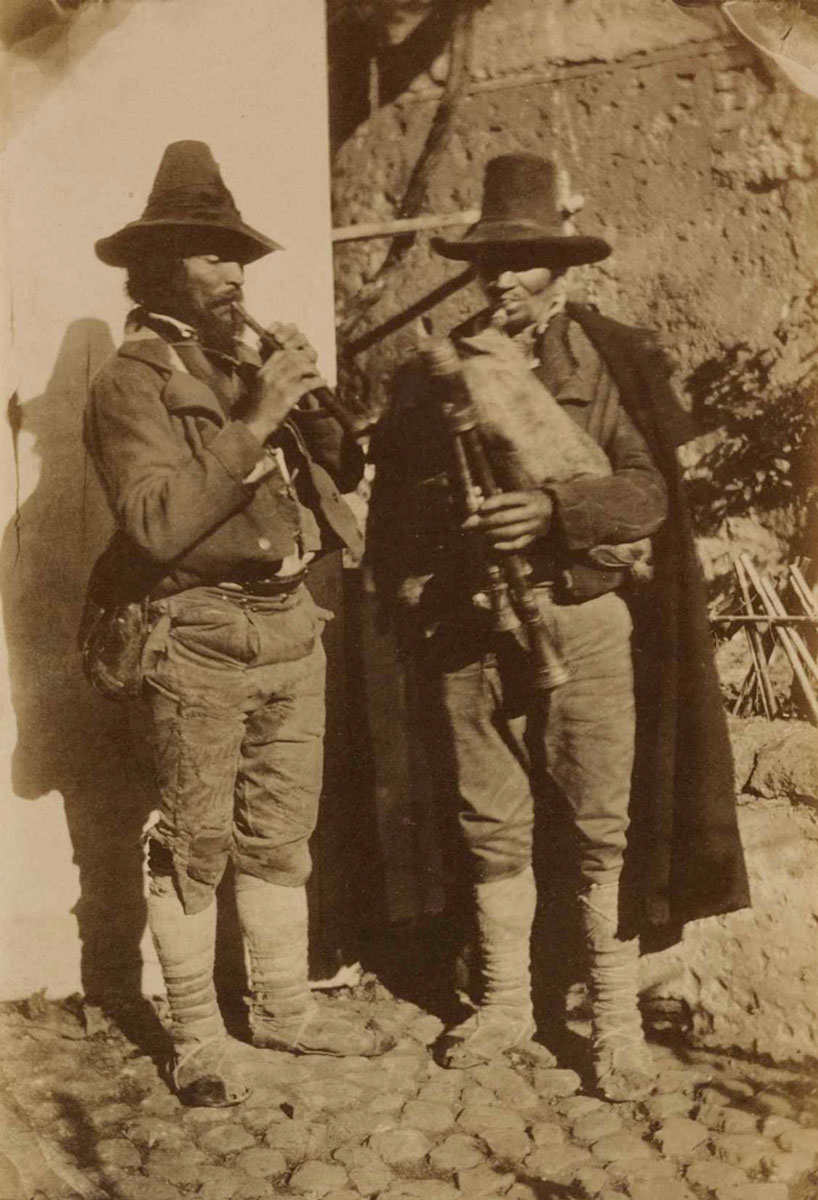
Giacomo Caneva (Italian, 1813-1865) Two Pifferari c. 1850s Salt print Image: 8 3/8 × 5 11/16 inches (21.27 × 14.45cm) Sheet: 11 3/16 × 5 11/16 inches (28.42 × 14.45cm) The Nelson-Atkins Museum of Art Gift of the Hall Family Foundation
Nothing summed up picturesque modern Italy as well as the Pifferari; described by Hector Berlioz (1803-1869) in 1832: ‘These are strolling musicians who, towards Christmas, come down from the mountains in groups of four or five, armed with bagpipes and ‘pifferi’ (a sort of oboe), to play in homage before statues of the Madonna. They are generally dressed in large brown woollen coats and the pointed hats that brigands sport, and their whole appearance is instinct with a kind of mystic savagery that is most striking’. He admits that close to the music is ‘overpoweringly loud, but at a certain distance the effect of this strange ensemble of instruments is haunting and few are unmoved by it’.
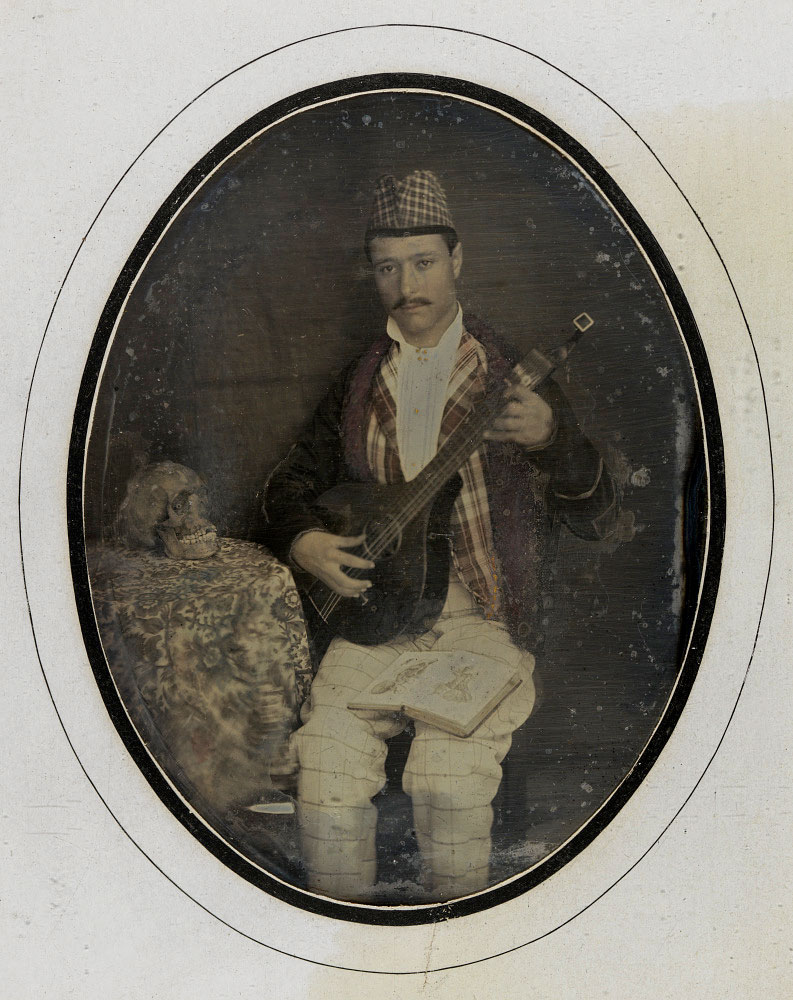
José Maria Blanco (Spanish, active c. 1850) Man with mandolin 1851 Daguerreotype Plate (quarter): 4 × 3 1/4 inches (10.16 × 8.26cm) Mat: 5 5/8 × 4 7/8 inches (14.29 × 12.38cm) The Nelson-Atkins Museum of Art Gift of the Hall Family Foundation
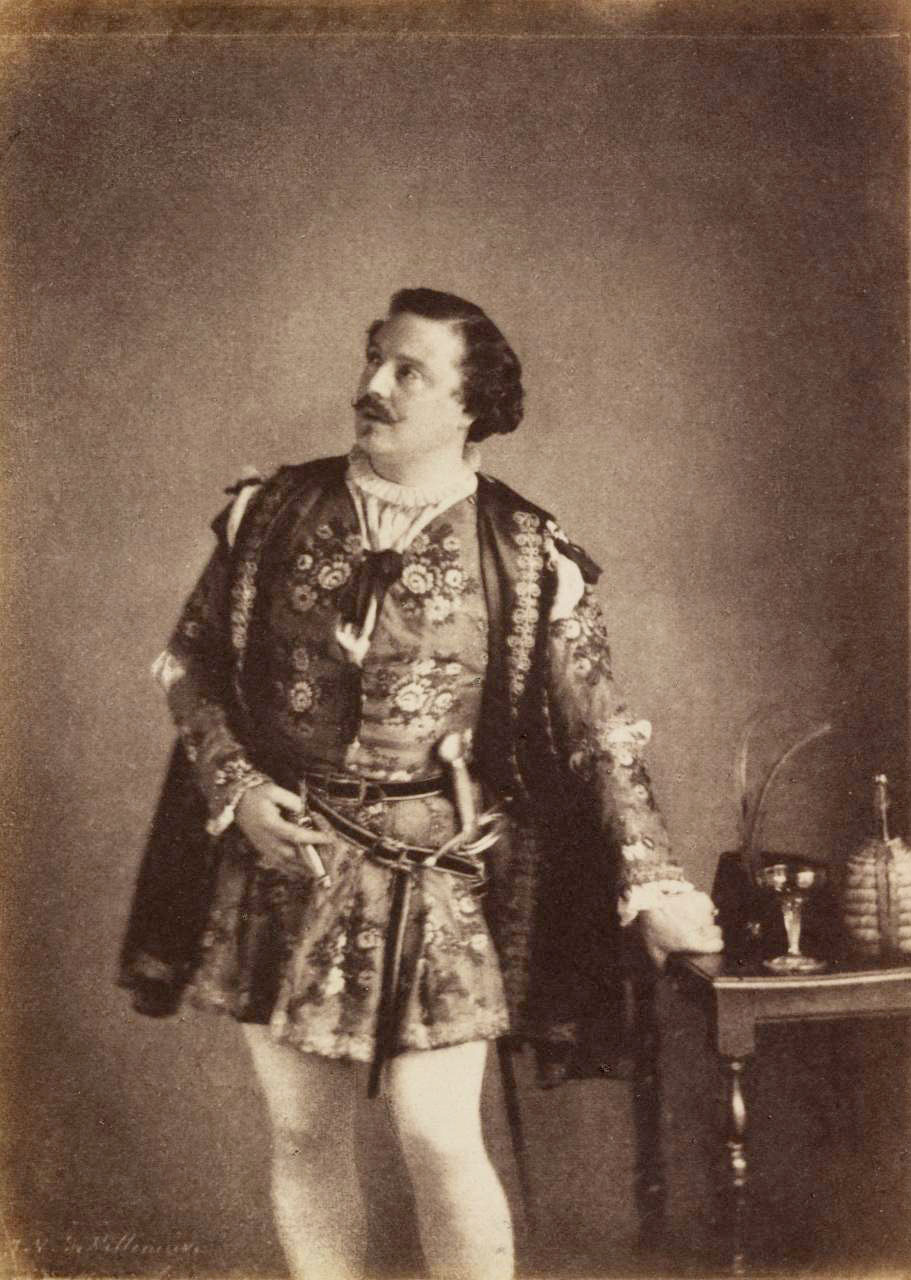
Julien Vallou de Villeneuve (French, 1795-1866) Portrait of Edouard Brindeau 1853 Salt print 6 1/4 × 4 5/8 inches The Nelson-Atkins Museum of Art Gift of the Hall Family Foundation
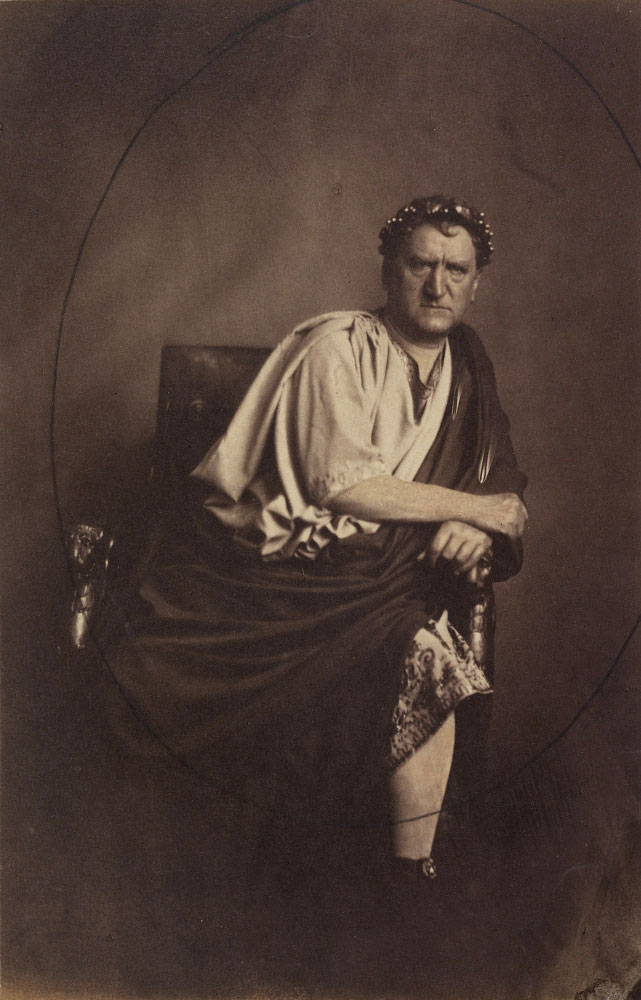
Julien Vallou de Villeneuve (French, 1795-1866) Portrait of Jean-Baptiste Provost, in the role of the emperor Claude in the play Valeria 1853 Portraits of Actors from the Comédie Française Salt print Image and sheet: 6 7/16 × 4 1/8 inches (16.35 × 10.48cm) The Nelson-Atkins Museum of Art Gift of the Hall Family Foundation
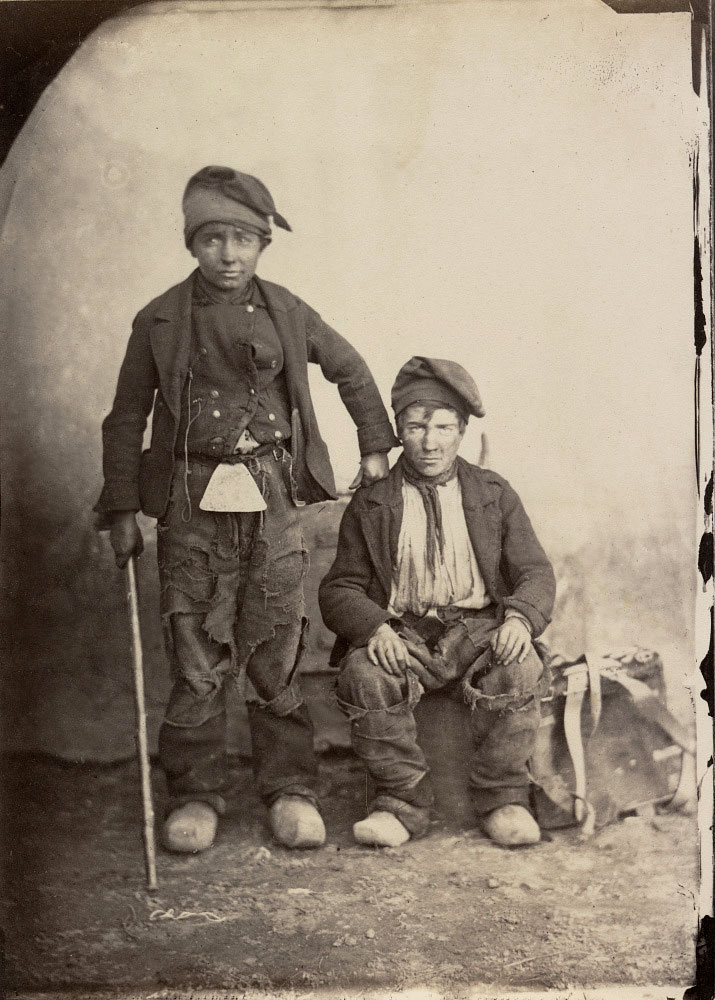
Charles Nègre (French, 1820-1880) Two Small Savoyards c. 1853 Albumen print Image and sheet: 7 × 5 3/16 inches (17.78 × 13.12cm) Mount: 17 × 15 inches (43.18 × 38.1cm) The Nelson-Atkins Museum of Art Gift of the Hall Family Foundation
Charles Nègre refers to the threadbare young men in this photograph as “Savoyards” (originating from the Savoy region of France). Impoverished, migrant Savoyards have appeared in European art since the 1700s, and Nègre’s title could be shorthand for a certain type of person seen in the streets of Paris, regardless of the two boys’ actual place of origin. A painter and a photographer, Nègre practiced the two mediums side-by-side. Like other artists of his time, he ascribed nobility to the poor, seeking to convey their “truth, warmth, and life.”
Text from the Nelson-Atkins Museum website
Alban-Adrien Tournachon (French , 1825-1903) and Nadar [Gaspard Félix Tournachon] (French, 1820-1910) Pierrot Yawning 1854 Salt print 11 1/4 × 8 1/2 inches The Nelson-Atkins Museum of Art Gift of the Hall Family Foundation
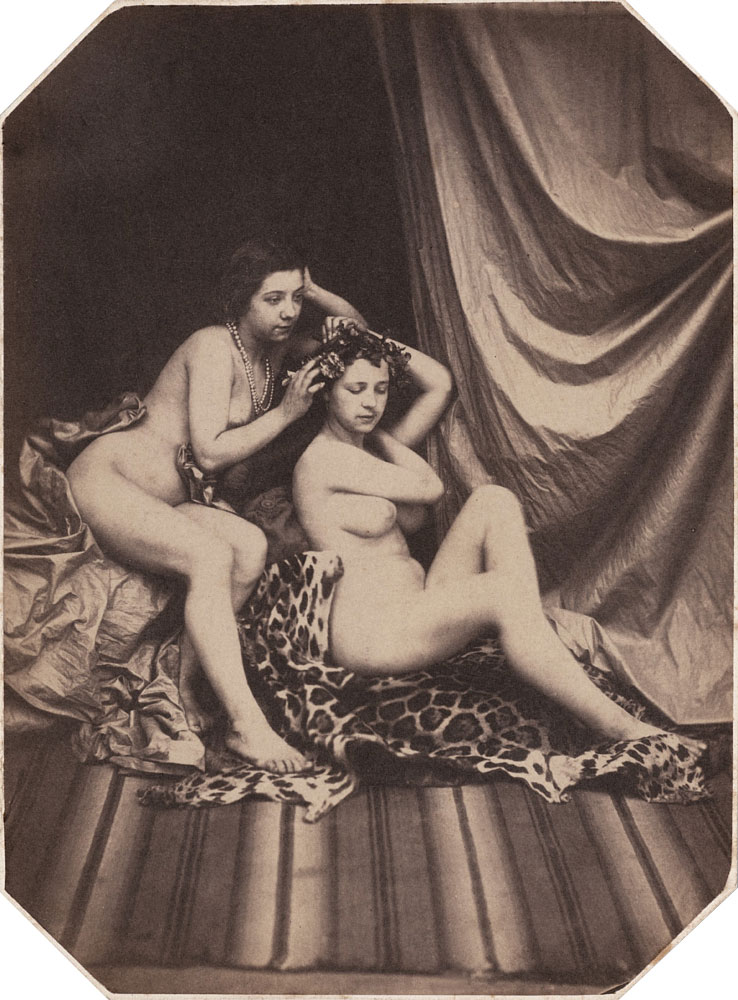
Auguste Belloc (French, 1805 -1873) Une étude de nu de deux femmes c. 1855 Salt print Image and sheet: 8 5/16 × 6 1/8 inches (21.11 × 15.56cm) The Nelson-Atkins Museum of Art Gift of the Hall Family Foundation
A masterful printer, Auguste Belloc created nudes that surpassed the typical erotic fare found in Parisian markets. In this scene, Belloc strategically positions the models and surrounding drapery to make the photograph appear more artistic than pornographic. Though nude paintings, drawings, and sculptures were immensely common, at this time photography was treated far more harshly by censors. In October 1860, the French government seized some 5,000 of Belloc’s photographs, declaring them obscene, and by 1868 he had abandoned his photographic studio.
Text from the Nelson-Atkins Museum website
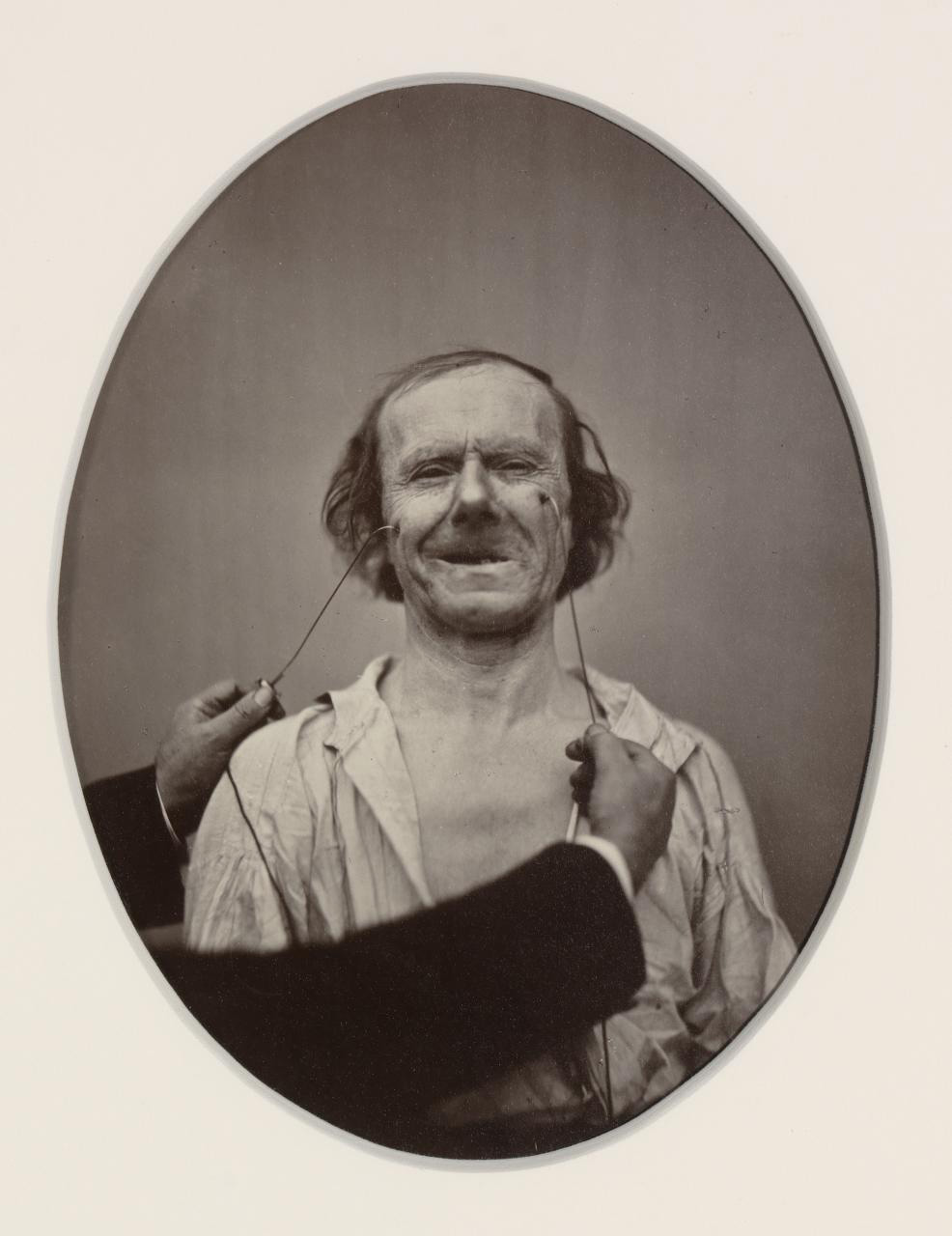
Guillaume-Benjamin-Amand Duchenne de Boulogne (French, 1806-1875) and Alban-Adrien Tournachon (French, 1825-1903) The Muscles of Weeping and Whimpering About 1855-1857 Albumen print 9 1/16 × 6 15/16 inches The Nelson-Atkins Museum of Art Gift of the Hall Family Foundation
Facial expressions and their corresponding emotions have been studied by artists for centuries. In the 1850s, Dr. Guillaume-Benjamin-Amand Duchenne de Boulogne used photography to document the facial expressions produced by localised electric shock. Working in partnership with photographer Adrien Alban Tournachon, Duchenne felt these photographs truthfully recorded his experiments and that “none shall doubt the facts presented here.” Praising photography for its accurate rendering of the subject’s deep wrinkles, he wrote, “the distribution of light is in perfect harmony with the passions represented by these expressive lines. Thus, the face depicting the dark, concentric passions – aggression, wickedness, suffering, pain, dread, torture mixed with fear – gain an uncommon amount of energy.”
Text from the Nelson-Atkins Museum website
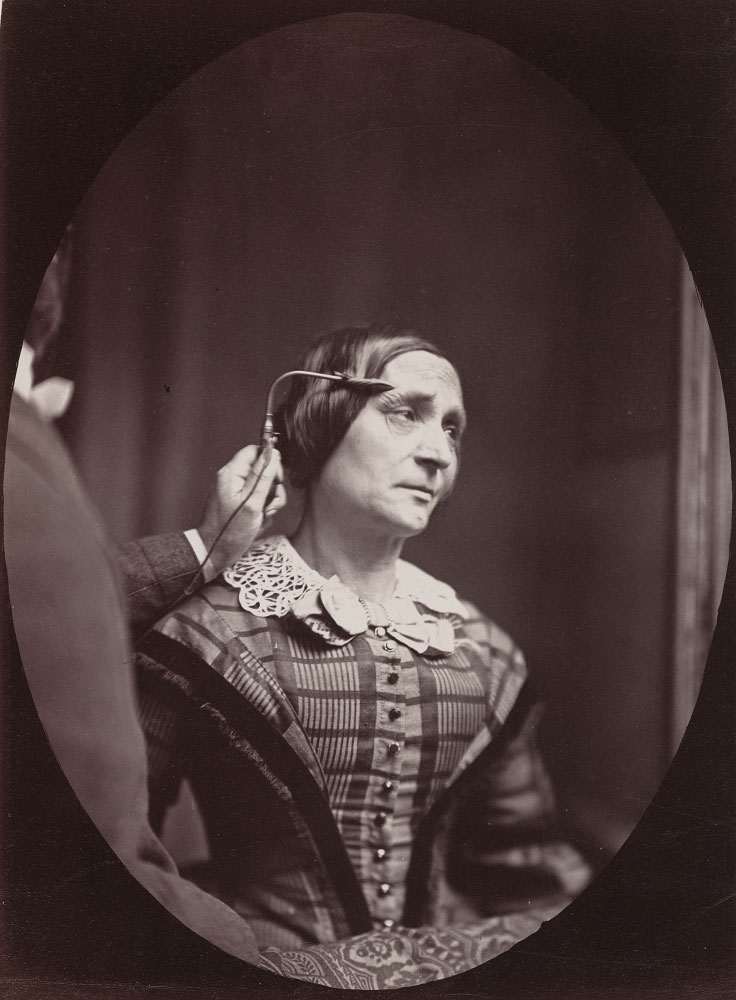
Guillaume-Benjamin-Amand Duchenne de Boulogne (French, 1806-1875) and Alban-Adrien Tournachon (French, 1825-1903) The Muscle of Pain c. 1854-1857 Figure 27, plate 63 from The Mechanism of Human Facial Expression Albumen print Image and sheet: 9 1/16 × 6 5/8 inches (23.01 × 16.84cm) Mount: 16 1/16 × 10 13/16 inches (40.79 × 27.51cm) The Nelson-Atkins Museum of Art Gift of the Hall Family Foundation
In this uncanny double portrait, the physiologist Dr. Guillaume-Benjamin-Amand Duchenne de Boulogne holds a mechanical device to the face of a 52-year-old, Italian-born woman believed to have been institutionalised in a Parisian asylum. Duchenne asserted that localised electric shock could force facial muscles to “contract to speak the language of the emotions and the sentiments.” “Armed with electrodes,” he wrote, “one would be able, like nature herself, to paint the expressive lines of the emotions of the soul on the face of man.”
Text from the Nelson-Atkins Museum website
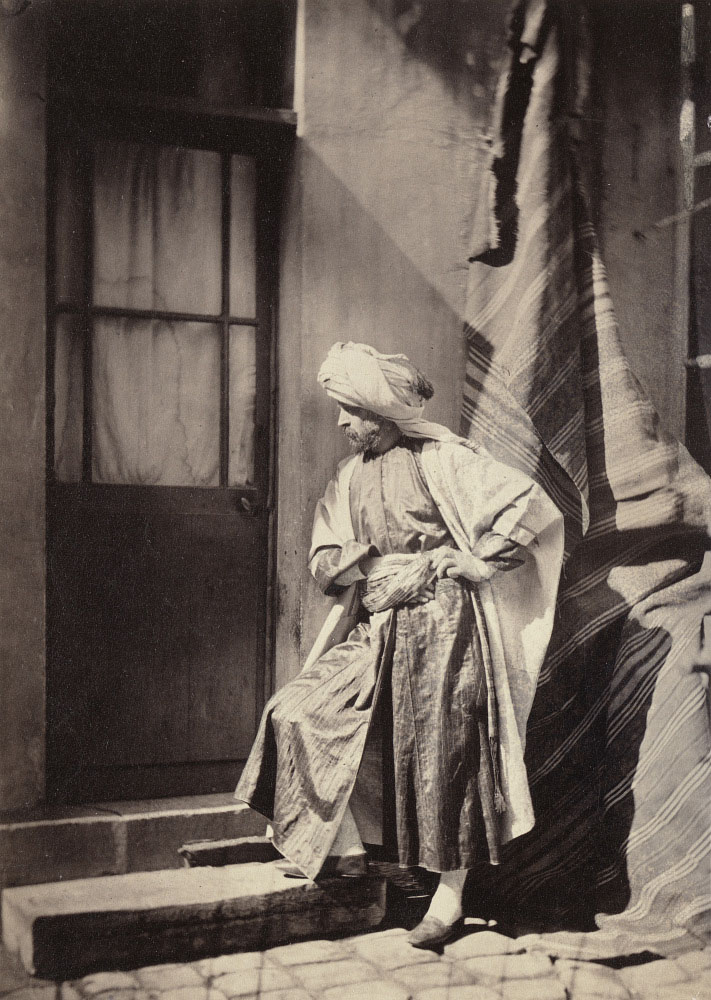
Roger Fenton (English, 1819-1869) Self-portrait as a Zouave 1855 Salt print: Image and sheet: 7 13/16 × 6 7/16 inches (19.84 × 16.35cm) Mount: 22 1/8 × 16 1/8 inches (56.2 × 40.96cm) The Nelson-Atkins Museum of Art Gift of the Hall Family Foundation
Cocking a rifle and smoking a pipe, with alcohol by his side, Roger Fenton poses for his camera with bravado. Wearing the distinctive baggy uniform of a Zouave (skilled infantry soldiers from the French army in Algeria), Fenton fashions himself as a hardened, glowering soldier, though he never fought in any war. Fenton did, however, photograph the Crimean War (1853-1856) from a great distance. The war brought together an alliance of soldiers from England, Croatia, Algeria, Turkey, Egypt, and France whom Fenton encountered while photographing the conflict.
Text from the Nelson-Atkins Museum website
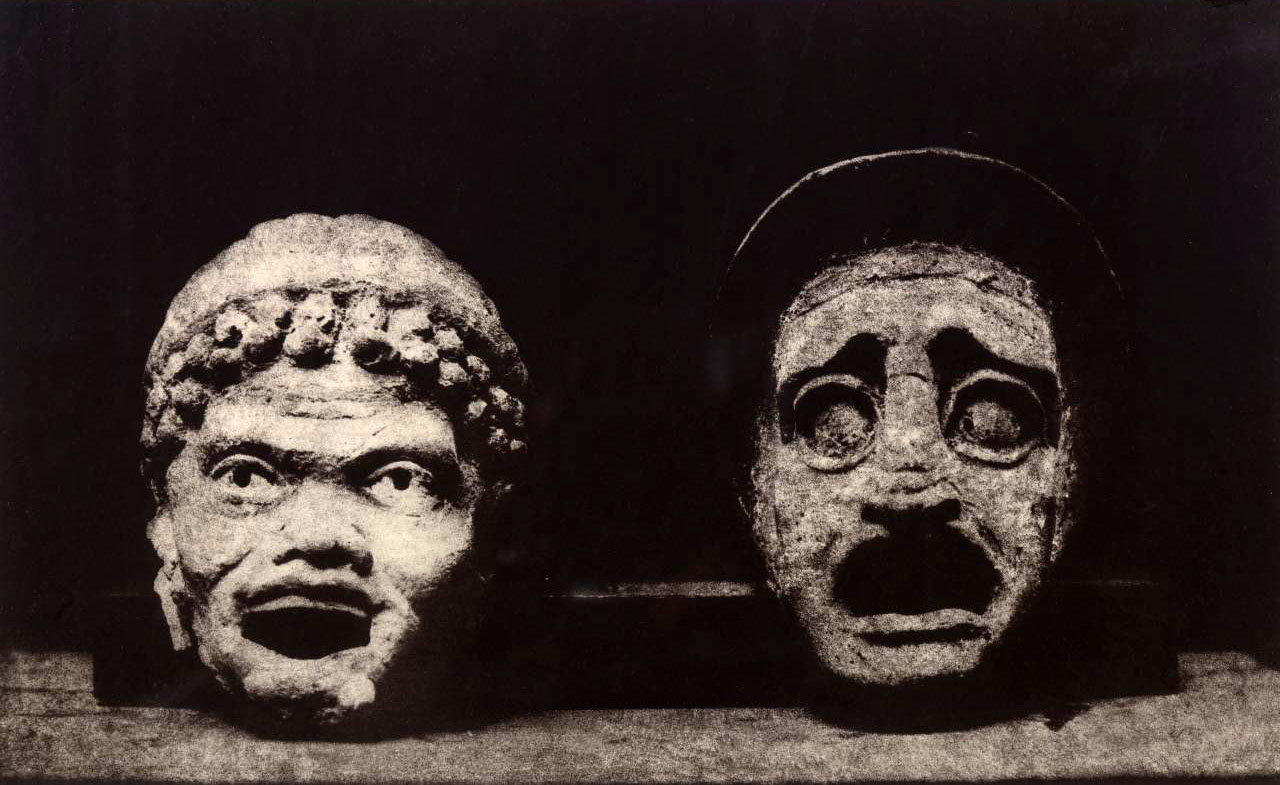
Marcel Gustave Laverdet (French, 1816-1886) Masks from the album Selection of Ancient Terra Cotta from the Collection of M. Le Vicomte H. de Janzé 1857 Photolithograph 8 15/16 × 14 9/16 inches The Nelson-Atkins Museum of Art Gift of the Hall Family Foundation
Charles Nègre (French, 1820-1880) Self-portrait About 1855-1860 Salt print 7 5/8 × 5 7/16 inches The Nelson-Atkins Museum of Art Gift of the Hall Family Foundation
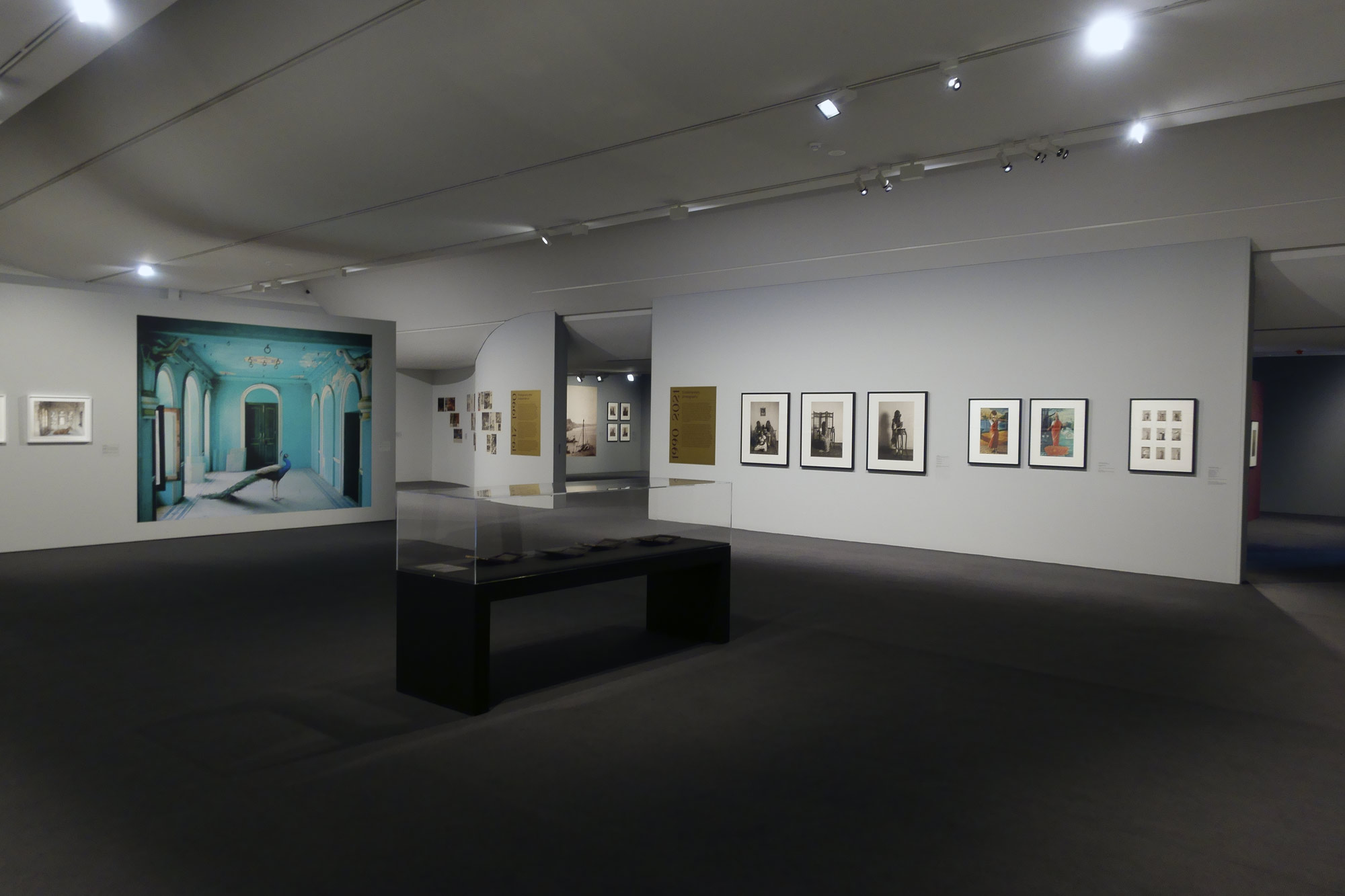
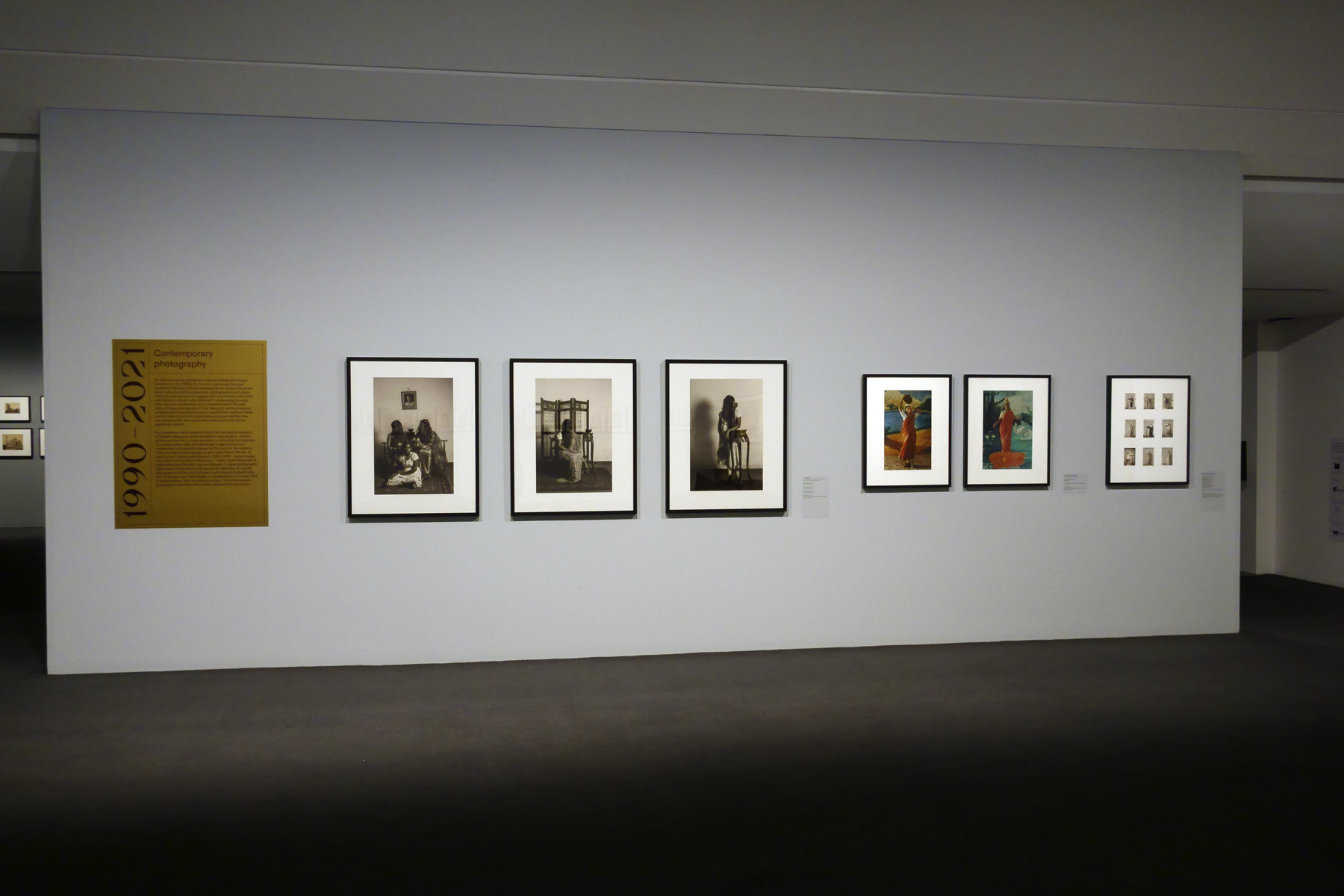
Early photography is ripe with creative fictions. Actors, children, aristocrats, models, artists, psychiatric patients, maids, and all manner of the working class posed in front of cameras and were transformed into figures from history, literature, the Bible, or into an idealised version of themselves. Still Performing: Costume, Gesture, and Expression in 19th Century European Photography, which opens at The Nelson-Atkins Museum of Art in Kansas City Aug. 24, celebrates the unique and compelling ways 19th century European photographers used the medium to explore and document performance, transforming the photographer’s studio into a theatrical stage. The exhibition runs through Jan. 12, 2025.
“The subjects in this exhibition were highly influenced by popular entertainment – live theatre, tableaux vivant, and dioramas – as well as tastes and trends in painting, drawing, and sculpture,” said Julián Zugazagoitia, Director & CEO of the Nelson-Atkins. “These works were made in a time of anxiety about photography’s relationships to the fine arts and reflect a close intermingling between the worlds of the ‘high’ and the ‘low’.”
Visiting a photographer’s studio in Europe in the mid to late 1800s was like going behind the scenes of a theatrical production. Props, backdrops, costumes, curtains, and controlled lighting converted otherwise ordinary portrait sessions into staged productions. Whether working in their homes or commercial studios, photographers cast themselves, friends, actors, models, and strangers in their photographs, transforming them into all types of characters, from young pickpockets to ancient Greek gods.
“These portraits are so fascinating, and I think our guests are going to be amazed at the rich creative complexity found in European photography’s first 50 years,” said Marijana Rayl, Assistant Curator, Photography.
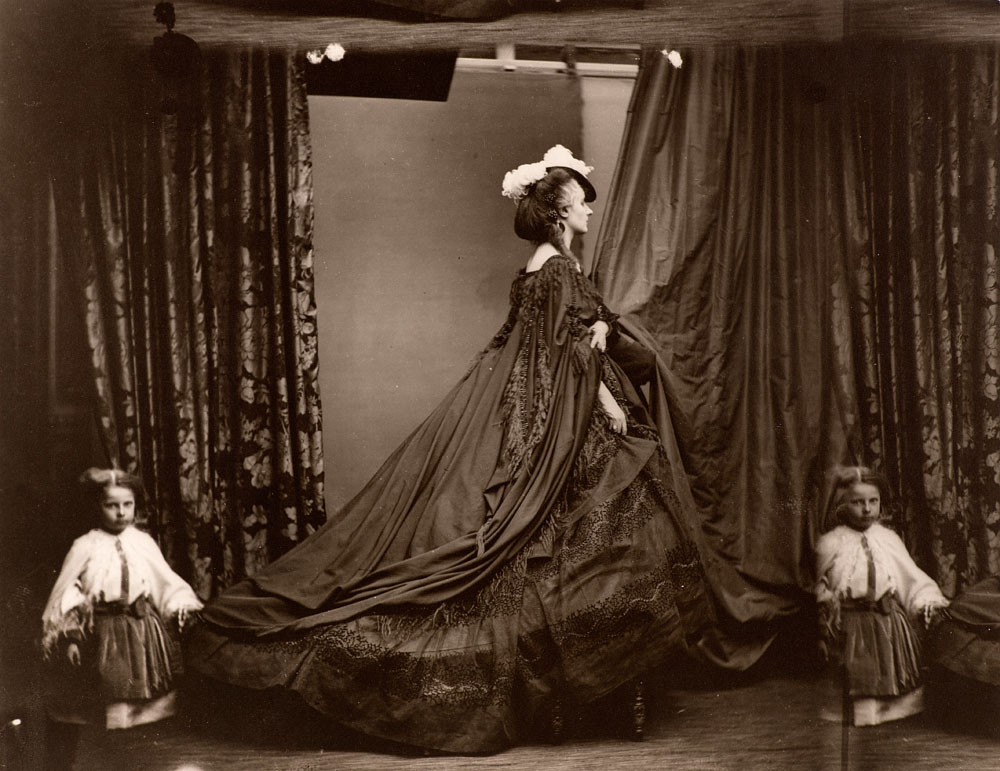
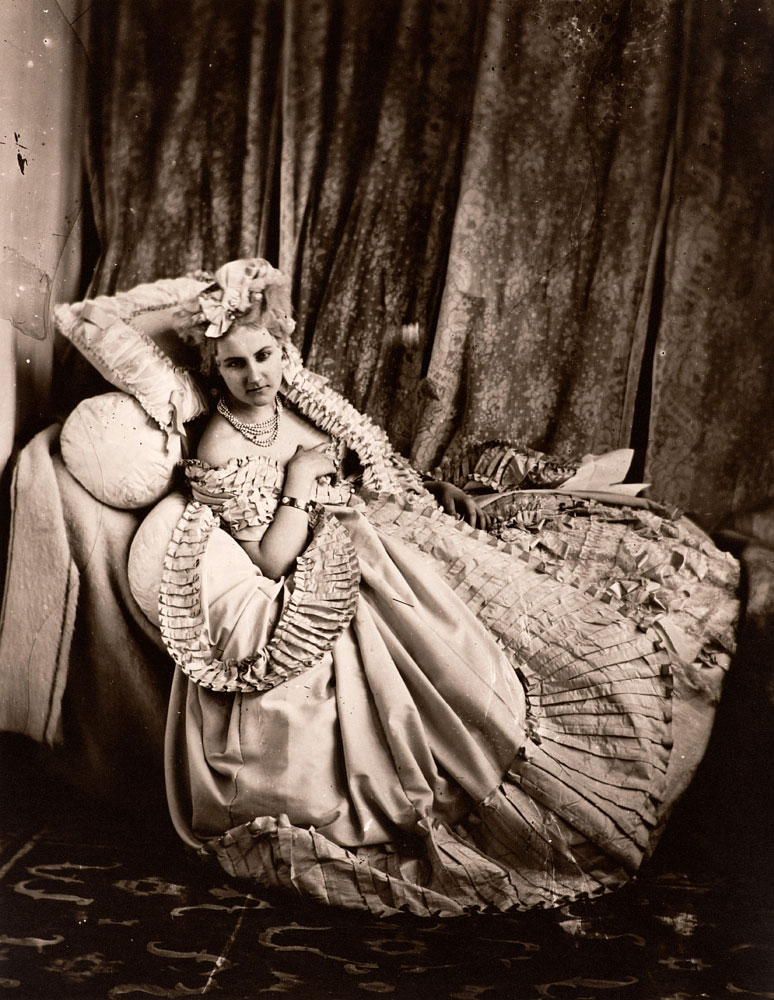
Deliberately made, not casually taken, these staged photographs are often the result of collaborative efforts between photographer and sitter, such as with a series of portraits of Virginia Oldoini, the Countess of Castiglione. A prodigious narcissist, or perhaps just ahead of her time, the countess collaborated with the photographer Pierre-Louis Pierson to produce hundreds of portraits, directing every aspect of the picture-making process. Included in Still Performing is a very rare, hand-coloured portrait of the countess.
The resulting photographs are an outstanding array of complex and compelling fictions showcasing the medium’s early creative potential.
Press release from the Nelson-Atkins Museum
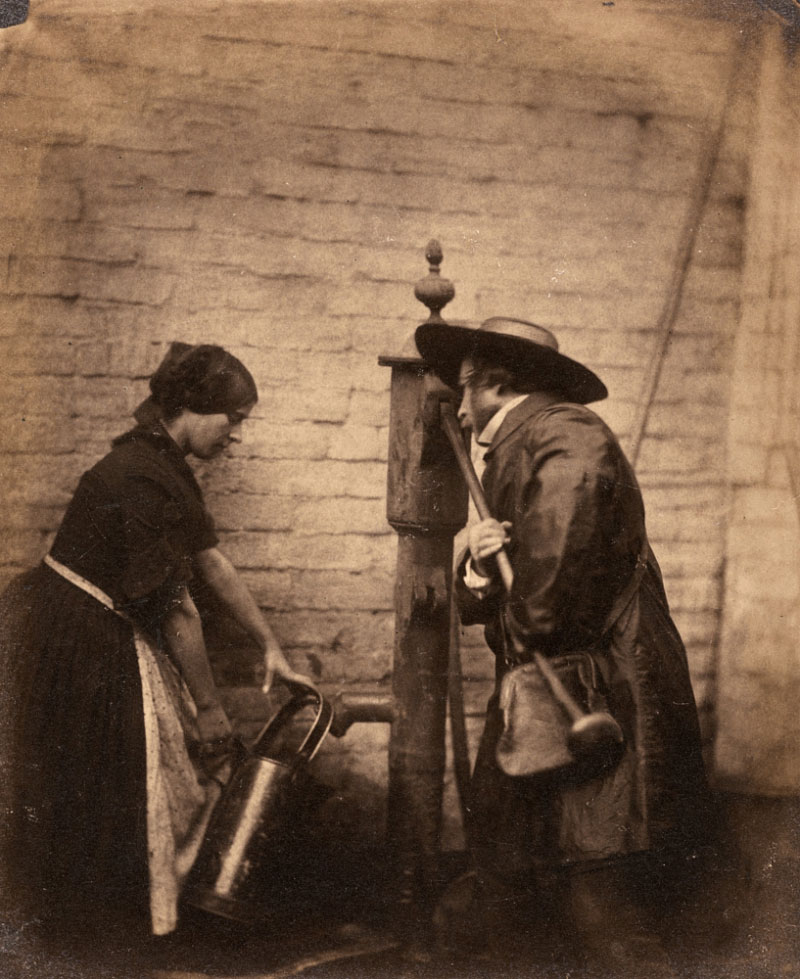
Oscar Gustav Rejlander (English born Sweden, 1813-1875) Drawing Water from a Well (O.G. Rejlander and model) c. 1858 Salt print Image and sheet: 7 15/16 × 6 1/2 inches (20.16 × 16.51cm) Mount: 14 1/16 × 11 5/16 inches (35.72 × 28.73cm) The Nelson-Atkins Museum of Art Gift of the Hall Family Foundation
Oscar Rejlander occasionally cast himself in staged photographs like this one, which was made to appear like a candid image of ordinary people going about their daily lives. Here he poses, turned away from the camera, as though he is helping a peasant woman retrieve water from a well. These kinds of genre scenes were immensely popular in the 1800s across painting, drawing, printmaking, and photography. Rejlander passionately advocated for photography to be treated as a fine art, believing that it must emulate painting.
Text from the Nelson-Atkins Museum website
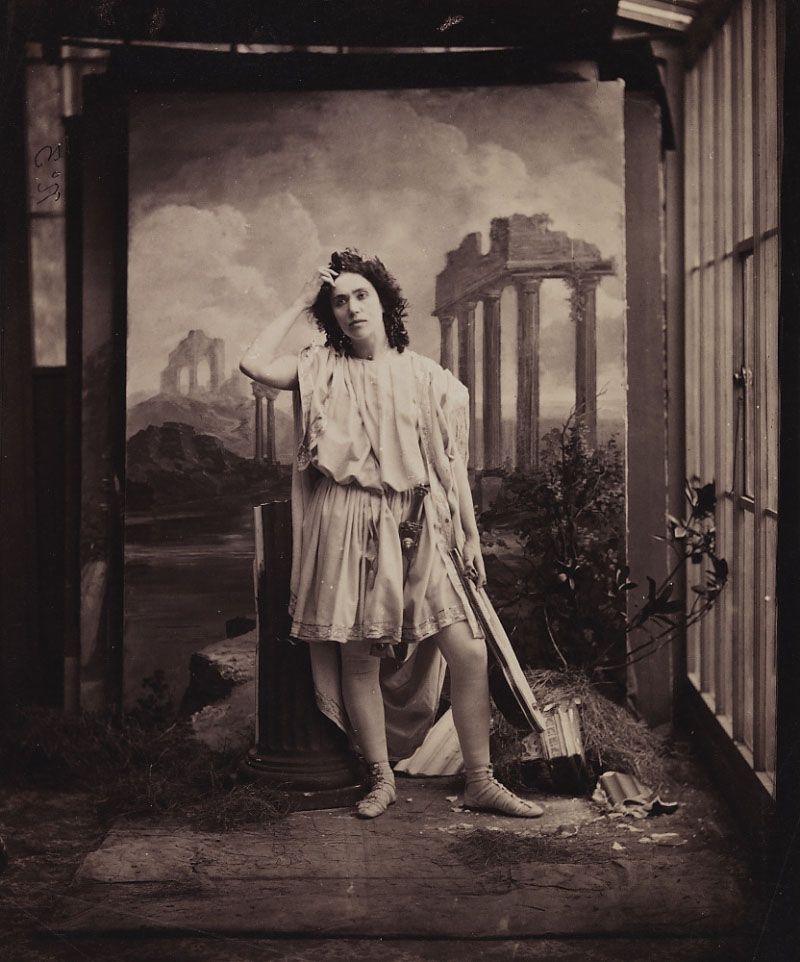
Camille Silvy (French, 1834-1910) Actress Rosa Csillag in the Role of Orpheus 1860 Albumen print 9 3/16 × 7 5/8 inches The Nelson-Atkins Museum of Art Gift of the Hall Family Foundation
Pierre-Louis Pierson (French, 1822-1913) The Countess de Castiglione 1860s Gelatin silver print (printed about 1930) 10 15/16 x 14 1/8 inches The Nelson-Atkins Museum of Art Gift of the Hall Family Foundation
Pierre-Louis Pierson (French, 1822-1913) The Countess de Castiglione 1860s Gelatin silver print (printed about 1930) Image: 14 3/16 x 11 inches (36.04 x 27.94cm) Sheet: 14 3/16 x 11 inches (36.04 x 27.94cm) The Nelson-Atkins Museum of Art Gift of the Hall Family Foundation
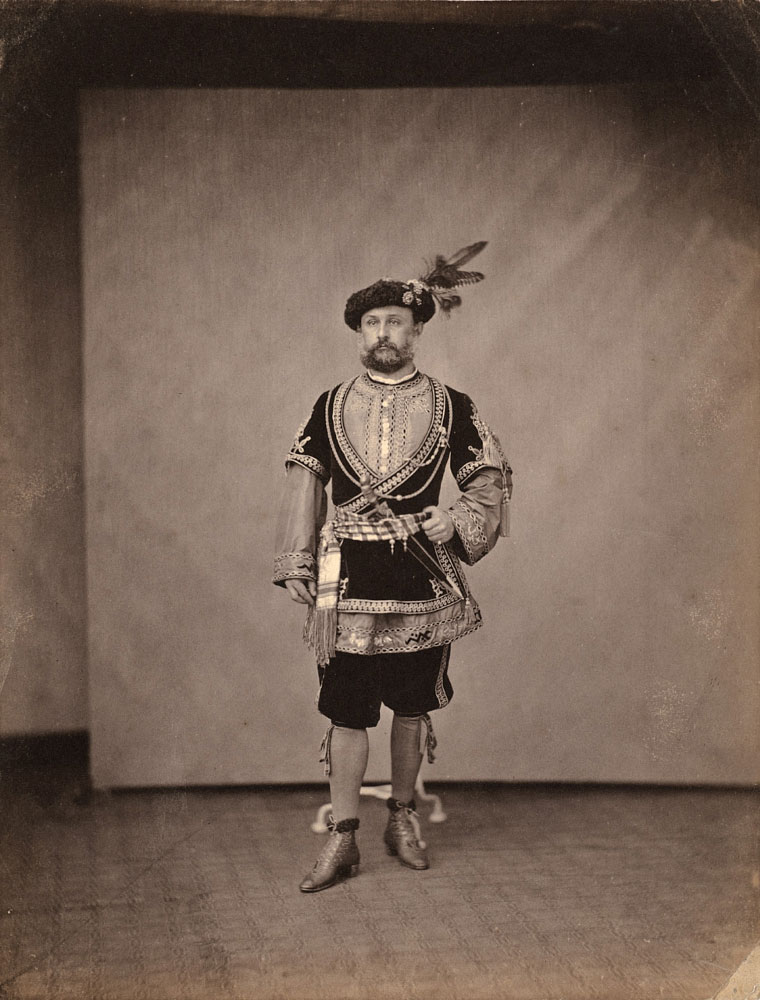
Pierre-Louis Pierson (French, 1822-1913) Bal en Costume, Royaume de Belgique c. 1860 Salt print Image and sheet: 11 1/2 × 8 3/4 inches (29.21 × 22.23cm) The Nelson-Atkins Museum of Art Gift of the Hall Family Foundation
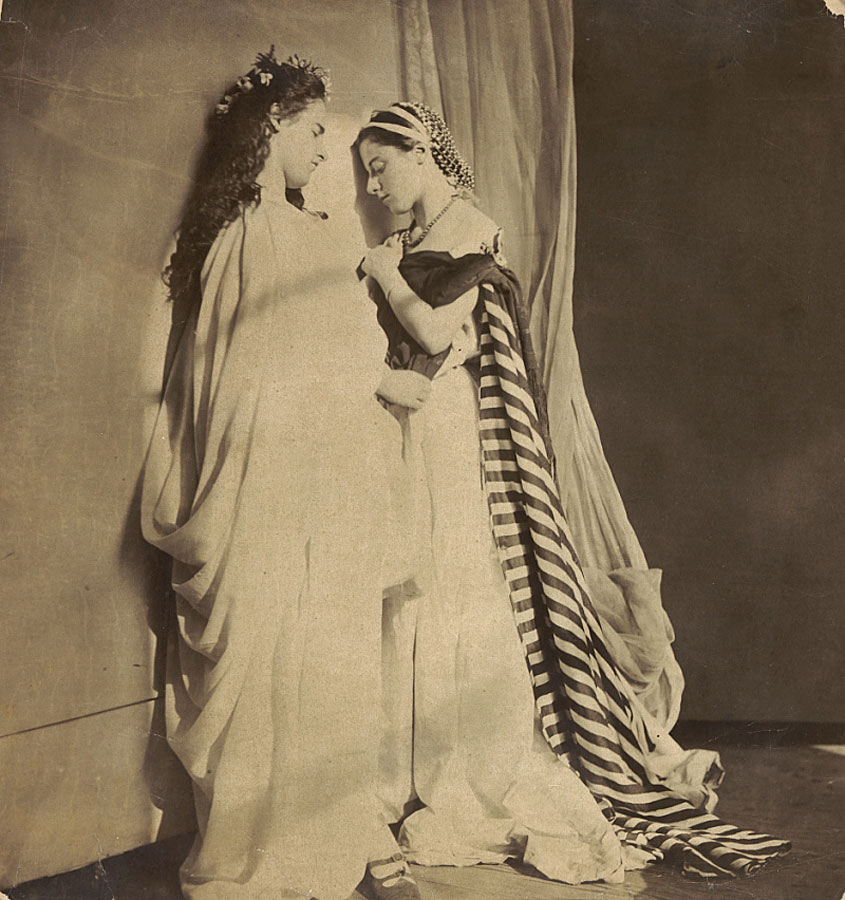
Lady Clementina Hawarden (English, born Scotland, 1822-1865) Clementina Maude and Isabella Grace c. 1863 Albumen print Image and sheet: 9 13/16 × 9 11/16 inches (24.97 × 24.61cm) The Nelson-Atkins Museum of Art Gift of the Hall Family Foundation
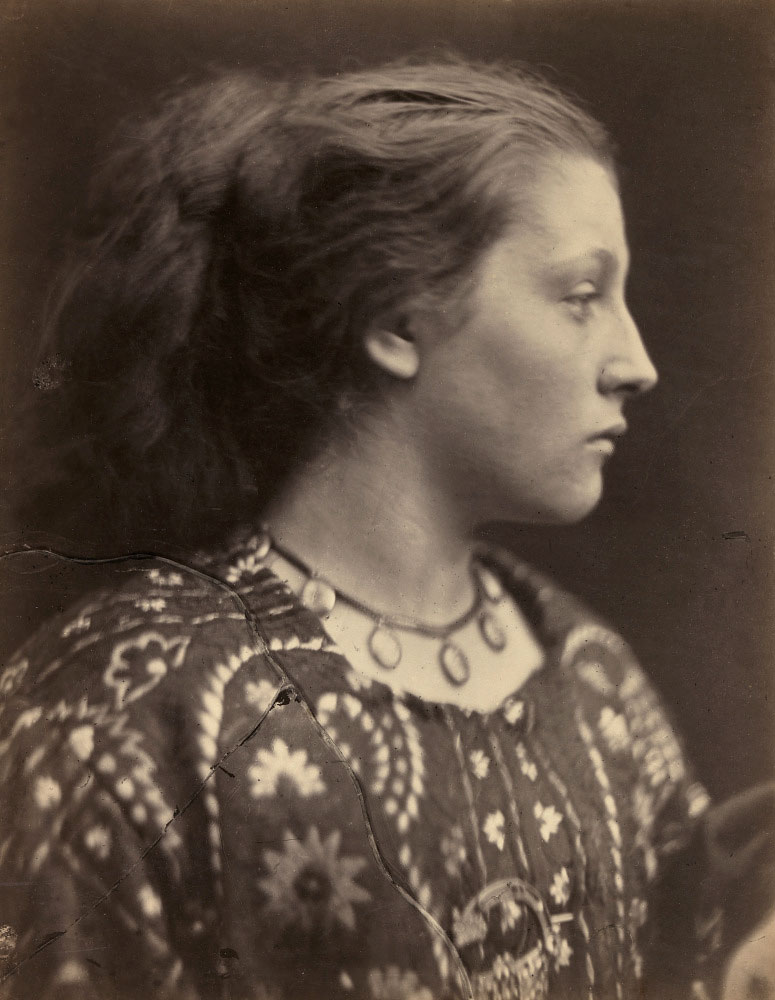
Julia Margaret Cameron (English, born India, 1815-1879) Sappho (Mary Hillier) 1865 Albumen print Image and sheet: 12 15/16 × 10 1/8 inches (32.86 × 25.72cm) Mount: 20 13/16 × 16 13/16 inches (52.86 × 42.7cm) The Nelson-Atkins Museum of Art Gift of the Hall Family Foundation
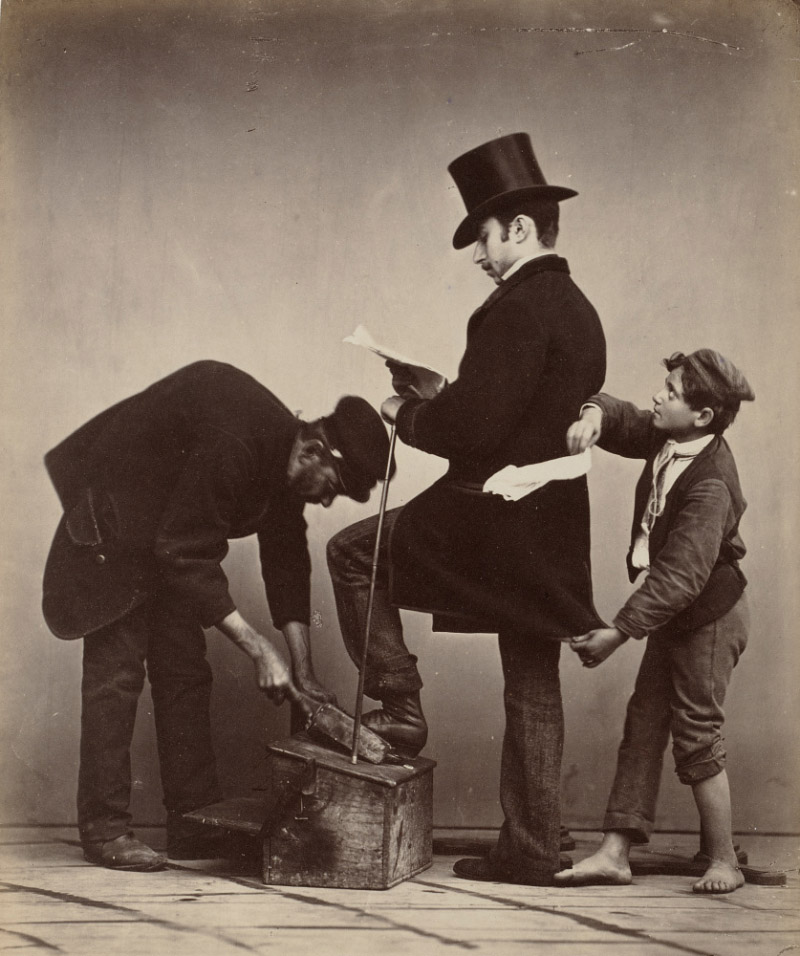
Giorgio Sommer (Italian born Germany, 1834-1914) The Pickpocket About 1865 Albumen print 9 3/8 × 7 5/8 inches The Nelson-Atkins Museum of Art Gift of the Hall Family Foundation
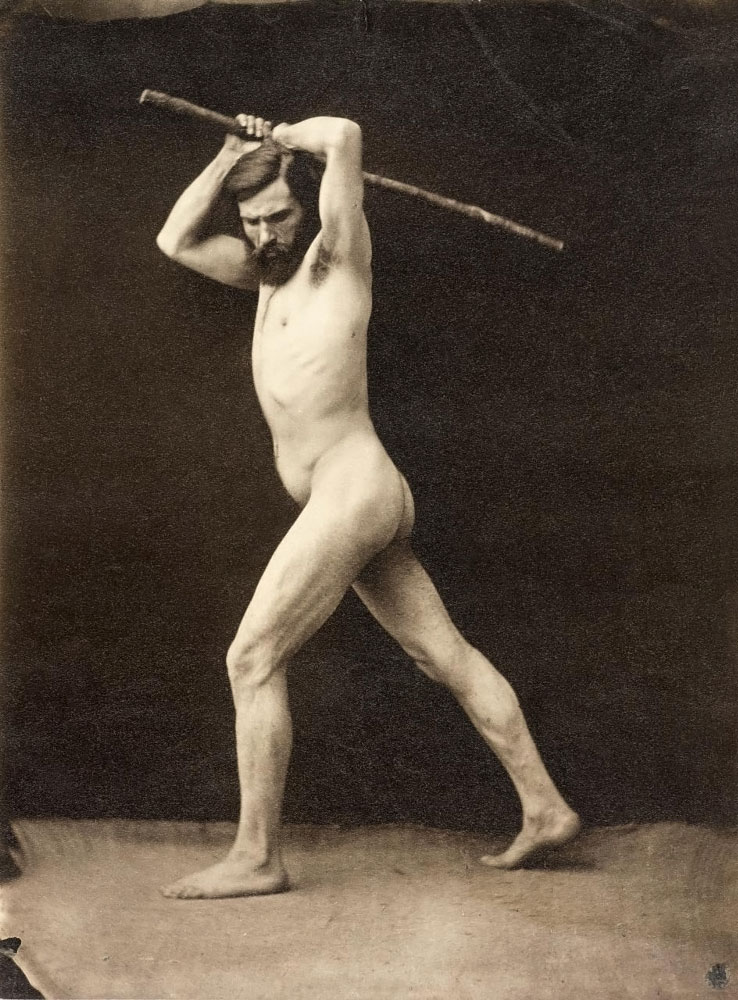
Gaudenzio Marconi (French born Switzerland, 1842-1885) Male nude for artist c. 1870 Albumen print Image and sheet: 8 5/8 × 6 3/8 inches (21.91 × 16.19cm) Mount: 12 9/16 × 9 3/4 inches (31.91 × 24.77cm) The Nelson-Atkins Museum of Art Gift of the Hall Family Foundation
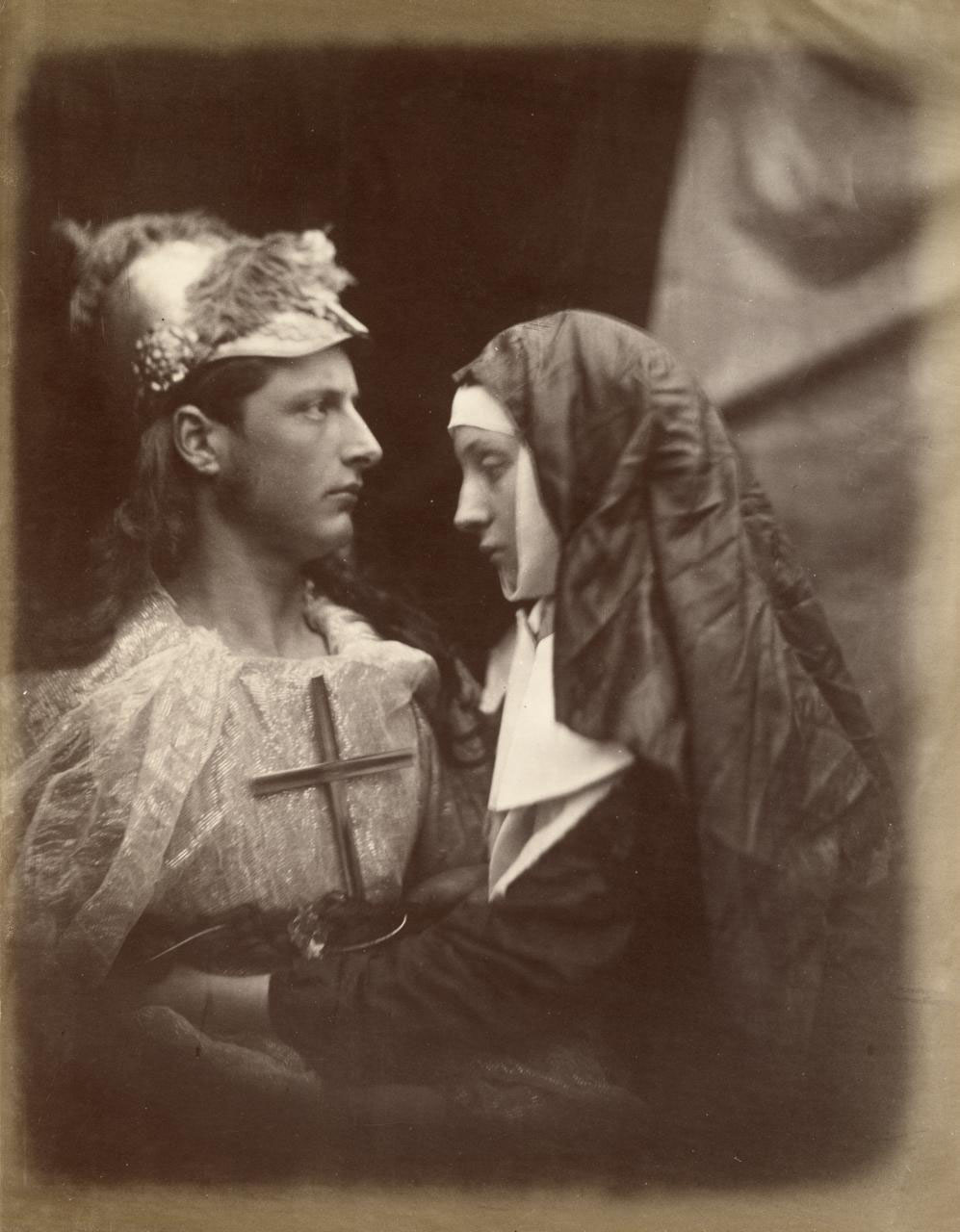
Julia Margaret Cameron (English born India, 1815-1879) Sir Galahad and the Pale Nun 1874 Albumen print 13 7/16 × 10 1/2 inches The Nelson-Atkins Museum of Art Gift of the Hall Family Foundation
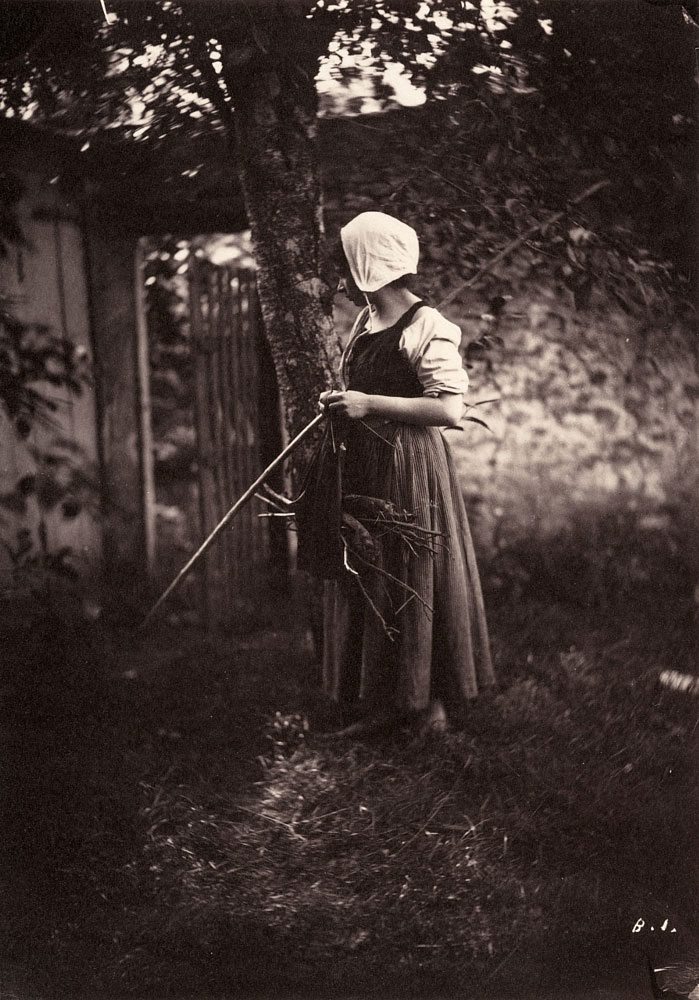
Giraudon’s Artist (French, active c. 1875) Woman with bundle of twigs c. 1875-1880 Albumen print Image and sheet: 6 5/8 × 4 11/16 inches (16.83 × 11.91cm) The Nelson-Atkins Museum of Art Gift of the Hall Family Foundation
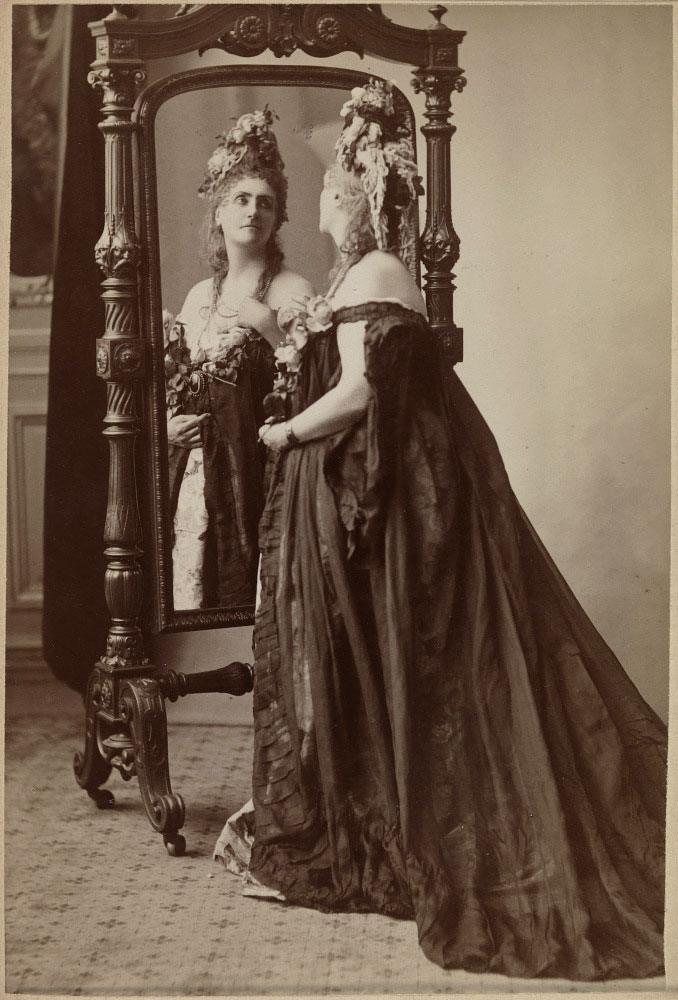
Pierre-Louis Pierson (French, 1822-1913) Portrait of the Countess of Castiglione from Série des Roses 1895 Albumen cabinet card Image and sheet: 5 15/16 × 3 15/16 inches (15.06 × 9.98cm) Mount: 6 3/8 × 4 1/4 inches (16.21 × 10.8cm) The Nelson-Atkins Museum of Art Gift of the Hall Family Foundation
The Countess of Castiglione became reclusive with age, rumored to only leave her home at night, hidden behind veils. Social chroniclers of the time claimed that she removed all mirrors from her home to avoid her appearance; however, this portrait seems to contradict her alleged displeasure. Taken toward the end of her life, the countess admires her reflection in the mirror, donning a youthful blond wig elaborately decorated with roses.
Text from the Nelson-Atkins Museum website
The Nelson-Atkins Museum of Art 4525 Oak Street Kansas City, MO 64111
John Thomson (Scottish, 1837-1921) Manchu Ladies
c. 1868
Albumen silver print
Loewentheil Photography of China Collection
This posting is personal.
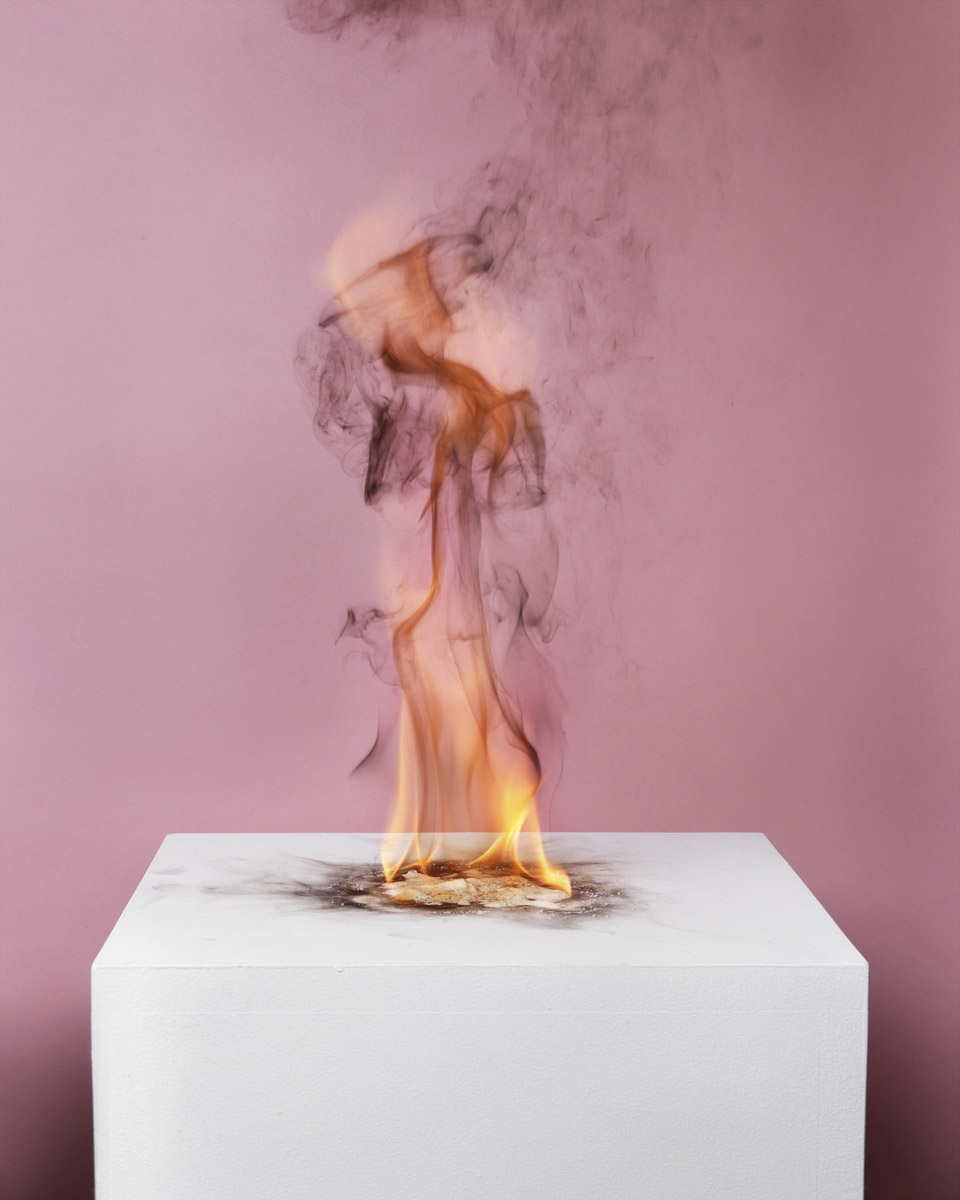
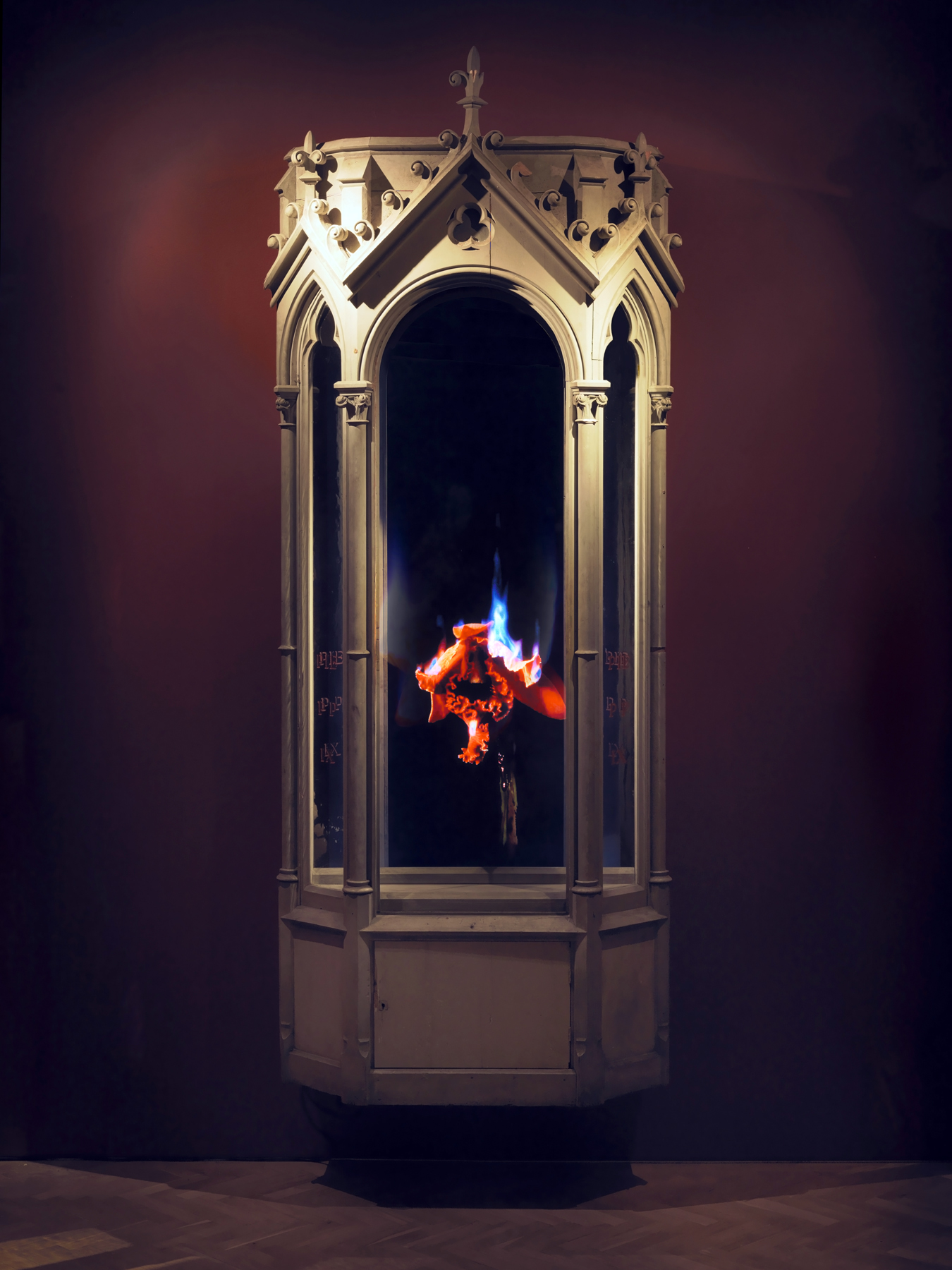
After I took the portrait below of my dear friend and fellow photographer Joyce Evans OAM (Australian, 1929-2019) at Jacques Raymond’s restaurant on the occasion of my birthday – the long exposure drawing a dragon-like creature from the flames – I posted the photograph to Facebook with a comment about Joyce being a “dragon lady” …. meaning, in my mind and foregrounded by Chinese culture, that she was a powerful, strong, loyal and intelligent women. Which she most definitely was.
I was then roundly abused by someone in a vituperative comment about calling Joyce a “dragon lady” when the person obviously had no idea of the mythological and cultural importance of the dragon to Chinese society, to which I was alluding.
Thus, it is with great joy that I post about this exhibition, a presentation that challenges “the negative and shallow stereotype of the “dragon lady.” The term remains a pervasive stereotype, often used against women who are unapologetically driven or have agency and power. It is particularly pernicious as a Western stereotype of East Asian women.” (Press release)
And thought, idea, photograph and in this case exhibition that challenges the stereotype and promotes difference and acceptance of that difference … can only make the world a better, more understanding place.
All power to strong, compassionate human beings everywhere.
Dr Marcus Bunyan
Many thankx to the Loewentheil Photography of China Collection for allowing me to publish the photographs in the posting. Please click on the photographs for a larger version of the image.
Marcus Bunyan (Australian, b. 1958) Joyce Evans OAM (Australian, 1929-2019) at Jacques Raymond restaurant
2016
iPhone photograph
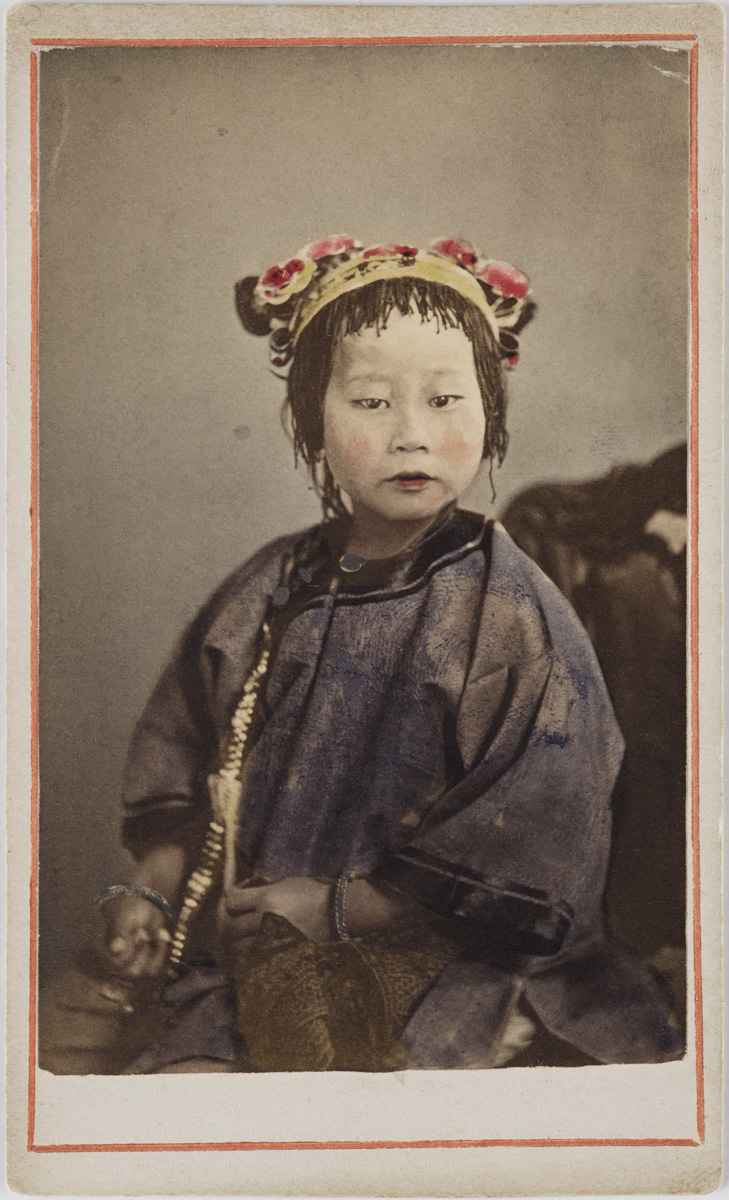
John Thomson (Scottish, 1837-1921) Portrait of a Girl
1860s
Hand-coloured albumen silver print
Carte de visite
Loewentheil Photography of China Collection
Women in China can achieve the highest level of education today. At the end of the Qing dynasty this was not true. In Illustrations of China and Its People, the photographer John Thomson discusses the education of Chinese girls in the 1870s. He explains that girls are strictly secluded and that “Chinese history offers few examples of women who have been distinguished for their literary attainments.” He states that in “higher orders of society ladies here and there receive an education which enables them to form some slight acquaintance with the literature of their country, and to conduct and express themselves according to the strict and formal rules of etiquette which pertain to their position as daughters, or wives of men of learning and cultivation.”
Women’s education saw some reform during the final years of the Qing dynasty. Empress Dowager Cixi endorsed private women’s schools and sought public support for women’s education. The government acknowledged that educating women was necessary for developing strong mothers. Still, the Qing government continued to defend norms of gender separation and strict restrictions on women.
Text from the Loewentheil Photography of China Collection
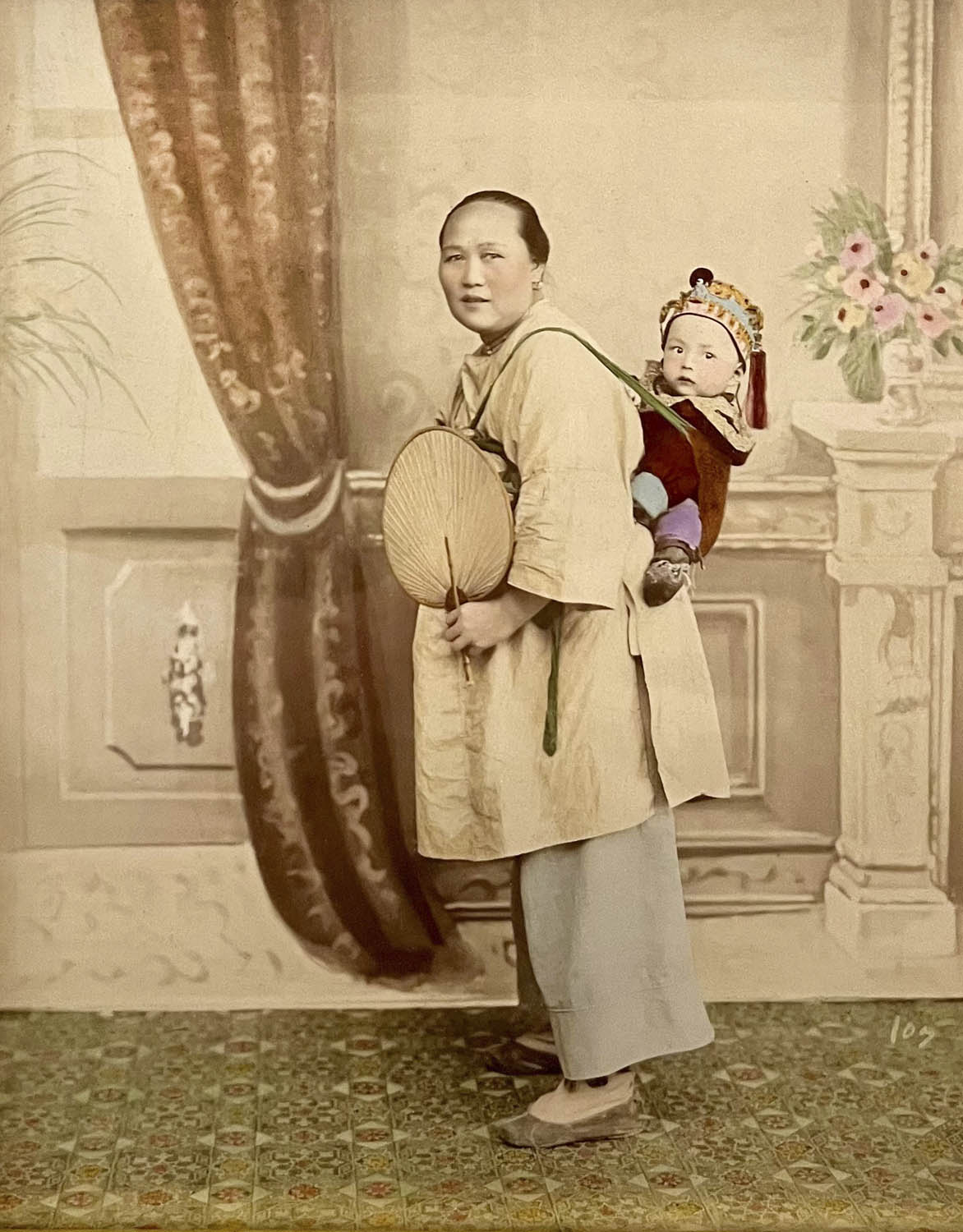
Unidentified Photographer in China Portrait of a Woman Carrying a Child
1860s
Hand coloured albumen silver print
Loewentheil Photography of China Collection
Many Chinese photography studios created portraits of women carrying children on their backs. These popular portraits depict the tender bonds between the woman and the child, typically a boy.
Creating such photographs was both a technical and an interpersonal challenge. Because cameras were not yet widespread in the 1860s and 1870s, most women did not feel comfortable posing for a photographer. Skilled early photographers instilled trust allowing their subjects to feel at ease. It is likely that women were in the studio assisting female clients.
The wet plate collodion process mandated that a baby remain still for several seconds as a negative was exposed, lest the child appear blurred. Very young children routinely appear blurred in nineteenth-century photographs. The babies’ bodies were restrained by traditional Chinese baby carriers but their heads were free to move. The gaze of the child’s eyes in this portrait suggest a studio assistant, or relative, may be entertaining the children at the side of the photographer. This child is evidently content and connected with the women both physically and emotionally.
Women in China had long carried their babies on their backs, particularly in southern provinces. When an infant turned one month old, they were allowed to leave the home with their mother for the first time. At that time the maternal grandmother traditionally presented the baby with a baby carrier. During the late Qing dynasty, mothers, grandmothers, female siblings and amahs working in wealthy families would use these traditional carriers.
A baby carrier was a personal gift made of a square of dyed cloth with strips of fabric extending from the corners to provide straps. Baby carriers were often embellished with embroidered silk.
Text from the Loewentheil Photography of China Collection
Pun Lun Studio (active circa 1864-1907) Portrait of Woman and Child
1870s
Hand coloured albumen silver print
The Pun Lun Studio 瑱纶影相 was located at various addresses in Queen’s Road in Hong Kong. It was a successful portrait studio and opened branches in Fuzhou, Saigon and Singapore. Active c. 1864 – c. 1907.
Painting a Photograph
Tinted or hand-coloured photography was enormously popular among the prosperous individuals throughout the world. Portraits and genre studies served as status symbols for rising members of the professional and merchant classes…
Most nineteenth-century photographs of China are monochrome albumen silver prints made from collodion glass plate negatives. In the developing process, skilled photographers like the Pun Lun Studio were able to create gradation and richness of tone with great transparency and detail in shadows. The colour of the prints varied from red-violet to deep brown. Well-produced albumen silver prints were sumptuous, but coloured photographs commanded even higher prices.
William Saunders (British lived China, 1832-1892) Weaving
1860s
Hand-coloured albumen silver print
No. 6 in Sketches of Chinese Life and Character series
Loewentheil Photography of China Collection
The Qing rulers adopted Confucianism from the Han Chinese culture of the conquered Ming dynasty.
In accordance with the Confucian ideal of gender labor division – “Men till, women weave.”
In this photograph Saunders presents a woman weaving on a loom. The woman is a model who appears in other roles in William Saunders photographic portfolio Sketches of Chinese Life and Character. Saunders’s depiction of the occupational roles of Chinese women follows a tradition established by painters in port cities. In this convincing pose the weaver appears to be engaged with the loom rather than the photographer. Saunders made this photograph outdoors at his studio but textiles were produced at a woman’s home. Women were secluded at home to ensure that their roles in their families was secure. Due to the nature of at-home work, women generated market income without having to reduce their investment in their families.
Text from the Loewentheil Photography of China Collection
William Saunders (British lived China, 1832-1892) A Young Lady from Canton
1860s-1870s
Hand-tinted albumen silver print
No. 25 in Sketches of Chinese Life and Character series
Loewentheil Photography of China Collection
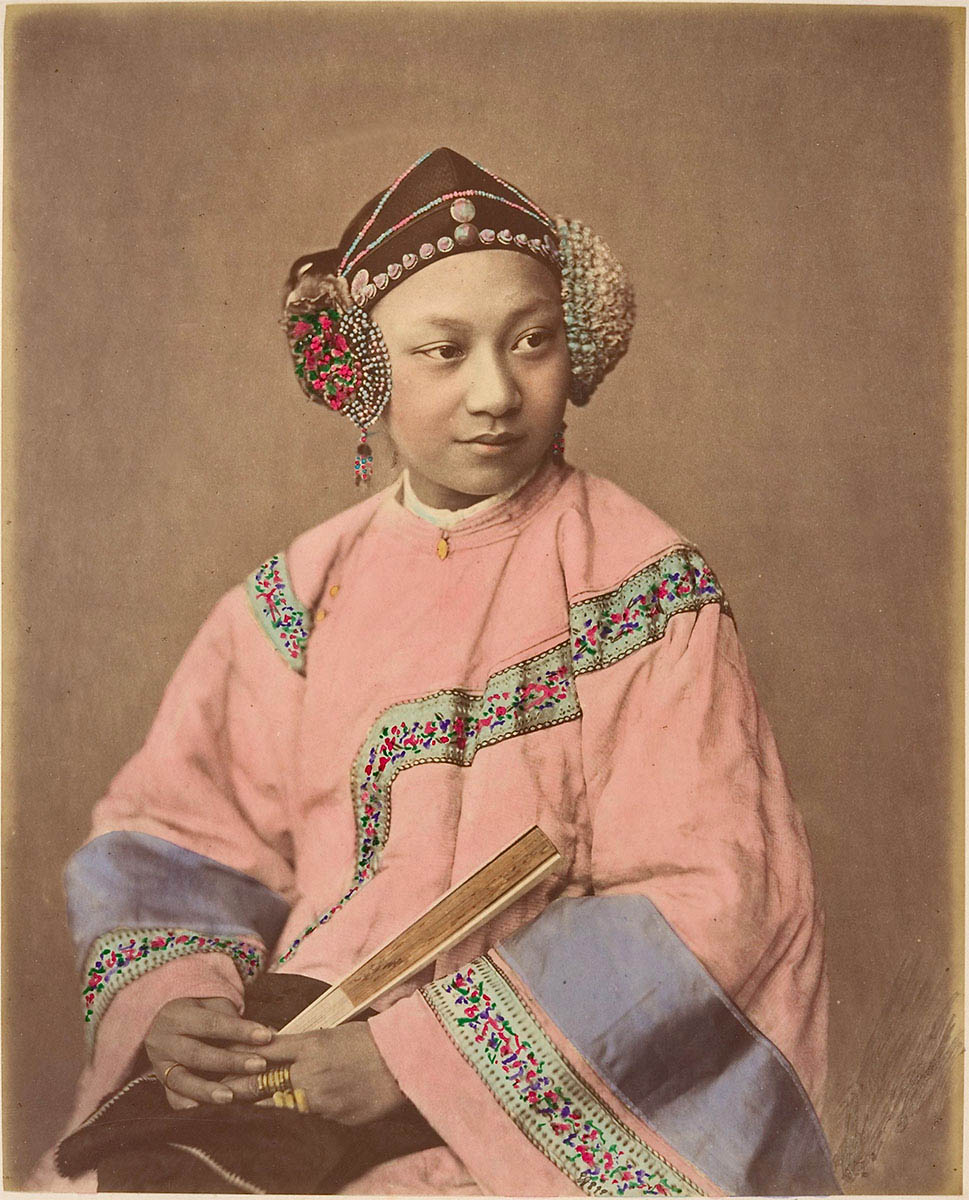
Women from Guangzhou were acclaimed for their natural beauty and often appear in early photographs. The woman in this portrait, tinged with uncertainty, wears a blue and red headscarf, an attire characteristic of women from a population living and working on boats in Guangzhou.
Many people in Guangzhou and other cities in China lived and worked on boats until the 1950s. Their boats were often anchored in lines along the rivers or coasts, with a large part of the clusters being stationary, forming a unique community and island-like space on the water, close to, yet separate from, the land.
Although traditional accounts from terrestrial Chinese and Westerns present the population of women living on boats as being engaged in prostitution, this was only true of a small minority and was no more common than among the terrestrial Chinese population. Women from the boat communities were not as hidden as other women in China. In addition to being known for their beauty, these women were described as skilful and hard-working boat drivers.
Text from the Loewentheil Photography of China Collection
William Saunders (1832-1892) was born in Woolwich, London and travelled to China as an engineer in 1860. He returned to Britain, studied photography, and then went back to China with photographic equipment. He photographed in Tientsin (Tianjin) in 1861 and then opened a studio in Shanghai in 1862, one of the city’s first. Saunders was a highly successful commercial photographer, specialising in portraiture, but also photographing everyday life, events, architectural, topographical and genre scenes. In 1871, he published his Portfolio of Sketches of Chinese Life and Character. William Saunders retired in 1888 and is now recognised as one of the most important photographers in nineteenth-century China.
Source: Terry Bennett. “History of Photography in China – Western Photographers – 1861-1879”, Quaritch 2010, pp. 83-106.
Born in Britain in 1832, Saunders moved to China in the 1850s and opened a photography studio in Shanghai in 1862. One of the first photographers in the city, Saunders focused primarily on portraiture but also photographed street life, local customs, current events, scenic views, and even executions. His photographs, intended for tourists and Westerners, were often based on compositions of earlier gouaches made for export. He was one of the main commercial photographers in China in the nineteenth-century. A series of fifty prints – Portfolio of Sketches of Chinese Life and Character – was published in 1871. This portfolio, in addition to his photographic contributions to Illustrated London News and other publications, disseminated information about life in China to Westerners. Saunders died in 1892.
William Saunders (British lived China, 1832-1892) Shanghai Woman and Girl
1860s-1870s
Hand-tinted albumen silver print
No. 13 in Sketches of Chinese Life and Character series
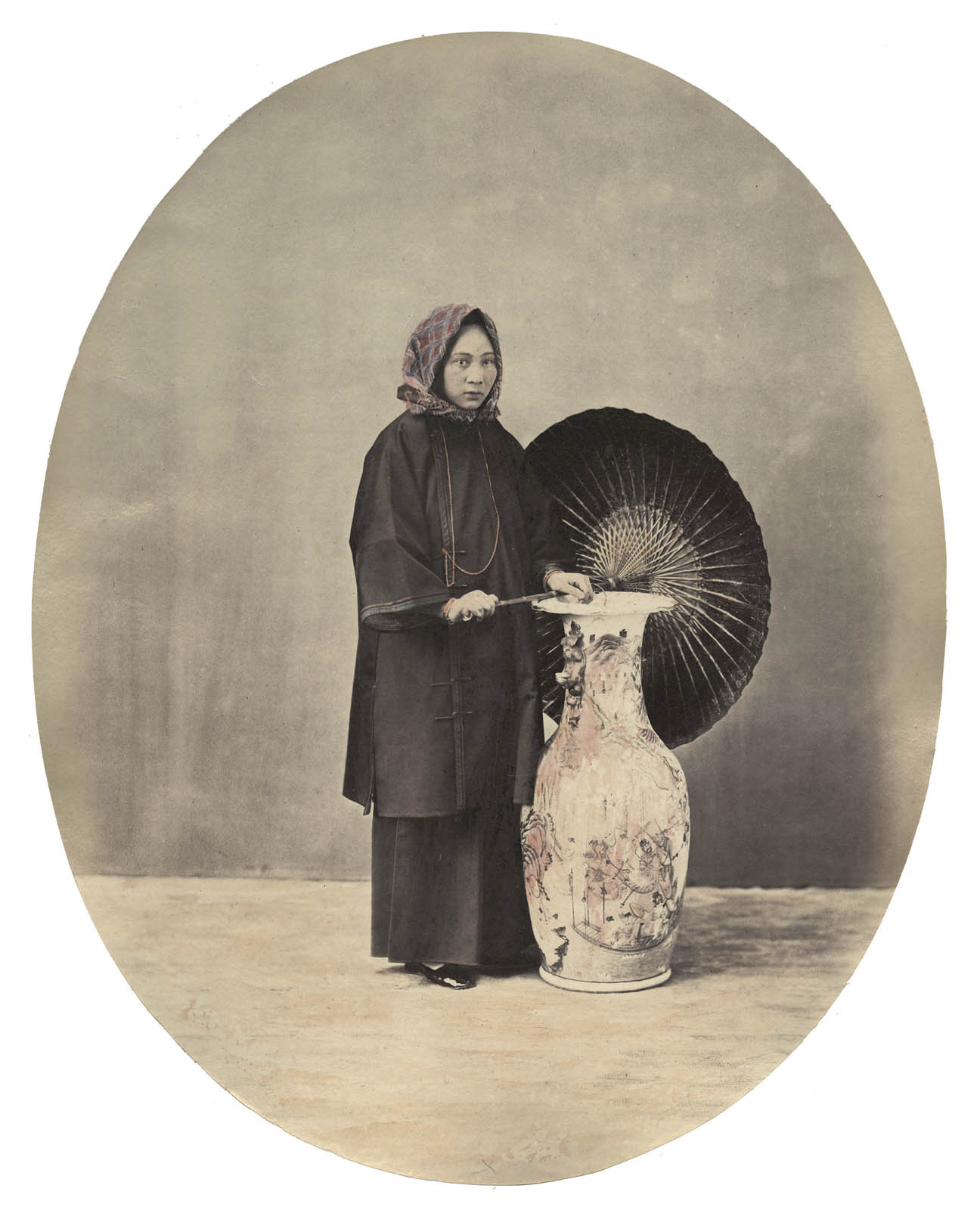
The girl in this portrait rests her hand on the hip of the young woman to balance herself as she stands before the camera on her tiny bound feet. The young woman seems to protect the girl as she holds her open parasol, an accoutrement of the nobility in ancient China, as a shield. The young woman and girl in this studio portrait are said to be from Keangsoo (Jiangsu) province, a region around Shanghai. Their gazes cross, neither looks at the camera. The photographer sought to present the diverse regional styles that converged in the international Chinese city of Shanghai. The woman and the girl were used as models for the photographer William Saunder’s portfolio Sketches of Chinese Life and Character. The photographer’s portrayal of Chinese women from different regions in China played a role in consolidating and redefining long standing preconceptions of Chinese women.
Text from the Loewentheil Photography of China Collection
Lai Fong (Chinese, c. 1839-1890), Afong Studios A Mandarin’s Wife
1860s
Albumen silver print
Loewentheil Photography of China Collection
In China, a tradition of ancestral portraiture preceded the invention of photography by many centuries. Commemorative portraits, commonly referred to as ancestor portraits, were central to the ritual of family worship. Photographic portraits echoed the stylistic attributes of the ancient commemorative images. In this portrait the woman is posed frontally, so that she faces the viewer directly. No part of her body is cropped out of the frame.
In both ancestor portraits and early photographs most women are anonymous. Even distinguished women were given little attention in most family genealogies. The histories of the majority of the named women appearing in early photographs come to us from through the careers or accomplishments of their fathers, husbands, or sons.
The woman in this portrait is dressed in such a way that immediately reveals her social rank. In full regalia she wears an elaborate headdress, a long necklace, a robe, and an intricate coat or fringed vest known as a xiapei. The coat displays a rank badge, reflecting her husband’s status within the government bureaucracy.
Text from the Loewentheil Photography of China Collection
Lai Fong (Chinese, c. 1839-1890), Afong Studios Portrait of Three Women from Amoy
1870s
Albumen silver print
Loewentheil Photography of China Collection
Women are usually not identified in early Chinese photographs, but their clothing, hairstyles, and other aspects of their appearances can indicate their origin and social status. The hairstyles and accoutrements of the women in this photograph by Lai Fong, including the oval painted fans they hold, are typical of women from Amoy (Xiamen). Early photographic portraits often feature props signifying the trades or social status of their subjects.
Traditionally, women of a higher social class preferred decorated circular fans, which were literati-associated objects. The fans in this photograph allude to the refined taste and intellect of the women. Fans can also represent romantic feelings and longing. The opulent clothing, jewellery, and coiffures in portraits such as this example were also used to emphasise idealised feminine beauty.
Like other Chinese and Western photography studios, Afong Studio sometimes produced genre photographs for sale to Chinese buyers and to foreign clients. The portrait may have originally been made by Lai Fong for the sitters or their associates. The photographer then generated additional profit from the negative by circulating the image around the world as a general depiction of feminine beauty in late nineteenth-century China.
Text from the Loewentheil Photography of China Collection
Lai Fong [is] arguably the most ambitious and successful photographer of nineteenth-century China. He began practicing under the name Afong in Hong Kong in the 1860s, and over the next twenty years built a towering reputation on his illustrious clientele, his impressive product range, and a catalogue of views of China “larger, choicer, and more complete… than any other in the Empire,” according to his advertisements. His photographs of Chinese cities, monuments, people, and land – however shaped by the desires of his cosmopolitan clientele – stand as records of places that have changed often beyond recognition, and of his own artistry, exuberance, and entrepreneurial brilliance. Managed by his son and daughter-in-law after his death, his studio persisted into the 1940s, an instance of remarkable longevity in a famously difficult field.
“Despite the historical fame of Lai’s studio and the reach of his photographs, which exist today in collections worldwide, Lai remains little known outside of specialist circles,” said Kate Addleman-Frankel, the Gary and Ellen Davis Curator of Photography at the Johnson Museum. “His work is understudied and rarely exhibited, the result in part of a colonial view of photography’s history that has privileged Western travel photographers over indigenous practitioners.”
Lai Fong (Chinese, c. 1839-1890), Afong Studios Bridal Carriage
1870s
Albumen silver print
Loewentheil Photography of China Collection
Elaborately decorated bridal sedan chairs were a feature of Chinese weddings for centuries. Carried by four to eight porters, the chair brought the bride from her home to the groom’s family home. The journey that represented her transition from childhood to adulthood and from her family to that of her husband. Young children leading the procession symbolised the hope for children for the couple. On arrival at her new home, the bride might be helped down by a woman who had been lucky in marriage.
Lai Fong’s image has a candid aspect rare to early photographs which required a long exposure time. We see the carriage and the girls as they may have appeared on the street, without asking onlookers to pose or retreat from the frame. Curious about the photographer and the camera, several of them face the lens directly.
Chinese women in the late Qing dynasty often had no freedom regarding marriage. A woman married the man her parents chose whether she liked him or not. Often she had no way to know if she was compatible with her soon to be husband since she would not have met or set eyes on him until the wedding night. Within the family, a woman had to obey her father before marriage, her husband after marriage, and her son after the death of her husband.
Text from the Loewentheil Photography of China Collection
First Exhibition of the Earliest Photographs of Chinese Women
Rare early photographs of Chinese women from the Loewentheil Photography of China Collection will be exhibited for the first time in New York as part of Asia Week New York. Dragon Women: Early Chinese Photography curated by Stacey Lambrow runs from March 14th – May 15th 2024.
Dragon Women: Early Chinese Photography celebrates the Year of the Dragon and the representation of women in the earliest photography of China. This is the first exhibition devoted to the depiction of Chinese women in early photography. The over 50 photographs selected from the Loewentheil Collection include the first photographic portraits of Chinese women, most made in the 1860s and 1870s. Many have never before been shown. The exhibition examines women’s place in society in the late Qing dynasty and their depiction in historical photography of China. It also presents work by the few known early female photographers of China.
Highlights include a rare photograph by the first known Chinese female photographer, Mae Linda Talbot, and works by Hedda Morrison, Isabella Bird, and Eva Sandberg Xiao. Masterworks include photographs by Chinese and international artists such as Sze Yuen Ming Studio, Pun Lun Studio, A Chan Studio, Lai Fong, John Thomson, and Thomas Child. The exhibition showcases the diversity of Chinese women and their experiences during the final decades of imperial China.
Text from the Loewentheil Photography of China Collection website
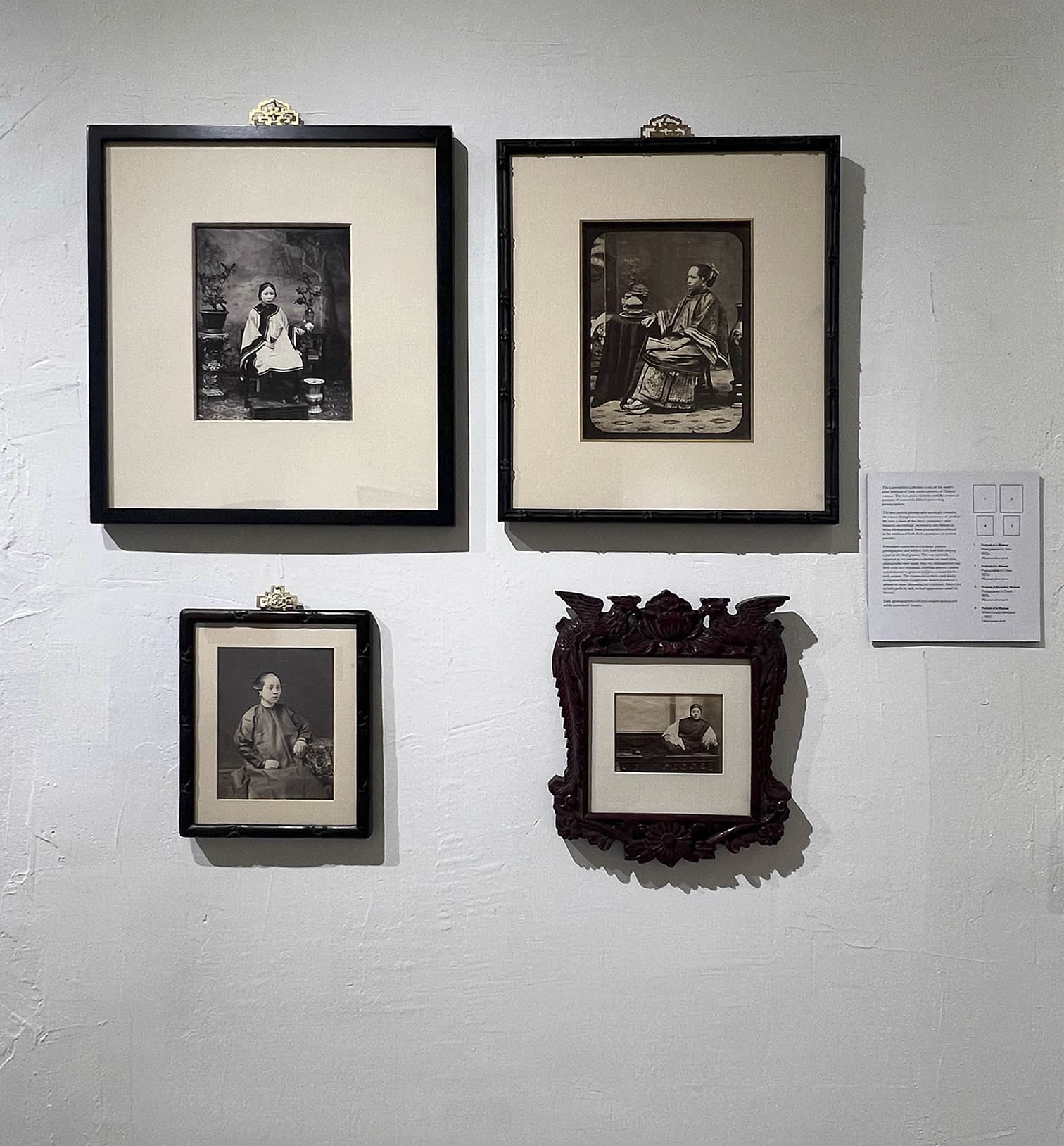
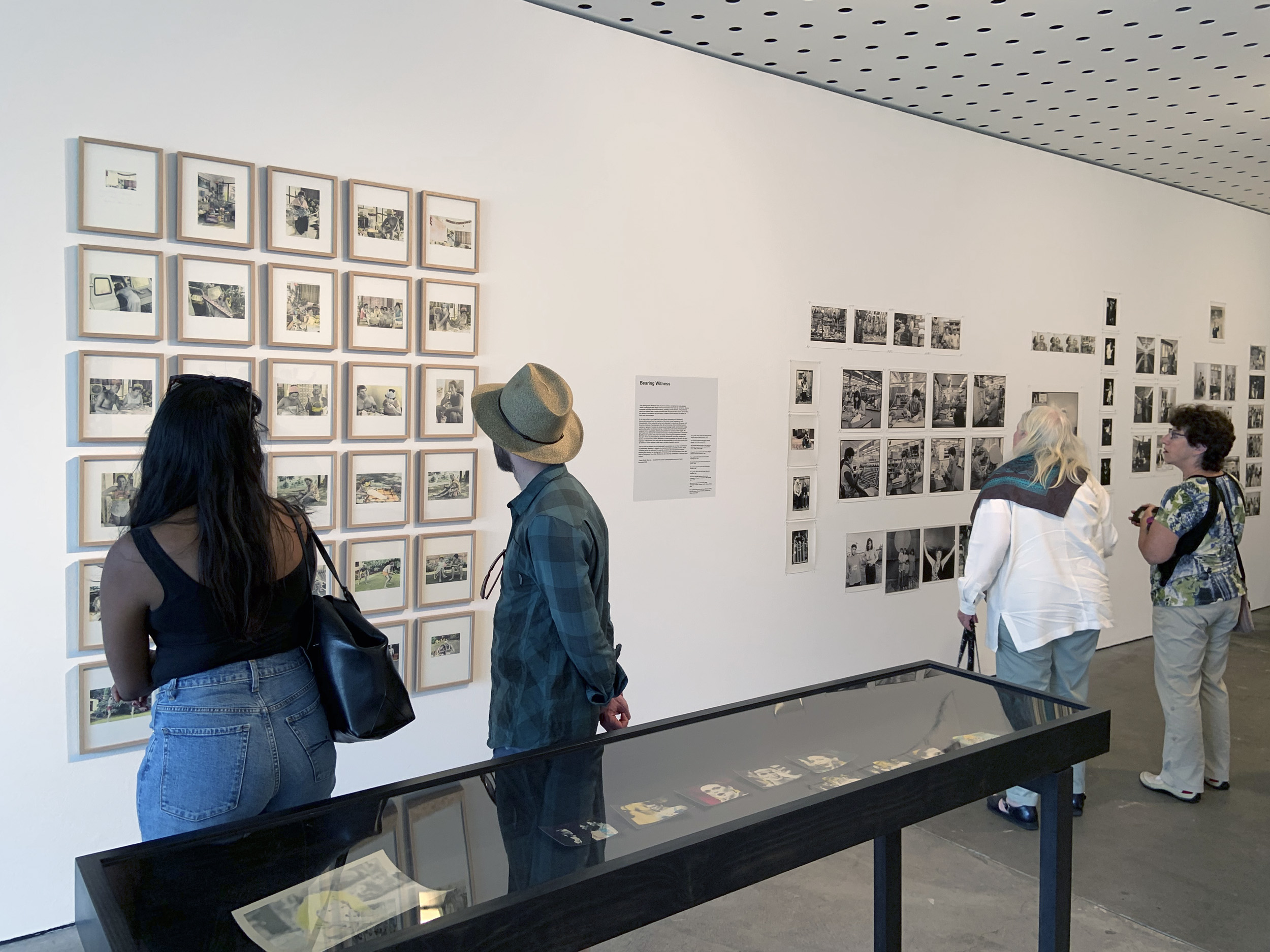
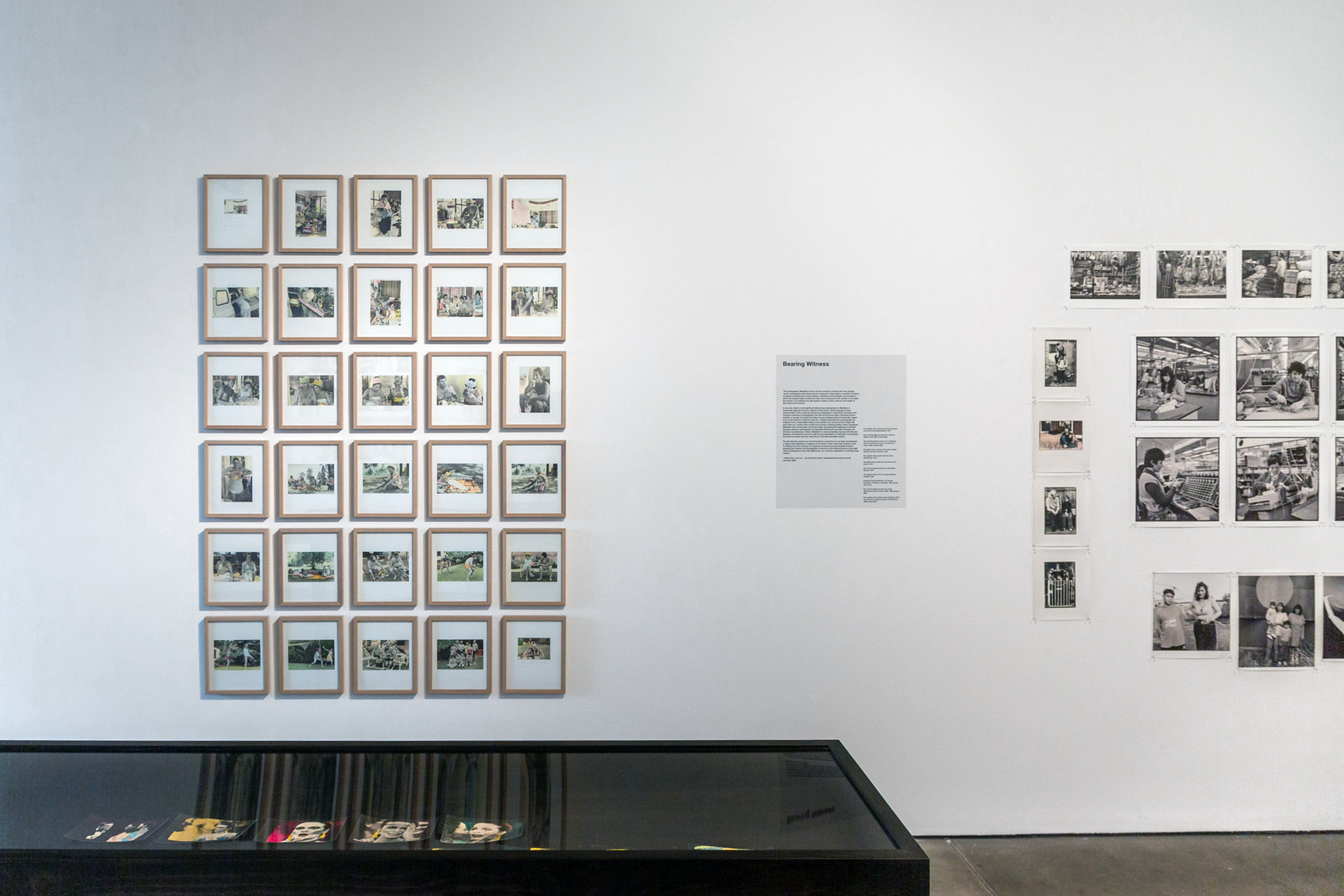
Installation view of the exhibition Dragon Women: Early Chinese Photography at the Loewentheil Photography of China Collection showing at top right, Unidentified Photographer in China. Portrait of a Woman 1870s
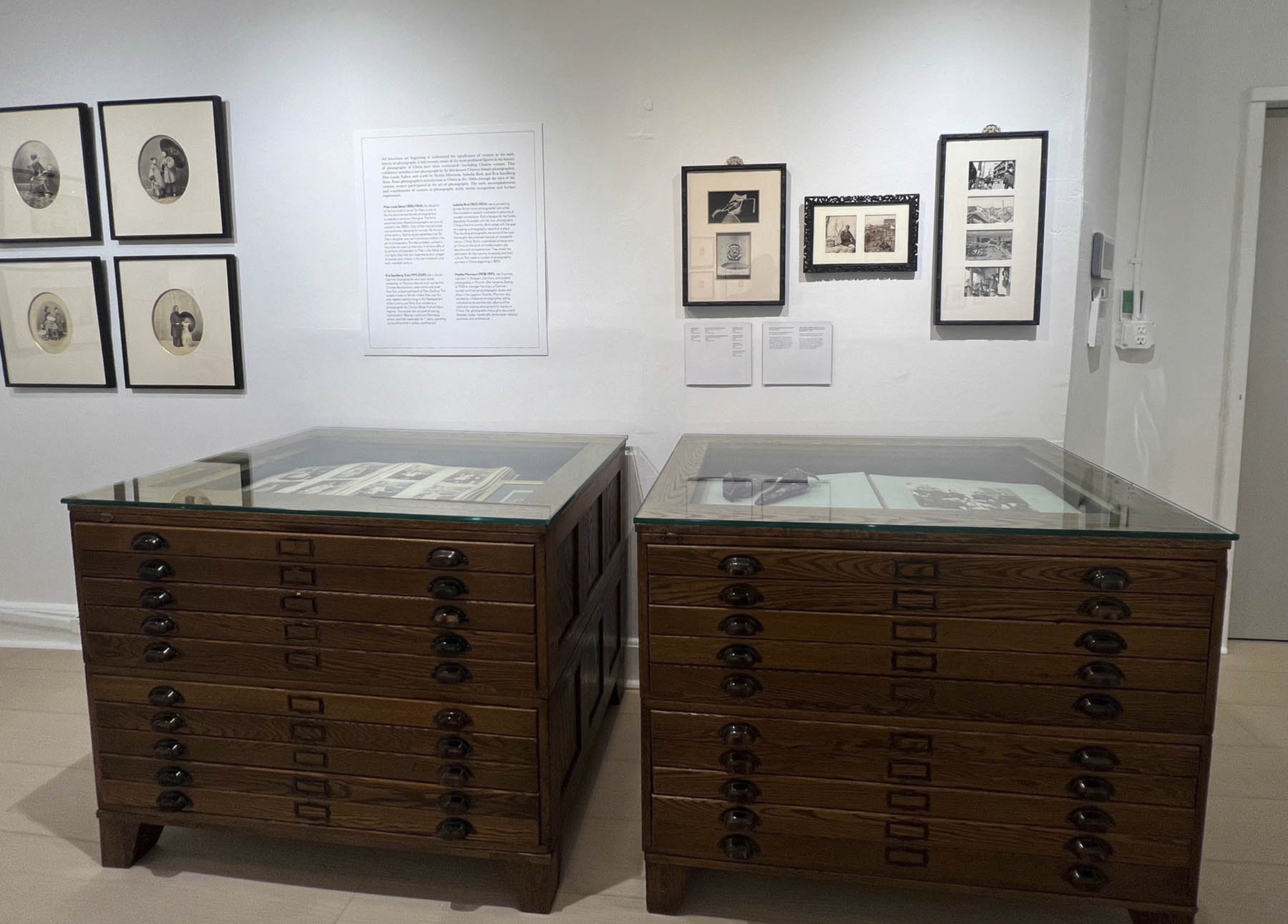
Installation view of the exhibition Dragon Women: Early Chinese Photography at the Loewentheil Photography of China Collection
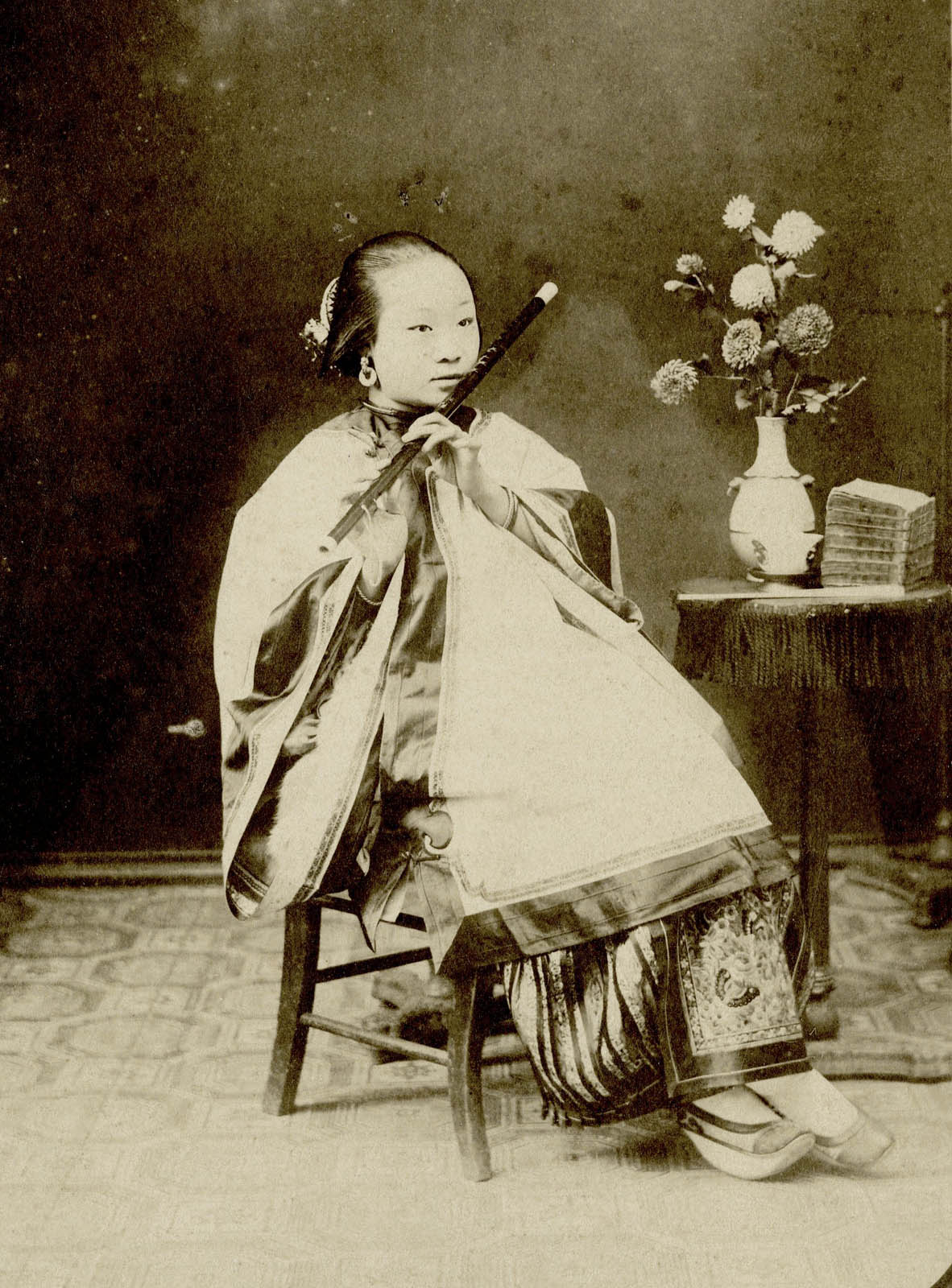
Installation view of the exhibition Dragon Women: Early Chinese Photography at the Loewentheil Photography of China Collection showing at left, Portrait of a Woman Playing a Dizi (1870s, below)
Unidentified Photographer in China Portrait of a Woman Playing a Dizi
1870s
Albumen silver print
Loewentheil Photography of China Collection
The woman in this portrait holds a dizi, a bamboo flute, as if she is playing it for the photographer. Courtesans playing the dizi and other Chinese instruments were a common subject of Chinese paintings before the theme appeared in the earliest photographs of Chinese women. In ancient China, courtesans were highly cultivated women who were rigorously trained in music, singing, dancing, and poetry. Courtesans were educated to be more than mere entertainers. Respected for their art and education in the classics, they were intellectual equals to aristocrats, scholars, and government official. Famous courtesans, such as Yang Yuhuan, were renowned for their beauty as well as their influence on politics and Chinese culture. They were hired to perform at elegant banquets for both male and female clients. They were also employed by the court.
Courtesan, such as Sai Jinhua, and others are some of the few women whose accomplishments are recognised by name in early Chinese history. Most women remained anonymous and were identified by their relationship to a father, husband, or son.
Courtesans often seem more at ease in front of the camera than other women. These women were accustomed to performing and being seen. They also recognised the value of photography for their reputations as entertainers.
During the late Qing dynasty, the status of some courtesans diminished as the concept of female performers changed. Subclass of courtesans developed. The artistic and intellectual skills of courtesans were not valued as highly as they once were and as a result some of these women became viewed as little more than objects of men’s sexual desire. They began to be regarded as prostitutes. It is evident from the props used in photography studios, such as instruments and books that artistic and literary talent continued to be associated with courtesans in the nineteenth century.
Text from the Loewentheil Photography of China Collection
Installation view of the exhibition Dragon Women: Early Chinese Photography at the Loewentheil Photography of China Collection showing at top left, Unidentified Photographer in China Portrait of a Woman (1870s, below)
Unidentified Photographer in China Portrait of a Woman
1870s
Albumen silver print
Loewentheil Photography of China Collection
Installation view of the exhibition Dragon Women: Early Chinese Photography at the Loewentheil Photography of China Collection
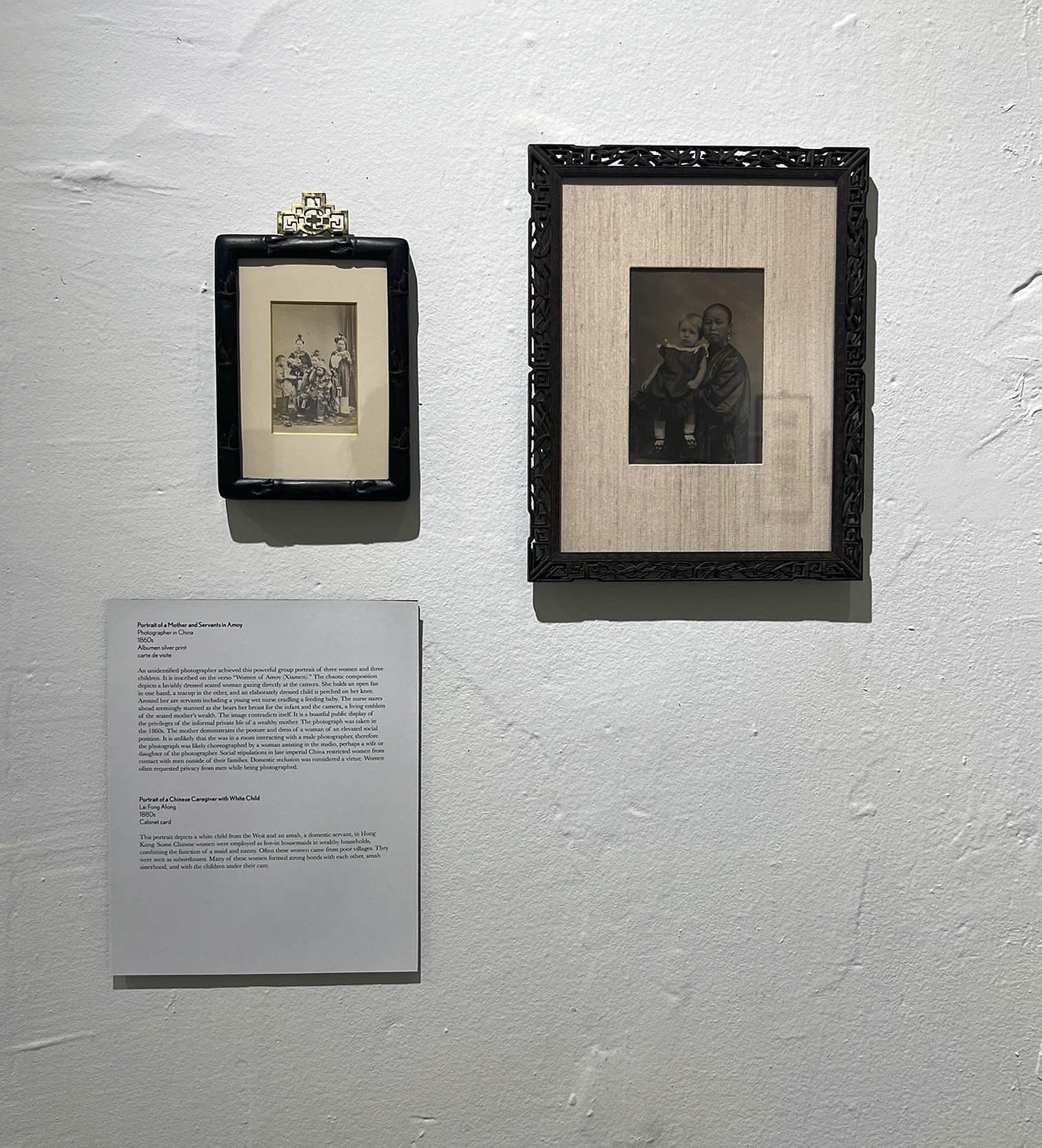
Installation view of the exhibition Dragon Women: Early Chinese Photography at the Loewentheil Photography of China Collection showing two photographs labelled below:
LEFT
Unidentified Photographer in China Portrait of a Mother and Servants in Amoy
1860s
Albumen silver print
Carte de visite
Loewentheil Photography of China Collection
An unidentified photographer achieved this powerful group portrait of three women and three children. It is inscribed on the verso “Women of Amoy (Xiamen).” The chaotic composition depicts a lavishly dressed seated woman gazing directly at the camera. She holds an open fan in one hand, a teacup in the other, and an elaborately dressed child is perched on her knee. Around her are servants including a young wet nurse cradling a feeding baby. The nurse stares ahead seemingly stunned as she bears her breast for the infant and the camera, a living emblem of the seated mother’s wealth. The image contradicts itself. It is a boastful public display of the privileges of the informal private life of a wealthy mother. The photograph was taken in the 1860s. The mother demonstrates the posture and dress of a woman of an elevated social position. It is unlikely that she was in a room interacting wit a male photographer, therefore the photograph was likely choreographed by a women assisting in the studio, perhaps a wife or daughter of the photographer. Social stipulations in late imperial China restricted women from contact with men outside their families. Domestic seclusion was considered a virtue. Women often requested privacy from men while being photographed.
Wall text from the exhibition
RIGHT
Lai Fong (Chinese, c. 1839-1890), Afong Studios Portrait of a Chinese Caregiver with White Child
1880s
Cabinet card
Loewentheil Photography of China Collection
This portrait depicts a white child from the West and an amah, a domestic servant, in Hong Kong. Some Chinese women were employed as live-in housemaids in wealthy households, combining the function of a maid and nanny. Often these women came from poor villages. They were seen as subordinates. Many of these women formed strong bonds with each other, amah sisterhood, and with the children under their care.
Wall text from the exhibition
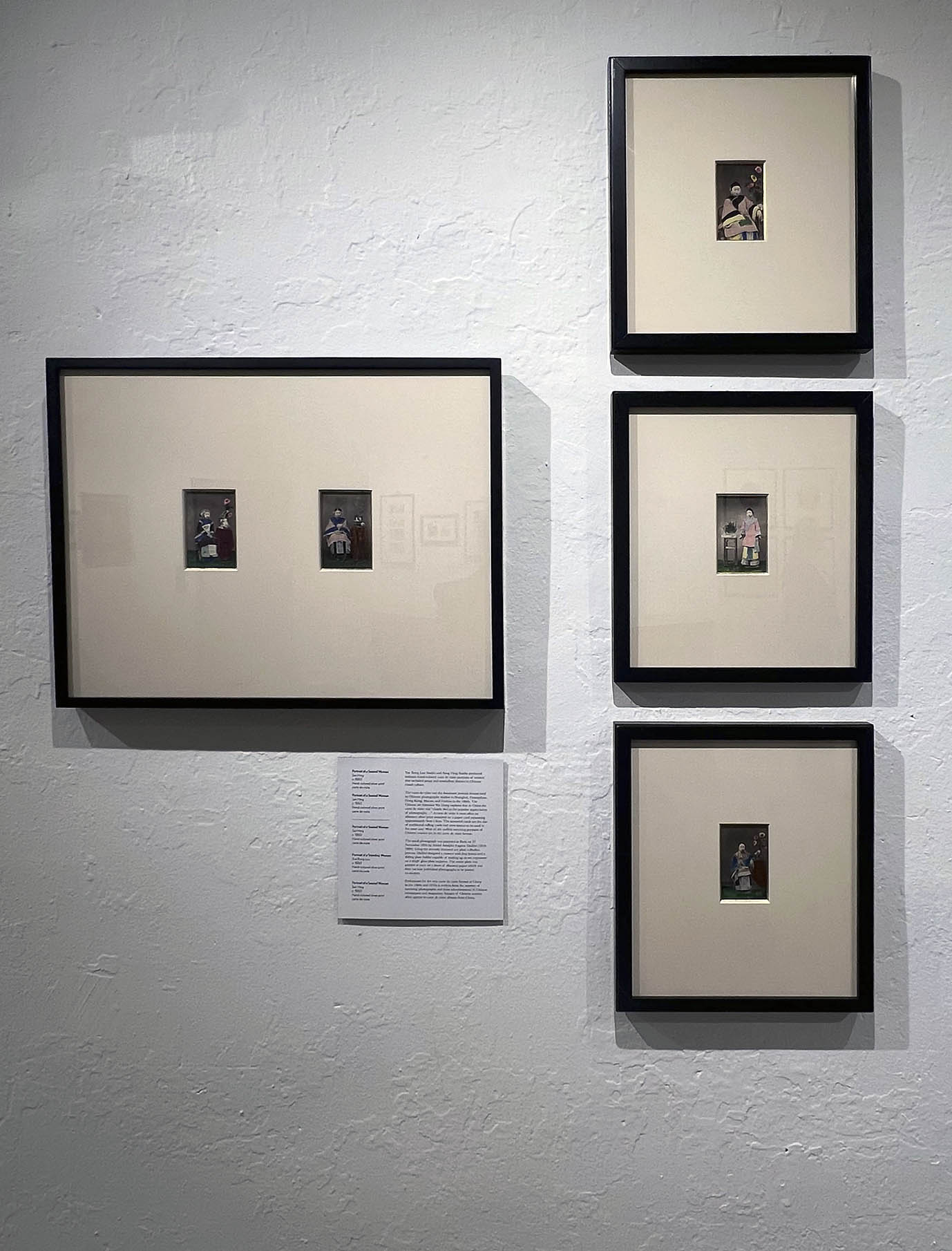
Installation view of the exhibition Dragon Women: Early Chinese Photography at the Loewentheil Photography of China Collection showing various portraits of Chinese women on carte de visite
Installation view of the exhibition Dragon Women: Early Chinese Photography at the Loewentheil Photography of China Collection showing two photographs labelled below:
LEFT
Milligan Miller The General’s Wife
1864
Albumen silver print
RIGHT
Lai Fong (Chinese, c. 1839-1890), Afong Studios A Mandarin’s Wife
1860s
Albumen silver print
Rare early photographs of Chinese women from the Loewentheil Photography of China Collection will be exhibited for the first time in New York as part of Asia Week New York. Dragon Women: Early Chinese Photography curated by Stacey Lambrow runs from March 14th – May 15 2024.
Dragon Women: Early Chinese Photography celebrates the Year of the Dragon and the representation of women in the earliest photography of China. This is the first exhibition devoted to the depiction of Chinese women in early photography. The 50 photographs include the first photographic portraits of Chinese women, most made in the 1860s and 1870s. Many have never before been shown. The exhibition examines women’s place in society in the late Qing dynasty and their depiction in historical photography of China. It also presents work by the few known early female photographers of China.
Highlights include a rare photograph by the first known Chinese female photographer, Mae Linda Talbot, and works by Hedda Morrison, Isabella Bird, and Eva Sandberg Xiao. Masterworks abound including photographs by Chinese and international artists such as Sze Yuen Ming Studio, Pun Lun Studio, A Chan Studio, Lai Fong, John Thomson, and Thomas Child. The exhibition showcases the diversity of Chinese women and their experiences during the final decades of imperial China.
The dragon is an integral part of Chinese culture. The origin of dragons in Chinese mythology extends back to the earliest recorded dynasties, where male and female dragons were revered as powerful and benevolent creatures created by the gods to govern the world. Unlike the evil, fire-breathing European dragon, the Chinese dragon is an auspicious and multifaceted figure. It is both powerful and benevolent, fierce and elegant. The dragon also symbolises imperial power.
This exhibition held in the Year of the Dragon reclaims the feminine power of the dragon and honours all Chinese women. It includes iconic photographs of Empress Dowager Cixi (1835-1908) by her Court photographer Yu Xunling (c. 1880-1943). Cixi, one of the most powerful women in Chinese history, was referred to as “Dragon Lady.” Some caricatured her as a uniquely sinister, manipulative, and cold-blooded ruler. However, scholars agree that the Empress’s contribution to empowering and advancing opportunities for women is an important part of her legacy, thereby revising this one-dimensional view.
The early photographic portraits of women in Dragon Women challenge the negative and shallow stereotype of the “dragon lady.” The term remains a pervasive stereotype, often used against women who are unapologetically driven or have agency and power. It is particularly pernicious as a Western stereotype of East Asian women.
The exhibition portrays and honours women of various ages, classes, and social circumstances. The diversity of the “dragon women” in the photographs more authentically reflects the power and complexity of the dragon.
For the majority of women at the end of the Qing dynasty, being photographed was off-limits for social and financial reasons. Qing society perpetuated the conservative ideas of previous dynasties, and the majority of women were isolated in their homes. Some of the women in these images chose to be photographed, while others submitted to the photographer for other reasons. Some of the photographs were made as personal family photographs and others were produced for popular consumption to portray the women as “exotic.” Regardless, the camera immortalised their images and offer us a rare and complicated view into the lives of Chinese women during a period of modernisation in China.
Most late Qing dynasty photographs of Chinese women depict unnamed sitters and a great number of the portraits were created by photographers who at this time remain unidentified. As research into the history of photography of China advances, more of the names of the Chinese women appearing in nineteenth-century photographs will be discovered and more of China’s pioneering photographers will be identified. Certainly, more of the early photographers working in China will prove to be women.
The Loewentheil Photography of China Collection includes the largest selection of nineteenth-century photographs of Chinese women in the world. In photography’s most formative years Chinese women were involved in the art in a myriad of ways. Their presence exerted a profound influence on the development of the art of photography. Women worked alongside men in photography studios, sometimes as the wives and daughters of studio owners, or as printers, finishers, retouchers, colourists, camera operators, or studio managers. In addition, women participated as subjects of early photographs. Early photographs of Chinese women, rank among the greatest nineteenth-century photographs ever made.
About the Loewentheil Photography of China Collection
The Loewentheil Photography of China Collection, based in New York, is the finest and largest holding of historical photographs of China in private hands. It contains many thousands of photographs spanning the earliest days of paper photography from the 1850s through the 1930s. The majority date to before 1900, including the largest selection of nineteenth-century photographs of Chinese women in the world.
Lai Fong (Chinese, c. 1839-1890), Afong Studios Bound Foot Exposed [A Chinese Golden Lily Foot]
1870s
Albumen silver print
Loewentheil Photography of China Collection
Foot binding (simplified Chinese: 缠足; traditional Chinese: 纏足; pinyin: chánzú), or footbinding, was the Chinese custom of breaking and tightly binding the feet of young girls to change their shape and size. Feet altered by foot binding were known as lotus feet and the shoes made for them were known as lotus shoes. In late imperial China, bound feet were considered a status symbol and a mark of feminine beauty. However, foot binding was a painful practice that limited the mobility of women and resulted in lifelong disabilities.
The prevalence and practice of foot binding varied over time and by region and social class. The practice may have originated among court dancers during the Five Dynasties and Ten Kingdoms period in 10th-century China and gradually became popular among the elite during the Song dynasty. Foot binding eventually spread to lower social classes by the Qing dynasty (1644-1912). Manchu emperors attempted to ban the practice in the 17th century but failed. In some areas, foot binding raised marriage prospects. It has been estimated that by the 19th century 40-50% of all Chinese women may have had bound feet, rising to almost 100% in upper-class Han Chinese women.
In the late 19th century, Christian missionaries and Chinese reformers challenged the practice but it was not until the early 20th century that the practice began to die out, following the efforts of anti-foot binding campaigns. Additionally, upper-class and urban women dropped the practice of foot binding sooner than poorer rural women. By 2007, only a small handful of elderly Chinese women whose feet had been bound were still alive. …
Feminist perspective
Foot binding is often seen by feminists as an oppressive practice against women who were victims of a sexist culture. It is also widely seen as a form of violence against women. Bound feet rendered women dependent on their families, particularly the men, as they became largely restricted to their homes. Thus, the practice ensured that women were much more reliant on their husbands. The early Chinese feminist Qiu Jin, who underwent the painful process of unbinding her own bound feet, attacked foot binding and other traditional practices. She argued that women, by retaining their small bound feet, made themselves subservient as it would mean women imprisoning themselves indoors. She believed that women should emancipate themselves from oppression, that girls can ensure their independence through education, and that they should develop new mental and physical qualities fitting for the new era. The ending of the practice is seen as a significant event in the process of female emancipation in China, and a major event in the history of Chinese feminism.
In the late 20th century, some feminists have pushed back against the prevailing Western critiques of foot binding, arguing that the presumption that foot binding was done solely for the sexual pleasure of men denies the agency and cultural influence of women.
Other interpretations
Some scholars such as Laurel Bossen and Hill Gates reject the notion that bound feet in China were considered more beautiful, or that it was a means of male control over women, a sign of class status, or a chance for women to marry well (in general, bound women did not improve their class position by marriage). Foot binding is believed to have spread from elite women to civilian women and there were large differences in each region. The body and labor of unmarried daughters belonged to their parents, thereby the boundaries between work and kinship for women were blurred. They argued that foot binding was an instrumental means to reserve women to handwork, and can be seen as a way by mothers to tie their daughters down, train them in handwork, and keep them close at hand. This argument has been challenged by Shepherd 2018, who shows there was no connection between handicraft industries and the proportion of women bound in Hebei.
Foot binding was common when women could do light industry, but where women were required to do heavy farm work they often did not bind their feet because it hindered physical work. These scholars argued that the coming of the mechanised industry at the end of the 19th century and the beginning of the 20th century, such as the introduction of industrial textile processes, resulted in a loss of light handwork for women, removing a reason to maintain the practice. Mechanisation resulted in women who worked at home facing a crisis. Coupled with changes in politics and people’s consciousness, the practice of foot binding disappeared in China forever after two generations. More specifically, the 1842 Treaty of Nanjing (after the first Opium War) opened five cities as treaty ports where foreigners could live and trade. This led to foreign citizens residing in the area, where many proselytised as Christian missionaries. These foreigners condemned many long-standing Chinese cultural practices like foot binding as “uncivilised” – marking the beginning of the end for the centuries-long practice.
John Thomson (Scottish, 1837-1921) Older Woman Carrying Child
c. 1868
Albumen silver print
Loewentheil Photography of China Collection
Lai Fong (Chinese, c. 1839-1890), Afong Studios Caregiver [Woman carrying child]
1870s
Albumen silver print
Loewentheil Photography of China Collection
Depiction of Chinese Family Culture in the Loewentheil Collection
Parents had long carried their babies on their backs in China, particularly in southern provinces. When an infant turned one month old they were allowed to leave the home with their mother for the first time. At that time the maternal grandmother traditionally presented the baby with a baby carrier. During the late Qing Dynasty, female siblings and amahs working in wealthy families would also use these traditional carriers with babies and toddlers in their care.
A baby carrier was a personal gift made of a square of dyed cloth with strips of fabric extending from the corners to provide straps. Baby carriers were often embellished with embroidered silk.
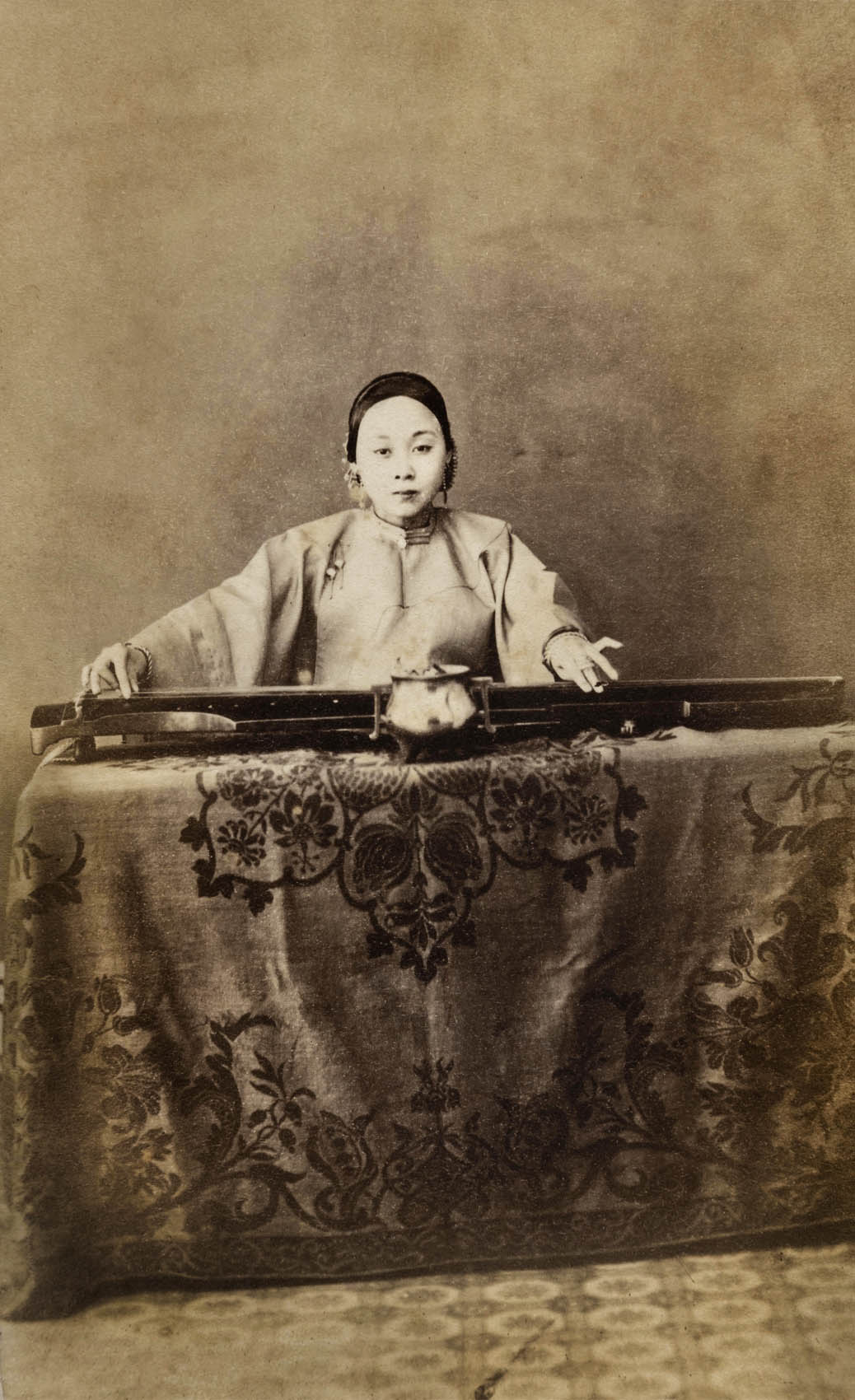
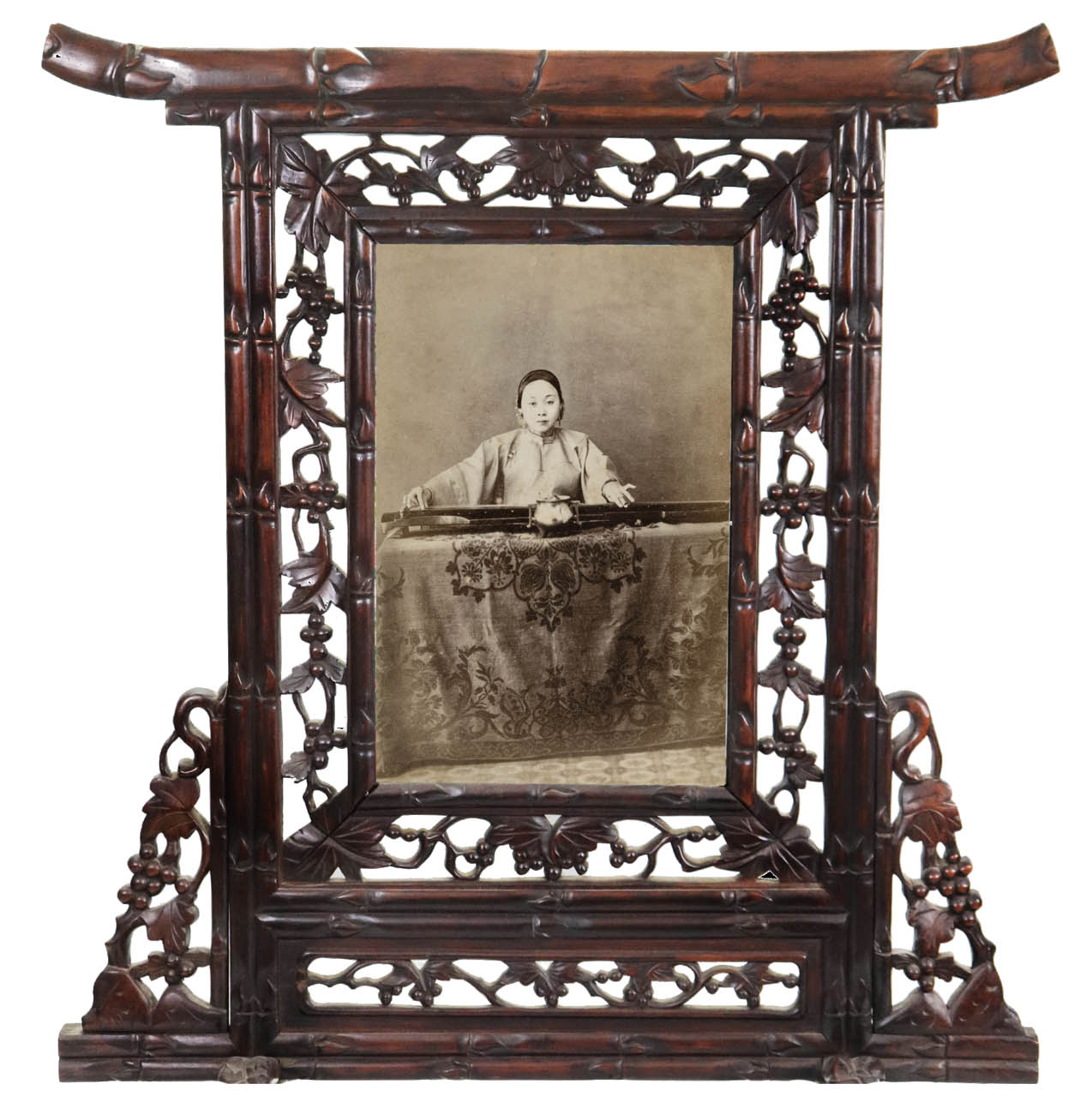
A Chan (Yazhen) Studio Portrait of a Female Musician
1870s
Albumen silver print
11.5 x 6.5cm
Loewentheil Photography of China Collection
Guqin music expresses the soul of the Chinese nation.
An Early Photograph including a Guqin
This rare A Chan (Yazhen) Studio photograph is one of the earliest known photographs including a guqin or qin. The instrument, the most prestigious in China, was invented more than three thousand years ago. Guqin playing developed as an elite art form practiced by scholars and noblemen. It is one of the four classic Chinese arts along with painting, an ancient form of chess, and calligraphy. The guqin is famous for being the preferred instrument of literati and sages. A Chan (Yazhen) Studio’s 1870s photographic portrait depicts a woman with a guqin, an instrument critical to Chinese intellectual history.
A Female Musician
A Chan (Yazhen) Studio posed the elegant woman directly in front of the camera. Rather than looking down towards the musical instrument, the woman’s eyes engage the viewer as she holds her pose. In accordance with tradition an incense burner is positioned on the table in front of her. The Chinese photography studio, fully cognisant of the significance of the art form, has composed a timeless photograph of the ancient instrument and the beauty of its player.
The woman’s hand gestures suggest that she was a skilled practitioner of the instrument. Her hand positions are accurate, and her left hand is pressing the strings rather than plucking them. The constraints of early photography prevented the woman from playing the instrument while posing. Long exposure times required by the wet plate collodion process would cause motion to appear as a blur in the negative. It is very likely that the photographer instructed the guqin player to exaggerate her finger positions to emphasize her gestures and give the illusion that she was playing the instrument.
Imperial-era literature strongly suggests that guqin playing was a male dominated tradition, but paintings dating back to the Tang dynasty depict female players. The female guqin players in early paintings are identified as court ladies or ladies of refinement. Contemporary scholars believe that it is a mistaken stereotype to consider guqin playing a strictly male tradition. In order to understand the prevalence and role of female guqin players, scholars are working on closer studies of women in Ming and Qing Dynasty qin schools and societies. Today there are many more female than male qin players, and all people of all walks of life play the instrument.
The Guqin
The guqin is a seven stringed instrument endowed with metaphysical and cosmological significance. The instrument, beloved by sages including Confucius, is said to have the power to communicate the deepest human feelings. Writers dating back to the Han Dynasty claim that the guqin aids in cultivating character, understanding morality, and enhancing life and learning.
Each component of the guqin relates to cosmology and is identified by a zoomorphic or anthropomorphic name. The upper round board symbolises heaven. The flat bottom board represents earth. The strings are traditionally made of twisted silk and vary in thickness. Traditionally the guqin had five strings which symbolise the five elements: metal, wood, water, fire, and earth.
Guqin playing, is much more than an auditory experience, it has an olfactory component as well. The players customarily perfumed the air by burning incense. The incense burner in A Chan (Yazhen) Studio’s portrait is placed in its usual position in front of the musician.
It is traditionally said that twenty years of training are necessary to gain proficiency on the qin. Guqin players once had a repertoire of several thousand compositions. Presently, fewer than one hundred works are still performed. Today there are fewer than one thousand well-trained guqin players and no more than fifty surviving masters. The guqin and guqin music, recognised as inseparable from Chinese intellectual history, have been added to UNESCO’s Representative List of the Intangible Cultural Heritage of Humanity.
The art form had been on the verge of extinction, but in recent times there has been a revival of guqin culture. Contemporary musicians are attracting the interest of young people in the ancient Chinese art form.
A Chan (Yazhen) Studio Portrait of a Female Musician
1870s
Albumen silver print
11.5 x 6.5cm
Loewentheil Photography of China Collection
Evening Cry of the Crow 乌夜啼
Performed by Mingmei Yip 叶明媚
Isabelle Bird (English, 1831-1904) Fuzhou Headdress
1896
Gelatin silver print
Loewentheil Photography of China Collection
Isabella Bird (1831-1904) was a pioneering female travel photographer and writer from England. She travelled to several continents in defiance of societal conventions. Bird is famous for her books beautifully illustrated with her own photographs.
China is the first country Bird visited with the goal of creating a photographic record of a place. Her photographs are some of the most thoroughly documented records of nineteenth-century China. Bird’s photographs of China on the brink of modernisation are sensitive, comprehensive, and unparalleled. They reveal her admiration for the country, its people, and their culture. After first arriving in China in 1894, she returned frequently over three years.
Bird became the first woman inducted into the Royal Geographical Society in 1892 and she was elected to membership of the Royal Photographic Society in 1897. She died in Edinburgh in 1904, just short of her 73rd birthday. Her bags were packed for another journey to China.
Text from the Loewentheil Photography of China Collection
Sanshichiro Yamamoto (Japanese, 1855-1943) Women in Peking Cart
c. 1900
Albumen silver print
Loewentheil Photography of China Collection
Sanshichiro Yamamoto 山本讃七郎 (1855-1943) was a Japanese photographer, born in Okayama Prefecture. He had a photography studio in Shibahikage-cho (near present day Shimbashi Station) in Tokyo, Japan, from 1882 to about 1897. When news of the Boxer Uprising swept the world, he quickly went to Peking (Beijing) to photograph the historic activities of foreign troops in the capitol, including the Japanese. After photographing the aftermath in Peking (Beijing), he finally settled down in Tientsin (Tianjin) and opened his third photographic studio (Yamamoto Shōzō Kan or Yamamoto Syozo House), from where he sold photographs, souvenir photobooks and coloured post cards, taken in and around Beijing and North China. Yamamoto’s photographs were published in Views of the North China Affair, Picturesque Views of Peking and View and Custom of North China (1909).
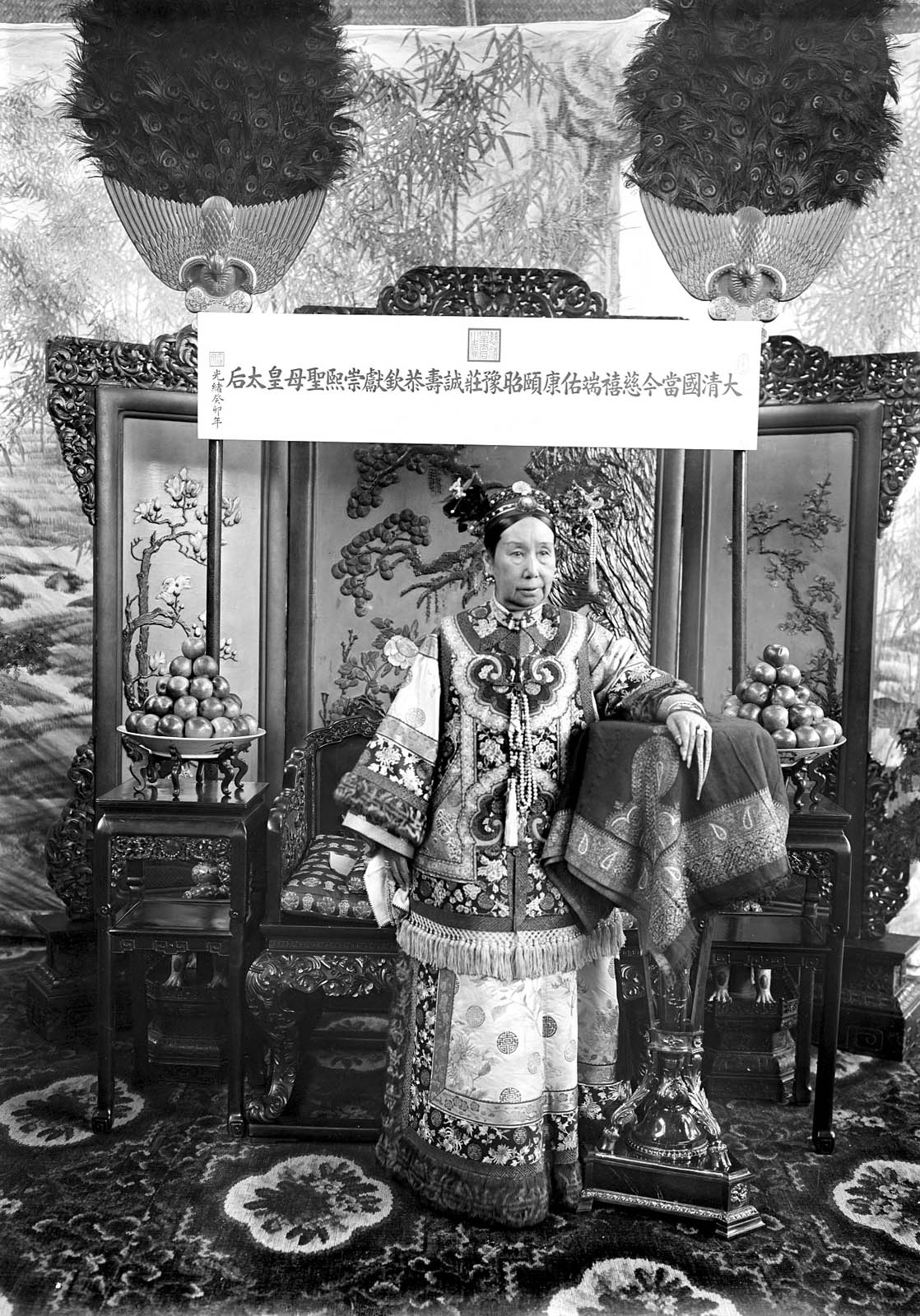
Yu Xunling (勋龄; c. 1880-1943) Empress Dowager Cixi
c. 1903
Albumen silver print
24.1 x 17.8cm (9.5 x 7 in.)
Loewentheil Photography of China Collection
This exhibition held in the Year of the Dragon reclaims the feminine power of the dragon and honours all Chinese women. It includes iconic photographs of Empress Dowager Cixi (1835-1908) by her Court photographer Yu Xunling (c. 1880-1943). Cixi, one of the most powerful women in Chinese history, was referred to as “Dragon Lady.” Some caricatured her as a uniquely sinister, manipulative, and cold-blooded ruler [see text below]. However, scholars agree that the Empress’s contribution to empowering and advancing opportunities for women is an important part of her legacy, thereby revising this one-dimensional view.
Text from the press release from the Loewentheil Photography of China Collection
Cixi (慈禧太后), Empress Dowager of China, 1835-1908
This photograph was taken in the Hall of Happiness and Longevity (Leshou tang) in the Summer Palace, Beijing. Cixi sits at the center. Behind her is a banner that says “Long Live the Current Divine Mother Empress Dowager of the Great Qing Empire for Ten Thousand Years.” Her embroidered robe is covered with stylised longevity characters and chrysanthemums, a symbol for long life. The auspicious emblems signify the wish of longevity for herself and, by extension, for the Qing dynasty. …
Cixi is a contradictory figure in Chinese history. From the 1860s until her death in 1908, Cixi dominated the Qing court and policies. She was regent to two successive emperors. Powerful as she was, she did not have a good reputation abroad. During her reign, foreigners and some of Cixi’s countrymen considered the Qing court to be conservative, corrupt, and incompetent. Her reputation was worsened among westerners after the Yihetuan Movement of 1900 (also known as Boxer Rebellion), an anti-imperialist, anti-foreign, and anti-Christian uprising. Cixi supported the group and declared war on the foreign powers. In response, a foreign joint army was sent to Beijing and Cixi was forced to flee the capital. After she returned to Beijing in 1902, she changed course and initiated massive reforms. She also took advice from key reformers. These new policies included promoting railroads, founding modern schools, and sending students to study overseas. Cixi also attempted to improve her international image. For example, she would invite the wives of foreign diplomats to receptions at the palace…
The picture belongs to the only photographic series taken of Cixi. They were shot by a young aristocratic photographer named Xunling (c. 1880-1943) between 1903 and 1904. The photographs were meant to be used to restore Cixi’s public image. They were designed to convey imperial authority and aesthetic elegance. Some of the photographs were presented as diplomatic gifts, including one for US President Theodore Roosevelt (1858-1919).
Yu Xunling (勋龄; c. 1880-1943) Empress Dowager Cixi
c. 1903
Albumen silver print
Loewentheil Photography of China Collection
The Loewentheil Collection includes iconic photographs of Empress Dowager Cixi (1835-1908) by her Court photographer Yu Xunling (c. 1880-1943). Xunling’s series of photographs of Cixi commissioned in 1903 and 1904 are the only known surviving photographs of the most important political figure of the late Qing dynasty.
Cixi, one of the most powerful women in Chinese history, was referred to as “Dragon Lady.” She was caricatured, particularly in the West, as a uniquely power-hungry, tyrannical, manipulative, and cold-blooded ruler. However, scholars agree that the Empress was unfairly represented. Her strategies, attitudes, and actions as a ruler were no more cunning than those of powerful males. Cixi also contributed to empowering and advancing opportunities for women in China.
Photography offered Cixi a means to take control of her representation. Her photographic images were crafted to destroy the caricatured image of her that circulated around the world. She crafted photographs to be self-defining and to articulate her view of herself as a ruler of China.
Xunling’s series of photographs of Cixi are artistic collaborations between a photographer and an Empress. Photography fascinated Cixi, and she carefully orchestrated the concept and composition of each photograph. In addition to her official portraits, Cixi created complicated group tableaux, portrayed herself in famous roles from Peking Opera, and posed as the compassionate bodhisattva Avalokitesvara. Cixi exercised absolute authority over her photographic portraits down to minute details. Xunling served as a collaborator and master technician helping Cixi achieve her artistic goals. Some photographs of Cixi were kept private until the Empress Dowager’s death.
Xunling’s photographs of Cixi are regarded by many historians as some of China’s earliest art photographs. Photographs of the Empress are of great scholarly interest to museum curators, art historians, and academics from a range of disciplines.
Text from the Loewentheil Photography of China Collection
Hedda Morrison, née Hammer (German, 1908-1991) Portrait of a Man with a Bird Cage
1930s
Silver gelatin print
Loewentheil Photography of China Collection
Hedda Morrison (1908 -1991) née Hammer, was born in Stuttgart, Germany and studied photography in Munich. She is one of the earliest identified female photographers of China. Morrison contracted polio as a young girl, which caused her to walk with a limp for the rest of her life. Her disadvantage increased her desire for adventure and travel. She moved to Beijing in 1933 to manage Hartung’s, a German-owned commercial photographic studio and shop in the Legation Quarter. Morrison also worked as a freelance photographer, selling individual prints and thematic albums of her work and creating photographs for books on China. Her photographs document lifestyles, trades, landscapes, religious practices, and architecture in China.
Morrison made this photograph of a man outdoors with a birdcage. In traditional Chinese culture birdcages hold cultural significance symbolizing an appreciation for art, nature, and balanced life.
Text from the Loewentheil Photography of China Collection
Loewentheil Photography of China Collection
10 West 18th Street 7th Floor
Open by appointment only: 646-838-4576 or 410-602-3002
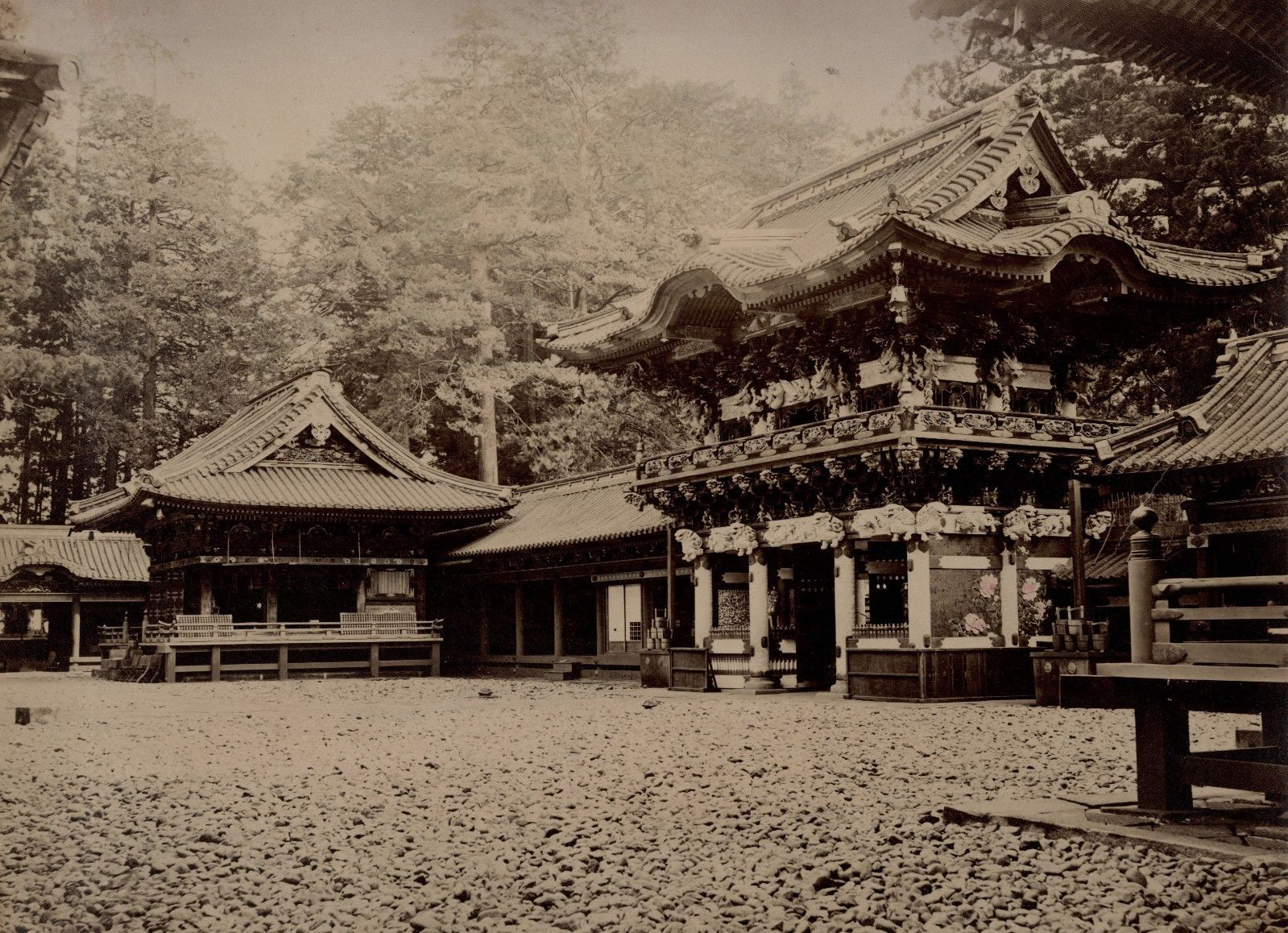
Felice Beato (Italian-British, 1832-1909) Shiba Temple, Japan c. 1870 Albumen silver print from wet collodion glass-plate negative
After the latest burst of exhibition postings there seems to be a paucity of exhibitions that I would like to post on until the end of the year… and as I have been pushing it pretty hard lately and not feeling so well (needing a hip replacement), now is the time to take things a little easier.
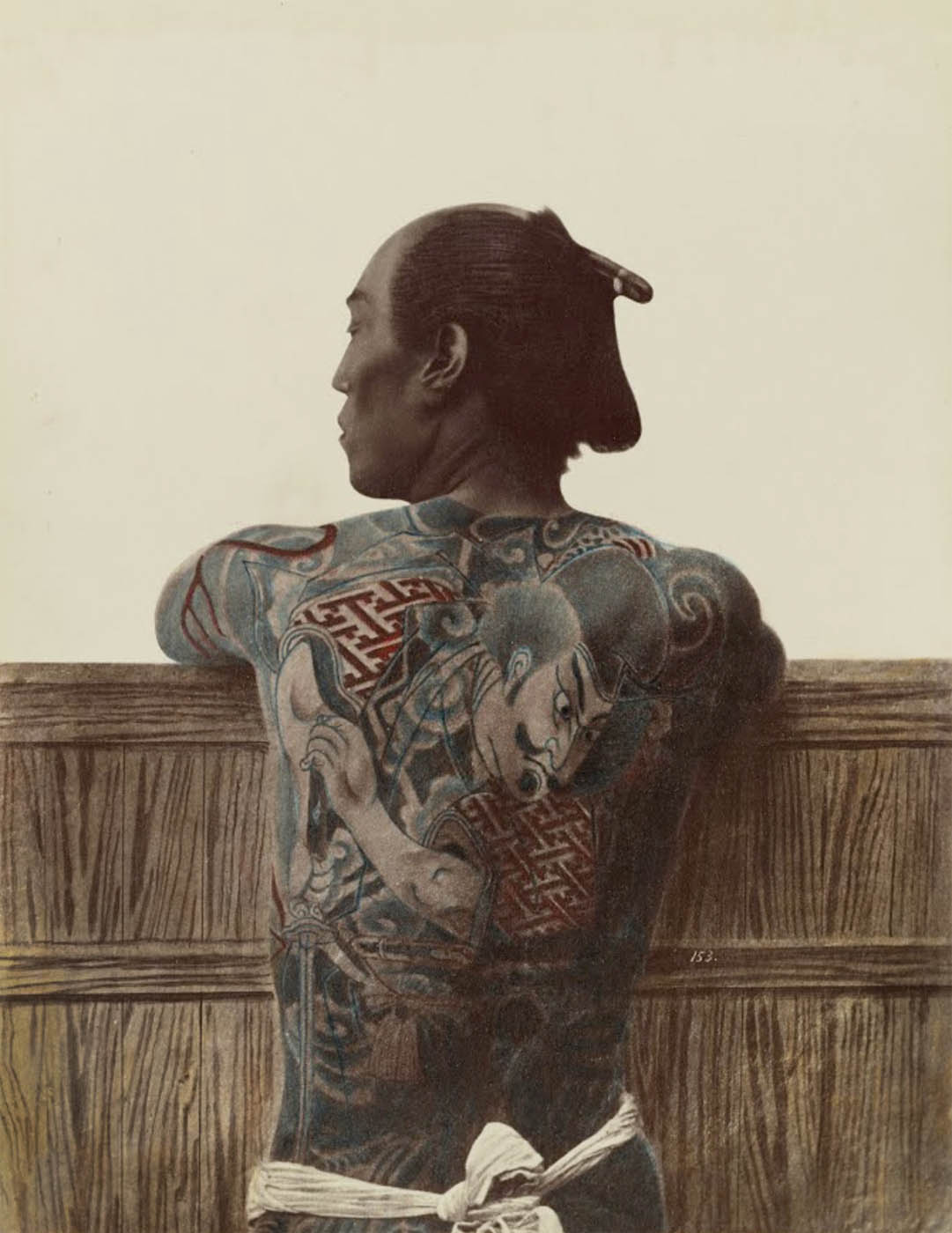
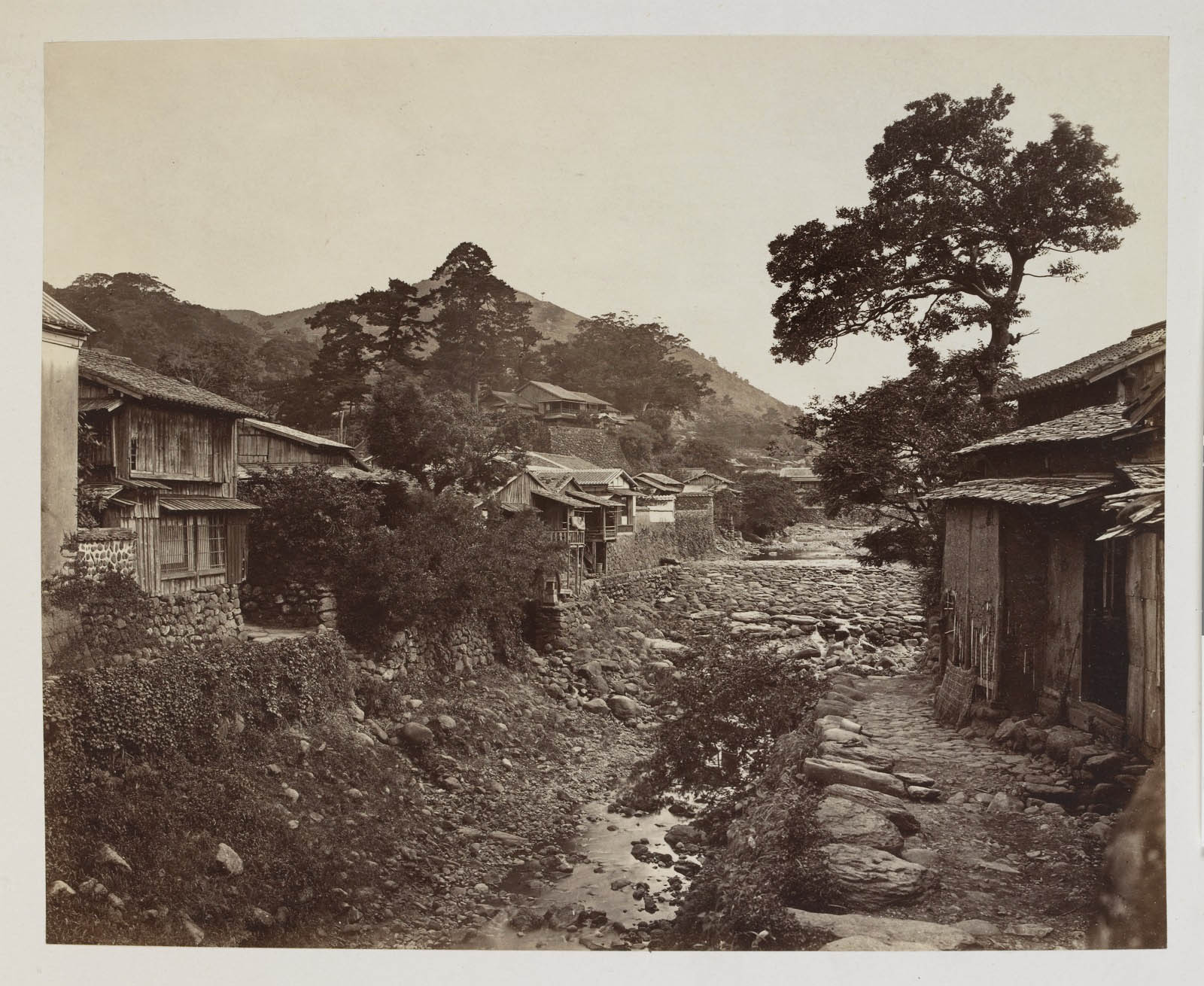
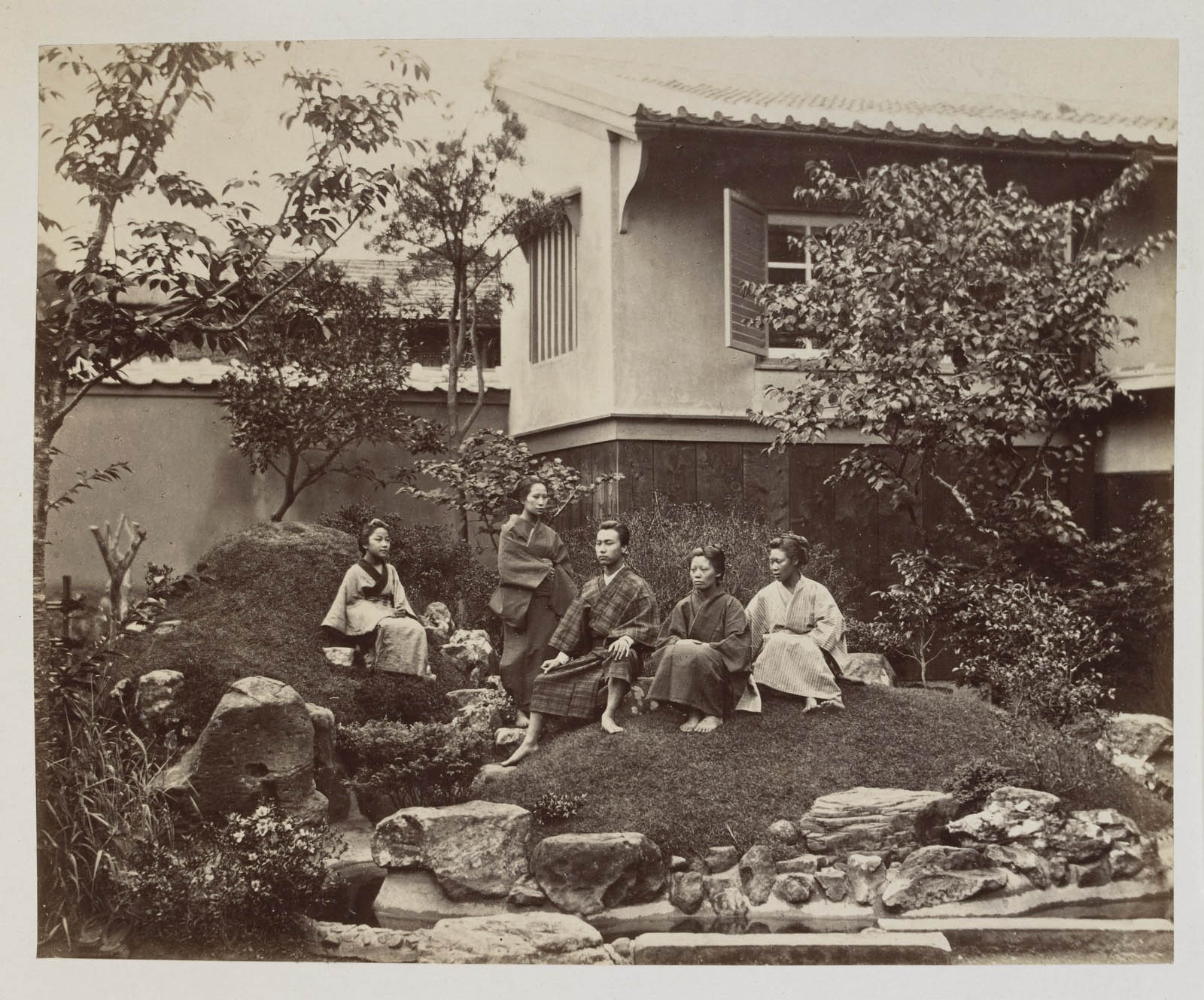
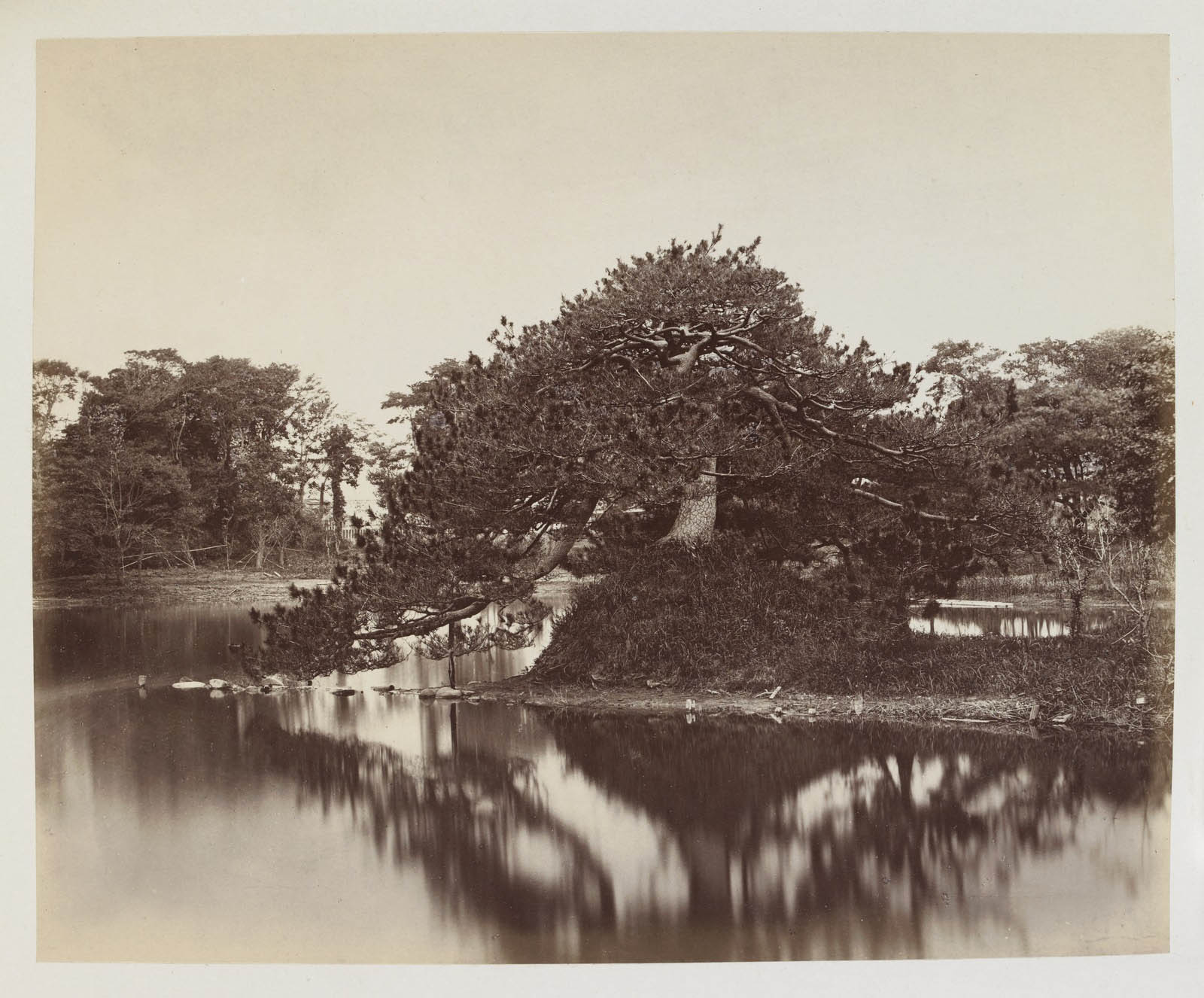
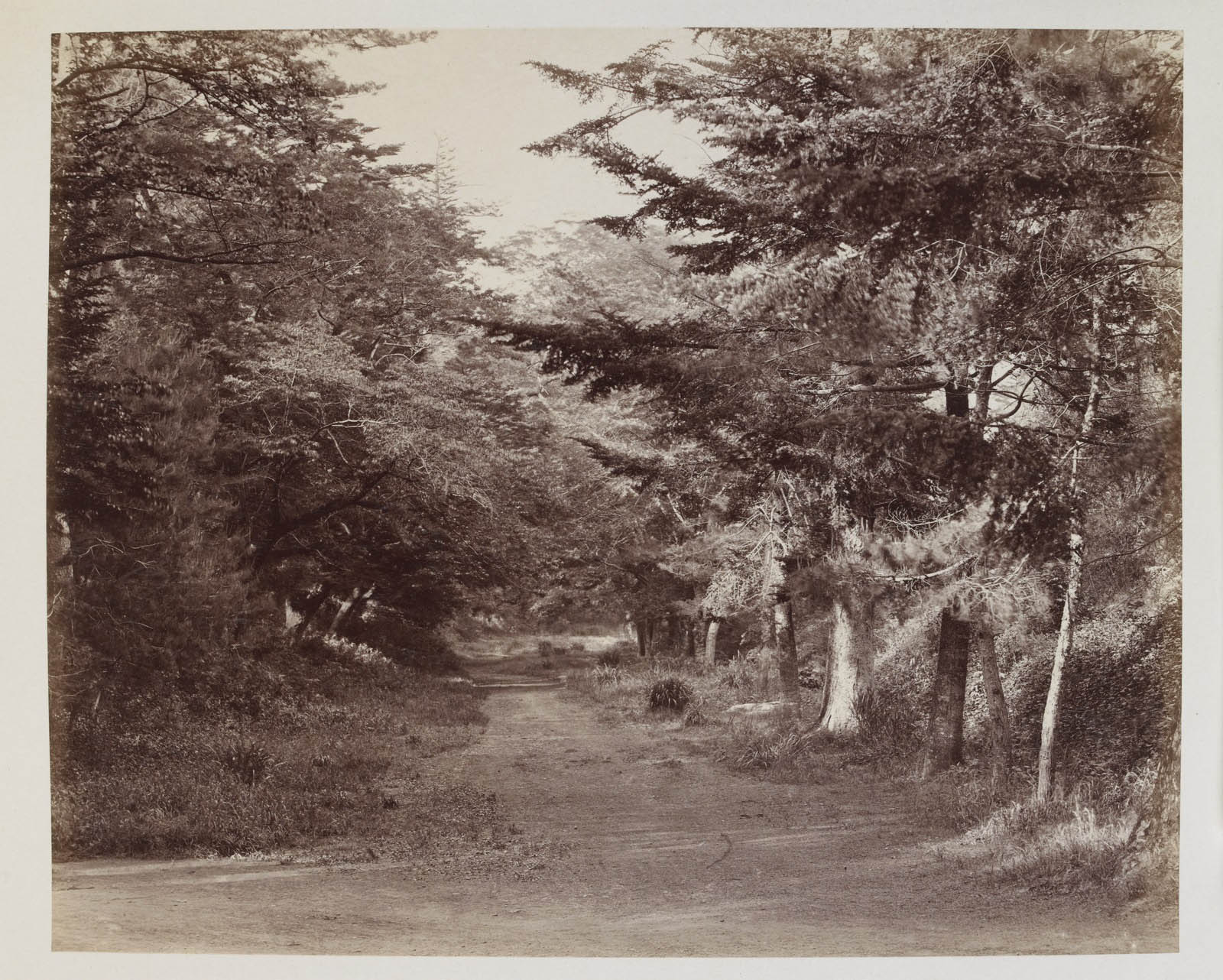
While the photographs taken by Felice Beato and Baron Raimund von Stillfried of Japanese culture and landscape portray a Western, romanticised, exoticised, staged and persistently Eurocentric view of Japan (linked to Edward Said’s concept of “Orientalism” which denotes the exaggeration of difference, the presumption of Western superiority, and the application of clichéd analytical models for perceiving the “Oriental”, namely those societies and peoples who inhabit the places of Asia, North Africa, and the Middle East world) … there is no doubting the sheer beauty of some of the photographs and the dignity of the sitters.
As such the photographs remain valuable documents of a time far removed from present day Japan but linking Japanese culture to long past ancestors and ways of life.
Dr Marcus Bunyan
Please click on the photographs for a larger version of the image.
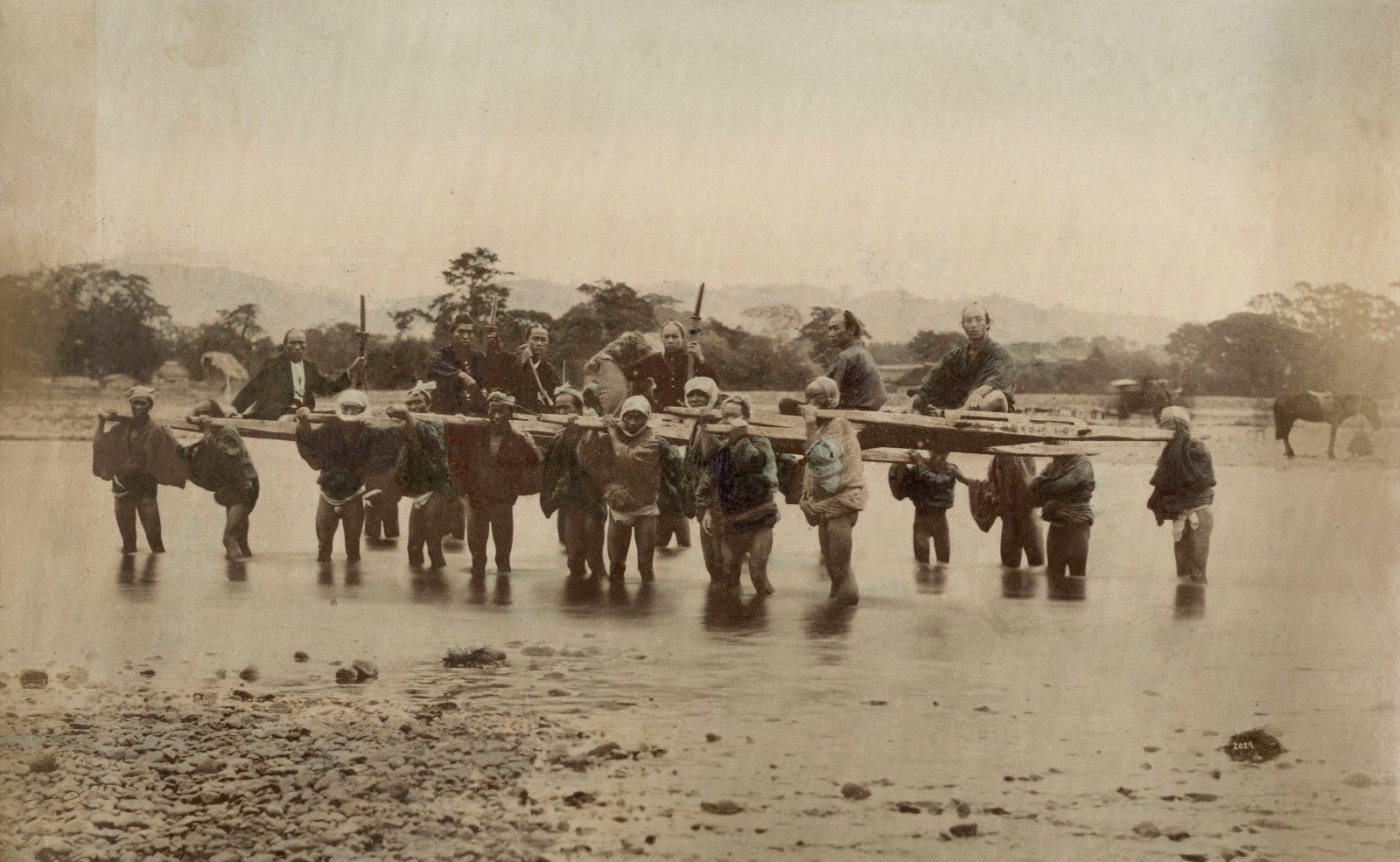
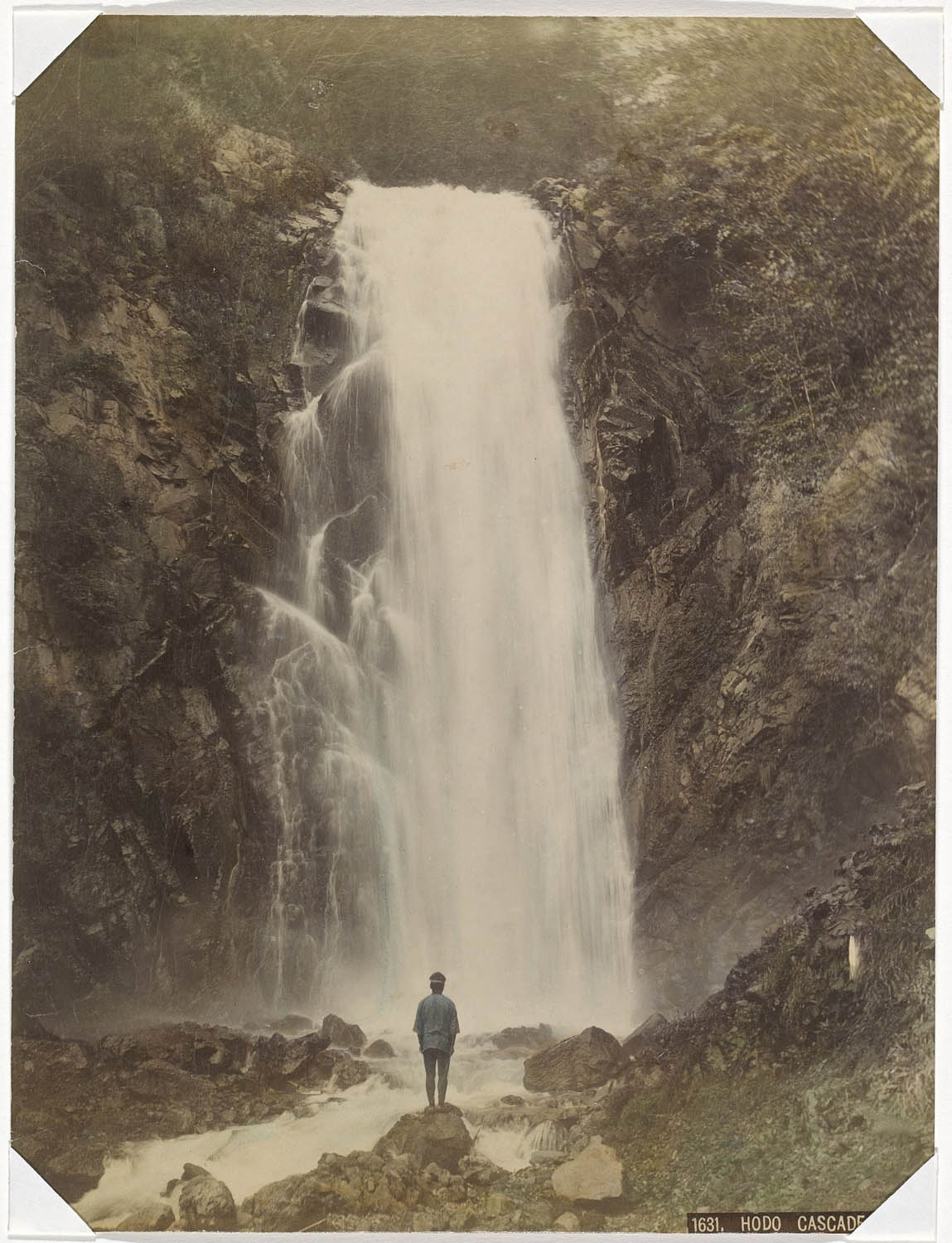
Felice Beato (Italian-British, 1832-1909) The Ford at Sakawa Nagawa, Japan c. 1870 Hand-coloured albumen silver print from wet collodion glass-plate negative
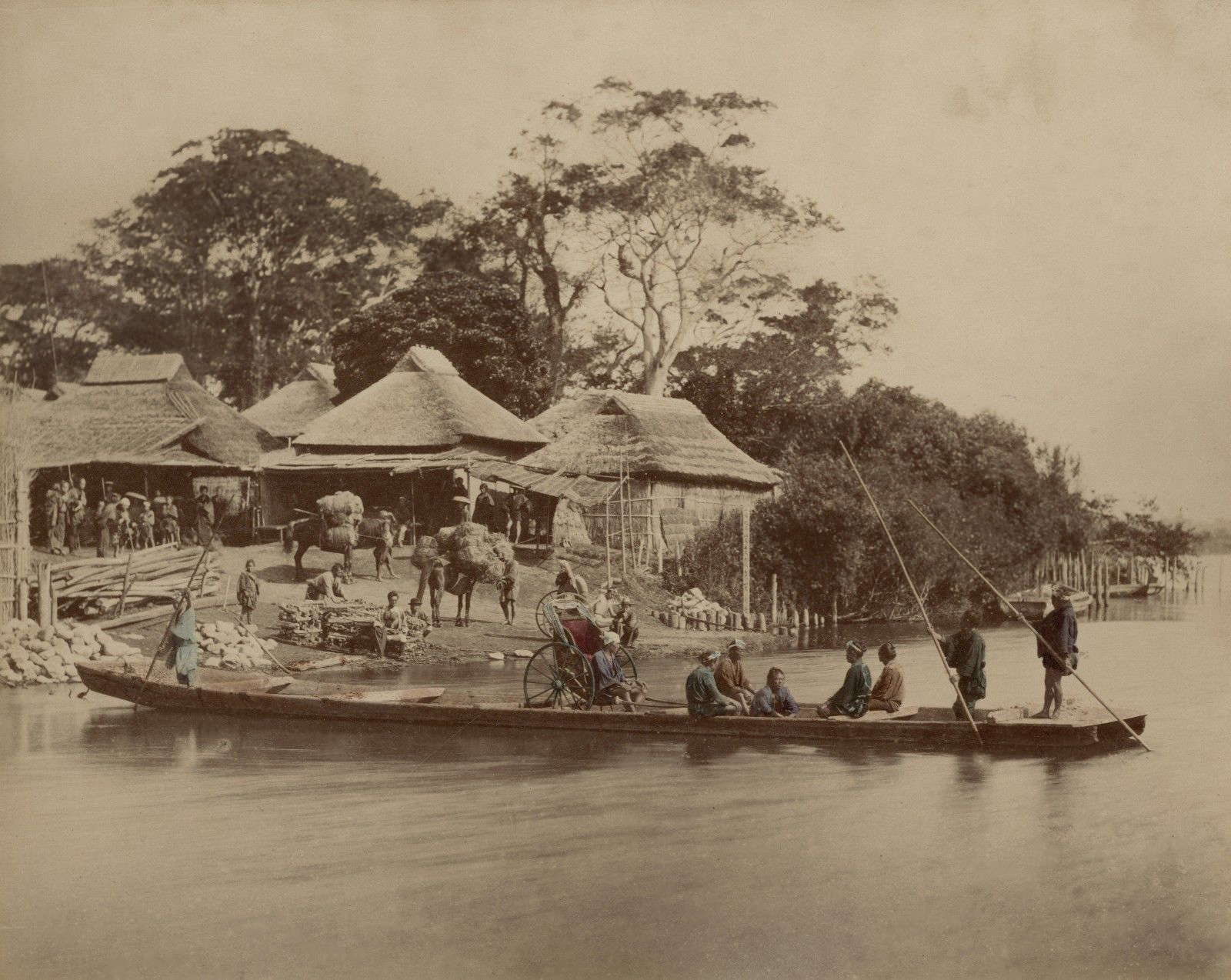
Felice Beato (Italian-British, 1832-1909) Ferry boat, Japan c. 1870 Hand coloured albumen silver print from wet collodion glass-plate negative
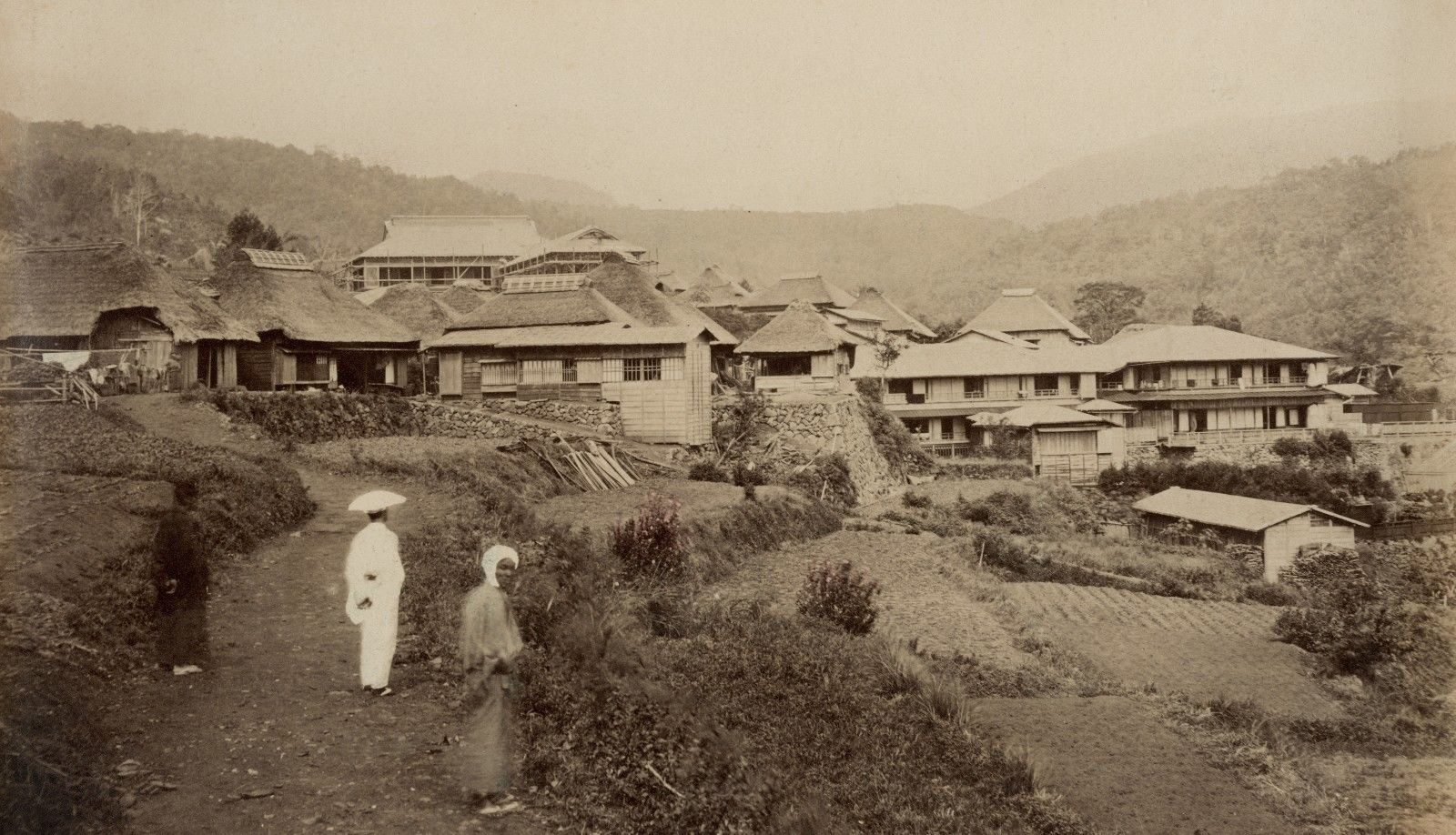
Felice Beato (Italian-British, 1832-1909) Miyanoshita Onsen, Japan c. 1870 Albumen silver print from wet collodion glass-plate negative
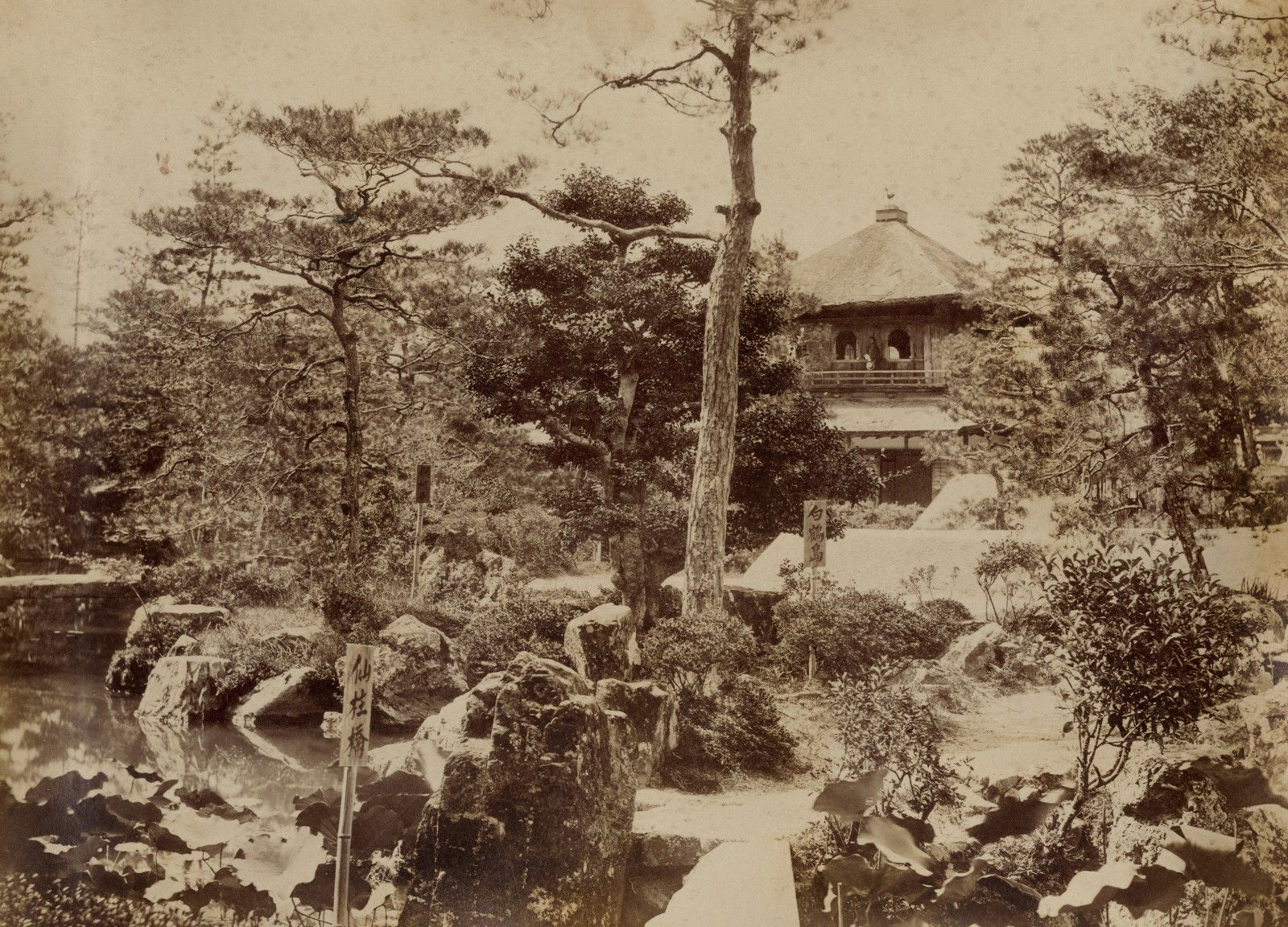
Felice Beato (Italian-British, 1832-1909) Garden, Japan c. 1870 Albumen silver print from wet collodion glass-plate negative
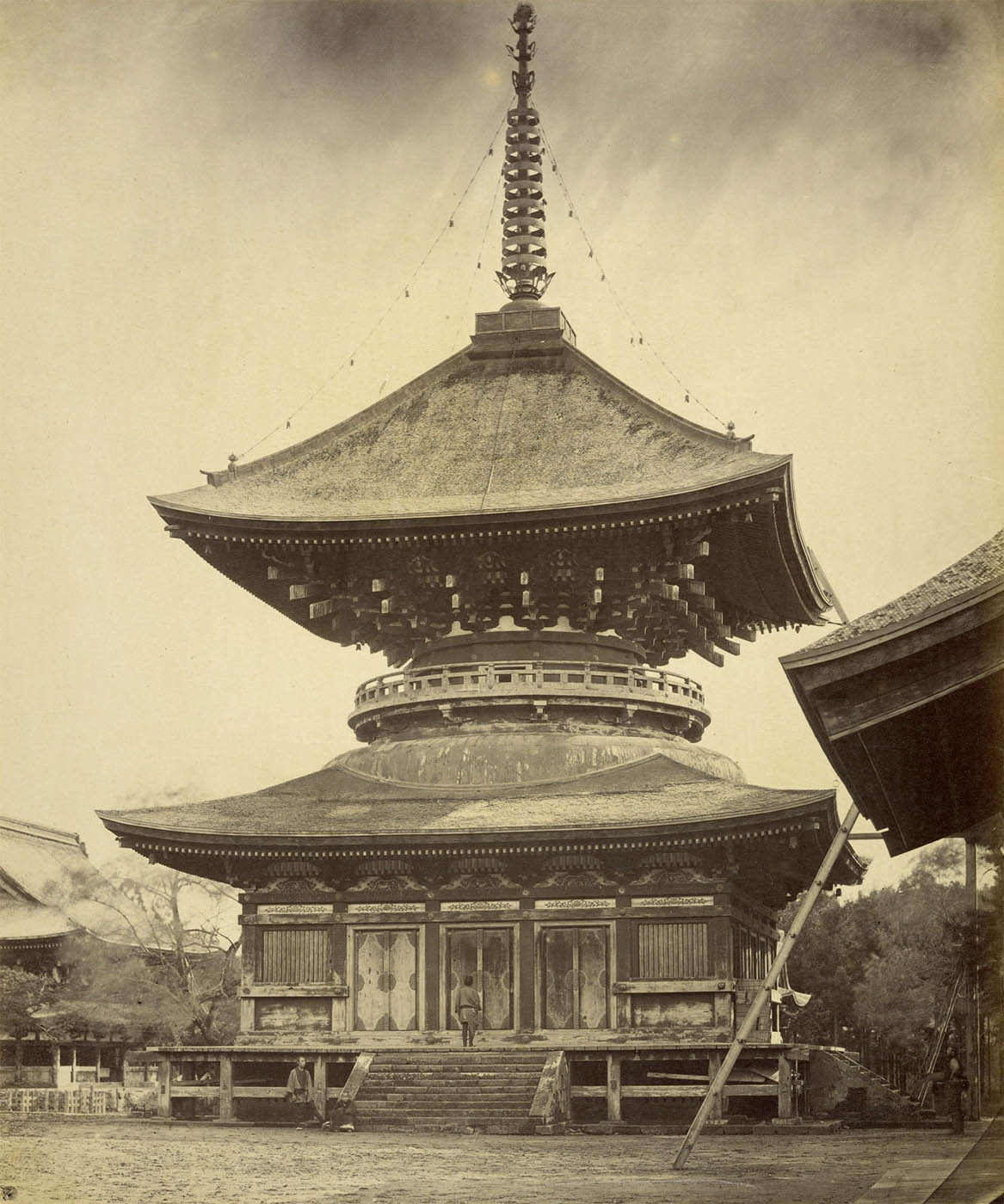
Felice Beato (Italian-British, 1832-1909) Single-storied Pagoda, Hachiman Shrine, Kamakura 1867-1868 Albumen silver print from wet collodion glass-plate negative Getty Center Public domain
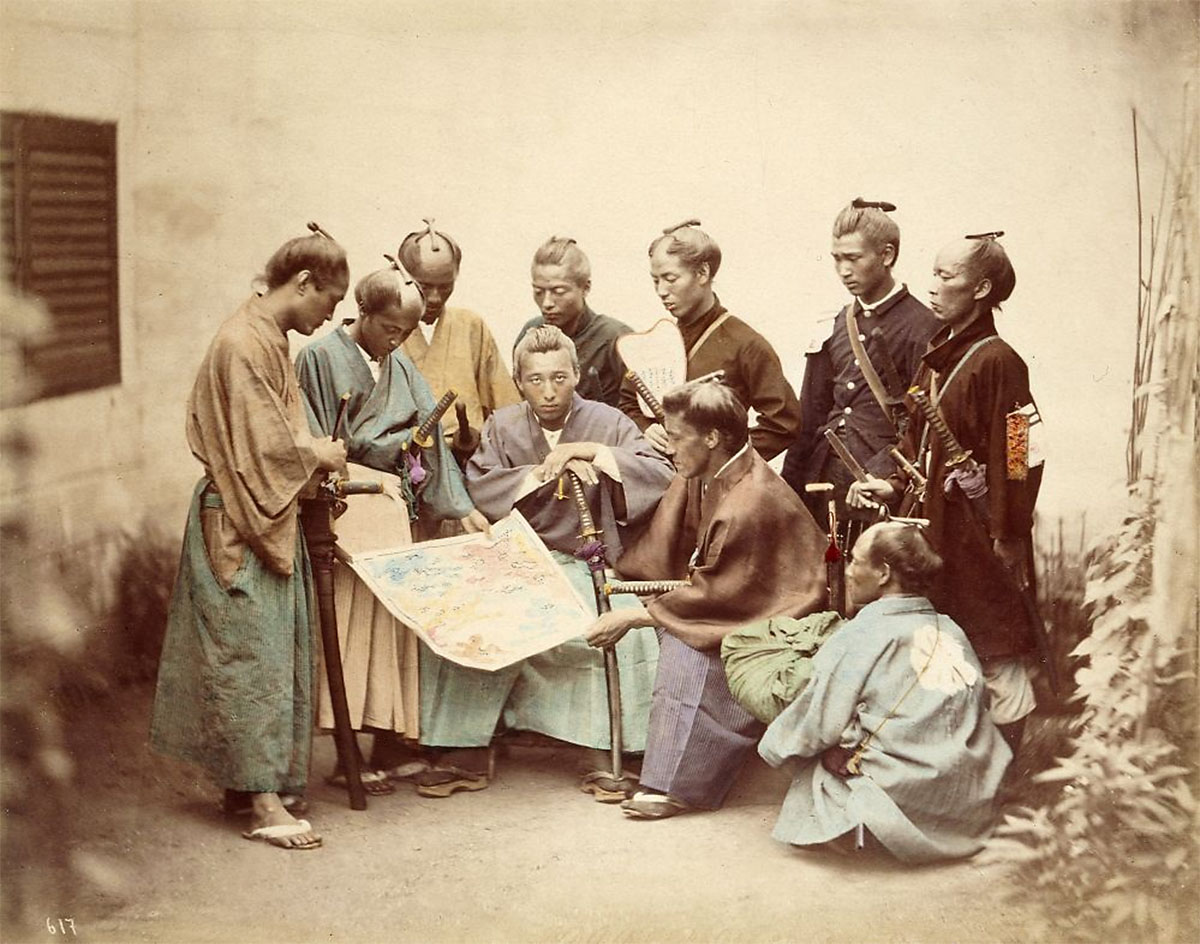
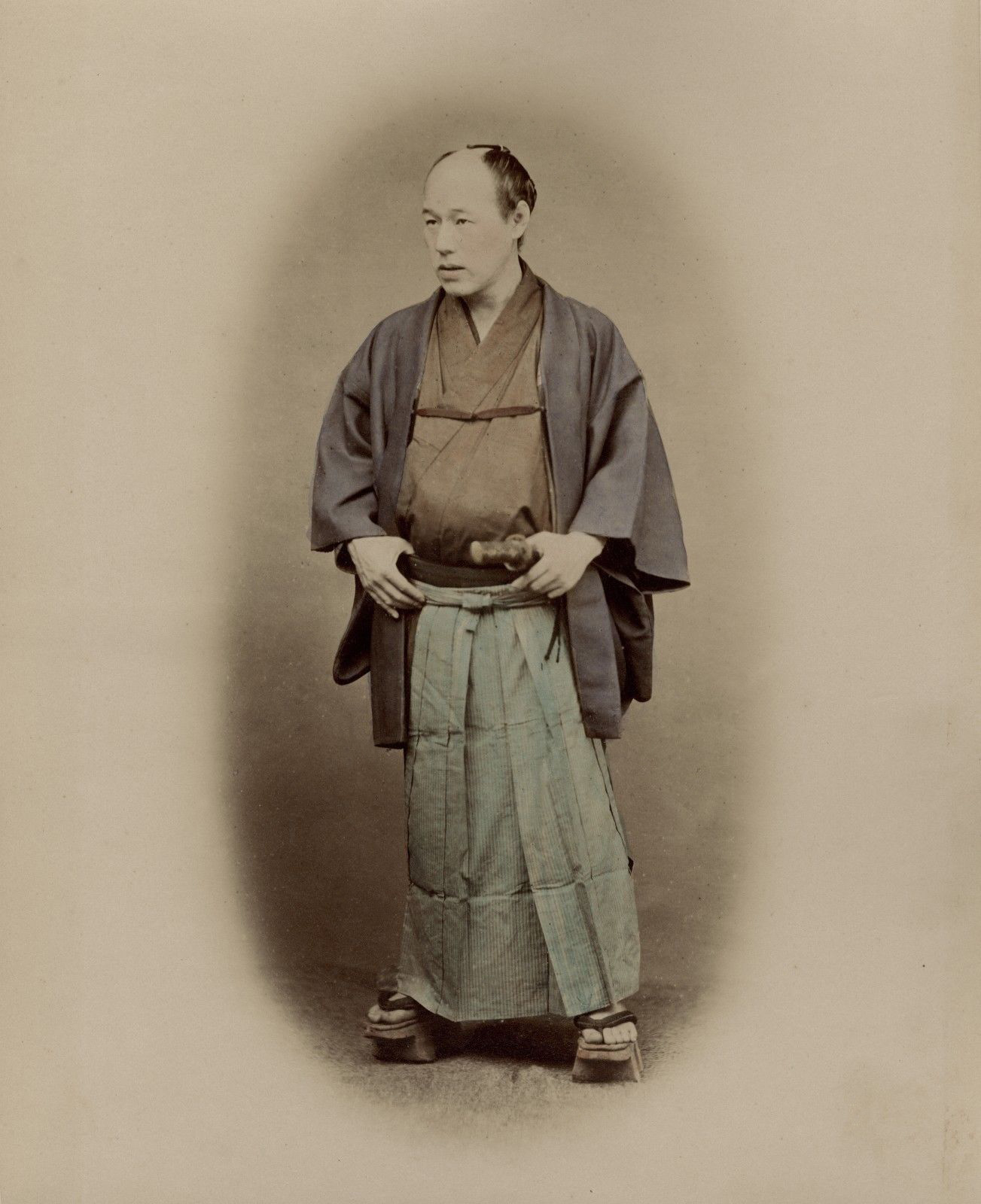
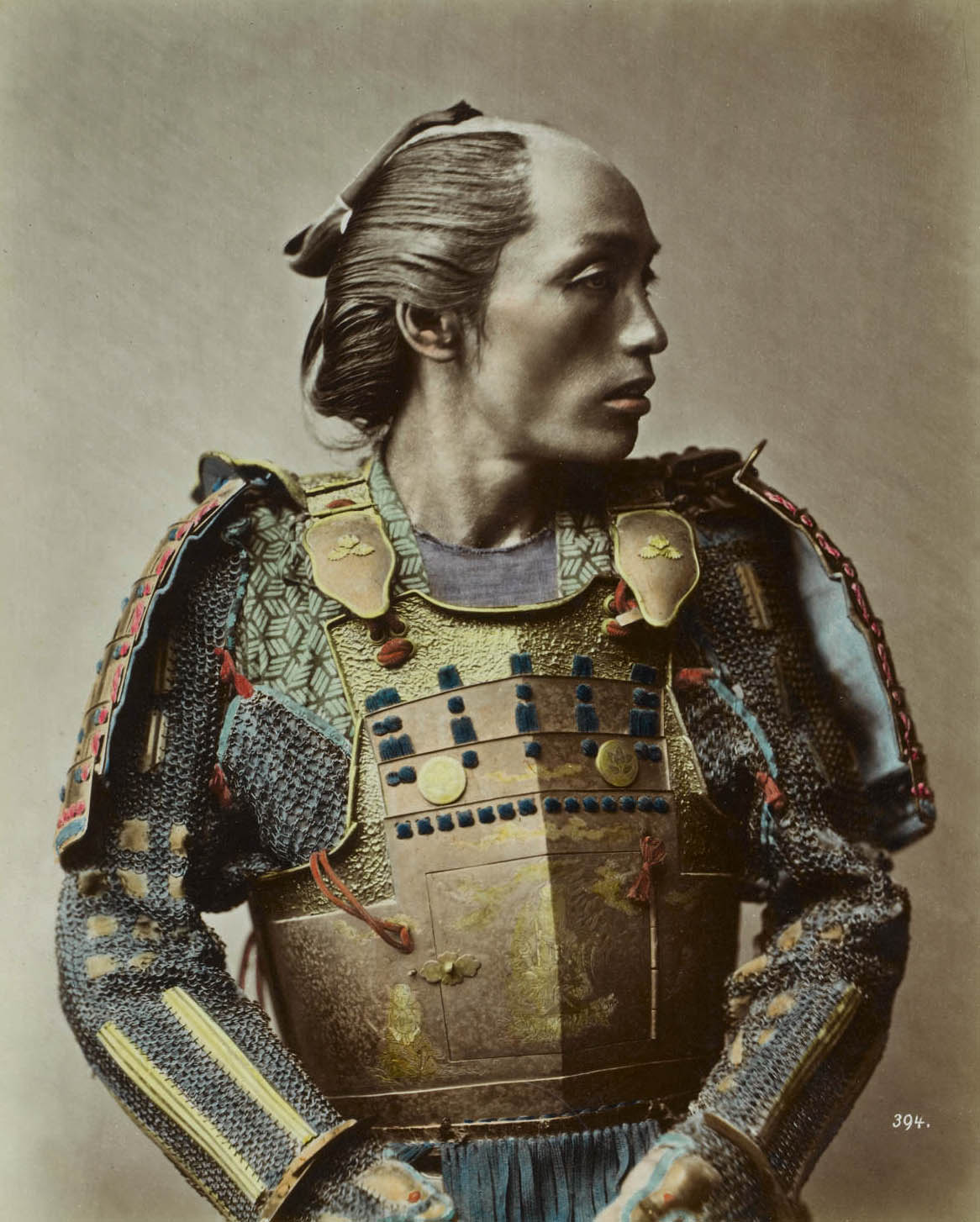
Felice Beato (Italian-British, 1832-1909) Samurai of the Satsuma Clan, during the Boshin War period (1868-1869) 1860s Hand-coloured albumen silver print from wet collodion glass-plate negative Public domain
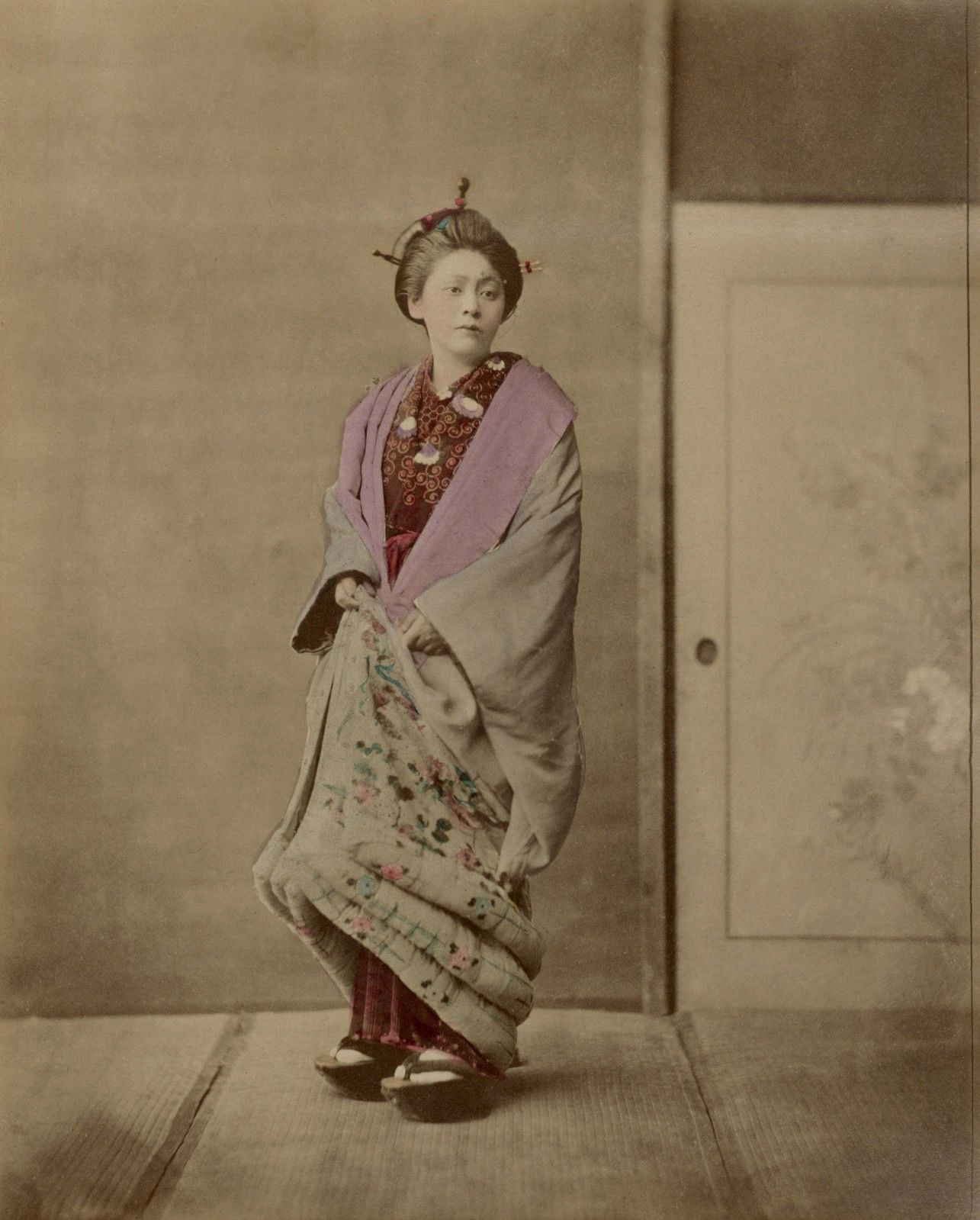
Felice Beato (Italian-British, 1832-1909) Noble in dress, Japan c. 1870 Hand-coloured albumen silver print from wet collodion glass-plate negative
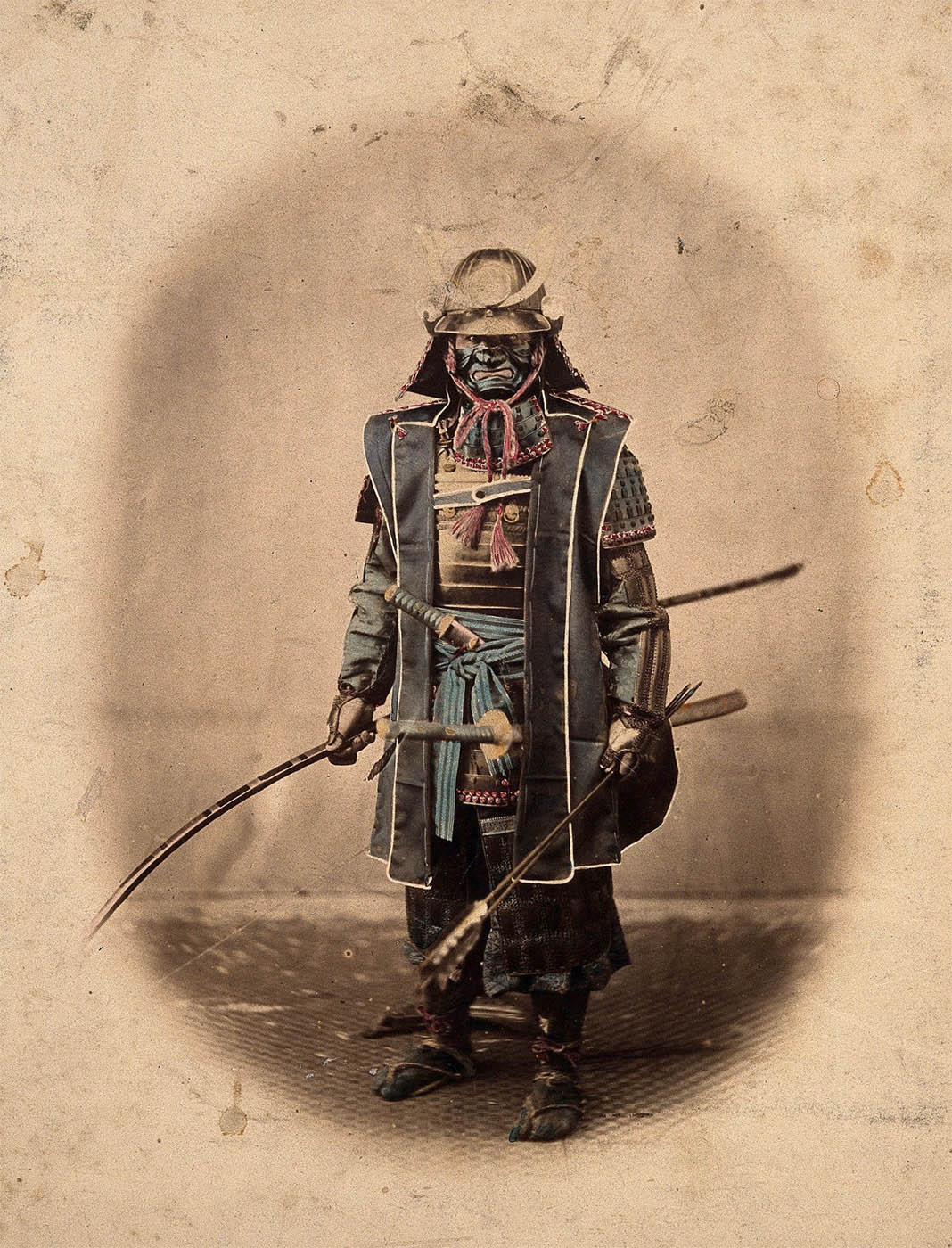
Felice Beato (Italian-British, 1832-1909) Koboto Santaro, a Japanese military commander, wearing traditional armour c. 1868 Hand-coloured albumen silver print from wet collodion glass-plate negative Wellcome Library Public domain
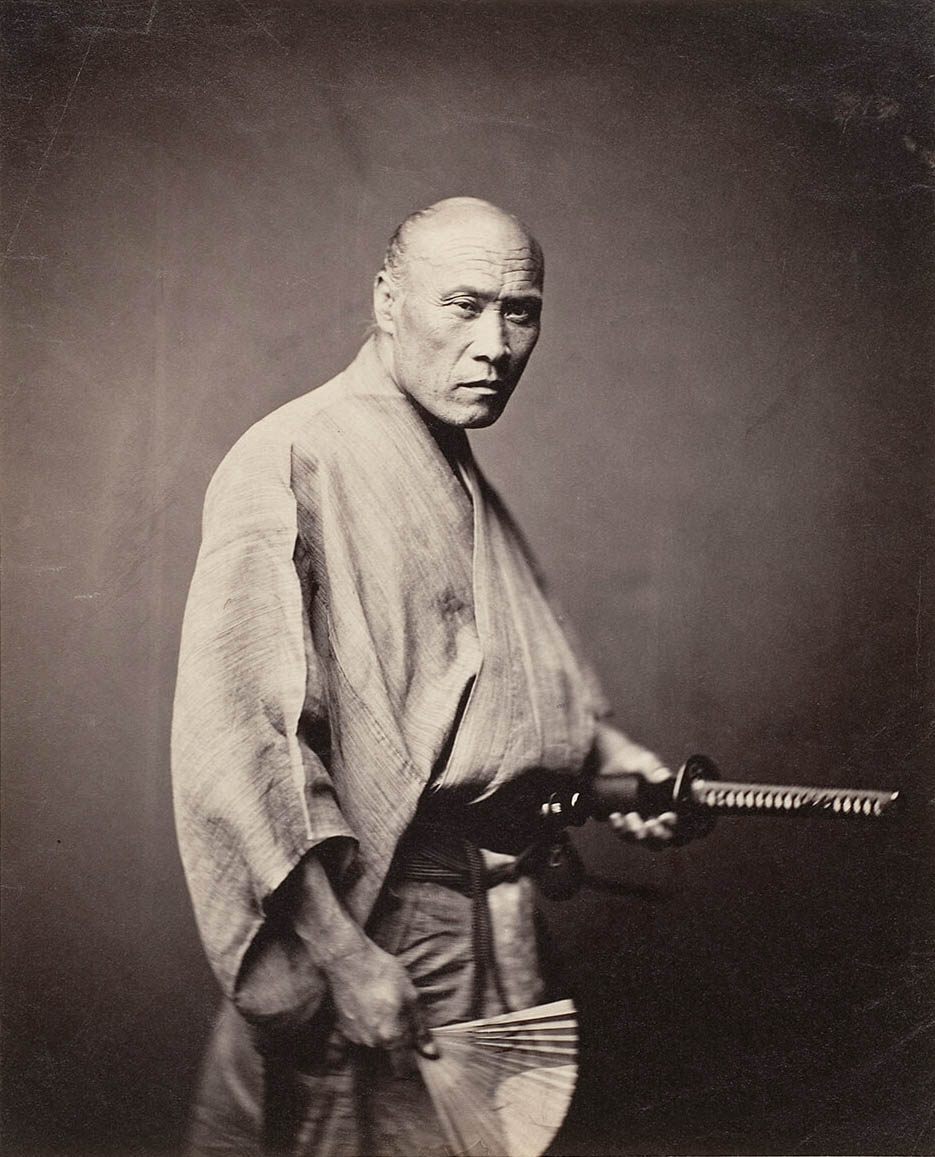
Felice Beato (Italian-British, 1832-1909) Samurai, Yokohama 1864-1865 Albumen silver print from wet collodion glass-plate negative Gilman Collection, Metropolitan Museum of Art Purchase, Robert Rosenkranz Gift 2005
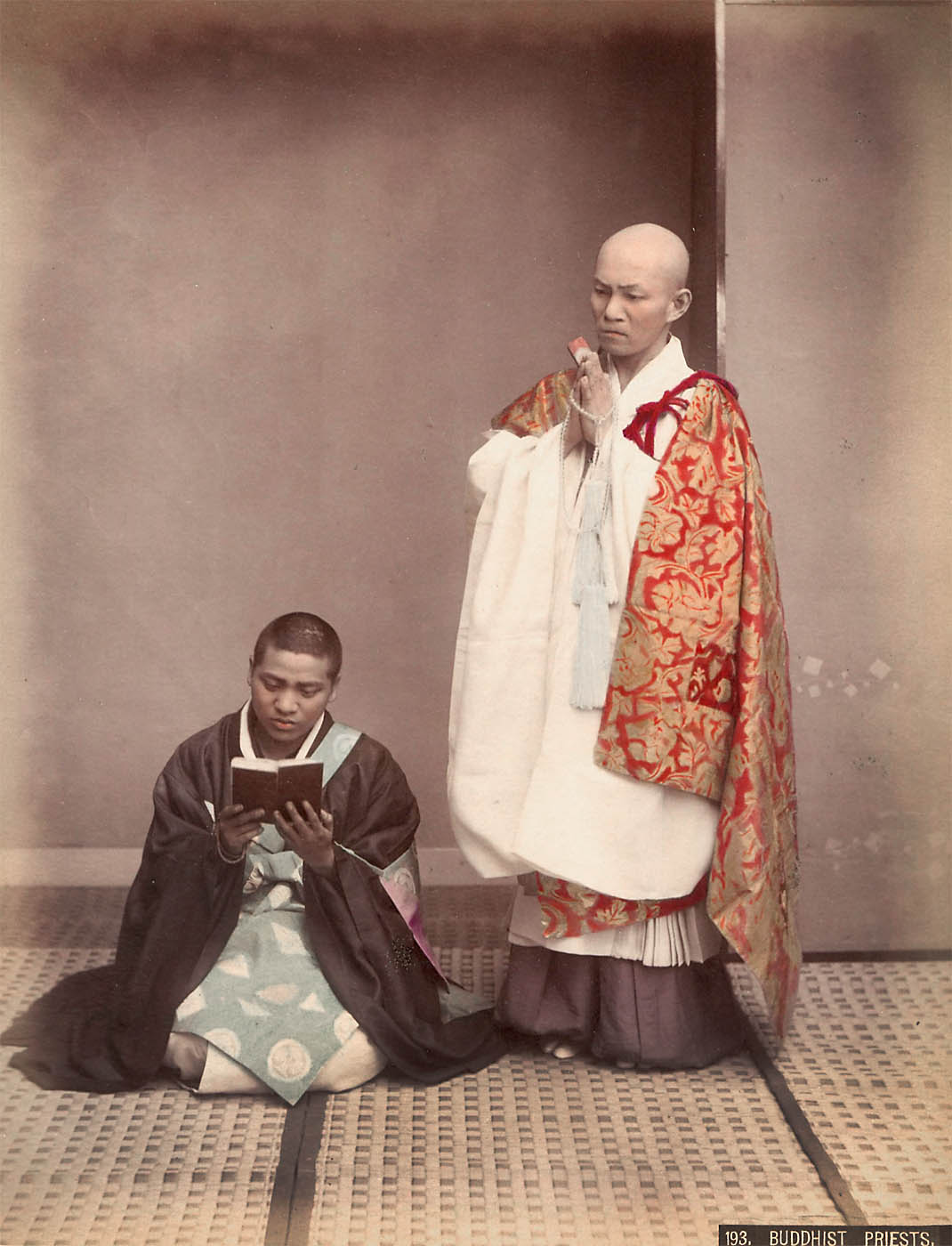
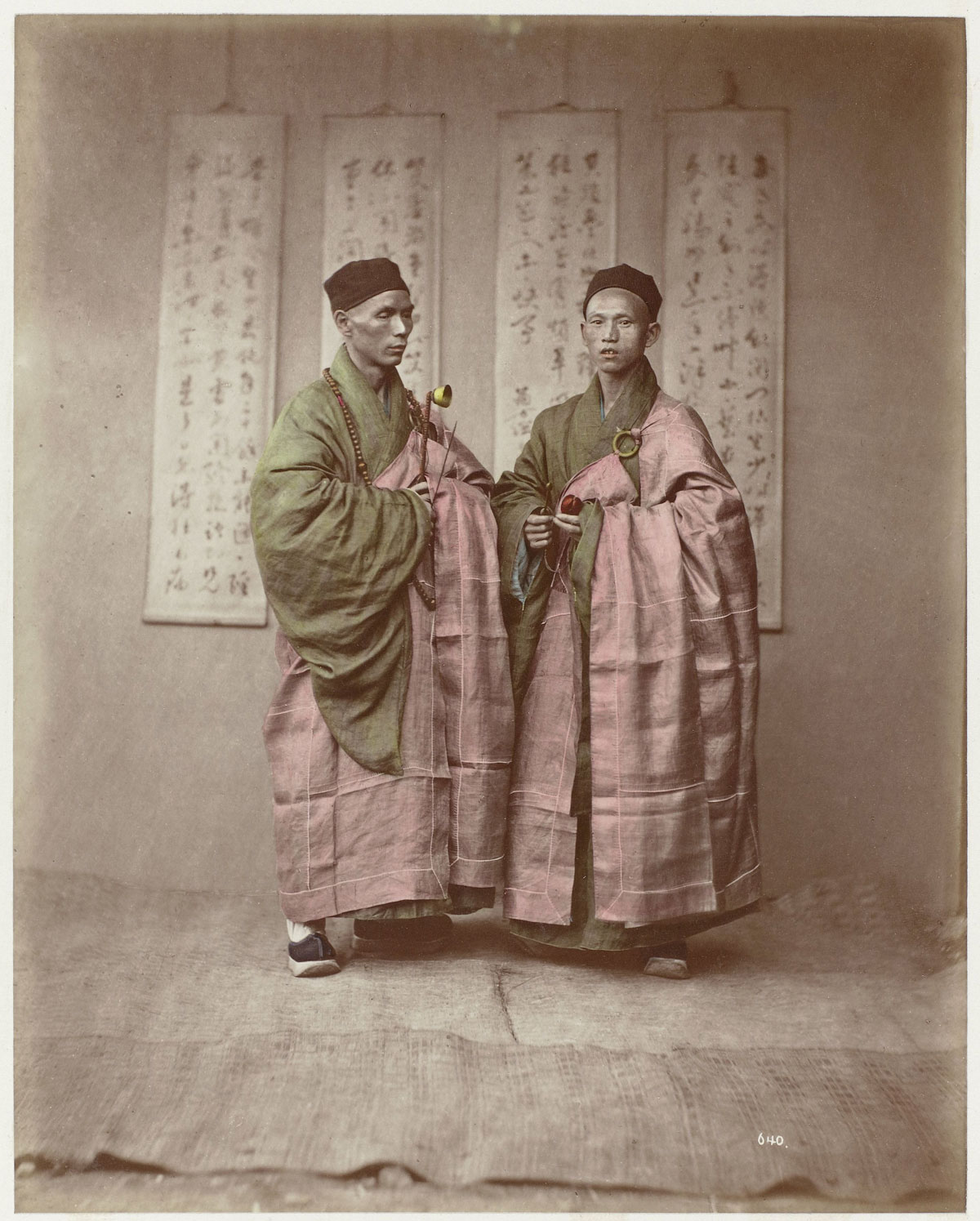
Felice Beato (Italian-British, 1832-1909) Buddhist Priests 1870s Hand-coloured albumen silver print from wet collodion glass-plate negative
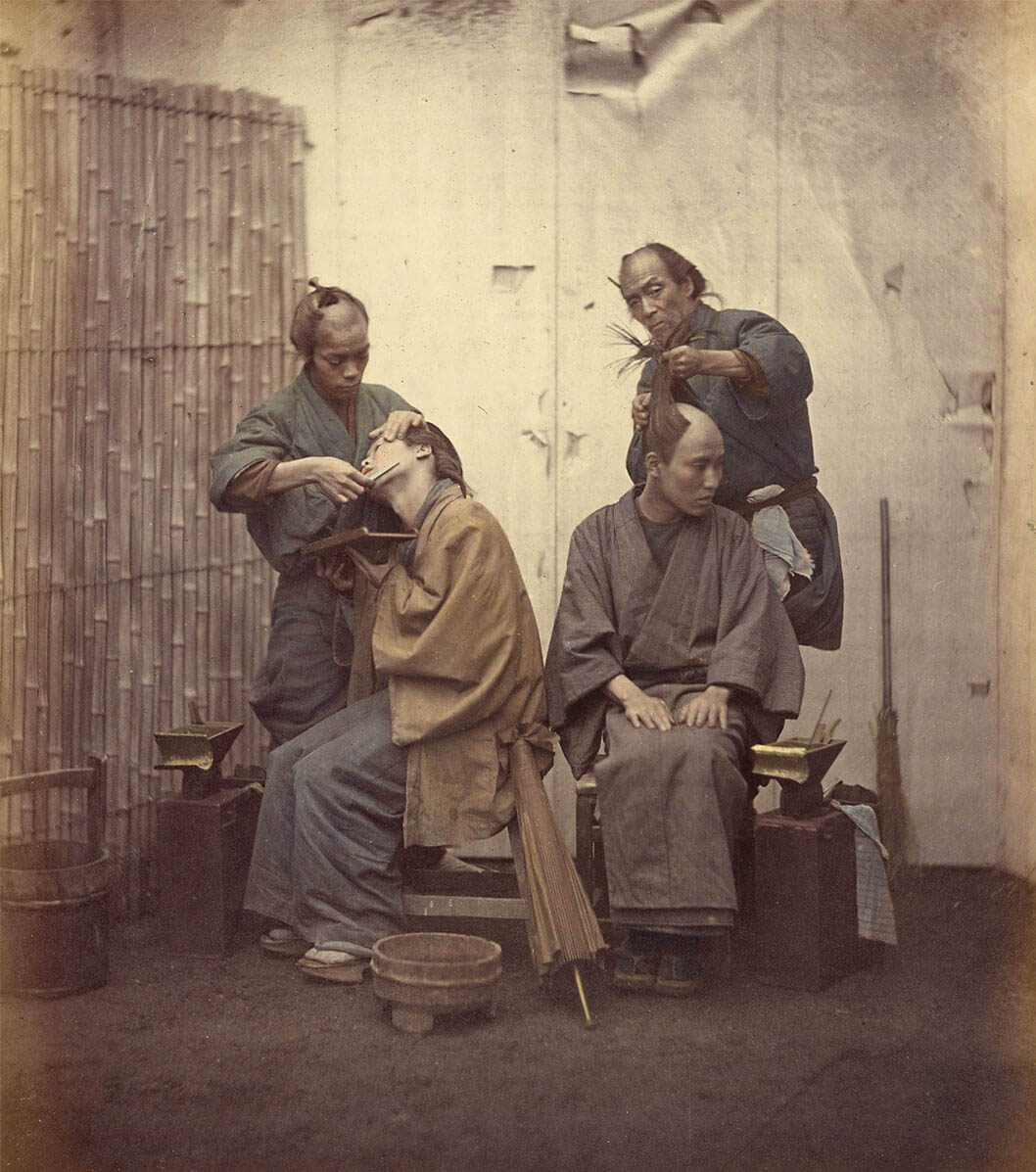
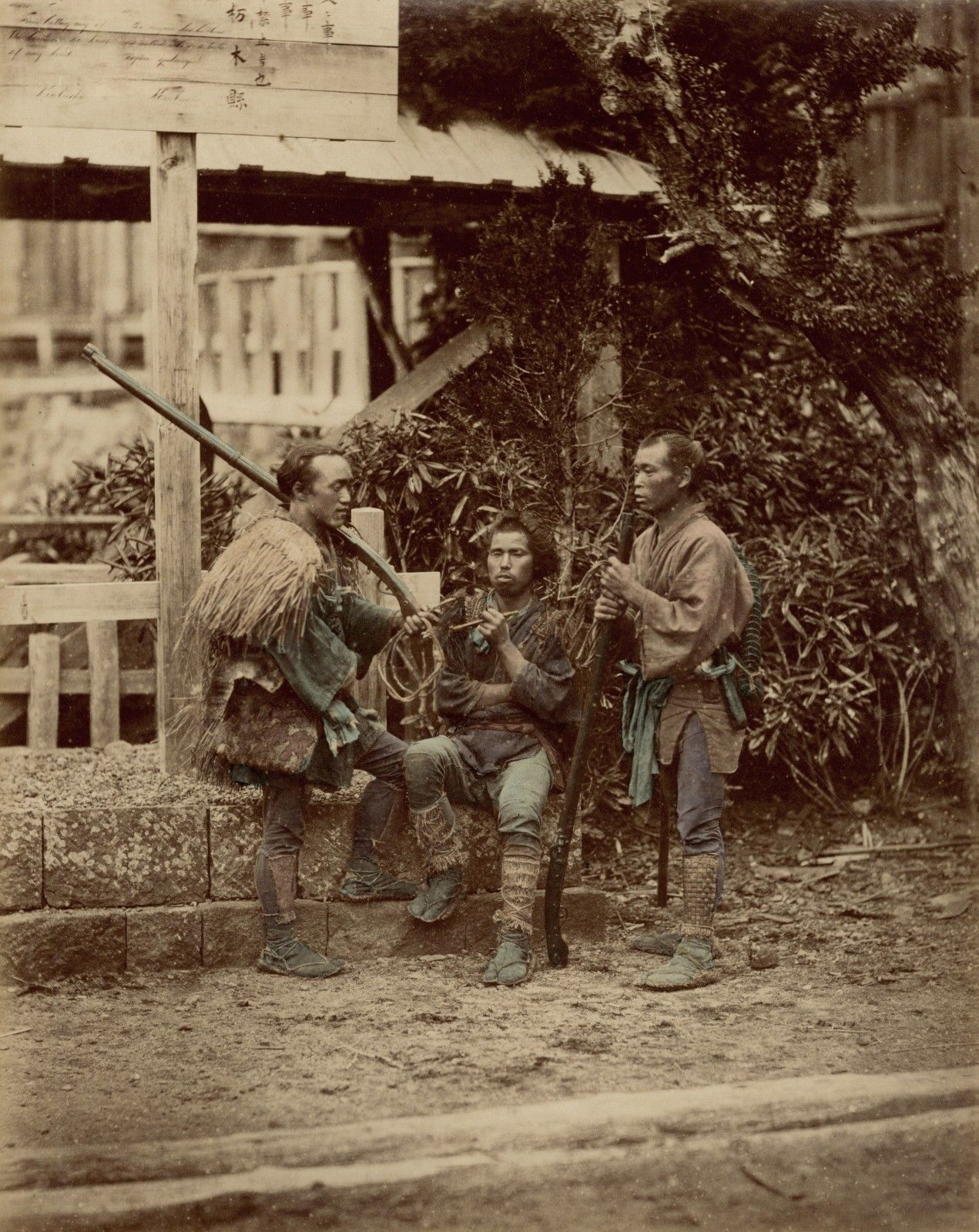
Felice Beato (Italian-British, 1832-1909) Barbers 1868 Hand-coloured albumen silver print from wet collodion glass-plate negative Getty Center Public domain
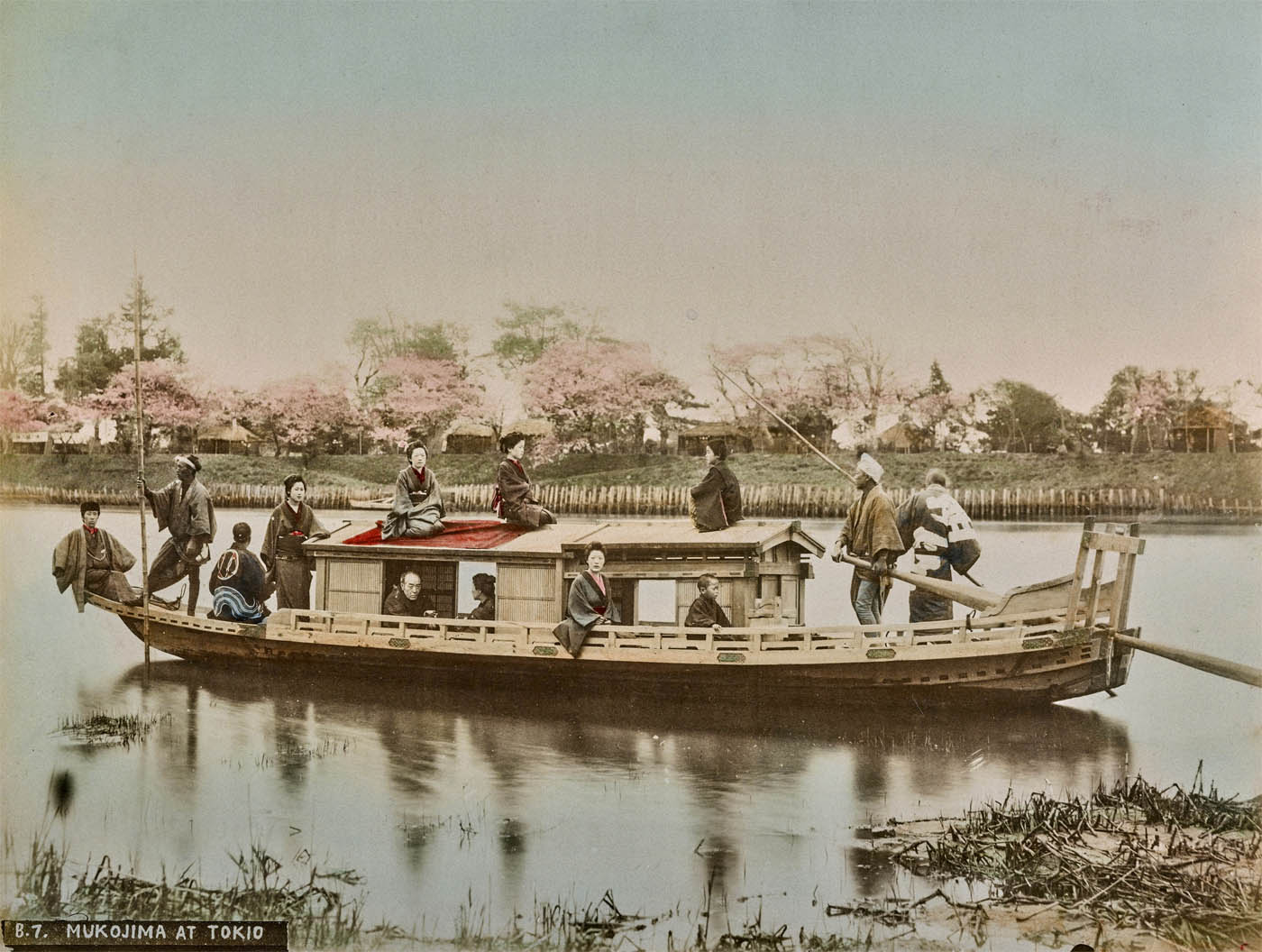
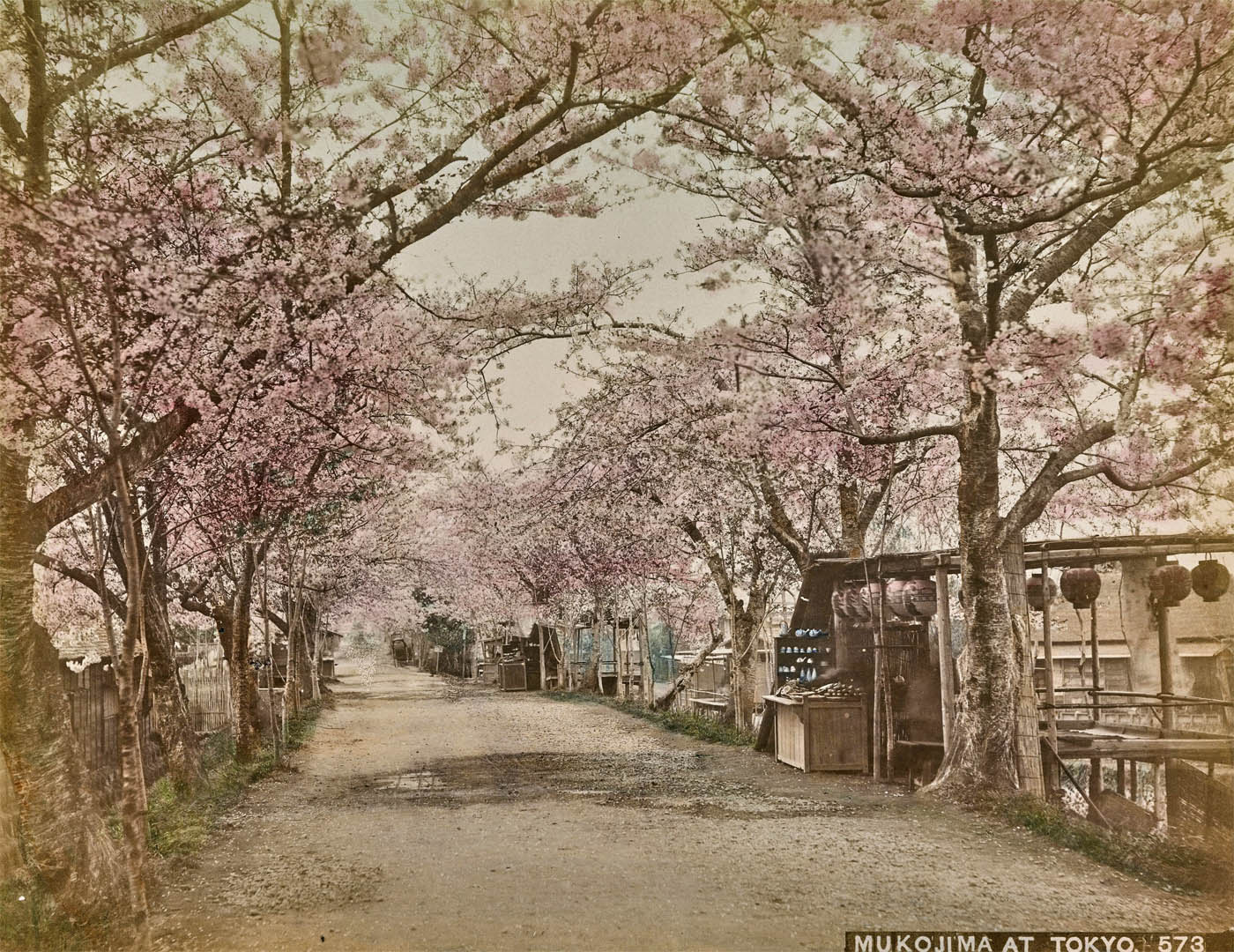
Felice Beato (Italian-British, 1832-1909) Mukojima, Tokyo 1870s Hand-coloured albumen silver print from wet collodion glass-plate negative
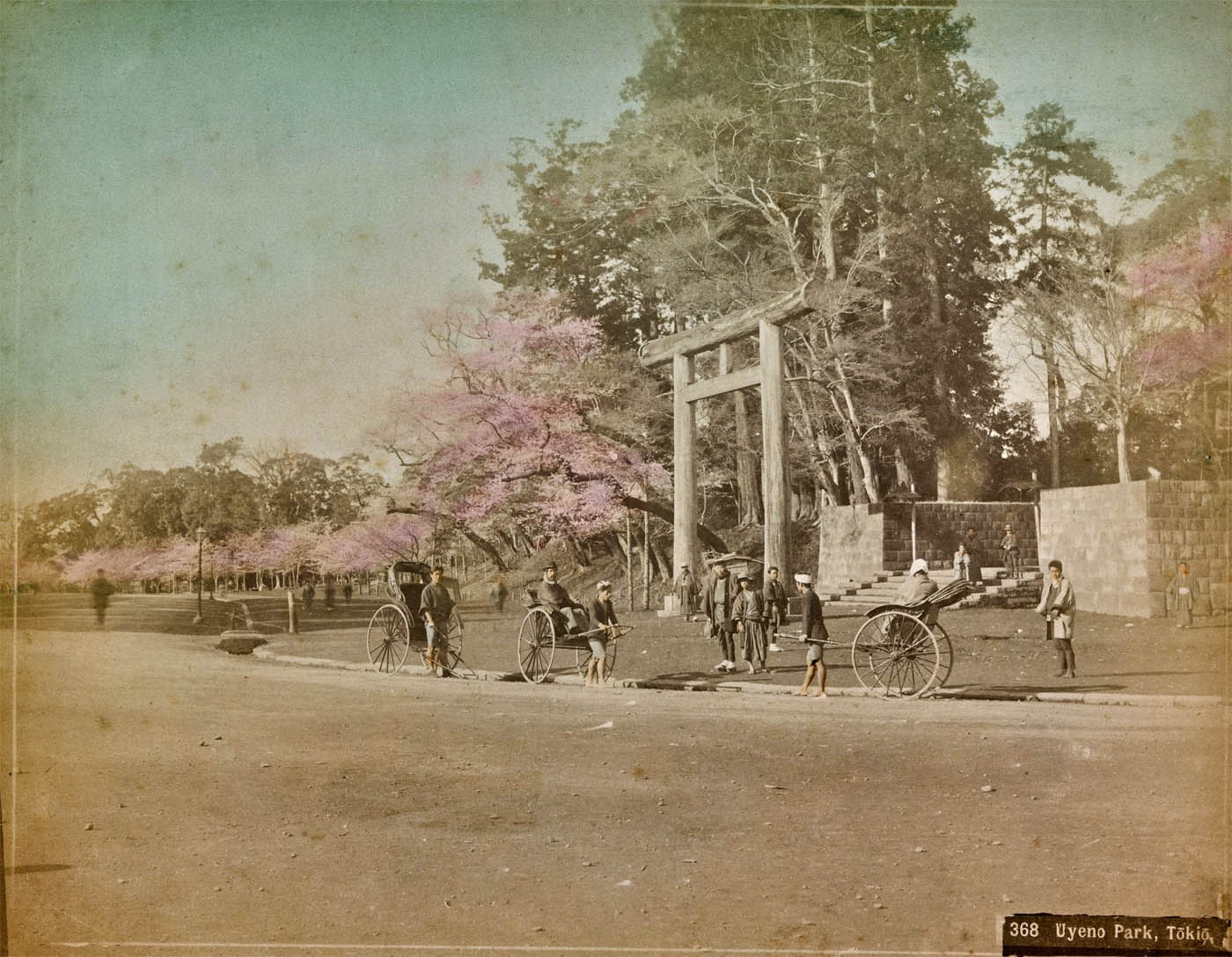
Felice Beato (Italian-British, 1832-1909) Uyeno Park, Tokyo 1870s Hand-coloured albumen silver print from wet collodion glass-plate negative
Felice Beato
Felice Beato (1832-1909), also known as Felix Beato, was an Italian-British photographer. He was one of the first people to take photographs in East Asia and one of the first war photographers. He is noted for his genre works, portraits, and views and panoramas of the architecture and landscapes of Asia and the Mediterranean region. Beato’s travels gave him the opportunity to create images of countries, people, and events that were unfamiliar and remote to most people in Europe and North America. His work provides images of such events as the Indian Rebellion of 1857 and the Second Opium War, and represents the first substantial body of photojournalism. He influenced other photographers, and his influence in Japan, where he taught and worked with numerous other photographers and artists, was particularly deep and lasting.
Early life and identity
A death certificate discovered in 2009 shows that Beato was born in Venice in 1832 and died on 29 January 1909 in Florence. The death certificate also indicates that he was a British subject and a bachelor. It is likely that early in his life Beato and his family moved to Corfu, at the time part of the British protectorate of the Ionian Islands, and so Beato was a British subject.
Because of the existence of a number of photographs signed “Felice Antonio Beato” and “Felice A. Beato”, it was long assumed that there was one photographer who somehow photographed at the same time in places as distant as Egypt and Japan. In 1983 it was shown by Chantal Edel that “Felice Antonio Beato” represented two brothers, Felice Beato and Antonio Beato, who sometimes worked together, sharing a signature. The confusion arising from the signatures continues to cause problems in identifying which of the two photographers was the creator of a given image.
Japan
By 1863 Beato had moved to Yokohama, Japan, joining Charles Wirgman, with whom he had travelled from Bombay to Hong Kong. The two formed and maintained a partnership called “Beato & Wirgman, Artists and Photographers” during the years 1864-1867, one of the earliest and most important commercial studios in Japan. Wirgman again produced illustrations derived from Beato’s photographs, while Beato photographed some of Wirgman’s sketches and other works. (Beato’s photographs were also used for engravings within Aimé Humbert’s Le Japon illustré and other works.) Beato’s Japanese photographs include portraits, genre works, landscapes, cityscapes, and a series of photographs documenting the scenery and sites along the Tōkaidō Road, the latter series recalling the ukiyo-e [17th-19th century woodblock prints and paintings] of Hiroshige and Hokusai. During this period, foreign access to (and within) the country was greatly restricted by the Tokugawa shogunate. Accompanying ambassadorial delegations and taking any other opportunities created by his personal popularity and close relationship with the British military, Beato reached areas of Japan where few westerners had ventured, and in addition to conventionally pleasing subjects sought sensational and macabre subject matter such as heads on display after decapitation. His images are remarkable not only for their quality, but also for their rarity as photographic views of Edo period Japan.
The greater part of Beato’s work in Japan contrasted strongly with his earlier work in India and China, which “had underlined and even celebrated conflict and the triumph of British imperial might”. Aside from the Portrait of Prince Kung, any appearances of Chinese people in Beato’s earlier work had been peripheral (minor, blurred, or both) or as corpses. With the exception of his work in September 1864 as an official photographer on the British military expedition to Shimonoseki, Beato was eager to portray Japanese people, and did so uncondescendingly, even showing them as defiant in the face of the elevated status of westerners.
Beato was very active while in Japan. In 1865 he produced a number of dated views of Nagasaki and its surroundings. From 1866 he was often caricatured in Japan Punch, which was founded and edited by Wirgman. In an October 1866 fire that destroyed much of Yokohama, Beato lost his studio and many, perhaps all, of his negatives.
While Beato was the first photographer in Japan to sell albums of his works, he quickly recognised their full commercial potential. By around 1870 their sale had become the mainstay of his business. Although the customer would select the content of earlier albums, Beato moved towards albums of his own selection. It was probably Beato who introduced to photography in Japan the double concept of views and costumes / manners, an approach common in photography of the Mediterranean. By 1868 Beato had readied two volumes of photographs, “Native Types”, containing 100 portraits and genre works, and “Views of Japan”, containing 98 landscapes and cityscapes.
Many of the photographs in Beato’s albums were hand-coloured, a technique that in his studio successfully applied the refined skills of Japanese watercolourists and woodblock printmakers to European photography.
Since about the time of the ending of his partnership with Wirgman in 1869, Beato attempted to retire from the work of a photographer, instead attempting other ventures and delegating photographic work to others within his own studio in Yokohama, “F. Beato & Co., Photographers”, which he ran with an assistant named H. Woollett and four Japanese photographers and four Japanese artists. Kusakabe Kimbei was probably one of Beato’s artist-assistants before becoming a photographer in his own right. These other ventures failed, but Beato’s photographic skills and personal popularity ensured that he could successfully return to work as a photographer.
In 1871 Beato served as official photographer with the United States naval expedition of Admiral Rodgers to Korea. Although it is possible that an unidentified Frenchman photographed Korea during the 1866 invasion of Ganghwa Island, Beato’s photographs are the earliest of Korea whose provenance is clear.
Beato’s business ventures in Japan were numerous. He owned land and several studios, was a property consultant, had a financial interest in the Grand Hotel of Yokohama, and was a dealer in imported carpets and women’s bags, among other things. He also appeared in court on several occasions, variously as plaintiff, defendant, and witness. On 6 August 1873 Beato was appointed Consul General for Greece in Japan.
In 1877 Beato sold most of his stock to the firm Stillfried & Andersen, who then moved into his studio. In turn, Stillfried & Andersen sold the stock to Adolfo Farsari in 1885. Following the sale to Stillfried & Andersen, Beato apparently retired for some years from photography, concentrating on his parallel career as a financial speculator and trader. On 29 November 1884 he left Japan, ultimately landing in Port Said, Egypt. It was reported in a Japanese newspaper that he had lost all his money on the Yokohama silver exchange.
Death and legacy
Although Beato was previously believed to have died in Rangoon or Mandalay in 1905 or 1906, his death certificate, discovered in 2009, indicates that he died on 29 January 1909 in Florence, Italy.
Whether acknowledged as his own work, sold as Stillfried & Andersen’s, or encountered as anonymous engravings, Beato’s work had a major impact:
For over fifty years into the early twentieth century, Beato’s photographs of Asia constituted the standard imagery of travel diaries, illustrated newspapers, and other published accounts, and thus helped shape “Western” notions of several Asian societies.
Photographic techniques
Photographs of the 19th century often now show the limitations of the technology used, yet Beato managed to successfully work within and even transcend those limitations. He predominantly produced albumen silver prints from wet collodion glass-plate negatives.
Beato pioneered and refined the techniques of hand-colouring photographs and making panoramas. He may have started hand-colouring photographs at the suggestion of Wirgman, or he may have seen the hand-coloured photographs made by partners Charles Parker and William Parke Andrew. Whatever the inspiration, Beato’s coloured landscapes are delicate and naturalistic and his coloured portraits, more strongly coloured than the landscapes, are appraised as excellent.
Baron Raimund von Stillfried (Austrian, 1839-1911) Akindo, Japan c. 1870 Hand coloured albumen silver print from wet collodion glass-plate negative
Baron Raimund von Stillfried (Austrian, 1839-1911) Middle-class Woman, Japan c-1870 Hand coloured albumen silver print from wet collodion glass-plate negative
Baron Raimund von Stillfried (Austrian, 1839-1911) Obasan, Japan c. 1870 Hand coloured albumen silver print from wet collodion glass-plate negative
Baron Raimund von Stillfried (Austrian, 1839-1911) Japanese man in armour 1881 Hand coloured albumen silver print from wet collodion glass-plate negative Art and Design Library Public domain
A portrait of a Japanese soldier from the waist up. He is standing facing his left whilst wearing ornate armour consisting of a chest plate and chainmail undershirt. His hair is swept back and is dressed in a topknot.
This item is part of a collection of prints from the studio of Baron Franz von Stillfried-Ratenicz, an Austrian photographer practising in Japan in the late 1870’s. Von Stillfried ran a studio in Yokohama at the same time as his brother Raimund, who was also known as ‘Baron Stillfried’. This caused a great deal of confusion with the local residents and visitors to Japan in the Meiji Period, and with art historians today.
This album, which dates from 1879-1883, comprises 67 separate mounted prints presented in a lacquerware box. Albums of this kind were popular among foreign tourists, who frequently selected the individual prints they wished to include from the studio’s collection. Many of these albumen prints were hand tinted. This was a laborious process for which von Stillfried employed, at the height of his success, a substantial number of Japanese workers.
Baron Raimund von Stillfried (Austrian, 1839-1911) Woman, Japan c. 1870 Hand coloured albumen silver print from wet collodion glass-plate negative
Baron Raimund von Stillfried, also known as Baron Raimund von Stillfried-Rathenitz (6 August 1839, in Komotau – 12 August 1911, in Vienna), was an Austrian photographer.
He was son of Baron (Freiherr) August Wilhelm Stillfried von Rathenitz (d. 1806) and Countess Maria Anna Johanna Theresia Walburge Clam-Martinitz (1802-1874).
After leaving his military career, Stillfried moved to Yokohama, Japan and opened a photographic studio called Stillfried & Co. which operated until 1875. In 1875, Stillfried formed a partnership with Hermann Andersen and the studio was renamed, Stillfried & Andersen (also known as the Japan Photographic Association). This studio operated until 1885. In 1877, Stillfried & Andersen bought the studio and stock of Felice Beato. In the late 1870s, Stillfried visited and photographed in Dalmatia, Bosnia, and Greece. In addition to his own photographic endeavours, Stillfried trained many Japanese photographers. In 1886, Stillfried sold the majority of his stock to his protégé, the Japanese photographer Kusakabe Kimbei, he then left Japan.
He left Japan forever in 1881. After travelling to Vladivostock, Hong Kong and Bangkok, he eventually settled in Vienna in 1883. He also received an Imperial and Royal Warrant of Appointment as photographer (k.u.k. Hof-Photograph).
Baron Raimund von Stillfried (Austrian, 1839-1911) Hodo Falls at Nikko, Tochigi between 1871 and 1885 Hand coloured albumen silver print from wet collodion glass-plate negative Rijksmuseum Public domain
Baron Raimund von Stillfried (Austrian, 1839-1911) Group of men, Japan c. 1870 Hand coloured albumen silver print from wet collodion glass-plate negative
Baron Raimund von Stillfried (Austrian, 1839-1911) Minzoku, Japan c. 1870 Hand coloured albumen silver print from wet collodion glass-plate negative
Baron Raimund von Stillfried (Austrian, 1839-1911) Umbrella maker, Japan c. 1870 Hand coloured albumen silver print from wet collodion glass-plate negative
Baron Raimund von Stillfried (Austrian, 1839-1911) Pipe maker, Japan c. 1870 Hand coloured albumen silver print from wet collodion glass-plate negative
Baron Raimund von Stillfried (Austrian, 1839-1911) Japanese woman on her head between 1871 and 1885 Hand coloured albumen silver print from wet collodion glass-plate negative Rijksmuseum Public domain
Baron Raimund von Stillfried (Austrian, 1839-1911) Portrait of two Buddhist monks with rosary, bell and slit drum c. 1875 Hand coloured albumen silver print from wet collodion glass-plate negative Rijksmuseum Public domain
Kusakabe Kimbei (Japanese, 1841-1934) and Baron Raimund von Stillfried (Austrian, 1839-1911) Japanese Tattoo between 1870 and 1899 Height: 26cm (10.2 in) Width: 20cm (7.8 in) Getty Center Public domain
Baron Raimund von Stillfried (Austrian, 1839-1911) Fille de Sootchow (Suzhou Girl) 1870s Albumen silver print from glass negative with applied colour Metropolitan Museum of Art, Gilman Collection Museum Purchase 2005
Baron Raimund von Stillfried (Austrian, 1839-1911) Portrait of an Old Chinese Woman 1870s Albumen silver print from glass negative with applied colour Metropolitan Museum of Art, Gilman Collection Museum Purchase 2005
Baron Raimund von Stillfried (Austrian, 1839-1911) Courios Shop c. 1875 Hand-coloured albumen silver print from glass negative Pictures Collection, State Library of Victoria
Baron Raimund von Stillfried (Austrian, 1839-1911) Old beggar 1870s Albumen silver print from glass negative with applied colour Metropolitan Museum of Art, Gilman Collection Museum Purchase 2005
Baron Raimund von Stillfried (Austrian, 1839-1911) Double portrait c. 1880 Albumen silver print from glass negative with applied colour
Baron Raimund von Stillfried (Austrian, 1839-1911) Untitled (Accountant with newspaper and his servant with folding fan) 1870s Albumen silver print from glass negative with applied colour
Baron Raimund von Stillfried (Austrian, 1839-1911) Portrait of Irezumi Tattooed man – Post Runner 1880-1890 Albumen silver print from glass negative with applied colour
Baron Raimund von Stillfried (Austrian, 1839-1911) Young Lady c. 1875 From Views and Costumes of Japan, c. 1876 Hand-coloured albumen silver photograph 23.8 × 19.1cm La Trobe Picture Collection, State Library of Victoria
Baron Raimund von Stillfried (Austrian, 1839-1911) and Uchida Kuichi (Japanese, 1844-1875) Untitled [The Fishmonger] 1870s Hand-coloured albumen silver photograph
Baron Raimund von Stillfried (Austrian, 1839-1911) Sleeping beauties 1876 From Views and Costumes of Japan, c. 1876 Hand-coloured albumen silver print from glass negative Pictures Collection, State Library of Victoria
Baron Raimund von Stillfried (Austrian, 1839-1911) Hairdressing 1876 From Views and Costumes of Japan, c. 1876 Hand-coloured albumen silver print from glass negative Pictures Collection, State Library of Victoria
Baron Raimund von Stillfried (Austrian, 1839-1911) Tomiyoka 1876 From Views and Costumes of Japan, c. 1876 Albumen silver print from glass negative Pictures Collection, State Library of Victoria
Baron Raimund von Stillfried (Austrian, 1839-1911) Komagatake Volcano 1876 From Views and Costumes of Japan, c. 1876 Albumen silver print from glass negative Pictures Collection, State Library of Victoria
Baron Raimund von Stillfried (Austrian, 1839-1911) Ainu Village 1876 From Views and Costumes of Japan, c. 1876 Albumen silver print from glass negative Pictures Collection, State Library of Victoria
Baron Raimund von Stillfried (Austrian, 1839-1911) Odji Teahouse 1876 From Views and Costumes of Japan, c. 1876 Albumen silver print from glass negative Pictures Collection, State Library of Victoria
Baron Raimund von Stillfried (Austrian, 1839-1911) Views of Nagasaki, Japan 1876 From Views and Costumes of Japan, c. 1876 Albumen silver print from glass negative Pictures Collection, State Library of Victoria
Baron Raimund von Stillfried (Austrian, 1839-1911) Views of Tokyo, Japan 1876 From Views and Costumes of Japan, c. 1876 Albumen silver print from glass negative Pictures Collection, State Library of Victoria
Fratelli Gajo – Piazza S.Marco 139 – Venezia Castelo canal with a view of the Church of San Geremia 1880s Hand-coloured albumen print mounted on cardboard Image: 20 x 26cm Support: 27 x 36cm
I bought this album of 30 hand-coloured albumen prints by Fratelli Gajo together with numerous other black and white albumen prints at auction. Unfortunately the album had no cover but to save it for prosperity I had it rebound in leather at one of the only bookbinders left in Melbourne: White’s Law Bindery. They did a superb job.
I cannot find out anything about the Venetian photographer Fratelli Gajo except the address of his business. No dates, no bibliographic information.
What I do know is that these hand-coloured photographs are rare and exceptionally beautiful. They add an early chapter to the story of hand-coloured photography, which stretches from daguerreotypes, albumen prints, and silver gelatin prints to hand-coloured digital photographs with an equally varied subject matter – aerial photographs, landscapes, portraits, bodies, social documentary photographs and architectural renderings to name but a few.
The photographs in the posting are in the order they appear in the album. I have interleaved the albumen photographs with historical and contemporary images giving us a vista of Venice through time. Enjoy.
Dr Marcus Bunyan
Please click on the photographs for a larger version of the image.
Fratelli Gajo – Piazza S.Marco 139 – Venezia 153 Rivo delle Maravege 1880s Hand-coloured albumen print mounted on cardboard Image: 20 x 26cm Support: 27 x 36cm
Fratelli Gajo – Piazza S.Marco 139 – Venezia Untitled [The Doges’ Palace and the Piazzetta] 1880s Hand-coloured albumen print mounted on cardboard Image: 20 x 26cm Support: 27 x 36cm
Fratelli Gajo – Piazza S.Marco 139 – Venezia 89 Venezia – Palazzo Ferry, Grand Hotel 1880s Hand-coloured albumen print mounted on cardboard Image: 20 x 26cm Support: 27 x 36cm
Wolfgang Moroder Palazzo Ferro Fini in Venice. Facade on Grand Canal 18 April 2016 CC BY-SA 3.0
Fratelli Gajo – Piazza S.Marco 139 – Venezia 680 Venezia 1880s Hand-coloured albumen print mounted on cardboard Image: 20 x 26cm Support: 27 x 36cm
Fratelli Gajo – Piazza S.Marco 139 – Venezia Untitled [St Mark’s Basilica] 1880s Hand-coloured albumen print mounted on cardboard Image: 20 x 26cm Support: 27 x 36cm
Fratelli Gajo – Piazza S.Marco 139 – Venezia Untitled 1880s Hand-coloured albumen print mounted on cardboard Image: 20 x 26cm Support: 27 x 36cm
Fratelli Gajo – Piazza S.Marco 139 – Venezia Canale grande verso Rialto 1880s Hand-coloured albumen print mounted on cardboard Image: 20 x 26cm Support: 27 x 36cm
Canaletto (Italian, 1697-1768) Grand Canal from Palazzo Balbi towards the Rialto Between 1720 and 1723 Oil on canvas Height: 144cm (56.6 in) Width: 207cm (81.4 in) Museum of 18th-century Venice Public domain
Fratelli Gajo – Piazza S.Marco 139 – Venezia Untitled [Bridge of Sighs] 1880s Hand-coloured albumen print mounted on cardboard Image: 20 x 26cm Support: 27 x 36cm
Fratelli Gajo – Piazza S.Marco 139 – Venezia After the painting by A. Paoletti, Venezia 1880s Hand-coloured albumen print mounted on cardboard Image: 20 x 26cm Support: 27 x 36cm
Antonio Ermolao Paoletti (Venezia, 1834-1912) A Venetian ice cream seller Nd Oil on canvas 50.2 x 74.9cm (19.8 x 29.5 in.)
Fratelli Gajo – Piazza S.Marco 139 – Venezia Untitled [The Courtyard of the Doge’s Palace looking towards the Torricella] 1880s Hand-coloured albumen print mounted on cardboard Image: 20 x 26cm Support: 27 x 36cm
Fratelli Gajo – Piazza S.Marco 139 – Venezia No. 5 Piazza S. Marco dai Leoni 1880s Hand-coloured albumen print mounted on cardboard Image: 20 x 26cm Support: 27 x 36cm
Fratelli Gajo – Piazza S.Marco 139 – Venezia 13 Libreria e Loggetto 1880s Hand-coloured albumen print mounted on cardboard Image: 20 x 26cm Support: 27 x 36cm
Fratelli Gajo – Piazza S.Marco 139 – Venezia 35. Venezia – Porta del P. Ducale detta della Carta 1880s Hand-coloured albumen print mounted on cardboard Image: 20 x 26cm Support: 27 x 36cm
Jean-Pol Grandmont The Porta della Carta of the Doges Palace on Piazzetta San Marco in Venice 1 June 2013 CC BY-SA 4.0
Fratelli Gajo – Piazza S.Marco 139 – Venezia 230 [Interior of the Doges Palace] 1880s Hand-coloured albumen print mounted on cardboard Image: 20 x 26cm Support: 27 x 36cm
Torre dell’Orologio, Piazza san Marco, Venice
Fratelli Gajo – Piazza S.Marco 139 – Venezia 101. Torre del Orologio 1880s Hand-coloured albumen print mounted on cardboard Image: 20 x 26cm Support: 27 x 36cm
Fratelli Gajo – Piazza S.Marco 139 – Venezia 141. Venezia Chiesa della Salute 1880s Hand-coloured albumen print mounted on cardboard Image: 20 x 26cm Support: 27 x 36cm
Walter Richard Sickert (British, 1860-1942) Santa Maria della Salute, Venice c. 1901 Oil on canvas 56 x 46cm Royal Academy of Arts
Fratelli Gajo – Piazza S.Marco 139 – Venezia Untitled 1880s Hand-coloured albumen print mounted on cardboard Image: 20 x 26cm Support: 27 x 36cm
Fratelli Gajo – Piazza S.Marco 139 – Venezia 65 Monumento Collooni 1880s Hand-coloured albumen print mounted on cardboard Image: 20 x 26cm Support: 27 x 36cm
Federico Moja (Italian, 1802-1885) Venice, a View of the Campo Santi Giovanni e Paolo, with the Equestrian Monument to Bartolomeo Colleoni and the Scuola Grande di San Marco in the Background 1848 Oil on canvas Unframed: 74.5 by 104.5cm Framed: 89 by 118.5cm
Fratelli Gajo – Piazza S.Marco 139 – Venezia No. 30 Rivo di Canonica 1880s Hand-coloured albumen print mounted on cardboard Image: 20 x 26cm Support: 27 x 36cm
Fratelli Gajo – Piazza S.Marco 139 – Venezia Untitled [Entry to the presbytery of St Mark’s Basilica] 1880s Hand-coloured albumen print mounted on cardboard Image: 20 x 26cm Support: 27 x 36cm
Fratelli Gajo – Piazza S.Marco 139 – Venezia Untitled [Bridge of Sighs] 1880s Hand-coloured albumen print mounted on cardboard Image: 20 x 26cm Support: 27 x 36cm
Fratelli Gajo – Piazza S.Marco 139 – Venezia Untitled 1880s Hand-coloured albumen print mounted on cardboard Image: 20 x 26cm Support: 27 x 36cm
Fratelli Gajo – Piazza S.Marco 139 – Venezia 58. Rio S. Agostino 1880s Hand-coloured albumen print mounted on cardboard Image: 20 x 26cm Support: 27 x 36cm
Didier Descouens Rio di S. Agostino seen from the S. Agostino Bridge in Venice 11 May 2015 CC BY-SA 4.0
Fratelli Gajo – Piazza S.Marco 139 – Venezia Untitled [Torre del Orologio] 1880s Hand-coloured albumen print mounted on cardboard Image: 20 x 26cm Support: 27 x 36cm
Fratelli Gajo – Piazza S.Marco 139 – Venezia Untitled [The Doge’s Palace] 1880s Hand-coloured albumen print mounted on cardboard Image: 20 x 26 cm Support: 27 x 36 cm
Fratelli Gajo – Piazza S.Marco 139 – Venezia 87 Venezia – Palazzo Contarini Fasan 1880s Hand-coloured albumen print mounted on cardboard Image: 20 x 26cm Support: 27 x 36cm
Wolfgang Moroder Palazzo Contarini Fasan in Venice. Facade on Grand Canal 31 July 2010 CC BY-SA 4.0
Fratelli Gajo – Piazza S.Marco 139 – Venezia Venezia – Palazzo Pisaro 1880s Hand-coloured albumen print mounted on cardboard Image: 20 x 26cm Support: 27 x 36cm
Fratelli Gajo – Piazza S.Marco 139 – Venezia 100. Venezia – Palazzo Rezzonico 1880s Hand-coloured albumen print mounted on cardboard Image: 20 x 26cm Support: 27 x 36cm
Didier Descouens Ca ‘Rezzonico, Venice facade of Giorgio Massari on the Grand Canal 7 May 2012 CC BY-SA 4.0
Fratelli Gajo – Piazza S.Marco 139 – Venezia Untitled [Statue of King Vittorio Emanuel II by the sculptor Ettore Ferrari 1887] c. 1887 Hand-coloured albumen print mounted on cardboard Image: 20 x 26cm Support: 27 x 36cm
Didier Descouens The main gate at the Venetian Arsenal 9 May 2012 CC BY-SA 4.0
The so-called “Solid ground entrance” of the Arsenale in Venice was built between 1692 and 1694 on a project by Alessandro Tremignon. Eight standing figures on pedestals on the ground: At the front row: from left to right: La Giustizia by Giovanni Antonio Comino, Marte by Giovanni Antonio Comino, Nettuno by Giovanni Antonio Comino, Bellona by Francesco Cabianca At the the second and the third rows: L’Abbondanza by Francesco Cabianca (last row on the right), La Vigilanza by Francesco Cabianca (second row on the right), Two more Allegorical statues by Giovanni Antonio Comino, (second and third row on the left)
Fratelli Gajo – Piazza S.Marco 139 – Venezia 157 33 Arsenale 1880s Hand-coloured albumen print mounted on cardboard Image: 20 x 26cm Support: 27 x 36cm
Keystone View Company (American, Manufacturers and Publishers) The Rialto Bridge, Venice 1929 Stereograph print on card mount Mount: 9 x 18cm
Fratelli Gajo – Piazza S.Marco 139 – Venezia Untitled [Rialto Bridge] 1880s Hand-coloured albumen print mounted on cardboard Image: 20 x 26cm Support: 27 x 36cm
Fratelli Gajo – Piazza S.Marco 139 – Venezia 211. Bis- Venezia – Chiesa S. Marco – Interno (Interior of the San Marco Church) 1880s Hand-coloured albumen print mounted on cardboard Image: 20 x 26cm Support: 27 x 36cm
Fratelli Gajo – Piazza S.Marco 139 – Venezia Untitled 1880s Hand-coloured albumen print mounted on cardboard Image: 20 x 26cm Support: 27 x 36cm
Artists: Darogah Abbas Ali, Indu Antony, Felice Beato, Mitter Bedi, Jyoti Bhatt, Bourne & Shepherd, Samuel Bourne, Michael Bühler-Rose, Henri Cartier-Bresson, Chunni Lall & Co., Lala Deen Dayal, Francis Frith & Co., Gauri Gill, Khubiram Gopilal, Hamilton Studios Ltd, Johnston and Hoffmann, Willoughby Wallace Hooper, William Johnson, John William Kaye and John Forbes Watson, Karen Knorr, Annu Palakunnathu Matthew, Steve McCurry, Saché & Murray Studios, Pushpamala N with Clare ARNI, Nicolas & Company (attributed), Norman Parkinson, Anoli Perera, Suresh Punjabi, Marc Riboud, John Edward Saché, Charles Scott, Sawai Ram Singh II, Maharaja of Jaipur, Edward Taurines (attributed), Waswo X Waswo, Wiele and Klein Studio, Wilson Studios Bombay
Installation view of the opening of the exhibition Visions of India: from the colonial to the contemporary at the Monash Gallery of Art showing the Johnston & Hoffman photograph Maharaja Sir Bhagwati Prasad Singh (1915, below) Photo: Marcus Bunyan
The exhibition Visions of India: from the colonial to the contemporary at the Monash Gallery of Art, Melbourne is at one and the same time, a fascinating, stimulating, frustrating, uplifting – and a little sad – overview of the history of the photography of India. I won’t say the history of Indian photography because most of the historical photographs are taken by European studios in India, and even an equal amount of the mid-twentieth century and contemporary photographs are taken by non-Indian born photographers residing in India or elsewhere. The title Visions of India is, therefore, undeniably apt – the exhibition being as much about how foreigners view the Indian continent, culture and people as how Indians picture themselves.
The fascinating, stimulating and sad elements of the exhibition are the “presence” of the historical photographs. These photographs range from the European architectural documentation of Indian temples through European colonial-ethnographic images which document Indian ethnic “types” – in the case of William Johnson montaging ethnic group portraits taken in the studio with appropriate views of actual buildings and scenes to picture oriental races and tribes – to European and Indigenous Indian photographers and ruling Indian princes’ photographs of themselves and their courtesans … taken in the European manner.
John Falconer in his book 2018 book Under Indian Skies: 19th-Century Photographs from a Private Collection observes, “A number of India’s princes became deeply interested in photography and both practiced and collected it, several also retaining state photographers… The portraiture of Indian royalty also proved a popular genre. Portraits posed in the setting of the European studio, but celebrating an oriental luxury of costume, jewellery and other accoutrements, were commissioned not only by rulers themselves but were also collected by Western customers, as the contents of many collections attest.”1
But by whoever they were taken – European photographer, Indian photographer or royal prince – these photographs are always taken from a position of power and authority by a male, either to reinforce through the male gaze their own splendour or to document their personal chattels, the tangible goods that they owned. For example, while texts by Mrinalini Venkateswaran (below) and Aparna Andhare argue that the photographs of Sawai Ram Singh II, Maharaja of Jaipur are adept at revealing himself through his self-portraits “as a thoughtful person who intuitively understood the power of iconography and images,”2 and that he was adept at capturing the personalities of the heavily veiled inner circle of the zenana of the royal household, “that he was able to connect with, and portray, his sitters as individuals rather than ‘types'”2 (at a time when the women lived almost entirely out of public view) … these observations belie the fact that it was he, the ruler, that found them “fit” subjects to be sitters.
And this is what I find particularly sad about these particular photographs – I don’t feel their personalities but I feel their pain. I look at their body language, the demurely clasped hands, the “dead” eyes as they stare at the camera (except one older women who stares defiantly), and the timidity of the body posture… some almost seem to cringe from the camera’s gaze, others look so alone and sad, as though they would wish to be anywhere but subject to (t)his intimidatory gaze – of the camera and the man. It’s disturbing, this feeling of vulnerability and betrayal, when compared to the majesty of Lala Deen Dayal’s photographs, his portrayal of male royal opulence and self-importance.
Pertaining to the Indigenous Indian uptake of photography John Falconer observes that, “[Samuel] Bourne may have viewed the western technology of the camera as yet another symbol of the dominance of European culture, but Indians had lost no time in embracing the new medium. Bourne himself had noted that Indian studios were not uncommon in the Calcutta of the early 1860s. But documentary evidence relating to the growth of an Indigenous photographic culture in India is at present frustratingly limited and has not been investigated with the same rigour as more easily accessible Western records. Even so, it is clear that photography was quickly taken up be sections of the Indian population, in general those who were in a position to associate with European society. …
The only Indian studio whose work has received similar attention and acclamation to that given to European contemporaries is that of Lala Deen Dayal. The success of the Dayal studio is comparable to that achieved by his English counterpart Bourne and Shepherd… The attention paid to Deen Dayal in recent years and his status as an Indian icon stands in marked contrast to the dearth of information available on the work of equally interesting contemporaries.”3
It is unclear in the essay in the book Under Indian Skies: 19th-Century Photographs from a Private Collection from where this information and research has been gathered, as few Indian sources are quoted in the footnotes. While I am no expert on Indigenous Indian photography, it would seem logical that non-European research has been undertaken into historical, home grown photographic studios and published in the Indian, and not English, language. Perhaps the observations can be seen as another example of the ongoing Western-centric view of historical photographs of India.
We then move onto the frustrating element of the exhibition, the contemporary photographs. As many of you may know I am not a great fan of contemporary photography but there is some focused, too focused, work on view. The frustrating element of the contemporary smorgasbord is the constant devolution of subject matter, the constant deconstruction of the (historical) minutiae of India – the small, precise, or trivial details of something – in which we never get a feeling for the personality of the Indian country or its people. The contemporary photographs are all about snippets, fragments, and traces of then and now, as though contemporary India is only ever constructed in order to be deconstructed out of its past. This constant prodding and poking at the multiple strings of history and its inequity is tiring and tiresome to say the least but contemporary Indian photography is not alone in this: Australian contemporary photography suffers from the same dis/ease.
The cacophony of “noise” which emanates from the contemporary photographs (and here I will use a section of text which mirrors the form) – – – from grids of hairy male legs seen from a child’s perspective (childhood memories / male figure / Indian family / perspectives of a child) to incarnations of mythological figures that examine “the genres of both the ethnographic photograph-as-document that is linked to the colonial era, as well as the fantasy-inspired make-believe that emanated from traditional Indian portrait studios in the late 19th and early 20th centuries” to conventions of colonial-era ethnographic portrait photographs of women dictated by male notions of femininity disrupted by deliberately dishevelled hair as a symbol of defiance against the notion of out-of-place hair seen as “hysterical” or “uncontrollable”, paradoxically making legible faces into ill/legible citizens, disturbed and defiant “others” (BIG BREATH!) – – – belies my lack of feeling for ANY of the photographs displayed.
After writing on photography since the year 2008 I keep coming up short / banging on the same drum about contemporary photography: I feel almost nothing for any of these photographs even as I appreciate their historical re-“visions”, their self-awareness and self-reflexivity (as much about the photographer as the subject), their intellectual rigour and conceptual contortions. They leave me feeling like I have been playing Twister with too many hands and feet, my mind tied up in an infinite library of thoughts and ideas while ruminating on less than stimulating images.
And so to the glorious, uplifting denouement of the exhibition which are the dynamic photographs of Suresh Punjabi’s Suhag Studio in Nagda, Madhya Pradesh. I am in love with them.
Reminiscent of the photographs of Africans by Malike Sidibé (Malian, 1935-2016), Seydou Keïta (Malian, 1921-2001) and Sanlé Sory (West African, b. 1943), Punjabi’s visions of Indian life possess a vital energy unlike anything else in this exhibition, and get as close to capturing the spirit of the Indian people as anything I have ever seen from the continent. This is because, at the time, Punjabi’s photographs (like the photographs of Atget) were not considered art but were documents taken for a broad set of purposes: from wedding and family albums to passport photos, from administrative photos to personal souvenirs, from family groups to playful contexts. Through their lack of pretension (ah, there is the key!) “Punjabi’s photographs chronicle daily life in small-town India, a context that many photographic histories from the subcontinent often miss… These portraits are the result of a deeply personal and unique relationship between Punjabi and his clients…”4
Punjabi’s clients were like family to him, and he wanted to photograph them in the best way possible, to picture them how they wanted to see themselves. Deceptively simple and formal in their pictorial construction, Punjabi’s photographs allow us to touch the aspirations of everyday Indians – with their hopes and dreams, their communion with family and friends, lost in the moment of dance or conversation, or crowded together in a small 10 x 20 feet studio with painted backdrop. “You can sense the presence of a humane vision behind the mechanical eye of the camera.” Simply put, these “playfully intimate” and grounded photographs are a refreshing counterpoint to so many conceptual contemporary photographs which lead nowhere, for they have an immediacy and intimacy which touches us (through their palpable aura) as only the best photographs can. “He doesn’t really take pictures of people and things (or, God forbid, grind out endless examples of his own cleverness). He photographs feelings and relationships.” (U.S. Camera ’62)
Dr Marcus Bunyan
1/ John Falconer. Under Indian Skies: 19th-Century Photographs from a Private Collection. Narayana Press, 2018, p. 35
Installation view of the opening of the exhibition Visions of India: from the colonial to the contemporary at the Monash Gallery of Art showing the Johnston & Hoffman photograph Maharaja Sir Bhagwati Prasad Singh (1915, below) Photo: Monash Gallery of Art
Johnston & Hoffman (founded 1882, dissolved 1950s) Maharaja Sir Bhagwati Prasad Singh 1915 Hand-coloured albumen print 46.0 x 33.0cm Courtesy of the Museum of Art & Photography (MAP) (Bengaluru)
The leading photography studio of Johnston & Hoffman was established at 22 Chowringhee Road, Calcutta around 1882 by Theodore Julius Hoffman and Peter Arthur Johnston. A branch was opened in Darjeeling in 1890 and Simla in the mid 1890s. There was also a Burma branch at 70 Phayre Street, Rangoon for a short period between 1889-1890. Hoffmann took over the business on the death of Johnston – which was around 1886 and soon after the Calcutta business commenced. Theodore Hoffman died in Calcutta, India in December 1921. It was possibly the second largest commercial photographers in India after the studios of Bourne and Shepherd and were one of the first to publish postcards in Calcutta from at least 1898 onwards.
1850s-1947 Photography in the colonial era wall text from the exhibition
Installation view of the exhibition Visions of India: from the colonial to the contemporary at the Monash Gallery of Art showing the photographs of Sawai Ram Singh II, Maharaja of Jaipur (c. 1860, below) Photo: Monash Gallery of Art
Installation view of Sawai Ram Singh II, Maharaja of Jaipur showing his self-portrait (c. 1860, centre, see below) and portraits of courtesans (c. 1860, below) Photo: Marcus Bunyan
Informally called the ‘photographer prince of India,’ Maharaja Sawai Ram Singh II was an avid photographer, creating over six thousand individual photographs and nearly two thousand glass plate negatives throughout his life. He is renowned for having photographed women residing in the zenana of the royal household – at a time when the women lived almost entirely out of public view – using modes of representation similar to traditional Victorian portraiture.
Sawai Ram Singh II, Maharaja of Jaipur (Indian, 1833-1880) Portrait of a courtesan (installation view) c. 1860 Albumen print Courtesy of the Museum of Art & Photography (MAP) (Bengaluru) Photo: Marcus Bunyan
Sawai Ram Singh II, Maharaja of Jaipur (Indian, 1833-1880) Portrait of a courtesan c. 1860 Albumen print Courtesy of the Museum of Art & Photography (MAP) (Bengaluru)
The ‘zenana’ portraits [zenana: the part of a house for the seclusion of women], as they are often called, are among the most remarkable of these negatives. They show many individual South Asian women: some look away, others dress up and pose, and several stare down the photographer (and today’s viewer), challenging both to uncover their personalities and stories. That Sawai Ram Singh was able to achieve at least the former – that he was able to connect with, and portray, his sitters as individuals rather than ‘types’ – is one of the special qualities of his images. He seems not to have photographed any of his wives, but that he photographed so many women; that he found them ‘fit’ subjects to be sitters, is unusual for this period. Nothing comparable has emerged from any other contemporary Indian court. Unfortunately, we cannot be sure who all these women are – history is poor at remembering their names – but many were women at his court. Perhaps they were performers; some may have been paaswaans.
Sawai Ram Singh II, Maharaja of Jaipur (Indian, 1833-1880) Portrait of a courtesan (installation view) c. 1860 Albumen print Courtesy of the Museum of Art & Photography (MAP) (Bengaluru) Photo: Marcus Bunyan
Ram Singh was passionate about art and photography; he captured (and developed) numerous photographs of women, junior functionaries (like tailors) and nobles of his court. It is believed that Ram Singh was introduced to a camera in 1864 when photographer T. Murray visited Jaipur. After learning how to photograph, he used to carry his camera on all his trips. When western visitors came to his court, he used to learn photography from them.
Many of the photographs taken by him were of elite women who so-far lived an entirely secluded private life in the zenanas of his palace; captured in an western artificial setting, consisting of elegant backdrops, Victorian furniture and Persian carpets. It has been since considered as a pioneer effort at portraying Rajput women behind the purdah. Prior to Ram Singh’s photographs, portraits of specific Rajput women were nearly unknown and artists mass-produced idealised representations of women based on a single model, to serve a variety of occasions, for centuries. Interestingly, the names of the photographed women were not mentioned and whether the Maharanis allowed themselves to be photographed is unknown.
Laura Weinstein, an acclaimed art curator argues that the photographs served as an important tool to engage in the widespread discourse about Indian women behind the purdah [the practice in certain Muslim and Hindu societies of screening women from men or strangers, especially by means of a curtain] and they stood out as a rare group of photographs that did not mirror oriental conceptions of Indian domestic life. By appropriating the very European model of portrait photography – which emphasised the dignity and propriety of women, he infused dignity into the life of his photograph-figures unlike other concurrent attempts and refuted the colonial notion of the zenana-inhabitants being idle, unhygienic, superstitious, sexually deviant and oppressed. Rather than reforming the purdah system or associated woman issues, his photographs were modern tools that staunchly defended the tradition, much more than it breached, by portraying an apparent normalcy.
Ram Singh had also commissioned numerous self-portraits in a variety of poses ranging from a Hindu holy man to a Rajput warrior to a Western gentleman. Vikramaditya Prakash, an art-historian had described them as “self-consciously hybridised representations [which] straddle and contest the separating boundary – between coloniser and colonised, English and native – the preservation and reaffirmation of which was crucial for colonial discourse.”
The glass negatives that produced the portraits, the albumen print photograph collection and his own self-portraits are now displayed at the Maharaja Sawai Man Singh II Museum in Jaipur. He was also a life-time member of Bengal Photographic Society.
Sawai Ram Singh II, Maharaja of Jaipur (Indian, 1833-1880) Portrait of a courtesan (installation view) c. 1860 Albumen print Courtesy of the Museum of Art & Photography (MAP) (Bengaluru) Photo: Marcus Bunyan
Sawai Ram Singh II, Maharaja of Jaipur (Indian, 1833-1880) Self-portrait c. 1860 Albumen print Courtesy of the Museum of Art & Photography (MAP) (Bengaluru)
Installation view of the exhibition Visions of India: from the colonial to the contemporary at the Monash Gallery of Art showing the photographs of William Johnson (English, date born unknown – 1886) from the album The Oriental races and tribes, residents and visitors of Bombay with at left, The Kulis of the West of India (1852-1855, below); at centre, Chambhars (1852-1855, below); and at right, Kharavas (1852-1855, below) Photo: Monash Gallery of Art
Installation view of the exhibition Visions of India: from the colonial to the contemporary at the Monash Gallery of Art showing the photographs of William Johnson (English, date born unknown – 1886) from the album The Oriental races and tribes, residents and visitors of Bombay with at left, The Kulis of the West of India (1852-1855, below); at centre, Chambhars (1852-1855, below); and at right, Kharavas (1852-1855, below) Photo: Marcus Bunyan
William Johnson (English, date born unknown – 1886) The Kulis of the West of India 1852-1855 From the album The Oriental races and tribes, residents and visitors of Bombay Albumen print 23.0 x 17.7cm Courtesy of the Museum of Art & Photography (MAP) (Bengaluru)
William Johnson (English, date born unknown – 1886) Chambhars 1852-1855 From the album The Oriental races and tribes, residents and visitors of Bombay Albumen print 23.0 x 17.7cm Courtesy of the Museum of Art & Photography (MAP) (Bengaluru)
Four members of the Chambhar community, historically associated with leather work, pose for an outdoor portrait by William Johnson, co-author and photographer of two-volume collection of albumen prints The Oriental Races and Tribes, Residents and Visitors of Bombay. The photographs with letter-press description are largely considered to be the first published ethnographic study of Indian people to use photos as well as written descriptions.
William Johnson (English, date born unknown – 1886) Kharavas 1852-1855 From the album The Oriental races and tribes, residents and visitors of Bombay Albumen print 23.0 x 17.7cm Courtesy of the Museum of Art & Photography (MAP) (Bengaluru)
William Johnson wall text from the exhibition
Installation views of the exhibition Visions of India: from the colonial to the contemporary at the Monash Gallery of Art showing in the bottom image at left and right, Wilson Brothers Bombay Portrait of Maharani Kusum Kunwarba (both c. 1930, below); and at centre Hamilton Studios Ltd Portrait of Maharani Vijaya Raje Scindia (c. 1940, below) Photos: Marcus Bunyan
Wilson Studios Bombay Portrait of Maharani Kusum Kunwarba (installation view) c. 1930 Gelatin silver print Courtesy of the Museum of Art & Photography (MAP) (Bengaluru) Photo: Marcus Bunyan
Hamilton Studios Ltd Portrait of Maharini Vijaya Raje Scindia c. 1940 Gelatin silver print Courtesy of the Museum of Art & Photography (MAP) (Bengaluru)
Wilson Studios Bombay Portrait of Maharani Kusum Kunwarba c. 1930 Gelatin silver print Courtesy of the Museum of Art & Photography (MAP) (Bengaluru)
Installation view of the exhibition Visions of India: from the colonial to the contemporary at the Monash Gallery of Art showing at left, Chunni Lall & Co Portrait of a man (1860-1880, below); and at right, Unknown photographer Portrait of a royal figure (1860-1880, below) Photo: Marcus Bunyan
Chunni Lall & Co Portrait of a man (installation view) 1860-1880 Hand-coloured albumen print Courtesy of the Museum of Art & Photography (MAP) (Bengaluru) Photo: Marcus Bunyan
Unknown photographer Portrait of a royal figure (detail) 1860-1980 Hand-coloured albumen print 26.6 x 21.5cm Courtesy of the Museum of Art & Photography (MAP) (Bengaluru)
Khubiram Gopilal (Indian, 1891-1970) A family worshipping deity Shrinathji during the festival of Nanda (installation view) c. 1940 Gouache, gelatin silver prints Courtesy of the Museum of Art & Photography (MAP) (Bengaluru) Photo: Marcus Bunyan
A family of pilgrims visiting the Shrinathji temple in Nathdwara, Rajasthan, are depicted as a part of a Manorath painting, over which their photographed faces are cut and pasted. The artist used a combination of painting and photography to produce artistic and personalised souvenirs for his clients.
Khubiram Gopilal (Indian, 1891-1970) A family worshipping deity Shrinathji during the festival of Nanda c. 1940 Gouache, gelatin silver prints Courtesy of the Museum of Art & Photography (MAP) (Bengaluru)
Khubiram Gopilal was a painter, studio photographer and collagist who specialised in a style of portrait called Manorath paintings, made for pilgrims visiting the Shrinarhji temple in the town of Nathdwara in Rajasthan (in northern India). To make these pictures, he photographed his subjects, carefully cut out their faces and hands and then pasted them into painted templates, using a brush and paint to mask the difference between the two mediums, making the final result appear like a detailed painting.
Wall text from the exhibition
Installation view of the exhibition Visions of India: from the colonial to the contemporary at the Monash Gallery of Art showing artworks (left to right) by Johnson & Hoffman, Lala Deen Dayal and Bourne & Shepherd (see below) Photo: Monash Gallery of Art
Installation view of the exhibition Visions of India: from the colonial to the contemporary at the Monash Gallery of Art showing at left, Johnston & Hoffmann’s Maharao Raja Sir Ramsinghji, Bahadur of Bondi (1887, below): and at right, four images by Layla Deen Dayal (c. 1880) from the album Princes and Chiefs of India Photo: Marcus Bunyan
Lala Deen Dayal (Indian, 1844-1905) HH The Maha Rao of Kutch c. 1880 From the album Princes and Chiefs of India Carbon prints 25.1 x 19.5cm (each) Courtesy of the Museum of Art & Photography (MAP) (Bengaluru)
Lala Deen Dayal (Indian, 1844-1905)
Raja Lala Deen Dayal (Hindi: लाला दीन दयाल; 1844-1905; also written as ‘Din Dyal’ and ‘Diyal’ in his early years), famously known as Raja Deen Dayal) was an Indian photographer. His career began in the mid-1870s as a commissioned photographer; eventually he set up studios in Indore, Mumbai and Hyderabad. He became the court photographer to the sixth Nizam of Hyderabad, Mahbub Ali Khan, Asif Jah VI, who awarded him the title Raja Bahadur Musavvir Jung Bahadur, and he was appointed as the photographer to the Viceroy of India in 1885.
He received the Royal Warrant from Queen Victoria in 1897.
Career
In 1866, Deen Dayal entered government service as head estimator and draughtsman in the Department of Works Secretariat Office in Indore. Meanwhile, he took up photography. His first patron in Indore was Maharaja Tukoji Rao II of Indore state, who in turn introduced him to Sir Henry Daly, agent to the Governor General for Central India (1871-1881) and the founder of Daly College, who encouraged his work, along with the Maharaja himself who encouraged him to set up his studio in Indore. Soon he was getting commissions from Maharajas and the British Raj. The following year he was commissioned to photograph the governor general’s tour of Central India. In 1868, Deen Dayal founded his studio – Lala Deen Dayal & Sons – and was subsequently commissioned to photograph temples and palaces of India. He established studios in Indore (Mid 1870s), Secunderabad (1886) and Bombay (1896).
In 1875-1876, Deen Dayal photographed the Royal Tour of the Prince and Princess of Wales. In the early 1880s he travelled with Sir Lepel Griffin through Bundelkhand, photographing the ancient architecture of the region. Griffin commissioned him to do archaeological photographs: The result was a portfolio of 86 photographs, known as “Famous Monuments of Central India”.
The next year he retired from government service and concentrated on his career as a professional photographer. Deen Dayal became the court photographer to the sixth Nizam of Hyderabad in 1885. Soon afterward he moved from Indore to Hyderabad. In the same year he was appointed as the photographer to the Viceroy of India. In time, the Nizam of Hyderabad conferred the honorary title of Raja upon him. It was at this time that Dayal created the firm Raja Deen Dayal & Sons in Hyderabad.
Deen Dayal was appointed photographer to Queen Victoria in 1897. In 1905–1906, Raja Deen Dayal accompanied the Royal Tour of the Prince and Princess of Wales.
Lala Deen Dayal (Indian, 1844-1905) HH The Maharaja of Jammu & Kashmir c. 1880 From the album Princes and Chiefs of India Carbon prints 25.1 x 19.5cm (each) Courtesy of the Museum of Art & Photography (MAP) (Bengaluru)
Lala Deen Dayal (Indian, 1844-1905) HH The Thakore Saheb of Palitana c. 1880 From the album Princes and Chiefs of India Carbon prints 25.1 x 19.5cm (each) Courtesy of the Museum of Art & Photography (MAP) (Bengaluru)
Lala Deen Dayal (Indian, 1844-1905) HH The Thakore Saheb of Dhrol c. 1880 From the album Princes and Chiefs of India Carbon prints 25.1 x 19.5cm (each) Courtesy of the Museum of Art & Photography (MAP) (Bengaluru)
Johnston & Hoffmann Maharao Raja Sir Ramsinghji, Bahadur of Bondi 1887 Albumen print Courtesy of the Museum of Art & Photography (MAP) (Bengaluru)
A note with this striking portrait of Maharao Raja Ram Singh Sahib Bahadur, of Bundi, describes him as a “wild fellow”. This image was taken from a four-volume album of photogravure prints, the only other copy belonging to Queen Victoria.
Installation view of the exhibition Visions of India: from the colonial to the contemporary at the Monash Gallery of Art showing at left, Bourne and Shepherd. Ranbir Singh Maharaja of Kashmir (1875, below); at centre right, Unknown photographer. Unidentified Maharaja (c. 1880, below); and at right, Unknown photographer. HH Maharaja Shrimant Sir Anandrao III Puar Sahib Bahadur, Maharaja of Dhar (c. 1870, below) Photo: Marcus Bunyan
Unknown photographer Unidentified Maharaja (installation view) c. 1880 Albumen print Courtesy of the Museum of Art & Photography (MAP) (Bengaluru) Photo: Marcus Bunyan
Unknown photographer HH Maharaja Shrimant Sir Anandrao III Puar Sahib Bahadur, Maharaja of Dhar (installation view) c. 1870 Albumen print Courtesy of the Museum of Art & Photography (MAP) (Bengaluru) Photo: Marcus Bunyan
Bourne and Shepherd (active 1864-1900s) Ranbir Singh, Maharaja of Kashmir 1875 Albumen print Courtesy of the Museum of Art & Photography (MAP) (Bengaluru)
Installation view of the exhibition Visions of India: from the colonial to the contemporary at the Monash Gallery of Art showing three portraits of a courtesan (all 1874) by Darogah Abbas Ali (Indian, dates unknown) Photo: Marcus Bunyan
Darogah Abbas Ali (Indian, dates unknown) Portrait of a courtesan 1874 Albumen print Courtesy of the Museum of Art & Photography (MAP) (Bengaluru)
Installation view of the exhibition Visions of India: from the colonial to the contemporary at the Monash Gallery of Art showing showing at top left, Nicholas & Company (attributed) Meenakshi Temple, Madurai (c. 1880, below); at top right, Nicholas & Company (attributed) Sacred tank (c. 1860); at bottom left, Nicholas & Company (attributed) Temple, Madurai (c. 1880); and at bottom right, Wiele and Klein Studio The Southern Gopura, Meenakshi Temple, Madurai (1895) Photo: Marcus Bunyan
Nicholas & Company (attributed) Meenakshi Temple, Madurai c. 1880 Albumen print Courtesy of the Museum of Art & Photography (MAP) (Bengaluru)
Installation view of the exhibition Visions of India: from the colonial to the contemporary at the Monash Gallery of Art showing showing at left, Unknown photographer. Portrait of a woman carrying pots c. 1870; at centre, Unknown photographer. Portrait of a man c. 1860-1880; and at right, Unknown photographer. Portrait of a couple c. 1860-1880 Photo: Marcus Bunyan
Installation view of the exhibition Visions of India: from the colonial to the contemporary at the Monash Gallery of Art showing at left, Willoughby Wallace Hooper (England, 1837-1912) The game brought into camp (c. 1880); and at right, Francis Frith & Co. Carved horses in the Sheshagirirayar Mandapa at the Ranganatha Temple of Srirangam (c. 1880, below) Photo: Marcus Bunyan
Francis Frith & Co. Carved horses in the Sheshagirirayar Mandapa at the Ranganatha Temple of Srirangam c. 1880 Albumen print Courtesy of the Museum of Art & Photography (MAP) (Bengaluru)
Installation view of the exhibition Visions of India: from the colonial to the contemporary at the Monash Gallery of Art showing at top left, Edward Taurines (attributed, dates unknown). Brahmins of Bombay (c. 1880, below); at bottom left, Charles Scott (attributed, dates unknown). Caves of Karlie – seven attendant musicians (c. 1855-1862) from the album Photographs of Western India; and at right, Unknown photographer. A group portrait of British officials (c. 1880) Photo: Marcus Bunyan
Edward Taurines (attributed, dates unknown) Brahmins of Bombay c. 1880 Albumen print Courtesy of the Museum of Art & Photography (MAP) (Bengaluru)
Installation view of the exhibition Visions of India: from the colonial to the contemporary at the Monash Gallery of Art showing photographs by Felice Beato (Italian, 1832-1909) with at left, Kaiser Bagh (1857); at centre, The Secundra Bagh, showing the breach and gateway, first attack of Sir Colin Campbell in November (1858, below); and at right, Gateway leading into the residency held by Captain Atkinson, 13th Native Infantry, commonly called the Bailee Guard Gate (1858) Photo: Marcus Bunyan
A pioneer of war photography who worked extensively in the Mediterranean, Middle East and South and East Asia, Felice Beato’s photographs reveal the brutality and aftermath of the conflicts he photographed. His reportage on the Crimean War (1853-1856), for instance, contrasted from that of his predecessor, the early British war photographer Roger Fenton, who was more restrained in depicting the lasting impressions of violence. In 1858, Beato travelled to India, after hearing about the rebellion that had broken out the previous year, and applied a similar approach. With the help of military personnel, he traversed the north of the country, documenting its aftermath in cities like Delhi, Agra, Lucknow and Kanpur, where his photographs often depicted bullet-ridden facades and desecrated battlefields.
Wall text from the exhibition
Felice Beato (Italian, 1832-1909) The Secundra Bagh, showing the breach and gateway, first attack of Sir Colin Campbell in November 1858 Albumen print Courtesy of the Museum of Art & Photography (MAP) (Bengaluru)
Felice Beato (Italian, 1832-1909) Gateway leading into the residency held by Captain Atkinson, 13th Native Infantry, commonly called the Bailee Guard Gate 1858 Albumen print Courtesy of the Museum of Art & Photography (MAP) (Bengaluru)
John Edward Saché (Germany, b. 1824; America (dates unknown); India (dates unknown); died India 1882) Four ayahs from Naintal Region (installation view) 1865 Albumen print Courtesy of the Museum of Art & Photography (MAP) (Bengaluru) Photo: Marcus Bunyan
Samuel Bourne (British, 1834-1912) Taj Mahal, Agra c. 1860 Albumen print 16.0 x 20.6cm Courtesy of the Museum of Art & Photography (MAP) (Bengaluru)
Samuel Bourne (British, 1834-1912)
Samuel Bourne (30 October 1834 – 24 April 1912) was a British photographer known for his prolific seven years’ work in India, from 1863 to 1870. Together with Charles Shepherd, he set up Bourne & Shepherd first in Shimla in 1863 and later in Kolkata (Calcutta); the company closed in June 2016. …
Work in India
He initially set up in partnership with an already established Calcutta photographer, William Howard. They moved up to Simla, where they established a new studio ‘Howard & Bourne’, to be joined in 1864 by Charles Shepherd, to form ‘Howard, Bourne & Shepherd’. By 1866, after the departure of Howard, it became ‘Bourne & Shepherd’, which became the premier photographic studio in India, and until it closed in June 2016 was perhaps the world’s oldest photographic business. Charles Shepherd evidently remained in Simla, to carry out the commercial and portrait studio work, and to supervise the printing and marketing of Bourne’s landscape and architectural studies, whilst Bourne was away travelling around the sub-continent.
Bourne spent six extremely productive years in India, and by the time he returned to England in January 1871, he had made approximately 2,200 fine images of the landscape and architecture of India and the Himalayas. Working primarily with a 10 x 12 inch plate camera, and using the complicated and laborious Wet Plate Collodion process, the impressive body of work he produced was always of superb technical quality and often of artistic brilliance. His ability to create superb photographs whilst travelling in the remotest areas of the Himalayas and working under the most exacting physical conditions, places him firmly amongst the very finest of nineteenth century travel photographers.
Installation view of the exhibition Visions of India: from the colonial to the contemporary at the Monash Gallery of Art showing at centre, a group of work by Jyoti Bhatt (Indian, b. 1934) Photo: Marcus Bunyan
Jyoti Bhatt (Indian, b. 1934) An old woman making/drawing a mandana (Rangoli) design, Rajasthan 1972 Pigment ink-jet print 45.6 x 30.4cm Courtesy of the artist and the Museum of Art & Photography (MAP) (Bengaluru)
Jyoti Bhatt (Indian, b. 1934)
Jyotindra Manshankar Bhatt (12 March 1934), better known as Jyoti Bhatt, is an Indian artist best known for his modernist work in painting and printmaking and also his photographic documentation of rural Indian culture. He studied painting under N. S. Bendre and K.G. Subramanyan at the Faculty of Fine Arts, Maharaja Sayajirao University (M.S.U.), Baroda. Later he studied fresco and mural painting at Banasthali Vidyapith in Rajasthan, and in the early 1960s went on to study at the Academia di Belle Arti in Naples, Italy, as well the Pratt Institute in New York. He was awarded the Padma Shri in 2019.
Biography
Bhatt moved from a cubist influence in his early work to a lighthearted and colourful Pop art that often drew its imagery from traditional Indian folk designs. Though Bhatt worked in a variety of mediums, including watercolours and oils, it is his printmaking that ultimately garnered him the most attention. In 1966 Bhatt returned to M.S.U. Baroda with a thorough knowledge of the intaglio process that he had gained at the Pratt Institute at Brooklyn in New York. It was partially Bhatt’s enthusiasm for intaglio that caused other artists such as Jeram Patel, Bhupen Khakhar and Gulammohammed Sheikh, to take up the same process. Bhatt, and his compatriots at the Faculty of Fine Arts in Baroda, soon came to be known as “The Baroda School” of Indian art.
Late in the 1960s, Bhatt was asked to take photographs of Gujarati folk art. Initially, this work was done for a seminar, but it soon became one of the artist’s passions to document traditional Indian craft and design work. The disappearing arts of rural Gujarat became a focus. Though Bhatt’s investigations into a village and tribal designs certainly influenced the motifs he used in his printmaking, Bhatt considers his documentary photographs to be an art form in themselves. His direct and simply composed photographs have become valued on their own merit.
Throughout Bhatt’s long career as a teacher at the M.S.U. Faculty of Fine Arts, he has photographed the evolution of the university, the artistic activities of its faculty and students, and the architecturally significant buildings of Baroda. This huge body of work is perhaps the best assembled photographic documentation that pertains to “The Baroda School” of Indian art.
Jyoti Bhatt (Indian, b. 1934) A Rajasthani (Meena community) woman decorating a bullock for Gordhan Pooja festival 1989 Gelatin silver print 34.5 x 51.0cm Courtesy of the artist and the Museum of Art & Photography (MAP) (Bengaluru)
Installation views of the exhibition Visions of India: from the colonial to the contemporary at the Monash Gallery of Art showing at right in the bottom image, Karen Knorr’s The Queen’s room, Zanana, Udaipur City Palace, Udaipur (2010, below) Photos: Marcus Bunyan
Installation view of the exhibition Visions of India: from the colonial to the contemporary at the Monash Gallery of Art showing at left, Karen Knorr’s The Queen’s room, Zanana, Udaipur City Palace, Udaipur (2010, below); and at right, A Place Like Amravati 2, Udaipur City Palace, Udaipur (2011) Photo: Marcus Bunyan
Karen Knorr (American born Germany, b. 1954) The Queen’s room, Zanana, Udaipur City Palace, Udaipur 2010 Pigment ink-jet print Courtesy of the artist and the Museum of Art & Photography (MAP) (Bengaluru)
Karen Knorr (American born Germany, b. 1954)
Karen Knorr HonFRPS is a German-born American photographer who lives in London.
Knorr was born in Frankfurt and raised in the 1960s in San Juan, Puerto Rico. In the 1970s, she moved to Great Britain where she has lived ever since. Knorr is a graduate of the Polytechnic of Central London (now the University of Westminster), and has an MA from the University of Derby. She is Professor of Photography at the University for the Creative Arts.
Knorr’s work explores Western cultural traditions, mainly British society, with widely ranging topics, from lifestyle to animals. She is interested in conceptual art, visual culture, feminism, and animal studies, and her art maintains connections with these topics.
Between 1979 and 1981 Knorr produced Belgravia, a series of black and white photographs each accompanied by a short text, typically critical to the British class system of the time. Subsequently, she produced Gentlemen (1981-1983), a series consisting of photographs of gentlemen’s members clubs and texts taken from parliamentary speeches and news reports. In these series, Knorr investigated values of the English upper middle classes, comparing them with aristocratic values. In 1986, the series Connoisseurs was made in colour. The series incorporates staged events into English architectural interiors. Between 1994 and 2004, Knorr photographed fine art academies throughout Europe, which resulted in the series Academies.
In 2008, she traveled to Rajasthan and took a large series of photographs, predominantly showing Indian interiors, often with animals from Indian folklore inside. She subsequently became a frequent traveller to India, visiting the country 15 times between 2008 and 2014. She mentioned that most of the buildings in India were never photographed, and they are not less interesting than common tourist attractions.
From 2014 to 2015, one room of Tate Britain hosted an exhibition of her photographs of “posh west Londoners in domestic settings and portraits of members at a gentlemen’s club” (Belgravia series).
Karen Knorr (American born Germany, b. 1954) The Queen’s room, Zanana, Udaipur City Palace, Udaipur 2010 Pigment ink-jet print Courtesy of the artist and the Museum of Art & Photography (MAP) (Bengaluru)
The photographer uses digital image manipulation to create scenes that critique upper caste Rajput culture and examine marginalisation, mythology and power.
Installation views of the exhibition Visions of India: from the colonial to the contemporary at the Monash Gallery of Art showing in the bottom image at centre, two photographs by Gauri Gill (see below) Photo: Marcus Bunyan
Henri Cartier-Bresson (French, 1908-2004) Muslim women praying at dawn in Srinagar 1948 Gelatin silver print Courtesy of the Museum of Art & Photography (MAP) (Bengaluru)
Marc Riboud (French, 1923-2015) Darjeeling, India 1956 Gelatin silver print 24.0 x 36.5cm Courtesy of the Museum of Art & Photography (MAP) (Bengaluru)
Marc Riboud (French, 1923-2015) Benares, India 1956 Gelatin silver print 23.5 x 36cm Courtesy of the Museum of Art & Photography (MAP) (Bengaluru)
Monash Gallery of Art (MGA) announce the upcoming exhibition Visions of India: from the colonial to the contemporary featuring works from the Museum of Art & Photography (MAP), Bengaluru. Since its invention in Europe in the 1840s, the genre of photography has played an integral role in the course of Indian art history. Although it is often quoted that India is the most photographed country in the world, the history of its representation is more complicated, and more political than initially meets the eye. Within just a few months of its invention, the camera arrived in the subcontinent at the height of British colonial rule. Photographs from the time typically served the colonial purpose of administration and control, and thus, often reflected colonial views. Over the subsequent few decades, and at an unprecedented scale, India – its landscapes, people, traditions and archaeological history – was catalogued for the colonial eye and transformed into a governable ‘object.’
Visions of India: from the colonial to the contemporary will be the first major survey of Indian photography in Australia, and all artworks showcased will be from the collection of Museum of Art & Photography (MAP), Bengaluru, which is one of the most celebrated photographic collections in India. The exhibition will be on view at MGA until 20 March 2022.
‘While this exhibition takes the context of colonialism as an entry point – both chronologically and conceptually – the historical arc of photography in India extends far beyond this initial point of contact, encompassing a range of shifts in artistic, cultural and political attitudes, and other voices who exist outside the traditional canon. With this exhibition, we will uncover not only the primary history of the genre, but also the multiple parallel and lesser-known photographic practices in the subcontinent that re-emphasise the diverse and socially significant story of Indian photography.’ ~ Nathaniel Gaskell, curator
One such narrative will be highlighted through a section looking at the work of Suresh Punjabi, the photographer and owner of the Studio Suhag in Nagda, Madhya Pradesh, established in 1979. Punjabi made portraits for a broad set of purposes, from wedding and family albums to passport photos to personal souvenirs. Working at the time in a small 10 x 20 feet studio. His photographs chronicle the human drama of life in a small-town in the heart of India; a history told through faces and attest to the existence of vast and distinct photographic histories that extend beyond formal archives and institutions.
‘Visions of India: from the colonial to the contemporary offers a journey through one of the most complex and photographed countries in the world. This ground-breaking exhibition is curated by Nathaniel Gaskell from MAP’s unique photographic collection specifically for MGA. For many of our audience members, this may be their first encounter with these artists, their works and even with the history of India, while others may recognise places or feel resonance with their Indian cultural heritage. The exhibition draws together an array of unique and fascinating works from the earliest days of colonial India through to some of the nation’s most remarkable contemporary photographers, in the first survey of its kind in Australia.’ ~ Anouska Phizacklea, MGA Gallery Director
The exhibition will begin its journey from 1860 onwards, displaying portraits of India’s ruling elite by pioneering photographers and studios of the time, such as Samuel Bourne, Francis Frith & Co., Felicé Beato, Willoughby Wallace Hooper, Lala Deen Dayal and Khubiram Gopilal, as well as looking at some more creative, non-commercial studios, such as that of Maharaja Ram Singh II, ‘The photographer Prince’ who had established a studio at his palace in Jaipur.
Entering the decades following India’s independence in 1947, the exhibition will showcase works by well-known mid-century European photographers such as Henri Cartier-Bresson to reveal how photography remained entrenched in orientalist ways of seeing, for the benefit of Western media. However, a number of Indian photographers, such as Mitter Bedi and Jyoti Bhatt, were also using photography to represent tradition, inequity and modernity in a changing world, responding to the industrialisation and the economic progress of the country.
The third section, featuring photographic practices from the 1990s onwards, will highlight themes of Western hegemony, postcolonialism, identity politics and the ethics of representation through the works of celebrated contemporary photographers, Pushpamala N and her collaborator Clare Arni, Annu Palakunnathu Matthew, Anoli Perera, and Michael Bühler-Rose, an American ordained Hindu priest who pledges spiritual allegiance to India whilst working from his studios in both Mysore and New York.
Press release from the Monash Gallery of Art website
Installation view of the exhibition Visions of India: from the colonial to the contemporary at the Monash Gallery of Art showing the work of Mitter Bedi (Indian, 1926-1985) with at left, Hindustan lever pipeline to success (1961, below) Photo: Marcus Bunyan
Mitter Bedi (Indian, 1926-1985) Hindustan lever pipeline to success 1961 Gelatin silver print 100.0 x 75.0cm Courtesy of the Museum of Art & Photography (MAP) (Bengaluru)
The photographer’s shots of industrial subjects from a newly independent India aimed to represent the ideals of an economically self-reliant and rapidly mechanised country, in line with the vision of its first prime minister Jawaharlal Nehru.
Mitter Bedi (Indian, 1926-1985)
Mitter Bedi (26 January 1926 – 11 March 1985) was an Indian photographer, specialising in industrial photography, and a teacher. Prior to his interest in the field there was little photographic use in advertising and his images have become classic icons. He was a recipient of several awards and he had his own photographic agency in Bombay (now Mumbai), which became well known in Asia. …
Career
Bedi started his career by working for a printing press and the publicity department of a commercial firm and then took up a job in the film industry in 1947, the year of the partitioning of India and Pakistan into independent nations. At the start of his career in the early 1950s, his photographic assignments covered small events, mostly related to weddings and birthday celebrations or serving as the third or fourth assistant to a Bollywood film director. He frequented the airport to photograph passengers departing and arriving, which prompted his father-in-law B.N. Goenka, an industrialist, to suggest that Bedi change professions or travel abroad. However Bedi was firm in his resolve to continue in his chosen profession and said: “I am never going to leave the profession but bring it to the heights it deserves”. In 1959 his photographic assignments saw a drastic change when he met Arthur D’Arzian, who had specialised in photography of the steel and oil industry, during a social function of the Standard Oil Company in Bombay. Bedi then pursued engagements of Industrial photography, a new field just taking off in the country.
Bedi’s assignments covered public sector corporations and private enterprises. From 1960 to 1985, he traversed the industrial regions of India taking pictures. He took more than 2,000 photo shoots during the span of his career and covered projects from industries such as steel and oil, hospitality, mines, sugar, pharmaceuticals and many more. To propagate black-and-white photography as a profession in the country he wrote many articles and also established an academy in Bombay which is still operational under the direction of his family members. His photographs depicted a nation in which the factory and reactor dominated over the Indian people. He also worked as visiting professor in: K.C. College of Journalism, Bombay during 1974-1975; National Institute of Design, Ahmedabad in 1976; in Rajednra Prasad Institute of Communication, Bombay in 1978; and in SNDT Women’s University, Bombay, 1978. His academy in Bombay was a prominent institution in photography which enrolled national and international students and teachers.
Bedi’s images have become classic icons of the industrialisation which was carried out in India under Nehru. In spite of the limiting aspects of photographs taken primarily for advertising, Bedi introduced shape, design and geometric planes to create artistic rather than simply functional images. His visual expressions and artistry were used by both the state and industrialists to drive national development. An oeuvre of his black-and-white photographs taken during the period 1960s to 1970s, was held at the Piramal Centre for Photography representing an Art Form in Mumbai.
Annu Palakunnathu Matthew (British, b. 1964) Feather Indian/Dot Indian 2008-2009 From the series An Indian from India Ink-jet prints on transparencies, metallic gold cards, leather case 14.5 x 9.4cm (each image) Courtesy of the artist and Museum of Art & Photography (MAP) (Bengaluru)
Near-identical photographs place two “Indians” side by side. A double portrait framed in a leather case, made to appear as a traditional orotone. Matthew’s series An Indian from India addresses the historical identities of Indians and Native Americans, who – owing to Christopher Columbus’s erroneous identification on arriving in the Antilles in the late 15th century – have long been misidentified, and questions the nature of assimilation within and beyond the US.
Annu Palakunnathu Matthew (British, b. 1964) Noble savage/savage noble 2007-2009 from the series An Indian from India Ink-jet prints on transparencies, metallic gold cards, leather case 14.5 x 9.4 cm (each image)
Annu Palakunnathu Matthew (British, b. 1964) American Indian with war paint/Indian with war paint 2007-2009 from the series An Indian from India Ink-jet prints on transparencies, metallic gold cards, leather case 14.5 x 9.4 cm (each image)
Annu Palakunnathu Matthew wall text from the exhibition
Installation view of the exhibition Visions of India: from the colonial to the contemporary at the Monash Gallery of Art showing the work of Anoli Perera Photo: Monash Gallery of Art
Installation views of the exhibition Visions of India: from the colonial to the contemporary at the Monash Gallery of Art with in the bottom image, showing at left, three works by Anoli Perera (see below); at centre right, two photographs by Pushpamala N with Clare Arni. Returning from the tank (2001, below) and Lakshmi (2001, below); and at right, work by Pushpamala N with Clare Arni from the series Native women of South India (manners and customs) (see below) Photos: Marcus Bunyan
Anoli Perera (Sri Lankan, b. 1962; America 1988-1992; Sri Lanka 1992-2016; arrived India 2016) I let my hair loose 2010-2011 From the Protest series I Pigment ink-jet prints Courtesy of the Museum of Art & Photography (MAP) (Bengaluru)
Young women in 2010-2011 pose according to the conventions of colonial-era portrait photography with deliberately dishevelled hair as a symbol of defiance against the notion of out-of-place hair seen as “hysterical” or “uncontrollable.”
Anoli Perera (Sri Lankan, b. 1962; America 1988-1992; Sri Lanka 1992-2016; arrived India 2016) I let my hair loose 2010-2011 From the Protest series IV Pigment ink-jet prints Courtesy of the Museum of Art & Photography (MAP) (Bengaluru)
Hair covers the face of a young woman who poses according to the conventions of colonial-era portrait photography. The Sri Lankan-born, Delhi-based artist is inspired not only by colonial-ethnographic images but also by portraits of women she saw as a child, often dictated by male notions of femininity. ‘Hair in its proper place is seen as a mark of beauty,’ she says. ‘Hair out of place is seen as significations of hysterical, uncontrollable, uncertain and unpredictable behaviour’.
Pushpamala N (Indian, b. 1956) with Clare Arni (Scottish, b. 1962) Returning from the tank 2001 From the series Native women of South India (manners and customs) Chromogenic prints Courtesy of the Museum of Art & Photography (MAP) (Bengaluru)
Pushpamala N (Indian, b. 1956) with Clare Arni (Scottish, b. 1962) Lakshmi 2001 From the series Native women of South India (manners and customs) Chromogenic prints Courtesy of the Museum of Art & Photography (MAP) (Bengaluru)
Pushpamala N (Indian, b. 1956) with Clare Arni (Scottish, b. 1962) Cracking the whip D-4 2000-2004 From the series Native women of South India (manners and customs) Sepia-toned gelatin silver print 13.1 x 8.8cm Courtesy of the Museum of Art & Photography (MAP) (Bengaluru)
“In which the original Native Types characters perform as ethnographic objects”
Pushpamala N. (born 1956) is a photo and visual artist based in Bangalore, India. Born in Bangalore, Pushpamala formally trained as a sculptor and eventually shifted to photography to explore her interest in narrative figuration. Pushpamala has been referred to as “the most entertaining artist-iconoclast of contemporary Indian art”. Her work has been described as performance photography, as she frequently uses herself as a model in her own work. “She is known for her strongly feminist work and for her rejection of authenticity and embracing of multiple realities. As one of the pioneers of conceptual art in India and a leading figure in the feminist experiments in subject, material and language, her inventive work in sculpture, conceptual photography, video and performance have had a deep influence on art practice in India.”
Clare Arni is a photographer whose work encompasses social documentary and cultural heritage. Clare’s body of work has been exhibited extensively, both in private galleries and cultural institutions. Her solo exhibitions document the lives of marginalised communities in some of the most remote regions of India and the disappearing trades of urban India.
Pushpamala N (Indian, b. 1956) with Clare Arni (Scottish, b. 1962) Returning from the tank 1 2000-2004 From the series Native women of South India (manners and customs) Sepia-toned gelatin silver print 13.1 x 8.8cm Courtesy of the Museum of Art & Photography (MAP) (Bengaluru)
Artist Pushpamala measures herself in front of a Lamprey grid, a dehumanising ethnographic tool deployed to standardise the photography of people during and after the late 19th century. By satirically re-enacting this form of subjugation, Pushpamala, in collaboration with fellow artist Arni, questions the colonial gaze and critiques its obsession with classification.
Pushpamala N (Indian, b. 1956) with Clare Arni (Scottish, b. 1962) Velankani F6-A 2000-2004 From the series Native women of South India (manners and customs) Sepia-toned gelatin silver print 13.1 x 8.8cm Courtesy of the Museum of Art & Photography (MAP) (Bengaluru)
Installation view of the exhibition Visions of India: from the colonial to the contemporary at the Monash Gallery of Art showing the work of Waswo X Waswo (American, b. 1953; arrived India 2001) with at left, Tribal dreams (2008, below); and at right, Night prowl (2008, below) Photo: Marcus Bunyan
Waswo X Waswo (American, b. 1953; arrived India 2001) Tribal dreams 2008 Pigment ink-jet prints Courtesy of the Museum of Art & Photography (MAP) (Bengaluru)
Waswo X. Waswo first visited India in 1993; after several trips in the intervening years, he finally moved to India, renting a home and building a studio in Udaipur in 2006. This series is a comprises of Waswo’s hand-coloured work through a wide selection of photographs produced in his studio.
Playfully examining the genres of both the ethnographic photograph-as-document that is linked to the colonial era, as well as the fantasy-inspired make-believe that emanated from traditional Indian portrait studios in the late 19th and early 20th centuries, Waswo creates a unique brand of contemporary photography that is an inspired mix of homage and critique. Ranging from shots of single figures to theatrically arranged tableaux, these photographs feature everyone from Gauri dancers to flower sellers, the incarnations of mythological figures, farmers and school children. In the tradition of pictorialism, Waswo’s carefully crafted images with their pastoral backdrops and hand-tinted processing resonate with a romantic sensibility, while yet remaining humorously self-aware and self-reflexive.
Anonymous text from the TARQ website Nd [Online] Cited 10/03/2022
Waswo X Waswo (American, b. 1953; arrived India 2001) Night prowl 2008 Pigment ink-jet prints Courtesy of the Museum of Art & Photography (MAP) (Bengaluru)
Michael Bühler-Rose (American, b. 1980) Camphor flame on pedestal 2010 Pigment ink-jet print Courtesy of the Museum of Art & Photography (MAP) (Bengaluru)
Installation view of the exhibition Visions of India: from the colonial to the contemporary at the Monash Gallery of Art showing the work of Gauri Gill (Indian, b. 1970) with at left, Madhu (2003, below); and at right, Revanti (2003, below) Photo: Marcus Bunyan
Gauri Gill (Indian, b. 1970) Madhu 2003 From the series Balika Mela Pigment ink-jet print 161.2 x 106.6cm Courtesy of the Museum of Art & Photography (MAP) (Bengaluru)
In 2003 the non profit organisation Urmul Setu Sansthan organised a Balika Mela – or fair for girls, in Lunkaransar town, attended by almost fifteen hundred adolescent girls from seventy surrounding villages. The Mela had various stalls, food, performances, a Ferris wheel, magicians, puppet shows, games and competitions, similar to any other small town fair. Urmul Setu invited the photographer to “do something with photography” at the Mela.
“I created a photo-stall for anyone to come in and have their portrait taken, and later buy the silver gelatin print at a subsidised rate if they wished. I had a few basic props and backdrops, whatever we could get from the local town studio and cloth shop on a very limited budget, but it was fairly minimal, and since it can get windy out in the desert everything would keep getting blown around, or periodically struck down. The light was the broad, even light of a desert sky, filtered through the cloth roof of our tent. Many of the more striking props – like the peacock and the paper hats – were brought in by the girls themselves. Girls came in, and decided how and with whom they would like to be photographed – best friends, new friends, sisters, the odd younger brother who had tagged along, girls with their teachers, the whole class, the local girl scouts. Some of those who posed for the pictures went on to learn photography in the workshops that we started in May of that year, and two years later they photographed the fair themselves.”
Gauri Gill, 2009
Text from the Nature Morte website [Online] Cited 08/03/2022
Gauri Gill (Indian, b. 1970) Revanti 2003 From the series Balika Mela Pigment ink-jet print 161.2 x 106.6cm Courtesy of the Museum of Art & Photography (MAP) (Bengaluru)
Indu Antony (Indian, b. 1982) Uncle Had Hairy Legs 2017 From the series Vincent Uncle Courtesy of the Museum of Art & Photography (MAP) (Bengaluru)
A set of 21 similarly composed photographs depict the legs of men wearing mundus. In her 2017 series Vincent Uncle, Antony investigates childhood memories and comments on the male figure within the Indian family by portraying her subjects from the perspective of a child.
Installation view of the opening of the exhibition Visions of India: from the colonial to the contemporary at the Monash Gallery of Art showing at left, Suresh Punjabi’s Untitled (Two train porters, Behru Singh and his son Laxman) (Nd, below) Photo: Marcus Bunyan
“I was never lonely. Through these mute photographs, this town slowly started to become my family. We were having a conversation that needed no words.”
Suresh Punjabi
Suresh Punjabi (Indian, b. 1957) Untitled (Two train porters, Behru Singh and his son Laxman) 1983 Pigment ink-jet print 33.0 x 33.0cm Courtesy of the artist and the Museum of Art & Photography (MAP) (Bengaluru)
Two train porters, Behru Singh and his son Laxman by Suresh Punjabi. The owner and photographer of Suhag Studio in Nagda, Madhya Pradesh – one of thousands of photographers who opened studios in small towns after the 1950s – foregrounds the copper armbands synonymous with the sitters’ professions. These carried cultural and social capital, as evidenced by Amitabh Bachchan’s portrayal of the porter as a working-class hero in the 1983 Bollywood movie Coolie.
Wall text from the exhibition
Installation views of the exhibition Visions of India: from the colonial to the contemporary at the Monash Gallery of Art showing the work of Suresh Punjabi (Indian, b. 1957) Photos: Marcus Bunyan
Suresh Punjabi (Indian, b. 1957) Untitled (Administrative portrait) Suhag Studio, Nagda, Madhya Pradesh 1983-1984 Pigment ink-jet print 33.0 x 33.0cm Courtesy of the artist and the Museum of Art & Photography (MAP) (Bengaluru)
A farmer from near Nagda visits Punjabi’s studio to have his portrait made for the first time. While the purpose of the photo is unclear, the man’s wide-eyed stare suggests that the camera either caught him by surprise or that he was overly exerting himself in an attempt to pose appropriately. His all-white attire, turban and Punjabi’s use of a shallow depth of field add to the portrait’s intrigue.
Text from the Museum of Art and Photography (MAP) website [Online] Cited 09/03/2022
Suresh Punjabi (Indian, b. 1957) Untitled (Administrative portrait) Suhag Studio, Nagda, Madhya Pradesh 1979 Pigment ink-jet print 33.0 x 33.0cm Courtesy of the artist and the Museum of Art & Photography (MAP) (Bengaluru)
Some of the earliest and perhaps most obvious drivers of Suhag Studio’s business were administrative portraits, which Punjabi’s clients requested frequently and for a number of reasons, from paperwork for school admissions to procuring disability benefits. When juxtaposed, these images highlight the sheer diversity of Punjabi’s clientele, who appear to us as a mosaic of faces, registering the Indian bureaucracy’s efforts to account for them as formal and formally documented citizens.
Wall text from the exhibition
An older woman poses for a formal portrait at Suhag Studio. Like many of the other women photographed by Punjabi for this reason, this sitter too has a chunni (thin scarf) draped over her head, a convention that has since changed as the production of administrative photographs such as these has become increasingly standardised.
Suresh Punjabi (Indian, b. 1957) Untitled (Administrative portrait) Suhag Studio, Nagda, Madhya Pradesh 1979 Pigment ink-jet print 33.0 x 33.0cm Courtesy of the artist and the Museum of Art & Photography (MAP) (Bengaluru)
Unlike the other administrative images in Punjabi’s archive, this is a full-length portrait because the older man in it asked to be photographed on his crutches, so he could claim disability entitlements from the government. The evidentiary quality of the photograph meant it was an important tool for India’s expanding identification and welfare system. With three studio lights focused directly on the standing subject, the portrait highlights both the man and his condition, making Punjabi an important middleman in the way he is able to be ‘seen’ by the state.
Identification & Records
By the late 1970s, identity documents had embedded themselves deeply into Indian civic life. Standardised photographs became necessary for many administrative activities, from accessing food subsidies to completing job applications. Punjabi’s studio provided an essential administrative service – and for Nagda’s poor and working classes, it became one of the few ways in which the presence of India’s creaking bureaucracy was felt.
Most people interpreted these photographic services through their own needs. One man insisted on a full-length portrait showing his crutches in order to qualify for disability entitlements; another arrived in a crisp white shirt for a passport photograph. When juxtaposed, these images highlight the sheer diversity of Punjabi’s clients, who collectively appear as a mosaic of faces, registering the state’s efforts to make them ‘legible’ citizens.
Text from the Museum of Art and Photography (MAP) website [Online] Cited 09/03/2022
Suresh Punjabi (Indian, b. 1957) Untitled (Administrative portrait) Suhag Studio, Nagda, Madhya Pradesh 1985 Pigment ink-jet print 33.0 x 33.0cm Courtesy of the artist and the Museum of Art & Photography (MAP) (Bengaluru)
Suresh Punjabi (Indian, b. 1957) Untitled (Administrative portrait) Suhag Studio, Nagda, Madhya Pradesh 1987 Pigment ink-jet print 33.0 x 33.0cm Courtesy of the artist and the Museum of Art & Photography (MAP) (Bengaluru) Photo: Marcus Bunyan
“Rooted to the hallowed tradition of studio photography that began in 19th-century India with pioneers like Samuel Bourne and Lala Deen Dayal, Punjabi was also a visionary entrepreneur-artist. When he stood before his sitters, the film of familiarity lifted from their faces, exposing their fondest dreams and desires. In a sense, Punjabi donned the mantle of a dream merchant, as the archivist of the Great Indian Dream. And to such dreams, he himself had also been susceptible. …
In the 1970s, the family business had started to dwindle, forcing Punjabi to move to Nagda, a small town, some 100 km away from Indore. There, he opened Suhag Studio – the name was meant to drawn in clients interested in taking matrimonial photographs – to help his family. It proved to be a lifelong move, indeed an obsession.
Punjabi’s archives, as Gaskell and Nayar indicate in their curation, could be divided into several segments, first of which is his administrative photographs, which cover almost 30% of his archives. These images are mostly mug shots of individuals, taken for the purpose of identification papers and bureaucratic documents. But even in these fairly generic images, the drama of the human face is dimly palpable. You can sense the presence of a humane vision behind the mechanical eye of the camera. Punjabi seems to avoid the vapid blandness of documentary studio photography, where the subject is usually leached of all character and presented sans expression for the unfeeling scrutiny of the state.
A man in crutches is photographed in full profile by Punjabi on his request, with the camera lights included in the frame. The image is meant to be evidentiary record of his disability. Another man in a turban stares back at the camera, his pupils dilated, like the proverbial rabbit caught in the headlights of the Indian state. The incongruity of the carpeted studio floor, the sophisticated props (by the standard of those days) and the intensely ordinary attire of these people are starkly noticeable.
A woman dangles a bunch of grapes before her mouth, recreating the cliché of a lovestruck / lascivious heroine from the annals of Indian cinema. A man poses stiffly in tie and a pair of bell-bottoms, his hair neatly combed. Another one, in a vest, presents a study in contrasts, his hair stylishly long, a kerchief tied to his neck, a cigarette hanging from his lips. He rocks the archetypal mawali look to a T. You can sense the shadow of a slightly crumpled angry young man about his persona, modelled perhaps after Amitabh Bachchan, who was still the reigning hero in the galaxy of Bollywood cinema in the 1980s, when these photographs were taken.
If the influence of cinema shines through these compositions, more intriguing insinuations are made by some of the group photographs. In one, for instance, three men are seated close to one another, two of them locking fingers. The one in the middle stares at the camera, while the other two look in different directions.
These “playfully intimate” photographs, as Nayar calls them, are mementos of different kinds of bonds – filial, friendly, romantic – that were enacted inside the realms of the studio. Thus, Punjabi’s Suhag Studio opened up a space, where much more than plain documentation could be wagered. …
While each of these images stands boldly on its own – carrying its individual aura of distinction and enveloped by its unspoken narratorial arc – they also exist within an ecosystem of emotions that coursed through a nation during a certain phase of its development. With their thoughtful curation and textual notes, Gaskell and Nayar draw our attention to details that would otherwise have escaped our untrained eyes. They also make crucial connections between Punjabi’s work and those of Malike Sidibé’s (1935-2016) from Mali and Hashem El Madani’s (1928-2017) from Lebanon, among others. These photographers, legends in their own rights, also documented the seen and unseen faces of their nations with skill, complexity and exquisite artistry.
Suresh Punjabi (Indian, b. 1957) Untitled (Full-length portrait of two men) Suhag Studio, Nagda, Madhya Pradesh 1985-1986 Pigment ink-jet print 33.0 x 33.0cm Courtesy of the artist and the Museum of Art & Photography (MAP) (Bengaluru)
Two friends, dressed rather stylishly, stand in a slight three-quarter profile while looking directly into the camera. Punjabi often offered props such as sunglasses and hats to his sitters, however the origin of the pieces of clothing featured here – including the flared trousers and blazers – remains unclear. One interesting clue, likely intended to be cropped, is the pair of slippers near the bottom left of the frame. Only one of the men is wearing shoes, suggesting that the shoes are props and the slippers belong to him.
Text from the Museum of Art and Photography (MAP) website [Online] Cited 09/03/2022
Suresh Punjabi (Indian, b. 1957) Untitled (Full-length portrait of a man), Suhag Studio, Nagda, Madhya Pradesh 1985 Pigment ink-jet print 33.0 x 33.0cm Courtesy of the artist and the Museum of Art & Photography (MAP) (Bengaluru)
Punjabi’s childhood coincided with the waning years of the Golden Era of Hindi cinema, which he regularly drew inspiration from when developing his own visual style. Each of these images are largely inspired by the cultural lexicon of the times – outward expressions of heroism, villainy, aspiration, camaraderie, romance, and above all, personal style – and expresses a distinct style of playful formality, seemingly both rehearsed and improvised.
Wall text from the exhibition
On first meeting the man photographed here, Punjabi remarked how much he resembled the actor Amitabh Bachchan. In this portrait, the man’s long legs – much like Bachchan’s – appear even longer in his flared pants. The man’s distant stare, and the peeking studio lights on either edge of the frame, add further credibility to the fiction that this man is perhaps a body double preparing himself for an actual film scene. Being one of the most recognisable of Punjabi’s individual portraits, this image also appears on the cover of scholar Christopher Pinney’s book Artisan Camera: Studio Photography from Central India (2013).
Text from the Museum of Art and Photography (MAP) website [Online] Cited 09/03/2022
Suresh Punjabi (Indian, b. 1957) Untitled (Group portrait of a family), Suhag Studio, Nagda, Madhya Pradesh 1986-1987 Pigment ink-jet print 33.0 x 33.0cm Courtesy of the artist and the Museum of Art & Photography (MAP) (Bengaluru)
Life in Nagda, like in many towns in India, moved along a network of overlapping social relationships – friends, lovers, community members, coworkers. As photography opened up new opportunities for self-representation, these relationships seeped into the studio as well. Punjabi worked to represent his sitters against the social contexts, resulting in images that show us packed families, impassive coworkers, bashful lovers, playful friends and various expressions of cultural and religious celebration; connections, seen and unseen, caught mid-pose.
Wall text from the exhibition
In one of Punjabi’s most crowded compositions, a family of eight gathers into a tight frame for a group portrait. During this period, it was not uncommon for Punjabi to leave his studio (and sometimes Nagda as well) to photograph large families, often in front of their ancestral homes. In this case however, the family just about manages to squeeze into the indoor space. Accommodating all eight members also brings the studio’s ceiling into view, highlighting the limited, 10 x 20 feet space in which he worked during those years.
Text from the Museum of Art and Photography (MAP) website [Online] Cited 09/03/2022
Suresh Punjabi (Indian, b. 1957) Untitled (Group portrait of four friends), Suhag Studio, Nagda, Madhya Pradesh (installation view) 1985 Pigment ink-jet print 33.0 x 33.0cm Courtesy of the artist and the Museum of Art & Photography (MAP) (Bengaluru) Photo: Marcus Bunyan
Suresh Punjabi (Indian, b. 1957) Untitled (Full length portrait of three girls), Suhag Studio, Nagda, Madhya Pradesh (installation view) 1979 Pigment ink-jet print 33.0 x 33.0cm Courtesy of the artist and the Museum of Art & Photography (MAP) (Bengaluru) Photo: Marcus Bunyan
Although it’s difficult to say with certainty, the three young girls in this portrait are likely sisters who planned to have their photograph made on this day. Lending further credence to this assumption is the fact that two of the three girls are wearing identical patterns. At this time, especially in small and mid-sized towns in India, it wasn’t uncommon for households to have matching clothes stitched from the same piece of fabric, especially for siblings to wear. Another interesting aspect of this portrait, although not obvious at first glance, is that the girls on either side are far taller than the one in the middle, who must stand on a small stool – partly concealed by the other girls’ patterned clothing – to help retain a sense of continuity across the faces in the portrait.
Text from the Museum of Art and Photography (MAP) website [Online] Cited 09/03/2022
Suresh Punjabi (Indian, b. 1957) Untitled (Portrait of a man holding a bird), Suhag Studio, Nagda, Madhya Pradesh (installation view) 1987 Pigment ink-jet print 33.0 x 33.0cm Courtesy of the artist and the Museum of Art & Photography (MAP) (Bengaluru) Photo: Marcus Bunyan
Suresh Punjabi (Indian, b. 1957) Untitled (Portrait of a man holding a bird), Suhag Studio, Nagda, Madhya Pradesh 1987 Pigment ink-jet print 33.0 x 33.0cm Courtesy of the artist and the Museum of Art & Photography (MAP) (Bengaluru)
On entering Suhag Studio, the man in this portrait had one simple request for Punjabi: to be photographed with his beloved pet bird. In the resulting image, the man appears in flared trousers, thick-rimmed glasses and a rounded hat, leaning on a stool as his bird sits on his left index finger. In a bid to further accentuate the man’s lean, Punjabi tilts his camera to his right when taking the image, causing the painted background to appear slanted.
Text from the Museum of Art and Photography (MAP) website [Online] Cited 09/03/2022
Suresh Punjabi (Indian, b. 1957) Untitled (Seated portrait of three friends) Suhag Studio, Nagda, Madhya Pradesh (installation view) 1979 Pigment ink-jet print 33.0 x 33.0cm Courtesy of the artist and the Museum of Art & Photography (MAP) (Bengaluru) Photo: Marcus Bunyan
Suresh Punjabi (Indian, b. 1957) Untitled (Seated portrait of three friends) Suhag Studio, Nagda, Madhya Pradesh 1979 Pigment ink-jet print 33.0 x 33.0cm Courtesy of the artist and the Museum of Art & Photography (MAP) (Bengaluru)
In this informal group portrait, the relationship between three male friends finds an intriguing physical manifestation. The man in the centre stares directly into the lens, deadpan, while holding the hand of the man to his right who, in turn, gazes at the third man on the very left, whose focus is caught by something beyond the frame. The language of eyes and hands gains an almost filmic intensity through Punjabi’s treatment, which highlights his enduring interest in capturing unseen and understated gestures in his portraits.
Text from the Museum of Art and Photography (MAP) website [Online] Cited 09/03/2022
Suresh Punjabi (Indian, b. 1957) Untitled (Portrait of a young tea seller) Suhag Studio, Nagda, Madhya Pradesh 1987 Pigment ink-jet print 33.0 x 33.0cm Courtesy of the artist and the Museum of Art & Photography (MAP) (Bengaluru)
While many came to Punjabi with the hope of enacting the role of a film hero, others brought in a different set of influences. Working outside Suhag Studio selling tea, this boy was photographed by Punjabi in a highly stylised way, mimicking the temperament of a cinematic villain. The sunglasses, scarf and unlit cigarette – likely all props – contribute to this overall effect and lend a certain swagger to the thin boy’s leaning posture.
Text from the Museum of Art and Photography (MAP) website [Online] Cited 09/03/2022
Suresh Punjabi’s Suhag Studio: The Business of Dreams
This film tells the remarkable story of a photography studio in central India, established by Suresh Punjabi in the 1970s. Punjabi took tens of thousands of photographs over nearly half a century, documenting the lives and people of Nagda. The film forms part of an online exhibition of the same name, curated by Nathaniel Gaskell and Varun Nayar, for the Museum of Art & Photography (MAP) in Bangalore and has been directed by Naveed Mulki / Faraway Originals. Special thanks to Pratik and Suresh Punjabi and family, and to the people of Nagda who appear in the film.
Suresh Punjabi (Indian, b. 1957) Untitled (Two men with a transistor radio), Suhag Studio, Nagda, Madhya Pradesh 1983 Pigment ink-jet print 33.0 x 33.0cm Courtesy of the artist and the Museum of Art & Photography (MAP) (Bengaluru)
Punjabi’s sitters, two unnamed men, pose holding a smaller transistor radio – the first in Nagda – up to their ears.
Suresh Punjabi (Indian, b. 1957) Untitled (Portrait of a man posing with a telephone) Suhag Studio, Nagda, Madhya Pradesh (installation view) 1985 Pigment ink-jet print 33.0 x 33.0cm Courtesy of the artist and the Museum of Art & Photography (MAP) (Bengaluru) Photo: Marcus Bunyan
While the language of Hindi cinema had a significant impact on Punjabi, it was part of a larger constellation of influences. His work also captured how people from Nagda – a fast-industrialising town that sat outside but was never delinked from India’s urban centres – articulated their evolving ambitions and self-conceptions; a context in which a particular posture or prop could reveal a host of personal preferences and worldviews.
Wall text from the exhibition
Suresh Punjabi (Indian, b. 1957) Untitled (Portrait of a man posing with a telephone) Suhag Studio, Nagda, Madhya Pradesh 1985 Pigment ink-jet print 33.0 x 33.0cm Courtesy of the artist and the Museum of Art & Photography (MAP) (Bengaluru)
A landline telephone makes an appearance in this individual portrait that features a slender young man pretending to be preoccupied for the camera. Apparent in the photograph is the sitter’s desire to associate himself with the sense of modernity and connectivity that the telephone – regardless of who is on the other side – symbolises.
Text from the Museum of Art and Photography (MAP) website [Online] Cited 09/03/2022
Suresh Punjabi (Indian, b. 1957) Untitled (Man with a camera) Suhag Studio, Nagda, Madhya Pradesh (installation view) 1985 Pigment ink-jet print 33.0 x 33.0cm Courtesy of the artist and the Museum of Art & Photography (MAP) (Bengaluru) Photo: Marcus Bunyan
Suresh Punjabi (Indian, b. 1957) Untitled (Man with a camera) Suhag Studio, Nagda, Madhya Pradesh 1985 Pigment ink-jet print 33.0 x 33.0cm Courtesy of the artist and the Museum of Art & Photography (MAP) (Bengaluru)
Punjabi recalls this young man asking for a portrait that would make him look like a “smart, gentleman photographer.” The magazine, camera and tie featured in this image are all props, demonstrating Punjabi’s effort to meet his client’s expectations.
Magazines appear frequently in many of Punjabi’s portraits, where they express a certain urbane and sophisticated form of indulgence that was an important cultural signifier for India’s emerging middle class. Typically, this prop magazine was just whatever was lying around in the studio – often an issue of an entertainment magazine such as Bombay Screen or Mayapuri, from which Punjabi also drew visual inspiration.
The Japanese Yashica – presumably Punjabi’s – slung on this man’s shoulder was a pricey piece of equipment that didn’t typically circulate beyond urban markets. Its existence in this portrait speaks to the sitter’s desire for ‘smartness,’ expressing a degree of professional acuity as well as socioeconomic mobility and access.
Text from the Museum of Art and Photography (MAP) website [Online] Cited 09/03/2022
Suresh Punjabi (Indian, b. 1957) Untitled (Four men standing in front of a truck) Suhag Studio, Nagda, Madhya Pradesh 1985 Pigment ink-jet print 33.0 x 33.0cm Courtesy of the artist and the Museum of Art & Photography (MAP) (Bengaluru)
There were times when Punjabi ventured out of his studio and into both nearby streets and remote villages, into temples and bars and through wedding processions and funerals. Having started out working weddings, Punjabi had become a keen-eyed and quick-footed photographer, rarely without a camera when the moment demanded it. These outdoor images provide a crucial bridge between the regulated and consciously arranged dream-world of his studio and the teeming human drama of everyday life just outside its doors.
Wall text from the exhibition
In one of many images Punjabi made outside his studio, a group of five men pose near a truck in Nagda, which is decorated with lights and flowers to commemorate Diwali. One of the men is hanging off the passenger side of the vehicle, though it is unclear whether he is its owner. Punjabi often ventured out into town with his camera and took photographs of everything from upturned vehicles for insurance claims to mass processions for funerals of important local figures.
Text from the Museum of Art and Photography (MAP) website [Online] Cited 09/03/2022
Suresh Punjabi (Indian, b. 1957) Untitled (Group portrait of men with cigarettes) Suhag Studio, Nagda, Madhya Pradesh 1979 Pigment ink-jet print 33.0 x 33.0cm Courtesy of the artist and the Museum of Art & Photography (MAP) (Bengaluru)
In one of Punjabi’s more crowded outdoor photographs, made at a local wedding, a number of men huddle around a bench at night, exchanging cigarettes, gestures and conversation. Nearly all of them are dressed in white, leading one to believe that they may have all been at the same event prior to – or even during – the point at which this image was made. In the background of the image, written in large Hindi letters on the back of a small wooden shack are the words: “The country’s leader, Indira Gandhi.” The 1970s and early 80s were a tumultuous time for the nation, primarily due to Gandhi’s imposition of a state of emergency from 1975-1977. This image was made after the state of emergency and before Gandhi’s assassination in 1984.
Text from the Museum of Art and Photography (MAP) website [Online] Cited 09/03/2022
Suresh Punjabi (Indian, b. 1957) Untitled (A man dancing during a wedding) Suhag Studio, Nagda, Madhya Pradesh 1980 Pigment ink-jet print 33.0 x 33.0cm Courtesy of the artist and the Museum of Art & Photography (MAP) (Bengaluru)
The subject does not see the bright flash of Punjabi’s camera as he dances energetically alongside the wedding band and many guests at his friend’s wedding. A good wedding photographer must be invisible. Punjabi’s knack for framing an image inconspicuously and at the right moment reflects in a number of his outdoor photographs, especially of ceremonial events.
Text from the Museum of Art and Photography (MAP) website [Online] Cited 09/03/2022
Suresh Punjabi’s Suhag Studio: The Business of Dreams – The Business of Dreams Chapter 1, 1970s
The history of Studio Suhag in Nagda, Madhya Pradesh
Suresh Punjabi’s Suhag Studio: The Business of Dreams Chapter 2, 1980s
The history of Studio Suhag in Nagda, Madhya Pradesh
Monash Gallery of Art 860 Ferntree Gully Road, Wheelers Hill Victoria 3150 Australia Phone: + 61 3 8544 0500
Exhibition dates: 26th February – 18th April, 2021
Curators: a collaboration of Adam Harding CCP Director, Jack Willet CCP Curator, Ruth Maddison and independent Curator Olivia Poloni, with inceptive curatorial work from Linsey Gosper and Madé Spencer-Castle.
Ruth Maddison (Australian, b. 1945) Equal pay demo, Bourke Street Melbourne 1985 Pigment print from scanned negative 39 x 58cm (image size) Courtesy of the artist and the Centre for Contemporary Photography
“One can also pursue politics with art. Everything that intervenes in the processes of life, and transforms them, is politics.”
Hans Richter
“I always wanted to document people’s lives – their work, their family, their relationships, their leisure – their pain and pleasure.
“To me, every individual’s life is more wondrous than any fantasy could ever be.”
** Thinking. Australia. For such a small (in population) and isolated (geographically) country, rarely in the history of photography can there have been such an accumulated wealth of talent within the space of 60 years or so. I have suggested to a major public gallery in Melbourne a group exhibition of these artists but it went nowhere. Why? This is world class talent! **
Which brings me to the exhibition Ruth Maddison: It was the best of times, it was the worst of times which occupies all galleries at the Centre for Contemporary Photography, Melbourne.
What a delight it is to see this artist in full flight in this exceptionally strong exhibition. As pictured in the flow of images, Maddison has carved her name as a social documentary and feminist photographer, her holistic body of work providing a “significant contribution to the documentation of Australian life and society from the 1970s to the present – from her earliest iconic hand-coloured works, the working life of women, Melbourne’s social and cultural life of the 1980s, and Maddison’s documentation of the people and industries of her adopted home of Eden.”
Through direct, frontal mainly black and white / hand coloured photographs, Maddison builds compelling stories in her work, stories which explore the cultures and sub-cultures of Australia: the political upheavals, alternative lifestyles and counter culture, the women’s movement, gay liberation, Vietnam, union, nuclear, anti-fascist and other protests; the fight for equality and equal pay, the fight against discrimination and other actions that fight for fairness, acceptance and respect for all, within Australian society. With compassion and understanding Maddison pictures youth and exuberance, old age and protest, life on the land and sea, and life leaving it for the cities. Her photographs serve a testificatory function – related to BOTH a person who has witnessed these events (the artist) AND an object used as evidence (the photograph).
Maddison’s testimony to such events creates a polyperspectivity – not so much in terms of what the camera sees in individual images, but in what it sees directed by the artist over an entire career, comprising more than 40 years. Of looking, of being present, of being ethical. In her work, “the shadows already become immortal while still alive.”1
This is the crux of the matter. Since the very day that Maddison picked up a camera being ethical when representing the world around her has been a gut reaction. “Ethics is concerned with what is good for individuals and society and is also described as moral philosophy. The term is derived from the Greek word ethos which can mean custom, habit, character or disposition.” Her presentation of the world reflects her character and disposition. Her ethos is embedded in her being and psyche – the human soul, mind AND spirit. You can’t make this stuff up, you either have it or you don’t.
Maddison has this generosity of spirit in spades. The belief in balance, fairness, and equality for all. Yes, her photographs document people’s pleasure and pain, their lives, their existence but only through her own presence and vision. Her photographs are a reflection of her inner being, her spirit. What she believes the world can be, should be. It is this force of nature, her own being, that propels the investigation forwards. Never more so than now, in the midst of a pandemic, the world needs such ethical artists. To remind us for what we fight for.
For example, Netflix have recently announced a new “docu-soap” series “Byron Baes” (babes) to be filmed in the northern NSW beachside town of Byron Bay, which will reveal “hot Instagrammers, living their best lives, being their best selves,” with a cast of “celebrity-adjacent-adjacent influencers.” Who cares about these egotistical non-entities, when in the town drug use is rampant, housing is unaffordable and people cannot get a job! That is the real story, one which an artist such as Maddison would recognise and document with empathy and insight.
Maddison is a fellow traveller2 and I travel with her. She doesn’t follow “the running dog of capitalism” – or as people used to call them, “running dogs”3 – nipping at your heels, constantly harassing you, but these days not even that… just lackadaisical multinational corporations who don’t even care to hide their disdain for the working class, or their ecological disdain for the health of the world. All that matters is money and keeping the shareholders happy. She follows her own path and long may that continue. Looking and documenting is always both personal and political and this is Maddison’s story: “Everything that intervenes in the processes of life, and transforms them, is politics.” Blessings to her.
Dr Marcus Bunyan
1/ Joseph Roth, quoted, in translation, from Ulrich Raulff. “Umbrische Figuren,” in Floris M. Neusüss. Fotogramme – die lichtreichen Schatten. Kassel 1983, p. 16.
2/ A person who travels with another; a person who is not a member of a particular group or political party … but who sympathises with the group’s aims and policies.
3/ A servile follower, especially of a political system.
Ruth Maddison (Australian, b. 1945) From First roll of film (installation view) 1976 Photo: Marcus Bunyan
Installation view of the exhibition Ruth Maddison It was the best of times, it was the worst of times at the Centre for Contemporary Photography, Melbourne showing at left the series Christmas Holidays with Bob’s Family, Mermaid Beach, Queensland (1979) Photo: Marcus Bunyan
Installation views of the exhibition Ruth Maddison It was the best of times, it was the worst of times at the Centre for Contemporary Photography, Melbourne showing the series Christmas Holidays with Bob’s Family, Mermaid Beach, Queensland (1979) Photos: Marcus Bunyan
Ruth Maddison (Australia, b. 1945) No title (Woman collecting a Christmas present from the car) 1977-1978 From the series Christmas Holidays with Bob’s Family, Mermaid Beach, Queensland 1979
Ruth Maddison (Australia, b. 1945) From Christmas Holidays with Bob’s family, Mermaid Beach, Queensland 1979
Installation views of the series Christmas Holidays with Bob’s family, Mermaid Beach, Queensland (1979) from the exhibition Ruth Maddison It was the best of times, it was the worst of times at the Centre for Contemporary Photography, Melbourne Photos: Marcus Bunyan
Ruth Maddison (Australian, b. 1945) Untitled #18 1979 From the series Christmas holidays with Bob’s family. Mermaid Beach, Queensland 1979 Pigment print from scan, edition 1/1 10.5 x 16.2cm Courtesy of the artist and the Centre for Contemporary Photography
Installation view of the exhibition Ruth Maddison It was the best of times, it was the worst of times at the Centre for Contemporary Photography, Melbourne showing photographs of women workers and single mothers (various dates and series, see above) Photo: Marcus Bunyan
Installation views of the exhibition Ruth Maddison It was the best of times, it was the worst of times at the Centre for Contemporary Photography, Melbourne showing images from the series And so we joined the Union (1985) Photos: Marcus Bunyan
Ruth Maddison (Australian, b. 1945) Prison Officers, Pentridge 1985 Pigment print from scanned negative (Print by Les Walkling) 50 x 50cm (image size) Courtesy of the artist and the Centre for Contemporary Photography
Ruth Maddison (Australian, b. 1945) From the series Let’s Dance (installation views) 1979 Photos: Marcus Bunyan
Ruth Maddison photographed the social spaces that had been important to activist communities but which were in the process of passing away. These were mainly commissioned projects for labour and social movements, otherwise these histories would have been lost.
Dancing and entertainment were features of Ruth Maddison’s work throughout the 1980s. These photographs reflected Maddison’s own social life, which often revolved around Melbourne’s pubs and nightclubs. But there was also a classical documentary function to her photographs of trade union dances and the annual women’s dance at St Kilda Town Hall. These pictures reflected social spaces that had been important to activist communities, but which by the mid-1980s were in the process of passing away; as women’s groups began to fragment, and as the membership of labour organisations changed. The photograph shown here of the Vehicle Builders’ Union Ball at Collingwood Town Hall were part of a commission. Like many photographers in this exhibition (including Helen Grace, Sandy Edwards and Ponch Hawkes), political affiliation and professional practice often came together in commissioned projects for labour and social movements.
Text from the Monash Gallery of Art website
Ruth Maddison (Australian, b. 1945) Vehicle Builders’ Union Ball, Collingwood Town Hall, Melbourne 1979 Gelatin silver print
Installation view of a work from Ruth Maddison’s series Single Mothers and their Children 1994 Photo: Marcus Bunyan
Ruth Maddison (Australian, b. 1945) Mmaskepe Sejoe and her daughter Nthabelong. Botswana – Melbourne (installation view) 1997 From the series Australian Women Photo: Marcus Bunyan
Ruth Maddison (Australian, b. 1945) Mary Marcoftsis. Macedonia – Melbourne (installation view) 1997 From the series Australian Women Photo: Marcus Bunyan
Ruth Maddison (Australian, b. 1945) Nada Jankovic. Serbia – Buli, NSW (installation view) 1997 From the series Australian Women Photo: Marcus Bunyan
Ruth Maddison (Australian, b. 1945) Lia Tata Ruga, Devi Hamid, Anna Dartania and Ita Sulis. Indonesia – Sydney (installation view) 1997 From the series Australian Women Photo: Marcus Bunyan
Ruth Maddison (Australian, b. 1945) Trade workshop for girls, Preston TAFE (installation view) 1984, printed 2020 Pigment print from scanned negative 18.6 x 28cm Photo: Marcus Bunyan
Ruth Maddison (Australian, b. 1945) Women’s Dance, St Kilda Hall (installation view) 1985, printed 2014 Gelatin silver prints
Installation views of the exhibition Ruth Maddison It was the best of times, it was the worst of times at the Centre for Contemporary Photography, Melbourne Photos: Marcus Bunyan
Ruth Maddison (Australian, b. 1945) Ponch Hawkes, Helen and Alice Garner 1978-2018 Pigment print from scanned negative Image: 22.6 x 15cm Courtesy of the artist and the Centre for Contemporary Photography
Ruth Maddison (Australian, b. 1945) Jane Clifton and Helen Garner (installation views) 1976-2013 Photos: Marcus Bunyan
Installation view in gallery one of the exhibition Ruth Maddison It was the best of times, it was the worst of times at the Centre for Contemporary Photography, Melbourne Photo: Marcus Bunyan
Installation view of the exhibition Ruth Maddison It was the best of times, it was the worst of times at the Centre for Contemporary Photography, Melbourne showing at second top left, Keith Haring (1985-2014) Photo: Marcus Bunyan
Ruth Maddison (Australian, b. 1945) Keith Haring 1985-2014 Pigment print from scanned negative, hand-coloured and digitally enhanced 40 x 40cm Courtesy of the artist and the Centre for Contemporary Photography
Ruth Maddison (Australian, b. 1945) Monika Behrem, Rochelle Haley and their baby Indigo (installation view) 2017 Photo: Marcus Bunyan
Installation views of the exhibition Ruth Maddison It was the best of times, it was the worst of times at the Centre for Contemporary Photography, Melbourne Photos: Marcus Bunyan
Ruth Maddison (Australian, b. 1945) Equal pay demo, Bourke Street Melbourne (installation view) 1985 Photo: Marcus Bunyan
Installation view of the exhibition Ruth Maddison It was the best of times, it was the worst of times at the Centre for Contemporary Photography, Melbourne Photos: Marcus Bunyan
Gallery two
Installation views in gallery two of the exhibition Ruth Maddison It was the best of times, it was the worst of times at the Centre for Contemporary Photography, Melbourne Photos: Marcus Bunyan
Installation views of the exhibition Ruth Maddison It was the best of times, it was the worst of times at the Centre for Contemporary Photography, Melbourne Photos: Marcus Bunyan
Ruth Maddison (Australian, b. 1945) Highway 23 (installation view) 2009 Type C print from digital file Photo: Marcus Bunyan
Installation views showing work from the series Crossing the Monaro (2009) in the exhibition Ruth Maddison It was the best of times, it was the worst of times at the Centre for Contemporary Photography, Melbourne Photos: Marcus Bunyan
In Ruth Maddison’s regular trips across the Monaro she stopped frequently to take photographs. She is drawn to the expansiveness of this unencumbered landscape, the way it opens up and seems to encourage something similar in ourselves.
“I drive across the Monaro and look at the sweep of the land and think about what was there and what has gone – time and time again. Stopping at small cemeteries scattered across the Monaro, passing through the dying towns, collecting bird and animal bones scattered all along the way, watching grass seeds blowing across the road. I am conscious of layers of history held beneath the surface of the land. …
History is writ large on this route. Small towns attest to times of brief plenty: the promise of gold, the economy of fleece. They are established at distances determined in an era when horses paced the daily work. Where rail provided a short-lived reprise. They are now towns that compete for use to “Stop Revive Survive” or to which some retire…
This new body of work is a departure from the people-focused documentary / portrait based work that has informed my public practice for 30 years. This departure is the outcome of my social and professional isolation [in Eden], which I sought and have embraced. Yet I consider this work a documentary piece – I am documenting the passage of my life through a place and a time via photography and the problem solving processes it presents to me. I am documenting what it is that makes me want to go on and on with the work.”
Ruth Maddison artist statements 2008-09 quoted in Merryn Gates. “There is a time,” (catalogue essay) from the exhibition There is a time at the Huw Davies Gallery, September 2009 [Online] Cited 05/04/2021
Installation view in gallery two of the exhibition Ruth Maddison It was the best of times, it was the worst of times at the Centre for Contemporary Photography, Melbourne Photo: Marcus Bunyan
Ruth Maddison (Australian, b. 1945) Millsy (Jason Mills) (installation view) 2000-2002 From the series Now a river went out of Eden Photo: Marcus Bunyan
Ruth Maddison (Australian, b. 1945) Bounge (Gregory Curtis) and Apple (John McCrory) (installation view) 2000-2002 From the series Now a river went out of Eden Photo: Marcus Bunyan
Ruth Maddison (Australian, b. 1945) Norm Joiner (installation view) 2000-2002 From the series Now a river went out of Eden Photo: Marcus Bunyan
Ruth Maddison (Australian, b. 1945) Imlay Street, Eden 1.44 pm 31 December 2019 (installation view) Walking towards Aslings Beach 7.14 am 31 December 2019 2019 From the series When No Birds Sing 2020 Photo: Marcus Bunyan
Ruth Maddison (Australian, b. 1945) Volunteers sorting. At the Fishermen’s Co-op, Eden. 3.06 pm 18 January 2020 (installation view) 2020 From the series When No Birds Sing 2020 Photo: Marcus Bunyan
Ruth Maddison (Australian, b. 1945) Julie Ristanovic, canteen supervisor. Chip mill(installation view) Nd Photo: Marcus Bunyan
Gallery three
Fifty-one selected posters, from the Samuel Goldbloom Collection, Melbourne University Archives, pigment prints Photos: Marcus Bunyan
Installation views in gallery three of the exhibition Ruth Maddison It was the best of times, it was the worst of times at the Centre for Contemporary Photography, Melbourne showing on the television The Dustbins of History (1950s / 2020), edited from ASIO footage sourced from the National Archives of Australia Photos: Marcus Bunyan
Still from The Dustbins of History (1950s / 2020), edited from ASIO footage sourced from the National Archives of Australia
She [Maddison] also discovered reels of surveillance film documenting suspected members of the Communist party as they arrived at a secret meeting in one of Melbourne’s laneways in the 50s. This footage appears in the exhibition as The Dustbins of History, a short film that is comedic in its ambiguity and monotony. All that’s missing is the Keystone Cops.
Alison Stieven-Taylor. “The communist who raised me: photographer Ruth Maddison interrogates her father’s Asio file,” on the Guardian website Thurs 25 February 2021 [Online] Cited 05/04/2021
Installation views in gallery three of the exhibition Ruth Maddison It was the best of times, it was the worst of times at the Centre for Contemporary Photography, Melbourne Photos: Marcus Bunyan
Installation views in gallery three of the exhibition Ruth Maddison It was the best of times, it was the worst of times at the Centre for Contemporary Photography, Melbourne showing works from the series My father’s footsteps (1942-2020) Photos: Marcus Bunyan
Ruth Maddison (Australian, b. 1945) To everything there is a turn, turn, turn 2020 From the series My father’s footsteps (1942-2020) Diptych Pigment print from ASIO files
After decades of being denigrated in the press and parliament, in 1990 Goldbloom was awarded an OAM for his service as an activist for peace. Later, a street was named after him in Canberra. Maddison has paired an ASIO image of her father at a peace rally in 1965 with the Goldbloom street sign, evidence she says of “history doing the wheel again”.
Alison Stieven-Taylor. “The communist who raised me: photographer Ruth Maddison interrogates her father’s Asio file,” on the Guardian website Thurs 25 February 2021 [Online] Cited 05/04/2021
Installation view in gallery three of the exhibition Ruth Maddison It was the best of times, it was the worst of times at the Centre for Contemporary Photography, Melbourne Photo: Marcus Bunyan
Ruth Maddison (Australian, b. 1945) Hiroshima Day, Melbourne (installation views) 1981/2020 Pigment print from scanned black and white negative. Hand coloured and digitally enhanced Photos: Marcus Bunyan
I just met the most wonderful lady at the Ruth Maddison exhibition at the Centre for Contemporary Photography, Melbourne.
100 year old Herta Koppel (pictured with her daughter Jill) was as bright as a button. She escaped the Nazis from Vienna with her two sisters in 1939, a few weeks before the war, leaving behind her parents who did not make it.
In the gallery the family were reminiscing on the people they knew in Ruth’s photographs while ‘The Internationale’ played in the background. How fitting.
Marcus
Photo: Marcus Bunyan
Samuel Goldbloom. Four photographs by ASIO 1957/1965/1968/1970 archival pigments prints 2020 (installation view) Photos: Marcus Bunyan
Ruth Maddison (Australian, b. 1945) Sam self-portrait, self-redacted (installation view) Nd Pigment print from scanned negative Photo: Marcus Bunyan
Ruth Maddison (Australian, b. 1945) Sam self-portrait, self-redacted (installation view detail) Nd Pigment print from scanned negative Photo: Marcus Bunyan
Installation views in gallery three of the exhibition Ruth Maddison It was the best of times, it was the worst of times at the Centre for Contemporary Photography, Melbourne Photos: Marcus Bunyan
Ruth Maddison (Australian, b. 1945) Maddison’s parents (installation view) Nd Pigment print from scanned black and white negative Photo: Marcus Bunyan
Ruth Maddison (Australian, b. 1945) Last night I had the strangest dream (#1) (installation view) 2020 Pigment print, hand coloured and digitally enhanced 64 x 70cm Photo: Marcus Bunyan
From an early age, Ruth Maddison knew her father, Sam Goldbloom, was being watched. “He used to tell us not to worry about the men sitting in the car in front of the house … we were aware the clicks on the phone meant ‘they’ were listening too,” the award-winning Melbourne-born photographer says.
“They” were the Australian Security Intelligence Organisation. In the 1940s, Goldbloom’s anti-fascist ideals drew ASIO’s attention. He later joined the Communist party before becoming a major player in the World Peace Council. These associations made him a person of interest for more than 30 years. …
While the spy agency’s prolonged surveillance of her father was not news, Maddison says that when her mother, Rosa, died in 2008, she discovered a much more layered history. As she and her two sisters packed up the family home, Maddison was tasked with clearing out her father’s shed. He had died in 1999 but until then no one had gone through “Sam’s stuff”.
There she found packs of slides, video footage from Goldbloom’s numerous peace missions to communist regimes including the USSR, East Germany and Cuba, as well as home movies, correspondence and other paraphernalia related to his activist work. This discovery became the entry point to The Fellow Traveller, the centrepiece for the first major survey of Maddison’s work, “It was the best of times, it was the worst of times”.
…
She [Maddison] uses her camera to explore the influence of politics on everyday life, often focusing on the personal. In The Fellow Traveller she exposes the social and political climate of the postwar years through a very intimate and at times painful lens.
“For my father, politics was number one,” she says. “To see it all laid out in the ASIO files, you know, night after night after night Sam was at meetings, and then this year he’s overseas for one month, and then another year for two months, then three. While I was looking at all of that I realised family wasn’t number one for him.”
While Maddison was not witness to her father’s interactions with world leaders, she imagined him meeting men like Mao and Khrushchev. In a series, “Last night I had the strangest dream” Maddison has inserted Goldbloom into pictures with his political heroes [see Last night I had the strangest dream (#1) below].
“It’s not about reinterpreting history, I am playing with him and his life, and wondering if he ever daydreamed these images like I am now.” These hand-coloured photographs are also visual evidence of the fiction ASIO pursued.
Maddison describes her treatment of the archival materials as “part real, part desire and part imaginary”, which parallels the narrative in the ASIO files. In the endless reams of observational notes, innocuous photographs and informers’ statements lies the hope that Goldbloom was up to something.
After decades of being denigrated in the press and parliament, in 1990 Goldbloom was awarded an OAM for his service as an activist for peace. Later, a street was named after him in Canberra. Maddison has paired an ASIO image of her father at a peace rally in 1965 with the Goldbloom street sign, evidence she says of “history doing the wheel again”. [See the diptych To everything there is a turn, turn, turn 2020 above]
Alison Stieven-Taylor. “The communist who raised me: photographer Ruth Maddison interrogates her father’s Asio file,” on the Guardian website Thurs 25 February 2021 [Online] Cited 05/04/2021
Ruth Maddison (Australian, b. 1945) Last night I had the strangest dream (#1) 2020 Pigment print, hand coloured and digitally enhanced 64 x 70cm Courtesy of the artist and the Centre for Contemporary Photography
Gallery four
Installation views in gallery four of the exhibition Ruth Maddison It was the best of times, it was the worst of times at the Centre for Contemporary Photography, Melbourne Photos: Marcus Bunyan
Ruth Maddison: It was the best of times, it was the worst of times is a significant survey exhibition focusing on Maddison’s social documentary practice from 1976 to the current day. Bringing together key historical works with a major new commission, this exhibition is a timely and focused look at one of Australia’s leading feminist photographers.
The exhibition features several key series, from Maddison’s earliest hand-coloured works Miss Universe (1979); her iconic Christmas Holidays with Bob’s Family, Mermaid Beach, Queensland (1979); a selection of series focusing on women in the workforce (from 1979); The Beginning of Absence (1996) documenting her father’s mortality; photojournalistic works documenting political rallies and activism in Australia (1975-2015); to Maddison’s more recent projects documenting the people and industries of Eden, NSW (2002-2014).
These works are presented alongside Maddison’s documentation of the cultural milieu of Melbourne with a focus on the late 1970s and 1980s. Her portraits of Melbourne’s leading writers, artists, theatre makers and musicians include Helen Garner, Tracey Moffatt, Steven Cummings, Jenny Watson, Mickey Allen, Ponch Hawkes and the founders of Melbourne’s Circus Oz amongst others.
Maddison’s more recent projects documenting Eden’s people and industries illustrate the changing face of regional Australia and the societal pressures that have come to bear. The Eden teens captured in Maddison’s 2002 series have now splintered, with half leaving town for new opportunities and the other remaining. The two industries – fishing and timber – that have underpinned Eden’s economy for decades have been dramatically reduced. While the 2019 bushfires, followed by the COVID-19 pandemic have further economically ravaged a community trying to rebuild itself.
The newly commissioned work The Fellow Traveller (2020) is an immersive photographic installation exploring Maddison’s father’s radical political activities in Australia and overseas from the 1950s-1980s, which were under ASIO scrutiny. Combining archival material, footage and hand-coloured photographs among a sea of revealing and curious images, The Fellow Traveller presents the shifting nature of long held personal and historical truths at a time of increasing social and political urgency.
Delivered through the collaboration of Adam Harding CCP Director, Jack Willet CCP Curator, Ruth Maddison and independent Curator Olivia Poloni, with inceptive curatorial work from Linsey Gosper and Madé Spencer-Castle.
Biography
Ruth Maddison (b. Melbourne, 1945, lives and works in Eden) is one of Australia’s foremost senior feminist photographers. Best known for her hand-coloured series, Christmas Holidays with Bob’s Family, Mermaid Beach, Queensland (1977-78), for over 40 years Maddison has been exploring ideas surrounding relationships, working lives, and communities through portraiture and social documentary photography.
An entirely self-taught practitioner, Maddison shot her first roll of film in 1976 under the encouragement of longtime friend Ponch Hawkes, and has hardly put down a camera since. Maddison’s work is represented in major public collections, including the National Gallery of Australia, National Gallery of Victoria, the Museum of Contemporary Art, the National Library and the State Libraries of Victoria and New South Wales.
Text from the CCP website [Online] Cited 28/03/2021
Gallery one
Documentation photography J Forsyth
Gallery two
Gallery three
Gallery four
Ruth Maddison: It was the best of times, it was the worst of times, installation views Centre for Contemporary Photography, 2021. Documentation photography J Forsyth
Exhibition dates: 8th December 2020 – 9th May 2021
Curator: Alexander Moore
The exhibition will include work by the following 41 artists (in alphabetical order):
Nobuyoshi Araki, Anna Atkins, Alois Auer, Cecil Beaton, Karl Blossfeldt, Adolphe Braun, Jan Brueghel the Elder, Mat Collishaw, Imogen Cunningham, Roger Fenton, Adam Fuss, Ori Gersht, Cecilia Glaisher, Joy Gregory, William Henry Fox Talbot, Sir John Herschel, Gyula Holics, Jan van Huysum, Henry Irving, Charles Jones, Sarah Jones, André Kertész, Nick Knight, Lou Landauer, Richard Learoyd, Pradip Malde, Robert Mapplethorpe, John Moffat, Sarah Moon, James Mudd, Kazumasa Ogawa, T Enami, Dr Albert G Richards, Scowen & Co., Scheltens & Abbenes, Helen Sear, Edward Steichen, Josef Sudek, Lorenzo Vitturi, Edward Weston, Walter Woodbury.
What a wonderful selection of photographs to start the year 2021.
As Laura Cumming observes, there is a profound connection between photography and photosynthesis – both created through light, both constructed and political. For the photograph is ALWAYS the choice of the photographer, and the landscape has ALWAYS been shaped and constructed since human beings emerged on this earth. Nothing in the natural world is ever “natural” but always mediated by time, space, context, power and desire. Desire to control the direction of a river, desire for food and shelter, desire for Lebensraum or living space as a practice of settler colonialism, desire to celebrate the “natural” world, desire to procreate, desire to propagate the (genetically modified) vegetable. A desire to desire.
Photography’s symbiotic relationship with the natural world is the relationship of photography and transmutation (the action of changing or the state of being changed into another form), photography and transmogrification (the act or process of changing or being changed completely). The natural world, through an action (that of being photographed), changes its state (flux) and, further, changes its state to a completely different form (fixed in liquid fixer; fixed, saved, but fluid, in the digital pixel). Flowers and vegetables are alive then wither and die, only to remain “the same” in the freeze frame of the death-defying photograph.
Photography’s fluidity and fixity – of movement, time, space, context, representation – allows “the infinite possibility of experimentation” not, as Cumming argues, “without the interference of humanity, accident, sound or movement” but through their very agency. It is the human hand that arranges these pyramidal broccoli, the accident of light in the photogram that allows us to pierce a clump of Bory’s Spleenwort root structure. It is human imagination, the movement of the human mind, that allows the artist Charles Jones to darken the Bean Longpod cases so that these become seared in the mind’s eye, fixed in all time and space as iconic image: the “transformation of an earthy root vegetable into an abstracted object worthy of adulation.”
While the process of photographing flower and vegetable may well be due to the interference of humanity, accident, sound or movement, contemplation or decisive moment, the final outcome of the image – the representation of the natural in the physicality of the print – usually attempts to hide these processes in images that are frozen in time, images that play on the notion of memento mori and the transient nature of life. In the presence of a triple death (ie. the death of the plant or flower, the time freeze or death moment of the photograph, and our knowledge that these plants and flowers in the photograph have already died), it is the abstraction of the death reality in images of flowers, plants and vegetables that allows for a touch of the soul. These photographs “provide a glimpse into the terrain of the unseen, or what German philosopher and cultural critic Walter Benjamin coined the “optical unconsciousness”.”1 Here, photography allows us to capture the realm of the unseen and also allows us to glimpse the expansive terrain of the human imaginary. The camera reveals aspects of reality that register in our senses but never quite get processed consciously. (Is there anything “real” about Cunningham’s Two Callas 1929 other than a vibration of the energy of the cosmos?)
Still, still, still we are (unconsciously) aware of all that is embedded within a photograph for photography makes us feel, makes us remember “that which lies beyond the frame, or what photographs compel us to remember and forget, what they enable us to uncover and repress…”. Like any great work of art, when we look at a great photograph it is not what we BELIEVE that matters when we look, but how the art work makes us FEEL, how it touches the depths of our soul. These are the roots of photography, un/earthed, in the languages of image – (sub)conscious stories of the human imagination which seek to make sense of our roots in Earth.
Dr Marcus Bunyan
Footnotes
1/ A different nature presents itself to the movie camera than to the naked eye. Instead of being something we enter into unconsciously or vaguely, in film we enter nature analytically. While a painter lovely caresses the surfaces of nature, the cameraman chucks a piece of dynamite at it, then reassembles the pieces:
“Our taverns and our metropolitan streets, our offices and furnished rooms, our railroad stations and our factories appeared to have us locked up hopelessly. Then came the film and burst this prison-world asunder by the dynamite of the tenth of a second, so that now, in the midst of its far-clung ruins and debris, we calmly and adventurously go travelling.”
A movie camera can be mounted on a speeding locomotive, dropped down a sewer, or secreted in a valise and carried surreptitiously around a city. The camera reveals aspects of reality that register in our senses but never quite get processed consciously. Film changed how we view the least significant minutiae of reality just as surely as Freud’s Psychopathology of Everyday Life changed how we look at incidental phenomenon like slips of the tongue. In other words, film serves as an optical unconscious. Benjamin asserts the film camera “introduces us to unconscious optics as does psychoanalysis to unconscious impulses.
“Richard Prouty. “The optical unconsciousness,” on the One-Way Street website Oct 16, 2009 [Online] Cited 03/01/2021
Many thankx to the Dulwich Picture Gallery for allowing me to publish the artwork in the posting. Please click on the photographs for a larger version of the image.
“The Dulwich show amounts to a political history of photography by other means. Should it aspire to nothing more than the fictions of painting? Should it be a catalogue, a document, a celebration of the natural life? Where Glaisher records the precise difference between two varieties of fern, Jones observes the Sputnik-like eccentricity of a plucked turnip. Where Imogen Cunningham sees the perfect abstraction of a calla lily, Edward Weston anthropomorphises a pepper, so that it momentarily resembles the torso of a body-builder. …
Perhaps the desire to photograph the vegetable world brings its own peace, as well as the infinite possibility of experimentation without the interference of humanity, accident, sound or movement. But perhaps it also has something to do with the profound connection between photography and photosynthesis. The very light that gives life to a rose, before its petals drop, is the same light that preserves it in a death-defying photograph.”
Laura Cumming. “Unearthed: Photography’s Roots review – cauliflowers saying cheese…” on the Guardian website Sun 29 Nov 2020 [Online] Cited 23/12/2020
Anna Atkins (English, 1799-1871) Ceylon [examples of ferns] c. 1850 Cyanotype
After publishing her own book of cyanotype photograms of British algae in the 1840s, Atkins collaborated with her childhood friend and fellow scholar Anna Dixon on a second book of photograms. The book, Cyanotypes of British and Foreign Ferns, was published in 1853 and now resides in the J. Paul Getty Museum in Los Angeles.
This particular image [above] is a selection from Cyanotypes of British and Foreign Ferns. A collection of four distinct ferns, it’s simply captioned “Ceylon”. At the time these cyanotypes were being made, the island of Ceylon – modern day Sri Lanka – was under British rule. It would be nearly another century before the island declared independence from Atkins’ home country. Despite the abundant difficulties of travel in the 1850s, Atkins’s many scientific and business connections no doubt helped her obtain several foreign specimens for this book of fern cyanotypes.
Anonymous text on the 20 x 200 website [Online] Cited 24/12/2020
This unique camera-less photograph was part of an extensive project to document plants from Great Britain and British colonies like Ceylon (now Sri Lanka), and illustrates an early example of how important photography would become in our attempts to learn about and protect the natural world. Anna Atkins (British, 1799-1871) was a trained botanist who adopted photographic processes in order to describe, analyse, and, in a manner of speaking, preserve plant specimens from around the world. She is widely considered the first person to use photographs to illustrate a book, her British Algae: Cyanotype Impressions published in 1843. This particular photograph was produced with Anna Dixon for a later compilation: Cyanotypes of British and Foreign Flowering Plants and Ferns in 1854. With these and other projects, Atkins helped establish photography as an important tool in scientific and ecological observation. …
Atkins made all of her cyanotypes in England, often receiving specimens through imperial trade. This image, therefore, was produced over 5,000 miles away from where the plant originated
Brian Piper. “Object Lesson: Ceylon cyanotype by Anna Atkins,” on the New Orleans Museum of Art website March 23, 2020 [Online] Cited 24/12/2020.
Anna Atkins (English, 1799-1871) Plate 55 – Dictyota dichotoma, in the young state and in fruit 1853 From Photographs of British Algae: Cyanotype Impressions Volume 1 (Part 1) Cyanotype Photo copyright Horniman Museum and Gardens
Cecilia Glaisher (British, 1828-1892) Bory’s Spleenwort (Asplenium onopteris) c. 1853-1856 Salted paper print
Cecilia Glaisher (British, 1828-1892)
Cecilia Glaisher (20 April 1828 – 28 December 1892) was an English amateur photographer, artist, illustrator and print-maker, working in the 1850s world of Victorian science and natural history. …
The British Ferns – Photographed from Nature by Mrs Glaisher was planned as an illustrated guide to identifying ferns, with the entomologist Edward Newman (1801-1876), a fern expert and publisher. Made using William Henry Fox Talbot’s photogenic drawing process during what has come to be known as the Victorian fern craze, it was to be published in a number of parts and intended to appeal to the growing number of fern collectors whose enthusiasm was fuelled by increasingly informative and magnificently illustrated fern publications. The use of photography, according to the printed handbill produced by Newman to promote the work, would allow fern specimens to be “displayed with incomparable exactness, producing absolute facsimiles of the objects, perfect in artistic effect and structural details”. A portfolio of ten prints, in mounts embossed with Newman’s publishing details, was presented by him to the Linnean Society in London in December 1855. However, perhaps due to an inability to raise sufficient subscriptions, or difficulties in producing prints in consistent quantities, the project appears to have been abandoned by 1856.
Roger Fenton (British, 1819-1869) Fruit and Flowers 1860 Albumen print from a collodion negative Victoria & Albert Museum
In tackling still lifes, Roger Fenton gave form to his ardent belief that no subject was off limits to photography, even one intimately linked to the history of painting and seemingly so dependent on colour. Faced with terrible weather in 1860 that curtailed his ability to photograph landscapes, Fenton drew upon the skills he had perfected earlier in the decade while photographing the collection of the British Museum and trained his lens on carefully balanced still-life arrangements. Cleverly massing and juxtaposing forms and tonal values, and brazenly taking advantage of photography’s ability to convey detail, Fenton quickly produced a series of unprecedented vivaciousness that convincingly demonstrated why photography should be counted as an art. Fruit and Flowers is among the last images this towering figure in the history of photography made before quitting photography for good at age 41.
Fruit and Flowers is an ebullient, in-your-face celebration of summer’s bounty. Shot head on and close up, the densely packed arrangement seems ready to tumble from the large, glossy 14- by nearly 17-inch albumen print made from a collodion negative. Dozens of juicy, sensuous grapes flank a tall, centred vase decorated with a tendril pattern; the vase holds pansies at its top while plums nestle at the base. At right, a few grapes dangle over the edge of a marble tabletop, falling into the viewer’s space, as does a striped, tasseled cloth at left. Star-shaped hoyas are reflected in a chased silver goblet, and two immense lilies, their stems obscured, appear to hover untethered above. The lilies are balanced compositionally by a large rose that faces the viewer, while a second rose, near the bottom, separates the grapes and a nude figurine. Ferns and lily of the valley complete the floral medley.
The prominent roses and lilies may allude to the sacred, as both are associated with the Virgin Mary, but myriad wine references, such as the grapes, the chalice decorated with grape vines, and especially the impish figurine, whose physical attributes link him to bacchanalian Roman festivals, point decidedly to the profane. At the same time, the withering rose, drooping leaves, and tired-looking plums remind the viewer that such pleasures are ephemeral.
Anonymous. “Fruit and Flowers: Roger Fenton,” on the National Gallery of Art website [Online] Cited 24/12/2020.
In Bean Longpod (1895-1910), now on view in “Unearthed,” the titular plant cuts through the centre of the composition, leaving little room for anything else. Other works play with their subjects’ placement: Broccoli Leamington (1895-1910), for instance, finds large broccoli heads sitting atop one another in a pyramid-like formation. The overall effect of this unusual treatment, notes the Michael Hoppen Gallery, is the “transformation of an earthy root vegetable into an abstracted” object worthy of adulation. …
According to the Michael Hoppen Gallery, which hosted a 2015 exhibition on Jones, “[t]he extraordinary beauty of each Charles Jones print rests in the intensity of focus on the subject and the almost portrait-like respect with which each specimen is treated.”
Ogawa Kazumasa (Japanese, 1860-1929) Iris Kaempferi c. 1894 From Some Japanese Flowers Chromo-collotype Hand-coloured photograph Photo copyright Dulwich Picture Gallery
Ogawa Kazumasa (Japanese, 1860-1929) Japanese Lilies c. 1894 From Some Japanese Flowers Chromo-collotype Hand-coloured photograph Photo copyright Dulwich Picture Gallery
Ogawa Kazumasa lived from the 1860s to almost the 1930s, surely one of the most fascinating 70-year stretches in Japanese history. Ogawa’s homeland “opened” to the world when he was a boy, and for the rest of his life he bore witness to the sometimes beautiful, sometimes strange, sometimes exhilarating results of a once-isolated culture assimilating seemingly everything foreign – art, technology, customs – all at once. Naturally he picked up a camera to document it all, and history now remembers him as a pioneer of his art. During the 1890s he published Some Japanese Flowers, a book containing his pictures of just that.
The following year, Ogawa’s hand-coloured photographs of Japanese flowers also appeared in the American books Japan, Described and Illustrated by the Japanese, edited by the renowned Anglo-Irish expatriate Japanese culture scholar Francis Brinkley and published in Boston, the city where Ogawa had spent a couple of years studying portrait photography and processing.
Ogawa’s varied life in Japan included working as an editor at Shashin Shinpō (写真新報), the only photography journal in the country at the time, as well as at the flower magazine Kokka (国華), which would certainly have given him the experience he needed to produce photographic specimens such as these. Though Ogawa invested a great deal in learning and employing the highest photographic technologies, they were the highest photographic technologies of the 1890s, when colour photography necessitated adding colours – of particular importance in the case of flowers – after the fact.
… Even as everything changed so rapidly all around him, as he mastered the just-as-rapidly developing tools of his craft, Ogawa nevertheless kept his eye for the natural and cultural aspects of his homeland that seemed never to have changed at all.
Colin Marshall. “Beautiful Hand-Colored Japanese Flowers Created by the Pioneering Photographer Ogawa Kazumasa (1896),” on the Open Culture website March 22nd, 2019 [Online] Cited 24/12/2020.
The stunning floral images … are the work of Ogawa Kazumasa, a Japanese photographer, printer, and publisher known for his pioneering work in photomechanical printing and photography in the Meiji era. Studying photography from the age of fifteen, Ogawa moved to Tokyo aged twenty to further his study and develop his English skills which he believed necessary to deepen his technical knowledge. After opening his own photography studio and working as an English interpreter for the Yokohama Police Department, Ogawa decided to travel to the United States to learn first hand the advance photographic techniques of the time. Having little money, Ogawa managed to get hired as a sailor on the USS Swatara and six months later landed in Washington. For the next two years, in Boston and Philadelphia, Ogawa studied printing techniques including the complicated collotype process with which he’d make his name on returning to Japan.
In 1884, Ogawa opened a photographic studio in Tokyo and in 1888 established a dry plate manufacturing company, and the following year, Japan’s first collotype business, the “K. Ogawa printing factory”. He also worked as an editor for various photography magazines, which he printed using the collotype printing process, and was a founding member of the Japan Photographic Society.
Anonymous. “Ogawa Kazumasa’s Hand-Coloured Photographs of Flowers (1896),” on The Public Domain Review website [Online] Cited 24/12/2020.
Ogawa Kazumasa (Japanese, 1860-1929) Chrysanthemum c. 1894 From Some Japanese Flowers Chromo-collotype Hand-coloured photograph Photo copyright Dulwich Picture Gallery
Ogawa Kazumasa (Japanese, 1860-1929) Morning Glory c. 1894 From Some Japanese Flowers Chromo-collotype Hand-coloured photograph Photo copyright Dulwich Picture Gallery
A central focus for the show and a truly rare opportunity for visitors will be a display of 11 works by the inventor and pioneer, Kazumasa Ogawa, whose effectively coloured photographs were created 30 years before colour film was invented. Ogawa combined printmaking and traditions in Japan to create truly original and pioneering photographs. By developing up to 16 different colour plates per image from expertly hand coloured prints he made Japan the world’s leading producer of coloured photographs, the display of which is hoped to be a revelation for many.
A year later, during a four-day period from August 2-6, 1930, Weston took at least thirty more negatives of peppers. He first tried again with plain muslin or a piece of white cardboard as the backdrop, but for these images he thought the contrast between the backdrop and the pepper was too stark. On August 3 he found a large tin funnel, and, placing it on its side, he set a pepper just inside the large open end. He wrote:
It was a bright idea, a perfect relief for the pepper and adding reflecting light to important contours. I still had the pepper which caused me a week’s work, I had decided I could go no further with it, yet something kept me from taking it to the kitchen, the end of all good peppers. I placed it in the funnel, focused with the Zeiss, and knowing just the viewpoint, recognizing a perfect light, made an exposure of six minutes, with but a few moments’ preliminary work, the real preliminary was on in hours passed. I have a great negative, – by far the best!
It is a classic, completely satisfying, – a pepper – but more than a pepper; abstract, in that it is completely outside subject matter. It has no psychological attributes, no human emotions are aroused: this new pepper takes one beyond the world we know in the conscious mind.
To be sure, much of my work has this quality… but this one, and in fact all of the new ones, take one into an inner reality, – the absolute, – with a clear understanding, a mystic revealment. This is the “significant presentation” that I mean, the presentation through one’s intuitive self, seeing “through one’s eyes, not with them”: the visionary.”
By placing the pepper in the opening of the funnel, Weston was able to light it in a way that portrays the pepper in three dimensions, rather than as a flat image. It is this light that gives the image much of its extraordinary quality.
Edward Weston (1961). Nancy Newhall (ed.,). The Day-books of Edward Weston, Volume II. NY: Horizon Press. p. 180 quoted on the Wikipedia website.
Trace the history of photography from the 1840s to present day, as seen through depictions of nature. In Summer 2020, we present our first major photography exhibition, tracing the rich history of the medium told through depictions of nature, bringing together over 100 works by 25 leading international photographers.
This autumn, Dulwich Picture Gallery will present the first exhibition to trace the history of photography as told through depictions of nature, revealing how the subject led to key advancements in the medium, from its very beginnings in 1840 to present day. Unearthed: Photography’s Roots will be the first major photography show at Dulwich Picture Gallery, bringing together over 100 works by 35 leading international photographers, many never seen before.
Presenting just one of the many possible histories of photography, this exhibition follows the lasting legacy of the great pioneers who made some of the world’s first photographs of nature, examining key moments in the medium’s history and the influences of sociological change, artistic movements and technological developments, including Pictorialism through to Modernism, experiments with colour and contemporary photography and new technologies.
Arranged chronologically and with a focus on botany and science throughout, the exhibition will highlight the innovations of some of the medium’s key figures, including William Henry Fox Talbot (1800-1877), Imogen Cunningham (1883-1976) and Robert Mapplethorpe (1946-1989) as well as several overlooked photographers including Japanese artist, Kazumasa Ogawa (1860-1929) and the English gardener, Charles Jones (1866-1959). It will be the first show to publicly exhibit work by Jones, whose striking modernist photographs of plants remained unknown until 20 years after his death, when they were discovered in a trunk at Bermondsey Market in 1981.
Questioning the true age of photography, the exhibition will open with some of the first known Victorian images by William Henry Fox Talbot, positioning his experimentation with paper negatives as the very beginning of photography. It will also introduce a key selection of cyanotypes by one of the first women photographers, Anna Atkins (1799-1871), who created camera-less photograms of the algae specimens found along the south coast of England. Displayed publicly for the first time, these works highlight the ground-breaking accuracy of Atkins’ approach, and the remarkably contemporary appearance of her work which has inspired many artists and designers.
The exhibition will also foreground the artists who produced unprecedented photographic art in the twentieth century without artistic intention. The medium allowed for quick documentation of nature’s infinite specimens, making it an important tool for scientists and botanists such as the German photographer and teacher Karl Blossfeldt (1865-1932) who captured close-up views of plant specimens in order to study and share an understanding of nature’s ‘architecture’. A selection of Blossfeldt’s ‘study aids’ will be displayed alongside work by the proud gardener Charles Jones, who used a glass plate camera to keep a meticulously illustrated record of his finest crops. Seen together for the first time, the two artists will be examined for their pragmatic approach that set them apart from the romanticised style of their time.
A central focus for the show and a truly rare opportunity for visitors will be a display of 11 works by the inventor and pioneer, Kazumasa Ogawa, whose effectively coloured photographs were created 30 years before colour film was invented. Ogawa combined printmaking and traditions in Japan to create truly original and pioneering photographs. By developing up to 16 different colour plates per image from expertly hand coloured prints, he made Japan the world’s leading producer of coloured photographs, the display of which is hoped to be a revelation for many.
Unearthed: Photography’s Roots will aim to highlight how nature photography has remained consistently radical, inventive and influential over the past two centuries with the final rooms in the exhibition dedicated to more recent advancements in the medium. A selection of work by the renowned symbolist photographers Imogen Cunningham and Robert Mapplethorpe will highlight the coded language of nature in photography. Both artists used nature to tackle the oppression experienced in their lives by channelling the strength and the sexuality of the natural subjects they photographed. This powerful symbolism, in works such as Mapplethorpe’s Tulips (1984) and Cunningham’s Agave Design I (1920s), allowed both artists to express themselves at a time when homosexuality was criminalised and women artists fought for recognition.
The final room culminates with contemporary works that reveal the enduring influence of early forms of photography and still life, with a spotlight on the artists today who are re-shaping the definition of these mediums through digital processes. Mat Collishaw’s (b.1966) Auto-Immolation (2010) combines new technology and ancient religious ideals, whilst Richard Learoyd’s (b.1966) camera-obscura photographs present a new dimension in the traditional still life genre pioneered by the artists of the Dutch Golden Age. The Gallery’s Mausoleum will host On Reflection (2014), by renowned Israeli video artist, Ori Gersht (b.1967), displayed publicly for the first time in the UK. An homage to the work of Flemish still-life painter Jan Brueghel the Elder, this ambitious work uses modern technolgy to capture the dynamic explosion of mirrored glass reflecting meticulously detailed floral arrangements by the Old Master. Brueghel’s Still Life A Stoneware Vase of Flowers, 1607-08, will also be included in the exhibition, on loan from St John’s College, Oxford for the first time in 300 years.
Unearthed: Photography’s Roots is curated by Alexander Moore, Creative Producer at Dulwich Picture Gallery, and former Head of Exhibitions for Mario Testino. He said:
“I am thrilled to present this extensive survey of photography which celebrates botany in its various guises – from Robert Mapplethorpe’s beautifully shot tulips, to Anna Atkins’ algae specimens. There is beauty to be found in all of the works in the exhibition, which includes some new discoveries. More than anything though, this exhibition reveals nature as the gift that keeps on giving – a conduit for the development of photography, it is also a force for hope and well-being that we have come to depend on so much in recent months. I hope the energy of this timely exhibition provides visitors with a new perspective on the power of the natural world – and perhaps the encouragement to take some pictures themselves!”
The exhibition will include a number of major loans from public and private collections, many never displayed publicly before. Lenders include The Horniman Museum, the Museum of Domestic Design and Architecture, Michael Hoppen Gallery and Blain Southern. A catalogue will accompany featuring essays by Alexander Moore and art historian and 17th-century still life painting specialist, Dr Fred Meijer.
Press release from the Dulwich Picture Gallery
Mat Collishaw (English, b. 1966) Auto Immolation 002 (still) 2010 Hard Drive, LCD Screen, Steel, Surveillance Mirror, Wood 300 x 113.5 x 52cm
Ori Gersht explores the binary oppositions of attraction and repulsion by capturing the moment when “destruction in the exploding mirrors becomes… the moment of creation.”
In the adjacent exhibition rooms, viewers are faced with ten enlarged video stills from the film presented as archival pigment prints. The images somewhat reverse the symbolic value of still-life paintings, or the idea that they are meant to immortalise the experience of nature. Frozen in time, images of the explosion also plays on the notion of memento mori and the transient nature of life. Thanatotic [the name chosen by Freud to represent a universal death instinct] undertones are also seen in the fine network of cracks in the mirrors, which are especially noticeable in On Reflection, Material E01 and On Reflection, Material B02 (both 2014). Gersht’s works provide a glimpse into the terrain of the unseen, or what German philosopher and cultural critic Walter Benjamin coined the “optical unconsciousness.” The outcome is a powerful reminder of the fragility of existence.
Crystal Tong. “On Reflection: Ori Gersht,” on the ArtAsiaPacific website [Online] Cited 24/12/2020.
T. Schneider & Sons (German, 1847-1921) Untitled (interiors of Bavarian and Russian Palaces) c. 1860 Hand tinted Stereo Daguerrotype
How rare, how exquisite.
Just look at the light and especially the perspective of these photographs. Probably due to the focal length of the lens which compacts space (like a zoom lens today), it seems as though we can see forever, to infinity, in these images.
The scale of relationship between things in the foreground and background is absolutely pleasing.
Just imagine looking at them as stereoscopes, and visualise the 3D effect in your minds eye, and how that would affect your senses.
They sold today at auction. How I wish I’d had £21000 to buy them!
Dr Marcus Bunyan
Please click on the photographs for a larger version of the image.
T. SCHNEIDER & SONS (1847-1921) A Portfolio of hand tinted Stereo Daguerrotypes c. 1860, 10 examples, plate size, 88mm x 116mm, Mounted under a gilt brass mat, embossed in the lower margin ‘STEREOSCOP VON T. SCHNEIDER UND SOEHNE’, the portfolio housed in contemporary maker’s fitted wooden Daguerreotype box, illustrating the interiors of Bavarian and Russian Palaces. (88mm x 116mm)
Sold on the Invaluable website for £21000 April 30th 2020
T. Schneider & Sons (German, 1847-1921) Untitled (interiors of Bavarian and Russian Palaces) c. 1860 Hand tinted Stereo Daguerrotype
There are some beautiful photographs in this posting, mainly by British photographers evidencing the colonial gaze.
This is how the British saw their subjects “Under Indian Skies” not how the Indians would have seen themselves. The only Indian photographer in this posting is Lala Deen Dayal (Indian, 1844-1905). His photograph The Char Minar, Hyderabad (1880s, below) is a much more fluid, street photography representation of Indian life (long time exposure, blurred figures) than the other grandiose representations of Indian palaces and architecture.
The portraits are also instructive, aping as they do the classical aspirations of contemporary European carte de visite and cabinet cards. Even though the photograph Portrait of a young Indian woman by an unknown photographer (1870s, below) portrays her in Indian dress, she is accompanied to the left by a reproduction of a classical Greek statue. Of course, the aspersion is that while she may be beautiful and different, the Orient is always reliant on Europe and Greece as the birthplace of civilisation, for its existence.
I have included extra information about locations and photographers were possible.
Dr Marcus Bunyan
Many thankx to The David Collection for allowing me to publish the photographs in the posting. Please click on the photograph for a larger version of the image.
The invention of photography in 1839 revolutionised the way in which the world was documented and interpreted, not only in Europe, but also in Asia. As early as the beginning of the 1850s, the British authorities in India launched an impressive photographic survey of architecture. Enthusiastic amateur photographers soon followed suit with atmospheric images of life in the period, including that of maharajas, snake charmers, and elephants bathing in the Ganges.
Through a selection of pictures from a private British collection, this photo exhibition focuses on some of the challenges and subjects that preoccupied the earliest European and Indian photographers. It also displays the distinctive beauty of vintage photos created with difficult to handle apparatuses, big glass negatives, long exposure times, and complex chemical processes.
The exhibition consists of over 80 photographs and photo albums from around 1850 to the beginning of the 20th century. The catalogue was written by the British photo historian John Falconer, who for many years was responsible for the photograph collections in the British Library’s Indian and Oriental departments. The catalogue costs DKK 200 and can be purchased in the museum shop, which also sells the lovely exhibition poster for DKK 40.
Text from The David Collection website [Online] Cited 24/03/2019
Sir Donald Horne Macfarlane (July 1830 – 2 June 1904) was a Scottish merchant who entered politics and became a Member of Parliament (MP), firstly as a Home Rule League MP in Ireland and then as Liberal and Crofters Party MP in Scotland. Macfarlane was born in Scotland, the youngest son of Allan Macfarlane, J.P., of Caithness and his wife Margaret Horne. He became an East Indies merchant as a tea trader and indigo plantation owner. While in India he was a passionate amateur photographer. He experimented freely and produced semi-abstract images
View of one of the Chattar Manzil [Umbrella Palaces] showing the King’s boat called The Royal Boat of Oude on the Gomti River, Lucknow, India.
The Chattar Manzil (Urdu: چھتر منزل, Hindi: छतर मंज़िल), or Umbrella Palace is a building in Lucknow in Uttar Pradesh which served as a palace for the rulers of Awadh and their wives. It was constructed by order of NawabGhazi Uddin Haider and completed after his death by his successor, Nawab Nasir Uddin Haider.
The Chattar Manzil stand on the banks of the River Gomti. The Chattar Manzil consisted of a Bari (larger) Chattar Manzil and Chhoti (smaller) Chattar Manzil, however only the larger one still exists. These two buildings were examples of the Indo-European-Nawabi architectural style, even though the Bari Chattar Manzil has been altered over the years. The palaces were named after the chattris (umbrella-shaped domes) on the octagonal pavilions, which crown the buildings. The imposing building has large underground rooms and a dome surmounted by a gilt umbrella.
Felice Beato (1832 – 29 January 1909), also known as Felix Beato, was an Italian-British photographer. He was one of the first people to take photographs in East Asia and one of the first war photographers. He is noted for his genre works, portraits, and views and panoramas of the architecture and landscapes of Asia and the Mediterranean region. Beato’s travels gave him the opportunity to create images of countries, people, and events that were unfamiliar and remote to most people in Europe and North America. His work provides images of such events as the Indian Rebellion of 1857 and the Second Opium War, and represents the first substantial body of photojournalism. He influenced other photographers, and his influence in Japan, where he taught and worked with numerous other photographers and artists, was particularly deep and lasting. …
In February 1858 Beato arrived in Calcutta and began travelling throughout Northern India to document the aftermath of the Indian Rebellion of 1857. During this time he produced possibly the first-ever photographic images of corpses. It is believed that for at least one of his photographs taken at the palace of Sikandar Bagh in Lucknow he had the skeletal remains of Indian rebels disinterred or rearranged to heighten the photograph’s dramatic impact17. He was also in the cities of Delhi, Cawnpore, Meerut, Benares, Amritsar, Agra, Simla, and Lahore. Beato was joined in July 1858 by his brother Antonio, who later left India, probably for health reasons, in December 1859. Antonio ended up in Egypt in 1860, setting up a photographic studio in Thebes in 1862.
Interior of the Secundra Bagh after the Slaughter of 2,000 Rebels by the 93rd Highlanders and 4th Punjab Regiment. First Attack of Sir Colin Campbell in November 1857, Lucknow. Albumen silver print, by Felice Beato, 1858. Located on the outskirts of Lucknow, it was the scene of intense fighting in November, 1857. Following the action, the British dead were buried in a deep trench but the Indian corpses were left to rot. Later, the city had to be evacuated and was not recaptured until March 1858 and it was shortly afterwards that Beato probably took this photograph. As one contemporary commentator described it: “A few of their [rebel] bones and skulls are to be seen in front of the picture, but when I saw them every one was being regularly buried, so I presume the dogs dug them up.” A British officer, Sir George Campbell, noted in his memoirs Beato’s presence in Lucknow and stated that he probably had the bones uncovered to be photographed. However, William Howard Russell of The Times recorded seeing many skeletons still lying around in April 1858. Photographic views of Lucknow taken after the Indian Mutiny, Albumen silver print 26.2 x 29.8 cm. The image was taken by Felice Beato, a Corfiote by birth, who visited India during the period of the Indian Mutiny or First War of Indian Independence; possibly on a commissioned by the War Office in London he made documentary photographs showing the damage to the buildings in Lucknow following the two sieges. It is known that he was in Lucknow in March and April of 1858 within a few weeks of the capture of that city by British forces under Sir Colin Campbell. His equipment was a large box camera using 10″ x 12″ plates which needed a long exposure, and he made over 60 photographs of places in the city connected with the military events. Beato also visited Delhi, Cawnpore and other ‘Mutiny’ sites where he took photographs.
View of the front facade of the Alai Darwaza gatehouse at the Qutb complex in Delhi. The building is almost entirely covered with intricately carved geometric and floral patterns, which also adorn the pierced latticework screens that cover the arched windows flanking the archway over the entrance.
This photograph shows a gateway into the extended Quwwat-ul-Islam mosque. Known as the Alai Darwaza, it was built in 1311 by the Afgan ruler Alauddin Khalji. He had grand plans to extend the original mosque. Most of them were abandoned after his death in 1315, but this gateway is the most notable addition he made. It is 17.2 metres square.
The mosque and gateway are made out of rubble. It is the first of many Indian Islamic monuments to use a combination of white marble and red sandstone for the façade. Its distinctive features are the use of symmetry and the finely carved calligraphic and arabesque decoration on the southern façade of the gateway. This is also the first monument in which a true arch, using the radiating voussoirs shown here, is fully integrated into the design. The design is influenced by the architectural traditions of the empire of the Saljugs from western Asia.
The British photographer Samuel Bourne lived and worked in India between 1862 and 1869. During this time he toured the Himalayas and travelled through the subcontinent, photographing its landscape, architecture and historical sites. He set up a studio in Simla with Charles Shepherd and sold his prints sold to an eager public both in India and Britain.
The Qutb complex are monuments and buildings from the Delhi Sultanate at Mehrauli in Delhi in India. The Qutub Minar in the complex, named after Qutbuddin Bakhtiar Kaki, was built by Qutb-ud-din Aibak, who later became the first Sultan of Delhi of the Mamluk dynasty. The Minar was added upon by his successor Iltutmish (a.k.a. Altamash), and much later by Firoz Shah Tughlaq, a Sultan of Delhi from the Tughlaq dynasty in 1368 AD. The Qubbat-ul-Islam Mosque (Dome of Islam), later corrupted into Quwwat-ul Islam, stands next to the Qutb Minar.
Many subsequent rulers, including the Tughlaqs, Alauddin Khalji and the British added structures to the complex. Apart from the Qutb Minar and the Quwwat ul-Islam Mosque, other structures in the complex include the Alai Gate, the Alai Minar, the Iron pillar, the ruins of several earlier Jain temples, and the tombs of Iltutmish, Alauddin Khalji and Imam Zamin.
Akbar’s tomb is the tomb of the Mughal emperor, Akbar and an important Mughal architectural masterpiece. It was built in 1604-1613 and is situated in 119 acres of grounds in Sikandra, a sub of Agra, Uttar Pradesh, India.
The first photographs from India
The David Collection’s new special exhibition provides a hitherto unknown first-hand impression of 19th-century India, primarily – but not exclusively – seen with the eyes of western photographers. Through original vintage photographs, the viewer is taken back to photography’s birth and earliest childhood and up to around 1900.
Photography had made a breakthrough in British-dominated India in the early 1850s. With its magnificent architecture, exotic landscapes, and many different peoples and cultures, India offered fantastic motifs: splendid Islamic palaces, mosques, and sepulchral monuments. Princes, maharajas, ministers, and warriors in all their glory. But also an abundance of life among the common people, with everyone from stonemasons to snake charmers as well as elephants bathing in the Ganges.
Motifs of a completely different type that can be seen in the exhibition are those of the shattered palaces and dead warriors that spoke admonishingly of the rebellion against British rule in 1857-1858. The rebellion broke out after Muslim and Hindu soldiers had been forced by the British to use cartridges supposedly greased with fat from pigs and cows. These are some of history’s earliest war photographs, which in Europe served as the basis for newspaper illustrations.
The photographs were often taken under difficult working conditions. The heavy photo equipment had to be transported to distant regions along impassible roads, and its chemicals dried out in the tropical heat. The exposure time could be very long, and processing the negatives and the positives was often arduous.
Experiments were made with the new media by both visiting and local photo pioneers. The exhibition bears witness to the exchanges and competition between amateurs and the professional photographers whose studios popped up in innumerable places in India in the years up to 1900. The photographs also show how the new medium developed in the tension field between documentation and creative art form.
The over 80 works in the exhibition comprise photographs and photo albums, all of which were lent by the same private collection. The exhibition catalogue was written by the British photo historian John Falconer, who for many years was responsible for the photograph collections in the British Library’s Indian and Oriental departments. The author is one of the world’s leading specialists in this field and his catalogue provides a detailed and lively account of the photographers’ India in the 19th century and their photographic techniques.
Book
Under Indian Skies is the book behind the forthcoming exhibition of the same name, which opens at The David Collection on 23 November 2018. The book – and the exhibition – offer a previously unknown, first-hand impression of 19th-century India, as seen through the eyes of primarily Western photographers. At the beginning of the 1850s photography made its breakthrough in colonial India. With its impressive architecture, exotic landscapes and many different ethnic groups and cultures, the country offered fantastic motifs. The Indian architecture with its magnificent Islamic palaces and mausolea. Princes, maharajas, ministers and soldiers in all of their splendour. But also ordinary people and daily life: stone-cutters and woodcarvers, carpenters and dyers, daily life with the elephants that bathe in the Ganges, cotton harvesters and gardeners, acrobats, snake charmers, dancers, musicians and religious processions.
In the book we are led all the way back to the conception and early years of photography, just before 1850, and right up until around 1900, when the medium was long established. What is more, the book includes what may well be the first examples of war photography – the ruins and corpses left behind after a large, bloody uprising in the end of the 1850s, triggered when the British forced local Hindu and Muslim troops to use cartridges greased with the fat of cows and pigs.
The photographers travelling to India to undertake ‘reportage’ photography were akin to explorers and their journeys were difficult expeditions, during which with great effort – and an army of helpers – they surveyed the remotest regions. The photographs of the first decades were composed in much the same way as paintings from the same period. The technical challenges were immense and exposure times, for instance, were extremely long, so everything had to be planned to the smallest detail.
Under Indian Skies presents a riveting, kaleidoscopic picture of an India that for the most part has disappeared today. Some monuments are still standing and one might still see similar scenes there, but the present infrastructure and political circumstances are completely different to that time.
In addition to the presentation of eighty-three selected photographs, the book contains two essays, on the history of photography in India and early photographic processes respectively.
About the Author
John Falconer is a British historian of photography, who for many years was responsible for the photography collection at the British Library’s Indian and Oriental departments. He has written many books on early Indian photography and is one of the world’s leading specialists in this area.
Press release from The David Collection website [Online] Cited 24/03/2019
Installation view of the exhibition Under Indian Skies – 19th-Century Photographs from a Private Collection at The David Collection, Copenhagen, Denmark
Although Robert Tytler and his wife Harriet only took up photography after the Uprising of 1857-58, they managed to produce over 500 photographs of the sites of conflict in less than six months. Their use of very large paper negatives such as this, with the associated technical difficulties, was an ambitious choice for photographers new to the medium. The production of negatives of this size needed extremely large and unwieldy cameras, with consequently long exposures: a note on the back of this negative states that it required an exposure of twenty-five minutes. This decision probably owed much to the tuition the Tytlers received from the established photographer John Murray, who used a similar-sized camera and whose processing procedures they also adopted. This view (laterally reversed in the negative), is taken from outside the Taj Mahal complex from a position in front of the west gate (Fatehpuri Darwaza), looking north along the outer western wall towards the tomb of Fatehpuri Begum in the distance.
Text from the book Under Indian Skies
Harriet Christina Tytler (née Earle; 3 October 1828 – 24 November 1907) was a British artist, writer, and a pioneer photographer. With her husband Robert Christopher Tytler, she created over 300 photographs. She is well known for the documentation of monuments and Siege of Delhi from mughals. …
Photography and artwork
Harriet’s photographic work is mixed with those of her husband. Some pictures bear the “S.C.T.” which have been identified as standing for her son Stanley. Many of her photographs are included in the collection of the National Gallery of Canada and the Harrison D. Horblit Collection of Early Photography. Although never having painted before she began work on a large canvas of 6×18 feet, to depict from memory the palace of the Emperor of Delhi as a cyclorama. She completed this work in 1872, following the death of Robert.Harriet kept a diary and her memoirs were published in 1986 as An Englishwoman in India. Her son Stanley grew up in Australia and became an artist of repute. He moved to British Columbia where he was a founding member of the B.C. Society of Fine Arts in 1909.
Lala Deen Dayal was trained as an engineer but took up photography around 1864. He entered government service in 1866, founded the firm “Lala Deen Dayal & Sons” in 1868, and was commissioned to photograph temples and palaces of India. In 1886, Dayal retired from government service and became a professional photographer, moving to Hyderabad, India to work for the Nizam of Hyderabad, who conferred the honorary title of “raja” upon him.
Text from the J. Paul Getty Museum website
The Charminar (“Four Minarets”), constructed in 1591, is a monument and mosque located in Hyderabad, Telangana, India. The landmark has become a global icon of Hyderabad, listed among the most recognised structures of India. Charminar has been a historical place with Mosque on the top floor for over 400 years and also known for its surrounding markets. It is one of the tourist attractions in Hyderabad. It is where many famous festivals are celebrated, such as Eid-ul-adha and Eid-ul-fitr.
Meadows Taylor (British, 1808-76) and James Fergusson (British, 1808-1886) Architecture at Beejapoor, London 1866 Album
Architecture at Beejapoor, an ancient Mahometan capital in the Bombay Presidency / photographed from drawings by Capt. P.D. Hart … ; with an historical and descriptive memoir by Captain Meadows Taylor ; and … notes by James Fergusson. 1866.
Meadows Taylor (British, 1808-76) and James Fergusson (British, 1808-1886) “Malik-I-Mydan” – “The Master of the Plain.” Architecture at Beejapoor, London (detail) 1866 Album
This gun was brought back from Ahmadnagar in the 17th century as a trophy of war and is thought to be the largest medieval cannon in the world.
The title of Sirdar (or Sardar), from the Persian for a commander, could apply to a wide variety of senior positions, either military or administrative. The precise role of this figure in the Maharajah of Gwalior’s administration has not been established: the term was also often used by the British in a more general sense in the nineteenth century to denote a nobleman.
This delicately hand-coloured image depicts a Rajput ruler wearing an elaborate eighteenth-century armour known as Chahelta Hazah (Coat of a Thousand Nails). The inscription (in a Rajasthani form of Hindi, written in Devanagari script) identifies the sitter as Maharaj Shri Savan (or Sovan) Singhji. While the photographer is not named, it states that ‘Shivlal the painter coloured it’ and supplies a date of late September 1866.
Bikaner is a city in the north Indian state of Rajasthan, east of the border with Pakistan. It’s surrounded by the Thar Desert. The city is known for the 16th-century Junagarh Fort, a huge complex of ornate buildings and halls. Within the fort, the Prachina Museum displays traditional textiles and royal portraits. Nearby, the Karni Mata Temple is home to many rats considered sacred by Hindu devotees.
Curator: Jeff L. Rosenheim, Joyce Frank Menschel Curator in Charge of the Department of Photographs at The Met
Unknown American photographer Studio Portrait 1940s-1950s Gelatin silver print The Metropolitan Museum of Art, New York, Twentieth-Century Photography Fund, 2015, 2017 Image courtesy The Metropolitan Museum of Art
“To the eye and spirit, pictures are just what poetry and music are to the ear and heart.”
“With the clear perception of things as they are, must stand the faithful rendering of things as they seem. The dead fact is nothing without the living expression.”
Frederick Douglass. “Pictures and Progress”
“True art, when it happens to us, challenges the ‘I’ that we are.”
Jeanette Winterson. “Art Objects,” in Art Objects: Essays on Ecstasy and Effrontery, 1996
Without worry … here ‘I am’
Part 2 of this glorious posting: mainly 1940s, African American “studio” portrait photography. Lets see what we can garner about these “studio” spaces by looking at the photographs. View Part 1 of the posting.
Firstly, they are very small, usually with bare floorboards, carpet or linoleum on the floor. Some (such as the photography of the man holding his child) are literally just big enough to pose and light the subject. As can be seen in the photograph of the lady holding a large handbag, the painted backdrops can be changed in and out, in this instance the scrim placed in front of another painted background. Notice also the worn lino in this photograph, where so many people have walked in an posed in this studio, in this very spot. Historically, painted backdrops have been used since the earliest days of photography, appearing in ambrotypes and tintypes of American Civil War soldiers. It would not surprise me is some of the studios from that time were still going in the 1940s.
Secondly, we can observe the lighting and depth of field. The lighting seems to be either by one or two lights (probably not moved between clients) that sit on axis, meaning there is a horizontal line between the light, the camera and the subject – a nearly horizontal light source. The depth of field is low, the camera probably pre-focused on the table, chair or pedestal within the studio space. Because of the small studio space, the subject placed up tight against the painted backdrop, and the low depth of field… there is a consequent flattening of the subject within the image plane. The photographs are either full figure standing, sitting or cropped closer at the waist.
While the idyllic painted backdrops add context to these studio portraits, it is the pose of the sitters that is so mesmerising in the photographs. These people were living in anxious, dangerous times – the Second World War, the Cold War, and the ever present racism against African Americans were some of the issues that they had to deal with – and yet they pose quite confidently for the camera, seemingly with no hidden agenda or deception. They are choosing to pose for their own reasons. As Jeff Rosenheim, the Met’s photography curator observes, “In these pictures, we see them in reflection of where they are and what their conditions are.”
I think there are a few things happening at once here. These studios give the impression that they are really joyous places. Is it the staff, or the need to document an important occasion like the birth of a child, a marriage, a graduation, or sisters, or is it something more intangible? The studios seem a great place to be. There is this JOY that seems to radiate off of the sitters and then there is a pride that is not referencing being accepted in a white community, but has layers of self containment / their own self, their friends, and something else.
“You live the life you’ve got.” So says a character from one of my favourite British TV series Vera. And that is what these photographs picture – the life they are living, the life they have got. In these photographs there is a direct vision, direct seeing… and looking, which is what makes them so powerful and effective. Unlike contemporary popular portraits, blasted over the airwaves on Instagram, Snapchat, Facebook, etc. there is a direct connection to the lives of these people. While they lived in anxious times, their representation by the camera is clear and focused. Today our anxiety is more prescient, more at the forefront of out consciousness, our identity formation, the way we interact with the world. Who is looking and who is watching, and what is our image. Selfies on sticks or images in front of mirrors step to the front.
When looking at these photographs I have to ask, is there something here that is gone? Something we can remember yet has been sneakily stolen from us?
In contemporary portrait photography what has been stolen from us is the sense of joy, happiness, and intimacy in our own self, and how devolved we have become from the essence of our own being. The “dead pan” looks on people’s faces, the anxiety to get the right shot, the hands in the air with mobile phones to capture anything that is seen as worthwhile (just because you can) has become ubiquitous the world over. We have gone through a recent period of devolution and may need to regain lost ground, for what makes these photographs special – magical in the truest sense sense of the word – is that they just are. No ego from subject or photographer, no prejudice encroaching from the outside world, these people and their photographic trace just capture the essence of their being. Without worry… here ‘I am’.
Dr Marcus Bunyan
Many thankx to the Metropolitan Museum of Art for allowing me to publish the photographs in the posting. Please click on the photographs for a larger version of the image.
This exhibition will present more than one hundred and fifty studio portraits of African Americans from the mid-twentieth century, part of an important recent acquisition by The Met. Produced by mostly unidentified makers, the photographs are a poignant, collective self portrait of the African American experience during the 1940s and 1950s – a time of war, middle-class growth, and seismic cultural change.
Charles “Teenie” Harris (American, 1908-1998) John Davis after being beaten by police officer Dan McTague, in his home at 1303 Wylie Avenue, Hill District, August 1951 1951 Gelatin silver print
Charles “Teenie” Harris (American, 1908-1998) Mary Reid holding threatening notes with swastikas and American Nazi Party propaganda, in July 1964 1964 Gelatin silver print
Unknown American photographer Studio Portrait 1940s-1950s Gelatin silver print The Metropolitan Museum of Art, New York, Twentieth-Century Photography Fund, 2015, 2017 Image courtesy The Metropolitan Museum of Art
African American Portraits: Photographs from the 1940s and 1950s, on view June 26 through October 8, 2018,will present more than 150 studio portraits from the mid-20th century. The exhibition offers a seldom seen view of the African American experience in the United States during World War II and the following decade – a time of war, middle-class growth, and seismic cultural change. Part of an important acquisition made by The Met in 2015 and 2017, these photographs build on and expand the Museum’s strong holdings in portraiture from the beginning of photography in the 1840s to the present. The exhibition is made possible by the Alfred Stieglitz Society.
The portraits on view generally feature sitters in a frontal pose against a painted backdrop – soldiers and sailors model their uniforms, graduates wear their caps and gowns, lovers embrace, and new parents cradle their infants. Both photographers and subjects remain mostly unidentified.
In the wartime economy, photographic studios became hubs of activity for local and regional communities. Some studios were small and transient, others more established and identifiable, such as the Daisy Studio in Memphis, Tennessee. Using waterproof direct positive paper rather than film, the studios were able to offer their clientele high quality, inexpensive portraits in a matter of minutes. The poignancy of these small photographs lies in the essential respect the camera offers its subjects, who sit for their portraits as an act of self-expression.
African American Portraits: Photographs from the 1940s and 1950s is organised by Jeff L. Rosenheim, Joyce Frank Menschel Curator in Charge of the Department of Photographs at The Met.
Press release from the Metropolitan Museum of Art
SAME STUDIO AND PERSON
Unknown American photographer Studio Portrait 1940s-1950s Gelatin silver print The Metropolitan Museum of Art, New York, Twentieth-Century Photography Fund, 2015, 2017 Image courtesy The Metropolitan Museum of Art
SAME STUDIO, SAME AND DIFFERENT BACKDROPS
You can tell by the legs of the seat.
Unknown American photographer Studio Portrait 1940s-1950s Gelatin silver print The Metropolitan Museum of Art, New York, Twentieth-Century Photography Fund, 2015, 2017 Image courtesy The Metropolitan Museum of Art
SAME STUDIO DIFFERENT BACKDROP
You can tell by the curtain at right, and the pedestal.
Unknown American photographer Studio Portrait 1940s-1950s Gelatin silver print The Metropolitan Museum of Art, New York, Twentieth-Century Photography Fund, 2015, 2017 Image courtesy The Metropolitan Museum of Art
Unknown American photographer Studio Portrait 1940s-1950s Gelatin silver print with hand colouring The Metropolitan Museum of Art, New York, Twentieth-Century Photography Fund, 2015, 2017 Image courtesy The Metropolitan Museum of Art
SAME STUDIO DIFFERENT BACKDROP
You can tell by the style of the painting, the positioning of the flowers, and the decoration on the carpet of the stairs.
Unknown American photographer Studio Portrait 1940s-1950s Gelatin silver print The Metropolitan Museum of Art, New York, Twentieth-Century Photography Fund, 2015, 2017 Image courtesy The Metropolitan Museum of Art
Unknown American photographer Studio Portrait 1940s-1950s Gelatin silver print with hand colouring The Metropolitan Museum of Art, New York, Twentieth-Century Photography Fund, 2015, 2017 Image courtesy The Metropolitan Museum of Art
DAISY STUDIO
Daisy Studio (American, active 1940s) Studio Portrait 1940s-1950s Gelatin silver print The Metropolitan Museum of Art, New York, Twentieth-Century Photography Fund, 2015, 2017 Image courtesy The Metropolitan Museum of Art
The Metropolitan Museum of Art 1000 Fifth Avenue at 82nd Street New York, New York 10028-0198 Phone: 212-535-7710
Opening hours: Sunday – Tuesday and Thursday: 10am – 5pm Friday and Saturday: 10am – 9pm Closed Wednesday
You must be logged in to post a comment.