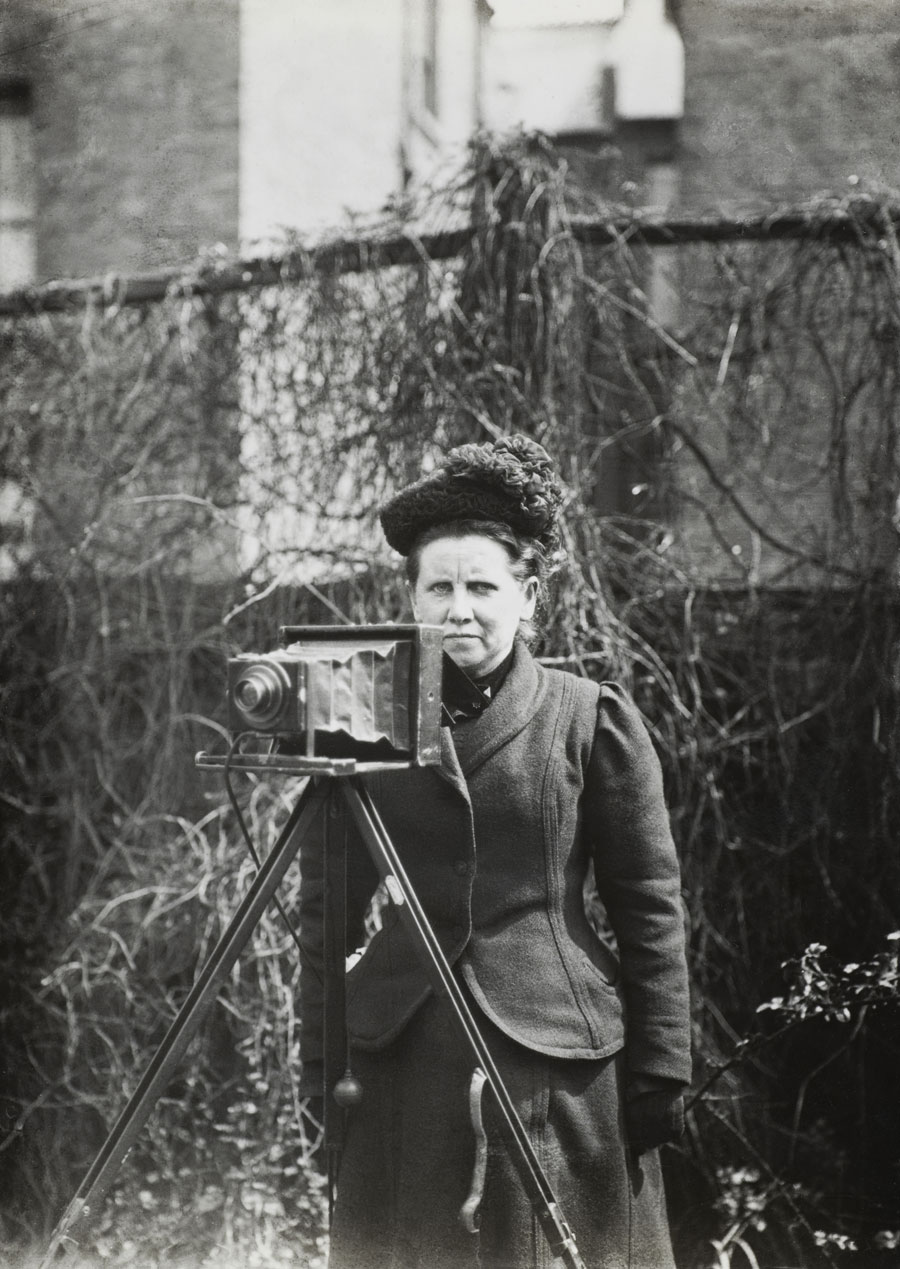
Exhibition: ‘Raja Deen Dayal: King of Indian Photographers’ at Cleveland Museum of Art

Exhibition dates: 23rd April 2023 – 4th February 2024
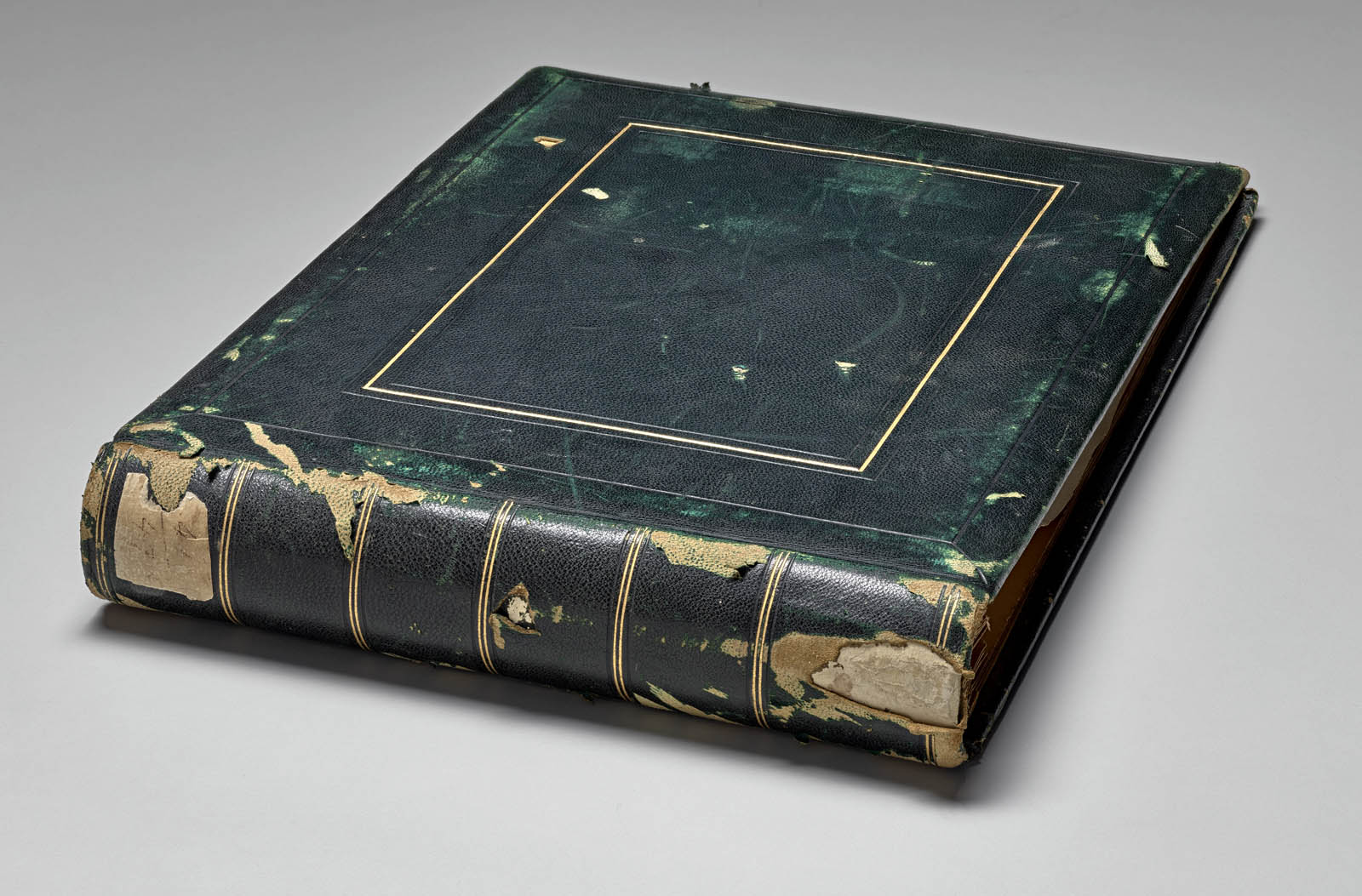
 

Raja Deen Dayal (Indian, 1844-1905) 'Album of 37 photographs' c. 1887-1888


Raja Deen Dayal (Indian, 1844-1905)
Album of 37 photographs
c. 1887-1888
37 albumen prints
Cleveland Museum of Art
Purchase from the J. H. Wade Fund


There are some beautiful photographs in this mid-week posting by the most eminent Indian photographer of the 19th century, Raja Deen Dayal (Indian, 1844-1905).

Dayal had access to the upper echelons of British and Indian society where he photographed in the Western tradition of formal portraiture and more personal views of the British occupiers and Indian nobility, namely the Maharaja of the semi-independent “princely states” of central India.

“Dayal posed and composed Indian royalty exactly as he did his photographs of British leadership, with the most important person in the center, often surrounded by advisers and subordinates. Head-on to the camera, stately but not overly formal, viceroys and rajahs alike became accessibly human but at imposing removes.”1


Will Heinrich in an article for the New York Times observes that what really stands out, what is really shocking are “the rows of Indian servants lined up like stiff accessories behind rickshaws, buggies and English garden parties” and the fact that “they were photographed that way by an Indian photographer complicates any easy read of what they mean.” And that none of the Indian servants is identified.

This should not be shocking at all… for the Indian world, as the British world, was all about status and power. You can see British servants lined up outside and behind the owners of stately homes in the United Kingdom. And they won’t be named. That’s because their social status made them invisible in name if not in physical appearance. They were servants.

And it should come as no surprise that Dayal photographs Indians in the way that he does because he aspired to enter the highest levels of British and Indian society – through his talent yes but also using that talent to advance his social climbing and social standing. By imitating Westernised portraiture of the ruling class both British and Indian, he sought to cement his stature as one of the country’s top photographers, picturing both the country and people through “an archive of depictions of meaningful sites, important occasions, and significant people that was essential to running a profitable studio.”

He took photographs of superb pictorial refinement and luxurious tonality. Through his talent and business acumen he became a man of importance, he had access to the upper echelons of society and his name is still known today … unlike all the anonymous men (and one woman) who are lost to the mists of time.

Dr Marcus Bunyan

1/ Will Heinrich. “The Photographer Who Immortalized British Viceroys and Maharajahs,” on The New York Times website August 31st, 2023 [Online] Cited 04/09/2023


Many thankx to the Cleveland Museum of Art for allowing me to publish the photographs in the posting. Please click on the photographs for a larger version of the image.
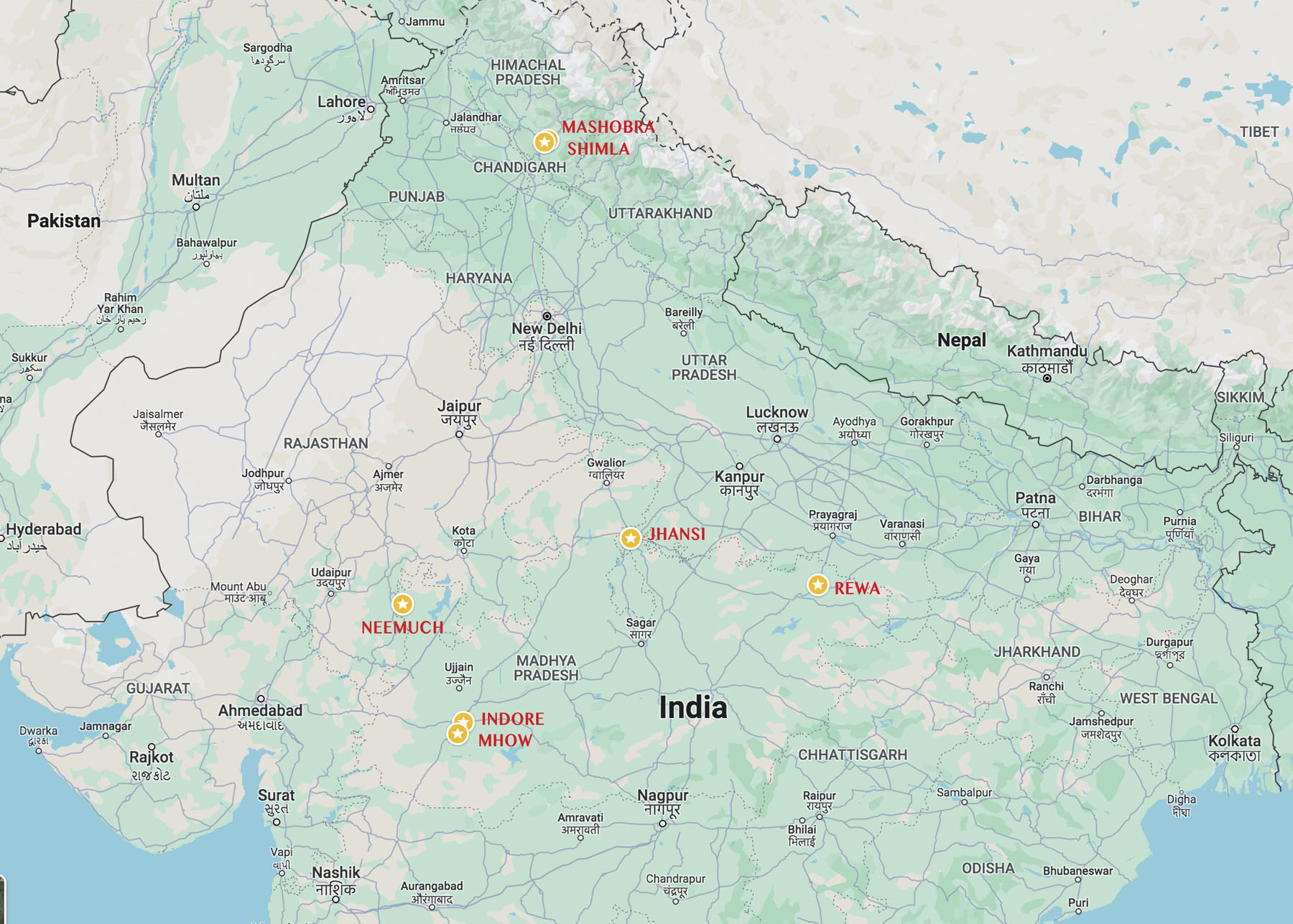


A map of central and northern India showing some of the cities where Dayal took photographs in this posting


A map of central and northern India showing some of the cities where Dayal took photographs in this posting.
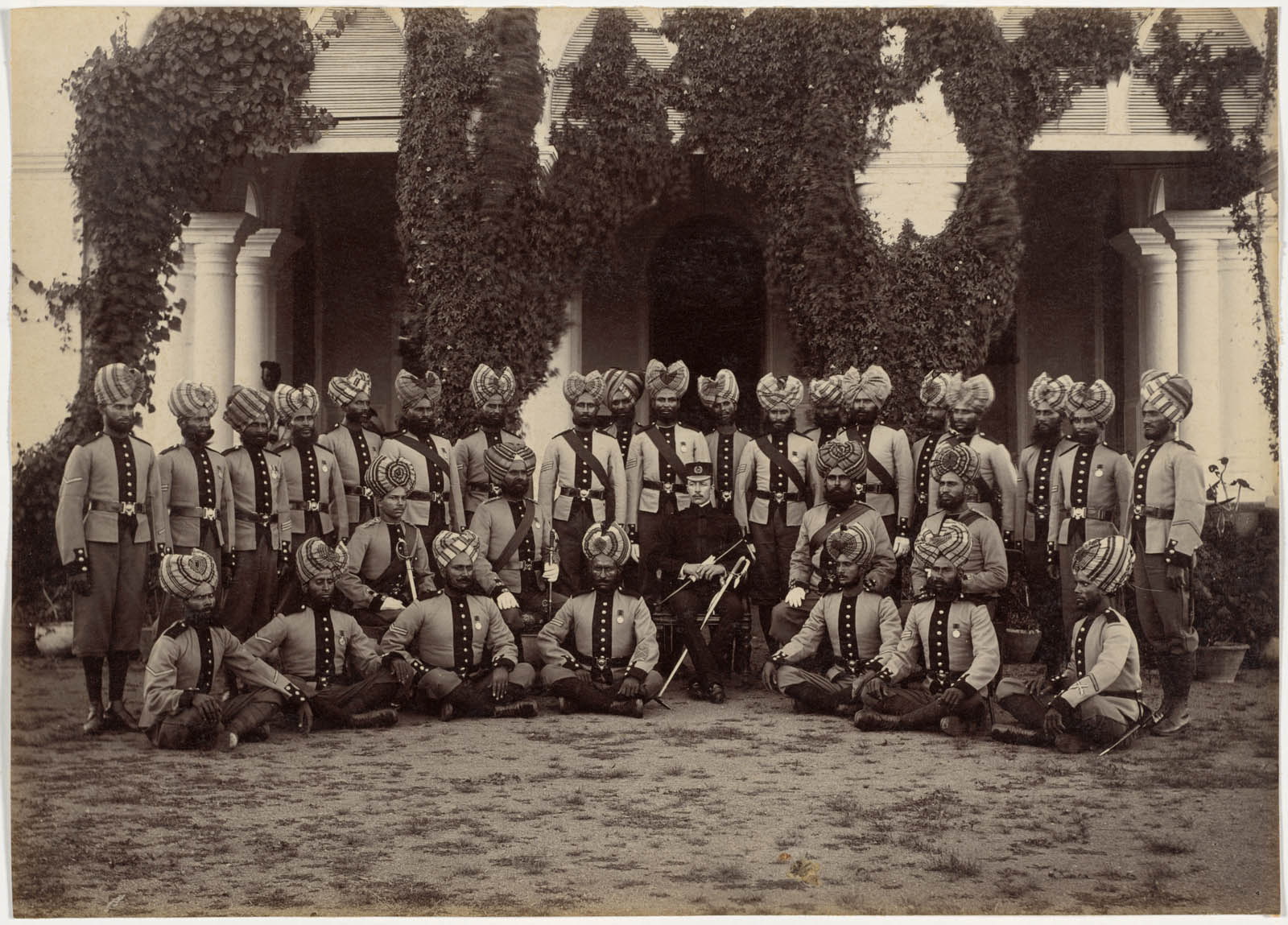
 

Raja Deen Dayal (Indian, 1844-1905) 'Detachment of Bhopal Battalion at Indore' 1886


Raja Deen Dayal (Indian, 1844-1905)
Detachment of Bhopal Battalion at Indore
1886
Albumen print
Image: 19.1 x 26.5cm (7 1/2 x 10 7/16 in.)
Paper: 19.1 x 26.5cm (7 1/2 x 10 7/16 in.)
Cleveland Museum of Art
Purchase from the J. H. Wade Fund


In state and military portraits, people seated in chairs and in the middle are generally of the highest rank. Amid these Indian soldiers sits a lone British officer. The Bhopal Battalion had seen combat just six years earlier during the Second Anglo-Afghan War, helping to keep Afghanistan a British-friendly buffer against Russia’s desire to expand into India. This detachment includes a number of Sikhs, identifiable by their neatly trimmed beards and turbans that cover their ears. Members of that religious group were avidly recruited by the British Indian Army due to their reputed ferocity and courage in battle.
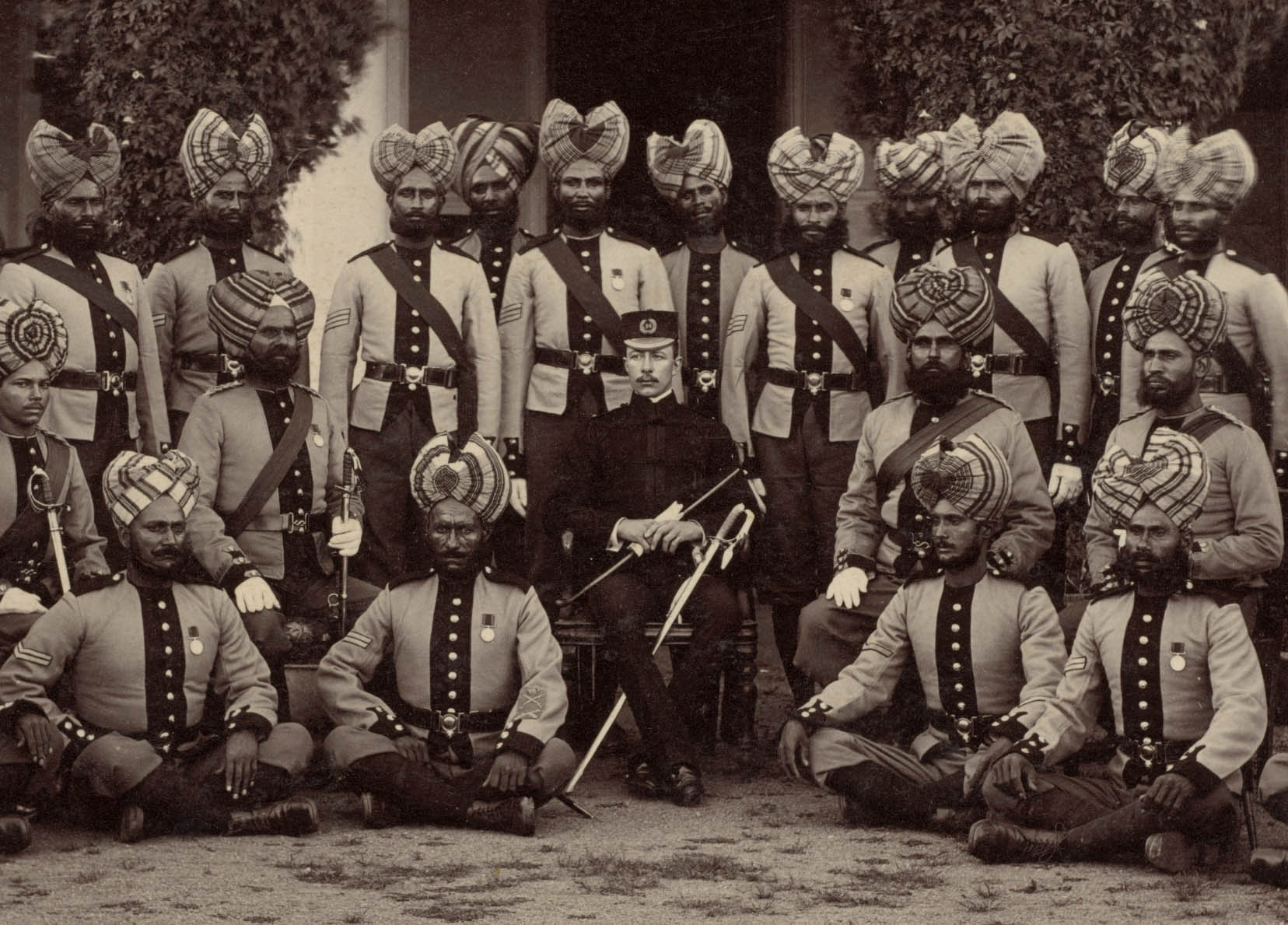
 

Raja Deen Dayal (Indian, 1844-1905) 'Detachment of Bhopal Battalion at Indore' 1886 (detail)


Raja Deen Dayal (Indian, 1844-1905)
Detachment of Bhopal Battalion at Indore (detail)
1886
Albumen print
Image: 19.1 x 26.5cm (7 1/2 x 10 7/16 in.)
Paper: 19.1 x 26.5cm (7 1/2 x 10 7/16 in.)
Cleveland Museum of Art
Purchase from the J. H. Wade Fund
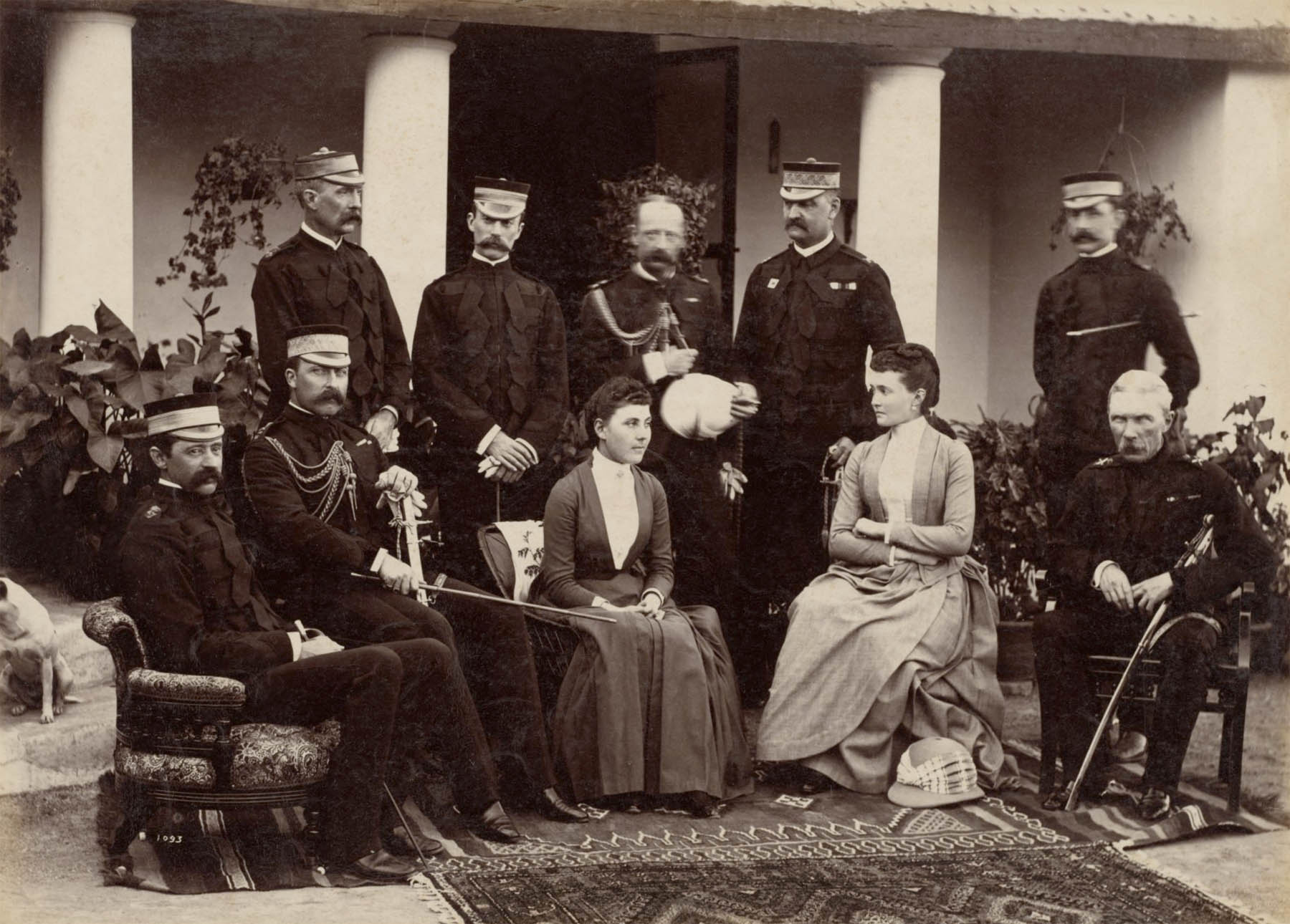
 

Raja Deen Dayal (Indian, 1844-1905) 'The Duke and Duchess of Connaught, with Col. Adam, Captain H.V. Benett, Col. Becher, Gen. Knowles, Captain Herbert, Col. Cavaye, Mrs. Cavaye, and Gen. R. Gellispie, Mhow' 1887


Raja Deen Dayal (Indian, 1844-1905)
The Duke and Duchess of Connaught, with Col. Adam, Captain H.V. Benett, Col. Becher, Gen. Knowles, Captain Herbert, Col. Cavaye, Mrs. Cavaye, and Gen. R. Gellispie, Mhow
1887
Albumen print
Image: 19.1 x 26.6cm (7 1/2 x 10 1/2 in.)
Paper: 19.1 x 26.6cm (7 1/2 x 10 1/2 in.)
Purchase from the J. H. Wade Fund


This gathering of British military officers was occasioned by the visit of Queen Victoria’s seventh child, Prince Arthur, Duke of Connaught and Strathearn (1850-1942) (seated, second from left). His wife, Princess Louise Margaret of Prussia, is the woman on the right. As commander in chief of the Bombay Presidency from 1886 to 1890, the prince performed military inspections and embarked on diplomatic missions throughout India. Dignitaries’ visits were routinely commemorated with a professional photograph. The photographer often took the image for free, counting on the purchase of prints by those wanting to feature the dignitary in their parlours on walls and tables or in albums.


In 2016, the museum acquired 37 photographs made by Raja Deen Dayal (1844-1905), hailed as the first great Indian photographer. This exhibition marks the Cleveland debut of these rare images, all of which come from a single album and were shot in 1886 and 1887, an important juncture in the artist’s life. On display alongside Dayal’s photographs are historical Indian paintings, textiles, clothing, and jewellery from the museum’s collection. These objects provide viewers with insight into the cultural context and help translate the objects in the photographs from monochrome into colour.

Dayal was a surveyor working for the British government when he took up photography as a hobby in 1874. In 1885, he attempted to make it his career and by 1887 had cemented his stature as one of the country’s top photographers, British or Indian. This rare early album pictures both the maharajas of princely India and the British colonial elite.

Dayal produced formal portraits but also more personal views of the Indian nobility. In a moving portrait of a 10-year-old maharaja, Dayal reveals the boy beneath the crown. Weighed down by necklaces and jewels, he occupies a chair that is too tall for him; his stockinged feet curl under so they touch the ground.

Dayal’s talent also won him access to the highest levels of British society. He photographed government meetings and leisurely afternoons of badminton and picnics, costume parties, and even a private moment of communion between an Englishman and his bulldog. Dayal portrayed how the British brought England with them to India and in some images, the Indian servants who supported that lifestyle. The photographer cultivated his relationship with the military by documenting troop manoeuvres, several views of which are included.

Visually striking, seductively charming, and highly informative, these photographs and objects offer new insights into the early career of India’s most important 19th-century photographer and into British and Indian life at the height of the colonial “Raj.”

Text from the Cleveland Museum of Art website
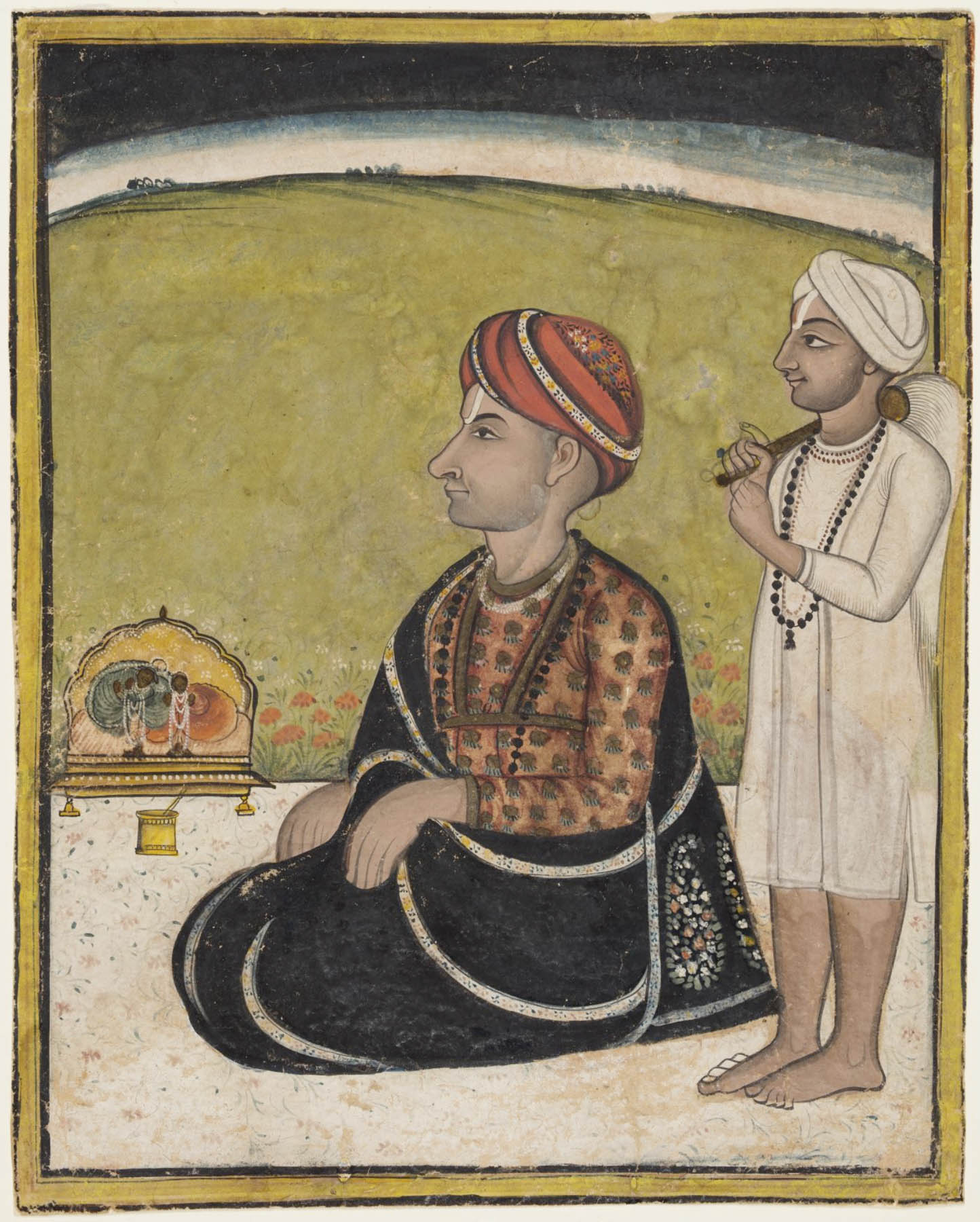
 

Unknown artist (Central India, Madhya Pradesh) 'A Ruler Seated on a Terrace Worshipping at a Shrine of Radha and Krishna' c. 1800


Unknown artist (Central India, Madhya Pradesh)
A Ruler Seated on a Terrace Worshipping at a Shrine of Radha and Krishna
c. 1800
Gum tempera and gold on paper
25.1 x 20cm (9 7/8 x 7 7/8 in.)
Purchase and partial gift from the Catherine and Ralph Benkaim Collection; Severance and Greta Millikin Purchase Fund


A noble clad in a black woollen shawl and a red turban, both with delicate floral embroidery, kneels before a small shrine with icons of Krishna fluting alongside his lover Radha. An attendant dressed in white holds a fly whisk that denotes the kneeling figure’s royal status. The black sky with light horizon suggests that the sun has recently set. In spite of the individualised facial features, this noble remains unidentified. Both figures have rosaries of rudraksha beads usually worn by followers of Shiva, instead of Krishna.
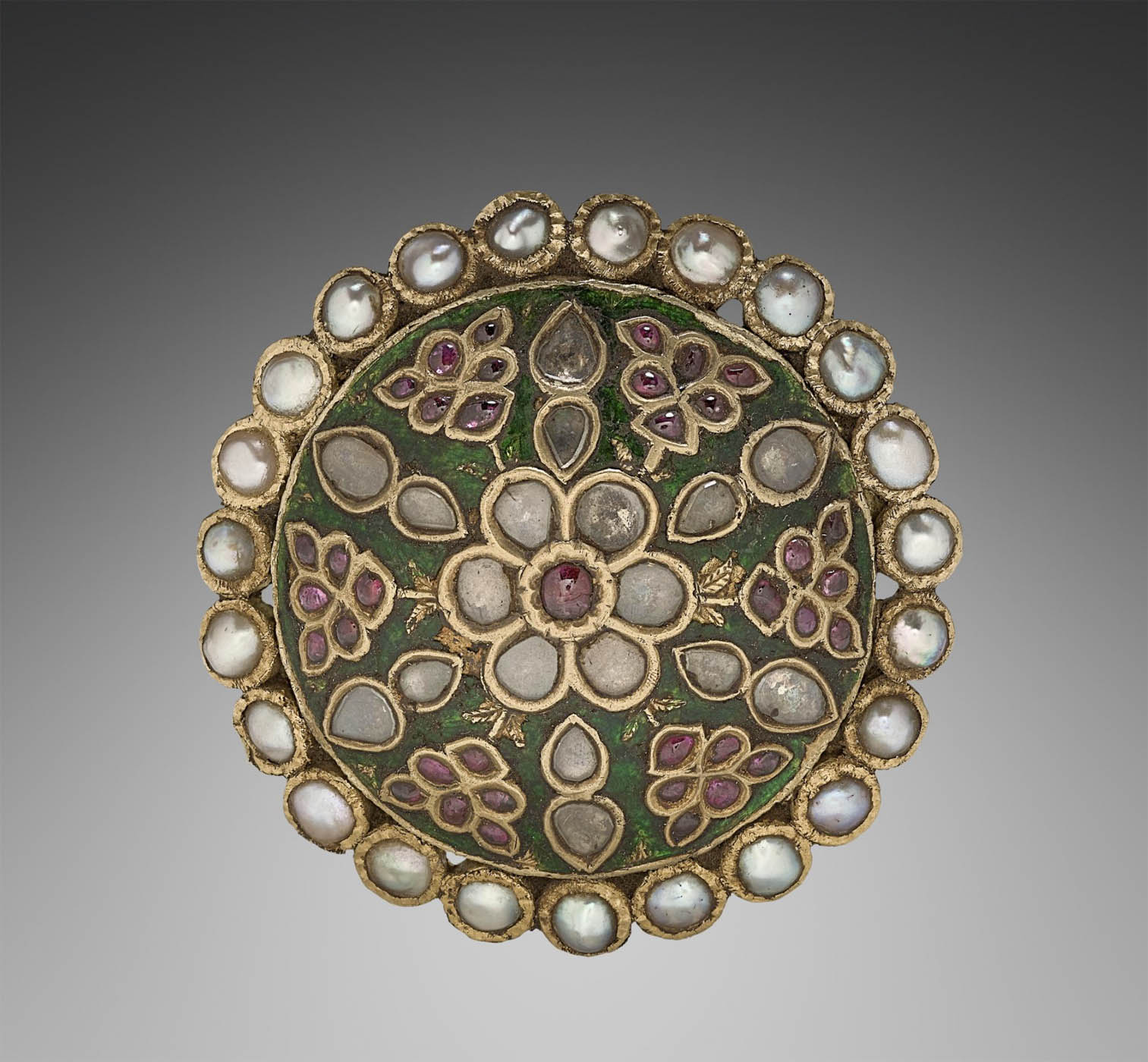
 

Unknown maker (Indian) 'Ornament' 1800s


Unknown maker (Indian)
Ornament

1800s
Gold with green enamel ground, white sapphires, rubies, and pearls
Diameter: 5.2 cm (2 1/16 in.)
Gift of Mr. and Mrs. J. H. Wade


Circular ornaments were worn as pendants, sewn onto textiles, or pinned into hair. The decorative motif made of colourful gems depicting flowering plants was introduced during the reign of the Mughal emperor Shah Jahan (1628-1658) and remained popular through the 1800s.
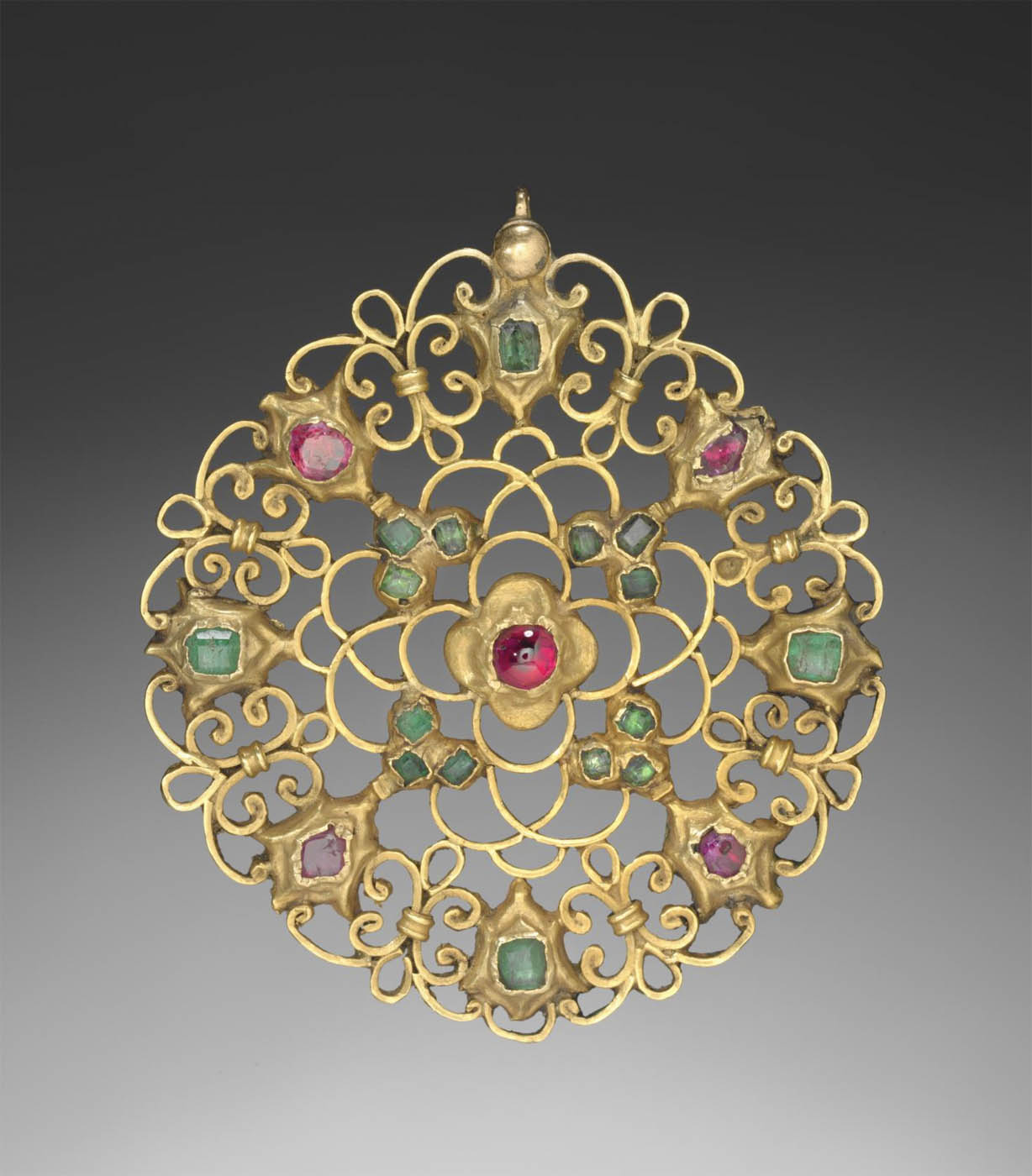
 

Unknown maker (Indian) 'Medallion' 1800s


Unknown maker (Indian)
Medallion
1800s
Silver gilt with rubies and emeralds
Diameter: 5.4 cm (2 1/8 in.)
Gift of Mr. and Mrs. J. H. Wade


Circular ornaments were worn as pendants, sewn onto textiles, or pinned into hair. The decorative motif made of colorful gems depicting flowering plants was introduced during the reign of the Mughal emperor Shah Jahan (1628-1658) and remained popular through the 1800s.
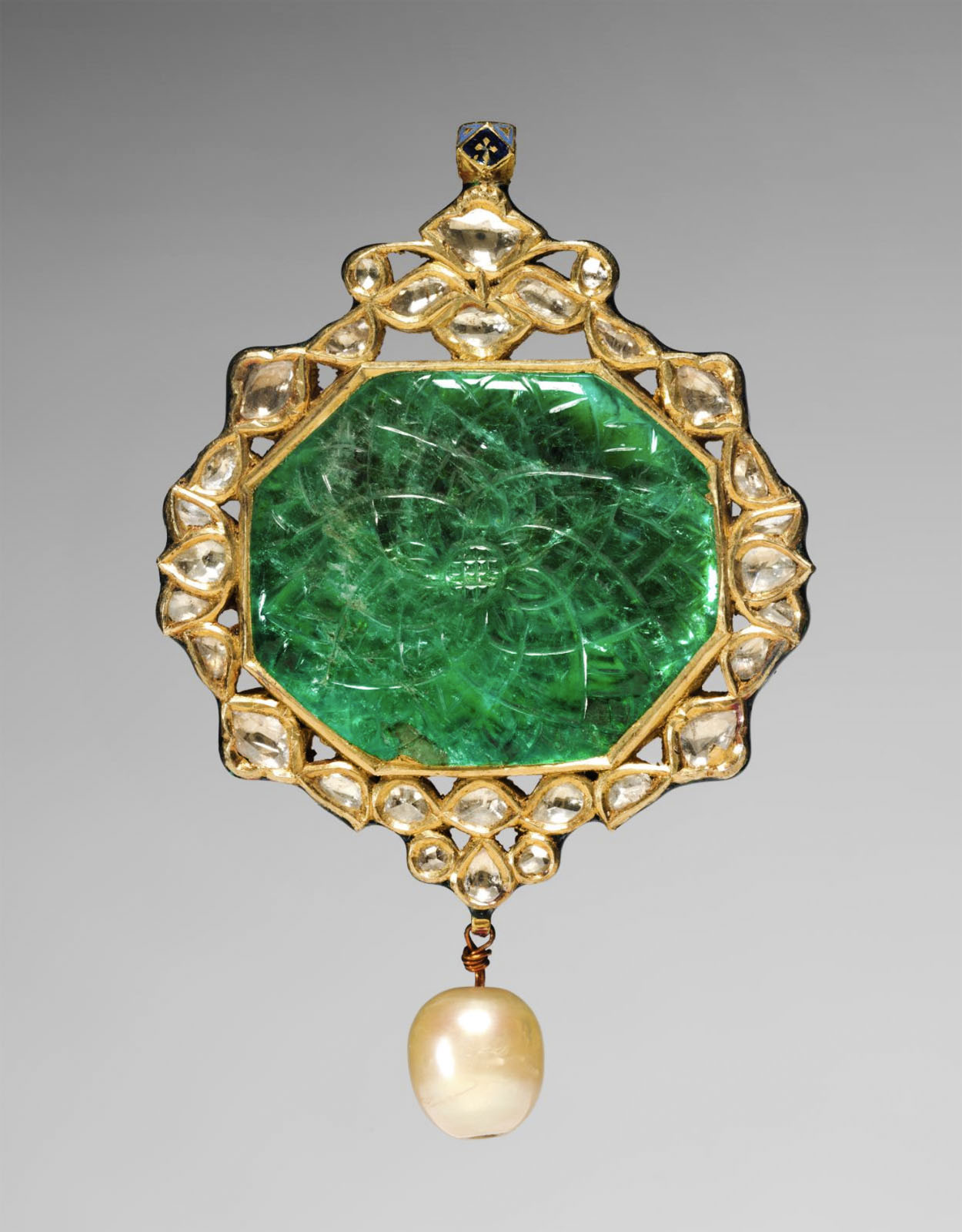
 

Unknown maker (Indian) 'Pendant'  1700s


Unknown maker (Indian)
Pendant 
1700s
Northwestern India, Rajasthan, Rajput Kingdom of Jaipur
Gold, emerald, diamonds, enamel, and pearl
Overall: 7.4 x 4.8 cm (2 15/16 x 1 7/8 in.)
Bequest of Anne Jessop Smith


The large green emerald on one side of this pendant was probably imported to India from Columbia. Delicately incised with a lotus blossom, a symbol of the sun, it is surrounded by inset diamonds in organic, petal-like shapes. Emeralds, especially prized for their green colour, were associated with the planet Mercury in Hindu astrology and with the power to ward off evil in Islam. On the reverse, a peacock and two peahens surrounded by flowers are rendered using blue, green, and red glass.
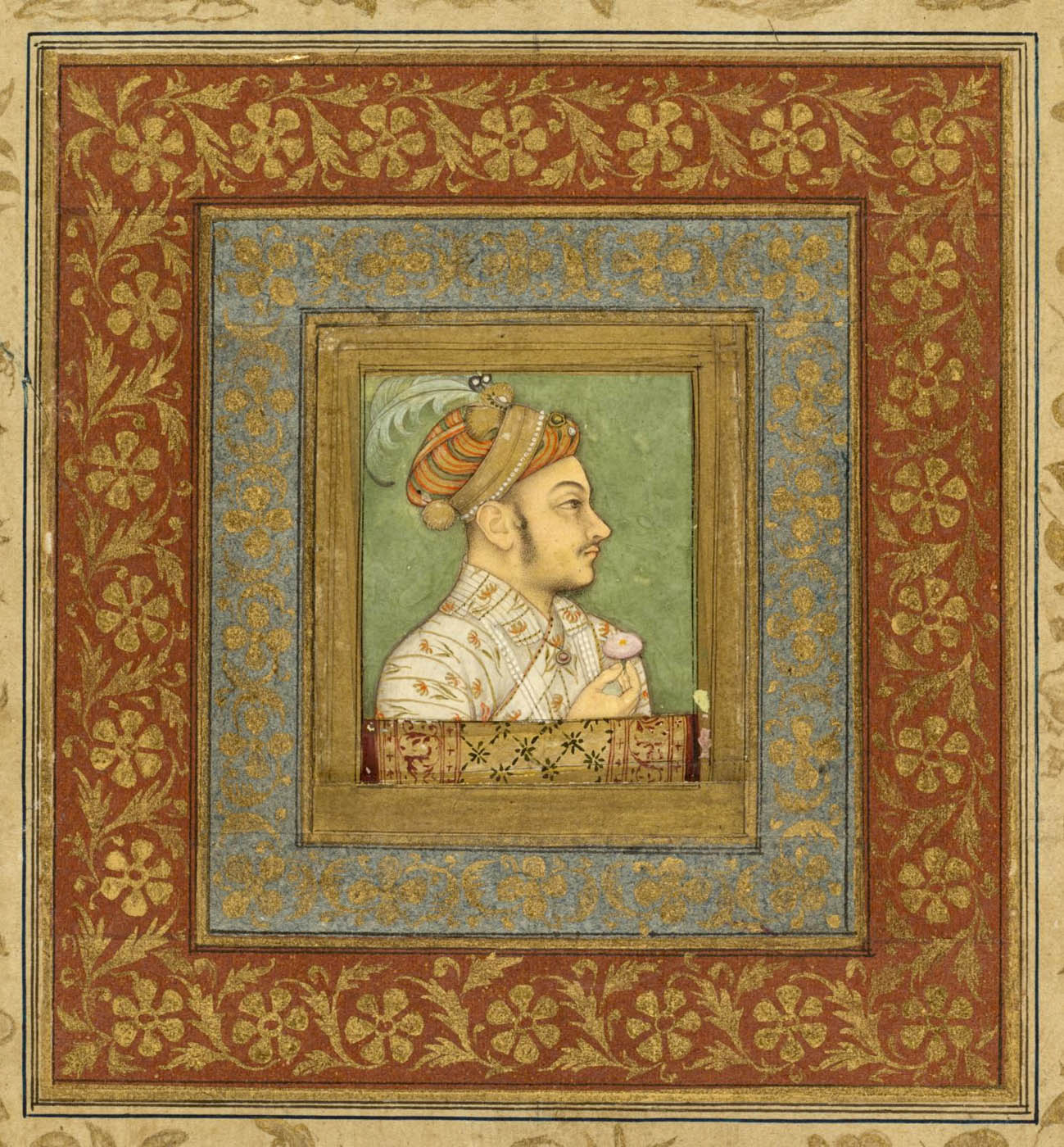
 

Attributed to Balchand (Indian, active 1595 - c. 1650) 'Portrait of Murad Bakhsh (1624-1661)' c. 1635; borders c. 1700s


Attributed to Balchand (Indian, active 1595 – c. 1650)
Portrait of Murad Bakhsh (1624-1661)
c. 1635; borders c. 1700s
Mughal India, court of Shah Jahan (reigned 1628-1658)
Gum tempera and gold on paper
Overall: 28.4 x 25.7cm (11 3/16 x 10 1/8 in.)
Painting: 4.3 x 3.5cm (1 11/16 x 1 3/8 in.)
Gift in honour of Madeline Neves Clapp; Gift of Mrs. Henry White Cannon by exchange; Bequest of Louise T. Cooper; Leonard C. Hanna Jr. Fund; From the Catherine and Ralph Benkaim Collection


The miniature portrait of a Mughal prince is now mounted on an album page. Originally, it was in a gemstone setting as a “portrait jewel” to be worn by family and supporters at court. India’s ruling elite had been wearing portrait jewels since Sir Thomas Rowe (about 1581-1655) presented British portrait miniatures and cameos to the Mughal emperor as part of a diplomatic gift in 1616, when he successfully negotiated for British access to India’s ports.
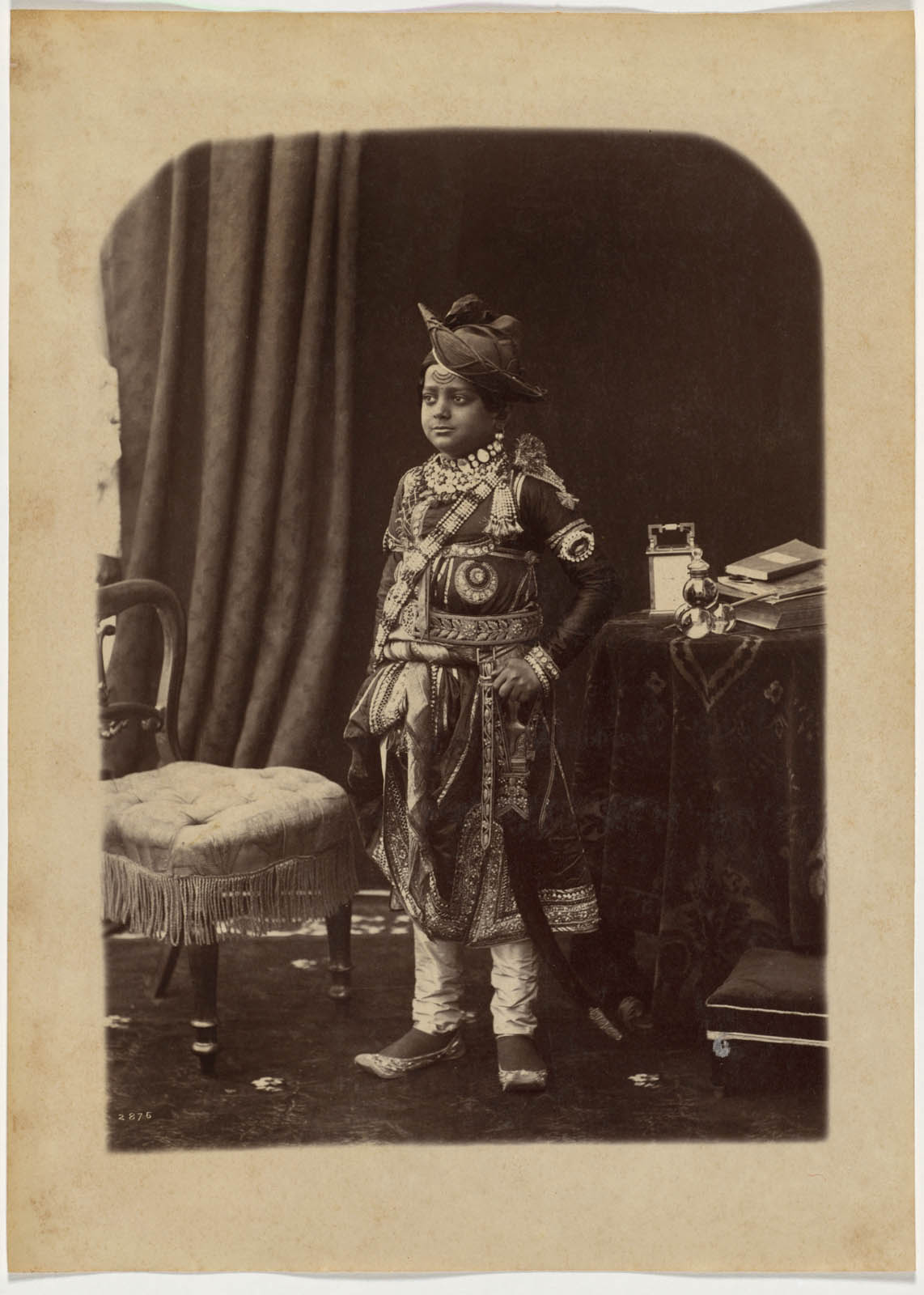
 

Raja Deen Dayal (Indian, 1844-1905) 'His Highness Maharaja Scindia of Gwalior' 1887


Raja Deen Dayal (Indian, 1844-1905)
His Highness Maharaja Scindia of Gwalior
1887
Albumen print
Image: 25.5 x 18.4cm (10 1/16 x 7 1/4 in.)
Paper: 25.5 x 18.4cm (10 1/16 x 7 1/4 in.)
Cleveland Museum of Art
Purchase from the J. H. Wade Fund


Ten-year-old Madho Rao Scindia, the Maharaja of Gwalior (1876-1925; reigned 1886-1925), inherited the throne one year before this photograph was taken. Acceptance of both Indian and British cultural influences can be seen in the contrast of his garb, which is Indian from turban to shoe, with the Western-style furniture, clock, and books. Reflected in the glass balls on the table, which may be an inkwell or perfume jar, are the other people in the room during the shot. The person on the left in the top ball may be the photographer, Lala Deen Dayal.
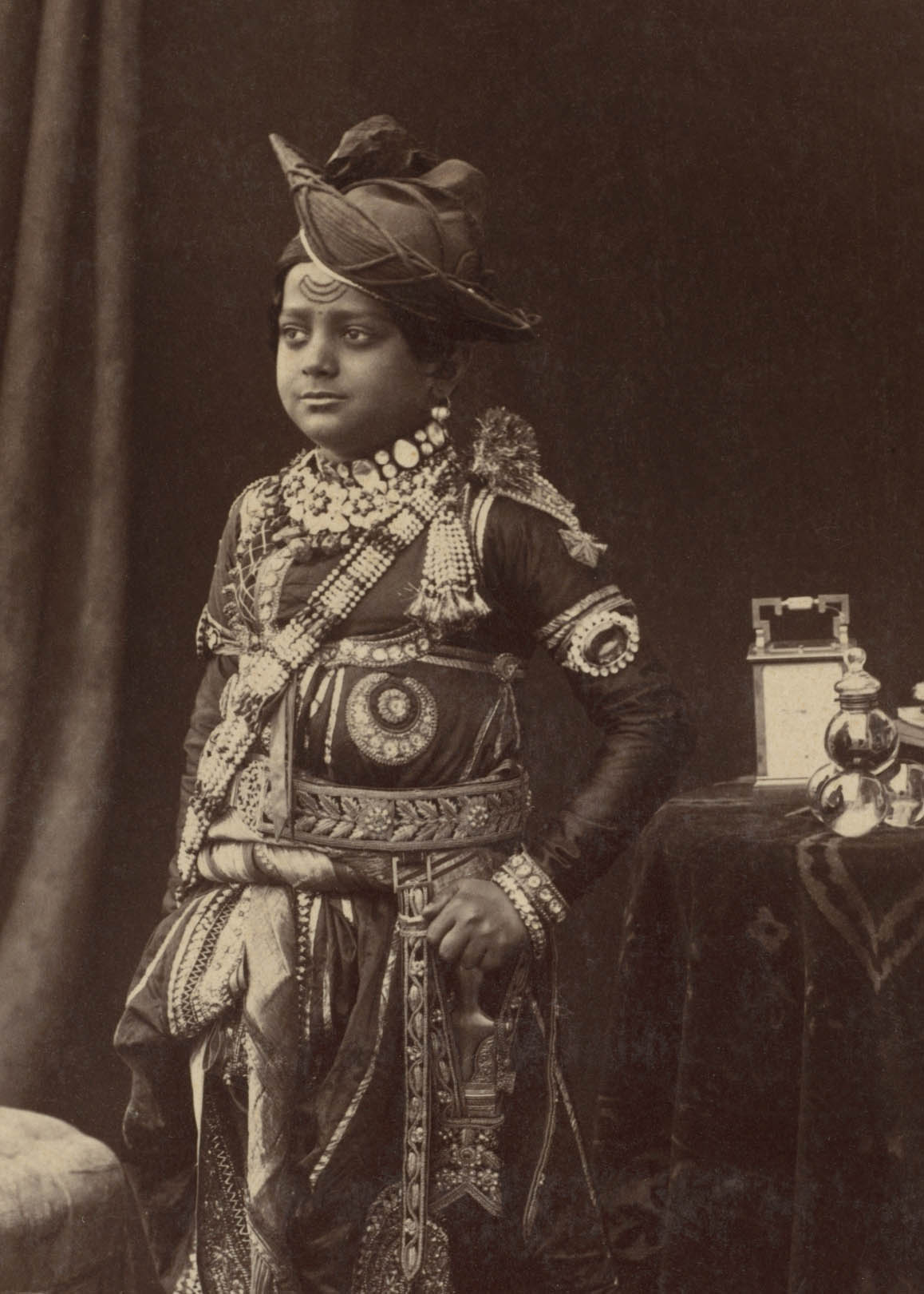
 

Raja Deen Dayal (Indian, 1844-1905) 'His Highness Maharaja Scindia of Gwalior' 1887 (detail)


Raja Deen Dayal (Indian, 1844-1905)
His Highness Maharaja Scindia of Gwalior (detail)
1887
Albumen print
Image: 25.5 x 18.4cm (10 1/16 x 7 1/4 in.)
Paper: 25.5 x 18.4cm (10 1/16 x 7 1/4 in.)
Cleveland Museum of Art
Purchase from the J. H. Wade Fund


In 1887, a photographer named Lala Deen Dayal took a picture of Frederick Temple-Blackwood, First Marquess of Dufferin and Ava [below]. The men were in Shimla, in the foothills of the Himalayas, because the British colonial government in India moved there every summer to escape the heat of Kolkata. Dufferin was the British viceroy, and Dayal, who had worked as a surveyor for the colonial government before leaving to pursue his passion as a freelancer, was his official photographer.

Dayal posed Dufferin, a short, balding, goateed, intelligent-looking man, at the center of the photo, behind a round table covered in a patterned cloth. To either side of him sit three other men, all seven constituting the Supreme Council of Government of India. Beneath them is an enormous, intricately patterned carpet; behind them, a nondescript curtain and rough wooden walls. They look like what they were: fresh conquerors who hadn’t yet built themselves palaces.

They also look pretty discomfited by the camera in what were still its early days. Two look at the viceroy, who leans aside to deliver some incidental remark; one gazes at the floor; two stare stiffly into nowhere; and only one councillor, like a faint glimmer of self-awareness within the raj, peers suspiciously into the lens.

The photograph became one of a deep file of stock images available in Dayal’s shop. One souvenir album, assembled by an unidentified purchaser and later broken apart, was partially acquired by the Cleveland Museum of Art in 2016. In “Raja Deen Dayal: King of Indian Photographers,” the museum combines this cache of 37 photographs with roughly contemporary miniature paintings and objets to create a small but incisive look at cross-cultural projections of power – Dayal was official photographer to the British military commander in chief, too, as well as to the Nizam of Hyderabad, who gave him the title Raja.

An acute wall label next to “His Eminence Commander in Chief and Party, Simla” [below] draws attention to the tiger skin on the floor, flung carelessly under British feet; beside the photo, on the gallery wall, to illustrate the Indian association of this animal with royalty, hangs a 19th century painting from Rajasthan showing a “Tiger Hunt of Ram Singh II.”

It’s just one of the show’s many examples of the casual degradations of imperial rule, which also include an English-style silver teapot with a goddess for a handle, and a painting of an Indian servant walking British dogs – a mordant wall label notes that Indian art traditionally pictured “dogs and jackals” only in cremation grounds. But it’s the rows of Indian servants lined up like stiff accessories behind rickshaws, buggies and English garden parties that really stand out. They’re shocking, but the fact that they were photographed that way by an Indian photographer complicates any easy read of what they mean.

Also in 1887, give or take a year or two, Dayal made a portrait of “His Highness the Maharaja of Rewa,” one of the semi-independent “princely states” of central India. Draped in gold and jewels, with a stylized footprint of Vishnu painted on his forehead, slumping comfortably sideways in an ornate chair with his stocking feet curled underneath, the boy king is pretty much the opposite of the severely styled Dufferin. But Dayal posed and composed Indian royalty exactly as he did his photographs of British leadership, with the most important person in the center, often surrounded by advisers and subordinates. Head-on to the camera, stately but not overly formal, viceroys and rajahs alike became accessibly human but at imposing removes. In retrospect, Dayal’s pictures aren’t just portraits of royal and imperial power – they’re portraits of the nascent power of photography.

Will Heinrich. “The Photographer Who Immortalized British Viceroys and Maharajahs,” on The New York Times website August 31st, 2023 [Online] Cited 04/09/2023
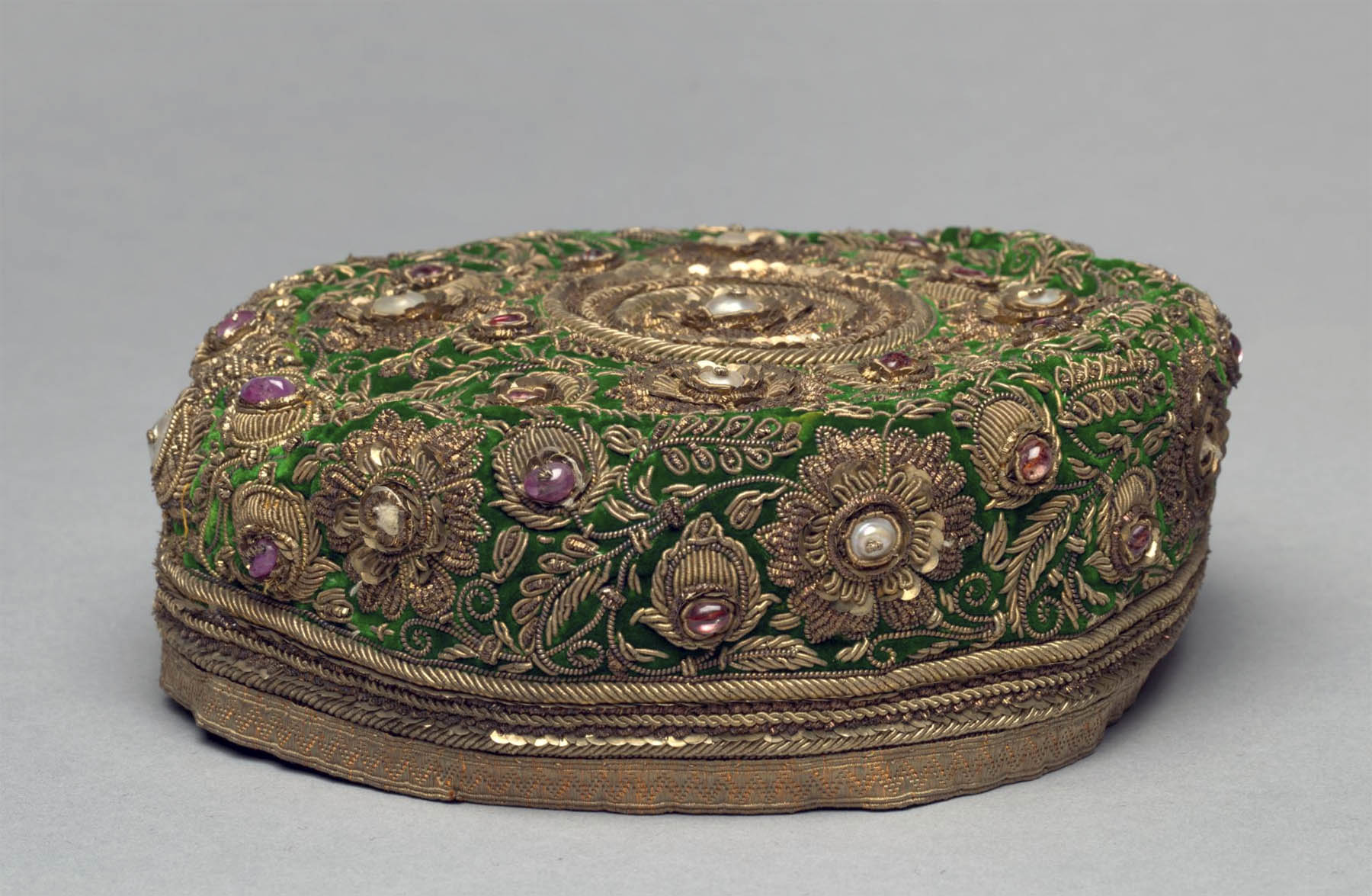
 

Unknown maker (Indian) 'Cap' 1800s


Unknown maker (Indian)
Cap
1800s
Velvet embroidered with gilt-silver–wrapped silk thread (zari); silk: lining; rubies, pearls, and spinels
Overall: 6.3 x 15.2 x 15.2 cm (2 1/2 x 6 x 6 in.)
Gift of Mr. and Mrs. J. H. Wade 1916.1477


Historically in India, head coverings were worn in outdoor and formal contexts and can signal age, allegiance, and status among Indian men and boys. A low round cap such as this was worn primarily by the well-educated aristocratic boys in the king’s circle. The painstaking process of creating the ornament involved wrapping gilt-silver wire of various dimensions around a silk thread core to create a textured appearance for the flowers and vines.
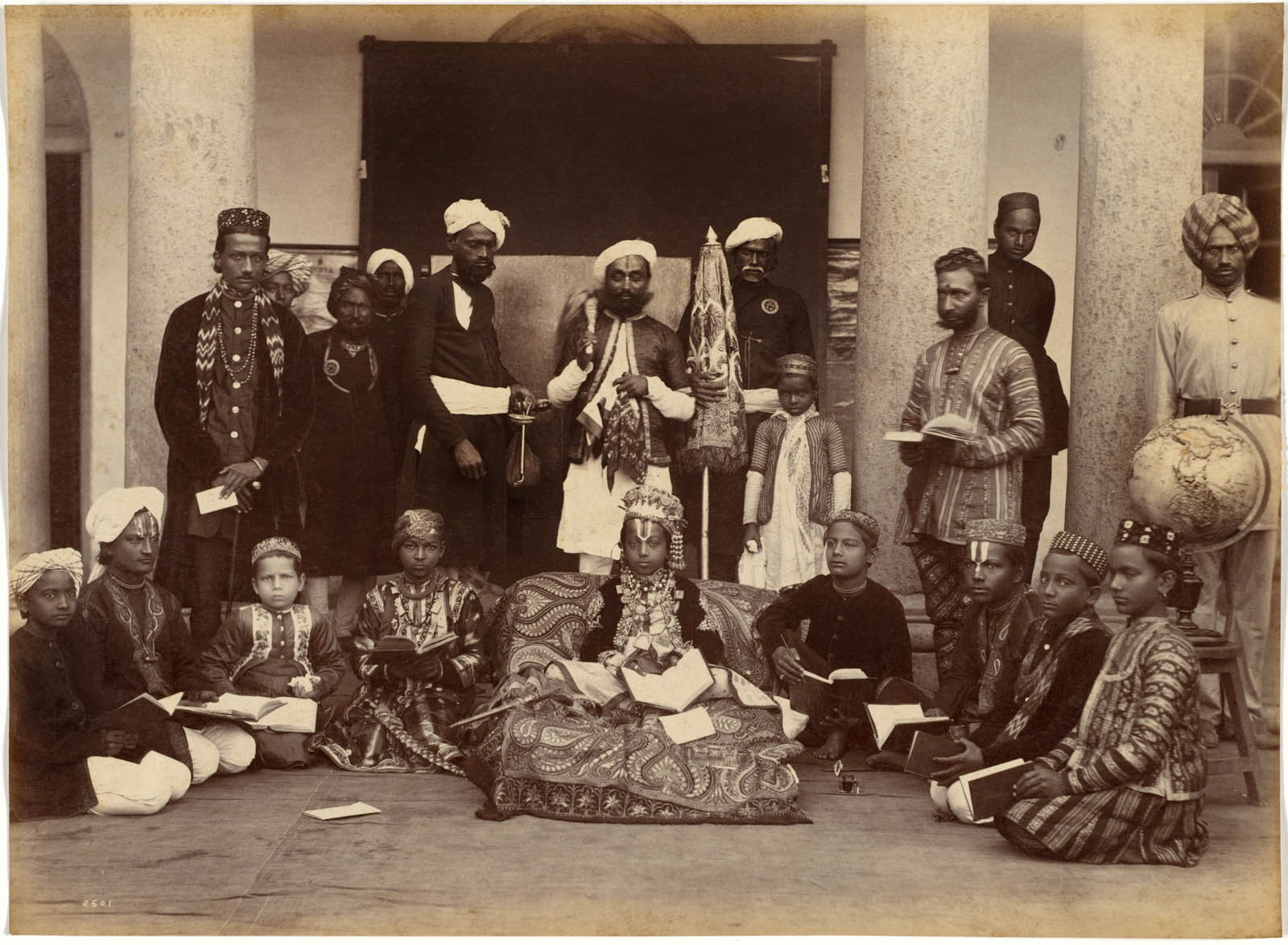
 

Raja Deen Dayal (Indian, 1844-1905) 'Maharaja of Rewa and Classmates' 1886


Raja Deen Dayal (Indian, 1844-1905)
Maharaja of Rewa and Classmates
1886
Albumen print
Image: 19.8 x 27.1cm (7 13/16 x 10 11/16 in.)
Paper: 19.8 x 27.1cm (7 13/16 x 10 11/16 in.)
Cleveland Museum of Art
Purchase from the J. H. Wade Fund


Deen Dayal uses the arrangement of people and the architecture to point to the most important person in the photograph. Here, the Maharaja of Rewa is placed front and center. In this image, the young maharaja is shown with Indian teachers, but the instructional tools are Western: bound books and a raised relief globe (with Asia visible).
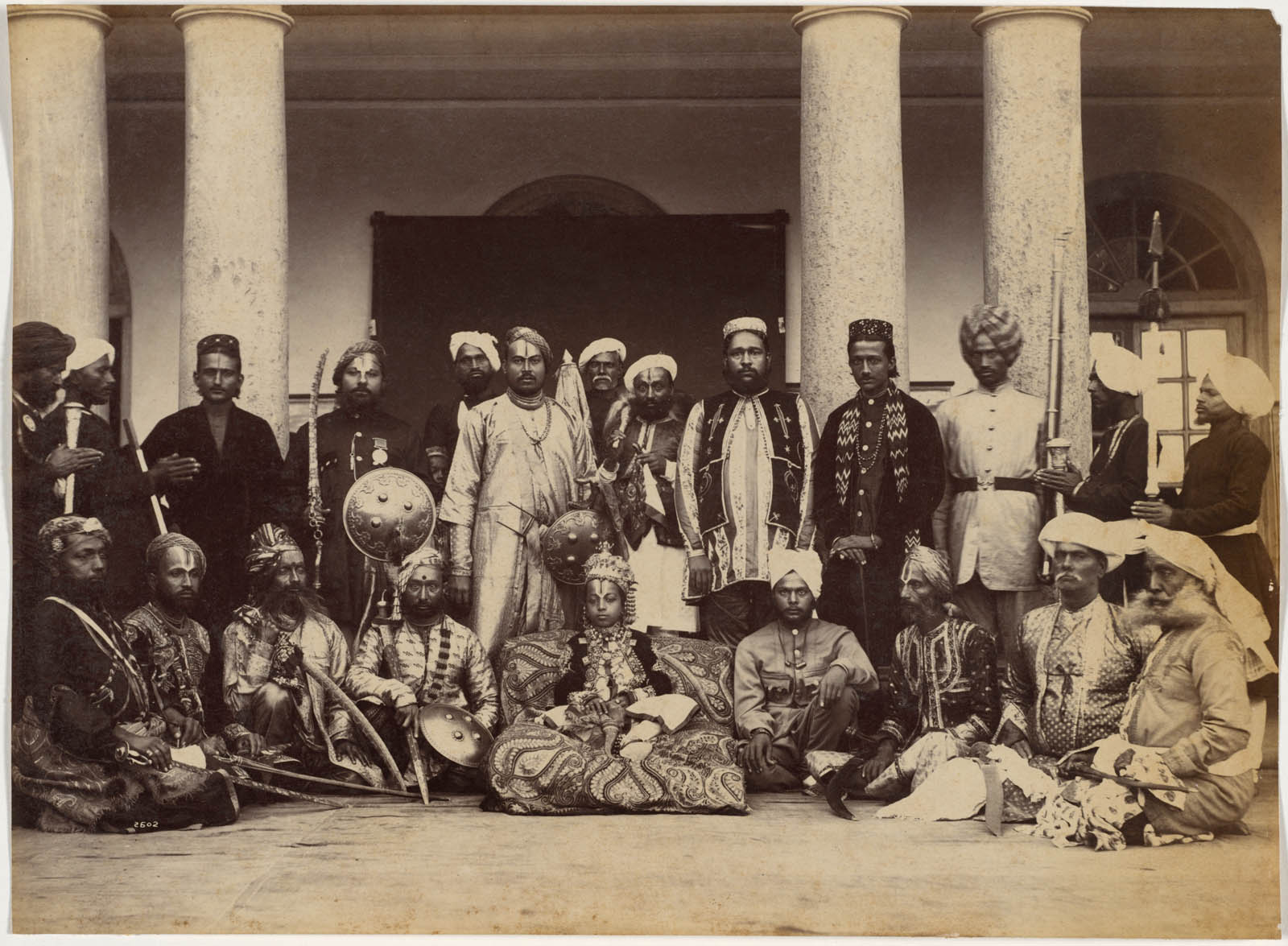
 

Raja Deen Dayal (Indian, 1844-1905) 'Maharaja of Rewa and Sardars' 1886


Raja Deen Dayal (Indian, 1844-1905)
Maharaja of Rewa and Sardars
1886
Albumen print
Image: 19.7 x 26.9cm (7 3/4 x 10 9/16 in.)
Paper: 19.7 x 26.9cm (7 3/4 x 10 9/16 in.)
Cleveland Museum of Art
Purchase from the J. H. Wade Fund


Deen Dayal uses the arrangement of people and the architecture to point to the most important person in the photograph. Here, the Maharaja of Rewa is placed front and centre. “Sardars,” inscribed on the picture’s mount, refers to the military officials surrounding him. After 1858, British influence dictated that Indian rulers be educated in European history and ideas as well as their local culture and history.
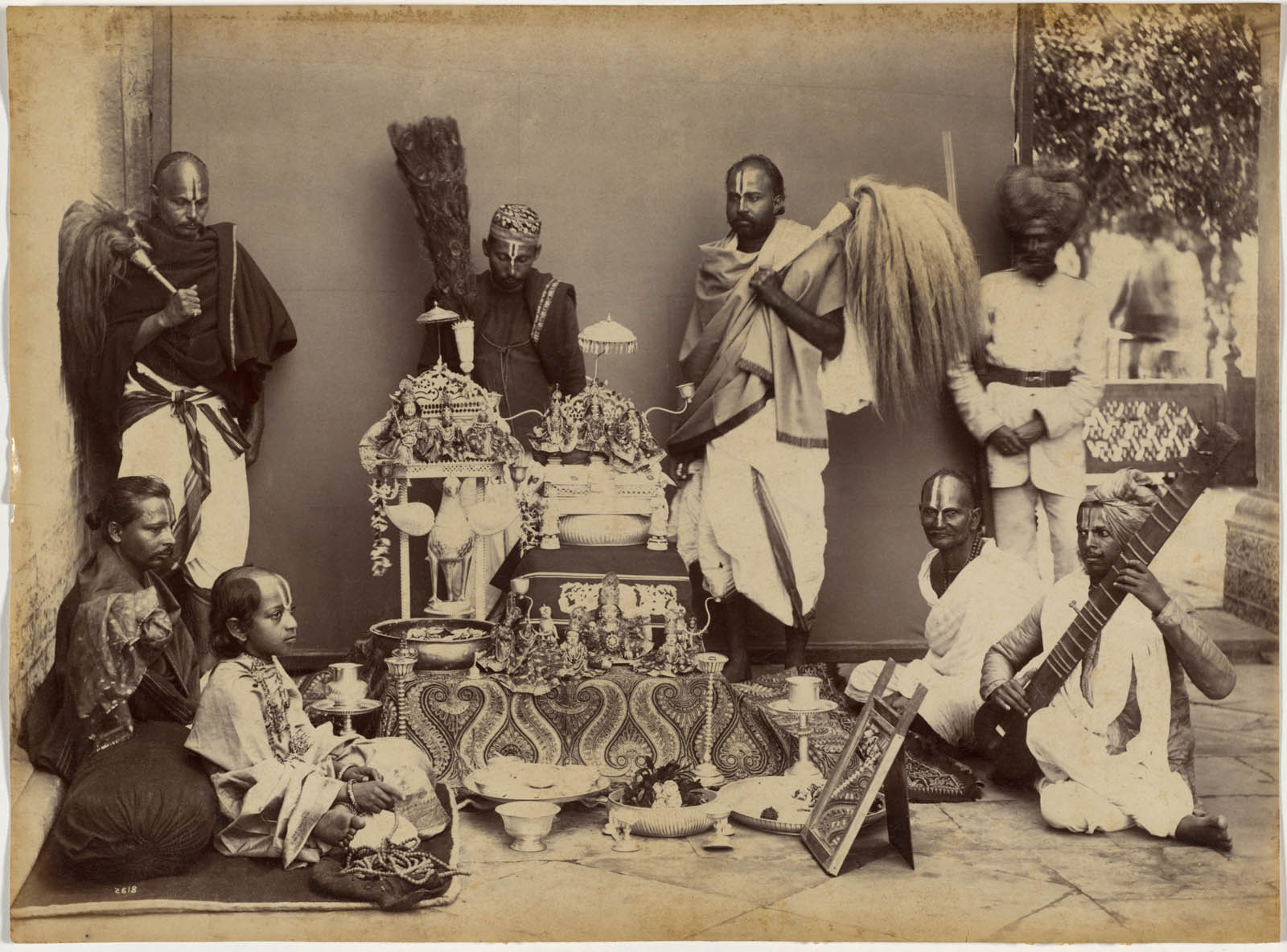
 

Raja Deen Dayal (Indian, 1844-1905) 'Maharaja of Rewa in Prayer' 1886


Raja Deen Dayal (Indian, 1844-1905)
Maharaja of Rewa in Prayer
1886
Albumen print
Image: 20 x 27.2cm (7 7/8 x 10 11/16 in.)
Paper: 20 x 27.2cm (7 7/8 x 10 11/16 in.)
Cleveland Museum of Art
Purchase from the J. H. Wade Fund


Performing religious devotions was part of a maharaja’s duty to protect his kingdom. Praying before an altar, the maharaja fingers prayer beads and sits opposite a mirror, an auspicious object in Hindu worship. The lines painted on the men’s foreheads indicate that they are devotees of the Hindu god Vishnu. This group portrait demonstrates three ways rulers serve the state: by being a military commander, a worldly scholar, and, in this image, an observant Hindu.
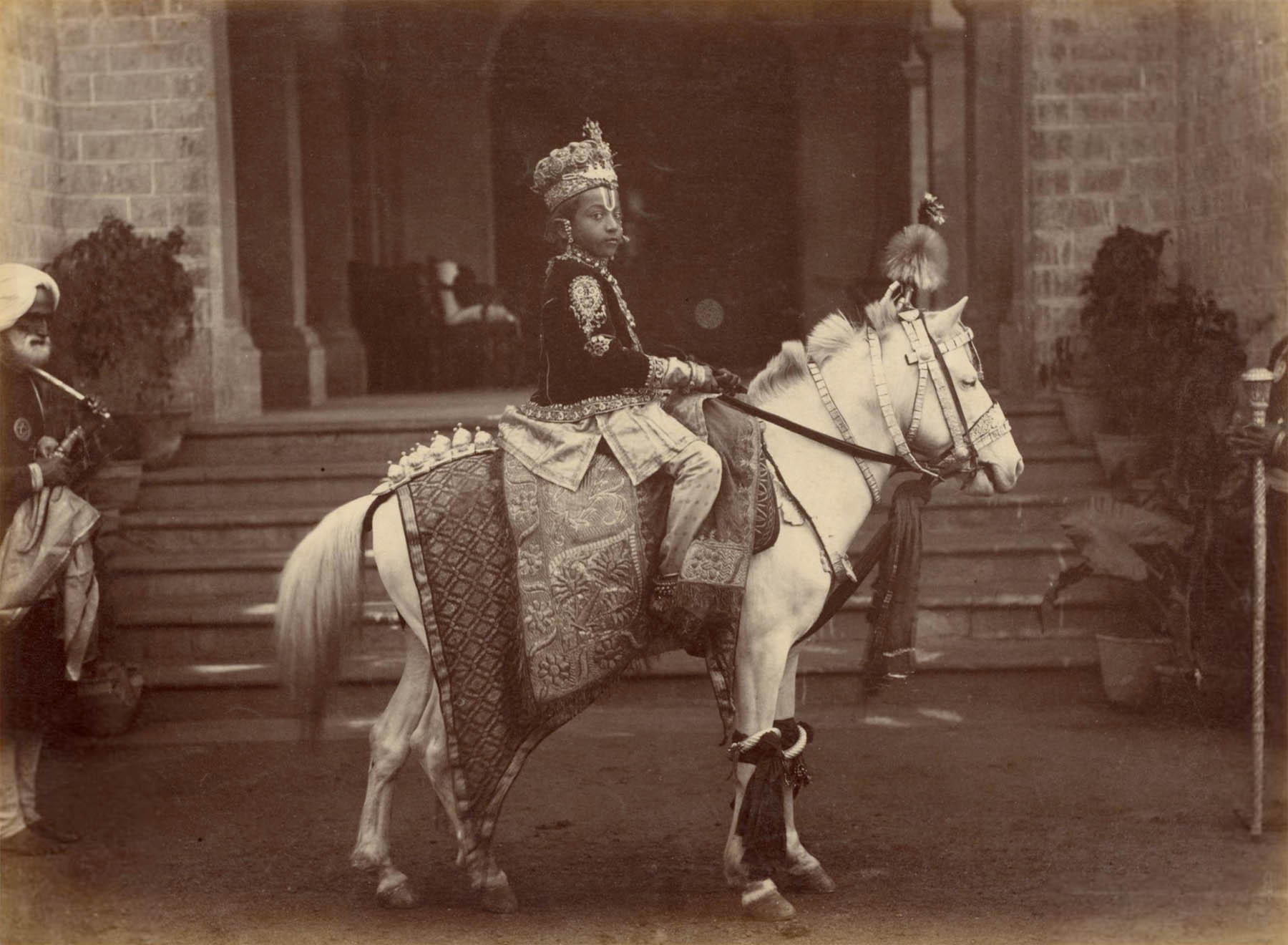
 

Raja Deen Dayal (Indian, 1844-1905) 'His Highness the Maharaja of Rewa' 1886


Raja Deen Dayal (Indian, 1844-1905)
His Highness the Maharaja of Rewa
1886
Albumen print
Image: 20 x 27.2cm (7 7/8 x 10 11/16 in.)
Paper: 20 x 27.2cm (7 7/8 x 10 11/16 in.)
Purchase from the J. H. Wade Fund


Deen Dayal’s status as an Indian person may have helped him gain access to Indian rulers at the start of his career. The year before he received the patronage of British officials, Deen Dayal photographed ten-year-old Venkat Raman Singh (1876-1918; reigned 1880-1918), the Maharaja of Rewa. The studio portrait reveals the boy beneath the crown. He straddles a Western-style chair that is too tall for him, curling under his stockinged feet so they touch the floor. One of his many necklaces holds a painted or photographic portrait similar to the portrait jewel pendant in the nearby case.
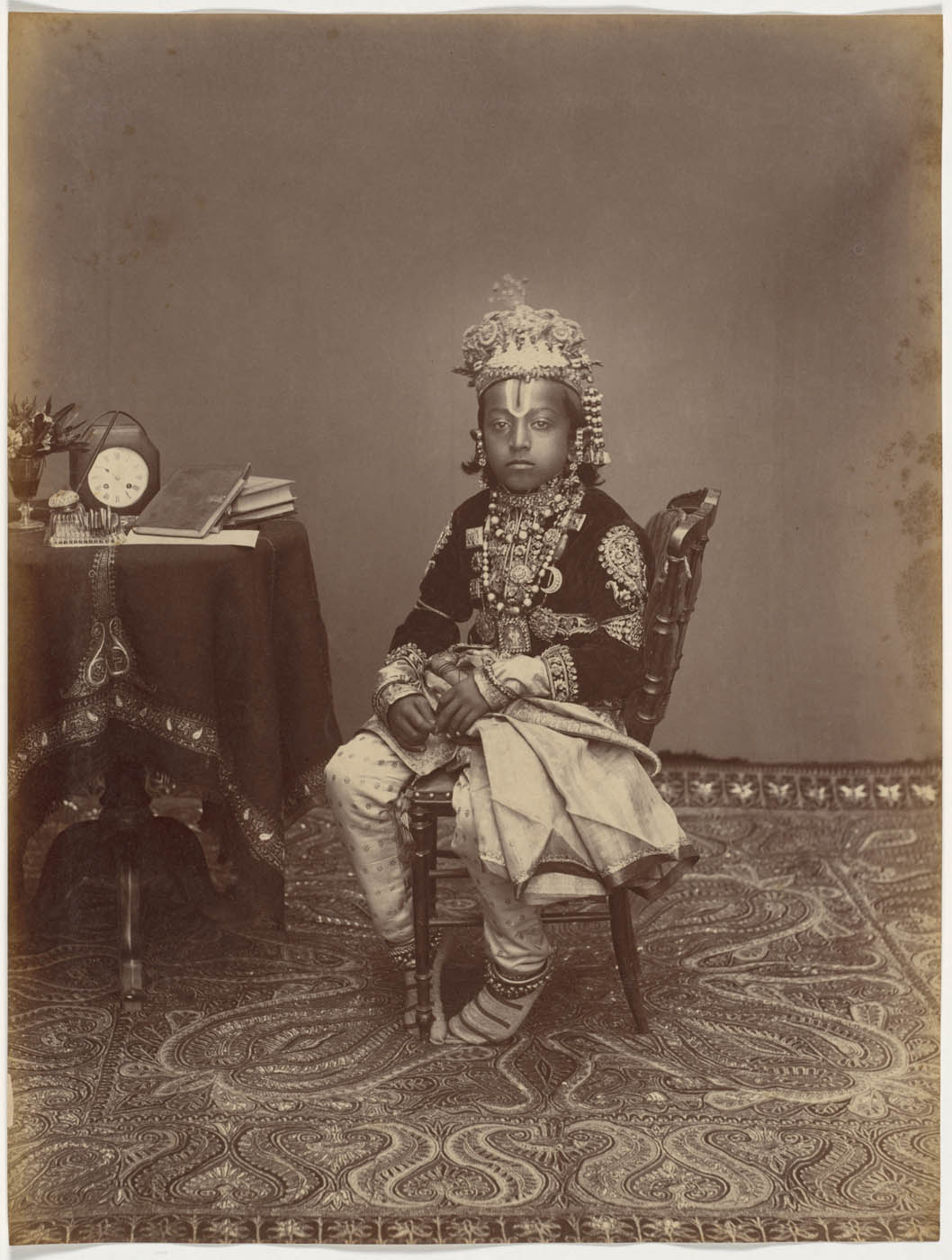
 

Raja Deen Dayal (Indian, 1844-1905) 'His Highness the Maharaja of Rewa' 1886


Raja Deen Dayal (Indian, 1844-1905)
His Highness the Maharaja of Rewa
1886
Albumen print
Image: 26.7 x 20.3cm (10 1/2 x 8 in.)
Paper: 26.7 x 20.3cm (10 1/2 x 8 in.)
Cleveland Museum of Art
Purchase from the J. H. Wade Fund


Deen Dayal’s status as an Indian person may have helped him gain access to Indian rulers at the start of his career. The year before he received the patronage of British officials, Deen Dayal photographed ten-year-old Venkat Raman Singh (1876-1918; reigned 1880-1918), the Maharaja of Rewa. The studio portrait reveals the boy beneath the crown. He straddles a Western-style chair that is too tall for him, curling under his stockinged feet so they touch the floor. One of his many necklaces holds a painted or photographic portrait similar to the portrait jewel pendant in the nearby case.
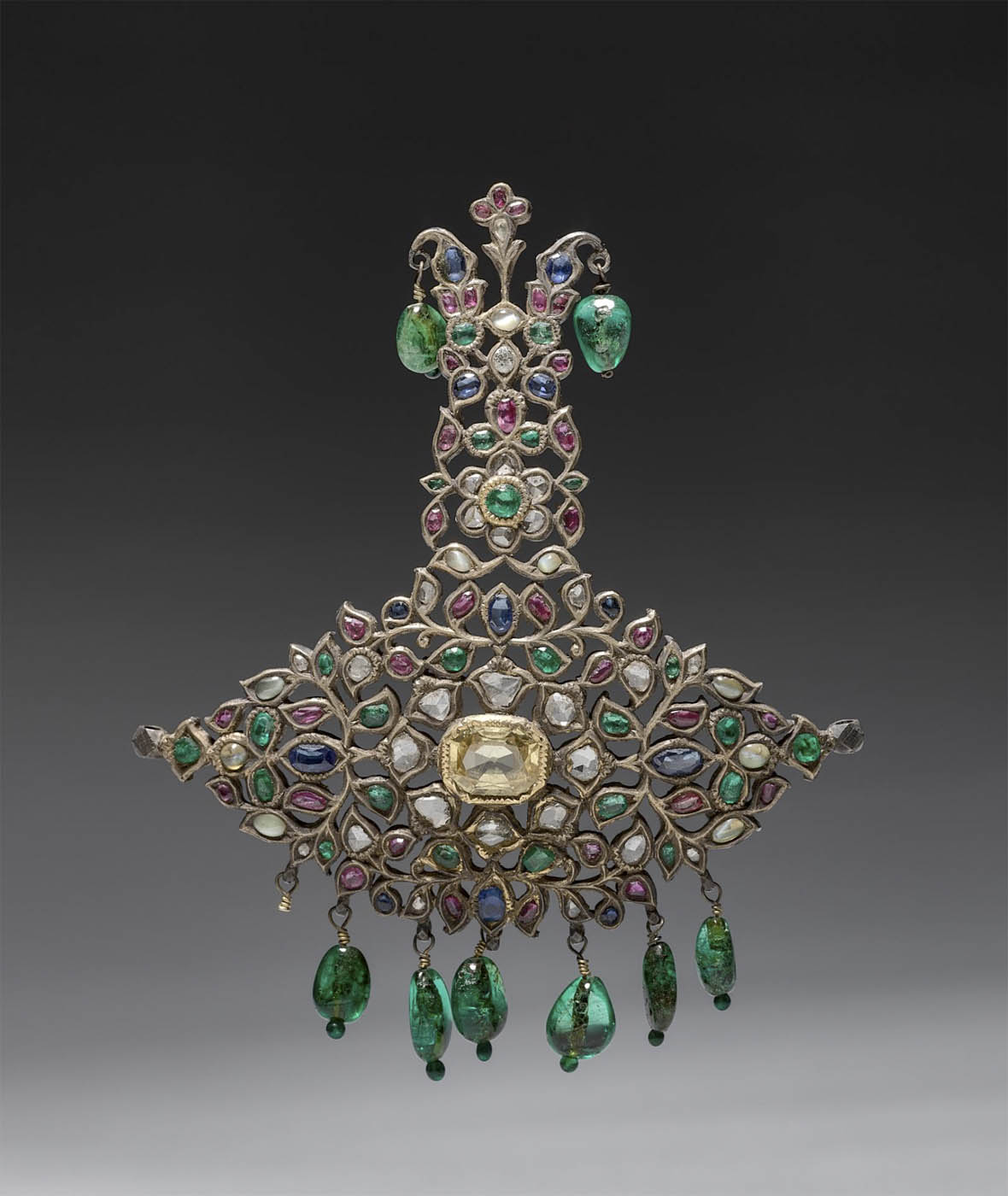
 

Unknown maker (Indian) 'Turban Ornament (Sarpech)' 1800s


Unknown maker (Indian)
Turban Ornament (Sarpech)
1800s
Gilt silver with diamonds, rubies, emeralds, topaz, blue sapphires, yellow sapphire
Overall: 10.2 x 8.4cm (4 x 3 5/16 in.)
Gift of Mr. and Mrs. J. H. Wade


This type of ornament would have been affixed to the front of a turban as an emblem of high noble status. The raised central element mimics the shape of an eagle feather or plume.
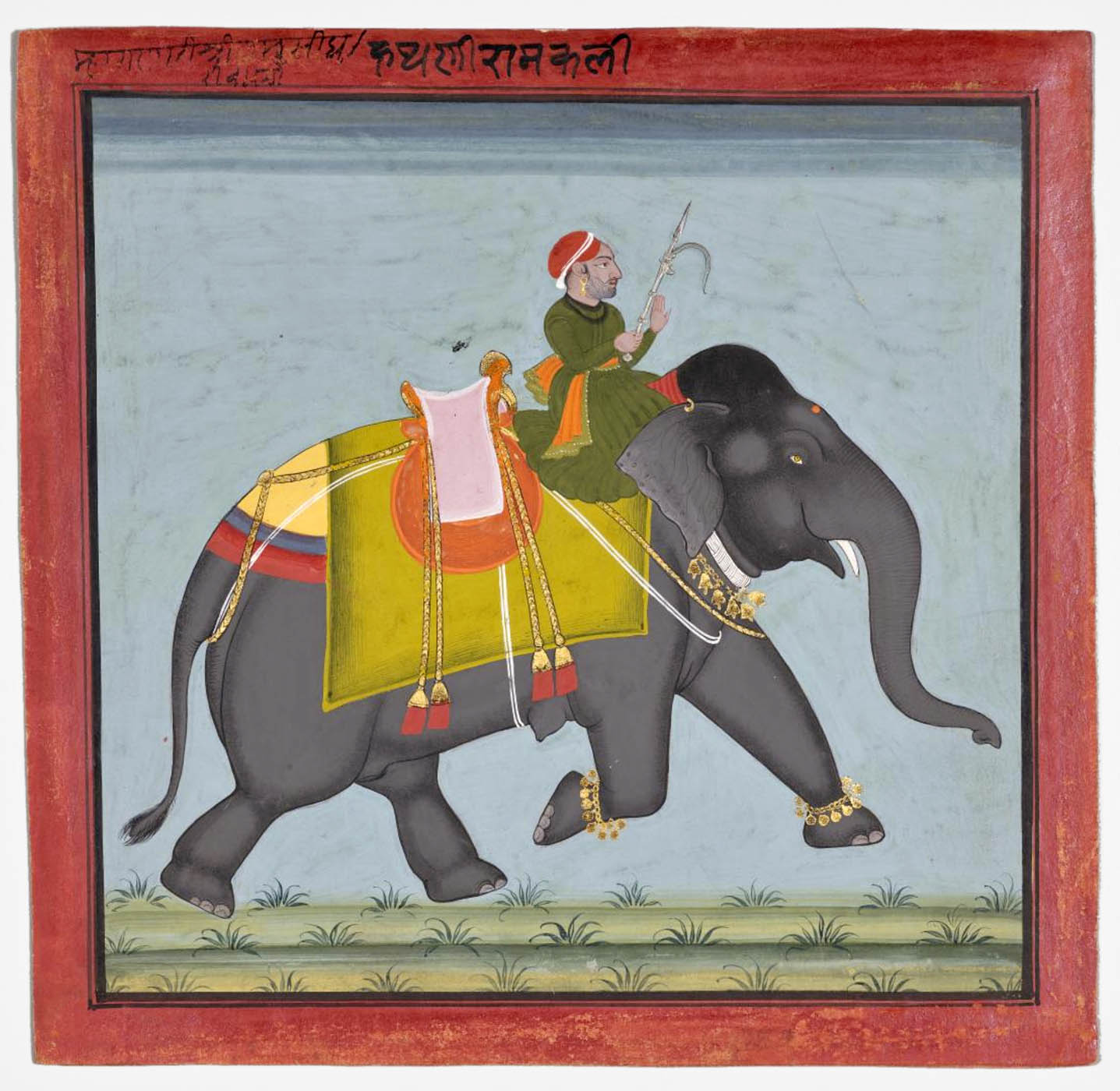
 

Unknown artist (Indian) 'Royal Elephant Ramkali with a Mahout' c. 1761


Unknown artist (Indian)
Royal Elephant Ramkali with a Mahout
c. 1761
Northwestern India, Rajasthan, Rajput kingdom of Mewar, Udaipur, Court of Ari Singh (reigned 1761-73)
Gum tempera, ink, and gold on paper
Painting: 20.6 x 21.4cm (8 1/8 x 8 7/16 in.)
Overall: 24.1 x 25cm (9 1/2 x 9 13/16 in.)
Gift of Dr. Norman Zaworski


The mahout (elephant driver), directs the confident female elephant at a brisk trot, with bells swinging in response to her movements. This painting belongs to a series depicting the elephants in the royal stables at Udaipur, each one named in the upper margin. Elephants have been a potent emblem for royalty in India for more than three thousand years.
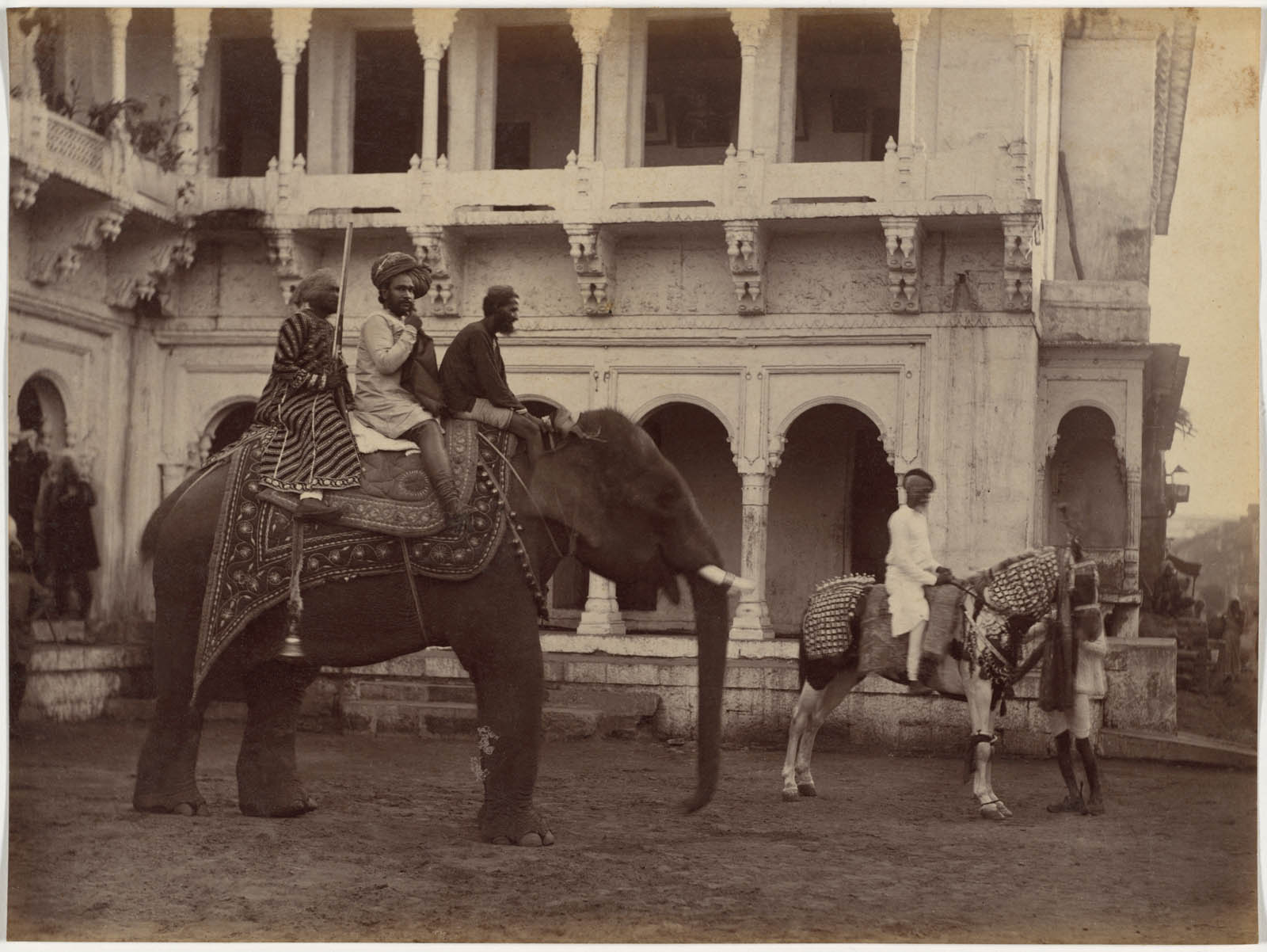
 

Raja Deen Dayal (Indian, 1844-1905) 'Ramkishore Singh of Rewa' 1886


Raja Deen Dayal (Indian, 1844-1905)
Ramkishore Singh of Rewa
1886
Albumen print
Image: 20.3 x 27.3cm (8 x 10 3/4 in.)
Paper: 20.3 x 27.3cm (8 x 10 3/4 in.)
Cleveland Museum of Art
Purchase from the J. H. Wade Fund


Ramkishore Singh, likely a high-ranking official or merchant, is depicted twice in the album, each time aboard a luxurious type of transport. In one photograph [above], he rides atop an elephant, a creature associated with India, power, and fortitude, preceded by an attendant on horseback. In the other [below], he rides in a European-style carriage pulled by two horses, flanked by attendants on camels (native to parts of India) and horses. Like the images of Britons in their carriages and rickshaws, these depictions suggest the sitter’s wealth through his possession of servants, animals, and vehicles.
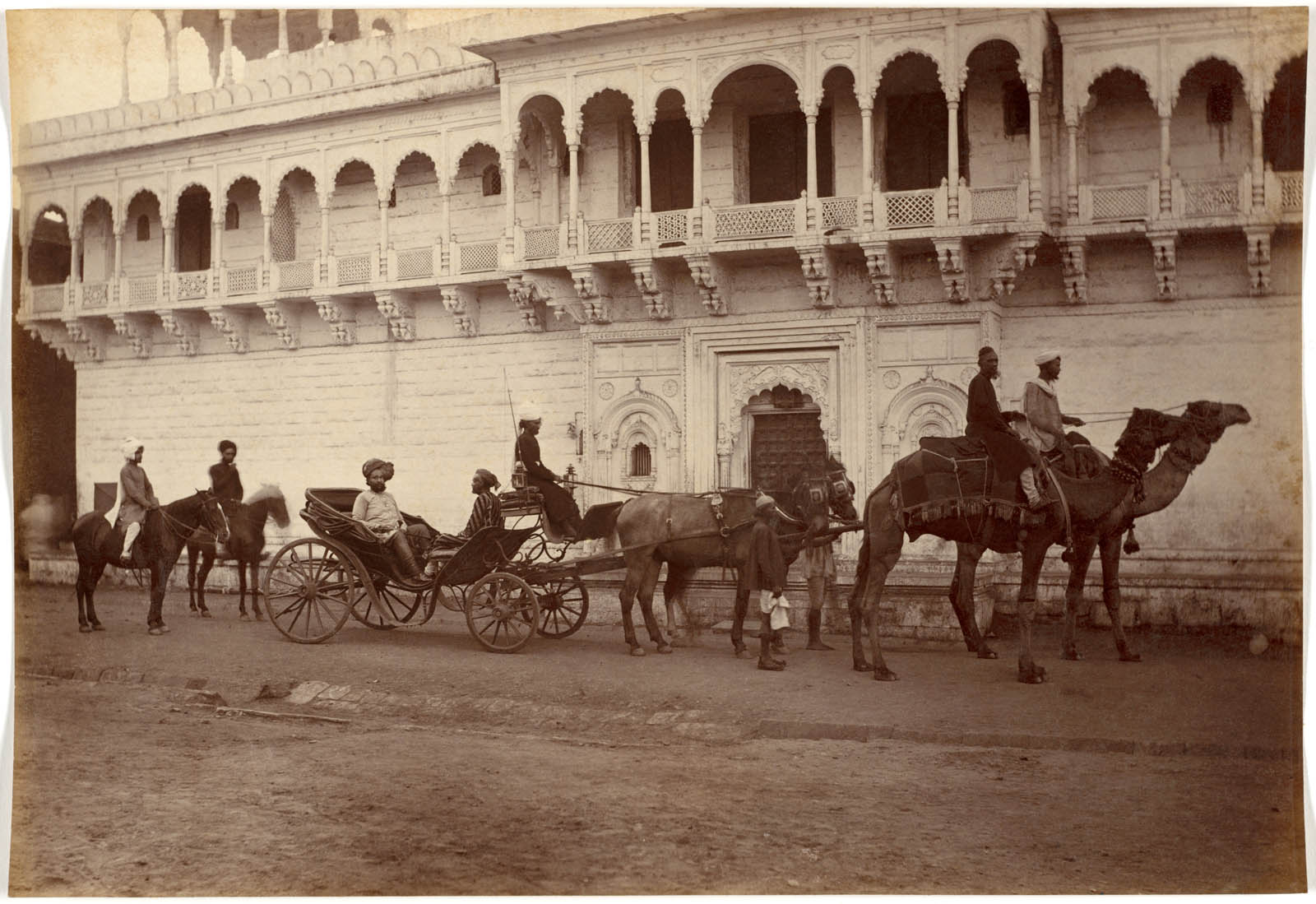
 

Raja Deen Dayal (Indian, 1844-1905) 'Ramkishore Singh of Rewa' 1886


Raja Deen Dayal (Indian, 1844-1905)
Ramkishore Singh of Rewa
1886
Albumen print
Image: 18.6 x 27cm (7 5/16 x 10 5/8 in.)
Paper: 18.6 x 27cm (7 5/16 x 10 5/8 in.)
Cleveland Museum of Art
Purchase from the J. H. Wade Fund
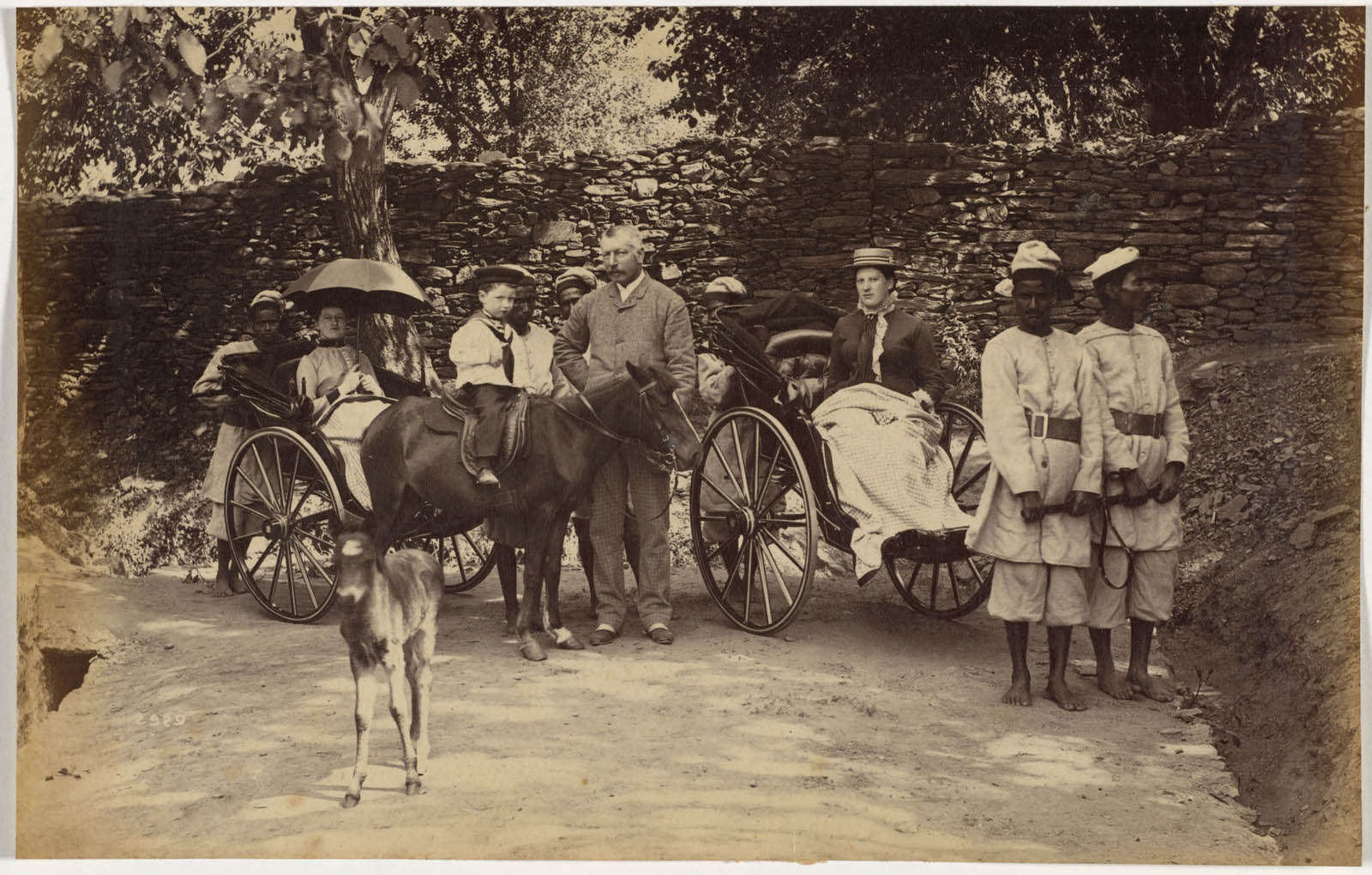
 

Raja Deen Dayal (Indian, 1844-1905) 'Colonel F. G. Oldham, Simla' 1887


Raja Deen Dayal (Indian, 1844-1905)
Colonel F. G. Oldham, Simla
1887
Albumen print
Image: 13 x 20.3cm (5 1/8 x 8 in.)
Paper: 13 x 20.3cm (5 1/8 x 8 in.)
Cleveland Museum of Art
Purchase from the J. H. Wade Fund


In Deen Dayal’s shots of large groups, the sitters are artfully arranged in close proximity, some even touching. But in his family portraits, at least in this album, the individuals are separated. Francis Oldham (1839-1923), an engineer at the India Public Works Department, poses with his wife Nora, their son Brian, an unidentified woman, and rickshaw drivers.
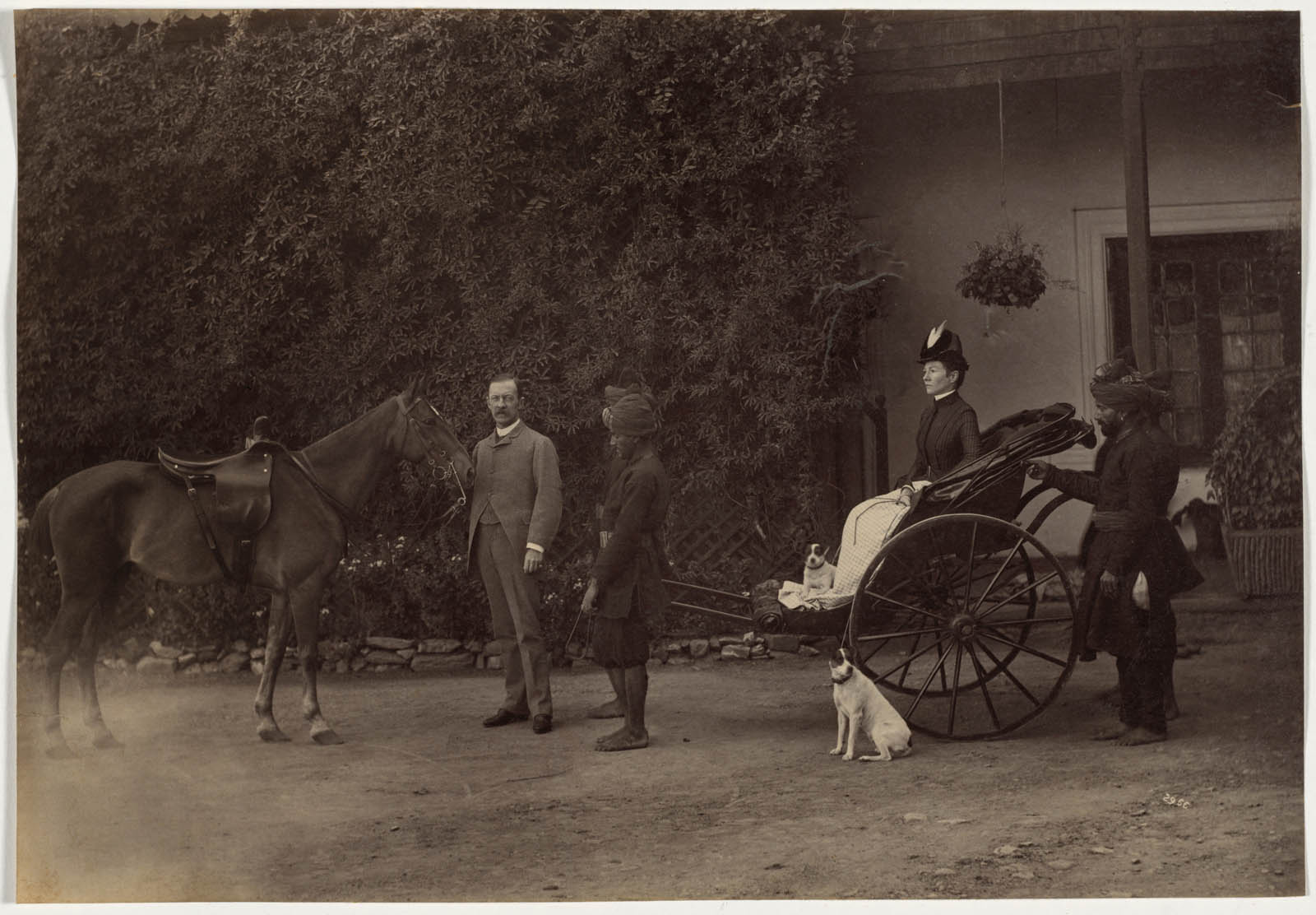
 

Raja Deen Dayal (Indian, 1844-1905) 'Colonel H.R. Thuillier and His Wife Emmeline Williams Thuillier, Simla' 1887


Raja Deen Dayal (Indian, 1844-1905)
Colonel H.R. Thuillier and His Wife Emmeline Williams Thuillier, Simla
1887
Albumen print
Image: 18.1 x 26.1cm (7 1/8 x 10 1/4 in.)
Paper: 18.1 x 26.1cm (7 1/8 x 10 1/4 in.)
Cleveland Museum of Art
Purchase from the J. H. Wade Fund


In Deen Dayal’s shots of large groups, the sitters are artfully arranged in close proximity, some even touching. But in his family portraits, at least in this album, the individuals are separated. The above image features Colonel H. R. Thuillier (1838-1922) holding his horse’s bridal, his wife Emmeline, their two terriers, and rickshaw drivers. Thuillier became the surveyor general of India the year this photograph was taken by Deen Dayal, who had just given up surveying for photography.
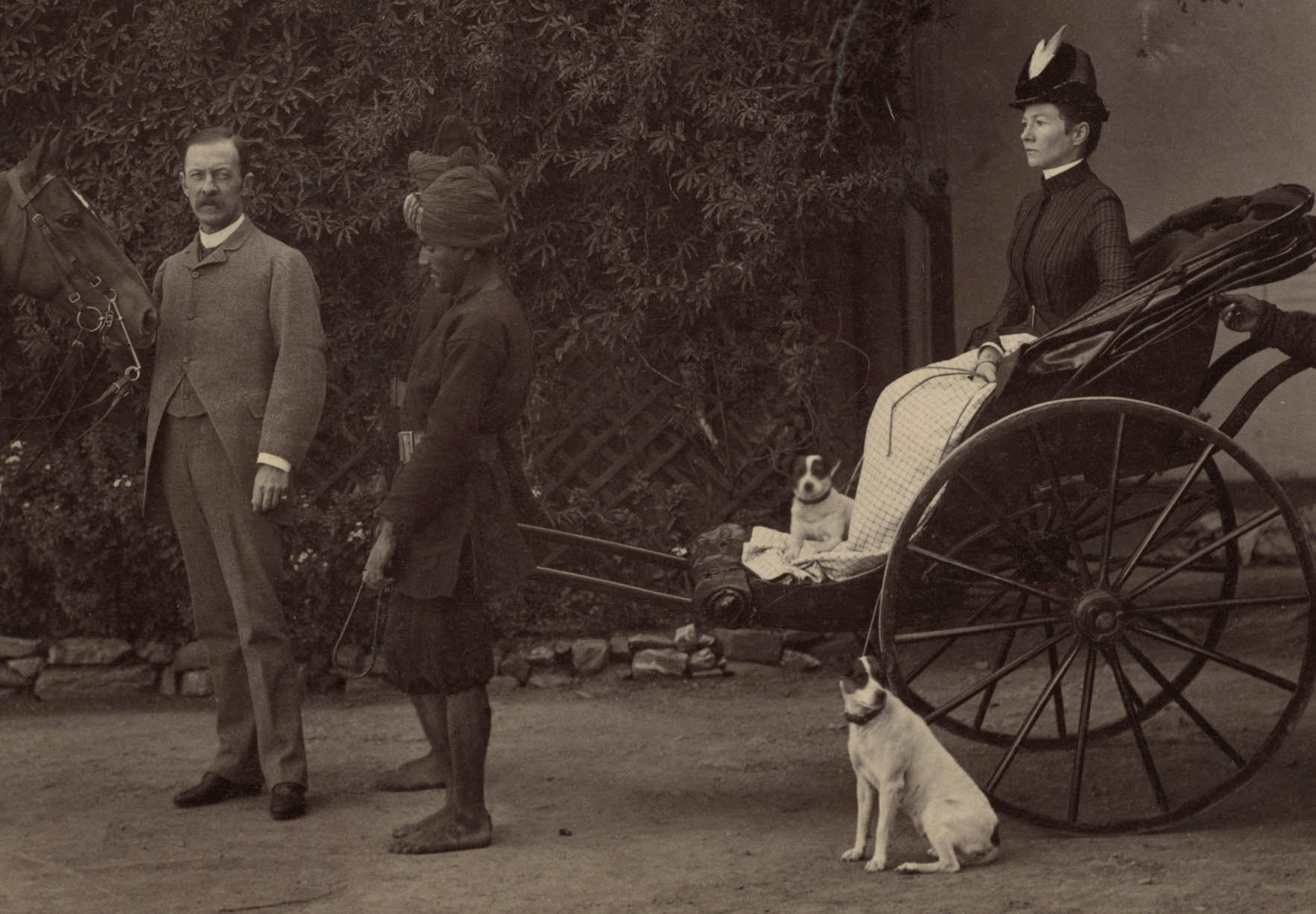
 

Raja Deen Dayal (Indian, 1844-1905) 'Colonel H.R. Thuillier and His Wife Emmeline Williams Thuillier, Simla' 1887 (detail)


Raja Deen Dayal (Indian, 1844-1905)
Colonel H.R. Thuillier and His Wife Emmeline Williams Thuillier, Simla (detail)
1887
Albumen print
Image: 18.1 x 26.1cm (7 1/8 x 10 1/4 in.)
Paper: 18.1 x 26.1cm (7 1/8 x 10 1/4 in.)
Cleveland Museum of Art
Purchase from the J. H. Wade Fund
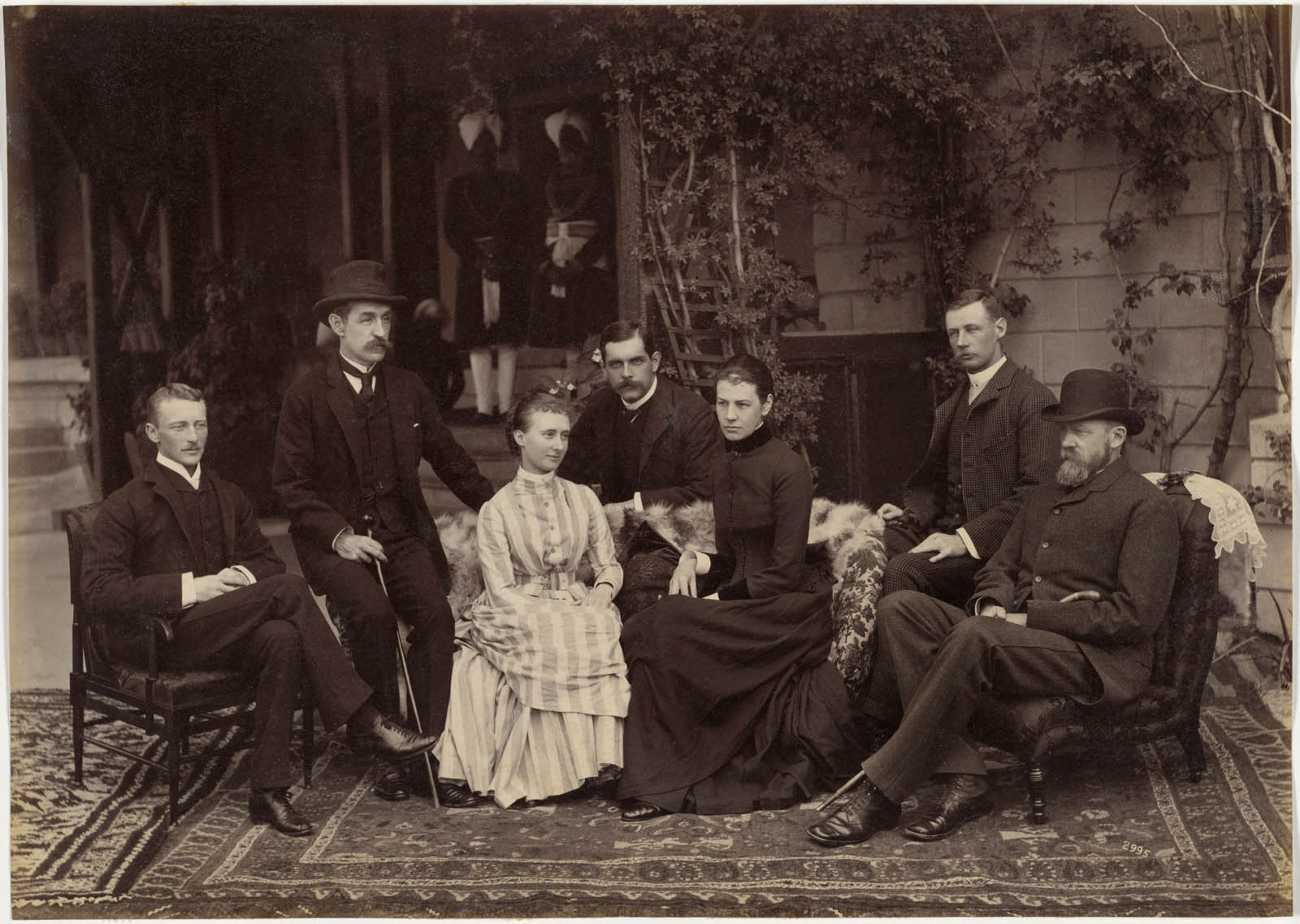
 

Raja Deen Dayal (Indian, 1844-1905) 'His Honor The Lieutenant Governor of the Punjab and Party, Simla' 1887


Raja Deen Dayal (Indian, 1844-1905)
His Honor The Lieutenant Governor of the Punjab and Party, Simla
1887
Albumen print
Image: 19.5 x 27.4cm (7 11/16 x 10 13/16 in.)
Paper: 19.5 x 27.4cm (7 11/16 x 10 13/16 in.)
Cleveland Museum of Art
Purchase from the J. H. Wade Fund


This photograph may commemorate a family reunion of the Lyalls. In 1887 James Lyall (1838-1916) (possibly on the left) was appointed lieutenant governor of the Punjab region, the same year that his elder brother Alfred Lyall (1835-1911) (second from left) retired as lieutenant governor of North-Western Provinces. After recovering from a serious illness, Alfred visited James in Simla. The women are likely Alfred’s daughter Mary Evelina Lyall (1868-1948) (left) and “Mrs. Lyall,” possibly Mary’s aunt, James Lyall’s wife. A master at staging group portraits, Deen Dayal used symmetry, proximity, height, and other formal devices to indicate the sitters’ interrelationships and relative ranks.
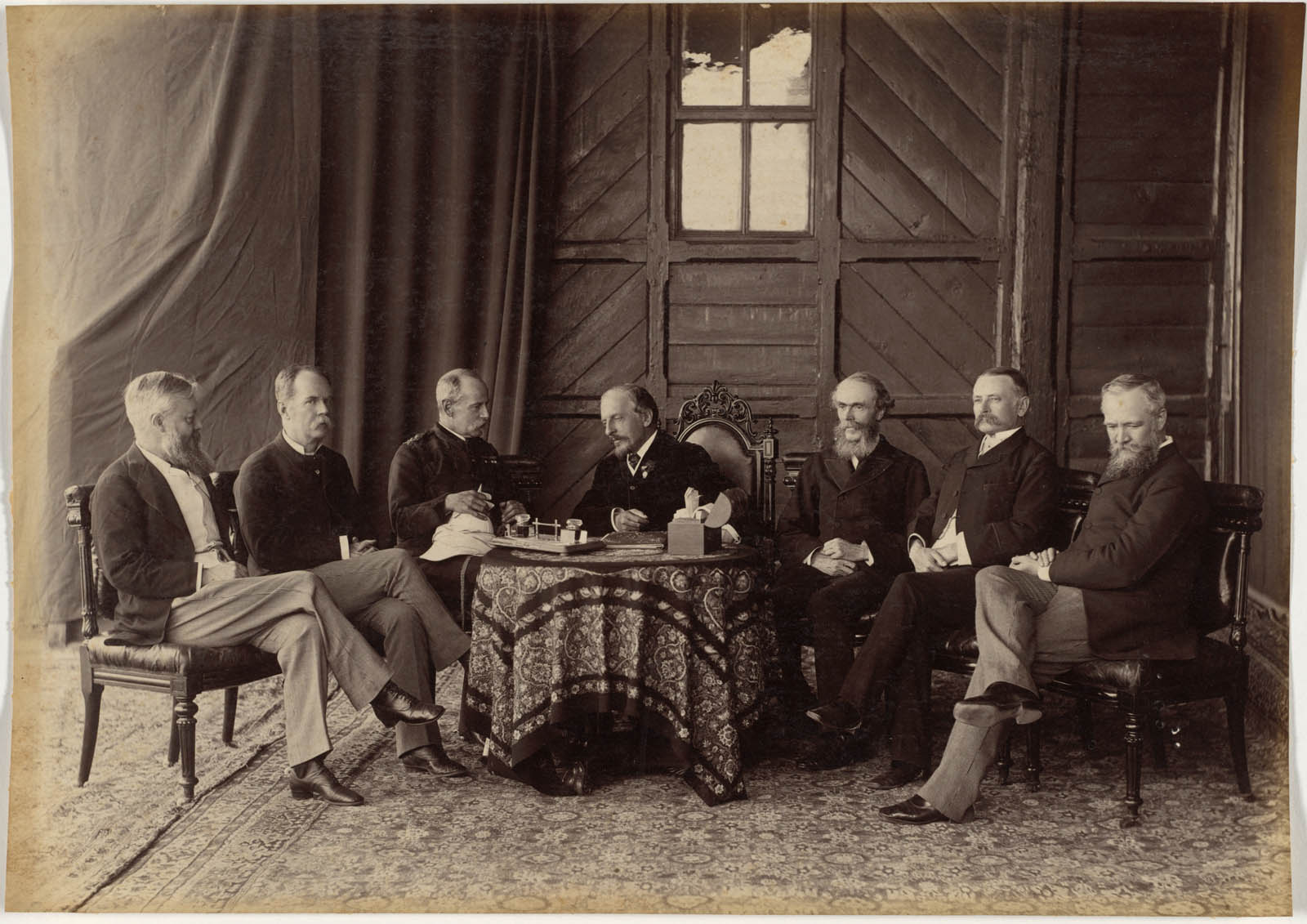
 

Raja Deen Dayal (Indian, 1844-1905) 'Lord Dufferin and the Supreme Council of Government of India' 1887


Raja Deen Dayal (Indian, 1844-1905)
Lord Dufferin and the Supreme Council of Government of India, Simla
1887
Albumen print
Image: 19.4 x 27.3cm (7 5/8 x 10 3/4 in.)
Paper: 19.4 x 27.3cm (7 5/8 x 10 3/4 in.)
Cleveland Museum of Art
Purchase from the J. H. Wade Fund


Each summer, the British government left the heat of Calcutta for Simla in the foothills of the Himalayas, where this photograph was taken. In 1885 Deen Dayal began spending his summers there to be near the officials, who were both subjects and clients. The viceroy, or British ruler, of India, Frederick Temple-Blackwood, 1st Marquess of Dufferin and Ava (1826-1902), sits at the centre of this staged meeting of the Supreme Council. Deen Dayal made images of Lord Dufferin and his wife, herself an amateur photographer, that led to his appointment as photographer to the viceroy, which resulted in access to other members of the British elite.
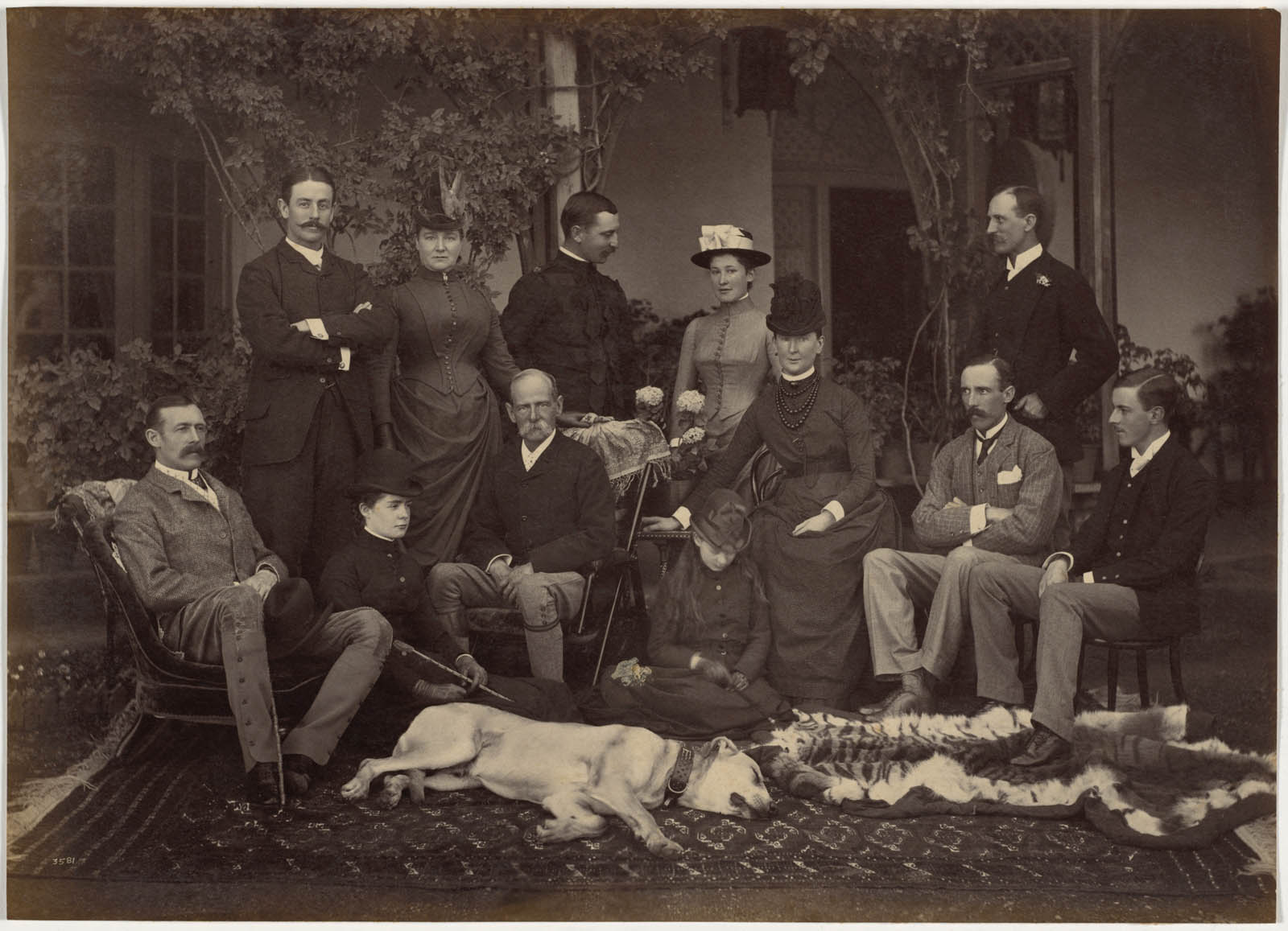
 

Raja Deen Dayal (Indian, 1844-1905) 'His Eminence Commander in Chief and Party, Simla' 1887


Raja Deen Dayal (Indian, 1844-1905)
His Eminence Commander in Chief and Party, Simla
1887
Albumen print
Image: 19.5 x 27.2cm (7 11/16 x 10 11/16 in.)
Paper: 19.5 x 27.2cm (7 11/16 x 10 11/16 in.)
Cleveland Museum of Art
Purchase from the J. H. Wade Fund


In 1887 Deen Dayal was appointed photographer to the commander in chief of the British Indian Army, Field Marshal Frederick Roberts (1832-1914) (seated, third from left). This casually dressed group of Roberts’s family and friends had just enjoyed a week of formal events, including a “fancy dress” ball celebrating the 50th anniversary of Queen Victoria’s accession to the throne. That party inaugurated a ballroom built onto Roberts’s home. The following day, Roberts was made Knight Commander of the Order of the Indian Empire. The tiger skin attests to British success at big game hunting. Its use as a rug reveals a very different attitude toward this favoured pastime among the British than the Indians, for whom it symbolised royal power.
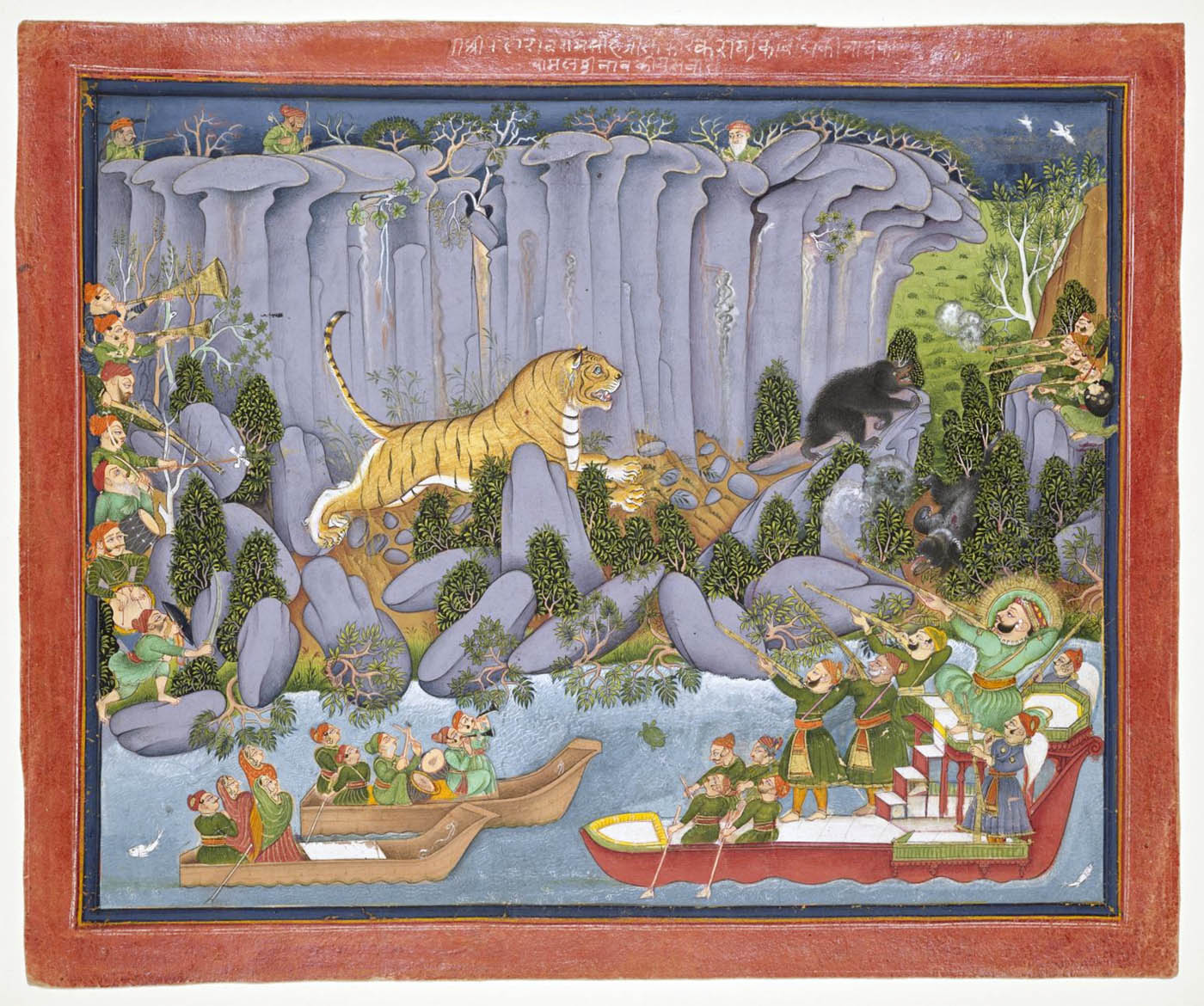
 

Unknown artist (Indian) 'Tiger Hunt of Ram Singh II' c. 1830-1840


Unknown artist (Indian)
Tiger Hunt of Ram Singh II
c. 1830-1840
Northwestern India, Rajasthan, Rajput kingdom of Kota, court of Ram Singh II (reigned 1826–66)
Gum tempera, ink, and gold on paper
Painting: 25.3 x 49.1cm (9 15/16 x 19 5/16 in.)
Seventy-fifth anniversary gift of Dr. Norman Zaworski


Set against the dramatic backdrop of the cliffs that define the landscape of the small princely kingdom of Kota, a majestic tiger has just been shot by the king. Noisemakers with a firebrand drive the tiger out of the forest, and men at the right keep bears at bay. The women and musicians in two small boats look on in admiration.
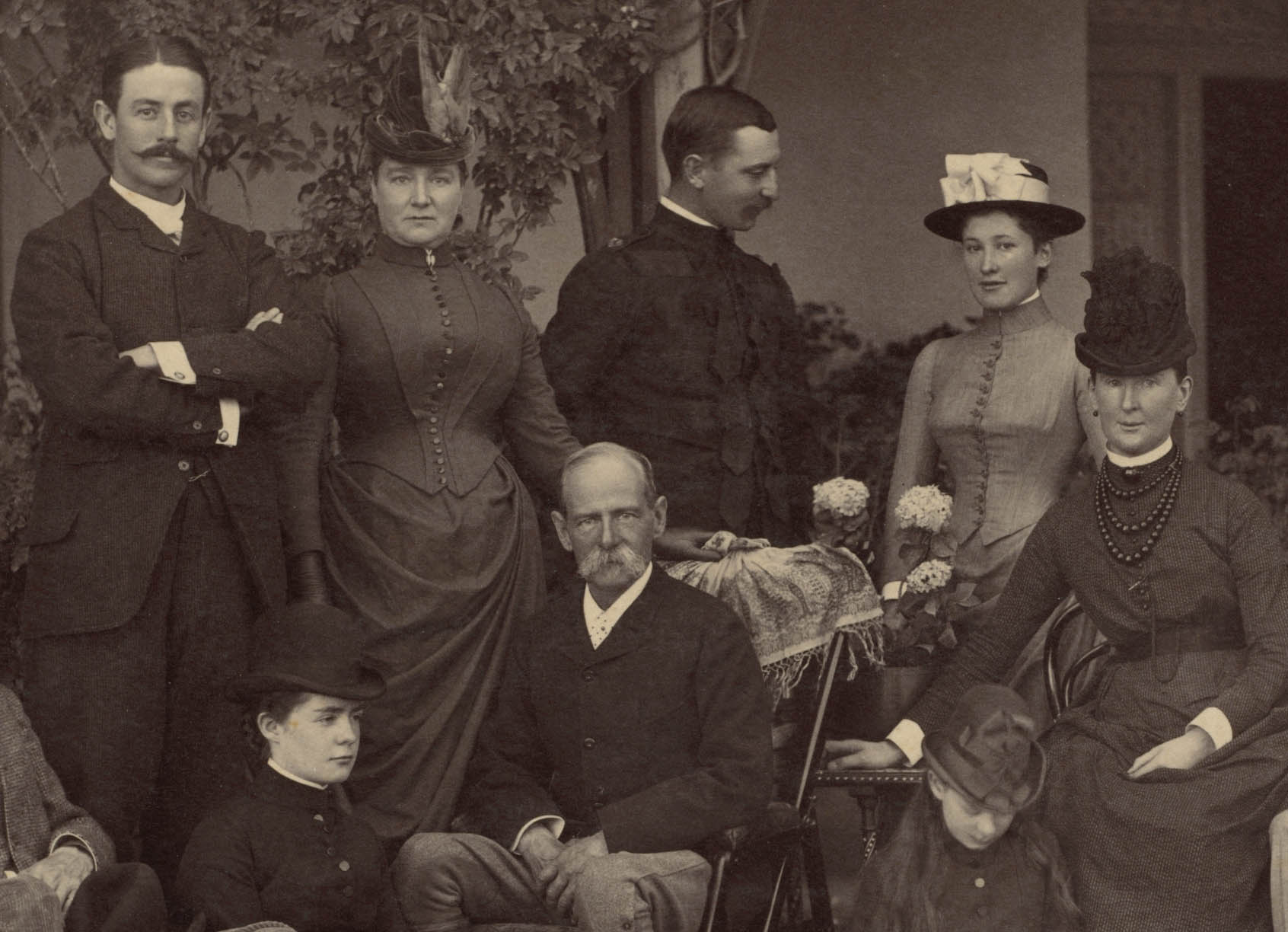
 

Raja Deen Dayal (Indian, 1844-1905) 'His Eminence Commander in Chief and Party, Simla' 1887 (detail)


Raja Deen Dayal (Indian, 1844-1905)
His Eminence Commander in Chief and Party, Simla (detail)
1887
Albumen print
Image: 19.5 x 27.2cm (7 11/16 x 10 11/16 in.)
Paper: 19.5 x 27.2cm (7 11/16 x 10 11/16 in.)
Cleveland Museum of Art
Purchase from the J. H. Wade Fund


In 2016, the museum acquired 37 photographs by Raja Deen Dayal (1844-1905), hailed as the first great Indian photographer. These images, which show the British ruling elite in India and two boy maharajas and their nobles, had all once been part of a single photo album. Popular from the 1850s until the spread of digital photography in the 1990s, photo albums are precious mementos of a time or place. They served as status symbols and objects that defined one’s identity for future generations.

The album in question had been ordered from the photographer’s studio around 1888, probably by a male British official serving in or visiting India in late 1887 or 1888. This exhibition marks the United States debut of these rare, early photographs by Deen Dayal. On display alongside them are historical Indian paintings and luxurious textiles, clothing, and jewelry from the museum’s collection that help bring the photographs to life.

The client would have chosen which images he wanted in the volume, and he seems to have greatly favored portraits. Captions elegantly handwritten in English on the mounts identify the subjects. Most of the prints came from Deen Dayal’s stock images – an archive of depictions of meaningful sites, important occasions, and significant people that was essential to running a profitable studio. Nonetheless, it is likely that the purchaser of the album met many of the British individuals he selected – perhaps had tea or dinner at their homes – and spent time at a number of the locales depicted. If the visitor was on official business, he may even have been received at the courts of these maharajas. After all, this album was a souvenir of his time in India, something to jog his own memory in the future and to pass down the story of his glorious adventure in India to later generations.

How personal were this man’s connections with the sitters? A young woman identified as Miss Lyall appears in three different photographs and a Mrs. Lyall (most likely a sister-in-law but possibly a mother) in two of them. Was the album commissioned by someone courting Miss Lyall, perhaps even her future husband? We may never know, even though we can track the biographies of many of the British sitters and of the two 10-year-old maharajas, both of whom remained on the throne for almost 40 years.

What do these images, taken 135 years ago by an Indian whose business relied heavily on a British clientele, suggest about the British colonists and the Indian people over whom they ruled? Deen Dayal portrayed how the British brought England with them to India and, in a number of pictures, the Indian servants who supported that colonial lifestyle. These servants are never identified or even referred to in the captions. We see them posing alongside the British horses and dogs they walk, feed, and groom; hovering in the background at a picnic ready to offer more food; and standing at attention behind British carriages.

Visually striking, seductively charming, and providing much food for thought, Deen Dayal’s photographs and the related Indian art objects offer new insights into the early career of India’s most important historic photographer and into British and Indian life in late 19th-century India.

Anonymous. “The Photos of Raja Deen Dayal: The first great Indian photographer,” in Cleveland Art, 2023 issue 2 Nd [Online] Cited 04/09/2023
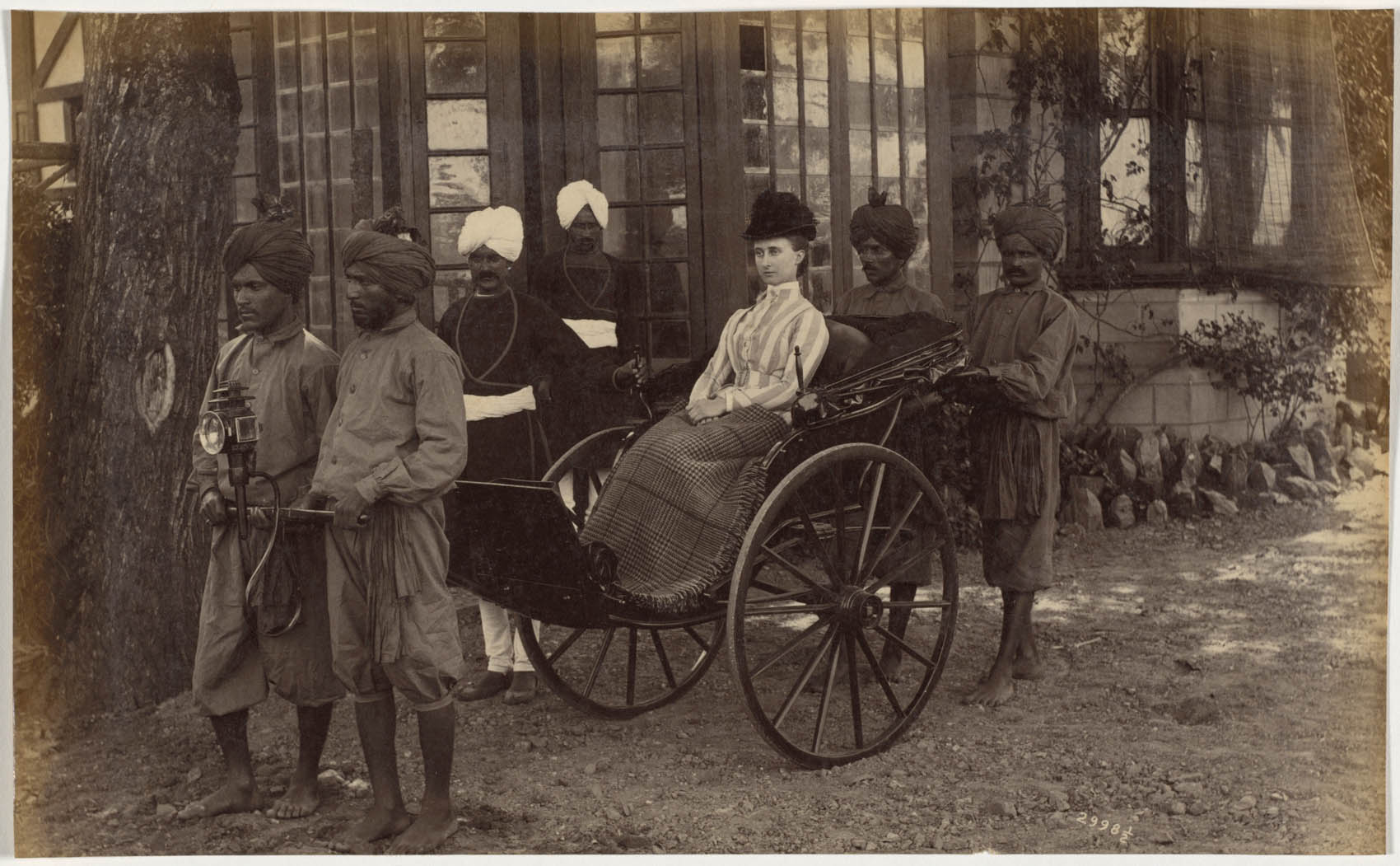
 

Raja Deen Dayal (Indian, 1844-1905) 'Miss Lyall, Simla' 1887


Raja Deen Dayal (Indian, 1844-1905)
Miss Lyall, Simla
1887
Albumen print
Image: 12.4 x 20.3cm (4 7/8 x 8 in.)
Paper: 12.4 x 20.3 cm (4 7/8 x 8 in.)
Cleveland Museum of Art
Purchase from the J. H. Wade Fund
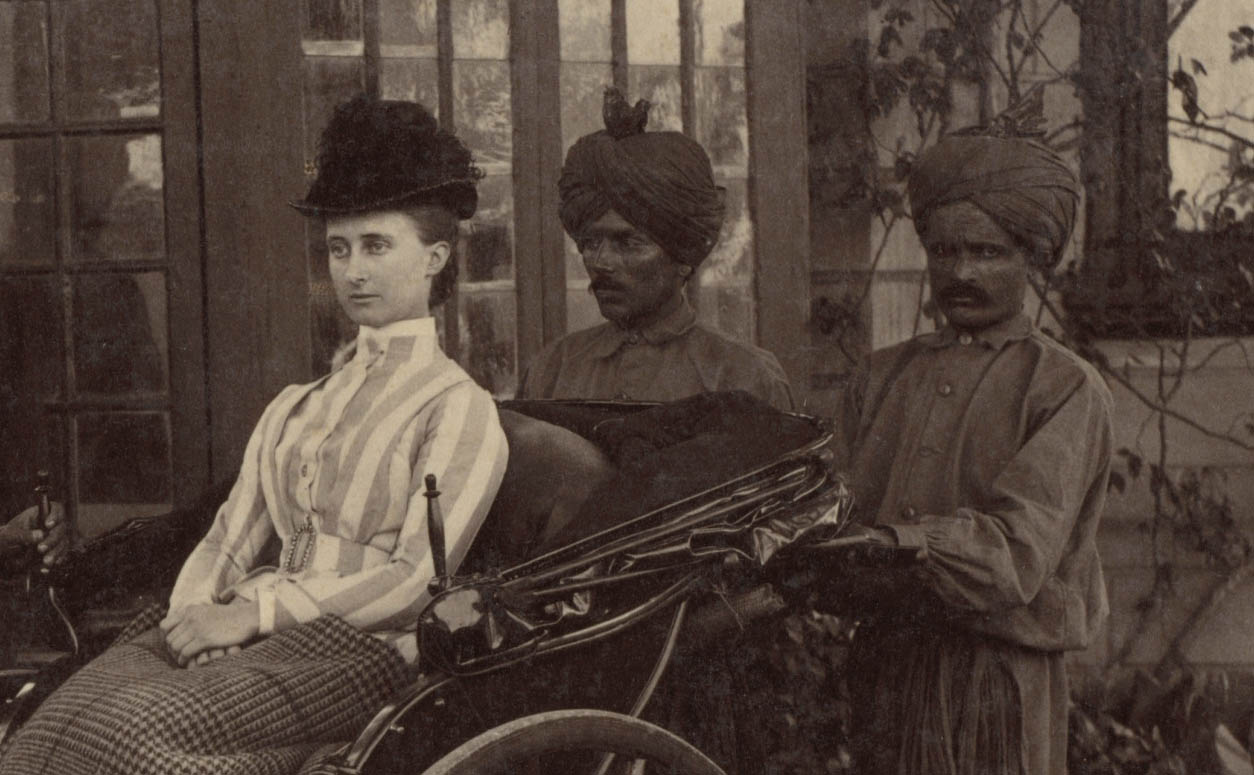
 

Raja Deen Dayal (Indian, 1844-1905) 'Miss Lyall, Simla' 1887 (detail)


Raja Deen Dayal (Indian, 1844-1905)
Miss Lyall, Simla (detail)
1887
Albumen print
Image: 12.4 x 20.3cm (4 7/8 x 8 in.)
Paper: 12.4 x 20.3 cm (4 7/8 x 8 in.)
Cleveland Museum of Art
Purchase from the J. H. Wade Fund
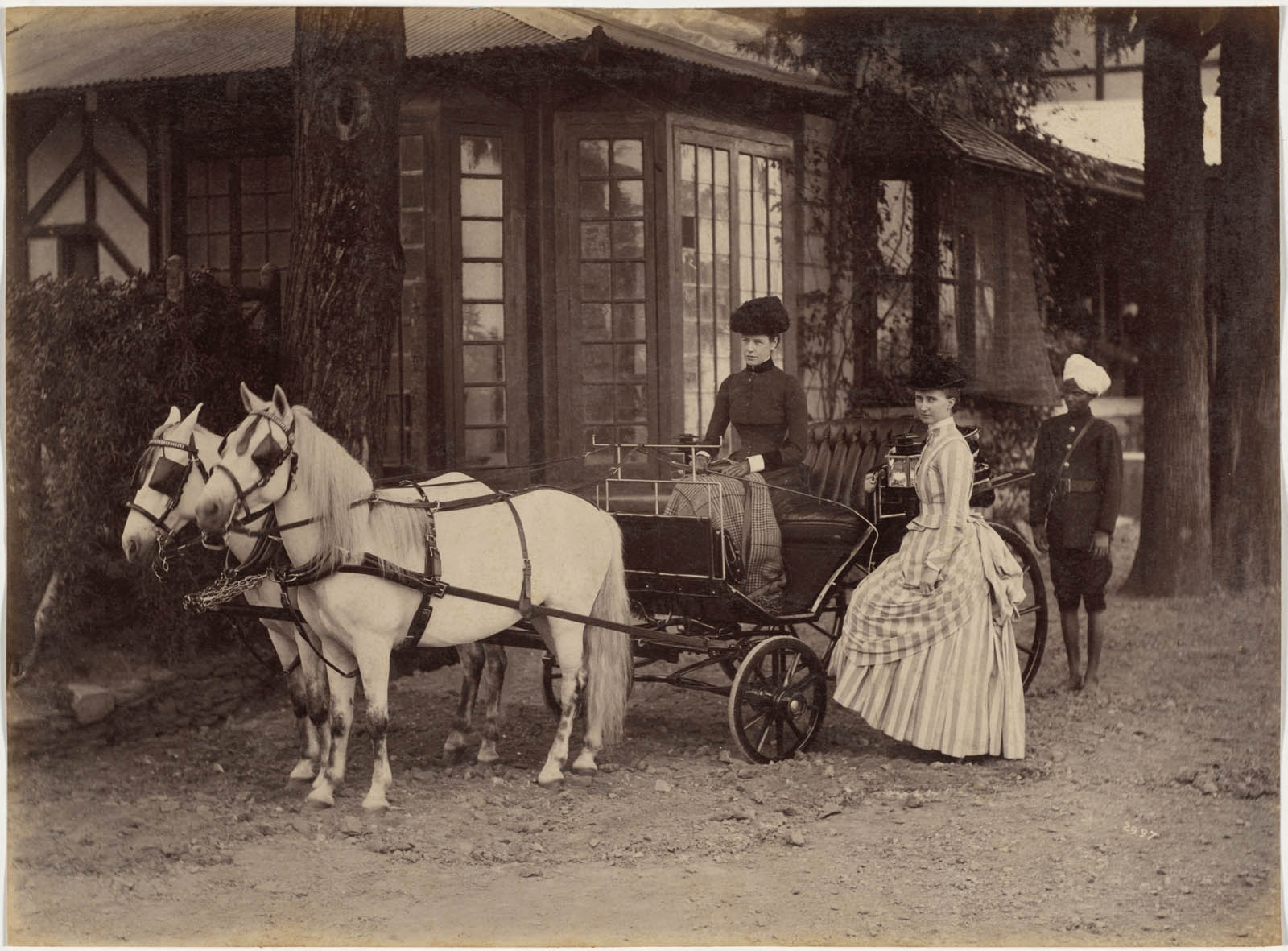
 

Raja Deen Dayal (Indian, 1844-1905) 'Mrs. and Miss Lyall, Simla' 1887


Raja Deen Dayal (Indian, 1844-1905)
Mrs. and Miss Lyall, Simla
1887
Albumen print
Image: 19.9 x 27cm (7 13/16 x 10 5/8 in.)
Paper: 19.9 x 27cm (7 13/16 x 10 5/8 in.)
Cleveland Museum of Art
Purchase from the J. H. Wade Fund


A number of Deen Dayal’s Simla portraits include rickshaws, which were items of great novelty, being found in India only in Simla at the time. The two-wheeled, human-powered passenger cart first appeared in Japan around 1870 and was introduced to Simla around 1880 by a Scottish missionary. The town’s steep hills required four drivers, two to pull and two to push. Horse-drawn buggies were another common means of transport. Miss Lyall and Mrs. Lyall also appear in the photograph, suggesting that they had a significant personal relationship with the purchaser of the album.
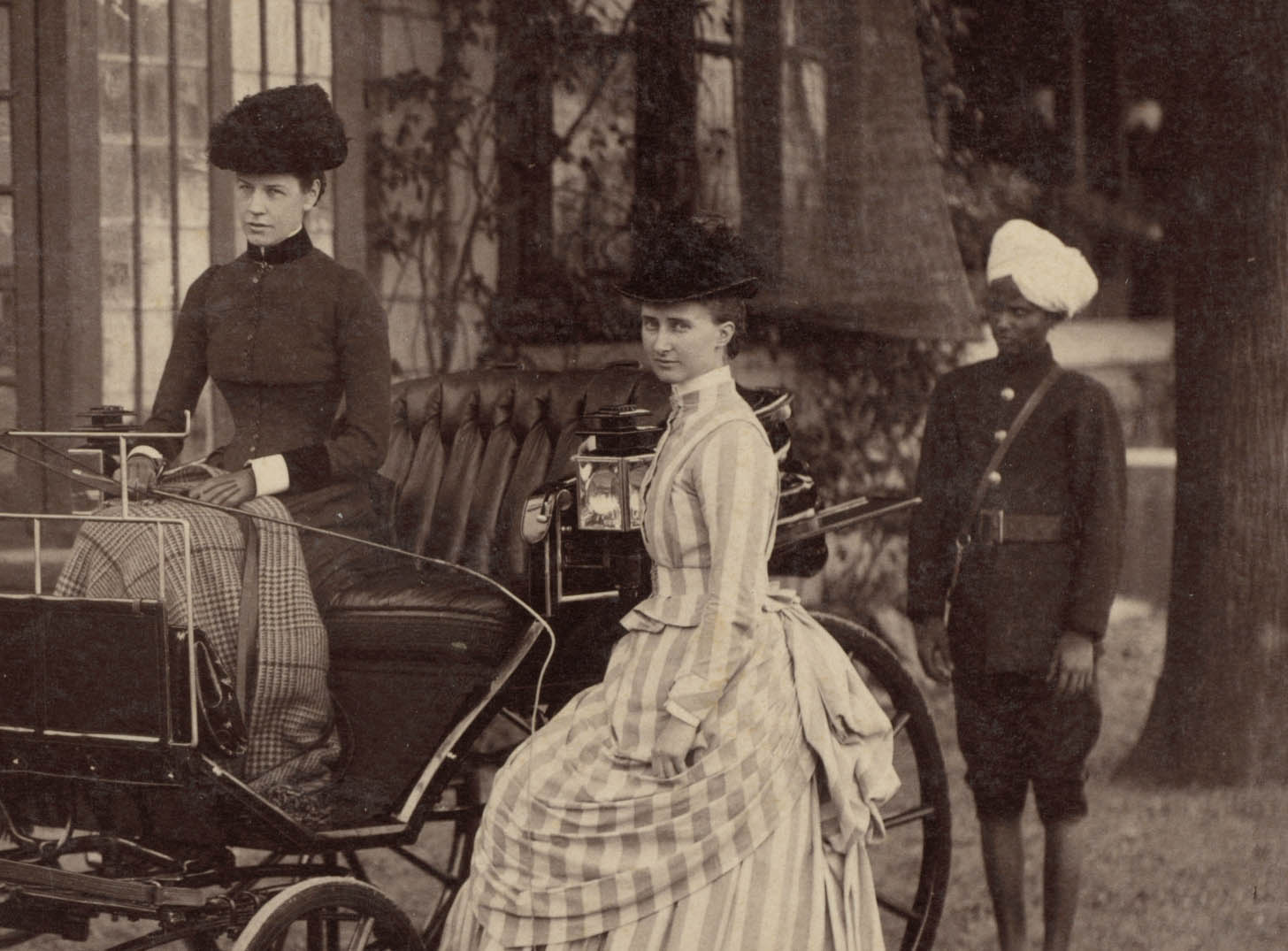
 

Raja Deen Dayal (Indian, 1844-1905) 'Mrs. and Miss Lyall, Simla' 1887 (detail)


Raja Deen Dayal (Indian, 1844-1905)
Mrs. and Miss Lyall, Simla (detail)
1887
Albumen print
Image: 19.9 x 27cm (7 13/16 x 10 5/8 in.)
Paper: 19.9 x 27cm (7 13/16 x 10 5/8 in.)
Cleveland Museum of Art
Purchase from the J. H. Wade Fund
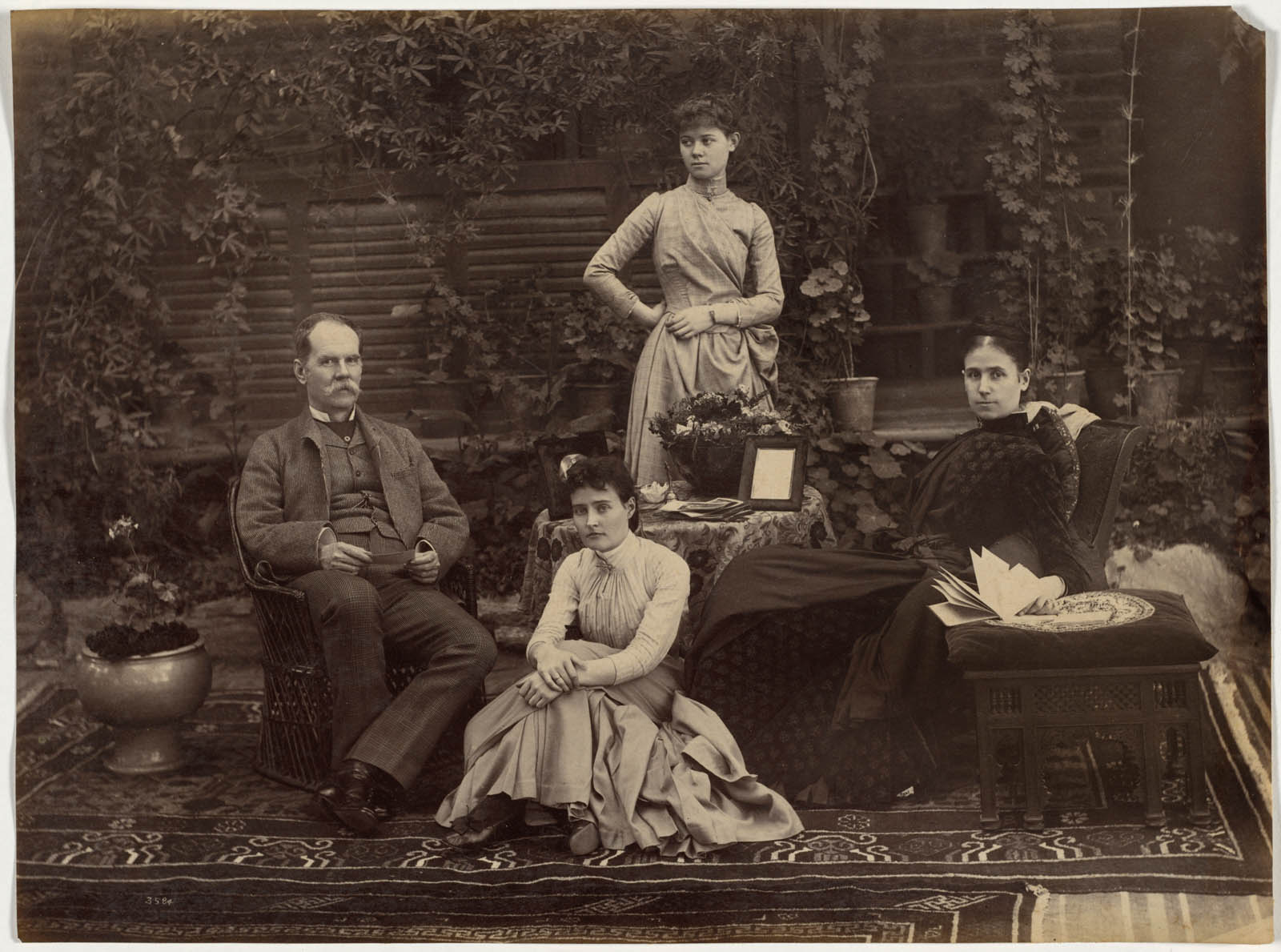
 

Raja Deen Dayal (Indian, 1844-1905) 'Sir Auckland Colvin and Family, Simla' 1887


Raja Deen Dayal (Indian, 1844-1905)
Sir Auckland Colvin and Family, Simla
1887
Albumen print
Image: 20 x 26.9cm (7 7/8 x 10 9/16 in.)
Paper: 20 x 26.9cm (7 7/8 x 10 9/16 in.)
Cleveland Museum of Art
Purchase from the J. H. Wade Fund


Deen Dayal’s large glass plate negatives and view camera required daylight to capture people without a blur, so his large group portraits are usually set before the sitters’ homes in their gardens. The equipment also dictated that scenes be carefully posed, not candid, shots. Sir Auckland Colvin (1838-1908) and his daughters were photographed in 1887, the year he became lieutenant governor of North-Western Provinces, a position his father had once held. The sitters are arranged so they orbit two framed photographs displayed on a table, presumably depictions of Colvin’s deceased wife and son. Thanks to photography, the entire Colvin family was reunited.
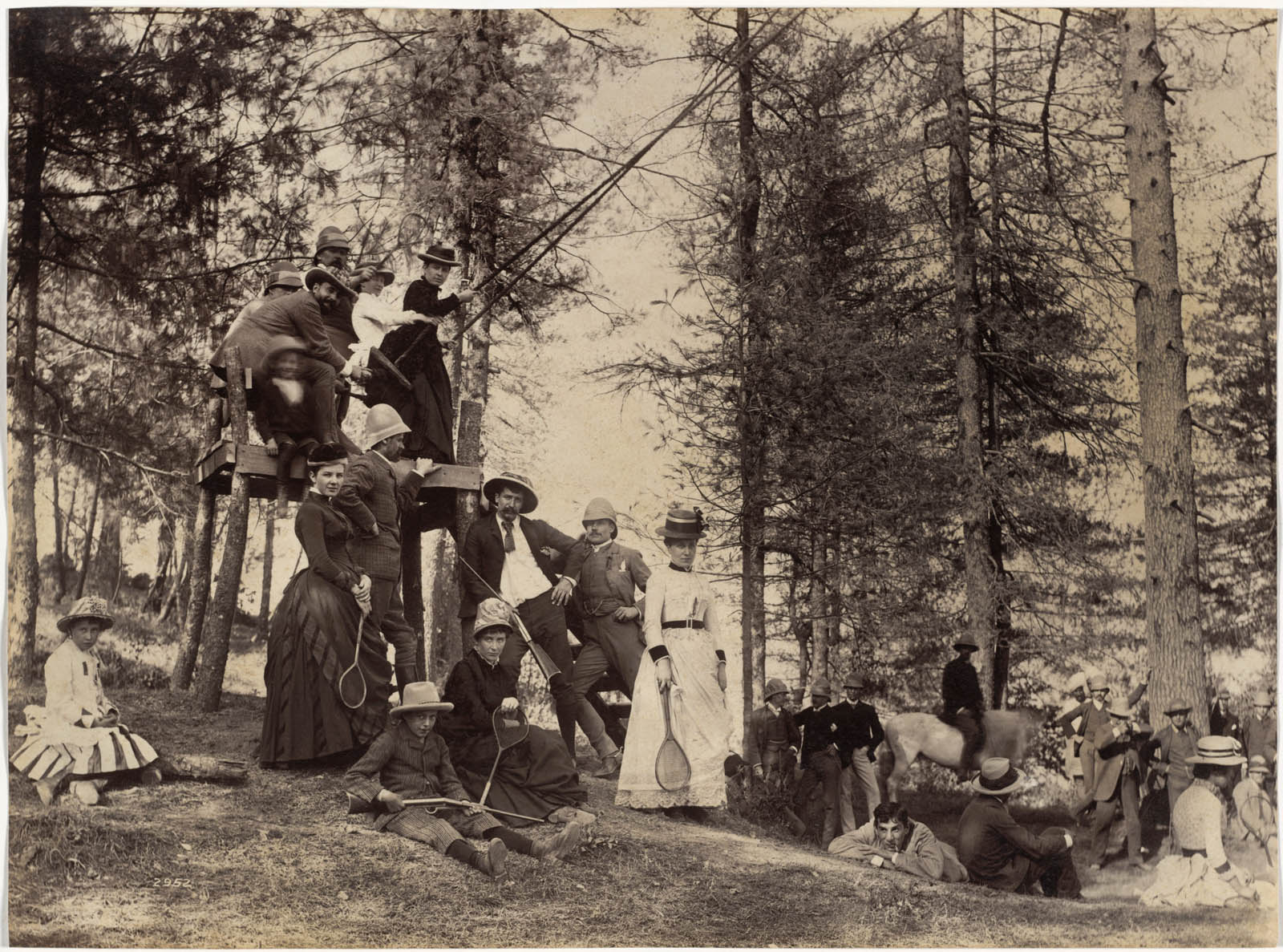
 

Raja Deen Dayal (Indian, 1844-1905) 'Picnic party, Mashobra' 1887


Raja Deen Dayal (Indian, 1844-1905)
Picnic party, Mashobra
1887
Albumen print
Image: 19.3 x 26.1cm (7 5/8 x 10 1/4 in.)
Paper: 19.3 x 26.1cm (7 5/8 x 10 1/4 in.)
Cleveland Museum of Art
Purchase from the J. H. Wade Fund


This scene is from one of many lavish entertainments hosted by caterer, restaurateur, and hotelier Federico Peliti (Italian, 1844-1914) at his forested country estate outside Simla. In the photograph, Peliti is on horseback and his wife Judith on the swing. Swings have a long history as items of leisurely pleasure in Europe and India. Badminton, which originated in England in 1873, was popular in India. Deen Dayal may have been invited to document this gathering because he and Peliti, an amateur photographer, both belonged to the Photographic Society of Bombay.
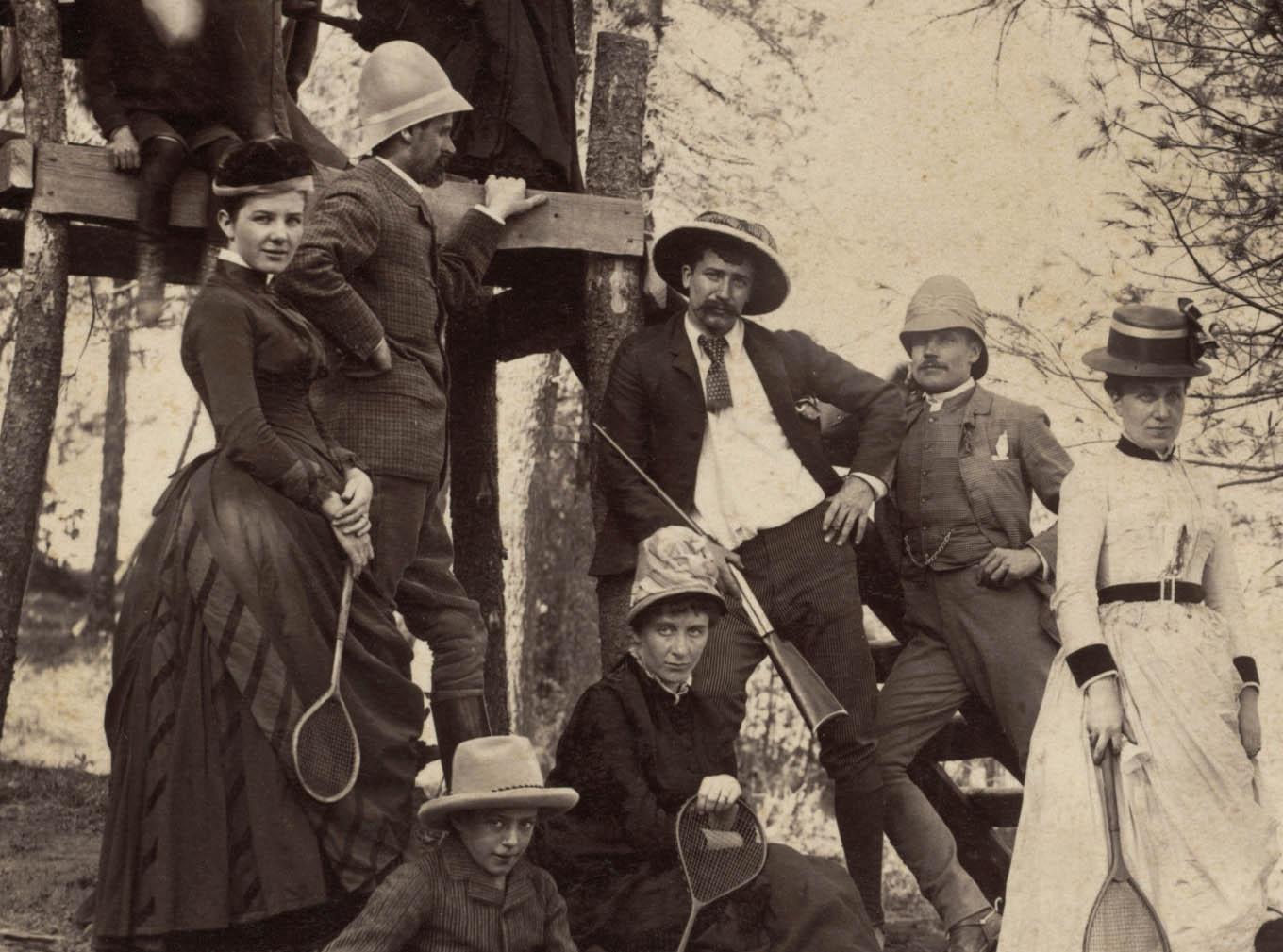
 

Raja Deen Dayal (Indian, 1844-1905) 'Picnic party, Mashobra' 1887 (detail)


Raja Deen Dayal (Indian, 1844-1905)
Picnic party, Mashobra (detail)
1887
Albumen print
Image: 19.3 x 26.1cm (7 5/8 x 10 1/4 in.)
Paper: 19.3 x 26.1cm (7 5/8 x 10 1/4 in.)
Cleveland Museum of Art
Purchase from the J. H. Wade Fund
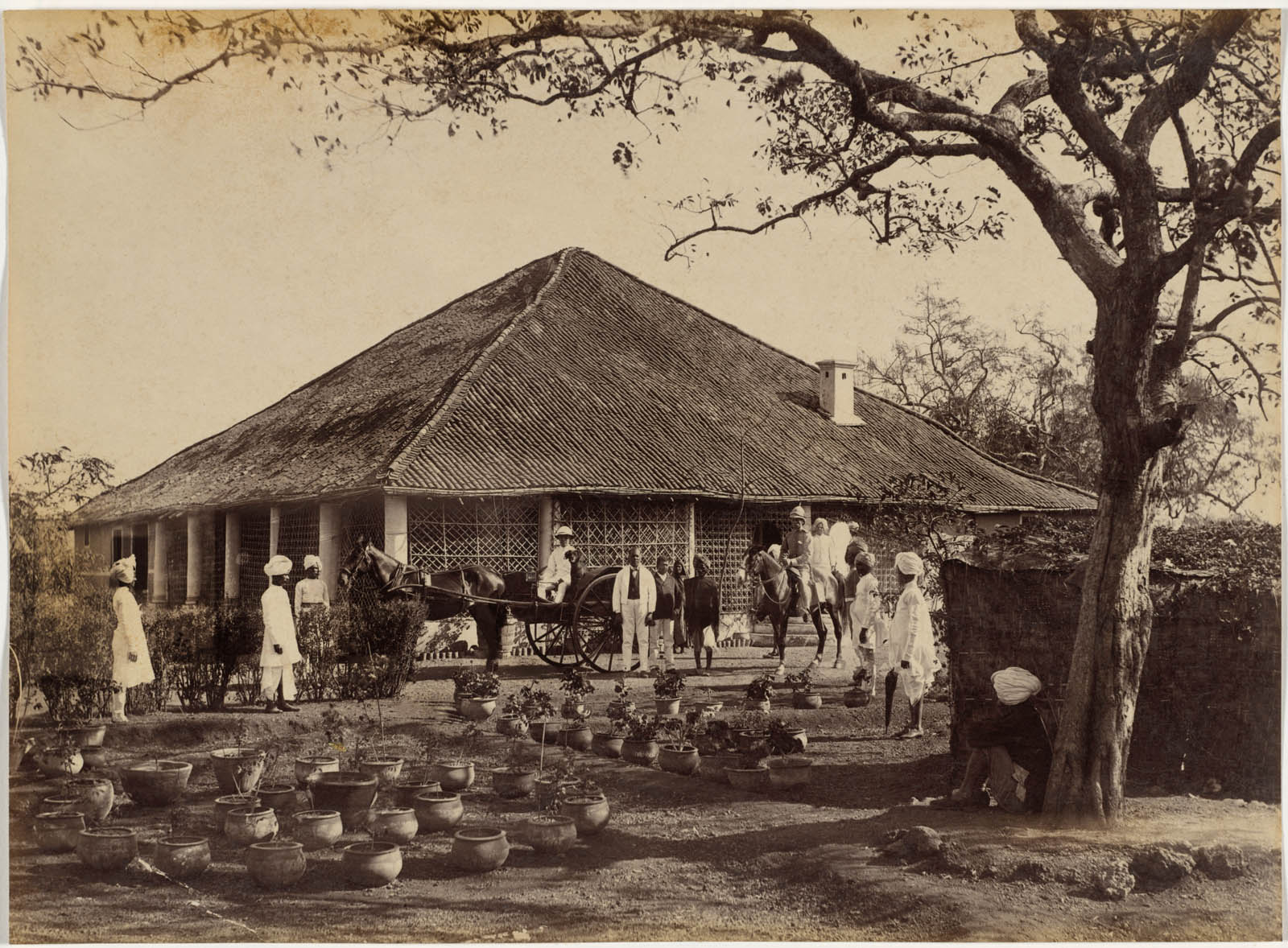
 

Raja Deen Dayal (Indian, 1844-1905) 'Reverend Loche at Neemuch' 1887


Raja Deen Dayal (Indian, 1844-1905)
Reverend Loche at Neemuch
1887
Albumen print
Image: 19.4 x 26.5cm (7 5/8 x 10 7/16 in.)
Paper: 19.4 x 26.5cm (7 5/8 x 10 7/16 in.)
Cleveland Museum of Art
Purchase from the J. H. Wade Fund


This building is a “dak bungalow,” one of the British government guesthouses that were central to the lives of British travellers in India. This network of houses offered places to eat, stay, rent fresh horses, and conduct business while traveling between residences. The bungalows’ wide latticed verandahs admitted breezes, kept out pests, and provided some privacy. The average British Indian military household had at least six servants; eleven Indian servants are shown here, including the only Indian woman pictured in this exhibition. Many images in this album show servants, but they are never mentioned in the captions.
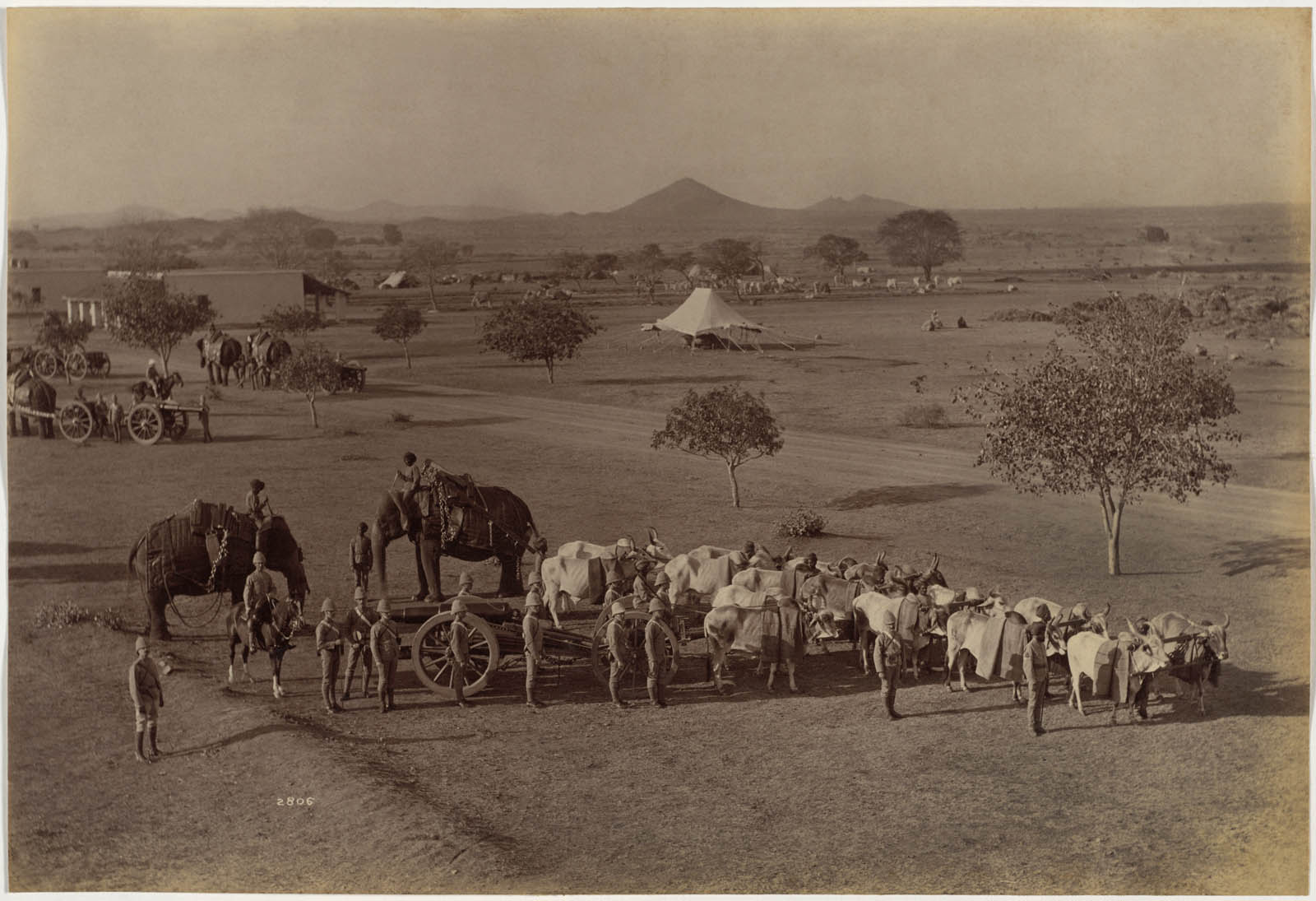
 

Raja Deen Dayal (Indian, 1844-1905) 'Heavy Field Battery, Jhansi' 1886


Raja Deen Dayal (Indian, 1844-1905)
Heavy Field Battery, Jhansi
1886
Albumen print
Image: 18.3 x 27cm (7 3/16 x 10 5/8 in.)
Paper: 18.3 x 27cm (7 3/16 x 10 5/8 in.)
Cleveland Museum of Art
Purchase from the J. H. Wade Fund


Exercises involving elephant batteries, which were exotic to European eyes, attracted spectators; photographs of them were excellent souvenirs of these military forces employed by the British Indian Army. Elephants had been employed in warfare in India since at least the 500s BC, but with the advent of heavy artillery, their function switched from attack to support. They transported big guns and supplies and worked in logging and construction. It took many cattle to pull a load that could be handled by two elephants.
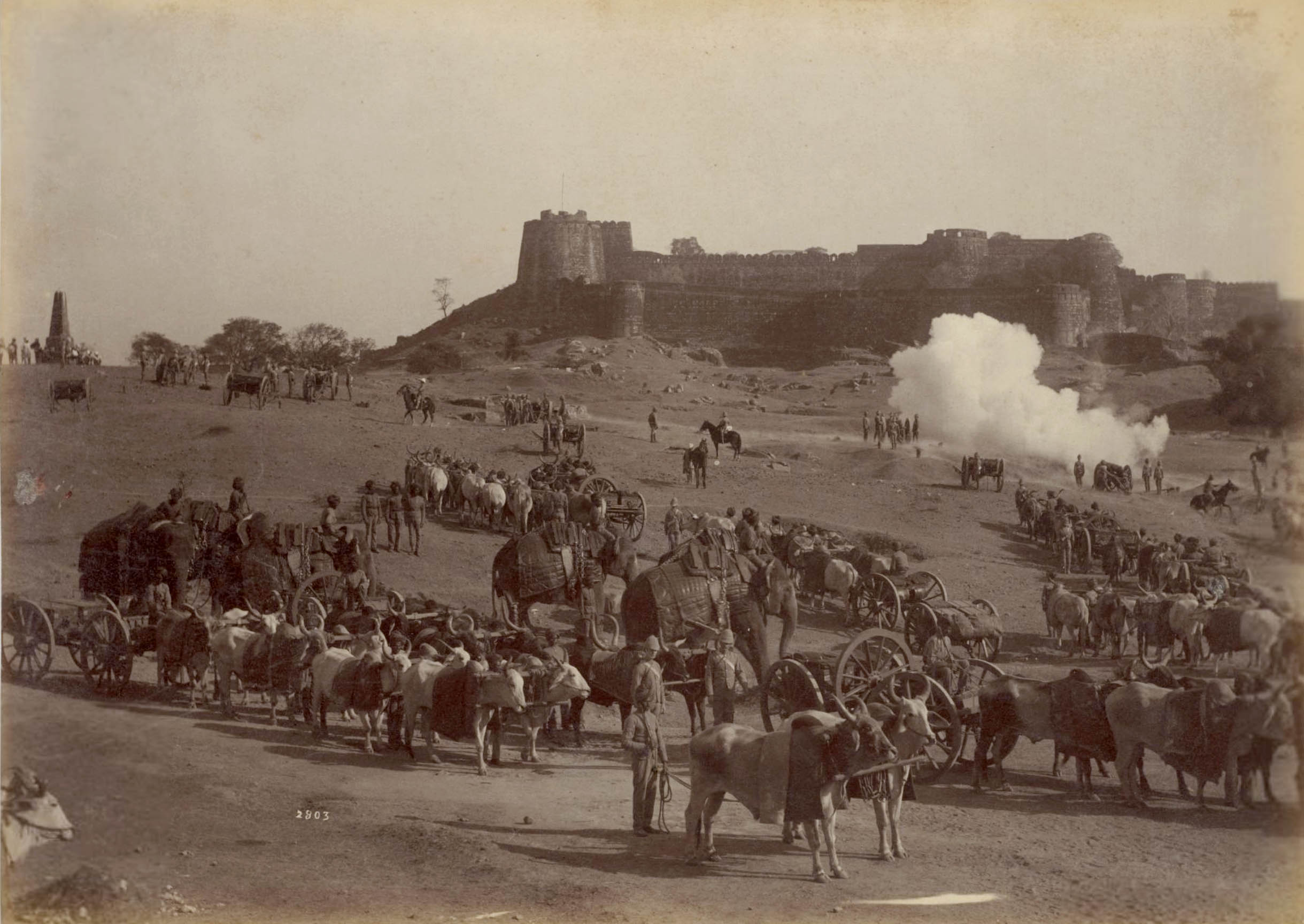
 

Raja Deen Dayal (Indian, 1844-1905) 'Jhansi Fort and Elephant Battery' 1886


Raja Deen Dayal (Indian, 1844-1905)
Jhansi Fort and Elephant Battery
1886
Albumen print
Image: 19.4 x 27.2 cm (7 5/8 x 10 11/16 in.)
Paper: 19.4 x 27.2 cm (7 5/8 x 10 11/16 in.)
Purchase from the J. H. Wade Fund
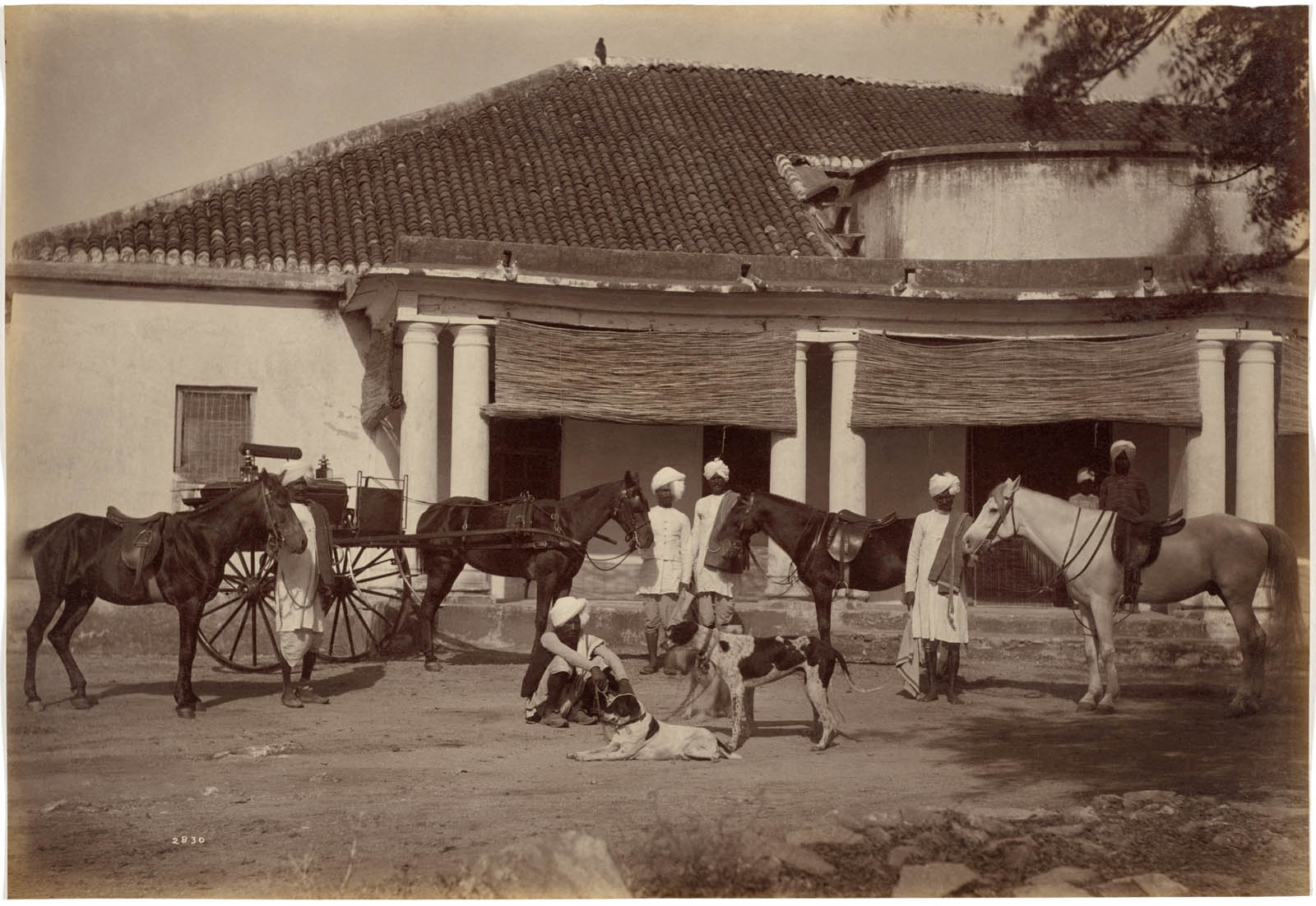
 

Raja Deen Dayal (Indian, 1844-1905) 'Mr. Brown's Horses, Jhansi' 1887


Raja Deen Dayal (Indian, 1844-1905)
Mr. Brown’s Horses, Jhansi
1887
Albumen print
Image: 18.9 x 27.6cm (7 7/16 x 10 7/8 in.)
Paper: 18.9 x 27.6cm (7 7/16 x 10 7/8 in.)
Cleveland Museum of Art
Purchase from the J. H. Wade


Imported into India in great numbers by the British, horses were used for both transportation and sports such as riding, polo, and racing. Caring for the animals fell largely to Indian servants. Captions on the photographs’ mounts specify the owners of these animals (note that Major Sparks also has a monkey and pet deer). However, none of the Indian servants is identified. Nor would they have received a copy of the photograph because of their low social status, which was far below that of Deen Dayal.
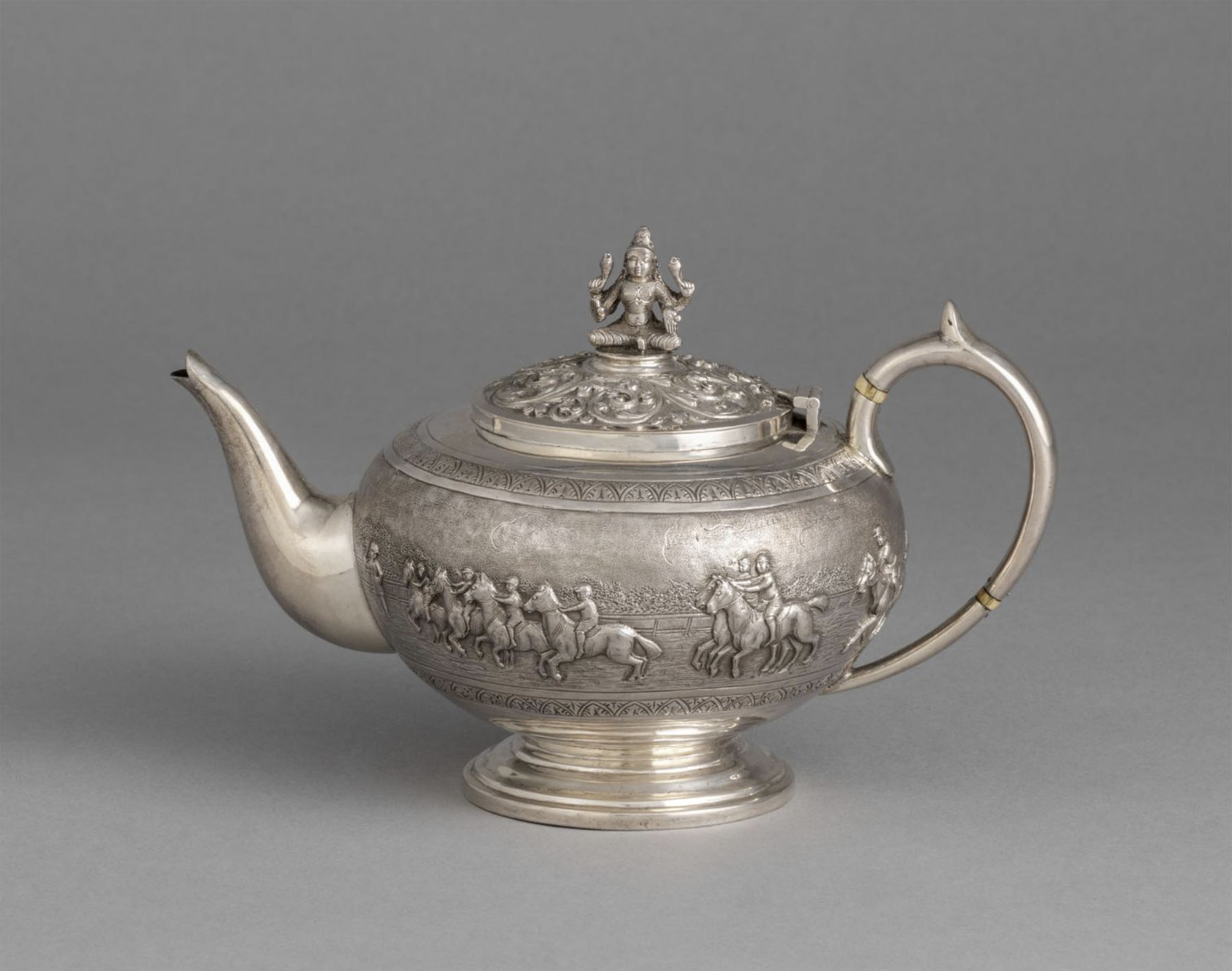
 

Teapot (Indian) c. 1860-1890


Teapot (Indian)
c. 1860-1890
Silver
Overall: 14 x 21 x 13.5 cm (5 1/2 x 8 1/4 x 5 5/16 in.)
Gift of Dr. Ranajit K. Datta


Made either for export or to appeal to the British community living in colonial splendor in India, this pot is a rare testament to the influence of the British Empire on consumer design during the period. Shri Lakshmi, the Hindu goddess of wealth, crowns the vessel as an apt divinity to preside over the horse races depicted on the belly of the teapot.
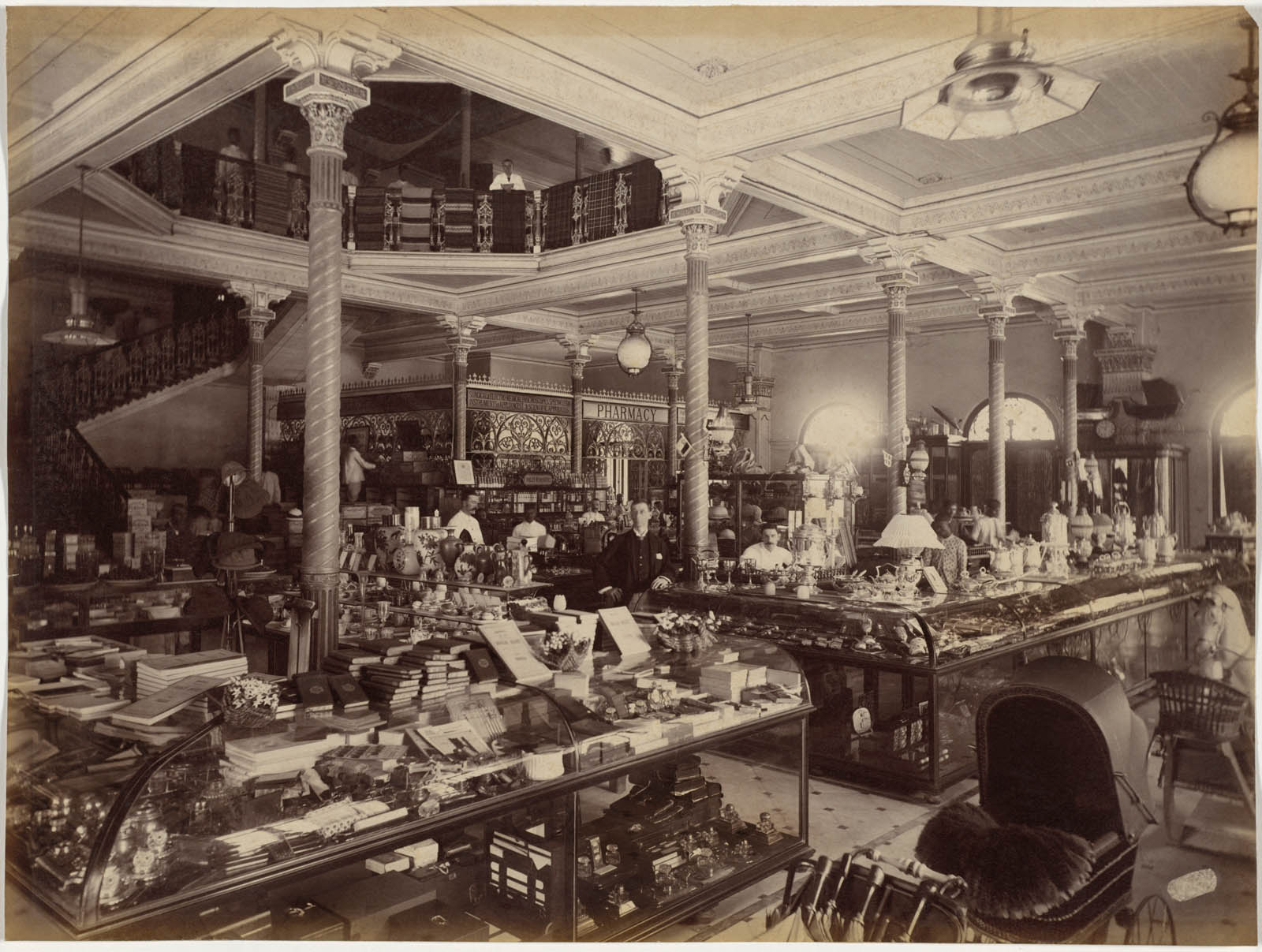
 

Raja Deen Dayal (Indian, 1844-1905) 'Treacher and Co.'s Shop in the Fort, Bombay' 1886


Raja Deen Dayal (Indian, 1844-1905)
Treacher and Co.’s Shop in the Fort, Bombay
1886
Albumen print
Image: 19.6 x 26.3cm (7 11/16 x 10 3/8 in.)
Paper: 19.6 x 26.3cm (7 11/16 x 10 3/8 in.)
Cleveland Museum of Art
Purchase from the J. H. Wade Fund


The English in India approximated life back home instead of adopting local ways. This image, probably one of Deen Dayal’s stock photographs, proved to those back in England that the comforts of home were readily available in India. Treacher’s, a multi-story emporium in Bombay, offered a plethora of products ranging from drugs, wine, and electro-medical instruments to silver tea sets and rocking horses. Many goods were imported, but some local craftsmen had mastered traditional European forms for objects including furniture and silver.
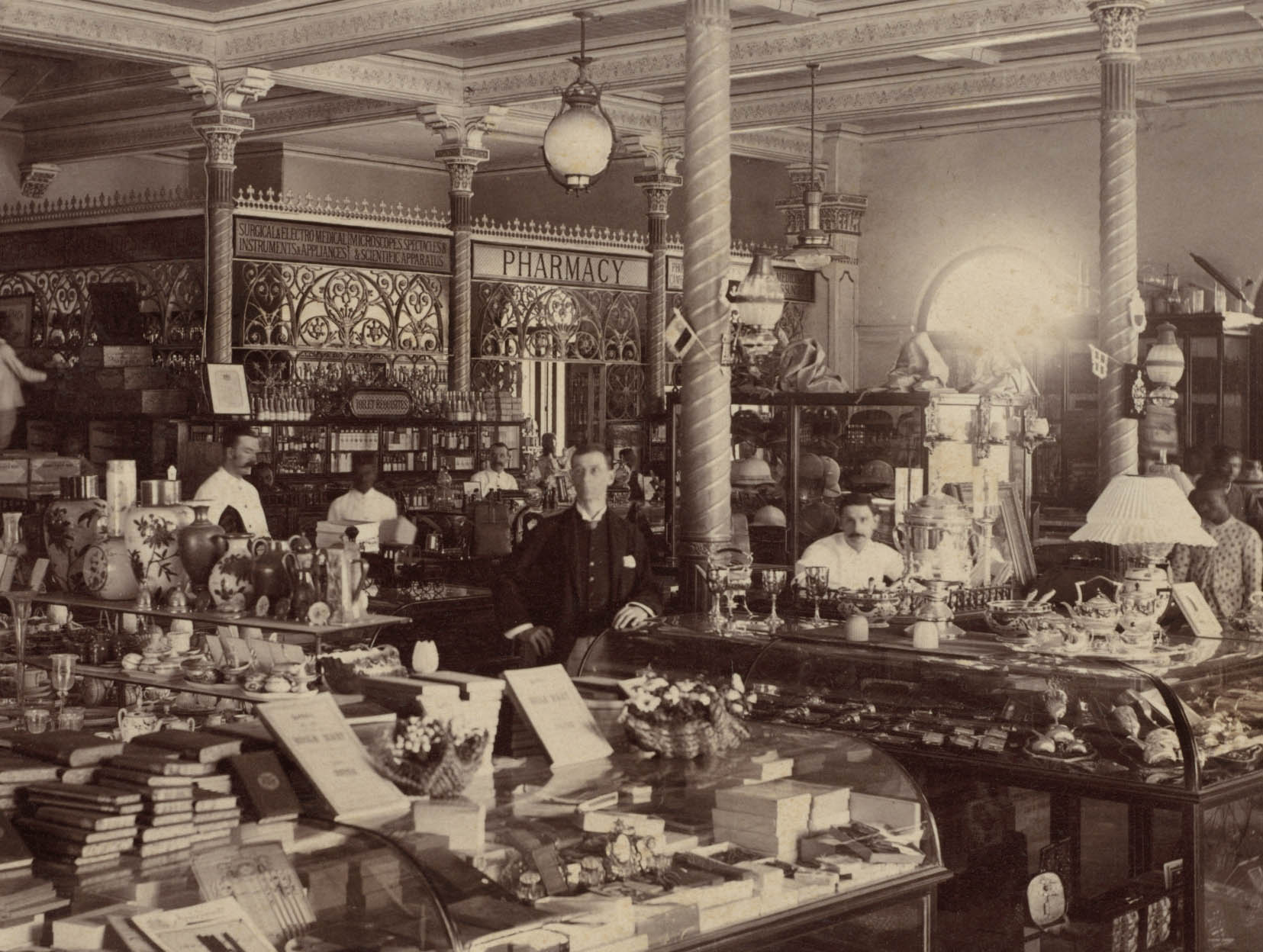
 

Raja Deen Dayal (Indian, 1844-1905) 'Treacher and Co.'s Shop in the Fort, Bombay' 1886 (detail)


Raja Deen Dayal (Indian, 1844-1905)
Treacher and Co.’s Shop in the Fort, Bombay (detail)
1886
Albumen print
Image: 19.6 x 26.3cm (7 11/16 x 10 3/8 in.)
Paper: 19.6 x 26.3cm (7 11/16 x 10 3/8 in.)
Cleveland Museum of Art
Purchase from the J. H. Wade Fund


Cleveland Museum of Art
11150 East Boulevard
Cleveland, Ohio 44106

Opening hours:
Tuesdays, Thursdays, Saturdays, Sundays 10.00am – 5.00pm
Wednesdays, Fridays 10.00am – 9.00pm
Closed Mondays

Cleveland Museum of Art website

LIKE ART BLART ON FACEBOOK

Back to top

Photographs: Edward J. Kelty

November 2018


Edward Kelty (1888-1967) 'Ringling Brothers and Barnum & Bailey (Combined) Circus' c. 1925

Edward J. Kelty (American, 1888-1967)
Century Photographers
Ringling Brothers and Barnum & Bailey (Combined) Circus [clowns behind Madison Square Garden]
c. 1925
Cyanotype
7 3/8 × 9 1/4 inches (23.8 × 23.5cm)


There’s a quality of legend about freaks… I mean, if you’ve ever spoken to someone with two heads, you know they know something you don’t. Most people go through life dreading they’ll have a traumatic experience – freaks were born with their trauma. They’ve already passed their test in life. They’re aristocrats.


Diane Arbus


The aristocrats

During my research for this posting, someone, somewhere, said that Kelty was “not a very adventurous photographer.” What a load of rubbish.

If they meant “adventurous” by being avant-garde to that you can only answer: imagine the passion and dedication, and the skill of the photographer to compose these panoramic images for 15 years, from the mid-1920s to 1940, using a specially made “banquet” camera that produced 12-by-20-inch images.

Just imagine loading up your car with such a monster camera and travelling the roads to the site of these circus encampments, sometimes two or three different circuses a day, to record a veritable feast of difference and diversity. To give equal weight to each and every person. And to then develop the negatives in the back of your car. If this is not adventurous I don’t know what is.

And Kelty had to pay for the privilege. “Kelty was under contract to that circus, meaning he had to pay Ringling Brothers a commission for every circus picture he took. But he was not a circus employee, which had several of its own photographers who specialized in behind-the-scenes candids.”1 The photographs, these grand assemblages of multiculturalism, were not staged for free.

Kelty’s stylised images of sideshow freaks, clowns and other circus exotics are highly idiosyncratic in the world of art photography because, of course, he would not have thought of himself as an artist. Much as Eugène Atget never thought of himself as an artist, hanging a sign on his studio door saying, “Documents pour artistes” (Documents for artists), the sign declaring, “… his modest ambition of providing other artists with images to use as source material in their own work” (MoMA), so Kelty would have only thought he was recording these mise-en-scène for his own benefit, his passion, and to possibly sell a few photographs on the side.

Kelty’s day job was that of professional banquet photographer photographing weddings and the corporate world. The freedom he must have felt going to the circus and engaging with all these wonderful people would have been incredible. And he didn’t discriminate: his egalitarian photographs document the archetypes of the travelling circus, from “group portraits of clowns, sideshow attractions, bands, elephants, menageries, aerialists, equestrians, tractor and train crews, candy butchers (seen with their backs turned to show the “Baby Ruth Candy” logo on their smocks), and even everybody in the Ringling-Barnum cookhouse tent on July 4, 1935.” (Amazon)

Ellen Warren in her article “The mysterious Mr. Kelty”2 observes that Kelty’s photographs are “hopelessly politically incorrect by today’s standards”. In one sense this is true, with the camera documenting and objectifying the “Other”, with the literal naming of difference – “congress of freaks”, “colored review” – but is this objectification little different to the later, more intimate photographs of Diane Arbus documenting a dwarf in his bedroom, a Jewish giant at home with his parents, or an Albino sword swallower at a carnival? Only the archetypal scale is different. In another and perhaps a more generous sense of spirit, Kelty’s images of circus life document a “family” that lived, breathed, ate and travelled together, who looked after each other during fires and vicissitudes, who had a job and food on the table during The Great Depression … people who Kelty imaged as equal and important as each other by placing them in row after row.

In photographs such as Christy Brothers Circus Side Show, H. Emgard – Manager (1927, below), “Living Curiosities” mix it with “Minstrels”, musicians, dancers and comedians and a Scottish family band dressed up in Tartan. All given equal weight in a splendid display, a panopoly of presentation from around the world. And it would seem that the crowds at the circus were equally fascinated by these assemblages, and the process of Kelty taking the photograph, if the glimpses of the audience at left in Congress of the World’s Rough Riders – Celebrating Ringling Golden Jubilee, Ringling Brothers and Barnum & Bailey Combined Circus (1933, below) and at right in Col. Tim McCoy and his Congress of Rough Riders of the World Featured on the Ringling Brothers and Barnum & Bailey Circus (1935, below) are anything to go by.

Other things to note about the photographs are: the shutter time which can be seen by the moving figures at left in George Denman and His Staff, Ringling Brothers and Barnum & Bailey Combined Shows (1931, below); the impeccable use of even light; the use of flash in photographs such as Col. W.T. Johnson’s World Champion Cowgirls – Madison Square Garden – New York City – 1935 (1935, below) and Ringling Brothers and Barnum & Bailey Concert Band, Merle Evans – Bandmaster (1927, below); and Kelty’s innate ability to conduct and compose the scene. This is where Kelty excels himself as an artist and photographer, where he rises above the everyday to become extra-ordinary.

Two photographs are instructive in this regard, the earlier Congress of Freaks with Ringling Brothers and Barnum & Bailey Combined Circus (1931, below) and the later “Doll Family of Midgets”, Celebrating “Ringling Golden Jubilee”, Ringling Brothers and Barnum & Bailey Combined Circus Side Show (1933, below) in which Kelty returns two years later to document more or less the same group of people in the same setting. In the first image, one of the most famous of Kelty’s photographs, two lines of people rise from the outside and then fall (using the height of the subjects) towards the woman seated centrally in the bottom row who grounds the giant, Christ-like figure in the row above, his outstretched arms offering the display to the viewer. In the elegance and placement of figures this is a masterful construction of the image plane. In the later photograph Kelty doubles down, bookending both rows with symmetrical characters (giant women with headdresses, men in black tie) instead of just the one row in the first photograph – the rows again rising and falling towards the central characters, the giants framing the composition with outstretched arms. It might seem simple but it is not.

This is not some hack at work, not some unadventurous photographer with limited imagination, but a man composing a fugue like J.S.Bach, a veritable banquet for the eyes. To suggest otherwise is to not understand the history of photography, the history of representation, and the passion needed to represent life in all its forms.

Dr Marcus Bunyan


1/ Ellen Warren. “The mysterious Mr. Kelty,” on the Chicago Tribune website February 7, 2003 [Online] Cited 23/11/2018

2/ Ibid.,


All of the photographs in this posting are published under “fair use” conditions for the purpose of educational research and academic comment. Please click on the photographs for a larger version of the image.


Going by the evidence of the photographs, Kelty seems to have had three studio addresses close to each other in Midtown New York during his 15 years photographing the circus: first 144 West 46th (1925-1930), 74 W 47th (1931-1934) and finally 110 W 46th (1935-1940). As can be seen from the map above (with one exception of a photograph in St. Louis MO), Kelty usually travelled close to home to document the circus wherever they set up camp.


Edward Kelty (American, 1888-1967) 'Ringling Brothers and Barnum & Bailey Concert Band, Merle Evans - Bandmaster' 1927


Edward J. Kelty (American, 1888-1967)
Century Photographers 144 W 46 N.Y.C.
Ringling Brothers and Barnum & Bailey Concert Band, Merle Evans – Bandmaster
1927
Gelatin silver print


Merle Slease Evans (American, 1891-1987)

Merle Slease Evans (December 26, 1891 – December 31, 1987) was a cornet player and circus band conductor who conducted the Ringling Bros. and Barnum & Bailey Circus for fifty years. He was known as the “Toscanini of the Big Top.” Evans was inducted into the American Bandmasters Association in 1947 and the International Circus Hall of Fame in 1975. …

Evans was hired as the band director for the newly merged Ringling Bros. and Barnum & Bailey Circus in 1919. Evans held this job for fifty years, until his retirement in 1969. He only missed performances due to a musicians union strike in 1942 and the death of his first wife. He wrote eight circus marches, including Symphonia and Fredella.

Text from the Wikipedia website


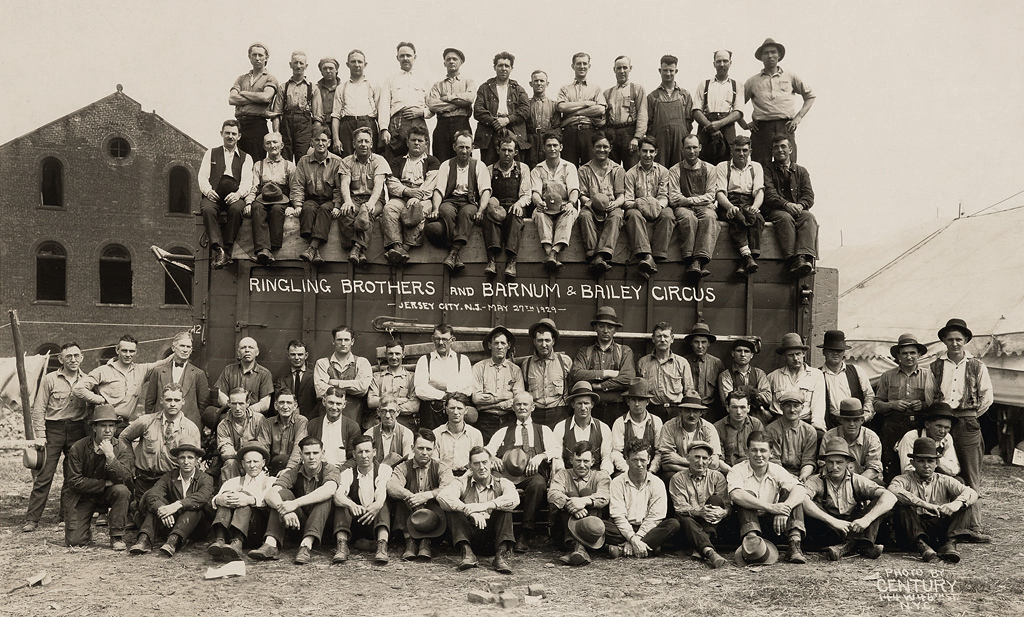
Edward Kelty (American, 1888-1967) 'Ringling Brothers and Barnum & Bailey Combined Circus' Jersey City, N.J. - May 27th 1929


Edward J. Kelty (American, 1888-1967)
Century Photographers 144 W 46 N.Y.C.
Ringling Brothers and Barnum & Bailey Combined Circus
Jersey City, N.J. – May 27th 1929
Gelatin silver print


Edward Kelty (American, 1888-1967) 'George Denman and His Staff, Ringling Brothers and Barnum & Bailey Combined Shows' Irvington, N.J. June 9th, 1931


Edward J. Kelty (American, 1888-1967)
Century Photographers 74 W 47 N.Y.C.
George Denman and His Staff, Ringling Brothers and Barnum & Bailey Combined Shows
Irvington, N.J. – June 9th, 1931
Gelatin silver print
11 1/4 × 19 5/8 inches (28.6 × 49.9cm)


Edward Kelty (1888-1967) 'Ringling Brothers and Barnum & Bailey Circus - Greatest Show on Earth -' 1931


Edward J. Kelty (American, 1888-1967)
Century Photographers 74 W 47 N.Y.C.
Ringling Brothers and Barnum & Bailey Circus – Greatest Show on Earth –
1931
Gelatin silver print


Ringling Bros. and Barnum & Bailey Circus, also known as the Ringling Bros. CircusRingling Bros. or simply Ringling was an American traveling circus company billed as The Greatest Show on Earth. It and its predecessor shows ran from 1871 to 2017. Known as Ringling Bros. and Barnum & Bailey Combined Shows, the circus started in 1919 when the Barnum & Bailey’s Greatest Show on Earth, a circus created by P. T. Barnum and James Anthony Bailey, was merged with the Ringling Bros. World’s Greatest Shows. The Ringling brothers had purchased Barnum & Bailey Ltd. following Bailey’s death in 1906, but ran the circuses separately until they were merged in 1919. …

In 1871, Dan Castello and William Cameron Coup persuaded Barnum to come out of retirement as to lend his name, know-how and financial backing to the circus they had already created in Delavan, Wisconsin. The combined show was named “P.T. Barnum’s Great Traveling Museum, Menagerie, Caravan, and Hippodrome”. As described by Barnum, Castello and Coup “had a show that was truly immense, and combined all the elements of museum, menagerie, variety performance, concert hall, and circus”, and considered it to potentially be “the Greatest Show on Earth”, which subsequently became part of the circus’s name.

Independently of Castello and Coup, James Anthony Bailey had teamed up with James E. Cooper to create the Cooper and Bailey Circus in the 1860s. The Cooper and Bailey Circus became the chief competitor to Barnum’s circus. As Bailey’s circus was outperforming his, Barnum sought to merge the circuses. The two groups agreed to combine their shows on March 28, 1881. Initially named “P.T. Barnum’s Greatest Show On Earth, And The Great London Circus, Sanger’s Royal British Menagerie and The Grand International Allied Shows United”, it was eventually shortened to “Barnum and Bailey’s Circus”. Bailey was instrumental in acquiring Jumbo, advertised as the world’s largest elephant, for the show. Barnum died in 1891 and Bailey then purchased the circus from his widow. Bailey continued touring the eastern United States until he took his circus to Europe. That tour started on December 27, 1897, and lasted until 1902.

Separately, in 1884, five of the seven Ringling brothers had started a small circus in Baraboo, Wisconsin. This was about the same time that Barnum & Bailey were at the peak of their popularity. Similar to dozens of small circuses that toured the Midwest and the Northeast at the time, the brothers moved their circus from town to town in small animal-drawn caravans. Their circus rapidly grew and they were soon able to move their circus by train, which allowed them to have the largest traveling amusement enterprise of that time. Bailey’s European tour gave the Ringling brothers an opportunity to move their show from the Midwest to the eastern seaboard. Faced with the new competition, Bailey took his show west of the Rocky Mountains for the first time in 1905. He died the next year, and the circus was sold to the Ringling Brothers.

Ringling Bros. and Barnum & Bailey Circus

The Ringlings purchased the Barnum & Bailey Greatest Show on Earth in 1907 and ran the circuses separately until 1919. By that time, Charles Edward Ringling and John Nicholas Ringling were the only remaining brothers of the five who founded the circus. They decided that it was too difficult to run the two circuses independently, and on March 29, 1919, “Ringling Bros. and Barnum & Bailey Combined Shows” debuted in New York City. The posters declared, “The Ringling Bros. World’s Greatest Shows and the Barnum & Bailey Greatest Show on Earth are now combined into one record-breaking giant of all exhibitions.” Charles E. Ringling died in 1926, but the circus flourished through the Roaring Twenties.

John Ringling had the circus move its headquarters to Sarasota, Florida in 1927. In 1929, the American Circus Corporation signed a contract to perform in New York City. John Ringling purchased American Circus, owner of five circuses, for $1.7 million…

The circus suffered during the 1930s due to the Great Depression, but managed to stay in business. After John Nicholas Ringling’s death, his nephew, John Ringling North, managed the indebted circus twice, the first from 1937 to 1943. Special dispensation was given to the circus by President Roosevelt to use the rails to operate in 1942, in spite of travel restrictions imposed as a result of World War II. Many of the most famous images from the circus that were published in magazine and posters were captured by American photographer Maxwell Frederic Coplan, who traveled the world with the circus, capturing its beauty as well as its harsh realities.

Text from the Wikipedia website


Edward Kelty (American, 1888-1967) 'Congress of the World's Rough Riders - Celebrating Ringling Golden Jubilee, Ringling Brothers and Barnum & Bailey Combined Circus' Brooklyn, N.Y. May 19th 1933


Edward J. Kelty (American, 1888-1967)
Century Photographers 74 W 47 N.Y.C.
Congress of the World’s Rough Riders – Celebrating Ringling Golden Jubilee, Ringling Brothers and Barnum & Bailey Combined Circus
Brooklyn, N.Y. May 19th 1933
Gelatin silver print


“In the late nineteenth century, America displayed a new imperialistic mood and a heightened desire to impress her independence upon Europe when she embarked upon a number of military adventures in the Caribbean and Pacific. During the same period, there appeared a new popular hero – the “Rough Rider” – who derived from the Western frontier but expanded the field of heroic action well beyond the shores of America. The creation of this hero and the scene in which he was set demonstrates how popular culture of the period not only embodied but facilitated crucial developments in the nation’s growth.”

Christine Bold. “The Rough Riders at Home and Abroad: Cody, Roosevelt, Remington and the Imperialist hero,” in Canadian Review of American Studies Volume 18 Issue 3, September 1987, pp. 321-350


Edward Kelty (1888-1967)


Edward J. Kelty (American, 1888-1967)
Century Photographers 74 W 47 N.Y.C.
Celebrating “Ringling Golden Jubilee”, Ringling Brothers and Barnum & Bailey Combined Circus
Brooklyn, N.Y. May 19th 1933
Gelatin silver print
11 1/4 × 19 5/8 inches (28.6 × 49.9cm)


Edward J. Kelty (American, 1888-1967) 'Ringling Brothers and Barnum & Bailey Combined Menagerie' Brooklyn, N.Y. May 19th 1933


Edward J. Kelty (American, 1888-1967)
Century Photographers 74 W 47 N.Y.C.
Ringling Brothers and Barnum & Bailey Combined Menagerie
Brooklyn, N.Y. May 19th 1933
Gelatin silver print


In mid-20th century America, a typical circus traveled from town to town by train, performing under a huge canvas tent commonly called a “big top”. The Ringling Brothers and Barnum & Bailey Circus was no exception: what made it stand out was that it was the largest circus in the country. Its big top could seat 9,000 spectators around its three rings; the tent’s canvas had been coated with 1,800 pounds (820 kg) of paraffin wax dissolved in 6,000 US gallons (23,000 l) of gasoline, a common waterproofing method of the time.

A menagerie is a collection of captive animals, frequently exotic, kept for display; or the place where such a collection is kept, a precursor to the modern zoological garden. The term was first used in seventeenth century France in reference to the management of household or domestic stock. Later, it came to be used primarily in reference to aristocratic or royal animal collections. The French-language Methodical Encyclopaedia of 1782 defines a menagerie as an “establishment of luxury and curiosity.” Later on, the term referred also to travelling animal collections that exhibited wild animals at fairs across Europe and the Americas.

Texts from the Wikipedia website


Edward Kelty (American, 1888-1967) 'Ringling Golden Jubilee - Ringling Brothers and Barnum & Bailey Combined Circus' Newark, N.Y. June ? 1933


Edward J. Kelty (American, 1888-1967)
Century Photographers 74 W 47 N.Y.C.
Ringling Golden Jubilee – Ringling Brothers and Barnum & Bailey Combined Circus
Newark, N.Y. June ? 1933
Gelatin silver print


Edward J. Kelty (American, 1888-1967) 'Congress of Freaks with Ringling Brothers and Barnum & Bailey Combined Circus' 1931


Edward J. Kelty (American, 1888-1967)
Century Photographers 74 W 47 N.Y.C.
Congress of Freaks with Ringling Brothers and Barnum & Bailey Combined Circus
1931
Gelatin silver print


Edward Kelty (American, 1888-1967) '"Doll Family of Midgets", Celebrating "Ringling Golden Jubilee", Ringling Brothers and Barnum & Bailey Combined Circus Side Show' 1933


Edward J. Kelty (American, 1888-1967)
Century Photographers 74 W 47 N.Y.C.
“Doll Family of Midgets”, Celebrating “Ringling Golden Jubilee”, Ringling Brothers and Barnum & Bailey Combined Circus Side Show
1933
Gelatin silver print
11 1/8 × 19 1/2 inches (28.3 × 49.5cm)


Edward J. Kelty (American, 1888-1967) 'Col. Tim McCoy and his Congress of Rough Riders of the World Featured on the Ringling Brothers and Barnum & Bailey Circus' Newark N.J. June 11th 1935


Edward J. Kelty (American, 1888-1967)
Century Photographers 110 W 46 NYC
Col. Tim McCoy and his Congress of Rough Riders of the World Featured on the Ringling Brothers and Barnum & Bailey Circus
Newark. N.J. June 11th 1935
Gelatin silver print


Timothy John Fitzgerald McCoy (American, 1891-1978)

Timothy John Fitzgerald McCoy (April 10, 1891 – January 29, 1978) was an American actor, military officer, and expert on American Indian life and customs. He was also known Colonel T.J. McCoy.

McCoy worked steadily in movies until 1936, when he left Hollywood, first to tour with the Ringling Brothers Circus and then with his own “wild west” show. The show was not a success and is reported to have lost $300,000, of which $100,000 was McCoy’s own money. It folded in Washington, D.C. and the cowboy performers were each given $5 and McCoy’s thanks. The Indians on the show were returned to their respective reservations by the Bureau of Indian Affairs. …

For his contribution to the film industry, Col. Tim McCoy was honoured with a star on the Hollywood Walk of Fame. In 1973, McCoy was inducted into the Hall of Great Western Performers of the National Cowboy and Western Heritage Museum. McCoy was inducted into the Cowboy Hall of Fame in 1974.

Text from the Wikipedia website


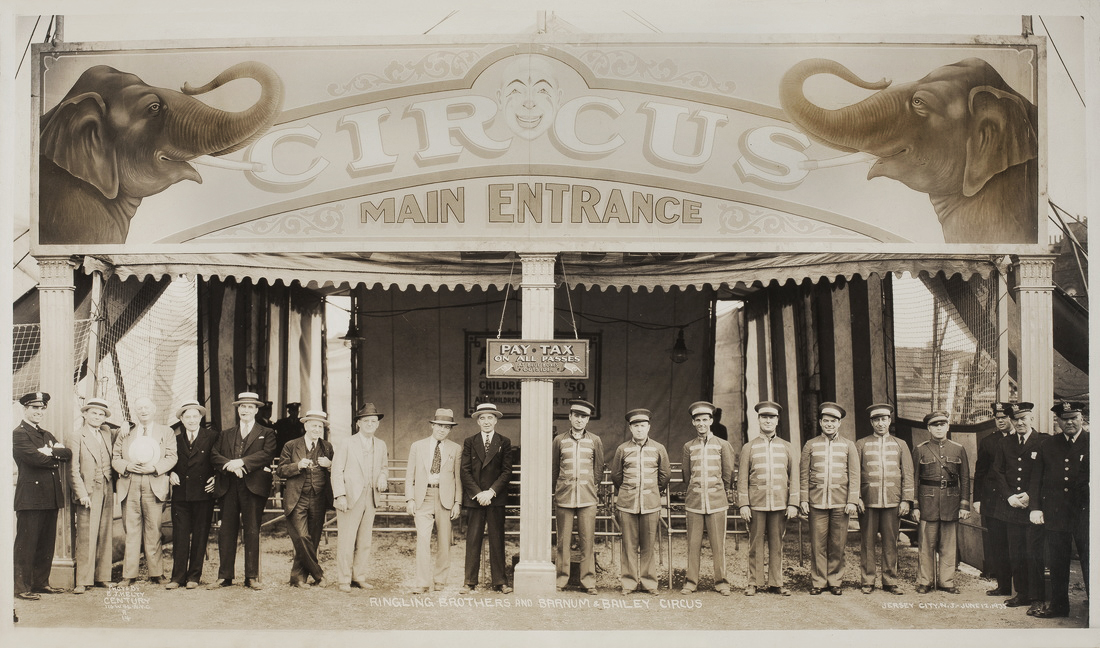
Edward Kelty (American, 1888-1967) 'Ringling Brothers and Barnum & Bailey Circus' Jersey City, N.J. June 12, 1935


Edward J. Kelty (American, 1888-1967)
Century Photographers 110 W 46 NYC
Ringling Brothers and Barnum & Bailey Circus
Jersey City, N.J. June 12, 1935
Gelatin silver print


Edward Kelty (American, 1888-1967) 'Congress of Clowns, Ringling Brothers and Barnum & Bailey Combined Circus' Patterson, N. J. June 13, 1935


Edward J. Kelty (American, 1888-1967)
Century Photographers 110 W 46 NYC
Congress of Clowns, Ringling Brothers and Barnum & Bailey Combined Circus
Patterson, N. J. June 13, 1935
Gelatin silver print
11 1/8 × 19 5/8inches (28.3 × 49.9cm)


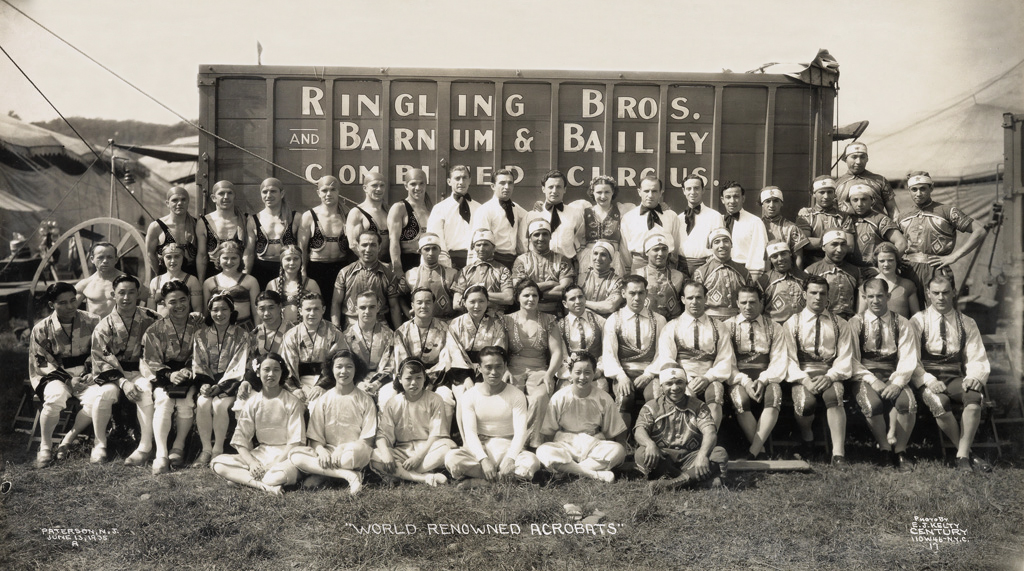
Edward Kelty (American, 1888-1967) 'World Renowned Acrobats, Ringling Brothers and Barnum & Bailey Combined Circus' Patterson, N. J. June 13, 1935


Edward J. Kelty (American, 1888-1967)
Century Photographers 110 W 46 NYC
World Renowned Acrobats, Ringling Brothers and Barnum & Bailey Combined Circus
Patterson, N. J. June 13, 1935
Gelatin silver print


Edward Kelty (American, 1888-1967) "Queens of the Air", Ringling Brothers and Barnum & Bailey Combined Circus' Patterson, N. J. June 13, 1935


Edward J. Kelty (American, 1888-1967)
Century Photographers 110 W 46 NYC
“Queens of the Air”, Ringling Brothers and Barnum & Bailey Combined Circus
Patterson, N. J. June 13, 1935
Gelatin silver print
11 1/4 × 19 5/8 inches (28.6 × 49.9cm)


Edward Kelty (American, 1888-1967) 'Tommy Atkins Military Riding Maids featured with Ringling Brothers and Barnum & Bailey Circus' Poughkeepsie, N.Y. - June 15th 1935


Edward J. Kelty (American, 1888-1967)
Century Photographers 110 W 46 NYC
Tommy Atkins Military Riding Maids featured with Ringling Brothers and Barnum & Bailey Circus
Poughkeepsie, N.Y. – June 15th 1935
Gelatin silver print


Dorothy Herbert (American, 1910-1994)

Dorothy Herbert (1910-1994) joined Ringling Bros and Barnum & Bailey in 1930 when she was only 20 years old. Over the next decade she truly became a headliner – appearing on a variety of posters, including several seen here. Like Lillian Leitzel, May Wirth and Tim McCoy, and later Lou Jacobs and Gunther Gebel-Williams – her star status led to the creation of a number of posters featuring her image.

Herbert was only 24 years old when a portrait lithograph was added to the Ringling-Barnum billposter hod during the 1934 season. Starting that spring, and for several seasons following, an image of Miss Herbert and her horse Satan appeared in hundreds of store windows as both a one-sheet and a window card, and in a much larger format on the sides of walls and barns. The same portrait was also featured on the cover of the 1934 program book, the first time an individual circus star was featured on the Ringling-Barnum “Program and Daily Review”. …

[Herbert] features in a display that she starred in titled “Miss Tommy Atkins and Her Military Maids” The depiction is of a group of girls on horses, dressed in British red-coat dress uniforms. The act consisted of military equestrian manoeuvres and the reason it carried the name “Miss Tommy Atkins” is that a British soldier of the era was often referred to as a “Tommy Atkins” much in the way that American soldiers have been known as “G.I. Joe”.

Extract from Chris Berry. “Dorothy Herbert (Ringling Bros and Barnum & Bailey),” on the Collectors Weekly website 2012 [Online] Cited 20/10/2018


Edward Kelty (American, 1888-1967) 'Hagenbeck-Wallace Circus Executive Staff' New Brunswick, N.J. - June 17th 1931


Edward J. Kelty (American, 1888-1967)
Century Photographers 74 W 47 N.Y.C.
Hagenbeck-Wallace Circus Executive Staff
New Brunswick, N.J. – June 17th 1931
Gelatin silver print


The Hagenbeck-Wallace Circus was a circus that traveled across America in the early part of the 20th century. At its peak, it was the second-largest circus in America next to Ringling Brothers and Barnum and Bailey Circus. It was based in Peru, Indiana.

The circus began as the “Carl Hagenbeck Circus” by Carl Hagenbeck (1844-1913). Hagenbeck was an animal trainer who pioneered the use of rewards-based animal training as opposed to fear-based training.

Meanwhile, Benjamin Wallace, a livery stable owner from Peru, Indiana, and his business partner, James Anderson, bought a circus in 1884 and created “The Great Wallace Show”. The show gained some prominence when their copyright for advertising posters was upheld by the Supreme Court in Bleistein v. Donaldson Lithographing Company. Wallace bought out his partner in 1890 and formed the “B. E. Wallace Circus”.

In 1907, Wallace purchased the Carl Hagenbeck Circus and merged it with his circus. The circus became known as the Hagenbeck-Wallace circus at that time, even though Carl Hagenbeck protested. He sued to prohibit the use of his name but lost in court. …

The circus spent its winters just outside Baldwin Park, California. There, on 35 acres of land, the circus stayed with its huge parade wagons parked alongside a railroad spur. The elephants spent time hauling refuse wagons, shunting railroad cars and piling baled hay. A tent at the eastern edge of the grounds was used by aerialists to practice trapeze and high-wire acts. The circus usually remained there from late November to early spring.

The Great Depression and Ringling’s ill health caused the Ringling empire to falter. In 1935, the circus split from Ringling Brothers and Barnum & Bailey and became the Hagenbeck-Wallace and Forepaugh-Sells Bros. Circus. It finally ceased operations in 1938.

The complex near Peru that formerly housed the winter home of Hagenbeck-Wallace now serves as the home of the Circus Hall of Fame.

Text from the Wikipedia website


Edward Kelty (American, 1888-1967) 'Hagenbeck-Wallace Circus' 1931


Edward J. Kelty (American, 1888-1967)
Century Photographers 74 W 47 N.Y.C.
Hagenbeck-Wallace Circus
1931
Gelatin silver print
11 1/4 × 19 5/8 inches (28.6 × 49.9 cm.)


Edward J. Kelty (American, 1888-1967)

Edward J. Kelty (1888-1967) moved to New York City following his service in the Navy during World War I, and opened up his first studio, Flashlight Photographers. Kelty was drawn to the circus and visited Coney Island often. In the summer of 1922, he transformed his truck into a mini studio, darkroom and living quarters, and traveled across America. His panoramic views captured the performers – human and animal – associated with Ringling Bros. and Barnum & Bailey, Hagenbeck-Wallace, Sells-Floto, Clyde Beatty, Cole Bros. and other train, wagon and truck shows.

A typical day for Kelty would have him waking at dawn to set up cameras and tripods, gathering bearded ladies and sword swallowers, snake charmers and giants and shooting all morning. At times he had as many as 1,000 people in a picture. Afternoons were spent processing film and making proofs, taking orders and printing well into the night. The following day, he distributed prints, most often to circus staff and performers, before returning to his New York studio to work on his wedding and banquet photography business.

Kelty was hit hard by the Depression, and by 1942 had cashed in his glass plate negatives to settle a hefty bar tab. He moved to Chicago and, as legend has it, never took another photograph. His extant negatives eventually made their way into a Tennessee collection of circus memorabilia. Since Kelty used Nitrate-based film, which is unstable when improperly housed, the negatives self-destructed and were disposed of.

After Kelty died in 1967, his estranged family found no photographs, cameras or negatives among his belongings – just one old lens and a union concession employee ID card identifying him as a vendor at Chicago’s Wrigley Field. There was no evidence of the man who, along with his custom mammoth-size banquet camera and portable studio, documented America’s greatest traveling circuses.

Anonymous. “Edward J. Kelty,” on the Swann Galleries website Nd [Online] Cited 21/11/2018. No longer available online


Edward Kelty (American, 1888-1967) 'Hagenbeck-Wallace Circus, Jess Adkins, Manager - Rex De Rosselli, Producer of Spectacle - Harry McFarlan, Equestrienne Director'. Brooklyn, N.J. June 11th 1932


Edward J. Kelty (American, 1888-1967)
Century Photographers 74 W 47 N.Y.C.
Hagenbeck-Wallace Circus, Jess Adkins, Manager – Rex De Rosselli, Producer of Spectacle – Harry McFarlan, Equestrienne Director
Brooklyn, N.J. June 11th 1932
Gelatin silver print


Edward Kelty (American, 1888-1967) 'Hagenbeck-Wallace Circus, Jess Adkins, Manager - Rex De Rosselli, Producer of Spectacle - Harry McFarlan, Equestrienne Director.' St. Louis, MO. - May 11th 1934


Edward J. Kelty (American, 1888-1967)
Century Photographers 74 W 47 N.Y.C.
Hagenbeck-Wallace Circus, Jess Adkins, Manager – Rex De Rosselli, Producer of Spectacle – Harry McFarlan, Equestrienne Director
St. Louis, MO. – May 11th 1934
Gelatin silver print


Banquet photography

Banquet photography is the photography of large groups of people, typically in a banquet setting such as a hotel or club banquet room, with the objective of commemorating an event. Clubs, associations, unions, circuses and debutante balls have all been captured by banquet photographers.

A banquet photograph is usually taken in black and white with a large format camera, with a wide angle lens, from a high angle to ensure that each person is in focus while seated at their table. Large cameras such as a 12 × 20 view camera or a panoramic camera were used. The defining characteristic of a banquet photograph is the depth of focus and detail and clarity of the image.

Banquet photography was most popular in the 1890s, and had mostly waned by the 1970s. In part its decline is owed to the difficult technical aspects of producing quality banquet photos, the difficulty of printing such large negatives, and the expense and size of the equipment needed. Today, though hard to find, there are a handful of photographers still shooting banquet photos with flashbulbs and large format film cameras. View cameras use large format sheet film – one sheet per photograph.

Text from the Wikipedia website


Edward Kelty (American, 1888-1967) 'Christy Brothers Circus Side Show, H. Emgard - Manager' 1927


Edward J. Kelty (American, 1888-1967)
Century Photographers 144 W 46 N.Y.C.
Christy Brothers Circus Side Show, H. Emgard – Manager
1927
Gelatin silver print


George Washington Christy was born February 22 1889 in Pottstown, Pennsylvania to parents John and Ida Christy.

The circus opened in 1919 under the title of “Christy Hippodrome Shows” (later changed to Christy Bros. Circus). The show opened as a two car show, Christy purchased many of his parade wagons from the Ringling Bros. after they discontinued their downtown parades. The circus wintered first in Galveston, Texas and then in South Houston, where Christy had built a home.

On May 25, the show’s trained wrecked just outside of Cardston Alberta, Canada.. G.W. Christy, being the showman that he was set up in a cornfield near the wreck and gave a performance while the rails were being cleared. In 1925 and 1926, Christy operated a second unit named “Lee Bros.”, but closed it after the the 1926 season.

The “Great Depression” beginning in 1929, was a difficult time for all shows on the road. The Christy Bros. Circus was no exception, not only was the economy in bad shape but weather was also a major factor. Christy and his loyal employees struggled to keep the circus on the road. On July 7, 1930 the Christy Brothers Circus gave it’s last performance in Greeley, Colorado.

After the close of the show, most of the equipment was sold in 1935 to Jess Adkins and Zack Terrell, who were framing their Cole Bros. Circus, some of the parade wagons went to the “Ken Mayner Circus”. Christy kept his elephants and horses, the elephants were used to help build Spencer Highway in South Houston, Texas.

After leaving the circus world George Christy became mayor of the City of South Houston serving from 1949 to 1951 and again from 1960 to 1964. George Washington Christy died August 07, 1975 in Houston Texas.

Anonymous text. “Christy Bros Circus,” on the Circuses and Sideshows website Nd [Online] Cited 13/03/2022


Edward Kelty (American, 1888-1967) 'Walter L. Main Circus' 1927


Edward J. Kelty (American, 1888-1967)
Century Photographers 144 W 46 N.Y.C.
Walter L. Main Circus
1927
Gelatin silver print


The Walter L. Main Circus was founded by Walter L. Main in 1886. Walter’s father “William” was a horse farmer, trainer and trader in Trumbull, Ohio. William began supplying horses to circuses, which led to him joining the “Hilliard & Skinner’s Variety and Indian show”. William toured with several shows and in the 1870s began his own, very small circus. …

1904 was the last year that the “Walter L. Main Circus” operated under Walters ownership, the circus was sold that year to William P. Hall. In 1918 Walter leased the Main title to Andrew Downie who made a small fortune operating his circus under the Main name until he sold the show to the Miller Bros. of the 101 Ranch Wild West Show in 1924. In 1925 until 1928 the Main title was used by Floyd King and his brother Howard. The Main title was used by various operators 1930-1937.

Anonymous text. “Walter L. Main Circus,” on the Circuses and Sideshows website Nd [Online] Cited 13/03/2022


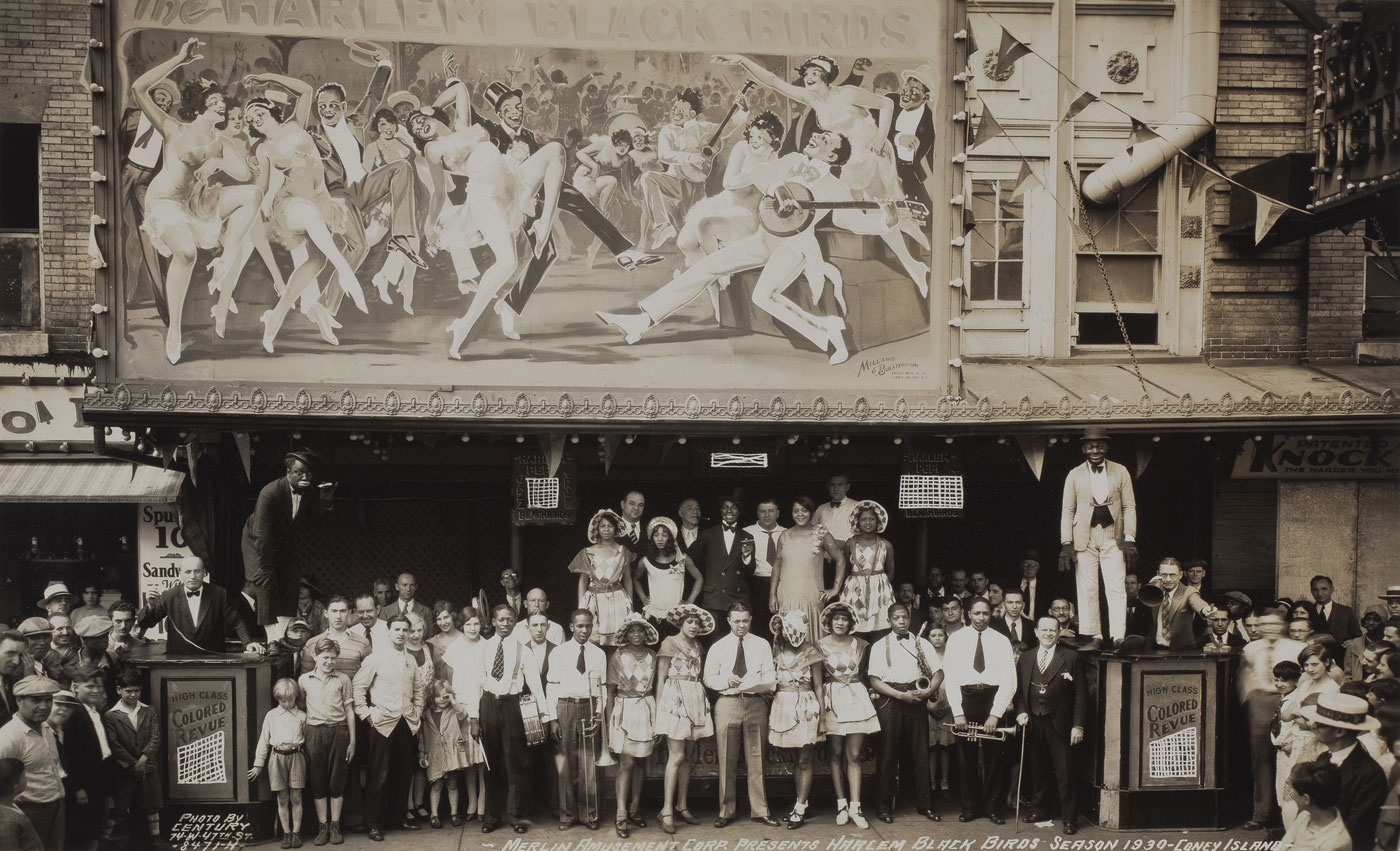
Edward J. Kelty (American, 1888-1967) 'Harlem Black Birds, Coney Island' 1930


Edward J. Kelty (American, 1888-1967)
Century Photographers 74 W 47 N.Y.C.
Harlem Black Birds, Coney Island
1930
12 x 20 in. (30.5 x 50.8cm)
Collection of Ken Harck
© Edward J. Kelty


Edward Kelty (American, 1888-1967) 'Sells-Floto Big Double Side Show, Jersey City, N.J. - June 19th 1931, Lew. C. Edelmore - Manager' 1931


Edward J. Kelty (American, 1888-1967)
Century Photographers 74 W 47 N.Y.C.
Sells-Floto Big Double Side Show, Jersey City, N.J. – June 19th 1931, Lew. C. Edelmore – Manager
1931
Gelatin silver print


Edward Kelty (American, 1888-1967) 'Sam B. Dill's Circus' Mineola, L.I. N.Y. - June 19th 1933


Edward J. Kelty (American, 1888-1967)
Century Photographers 74 W 47 N.Y.C.
Sam B. Dill’s Circus
Mineola, L.I., N.Y. – June 19th 1933
Gelatin silver print


Early Wednesday morning, July 19, 1933, a long train arrived in York and stopped near the fairgrounds. The Sam B. Dill Circus had arrived.

“Young America, having caught the infectious circus spirit is likely to be in ahead of both morning orb and circus and be on the lot along with enthusiastic adults to greet the show train on its arrival there,” The York Dispatch reported the day before the train’s arrival.

The unloading and setting up of the circus tents and shows worked smoothly. All of the performers knew their jobs. They had been doing it multiple times each week since the circus had opened its season in Dallas on April 9.

Wagons containing the menagerie were rolled down ramps. Trunks were carried off to other areas. Elephants and roustabouts worked to raise the big top as the sun rose. Within a relatively short time, the big top tent was erected, and the performers went to work preparing their equipment inside while the roustabouts set up the bleacher seating.

By the time everything was finished around 9 a.m., the cooks in the circus kitchen had breakfast ready.

The Sam B. Dill Circus was scheduled to play two performances, at 2 p.m. and 8 p.m., for York residents.

“Sam B. Dill’s Circus isn’t the biggest circus in the world, but what it lacks in size it makes up in quality,” the Amarillo Sunday News and Globe wrote about the circus.

Dill had managed the famous John Robinson Circus, but when it was sold to the American Circus Corp., Dill had struck out on his own. Though not a large circus, Dill’s circus was popular and tended to sell out its performances.

After breakfast, everyone had a short rest, and then they began to scurry around getting the menagerie wagons harnessed to horses and in a line. Performers dressed in their bright and flamboyant costumes. At noon, “a long column of red, gold and glitter, with bands playing and banners flying will move sinuously out of the Richland Avenue gate,” The York Dispatch reported.

From Richland Avenue, the parade moved east on Princess Street, then north on George Street to Continental Square. From the square, the circus moved west on Market Street and then back to Richland Avenue. Thousands of spectators lined the route to watch the performers, hear the music and marvel at the wild animals.

The first wagon was the band wagon where Shirley Pitts, the country’s only female calliope player, conducted the band. Then came the wagons pulling tigers, monkeys, seals and more. Other flat wagons featured clowns goofing off and Wild West displays.

When the parade arrived back at the fairgrounds, many of the spectators followed. Although the big top wouldn’t open until 1 p.m., spectators wandered the midway, playing games, getting an up-close look at the menagerie or viewed some of the shows in the smaller tents.

The three-ring show under the big top had dozens of animals such as Oscar the Lion, Buddy the performing sea lion, camels, zebras, horses, elephants, dogs, monkeys and ponies.

Christian Belmont swung on the trapeze, along with aerialist Rene Larue. Mary Miller performed a head-balancing act. The four Bell Brothers showed off their acrobatic skills, and Betha Owen owned the high wire. Among the clowns, young Jimmy Thomas was noted as the “youngest clown in the circus world.” He traveled with his mother, Lorette Jordan, who was also an aerialist with the show.

The circus also liked to feature a western movie star with its Wild West acts. In 1933, that performer was Buck Steel. The following year, Tom Mix joined the circus. He had been a major western movie star who had seen his popularity decline in the 1920s. In 1935, he bought the circus from Dill and renamed it the Tom Mix Circus.

Following the 8 p.m. show, the performers broke down the circus and loaded it back on the train to head out by midnight for the next city.

​James Rada Jr. “LOOKING BACK 1933: The circus comes to town,” from the York Dispatch website August 3, 2016 [Online] Cited 13/03/2022


Edward Kelty (American, 1888-1967) 'Hunt's Three Ring Circus' Northport, L.I., N.Y. - June 26th 1931


Edward J. Kelty (American, 1888-1967)
Century Photographers 74 W 47 N.Y.C.
Hunt’s Three Ring Circus
Northport, L.I., N.Y. – June 26th 1931
Gelatin silver print


Edward Kelty (American, 1888-1967) 'James Whalen and His Big Top Department - Ringling Brothers and Barnum & Bailey Combined Circus' Reading, P.A. - June 1st 1934


Edward J. Kelty (American, 1888-1967)
Century Photographers 74 W 47 N.Y.C.
James Whalen and His Big Top Department – Ringling Brothers and Barnum & Bailey Combined Circus
Reading, P.A. – June 1st 1934
Gelatin silver print


Edward Kelty (American, 1888-1967) 'Cole Brothers - Clyde Beatty Circus' Cumberland, MD July 27th 1935


Edward J. Kelty (American, 1888-1967)
Century Photographers 110 W 46 NYC
Cole Brothers – Clyde Beatty Circus
Cumberland, MD July 27th 1935
Gelatin silver print
11 1/4 × 19 5/8 inches (28.6 × 49.9 cm)


Clyde Beatty Circus

Clyde Beatty (June 10, 1903 – July 19, 1965) began his circus career working as a cage boy for Louis Roth, he learned his trade quickly and soon had his own animal act. Beatty’s “fighting act” style and his showmanship propelled him to stardom.

Not only was Clyde a star of the center ring but he also starred in numerous movies, radio shows and his adventures were fictionalised in novels. The name “Clyde Beatty” became a very value asset to circus. The name was used on posters and painted on show equipment alongside the circus’ name on whatever show he was working.

In 1935 Clyde Beatty was on Jess Adkins and Zack Terrell’s “Cole Bros. Circus”, Then in 1943 he worked for Art Concello on the “Clyde Beatty-Russell Bros. Circus”. Beatty continued to be active with the show until his death in 1965.

Anonymous text. “Clyde Beatty Circus,” on the Circuses and Sideshows website Nd [Online] Cited 13/03/2022

Cole Bros. Circus

The Cole Title dates back to 1870 when William Washington Cole (1847-1915), started the W. W. Cole Circus. Cole was very successful in in the circus business and when he died in 1915, left an estate of five million dollars. He is considered to be the first circus millionaire.

in 1906 the title was purchased by Canadian showman Martin Downs and his son James and the title was changed to Cole Bros.. The circus was moved from St. Louis, Mo. to it’s new winter quarters in Birmingham, Al..

In the late 1920s the Cole Bros. titled was used by Floyd King and his brother Howard. This version of the Cole Bros. Circus operated mostly in the west, playing mining camps and boomtowns, truly a frontier circus. The new Cole Bros. Circus, 35 railroad car show first took to the road in 1935 with Jess Adkins and Zack Terrell as the circus organisers and owners.

Terrell who had managed the Sells-Floto Circus for the American Circus Corp. from 1921-1932 and in 1934 he managed a circus at the Chicago World’s Fair operated by the Standard Oil Company.

Adkins had managed the Gentry Bros. Circus for Floyd King, the 25 car John Robinson Circus and in 1931 the Hagenbeck-Wallace Circus. Jess Adkins and Zack Terrell were very capable managers however neither had ever owned a circus, however in 1934 each were quietly making plans to take out their own circuses.

Adkins and Terrell went to Lancaster, Mo. and purchased equipment left from the now defunct Robbins Bros. Circus. The purchased included 15 wagons, 6 elephants, 5 camels, school horses, and zebras. The equipment was moved to Rochester, IN where they had bought property to serve as a winter quarters.

Adkins and Terrell hired Floyd King as general agent and Arnold Maley as office manager who both assisted in the organisation of the show.

This was the beginning of the Cole Bros. Circus

Anonymous text. “Cole Bros. Circus,” on the Circuses and Sideshows website Nd [Online] Cited 13/03/2022


Edward Kelty (American, 1888-1967) 'Col. W.T. Johnson's World Champion Cowgirls - Madison Square Garden - New York City - 1935'


Edward J. Kelty (American, 1888-1967)
Century Photographers 110 W 46 NYC
Col. W.T. Johnson’s World Champion Cowgirls – Madison Square Garden – New York City – 1935
1935
Gelatin silver print
11 1/4 × 19 5/8 inches (28.6 × 49.9cm)


The Great Depression of the 1930s was one of the most traumatic periods in American history. The human suffering caused by the Stock Market crash, and the business failures that followed took a toll which has never been fully calculated. Yet through all of the hardships, some business did thrive… One sport which prospered during the Depression was rodeo, Its big-time circuit grew enormously during the 1930s, and incomes of contestants and producers increased as well.

Much of the credit for this must go to Col. William Taylor Johnson of San Antonio, Texas. Johnson became a rodeo producer in 1928, and by the mid-thirties had taken over the prestigious Madison Square Garden Rodeo and created a viable eastern circuit which ushered in a new era of rodeo history. The eastern contests paid excellent prizes and extended the season, so that many cowboys and cowgirls did exceptionally well for those troubled times. During the Depression, average incomes for rodeo professionals on the big-time circuit averaged from one to three thousand dollars annually, while top champions earned from ten to twelve thousand dollars a year… By 1934, every rodeo which Johnson produced had set attendance records, and the eastern circuit was an integral part of rodeo. (“The Story of The Billboard, and Col. W. T. Johnson’s Rodeos,” The Billboard, 29 October 1934, p. 75). In spite of his many contributions, Johnson is honoured by no rodeo Hall of Fame, and has never been nominated. How could such a major figure be ignored?

Extract from the abstract from Mary Lou LeCompte. “Colonel William Thomas Johnson, Premier Rodeo Producer of the 1930s.” The University of Texas at Austin


Edward Kelty (American, 1888-1967) 'U.S.W.P.A. Federal Theatre Circus Unit' New York City, Sept. 26th 1936


Edward J. Kelty (American, 1888-1967)
Century Photographers 110 W 46
U.S.W.P.A. Federal Theatre Circus Unit
New York City, Sept. 26th 1936
Gelatin silver print


United States Works Progress Administration (U.S.W.P.A.)

The Works Progress Administration (WPA; renamed in 1939 as the Work Projects Administration) was the largest and most ambitious American New Deal agency, employing millions of people (mostly unskilled men) to carry out public works projects, including the construction of public buildings and roads. In a much smaller project, Federal Project Number One, the WPA employed musicians, artists, writers, actors and directors in large arts, drama, media, and literacy projects.

The Federal Theatre Project (FTP; 1935-1939) was a New Deal program to fund theatre and other live artistic performances and entertainment programs in the United States during the Great Depression. It was one of five Federal Project Number One projects sponsored by the Works Progress Administration. It was created not as a cultural activity but as a relief measure to employ artists, writers, directors and theatre workers. It was shaped by national director Hallie Flanagan into a federation of regional theatres that created relevant art, encouraged experimentation in new forms and techniques, and made it possible for millions of Americans to see live theatre for the first time. The Federal Theatre Project ended when its funding was canceled after strong Congressional objections to the left-wing political tone of a small percentage of its productions.

Texts from the Wikipedia website


Edward Kelty (American, 1888-1967) 'Marcellus Golden Models' 1933


Edward J. Kelty (American, 1888-1967)
Century Photographers 74 W 47 N.Y.C.
Marcellus Golden Models
1933
Gelatin silver print
11 1/4 × 8 7/8 inches (28.6 × 22.5cm)


“Fortunately, we aren’t entirely bereft of a visual record of these arcane marvels. A Manhattan banquet photographer name Edward Kelty, whose usual venue was hotel ballrooms and Christmas parties, went out intermittently in the summer from the early 1920s to the mid-1940s, taking panoramic tripod pictures of circus personnel, in what could only have constituted a labor of love. He was expert, anyway, from his bread-and-butter job, at joshing smiles and camaraderie out of disparate collection of people, coaxing them to drape their arms around each other and trust the box’s eye. He had begun close to home, at Coney Island freak shows, when the subway was extended out there, and Times Square flea-circus “museums” and variety halls, and the Harlem Amusement Palace. Later, building upon contact and friendships from those places, he outfitted a truck for darkroom purposes (presumably to sleep in too) and sallied farther to photograph the tented circuses that played on vacant lots in New Jersey, Connecticut, or on Long Island, and gradually beyond. He would pose an ensemble of horse wranglers, canvasmen, ticket takers, candy butchers, teeterboard tumblers, “web-sitters” (the guys who hold the ropes for the ballet girls who climb up them and twirl), and limelight daredevils, or the bosses and moneymen. He took everybody, roustabouts as conscientiously as impresarios, and although he was not artistically very ambitious – and did hawk his prints both to the public and to the troupers, at “six for $5” – in his consuming hobby he surely aspired to document this vivid, disreputable demimonde [a group of people on the fringes of respectable society] obsessively, thoroughly: which is his gift to us.

More of these guys may have been camera-shy than publicity hounds, but Kelty’s rubber-chicken award ceremonies and industrial photo shoots must have taught him how to relax jumpy people for the few minutes required. With his Broadway pinstripes and a news-man’s bent fedora, as proprietor of Century Flashlight Photographers in the West Forties, he must have become a trusted presence in the “Backyard” and “Clown Alley.” He knew show-business and street touts, bookies and scalpers – but also how to flirt with a marquee star. Because his personal life seems to have been a bit of a train wreck, I think of him more as a hatcheck girl’s swain, yet he knew hot to let the sangfroid sing from some of these faces… These zany tribes of showboaters must have amused him, after the wintertime’s chore of recording for posterity some forty-year drudge receiving a gold watch… The ushers, the prop men and riggers, the cookhouse crew, the elephant men and cat men, the show-girls arrayed in white bathing suits in a tightly chaperoned, winsome line, the hoboes who had put the tent up and, in the wee hours, would tear it down, and the bosses whose body language, with arms akimbo and swaggering legs, tells us something of who hey were: these collective images telegraph the complexity of the circus hierarchy, with the starts at the top, winos at the bottom. …

While arranging corporate personnel in the phoney bonhomie of an office get-together, Kelty must have longed for summer, when he would be snapping “Congresses” of mugging clowns, fugue-ing freaks, rodeo sharpshooters, plus the train crews known as “razor-backs” (Raise your backs!), who loaded and unloaded the wagons from railroad flatcars at midnight and dawn… Circuses flouted convention as part of their pitch – flaunted and cashed in on the romance of outlawry, like Old World gypsies. If there hadn’t been a crime wave when the show was in town, everybody sure expected one. And the exotic physiognomies, strangely cut clothes, and oddly focused, disciplined bodies were almost as disturbing – “Near Eastern,” whatever Near Eastern meant (it somehow sounded weirder than “Middle Eastern” or “Far Eastern”), bedouin Arabs, Turks and Persians, or Pygmies, Zulus, people cicatrized, “platter-lipped,” or nose-split. That was the point. They came from all over the known world to parade on gaudy ten-hitch wagons or caparisoned [decked out in rich decorative coverings] elephants down Main Street, and then, like the animals in the cages, you wanted them to leave town.

Edward Hoagland. Sex and the River Styx. Chelsea Green Publishing, 2011, pp. 81-84


LIKE ART BLART ON FACEBOOK

Back to top

Exhibition: ‘Nicholas Nixon: Forty Years of The Brown Sisters’ at the Museum of Modern Art (MoMA), New York

Exhibition dates: 22nd November 2014 – 4th January 2015

Organised by Sarah Hermanson Meister, Curator, Department of Photography


Nicholas Nixon (American, b. 1947) 'The Brown Sisters, New Canaan, Connecticut' 1975


Nicholas Nixon (American, b. 1947)
The Brown Sisters, New Canaan, Connecticut
1975
The Museum of Modern Art, New York. John Parkinson III Fund
© 2014 Nicholas Nixon


This is the most successful, long running group portrait series in the history of photography. I have always liked the images because of their stunning clarity, delicate tonality and wonderful arrangement of the figures. Much as they shield their privacy, as a viewer I feel like I have grown up with these women, the sisters I never had. Some images are more successful than others, but as a body of work that focuses on the “face” we present to the world, they are without peer.

Just imagine being these women (and being the photographer), taking on this project and not knowing where it would lead, still not knowing where it will lead. There is a fascinating period in the photographs between 1986 and 1990, as we see the flush of youth waning, transitioning towards the beginning of middle age. As they grow older and closer I feel that I know their characters. I look for that inflection and nuance of presentation that make them more than just faces, more than just photographic representation. The lines on their faces are the handwriting of their travails and I love them all for that.

In each photograph they are as beautiful as the next, not in a Western sense, but in the sense of archetypal beauty, the Platonic form of all beauty – the beauty of women separated from the individuality of the object and considered by itself. In each of these images you can contemplate that form through the faces of these women – they are transcendent and pure. It is as if they live beyond space and time, that the photographs capture this sense of the sublime. Usually the sublime is regarded as beyond time… but not here. A simply magnificent series.

Dr Marcus Bunyan

PS. Let’s hope that there are more images from the series that we can eventually see and that there are some platinum prints being produced. The images deserve such a printing.


Many thankx to MoMA for allowing me to publish the photographs in the posting. Please click on the photographs for a larger version of the image.


“Throughout this series, we watch these women age, undergoing life’s most humbling experience. While many of us can, when pressed, name things we are grateful to Time for bestowing upon us, the lines bracketing our mouths and the loosening of our skin are not among them. So while a part of the spirit sinks at the slow appearance of these women’s jowls, another part is lifted: They are not undone by it. We detect more sorrow, perhaps, in the eyes, more weight in the once-fresh brows. But the more we study the images, the more we see that ageing does not define these women. Even as the images tell us, in no uncertain terms, that this is what it looks like to grow old, this is the irrefutable truth, we also learn: This is what endurance looks like. …

These subjects are not after attention, a rare quality in this age when everyone is not only a photographer but often his own favourite subject. In this, Nixon has pulled off a paradox: The creation of photographs in which privacy is also the subject. The sisters’ privacy has remained of utmost concern to the artist, and it shows in the work. Year after year, up to the last stunning shot with its triumphant shadowy mood, their faces and stances say, Yes, we will give you our image, but nothing else.”


Susan Minot. “Forty Portraits in Forty Years: Photographs by Nicholas Nixon,” on the ‘New York Times’ website, October 2014 [Online] Cited 01/01/2015. No longer available online


Nicholas Nixon (American, b. 1947) 'The Brown Sisters, Harwich Port, Massachusetts' 1978


Nicholas Nixon (American, b. 1947)
The Brown Sisters, Harwich Port, Massachusetts
1978
The Museum of Modern Art, New York. John Parkinson III Fund
© 2014 Nicholas Nixon


Nicholas Nixon (American, b. 1947) 'The Brown Sisters, East Greenwich, R.I.' 1980


Nicholas Nixon (American, b. 1947)
The Brown Sisters, East Greenwich, R.I.
1980
The Museum of Modern Art, New York. John Parkinson III Fund
© 2014 Nicholas Nixon


Nicholas Nixon (American, b. 1947) 'The Brown Sisters, Allston, Mass' 1983


Nicholas Nixon (American, b. 1947)
The Brown Sisters, Allston, Mass.
1983
The Museum of Modern Art, New York. John Parkinson III Fund
© 2014 Nicholas Nixon


Nicholas Nixon (American, b. 1947) 'The Brown Sisters, Cambridge, Mass.' 1986


Nicholas Nixon (American, b. 1947)
The Brown Sisters, Cambridge, Mass.
1986
The Museum of Modern Art, New York. John Parkinson III Fund
© 2014 Nicholas Nixon


Nicholas Nixon (American, b. 1947) 'The Brown Sisters, Wellesley, Massachusetts.' 1988


Nicholas Nixon (American, b. 1947)
The Brown Sisters, Wellesley, Massachusetts
1988
The Museum of Modern Art, New York. John Parkinson III Fund
© 2014 Nicholas Nixon


Nicholas Nixon (American, b. 1947) 'The Brown Sisters, Woodstock, Vt.' 1990


Nicholas Nixon (American, b. 1947)
The Brown Sisters, Woodstock, Vt.
1990
The Museum of Modern Art, New York. John Parkinson III Fund
© 2014 Nicholas Nixon


Nicholas Nixon (American, b. 1947) 'The Brown Sisters, Grantham, N.H.' 1994


Nicholas Nixon (American, b. 1947)
The Brown Sisters, Grantham, N.H.
1994
The Museum of Modern Art, New York. John Parkinson III Fund
© 2014 Nicholas Nixon


In August 1974, Nicholas Nixon made a photograph of his wife, Bebe, and her three sisters. He wasn’t pleased with the result and discarded the negative. In July 1975 he made one that seemed promising enough to keep. At the time, the Brown sisters were 15 (Mimi), 21 (Laurie), 23 (Heather), and 25 (Bebe). The following June, Laurie Brown graduated from college, and Nick made another picture of the four sisters. It was after this second successful picture that the group agreed to gather annually for a portrait, and settled on the series’ two constants: the sisters would always appear in the same order – from left to right, Heather, Mimi, Bebe, and Laurie – and they would jointly agree on a single image to represent a given year. Also significant, and unchanging, is the fact that each portrait is made with an 8 x 10″ view camera on a tripod and is captured on a black-and-white film negative.

The Museum has exhibited and collected the Brown Sisters from the beginning; since 2006, acquiring the series both as lusciously tactile contact prints and as striking 20 x 24″ enlargements (a new scale for Nixon). This installation – featuring all 40 images – marks the first time the Museum has displayed these larger prints.

In his first published statement about photography, written the year he made the first of the Brown Sisters portraits, Nixon remarked, “The world is infinitely more interesting than any of my opinions about it.” If he was modest about his opinions, though, his photographs clearly show how the camera can capture that infinitely interesting world. And to the attentive viewer, these silent records, with their countless shades of visual and emotional grey, can promote a new appreciation of an intangible part of it: the world of time and age, of commitment and love.

Text from the MoMA website


Nicholas Nixon (American, b. 1947) 'The Brown Sisters, Marblehead, Mass.' 1995


Nicholas Nixon (American, b. 1947)
The Brown Sisters, Marblehead, Mass.
1995
The Museum of Modern Art, New York. John Parkinson III Fund
© 2014 Nicholas Nixon


Nicholas Nixon (American, b. 1947) 'The Brown Sisters, Brookline, Massachusetts' 1999


Nicholas Nixon (American, b. 1947)
The Brown Sisters, Brookline, Massachusetts
1999
The Museum of Modern Art, New York. John Parkinson III Fund
© 2014 Nicholas Nixon


Nicholas Nixon (American, b. 1947) 'The Brown Sisters, Eastham, Mass.' 2000


Nicholas Nixon (American, b. 1947)
The Brown Sisters, Eastham, Mass.
2000
The Museum of Modern Art, New York. John Parkinson III Fund
© 2014 Nicholas Nixon


Nicholas Nixon (American, b. 1947) 'The Brown Sisters, Cataumet, Mass.' 2004


Nicholas Nixon (American, b. 1947)
The Brown Sisters, Cataumet, Mass.
2004
The Museum of Modern Art, New York. John Parkinson III Fund
© 2014 Nicholas Nixon


Nicholas Nixon (American, b. 1947) 'The Brown Sisters, Dallas' 2008


Nicholas Nixon (American, b. 1947)
The Brown Sisters, Dallas
2008
The Museum of Modern Art, New York. John Parkinson III Fund
© 2014 Nicholas Nixon


Nicholas Nixon (American, b. 1947) 'The Brown Sisters, Truro, Mass.' 2010


Nicholas Nixon (American, b. 1947)
The Brown Sisters, Truro, Mass.
2010
The Museum of Modern Art, New York. John Parkinson III Fund
© 2014 Nicholas Nixon


Nicholas Nixon (American, b. 1947) 'The Brown Sisters, Truro, Mass.' 2011


Nicholas Nixon (American, b. 1947)
The Brown Sisters, Truro, Mass.
2011
The Museum of Modern Art, New York. John Parkinson III Fund
© 2014 Nicholas Nixon


Nicholas Nixon (American, b. 1947) 'The Brown Sisters, Boston' 2012


Nicholas Nixon (American, b. 1947)
The Brown Sisters, Boston
2012
The Museum of Modern Art, New York. John Parkinson III Fund
© 2014 Nicholas Nixon


Nicholas Nixon (American, b. 1947) 'The Brown Sisters, Wellfleet, Massachusetts' 2014


Nicholas Nixon (American, b. 1947)
The Brown Sisters, Wellfleet, Massachusetts
2014
The Museum of Modern Art, New York. John Parkinson III Fund
© 2014 Nicholas Nixon


The Museum of Modern Art
11 West 53 Street
New York, NY 10019
Phone: (212) 708-9400

Opening hours:
10.30am – 5.30pm
Open seven days a week
MoMA website

LIKE ART BLART ON FACEBOOK

Back to top

Exhibition: ‘Christina Broom’ at the Museum of London

Exhibition dates: 4th April – 28th September 2014


Christina Bloom (British, 1862-1939) 'The 1st Life Guards prepare to leave Hyde Park Barracks and head to war, on 15 August 1914'
 

Christina Bloom (British, 1862-1939)
The 1st Life Guards prepare to leave Hyde Park Barracks and head to war, on 15 August 1914. They were destined for the devastating Battle of Mons
1914
Christina Broom/Museum of London


Look at the portrait of Christina Bloom at the bottom of the posting. Now there is a formidable human being. The look in the eyes shows determination and toughness, toughness to survive and succeed in a male dominated world.

Broom taught herself photography at the age of 40 – “to create and sell photographic postcards – a trade which was thriving. At work between 1903 and 1939, she gained exclusive access to leading London events from suffragette processions to King George V’s coronation and became photographer to the Household Brigade, forging a unique relationship with the Guards” – and became the UK’s first female press photographer. She must have had something special … and then you look at her photographs and you realise what: spontaneity, structure, spirit and the rest. Her tableaux vivant in this posting are almost sculptural in their construction, the photographer ordering the elements, posing the people but then evincing from them a warmth and intimacy in their engagement with the camera that is quite remarkable.

In terms of structure you need look no further than The 1st Life Guards prepare to leave Hyde Park Barracks (1914, top photo below) or Captain Greer of the 1st Irish Guards and his machine gun team (Nd, below) to see how Broom arranges her subject matter. In the 1st Life Guards photograph the man standing at left, the man seated on the horse and the man second right stare directly at the camera forming strong triangular sight lines. This triangle is then crossed by the man third from left who gazes out of the picture perpendicular to the camera’s gaze. His gaze is then “crossed” by the soldier standing at right staring away into the distance at 45 degree angle away from the camera. This image is a masterclass in sight lines and positioning, complemented by the intimacy of the gaze of the soldier second from the right staring directly into the camera (see detail), and the women positioned on the staircase in the background. Magic is happening here.

Again, in the second image of the machine gun team the photograph is eloquently and formally constructed – the symmetry of the twin doors and white squares behind echoed by the horseshoe arrangement of the men with the machine guns pointing in opposite directions. The stoic words ‘MACHINE GUN SHED. EAST’ are emblazoned above the men as though to press home their purpose, but upon detailed inspection the character of the men shines through – the stiff upper lip, the wicked sense of humour and the cheeky chappy can all be seen in this otherwise formally posed photograph. Added poignancy comes with the knowledge that every single person in the photograph was killed soon afterwards on the battlefields of the Western Front. Evidence of the stress of the war can be seen in the photograph King George V and Queen Mary host a tea party for wounded soldiers and sailors (1916, below). Gone are the jovial bonhomie smiles and comradeship, to be replaced by bandages and bouquets, and gaunt-looking, wary, young, scared looking soldiers staring out at the camera. Terrific photographs from a skilled and intuitive artist.

Dr Marcus Bunyan


Many thankx to the Museum of London for allowing me to publish the photographs in the posting. Please click on the photographs for a larger version of the image.


Christina Bloom (British, 1862-1939) 'The 1st Life Guards prepare to leave Hyde Park Barracks and head to war, on 15 August 1914' (detail)


Christina Bloom (British, 1862-1939)
The 1st Life Guards prepare to leave Hyde Park Barracks and head to war, on 15 August 1914 (detail)
1914
Christina Broom/Museum of London


Christina Bloom (British, 1862-1939) 'The 3rd Battalion Grenadier Guards prepare for war at the Wimbledon Common training camp in 1914'


Christina Bloom (British, 1862-1939)
The 3rd Battalion Grenadier Guards prepare for war at the Wimbledon Common training camp in 1914. Lieutenant HRH the Prince of Wales can be seen inspecting the field kitchen, having marched there from Wellington Barracks
1914
Christina Broom/Museum of London


Christina Bloom (British, 1862-1939) 'The 3rd Battalion Grenadier Guards prepare for war at the Wimbledon Common training camp in 1914' (detail)


Christina Bloom (British, 1862-1939)
The 3rd Battalion Grenadier Guards prepare for war at the Wimbledon Common training camp in 1914 (detail)
1914
Christina Broom/Museum of London


Christina Bloom (British, 1862-1939) 'Wounded patients from King Edward VII’s Hospital for Officers visit the Royal Mews in 1915'


Christina Bloom (British, 1862-1939)
Wounded patients from King Edward VII’s Hospital for Officers visit the Royal Mews in 1915. Originally set up after the Boer War by two sisters, the hospital treated injured officers during the First World War at its premises in Grosvenor Gardens
1915
Christina Broom/Museum of London


Christina Bloom (British, 1862-1939) 'The 'Bermondsey B'hoys' from the 2nd Grenadier Guards' c. 1914-1915


Christina Bloom (British, 1862-1939)
The ‘Bermondsey B’hoys’ from the 2nd Grenadier Guards appear at ease for this informal photograph taken inside their base at Wellington Barracks sometime during 1914 or 1915
c. 1914-1915
Christina Broom/Museum of London


Christina Bloom (British, 1862-1939) 'The 'Bermondsey B'hoys' from the 2nd Grenadier Guards' c. 1914-1915 (detail)


Christina Bloom (British, 1862-1939)
The ‘Bermondsey B’hoys’ from the 2nd Grenadier Guards appear at ease for this informal photograph taken inside their base at Wellington Barracks sometime during 1914 or 1915 (detail)
c. 1914-1915
Christina Broom/Museum of London


Today, the Museum of London announces a major new acquisition – the remaining photography collections of Christina Broom – the UK’s first female press photographer. The collection includes wartime photo of Rudyard Kipling’s son, Jack, who tragically died in the Battle of Loos, 1915.

Aged 40, Broom taught herself photography to create and sell photographic postcards – a trade which was thriving. At work between 1903 and 1939, she gained exclusive access to leading London events from suffragette processions to King George V’s coronation and became photographer to the Household Brigade, forging a unique relationship with the Guards.

Museum of London’s Curator of Photographs, Anna Sparham, said: “At over 2,500 photographs strong, this acquisition sees the museum add to its already significant collection of suffragette images by Christina Broom, with scenes documenting key moments of early 20th century London life. It also brings to light Broom’s diverse photographic oeuvre, traversing subjects such as royal celebration and occasion, the Oxford and Cambridge Boat Races, women’s work and predominantly London’s military activities before, during and in the aftermath of war. Whilst Broom’s images exude strength and relevance on their own, for me, it is the photographer’s own fascinating story of determination and entrepreneurialism that makes them truly come alive.”

The collection also includes a snapshot of Jungle Book writer, Rudyard Kipling’s son Jack, taken by Broom in 1915. Jack tragically died in the Battle of Loos later that year.

From Friday 4 April, highlights from this remarkable collection will be on show as part of a new, free display – Christina Broom. In this centenary year of the outbreak of the First World War, the display focuses on Broom’s portrayal of London’s military life. On show is a small, yet poignant selection of stills depicting soldiers in London mobilising for war and leaving for the Western Front. A major exhibition focused on Broom’s life and photography will follow in the near future.”

Press release from the Museum of London


Christina Bloom (British, 1862-1939) 'Captain Greer of the 1st Irish Guards and his machine gun team' Nd


Christina Bloom (British, 1862-1939)
Captain Greer of the 1st Irish Guards and his machine gun team group together for this rather formal photograph, just prior to leaving for the war. They were all killed in battle soon afterwards
Nd
Christina Broom/Museum of London


Eric Beresford Greer was the son of Sir Joseph Henry Greer and Olivia Mary Beresford of Grange, Moy. He was born in April 1892 at the Curragh, Co. Kildare. He was raised by his Grandmother Agnes Isabella Greer in Moy, County Tyrone. He was educated at Eton College from 1906-1910 and joined the Irish Guards in 1911. Eric B Greer married Pamela Fitzgerald around 13 Feb 1917. Lieutenant Colonel Eric Beresford Greer was commanding the 2nd Battalion of the Irish Guards when he was killed in action on 31 July 1917. Lieutenant Colonel Eric Beresford Greer was awarded the Military Cross.

His death near the village of Boezinghe on 31st July 1917 is recorded in Rudyard Kipling’s ‘The Irish Guards in the Great War’.

He had been in every battle in which the Guards were engaged since the opening of the war, including the fighting at Cuinchy, when Michael O’Leary performed the valorous deeds which won him, on the recommendation of Colonel Greer, the Victoria Cross. Enthusiastic in everything he took up, he interested himself much in athletics, and was the quarter mile champion of the army, and winner of the Irish Guards Cup each year from the time that he joined the regiment. While at Eton he also distinguished himself at the different sporting fixtures. He was awarded the Military Cross for conspicuous gallantry and devotion to duty in the field and was also mentioned in dispatches. His younger brother, Lieutenant Francis St Leger Greer, M.C., fell in action in February last, having previously been decorated for conspicuous gallant in action. The late Colonel Greer was married a few months ago to the younger daughter of the Honourable Eustace and Mrs Fitzgerald of 2 Manson Place, Queens Gate, London S.W.


Christina Bloom (British, 1862-1939) 'Captain Greer of the 1st Irish Guards and his machine gun team group together for this rather formal photograph, just prior to leaving for the war' Nd (detail)


Christina Bloom (British, 1862-1939)
Captain Greer of the 1st Irish Guards and his machine gun team group together for this rather formal photograph, just prior to leaving for the war (detail)
Nd
Christina Broom/Museum of London


Christina Bloom (British, 1862-1939) 'Soldiers from the Household Battalion leaving for the Front' 1916


Christina Bloom (British, 1862-1939)
Soldiers from the Household Battalion leaving for the Front bid farewell to their families from a platform at Waterloo Station in 1916. Broom made several similar photographs. For many relatives, they served as final mementos
1916
Christina Broom/Museum of London


Christina Bloom (British, 1862-1939) 'King George V and Queen Mary host a tea party for wounded soldiers and sailors' 1916


Christina Bloom (British, 1862-1939)
King George V and Queen Mary host a tea party for wounded soldiers and sailors at the Royal Mews in March 1916. The wounded, including many from British colonies, were brought to Buckingham Palace from nine London hospitals
1916
Christina Broom/Museum of London


Christina Broom. 'Jack Kipling'

Christina Broom. 'Jack Kipling'


Jack Kipling suffered from incredibly poor eye-sight, and had to wear very thick glasses to be able to see anything at all. When the First World War broke out in August 1914, Jack (then only aged 17) was desperate to join up. When he tried to volunteer, he was turned down because of his poor vision. He turned to his father for help. Rudyard Kipling pulled strings amongst his military friends and Jack was enlisted as a trainee officer, still under age. (Officers were supposed to be at least 18 years old, in order legally to join up). Tragically, Jack was killed in the Battle of Loos in 1915 at the age of 18. Kipling felt the loss of his son keenly, harbouring a tremendous amount of guilt for the part he played in Jack’s journey to the Western Front.

On the back of the photographic postcard, the words “Rudyard Kipling’s son – centre with glasses” are written in pencil.

Christina Broom/Museum of London


Christina Bloom (British, 1862-1939) 'A lieutenant from the 1st Life Guards poses for the camera in August 1914'


Christina Bloom (British, 1862-1939)
A lieutenant from the 1st Life Guards poses for the camera in August 1914. He was later recorded as missing presumed killed during the War. Christina Broom’s stall can be seen in the distance just beneath the clock
1914
Christina Broom/Museum of London


Christina Bloom (British, 1862-1939) 'A trio of soldiers' Nd


Christina Bloom (British, 1862-1939)
A trio of soldiers, including an Irish Guard on the left and a Scots Guard on the right, stand together with their hopeful message
Nd
Christina Broom/Museum of London


Anonymous photographer. 'Portrait of photographer, Christina Broom' Nd


Anonymous photographer
Portrait of photographer, Christina Broom
Nd
Christina Broom/Museum of London


Museum of London
150 London Wall
London EC2Y 5HN

Opening hours:
Daily 10am – 5pm

Museum of London website

LIKE ART BLART ON FACEBOOK

Back to top