Review: ‘Mortality’ at the Australian Centre for Contemporary Art, Melbourne

Exhibition dates: 8th October – 28th November 2010

Exhibiting artists: Charles Anderson, George Armfield, Melanie Boreham, Bureau of Inverse Technology, Aleks Danko, Tacita Dean, Sue Ford, Garry Hill, Larry Jenkins, Peter Kennedy, Anastasia Klose, Arthur Lindsay, Dora Meeson, Anna Molska, TV Moore, Tony Oursler, Neil Pardington, Giulio Paolini, Mark Richards, David Rosetzky, Anri Sala, James Shaw, Louise Short, William Strutt, Darren Sylvester, Fiona Tan, Bill Viola, Annika von Hausswolff, Mark Wallinger, Lynette Wallworth, Gillian Wearing.


Fiona Tan (Indonesia, b. 1966) 'Tilt' 2002 from the exhibition 'Mortality' at the Australian Centre for Contemporary Art, Melbourne


Fiona Tan (Indonesia, b. 1966)
Tilt
2002
DVD
Courtesy of the artist, Frith Street Gallery London


“… this immersive exhibition swallows us into a kind of spiritual and philosophical lifecycle. As we weave our way through a maze-like series of darkened rooms, we encounter life’s early years, a youth filled with mischief, wonderment, possibilities and choices, and a more reflective experience of mid and later life, preceding the eventual end.”


Dan Rule in The Age


I never usually review group exhibitions but this is an exception to the rule. I have seen this exhibition three times and every time it has grown on me, every time I have found new things to explore, to contemplate, to enjoy. It is a fabulous exhibition, sometimes uplifting, sometimes deeply moving but never less than engaging – challenging our perception of life. The exhibition proceeds chronologically from birth to death. I comment on a few of my favourite works below but the whole is really the sum of the parts: go, see and take your time to inhale these works – the effort is well rewarded. The space becomes like a dark, fetishistic sauna with it’s nooks and crannies of videos and artwork. Make sure you investigate them all!

There is only one photograph by Gillian Wearing from her Album series of self portraits, Self Portrait at Three Years Old (2004, see photograph below) but what a knockout it is. An oval photograph in a bright yellow frame the photograph looks like a perfectly normal studio photograph of a toddler until you examine the eyes: wearing silicon prosthetics, Wearing confronts “the viewer with her adult gaze through the eyeholes of the toddler’s mask, Wearing plays on the rift between interior and exterior and raises a multitude of provocative questions about identity, memory, and the veracity of the photographic medium.”1

Tilt (2002, see photograph above) is a mesmeric video by Fiona Tan of a toddler strapped into a harness suspended from a cluster of white helium-filled balloons in a room with wooden floorboards. The gurgling toddler floats gently into the air before descending to the ground, the little feet scrabbling for traction before gently ascending again –  the whole process is wonderful, the instance of the feet touching the ground magical, the delight of the toddler at the whole process palpable. Dan Rule sees the video as “enlivening and troubling, joyous and worrisome” and he is correct in this observation, in so far as it is the viewer that worries about what is happening to the baby, not, seemingly, the baby itself. It is our anxiety on the toddlers behalf, trying to imagine being that baby floating up into the air looking down at the floor, the imagined alienness of that experience for a baby, that drives our fear; but we need not worry for babies are held above the heads of fathers and mothers every day of the year. Fear is the adult response to the joy of innocence.

There are several photographs by Melbourne photographer Darren Sylvester in the exhibition and they are delightful in their wry take on adolescent life, girls eating KFC (If All We Have Is Each Other, Thats Ok), or pondering the loss of a first love – the pathos of a young man sitting in a traditionally furnished suburban house, reading a letter (in which presumably his first girlfriend has dumped him), surrounded by the detritus of an unfinished Subway meal (see photograph below).

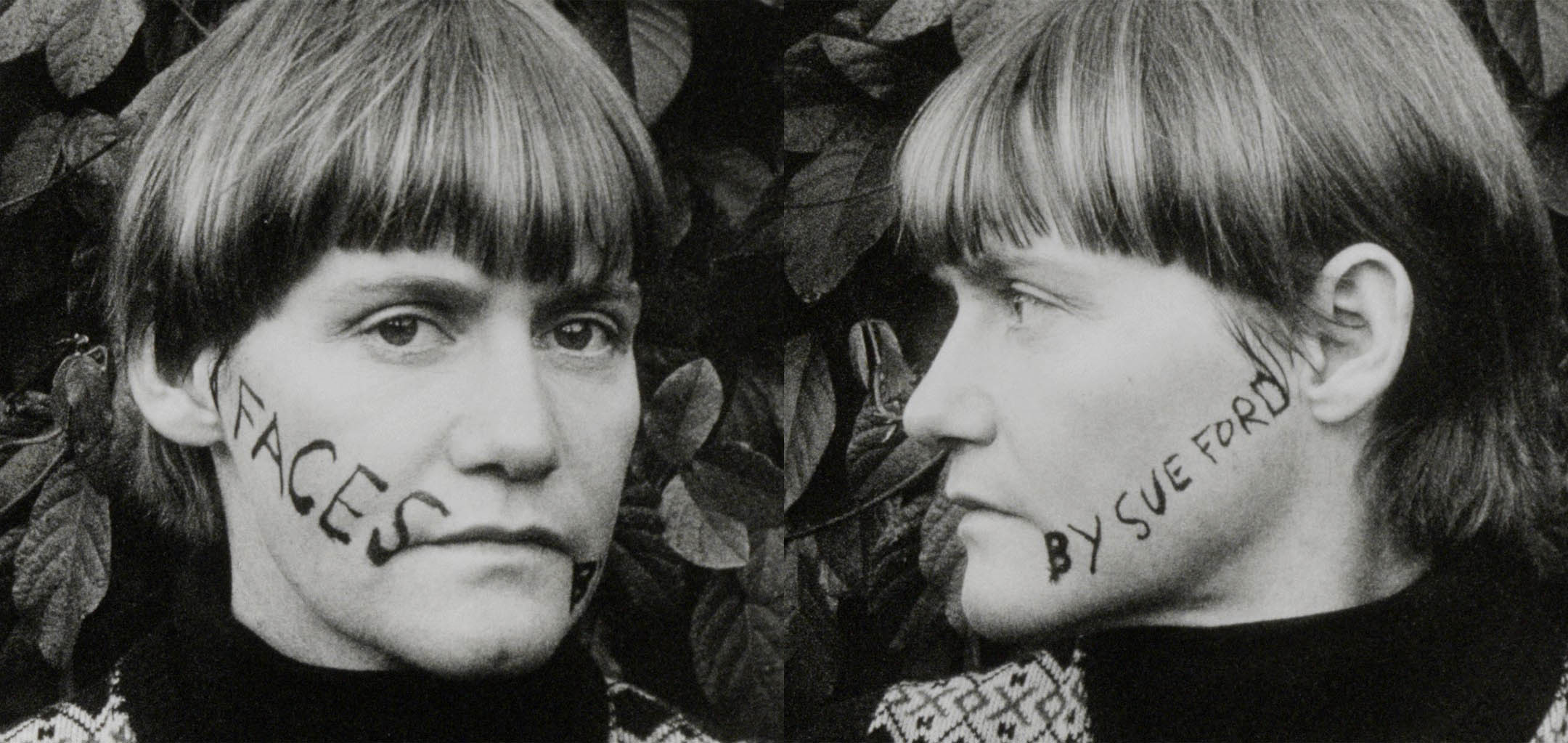
An interesting work by Sue and Ben Ford, Faces (1976-1996, see photograph below) is a video that shows closely cropped faces and the differences in facial features twenty years later. The self consciousness of people when put in front of a camera is most notable, their uncomfortable looks as the camera examines them, surveys them in minute detail. The embarrassed smile, the uncertainty. It is fascinating to see the changes after twenty years.

A wonderful series 70s coloured photographs of “Sharps” by Larry Jenkins that shine a spotlight on this little recognised Melbourne youth sub-culture. These are gritty, funny, in your face photographs of young men bonding together in a tribal group wearing their tight t-shirts, ‘Conte’ stripped wool jumpers (I have a red and black one in my collection) and rat tail hair:

“Larry was the leader of the notorious street gang the “BLACKBURN SOUTH SHARPS” from 1972-1977 when the Sharpie sub-culture was at its peak and the working class suburbs of Melbourne were a tough and violent place to grow up. These photographs represent a period from 1975-1976 in Australian sub-cultural history and are one of the few photographic records of that time. Larry began taking photos at the age of 16 using a pocket camera, when he started working as an apprentice motor mechanic and spent his weekly wage developing his shots… He captured fleeting moments, candid shots and directed his teenage mates through elaborate poses set against the immediate Australian suburban backdrops.”2

Immediate and raw these photographs have an intense power for the viewer.

A personal favourite of the exhibition is Alex Danko’s installation Day In, Day Out (1991, see photograph below). Such as simple idea but so effective: a group of identical silver houses sits on the floor of the gallery and through a rotating wheel placed in front of a light on a stand, the sun rises and sets over and over again. The identical nature of the houses reminds us that we all go through the same process in life: we get up, we work (or not), we go to bed. The sun rises, the sun sets, everyday, on life. Simple, beautiful, eloquent.

Another favourite is Louise Short’s series of found colour slides of family members displayed on one of those old Kodak carrousel slide projectors. This is a mesmeric, nostalgic display of the everyday lives of family caught on film. I just couldn’t stop watching, waiting for the next slide to see what image it brought (the sound of the changing slides!), studying every nuance of environment and people, colour and space: recognition of my childhood, growing up with just such images.

Anri Sala’s video Time After Time (2003, see photograph below) is one of the most poignant works in the exhibition, almost heartbreaking to watch. A horse stands on the edge of a motorway in the near darkness, raising one of it’s feet. It is only when the lights of a passing car illuminate the animal that the viewer sees the protruding rib cage and you suddenly realise how sick the horse must be, how near death.

The film Presentation Sisters (2005, see photographs below) by English artist Tacita Dean, “shows the daily routines and rituals of the last remaining members of a small ecclesiastical community as they contemplate their journey in the spiritual after-life.” Great cinematography, lush film colours, use of shadow and space – but it is the everyday duties of the sisters, a small order of nuns in Cork, Ireland that gets you in. It is the mundanity of washing, ironing, folding, cooking and the procedures of human beings, their duties if you like – to self and each other – that become valuable. Almost like a religious ritual these acts are recognised by Dean as unique and far from the everyday. We are blessed in this life that we live.

Finally two works by Bill Viola: Unspoken (Silver & Gold) 2001 and The Passing (1991, see photographs below). Both are incredibly moving works about the angst of life, the passage of time, of death and rebirth. For me the picture of Viola’s elderly mother in a hospital bed, the sound of her rasping, laboured breath, the use of water in unexpected ways and the beauty of cars travelling at night across a road on a desert plain, their headlights in the distance seeming like atomic fireflies, energised spirits of life force, was utterly beguiling and moving. What sadness with joy in life to see these two works.

Dr Marcus Bunyan


1/ Mann, Ted. “Self-Portrait at Three Years Old,” on the Guggenheim Collection website [Online] Cited 12/11/2010 no longer available online

2/ Anon. “History,” on the Blackburn South Sharps website [Online] Cited 12/11/2010 no longer available online


Many thankx to the Melbourne International Arts Festival and the Australian Centre for Contemporary Art for allowing me to publish the photographs in the posting. Please click on the photographs for a larger version of some of the images.


Gillian Wearing (English, b. 1963) 'Self-Portrait at Three Years Old' 2004 from the exhibition 'Mortality' at the Australian Centre for Contemporary Art, Melbourne


Gillian Wearing (English, b. 1963)
Self-Portrait at Three Years Old
2004
Digital C-type print
© Gillian Wearing


“To take a photograph is to participate in another person’s mortality, vulnerability, mutability. Precisely by slicing out this moment and freezing it, all photographs testify to time’s relentless melt” Susan Sontag wrote. Gillian Wearing registers this, and revisits herself at the age of 3 through the uncanny process of entering her own body. This performance of self, created by the artist putting on a full body prosthetic mask of herself as she was professionally photographed as a child, and peering out at the viewer with her 40-something eyes is a weird sarcophagi of identity. Is Gillian still 3? Is the adult inside the one she has become, or the one who was always there? Is identity pre-determined? Perhaps she would prefer to go back there, and yet this portrait is tinged with a kind of sadness. The eyes betray too much that has passed in the adult life, not yet known by the small child.

Extract from Juliana Engberg About Mortality catalogue


Darren Sylvester (Australian, b. 1974) 'Your First Love Is Your Last Love' 2005 from the exhibition 'Mortality' at the Australian Centre for Contemporary Art, Melbourne


Darren Sylvester (Australian, b. 1974)
Your First Love Is Your Last Love
2005
© Darren Sylvester


Sue Ford (Australian, 1943-2009) and Ben Ford 'Faces' 1976-1996 (still) from the exhibition 'Mortality' at the Australian Centre for Contemporary Art, Melbourne


Sue Ford (Australian, 1943-2009) and Ben Ford
Faces (still)
1976-1996
Detail 
of 15 min b/w 
reversal silent film
16mm, shot on b/w 
reversal film


Photographer, Sue Ford, in her iconic work Faces uses the camera as a kind of mirror to register the changes that occur as we grow older. Without the sometimes pompous commentary of the filmic anthropological voice-over which narrates an imposed, meta-story, Ford allowed her straightforward, black and white, close-up images to suggest the accumulation of experience and the evolution of identity silently. In this version of the work, a video projection which brings old and newer faces together in a rolling sequence, we are able to register the passage of time in a number of ways. The face becomes a terrain of time travelled.

Extract from Juliana Engberg About Mortality catalogue


Faces

Sue Ford’s experimental film “Faces” consists of portraits of the artist and her friends and acquaintances. Ford filmed each subject for roughly 25 seconds, using a wind-up Bolex camera that frames their faces in close-up. Variously self-conscious, serious, amused and distracted, the camera captures every small gesture, expression and flicker of emotion on the person’s face. The result is an examination of portraiture and the performance of identity, demonstrating the artist’s interest in using the camera to capture reality, time and change.

Text from the Youtube website
 

Sue Ford (Australian, 1943-2009) and Ben Ford 'Faces' (still) 1976-1996


Sue Ford (Australian, 1943-2009) and Ben Ford
Faces (still)
1976-1996
Detail 
of 15 min b/w 
reversal silent film
16mm, shot on b/w 
reversal film


Continuing on from the Time series, in 1976 Ford created the experimental film Faces, in which she filmed portraits of herself, friends and acquaintances. Using a Bolex spring-wound clockwork camera where the film ran through the camera for approximately 25 seconds, Ford directed her subjects to behave as they liked for the duration of the portrait. The camera frames the subject’s face in close-up, steadfastly focusing on them; Memory Holloway described of the work, “While there is no acting, character is revealed by the comfort or uneasiness of the subject. Some laugh, others look romantically pensive, others blow clouds of smoke at the lens as a cover-up”[6]. By bringing an element of time into the creation of a portrait, the film both reveals a moment in that person’s subjective experience and experiments with the plasticity of time, extending and concentrating the 25-second span into a focused moment.

Julia Murphy. “The films of Sue Ford – now part of the ACMI Collection,” on the ACMI website Nd [ONline] Cited 11/03/2025

6/ Memory Holloway, ‘Reel Women: Narrative as a Feminist Alternative’, Art and Text, 1981


Larry Jenkins (Australian) 'Chad, Jono and Mig, Twig, Beatie and Whitey walking down the street at Blackburn South shops' 1975 from the exhibition 'Mortality' at the Australian Centre for Contemporary Art, Melbourne


Larry Jenkins (Australian)
Chad, Jono and Mig, Twig, Beatie and Whitey walking down the street at Blackburn South shops
1975
© Larry Jenkins


The photographs of Larry Jenkins deliver an authentic tribalism. Taken with his instamatic camera, the photos of his sharpie friends, hanging out, posing, wrestling and testing out their manhood, are genuine documents of their time. Belonging to this group is an important and almost primate activity. Surviving the suburbs in the 70s was an ‘us and them’ kind of universe. These were the kinds of boys you crossed the street to avoid. Their collective power, while internally tumultuous as they each try to discover their own identities, nevertheless conveys externally a tight ball of testosterone. They are one, and if you are not them, you are nothing.

Extract from Juliana Engberg About Mortality catalogue
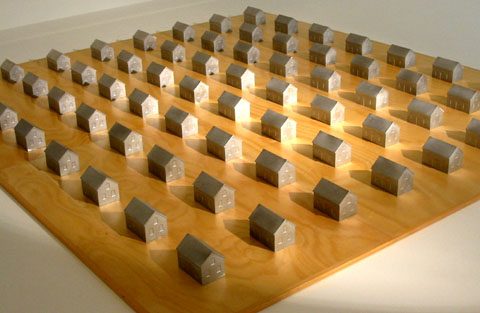
 

Alex Danko (Australian, b. 1950) 'Day In, Day Out' 1991 from the exhibition 'Mortality' at the Australian Centre for Contemporary Art, Melbourne


Alex Danko (Australian, b. 1950)
Day In, Day Out
1991


From the cradle to the grave… ACCA’s major exhibition Mortality takes us on life’s journey from the moment of lift off to the final send off, and all the bits in between. Curated by Juliana Engberg to reflect the Festival’s visual arts themes of spirituality, death and the afterlife, this transhistorical event includes metaphoric pictures and works by some of the world’s leading artists.

Exhibiting artists include:

Tacita Dean, an acclaimed British artist who works in film and drawing and has shown at Milan’s Fondazione Trussardi and at DIA Beacon, New York.

Anastasia Klose, one of Australia’s most exciting young video artists whose works also include performance and installation.

TV Moore, an Australian artist who completed his studies in Finland and the United States and who has shown extensively in Sydney, Melbourne and overseas.

Tony Oursler, a New York-based artist who works in a range of media and who has exhibited in the major institutions of New York, Paris, Cologne and Britain.

Giulio Paolini, an Italian born artist who has been a representative at both Documenta and the Venice Biennale.

David Rosetzky, a Melbourne-born artist who works predominantly in video and photographic formats and whose work has featured in numerous Australian exhibitions as well as New York, Milan and New Zealand galleries.

Louise Short, an emerging British artist who works predominately with found photographs and slides. Anri Sala, an Albanian-born artist who lives and works in Berlin. He has shown in the Berlin Biennale and the Hayward, London.

Fiona Tan, an Indonesian-born artist, who lives and works in Amsterdam. Tan works with photography and film and has shown in a number of major solo and group exhibitions, including representing the Netherlands at the 2009 Venice Biennale.

Bill Viola, one of the leaders in video and new media art who has shown widely internationally and in Australia.

Gillian Wearing, one of Britain’s most important contemporary artists and a Turner Prize winner who has exhibited extensively internationally.

Highlights of the exhibition include:

Albanian born artist Anri Sala’s acclaimed video work Time After Time, featuring a horse trapped on a Tirana motorway, repeatedly, heartbreakingly raising its hind-leg (see photograph below). Anri first came to acclaim in 1999 for his work in After the Wall, the Stockholm Modern Museum’s exhibition of art from post-communist Europe, and his work is characterised by an interest in seemingly unimportant details and slowness. Scenes are almost frozen into paintings.

Peter Kennedy’s Seven people who died the day I was born – April 18 1945, 1997-98 – a work from a series begun by the artist following the death of his father which connects individual lives with political and historical events. Kennedy’s birth in the last year of World War II and the seven people memorialised imply the multitude of others that died during this catastrophic event as well as the perpetual cycle of life.

A series of slides collected by British artist Louise Short, offering a beguiling insight into the everyday lives of everyday people accumulated as a life narrative.

Acclaimed British artist Tacita Dean’s Presentation Sisters, which shows the daily routines and rituals of the last remaining members of a small ecclesiastical community as they contemplate their journey in the spiritual after-life.

Three works from the Time series by influential Australian photographer Sue Ford, who passed away last year, will also be shown. The photographs capture the artist in various stages of her life.

Text from the ACCA website


Annika von Hausswolff (Swedish, b. 1967) 'Hey Buster! What Do You Know About Desire?' 1995 from the exhibition 'Mortality' at the Australian Centre for Contemporary Art, Melbourne


Annika von Hausswolff (Swedish, b. 1967)
Hey Buster! What Do You Know About Desire?
1995
Colour photograph
Courtesy of the artist and Moderna Museet
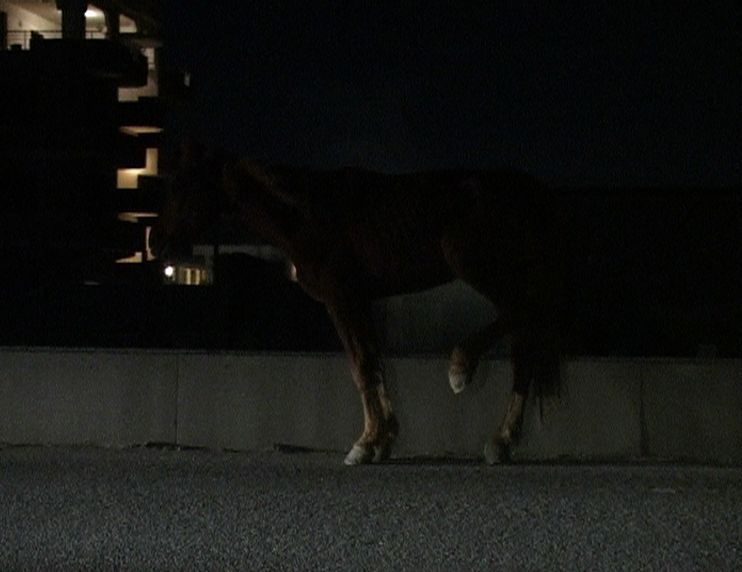
 

Anri Sala (Albanian, b. 1974) 'Time After Time' 2003 (still) from the exhibition 'Mortality' at the Australian Centre for Contemporary Art, Melbourne


Anri Sala (Albanian, b. 1974)
Time After Time (still)
2003
Video, 5 minutes 22 seconds


Sometimes we stagger into dangerous territory. In life, some of us find ourselves on the wrong side of the track. Anri Sala’s Time After Time provides a metaphor for the unfortunate ones who have lost their way or who are marginalised or discarded. A horse has manoeuvred itself, or worse, been abandoned on the wrong side of the highway divider and is now trapped in an endless and shuddering encounter with heavy traffic. The horse visibly flinches and as viewers we are helpless to do anything to assist. It is past its prime and appears malnourished, injured and unwanted. Sala’s horse is symbolic of the scapegoat… the one sent away, or outcast in order for social cohesion to seem reinforced by its exclusion.

Extract from Juliana Engberg About Mortality catalogue


David Rosetzky (Australian, b. 1970) 'Nothing like this' DVD, 2007 (still) from the exhibition 'Mortality' at the Australian Centre for Contemporary Art, Melbourne


David Rosetzky (Australian, b. 1970)
Nothing like this (still)
DVD
2007
Courtesy of the artist and Sutton Gallery, Melbourne


David Rosetzky’s two videos Weekender and Nothing Like This, hyper-construct the languor of these rites of passage for introspective types. One video uses the faded colours of the 1970s Levi’s, Lee’s and Wrangler’s where-do-you-go-to-my-lovely era, through a smudgy David Hamilton Bilitis-like lens. In the other, with a postmodern crispness, Rosetzky establishes scenarios of inner intensity in which the participants narrate their disaffections and doubts. As compared to Ford’s messy, shabby and experimental aesthetic, everything in Rosetzky’s plot is sanitary. This is the synthetic age.

Rosetzky’s videos reference films like The Big Chill which pushes a group together to explore identity. In the instance of Rosetzky’s works however, action is limited and the conventional narrative eliminated in order to zero in on the heightened meditations. Devices such as mirrors refer to a kind of twenty-something narcissism; the beach is presented as a dynamic character of identity flux; time is compressed and delivered in mediated bites.

Things happen on beaches. In Australian culture, as elsewhere they are places of fun, but also menace. When I was a child, the news of the disappearance of children and adults at beaches inflicted a fear into the cultural psyche; children’s freedom was forever altered after the Beaumont Children case.

Extract from Juliana Engberg About Mortality catalogue


David Rosetzky (Australian, b. 1970) 'Nothing like this' DVD 2007 (still) from the exhibition 'Mortality' at the Australian Centre for Contemporary Art, Melbourne


David Rosetzky (Australian, b. 1970)
Nothing like this (still)
DVD
2007
Courtesy of the artist and Sutton Gallery, Melbourne


Tacita Dean (British, b. 1965) 'Presentation Sisters' 2005 (still) from the exhibition 'Mortality' at the Australian Centre for Contemporary Art, Melbourne


Tacita Dean (British, b. 1965)
Presentation Sisters (still)
2005
16 mm film
courtesy of the artist, Frith Street Gallery London


 Some people find solace in religion. And in this exhibition Tacita Dean’s superb film The Presentation Sisters offers a quiet reflection space. Dean emphasises the aspects of quiet devotion, internal contemplation and external dedication that define the Sisters’ spiritual and earthly existence.

In the same way Vermeer suggested spiritualism through domesticity and by using the uplift of light through windows, Dean enlists the ethereal light that travels through the lives and rooms of this small order of nuns who go about their routines and mundane tasks. Dean’s film studies light as a part of metaphysical and theological transformation. However, Dean’s film is also about a kind of Newtonian light: scientific and alchemical.

Her interest in the transformations that occur when light passes through celluloid, and when light passes through glass is a study of the beautiful refractions discovered by scientific observation and written into philosophical enquiries by writers such as Goethe and Burke. As always with Dean’s work, there are layers of encounter in the seemingly simple.

Extract from Juliana Engberg About Mortality catalogue


Tacita Dean (British, b. 1965) 'Presentation Sisters' 2005 (still) from the exhibition 'Mortality' at the Australian Centre for Contemporary Art, Melbourne


Tacita Dean (British, b. 1965)
Presentation Sisters (still)
2005
16 mm film
Courtesy of the artist, Frith Street Gallery London


Bill Viola (American, 1951-2024) 'The Passing' 1991 (still)


Bill Viola (American, 1951-2024)
The Passing (still)
1991
In memory of Wynne Lee Viola
Videotape, black-and-white, mono sound
54 minutes
© Bill Viola


Bill Viola (American, 1951-2024) 'The Passing' 1991 (still)


Bill Viola (American, 1951-2024)
The Passing (still)
1991
In memory of Wynne Lee Viola
Videotape, black-and-white, mono sound
54 minutes
© Bill Viola


Australian Centre for Contemporary Art (ACCA)
111 Sturt Street
Southbank, Victoria 3006
Australia

Opening hours:
Tue – Fri 10am – 5pm
Sat – Sun 11am – 5pm
Mon Closed
Open all public holidays except Christmas Day and Good Friday

Australian Centre for Contemporary Art website

LIKE ART BLART ON FACEBOOK

Back to top

Exhibition: ‘Wolfgang Tillmans’ at the Serpentine Gallery, London

Exhibition dates: 26th June – 19th September, 2010


Installation view of the exhibition 'Wolfgang Tillmans' at the Serpentine Gallery, London, June - Sept, 2010


Installation view of the exhibition Wolfgang Tillmans at the Serpentine Gallery, London, June- September, 2010
Photograph: Gautier de Blonde


“In the constellations of pictures, I try to approximate the way I see the world, not in a linear order but as a multitude of parallel experiences…  Multiple singularities, simultaneously accessible as they share the same space or room.”


Wolfgang Tillmans


Since I haven’t been to the exhibition I have tried to sequence the photographs of this wonderful artist in a small intimation of how he might have visualised them – I hope you get the idea. The installation photographs at the bottom give clues to the actual moments of what Minor White calls ‘ice/fire’ – the space between disparate images, the space that is just as important as the images themselves for the frisson that is evokes, the creation of that metaphorical leap into the void of meaning where malleable thoughts emerge; never linear, both singular and multiple at one and the same time.

Dr Marcus Bunyan


Many thankx to the Serpentine Gallery for allowing me to publish the photographs in the posting. Please click on the photographs for a larger version of the image.


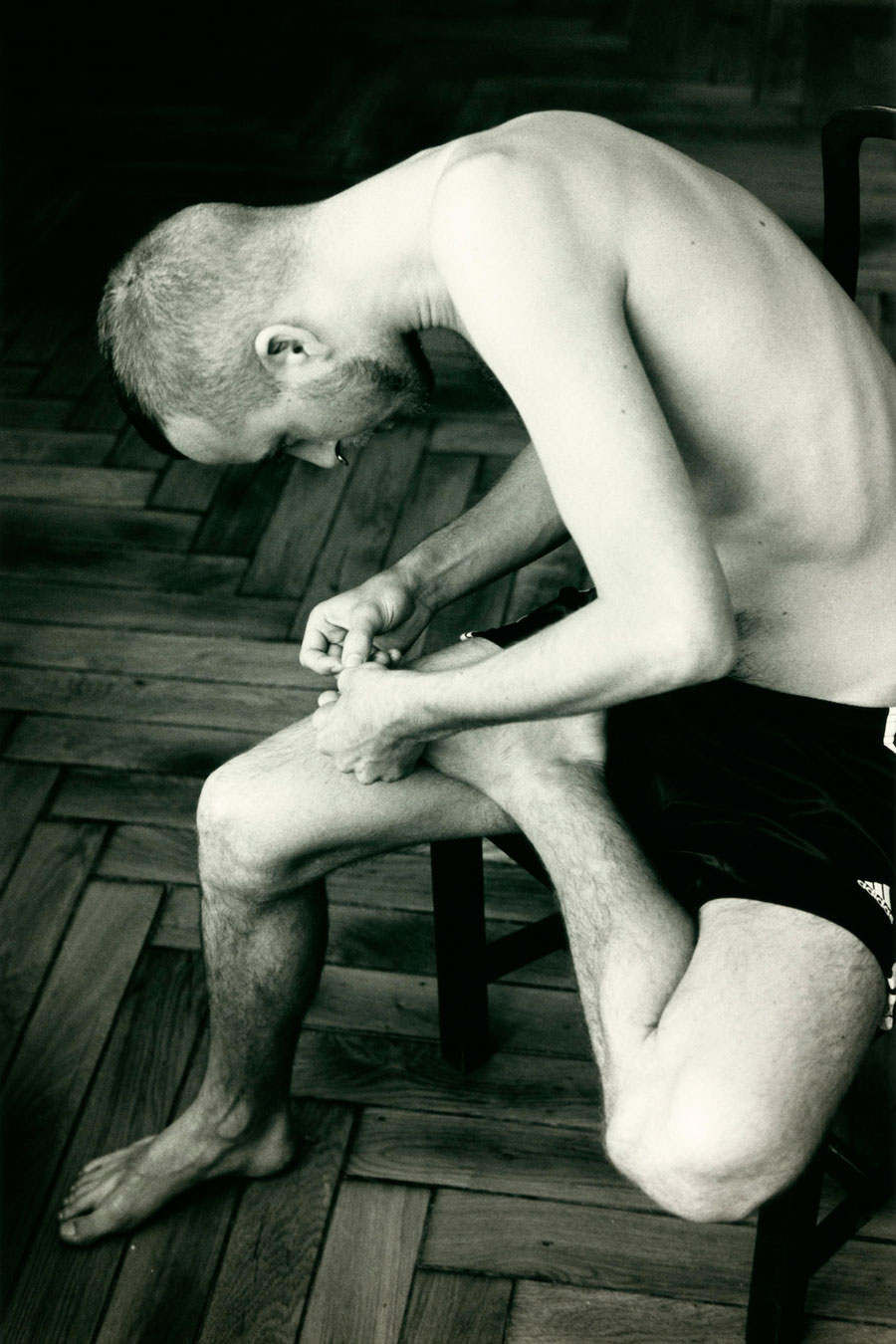
Wolfgang Tillmans (German, b. 1968) 'Anders pulling splinter from his foot' 2004 from the exhibition 'Wolfgang Tillmans' at the Serpentine Gallery, London, June - Sept, 2010


Wolfgang Tillmans (German, b. 1968)
Anders pulling splinter from his foot
2004
C-type print
61 × 50.8cm
Courtesy the artist and Maureen Paley, London


Wolfgang Tillmans (German, b. 1968) 'Nanbei Hu' 2009 from the exhibition 'Wolfgang Tillmans' at the Serpentine Gallery, London, June - Sept, 2010


Wolfgang Tillmans (German, b. 1968)
Nanbei Hu
2009
Inkjet print
207 x 138cm
Courtesy the artist and Maureen Paley, London


Wolfgang Tillmans (German, b. 1968) 'Roy' 2009 from the exhibition 'Wolfgang Tillmans' at the Serpentine Gallery, London, June - Sept, 2010


Wolfgang Tillmans (German, b. 1968)
Roy
2009
C-type print
40.6 x 30.5cm
Courtesy the artist and Maureen Paley, London


Wolfgang Tillmans (German, b. 1968) 'Venus, transit' 2004


Wolfgang Tillmans (German, b. 1968)
Venus, transit
2004
C-type print
40.6 × 30.5cm
Courtesy the artist and Maureen Paley, London


Wolfgang Tillmans (German, b. 1968) 'Dan' 2008


Wolfgang Tillmans (German, b. 1968)
Dan
2008
C-type print
61 × 50.8cm
Courtesy the artist and Maureen Paley, London


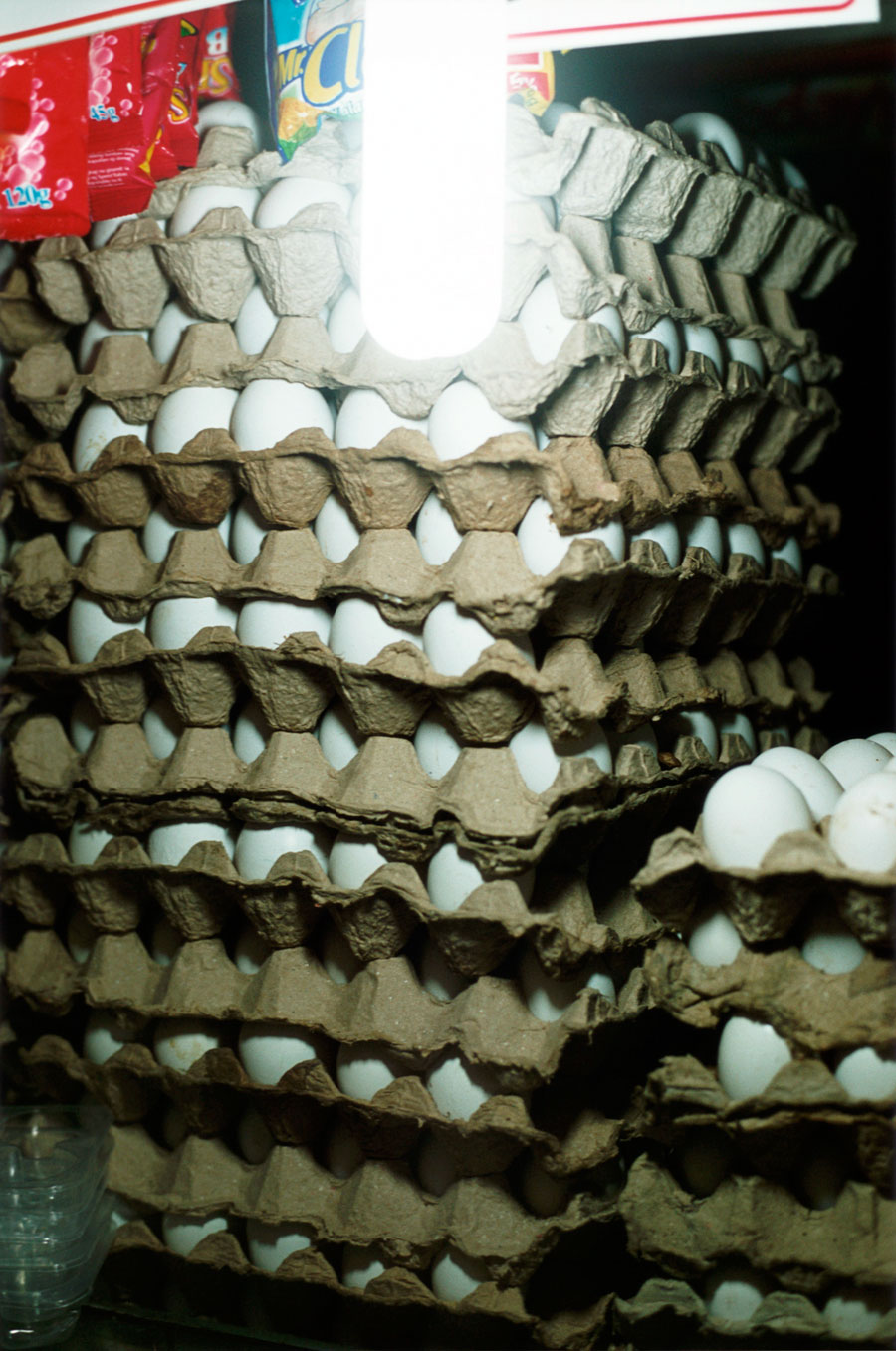
Wolfgang Tillmans (German, b. 1968) 'Eierstapel' 2009


Wolfgang Tillmans (German, b. 1968)
Eierstapel
2009
C-type print
61 x 50.8cm
Courtesy the artist and Maureen Paley, London


Wolfgang Tillmans (German, b. 1968) 'Muqarnas' 2006


Wolfgang Tillmans (German, b. 1968)
Muqarnas
2006
Framed C-type print
214 × 145cm
Courtesy the artist and Maureen Paley, London


Wolfgang Tillmans (German, b. 1968) 'Urgency XXII' 2006


Wolfgang Tillmans (German, b. 1968)
Urgency XXII
2006
Framed C-type print
238 × 181cm
Courtesy the artist and Maureen Paley, London


Wolfgang Tillmans (German, b. 1968) 'Zimmerlinde (Michel)' 2006


Wolfgang Tillmans (German, b. 1968)
Zimmerlinde (Michel)
2006
Framed C-type print
211 × 145cm
Courtesy the artist and Maureen Paley, London


The Serpentine Gallery presents Wolfgang Tillmans’ first major exhibition in London since 2003. Conceived by the artist for the Serpentine Gallery, the exhibition will present both abstract and figurative work.

Over the past 20 years, Tillmans has redefined photography and the way it is shown. Known by the early 90s for the seemingly casual images of the world he inhabited, his work reassessed photographic conventions and reflected the identity politics of the time, capturing the fragility of human life and focusing on everyday objects. This early work then expanded to engage with portraiture, landscape, the still-life and, more recently, abstraction. Tillmans’ abstract work, greatly celebrated in the last decade, continues to push the boundaries and definitions of the photographic form, and will be a particular focus of this exhibition.

The wide-ranging themes in Tillmans’ photographs are combined in his reconfiguration of accumulated images, created in response to a given space. In this new exhibition, the explorations into abstraction sit alongside a new focus on the figurative – a focus that is increasingly informed by recent colour field works and experiments with process. Referring to his approach to installation making Tillmans said: “In the constellations of pictures, I try to approximate the way I see the world, not in a linear order but as a multitude of parallel experiences… Multiple singularities, simultaneously accessible as they share the same space or room.”

The Serpentine Gallery exhibition reflects the artist’s acute sensitivity to the politics of contemporary society, his ongoing fascination with colour, and his conceptual engagement with the technical processes of photography. These delicate yet challenging images capture the distinctive energetic balance between beauty and subversion that Tillmans has long embraced.

Tillmans was born in 1968 in Remscheid, Germany. He studied in Great Britain at the Bournemouth & Poole College of Art & Design, graduating in 1992. In the 1990s, his work was shown at the Museum of Modern Art, New York; the Kunsthalle Zurich; and Portikus, Frankfurt, amongst others. In 2000 he won the Tate’s Turner Prize. A large survey exhibition in 2001-2003 toured to Deichtorhallen, Hamburg; Castello di Rivoli, Turin; Palais de Tokyo, Paris; and Louisiana Museum of Modern Art in Humlebaek, Denmark. His show called Freedom from the Known at P.S.1, New York (2006) was followed by a major tour of North American museums. In 2008, Tillmans had an extensive solo exhibition at the Hamburger Bahnhof, Berlin entitled Lighter, and in 2009 was included in Making Worlds at the 53rd Venice Biennale. More than twenty monographic books on his work have been published to date and an exhibition catalogue will accompany the Serpentine Gallery exhibition.

The exhibition will run concurrently with the Serpentine Gallery Pavilion 2010, designed by Jean Nouvel and opening on 10 July. Housed in the Pavilion will be artist Christian Boltanski’s Les Archives du Coeur installation.

Press release from the Serpentine Gallery website [Online] Cited 11/09/2010 no longer available online


Wolfgang Tillmans (German, b. 1968) 'Silver Installation VII' 2009 (installation view)


Wolfgang Tillmans (German, b. 1968)
Silver Installation VII (installation view)
2009
Unique C-type prints
Installation view
Photograph: Gautier de Blonde


Installation view of the exhibition 'Wolfgang Tillmans' at the Serpentine Gallery, London, June-  September, 2010

Installation view of the exhibition 'Wolfgang Tillmans' at the Serpentine Gallery, London, June-  September, 2010

Installation view of the exhibition 'Wolfgang Tillmans' at the Serpentine Gallery, London, June-  September, 2010


Installation views of the exhibition Wolfgang Tillmans at the Serpentine Gallery, London, June- September, 2010
Photograph: Gautier de Blonde


Serpentine Gallery
Kensington Gardens
London W2 3XA
Phone: 020 7402 6075

Opening hours:
Tuesday – Sunday 10am – 6pm

Serpentine Gallery website

LIKE ART BLART ON FACEBOOK

Back to top

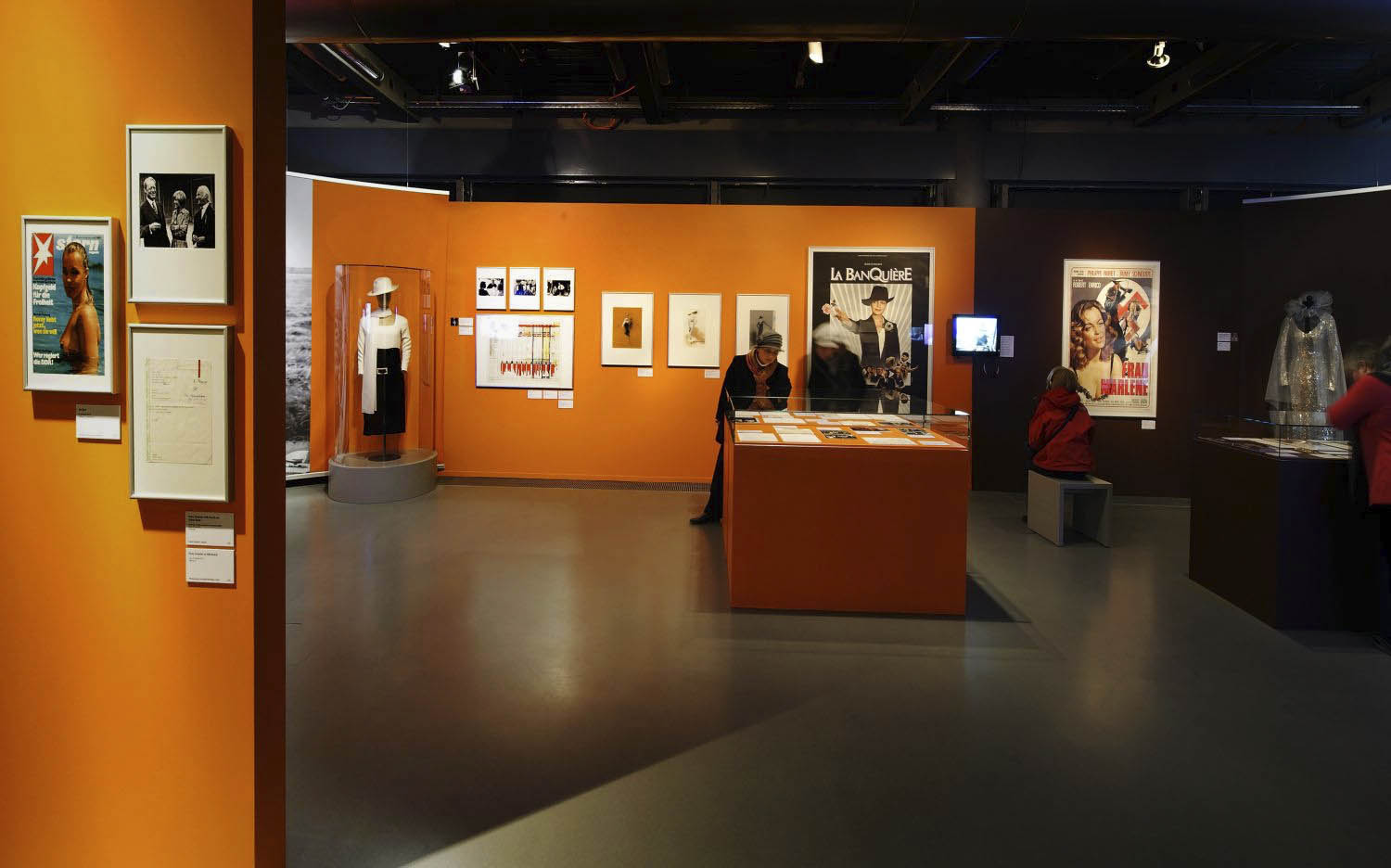
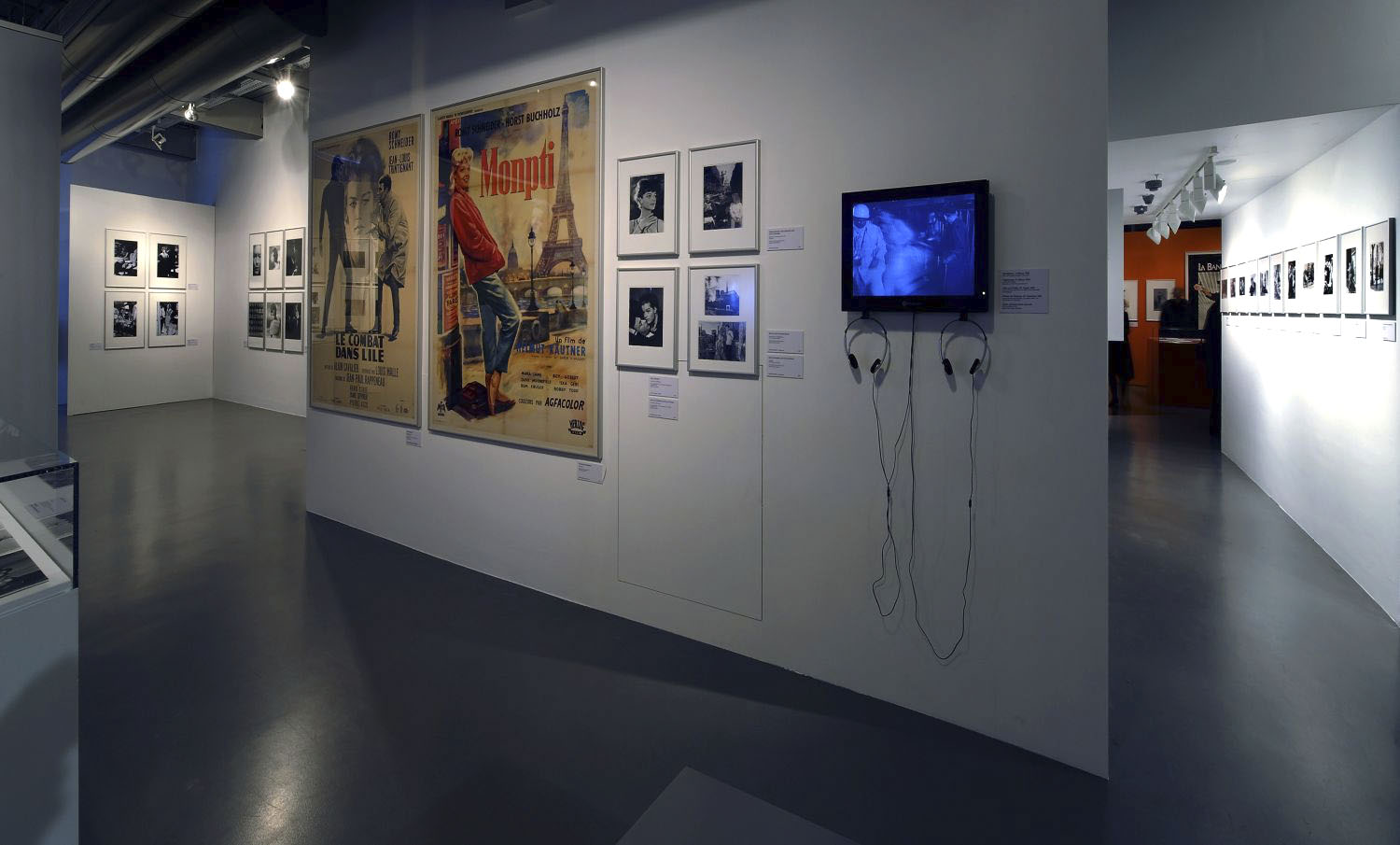
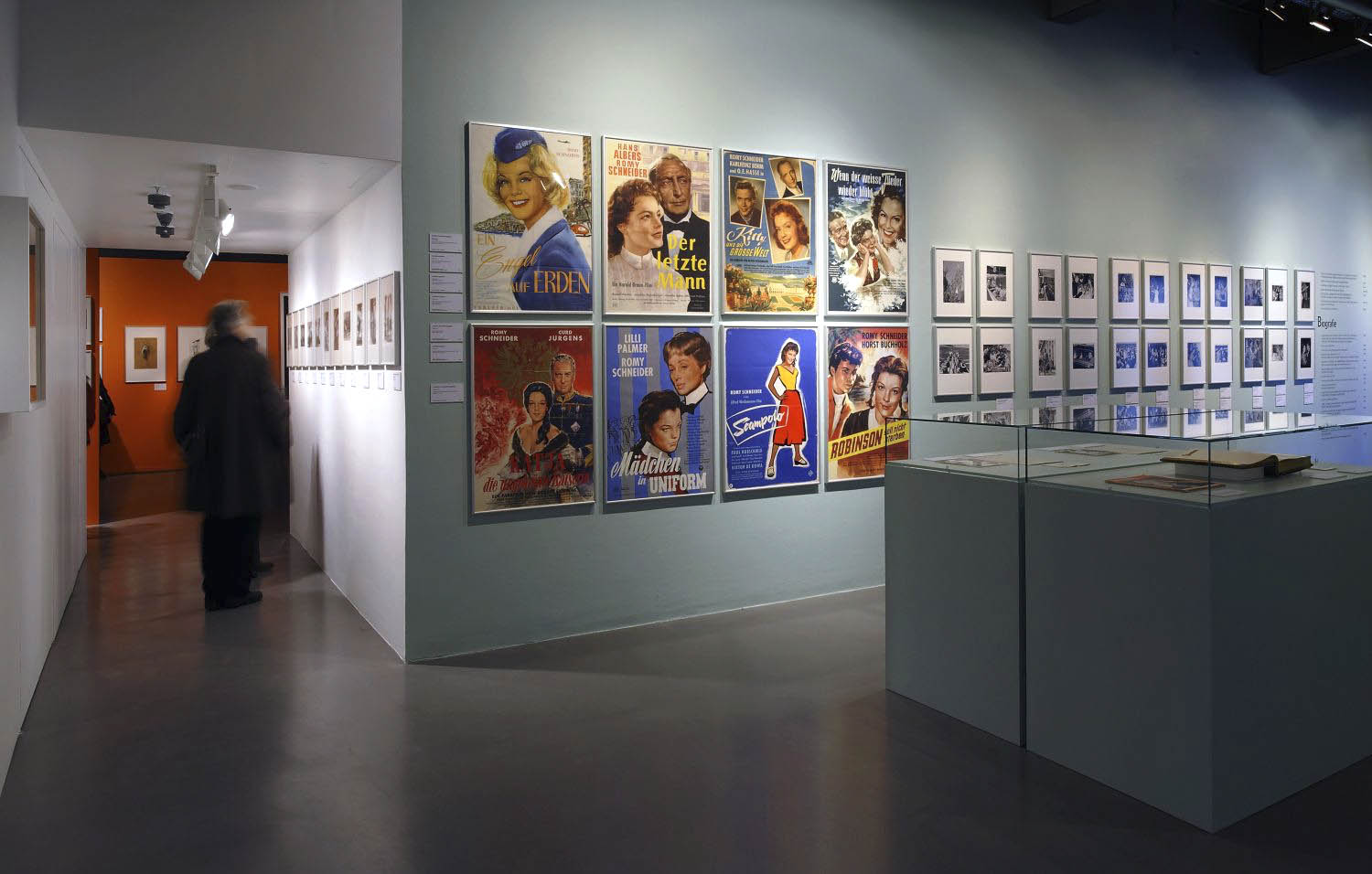
Exhibition: ‘Romy Schneider. Wien – Berlin – Paris’ at Deutsche Kinemathek – Museum for Film and Television, Berlin

Exhibition dates: 5th December 2009 – 29th August, 2010


Heinz Köster (German, 1917-1967) 'Romy Schneider, Berlin 1962' from the exhibition 'Romy Schneider. Wien – Berlin – Paris' at Deutsche Kinemathek – Museum for Film and Television, Berlin, December 2009 - August 2010


Heinz Köster (German, 1917-1967)
Romy Schneider, Berlin 1962
1962
Gelatin silver print
© Foto: Heinz Köster
Quelle: Deutsche Kinemathek


I seen to have become a little smitten by Romy Schneider. What charisma!

Marcus


Many thankx to the Deutsche Kinemathek – Museum for Film and Television for allowing me publish the images in the posting. Please click on the images for a larger version.


Heinz Köster (German, 1917-1967) 'Romy Schneider, Berlin 1962' from the exhibition 'Romy Schneider. Wien – Berlin – Paris' at Deutsche Kinemathek – Museum for Film and Television, Berlin, December 2009 - August 2010


Heinz Köster (German, 1917-1967)
Romy Schneider, Berlin 1962
1962
Gelatin silver print
© Foto: Heinz Köster
Quelle: Deutsche Kinemathek


Max Scheler (German, 1928-2003) 'Romy Schneider, Venice 1957' from the exhibition 'Romy Schneider. Wien – Berlin – Paris' at Deutsche Kinemathek – Museum for Film and Television, Berlin, December 2009 - August 2010


Max Scheler (German, 1928-2003)
Romy Schneider, Venice 1957
1957
Während Dreharbeiten zu SISSI – SCHICKSALSJAHRE EINER KAISERIN
R: Ernst Marischka, A 1957
Gelatin silver print
© Foto: Max Scheler
Quelle: Max Scheler Estate, Hamburg


The exhibition documents the eventful career of Romy Schneider, who by the late 1950s no longer wanted to be Sissi, and by the 1970s was a celebrated star of French cinema. A large number of unknown photographs of Romy Schneider, her film partners, and family from the 1950s and 1960s will be on display from the collections of the Deutsche Kinemathek. The exhibition will also present loans from private individuals and institutions from France and Austria …

The exhibition Romy Schneider. Wien – Berlin – Paris, which the Museum für Film und Fernsehen will present beginning on December 5th, documents the varied and wide-ranging career of Romy Schneider, who no longer wanted to be “Sissi” at the end of the 1950s and was celebrated as a star of French cinema in the 1970s.

Romy Schneider publicly bemoaned her roles in Germany and went to Paris to play women who did justice to her acting abilities and her expectations. She settled in France at the beginning of the 1970s, where she advanced to one of the biggest stars of French cinema. She won several awards and made films with nearly all the great directors and actors of that period. The paparazzi followed the actress at every turn, documenting her strokes of fate for the international popular press, and throughout her life Romy Schneider considered herself to be their victim. Romy Schneider died in Paris in May 1982. To this day, she is admired by millions of fans around the world as one of cinema’s international stars.

This homage, which can be seen in 450 sq. m. of exhibition space at the Filmhaus, treats both the diverse roles and changing image of the actress, as well as her representation in the media.

Pictures from films, the press and her private life are grouped according to recurring motifs and combined with film clips. Media installations show the interplay between projection and active self-promotion. Posters, costumes, correspondence and fan souvenirs will augment the presentation.

Numerous photographs from the 1950s and 1960s of Romy Schneider, her film partners and her family, largely unknown until now, originate from the collections of Deutsche Kinemathek. Loans from other institutions and private individuals will also be on view, for instance from the photographers F. C. Gundlach and Robert Lebeck, as well as from the personal archives of the film director Claude Sautet.

Press release from the Museum für Film und Fernsehen website [Online] Cited 25/05/2010 no longer available online


Installation view of the exhibition 'Romy Schneider. Wien – Berlin – Paris' at Deutsche Kinemathek – Museum for Film and Television, Berlin


Installation views of the exhibition Romy Schneider. Wien – Berlin – Paris at Deutsche Kinemathek – Museum for Film and Television, Berlin
Photos © Marian Stefanowski


F. C. Gundlach (German, b. 1926) 'Romy Schneider, Hamburg 1961'


F. C. Gundlach (German, 1926-2021)
Romy Schneider, Hamburg 1961
1961
Gelatin silver print
© Foto: F. C. Gundlach


F. C. Gundlach (Franz Christian Gundlach) was a German photographer, gallery owner, collector, curator und founder. In 2000 he created the F.C. Gundlach Foundation, since 2003 he has been founding director of the House of Photography – Deichtorhallen Hamburg.


Alain Delon and Romy Schneider in 'La Piscine'/'Der Swimmingpool' 1969


Alain Delon and Romy Schneider in La Piscine/Der Swimmingpool
R- Jacques Deray, F/I 1969
Gelatin silver print
Foto/Quelle: Filmarchiv Austria, Wien


Romy Schneider and Alain Delon in 'La Piscine'/'Der Swimmingpool' 1969


Romy Schneider and Alain Delon in La Piscine/Der Swimmingpool
R- Jacques Deray, F/I 1969
Gelatin silver print
Foto/Quelle: Deutsche Kinemathek


Georges Pierre (French, 1927-2003) 'Romy Schneider, 1972'


Georges Pierre (French, 1927-2003)
Romy Schneider, 1972
1972
© Foto: Georges Pierre
Quelle: Cinemémathèque française


Robert Lebeck (German, 1929-2014) 'Romy Schneider, Berlin 1976'


Robert Lebeck (German, 1929-2014)
Romy Schneider, Berlin 1976
1976
Während der Dreharbeiten zu PORTRAIT DE GROUPE AVEC DAME/GRUPPENBILD MIT DAME
R: Aleksandar Petrovic, F/BRD 1976
Gelatin silver print
© Foto: Robert Lebeck


Romy Schneider and Claude Sautet during the shooting of 'UNE HISTOIRE SIMPLE' / 'A SIMPLE STORY' 1978


Romy Schneider and Claude Sautet during the shooting of UNE HISTOIRE SIMPLE / A SIMPLE STORY
1978
Gelatin silver print
Foto/Quelle: Yves Sautet, Paris


Claude Sautet

Claude Sautet (23 February 1924 – 22 July 2000) was a French author and film director. Born in Montrouge, Hauts-de-Seine, France, Sautet first studied painting and sculpture before attending a film university in Paris where he began his career and later became a television producer. He filmed his first movie, Bonjour Sourire, in 1955.

He earned international attention with Les choses de la vie, which he wrote and directed, like the rest of his later films. It was shown in competition at the 1970 Cannes Festival, where it was well received. The film also revived the career of Romy Schneider; she acted in several of Sautet’s later films. In his next film Max et les Ferrailleurs (1971) she played a prostitute, while in César et Rosalie (1972) she portrayed a married woman who copes with the reappearance of an old flame.

Vincent, Paul, François, et les Autres (1974) is one of Sautet’s most acclaimed films. Four middle-class men meet in the country every weekend mainly to discuss their lives. The film featured a cast of major stars of French cinema: Michel Piccoli, Yves Montand, Gérard Depardieu, and Stéphane Audran. He achieved even further critical success with Mado (1976).

His 1978 film A Simple Story (Une Histoire simple) was nominated for an Academy Award for Best Foreign Language Film. The film featured Schneider again, this time as a dissatisfied working woman in her 40s. She won the César Award for Best Actress for her performance.

Text from the Wikipedia website


Deutsche Kinemathek – Museum für Film und Fernsehen
Potsdamer Straße 2
10785 Berlin

Opening hours:
Monday: 10.00 – 18.00
Tuesday: Closed
Wednesday: 10.00 – 18.00
Thursday: 10.00 – 20.00
Friday – Sunday: 10.00 – 18.00
Deutsche Kinemathek – Museum for Film and Television website

LIKE ART BLART ON FACEBOOK

Back to top

Exhibition: ‘F.C. Gundlach. The Photographic Work’ at Martin-Gropius-Bau, Berlin

Exhibition dates: November 20th 2009 – March 14th, 2010


Many thankx to Marie Skov and Martin-Gropius-Bau for allowing me to reproduce the photographs in this posting. Please click on the photographs for a larger version of the image.

Marcus


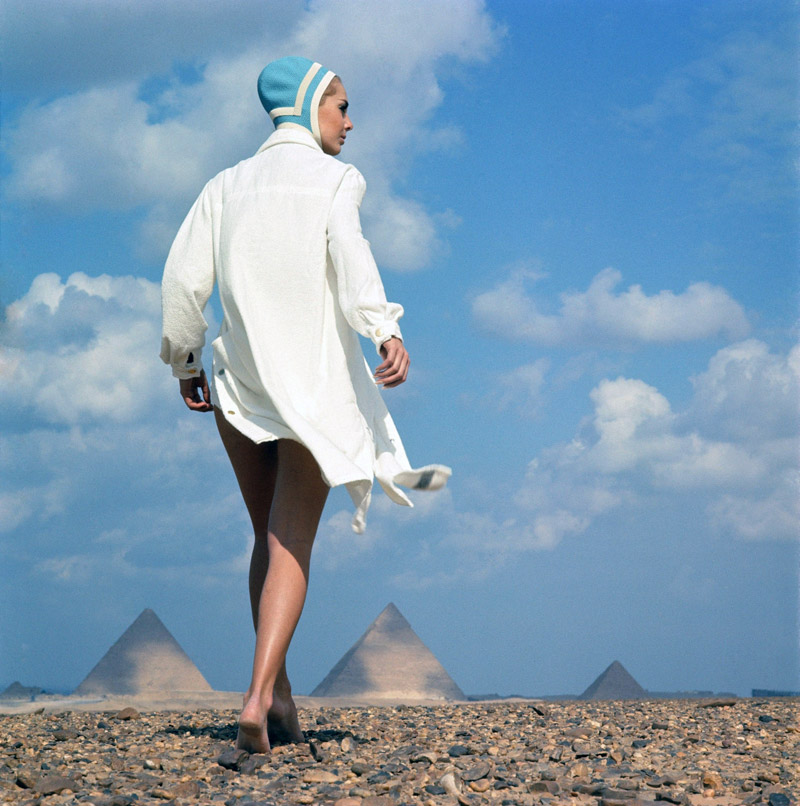
F.C. Gundlach (German, 1926-2021)  'The Whole Day on the Beach' Gizeh/Egypt 1966 from the exhibition 'F.C. Gundlach. The Photographic Work' at Martin-Gropius-Bau, Berlin, November, 2009 - March, 2010


F.C. Gundlach (German, 1926-2021)
The Whole Day on the Beach
Gizeh/Egypt 1966 in Brigitte, Issue 8/1966


F. C. Gundlach

F. C. Gundlach (Franz Christian Gundlach; 16 July 1926 – 23 July 2021) was a German photographer, gallery owner, collector, curator und founder. In 2000 he created the F.C. Gundlach Foundation, since 2003 he has been founding director of the House of Photography – Deichtorhallen Hamburg.

His fashion photographs of the 1950s, 1960s and 1970s, which in many cases integrated social phenomena and current trends in the visual arts, have left their context of origin behind and found their way into museums and collections. Since 1975 he also curated many internationally renowned photographic exhibitions. On the occasion of the reopening of the House of Photography in April 2005, he curated the retrospective of the Hungarian photographer Martin Munkácsi. Here, the exhibitions A Clear VisionThe Heartbeat of Fashion and Maloney, Meyerowitz, Shore, Sternfeld. New Color Photography of the 1970s from his collection were presented since 2003. Most recently he curated the exhibitions More Than Fashion for the Moscow House of Photography and Vanity for the Kunsthalle Wien 2011.

Text from the Wikipedia website


F.C. Gundlach (German, 1926-2021) 'Erich von Stroheim during the shooting of "Alraune", Munich' 1952 from the exhibition 'F.C. Gundlach. The Photographic Work' at Martin-Gropius-Bau, Berlin, November, 2009 - March, 2010


F.C. Gundlach (German, 1926-2021)
Erich von Stroheim during the shooting of “Alraune”, Munich
1952
Gelatin silver print


'The Bloody Pit of Horror: Alraune' (1952) film poster


The Bloody Pit of Horror: Alraune (1952) film poster


Erich von Stroheim

Erich Oswald Hans Carl Maria von Stroheim (born Erich Oswald Stroheim; September 22, 1885 – May 12, 1957) was an Austrian-American director, actor and producer, most noted as a film star and avant garde, visionary director of the silent era. His masterpiece adaptation of Frank Norris’s McTeague titled Greed is considered one of the finest and most important films ever made. After clashes with Hollywood studio bosses over budget and workers’ rights issues, von Stroheim was banned for life as a director and subsequently became a well-respected character actor, particularly in French cinema. For his early innovations as a director, von Stroheim is still celebrated as one of the first of the auteur directors. He helped introduce more sophisticated plots and noirish sexual and psychological undercurrents into cinema. He died in 1957 in France of prostate cancer at the age of 71. Beloved by Parisian neo-Surrealists known as Letterists, he was honoured by Letterist Maurice Lemaitre with a 70-minute 1979 film entitled “Erich von Stroheim.”

Text from the Wikipedia website


Alraune is a 1952 West German science fiction directed by Arthur Maria Rabenalt and starring Hildegard Knef and Erich von Stroheim. The film involves a scientist (von Stroheim), who creates a woman who is beautiful and yet soulless, lacking any sense of morality.


F.C. Gundlach (German, 1926-2021)  'Cary Grant. A Star goes to the Ball' Berlin 1960 from the exhibition 'F.C. Gundlach. The Photographic Work' at Martin-Gropius-Bau, Berlin, November, 2009 - March, 2010


F.C. Gundlach (German, 1926-2021)
Cary Grant. A Star goes to the Ball
Berlin 1960 in Film und Frau, Issue 16/1960
Gelatin silver print


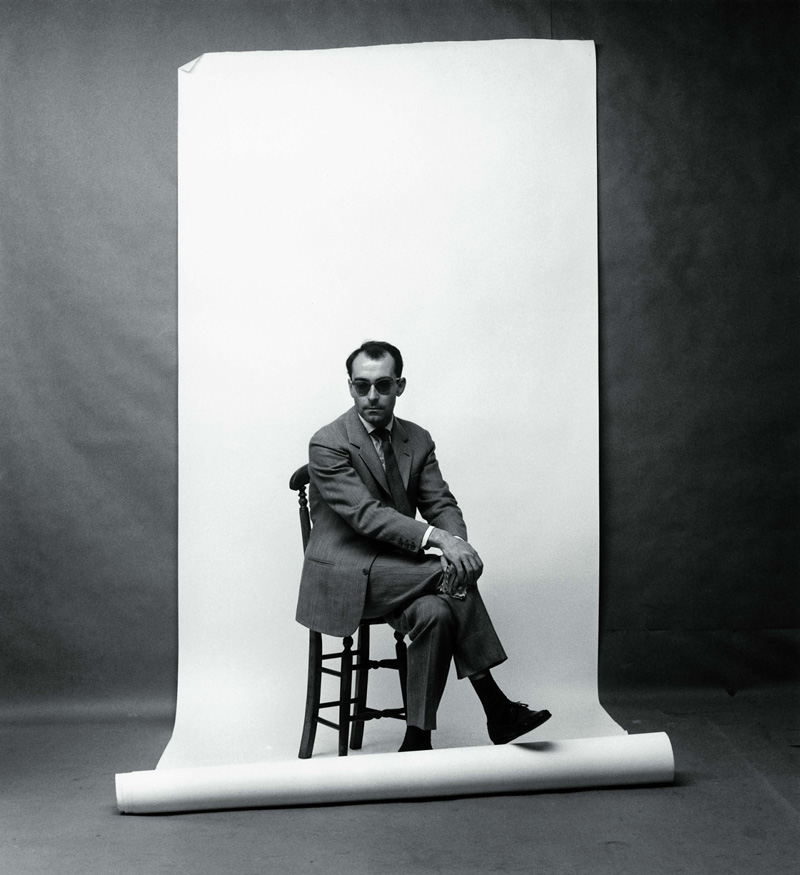
F.C. Gundlach (German, 1926-2021)  'Jean-Luc Godard' Berlin 1961


F.C. Gundlach (German, 1926-2021)
Jean-Luc Godard
Berlin 1961
Gelatin silver print


Jean-Luc Godard

Jean-Luc Godard (born 3 December 1930) is a French-Swiss film director, screenwriter and film critic. He rose to prominence as a pioneer of the 1960s French New Wave film movement.

Like his New Wave contemporaries, Godard criticised mainstream French cinema’s “Tradition of Quality”, which “emphasised craft over innovation, privileged established directors over new directors, and preferred the great works of the past to experimentation.” As a result of such argument, he and like-minded critics started to make their own films. Many of Godard’s films challenge the conventions of traditional Hollywood in addition to French cinema. In 1964, Godard described his and his colleagues’ impact: “We barged into the cinema like cavemen into the Versailles of Louis XV.” He is often considered the most radical French filmmaker of the 1960s and 1970s; his approach in film conventions, politics and philosophies made him arguably the most influential director of the French New Wave. Along with showing knowledge of film history through homages and references, several of his films expressed his political views; he was an avid reader of existential and Marxist philosophy. Since the New Wave, his politics have been much less radical and his recent films are about representation and human conflict from a humanist, and a Marxist perspective.

In a 2002 Sight & Sound poll, Godard ranked third in the critics’ top-ten directors of all time (which was put together by assembling the directors of the individual films for which the critics voted). He is said to have “created one of the largest bodies of critical analysis of any filmmaker since the mid-twentieth century.” He and his work have been central to narrative theory and have “challenged both commercial narrative cinema norms and film criticism’s vocabulary.” In 2010, Godard was awarded an Academy Honorary Award, but did not attend the award ceremony. Godard’s films have inspired many directors including Martin Scorsese, Quentin Tarantino, Brian De Palma, Steven Soderbergh, D. A. Pennebaker, Robert Altman, Jim Jarmusch, Wong Kar-wai, Wim Wenders, Bernardo Bertolucci, and Pier Paolo Pasolini.

Text from the Wikipedia website


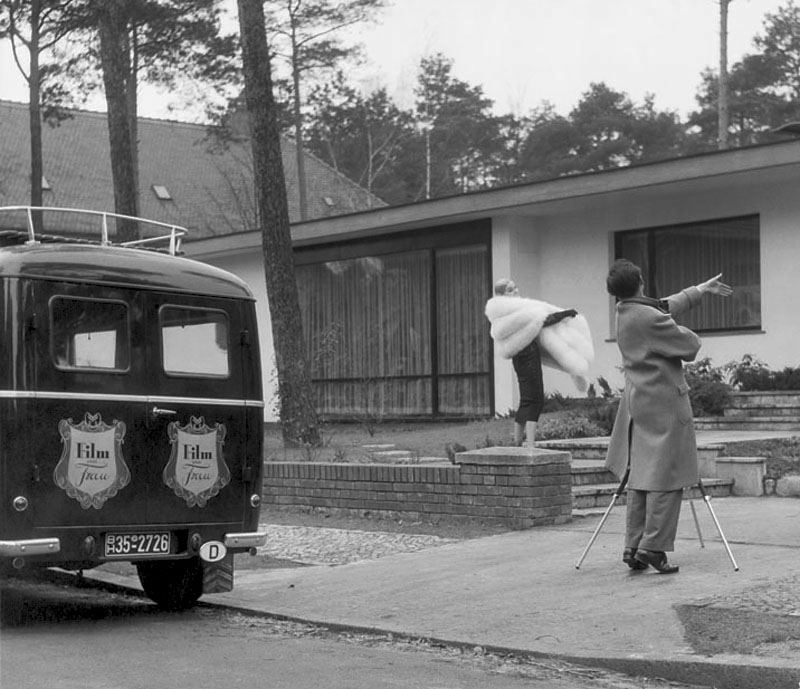
Charlotte Rohrbach (German, 1902-1981) F. C. Gundlach photographing for German magazine Film und Frau (Film and Woman) in Berlin 1955, model Grit Hübscher, stole by Staebe-Seger


Charlotte Rohrbach (German, 1902-1981)
F. C. Gundlach photographing for German magazine Film und Frau (Film and Woman) in Berlin 1955, model Grit Hübscher, stole by Staebe-Seger
1955
Gelatin silver print


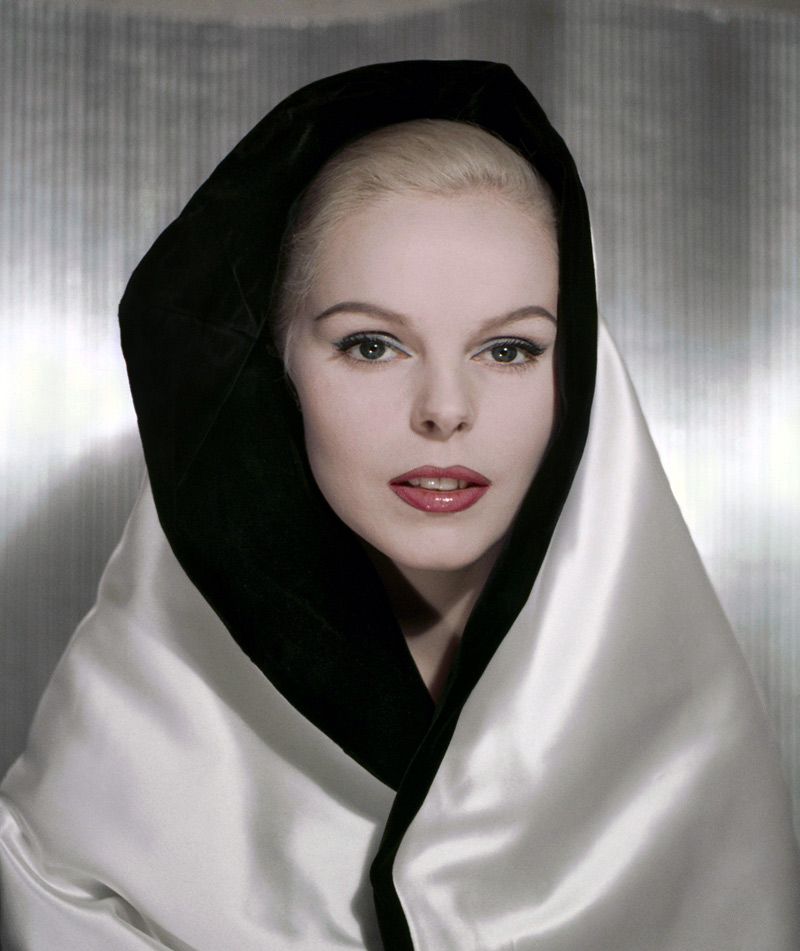
F.C. Gundlach (German, 1926-2021) 'Grit Hübscher. White atlas coat by Sinaida Rudow' Berlin 1954


F.C. Gundlach (German, 1926-2021)
Grit Hübscher. White atlas coat by Sinaida Rudow
Berlin 1954


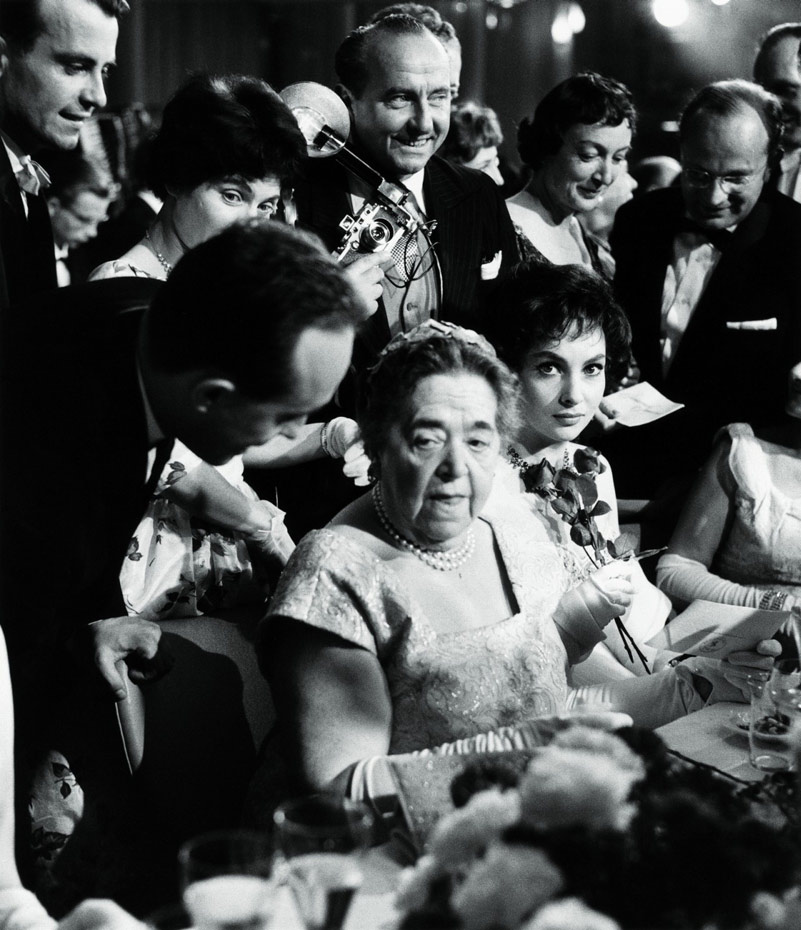
F.C. Gundlach (German, 1926-2021) 'Berlinale. Elsa Maxwell and Gina Lollobrigida, film ball in the Palais am Funkturm, X' Berlinale 1960


F.C. Gundlach (German, 1926-2021)
Berlinale. Elsa Maxwell and Gina Lollobrigida, film ball in the Palais am Funkturm, X
Berlinale 1960 in Film und Frau, Issue 16/1960
Gelatin silver print


Elsa Maxwell

Elsa Maxwell (May 24, 1883 – November 1, 1963) was an American gossip columnist and author, songwriter, and professional hostess renowned for her parties for royalty and high society figures of her day.

Maxwell is credited with the introduction of the scavenger hunt and treasure hunt for use as party games in the modern era. Her radio program, Elsa Maxwell’s Party Line, began in 1942; she also wrote a syndicated gossip column. She appeared as herself in the films Stage Door Canteen (1943) and Rhapsody in Blue (1945), as well as co-starring in the film Hotel for Women (1939), for which she wrote the screenplay and a song.

Gina Lollobrigida

Luigina “Gina” Lollobrigida (born 4 July 1927) is an Italian actress, photojournalist and sculptor. She was one of the highest profile European actresses of the 1950s and early 1960s, a period in which she was an international sex symbol. As her film career slowed, she established second careers as a photojournalist and sculptor. In the 1970s, she achieved a scoop by gaining access to Fidel Castro for an exclusive interview.

She has continued as an active supporter of Italian and Italian American causes, particularly the National Italian American Foundation (NIAF). In 2008, she received the NIAF Lifetime Achievement Award at the Foundation’s Anniversary Gala. In 2013, she sold her jewellery collection, and donated the nearly $5 million from the sale to benefit stem cell therapy research.

Texts from the Wikipedia website


F.C. Gundlach (German, 1926-2021) 'Op Art Silhouette. Jersey coat by Lend' Paris 1966


F.C. Gundlach (German, 1926-2021)
Op Art Silhouette. Jersey coat by Lend
Paris 1966 in Brigitte, Issue 4/1966
Gelatin silver print


From November 2009 the Martin-Gropius-Bau presents the definitive retrospective of F.C. Gundlach’s extensive photographic work with the exhibition F.C. Gundlach – Photographic Work. F.C. Gundlach is one of the most famous fashion photographers worked for the most important magazines and publications from the middle of the 1950’s to 1990. Among other many famous pictures the most comprehensive presentation of F.C. Gundlach’s work shows many fameless facets of F.C. Gundlach’s work to date. After years of research, the curators Klaus Honnef, Hans-Michael Koetzle, Sebastian Lux and Ulrich Rüter present for the first time numerous unknown images as vintage prints alongside F.C. Gundlach’s famous photo icons.

The intention of the exhibition is to present the unique aesthetics of F.C. Gundlach’s photography, his roots in photojournalism, his focus on series and sequences, his narrative approach. Furthermore, the exhibition alludes to social and cultural issues over several decades.

The exhibition includes the experimental photography of his early years, especially those from Paris during the 1950’s, his remarkable portraits of German and international movie stars and film-directors as well as F.C. Gundlach’s early photo reportages and photographs of children.

For the first time, F.C. Gundlach’s work for magazines is presented on a larger scale. Magazine covers and a comprehensive collection of double-page spreads show his photographs within the magazines’ context, especially in Film und Frau (1951-1965) and Brigitte (1963-1986). Among photographs, title pages and a comprehensive selection of double pages of his pictures will be shown in context of the magazines. The exhibition illustrates that Gundlach has always been open to technical innovations in photography (35mm cameras, flash or colour photography).

His fashion productions took him both to Paris and New York and to Egypt and Morocco. This multiple printed photographs were been to special motifs in his work. F.C. Gundlach’s impressive travel reportages occurred amongst others in Argentina, Brazil, Peru, Japan, Cambodia, Thailand, Vietnam and will be present in Berlin the first time. Original documents of his vita illustrate the life of the photographer. Moreover, the show illustrates the internationalisation of his work due to extensive traveling. Documents and archival material give a brief outline of the artist’s life and work.

F.C. Gundlach himself has commented his functioning in a 60 min. interview-film, which was exclusively produced for the exhibition by filmmaker Reiner Holzemer. The exhibition presents: a life’s work of photography between documentary representation and staged artificiality, between practical and experimental photography.

F.C. Gundlach, born in 1926 in Heinebach (Hesse), is considered the most significant fashion photographer of the young Federal Republic of Germany. For more than four decades of fashion photography, he wrote fashion history with his work and shaped the perception of fashion in Germany decisively. He set the stage for the ever-changing vogues, defined postures and gestures of models, chose props and locations and thus reflected the ideals of beauty and the history of fashion against a changing social background. F.C. Gundlach worked on assignment for various magazines. His first publications were reportages, theatre- and movie reports. Through his work for the magazine Film und Frau he became a fashion photographer. His photographs have been published in many distinguished magazines such as: Deutsche Illustrierte, Stern, Revue, Quick, Elegante Welt, Film und Frau, Annabelle, Brigitte, Twen and Deutsch. For Brigitte alone F.C. Gundlach photographed more than 5500 pages as well as about 180 magazine covers.

Press release from the Martin-Gropius-Bau website [Online] Cited 05/03/2010. No longer available online


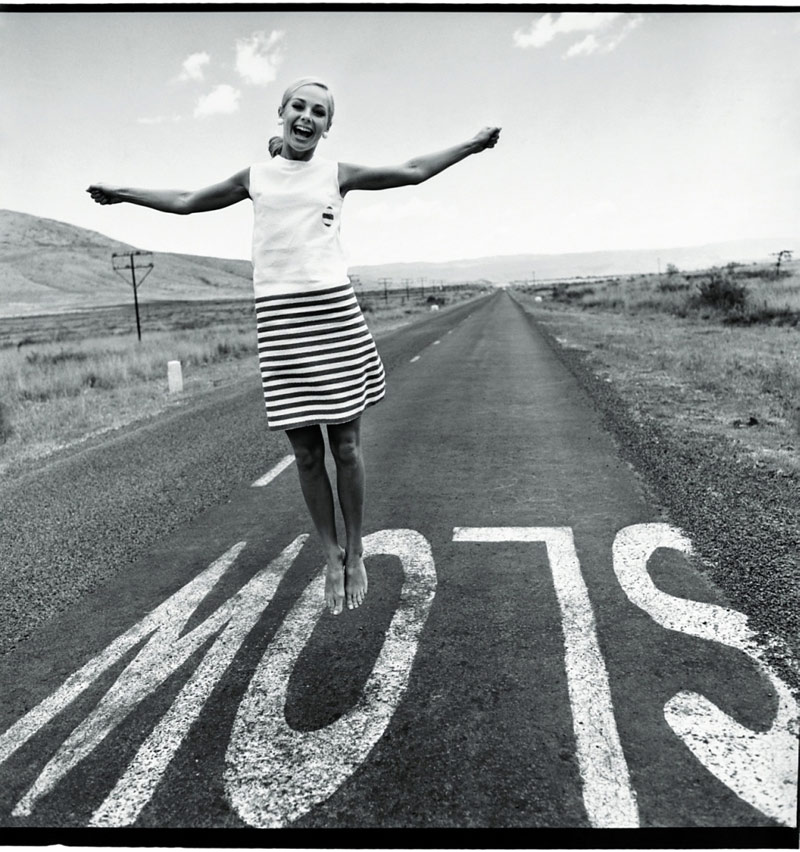
F.C. Gundlach (German, 1926-2021) 'Slow. Karin Mossberg' Nairobi/Kenia 1966


F.C. Gundlach (German, 1926-2021)
Slow. Karin Mossberg
Nairobi/Kenia 1966 in Brigitte, Issue 9/1966
Gelatin silver print


Karin Mossberg was born on January 1, 1947 in Linkoping, Ostergotland, Sweden as Agneta Anna Karin Mossberg. She is an actress, known for The Big Cube (1969), La vida nueva de Pedrito de Andía (1965) and Les pianos mécaniques (1965).


F.C. Gundlach (German, 1926-2021) 'Simone d'Aillencourt. Sheath dress by Horn' Berlin 1957


F.C. Gundlach (German, 1926-2021)
Simone d’Aillencourt. Sheath dress by Horn
Berlin 1957 in Film und Frau, Issue Spring/Summer 1957
Gelatin silver print


Simone D’Aillencourt

Simone D’Aillencourt or d’Aillencourt (née Daillencourt, born 22 September 1930) is a retired French model. Her career in modelling, during which she achieved significant success, took place from the mid-1950s to the late 1960s. She is best known as the subject of Melvin Sokolsky’s “Bubble” photographic series taken in Paris for Harper’s Bazaar in 1963. She had two daughters during her marriage to José Bénazéraf.

Simone D’Aillencourt was born on 22 September 1930 in Vizille, the daughter of Leon and Anna Daillencourt.

Her activities in the modeling profession began in England. D’Aillencourt began her successful career in Edinburgh in 1954 after a visit by Lucie Clayton. She posed for the British magazine Vogue and then went back and forth between Britain and France. She worked regularly for Pierre Cardin, sometimes for Jacques Heim, and posed for various magazines such as ElleL’OfficielVogue Paris or also Le Jardin des Modes. Due to her job, she traveled many times, posing for William Klein for whom she would become one of his favourites, Irving Penn, John French, Richard Avedon, or also French photographer Georges Dambier or Jeanloup Sieff, who “often photographed” according to him. Independent while the agencies are then little developed, she was contacted by Eileen Ford and invited to New York. She then met the influential Diana Vreeland, which further propelled her career.

In early 1963, D’Aillencourt was selected by Melvin Sokolsky for his “Bubble” series for Harper’s Bazaar. She had her test shot in colour taken in New York, which the staff of Harper’s Bazaar approved. She flew to Paris on 20 January 1963 to have her photos taken by Sokolsky. During the shoot, the Bubble that D’Aillencourt was in was lowered too far into the Seine, which damaged the designer shoes that she was wearing.

D’Aillencourt made her final series of photographs in India, with photographer Henry Clarke, in 1969 after a successful career of 15 years. Throughout her career, she always kept with the trends over time, from the sophistication of the 1950s to the greatest freedom of clothing the following decade. Some time after she stopped modelling, she founded a modelling agency in Paris, Model International, which quickly grew, and then a second agency of a more modest size, Image. She was married to José Bénazéraf, their second daughter Béatrice also having integrated modeling as a booker. In 2008, D’Aillencourt attended the festival at Hyères to celebrate the exhibitions of Sokolsky’s work.

Text from the Wikipedia website


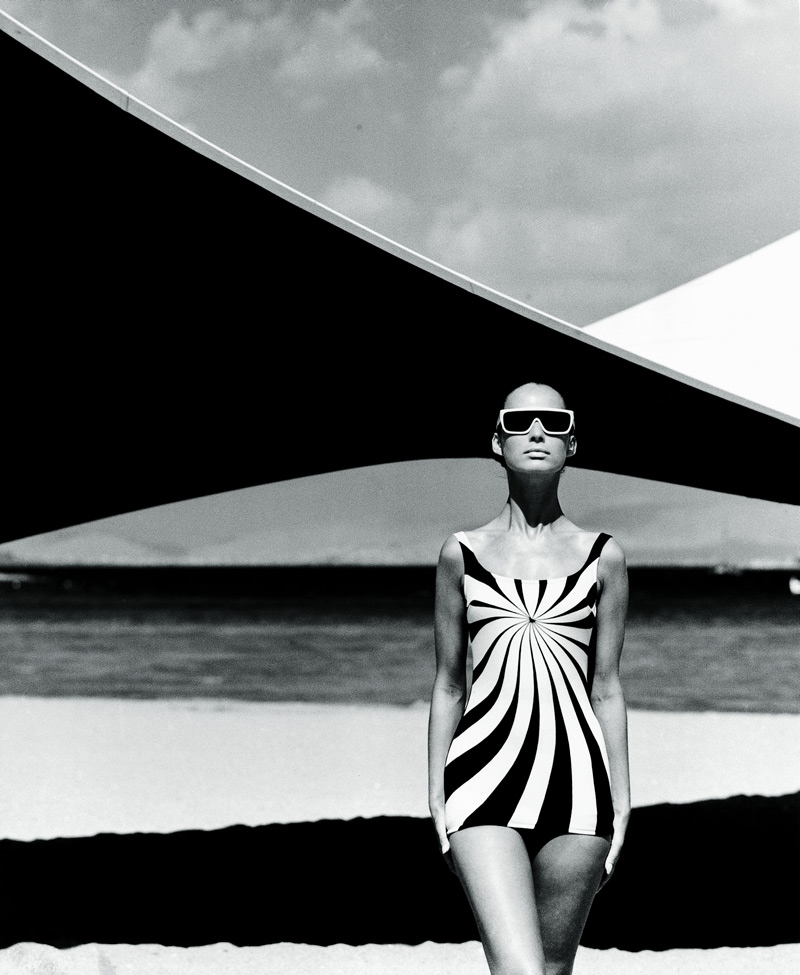
F.C. Gundlach (German, 1926-2021) 'Op Art Swimsuit. Brigitte Bauer, Op Art swimsuit by Sinz Vouliagmeni' Greece 1966


F.C. Gundlach (German, 1926-2021)
Op Art Swimsuit. Brigitte Bauer, Op Art swimsuit by Sinz Vouliagmeni
Greece 1966
Gelatin silver print


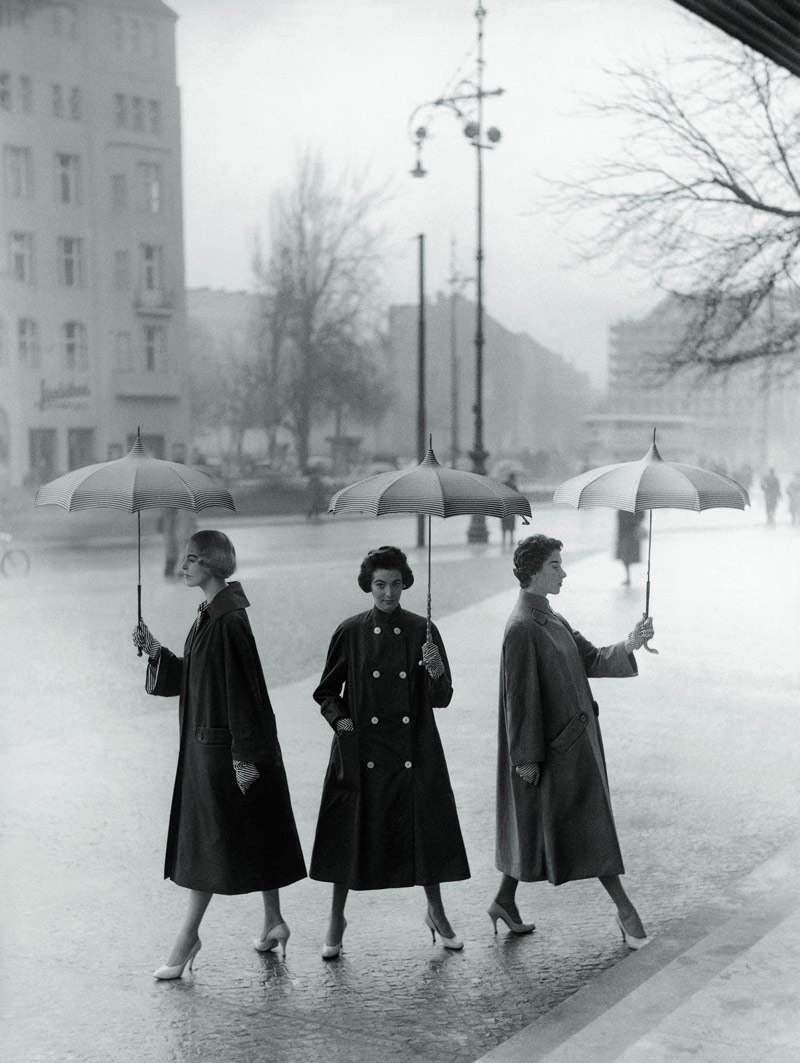
F.C. Gundlach (German, 1926-2021) 'Rainweather, party sunshiny. Three poplin coats by Staebe-Seger' Berlin 1955


F.C. Gundlach (German, 1926-2021)
Rainweather, party sunshiny. Three poplin coats by Staebe-Seger
Berlin 1955
Gelatin silver print


F.C. Gundlach (German, 1926-2021) 'Romy Schneider' Hamburg 1961


F.C. Gundlach (German, 1926-2021)
Romy Schneider
Hamburg 1961 in Film und Frau, Issue 11/1962
Gelatin silver print


Romy Schneider

Romy Schneider (23 September 1938 – 29 May 1982) was a film actress and voice actress born in Vienna and raised in Germany who held German and French citizenship. She started her career in the German Heimatfilm genre in the early 1950s when she was 15. From 1955 to 1957, she played the central character of Empress Elisabeth of Austria in the Austrian Sissi trilogy, and later reprised the role in a more mature version in Visconti’s Ludwig. Schneider moved to France, where she made successful and critically acclaimed films with some of the most notable film directors of that era.

Text from the Wikipedia website

~ Exhibition: Romy Schneider: Exposition at the Palais des Festivals et des Congrès de Cannes, July – September 2012

~ Exhibition: The Best Is Often the Memories: Photographic Portraits of Romy Schneider at Museum Fue Kunst Und Gewerbe, Hamburg, February – April 2009

~ Exhibition: Romy Schneider. Wien – Berlin – Paris at Deutsche Kinemathek – Museum for Film and Television, Berlin, December 2009 – August 2010


Martin-Gropius-Bau Berlin
Niederkirchnerstraße 7
Corner Stresemannstr. 110
10963 Berlin
Phone: +49 (0)30 254 86-0

Opening hours:
Wednesday to Monday 10 – 19 hrs
Tuesday closed
Martin-Gropius-Bau website

LIKE ART BLART ON FACEBOOK

Back to top

Exhibition: ‘Thomas Demand in Berlin’ at the Neue Nationalgalerie, Berlin

Exhibition dates: 18th September, 2009 – 17th January, 2010


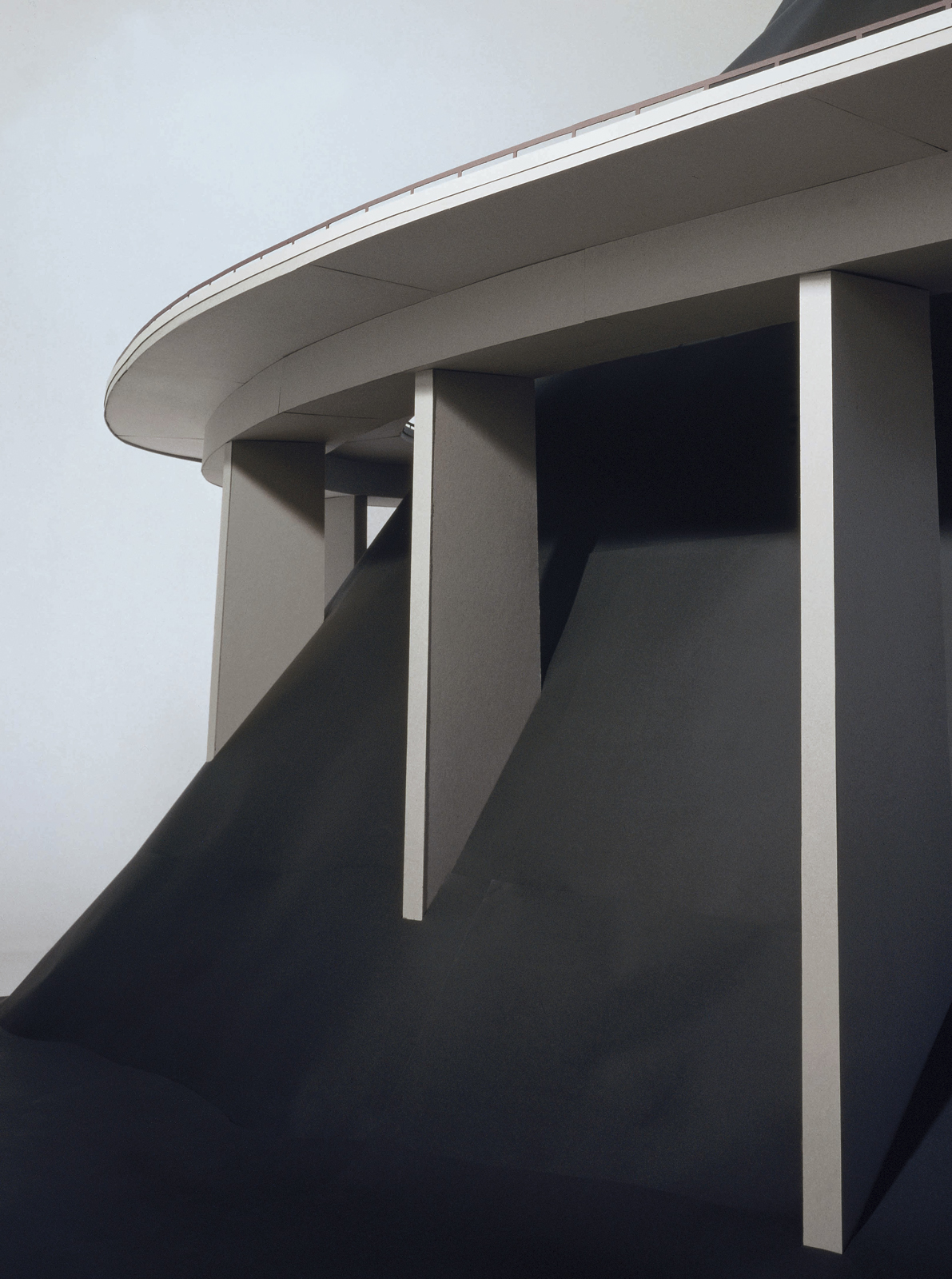
Thomas Demand. 'Diving Board' (Sprungturm)1994 from the exhibition 'Thomas Demand in Berlin' at the Neue Nationalgalerie, Berlin, Sept 2009 - Jan 2010


Thomas Demand (German, b. 1964)
Diving Board (Sprungturm)
1994
C-Print / Diasec
© Thomas Demand, VG Bild-Kunst, Bonn


“It’s not about the real place,” Demand has said. “It’s much more about what we have seen as the real place.”

All photographs in the posting appear in the exhibition.

A review of the catalogue that accompanied the exhibition can be found on the 5B4: Photographs and Books blog.

Dr Marcus Bunyan


Many thankx to the Neue Nationalgalerie for allowing me to publish the photographs in the posting. Please click on the photographs for a larger version of the image.


Thomas Demand (German, b. 1964) 'Brennerautobahn' 1994 from the exhibition 'Thomas Demand in Berlin' at the Neue Nationalgalerie, Berlin, Sept 2009 - Jan 2010


Thomas Demand (German, b. 1964)
Brennerautobahn
1994
C-Print/ Diasec
150 x 118 cm
© Thomas Demand, VG Bild-Kunst, Bonn


Thomas Demand (German, b. 1964) 'Tavern IV' 2006 Thomas Demand (German, b. 1964) 'Brennerautobahn' 1994 from the exhibition 'Thomas Demand in Berlin' at the Neue Nationalgalerie, Berlin, Sept 2009 - Jan 2010


Thomas Demand (German, b. 1964)
Klause IV / Tavern IV
2006
C-Print / Diasec
103 x 68 cm
© Thomas Demand, VG Bild-Kunst, Bonn


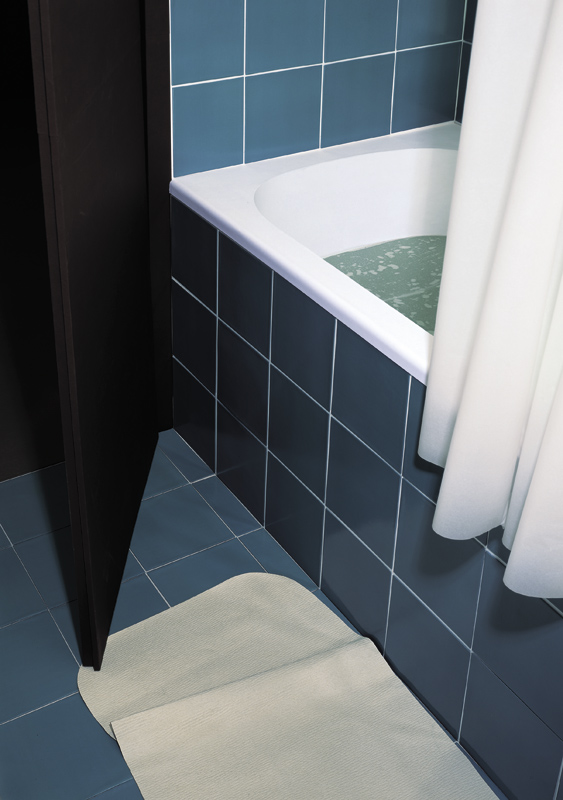
Thomas Demand (German, b. 1964) 'Bathroom' 1997


Thomas Demand (German, b. 1964)
Badezimmer / Bathroom
1997
C-Print / Diasec
160 x 122 cm
© Thomas Demand, VG Bild-Kunst, Bonn


Thomas Demand (German, b. 1964) 'Treppenhaus / Staircase' 1995


Thomas Demand (German, b. 1964)
Treppenhaus / Staircase
1995
C-Print/ Diasec
150 x 118 cm
© Thomas Demand, VG Bild-Kunst, Bonn


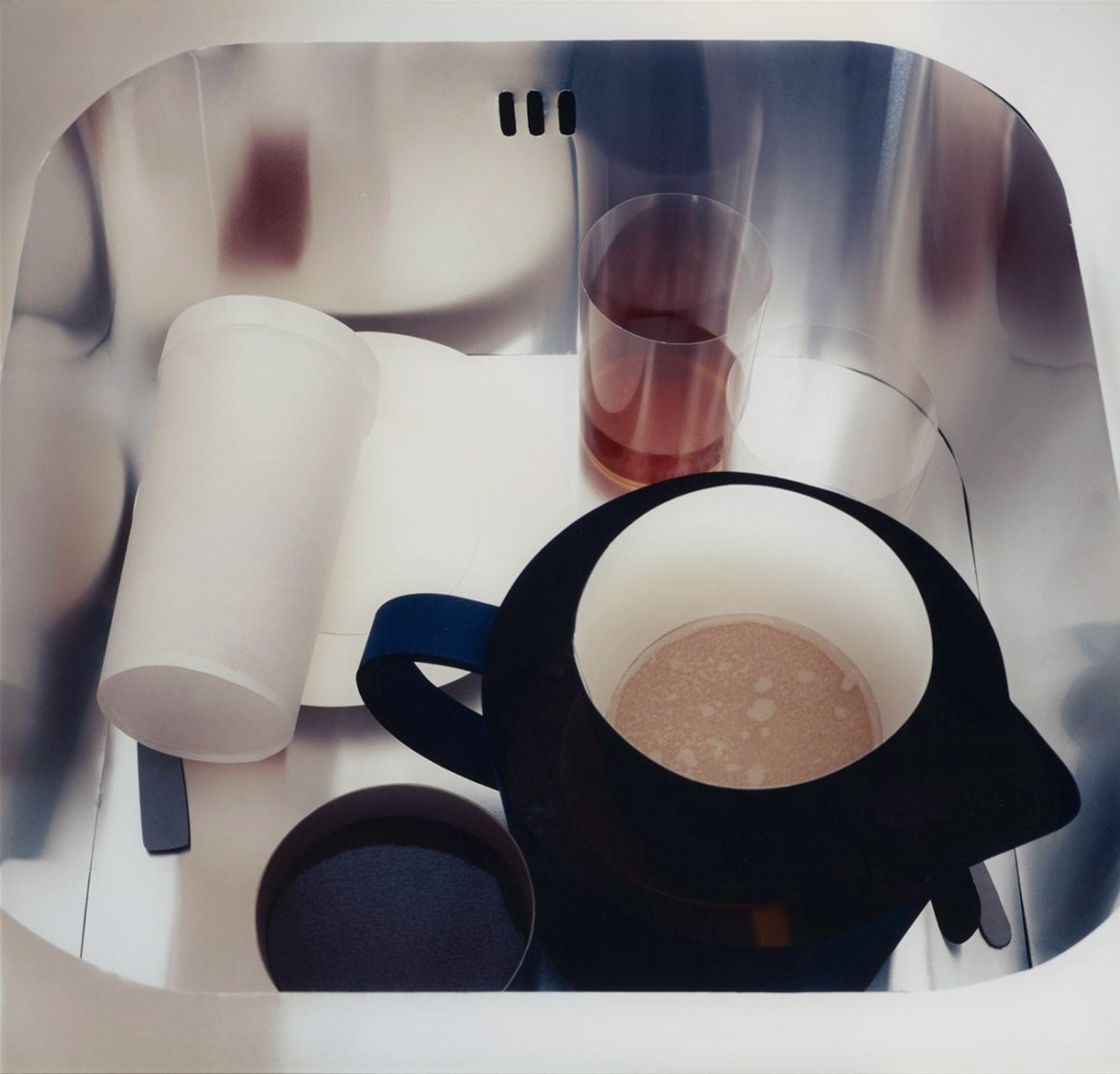
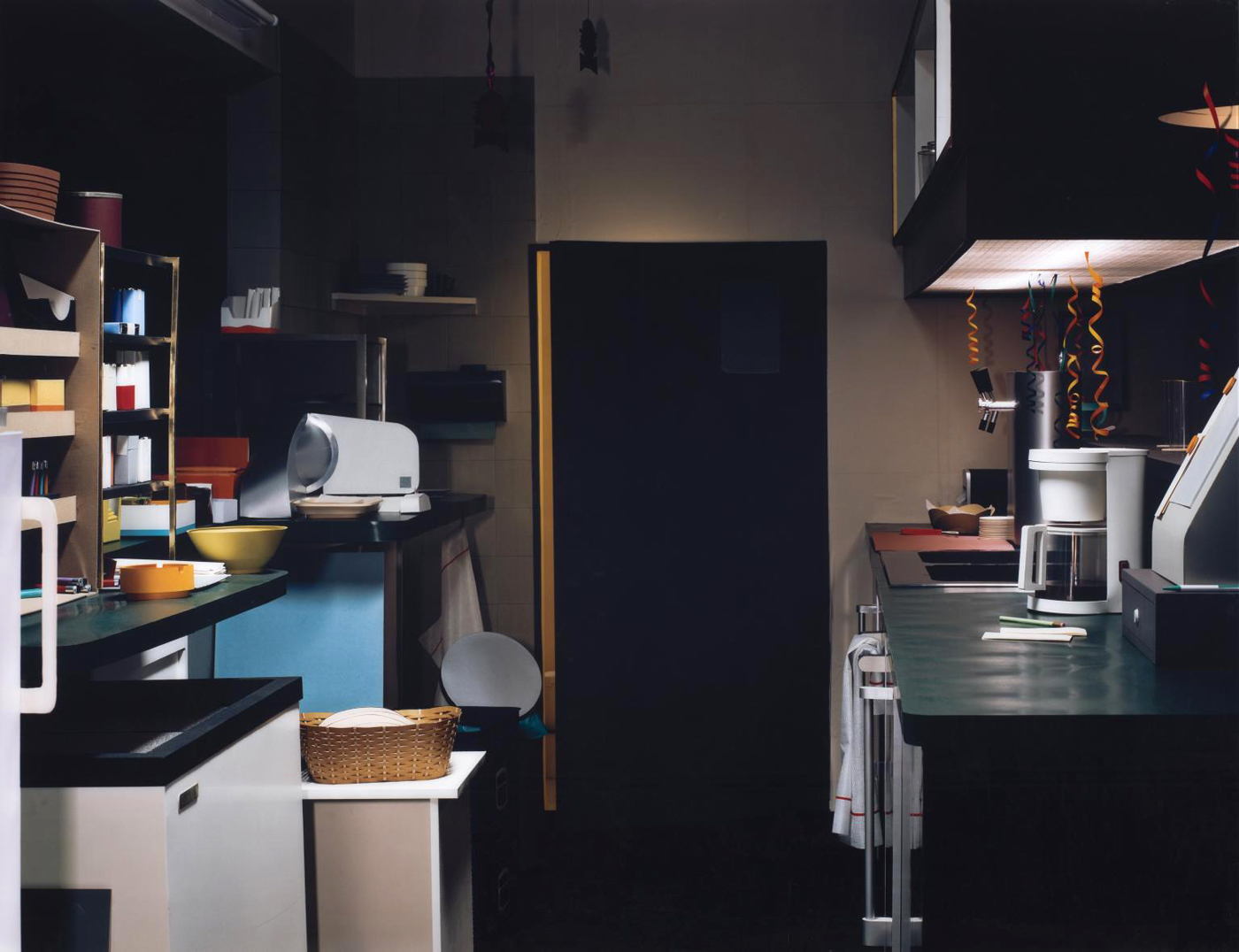
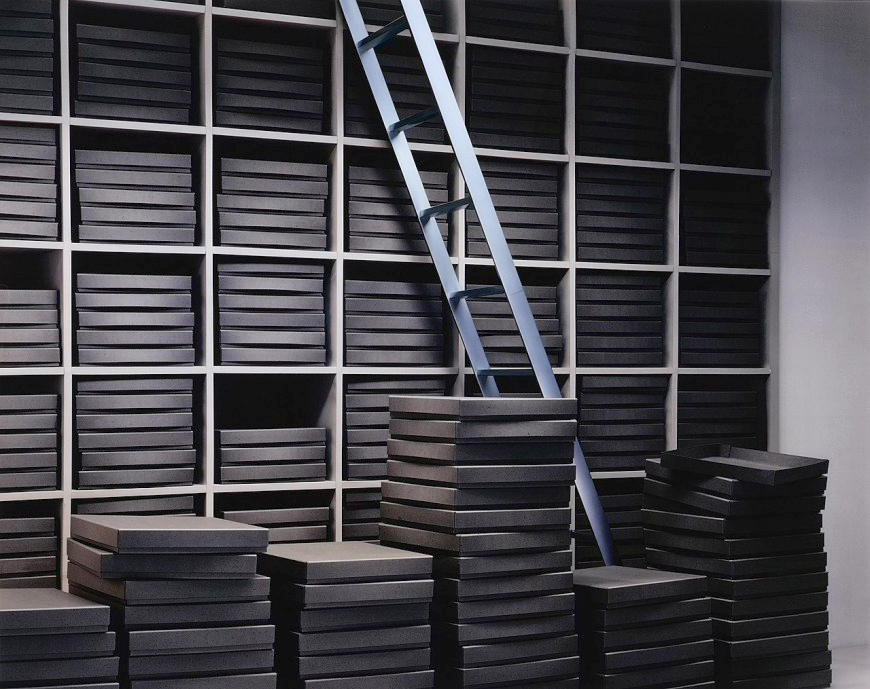
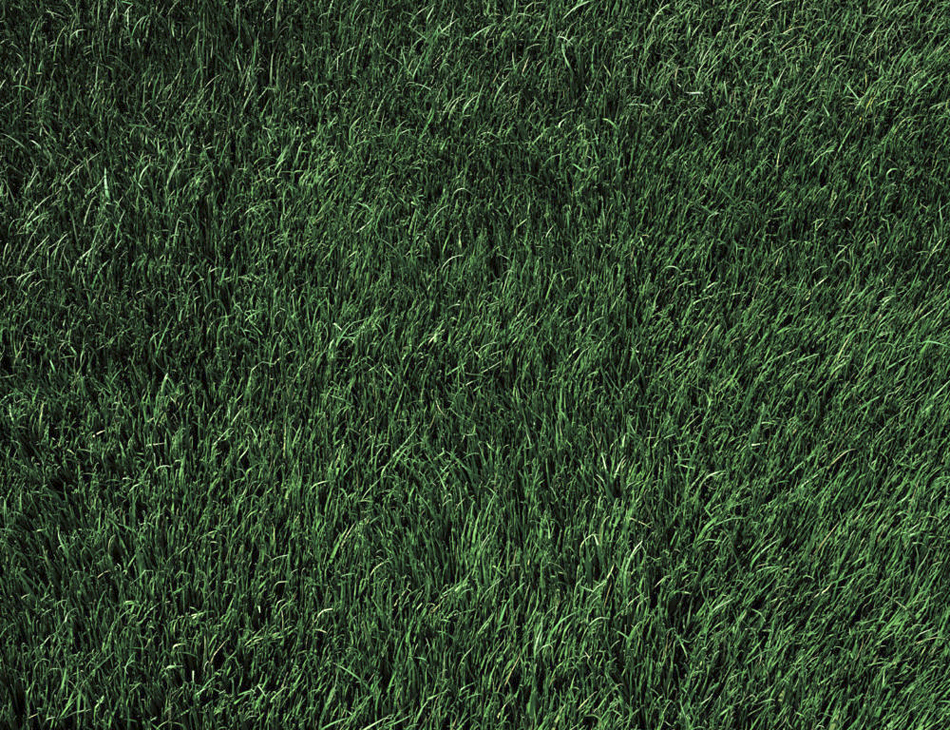
The Nationalgalerie presents Thomas Demand’s show National Gallery Berlin. From September 18, 2009, the Nationalgalerie – Staatliche Museen zu Berlin devotes a comprehensive solo show to one of the internationally most influential artists of our time: Thomas Demand. It is so far the largest presentation of his work in this country. However, the exhibition National Gallery is not designed as an overall retrospective but it is firmly dedicated to only one subject, which is perhaps the most important in Demand’s multi-facetted oeuvre: Germany.

Living in Berlin since 1996 Thomas Demand is an artist known for his large-format photographs, which explore the blank domain between reality and the ways it is being represented. He is undoubtedly regarded as one of the most renowned artists of his generation. Using paper and cardboard he builds three-dimensional, usually life-size models of places which often make references to pictures found in the mass media. By taking photographs of the scenery created in this way, he produces artefacts of a kind of their own which play with the beholder’s ideas of fiction and reality.

Until January, 17, 2010, about 40 works by the artist will be on display in the glass hall of the Neue Nationalgalerie built by Mies van der Rohe. There is hardly a location which is more suitable to convey to the beholder the panorama of a nation’s history than the large glass hall of the Neue Nationalgalerie, which is not only regarded as an incunabulum of post-war architecture but also as a symbol for the self-image of the Federal Republic of Germany at the former border between East and West. The exceptional exhibition architecture of the firm, Caruso St. John, London, forms an ideal link between Demand’s works and Mies van der Rohe’s bright hall.

Each picture shown in the exhibition is accompanied by a specific caption written by Botho Strauß which does not so much explain or define Demand’s work but rather creates a space between the pictures and the texts to allow new versions of interpretation.

Text from the New National Gallery website [Online] Cited 01/11/2009 no longer available online


Thomas Demand (German, b. 1964) 'Copyshop' 1999


Thomas Demand (German, b. 1964)
Copyshop
1999
C-Print / Diasec
© Thomas Demand, VG Bild-Kunst, Bonn


Thomas Demand (German, b. 1964) 'Drafting Room' 1996


Thomas Demand (German, b. 1964)
Drafting Room
1996
C-Print / Diasec
© Thomas Demand, VG Bild-Kunst, Bonn


Thomas Demand (German, b. 1964) 'Laboratory (77-E-217)' 2000


Thomas Demand (German, b. 1964)
Laboratory (77-E-217)
2000
C-Print / Diasec
© Thomas Demand, VG Bild-Kunst, Bonn


Thomas Demand (German, b. 1964) 'Haltestelle' 2009


Thomas Demand (German, b. 1964)
Haltestelle
2009
C-Print / Diasec, 240 x 330 cm
© Thomas Demand, VG Bild-Kunst, Bonn 2009


List of works that appear in the exhibition:

Archiv / Archive, 1995, C-Print/ Diasec, 183,5 x 233 cm
Attempt, 2005, C-Print/ Diasec, 166 x 190 cm
Badezimmer / Bathroom, 1997, C-Print/ Diasec, 160 x 122 cm
Balkone / Balconies, 1997, C-Print/ Diasec, 150 x 128 cm
Brennerautobahn, 1994, C-Print/ Diasec, 150 x 118 cm
Büro / Office, 1995, C-Print/ Diasec, 183.5 x 240 cm
Campingtisch / Camping Table, 1999, C-Print/ Diasec, 85 x 58 cm
Copyshop, 1999, C-Print/ Diasec, 183.5 x 300 cm
Drei Garagen / Three Garages, 1995, C-Print/ Diasec, 108 x 223 cm
Fabrik (ohne Namen), 1994, C-Print/ Diasec, 120 x 185 cm
Fassade / Facade, 2004, C-Print/ Diasec, 178 x 250 cm
Fenster / Window, 1998, C-Print/ Diasec, 183.5 x 286 cm
Fotoecke, 2009, C-Print/ Diasec, 180 x 198 cm
Gangway, 2001, C-Print/ Diasec, 225 x 180 cm
Grube / Pit, 1999, C-Print/ Diasec, 229 x 167 cm
Haltestelle, 2009, C-Print/Diasec, 240 x 330 cm
Heldenorgel, 2009, C-Print/Diasec, 240 x 380 cm
Hinterhaus, 2005, C-Print/ framed, 26.9 x 21.5 cm
Kabine, 2002, C-Print/ Diasec, 180 x 254 cm
Kinderzimmer /Nursery, 2009, C-Print/Diasec, 140 x 230 cm
Klause 1 / Tavern, 2006, C-Print/ Diasec, 275 x 170 cm
Klause 2 / Tavern, 2006, C-Print/ Diasec, 178 x 244 cm
Klause 3 / Tavern, 2006, C-Print/ Diasec, 199 x 258 cm
Klause 4 / Tavern, 2006, C-Print/ Diasec, 103 x 68 cm
Klause 5 / Tavern, 2006, C-Print/ Diasec, 197 x 137 cm
Labor (77-E-217), 2000, C-Print/ Diasec, 180 x 268 cm
Lichtung / Clearing, 2003, C-Print/ Diasec, 192 x 495 cm
Modell / Model, 2000, C-Print/ Diasec, 164,5 x 210 cm
Paneel / Peg Board, 1996, C-Print/ Diasec, 160 x 121 cm
Parlament / Parliament, 2009, C-Print/ Diasec, 180 x 223 cm
Raum / Room, 1994, C-Print/ Diasec, 183.5 x 270 cm
Sprungturm / Diving Board, 1994, C-Print/ Diasec, 150 x 118 cm
Spüle / Sink, 1997, C-Print/ Diasec, 52 x 56.5 cm
Studio, 1997, C-Print/ Diasec, 183.5 x 349.5 cm
Rasen / Lawn, 1998, C-Print/ Diasec, 122 x 170 cm
Terrasse / Terrace, 1998, C-Print/ Diasec, 183.5 x 268 cm
Treppenhaus / Staircase, 1995, C-Print/ Diasec, 150 x 118 cm
Wand /Mural, 1999, C-Print/ Diasec, 183.5 x 270 cm
Zeichensaal / Drafting Room, 1996, C-Print/ Diasec, 183.5 x 285 cm


Thomas Demand (German, b. 1964) 'Sink' 1997


Thomas Demand (German, b. 1964)
Sink
1997
C-Print / Diasec
© Thomas Demand, VG Bild-Kunst, Bonn


Thomas Demand (German, b. 1964) 'Tavern 3' 2006


Thomas Demand (German, b. 1964)
Tavern 3
2006
C-Print / Diasec
© Thomas Demand, VG Bild-Kunst, Bonn


Demand’s work is based on pre-existing images from the media, often of sites of political or cultural interest. He translates these images into life-size models using paper and cardboard, and photographs the resulting tableaux. These five photographs [of which the above is just one] depict a tavern in the German village of Burbach where a young boy was kidnapped, held hostage and ultimately murdered in 2001. His body was never recovered. The case was covered extensively in the German press, and images of the tavern became imbued with the public’s horrified imagination of the crime. Demand’s photographs investigate the traces these mediated images leave in the collective memory.

Tate Gallery label, April 2008


Thomas Demand (German, b. 1964) 'Archive' 1995


Thomas Demand (German, b. 1964)
Archive
1995
C-Print / Diasec
© Thomas Demand, VG Bild-Kunst, Bonn


Thomas Demand (German, b. 1964) 'Lawn' 1998


Thomas Demand (German, b. 1964)
Lawn
1998
C-Print / Diasec
122 x 170 cm
© Thomas Demand, VG Bild-Kunst, Bonn


Thomas Demand (German, b. 1964) 'Office' 1995


Thomas Demand (German, b. 1964)
Büro / Office
1995
C-Print / Diasec
183.5 x 240 cm
© Thomas Demand, VG Bild-Kunst, Bonn 2009


Thomas Demand (German, b. 1964) 'Gangway' 2001


Thomas Demand (German, b. 1964)
Gangway
2001
C-Print / Diasec
© Thomas Demand, VG Bild-Kunst, Bonn 2009


Thomas Demand (German, b. 1964) 'Attempt' 2005


Thomas Demand (German, b. 1964)
Attempt
2005
C-Print / Diasec
© Thomas Demand, VG Bild-Kunst, Bonn 2009


Thomas Demand (German, b. 1964) 'Balconies' 1997


Thomas Demand (German, b. 1964)
Balconies
1997
C-Print / Diasec
© Thomas Demand, VG Bild-Kunst, Bonn 2009


Neue Nationalgalerie
Potsdamer Straße 50
10785
Berlin
Kulturforum-Potsdamer Platz

Opening hours:
Tuesday – Sunday 10am – 6pm
Closed Mondays

Neue Nationalgalerie website

LIKE ART BLART ON FACEBOOK

Back to top

Exhibition: ‘The Abstracted Landscape’ at the Laurence Miller Gallery, New York

Exhibition dates: 24th September – 14th November, 2009

Exhibition artists: Peter Bialobrzeski, Stephane Couturier, DoDo Jin Ming, Toshio Shibata


Many thankx to Laurence Miller Gallery for allowing me to publish the photographs in the posting. Please click on the photographs for a larger version of the image.


DoDo Jin Ming (Chinese, b. 1955) 'Behind My Eyes 2nd Movement, Plate I' 2002 from the exhibition 'The Abstracted Landscape' at the Laurence Miller Gallery, New York, Sept - Nov, 2009


DoDo Jin Ming (Chinese, b. 1955)
Behind My Eyes 2nd Movement, Plate I
2002


DoDo Jin Ming (Chinese, b. 1955) 'Behind My Eyes 2nd Movement, Plate VIII' 2003 from the exhibition 'The Abstracted Landscape' at the Laurence Miller Gallery, New York, Sept - Nov, 2009


DoDo Jin Ming (Chinese, b. 1955)
Behind My Eyes 2nd Movement, Plate VIII
2003


DoDo Jin Ming (Chinese, b. 1955) 'Free Element, Plate XXX' 2002


DoDo Jin Ming (Chinese, b. 1955)
Free Element, Plate XXX
2002


Stéphane Couturier (French, b. 1957) 'Olympic Parkway No. 1' 2001 from the exhibition 'The Abstracted Landscape' at the Laurence Miller Gallery, New York, Sept - Nov, 2009


Stéphane Couturier (French, b. 1957)
Olympic Parkway No. 1
2001


Stéphane Couturier (French, b. 1957) 'Proctor Valley No. 1' 2004


Stéphane Couturier (French, b. 1957)
Proctor Valley No. 1
2004


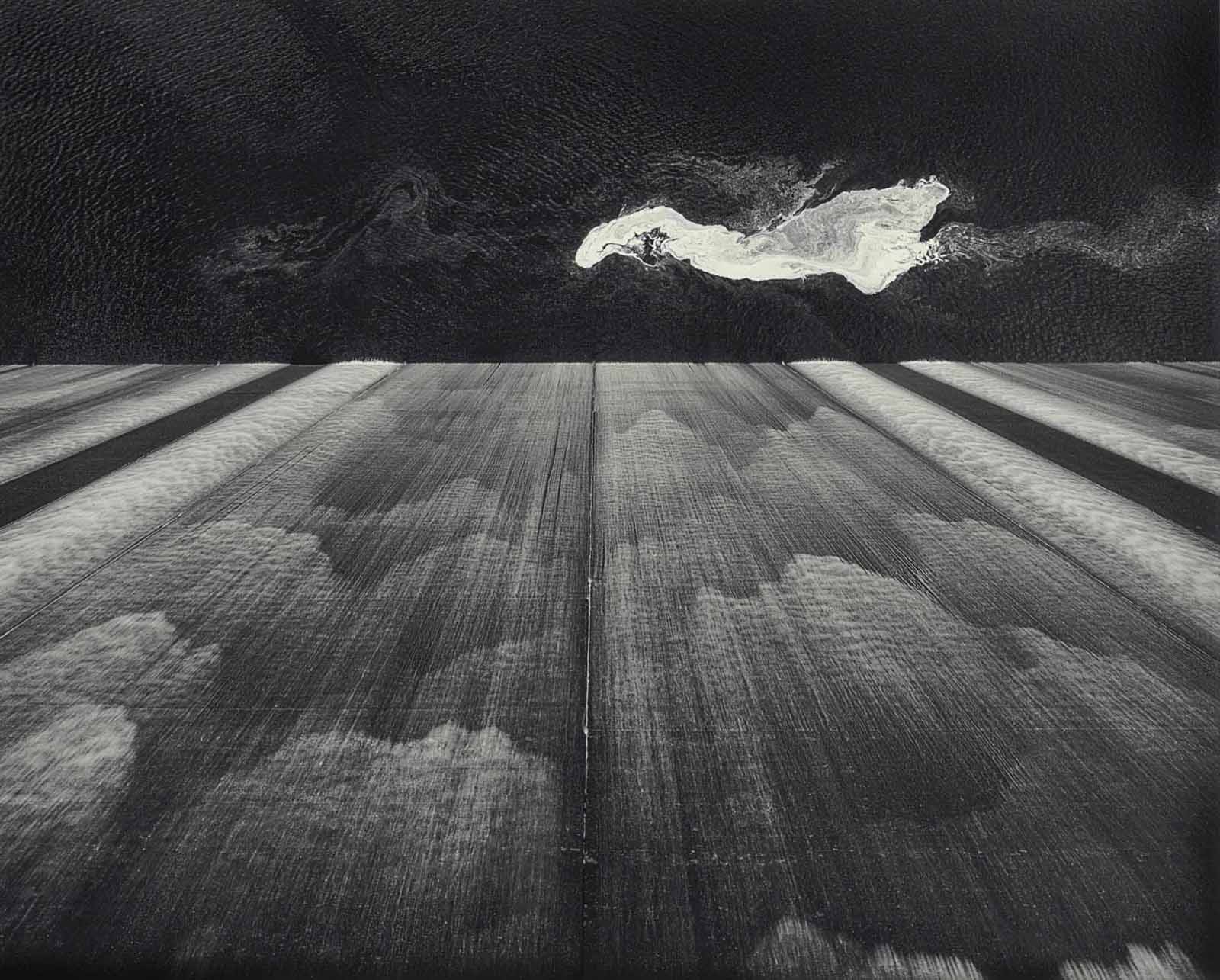
Laurence Miller is pleased to present, as its opening show for the fall, The Abstracted Landscape, featuring the work of four midcareer international artists: Peter Bialobrzeski, from Hamburg; Stephane Couturier, from Paris; DoDo Jin Ming from Beijing and New York; and Toshio Shibata, from Tokyo.

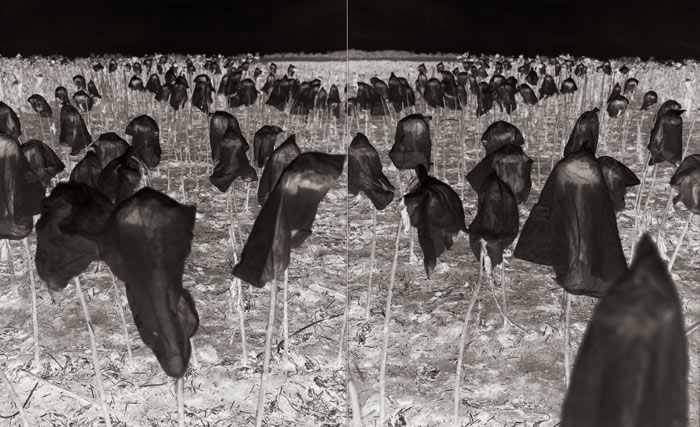
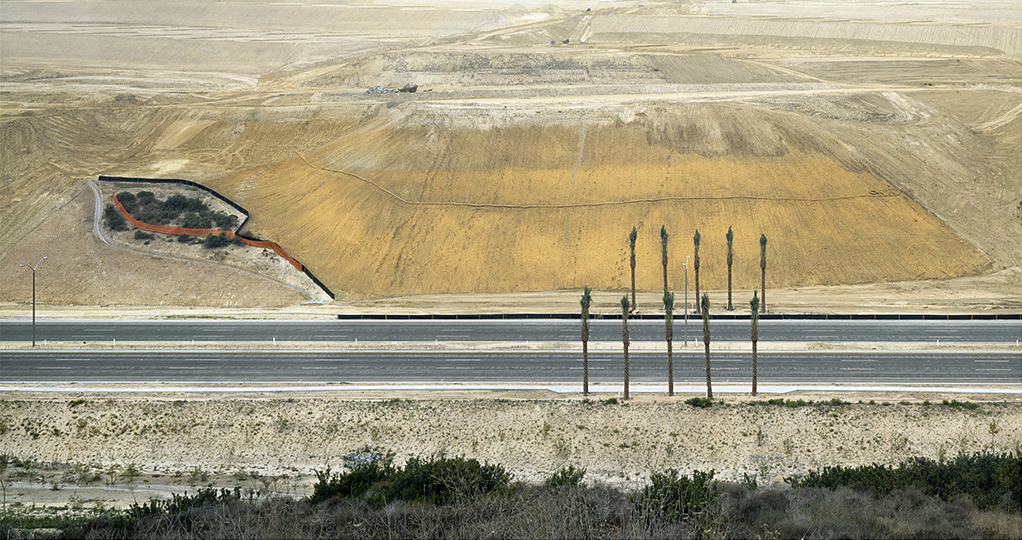
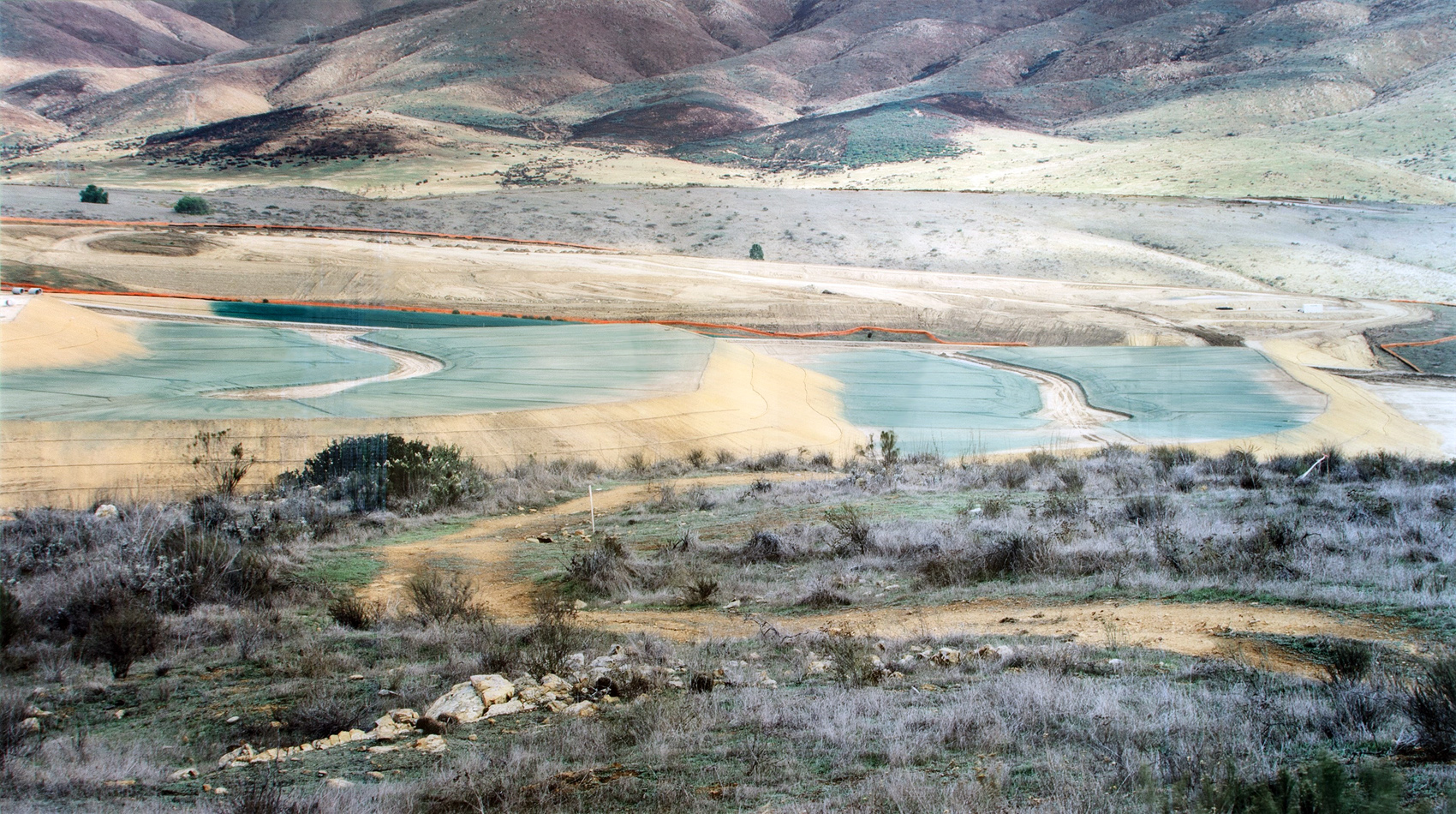
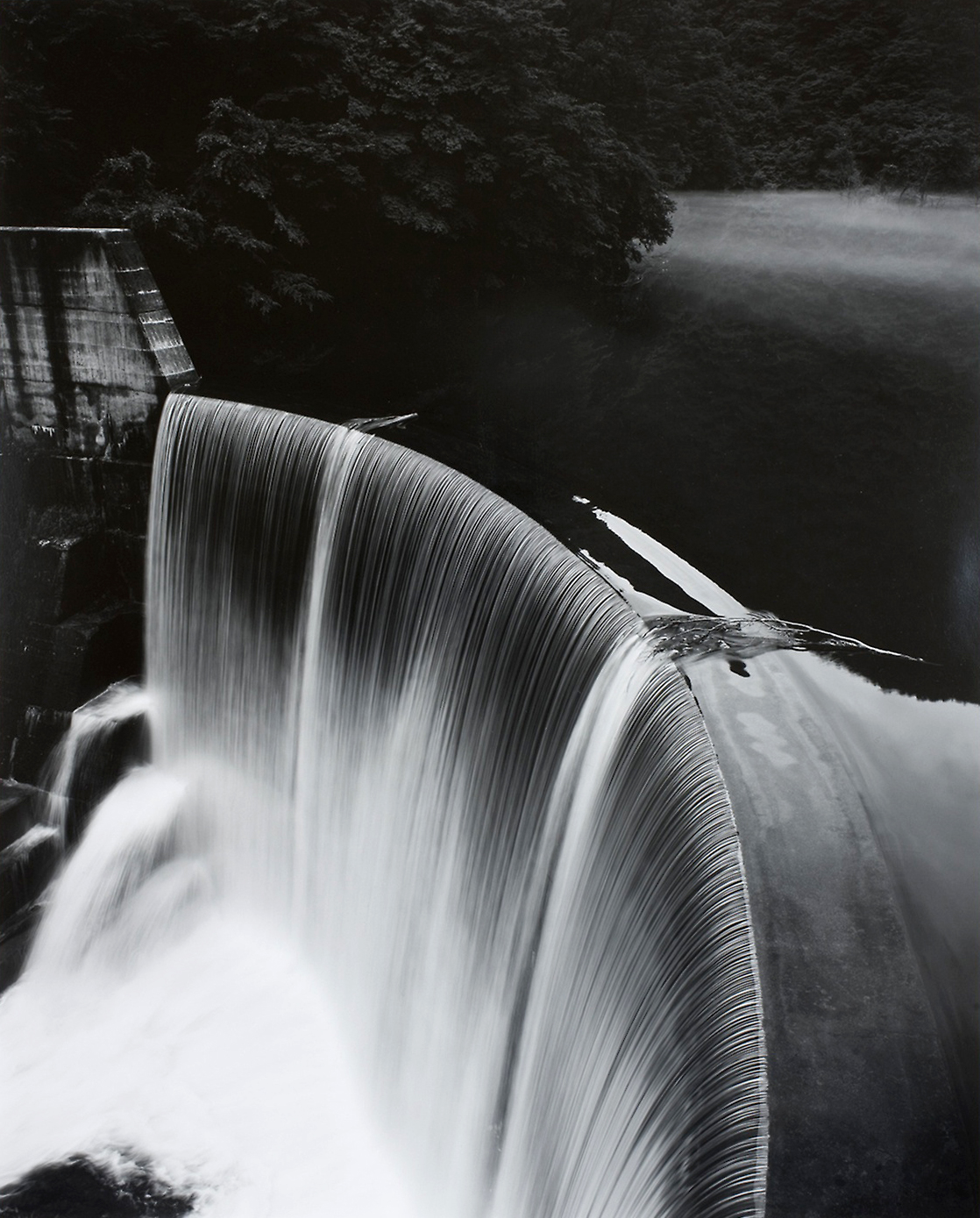
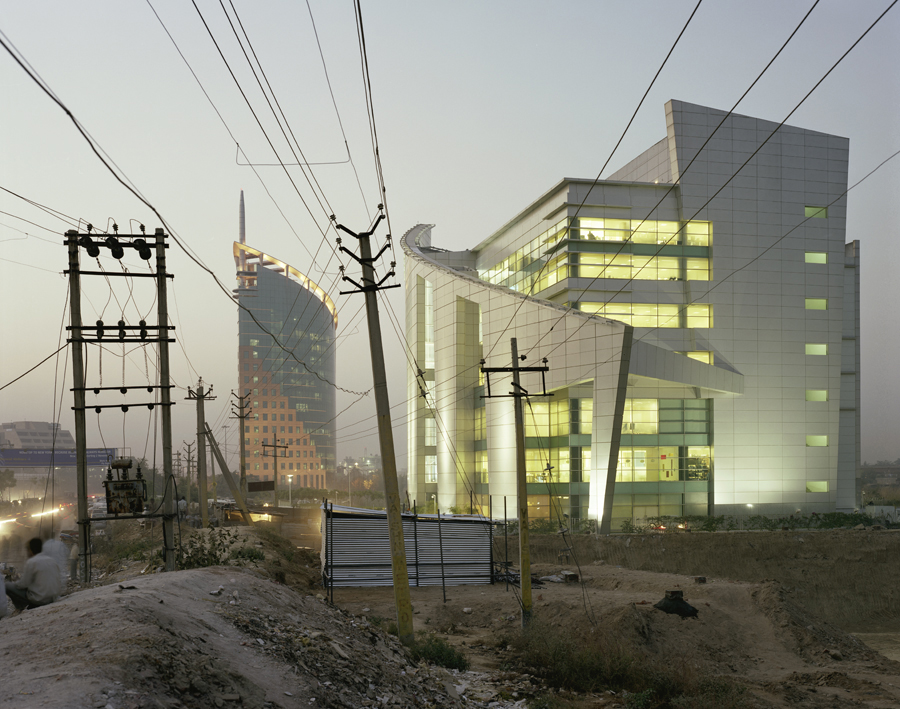
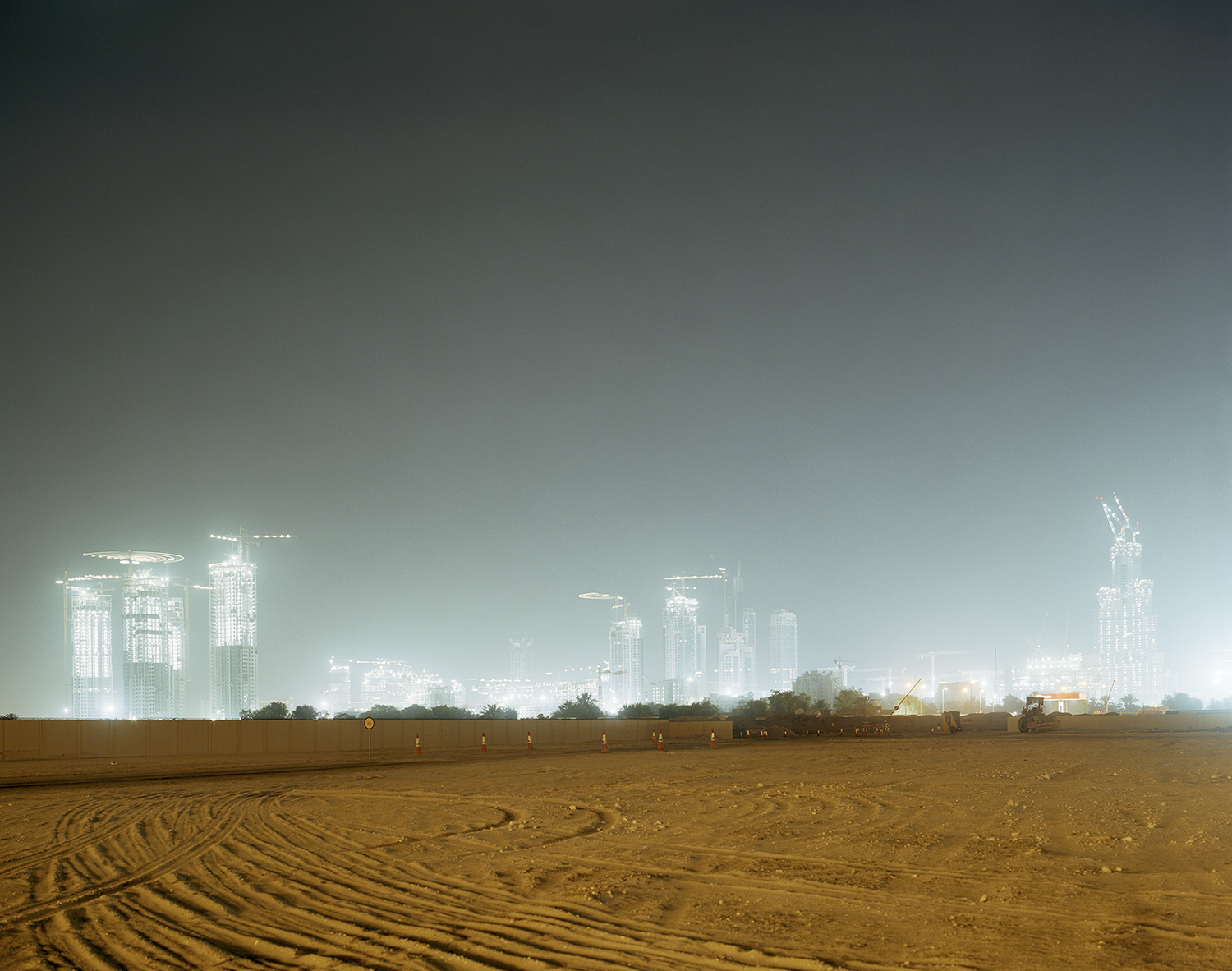
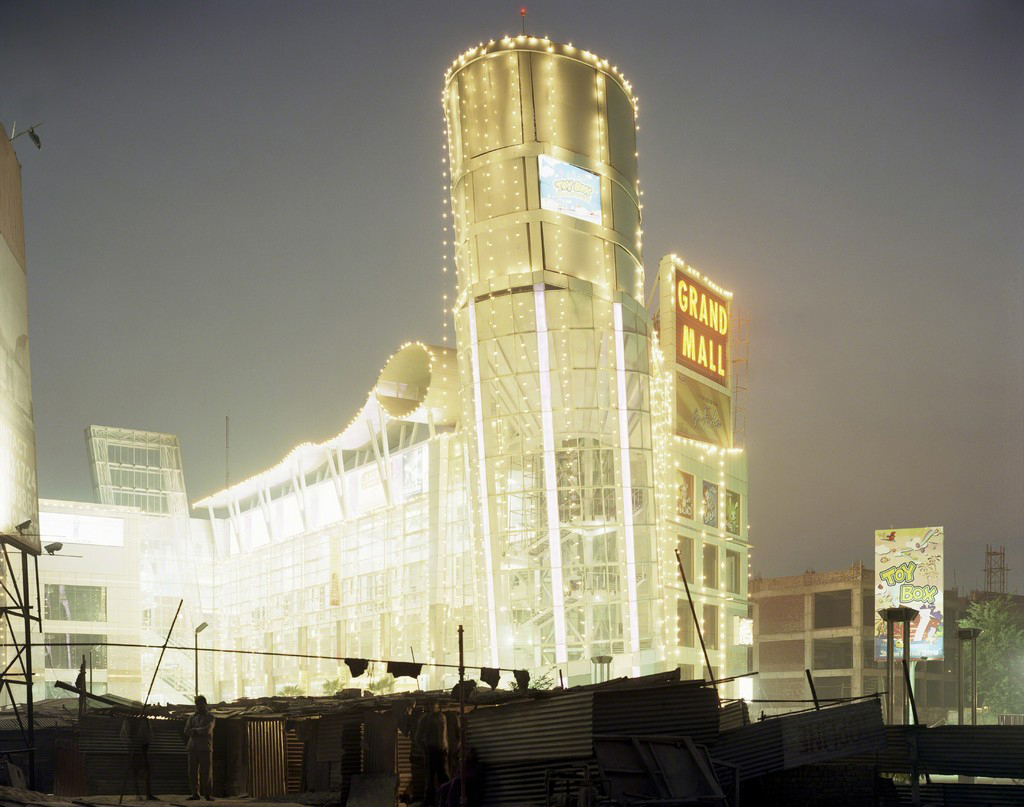
These four photographers each translate the landscape into a poetic and abstract vision, utilising techniques and processes unique to photography to create scenes that remain sufficiently recognisable yet unobtainable through the naked eye. Peter Bialobrzeski, in his series Lost in Transition, photographs rapid urbanisation and industrialisation by taking very long exposures, which create other-worldly colours and lighting not visible to the naked eye. Stéphane Couturier embraces the camera’s monocularity in his series from Havana to flatten our normal reading of space and render totally ambiguous the walls of a decaying interior. DoDo Jin Ming, in her series Behind My Eyes, applies the technique of negative printing to render mysterious and foreboding fields of sunflowers. And Toshio Shibata wields his large view camera, with multiple tilts and swings, to look straight down the side of a dam, creating a vertigo-inducing viewpoint we would be unable (and perhaps unwilling) to see directly with our own eyes.

Abstraction in the landscape has a rich tradition within the history of photography. Felix Teynard’s Egyptian views from the mid-1850’s are wonderfully abstract, as are those of J.B. Greene and August Salzmann. Timothy O’Sullivan, Carlton Watkins and William Henry Jackson each made views of the American west from the 1806’s through the 1880’s, that were equally rich in detail and minimal in composition. In the 20th century there are many examples, from George Seeley to Paul Strand, through Moholy Nagy and the Bauhaus to Edward Weston’s glorious sand dunes.

Text from the Laurence Miller Gallery website [Online] Cited 12/10/2009. No longer available online


Toshio Shibata (Japanese, b. 1949) 'Kashima Town, Fukushima Prefecture' 1990


Toshio Shibata (Japanese, b. 1949)
Kashima Town, Fukushima Prefecture
1990


Toshio Shibata (Japanese, b. 1949) 'Grand Coulee Dam, Douglas County, WA' 1996


Toshio Shibata (Japanese, b. 1949)
Grand Coulee Dam, Douglas County, WA
1996


Peter Bialobrzeski (German, b. 1961) 'Transition # 33' 2005


Peter Bialobrzeski (German, b. 1961)
Transition #33 from the series Lost in Transition
2005


Peter Bialobrzeski (German, b. 1961) 'Transition # 20' 2005


Peter Bialobrzeski (German, b. 1961)
Transition #20 from the series Lost in Transition
2005


Peter Bialobrzeski (German, b. 1961) 'Transition #23' 2005


Peter Bialobrzeski (German, b. 1961)
Transition #23 from the series Lost in Transition
2005


Laurence Miller Gallery

Laurence Miller Gallery is now operating as a private dealer and consultant.

Laurence Millery Gallery website

LIKE ART BLART ON FACEBOOK

Back to top

Exhibition: ‘Snow Machine’ by Florian Maier-Aichen at Gagosian Gallery, Britannia Street, London

Exhibition dates: 3rd September – 3rd October, 2009


Many thankx to the Gagosian Gallery for allowing me to publish the photographs in the posting.


Florian Maier-Aichen (German, b. 1973) 'Der Watzmann' 2009 from the exhibition 'Snow Machine' by Florian Maier-Aichen at Gagosian Gallery, Britannia Street, London, Sept - Oct, 2009


Florian Maier-Aichen (German, b. 1973)
Der Watzmann
2009


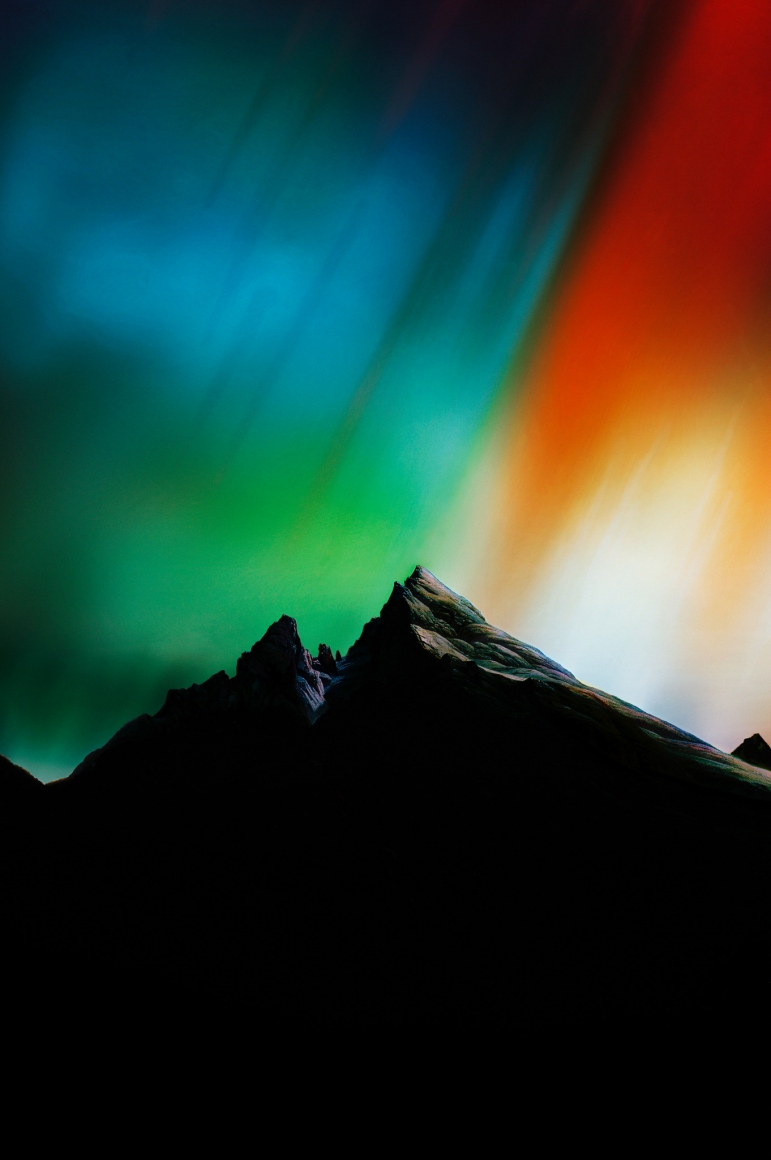
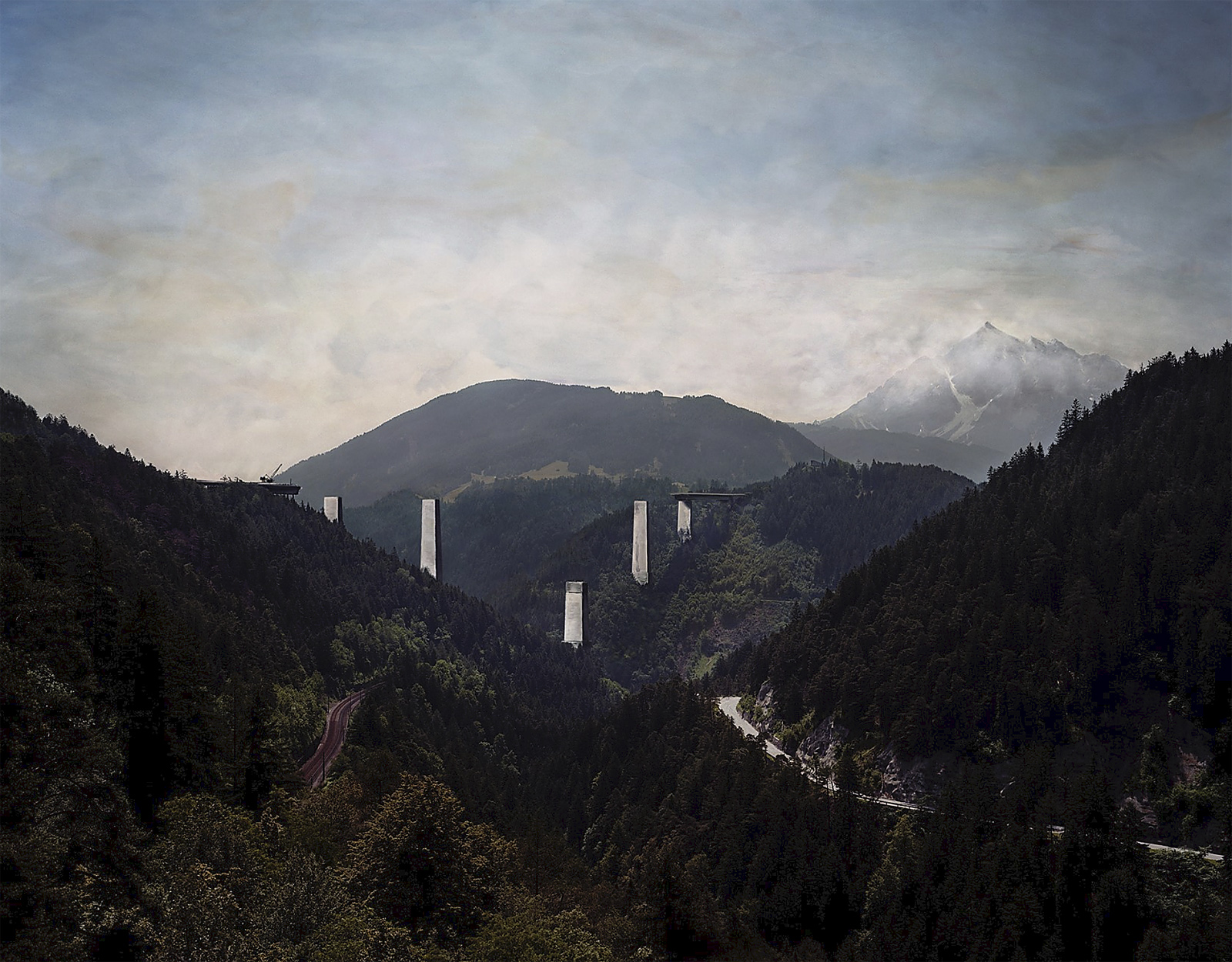
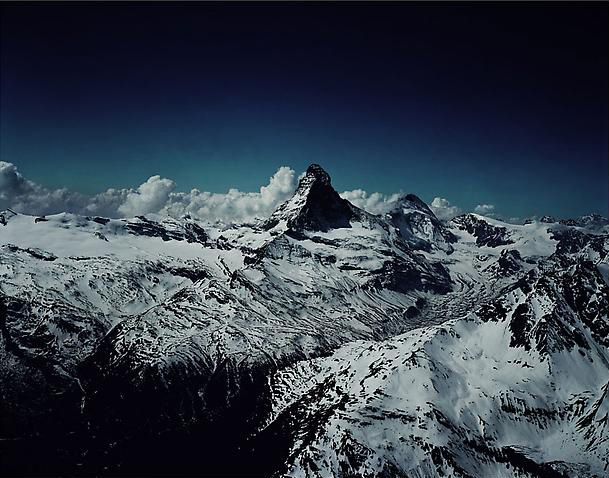
Florian Maier-Aichen brings a contemporary sensibility to bear on a range of historical references, from German Romantic painting to 19th-century photographs of the American West. The German-born photographer shoots images with a large-format camera then alters them digitally by combining negatives, adding computer-drawn elements or otherwise changing the originals. The effects are painterly and the works large-scale (the biggest one in this show, all but one of them C-prints, was around 8 by 71⁄3 feet). In one untitled print (2009), a digitally created brushstroke cuts diagonally across a snowy mountainside. Alluding to the trails ploughed across mountains to prevent avalanches, the photograph also suggests the black-and-white paintings of Abstract Expressionist Franz Kline. The sky above a dark mountainous outcropping in Der Watzmann (2009) references the Caspar David Friedrich painting of the same name (Maier-Aichen appropriated the image of the peak from the painting itself), while the sky suggests an airbrush version of the aurora borealis in red-orange and blue-green.

Der Watzmann may be the most direct reference to 19th-century German Romanticism and the sublime, but these are themes that Maier-Aichen frequently evokes, only to upend them.

Jean Dykstra. “Florian Maier-Aichen,” on the Art in America website May 4, 2009 [Online] Cited 24/09/2019


Florian Maier-Aichen (German, b. 1973) 'Untitled' 2008 from the exhibition 'Snow Machine' by Florian Maier-Aichen at Gagosian Gallery, Britannia Street, London, Sept - Oct, 2009


Florian Maier-Aichen (German, b. 1973)
Untitled
2008


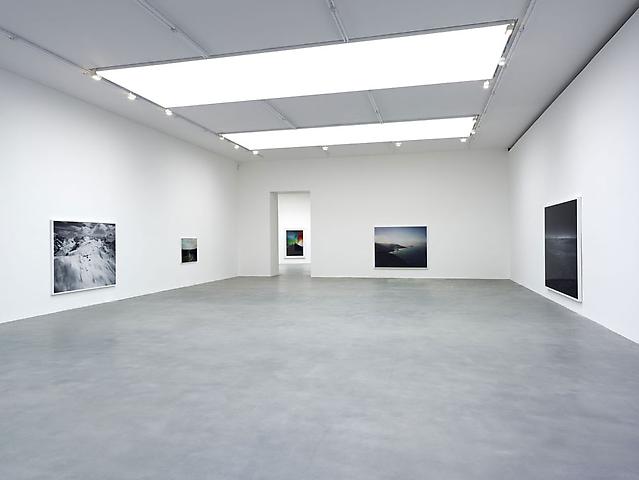
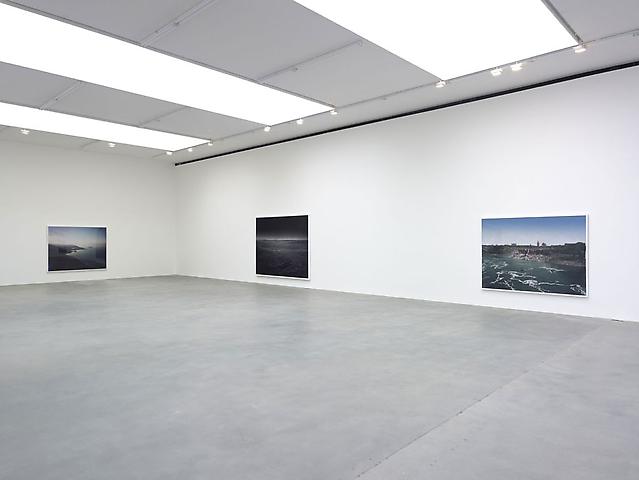
'Snow Machine' by Florian Maier-Aichen installation view at Britannia Street, Gagosian Gallery

'Snow Machine' by Florian Maier-Aichen installation view at Britannia Street, Gagosian Gallery 2


Snow Machine by Florian Maier-Aichen installation views at Gagosian Gallery, Britannia Street, London


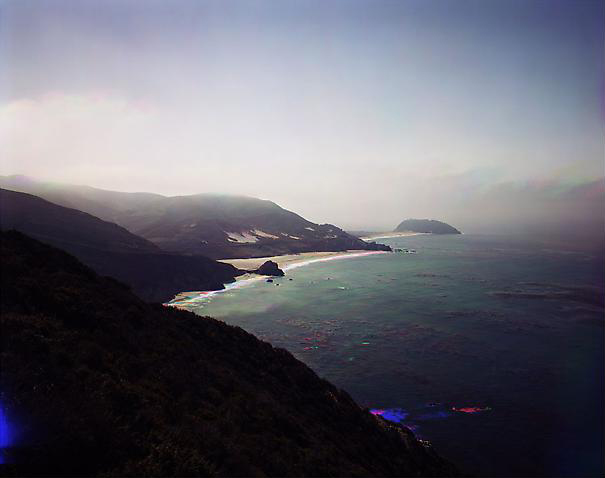
“Florian Maier-Aichen’s images reinterpret landscape photography for the 21st century. Often shot at obscure angles or from aerial views, his estranged vantage points are both alien and familiar; a sensation enhanced by his subtle manipulation of the images. Conceiving the representation of sites with a sense of dislocation, Maier-Aichen’s work addresses issues of globalisation and virtual perception. In Untitled, Maier-Aichen’s coastline is far from postcard perfect: a virgin beach lined with superhighway and luxury homes expanding into the misty distance. Tinting the surrounding forest in an unnatural shade of red, he casts an apocalyptic glow over the seascape, framing wilderness and human intervention as a scene of science fiction portent.”

Text from the Saatchi Gallery website [Online] Cited 24/04/2019


Florian Maier-Aichen (German, b. 1973) 'Untitled' 2009 from the exhibition 'Snow Machine' by Florian Maier-Aichen at Gagosian Gallery, Britannia Street, London, Sept - Oct, 2009


Florian Maier-Aichen (German, b. 1973)
Untitled
2009


“I have always been interested in the making of things. Most products and materials conceal their process of manufacture. It’s the same with photography, which turned from a discipline that was subject to the mastery of the few (alchemists) into a readily available industrial mass product, too transparent and too technical.”


Florian Maier-Aichen


Gagosian Gallery is pleased to present an exhibition of recent photographs by Florian Maier-Aichen. This is the artist’s first solo exhibition in London.

A photographer schooled on both sides of the Atlantic, Maier-Aichen’s work reflects on the dual influences of the history of photography and the history of painting, whether drawing on such dichotomies as German Romantic painting and the pioneers of German “objective” photography, or applying his post-factum experience of American frontier art – from the Hudson River School and Abstract Expressionism to Land Art and West Coast conceptualism – to his own topographical depictions of landscape subjects. He focuses on the camera’s consummate power to establish typologies of thought, perception, and feeling, producing images that, in mining the past, come to embody a matrix of issues salient to recent photographic practice.

Approaching the photographic field like a painter approaches a canvas, Maier-Aichen does for the contemporary image-world what pictorial photographers attempted in the nineteenth and early twentieth centuries, using the strategies and motifs of Romantic and Luminist painting. Unnaturally high-keyed or delicately tinted images of soaring mountain ranges, moody seas, and the industrial architecture of bridges, waterways, and dams carving through the natural landscape are all emanations of a rich and diverse imagination where a keen and critical grasp of art history coexists with more pronounced literary and cinematic conceits.

In a creative process that is as intensive as it is subtle and opaque, Maier-Aichen combines an exhaustive range of staged effects and traditional photographic techniques – albumen, silver-gelatin, and c-printing – with drawing and current computer-imaging processes. Weaving together often disparate elements from distinct sources, he applies myriad creative adjustments to each in order to produce seamless photographs that do not betray their intricate and layered compositions. Multiple negatives, digital manipulation, and elaborate studio techniques are employed to produce seemingly straightforward photographic landscape subjects while other images that engage the most conventional photographic techniques may themselves be subjects of pure fabrication.”

Text from the Gagosian Gallery website [Online] Cited 20/09/2009. No longer available online


Florian Maier-Aichen (German, b. 1973) 'Untitled' 2009


Florian Maier-Aichen (German, b. 1973)
Untitled
2009


Florian Maier-Aichen (German, b. 1973) 'Untitled' 2009


Florian Maier-Aichen (German, b. 1973)
Untitled
2009


Florian Maier-Aichen (German, b. 1973) 'Untitled (St. Francis Dam)' 2009


Florian Maier-Aichen (German, b. 1973)
Untitled (St. Francis Dam)
2009


Gagosian Gallery
6-24 Britannia Street
London WC1X 9JD
Phone: 44.207.841.9960

Opening Hours:
Tuesday – Saturday 10am – 6pm

Gagosian Gallery website

LIKE ART BLART ON FACEBOOK

Back to top

Review: ‘presentation/representation: photography from Germany’ at the Monash Gallery of Art, Wheelers Hill, Melbourne

Exhibition dates: 3rd July – 30th August, 2009

Curator: Thomas Weski

Artists: Laurenz Berges, Albrecht Fuchs, Karin Geiger, Claus Goedicke, Uschi Huber, Matthias Koch, Wiebke Loeper, Nicola Meitzner, Peter Piller, Heidi Specker.

An exhibition of the Institut für Auslandsbeziehungen e. V. (ifa/Institute for Foreign Cultural Relations), Stuttgart, Germany and presented in cooperation with the Goethe-Institut Australien.


Matthias Koch (German, b. 1967) 'Submarine Laboe near Kiel, built 1944' 2006 from the exhibition 'presentation/representation: photography from Germany' at the Monash Gallery of Art, Melbourne, July - August, 2009


Matthias Koch (German, b. 1967)
Submarine Laboe near Kiel, built 1944
2006
© Matthias Koch


I was looking forward to this exhibition and so on a cold and very windy winter’s day I ventured out on the drive to the Monash Gallery of Art in Wheelers Hill expecting to be challenged by a new generation of German photographers. I was to be sorely disappointed. This show, with the exception of excellent work by Andreas Koch and good work by Laurenz Berges, epitomises all that I find woeful about contemporary photography.

There is a lack of life and vigour to the work, no sense of enjoyment in taking photographs of the world. The narratives are shallow and vacuous inducing a deep somnambulism in the viewer that is compounded by the silent, deeply carpeted gallery making the experience one of entering a mausoleum (this is a great space that needs to be a contemporary space!). How many times have I seen photographs of empty spaces that supposedly impart some deep inner meaning? See how a great artist like Tacita Dean achieves the same end to startling effect with her film Darmstädter Werkblock (2007). How many times do I need to see ‘dead pan’ portrait photographs that are again supposed to impart rich psychological meaning? I have seen too many already.

Conceptually the work is barren. Technically the proficiency of some of the work is almost non-existent. If this standard of work was put up for assessment in a university course it would fail miserably. For example in Nicola Meitzner’s work Forward Motion (2006), vertical portraits (of the same person in different poses) and streetscapes of Tokyo are poor quality prints mounted in unattractive silver aluminium frames. They are forgettable. If an artist were to study the work of, say, Manuel Alvarez Bravo, then one might gain some insight into how to photograph the city and the people that live in it in a way that elicits a response from the viewer to the photo-poetry that is placed before them.

Uschi Huber’s photographs of boarded up shop fronts, while a nice conceptual idea, are again lacking in technical proficiency and are nothing we haven’t seen many times before while Peter Piller’s ten print-media type pigment prints of girls at a shooting range with rifles do not bare comment on both a conceptual and technical level. Similarly, Wiebke Loeper’s colour photographs of the city of Wismar – houses, roads, water, oat fields, people peering into shop windows – sent to friends living in Melbourne to show them the desolation and rebuilding of the city are seriously year 12 work.

The two redeeming artists are Laurenz Berges and Andreas Koch.

Berges four large type C colour photographs of an empty house and the surrounds as seen through a window are intimately detailed visions of human absence from the built environment: the huts, piles of wood chips, barren trees, the feathers on the floor of one print, the cigarette butts on the floor of another, the marks on the wall in blue and red add to a sense of abandonment and alienation from the environment – traces of human experience, identity and memory etched into the photographic medium.

As the text on the Institut für Auslandsbeziehungen (IFA) website observes,

“Laurenz Berges is a chronicler of absence. His minimalist photographs point to the earlier use of spaces, only fragments of which are shown, whose inhabitants have put them to other, new uses. Berges depicts the traces of this change in austere images that, due to their reduction, tell their stories indirectly and almost involuntarily. These are stories about the existential significance certain spaces have for our identity, and also about their transitoriness and their loss.”1


The star of the show was the work of Matthias Koch. His five large aqua-mounted type C prints from the series Sites of German History (2006) are both technically and conceptually superb, full of delicious ironies and humour. Using an aerial aesthetic (apparently by climbing the ladder of a fire engine that he owns) Koch looks down on the landscape and through his images formulates new ways of seeing national symbols (even though many of them are not in Germany). His re-presentation of spatial inter-relations and objects embedded in their rural and urban surroundings are both simple yet layered and complex.

Unfortunately I have only two photographs (above and below) to show you of his work. None other was available but the images gives you an idea of his raison d’être. The specimen of U-995, built in Kiel in 1944, is presented as a trapped and mounted animal, preserved for our delectation and inspection with gangways and stairs to view the innards. Little hobby craft lie on a beach behind while people paddle in the shallows, a ship barely seen in the distance out at sea. The fact that this U-boat was once used to destroy such a ship, the irony of the proposition, is not lost on the viewer.

Other images in the series include a photograph of the derelict runway of the Heinkel factory as seen from above, the overgrown concrete slabs cracked and lifting, the edges filled with grass, the distant view dissolving into mist and nothingness. The photograph Harbour, Allied landing near Normandy, 1944 (2006, below) shows an American jeep and half-track of the period on the beach of the Allied landing in Normandy, tyre tracks swirling in the sand while in the distance the concrete block remains of the Mulberry harbour used in 1944 still litter the coastline. How many men, both German and American, died on this beach all those years ago? In another tour de force Atlantic Defence Wall near Cherbourg. Bunker construction built 1940 (2006) concrete bunkers dot the landscape with the beach and sea beyond as people sunbathe on the grass amongst the ruined bunkers, probably oblivious to the context of their surroundings. Koch is a master of the re-presentation of the context of memory, history and place.

Overall this exhibition is a great disappointment. I find it hard to believe that the exhibition has been curated by the same man who curated the recent Andreas Gursky exhibition at the National Gallery of Victoria. The choice of work and the presentation of technically poor prints is not up to standard. I also find it difficult to reconcile some of the reviews I have read of this exhibition with the actual work itself. Thank goodness for the photographs of Matthias Koch for he alone made the journey into outer Melbourne a worthwhile journey into the memory of the soul.

Dr Marcus Bunyan


1/ Anonymous. “Presentation/representation: Laurenz Berges,” on the Institut für Auslandsbeziehungen (IFA) website [Online] Cited 08/08/2009 no longer available online


    Many thankx to Monash Gallery of Art for allowing me to publish the photographs in the posting. Please click on the photographs for a larger version of the image.


    Matthias Koch (German, b. 1967) 'Harbour, Allied landing near Normandy, 1944' 2006 from the exhibition 'presentation/representation: photography from Germany' at the Monash Gallery of Art, Melbourne, July - August, 2009


    Matthias Koch (German, b. 1967)
    Harbour, Allied landing near Normandy, 1944
    2006
    © Matthias Koch


    Laurenz Berges (German, b. 1966) 'Garzweiler' [surface mine] 2003 from the exhibition 'presentation/representation: photography from Germany' at the Monash Gallery of Art, Melbourne, July - August, 2009


    Laurenz Berges (German, b. 1966)
    Garzweiler [surface mine]
    2003
    C print
    130 x 171cm (51.2 x 67.3 in.)
    © Courtesy Galerie Wilma Tolksdorf, Frankfurt/Berlin


    This international touring exhibition was developed by the Institut für Auslandsbeziehungen (ifa) in Germany and is presented in cooperation with the Goethe-Institut Australien.

    MGA is hosting the important international exhibition ‘presentation / representation: photography from Germany’, which brings to Melbourne the work of ten of Germany’s best contemporary photographers.

    presentation/representation is curated by Thomas Weski (curator of Andreas Gursky recently seen at the National Gallery of Victoria), and covers the work of the generation of German photographers that has followed the now-legendary Kunstakademie Düsseldorf generation of Gursky, Thomas Ruff, Thomas Struth and Candida Höfer. For the artists in presentation/representation, including Matthias Koch, Laurenz Berges and Heidi Specker, photography is a medium that has its own language and characteristics, and their work collectively explores the limits of the medium.

    Shaune Lakin, Director of the MGA states “MGA is thrilled to present ‘presentation / representation’ and to bring to the people of Melbourne such an important survey of contemporary German photography. As well as providing a comprehensive survey of German practice, the exhibition will complement the experience of those who saw Weski’s wonderful Gursky exhibition at NGV. We are also delighted to host participating artist Matthias Koch.”

    Koch will be presenting a series of public programs including an artist talk, student tutorial and a field trip exploring the industrial suburban sites close to the gallery. “With his critical interest in landscape, architecture and history, Koch will provide some wonderful insights into our local landscape for participants in these programs,” notes Dr Lakin.

    MGA’s Education and public programs coordinator Stephanie Richter says: “This is a great opportunity for students and Melbourne audiences to meet one of Germany’s most celebrated contemporary photographers and to participate in the busy schedule of talks, tutorials and field trips with Matthias.”

    Press release from Monash Gallery of Art website [Online] Cited 05/08/2019 no longer available online


    Heidi Specker (German, b. 1962) 'D'Elsi - Elsi' 12007


    Heidi Specker (German, b. 1962)
    D’Elsi – Elsi 1
    2007
    Digital Fine Art Print
    Courtesy Fiedler Contemporary, Köln
    Galerie Barbara Thumm, Berlin
    © VG Bild-Kunst, Bonn, Germany, 2007


    Claus Goedicke (German, b. 1966) 'Trip to the Moon' 2006


    Claus Goedicke (German, b. 1966)
    Trip to the Moon
    2006
    Pigment print on wallpaper
    © Claus Goedicke


    Nicola Meitzner (German, b. 1969) 'Forward motion' 2006


    Nicola Meitzner (German, b. 1969)
    Forward motion
    2006
    From the tableau Forward motion
    Pigment print
    © Nicola Meitzner


    Wiebke Loeper (German, b. 1972) 'To the sisters of Carl Möglin' 2005


    Wiebke Loeper (German, b. 1972)
    To the sisters of Carl Möglin
    2005
    From the series To the sisters of Carl Möglin
    © VG Bild-Kunst, Bonn, Germany, 2007


    Uschi Huber (German, b. 1966) 'Fronten' 2006


    Uschi Huber (German, b. 1966)
    Fronten
    2006
    From the series Fronten 2006
    © Uschi Huber


    Albrecht Fuchs (German, b. 1964) 'Daniel Richter, Berlin' 2004


    Albrecht Fuchs (German, b. 1964)
    Daniel Richter, Berlin
    2004
    C print
    © Courtesy Frehking Wiesehöfer, Köln


    Monash Gallery of Art
    860 Ferntree Gully Road
    Wheelers Hill, Victoria 3150

    Opening hours:
    Tuesday – Friday: 10am – 5pm
    Saturday – Sunday: 10pm – 4pm
    Monday and Public Holidays: closed

    Monash Gallery of Art website

    LIKE ART BLART ON FACEBOOK

    Back to top

    Exhibition: ‘Thomas Ruff. Surfaces, Depths’ at Kunsthalle Wien, Vienna

    Exhibition dates: 21st May – 13th September, 2009


    Thomas Ruff (German, b. 1958) 'Interieur 2D (Tegernsee)' 1982 from the exhibition 'Thomas Ruff. Surfaces, Depths' at Kunsthalle Wien, Vienna, May - Sept, 2009


    Thomas Ruff (German, b. 1958)
    Interieur 2D (Tegernsee)
    1982
    Chromogenic print
    Courtesy der Künstler / the artist
    © VBK, Wien 2009


    An exhibition of the work of the renowned photographer Thomas Ruff that concentrates on his new Cassini and Zycles series. His clinical photographs with their catatonic rigidity promote stupor in the viewer. The viewer becomes complicit in a platonic relationship (of forms) with the non-reality presented by the camera, directed by Ruff’s ironic, surgical gaze. Ruff corrupts and disturbs traditional binaries of presence / absence, truth / reality, surfaces / depths to challenge the very basis of seeing, the very basis of photography’s link to indexicality and presence in a contemporary digital world, something that William Eggleston seems to have lost the art of doing (please see the previous post).

    As Maurice Blanchot has observed,

    “The image has nothing to do with signification, meaning, as implied by the existence of the world, the effort of truth, the law and the brightness of the day. Not only is the image of an object not the meaning of that object and of no help in comprehending it, but it tends to withdraw it from its meaning by maintaining it in the immobility of a resemblance that it has nothing to resemble.”1


    There is no single truth; there are only competing narratives and interpretations of a world that cannot be wholly, accurately described.2 In the splitting apart of image and meaning there is a crisis in control: it becomes illusory and is marked by doubt.

    In Ruff’s photographs the relationship between image and context, between cause and effect becomes further layered until the very act of seeing is no longer framed or presupposed through relations of distance or perspective.3 Ruff’s photographs become a struggle of and for positionality in the physical, mental and emotional conflicts evidenced in the viewer as we look, askance? with a paradoxical intent? at these unemotional images.

    Dr Marcus Bunyan


    1/ Blanchot, Maurice. The Gaze of Orpheus. New York: Barrytown, 1981, p. 85

    2/ Townsend, Chris. Vile Bodies: Photography and the Crisis of Looking. Munich: Prestel, 1998, p. 10

    3/ Burnett, Ron. Cultures of Vision: Images, Media, & the Imaginary. Bloomington: Indiana University Press, 1995, pp. 137-138


    Many thankx to Kunsthalle Wien for allowing me to publish the photographs in the posting. Please click on the photographs for a larger version of the image.


    Thomas Ruff (German, b. 1958) 'Zycles 3048' 2008 from the exhibition 'Thomas Ruff. Surfaces, Depths' at Kunsthalle Wien, Vienna, May - Sept, 2009


    Thomas Ruff (German, b. 1958)
    Zycles 3048
    2008
    Chromogenic print
    Courtesy der Künstler / the artist
    © VBK Wien, 2009


    Thomas Ruff (German, b. 1958) 'Zycles 3045' 2008


    Thomas Ruff (German, b. 1958)
    Zycles 3045
    2008
    Chromogenic print
    Courtesy der Künstler / the artist
    © VBK Wien, 2009


    Thomas Ruff (German, b. 1958) 'Cassini 01' 2008


    Thomas Ruff (German, b. 1958)
    Cassini 01
    2008
    Chromogenic print
    Courtesy der Künstler / the artist and Mai 36 Galerie, Zürich
    © Thomas Ruff


    Thomas Ruff (German, b. 1958) 'Cassini 06' 2008


    Thomas Ruff (German, b. 1958)
    Cassini 06
    2008
    Chromogenic print
    Courtesy der Künstler / the artist and Mai 36 Galerie, Zürich
    © Thomas Ruff


    Thomas Ruff (German, b. 1958) 'Cassini 08' 2008


    Thomas Ruff (German, b. 1958)
    Cassini 08
    2008
    Chromogenic print
    Courtesy der Künstler / the artist and Mai 36 Galerie, Zürich
    © Thomas Ruff


    Thomas Ruff (German, b. 1958) 'Cassini 03' 2008


    Thomas Ruff (German, b. 1958)
    Cassini 03
    2008
    Chromogenic print
    Courtesy der Künstler / the artist and Mai 36 Galerie, Zürich
    © Thomas Ruff


    Yet Ruff has always treated the medium of photography with skepticism: for him, the photographic surface is a thin foil which tricks the viewer with its illusion of extreme realism and at the same time reveals the fundamental impossibility of experiencing the world in our digital age. Ruff’s images seem emphatically to deny photography’s main attribute – that is, the offer of a reliable record of reality. Instead, through his mute images devoid of all emotion, Ruff presents us with a contemporary subjectivity defined by amnesia.

    Text from the Castello di Rivoli website [Online] Cited 24/05/2009. No longer available online


    Thomas Ruff (German, b. 1958) 'Portrait (A. Siekmann)' 1987


    Thomas Ruff (German, b. 1958)
    Portrait (A. Siekmann)
    1987
    Chromogenic print
    210 x 165cm (82 11/16 x 64 15/16 in.)
    Courtesy der Künstler / the artist
    © VBK, Wien 2009


    During the late 1980s Ruff photographed his fellow students at the Düsseldorf Academy of Art, combining the typological mode of his teacher Bernd Becher with the serial progressions and primary structures of Minimalism. The large scale and technical perfection of Ruff’s portraits refer to both the museum and the street – to billboards and heroic painting – while elevating the anonymous sitter to the stature and visibility of a public figure. Instead of presuming to depict the transcendent, individual essence of the sitter, however, Ruff’s portraits deliberately assume the neutrality of the mug shot, physiognomic study, and identity card, and, by extension, the entire brightly lit world of surveillance in which his subjects were raised. The age and milieu of his sitters are crucial to the pictures’ meaning: these young media-savvy people are not threatened by the camera eye but adjust themselves comfortably yet firmly to its probing vision. The results are both seductive and subtly disquieting, like studying a human specimen whose every pore and hair is available for careful study, yet whose thoughts and feelings are always just out of reach.

    Text from the Metropolitan Museum of Art website


    Thomas Ruff (German, b. 1958) 'Portrait (A. Kachold)' 1987


    Thomas Ruff (German, b. 1958)
    Portrait (A. Kachold)
    1987
    Chromogenic print
    Courtesy der Künstler / the artist
    © VBK, Wien 2009


    Thomas Ruff (German, b. 1958) 'Portrait (S. Weirauch)' 1988


    Thomas Ruff (German, b. 1958)
    Portrait (S. Weirauch)
    1988
    Chromogenic print
    Courtesy der Künstler / the artist
    © VBK, Wien 2009


    “The reality in front of the camera is reality of the first degree, the representation of the reality in front of the camera is reality of the second degree, and then come any number of possible gradations and distortions.”

    “The difference between my predecessors and me is that they believed to have captured reality and I believe to have created a picture. We all lost, bit by bit, the belief in this so-called objective capturing of real reality.”


    Thomas Ruff


    “To try to see more and better is not a matter of whim or curiosity or self-indulgence. To see or to perish is the very condition laid upon everything that makes up the universe, by reason of the mysterious gift of existence.”


    Teilhard de Chardin, “Seeing” 1947


    The work of Thomas Ruff, who numbers among today’s most important photographers, focuses our attention on such diverse everyday subjects as people, architecture, the universe, and the Internet. With its extensive solo presentation with a total of about 150 exhibits from 11 groups of works, Kunsthalle Wien offers a first comprehensive survey of the artist’s manifold oeuvre in Austria.

    Thomas Ruff studied at the Dusseldorf Academy of Arts, graduating as a student of Bernd and Hilla Becher besides Andreas Gursky, Candida Höfer, Axel Hütte, and Thomas Struth, all of them celebrating an international career these days. The photographer strikes us as a sharp and concentrated observer of his motifs. To him, objectivity is nothing neutral though, but has to be redefined with each new photograph. The series of large-scale portraits which Ruff started working on in 1986 and for which he became known internationally, for example, fascinates us because of the determined detachment with which he captured his models that were mostly acquainted with him. This approach makes for a hyper-precise, chirurgic gaze reproducing everything down to the last detail as equivalent. It also demonstrates the degree of the artist’s interest in the history of photography, how critically he considers its subject, and the skeptical attitude he sometimes adopts toward the medium.

    From his stereoscopic views of the urban development myth of Brasilia and his apparently anti-essayistic architectural photographs of buildings by Herzog & de Meuron, which are based on instructions, to his digital processing of images of the planet Saturn available free of charge on the NASA website, the artist explores the concepts of the exemplary, of objectivity, of reality, and of zeitgeist. Based on half of his about twenty thematic groups of works created so far, the exhibition examines the concept pair surface / depth, which seems to be quite simple at first sight, but reveals itself as strongly discursive on closer inspection, and focuses the attention on formal aspects one comes upon again and again in his entire oeuvre.

    Right in time for the International Year of Astronomy 2009, Thomas Ruff presents works from his most recent series Cassini – subtly manipulated pictures of Saturn and its moons taken by the Cassini spacecraft. It was the Italian astronomer Galileo Galilei who opened a window to the skies with his telescope 400 years ago. He thus revolutionised man’s image of himself in regard to the universe, but also his understanding of and his way of dealing with the concepts of nearness and distance, surface and depth.

    Thomas Ruff. Surfaces, Depths conveys what these concepts, translated into pictures, do to the viewer on a phenomenological level and how they challenge him. The curves of Ruff’s zycles, distorted into the three-dimensional sphere, unfold the sensory experience of roaming virtual depths only reserved to the human eye. Yet, gazing at the represented motifs also elucidates the artist’s contextual objective of providing a critical comment on the various possibilities of the photographic apparatus to depict and manipulate reality.

    Press release from the Kunsthalle Wien website [Online] Cited 24/05/2009. No longer available online


    Thomas Ruff numbers among today’s most important photographers, his oeuvre encompassing such diverse subject areas as people, architecture, the universe, and the Internet. With its extensive solo exhibition presenting a total of about 150 works, the Kunsthalle Wien offers the first comprehensive survey of the artist’s manifold production in Austria.

    Thomas Ruff strikes us as a sharp and concentrated observer rendering his motifs with a hyper-precise, chirurgic gaze. To him, the objective representation of reality is no neutral process, but something questioned with each new photograph. Running through the exhibition like a thread is the apparent pair of opposites of surface and depth and its highly variable manifestations. Next to his series of large-format portraits from the 1980s, for which Ruff received international acclaim, and his architectural photographs of buildings by Herzog & de Meuron, which are based on instructions, the show focuses on his most recent cassini and zycles series. Digitally processing images of the planet Saturn and its moons from the NASA website, the artist explores the notions of the exemplary, of reality, and of zeitgeist. Also depicting the pair of concepts surfaces/depths, the seemingly three-dimensional curves of Ruff’s zycles unfold the sensory experience of roaming virtual depths reserved to the human eye alone.

    Text from the Kunsthalle Wien website


    Thomas Ruff (German, b. 1958) 'Herzog & de Meuron, Ricola Mulhouse' 1994


    Thomas Ruff (German, b. 1958)
    Herzog & de Meuron, Ricola Mulhouse
    1994
    Chromogenic print
    Courtesy der Künstler / the artist
    © Thomas Ruff


    Thomas Ruff (German, b. 1958) 'House Nr. 11 III' 1990


    Thomas Ruff (German, b. 1958)
    House Nr. 11 III
    1990
    Chromogenic print
    Courtesy der Künstler / the artist
    © VBK, Wien 2009


    Thomas Ruff first became known through his portraits of houses and factory buildings, as well as the night sky, portrayed in a natural and objective manner. Ruff photographed the buildings either in strict frontality or at right angles to one another, always paying attention to regular sharpness and neutral lighting, and from the same standpoint. With his controversially discussed nudes of erotic, sometimes pornographic scenes from the Internet, which he projected onto unsharp large formats, he expanded the borders of photography in 1999. Since then, his Internet blow-ups with clearly emphasised pixel structures have been regarded as his ‘trademark’. Thomas Ruff started concerning himself with the medium of the image at the very beginning of his artistic career. In addition to self-produced analogue and digital photographs, he worked from the basis of existing pictures. He liked working with unspectacular, historically typical motifs and elaborated the images on the computer, whereby he was particularly interested in the technical side of photography. Often, a new group of works would start with the choice of a specific technique, for example, the night sky pictures from 1992 to 1995 which were made with the help of a camera and a night vision enhancer. Since the night vision enhancer is a visual instrument developed for the Gulf War, this series is a subliminal play on the medial dimension created by this war.

    After digitally creating the Substrat series of 2002 abstract, psychedelic colour images from Manga comics, he began his latest zycles series, in which he worked with far more complexly abstract dimensions. These consisted of large-format inkjet prints on canvas that already created a furore at this year’s Art Unlimited in Basel. It is hard to believe that these compositions, which consisted of curved lines and were spread all over the image, originated in mathematics, or more precisely, in antiquated 19th century books on electro-magnetism that portrayed magnetic fields on copperplates. Thomas Ruff was particularly interested in translating these drawings into three-dimensional space. For this he used a 3D computer programme that translated mathematic formulas into complex, three-dimensional linear structures. Ruff recorded different detailed views from these virtually produced linear structures. The weave of lines developed in front of an open space of unspecified depth, sometimes filigree, sometimes accentuated. Their dynamics are reminiscent of the lines of magnetic fields, but also of informal line drawings. Either way, they invite the viewers to play with their own perceptions.

    Text by Dominique von Burg; translation: Maureen Oberli-Turner from the Mai 36 Galerie website [Online] Cited 24/05/2009. No longer available online


    Thomas Ruff (German, b. 1958) 'Jpeg icbm05' 2007


    Thomas Ruff (German, b. 1958)
    Jpeg icbm05
    2007
    Chromogenic print


    Kramer has argued that appropriating images helps Ruff draw attention to the materiality of pictures, writing in his introduction to his book that doing so accentuates “the conceptual knowledge gain, since it is not the ‘artistic’ picture, but the structures and characteristics of the medium itself that come into focus.” Ruff, for his part, says appropriating images allows him to investigate contemporary photographic practice, in an era where images are more numerous, and more easily shared, than ever before. He started his nudes in 1999, for example, just as the internet was coming into more widespread usage, bringing online pornography into the mainstream.

    “What I always want to do is comment on the state of where photography is right now,” he says. “So if the structure of photography changes from grain to pixel, yes I will make a research on the structure of the image. But if you have the pixel as the smallest element the construction of a picture, you also have [the fact that] if you compress the image you can send it easily out into the world via email. So we have the distribution too. We not only have the structure of the image, there are several issues to pull out. That’s one of the things I want to make obvious or visible.”

    Diane Smyth. “From the BJP Archive: Thomas Ruff,” originally published April 2012 on the British Journal of Photography website 27th September, 2017 [Online] Cited 14/07/2025


    Thomas Ruff (German, b. 1958) 'Jpeg rl104' 2007


    Thomas Ruff (German, b. 1958)
    Jpeg rl104
    2007
    Chromogenic print


    Kunsthalle Wien
    Museumsplatz 1
    A-1070 Vienna

    Opening hours:
    Tuesday – Sunday 11am – 7pm
    Thursdays 11am – 9pm

    Mai 36 Galerie, Zurich website

    Kunsthalle Wien website

    LIKE ART BLART ON FACEBOOK

    Back to top

    Book: ‘Thomas Ruff: jpegs’ from Aperture Foundation

    March 2009


    Thomas Ruff (German, b. 1958) 'jpeg sh01' 2005


    Thomas Ruff (German, b. 1958)
    jpeg sh01
    2005
    C-print
    © Thomas Ruff


    I greatly admire this series of work. It takes a very special artist and a very special person to look at the world – and specifically how the world is represented and presented to us in scrappy, low quality jpgs – and recognise a different perspective, an alternate reality that is staring us in the face, that is confronting us every single day. No body but Ruff did.

    Great artists are always ahead of their time, always probing beyond, offering up a mirror to an inchoate, uninformed society. Robert Frank did it with The Americans in the 1950s, and the Americans didn’t like what they were being shown by an outsider, a foreigner. Lee Friedlander did it in the 1970s with his segmented images and reflections, his informality and perspicacity. Now Ruff abstracts an already abstracted and distracted world, a world flooded with meaningless images. He makes giant the landscape, war, eruption, disruption and destruction until when we approach too close… the image dissolves before our eyes. Into nothingness. We retreat in confusion.

    He is aware, while so many of us are unaware. He is fully conscious and observant of the processes and effects of contemporary digital photography. And yet. And yet, these fractured images approach the sublime in some mysterious way.

    Dr Marcus Bunyan


    Thomas Ruff (German, b. 1958) 'jpeg ca02' 2004
    Screenshot


    Thomas Ruff (German, b. 1958)
    jpeg ca02
    2004
    C-print
    © Thomas Ruff


    “How much visual information is needed for image recognition? A pretty small quantity of data will go a long way for the brain and the computer, both of which take shortcuts for the sake of speedy comprehension. In the Jpegs series, German photographer Thomas Ruff exploits this imprecision in digital technology, locating online jpegs and enlarging them until the pixels emerge in a chessboard pattern of near abstraction. A closer look at these images reveals that, in addition to the degeneration of the image into a digital grid, the colour and brightness generated by the algorithms of the compression also become visible. Many of Ruff’s works in this series focus on idyllic, seemingly untouched landscapes, or conversely, on scenes of war and nature disturbed by human manipulation – subjects ill suited to disruptive pixelation, and therefore perfect for Ruff’s purposes. Taken together, these images constitute an encyclopaedic compendium of contemporary visual culture that also engages the history of landscape painting. A fittingly deluxe and oversize volume, Jpegs is the first monograph dedicated exclusively to this monumental series.”

    Text from the Amazon website


    Thomas Ruff (German, b. 1958) 'jpeg cdf01' 2004


    Thomas Ruff (German, b. 1958)
    jpeg cdf01
    2004
    C-print
    69 5/8 x 87 3/4 in. (177 x 223cm)
    © Thomas Ruff


    Thomas Ruff (German, b. 1958) 'jpeg bb03' 2007


    Thomas Ruff (German, b. 1958)
    jpeg bb03
    2007
    C-print
    72 7/8 x 98 1/4 in. (185.1 x 249.56cm)
    © Thomas Ruff


    Thomas Ruff (German, b. 1958) 'jpeg ny02' 2004


    Thomas Ruff (German, b. 1958)
    jpeg ny02
    2004
    C-print
    © Thomas Ruff


    Thomas Ruff is among the most important international photographers to emerge in the last fifteen years, and one of the most enigmatic and prolific of Bernd and Hilla Becher’s former students, a group that includes Andreas Gursky, Thomas Struth, Candida Höfer, and Axel Hutte. In 2007, Ruff completed his monumental and very timely Jpegs series in which he explores the distribution and reception of images in the digital age. Starting with images he culls primarily from the Web, Ruff enlarges them to a gigantic scale, which exaggerates the pixel patterns, until they become sublime geometric displays of colour. A fittingly deluxe and oversized volume, Jpegs (Aperture, June 2009) is the first monograph dedicated exclusively to the publication of Ruff’s remarkable series.

    When viewed up close the images in Jpegs look abstract; as you move away they merge into decipherable photographic images. Like Impressionistic paintings, Ruff’s photographs require the viewer’s active participation and shift in perspective in order to make a complete assessment of the image content. The work ranges from idyllic, seemingly untouched landscapes and popular tourist spots, to scenes of war and nature disturbed by human manipulation. Places and global events that have defined the visual media world of recent decades are represented, including the familiar, almost iconic pictures of atomic bomb tests; 9/11; scenes of warfare in Baghdad, Beirut, and Grozny; the killing fields of Cambodia; and the ravaged Asian coasts after the 2004 tsunami, among others. Taken together, these masterworks create an encyclopaedic compendium of contemporary visual culture that also actively engages the history of landscape painting. Jpegs is a testament to the effects of the digital age on the medium of photography.

    Text from Artdaily.org website


    Thomas Ruff (German, b. 1958) 'jpeg soi01' 2005


    Thomas Ruff (German, b. 1958)
    jpeg soi01
    2005
    C-print
    © Thomas Ruff


    Thomas Ruff (German, b. 1958) 'jpeg msh01' 2004


    Thomas Ruff (German, b. 1958)
    jpeg msh01
    2004
    C-print
    © Thomas Ruff


    Thomas Ruff (German, b. 1958) 'jpeg ny01' 2004


    Thomas Ruff (German, b. 1958)
    jpeg ny01
    2004
    C-print
    276 × 188cm
    © Thomas Ruff


    Thomas Ruff (German, b. 1958) 'jpeg td02' 2006


    Thomas Ruff (German, b. 1958)
    jpeg td02
    2006
    C-print
    261 × 188cm
    © Thomas Ruff


    Thomas Ruff (German, b. 1958) 'Jpeg rl104' 2007


    Thomas Ruff (German, b. 1958)
    Jpeg rl104
    2007
    C-print
    © Thomas Ruff


    Thomas Ruff (German, b. 1958) 'Jpeg icbm05' 2007


    Thomas Ruff (German, b. 1958)
    Jpeg icbm05
    2007
    C-print
    © Thomas Ruff


    Book available from the Amazon website

    LIKE ART BLART ON FACEBOOK

    Back to top