
Exhibition dates: 21st May – 13th September, 2009

Thomas Ruff (German, b. 1958)
Interieur 2D (Tegernsee)
1982
Chromogenic print
Courtesy der Künstler / the artist
© VBK, Wien 2009
An exhibition of the work of the renowned photographer Thomas Ruff that concentrates on his new Cassini and Zycles series. His clinical photographs with their catatonic rigidity promote stupor in the viewer. The viewer becomes complicit in a platonic relationship (of forms) with the non-reality presented by the camera, directed by Ruff’s ironic, surgical gaze. Ruff corrupts and disturbs traditional binaries of presence / absence, truth / reality, surfaces / depths to challenge the very basis of seeing, the very basis of photography’s link to indexicality and presence in a contemporary digital world, something that William Eggleston seems to have lost the art of doing (please see the previous post).
As Maurice Blanchot has observed,
“The image has nothing to do with signification, meaning, as implied by the existence of the world, the effort of truth, the law and the brightness of the day. Not only is the image of an object not the meaning of that object and of no help in comprehending it, but it tends to withdraw it from its meaning by maintaining it in the immobility of a resemblance that it has nothing to resemble.”1
There is no single truth; there are only competing narratives and interpretations of a world that cannot be wholly, accurately described.2 In the splitting apart of image and meaning there is a crisis in control: it becomes illusory and is marked by doubt.
In Ruff’s photographs the relationship between image and context, between cause and effect becomes further layered until the very act of seeing is no longer framed or presupposed through relations of distance or perspective.3 Ruff’s photographs become a struggle of and for positionality in the physical, mental and emotional conflicts evidenced in the viewer as we look, askance? with a paradoxical intent? at these unemotional images.
Dr Marcus Bunyan
1/ Blanchot, Maurice. The Gaze of Orpheus. New York: Barrytown, 1981, p. 85
2/ Townsend, Chris. Vile Bodies: Photography and the Crisis of Looking. Munich: Prestel, 1998, p. 10
3/ Burnett, Ron. Cultures of Vision: Images, Media, & the Imaginary. Bloomington: Indiana University Press, 1995, pp. 137-138
Many thankx to Kunsthalle Wien for allowing me to publish the photographs in the posting. Please click on the photographs for a larger version of the image.

Thomas Ruff (German, b. 1958)
Zycles 3048
2008
Chromogenic print
Courtesy der Künstler / the artist
© VBK Wien, 2009

Thomas Ruff (German, b. 1958)
Zycles 3045
2008
Chromogenic print
Courtesy der Künstler / the artist
© VBK Wien, 2009

Thomas Ruff (German, b. 1958)
Cassini 01
2008
Chromogenic print
Courtesy der Künstler / the artist and Mai 36 Galerie, Zürich
© Thomas Ruff

Thomas Ruff (German, b. 1958)
Cassini 06
2008
Chromogenic print
Courtesy der Künstler / the artist and Mai 36 Galerie, Zürich
© Thomas Ruff
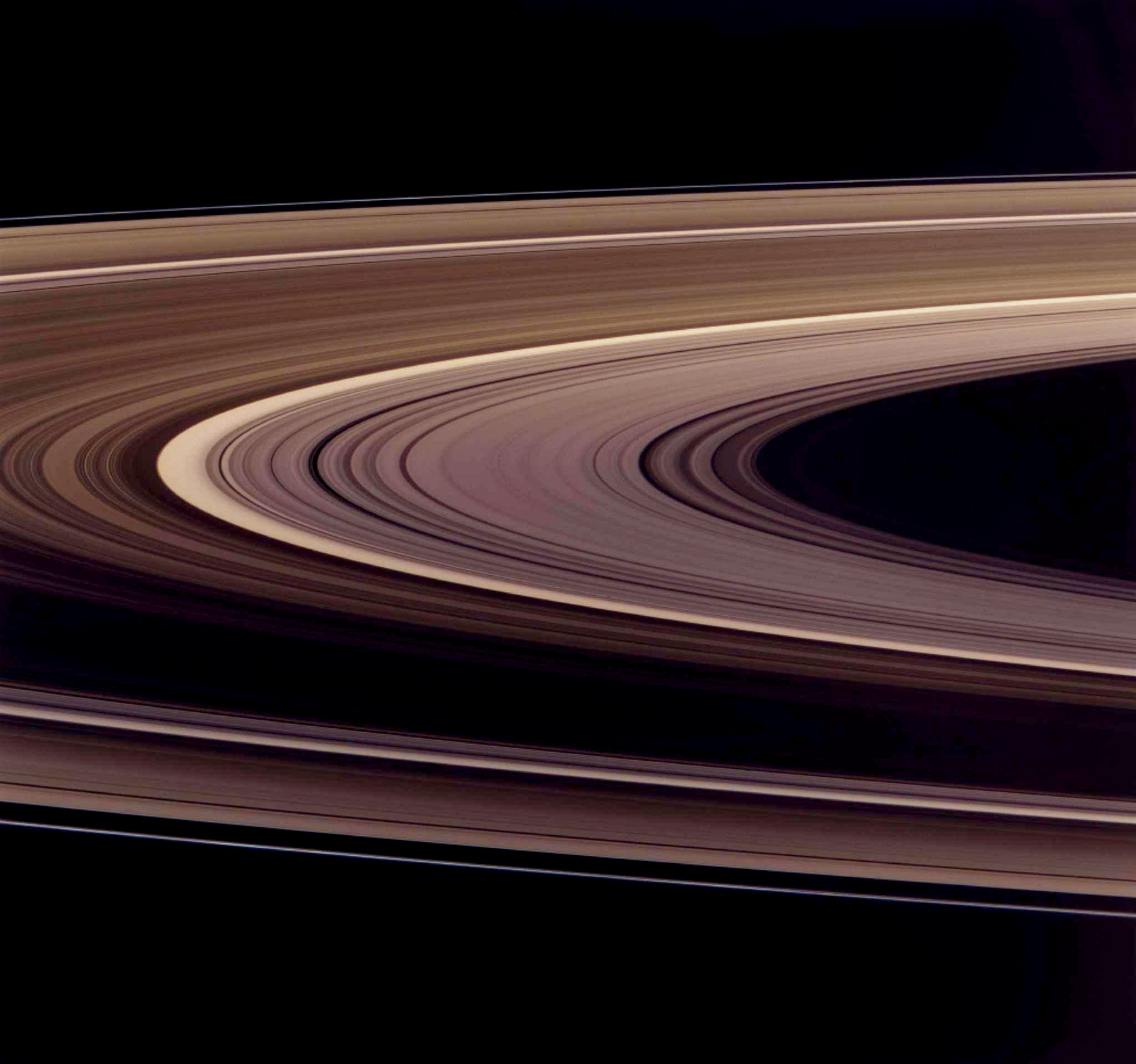
Thomas Ruff (German, b. 1958)
Cassini 08
2008
Chromogenic print
Courtesy der Künstler / the artist and Mai 36 Galerie, Zürich
© Thomas Ruff

Thomas Ruff (German, b. 1958)
Cassini 03
2008
Chromogenic print
Courtesy der Künstler / the artist and Mai 36 Galerie, Zürich
© Thomas Ruff
Yet Ruff has always treated the medium of photography with skepticism: for him, the photographic surface is a thin foil which tricks the viewer with its illusion of extreme realism and at the same time reveals the fundamental impossibility of experiencing the world in our digital age. Ruff’s images seem emphatically to deny photography’s main attribute – that is, the offer of a reliable record of reality. Instead, through his mute images devoid of all emotion, Ruff presents us with a contemporary subjectivity defined by amnesia.
Text from the Castello di Rivoli website [Online] Cited 24/05/2009. No longer available online

Thomas Ruff (German, b. 1958)
Portrait (A. Siekmann)
1987
Chromogenic print
210 x 165cm (82 11/16 x 64 15/16 in.)
Courtesy der Künstler / the artist
© VBK, Wien 2009
During the late 1980s Ruff photographed his fellow students at the Düsseldorf Academy of Art, combining the typological mode of his teacher Bernd Becher with the serial progressions and primary structures of Minimalism. The large scale and technical perfection of Ruff’s portraits refer to both the museum and the street – to billboards and heroic painting – while elevating the anonymous sitter to the stature and visibility of a public figure. Instead of presuming to depict the transcendent, individual essence of the sitter, however, Ruff’s portraits deliberately assume the neutrality of the mug shot, physiognomic study, and identity card, and, by extension, the entire brightly lit world of surveillance in which his subjects were raised. The age and milieu of his sitters are crucial to the pictures’ meaning: these young media-savvy people are not threatened by the camera eye but adjust themselves comfortably yet firmly to its probing vision. The results are both seductive and subtly disquieting, like studying a human specimen whose every pore and hair is available for careful study, yet whose thoughts and feelings are always just out of reach.
Text from the Metropolitan Museum of Art website

Thomas Ruff (German, b. 1958)
Portrait (A. Kachold)
1987
Chromogenic print
Courtesy der Künstler / the artist
© VBK, Wien 2009

Thomas Ruff (German, b. 1958)
Portrait (S. Weirauch)
1988
Chromogenic print
Courtesy der Künstler / the artist
© VBK, Wien 2009
“The reality in front of the camera is reality of the first degree, the representation of the reality in front of the camera is reality of the second degree, and then come any number of possible gradations and distortions.”
“The difference between my predecessors and me is that they believed to have captured reality and I believe to have created a picture. We all lost, bit by bit, the belief in this so-called objective capturing of real reality.”
Thomas Ruff
“To try to see more and better is not a matter of whim or curiosity or self-indulgence. To see or to perish is the very condition laid upon everything that makes up the universe, by reason of the mysterious gift of existence.”
Teilhard de Chardin, “Seeing” 1947
The work of Thomas Ruff, who numbers among today’s most important photographers, focuses our attention on such diverse everyday subjects as people, architecture, the universe, and the Internet. With its extensive solo presentation with a total of about 150 exhibits from 11 groups of works, Kunsthalle Wien offers a first comprehensive survey of the artist’s manifold oeuvre in Austria.
Thomas Ruff studied at the Dusseldorf Academy of Arts, graduating as a student of Bernd and Hilla Becher besides Andreas Gursky, Candida Höfer, Axel Hütte, and Thomas Struth, all of them celebrating an international career these days. The photographer strikes us as a sharp and concentrated observer of his motifs. To him, objectivity is nothing neutral though, but has to be redefined with each new photograph. The series of large-scale portraits which Ruff started working on in 1986 and for which he became known internationally, for example, fascinates us because of the determined detachment with which he captured his models that were mostly acquainted with him. This approach makes for a hyper-precise, chirurgic gaze reproducing everything down to the last detail as equivalent. It also demonstrates the degree of the artist’s interest in the history of photography, how critically he considers its subject, and the skeptical attitude he sometimes adopts toward the medium.
From his stereoscopic views of the urban development myth of Brasilia and his apparently anti-essayistic architectural photographs of buildings by Herzog & de Meuron, which are based on instructions, to his digital processing of images of the planet Saturn available free of charge on the NASA website, the artist explores the concepts of the exemplary, of objectivity, of reality, and of zeitgeist. Based on half of his about twenty thematic groups of works created so far, the exhibition examines the concept pair surface / depth, which seems to be quite simple at first sight, but reveals itself as strongly discursive on closer inspection, and focuses the attention on formal aspects one comes upon again and again in his entire oeuvre.
Right in time for the International Year of Astronomy 2009, Thomas Ruff presents works from his most recent series Cassini – subtly manipulated pictures of Saturn and its moons taken by the Cassini spacecraft. It was the Italian astronomer Galileo Galilei who opened a window to the skies with his telescope 400 years ago. He thus revolutionised man’s image of himself in regard to the universe, but also his understanding of and his way of dealing with the concepts of nearness and distance, surface and depth.
Thomas Ruff. Surfaces, Depths conveys what these concepts, translated into pictures, do to the viewer on a phenomenological level and how they challenge him. The curves of Ruff’s zycles, distorted into the three-dimensional sphere, unfold the sensory experience of roaming virtual depths only reserved to the human eye. Yet, gazing at the represented motifs also elucidates the artist’s contextual objective of providing a critical comment on the various possibilities of the photographic apparatus to depict and manipulate reality.
Press release from the Kunsthalle Wien website [Online] Cited 24/05/2009. No longer available online
Thomas Ruff numbers among today’s most important photographers, his oeuvre encompassing such diverse subject areas as people, architecture, the universe, and the Internet. With its extensive solo exhibition presenting a total of about 150 works, the Kunsthalle Wien offers the first comprehensive survey of the artist’s manifold production in Austria.
Thomas Ruff strikes us as a sharp and concentrated observer rendering his motifs with a hyper-precise, chirurgic gaze. To him, the objective representation of reality is no neutral process, but something questioned with each new photograph. Running through the exhibition like a thread is the apparent pair of opposites of surface and depth and its highly variable manifestations. Next to his series of large-format portraits from the 1980s, for which Ruff received international acclaim, and his architectural photographs of buildings by Herzog & de Meuron, which are based on instructions, the show focuses on his most recent cassini and zycles series. Digitally processing images of the planet Saturn and its moons from the NASA website, the artist explores the notions of the exemplary, of reality, and of zeitgeist. Also depicting the pair of concepts surfaces/depths, the seemingly three-dimensional curves of Ruff’s zycles unfold the sensory experience of roaming virtual depths reserved to the human eye alone.
Text from the Kunsthalle Wien website
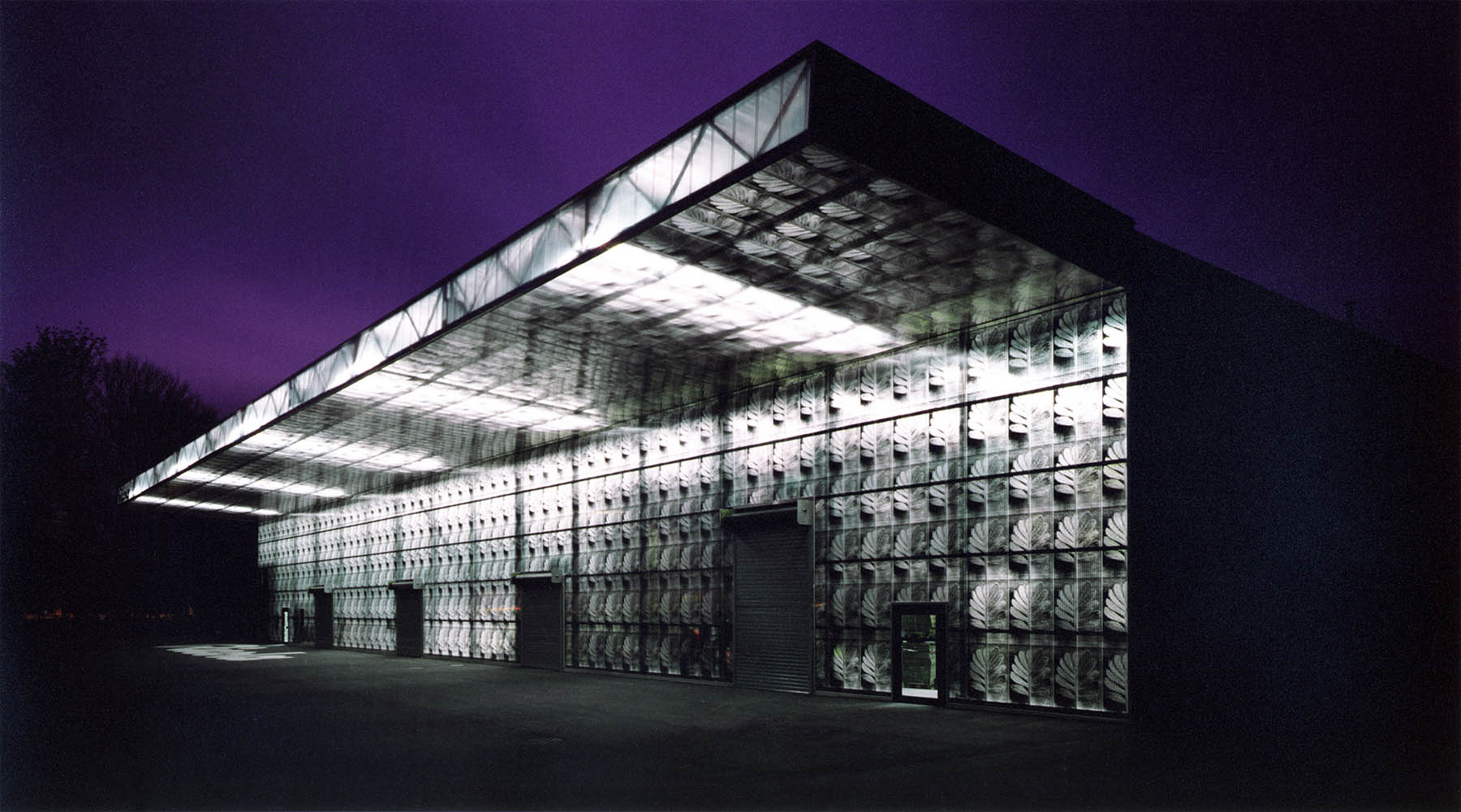
Thomas Ruff (German, b. 1958)
Herzog & de Meuron, Ricola Mulhouse
1994
Chromogenic print
Courtesy der Künstler / the artist
© Thomas Ruff
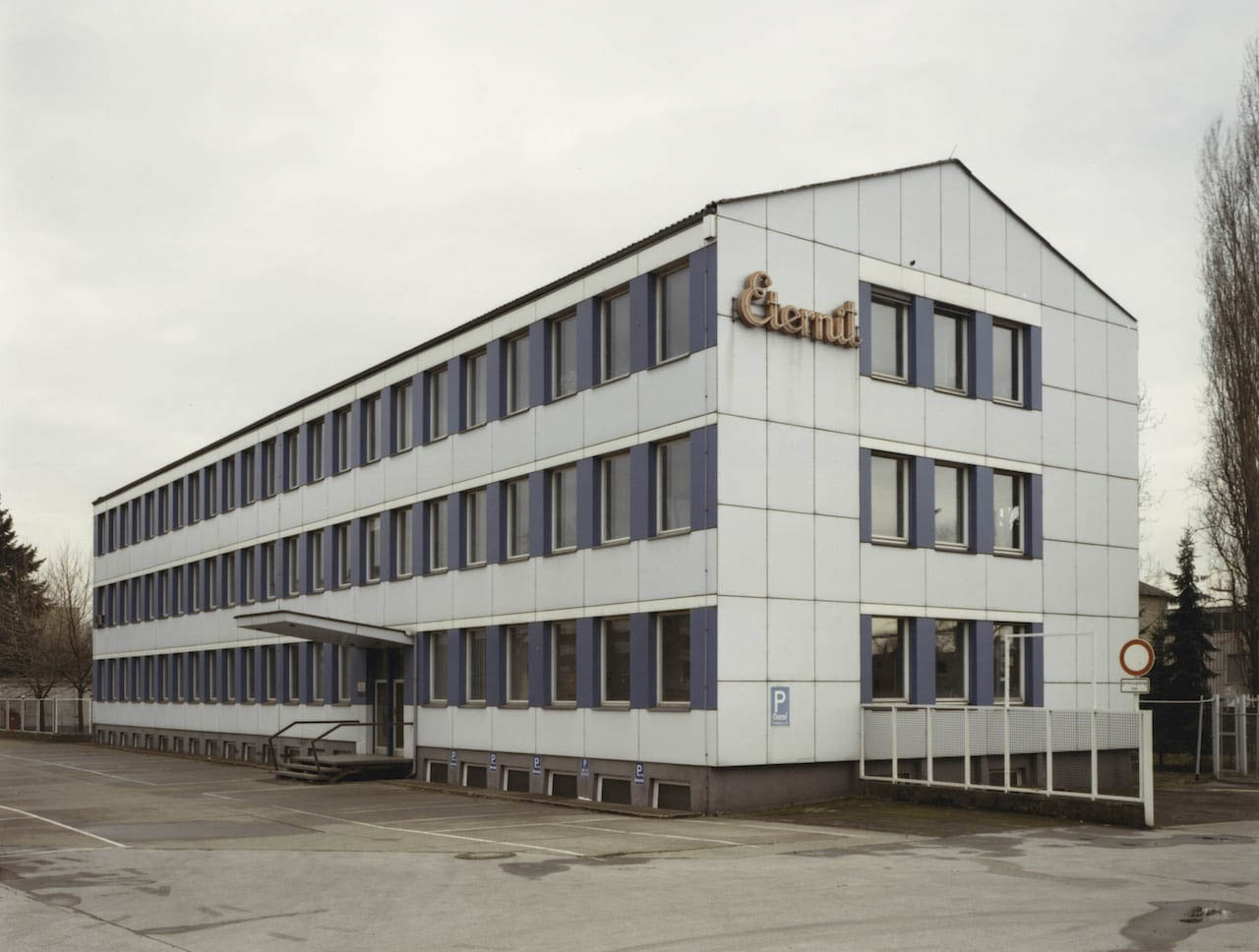
Thomas Ruff (German, b. 1958)
House Nr. 11 III
1990
Chromogenic print
Courtesy der Künstler / the artist
© VBK, Wien 2009
Thomas Ruff first became known through his portraits of houses and factory buildings, as well as the night sky, portrayed in a natural and objective manner. Ruff photographed the buildings either in strict frontality or at right angles to one another, always paying attention to regular sharpness and neutral lighting, and from the same standpoint. With his controversially discussed nudes of erotic, sometimes pornographic scenes from the Internet, which he projected onto unsharp large formats, he expanded the borders of photography in 1999. Since then, his Internet blow-ups with clearly emphasised pixel structures have been regarded as his ‘trademark’. Thomas Ruff started concerning himself with the medium of the image at the very beginning of his artistic career. In addition to self-produced analogue and digital photographs, he worked from the basis of existing pictures. He liked working with unspectacular, historically typical motifs and elaborated the images on the computer, whereby he was particularly interested in the technical side of photography. Often, a new group of works would start with the choice of a specific technique, for example, the night sky pictures from 1992 to 1995 which were made with the help of a camera and a night vision enhancer. Since the night vision enhancer is a visual instrument developed for the Gulf War, this series is a subliminal play on the medial dimension created by this war.
After digitally creating the Substrat series of 2002 abstract, psychedelic colour images from Manga comics, he began his latest zycles series, in which he worked with far more complexly abstract dimensions. These consisted of large-format inkjet prints on canvas that already created a furore at this year’s Art Unlimited in Basel. It is hard to believe that these compositions, which consisted of curved lines and were spread all over the image, originated in mathematics, or more precisely, in antiquated 19th century books on electro-magnetism that portrayed magnetic fields on copperplates. Thomas Ruff was particularly interested in translating these drawings into three-dimensional space. For this he used a 3D computer programme that translated mathematic formulas into complex, three-dimensional linear structures. Ruff recorded different detailed views from these virtually produced linear structures. The weave of lines developed in front of an open space of unspecified depth, sometimes filigree, sometimes accentuated. Their dynamics are reminiscent of the lines of magnetic fields, but also of informal line drawings. Either way, they invite the viewers to play with their own perceptions.
Text by Dominique von Burg; translation: Maureen Oberli-Turner from the Mai 36 Galerie website [Online] Cited 24/05/2009. No longer available online

Thomas Ruff (German, b. 1958)
Jpeg icbm05
2007
Chromogenic print
Kramer has argued that appropriating images helps Ruff draw attention to the materiality of pictures, writing in his introduction to his book that doing so accentuates “the conceptual knowledge gain, since it is not the ‘artistic’ picture, but the structures and characteristics of the medium itself that come into focus.” Ruff, for his part, says appropriating images allows him to investigate contemporary photographic practice, in an era where images are more numerous, and more easily shared, than ever before. He started his nudes in 1999, for example, just as the internet was coming into more widespread usage, bringing online pornography into the mainstream.
“What I always want to do is comment on the state of where photography is right now,” he says. “So if the structure of photography changes from grain to pixel, yes I will make a research on the structure of the image. But if you have the pixel as the smallest element the construction of a picture, you also have [the fact that] if you compress the image you can send it easily out into the world via email. So we have the distribution too. We not only have the structure of the image, there are several issues to pull out. That’s one of the things I want to make obvious or visible.”
Diane Smyth. “From the BJP Archive: Thomas Ruff,” originally published April 2012 on the British Journal of Photography website 27th September, 2017 [Online] Cited 14/07/2025
Thomas Ruff (German, b. 1958)
Jpeg rl104
2007
Chromogenic print
Kunsthalle Wien
Museumsplatz 1
A-1070 Vienna
Opening hours:
Tuesday – Sunday 11am – 7pm
Thursdays 11am – 9pm













 Art Blart _ art and cultural memory archive
You must be logged in to post a comment.