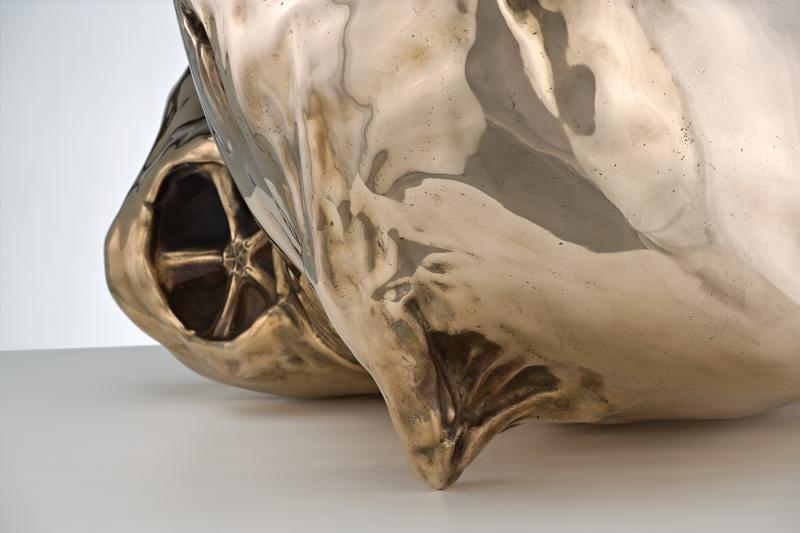
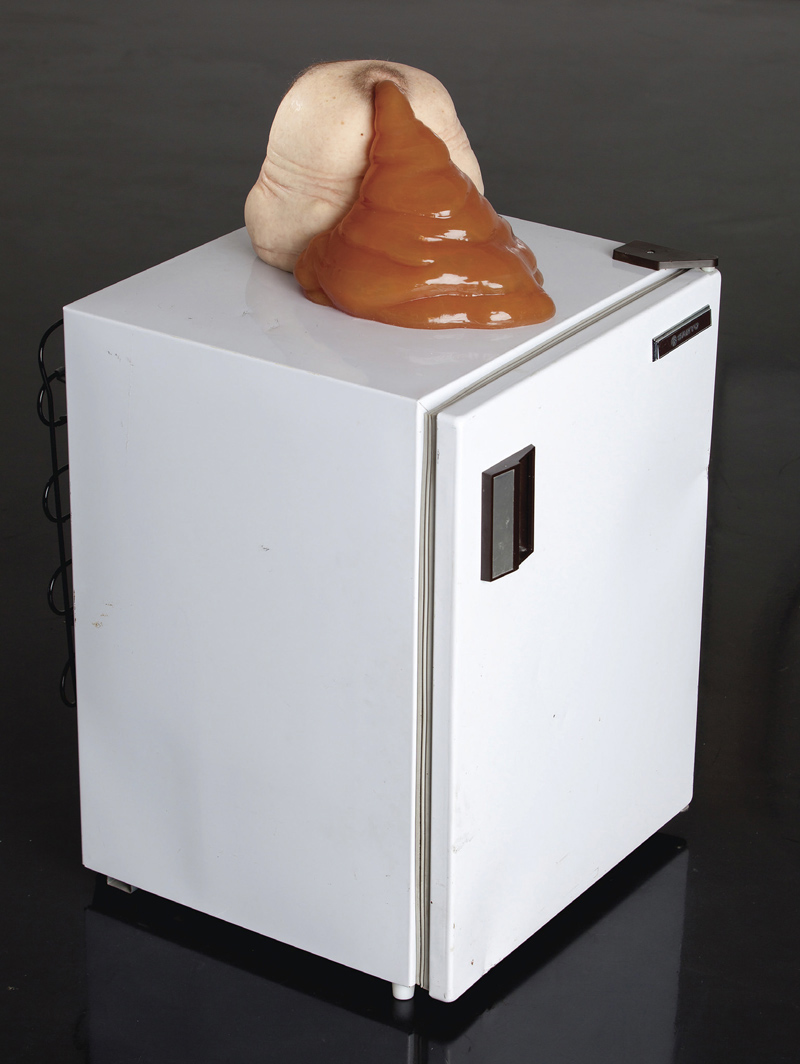
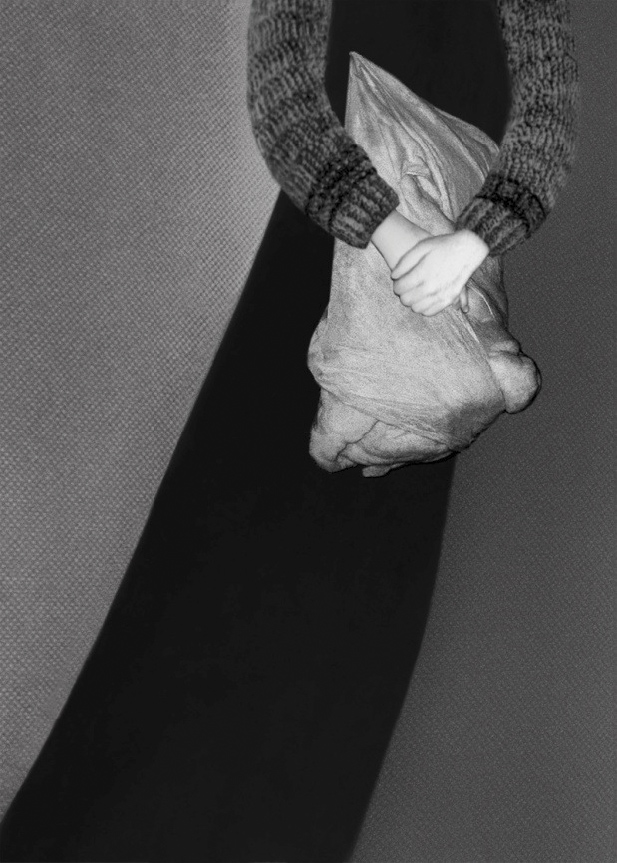
Exhibition: ‘Patrick Pound: The Great Exhibition’ as part of the NGV Festival of Photography at NGV Australia, Melbourne Part 1

Exhibition dates: 31st March – 30th July, 2017

Individual art works from the NGV collection (in artist alphabetical order) appearing in Patrick Pound: The Great Exhibition at NGV Australia


” … from an air guitar to Being and nothingness … “
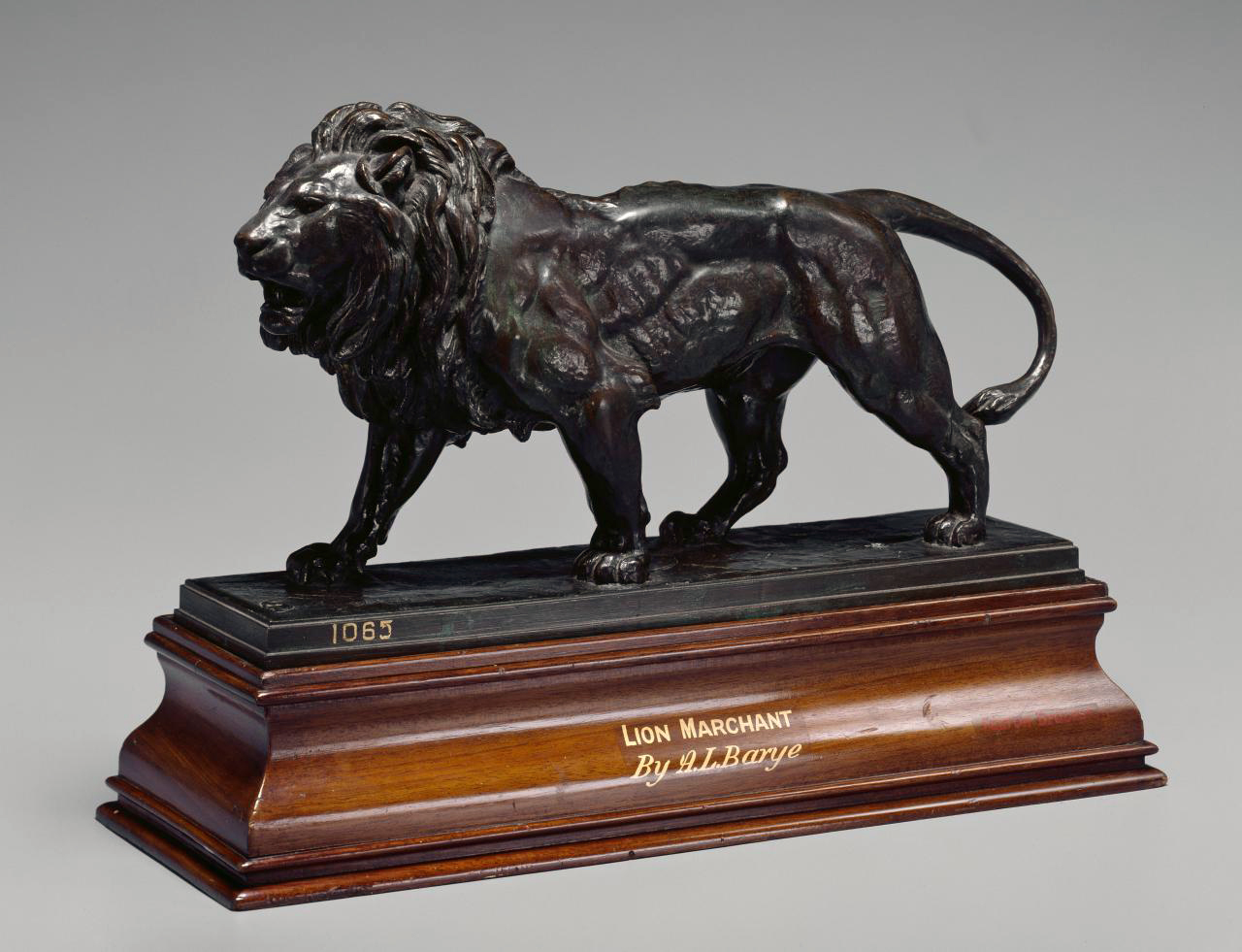
 

Antoine-Louis Barye (France, 1796-1875) 'Walking lion' c. 1840 from the exhibition 'Patrick Pound: The Great Exhibition' as part of the NGV Festival of Photography at NGV Australia, Melbourne, March - July, 2017


Antoine-Louis Barye (French, 1796-1875)
Walking lion
Lion qui marche
c. 1840, cast 1900
Bronze
National Gallery of Victoria
Felton Bequest, 1927


Part 1 of this bumper posting. See Part 2 of the posting with my review of the exhibition.

My hand is progressing slowly. A return to part-time work in the next couple of weeks, for which I will be grateful. It has been tough road dealing with this injury.

Dr Marcus Bunyan


Many thankx to the National Gallery of Victoria for allowing me to publish the photographs in the posting. Please click on the photographs for a larger version of the image.
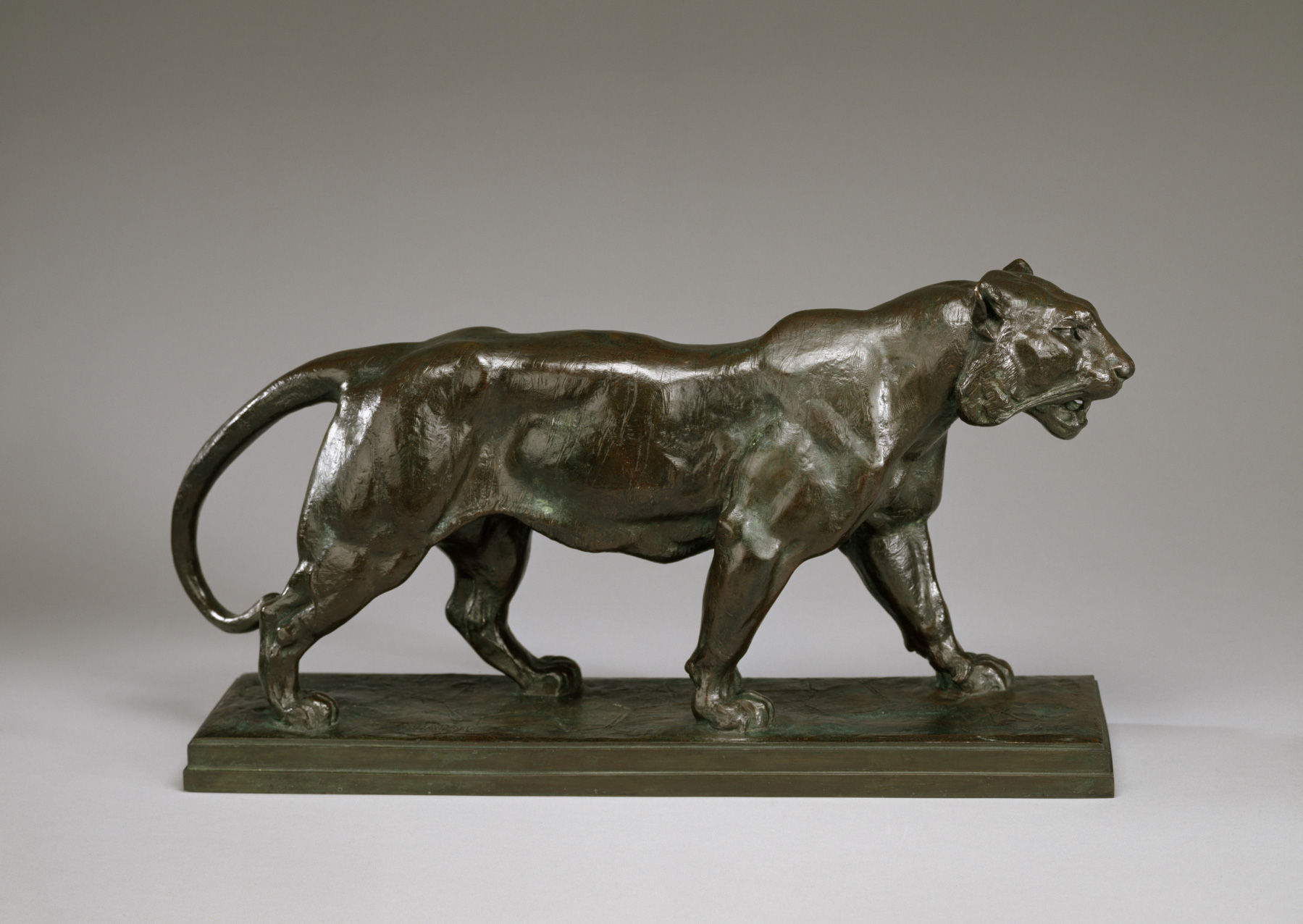


Antoine-Louis Barye (French, 1796-1875) 'Walking tiger' c. 1841 from the exhibition 'Patrick Pound: The Great Exhibition' as part of the NGV Festival of Photography at NGV Australia, Melbourne, March - July, 2017


Antoine-Louis Barye (French, 1796-1875)
Walking tiger
Tigre qui marche
c. 1841, cast 1900
Bronze
National Gallery of Victoria
Felton Bequest, 1927


John Armstrong (English, 1893-1973) 'Invocation' 1938 from the exhibition 'Patrick Pound: The Great Exhibition' as part of the NGV Festival of Photography at NGV Australia, Melbourne, March - July, 2017


John Armstrong (English, 1893-1973)
Invocation
1938
Tempera on plywood
National Gallery of Victoria
Purchased with funds donated by Ian Hicks AM and Dorothy Hicks, 2006


Invocation is one of a series of paintings, which John Armstrong begun in the 1930’s as a direct statement against the rise of Fascism in Europe. John Armstrong observed Fascism in Italy at first hand and became an active left wing campaigner against the proliferation of nuclear weapons. He was commissioned as an official war artist, designing a cover for a leaflet in the 1945 election campaign and contributed occasional articles and poetry to left wing journals. In his painting Victory, he imagined the result of a nuclear holocaust, which attracted the attention at the Royal Academy Summer Exhibition in 1958.

Text from the Leicester Galleries website [Online] Cited 17/07/2017. No longer available online


Eugène Atget (French, 1857-1927) 'Eclipse' 1911, printed 1956- early 1970s


Eugène Atget (French, 1857-1927)
Eclipse
1911, printed 1956- early 1970s
Gelatin silver photograph
National Gallery of Victoria
Purchased, 1978


Surrogates and the Surreal

Atget’s photograph Pendant l’éclipse (During the eclipse) was featured on the cover of the seventh issue of the Parisian Surrealists’ publication La Révolution surréaliste, with the caption Les Dernières Conversions (The last converts), in June 1926. The picture was uncredited, as were the two additional photographs reproduced inside. Although Atget firmly resisted the association, his work – in particular his photographs of shop windows, mannequins, and the street fairs around Paris – had captured the attention of artists with decidedly avant-garde inclinations, such as Man Ray and Tristan Tzara. Man Ray lived on the same street as Atget, and the young American photographer Berenice Abbott (working as Man Ray’s studio assistant) learned of the French photographer and made his acquaintance in the mid-1920s – a relationship that ultimately brought the contents of Atget’s studio at the time of his death (in 1927) to The Museum of Modern Art almost forty years later.

Text from Art Blart posting Eugène Atget: “Documents pour artistes” at the Museum of Modern Art (MoMA), New York


Pierre Bonnard (France, 1867-1947) 'Siesta' 1900


Pierre Bonnard (France, 1867-1947)
Siesta
La Sieste
1900
Oil on canvas
National Gallery of Victoria
Felton Bequest, 1949
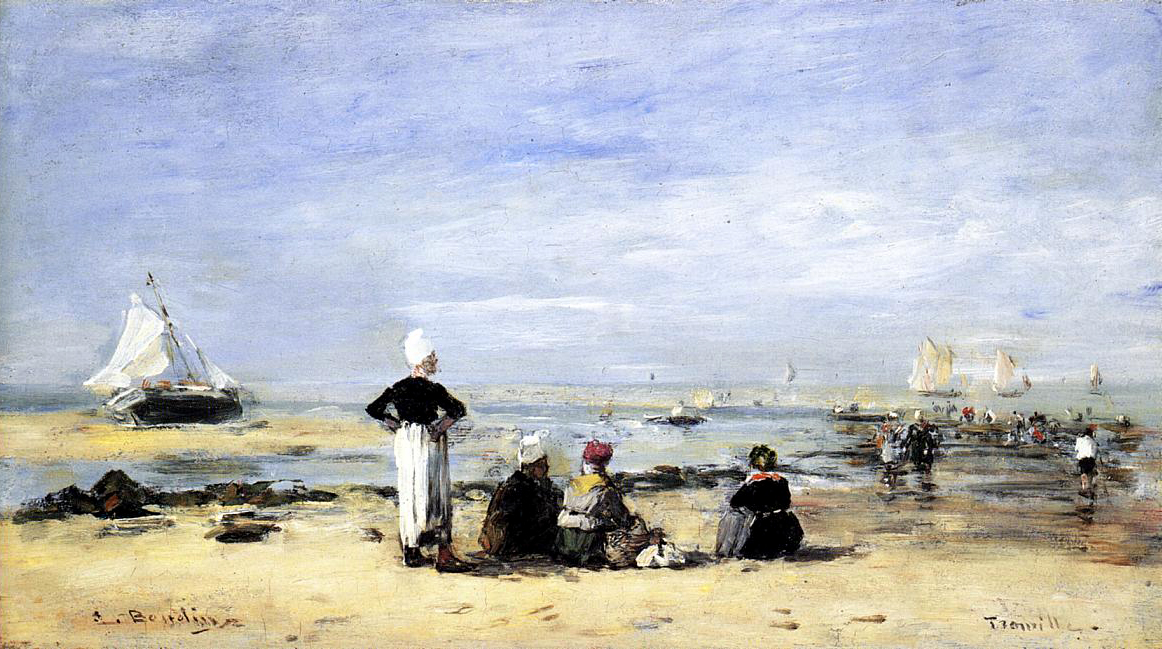
 

Eugène Boudin (French, 1824-1998) 'Low tide at Trouville' 1894


Eugène Boudin (French, 1824-1998)
Low tide at Trouville
Trouville, Mareé basse
1894
Oil on canvas
National Gallery of Victoria
Felton Bequest, 1939


John Brack (Australian, 1920-1999) 'Self-portrait' 1955


John Brack (Australian, 1920-1999)
Self-portrait
1955
Melbourne, Victoria
Oil on canvas
National Gallery of Victoria
Purchased with the assistance of the National Gallery Women’s Association, 2000


Striking in its candour, with its subject stripped of vanity and dressed in early-morning attire, Self portrait is a piercing study of a man engaged in the intimacy of shaving. Although images of women at their toilette have been frequently depicted by both male and female Australian artists, it is unusual for men to be shown or to show themselves in this context. Modest in scale, Brack’s image is conceived in a complex yet subtle colour scheme, applied with clarity and precision.

Geoffrey Smith. “John Brack’s Self Portrait,” on the National Gallery of Victoria website 4th June 2014 [Online] Cited 21/12/2021
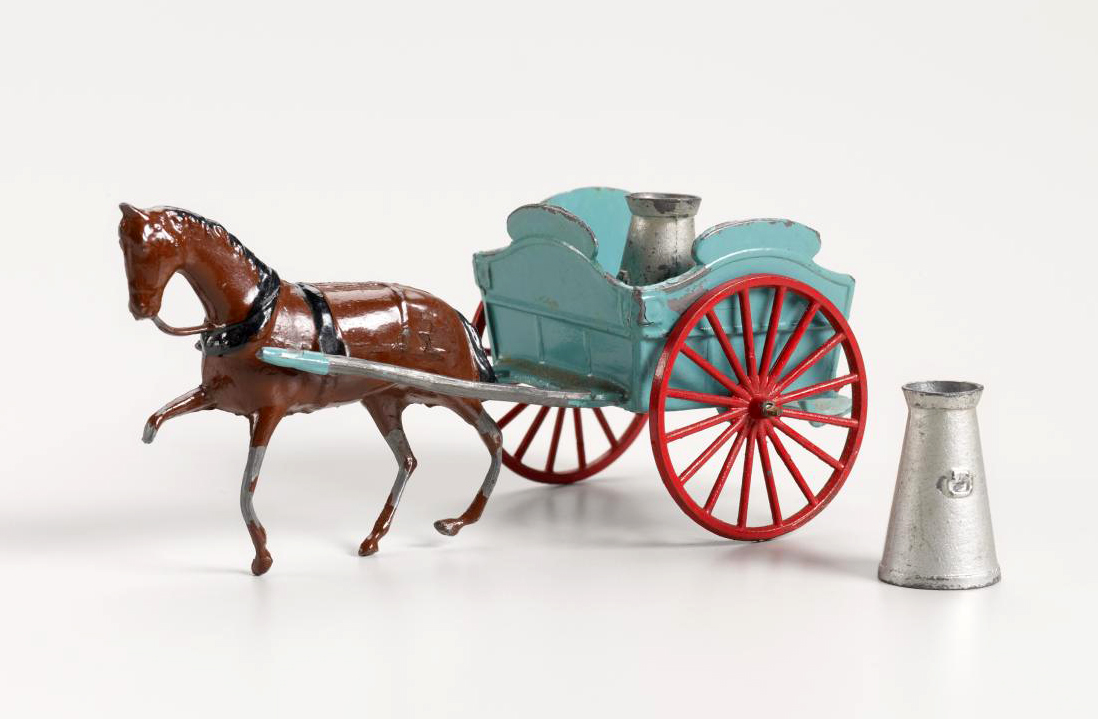
 

Britains Ltd, London manufacturer (English, 1860-1997) 'Milk float and horse' c. 1950


Britains Ltd, London manufacturer (English, 1860-1997)
Milk float and horse
no. 45F from the Model home farm series 1921-1961
c. 1950
Painted lead alloy
National Gallery of Victoria
Presented by Miss Lucy Kerley and her nephew John Kerley, 1982


Jacques Callot (French, 1592-1635) 'The firing squad' 1633


Jacques Callot (French, 1592-1635)
The firing squad
L’Arquebusade
Plate 12 from Les Misères et les malheurs de la guerre
The miseries and misfortunes of war series
1633
Etching, 2nd of 3 states
National Gallery of Victoria
Purchased, 1950


Paul Caponigro (American, 1932-2024) 'Nahant, Massachusetts' 1965


Paul Caponigro (American, 1932-2024)
Nahant, Massachusetts
1965
Gelatin silver photograph
National Gallery of Victoria
Purchased with the assistance of the National Gallery Society of Victoria, 1977
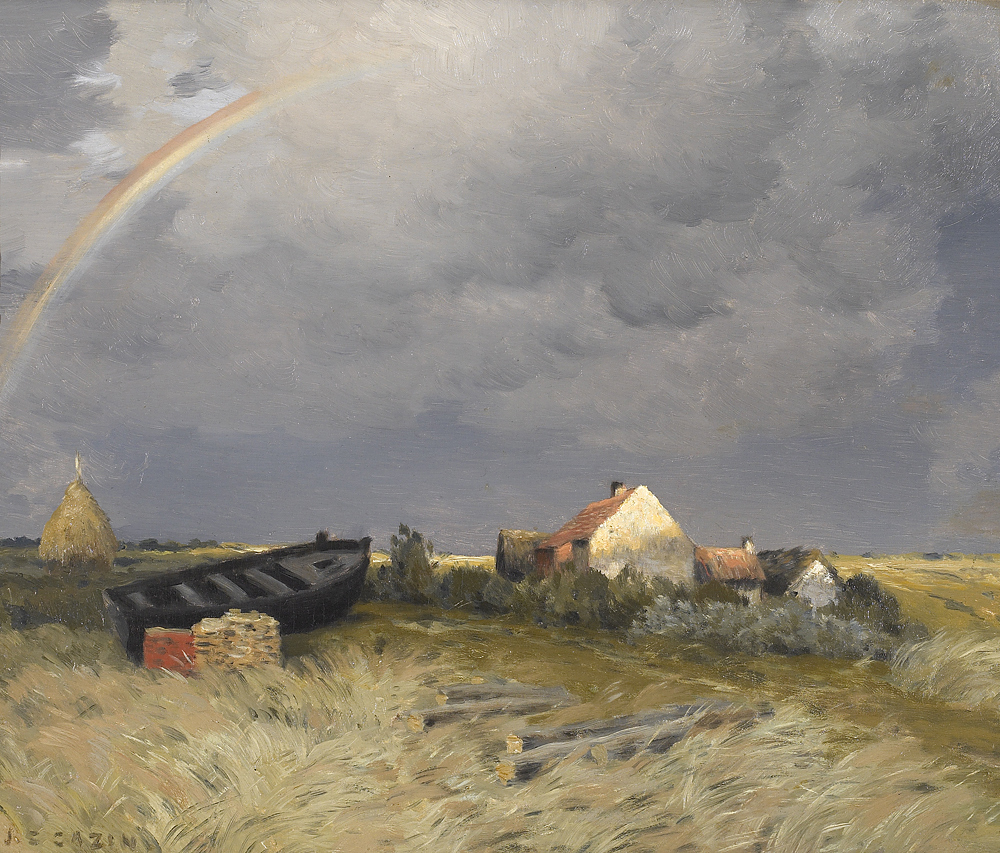
 

Jean Charles Cazin (French, 1841-1901, lived in England 1871-1875) 'The rainbow' late 1880s


Jean Charles Cazin (French, 1841-1901, lived in England 1871-1875)
The rainbow
L’Arc-en-ciel
late 1880s
Oil on canvas
National Gallery of Victoria
Felton Bequest, 1913
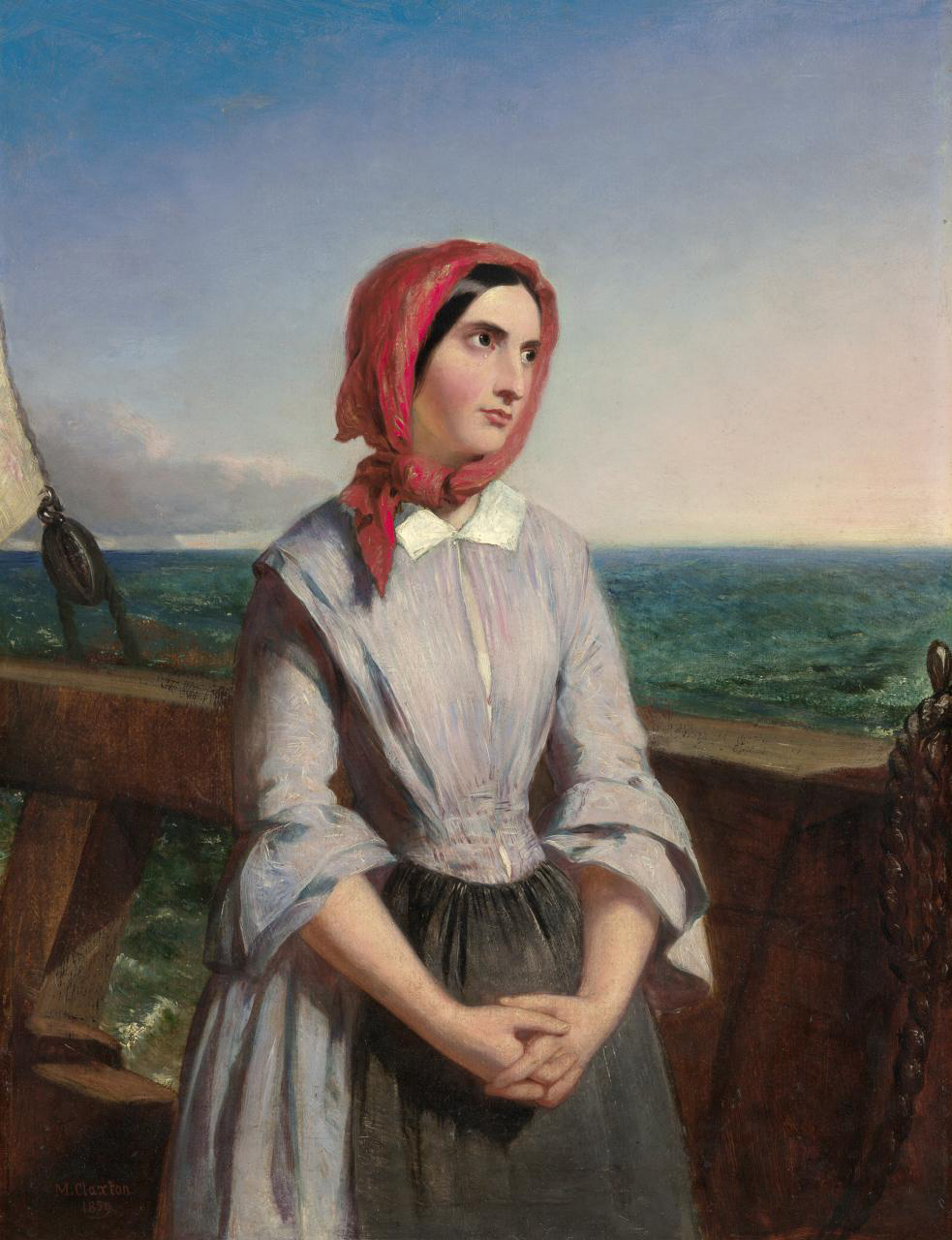
 

Marshall Claxton (English, 1813-1881, lived in Australia 1850-1854) 'An emigrant's thoughts of home' 1859


Marshall Claxton (English, 1813-1881, lived in Australia 1850-1854)
An emigrant’s thoughts of home
1859
Oil on cardboard
National Gallery of Victoria
Presented by the National Gallery Women’s Association, 1974


Marshall Claxton’s painting An emigrant’s thoughts of home (1859) belongs to a clutch of works, both fine and popular, both pictorial and literary, that for an Australasian audience are perhaps the most resonant of the many products of Victorian culture. Emigration, a social and political phenomenon for mid-nineteenth-century Britain, and the essential lubricant of British imperialism, inspired a profusion of paintings, prints, novels, plays, poems, essays and letters that speak eloquently about the realities and myths of Victorian Britain and its role in the world, engaging concepts of the family, womanhood, the artist’s role and function and, indeed, the meaning of life.

Pamela Gerrish Nunn. “Look homeward Angel: Marshall Claxton’s emigrant,” on the National Gallery of Victoria website 18th June 2014 [Online] Cited 21/12/2021


Olive Cotton (Australian, 1911-2003) 'Teacup ballet' 1935, printed 1992


Olive Cotton (Australian, 1911-2003)
Teacup ballet
1935, printed 1992
Gelatin silver photograph
National Gallery of Victoria
Purchased from Admission Funds, 1992


Among Cotton’s most famous photographs, Teacup ballet has very humble origins. It was taken after hours in the Dupain studio and used a set of cheap cups and saucers Cotton had earlier bought from a Woolworths store for use around the studio. As she later recounted: ‘Their angular handles suggested to me the position of “arms akimbo” and that led to the idea of a dance pattern’. The picture uses a range of formal devices that became common to Cotton’s work, especially the strong backlighting used to create dramatic tonal contrasts and shadows. The picture achieved instant success, and was selected for exhibition in the London Salon of Photography for 1935.

Text © National Gallery of Australia, Canberra
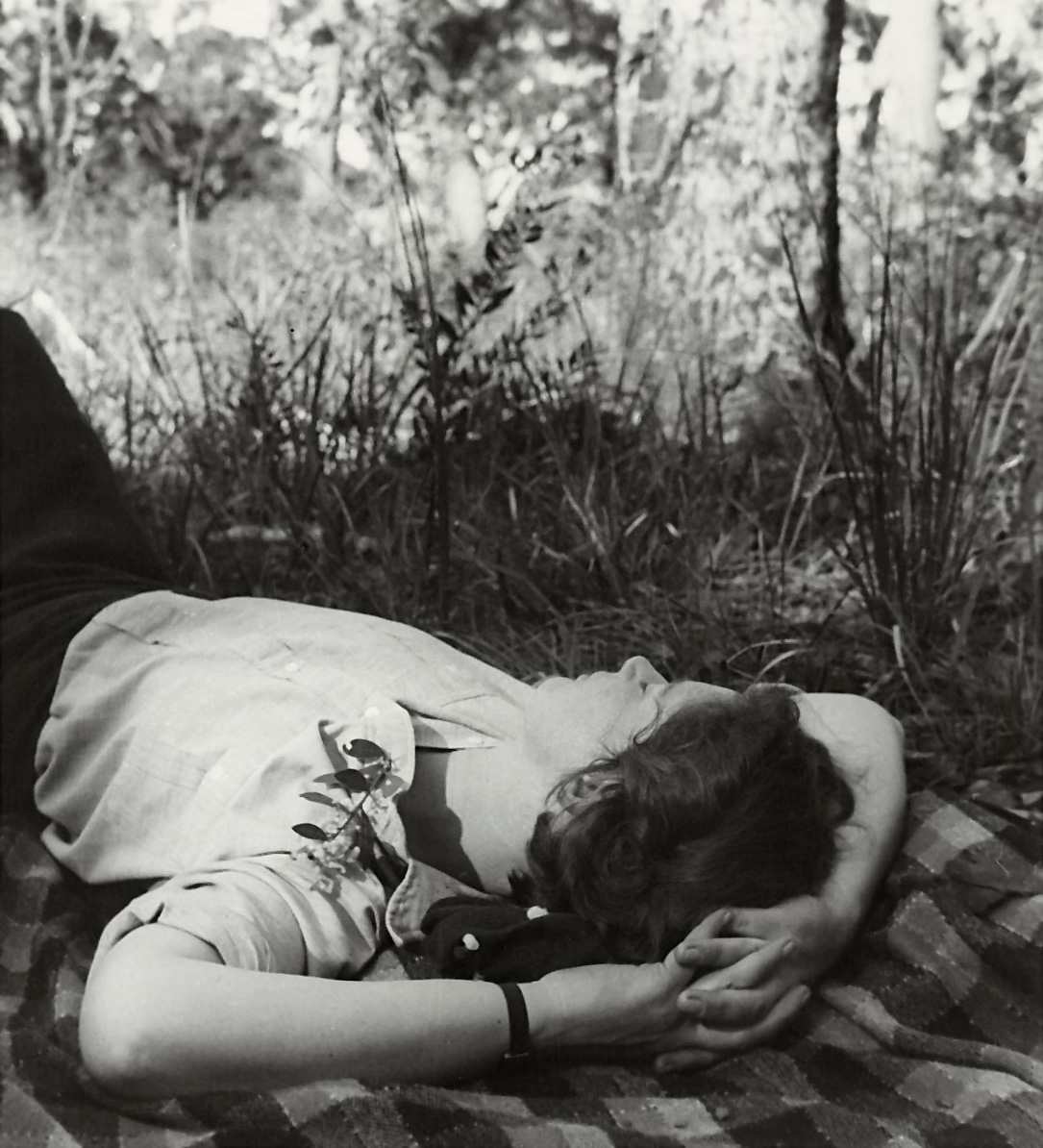
 

Olive Cotton (Australian, 1911-2003) 'The sleeper' 1939, printed 1992


Olive Cotton (Australian, 1911-2003)
The sleeper
1939, printed 1992
Gelatin silver photograph, ed. 4/25
National Gallery of Victoria
Purchased from Admission Funds, 1992


The sleeper 1939, Olive Cotton’s graceful study of her friend Olga Sharp resting while on a bush picnic, made around the same time as Max Dupain’s Sunbaker, presents a different take upon the enjoyment of life in Australia. The woman is relaxed, nestled within the environment. The mood is one of secluded reverie.

Text © National Gallery of Australia, Canberra
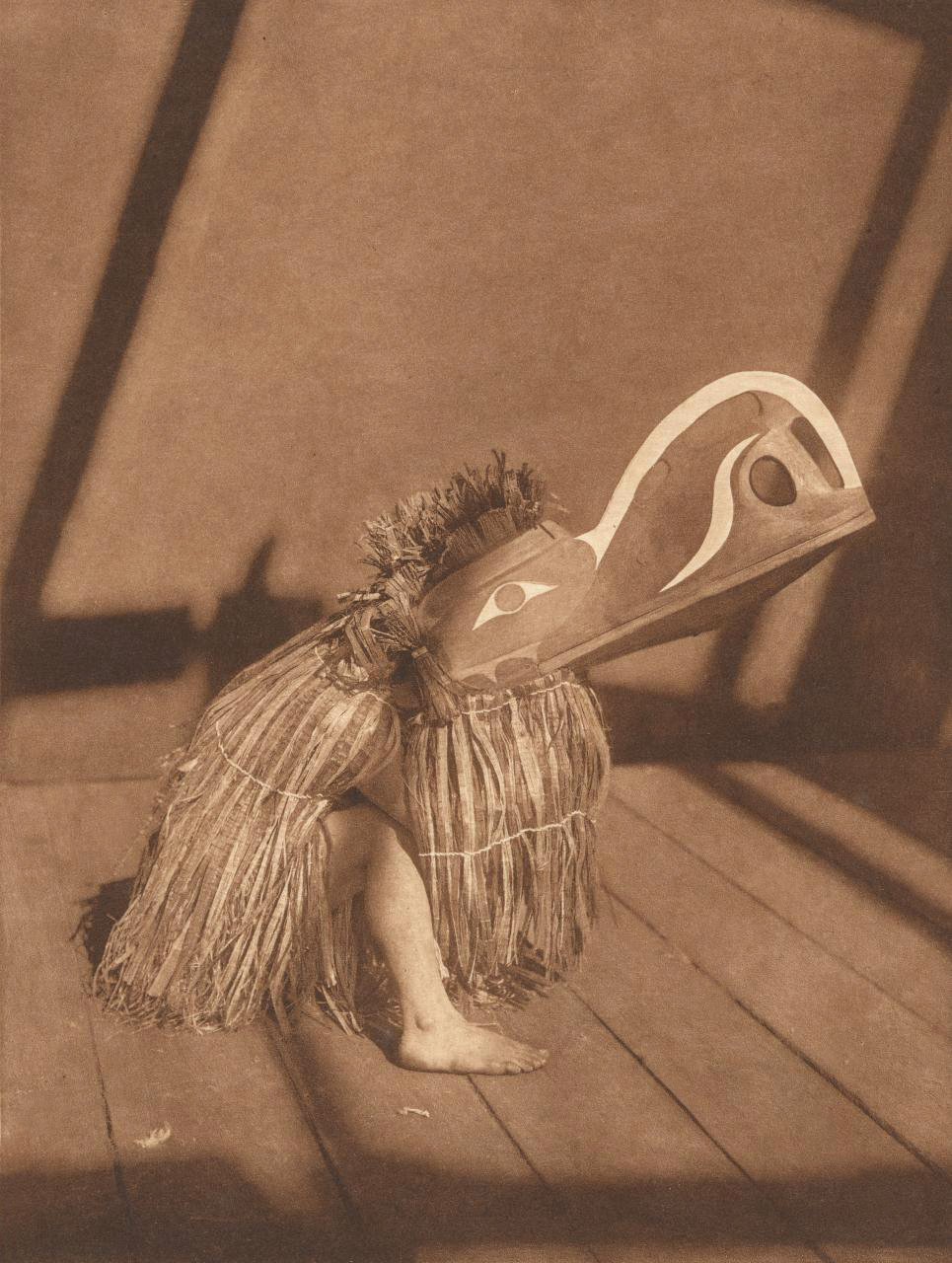
 

Edward Curtis (American, 1868-1952) 'Kalóqutsuis - Qágyuhl' 1914, printed 1915


Edward Curtis (American, 1868-1952)
Kalóqutsuis – Qágyuhl
1914, printed 1915
Photogravure
National Gallery of Victoria
Gift of Ms Christine Godden, 1991


Not only was he one of the greatest ethnographic photographers of all time (as well as being an ethnographer recording more than 10,000 songs on a primitive wax cylinder, and writing down vocabularies and pronunciation guides for 75 languages) … he was also an aesthetic photographer. Looking at his photographs you can feel that he adhered to the principles of the nature and appreciation of beauty situated within the environment of the Native American cultures and peoples. He had a connection to the people and to the places he was photographing…

Curtis created a body of work unparrallleled in the annals of photography – an ethnographic study of an extant civilisation before it vanished (or so they thought at the time). Such a project stretched over thirty years, producing 45-50 thousand negatives “many of them on glass and some as large as fourteen by seventeen inches” of which 2,200 original photographs appeared in his magnum opus, The North American Indian…

While all great photographers have both technical skill and creative ability it is the dedication of this artist to his task over so many years that sets him apart. That dedication is critically coupled with his innate ability to capture the “spirit” of the Native American cultures and peoples, their humanity.

Dr Marcus Bunyan from a posting on the Palm Springs Art Museum exhibition Edward S. Curtis: One Hundred Masterworks 2016


Frances Derham (Australian, 1894-1987) 'Building the bridge' 1929


Frances Derham (Australian, 1894-1987)
Building the bridge
1929
Colour linocut on Japanese paper
National Gallery of Victoria
Gift of Mr Richard Hodgson Derham, 1988
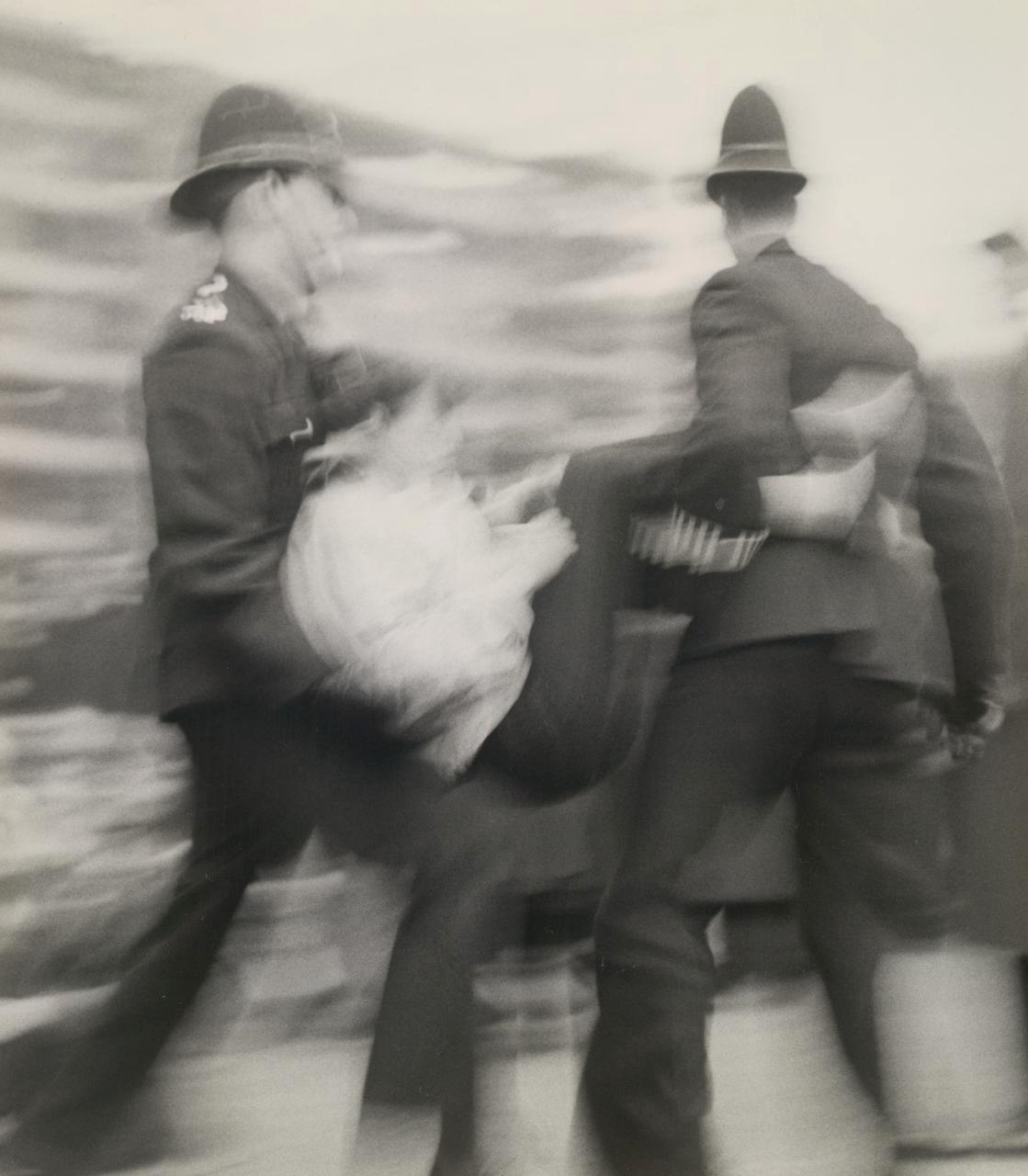
 

Kerry Dundas (Australian, b. 1931, lived in Europe 1958-1967) 'A girl is carried away under arrest' 1961-1963


Kerry Dundas (Australian, b. 1931, lived in Europe 1958-1967)
A girl is carried away under arrest
From the Youth against the Bomb series
1961-1963
Gelatin silver photograph
National Gallery of Victoria
Purchased 1971


Max Dupain (Australian, 1911-1992) 'Bondi' 1939


Max Dupain (Australian, 1911-1992)
Bondi
1939
Gelatin silver photograph
30.3 × 29.5cm
National Gallery of Victoria
Purchased with the assistance of the Visual Arts Board, 1976


Walker Evans (American, 1903-1975) 'Hitchhikers, near Vicksburg, Mississippi' 1936, printed c. 1975


Walker Evans (American, 1903-1975)
Hitchhikers, near Vicksburg, Mississippi
1936, printed c. 1975
Gelatin silver photograph
National Gallery of Victoria
Purchased 1975


Walker Evans (American, 1903-1975) 'Auto dump, near Easton, Pennsylvania' 1935, printed c. 1975


Walker Evans (American, 1903-1975)
Auto dump, near Easton, Pennsylvania
1935, printed c. 1975
Gelatin silver photograph
National Gallery of Victoria
Purchased 1975


William Frater (born Scotland 1890, arrived Australia 1913, died 1974) 'The blue nude' c. 1934


William Frater (born Scotland 1890, arrived Australia 1913, died 1974)
The blue nude
c. 1934
Oil on canvas on cardboard
National Gallery of Victoria
Gift of Mrs Lina Bryans 1969


His contribution to art in Australia was, however, as a painter who introduced Post-Impressionist principles and challenged the notion that art was an imitation of nature.

Frater’s oeuvre developed between 1915 and 1920 towards a simplification of design, an interplay of massed lights and shadows, and sonorous low-keyed colour that reflected his interest in the classical seventeenth century painters in interaction with the analytical tonal theory of Max Meldrum. Notable examples of his predominantly figure and portrait paintings are ‘The artist’s wife reading’ (1915) and ‘Portrait of artist’s wife’ (1919). An experimental Colourist phase followed in the next decade. His first solo exhibition was held in May 1923 at the Athenaeum, Melbourne, and he exhibited with the Twenty Melbourne Painters from the late 1920s, and the Contemporary Group of Melbourne in the 1930s.

His approach in the 1930s was markedly indebted to Cézanne, especially in the portraits which predominated until his retirement… Frater gave aggressive leadership to the small group of modernists in the 1920s. His example, teaching, lecturing and crusty style of polemic did much to disrupt the academic style as the arbiter of pictorial values and to pioneer a change of taste in the community.

L. J. Course. “Frater, William (1890-1974),” on the Australian Dictionary of Biography website, published first in hardcopy 1981 [Online] Cited 23 December 2021


Emmanuel Frémiet (French, 1824-1910) 'Gorilla carrying off a woman' 1887


Emmanuel Frémiet (French, 1824-1910)
Gorilla carrying off a woman
Gorille enlevant une femme
1887
Bronze
National Gallery of Victoria
Gift of the artist 1907


Lee Friedlander (American, b. 1934) 'Hillcrest, New York' 1970, printed c. 1977


Lee Friedlander (American, b. 1934)
Hillcrest, New York
1970, printed c. 1977
Gelatin silver photograph
National Gallery of Victoria
Purchased 1977


Lee Friedlander (American, b. 1934) 'Mount Rushmore' 1969, printed c. 1977


Lee Friedlander (American, b. 1934)
Mount Rushmore
1969, printed c. 1977
Gelatin silver photograph
National Gallery of Victoria
Purchased 1977


The ‘tourist gaze’

As Grundberg notes, Friedlander’s terse depiction shows both the sight and the tourists themselves, being brought into existence through the effects of looking, reflecting, framing and imaging. These, he adds, are all linked to the general project of culturally appropriating the natural world. ‘Natural site has become acculturated sight’ (Grundberg 1990: 15).

As the image makes clear, the ‘sight’ or the ‘site’ is a ‘seeing’ without a subject, for it pre-exists the arrival and activity of any individual tourist-photographer, who, once located there, is framed as much as framing. The sight is not so much an object to be viewers an already structured condition of seeing, a situation which places the sightseer even as he or she freely choose to look or shoot.

The effects of photography’s presence in the tourist system merely completed a process under way before photography’s birth. As tourists, even at the moment of photographing, even if touring cameraless, we are not so much looking as looking at images, or looking for images. Tourism provides us less with experience than with events to be seen, Or rather, events to look at. The privileging of the visual grants us separation from our own experience… We look on or look in through the distancing arrangements of the camera or through eyes educated to see with the same ontological remoteness. The world of the tourist is ‘over there’, in the past-present, in the exotic-ordinary. It is framed off, the object of imaging or description, in some spectacular distance, or set back as performance (Greenwood in Smith 1989).

Peter Osborne. Traveling Light: Photography, Travel and Visual Culture. Manchester University Press, 2000, pp. 81-82.
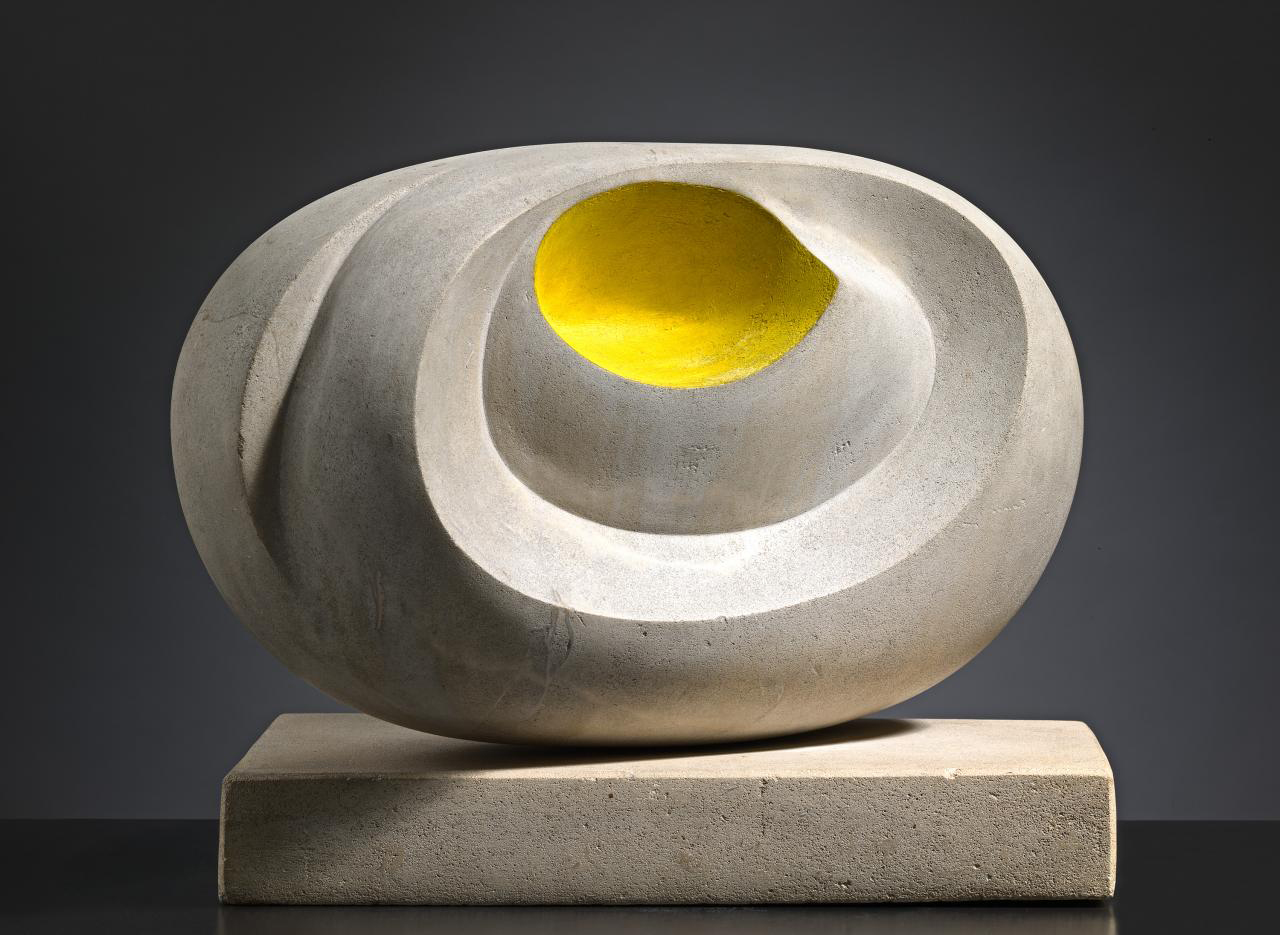
 

Barbara Hepworth (English, 1903-1975) 'Eidos' 1947


Barbara Hepworth (English, 1903-1975)
Eidos
1947
Stone, synthetic polymer paint
National Gallery of Victoria
Purchased with the assistance of the Samuel E. Wills Bequest to commemorate the retirement of Dr E. Westbrook, Director of Arts for Victoria, 1981


Eidos a Greek term meaning “form” “essence”, “type” or “species”. The early Greek concept of form precedes attested philosophical usage and is represented by a number of words mainly having to do with vision, sight, and appearance. The words, εἶδος (eidos) and ἰδέα (idea) come from the Indo-European root *weid-, “see”. Eidos (though not idea) is already attested in texts of the Homeric era, the earliest Greek literature. This transliteration and the translation tradition of German and Latin lead to the expression “theory of Ideas.” The word is however not the English “idea,” which is a mental concept only.

The meaning of the term εἶδος (eidos), “visible form”, and related terms μορφή (morphē), “shape”, and φαινόμενα (phainomena), “appearances”, from φαίνω (phainō), “shine”, Indo-European *bhā-, remained stable over the centuries until the beginning of philosophy, when they became equivocal, acquiring additional specialised philosophic meanings.

“Theory of forms” on the Wikipedia website
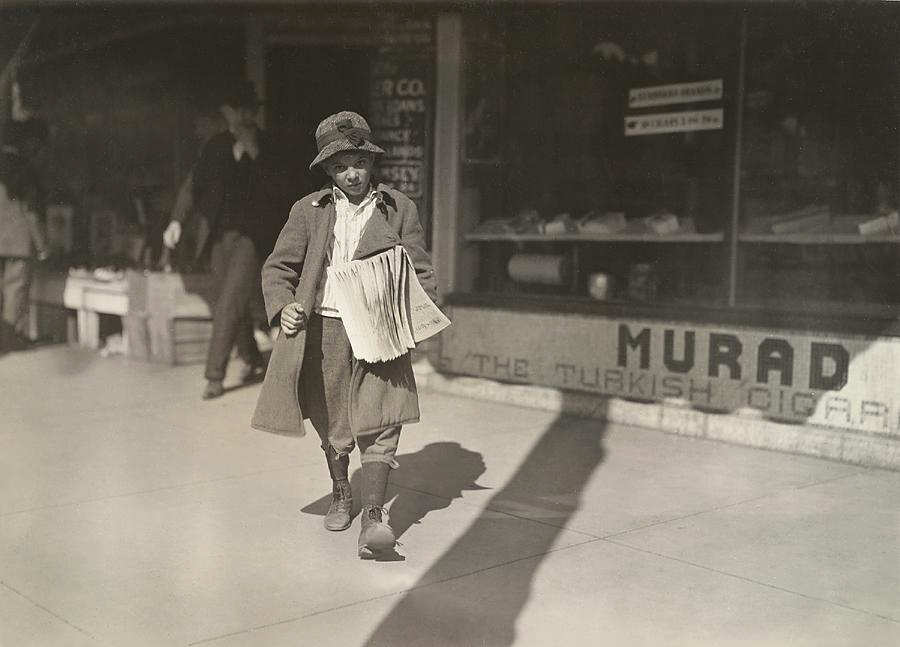
 

Lewis Hine (American, 1874-1940) 'Sam Pine, 8 year old truant newsboy who lives at 717 West California Street' 1917


Lewis Hine (American, 1874-1940)
Sam Pine, 8 year old truant newsboy who lives at 717 West California Street
1917
Gelatin silver photograph
National Gallery of Victoria
Purchased 1980
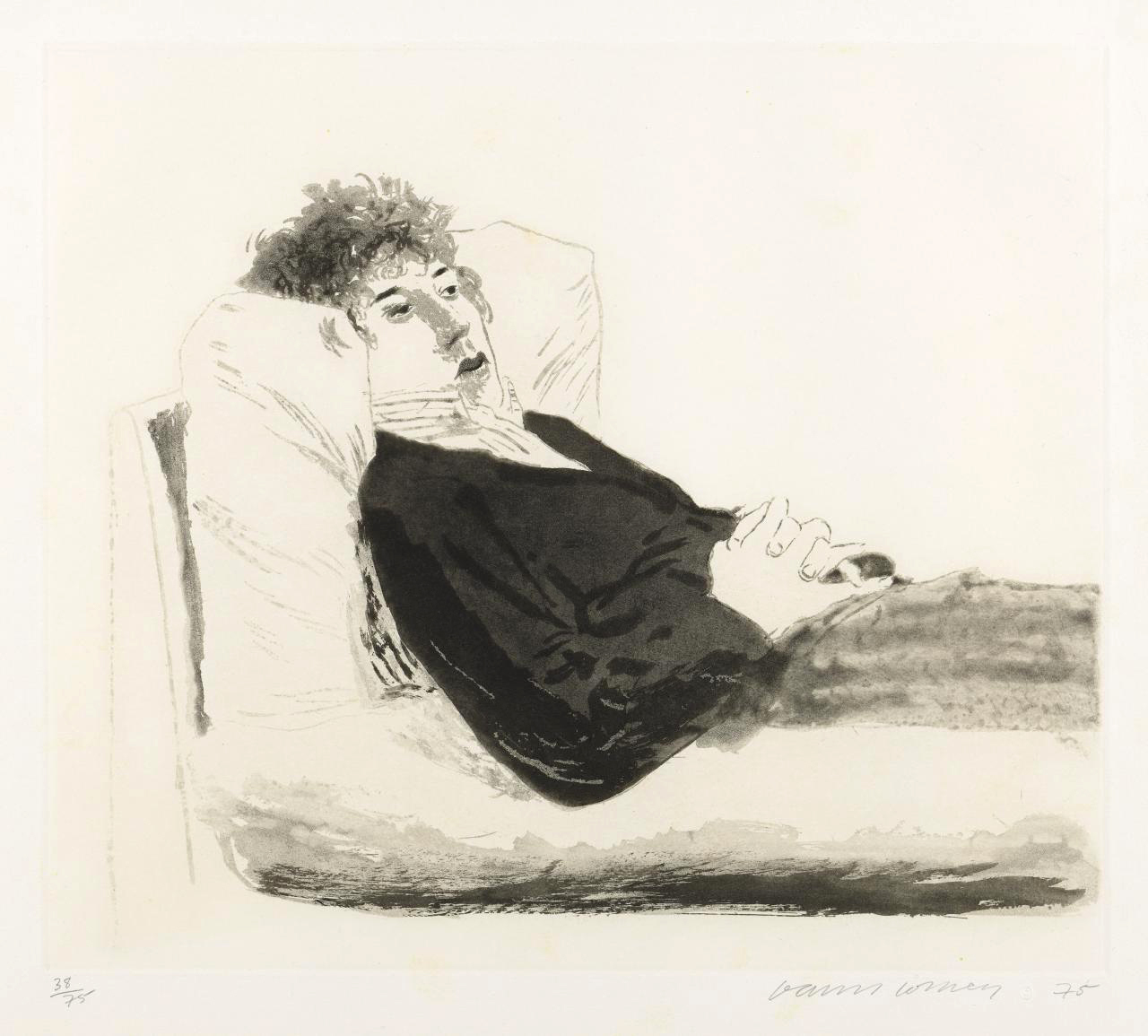
 

David Hockney (born England 1937, worked in United States 1964-1968, 1975- ) 'Reclining figure' 1975


David Hockney (born England 1937, worked in United States 1964-1968, 1975- )
Reclining figure
1975
Etching and liftground etching, ed. 38/75
National Gallery of Victoria
Gift of Margaret Toll 2006


Edmond-François Aman-Jean (French, 1860-1936) 'Woman resting' c. 1904


Edmond-François Aman-Jean (French, 1860-1936)
Woman resting
La Femme couchée
c. 1904
Oil on canvas
National Gallery of Victoria
Felton Bequest 1905
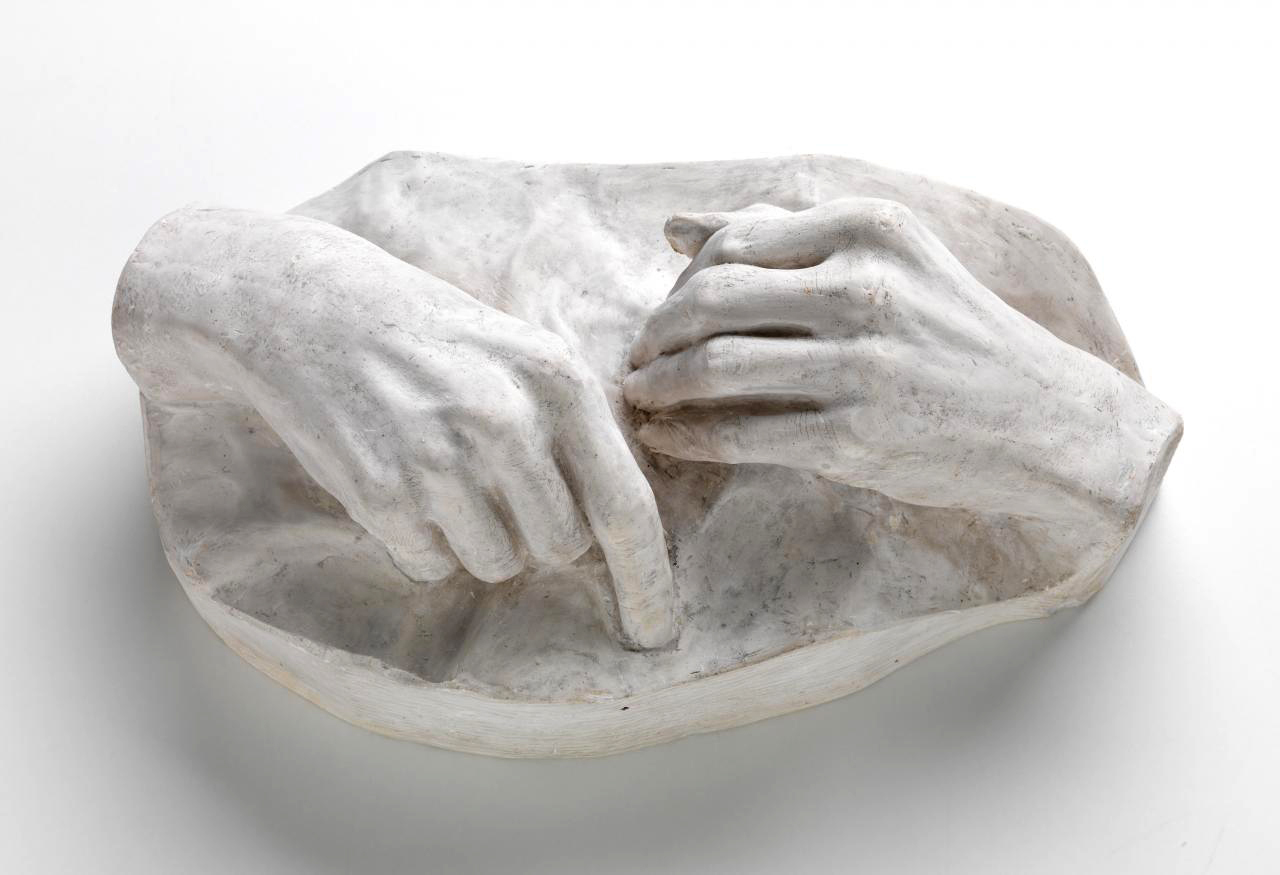
 

Max Klinger (German, 1857-1920) 'Cast of artist's hands' 1920


Max Klinger (German, 1857-1920)
Cast of artist’s hands
1920
plaster
National Gallery of Victoria
Gift of Mrs Marcelle Osins, 1994


Fred Kruger (Australian born Germany, 1831-1888) 'Coast scene, Mordialloc Creek, near Cheltenham' c. 1871


Fred Kruger (Australian born Germany, 1831-1888)
Coast scene, Mordialloc Creek, near Cheltenham
c. 1871
Albumen silver photograph
National Gallery of Victoria
Gift of Mrs Beryl M. Curl, 1979


The best of the landscape photographs have nothing to do with Arcadian, pastoral life at all. For me, Kruger’s photographs only start to come alive when he is photographing gum trees against the sky. Anyone who has tried to photograph the Australian bush knows how difficult it is to evince a “feeling” for the bush and Kruger achieves this magnificently in a series of photographs of gum trees in semi-cleared land, such as Bush scene near Highton (c. 1879). These open ‘park-like’ landscapes are not sublime nor do they picture the spread of colonisation but isolate the gum trees against the sky. They rely on the thing itself to speak to the viewer, not a constructed posturing or placement of figures to achieve a sterile mise-en-scène.

Dr Marcus Bunyan from a posting on the NGV exhibition Fred Kruger: Intimate Landscapes 2012


Kusakabe Kimbei (Japanese, 1841-1934) 'No title (Couple with a cabinet photograph and ghost in background)' 1880s


Kusakabe Kimbei (Japanese, 1841-1934)
No title (Couple with a cabinet photograph and ghost in background)
1880s
Albumen silver photograph, colour dyes
National Gallery of Victoria
Purchased 2004


Kimbei Kusakabe arrived in Yokohama in 1856 and became Felice Beato’s pupil, hand-colouring his photographs until 1863. In 1881, he opened his own studio and promptly became one of the most prosperous and influential photographers of his generation, rivalling the Western artists that had until then dominated the market. With his coloured portraits, everyday scenes and landscapes, he is the purveyor of souvenir images for Westerners visiting Japan. Kimbei Kusakabe depicted men in serene social and economic contexts while women – his favourite subjects – were represented in romantic portraits as well as domestic and cultural scenes. The young mysterious and submissive geisha was particularly appealing to Western audiences and the Japanese photographer helped establish their visual identity as icons of feminine beauty and social etiquette. Kimbei Kusakabe’s rare images are a rich resource for the comprehension of a Japan that has now disappeared.

Text from The Red List website [Online] Cited 17/07/2017. No longer available online


Kusakabe Kimbei worked with Felice Beato and Baron Raimund von Stillfried as a photographic colourist and assistant before opening his own workshop in Yokohama in 1881, in the Benten-dōri quarter, and from 1889 operating in the Honmachi quarter. He also opened a branch in the Ginza quarter of Tokyo. Around 1885, he acquired the negatives of Felice Beato and of Stillfried, as well as those of Uchida Kuichi. Kusakabe also acquired some of Ueno Hikoma’s negatives of Nagasaki. He stopped working as a photographer in 1912-1913.

Text from the Wikipedia website
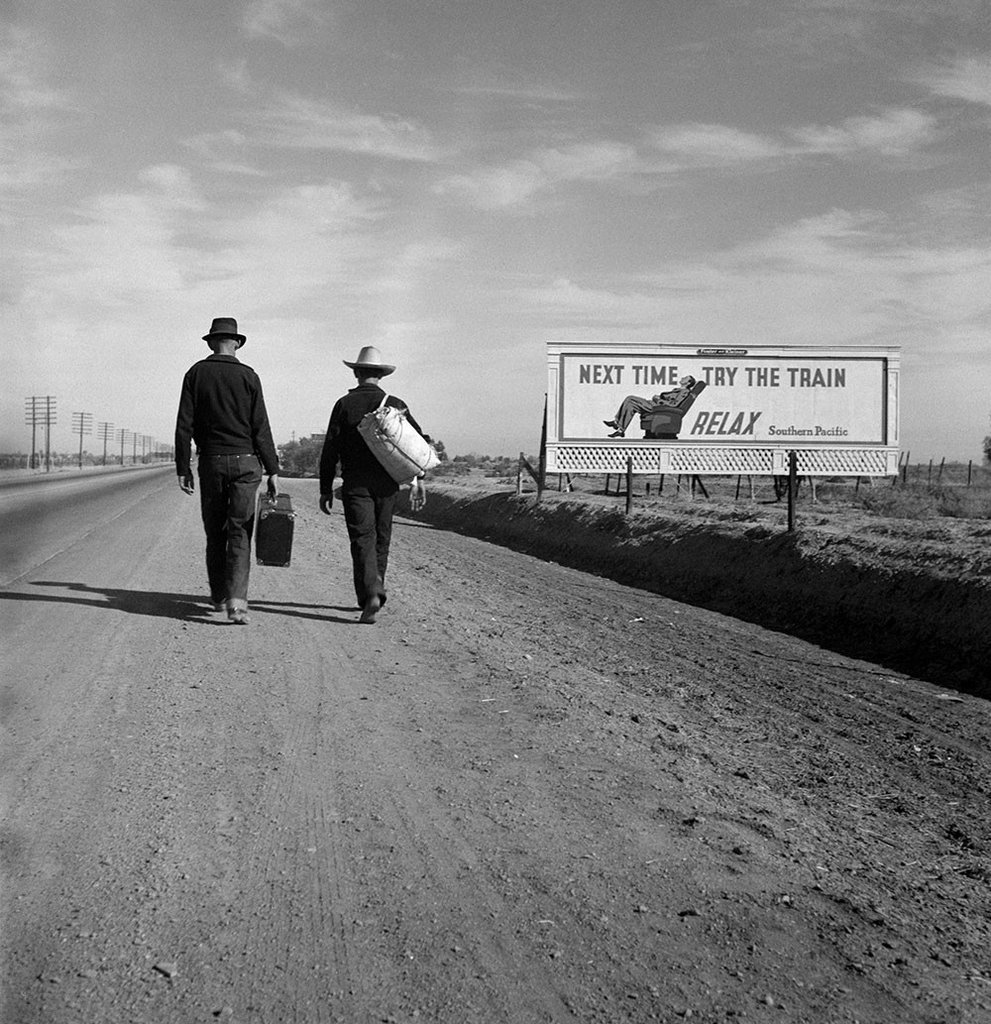
 

Dorothea Lange (American, 1895-1965) 'Towards Los Angeles, California' 1936, printed c. 1975


Dorothea Lange (American, 1895-1965)
Towards Los Angeles, California
1936, printed c. 1975
Gelatin silver photograph
National Gallery of Victoria
Purchased 1975


Dorothea Lange (American, 1895-1965) 'Ditched, stalled and stranded, San Joaquin Valley, California' 1935, printed c. 1975


Dorothea Lange (American, 1895-1965)
Ditched, stalled and stranded, San Joaquin Valley, California
1935, printed c. 1975
Gelatin silver photograph
National Gallery of Victoria
Purchased 1975
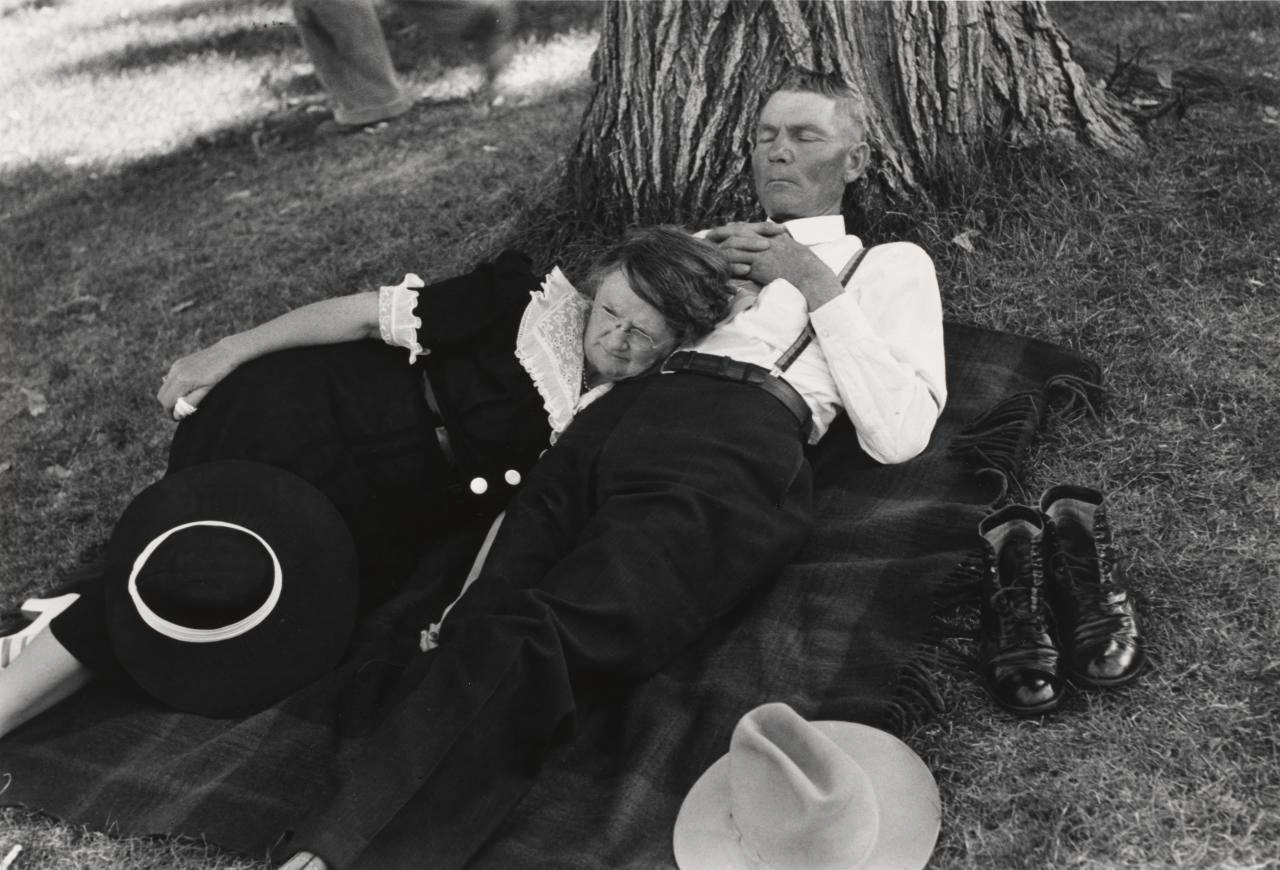
 

Russell Lee (American, 1903-1986) 'Interlude, after watching the Fourth of July Parade, Vale, Oregon' 1941, printed c. 1975


Russell Lee (American, 1903-1986)
Interlude, after watching the Fourth of July Parade, Vale, Oregon
1941, printed c. 1975
Gelatin silver photograph
National Gallery of Victoria
Purchased 1975


José López (born Cuba 1941, lived in United States c. 1961-1992, died United States 1992) Luis Medina (born Cuba 1942, lived in United States 1961-1985, died United States 1985) 'Boy asleep by the beach' 1976


José López (born Cuba 1941, lived in United States c. 1961-1992, died United States 1992)
Luis Medina (born Cuba 1942, lived in United States 1961-1985, died United States 1985)
Boy asleep by the beach
1976
Gelatin silver photograph
National Gallery of Victoria
Purchased 1978


Ruth Maddison (Australian, b. 1945) 'No title (Woman collecting a Christmas present from the car)' 1977-1978


Ruth Maddison (Australian, b. 1945)
No title (Woman collecting a Christmas present from the car)
from the Christmas Holidays with Bob’s Family, Mermaid Beach, Queensland series
1977-1978, printed 1979
Gelatin silver photograph, coloured pencils and fibre tipped pen, ed. 1/5
National Gallery of Victoria
Purchased 1980


This was a very hands on process, an observation confirmed by artist Ruth Maddison. “The process was like hand watering your garden, an intense exchange and engagement with the object. When I started I was completely untrained, but I loved the process. I just experimented in order to understand what medium does what on what paper surface. There was the beauty of its object and its physicality. I just loved the object.” Her series Christmas holiday with Bob’s family, Mermaid Beach, Queensland (1977-1978), photographed over Christmas Day and several days afterwards, evidences this magical transformation. Vernacular photographs of a typical Australia Christmas holiday become something else, transformed into beautiful, atypical representations of family, friendship, celebration and life.

Dr Marcus Bunyan commenting on the National Gallery of Australia exhibition Colour My World: Handcoloured Australia Photography 2015
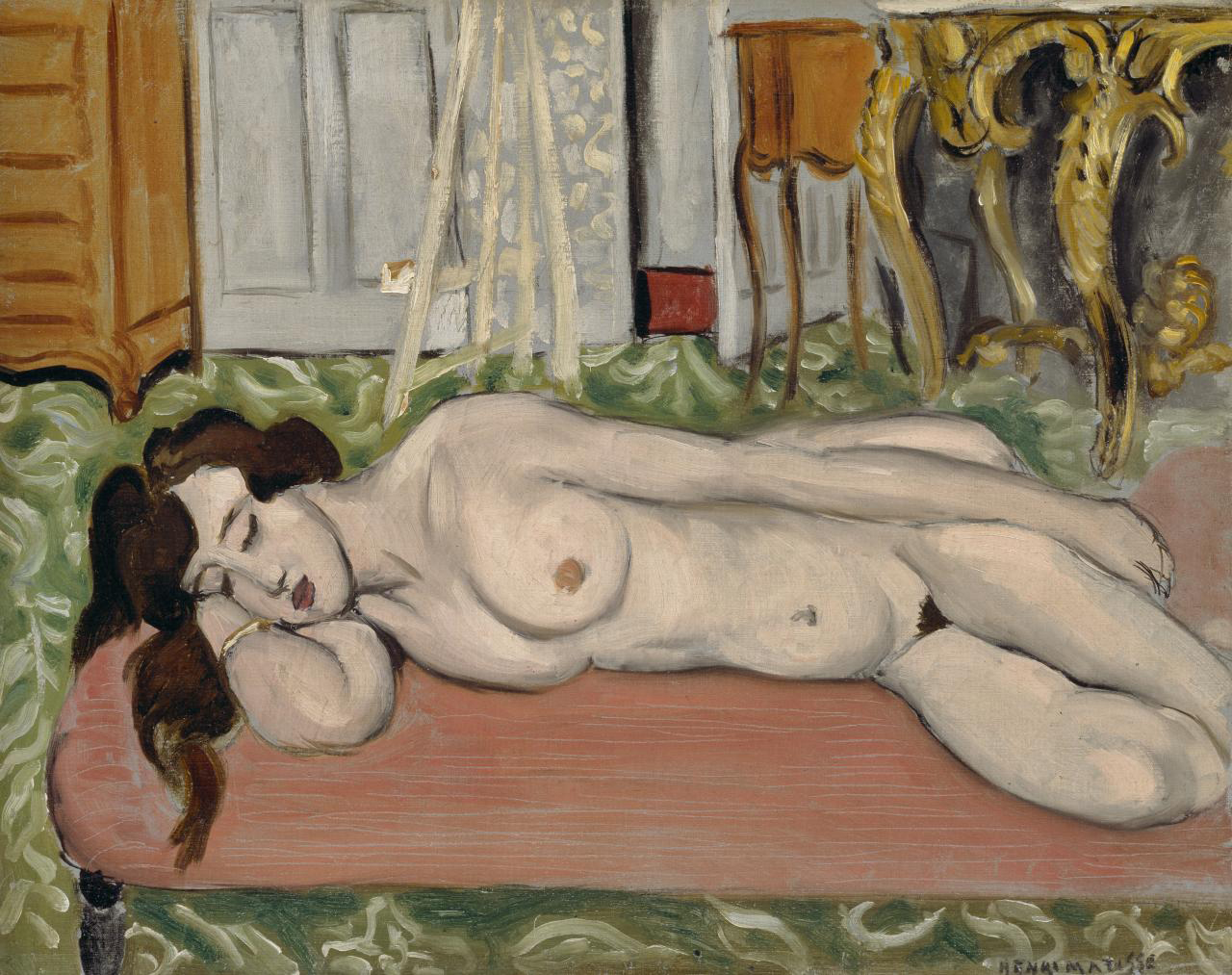
 

Henri Matisse (France, 1869-1954) 'Reclining nude on a pink couch' 1919


Henri Matisse (France, 1869-1954)
Reclining nude on a pink couch
Nu couché sur canapé rose
1919
Oil on canvas
National Gallery of Victoria
Felton Bequest 1952


Amedeo Modigliani (born Italy 1884, lived in France 1906-1920, died France 1920) 'Nude resting' c. 1916-1919


Amedeo Modigliani (born Italy 1884, lived in France 1906-1920, died France 1920)
Nude resting
c. 1916-1919
Pencil on buff paper; laid down
National Gallery of Victoria
Felton Bequest 1948


László Moholy-Nagy (born Hungary 1895, lived in Germany 1920-1934, lived in United States 1935-1937, United States 1937-1946, died United States 1946) 'Helsinki' 1927, printed 1973


László Moholy-Nagy (born Hungary 1895, lived in Germany 1920-1934, lived in United States 1935-1937, United States 1937-1946, died United States 1946)
Helsinki
1927, printed 1973
Gelatin silver photograph
National Gallery of Victoria
Purchased 1975


David Moore (Australian, 1927-2003) 'Migrants arriving in Sydney' 1966


David Moore (Australian, 1927-2003)
Migrants arriving in Sydney
1966
Gelatin silver photograph
National Gallery of Victoria
Purchased 1991


In this evocative image Moore condenses the anticipation and apprehension of immigrants into a tight frame as they arrive in Australia to begin a new life. The generational mix suggests family reconnections or individual courage as each face displays a different emotion.

Moore’s first colour image Faces mirroring their expectations of life in the land down under, passengers crowd the rail of the liner Galileo Galilei in Sydney Harbour was published in National Geographic in 1967.1 In that photograph the figures are positioned less formally and look cheerful. But it is this second image, probably taken seconds later, which Moore printed in black-and-white, that has become symbolic of national identity as it represents a time when Australia’s rapidly developing industrialised economy addressed its labour shortage through immigration. The strength of the horizontal composition of cropped figures underpinned by the ship’s rail is dramatised by the central figure raising her hand – an ambiguous gesture either reaching for a future or reconnecting with family. The complexity of the subject and the narrative the image implies ensured its public success, which resulted in a deconstruction of the original title, ‘European migrants’, by the passengers, four of whom it later emerged were Sydneysiders returning from holiday, alongside two migrants from Egypt and Lebanon.2 Unintentionally Moore’s iconic image has become an ‘historical fiction’, yet the passengers continue to represent an evolving Australian identity in relation to immigration.

1/ Max Dupain and associates: Accessed 17/06/2006. No longer available online
2/ Thomas D & Sayers A 2000, From face to face: portraits by David Moore, Chapter & Verse, Sydney

© Art Gallery of New South Wales Photography Collection Handbook, 2007

From a posting on the exhibition The Photograph and Australia at the Art Gallery of New South Wales.
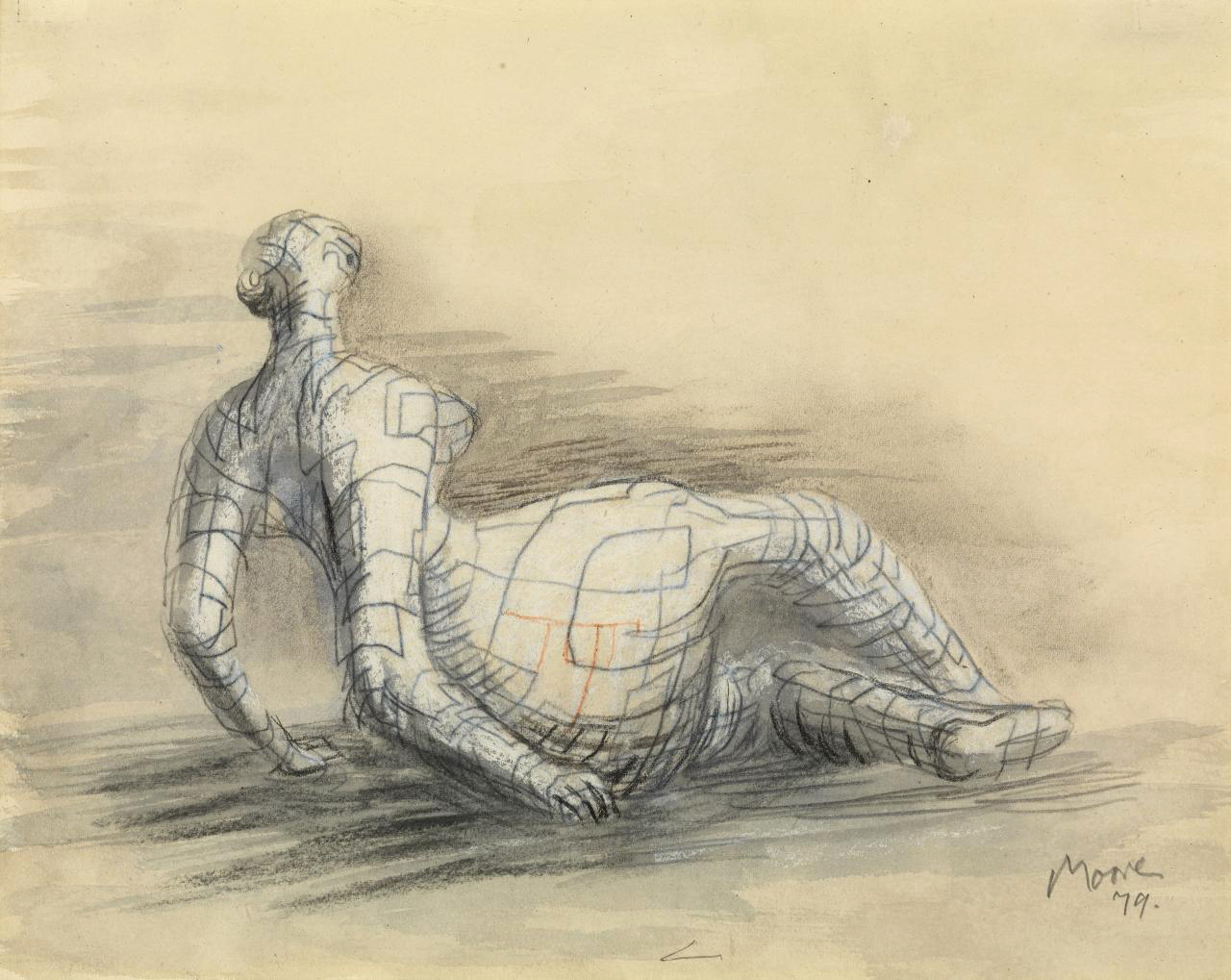
 

Henry Moore (English, 1898-1986) 'Reclining figure distorted - Sectional line' 1979


Henry Moore (English, 1898-1986)
Reclining figure distorted – Sectional line
1979
Chalk, charcoal, wax crayon, ballpoint pen and watercolour over pencil
National Gallery of Victoria
Gift of Ginny Green, Sandra Bardas OAM family, Vicki Vidor OAM and Bindy Koadlow in memory of their parents Loti Smorgon AO and Victor Smorgon AC through the Australian Government’s Cultural Gifts Program, 2014


William De Morgan (designer, England 1839-1917) 'Startled tigers, dish' c. 1880


William De Morgan & Co., London (manufacturer, England 1872-1911)
William De Morgan (designer, England 1839-1917)
Startled tigers, dish
c. 1880
Earthenware
National Gallery of Victoria
Felton Bequest 1980
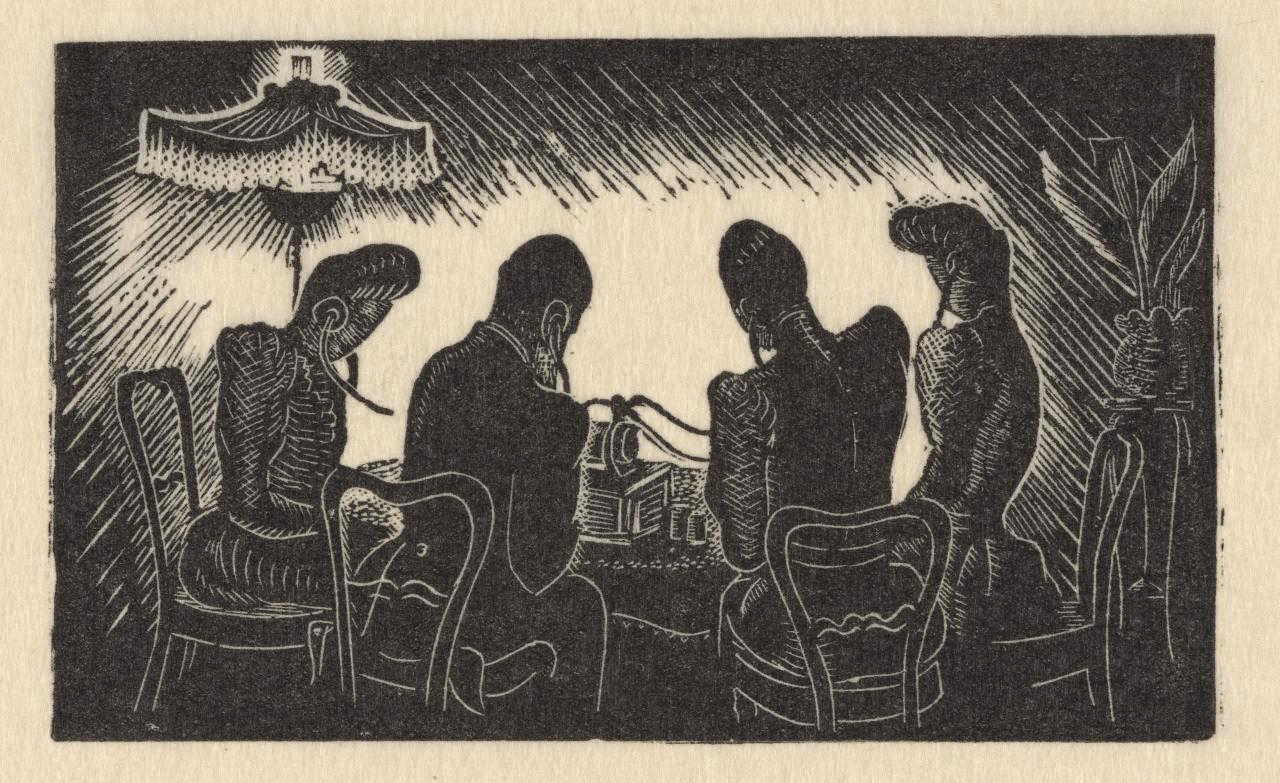
 

Helen Ogilvie (Australian, 1902-1993) '(Four figures seated at a table listening to a phonograph through earpieces)' c. 1947


Helen Ogilvie (Australian, 1902-1993)
(Four figures seated at a table listening to a phonograph through earpieces)
Illustration to Flinders Lane: recollections of Alfred Felton by Russell Grimwade. Melbourne University Press, Carlton, 1947
c. 1947
Wood-engraving on Japanese paper, proof
National Gallery of Victoria


“What interested me I think were the English wood engravers. I would have seen them in reproductions in books … I think it appealed to me as an artistic expression because it was done so directly with the hand. I know that when a painter is painting the hand is connected with the brain. But with wood engraving it seemed to me it was almost more so. And I got very worked up about it, but I had no way of learning … I know how I got started. Eric Thake was the man who said to me, “I’ll show you how to use your tool.”‘

from Anne Ryan, ‘Australian etchings and engravings 1880s-1930s from the Gallery’s collection’, AGNSW, Sydney 2007
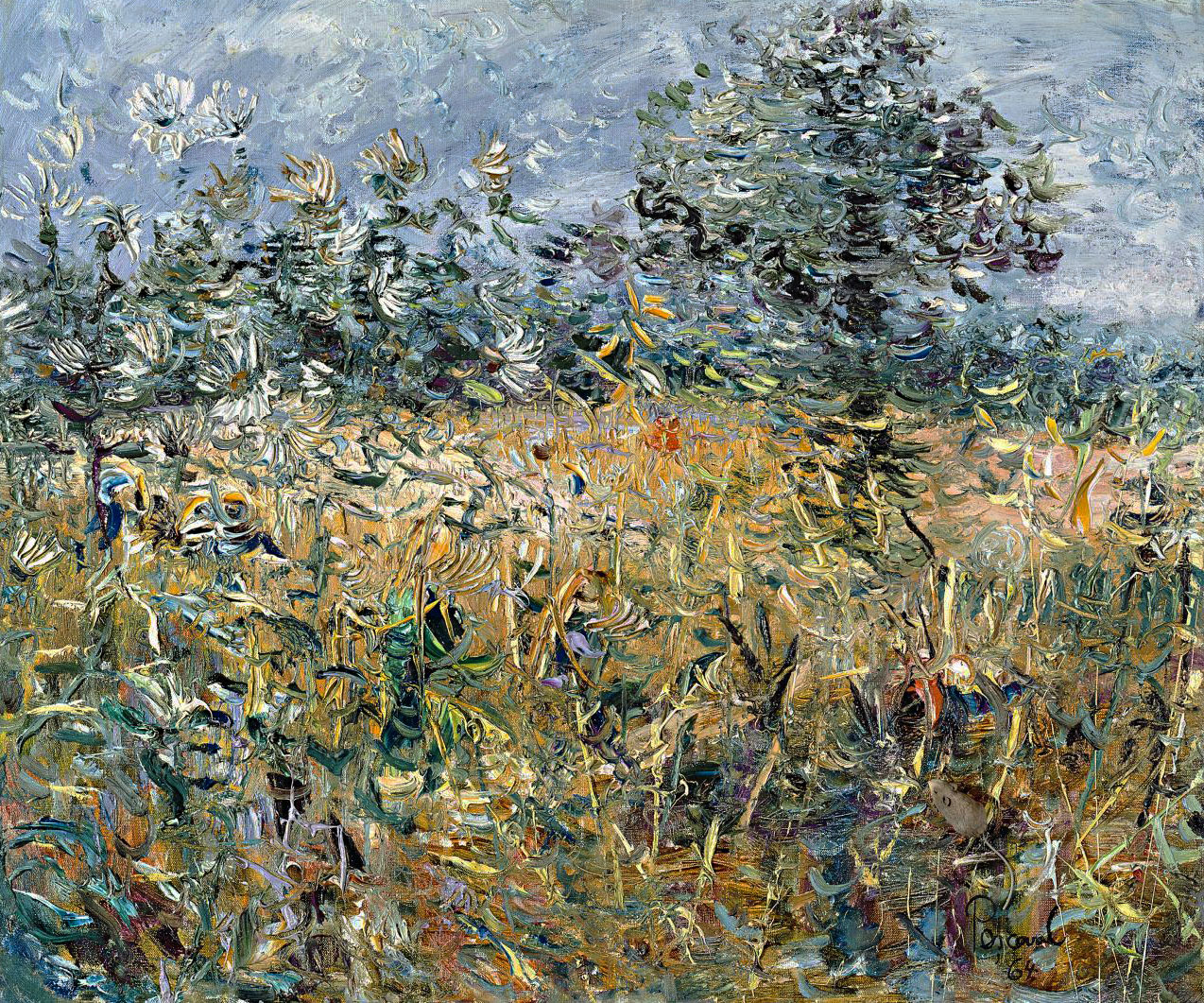
 

John Perceval (Australian, 1923-2000) 'Lover's walk in the corn, summer, England' 1964


John Perceval (Australian, 1923-2000)
Lover’s walk in the corn, summer, England
1964
Oil and toy mouse on canvas
National Gallery of Victoria
Presented through The Art Foundation of Victoria by Fingal Pastoral Property Limited, Fellow, 1997


Peter Peryer (New Zealand, 1941-2018) 'Seeing' 1989


Peter Peryer (New Zealand, 1941-2018)
Seeing
1989
Gelatin silver photograph
National Gallery of Victoria
Purchased 1996
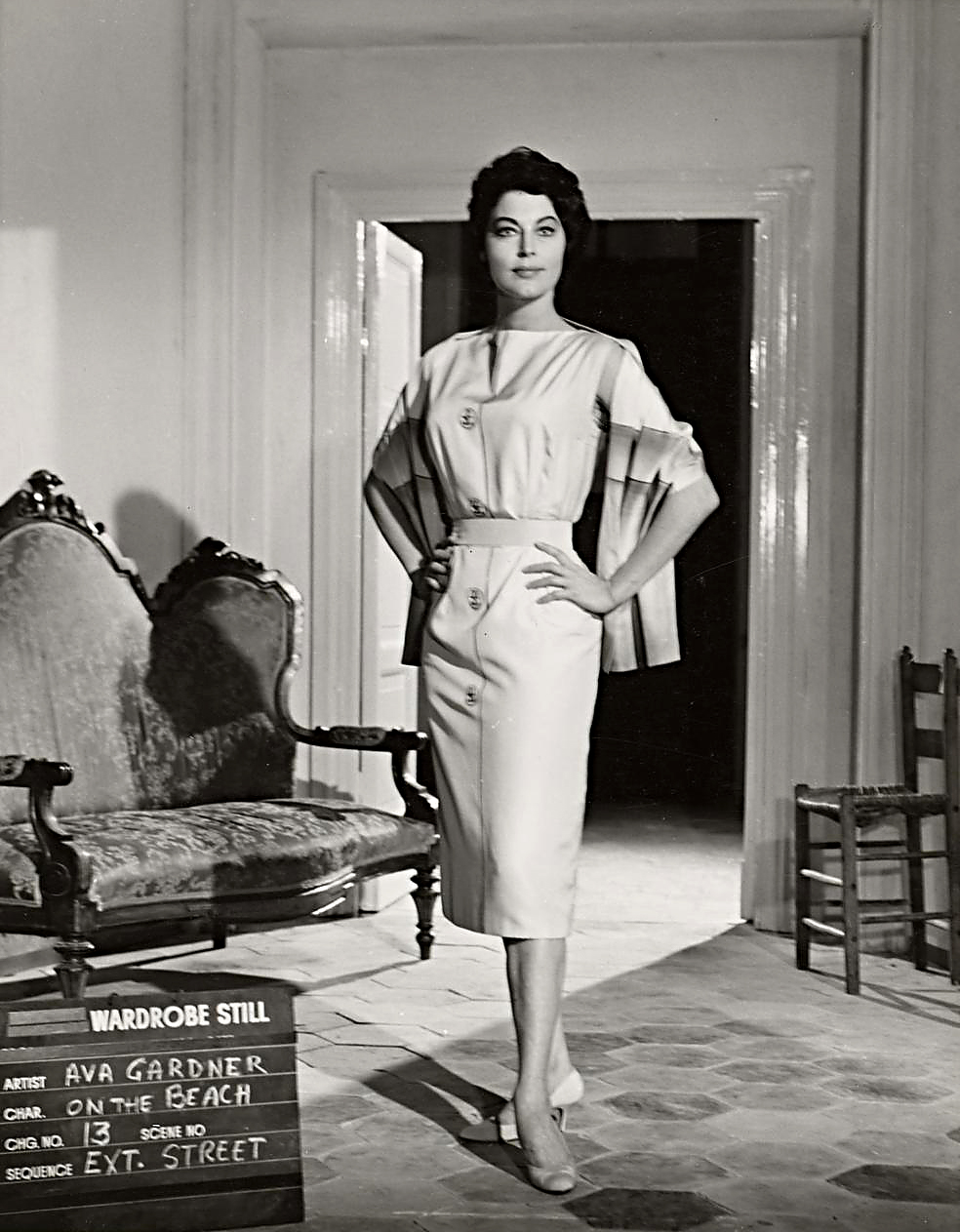
 

G. B. Poletto (Italian, 1915-1988) 'No title (Ava Gardner in wardrobe still for On the beach: Street)' 1957


G. B. Poletto (Italian, 1915-1988)
No title (Ava Gardner in wardrobe still for On the beach: Street)
1957
Gelatin silver photograph
National Gallery of Victoria
Purchased 2003


David Potts (Australian, 1926-2012, lived in England 1950-1955) 'Cat show, London' 1953


David Potts (Australian, 1926-2012, lived in England 1950-1955)
Cat show, London
1953
Gelatin silver photograph
National Gallery of Victoria
Purchased through the KODAK (Australasia) Pty Ltd Fund 1975
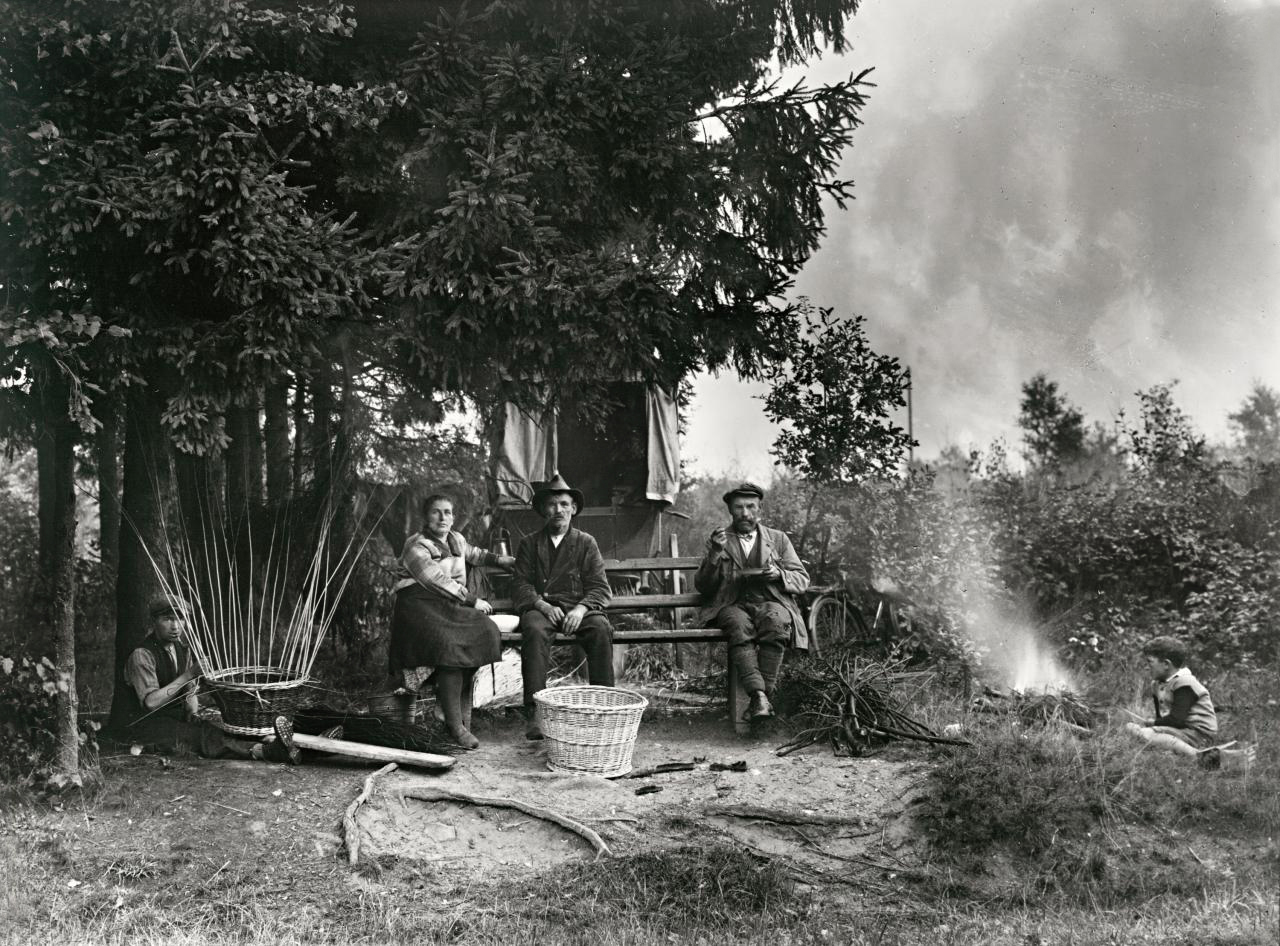
 

August Sander (German, 1876-1964) 'Itinerant basket makers' 1929


August Sander (German, 1876-1964)
Itinerant basket makers
from the People of the Twentieth Century project
1929, printed 1973
Gelatin silver photograph
National Gallery of Victoria
Purchased 1974


Nomadism

In the literature on nomadism, there is considerable disagreement over the range of societies that should be designated as “nomadic,” but there is some consensus that at least three categories of mobile peoples should be recognised. The first category, to which many wish to restrict the term “nomadic,” is that of pastoral nomads… The second broad category of nomads is that of hunter-gatherers, whose mode of subsistence sets them apart from both pastoralists and sedentary farmers…

The third basic category is that of Gypsies, itinerant basket-makers, tinkers, weavers, mimes, magicians, musicians, horse dealers, nostrum traders, carnival people, circus performers, and so on. Characterised the variously as “service nomads,” “economic nomads,” “commercial nomads,” “craftsman nomads,” “non-food producing nomads,” “floating industrial populations,” “peripatetic tribes,” “peripatetic peoples” or plain “peripatetics,” these are spatially mobile peoples who primarily exploit resources in the social environment. They exploit what Berland and Salo call a distinct peripatetic niche: “the regular demand for specialised goods and/or services that more sedentary or pastoral communities cannot, or will not, support on a permanent basis.”

Ronald Bogue. Deleuze’s Way: Essays in Transverse Ethics and Aesthetics. London and New York: Routledge, 2007, pp. 114-115.


Ben Shahn (born Lithuania 1898, lived in United States c. 1925-1969, died United States 1969) 'A deputy with a gun on his hip during the September 1935 strike in Morgantown, West Virginia' 1935, printed c. 1975


Ben Shahn (born Lithuania 1898, lived in United States c. 1925-1969, died United States 1969)
A deputy with a gun on his hip during the September 1935 strike in Morgantown, West Virginia
1935, printed c. 1975
Gelatin silver photograph
National Gallery of Victoria
Purchased, 1975


Athol Shmith (Australian, 1914-1990) 'Misses Mary and Rae Plotkin, bridesmaids at the wedding of Mrs Edith Sheezel' 1940


Athol Shmith (Australian, 1914-1990)
Misses Mary and Rae Plotkin, bridesmaids at the wedding of Mrs Edith Sheezel
1940
Hand-coloured gelatin silver photograph
National Gallery of Victoria
Gift of Mary Lipshut through the Australian Government’s Cultural Gift’s Program, 2012


Baron Raimund von Stillfried (Austrian, 1839-1911, lived throughout Europe and Asia 1871-1910) 'No title (Tattooed bettōs, porters)' c. 1875, printed c. 1877-1880


Baron Raimund von Stillfried (Austrian, 1839-1911, lived throughout Europe and Asia 1871-1910)
No title (Tattooed bettōs, porters)
c. 1875, printed c. 1877-1880
Albumen silver photograph, colour dyes
National Gallery of Victoria
Purchased through the NGV Foundation with the assistance of The Herald & Weekly Times Limited, Fellow, 2001


“There are two employments which I have mentioned among those of domestic servants because they would be so classed by us, but which in Japan rank among the trades. The jinrikisha man and the groom belong, as a rule, to a certain class at the bottom of the social ladder, and no samurai would think of entering either of these occupations, except under stress of severest poverty. The bettōs, or grooms, are a hereditary class and a regular guild, and have a reputation, among both Japanese and foreigners, as a betting, gambling, cheating, good-for-nothing lot. An honest bettō is a rare phenomenon.”

Alice Mabel Bacon. Japanese Girls and Women. Boston and New York: Houghton Mifflin Company The Riverside Press, 1891, p. 319.


Hiroshi Sugimoto (born Japan 1948, lived in United States and Japan 1976- ) 'Winnetka Drive-In, Paramount' 1993


Hiroshi Sugimoto (born Japan 1948, lived in United States and Japan 1976- )
Winnetka Drive-In, Pb  aramount
1993
Gelatin silver photograph, ed. 8/25
National Gallery of Victoria
Bowness Family Fund for Contemporary Photography, 2009


Hiroshi Sugimoto’s famous series Theaters is represented in the exhibition by the work Winnetka Drive-In, Paramount (1993) where  Sugimoto “photographs auditoriums of American movie theaters, and drive-in movies, during showings. The exposure time used for the photograph corresponds with the projection time of the film. This allows him to save the duration of the entire film in a single shot. What remains visible of the film’s time-compressed, individual images is the bright screen of the movie theater, which illuminates the architecture of the space. That its content retreats into the background makes the actual film a piece of information, manifesting itself in the (movie theater) space. As a result, instead of a content-related event, film presents itself here as the relationship between time and spatial perception.”3

If we think of the camera lens as being fully open, like an eye without blinking, for the duration of the length of the film then the shutter of the lens has to be set on “B” for Bulb which allows for long exposure times under the direct control of the photographer. “The term bulb is a reference to old-style pneumatically actuated shutters; squeezing an air bulb would open the shutter and releasing the bulb would close it… It appears that when instantaneous shutters were introduced, they included a B setting so that the familiar bulb behaviour could be duplicated with a cable release.”4 In other words light waves, reflecting from the surface of objects, are controlled by the photographer over an indefinite period (not the short “snap” of the freeze frame / the decisive moment), accumulating light from thousands of years in the past through the lens of the camera onto the focal plane, coalescing into a single image, controlled and constructed by the photographer.

Dr Marcus Bunyan from a review of the NGV exhibition Light Works 2012

3/ Kellein, Thomas and Sugimoto, Hiroshi. Time Exposed. Thames & Hudson, First edition, 1995, p. 91, quoted in Heike Helfert. “Hiroshi Sugimoto “Theaters”,” on the Media Art Net website Nd [Online] Cited 08/09/2012.
4/ Anonymous. “Bulb (photography),” on the Wikipedia website Nd [Online] Cited 08/09/2012.
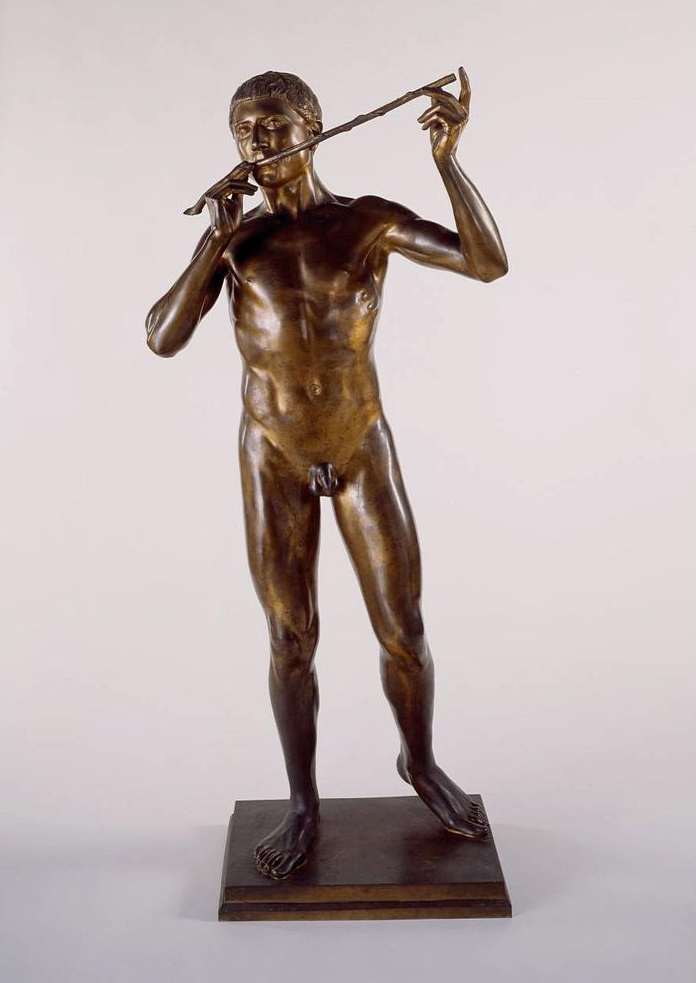
 

James Thomas (English, 1854-1921, lived in Italy 1889-1906) 'Thyrsis' 1914


James Thomas (English, 1854-1921, lived in Italy 1889-1906)
Thyrsis
1914
Bronze, patina
National Gallery of Victoria
Felton Bequest, 1915
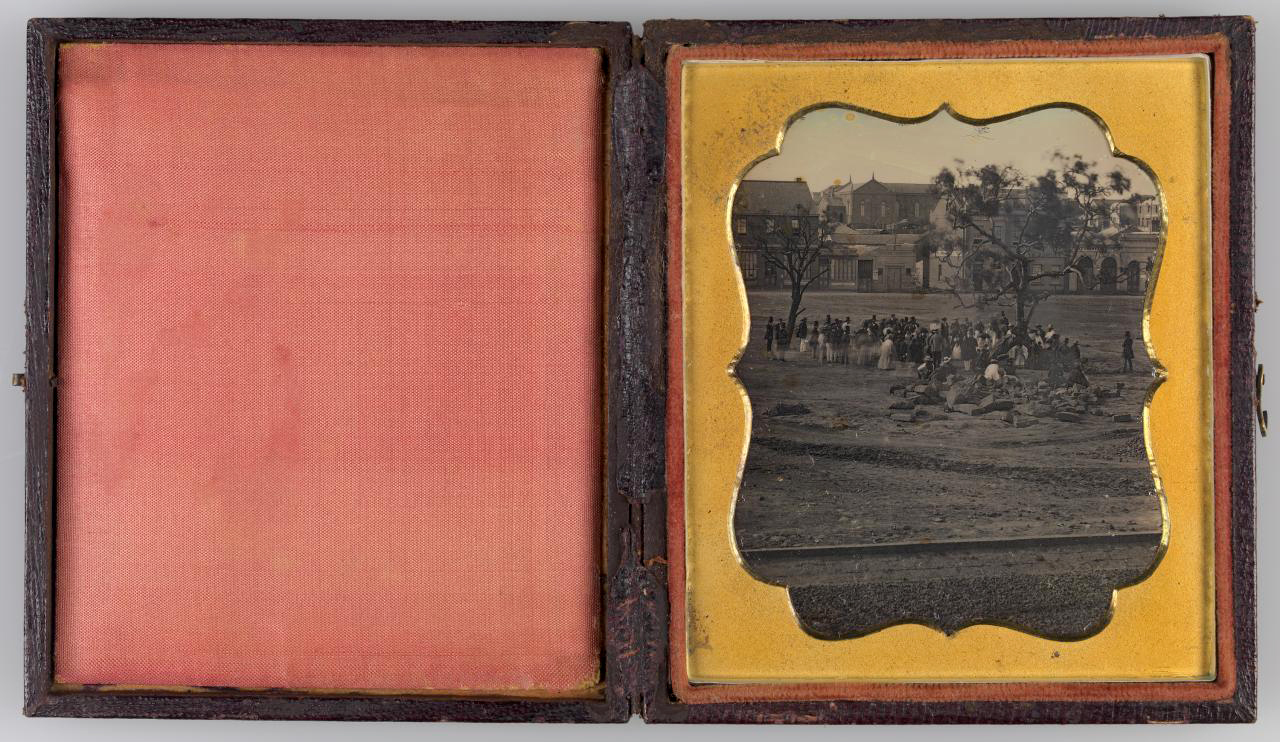
 

Joseph Turner (active in Australia 1856-1880s) 'No title (Laying the foundation stone of the Geelong clock tower)' 1856


Joseph Turner (active in Australia 1856-1880s)
No title (Laying the foundation stone of the Geelong clock tower)
1856
Daguerreotype leather, wood, silk, gilt metal and glass (case)
National Gallery of Victoria
Purchased, 1974


Market Square was a town square located in the centre of Geelong, Victoria, Australia. Consisting of eight acres (2.9 hectares) of land, the area was reserved by Governor Sir George Gipps as a town square during the initial surveying of Geelong. The area later became a produce market, before being progressively built upon. Today the Market Square Shopping Centre occupies the site, having been opened in 1985 by the City of Geelong…

A clock tower was built in the centre of the square in 1856. It was the idea of the second mayor of Geelong James Austin, who offered to pay for a clock tower in Geelong to mark his term as mayor. The clock was featured in The Illustrated London News in March 1855. Components for the clock arrived in Geelong on November 13, 1855 from England, but the location for the clock had yet to be decided. Suggestions of high ground at top of Moorabool, Yarra or Gheringhap Streets were put forward at the time, the indecision lasting into early 1856. In July 1857 a decision was made, and the foundation stone was finally laid in the Market Square…

The clock tower remained until October 1923 when it was demolished to make way for the CML Building. There was a public outcry, and no one was willing to demolish it. However, it was deemed too impractical to move intact, and was brought down by steel cables attached to traction engine. The site of the clock tower is marked by a plaque in the Market Square Shopping Centre.

Text from the Wikipedia website


William Wegman (American, b. 1943) 'Horned hound' 1991


William Wegman (American, b. 1943)
Horned hound
1991
Polaroid photograph
National Gallery of Victoria
Purchased, 1992


The Ian Potter Centre: NGV Australia
Federation Square
Corner of Russell and 
Flinders Streets, Melbourne

Opening hours:
Daily 10am – 5pm

National Gallery of Victoria website

LIKE ART BLART ON FACEBOOK

Back to top

Review: ‘Degas: A New Vision’ at the National Gallery of Victoria International, Melbourne Part 2

Exhibition dates: 24th June – 18th September, 2016

Curator: Dr Ted Gott, Senior Curator of International Art at the National Gallery of Victoria


Edgar Degas (French, 1834-1917) 'Finishing the arabesque' 1877 from the exhibition 'Degas: A New Vision' at the National Gallery of Victoria International, Melbourne, June - Sept, 2016


Edgar Degas (French, 1834-1917)
Finishing the arabesque
1877
Oil and essence, pastel on canvas
67.4 x 38cm
Musée d’Orsay, Paris (RF 4040)
© Musée d’Orsay, Dist. RMN-Grand Palais / Patrice Schmidt


This is a magnificent exhibition, well paced and beautifully hung in the gallery spaces. It is gratifying to see a “blockbuster” at the National Gallery of Victoria that does not rely on papered walls or patterned floors, that just allows the work to speak for itself. There is an excellent chronological trajectory to the work, showcasing the holistic development of the artist in one interweaving arc: from the early history paintings, where Degas is educating himself not only in the history of art but also in the practicalities of the history of painting (how actually to paint) … through to the late, bravura pastels.

Pastel is Degas’s strongest medium and it was incredible to observe close up how he could make pastel look like oil paint and vice versa. My favourite was Femme à la toilette [Woman at her toilette] (c. 1894, below) were the flattened perspectival image disintegrates before your eyes: “As well as reflecting the artist’s love of Japanese woodblock prints with their frequently intimate subject matter, in this late drawing Degas applied his vivid pigments with an almost sculptural intensity, building them up as though modelling form with his fingers.” Abstraction eat your heart out.

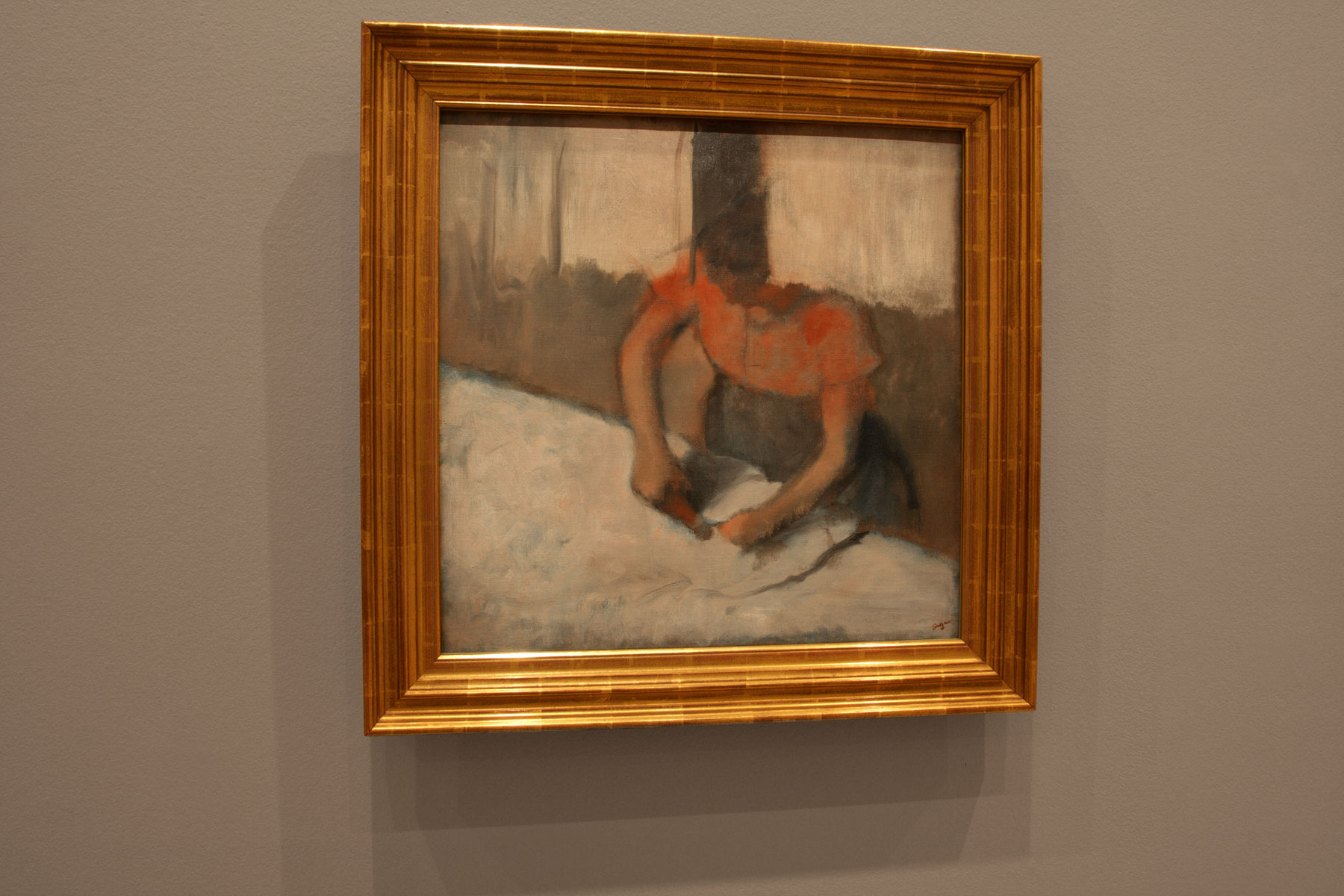
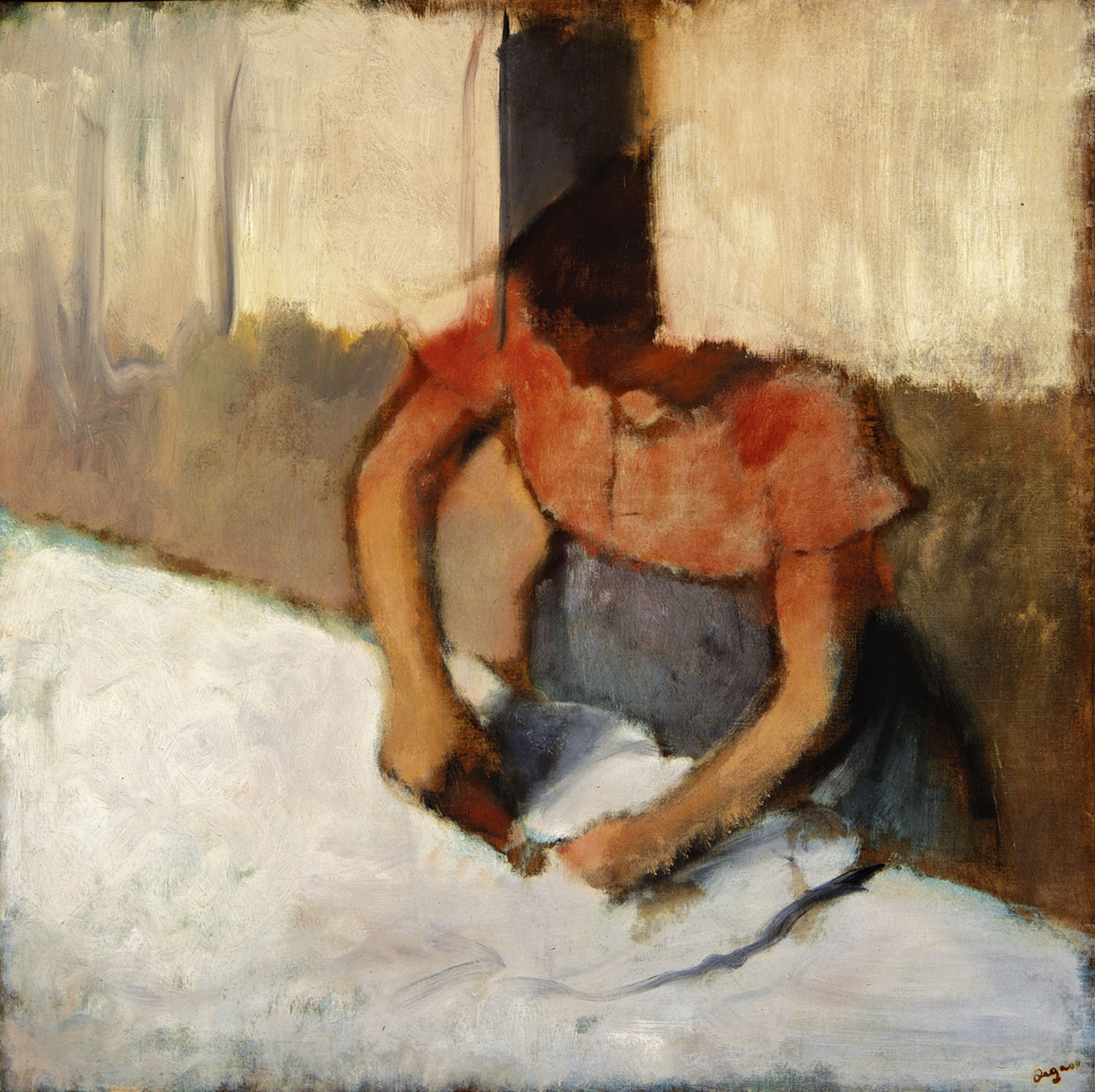
His “impressions” of reality rely on a keen eye, a wonderful understanding of space and the refractions of light, and the use of depth of field. The paintings I like best were not of the ballet, but rather the everyday “observational” paintings of the theatre box, a conversation and, particularly, The laundress ironing (c. 1882-86, below) with its simplified planar colour fields that run in different directions. These “punctures” of reality, or punctum to use a photographic term, elevate mundane everyday occurrences into a revelatory state – as though these encounters were taken from the flow of space and time, one frame out of a non-linear narrative.

The paintings of women at the toilettes are not voyeuristic but show a love and passion for an intimacy with women which he perhaps never achieved in real life, brought forth in observations of the female form “that challenged conventional notions of feminine beauty in their depiction of non-idealised jolie-laide (unconventionally beautiful) models”. Melbourne arts blogger Natalie Thomas observes that, “”Women and girls are everywhere in this show, but strangely absent too,” writes Thomas. Despite the fact the majority of Degas’ work explores femininity and the female body, the show, she says, fails to provide a female perspective.” (Natalie Thomas quoted in Shad D’Souza, “Gender and the NGV: ‘More white male artists than you can shake a stick at’,” on The Guardian website 15 September 2016 Cited 16/09/2016).

While I agree with Natalie Thomas that these paintings fail to provide a contemporary female perspective, that is not all that these paintings are about. Of course, they are a privileged white male gaze looking upon the body of a female and we must accept and acknowledge that is what they are. But that is just one element of their narrative. It’s all very well critiquing the work from the present day and saying there is no female perspective, but in the era in which these “sensational” paintings emerged – it was an epoch where the privileged, powerful male gaze could look upon the female body. Yes, please look at the paintings from a contemporary perspective while understanding the conditions under which they were created, and then try to say something more interesting about them: the perspective, the colours, the form, the position of the painter, the framing of the scene, the possible disappearance of the artist to the sitter, as though the camera (his eyes) had disappeared: where someone is so used to the other being there, that they are natural (do not act or perform), unselfconscious in front of them. Then, and only then, do the paintings perhaps become something else – about women, their lives and habits / habitats. A different perspective from trotting out the usual “we are objectified / subjugated / defiled” trope.

The sculptures are the revelation of the exhibition. Again, the male gaze pushing and prodding at the female form… except, these sculptures seem to erupt from within – like bubbling hot mud that seems to emanate from deep within the artist, erupting into the glorious form of the female body. Dark and mysterious, I would have loved to have seen one of the wax models, just one, to see the colour and feel the fragility of that form, over the robustness of the bronze.

And finally to the last room, the late works. There is an essentialness to the late work, the form stripped bare, heavily applied pastel in layers, dark heavy outlines with the frame filled with an “orgy of colours” – he “developed an expressive use of colour and line that may have arisen due to his deteriorating vision.” But he could still feel what he was doing and we can feel it too: the working of the medium, the working of the theme to its final resolution.

While I didn’t know much about the work of Degas other than the ballet pictures before this exhibition – after three visits, perhaps I know just a little more.

Dr Marcus Bunyan

See Part 1 of the posting


Many thankx to the National Gallery of Victoria for allowing me to publish the artwork and photographs in the posting. All installation photographs © Marcus Bunyan and the National Gallery of Victoria. Please click on the photographs for a larger version of the image.


Edgar Degas biography

Edgar Degas was born in 1834 into a wealthy banking family. Unlike many of his contemporaries, his family were supportive of his artistic talent and desire to become an artist.

Degas resisted being labelled an ‘Impressionist’ yet was at the core of the movement’s most important manifestations. Classically trained, Degas initially aspired to be a painter of historical narratives. As he matured, however, he made the depiction of daily life the central focus of his art. He was drawn primarily to the human figure engaged in movement and work, sketching on the spot then working up his finished compositions indoors in his studio. Degas’ obsession with the theatre and ballet in particular enabled him to explore his fascination with artificial light, which set him apart from the other Impressionists who preferred to work out-of-doors capturing the transient effects of natural daylight.

Degas absorbed many diverse influences, from Japanese prints to Italian Mannerism, and reinterpreted them in innovative ways. Degas obsessively revisited and experimented with his favourite themes which saw him fashion varied and unusual vantage points and asymmetrical framing. His depictions of ballet dancers alone number in the hundreds. Such endeavours helped him to achieve the innovative and distinctive style which is explored in Degas: A New Vision.

Degas served in the Franco-Prussian War of 1870-71 and began to experience eyesight deterioration by the late 1880s. He increasingly took up sculpture as his eyesight weakened. In his later years, he was preoccupied with the subject of women bathing unselfconsciously and developed an expressive use of colour and line that may have arisen due to his deteriorating vision.

Degas continued working to as late as 1912. He died five years later in 1917, at the age of eighty-three.


Edgar Degas (French, 1834-1917) 'Danseuses, éventail [Dancers (Fan, design)]' 1879 (installation view)


Edgar Degas (French, 1834-1917)
Danseuses, éventail [Dancers (Fan, design)] (installation view)
1879
Gouache, pastel and oil paint on silk
Tacoma Art Museum, Washington State
Gift of Mr and Mrs W. Hilding Lindberg
Photo: © Marcus Bunyan and the National Gallery of Victoria


[Dancers (Fan, design)] belongs to a group of fans made in the late 1870s that reflect Degas’s fascination at this time with Japanese art. Highly aestheticised, these fans show how Degas took advantage of this unusual format to explore new compositional possibilities. Here, for example, the balletic action taking place on stage competes for the viewer’s attention with the theatre’s screening machinery, as well as with the group of black-clad abonnés (subscribers with back stage passes) gathered in the wings in the middle distance.

Wall text from the exhibition


Installation view of the exhibition 'Degas: A New Vision' at the National Gallery of Victoria International, Melbourne with at left, 'Theatre box' (1885) and at right, 'Theatre box' (1880)


Installation view of the exhibition Degas: A New Vision at the National Gallery of Victoria International, Melbourne with at left, Theatre box (1885) and at right, Theatre box (1880)
Photo: © Marcus Bunyan and the National Gallery of Victoria


Edgar Degas (French, 1834-1917 'La Loge [Theatre box]' 1885 (installation view)


Edgar Degas (French, 1834-1917)
La Loge [Theatre box] (installation view)
1885
Pastel
Hammer Museum, Los Angeles
The Armand Hammer Collection
Photo: © Marcus Bunyan and the National Gallery of Victoria


In contrast with his numerous ballet works, Degas produced relatively few studies of the spectators at the Opera and other theatrical venues. Theatre box is one of his most captivating studies of the magical effects created by artificial stage lighting. Its contrast between the shadowy reality of the viewer in her dimmer theatre box and the vividly illuminated fantasy being performed before her onstage is as compelling as it is radical.

Wall text from the exhibition


Edgar Degas (French, 1834-1917) 'La Loge [Theatre box]' 1880 (installation view)


Edgar Degas (French, 1834-1917)
La Loge [Theatre box] (installation view)
1880
Pastel and oil on cardboard on canvas
The Lewis Collection, Houston
Photo: © Marcus Bunyan and the National Gallery of Victoria


When exhibited at the fifth ‘impressionist’ group exhibition in Paris in 1880, this pastel attracted the attention of the critic Charles Ephrussi, who wrote glowingly of how it shoed ‘a profound knowledge of the relations between tones, producing the most unexpected and curious effects: the wine-coloured draperies of the spectator’s box and the yellowish glow of the footlights are projected onto the face of a diminutive theatre-goer, who thus finds herself illuminated by violet and brilliant yellow; the impression is strange, but captured with perfect reality’.

Wall text from the exhibition


Edgar Degas (French, 1834-1917) 'Theatre box' 1880 from the exhibition 'Degas: A New Vision' at the National Gallery of Victoria International, Melbourne, June - Sept, 2016


Edgar Degas (French, 1834-1917)
Theatre box
1880
Pastel and oil on cardboard on canvas
66.0 x 53.0cm
The Lewis Collection


Edgar Degas (French, 1834-1917) 'In a café (The Absinthe drinker)' c. 1875-1876


Edgar Degas (French, 1834-1917)
In a café (The Absinthe drinker)
c. 1875-1876
Oil on canvas
92 x 68.5cm
Musée d’Orsay, Paris (RF 1984)
© RMN-Grand Palais (Musée d’Orsay) / Martine Beck-Coppola


Cafés-concerts: 1870s

The time that Degas spent overseas in New Orleans made him surprisingly nostalgic for everything he had left behind in Paris. The simple reason he gave was that ‘One loves and gives art only to the things to which one is accustomed’. Although delighted by the new sights and sensations he experienced in New Orleans, he felt that ‘ new things capture your face and bore you by turns’. With these words, Degas expressed what would become his credo for the rest of his career.

After this time, Degas refused invitations to travel to exotic locales and put aside the search for new subjects, focusing instead on the same themes: dancers, rockets, women in the bath. The novelty of what he had discovered in America also led him soon afterwards to retreat into himself. seeing inspiration in introspection. For Degas the exotic could be found perfectly well at home, especially in the new evening venues of 1870s Paris, the café-concerts. He delighted in exploring the tension and psychological preparation that lay behind the surface glamour of stage performances conducted within an artificial other-reality.

Wall text from the exhibition


All that gesture in theatre summon,
or that the agile and mendacious tongue
of ballet speaks to those who comprehend
the silent eloquence of limbs in motion.


Edgar Degas


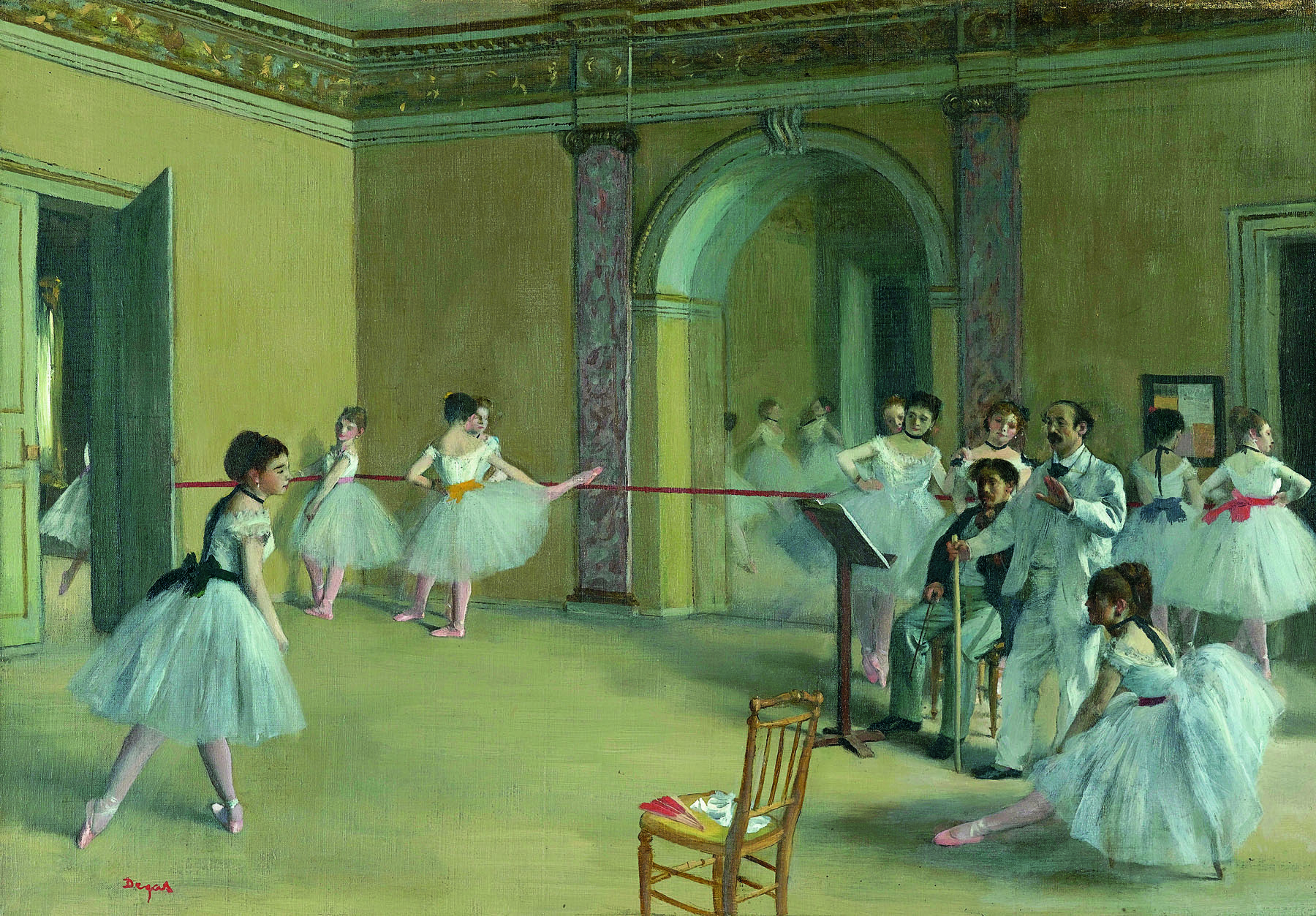
Edgar Degas (French, 1834-1917) 'Rehearsal hall at the Opéra, rue Le Peletier' 1872


Edgar Degas (French, 1834-1917)
Rehearsal hall at the Opéra, rue Le Peletier
1872
Oil on canvas
32.7 x 46.3cm
Musée d’Orsay, Paris
© RMN-Grand Palais (Musée d’Orsay) / Hervé Lewandowski


Edgar Degas (French, 1834-1917) 'The dance rehearsal' c. 1870-1872


Edgar Degas (French, 1834-1917)
The dance rehearsal
c. 1870-1872
Oil on canvas
40.6 x 54.6cm
The Phillips Collection, Washington D.C.
Gift of anonymous donor, initiated 2001, completed 2006


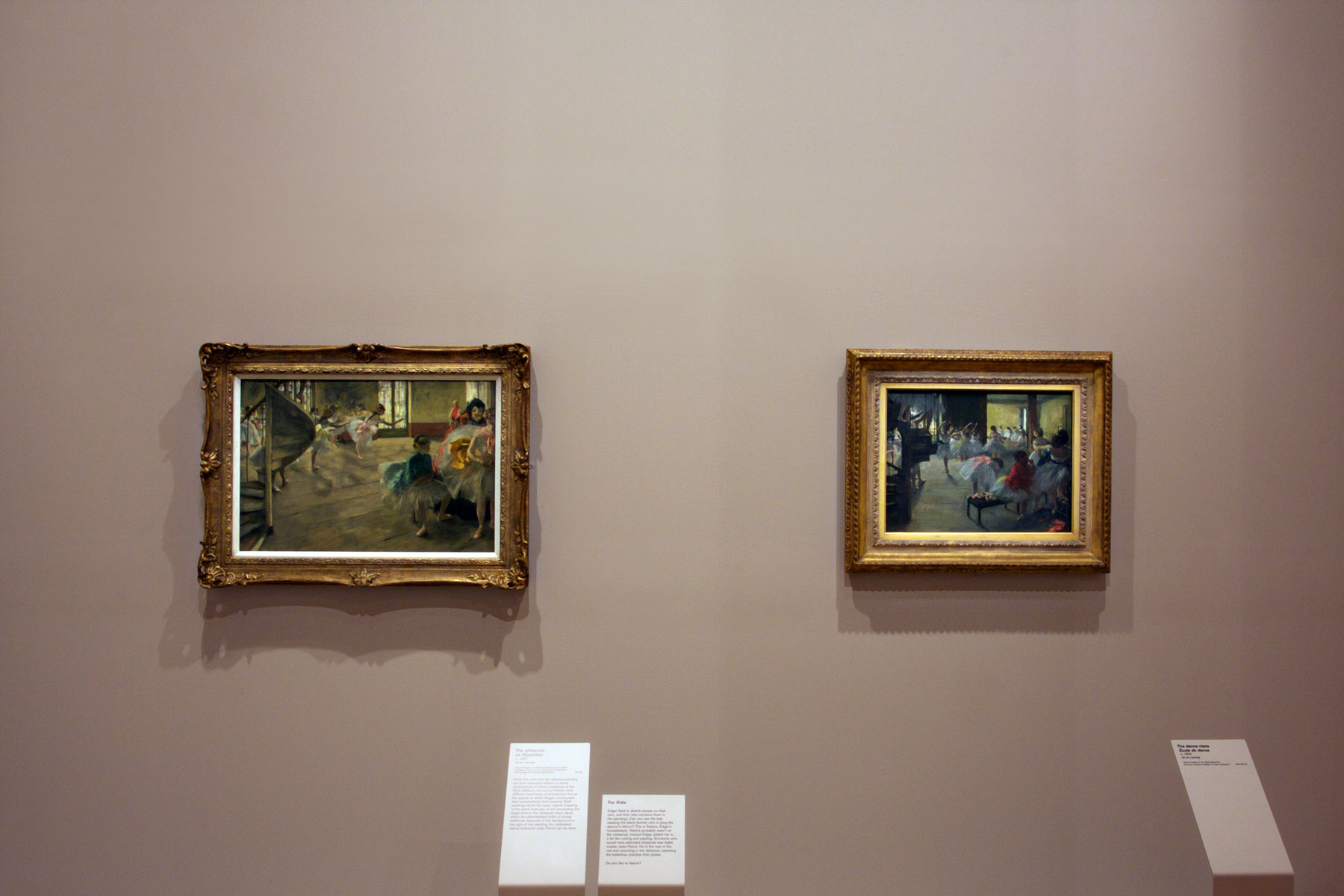
Installation view of the exhibition 'Degas: A New Vision' at the National Gallery of Victoria International, Melbourne showing at left, 'The rehearsal' (c. 1874), and at right 'The dance class' (c. 1873)


Installation view of the exhibition Degas: A New Vision at the National Gallery of Victoria International, Melbourne showing at left, The rehearsal (c. 1874), and at right The dance class (c. 1873)
Photo: © Marcus Bunyan and the National Gallery of Victoria


Edgar Degas (French, 1834-1917) 'The rehearsal' c. 1874 (installation view)


Edgar Degas (French, 1834-1917)
The rehearsal (installation view)
c. 1874
Oil on canvas
58.4 x 83.8cm
Lent by Glasgow Life (Glasgow Museums) on behalf of Glasgow City Council: from the Burrell Collection with the approval of the Burrell Trustees
© CSG CIC Glasgow Museums Collection
Photo: © Marcus Bunyan and the National Gallery of Victoria


Edgar Degas (French, 1834-1917) 'The rehearsal' c. 1874


Edgar Degas (French, 1834-1917)
The rehearsal
c. 1874
Oil on canvas
58.4 x 83.8 cm
Lent by Glasgow Life (Glasgow Museums) on behalf of Glasgow City Council: from the Burrell Collection with the approval of the Burrell Trustees
© CSG CIC Glasgow Museums Collection


First Ballet Works: 1870s

While the friendships he established in the 1860s with musicians such as Désiré Dihau, a bassoon player with the Paris Opéra, brought Degas into the orbit of ballet performances in the French capital, the full extent of his access to this world prior to the mid-1880s remains unknown. This may explain why his many depictions of dancers practising backstage in rehearsal rooms in the 1870s were his own studio inventions rather than accurate depictions of the Opéra’s foyers de la danse.

Degas’ favourite theatrical venues – the Opéra in the rue le Peletier that was destroyed by fire in October 1873 and its replacement, the Palais Garnier, which opened in 1875 – were both located in the 9th arrondissement, close to his studio. Degas exhibited ballet compositions at the ‘impressionist’ group exhibitions from 1874 onwards, all the while resisting the label, arguing that his own art was Realist and meticulously crafted in the studio instead of spontaneously created before nature. When the Galeries Durand-Ruel began acquiring Degas’ paintings in 1872, the artist’s first sales at this time were of ballet subjects. Unlike the romantic perspective through which these scenes are viewed today, Degas’ contemporaries recognised in them a rejection of the surface glamour of ballet’s front of house in favour of a serious study of the gritty reality of life backstage. There, junior impoverished dancers jostled for attention from their trainers, all too frequently prostituting themselves on the side so they could afford to stay in competition for coveted stardom.

While The rehearsal and other similar depictions such as The dance class, c. 1873, are ostensibly based on direct observations of dance rehearsals at the Paris Opéra in the rue Le Peletier, their different treatments of architecture hint at the degree to which Degas constructed their compositions from memory. This painting shows a radical cropping of the spiral staircase at left connecting the stage level to the rehearsal room, down which the disembodied limbs of young ballerinas descend. In the background to the right the celebrated dance instructor Jules Perrot can be seen.

Wall text from the exhibition


Edgar Degas (French, 1834-1917) 'The dance class' c. 1873


Edgar Degas (French, 1834-1917)
The dance class
c. 1873
Oil on canvas
47.6 x 62.2cm
National Gallery, Washington D.C.
Corcoran Collection (William A. Clark Collection)
© Courtesy of National Gallery, Washington


Edgar Degas (French, 1834-1917) 'The dance class' c. 1873 (installation view)


Edgar Degas (French, 1834-1917)
The dance class (installation view)
c. 1873
Oil on canvas
47.6 x 62.2cm
National Gallery, Washington D.C.
Corcoran Collection (William A. Clark Collection)
© Courtesy of National Gallery, Washington
Photo: © Marcus Bunyan and the National Gallery of Victoria


Edgar Degas (French, 1834-1917) 'Dancers on the stage' c. 1899 (installation view)

Edgar Degas (French, 1834-1917) 'Dancers on the stage' c. 1899 (installation view)


Edgar Degas (French, 1834-1917)
Dancers on the stage (installation views)
c. 1899
Oil on canvas
76.0 x 82.0cm
Musée des Beaux-Arts de Lyon
Legs Jacqueline Delubac, 1997
Photos: © Marcus Bunyan and the National Gallery of Victoria


Edgar Degas (French, 1834-1917) 'Dancers on the stage' c. 1899


Edgar Degas (French, 1834-1917)
Dancers on the stage
c. 1899
Oil on canvas
76.0 x 82.0cm
Musée des Beaux-Arts de Lyon
Legs Jacqueline Delubac, 1997
Image © Lyon MBA – Photo RMN / Ojeda, Le Mage


Edgar Degas (French, 1834-1917) 'Dancers on the stage' c. 1899 (detail)


Edgar Degas (French, 1834-1917)
Dancers on the stage (detail)
c. 1899
Oil on canvas
76.0 x 82.0cm
Musée des Beaux-Arts de Lyon
Legs Jacqueline Delubac, 1997


Dancers on the stage looks back to the experiments with pictorial space and repoussoir compositional staging that had so characterised Degas’s ballet works of the 1870s and early 1880s. Repoussoir was a favourite technique for Degas, a technique in which an object place prominently in the foreground of a work serves to emphasise the recession of physical space in the rest of the composition. In an unusual choice for the artist, Degas shows here a dress rehearsal on stage. The attention of the dancers is focused upon the diminutive figure of the dave master in the far left background whose presence ignites a diagonal magnetism that animates the whole painting.

Wall text from the exhibition


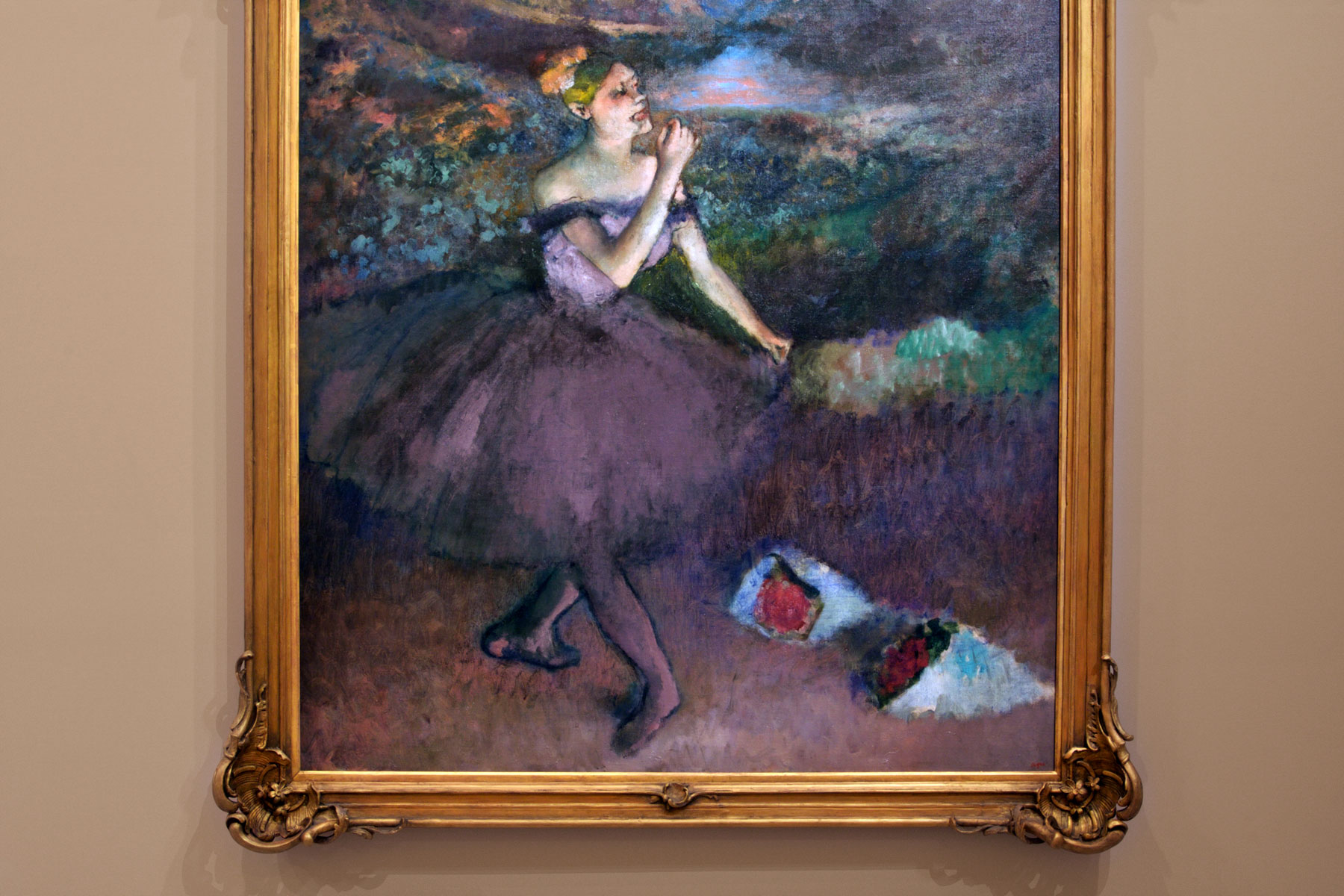
Curator Dr Ted Gott talking to the media standing in front of Degas's 'Dancer with bouquets' c. 1895-1900


Dr Ted Gott, Senior Curator of International Art at the National Gallery of Victoria talking to the media, standing in front of Degas’s Dancer with bouquets c. 1895-1900
Photo: © Marcus Bunyan and the National Gallery of Victoria


Edgar Degas (French, 1834-1917) 'Dancer with bouquets' c. 1895-1900 (installation view)

Edgar Degas (French, 1834-1917) 'Dancer with bouquets' c. 1895-1900 (installation view detail)


Edgar Degas (French, 1834-1917)
Dancer with bouquets (installation view and detail)
c. 1895-1900
Oil on canvas
180.3 x 152.4 cm
Chrysler Museum of Art, Norfolk, Virginia
Gift of Walter P. Chrysler, Jr, in memory of Della Viola Forker Chrysler
Photos: © Marcus Bunyan and the National Gallery of Victoria


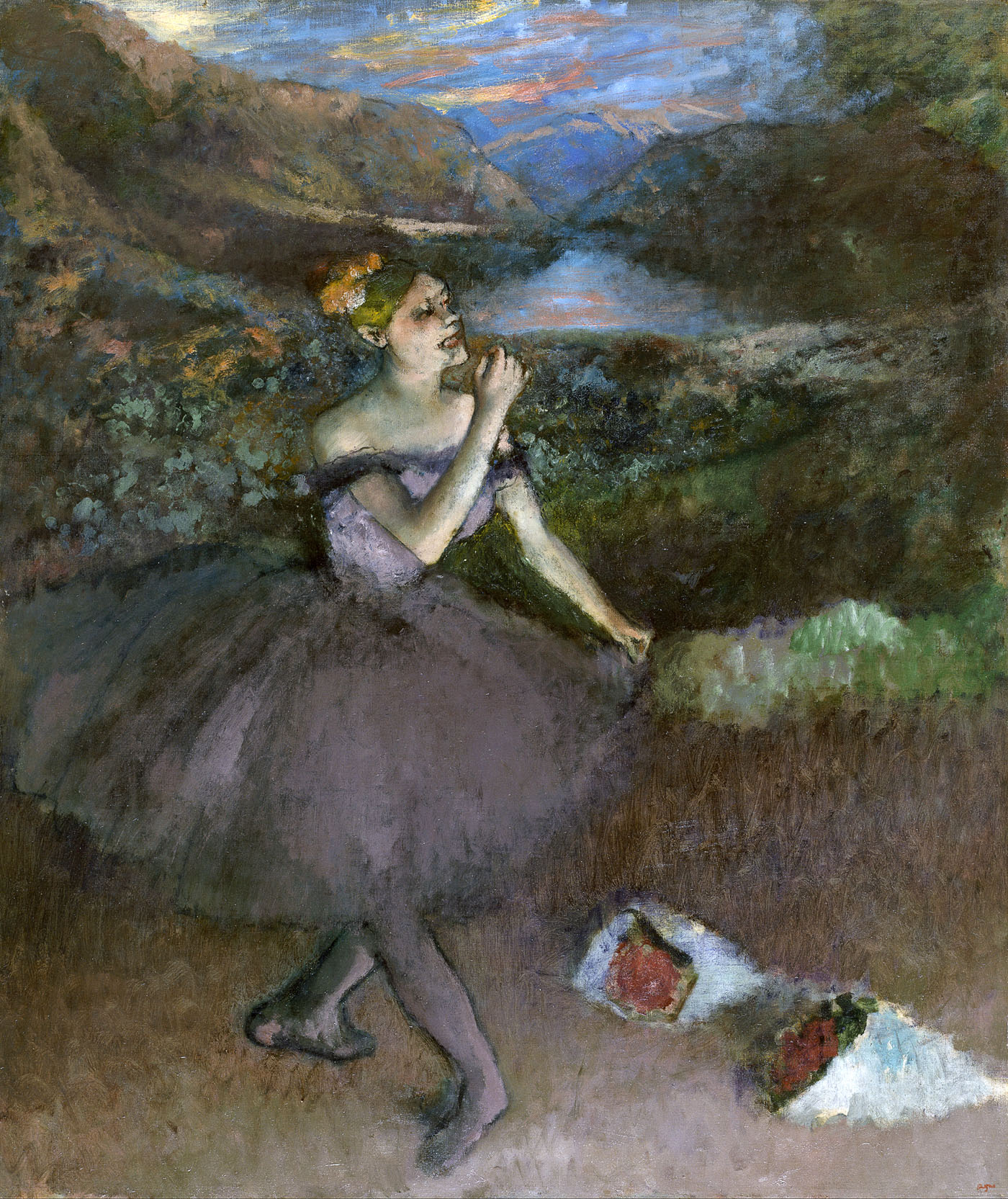
Edgar Degas (French, 1834-1917) 'Dancer with bouquets' c. 1895-1900


Edgar Degas (French, 1834-1917)
Dancer with bouquets
c. 1895-1900
Oil on canvas
180.3 x 152.4cm
Chrysler Museum of Art, Norfolk, Virginia
Gift of Walter P. Chrysler, Jr, in memory of Della Viola Forker Chrysler


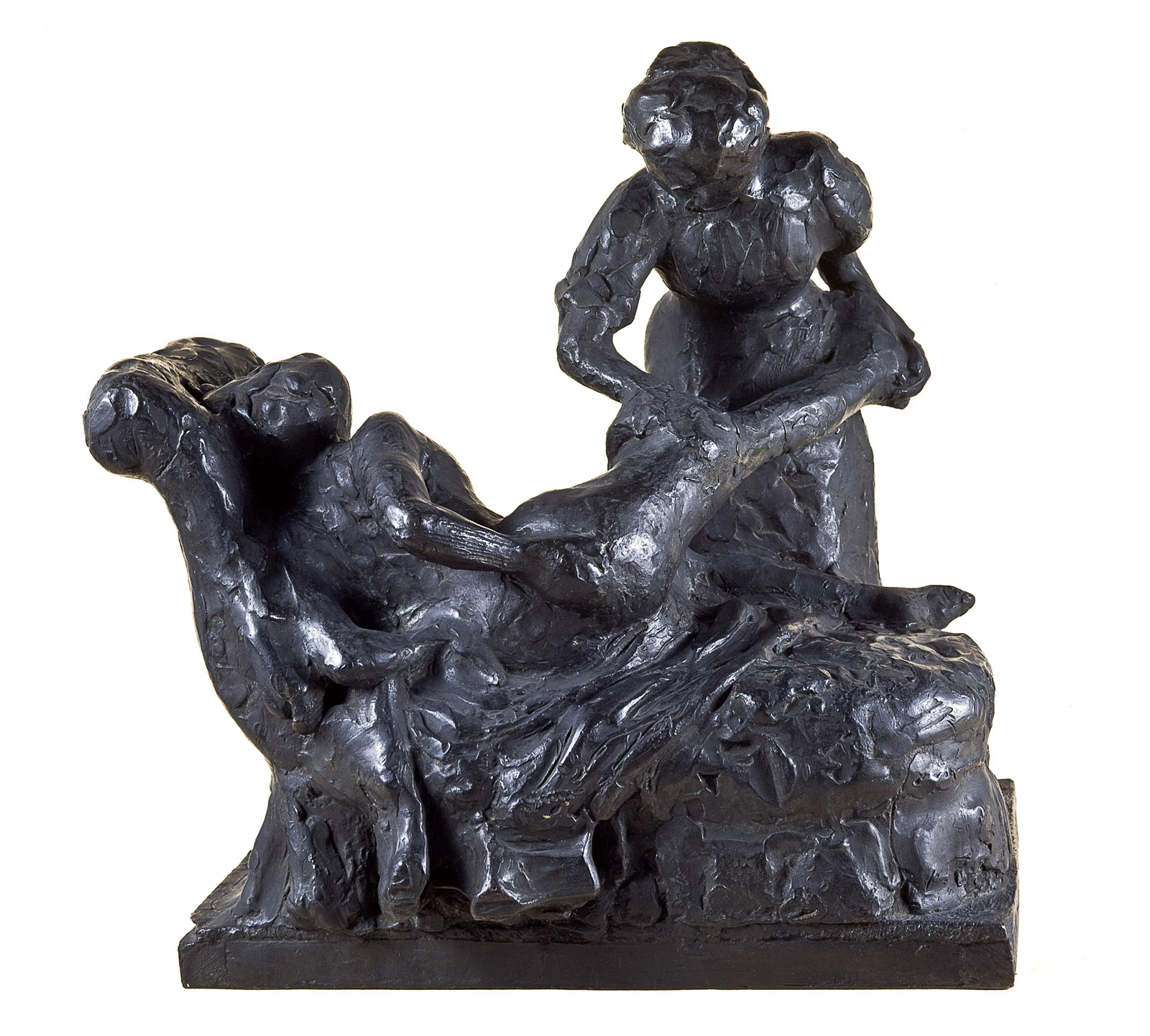
Sculptures

Although Degas exhibited only one sculpture during his lifetime, The little fourteen-year old dancer, he worked in this medium in privacy in his studio from the 1860s until the 1910s. His primary subjects were thoroughbred racehorses, female dances and women at the toilette, and he modelled his sculptures in wax, over steel wire and cork armatures. Never satisfied, he made, destroyed and remade them repeatedly. As Degas’s eyesight deteriorated in his later years, making three-dimensional figures fulfilled a physical and emotional need that transcended any desire to perfect a finished object; he allegedly side that sculpture was ‘a blind man’s trade’.

After Degas’s death in 1917, some 150 wax sculptures were found in his studio, some broken but many intact. His heirs subsequently authorised the casting in bronze of seventy-four of the most intact of Degas’s sculptures. While many of Degas’s original wax sculptures still survive, they are too fragile to travel. These bronzes allow wider audiences today to engage with some of the most beautiful sculptures of the nineteenth century.

Wall text from the exhibition


Installation view of the exhibition 'Degas: A New Vision' at the National Gallery of Victoria International, Melbourne

Installation view of the exhibition 'Degas: A New Vision' at the National Gallery of Victoria International, Melbourne

Installation view of the exhibition 'Degas: A New Vision' at the National Gallery of Victoria International, Melbourne

Installation view of the exhibition 'Degas: A New Vision' at the National Gallery of Victoria International, Melbourne

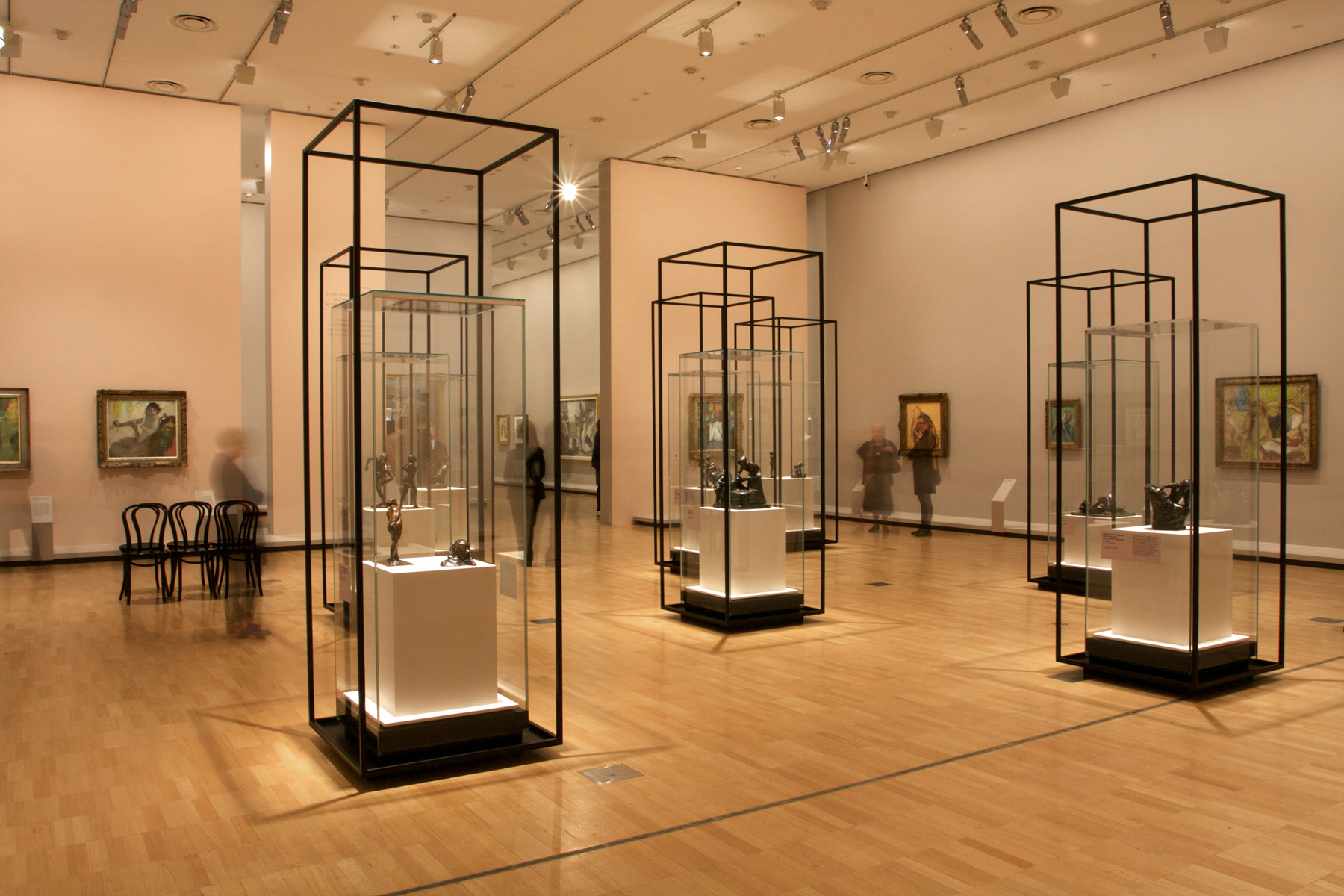
Installation view of the exhibition 'Degas: A New Vision' at the National Gallery of Victoria International, Melbourne showing the sculpture cases


Installation views of the exhibition Degas: A New Vision at the National Gallery of Victoria International, Melbourne showing the sculpture cases
Photos: © Marcus Bunyan and the National Gallery of Victoria


Edgar Degas (French, 1834-1917) 'The tub' 1888-1889


Edgar Degas (French, 1834-1917)
The tub
1888-89, cast 1919-32
Bronze
22.5 x 45.0 x 42.0cm
Czestochowski/Pingeot 26 (cast S)
Museu de Arte de São Paulo, Assis Chateaubriand
Donated by Alberto José Alves, Alberto Alves Filho and Alcino Ribeiro de Lima


Edgar Degas (French, 1834-1917) 'The masseuse' c. 1896-1911


Edgar Degas (French, 1834-1917)
The masseuse
c. 1896-1911, cast 1919-32
Bronze
43 x 38 x 30cm
Czestochowski/Pingeot 55 (cast S)
Museu de Arte de São Paulo, Assis Chateaubriand
Donated by Alberto José Alves, Alberto Alves Filho and Alcino Ribeiro de Lima


Edgar Degas (French, 1834-1917) 'Seated woman wiping her left side' c. 1901-1911


Edgar Degas (French, 1834-1917)
Seated woman wiping her left side
c. 1901-11, cast 1919-32
Bronze
35 x 30.5 x 30.4cm
Czestochowski/Pingeot 46 (cast S)
Museu de Arte de São Paulo, Assis Chateaubriand
Donated by Alberto José Alves, Alberto Alves Filho and Alcino Ribeiro de Lima


Edgar Degas (French, 1834-1917) 'Dancer adjusting the shoulder strap of her bodice' 1882-1895


Edgar Degas (French, 1834-1917)
Dancer adjusting the shoulder strap of her bodice
1882-95, cast 1919-32
Bronze
35.2 x 15.9 x 11.8cm
Czestochowski/Pingeot 64 (cast S)
Museu de Arte de São Paulo, Assis Chateaubriand
Donated by Alberto José Alves, Alberto Alves Filho and Alcino Ribeiro de Lima


Edgar Degas (French, 1834-1917) 'Dancer looking at the sole of her right foot' (Second study) c. 1900-1910


Edgar Degas (French, 1834-1917)
Dancer looking at the sole of her right foot (Second study)
c. 1900-1910, cast 1919-1937 or later
Bronze
47.3 x 24.3 x 20.8cm
Czestochowski/Pingeot 59 (cast T)
National Gallery of Victoria, Melbourne
Purchased with funds donated by Leigh Clifford AO and Sue Clifford, 2016


Edgar Degas (French, 1834-1917) 'The laundress ironing' c. 1882-1886 (installation view)


Edgar Degas (French, 1834-1917)
The laundress ironing (installation view)
c. 1882-1886
Oil on canvas
64.8 x 66.7cm
Reading Public Museum, Pennsylvania Gift, Miss Martha Elizabeth Dick Estate
© Courtesy of the Reading Public Museum, Pennsylvania
Photo: © Marcus Bunyan and the National Gallery of Victoria


Edgar Degas (French, 1834-1917) 'The laundress ironing' c. 1882-1886


Edgar Degas (French, 1834-1917)
The laundress ironing
c. 1882-1886
Oil on canvas
64.8 x 66.7cm
Reading Public Museum, Pennsylvania Gift, Miss Martha Elizabeth Dick Estate
© Courtesy of the Reading Public Museum, Pennsylvania


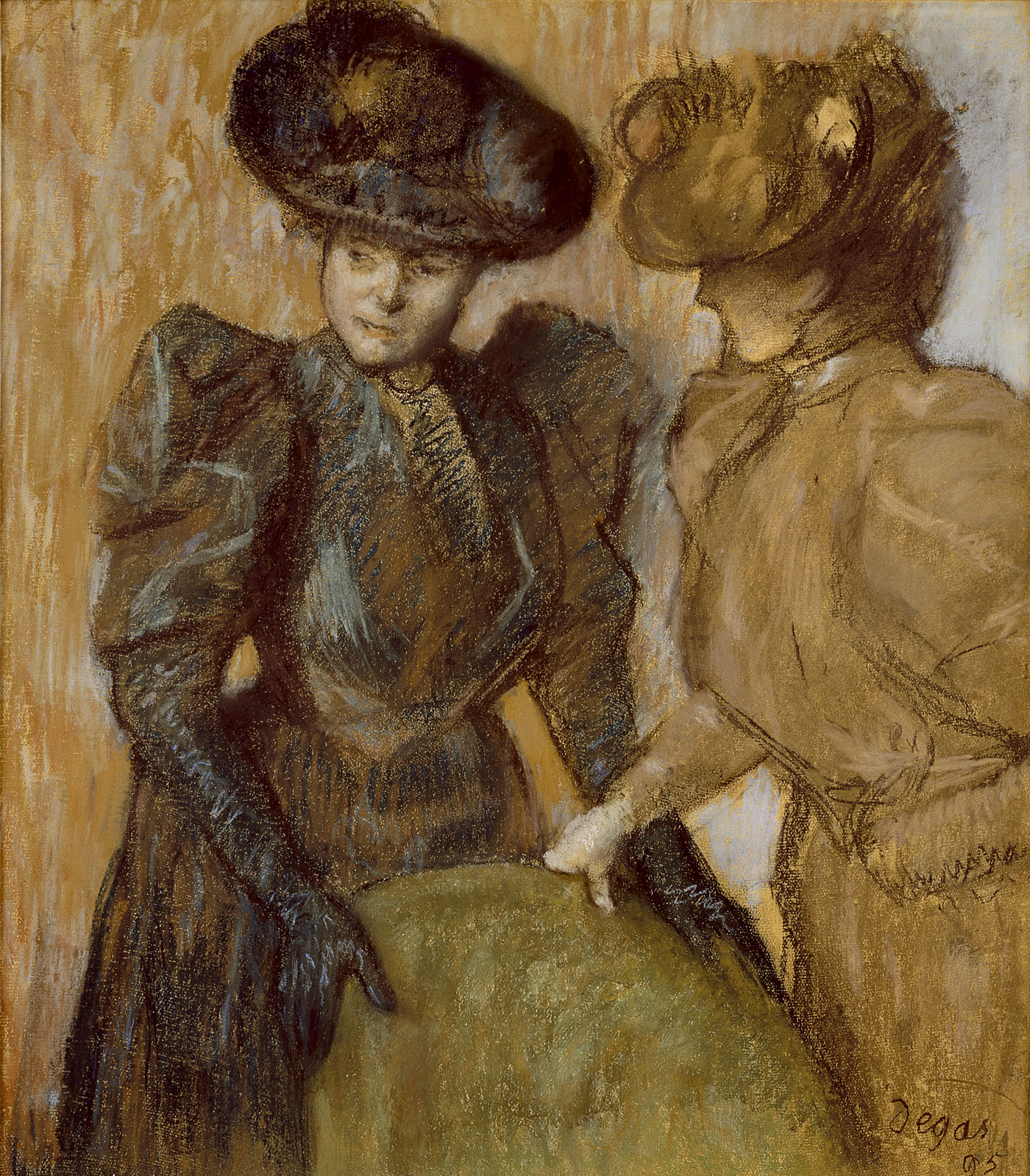
Edgar Degas (French, 1834-1917) 'The Conversation' 1895 (installation view)


Edgar Degas (French, 1834-1917)
The Conversation (installation view)
1895
Pastel
65 x 50cm (sheet)
Acquavella Galleries
© Courtesy of Acquavella Galleries
Photo: © Marcus Bunyan and the National Gallery of Victoria


Edgar Degas (French, 1834-1917) 'The Conversation' 1895


Edgar Degas (French, 1834-1917)
The Conversation
1895
Pastel
65 x 50cm (sheet)
Acquavella Galleries
© Courtesy of Acquavella Galleries


Walter Sickert recalled Degas speaking of his obsession with observing women at their most private moments. He wanted to look at their private activities through keyholes, according to Sickert: ‘He said that painters too much made of women formal portraits, whereas their hundred and one gestures, their chatteries, &c., should inspire an infinite variety of design’. The Conversation reflects the artist’s love of Japanese woodblock prints and their frequently intimate subject matter. The specifics of setting are only alluded to in this exquisite pastel, the emphasis being placed instead upon the close relationship between these two elegant Parisiennes.

Wall text from the exhibition


Edgar Degas (French, 1834-1917) 'Rose Caron' c. 1892 (installation view)


Edgar Degas (French, 1834-1917)
Rose Caron (installation view)
c. 1892
Albright-Knox Art Gallery, Buffalo
Photo: © Marcus Bunyan and the National Gallery of Victoria


Women at their toilettes: 1880s and 1890s

In 1875 pastel became one of Degas’s favourite techniques. Gustave Moreau had introduced him to this medium during their time together in Italy during the late 1850s, and the increasing interest in pastel in artistic circles during the 1870s influenced Degas’s choice to explore its potential. At the eighth and last ‘impressionist’ group exhibition in 1886 Degas exhibited a suite of pastel studies of women bathing that challenged conventional notions of feminine beauty in their depiction of non-idealised jolie-laide (unconventionally beautiful) models. George Moore wrote tellingly of these nudes: ‘The effect is prodigious. Degas has done what Baudelaire did – he has invented un frisson nouveau (a new sensation)’.

Because intimate access to female ablutions was rarely experience by husbands in bourgeois married life at the time, it was assumed by critics and audiences that Degas’s female nudes were performing their toilettes in a brothel setting. The close observation of undressed women engaged in private acts of washing and drying themselves led Degas’s ongoing status as a bachelor to become a topic of speculation in both the art world and wider social circles.

Wall text from the exhibition


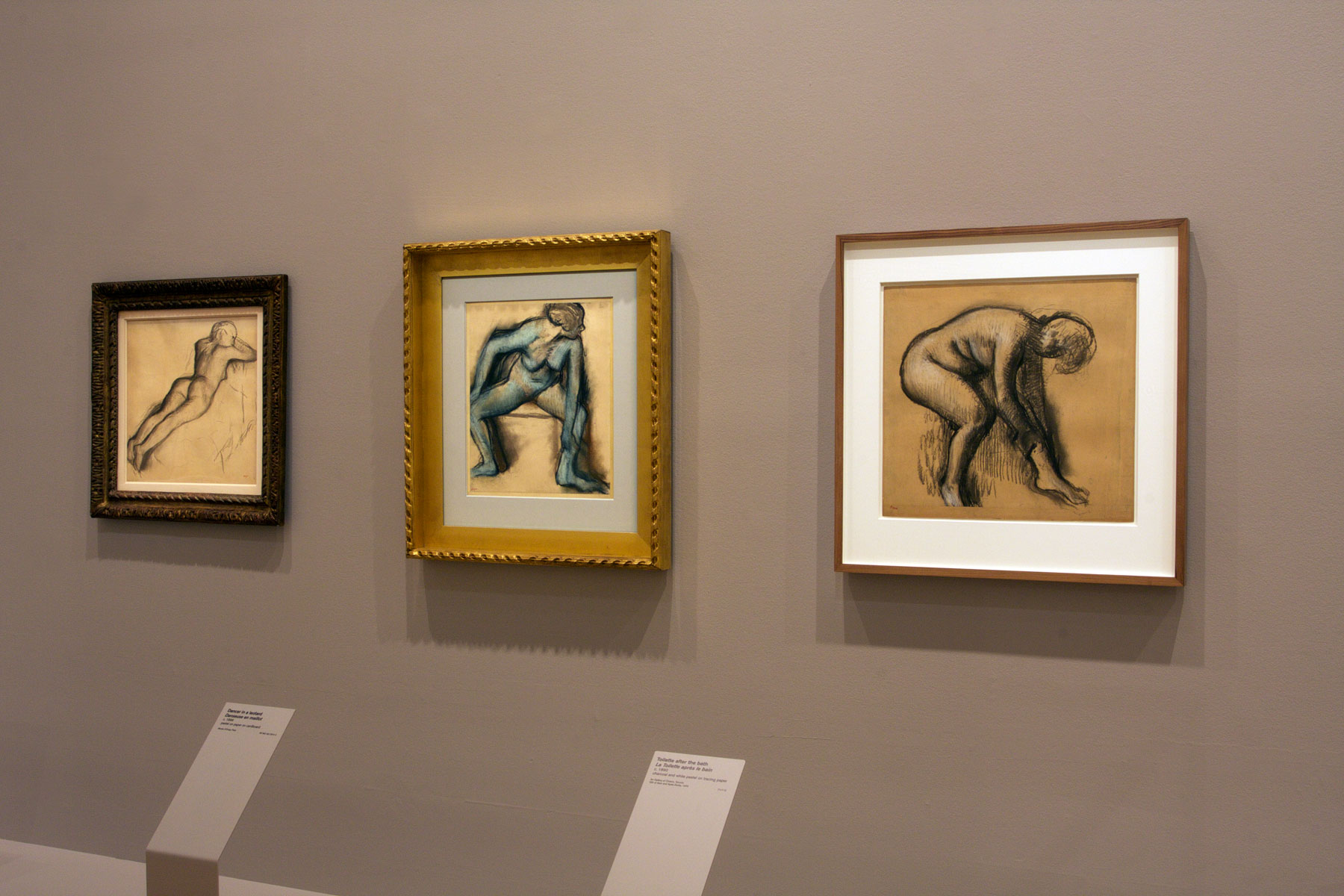
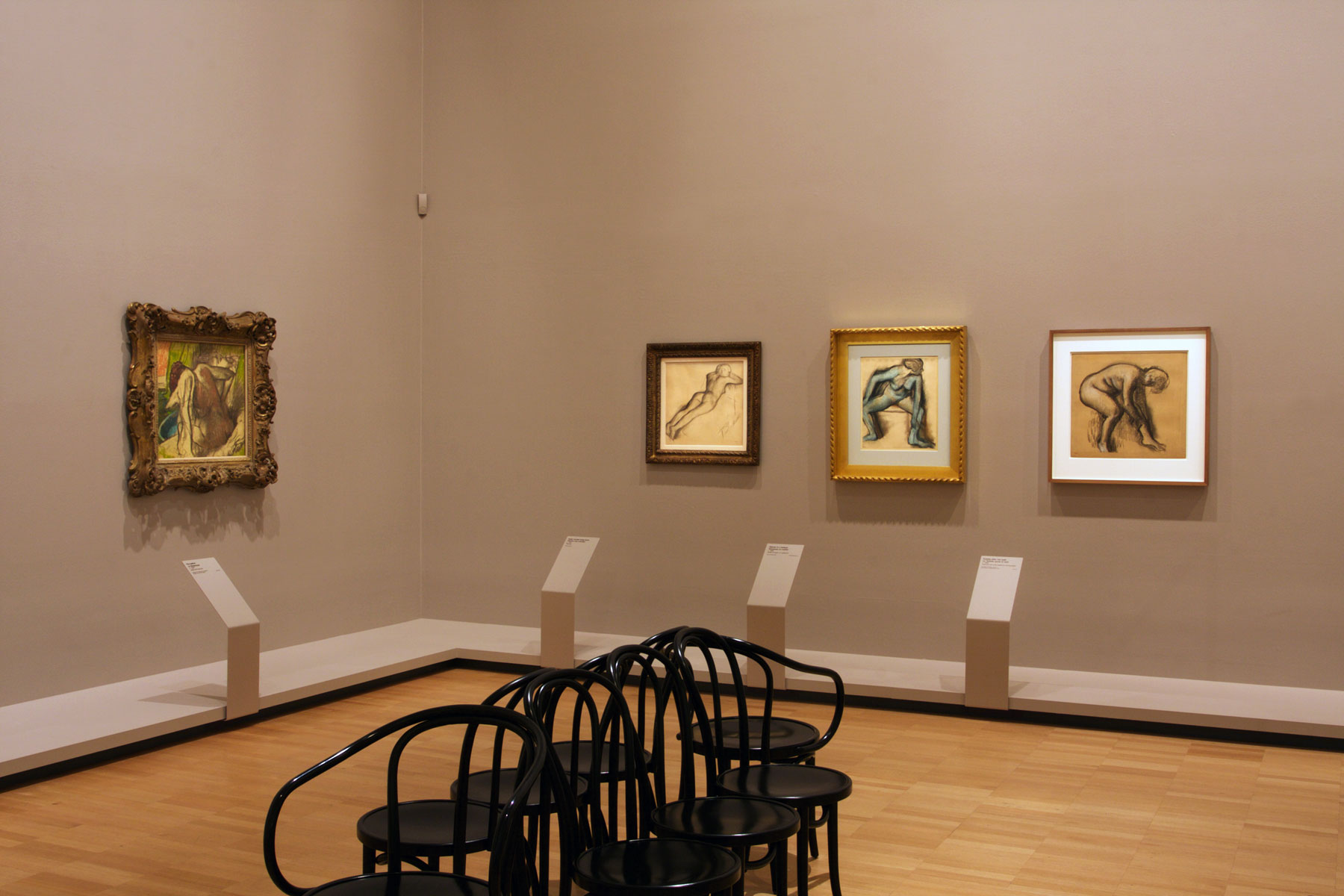
Installation view of the exhibition 'Degas: A New Vision' at the National Gallery of Victoria International, Melbourne with, from left to right, 'Nude woman lying down' (c. 1901), 'Dancer in a leotard' (c. 1896) and 'Toilette after the bath' (c. 1890)


Installation views of the exhibition Degas: A New Vision at the National Gallery of Victoria International, Melbourne with, from left to right, Nude woman lying down (c. 1901), Dancer in a leotard (c. 1896) and Toilette after the bath (c. 1890)
Photo: © Marcus Bunyan and the National Gallery of Victoria


Installation view of the exhibition 'Degas: A New Vision' at the National Gallery of Victoria International, Melbourne

Installation view of the exhibition 'Degas: A New Vision' at the National Gallery of Victoria International, Melbourne showing at centre left, 'The Bather' (La Baigneuse), c. 1895


Installation views of the exhibition Degas: A New Vision at the National Gallery of Victoria International, Melbourne showing at centre left in the bottom image, The Bather (La Baigneuse), c. 1895
Photos: © Marcus Bunyan and the National Gallery of Victoria


Edgar Degas (French, 1834-1917) 'La Baigneuse [The bather]' c. 1895


Edgar Degas (French, 1834-1917)
The Bather (La Baigneuse) (installation view)
c. 1895
Pastel and charcoal on paper
Bequest, Henry K. Dick Estate
Photo: © Marcus Bunyan and the National Gallery of Victoria


Edgar Degas (French, 1834-1917) 'Femme a la toilette [Woman at he toilette] c. 1895-1900 (installation view)


Edgar Degas (French, 1834-1917)
Femme à la toilette [Woman at he toilette] (installation view)
c. 1895-1900
Oil on canvas
Private collection
Photo: © Marcus Bunyan and the National Gallery of Victoria


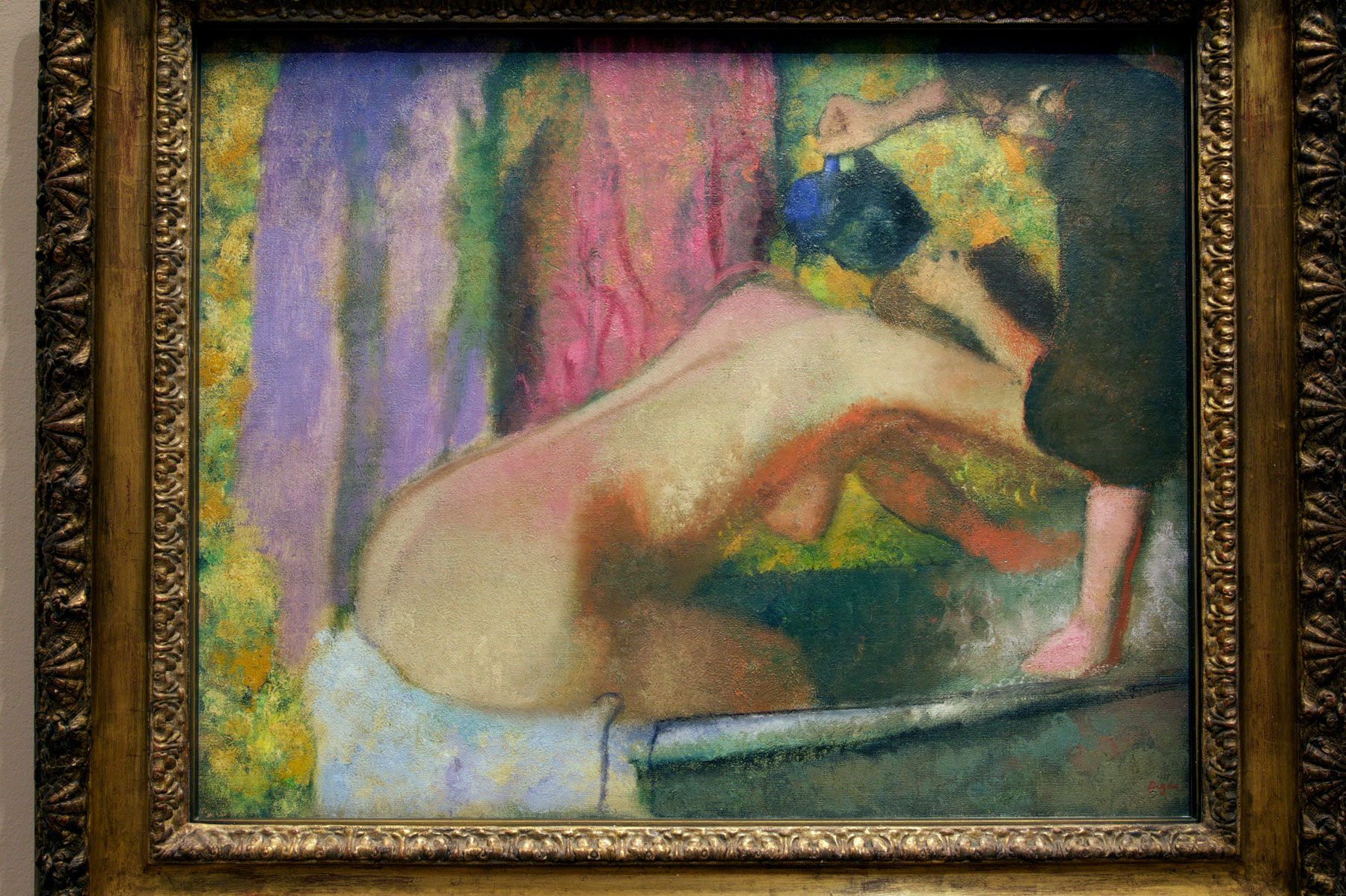
Edgar Degas (French, 1834-1917) 'Femme a la toilette [Woman at her toilette] c. 1894 (installation view)


Edgar Degas (French, 1834-1917)
Femme à la toilette [Woman at her toilette] (installation view)
c. 1894
Charcoal and pastel on paper
956 x 1099mm
Tate, London
Presented by C. Frank Stoop 1933
© Tate, London 2016
Photo: © Marcus Bunyan and the National Gallery of Victoria


Edgar Degas (French, 1834-1917) 'Femme a la toilette [Woman at her toilette] c. 1894


Edgar Degas (French, 1834-1917)
Femme à la toilette [Woman at her toilette]
c. 1894
Charcoal and pastel on paper
956 x 1099mm
Tate, London
Presented by C. Frank Stoop 1933
© Tate, London 2016


The repetitive work involved in a woman’s daily maintenance of her hair appealed greatly to Degas. As early as 187 he asked whether he could observe Geneviève Halévy, a cousin of his old school friend Ludovic, performing this private tasks. Woman at her toilette is a fascinating study of a woman’s labour-intensive morning routine, drawn with a sense of pathos and human frailty. As well as reflecting the artist’s love of Japanese woodblock prints with their frequently intimate subject matter, in this late drawing Degas applied his vivid pigments with an almost sculptural intensity, building them up as though modelling form with his fingers.

Wall text from the exhibition


Edgar Degas (French, 1834-1917) 'Woman in a Tub' 1883


Edgar Degas (French, 1834-1917)
Woman in a Tub
c. 1883
Pastel on paper
70 x 70cm
Tate, London
Bequeathed by Mrs A.F. Kessler 1983
© Tate, London 2016


Edgar Degas (French, 1834-1917) 'Woman at her bath' c. 1895


Edgar Degas (French, 1834-1917)
Woman at her bath
c. 1895
Oil on canvas
71.1 x 88.9cm
Art Gallery of Ontario, Toronto
Purchase, Frank P. Wood Endowment, 1956
© 2016 Art Gallery of Ontario


Edgar Degas (French, 1834-1917) 'Woman at her bath' c. 1895 (installation view)


Edgar Degas (French, 1834-1917)
Woman at her bath (installation view)
c. 1895
Oil on canvas
71.1 x 88.9cm
Art Gallery of Ontario, Toronto
Purchase, Frank P. Wood Endowment, 1956
© 2016 Art Gallery of Ontario
Photo: © Marcus Bunyan and the National Gallery of Victoria


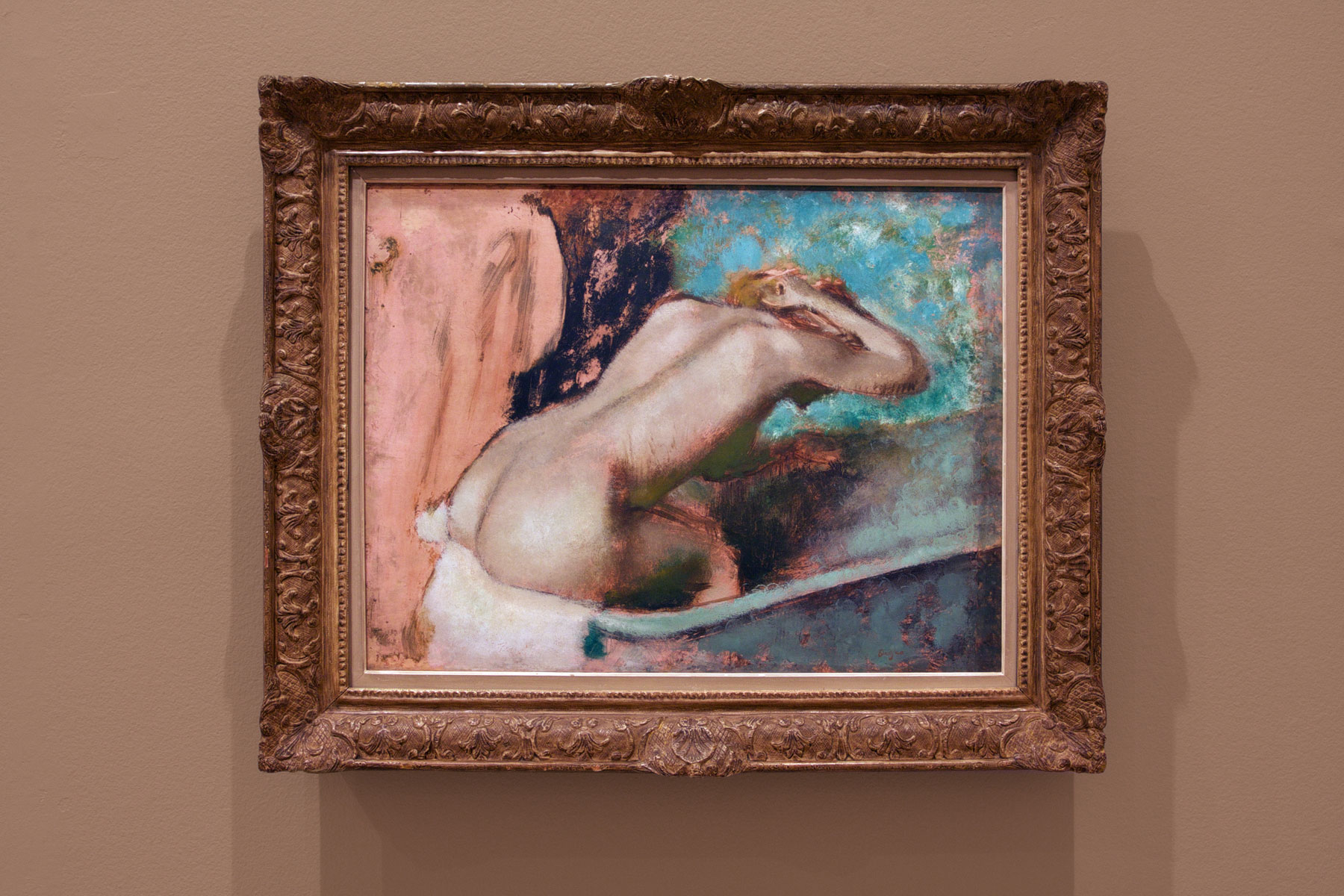
Edgar Degas (French, 1834-1917) 'Woman seated on the edge of the bath sponging her neck' 1880-1895 (installation view)


Edgar Degas (French, 1834-1917)
Woman seated on the edge of the bath sponging her neck (installation view)
1880-1895
Oil and essence on paper mounted to canvas
52.2 x 67.5 cm
Musée d’Orsay, Paris
© RMN-Grand Palais (Musée d’Orsay) / Hervé Lewandowski
Photo: © Marcus Bunyan and the National Gallery of Victoria


Edgar Degas (French, 1834-1917) 'Woman seated on the edge of the bath sponging her neck' 1880-1895


Edgar Degas (French, 1834-1917)
Woman seated on the edge of the bath sponging her neck
1880-1895
Oil and essence on paper mounted to canvas
52.2 x 67.5cm
Musée d’Orsay, Paris
© RMN-Grand Palais (Musée d’Orsay) / Hervé Lewandowski


Installation view of the exhibition 'Degas: A New Vision' at the National Gallery of Victoria International, Melbourne showing at right, 'Femme au Tub' [Nude woman drying herself] c. 1884-1886


Installation view of the exhibition Degas: A New Vision at the National Gallery of Victoria International, Melbourne showing at right, Femme au Tub [Nude woman drying herself] c. 1884-1886
Photo: © Marcus Bunyan and the National Gallery of Victoria


Edgar Degas. 'Femme au Tub [Nude woman drying herself]' c. 1884-1886 (installation view)


Edgar Degas (French, 1834-1917)
Femme au Tub [Nude woman drying herself] (installation view)
c. 1884-1886
Oil on canvas
Brooklyn Museum, New York
Photo: © Marcus Bunyan and the National Gallery of Victoria


Horse racing


Broken staccato heralds its approach,
strong, steaming breath, as early as the dawn,
kept to its straining pace by stable lad,
the fine colt gallops throwing up the dew.


Edgar Degas


Racecourses: 1860s

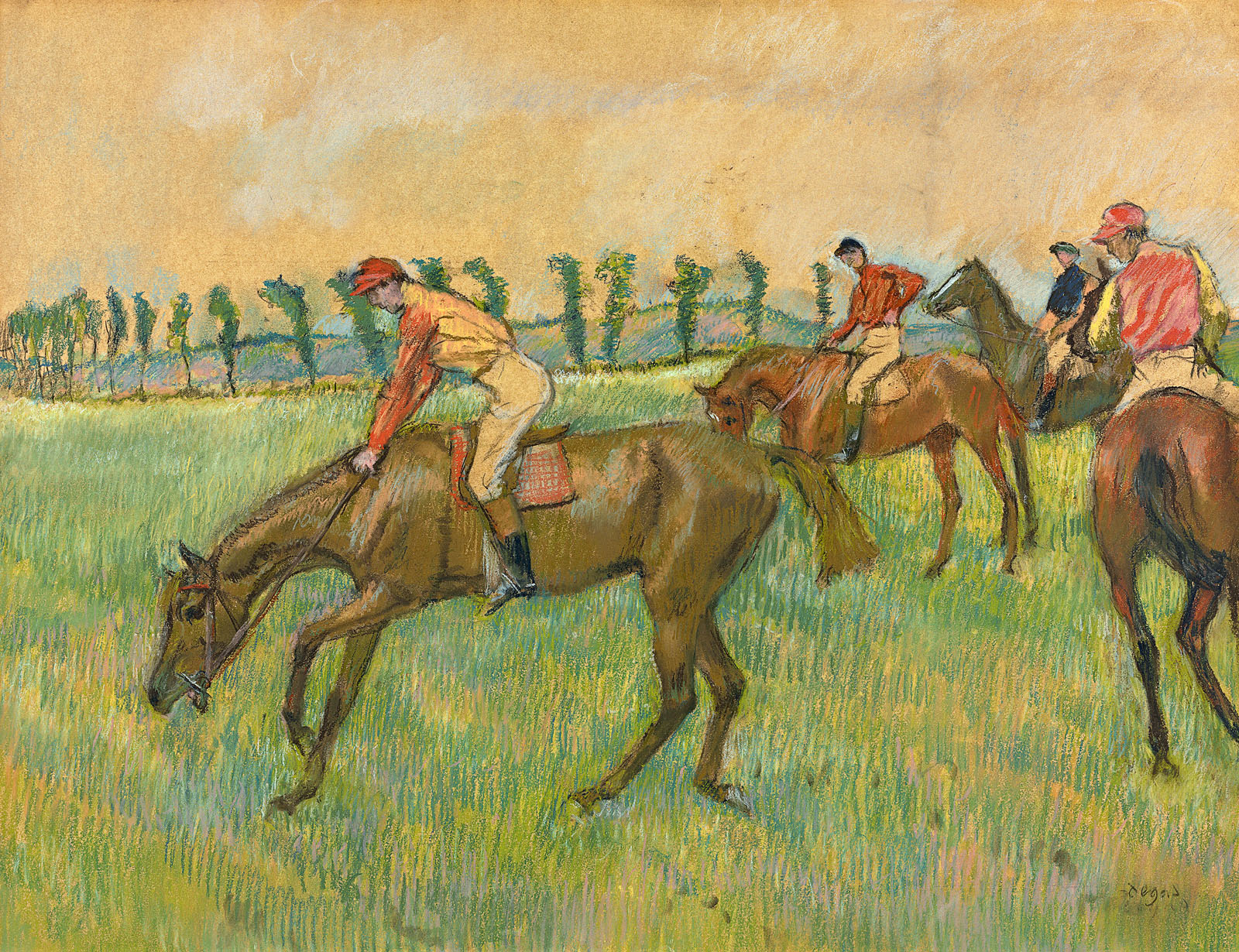
Horse racing was Degas’s first recurrent modern subject, and preceded his dance classes and opera scenes. In 1861 Degas visited Ménil-Hubert in the Normandy countryside, the family estate of his old school friend Paul Valpinçon, situated near to the Haras-le-Pin stud and the Argentan racecourse. The recreational sports of horse racing and the steeplechase now offered him scope for exploring contemporary narrative painting. In pre-mechanised Europe, horses were as ubiquitous as the car is today. They were an essential part of life, whether for work or pleasure, and Degas was accordingly fascinated by these magnificent creatures. They feature in his earliest sketchbooks when he carefully copied equestrian subjects after the Parthenon frieze sculptures and the Italian Old Masters Paolo Uccello and Benozzo Gozzoli; and he continuously drew, painted and sculpted horses until his death.

Degas’s approach to depicting horses embodies his lifelong methodology. He studied and copied how they were represented by specialist animalier artists, as well as by the Old Masters, and he spent many hours observing and examining them. How he portrayed horses changed over time and his earliest works reveal a slightly tentative and clichéd manner as he struggled for perfection. As his art evolved, his images of horses became more innovative and remarkable: he attained great precision in their appearance yet the rendering remained tactile and lively. He also perfectly captured the physical relationship between rider and horse through all the different poses they struck, whether at rest or in full flight. Few artists have reproduced the grace, power and elegance of horses as well as Degas.

Wall text from the exhibition


Edgar Degas (French, 1834-1917) 'Out of the paddock (Racehorses)' c. 1871-1872, reworked c. 1874-1878


Edgar Degas (French, 1834-1917)
Out of the paddock (Racehorses)
c. 1871-1872, reworked c. 1874-1878
Oil on wood panel
32.5 x 40.5cm
Private collection


Edgar Degas (French, 1834-1917) 'Chevaux de courses [Racehorses]' c. 1895-1899 (installation view)


Edgar Degas (French, 1834-1917)
Chevaux de courses [Racehorses] (installation view)
c. 1895-1899
Pastel on tracing paper on cardboard
55.8 x 64.8cm
National Gallery of Canada, Ottawa
Purchase 1950
Photo: © Marcus Bunyan and the National Gallery of Victoria


Edgar Degas (French, 1834-1917) 'Chevaux de courses [Racehorses]' c. 1895-1899


Edgar Degas (French, 1834-1917)
Racehorses
c. 1895-1899
Pastel on tracing paper on cardboard
55.8 x 64.8cm
National Gallery of Canada, Ottawa
Purchased 1950
Photo © NGC


Edgar Degas (French, 1834-1917) 'Before the race' c. 1883-1890


Edgar Degas (French, 1834-1917)
Before the race
c. 1883-1990
Pastel
49 x 62cm (sheet)
Private collection


Photography

By the time he began making photographs in 1895, Degas was 61 years old and the eighth and final Impressionist exhibition was a decade behind him. Daniel Halévy, son of his old friends Ludovic and Louise Halévy, introduced Degas to photography, prompting the artist to acquire a camera that required glass plates and a tripod. In a burst of creative energy that lasted less than five years, he made a body of photographs of which fewer than 50 survive…

Exactly why Degas took up photography remains unknown. Clearly, photography provided a new pair of eyes during the period when his eyesight was failing. The illness and death of his sister, Marguerite, in 1895 and his brother Achille in 1893 may also have played a role. Photographs were for Degas a powerful tool of memory to recall his loved ones, and the activity of photographing bound him closely to an extended family-the Halévys-that embraced him in his time of grief…

Degas often illuminated his subjects with a single bright light source. The figures seem to emerge from darkness. In a series of individual portraits he made of Daniel and Louise Halévy in the autumn of 1895, each sitter is pictured in the same armchair in their home, under this Rembrandtesque light. They are seen in original contact prints (about 3 x 4 inches) and in enlargements. Altogether, these images show the artist’s picture-making process and reveal Degas’ manipulations of space, scale, focus, and emotional effect. In Louise Halévy Reading to Degas (J. Paul Getty Museum), another enlargement from a contact print done about the same time, Degas conveys unusual intimacy. It shows a vulnerable man’s dependence upon a friend in reading the newspaper at a time when his eyesight was failing.

Text from the J. Paul Getty Museum website. No longer available online


“These days, Degas abandons himself entirely to his new passion for photography,” wrote an artist friend in autumn 1895, the moment of the great Impressionist painter’s most intense exploration of photography. Degas’s major surviving photographs little known even among devotees of the artist’s paintings and pastels, are insightfully analysed and richly reproduced for the first time in this volume, which accompanies an exhibition at The Metropolitan Museum of Art, The J. Paul Getty Museum, and the Bibliothéque Nationale de France.

Degas’s photographic figure studies, portraits of friends and family, and self-portraits – especially those in which lamp-lit figures emerge from darkness – are imbued with a Symbolist spirit evocative of realms more psychological than physical. Most were made in the evenings, when Degas transformed dinner parties into photographic soirees, requisitioning the living rooms of his friends, arranging oil lamps, and directing the poses of dinner guests enlisted as models. “He went back and forth … running from one end of the room to the other with an expression of infinite happiness,” wrote Daniel Halévy, the son of Degas’s close friends Ludovic and Louise Halévy, describing one such evening. “At half-past eleven everybody left; Degas, surrounded by three laughing girls, carried his camera as proudly as a child carrying a rifle.”

Text from The Met website


Installation view of the exhibition 'Degas: A New Vision' at the National Gallery of Victoria International, Melbourne with at right, 'Paul Gobillard, Jeannie Gobillard, Julie Manet, and Geneviève Mallarmé' (16 December 1895)


Installation view of the exhibition Degas: A New Vision at the National Gallery of Victoria International, Melbourne with at right, Paul Gobillard, Jeannie Gobillard, Julie Manet, and Geneviève Mallarmé (16 December 1895, below)
Photo: © Marcus Bunyan and the National Gallery of Victoria


Edgar Degas (French, 1834-1917) 'Paul Gobillard, Jeannie Gobillard, Julie Manet, and Genevieve Mallarme' 16 December 1895 (installation view)


Edgar Degas (French, 1834-1917)
Paul Gobillard, Jeannie Gobillard, Julie Manet, and Geneviève Mallarmé (installation view)
16 December 1895
Gelatin silver print
The Metropolitan Museum of Art, New York
Photo: © Marcus Bunyan and the National Gallery of Victoria


Edgar Degas (French, 1834-1917) 'Self-portrait with Zoé Closier' probably Autumn 1895


Edgar Degas (French, 1834-1917)
Self-portrait with Zoé Closier
Probably Autumn 1895
Gelatin silver print
18.2 x 24.2cm (image and sheet)
Bibliothèque Nationale de France


Edgar Degas (French, 1834-1917) 'Self-portrait with Zoé Closier' probably Autumn 1895 (installation view)


Edgar Degas (French, 1834-1917)
Self-portrait with Zoé Closier (installation view)
Probably Autumn 1895
Gelatin silver print
18.2 x 24.2cm (image and sheet)
Bibliothèque Nationale de France
Photo: © Marcus Bunyan and the National Gallery of Victoria


Edgar Degas (French, 1834-1917) 'Self-portrait with Bartholome's Weeping girl' probably Autumn 1895 (installation view)


Edgar Degas (French, 1834-1917)
Self-portrait with Bartholomé’s Weeping girl (installation view)
Probably Autumn 1895
Gelatin silver print
Musée d’Orsay, Paris
Photo: © Marcus Bunyan and the National Gallery of Victoria


Edgar Degas (French, 1834-1917) 'Daniel Halévy' 14 October 1895


Edgar Degas (French, 1834-1917)
Daniel Halévy
14 October 1895
Gelatin silver print
40.0 x 29.4cm (image and sheet)
Musée d’Orsay, Paris
Gift of the children of Mme Halévy-Joxe
Photo © RMN – Hervé Lewandowski


Late works


Edgar Degas (French, 1834-1917) 'Three dancers' 1896-1905


Edgar Degas (French, 1834-1917)
Les Trois Danseuses [Three dancers]
1896-1905
Pastel
51 x 47cm
Lent by Glasgow Life (Glasgow Museums) on behalf of Glasgow City Council: from the Burrell Collection with the approval of the Burrell Trustees (35.249)
© CSG CIC Glasgow Museums Collection


Pastel entitled Les Trois Danseuses, depicting three ballet dancers, apparently making an entry, wearing yellow ballet skirts.


Edgar Degas (French, 1834-1917) 'Group of dancers (red skirts)' 1895-1900 (installation view)


Edgar Degas (French, 1834-1917)
Group of dancers (red skirts) [Les Jupes Rouges] (installation view)
1895-1900
Pastel
77 x 58cm
Lent by Glasgow Life (Glasgow Museums) on behalf of Glasgow City Council: from the Burrell Collection with the approval of the Burrell Trustees
© CSG CIC Glasgow Museums Collection
Photo: © Marcus Bunyan and the National Gallery of Victoria


Edgar Degas (French, 1834-1917) 'Group of dancers (red skirts)' 1895-1900


Edgar Degas (French, 1834-1917)
Group of dancers (red skirts) [Les Jupes Rouges]
1895-1900
Pastel
77 x 58cm
Lent by Glasgow Life (Glasgow Museums) on behalf of Glasgow City Council: from the Burrell Collection with the approval of the Burrell Trustees
© CSG CIC Glasgow Museums Collection


Pastel entitled Les Jupes Rouges, depicting three ballet dancers in red skirts – in posing practice.

Throughout his career Degas produced more than 700 works in pastel. In the 1870s he often worked ‘wet’, employing pastel à l’eau (crushing pastel sticks to powder which, mixed with water, could be applied with a brush) to create smooth, seamless textures. By the mid 1890s he worked increasingly with layers of pastel cement together over applications of fixative. This created shimmering optical effects that celebrated the crumbly texture of the pastel medium.

Wall text from the exhibition


Edgar Degas (French, 1834-1917) 'Dancers at the barre' 1900


Edgar Degas (French, 1834-1917)
Dancers at the barre
1900
Charcoal and pastel on tracing paper on cardboard
111.2 x 95.6cm
National Gallery of Canada, Ottawa
Purchased 1921
Photo © NGC


Installation view of the exhibition 'Degas: A New Vision' at the National Gallery of Victoria International, Melbourne

Installation view of the exhibition 'Degas: A New Vision' at the National Gallery of Victoria International, Melbourne with at right, 'Dancers at the barre' (1900)


Installation views of the exhibition Degas: A New Vision at the National Gallery of Victoria International, Melbourne with at right in the bottom image, Dancers at the barre (1900)
Photos: © Marcus Bunyan and the National Gallery of Victoria


Installation view of the exhibition 'Degas: A New Vision' at the National Gallery of Victoria International, Melbourne with at right, 'The Russian dancer' (1895)


Installation views of the exhibition Degas: A New Vision at the National Gallery of Victoria International, Melbourne with at right, The Russian dancer (1895)
Photo: © Marcus Bunyan and the National Gallery of Victoria


Edgar Degas (French, 1834-1917) 'Dancers at a rehearsal' c. 1895-1898 (installation view)


Edgar Degas (French, 1834-1917)
Dancers at a rehearsal (installation view)
c. 1895-1898
Von der Heydt-Museum, Wuppertal
Photo: © Marcus Bunyan and the National Gallery of Victoria


NGV International
180 St Kilda Rd, Melbourne

Opening hours:
Open daily, 10am – 5pm

National Gallery of Victoria website

LIKE ART BLART ON FACEBOOK

Back to top

Exhibition: ‘Brancusi, Rosso, Man Ray – Framing Sculpture’ at Museum Boijmans Van Beuningen, Rotterdam

Exhibition dates: 8th February – 11th May 2014


Installation photograph of the exhibition 'Brancusi, Rosso, Man Ray – Framing Sculpture' at Museum Boijmans Van Beuningen, 2014


Installation photograph of the exhibition Brancusi, Rosso, Man Ray – Framing Sculpture
Museum Boijmans Van Beuningen, 2014
Foto / Photo: Gert-Jan de Rooij, Amsterdam


What a magnificent exhibition. We all know Brancusi and Man Ray but it is the work of Medardo Rosso that surprises and delights here, an artist I admit I knew nothing about before this posting. What a revelation, both his sculptures and photographs. I must try and do a whole posting just on his photographs!

The two self-portraits of the artists in the studio are telling… Rosso, pensive, brooding, with a stack of chopped wood surrounding him, face wreathed in shadow, head titled slightly down and hands stuffed in pockets; Brancusi, seated on a plinth, legs crossed, swarthy arms folded replete with large hands, staring directly at the camera and surrounded by his work. Rosso in malleable darkness, Brancusi in towering light. The photographs reflect their respective personalities and inform the art which represents them.

Dr Marcus Bunyan


Many thankx to Museum Boijmans Van Beuningen for allowing me to publish the art work in the posting. Please click on the image for a larger version of the art.


Alessio delli Castelli considers the Italian sculptor’s photographic legacy.

“Medardo Rosso was born in Turin in 1858 and died in Milan 1928. However, he spent most of his life away from Italy, in Paris especially, from where he travelled to all the major European capitals. It was in Paris that, towards the close of the 19th century, he emerged alongside Auguste Rodin as a serious contender for the title of father of modern sculpture. Yet it was Rodin who achieved universal recognition. In spite of Rosso’s influence on sculptors such as Constantin Brancusi – whose Sleeping Muse (1909-10), with its radically abstracted features of a female head, is strongly reminiscent of Rosso’s Madame X (1896) – he was long held hostage by a provincial criticism which saw his practice confined, chronologically, thematically and formally, to the 19th century. Although it is true that Rosso only created two original sculptural works in the 20th century, to claim that he was no longer a practicing artist would be to overlook the variations he made of his sculptures, and the copies from antiquity. More importantly, it would be to dismiss his photographic work of that period merely as images of sculptures that already existed. This would mean ignoring the fact that his photography showed all the signs of rigorous artistic investigation – and was not, as critics in the 20th century often declared, indicative of either an accident that injured his leg and made him weak or a more general creative block.

It is only in recent years that Rosso’s photographs have acquired the status of art objects in and of themselves…”


Installation photograph of the exhibition 'Brancusi, Rosso, Man Ray – Framing Sculpture' at Museum Boijmans Van Beuningen, 2014

Installation photograph of the exhibition 'Brancusi, Rosso, Man Ray – Framing Sculpture' at Museum Boijmans Van Beuningen, 2014

Installation photograph of the exhibition 'Brancusi, Rosso, Man Ray – Framing Sculpture' at Museum Boijmans Van Beuningen, 2014

Installation photograph of the exhibition 'Brancusi, Rosso, Man Ray – Framing Sculpture' at Museum Boijmans Van Beuningen, 2014

Installation photograph of the exhibition 'Brancusi, Rosso, Man Ray – Framing Sculpture' at Museum Boijmans Van Beuningen, 2014


Installation photographs of the exhibition Brancusi, Rosso, Man Ray – Framing Sculpture
Museum Boijmans Van Beuningen, 2014
Foto / Photos: Gert-Jan de Rooij, Amsterdam


In mythology, Leda is a girl who is seduced by Zeus who turns her into a swan. In the Brancusi sculpture, Leda (foreground, above) is that metamorphosis. The swan is an animal whose body is often associated with a hybrid identity between male and female. His neck is close to a phallic shape while her body has feminine attributes. The bird and woman, male and female mingle in the same sculptural movement. This transfiguration is reflected in the complex forms of sculpture, asymmetrical contours, the offset top shape intersecting with the lower form, giving rise to multiple passages and perceptions.

In 1932, Brancusi sculpture adds a large polished steel disc which suggests the presence of water and Leda is reflected in the mirror which changes its shape. Modifications qu’accentuera still provide a motor and a ball bearing arranged in the circular plate. Within the workshop, the body of Leda is in a state of constant metamorphosis. The shimmer of light on the surface of polished bronze sculpture blends with its reflection in the steel circle and absorbs its environment. Leda becomes a pure luminous presence. Weight and lightness, balance and imbalance are the same event within a continuous time duration in the sculptures of Constantin Brancusi.

Translated from the French on the Constantin Brancusi web page of the Centre Pompidou website [Online] Cited 05/05/2014 no longer available online


Installation photograph of the exhibition 'Brancusi, Rosso, Man Ray – Framing Sculpture' at Museum Boijmans Van Beuningen, 2014


Installation photograph of the exhibition Brancusi, Rosso, Man Ray – Framing Sculpture
Museum Boijmans Van Beuningen, 2014
Foto / Photo: Gert-Jan de Rooij, Amsterdam


In the spring of 2014 Museum Boijmans Van Beuningen brings together works from all over the world by three artists who were decisive for the development of modern art. This is the first exhibition to combine sculptures by Brancusi, Rosso and Man Ray together with their photographs, affording a unique insight into the artists’ working methods.

Masterpieces that have rarely or never been seen in the Netherlands will be lent by important museums such as the Centre Pompidou, MoMA and Tate. Museum Boijmans Van Beuningen will show more than 40 sculptures and hundred photographs by Constantin Brancusi (Hobita 1876 – Paris 1957), Medardo Rosso (Turin 1858 – Milan 1928) and Man Ray (Philadelphia 1890 – Paris 1976). The exhibition will feature sculptures such as Brancusi’s Princesse X (1915-1916) and Rosso’s Ecce Puer (1906) alongside works by Man Ray from the museum’s collection, including the sculpture L’Énigme d’Isidore Ducasse (1920 / 1971). Presenting the sculptures together with the artists’ photographs of their sculptures reveals their often-surprising perspectives on their own works.

Framing Sculpture

Brancusi, Rosso and Man Ray employed photography not so much as a means of recording their work. The photographs show how they interpreted their sculptures and how they wanted them to be seen by others. Brancusi is considered the father of modern sculpture with his highly simplified sculptures of people and animals. In his photographs he experimented with light and reflection so that his sculptures absorb their environment and appear to come to life. Rosso is the artist who introduced impressionism in sculpture. The indistinct contours of his apparently quickly modelled figures in plaster and wax make them appear to fuse with their surroundings. Rosso cut up the soft-focus photographs of his work, made them into collages and reworked them with ink so that the sculptures appear even flatter and more contourless. Man Ray is best known as a photographer but was also a painter and sculptor. His choice of materials was unconventional: he combined existing objects to create new works, comparable to the ‘readymades’ of his friend Marcel Duchamp. Man Ray’s experimental use of photography led him to make photographs without the use of a camera. He made these so-called ‘rayographs’ by placing objects directly on photographic paper and exposing them briefly to light, leaving behind a ghostly impression.

Press release from the Museum Boijmans Van Beuningen


Man Ray (American, 1890-1976) 'L'Énigme d'Isidore Ducasse' (The Riddle of Isidore Ducasse) 1920 (1971)


Man Ray (American, 1890-1976)
L’Énigme d’Isidore Ducasse (The Riddle of Isidore Ducasse)
1920 (1971)
Iron, textile, rope, cardboard
45.4 x 60 x 24cm
Collection Museum Boijmans Van Beuningen
© Man Ray Trust / ADAGP, c/o Pictoright Amsterdam 2013.


Man Ray (American, 1890-1976) 'L'Énigme d'Isidore Ducasse' (The Riddle of Isidore Ducasse) 1920 (1975)


Man Ray (American, 1890-1976)
L’Énigme d’Isidore Ducasse (The Riddle of Isidore Ducasse)
1920 (1975)
Gelatin silver print
47.5 x 59cm
Courtesy Fondazione Marconi, Milan
© Man Ray Trust / ADAGP, c/o Pictoright Amsterdam 2013


Medardo Rosso (Italian, 1858-1928) 'Enfant à la Bouchée de pain' (Child in the soup kitchen) 1897 (1892-1893)


Medardo Rosso (Italian, 1858-1928)
Enfant à la Bouchée de pain (Child in the soup kitchen)
1897 (1892-1893)
Wax over plaster
46 x 49 x 37cm
Galleria Nazionale d’Arte Moderna e Contemporanea, Rome


Medardo Rosso (Italian, 1858-1928) ''Enfant à la Bouchée de pain' in the Cézanne room at the Salon d'Automne' 1904


Medardo Rosso (Italian, 1858-1928)
Enfant à la Bouchée de pain in the Cézanne room at the Salon d’Automne
1904
Felatin silver print
12.3 x 15.5cm
Private collection


The Italian sculptor Medardo Rosso (1858-1928) is the oldest and most traditional of the three artists. He stands in the Impressionist tradition of French sculptor August Rodin. Rosso has made many portraits of children, which he adored. They were one of his favourite subjects. Rosso kept working on the same pieces throughout his career, making changes to their titles, shapes or materials. Sometimes he combined materials or poured another substance over the original. A work of plaster then became a wax sculpture. Other times he made two different versions of the same image, using different materials…

Rosso… used his camera to present his art in the way he preferred. By taking pictures and displaying them next to the actual sculptures he could show the audience what was, in his opinion, the right angle to look at his piece. Of course, everyone is free to walk around the sculpture, but the photographs show what the artist had in mind when he created it. Many times he would cut up his pictures, tear away corners or colour them with ink. This way he even reinterpreted his interpretations. Together the sculptures, photographs and collages give a complete picture of the work by Medardo Rosso. Never before have there been so many of his works on display in the Netherlands.

Text by Evita Bookelmann on the Kunstpedia website [Online] Cited 05/05/2014. No longer available online


Constantin Brancusi (Romanian, 1876-1957) 'Tête d’enfant endormi' (Head of a Sleeping Child) 1906-1907


Constantin Brancusi (Romanian, 1876-1957)
Tête d’enfant endormi (Head of a Sleeping Child)
1906-1907
Plaster, coloured dark brown
10.8 x 13.6 x 15.2cm
Private collection


A previously unknown sculpture by Constantin Brancusi (1876-1957) can be seen in Brancusi, Rosso, Man Ray – Framing Sculpture, the exhibition opening at Museum Boijmans Van Beuningen on Saturday. The museum is especially delighted by the arrival of Tête d’enfant endormie (Head of a Sleeping Child, 1906-07). This early sculpture is an important key work in Brancusi’s development of his famous ‘ovoid’.

The exhibition, which features more than forty sculptures by Constantin Brancusi, Medardo Rosso and Man Ray and a hundred vintage photographs taken by them, runs in Museum Boijmans Van Beuningen for three months from 8 February. The plaster sculpture was purchased at a sale by a French private collector. Leading expert Friedrich Teja Bach has recently confirmed that it is a version of the ‘head of a sleeping child’. Curators Francesco Stocchi and Peter van der Coelen remarked, “It is unusual for a previously unknown work by Brancusi to turn up at a sale. Works by Brancusi are rare and almost all of them are in prominent museum collections like those of the Centre Pompidou, the Tate and MoMA.”

The Road to Abstraction

The child’s head with natural features is in the tradition of the contemporary Impressionists Auguste Rodin and Medardo Rosso. At the same time, this early work is a starting point in Brancusi’s journey towards a more abstract style, which culminated in an entirely smooth oval form, devoid of any facial features. This process can also be seen in the photographs taken by Brancusi himself, in which he pictured Tête d’enfant endormie in his studio with Le Nouveau-Ne II, a work he made ten years later. The exhibition in Rotterdam examines the artistic practices and development of Brancusi, Rosso and Man Ray by showing the sculptures alongside the photographs they took of them.

Painted Bronze

Brancusi’s oeuvre contains a number of recurring subjects, which the artist executed in a variety of materials, including plaster, marble and bronze. This allowed Brancusi to explore various effects, such as the reflection of light. The signed Tête d’enfant endormie is an early version in the series. It is unusual that Brancusi painted the plaster, making it look like bronze.

Press release from the Museum Boijmans Van Beuningen


Constantin Brancusi (Romanian, 1876-1957) 'La Muse endormie' (Sleeping muse) 1910


Constantin Brancusi (Romanian, 1876-1957)
La Muse endormie (Sleeping muse)
1910
Bronze
16.1 x 27.7 x 19.3cm
Arthur Jerome Eddy Memorial Collection. The Art Institute of Chicago
© 2013 c/o Pictoright Amsterdam


Man Ray (American, 1890-1976) 'Noire et blanche (Black and white)' 1926


Man Ray (American, 1890-1976)
Noire et blanche (Black and white)
1926
Gelatin silver print
18 x 23.5cm
© Man Ray Trust / ADAGP – PICTORIGHT / Telimage – 2013


Man Ray’s Noire et blanche is a photograph exemplary of Surrealist art. The striking faces of the pale model and the dark mask have a doubling effect. This repetition is a reminder that a photograph is a double of what it represents, namely, a sign or an index of reality. In Surrealism the act of doubling indicates that we are all divided subjects made up of the conscious and unconscious. In reading this photograph as typical of primitivism, the woman can be understood as European civilisation and the mask as “primitive” Africa. The image draws a parallel between the two faces presenting them as related to each another. The title “black and white” is a word play because the order is reversed when reading the image left to right. The artist also printed a negative version of this image. The photograph was first published in Vogue. It is a portrait of Kiki of Montparnasse, Man Ray’s lover and model at the time the photograph was taken.

Text from the Stedelijk Museum Amsterdam website [Online] Cited 05/05/2014. No longer available online


Medardo Rosso (Italian, 1858-1928) 'Enfant malade (Ziek kind)' c. 1909


Medardo Rosso (Italian, 1858-1928)
Enfant malade (Ziek kind)
c. 1909
Aristotype
7.9 x 6.3cm
Private collection


Medardo Rosso (Italian, 1858-1928) 'Enfant malade (Ziek kind) 1895 (1903-1904)


Medardo Rosso (Italian, 1858-1928)
Enfant malade (Ziek kind)
1895 (1903-1904)
Bronze
25.5 x 14.5 x 16.5cm
Collectie Galleria d’Arte Moderna, Milan


Medardo Rosso (Italian, 1858-1928) 'Madame X' 1896


Medardo Rosso (Italian, 1858-1928)
Madame X
1896
Wax
300mm
Venice, Ca’ Pesaro


Con una coerenza assoluta, insensibile alle polemiche e alle controversie che la sua arte suscitava, e più ancora al disprezzo oltraggioso di cui lo faceva segno la cultura ufficiale, il Rosso deduceva alle estreme conseguenze le premesse fondamentali della sua visione. Davanti ai nostri occhi una sgomentante superficie d’ombra da cui emerge la lama trepida e vibrante di un essere vivente, che contesta al nulla misterioso che lo incalza e in cui in un soffio si dissolverà, il suo diritto alla luce, cioè all’essenza vitale. Le premesse letterarie, le suggestioni filosofiche o vagamente esoteriche sono totalmente assorbite nella suprema qualità stilistica: lo scultore modula ed assottiglia la materia al limite del possibile, sull’orlo dell’astrazione assoluta, ricercandone spasmodicamente ogni vibrazione musicale; l’equazione scultura-luce-pittura poteva dirsi verificata.”

“With absolute consistency, insensitive to the controversies and disputes that his art aroused, and even more outrageous contempt of which he did hold official culture, Rosso deduced to the extreme the basic premises of his vision. Before our eyes a daunting shadow surface which shows the blade trembling and vibrating of a living being, which criticises the mysterious anything that presses him and when you blow in a dissolver, its right in the light, that all ‘vital’ essence. The premises literary, philosophical or vaguely esoteric suggestions are totally absorbed in the supreme quality of style: the sculptor modulation and tapering the matter to the extent possible, the absolute brink of abstraction, seeking spasmodically every musical vibration; the equation of light-sculpture-painting could be said to be verified.

Terrible translation by Google translate of an anonymous text = but so beautiful at the same time!


Constantin Brancusi (Romanian, 1876-1957) 'Princesse X' (Princess X) c. 1930


Constantin Brancusi (Romanian, 1876-1957)
Princesse X (Princess X)
c. 1930
Gelatin silver print
29.7 x 23.7cm
Collection Centre Pompidou, MNAM-CCI, Paris
© 2013 c/o Pictoright Amsterdam
Photo: Bertrand Prévost


Constantin Brancusi (Romanian, 1876-1957) 'Princesse X (Princess X)' 1915-1916


Constantin Brancusi (Romanian, 1876-1957)
Princesse X (Princess X)
1915-1916
Bronze
61.7 x 40.5 x 22.2cm
Collection Centre Pompidou, MNAM-CCI, Paris
© 2013 c/o Pictoright Amsterdam
Photo: Adam Rzepka


Princess X is a sculptured rendering of the French princess, Marie Bonaparte, by the artist Constantin Brâncusi. Princess Bonaparte was the great-grand niece of the emperor Napoleon Bonaparte…

According to the Philadelphia Museum of Art, Brâncusi had been “at the center of two of modern arts most notorious scandals.” One of the scandals being that the Salon des Indépendants, in Paris where Brâncusi practiced his trade, discontinued the display of Princess X from its establishment for its apparent obscene content, as some thought it looked like a penis. After having his art taken off display, Brâncusi was shocked. He declared the incident a misunderstanding. He had created Princess X not as a sculpture depicting a more masculine subject, but the object of feminine desire and vanity.

After much accusation, Brâncuși insisted the sculpture had been his rendition of Marie Bonaparte. Brâncusi discussed the comparison of the bronze figure to the princess. He described his detest of Marie, as a “vain woman.” He claimed she went as far as placing a hand mirror on the table at mealtimes, so she could gaze upon herself. The sculpture’s C-like form reveals a woman looking over and gazing down, as if looking into an object. The large anchors of the sculpture resemble the “beautiful bust” which she possessed. Without knowing the context, to a viewer Princess X could look like an erect penis. Brâncusi allows the princess to gaze upon herself in an eternal loop locked in the bronze sculpture.

The style of Brâncusi is one that “was largely fuelled by myths, folklore, and primitive culture,” this combined with the modern materials and tools Brâncuși used to sculpt, “formed a unique contrast… resulting in a distinctive kind of modernity and timelessness.” The technique Brâncusi was known for and used on Princess X could be mistaken for a penis, but in fact it was the simple form of a woman.

“What my art is aiming at, is above all realism; pursue the inner hidden reality, the very essence of objects in their own intrinsic fundamental nature: this is my only preoccupation.” – Constantine Brâncusi.

Text from the Wikipedia website


Constantin Brancusi (Romanian, 1876-1957) 'View of the Studio with Maïastra' 1917


Constantin Brancusi (Romanian, 1876-1957)
View of the Studio with Maïastra
1917
Gelatin silver print
23.9 x 17.8cm
Collection Centre Pompidou, MNAM-CCI, Paris
© 2013 c/o Pictoright Amsterdam


According to Constantin Brancusi’s own testimony, his preoccupation with the image of the bird as a plastic form began as early as 1910. With the theme of the Maiastra (1910-18), he initiated a series of about thirty sculptures of birds.

The word maïastra means “master” or “chief” in Brancusi’s native Romanian, but the title refers specifically to a magically beneficent, dazzlingly plumed bird in Romanian folklore. Brancusi’s mystical inclinations and his deeply rooted interest in peasant superstition make the motif an apt one. The golden plumage of the Maiastra is expressed in the reflective surface of the bronze; the bird’s restorative song seems to issue from within the monumental puffed chest, through the arched neck, out of the open beak. The heraldic, geometric aspect of the figure contrasts with details such as the inconsistent size of the eyes, the distortion of the beak aperture, and the cocking of the head slightly to one side. The elevation of the bird on a saw-tooth base lends it the illusion of perching. The subtle tapering of form, the relationship of curved to hard-edge surfaces, and the changes of axis tune the sculpture so finely that the slightest alteration from version to version reflects a crucial decision in Brancusi’s development of the theme.

Seven other versions of Maiastra have been identified and located: three are marble and four bronze…

Extract from Lucy Flint. “Constantin Brancusi: Maiastra,” on the Guggenheim website [Online] Cited 17/03/2021


Constantin Brancusi (Romanian, 1876-1957) 'Self-portrait in the studio' c. 1934


Constantin Brancusi (Romanian, 1876-1957)
Self-portrait in the studio
c. 1934
Gelatin silver print
39.7 x 29.7cm
Collection Centre Pompidou, MNAM-CCI, Paris
© 2013 c/o Pictoright Amsterdam
Photo: Philippe Migeat


Man Ray (American, 1890-1976) 'Rayographie' (Rayograph) 1925


Man Ray (American, 1890-1976)
Rayographie (Rayograph)
1925
Photogram
50 x 40.5cm
Collection Museum Boijmans Van Beuningen
© Man Ray Trust / ADAGP, c/o Pictoright Amsterdam 2013


Man Ray (American, 1890-1976) 'Le Violon d'Ingres' (Ingres's Violin or The Hobby) 1924


Man Ray (American, 1890-1976)
Le Violon d’Ingres (Ingres’s Violin or The Hobby)
1924
Gelatine silver print
17.2 x 22.4cm
Private collection Turin
© Man Ray Trust / ADAGP, c/o Pictoright Amsterdam 2013


Man Ray (American, 1890-1976) 'Self-portrait with the lamp' 1934


Man Ray (American, 1890-1976)
Self-portrait with the lamp
1934
Gelatin silver print
10. 8 x 8cm
© Man Ray Trust / ADAGP, c/o Pictoright Amsterdam 2013


Medardo Rosso (Italian, 1858-1928) 'Self-portrait in the studio' c. 1906


Medardo Rosso (Italian, 1858-1928)
Self-portrait in the studio
c. 1906
Modern contact print of the original glass negative
12.7 x 13cm
Private collection


'Brancusi, Rosso, Man Ray - Framing Sculpture' exhibition poster


Brancusi, Rosso, Man Ray – Framing Sculpture exhibition poster

Constantin Brancusi, La Muse endormie, 1910. Arthur Jerome Eddy Memorial Collection. The Art Institute of Chicago. © 2013 c/o Pictoright Amsterdam /
Medardo Rosso, Enfant malade, c. 1909. Private collection / Man Ray, Noire et blanche, 1926
© Man Ray Trust / ADAGP – PICTORIGHT / Telimage – 2013
Design: Thonik.


Museum Boijmans Van Beuningen
Museumpark 18-20
3015 CX Rotterdam
The Netherlands
Phone: +31 (0)10 44.19.400

Opening hours:
Tuesdays to Sundays, 11am – 5pm

Museum Boijmans Van Beuningen website

LIKE ART BLART ON FACEBOOK

Back to top

Exhibition: ‘Masculine / Masculine: The Nude Man in Art from 1800 to the present day’ at the Musée d’Orsay, Paris

Exhibition dates: 24th September 2013 – 2nd January 2014

PLEASE NOTE: THIS POSTING CONTAINS ART PHOTOGRAPHS OF MALE NUDITY – IF YOU DO NOT LIKE PLEASE DO NOT LOOK, FAIR WARNING HAS BEEN GIVEN


Camille Félix Bellanger (French, 1853-1953) 'Abel' 1874-1875


Camille Félix Bellanger (French, 1853-1953)
Abel
1874-1875
Oil on canvas
110.5cm (43.5 in) x 215.4cm (84.8 in)
© Musée d’Orsay


The von Gloeden is stunning and some of the paintings are glorious: the muscularity / blood red colour in Falguière by Lutteurs d’Alexandre (1875, below); the beauty of Ángel Zárraga’s Votive Offering (Saint Sebastian) (1912, below); the sheer nakedness and earthiness of the Freud; and the colour, form and (homo)eroticism of The Bath by Paul Cadmus (1951, below), with their pert buttocks and hands washing suggestively.

But there is nothing too outrageous here. Heaven forbid!

After all, this is the male nude as curatorial commodity.

Dr Marcus Bunyan


Many thankx to the Musée d’Orsay for allowing me to publish the art work in the posting. Please click on the photographs for a larger version of the image.


“The high brow peep show is divided thematically into depictions of religion, mythology, athleticism, homosexuality, and shifting notions of manliness. Wandering the Musee’s grand halls you will see rippling Greco-Roman Apollonian gods, Egon Schiele’s finely rendered, debauched self portraits and David LaChapelle’s 90s macho-kitsch celebs. Edward Munch’s hazy, pastel bathers mingle with Lucian Freud’s grossly erotic fleshy animals and reverent depictions of Christ and Saint Sebastian, showing the many ways to interpret a body sans outerwear.”


Priscilla Frank. “‘Masculine/Masculine’ Explores Male Nude Throughout Art History And We Couldn’t Be Happier (NSFW),” on the Huffpost Arts and Culture website, 26/09/2013 updated 07/12/2017 [Online] Cited 02/01/2021


Jean Delville (Belgium, 1867-1953) 'École de Platon' (School of Plato) 1898


Jean Delville (Belgium, 1867-1953)
École de Platon (School of Plato)
1898
Oil on canvas
H. 260; W. 605cm
© RMN (Musée d’Orsay) / Hervé Lewandowski


In the late 19th century, Belgium was one of the great centres of European symbolism. Jean Delville’s paintings and writings expressed the most esoteric side of the movement. In the mid-1880s, Delville’s discovery of the symbolist milieu in Paris and the friendships he made there led him to break with the naturalism inherited from his academic training. Thus his friendship with the Sâr Péladan and his regular attendance at the Salon of the Rose+Croix, testified to his belief in an intellectual art which focused on evocation more than description.

School of Plato, a decoration intended for the Sorbonne but never installed there, is a striking work in many respects. Its monumental size and its ambitious message – an interpretation of classical philosophy seen through the prism of the symbolist ideal – set it apart. The manifesto makes no secret of its references, from Raphael to Puvis de Chavannes, but envelops them in the strange charm of a deliberately unreal colour range. The ambiguity emanating from this fin de siècle Mannerism knowingly blurs the borderline between purity and sensuality.


Jules-Élie Delaunay (French, 1828-1891) 'Ixion Thrown Into the Flames' 1876


Jules-Élie Delaunay (French, 1828-1891)
Ixion Thrown Into the Flames
1876
© RMN-Grand Palais / Gérard Blot


Eadweard Muybridge (British, 1830-1904) 'Motion Study (Men wrestling)' 1887


Eadweard Muybridge (British, 1830-1904)
Motion Study (Men wrestling)
1887
Plate 332 from Animal Locomotion
Collotype plate 1872-1885
© Musée d’Orsay, dist. RMN / Alexis Brandt


Kehinde Wiley (American, b. 1977) 'Death of Abel Study' 2008


Kehinde Wiley (American, b. 1977)
Death of Abel Study
2008
© Kehinde Wiley, Courtesy Roberts & Tilton, Culver City, CA & Galerie Daniel Templon, Paris


Paul Cézanne (French, 1839-1906) 'Baigneurs' (Bathers) 1890


Paul Cézanne (French, 1839-1906)
Baigneurs (Bathers)
1890
Oil on canvas
60.0 x 82.0cm
Musée d’Orsay, Paris, Gift of Baroness Eva Gebhard-Gourgaud 1965
© RMN (Musée d’Orsay) / Hervé Lewandowski


In this work the arrangement of the bathers is brilliantly orchestrated – a complex grouping of foregrounded figures is contrapuntally arranged against another group occupying the middle ground. There is a strong classical echo to the triangular, pedimental architecture of these four foregrounded figures, anchoring the work compositionally. The effect is to create an architecturally interlocking circle of figures surrounding a group of bathers in the water or sitting on the banks. The corporeal presence of the foregrounded figures and the luminosity of their skin tones are echoed in the volumetric forms of the cumulus clouds that loom in the background. We see Cézanne’s technical confidence in the way the terrain has been flattened and the treescape simplified. He uses trees here not for their anecdotal fidelity, but to anchor the composition at key points.

There is an undeniable sense of ritual in this work. Some commentators interpret the scene as baptismal – Cézanne became a devout catholic in 1890 – with the figure at left pouring water over the head of a partially submerged bather to his right. But it is also clear here that Cézanne mixes the sacred with the profane. There is a celebratory, Arcadian purity which finds its mirror in the compositional structure as a whole, whether it be the way in which light reflects off the facets of the bodies or in which it is refracted off the looming cloud masses. A paganistic, sensual exuberance informs the way in which the figures circle the bathers in the water, which Henri Matisse’s famous The dance 1910 will later recall. (Matisse was a great admirer of Cézanne’s work and owned a number of his paintings.) And it is probably no coincidence that the ‘attendant’ holds a luminous, vulva-shaped towel at the very centre of the composition. Grammatically, the title Baigneurs does not preclude the possibility that some of the participants may be female – the seated figure who is, significantly, adjacent to the towel, appears to be clearly female, for example. Bathers, then, is redolent with meaning. This is a powerfully multivalent work, and along with the later The large bathers paintings of 1894-1905 and 1900-1905, is considered to be one of Cézanne’s great masterpieces.

Mark Henshaw

Text from the National Gallery of Canberra website [Online] Cited 02/01/2021


Pablo Picasso (Spanish, 1881-1973) 'Les adolescents' (Teenagers) 1906


Pablo Picasso (Spanish, 1881-1973)
Les adolescents (Teenagers)
1906
Oil on canvas
157 x 117cm
© RMN-Grand Palais (musée de l’Orangerie) / Hervé Lewandowski © Succession Picasso 2015


This red/pink monochrome that characterises The Adolescents first appeared after Picasso’s visit to Gosol with his partner Fernande. The earth in this village in the Catalan Pyrenees was done in an unusual ochre colour that Picasso included in his “Rose Period” (1904-1906). Two nude figures, outlined and modelled on a monochrome background, give the image a sculptural and classical character. The poses are hieratic: the young man crosses his arms above his head, while the young woman, or androgynous adolescent, balances a pitcher on her head in a timeless pose. Jean Cassou highlighted the Mediterranean character of this brief phase in Picasso’s art, and its relationship with the art of Maillol (1861-1944). Undulating lines can be made out below the legs of the two figures. This in fact is the sketch from another composition intended to be in horizontal format, but which the artist chose to erase. Paul Guillaume bought this beautiful painting in 1930. It came from the art dealer Ambroise Vollard (1866-1939). The “pink classicism” of this painting seems to anticipate the period after 1906 of the “return to order”, which characterised Picasso’s work in the 1920s, and which corresponds with other paintings in the Orangerie like the large Bathers of the 1920s.

Provenance: Ambroise Vollard, Paris; Paul Guillaume (1930); Domenica Walter

Text from the Musée de l’Orangerie website [Online] Cited 08/01/2021


Auguste Rodin (French, 1840-1917) 'The Age of Bronze' 1875-1876


Auguste Rodin (French, 1840-1917)
The Age of Bronze
1875-1876
Bronze
H. 180.5cm ; W. 68.5cm ; D. 54.5cm


Made in Brussels, this figure, one of Rodin’s most famous works, attests to the sculptor’s masterly skill and his attention to living nature that informs the pose and the modelling.A young Belgian soldier, Auguste Ney,was the model for this statue devoid of any element that would shed light on the subject’s identity. The untitled work was exhibited at the Cercle Artistique, Brussels, in 1877, then, entitled The Age of Bronze, at the Salon in Paris, where it caused a scandal.

Also known as The Awakening Man or The Vanquished One, the statue recalls one of the early ages of mankind. There was originally a spear in the left hand, as is shown in a photograph by Gaudenzio Marconi, but Rodin decided to suppress the weapon so as to free the arm of any attribute and infuse the gesture with a new liberality.

Accused of having used a life cast of his sitter, when the statue was shown in Paris, Rodin had to prove that the quality of his sculpture’s modelling came from a thorough study of profiles, not from a life cast. His critics eventually recognised that the sculptor was innocent of any trickery. The scandal, however, did draw attention to Rodin and earned him the commission for The Gates of Hell in 1880.

Text from the Musée Rodin website [Online] Cited 08/01/2020


While it has been quite natural for the female nude to be regularly exhibited, the male nude has not been accorded the same treatment. It is highly significant that until the show at the Leopold Museum in Vienna in the autumn of 2012, no exhibition had opted to take a fresh approach, over a long historical perspective, to the representation of the male nude. However, male nudity was for a long time, from the 17th to 19th centuries, the basis of traditional Academic art training and a key element in Western creative art. Therefore when presenting the exhibition Masculine / Masculine, the Musée d’Orsay, drawing on the wealth of its own collections (with several hitherto unknown sculptures) and on other French public collections, aims to take an interpretive, playful, sociological and philosophical approach to exploring all aspects and meanings of the male nude in art. Given that the 19th century took its inspiration from 18th century classical art, and that this influence still resonates today, the Musée d’Orsay is extending its traditional historical range in order to draw a continuous arc of creation through two centuries down to the present day. The exhibition will include the whole range of techniques: painting, sculpture, graphic arts and, of course, photography, which will have an equal place in the exhibition.

To convey the specifically masculine nature of the body, the exhibition, in preference to a dull chronological presentation, takes the visitor on a journey through a succession of thematic focuses, including the aesthetic canons inherited from Antiquity, their reinterpretation in the Neo-Classical, Symbolist and contemporary eras where the hero is increasingly glorified, the Realist fascination for truthful representation of the body, nudity as the body’s natural state, the suffering of the body and the expression of pain, and finally its eroticisation. The aim is to establish a genuine dialogue between different eras in order to reveal how certain artists have been prompted to reinterpret earlier works. In the mid 18th century, Winckelmann examined the legacy of the divine proporzioni of the body inherited from Antiquity, which, in spite of radical challenges, still apply today having mysteriously come down through the history of art as the accepted definition of beauty. From Jacques-Louis David to George Platt-Lynes, LaChapelle and Pierre et Gilles, and including Gustave Moreau, a whole series of connections is revealed, based around issues of power, censorship, modesty, the boundaries of public expectation and changes in social mores.

Winckelmann’s glorification of Greek beauty reveals an implicit carnal desire, relating to men as well as women, which certainly comes down through two centuries from the “Barbus” group and from David’s studio, to David Hockney and the film director James Bidgood. This sensibility also permeates the turn of the 19th and 20th centuries as it questions its own identity, as we see in the extraordinary painting École de Platon [School of Plato], inexplicably purchased by the French state in 1912 from the Belgian artist Delville. Similarly, the exhibition will reveal other visual and intellectual relationships through the works of artists as renowned as Georges de La Tour, Pierre Puget, Abilgaard, Paul Flandrin, Bouguereau, Hodler, Schiele, Munch, Picasso, Bacon, Mapplethorpe, Freud and Mueck, while lining up some surprises like the Mexican Angel Zarraga’s Saint Sébastien (Saint Sebastian), De Chirico’s Les Bains mystérieux (Mysterious Baths) and the erotica of Americans Charles Demuth and Paul Cadmus.

This autumn therefore, the Musée d’Orsay will invite the visitor to an exhibition that challenges the continuity of a theme that has always interested artists, through unexpected yet productive confrontations between the various revivals of the nude man in art.”

Press release from the Musée d’Orsay website


Jacques Louis David (French, 1748-1825) 'Academy Drawing of a Man, said to be Patroclu' 1778


Jacques Louis David (French, 1748-1825)
Academy Drawing of a Man, said to be Patroclu
1778
Oil on canvas
H. 122; W. 170cm
Cherbourg, musée Thomas-Henry
© Cherbourg, musée Thomas-Henry


Masculine / Masculine

Why had there never been an exhibition dedicated to the male nude until Nackte Männer at the Leopold Museum in Vienna last year? In order to answer this question, the exhibition sets out to compare works of different eras and techniques, around great themes that have shaped the image of the male body for over two centuries.

We must distinguish above all between nudity and the nude: a body simply without clothes, that causes embarrassment with its lack of modesty, is different from the radiant vision of a body restructured and idealised by the artist. Although this distinction can be qualified, it highlights the positive, uninhibited approach to the nude in western art since the Classical Period.

Today, the nude essentially brings to mind a female body, the legacy of a 19th century that established it as an absolute and as the accepted object of male desire. Prior to this, however, the female body was regarded less favourably than its more structured, more muscular male counterpart. Since the Renaissance, the male nude had been accorded more importance: the man as a universal being became a synonym for Mankind, and his body was established as the ideal human form, as was already the case in Greco-Roman art. Examples of this interpretation abound in the Judeo-Christian cultural heritage: Adam existed before Eve, who was no more than his copy and the origin of sin. Most artists being male, they found an “ideal me” in the male nude, a magnified, narcissistic reflection of themselves. And yet, until the middle of the 20th century, the sexual organ was the source of a certain embarrassment, whether shrunken or well hidden beneath strategically placed drapery, thong or scabbard.


Jean-Baptiste Frédéric Desmarais (French, 1756-1813) 'Le Berger Pâris' (The Shepherd, Paris) 1787


Jean-Baptiste Frédéric Desmarais (French, 1756-1813)
Le Berger Pâris (The Shepherd, Paris)
1787
Oil on canvas
H. 177 ; L. 118cm
Musée des beaux-arts du Canada, Ottawa
© Photo: MBAC


The Classic Ideal

From the 17th century, training of the highest standard was organised for the most privileged artists. In sculpture and in history painting, the ultimate aim of this teaching was to master the representation of the male nude: this was central to the creative process, as the preparatory studies had to capture the articulation of the body as closely as possible, whether clothed or not, in the finished composition.

In France, pupils studied at the Académie Royale then at the Académie des Beaux-Arts, working from drawings, engravings, sculptures “in the round” and life models. Right up until the late 20th century, these models were exclusively male, for reasons of social morality, but also because the man was considered to have the archetypal human form. In order to be noble and worthy of artistic representation, and to appeal to all, this could not be the body of an ordinary man: the distinctive features of the model had to be tempered in order to elevate the subject.

Above all, the artists of Antiquity and of the Renaissance were considered to have established an ideal synthesis of the human body without being distracted by individual characteristics. For Winckelmann, the German 18th century aesthete, the ideal beauty of Greek statues could only be embodied by the male nude. But although it inspired numerous artists, the “noble simplicity and quiet grandeur” of Winckelmann’s gods was undermined by other interpretations of Classical art: the torment of Laocoon, a work from late Antiquity, can be seen in the work of the Danish painter Abildgaard, while David advocated a much more Roman masculinity. Even when challenged, reinterpreted and renewed by the 20th century avant-garde, the Classical male nude and its rich legacy remains an object of fascination right up to the inter-war years and up to the present day.


George Hoyningen-Huene (American born Russia, 1900-1968) 'Horst P. Horst, Photographie' 1932


George Hoyningen-Huene (American born Russia, 1900-1968)
Horst P. Horst, Photographie
1932
Tirage argentique
H. 19 x L. 22.7cm
Hambourg, FC Gundlach
© Droits réservés


The Heroic Nude

The concept and the word “hero” itself come from ancient Greece: whether a demigod or simply a mortal transcending his human condition to become an exemplum virtutis, he embodies an ideal. The admiration for Classical art and culture explains the ubiquity of the hero in Academic painting, particularly in subjects given to candidates of the Prix de Rome: great history painting thrived on the exploits of supermen in the most perfect bodies.

This connection between anatomy and heroic virtue, conveying noble and universal values, goes back to the Neo-Platonic concept linking beauty and goodness. The hero’s nudity has been so self-evident that the “heroic nude” has become the subject of a recurrent debate about the representation of great men, past or present, no matter how incongruous the result may appear.

Heroism is not a state, rather a means by which the strength of character of an exceptional being man is revealed: although Hercules’ strength is inseparable from his exploits, it was David’s cunning that overcame the powerful Goliath. In both cases they are endowed with a warrior’s strength, which was particularly valued by a 19th century thirsting for virility and patriotic assertion: more than ever, this was the ideal to be attained. We had to wait for the 20th century crisis of masculinity before we could see the renewal of the status of the increasingly contemporary hero, and the diversification of his physical characteristics. However, whether a star or a designer like Yves Saint-Laurent, or even the young men on the streets of Harlem painted by the American Kehinde Wiley, the evocative power of nudity remains.


Pierre et Gilles (Pierre Commoy, French, b. 1950 and Gilles Blanchard, French, b. 1953) 'Vive la France' 2006


Pierre et Gilles (Pierre Commoy, French, b. 1950 and Gilles Blanchard, French, b. 1953)
Vive la France
2006
(Models: Serge, Moussa and Robert)
Painted photograph, unique piece
H. 125 x W. 101cm
© Pierre et Gilles


The Gods of the Stadium

The 20th century witnessed the start of a new way of looking at the human body where the focus was on medical aspects and hygiene, and this had a considerable impact on the concept of the artistic nude. Numerous physical education movements and gymnasia appeared. People were captivated by the figure of the “sportsman” and, as in the work of the painter Eugene Jansson, came to admire and covet the virile power of his body in action. This concept is realised in culturalism, the narcissistic admiration of a body that has become an object to be fashioned like an artwork in its own right. Modern man with his athletic morphology has become a new potential ideal: he embodies a beauty that invites comparison with Greco-Roman art.

Linked with the affirmation of national identity, the athlete has come to personify the brute force of the nation and an ability to defend the country in times of war. During the 1930s in the United States, the image of the athlete evolved in a distinctive way, highlighting the ordinary man as a mixture of physical strength and bravery. Totalitarian regimes, however, perverted the cult of the athlete in order to promote their own ideology: Germany linked it in a demiurgic way with the made-up concept of the “Aryan” race, while Mussolini’s government erected marble idols on the Stadio dei Marmi.


Jean-Bernard Duseigneur (French, 1808-1866) 'Orlando Furioso' 1867


Jean-Bernard Duseigneur (French, 1808-1866)
Orlando Furioso
1867
Cast in bronze
H. 130; W. 146; D. 90cm
Paris, Musée du Louvre
© Musée du Louvre, Dist. RMN-Grand Palais / Thierry Ollivier


It’s tough being a Hero

As he moves outside the established order, the mythological hero risks the anger of the gods and the jealousy of men. Although his passions, his moral shortcomings and occasionally his frailties stem from his human condition, he is happy to possess the perfect form of the gods: thus the artist and the spectator find expression of a perfect self. The great dramatic destinies thus give character to the compositions, and enable them to interpret a whole range of emotions from determination to despair, from hostility to eternal rest.

Although it is a platitude to say that feelings are expressed most accurately in the face – from the theorised and institutional drawings of Charles Le Brun to the “tête d’expression” competition at the Ecole des Beaux-Arts – one must not underestimate the key role of the body and the anatomy as vehicles for expressing emotion: certain formal choices even led to generally accepted conventions.

Mythology and the Homeric epic abound with stories of the ill-fated destinies and destructive passions of heroes, whose nudity is justified by its origins in ancient Greece: Joseph-Désiré Court displays the broken body of the ill-fated Hippolytus, a premonition of the transposition in the ancient world of Mort pour la patrie [Dying for The Fatherland] of Lecomte du Nouÿ.

Nude Veritas

The Realist aesthetic, which came to the fore in western art during the 19th century, had a dramatic effect on the representation of male nudity. The human body, represented as nature intended, was no longer seen from the decorous distance that characterised the idealised image of the nude, a goal to be achieved through Academic drawing exercises. In this context, where revealing the body was an affront to modesty – in the male-dominated society of the 19th century, the unclothed male appeared even more obscene and shocking than the unclothed female – the male nude gradually became less common as female figures proliferated.

This reversal did not mean, however, that naked men disappeared altogether: scientific study of the male nude, aided by new techniques such as the decomposition of movement through a series of photographs taken in rapid succession – chronophotography – brought advances in the study of anatomy and transformed the teaching of art students. From then on, it was less a case, for the most avant-garde artists, of striving to reproduce a canon of beauty inherited from the past, than of representing a body that retained the harmony of the model’s true characteristics.

The evocative power of the nude inspired artists like the Austrian Schiele to produce nude self portraits that revealed the existential torments of the artist. Invested at times with a Christ-like dimension, these depictions, moving beyond realism into introspection, continued to be produced right up to the 21st century, especially in photography.


William Bouguereau (French, 1825-1905) 'Equality before Death' 1848


William Bouguereau (French, 1825-1905)
Equality before Death
1848
Oil on Canvas
H. 141; W. 269cm
Paris, Musée d’Orsay
© Musée d’Orsay, dist. RMN-Grand Palais / Patrice Schmidt


Without compromise

The fascination for reality established in artistic circles in the mid 19th century prompted a thorough renewal of religious painting. Although resorting to the classical idealisation of the body seemed to be consistent with religious dogma, artists like Bonnat breathed fresh life into the genre by depicting the harsh truth of the physical condition of biblical figures.

This principle was already at work in Egalité devant la mort (Equality before Death), by Bouguereau, who, in his early work, in the final days of Romanticism, exploited the power of the image of an ordinary corpse. Rodin, far from enhancing the appearance of the novelist that he was invited to celebrate, sought to render Balzac’s corpulent physique with implacable accuracy, without diminishing his grandeur in any way.

The question is thus raised of art’s relationship to reality, a question Ron Mueck tackles in his work. And the strange effect brought about by a change of scale gives an intensity to the dead body of his father that echoes the dead figure in Bouguereau’s painting.


Frédéric Bazille (French, 1841-1870) 'Fisherman with a Net' 1868


Frédéric Bazille (French, 1841-1870)
Fisherman with a Net
1868
Oil on canvas
H. 134; W. 83cm
Zurich, Rau Foundation for the Third World
© Lylho / Leemage


Hippolyte Flandrin (French, 1809-1864) 'Nude Youth Sitting by the Sea, Study' 1836


Hippolyte Flandrin (French, 1809-1864)
Nude Youth Sitting by the Sea, Study
1836
Oil on canvas
H. 98; W. 124cm
Paris, Musée du Louvre
© Musée du Louvre, Dist. RMN-Grand Palais / Angèle Dequier


Wilhelm von Gloeden (German, 1856-1931) 'Cain, Taormine, Sicile' 1911


Wilhelm von Gloeden (German, 1856-1931)
Cain, Taormine, Sicile
1911
© Westlicht, Musée de la Photographie, Vienna


In Nature

Including the naked body in a landscape was not a new challenge for 19th century artists. In many aspects, this was recurrent in large-scale history painting, and a demanding artistic exercise by which a painter’s technical mastery was judged. It was about making the relationship between the naked body and its setting as accurate as possible in terms of proportion, depth and light. Although Bazille’s Pêcheur à l’épervier [Fisherman with a Net] is one of the most successful attempts – in a contemporary context – at depicting a naked man in an atmospheric light that the Impressionists later took for their own, he nevertheless observed the principles of academic construction.

Masculine nudity in nature took another meaning as society was transformed through technical advances and urbanisation. Man was now seeking a communion with nature, that could reconcile him with the excesses and the sense of dislocation created by the modern world, while still conforming to the theories of good health advocating physical exercise and fresh air.

In pain

In allowing themselves to deviate from the classical norms, artists opened up new possibilities for a more expressive representation of a body in the throes of torment or pain. The decline of the Academic nude and of classical restraint explains this predilection for ordeals: Ixion’s for example, condemned by Zeus to be bound to an eternally spinning wheel of fire.

The writhing body can also express torment of a more psychological nature. The pain experienced by the male body naturally relates to the issues of power between men and women in contemporary society: the naked body can be demeaning and, in certain circumstances, likely to call into question virility and male domination. In this respect, Louise Bourgeois’ choice of a male figure for her Arch of Hysteria was not a random one.

The martyr can, nevertheless, inspire compositions other than the tortured body: the death of Abel, killed by his brother Cain in the Book of Genesis, seems, on the contrary, to have inspired the pose of a totally relaxed body at the point of death. This abandon, however, conveyed a certain ambivalence that artists were determined to exploit: the body, often magnified and in state of morbid ecstasy, was in fact there for the spectator to relish. In these cases, suffering was merely a device to justify fetishising the body once again. In contrast with this seductive treatment, photographers engaged in experiments to divide the body into individual parts, in an aesthetic or even playful approach.


François-Xavier Fabre (French, 1766-1837) 'The Dying Saint Sebastian' 1789


François-Xavier Fabre (French, 1766-1837)
The Dying Saint Sebastian
1789
Oil on canvas
H. 196; W. 147cm
Montpellier, Musée Fabre de Montpellier Agglomération
© Musée Fabre de Montpellier Agglomération – cliché Frédéric Jaulmes


Ángel Zárraga (Mexican, 1886-1946) 'Votive Offering (Saint Sebastian)' 1912


Ángel Zárraga (Mexican, 1886-1946)
Votive Offering (Saint Sebastian)
1912
Oil on canvas
© Museo Nacional de Arte, Mexico


The Glorious body

Judeo-Christian culture has undeniably influenced the representation of the naked man since the beginning of modern art. However, the Catholic concept of the body has been at variance with nudity since Paleochristian times: the body is merely the corporeal envelope from which the soul is freed on death. Influenced by theologians advocating the union of the sensory and the spiritual, nudity gradually became accepted for important figures such as Christ and Saint Sebastian. Their martyred bodies, transcended by suffering endured through faith, paradoxically allowed the human soul to come close to God.

For the Catholic church, the vulnerability of Christ’s body, subjected to suffering and bearing the stigmata, is evidence of his humanity, while his divinity is revealed in his inspired expression and his idealised body, a legacy of the underlying classical models. The figure of Saint Sebastian is especially complex: this popular saint, the epitome of the martyr who survives his first ordeal, embodies the victory of life over death. This life force is no doubt related to his youthful beauty and his naked body, both of which made their appearance in the 17th century. This being the case, his representation gradually moves away from Catholic dogma, and acquires an unprecedented freedom and life of its own: his sensuality is more and more obvious, whereas his suffering is at times impossible to detect. In this quest for sensual pleasure, and until the 20th century, the only taboo was to reveal the penis.


Paul Cadmus (American, 1904-1999) 'The Bath' 1951


Paul Cadmus (American, 1904-1999)
The Bath
1951
Tempera on card
H. 36.4; W. 41.4cm
New York, Whitney Museum of American Art
Anonymous gift
© Whitney Museum of American Art, NY – Art
© Jon F. Anderson, Estate of Paul Cadmus / ADAGP, Paris 2013


Boris Ignatovitch (Russian, 1899-1976) 'Douche (Shower)' 1932


Boris Ignatovitch (Russian, 1899-1976)
Douche (Shower)
1932
Silver gelatin photograph


In Shower, a group of young athletes enjoys a therapeutic water massage; in the foreground is the back of a young man, whose stately figure takes up almost the entire frame. The masterful light and airiness of the image have a stunning aesthetic effect, illuminating the drops of water that are sprinkled across the spine and muscles of his tanned back. Aleksandr Deineka (1899-1969) was so captivated by the powerful composition of Shower that he recreated the scene in his painting After the Battle (1937-1942, below).

Text from the Nailya Alexander Gallery website [Online] Cited 10/01/2021


Aleksandr Deyneka (Russian, 1899-1969) 'After the Battle' 1937-1942


Aleksandr Deyneka (Russian, 1899-1969)
After the Battle
1937-1942
Oil on canvas
Kursk State Art Gallery


This painting was inspired by a photograph by legendary Soviet photographer Boris Ignatovich that he had presented to Deyneka (above). The artist thought the composition with an athlete in the foreground was perfection itself. However, he had difficulty transferring it to the canvas, and the painting took five years to complete. Deyneka finished it at the height of World War II, which is why the athletes in the title had turned into soldiers.

Anonymous text from the Russia Beyond website December 2019 [Online] Cited 10/01/2021


“This male homoeroticism maintains close ties with the revolutionary project to destroy the family and traditional marriage and the construction of new types of social relations based on collective values ​​above all, with the idea that the bonds of friendship and camaraderie between men (homosociality, “male bonding”) are equally or more important than heterosexual bonding. It is mainly in the period from the Revolution to the 1930s the values ​​of friendship and camaraderie seem particularly highlighted the detriment of the bonds of love, very devalued as “petty-bourgeois”, but even more later, with the Stalinist project of “restoration” of the family, it can be assumed that the emotional and romantic in the heterosexual couple have never been a pervasive and rewarding cultural representation of magnitude of that which may be known in the West. [11] The researcher Lilya Kaganovsky, analysing the Soviet visual culture (especially cult films of the 1930s and 1940s), speaks of “heterosexual panic” in response to the concept of “homosexual panic” coined by Eve K. Segdwick: according Kaganovsky, Soviet cultural works largely reflects the idea that the relations of friendship, especially homosocial, particularly between men, is a moral value than heterosexual relationships. [12] In such a cosmology, heterosexual relationships could be perceived from within oneself and risk jeopardising the homosocial relationships of camaraderie and friendship, and the same social and national cohesion, thought to be based on collective values that conflicts with the value of exclusivity in the couple, “cozy comforts of home” [13].”

Mona. “Représenter le corps socialiste : l’exemple du peintre A. Deïneka (1899-1969),” on the Genre, politique et sexualités website, 16th April 2012 (translation by Google translate). No longer available online


The Temptation of the male

An acknowledged desire for the male body, and the liberalisation of social conventions gave rise to some daring works from the mid 20th century onwards. In the United States, in spite of its puritan outlook since the Second World War, Paul Cadmus did not balk at depicting a pick up scene between men in a most unlikely Finistère. While the physical attraction of the body remained confined for a long time to the secrecy of private interiors, it was increasingly evident in public, in exclusively masculine social situations like communal showers or in the guise of a reconstructed Platonic Antiquity.

Eroticism is even presented quite crudely by Cocteau, whose influence on the young Warhol is undeniable. Beauty and seduction part company when the ideal transmitted by references to the past takes root in idiosyncratic practices and contemporary culture, as Hockney has expressed so accurately in his painting.


Anne-Louis Girodet-Trioson (French, 1767-1824) 'The Sleep of Endymion' 1791


Anne-Louis Girodet-Trioson (French, 1767-1824)
The Sleep of Endymion
1791
Oil on canvas
H. 90; W. 117.5cm
Montargis, Musée Girodet
© Cliché J. Faujour/musée Girodet, Montargis


Pierre et Gilles (Pierre Commoy, French b. 1950 and Gilles Blanchard, French b. 1953) 'Mercury' 2001


Pierre et Gilles (Pierre Commoy, French b. 1950 and Gilles Blanchard, French b. 1953)
Mercury
2001
© Pierre et Gilles


The Object of desire

For many years, the male body in art had been the subject of “objectification”. The unrestrained admiration for the perfection of the Greco-Roman nudes, a purely intellectual reconstruction of a body that had become the canon of beauty, meant that no interpretation of the nude was considered improper, even Winckelmann’s, with its powerful erotic charge.

Although Academic circles naturally encouraged the nude in great history paintings, certain subjects retained elements of sensuality and ambiguity. At the turn of the 19th century, discussion of the characteristics of the two sexes and their respective boundaries aroused interest in the bisexual amours of Jupiter and Apollo, while the formula of the young hero dying in the arms of his male lover was met with particular interest.

Girodet’s Endymion is depicted as an ephebe, his body caressed sensuously by the rays of the moon goddess, inspiring numerous homoerotic interpretations. With the Symbolists, as with Gustave Moreau, the difference between the sexes results in the downfall of a vulnerable man overcome by an inexorable and destructive force that is seen as feminine. However, at the other extreme, and in a less dramatic way, Hodler depicts the awakening of adolescent love between a self-obsessed young man and a girl who is captivated by his charm.

The sensuality and acknowledged eroticisation considered to be appropriate to the female body during the 19th century struck a serious blow against the traditional virility of the male nude: this blow was not fatal however, as the male nude was still very visible in the 20th century. Sexual liberation expressed, loud and clear, a feeling of voluptuousness and, often with few reservations, endowed the male body with a sexual charge. The model was usually identified, an assertive sign as a statement of the individuality: with Pierre and Gilles, where mythology and the contemporary portrait become one.

Text from the Musée d’Orsay website


Antonin Mercié (French, 1845-1916) 'David' 1872


Antonin Mercié (French, 1845-1916)
David
1872
Bronze
© Musée d’Orsay, Paris


David LaChapelle (American, b. 1963) 'Eminem - About to Blow' 1999


David LaChapelle (American, b. 1963)
Eminem – About to Blow
1999
Chromogenic Print


Giorgio de Chirico (Italian, 1883-1966) 'Les bains mystérieux' (Mysterious Baths) c. 1934-36


Giorgio de Chirico (Italian, 1883-1966)
Les bains mystérieux (Mysterious Baths)
c. 1934-36
Tempera on card
39 x 31cm
© Musei Civici Fiorentini – Raccolta Alberto Della Ragione


Egon Schiele (Austrian, 1890-1918) 'Self-Portrait, Kneeling' 1910


Egon Schiele (Austrian, 1890-1918)
Self-Portrait, Kneeling
1910
© Leopold Museum / Manfred Thumberger


Henri Camille Danger (French, 1857-1937) 'Fléau! (Scourge!)' 1901


Henri Camille Danger (French, 1857-1937)
Fléau! (Scourge!)
1901
© Musée d’Orsay, Paris


Koloman Moser (Austrian, 1868-1918) 'Le Printemps' (Spring) c. 1900


Koloman Moser (Austrian, 1868-1918)
Le Printemps (Spring)
c. 1900


Antoine Bourdelle (French, 1861-1929) 'Grand Guerrier avec Jambe' 1893-1902


Antoine Bourdelle (French, 1861-1929)
Grand Guerrier avec Jambe
1893-1902
Bronze


George Platt Lynes (American, 1907-1955) 'Le Somnambule (The Sleepwalker)' 1935


George Platt Lynes (American, 1907-1955)
Le Somnambule (The Sleepwalker)
1935
Gelatin silver print
© Christoph Irrgang, Hamburg


Lutteurs d'Alexandre (French, 1851-1900) 'Falguière' 1875


Lutteurs d’Alexandre (French, 1851-1900)
Falguière
1875
Oil on canvas
H. 240; W. 191cm
© RMN-Grand Palais (Musée d’Orsay) / Hervé Lewandowski


From the 1870s, Alexandre Falguière worked simultaneously as a painter and sculptor. Wrestlers, which was his first large painting, caught the critics’ eye and won him a second-class medal at the Salon in 1875. The theme of modern wrestling, fashionable in the Romantic period, had enjoyed a revival in the 1850s. After the Franco-Prussian War of 1870, the figure of the wrestler took on another meaning: his courage was held up as an example to develop the young citizens’ fighting spirit.

Critics were divided between those who scorned “the painting of a sculptor” and the larger group of those who recognised that Falguière had the talent of a true painter. The discussion also focused on the painting’s realism. Some commentators, who preferred the antique, slated the triviality of the theme, seeing nothing more than banal fairground wrestlers. Defenders of realism, on the other hand, enthused over the modernity of the subject and the lack of idealisation.

From 1876, Falguière nonetheless forsook modern subjects in his painting and turned to historical, mythological, literary or religious themes. If Castagnary is to be believed, the painting “was no more than a response to a dare by a painter faintly infatuated with himself and his talent.” Falguière perhaps produced The Wrestlers to prove that he was also a painter.

Text from the Musée d’Orsay website [Online] Cited 06/01/2021


Lucian Freud (British, 1922-2011) 'Naked Man on Bed' 1989


Lucian Freud (British, 1922-2011)
Naked Man on Bed
1989
Oil on canvas


Lucian Freud (British, 1922-2011) 'David and Eli' 2004


Lucian Freud (British, 1922-2011)
David and Eli
2004
Oil on canvas


Masculin / Masculin – La video on YouTube


Musée d’Orsay
62, rue de Lille
75343 Paris Cedex 07
France

Opening hours:
Tuesday – Sunday 9.30am – 6pm
Closed on Mondays

Musée d’Orsay website

LIKE ART BLART ON FACEBOOK

Back to top

Review: ‘Louise Bourgeois: Late Works’ at Heide Museum of Modern Art, Melbourne

Exhibition dates: 24th November 2012 – 11th March 2013

Louise Bourgeois & Australian Artists
13 October 2012 – 14 April 2013


'Louise Bourgeois: Late Works' installation view Heide Museum of Modern Art, Melbourne Photograph: John Gollings 2012


Louise Bourgeois: Late Works installation view
Heide Museum of Modern Art, Melbourne
Photograph: John Gollings 2012


Tough Love

This is a tough, stimulating exhibition of late works by Louise Bourgeois at Heide Museum of Modern Art, Melbourne. All the main themes of the artist’s work explored over many years are represented in these late works: memory, emotion, anxiety, family, relationships, childhood, pain, desire and eroticism are all present as are female subjectivity and sexuality, expressed through the body. As the quotation above by Bourgeois states, her body became her sculpture.

I am no expert on the work of the artist. But what I will try and enunciate are my feelings when viewing the exhibition. Firstly, I thought the drawings by Louise Bourgeois in Heide II were the most magical thing that I saw all day; they seemed to be the well spring of her creativity, the initial thought sketched quickly and imperiously. Secondly, series such as Dawn (2007, below) and The Waiting Hours (2007), assemblages of cut fragments of her dresses and other textiles used to create spiral three-dimensional realities, were the most beautiful, peaceful Zen based works in the exhibition possessing as they did a calm, resolved, mandala-like presence. Lastly, the main group of sculptures were, for me, hard to look at. A series of severed heads, dismembered bodies, tapestry fragments, spiders, bones, an orrery-like planetarium, pendulous objects stuck with needles, kitchen implements and the house brought back memories of my own childhood.

I was born in the late 1950’s to a mother who didn’t really want to have children, to a mother who was already being beaten up by an abusive husband before she was even married, who lived on a remote, isolated farm in the middle of nowhere. I can’t imagine what my mother went through in those early years raising two children – with no hope of help or escape, with no women’s refuge to flee to, stuck there doing her best to protect her children and herself from a violent, mentally ill man. You cannot imagine the torment I went through for the first 18 years of my life, trying to protect my mother when I was old enough, creating my own worlds to escape the reality of the present (which is why I probably became an artist, to still create my own worlds). There were good times at Christmas and bonfire night, but the best part was growing up on the land, learning the rhythms of nature, learning to drive on a tractor and combine harvester, but always in the back of your mind was the instant of abuse lurking around the corner, the inherent violence of life. It is only now, as I have grown older, that I can truly appreciate the dire predicament that my mother was in and acknowledge a profound sense of gratitude towards her protection of me as a baby and child.

That is why this exhibition is, for me, tough love. The emotions of Bourgeois’ sculptures are close to the bone. As Jason Smith observes, “Bourgeois saw her mother as rational, patient and stoic in her nurturing, in contrast to the temperament of her father whom she regarded as irrationally emotional, unreasonable and capable of psychological cruelty. Bourgeois became aware at an early age that she was living in a time and social environment in which women and their identities were subordinate to men.”As Bourgeois says of the spider (her mother), “she was deliberate, clever, patient, soothing, reasonable, dainty, subtle, indispensable, neat and as useful as a spider. She could also defend herself, and me.” This is what my mother did as well, at great cost to herself.

Bourgeois’ work gives me an overall feeling of immersion in a world view, one that transcends the pain and speaks truth to power. Bourgeois confronted the emotion, memory or barrier to communication that generated her mood and the work. She observed, “My art is an exorcism. My sculpture allows me to re-experience fear, to give it a physicality, so that I am able to hack away at it.” By weaving, stitching and sewing Bourgeois threaded the past through the present and enacted, through artistic performance, a process of repair and reconstruction, giving meaning and shape to frustration and suffering. I have not been so lucky. My mother refuses to discuss the past, will not even come close to the subject for the pain is so great for her. I am left with a heaviness of heart, dealing with the demons of the past that constantly lurk in the memory of childhood, that insistently impinge on the man I am today. Louise Bourgeois’ sculptures brought it all flooding back as the work of only a great artist can, forcing me to become an ethical witness to her past, my past. A must see exhibition this summer in Melbourne.

Dr Marcus Bunyan


Many thankx to curator and Director Jason Smith and Heide Museum of Modern Art for allowing me to publish the photographs in the posting. Please click on some of the photographs for a larger version of the image.


“What counts, our whole purpose, is to try to understand what we are about, to scrutinise ourselves… Every day you have to abandon your past or accept it, and then, if you cannot accept it, you become a sculptor.”

“The fears of the past were connected with the functions of the body, they reappear through the body. For me, sculpture is the body. My body is my sculpture.”


Louise Bourgeois


“What images can art find for depicting femaleness from within, as distinct from the familiar male conventions of looking at it from the outside, from the eye-line of another gender?” Hughes questioned in a commentary that implied no precedents. “… [Her] influence on young artists has been enormous.”


Robert Hughes quoted by Annemarie Kiely on the Vogue Living Blog [Online] Cited 28/02/2013 no longer available online


“Yes, there are the oft-told stories of the father and the mistress, but it is Bourgeois’s intense love of her mother and her [mother’s] death that completely transformed her life… The art ultimately became about her never-ending grief… and her continuing desire  as a woman. It’s still so potent; not just as a memory, but as a constant.”


Jason Smith, Curator, Director and CEO of Heide quoted by Annemarie Kiely on the Vogue Living Blog [Online] Cited 28/02/2013 no longer available online


'Louise Bourgeois: Late Works' installation view Heide Museum of Modern Art, Melbourne Photograph: John Gollings 2012


Louise Bourgeois: Late Works installation view
Heide Museum of Modern Art, Melbourne
Photograph: John Gollings 2012


“The friend (the spider – why the spider?) because my best friend was my mother and she was deliberate, clever, patient, soothing, reasonable, dainty, subtle, indispensable, neat and as useful as a spider. She could also defend herself, and me.”


Louise Bourgeois, from Ode to my Mother, 1995


Louise Bourgeois (French-American, 1911-2010) 'Spider' 1997 (detail)


Louise Bourgeois (French-American, 1911-2010)
Spider (detail)
1997
Steel, tapestry, wood, glass, fabric, rubber, silver, gold, bone
449.6 × 665.5 × 518.2cm
The Easton Foundation, New York, NY
Photograph: John Gollings 2012


Louise Bourgeois (French-American, 1911-2010) 'Dawn' 2007 (detail)


Louise Bourgeois (French-American, 1911-2010)
Dawn (detail)
2007
Fabric book, 12 pages
12 1/4 x 9 3/4 inches each


Around 1996, aged 85, Bourgeois began to mine her closets for the garments and textiles that she had worn, collected and stored over a lifetime, and use them to make sculpture and ‘fabric drawings’, continuing her lifelong recall and articulations of familial dysfunction, desire and fear, anger and remorse, isolation and connectedness. In the recycling and reconstruction of her clothing and collected textiles Bourgeois intensified her work’s expression of the human body and of life’s episodes (those as daughter, wife, mother, woman, artist). The materiality of these works testifies to the impression of Bourgeois’ past on her psyche and on reparative acts of making through which her past was reconciled in her present. The beauty of the past for Bourgeois resided in the nurturing, repairing, fortifying and protective tendencies of her mother, which she aligned with the processes of stitching and assembling.

Blue Days (1996) is one of a number of works in which Bourgeois suspended, stuffed and shaped her dresses and shirts, sometimes adding abstract sculptural elements like the red glass sphere that operates here like a nucleus around which the new sculptural bodies circulate. With its intimate relation to the skin and contours of the body, to time and seasons, clothing was used for its power to summon memory: ‘You can retell your life … by the shape, weight, colour and smell of those clothes in your closet. They are like the weather, the ocean, changing all the time.’

In other works Bourgeois’ fragmented figures and anatomical parts give physical form to anxieties rising from unfulfilled desire, acts of betrayal, losses or thwarted communication. Couple IV embodies the dark confusion of the child happening upon the sexual embrace of the adults. The copulating, decapitated lovers appear as an encased ‘archaeological specimen’ and signal Bourgeois’ fraught obsession not only with the infidelities of her father, but also with sex itself. For Bourgeois there is ‘a fatal attraction not towards one or the other, but to the phenomena of copulation … I am exasperated by the vision of the copulating couple, and it makes me so furious … that I chop their heads [off]. This is it … I turn violent. The sewing is a defence. I am so afraid of the things I might do. The defence is to do the opposite of what you want to do.’

Louise Bourgeois’ practice was an elaborate articulation of an existence in which the sculpting world and the living world were one. Her late works summoned the past and confronted the present, and the passage of time, by using the very garments in which the experiences of her life, loves and longings resided.

Jason Smith, Curator, Director and CEO, Heide Museum of Modern Art. “Louise Bourgeois,” on The Melbourne Review website, November 2012 [Online] Cited 26/02/2013 no longer available online


Louise Bourgeois (French-American, 1911-2010) 'Blue Days' 1996


Louise Bourgeois (French-American, 1911-2010)
Blue Days
1996
cloth, steel, glass
292.1 × 205.7 × 241.3cm
Courtesy Cheim & Read and Hauser & Wirth
© Louise Bourgeois Trust / Licensed by VAGA, New York / Viscopy, Sydney


Louise Bourgeois (French-American, 1911-2010) 'Femme Maison' 2001


Louise Bourgeois (French-American, 1911-2010)
Femme Maison
2001
fabric, steel
35.6 × 38.1 × 66cm
Courtesy Cheim & Read and Hauser & Wirth
© Louise Bourgeois Trust / Licensed by VAGA, New York / Viscopy, Sydney


Louise Bourgeois (French-American, 1911-2010) 'Femme Maison' 2001


Louise Bourgeois (French-American, 1911-2010)
Femme Maison (detail)
2001
fabric, steel
35.6 × 38.1 × 66cm
Courtesy Cheim & Read and Hauser & Wirth
© Louise Bourgeois Trust / Licensed by VAGA, New York / Viscopy, Sydney


Note that Femme Maison and other artworks are encased in ‘cells’. In one sense, the cell encases and protects the artwork; however, Louise Bourgeois’ intention was to use the cell also as a way of containing the memory held within the work.

The hybrid form of Femme Maison – with its dual translations to ‘woman house’ or housewife – appeared in drawings, paintings and sculpture, and in degrees of abstraction and figuration, from the mid 1940s onwards. In this key late work the textured fabric affirms the central relationship of woman with the domestic space. Stories of the house and the home defined Bourgeois’ identity. The architectural house and its contents – especially the table, bed and chair – and the familial home and its occupants, were the structures that shaped Bourgeois’ unstable sense of self, and her relationships with others. This work plays on the house literally growing out of the woman’s body (the nurturing mother) or, conversely, pinning her dismembered body to the ground, registering the paralysing power of fear, and recalling a painful childhood.


Louise Bourgeois (French-American, 1911-2010) 'Knife Figure' 2002


Louise Bourgeois (French-American, 1911-2010)
Knife Figure
2002
fabric, steel, wood
22.2 × 76.2 × 19.1cm
Courtesy Cheim & Read and Hauser & Wirth
© Louise Bourgeois Trust / Licensed by VAGA, New York / Viscopy, Sydney


Louise Bourgeois (French-American, 1911-2010) 'Untitled' 2002


Louise Bourgeois (French-American, 1911-2010)
Untitled
2002
Tapestry and aluminium
43.2 x 30.5 x 30.5cm
Courtesy Cheim & Read and Hauser & Wirth
© Louise Bourgeois Trust
Photo: Christopher Burke


Louise Bourgeois (French-American, 1911-2010) 'Couple IV' 1997


Louise Bourgeois (French-American, 1911-2010)
Couple IV
1997
fabric, leather, stainless steel, plastic
50.8 × 165.1 × 77.5cm
Courtesy Cheim & Read and Hauser & Wirth
© Louise Bourgeois Trust / Licensed by VAGA, New York / Viscopy, Sydney


Louise Bourgeois (French-American, 1911-2010) 'Untitled' 2002


Louise Bourgeois (French-American, 1911-2010)
Untitled
2002
Tapestry, aluminium
43.2 x 30.5 x 30.5cm
The Easton Foundation, New York, NY.


Louise Bourgeois (French-American, 1911-2010) 'Cinq' 2007


Louise Bourgeois (French-American, 1911-2010)
Cinq
2007
fabric, stainless steel
61 × 35.6 × 35.6cm
Courtesy Cheim & Read and Hauser & Wirth
© Louise Bourgeois Trust / Licensed by VAGA, New York / Viscopy, Sydney


Heide Museum of Modern Art is proud to present two major exhibitions featuring the work of Louise Bourgeois. The first, Louise Bourgeois: Late Works includes over twenty, key works direct from the late artist’s studio in New York. The second exhibition, Louise Bourgeois and Australian Artists presents a selection of works by contemporary Australian artists who have been inspired by Bourgeois alongside prints and drawings from her vast graphic oeuvre. Louise Bourgeois (1911-2010) was one of the most inventive, provocative and influential artists of the twentieth century. Although her work has been exhibited extensively overseas, it has rarely been seen in Australia, and only once in significant depth, at the National Gallery of Victoria (NGV) in 1995 in an exhibition curated by then NGV curator Jason Smith. Louise Bourgeois: Late Works focuses on Bourgeois’s use of fabric in sculpture and what she termed ‘fabric drawings’. A preoccupation with memory and time, human relationships, fear and its annihilation, sexuality and the erotic body, are all emphases of Bourgeois’ final works.

Louise Bourgeois: Late Works is the first exhibition in Australia to survey the work of this profoundly important artist since her death in 2010 and has been curated by Jason Smith, now Heide Director & CEO – in close collaboration with the Bourgeois studio, New York – as a follow up to the 1995 exhibition at the NGV. Focusing on the final fifteen years of Bourgeois’ career, the exhibition examines the use of fabric in her works, and includes 18 sculptures, two suites of ‘fabric drawings’, watercolours, embroidered texts and lithographs never before seen in Australia. In the fabric works the processes of deconstructing and reconstructing, are applied to the contents of Bourgeois’ closets. The recycling of her garments, collected textiles and tapestry fragments intensifies her work’s expression of self-portraiture, and the profound personal experiences that defined her life and art.

Fabric was important to Louise Bourgeois, who grew up in her parents’ tapestry making business. In 1996, in her mid-eighties, Bourgeois began to transform the garments and textiles that she had worn, collected and stored over a lifetime into sculptures and ‘fabric drawings’. For her, sewing was an act of healing or reparation, linked to memories of her mother who ‘would sit out in the sun and repair a tapestry or a petit point’, an image of calm amid more distressing family dynamics.

Central to the exhibition is Spider, 1997 one of the Bourgeois’ Cells sculptures which is dominated, enclosed and protected by a gargantuan spider – a recurring and powerful motif in the artist’s work. Bourgeois created her spider sculptures partly in tribute to her mother, saying: ‘Like a spider, my mother was a weaver. Spiders are helpful and protective, just like my mother’. The female body and female subjectivity are concentrations in the exhibition.

The familial, biographical stories that provided life-long fuel for Bourgeois’ art are well known: her parents’ tapestry workshop in which she learnt the value of art as a form of reparation; her father’s public infidelity; her mother’s betrayal and early death; her complex sense of abandonment; her constant analysis of self; her belief in art a form of exorcism and as a potential reconciliation with the past.

Another highlight of the exhibition is the haunting Couple IV 1997, depicting a pair of copulating, and decapitated, lovers. The embracing figures are cast in the black of mourning, and appear as an encased ‘archaeological specimen’ in the vitrine. The work signals Bourgeois’ fraught obsession with the past, the infidelities of her father, and with sex itself.

Surrealism and pathos combine in Bourgeois’ smaller, intimate works like Knife figure 2002 and Untitled 2002. Here we see a dark side of the domestic with the knife and the whisk looming threateningly large in relation to the prone, dismembered bodies. In their colouration and homely material qualities they inspire tenderness and protection, yet as with so many of Bourgeois’ bodies, each remains cut off from the world and isolated to deal with its fate.”

Press release from the Heide Museum of Modern Art website


Louise Bourgeois & Australian Artists

This exhibition looks at relationships, both real and imagined, between the art of Louise Bourgeois (1911-2010) and that of ten Australian artists, in the rare context of a solo Bourgeois exhibition at Heide. Some pay direct homage to Bourgeois’ work or consider similar themes, while the connection of others registers more instinctually, on the level of a shared psychological intensity. Many of the works are rooted in memory and emotion, with a core that remains indecipherable – they do not illustrate or explain.

Forged regardless of fashion or fortune, Bourgeois’ oeuvre gave several artists in this exhibition the impetus to use personal subject matter as a creative source in the late 1980s and 1990s, an era when a cool, detached conceptualism dominated. Many share Bourgeois’ subjective focus and use the human body as a vehicle for self-expression, while for others her work’s formal precision and constant reinvention inspire. All respond to the exemplary fusion in Bourgeois’ art between inner compulsion and formal discipline, instinct and intelligence.

The Australian artists are Del Kathryn Barton, Pat Brassington, Janet Burchill, Carolyn Eskdale, Brent Harris, Joy Hester, Kate Just, Patricia Piccinini, Heather B. Swann.

Statement from the from the Heide Museum of Modern Art website


Janet Burchill (Australian, b. 1955) 'Following the Blind Leading the Blind' 1997


Janet Burchill (Australian, b. 1955)
Following the Blind Leading the Blind
1997
Synthetic polymer and enamel paint on wood
144.6 × 142.6 × 29.8cm
National Gallery of Victoria, Melbourne Purchased 1999


“The grid is a very peaceful thing, because nothing can go wrong … everything is complete. There is no room for anxiety … everything has a place. Everything is welcome.”


Louise Bourgeois


I had a weak-at-the-knees, tingle-all-over moment when I saw Louise Bourgeois’ work for the first time about fifteen years ago in Los Angeles. Yes I am a CRAZY fan. And, yes, it’s true I lay under her big spider in Tokyo and cried…

These are the releases I hope for in our vast world of art. Encounters when the artwork is somehow so inexplicably intimate, so beyond, so seemingly effortless that there can be no defence. In these moments there is an opening-up within the body, the mind, within all the senses … an experience of recognition, relief and awe that informs one’s deeper creative makeup.


Del Kathryn Barton


Del Kathryn Barton (Australian, b. 1972) 'no other side' 2012


Del Kathryn Barton (Australian, b. 1972)
no other side
2012
(one part of nine)
Dupion silk and embroidery cotton
9 parts, each 42 × 45cm
In collaboration with Karen Barton
Courtesy of the artist and Roslyn Oxley9 Gallery, Sydney


“I guess every artist has other practices that they aspire to. Louise Bourgeois’ practice – by which I mean the combination of the works, the way that they were made, the artist and the way that she conducted herself – is such a practice for me. The way that she worked for so long, and continued to develop her work in good times and bad, as well as the way that her works are so much of their times but at the same time not quite in sync with them inspires me. The fact that I hardly know the work she made prior to her fifties demonstrates the truth of the idea that art is a lifetime project that can continue to evolve as an artist matures. And then, of course, there is the work itself.”


Patricia Piccinini


Patricia Piccinini (Australian, b. 1965) 'The Uprising' 2008 bronze


Patricia Piccinini (Australian, b. 1965)
The Uprising
2008
Bronze


Patricia Piccinini (Australian, b. 1965) 'The Uprising' 2008 bronze (detail)


Patricia Piccinini (Australian, b. 1965)
The Uprising (detail)
2008
Bronze


“The massive aorta-like The Uprising, with its labyrinthine musculature, is a much stranger work. It establishes a bridge between the Vespa stags and the transgenic creatures, while being simultaneously amorphous and representational. Corporeal and mechanical, it suggests the plastic, porous, and uncertain world of the new nature that is at the core of the figurative works. For this reason it is physically sited at the boundary between natural history and art history…”


Juliana Engberg


Patricia Piccinini (Australian, b. 1965) 'Nectar' 2012


Patricia Piccinini (Australian, b. 1965)
Nectar
2012
Silicone, fibreglass, human hair, refrigerator edition 1/6
83 × 48 × 51cm
Courtesy of the artist, Tolarno Galleries, Melbourne, and Haunch of Venison, London and New York


“Taking her cue from the vague boundaries of the biotech world, ‘where it is difficult to figure exactly where the good becomes tainted and the bad becomes justifiable’, Piccinini considers her own hybrid creations, however abject or grotesque, as lovable, associated with fecundity, growth and optimism. Like Bourgeois, she presents strange couplings of the animal and the human, that despite their de-formations always convey intimacy and warmth. Here the title Nectar suggests that there may be something nourishing in what might otherwise appear as a failed experiment.”

Text from educational pdf


Pat Brassington (Australian, b. 1942) 'House guest #2' 2007


Pat Brassington (Australian, b. 1942)
House guest #2
2007


Pat Brassington (Australian, b. 1942) 'The Guardian' 2009


Pat Brassington (Australian, b. 1942)
The Guardian
2009
Pigment print on paper edition 6/8
112 × 87.5cm
Heide Museum of Modern Art, Melbourne
Purchased with funds from the Robert Salzer Foundation 2009


Louise Bourgeois at Heide Museum

A behind-the-scenes look at how the works of Louise Bourgeois, including her famous Spider were installed at Heide Museum.


Heide Museum of Modern Art
7, Templestowe Road
Bulleen, Victoria 3105

Opening hours:
(Heide II and Heide III)
Tuesday, Wednesday, Sunday, 10am – 5pm
Thursday – Saturday, 10am – 8pm

Heide Museum of Modern Art website

LIKE ART BLART ON FACEBOOK

Back to top