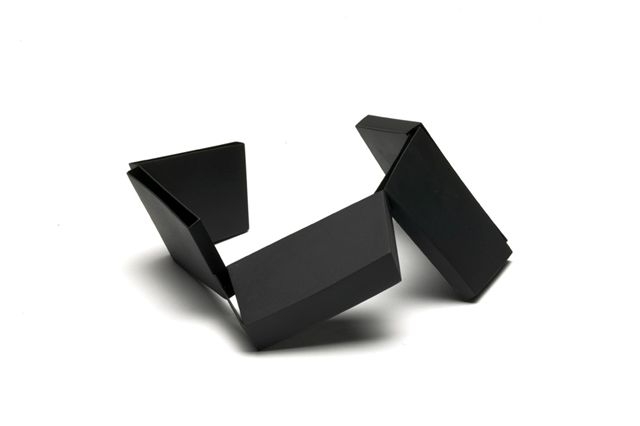
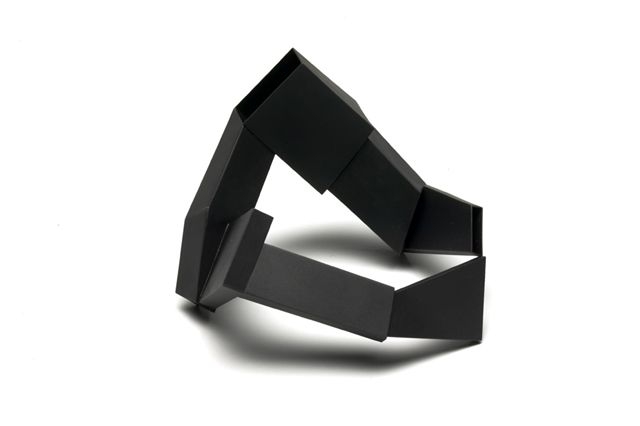
Mari Funaki (Australian, 1950-2010) Bracelet 1 from Space between 2005-2006 Heat-coloured mild steel
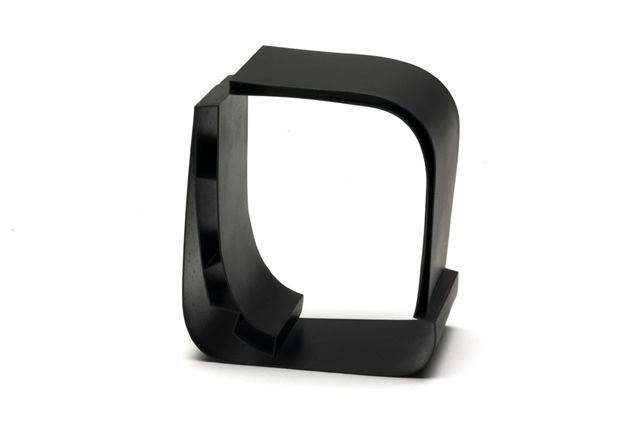
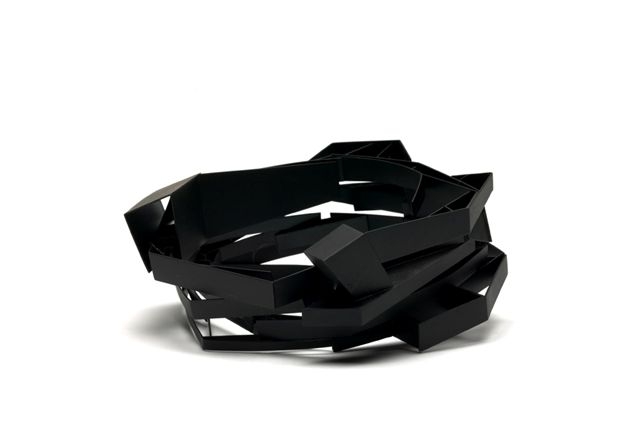
Mari Funaki (Australian, 1950-2010) Bracelet 2 from Space between 2005-2006 Heat-coloured mild steel
Mari Funaki is one of Australia’s leading jewellers. This exhibition celebrates her considerable achievements between 1992 and the present day. Her first major show in a state gallery, it includes nearly fifty works and will be the first time Perth audiences have seen her work in such depth. Many of these are new works produced especially for this show.
The exhibition will focus on rings, containers and bracelets. These forms have been the core of her practice, the foundation of her intricate material experimentations. Her sheer intensity of focus has seen her hone these forms into objects of extreme power and beauty. Funaki’s is no simple beauty, however. It is sharp, complicated. There is always a sense of danger in her work, as the spindly legs of her insect-like containers support unlikely, unwieldy torsos, and as her rings and bracelets cultivate miniature monoliths that play with scale and weight in fascinating ways.
This exhibition will frame these unique objects in such a way as to acknowledge Funaki’s ability to work with space and matter to form entrancing works that adorn the imagination in the same they adorn the body.
Text from the Art Gallery of Western Australia website [Online] Cited 10/08/2009. No longer available online
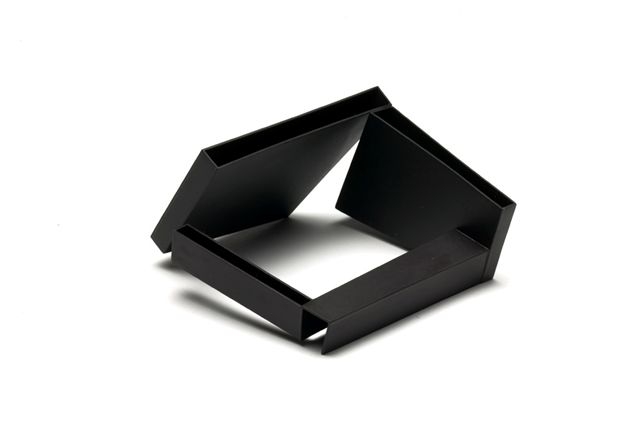
Mari Funaki (Australian, 1950-2010) Bracelet 3 from Space between 2005-2006 Heat-coloured mild steel
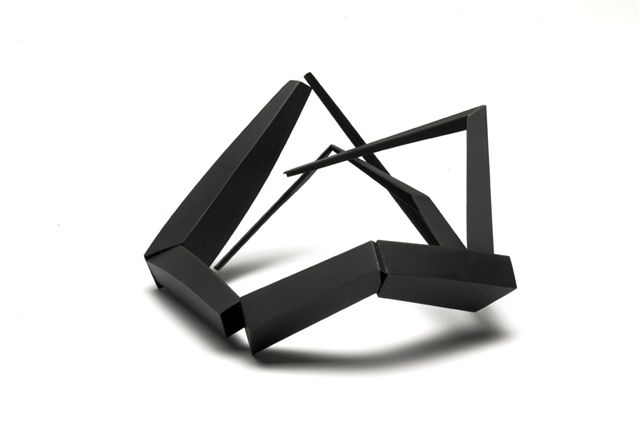
Mari Funaki (Australian, 1950-2010) Bracelet 4 from Space between 2005-2006 Heat-coloured mild steel
Notes from a Conversation with Mari Funaki, July 2006
Mari Funaki’s initial response comes from the environment – the response is part random, part constructed idea.
Funaki likes the ‘animated’ response from the viewer – allowing them to make their own associations with the work and their own meaning. The making of the work doesn’t emerge out of nothing but through the development of ideas over a long period of time.
Mari starts with a flat drawing – this approach comes from an Eastern perspective in the history of art making i.e. screens, woodcuts and scrolls. Initially when starting with the idea Mari is mentally thinking in two dimensions – then drawing out onto paper in two dimensions the ideas.
When actually making the work Mari then starts working and thinking in three dimensions – starting with a base piece of metal and working physically and intuitively around the object, to form a construction that evidences her feelings about what she wants to create. She likes the aesthetic beauty but uneasy aspect of a dead insect for example (like the Louise Bourgeois Maman spider outside the Guggenheim in Bilbao).
Now collaborating with architect Nonda Kotsalidis, Mari is working to produce her sculptural objects on a larger scale, up to 6 metres high. She needs the objects to have an emotional and physical impact on the viewer – both beautiful and threatening at one and the same time. How will her objects translate to a larger scale? Very well I think.
Funaki likes the physical distortion of space – and she likes telling a story to the viewer. She is working on a building where the facade is really strongly geometric and then she is embedding an emotion into the front of the building – constructing a narrative – constructing an emotional response with the viewer and establishing a relationship with the building. Here she is working from photographs of the space, her own recognition and remembrance of that space. She is having to work physically in 3D from the beginning for the first time, but still uses drawings to sketch out her ideas.
Several of Funaki’s pieces in the Cecily and Colin Rigg Contemporary Design Award (2006) at the NGV Federation Square were inspired by the work of Bernd and Hilla Becher. Their photographs of factories and gasworks, specifically the facades of such buildings (see image below), were the jumping off point for the development of the objects (the bracelets). Funaki takes the front of these buildings, a 3D structure ‘in reality’ but pictorially imaged on a 2D plane, and then twists and distorts their structure back into a 3D environment. The facades move up and around, as though a body is twisting around its own axis, pirouetting around an invisible central spine.
Each piece is created and then the next one is created in relation to the previous, or to each other. Each individual piece has its own character and relation to each other. They are never variations of the same piece with small differences – each is a separate but fully (in)formed entity.
Dr Marcus Bunyan
Bernd and Hiller Becher (German, 1931-2007 and 1934-2015) Water Towers 1980 Gelatin silver prints
“Black. Sharp, shifting contours. Familiar and alien. Confident, expressive and agile, it is easy to take the existence of these works for granted – and it is hard enough to trace in one’s mind the physical evolution back through heat colouring, sandblasting, soldering, assembling and cutting, to unremarkable, thin sheets of mild steel – let alone comprehend their conception and resolution.
They inhabit space in a way that is difficult to describe – the edge between each object and the space that encloses it is shockingly sudden.
How can something human-made be so insanely artificial and natural at the same time? It must be no accident that I described them as articulate – ambiguous and wide ranging in the breadth of associations and allusions, they can tell you everything and nothing at the same time.”
Sally Marsland, 2006
Text from the Gallery Funaki website [Online] Cited 10/08/2009 no longer available online
Mari Funaki (Australian, 1950-2010) Bracelet 5 from Space between 2005-2006 Heat-coloured mild steel
Mari Funaki (Australian, 1950-2010) Bracelet 6 from Space between 2005-2006 Heat-coloured mild steel
Art Gallery of Western Australia Perth Cultural Centre Perth WA 6000
Emma Davies (Australian, b. 1968) Sekai (meaning ‘be humorous’) 2009
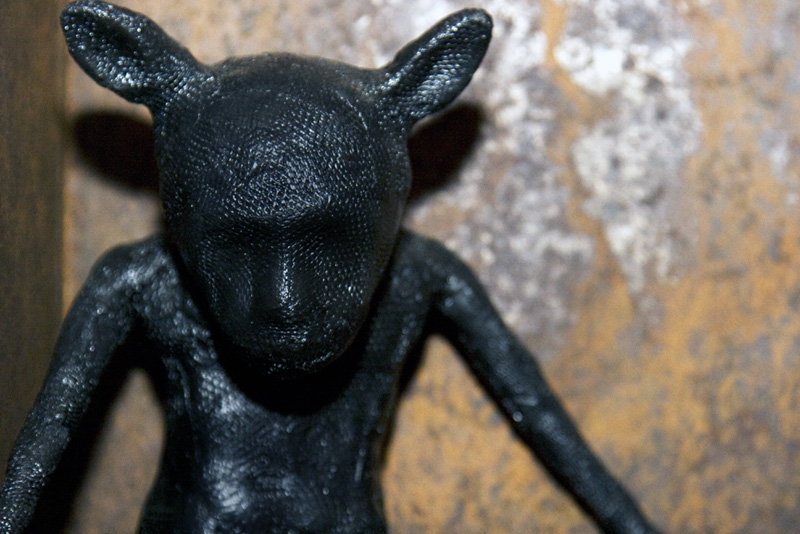
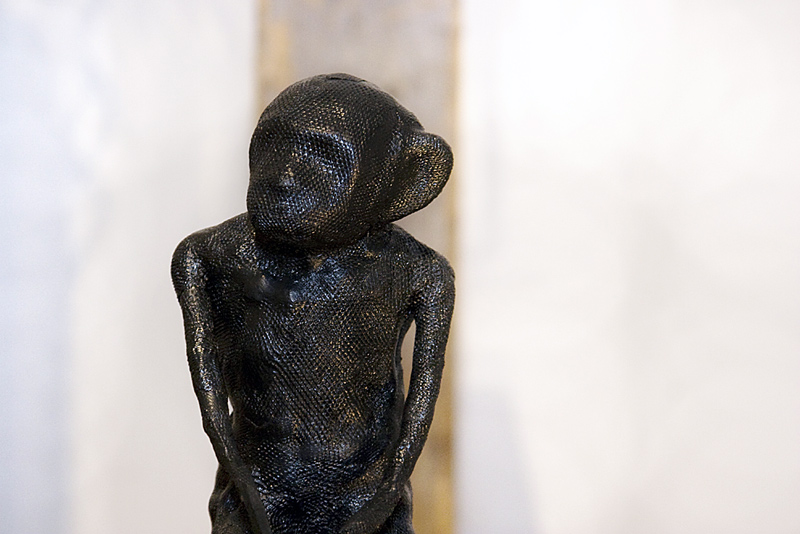
A stimulating exhibition by Emma Davies at Craft Victoria of polypropylene industrial netting and packaging that has been heated, moulded, sculpted and literally morphed into these fantastical sculptures, inspired by the artist’s experiences when visiting Johannesburg in South Africa as part of the South Project. Davies evokes the mysterious and the bizarre in her figures, making the commonplace into something uncommon, taking her themes from the relics of bush medicine present in the street markets: the medicine market of Johannesburg full of dried animal bones, skulls, skins and bottles of alchemistic objects.
Despite their comforting South African names (translated into English as ‘hope’, ‘faith’, ‘quiet, tranquil’, ‘lady’, ‘chief’, ‘prince’ for example) these extremely individual figurative ‘presences’ have a powerful melancholic affect on the viewer. Their elongated long legged and armed, no necked forms create dark eyeless creatures that crouch in rusted boxes or sit on wooden posts with their legs and arms hanging, folded. They seem lonely and sad despite their titles, perhaps reflecting the harsh realities of a life of poverty on the streets of Soweto.
Two figures on wooden blocks seem to walk aimlessly, placed on large rough industrial tables with huge wheels while another figure sits up a rusted ladder propped against the wall. A group of figures are clustered together on top of large wooden posts of different heights, some with arms round each other for comfort, others with black or red feathers sprouting from shoulders, legs or wearing a red feathered skirt. These creatures create a marvellous group of contemplative wandering minstrels while behind them their eerie shadows fall on the gallery wall.
The crystalline nature to the surface of the creatures, like sparkling coal, reminds me of the work of William Kentridge, his white industrial protagonist Felix haunted by images of black workers deep underground mining coal (see Mine (1991) where his coffee plunger goes down into the ground through the bodies of black people). Some of the figures bat like ears also bring to mind the work of Francisco de Goya and specifically his work Los Caprichos (The Whims), plate 43 from the series of 80 etchings published in 1799 titled The Dream of Reason Produces Monsters. The artist described the collection as an exposé of “the innumerable foibles and follies to be found in any civilised society, and from the common prejudices and deceitful practices which custom, ignorance, or self-interest have made usual.”
As Goya began to sympathise with the suffering of the peasants so Davies seems to have been transformed by what she saw around her during her visit, trying to make sense of a foreign culture, dreaming the sleep of reason but surrounded and invaded by a world in which the natural and unnatural has fused and morphed.
I really liked this exhibition and the presence of these figures. I am obviously not alone as the show is almost sold out. A visit to these disturbing, enfolding creatures is recommended.
Dr Marcus Bunyan
All photographs courtesy of Craft Victoria (thankyou Amy Brand!) and taken by their photographer Alexia Skok. Please click on the photographs for a larger version of the image.
Emma Davies (Australian, b. 1968) Tariro (meaning ‘hope’) 2009
Emma Davies (Australian, b. 1968) Rutendo (detail – meaning ‘faith’) 2009
Francisco de Goya (Spanish, 1746-1828) Los Caprichos plate 43 from the series El sueño de la razón produce monstros 1799 Etching and aquatint Height: 21.3cm (8.3″) Width: 15.1cm (5.9″) Museo del Prado, Madrid
Emma Davies (Australian, b. 1968) Zola (detail – meaning ‘quiet, tranquil’) 2009
Emma Davies (Australian, b. 1968) Group with from left to right: Enitan (person of story), Ntombi (lady), Kgosi (chief), Nkosana (prince), Lucky and Alaba (second child after twins) 2009
Emma Davies (Australian, b. 1968) Nkosana (detail – meaning ‘prince’) 2009
Craft Victoria Watson Place, off Flinders Lane, Melbourne 3000 Phone: 03 9650 7775
Johannes Kuhnen (Australian born Germany, b. 1952) Rings 1971
This is a superlative exhibition, one of the highlights of the year so far in Melbourne.
The exhibition presents work from the early 1970s to contemporary work and evidences the breadth of vision of this master craftsman and artist, the arc of his investigation showing a consistency of feeling for the energy and form of his materials over many decades. Technically the work is superb; conceptually the work transcends the boundaries of jewellery and becomes something else altogether: it becomes magical.
Kuhnen’s use of colour in his favoured anodised aluminium material is exquisite, the perfection of his forms flawless. His fabulous Vessels reminding me of the ancient Neolithic standing stone circles at Stonehenge in their shape and use of vertical buttresses in different materials (such stainless steel and granite) that intersect the oval forms. His Boxes are like small ancient reliquaries, objects for holding ashes worked with a delicacy, simplicity and feeling for form and colour that is absolutely beautiful and consistent with the containment of energy within their structure.
I went with Marianne Cseh a jeweller friend of mine. We stood transfixed before this work, peering closely at it and gasping in appreciation of the beauty, technical proficiency and pure poetry of the pieces. This exhibition is highly recommended and not to be missed!
Now showing with the international SCHMUCK jewellery exhibition from Germany.
A book to accompany the exhibition is available from the RMIT Gallery.
Dr Marcus Bunyan
Many thankx to RMIT Gallery for allowing me to publish the photographs in the posting. Please click on the photographs for a larger version of the image.
Johannes Kuhnen (Australian born Germany, b. 1952) Ring 1972 Stainless steel, synthetic ruby disc
Johannes Kuhnen (Australian born Germany, b. 1952)
Brooch 2003 Anodised aluminium, monel
Ring 1972 Stainless steel, synthetic ruby disc
Johannes Kuhnen (Australian born Germany, b. 1952) Boxes 1980
Johannes Kuhnen (Australian born Germany, b. 1952) Box and pendant 1980
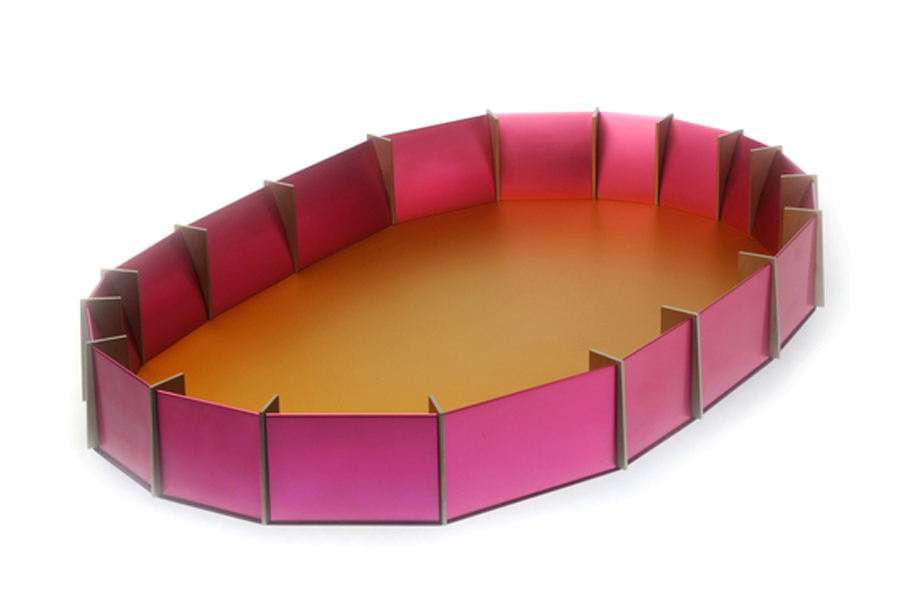
Johannes Kuhnen (Australian born Germany, b. 1952) Tray 1986 Anodised aluminium, titanium, stainless steel
Johannes Kuhnen (Australian born Germany, b. 1952) Centrepiece 1987
Johannes Kuhnen (Australian born Germany, b. 1952) Centrepiece 1991 Anodised aluminium, silver, monel: fabricated
In his work as a jeweller, object maker and photographer, Johannes Kuhnen is engaged with the interpretation and manipulation of a precise visual language of forms. The dramatic curvilinear shape of this centrepiece has been designed to emphasise the particular visual qualities of its materials and to fulfil its role as a low, but commanding central presence on a table. The vivid, iridescent colour of its anodised aluminium rim is designed to interact with differing light conditions, while the technical and precious qualities of its monel and silver elements play against each other. This orchestration of metals is underpinned with an unseen but precise and ingenious inner structure, giving this object weight and functional strength.
Johannes Kuhnen has made a pioneering contribution to Australian design and gold and silver smithing through his commitment as a generous educator and innovative practitioner. This exhibition will create linkages between his earlier works, some of which was made in Germany prior to migrating to Australia and new work specifically produced for this exhibition and this will be done both with objects and through a catalogue / monograph to be launched at the opening venue. The exhibition will borrow from Australian public and private collections to facilitate the demonstration of connecting design elements in the work from both significant streams in Kuhnen’s work in jewellery and hollowware.
Text from the RMIT Gallery website [Online] Cited 02/07/2009. No longer available online
Johannes Kuhnen (Australian born Germany, b. 1952) Vessel 2007 Anodised aluminium, titanium, stainless steel 11.2 h x 84.5 w x 21.0 d cm Weight 14 kg
Johannes Kuhnen (Australian born Germany, b. 1952) Vessel 2008 Anodised aluminium, titanium, stainless steel
Johannes Kuhnen (Australian born Germany, b. 1952) Vessel 2009 Anodised aluminium, titanium, stainless steel
Johannes Kuhnen (Australian born Germany, b. 1952) Armring 1981 Anodised aluminium 9.8 h x 10.4 w cm
Johannes Kuhnen (Australian born Germany, b. 1952) Armring 1990 Armring, anodised aluminium, gold 750, granite
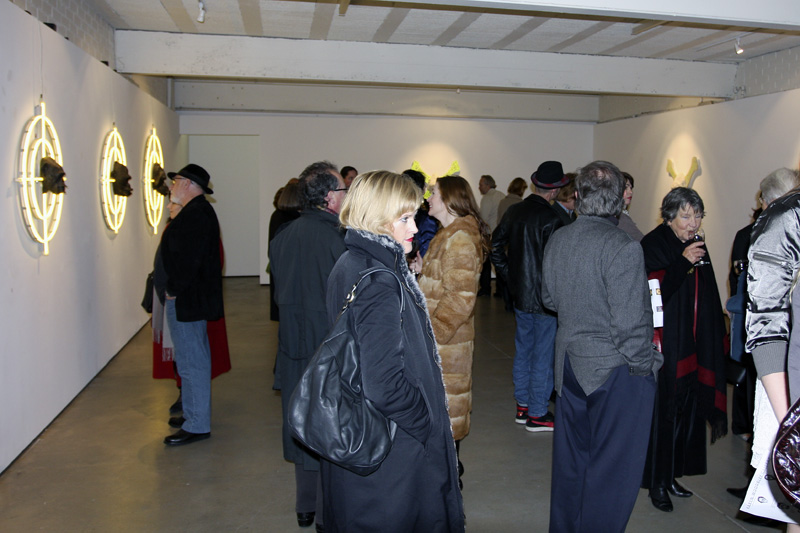
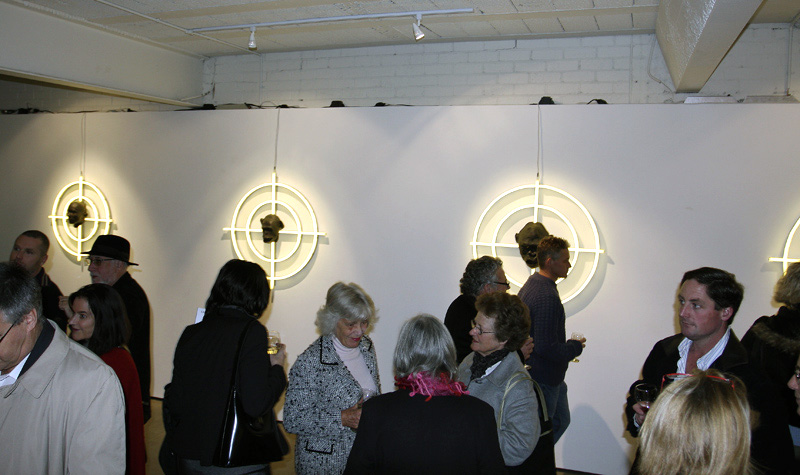
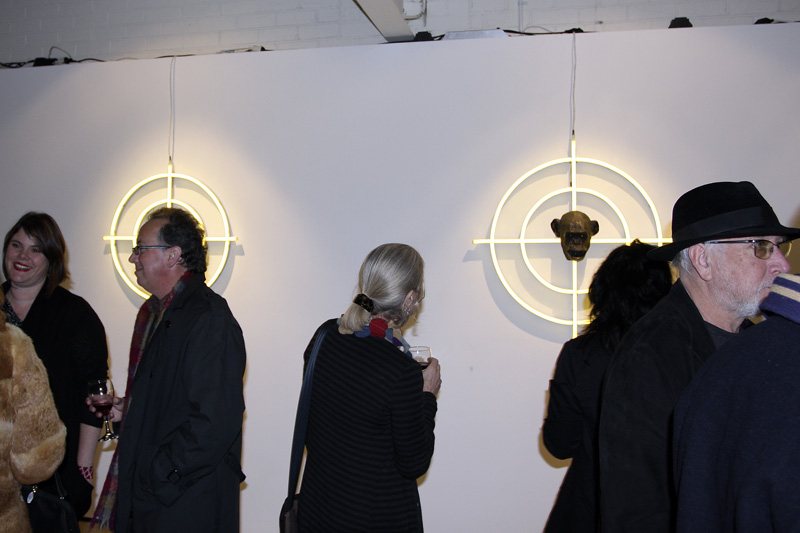
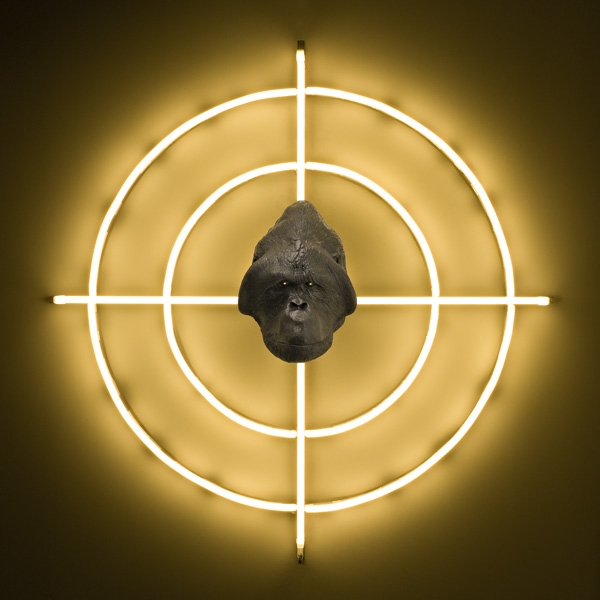
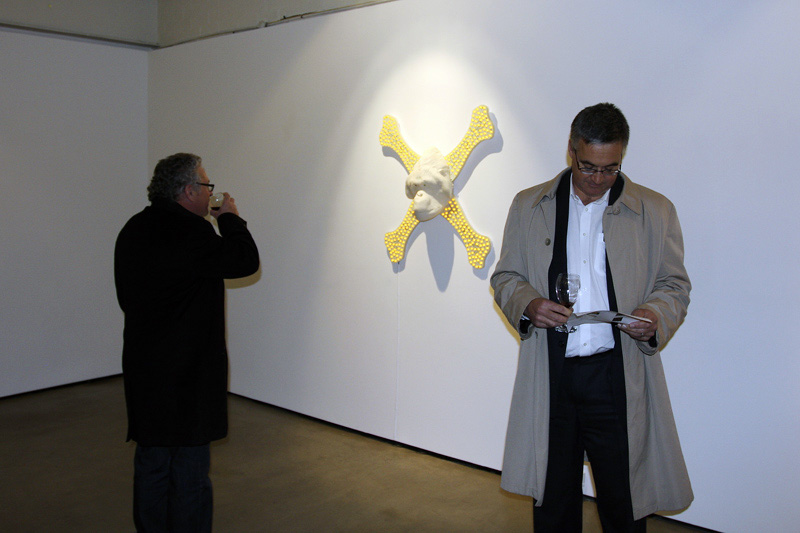
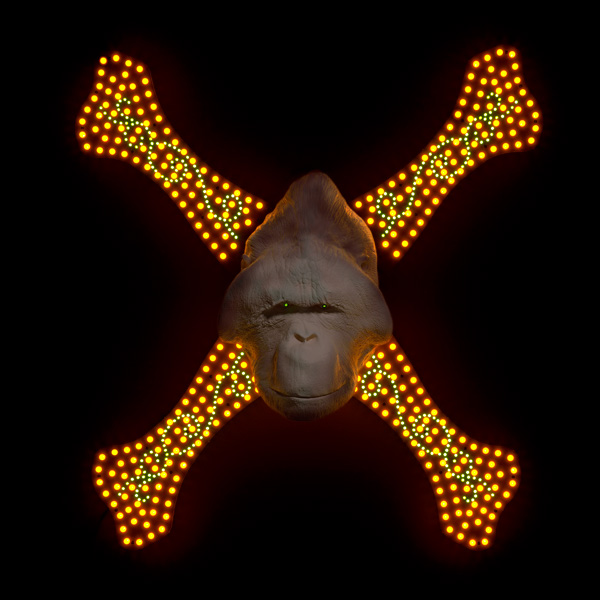
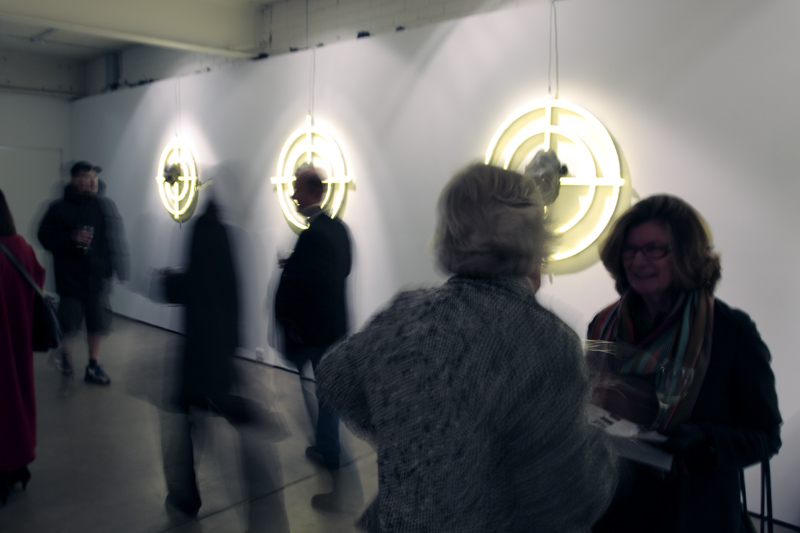
Opening night crowd in front of the work In-Sight (2009) by Lisa Roet at Karen Woodbury Gallery, Melbourne
Another excellent opening this time of the work of the delightful Lisa Roet. If you visit the gallery don’t forget the upstairs exhibition space with further work by the artist including a marvellous large bronze Orangutan Foot.
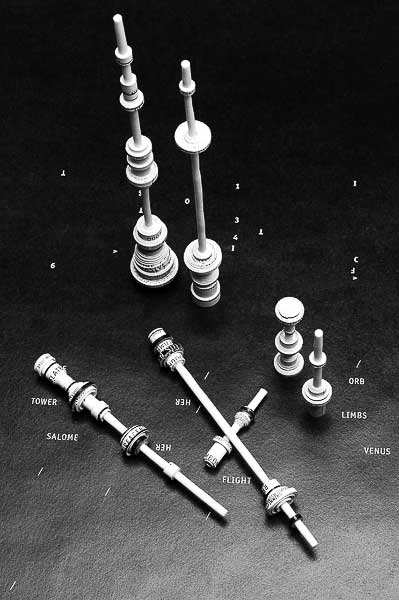
Natasha Dusenjko (Australian) Towers of Babel 2009 Mixed media
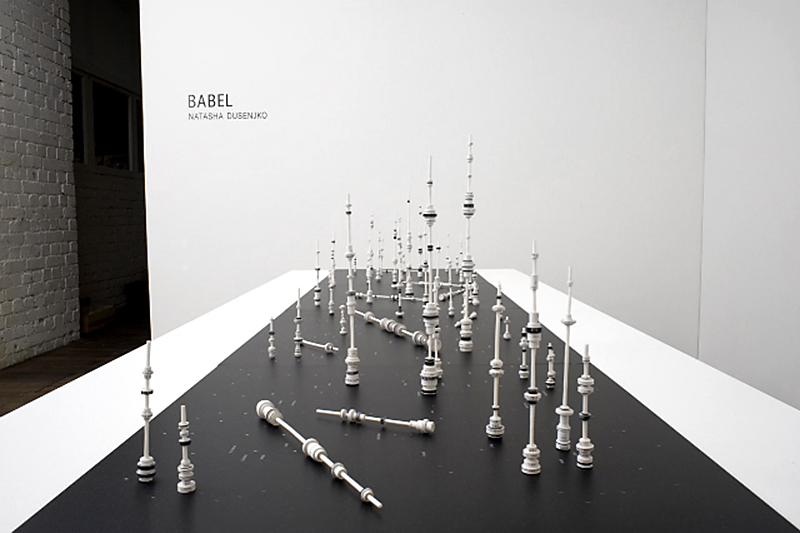
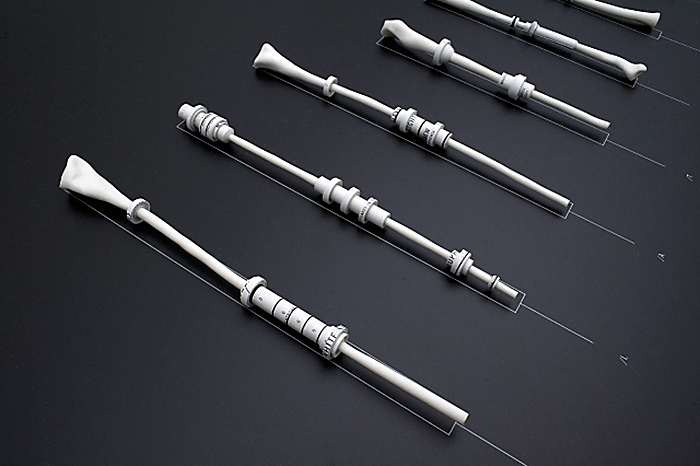
Three very interesting exhibitions at Craft Victoria at the moment: Babel by Natasha Dusenjko, Gleaning Potential by Simon Lloyd and Cycle by Liz Low. I particularly liked the delicacy and textuality of Natasha Dusenjko’s sci-fi towers and bone fragments and the wonderful box of 6 red bricks (small and large) that you can buy from the Simon Lloyd show, like blocks for a child builder.
There is an excellent and erudite review of the exhibitions at Daniel Neville’s Nevolution website.
Dr Marcus Bunyan
Many thankx to Craft Victoria for allowing me to publish the photographs in the posting. Please click on the photographs for a larger version of the image.
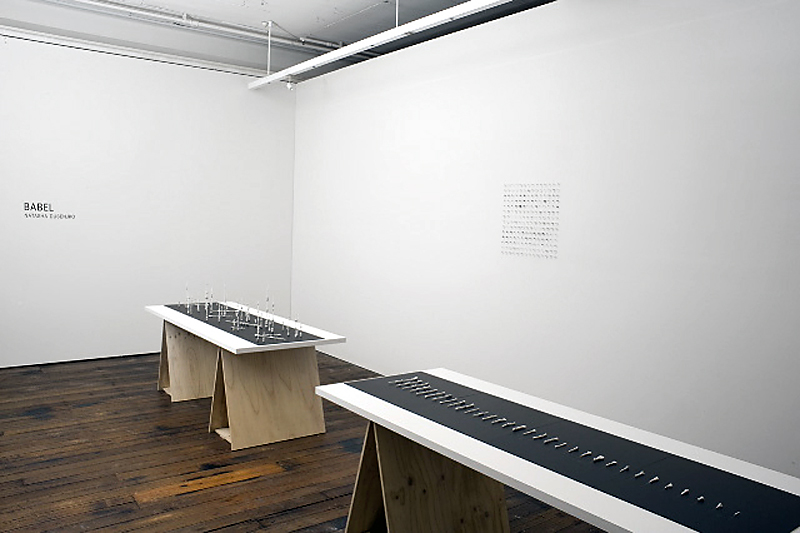
“The two tables allow for different meanings and scales when viewed in opposition. Table 1 alludes to star charts; constellations of texts hinting at importance, especially in relation to the placement of towers. The map looking up to the stars via the towers of babel, communicating unknown messages to the stars above. The cold stark forms of the towers work well with the organic forms of the bones on Table 2. Perfectly ordered and numbered archaeological bone fragments repeat the textual ciphers and codes, meticulously ordered. The jump in scale between the architectural and the archaeological is lovely; each hinting at an underlying language and mythology. Meanwhile both contain elements of each other – the towers of rationality have been placed in a seemingly random manner, while the organic forms of the bones have been laid out in perfect order ranging down in sizes.”
Daniel Neville. Extract from “On the nature of language, order and decay,” on the Nevolution website June 03, 2009 [Online] Cited 05/06/2009
Installation views of Natasha Dusenjko’s exhibition Babel at Craft Victoria, Melbourne
Babel is a word-based collection of fine porcelain and paper works. This collection of short texts constitutes a series of incantations, codes and instructions scrolled around porcelain bones or thin spines. The porcelain bones are internal structures and vessels of ancestor memory. This memory is fluid, is evasive, is aquatic. The thin spines resemble futuristic Towers of Babel reaching into space, anticipating communication and new frontiers. These towers have either an upright or collapsed form.
In the making, both forms build toward new possibility, words become obscured, resulting in a non-defined beginning or end, now replaced by chance permutations of the accumulated text.
The sculptural works are deliberately placed onto two large scale text based charts. Each chart is placed on a raised surface, analogous to work benches in an observatory or laboratory suggesting a process of decipherment. Map 1 exhibits a similarity to ancient star charts, the placement of towers alluding to significant points of a constellation. The accompanying Chart 2 resembles an organised series of archeological artefacts, each piece methodically numbered and labelled.
Ultimately, Babel evokes a spiral passage both outward and inward. To unravel the scrolls initiates a return to the spine – the axis mundi, the source of a universal native tongue – love.
Text from the Craft Victoria website [Online] 05/06/2009. No longer available online
Natasha Dusenjko (Australian) Babelbones 2009 Mixed media
Craft Victoria Watson Place, off Flinders Lane Victoria 3000 Phone: 03 9650 7775
ACCA’s annual commissions exhibition – this year curated by Charlotte Day with new works from eight contemporary Australian artists including Justine Khamara, Brodie Ellis, Marco Fusinato, Simon Yates, Matthew Griffin, Benjamin Armstrong and Pat Foster and Jen Berean.
Simon Yates (Australian, b. 1973) Rhabdomancy Tissue paper, wood, fishing rods, tape, string, electrical components, helium balloons dimensions variable 2009 Photo: Marcus Bunyan
“That’s what art is, he said, the story of a life in all its particularity. It’s the only thing that really is particular and personal. It’s the expression and, at the same time, the fabric of the particular. And what do you mean by the fabric of the particular? I asked, supposing he would answer: Art. I was also thinking, indulgently, that we were pretty drunk already and that it was time to go home. But my friend said: What I mean is the secret story … The secret story is the one we’ll never know, although we’re living it from day to day, thinking we’re alive, thinking we’ve got it all under control and the stuff we overlook doesn’t matter. But every damn thing matters! It’s just that we don’t realise. We tell ourselves that art runs on one track and life, our lives, on another, we don’t even realise that’s a lie.”
From the story “Dentist” from the book ‘Last Evenings on Earth’ by Roberto Bolaño1
“A work of art reminds you of who you are now”
Kepesh from the film ‘Elegy’
The curator Charlotte Day has assembled an interesting selection of artists for New 09 at ACCA, Melbourne. It is an exhibition whose ‘presences’ challenge through dark and light, sound and light, contemplation and silence. The journey is one of here and now moments that transport the viewer to states of being that address the fabric of the particular: doubt, anxiety and enlightenment crowd every corner. The particularities of the experience (material, social, psychological and imaginative) impinge on the viewers interior states of being transcending the very physicality and symbolic realism of the works.2
On entering the gallery you are greeted by Simon Yates self-propelled figures that make up the work Rhabdomancy (2009, above). Suspended, tethered, floating just above the floor the figures move eerily about the entrance to the gallery, startling people who have not seen them move before. They stand silent witness, a simulation of self in tissue paper searching for meaning by using a dowsing rod. The word rhabdomancy has as one of it’s meanings ‘the art or gift of prophecy (or the pretence of prophecy) by supernatural means’. Here the figures are divining and divination rolled into one: grounded they seek release through the balloons but through augury they become an omen or portent from which the future is foretold.
“… cutting and slicing in order to see them better, willing them into three dimensions; an attempt to cheat death, or rather, to ward off forgetting of them as they are/were and as I was when the work was made.”
~ Justine Khamara
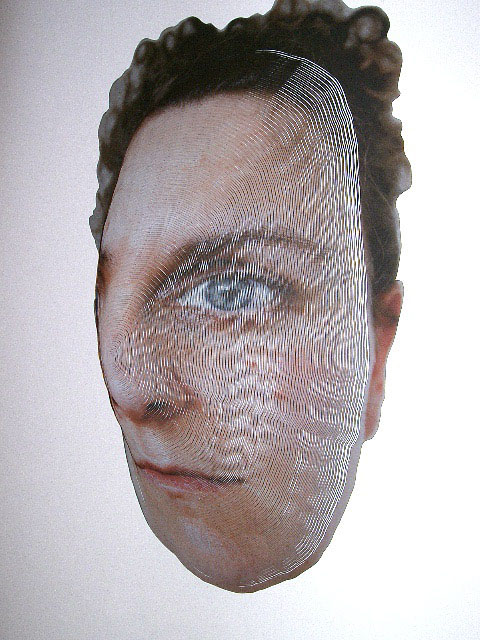
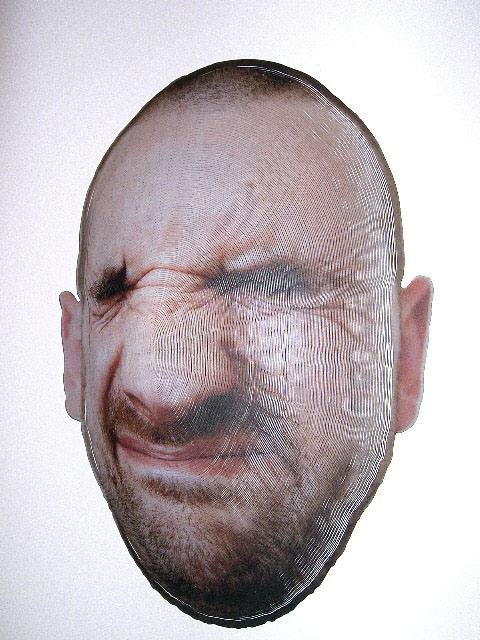
In the first gallery, a very minimal installation by Justine Khamara of two fractured faces stare out at you from the wall, my favourite work of the show. These are unsettling faces, protruding towards you like some topographical map, one eyes screwed shut the other beadily following you as you walk around the gallery space. Here the images of brother and sister presence anterior, already formed subjects not through memory (as photographs normally do) but through the insistence of the their multiple here and now planes of existence. Rather than ‘forgetting’ the images authenticate their identity through their ongoing presence in an ever renewing present.3 Their dissection of reality, the affirmation of their presence (not the photographic absence of a lost subject) embodies their secret story on the viewer told through psychological and imaginative processes: how do they make me feel – about my life, my death and being, here, now.
The pathos of the show is continued with the next work Noosphere (2008) by Brodie Ellis (the noosphere is best described as a sort of collective consciousness of human-beings).4 In this work a video above the clouds is projected onto a circular shape on the ceiling in a darkened room. The emotional and the imaginative impact of the message on the audience is again disorientating and immediate. The images look across the clouds to vistas of setting suns, look down on the clouds and the sea and land below. The images first move one way and then another, disorientating the viewer and changing their perspective of the earth; these are alien views of the earth accompanied by heart beat like ambient music. The perspective of the circle also changes depending on where the viewer stands like some anamorphic distortion of reality. On a stand a beaded yoke for a horse adds to the metaphorical allegory of the installation.
In the next gallery is the literal climax to the exhibition, Marco Fusinato’s Aetheric Plexus (2009). (Aether: medium through which light propagates; Plexus: in vertebrates, a plexus is an area where nerves branch and rejoin and is also a network of blood vessels).
Consisting of scaffolding that forms a cross and supports large numbers of silver spotlights with visible wiring and sound system the installation seems innocuous enough at first. Walking in front of the work produces no effect except to acknowledge the dull glow of red from the banks of dormant lights trained on the viewer. The interaction comes not in random fashion but when the viewer walks to the peripheries of the gallery corners triggering the work – suddenly you are are blasted with white light and the furious sound of white noise for about 15 seconds: I jumped half out of my skin! Totally disorientated as though one has been placed in a blast furnace or a heavenly irradiated crematorium one wonders what has just happened to you and it takes some time to reorientate oneself back in the afterlife of the here and now. Again the immediacy of the work, the particularities of the experience affect your interior states of being.
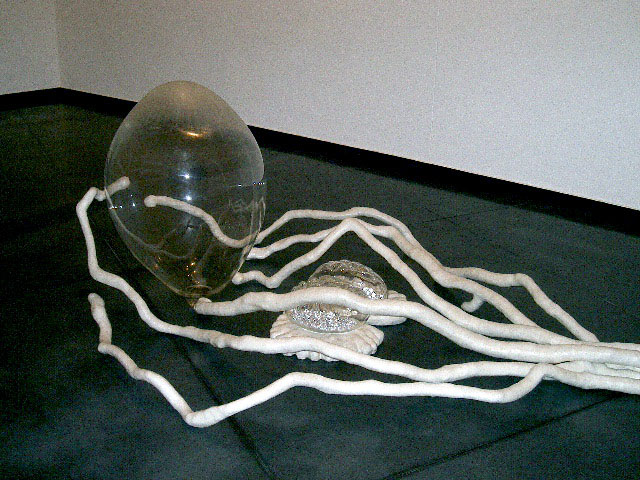
After a video installation by Matt Griffin you wander into the next gallery where two works by Benjamin Armstrong inhabit the floor of the gallery. And I do mean inhabit. Made of blown glass forms and wax coated tree branches the works have a strange affect on the psyche, to me seemingly emanations from the deep subconscious. Twin glass hemispheres of what look like a brain are surrounded by clasping synaptic nerve endings that support an egg like glass protrusion – a thought bubble? a spirit emanation? These are wonderful contemplative but slightly disturbing objects that have coalesced into shape only in another form to melt and disappear: molten glass and melted wax dissipating the very form of our existence.
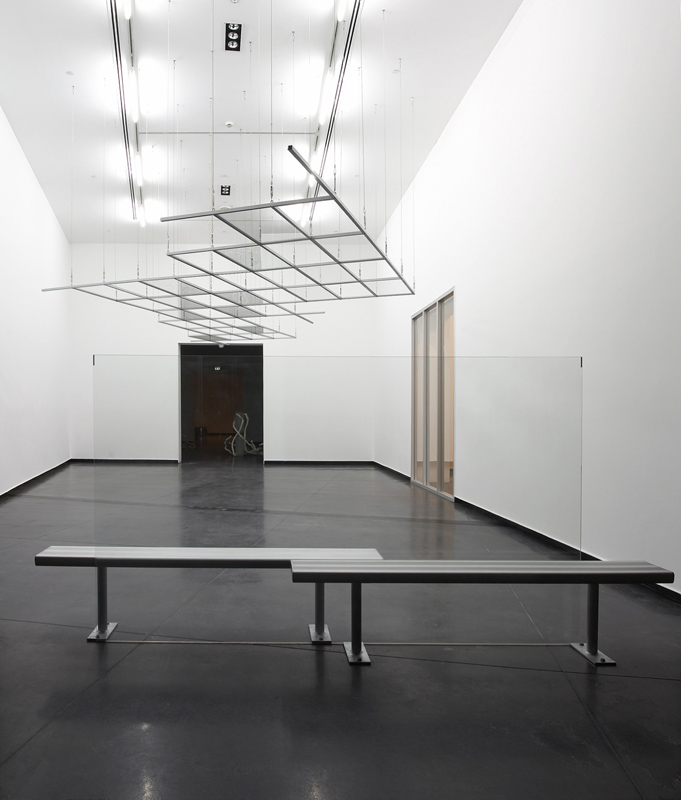
Finally we come to the three part installation by Pat Foster and Jen Berean (below). On the right of the photograph you can see three aluminium and glass doors, closed, sealed leading to another gallery. What you can’t see in the photograph is the three pieces of gaffer tape stretched across the glass doors, like they do on the building sites of new homes. No entry here. Above your head is a suspended matrix of aluminium and glass with some of the glass planes smashed. Clean, clinical, safe but smashed, secure but threatening the matrix presses down on the viewer. It reminded me of the vertical standing shards of the World Trade Centre set horizontal suspended overhead. Only the steel cable seemed to ruin the illusion and seemed out of place with the work. It would have been more successful if the matrix was somehow suspended with fewer tethers to increase the sense of downward pressure. Finally you sit on the aluminium benches and contemplate in silence all that has come before and wonder what just hit you in a tidal wave of feelings, immediacies and emotions. The Doing and Undoing of Things.
An interesting journey then, one to provoke thought and emotion. The fabric of the particular. The pathos of the art-iculate.
My only reservations are about the presence, the immediacy, the surface of it all. How persistent will these stories be? Will the work sustain pertinent inquiry above and beyond the here and now, the shock and awe. Or will it be like a meal one eats and then finds one is full but empty at the same time. A journey of smoke and mirrors.
Dr Marcus Bunyan
1/ Bolano, Robert. Last Evenings on Earth. New Directions, 2007. Available on Amazon.
2/ Blair, French. The Artist, The Body. [Online] Cited on 12/04/2009. No longer available online
3/ Ibid.,
4/ “For Teilhard, the noosphere is best described as a sort of ‘collective consciousness’ of human-beings. It emerges from the interaction of human minds. The noosphere has grown in step with the organisation of the human mass in relation to itself as it populates the earth. As mankind organizes itself in more complex social networks, the higher the noosphere will grow in awareness.” From the concept of Nooshpere on Wikipedia.
Justine Khamara (Australian, b. 1971) Dilated Concentrations 2009 UV print on laser cut stainless steel Photos: Marcus Bunyan
Benjamin Armstrong (Australian, b. 1975) Hold Everything Dear I 2008 Photo: Marcus Bunyan
Pat Foster (Australian, b. 1981) and Jen Berean (Canadian, b. 1981) Untitled from the series The Doing and Undoing of Things 2009 Aluminium, safety glass, steel cable Photo: Marcus Bunyan
Pat Foster (Australian, b. 1981) and Jen Berean (Canadian, b. 1981) Untitled from the series The Doing and Undoing of Things (detail) 2009 Aluminium, safety glass, steel cable Photo: Marcus Bunyan
Australian Centre for Contemporary Art (ACCA) 111 Sturt Street Southbank Victoria 3006 Australia
In a mad dash around town I managed to see the Derek O’Connor and Peter Cole exhibitions before they finished and also the Siri Hayes En Plein Air exhibition of photographs at Gallerysmith (see next post).
Marcus
Please click on the art work for a larger version of the image.
Derek O’Connor paintings at Karen Woodbury Gallery
An intense show of small oil paintings that really draw you into their composition. They are paintings of tremendous energy and layering, the surface being in a constant state of flux. The paintings become metaphors for the bodies existence in space, corporeal landscapes full of sensation ‘neither rational nor cerebral’. They become a mediation and a meditation upon life itself – complex, convulsive, concentrated energy that focuses the viewers attention so that they cannot look away.
Derek O’Connor (Australian born England, b. 1959) Horizontal 2008
Derek O’Connor (Australian born England, b. 1959) Horizontal 2008
“Working with his tools of palette knives and brushes, he sets into motion a train of repetitions, of speeds and slowness1 applying and scrapping paint away in an attempt to move from a position of not knowing towards knowing. He brings … an intense physical and mental awareness to the rhythms of his own movements, his own body. At such moments time seems to expand – to become infinite.
In erasing from his project the world of appearances, Derek O’Connor embraces something else – the realm of ‘sensation’. Sensation is an open painterly expression which resists definition. The Modernist painter Paul Cezanne described sensation as a “logic of the senses” which is neither rational nor cerebral2 … For Derek, the subject of his painting appears to be the act of making itself. Here subject and object collapse (folding into itself) so that sensation is experienced through the materiality of paint, via the movements of the artists’ body to affect the bodies of others.”
Paul Uhlmann from the catalogue essay
1/ Deleuze, G. and Guattari, F. A Thousand Plateaus. London: Continuum, 1987, pp. 292-300 2/ Deleuze, G. The Logic of Sensation. London: Continuum, 2003, p. 42
Derek O’Connor (Australian born England, b. 1959) Irregular 2008
Karen Woodbury Gallery
This gallery has closed.
Peter Cole ‘Elements + Memories’ at John Buckley Gallery 18th March – 9th April 2009
A decidedly underwhelming show by Peter Cole at John Buckley Gallery only redeemed by the amazing Elemental Landscape series of 64 small sculptural pieces displayed as a frieze (see below). The large free standing sculptural works fail to impress with their minimalist Ikea-esque cut out style – especially when viewed from the rear of the work. One would have thought that a sculptor, making several free standing pieces that are going to be walked around in a gallery space, would have designed the work to be viewed ‘in the round’. As it is all the perfection of the clinical front of the works is undone by brackets and screws holding the whole thing together when viewed from the flattened rump. This is pretty, surface work that lacks substance and insight, pretty shapes and cut outs and targets that allude to memory but are just stylised glossy magazine representations of it.
On the other hand the Elemental Landscape series of sculptures is just magical – playful, ever inventive, wonderfully contemporary, beautifully resolved in concept and manufacture, in their use and bending of geometric shapes, the sculptures really are fantastic when seen ‘in situ’ as a whole. Visit the exhibition just to see this work – buy some pieces and make your own elemental landscape!
Dr Marcus Bunyan
Peter Cole (Australian, b. 1947) Elements + Memories installation views at John Buckley Gallery, Melbourne (first and second image) Bar 4 – Shibuya 2009 (third image) Garden – Yoyogi 2009 (fourth image)
In Peter D Cole’s stunning and ambitious exhibition Elements + Memories he creates a playful interactive work titled Elemental Landscape. Utilising his highly stylised modernist and reductionist technique – influenced at an early age by studies of Miro and Calder – Cole presents 64 small sculptural pieces of varying colour and shape of which the audience is encouraged to create their own compositions. Cole also presents three large-scale sculptures drawing on memories of his times in Japan.
Cole’s distinct skill of distilling the landscape and architecture into separate elements and symbols is in itself evocative of traditional minimal Japanese aesthetic and he has created a series of works which draw upon Japanese interiors and streetscapes and the gardens of the Sakura Matsuri (Cherry Blossom festival).
Text from John Buckley Gallery website [Online] Cited 01/04/2009. No longer available online
Peter Cole (Australian, b. 1947) Elemental Landscape 2009
This exhibition is a relatively small, muscular yet poetic evocation of the life and work of one of my favourite Australian artists, Rosalie Gascoigne. Perhaps I have an affinity with this artist that goes beyond words: being English I have grown to love the Australian landscape but to see the way Gascoigne visions it is a truly moving experience. I have also admired artists that can successfully combine images and sculptural elements visually in their work, language and memory impinging on consciousness (hence my infatuation with the work of Joseph Cornell).
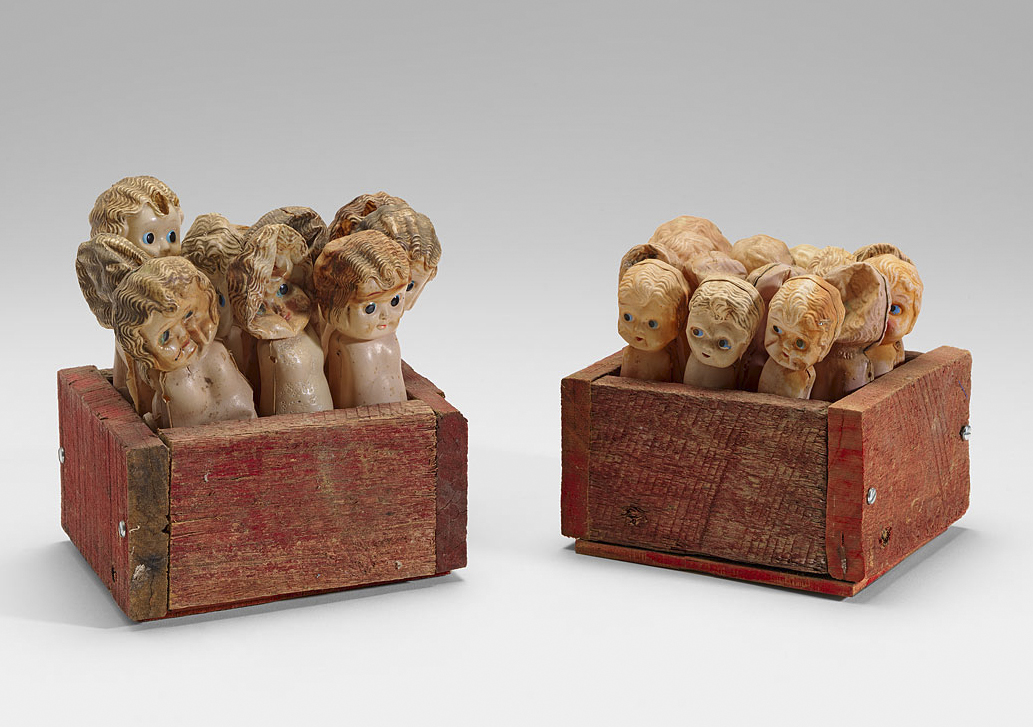
As we enter the exhibition early constructions – wooden boxes – are presented dating from 1975-1984. These have a rough hewn, rustic charm to them, made as they are of weathered thick planks of wood. Less refined than the boxes of Joseph Cornell (see below) they nevertheless draw on the Australian vernacular in their use of objects. As with the Cornell boxes there is a strong element of childhood fun and games in these constructions. Dolly boxes (1976, below) for example contains innumerable plastic dollies of different sizes held inside wooden boxes; Black bird box (1976) is like a shooting gallery at a fun fair; other boxes feature birds and sea shells trapped in plastic bottles, printed images of moths, test tubes, candlesticks, metal teapots and children’s bicycle seats. Cloister (1977) below echoes the work of Joseph Cornell in it’s use of classical Renaissance imagery but with a rustic Australian charm. Unlike Cornell’s boxes which are enclosed dreamscapes that do not live in the world, Cascoigne’s boxes are made her own by being open and receptive to the landscape from which they merge, by being open to the world.
Forty acre block (1977, above) is a play on the great Aussie dream of owning your own 1/4 acre block. Inside the crate like tableaux we find cardboard parrots perched menacingly on rusted cylindrical metal tubes, two cardboard cut out cows with their white faces turned towards the viewer and at the rear of the box a sun-bleached picture of an orchard and three cows with human heads: a surreal vision of the Aussie landscape. Continuing the playfulness Parrot morning (1976, below) extends the theme, the bicycle wheel almost having elements of Duchamp’s readymades but given an Australian twist with the perching parrots.
Moving forward we find one of my favourite works, Feathered chairs (1978, below), a most beautiful evocation of technology and nature. Two red rusted 1950’s office chairs sit low on the floor, their seats, back and sides replaced by four rows of dark Commorant feathers held in place by wooden slats clamped together. Simple yet eloquent these surreal chairs have a poetic rhythm of place and space, speaking of the abandonment of technology and it’s re-habitation by a trapped but beautiful nature. Other work becomes simpler, more focused around this time (and especially from 1984 onwards) as though the artist was finding her singular voice, was confident of the ‘less is more’ rhythms of the music she was creating. The essence appears: of the land, artefacts and spaces. In Swell (1984) for example two convex forms of corrugated iron (one horizontal, one vertical) play off of each other, forming an opposing flow of energies like the swelling of the sea. Nothing else is needed.
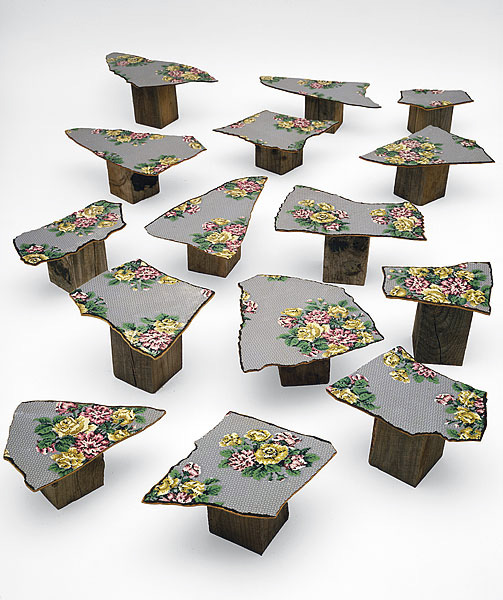
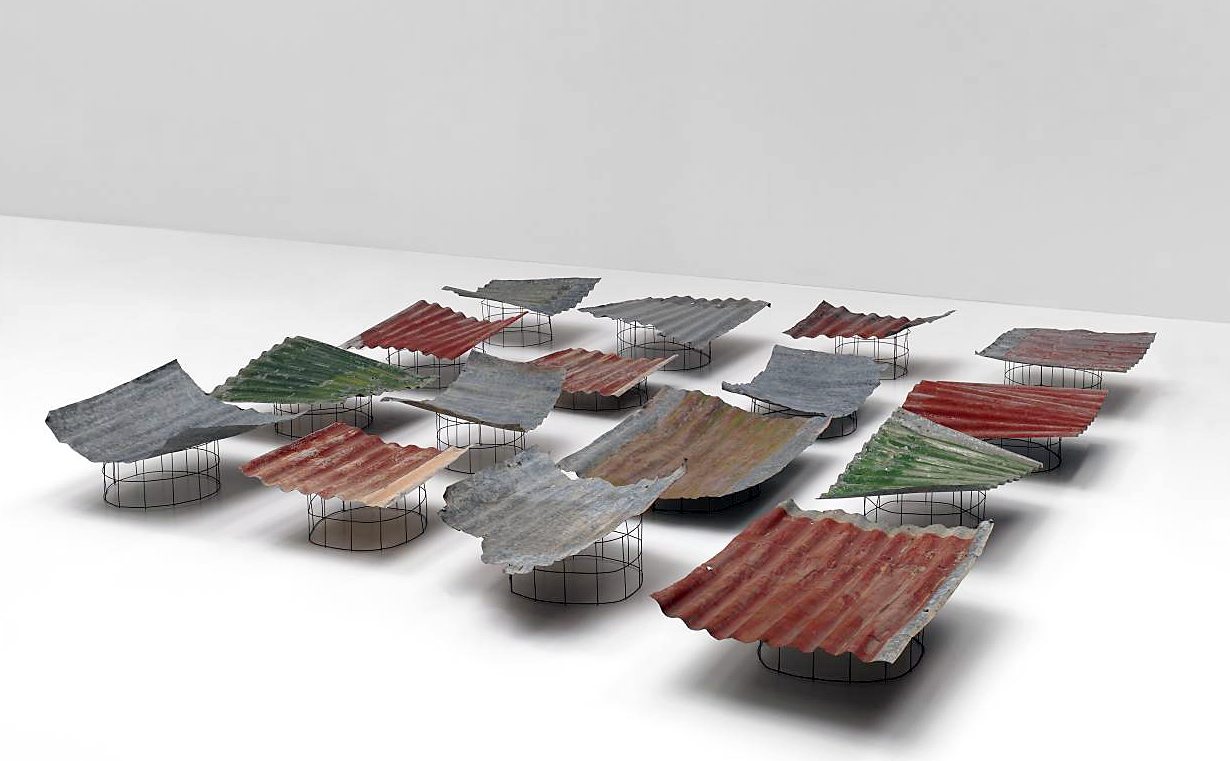
In Step through (1980, below) fragments of floral linoleum floor are mounted on wooden blocks at differing heights allowing the viewer to visually wander across the space of the installation as their mind wanders to memories of the floors of Australian kitchens of the 1950’s – either seen in childhood or in photographs – their is a recognition from all ages, in all Australians. This theme is further developed in the gridded Inland sea (1986, below) patches of corrugated iron float above the ground like gently moving waves. Beautiful in it’s simplicity the colours, shapes and spaces evocatively reflect the undulating rise and fall of the landscape from which the iron has been rescued, the breath of air on the wind rippling the water.
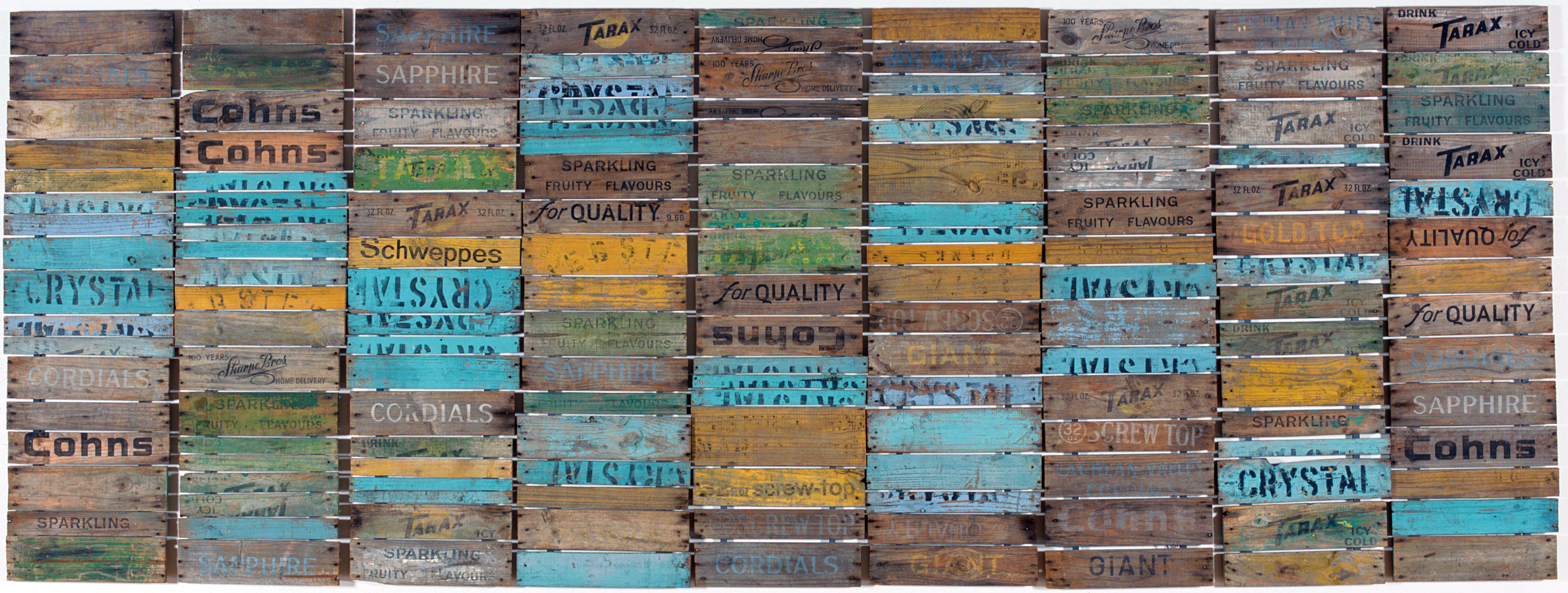
The use of regularised block and grids start to appear in wall mounted vistas: of loopholes, of lovers, the metropolis and the fall, of beach houses and far views, of grasslands and medusas. Promised land (1986) offers a vision resplendent of a far away country – the promised land abstracted to Tarax, Dales, Cottee’s, Blue Bow home deliveries of a Sparkling Fruity Flavour! box ends, the 32 Fl. Oz weight weighing the vision of the Australian landscape in the balance.
The most effective work uses the yellow colour of Schweppes boxes. In Monaro (1989), one of my favourite works in the exhibition, the painted blocks of yellow wood with unreadable fragmented words on them become, from a distance, like the wafting waving dried grasses of the Monaro landscape around Gascoigne’s home. Liquid music of air and place.
“I like the gold of the Schweppes boxes. I think that gold is one of the classical colours. I don’t care if it has got Schweppes written all over it, people seem to think I care. I don’t care! I just like the black and yellow. When I started I had lots of off-cuts, little pieces too good to throw away. So I started joining them up in a sort of way, walking around them, adding a few more. I soon had a 6 x 4 foot panel. In the end I realised that I needed to have four panels to say what I wanted to say. As it grew so did I. I kept thinking of the Monaro grasslands, and I thought of David Campbell saying ‘the Monaro rolls on to the sea’.”
~ Graeme Sullivan, Seeing Australia – Views of artists and art writers, Piper Press, Annandale, New South Wales, 1994, p. 19.
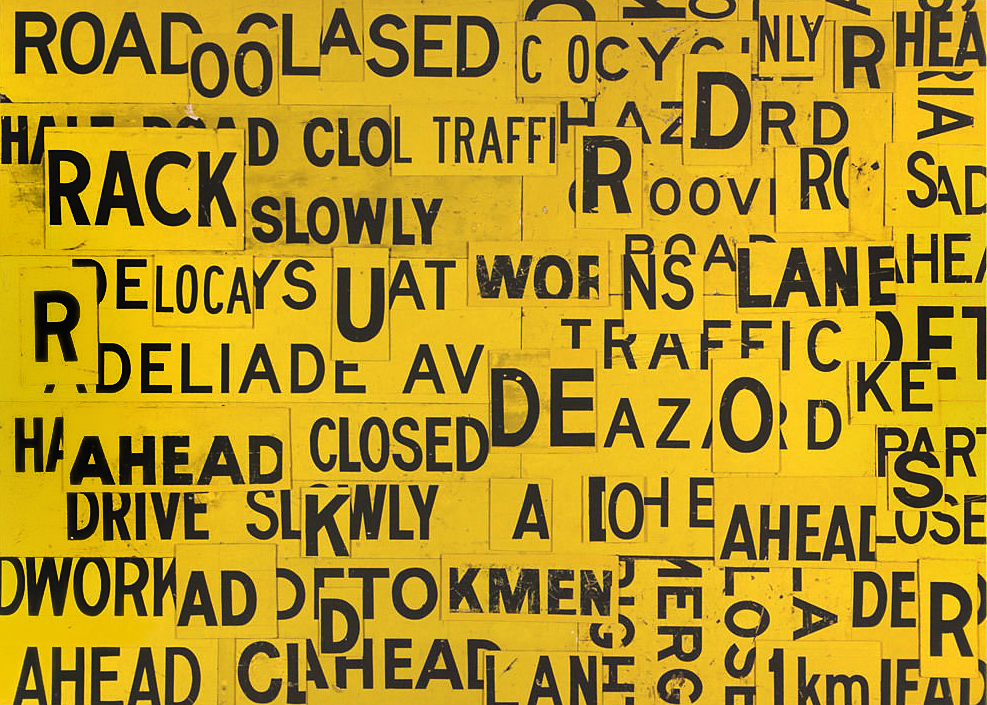
Summer swarm(1995) features small yellow blocks of wood an assemblage of yellow bees; Grassfest (1999, below) like a stand of yellow grass under the Australian sun; Metropolis(1999, below) collaged and patched road signs are worked together overlaying spaces and language. In Plenty (1986) yellow wood bricks mounted in panels are held in place with rusted metal nails. if you move close to the work the effect is immersive – every inflection of colour, grain of the wood, knot, nail hole, rub, scuff, daub of paint becomes evident. Every block is same but different, an almost transcendental experience.
In this work there is a refining of the essence of her vision of the world, a paring back of all extraneous elements but conversely an expansion in the energy of the work. A mature artist at the peak of their power.
In the ‘white’ work Star chart (1995) and Milky way (1995), heaven and earth reflect each other, the grids and patterns linked in a cosmic dance. But mostly air (1994-1995) the large installation that closes the exhibition confirms this dance, containing as it does white blocks of wood (invisible air) with a row of weathered wooden posts propped up against the gallery wall and animal spirits made of wooden blocks: faces with wings and ears, gasping for breath, white animals on a white background hovering between here and there, between heaven and earth.
This is a wonderful exhibition. Gascoigne rightly commands a place in the pantheon of Australian stars. She has left us with a legacy of music that evokes the rhythms, the air, the spaces and colours of our country. As she herself said,
“Look at what we have: Space, skies. You can never have too much of nothing.”
Nothing more, nothing less.
Dr Marcus Bunyan
Many thankx to the NGV for allowing me to publish the photographs in the posting. Please click on the photographs for a larger version of the image.
Joseph Cornell (American, 1903-1972) Medici Princess 1948 Mixed media
Rosalie Gascoigne is one of Australia’s most acclaimed and respected visual artists. Her distinctive style is characterised by her recognition of beauty in the most humble of objects such as soft drink crates, linoleum, retro-reflective road signs, dried grasses and feathers. Collecting and arranging these items, often rescued from rubbish dumps, and scarred and faded by the ravages of weather, is an integral part of her practice. Like a magician she transforms these discarded materials into sculptures, wall pieces and assemblages, which create evocative visual poetry, capturing the essence of things or an experience rather than conveying a literal representation.
Gascoigne like Picasso realised later in life that one is not made an artist, one is born an artist. Some of her fondest memories as a child are of collecting shells on summer holidays at the beach, and the yellow china her grandmother owned. At the age of ten she won first prize for her entry in a table decoration competition that included yellow flowers, an unusual Indian brass vase and Indian brass bowls.
Her journey to becoming a professional artist was highly unconventional. She received no formal art education, openly declared that she could neither draw nor paint and was not officially recognised as part of the Australian art scene until she held her first critically acclaimed exhibition at the age of fifty-seven.
Gascoigne was born in New Zealand in 1917. She studied for a Bachelor of Arts degree, specialising in English and Latin, at the University of Auckland. During this time she got to know her future husband Ben Gascoigne. In 1943, following a short teaching career, she moved to Australia to marry Ben. They lived as part of a small isolated scientific community around Mt Stromlo Observatory outside Canberra, where Ben had taken up a position. The transition from the gentle, green landscape of her home to the hard, unforgiving, dry slopes of Mount Stromlo, bounded by seemingly endless space, was initially a tough and lonely experience. She didn’t fit into the mould of the happy domesticated wife expected of this era. The lack of stimulating conversation with the other wives on the establishment made her feel particularly alone. She befriended nature instead and as she brought up three children in these alien conditions she remembers:
“I’d push the children’s prams around that lonely mountain until I knew the shape of every stone and tree, the texture of every patch of dirt and grass, the colour of every leaf and weed. I’d gaze down at the valley below, a vastness of dry blond grass and grubby sheep and the sky used to hang, from there to there.”
~ Janet Hawley ‘A late developer’, Sydney Morning Herald, Good Weekend, 15 November 1997, p. 40.
She acclimatised to this new terrain and began to gather unusual natural forms. She displayed these found objects in her home, much to the bemusement of the conventional local community. Gascoigne began creating distinctive flower arrangements in the 1950s and won prizes for them in horticultural shows. When the family moved from Mount Stromlo to the Canberra suburb of Deakin in 1960, she studied ikebana, the Japanese art of flower arranging, under Norman Sparnon, a master of the Sogetsu School. Gascoigne appreciated the strict discipline of this form of arranging, which imposed a sense of order on her collected found objects. The emphasis on line, form and sculptural properties was to become a key part of her later practice.
When Gascoigne’s three children had grown up, she had increasing freedom to pursue her growing interest in art. She visited art galleries more often, looked at art books and met people in the art world who were to shape her future career, including James Mollison, who became the inaugural director of the Australian National Gallery (now National Gallery of Australia). Her discussions with those in the arts community taught her much about looking and thinking about art, and confirmed her sense of identity as an artist.
In the mid-1960s she began making assemblages of rusted iron, which were followed, from 1973, by assemblages in boxes. These miniature surreal and often humorous worlds, such as The colonel’s lady, 1976, employed rich patterning and repetition through the arrangement of man-made objects, including advertising symbols used on the packaging of products.
The eclectic mix of objects and surfaces in these early works gave way to her later wall-based works that were elegant compositions limited to one or two materials, and subtly evoke culture, nature, language and the landscape, particularly the country around Canberra, which she came to love. Scrub country, 1982, and Monaro, 1989, epitomise these works. They are made from soft-drink crates – weathered by the sun, rain, wind and time – dismantled, sawn into strips and reassembled.
Gascoigne reached meteoric heights in her career which spanned over two decades until her death in 1999 at the age of eighty-two. She was given a major survey show at the National Gallery of Victoria (NGV) in 1978, only four years after her first solo exhibition at Macquarie Galleries, Canberra. In 1982 she represented Australia with artist Peter Booth at the Venice Biennale. Her work is included in major public, corporate and private collections.
Despite their unusual appearance, this set of feathered chairs is not a departure from Rosalie Gascoigne’s usual practice. This work does not record, despite the reference to furniture in the title, a move to decorative arts – this feathered pair were never intended to function as seating – they are sculptures, conceived to fascinate the eye rather than conform to anyone’s behind.
Gascoigne collected the feathers for the chairs on the shores of Lake George, located about 35 kilometres from Canberra, on the road to Sydney.
“And then I came to this place,” she recalled in 1982, “where there were all these… black birds, you know, cormorants. And a shattering of black beautiful glossy [feathers] as if the birds had just undressed. … They’re beautiful feathers. They’re like the underside of mushrooms. You know… the quill.”
The feathers were assembled in racks similar to those used in Gasgoigne’s Feathered Fence 1979 (NGA Collection, Canberra) which used swan feathers also found at Lake George. Racks of feathers were displayed on two reddish metal chairs that she had found at the dump. Gascoigne aimed to create poetic, rather than literal interpretations of her work, aiming for a succinct ‘plastic metaphor’, where a melding of disparate objects and textures might produce unexpected allusions and tangential meanings. Nonetheless, the claw foot of the chair suggests the foot of a bird and the splayed feathers conjure up the pose of a cormorant with its spread wings drying off in the sun. Or did the sun-basking bird with its arm rest wings suggest a throne? Gascoigne was not an artist to routinely create figurative works and it’s just as likely that in this work she sought a tension between the earthbound weight of the metal and the airy, windborne feathers. She had a longtime fascination with birds and the Feathered Chairs suggest an evocation of flight and freedom; a joyous ability to see and read the story of our ancient land. Elated by exploration and discovery, Gascoigne willingly shares her delight with the armchair traveller.
Extract from Michael Desmond. “Rosalie Gascoigne,” on the Menzies website [Online] Cited 19/12/2018. No longer available online
After first exhibiting her work at the age of 57, Rosalie Gascoigne rapidly established a reputation as one of Australia’s foremost contemporary artists. Following her first exhibition in 1974, Gascoigne subsequently developed an impressive exhibition history that included her being honoured, in 1982, as the first female artist to represent Australia at the Venice Biennale.
This major exhibition of Rosalie Gascoigne’s work ranges from the boxlike assemblages of her early career through to large scale installations and her creation of master works constructed from Schweppes soft drink crates and retro-reflective road signs. The exhibition investigates the artist’s ability to draw creative inspiration from the discarded; her intrinsic response to her chosen materials, and her unique ability to evocatively convey the essence of nature and the transitory and captivating effects of light, air and space.
Rosalie Gascoigne is the first major retrospective exhibition of Gascoigne’s work to be seen in Melbourne and is accompanied by a comprehensive exhibition catalogue.
Extract from A Formal Focus – Art Elements and Principles
In Inland sea, 1986 (below), sixteen large sheets of corrugated tin hover above the floor in a loose grid arrangement. The grid format unifies the separate parts of the composition, and also enhances the expressive power of different visual elements through repetition. The shapes and lines repeated across the buckling sheets of tin create a powerful sense of the gentle movement of wind or water.
The strong visual rhythms and movement evident in Gascoigne’s compositions are often achieved through the repetition of different visual elements. Step through, 1980 (above), is made from fifteen separate parts, each made from a torn piece of brightly coloured, floral patterned linoleum mounted on a block of wood. The blocks sit at different angles creating different levels within the installation. The spaces between the different parts create a meandering path for the viewer to explore, highlighting the importance of movement through and across space in Gascoigne’s work.
“I was thinking about the unkempt empty blocks in built up city areas … usually covered in rank grasses and flowering weeds … rubble, old tins and bottles. One steps through them gingerly and, with possible snakes in mind, lifts one’s knees high.”
~ Vici MacDonald, Rosalie Gascoigne, Regaro Pty Ltd, Sydney, 1998, p. 48
…
Colour assumed a vital presence in Gascoigne’s work. In an overview of her work, as in the exhibition Rosalie Gascoigne (2008), the importance of particular colours is revealed in swathes and groupings of yellow, red, orange and white artworks, culminating in the grey, brown and ochre hues of the Earth series (1999), which were the artist’s last works. Individually, each work reveals something of the beauty of colour and its ability to suggest meaning; from sun-baked, muted yellows that remind us of vistas of dry grass, to soft pale greys and whites that murmur quietly of the open air and cloud.
Gascoigne was often drawn to particular materials because of the beauty of their colour and texture, and the associations or moods these suggested. The visual qualities and associations found in the textures of humble and / or discarded materials are clearly revealed in Gascoigne’s work – from the flaky layers of faded paint on weathered tin or wood that speak of both rural life and work, and the forces and seasons of nature, to the staccato flash of retro-reflective road signs that remind us of driving through the landscape.
Rosalie Gascoigne’s work is often referred to as visual poetry. Her training in literature and fascination for words infuse her work. She had a particular love of poetry. This included the modern Australian poets such as Peter Porter and David Campbell, who also evoked in his writing the landscape around Canberra. Just as a poet distils the essence of their subject with carefully chosen evocative words and phrases, so Gascoigne captures the spirit of a place, or the core of an idea with sensitive arrangements of visual elements. Instead of literary allusions, Gascoigne creates visual metaphors with materials such as corrugated iron in Inland sea, 1986, which evokes movement of air, while slivers of discarded, weathered timber in Monaro, 1989 suggest dried grassland. Repetition, ordering, fragmenting and editing out unnecessary materials are also part of her practice which echo the creation of poetry.
Gascoigne admired the English Romantic poets of the late eighteenth and early nineteenth centuries and often quoted William Wordsworth’s idea that: ‘Poetry is the spontaneous overflow of powerful feelings: it takes its origin from emotion recollected in tranquillity.’ She believed passionately that her work was intricately woven with glimpses of her past feelings and experiences. …
Other works studded with random words are more elusive and hark back to the poetry of Andre Bréton and the Surrealists, who scattered and re-arranged words cut from a newspaper.
Gascoigne frequently described her works as ‘stammering concrete poetry’ (Gregory O’Brien, 2004, p. 42), a reference to a style of poetry originating in the 1950s where the visual arrangement of words or letters suggests something about the subject of the poem. In All that jazz, 1989, for example, the artist has conjured up the pulsating chopped up rhythms of jazz with wooden strips of dazzling colour highlighted by splinters of black lettering. In contrast, the broken and fractured nature of the yellow and black road signs in Skylight, 1993, interspersed with ill-fitting patches of well-worn linoleum, sets up a tension that hints at both the tragedy of drought and the beauty of the Australian light in summer.
The evocative titles of Gascoigne’s works, which are selected after their completion and only after much contemplation, are chosen to be allusive and poetic rather than descriptive. They reveal an entry point but allow the viewer to experience their own intuitive response to the work.
Text from the NGV Rosalie Gascoigne Education Kit
Rosalie Gascoigne’s art comes from, is inspired by, and in turn reflects the spare countryside of the southern tablelands and the Monaro district, a unique natural environment that lies relatively close to Canberra, the artist’s home of more than fifty years. Gascoigne’s transformation and re-investment in her work of battered and weathered materials sourced in the landscape surrounding Canberra also highlights the importance of collecting to her oeuvre, as different materials appear in works from across the decades …
Gascoigne’s knowledge and love of language and of Romantic poetry is evident in many of her works as she aspired to make art that achieved ‘allusive and illusive’ qualities that she experienced in this form. Through the artist’s skill in making poetry of the commonplace and her intrinsic response to both her chosen materials and the particularities of the Australian landscape, we are able to witness her unique ability to evocatively capture and convey the essence of nature and the transitory and captivating effects of light, air and space.
Extract from Landscape – Place, Memory, Experience
The art of Rosalie Gascoigne has a unique place in the rich landscape tradition in Australian art. While painting has been the dominant artform in this tradition, Gascoigne worked in assemblage and installation, using natural and man-made materials collected from the landscape. Unlike many earlier artists, she was not interested in describing the visual reality, picturesque beauty or stories of the Australian landscape. Gascoigne’s artworks capture the essence of the landscape’s topography, space, air, vegetation; and the daily and seasonal natural rhythms of nature, in compositions that are often startling in their refined simplicity. …
In Scrub country, 1982 wooden slats from old soft-drink crates are arranged methodically in rows and columns, but their faded colours, worn surfaces and uneven edges reveal the impact of prolonged use and many hot summers. The medley of faded yellows and greens, and nearly naked wooden surfaces in Scrub country is punctuated by flashes of turquoise blues, evoking the patterns of dappled light and colour often found in the Australian bush.
“I called it Scrub country because to me it had the randomness and relaxed air and the quality of colour which I think is much more typical of the Australia I know than any of those ochres and oranges so often used. I have let air through because we see a lot of filtered light, random pattern and carelessness in the Australian landscape.”
~ Public Programs Department, Art Gallery of New South Wales Education Kit, Material as Landscape – Rosalie Gascoigne Education Kit, 1997
While a palette of ‘blue and gold’ colours was strongly associated with the paintings of the famous Australian landscape painter Arthur Streeton (1867-1943), Scrub country clearly breaks with the landscape conventions associated with Streeton and his generation. The repetition and ordering of elements in distinct rows and columns creates a strong formal structure and a flattened space that avoids literal landscape references. Sensations and moods more associated with memory and experience of the landscape are emphasised. Gascoigne’s focus on the formal qualities suggests some affinity between her landscape inspired artworks and those of her contemporary, Australian artist Fred Williams (1927-1982), who also broke with convention in representing the landscape.
Gascoigne worked intuitively with no preliminary drawings or plans. Her ideas, and the processes used to make each artwork, were inspired and determined by the look and feel of particular materials, and the visual and emotional associations they suggested. Depending on the materials used, many hundreds of hours would be spent on the labour intensive work of cutting, tearing, bending, scrubbing, sorting, grouping, arranging until the ‘right’ idea and visual effect crystallised. The process of transforming found materials into artworks was one of making the mood, experience and sensation of landscape visible.
“Your art has to come out of your daily life. I really believe that if anyone is born an artist they’ve only got to look at what’s round their feet and what’s available to them. They don’t have to be clever, they don’t have to go to art school, they don’t have to get the exotic stuff – make it with what’s there. People think art’s like you strike it lucky and you’re famous tomorrow, but it isn’t like that, it’s a search for honesty on your own terms. The journey to self-recognition took me decades.”
Vici MacDonald, Rosalie Gascoigne, Regaro Pty Ltd, Sydney, 1998, p. 9
“I look for the eternal truths in nature, the rhythms, cycles, seasons, shapes, regeneration, restorative powers, spirit. I’m showing what I believe to be interesting and beautiful.”
Janet Hawley. “A late developer”, Sydney Morning Herald, Good Weekend, 15 November 1997, p. 44
“I was hopeless at painting and drawing, and had no skills at making craftwork. At school, I envied people who could draw a perfect basket of apples. I regarded myself as totally non-artistic. My big love was, and remains, poetry; I always visualised every line of a poem as I read it.”
Janet Hawley. “A late developer”, Sydney Morning Herald, Good Weekend, 15 November 1997, p. 42
“My concerns are as much with my materials as with the work I make of it. They both have to satisfy me … I look for things that have been somewhere, done something. Second-hand materials aren’t deliberate; they have had sun and wind on them …”
Public Programs Department, Art Gallery of New South Wales, Material as Landscape, Rosalie Gascoigne Education Kit, 1997
“Once I’d started on my art journey I was in it with a vengeance. I needed it so badly. At last life was full of possibilities.”
Janet Hawley. “A late developer”, Sydney Morning Herald, Good Weekend, 15 November 1997, p. 41
“I have a real need to express elation at how interesting and beautiful things are and to see them arranged … I work with things I rather like and move them about until they recall the feeling of an actual moment in the landscape; then I’ve won.”
Rosalie Gascoigne interviewed by James Mollison and Steven Heath in Rosalie Gascoigne: Material as landscape (exh. cat), Deborah Edwards (ed.), Art Gallery of New South Wales, Sydney, 1997, p. 7
“My pieces can be looked at in many different ways. I try to provide a starting point from which people can let their imagination wander – what they will discover will be a product of their own experience as much as mine. My aim is to be allusive and elusive.”
Bob Weis, Judi Stack and Robert Lindsay, Survey 2 – Rosalie Gascoigne, video, colour, sound, 16 mins 50 secs, produced by the Media Resource Centre for the NGV, 1978
Heide Museum of Modern Art has brought together nearly 100 pieces of work by the Australian artist Les Kossatz in an eclectic survey show, appropriately titled The Art of Existence. Featuring sculpture, painting and mixed media from the 1960s to the present the exhibition is appropriately titled because Kossatz’s work addresses certain archetypal themes that affect human existence:
“His life-long fascination with the natural world and desire to understand both its human and animal inhabitants; exploration of the systems of knowledge and codes of behaviour that structure individual and communal life; and his critical and playful reflections on contemporary behaviour and the mysteries of existence.”1
Strong symbolic paintings are the focus of the work in the 1960s, paintings that address the shocking brutality of war and its aftermath, when soldiers return home. To the observation that these are of the ‘pop-style’ school of painting suggested by the Heide website I feel these works are also influenced by the collage of Cubism, the boxes of Joseph Cornell and the dismembered bodies of Francis Bacon. They engage with the symbolism of war and remembrance: memory, myth, and the banality of heroism and sacrifice.
The key work in this series is the painting Diggers throne (1966). This is a powerful disturbing image, effervescent and unnerving at the same time. It features a disembodied arm on the hand of a throne, surrounded by a wonderful kaleidoscopic assemblage of pictorial planes, artefacts and memories – an English flag, the flag of St George, a crown, medals and the words RSL. The arm reminds me of the Francis Bacon painting Study after Velázquez’s Portrait of Pope Innocent X (1953) as it rests, roughly drawn in pencil on the arm of the throne, drawing the eye back up into nothingness.
The Diggers throne painting also features these prophetic words:
“throne slow to rot and twisted the memory becomes sacred. Bloody was the truth And this a chair.”
All other work in this period seems to flow through this painting – the other large paintings, the small canvases featuring individual medals and the less successful hanging banners. But it is to this work we return again and again as a viewer, trying to decipher and reconcile our inner conflicts about the painting.
As we move into the 1970s the work changes focus and direction. There emerges a concern with the desecration of the Australian landscape investigated in a series of large paintings and sculptures. In Packaged landscape 1 (1976) a steel suitcase with leather straps, slightly ajar, fulminates with artificial gum leaves trying to escape the strictures of the trap. In Caged landscape (1972) nature is again trapped behind steel wire, weighed in the balance on a set of miniature scales. The paintings feature trees that are surrounded by concrete and the rabbit becomes a powerful symbol for Kossatz – a suffering beast, strung up on fences, a plague in a pitted landscape of chopped down trees, erosion and empty holes.
Into this vernacular emerges the key symbol of the artist’s oeuvre – the sheep. In 1972 Kossatz began a series of sculptures of sheep, “initially inspired by the experience of nursing an injured ram.” For Kossatz “the sheep represent the hardship of pioneer existence, the grazing industries prosperity, environmental concerns and the sheep act as narrative devices, potent metaphors for human behaviour.”2
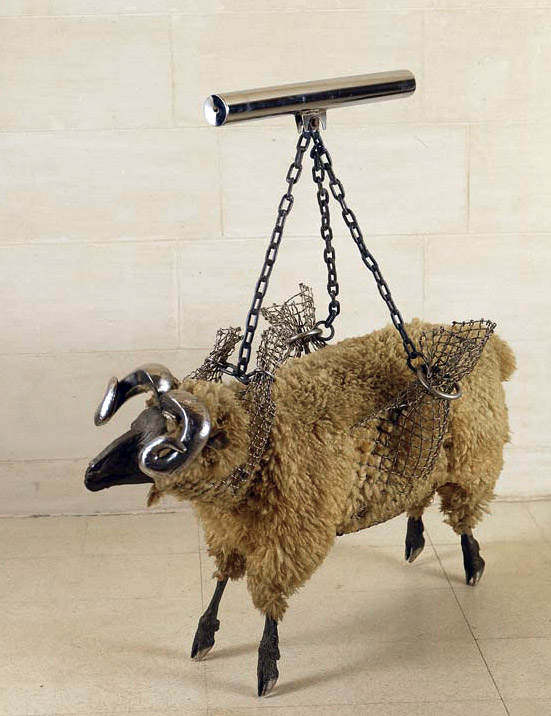
The first sheep presented ‘in show’ is Ram in Sling (1973, below). In this sculpture a metal bar is suspended in mid-air and from this bar heavy wire mesh drops to support the fleecy stomach and neck of the ram almost seeming to strangle it in the process, it’s metal feet just touching the ground. Again the scales of justice seem to weigh nature in the balance.
The themes life and death, order and chaos are further developed in the work Hard slide (1980, below) where a sheep emerges mid-air from a trapdoor, two more tumble down a wooden slide end over end and another disappears into the ground through a wooden trapdoor opening. Sacrifice seems to be a consistent theme with both the earlier paintings and the metallised sheep:
“The completed life cycle, down the trapdoor, down the chute, after sacrifice by shearing.” ~ Daniel Thomas 1994
Further sculptures of sheep, both small maquettes and large sculptures follow in the next room of the exhibition. This is the artist is full flow, featuring the inventive taking of 2D things into the round, investigating the key themes of his work: the contrast between nature and artifice, or humanity.
The small maquettes of sheep feature races, gantries, sluices, pens, trapdoors and paddocks. Sheep tumble in a cataclysmic maelstrom, falling with flailing legs into the darkness of the holding pen below. These are my favourite works – small, intimate, detailed, dark bronzes of serious intensity – the sheep becoming a theatre of the absurd, suspended, weighed and balancing in the performance of ritualised acts, a cacophony of flesh at once both intricate and unsettling. Their skins lay flayed and lifeless disappearing into the ‘unearth’ of the slated wooden floor of the shearing shed. The sheep “can be viewed metaphorically as a commentary of the existential situation of the individual and collective behaviour.”3 As Kossatz himself has noted, “It is hard to bring a piece of landscape inside and give it a living animated form. The sheep somehow gives me this quality of landscape.”
But we must also remember that this strictly a white man’s view of the Australian landscape. Nowhere does this work comment on the disenfranchisement of the native people’s of this land – the destruction of native habitats that the sheep brought about, the starvation that they caused to Aboriginal people just as they bought riches to the pastoralists and the country that mined the land with this amorphous mass of flesh.
Recent work in the exhibition returns to the earlier social themes of memory, war, remembrance, religion, shrines, atomic clouds and temples but it is the work of the late 1970s-1980s that is the most cogent. As Kossatz ponders the nature of existence on this planet he does not see a definitive answer but emphasises the journey we take, not the arrival. Here is something that we should all ponder, giving time to the nature of our personal journey in this life, on this earth.
Here also is an exhibition worthy our time and attention as part of that journey. Go visit!
Dr Marcus Bunyan
Word count: 1,074
1/ From the Heide website 2/ From wall notes to the exhibition 3/ From wall notes to the exhibition
Many thankx to Heide Museum of Modern Art for allowing me to publish the photographs in the posting. Please click on the photographs for a larger version of the image.
Postscript 2018
The late Les Kossatz (1943-2011) was a well known Melbourne-based artist and academic whose work is represented in many regional and state galleries and the National Gallery of Australia. He studied art at the Melbourne Teachers’ College and the RMIT, and went on to teach at the RMIT and Monash University. Kossatz’s first significant commission was for the stained glass windows at the Monash University Chapel in Melbourne. Later commissions included works for the Australian War Memorial, the High Court, the Ian Potter Foundation at the National Gallery of Victoria and the Darling Harbour Authority, Sydney. His sculpture, Ainslie’s Sheep, commissioned by Arts ACT in 2000, is a popular national capital landmark in the centre of Civic. A major retrospective of Kossatz’s work was held in 2009 at the Heide Park and Art Gallery, Melbourne.
The art of existence is the first exhibition to review Les Kossatz’s contribution to Australian art in a career that spans the 1960s to today. Kossatz’s consistently experimental approach to media and techniques is revealed in works that display a lifelong fascination with humanity and the interaction of man and nature. His paintings, sculptures and works on paper stimulate a questioning and exploration of such concerns, which form the basis of this artist’s practice.
Les Kossatz’s early works of the 1960s draw on his training and ability to work across a diversity of media, including painting, drawing, printmaking and glass. Early paintings and etchings on the theme of the emptiness of memorials to the Australian ‘digger’ or soldiers were succeeded by images and objects offering impressions of the world around the artist – the rural domain and interior life of St Andrews in Victoria where Kossatz lived and worked. Such works demonstrated his determination to pursue a figurative practice at a time when abstract art had been imported to Australia and was considered the avant garde.
Remaining a staunchly independent artist, at the start of the 1970s Kossatz painted images of rabbits and sheep from St Andrews. In addition, the practice of working in three dimensions was to become more significant. Kossatz continued to develop familiar themes in the creation of installations and cast objects. Although he has produced drawings and prints across his career, working with sculpture has, since the early 1970s, been his primary mode of art-making. Large scale cast and assembled objects show Kossatz pursuing related themes of caged and packaged landscapes, shrines to the harvest and the still life.
The art of existence surveys Kossatz’s monumental life-sized sheep sculptures, which he began making in 1972 from casts of animal parts, and for which he is best known. These include Hard slide (1980), his prize-winning commission in the collection of the National Gallery of Victoria. Kossatz has won numerous commissions for outdoor sculptures that employ the sheep as literal and metaphorical beings. Kossatz’s work across three decades reveals a number of ongoing engagements, such as his observations of human behaviour and at times its similar manifestation in animals; the beliefs that sustain individuals and communities (such as religion, music and politics); and the forms of the landscape and our understanding of these relationships.
Introduction to the exhibition written by Zara Stanhope, Guest Curator, Heide Museum of Modern Art, 2008
Les Kossatz (Australian, 1943-2011) Hard slide 1980 Sheepskins, aluminium, Douglas-fir (Pseudotsuga sp.), leather, steel 372.0 x 100.0 x 304.0cm (installation)
Les Kossatz (Australian, 1943-2011) Guggenheim spiral 1983
Heide Museum of Modern Art 7 Templestowe Road Bulleen Victoria 3105 Australia Phone: +61 3 9850 1500
Opening hours: (Heide II and Heide III) Tuesday to Sunday and public holidays, 10am – 5pm
Exhibition dates: 5th November – 23rd November, 2008
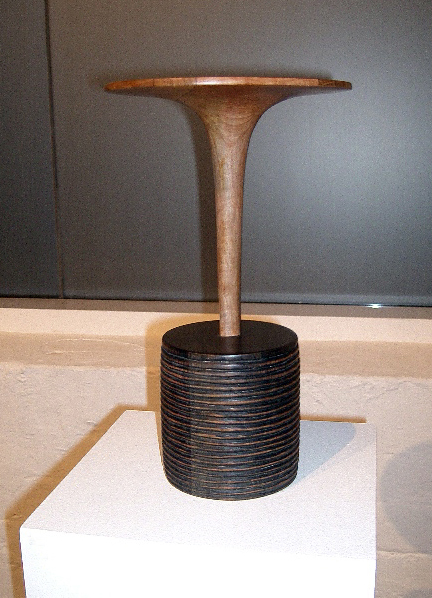
Jamieson Miller (Australian, b. 1965) The Last Drop 2008 Sheoak with ebonised stain 30 x 14 x 10cm
A small but lively crowd was in attendance for the opening of the exhibition territories featuring six small and six large floor standing wooden sculptures by the artist Jamieson Miller at the Dickerson Gallery in Oxford Street, Collingwood.
The work itself is of a fine craftsmanship showing exemplary design: different coloured woods and stains, wonderful joinery, the use of grain and different geometric and fluid shapes are all balanced harmoniously within the objects. A refined aesthetic sensibility is at work in their construction. This sensibility flows through to the conceptual themes of the work: the artist has created sometimes totemic but always lyrical poetic spaces within the corporeality of the work. The viewer enters enclosed intimate spaces (such as the funnels) or steps forward into steeped carved openings that open the way to visions of an inner world. Outer space becomes enclosed inner space as the viewer is at first intrigued, then drawn in and surrounded by the flickering shadows of Plato’s cave.
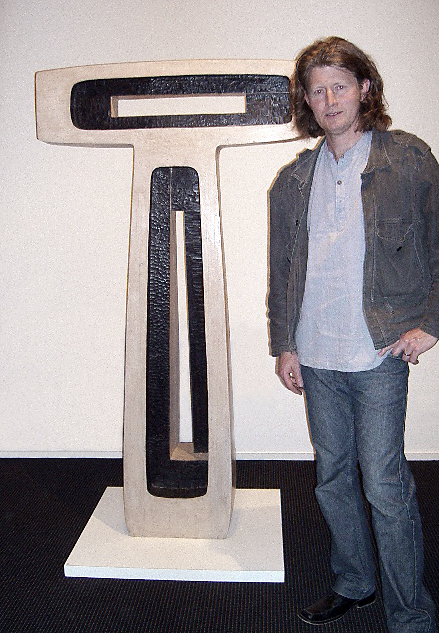
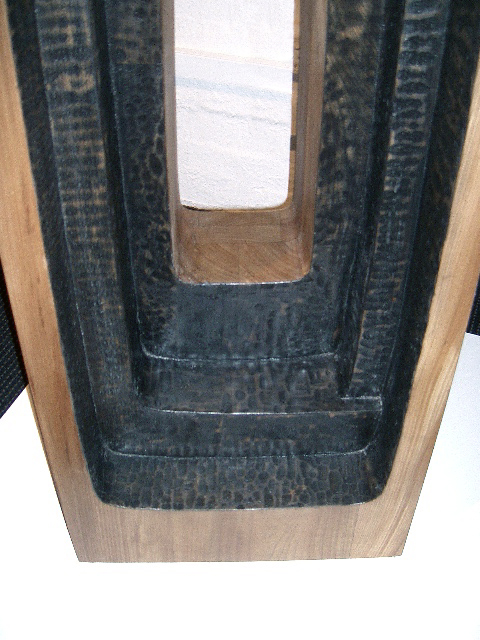
The new gallery is certainly an attractive modern warehouse space with vaulted roof. Unfortunately the large sculptures, although multi-dimensional and carved in the round, have been pushed to the edges of the space close to the walls. This makes it difficult to appreciate the totality of the form of the sculptures especially important with a work like Sight where the carved blackened wood shape on the ‘back’ of the sculpture is a vital counterpoint to the receding opening at the ‘front’ of the work. Make sure you also explore the reverse of the sculpture Lineage II to also comprehend the intimate space of the medieval window like opening to the front.
I really enjoyed the work of Jamieson Miller and recommend a visit to the gallery to see his refined worlds. The work is on show with the paintings of Jason Cordero.
Dr Marcus Bunyan
Jamieson Miller standing next to his sculpture Sight on the opening night of his exhibition territories at Dickerson Gallery in Collingwood.
Cyprus pine with ebonised stain 180 x 100 x 30cm
Jamieson Miller (Australian, b. 1965) Resting Place (detail) 2008 Elm with paint 203 x 42 x 30cm






























 Art Blart _ art and cultural memory archive
You must be logged in to post a comment.