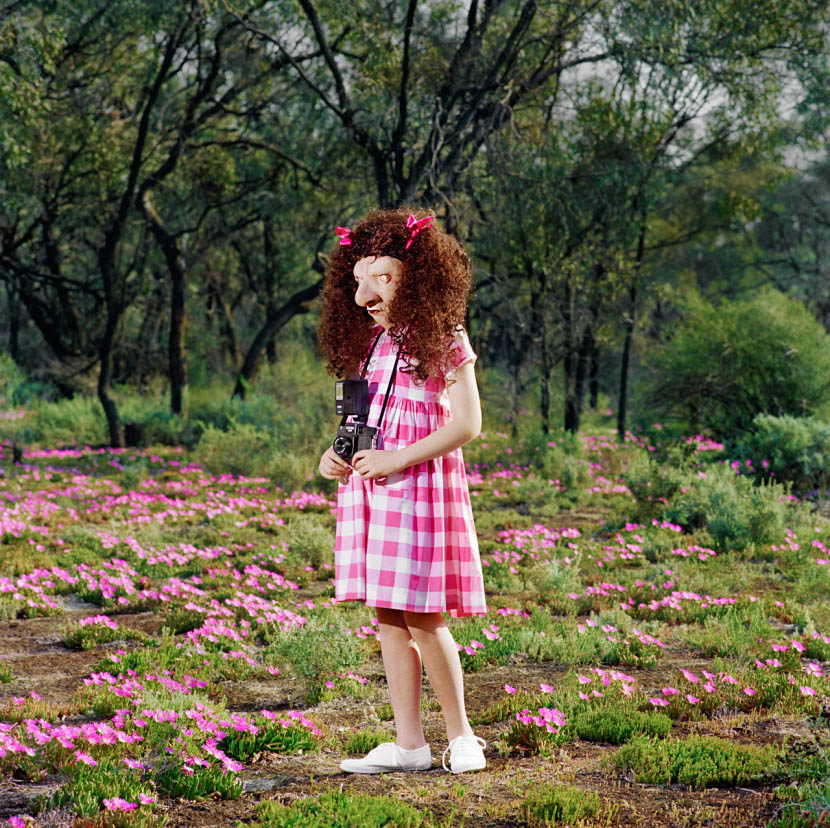
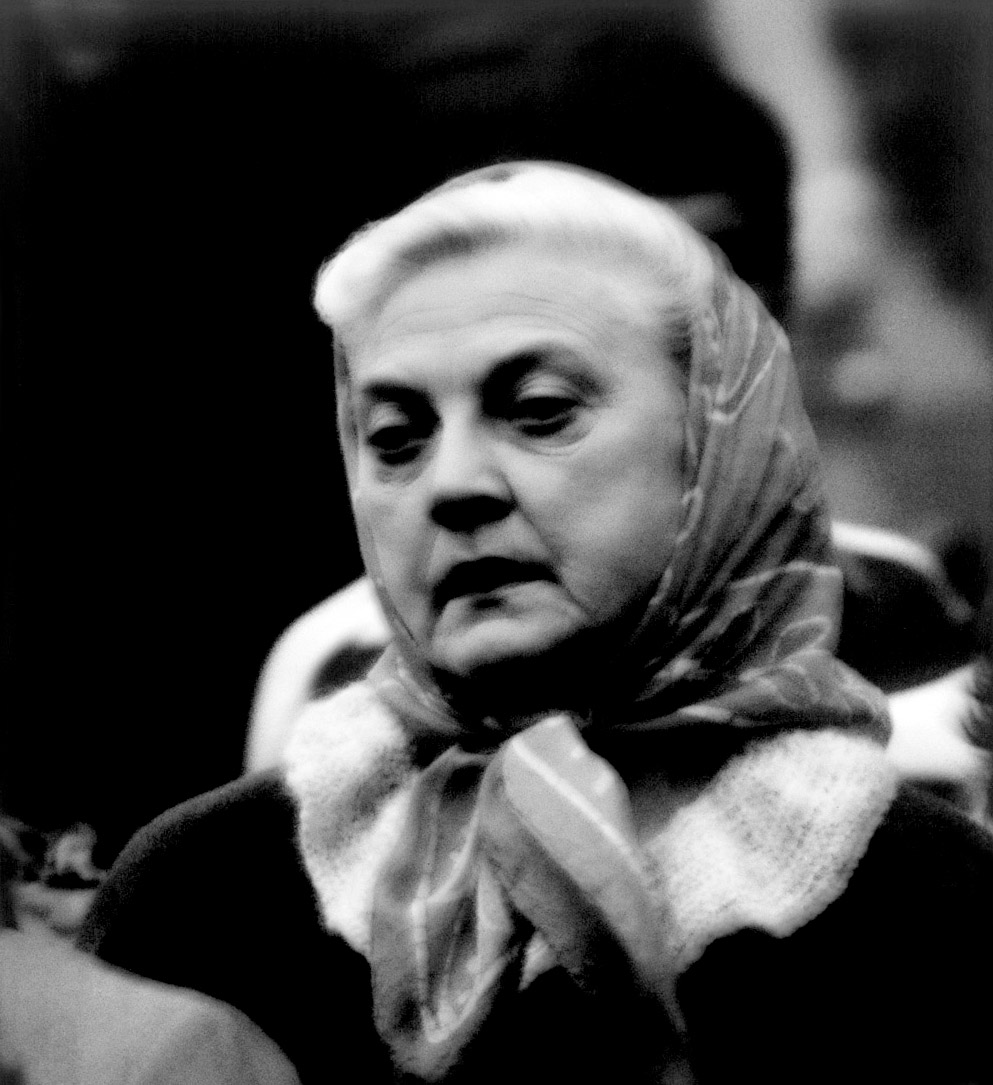
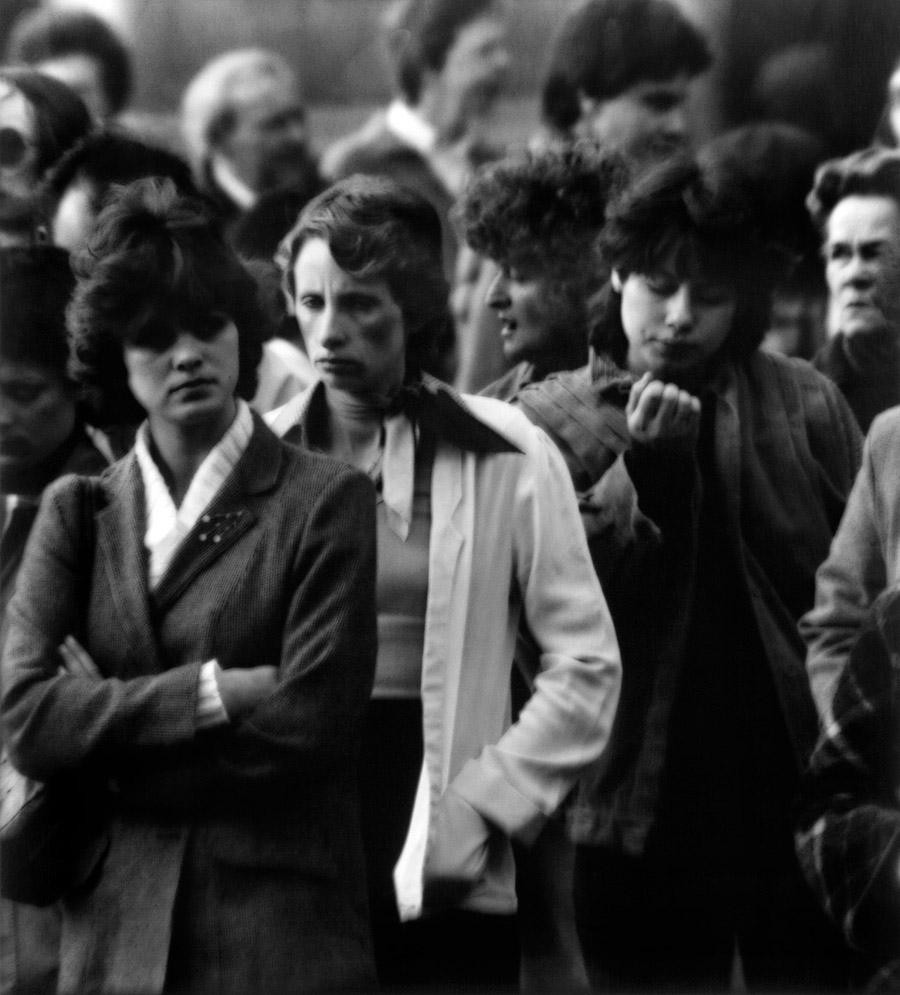
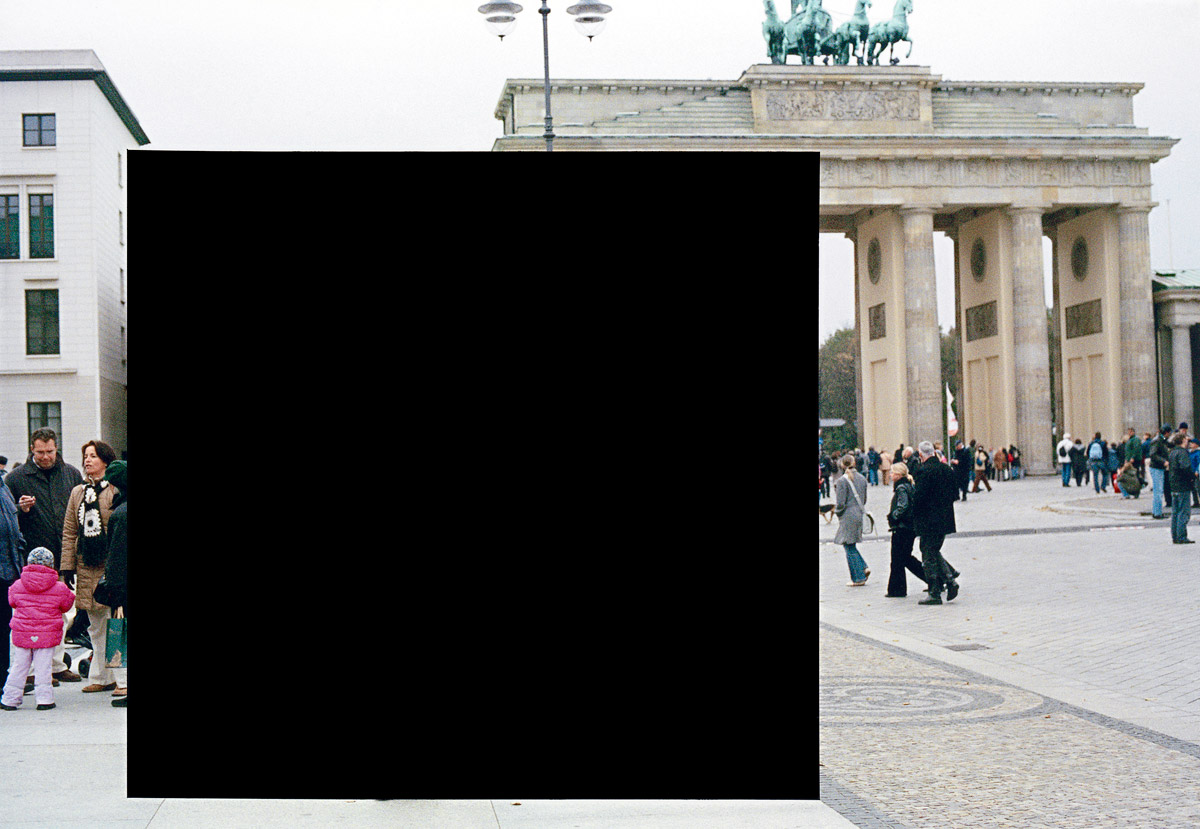
Artwork: ‘Transit’ series by Katrin Koenning, Melbourne

July 2012


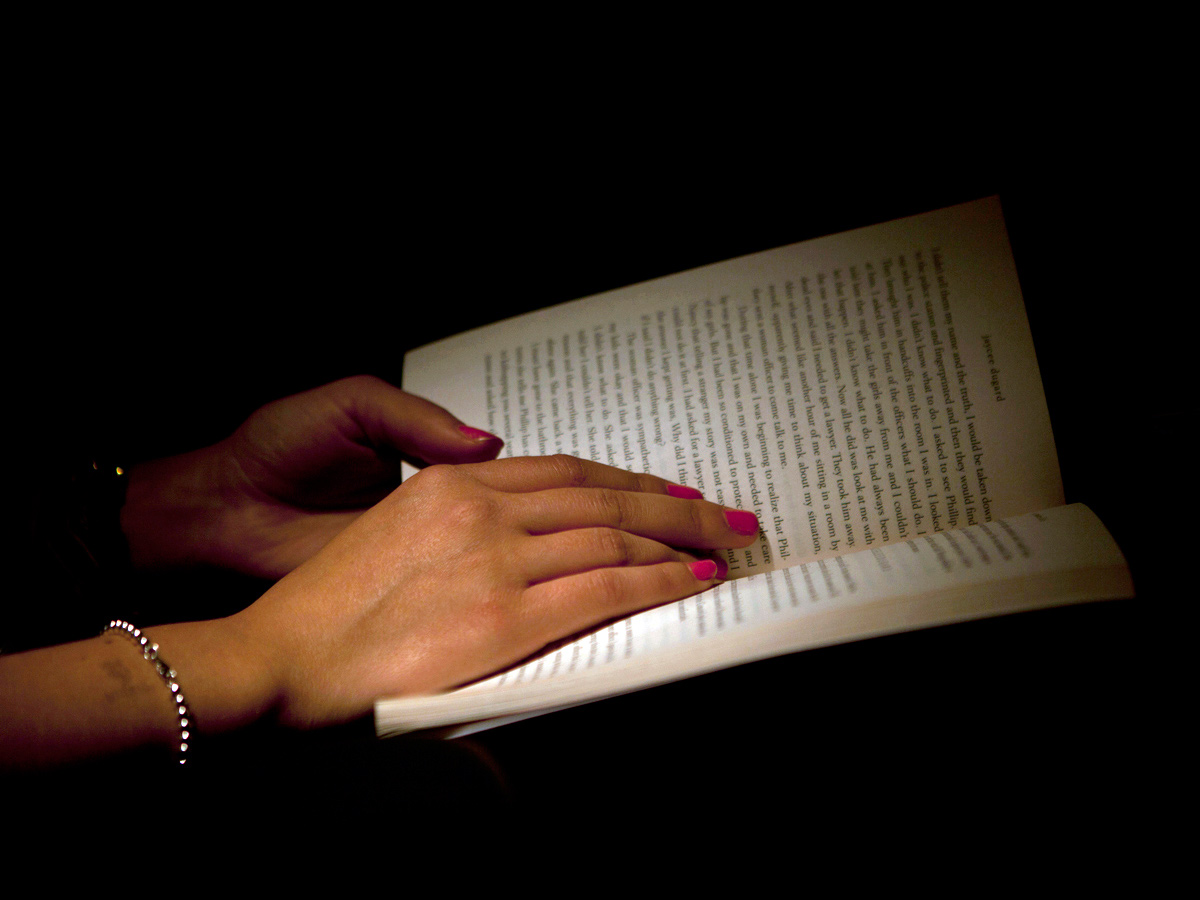
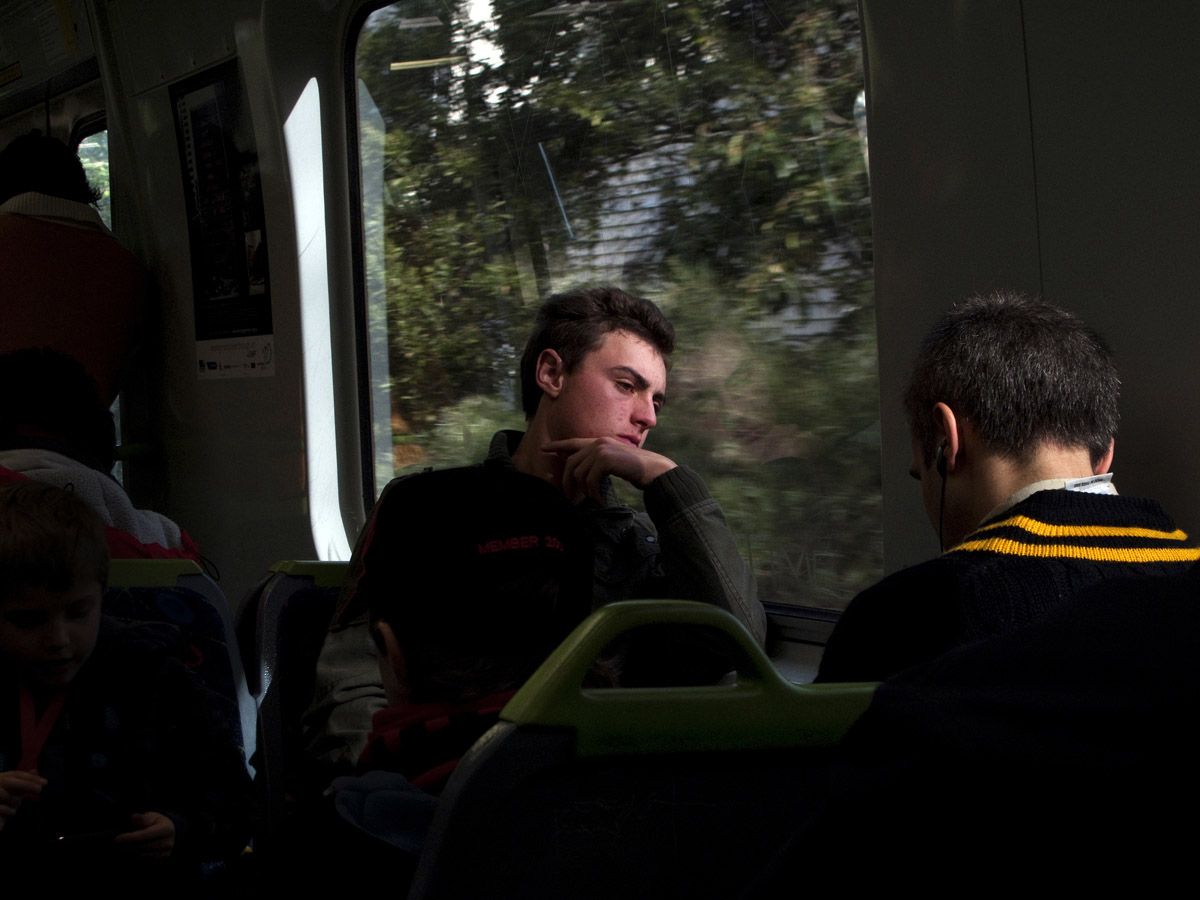
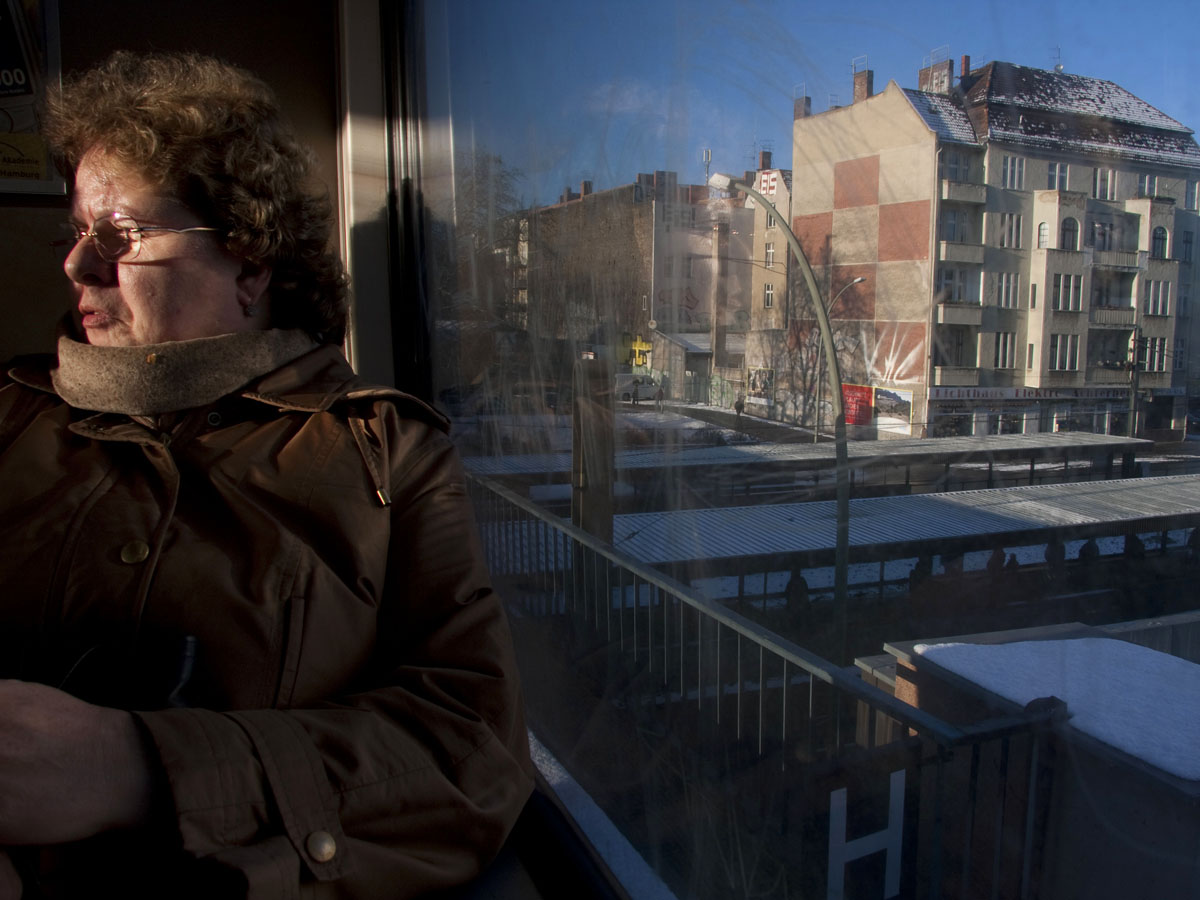
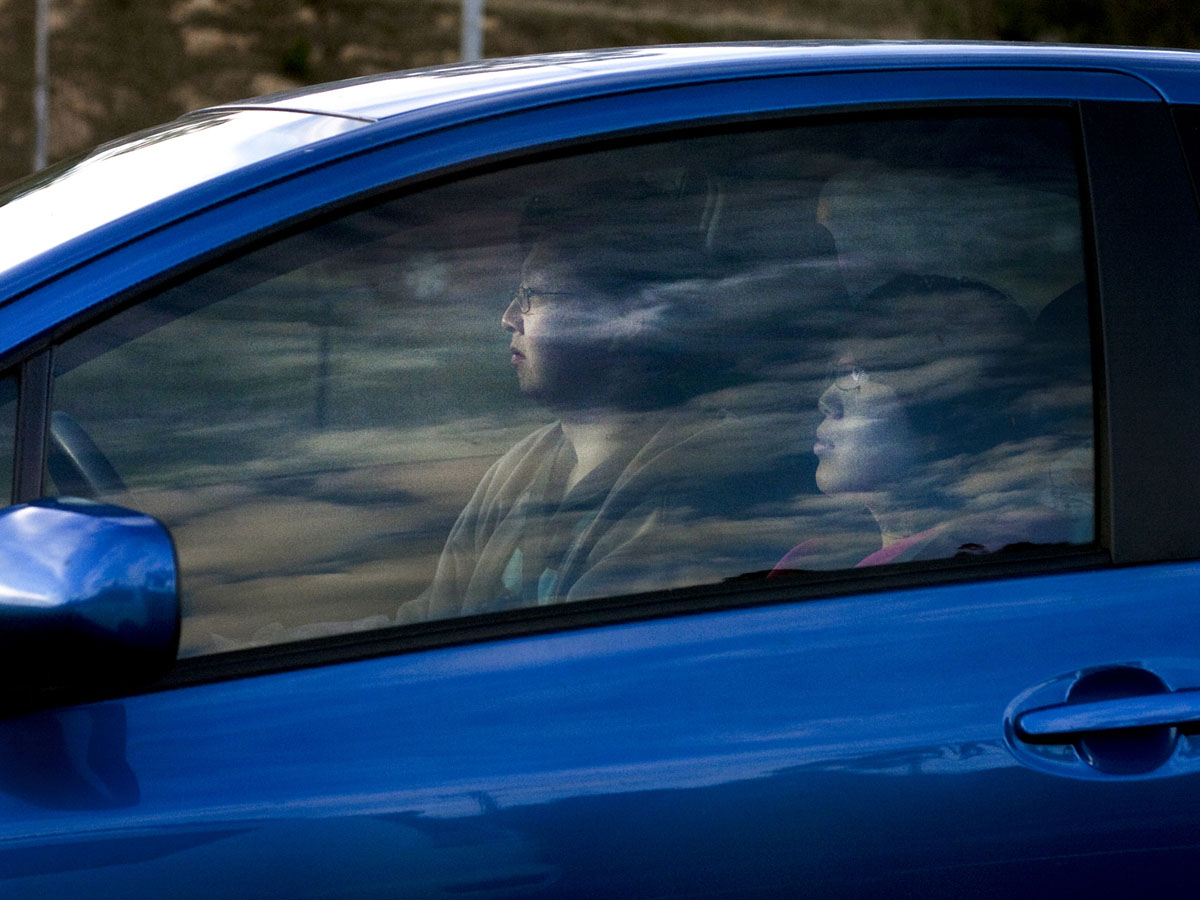
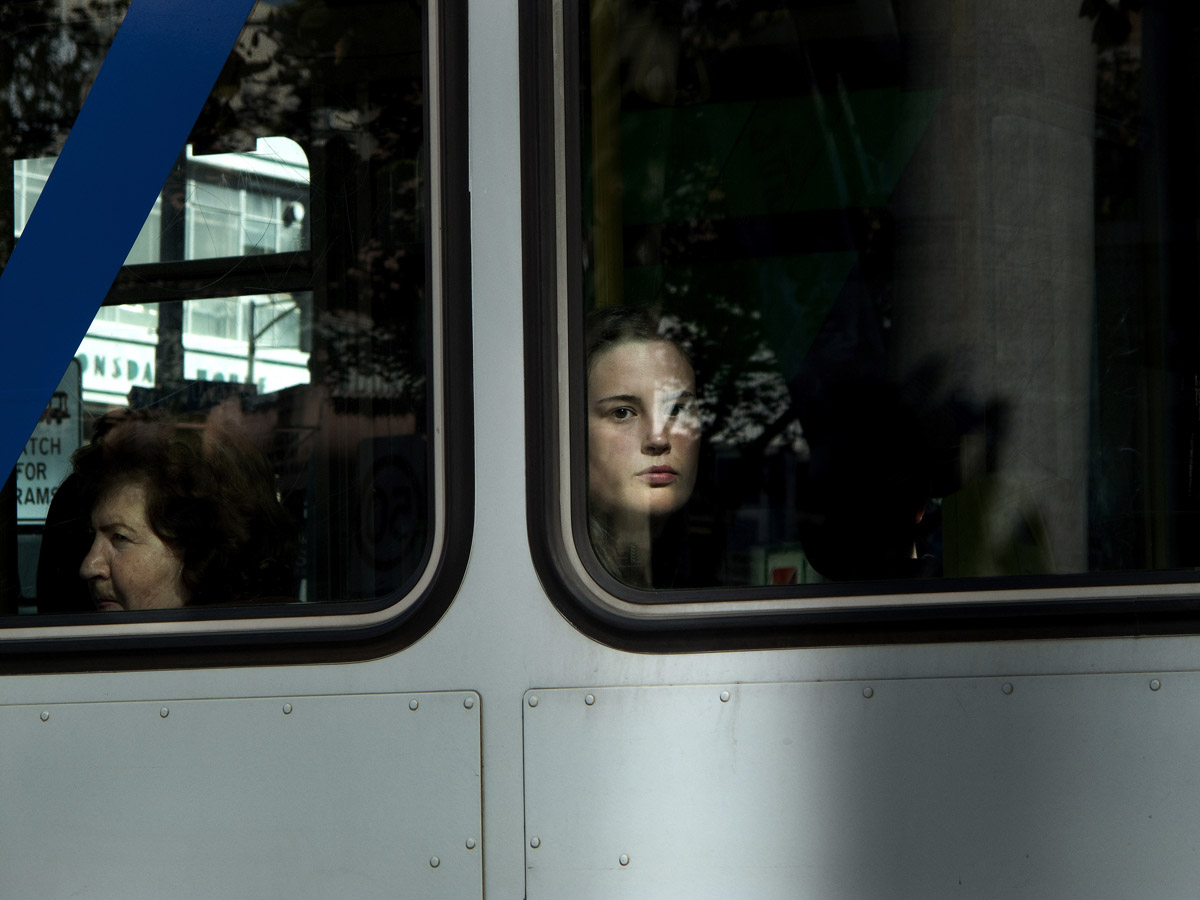
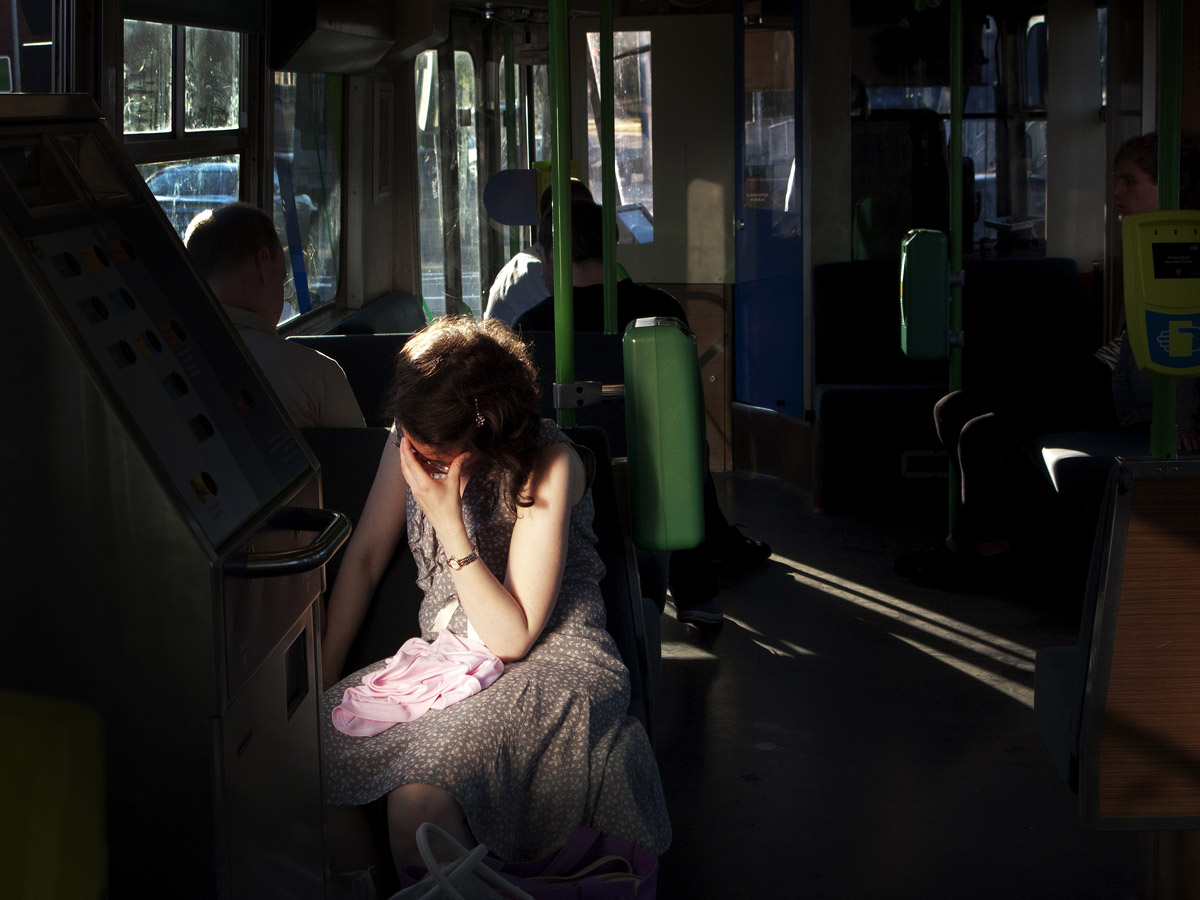
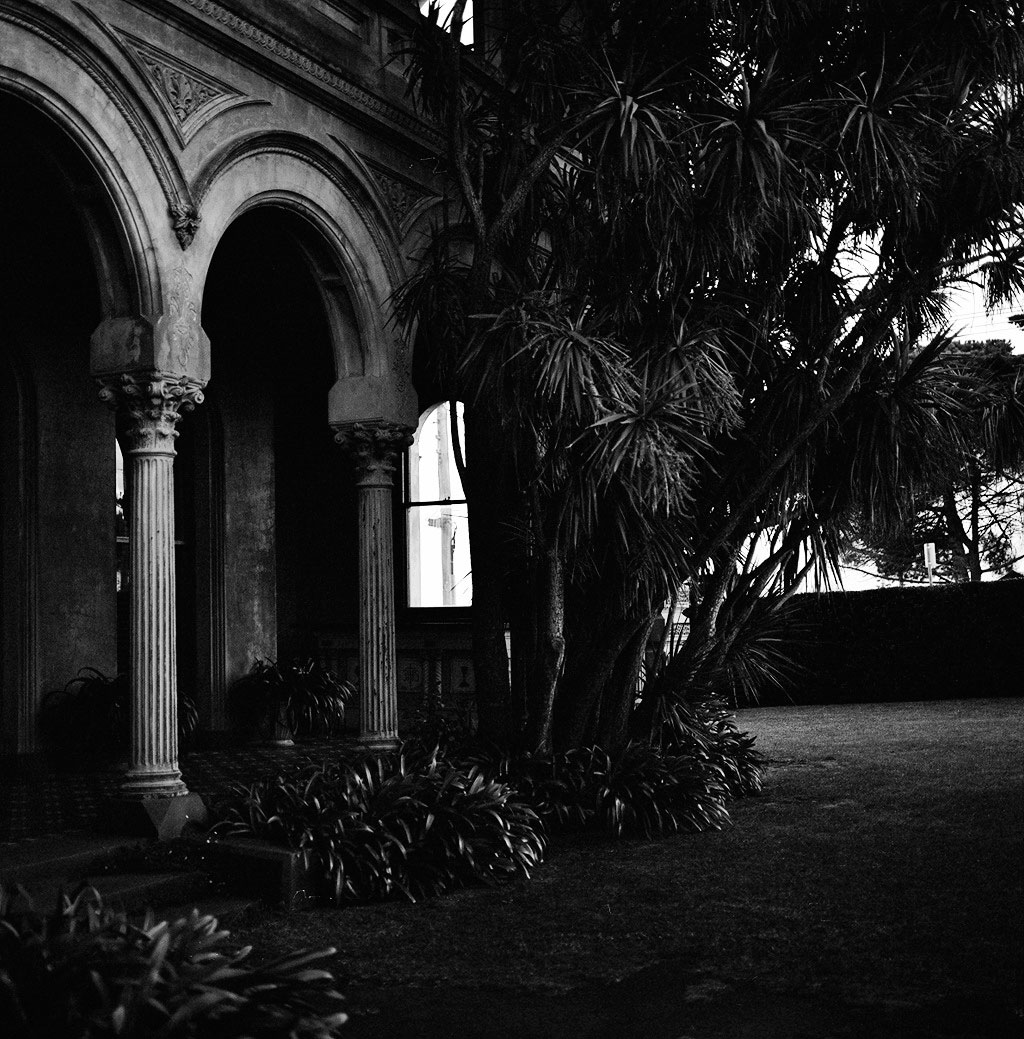
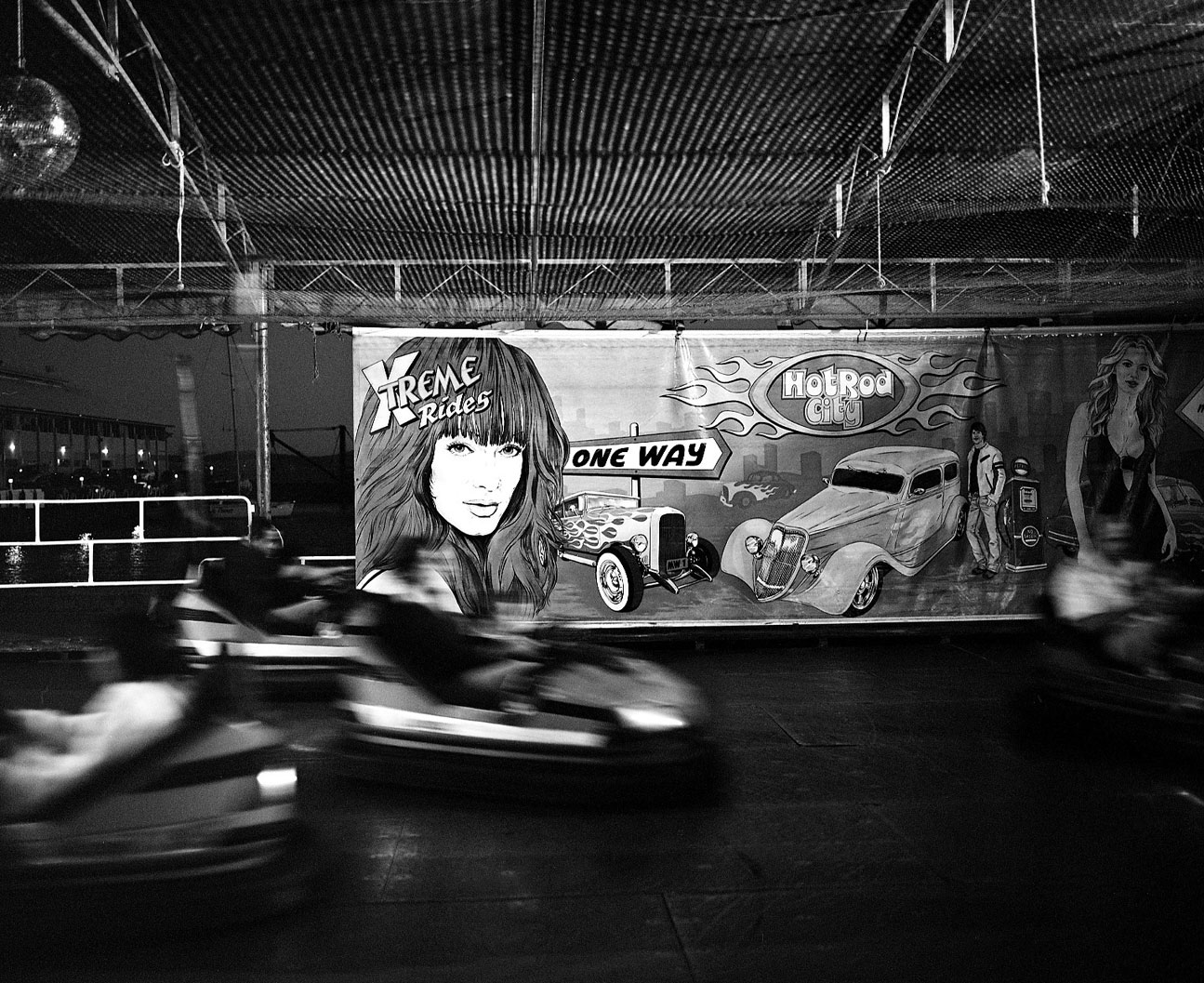
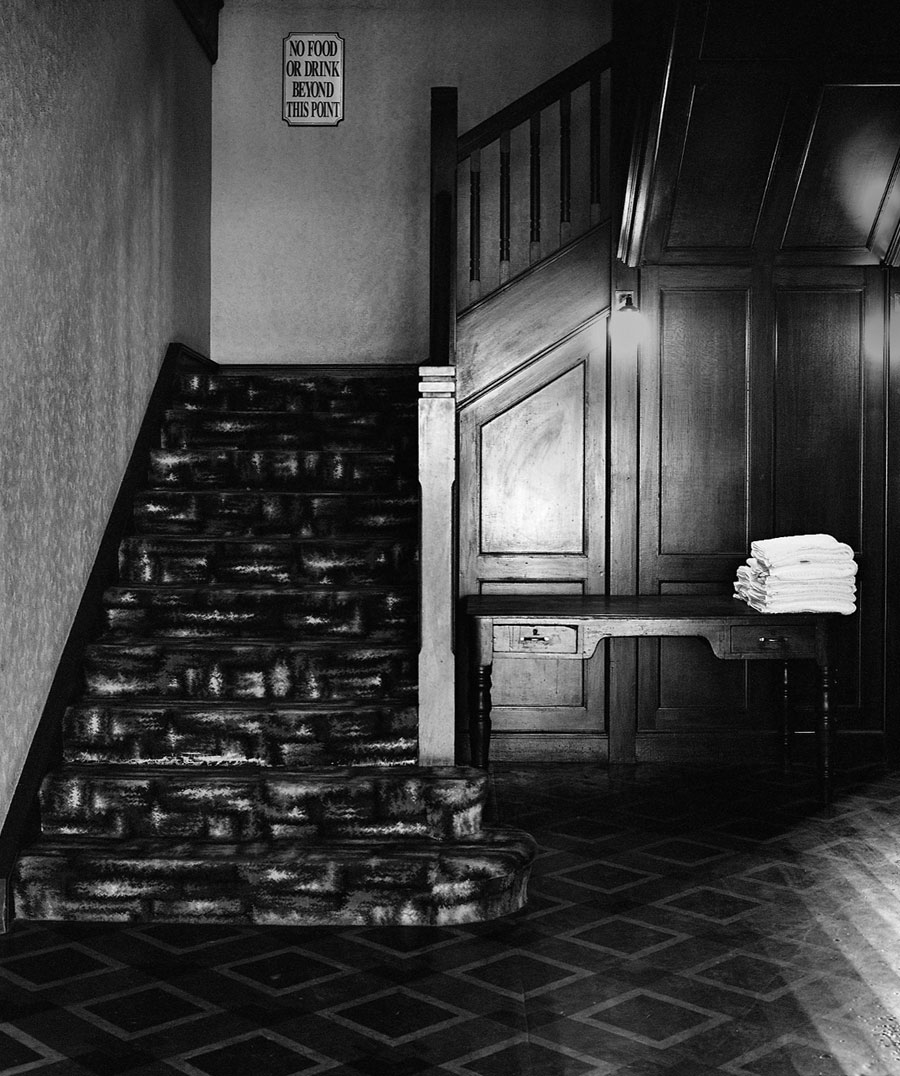
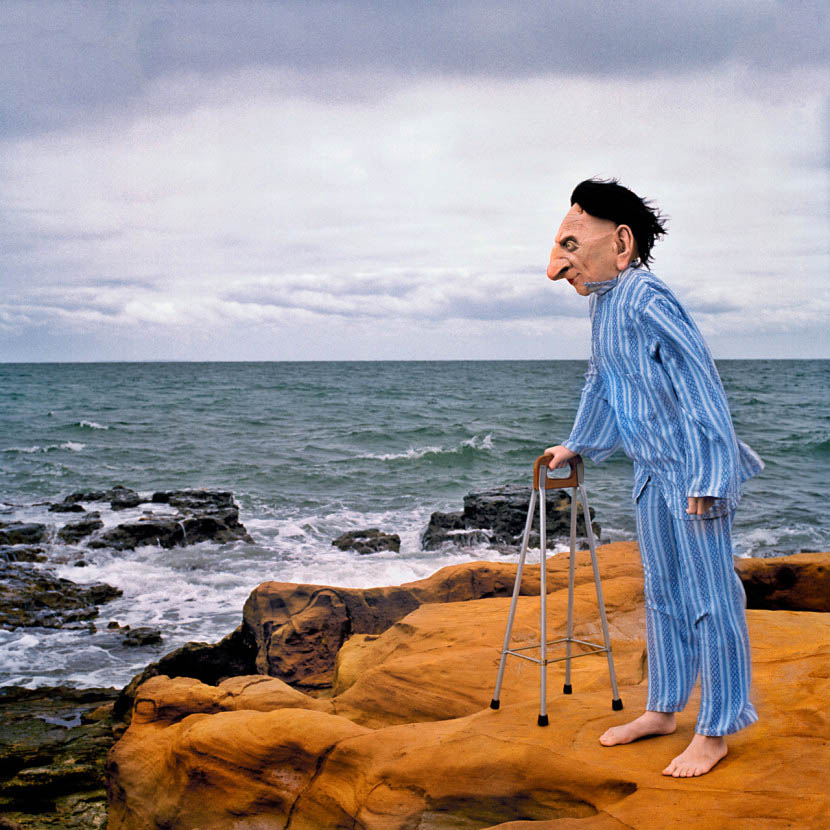
Katrin Koenning (Australian born Germany, b. 1978) 'Untitled' from the series 'Transit' (2009 - )


Katrin Koenning (Australian born Germany, b. 1978)
Untitled from the series Transit
2009


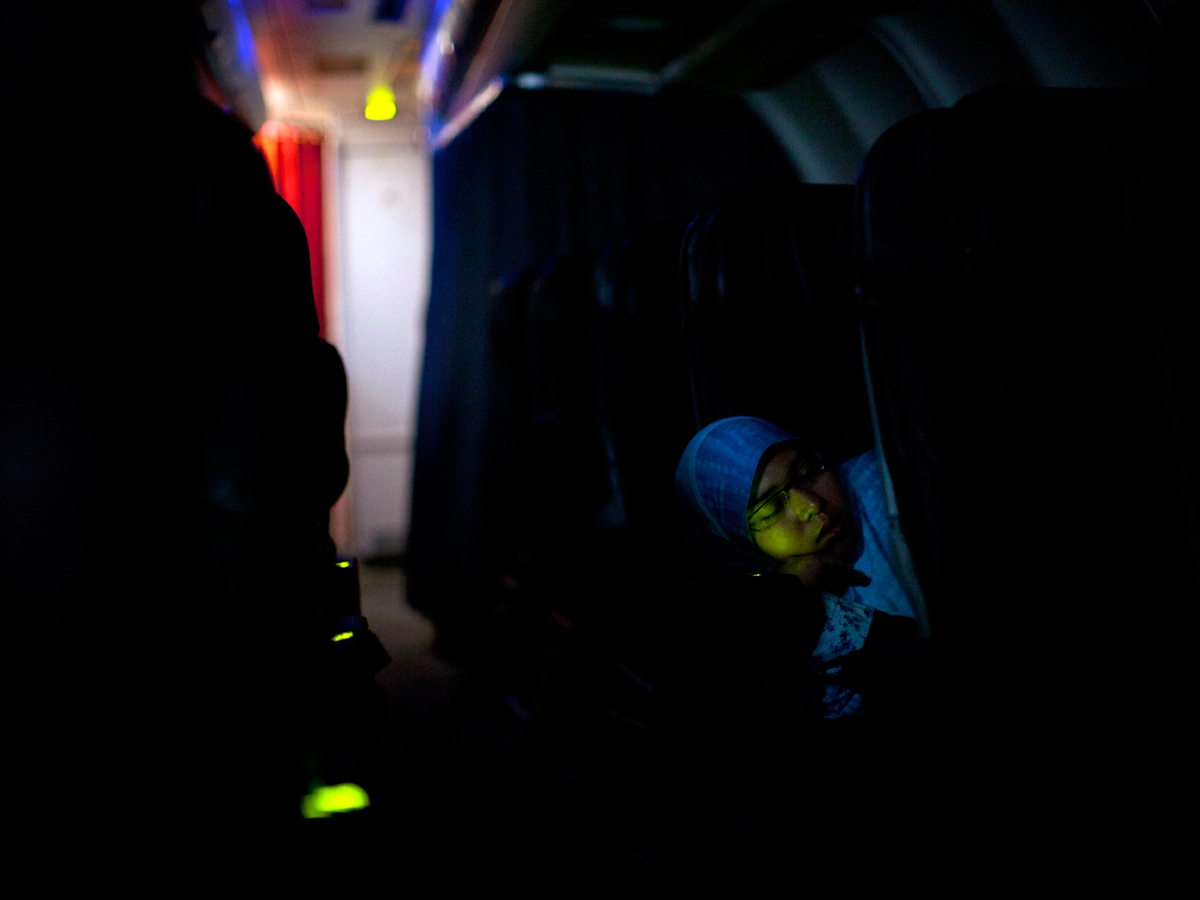
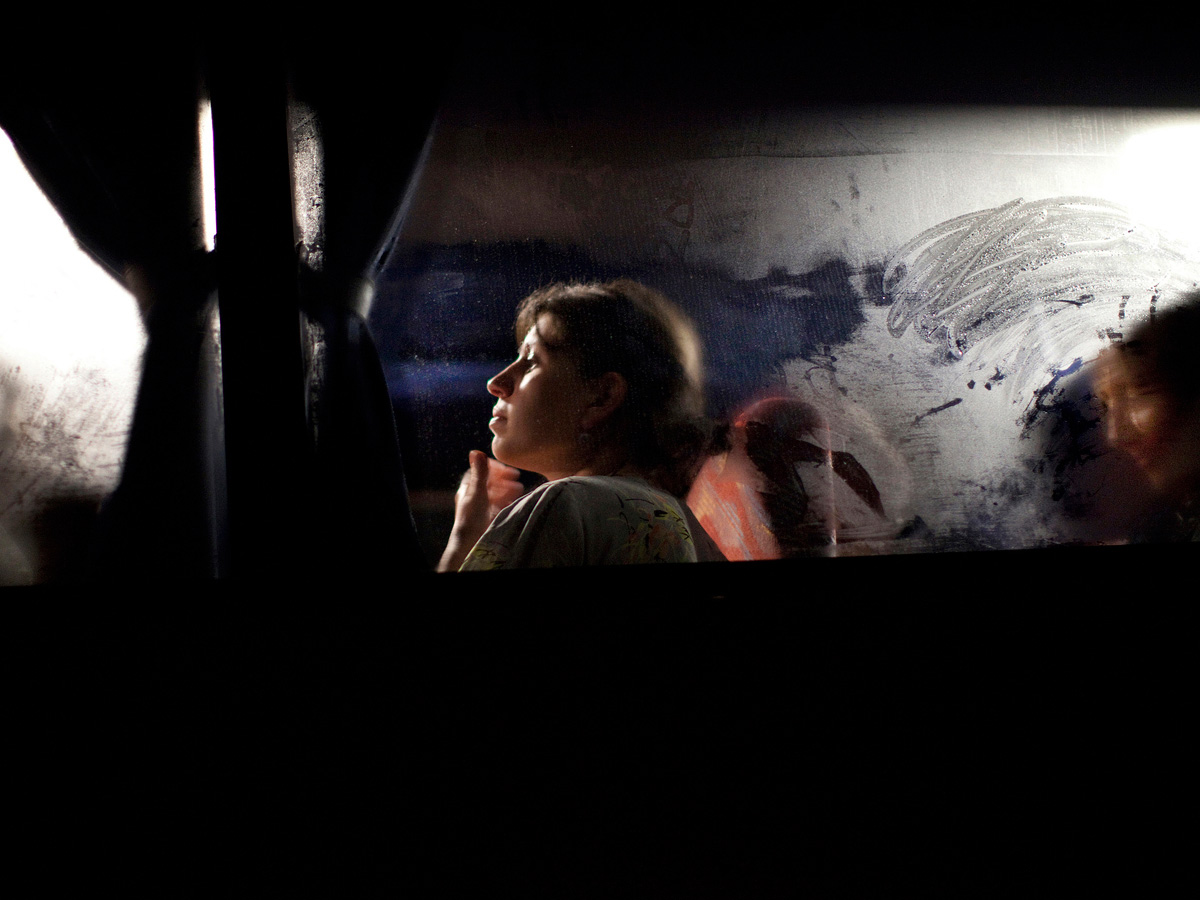
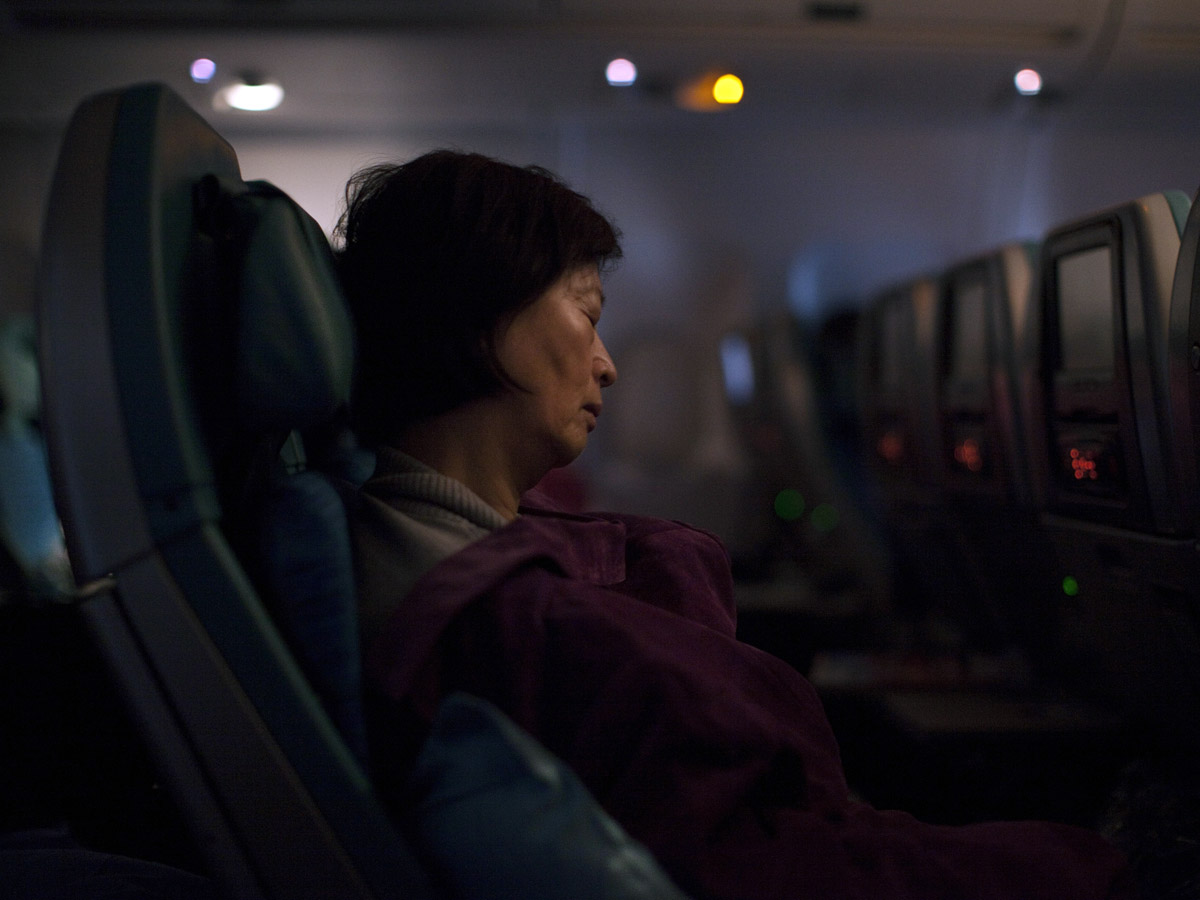
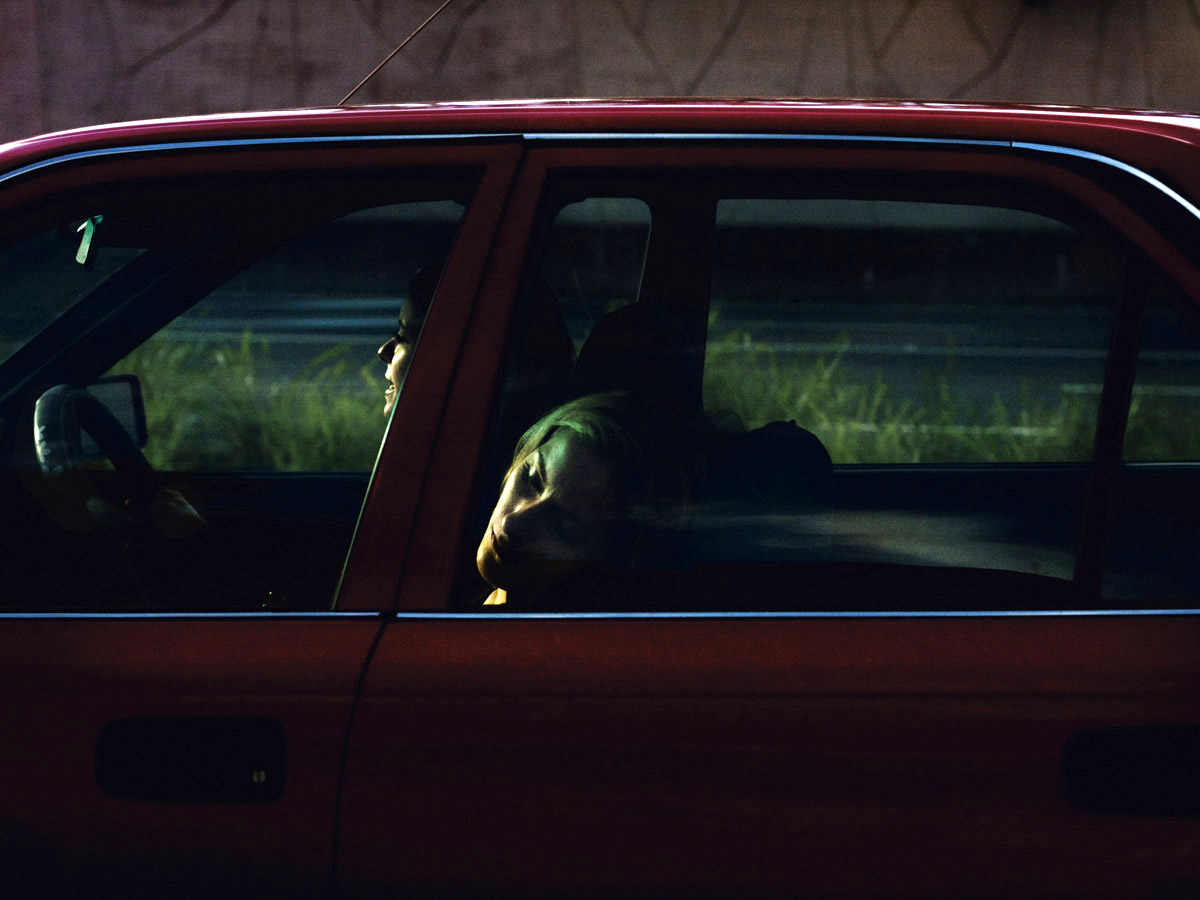
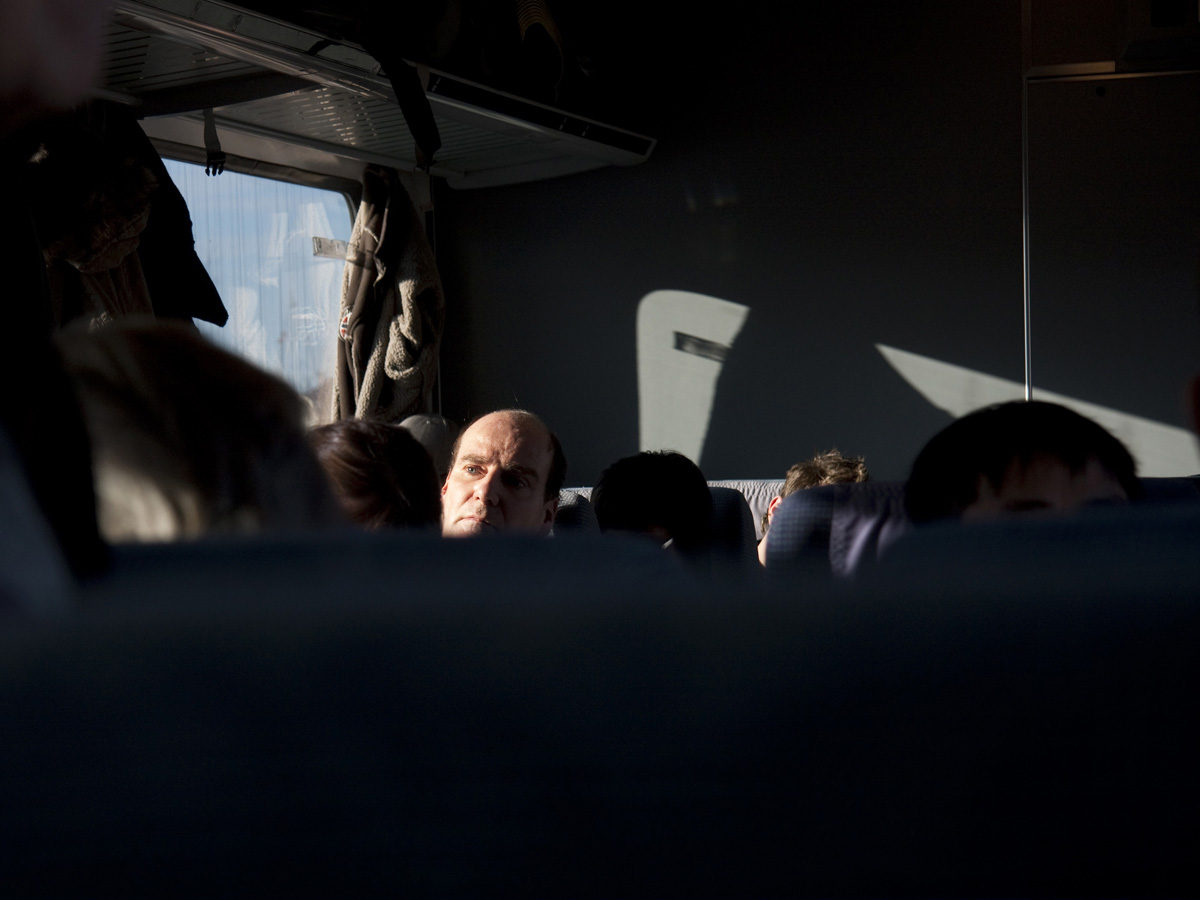
Transit is a stimulating body of work by Melbourne artist Katrin Koenning that documents mostly everyday journeys. As Koenning notes, “It is concerned with the space that lies between destinations, routines and obligations – the space between distances, if you so like,” where strangers are thrown together in an intimate space. The outcome of these encounters is mainly silence. In these works photography and the depiction of the lived world becomes the primer and reference point for a mediated existence, one based on longing, desire, reverie, absent presence and the phantasies of daydreams.

Compositionally the work is strong. Koenning shows an excellent understanding of the construction of the image plane and the use of colour, light and dark complements her intellectual enquiry. This much is given: these are excellent images that immerse the viewer in a visual dreamscape. What I am more interested in here is the transitional spaces of the journey, the traces of light that reflect back to us the concerns of the photographer and the conceptual ideas upon which the work is based.

Even when people are asleep in these photographs (which they sometimes are) it is as if an internal image, a day dream, a subconscious image is projected into/onto the external world in an act of scopophilic [the desire for pleasurable looking] voyeurism. It is as though our daydreams are inscribed in a physical location and we identify with this imaginary image and take it for reality.1 “This specific joy of receiving from the external world images that are usually internal… of seeing them inscribed in a physical location… of discovering in this way something almost realisable in them”2 becomes one reality of the journey. We become possessed, possessed by the phantasies of our daydreams, possessed by desire for this imaginary image.

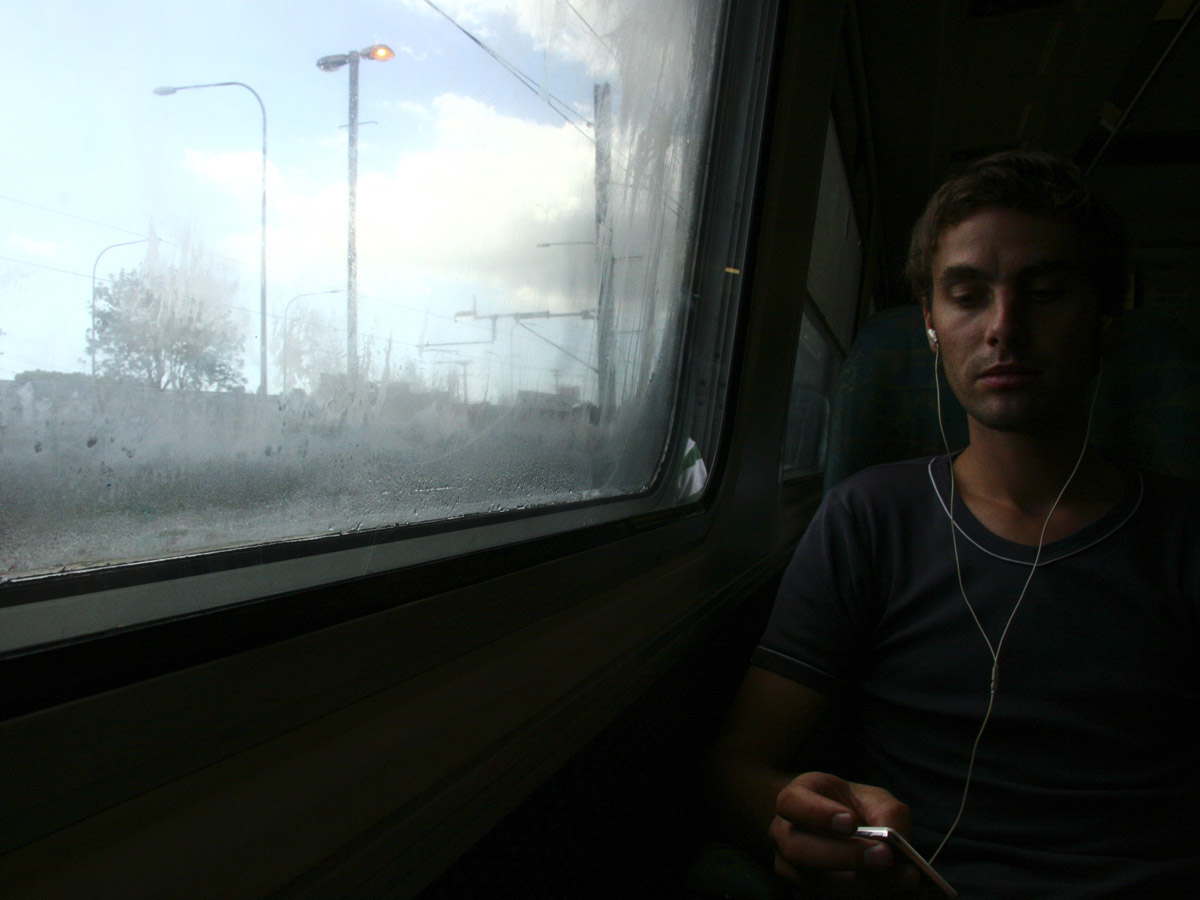
Paradoxically these daydreams, the longing and yearning of the inner voice for a better place to be, for a holiday, for an escape from the drudgery of everyday life (for an imaginary, hallucinatory image) promote an escapism in the traveller and the absenting of presence that can be seen on any tram or train, any day of the week in cities throughout the world. The enactment of absent presence is usually performed through technology of some kind – a book, headphones, smart phones that connect to the internet, conversation on the mobile which is mainly gossip and texting – that distract people from having a quiet mind that leads to the contemplation of Self. The fear of silence is the fear of quietening the chattering voice in your head, being afraid of what you might find. The act of non-engagement is supplemented by the necessity of avoiding eye contact with fellow travellers, of making conversation, of engaging with strangers in any meaningful way. Hence the silence of forcibly intimate spaces.

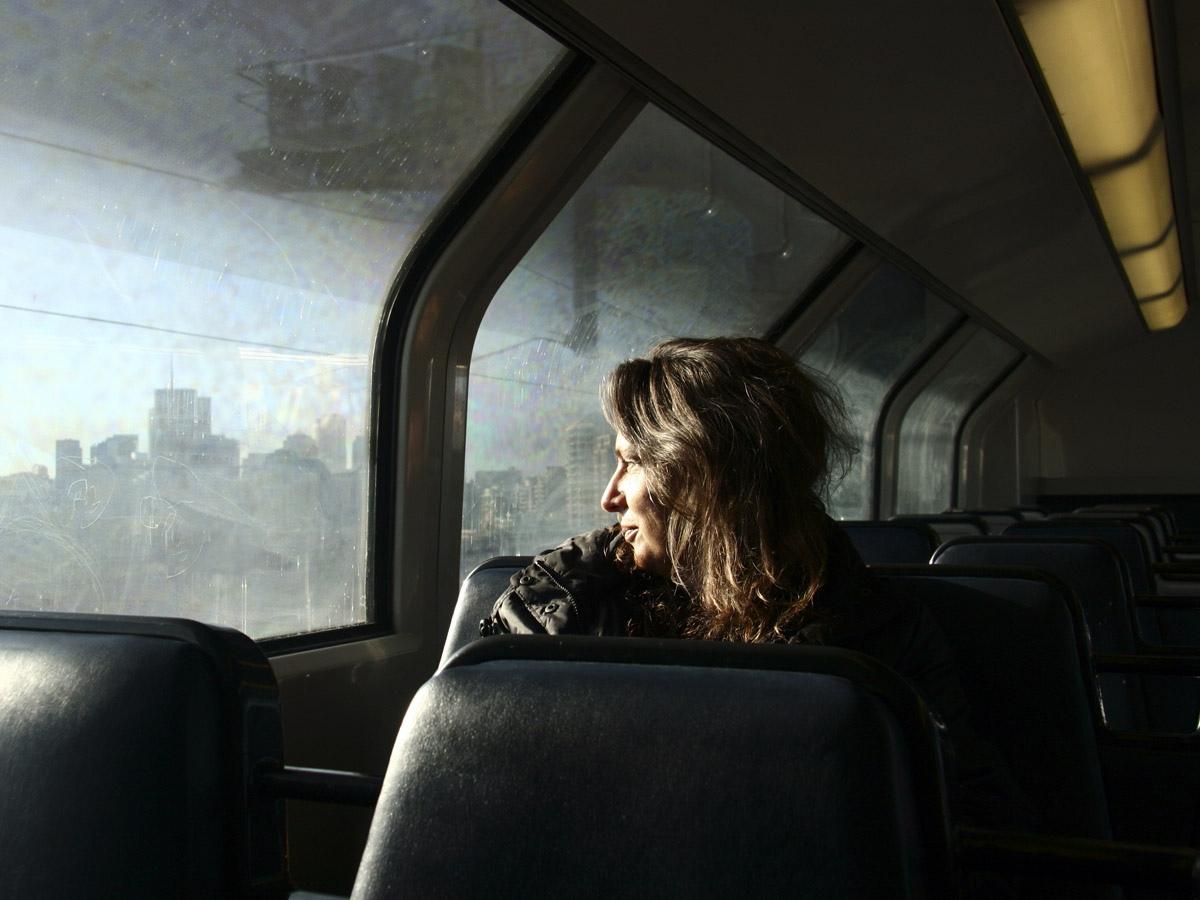
The photographs that make up the series Transit form a theatrical space, a dramatic space where the people in them are separated from the outside world, neither here nor there, present but absent at one and the same time. This ritual of (non)spectatorship begins long before we begin our journey: the preparation, leaving the house with headphones and iPod, iPad, iPhone and I. This is followed by the ritual of buying a ticket (or not), boarding the train, tram, bus, plane or car being an effective way of transforming time and space. Our practices of mobility, that is our acts of moving are constituted in our acts of staying. What we take with us (for example our passport when we go overseas), always takes our place of residing, of staying, with us. Travel becomes the enactment or enfolding of bodies that move and bodies that stay, of stability.3 As Mary Louise Pratt has observed recently, the Western subject is an autonomous being with inherent conditions attached to its body and mobility is the privileged figure of its freedom, the proof and performance of its liberated state. In the metaphor of flow there is the enactment of freedom.4 Ironically, in the flow of travel envisaged in these photographs there is a dis/placement of desire onto the object of our (non)attention: in other words if we observe the world and desire it (as in the woman looking out of the window onto the distant view of the city, below) we displace our desire onto the object of our affection. If, on the other hand, we ignore the distant vista (as in the man playing with his iPod while the world flashes past outside, below) we displace our own presence through non-attention and our desire becomes a narcissistic attraction to Self. The remainer (who remains) and the remainder (what is left) is dictated by the place and placedness of the encounter, the interdependent modalities along the points of un/freedom (displacement of desires onto other may, in fact, not be freedom at all!)

In a sense, and I use that word advisedly, these images become trans-sensual, hovering between one desirous place and the next, between one condition or possibility of becoming and another. Here I must note that I see a philosophical difference between ‘transit’ and ‘in transit’. ‘Transit’ suggests a pre-determined path between point A and point B: for example in the transit of Venus that recently took place the path that Venus would take was already mapped out, even before the event happened, even if Venus was absent. The DNA of the journey, its blueprint if you like, is already formed in the knowledge: we are going to Collins Street, Melbourne, the path immanent in the tabula rasa of the journey even before it has started. ‘In transit’ on the other hand, suggests an amorphous space that has no beginning and no end. There is no boundary that defines the journey, much as in these images “amorphous thinking in visual terms is inextricably bound up with sensation and perception. In many ways, how we think is how we see and vice versa.”5 Perhaps the series should have been called In Transit, for the images visualise a conception of boundary and form that is constantly in flux, emanating as it does from the subconscious desires of the traveller. These are scenarios for an intuitive vision of an amorphous space that image a lapse in time, where energy and information, light and shadow, harmony and form challenge an absolute identity, the pre-determined path.6

Projection of inner desires onto the actual world becomes the locality for the contemporary mythologies of values, beliefs, dreams and desires.7 In a Buddhist sense, in the longing of an individual to effect his or her liberation this flow of sense-desire must be cut completely. Instead of a desire to possess the object of their longing and then to be possessed by that desire (desire to possess / possessed by desire) we must learn, as Krishnamurti has insightfully observed, not to make images out of every word, out of every vision and desire. We must be attentive to the clarity of not making images – of desire, of prejudice, of flattery – and then we might become aware of the world that surrounds us, just for what it is and nothing more.8 Then there would be less need for the absenting of self into the technological ether or the day dreams of foreign lands or the desire for a better life.

The strength of this work is the trans-sensuality of the photographs. Their trans-sensuality initiates differently configured constructions of the world, one that will not allow the world to simply be displaced by a lack of awareness, a lack of presence in the world. The photographs physically queer the performative aspect of the actor upon the stage, allowing the viewer to understand the process that is happening within the photographs and then NOT construct alternate narratives of longing and desire if they so wish. What they do for the viewer is collapse the boundaries between the subjective and the objective, between the conscious and the subconscious, inducing in the viewer a glimpse of self-actualization,9 whereby the viewer has the ability to enjoy the experience of just being. As the viewer becomes the person in the photograph (by understanding the experience of being, not by making an image) the permeability and lack of fixity of the boundaries between self and other, between self and amorphous space, between self and the physical world becomes evident. We become aware of the suspension of time and space in these momentary, (photographic) acts of transcendence. These wonderful, never ending moments.

Dr Marcus Bunyan

July 2012


1/ Leonard, Richard. The Mystical Gaze of the Cinema: the Films of Peter Weir. Melbourne: Melbourne University Press, 2009, p. 23

2/ Metz, C. Essais Sémiotiques. Paris: Klincksieck, 1977, p. 136 quoted in Leonard, Op. cit.

3/ Pratt, Mary Louise. “On Staying.” Keynote speech presented at the international conference Travel Ideals: Engaging with Spaces of Mobility. July 18th 2012 at the University of Melbourne

4/ Ibid.,

5/ Navarro, Kevin. “An Amorphous Image Process,” on Rhizome: Image Theory website. January 19th 2010 [Online] Cited 29/07/2012

6/ Ibid.,

7/ Leonard Op. cit., p. 56

8/ KrishnamurtiBeginnings of Learning. London: Penguin, 1975, p. 131

9/ “It must be noted that self-actualization is not necessarily related to vocation or career choice … From Malsow’s (Maslow, A (1970) Motivation and Personality. New York, Harper & Row) standpoint, self-actualization is not primarily concerned with results of a particular kind of activity – it is concerned with the experience of the activity itself – not the composition but the composing – not the work of art but the creative process by which it is produced – not the taste of the food, but the creativity in the cooking of it. This is not to say that the product has no importance. What Maslow is emphasizing is the fact that the self-actualized persons is fulfilling his potentiatlities in the act itself. A byproduct of this creative act is a unique outcome. He may admire the result of this process. But the enjoyment of the process itself is also extremely important. The ability to enjoy the experience of being, therefore, is one of the essential capabilities of the healthy individual.” (My italics)
Benson, Lou. Images,Heroes and Self-Perceptions. Englewood Hills, New Jersey: Prentice Hall, 1974, pp. 352-354


Many thankx to Katrin Koenning for allowing me to publish the photographs in the posting. Please click on the photographs for a larger version of the image. All photographs Untitled from the series Transit (2009) © Katrin Koenning.


Katrin Koenning (Australian born Germany, b. 1978) 'Untitled' from the series 'Transit' (2009 - )


Katrin Koenning (Australian born Germany, b. 1978) 'Untitled' from the series 'Transit' (2009 - )


Katrin Koenning (Australian born Germany, b. 1978) 'Untitled' from the series 'Transit' (2009 - )


Katrin Koenning (Australian born Germany, b. 1978) 'Untitled' from the series 'Transit' (2009 - )


Katrin Koenning (Australian born Germany, b. 1978)
Untitled from the series Transit
2009


Transit documents people on mostly everyday journeys. It is concerned with the space that lies between between destinations, routines and obligations – the space between distances, if you so like. While I travel and observe, I write down snippets of overheard conversations. Old ladies talk about the weather, teenagers gossip, you hear laughter and bits of stories in amongst the monotonous sighing of the train or the mourning sound of an aching ship. Mostly, you hear silence – strangers are thrown together for a short while, forced to share an intimate space. They rarely talk.

Artist statement


Katrin Koenning (Australian born Germany, b. 1978) 'Untitled' from the series 'Transit' (2009 - )


Katrin Koenning (Australian born Germany, b. 1978) 'Untitled' from the series 'Transit' (2009 - )


Katrin Koenning (Australian born Germany, b. 1978) 'Untitled' from the series 'Transit' (2009 - )


Katrin Koenning (Australian born Germany, b. 1978) 'Untitled' from the series 'Transit' (2009 - )


Katrin Koenning (Australian born Germany, b. 1978) 'Untitled' from the series 'Transit' (2009 - )


Katrin Koenning (Australian born Germany, b. 1978) 'Untitled' from the series 'Transit' (2009 - )


Katrin Koenning (Australian born Germany, b. 1978) 'Untitled' from the series 'Transit' (2009 - )


Katrin Koenning (Australian born Germany, b. 1978) 'Untitled' from the series 'Transit' (2009 - )


Katrin Koenning (Australian born Germany, b. 1978)
Untitled from the series Transit
2009


Katrin Koenning website

LIKE ART BLART ON FACEBOOK

Back to top

Preview: ‘Night’s Ocean Shore’ by Andrew Follows from ‘Through the Looking Glass Dimly’ at The Old Ambulance Depot, Edinburgh

Exhibition dates: 4th August – 18th August 2012


Andrew Follows (Australian, d. 2019) 'Untitled' from the sequence 'Night's Ocean Shore' 2012


Andrew Follows (Australian, d. 2019)
Untitled
2012
From the sequence Night’s Ocean Shore
Digital inkjet print


This sequence is part of a joint exhibition by blind photographers Andrew Follows and Rosita McKenzie titled Through the Looking Glass Dimly to be held at The Old Ambulance Depot, Edinburgh in August 2012. The exhibition is part of the Edinburgh Art Festival. On his first trip overseas Follows is travelling to Scotland with his trusty companion Eamon, his guide dog. The words below are an analysis of Andrew’s work, a photographer who only has 15% vision in one eye and is legally blind. This is the first time anyone has written about Andrew’s work in any depth. It has been great fun to work with Andrew on this project and it is a privilege to write some hopefully insightful words about his art practice.

The exhibition by Follows and McKenzie takes a twofold path. Firstly, work from both photographers will investigate the resilience of bush-fire prone landscapes in both Scotland and Australia. Secondly, work will portray the fluid spaces of the urban and natural landscape at night in both the Southern and Northern hemispheres. The exhibition is curated by Kate Martin from the Contemporary Art Exchange.

This is a beautiful, well resolved sequence that has a very intimate narrative, a journey of discovery from the stars in the night sky to our own star, the sun and on to the illumination of the earth at night. Under any circumstances, Follows’ vision is outstanding.

Dr Marcus Bunyan


Andrew Follows (Australian, d. 2019) 'Night's Ocean Shore' sequence 2012


Andrew Follows Night’s Ocean Shore sequence 2012


The Eye that sees the Sun: Andrew Follows and his Tabula rasa


“‘The world is my representation’: this is a truth valid with reference to every living and knowing being, although man alone can bring it into reflective, abstract consciousness. If he really does so, philosophical discernment has dawned on him. It then becomes clear and certain to him that he does not know a sun and an earth, but only an eye that sees a sun, a hand that feels the earth; that the world around him is there only as representation, i.e. only in reference to another, the representer, which is he himself.”


Arthur Schopenhauer. The World as Will and Representation 1818


Please close your left eye and place your left hand over it; now make a circle with the thumb and forefinger of your right hand and curl the rest of your fingers to make a tunnel; now place this hand to your right eye and close the aperture until you can only see a small amount of the world. Imagine, seeing the world through this one eye with only fifteen percent vision. This is the field of vision, the line of sight of artist Andrew Follows.

The artist’s visual acuity (the capacity of the eye to see fine detail, measured by determining the finest detail that can just be detected) has been with him since birth. He has always seen the world this way and does not regard it as a disability. In fact, his highly refined sense of “sight” enables spaces of poss/ability (not dis/ability) within his artistic practice. The development of an abnormal keen-sightedness helps him record his impression of the world via the medium of photography.

His is not the vision of im(pair)ment as the rest of us see the world, through two eyes, but the holistic vision of a monocular eye that becomes the root of his photography. The lens of the camera becomes an extension of Self, the shutter his very existence and the digital screen on the back of the camera his tabula rasa, a “blank slate” upon which he writes his experience and perception, his knowledge of the world. His experience of vision and the evidence of his photographs become both the beginning and the end of the work, a place in which his fundamental nature resides.

In today’s polyvocal world, with the proliferation of visual protheses (such as smart phones and digital cameras) we are now seeing the encoding of increasingly mental images of the material world. Follows’ photographs are an amalgamation of these mental images and what he can physically see on the screen, for when taking a photograph he cannot see details in the image he is taking. Follows takes the ‘I can see’ of sight, located within his field of vision, and through his organisation of the spatio-temporal field of vision and perception, he offers the viewer a unique ‘take’ on the world. His point of view is a collection of objects to which the eye is directed and on which it rests within a certain distance.

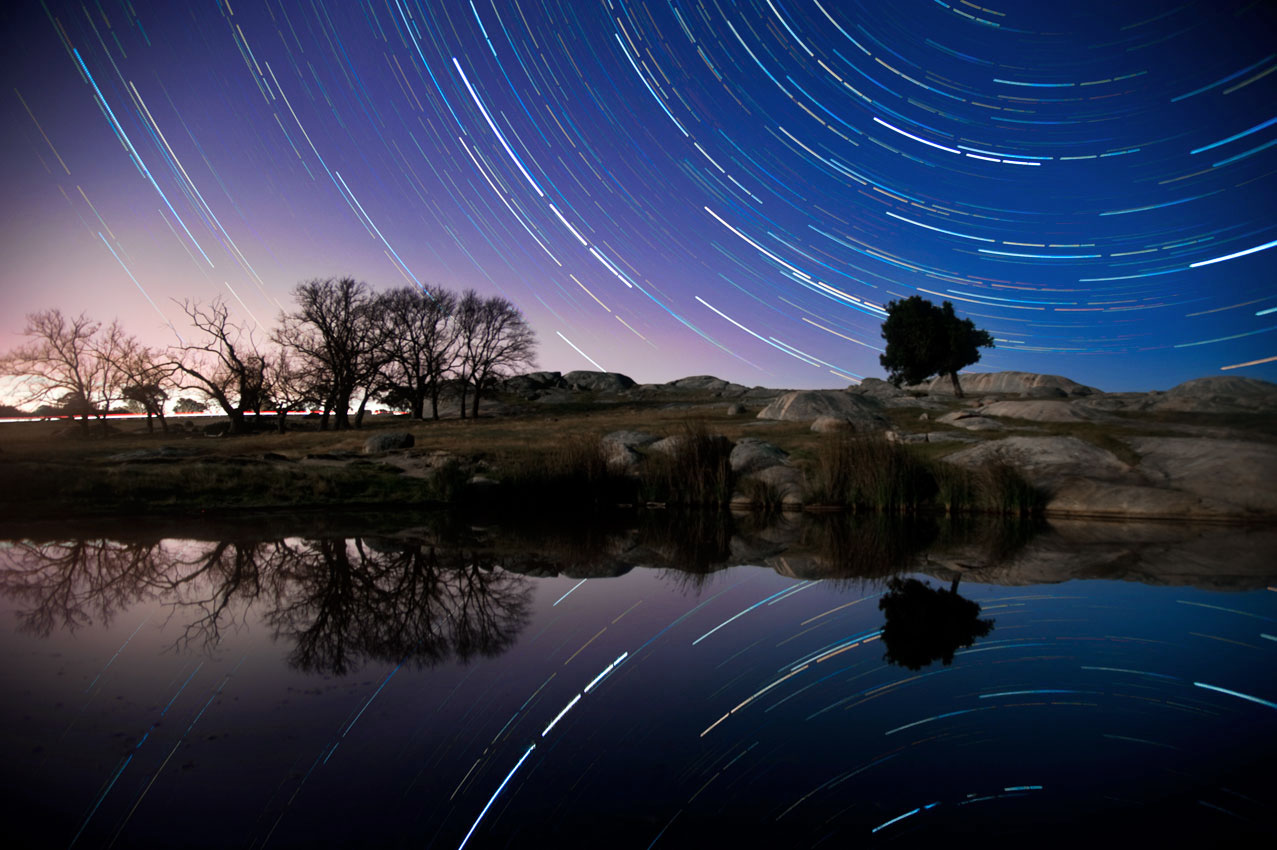
From a visual point of view this resting facilitates in Follows’ work a particular serenity and beauty. His skill as an artist is to combine his imagination with what he sees through the screens of camera and computer to create ‘other’ worlds. These other worlds are evidenced in Follows’ love of night time photography, as though his view of the environment, the spaces and places that surround him, is enhanced through a doubling of perception: of light, at night, through tunnel vision. Our eyes rest upon the effervescent lights of an oil refinery on the outskirts of Melbourne; the star trails blazing across the night sky; the reflections in water at Corio Bay, Geelong. Most importantly, it is the quality of light that imbues Follows’ work that enhances the narrative, the journey on which the artist takes us.

Follows’ shows us his world, and our world, as we have never seen it before. What is important in the work is that he asks us to embrace his vision and incorporate his photographs into our collective memory. The world is his representation, a truth valid with reference to every living and knowing being, brought by us into reflective, abstract consciousness. We the viewer become his eye, his only eye that sees Schopenhauer’s sun.

Dr Marcus Bunyan
May 2012


Andrew Follows (Australian, d. 2019) 'Untitled' from the sequence 'Night's Ocean Shore' 2012


Andrew Follows (Australian, d. 2019) 'Untitled' from the sequence 'Night's Ocean Shore' 2012


Andrew Follows (Australian, d. 2019) 'Untitled' from the sequence 'Night's Ocean Shore' 2012


Andrew Follows (Australian, d. 2019) 'Untitled' from the sequence 'Night's Ocean Shore' 2012


Andrew Follows (Australian, d. 2019) 'Untitled' from the sequence 'Night's Ocean Shore' 2012


Andrew Follows (Australian, d. 2019) 'Untitled' from the sequence 'Night's Ocean Shore' 2012


Andrew Follows (Australian, d. 2019) 'Untitled' from the sequence 'Night's Ocean Shore' 2012


Andrew Follows (Australian, d. 2019) 'Untitled' from the sequence 'Night's Ocean Shore' 2012


Andrew Follows (Australian, d. 2019)
Untitled
From the sequence Night’s Ocean Shore
2012
Digital inkjet prints


Contemporary Art Exchange presents Through the Looking Glass Dimly a unique collaboration and exchange project between Australian and Scottish photographers Andrew Follows (Melbourne) and Rosita McKenzie (Edinburgh). Drawn together by their shared passion for photography, their experiences of visual impairment, and a desire to share their knowledge and skills globally, Andrew and Rosita have embarked on an ambitious visual arts project to raise awareness about visual impairment issues, celebrate recent artistic achievements and create the first international network for visually impaired artists.

Digital photography is an excellent medium for reflecting and exploring blind or vision impaired artists’ life experiences. For Rosita it provides ‘a voice’ and dispels the myth that totally blind people cannot possess vision and artistic imagination or participate fully in the visual arts. For Andrew, who has Retinitis Pigmentosa – a degenerative eye condition leaving him blind in one eye and with only fifteen percent vision in the other – it is a tool that enables him to see small glimpses of his fading world.

Andrew and Rosita have been collaborating to develop an exhibition of previous and new work. Since 2009, Andrew has documented the effects of, and resilience to, the devastating Black Saturday bushfires in the Victorian Highlands. Rosita, although having never ‘seen’ Andrew’s work, has responded to it by embarking on her own documentation of the effects of and regrowth after the unusual forest fires in the Scottish Highlands earlier this year. Andrew has also been experimenting with night photography and has developed a number of photographs capturing the Southern Hemisphere by night. In response, Rosita will develop a new body of work capturing the night sky from a Northern Hemisphere perspective. Both artists will also showcase examples from their wide range of photographs dealing with similar themes from natural and urban settings.

The project will be registered with the 2012 Edinburgh Art Festival and the Year of Creative Scotland. Through the Looking Glass Dimly will also coincide with other major international events taking place in Edinburgh during August such as the first International Cultural Summit, the Edinburgh International Festival, the Edinburgh Fringe Festival and the Festival of Politics at The Scottish Parliament.”

Text from the Contemporary Art Exchange


The Old Ambulance Depot
77 Brunswick Street
Edinburgh
EH7 5HS

Only open to the public during exhibitions and events

Andrew Follows Photography website

Edinburgh Art Festival website

The Old Ambulance Depot website

Contemporary Art Exchange website

LIKE ART BLART ON FACEBOOK

Back to top

Appeal for donations: Andrew Follows and his exhibition in Edinburgh, August 2012

June 2012


Andrew Follows (Australian, d. 2019) 'Untitled' 2012 From the series 'Night's Ocean Shore'


Andrew Follows (Australian, d. 2019)
Untitled
2012
From the series Night’s Ocean Shore


As you may know I have been helping vision impaired Australian photographer Andrew Follows as he prepares for the greatest adventure of his life, a joint exhibition as part of the Edinburgh Art Festival titled Through the Looking Glass, Dimly. The works have all be printed and framed and are on their way to Scotland at this very moment.

Dr Marcus Bunyan


Andrew Follows. 'Through the Looking Glass, Dimly' invitation

ABAF Andrew Follows support my art project


Andrew Follows website

LIKE ART BLART ON FACEBOOK

Back to top

Review: ‘Littoral’ by Kristian Laemmle-Ruff at Colour Factory Gallery, Fitzroy

Exhibition dates: 4th May – 26th May 2012


Kristian Laemmle-Ruff (Australian) 'Truck in Safi' 2010


Kristian Laemmle-Ruff (Australian)
Truck in Safi
2010
Type C print
100 x 67cm


Jeff Wall, the renowned Canadian photographer, observed recently that, “Photography is such a wide, complex art form medium that there’s no real single way of practising it. Up until 30 to 40 years ago, it was pretty much presumed that the way you practised photography seriously was in the documentary mode. It was very unilateral, other things weren’t really plausible. I never objected to documentary photography, but it’s not the whole story…”1

How true. In this post-photography world there are many spaces in the city for showing all kinds of photographic work, notably at the Centre for Contemporary Photography in Fitzroy. While the viewer does learn about different modes of photographic representation through experiential learning (making meaning from the direct experience of looking at such work), personally some contemporary photography often leaves me feeling rather underwhelmed. Rarely do I leave the CCP thinking, wow, that was a great “photography” exhibition, I have seen something amazing about the world that I had not recognised before. Interesting: possibly; inspiring / engaging / memorable: occasionally, which is perhaps why reviews of exhibitions at the CCP occur rather rarely in this archive. This is not to belittle the work that the CCP does as an establishment, far from it, but just to note that not much contemporary photography lasts long in the mind.

It was such a joy then to walk around the corner from the CCP to the Colour Factory Gallery and view the exhibition Littoral by emerging artist Kristian Laemmle-Ruff. This is one of the best, if not the best, “photography” exhibition I have seen so far this year. As soon as you walk into the simple, elegant gallery you are surrounded by fourteen large scale horizontal photographs that are suffused with colour variations bouncing across the gallery – here a blue, there a green, now a lush orange palette. The effect is much like Monet’s waterlilies at the Musée de l’Orangerie in Paris; seated in the middle of the four curved paintings you are surrounded by large daubs of paint of various hues that have an elemental effect – resonances of earth, air, water, fire – on the viewer. The same affection of colour and space can be found in Laemmle-Ruff’s photographs.

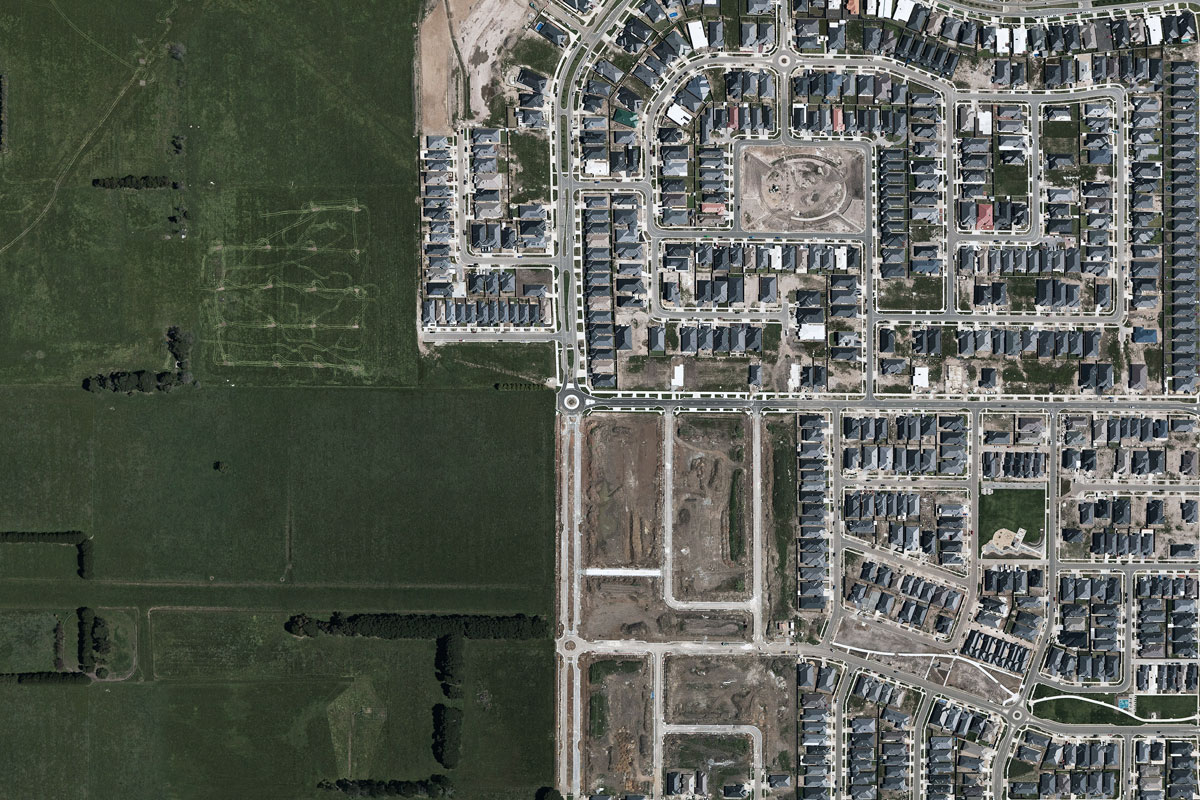
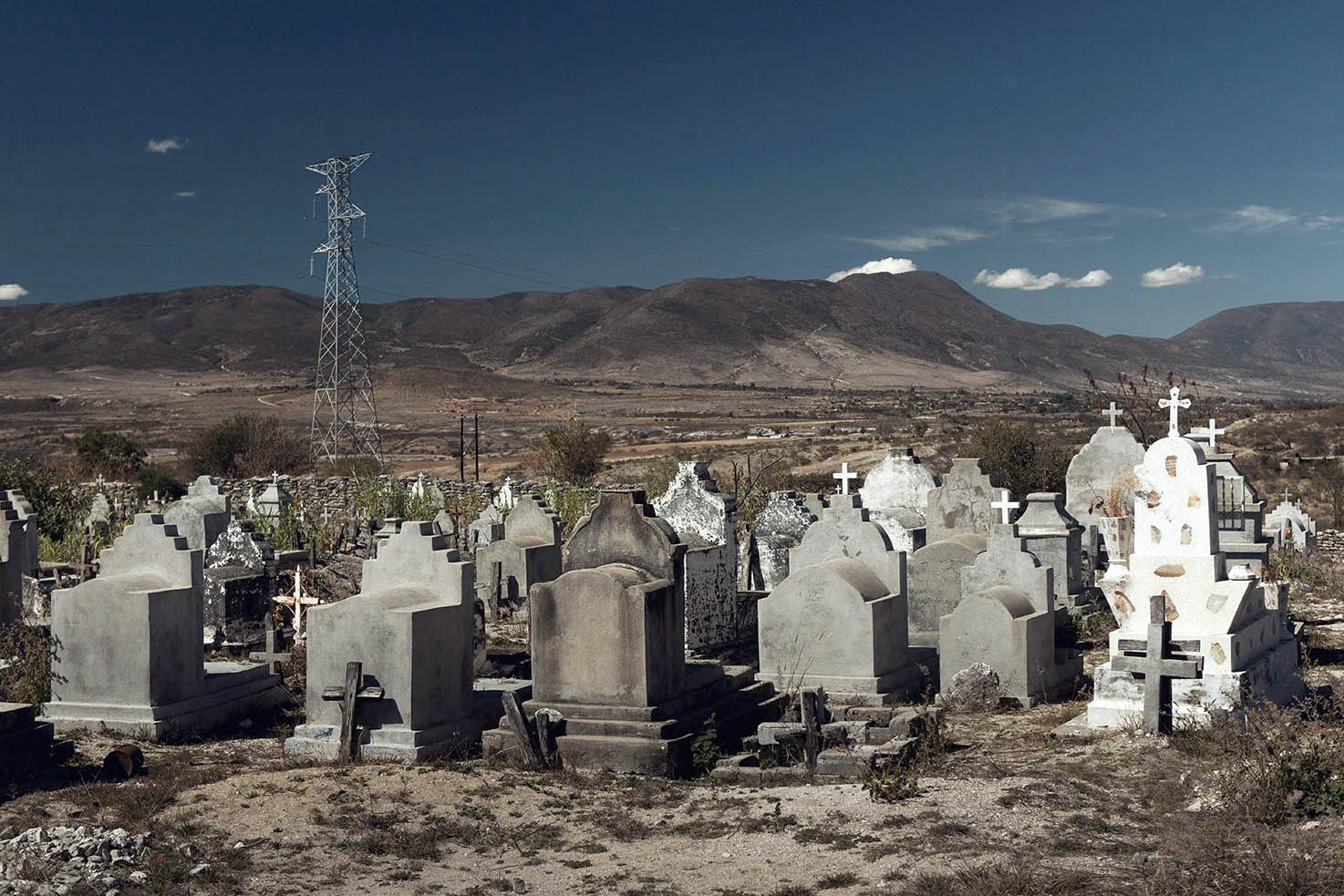
The artist’s literal rendition (the definition of littoral is that it relates to the coastal zone between the limits of high and low tides) of the interstitial spaces at the edge of urbana, the fluid spaces of a no man’s land, are beautifully visualised in the work. These entropic spaces are mainly devoid of physical human presence but filled with the detritus of humanity: concrete boxes and tangled beams of steel, satellite dishes and red-eyed chimney stacks. In Casablanca Terrace II (2010, below) satellite dishes shimmer in orange while in the distance alien lights seem to hover over the city; in Manneheim (2010, below) the whole photograph is a cold, chilly blue the only visible signs of human existence a couple of lights peeping from the flat windows (at left) while the belching smoke from numerous alien, red-eyed War of the Worlds chimney stacks blends seamlessly into the overcast sky (please enlarge the photograph to see these). When first looking at New Homes (2011, above) I thought the green lines at bottom left were trenches until I realised they were hedges. Then I noticed the empty oval in the upper right quadrant – a demolished sporting facility… a racetrack… a spaceship landing pad? In these familiar but alien landscapes (ice covered swimming pools, graveyards sitting under mountains) Laemmle-Ruff plays with colour, space and depth of field. In some photographs, such as Road to Essaouira (2010, below bottom) the depth of field is very shallow, the focus point in the photograph being the road and gravel, silver road sign and buildings falling out of focus beyond. Like the shifting of colour, this expansion and contraction of DOF from one photograph to the next adds to the body of works ethereality.

The best print in the exhibition is Truck in Safi (2010, above) which is an absolute knockout. The composition is beautifully visualised and the print is incredibly luminous and well balanced. The large white ‘M’ on the back of the earth-filled truck solidifies our gaze in the mid-foreground while, metaphorically, the letter stamps the earth as the possession of man. The road curves into the distance and upon it, as minute specks, are a bicycle and two motorbikes. The sweep of an industrial plant fills the horizon line in a sensuous entanglement of vessels and pipes. This truly is a beautiful photograph and therein lies the contradiction present in Laemmle-Ruff’s body of work. While seeking to capture the paradoxes of urbanisation and consumerism, a vernacular world, familiar and normal (both the beauty and frailty of our times as Laemmle-Ruff puts it), the beauty of the photographs becomes the heart of the work, its strength in the presence of the viewer and perhaps its slight weakness as well. The artist’s visual acoustics, his mythologising of the city if you like – the (dis)ease of the city as sublime photograph picturing the picturesque – has, to my mind, elements of Pictorialism in the artist’s scopophiliac looking. Nothing wrong with that, but we must acknowledge that there is a contradiction here, not between the beauty and frailty of our times, but between the frailty of the earth and the constructed beauty of the photograph seen through a desirous looking that might be at odds with Laemmle-Ruff’s intended project.

Be that as it may, it is a great pleasure to see a young, emerging artist produce such memorable photographic works. Walking into the gallery the viewer can littorally feel the pleasure that the artist has in capturing these complex, fluid spaces. The artist is at the beginning of a path of exploration where each new body of work will develop thematically out of concerns that have been evidenced here. Where this journey will take him is unknown but with courage, fortitude, knowledge, passion, a good eye and a camera he will go far. Good stuff!

Dr Marcus Bunyan


1/ Wall, Jeff quoted in Laurie, Victoria. “Lights, Camera,” in The Weekend Australian Review. May 19-20 2012, p. 5


Many thankx to the artist and the Colour Factory Gallery for allowing me to publish the photographs in the posting. Please click on the photographs for a larger version of the image.


Kristian Laemmle-Ruff (Australian) 'Safi' 2010-2012


Kristian Laemmle-Ruff (Australian)
Safi
2010-2012
Type C print
100 x 67cm


Kristian Laemmle-Ruff (Australian) 'New Homes' 2011


Kristian Laemmle-Ruff (Australian)
New Homes
2011
Type C print
100 x 67cm


Kristian Laemmle-Ruff (Australian) 'Casablanca Terrace II' 2010


Kristian Laemmle-Ruff (Australian)
Casablanca Terrace II
2010
Type C print
100 x 67cm


Kristian Laemmle-Ruff (Australian) 'Manneheim' 2010


Kristian Laemmle-Ruff (Australian)
Manneheim
2010
Type C print
100 x 67cm


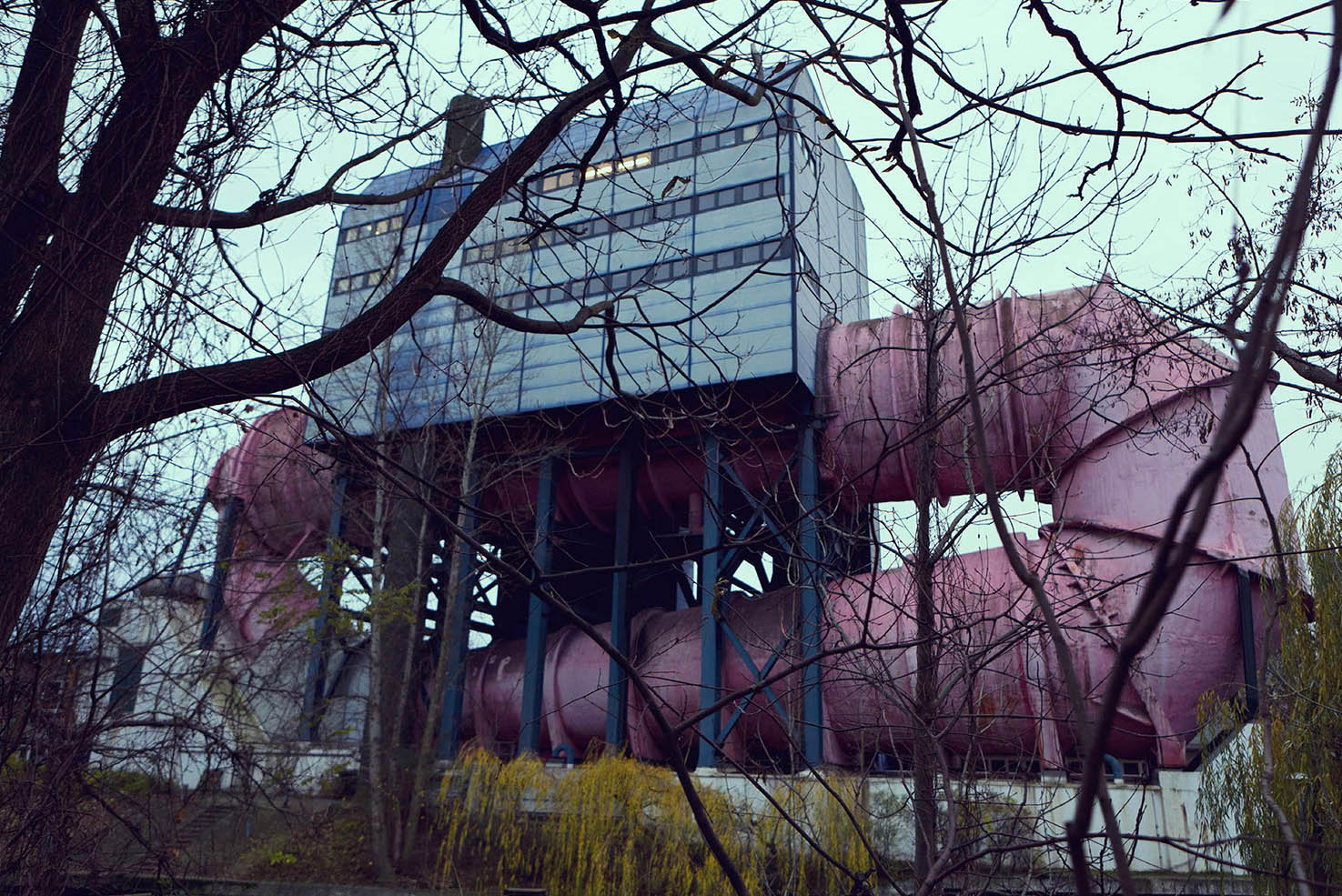
Littoral examines the shifting overlap between landscape and urbanscape. As a reaction to a traditional approach where the two are consciously separated, Laemmle-Ruff focuses on the often grotesque and ever-expanding littoral zone between civilisation and nature.

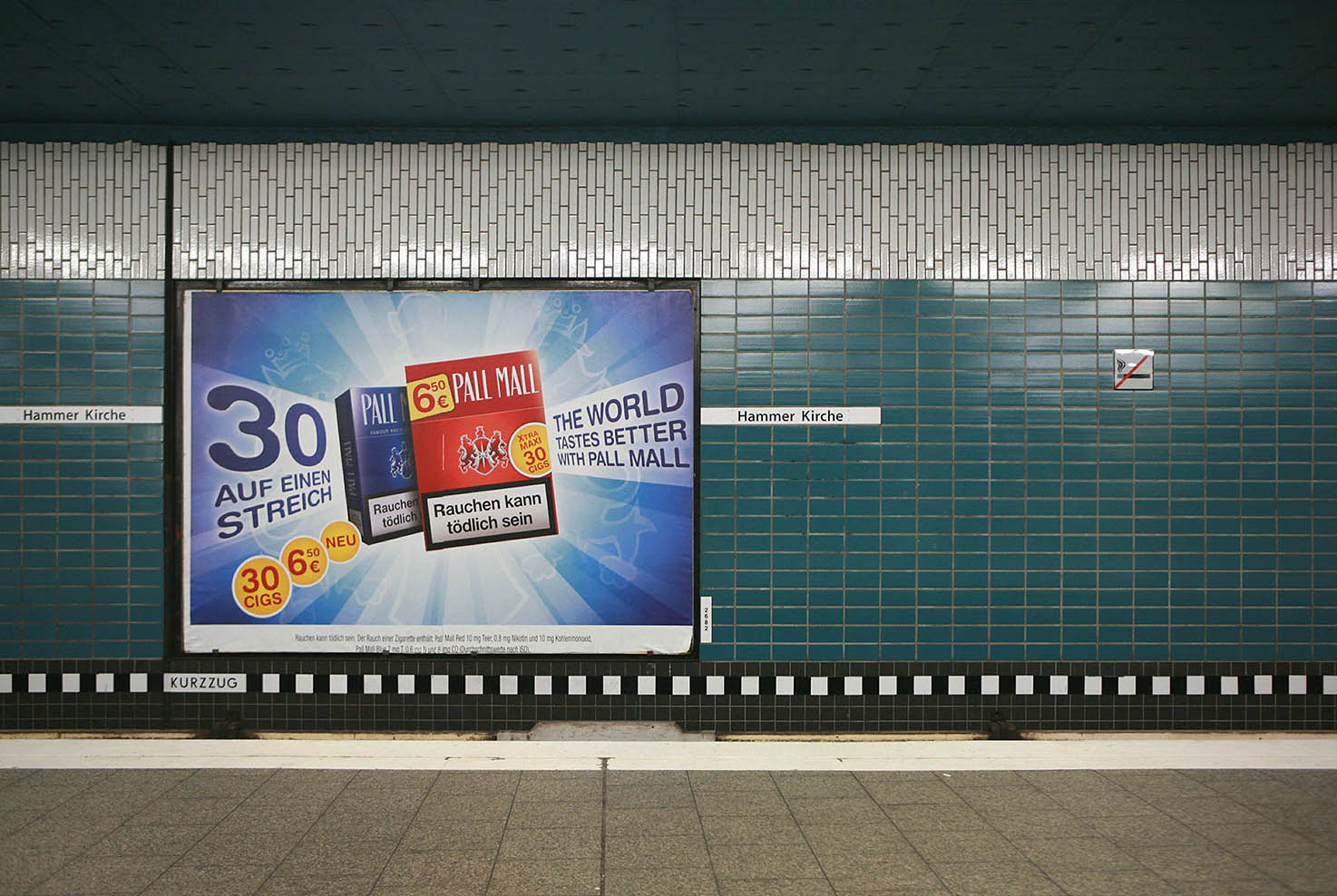
“I found these undefined zones did not discriminate on place or culture. From Morocco to the post WWII suburbs of Germany, somber skies were met with stubborn and aggressive urbanisation. I was drawn to contradictions. “The World Tastes Better with Pall Mall” claimed the cigarette ad. These empty remarks of consumerism seemed to go unchallenged. My intention was to capture these paradoxes and pull them from the wallpaper of modern sensibility. Our gaze once traveled to picturesque, unspoiled horizons, forests in mist and rolling plains. Instead it stops on concrete or becomes tangled in steel beams.”

Littoral presents us with spaces anticipating themselves. Housing estates on the fringe of development yet to be occupied; North African peasants walking past the mall’s facade where the market once stood; roof top terraces lined with satellite dishes streaming immaculate reception. We are left to wonder who will fill these homes. Who is in control of where urbanisation will go next?

Ultimately, this series may appear to be a presentation of a vernacular world, familiar and normal. This, in turn alludes to a desensitisation to our changing surroundings in an age of globalisation and overpopulation. Our landscape is increasingly becoming a manifestation of ourselves. Littoral urges one to question where the present seems to be leading us.

Practicing in both documentary and conceptual photography, from warm narratives to surreal visions, Kristian Laemmle-Ruff’s photographs subtly bring to light both the beauty and frailty of our times. As we spiral up the exponential curve of ‘progress’ there are dynamic ruptures, vulnerabilities and regenerative possibilities in our human reality – this is his motivation – a truth worth capturing.

Press release from the Colour Factory Gallery website


Kristian Laemmle-Ruff (Australian) 'Olympic Stadium' 2012


Kristian Laemmle-Ruff (Australian)
Olympic Stadium
2012
Type C print
100 x 67cm


Kristian Laemmle-Ruff (Australian) 'Road to Essaouira' 2010


Kristian Laemmle-Ruff (Australian)
Road to Essaouira
2010
Type C print
100 x 67cm


Kristian Laemmle-Ruff (Australian) 'Aqua dynamics' 2010-2012


Kristian Laemmle-Ruff (Australian)
Aqua dynamics
2010-2012
Type C print
100 x 67cm


Kristian Laemmle-Ruff (Australian) 'Valle de Zimatlan' 2010-2012


Kristian Laemmle-Ruff (Australian)
Valle de Zimatlan
2010-2012
Type C print
100 x 67cm


Kristian Laemmle-Ruff (Australian) 'Pall Mall' 2010-2012


Kristian Laemmle-Ruff (Australian)
Pall Mall
2010-2012
Type C print
100 x 67cm


Colour Factory Gallery
409-429 Gore Street
Fitzroy, Victoria 3056
Phone: +61 3 9419 8756

Colour Factory Gallery website

Kristian Laemmle-Ruff website

LIKE ART BLART ON FACEBOOK

Back to top

Review: ‘Jacqui Stockdale: The Quiet Wild’ at Helen Gory Galerie, Melbourne

Exhibition dates: 18th April – 19th May 2012


Jacqui Stockdale. 'Rama-Jaara the Royal Shepherdess' 2012


Jacqui Stockdale (Australian, b. 1968)
Rama-Jaara the Royal Shepherdess
2012
Type C Print
100 x 78cm


After a slow start to the season there has be a veritable feast of excellent photography exhibitions in Melbourne over the last month or so, including John Gollings and Jane Brown at Edmund Pearce Gallery, the Fred Kruger and Light Works exhibitions (at NGVA and NGVI respectively), Littoral by Kristian Laemmle-Ruff at Colour Factory (the next local review after this one) and this exhibition, The Quiet Wild by Jacqui Stockdale at Helen Gory Galerie.

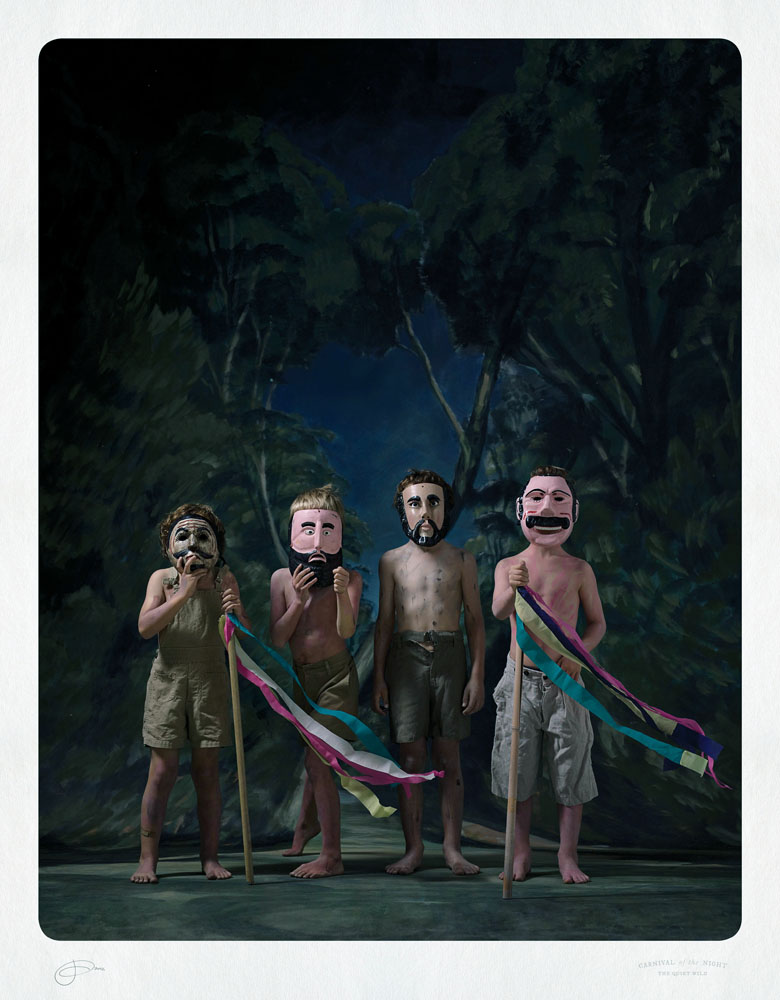
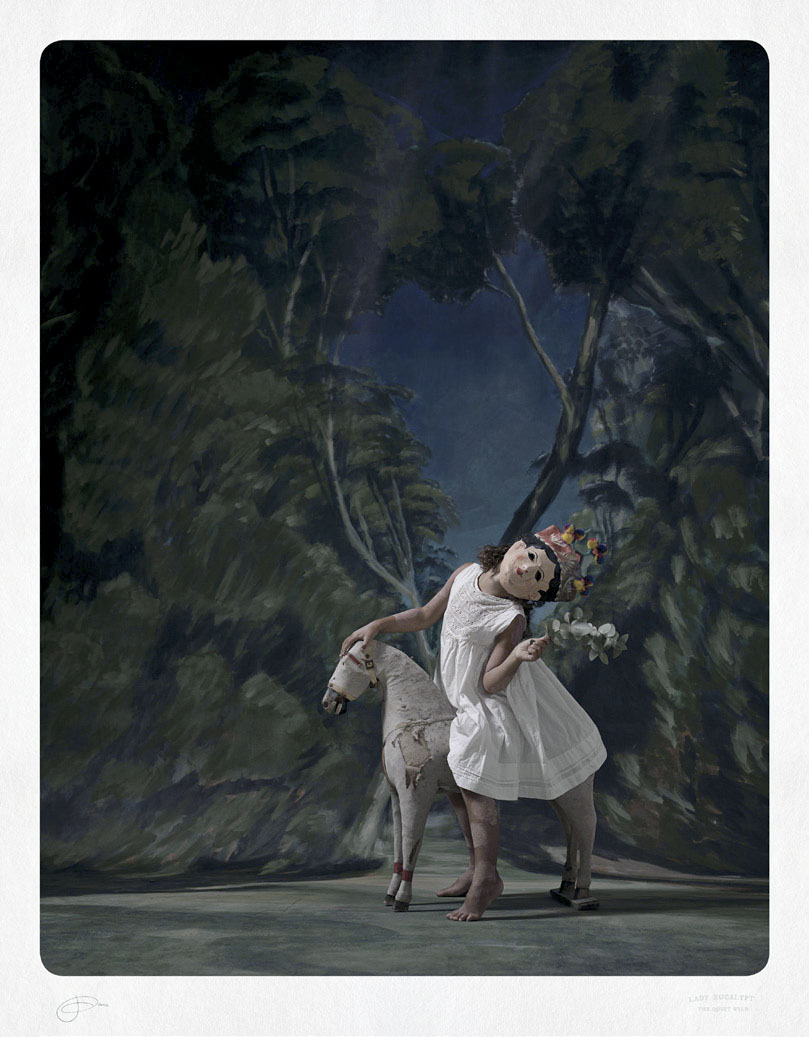
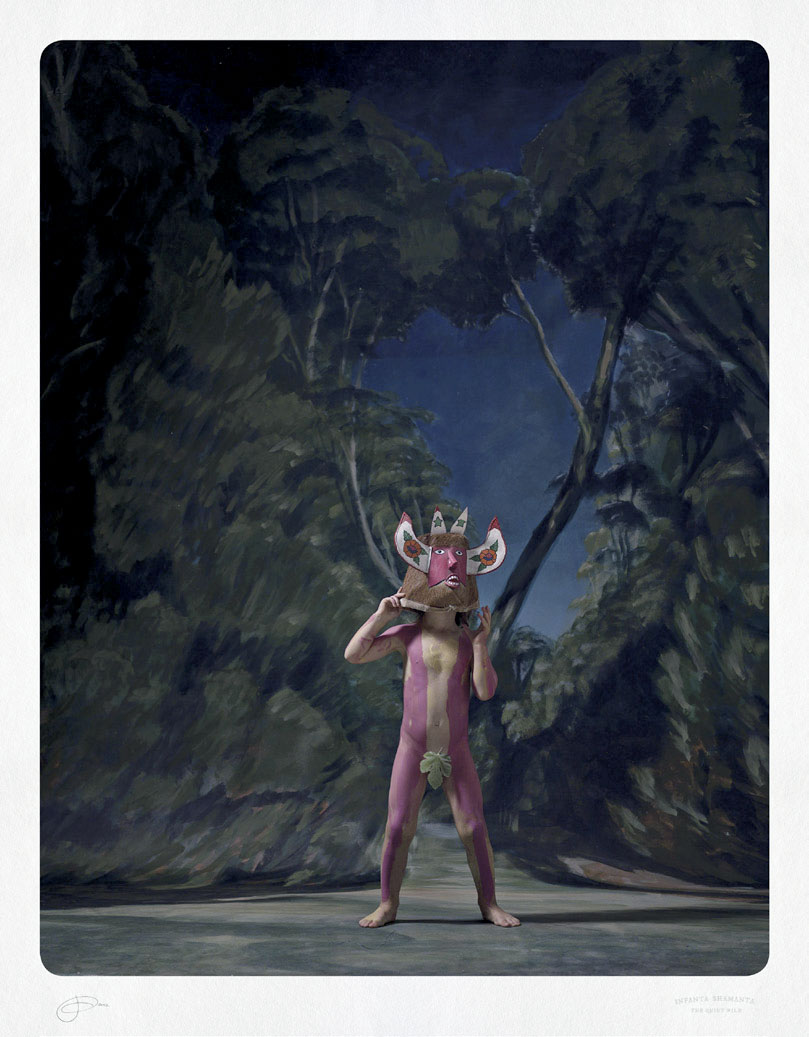
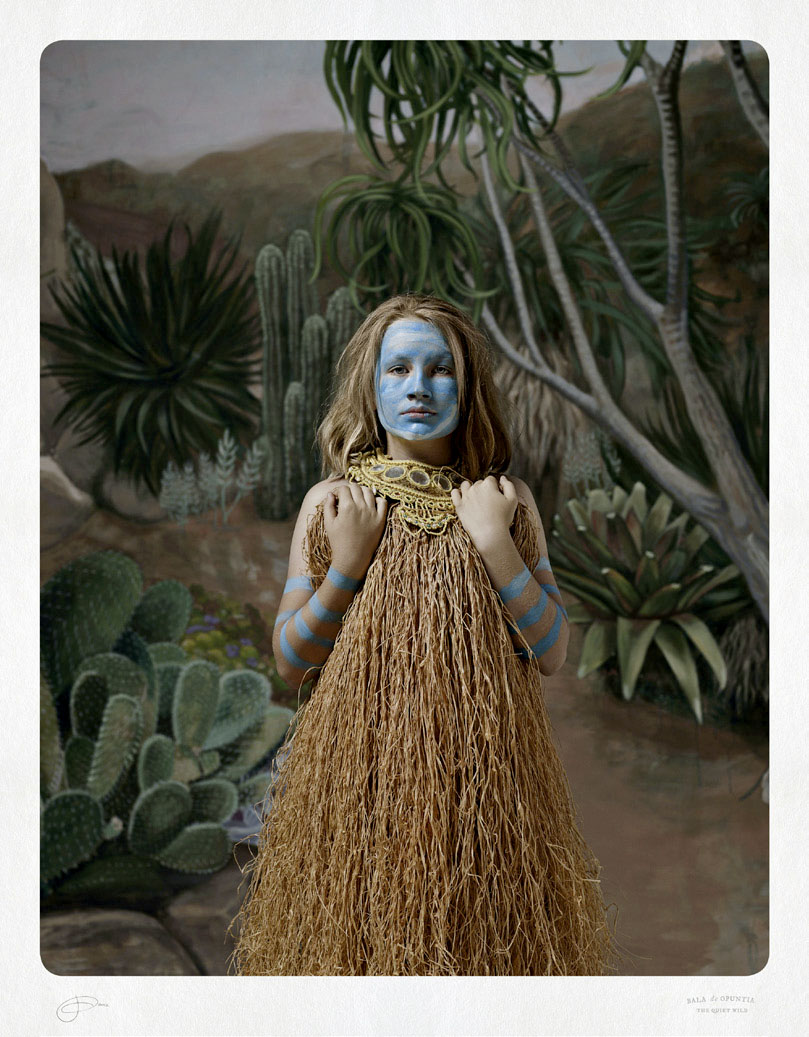
This is a very strong exhibition by Jacqui Stockdale, the metre tall colour prints (printed by the Colour Factory) displaying magnificently in the large gallery at Helen Gory. The photographs remind me of a perverse take on the ethnographic Cartes de visite that were produced during the colonial Victorian era in Australia, images of native peoples taken in studios with painted backdrops together with their cultural artefacts (which, coincidentally, can be seen in great detail and sadness in the Fred Kruger exhibition at NGVA). Drawing on personal places and stories, Mexican carnival and wrestlers masks, Indian masks, Aboriginal names and locations, Velasquez’s Las Meninas, the ghost of Frida Kahlo, rituals, gods (such as Rama) and deities, Australian scenery, performance (the process of painting the models and the outcome of this interaction), Stockdale creates a wonderful melange of archetypal characters that subvert traditional identities and narratives. Her creations “shape-shift” and frustrate attempts at categorization and assimilation.

Stockdale’s performative tactics and multiple modes of address, her polyvocal subject if you like, may be said to be an effect of textuality: “a conscious recognition and pursuit of an altogether different set of values and historical and cultural trajectories.”1 Undeniably this performative act (this “ritual spectacle”2) has links to the Bakhtin’s idea of the carnivalesque and the carnival paradigm, which accords to certain patterns of play. Stockdale inverts cultural stereotypes (which embody elements of fixity, repetition, and ambivalence) located within the realms of the fetish, the scopic, and the Imaginary in order to subvert the collective memory of viewers that have been inscribed with a stereotypical collective vernacular: her work transgresses the fantasy that plays a formative role in colonial exercises of power.3

Bakhtin likens the carnivalesque in literature to the type of activity that often takes place in the carnivals of popular culture. In the carnival… social hierarchies of everyday life – their solemnities and pieties and etiquettes, as well as all ready-made truths – are profaned and overturned by normally suppressed voices and energies. Thus, fools become wise, kings become beggars; opposites are mingled (fact and fantasy, heaven and hell).”4

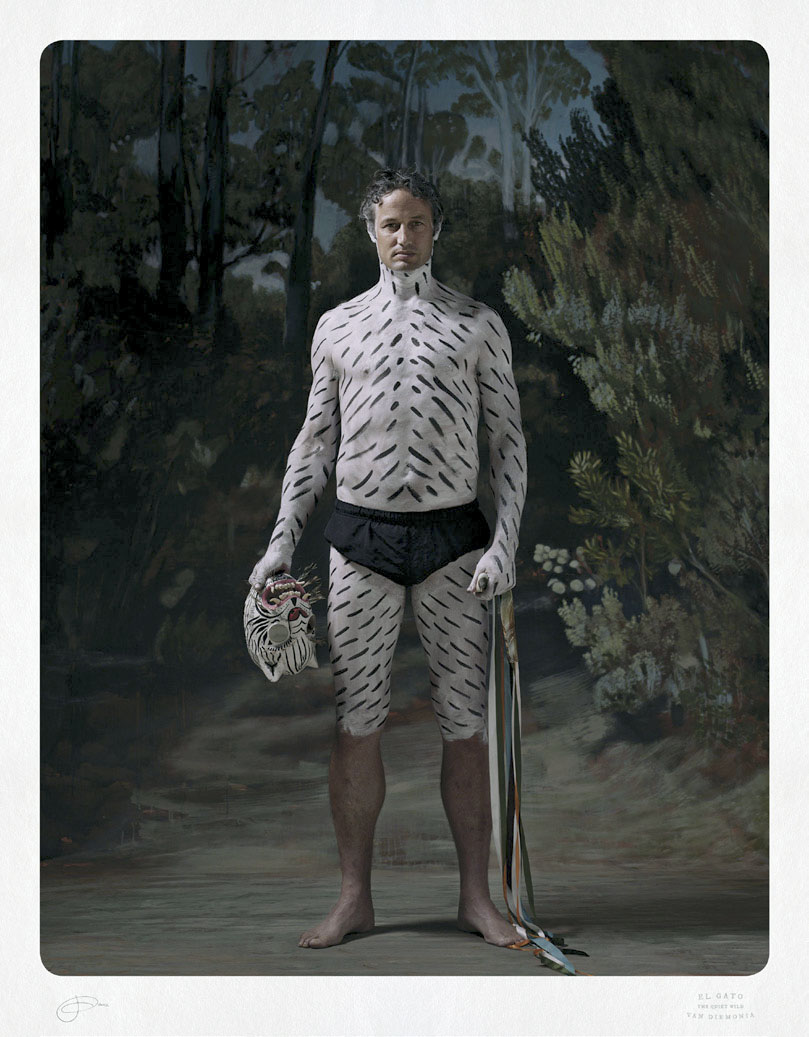
In Stockdale’s world, a “world upside-down” (quite appropriate for Australia), “Each new identity is one of inversion; man becomes woman, child becomes adult, animals transform into humans and vice-versa. Another example of this inversion can be seen in the “branding” of her photographs. In colonial Cartes de visite the sitter is, more often than not, unknown – unless it is an important person. It is the photographer’s name which is printed on the front and back of the card. In these photographs the photographers name is an illegible signature at bottom left, while the title of the person in the photograph is stamped into the work at bottom right. Here Stockdale again inverts traditional textual readings, the titles of her “photographic portraits that embody a world of mystical characters in masquerade” indecipherable to the uninitiated: a coded language of identity and place – Lagunta ManEl Gato, Les Jumeaux, Dogboy of Gondwanan, Infanta Shamanta and Rama Jaara, The Royal Shepherdess. ‘Lagunta’ is Aboriginal for Tasmanian Tiger and ‘Leeawuleena’ for the land around Cradle Mountain. ‘El Gato’ is the cat, ‘Jaara’ being the Aboriginal name for the Long Gully region and ‘Gondwanan’ the name for the southernmost of two supercontinents (the other being Laurasia) before the world split apart into the structure that we known today.

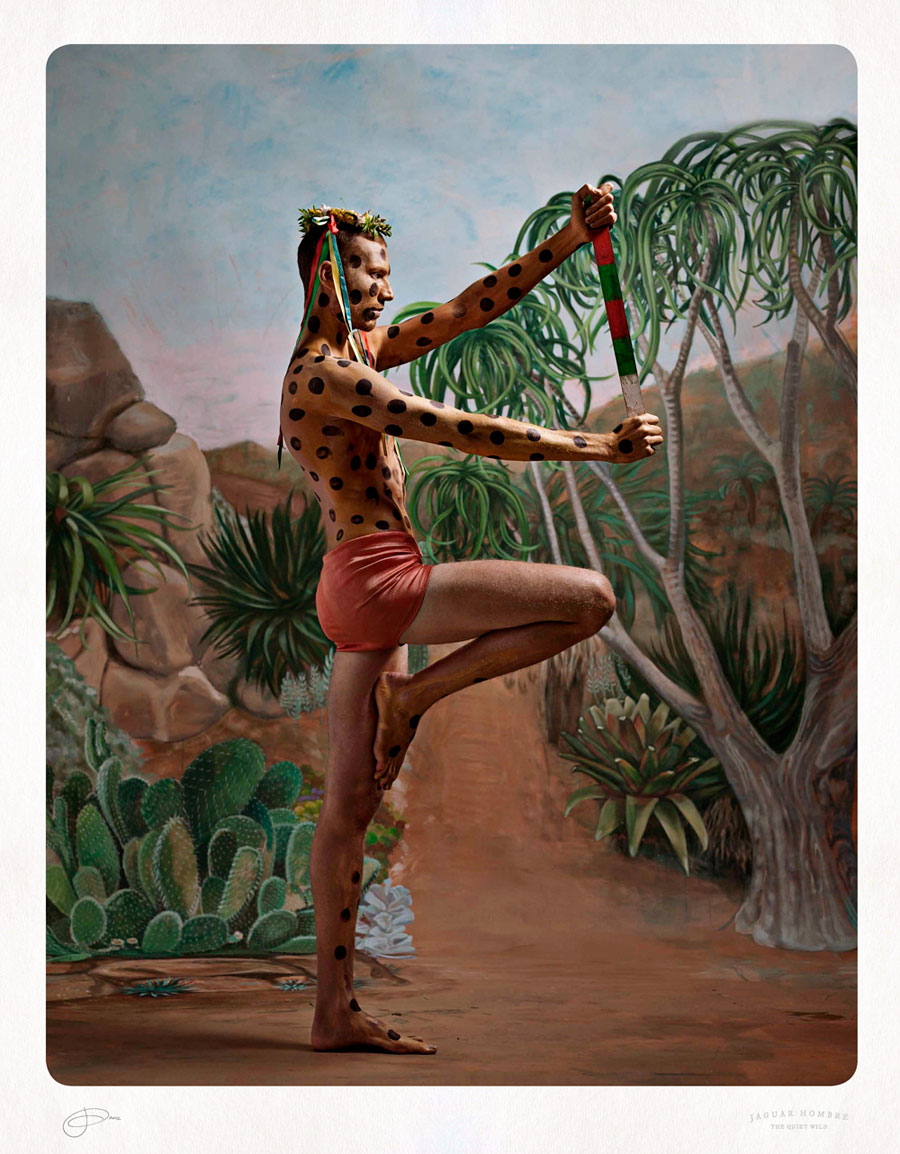
These are incredibly humorous, magical and symbolic photographs. A thought came into my mind when I was in the gallery surrounded by the work: for me they represented a vision of the Major Arcana of the Tarot (for example Jaguar Hombre could be seen as an inverted version of the Hanged Man with his foot in a figure four, the Hanged Man symbolising the need to just be in the world, yielding his mind and body to the Universal flow). The Major Arcana deal with the human condition, each card representing the joys and sorrows every man and woman can experience in a lifetime. In a way Stockdale offers us her own set of subversive Major Arcana, images that transgress the boundaries of the colonial vernacular, offering the viewer a chance to explore the heart of the quiet wild.

Dr Marcus Bunyan


1/ Fisher, Jean. “Witness for the Prosecution: The Writings of Coco Fusco,” in Fusco, Coco. The Bodies That Were Not Ours. London: Routledge, 2001, pp. 227-228

2/ Bakhtin, Mikhail. Rabelais and His World (trans. Helene Iswolsky). Cambridge: MIT Press, 1968, p. 5

3/ “According to Bhabha, stereotypes are located within the realms of the fetish, the scopic, and the Imaginary. He suggests that fantasy plays a formative role in colonial exercises of power. Bhabha describes the mechanism of cultural stereotypes as embodying elements of fixity, repetition, fantasy, and ambivalence, and suggests that if certain types of images are constantly presented in a range of different contexts, they will become imprinted onto the collective memory of viewers and inscribed within a collective vernacular.”
Vercoe, Caroline. “Agency and Ambivalence: A Reading of Works by Coco Fusco,” in Fusco, Coco. The Bodies That Were Not Ours. London: Routledge, 2001, p. 240

4/ Anon. “Carnivalesque,” on Wikipedia. [Online] Cited 13/05/2012


Many thankx to Helen Gory Galerie for allowing me to publish the photographs in the posting. Please click on the photographs for a larger version of the image.


Jacqui Stockdale. 'Les Jumeaux' 2012


Jacqui Stockdale (Australian, b. 1968)
Les Jumeaux
2012
Type C Print
100 x 78cm


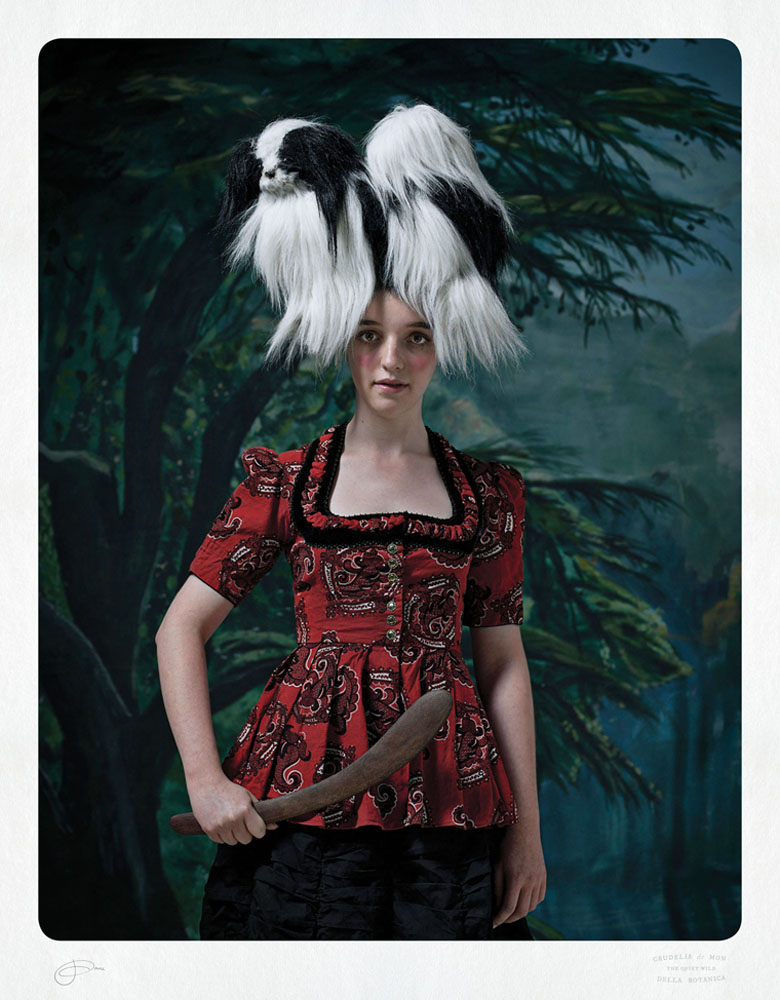
Jacqui Stockdale (Australian, b. 1968) 'Crudellia de Mon Botanica' 2012


Jacqui Stockdale (Australian, b. 1968)
Crudellia de Mon Botanica
2012
Type C Print
100 x 78cm


Jacqui Stockdale (Australian, b. 1968) 'Carnivale of the Night' 2012


Jacqui Stockdale (Australian, b. 1968)
Carnivale of the Night
2012
Type C Print
100 x 78cm


In this modern world of distractions there is a wild nature that stirs inside of us. A desire for transcendence, to become someone else, dance part naked and chant our lost songs so that they can be heard above the sounds of cities and mobile ring tones.

The Quiet Wild is a series of photographic portraits that embodies a world of mystical characters in masquerade set against hand-painted landscapes. The portraits playfully mimic the genre of exotic postcards and historical paintings where a fanciful subject is formally positioned within a make-believe landscape. The hand-painted settings in my photographs feature Australian scenery from places around Australia that have meaning to me including my mother’s property in Bendigo, the Melbourne Botanical Gardens and Lake Saint Claire in Tasmania.

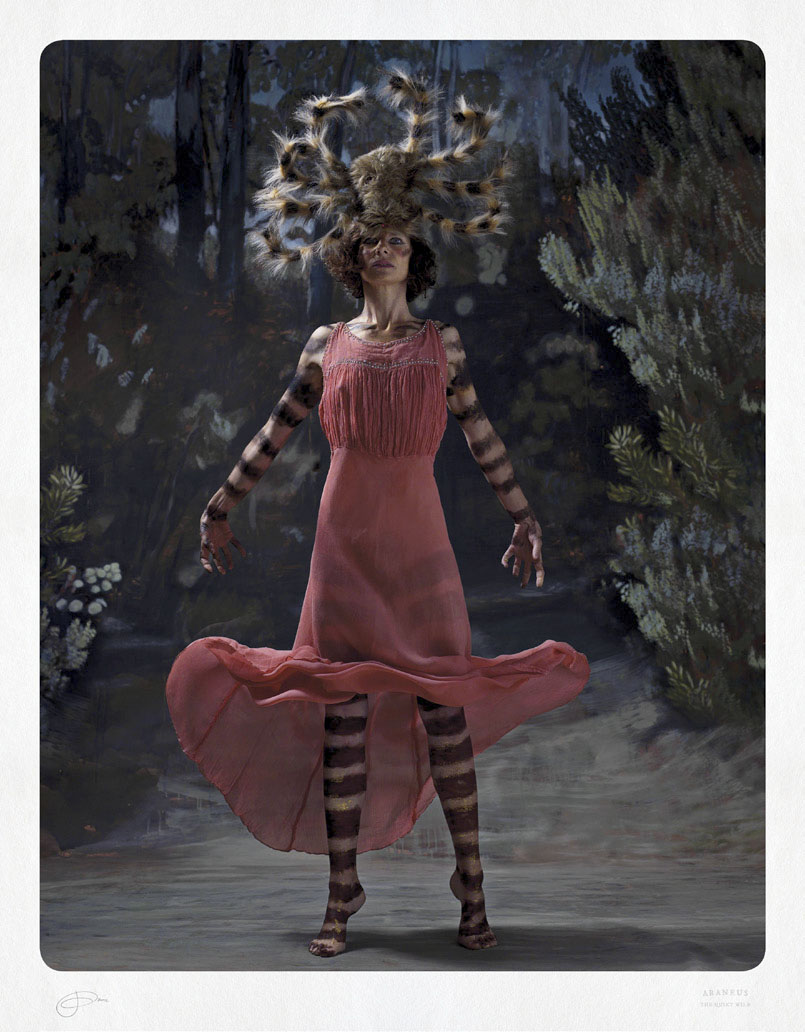
I paint the models bodies and combine costumes and props including my own collection of rare masks originally used in dances of Mexican Carnival. This new work responds to established portrayals of human identity and masquerade informed by my research into different aspects of folk Carnivals where the masquerades are a fusion of clandestine voodoo, ancestral memory and personal revelation ritual and performance. Performance also plays a part in my photographic process where I interact with the models and allow the process to greatly determine the outcome. Each new identity is one of inversion; man becomes woman, child becomes adult, animals transform into humans and vice-versa.

The difference between painting the human subject and taking their portrait with a camera it is that during a photo shoot there is more of an element of performance. The subject, over a period of many hours often becomes a new character, extending a side of them that is not prevalent in daily life or invents a new identity. This is brought about by what I dress them in and how I direct them, provoking certain ideas, strengths about an animal power or super natural deity. I begin with an idea of character and a selection of costumes and them work intuitively as though in the dark or with eyes part open. I rarely end up with what I first imagined and revel in the surprise or discovery of a combined effort.

The inspiration for this series of work has come from a unique, rich and beautiful form of human expression that is found in the ritual side of folk art in the cultures around the world but mostly in Mexico. The traditional dances of Mexican Carnival provide an opportunity to revive the primeval gods from the depths of our communal memory, since dance constitutes our remotest language and most primitive sacred offering. The masks I have used in this series are from these types of ritual dance. They are recontextualised and worn in the works Lagunta Man and El Gato, Les Jumeaux, Dogboy of Gonwanan, Infanta Shamanta and Carnival of the Night. Other influences come from images of Exotic Postcards, regarding the formal presentation of the models, the constructed settings and the borders and way of labelling the image. Luchadora Botanica was influenced by a Goya Painting, Negro Returno – I wanted to bring one of my recent collages to life, See ‘to return’.

What I have done is imagined my own family as part ritualistic characters, setting in them in a landscape that I have visited.”

Artist statement by Jacqui Stockdale 2012


Jacqui Stockdale. 'Jaguar Hombre' 2012


Jacqui Stockdale (Australian, b. 1968)
Jaguar Hombre
2012
Type C Print
100 x 78cm


Jacqui Stockdale. 'Lagunta Man, Leeawuleena' 2012


Jacqui Stockdale (Australian, b. 1968)
Lagunta Man, Leeawuleena
2012
Type C Print
100 x 78cm


Jacqui Stockdale (Australian, b. 1968) 'El Gato, Leeawuleena' 2012


Jacqui Stockdale (Australian, b. 1968)
El Gato, Leeawuleena
2012
Type C Print
100 x 78cm


Jacqui Stockdale (Australian, b. 1968) 'Araneus' 2012


Jacqui Stockdale (Australian, b. 1968)
Araneus
2012
Type C Print
100 x 78cm


Jacqui Stockdale (Australian, b. 1968) 'Princess Eucalypt' 2012


Jacqui Stockdale (Australian, b. 1968)
Princess Eucalypt
2012
Type C Print
100 x 78cm


Jacqui Stockdale (Australian, b. 1968) 'Infanta Shamanta' 2012


Jacqui Stockdale (Australian, b. 1968)
Infanta Shamanta
2012
Type C Print
100 x 78cm


The ghost of Frida Kahlo is a haunting one that permeates many artists consciousness bringing with it not just a tragic story but intoxicating aromas of Mexican exotic, masks, Voo-Doo, bloody Mayan rituals and Catholicism gone troppo.

This is clearly evidenced in Jacqui Stockdale’s latest exhibition at Helen Gory Galerie in works such as Negro-Returno, Long Gully. The white lacy heart-shaped overlay of ghostly trees conceals a part-portrait of Frida here depicted in front of Long Gully Bendigo, the Stockdale property, after the Black Saturday bush fire three years ago. This haunting shadowy backdrop appears again in Rama Jaara, The Royal Shepherdess, ‘Jaara’ being the Aboriginal name for the Long Gully region. It is a personal aside of something that obviously touched this artist deeply, one to which she has bought her troupe of tableau vivant players to. Here, a Mauritian girl called Mimi, standing at attention, arms akimbo, dressed in remnants of regal colonial attire. The pose reminiscent of that of the Infanta Margarita in Velasquez’s Las Meninas. The dog has moved from bottom right to bottom left, here a small spotted Chinese Joss paper effigy made for the journey to the afterlife, rather than a great bounding Spanish mastiff. Our young self-possessed Mimi stares directly out of the picture space not as an Infanta, but as one of nature’s children, a shepherdess, her hairstyle resembling a ram’s head, informing that part of the title, ‘Rama’ a play on words.

Both the artists brothers are also players in this tableau: the younger as Lagunta Man, Leeawuleena and the artist’s twin as El Gato, van Diemonia. ‘Lagunta’ is Aboriginal for Tasmanian Tiger and ‘Leeawuleena’ for the land around Cradle Mountain. ‘El Gato’ is the cat, and both carrying a filmic reference to the recent movie The Hunter, filmed around Cradle Mt in Northern Tasmania. While the compositional phrasing has more than a nostalgic whiff of 19th century still studio photography, seen here such staged manners marry well to popular cinematic culture.

As this exhibition unfolds certain characterising concerns appear and reappear. Decapitation, and cross-cultural iconography make this a lavish art dining at the high table of pictorial fusion cuisine. Mexican masks, Joss paper, skulls, rites of passage tit-bits mix it with popular culture on the shag pile to produce a totally new hybrid. Folk memories merge with diaristic experiences, found objects flirt with finely painted trompe-oeil effects in an almost self-regulating metamorphosis.

In this Stockdale becomes a sort of gatekeeper, a ring master choreographer who will both mystify and amaze you with her family carnivale. Picture by picture, costume by costume, the staged imagined and the real, combine into a most fascinating enticement I find impossible to resist.

Catalogue essay by Jeff Makin, 2012


Jacqui Stockdale (Australian, b. 1968) 'Bala Opuntia' 2012


Jacqui Stockdale (Australian, b. 1968)
Bala Opuntia
2012
Type C Print
100 x 78cm


Jacqui Stockdale. 'Dogboy of Gondwanan' 2012


Jacqui Stockdale (Australian, b. 1968)
Dogboy of Gondwanan
2012
Type C Print
100 x 78cm


Jacqui Stockdale. 'Negro Returno, Long Gully' 2012


Jacqui Stockdale (Australian, b. 1968)
Negro Returno, Long Gully
2012
Type C Print
100 x 78cm


Jacqui Stockdale. 'Luchadora Botanica' 2012


Jacqui Stockdale (Australian, b. 1968)
Luchadora Botanica
2012
Type C Print
100 x 78cm


Helen Gory Galerie

This gallery has now closed.

LIKE ART BLART ON FACEBOOK

Back to top

Review: ‘Jane Brown / Australian Gothic’ at Edmund Pearce Gallery, Melbourne

Exhibition dates: 25th April – 12th May 2012


Jane Brown (Kuwait, Australia, b. 1967) 'Big Trout, New South Wales' 2010


Jane Brown (Kuwait, Australia, b. 1967)
Big Trout, New South Wales
2010
Museo silver rag print
59 x 46cm


As you should know by now, this blog tries to promote the work of less well known artists and subject matter. So instead of concentrating on the wonderful aerial bushfire photographs of the well-known artist John Gollings (showing in the same gallery in different spaces with the work of Michael Norton) I have decided to do a posting on the exhibition Australian Gothic by Jane Brown.

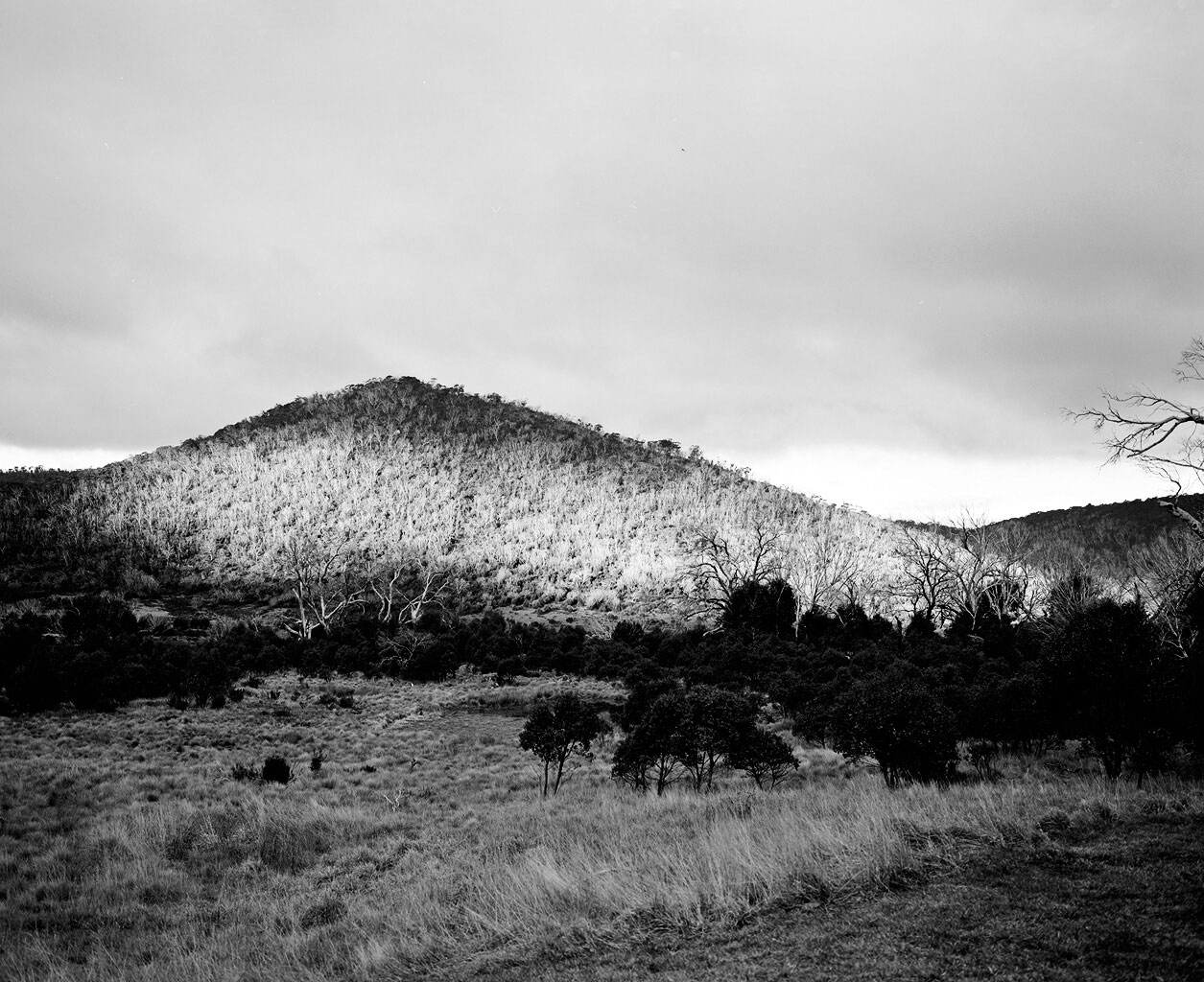
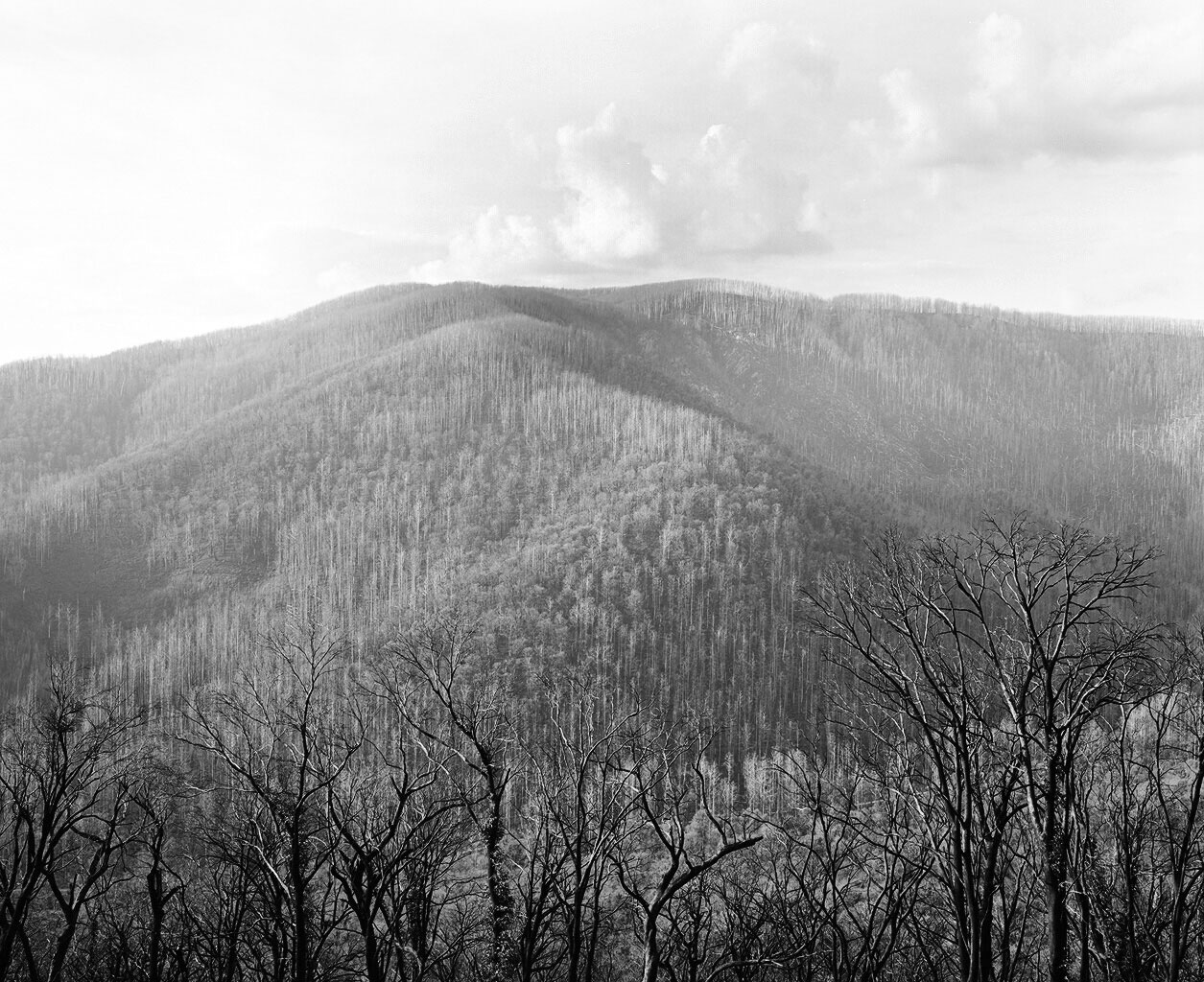
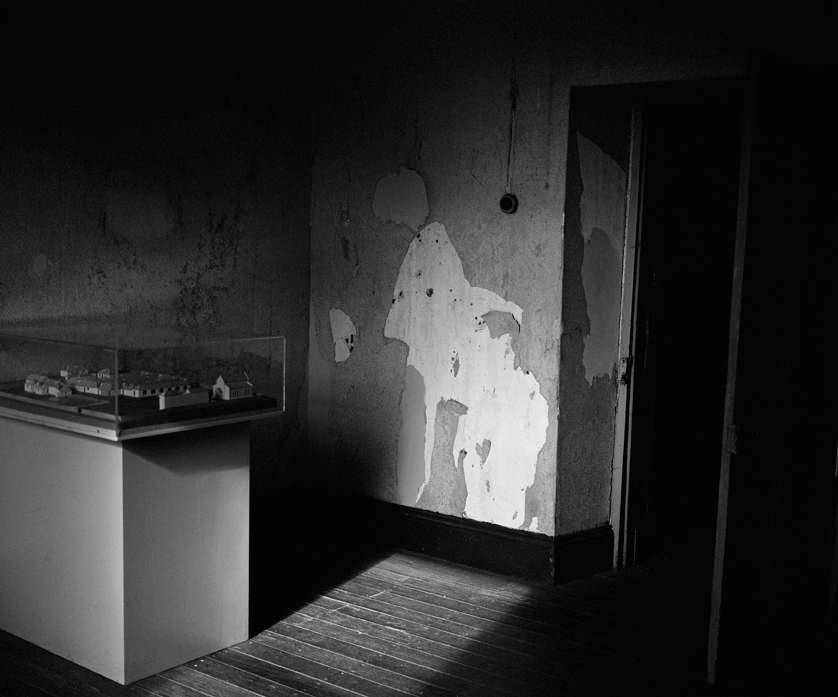
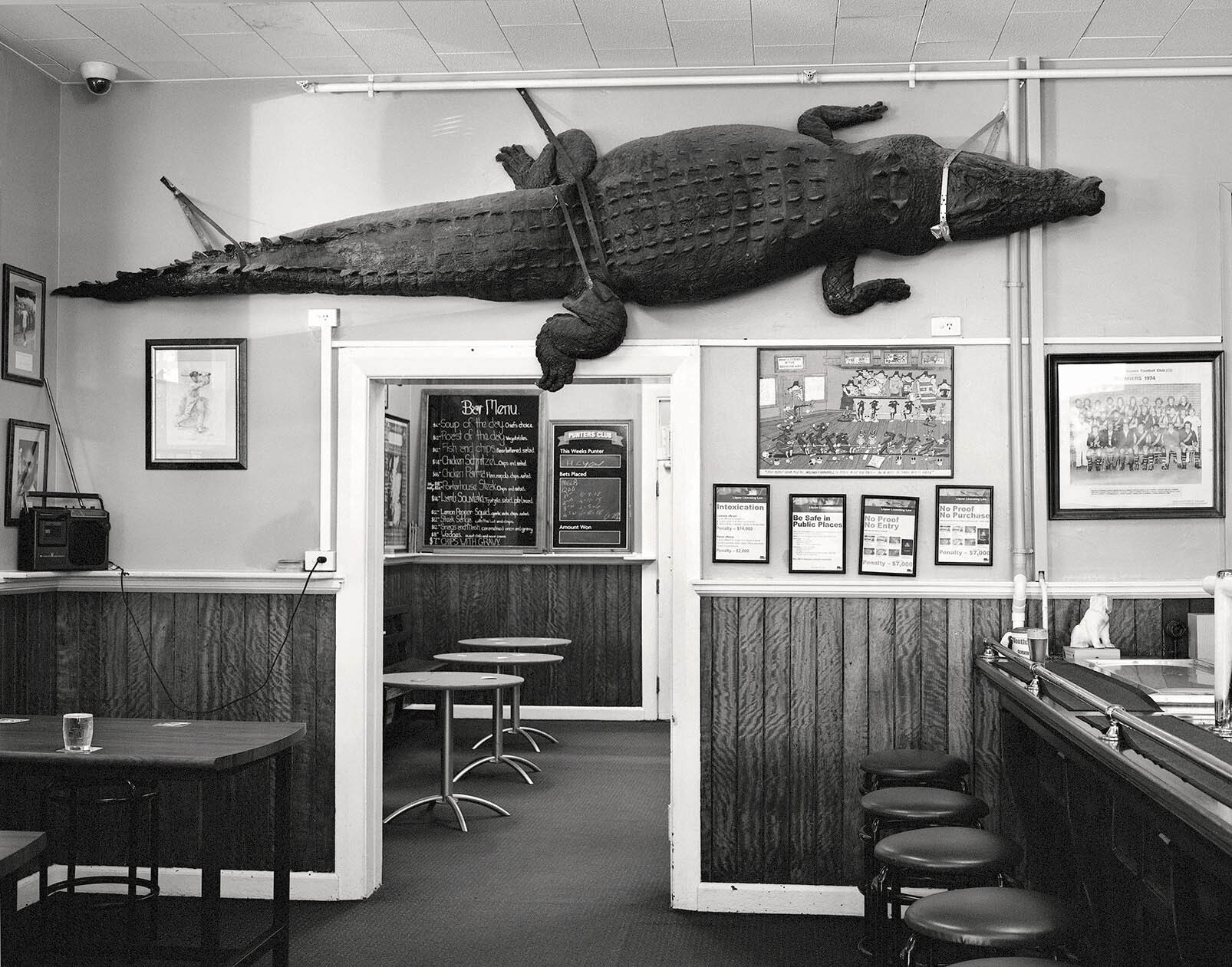
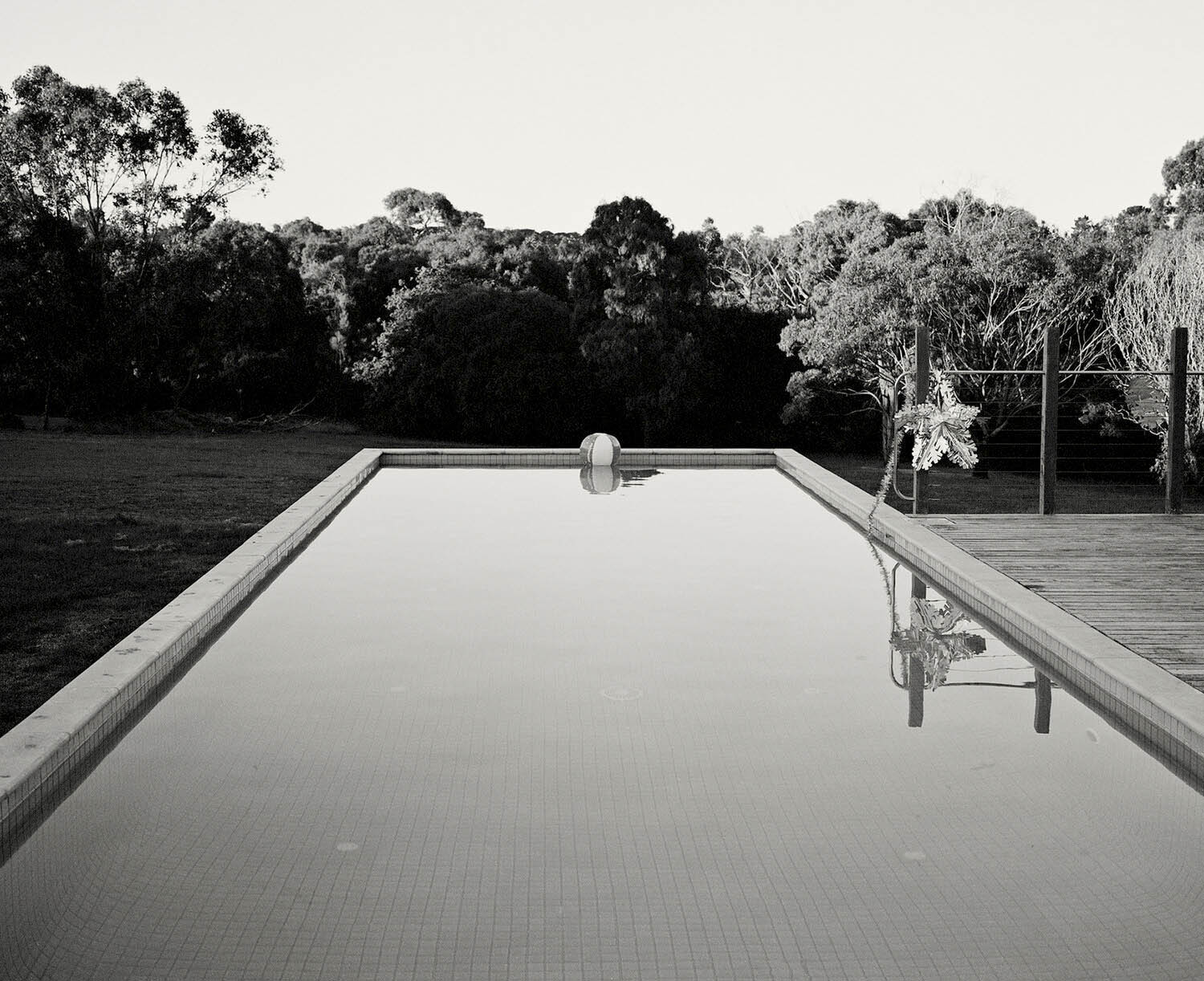
This is a good exhibition of small, darkly hewn, traditionally printed silver gelatin photographs, beautifully hung in the small gallery at Edmund Pearce and lit in the requisite, ambient manner. There are some outstanding photographs in the exhibition. The strongest works are the surrealist tinged, film noir-ish mise-en-scènes, the ones that emphasise the metaphorical darkness of the elements gathered upon the stage. Photographs such as Big TroutThe Female Factory, Adelong, New South Wales and Captain’s Flat Hotel, New South Wales really invoke a feeling of unhomely (or unheimlich), where nature is out of kilter. These images unsettle our idea of Oztraliana, our perceived sense of Self and our place in the world. They disrupt normal transmission; they transmutate the seen environment, transforming appearance, nature and form. Less successful in this quest are the bushfire landscapes. I feel these add little to the narrative thread of the exhibition and could have easily been left out in a judicious cull of the photographs. This would have made the overarching story line stronger still.

One of the best photographs in the exhibition is Lathamstowe (2011, below). This dark, brooding, intense photograph is a beautifully realised visualisation, one that balances scale, tone, light, form and darkness to create a haunting image that stays with you a long time after you have seen it. This one images says it all: the artist has talent. More please!

Dr Marcus Bunyan


Many thankx to Edmund Pearce Gallery for allowing me to publish the photographs in the posting. Please click on the photographs for a larger version of the image.


Jane Brown (Kuwait, Australia, b. 1967) 'Bushfire Landscape I' 2011


Jane Brown (Kuwait, Australia, b. 1967)
Bushfire Landscape I
2011
Fibre based, silver gelatin print
16.5 x 20.5cm


Jane Brown (Kuwait, Australia, b. 1967) 'Bushfire Landscape II, Lake Mountain, Victoria' 2010


Jane Brown (Kuwait, Australia, b. 1967)
Bushfire Landscape II, Lake Mountain, Victoria
2010
Fibre based, silver gelatin print
16.5 x 19.5cm


Jane Brown (Kuwait, Australia, b. 1967) 'The Female Factory (convict women’s prison), Ross, Tasmania' 2009


Jane Brown (Kuwait, Australia, b. 1967)
The Female Factory (convict women’s prison), Ross, Tasmania
2009
Fibre based, silver gelatin print
15.8 x 19.5cm


Jane Brown (Kuwait, Australia, b. 1967) 'Front Bar, Wonthaggi Hotel, Victoria' 2012


Jane Brown (Kuwait, Australia, b. 1967)
Front Bar, Wonthaggi Hotel, Victoria
2012
Fibre based, selenium toned, gelatin silver print


Jane Brown (Kuwait, Australia, b. 1967) 'Bush Christmas, Victoria' 2011


Jane Brown (Kuwait, Australia, b. 1967)
Bush Christmas, Victoria
2011
Fibre based, selenium toned, gelatin silver print


Jane Brown (Kuwait, Australia, b. 1967) 'Lathamstowe' 2011


Jane Brown (Kuwait, Australia, b. 1967)
Lathamstowe
2011
Fibre based, silver gelatin print
16.5 x 16.5cm


“I find it interesting how monochrome is used to differentiate the living and the dead, the past and the present. It has an ability to transcend the constraints of time, memory and death. I examine this a lot in my work – landscapes seem to have vestiges or traces of past life and memorials become otherworldly.”


Jane Brown. ‘Weekend Australian Review’, August 2011


“The antipodes was seen as a world of reversals, the dark subconscious of Britain. It was for all intents and purposes Gothic par excellence.”


Gary Turcotte. “Australian Gothic,” in Marie Mulvey-Roberts (ed.). The Handbook to Gothic Literature. 1998


Comprising photographs taken in rural New South Wales, the ACT, Victoria and Tasmania, this exhibition takes its cue from the gothic imaginings of colonial Australia. We see images of a convict past, the bush Christmas, unforgiving landscapes and melancholic hotels. It carries echoes of the cinema of Wake in Fright (1971) and the Cars that Ate Paris (1974)Rendering visible the themes of the melancholic and the uncanny, Australian Gothic manifests itself in rural isolation – where the homely becomes unhomely (or unheimlich) and where nature is out of kilter.


Jane Brown (Kuwait, Australia, b. 1967) 'Adelong, New South Wales' 2011


Jane Brown (Kuwait, Australia, b. 1967)
Adelong, New South Wales
2011
Fibre based, silver gelatin print
16.5 x 20.5cm


Jane Brown (Kuwait, Australia, b. 1967) 'Tumbarumba, New South Wales' 2012


Jane Brown (Kuwait, Australia, b. 1967)
Tumbarumba, New South Wales
2012
Fibre based, silver gelatin print
16.5 x 19.5cm


Jane Brown (Kuwait, Australia, b. 1967) 'One Way, Hobart, Tasmania' 2009


Jane Brown (Kuwait, Australia, b. 1967)
One Way, Hobart, Tasmania
2009
Fibre based, silver gelatin print
16.5 x 19.5cm


Jane Brown (Kuwait, Australia, b. 1967) 'Unheimlich, French Island, Victoria' 2010


Jane Brown (Kuwait, Australia, b. 1967)
Unheimlich, French Island, Victoria
2010
Fibre based, silver gelatin print
19 x 16cm


Jane Brown (Kuwait, Australia, b. 1967) 'Captain’s Flat Hotel, New South Wales' 2012


Jane Brown (Kuwait, Australia, b. 1967)
Captain’s Flat Hotel, New South Wales
2012
Fibre based, silver gelatin print
21.5 x 17.5cm


Edmund Pearce Gallery

This gallery has now closed.

LIKE ART BLART ON FACEBOOK

Back to top

Exhibition: ‘Polixeni Papapetrou: The Dreamkeepers’ at Stills Gallery, Sydney

Exhibition dates: 28th March – 5th May 2012


Polixeni Papapetrou (Australian, 1960-2018) 'The Wanderer No. 3' 2012


Polixeni Papapetrou (Australian, 1960-2018)
The Wanderer No. 3
2012
From The Dreamkeepers
Pigment print
105 x 105cm


I absolutely love these. The colours, the spaces, the ambiguous vistas, the fantastical archetypes, the fables. What springs to mind, with the use of masks to disguise youth positioned within the decorous landscape, is the notion of “passing”. Passing on (as in dying), passing through (as in travelling), in passing (as in an aside) and just “passing” (passing yourself off as someone or something else) to hide your true character or feelings. Gay men did this in the 1950s and 60s all the better to fit into society, for if it was found that you were homosexual you could loose your job, your apartment and even your life. Of course, there is also the passing of time, the longing for misspent youth in these masked ephebes and adolescent women. Age shall not weary them…

Wandering, dreaming, remembering, keeping, collecting, counting. These neophytes on the path of life, both old/wise, young/hidden pass through (into?) our dreams. Papapetrou creates visions that elude the senses, visions that slip between dreaming and waking, between conscious and subconscious realms. As John Berger and Jean Mohr have observed,

“Cameras are boxes for transporting appearances. Are the appearances which a camera transports a construction, a man-made cultural artefact, or are they, like a footprint in the sand, a trace naturally left by something that has passed? The photographer choses the events he photographs. This choice can be thought of as a cultural construction. The space for this construction is, as it were, cleared by his rejection of what he did not choose to photograph.”1

As an artist Papapetrou has the intelligence to leave this nature/nurture question open in her photographs. Her skill as an artist is in choosing the right things to photograph. This enables her creatures to pass through liminal spaces, the space of our consciousness. Through this process a trace will always be left with us, for this is a strong body of work, well realised, in passing.

Dr Marcus Bunyan


1/ Berger, John and Mohr, Jean. Another Way of Telling. New York: Pantheon Books, 1982, pp. 92-93.


Many thankx to Stills Gallery for allowing me to publish the photographs in the posting. Please click on the photographs for a larger version of the image.


Polixeni Papapetrou (Australian, 1960-2018) 'The Wave Counter' 2011


Polixeni Papapetrou (Australian, 1960-2018)
The Wave Counter
2011
From The Dreamkeepers
Pigment print
105 x 105cm


Polixeni Papapetrou (Australian, 1960-2018) 'The Mystical Mothers' 2011


Polixeni Papapetrou (Australian, 1960-2018)
The Mystical Mothers
2011
From The Dreamkeepers
Pigment print
105 x 105cm


Polixeni Papapetrou (Australian, 1960-2018) 'The Lantern Keeper' 2012


Polixeni Papapetrou (Australian, 1960-2018)
The Lantern Keeper
2012
From The Dreamkeepers
Pigment print
105 x 105cm


“These transitional places in one’s life are often the most creative, and as we grapple for answers and clarity what is often realized is ambiguity and confusion that reigns supreme. Like fairy stories, Papapetrou uses absurdity to make symbolic sense of world she struggles to understand.”


Susan Bright. Between Worlds catalogue 2009


In Polixeni Papapetrou’s work there is identification with the world of children that is rare and remarkable. She sees children themselves as ‘between worlds’, between infancy and adulthood. Yet she does more than identify, creating fantastical worlds that only adults can truly understand and relate to.

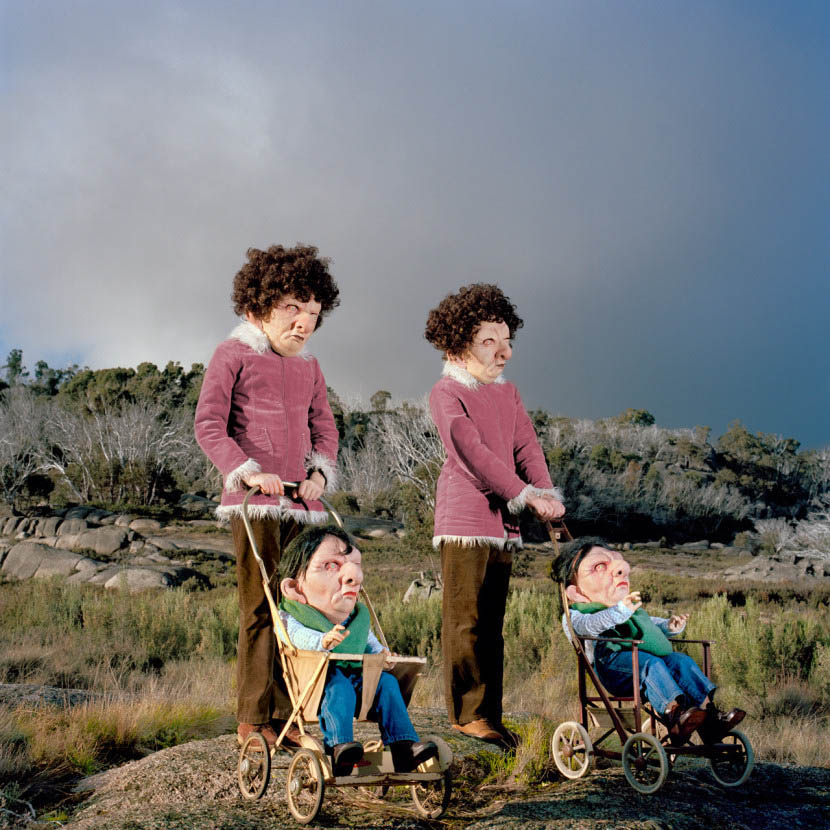
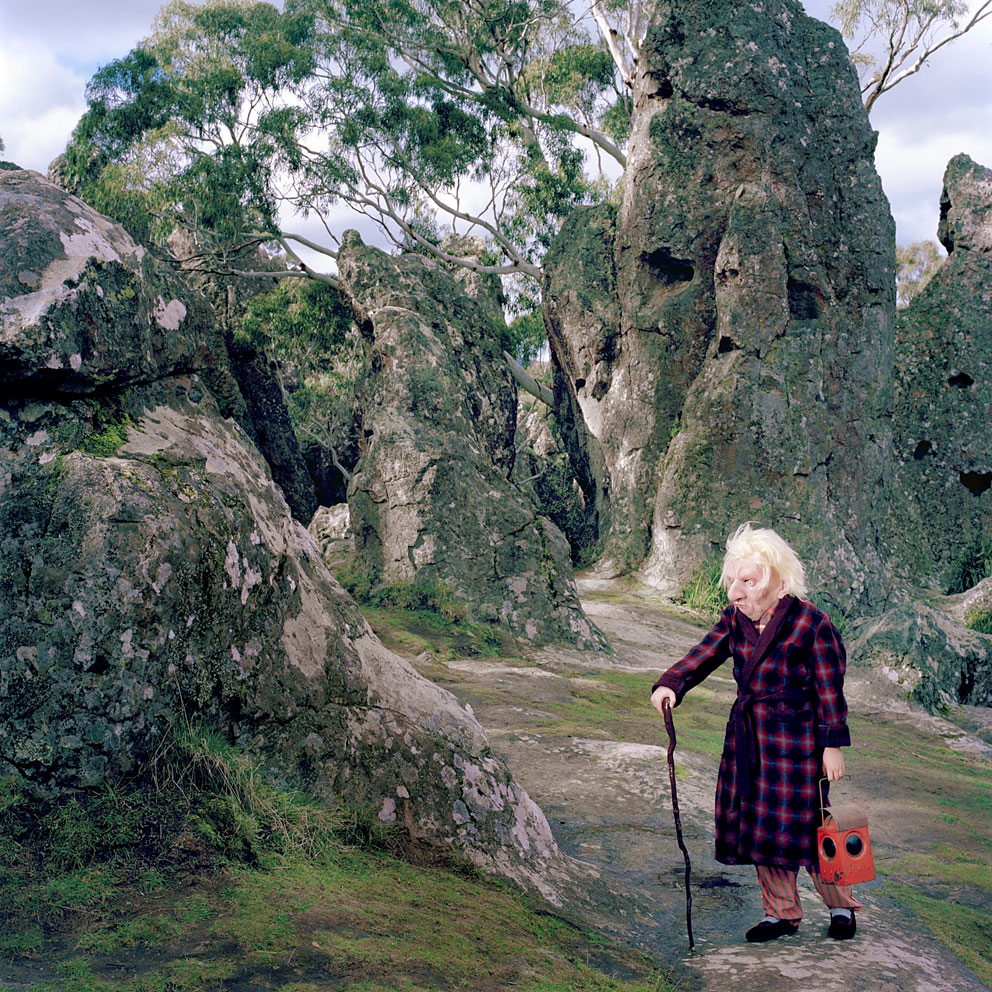
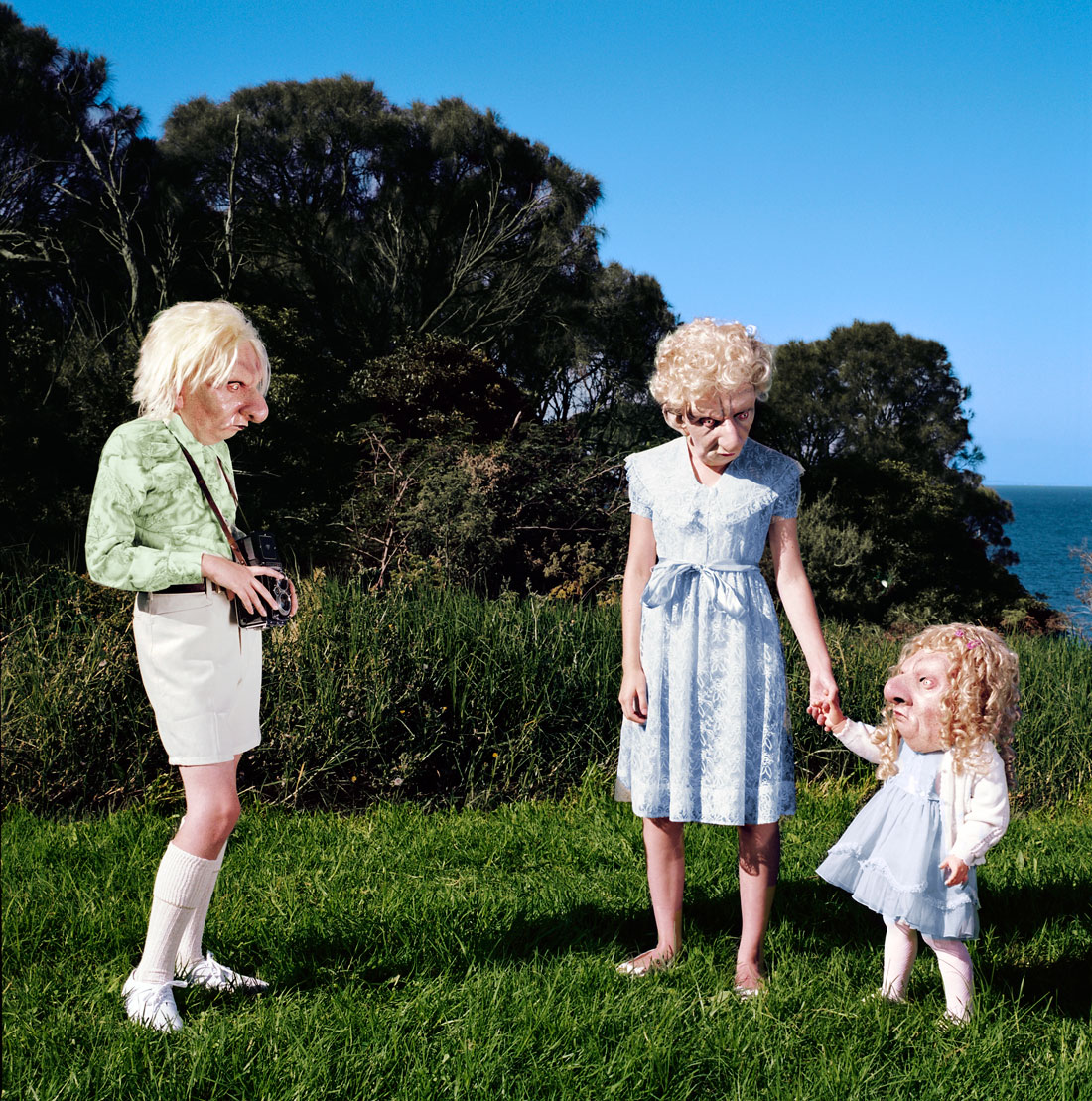
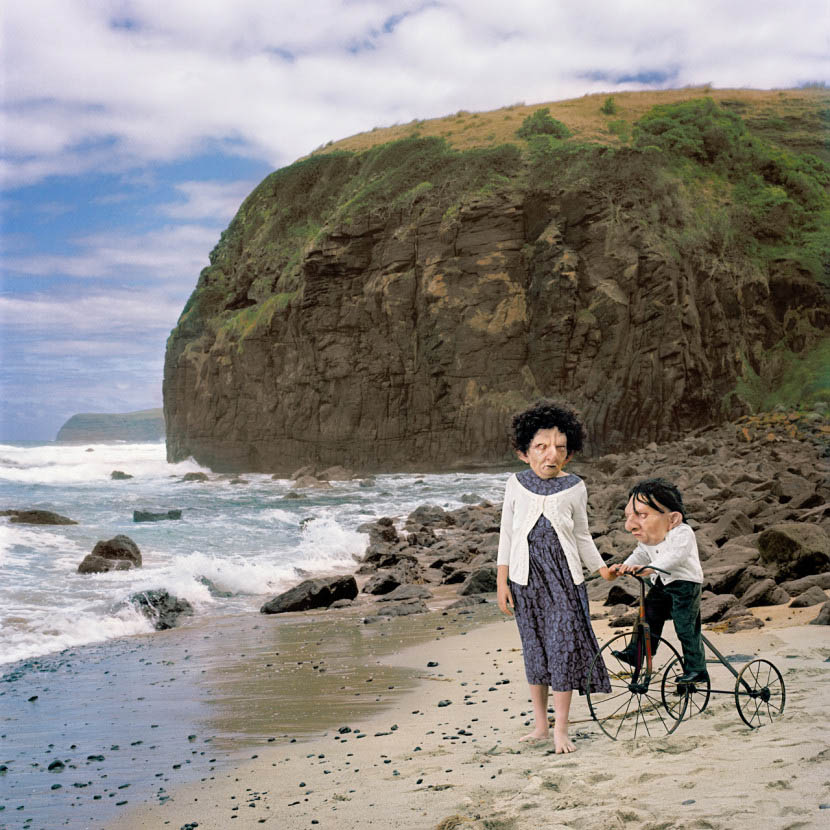
A man in blue striped pyjamas stands on a rock by the sea, leaning into the wind. His body seems young yet he supports himself with a walking frame. His face is old, oversized, a little grotesque. He is The Wavecounter. Like the other characters in Polixeni Papapetrou’s series The Dreamkeepers, he is lithe in body yet gnarly of physiognomy, both young and old. Gazing out in contemplation these dream keepers look with anticipation to the future, or is it with nostalgia to the past? The timeless backdrops of shoreline or hilltop reflect this ambiguity, echoing through landscape the collapsing of thresholds and blurring of boundaries.

Papapetrou’s art practice has involved collaboration with her children and their friends for over 10 years. As they have grown and transformed so too have the roles they perform and spaces they inhabit. It is the awkward evolution of adolescence that informs the in-between space of The Dreamkeepers. To parallel the cripplingly self-conscious yet powerfully self-realising period of our lives, Papapetrou engages part reality, part fantasy from which a space of unreality emerges, the space of archetype. Here the anonymity afforded by masks separates her adolescent actors from who they really are, and allows them to stand in for us all. In this way, Papapetrou asks us to consider how masks, whether symbolic or literal, not only conceal identity, but also expand and transform it.

The aged masks do so in The Dreamkeepers by confounding adolescence, as the characters exude a quiet lack of self-consciousness, despite their disturbing appearance. They arouse a gentle pathos, reminding us of our own shapeshifting, of time playing out on our bodies and minds. The abstract meeting of these two ages may indicate the latent wisdom and self-acceptance that only realises with maturity, or the cyclical nature of our life spans that inevitably brings us back to the vulnerability of youth. In either case the work is a powerful testament to the surrendering of childhood.

Also on exhibition is a small selection of works from Papapetrou’s current work in progress. Using ghillie suits, she transforms her actors into animate objects – rocks with life and seaweed with attitude.

Press release from the Stills Gallery website


Polixeni Papapetrou (Australian, 1960-2018) 'The Holiday Makers' 2011


Polixeni Papapetrou (Australian, 1960-2018)
The Holiday Makers
2011
From The Dreamkeepers
Pigment print
105 x 105cm


Polixeni Papapetrou (Australian, 1960-2018) 'The Mender' 2011


Polixeni Papapetrou (Australian, 1960-2018)
The Mender
2011
From The Dreamkeepers
Pigment print
105 x 105cm


Polixeni Papapetrou (Australian, 1960-2018) 'The Joy Pedlars' 2011


Polixeni Papapetrou (Australian, 1960-2018)
The Joy Pedlars
2011
From The Dreamkeepers
Pigment print
105 x 105cm


Polixeni Papapetrou (Australian, 1960-2018) 'The Shell Collectors' 2012


Polixeni Papapetrou (Australian, 1960-2018)
The Shell Collectors
2012
From The Dreamkeepers
Pigment print
105 x 105cm


Polixeni Papapetrou (Australian, 1960-2018) 'The Lighthouse Keepers' 2011


Polixeni Papapetrou (Australian, 1960-2018)
The Lighthouse Keepers
2011
From The Dreamkeepers
Pigment print
105 x 105cm


Polixeni Papapetrou (Australian, 1960-2018) 'The Photographer' 2011


Polixeni Papapetrou (Australian, 1960-2018)
The Photographer
2011
From The Dreamkeepers
Pigment print
105 x 105cm


Stills Gallery

This gallery has now closed.

Stills Gallery website

LIKE ART BLART ON FACEBOOK

Back to top

Review: ‘Looking at Looking’ at the National Gallery of Victoria, Melbourne

Exhibition dates: 30th September 2011 – 4th March 2012


Bill Henson (Australian, b. 1955) 'Untitled 1980/82' 1980-1982


Bill Henson (Australian, b. 1955)
Untitled 1980/82
1980-1982
From the Untitled 1980/82 series 1980-1982
Gelatin silver photograph
43.0 x 38.8cm
National Gallery of Victoria, Melbourne
Anonymous gift, 1993
© Courtesy of the artist and Roslyn Oxley9 Gallery, Sydney


“The paradox is the more we seek to fix our vision of the world and to control it the less sure we are as to who we are and what our place is in the world.”


Marcus Bunyan 2011


This is a delightful, intimate exhibition at the National Gallery of Victoria that examines how looking through a camera directs and structures the way we see the world. The exhibition mines the same ground as one of my top exhibitions from last year, In camera and in public that was presented at the Centre for Contemporary Photography, Fitzroy.

Numerous artists use photography to examine the ways in which gender, race and sexuality have been ‘looked at’ in visual culture, including the politics of looking in relation to Indigenous cultures and identities. In I split your gaze (1997) by Brook Andrew, the artist has split the face of an Aboriginal man down the middle, and reassembled the face ear to ear. No longer can we look on the man as a whole because our gaze is split. Andrew is said to have “reclaimed” the image from colonial scientific, anthropological documentation but this presupposes some holistic whole existed a priori to white intervention. The split photograph does alter perception but to what extent it promotes a different reading, a postcolonial gaze that is understood as such by the viewer, is debatable.

Chi Peng poses more interesting gender reversals and masquerades. In Consubstantiality (2004, below) misaligned pairs of people, of androgynous face and hard to distinguish gender, are “reflected” in a pseudo mirror. Consubstantiality references the Christian principle describing the intertwined relationship of the Trinity (God the Father, the Son, and the Holy Spirit) as being of one essence, one being.

“Chi Peng uses digital technologies to manipulate photographic surfaces and often uses his own body and identity as a homosexual man living in China as a means of creating new ways of looking at himself and at the construction of identity… With powdered faces and bodies, the naked ‘reflections’ press the palms of their hands together across a pane of glass. At first glance, it is as though the photographer is intruding on a private scene, a moment of self-scrutiny in a mirror. However the hands do not quite align and the gazes diverge…”1

This self-reflexivity and its relation to the Lacan’s mirror stage in the development of male and female identity – in which the mirror can be looked at and looks back in return – lends these ethereal images real beauty and presence as they explore the psychology of identity and gender reversal.

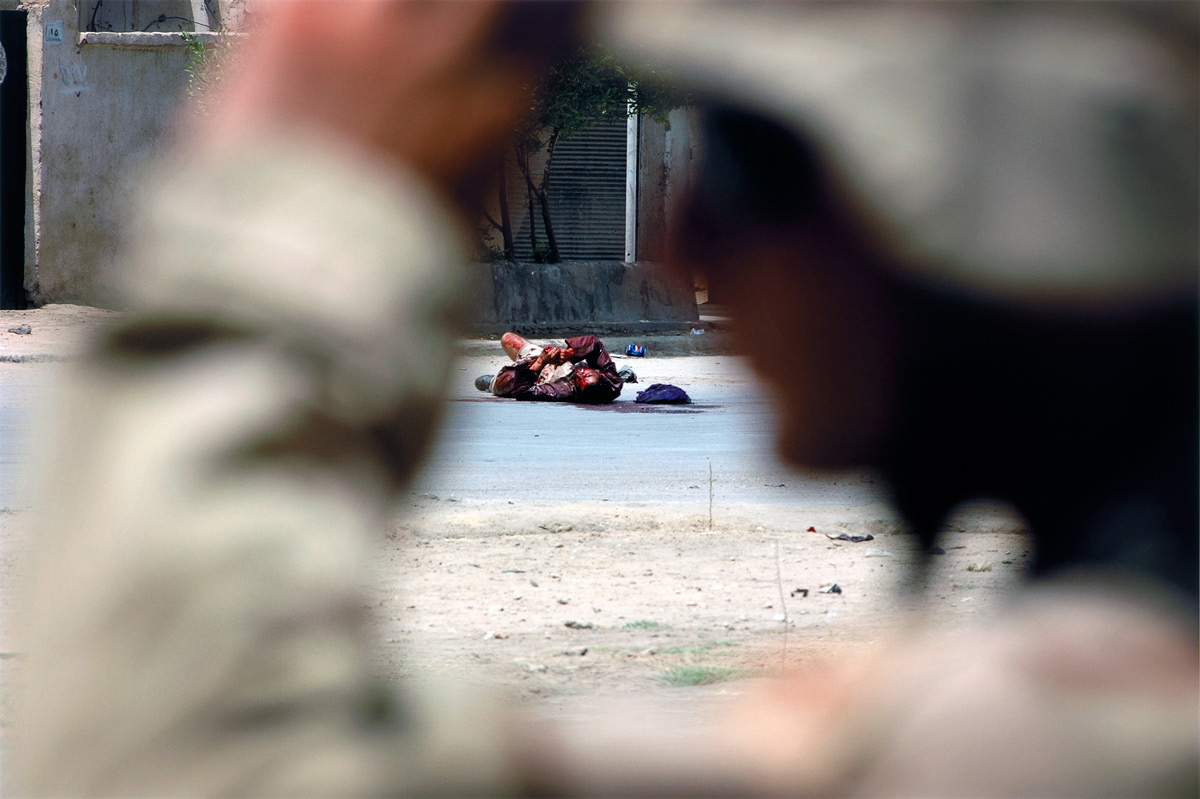
“Photographers Ashley Gilbertson and John Imming, and collaborative artists Lyndell Brown and Charles Green have all used cameras to document war, and their works off three distinct views.The common link appears to be an engagement with ideas of the observer and the observed and questioning who is looking at whom, and why?”2 Attempting an apolitical view of the war in Iraq, Gilbertson was embedded with different US military outfits on numerous visits to the country between 2002-2008, reliant on them for his safety. Many of his “objective” photographs deal with representations of surveillance and covert looking from ‘within the ranks’. But not from within enemy ranks. The very fact of his embedding, his lying down within a disciplinary system of control and power, to shoot from one point of view, politicises his gaze.

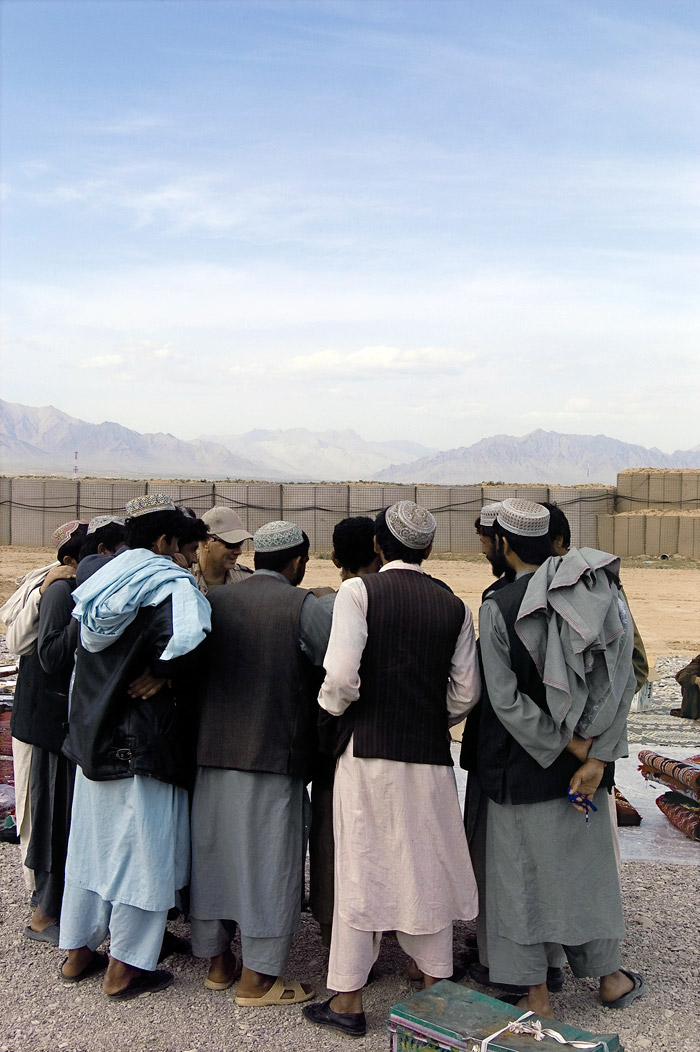
Brown and Green’s painterly photograph features a tightly choreographed scene, “a market within a military camp in which traders were invited to sell their wares. The scene is indicative, however, of the ‘strained atmosphere’ prevalent when different cultures interact in military situations – seemingly harmonious but concealing the ‘control that was exerted in the selection of traders’.”3 This traditional tableau vivant sees the traders become actors on a stage, their gaze directed towards the female officer at the centre of the group holding a piece of clothing which is blocked from our view. We the viewer are excluded from the circle of gazes; we become other, looking at the looking of the traders. Their gaze and our gaze are at cross-purpose; we wish to become a player on the stage but are denied access and can only observe the spectacle from a distance. Excluded, the viewer feels disempowered, the photographic mise en scène leaving me unmoved.

John Imming’s photographs use found images from the Vietnam war, the first war in which photographers had unrestricted access and were given absolute freedom to record what they saw. Vietnam was a stage for intense exploration, photographers bombarding the public with images of extreme violence. Imming rephotographs images from the television screen using a Leica camera, abstracting them into darkly hued creatures, the borders miming the shape of early television screens. “The images become abstracted and our gaze is ‘reduced’ into blurred shapes of contrasting tones … His photographs force us to slow down the memories of the somewhat ephemeral television imagery and look deeply at what is being portrayed, and how.”4 These photographs fail in that task for they are very surface photographs. The photographs do not have the structure to support such a vision nor the support of beauty to prick the consciousness of the gaze. They are ugly images because war is ugly and abstracting them in order to ask the viewer to look deeply and have an incredible insight into the condition ‘war’ and how it is portrayed simply did not work for me.


The two standout works in the exhibition are Thomas Struth’s luminous photograph Pergamon Museum IV, Berlin (2001, below) and Bill Henson’s seminal (perhaps even ubiquitous) series Untitled 1980/82 (1980-1982, see above) – these photographs seem to be everywhere at the moment, perhaps a change is as good as a rest!

Struth’s magnificent large colour photograph is an investigation into the theatre of seeing. In the photograph Struth directs his cast and choreographs the visitors, the arrangement of the spectators re-assembling the open-ended narrative of the 2nd century Telephos frieze behind. “Similarities between the poses of the audience members and the poses of the carve relief figures gradually emerge, suggesting an unconscious dialogue between the viewers and the objects they regard. The result of Struth’s directorial mode of working is the creation of a type of theatre based on intersecting viewpoints, raising questions about the gaze of the spectator and the process of looking at works of art and each other.”5

Beholders observe beholders and the subjects of vision become historical, according to art historian Wold-Dieter Heilmeyer. Here I observe that:

~ The suffused light that falls from the skylight leaves no shadow.

~ A man who casts no shadow has no soul.

~ The shadow according to Jung is the seat of creativity. In this photograph there is no depth of field, the sculptures and the figures feel like they are almost on one plane.

~ None of the viewers looks at the camera, they avoid its probing gaze, passively becoming the feminine aspect – like the central raised figure, robbed of head and arms, being gazed upon from all sides. We, the viewer, are looking at the spectacle of the viewers looking at the frieze. Looking at looking the observer becomes the observed (surveillance camera where are you?)

~ Consider the freeze frame of the models as they posed for the sculptor all those years ago; the freeze frame of the sculptures themselves; the freeze frame of the spectators posing for the camera; the freeze frame of the photograph itself; and then consider the freeze frame of time and space as we stand before the photograph looking at it. Then notice the women in the photograph videotaping the scene, another excoriating layer that tears at the fabric of time and looking, that causes lacrimation for our absent soul. What a photograph!


The Henson photographs are presented in a wonderfully musical installation, mimicking the movement of the crowds portrayed. I republish below my comments on this series from the review of the In camera and in public exhibition.

“A selection of photographs from the Crowd Series (1980-1982) by Bill Henson. Snapped in secret these black and white journalistic surveillance photographs (‘taken’ in an around Flinders Street railway station in Melbourne) have a brooding intensity and melancholic beauty. Henson uses a flattened perspective that is opposed to the principles of linear perspective in these photographs. Known as The Art of Describing6 and much used in Dutch still life painting of the 17th century to give equal weight to objects within the image plane, here Henson uses the technique to emphasise the mass and jostle of the crowd with their “waiting, solemn and compliant” people.

“When exhibiting the full series, Henson arranges the works into small groupings that create an overall effect of aberrant movement and fragmentation. From within these bustling clusters of images, individual faces emerge like spectres of humanity that will once again dissolve into the crowd … all apparently adrift in the flow of urban life. The people in these images have an anonymity that allows them to represent universal human experiences of alienation, mortality and fatigue.”7

Henson states, “The great beauty in the subject comes, for me, from the haunted space, that unbridgeable gap – which separates the profound intimacy and solitude of our interior world from the ‘other’… The business of how a child’s small hand appearing between two adults at a street crossing can suggest both a vulnerability, great tenderness, and yet also contain within it all of the power that beauty commands, is endlessly fascinating to me.”8 His observation is astute but for me it is the un/awareness of the people in these photographs that are their beauty, their insertion into the crowd but their isolation from the crowd and from themselves. As Maggie Finch observes, it is “that feeling of being both alone and private in a crowd, thus free but also exposed.”9

In the sociologist Erving Goffman’s terms the photographs can be seen as examples of what he calls “civil inattention”10 which is a carefully monitored demonstration of what might be called polite estrangement, the “facework” as we glance at people in the crowd, holding the gaze of the other only briefly, then looking ahead as each passes the other.

“Civil inattention is the most basic type of facework commitment involved in encounters with strangers in circumstances of modernity. It involves not just the use of the face itself, but the subtle employment of bodily posture and positioning which gives off the message “you may trust me to be without hostile intent” – in the street, public buildings, trains or buses, or at ceremonial gatherings, parties, or other assemblies. Civil inattention is TRUST as ‘background noise’ – not as a random collection of sounds, but as carefully restrained and controlled social rhythms. It is characteristic of what Goffman calls “unfocused interaction.””11

This is what I believe Henson’s photographs are about. Not so much the tenderness of the child’s hand but a fear of engagement with the ‘other’. As such they can be seen as image precursors to the absence/presence of contemporary communication and music technologies. How many times do people talk on their mobile phone or listen to iPods in crowds, on trams and trains, physically present but absenting themselves from interaction with other people. Here but not here; here and there. The body is immersed in absent presence, present and not present, conscious and not conscious, aware and yet not aware of the narratives of a ‘recipro/city failure’. A failure to engage with the light of place, the time of exposure and an attentiveness to the city.

As Susan Stewart insightfully observes,

“To walk in the city is to experience the disjuncture of partial vision/partial consciousness … The walkers of the city travel at different speeds, their steps like handwriting of a personal mobility. In the milling of the crowd is the choking of class relations, the interruption of speed, and the machine.”12

Dr Marcus Bunyan


Footnotes

1/ Finch, Maggie. Looking at Looking: The Photographic Gaze. Catalogue. Melbourne: National Gallery of Victoria, 2011, p. 10

2/ Ibid., p. 16

3/ Ibid., p. 21

4/ Ibid., p. 24

5/ Ibid., p. 7

6/ See Alpers, Svetlana. The Art of Describing: Dutch Art in the Seventeenth Century. University Of Chicago Press, 1984

7/ AnonBILL HENSON: early work from the MGA collection. Education Resource. A Monash Gallery of Art Travelling Exhibition [Online] Cited 14/10/2011. No longer available online

8/ Henson, Bill quoted in the exhibition catalogue. First published as a pdf for the exhibition In camera and in public Curated by Naomi Cass. Centre for Contemporary Photography, 16 September – 23 October 2011

9/ Stephens, Andrew. “Who’s watching you?” in The Saturday Age. 23rd September 2011 [Online] Cited 14/10/2011

10/ See  Goffman, E. Behaviour in Public Places. New York: Free Press, 1963

11/ Giddens, Anthony. The Consequences of Modernity. Cambridge: Polity Press, 1991, pp. 82-83

12/ Stewart, Susan. On Longing: Narratives of the Miniature, the Gigantic, the Souvenir, the Collection. Durham: Duke University Press, 1993, p. 2. Prologue


Many thankx to the National Gallery of Victoria for allowing me to publish the photographs in the posting. Please click on the photographs for a larger version of the image.


Bill Henson (Australian, b. 1955) 'Untitled 1980/82' 1980-1982


Bill Henson (Australian, b. 1955)
Untitled 1980/82
1980-1982
From the Untitled 1980/82 series 1980-1982
Gelatin silver photograph
43.0 x 38.8cm
National Gallery of Victoria, Melbourne
Anonymous gift, 1993
© Courtesy of the artist and Roslyn Oxley9 Gallery, Sydney


Bill Henson (Australian, b. 1955) 'Untitled 1980/82' 1980-1982


Bill Henson (Australian, b. 1955)
Untitled 1980/82
1980-1982
From the Untitled 1980/82 series 1980-1982
Gelatin silver photograph
29.2 x 47cm
National Gallery of Victoria, Melbourne
Anonymous gift, 1993
© Courtesy of the artist and Roslyn Oxley9 Gallery, Sydney


On 30 September the National Gallery of Victoria will present Looking at Looking: The Photographic Gaze, a unique exhibition exploring how photography can construct particular ways of looking. Looking at Looking will feature works by 10 Australian and international photographers including 20 photographs from Bill Henson’s Untitled 1980-82 series.

Drawn entirely from the NGV Collection, this exhibition will bring together a fascinating selection of photographs inviting the viewer to consider the diverse nature of the photographic gaze and explore the complex relationships between the subject, the photographer and the audience. The displayed photographs will include observations of people in crowds, surveillance images from war zones and photographs that explore different ways of looking at gender, race and identity.

Maggie Finch, Assistant Curator, Photography, NGV said: “The act of photographing people involves a process of observation and scrutiny. At times, photographers remain detached and anonymous while at other times they are complicit, directing their subjects and encouraging specific actions.”

Frances Lindsay, Deputy Director, NGV, said: “In the NGV’s 150th year this exhibition allows visitors to explore the dynamic relationship between the observer and the observed. This is a rare opportunity to view these photographs in a truly unique context.”

Looking at Looking will consider the anonymous photographer, one who is able to look without being looked at in return and consequently see more than otherwise possible. This idea is explored in Bill Henson’s series Untitled 1980-82, where the artist photographed people on city streets. Hung in a dense display, these photographs provide a psychological study of the nature of people when in a crowd.

Looking at Looking will feature works by Brook Andrew, Chi Peng, Anne Ferran, Ashley Gilbertson, Charles Green and Lyndell Brown, Bill Henson, John Immig, Thomas Struth and David Thomas.

Press release from the National Gallery of Victoria


Thomas Struth (German, b. 1954) 'Pergamon Museum IV, Berlin' 2001


Thomas Struth (German, b. 1954)
Pergamon Museum IV, Berlin
2001
Type C photograph
144.1 x 219.9cm
National Gallery of Victoria, Melbourne
Purchased with the assistance of The Bowness Family Fund for Contemporary Photography, 2008
© 2011 Thomas Struth


David Thomas (born Northern Ireland 1951, arrived Australia 1958) 'Amid history 2 (Large version)' 2006


David Thomas (born Northern Ireland 1951, arrived Australia 1958)
Amid history 2 (Large version)
2006
Enamel paint on type C photograph on aluminium and plastic
100 x 145cm
National Gallery of Victoria, Melbourne
Purchased, Victorian Foundation for Living Australian Artists, 2007 © the artist


Ashley Gilbertson (Australian, b. 1978) 'A member of the Mahdi Army RPG team' 2004 from the 'Whiskey Tango Foxtrot' series 2004


Ashley Gilbertson (Australian, b. 1978)
A member of the Mahdi Army RPG team
2004
From the Whiskey Tango Foxtrot series 2004
Digital type C print
66.5 x 99.8cm
National Gallery of Victoria, Melbourne
Purchased, Victorian Foundation for Living Australian Artists, 2009
© Ashley Gilbertson / VII Network


John Immig (Dutch/Australian, 1935-2018) 'No title (T.V. images)' 1975-1976


John Immig (Dutch/Australian, 1935-2018)
No title (T.V. images)
1975-1976
From the Vietnam series 1975-1976
Gelatin silver photograph
20.2 x 25.3cm
National Gallery of Victoria, Melbourne
Purchased with the assistance of the Visual Arts Board, 1977
© John Immig


Chi Peng (Chinese, b. 1981) 'Consubstantiality' 2004


Chi Peng (Chinese, b. 1981)
Consubstantiality
2004
Type C photograph
87.5 x 116.7cm
National Gallery of Victoria, Melbourne
Purchased with the assistance of the NGV Foundation, 2004
© Chi Peng, courtesy of Red Gate Gallery, Beijing


Brook Andrew (Australian, b. 1970) 'I Split Your Gaze' 1997


Brook Andrew (Australian, b. 1970)
I Split Your Gaze
1997
Gelatin silver print
122.6 × 114cm (image and sheet)
National Gallery of Victoria, Melbourne
Purchased with funds from the Victorian Foundation for Living Australian Artists, 2005
© Brook Andrew/Copyright Agency, 2023


Charles Green (Australian, b. 1953) and Lyndell Brown (Australian, b. 1961) 'Afghan traders with soldiers, market, Taran Kowt Base Uruzgan Province, Afghanistan' 2007 printed 2009


Charles Green (Australian, b. 1953)
Lyndell Brown (Australian, b. 1961)
Afghan traders with soldiers, market, Taran Kowt Base Uruzgan Province, Afghanistan
2007 printed 2009
From The approaching storm series 2009
Inkjet print
155.0 x 107.5cm
National Gallery of Victoria, Melbourne
Purchased, Victorian Foundation for Living Australian Artists, 2009
© Courtesy of the Artists and Arc One Gallery, Melbourne


NGV International
180 St Kilda Road

Opening hours
Daily 10am – 5pm

National Gallery of Victoria website

LIKE ART BLART ON FACEBOOK

Back to top

Exhibition: ‘What’s in a face? aspects of portrait photography’ at the Art Gallery of New South Wales, Sydney

Exhibition dates: 24th September 2011 – 5th February 2012


Many thankx to the Art Gallery of New South Wales for allowing me to publish the photographs in the posting. Please click on the photographs for a larger version of the image.


Glaister studio (Australia 1855-1870) 'Untitled (portrait of a man and three girls)' 1855-1870


Glaister studio (Australian, 1855-1870)
Untitled (portrait of a man and three girls)
1855-1870
Ambrotype, colour dyes
6.5 x 9cm sight; 9.3 x 11.9cm case
Purchased 1989


This charming ambrotype was thought to have been produced by one of Australia’s most important early photographers, Thomas Glaister, owning to the presence of the Glaister stamp on the case. However, superb varnish was one of Glaister’s hallmarks and this ambrotype is not varnished. In addition, the hand-colouring is not considered to be to Glaister’s standard. As such, it is possible that the ambrotype was inserted into this case at a later date, not least because there is no form of blackening behind the image. This was standard practice to prevent the viewer seeing through to the inside of the case. The Eichmeyer ‘book’ case, patented in 1855 by Henry A Eichmeyer of Philadelphia, were made of fine leather and beautifully put together. Glaister certainly used these but the ambrotype is probably not his specifically and could have been made by one of his sons in the 1860s when they worked as travelling photographers. Regardless of who took the image, it is a charming colonial portrait which in size is typical of the period – it can easily be held in the hand.

Ambrotypes were developed in the 1850s. They were faster and cheaper to make than daguerreotypes, yet were still unique objects.

1. 1989, ‘Masterpieces of Australian photography’, Josef Lebovic Gallery, Sydney p. 25

© Art Gallery of New South Wales Photography Collection Handbook, 2007
 

Olive Cotton (Australian, 1911-2003) 'Only to taste the warmth, the light, the wind' c. 1939


Olive Cotton (Australian, 1911-2003)
Only to taste the warmth, the light, the wind
c. 1939
Gelatin silver print
Image/sheet: 33.2 x 30.0cm
Purchased with funds provided by John Armati 2006
Art Gallery of NSW Collection


Only to taste the warmth, the light, the wind appears to have been the only print Cotton made of this image. It was found in the late 1990s and has been shown only once, in an exhibition at the AGNSW in 2000 where it was also used on the catalogue cover. It was unusual for Cotton to print so large, yet it is entirely fitting that this monumental head and shoulder shot of a beautiful young woman should be presented in this way. The subject was a model on a fashion shoot at which Cotton was probably assisting. Cotton often took her own photographs while on such shoots and used them for her private portfolio. The photograph transcends portraiture, fashion and time to become a remarkable image of harmony with the elements.

Cotton took the title for this photograph from an 1895 poem by English poet Laurence Binyon, ‘O summer sun’:

O summer sun, O moving trees!
O cheerful human noise, O busy glittering street!
What hour shall Fate in all the future find,
Or what delights, ever to equal these:
Only to taste the warmth, the light, the wind,
Only to be alive, and feel that life is sweet?1


A photographer whose work straddles pictorialism, modernism and documentary, Cotton maintained an independent vision throughout her working life, based on the close observation of nature. Her understanding of the medium of photography was not to do with capture, but rather ‘drawing with light’.

1/ 1915, ‘Poems of today’, English Association, London p. 96.

© Art Gallery of New South Wales Photography Collection Handbook, 2007


Destiny Deacon (Australian / Kuku/Erub, 1957-2024) 'Portrait: Janet Burchill & Jennifer McCamley, Artists' 1998


Destiny Deacon (Australian / Kuku/Erub, 1957-2024)
Portrait: Janet Burchill & Jennifer McCamley, Artists
1998
Colour bubble jet print from Polaroid photograph
57.9 x 71cm
Purchased 1998
© Destiny Deacon. Licensed by Viscopy, Sydney


Deacon is widely recognised for her staged photographs which employ various props, including souvenirs and kitsch, in satirical tableaus that critique notions of Aboriginality. Initially, in 1991, she employed dolls and since then they have become a signature motif. This use of non-living models informed her practice when she began to photograph people. As Deacon states, ‘I’ve never been one for “live action” shots… I’ve got to rule the roost. It’s no different dealing with inanimate objects or people, except with people I’m more terrified.’1

This method can be seen in Deacon’s Portrait: Janet Burchill & Jennifer McCamley, artists 1998. Burchill and McCamley, Melbourne and Mildura based collaborative artists, have been arranged in a re-enactment of Henri Matisse’s Conversation 1908-1912. The photograph echoes the deep blue background of the original painting. The two artists hold the stiff positions of Matisse and his seated wife gazing across at each other. This is one of a number of Deacon’s works that feature Australian writers, artists and other notable figures re-enacting iconic paintings. Other examples include artist Fiona Hall in a 2004 retake of Grace Cossington-Smith’s The sock knitter 1915 and a portrait of Gary Foley inspired by William Dobell’s The boy at the basin 1932.

1/ Destiny Deacon, ‘Interview with Virginia Fraser’ in Destiny Deacon: walk & don’t look blak, Museum of Contemporary Art, Sydney, 2004, p. 109.
 

Ilse Bing (United States of America, Germany 1899-1998) 'Self portrait with Leica' 1931 printed 1941


Ilse Bing (United States of America/Germany, 1899-1998)
Self portrait with Leica
1931 printed 1941
Gelatin silver photograph
26.7 x 31.2cm
Alistair McAlpine Photography Fund 2005
© Ilse Bing Estate. Courtesy Edwynn Houk Gallery, New York


Self portrait with Leica is a complex image in which the artist has photographed herself and her trademark Leica in one mirror, while the profile of both is reflected in another. The large button on her cuff disturbs the play between full face and profile, while the objects at the bottom of the frame lend a certain informality to an otherwise highly contrived set-up. The soft velvety curtain behind introduces a further element of rich tactility. The play between black, white and shades of grey softens and enriches the overall image.

Although Bing avoided becoming part of any specific movement of the 1920s or 1930s – for example, constructivism, the Bauhaus or surrealism, describing herself as being ‘on the edge of the periphery of the Bauhaus’ only – she was fully cognisant of the range of experimentation which was taking place across Europe. She forged her own path, combining an abiding belief in the importance of intuition and poetry with rigorous composition and superb technical skills.

Inspired by the work of Florence Henri, and with increasing confidence in her ability to marry naturalism with geometric formalism, Bing worked extensively as a press, fashion, portrait and documentary photographer in Paris until she was interned as an enemy alien in 1940. Late in her life Bing wrote:

‘I didn’t choose photography; it chose me. I didn’t know it at the time. An artist doesn’t think first and then do it, he [sic] is driven. Now over fifty years later, I can look back and explain it. In a way, it was the trend of the time; it was the time when you started to see differently … And the camera, that was, in a way, the beginning of the mechanical device penetrating into the field of art.’1

1/ Barrett N C 1985, Ilse Bing: three decades of photography, New Orleans Museum of Art, New Orleans pp. 13-14.

© Art Gallery of New South Wales Photography Collection Handbook, 2007


Robert Rooney (Australian, 1937-2017) 'Portrait of Maria Kozic and Philip Brophy II' 1981


Robert Rooney (Australian, 1937-2017)
Portrait of Maria Kozic and Philip Brophy II
1981
Cibachrome photograph
Image/sheet: 20.1 x 30cm
Purchased 1996
© Robert Rooney


The four portraits in the Art Gallery of New South Wales collection reflect a particular period in Australian art, when the now established artists were beginning their careers. They depict members of the contemporary art scene of the late 1970s to mid 1980s associated with Art + Text, an Australian art magazine published from 1981-2000.

Philip Brophy formed the experimental group Tsk Tsk Tsk in 1977. The group produced experimental music, films, videos, and live theatrical performances. Brophy involved his friends in the group, including partner Maria Kozic on synthesiser. Kozic was also producing her own multimedia work. In this photograph, Kozic and Brophy are standing in a suburban backyard complete with Hills Hoist. This is reflective of Tsk Tsk Tsk’s suburban beginnings, based as it was at Clifton Hill’s Community Music Centre. After the group’s dissolution in the early 1980s, Brophy made several experimental films and curated numerous programs for the Melbourne international film festival as well as exhibitions such as Tezuka: the marvel of manga for the National Gallery of Victoria. Kozic moved to New York where she continued her artistic career. Her work has been exhibited widely throughout Australia and overseas and been collected by many museums including the Art Gallery of New South Wales.
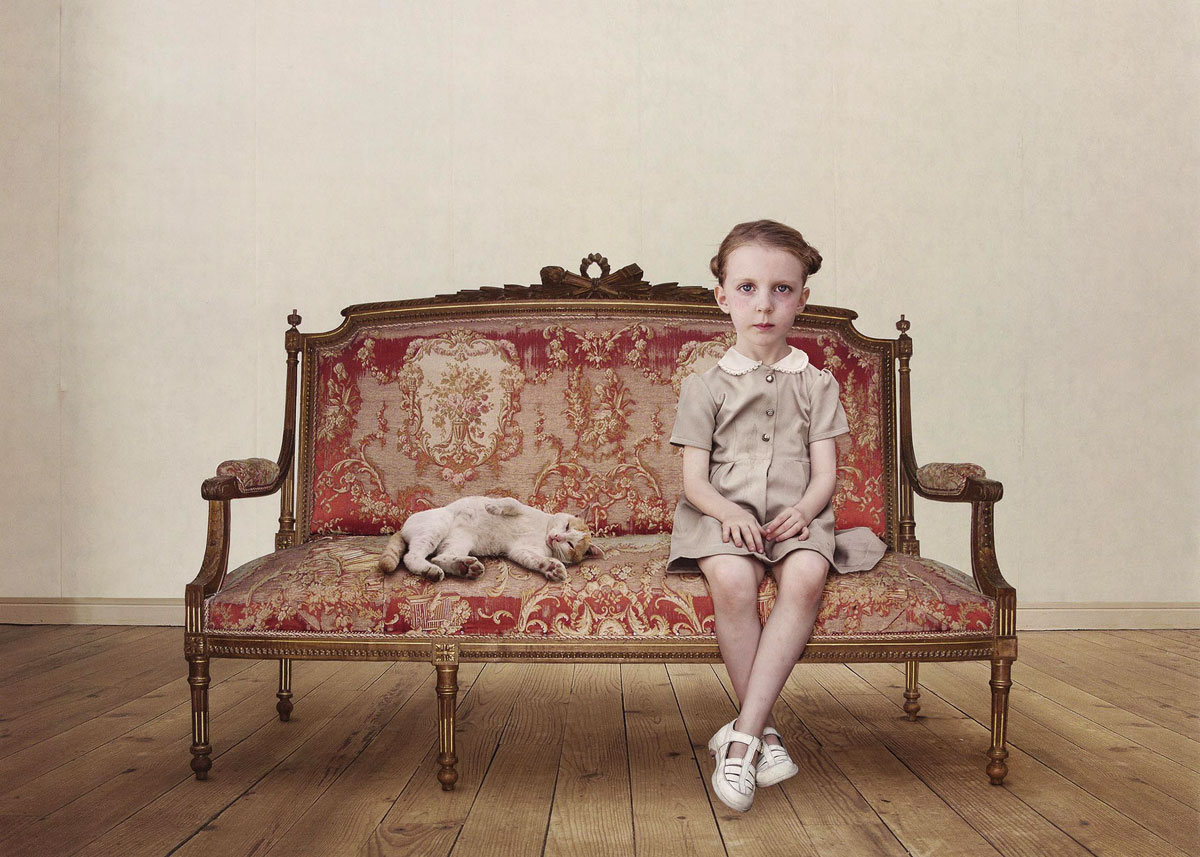
 

Loretta Lux (Germany b. 1969) 'The waiting girl' 2006


Loretta Lux (Germany, b. 1969)
The waiting girl
2006
Ilfochrome photograph
38 × 53cm
Purchased with funds provided by the Photography Collection Benefactors’ Program 2007
© Loretta Lux/Bild-Kunst. Licensed by Viscopy, Sydney


Lux’s portraits are by no means traditional, ‘I call them imaginary portraits. They are not really about the children that I photographed’, commented the artist in interview with Wim van Sinderen (Loretta Lux: new work 2004). In relation to The waiting girl, Lux has said: ‘It’s a picture about time, and timelessness. For me they are sitting on the sofa as if they are waiting for eternity.’ (The Guardian 23 November 06)

Through subtle digital manipulation of the body and facial features of her subjects, Lux creates eerie doll-like creatures with glazed eyes, porcelain smooth skin and subtly ill-proportioned forms. The resulting portraits contain an uncanny blend of mute childish innocence and the self-contained stoicism of adulthood.

Lux’s images of children recall those of the old masters, such as Veláquez, Runge and Bronzino whom she cites as main inspirations alongside German photographer August Sander. Lux has stated in an interview with Louise Baring for the Telegraph (UK) that she uses children ‘as a metaphor for a lost paradise’. Dressing her young models in past fashions (often of the era of her own childhood) suggests the child’s game of ‘dress ups’ in order to be an adult yet somehow played out in reverse. That is, Lux’s children do not seem like children at all, but rather like serious world-weary adults manifested in childish forms.


Spanning over a century, What’s in a face? aspects of portrait photography is an exhibition of 45 photographs from the Art Gallery of NSW collection. The exhibition focuses on crucial points in the history of photographic depictions of the human face ranging from studio portraiture in the late 19th century to contemporary practices today.

Works by Australian photographers, such as Paul Foelsche, Olive Cotton, Max Dupain, Carol Jerrems, Destiny Deacon, Patrina Hicks, Darren Sylvester and others, are placed in an international context, represented by Man Ray, Edward Weston, Iwao Yamawaki, Nan Goldin, Ben Cauchi and Loretta Lux, amongst others.

All portraits reveal something of the sitter, the photographer and also of us as viewers, but none reveal a whole and complete being. This is part of the enduring fascination with the photographic portrait which purports to be an exact likeness but operates more accurately as a metaphor for the self and how that self might exist in the world at a particular point in time.

Judy Annear, senior curator photographs, Art Gallery of NSW


Using photography to depict the face and figure was initially a time-consuming and expensive business. However, the drive to document all things in the world, and rapid technological advances, meant that by the 1880s most people, willing or not and regardless of the photographer’s or their own desires, were documented in some way.

Spurious 19th century ideas to do with what a face could represent exploded in the early 20th century when identity came to be seen as a psychological rather than social phenomenon. Theatricality and performing for the camera, which had existed in photography since its inception, also became much more evident in this period.

In the post-WWII era representations of the face and the body quickly acquired a political and socially aware edge. More recently the face has tended to stand less as an expression of personal experience and more a statement that may signify a set of ideas, whether about the individual, the group or the society at large. Many of these highly constructed images acknowledge and play upon the problematics of the photographic portrait.”

Text from the AGNSW website


Petrina Hicks (Australian, b. 1972) 'Shenae and Jade' 2005


Petrina Hicks (Australian, b. 1972)
Shenae and Jade
2005
From the series Untitled 2005
Lightjet print
85.5 x 80cm
Courtesy the artist and Michael Reid Gallery


Shenae and Jade is typical of Hicks’ unconventional portraits. The young model holds the budgie’s head in her mouth. It’s the kind of slightly dangerous behaviour which can be unnerving to observe. The freckled nose of the model is in tension with her smooth pale temples, heavily lashed closed eyes and soft white top. The luminescent background and generally pale colouration throw the headless body of the brightly coloured budgie into high relief.


Darren Sylvester (Australia, b. 1974) 'They return to you in song' 2001


Darren Sylvester (Australian, b. 1974)
They return to you in song
2001
Lambda print
Image/sheet: 100 x 100cm
Purchased with funds provided by the Photography Collection Benefactors’ Program 2002
© Darren Sylvester


Informed by the slick stylistic conventions of high-end consumer images, Darren Sylvester’s body of work suggests the existential dilemma of living in an overtly consumerist society – one that promises fulfilment but fails to truly satisfy even the most ardent consumer. Perpetually tantalised with glossy images of affluence, ‘must-have’ products and brochure living, our ‘real’ lives can at times seem unfulfilling by comparison, sometimes painful and often a little pathetic. Sylvester’s work seems to suggest that even in our most personal heartfelt moments, our lives are just like everybody else’s, not so special or unique. Our lives could equally be a series of advertising moments.

Yet the nature of this work is resolutely ambiguous, alternately offering intimacy and emotion with cool detachment. Photo-shopped clean of incidental detail and anomaly, and featuring youthful agency models, Sylvester’s evenly lit, tightly focused images still tap a nerve despite their polished finish. Perhaps this is because they are precisely ‘generic’ (and emotive) experiences to which we can all relate. The same principles underpin a good pop song and in Sylvester’s work this is no coincidence – he strives to produce images that carry the same directness and lasting impact. Commenting on the music of the Carpenters, ‘their lyrics were always sad and about emotional relationships but sealed beneath glossy west coast melodies’, Sylvester reveals the pop-music strategies he employs in his work.1

Based on short stories written by the artist prior to composing the scene, his images carry their own inherent narrative. Yet we don’t need to read Sylvester’s story to understand the drama, nor do we need to hear the tune to recognise the song – it’s an old one, and a shared one, that each of us remembers well.

1/ Colless E 2006, ‘Darren Sylvester: the right stuff’, Australian Art Collector, no 36, Apr-Jun p. 102.

© Art Gallery of New South Wales Photography Collection Handbook, 2007


Hans Hasenpflug (Australia, Germany 1907-1977) 'Untitled (head of a woman)' 1940-1941


Hans Hasenpflug (Australia/Germany 1907-1977)
Untitled (head of a woman)
1940-1941
Gelatin silver photograph
Image: 28.8 x 24.3cm
Gift of Mr Christopher Hamilton, the artist’s son 1984


Hans Hasenpflug arrived in Australia in 1927 aged 20. He had been born into an educated Stuttgart family but it does not appear that he became involved in photography until 1932 when he was employed by Leica Photo Service, Sydney. Hasenpflug went on to work for prominent photographer Russell Roberts from 1935 to 1937 before moving to Melbourne and working with Athol Shmith and other Melbourne studios from 1937 to 1942. As an enemy alien Hasenpflug was not allowed to work on industrial assignments during World War Two but he was not interned and was naturalised in 1945. Hasenpflug exhibited in photography salons in the 1930s and his work appeared in the Sydney Morning Herald, Australian Woman’s Weekly and the Sunday Telegraph.

Hasenpflug was a versatile advertising photographer. He specialised in fashion and product advertising and some portraiture. Despite his apparent lack of photographic training until the 1930s, he seems to be have been strongly influenced by the European avant-garde. Many of his photographs, regardless of genre or subject matter, depend on diagonals through the picture plane and on raking light.

This is true of Untitled. Strong light has created deep shadows across the subject, a closely cropped image of a woman’s face. This, combined with the oblique camera angle, creates a vivid and disconcerting image. The woman is staring directly into the camera, yet a band of strong shadow across the centre of the image creates a blank eyed effect. The pupil free eyes seem inhuman; mask-like or alien. This is in stark contrast to the woman’s open smile that dominates the bottom of the work. The strong, full light on this area highlights her lips, gums and teeth to an almost hyper real extent. These contradictions create an image that on the surface seems friendly and intimate, yet contains an undertone of threat. The inherent strangeness of the image makes it unlikely that this was a commissioned photograph, but rather the artist’s experiment with his medium, and indeed is probably a portrait of his fiancee, Elizabeth Hamilton Crouch.


Edward Weston (American, 1886-1956) 'Guadalupe de Rivera, Mexico' 1924


Edward Weston (American, 1886-1956)
Guadalupe de Rivera, Mexico
1924, printed later
Gelatin silver photograph
20.7 × 17.8cm
Gift of Patsy W. Asch 2000
© Centre for Creative Photography, Arizona Board of Regents


Edward Weston’s Mexican years were of great importance to him and allowed for the maturing of his vision in relation to photography. Accompanied by Tina Modotti, whose own work developed at this time, Weston experimented with pure form through monumental portraits (of which Guadalupe de Rivera, Mexico is a classic example), images of landscapes and buildings, still-lifes and nudes.

Weston’s portraits of those he encountered in Mexico are uniformly compelling. Often taken with a hand-held camera against a plain background and with strong lighting, these images emphasise individuality, modernity and dynamism.

Guadalupe de Rivera was Diego Rivera’s wife at the time and both were among the group of people Weston and Modotti associated with. Weston described Guadalupe in his ‘Daybooks’ as ‘tall, proud of bearing, almost haughty; her walk like a panther’s, her complexion almost green, with eyes to match’.1 As he worked on the portrait, Weston wrote: ‘I am finishing the portrait of Lupe. It is a heroic head, the best I have done in Mexico; with the Graflex, in direct sunlight I caught her, mouth open, talking, and what could be more characteristic of Lupe! Singing or talking I must always remember her’.2

This later print by Weston emphasises, through the dramatic effect of light and shade, the strong lines of the face. The shape of the open mouth is echoed by the shadowed eye above and the jawline below. The diagonal of jaw to ear which runs in parallel to the nose also adds to the dynamism of this image. Outdoors, with the sun shining on her hair, this is a portrait of a remarkable woman.

1/ Newhall N ed 1981, ‘The daybooks of Edward Weston 1 Mexico’, Aperture, New York p. 26.
2/ Ibid p. 42.

© Art Gallery of New South Wales Photography Collection Handbook, 2007
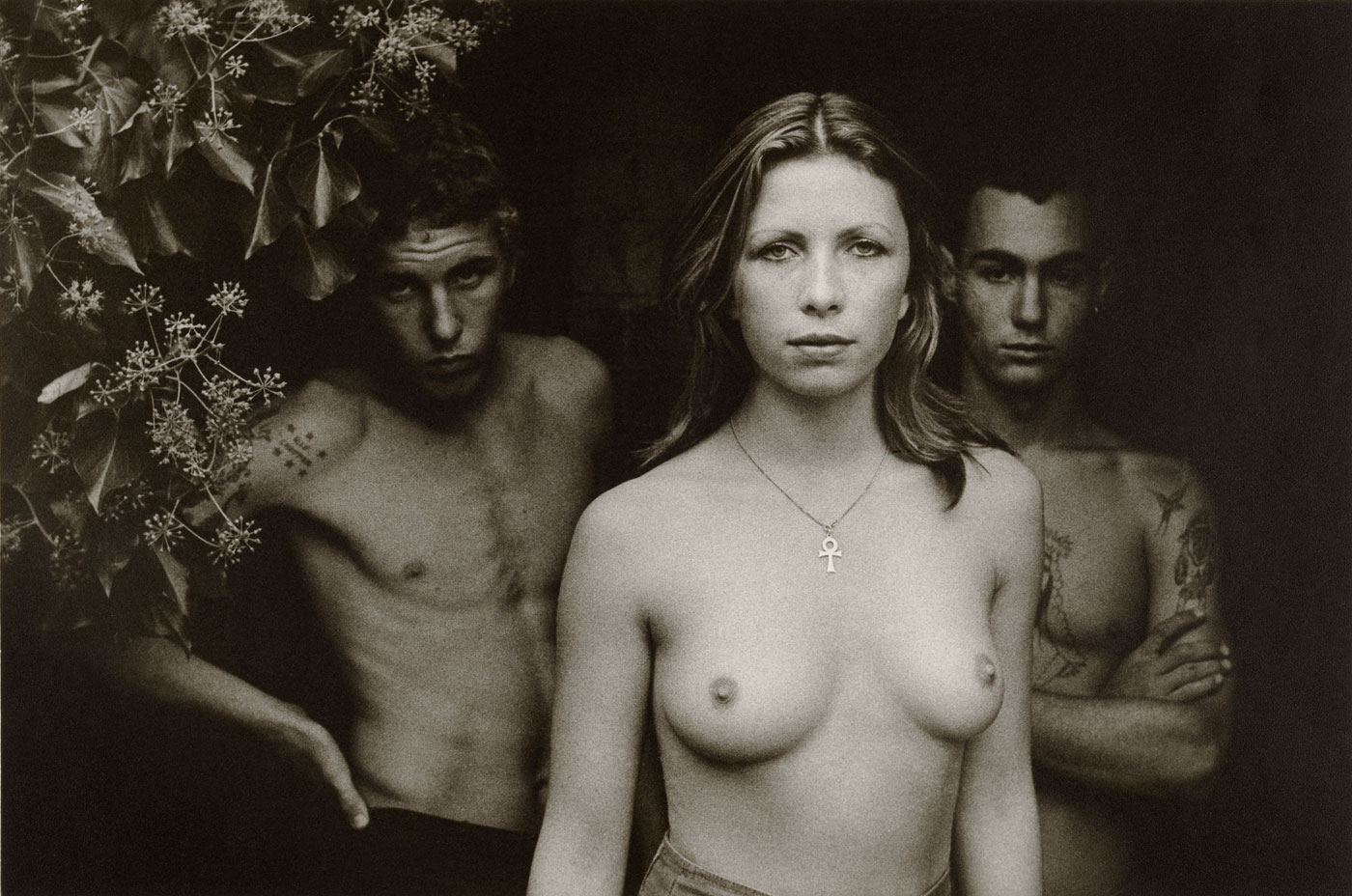
 

Carol Jerrems (Australian, 1949-1980) 'Vale Street' 1975


Carol Jerrems (Australian, 1949-1980)
Vale Street
1975
Gelatin silver print
20.1 x 30.4cm
Purchased 1979
© Ken and Lance Jerrems


A quintessential image of the 1970s, Vale Street has lost none of its capacity to enchant and disturb in the intervening years. In one sense it can be read as a sociological document; in another as a wholly subjective work of art. Like the mediumistic spirit-photographs of the nineteenth century, Jerrems’s photo seems to disclose the very souls of its subjects. As they respond, each in their individual fashion, to the regarding presence of the camera lens, the figures compose themselves, without theatrics, into telling attitudes. The prominence and bodily confidence of the open-faced young woman is set against the reticence of her boyish companions. As a portrait of relationships as well as individuals, Vale Street speaks of gender relations, adolescent sexuality, suburban mores and the photographer’s own subtly partisan demeanour in regard to these themes.

Art Gallery Handbook, 1999
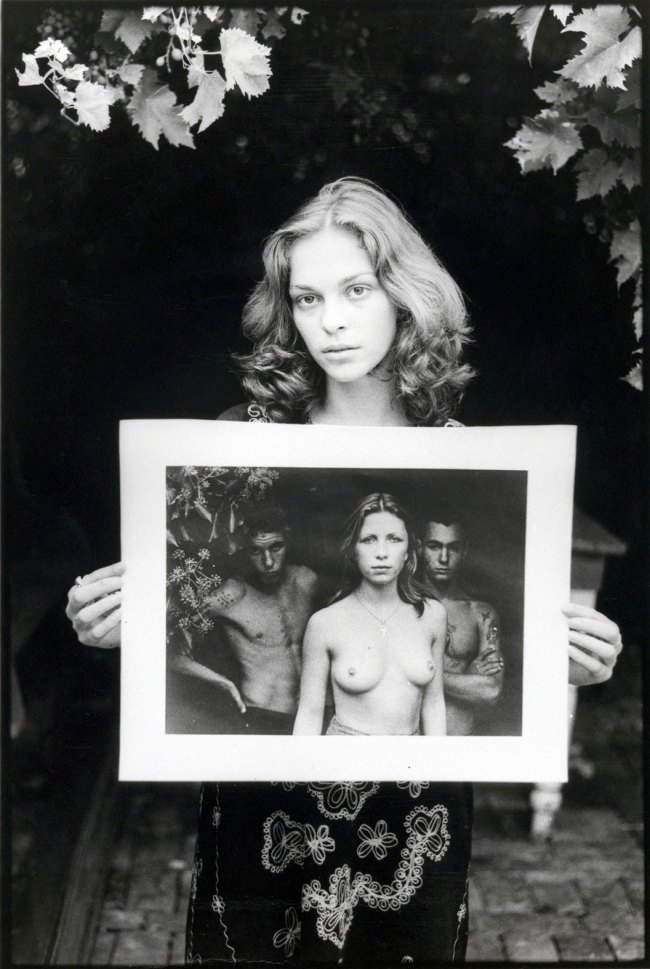
 

Carol Jerrems (Australian, 1949-1980) 'Juliet Holding Vale Street' 1976


Carol Jerrems (Australian, 1949-1980)
Juliet Holding Vale Street
1976
Gelatin silver print
30.4 x 20.1cm
Purchased 1979
© Ken and Lance Jerrems


Carol Jerrems (Australian, 1949-1980) 'Lynn Gailey' 1976


Carol Jerrems (Australian, 1949-1980)
Lynn Gailey
1976
Gelatin silver print
30.3 x 20.1cm
Purchased 1979
© Ken and Lance Jerrems
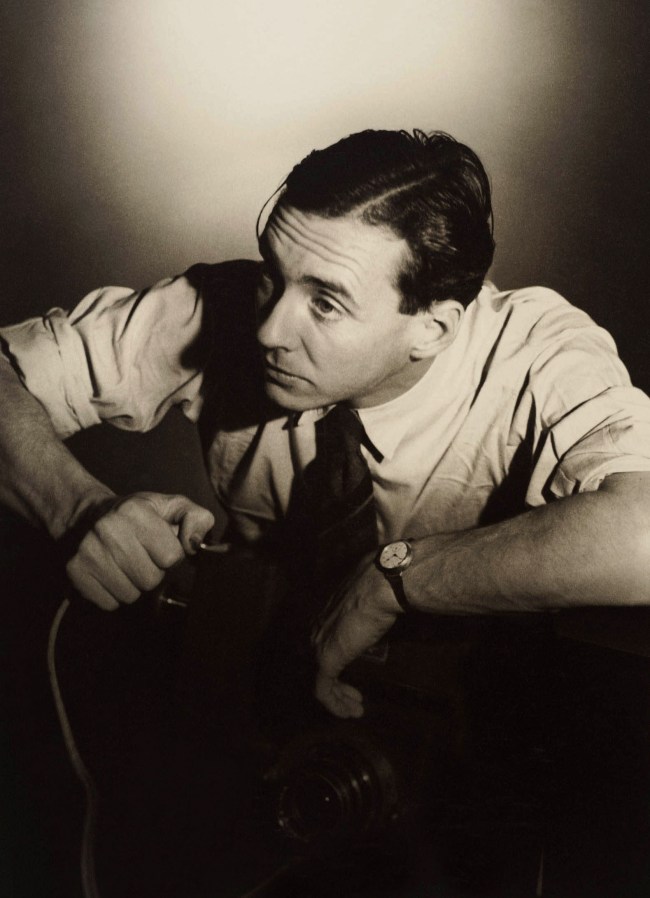
 

Max Dupain (Australia 1911-1992) 'Untitled (self portrait)' 1930s


Max Dupain (Australia, 1911-1992)
Untitled (self portrait)
1930s
Gelatin silver photograph
19.3 x 14cm
Art Gallery of NSW Collection


This engaging self-portrait by Max Dupain was kept by the artist in an album of photographs from the 1930s. The album was possibly a workbook which would enable Dupain and his clients to review his career as a young modernist photographer. Dupain had opened his own studio in 1934 at the age of 23 having previously been apprenticed to Cecil Bostock and studying painting and drawing at the Julian Ashton Art School in Sydney. In his teens, through the Photographic Society of New South Wales, Dupain had also had contact with Harold Cazneaux whom he later described as ‘the father of modern Australian photography’.1 Both Cazneaux and Bostock provided Dupain with a solid technical and aesthetic base from which to work.

The young working photographer has chosen to depict himself in Untitled (self portrait) with rolled-up sleeves and a furrowed brow. The image is bisected into light in the upper half and dark below with the photographer’s right hand pressing the cable release. Looking away, in three-quarter profile, Dupain is engaged with something out of the frame. The dynamism of the image is further enhanced by the bent arms and the strong shadow of Dupain’s profile.

The 1930s was a period of intense experimentation for Dupain as he applied the lessons learned from Bostock and Cazneaux and absorbed the material in international publications. He mastered solarisation, montage, portraiture, interiors and advertising photography. His interest in form and composition matured. His dedication to his work is manifested in this image.

1/ Dupain M 1978, Cazneaux: photographs by Harold Cazneaux 1878-1953, National Library of Australia, Canberra p. xi.

© Art Gallery of New South Wales Photography Collection Handbook, 2007


Art Gallery of New South Wales
Art Gallery Road, The Domain
Sydney NSW 2000, Australia

Opening hours:
Open every day 10am – 5pm
except Christmas Day and Good Friday

Art Gallery of New South Wales website

LIKE ART BLART ON FACEBOOK

Back to top

melbourne’s magnificent nine 2011

December 2011


Here’s my pick of the nine best exhibitions in Melbourne (with excursions to Bendigo and Hobart thrown in) that appeared on the Art Blart art and cultural archive in 2011. Enjoy!

Dr Marcus Bunyan


1/ Sidney Nolan: Drought Photographs at Australian Galleries, Melbourne, March 2011

Sidney Nolan (Australian, 1917-1992) 'Untitled (calf carcass in tree)' 1952


Sidney Nolan (Australian, 1917-1992)
Untitled (calf carcass in tree)
1952
archival inkjet print
23.0 cm x 23.0cm


This was a superb exhibition of 61 black and white photographs by Sidney Nolan. The photographs were shot using a medium format camera and are printed in square format from the original 1952 negatives.

The work itself was a joy to behold. The photographs hung together like a symphony, rising and falling, with shape emphasising aspects of form. The images flowed from one to another. The formal composition of the mummified carcasses was exemplary, the resurrected animals (a horse, for example, propped up on a fifth leg) and emaciated corpses like contemporary sculpture. The handling of the tenuous aspects of human existence in this uniquely Australian landscape was also a joy to behold. Through an intimate understanding of how to tension the space between objects within the frame Nolan’s seemingly simple but complex photographs of the landscape are previsualised by the artist in the mind’s eye before he even puts the camera to his face.
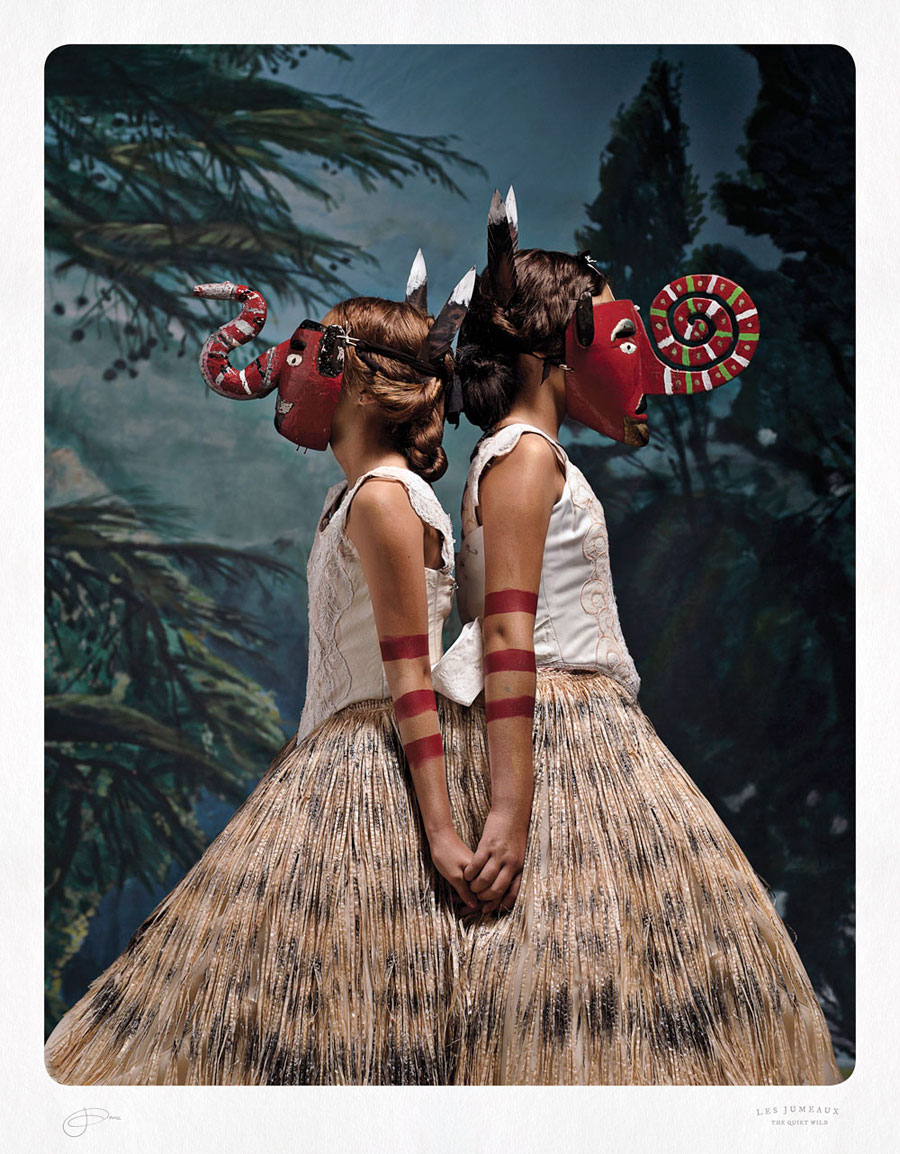
 

2/ Bill Henson at Tolarno Galleries, Melbourne, March – April 2011

This was an exquisite exhibition by one of Australia’s preeminent artists. Like Glenn Gould playing a Bach fugue, Bill Henson is grand master in the performance of narrative, structure, composition, light and atmosphere. The exhibition featured thirteen large colour photographs printed on lustre paper (twelve horizontal and one vertical) – nine figurative of adolescent females, two of crowd scenes in front of Rembrandt paintings in The Hermitage, St. Petersburg (including the stunning photograph that features The return of the prodigal son c. 1662 in the background, see below) and two landscapes taken off the coast of Italy. What a journey this exhibition took you on!

Henson’s photographs have been said by many to be haunting but his images are more haunted than haunting. There is an indescribable element to them (be it the pain of personal suffering, the longing for release, the yearning for lost youth or an understanding of the deprecations of age), a mesmeric quality that is not easily forgotten. The photographs form a kind of afterimage that burns into your consciousness long after the exposure to the original image has ceased. Haunted or haunting they are unforgettable.


Bill Henson (Australian, b. 1955) 'Untitled' 2009/10


Bill Henson (Australian, b. 1955)
Untitled
2009/10
CL SH767 N17B
Archival inkjet pigment print
127 x 180cm
Edition of 5


3/ Networks (cells & silos) at Monash University Museum of Art (MUMA), Caulfield, February – April 2011

This was a vibrant and eclectic exhibition at MUMA, one of the best this year in Melbourne. The curator Geraldine Barlow gathered together some impressive, engaging works that were set off to good effect in the new gallery spaces. I spent a long and happy time wandering around the exhibition and came away visually satiated and intellectually stimulated. The exhibition explored “the connections between artistic representation of networks; patterns and structures found in nature; and the rapidly evolving field of network science, communications and human relations.”


Installation photograph of one of the galleries in the exhibition 'NETWORKS (cells & silos)' at the newly opened Monash University Museum of Art (MUMA)


Installation photograph of one of the galleries in the exhibition NETWORKS (cells & silos) at the newly opened Monash University Museum of Art (MUMA) with Nick Mangan’s Colony (2005) in the foreground


4/ Monika Tichacek, To all my relations at Karen Woodbury Gallery, Richmond, May 2011

This was a stupendous exhibition by Monika Tichacek, at Karen Woodbury Gallery. One of the highlights of the year, this was a definite must see!

The work was glorious in it’s detail, a sensual and visual delight (make sure you click on the photographs to see the close up of the work!). The riotous, bacchanalian density of the work was balanced by a lyrical intimacy, the work exploring the life cycle and our relationship to the world in gouache, pencil & watercolour. Tichacek’s vibrant pink birds, small bugs, flowers and leaves have absolutely delicious colours. The layered and overlaid compositions show complete control by the artist: mottled, blotted, bark-like wings of butterflies meld into trees in a delicate metamorphosis; insects are blurred becoming one with the structure of flowers in a controlled effusion of life.
 

Monika Tichacek (Australian born Switzerland, b. 1975) 'To all my relations' 2011 (detail)


Monika Tichacek (Australian born Switzerland, b. 1975)
To all my relations (detail)
2011


5/ American Dreams: 20th century photography from George Eastman House at Bendigo Art Gallery, Victoria, April – July 2011

Diane Arbus (American, 1923-1971) 'Untitled (6)' 1971


Diane Arbus (American, 1923-1971)
Untitled (6)
1971
Gelatin silver print


This was a fabulous survey exhibition of the great artists of 20th century American photography, a rare chance in Australia to see such a large selection of vintage prints from some of the masters of photography. If you had a real interest in the history of photography then you hopefully saw this exhibition, showing as it is just a short hour and a half drive (or train ride) from Melbourne at Bendigo Art Gallery.


6/ Time Machine: Sue Ford at Monash Gallery of Art, Wheelers Hill, Victoria, April – June 2011

Sue Ford (Australian, 1943-2009) 'Self-portrait' 1976


Sue Ford (Australian, 1943-2009)
Self-portrait 1976
1976
From the series Self-portrait with camera (1960-2006)
Selenium toned gelatin silver print, printed 2011
24 x 18cm
courtesy Sue Ford Archive


This beautifully hung exhibition flowed like music, interweaving up and down, the photographs framed in thin, black wood frames. It featured examples of Ford’s black and white fashion and street photography; a selection of work from the famous black and white Time series (being bought for their collection by the Art Gallery of New South Wales); a selection of Photographs of Women – modern prints from the Sue Ford archive that are wonderfully composed photographs with deep blacks that portray strong, independent, vulnerable, joyous women (see last four photographs below); and the most interesting work in the exhibition, the posthumous new series Self-portrait with camera (1960-2006) that evidence, through a 47 part investigation using colour prints from Polaroids, silver gelatin prints printed by the artist, prints made from original negatives and prints from scanned images where there was no negative available, a self-portrait of the artist in the process of ageing.

Whether looking down, looking toward or looking inward these fantastic photographs show a strong, independent women with a vital mind, an élan vital, a critical self-organisation and an understanding of the morphogenesis of things that will engage us for years to come. Essential looking.


7/ The Museum of Old and New Art (MONA), Hobart, August 2011

My analogy: you are standing in the half-dark, your chest open, squeezing the beating heart with blood coursing between your fingers while the other hand is up your backside playing with your prostrate gland. I think ringmeister David Walsh would approve. My best friends analogy: a cross between a car park, night club, sex sauna and art gallery.

Weeks later I am still thinking about the wonderful immersive, sensory experience that is MONA. Peter Timms in an insightful article in Meanjin calls it a post-Google Wunderkammer, or wonder chest. It can be seen as a mirabilia – a non-historic installation designed primarily to delight, surprise and in this case shock. The body, sex, death and mortality are hot topics in the cultural arena and Walsh’s collection covers all bases. The collection and its display are variously hedonistic, voyeuristic, narcissistic, fetishistic pieces of theatre subsumed within the body of the spectacular museum architecture …

Spectatorship and their attendant erotics has MONA as a form of fetishistic cinema. It is as if what Barthes calls “the eroticism of place” were a modern equivalent of the eighteenth century genius loci, the “genius of the place.” The place is spectacular, the private collection writ large as public institution, the symbolic power of the institution masked through its edifice. The art become autonomous, cut free from its cultural associations, transnational, globalised, experienced through kinaesthetic means; the viewer meandering through the galleries, the anti-museum, as an international flaneur. Go. Experience!


Corten Stairwell & Surrounding Artworks February 2011 Museum of Old and New Art – interior


Corten Stairwell & Surrounding Artworks
February 2011
Museum of Old and New Art – interior
Photo credit: MONA/Leigh Carmichael
Image Courtesy of MONA Museum of Old and New Art


8/ John Bodin: Rite of Passage at Anita Traverso Gallery, Richmond, August – September 2011

John Bodin (Australian) 'I Was Far Away From Home' 2009


John Bodin (Australian)
I Was Far Away From Home
2009
Type C print on metallic paper
80 x 110cm


The photographs become the surface of the body, stitched together with lines, markers pointing the way – they are encounters with the things that we see before us but also the things that we carry inside of us. It is the interchange between these two things, how one modulates and informs the other. It is this engagement that holds our attention: the dappled light, ambiguity, unevenness, the winding path that floats and bobs before our eyes looking back at us, as we observe and are observed by the body of these landscapes.

One of the fundamental qualities of the photographs is that they escape our attempts to rationalise them and make them part of our understanding of the world, to quantify our existence in terms of materiality. I have an intimate feeling with regard to these sites of engagement. They are both once familiar and unfamiliar to us; they possess a sense of nowhereness. A sense of groundlessness and groundedness. A collapsing of near and far, looking down, looking along, a collapsing of the constructed world.

Like the road in these photographs there is no self just an infinite time that has no beginning and no end. The time before my birth, the time after my death. We are just in the world, just being somewhere. Life is just a temporary structure on the road from order to disorder. “The road is life,” writes Jack Kerouac in On the Road.


9/ Juan Davila: The Moral Meaning of Wilderness at the Monash University Museum of Art (MUMA), Caulfield, August – October 2011

Simply put, this was one of the best exhibitions I saw in Melbourne this year.

I had a spiritual experience with this work for the paintings promote in the human a state of grace. The non-material, the unconceptualisable, things which are outside all possibility of time and space are made visible. This happens very rarely but when it does you remember, eternally, the time and space of occurrence. I hope you had the same experience.


Juan Davila (Chilean, b. 1946, emigrated Australia 1974) 'Wilderness' 2010


Juan Davila (Chilean, b. 1946, emigrated Australia 1974)
Wilderness
2010
© Juan Davila, Courtesy Kalli Rolfe Contemporary Art


10/ In camera and in public at the Centre for Contemporary Photography, Melbourne, September – October 2011

Kohei Yoshiyuki (Japanese, b. 1946) 'Untitled' 1971


Kohei Yoshiyuki (Japanese, b. 1946)
Untitled
1971
From the series The Park
Gelatin Silver Print
© Kohei Yoshiyuki, Courtesy Yossi Milo Gallery, New York


Curated by Naomi Cass as part of the Melbourne Festival, this was a brilliant exhibition at the Centre for Contemporary Photography, Melbourne. The exhibition explored, “the fraught relationship between the camera and the subject: where the image is stolen, candid or where the unspoken contract between photographer and subject is broken in some way – sometimes to make art, sometimes to do something malevolent.” It examined the promiscuity of gazes in public / private space specifically looking at surveillance, voyeurism, desire, scopophilia, secret photography and self-reflexivity. It investigated the camera and its moral and physical relationship to the unsuspecting subject.


11/ The Mad Square: Modernity in German Art 1910 – 37 at The National Gallery of Victoria, Melbourne, November 2011 – March 2012

This is one of the best exhibitions this year in Melbourne bar none. Edgy and eclectic the work resonates with the viewer in these days of uncertainty: THIS should have been the Winter Masterpieces exhibition!

The title of the exhibition, The mad square (Der tolle Platz) is taken from Felix Nussbaum’s 1931 painting of the same name where “the ‘mad square’ is both a physical place – the city, represented in so many works in the exhibition, and a reference to the state of turbulence and tension that characterises the period.”The exhibition showcases how artists responded to modern life in Germany in the interwar years, years that were full of murder and mayhem, putsch, revolution, rampant inflation, starvation, the Great Depression and the rise of National Socialism. Portrayed is the dystopian, dark side of modernity (where people are the victims of a morally bankrupt society) as opposed to the utopian avant-garde (the prosperous, the wealthy), where new alliances emerge between art and politics, technology and the mass media. Featuring furniture, decorative arts, painting, sculpture, collage and photography in the sections World War 1 and the Revolution, Dada, Bauhaus, Constructivism and the Machine Aesthetic, Metropolis, New Objectivity and Power and Degenerate Art, it is the collages and photographs that are the strongest elements of the exhibition, particularly the photographs. What a joy they are to see.


Albert Renger-Patzsch (American born Hungary, 1895-1946) 'Harbour with crane' c. 1927


Albert Renger-Patzsch (American born Hungary, 1895-1946)
Harbour with crane
c. 1927
Gelatin silver photograph
Printed image 22.7 h x 16.8 w cm
Purchased 1983
National Gallery of Australia, Canberra


LIKE ART BLART ON FACEBOOK

Back to top