Exhibition dates: 12th November – 6th December 2009
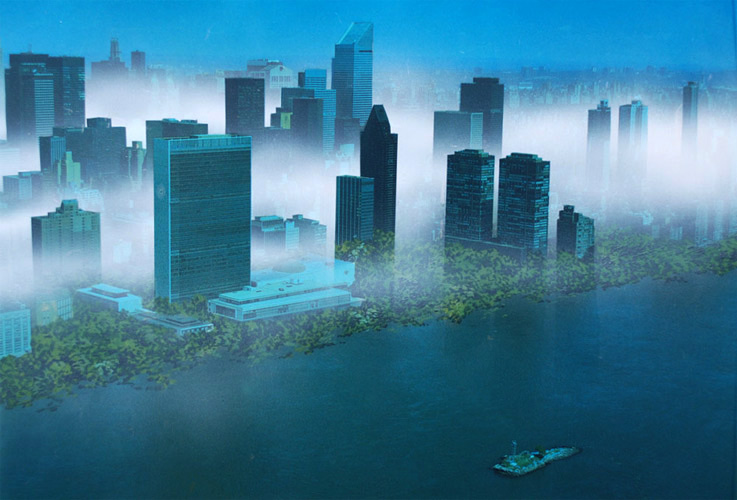
Alex Lukas (American, b. 1981) Untitled 2009 Acrylic and silk screen on two book pages
These are terrific – I want one!
A big thank you to Alex for allowing me to reproduce the images.
Dr Marcus Bunyan
Please click on the photographs for a larger version of the image.
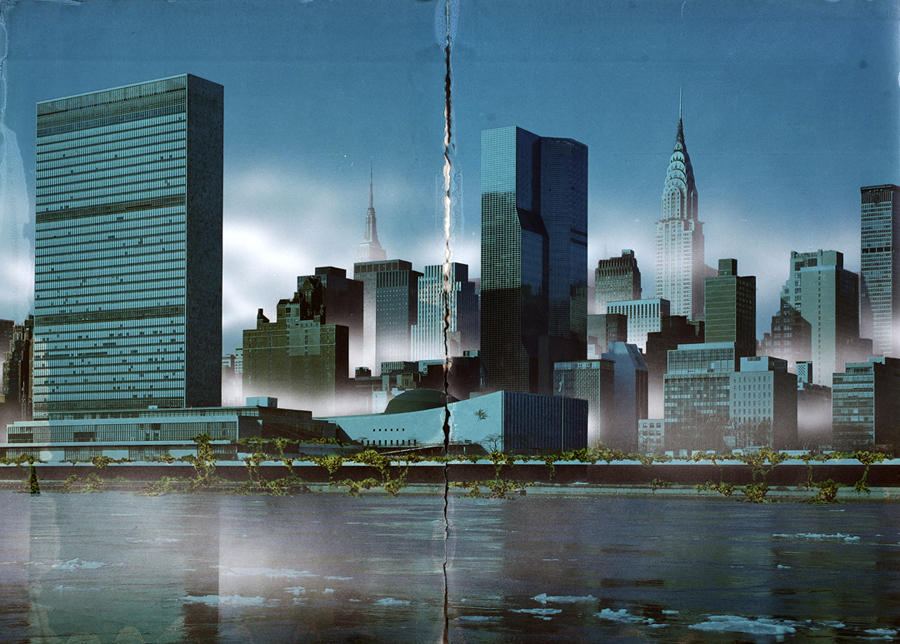
Alex Lukas (American, b. 1981) Untitled 2009 Acrylic and silk screen on two book pages
Glowlab is pleased to present The Eventuality of Daybreak, a solo exhibition by Alex Lukas featuring a new series of post-apocalyptic urban landscapes that blur the visual boundaries of fiction and reality.
Lukas’ work explores the existence of disaster, be it realised or fictitious, in contemporary society. Hyper-realistic motion pictures and unforgiving news footage depict seemingly identical – and equally riveting – facades of tragedy. The artist recognises that relentless visual bombardment has resulted in society’s desensitisation to the aesthetics of destruction.
For The Eventuality of Daybreak, Lukas has selected photographic spreads of well-known metropolises from vintage publications and uses them dually as canvas and unlikely subject. Through a deft handling of paint and carefully placed screen-printed passages, the artist pushes these ageing illustrations in futuristic contexts. Submerging these cities conceptually and physically, Lukas inundates images of American cities with layers of media representing cataclysmic floods and crippling overgrowth.
Also included in the exhibition are works on paper depicting near-future scenes of devastated landscapes – crumbling infrastructure, overturned trucks and telling signs of human despair. As a counterpoint to the underwater cities, these darkly atmospheric and barren vistas signal devastation through an unsettling sense of absence.
Lukas’ intentional use of dated imagery presented in tandem with contemporary situations forces the viewer to reconcile two differing ideologies of urban space. The artist’s work calls into question society’s collective acceptance of the urban environment as an arena of destruction, once thought unthinkable and now seemingly inevitable.
The Eventuality of Daybreak is Lukas’ first solo exhibition with Glowlab. Lukas’ work has also been exhibited in New York, Boston, Philadelphia, Los Angeles, San Francisco, London, Stockholm and Copenhagen as well as in the pages of Swindle Quarterly, Proximity Magazine, The San Francisco Chronicle, The Village Voice, The Drama and The New York Times Book Review. Lukas is a graduate of the Rhode Island School of Design and currently lives and works in Philadelphia, where he is a member of the artist collective Space 1026.
Press release on the Glowlab website [Online] Cited 20/11/2009 no longer available online
Alex Lukas (American, b. 1981) Untitled 2009 Acrylic and silk screen on two book pages
Alex Lukas (American, b. 1981) Untitled 2009 Acrylic and silk screen on two book pages
Alex Lukas (American, b. 1981) Untitled 2009 Acrylic and silk screen on two book pages
Alex Lukas (American, b. 1981) Untitled 2009 Acrylic and silk screen on two book pages
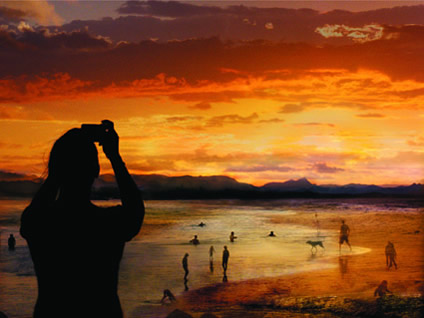
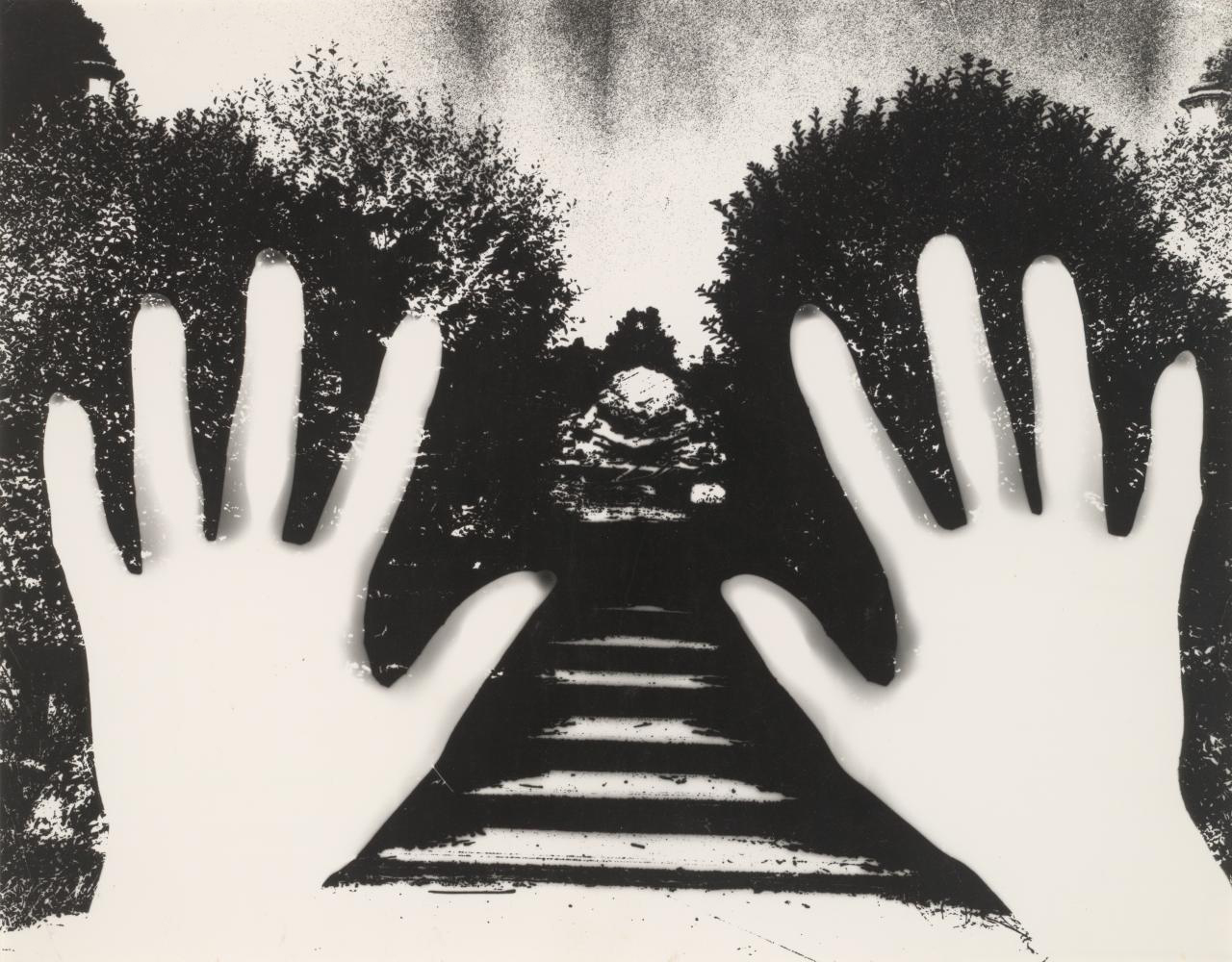
Sue Ford (Australian, 1943-2009) Dissolution 2006 From the Last Light series
One thing always struck me about Sue Ford’s work when I saw it. The work had integrity.
Whatever she produced it was always interesting, valid and had integrity. She followed her own path as we all do – and her voice was clear, focused and eloquent. I loved her series Shadow Portraits – an erudite investigation into the nature of Australian identity if ever there was one!
Vale Sue Ford.
Dr Marcus Bunyan
Please click on some of the photographs for a larger version of the image.
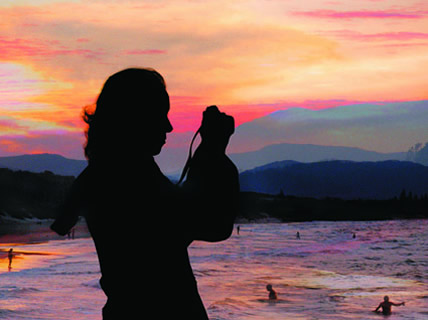
Sue Ford (Australian, 1943-2009) Silhouette 2006 From the Last Light series
Sue Ford (Australian, 1943-2009) Apparition 2007 From the Last Light series
Sue Ford (Australian, 1943-2009) Transparent 2007 From the Last Light series
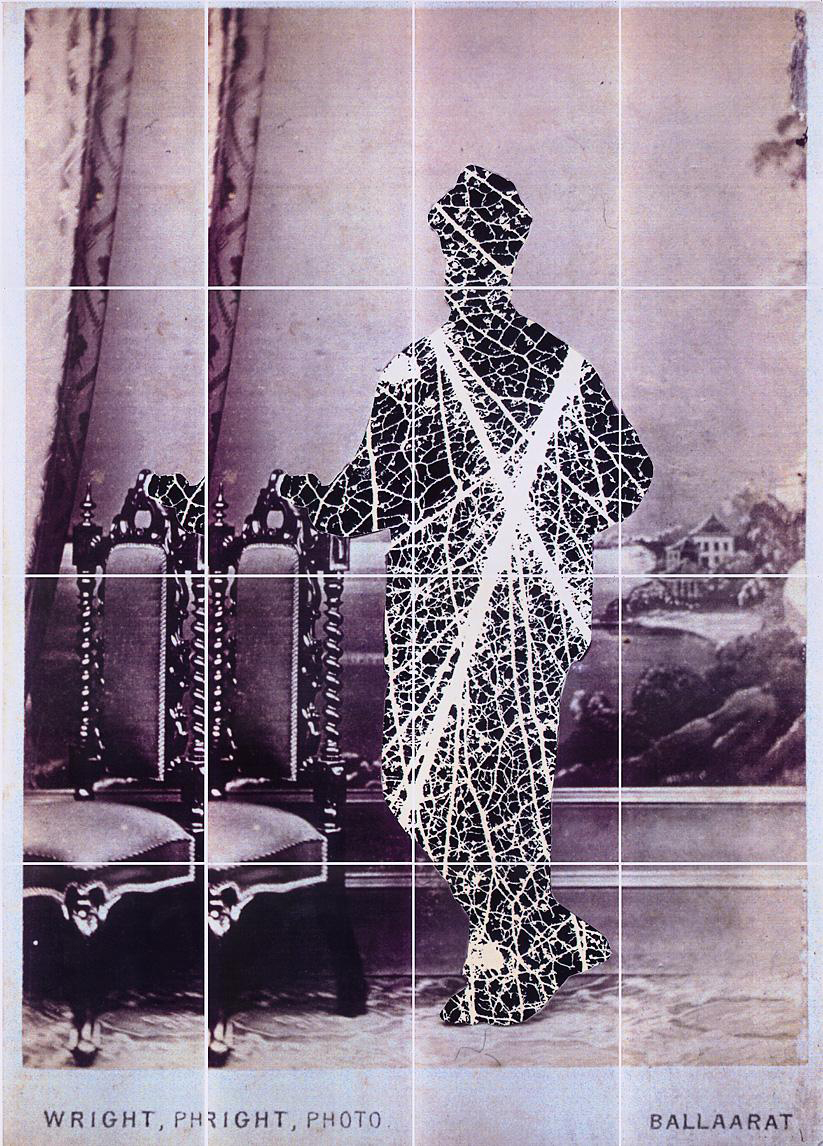
Sue Ford (Australian, 1943-2009) Shadow portraits (detail) 1994 Colour photocopies
Sue Ford (Australian, 1943-2009) Shadow portraits (detail) 1994 Colour photocopies
Sue Ford (Australian, 1943-2009) Shadow portraits (detail) 1994 Colour photocopies
For Shadow portraits, Ford, like numerous artists in this period, mined historical archives of photographs for her source material, decontextualising and reworking it. Her starting point was nineteenth-century studio portraits of settler Australians that were popular in colonial society. She exploded her previous practice and intense focus on the faces of individuals; in most cases the subjects of the original photographs used in Shadow portraits are unrecognisable. Their faces have been emptied out and replaced by Ford’s generic images of Australian foliage, especially fern fronds. All the details that define an individual, their character and appearance, have disappeared, just like the sitters themselves who have been dead for decades and exist only in ghosted form.
Individual works in Shadow portraits (above) rely on a dynamic relationship between historical and contemporary images to create something new. The original studio portrait is not intact, having undergone an extended process of transformation; being re-photographed, cut up and photocopied to eventually take the form of a large gridded image. Use of the grid – an obvious reference to European systems of containment and control – continues the experimentation evident in Yellowcake. Overlaps, like the doubled image of a stereoscopic card, are purposefully exploited. The aim is to destabilise a once-static historic image, to turn the small into big, the tones into colour, the positive into negative and so on. Through these means the colonial past is represented as having continuing reverberations: the loss of concreteness in the images and distortions of scale parallel the incompleteness, gaps and blow-outs characteristic of any historical narrative. As Zara Stanhope writes, Ford’s Shadow portraits ‘image the ongoing processes involved in the construction of histories, and the power to know and remember, that provides the opportunity to revisit or critique such accounts’.
Associate Professor Helen Ennis. “Sue Ford’s history,” in Art Journal 50, National Gallery of Victoria, 1 Jan 2013 [Online] Cited 11/05/2019
“I have always been interested in how actions taken in the past could affect and echo in peoples’ lives in the present. Most of my work is to do with thinking about human existence from this perspective.”
Sue Ford, “Project X’, in Helen Ennis & Virginia Fraser, Sue Ford: A Survey 1960-1995. Monash University Gallery, Clayton, 1995, p. 17
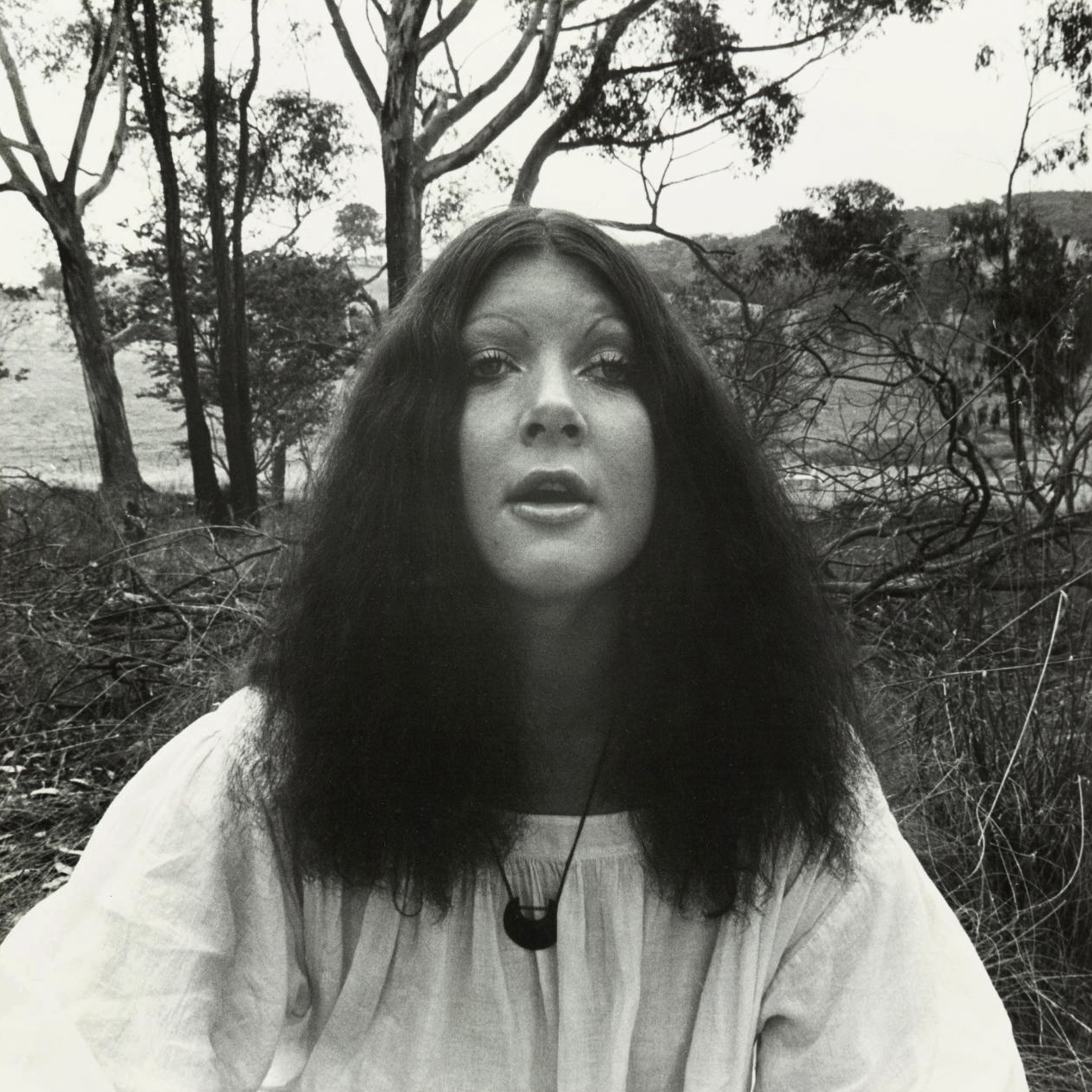
Until 1988 Ford was known principally for work that was motivated by feminist politics, that dealt with the lives of contemporary women and the politics of representation. She worked across media, using black and white photography, film and video. Her photography from the early 1960s onwards was based on what she regarded as photography’s objective capacity; in other words, she utilised the camera as a means of recording whatever she placed in front of it. This interest in ‘objectivity’ related more to the practices of conceptual art than to the heightened subjectivity, or subjective documentary that prevailed in art photography, especially during the seventies. Ford’s feminist photography can be regarded as objective but not as ‘documentary’ in the terms the latter is conventionally understood because there was nothing surreptitious or spontaneous about it. Her approach was non-exploitative and consensual in keeping with the politics of feminism and the counterculture. From the beginning of her career, her subjects were mostly friends and acquaintances; they knew they were being photographed and agreed to it. This consensual approach and its interrelated performative element were adopted by other feminist photographers, such as Carol Jerrems, Ponch Hawkes and Ruth Maddison, in their work during the 1970s.
In the 1970s and 80s Ford’s photography differed from mainstream practice in another fundamental way. It did not relate to the purist and fine art traditions that underpinned the case for photography’s acceptance as art. Her prints were grainy, rough and often very small. Ford conceived photography in radical terms, as a plastic medium that was entwined with other art practices. In an interview at the time she was awarded a scholarship to fund her studies at the Victorian College of the Arts in 1973-74, she emphasised her interest in artists’ use of photography: ‘Some artists are utilising phototechniques and are thinking in a photographic way. I want to use some of their techniques and materials to extend photography into other dimensions’.
Associate Professor Helen Ennis. “Sue Ford’s history,” in Art Journal 50, National Gallery of Victoria, 1 Jan 2013 [Online] Cited 11/05/2019
Great to have some really good quality photographs to show you from this exhibition!
Marcus
Many thankx to the Museum of Fine Arts in Boston for allowing me to publish the photographs in the posting. Please click on the photographs for a larger version of the image.
Dae-Soo Kim (Korean, b. 1955) Untitled 1999 From the series Bamboo 1998-2008 Gelatin silver photograph, printed 2007 Santa Barbara Museum of Art; museum purchase with funds provided by PhotoFutures
Bien-U Bae (Korean, b. 1950) Kyung ju 1985 From the series Sonamu Gelatin silver photograph The Museum of Fine Arts, Houston; museum purchase with funds provided by Photo Forum
This October, the Museum of Fine Arts, Houston, presents Chaotic Harmony: Contemporary Korean Photography, the most comprehensive exhibition of contemporary Korean photography to ever be shown in the United States. Organised by Anne Wilkes Tucker, The Gus and Lyndall Wortham Curator of Photography at the MFAH, and Karen Sinsheimer, Curator of Photography at the Santa Barbara Museum of Art, Chaotic Harmony features large scale photographs by 40 Korean artists, many of who have never before exhibited in international museum exhibitions and whose work will be on view in the United States for the first time in this show. At the MFAH, the works will be on display in the Audrey Jones Beck Building’s Cameron Foundation Gallery, as well as the Lower Beck Corridor, from October 18, 2009 through January 3, 2010, presenting a fascinating window onto the vital and constantly evolving country, Korea.
“As South Korea has exploded onto the international trade scene, South Korean artists have also emerged onto the global stage, which the recent high auction prices for Korean artwork attest to. Despite this fact, Korean art is still rarely presented in the United States, and the specific field of Korean photography is even less explored here,” said MFAH director Peter C. Marzio. “Following the MFAH’s tradition of presenting pioneering photography exhibitions, we are pleased to exhibit this brilliant survey of contemporary South Korean photography, which can be seen in the enhanced context of Your Bright Future and the museum’s Arts of Korea gallery.”
“Operating under a relatively new democracy in South Korea, artists experienced a burst of creative energy and freedom of expression in recent decades, and an entirely fresh perspective of modern-day Korea is presented in this show,” added curator Anne W. Tucker. “The photographers in ‘Chaotic Harmony’ observe the country’s notable growth in terms of industry and urbanisation and convey the resultant issues as well as reflect on the country’s ancient culture and religions.”
Within the exhibition, two distinct generations of Korean artists are represented: those born in the mid-1950s and 1960s, during a succession of military dictatorships when the country was still largely agrarian, and those born in the 1970s, predominantly in urban areas and who came into maturity in the new democratic era which began in 1987. With two exceptions, one work by each artist is included. Through recent works by both generations of photographers, Chaotic Harmony explores Korea through five thematic sections: land and sea; urbanisation and globalisation; family, friends, and memory; identity: cultural and personal; and anxiety.
Land and Sea
Most of the work represented in the “Land and Sea“ section of the exhibition was created by the first generation of Korean artists who traveled abroad for their graduate educations and brought their new ideas back to dramatically effect photographic styles in Korea. Nevertheless, many of them remained tied to Korean landscapes and traditions while embracing new aesthetic ideas. The extraordinarily beautiful land and seascapes in this section celebrate Korea’s surrounding oceans and the forests that cover large sections of its mountainous terrain. In addition, these photographers often explore religious practices that are primarily tied to nature. BAE Bien-u’s Kyung ju (1985, see photograph above) from the series Sonamu (which translates to “sacred pine grove“), documents mist-shrouded pine trees surrounding Gyeongiu, the ancient city of the Shilla kingdom (A.D. 668-935). KIM Young-sung’s Untitled photograph (2005) from the Dolman series, shows a man standing atop one of Korea’s 50,000 dolmans (or ancient tombs). Over 60 percent of the world’s 80,000 dolmans are located in Korea. Gap-Chul Lee has documented shamanism (as well as Buddhism) in Korea for decades, but most specifically in his series Conflict and Reaction (1990-2001).
Urbanisation and Globalisation
An ancient civilisation, South Korea has recently transformed into one of the world’s major global economies. Three-fourths of the population is categorised as urban, with half living in the country’s six major cities. Seoul is the world’s fourth largest metropolitan area. This section of the exhibition responds to the shift of the population from rural to city living, and the entrance of Korea on to the world stage. Young-Joon CHO’s Usual & Circle – Seoul Namdaemun, Rho Gwang-hyo (2005) is a diptych: the image on the left presents an urban area teeming with stores, advertisements, people, and traffic, while the image on the right isolates a woman who we would not have otherwise noticed in the larger view of the city. Her expression of emotional distress is consistent with all the isolated figures in the series. Ahn Sekwon documented Seoul’s rapid physical changes by photographing one particular neighbourhood of the Weolgok-dong section of Seoul in 2005, 2006, and 2007 as the old homes are destroyed to make room for new high rises. The resulting triptych (see photographs above) dramatically conveys the destruction of the modest-scale homes to make way for the towering scale of a modern city.
Family, Friends, and Memory
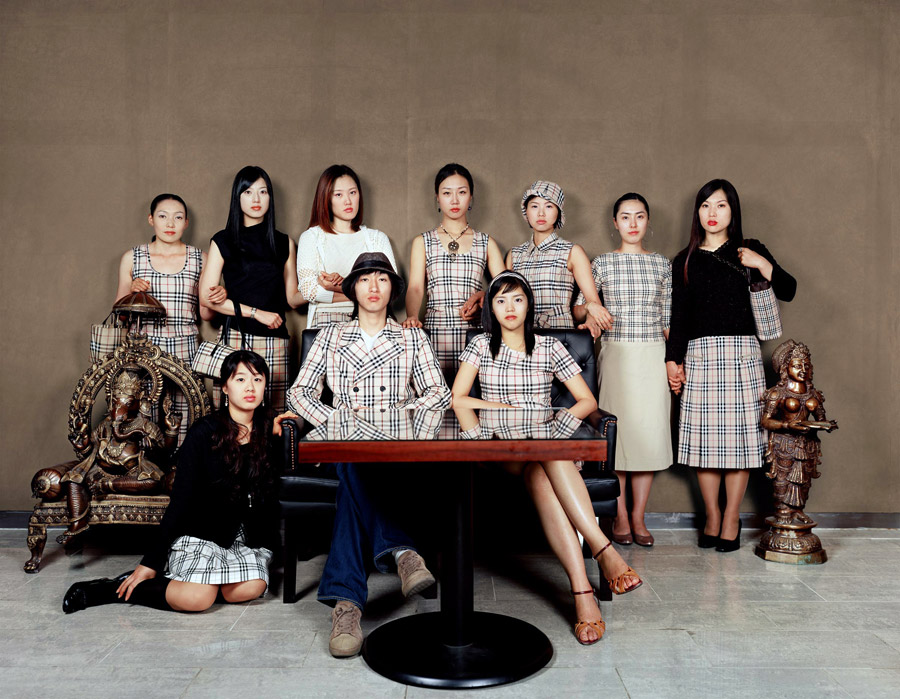
“Family, Friends, and Memory“ reflects the tensions in shifting societal values and practices as Korea continues its rapid growth. Traditionally, families followed Confucian norms: the father was the respected head of household and made decisions for his wife and children, financially supporting the family and arranging schooling and marriages. Social values have changed with increasing awareness of Western cultures through travel and the importation of Western products and media. Also with dramatic urban growth, came shifts from homes to crowded high rises, the entrance of women into the workforce, and other changes. Sunmin LEE’s photograph, Lee, Sunja’s House #1 – Ancestral Rites (2004, see below), portrays traditional values playing out in a modern setting: the men and boys of a family conduct traditional rituals in one room while the women watch from the doorway. Sanggil KIM’s Off-line: Burberry Internet Community (2005, see photograph below) depicts a modern phenomenon: people who met over the internet, united by a common passion, in this case, that of wearing Burberry Check (registered as a trademark of the Burberry brand) and enjoying an “off-line” get-together.
Identity: Cultural and Personal
Between 1910 to 1945, Japan annexed Korea and systematically attempted to eradicate Korean culture and identity, for example, by banning Korean literature and language from schools. Only six years after World War II, Korea was devastated by the Korean War. This section of Chaotic Harmony investigates what it means to be Korean today after this disruptive history. Some artists, such as Bohnchang KOO, seek to reclaim past cultural history, by photographing treasured and uniquely Korean items such as Celadon – the main type of ceramic produced in ancient Korea and generally exalted as Korea’s most significant artistic legacy. Jungjin Lee in term photographs native crafts from Korean folk culture. Exploring more personal aspects of identity is Yeondoo JUNG’s Bewitched #2 (below), a diptych juxtaposing images of the same teenager, mopping the floor of a Baskin Robbins in her day job and exploring the Arctic regions in her dream job (see photographs below); and Hyo Jin IN’s Violet #01 from the High School Lovers series (2007, below), which portrays an openly lesbian couple.
Anxiety
The “Anxiety” section of Chaotic Harmony investigates the constant tension provoked by strained relations and the potential of a violent outbreak between North and South Korea. Jung LEE’s Bordering North Korea, #2 (2005), from her 2005-2008 series of the same title, offers a view of North Korea seen from China and them superimposes over it an accompanying text chosen from the set phrases that North Koreans are allowed to say to the few foreigners who gain access to the country, such as Our country is the paradise of the people. She wants the viewer to experience both the beauty of the land and the palpable repression evident in the political slogans. Seung Woo Back references the subliminal fear of an attack from North Korea by staging “invasions” of toy soldiers that march across a family’s yard and up their wall to the kitchen window ledge, presumably unbeknownst to the person whose silhouette is visible though the window.”
Press release from the Museum of Fine Arts, Houston website [Online] Cited 11/11/2009. No longer available online
In “Family,” the last section of her essay, Sinsheimer addresses the traditional and changing structures of the Korean family: inter-racial marriage, Confucian traditions, the nuclear family, and the effects of consumerism on the younger generation. Sunmin Lee’s photograph of an ancestral ritual, Lee, Sunja’s House #1 – Ancestral Rites (2004, below), represents the loosening of Confucian practice as the participants wear Western dress. Yet modernisation goes only so far, since the women do not take part in this vestige of patriarchal society.
A pair of photographs from Jeong Mee Yoon’s The Pink & Blue Project (2005-2008, above), created during her studies in New York, shows portraits of children surrounded by their accumulated belongings arranged neatly on the floor. All pink for girls and all blue for boys, the massed items, suggest that a global consumerist culture, rather than national or ethnic values, determine male and female versions of identity and acquisition. As the author observes, these images of children engulfed by material abundance are “a portrait of consumerism.”
PA-YA (Korean, b. 1971) Noblesse Children #12 2008 From the series Noblesse Children 2008 Chromogenic photograph Santa Barbara Museum of Art; museum purchase with funds provided by PhotoFutures
Chan-Hyo Bae has chosen the iconography of queenliness to express his own feelings of cultural estrangement. Originally from South Korea and currently living in London, England, Bae begins from very simple, common sentiments of foreignness. His works – large-format colour prints, in which he plays unidentified female British monarchs from the 13th to 19th centuries (all his works are untitled) – initially appear to be a cheeky sort of wish fulfilment. One is readily reminded of Yasumasa Morimura, the Japanese artist who casts himself in Western art’s biggest roles, and also, perhaps, of the phenomenon of cosplay – the subculture of dressing up like fictional or historical characters – which originates in Japan but has become popular throughout Asia and the rest of the world. Bae seems to be performing a blatant paradox: that of the outsider gleefully destabilising the hierarchies of a culture about which he has admittedly fantasised, but which has forbade him full entrance because of an unalterable ethnicity.
Text from the photography-now website [Online] Cited 09/05/2019 no longer available online
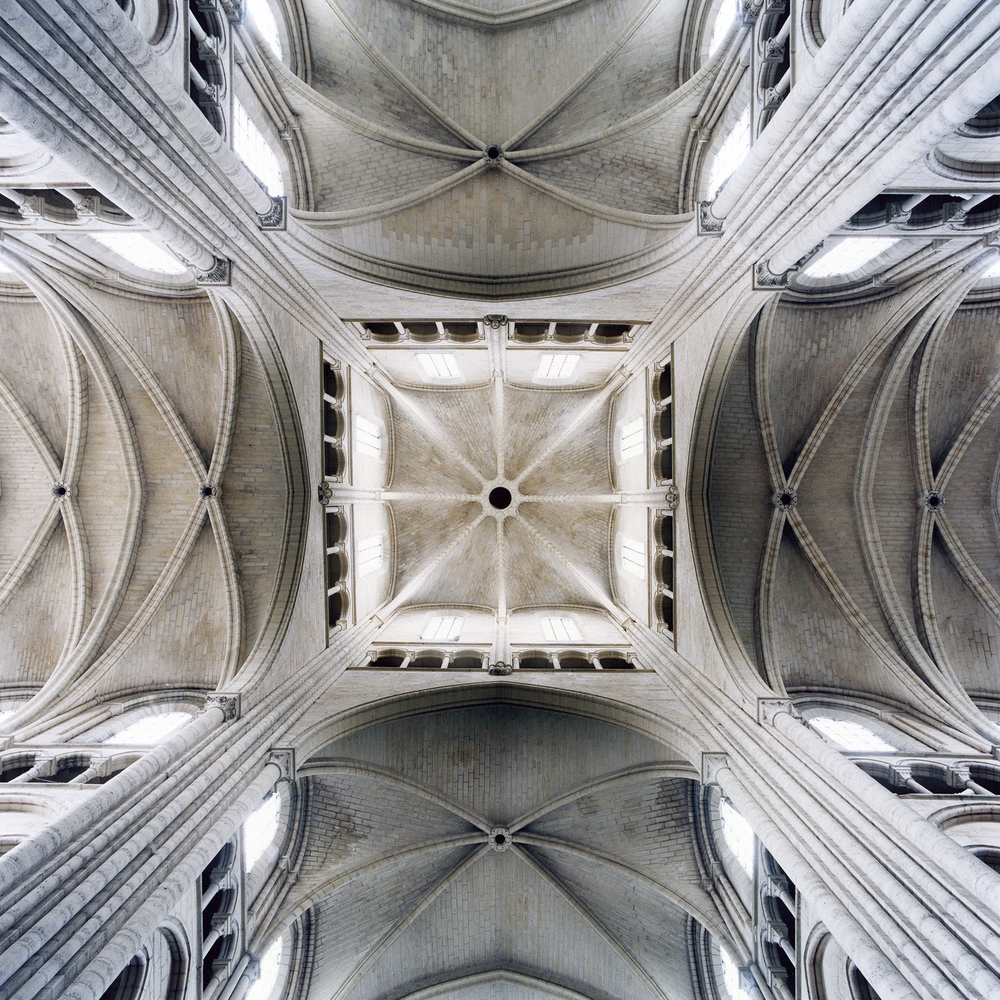
David Stephenson (Australian born America, b. 1955) Nave, Laon Cathedral, Laon, France 2006/2007
I remember many years ago, in the mid-1990’s, seeing the wonderful Domes of David Stephenson displayed in Flinders Lane in what is now fortfivedownstairs gallery. They were a revelation in this light filled space, row upon row of luminous domes seemingly lit from within, filled with the sense of the presence of divinity. On the opposite wall of the gallery were row upon row of photographs of Italian graves depicting the ceramic photographic markers of Italian dead – markers of the impermanence of life. The doubled death (the representation of identity on the grave, the momento mori of the photograph) slipped quietly into the earth while opposite the domes ascended into heaven through their numinous elevation. The contrast was sublime.
Unfortunately the same cannot be said of the latest exhibition Heavenly Vaults by David Stephenson at John Buckley Gallery, Richmond.
The problems start with the installation of the exhibition. As you walk into the gallery the 26 Cibachrome photographs are divided symmetrically down the axis of the gallery so that the prints reflect each other at both ends and each side of the gallery. It is like walking down the nave of a cathedral and observing the architectural restraint of the stained glass windows without their illumination. Instead of the punctum of light flooding through the stained glass windows, the varying of intensities, the equanimity of the square prints all exactly the same size, all reflecting the position of the other makes for a pedestrian installation. Some varying of the print size and placement would have added much life and movement to a static ensemble.
Another element that needed work were the prints themselves which, with a few notable exceptions, seemed remarkably dull and lifeless (unlike their digital reproductions which, paradoxically, seem to have more life!). They fail to adequately represent the aspirations of the vaults as they soar effortlessly overhead transposing the earth bound into the heaven sent. In the earlier work on the domes (which can be found in the book Visions of Heaven: The Dome in European Architecture) the symmetry of the mandala-like domes with their light-filled inner illumination worked well with the square format of the images making the photographs stand as equivalents for something else, other ineffable states of being.
“The power of the equivalent, so far as the expressive-creative photographer is concerned, lies in the fact that he can convey and evoke feelings about things and situations and events which for some reason or other are not or can not be photographed. The secret, the catch and the power lies in being able to use the forms and shapes of objects in front of the camera for their expressive-evocative qualities. Or to say this in another way, in practice Equivalency is the ability to use the visual world as the plastic material for the photographer’s expressive purposes. He may wish to employ the recording power of the medium, it is strong in photography, and document. Or he may wish to emphasize its transforming power, which is equally strong, and cause the subject to stand for something else too.”1
As Minor White further observes,
“When the image mirrors the man And the man mirrors the subject Something might take over”2
When the distance between object and image and image and viewer collapses then something else may be revealed: Spirit.
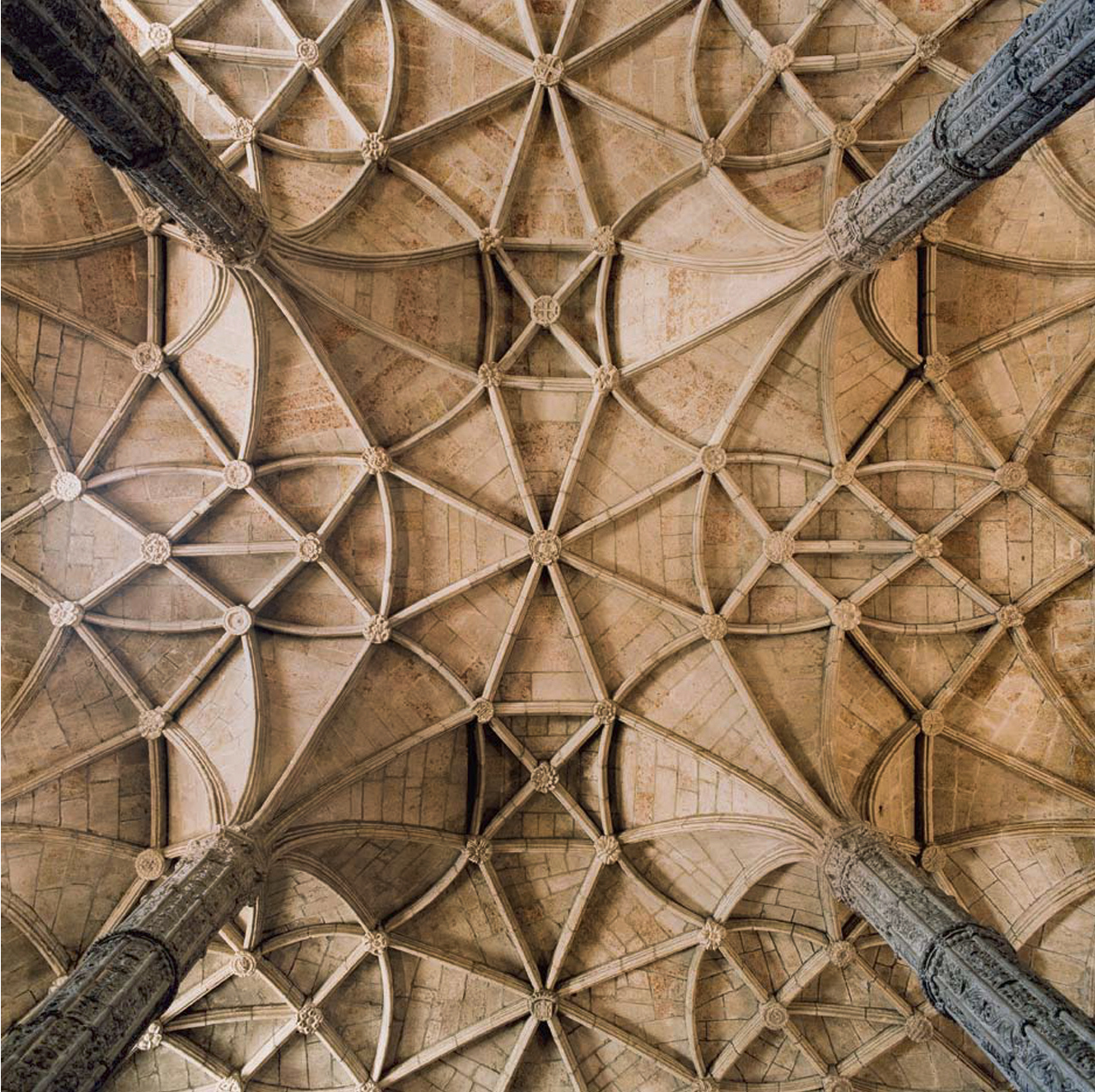
In this exhibition some of the singular images such as the Crossings, Choirs and Nave of the Church of Santa Maria, Hieronymite Monastery, Belém, Portugal (see photograph below) work best to achieve this revelation. They transcend the groundedness of the earthly plane through their inner ethereal light using a reductive colour palette and strong highlight/shadow detail. Conversely the diptychs and triptychs of Nave and Choir (see photographs below and above) fail to impress. The singular prints pinned to the gallery wall are joined together to form pairs and trios but in this process the ‘space between’ the prints (mainly white photographic paper), the breathing space between two or more photographs that balances their disparate elements, the distance that Minor White calls ‘ice / fire’, does not work. There is no tension, no crackle, no visual crossover of the arches and vaults, spandrels and flutes. Here it is dead space that drags all down with it.
I found myself observing without engagement, looking without wonder or feeling – never a good sign!
The photographs of Domes and Vaults have served David Stephenson well for numerous years but the concept has become tired, the inspiration in need of refreshment through other avenues of exploration – both physical and spiritual.
Many thankx to Daniel and John Buckley Gallery for allowing me to reproduce the photographs from the exhibition. Please click on the photographs for a larger version of the image.
David Stephenson (Australian born America, b. 1955) Choir, Laon Cathedral, Laon, France 2006/2007
David Stephenson (Australian born America, b. 1955) St. Hugh’s Choir, Lincoln Cathedral, Lincoln, England 2006/2007
Installation view of Heavenly Vaults by David Stephenson at John Buckley Gallery, Richmond Photo: Marcus Bunyan
David Stephenson (Australian born America 1955) Nave, Cathedral of St. Barbara, Kutná Hora, Czech Republic 2008/2009
David Stephenson (Australian born America 1955) Choir, Cathedral of St. Barbara, Kutná Hora, Czech Republic 2008/2009
“While the subject of my photographs has shifted… my art has remained essentially spiritual – furthermore than two decades I have been exploring a contemporary expression of the sublime – a transcendental experience of awe with the vast space and time of existence.”
David Stephenson
Internationally renowned photographer David Stephenson has dedicated his practice to capturing the sublime in nature and architecture. Fresh from a successful exhibition at Julie Saul Gallery in New York, Stephenson returns to John Buckley Gallery for his third highly anticipated exhibition Heavenly Vaults. The exhibition will feature 26 selected prints from his latest monograph published by Princeton Architectural Press; Heavenly Vaults: From Romanesque to Gothic in European Architecture. Shaun Lakin, Director of the Monash Gallery of Art, will launch the book and exhibition at the opening, November 7th.
Stephenson began to photograph Gothic vaults in Spain and Portugal in 2003, while completing the work for his Domes project, and his first monograph Visions of Heaven: the Dome in European Architecture. He began to focus on the Vaults project in 2006, photographing Gothic churches and cathedrals in England, Belgium and France. With the assistance of an Australia Council Artist Fellowship in 2008-2009, Stephenson completed extensive fieldwork for the Vaults project, intensively photographing Romanesque and Gothic architecture in Italy, France, Spain, Portugal, Austria, the Czech Republic, Poland, and Germany. The exhibition at John Buckley Gallery coincides with the launch of his second monograph, Heavenly Vaults: from Romanesque to Gothic in European Architecture, published by Princeton Architectural Press, New York.
Even though the traditional systems the underpinned church architecture have lost their unequivocal power, David Stephenson’s photographs capture the resonance of those times. More importantly his work also suggest that the feelings of aspiration, transcendence, and infinity these buildings evoke in the viewer have an ongoing relevance beyond the religious setting and help us understand who and what we are.
Excerpt from Foreword, Heavenly Vaults, by Dr Isobel Crombie 2009
David Stephenson’s new book of photography is a love letter to the intricate, seemingly sui generis vaults of Europe’s Romanesque and Gothic cathedrals and churches.
Press release from the John Buckley website [Online] Cited 11/11/2009 no longer available online
David Stephenson (Australian born America, b. 1955) Nave, Church of Santa Maria, Hieronymite Monastery, Belém, Portugal 2008/2009
‘While the subject of my photographs has shifted from the landscapes of the American Southwest and Tasmania, and the minimal horizons of the Southern Ocean, and the icy wastes of Antarctica, to sacred architecture and the sky at both day and night, my art has remained essentially spiritual – for more than two decades I have been exploring a contemporary expression of the sublime – a transcendental experience of awe with the vast space and time of existence.’
David Stephenson 1998.1
With poetic symmetry the Domes series considers analogous ideas. It is a body of work which has been ongoing since 1993 and now numbers several hundred images of domes in countries including Italy, Spain, Portugal, Turkey, England, Germany and Russia. The typological character of the series reveals the shifting history in architectural design, geometry and space across cultures and time, demonstrating how humankind has continually sought meaning by building ornate structures which reference a sacred realm.2 Stephenson photographs the oculus – the eye in the centre of each cupola. Regardless of religion, time or place, this entry to the heavens – each with unique architectural and decorative surround – is presented as an immaculate and enduring image. Placed together, the photographs impart the infinite variations of a single obsession, while also charting the passage of history, and time immemorial.
1. Van Wyk, S. 1998. “Sublime space: photographs by David Stephenson 1989-1998,” National Gallery of Victoria, Melbourne np 2. Hammond, V. 2005. “The dome in European architecture,” in Stephenson, D. 2005, Visions of heaven: the dome in European architecture, Princeton Architectural Press, New York p. 190
Atget, one of my all time favourite photographers; Paris, a city that stirs the heart – what more can one ask!
Many thankx to the Frist Museum of Art (formerly the Frist Center for the Visual Arts) for allowing me to publish the photographs in the posting. Please click on the photographs for a larger version of the image.
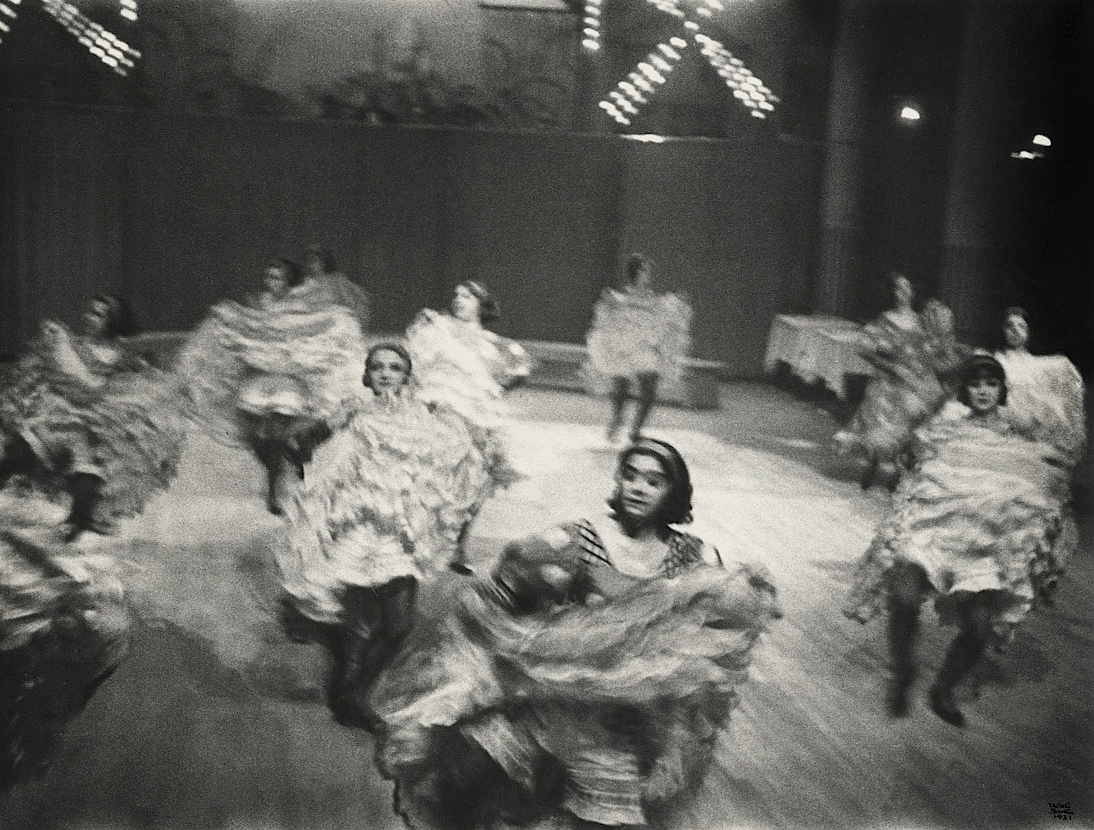
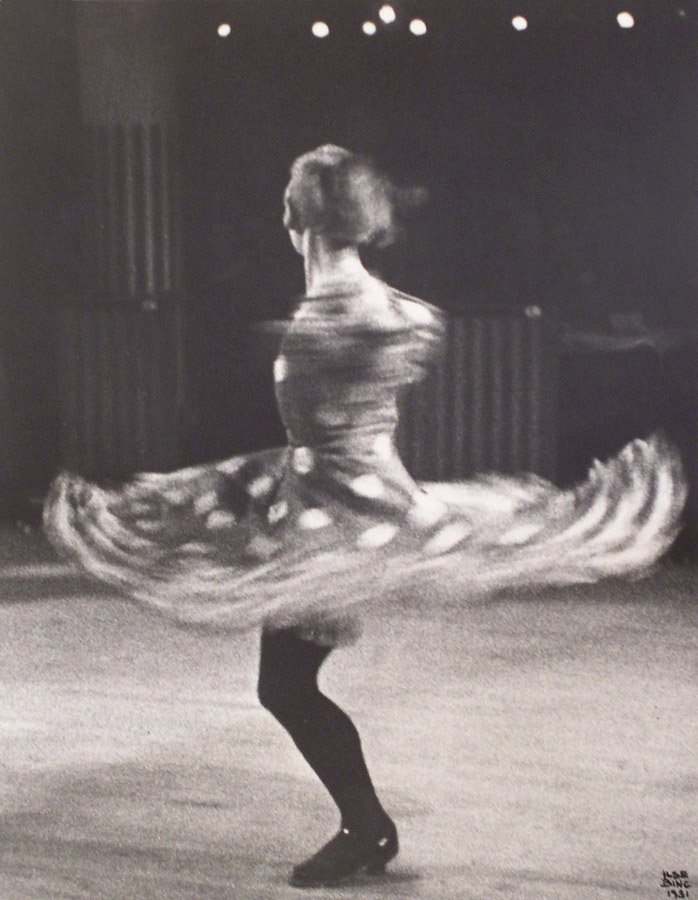
Ilse Bing (German, 1899-1998) French Can Can Dancers, Moulin Rouge 1931 Gelatin silver print
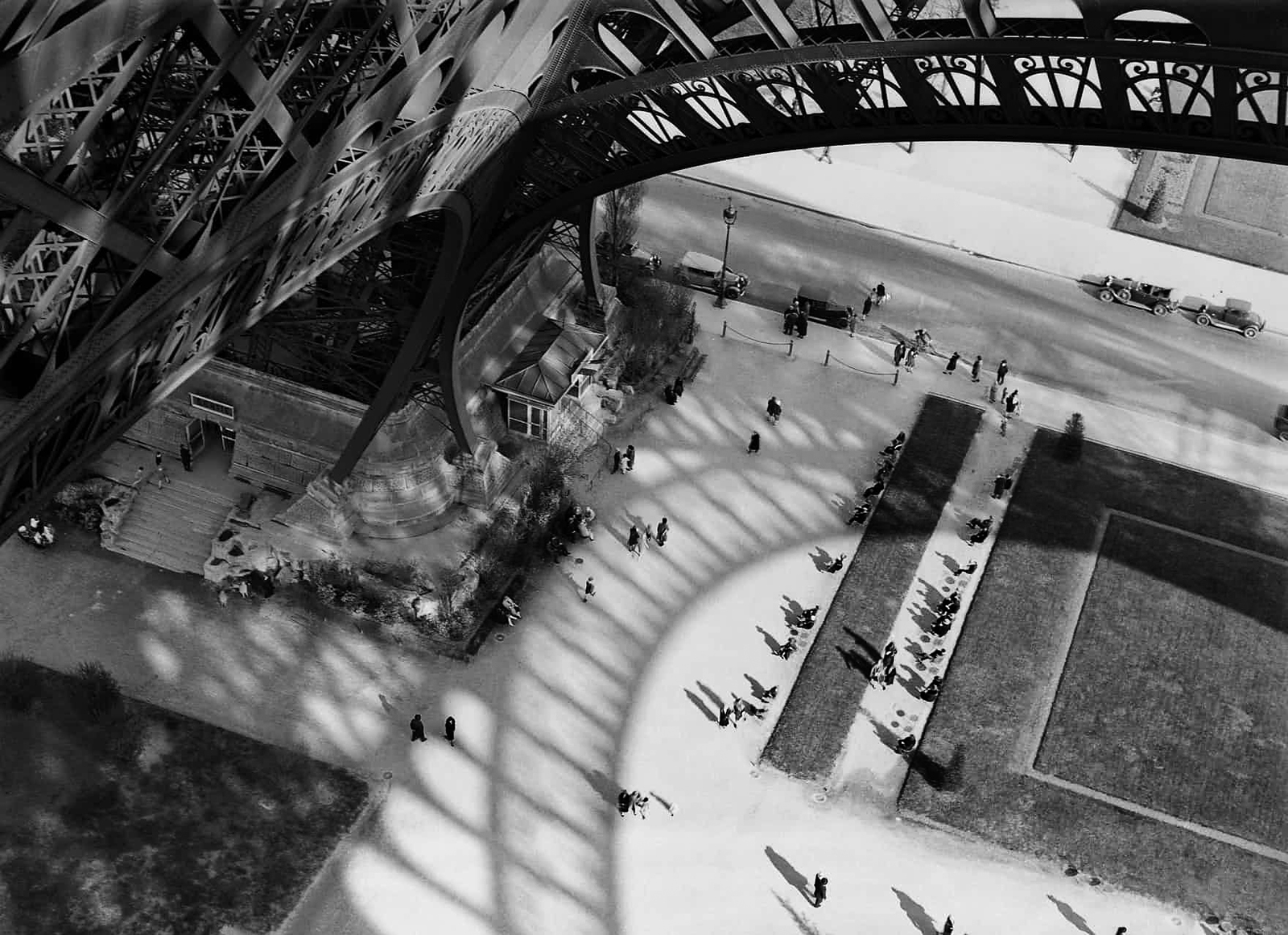
Andre Kertesz (Hungary, 1894-1985) Eiffel Tower, Paris 1929 Gelatin silver print
The Frist Center for the Visual Arts [now the Frist Museum of Art] will present Twilight Visions: Surrealism, Photography, and Paris, opening Sept. 10, 2009, in the Upper-Level Galleries. The show, which offers a unique perspective on Surrealism by examining the intersection of documentary photography, manipulated photography and film, will be on exhibition through Jan. 3, 2010, when it will travel to the International Center of Photography in New York followed by the Telfair Museum of Art in Savannah, Ga.
Guest Curator Therese Lichtenstein, Ph.D., New York-based art historian and photography scholar, has organised the exhibition, working with Frist Center Curator Katie Delmez.
The exhibition of more than 150 works, which features a preponderance of photographs but also includes films, books and period ephemera, explores the city of Paris as the literal and metaphoric base of Surrealism in the wake of the World War I. It was believed by the Surrealists that unconscious dreams, chance encounters and actions and automatism freed “pure thought,“ from all constraints imposed by conscious thought, reason or morals.
In conjunction with the exhibition, the Frist Center will partner with Nashville’s Belcourt Theatre and Vanderbilt University’s International Lens and the school’s French and film departments to present a Surrealism film series which will include the classic Un Chien Andalou (The Andalusian Dog) directed by Luis Buñuel and Salvador Dalí and several other rarely screened period films.
Paris was a hotbed of creative activity at the dawn of the 20th century, attracting artists and writers to its vibrant and wildly fertile art scene. Numerous galleries flourished during this period, fuelling the immigration of many of the world’s most talented artists. During the 1920s and 1930s, a number of photographers associated with Surrealism, including Man Ray, Brassaï, André Kertész, Ilse Bing and Germaine Krull, turned their lenses on the city of Paris with its dance halls, cafés and characters. These seemingly ordinary people and places not only had social histories but also became psychologically charged “found objects.“ In exploring the city’s commonplace as well as its monuments, these photographers used unusual viewpoints, manipulative lighting techniques and innovative technical processes to expose and examine “the marvellous“ in the everyday.
As Dr Lichtenstein writes, “The images in Twilight Visions form a collection of views of various urban spaces, filled with cultural artefacts. The viewer is invited to slowly contemplate the city – its architecture, its monuments, its public spaces and its denizens – as an ephemeral ruin, at once both of the past and the present.”
The Exhibition
Twilight Visions comprises five sections: images of the city at night and in the day, the transformation of well-known public monuments, the influence of Eugène Atget on the Surrealists; Parisian nightlife after hours and surreal figures.
The first section, “Marvellous Encounters”, includes photographs of city streets, shop windows, ordinary people and found objects that invite viewers to discover “the marvellous“ in common objects and familiar places. Many of the works in this section look both familiar and strange, as subjects were photographed from unexpected angles, using dim lighting, soft focus and abstracted views to create dreamlike images. Among the works in this section are photographs by Brassaï, Man Ray, Ilse Bing, André Kertész, Germaine Krull, Dora Maar and Joseph Breitenbach.
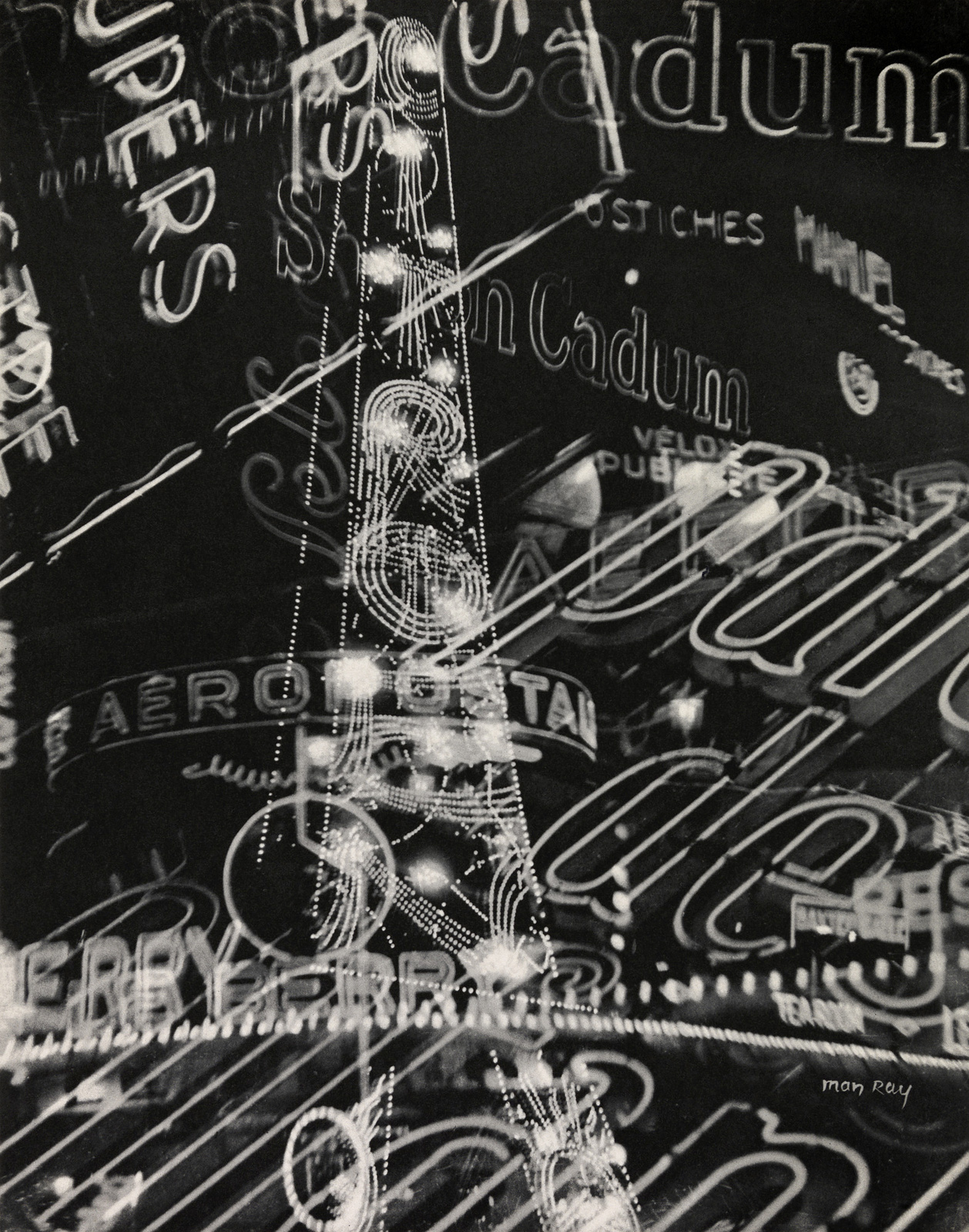
The second section of the exhibition, entitled “Photography’s Transformation of the Monument”, looks at the monuments of Paris, particularly the Eiffel Tower, to examine the ways they shape connections to past and future. Included in this section are works by André Kertész, Ilse Bing, Germaine Krull and Man Ray. The Eiffel Tower, constructed from 1887-1889, was designed to serve as the entry to the Paris World’s Fair commemorating the centennial anniversary of the French Revolution. The skeletal iron structure also was designed to be a radio transmitter and a beacon for commercial advertisements in the form of illuminated signs. In 1931 Man Ray created a series of photographs that were reproduced in a portfolio by the Paris Electric Company for an advertising booklet called Èlectricité, which was used to promote personal use of electricity. That same year, he photographed the tower at night and used the image as the basis for La Ville (The City, 1931 – see photograph below), a multiple-exposure print and one of the images used in Èlectricité. The Eiffel Tower, built as a utilitarian homage to the past, is transformed. The magic of electricity makes the tower visible at night, but in so doing, renders it unstable and non-architectural. Ray’s photograph turns the magnificent Eiffel Tower into indecipherable electrified text. In addition to Man Ray’s work, there are photographs by Ilse Bing, Georges Hugnet, André Kertész, Germaine Krull, Raoul Ubac and various postcards of the city that interrupt traditional heroic views of the monument.
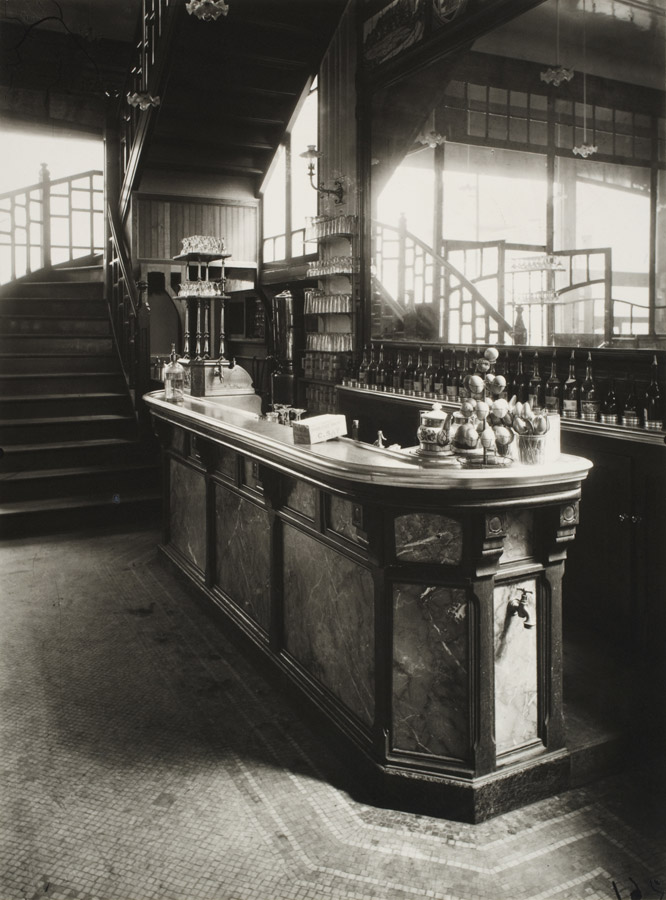
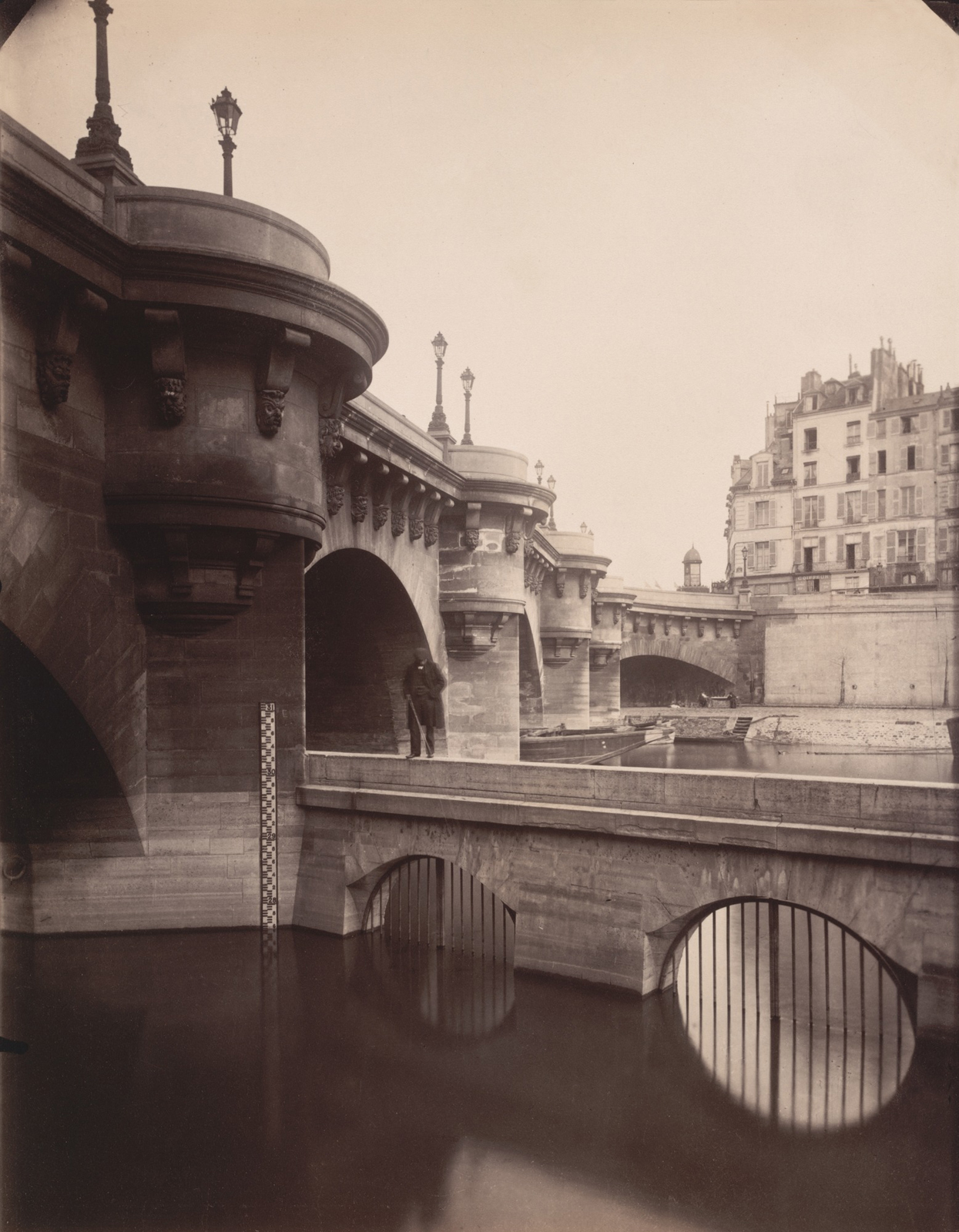
Section three, entitled “Looking at Atget”, examines the powerful work of Eugène Atget, a photographer who was “discovered“ in the 1920s by Man Ray. Following a stint as a sailor, a brief career as an actor and an attempt at becoming a painter, he turned to photography. Working quietly and modestly, Atget documented the loss of “old“ Parisian culture after the turn of the 20th century. But in so doing, his “poetry of the everyday“ also became a personal expression of nostalgia for the world that was disappearing before his lens. His work was straightforward yet magical. Works include Pont Neuf (1902-1903), The Wine Seller, 15 Rue Boyer (c. 1910) and Boulevard de Strasbourg (1926) (see photographs above).
Section four, “Portraits After Hours”, explores the Bohemian avant-garde culture of Paris. In the 1920s and 1930s, the cafés and cabarets of Montparnasse and Montmartre were a part of the transition to modernity taking place in the city. The antibourgeois, often seedy places that were the comfortable haunts of Parisian artists and intellectuals were becoming tourist destinations … fetishised places of fantasy and desire. As these locales metamorphosed into tourist sites where “regular“ folk could rub elbows with Parisian characters, increasingly, these locales became stage sets where the “actors“ relived the past for the cameras of the tourists. Ilse Bing’s photographs of Cancan dancers at the famed Moulin-Rouge capture the colour, flourish, nostalgia and exhilaration of the dance (see photographs above). Photographers represented in section four include: James Abbe, Ilse Bing, Brassaï and Man Ray.
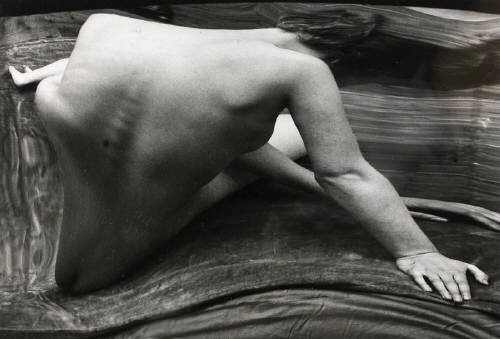
“Mutable Mirrors”, the fifth section of the exhibition, investigates the subject of shifting identities that was a part of the Surrealists’ desire to alter consciousness and transform concepts of personal, social and group identity. Issues of gender and sexuality and the roles of masquerade and play are examined in the works of Lee Miller, Nusch Eluard, Dora Maar, Claude Cahun, Raoul Ubac, Hans Bellmer, Georges Hugnet, André Kertész, Man Ray and Brassaï who experimented with techniques of doubling, distorting, multiplying and fragmenting their images. Included in this section are André Kertesz’s Distortions (1933) a series of photographs of nude women reflected in distorting mirrors that transform them into dreamlike creatures (see photographs below). The series was commissioned by the editor of the Parisian humour magazine, Le Sourire (The Smile).
Text from the Frist Museum of Art (formerly the Frist Center for the Visual Arts) website [Online] Cited 11/11/2009. No longer available online
Eugène Atget (French, 1857-1927) The Wine Seller, 15 Rue Boyer 1910-1911 Gelatin-silver print (printed by Berenice Abbott) Gift of Walter P. Chrysler, Jr., Chrysler Museum of Art, Norfolk, VA.
Eugène Atget (French, 1857-1927) Boulevard de Strasbourg 1926 Albumen print
Eugène Atget (French, 1857-1927) Rue du Figuier 1924 Albumen print 9 x 7 in. Gift of Walter P. Chrysler, Jr. by Exchange, Chrysler Museum of Art, Norfolk, VA.
Eugène Atget (French, 1857-1927) Pont-Neuf 1902-03 Albumen print 8 7/8 x 7″ (22.6 x 17.8cm)
Andre Kertesz (Hungary, 1894-1985) Distortion 144, Paris 1933 Gelatin silver print
Andre Kertesz (Hungary, 1894-1985) Distortion 147, Paris 1933 Gelatin silver print
The Distortions were made with a glass plate view camera and Kertesz used two particular female models for the series, Najinskaya Verackhatz and Nadia Kasine. Kertesz began this surrealist experimentation with mirrors in the late 1920’s with most of the exhibited images being attributed to 1932-33. The series was first exhibited in Paris in 1932 causing a sensation that helped catapult Kertesz to international fame in the art world. In 1936 they were exhibited in New York at the Museum Of Modern Art, again causing a furore. Kertesz had “fun house” mirrors installed in his studio to experiment and create the landmark series.
By the 1960’s the entire series of original glass plate negatives was thought to be permanently lost due to deterioration and oxidation. In the early 1970’s a highly trained restoration specialist was employed to salvage these innovative pieces of art history. Using a newly discovered technique for removing oxidation, he meticulously and painstakingly laboured on the plates until this masterpiece collection was perfectly restored to its original beauty…
Andre Kertesz (Hungary, 1894-1985) Distortion 38, Paris 1933 Gelatin silver print
Andre Kertesz (Hungary, 1894-1985) Distortion 40, Paris 1933 Gelatin silver print
Frist Art Museum 919 Broadway, Nashville, Tennessee, 37203
Exhibition dates: 24th September – 13th December, 2009
Curators: Wang Huangsheng, An Ge and Hu Wugong
Many thankx to the China Institute in America for allowing me to publish the photographs in the posting. Please click on the photographs for a larger version of the image.
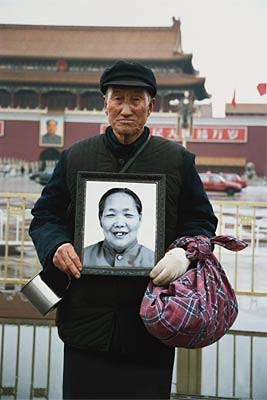
Hao Junchen (Chinese) Hugging a portrait of his wife deceased wife, an elderly man fulfils their dream of visiting Beijing 2003 Gelatin silver print
Feng Jianxin (Chinese) A soldier bids farewell to his wife and child who have just visited him and are now returning home Weichang, Hebei Winter 1987
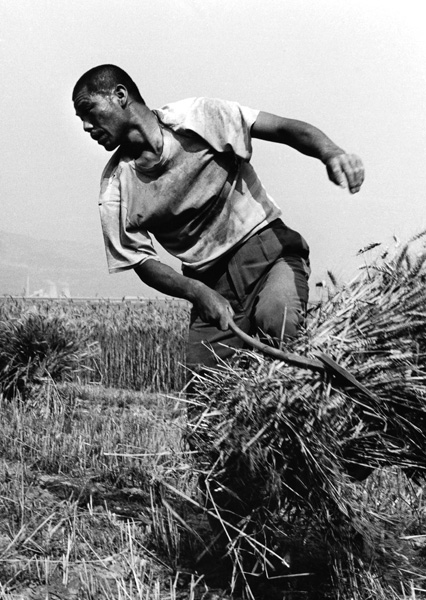
Hu Wugong (Chinese) Migrant wheat farmer in the field in Guanzhong 1998 Gelatin silver print
Wei Dezhong (Chinese, b. 1934) At the Red Flag Canal construction project, suspended labourers cut a channel 1960 Gelatin silver print
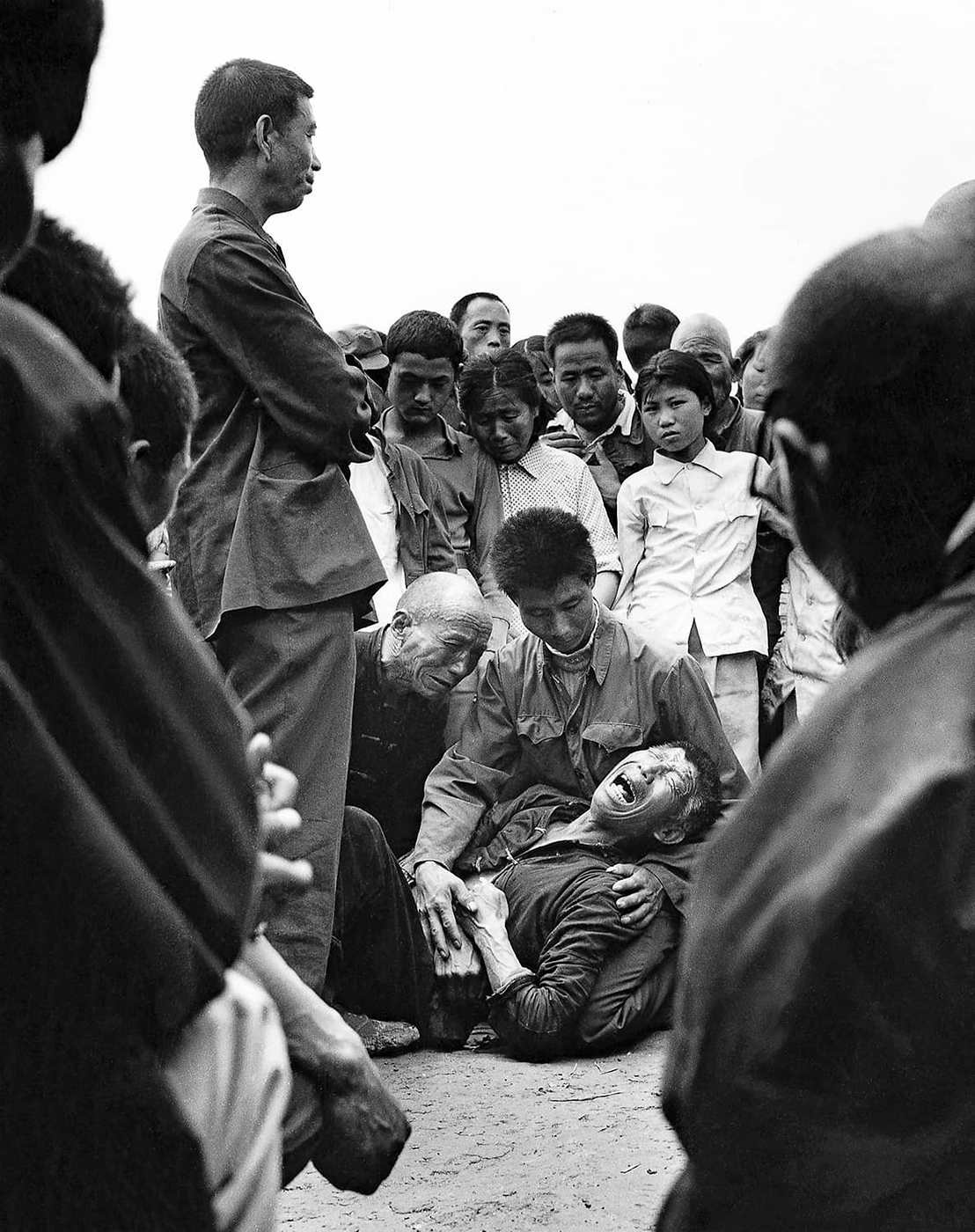
Liu Jun (Chinese) A Parent-Official Like This 1985 Gelatin silver print 51 × 40.7cm
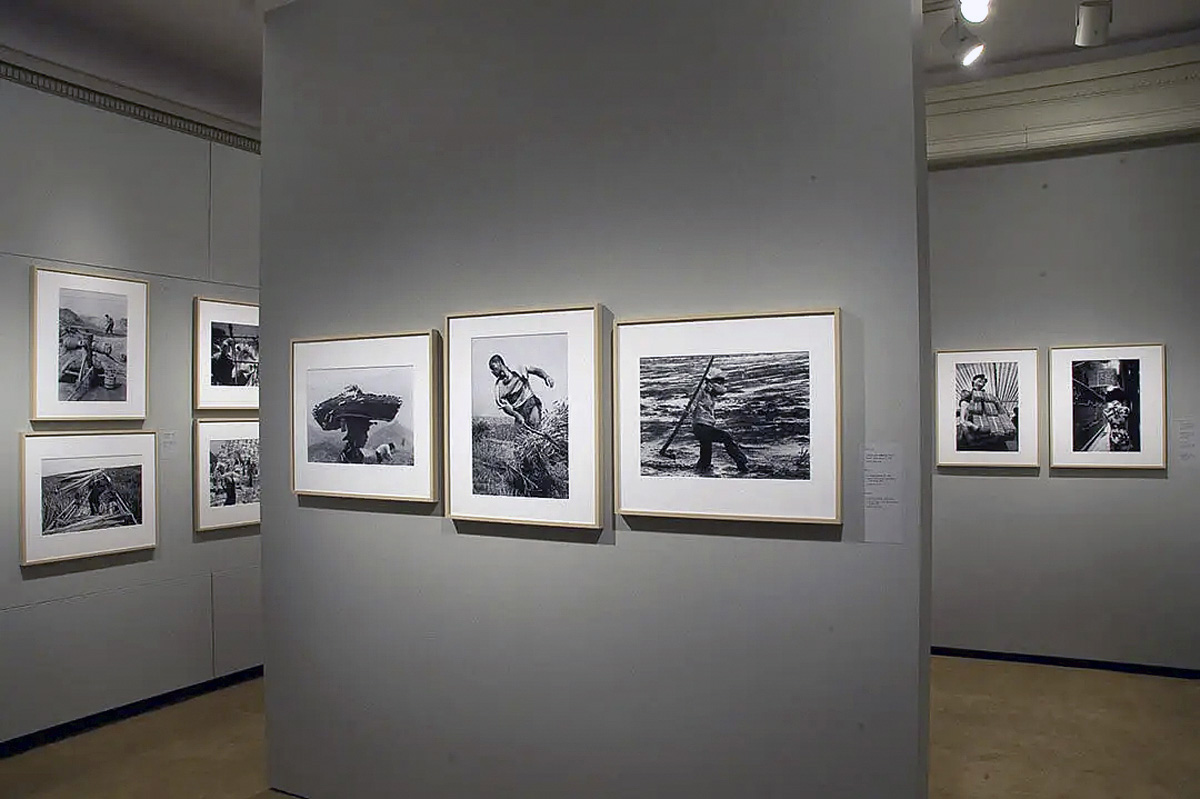
A new exhibition of documentary photography, Humanism in China: A Contemporary Record of Photography, will be on view at China Institute Gallery from September 24 through December 13, 2009, revealing a glimpse of China never before seen in the U.S. The photographs, dating from 1951 though 2003, offer intimate portraits of rural and urban daily life in China, beyond the glossy veneer of the economic boom. A fully illustrated catalogue will accompany the exhibition.
Much in the way that The Family of Man, the 1955 landmark photography exhibition curated by Edward Steichen at The Museum of Modern Art in New York, explored the universality of the human experience, Humanism in China: A Contemporary Record of Photography offers rare insight into ordinary and extraordinary human experiences – in this case, taking place in China over the last 50 years.
Humanism in China: A Contemporary Record of Photography was organised by the Guangdong Museum of Art and represents the first large-scale collection of photography acquired permanently by any museum in China. Opening at the Guangdong Museum in 2003, the exhibition has since travelled to seven venues in China, Germany and Scotland. The curators, Wang Huangsheng, An Ge and Hu Wugong, visited photographers’ homes and studios in more than 20 provinces and viewed an estimated 100,000 photographs before selecting 600 images by 248 photographers. The exhibition at China Institute Gallery will offer a more tightly focused selection – 100 photographs by more than 80 photographers – chosen by Dr. Jerome Silbergeld, Professor of Chinese Art History at Princeton University.
Together the images present an unvarnished, starkly realistic view of the hardships and rewards of social modernisation. “These photographs are not just about society and history but are equally about photography itself and the history of documentary photography in China,” Silbergeld writes in the catalogue essay.
Willow Hai Chang, the Director of China Institute Gallery, notes “The medium and language of photography provide an exceptional opportunity to foster a dialogue, enhancing communication and understanding about everyday life in China. Growing up in China and returning there often, I have witnessed the transforming relationship the Chinese have experienced with photography – from the fear that the camera could steal one’s soul that still exists in some remote regions to the urban proliferation of cell-phone cameras and social-networking sites filled with portraits. Photography also provides a most compelling method of recording history, and Humanism in China: A Contemporary Record of Photography creates a contextual framework for both the traditional and modern elements of life in China.”
The emerging themes from the exhibition span an enormous range of human emotions. Tragedy can be seen in the eyes of a man holding a portrait of his deceased wife, while fear is evident as victims flee rising floodwaters. There is also a graceful patience on view as a couple awaits their country wedding, and utter joy is clearly evident as a man displays his wads of cash after winning the lottery.
One of the most striking images in the exhibition is Iron Rice Bowl (see below), Hei Ming’s 2000 portrait of a Muslim chef squatting in front of a crude construction workers’ restaurant, his skullcap mimicking the customers’ rice bowls hanging on the restaurant’s facade. Another notable image, Geng Yensheng’s painterly photograph Miners at Wumeng Mountain (see below), 2003, depicts the harsh working conditions in the mountainous district where Yunnan, Sichuan and Guizhou provinces come together. As Silbergeld writes, the photograph of the young bathing miners “brings social bitterness and formal beauty into a perfectly fused relationship.”
One of the images, A Parent-Official Like This (see above), became well known in China. In May 1985, Liu Jun had his camera ready when he witnessed a rural deputy chief from the Baishui region in Shaanxi province forcefully push a 60-year-old villager to the ground in a dispute over migration. The resulting photograph captures the horrific arrogance of the authority figure as he towers over the powerless villager whose mouth is contorted in pain. The award-winning image is considered the foremost work of photographic social criticism since the 1949 revolution.
Press release from the China Institute in America website [Online] Cited 20/10/2009 no longer available online
Installation view of the exhibition Humanism in China: A Contemporary Record of Photography at the China Institute in America, New York, September – December, 2009
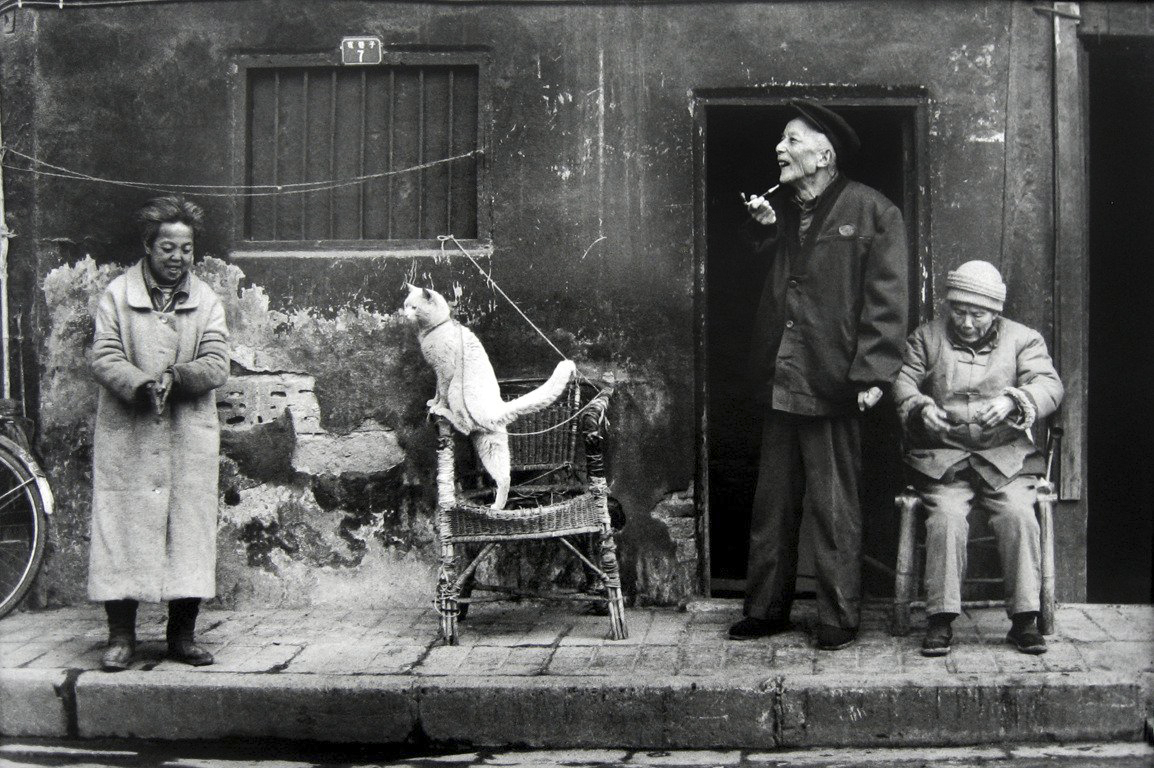
Wu Jialin (Chinese, b. 1926) Having a Chat, Cheng Du 1999 Gelatin silver print
Hei-Ming (Chinese, b. 1964) Iron Rice Bowl 2000 Gelatin silver print
Li Dan (Chinese) Tourists at the Wenshu Temple in Chengdu taking a souvenir photograph 1983 Gelatin silver print
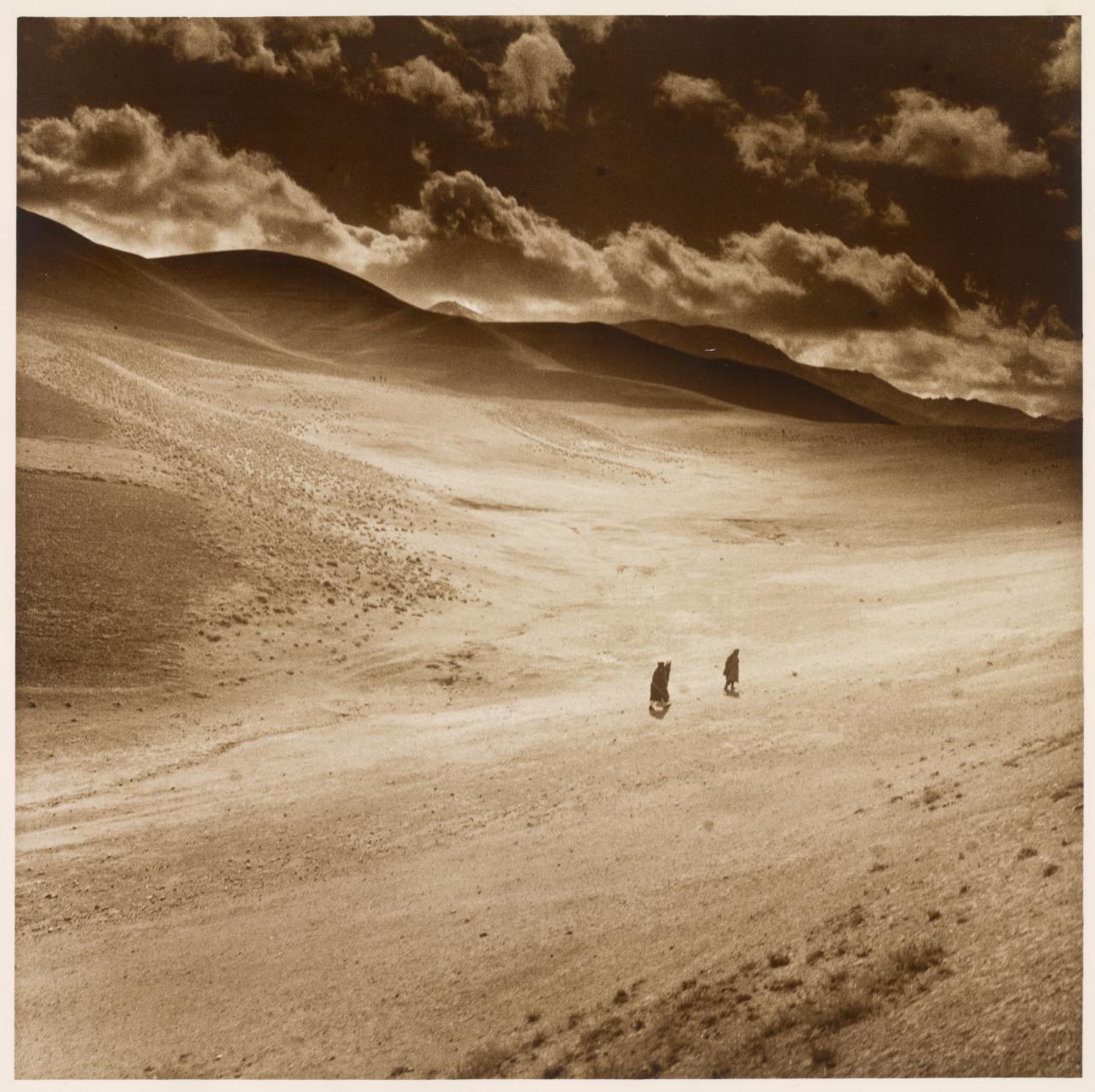
Max Pam (born Australia 1949, lived in Brunei 1980-1983) Road from Bamiyan 1971 Gelatin silver photograph 20.1 x 20.1cm National Gallery of Victoria, Melbourne Purchased, 1979
Long Distance Vision is a disappointingly wane exploration of travel photography at NGV Australia. With the exception of the work of Max Pam the exhibition lacks insight into the phenomena that the curators want the work to philosophically investigate: namely how photographs shape our expectations of a place (even before we arrive) and how photographs also serve to confirm our experience – the picture as powerful mnemonic tool.
Firstly a quick story: when travelling in America to study at the Kinsey Institute I boarded a train from Chicago to what I thought was Bloomington, Indiana only to arrive many hours later at Bloomington, Illinois. Unbeknownst to me this Bloomington also had a motel of the same name as I was staying at in Indiana! After much confusion I ended up at the local airport trying to catch a single seater aircraft to Bloomington, Indiana with no luck – at the end of my tether, fearful in a foreign country, in tears because I just had to be at this appointment the next morning. Riding to my rescue was a nineteen year old kid with no shoes, driving an ex-cop car, who drove me across the Mid-West states stopping at petrol stops in the dead of night. It was a surreal experience, one that I will never forget for the rest of my life … fear, apprehension, alienation, happiness, joy and the sublime all rolled into one.
I tell this story to illustrate a point about travel – that you never know what is going to happen, what experiences you will have, even your final destination. To me, photographs of these adventures not only document this dislocation but step beyond pure representation to become art that re-presents the nature of our existence.
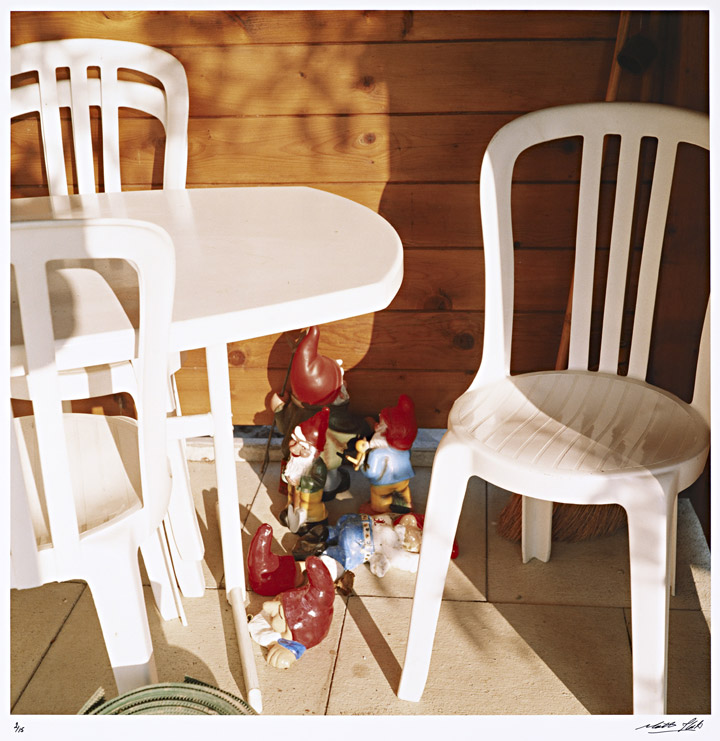
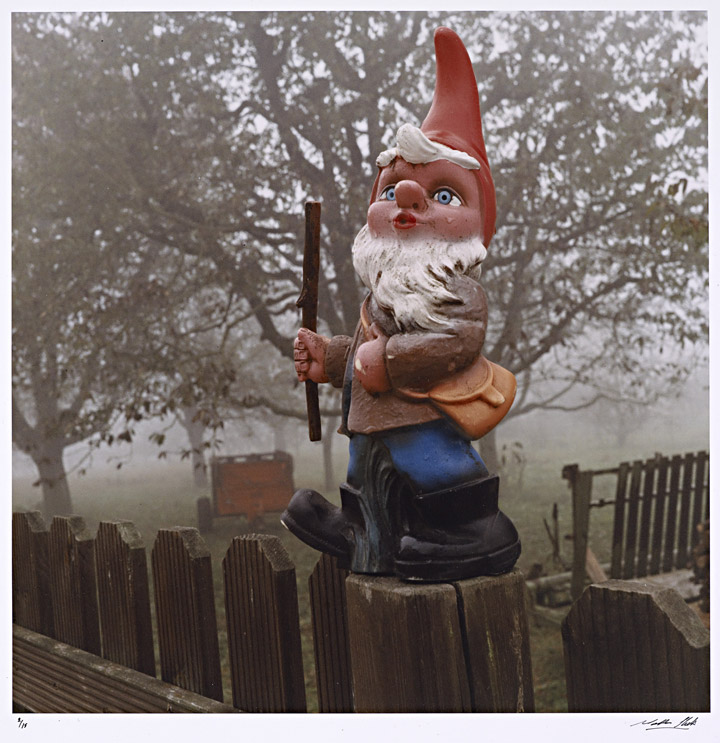
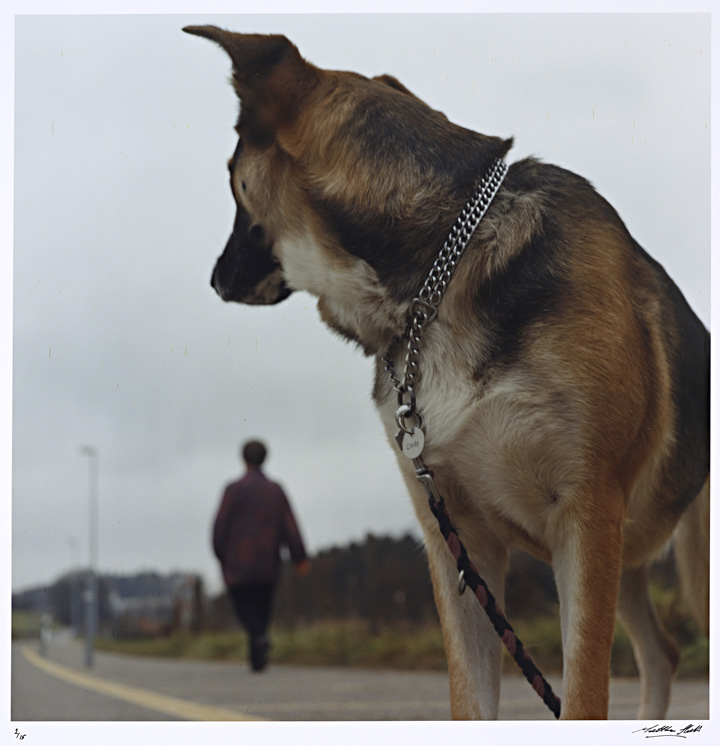
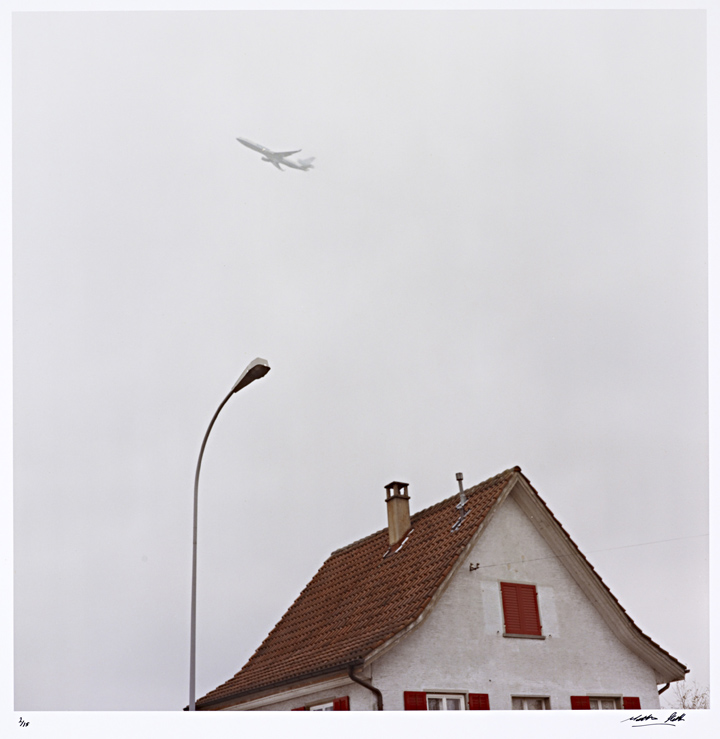
Matthew Sleeth‘s street photographs could be taken almost anywhere in the world (if it were not for a building with German writing on it). His snapshot aesthetic of caught moments, blinded people and dissected bodies in the observed landscape are evinced (to show in a clear manner; to prove beyond any reasonable doubt; to manifest; to make evident; to bring to light; to evidence – yes to bring to light, to evidence as photography does!) in mundane, dull, almost lifeless prints – ‘heavy’ photographs with a lack of shadow detail combined with a shallow depth of field. His remains, the people walking down the street and their shadow, are odd but as as The Age art critic Robert Nelson succinctly notes in his review of this exhibition, “To become art, the odd cannot remain merely quaint but has to signify an existential anomaly by implication.”1
If we look at the seminal photographs from the book The Americans by Robert Frank we see in their dislocated view of America a foreigners view of the country the artist was travelling across – a subjective view of America that reveals as much about the state of mind of the artist as the country he was exposing. No such exposition happens in the works of Matthew Sleeth.
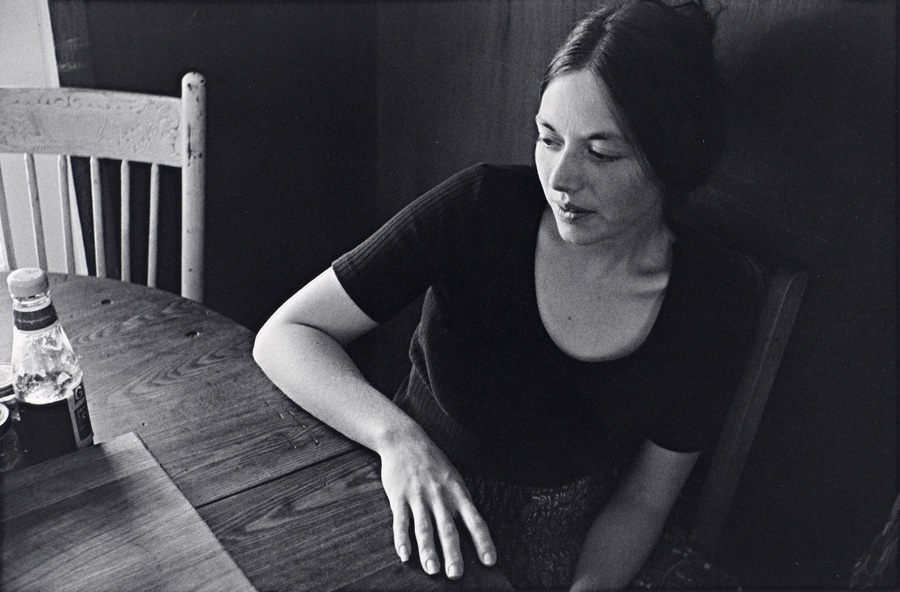
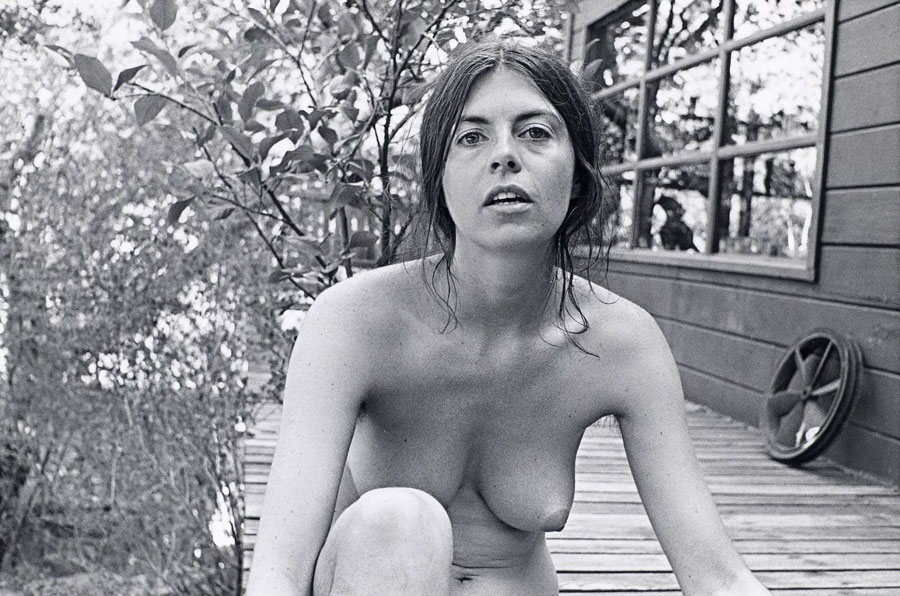
Christine Godden‘s photographs of family and friends have little to do with travel photography and I struggle to understand their inclusion in this exhibition. Though they are reasonable enough photographs in their own right – small black and white photographs of small intimacies (at the beach, in the garden, at the kitchen table, on the phone, on the porch, on the float, etc…) Godden’s anthropomorphist bodies have nothing to do with a vision of a new land as she had been living in San Francisco, New York and Rochester for six years over the period that these photographs were taken. Enough said.
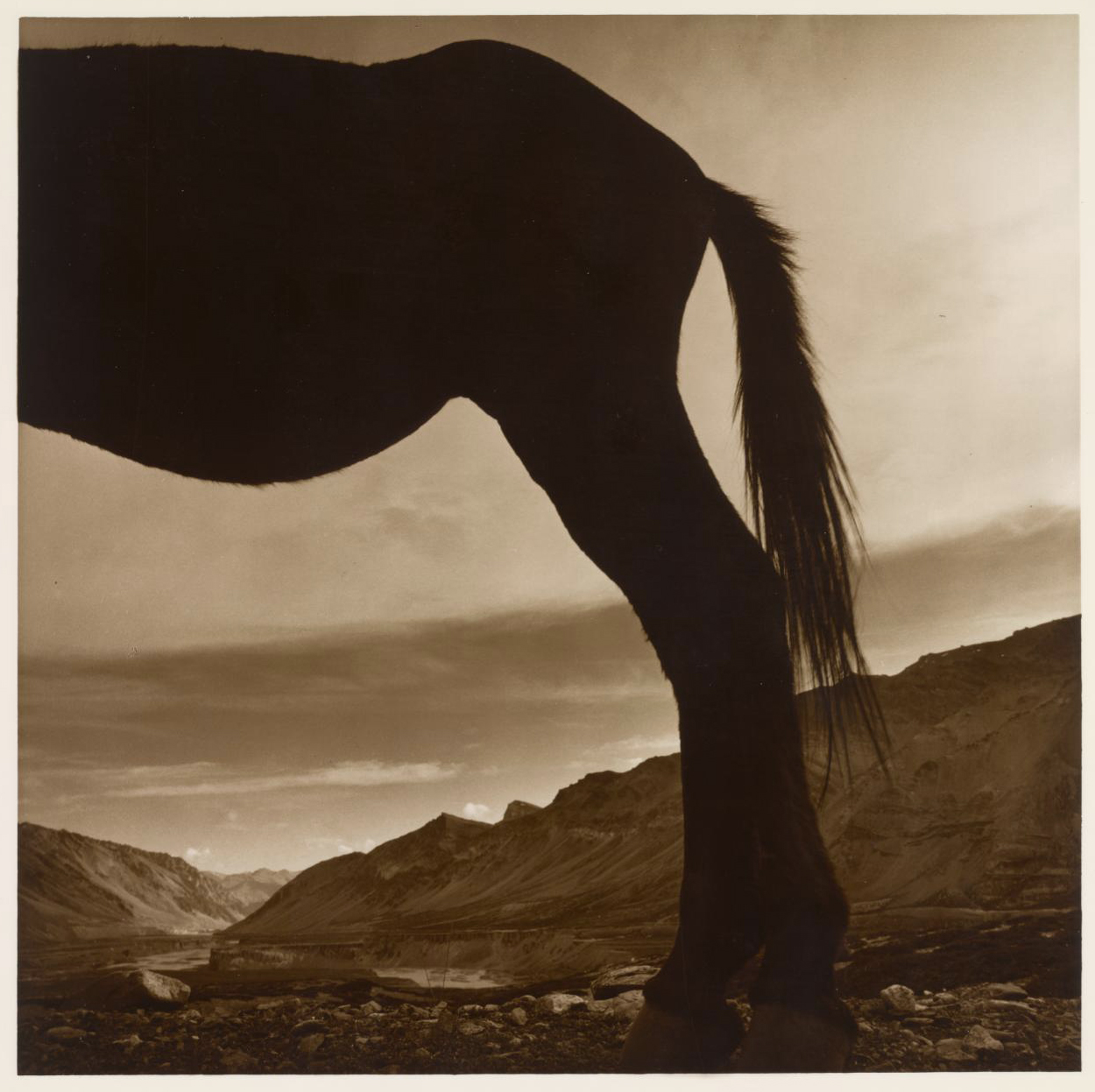
The highlight of the exhibition is the work of Max Pam. I remember going the National Gallery of Victoria in the late 1980s to view this series of work in the collection – and what a revelation they were then and remain so today. The square formatted, dark sepia toned silver gelatin prints of the people and landscapes of Tibet are both monumental and personal at one and the same time. You are drawn into their intimacies: the punctum of a boys feet; the gathering of families; camels running before a windstorm; human beings as specks in a vast landscape.
“If the world is unfair or beyond our understanding, sublime places suggest it is not surprising things should be thus. We are the playthings of the forces that laid out the oceans and chiselled the mountains. Sublime places acknowledge limitations that we might otherwise encounter with anxiety or anger in the ordinary flow of events. It is not just nature that defies us. Human life is as overwhelming, but it is the vast spaces of nature that perhaps provide us with the finest, the most respectful reminder of all that exceeds us. If we spend time with them, they may help us to accept more graciously the great unfathomable events that molest our lives and will inevitably return us to dust.”2
The meditation on place and space that the artist has undertaken gives true insight into the connection of man and earth, coming closest to Alain de Botton’s understanding of the significance of sublime places. Through a vision of a distant land the photographs transport us in an emotional journey that furthers our understanding of the fragility of life both of the planet and of ourselves.
While the National Gallery of Victoria holds some excellent photography exhibitions (such as Andreas Gursky and Rennie Ellis for example) this was a missed opportunity. The interesting concept of the exhibition required a more rigorous investigation instead of such a cursory analysis (which can be evidenced by the catalogue ‘essay’: one page the size of a quarter of an A4 piece of paper that glosses over the whole history of travel photography in a few blithe sentences).
Inspiration could have easily been found in Alain de Botton’s excellent book The Art of Travel. Here we find chapters titled “On Anticipation”, “On Travelling Places”, “On the Exotic”, “On Curiosity”, “On the Country and the City” and “On the Sublime” to name but a few, with places and art work to illustrate the journey: what more is needed to excite the mind!
Take Charles Baudelaire for example. He travelled outside his native France only once and never ventured abroad again. Baudelaire still dreamt of going to Lisbon, or Java or to the Netherlands but “the destination was not really the point. The true desire was to get away, to go, as he concluded, ‘Anywhere! Anywhere! So long as it is out of the world!'”3
Heavens, we don’t even have to leave home to create travel photography that is out of the world! Our far-sighted vision (like that of photographer Gregory Crewdson) can create psychological narratives of imaginative journeys played out for the camera.
Perhaps what was needed was a longer gestation period, further research into the theoretical nuances of travel photography (one a little death, a remembrance; both a dislocation in the non-linearity of time and space), a gathering of photographs from collections around Australia to better evidence the conceptual basis for the exhibition and a greater understanding of the irregular possibilities of travel photography – so that the work and words could truly reflect the title of the exhibition Long Distance Vision.
Dr Marcus Bunyan
1/ Nelson, Robert. “In blurred focus: le freak c’est chic,” in The Age newspaper. Friday, October 23rd 2009, p. 18
2/ de Botton, Alain. The Art of Travel. London: Penguin, 2002, p. 178-179
“The National Gallery of Victoria will celebrate the work of Christine Godden, Max Pam and Matthew Sleeth in a new exhibition, Long Distance Vision: Three Australian Photographers opening 28 August.
Long Distance Vision will include over 60 photographs from the NGV Collection exploring the concept of the ‘tourist gaze’ and its relationship with the three artists.
Susan van Wyk, Curator Photography, NGV said the exhibition provides a fascinating insight into the unusual perspective brought by the three photographers to their varied world travel destinations.
“There’s a sense in the works in the exhibition that the photographers are not from the places they choose to photograph, and that each is a visitor delighting in the scenes they encounter.
“What is notable about the photographs in Long Distance Vision is that rather than focussing on the well known scenes that each artist encountered, they have turned their attention to the ‘little things’, the details of the everyday,” said Ms van Wyk.
From the nineteenth century, photography has been a means by which people could discover the world, initially through personal collection and albums, and later via postcards, magazines, books and the internet.
Dr Gerard Vaughan, Director, NGV said that both contemporary photographers and tourists use the camera as a means to explore and capture the world.
“Through their photographs, the three artists featured in Long Distance Vision show us highly individual ways of seeing the world. This exhibition will surprise and delight visitors as our attention is drawn to not only what is different but what remains the same as we travel the world,” said Dr Vaughan.
Born in Melbourne in 1949, Max Pam began his career in various commercial photography studios in the 1960s. After responding to a university notice for assistance to drive a Volkswagen from Calcutta to London in 1969, Pam got his first taste of being a traveller. The body of Pam’s work in this exhibition is from the series The Himalayas, which was photographed over a number of early visits to India.
Christine Godden also travelled the popular overland route between Europe and India in the early 1970s, returning to Sydney in 1978. In 1972, after a period of travelling, Godden found her home in the US where she remained for six years. Godden’s photographs in this exhibition were taken between 1972 and 1974 during her stay in the US.
Born in Melbourne in 1972, Matthew Sleeth is another seasoned traveller. During the late 1990s, Sleeth settled in Opfikon, an outer suburb of Zurich, Switzerland. The series of photographs in Long Distance Vision were taken during this time, showing Sleeth’s interest not only in street photography, but also in the narrative possibilities in everyday scenes. Dotted with garishly coloured playhouses, naive sculptures and whimsical arrangements of garden gnomes Sleeth’s photographs go beyond the ‘picture-perfect’ scenes of typical tourist photography.
Long Distance Vision: Three Australian Photographers is on display at The Ian Potter Centre: NGV Australia, Federation Square from 28 August 2009 to 21 February 2010.”
Text from the National Gallery of Victoria press release
Exhibition dates: 12th September – 8th November, 2009
Many thankx to the Morris Museum of Art for allowing me to publish the photographs in the posting. Please click on the photographs for a larger version of the image.
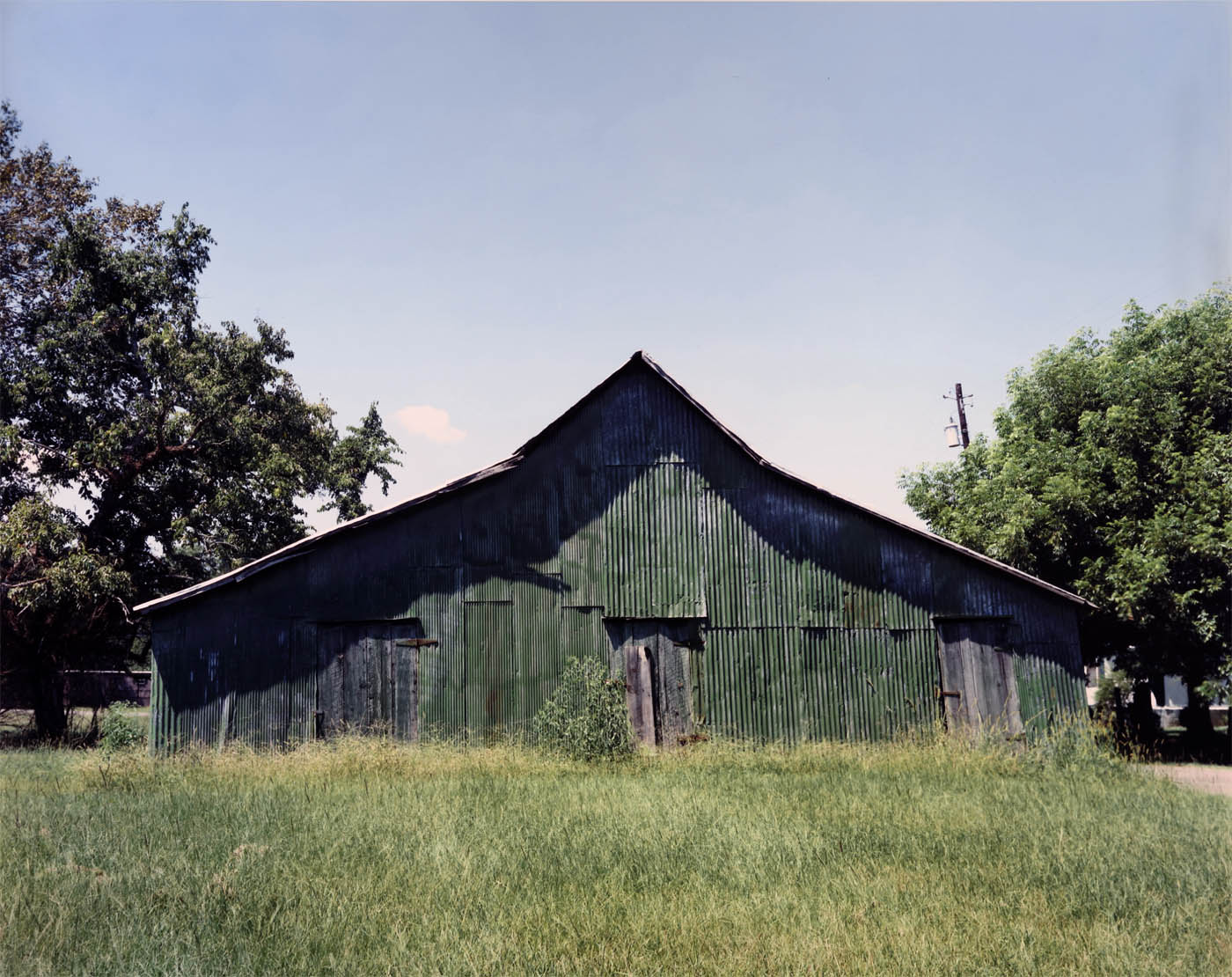
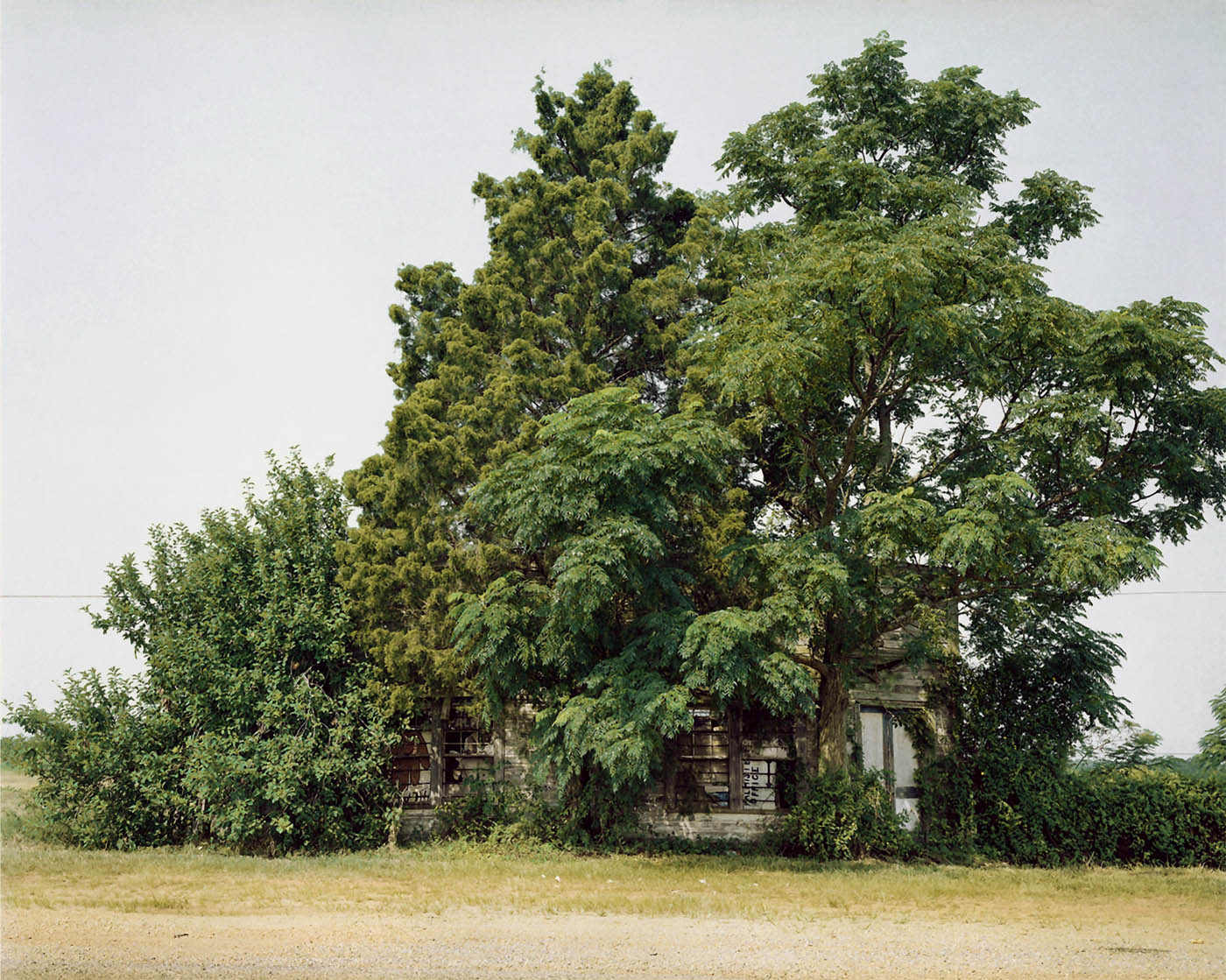
William Christenberry (American, 1936-2016) Green Warehouse, Newbern, Alabama 1997 Dye coupler print
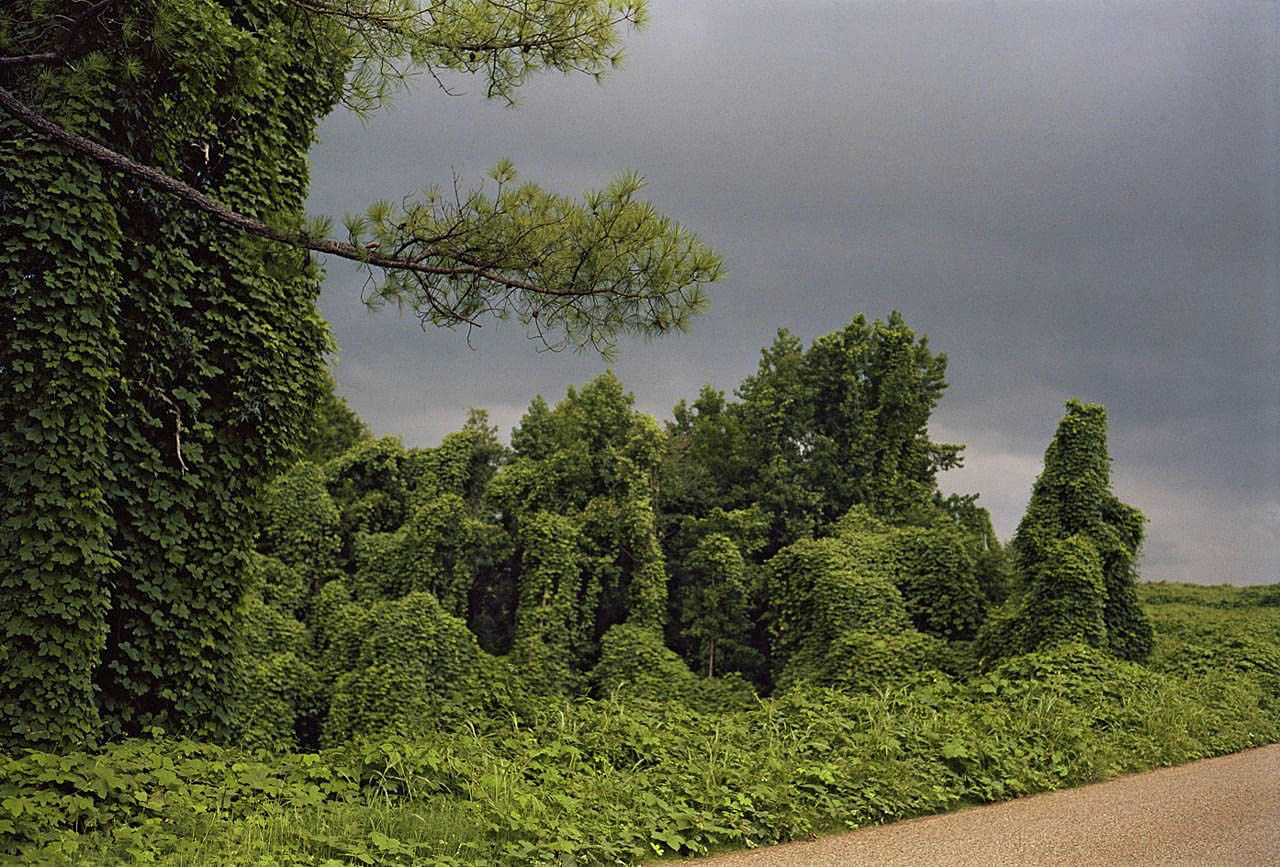
Widely recognised as a pioneer in the field of colour photography, William Christenberry has used this expressive medium to explore the American South for forty years. While pursuing this artistic quest he has drawn inspiration from Walker Evans, and influenced a generation of emerging photographers. William Christenberry: Photographs, 1961-2005 surveys his poetic documentation of southern vernacular architecture, signage, and landscape using a wide range of cameras, from his earliest Brownie photographs of the early 1960s to his later work with a large-format camera. Combining never-before-seen photographs, both old and new, with images that are now iconic, this exhibition comprises fifty vintage photographic works and one sculpture. Together, they convey the breadth of his singular photographic vision. Discuss the artistic objectives of his long-term interpretation of the Southern landscape with Michelle Norris of National Public Radio, Christenberry explained: “What I really feel very strongly about, and I hope reflects in all aspects of my work, is the human touch, the humanness of things, the positive and sometimes the negative and sometimes the sad.”
Text from the Morris Museum of Art website [Online] Cited 15/10/2009. No longer available online
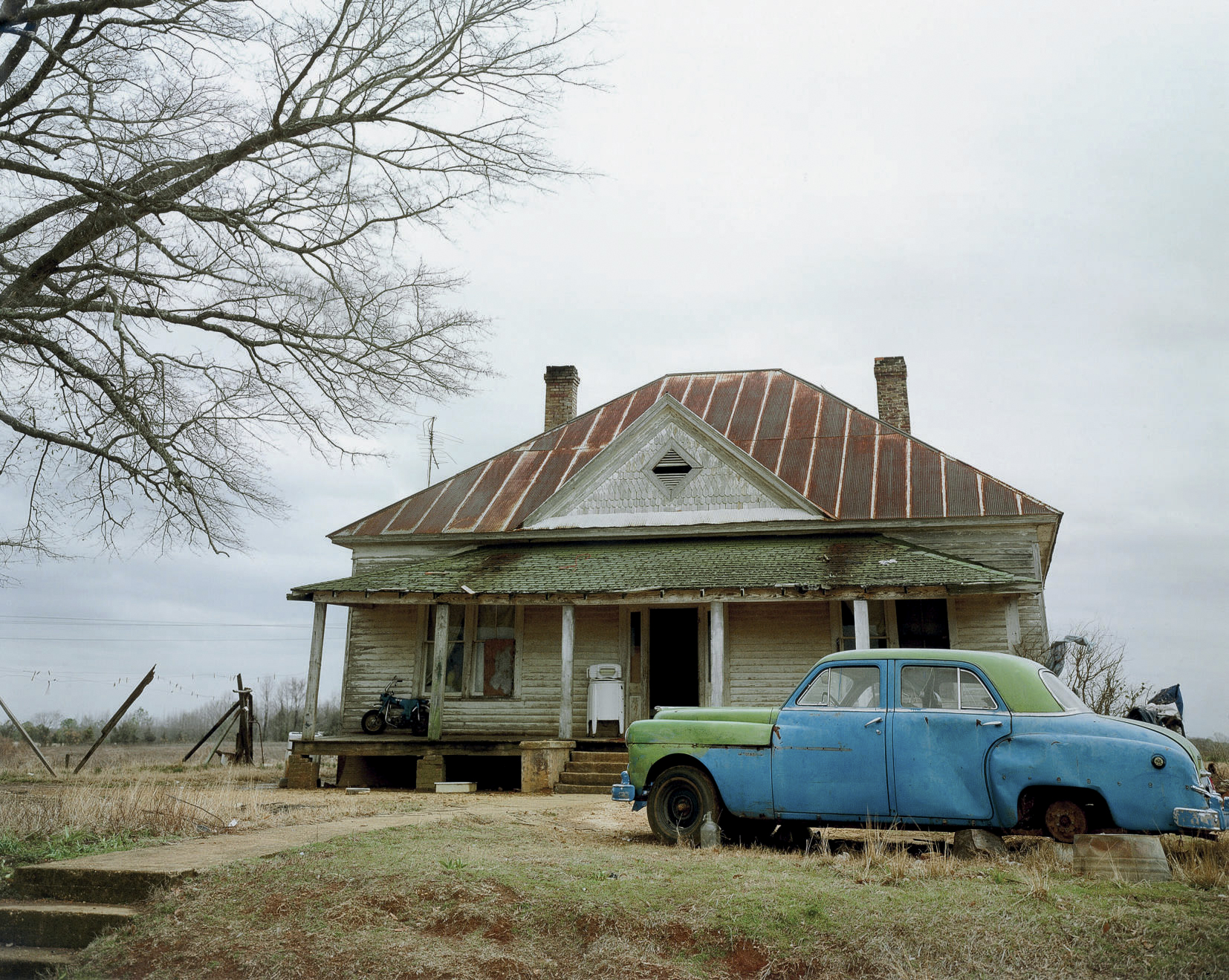
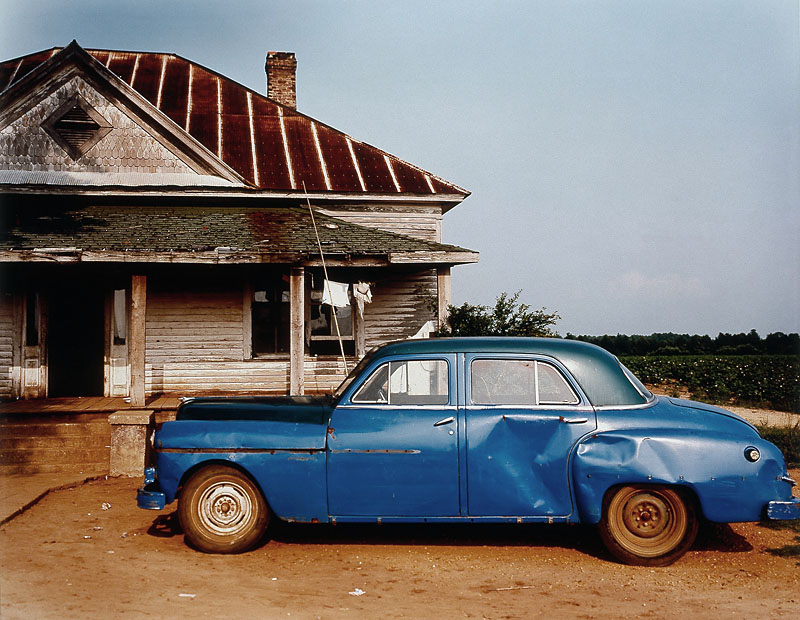
William Christenberry (American, 1936-2016) House and Car, near Akron, Alabama 1981
William Christenberry (American, 1936-2016) Kudzu with Storm Cloud, near Akron, Alabama 1981
“William Christenberry Photographs, 1961-2005, a phenomenal retrospective exhibition of Christenberry’s photographs, opens to the public at the Morris Museum of Art on September 16, 2009. The Morris Museum is the only Georgia venue hosting this exhibition.
“‘William Christenberry Photographs, 1961-2005’ is an overview of the career of one of the South’s most important living artists,” said Kevin Grogan, director of the Morris Museum of Art. “Organised by the Aperture Foundation, this exhibition brings to Augusta a body of work like no other. No one has so scrupulously and attentively captured a sense of place and time in quite the way that Bill Christenberry has. He is a remarkable artist, as is proven by this extraordinary body of work. He is America’s Proust.”
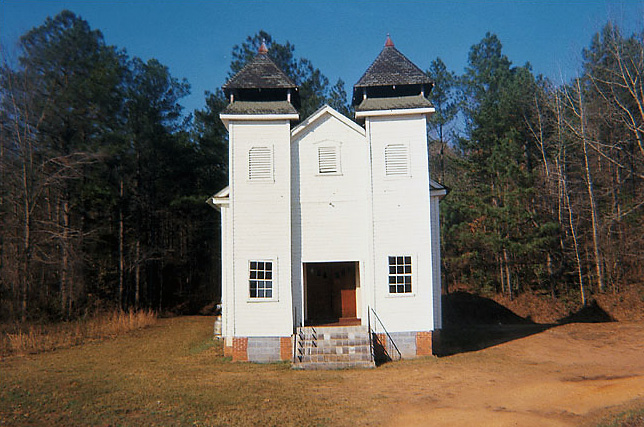
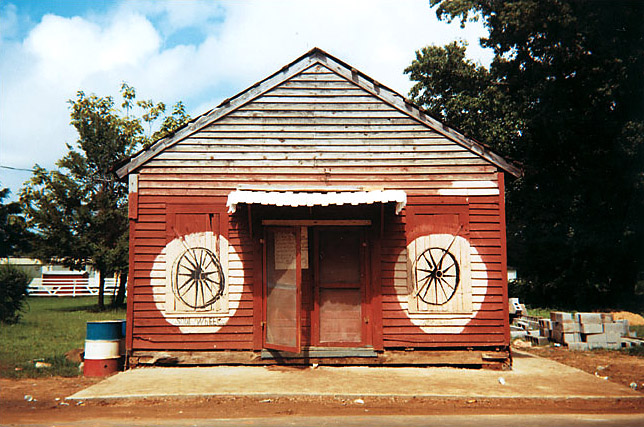
Since the early 1960s, William Christenberry has plumbed the regional identity of the American South, focusing his attention primarily on his childhood home, Hale County, Alabama. Widely recognised as a pioneer in the field of colour photography, Christenberry draws inspiration from the work of Walker Evans, while paralleling the work of such international practitioners as Bernd and Hilla Becher. Ranging from his earliest Brownie photographs to his later work with a large-format camera, William Christenberry Photographs, 1961-2005 is a survey of the artist’s poetic documentation of the Southern landscape and vernacular architecture that surrounded him as he grew up. The exhibition, coupling never-before-seen photographs with images that are now iconic, reveals how the history, the very story of place, is at the heart of Christenberry’s ongoing project. While the focus of his work is the American South, it touches on universal themes related to family, culture, nature, spirituality, memory, and ageing. Christenberry photographs real things in the real world – ramshackle buildings, weathered commercial signs, lonely back roads, rusted-out cars, whitewashed churches, decorated graves. Dutifully returning to photograph the same locations annually – the green barn, the palmist building, the Bar-B-Q Inn, among others – he has fulfilled a personal ritual and documented the physical changes wrought by every single year. Straddling past and present, Christenberry’s art suggests the gravity and power of the passage of time.
The exhibition is accompanied by a stunning monograph entitled William Christenberry, published by Aperture in cooperation with the Smithsonian American Art Museum. The book, a comprehensive survey, presents all aspects of the artist’s oeuvre as he intended it to be viewed and considered. More than half the work reproduced has not been previously published.”
Text from the press release on the Morris Museum of Art website [Online] Cited 15/10/2009. No longer available online
William Christenberry (American, 1936-2016) Sprott Church in Alabama 1971
William Christenberry (American, 1936-2016) T.B. Hick’s Store, Newbern, Alabama 1976
William Christenberry (American, 1936-2016) Farmhouse, Hale County, Alabama 1977
William Christenberry (American, 1936-2016) House and Car, near Akron, Alabama 1978
William Christenberry (American, 1936-2016) Palmist Building, Havanna, Alabama 1980
The Palmist Building is one of the most iconic structures in Christenberry’s extensive body of work. When he was a child, the clapboard building was a general store operated by his great uncle, but it was later home to a palm reader. The inverted hand-painted sign that covers a broken window initially enticed him to photograph the building in 1961. His earliest photographs pinpoint the sign itself and the peeling whitewash around it. As he became more engrossed in the project, Christenberry carefully examined the relationship of the building to its surroundings, particularly the chinaberry tree that eventually engulfed it.
Text from the High Museum of Art website
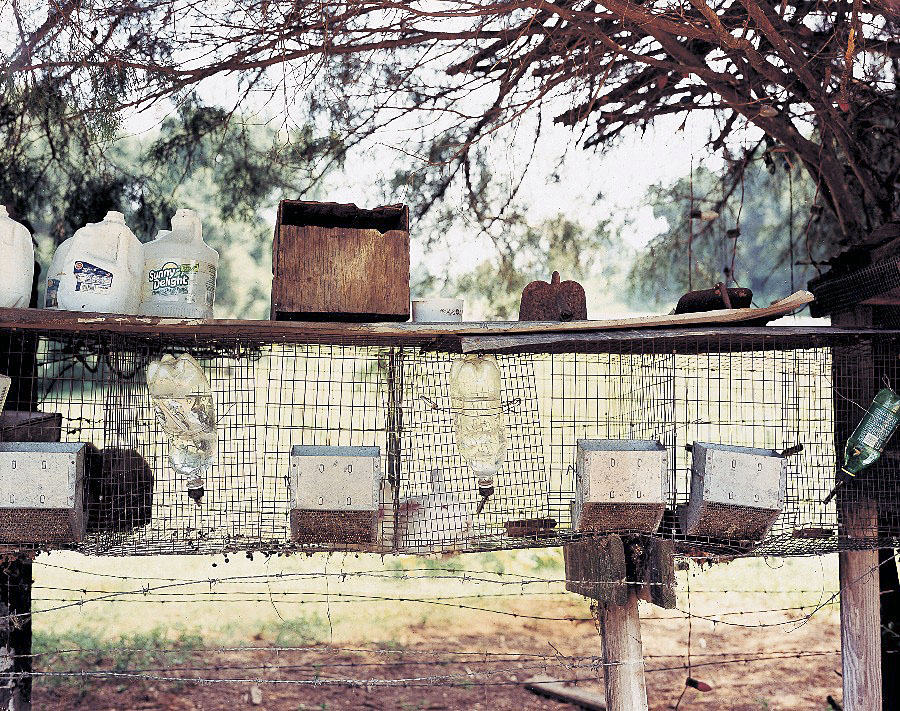
William Christenberry (American, 1936-2016) Rabbit Pen, near Moundville, Alabama 1998
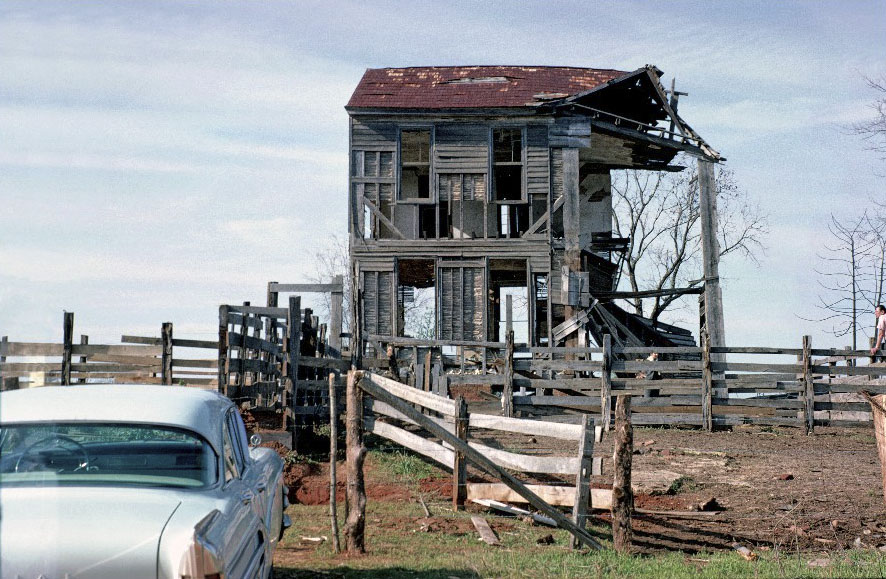
William Christenberry (American, 1936-2016) Old House, near Akron, Alabama 1964
Morris Museum of Art 1 Tenth Street Augusta, Georgia 30901 Phone: 706-724-7501
Opening Hours: Tuesday – Saturday: 10.00am – 5.00pm Sunday: 12 – 5.00pm Closed Mondays and major holidays
Exhibition dates: 30th September – 24th October, 2009
eX de Medici (Australia, b. 1959) Tooth and claw 2009 Pen, ink and mica on archival paper 114.0 x 521.0cm
Is it sinful to say that an Armalite rifle can be voluptuously seductive? Not in the hands of artist eX de Medici!
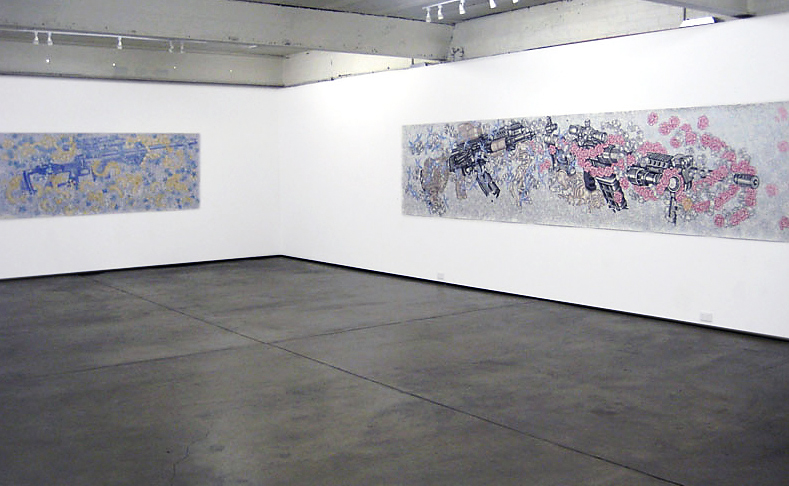
Taking a variety of contemporary military high-powered weapons (Armalite AR30 Tactical .308 Sniper, Modified AK 47, Blackwater AR15, Patriot Ordinance P45 .223 for example) eX de Medici’s armaments have a steely presence softened and consumed by multitudinous garlands of traditional tattoo ‘flash’ iconography (flowers, skulls, bows, stars, Chinese dragons, waves and swallows repeated in Escher-like patterns) and contorted skeletons. Using individual colour palettes for each of the three large pen, ink and mica on paper works in the exhibition, eX subverts the masculine symbology of gun culture and decomposes it within an ornamentation of deathly desire – new compositions in the dance of death: ‘U hurt me Baby, U Fkd me up gd, the hole tht u made (cross) me Ded …’
In other less skilled artist’s hands the subject matter could become cliched and trite but here de Medici balances the disparate elements in her compositions and brings the subject matter alive – sinuously jumping off the paper, entwining the viewer in their delicious ironies, all of us sweetly complicit in the terror war (send more meat, send more meat!), fighting tooth and nail to keep urban realities at arm’s length. The dark desires that these works contain possess an aesthetic beauty that swallows us up so that we, too, become ‘Barbarians All’. Highly recommended!
Dr Marcus Bunyan
Many thankx to Karen Woodbury Gallery for allowing me to publish the art work in the posting. Please click on some of the photographs for a larger version of the image.
eX de Medici (Australia, b. 1959) Tooth and claw (detail) 2009 Pen, ink and mica on archival paper 114.0 x 521.0cm
eX de Medici (Australia, b. 1959) Tooth and claw (details) 2009 Pen, ink and mica on archival paper 114.0 x 521.0cm
Installation view of Sweet Complicity by eX de Medici at Karen Woodbury Gallery, Melbourne showing at left, Send more meat (2009) and at right, Tooth and claw (2009) Photo: Marcus Bunyan
eX de Medici (Australia, b. 1959) Send more meat 2009 Pen, ink and mica on archival paper
eX de Medici (Australia, b. 1959) Send more meat (detail) 2009 Pen, ink and mica on archival paper
Sweet complicity is eX de Medici’s first and much anticipated exhibition at Karen Woodbury Gallery. The exhibition will comprise of three monumental pen, ink and mica works on archival paper. These works examine recurring themes in her practice such as power, war, death and violence via a decorative feminine veneer and aesthetic.
The recurrent use of symbolism in the form of weapons, skulls and garlands in her work re-appear with the addition of Chinese imagery (Imperial golden dragons, China’s five-pointed star, and the use of chrysanthemums). These potent works display a latent interest in scientific illustration and allude to de Medici’s characteristic stylised tattoo motifs that stems from her work as a tattooist. The almost obsessive repetition of pattern and immense detailing display eX’s dedication to her practice through the strong mental and physical commitment required to complete such awe-inspiring artworks that seduce the viewer.
There is an unmistaken polemic tone in de Medici’s practice that cannot be ignored. Different cultures, identities, actions and consequences are represented and centred on objects of warfare, allowing for disguised and layered political and moral statements.
de Medici lives and produces much of her work in the nation’s capital Canberra. Streams of influences inform the work; Canberra’s political and physical agendas, research resourced from various national institutions such as the CSIRO Entomological and Taxonomy Division, the National Library of Australia and the Australian War Memorial. She has recently returned from the Solomon Islands where she was chosen as an official war artist.
Text from the Karen Woodbury Gallery website [Online] Cited 05/10/2009. No longer available online
The defining theme in eX de Medici’s paintings is a consistent interrogation of power. The notion of ‘the personal’ doesn’t interest the artist. Instead she investigates authority and dissent through paintings of guns, surveillance devices and gas masks.
eX de Medici (Australia, b. 1959) American Sex/Funky Beat Machine 2009 Pen, ink and mica on archival paper Diptych, 114.0 x 249.0cm
eX de Medici (Australia, b. 1959) American Sex/Funky Beat Machine (detail) 2009 Pen, ink and mica on archival paper Diptych, 114.0 x 249.0cm
Exhibition dates: 12th September – 17th October, 2009
Many thankx to Regen Projects for allowing me to publish the art work in the posting. Please click on the photographs for a larger version of the image.
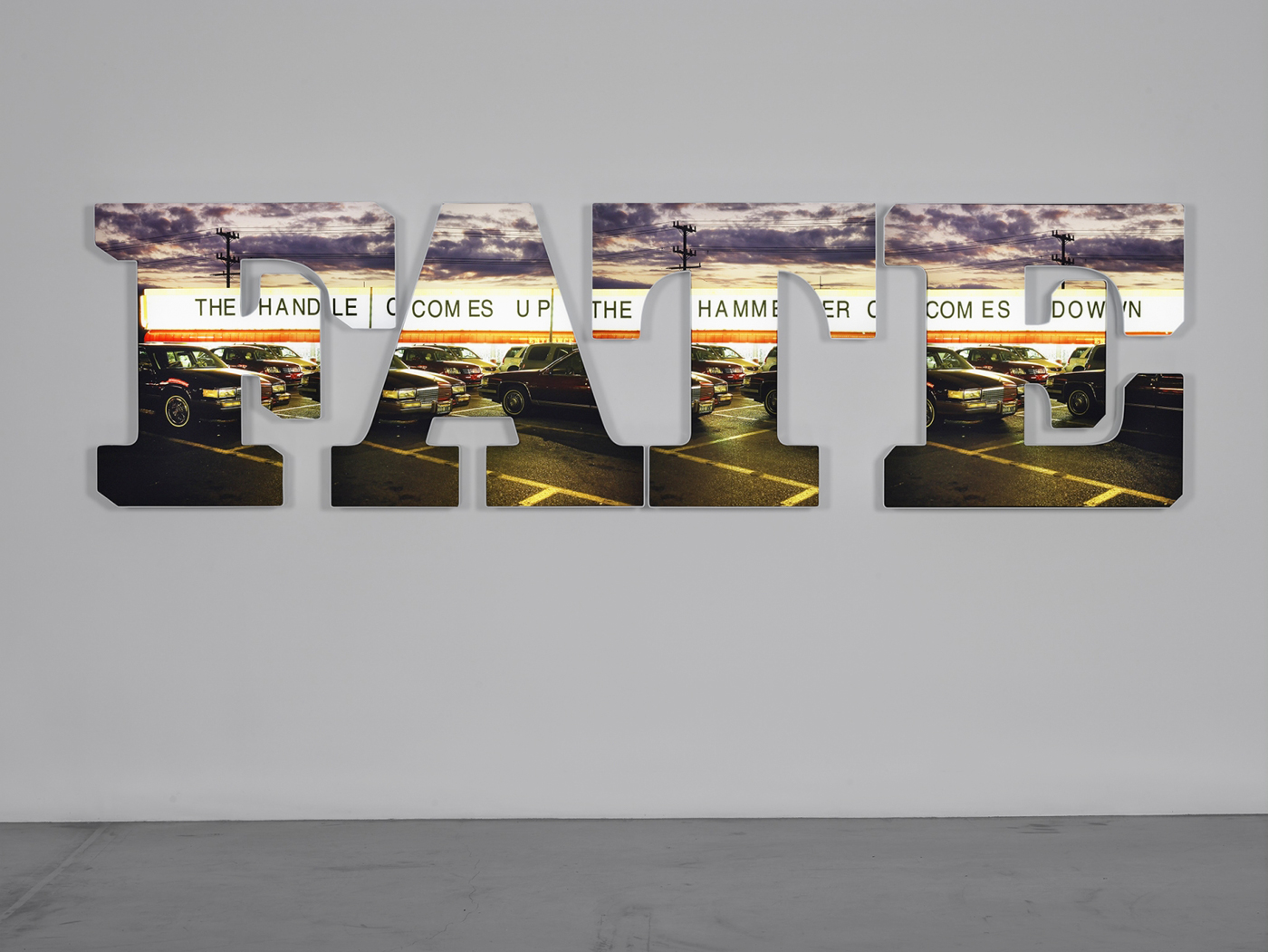
Doug Aitken (American, b. 1968) The handle comes up, the hammer comes down 2009 LED lit lightbox
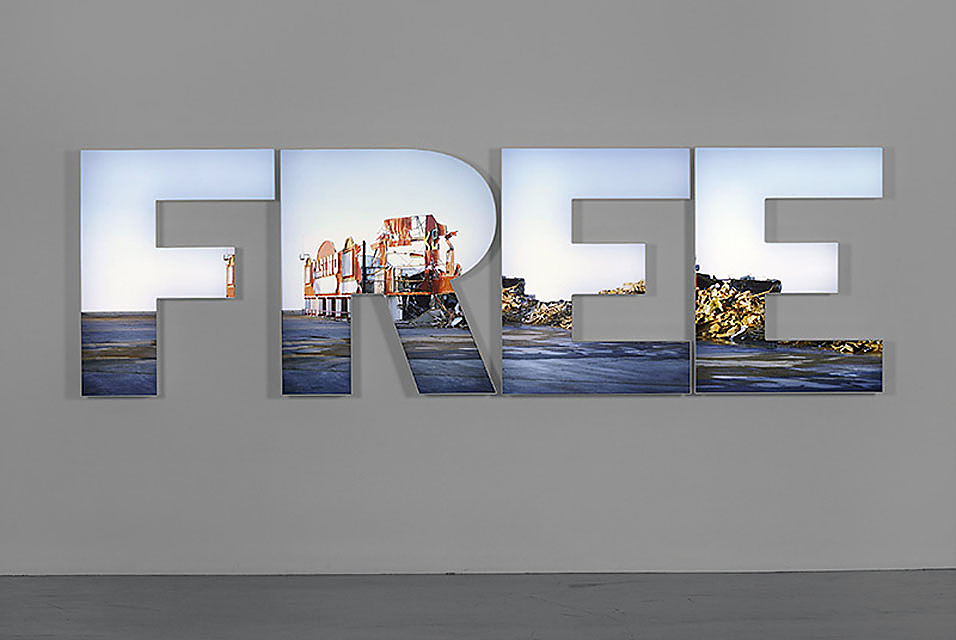
Doug Aitken (American, b. 1968) Free 2009 LED lit lightbox
Doug Aitken (American, b. 1968) Start Swimming LED lit lightbox 2006
Doug Aitken (American, b. 1968) Start Swimming LED lit lightbox 2006
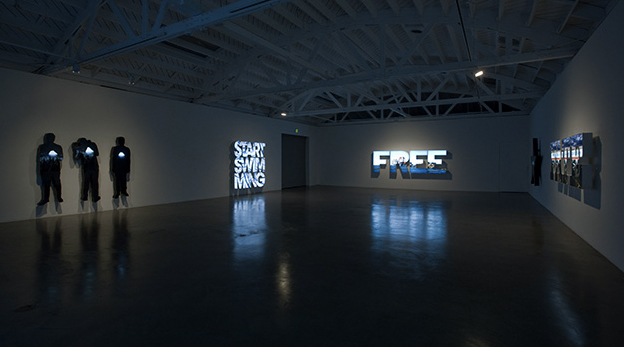
Installation view of Doug Aitken at Regen Projects, Los Angeles
Regen Projects is pleased to announce an exhibition of new works by Los Angeles artist Doug Aitken. This exhibition will present a series of new text-based light boxes and will feature the west coast debut of the film migration. Aitken explores the themes of temporality, space, memory, movement, and landscape in his work. History and themes of both the past and present are interwoven and reconfigured. His work deconstructs the connection between idea and iconography allowing each to reinvent itself.
Doug Aitken’s new light boxes combine image and text in a collision that creates a rupture in which alternate connections are presented. The work frontier depicts a destroyed property on the water’s edge, redefining expectations of what a frontier may hold. The images within some of the light boxes are a photographic collage that references Aitken’s photographic oeuvre and aesthetic. Experimenting with font, borrowed images, and his own photographs, the light boxes will be presented in the darkened gallery, glowing and playing off of one another. The disjunction of word, image, and light in these works also moves toward a cinematic whole, creating panoramic landscapes through text.
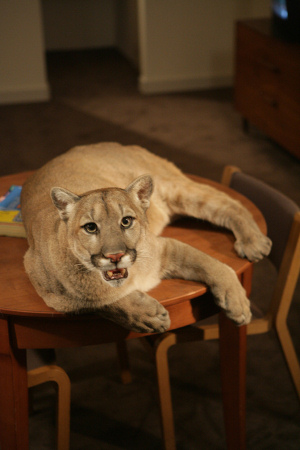
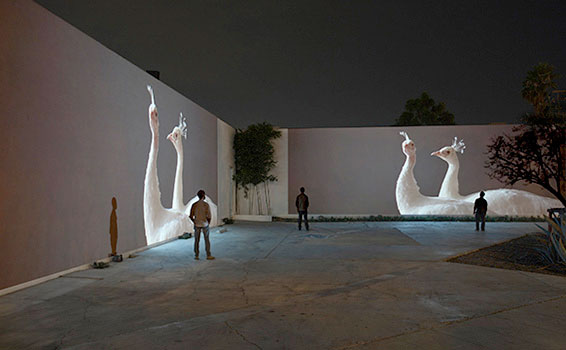
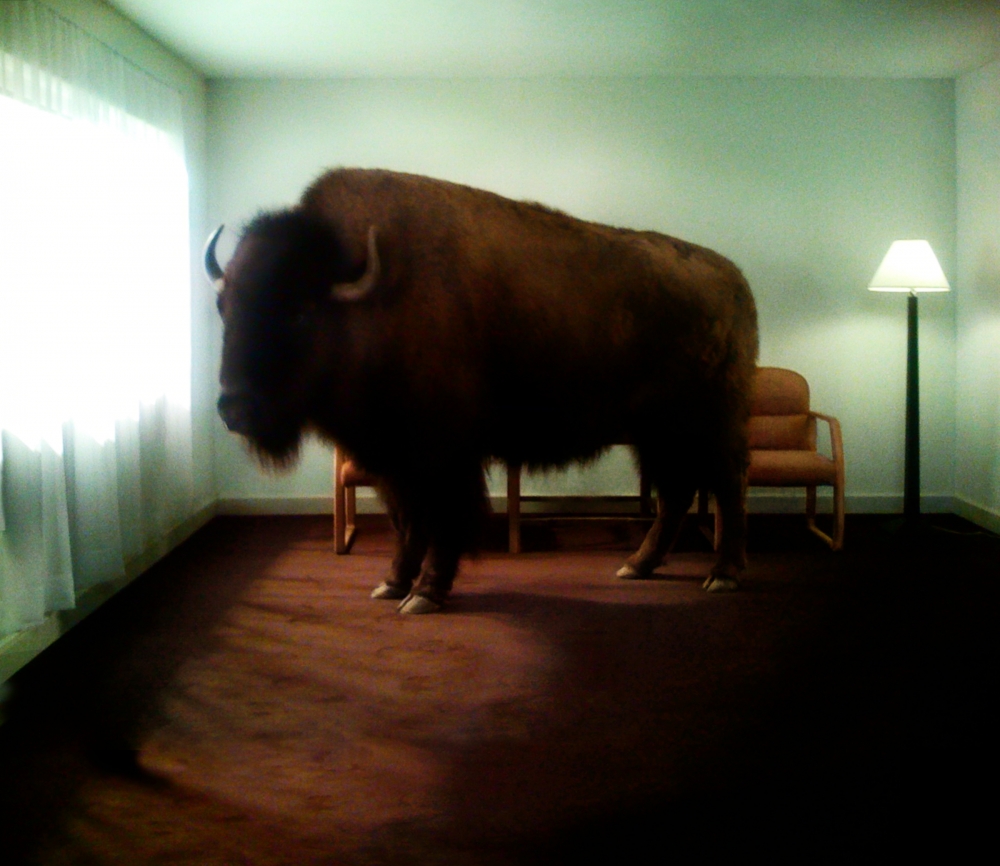
Presented alongside the light boxes will be Aitken’s first large scale public installation in Los Angeles, migration. The film, the first instalment in a three-part trilogy entitled empire, debuted at the 2008 Carnegie International. This hallucinatory epic depicts the movements of migratory animals as they pass through vacant and deserted hotel and motel rooms, delineating a nomadic passage across America from east to west. Fittingly making its first appearance on the west coast, this large-scale cinematic installation will be presented to the public on Santa Monica Boulevard projected onto the courtyard of Regen Projects II; visible only at night from sunset to sunrise. In addition to the nighttime public presentation, migration will also be exhibited at the 633 North Almont Drive space on an indoor billboard accompanied by its original score.
Settlers who met the untamed wilderness to forge new ways of life defined westward expansion. Aitken’s migratory landscape in migration is the opposite; it is a landscape completely devoid of human presence. His non-linear narrative presents a series of different sequences in which the animals and their actions are unique while the rooms and their components are indistinguishable. Hotels such as these offer a sense of both security and isolation and while some animals adapt to these surroundings, others seem conspicuously strange. Rarely do we get to examine these creatures so closely. Their movements and presence make the viewer acutely aware of scale, calling into question various relationships; the most apparent of which is the relationship of the natural and the man-made. In this encounter between the urban and the indigenous the viewer gets a sense of both displacement and habituation. As one critic describes:
“One by one, at different hotels, the animals behave as they behave, sniffing the air, twitching their noses to orient themselves in the desolate human habitat. Imbued with Aitken’s usual intimations of planetary solitude, his sense of spatial dislocation, and gorgeous formalised perception, these images … have the quality not so much of a nonlinear narrative as of a mirage.” (Kim Levin, Artnews, January 2009, p. 110.)
Aitken’s work has been exhibited extensively at museums and galleries worldwide, including his 2007 exhibition “sleepwalkers,” a large-scale outdoor installation at the Museum of Modern Art, New York. He has had numerous solo exhibitions including shows at the Serpentine Gallery, the Kunstmuseum Wolfsberg, the Kunsthaus Bregenz and the Kunsthalle Zurich. Aitken was awarded the international prize at the Venice Biennale in 1999 and was included in the 2000 Whitney Biennial.
Text from the Regen Projects website [Online] Cited 01/11/2009. No longer available online
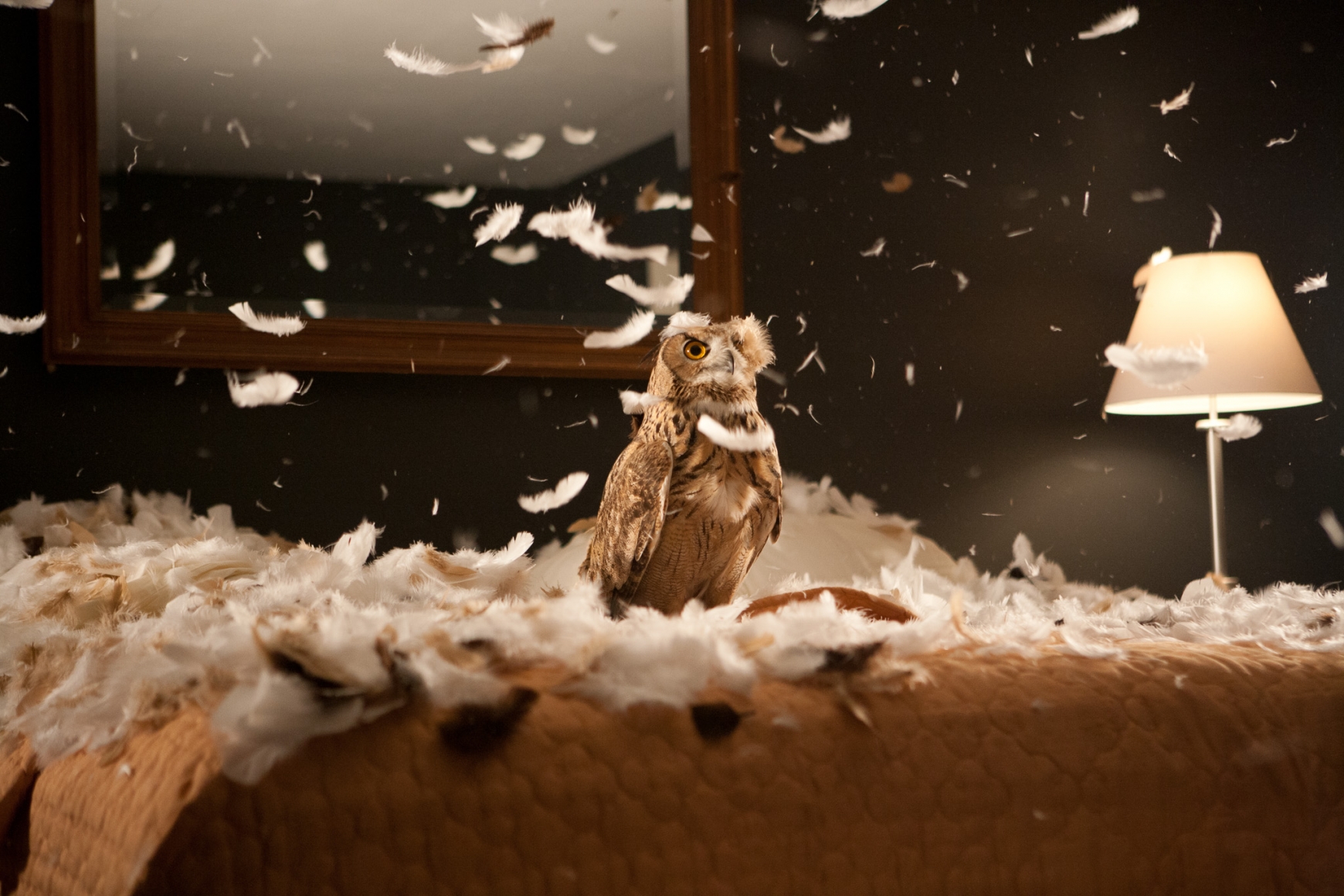
Doug Aitken (American, b. 1968) Stills from Migration 2008 Single video projection with billboard (steel and PVC projection screen)
In Migration, peacocks, deer, and beaver are filmed occupying motel rooms in vignettes that strike a poignant, provocative chord: talk about unexpected guests. Nevertheless, the work isn’t funny; it’s too frank in its beauty, too finely and respectfully wrought to be a joke.
Aitken’s animals are frequently shot in close perspective, which enhances their beauty in a way that is mesmerising. We’re not looking through them as much as we’re looking alongside them, ingesting the utter foreignness of their environs. As evening falls, we see an owl, an already otherworldly creature whose glowing eyes appear extraterrestrial, blinking at us from its perch on a king-size bed. Against the singsong of chirping birds, the camera pans away from the stationary owl as the room fills with thousands of downy feathers. Light is a powerful character in the film, whether gently filtered through sheer curtains or spilling onto carpeted hallways. Rather than highlighting imperfections or ugliness, the light is salvic, evincing a limbo that’s illuminating and warming. In one way or another, all of Aitken’s animals are drawn to light, whether toward a blinking lamp, the refracted surface of a swimming pool, or even the glow of an opened refrigerator door.
Extract from Iris McLister. “Motel chronicles: Doug Aitken,” on the Pasatiempo website October 6, 2017 [Online] Cited 28/04/2019
Regen Projects 6750 Santa Monica Boulevard Los Angeles, CA 90038 Phone: (310) 276 5424






































 Art Blart _ art and cultural memory archive
You must be logged in to post a comment.