This is an emotional posting for me. I came out as a gay man in 1975, six short years after the Stonewall Riots in New York City that were the touchstone of the gay liberation movement. I partied hard in my youth in London and didn’t have my first HIV test until 1982/1983. We just didn’t know about the disease at all. Those two weeks waiting for the result of that first test, for that is how long it took to get the test results back in those days, seemed terribly long. Even worse was the time spent sitting outside the doctor’s office waiting to be called in to get the test results – literally life and death as there was no treatment, no drugs to help, no hope.
I lost many friends over the years to this terrible disease that continues to decimate human beings all around the world. It was only by pure luck that I survived. This posting shows the work of one artist who didn’t survive. He as experimenting with his sexuality (and documenting it) in Boston at much the same time that I was in London and so I feel an affinity with this beautiful and gifted man. What great images he made! How much poorer is the world without his presence and indeed the presence of all human beings who have succumbed to the disease.
Dr Marcus Bunyan
Many thankx to the Fotomuseum Winterthur, Zurich for allowing me to publish the photographs in the posting. Please click on the photographs for a larger version of the image.
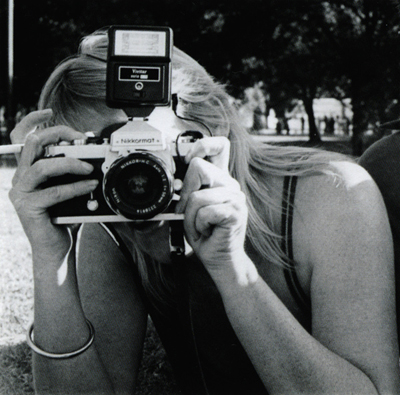
“You know, I’m going to be really famous, so you’re lucky to be meeting me.”
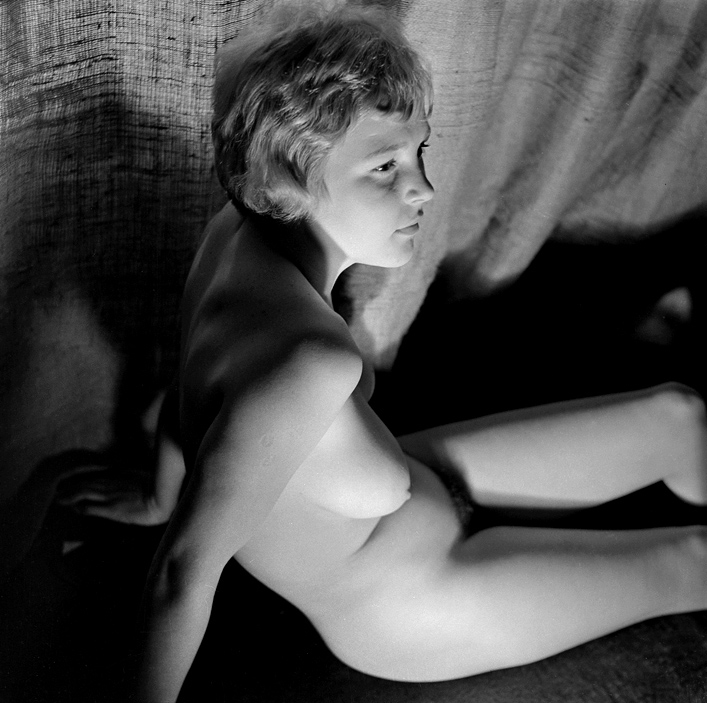
More than twenty years after Mark Morrisroe’s early death, Fotomuseum Winterthur is presenting the first comprehensive survey exhibition on his work – an extraordinarily diverse body of works that has usually been shown in group shows, mostly in connection with his famous Boston colleagues Nan Goldin and David Armstrong. The exhibition, curated by Beatrix Ruf and Thomas Seelig, is a collaboration between Fotomuseum Winterthur and the Estate of Mark Morrisroe (Ringier Collection).
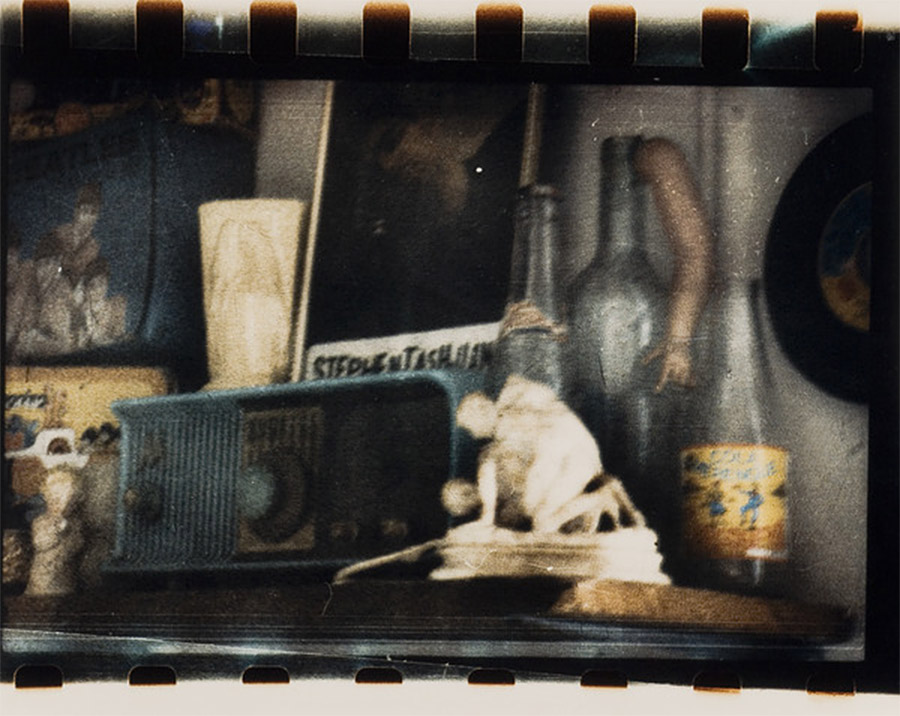
In the Boston of the early 1980s, Mark Morrisroe was a well-known, charismatic figure, who often appeared in drag together with the artist friends he had met while studying and who performed in bars and clubs with Stephen Tashjian (alias Tabboo!) as the “Clam Twins.” As an artist and photographer he was also at the center of the lively Boston punk scene, whose most important protagonists were known well beyond the city. Like Nan Goldin and David Armstrong before him, Mark Morrisroe moved to New York in the mid-1980s to try his luck there. He died – far too early – in July 1989, at the age of just 30, from the consequences of AIDS.
References to Morrisroe’s origins and past are surrounded by a dense mist that makes it impossible to differentiate between truth and fantasy. By continually inventing and varying scenarios about himself, the settings for which extended from the past to the future, Morrisroe always understood how to collaborate actively in shaping his own myth, feeding it with fanciful layers of lies, or indeed letting it float into the void. His public presence could be engaging, and sometimes loud and disturbing, too, but silence fell after his death – both around the artist and his photography.
In retrospect, Morrisroe’s art studies in Boston and his years in the punk and art world of that city can in fact be seen as his most content and productive period. There he discovered a positive approach to his sexuality, and in the person of Jonathan “Jack” Pierson, who appears in many of his photographs and Polaroids, found his first great love. The first intimate portraits of close friends such as Lynelle White (with whom he published five editions of the collaged, photocopied and coloured-in Dirt fanzine in 1975-1976) were produced there, as were many of his first narcissistic self-scenarios in front of the camera. There Morrisroe shot the low-budget trash film Nymph-O-Maniac in the style of his idol John Waters, with Pia Howard as the main performer.
Mark Morrisroe’s short creative period, of barely ten years, was characterized by an amazing output of photographic experiments, and stands out for its constantly searching, inquisitive, and always individual aesthetic, as a glance at the photographer’s extensive estate reveals. The estate was acquired by the Ringier Collection in 2004 and was placed in the care of the Fotomuseum Winterthur in 2006. The estate comprises around 600 colour prints – a few of them duplicates – approximately as many gelatin silver prints, about 800 of the 2,000 known Polaroid shots by Morrisroe, all the negatives, contact prints, and some of his personal papers, giving some idea of the unbridled enjoyment and energy with which Mark Morrisroe threw himself into his life and work.
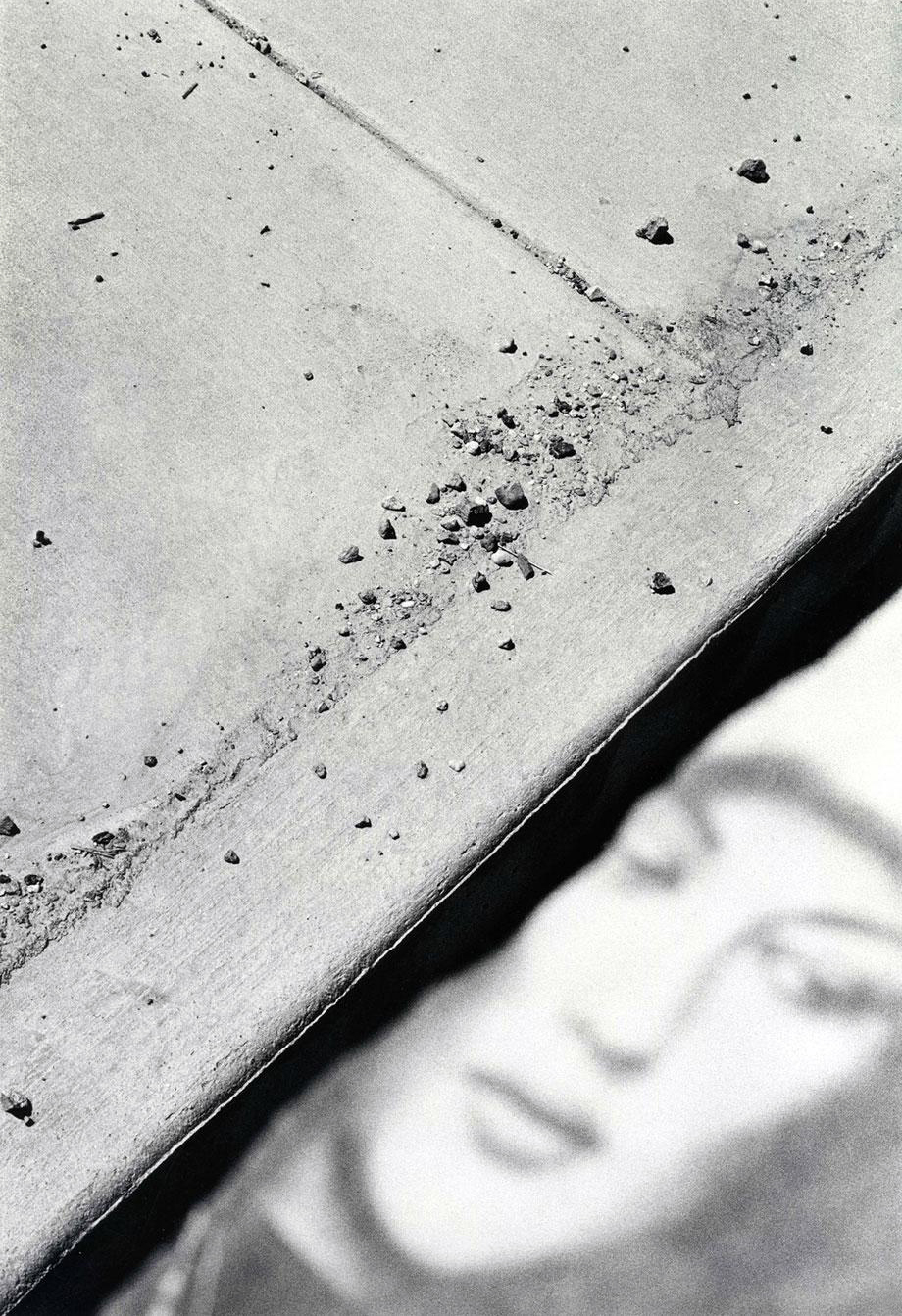
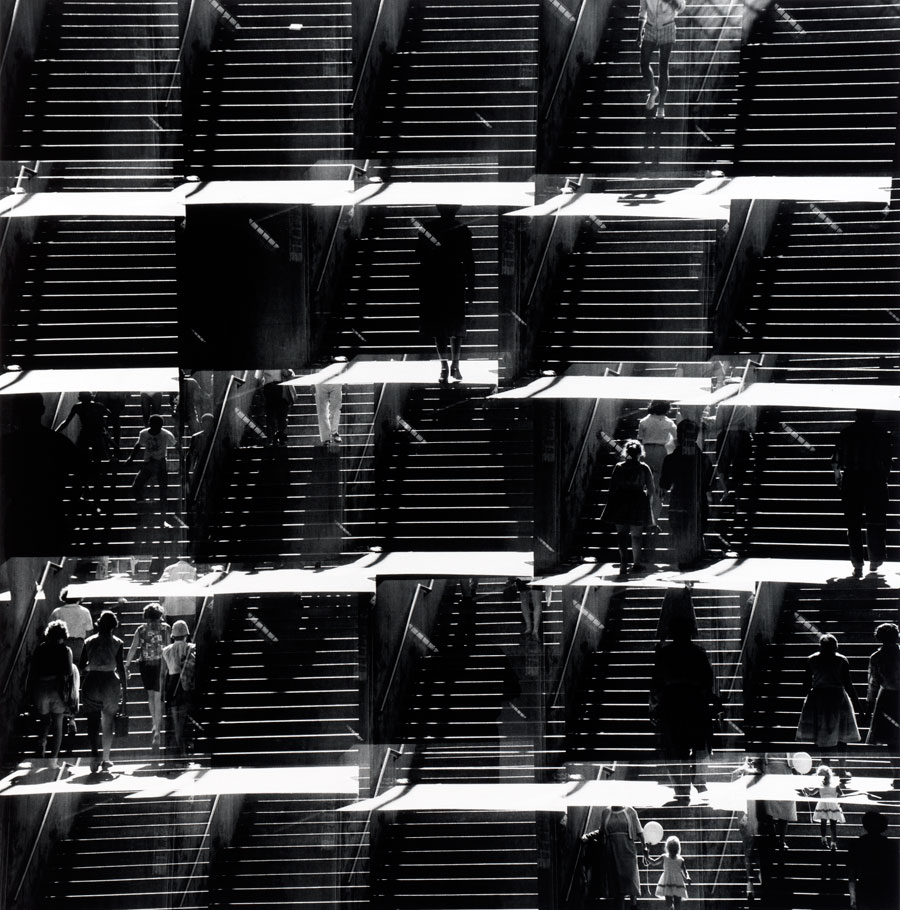
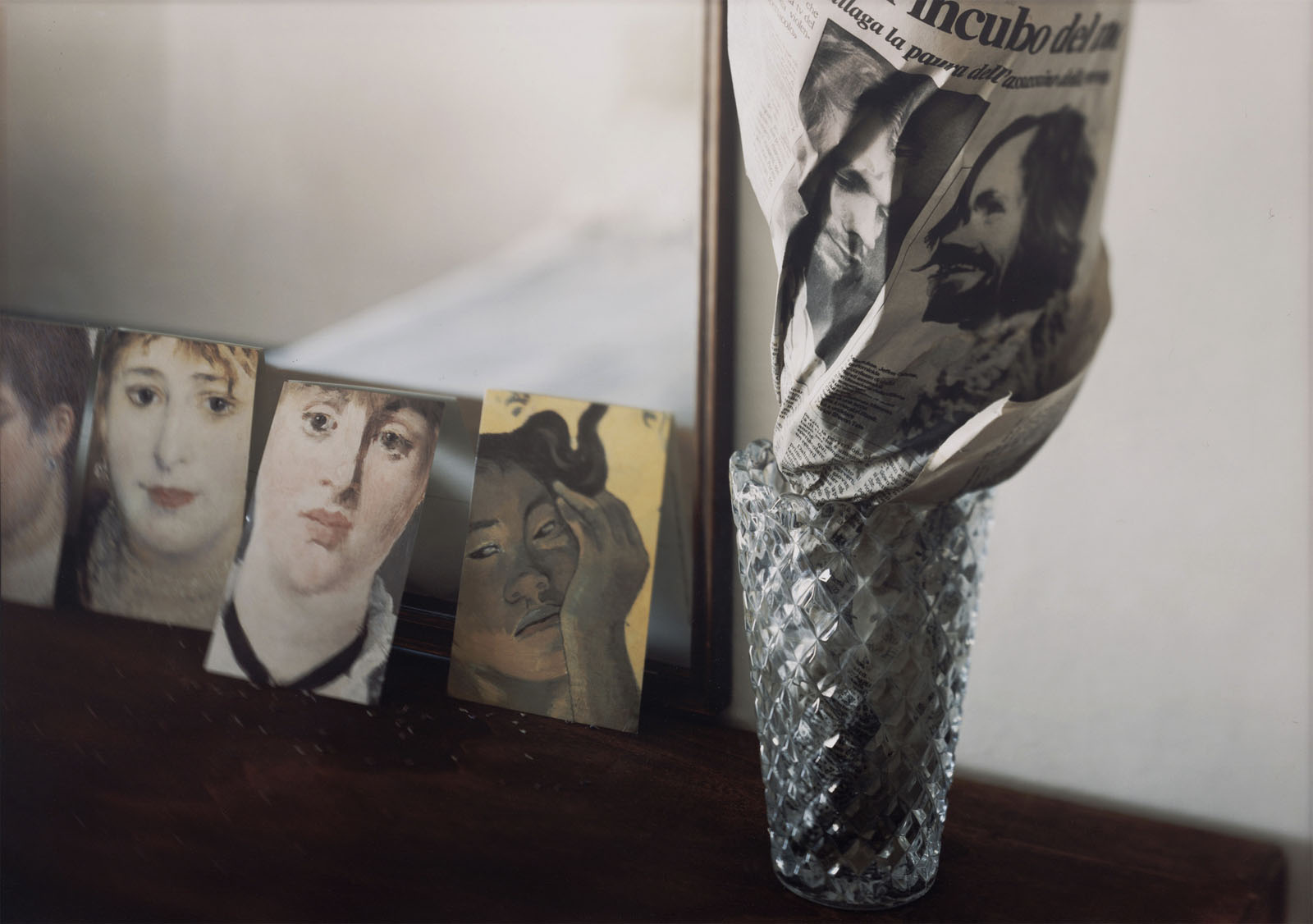
The exhibition will feature early colour and black-and-white prints, Polaroids, and Polaroid negatives from which it was possible to make enlargements, as well as the early and late photograms he processed by hand. During his art studies at the School of the Museum of Fine Arts Boston (1978-1982) Morrisroe was already experimenting with various interpretations of reprography, trying to understand the possibilities of the medium and its inherent limitations, and using different ingenious printing processes for his photographic prints. Within his close circle of friends he soon laid claim to the “invention” of what are called “sandwich” prints – enlargements of double negatives of the same subject mounted on top of one another – which yielded an elaborate pictorial quality, producing a very iconic impression in the final result, which over time Morrisroe learned to use in an increasingly controlled way. Early on, the artist recognised the intrinsic value of prints – irrespective of the medium used to produce them – as pictorial objects that he could manipulate, colour, paint, and write on at will.
By all accounts, Mark Morrisroe was a man driven to achieve fame and recognition. Restless and demanding – of himself as well as of others – he always wanted more, and from this inner restlessness he derived enormous resources of artistic energy. Right to the very end, his life and work, down to the photograms feverishly produced in the makeshift darkroom in his hospital, which have hardly ever been publicly shown until today, attest to an unlimited and ecstatic search for a sensual, aesthetic, and always ambivalently charged pictorial world.
The Estate of Mark Morrisroe (Collection Ringier) at the Fotomuseum Winterthur
Following Pat Hearn’s untimely death in 2000, there was a break in exhibition activities focusing on Mark Morrisroe. From 1998 the Ringier Collection had been continuously in contact with Pat Hearn about Mark Morrisroe’s work and they continued the discussion with Pat Hearn’s husband, Colin de Land of American Fine Arts, who had inherited the Mark Morrisroe estate. In 2002 Colin de Land approached Michael Ringier and Beatrix Ruf to discuss options for the future of the Morrisroe estate because he had also fallen ill and was very aware that he was going to die soon himself. In their conversations, the main concern was how responsibility for this important artist could be taken on by keeping the oeuvre together as a comprehensive group of works and making it accessible to a broad audience internationally as well. The Ringier Collection proposed to Colin de Land that they secure the estate by acquiring it and placing it in the Fotomuseum Winterthur. Furthermore, the decision was made to form a foundation for the Morrisroe estate, which would be the home to a comprehensive group of works and would keep the estate together, provide conversational and curatorial continuity, and act as the leading force in communicating and distributing the work through exhibitions and publications.”
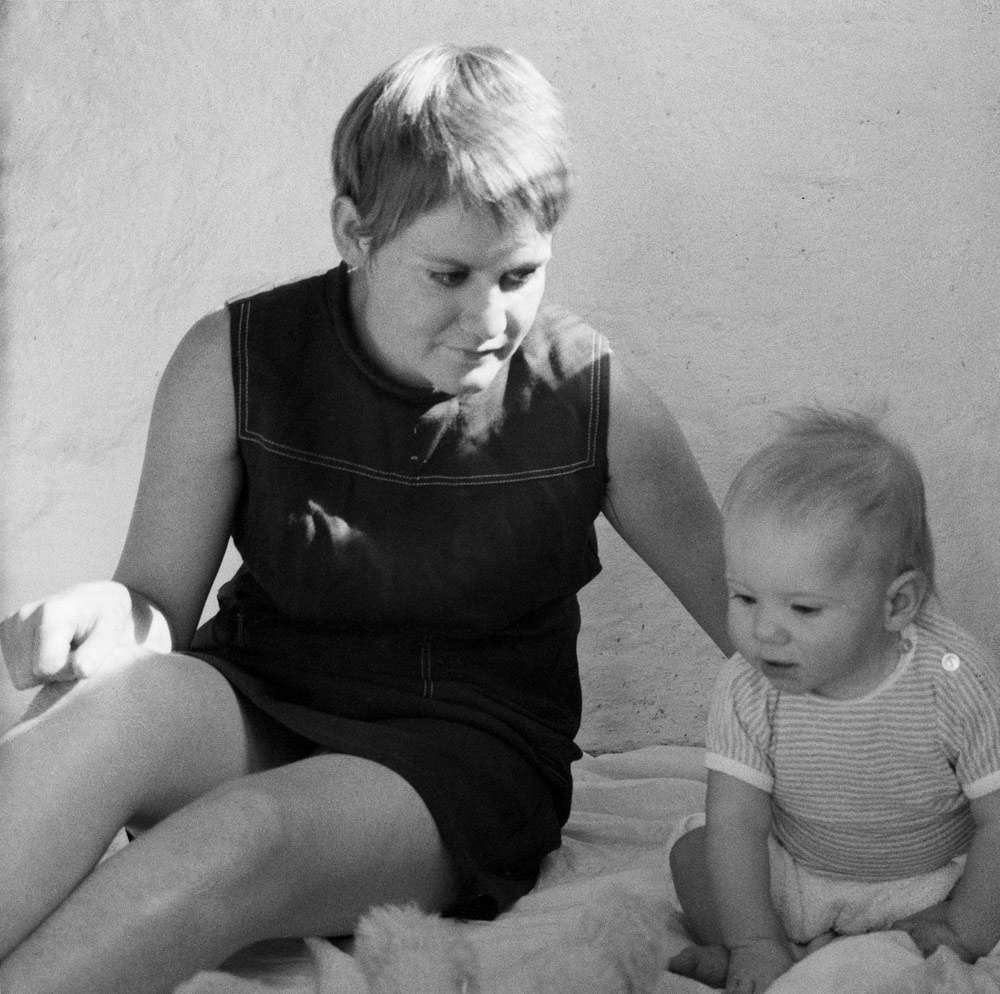
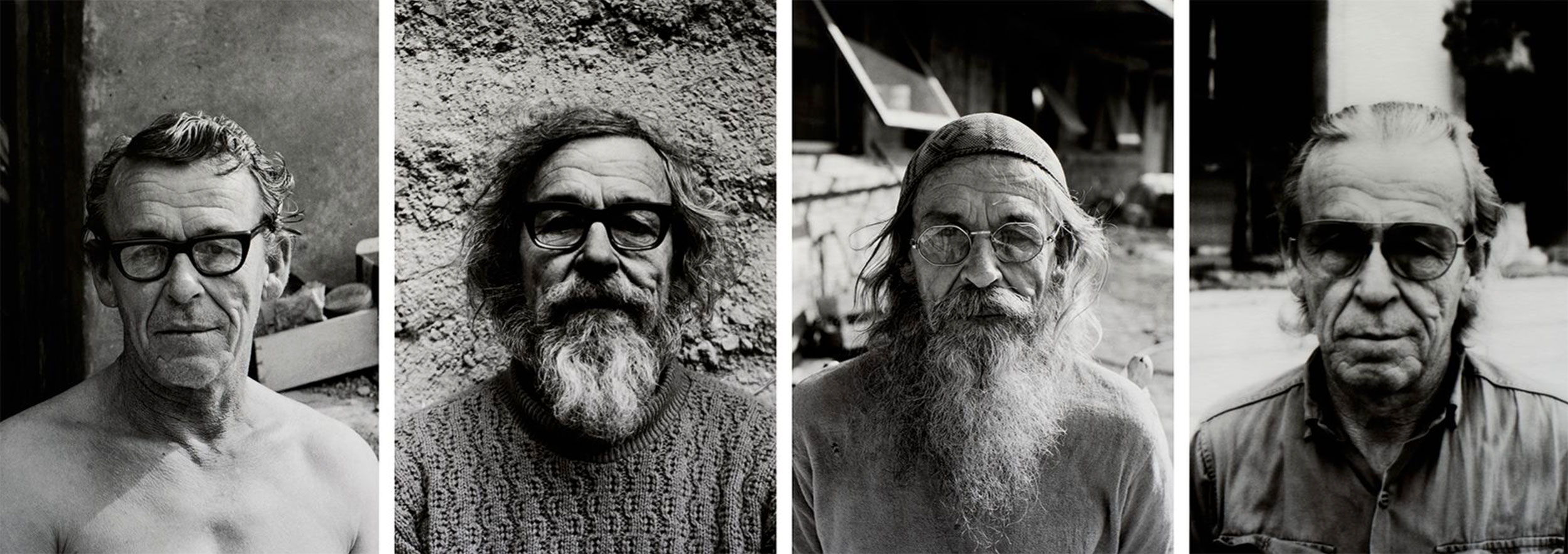
The portrait of Baby Steffenelli, captured by the provocative photographer Mark Morrisroe, offers a glimpse into the bold, rebellious spirit of the 1980s underground art scene. Morrisroe, known for his raw and unflinching style, frequently blurred the lines between art and performance, creating images that were both intimate and confrontational. This photograph of Steffenelli, a figure often associated with the New York City art world of the time, reflects the vibrant energy of a subculture that thrived on pushing societal boundaries. Steffenelli, much like Morrisroe, embraced unconventional identities, and their collaboration in this photo serves as a visual statement of individuality and defiance, characteristic of the era’s exploration of gender, sexuality, and self-expression.
The 1980s were a transformative time for the art world, particularly in New York, where artists like Morrisroe, Robert Mapplethorpe, and David Wojnarowicz were redefining the possibilities of photography, painting, and performance. Morrisroe, who was also a member of the artistic collective called “The Factory” and part of the East Village art scene, used his camera as a tool to document the subversive lifestyles of his peers. His work, often marked by a sense of urgency and intimacy, captured the raw emotions and complexities of those living on the fringes of society. This photo of Steffenelli, taken in 1985, is a prime example of how Morrisroe’s photographs served as a historical document, reflecting the ongoing dialogues surrounding identity and the body in the context of the post-punk, pre-AIDS crisis era.
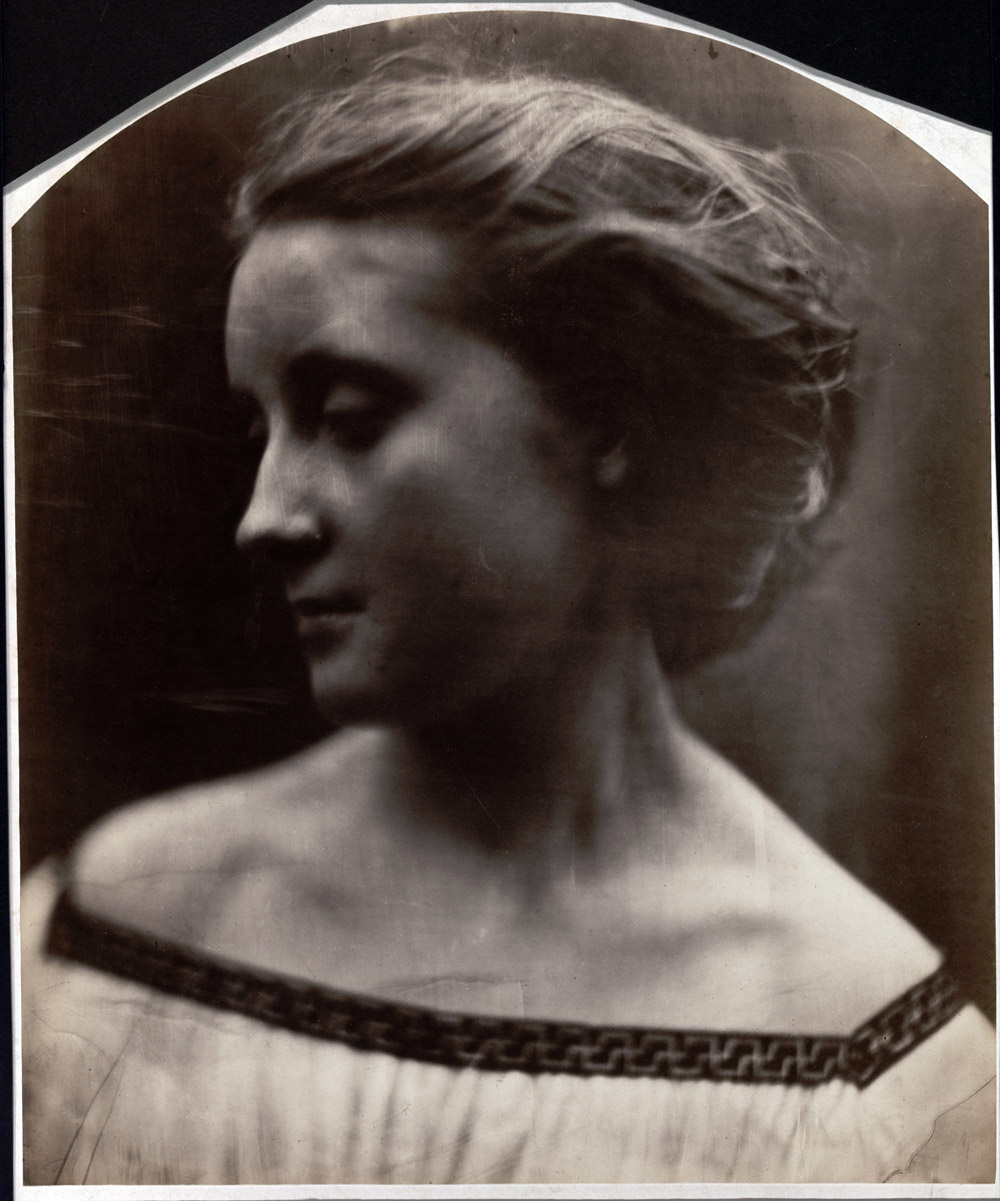
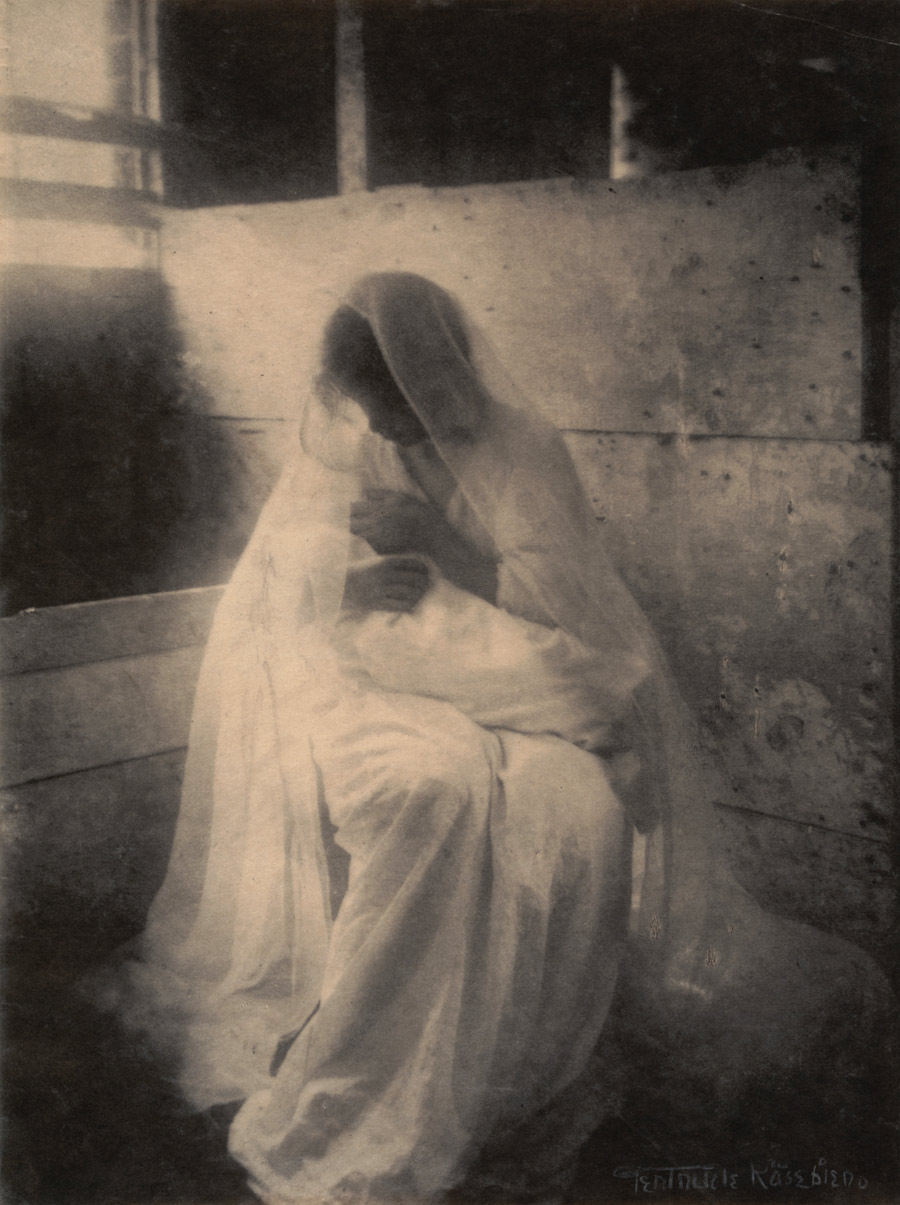
For Steffenelli, this image became an emblem of the intersection between personal expression and the broader cultural shifts taking place in the 1980s. The vibrant, sometimes jarring energy of Morrisroe’s photography mirrored the boldness with which people like Steffenelli navigated their place in an increasingly complex world. The photo not only immortalises Steffenelli’s individuality but also serves as a testament to the powerful and often controversial art scene that defined this period. In this single frame, Morrisroe captures not only a person but the essence of a moment in time – a snapshot of defiance, liberation, and transformation in the face of societal norms.
Exhibition dates: 28th September 2010 – 30th January, 2011
Gerhard Gronfeld (German, 1911-2000) Arrival at the transit camp 1942
Female forced labourers from the Soviet Union on their arrival at the Berlin-Wilhelmshagen Transit Camp, December 1942.
Source: Deutsches Historisches Museum, Berlin
This is an emotional and sobering posting.
The photograph of the Liberated forced laborer with tuberculosis by an unknown photographer (1945, below) is as heartbreaking as the photograph of a mother and child, Tomoko Uemura in Her Bath, Minamata (1972) by Eugene Smith. The look on the man’s face when I first saw it made me burst into tears… it is difficult to talk about it now without being overcome. An unknown man photographed by an unknown photographer.
There is something paradoxical about the solidity of the doctor’s steel helmet, his uniform and the fact he is a doctor contrasted with the strength, size and gentleness of his hand as it rests near the elbow of this emaciated man, this human … yet the intimacy and tenderness of this gesture, as the man stares straight into the camera lens – is so touching that to look at this picture, is almost unbearable. Man’s (in)humanity to man.
Some pertinent facts
The Germans abducted about 12 million people from almost twenty European countries; about two thirds of whom came from Eastern Europe. Many workers died as a result of their living conditions, mistreatment or were civilian casualties of the war. They received little or no compensation during or after the war … At the peak of the war, one of every five workers in the economy of the Third Reich was a forced labourer. According to Fried, in January 1944 the Third Reich was relying on 10 million forced labourers. Of these, 6.5 million were civilians within German borders, 2.2 million were prisoners of war, and 1.3 million were located at forced labor camps outside Germany’s borders. Homze reported that civilian forced labourers from other countries working within the German borders rose steeply from 300,000 in 1939 to more than 5 million in 1944.
Examples
Russian Foreign Civilian Forced Labourers in Nazi Germany (total number approximately): 2,000,000
Russian Number of Known and Estimated Survivors Reported by Reconciliation Foundations: 334,500
(Source: Beyer, John C. and Schneider, Stephen A. “Forced Labour under Third Reich – Part 1” (pdf). Nathan Associates Inc.. 1999.)
Russian “volunteer” POW workers
“Between 22 June 1941 and the end of the war, roughly 5.7 million members of the Red Army fell into German hands. In January 1945, 930,000 were still in German camps. A million at most had been released, most of whom were so-called “volunteer” (Hilfswillige) for (often compulsory) auxiliary service in the Wehrmacht. Another 500,000, as estimated by the Army High Command, had either fled or been liberated. The remaining 3,300,000 (57.5 percent of the total) had perished.”
(Source: Streit, Christian. Keine Kameraden: Die Wehrmacht und die Sowjetischen Kriegsgefangenen, 1941-1945, Bonn: Dietz (3. Aufl., 1. Aufl. 1978))
The remaining 3,300,000 had perished. A sobering figure indeed (if you can even imagine such a number of human beings).
Dr Marcus Bunyan
Many thankx to the Jewish Museum in Berlin for allowing me to publish the photographs in the posting. Please click on the photograph for a larger version of the image.
Unknown photographer Liberated forced laborer with tuberculosis 1945
A doctor of the U.S. Army examines a former forced labourer from Russia who was ill with tuberculosis. The Americans had discovered the sick forced labourers in a barrack yard in Dortmund. Dortmund, 30 April 1945.
Source: National Archives, Washington
Gerhard Gronfeld (German, 1911-2000) Registration at the transit camp 1942
Berlin-Wilhelmshagen Transit Camp, December 1942. Labour office staff registered the forced labourers and handed out employment certificates.
Source: Deutsches Historisches Museum, Berlin
Unknown photographer Humiliation of Bernhard Kuhnt in Chemnitz Nd
The inscription, “Always dignified! The naval fleet’s mutineer Bernh. Kuhnt arrives at his new workplace (washing off the dirt),” refers to the myth that mutinous social democratic and communist sailors were responsible for the defeat of the German empire in the First World War.
Source: Bundesarchiv, Koblenz
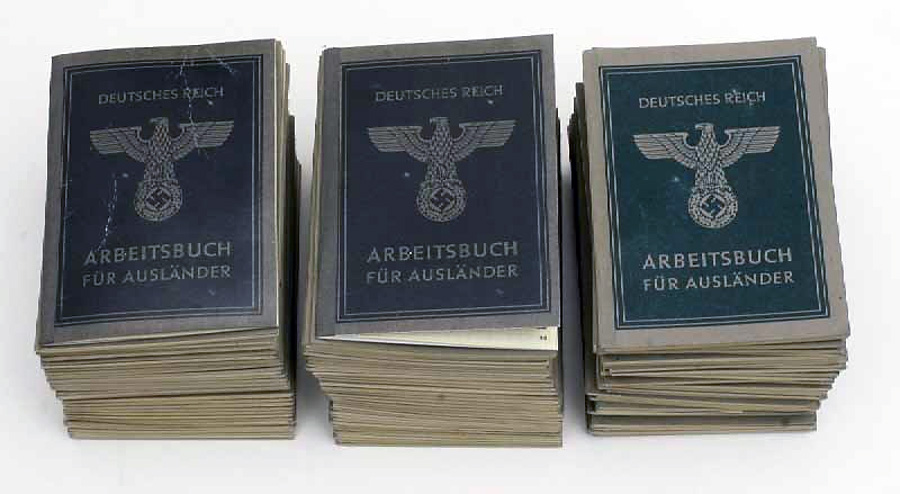
Workbooks issued by the employment office of the German Reich for foreign forced labourers; Buchenwald Concentration Camp Memorial, Weimar
Unknown photographer Selection in a Prisoner of War Camp: Recruitment for Mining 1942
In the summer of 1942, Soviet prisoners of war were selected from the prisoner of war camp Zeithain to perform forced labor in Belgian mines. Source: Gedenkstätte Ehrenhain Zeithain
Selection in a Prisoner of War Camp
In the summer of 1942, Karl Schmitt – head of the Wehrmacht mining division in Liège, Belgium – went to Berlin on vacation with his wife. On the way, he visited the Zeithain prisoner of war camp in Saxony. The Soviet POWs were ordered to present themselves for inspection with the aim of deploying them to Belgian mines under German control. They were accordingly checked for physical fitness. Karl Schmitt decided who was to be transported to Belgium and who was not.
Soviet prisoners of war were frequently put to work in mines. The Reich Security Main Office had ruled that they could be employed only in work gangs kept separate from German workers. The authorities considered the mines particularly suitable in that respect.
Source: Gedenkstätte Ehrenhain Zeithain.
Over 20 million men, women, and children were taken to Germany and the occupied territories from all over Europe as “foreign workers,” prisoners of war, and concentration camp inmates to perform forced labor. By 1942, forced labourers were part of daily life in Nazi Germany. The deported workers from all over Europe and Eastern Europe in particular were exploited in armament factories, on building sites and farms, as craftsmen, in public institutions and private households. Be it as a soldier of the occupying army in Poland or as a farmer in Thuringia, all Germans encountered forced labourers and many profited from them. Forced labor was no secret but a largely public crime.
The exhibition Forced Labor. The Germans, the Forced Laborers, and the War on view at the Jewish Museum in Berlin provides the first comprehensive presentation of the history of forced labor and its ramifications after 1945. The exhibition was curated by the Buchenwald and Mittelbau-Dora Memorials Foundation and initiated and sponsored by the “Remembrance, Responsibility and Future” Foundation. Federal President Christian Wulff has assumed patronage for the exhibition. The exhibition’s first venue on its international tour is the Jewish Museum Berlin, other venues are planned in European capitals and in North America.
Forced labor was without precedent in European history. No other Nazi crime involved so many people – as victims, perpetrators, or onlookers. The exhibition provides the first comprehensive presentation of the history of this ubiquitous Nazi crime and its ramifications after 1945. It shows how forced labor was part of the Nazi regime’s racist social order from the outset: The propagated “Volksgemeinschaft” (people’s community) and forced labor for the excluded belonged together. The German “Herrenmenschen” (superior race) ruthlessly exploited those they considered “Untermenschen” (subhumans). The ordinariness and the broad societal participation of forced labor reflect the racist core of Nazism.
The exhibition pays special attention to the relationships between Germans and forced labourers. Every German had to decide whether to treat forced labourers with a residual trace of humanity or with the supposedly required racist frostiness and implacability of a member of an allegedly superior race. How Germans made use of the scope this framework reveals something not only about the individuals but also about the allure and shaping power of Nazi ideology and practice. Through this perspective, the exhibition goes beyond a presentation of forced labor in the narrow sense to illustrate the extent to which Nazi values had infiltrated German society. Forced labor cannot be passed off as a mere crime of the regime but should rather be considered a crime of society.
Over 60 representative case histories form the core of the exhibition. As is true of the majority of documents on show, they resulted from meticulous investigations in Europe, the USA, and Israel. Moreover the exhibition team viewed hundreds of interviews with former forced labourers that have been carried out in recent years. In terms of content, these case histories range from the degrading work of the politically persecuted in Chemnitz through the murderous slave labor performed by Jews in occupied Poland to daily life as a forced labourer on a farm in Lower Austria.
Among the surprises of the extensive international archival research was discovering unexpectedly broad photographic coverage of significant events. The photos relating to the case histories represent the second pillar of the exhibition. Whole series of photos were traced back to their creator and the scene and people depicted. This presentation, based on well-founded sources, allows quasi dramatic insight into aspects of forced labor. Cinematically arranged photo or photo-detail enlargements form the introduction to the continued inquiry into the history of forced labor.
The exhibition is divided into four sections. The first covers the years from 1933 to 1939 and unveils in particular how the racist ideology of Nazi forced labor struck roots. What was propagated up to the beginning of WWII, partly laid down in laws and widely implemented by society in practice, formed the basis for the subsequent radicalisation of forced labor in occupied Europe culminating in extermination through labor. This escalation and radicalisation is the focus of the second section of the exhibition. The third part covers forced labor as a mass phenomenon in the Third Reich from 1941/1942, ending with the massacre of forced labourers at the end of the war. The fourth section explores the period from the time of liberation in 1945 to society’s analysis and recognition of forced labor as a crime today. Former forced labourers have the last word.
Press release from The Jewish Museum website
Unknown photographer Daimler facility in Minsk 1942
Female forced laborers of the Daimler facility in Minsk, September 1942.
Source: Mercedes-Benz Classic, Archive, Stuttgart
Minsk: German firms in occupied Eastern Europe
In Minsk, a town which had suffered major destruction, Daimler-Benz ran a large repair facility for motorised Wehrmacht vehicles. Together, Daimler and Organisation Todt set up more than thirty repair sheds on the grounds of a ruined military base. With a workforce of five thousand, the facility was soon one of the largest enterprises in occupied Eastern Europe. The management exploited prisoners of war and members of the local population, among them Jews. Labourers were also deported from White Russian villages to the Minsk works as part of the effort to crush the partisan movement.
In the occupied areas of Eastern Europe, many German companies took advantage of the opportunity to take over local firms or establish branch operations. The unlimited availability of labourers was an important factor in their business strategies.
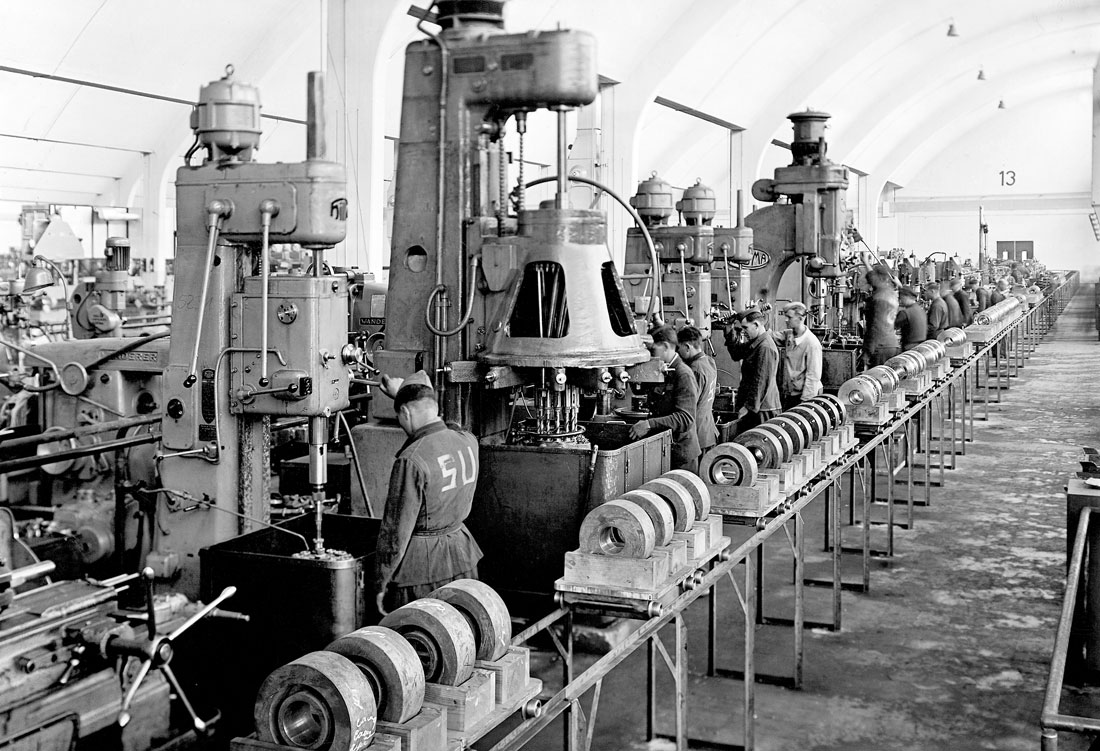
Unknown photographer Foreign workers at BMW in Allach c. 1943
All the foreigners in aircraft engine production had to be visibly identifiable as such. The Soviet prisoners of war had the “SU” symbol on their jackets. Concentration camp inmates could be recognised by their striped uniforms. These photographs were most likely propaganda photos. Munich-Allach, c. 1943.
Source: BMW Group Archiv.
Munich-Allach: Working for BMW
Toward the end of the war ninety percent of the workforce at the largest aircraft engine factory in the German Reich – BMW’s plant in Munich-Allach – consisted of foreign civilian workers, POWs and concentration camp inmates. The number of workers had risen from 1,000 in 1939 to more than 17,000 in 1944.
Forced labourers worked not only in the assembly halls, but also on the factory’s expansion. Due to BMW’s importance to the armament industry, the authorities gave it priority over other companies in the assignment of workers. Nevertheless, its personnel demand was never completely met.
Some of the Western European workers lived in private quarters. For all others, barrack camps were set up all around the factory grounds until 1944, ultimately accommodating 14,000 people. That figure included several thousand concentration camp inmates which the company management had applied for already in 1942.
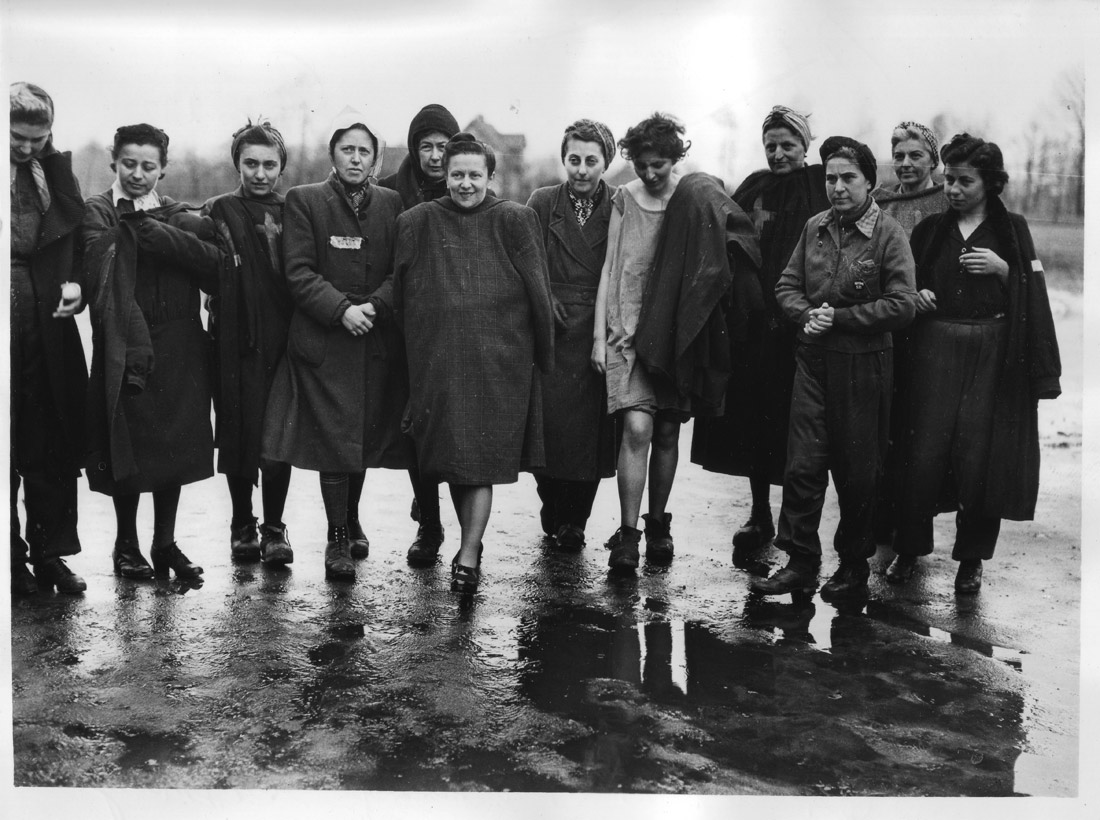
These young Jewish women were released from a forced labor camp at Kauritz (Saxony) by U.S. Army troops in early April, 1945. They are part of a large group removed from homes in France, Holland, Belgium and other occupied areas in Europe.
Source: National Archives, Washington
Unknown photographer Wladyslaw Kolopoleski Nd
“In addition to the hard work, which exceeded my strength, I was beaten on the slightest provocation, sometimes to the point of unconsciousness. Once, for example, I suffered a severe head injury after I was beaten by Max Ewert, an SA officer. I not only lost consciousness, but I had to have head surgery,” wrote Władysław Kołopoleski, a young Pole born in Łódź in 1932. He was deployed in April 1940 on the estate of mayor Max Ewert in Gervin, now Górawino, in Pomerania.
Source: Foundation “Polish-German Reconciliation,” Warsaw
Jewish Museum Berlin Lindenstraße 9-14, 10969 Berlin Phone: +49 (0)30 259 93 300
Berenice Abbott (American, 1898-1991) Canyon, Broadway and Exchange Place 1936 Gelatin silver print National Gallery of Art, Gift of Marvin Breckinridge Patterson
Berenice Abbott – what a photographer! You couldn’t have thought of a better person to save the archive of Eugene Atget for the world. It’s all there at the bread store.
Marcus
Many thankx to Tracy Greene for her help and The Amon Carter Museum of American Art for allowing me to publish the photographs in the posting. Please click on the photographs for a larger version of the image.
Berenice Abbott (American, 1898-1991) The El at Columbus and Broadway 1929 Gelatin silver print
Berenice Abbott (American, 1898-1991) Hell Gate Bridge 1937 Gelatin silver print Collection of Norma B. Marin, Courtesy Meredith Ward Fine Art
Berenice Abbott (American, 1898-1991) Squibb Building with Sherry Netherland in Background 1935 Gelatin silver print Collection of Norma B. Marin, Courtesy Meredith Ward Fine Art
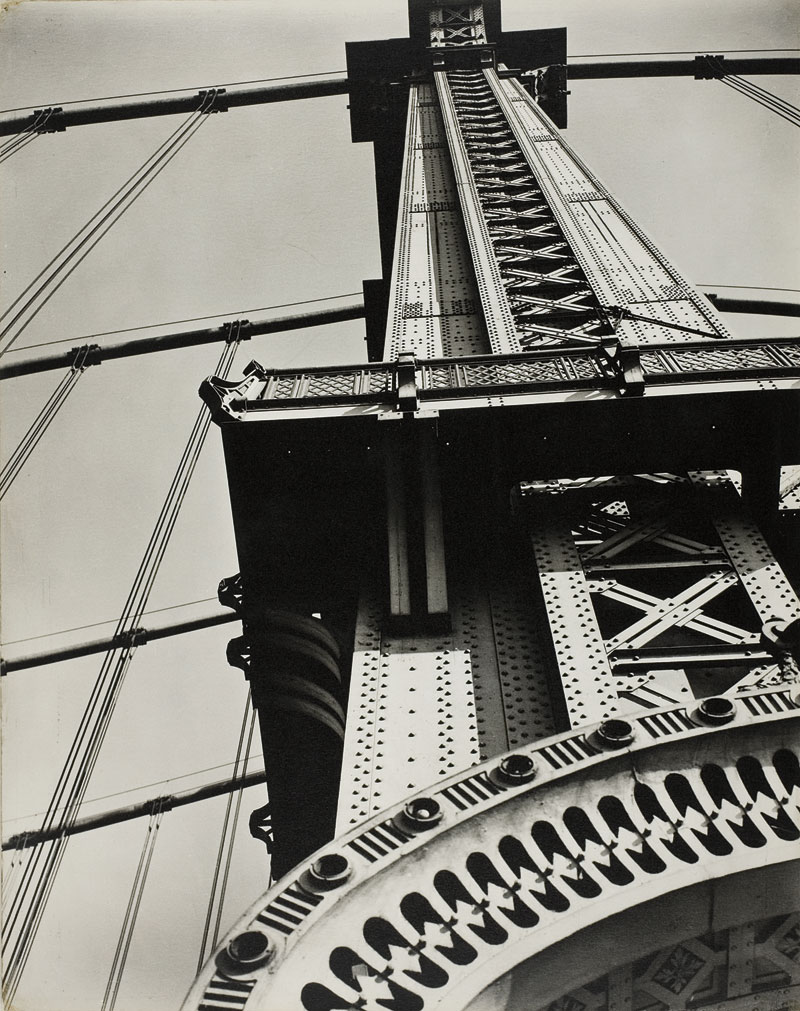
Berenice Abbott (American, 1898-1991) Manhattan Bridge Looking Up 1936 Gelatin silver print The Art Institute of Chicago, Works Progress Administration Allocation
Berenice Abbott (American, 1898-1991) Bread Store, 259 Bleecker Street 1937 Gelatin silver print Museum of the City of New York
Margaret Bourke-White (American, 1906-1971) Boy with hound dog 1936 Gelatin silver print 13 1/4 x 17in (33.5 x 43.2cm)
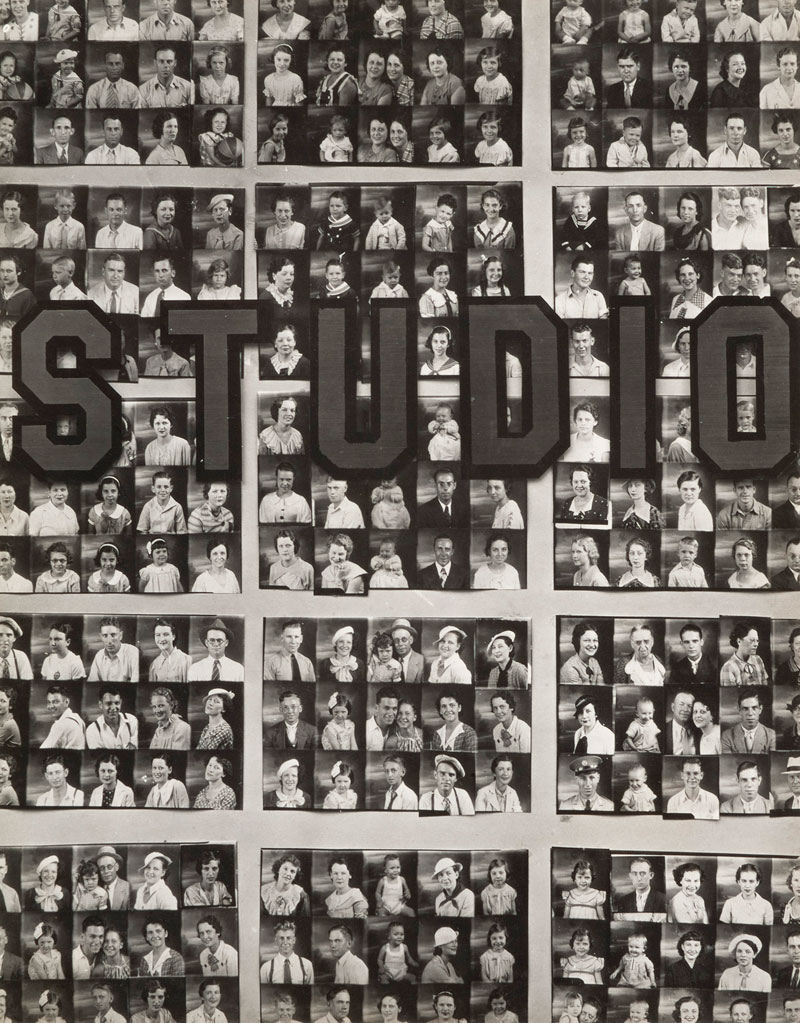
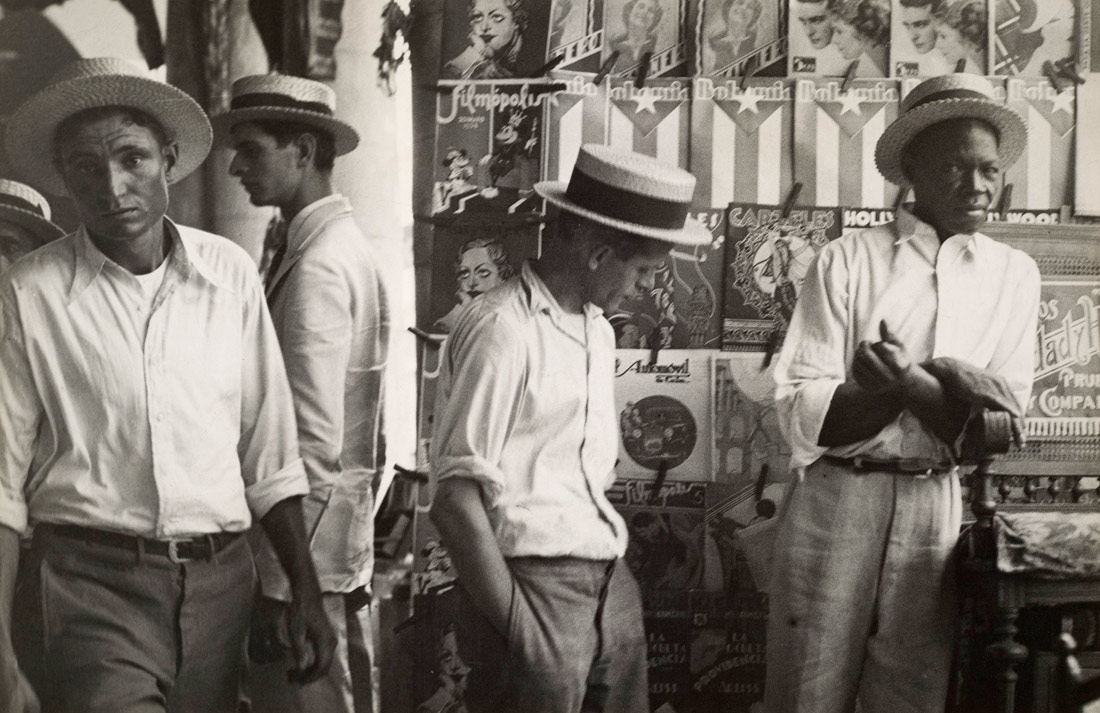
Walker Evans (American, 1903-1975) Penny Picture Display, Savannah 1936 Gelatin silver print Amon Carter Museum
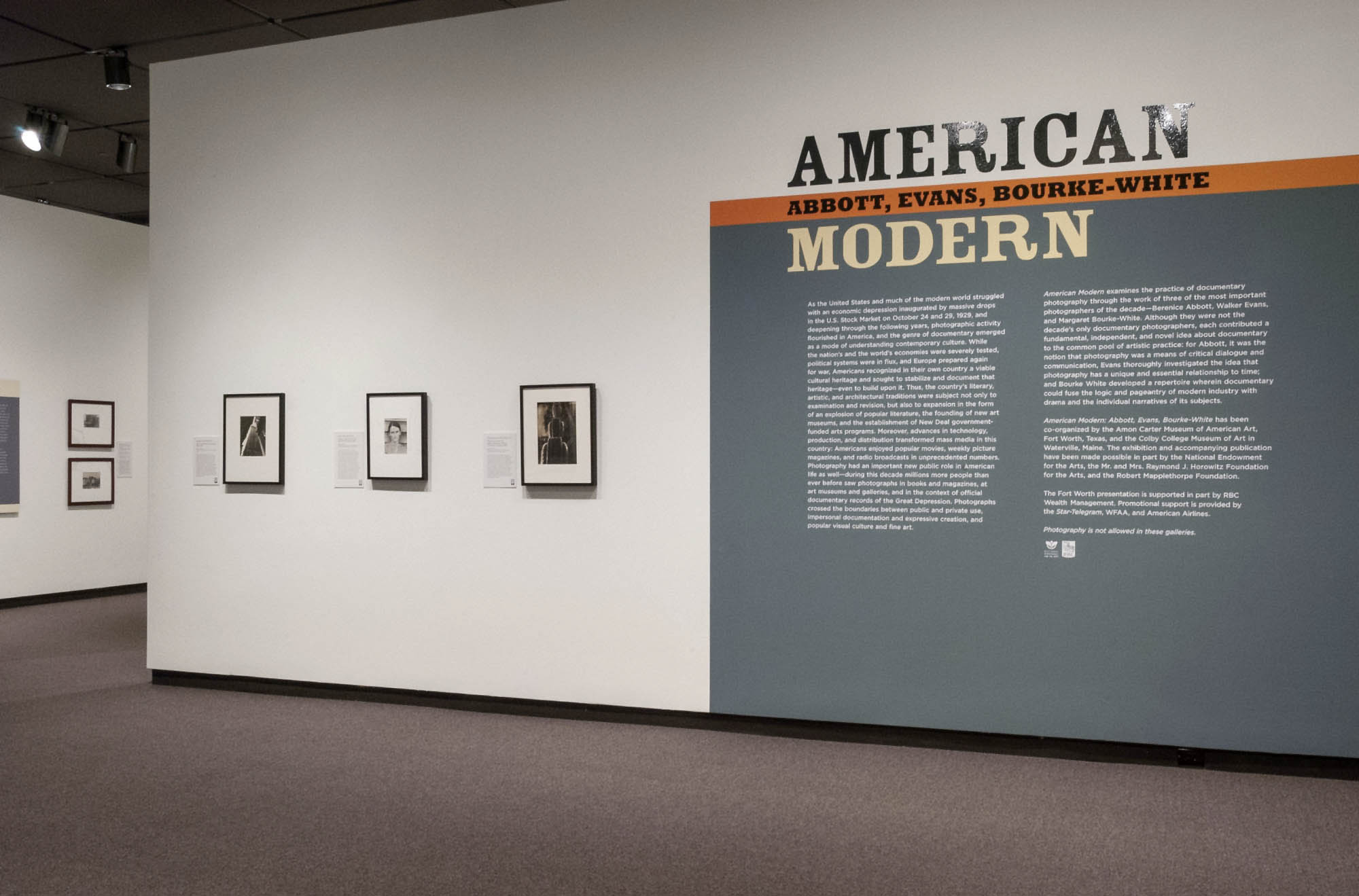
The Amon Carter Museum of American Art presents American Modern: Abbott, Evans, Bourke-White. This special exhibition explores the work of three of the foremost photographers of the twentieth-century and the golden age of documentary photography in America. American Modern will be on view through January 2, 2011; admission is free.
Featuring more than 140 photographs by Berenice Abbott (1898-1991), Margaret Bourke-White (1906-1971) and Walker Evans (1903-1975), American Modern was co-organised by the Amon Carter Museum of American Art and the Colby College Museum of Art in Waterville, Maine. The exhibition is the result of a unique partnership between three curators: Jessica May and Sharon Corwin of the Carter and Colby, respectively, and Terri Weissman, assistant professor of art history at the University of Illinois, Urbana-Champaign. Together, the three curators present the works of these three artists as case studies of documentary photography during the Great Depression and demonstrate how three factors supported the development of documentary photography during this important period in American history: first, the expansion of mass media; second, a new attitude toward and acceptance of modern art in America; and third, government support for photography during the 1930s.
“This exhibition considers the work of three of the best-loved American photographers in a new light, which is very exciting,” says curator Jessica May. “Abbott, Evans, and Bourke-White are undisputed masters of the medium of photography, but they have never been shown in relation to one another. This exhibition offers viewers an opportunity to see works together that have not been shown as such since the 1930s.”
In addition to vintage photographs from over 20 public and private collections, the exhibition also features rare first-edition copies of select books and periodicals from the 1930s. American Modern, May says, “reminds us that documentary photography was very much a public genre – this was the first generation of photographers that truly anticipated that their work would be seen by a vast audience through magazines and books.”
Press release from the Amon Carter Museum of American Art website [Online] Cited 01/12/2010. No longer available online
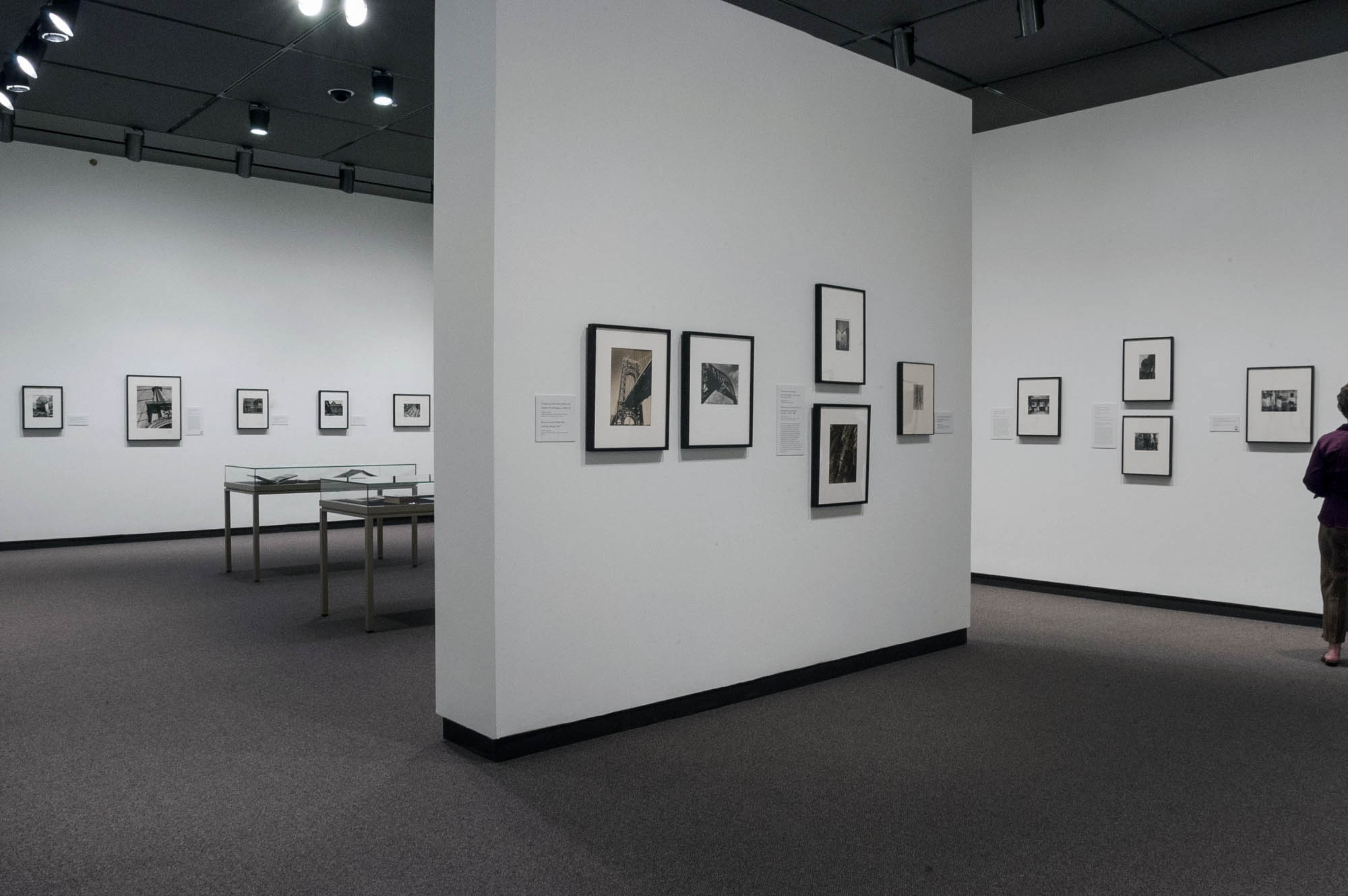
Installation view of the exhibition American Modern: Abbott, Evans, Bourke-White at the Amon Carter Museum of American Art, Fort Worth, Texas showing at second right, Walker Evans photograph Allie Mae Burroughs, Hale County, Alabama (1936, below)
Walker Evans (American, 1903-1975) Allie Mae Burroughs, Hale County, Alabama 1936 Gelatin silver print
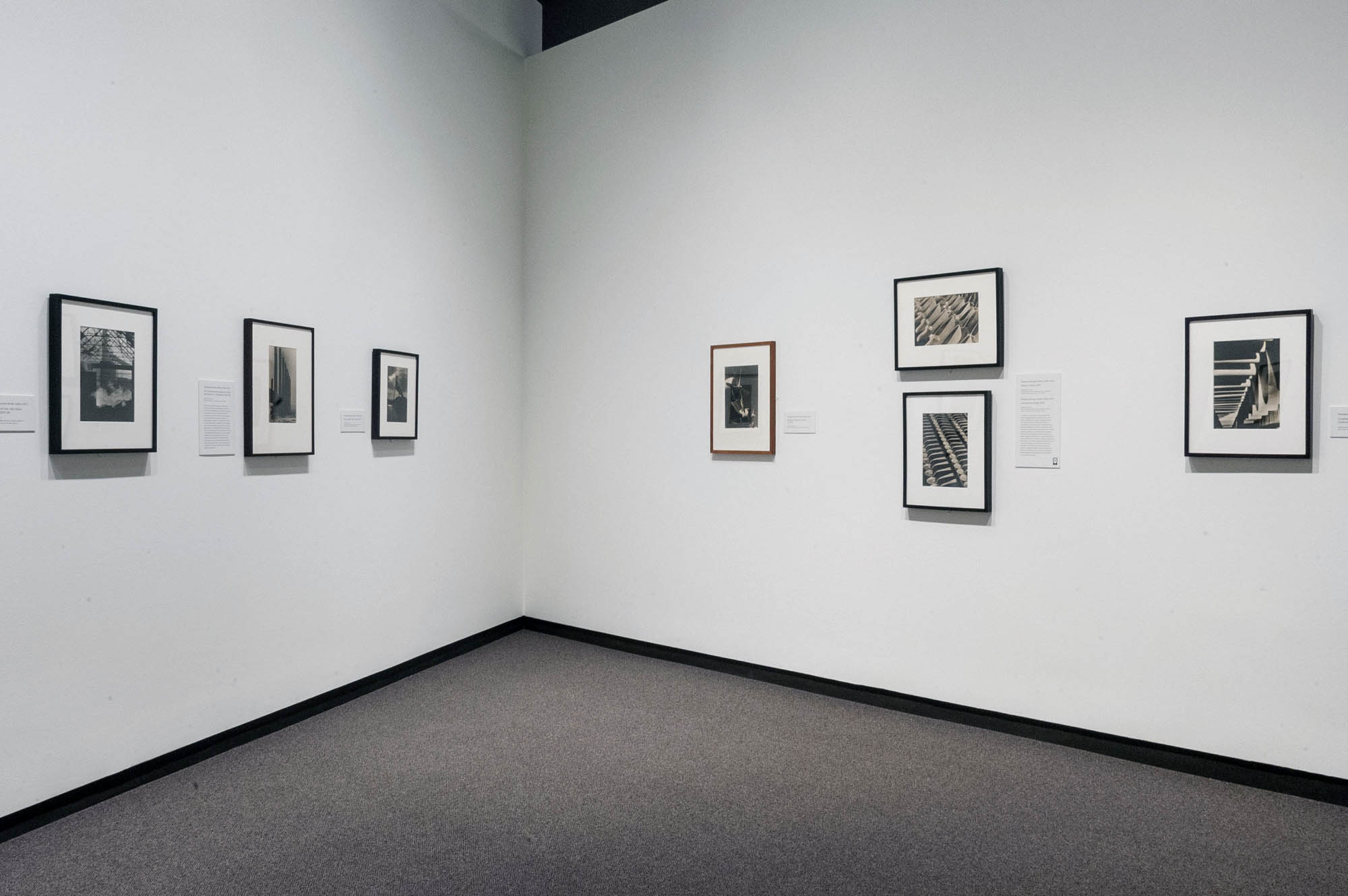
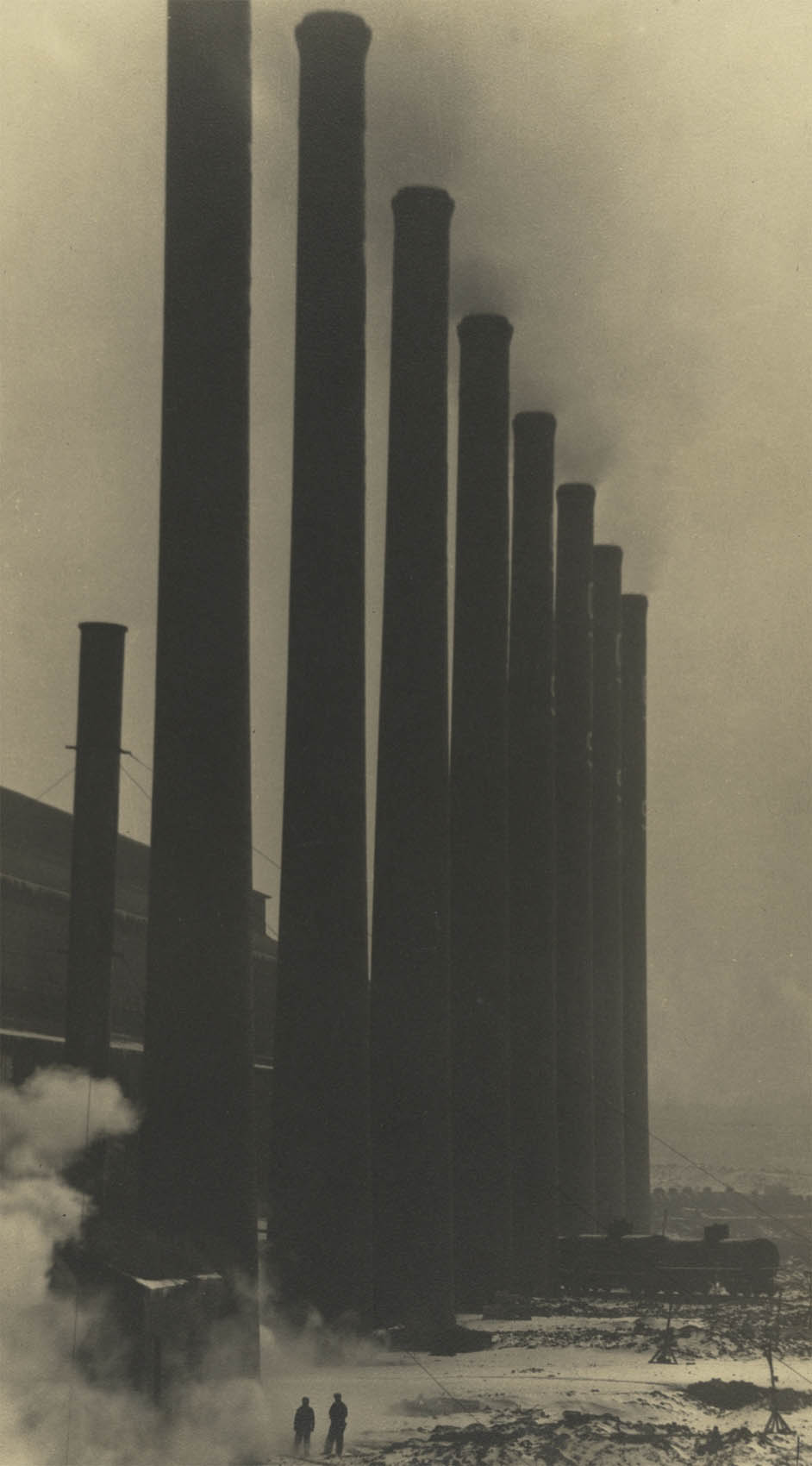
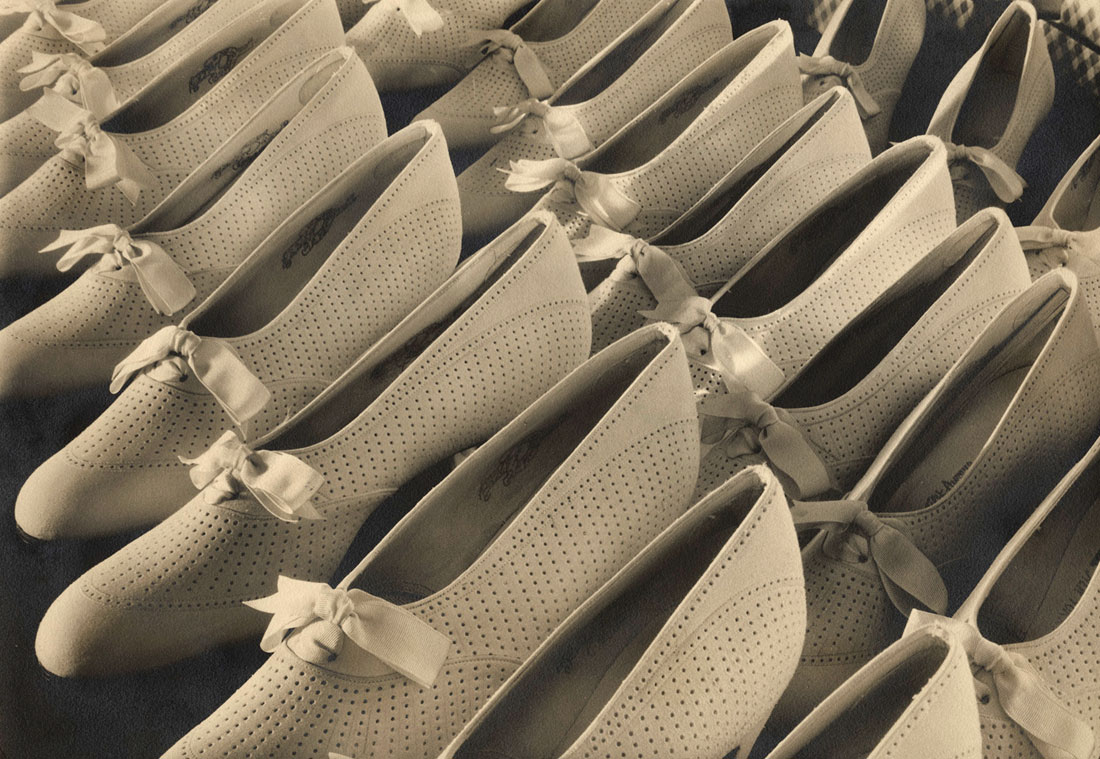
Installation view of the exhibition American Modern: Abbott, Evans, Bourke-White at the Amon Carter Museum of American Art, Fort Worth, Texas showing at second left, Margaret Bourke-White’s photograph The Towering Smokestacks of the Otis Steel Co., Cleveland (1927-1928, below); and at second right top, her photograph Delman Shoes (1933, below)
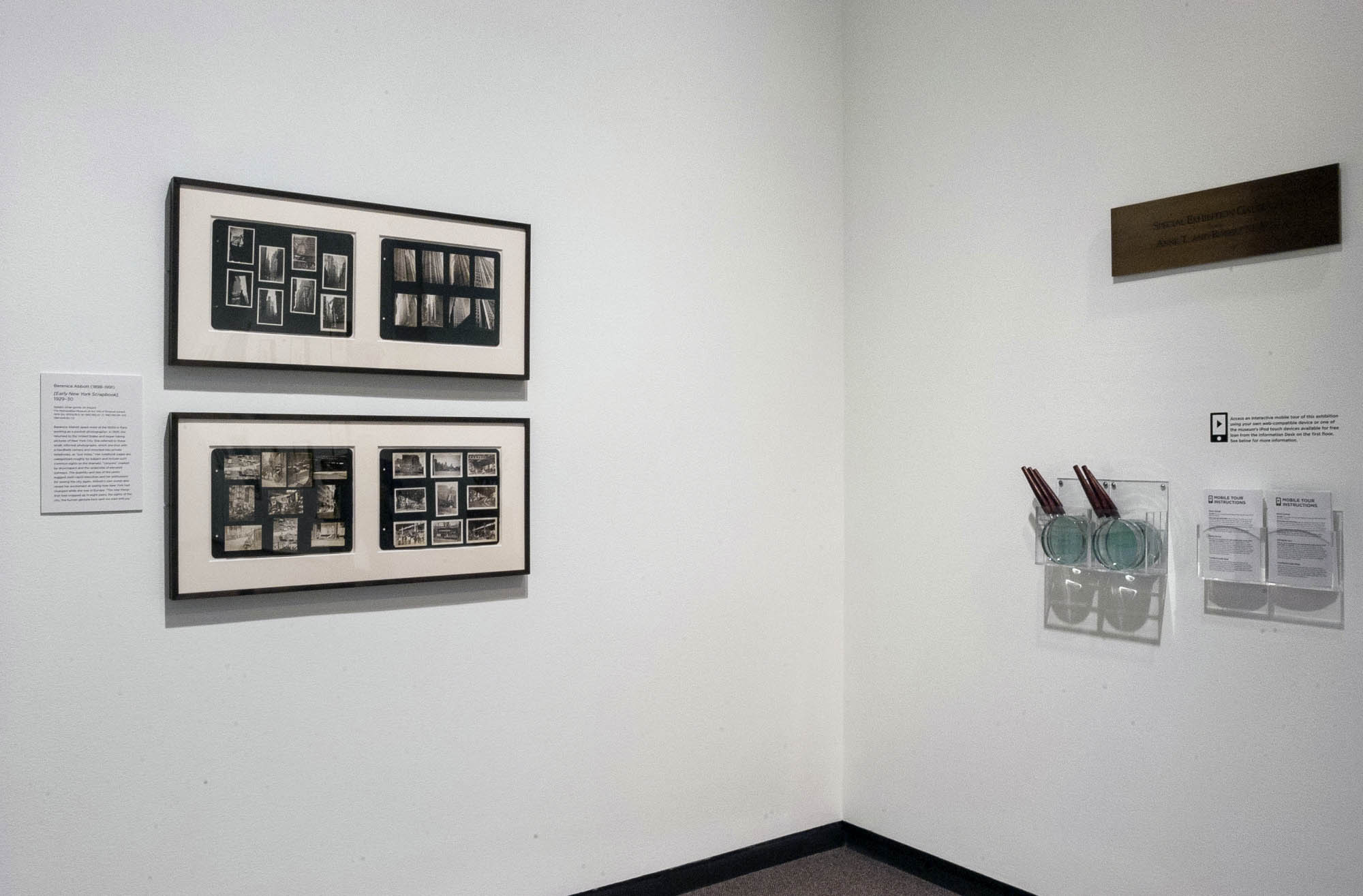
Installation views of the exhibition American Modern: Abbott, Evans, Bourke-White at the Amon Carter Museum of American Art, Fort Worth, Texas showing in the bottom photograph at left, pages from Berenice Abbott’s Early New York Scrapbook (1929-1930)
In the decades following World War II, an independently minded and critically engaged form of photography began to gather momentum. Situated between journalism and art, its practitioners created extended photographic essays that delved deeply into topics of social concern and presented distinct personal visions of the world. On view at the J. Paul Getty Museum, the Getty Center, June 29 – November 14, 2010, Engaged Observers: Documentary Photography since the Sixties looks in depth at projects by a selection of the most vital photographers who have contributed to the development of this documentary approach. Passionately committed to their subjects, these photographers have captured both meditative and searing images, from the deep south in the civil rights era to the war in Iraq in 2006. Their powerful visual reports, often published extensively as books, explore aspects of life that are sometimes difficult and troubling but are worthy of attention.
“This exhibition focuses on the tradition of socially engaged photographic essays since the 1960s,” explains Brett Abbott, associate curator of photographs and curator of the exhibition. “Working beyond traditional media outlets, these photographers have authored evocative bodies of work that transcend the realm of traditional photojournalism.”
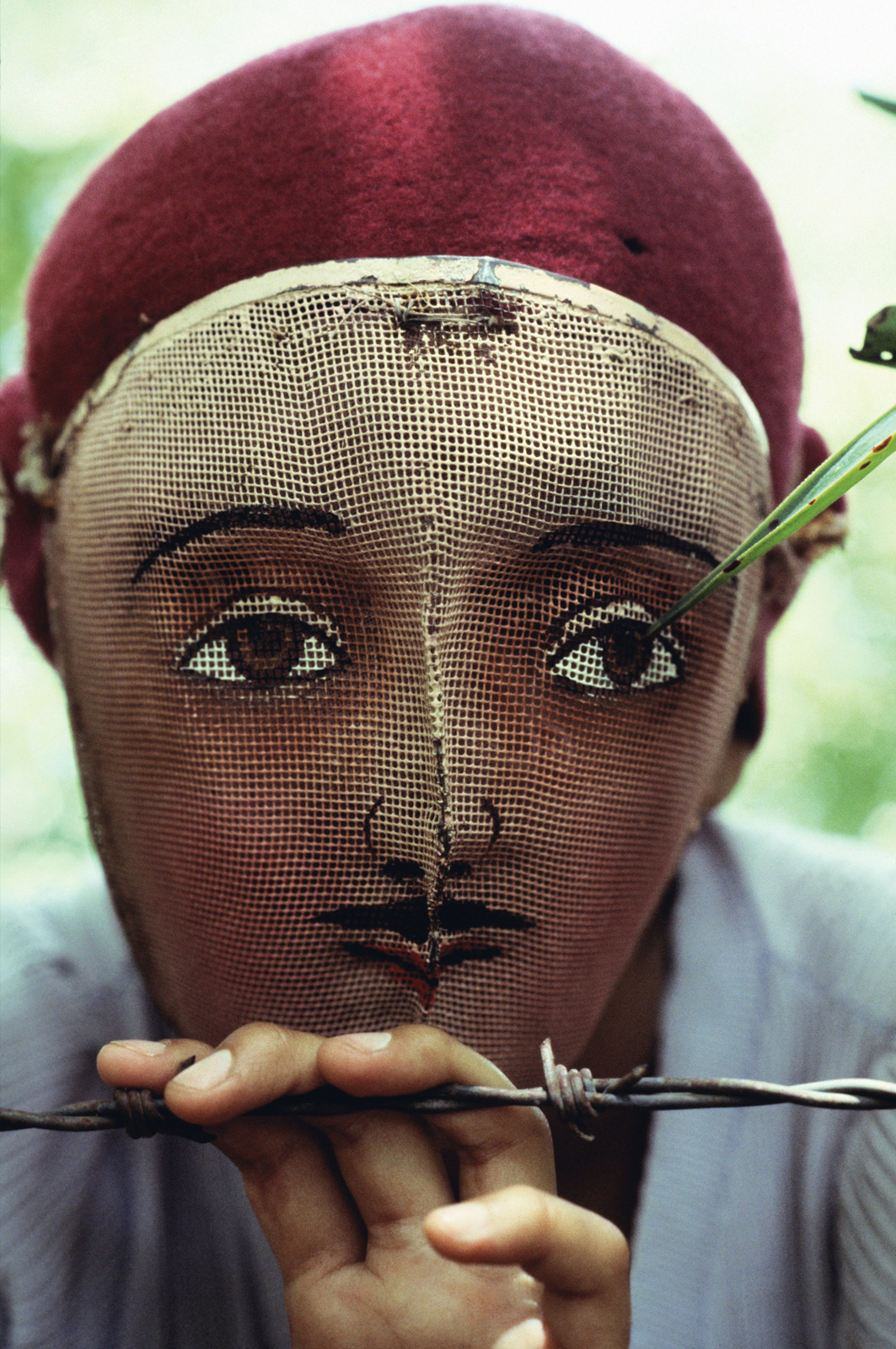
Engaged Observers is structured around suites of photographs from the following projects: “Girl Culture” by Lauren Greenfield, “The Mennonites” by Larry Towell, “Streetwise” by Mary Ellen Mark, “Black in White America” by Leonard Freed, “Nicaragua, June 1978 – July 1979” by Susan Meiselas, “Vietnam Inc.” by Philip Jones Griffiths, “The Sacrifice” by James Nachtwey, “Migrations: Humanity in Transition” by Sebastião Salgado, and “Minamata” by W. Eugene and Aileen M. Smith.
Although one does not always associate style with photojournalism, where objectivity and neutrality are traditionally valued, aesthetics have been an important consideration for all of the photographers represented in the exhibition. One of the strengths of this tradition has been its ability to harness artistic decisions in reporting on the world. Meiselas chose colour film for her Nicaragua project because she felt it better conveyed the spirit of the revolution as she experienced it. Salgado noted that the solemn beauty so characteristic of his approach is important in conjuring a persistent grace among his migrant subjects, allowing him to present them in a dignified way while calling attention to their plight. Nachtwey used tight framing of messy conglomerations of tubes, instruments, and arms in The Sacrifice as a way of conjuring the atmosphere of controlled chaos that he experienced in trauma centres in Iraq. In this kind of work, subject and style, message and delivery, are deliberately intertwined.
All of the photographers in this exhibition use a series of images to address conceptual issues. For instance, Freed was concerned with bridging cultural divides to engender support of basic civil rights, while Griffiths denounced violent commercialisation; Salgado pointed to the effects of globalisation, while the Smiths addressed the related issue of industrial pollution; Meiselas engaged and countered the fragmented process by which we receive news and understand history, while Towell challenged the meaning of “newsworthy” and explored, as did Greenfield, how cultural values affect life; Nachtwey found the human toll of war unacceptable, and Mark, the idea of homeless street kids in one of the wealthiest nations in the world.
Many of the photographers have published books to further convey their socially engaged messages. Books allow for a greater depth of reporting than magazine articles since their length can be tailored to the needs of a particular project. And because they can be read in private, books are conducive to extended contemplation and the slow absorption of ideas, both of which are important to understanding projects that are broad in scope and have layers of meaning that, in many cases, were developed over the course of years. Moreover, they provide photographers authorial control over the presentation of their work. Each artist has the ability to decide how pictures are captioned and with what information.
A final section of the exhibition is devoted to tracing the origins of the documentary photography tradition, touching on American Civil War photographs by Alexander Gardner, turn-of-the-century activism by Lewis Hine, Depression-era photography, and photojournalism in pre-World War II picture magazines. This section also looks closely at the formation of Magnum Photos. Founded in 1947 by Robert Capa, Henri Cartier-Besson, and several other photographers, Magnum provided a new platform for an independent documentary approach to photojournalism and became one of the world’s most prestigious photographic organisations. Magnum was structured to allow its members to pursue stories of their own choosing, spend as much time as they wanted on a particular topic, and be as involved as they desired in the editing, captioning, and publication of their work. The organisation was meant to harness commercial assignments as a base from which to pursue independent work, and the concept has given rise to generations of independent photographers, including many of those in Engaged Observers.
Press release from The J. Paul Getty Museum website [Online] Cited 28/12/2019
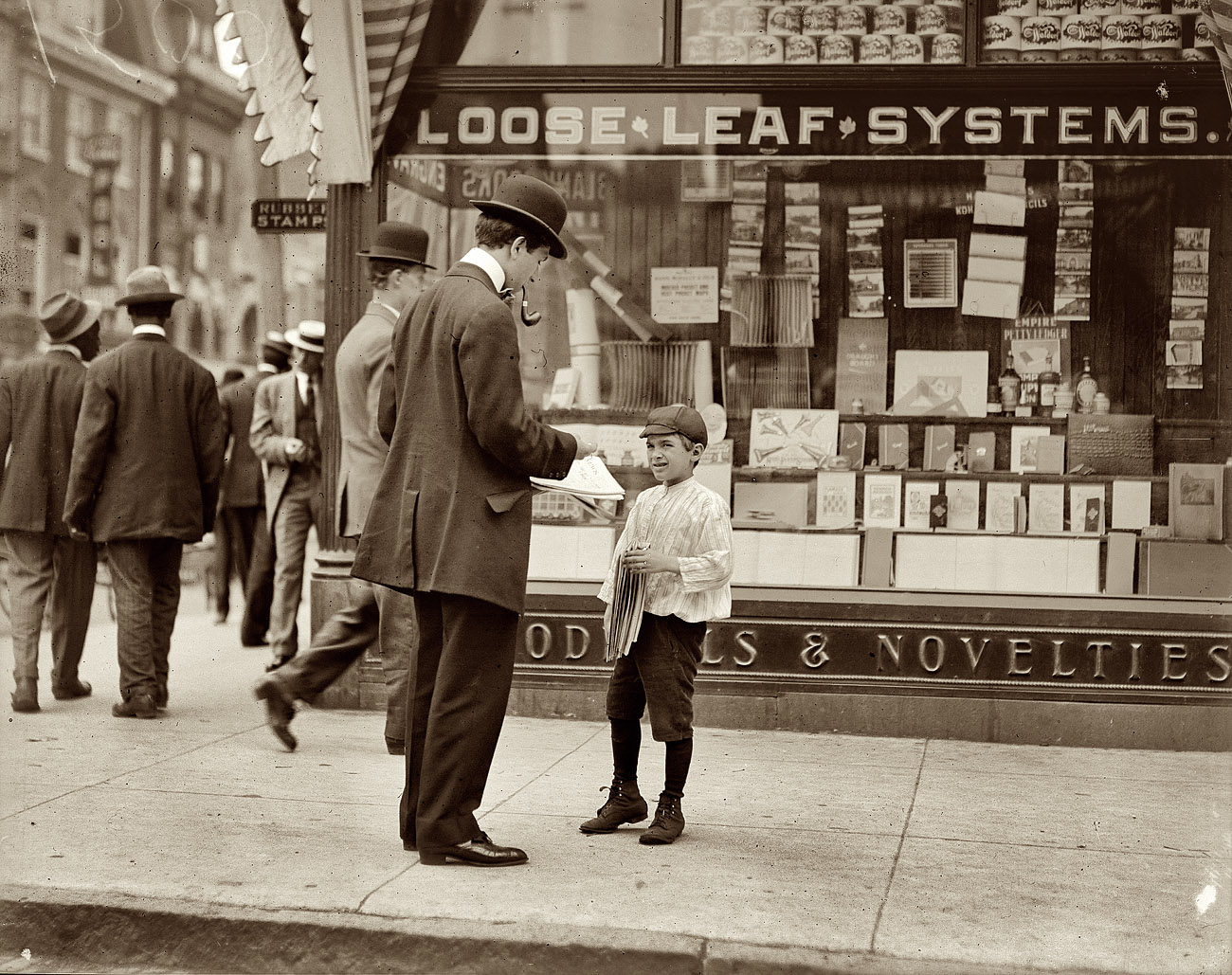
Lewis W. Hine (American, 1874-1940) [Crowd of Newsies, Including One Girl] 1910 Gelatin silver print Sheet: 11.4 × 16.5cm (4 1/2 × 6 1/2 in.) The J. Paul Getty Museum
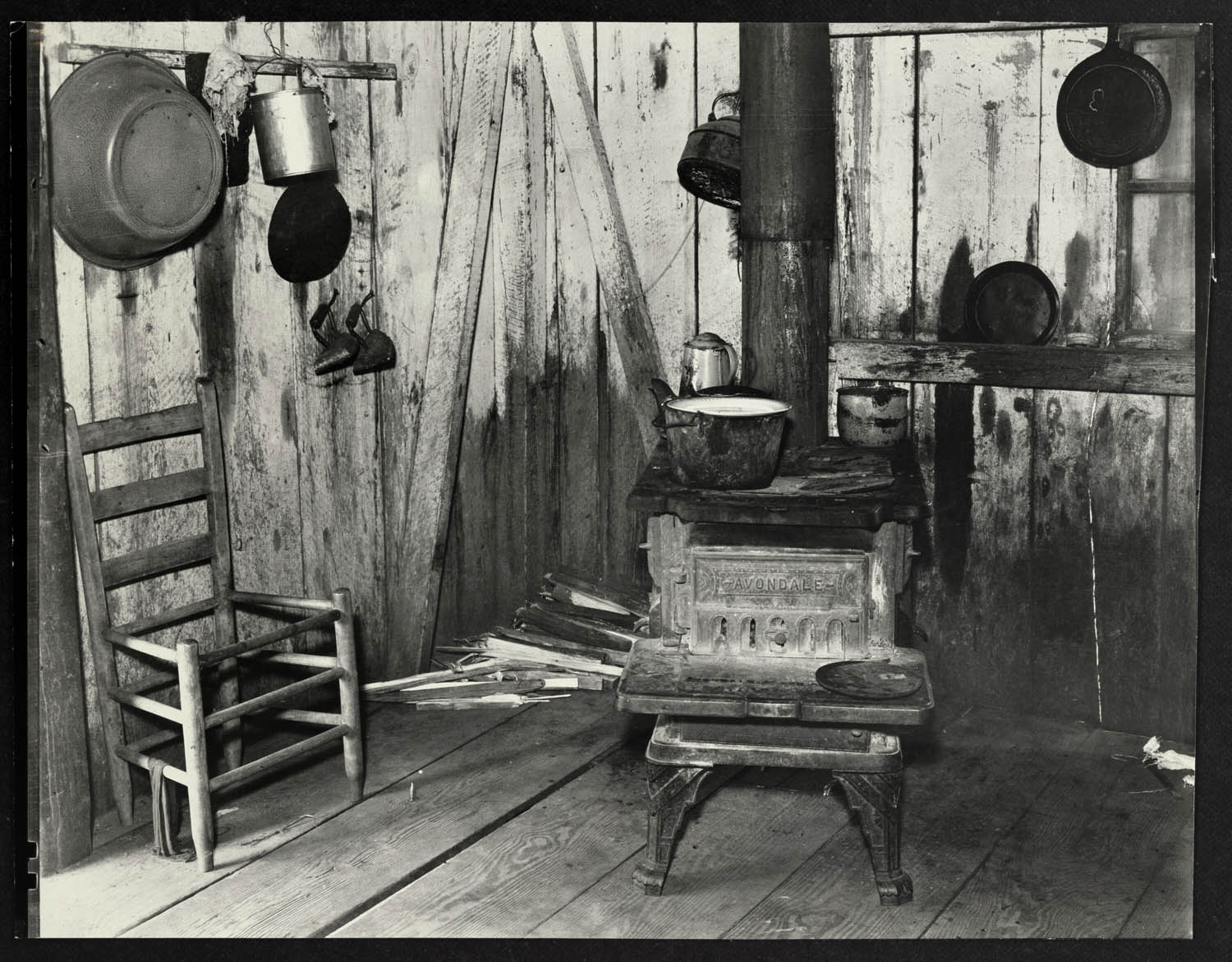
Walker Evans (American, 1903-1975) Alabama Tenant Farmer’s Kitchen Near Moundville 1936 Gelatin silver print 21.7 × 24.1cm (8 9/16 × 9 1/2 in.) The J. Paul Getty Museum, Los Angeles
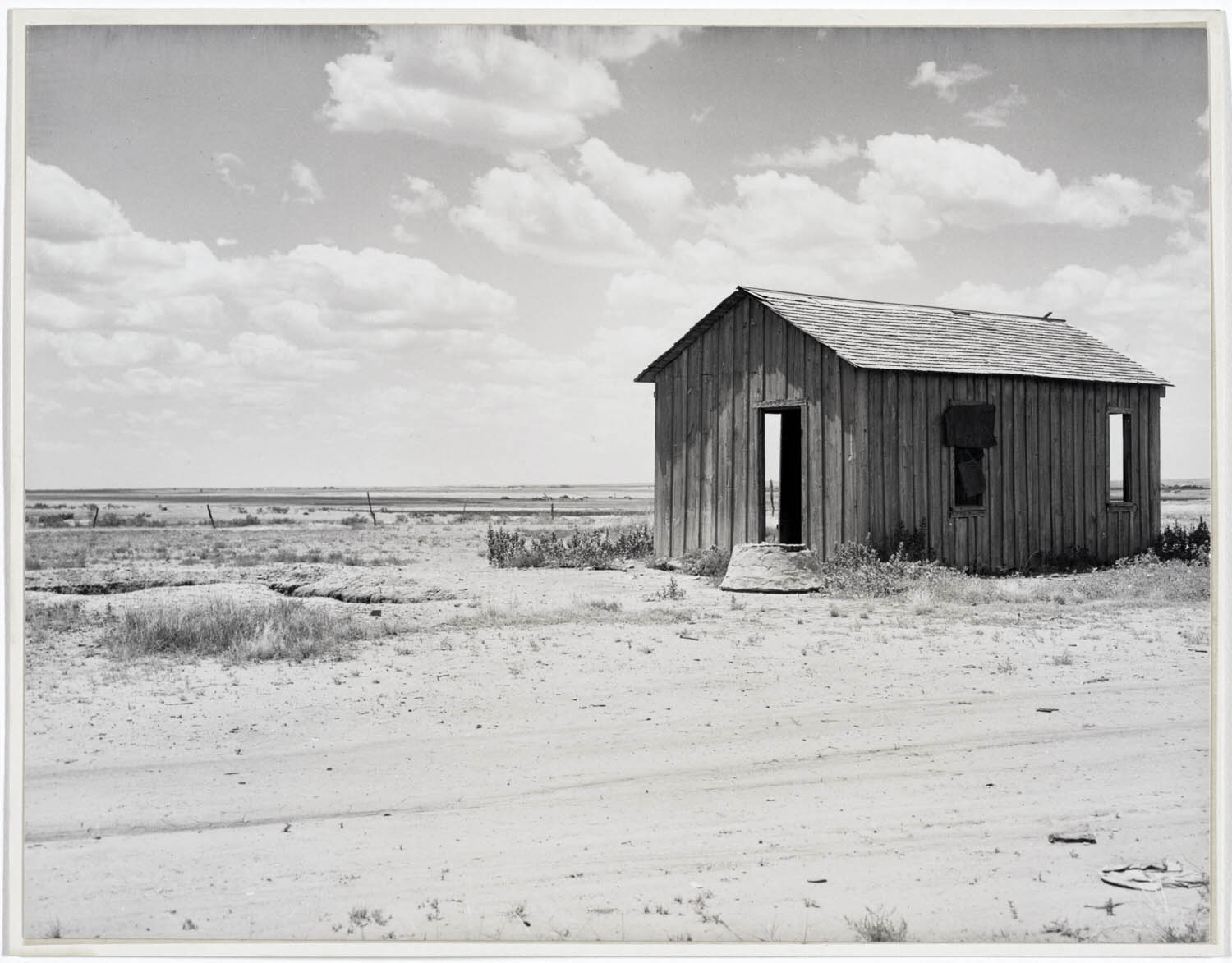
Dorothea Lange (American, 1895-1965) Abandoned Dust Bowl Home About 1935-1940 Gelatin silver print 18.9 × 24.4cm (7 7/16 × 9 5/8 in.) The J. Paul Getty Museum, Los Angeles
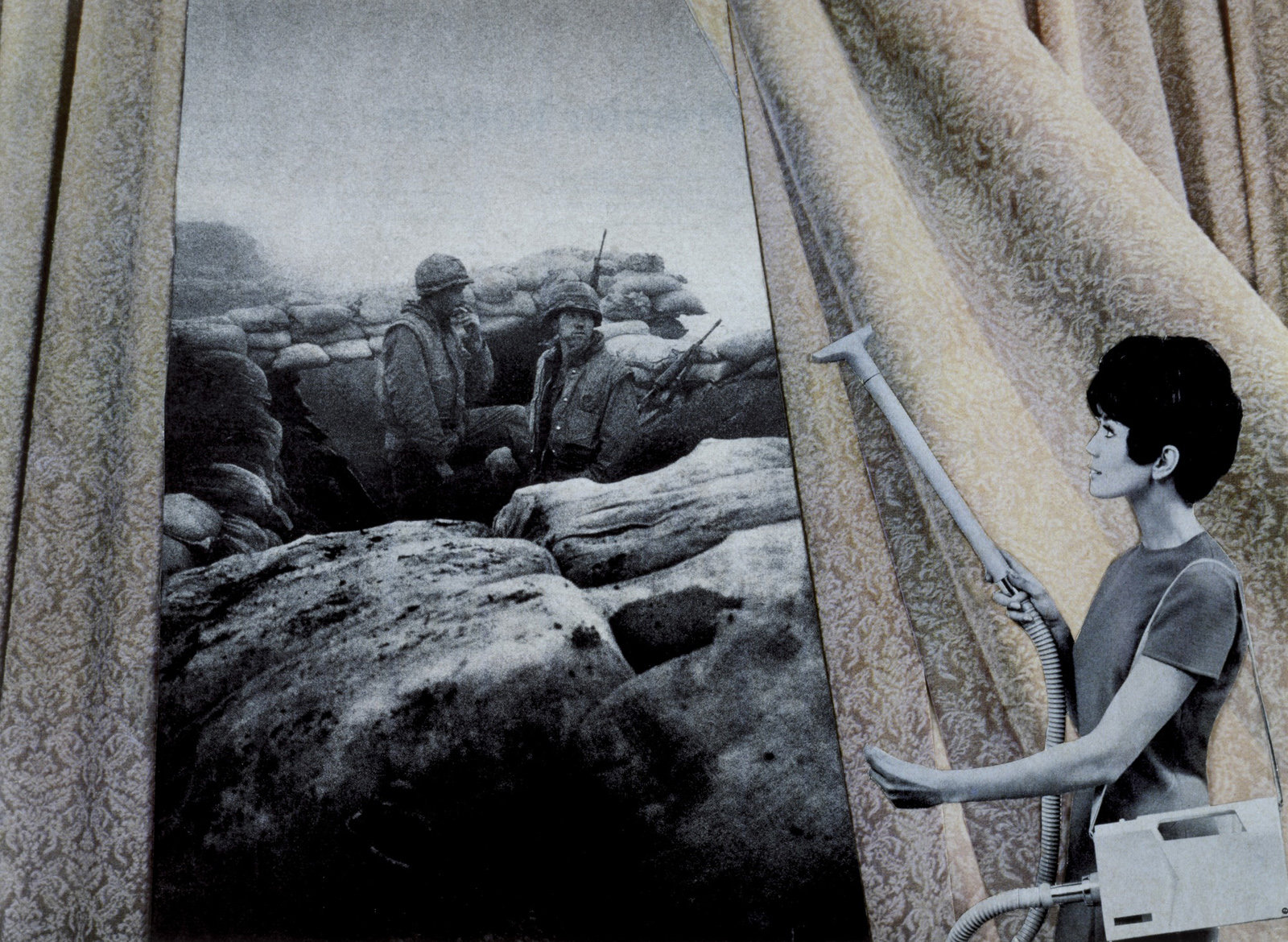
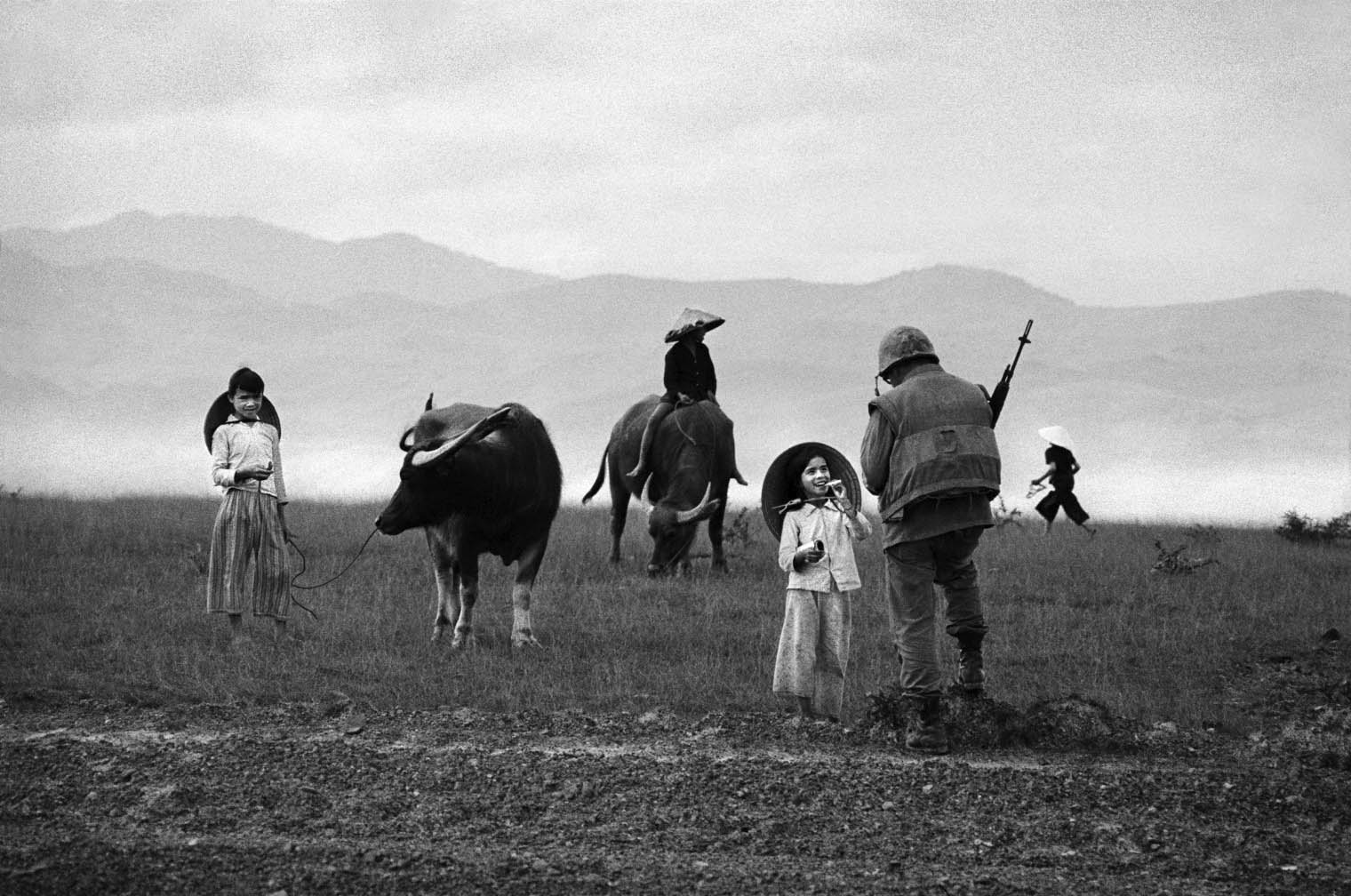
Limits of friendship. A Marine introduces a peasant girl to king-sized filter-tips. Of all the U.S. forces in Vietnam, it was the Marines that approached Civic Action with gusto. From their barrage of handouts, one discovers that, in the month of January1967 alone, they gave away to the Vietnamese 101,535 pounds of food, 4,810 pounds of soap, 14,662 books and magazines, 106 pounds of candy, 1,215 toys, and 1 midwifery kit. In the same month they gave the Vietnamese 530 free haircuts.
“Photography shows the connection between things, how they relate. Photography is not entertaining, this is not decoration, this is not advertising. Photographing is an emotional thing, a graceful thing. Photography allows me to wander with a purpose.”
Leonard Freed (American, 1923-2006), interview in Worldview, 2007
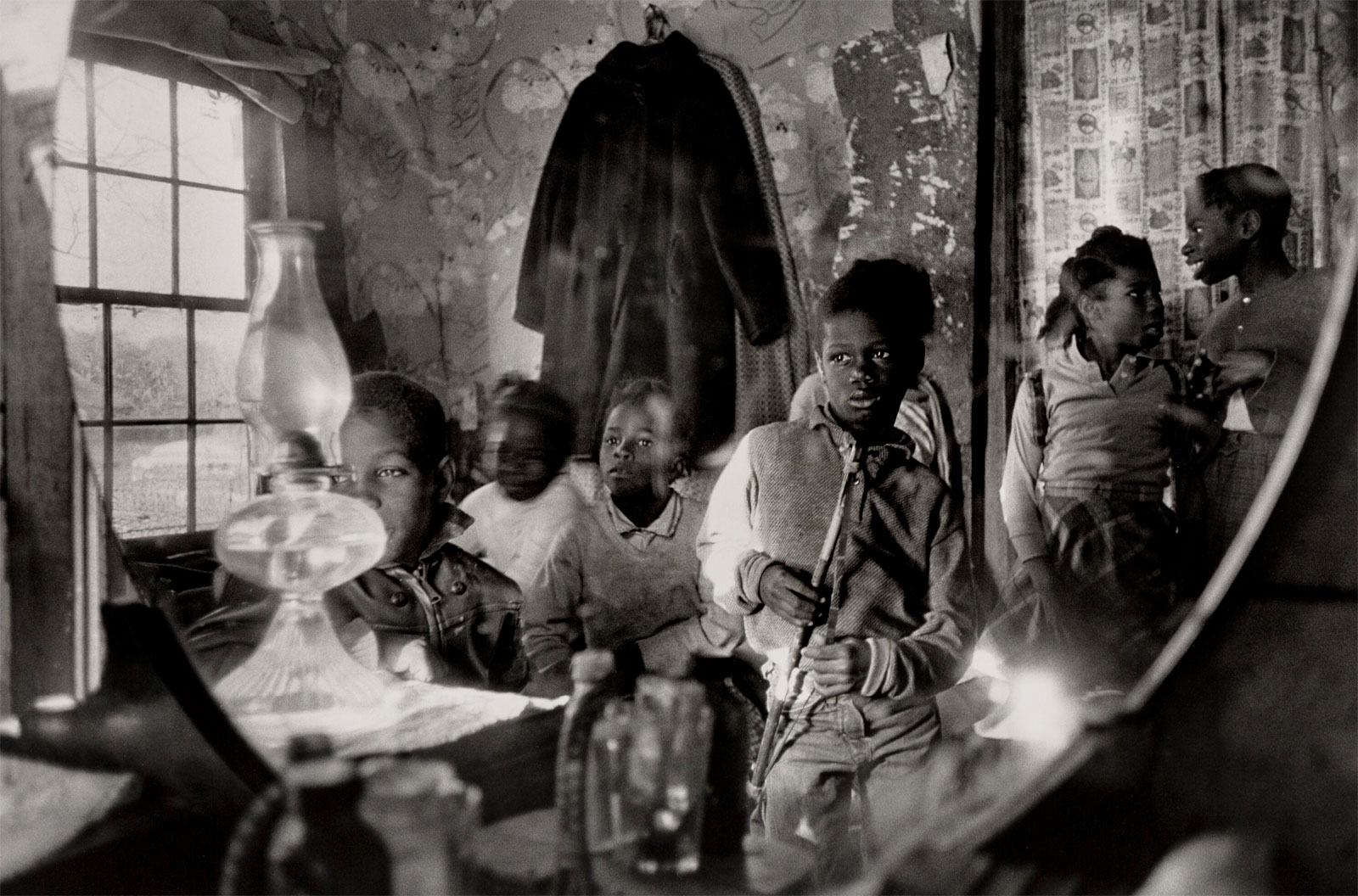
While working in Germany in 1962, photographer Leonard Freed happened to notice a black American soldier guarding the divide between East and West as the Berlin Wall was being erected. It was not the partition between the forces of Communism and Capitalism that captured Freed’s imagination, however. Instead, he was haunted by the idea of a man standing in defence of a country in which his own rights were in question. The experience ignited the young photographer’s interest in the American civil rights movement raging on the other side of the globe. In June 1963 Freed headed back to the United States to embark on a multiyear documentary project, published in about 1968 as Black in White America, that would become the signature work of his career.
The Black in White America series is a kind of visual diary with a moralising purpose. It is highly personal and socially engaged with an implicit goal of effecting change through communication. While Freed made pictures of important events in the civil rights struggle, including the 1963 March on Washington, he quickly found that his interests lay not in recording the progress of the civil rights movement per se but in exploring the diverse, everyday lives of a community that had been marginalised for so long. Penetrating the fabric of daily existence, his work portrays the common humanity of a people persevering in unjust circumstances. His sensitive and empathetic approach sought not to stimulate outrage but to foster understanding and bridge cultural divides as a means of transcending racial antipathy.
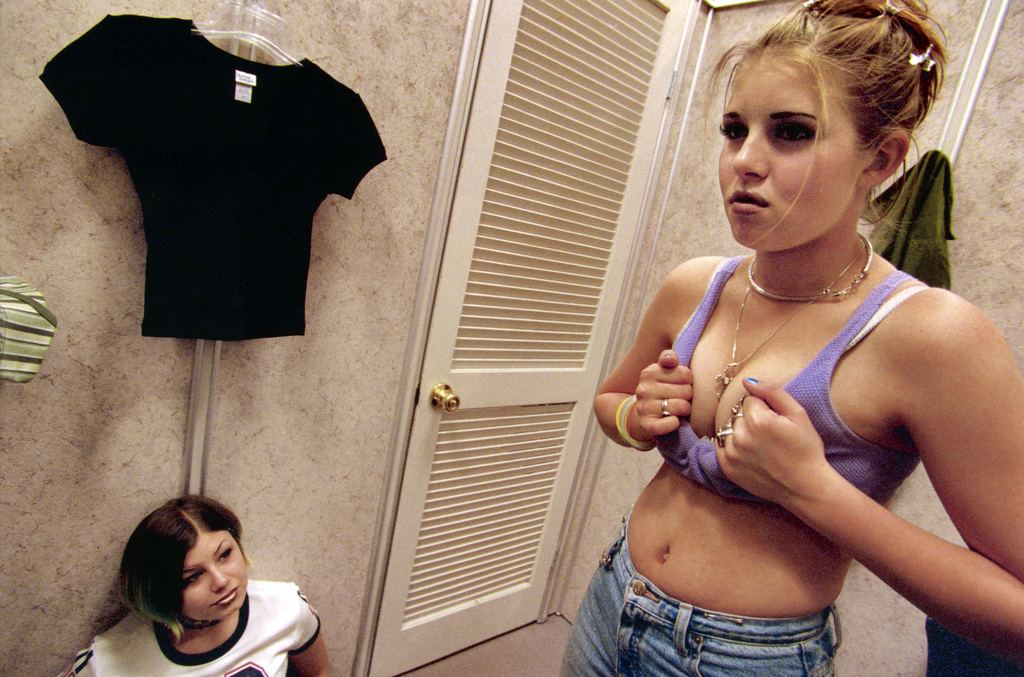
Lauren Greenfield
FAST FORWARD and GIRL CULTURE
“Girl Culture has been my journey as a photographer, as an observer of culture, as part of the media, as a media critic, as a woman, as a girl… I was… thinking about my chronic teenage dieting, my gravitation toward good-looking and thin friends for as long as I can remember, and the importance of clothes and status symbols in the highly materialistic, image-oriented Los Angeles milieu in which I grew up.”
Lauren Greenfield (American, born 1966), Girl Culture, 2002
Photographer and documentary filmmaker Lauren Greenfield has built her reputation as a chronicler of mainstream American culture. In 2002 she published a photographic project, Girl Culture, that delves into the ways consumer society affects the lives of women in America. Of central concern to Greenfield was the exhibitionist tendencies of contemporary American femininity. Visiting girls of all ages at home, in doctors’ offices, and out with friends,
Greenfield examined personal issues of public consequence, providing an intense and intimate exploration of girls’ relationships to their bodies and the effects of popular culture on self-image.
Many of her pictures and accompanying interviews focus on what she refers to as “body projects,” the daily grooming rituals undertaken in an effort to express identity through appearance. Others look at the social and consumerist influences from which these young women take their cues as well as the difficulty of living up to such expectations.
Girl Culture grew out of an earlier study, Fast Forward, that critically surveyed what life is like for children growing up in Los Angeles. The work revolves around her perception of an early loss of innocence among her young subjects and traces Hollywood’s role as a homogenising force in their lives.
Greenfield’s lens becomes a mirror in which to reflect upon ourselves. Together Fast Forward and Girl Culture sensitively explore how culture leaves its imprint on individuals.
Philip Jones Griffiths
VIETNAM INC.
“The “bang-bang” aspect of any war is the least likely to offer any explanation of the underlying causes. My task is to discover the why, so it’s the actions surrounding the battlefields that present the best clues.”
Philip Jones Griffiths (Welsh, 1936-2008), Aperture, spring 2008
A lifelong desire to leave the world a better place drove Philip Jones Griffiths, whose work is marked by a fiercely independent approach, deep engagement with his subjects, and a skeptical view of authority. Vietnam Inc., the photographer’s critical 1971 account of America’s armed intervention in Southeast Asia, is one of the most detailed photographic stories of a war published by a single photographer. The project’s exploration of the why, and not just the what, behind the war’s failures made it a particularly engaging and ambitious work of advocacy journalism and a model to which many photographers still aspire.
Griffiths’s independent approach is remarkable because of its sensitivity to the people of Vietnam and its eschewing of a Western point of view. In Vietnam Inc. there are few photographs documenting American troops and the might of their military prowess. Instead, his primary focus was on Vietnamese civilians and a culture in crisis. His book put the conflict in the context of Vietnam’s history and culture, showing the ways in which the Capitalist values that America promoted in its efforts to contain the spread of Communism were out of sync with Vietnam’s predominantly communal and agrarian way of life.
Vietnam, for Griffiths, became a “goldfish bowl where the values of Americans and Vietnamese can be observed, studied, and, because of their contrasting nature, more easily appraised.” And in Griffiths’s appraisal, it was America’s “misplaced confidence in the universal goodness” of its own values that would ultimately lead to an imperialist failure and, more importantly, the unjust devastation of a people.
Mary Ellen Mark
STREETWISE
“One of the reasons we chose Seattle was because it is known as “America’s most liveable city.” Los Angeles, San Francisco, and New York were well known for their street kids. By choosing America’s ideal city we were making the point “If street kids exist in a city like Seattle then they can be found everywhere in America, and we are therefore facing a major social problem of runaways in this country.””
Mary Ellen Mark (American, 1940-2015), Streetwise, 1988
Mary Ellen Mark has reported on the state of our social environment for more than four decades. Far removed from the immediacy of war and conflict, her work plumbs the basic commonality of human experience.
In 1983 Mark traveled to Seattle to do an article for Life magazine on runaway children. Focusing on a set of streets in the city’s downtown area, she began building a sense of trust with the community of runaways and learning about their survival methods. Her pictures showed teenagers who managed to survive on the tough streets through petty crime, prostitution, foraging in dumpsters, and panhandling. She presented the abandoned buildings and underpasses they inhabited and the bonds they built with one another in the absence of family. Mark’s compositions are striking and uncomfortable, emphasising her subjects’ youth while capturing them engaged in activities beyond their years.
Following publication of an article in Life, she continued to develop the story as both a documentary film and still photographic project with her husband, filmmaker Martin Bell, and reporter Cheryl McCall. The film, titled Streetwise, was released the following year and was nominated for an Academy Award. Mark published her still photographs from the project in a book of the same title in 1988.
The Streetwise project provided dimension to an important issue of its day. In giving specific shape, individuality, and visibility to the problem of runaway children, it called for greater social and political commitment to addressing America’s epidemic of broken families.
Susan Meiselas
NICARAGUA, JUNE 1978 – JULY 1979
“We all cross histories, and the ones that we cross shape us as much as we shape them.”
Susan Meiselas (American, born 1948), in conversation with the curator, 2010
In 1978 Magnum photographer Susan Meiselas traveled to Nicaragua. Tensions were high following the assassination of Pedro Joaquín Chamorro, the editor of an opposition newspaper critical of the repressive, hard-line government. Meiselas witnessed the eruption of a full-scale revolution in August of that year. Aware that a momentous process was taking place, she stayed to record its unfolding, including the celebration of the revolutionaries’ victory in the central plaza of Managua in July 1979.
Meiselas was taken by the bravery of those who were willing to risk their lives against the dictatorship for the promise of a better future, and she took pains to photograph the action from the perspective of those involved in it. The record of her movements around the country formed a narrative about the progress of their insurrection. She made a decision, which at the time was still considered somewhat unusual in serious war reportage, to record the revolution on colour film, seeing it as a more appropriate medium for capturing the vibrancy and optimism of the resistance.
The photographer’s compelling pictures were picked up by major newspapers and magazines around the world, giving individual images a public life, but one that was beyond her immediate control with regard to captioning and that was fragmented from the context of her larger body of pictures. In collecting seventy-one of her photo-graphs into a book, first published in 1981 as Nicaragua, June 1978 – July 1979, Meiselas reasserted the narrative of the revolution as she experienced it and gave greater permanence and coherence to her documentary endeavour.
James Nachtwey
THE SACRIFICE
“For me, the strength of photography lies in its ability to evoke a sense of humanity. If war is an attempt to negate humanity, then photography can be perceived as the opposite of war. And if it is used well, it can be a powerful ingredient in the antidote to war.”
James Nachtwey (American, born 1948), from the film The War Photographer, 2001
For nearly thirty years James Nachtwey has dedicated himself to delivering an antiwar message by documenting those around the world affected by conflict. Traveling with emergency medical units in Iraq in 2006, the photographer began a photo essay, The Sacrifice, that documents the struggle to save and rebuild lives. The series depicts the helicopter transfers from battle sites to treatment centers, the emergency rooms where lives hang in the balance, and the difficult process of recovery.
In anticipation of showing the work, Nachtwey created a monumental installation print, consisting of sixty individual trauma-center images, tightly framed and digitally collaged into a grid. The work stands as a grim reminder of the human costs of war. The object’s sheer size, in which one picture gives way to the next in a seemingly endless stream of torn flesh, metal instruments, snaking tubes, and bloodied hands, effectively conveys a sense of the controlled chaos that permeates these medical centres as well as the overwhelming volume of casualties flowing through the medics’ hands on a daily basis.
While it may be easy to contemplate and even support war in abstract, strategic terms, it is difficult to face Nachtwey’s portrayal of its inevitable results. In its aggressive scale, his intentionally unsettling work demands that we reconcile the goals and achievements of armed conflict with its human costs, that we be prepared to acknowledge in particular visual terms the sacrifice it entails and the valiant work of those who do their best to mend its path of destruction.
Sebastião Salgado
MIGRATIONS: HUMANITY IN TRANSITION
“My hope is that, as individuals, as groups, as societies, we can pause and reflect on the human condition at the turn of the millennium. Can we claim “compassion fatigue” when we show no sign of consumption fatigue?”
Sebastião Salgado (Brazilian, born 1944), Migrations, 2000
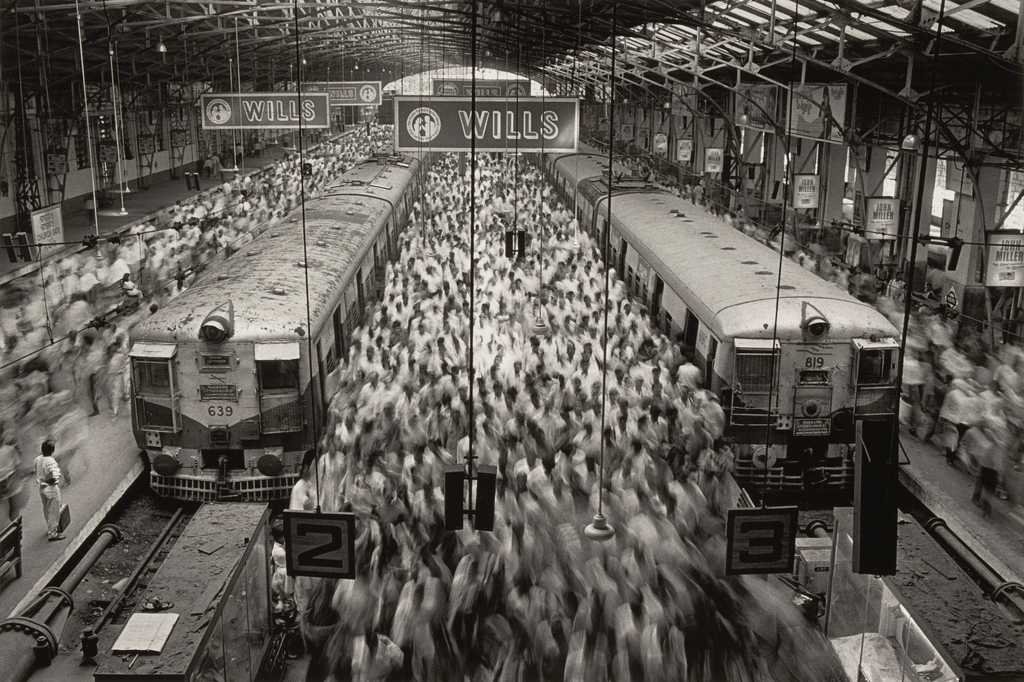
Trained in economics before taking up photography, Sebastião Salgado has used his camera to raise awareness of the world’s economic disparities and provoke discussion about the state of our international social environment. Between 1994 and 1999 Salgado pursued an enormous project to document migrant populations around the world. Published in 2000 as Migrations: Humanity in Transition, this epic work of twentieth-century photojournalism documents people across forty-three countries who have been uprooted by globalisation, persecution, or war. The pictures in this exhibition represent several themes in Salgado’s study, including the effects of population surges in cities of developing countries, the conditions of refugees fleeing war in Africa, and the process of migration from Latin America to the United States.
Salgado’s work is marked by a heightened attention to aesthetic grace that attempts to endow his subjects with dignity even as it communicates the discomfort of their circumstances. His photographs are constructed with careful attention to dramatic lighting, elegant contours, and striking visual impact. Ultimately, Salgado sees himself as a storyteller and a communicator, a bridge between the fortunate and the unfortunate, the developed and the undeveloped, the stable and the uprooted. Portrayed lyrically and sensitively, his subjects are transformed into metaphors for complex inequities that exist in the world – problems that must be recognised and acknowledged before they can be addressed.
W. Eugene Smith and Aileen M. Smith
MINAMATA
“[Pollution] is closing more tightly upon us each day… After reflecting on the rights and wrongs of the situation in Minamata, we hope through this book to raise our small voices of words and photographs in a warning to the world. To cause awareness is our only strength.”
W. Eugene Smith (American, 1918-1978) and Aileen M. Smith (American, born 1950), Minamata, 1975
In 1971 W. Eugene Smith, a major figure in the history of socially concerned photography, and his wife, Aileen M. Smith, were told of a controversy over industrial pollution taking place in the small Japanese fishing village of Minamata. Beginning in the 1950s, thousands of people in the area were severely affected by mercury poisoning, brought about by eating fish contaminated with chemical waste dumped in the bay by the Chisso Corporation. Victims were afflicted with brain damage, paralysis, and convulsions. The ailment, which came to be known as Minamata Disease, is not reversible.
When the Smiths arrived in Minamata, lawsuits had already begun, and the couple set out to document the progress of the claims. They spent three years on the project, calling attention to the victims’ cause. Aileen acted as an equal collaborator, making pictures and writing texts with W. Eugene. The work resulted in numerous magazine publications, exhibitions, and a coauthored book, Minamata, published in 1975.
The Smiths’ study records the course of the trial through the court’s ruling in favour of the plaintiffs in 1973. The essay relates the importance of the sea and fishing to the town’s culture, reports on the company’s drainage pipes into the sea, chronicles the lives transformed by the disease, and depicts the demonstrations that took place in opposition to Chisso. As a tale of the dangers of industrial pollution, the project gained traction within the political atmosphere of the 1970s, when the environmental movement was taking off.
Larry Towell
THE MENNONITES
“When a Mennonite loses his land, a bit of his human dignity is forfeited; so is his financial solvency. He becomes a migrant worker, an exile who will spend the rest of his life drifting among fruit trees and vegetable vines, dreaming of owning his own farm some day. But for these who struggle with God at the end of a hoe, the refuge of land, Church, and community may be at least a generation away.”
Larry Towell (Canadian, born 1953), The Mennonites, 2000
Wary of the media’s commitment to speed, photographer Larry Towell insists on the integrity of extended-coverage reporting. In 1989 he came into contact with members of a Mennonite community near his home in Canada. The Old Colony Mennonites are a nonconformist Protestant sect related to the Amish that originated in Europe in the 1500s.
Over the centuries, they have migrated between countries to preserve their way of life, living in colonies where faith and tradition are intertwined and modern amenities, such as cars, rubber tires, and electricity, are not welcome.
The Mennonites Towell befriended had migrated to Canada from colonies in Mexico in search of seasonal work. Due to shrinking water tables in Mexico, the effects of international trade, and a rising population in the colonies, many Mennonites have found themselves landless and economically marginalised, forced to compromise their beliefs in order to survive. Towell was eventually invited to join them in their treks back to Mexico for the winter. With his unique and intimate access, he spent the next ten years photographing their activities, capturing their struggle to preserve a lifestyle incongruent with the larger world on which they have become interdependent.
Towell’s work documented the Mennonites’ way of life for the historical record and inspires greater understanding today for a group whose attempts to embrace life could be easily overlooked. In spending a decade on a subject that would be of only passing interest to mainstream media, he asserts a form of visual reporting in which reflection takes precedence over profitability and immediacy.
Many thankx to The Museum of Fine Arts, Boston for allowing me to publish the photographs in the posting. Please click on the photographs for a larger version of the image.
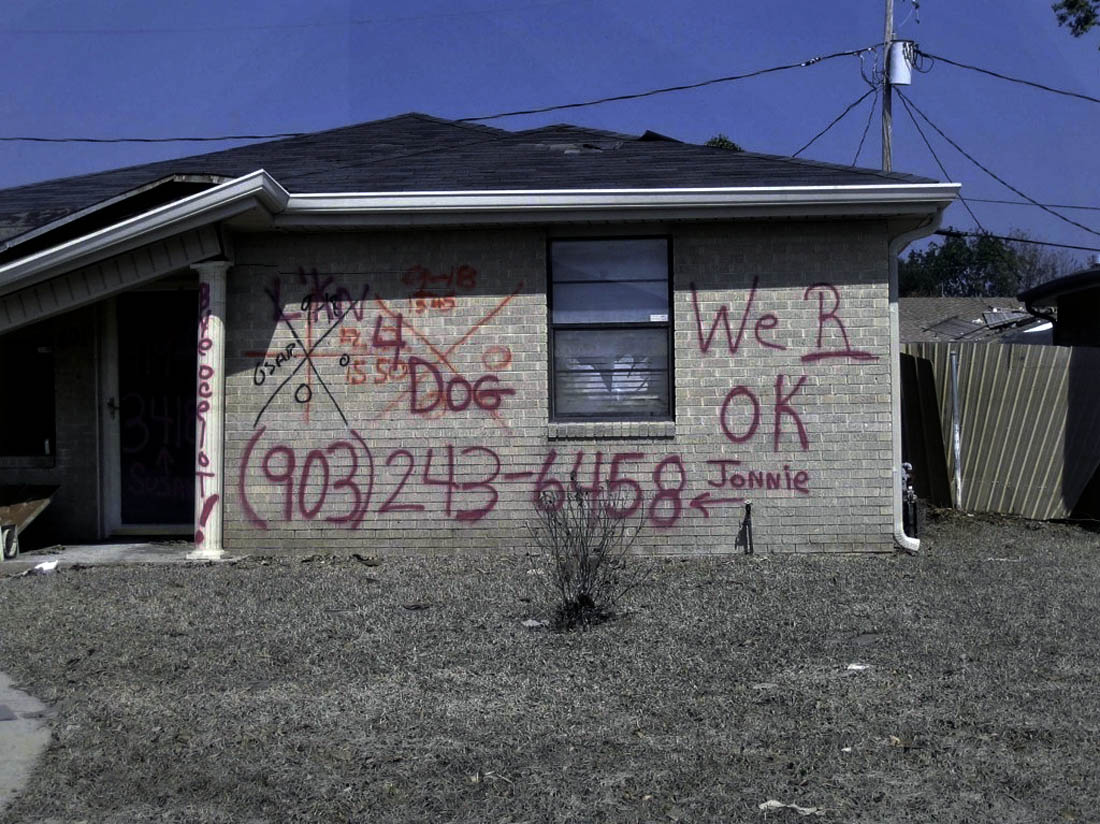
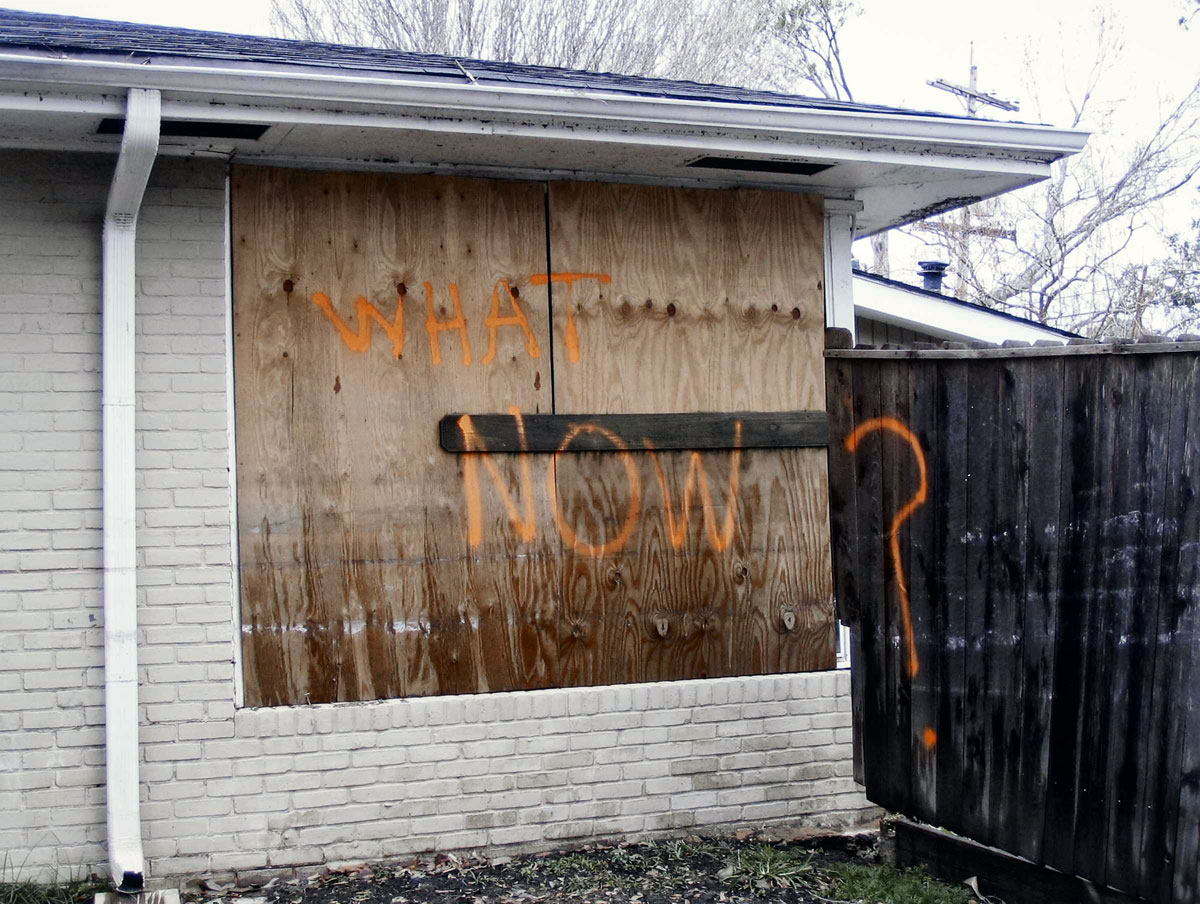
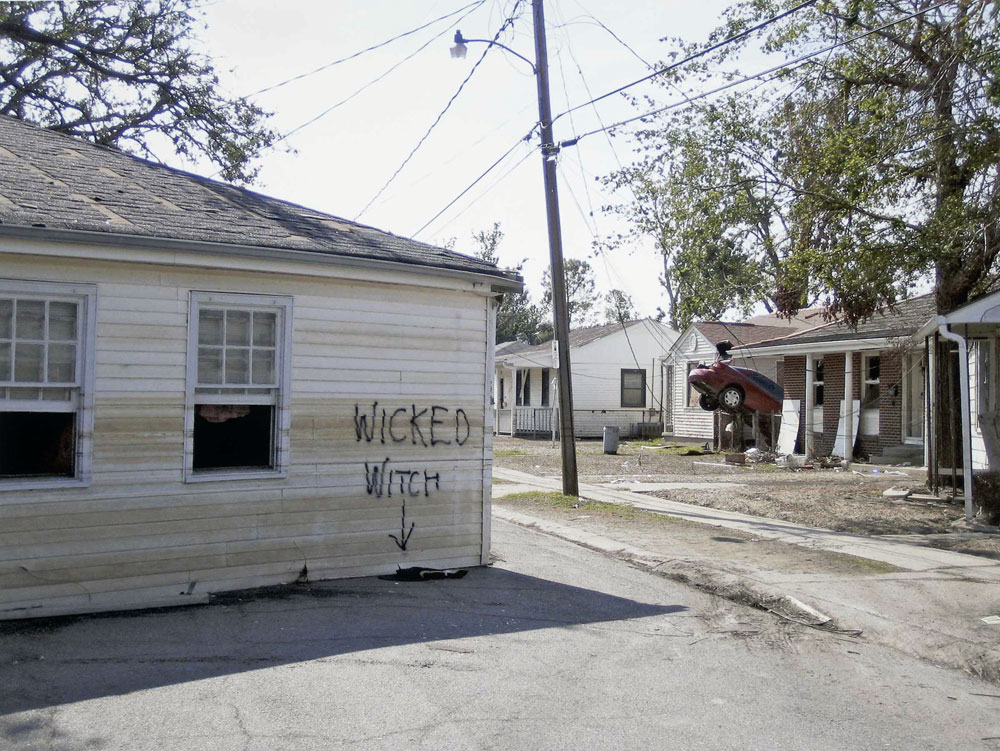
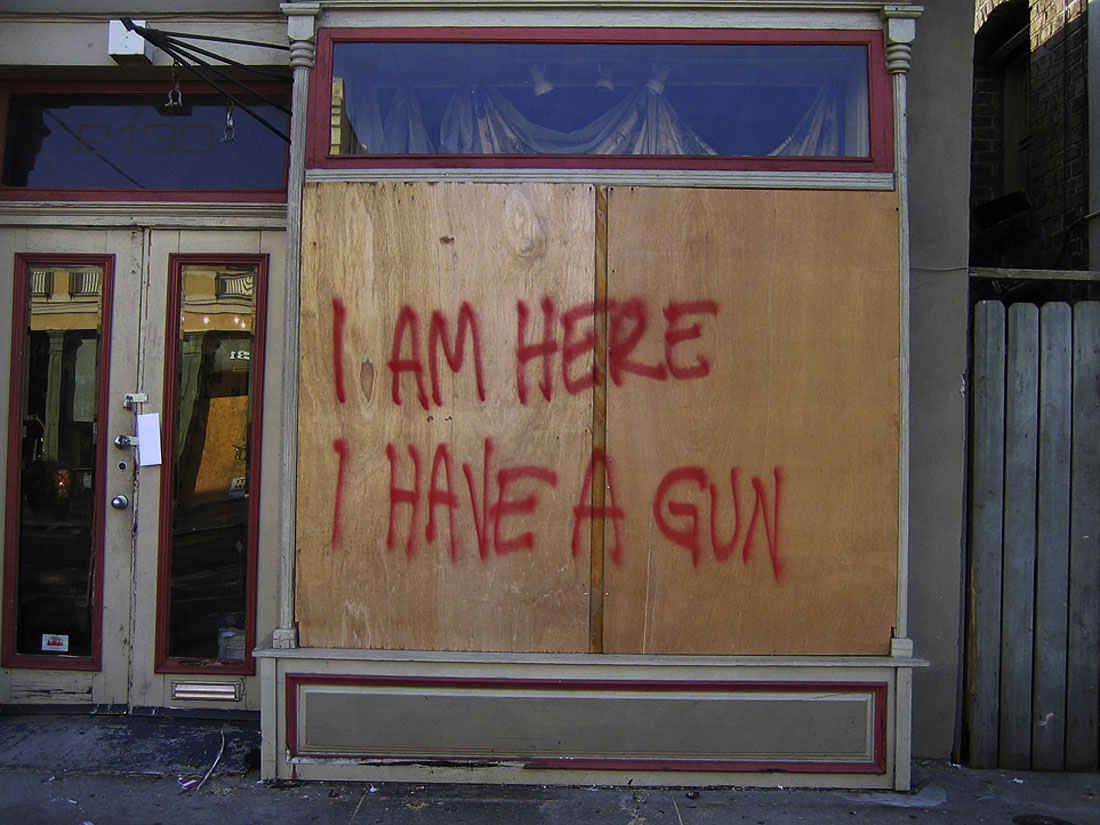
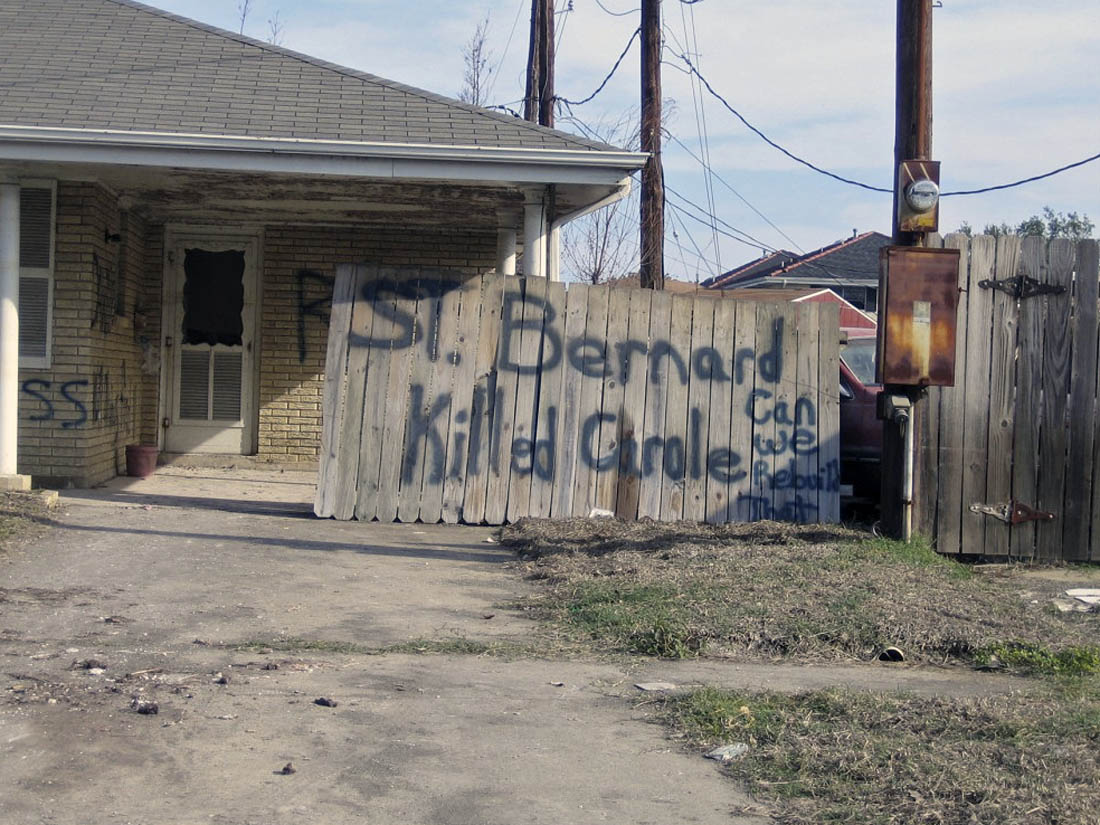
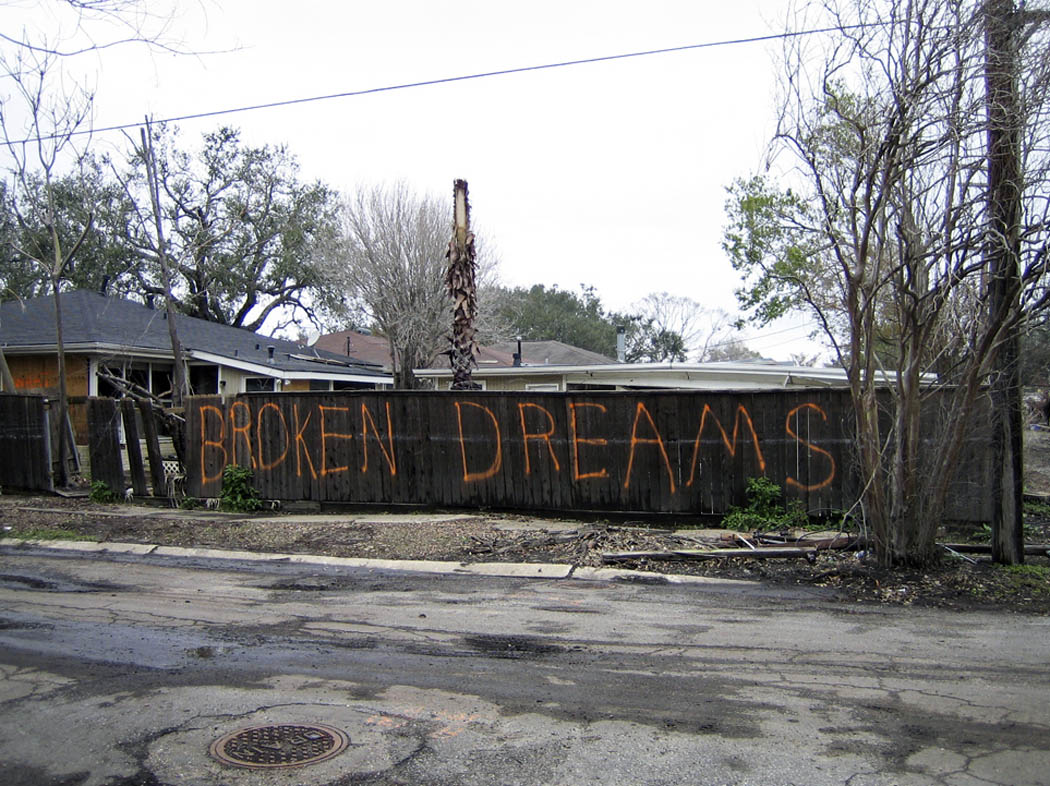
Just after Hurricane Katrina devastated the city of New Orleans in 2005, photographer Richard Misrach used a 4-megapixel pocket camera to capture messages left behind by evacuees. Some are warnings; some are cries for help or encouragement; some are tallies of loss.
Misrach composed a visual narrative that reveals the wrenching anguish of dealing with the aftermath of this horrific storm. Commemorating the hurricane’s fifth anniversary, the exhibition Richard Misrach: After Katrina presents 69 photographs that Misrach has generously given to the MFAH.
Misrach (born 1949) is best known for his Desert Cantos series, initiated in 1979 and still ongoing. Each canto within the series investigates specific aspects of the American West, from issues of water, to tourism, to the presence of the U.S. military. While developing the Cantos, Misrach has also produced series on the Golden Gate Bridge and Hawaiian beaches. The MFAH collects Misrach’s work in depth and in 1996 organised the artist’s mid-career retrospective, Crimes and Splendors: The Desert Cantos of Richard Misrach.
“A face tells the story of what a person is thinking. The eyes reveal the suffering.”
Carol Jerems
Time and Truth: Looking again at the work of Carol Jerrems
This is a solid exhibition of the photographs of Carol Jerrems at Heide Museum of Modern Art, accompanied by small selections of the work of Larry Clark and William Yang and the sequence The Ballad of Sexual Dependency (1979) by Nan Goldin.
I like Jerrems work: it is strong, frontal, direct and truthful. What I dislike is the hagiography that has grown up around this artist, the mythologizing of Saint Jerrems. We don’t need a saint of Australian photography; what we need is an appreciation of the artist, the person and her legacy. While the personal history of this artist is well known – facing depression, putting herself in danger, sexually active, documenting the counter-culture sharps and skinheads and urban indigenous people, the photographing of women and her death at far too young an age – few people actually look at the photographs clearly.
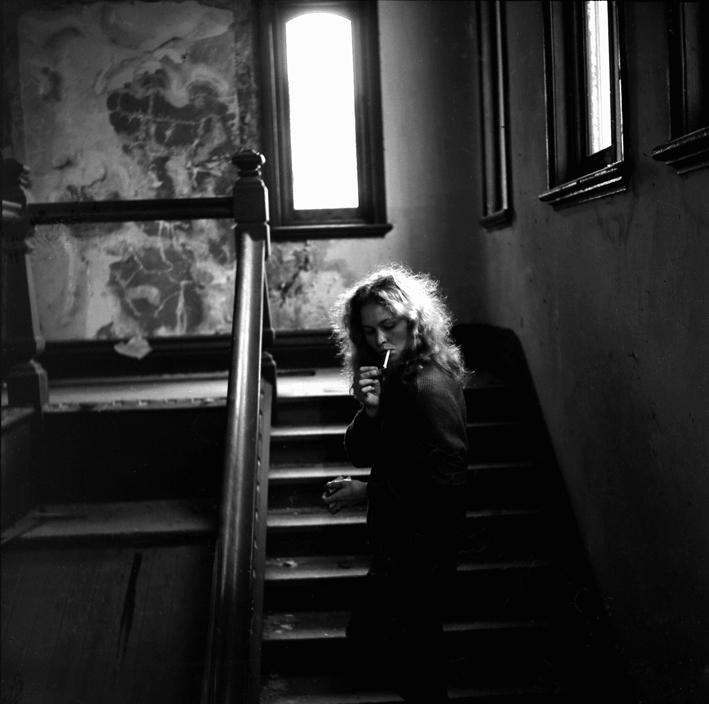
Most of the photographs are 8″ x 10″ prints, mainly portraits, that are usually dark and contrasty, small and emotionally intense. Jerrems images are made full frame (the modernist conceit of filing out a negative carrier, so that if the negative was printed full frame there would be a black border around the picture) to avoid cropping in the darkroom. This shows good previsualisation by the artist, the composition of the image made at the time of the exposure. There is a closeness to the framing of the portraits and a conversant ambiguity about all of her backgrounds – mainly low depth of field, anonymous places (perhaps a brick wall or a close up of a street corner). In fact it is difficult to pin down any actual place in her photographs unless you are told in the title of the work. The contextlessness of her backgrounds allows the viewer to focus on the people placed before her lens and here Jerrems gets up close and personal, trying to capture the truth of her subjects, their soul (in this sense she is like Diane Arbus, thrusting her camera into places it was not supposed to go until something gives – the subject gives up, drops the mask, even if just for a split second, and click, the artist has their image). The mainly head and shoulders photographs of women are most impressive in this regard as Jerrems portrays the women’s strength and vulnerability as are the photographs of the artist herself in hospital fighting her debilitating illness, the most moving, emotional photographs in the exhibition.
Other photographs show constructed intimacies between people, the camera and the artist. In Esben and Dusan, Cronulla (1977, above), Jerrems uses the yin yang black, white background to frame the two protagonists, bringing forward the body of Esben in the right portion of the frame and letting Dusan recede into the darkness. In Boys (1973) two bodies are photographed in a bed, legs and arms entwined but the print is so dark that you would never know they were two boys unless you were told – and this adds to a sense of mystery, the imaging of the most beautiful, sensitive, abstract embrace. Mark Lean with Arms Crossed (1975) shows a cocky, self-assured Lean staring directly at the camera as though it were not there, as though he were conversing directly with Jerrems, the camera an extension of the artist capturing his brave-aura: one camera, one lens, one vision. If you study the contact sheet for the photograph Vale Street (1975, above), Jerrems eventually draws the central luminous figure forward in the frame to create the now iconic image while the two acolytes hover, brooding and menacing in the darkened background.
As Kathy Drayton has observed, “Her photographs engage the viewer in an intimate relationship with her subjects. It’s not always a friendly intimacy – sometimes her subjects look defensive, irritated or even menacing, but you always sense that you’re seeing beyond the mask into the soul.”1
Jerrems saw herself as a serious photographer; if something happened she felt she should be commenting on it. She was also quite naive but always pushed herself and her art into sometimes dangerous places. She would have thought ‘how do I say something that is true’ and her endeavour, which is also constructed, was seeing things in terms of opportunities for a good photograph. Jerrems removed the safeguards; she got right in there among her volatile characters, her potential sexual predators: let’s just see what happens when the safety fence goes down. Although I believe there is a lack of really good photographs that Jerrems made (what I call highlight pieces, namely the iconic Vale Street, Mozart Street, and Mark and Flappers all 1975, see photographs below) there is a consistency to her work and how it exemplifies an exchange that takes place between the artist and the world. What I would call “a good deal.”
When looking at art, one of the best experiences for me is gaining the sense that something is open before you, that wasn’t open before. I don’t mean accessible, I mean open like making a clearing in the jungle, or being able to see further up a road, or just further on. And also like an open marketplace – where there were always good trades. There is the feeling that if you put in a certain amount of honesty, then you would get something back that made some room for you in front – some room that would allow you to look forward, and maybe even walk into that space. Seeing Jerrems work gives you that feeling.
Jerrems had the power to draw themes together, to ramp up the intensity, to empower her photographs and she was possibly on the way to becoming the things that people now say she was, but her early death curtailed this journey. Her photographs have social significance and photographic integrity and evidence time in the visible – the time in which Jerrems took them, the 1970s, and the truthfulness of her self and her style. I would have loved to have seen Jerrem’s response to the film still work of Cindy Sherman, the layering of the Sherman personas and the challenge to the feminist critique. As it is Jerrems photographs are very frontal in today’s terms and, because of her early death, she lacked the opportunity to interact with the development of more complex theories. The layers present at the time are now conflated into seemingly one layer, supported by back stories and obfuscation that clouds the work – it’s naked frontality and boldness. This obfuscation formalises her legacy into mythology.
Jerrems work does not need this. She struggled with her art, to get the best out of herself and her visualisation, to step into those spaces that I mentioned earlier. What we need is an appreciation of the time of her endeavour and the truthfulness of her art. To say that the work achieved fulfilment is to deny the importance of her death.
Dr Marcus Bunyan
1/ Drayton, Kathy quoted in Wilmoth, Peter. “The ’70s stripped bare,” on The Age website. July 17th, 2005. [Online] Cited 05/10/2010
Many thankx to Jade Enge and Heide Museum of Modern Art for allowing me publish the photographs in the posting. Please click on all of the photographs for a larger version of the image.
Featuring the exceptional talent of four photographers whose images capture people, places and events with candid intimacy, Up Close traces the significant legacy of Australian photographer Carol Jerrems (1949-1980) alongside that of contemporary artists Larry Clark (USA), Nan Goldin (USA) and William Yang (Sydney). According to Guest Curator Natalie King, ‘Up Close takes its inspiration from the way each artist candidly depicts a social milieu and urban life of the 1970s and early 1980s’. Sharing an interest in sub-cultural groups and individuals on the margins of society, each artist reveals a remarkable capacity to provide an empathetic glimpse into semi-private worlds through intimate depictions of people and their surroundings.
Newly discovered prints by Jerrems are included as well as rare archival material from Jerrems’ family and previously unseen out-takes from Kathy Drayton’s documentary film, ‘Girl in the Mirror.’ It is 30 years since Jerrems’ death and 20 years since the first and only survey of her work was presented. Jerrems’ photographic practice was associated with a feminist and political imperative; as she put it: ‘the society is sick and I must help change it’. This exhibition uncovers Jerrems’ preoccupation with people and their environment, subcultures, forgotten and dispossessed groups, especially Aboriginal communities of the time.
Larry Clark unflinchingly turned the camera onto himself and his amphetamine-shooting coterie to produce Tulsa (1971), a series of photographs repeatedly cited for its raw depiction of marginalized youth. This significant publication and photographic series influenced Goldin and a generation of artists who aspired to break with the more traditional documentary modes. With its grainy shot-from-the-hip style, Tulsa exposes a world of sex, death, violence, anxiety and boredom capturing the aimlessness and ennui of teenagers.
First shown at Frank Zappa’s birthday party in 1979 at the Mudd Club in New York, Nan Goldin’s The Ballad of Sexual Dependency has evolved to be an iconic work of its time. Goldin’s snapshot aesthetic is evident in this immersive installation of close to 700 slides full of saturated colour and intimate framing accompanied by a soundtrack. Mining the emotional depths of her friends, lovers and family, Ballad signals a riveting intimacy whilst uncovering the bohemian life of New York’s Lower East Side. Goldin says, ‘I was documenting my life. It comes directly from the snapshot, which is always about love…’
William Yang’s photographs from the 1970s further the snapshot aesthetic through journeying into the intimate world of his particular social milieu: drag queens, Sydney gay and inner-city culture. Yang’s direct, unpretentious photographs provide a unique chronicle of marginalised groups especially as he put it: “… people who are gay, who were invisible, who were too scared to come out. During gay liberation people became visible, people became politicised, and there was a Mardi Gras that was a symbol of the movement.”
Up Close reveals how photographic practices provide an empathetic glimpse into semi-private worlds with close up depictions of people and their surroundings.
The accompanying publication provides for the first time an in-depth account of Carol Jerrems’ work alongside that of her peers and will feature a number of newly commissioned essays. Edited by Natalie King and co-published by Heide and Schwartz City, it will be available at the Heide Store from 31 July.”
Press release from the Heide Museum of Modern Art website
Larry Clark (American, b. 1943) No Title (Billy Mann) 1963 from the portfolio Tulsa Gelatin silver print National Gallery of Australia, Canberra Purchased 1980 Image courtesy of the artist and Luhring Augustine, New York
William Yang (Australian, b. 1943) Peter Tully, Gay & Lesbian Mardi Gras 1981 Gelatin silver print edition 2/10 40.4 x 27cm National Library of Australia Courtesy of the artist
Heide Museum of Modern Art 7 Templestowe Road, Bulleen, Victoria 3105
Opening hours: (Heide II & Heide III) Tues – Sun 10.00am – 5.00pm
Exhibition dates: 15th September – 23rd October 2010
Many thankx to Yvonne Gomez and the Bruce Silverstein Gallery for allowing me to publish the photographs in the posting. Please click on the photographs for a larger version of the image.
“If I had to do color and black and white simultaneously,” Morath recalled, “I’d finish one, then do [the other], trying not to think of both at the same time; the thinking is so different!”
Bruce Silverstein Gallery is pleased to present, Beyond COLOR: Color in American Photography, 1950-1970, a re-examination of a pivotal period in photography’s short history, when the artistic relevance of color in fine art photography had yet to be determined. The exhibition unites works for the first time by many of the “first generation” practitioners of color photography including artists Marie Cosindas, Arthur Seigel, Harry Callahan, Eliot Porter, Saul Leiter, Marvin E. Newman, Pete Turner, Ruth Orkin and Ernst Haas. Other highlights include images exhibited for the first time by Magnum’s first female member, Inge Morath, as well as a special slide projection of color images by Garry Winogrand, images that were never printed by the artist. Beyond COLOR attempts to reclaim this moment of photographic history that only today has begun to receive critical attention.
After the conclusion of World War II, innovations in technology combined with the public’s desire to “see the world as it is” resulted in an explosion in the usage of color imagery by the mass media. By 1951, commercial color television broadcasting had begun, and in 1954, half of all American films were made in color. In the early 1960’s color imagery was so prevalent that National Geographic magazine introduced a new era when it became the first major American periodical to print an all-color issue. While color photography during this period was widely embraced by mass culture – advertising and journalism – it continued to suffer from second-class status in the fine art world when compared with images in black & white. For most in the fine art establishment, black & white photography represented the medium of choice, steeped in a century-old tradition it was easily accessible and affordable to artists, and possessed known archival stability. For this reason, few artists chose to work in color and even fewer produced finished prints. Although color works had begun to selectively appear in museum exhibitions, most notably at the Museum of Modern Art, where single artist exhibitions of works by Eliot Porter (1943), Ernst Haas (1962) and Marie Cosindas (1966) were displayed, academic and institutional attention and support for this new technology was scant.
Over the past forty years, work in color created by artists during this formative period has received little attention. Most critical analysis through writings and exhibitions have focused on color work created during the 1970’s and 1980’s after the now famous Museum of Modern Art exhibition, Photographs by William Eggleston (1976), curated by John Szarkowski. This MoMA exhibition set the groundwork for defining a new purpose for color photography – one that focused more on the conceptual implications of the photograph and its creation, and away from the formalistic attributes of the image as well as the attention to color itself. The effects of Eggleston’s exhibition and Szarkowski’s essay reverberate to this day.
With a certain distance from this era when color photography was new – its place in the art world no longer a question – this exhibition offers a crucial consideration of works created during this period and encourages a new perspective on the significance of these artists’ contributions to the history of photography.
Pete Turner (American, 1934-2017) Texascape 1968, printed c. 1976-1980 Signed with artist stamp on recto Dye transfer print Edition of 50 (#28/50) 6 x 9 in (15.24 x 22.86cm)
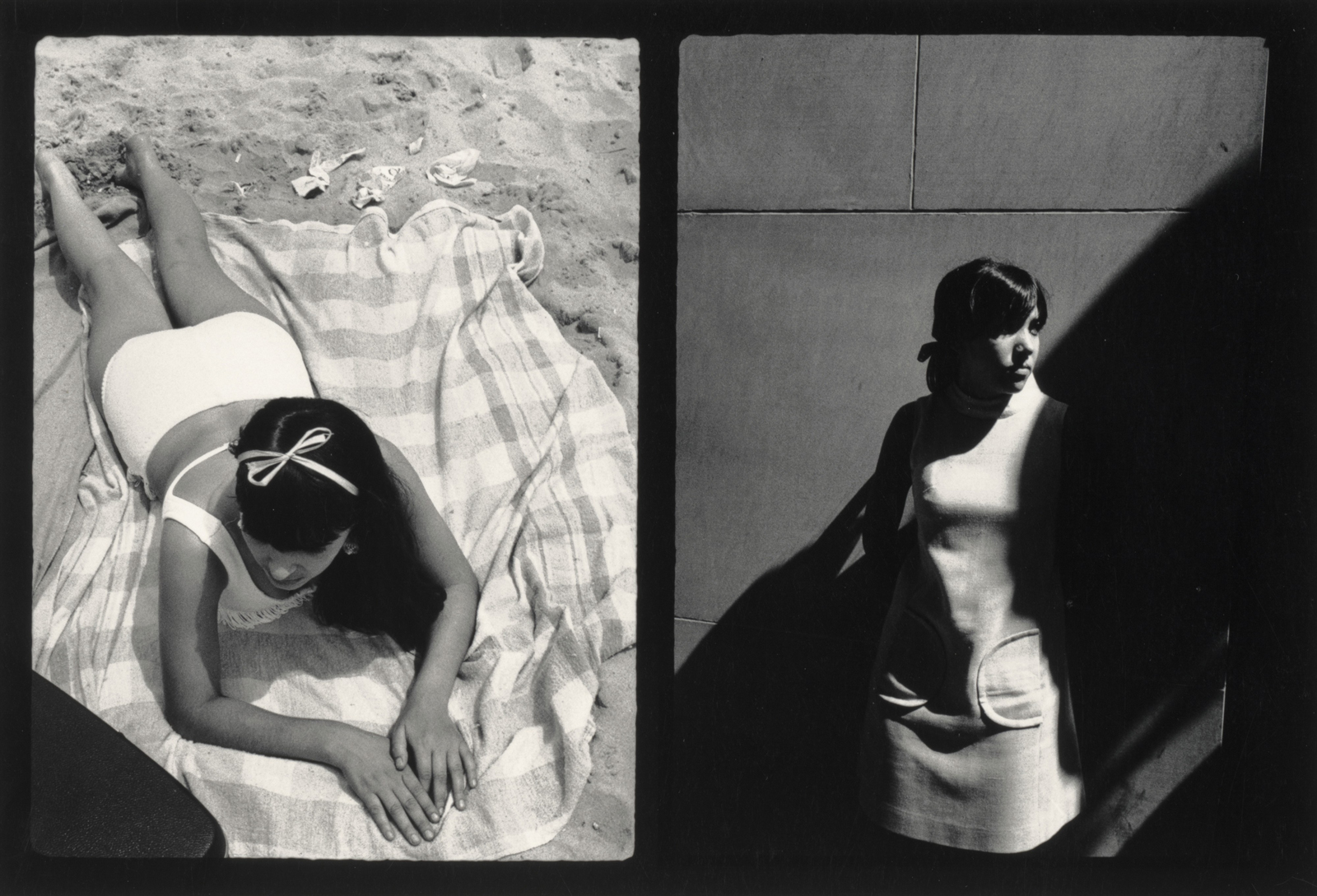
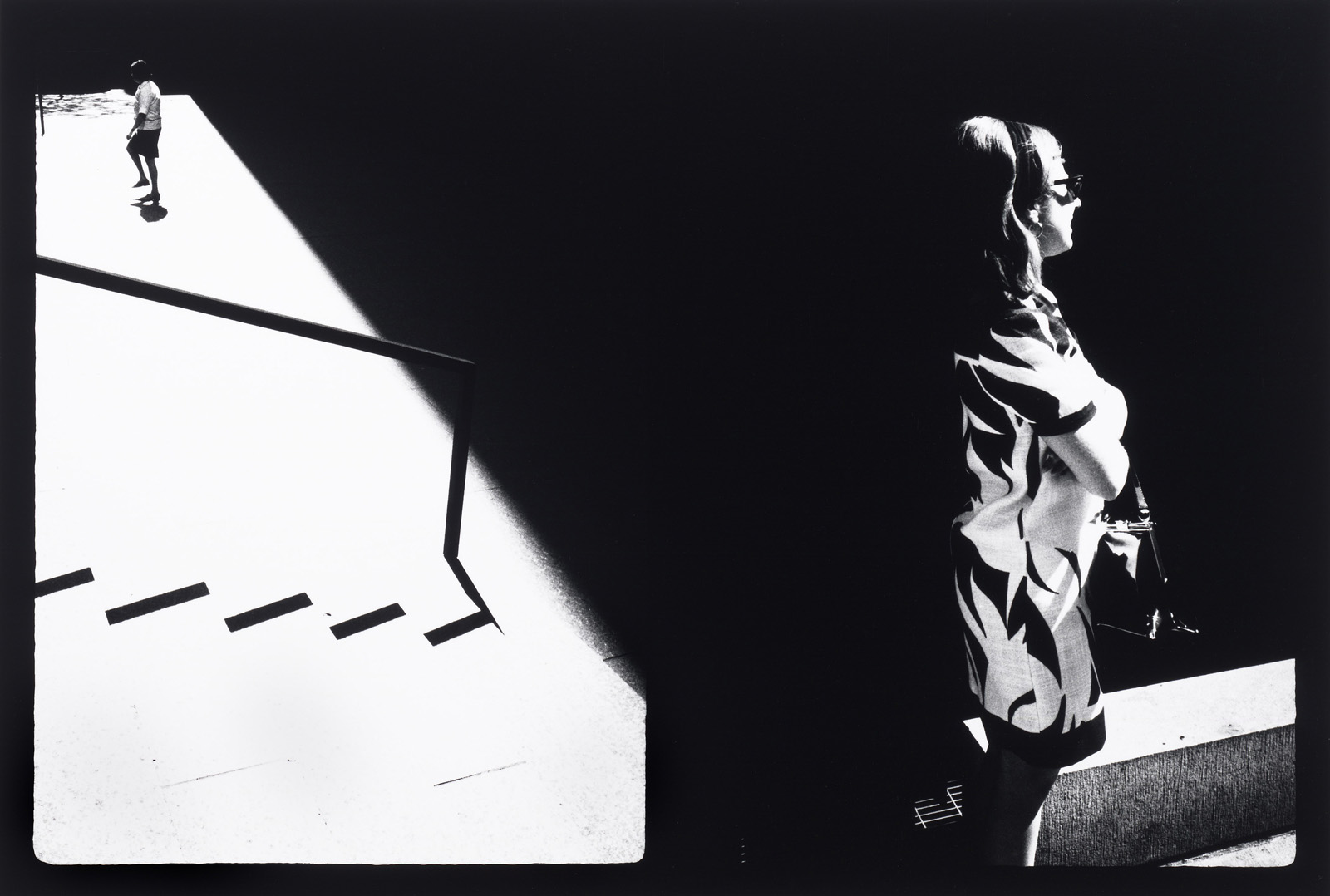
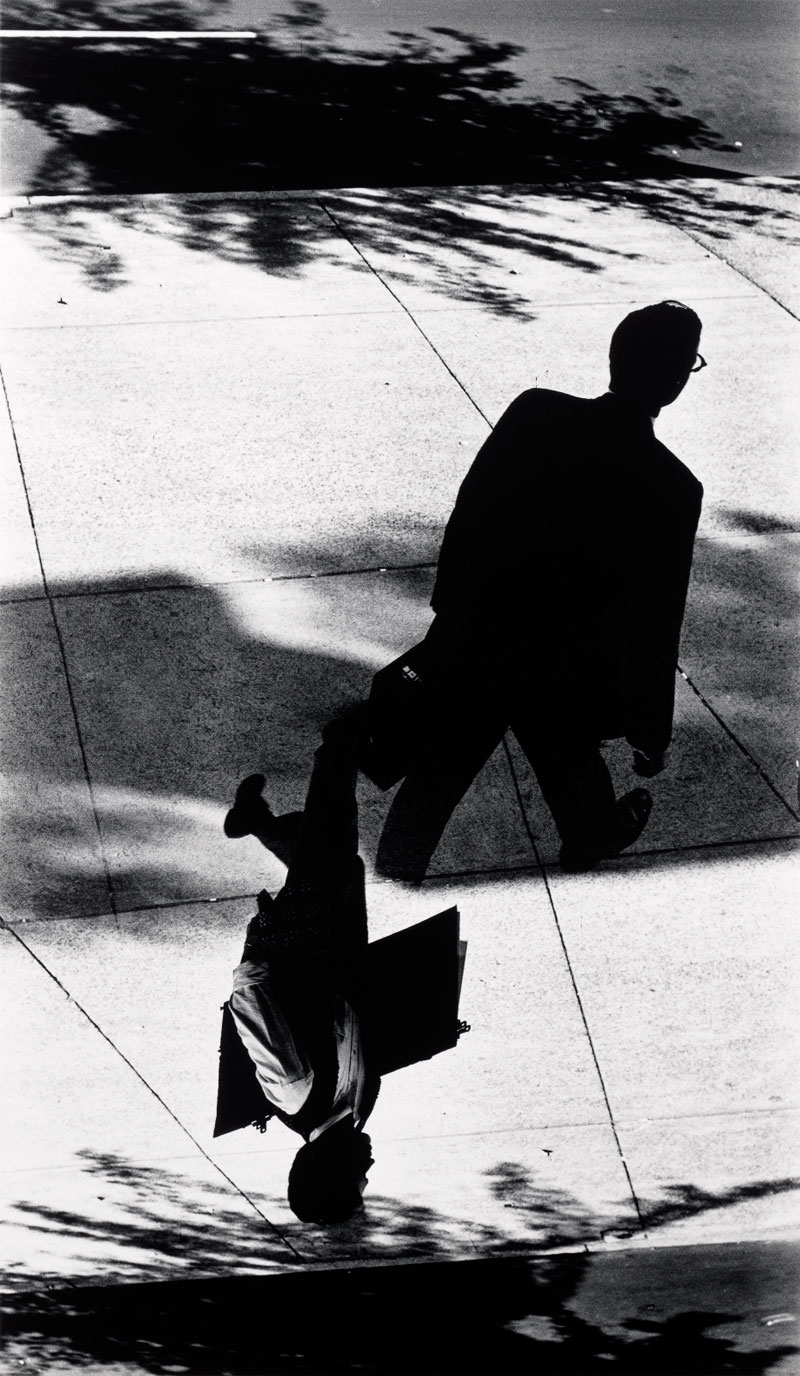
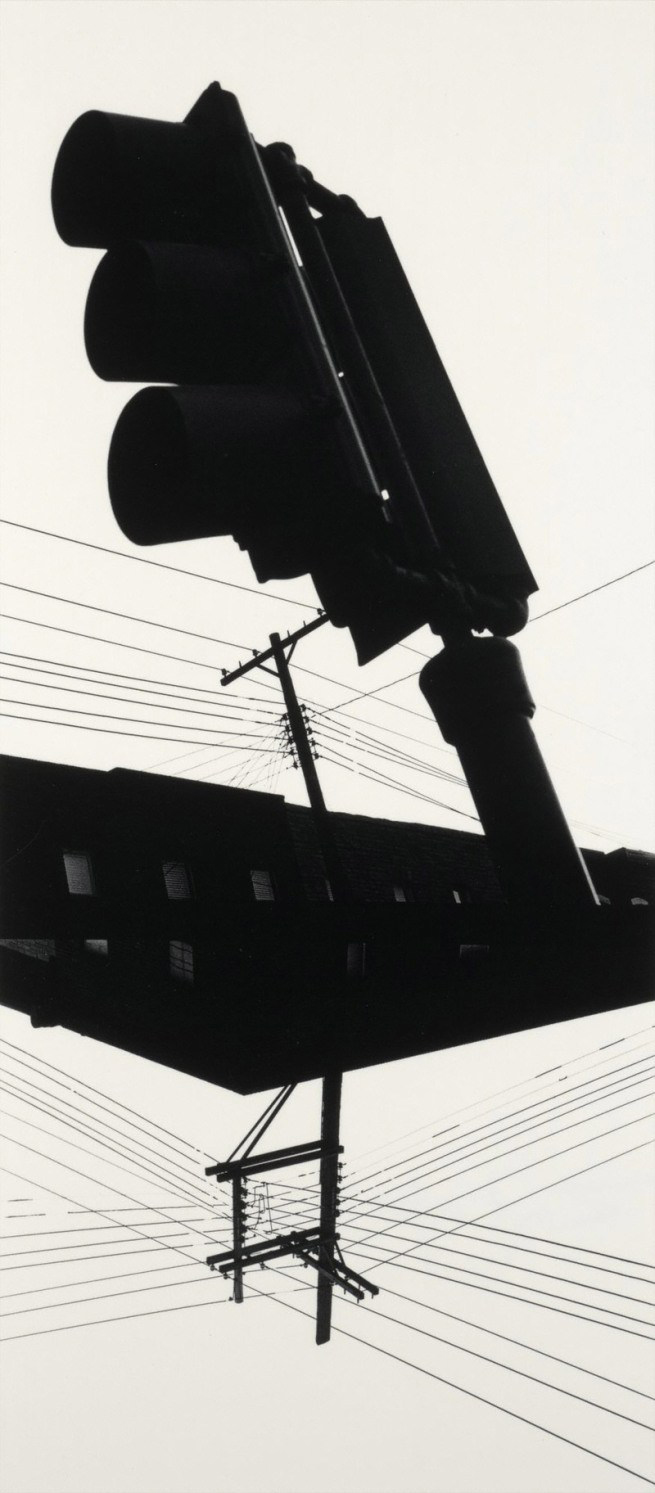
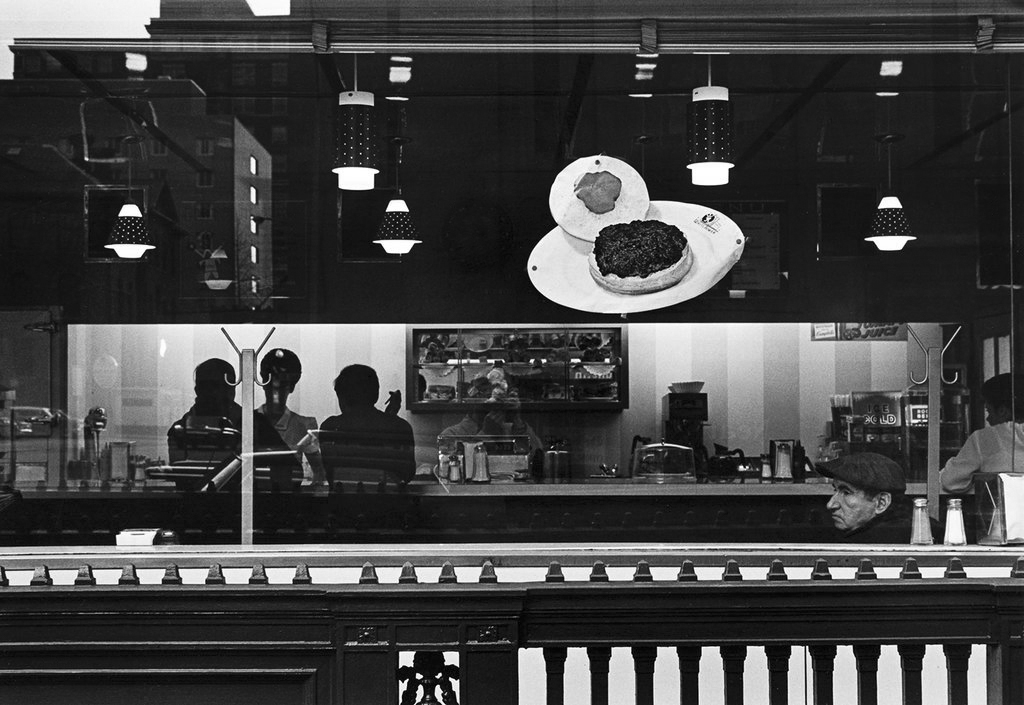
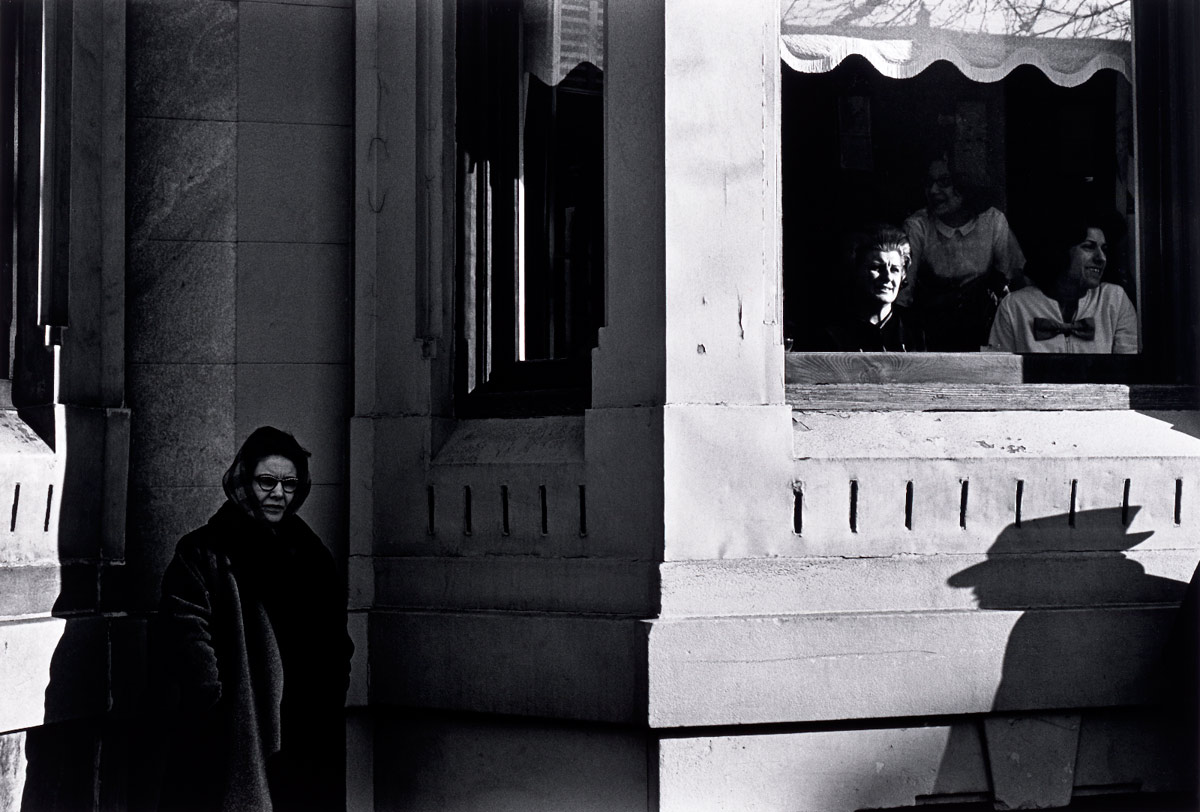
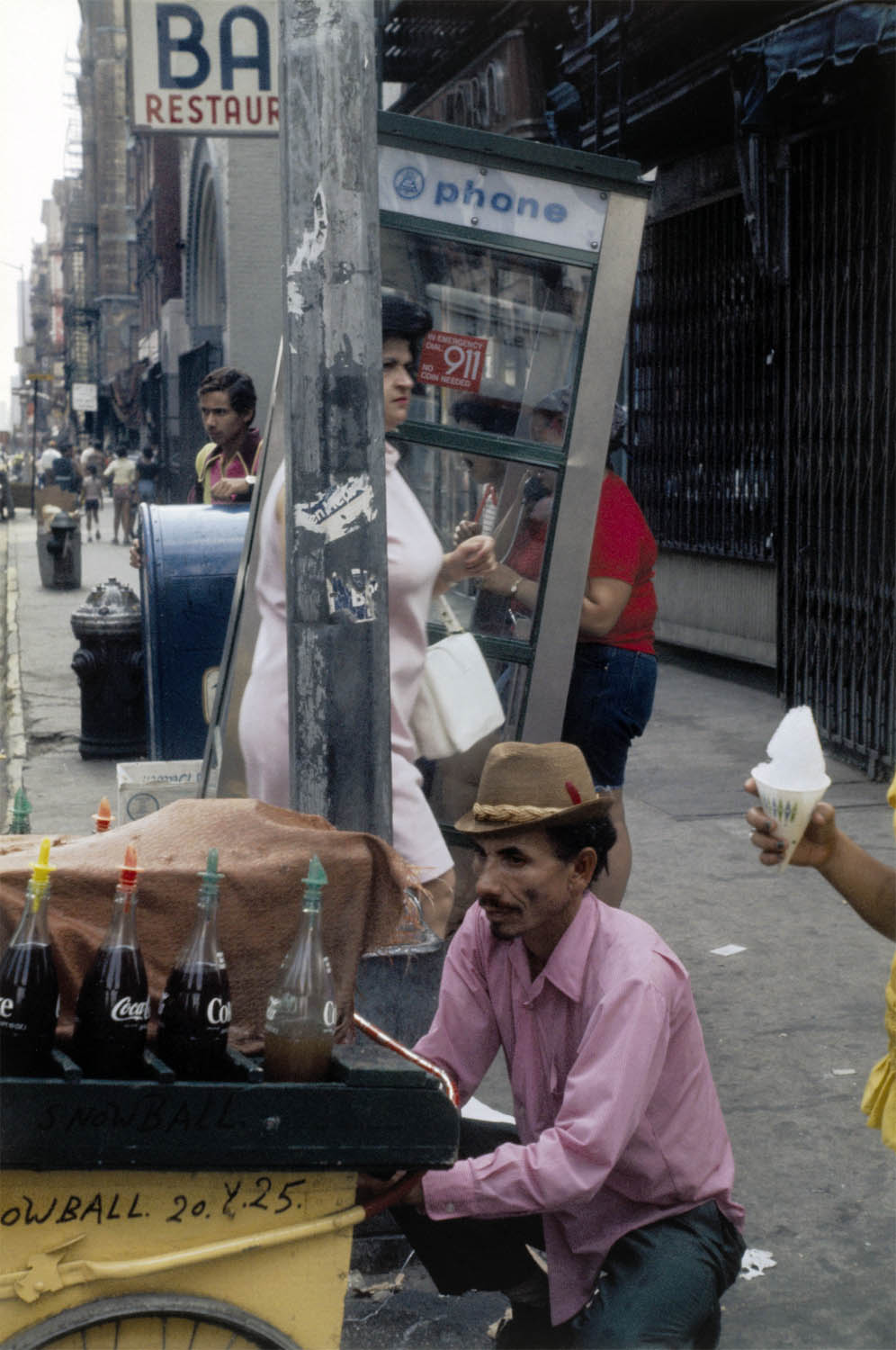
Although taken in the same city at around the same period as the work of Helen Levitt, these photographs by Leon Levinstein have less formality in their composition and definitely possess a more eclectic style evidenced by the dissection and placement of bodies within the image frame. This is not to denigrate either artist but merely to observe how two great photographers can see the same city in totally different ways. In both previsualisation was strong, the camera freezing what is placed before the lens in a balletic display that captured “just what you see.”
Dr Marcus Bunyan
Many thankx to The Metropolitan Museum of Art, New York for allowing me to publish the photographs in the posting.
Leon Levinstein (American, 1910-1988) Untitled [Head of Man with Hat and Cigar] c. 1960 Gelatin silver print 27.8 x 33.3cm (10 15/16 x 13 1/8 in.) Stewart S. MacDermott Fund, 1986
A master of classic American street photography, Leon Levinstein (American, 1910-1988) is best known for his candid and unsentimental black-and-white figure studies made in New York City neighborhoods from Times Square and the Lower East Side to Coney Island. From June 8 through October 17, 2010, The Metropolitan Museum of Art presents Hipsters, Hustlers, and Handball Players: Leon Levinstein’s New York Photographs, 1950-1980. This exhibition, drawn exclusively from the Metropolitan’s collection, features 44 photographs that reflect Levinstein’s fearless approach to the medium. Levinstein’s graphic virtuosity – seen in raw, expressive gestures and seemingly monumental bodies – is balanced by an unusual compassion for his off-beat subjects from the demimonde.
Born in West Virginia in 1910, Levinstein moved to New York in 1946 and spent the next 35 years obsessively photographing strangers on the streets of his adopted home. Early in his career, Levinstein was quoted in Photography Annual 1955: “In my photographs I want to look at life – at the commonplace things as if I just turned a corner and ran into them for the first time.” With daring and dedication to his subject, Levinstein captured the denizens of New York City at extremely close range. He used his superb sense of composition to frame the faces, flesh, poses, and movements of his fellow city dwellers in their myriad guises: sunbathers, young couples, children, businessmen, beggars, prostitutes, proselytisers, society ladies, and characters of all stripes.
Although he was a life-long loner, Levinstein was mentored and supported by Alexey Brodovitch, artistic director of Harper’s Bazaar, and Edward Steichen, the eminent photographer and curator at The Museum of Modern Art in New York, both of whom recognised his unique talent in the medium of photography. He was also greatly influenced by workshops led by the distinguished photographer and teacher Sid Grossman.
In the 1950s and 1960s, Levinstein’s work appeared frequently in photography magazines and books alongside that of his peers, such as Robert Frank, Richard Avedon, and Diane Arbus. Nonetheless, he rarely worked on assignment, as they often did; nor did he ever produce his own book of photographs. Instead, he worked as a graphic designer and devoted his evenings and weekends to photography. In 1975, Levinstein received a grant from the Guggenheim Foundation to “photograph as wide a spectrum of the American scene as my experience and vision will allow… I want my photographs to be spontaneous rather than contrived.” Despite this recognition of his achievement, he never seemed able to fit into the commercial photography market that emerged in the 1970s and 1980s, and consequently, his powerful body of work continues to be known mainly by other photographers and by specialists in the field.
Press release from The Metropolitan Museum of Art website [Online] Cited 28/09/2010 no longer available online
That idea of authenticity, ineffably captured as a decisive instance on a strip of light-sensitive celluloid, was ridden out of town a long time ago by postmodern theorists and certainly seems quaint today, but its power, as fixed in black and white by Levinstein, is undeniable. His mtier was a kind of reductivist monumentality, in which he captured his subjects – ordinary New Yorkers going about their business – in close-up, a technique commonly associated with cinema, to create images that were at once abstract and pregnant with narrative.
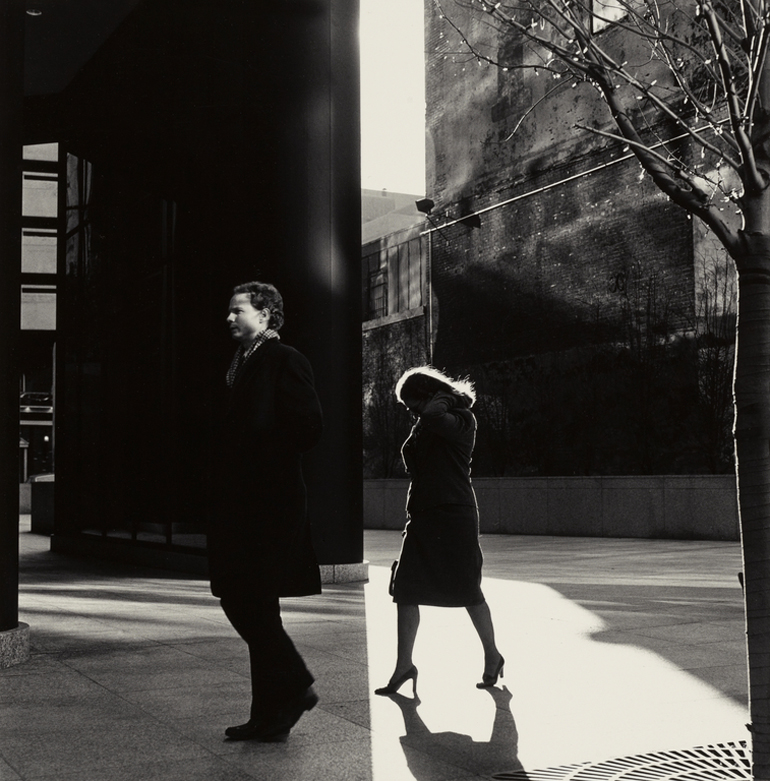
Like Weegee and Diane Arbus, Levinstein had a taste for the offbeat and grotesque (he often zeroed in on corpulent pedestrians; midsections and backsides, absent any trace of individuality, were a frequent motif). Also like them, he could be accused of engaging in a form of slumming. But he was less interested in abjection than he was in grandeur, and in this respect, the people in his photos are imbued with a sculptural nobility that simply doesn’t exist in the work of either Weegee or Arbus. More often than not, the “hipsters, hustlers and handball players” of the show’s title loom into the lens, crowding out background details. We get only fragments of the metropolis around them: a bit of stoop or curbstone, or a patch of sand out at Coney Island. Yet the pictures themselves express a sense of velocity, of lives hurtling toward some destiny that’s as heroic as it is bleak. What’s remarkable about Levinstein is that his framing – both epic and destabilising – stands in for the pitiless dynamic of New York itself.
Howard Halle. “Hipsters, Hustlers, and Handball Players: Leon Levinstein’s New York Photographs, 1950-1980,” on the Time Out New York website, Monday June 14, 2010 [Online] Cited 26/12/2019 no longer available online
I think Levinstein’s gift lay in his ability to capture the essence of New York’s rough, funky cool (particularly in the 1960s and 1970s), without getting overly sentimental or kitchy. Nearly all of his images were taken at close range, often cropping out unneeded heads and body parts, focusing on overlooked subjects and elemental gestures found on the city’s streets and sidewalks. His compositions are often angled and dark, and he was particularly adept at capturing the nuances of clothing and fashion as worn by New York’s imperfect and eclectic masses, finding the hidden joy in a bold pattern, a wide collar or a tight fitting pair of shorts. The pictures are tough, edgy, sometimes harsh, and always refreshingly real.
As you look more closely at these candid pictures, Levinstein’s talent for making the common look uncommon shines through. He finds earthy wonder in a foot perched on a wire trash can, a sweat stained tank top, 70s-era moustaches, a grey pinstripe suit, bulging stomachs and belts, a man fluffing his afro in a window, eating corn on the cob on the beach, tattoos, an overcoat with shiny buttons, kissing on a stoop, and a groovy floral blouse paired with tight leggings. He seems to have been fond of backs and sides, abstracting his subjects into fragments of movement or pose, paring them down into types and moments that were representative of something larger in society.
Many thankx to Rose Dahlsen and the Tate Modern for allowing me to publish the photographs in the posting. Please click on the photographs for a larger version of the image.
Philip-Lorca diCorcia (American, b. 1951) Head #23 2001 From the Head series
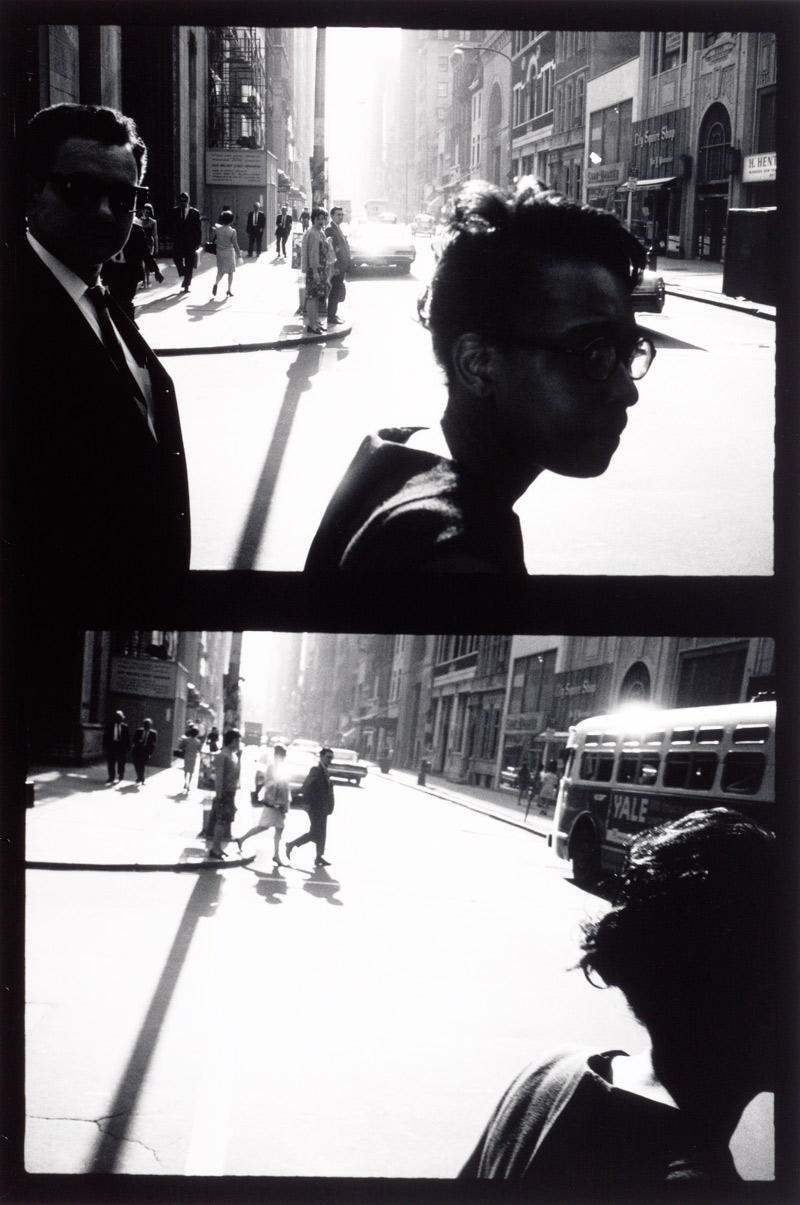
Examining photography as an invasive act immediately confronts the complacency with which we accept these invasions, encourage them even in our curiosity, and though it falters in parts and overwhelms in others (this is a huge exhibition), EXPOSED successfully addresses a number of the social, cultural and psychologically motivating factors behind these kinds of images – why we take them and why we look at them. Critical to this engagement is the wall text at the beginning, which states that most of the hundreds of photographs on display were taken without the subject’s knowledge. It is a distinctly creepy start.
Philip-Lorcia diCorcia’s Head series perhaps best embodies this conundrum. Visually they are not terribly shocking or even necessarily interesting. Theatrical lighting catches the head of someone in a crowd and the effect is of a staged encounter. In fact, these people, denominated variously as Head #23 or Head #4, were photographed without their knowledge by a series of hidden cameras, the flash triggering as they walked by. Famously, one of diCorcia’s unwitting targets tried to take legal action against him but the landmark ruling defended the artist and his right to self-expression over any right the subject might have over their own image. It is difficult to know which is worse – to be censored or to be spied upon.
Benjamin Lowy (American, b. 1979) Iraq Perspective II 2003-2007
US soldiers go on a late night raid with Iraqi Sunni Concerned citizens leading the way and identifying potential AQi targets. Due to a high level of IEDs in the area the company size raiding party walked 5 kilometres to the target in complete darkness, raided the target houses, detained questionable suspects and walked 5 kilometres back to waiting humvees.
Sophie Calle (French, b. 1953) The Hotel, Room 47 (L’Hôtel, Chambre 47) 1981 2 works on paper, photographs and ink 2140 x 1420 mm Tate Presented by the Patrons of New Art through the Tate Gallery Foundation 1999
This is a two-part framed work comprising photographs and text. In the upper part, the title Room 47 is printed below a colour photograph of elegantly carved wooden twin head-boards behind a bed covered in rich brown satin. Below it, three columns of italic text are diary entries describing findings in the hotel room between Sunday 22 February 1981 and Tuesday 24. In the lower frame a grid of nine black and white photographs show things listed in the text above. This work is part of a project titled The Hotel, which the artist has defined:
“On Monday, February 16, 1981, I was hired as a temporary chambermaid for three weeks in a Venetian hotel. I was assigned twelve bedrooms on the fourth floor. In the course of my cleaning duties, I examined the personal belongings of the hotel guests and observed through details lives which remained unknown to me. On Friday, March 6, the job came to an end.” (Quoted in Calle, pp. 140-141.)
Each of the twelve rooms gave rise to a diptych of similar structure following the occupancy of one or more guests during the period of the artist’s employment at the hotel. Some rooms feature more than once as a second set of guests occupied them, giving rise to a total of twenty-one diptychs in the series. Calle’s descriptions of the hotel rooms and their contents combine factual documentation along with her personal response to the people whose lives she glimpsed by examining their belongings. Each text begins with the chambermaid / artist’s first entry into the room and a notation of which bed or beds have been slept in, with a description of the nightwear the guests have left. A list of objects usually follows, as the artist transcribes her activities in the room. Calle is unashamedly voyeuristic, reading diaries, letters, postcards and notes written or kept by the unknown guests, rummaging in suitcases, and looking into wardrobes and drawers. She sprays herself with their perfume and cologne, makes herself up using the contents of a vanity case, eats food left behind and salvages a pair of women’s shoes left in the bin. Outside the room, she listens at doors, recording the occupants’ conversations or any other sounds she may overhear, and even peers into a room when the floor-waiter opens the door to catch a glimpse of the unknown guests.
The absent occupants described in Room 47 are a family of four – two parents and two children – as revealed by their four pairs of slippers. Calle does not go through their suitcase, commenting: ‘I am already bored’. From their passports she discovers that the parents are a married couple from Geneva and she copies out four postcards one of them has written. Words on one of these hint at problems within the family.
Calle began her artistic projects in 1979 on returning to Paris after seven years’ travel abroad. Disorientated, she felt like a stranger in her own city, not knowing how to occupy her time. She started to follow random passers-by and spend her days as they did. Eventually she picked up the camera she had been experimenting with during her time abroad and photographed the strangers, writing diaristic notes of their movements. From this she has developed a particular way of working, collecting information about people who are absent and investigating her subjects like a detective. The Hotel follows directly from a project the artist undertook the previous year entitled Suite Venetienne 1980, which evolved from a chance encounter with a man she had been following in Paris. He told her he was going to Venice, so she followed him there in disguise, documenting her observations. After a year of planning and waiting, she returned to Venice in 1981 as a chambermaid.
The Hotel diptychs were produced in an edition of four in English and four in French. Tate’s copy of Room 47 (22 February) is the first in the English edition. Another version of Room 47 exists for the period 2-6 March.
Elizabeth Manchester June 2005
Text from the Tate website [Online] Cited 26/12/2019
Unknown photographer Bain News Service, publisher Mrs. Wm. Thaw, veiled, on street, White Plains, N.Y. 1909 From a glass negative Library of Congress Prints and Photographs Division Washington, D.C.
Tom Howard (American, 1894-1961) [Electrocution of Ruth Snyder, Sing Sing Prison, Ossining, New York] 1928 Gelatin silver print Collection SFMOMA, Accessions Committee Fund purchase
In 1925, Ruth Snyder, a housewife from Queens, New York, took a lover, Judd Gray, a corsetmaker from upstate. Already married to Albert Snyder, an arts editor at MotorBoating magazine, she hid the affair for nearly three years. But on March 12, 1927, she and Gray planned a murder. After taking out a forged insurance policy, the two killed Ruth’s husband and staged a burglary scene. It didn’t take long for law enforcement to connect the dots, and a few months later, Gray and Snyder found themselves charged with first degree murder. The court case was front page news and both Ruth and Judd found themselves constantly photographed for ever-evolving stories. Sing Sing, not one to change policy for press, reinstated that no photographers were to be present at the execution. But the public wanted to see.
The New York Daily News knew that the prison was familiar with many journalists from their staff, so they hired someone from out of town, Tom Howard, a then-unknown local photographer from the Chicago Tribune. Knowing he would never be allowed in with a camera, Howard strapped a single-use camera to his right ankle and wired a trigger release up his pant leg. Remarkably, he was allowed in. From across the room, Howard pointed his toe at the chair and took but one photo as Snyder took her last breaths.
The camera was rushed to the city and the film developed overnight. Editors and writers marveled at what was to be one of the most shocking photographs ever made: Snyder in the chair, the legs of the prison guard to the right. The image, shot on an angle, was cropped and published immediately with the headline: Dead!
The black-and-white image was shocking to the U.S. and international public alike. There sat a 32-year-old wife and mother, killed for killing. Her blurred figured seemed to evoke her struggle, as one can imagine her last, strained breaths. Never before had the press been able to attain such a startling image – one not made in a faraway war, one not taken of the aftermath of a crime scene, but one capturing the very moment between life and death here at home.
Erich Salomon (German Jewish, 1886-1944) Hague Conference (Second Hague Conference on Reparations, January 1930, in the early morning hours) 1930 Promised gift of Paul Sack to the Sack Photographic Trust of the San Francisco Museum of Modern Art
Henri Cartier Bresson (French, 1908-2004) Hyeres, France 1932 Gelatin silver print
Ben Shah (American, 1898-1969) Post Office, Crossville, Tennesse 1937 Gelatin silver print
Ben Shahn visible using his right-angled lens in the window reflection
Walker Evans (American, 1903-1975) Subway Passengers, New York 1938 Gelatin silver print
Walker Evans (American, 1903-1975) Subway Passengers, New York 1938-1941 Gelatin silver print
Weegee (Arthur H. Fellig) (American, 1899-1968) Their First Murder Before 1945 Gelatin silver print
“Brooklyn School Children see Gambler Murdered in Street Pupils were leaving P.S. 143, [Sixth Ave. and Roebling St.] in the Williamsburg section of Brooklyn, at 3:15 yesterday when Peter Mancuso, 22, described by police as a small time gambler, pulled up in a 1931 Ford at a traffic light a block from the school. Up to the car stepped a waiting gunman, who fired twice and escaped through the throng of children. Mancuso, shot through the head and heart, struggled to the board and collapsed dead on the pavement. Above are some of the spectators. The older woman is Mancuso’s aunt, who lives in the neighborhood, and the boy tugging at the hair of the girl in front of him is her son, hurrying away from her. Below is what they saw as a priest, flanked by an ambulance doctor and a detective, said the last rites of the Church over the body.” PM Daily, October 9, 1941, Vol. II, No. 82, p. 15
Lee Friedlander (American, b. 1934) New York City 1966 Gelatin silver print
Vito Acconci (Italian, 1940-2017) Following Piece 1969 Gelatin silver prints
Exposed offers a fascinating look at pictures made on the sly, without the explicit permission of the people depicted. With photographs from the late nineteenth century to present day, the pictures present a shocking, illuminating and witty perspective on iconic and taboo subjects.
Beginning with the idea of the ‘unseen photographer’, Exposed presents 250 works by celebrated artists and photographers including Brassaï’s erotic Secret Paris of the 1930s images; Weegee’s iconic photograph of Marilyn Monroe; and Nick Ut’s reportage image of children escaping napalm attacks in the Vietnam War. Sex and celebrity is an important part of the exhibition, presenting photographs of Liz Taylor and Richard Burton, Paris Hilton on her way to prison and the assassination of JFK. Other renowned photographers represented in the show include Guy Bourdin, Henri Cartier-Bresson, Philip Lorca DiCorcia, Walker Evans, Robert Frank, Nan Goldin, Lee Miller, Helmut Newton and Man Ray.
The UK is now the most surveyed country in the world. We have an obsession with voyeurism, privacy laws, freedom of media, and surveillance – images captured and relayed on camera phones, YouTube or reality TV.
Much of Exposed focuses on surveillance, including works by both amateur and press photographers, and images produced using automatic technology such as CCTV. The issues raised are particularly relevant in the current climate, with topical debates raging around the rights and desires of individuals, terrorism and the increasing availability and use of surveillance. Exposed confronts these issues and their implications head-on.
Text from the Tate Modern website [Online] Cited 21/09/2010 no longer available online
Kohei Yoshiyuki (Japan, b. 1946) Untitled 1971 From the series The Park Gelatin silver print
Sandra Phillips on Surveillance – Exposed at Tate Modern
SFMOMA’s Curator of Photography Sandra Phillips describes how contemporary artists like Sophie Calle and Benjamin Lowry have started to talk back to surveillance.
Ronald Edward Galella (January 10, 1931 – April 30, 2022) was an American photographer, known as a pioneer paparazzo. Dubbed “Paparazzo Extraordinaire” by Newsweek and “the Godfather of the U.S. paparazzi culture” by Time magazine and Vanity Fair, he is regarded by Harper’s Bazaar as “arguably the most controversial paparazzo of all time”. He photographed many celebrities out of the public eye and gained notice for his feuds with some of them, including Jacqueline Onassis and Marlon Brando. Despite the numerous controversies and claims of stalking, Galella’s work was praised and exhibited in art galleries worldwide.
The face in the paparazzi image above is actually The Face: Greta Garbo. One of the most famous and admired women in the world, Garbo became a New York recluse after retiring from films at the beginning of the 1940s. Sightings of her were rare, and this 1950s image captures the conflict between a movie star’s public persona and private life. Now older and with her face obscured, Garbo is unrecognisable, but once understood to be her it becomes a contrasting reference to all those images of her as an icon of beauty and stardom.
Many thankx to Alison Murray and the National Gallery of Victoria for allowing me to publish the photographs in the posting. Please click on the photographs for a larger version of the image.
Lewis Hine (American, 1874-1940) Lacy, twelve years old and Savannah, eleven years old 1908 Gelatin silver print Image and sheet: 11.9 × 17.1cm National Gallery of Victoria, Melbourne Purchased, 1980
‘Perhaps you are weary of child labour pictures. Well, so are the rest of us, but we propose to make you and the whole country so sick and tired of the whole business that when the time for action comes, child labour pictures will be records of the past.’
Lewis Hine, 1909
Unknown photographer No title (Ritual washing for funeral) c. 1880 Albumen silver photograph, colour dyes Image and sheet: 21.2 × 26.5cm National Gallery of Victoria, Melbourne Purchased, 2001
Felice Beato (Italian/English, 1832-1909, worked throughout Europe and Asia, 1853-1890) Stillfried and Anderson and the Japan Photographic Association (studio) (Japanese, 1877-1885) No title (Maiko) 1866-1868, printed 1877-1885 albumen silver photograph, coloured dyes 24.4 x 19.6cm National Gallery of Victoria, Melbourne Purchased through the NGV Foundation with the assistance of The Herald & Weekly Times Limited, Fellow, 2001
Opening 7 May, the National Gallery of Victoria will present Timelines: Photography and Time, a captivating exhibition exploring the notion of time in photographs.
Time is a slippery notion. It is everywhere and always moving but this powerful regulating force cannot be seen. It is only apparent in context: in the changing seasons, in another wrinkle on our faces, in the growth of children. Photography has a unique role to play in our sometimes poignant sense of time passing. The camera’s ability to depict ‘a moment in time’ – to stop the clock for a brief moment – gives photographs a unique capacity to direct our consideration towards the mechanics and poetics of this pervasive and mysterious cosmic force.
In this exhibition one aspect of time is considered from a photographic perspective: namely, human life. Works have been selected from the permanent collection both by International and Australian photographers that show an interest in some aspect of lifecycles. Arranged, in part, in a ‘timeline’, these works provoke our understanding of the mediums capacity to suggest the concept of time in ways that may be surprising, moving or even confronting. The exhibition also looks at how photographers have extended a sense of time and duration through images that work in series
Timelines will feature almost forty photographs from the NGV Collection by both Australian and international photographers including work by Diane Arbus, Micky Allan and Bill Brandt.
Isobel Crombie, Senior Curator of Photography, NGV said photography has a unique role to play in capturing the way that time passes.
“The camera’s ability to ‘stop the clock’ enables the medium to direct our consideration towards the mechanics and poetics of this pervasive and mysterious cosmic force.
“The instant that the photograph captures can be a potent reminder to seize the day rather than dreaming about the past or worrying about the future,” said Dr Crombie.
The exhibition also looks at how photographers have extended a sense of time and duration through images that work in series. From the 1960s onwards, photographers began experimenting with stretching time by creating a series or sequence of photographs.
This is seen in Rod McNicol’s powerful series titled A portrait revisited (1986-2006), (pictured Jack, below). Purchased by the NGV in 2009, the series features portraits of men and women; each posed directly facing the camera against a plain backdrop. There are two portraits of each subject photographed twenty years apart, inviting the viewer to compare the portraits to see how time has changed them. The sense of time passing is highlighted with the portrait of Peter, who is photographed only once. The blank image next to him is a reminder that he died before the second portrait was made.
Each phase of human existence has characteristic traits and features, and photographers have worked with these qualities in ways that evoke the passing of time and our place in this cycle. Arranged in part in a human timeline, the exhibition begins with the start of a new life as depicted in Christine Godden’s Joanie pregnant (1972) and Joanie with Jade (1973) and concludes with Kusakabe Kimbei’s Ritual washing for a funeral (c. 1880, see above – now labelled as ‘Unknown’ on the NGV website in 2019), an image of a deceased man being prepared in the traditional Japanese way for burial. This final scene captures the grief of the moment when a lifetime ends.
Frances Lindsay, Deputy Director, NGV said: “The works in the exhibition show how artists have explored the concept of time in ways that may surprise, move or even confront viewers. This exhibition provides visitors with a special opportunity to view this remarkable collection of photographs from the NGV Collection, many of which are on display for the first time.”
Timelines will include photographs by Micky Allan, Diane Arbus, Felice Beato, Bill Brandt, Brassaï, Harry Callahan, Imogen Cunningham, Walker Evans, Christine Godden, Ponch Hawkes, Petrina Hicks, Lewis Hine, Kusakabe Kimbei, Rosemary Laing, J.H. Lartigue, Ruth Maddison, Rod McNicol, David Moore, Jan Saudek, John Thompson, Roman Vishniac, and Edward Weston.
Text from the National Gallery of Victoria International website [Online] Cited 17/09/2010 no longer available online
You must be logged in to post a comment.