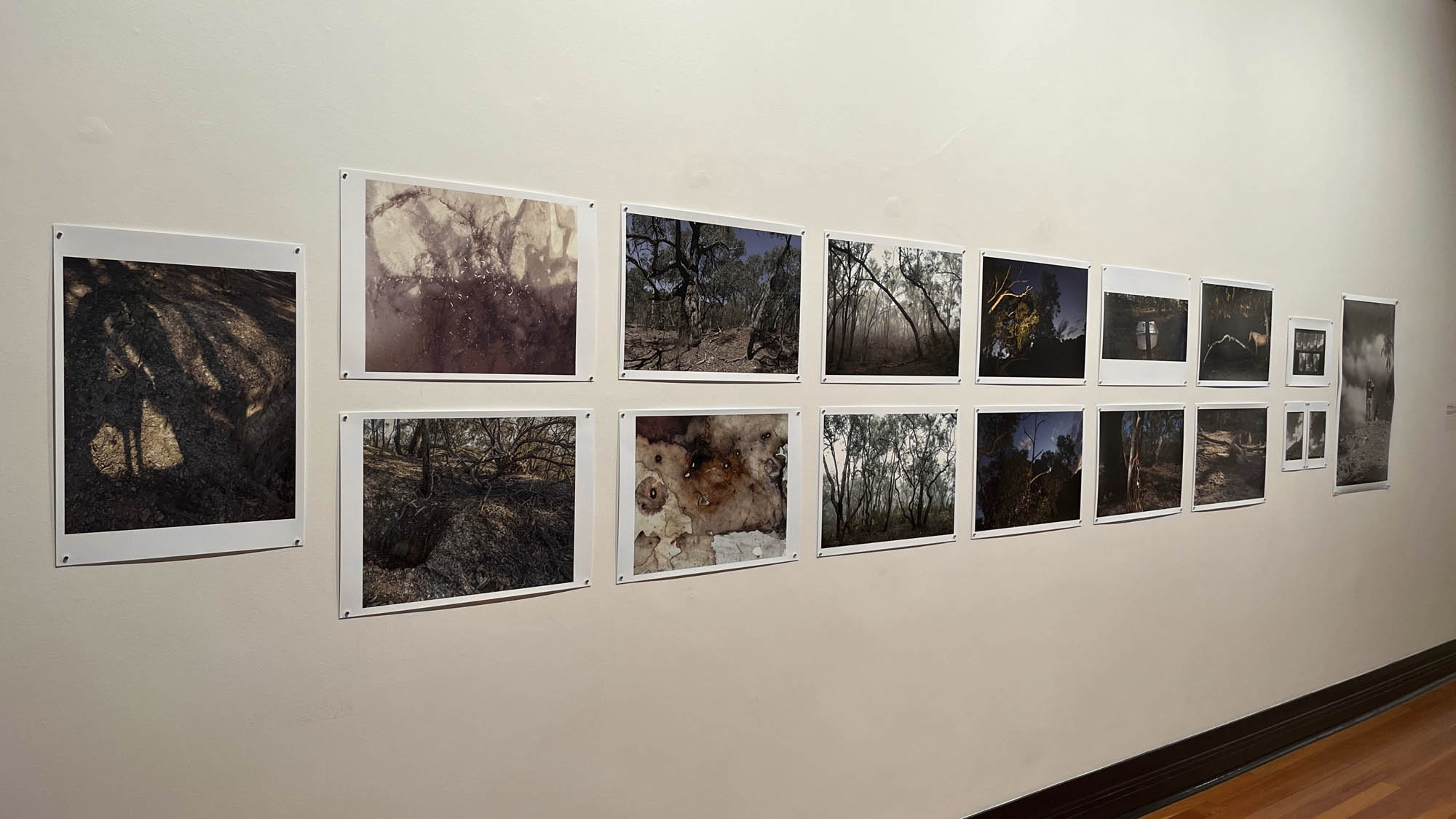
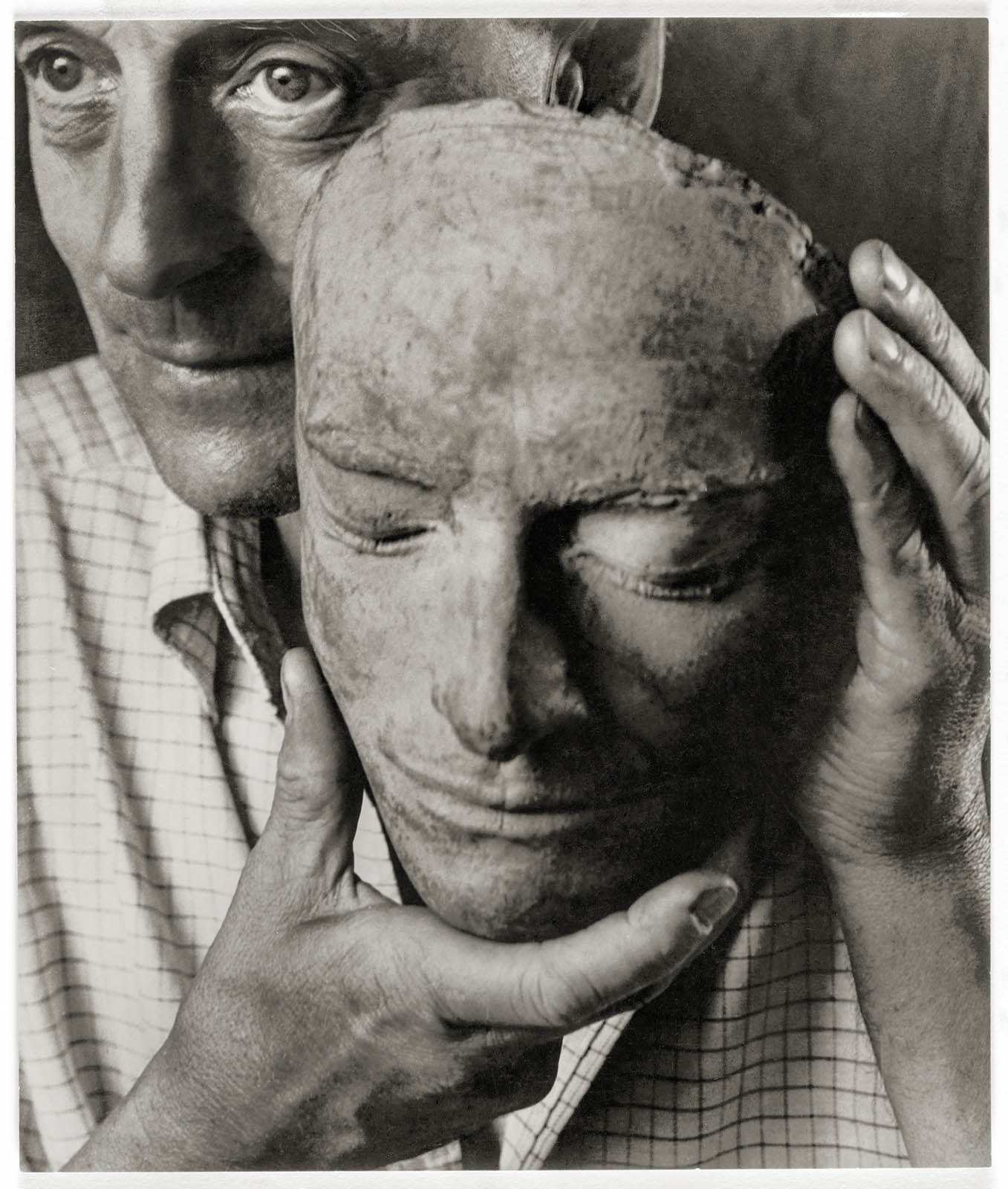
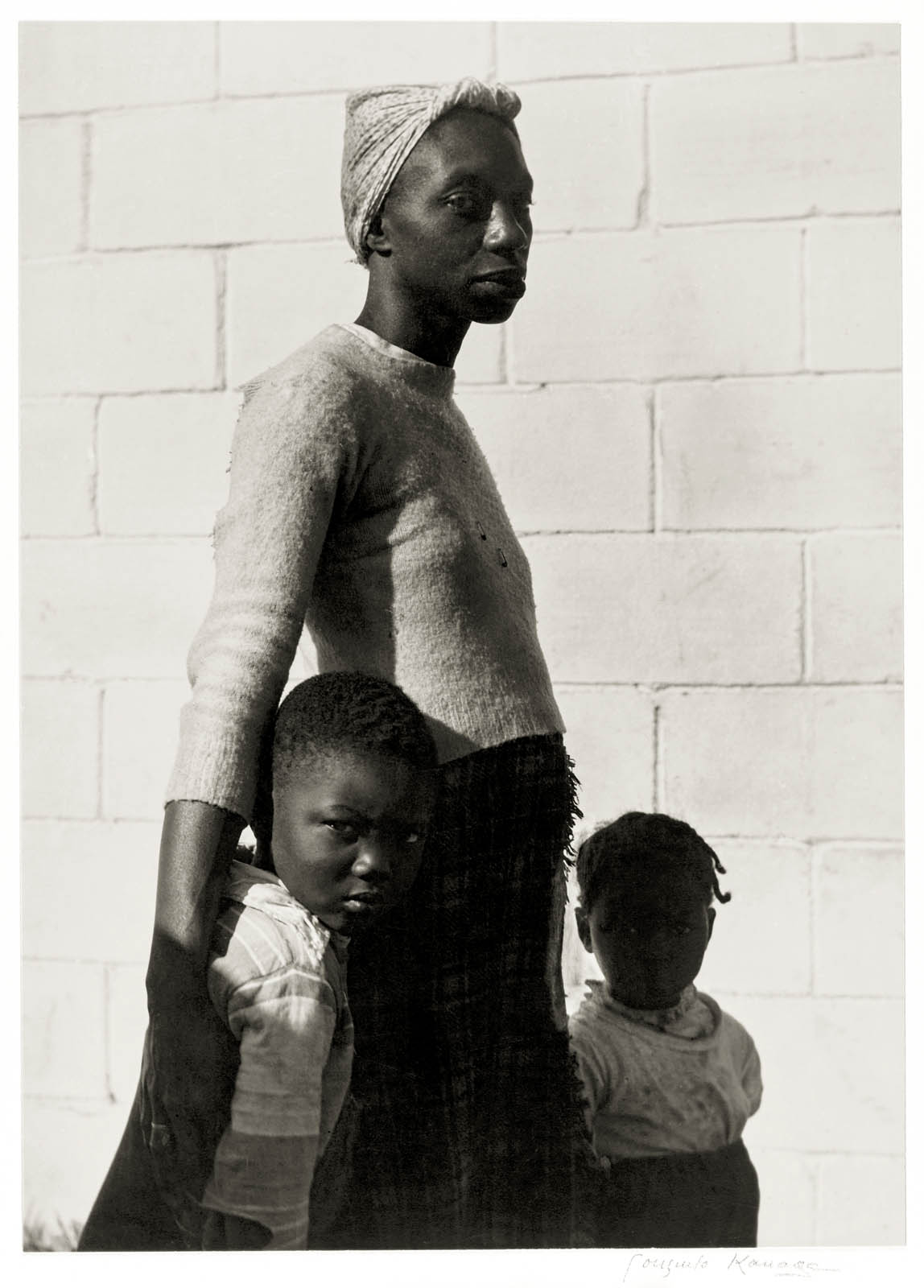
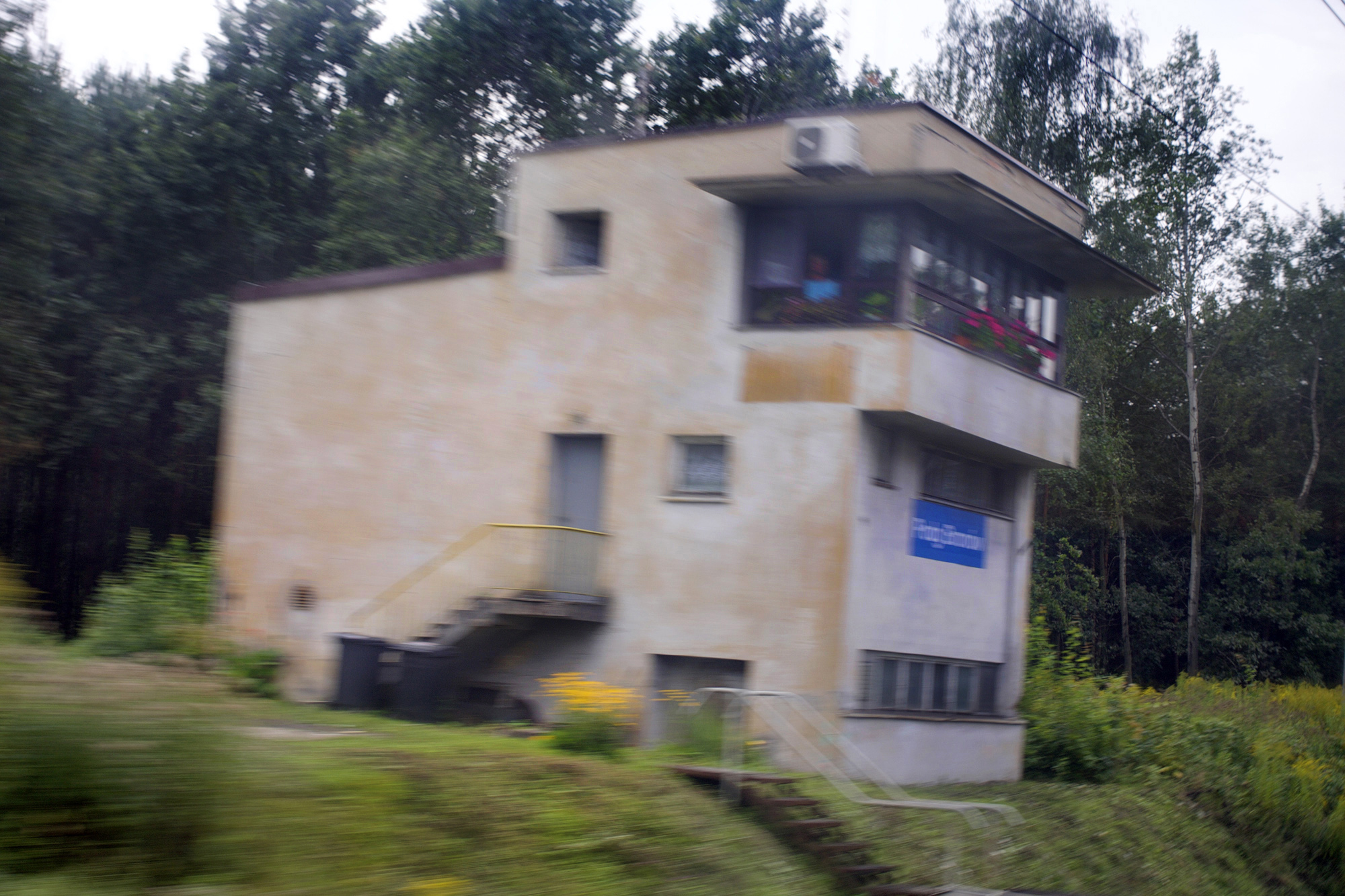
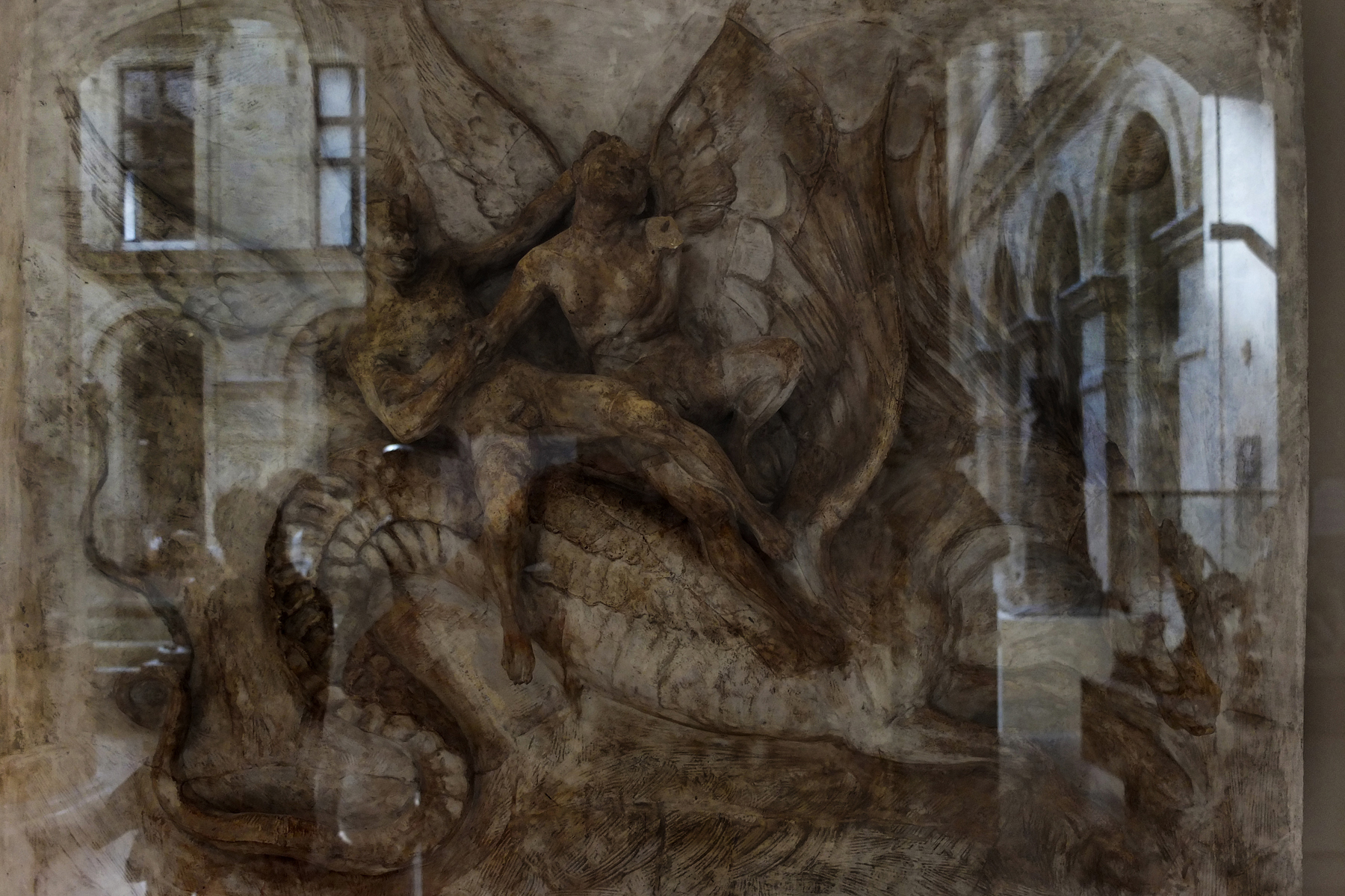
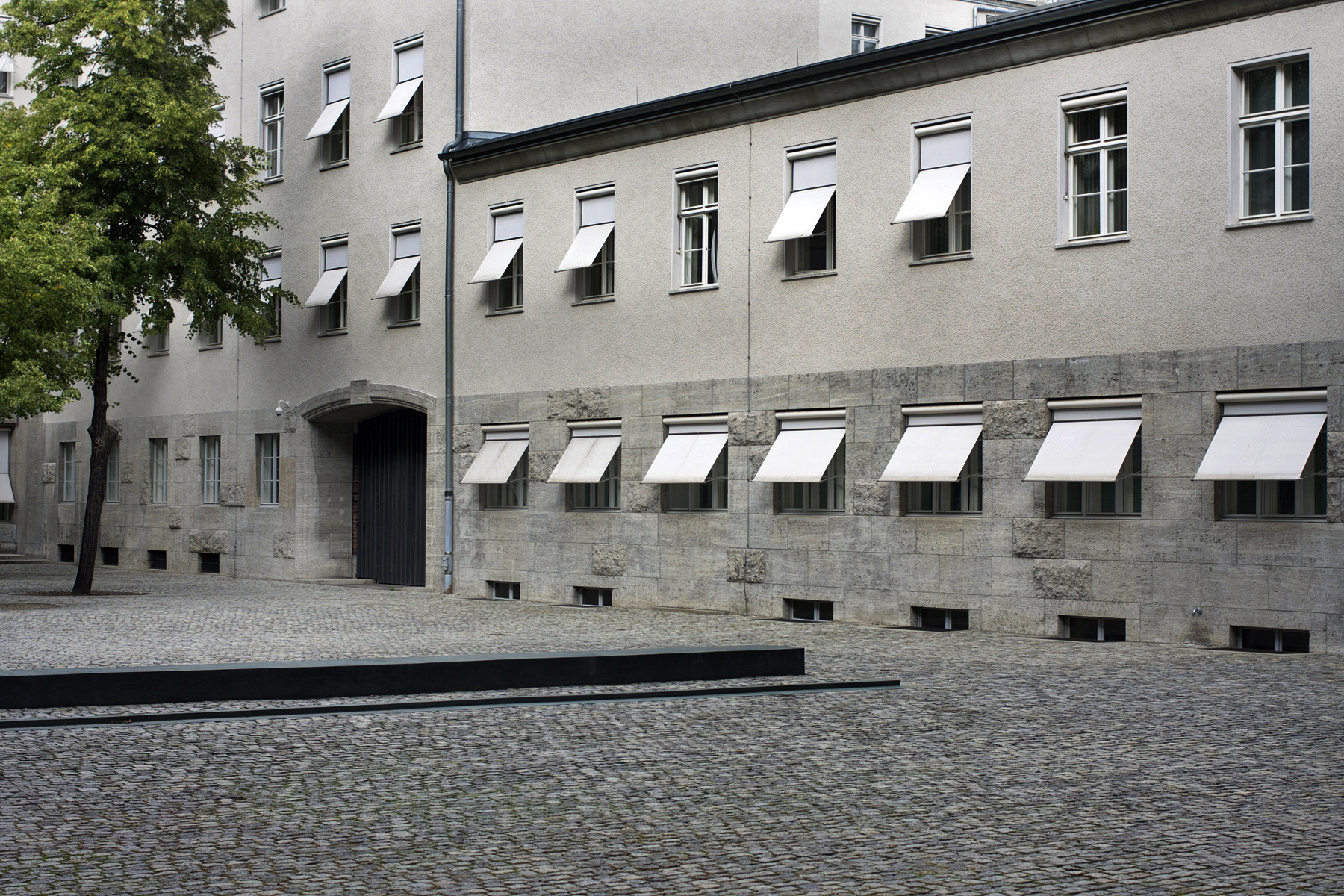
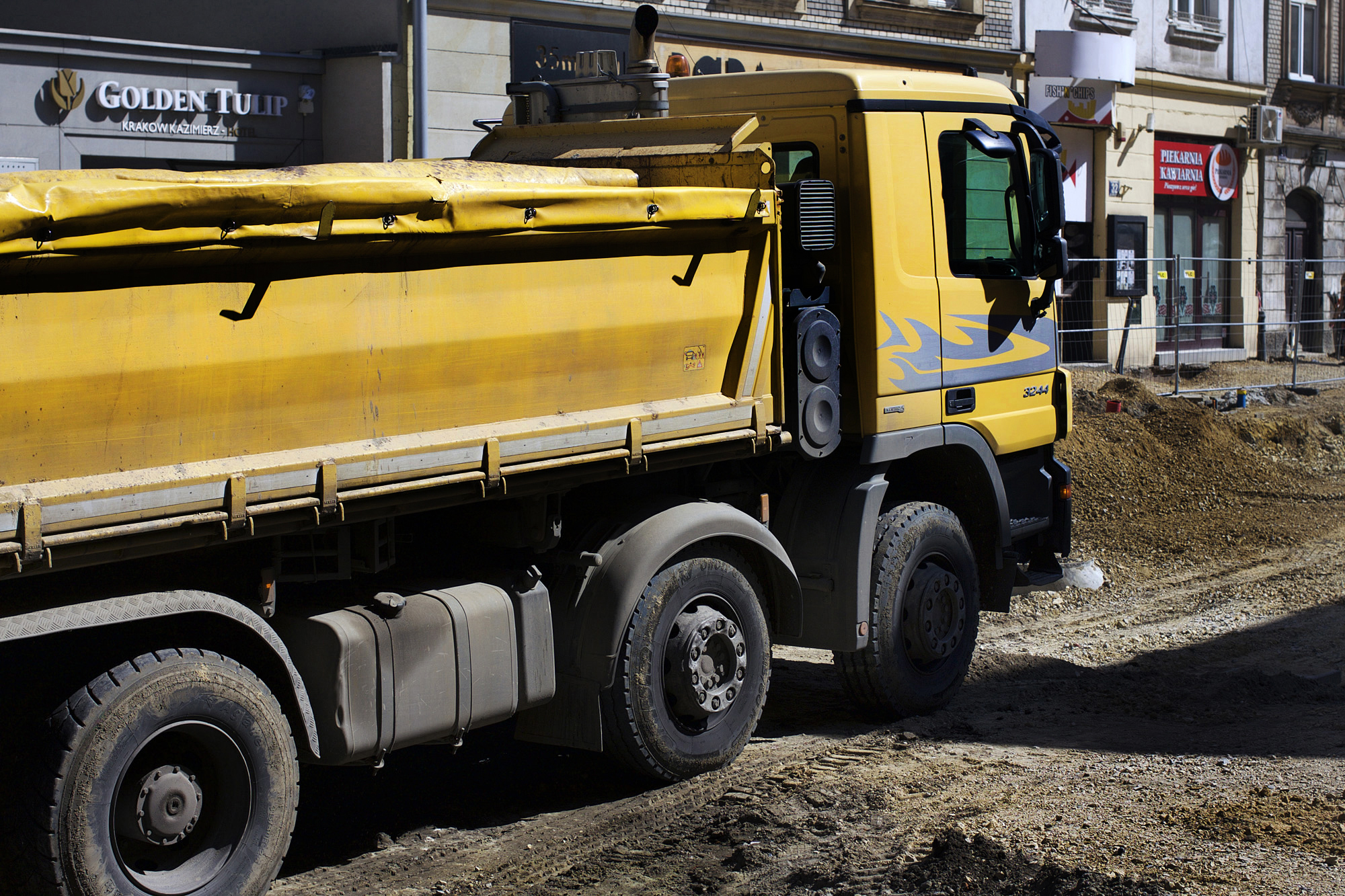
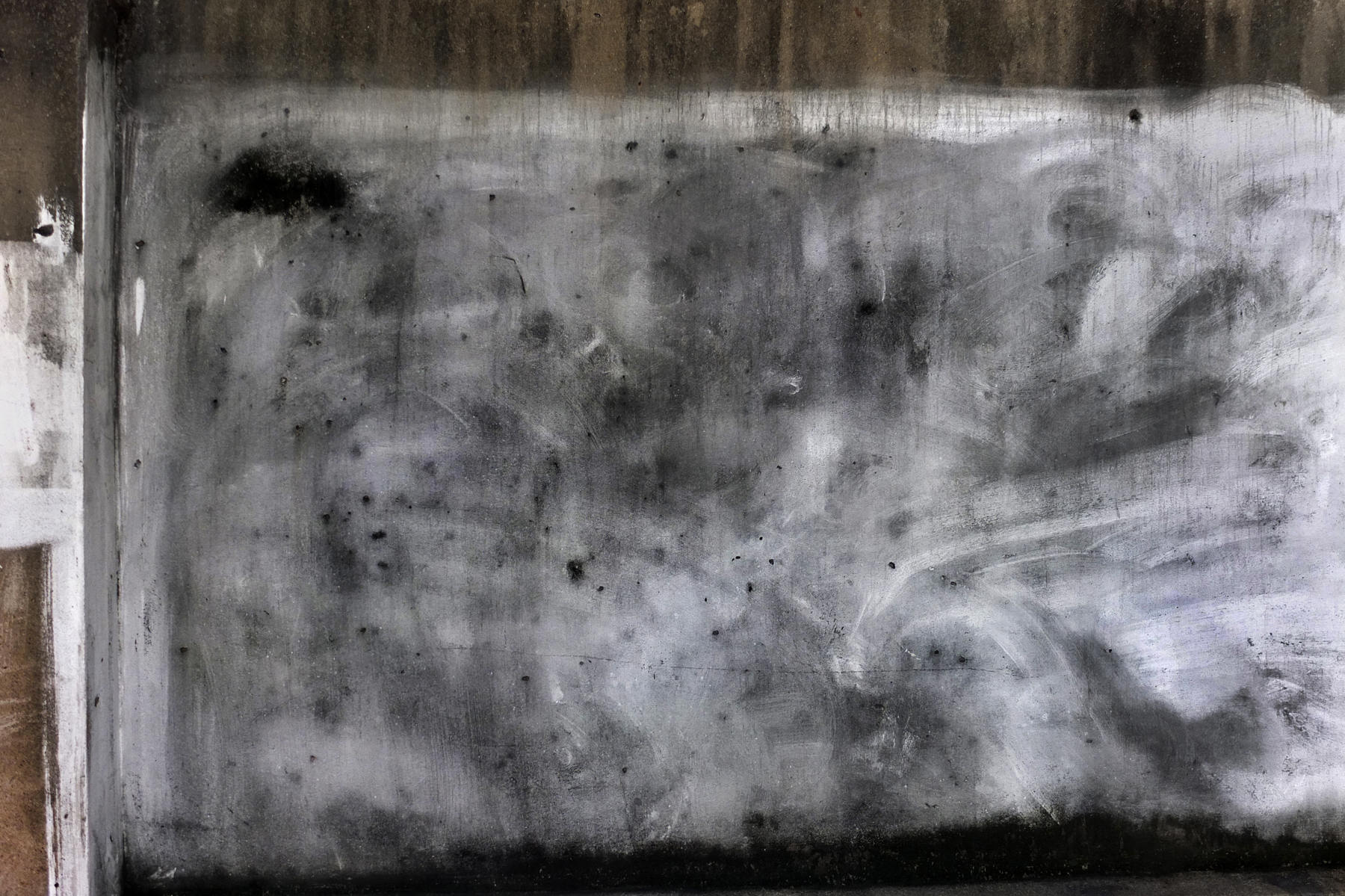
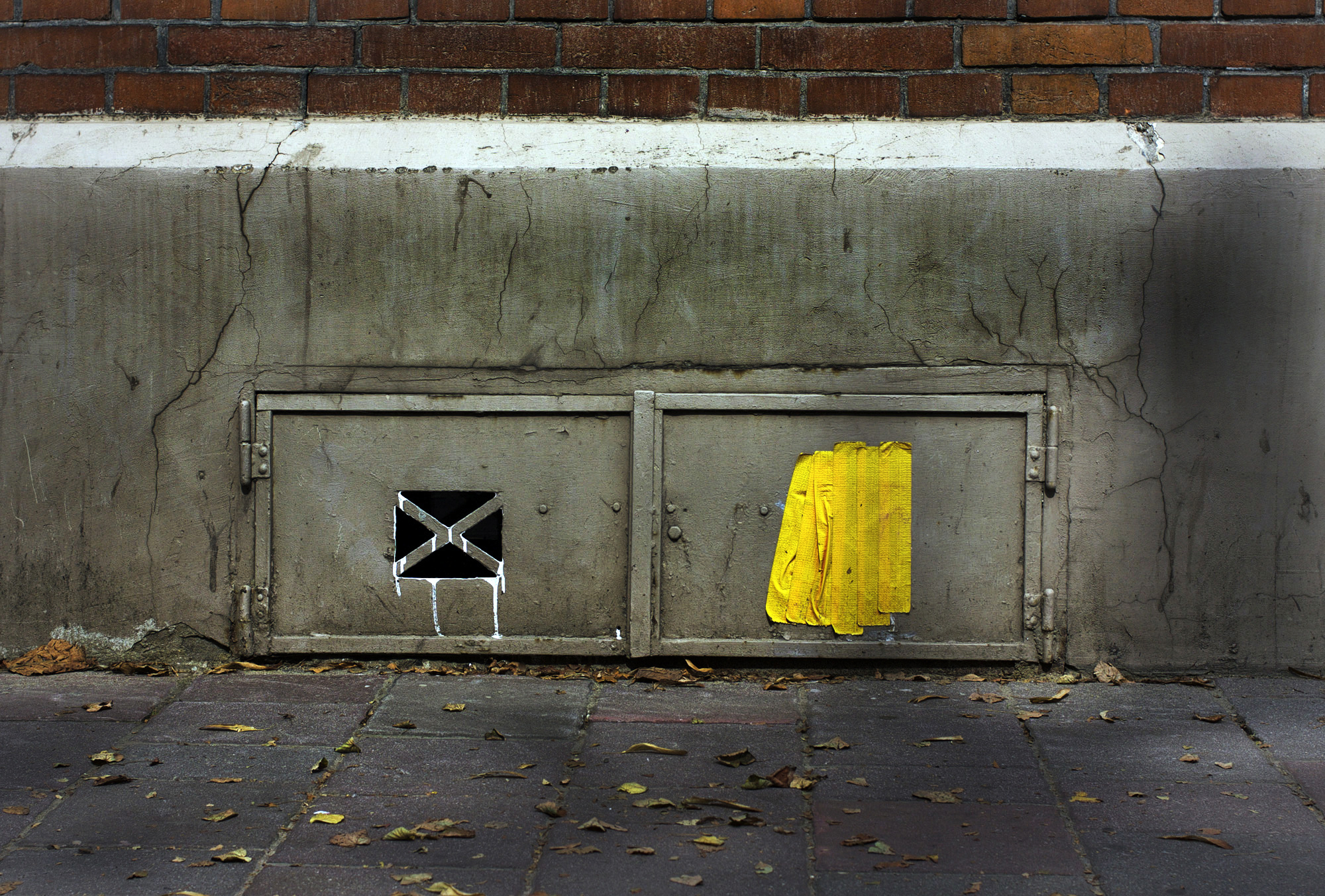
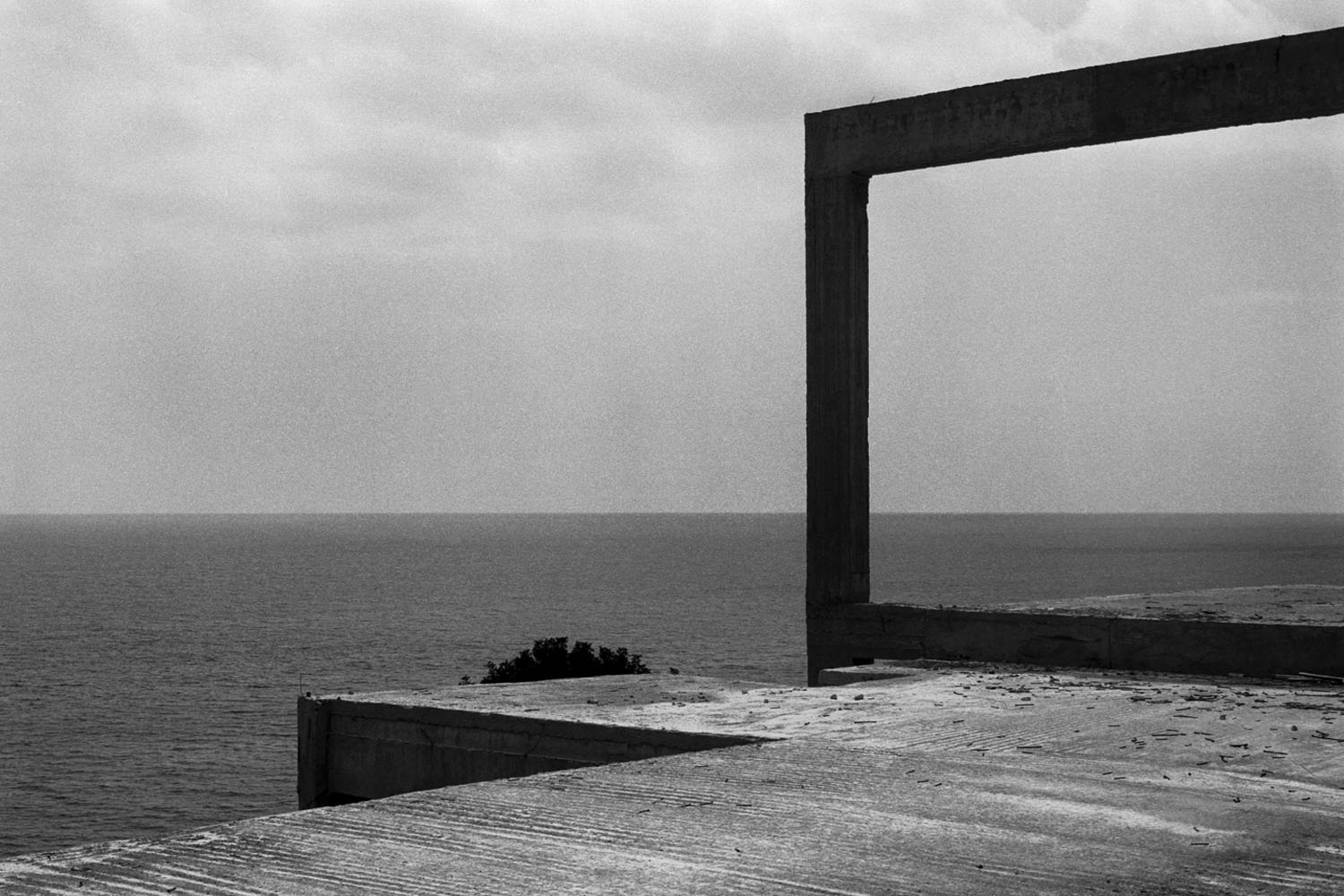
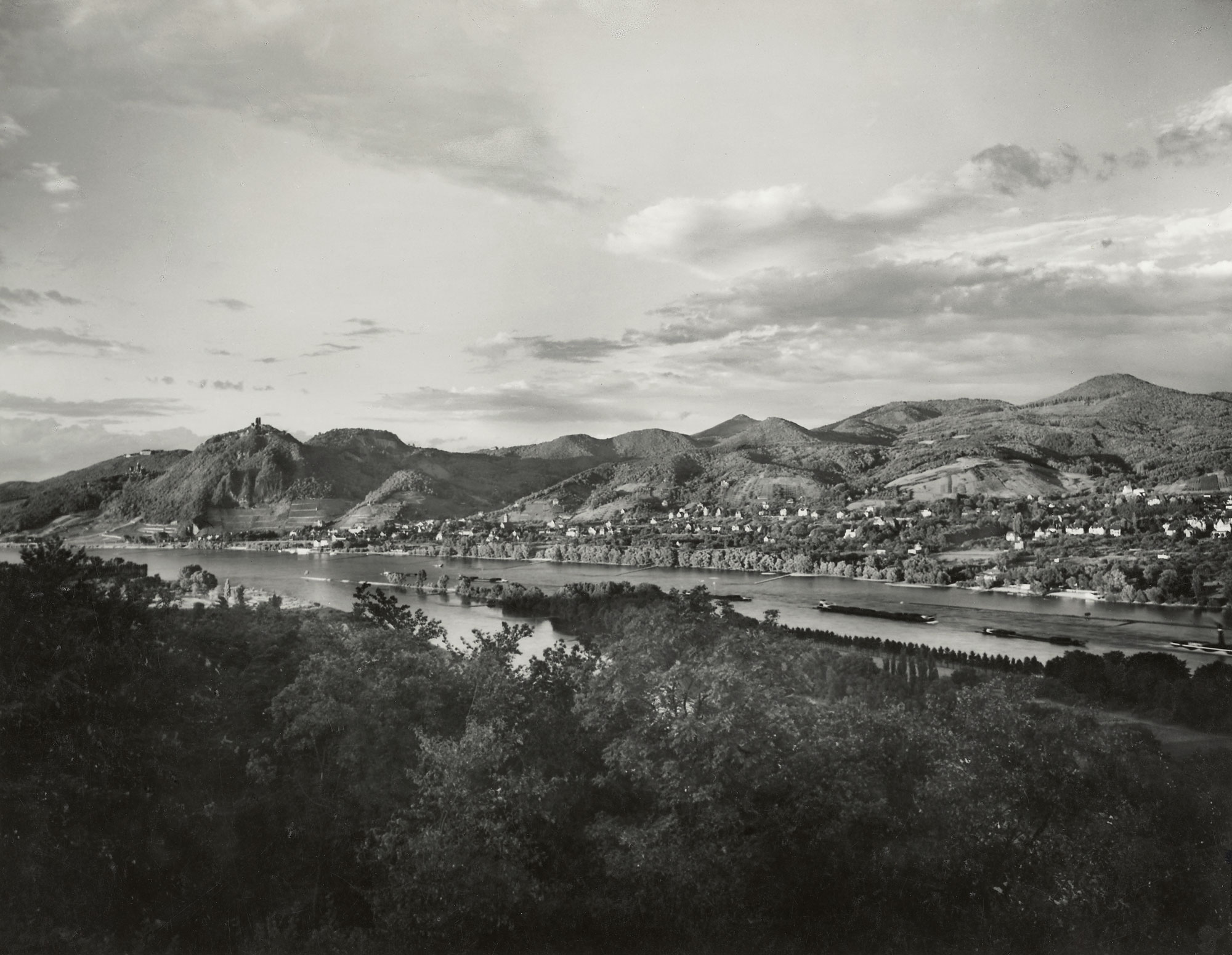
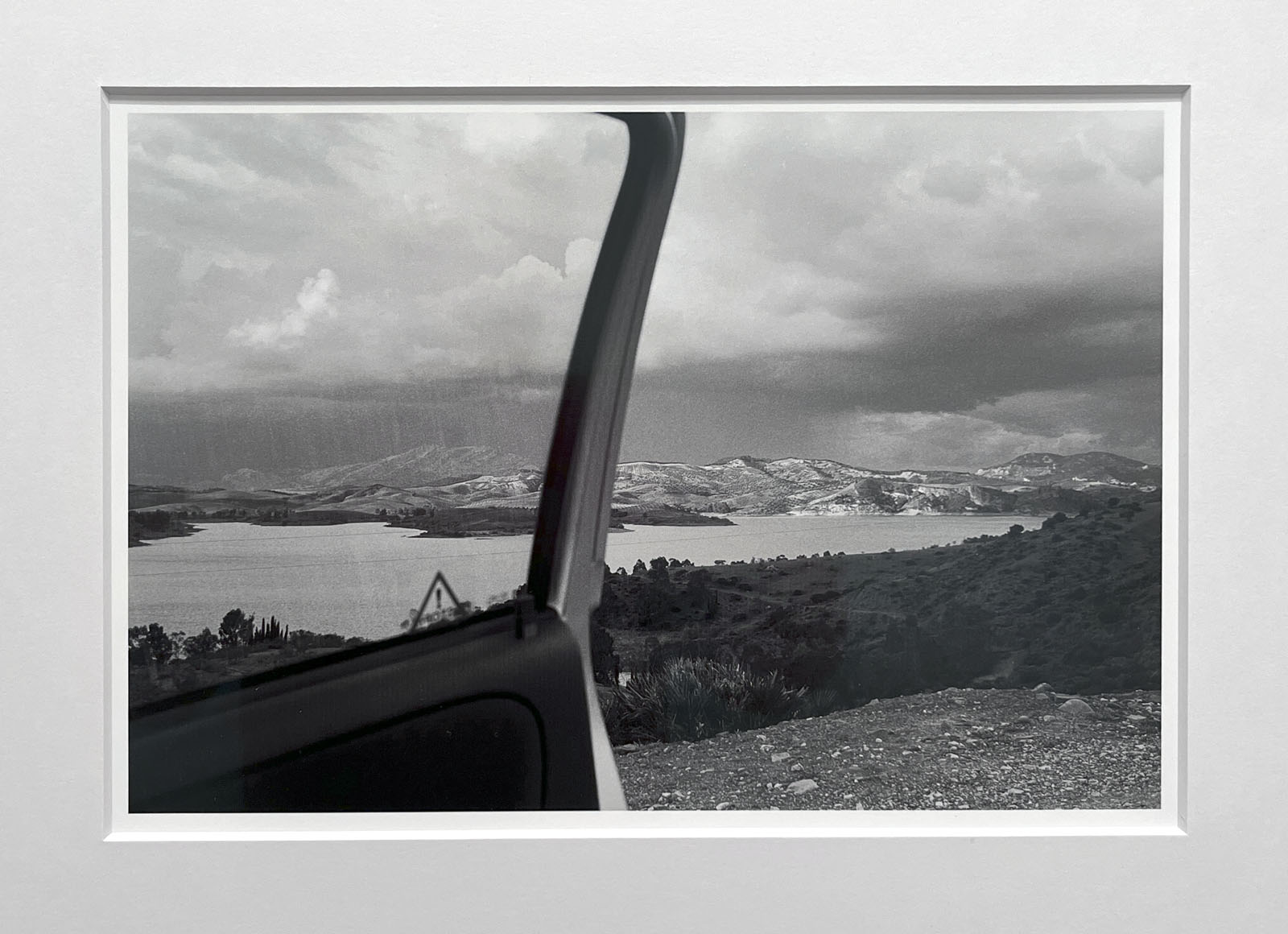
Exhibition: ‘On Her Own. The photographer Elfriede Mejchar’ at Wien Museum MUSA, Vienna

Exhibition dates: 18th April – 1st September, 2024

Curators: Anton Holzer, Frauke Kreutler


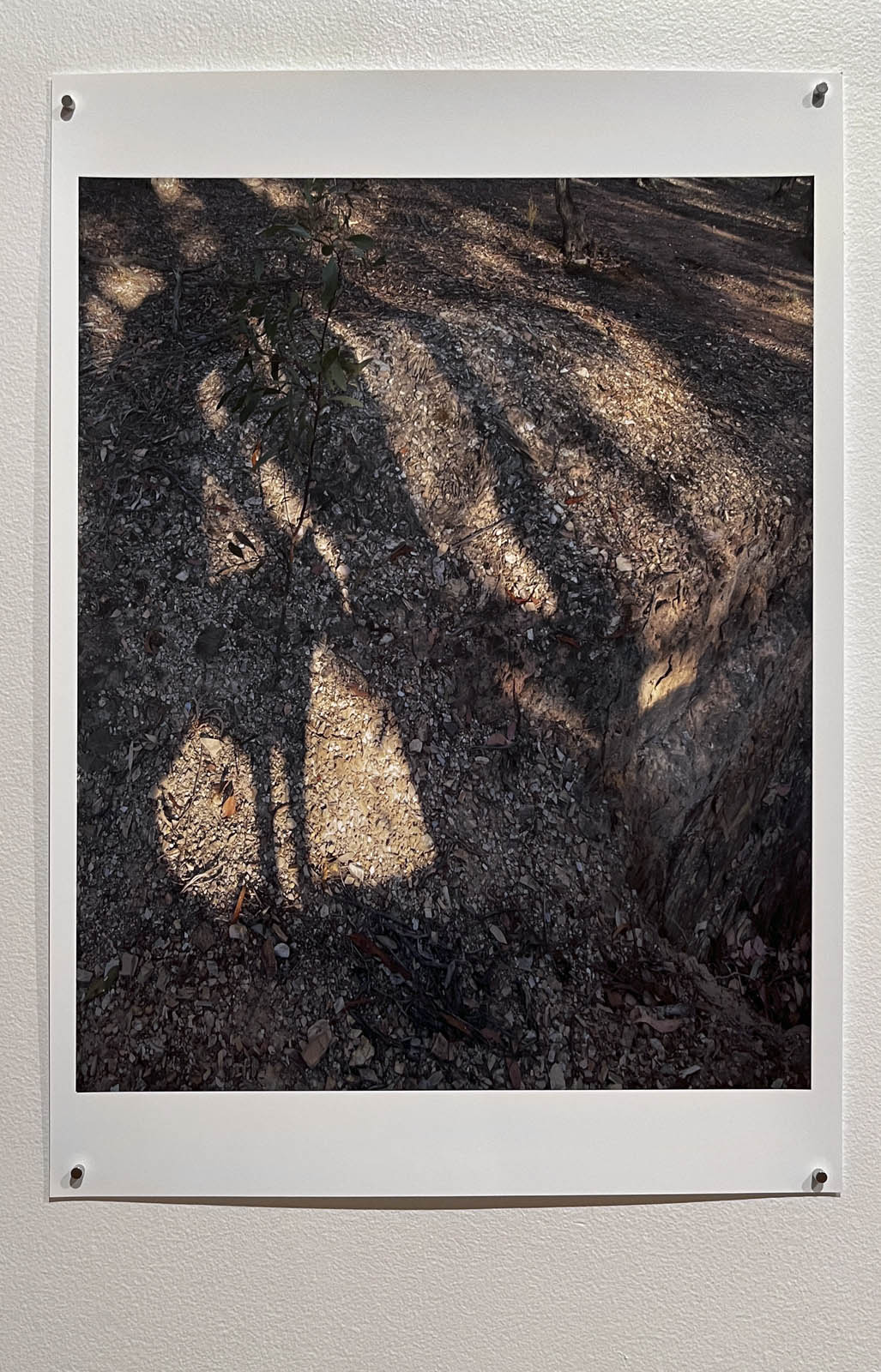
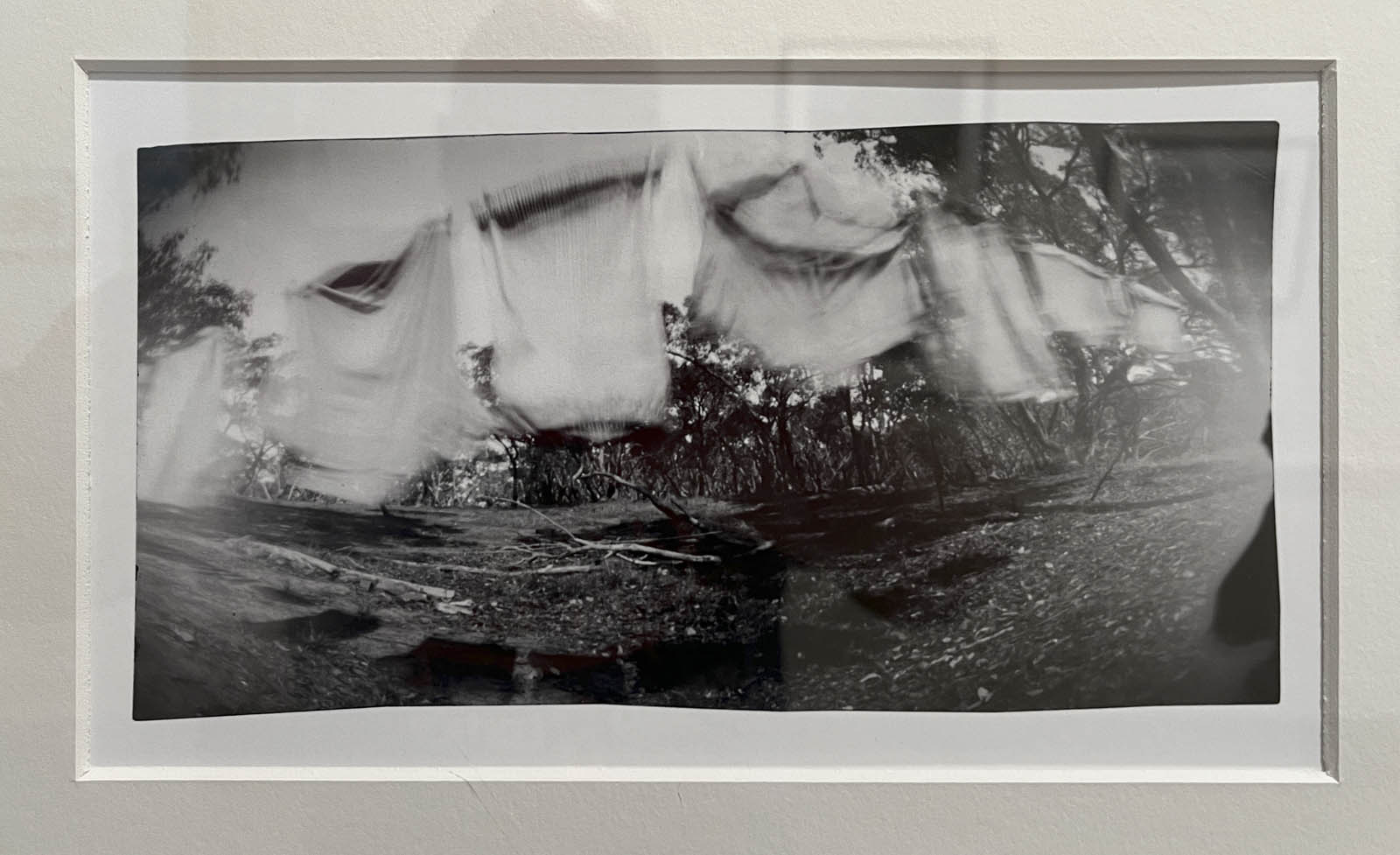
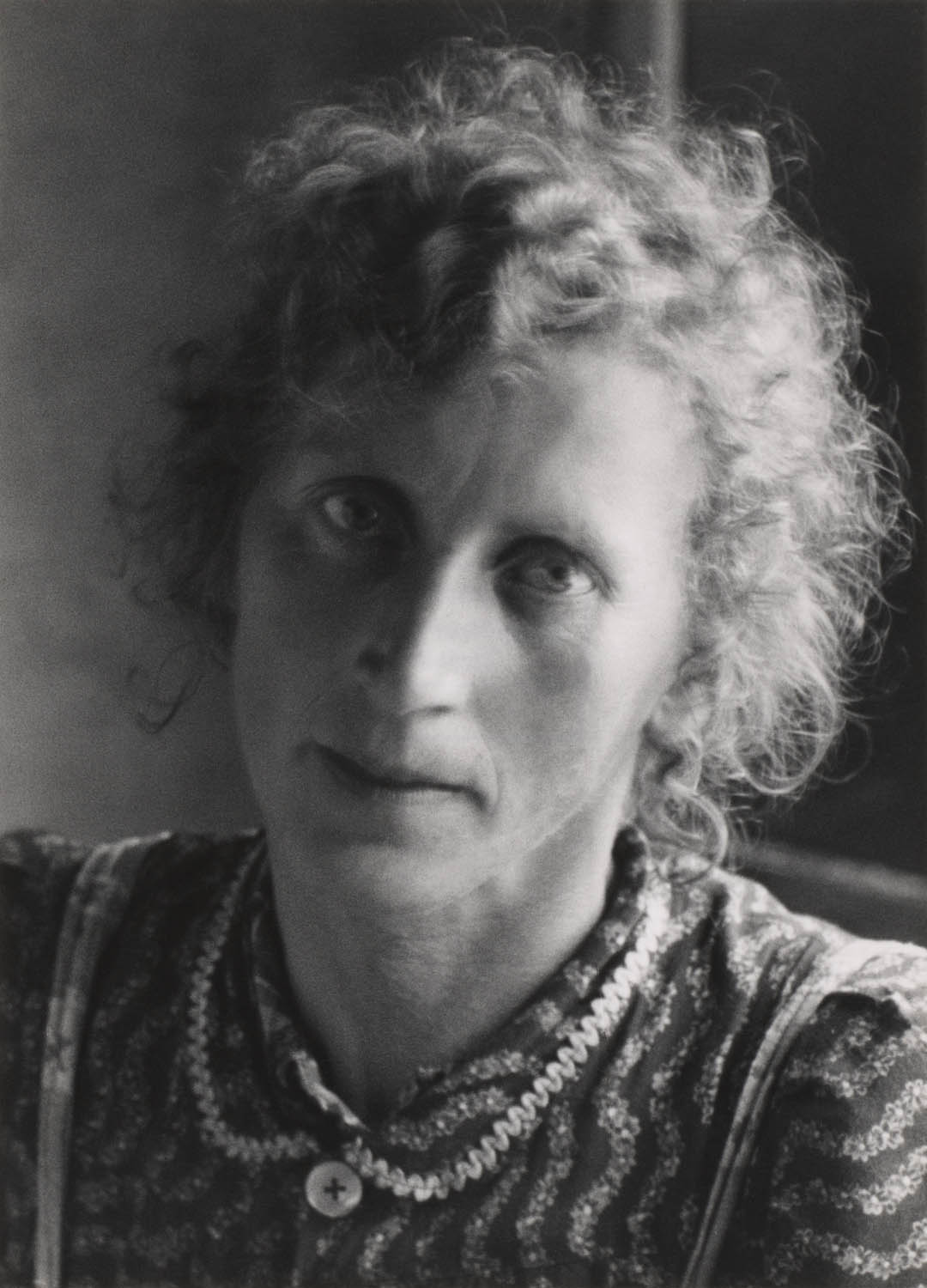
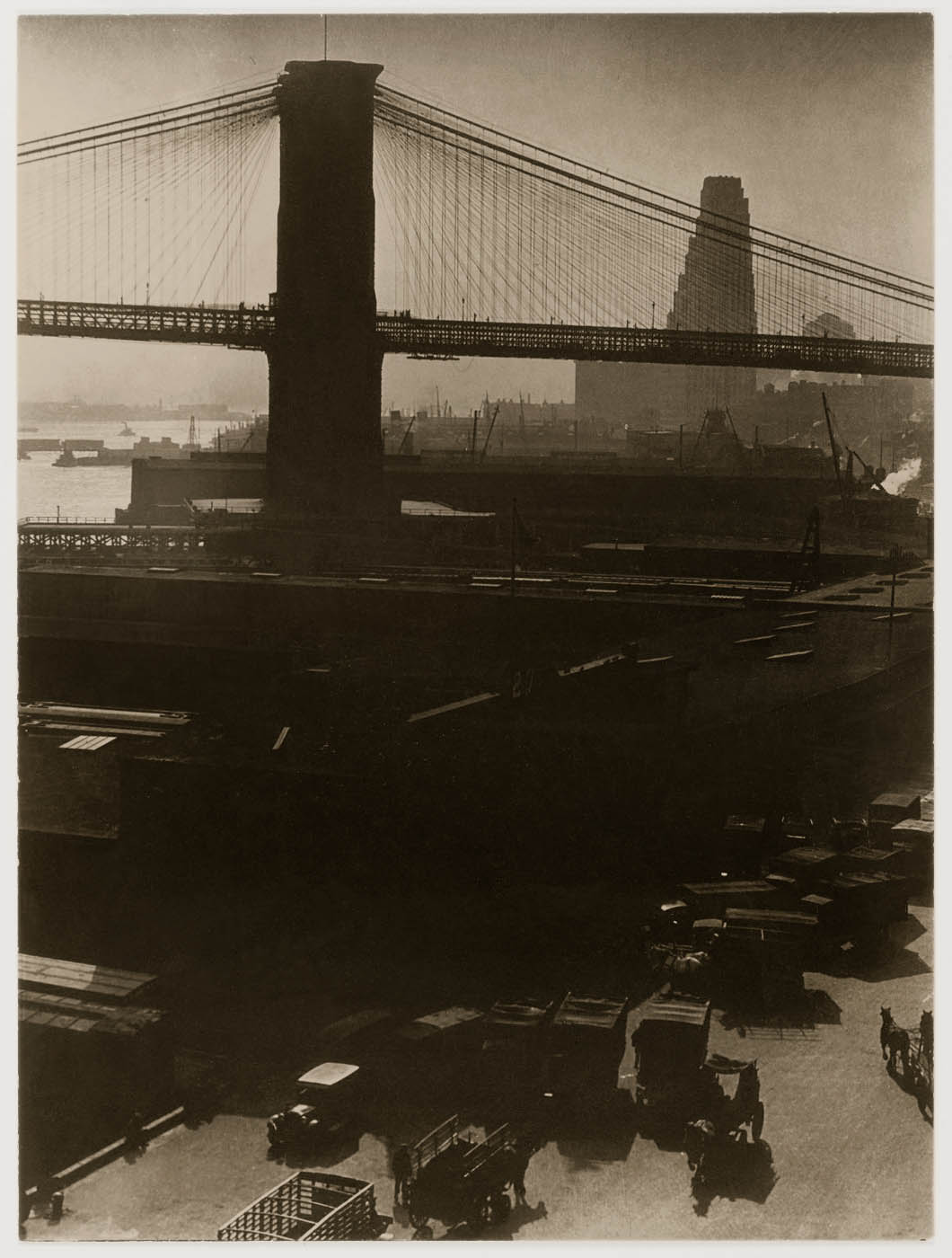
Elfriede Mejchar (Austrian, 1924-2020) 'Light and Shade' 1958 from the exhibition 'On Her Own. The photographer Elfriede Mejchar' at Wien Museum MUSA, Vienna, April - Sept 2024


Elfriede Mejchar (Austrian, 1924-2020)
Light and Shade
1958
Wien Museum
© Bildrecht, Vienna 2023


Comment on this magnificent Austrian photographer unknown to me until now will be forthcoming in the future posting on the simultaneous exhibition The Poetry of the Everyday. Photographs by Elfriede Mejchar at Museum der Moderne Salzburg.

Marcus


Many thankx to the Wien Museum for allowing me to publish the photographs in the posting. Please click on the photographs for a larger version of the image.


“I am not an artist, I am a photographer.”


Elfriede Mejchar
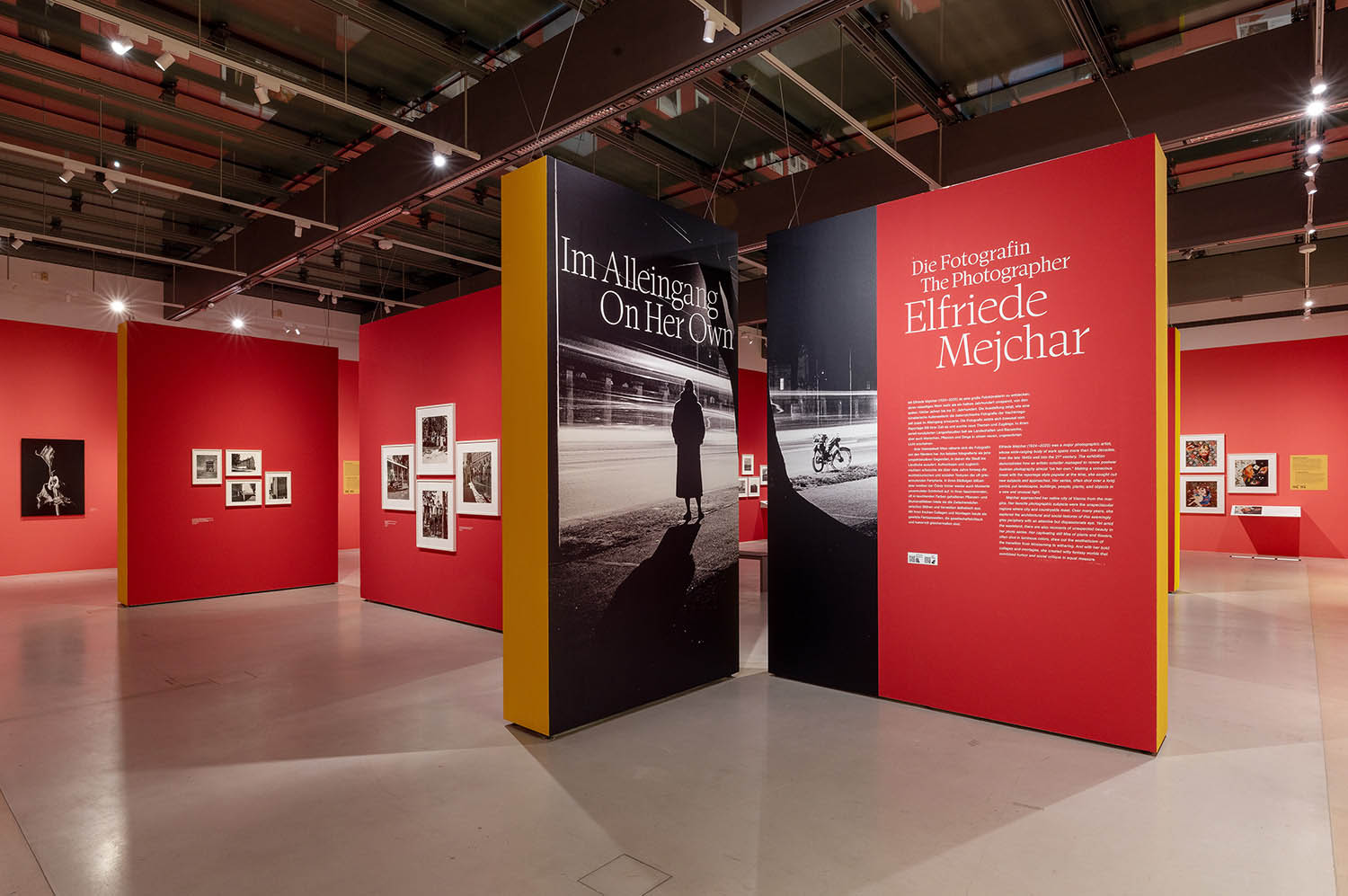


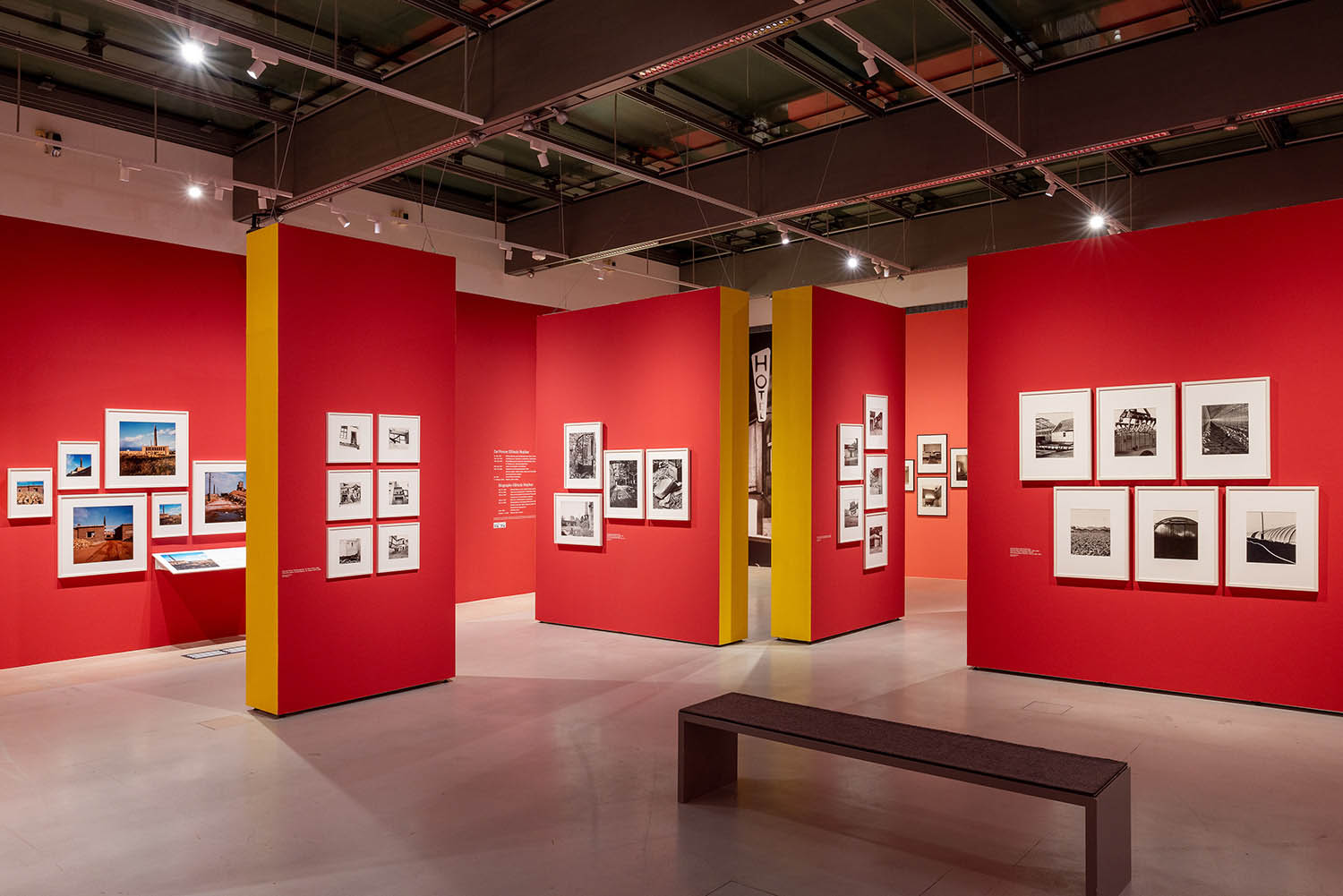
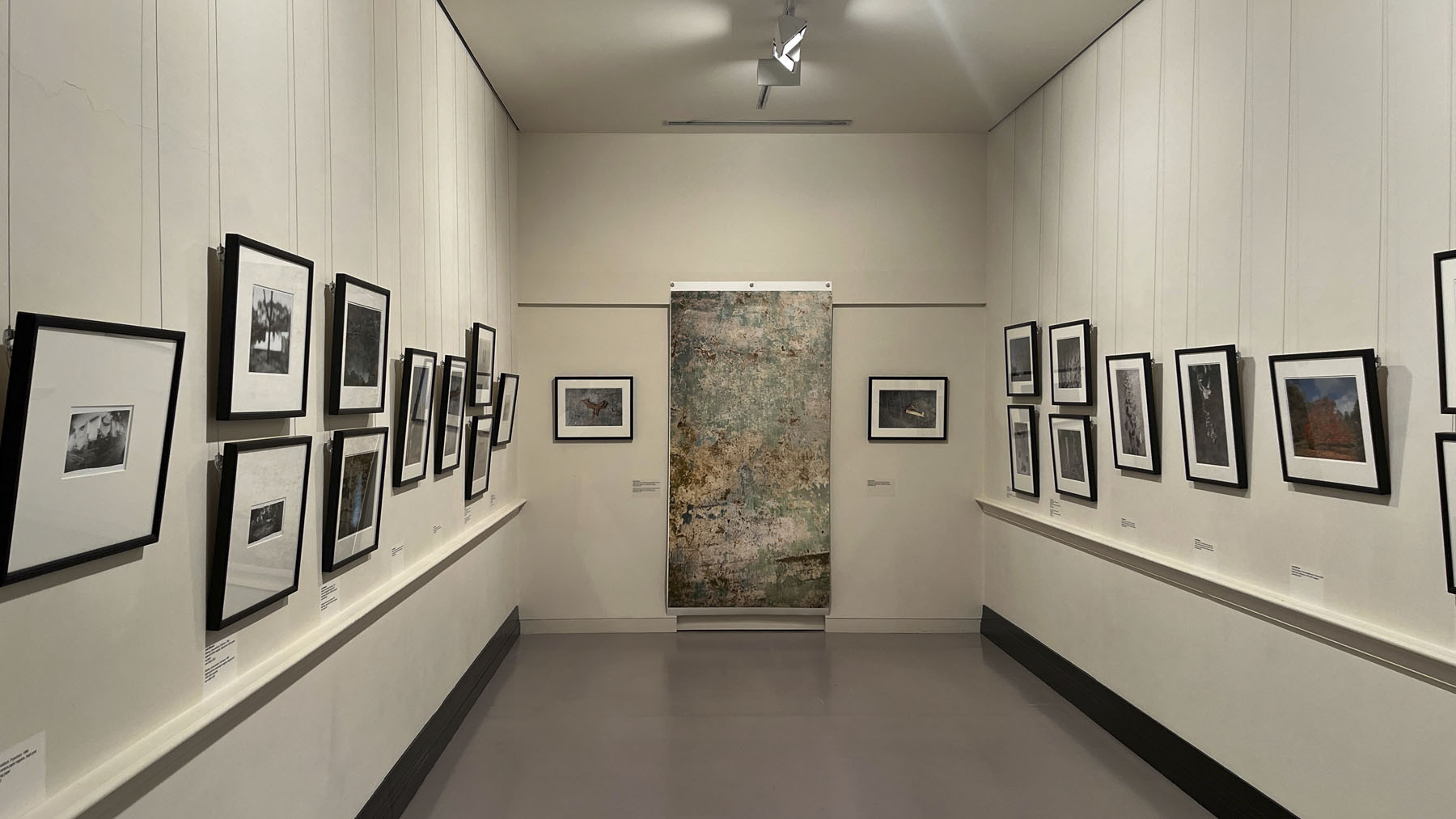
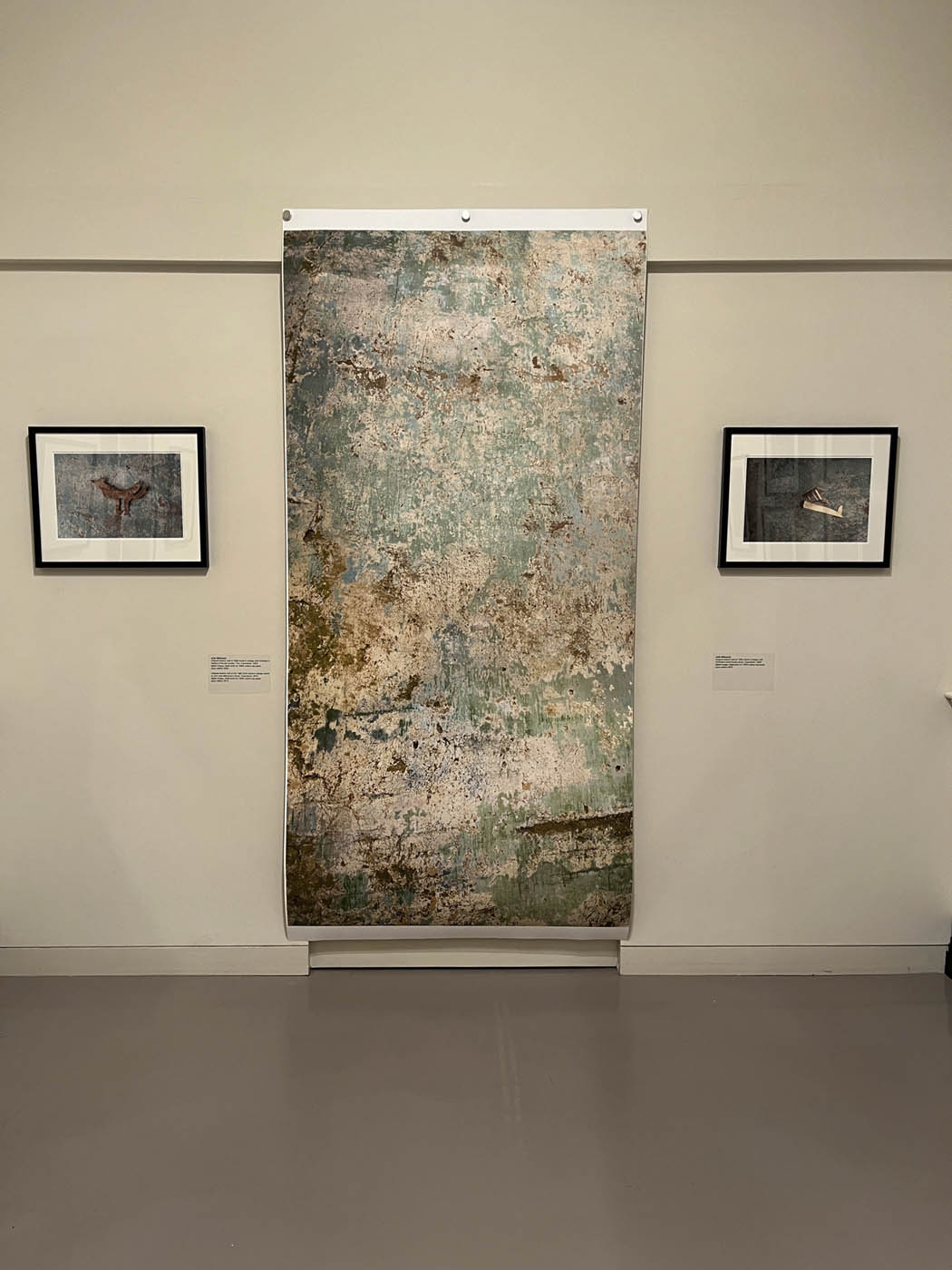
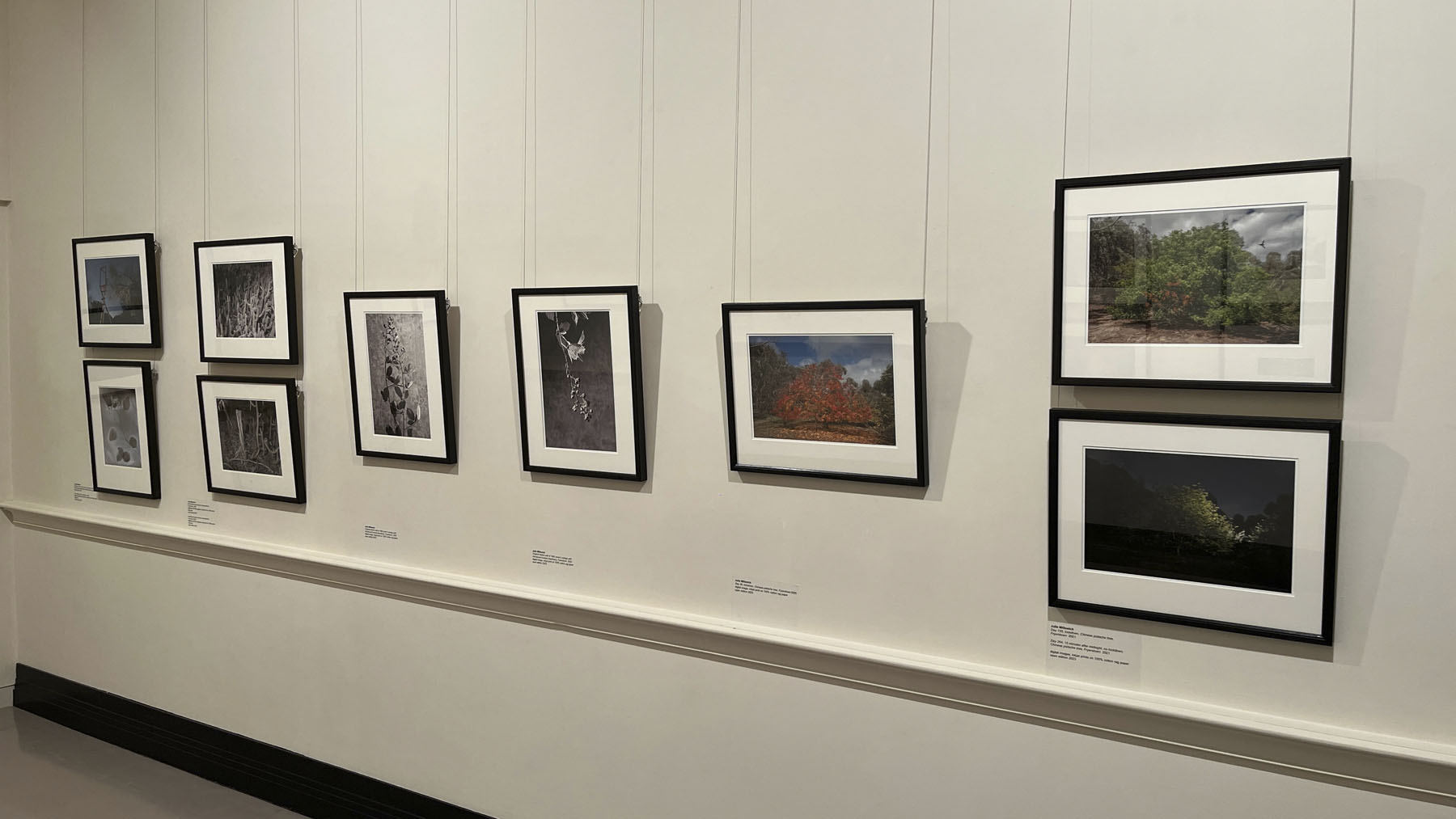
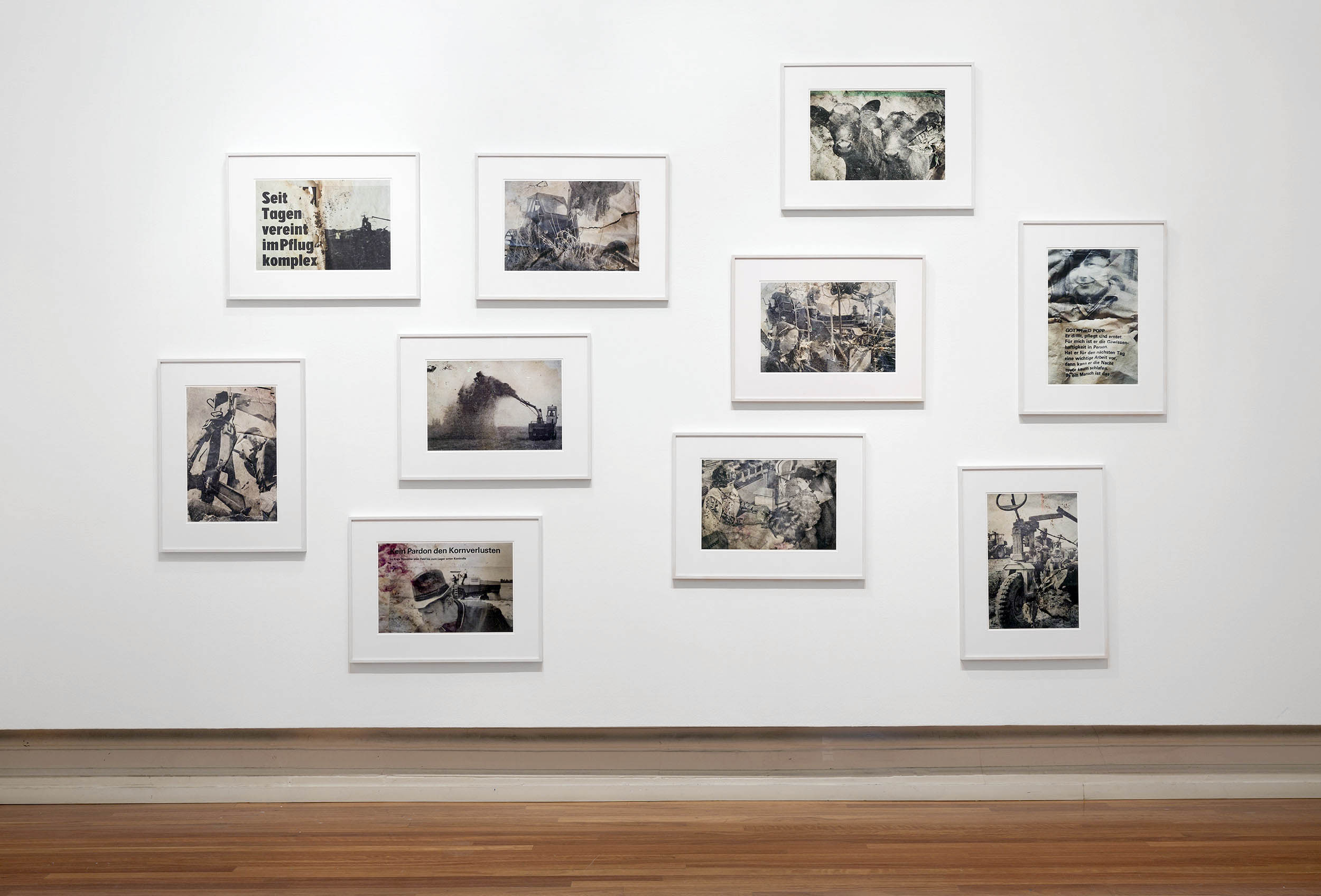
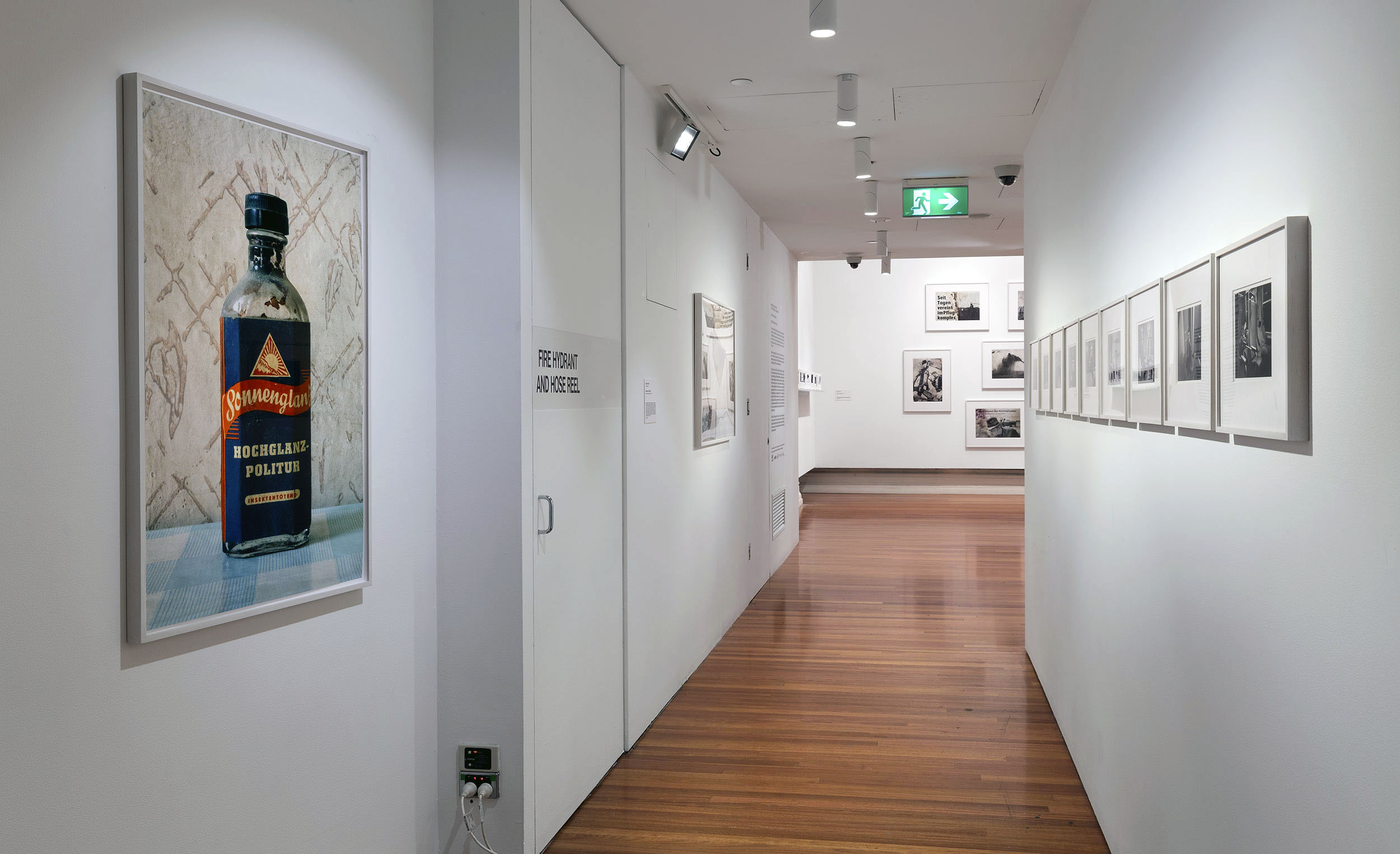
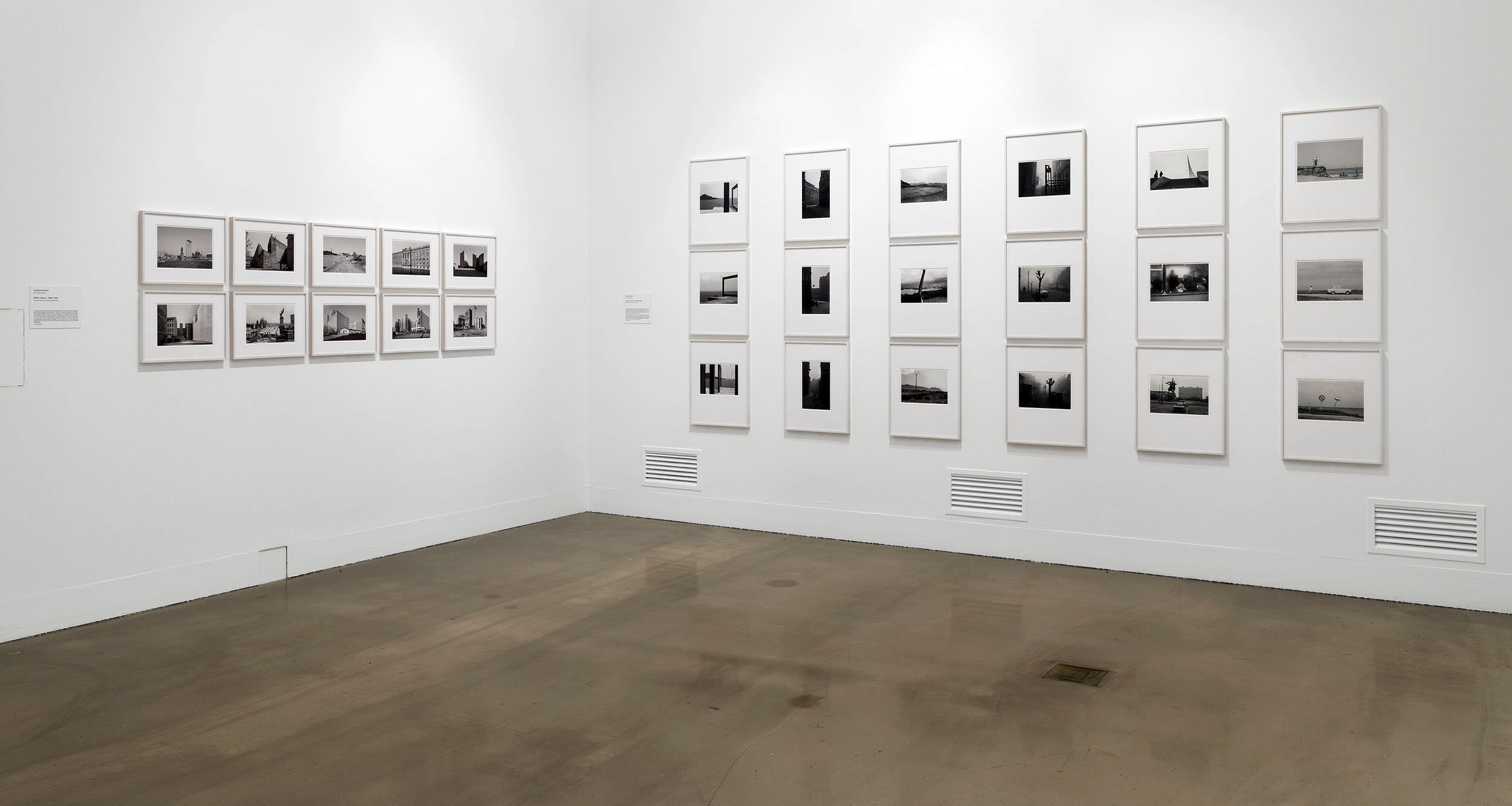
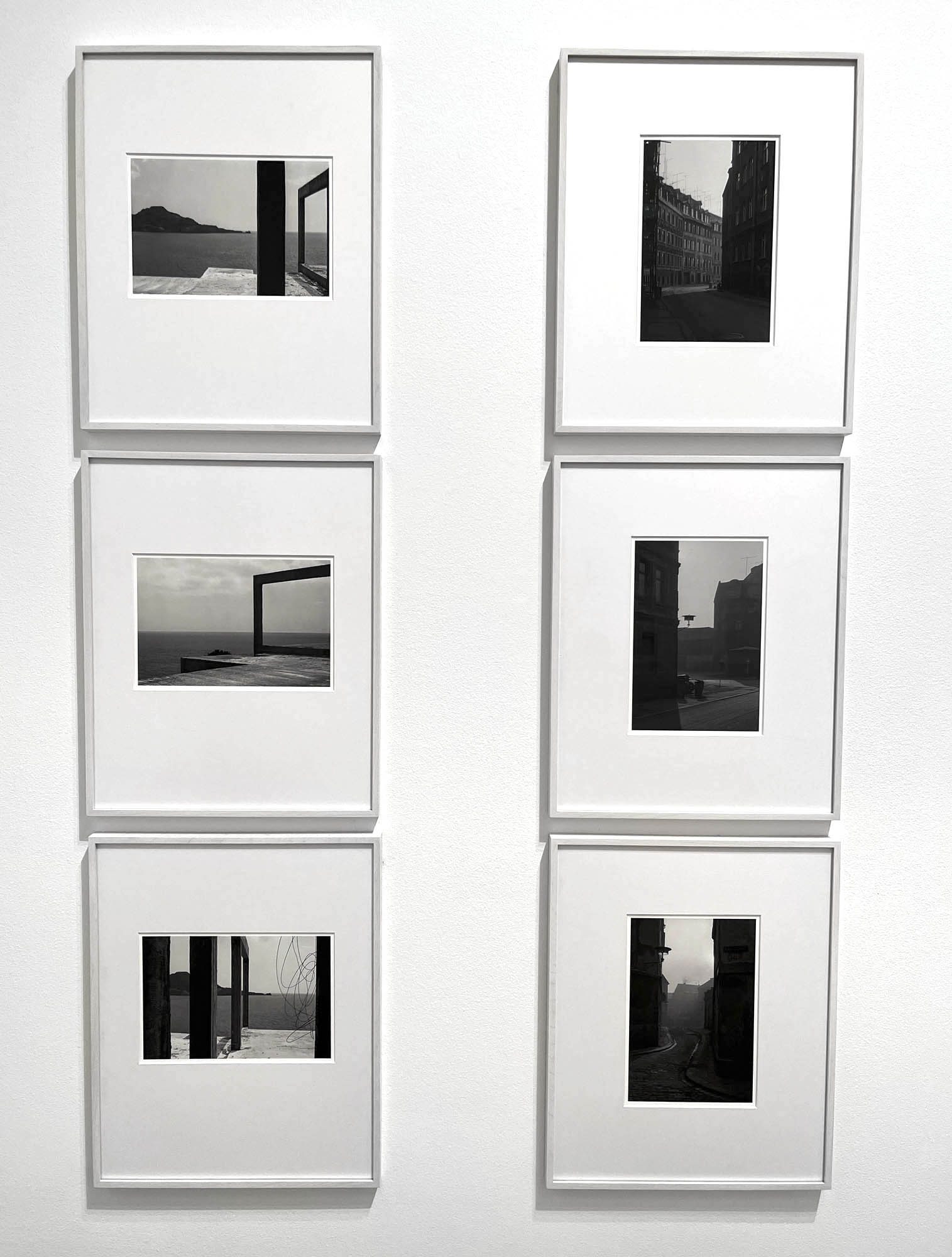
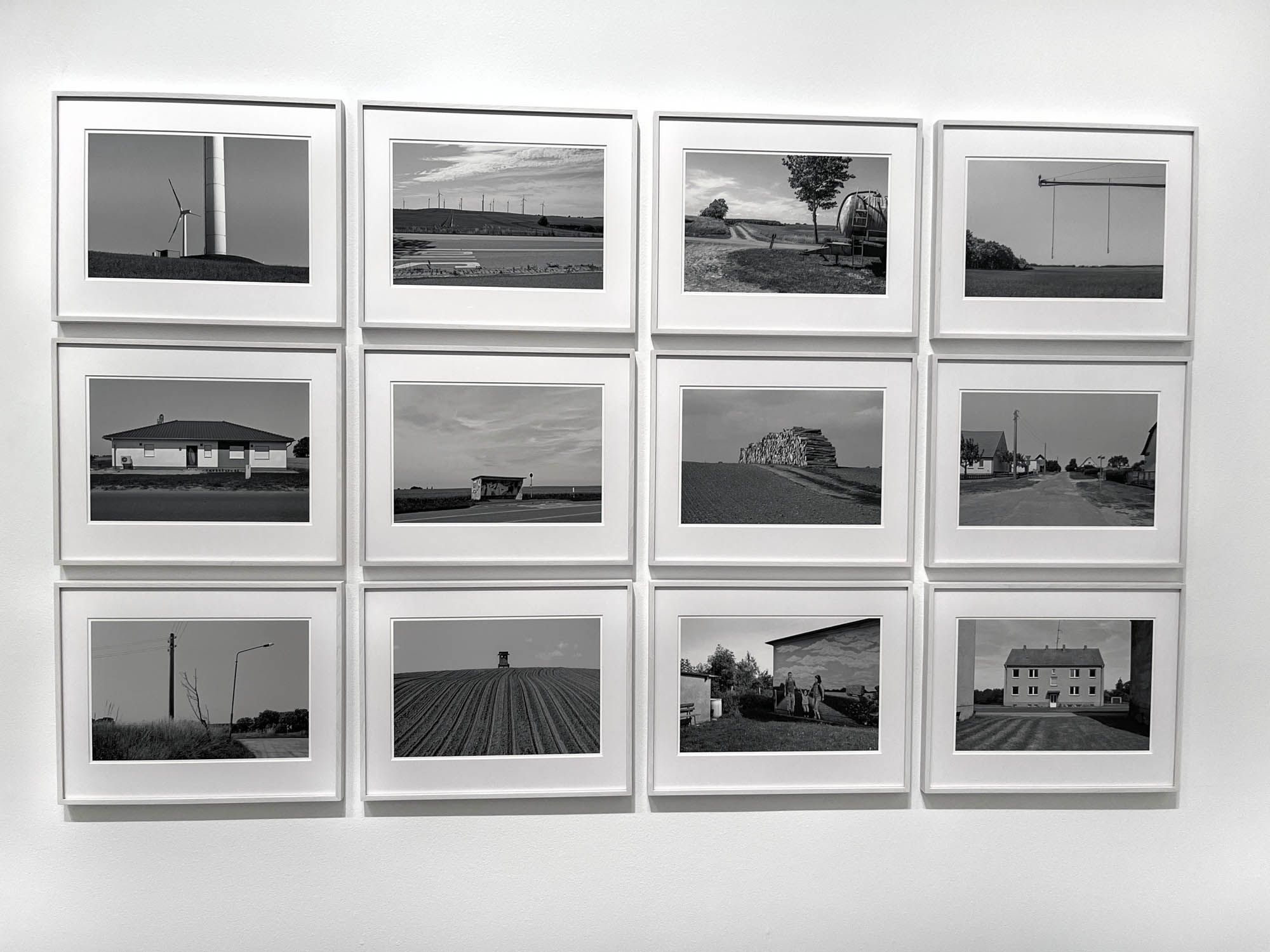
Installation view of the exhibition 'On Her Own. The photographer Elfriede Mejchar' at Wien Museum musa, Vienna

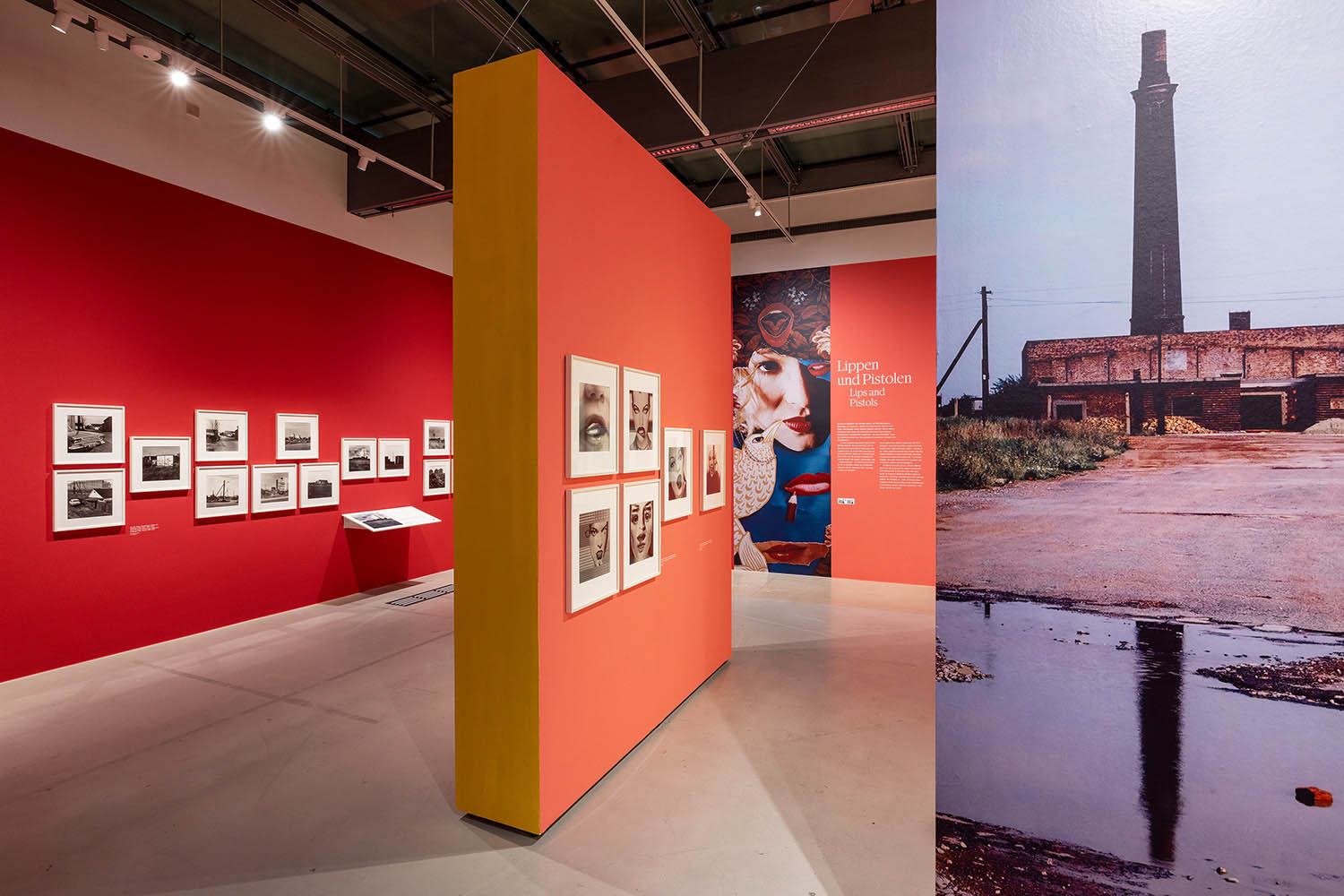
Installation view of the exhibition 'On Her Own. The photographer Elfriede Mejchar' at Wien Museum musa, Vienna

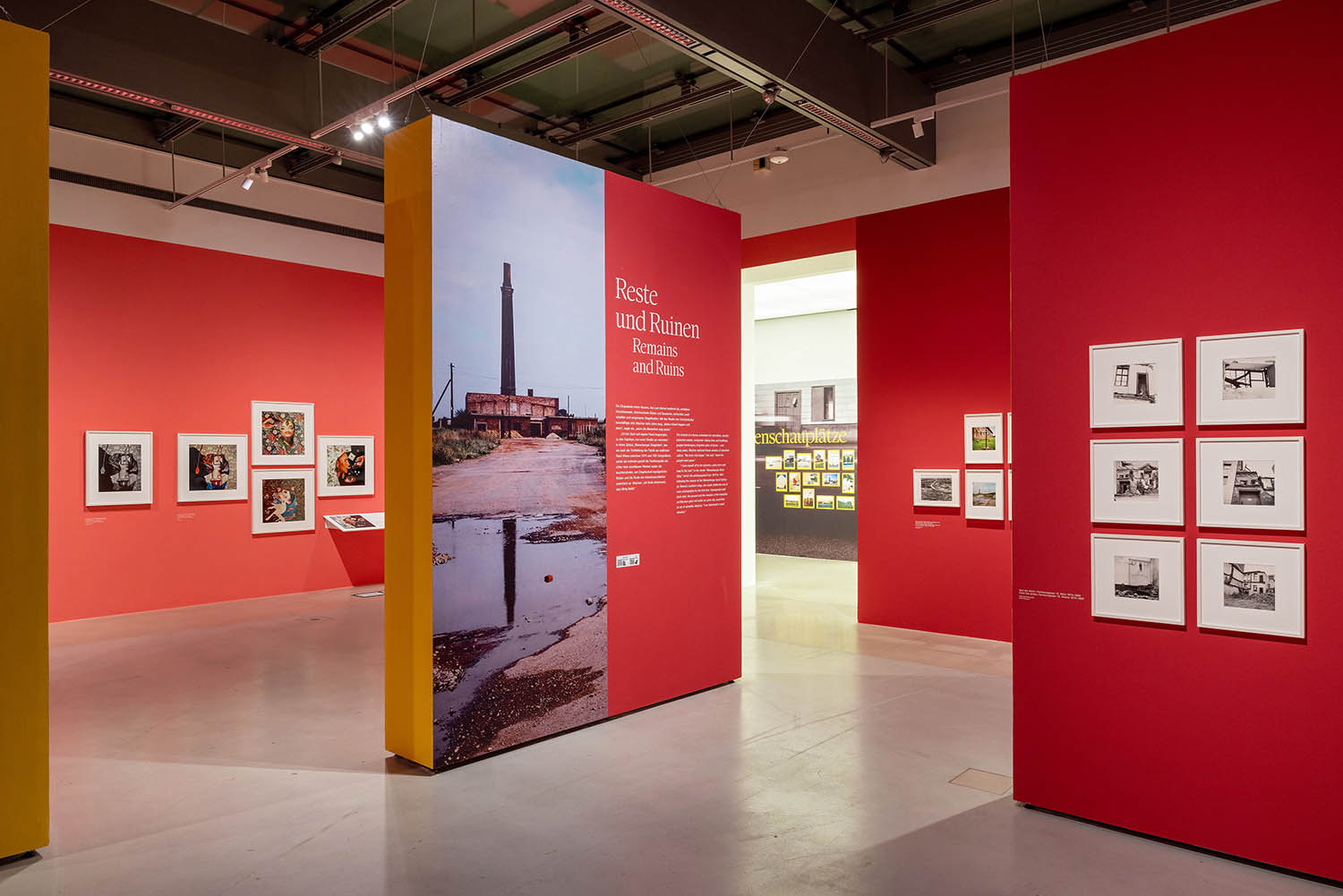
Installation view of the exhibition 'On Her Own. The photographer Elfriede Mejchar' at Wien Museum musa, Vienna

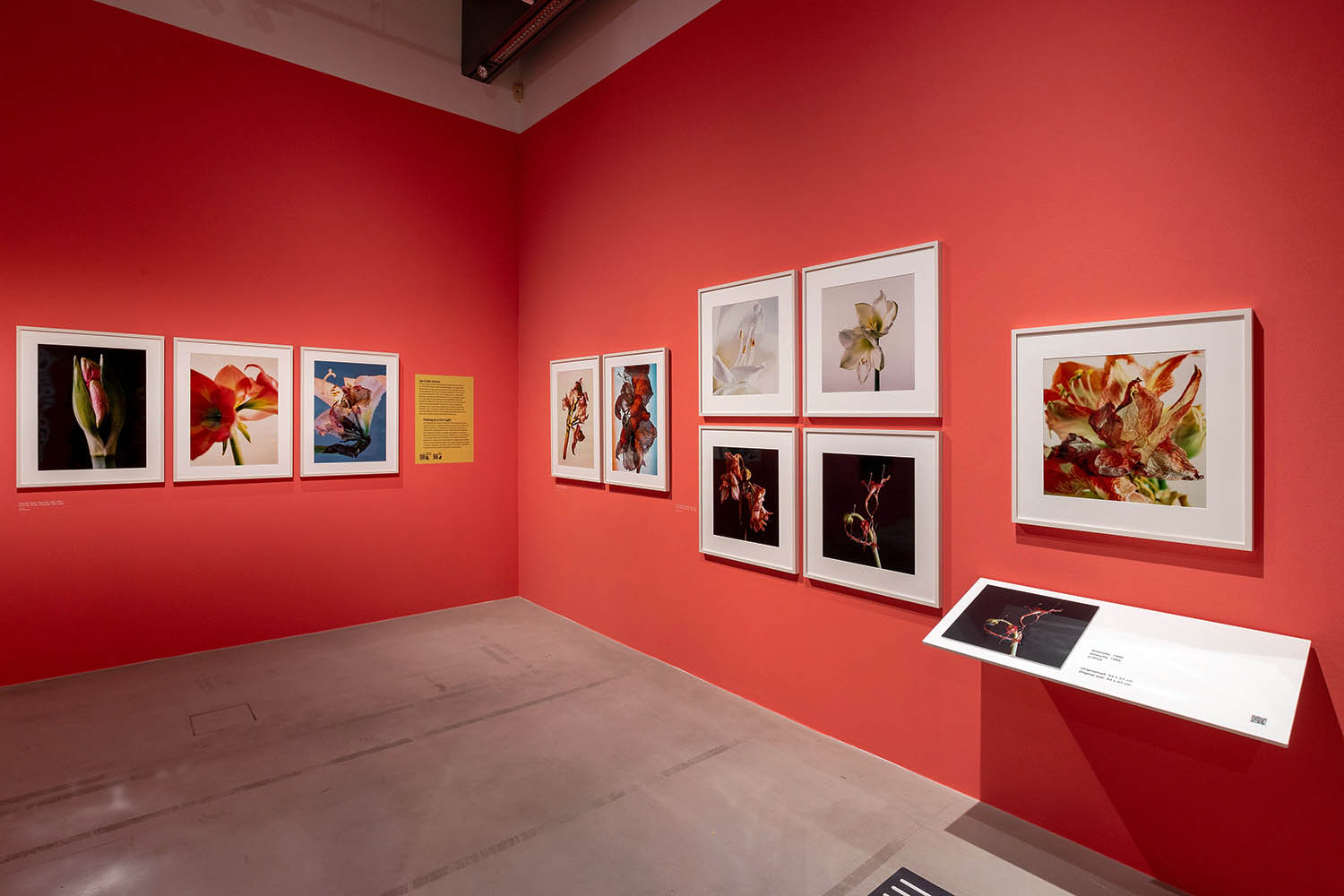
Installation view of the exhibition 'On Her Own. The photographer Elfriede Mejchar' at Wien Museum musa, Vienna

Installation view of the exhibition 'On Her Own. The photographer Elfriede Mejchar' at Wien Museum musa, Vienna

Installation view of the exhibition 'On Her Own. The photographer Elfriede Mejchar' at Wien Museum musa, Vienna

Installation view of the exhibition 'On Her Own. The photographer Elfriede Mejchar' at Wien Museum musa, Vienna


Installation views of the exhibition On Her Own. The photographer Elfriede Mejchar at Wien Museum musa, Vienna


Elfriede Mejchar (1924-2020) was a major photographic artist, whose richly-varied oeuvre spans more than five decades, from the late 1940s well into the 21st century. The Viennese photographer, who only achieved recognition as an artist towards the end of her career, is now regarded as one of the most important representatives of the Austrian and the international photography scenes. May 10, 2024 marks the hundredth anniversary of her birth.

The exhibition at the Wien Museum presents a broad cross-section of the work of this artistic outsider, and demonstrates how the renewal of postwar Austrian photography was almost “all her own work.” Elfriede Mejchar consciously broke away from the photographic mainstream and the reportage style that was popular at the time. Rather than searching for the so-called “decisive moment,” she approached her subjects in a strongly conceptual and serial manner. She focused not on the extraordinary but on the unspectacular and the commonplace, the everyday and the banal, repeatedly addressing these in new ways in her photographic series.

In an Austria-wide cooperation between the Wien Museum, the State Gallery of Lower Austria, and the Museum der Moderne Salzburg, Elfriede Mejchar’s extensive oeuvre is being presented in 2024 for the first time, simultaneously, in three locations across the country. The exhibitions in Vienna, Krems, and Salzburg approach the work of Mejchar from different perspectives. And the three presentations are accompanied by a jointly conceived catalog published by Hirmer Verlag.

A cooperation between the State Gallery of Lower Austria, the Wien Museum and the Museum der Moderne Salzburg.

Text from the Wien Museum website
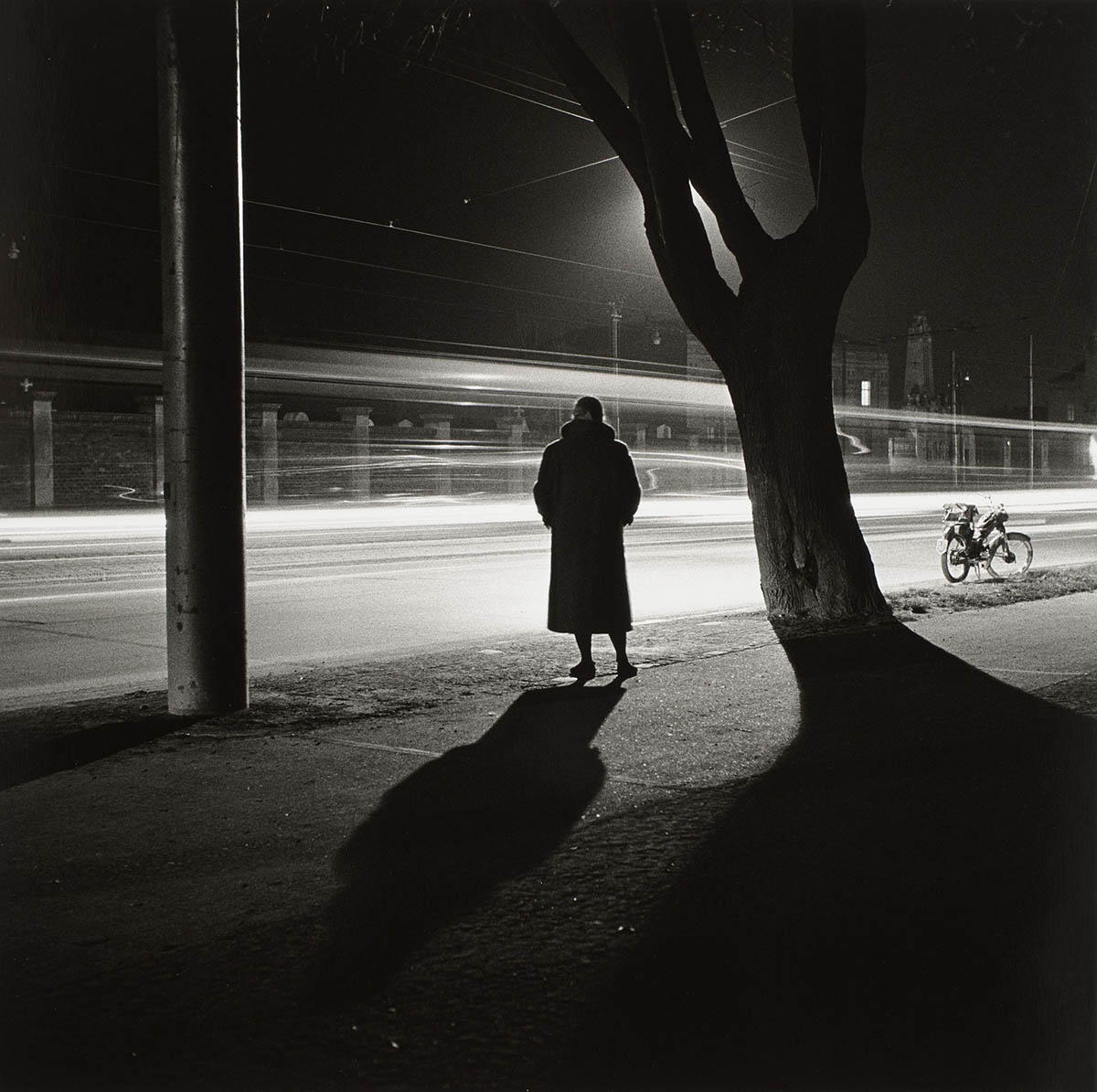
 

Elfriede Mejchar (Austrian, 1924-2020) 'Light and Shade' 1958 from the exhibition 'On Her Own. The photographer Elfriede Mejchar' at Wien Museum MUSA, Vienna, April - Sept 2024


Elfriede Mejchar (Austrian, 1924-2020)
Light and Shade
1958
Wien Museum
© Bildrecht, Vienna 2023
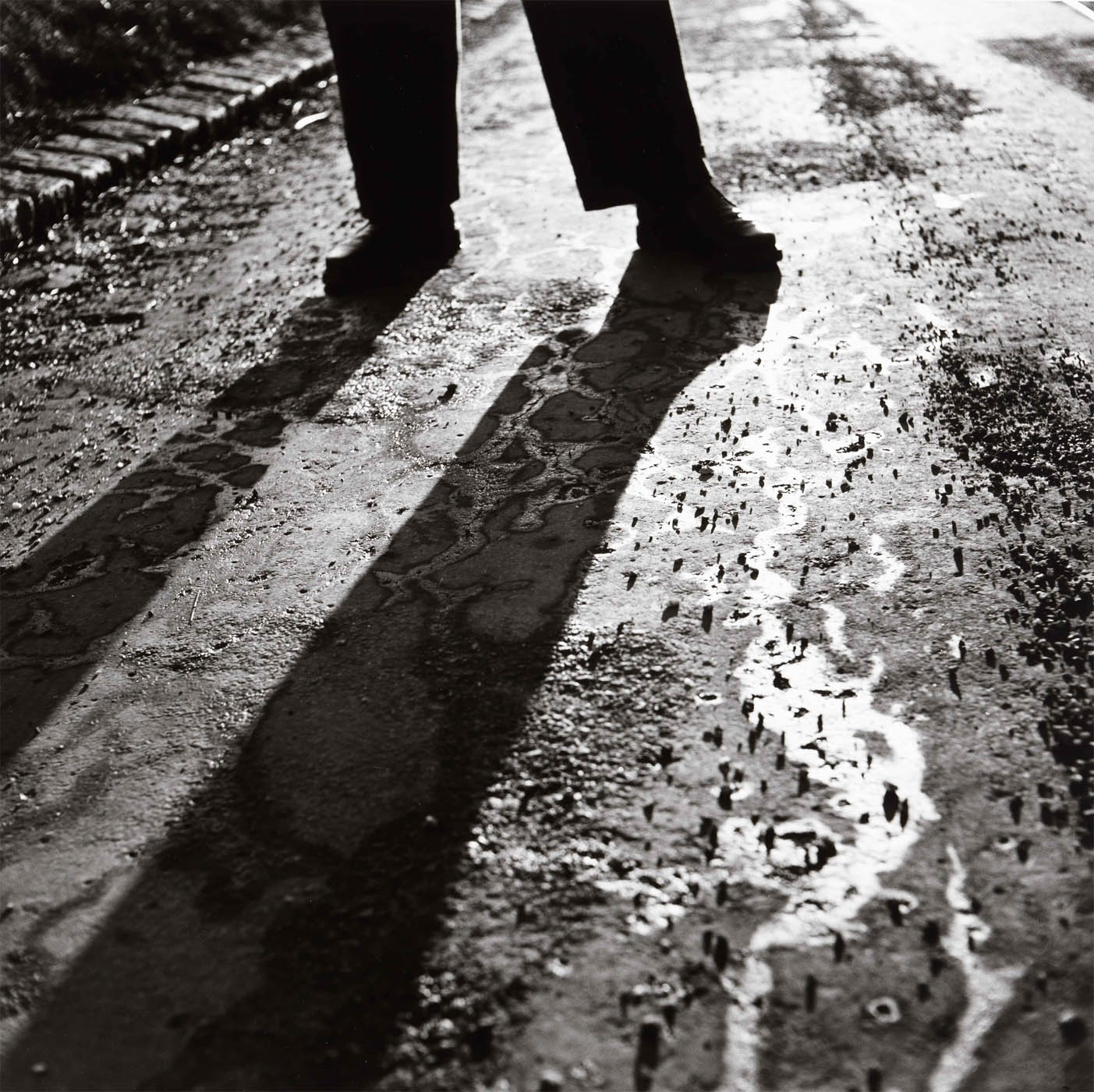
 

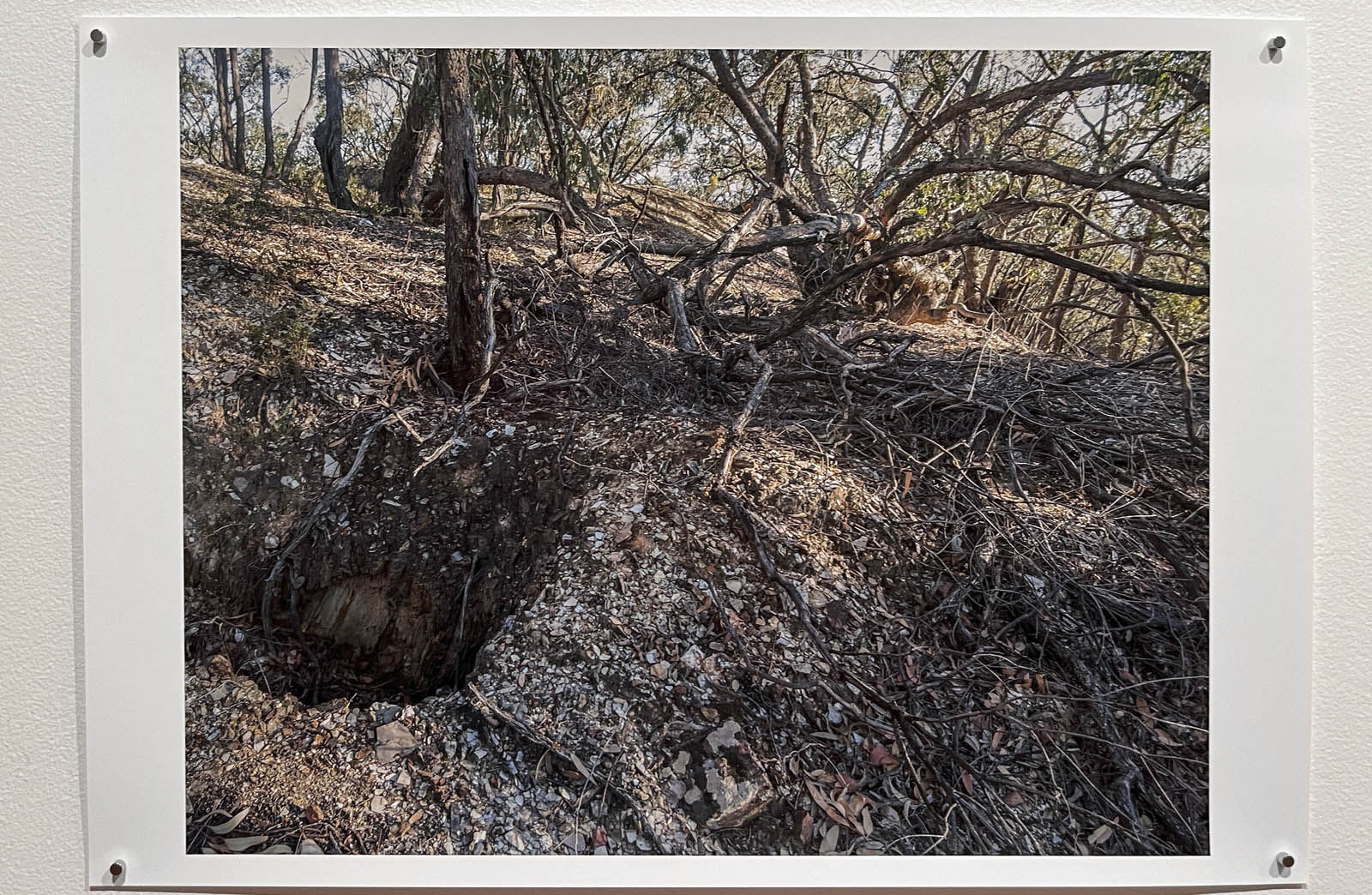
Elfriede Mejchar (Austrian, 1924-2020) 'Untitled' 1950-1960  From the series 'Light and Shade' from the exhibition 'On Her Own. The photographer Elfriede Mejchar' at Wien Museum MUSA, Vienna, April - Sept 2024


Elfriede Mejchar (Austrian, 1924-2020)
Untitled
1950-1960
From the series Light and Shade
Wien Museum
© Bildrecht, Vienna 2023


Elfriede Mejchar (Austrian, 1924-2020) 'Untitled (Waiting for the Tram)' 1950-1960


Elfriede Mejchar (Austrian, 1924-2020)
Untitled (Waiting for the Tram)
1950-1960
From the series Light and Shade
Wien Museum
© Bildrecht, Vienna 2023


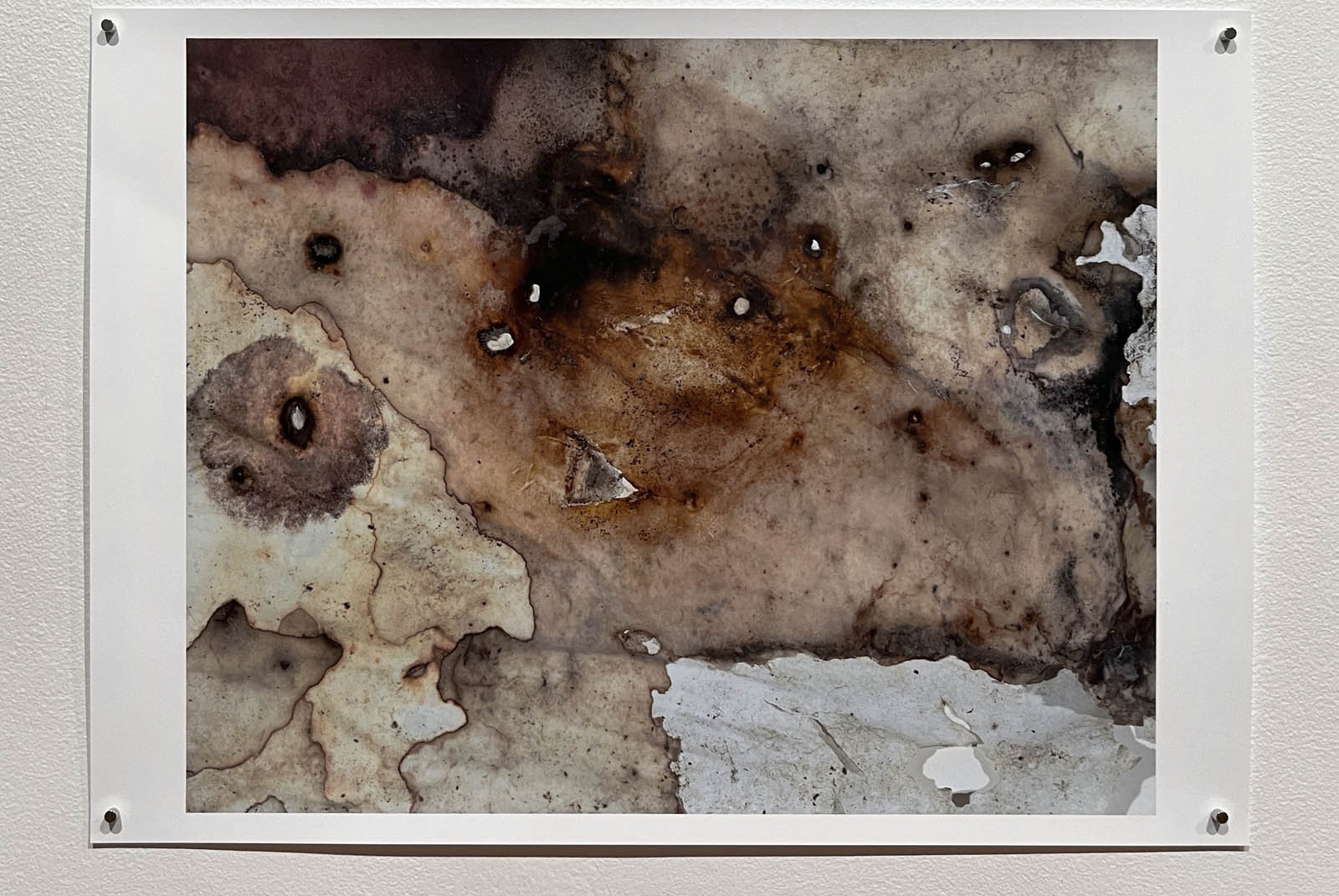
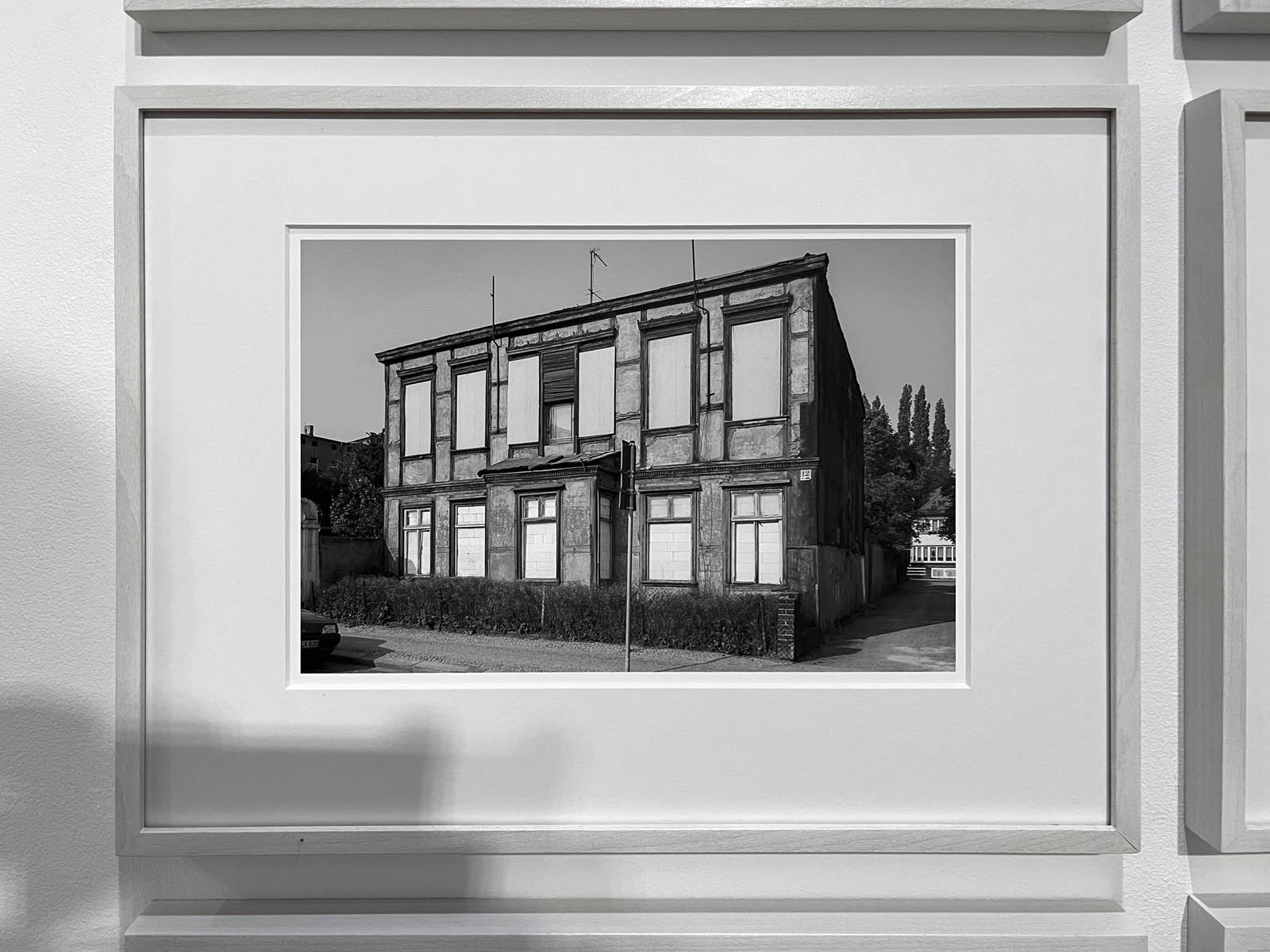
Elfriede Mejchar (Austrian, 1924-2020) 'Vienna 10, Hasengasse 53' 1950-1960


Elfriede Mejchar (Austrian, 1924-2020)
Vienna 10, Hasengasse 53
1950-1960
Wien Museum
© Bildrecht, Vienna 2023
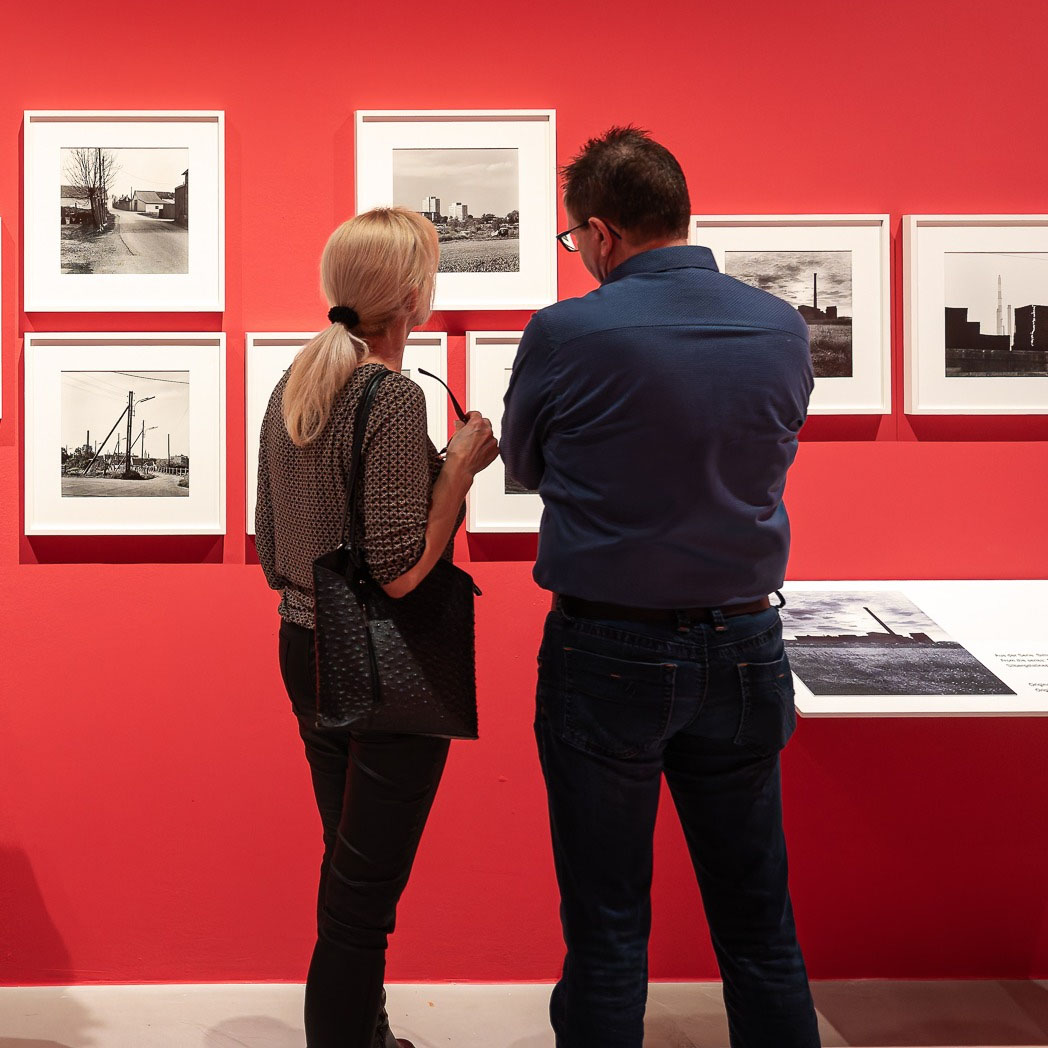
 

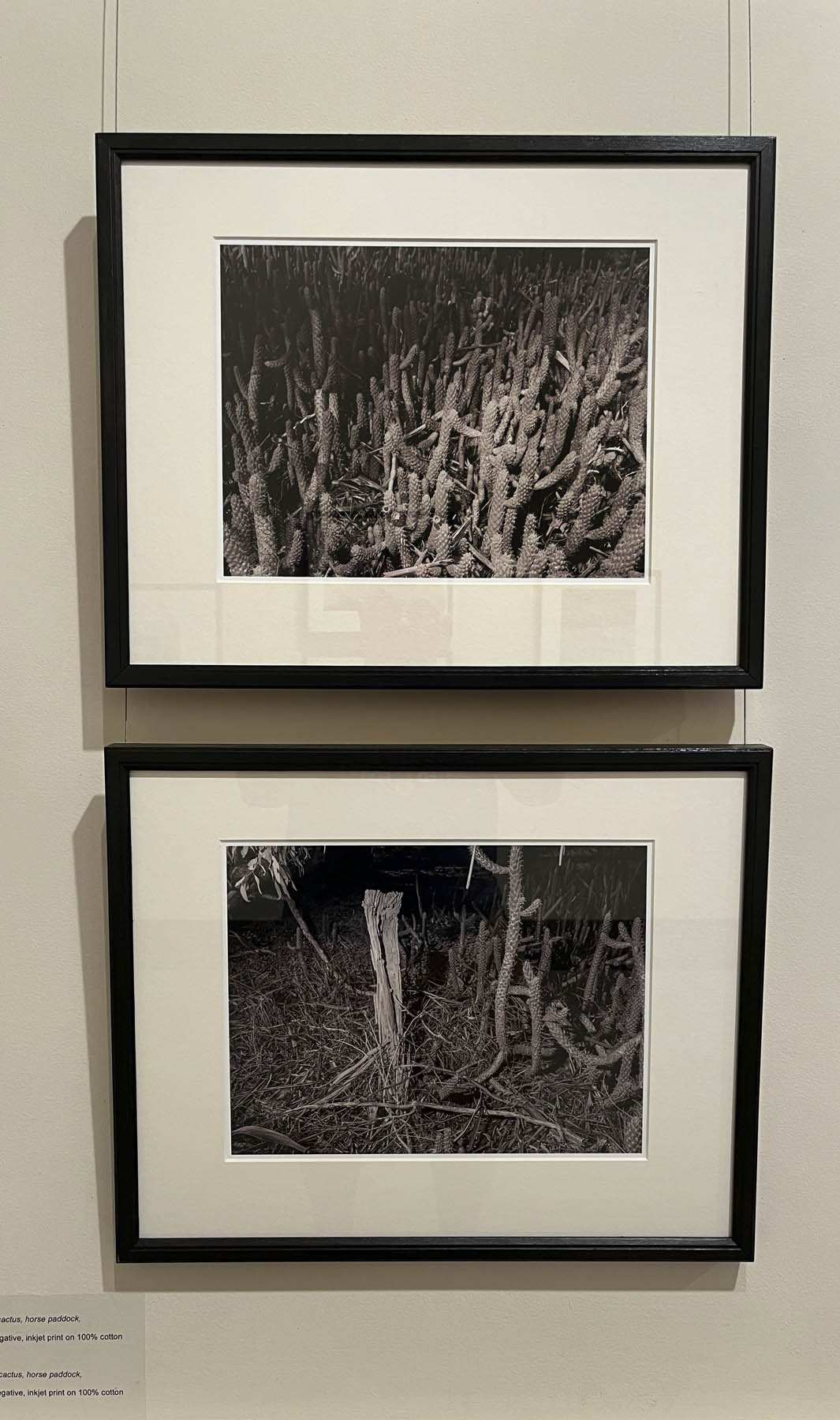
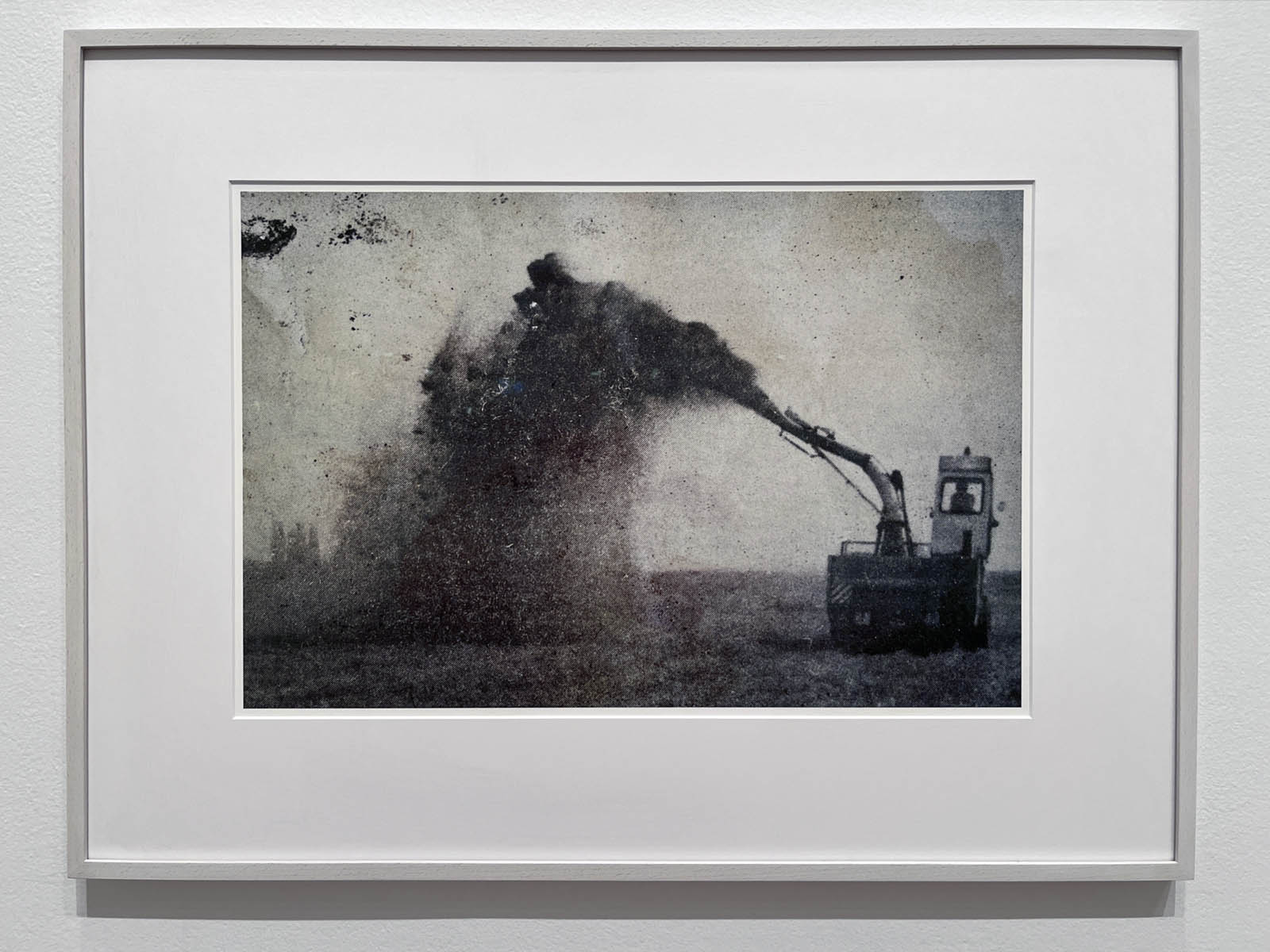
Installation view of the exhibition 'On Her Own. The photographer Elfriede Mejchar' at Wien Museum musa, Vienna Installation view of the exhibition On Her Own. The photographer Elfriede Mejchar at Wien Museum musa, Vienna showing photographs from Mejchar's series 'Simmering Heide and Erdberg Mais' (1967-1976)


Installation view of the exhibition On Her Own. The photographer Elfriede Mejchar at Wien Museum musa, Vienna showing photographs from Mejchar’s series Simmering Heide and Erdberg Mais (1967-1976, below)
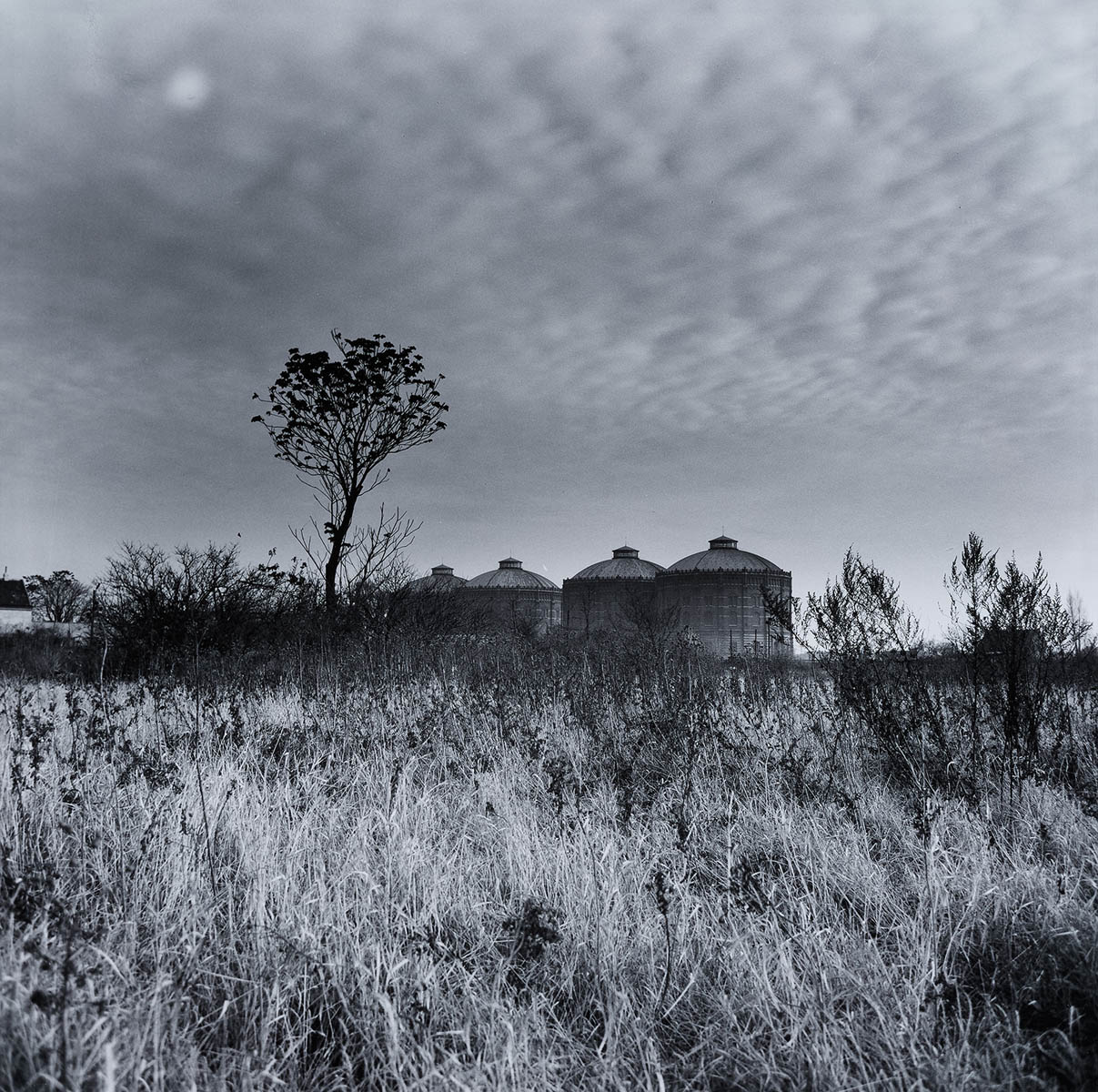
 

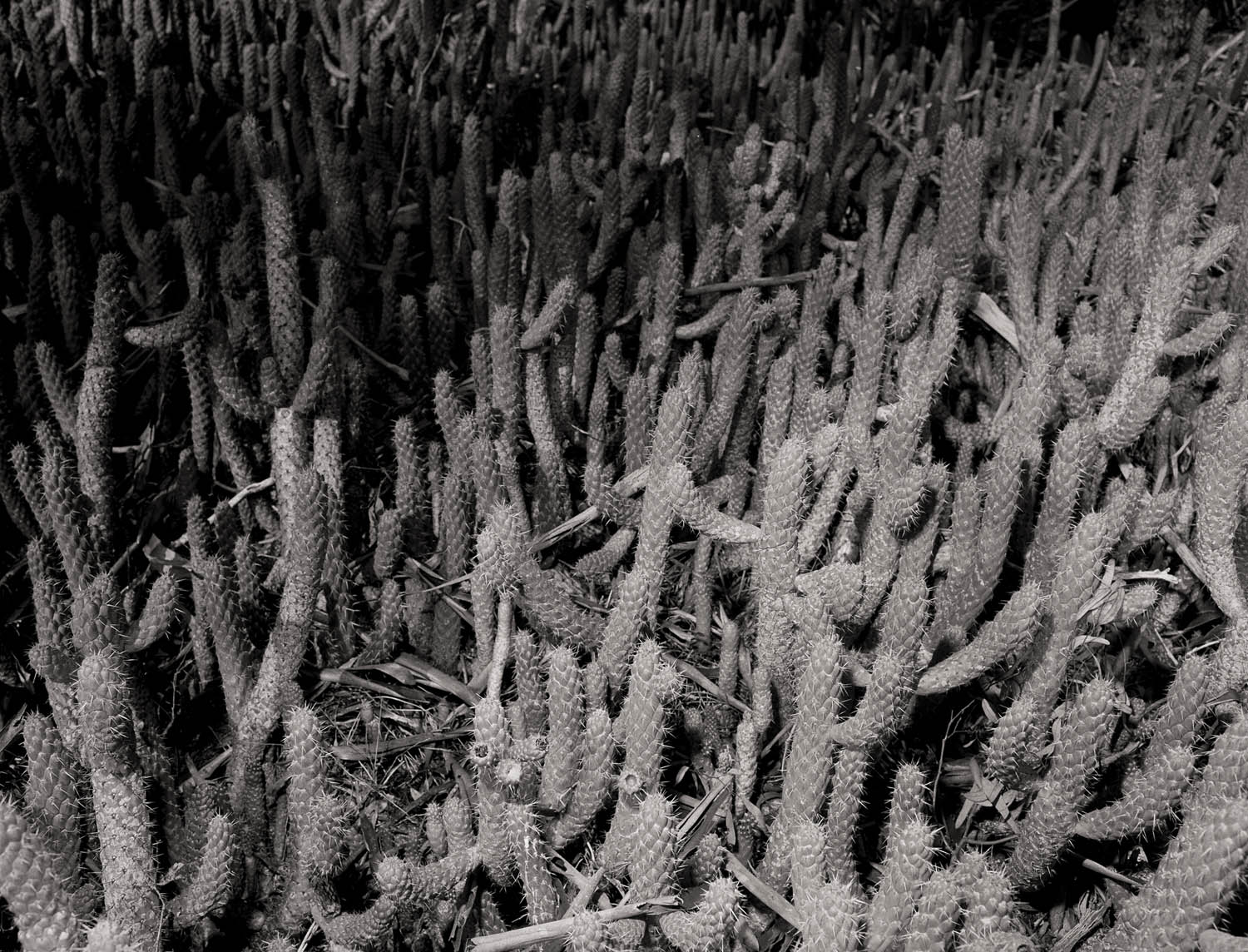
Elfriede Mejchar (Austrian, 1924-2020) 'Simmering Heide and Erdberg Mais' 1967-1976


Elfriede Mejchar (Austrian, 1924-2020)
Simmering Heide and Erdberg Mais
1967-1976
Wien Museum
© Bildrecht, Vienna 2023
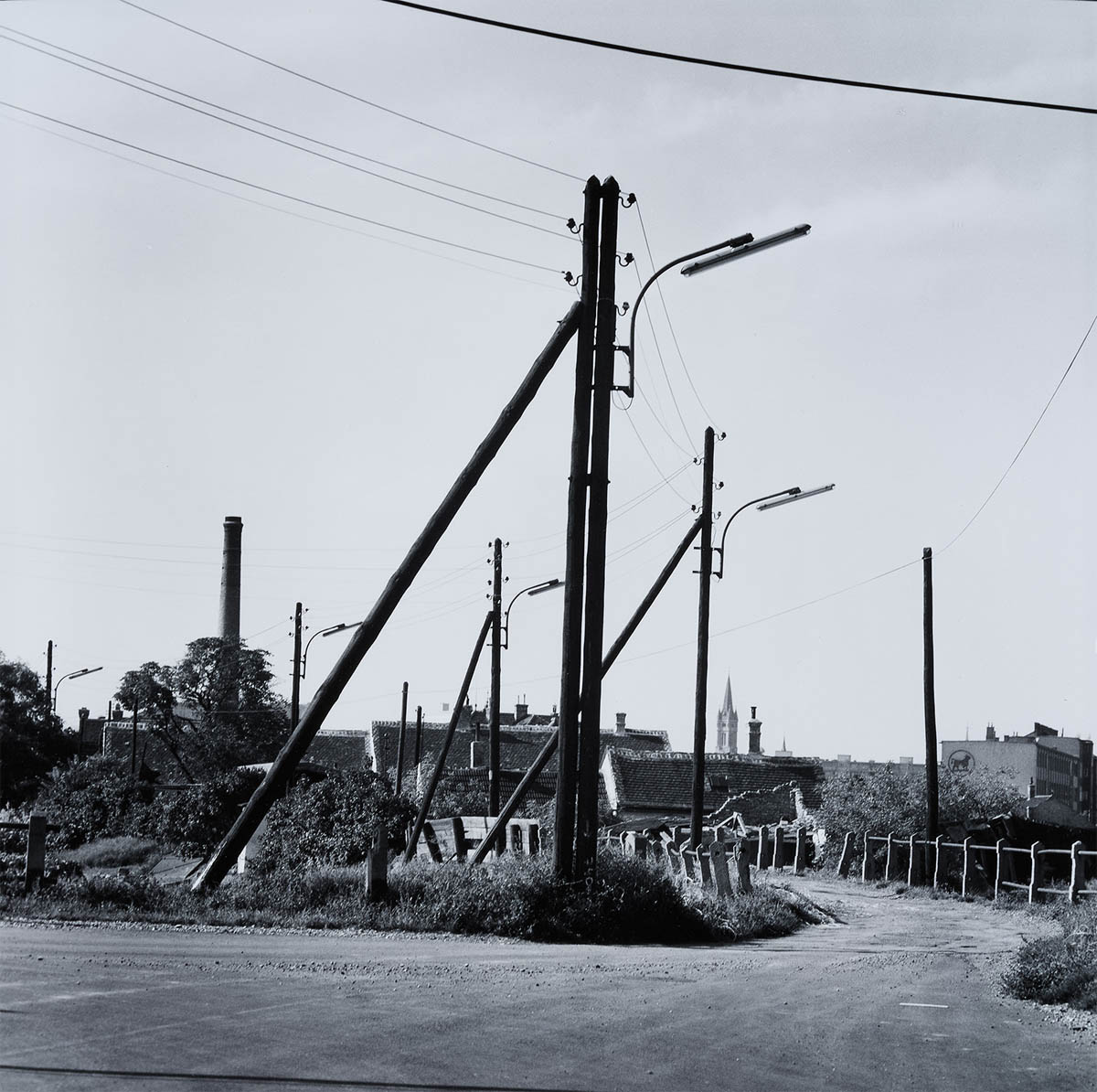
 

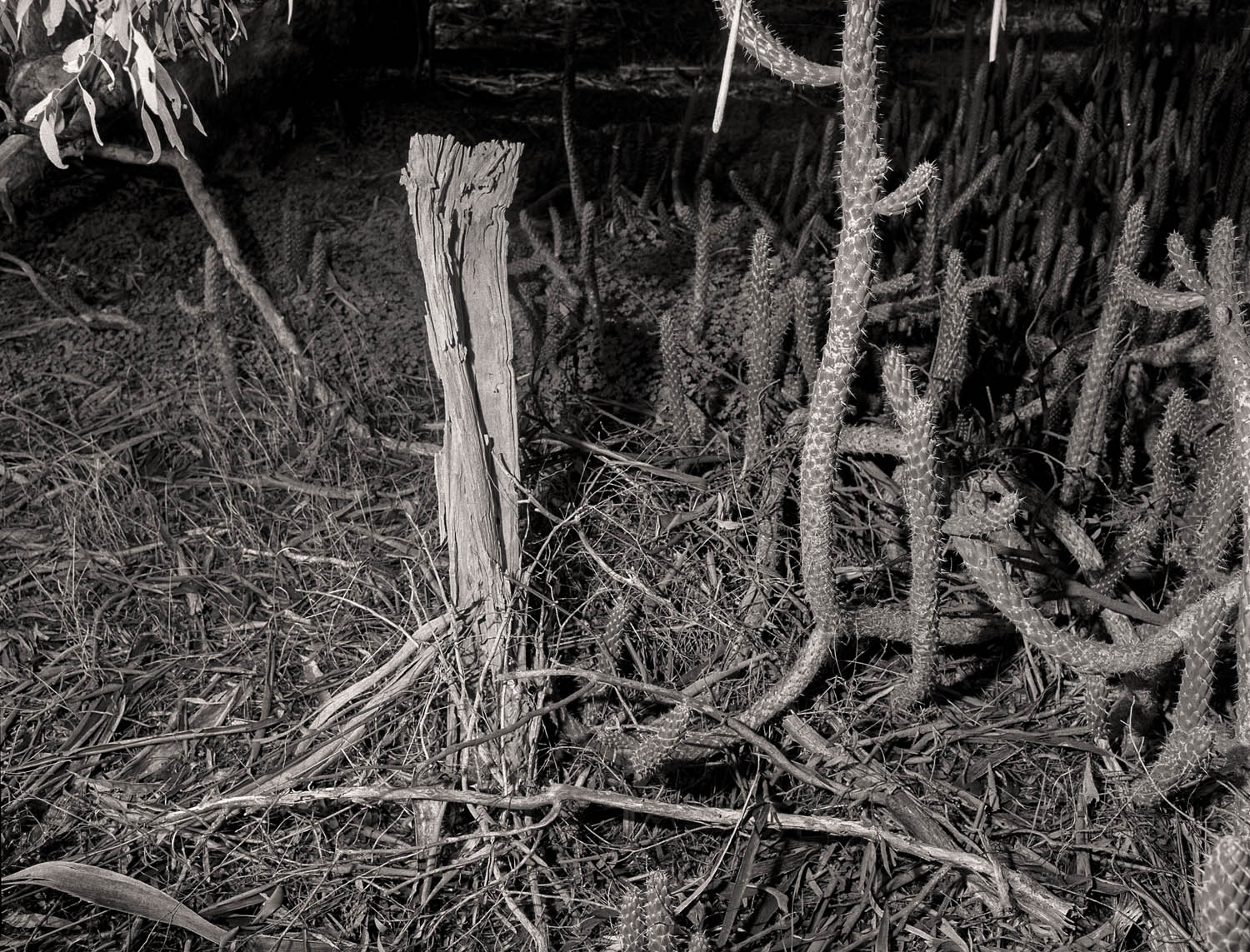
Elfriede Mejchar (Austrian, 1924-2020) 'Simmering Heide and Erdberg Mais' 1967-1976


Elfriede Mejchar (Austrian, 1924-2020)
Simmeringer Heide and Erdberger Mais
1967-1976
Wien Museum
© Bildrecht, Vienna 2023
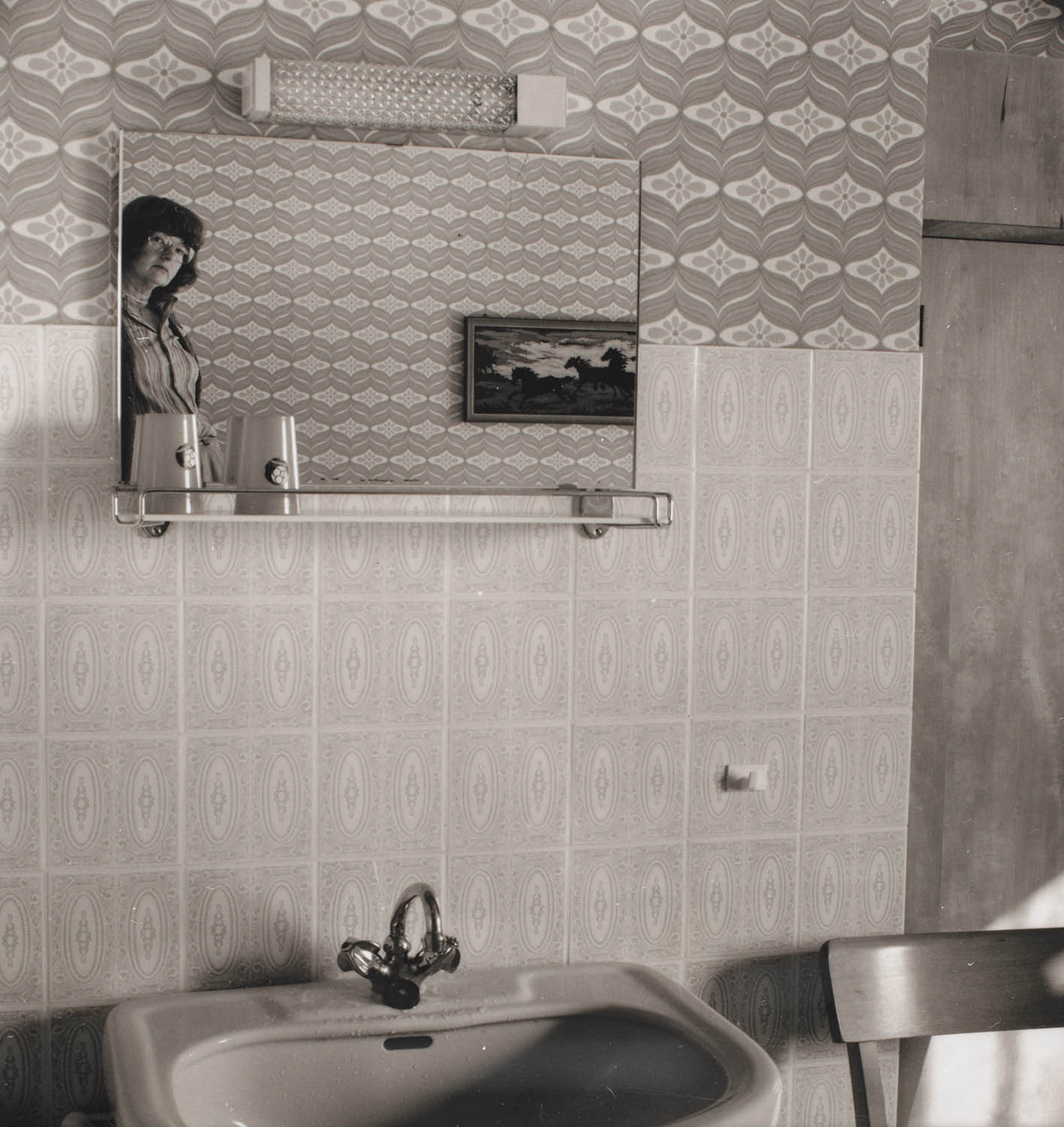
 

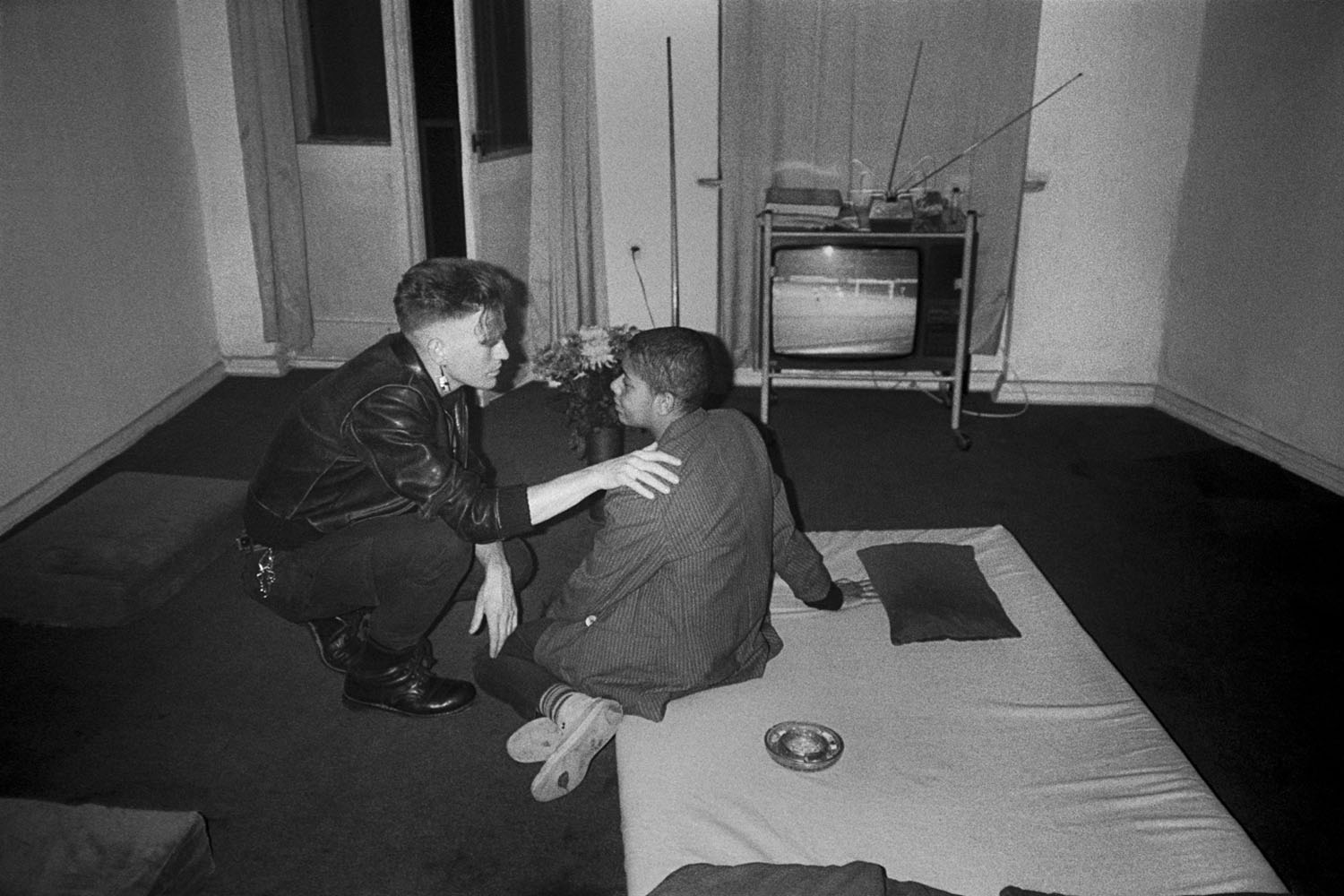
Elfriede Mejchar (Austrian, 1924-2020) 'At the Hotel' Around 1980


Elfriede Mejchar (Austrian, 1924-2020)
At the Hotel
Around 1980
Wien Museum
© Bildrecht, Vienna 2023
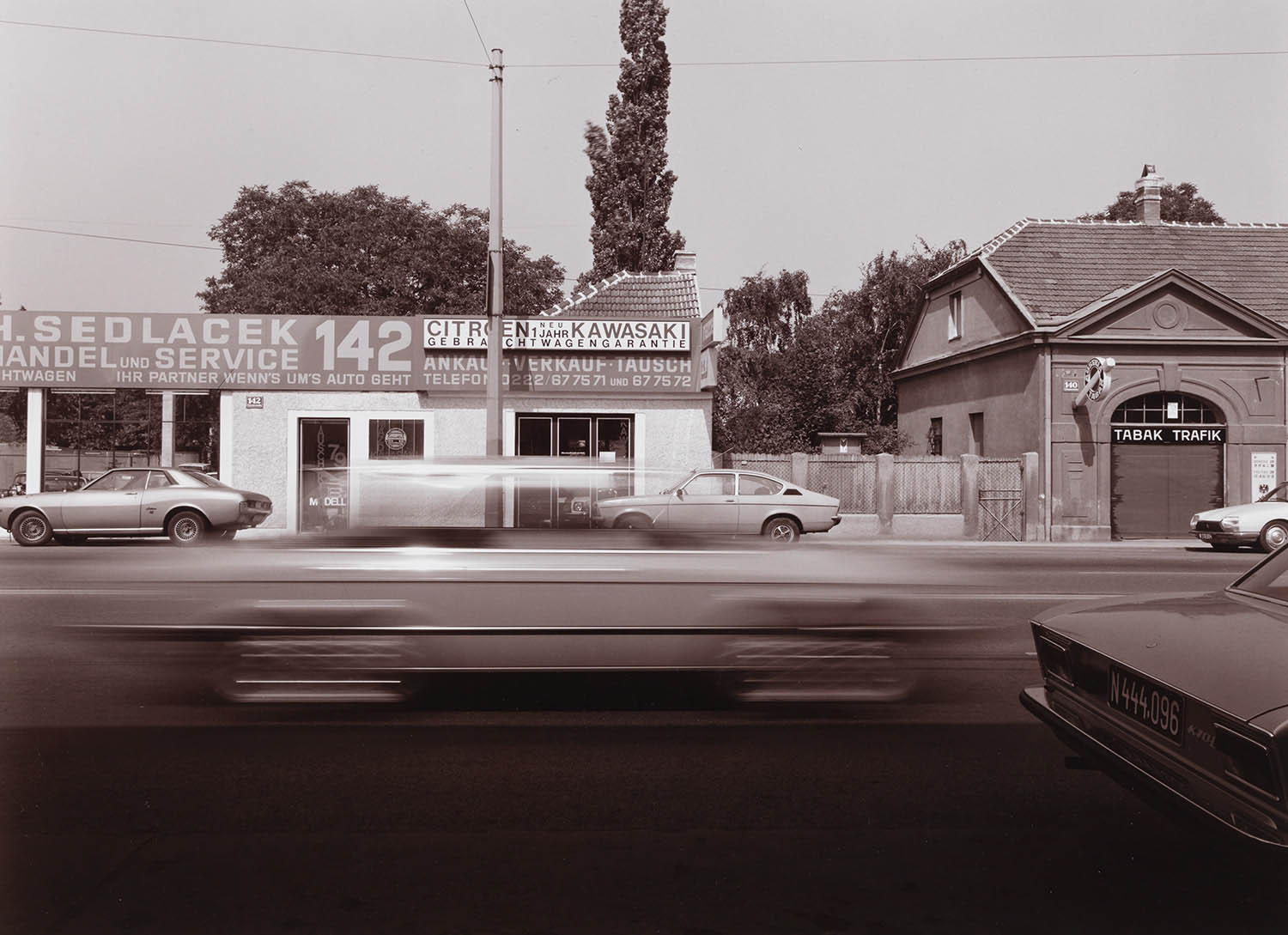
 

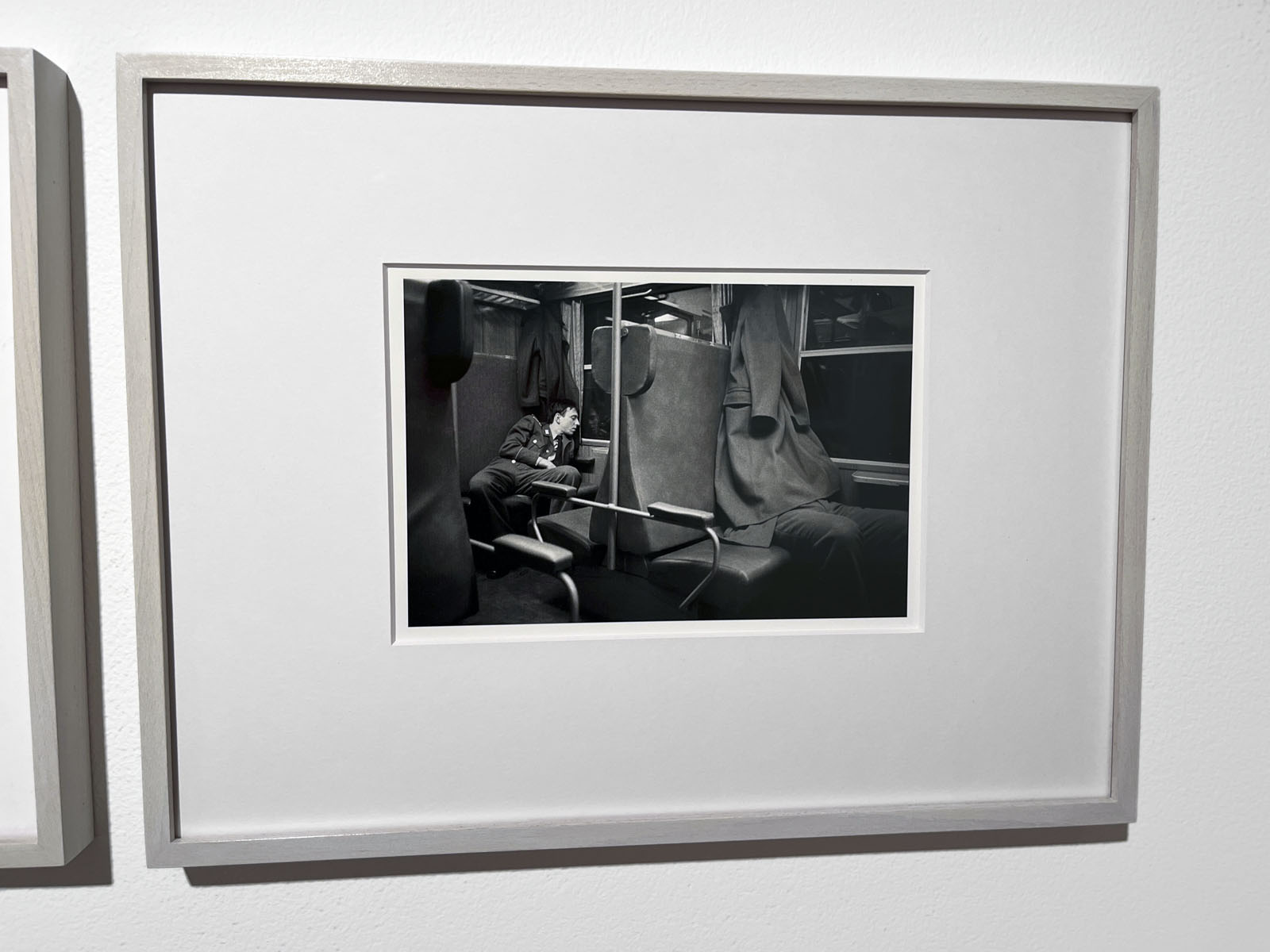
Elfriede Mejchar (Austrian, 1924-2020) 'Triester Strasse' 1982-1983


Elfriede Mejchar (Austrian, 1924-2020)
Triester Strasse
1982-1983
Wien Museum
© Bildrecht, Vienna 2023


Elfriede Mejchar (1924-2020) was a major photographic artist, whose richly-varied oeuvre spans more than five decades, from the late 1940s well into the 21st century. The Viennese photographer, who only achieved recognition as an artist towards the end of her career, is now regarded as one of the most important representatives of the Austrian and the international photography scenes. May 10, 2024 marks the hundredth anniversary of her birth.

The exhibition in musa presents a broad cross-section of the work of this artistic outsider, and demonstrates how the renewal of postwar Austrian photography was almost “all her own work.” Elfriede Mejchar consciously broke away from the photographic mainstream and the reportage style that was popular at the time. Rather than searching for the so-called “decisive moment,” she approached her subjects in a strongly conceptual and serial manner. She focused not on the extraordinary but on the unspectacular and the commonplace, the everyday and the banal, repeatedly addressing these in new ways in her photographic series.

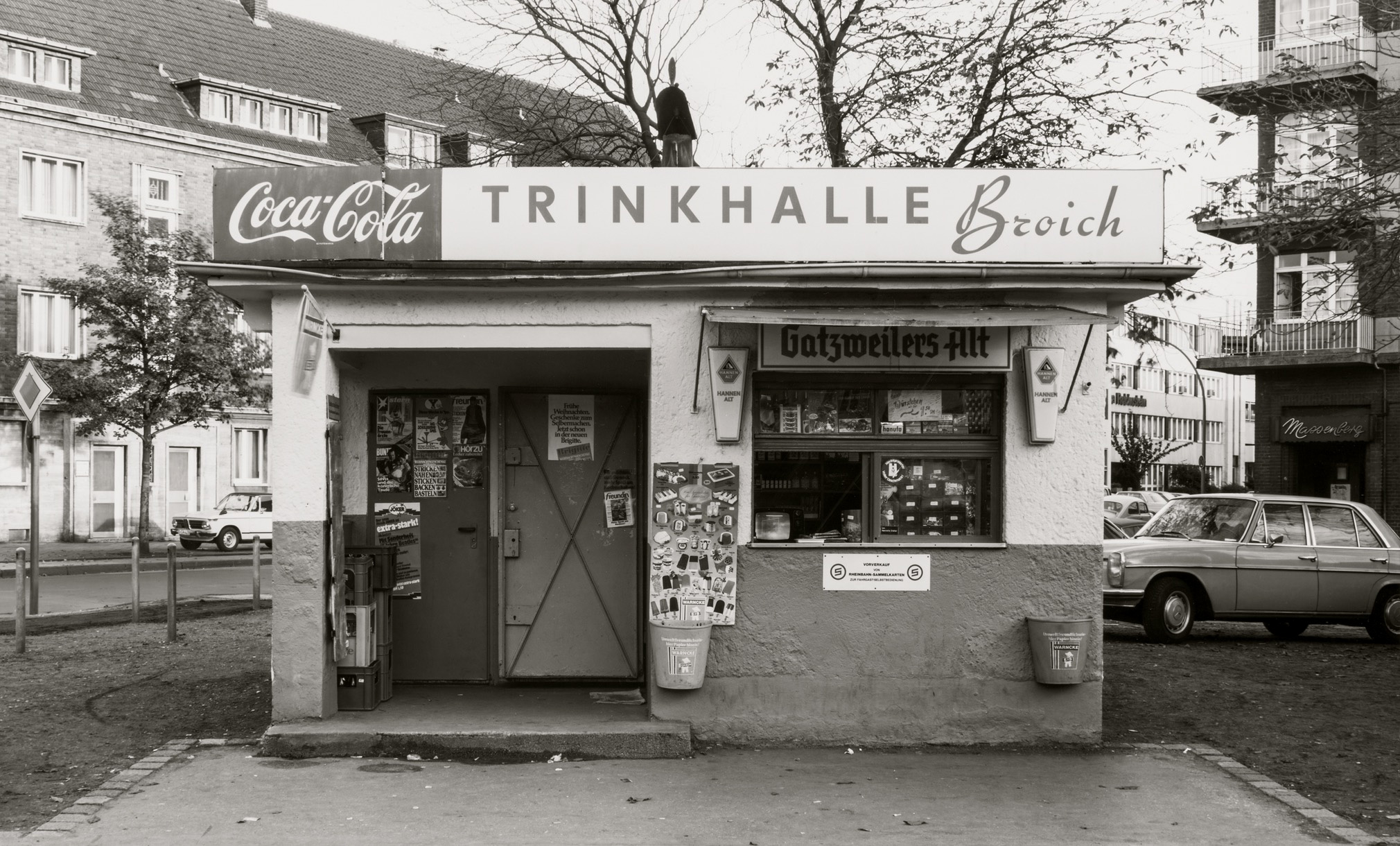
Elfriede Mejchar revealed her hometown Vienna from the periphery and had little interest in its iconic center, which was already the subject of countless thousands of photographs. As a photographer, she was at home where the city became rural, at the meeting point between urban development zones, derelict sites, green spaces, and post-industrial decay. In her long-term studies she documented the architectural and social textures of Vienna’s suburbs in a way that was both attentive and sober: new buildings advancing ever further onto green land, the monotony of endless arterial roads, derelict industrial complexes, market gardens and ageing gasometers, run-down housing and forgotten areas of landfill and decay. For Mejchar, however, the image of the urban periphery is not grey and the wasteland and its dereliction are repeatedly brightened by moments of unsuspected beauty.

Even if the urban and architectural photography of Vienna plays a major role in Elfriede Mejchar’s oeuvre, the range of subjects addressed in her work is far broader. Just as the photographer sheds a new photographic light on forgotten landscapes and buildings, she also approaches people and plants, places and things, in unexpected and surprising ways. In her incomparable series “Hotels,” she studies the interiors and typologies of Austrian accommodation in great detail, producing fascinating and often brightly coloured still lifes of plants and flowers as a means of aesthetically investigating the intermediate stages between blooming and withering. And in her bold collages and montages, a complex of work that continued to occupy her into her latter years, she created clever fantasy worlds, whose social criticism is only matched by their humour.

In an Austria-wide cooperation between the Wien Museum, the State Gallery of Lower Austria, and the Museum der Moderne Salzburg, Elfriede Mejchar’s extensive oeuvre is being presented in 2024 for the first time, simultaneously, in three locations across the country. The exhibitions in Vienna, Krems, and Salzburg approach the work of Mejchar from different perspectives:

Landesgalerie Niederösterreich. Elfriede Mejchar. Pushing the Boundaries of Photography April 13, 2024 to February 16, 2025 Tuesday – Sunday, 10am-6pm

musa. On her own. The photographer Elfriede Mejchar April 18 to September 1, 2024 Tuesday – Sunday, 10am-6pm

Museum der Moderne Salzburg. The Poetry of Everyday. Photographs by Elfriede Mejchar April 26 to September 15, 2024 Tuesday – Sunday, 10am-6pm

Biography of Elfriede Mejchar

Elfriede Mejchar (1924-2020) is undisputedly one of the most important personalities in Austrian photography. It was only at an advanced age that she received the public recognition she deserved, and in 2002 she was awarded the Federal Chancellery Prize for Artistic Photography and in 2004 the Lower Austrian Prize for Artistic Photography and the City of Vienna Prize for Fine Arts. In 2013, Elfriede Mejchar donated her entire oeuvre to the Province of Lower Austria. The Provincial Collections of Lower Austria have taken on the task of safeguarding this unique oeuvre for future generations and gradually making it accessible to the public. Her work is also prominently represented in the art collection of the Wien Museum, in the Federal Photography Collection and in the SpallArt Collection.

Press release from Wien Museum, Vienna


Elfriede Mejchar (Austrian, 1924-2020) 'Wienerberger Brick Kilns and Housing Estates' 1979-1981


Elfriede Mejchar (Austrian, 1924-2020)
Wienerberger Brick Kilns and Housing Estates
1979-1981
Wien Museum
© Bildrecht, Vienna 2023
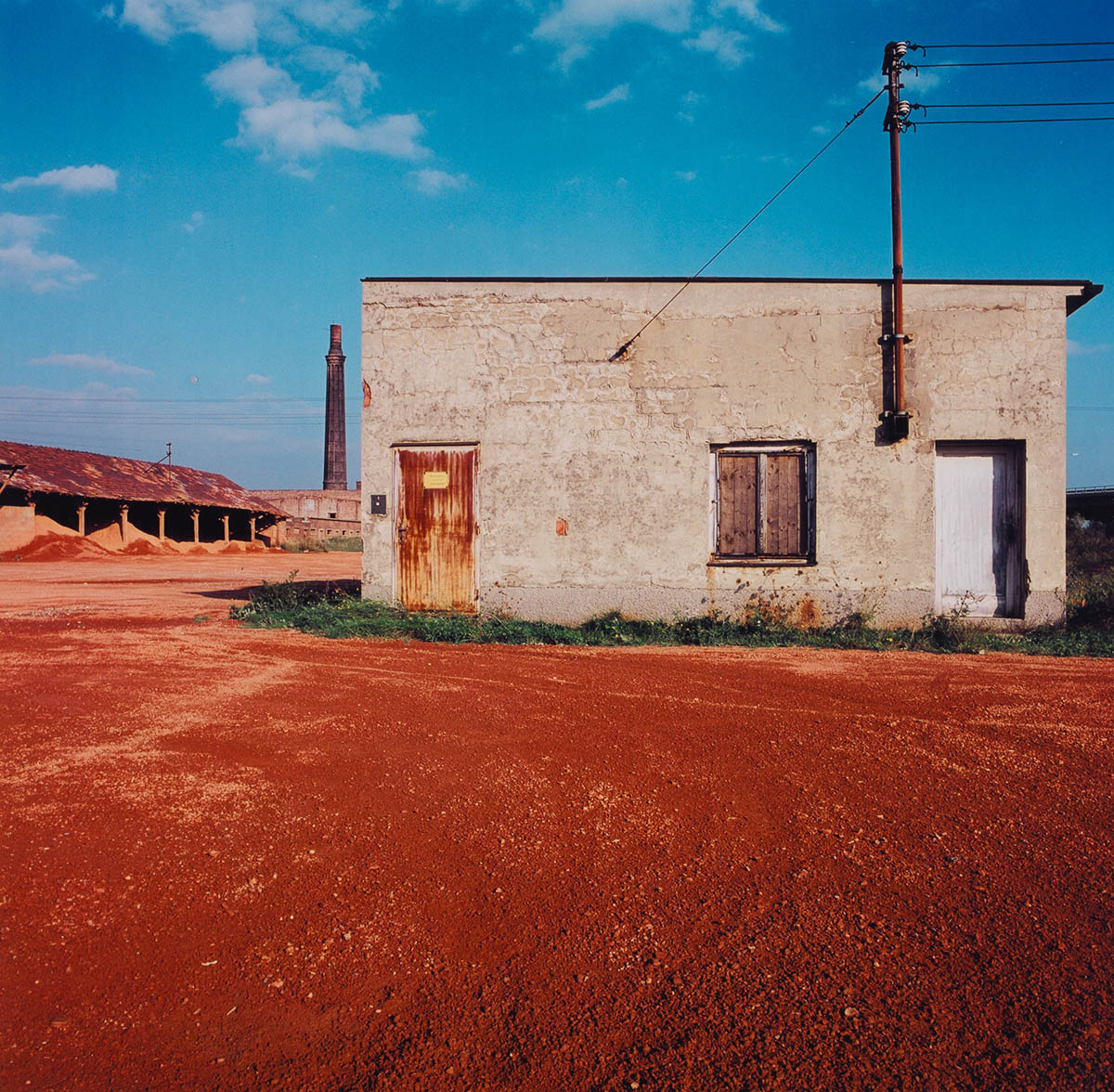
 

Elfriede Mejchar (Austrian, 1924-2020) 'Wienerberger Brick Kilns and Housing Estates' 1979-1981


Elfriede Mejchar (Austrian, 1924-2020)
Wienerberger Brick Kilns and Housing Estates
1979-1981
Wien Museum
© Bildrecht, Vienna 2023


Installation view of the exhibition 'On Her Own. The photographer Elfriede Mejchar' at Wien Museum musa, Vienna showing text and photographs from the section 'Allure of the Everyday'


Installation view of the exhibition On Her Own. The photographer Elfriede Mejchar at Wien Museum musa, Vienna showing text and photographs from the section ‘Allure of the Everyday’


Exhibition texts

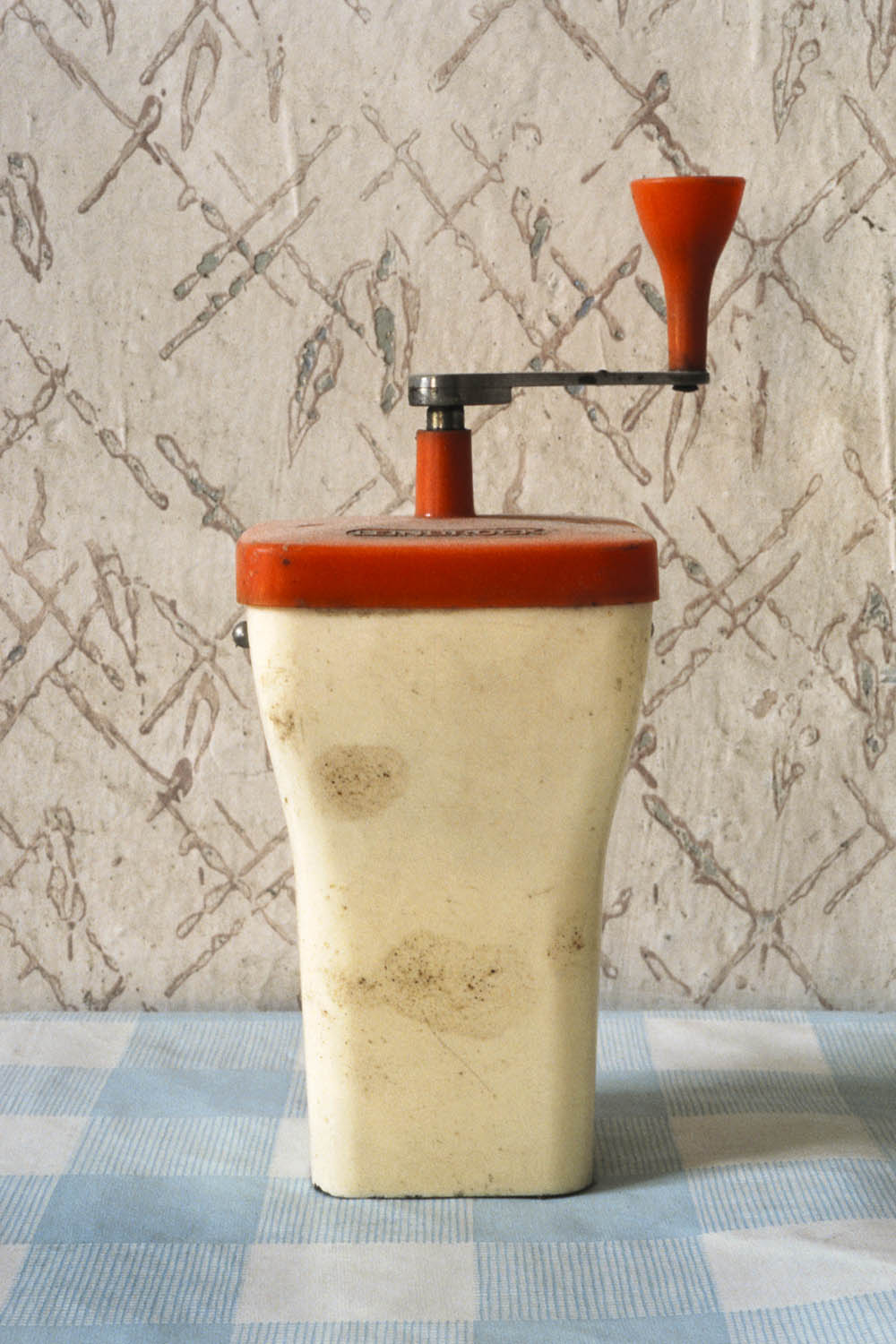
“I always marvelled at the wallpaper” (Prologue)

Elfriede Mejchar had two faces as a photographer: one in her day job, and one as an artist. Working for the Federal Monuments Office, she spent many years touring Austria, extensively documenting buildings and artworks in the provinces. On the side, she was a freelance photographic artist. When “at work,” she was bound by the strict criteria of art documentation. As an artist, she forged her own, very different paths.

While in her day job she photographed “great art,” in her free time she focused on the banality of everyday life, for example by taking interior shots of her accommodation over the years. The expenses covered by “the office,” she explained, “were not very generous, and I was always looking for lower-end lodgings. They could be very odd, anything was possible. In particular, I always marvelled at the wallpaper.”

1. Allure of the Everyday

A backlit trash can or advertising column, people waiting on the street, youths in the Bohemian Prater, the geometry of washing lines – even in her early series dating from the 1950s and 1960s, Mejchar’s fascination with scenes from everyday life is clear. She used her camera to record what she saw in the city in a matter-of-fact style, without judgment: the buildings and streets, cars and advertisements, traffic lights and posters. Only occasionally do people feature in her images. Often they seem a little lost. In contrast to many other photographers of her era, Mejchar was not looking for a quick snapshot or the “decisive moment.” “Speed doesn’t suit me,” she once said. Frequently she worked in series, often created over several years. Her focus was not on the extraordinary but on the unspectacular and the commonplace.

Working in Series

“I don’t like single photos very much,” said Elfriede Mejchar, thus describing one of the fundamental features of her photography. For almost 30 years, she explored Vienna’s peripheral zones on the southeast edge of the city. Again and again she returned to these uninviting places on the outskirts, where few people spent much time. In the main she photographed the landscapes, roads, and neighbourhoods in series, usually in parallel, but sometimes as a chronological sequence. For Mejchar as a photographer, the single image could not capture the complexity of this desolate and yet, in her eyes, beautiful landscape. It was the series that allowed her to show the different facets of a subject from ever new perspectives. Through her artistic and conceptual practice, Mejchar forged a completely new path in Austrian photography.

2. Evil Blooms

Throughout her working life, Mejchar photographed art, in other words, things created to last. Her images of flowers were a late counter-project. In these plant studies, some shot in luminous colour, the photographer brought transience and decay into focus, drawing out the fascinating transitions between blooming and withering. “I am not afraid of pathos, nor of kitsch,” Mejchar once said.

Elfriede Mejchar paid no heed to photographic conventions in her freelance work. Unabashed, she took delight in arranging and staging the plants and objects for her photographs in ways that opened up a range of associations. Some of her objects seem almost to come to life under her lens, while others wither away. Yet others invoke images of sexuality and desire.

Putting in a New Light

As a photographic subject, flowers are often dismissed as being romantic, kitsch, or unserious. Mejchar was not afraid of kitsch, but neither was she ever interested in the sweetness of the tulips or amaryllis she photographed. For her, flowers were like sculptures that needed to be shown in a proper light. Mejchar’s “merciless” gaze extended beneath the surface. It drilled into the very substance of the petals, laying bare the skeleton that emerged as the flower withered and capturing the bizarre forms of the dying plant. Yet the artist could not break free entirely of the strong metaphorical imagery of flowers. Sometimes, her shots of them in full bloom or with their inner parts exposed carried a sensual or sexual charge.

3. Measuring the Periphery

New builds encroaching ever further on the countryside, abandoned factories, fields of vegetables, ageing gasometers, the monotony of interminable highways, makeshift housing, wastelands – as a photographer, Elfriede Mejchar was especially keen on these forgotten landscapes on the margins of the Viennese metropolis. “It was the changes that I was concerned with.”

Starting in the 1960s, Mejchar roamed the city’s peripheral zones with her camera. “These were the sites that interested me the most. Where countryside and city collide.” Her long-term series “Simmeringer Heide and Erdberger Mais,” begun in the 1960s and first shown in 1976 in a solo exhibition at the Museum of the 20th Century, established Mejchar’s reputation as leading photo artist.

Constructing Space

Row upon row of plants, damp soil blanketed by the early morning mist, distant greenhouses, lettuces covering the ground, interspaced with sprinklers – Elfriede Mejchar documented every facet of Vienna’s market gardens at the edge of the city, from detached general views to shots that capture the smallest detail. Her images use a deep depth of field, making it seem almost as if the viewer could reach out and touch the clumps of soil or individual leaves in the foreground. But she also regularly translated landscapes, buildings, and spaces into abstract forms by setting up contrasting oppositions between individual motifs, or by reducing an image to monochrome surfaces.

4. Lips and Pistols

Faces ripped from fashion magazines and floral wallpaper, cogs and cigarettes, spools and dressmaking pins, small chains and cables – starting in the 1980s, Mejchar jumbled these found, everyday objects together to create small-scale, theatrical arrangements laced with acerbic wit. “I construct images,” the artist once said of her sarcastic and subversive collages and assemblages. In these composite scenes, Elfriede Mejchar gave free rein to an anarchic desire to assemble and disassemble. At the same time, she used humour and irony to lampoon society’s ideals of perfection, “adorning” beautiful faces with everyday objects, for example, or – with a knowing wink – targeting James Bond’s pistol on the eroticised lips of the beauty industry. Mejchar’s summary: “I like things colourful and crazy.”

Arranging Objects

After retiring from paid employment, Mejchar increasingly concentrated on her work in the studio, which now became a stage for herself and her camera. Here she created ironic, acerbic, and frequently bizarre object combinations, often as an exploration of gender stereotypes. In her collages, she dismantled and critiqued the fashion industry’s preformed ideals of beauty with zest and humour. She took pleasure in experimenting with a whole range of props, rearranging them into new scenes again and again. Fragmented faces from fashion magazines were combined with torn and cut wallpaper, then garnished with cogs, feathers, and cables. She literally nailed the beauty industry to the wall.

5. Remains and Ruins

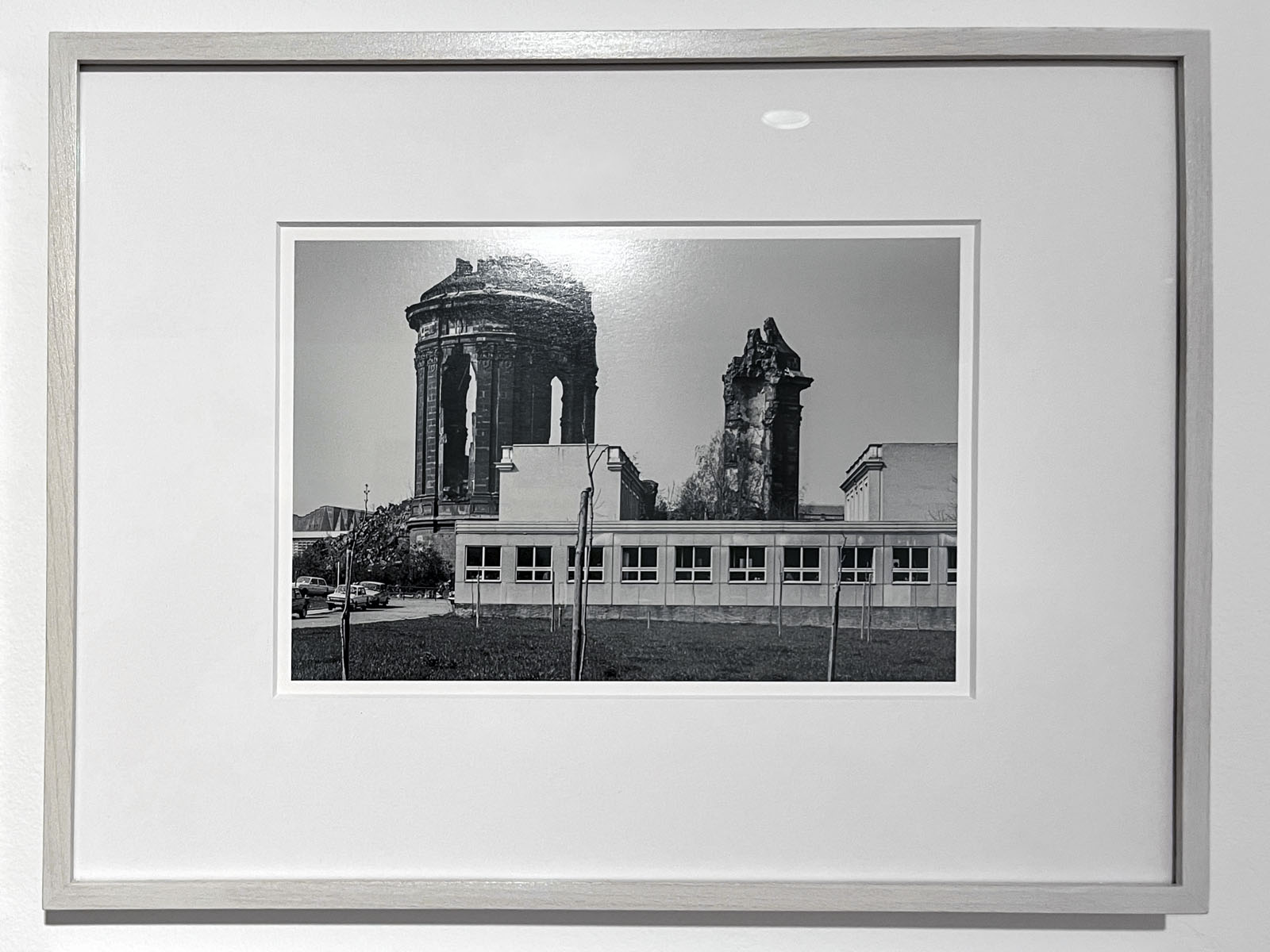
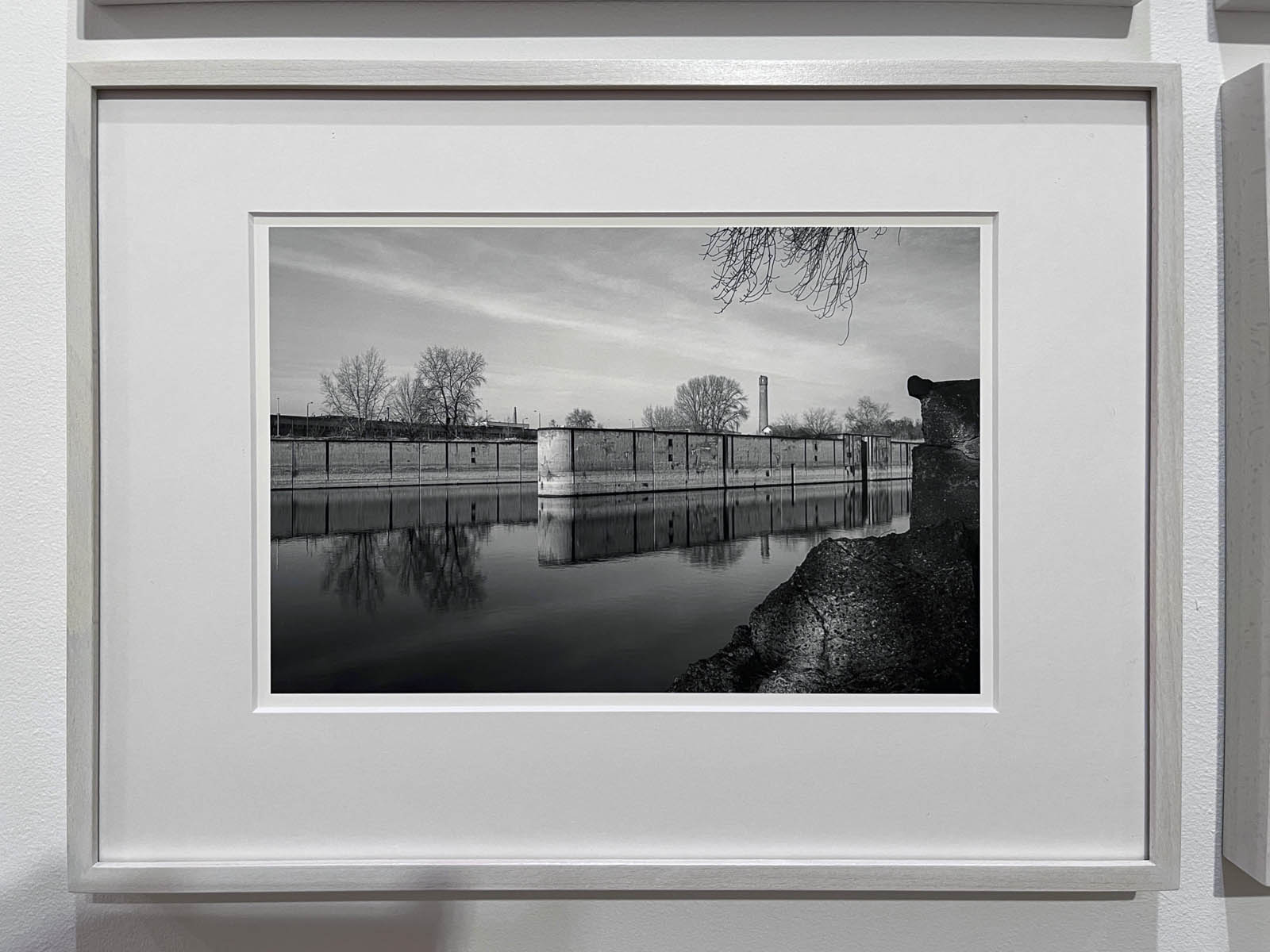
The innards of a house scheduled for demolition, derelict industrial estates, overgrown railway lines and buildings, gouged landscapes, forgotten piles of bricks – over many years, Mejchar explored these remains of industrial culture. “My work only began,” she said, “when the people were gone.”

“I took myself off to the factories, going from one road to the next.” In her series “Wienerberger Brick Kilns,” which she photographed from 1979 to 1981 following the closure of the Wienerberger brick factory on Vienna’s southern edge, she made deliberate use of colour photography for the first time. Impregnated with brick dust, the ground and the remains of the industrial architecture glow red under an azure sky, assuming an air of unreality. Mejchar: “I am interested in what remains.”

Seeing in Color

During the first decades of her career as a photographer, Elfriede Mejchar worked in black and white because colour photography was too expensive. All the more astonishing, therefore, is the confidence and precision with which she employed colour as an aesthetic element in the photo series “Wienerberger Brick Kilns” in the late 1970s and early 1980s. Similar to the New Color Photography movement in the USA, Mejchar’s photographic explorations focused primarily on the borders between urban and rural spaces. Her main interest was in landscapes subjected to human interventions. She documented these run-down locations using vivid lighting and brilliant colours, producing unsentimental photographs of high aesthetic quality. In doing so, she opened up an entirely new approach to documentary photography in Austria.
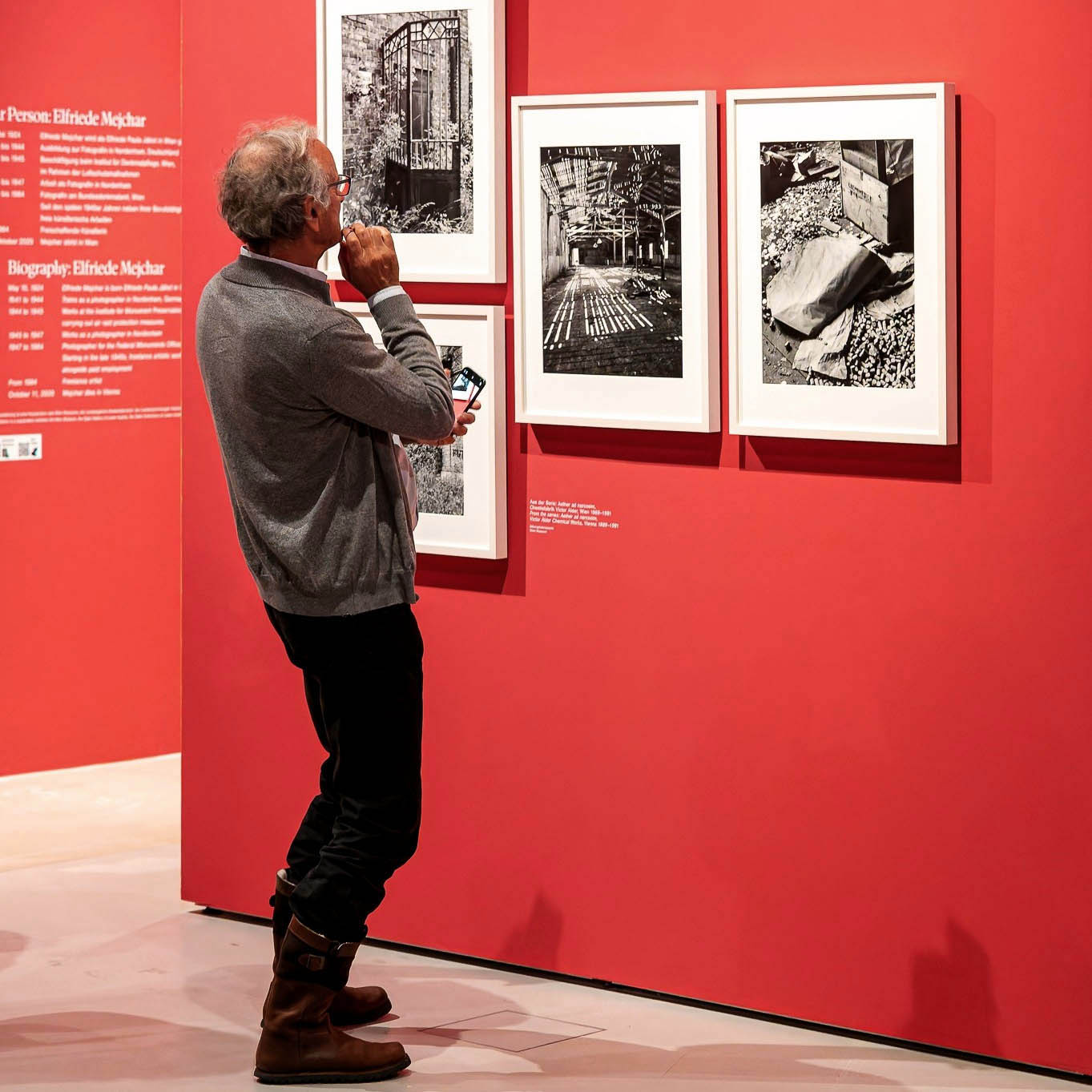
 

Installation view of the exhibition 'On Her Own. The photographer Elfriede Mejchar' at Wien Museum musa, Vienna showing at second right, Mejchar's 'Aether and narcosim' (1989-1991)


Installation view of the exhibition On Her Own. The photographer Elfriede Mejchar at Wien Museum musa, Vienna showing at second right, Mejchar’s Aether and narcosim (1989-1991, below)
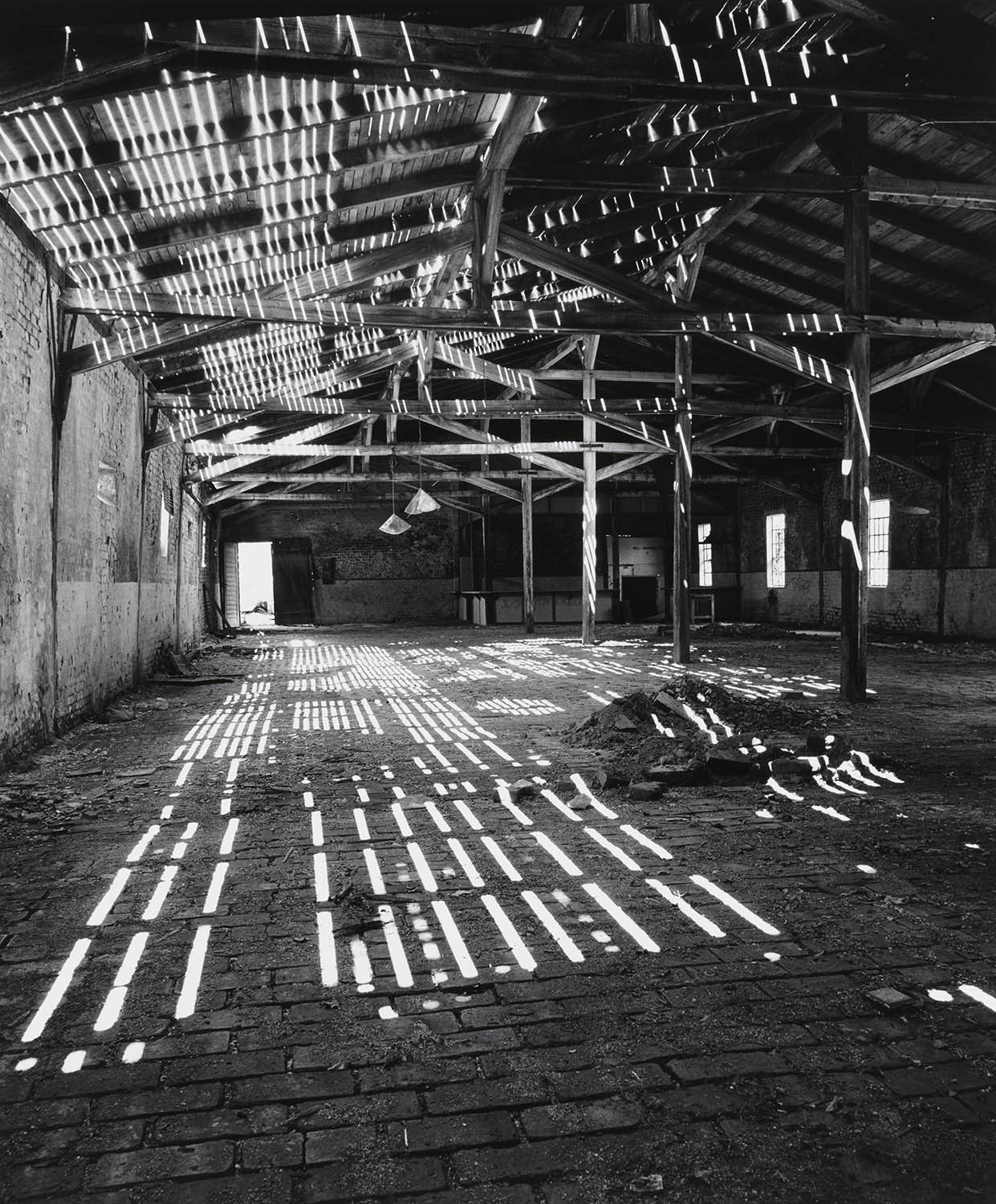
 

Elfriede Mejchar (Austrian, 1924-2020) 'Aether and narcosim' 1989-1991


Elfriede Mejchar (Austrian, 1924-2020)
Aether and narcosim
1989-1991
Wien Museum
© Bildrecht, Vienna 2023
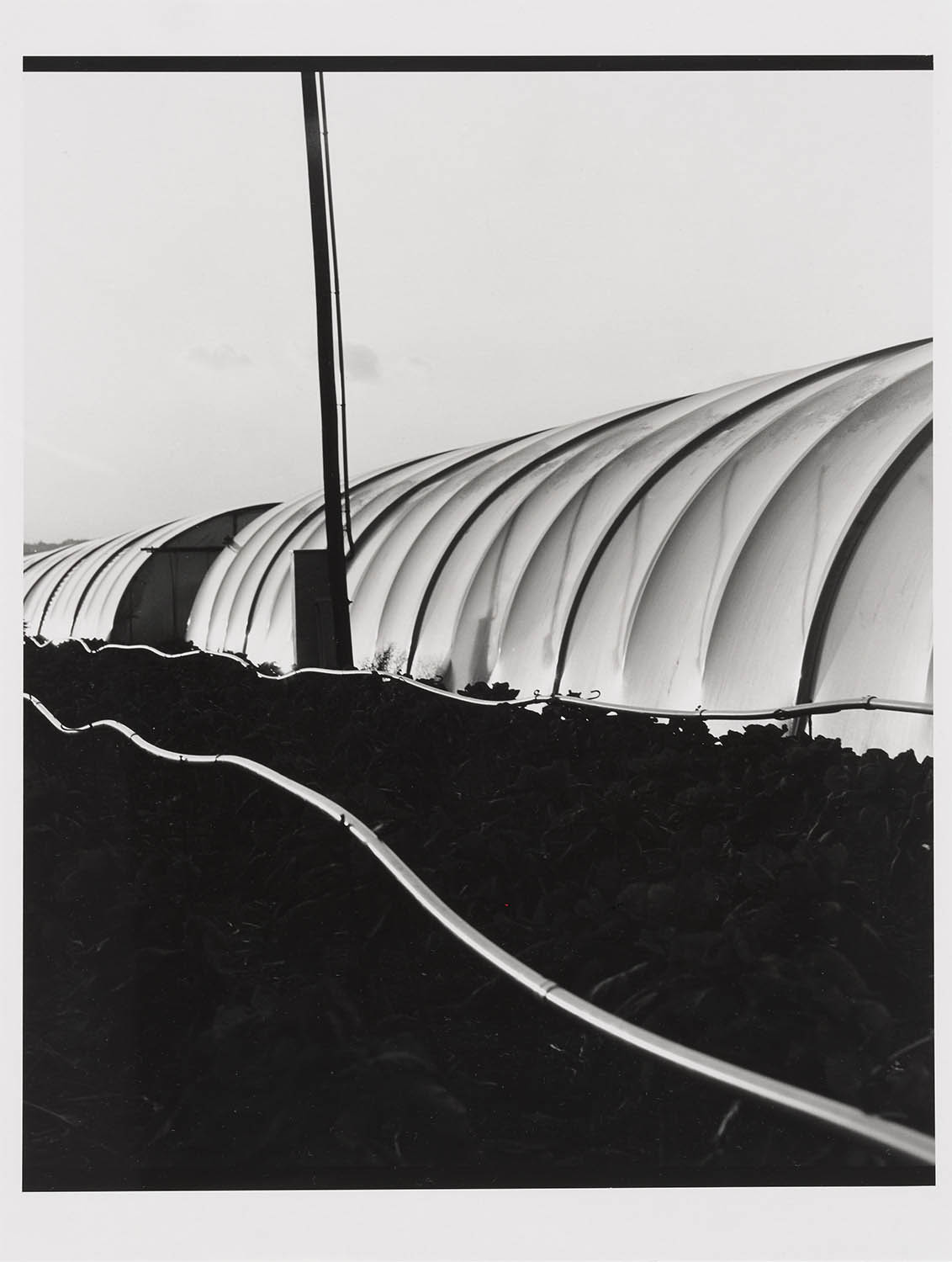
 

Elfriede Mejchar (Austrian, 1924-2020) 'Vegetable Tunnels. Simmering Market Gardens' 1990-1994


Elfriede Mejchar (Austrian, 1924-2020)
Vegetable Tunnels. Simmering Market Gardens
1990-1994
Wien Museum
© Bildrecht, Vienna 2023
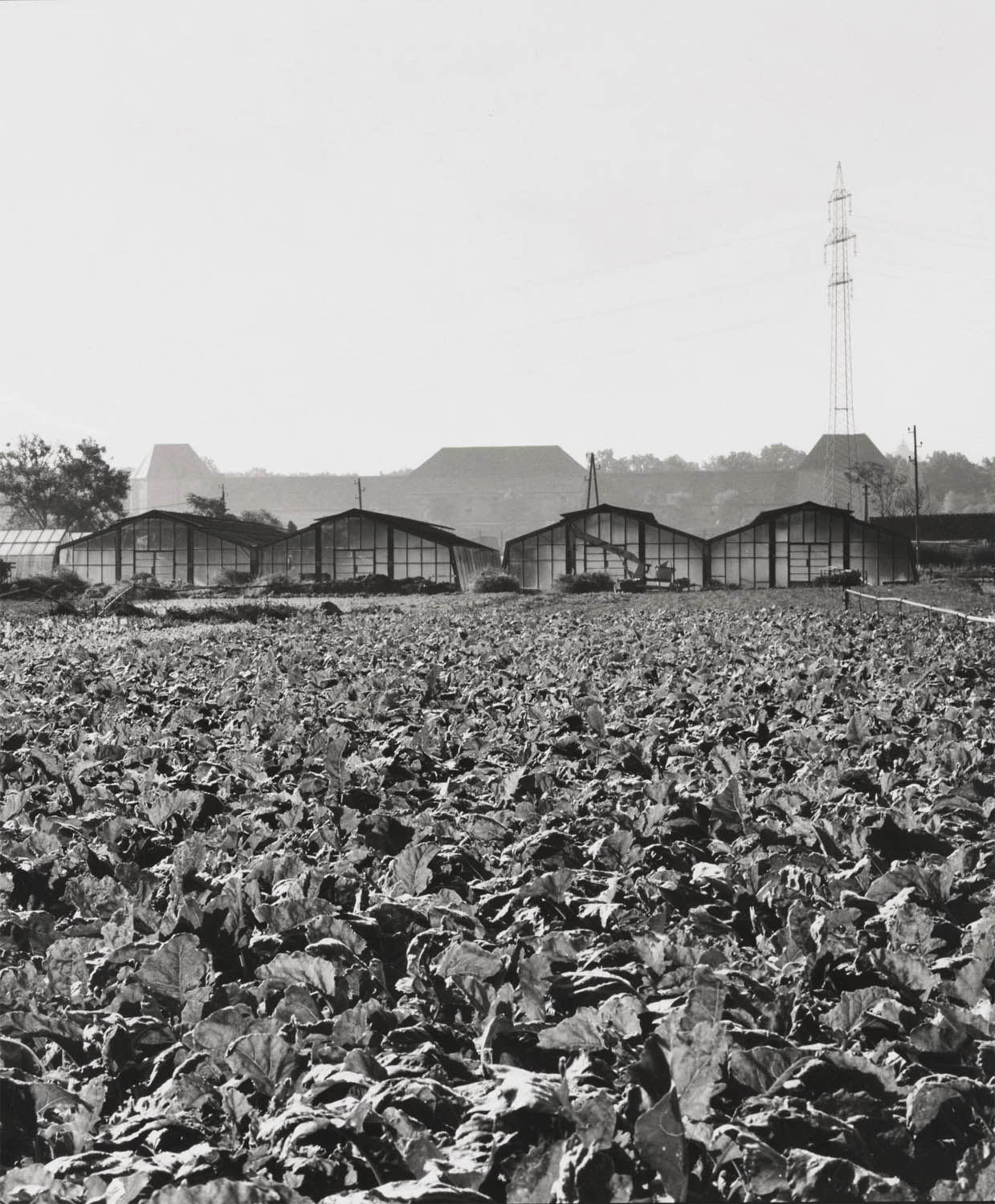
 

Elfriede Mejchar (Austrian, 1924-2020) 'Vegetable Tunnels. Simmering Market Gardens' 1990-1994


Elfriede Mejchar (Austrian, 1924-2020)
Vegetable Tunnels. Simmering Market Gardens
1990-1994
Wien Museum
© Bildrecht, Vienna 2023


Elfriede Mejchar (Austrian, 1924-2020) 'A Costume of Borrowed Identity' 1990-1991


Elfriede Mejchar (Austrian, 1924-2020)
A Costume of Borrowed Identity
1990-1991
Wien Museum
© Bildrecht, Vienna 2023
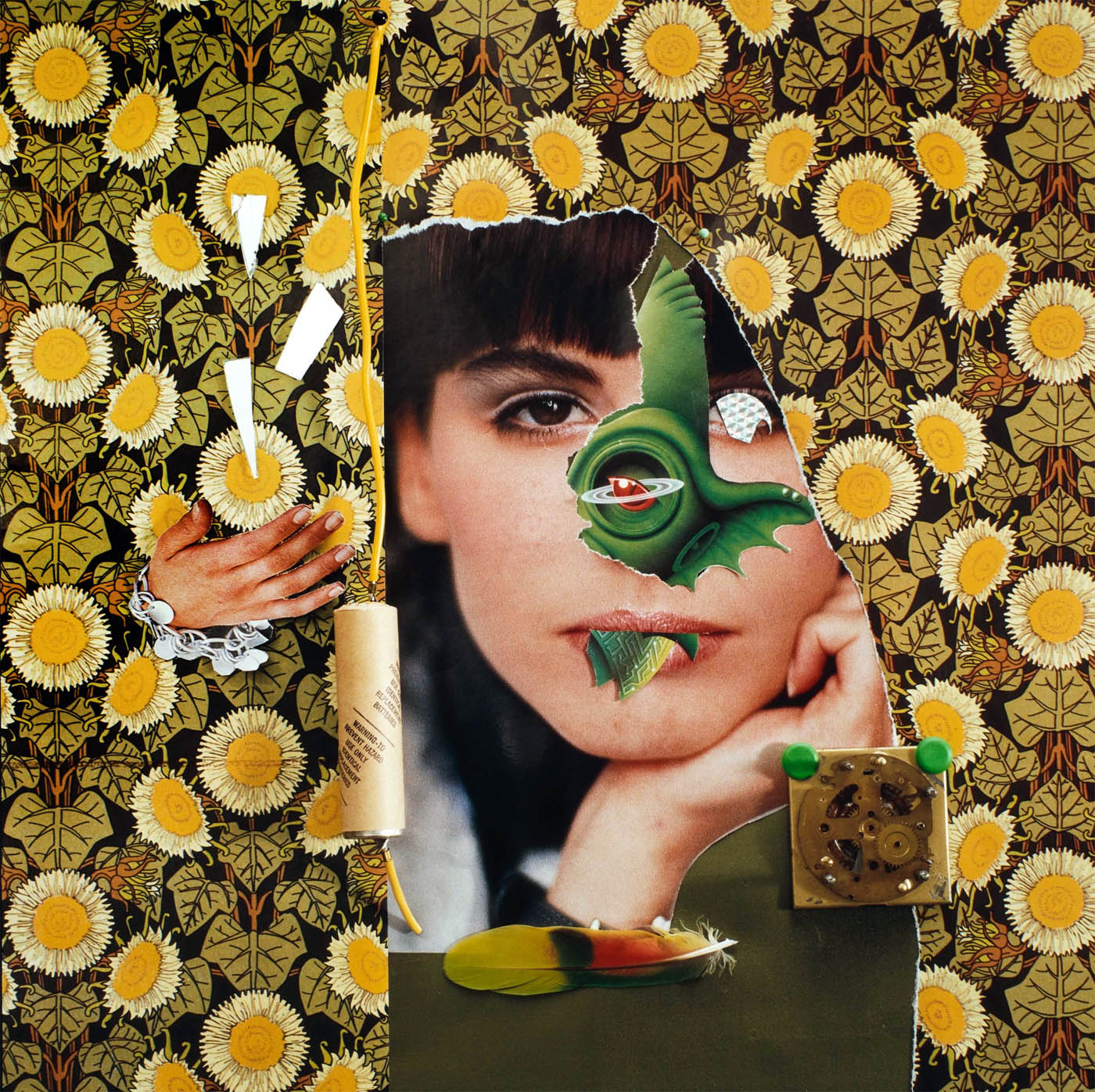
 

Elfriede Mejchar (Austrian, 1924-2020) 'A Costume of Borrowed Identity' 1990-1991


Elfriede Mejchar (Austrian, 1924-2020)
A Costume of Borrowed Identity
1990-1991
Wien Museum
© Bildrecht, Vienna 2023
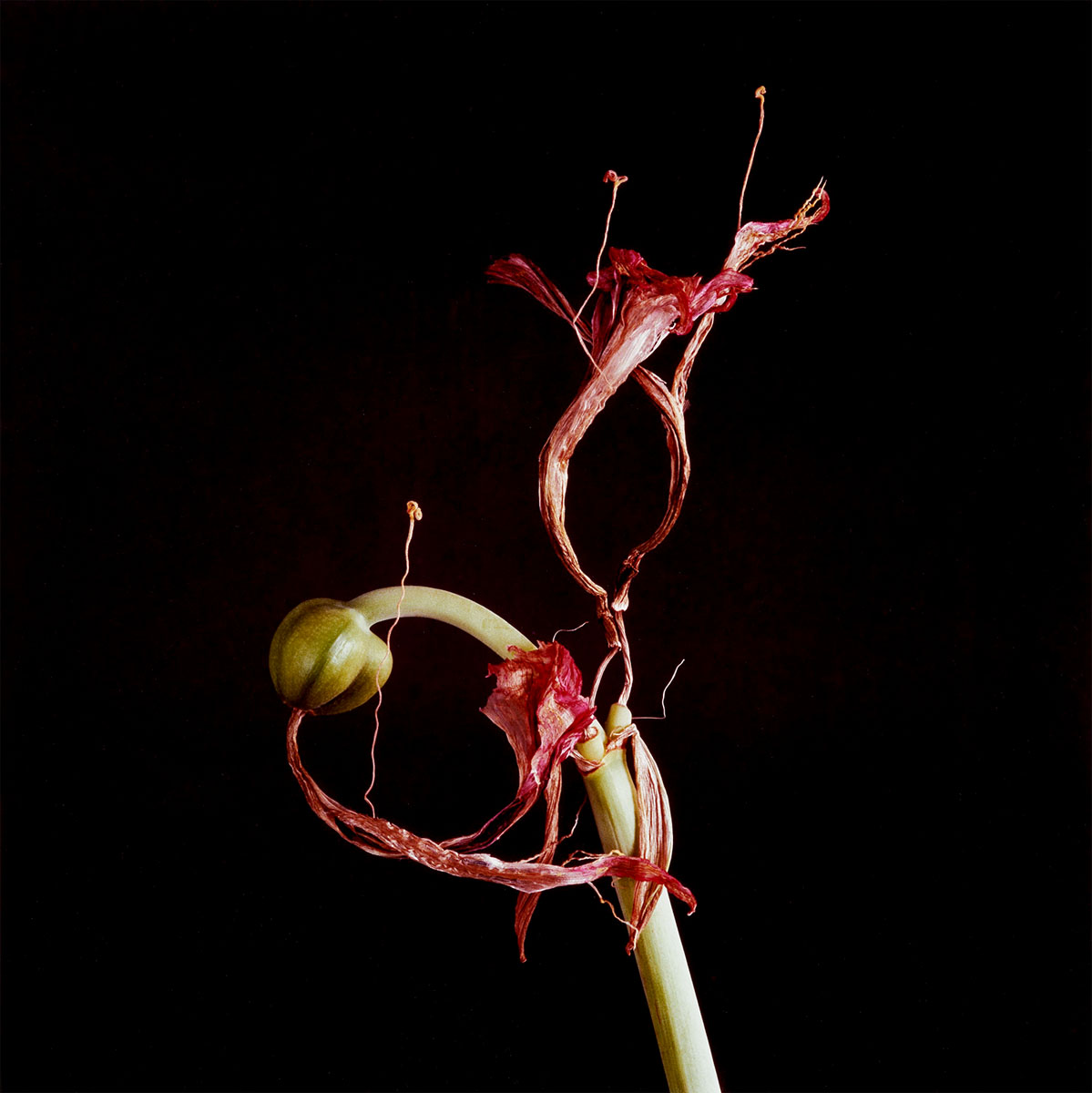
 

Elfriede Mejchar (Austrian, 1924-2020) 'Amaryllis' 1996


Elfriede Mejchar (Austrian, 1924-2020)
Amaryllis
1996
Wien Museum
© Bildrecht, Vienna 2023
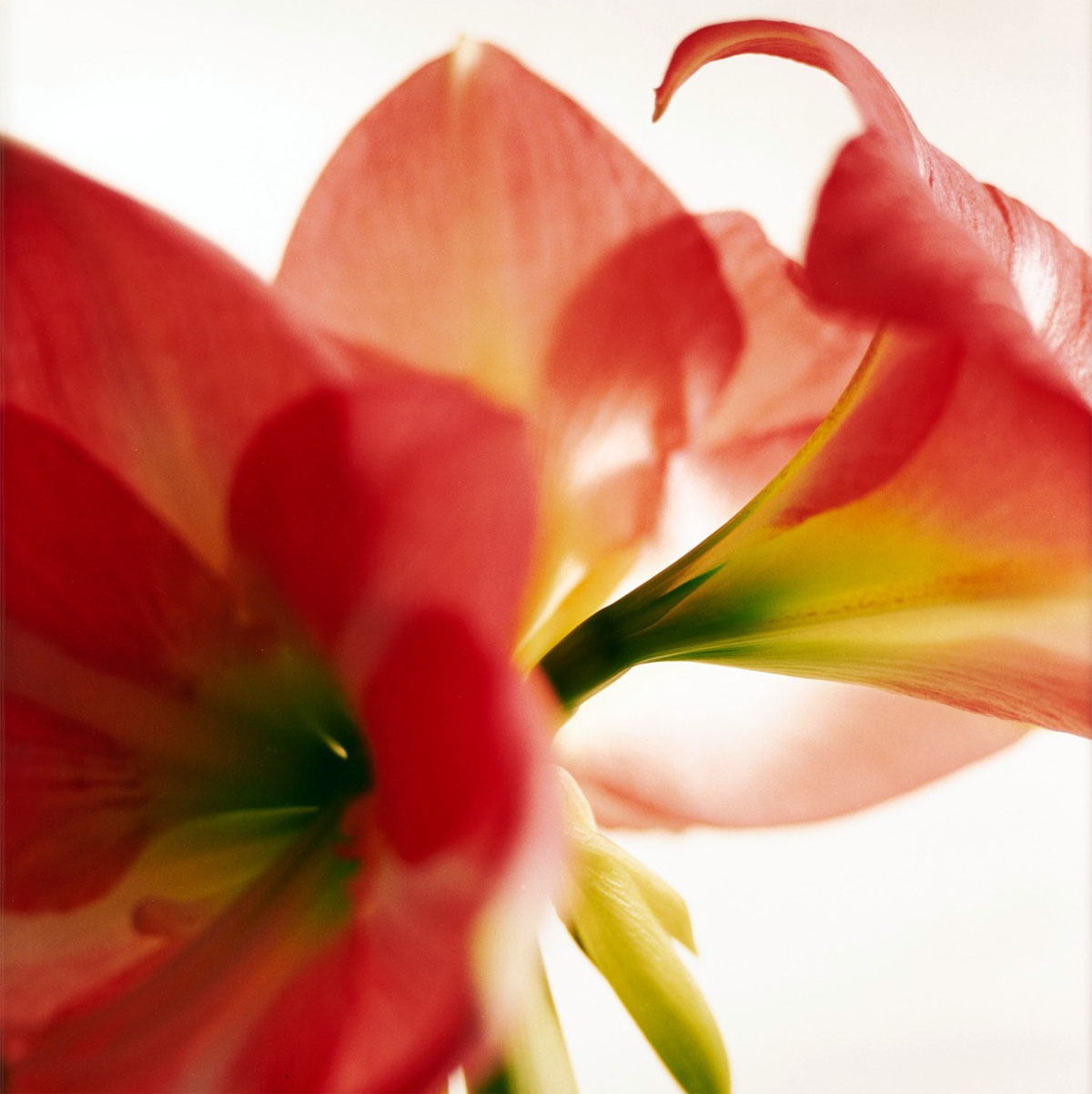
 

Elfriede Mejchar (Austrian, 1924-2020) 'Amaryllis' 2001


Elfriede Mejchar (Austrian, 1924-2020)
Amaryllis
2001
Wien Museum
© Bildrecht, Vienna 2023
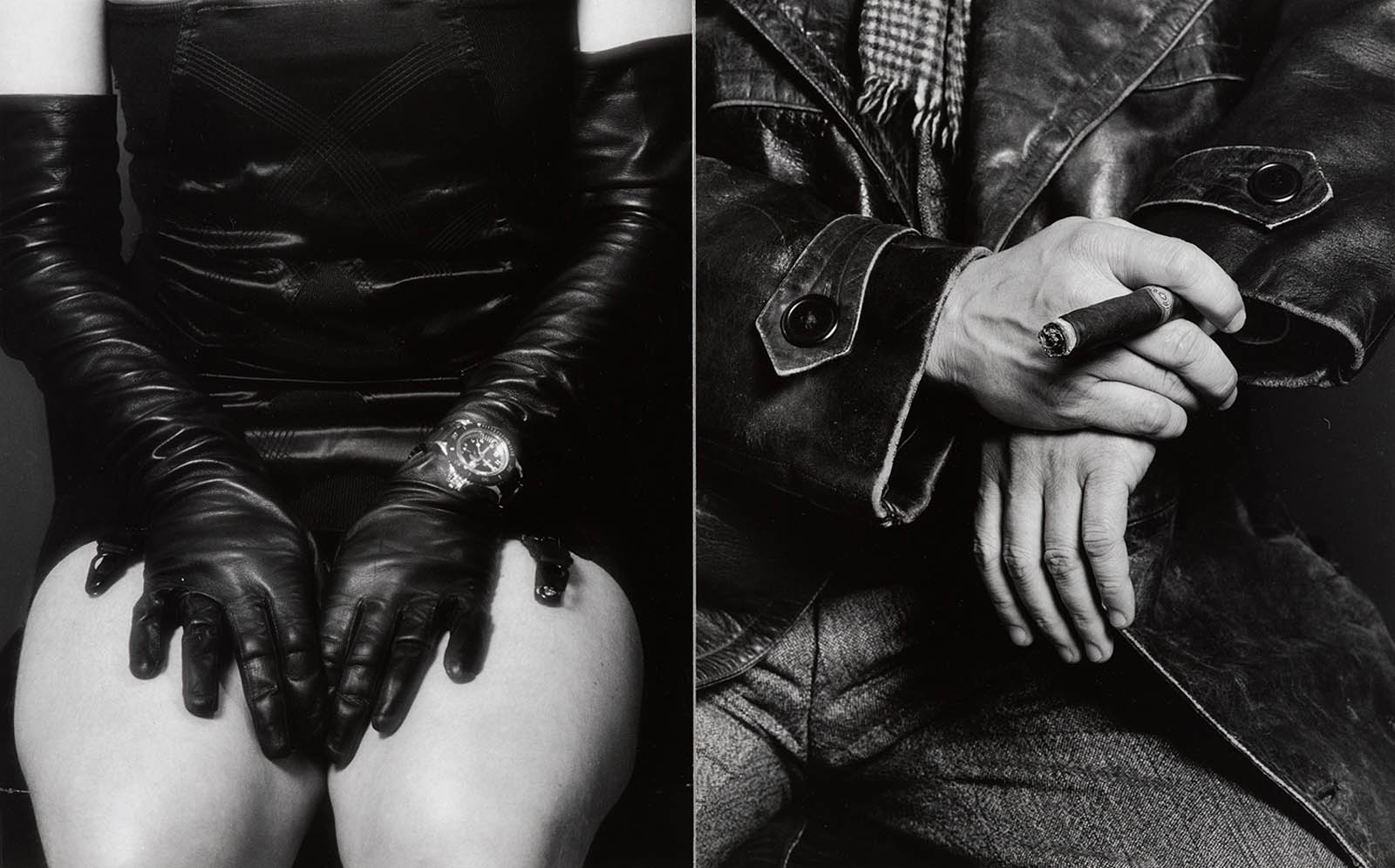
 

Elfriede Mejchar (Austrian, 1924-2020) 'Hands in Lap' 2002


Elfriede Mejchar (Austrian, 1924-2020)
Hands in Lap
2002
Wien Museum
© Bildrecht, Vienna 2023
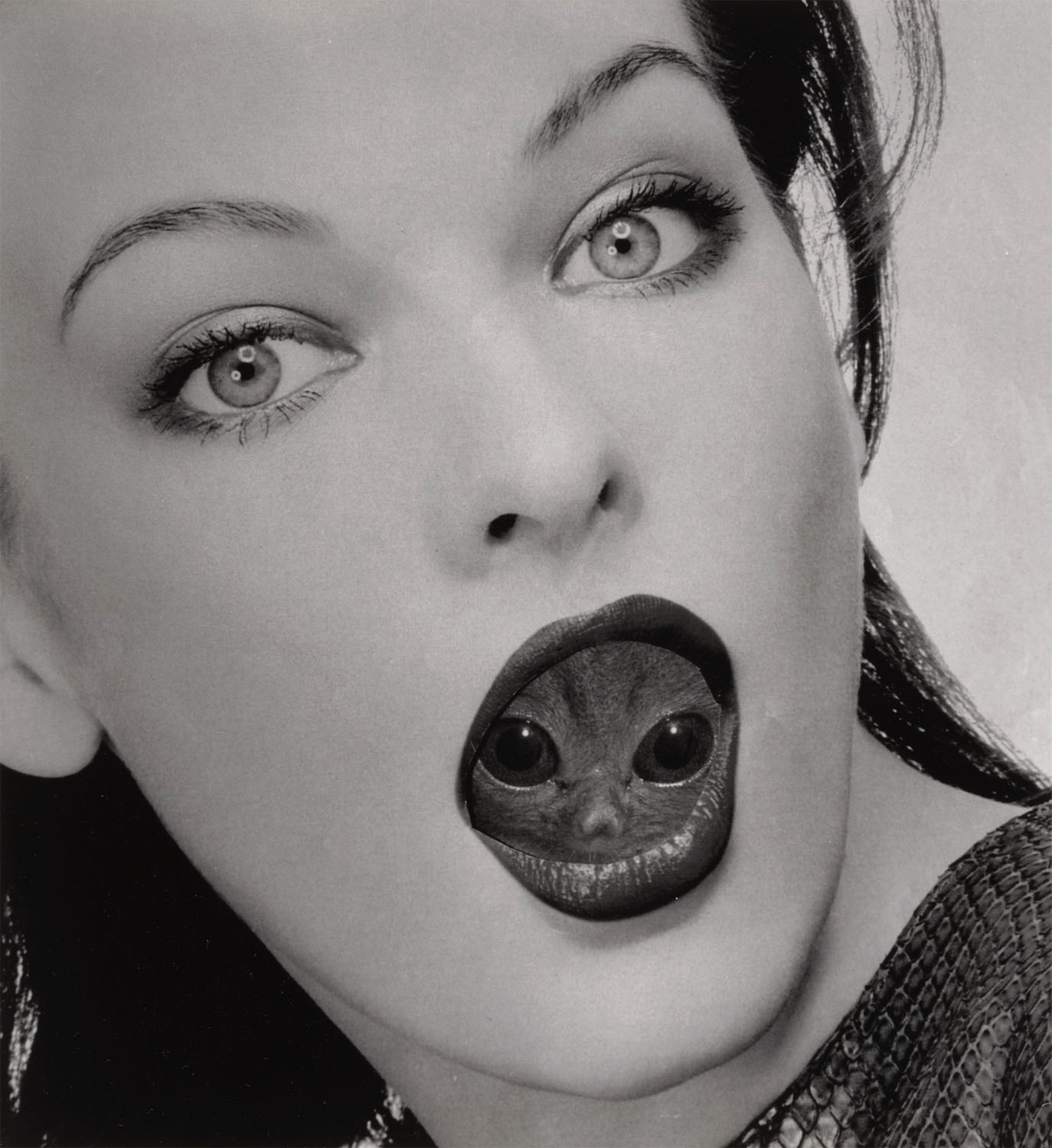
 

Elfriede Mejchar (Austrian, 1924-2020) From the series 'Nobody is Perfect' 1989-2007


Elfriede Mejchar (Austrian, 1924-2020)
From the series Nobody is Perfect
1989-2007
© Bildrecht, Vienna 2024
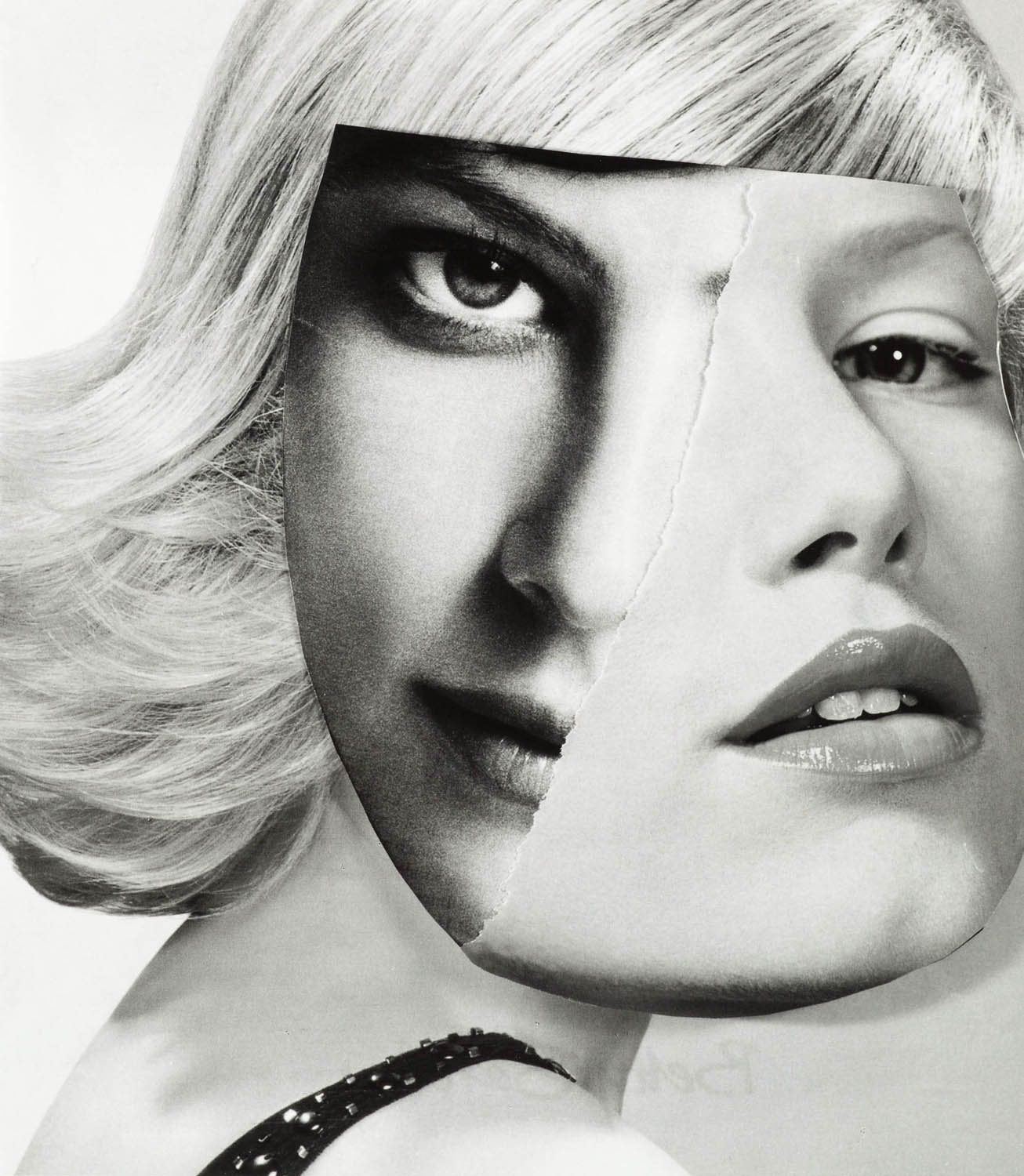
 

Elfriede Mejchar (Austrian, 1924-2020) From the series 'Nobody is Perfect' 1989-2007


Elfriede Mejchar (Austrian, 1924-2020)
From the series Nobody is Perfect
1989-2007
© Bildrecht, Vienna 2024
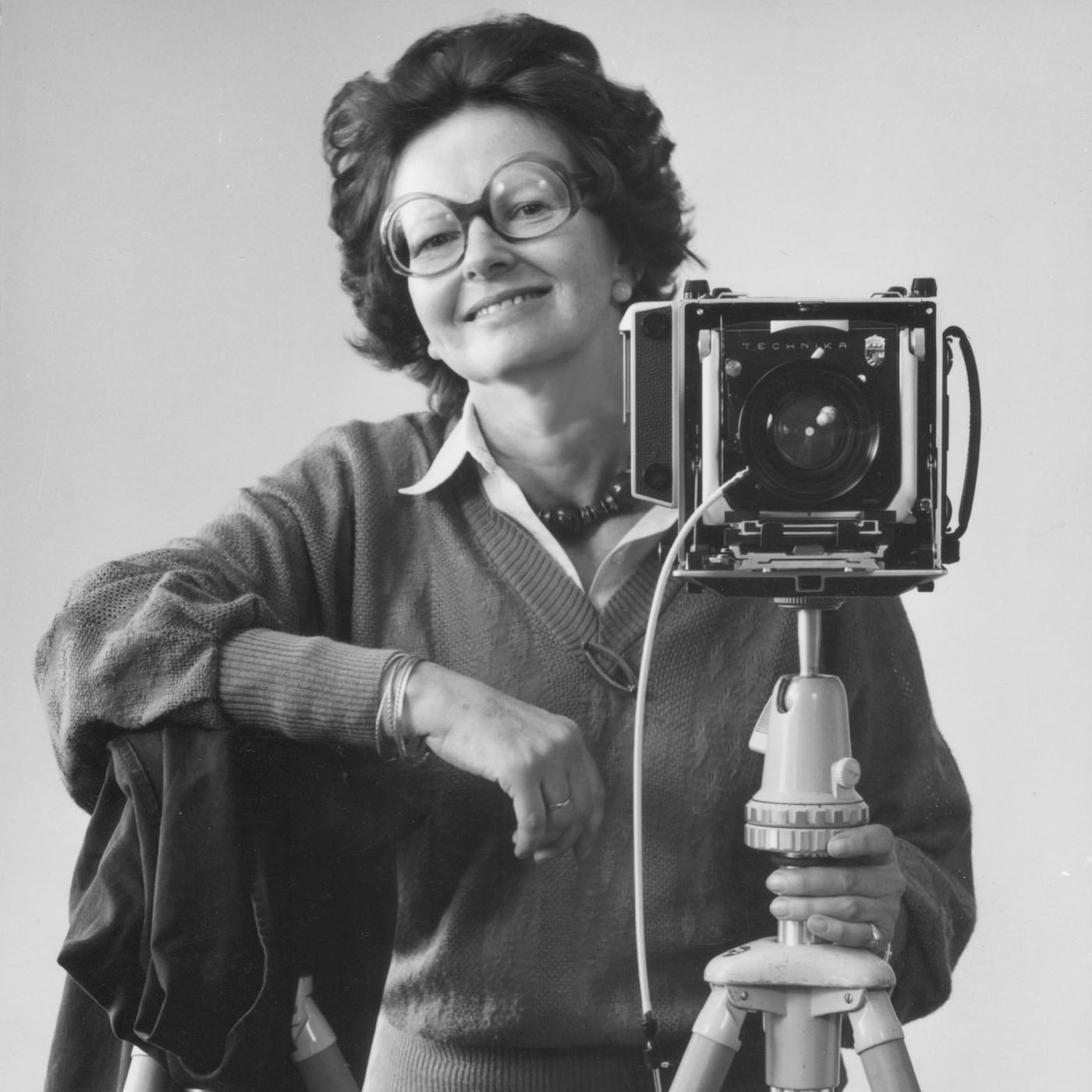
 

Unknown photographer. 'Elfriede Mejchar with Linhof camera and tripod in the Federal Monuments Office' Late 1970s


Unknown photographer
Elfriede Mejchar with Linhof camera and tripod in the Federal Monuments Office
Late 1970s
State Collections of Lower Austria
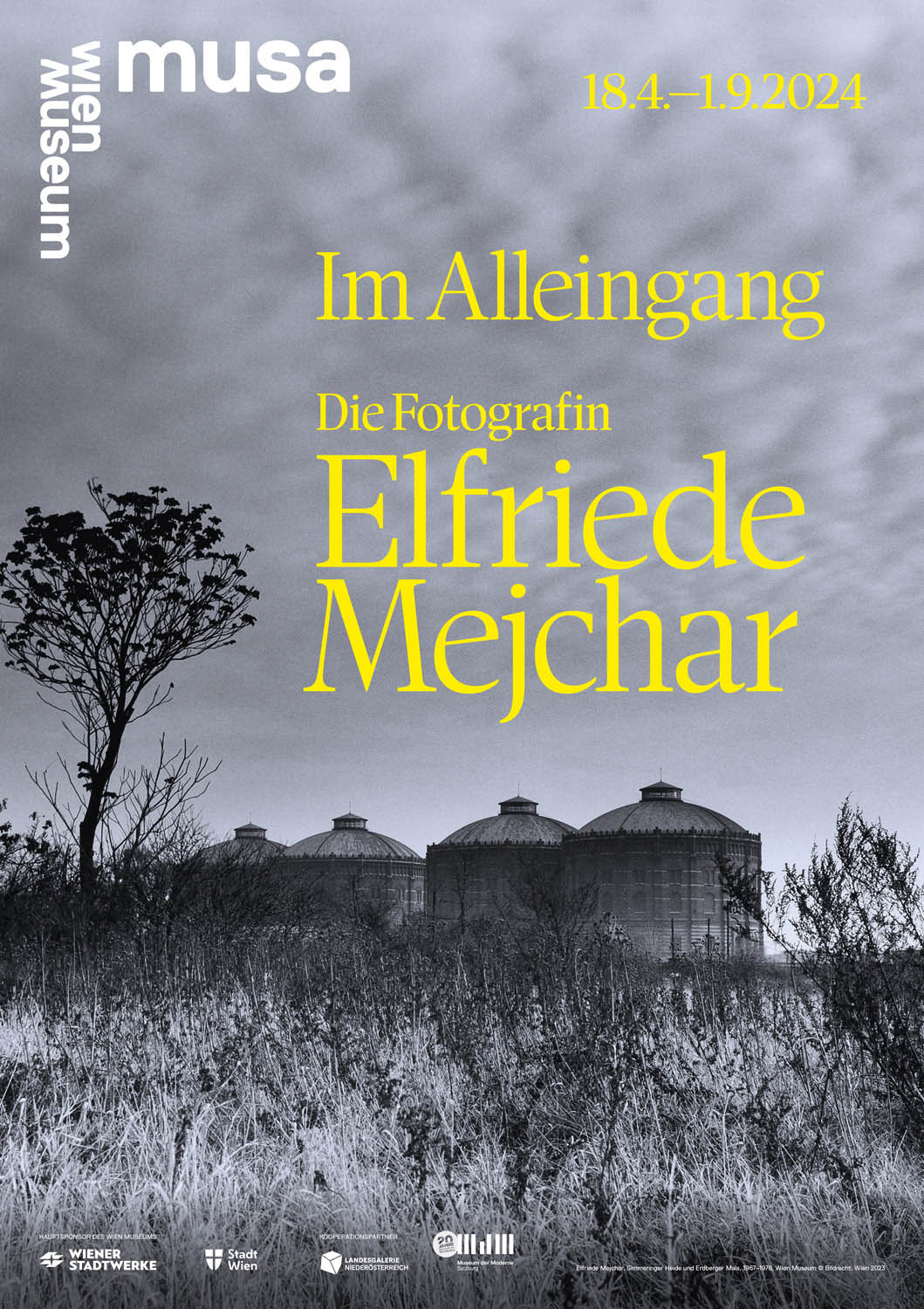
 

Poster for the exhibition 'On Her Own. The Photographer Elfriede Mejchar'


Poster for the exhibition On Her Own. The Photographer Elfriede Mejchar
Graphic: Studio Kehrer


Wien Museum MUSA
1010 Vienna, Felderstraße 6-8

Opening hours:
Tuesday to Sunday 10am – 6pm

Wien Museum website

LIKE ART BLART ON FACEBOOK

Back to top

Exhibition: ‘Hippolyte Bayard: A Persistent Pioneer’ at the J. Paul Getty Museum, Los Angeles

Exhibition dates: 9th April – 7th July 2024


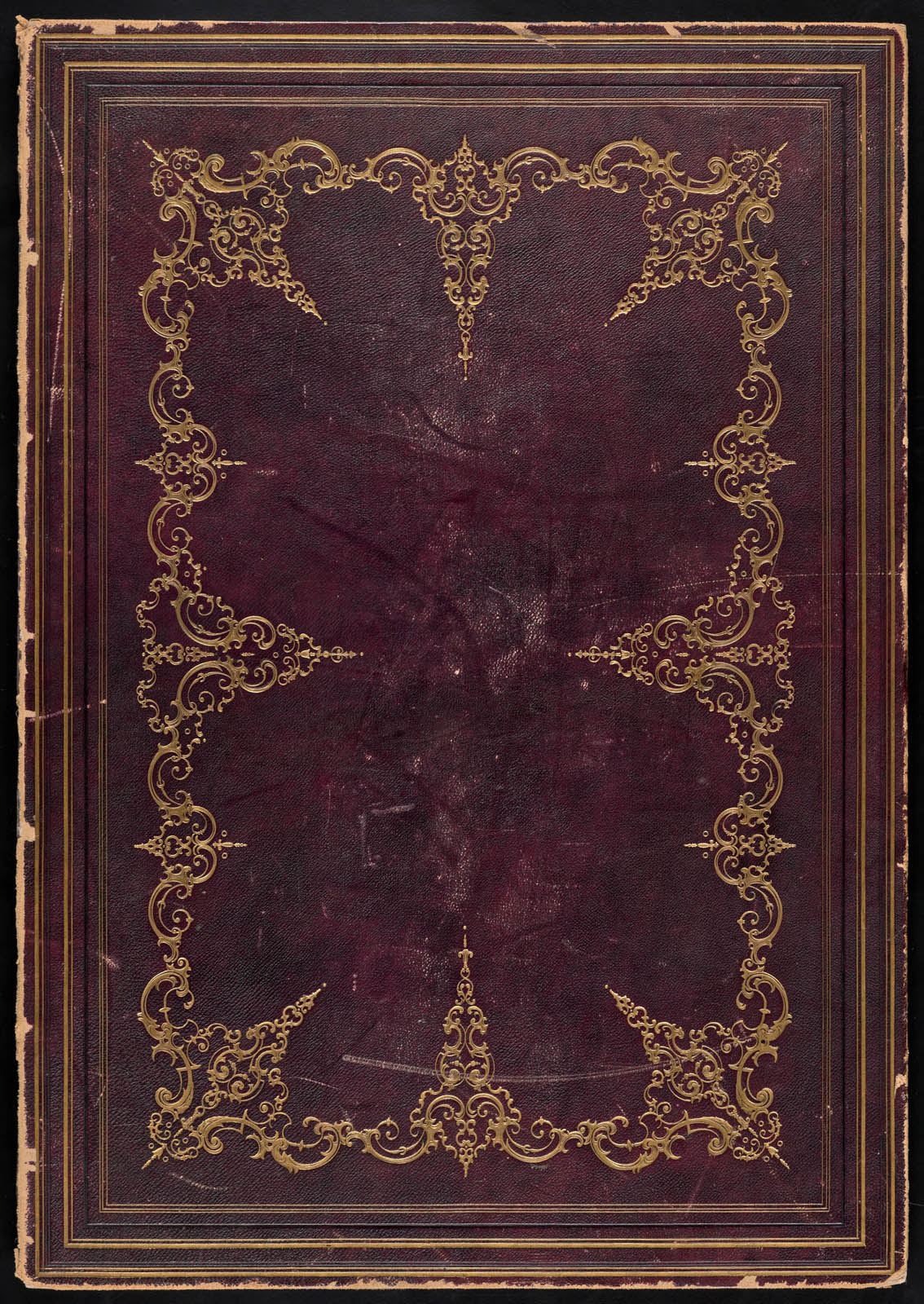
Hippolyte Bayard (French, 1801-1887) William Henry Fox Talbot (English, 1800-1877) Samuel Buckle (British, 1808-1860) Nicolaas Henneman (British, 1813-1893) Reverend Calvert Jones (British, 1804-1877) David Kinnebrook (English, 1819-1865) M.H. Nevil Story-Maskelyne (British, 1823-1911) Unknown maker. 'Cover of Dessins photographiques sur Papier. Recueil No. 2. [The "Bayard Album"]' 1839-1855
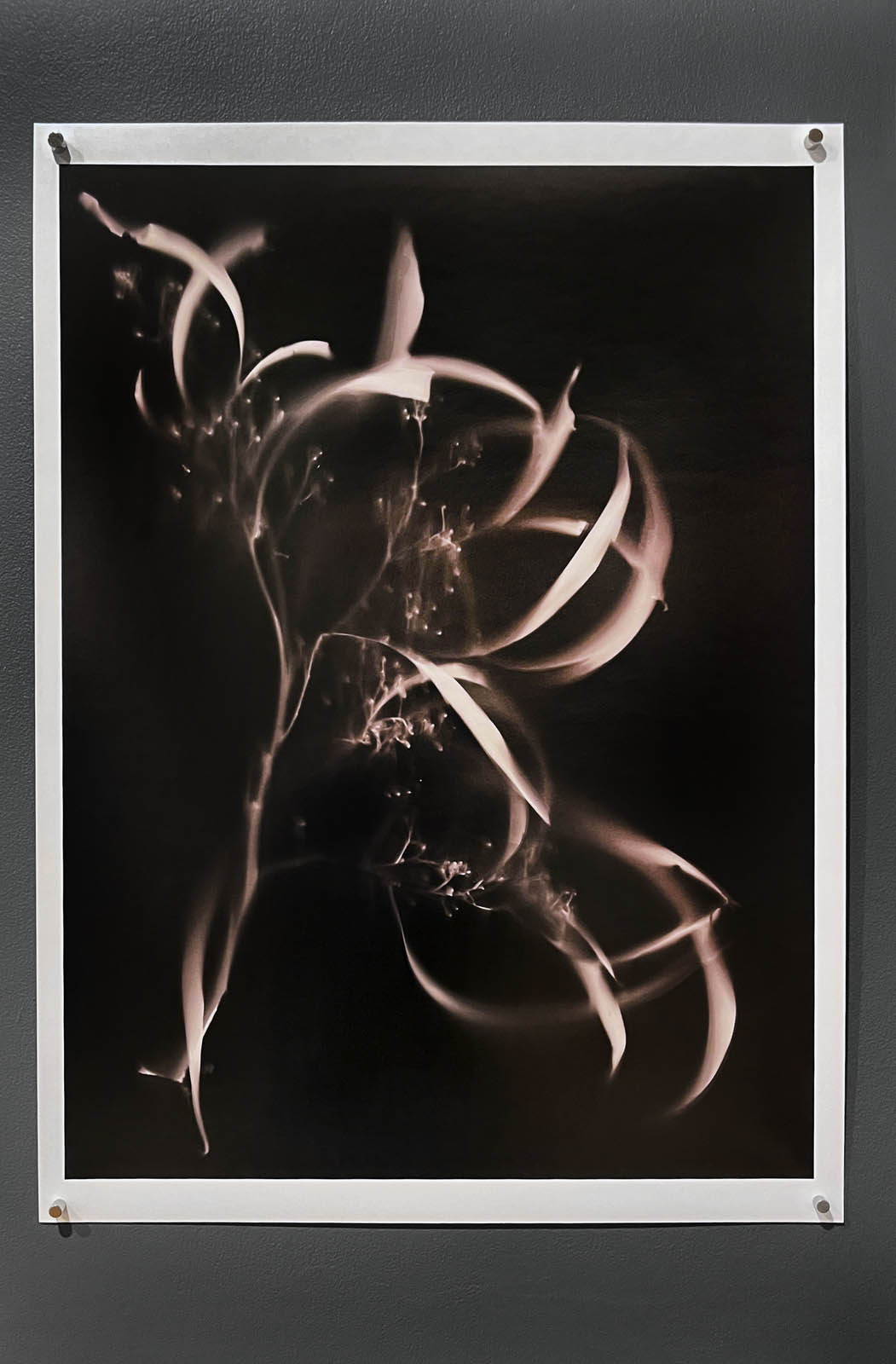
 

Hippolyte Bayard (French, 1801-1887) William Henry Fox Talbot (English, 1800-1877) Samuel Buckle (British, 1808-1860) Nicolaas Henneman (British, 1813-1893) Reverend Calvert Jones (British, 1804-1877) David Kinnebrook (English, 1819-1865) M.H. Nevil Story-Maskelyne (British, 1823-1911) Unknown maker
Cover of Dessins photographiques sur Papier. Recueil No. 2. [The “Bayard Album”]
1839-1855
The J. Paul Getty Museum, Los Angeles
Public domain


Shock of the new

At the moment the archive is going through a veritable feast of wonderful exhibitions on 19th century photography, this exhibition at the Getty a companion to last week’s posting on the exhibition Nineteenth-Century Photography Now also at the J. Paul Getty Museum. What a delight!

This posting on the important photographer and inventor Hippolyte Bayard (French, 1801-1887) – one of the pioneers of photography who was finally acknowledged as such during his lifetime and received due recognition – offers the visitor the opportunity to view fragile photographs from the Getty’s treasured Bayard album, one of the first photographic albums ever created, before the leaves of the album are reassembled after restoration.

“The album includes 145 of Bayard’s experiments with different photographic processes on paper, primarily salted paper prints from paper negatives from about 1839 to the late 1840s… Bayard divided the album into four sections: still lifes, portraits, urban and rural landscapes, and an assortment of miscellaneous images. The inclusion of twenty-two photographs by British photographers, including William Henry Fox Talbot, provides evidence of Bayard’s interactions with his fellow pioneers across the English Channel. …

Inscriptions found on the Getty album pages and versos of its photographs support the theory that the artist himself – or someone with firsthand knowledge of the chemicals he used – compiled this volume. Thus, this treasure offers intriguing insights into Bayard’s practice, aesthetic choices, and strategies for presenting himself through the order and arrangement of the photographs.”1

The full album and layout can be viewed on the Getty’s website.

What I find delightful about this “album of experiments” – other than Bayard’s perceptive, inquisitive self-portraits and delicate, atmospheric cyanotype and salted paper print photograms – is the colour (including hand coloured), size and placement of the photographic prints on the pages of the album. Sometimes gridded, sometimes singular in grand isolation, sometimes asymmetrical with empty pages between images, the album seems to flow allow like a river… only for the viewer then to have to change orientation, as vertical images on one page are then abutted next to a page of images that need to be viewed in a horizontal format but turning the album through 90 degrees.

It’s as if the compiler of the album, probably Bayard himself, applied this prick of consciousness to the viewing of the album, to stop the viewer skimming over the images but forcing them to be attentive, to be aware, of the progression of the story that the artist was telling, to be aware of a certain “disposition” in the viewer in order to – a/ disrupt the tendency of something to act in a certain manner under given circumstances and b/ impinge on a person’s inherent quality of mind and character. To offer a new dispensation on reality.

In other words, the artist challenges the viewer as to how photographs are read and interpreted through changes to the perception and point of view said “reader”. I don’t think I have ever seen such an early photo book that proposes such a daring reorientation of consciousness as does this album.

New technologies, new aesthetics, new dispositions.

The shock of the new.

Dr Marcus Bunyan


1/ Carolyn Peter, J. Paul Getty Museum, Department of Photographs, 2024


Many thankx to the J. Paul Getty Museum for allowing me to publish the photographs in the posting. Please click on the photographs for a larger version of the image.


Parisian bureaucrat by day and tireless inventor after hours, Hippolyte Bayard (French, 1801-1887) was one of the most important, if lesser-known, pioneers of photography. During his thirty-year career, he invented the direct positive process and several other photographic techniques on paper. This exhibition presents an extraordinarily rare opportunity to view some of Bayard’s highly fragile photographs dating from the 1840s – the first decade of the new medium. The exhibition journeys back to the 19th century to unveil a collection of Bayard’s delicately crafted photographs, offering an extraordinarily rare glimpse into his unique processes, subjects, and persistent curiosity. He brought an artistic sensitivity into capturing the first staged self-portraits and set precedents for photography as we know it today. It highlights Getty’s treasured Bayard album, one of the first photographic albums ever created.

This exhibition is presented in English and Spanish.

Text from the J. Paul Getty Museum website


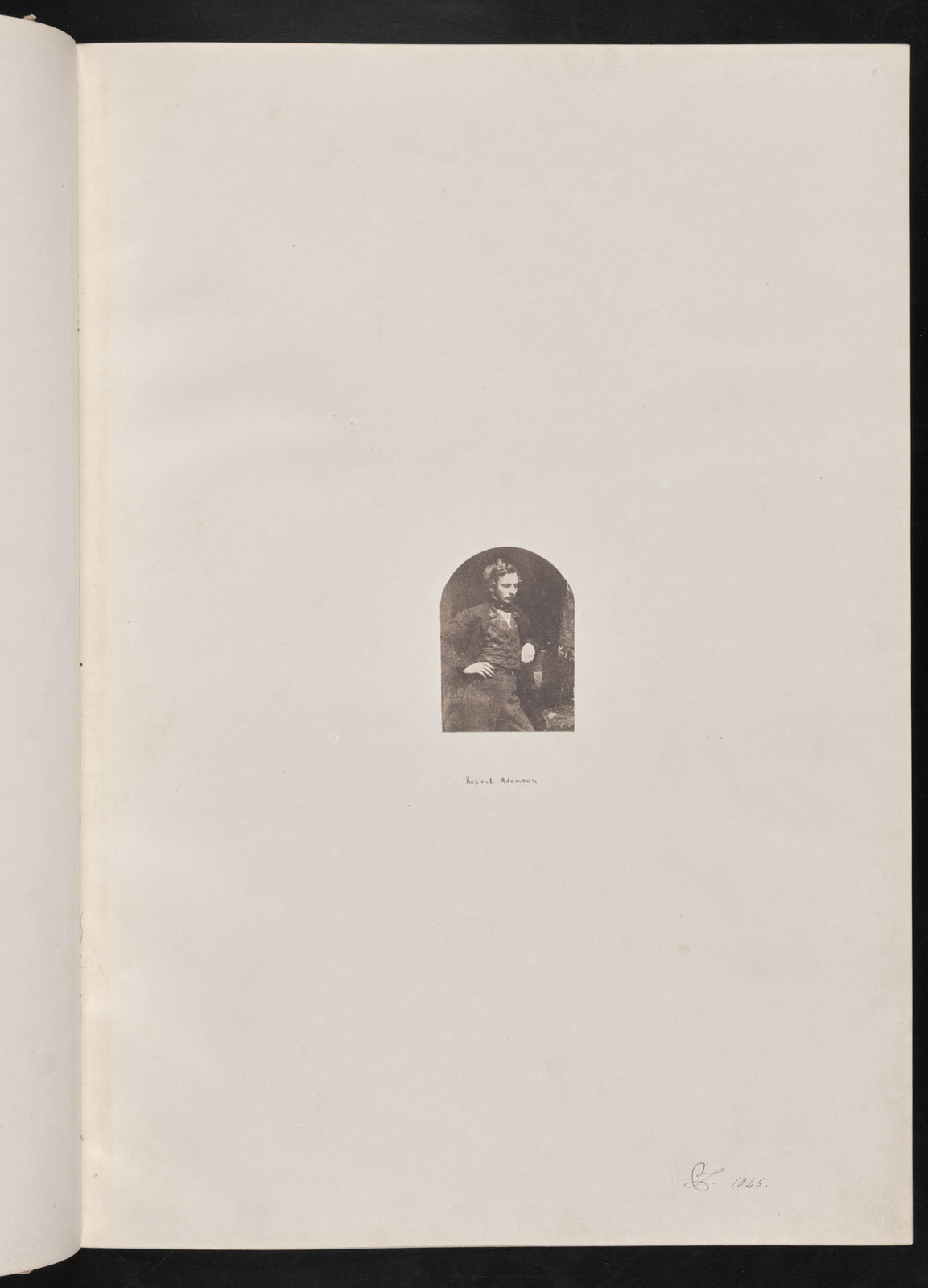
Hippolyte Bayard (French, 1801-1887) William Henry Fox Talbot (English, 1800-1877) Samuel Buckle (British, 1808-1860) Nicolaas Henneman (British, 1813-1893) Reverend Calvert Jones (British, 1804-1877) David Kinnebrook (English, 1819-1865) M.H. Nevil Story-Maskelyne (British, 1823-1911) Unknown maker. 'Title page of Dessins photographiques sur Papier. Recueil No. 2. [The "Bayard Album"] with Hippolyte Bayard 's [Self-Portrait in the Garden] June 1845' 1839-1855


Hippolyte Bayard (French, 1801-1887) William Henry Fox Talbot (English, 1800-1877) Samuel Buckle (British, 1808-1860) Nicolaas Henneman (British, 1813-1893) Reverend Calvert Jones (British, 1804-1877) David Kinnebrook (English, 1819-1865) M.H. Nevil Story-Maskelyne (British, 1823-1911) Unknown maker
Title page of Dessins photographiques sur Papier. Recueil No. 2. [The “Bayard Album”] with Hippolyte Bayard’s [Self-Portrait in the Garden] June 1845
1839-1855
The J. Paul Getty Museum, Los Angeles
Public domain

Text above the photograph: Bromure d’argent vapeurs de Mercure (Silver bromide Mercury vapors)


Hippolyte Bayard’s self-portrait at his garden gate [Self-Portrait in the Garden] introduces the contents of this 184-page album, one of the earliest photographic albums ever created…

Titled Dessins photographiques sur Papier. Receuil No. 2 [Photographic Drawings on Paper. Collection No. 2], the album includes 145 of Bayard’s experiments with different photographic processes on paper, primarily salted paper prints from paper negatives from about 1839 to the late 1840s. Twenty-two photographs by six of his British peers are also interspersed through the album. With its green-and-black marbled covers, it is similar in style to the other known album devoted to Bayard – Album d’essais [Album of Experiments] – owned by the Société française de photographie (SFP) in Paris. Inscriptions found on the Getty album pages and versos of its photographs support the theory that the artist himself – or someone with firsthand knowledge of the chemicals he used – compiled this volume. Thus, this treasure offers intriguing insights into Bayard’s practice, aesthetic choices, and strategies for presenting himself through the order and arrangement of the photographs.

Bayard divided the album into four sections: still lifes, portraits, urban and rural landscapes, and an assortment of miscellaneous images. The inclusion of twenty-two photographs by British photographers, including William Henry Fox Talbot, provides evidence of Bayard’s interactions with his fellow pioneers across the English Channel.

This album has passed through several owners over its 180-plus year life. While gaps still exist, we have traced much of its provenance, or history of ownership. Working back in time, the Getty Museum purchased the album in 1984 from the American collector Arnold Crane (1932-2014) as part of its foundational photography collection. Crane had acquired it in 1970 from Alain Brieux (1922-1985), a Parisian book dealer. By the early 1950s, the album was in the possession of the commune of Breteuil-sur-Noye, Bayard’s hometown, or its mayor, François Monnet (1890-1970). A member of Bayard’s extended family may have given or sold the album to Breteuil. Moving further back into the nineteenth century, Bayard’s family likely chose to keep the album at the time of his death in 1887. We believe that Bayard possessed the album from its creation until he passed away.

Over time different individuals have added inscriptions, numbering systems, correspondence, a biography, and a souvenir from a 1959-1960 exhibition on Bayard in Essen, Germany. At the top left corner of pages, an early inventory system notes the page number, the number of images on the page, and total number of photographs in the album up to that point. Numbers under each photograph represent a second system. At the bottom of the pages, Getty Museum staff and Crane each assigned an accession number to identify the album within their collections. Note that Getty numbers begin with “84.XO.968.” and Crane numbers with “A58.”.

With each change of hands, the album has adopted new meanings. It started as an artist’s notebook and portfolio. Upon Bayard’s death it became a family memento and then a symbol of a commune’s pride. Later in the twentieth century, it shifted from an antiquarian book dealer’s curious commodity to a collector’s treasure. Today it is a museum object valued for what it tells us about processes, subject matter, and sophisticated lines of communication between photographers during the earliest years of photography.

Carolyn Peter, J. Paul Getty Museum, Department of Photographs, 2024

For more information see:

~ Hellman, Karen and Carolyn Peter, eds. Hippolyte Bayard and the Invention of Photography. Los Angeles: J. Paul Getty Museum, 2024.
~ Peter, Carolyn. “The Many Lives of the Getty Bayard Album.” Getty Research Journal 15 (2022): 67-86.


Hippolyte Bayard (French, 1801-1887) William Henry Fox Talbot (English, 1800-1877) Samuel Buckle (British, 1808-1860) Nicolaas Henneman (British, 1813-1893) Reverend Calvert Jones (British, 1804-1877) David Kinnebrook (English, 1819-1865) M.H. Nevil Story-Maskelyne (British, 1823-1911) Unknown maker. 'Dessins photographiques sur Papier. Recueil No. 2. [The "Bayard Album"]' 1839-1855 showing at top left Hippolyte Bayard's '[Three Feathers]' about 1842-1843


Hippolyte Bayard (French, 1801-1887) William Henry Fox Talbot (English, 1800-1877) Samuel Buckle (British, 1808-1860) Nicolaas Henneman (British, 1813-1893) Reverend Calvert Jones (British, 1804-1877) David Kinnebrook (English, 1819-1865) M.H. Nevil Story-Maskelyne (British, 1823-1911) Unknown maker
Dessins photographiques sur Papier. Recueil No. 2. [The “Bayard Album”] showing at top left Hippolyte Bayard’s [Three Feathers] About 1842-1843 
1839-1855
The J. Paul Getty Museum, Los Angeles
Public domain


Hippolyte Bayard (French, 1801-1887) '[Three Feathers]' About 1842-1843


Hippolyte Bayard (French, 1801-1887)
[Three Feathers]
About 1842-1843
Part of Dessins photographiques sur Papier. Recueil No. 2. [The “Bayard Album”] 1839-1855
Cyanotype
13.8 x 11.1cm (5 7/16 x 4 3/8 in.)
The J. Paul Getty Museum, Los Angeles
Public domain


Hippolyte Bayard (French, 1801-1887) William Henry Fox Talbot (English, 1800-1877) Samuel Buckle (British, 1808-1860) Nicolaas Henneman (British, 1813-1893) Reverend Calvert Jones (British, 1804-1877) David Kinnebrook (English, 1819-1865) M.H. Nevil Story-Maskelyne (British, 1823-1911) Unknown maker. 'Dessins photographiques sur Papier. Recueil No. 2. [The "Bayard Album"]' 1839-1855 showing at top right, Hippolyte Bayard's 'Arrangement of Flowers' about 1839-1843


Hippolyte Bayard (French, 1801-1887) William Henry Fox Talbot (English, 1800-1877) Samuel Buckle (British, 1808-1860) Nicolaas Henneman (British, 1813-1893) Reverend Calvert Jones (British, 1804-1877) David Kinnebrook (English, 1819-1865) M.H. Nevil Story-Maskelyne (British, 1823-1911) Unknown maker
Dessins photographiques sur Papier. Recueil No. 2. [The “Bayard Album”] showing at top right, Hippolyte Bayard’s Arrangement of Flowers about 1839-1843
1839-1855
The J. Paul Getty Museum, Los Angeles
Public domain


Hippolyte Bayard (French, 1801-1887) 'Arrangement of Flowers' About 1839-1843


Hippolyte Bayard (French, 1801-1887)
Arrangement of Flowers
About 1839-1843
Part of Dessins photographiques sur Papier. Recueil No. 2. [The “Bayard Album”] 1839-1855
Salted paper print
17.5 × 21.3cm (6 7/8 × 8 3/8 in.)
The J. Paul Getty Museum, Los Angeles
Public domain


Hippolyte Bayard (French, 1801-1887) William Henry Fox Talbot (English, 1800-1877) Samuel Buckle (British, 1808-1860) Nicolaas Henneman (British, 1813-1893) Reverend Calvert Jones (British, 1804-1877) David Kinnebrook (English, 1819-1865) M.H. Nevil Story-Maskelyne (British, 1823-1911) Unknown maker. 'Dessins photographiques sur Papier. Recueil No. 2. [The "Bayard Album"] showing at bottom right, Hippolyte Bayard's [Portrait of a Man] 1843-1845' 1839-1855


Hippolyte Bayard (French, 1801-1887) William Henry Fox Talbot (English, 1800-1877) Samuel Buckle (British, 1808-1860) Nicolaas Henneman (British, 1813-1893) Reverend Calvert Jones (British, 1804-1877) David Kinnebrook (English, 1819-1865) M.H. Nevil Story-Maskelyne (British, 1823-1911) Unknown maker
Dessins photographiques sur Papier. Recueil No. 2. [The “Bayard Album”] showing at bottom right, Hippolyte Bayard’s [Portrait of a Man] 1843-1845
1839-1855
The J. Paul Getty Museum, Los Angeles
Public domain


Hippolyte Bayard (French, 1801-1887) '[Portrait of a Man]' 1843-1845


Hippolyte Bayard (French, 1801-1887)
[Portrait of a Man]
1843-1845
Part of Dessins photographiques sur Papier. Recueil No. 2. [The “Bayard Album”] 1839-1855
Salted paper print
Image: 15.3 × 11.6 cm (6 × 4 9/16 in.)
Sheet: 15.7 × 12 cm (6 3/16 × 4 3/4 in.)
The J. Paul Getty Museum, Los Angeles
Public domain


Hippolyte Bayard (French, 1801-1887) '[In Bayard's Studio]' About 1845


Hippolyte Bayard (French, 1801-1887)
[In Bayard’s Studio]
About 1845
Part of Dessins photographiques sur Papier. Recueil No. 2. [The “Bayard Album”] 1839-1855
Salted paper print
23.5 × 17.5cm (9 1/4 × 6 7/8 in.)
The J. Paul Getty Museum, Los Angeles
Public domain


Hippolyte Bayard is one of the earliest photographers to explore self-portraiture using a camera. The Getty Museum’s collection includes seven of Bayard’s self-portraits (see 84.XO.968.1, 84.XO.968.166, 84.XO.968.20).* While Bayard is not present in this image, it too can be considered a self-portrait of sorts as it offers the viewer a window onto his artistic world. The seemingly casual composition shows a make-shift photographic studio with wood doors leaning up against a brick wall to form the principal back wall. The floor is rough; it isn’t clear whether it is made of tile, wood, or simply dirt. Bayard featured the tools of his trade – glass bottles filled with chemicals, a beaker, a funnel, a dark canvas backdrop, and a light curtain or coverlet as well as some of his favourite subjects – three plaster casts and a porcelain vase. The Société française de photographie (SFP) collection in Paris has two versions of this image; one of them is hand-coloured. The overpainting with watercolour heightens the various patterns and adds colours that the photographic process was unable to capture.

Many of these same props can be found in a number of Bayard’s photographs. The vase with its elaborate floral design as well as the small figure with arms extended, the coverlet, backdrop, and bench are integral parts of Bayard’s most famous self-portrait, Le Noyé [The Drowned Man], now housed at the SFP.

*Four of the Getty’s Bayard self-portraits are part of a portfolio printed in 1965 by M. Gassmann and Son from Bayard’s original negatives that are housed in the SFP collection. (See: 84.XO.1166.1, 84.XO.1166.2, 84.XO.1166.8, and 84.XO.1166.25).

Carolyn Peter. J. Paul Getty Museum, Department of Photographs
2019


Hippolyte Bayard (French, 1801-1887) William Henry Fox Talbot (English, 1800-1877) Samuel Buckle (British, 1808-1860) Nicolaas Henneman (British, 1813-1893) Reverend Calvert Jones (British, 1804-1877) David Kinnebrook (English, 1819-1865) M.H. Nevil Story-Maskelyne (British, 1823-1911) Unknown maker. 'Dessins photographiques sur Papier. Recueil No. 2. [The "Bayard Album"] showing at bottom right, Hippolyte Bayard's [Galerie de la Madeleine with Scaffolding, Place de la Madeleine] 1843' 1839-1855


Hippolyte Bayard (French, 1801-1887) William Henry Fox Talbot (English, 1800-1877) Samuel Buckle (British, 1808-1860) Nicolaas Henneman (British, 1813-1893) Reverend Calvert Jones (British, 1804-1877) David Kinnebrook (English, 1819-1865) M.H. Nevil Story-Maskelyne (British, 1823-1911) Unknown maker
Dessins photographiques sur Papier. Recueil No. 2. [The “Bayard Album”] showing at bottom right, Hippolyte Bayard’s [Galerie de la Madeleine with Scaffolding, Place de la Madeleine] 1843
1839-1855
The J. Paul Getty Museum, Los Angeles
Public domain


Hippolyte Bayard (French, 1801-1887) '[Galerie de la Madeleine with Scaffolding, Place de la Madeleine]' 1843


Hippolyte Bayard (French, 1801-1887)
[Galerie de la Madeleine with Scaffolding, Place de la Madeleine]
1843
Part of Dessins photographiques sur Papier. Recueil No. 2. [The “Bayard Album”] 1839-1855
Salted paper print
Image: 16.5 × 22cm (6 1/2 × 8 11/16 in.)
Sheet: 16.8 × 22.3cm (6 5/8 × 8 3/4 in.)
The J. Paul Getty Museum, Los Angeles
Public domain


Hippolyte Bayard (French, 1801-1887) William Henry Fox Talbot (English, 1800-1877) Samuel Buckle (British, 1808-1860) Nicolaas Henneman (British, 1813-1893) Reverend Calvert Jones (British, 1804-1877) David Kinnebrook (English, 1819-1865) M.H. Nevil Story-Maskelyne (British, 1823-1911) Unknown maker. 'Dessins photographiques sur Papier. Recueil No. 2. [The "Bayard Album"] showing at top right, Hippolyte Bayard's [Rue des Batignolles] about 1845' 1839-1855


Hippolyte Bayard (French, 1801-1887) William Henry Fox Talbot (English, 1800-1877) Samuel Buckle (British, 1808-1860) Nicolaas Henneman (British, 1813-1893) Reverend Calvert Jones (British, 1804-1877) David Kinnebrook (English, 1819-1865) M.H. Nevil Story-Maskelyne (British, 1823-1911) Unknown maker
Dessins photographiques sur Papier. Recueil No. 2. [The “Bayard Album”] showing at top right, Hippolyte Bayard’s [Rue des Batignolles] about 1845
1839-1855
The J. Paul Getty Museum, Los Angeles
Public domain


Hippolyte Bayard (French, 1801-1887) '[Rue des Batignolles]' about 1845


Hippolyte Bayard (French, 1801-1887)
[Rue des Batignolles]
About 1845
Part of Dessins photographiques sur Papier. Recueil No. 2. [The “Bayard Album”] 1839-1855
Salted paper print
15.4 x 11 cm (6 1/16 x 4 5/16 in.)
The J. Paul Getty Museum, Los Angeles
Public domain


Hippolyte Bayard (French, 1801-1887) '[Bitch in profile]' about 1865


Hippolyte Bayard (French, 1801-1887)
[Bitch in profile]
About 1865
Part of Dessins photographiques sur Papier. Recueil No. 2. [The “Bayard Album”] 1839-1855
Albumen silver print
Mount: 10 x 6.1cm (3 15/16 x 2 3/8 in.)
J. Paul Getty Museum, Los Angeles
Public domain


Hippolyte Bayard (French, 1801-1887) '[Unidentified woman standing, leaning against a credenza]' about 1861


Hippolyte Bayard (French, 1801-1887)
[Unidentified woman standing, leaning against a credenza]
About 1861
Albumen silver print
Mount: 10.4 x 6.1 cm (4 1/8 * 2 3/8 in.)
The J. Paul Getty Museum, Los Angeles
Public domain


Hippolyte Bayard (French, 1801-1887) William Henry Fox Talbot (English, 1800-1877) Samuel Buckle (British, 1808-1860) Nicolaas Henneman (British, 1813-1893) Reverend Calvert Jones (British, 1804-1877) David Kinnebrook (English, 1819-1865) M.H. Nevil Story-Maskelyne (British, 1823-1911) Unknown maker. 'Dessins photographiques sur Papier. Recueil No. 2. [The "Bayard Album"]' 1839-1855


Hippolyte Bayard (French, 1801-1887) William Henry Fox Talbot (English, 1800-1877) Samuel Buckle (British, 1808-1860) Nicolaas Henneman (British, 1813-1893) Reverend Calvert Jones (British, 1804-1877) David Kinnebrook (English, 1819-1865) M.H. Nevil Story-Maskelyne (British, 1823-1911) Unknown maker
Dessins photographiques sur Papier. Recueil No. 2. [The “Bayard Album”]
1839-1855
The J. Paul Getty Museum, Los Angeles
Public domain


Hippolyte Bayard (French, 1801-1887) '[Two Men and a Girl in a Garden]' About 1847


Hippolyte Bayard (French, 1801-1887)
[Two Men and a Girl in a Garden]
About 1847
Part of Dessins photographiques sur Papier. Recueil No. 2. [The “Bayard Album”] 1839-1855
Albumenised salted paper print
12.9 x 15.6cm (5 1/16 x 6 1/8 in.)
The J. Paul Getty Museum, Los Angeles
Public domain


Hippolyte Bayard

Frenchman Hippolyte Bayard was one of the earliest experimenters in photography, though few will recognise his name today. While working as a civil servant in the Ministry of Finance in the late 1830s and early 1840s, he devoted much of his free time to inventing processes that captured and fixed images from nature on paper using a basic camera, chemicals, and light. The announcement of the inventions of his fellow countryman Louis-Jacques Mandé Daguerre’s daguerreotype on January 7, 1839, and Englishman William Henry Fox Talbot’s photogenic drawing soon after greatly diminished opportunities for recognition of Bayard’s contributions. He was most likely persuaded by François Arago, the head of the French Academy of Sciences, to keep quiet about his own distinct process until after the announcement of Daguerre’s process and subsequent celebration in August of 1839.

Bayard nonetheless continued his investigations and submitted letters detailing three photographic recipes to the Academy of Sciences. Though he exhibited examples of his work in what has been recognised as the first public exhibition of photography in July 1839 and presented his direct positive process at the Academy of Fine Arts in November of 1839, where it was lauded as an important tool for artists, he remained in the shadows of Daguerre and Talbot.

Bayard is best known today for his 1840 self-portrait as a drowned man, to which he added text protesting the lack of recognition for his invention. The humorous, yet biting text read:

The corpse of the gentleman you see here…. is that of Monsieur Bayard, inventor of the process that you have just seen…. As far as I know this ingenious and indefatigable experimenter has been occupied for about three years with perfecting his discovery…. The Government, who gave much to Monsieur Daguerre, has said it can do nothing for Monsieur Bayard, and the poor wretch has drowned himself. Oh! The precariousness of human affairs! …


In reality, of the three inventors, it was Bayard who actively continued to photograph the longest. He was a founding member in the 1850s of the Société héliographique and its successor, the Société française de photographie. He kept up with the latest developments in the world of photography and integrated new processes into his practice. He was one of only five photographers selected to be part of the Missions héliographiques in 1851, charged with the task of documenting France’s historic architecture for the Commission des Monuments historiques. He exhibited regularly in the universal expositions and, in the 1860s after his retirement from the Ministry of Finance, opened a photographic portrait studio in Paris with Charles Albert d’Arnoux, known as Bertall (1820-1882). During his lifetime, Bayard was described as the “Grandfather of Photography” by several commentators. The Légion d’honneur (still considered today the highest order of military and civil decoration in France) awarded him the first level of merit – Chevalier – in 1863. In the late 1860s he left Paris and moved to Nemours near his lifelong friend, the actor and painter Edmond Geffroy (1804-1895). Bayard died there in 1887.

Text from the J. Paul Getty Museum website


Hippolyte Bayard (French, 1801-1887) '[Self-Portrait in the Garden]' 1847


Hippolyte Bayard (French, 1801-1887)
[Self-Portrait in the Garden]
1847
Salted paper print
Image: 16.5 × 12.3cm (6 1/2 × 4 13/16 in.)
Sheet: 17.1 × 12.5cm (6 3/4 × 4 15/16 in.)
The J. Paul Getty Museum, Los Angeles
Public domain


By October 1840, a little over a year after several competing photographic processes had been made public, Hippolyte Bayard began staging elaborate self-portraits in his garden and other locations. His best known, Le Noyé [The Drowned Man], was made on October 18, 1840 (three variants are now part of the collection of the Société française de photographie in Paris).

The Getty Museum’s collection includes six other self-portraits by Bayard in addition to this 1847 Self-portrait in the Garden (See: 84.XO.968.1, 84.XO.968.166).* In five of the seven self-portraits, he placed himself in garden settings. This was, in part, a practical decision since natural light was required to make photographs at the time. However, his choice of setting also reflects his passion for plants. He came from a family of gardeners – his maternal grandfather worked in the extensive grounds of the abbey in Breteuil, the village where Bayard grew up. His father, a justice of the peace, was a passionate amateur gardener who grew peaches in an orchard attached to the family home. The garden(s) featured in Bayard’s self-portraits may indeed be part of the family property in Breteuil or his own home in Batignolles – an area that was just on the outskirts of Paris.

The setting becomes an integral aspect of these portraits; Bayard, the man, merges with his environment. In this particular image, he is surrounded by vegetation and is seated in a wooden chair whose arms and legs resemble vine branches. The lower portion of his legs merges into the darkened lower foreground as if he too is rooted in the earth and has sprouted from it. He shares the foreground with a tall leafy plant that bursts into blossoms at the top. The artist’s choice of clothing, including his cravat, brimmed cap, as well as his direct gaze, all combine to convey a sense of confidence.

Another image found mounted on a separate page in the same album in which this one appears offers a slightly more distant view of almost all the same elements. Bayard is no longer part of the composition, which instead features a watering can and an extra pot (See 84.XO.968.85). Perhaps this photograph was a study in preparation for this self-portrait.

*Four of the Getty’s Bayard self-portraits are part of a portfolio printed in 1965 by M. Gassmann and Son from Bayard’s original negatives that are housed in the SFP collection. (See: 84.XO.1166.1, 84.XO.1166.2, 84.XO.1166.8, and 84.XO.1166.25).

Carolyn Peter, J. Paul Getty Museum, Department of Photograph
2019


Hippolyte Bayard (French, 1801-1887) '[Self-Portrait in the Garden]' June 1845


Hippolyte Bayard (French, 1801-1887)
[Self-Portrait in the Garden]
June 1845
Hand-coloured
Salted paper print
12 1/4 × 9 13/16 in.
The J. Paul Getty Museum, Los Angeles
Public domain


The 19th-Century Selfie Pioneer

Before Instagram influencers, there was Hippolyte Bayard

More than 160 years before smartphones and selfie sticks allowed even the most inexperienced shutterbug to snap a photo of themselves, Hippolyte Bayard was turning his camera on himself.

The year was 1840. Several competing photographic processes had just been made public for the first time the year before, effectively introducing the medium of photography to the world. Bayard, a bureaucrat who worked at the Ministry of Finance in Paris and took pictures on weekends or his lunch hour, was one of the first photographers to practice the art of the self-portrait. Examples of these are on view in the new Getty Center exhibition Hippolyte Bayard: A Persistent Pioneer.

With himself as the subject, Bayard could experiment with new photographic processes, set a scene, and pose in front of the camera, creating images that represented his hobbies, frustrations, and achievements. Sound familiar?

“The earliest photographers wanted to capture people in photographs. Bayard was one of the first to actually succeed,” says Carolyn Peter, the exhibition’s co-curator. He also demonstrated that photography was a new art form. “The public was so taken by the realistic depictions of the world in photography, but he was saying that you can also make things up. You can stage things.”

Bayard in the Garden

Self-portraits were an appealing solution in those early days of photography largely because taking a picture required a long, labor-intensive process, explains Peter. Photographers had to set their cameras in front of their (motionless) subjects for anywhere between 20 minutes and three hours – a daunting ask for any human being – to expose the sensitised surface (metal, paper, or glass) to enough light to create the image.

“He probably didn’t want to subject others to this endurance test, but he still wanted to try and work on his photography techniques. Gradually, the amount of time it took to make a photo shortened, maybe down to around 10 minutes, and finally down to seconds,” Peter said.

In a series of self-portraits from the 1840s, Bayard posed himself in his or his family’s gardens, among plants and tools, emphasising his passion for horticulture. The outdoor setting was a necessity as it offered plenty of natural light. He adopted several different configurations of items and positions in each portrait. Notice how in one image (above left) he hid his feet behind greenery, as if he were planted in the earth.

“Today artists, along with the rest of us, still try a lot of different positions and poses with slight variations when we are making self-portraits,” Peter says.


Hippolyte Bayard (French, 1801-1887) '[Self-Portrait in the Garden]' About 1845-1849


Hippolyte Bayard (French, 1801-1887)
[Self-Portrait in the Garden]
About 1845-1849
Salted paper print
Image: 15.9 × 12.7 cm (6 1/4 × 5 in.)
Sheet: 16.3 × 13.1 cm (6 7/16 × 5 3/16 in.)
The J. Paul Getty Museum, Los Angeles
Public domain


Bayard as Dramatist

Perhaps Bayard’s best-known photo is his Drowned Man (1840), in which he slumps over, partially covered by a sheet, eyes closed, as if he had perished. Bayard created three versions of the image, changing the pose and props in each one, and eventually added this over-the-top lament to the back of the final version:

“The corpse of the gentleman that you see here… is that of M. Bayard, inventor of the process you have just seen…. To my knowledge, for about three years this ingenious and indefatigable researcher has been working to perfect his invention…. The Government, which has given so much to M. Daguerre, said it could do nothing for M. Bayard, and the unfortunate man drowned himself. Oh! The precariousness of human affairs!”


Clearly, Bayard had a few frustrations about his position in the photography world and about how little respect he felt he had been given in comparison to fellow photographer Louis Daguerre. This self-portrait allowed him to express his woes in a humorous and, yes, dramatic way, perhaps inspired by his connections to the theater.

“One of his very best friends from childhood on was Edmond Geffroy, a famous actor, so Bayard hung out with actors and theater people as well as fine artists and writers,” Peter says. “He had this connection to theatricality and theater. He attended a lot of plays. So I think that influenced him.”

A Special Effects Pioneer

In the 1860s, Bayard opened a portrait studio where customers could pay to have their pictures taken. Exposure times had been dramatically reduced, making it significantly easier for ordinary folks to sit for photographs. Bayard continued to experiment, using himself as a subject. Here he combined two negatives to make it look as though he is having a conversation with himself (or an imaginary identical twin?). This is 100 years before The Parent Trap was released!

“He’s just got this sense of humour and this desire to keep playing around,” says Peter.

A Self-Portrait of Pride

Bayard might have felt profoundly under acknowledged for his work in the 1840s, but it turns out he just needed to wait a little to get his due. In 1863 he was awarded the cross of the French Legion of Honor, a prestigious award bestowed in recognition of his contributions to photography. He took the portrait above while wearing the badge, showing off what must have been one of his proudest achievements. Bayard retired from photography soon after.

Bayard’s selfies are now more than 160 years old, but selfie-takers of today seem to be (unconsciously) following the same principles Bayard experimented with. He was one of the first to show that photography could represent not just the literal world but also how you wanted to present yourself. While selfies may appear to be a new phenomenon spawned by the reverse-camera button on smartphones, selfie aficionados should pay proper homage to Bayard for pioneering this art form.

“Today, selfies often include humour. Photographers invest a lot of strategic thought into how they want to present themselves. Selfies are performative and create something that isn’t fully realistic. Bayard was also conscious of the power of photography to visually imagine other worlds and invent different versions of himself.”

Erin Migdol. “The 19th-Century Selfie Pioneer,” on the J. Paul Getty Museum website Apr 09, 2024 [Online] Cited 12/04/2024


The J. Paul Getty Museum
1200 Getty Center Drive
Los Angeles, California 90049

Opening hours:
Daily 10am – 5pm

The J. Paul Getty Museum website

LIKE ART BLART ON FACEBOOK

Back to top

Exhibition: ‘Nineteenth-Century Photography Now’ at the J. Paul Getty Museum, Los Angeles

Exhibition dates: 9th April – 7th July, 2024

Curators: the exhibition is curated by Karen Hellman, former associate curator in the Department of Photographs. Carolyn Peter, assistant curator in the Department of Photographs, Getty Museum, served as organising curator with assistance from Claire L’Heureux, former Department of Photographs graduate intern and Antares Wells, curatorial assistant


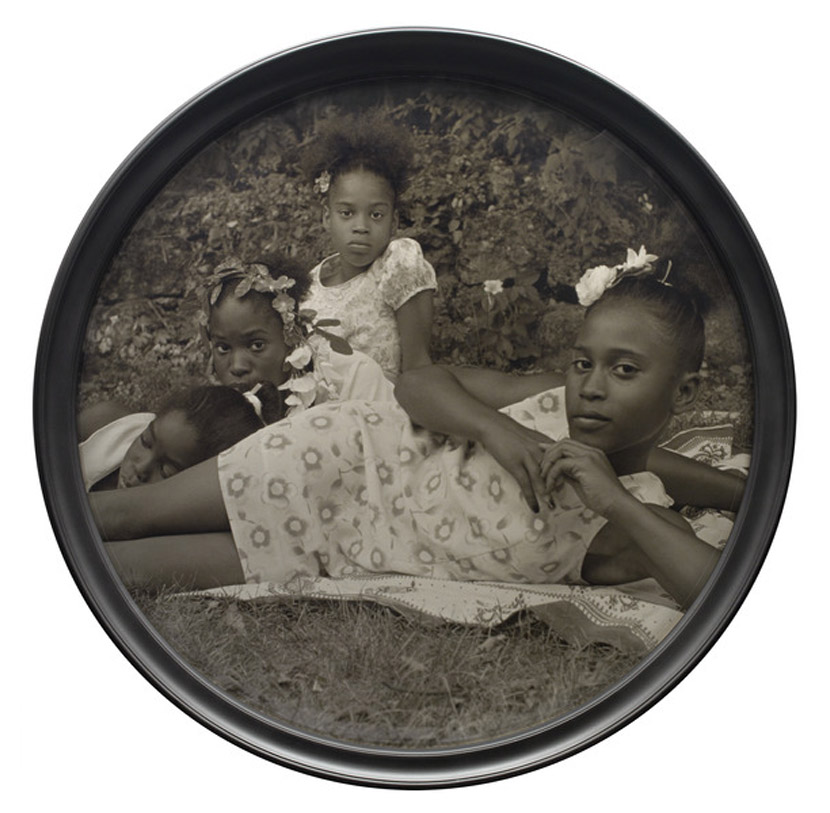
At left, Julia Margaret Cameron (British born India, 1815-1879) 'Florence after the Manner of the Old Masters' 1872; and at right, Carrie Mae Weems (American, b. 1953) 'After Manet' 2003


At left, Julia Margaret Cameron (British born India, 1815-1879) Florence after the Manner of the Old Masters 1872; and at right, Carrie Mae Weems (American, b. 1953) After Manet 2003

from the ‘Identity’ section of the exhibition


Magdalene Keaney, curator of the exhibition Francesca Woodman and Julia Margaret Cameron: Portraits to Dream In, observes that the exhibition “poses questions about how we might think in new ways about relationships between 19th and 20th century photographic practice…”

As does this exhibition:

~ Everything emerges from something. One must be “mindful of the origins and essence of photography.” (Moriyama)

~ History often repeats itself in different forms.

~ Memory often returns in fragmentary form.

~ The wisdom and spirit of the past speaks to the practitioners of the future.

Dr Marcus Bunyan


NB: Transubstantiation, an un/explainable change in form, substance, or appearance (from the Latin roots trans, “across or beyond,” and substania, “substance”)


Many thankx to the J. Paul Getty Museum for allowing me to publish the photographs in the website. Please click on the photographs  for a larger version of the image.


The earliest photographs – often associated with small, faded, sepia-toned images – may seem to belong to a bygone era, but many of the conventions established during photography’s earliest years persist today. Organised around five themes dating back to the medium’s beginnings, this exhibition explores nineteenth-century photographs through the work of twenty-one contemporary artists. These interchanges between the first decades of the medium and the most recent invite us to reimagine nineteenth-century photography while exploring its complexities.

Text from the J. Paul Getty Museum website


“Ms. Hellman, a former associate curator, inspired by her work with the Bayard materials, conceived “Nineteenth-Century Photography Now” as a way to access the influence that early photographers still have. The exhibition includes work from the past by 23 named and three anonymous photographers plus an additional 16 included in an album; there are 21 present-day artists. It is organised around five themes: Identity, Time, Spirit, Landscape and Circulation. The picture that serves as an introduction to the show is “Untitled ‘point de vue'” (1827) by Joseph Nicéphore Niépce, a faded heliograph on pewter, that Daido Moriyama keeps a reproduction in his studio; the wall text quotes him saying, “it serves as a gentle daily reminder to be mindful of the origins and essence of photography.” There are two photographs by Mr. Moriyama prompted by Niépce’s bit of primitive technology.”


William Meyers. “Photography’s Past and Present at the Getty Center,” on The Wall Street Journal website May 29, 2024 [Online] Cited 16/06/2024


Julia Margaret Cameron (British born India, 1815-1879) 'Florence after the Manner of the Old Masters' 1872


Julia Margaret Cameron (British born India, 1815-1879)
Florence after the Manner of the Old Masters
1872
Albumen silver print
Image: 34 × 25.6cm (13 3/8 × 10 1/16 in.)
Mount: 43.3 × 32.4cm (17 1/16 × 12 3/4 in.)
The J. Paul Getty Museum, Los Angeles


Portrait of Florence Fisher posing with a rose stem with the leaves attached. She holds the rose in place with one arm folded across her chest.


Carrie Mae Weems (American, b. 1953) 'After Manet' 2003


Carrie Mae Weems (American, b. 1953)
After Manet
2003
From the series May Days Long Forgotten
Chromogenic print
Object: 84.3cm (33 3/16 in.)
The J. Paul Getty Museum, Los Angeles
© Carrie Mae Weems


The black and white photograph – one from the nine-part series May Days Long Forgotten – depicts four African American girls in summer dresses, with garlands in their hair, reclining on a lawn. The piece is mounted in a circular frame prepared by the artist, and is number five of an edition of eight.


Joseph Nicéphore Niépce (French, 1765-1833) 'Untitled 'point de vue'' 1827


Joseph Nicéphore Niépce (French, 1765-1833)
Untitled ‘point de vue’
1827
Heliograph on pewter
16.7 x 20.3 x .15cm


The invention of photography was announced simultaneously in France and England in 1839, dazzling the public and sending waves of excitement around the world. These astonishing breakthroughs depended upon centuries of developments in chemistry, optics, and the visual arts, accelerating in the decades after 1790. The Niépce Heliograph was made in 1827, during this period of fervent experimentation. It is the earliest photograph produced with the aid of the camera obscura known to survive today.

Text from the Harry Ransom Center website


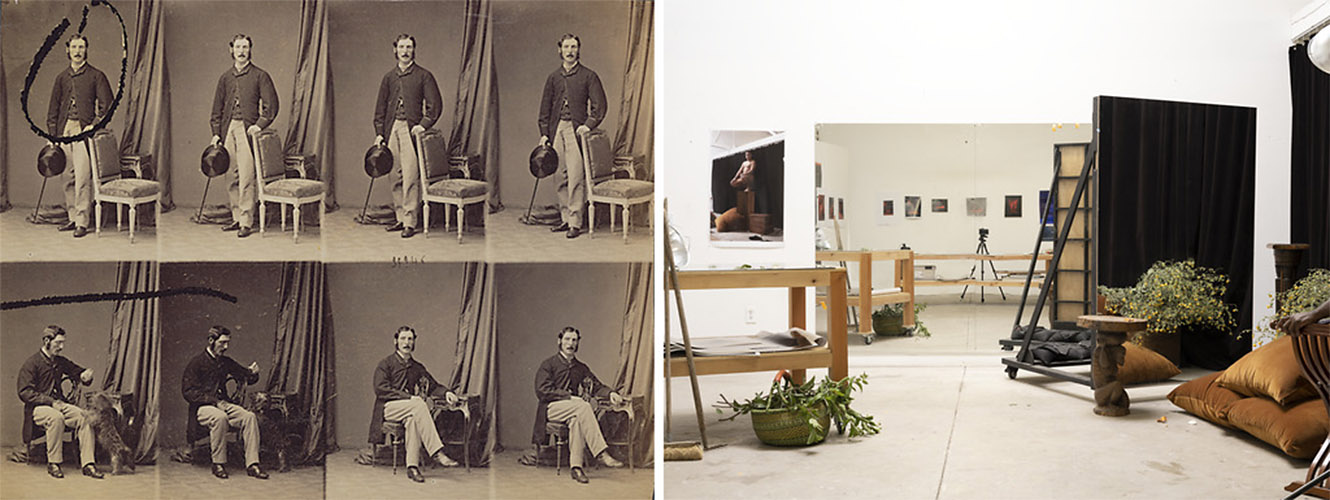
At left, André Adolphe-Eugène Disdéri (French, 1819-1889) 'Uncut Sheet of Cartes-de-Visite Portraits', 1860s; and at right, Paul Mpagi Sepuya (American, b. 1982) 'Daylight Studio with Garden Cuttings (_DSF0340)' 2022


At left, André Adolphe-Eugène Disdéri (French, 1819-1889) Uncut Sheet of Cartes-de-Visite Portraits, 1860s; and at right, Paul Mpagi Sepuya (American, b. 1982) Daylight Studio with Garden Cuttings (_DSF0340) 2022


William Henry Fox Talbot (English, 1800-1877) '[A Stem of Delicate Leaves of an Umbrellifer]' probably 1843-1846


William Henry Fox Talbot (English, 1800-1877)
[A Stem of Delicate Leaves of an Umbrellifer]
probably 1843-1846
Photogenic drawing negative
Image: 18.1 × 22.1cm (7 1/8 × 8 11/16 in.)
The J. Paul Getty Museum, Los Angeles


The exceptional boldness of this image conveys a visual impression that at first may seem quite unlike other of William Henry Fox Talbot’s pictures. He made it with the same photogenic drawing process he used for much of his work by placing the stem of leaves directly on top of the prepared paper and then exposing to sunlight without the aid of a camera. Although the original plant was delicate, its sharply delineated white shadow on the rich dark brown background creates a graphic, two-tone effect. The same specimen was used in a slightly different orientation to make a negative that is preserved in one of the family albums formerly at the Fox Talbot Museum in Lacock and now at the British Library, London.

Other visually similar works in Talbot’s oeuvre help us to understand what we are seeing here. Some of them show the interior structure of the plant specimens he photographed, proving that the negatives at first had fuller details. Because the most vulnerable sections of the silver-based images are those that are light in tone, these areas will fade disproportionately faster than the darker parts. In this case, the lightest tones would have been in the interior spaces of the plant, and these at some point faded. It is unlikely that Talbot saw the same picture we see today, at least not when he first made it, but the boldness of the present state reminds us that changes over time can create as well as destroy.

Adapted from Larry Schaaf. William Henry Fox Talbot, In Focus: Photographs from the J. Paul Getty Museum (Los Angeles: Getty Publications, 2002), 68. © 2002 J. Paul Getty Trust


Hiroshi Sugimoto (Japanese, b. 1948) 'A Stem of Delicate Leaves of an Umbrellifer, circa 1843-1846' 2009


Hiroshi Sugimoto (Japanese, b. 1948)
A Stem of Delicate Leaves of an Umbrellifer, circa 1843-1846
2009
Toned gelatin silver print
Image: 93.7 × 74.9cm (36 7/8 × 29 1/2 in.)
The J. Paul Getty Museum, Los Angeles
Gift of the artist
© Hiroshi Sugimoto


“To look at Fox Talbot’s earliest experiments, the blurred and hazy images suffuse the excited anticipation of discovering how light could transfer the shape of things onto paper. … I decided to collect Fox Talbot’s earliest negatives, from a time in photographic history very likely before positive images existed, and print the photographs that not even he saw.”

~ Hiroshi Sugimoto (p. 349, in Hiroshi Sugimoto, Ostfildern-Ruit, 2005)


Hiroshi Sugimoto visited the Getty Museum in 2007 to study the earliest photographs in the collection. After photographing some of William Henry Fox Talbot’s photogenic drawing negatives, he produced large-scale prints and coloured them with toning agents to replicate the hues of the paper negatives. The scale of the enlarged prints reveals the fibers of the original paper, which create delicate patterns embedded in the images.


At left, Herbert Bell et al, '[Amateur World Tour Album, taken with early Kodak cameras, plus purchased travel photographs by various photographers]' (2 page spread); and at right, Stephanie Syjuco (American born Philippines, b. 1974) 'Herbaria' 2021 (detail)


At left, Herbert Bell et al, [Amateur World Tour Album, taken with early Kodak cameras, plus purchased travel photographs by various photographers] (2 page spread); and at right, Stephanie Syjuco (American born Philippines, b. 1974)
Herbaria 2021 (detail)


Herbert Bell (English, 1856-1946) Frederick Nutt Broderick (English, about 1854-1913) Gustave Hermans (Belgian, 1856-1934) Anthony Horner (English, 1853-1923) Michael Horner (English, 1843-1869) C. W. J. Johnson (American, 1833-1903) Léon & Lévy (French, active 1864-1913 or 1920) Léopold Louis Mercier (French, b. 1866) Neurdein Frères (French, founded 1860s, dissolved 1918) Louis Parnard (French, 1840-1893) Alfred Pettitt (English, 1820-1880) Francis Godolphin Osborne Stuart (British born Scotland, 1843-1923) Unknown maker Valentine & Sons (Scottish, founded 1851, dissolved 1910) L. P. Vallée (Canadian, 1837-1905) York and Son J. Kühn (French, active Paris, France 1885 - early 20th century) '[Amateur World Tour Album, taken with early Kodak cameras, plus purchased travel photographs by various photographers]' (2 page spread)


Herbert Bell (English, 1856-1946)
Frederick Nutt Broderick (English, about 1854-1913)
Gustave Hermans (Belgian, 1856-1934)
Anthony Horner (English, 1853-1923)
Michael Horner (English, 1843-1869)
C. W. J. Johnson (American, 1833-1903)
Léon & Lévy (French, active 1864-1913 or 1920)
Léopold Louis Mercier (French, b. 1866)
Neurdein Frères (French, founded 1860s, dissolved 1918)
Louis Parnard (French, 1840-1893)
Alfred Pettitt (English, 1820-1880)
Francis Godolphin Osborne Stuart (British born Scotland, 1843-1923)
Unknown maker
Valentine & Sons (Scottish, founded 1851, dissolved 1910)
L. P. Vallée (Canadian, 1837-1905)
York and Son
J. Kühn (French, active Paris, France 1885 – early 20th century)
[Amateur World Tour Album, taken with early Kodak cameras, plus purchased travel photographs by various photographers] (2 page spread)
Albumen silver print
Closed: 35.4 × 28 × 3.5cm (13 15/16 × 11 × 1 3/8 in.)
The J. Paul Getty Museum, Los Angeles
Google Arts & Culture website


Includes amateur photographs taken with early Kodak cameras, including the original Kodak or Kodak no. 1, and Kodak no. 2 cameras, as well as commercially produced images.


Stephanie Syjuco (American born Philippines, b. 1974) 'Herbaria' 2021 (detail)


Stephanie Syjuco (American born Philippines, b. 1974)
Herbaria (detail)
2021
From the series Pileups
Hand-assembled pigmented inkjet prints on Hahnemühle Baryta
Framed [Outer Dim]: 121.9 × 91.4cm (48 × 36 in.)
The J. Paul Getty Museum, Los Angeles
© Stephanie Syjuco


A collage composed of diverse naturalist archival sources, including photographs of bones, foliage, and crystal formations.


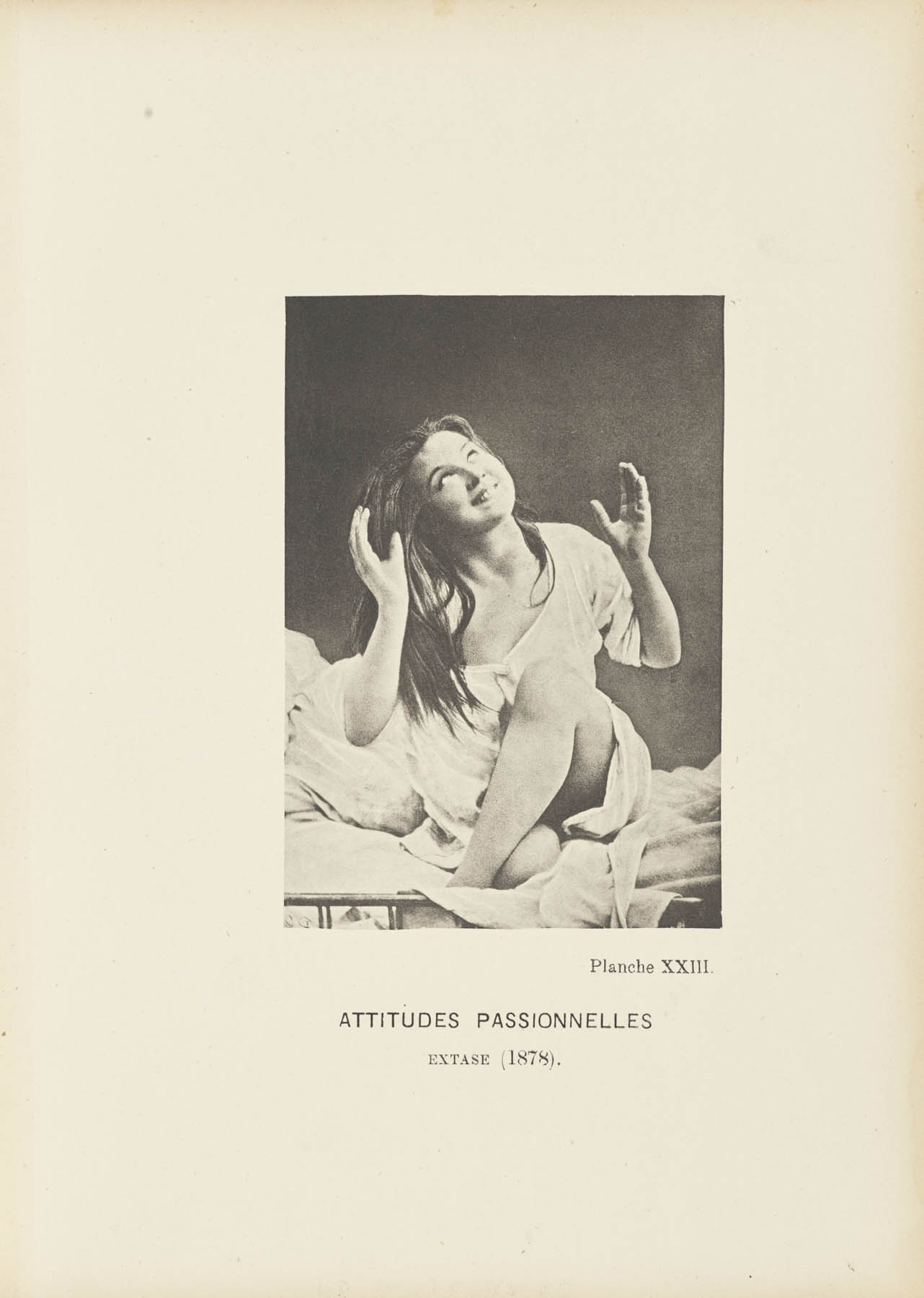
At left, Paul-Marie-Léon Regnard (French, 1850-1927) 'Passionate Ecstatic Position/Expression' 1878; and at right, Laura Larson (American, b. 1965) 'The Mind Is a Muscle' 2019


At left, Paul-Marie-Léon Regnard (French, 1850-1927) Passionate Ecstatic Position/Expression 1878; and at right, Laura Larson (American, b. 1965)
The Mind Is a Muscle 2019


Paul-Marie-Léon Regnard (French, 1850-1927) 'Passionate Ecstatic Position/Expression' 1878 Part of 'Iconographie Photographique de la Salpetriere' (Service de M. Charcot)


Paul-Marie-Léon Regnard (French, 1850-1927)
Passionate Ecstatic Position/Expression
1878
Part of Iconographie Photographique de la Salpetriere (Service de M. Charcot)
Photogravure
Image: 10.3 × 7.1cm (4 1/16 × 2 13/16 in.)
The J. Paul Getty Museum, Los Angeles


Laura Larson (American, b. 1965) 'The Mind Is a Muscle' 2019


Laura Larson (American, b. 1965)
The Mind Is a Muscle
2019
from the series City of Incurable Women
Inkjet print
The J. Paul Getty Museum, Los Angeles
Courtesy of and © Laura Larson


At first glance, photographs made in the 19th century may seem like faded relics of an increasingly distant and forgotten age, yet they persist in inspiring, challenging, and resonating with artists today.

Nineteenth-Century Photography Now, on view April 9 through July 7, 2024 at the Getty Center, offers new perspectives on early photography by looking through the lens of contemporary artists who respond directly to their historical themes and subject matter.

“This exhibition provides an opportunity to connect visitors with some of the earliest photographs in the Museum’s collection, now almost two centuries old, via the responses of contemporary makers,” says Timothy Potts, Maria Hummer-Tuttle and Robert Tuttle Director of the J. Paul Getty Museum. “The revelatory ability of early photography to capture images of the world around us still resonates with practitioners today, and bridges between past and present photography are as active and relevant as they have ever been.”

Organised around five themes, dating back to the medium’s beginnings, Identity, Time, Spirit, Landscape, and Circulation, this exhibition explores 19th-century photographs through the work of 21 contemporary artists. Reflecting the inventiveness of early practitioners as well as the more disturbing historical aspects of their era, these interchanges between the first decades of the medium and the most recent invite us to reimagine 19th century photography while exploring its complexities.

In their work, artists Daido Moriyama, Hanako Murakami, and Carrie Mae Weems look back to the invention of photography to convey a sense of how this revolutionary discovery changed people’s perceptions.

As is still the case today, the most popular subjects for the camera in the 19th century were people. In the galleries focused on Identity, Paul Mpagi Sepuya and Myra Greene respond to the complex history of photographic portraiture while Laura Larson, Stephanie Solinas, and Fiona Tan investigate the pseudosciences of the 19th century and how they reinforced stereotypes and identification systems that impact us today.

Photography and Time have been inextricably linked ever since early inventors struggled to permanently fix a fleeting moment on a sheet of paper. This section includes work by Lisa Oppenheim and Liz Deschenes exploring 19th-century photographers’ technical innovations and the ways in which the medium affects our perception of time.

The genre of Spirit photography emerged from the Victorian obsession with death in Europe and North America. Photographers exploited the ability to manipulate photographic images, employing multiple exposures and staged photography to create otherworldly scenes or to summon loved ones back from the dead. In this section, Khadija Saye and Lieko Shiga respond to the possibilities that spirit photography offers in rendering the unseen.

19th-century photographers went to great lengths to make images of remote Landscapes. Government-sponsored surveys and expeditionary programs employed the camera to justify the expansion and to record the resulting military conflicts. Mark Ruwedel, Michelle Stuart, and An-My Lê re-envision some of these same historical landscapes and offer up new ones that bring the past closer to our present.

By the middle of the 19th century, thousands of photographs were in Circulation worldwide, the result of photographers’ ability to reproduce the same image multiple times. Pictures of historical events, tourist destinations, and anthropological expeditions made the world seem more accessible, but with time and distance, they became disconnected from their original contexts. In this section, early photographs appear next to projects that make these historical absences present. Wendy Red Star, Stephanie Syjuco, Ken Gonzales-Day, and Andrea Chung recover what has been lost, calling out the residual effects of the 19th-century photograph on our present knowledge of global cultures and histories.

“Through the works of these visionary contemporary artists, 19th-century photography is not faded and dead but very much alive, an active material that enables us to rethink the medium and our relationship to it,” says Karen Hellman, curator of the exhibition.

Nineteenth-Century Photography Now is curated by Karen Hellman, former associate curator in the Department of Photographs. Carolyn Peter, assistant curator in the Department of Photographs, Getty Museum, served as organising curator with assistance from Claire L’Heureux, former Department of Photographs graduate intern and Antares Wells, curatorial assistant.

Related programming includes Who or What is Missing in Nineteenth-Century Photography?, a discussion featuring artists Laura Larson, Wendy Red Star, and Paul Mpagi Sepuya in a conversation about their artistic practices and how they are engaging with, and critiquing photography from the 19th century, and Art Break: The Precarious Nature of Photography, Society, and Life, June 6, 12pm. Artist Phil Chang talks with curator Carolyn Peter about his series “Unfixed” on view in Nineteenth-Century Photography Now and how an economic crisis and a pandemic inspired him to create photographs that will intentionally fade away to express the fragility of societal systems and life.

Press release from the J. Paul Getty Museum website


Introduction


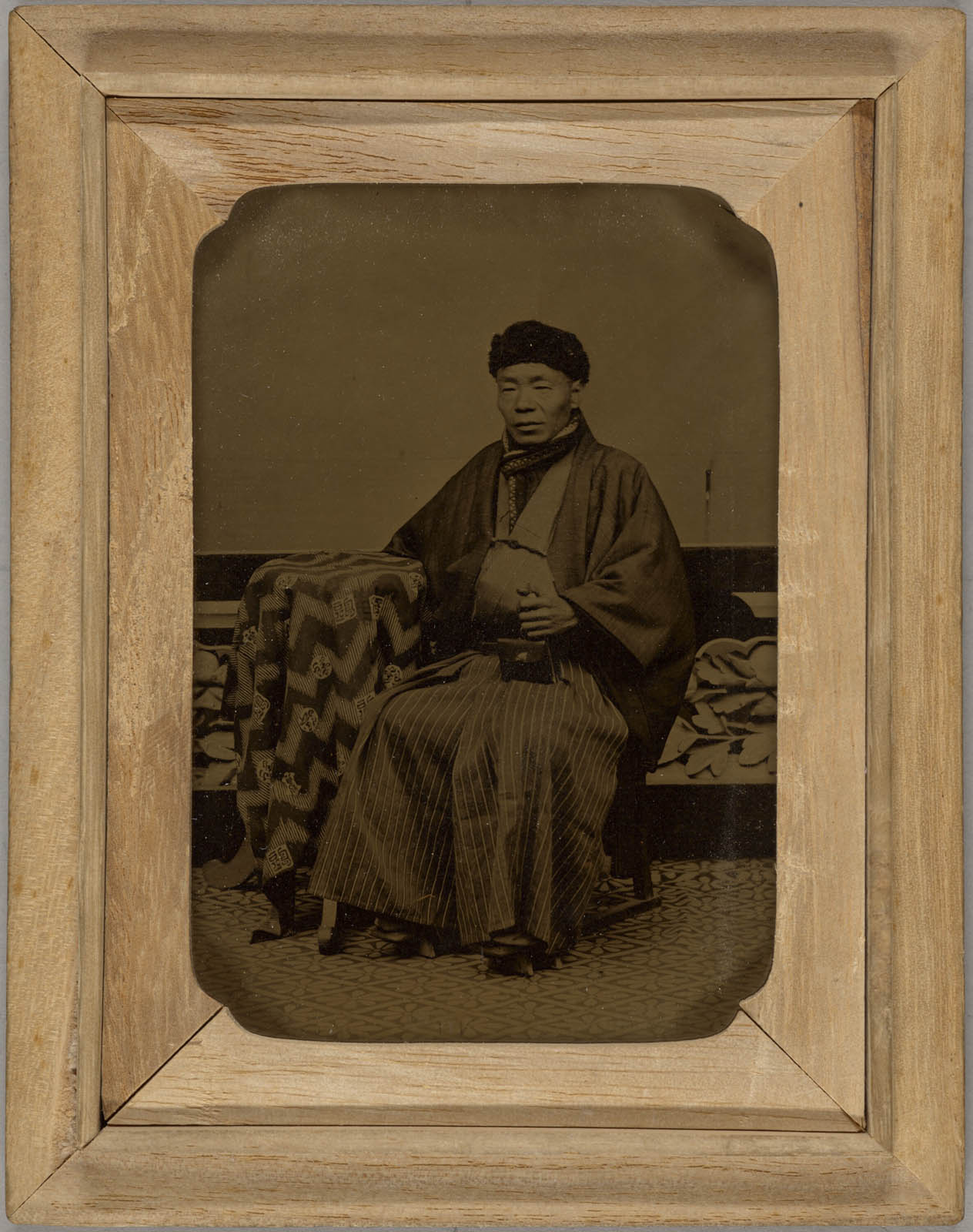
At left, Maker unknown. 'Kuroda Yasaburo, 50 Years Old' January 6, 1882; and at right, Myra Greene (American, b. 1975) 'Undertone #10' 2017-2018


At left, Maker unknown Kuroda Yasaburo, 50 Years Old January 6, 1882; and at right, Myra Greene (American, b. 1975) Undertone #10 2017-2018


Introduction

The earliest photographs – often associated with small, faded, sepia-toned images – may seem to belong to a bygone era, but many of the conventions established during photography’s earliest years persist today. Organised around five themes dating back to the medium’s beginnings, this exhibition explores nineteenth-century photographs through the work of twenty-one contemporary artists. Reflecting the inventiveness of early practitioners as well as the more disturbing historical aspects of their era, these interchanges between the first decades of the medium and the most recent invite us to reimagine nineteenth-century photography while exploring its complexities.


Maker unknown. 'Kuroda Yasaburo, 50 Years Old' January 6, 1882


Maker unknown
Kuroda Yasaburo, 50 Years Old
January 6, 1882
Ambrotype
Closed: 11.5 × 9 × 1cm (4 1/2 × 3 9/16 × 3/8 in.)
The J. Paul Getty Museum, Los Angeles
Gift of Virginia Heckert in memory of Gordon Baldwin


Myra Greene (American, b. 1975) 'Undertone #10' 2017-2018


Myra Greene (American, b. 1975)
Undertone #10
2017-2018
Ambrotype
The J. Paul Getty Museum, Los Angeles
© Myra Greene


__________________________________________

Identity


At left, Various makers. 'Pickpockets at the Universal Exposition of 1889' 1889; and at right, Fiona Tan (Indonesia, b. 1966) 'Marie Thiriot' 2021


At left, Various makers Pickpockets at the Universal Exposition of 1889 1889; and at right, Fiona Tan (Indonesia, b. 1966) Marie Thiriot 2021


Fiona Tan (Indonesia, b. 1966) 'Marie Thiriot' 2021


Fiona Tan (Indonesia, b. 1966)
Marie Thiriot
2021
From the series Pickpockets
HD video installation, stereo, flat-screen monitor
Courtesy of the artist and Frith Street Gallery, London
© Fiona Tan
Photo: Frith Street Gallery CC


‘As an artist working almost entirely with time-based and lens-based media, time is one of my major tools … time is both tool with which to shape and chisel and material to fold, distort and configure.’

Fiona Tan (b. 1966, Pekanbaru) explores history and time and our place within them, working within the contested territory of representation. Deeply embedded in all of Tan’s works is her fascination with the mutability of identity, the deceptive nature of representation and the play of memory across time and space in a world increasingly shaped by global culture. She investigates how we represent ourselves and the mechanisms that determine how we interpret the representation of others. …

A testament to Tan’s passion for archives, her video installation Pickpockets (2020) stems from an album of photographs she came across when in residence at the Getty Research Center, Los Angeles. It contained early examples of mugshots taken of pickpockets apprehended at the World’s Fair in Paris in 1889. Fascinated by the subjects of these portraits, their names and countries of origin, and their unknown stories, she invited a group of writers to devise monologues from the point of view of these individuals, which were then performed and recorded by actors.

Anonymous. “Fiona Tan,” on the Frith Street Gallery website Nd [Online] Cited 29/04/2024


[The identity section] has “Affaire Alaux, Faubourg St. Honoré – L’Assassin” (Nov. 2, 1902), a print by Alphonse Bertillon, the inventor of the mug shot, showing the mustached villain full-face and in profile; it is accompanied by over 20 pictures of sites that played a significant role in Bertillon’s life taken in 2012 by Stéphanie Solinas employing a “crime scene” approach.

William Meyers. “Photography’s Past and Present at the Getty Center,” on The Wall Street Journal website May 29, 2024 [Online] Cited 16/06/2024


At left, Attributed to Alphonse Bertillon (French, 1853-1914) 'Affaire Alaux, Faubourg St. Honoré – L'Assassin' November 2, 1902; and at right, Stéphanie Solinas (French, b. 1978) 'Untitled (M. Bertillon) – Two Faces' 2012


At left, Attributed to Alphonse Bertillon (French, 1853-1914) Affaire Alaux, Faubourg St. Honoré – L’Assassin November 2, 1902; and at right, Stéphanie Solinas (French, b. 1978) Untitled (M. Bertillon) – Two Faces 2012


Identity

As is still the case today, the most popular subjects for the camera in the nineteenth century were people. Early commercial portrait photographers set up studios and established standards for posing and props, serving clients who eagerly shared these prized images with family and friends. Other portraits of the time, however, such as the mug shot and studies of female “hysterics,” reinforced questionable forms of objectification. Paul Mpagi Sepuya and Myra Greene respond to the complex history of photographic portraiture. Fiona Tan, Laura Larson, and Stéphanie Solinas investigate the nineteenth century pseudosciences that relied on the perceived accuracy of the new medium.


Attributed to Alphonse Bertillon (French, 1853-1914) 'Affaire Alaux, Faubourg St. Honoré – L'Assassin' November 2, 1902


Attributed to Alphonse Bertillon (French, 1853-1914)
Affaire Alaux, Faubourg St. Honoré – L’Assassin
November 2, 1902
Gelatin silver print
Image: 7.9 × 12.7cm (3 1/8 × 5 in.)
The J. Paul Getty Museum, Los Angeles


The mugshot of Henri-Léon Scheffer, the man who murdered Joseph Reibel.


CAUGHT BY A FINGER PRINT

A unique piece of detective work has been accomplished in Paris by a retiring scientist. A mysterious murder had been committed. The detectives arrested one wrong man dis charged him, and were preparing .to arrest another when to their chief came the quiet scientist, saying,

“The assassin’s name is Henri Léon Scheffor. Here is his photograph, his description and past record.” M. Cochefert, chief of the police hesitated. “My men know nothing of this person.” he said. “How shall we accuse him ?”

“Arrest him,” insisted the other, “and should he prove to innocent I will pay him 1,000 francs as an indemnity.”

“But what basis have you for your certainty of his guilt ?” asked M. Cochefert.

“Some finger prints he left on a piece of broken glass,” replied the man of science.

It was not necessary to pay the indemnity. He who was thus strangely accused was arrested and confessed his crime. The quiet man of science was M. Alphonse Bertillon, already celebrated as the founder and present chief of tho anthropometric service of tho Paris prefecture of police. Alphonse Bertillon has the gentle, weary smile of the over-worked and nervous student. He speaks mildly, moves softly, like one on his guard against strain and haste, until now and again, his thoughtful face will light up with enthusiasm as he lets himself go. Then his conversation becomes rapid and eloquent ; he runs through books and documents with ardour, pulls down boxes from high shelves, spreads out charts, explains them, performs experiments to illustrate his statements and darts back by a short cut to tho point where he had left off; tho whole man is transformed. Thus we heard the tale of the Accusing Finger Prints.

“A man named Joseph Reibel, porter to tho dentist Allaux, in his apartment and offices in the Rue du Faubourg Saint-Honore, was found choked to death and clumsily tied, lying in his master’s office,” began M. Bertillon. “The place had been looted hastily, closets and drawers being open and their contents tossed about. In particular a handsome cabinet holding a collection of coins was found with its glass door broken and its gold coins absent. There were- practically no clues to the identity of the assassin, the janitress at the street door, having a confused memory as to visitors, which set the detectives on more than one wrong scent. They arrested one man and the papers published his portrait. Then the newspapers at least began to suspect the innocent dentist himself.

“They had taken a flashlight photograph of the office,” continued M. Bertillon. “Looking at that photograph one day, I noticed two glittering little white marks on the edge of the broken glass of the coin cabinet. I asked my self what they could be. They might be defects in the printing ; but, on the other hand their situation suggested that they might be finger prints – and finger-prints are very much in my line ! The thought wore upon me until at last I jumped into a cab and drove to tho place. Examining the edge of the glass I found tho marks to be really finger-marks, and in spite of the thousand chances still in good condition.

“Being composed of tiny quantities of grease and dirt they made the glass slightly opaque, so that they came out bright by contrast in the photograph. Except when looked at in a favourable light they were practically invisible to the naked eye. There were marks of a right-hand thumb in one place and of the same thumb and four fingers in another. I had the two pieces of glass cut out with a diamond. I gave one to a policeman, instructing him to hold it just so, and saw him start off to my office with it in a cab. Then I gave tho other piece to a second policeman, with the same instructions, and started him off in a second cab, so that if an accident should happen to one of the pieces the other might be spared.

“In the workrooms of the anthropometric service I had the finger-marks immediately photographed. At first I admit I did not attach overmuch importance to them. They might be the prints of one of the detectives, or of the dentist Allaux – naturally solicitous of his broken cabinet – or even the finger-prints of M. Cochefert ! One by one I took their finger-prints for comparison. One by one I found that they did not at all correspond with those on the glass. This started me in earnest,” admitted M. Bertillon. “I began to ask myself, if among the thousands of criminals, swindlers and violent and suspicious characters photo-graphed, measured, and, finger-printed yearly by the anthropometric service the author of these finger-prints might not, at some time or other, himself have passed.” Here M. Bertillon called our attention to the thumb mark (“pouce”) of Scheffer, the assassin, Just below his full-face and profile photographs. Though small it was very distinct.

“Look at the central point of that thumb-print,” he exclaimed. “Look where the innermost loop moves up and over a single diagonal. Now jumping two loops from that interior diagonal, towards tho direct left you see a plain little fork in tho third loop. It is the exact reproduction of just such another in the thumb-mark on the broken glass ! Tho next thing was to arrest Scheffer though it took a little time to find him. Here, again, the information obtainable from his ‘fiche’ in the anthropometric service rendered service. It was seen that he had been a native of Aubervilliers (the Paris suburb and had worked in the government match factory. When arrested he confessed, at the same time trying to make out a case of extenuating circumstances. According to his story, Reibel planned that they should simulate a burglary of his master’s premises. They quarrelled over the division of the spoils and Scheffer says he thought he had merely choked his friend into un-consciousness and left him tied – according to original agreement. And all discovered through an accidental finger-print which the assassin had left as an index to the crime. “Science Siftings.”

Anonymous. “Caught by a Finger Print,” in the Balmain Observer and Western Suburbs Advertiser (NSW: 1884-1907), Sat 4 Mar 1905, Page 2 on the Trove website [Online] Cited 29/04/2024

__________________________________________

Time


Gustave Le Gray (French, 1820-1884) 'An Effect of Sunlight – Ocean No. 23' 1857-1858


Gustave Le Gray (French, 1820-1884)
An Effect of Sunlight – Ocean No. 23
1857-1858
Albumen silver print from glass negatives
12 5/8 × 16 7/16 in.
The J. Paul Getty Museum, Los Angeles


Lisa Oppenheim (American, b. 1975) 'An Effect of Sunlight – Ocean No. 23 (1857/2019)' 2019


Lisa Oppenheim (American, b. 1975)
An Effect of Sunlight – Ocean No. 23 (1857/2019)
2019
Gelatin silver print, exposed to sunlight and toned with silver
Framed [Outer Dim]: 35.6 × 47.7 × 3.7cm (14 × 18 3/4 × 1 7/16 in.)
The J. Paul Getty Museum, Los Angeles
© Lisa Oppenheim


Time

Photography and time have been inextricably linked ever since early inventors such as William Henry Fox Talbot struggled to permanently fix a fleeting moment on a sheet of paper. The development of the camera coincided with new discoveries about how we perceive an instant in time or an object in motion, and people praised photography for its ability to “stop time” and record what the unaided eye could not see. Lisa Oppenheim and Liz Deschenes respond to nineteenth century photographers’ technical innovations and the ways in which the medium affects our perception of time. Phil Chang and Hiroshi Sugimoto address the fate of photographs across minutes or even centuries.


At left, Étienne-Jules Marey (French, 1830-1904) and Michel Berthaud (French, active 1860s-1880s) 'Walking/Running' (La Marche/La Course Rapide) about 1890, published 1893; and at right, Liz Deschenes (American, b. 1966) 'FPS (120)' 2018-2021


At left, Étienne-Jules Marey (French, 1830-1904) and Michel Berthaud (French, active 1860s-1880s) Walking/Running (La Marche/La Course Rapide) about 1890, published 1893; and at right, Liz Deschenes (American, b. 1966) FPS (120) 2018-2021


Étienne-Jules Marey (French, 1830-1904) and Michel Berthaud (French, active 1860s-1880s) 'Walking/Running' (La Marche/La Course Rapide) about 1890, published 1893


Étienne-Jules Marey (French, 1830-1904) and Michel Berthaud (French, active 1860s-1880s)
Walking/Running (La Marche/La Course Rapide)
about 1890, published 1893
Collotype
Image: 11.3 × 17.6cm (4 7/16 × 6 15/16 in.)
The J. Paul Getty Museum, Los Angeles

__________________________________________

Spirit


At left, William H. Mumler (American, 1832-1884) 'Mrs. Swan' 1869-1878; and at right, Khadija Saye (Gambian-British, b. 1992) 'Nak Bejjen' [Cow's Horn] 2017-2018


At left, William H. Mumler (American, 1832-1884) Mrs. Swan 1869-1878; and at right, Khadija Saye (Gambian-British, b. 1992) Nak Bejjen [Cow’s Horn] 2017-2018


Spirit

The genre of spirit photography – which used photographic tricks to insert ghostly figures among the living – emerged during the nineteenth century from the Victorian obsession with death, séances, and mediums in Europe and North America and from the losses of the Civil War in the United States. Photographers exploited the ability to manipulate photographic images, employing multiple exposures and staged photography to create otherworldly scenes or to summon loved ones back from the dead. Khadija Saye and Lieko Shiga respond to the possibilities that spirit photography offers in rendering the unseen.


William H. Mumler (American, 1832-1884) 'Mrs. Swan' 1869-1878


William H. Mumler (American, 1832-1884)
Mrs. Swan
1869-1878
Albumen silver print
Image: 8.9 × 5.7cm (3 1/2 × 2 1/4 in.)
The J. Paul Getty Museum, Los Angeles
Public domain


Khadija Saye (Gambian-British, b. 1992) 'Nak Bejjen' [Cow's Horn] 2017-2018


Khadija Saye (Gambian-British, b. 1992)
Nak Bejjen [Cow’s Horn]
2017-2018
From the series in this space we breathe
Silkscreen print
The J. Paul Getty Museum, Los Angeles
Purchased with funds provided by the Photographs Council
© Estate of Khadija Saye


At left, Unknown maker (American) '[Seated Woman with "Spirit" of a Young Man]' about 1865-1875; and at right, Lieko Shiga (Japanese, b. 1980) 'Talking with Me' 2005 From the series 'Lilly'


At left, Unknown maker (American) [Seated Woman with “Spirit” of a Young Man] about 1865-1875; and at right, Lieko Shiga (Japanese, b. 1980) Talking with Me 2005 From the series Lilly


Unknown maker (American) '[Seated Woman with "Spirit" of a Young Man]' about 1865-1875


Unknown maker (American)
[Seated Woman with “Spirit” of a Young Man]
about 1865-1875
Tintype
Image: 8.7 × 6.4cm (3 7/16 × 2 1/2 in.)
The J. Paul Getty Museum, Los Angeles


Lieko Shiga (Japanese, b. 1980) 'Talking with Me' 2005


Lieko Shiga (Japanese, b. 1980)
Talking with Me
2005
From the series Lilly


‘Lilly’ is a photographic essay that was initiated in 2005 when Lieko Shiga was living in London. During that period she produced a series of images of her neighbours that lived alongside her in a block of East London council flats, drawing techniques and inspiration from paranormal photographs that were popular in the early days of photography. Haunting, mysterious, playful and captured in an array of muted colours, the photographs [are] grouped around different subjects…

Publisher’s Description

__________________________________________

Landscape


At left, Roger Fenton (English, 1819-1869) 'Plateau of Sebastopol II' 1855; and at right, An-My Lê (Vietnamese American, b. 1960) 'Security and Stabilization Operations, Iraqi Police' 2003-2004


At left, Roger Fenton (English, 1819-1869) Plateau of Sebastopol II 1855; and at right, An-My Lê (Vietnamese American, b. 1960) Security and Stabilization Operations, Iraqi Police 2003-2004


Roger Fenton (English, 1819-1869) 'Plateau of Sebastopol II' 1855


Roger Fenton (English, 1819-1869)
Plateau of Sebastopol II
1855
Albumen silver print
Image: 22.2 × 34.4cm (8 3/4 × 13 9/16 in.)
The J. Paul Getty Museum, Los Angeles
Public domain


An-My Lê (Vietnamese-American, b. 1960) 'Security and Stabilization Operations, Iraqi Police' 2003-2004


An-My Lê (Vietnamese American, b. 1960)
Security and Stabilization Operations, Iraqi Police
2003-2004
From the series 29 Palms
Gelatin silver print
The J. Paul Getty Museum, Los Angeles
Courtesy of the artist and Marian Goodman Gallery
© An-My Lê


Landscape

Nineteenth-century photographers went to great lengths to make images of remote landscapes, which required traveling with large format cameras, glass plates, and chemicals. Ideological forces drove many of these journeys, with the ultimate goal of imperial expansion through industrial development and war. Government sponsored surveys and expeditionary programs employed the camera to justify the expansion and to record the resulting military conflicts. Mark Ruwedel, Michelle Stuart, and An-My Lê re-envision some of these same historical landscapes and offer up new ones that bring the past closer to our present.


At left, Timothy O'Sullivan (American, about 1840-1882) 'Desert Sand Hills Near Sink of Carson, Nevada' 1867; and at right, Michelle Stuart (American, b. 1933) 'Timeless Land' 2021


At left, Timothy O’Sullivan (American, about 1840-1882) Desert Sand Hills Near Sink of Carson, Nevada 1867; and at right, Michelle Stuart (American, b. 1933) Timeless Land 2021


Timothy O'Sullivan (American, about 1840-1882) 'Desert Sand Hills Near Sink of Carson, Nevada' 1867


Timothy O’Sullivan (American, about 1840-1882)
Desert Sand Hills Near Sink of Carson, Nevada
1867
Albumen silver print
The J. Paul Getty Museum, Los Angeles
Public domain


Timothy O’Sullivan’s darkroom wagon, pulled by four mules, entered the frame at the right side of the photograph, reached the center of the image, and abruptly U-turned, heading back out of the frame. Footprints leading from the wagon toward the camera reveal the photographer’s path. Made at the Carson Sink in Nevada, this image of shifting sand dunes reveals the patterns of tracks recently reconfigured by the wind. The wagon’s striking presence in this otherwise barren scene dramatises the pioneering experience of exploration and discovery in the wide, uncharted landscapes of the American West.

O’Sullivan’s photographs from the 1867 Geological Exploration of the Fortieth Parallel expedition were intended to provide information for the purpose of expanding railroads and industry, yet they demonstrate his eye for poetic beauty.

Text from the J. Paul Getty Museum website


Michelle Stuart (American, b. 1933) 'Timeless Land' 2021


Michelle Stuart (American, b. 1933)
Timeless Land
2021
Ambrotypes
The J. Paul Getty Museum, Los Angeles
Purchased with funds provided by the Photographs Council
© Michelle Stuart


A.J. Russell (American, 1830-1902) 'Embankment No. 3 West of Granite Cannon [Wyoming]' April 1868


A.J. Russell (American, 1830-1902)
Embankment No. 3 West of Granite Cannon [Wyoming]
April 1868
Albumen silver print
Image: 21.9 × 29.4 cm (8 5/8 × 11 9/16 in.)
Mount: 34.1 × 43.1 cm (13 7/16 × 16 15/16 in.)
The J. Paul Getty Museum, Los Angeles


Mark Ruwedel (American/Canadian, b. 1954) 'Union Pacific #67 (after A.J. Russell)' 1996


Mark Ruwedel (American/Canadian, b. 1954)
Union Pacific #67 (after A.J. Russell)
1996
Gelatin silver print
Image: 18.9 × 23.9cm (7 7/16 × 9 7/16 in.)
The J. Paul Getty Museum, Los Angeles
© Mark Ruwedel


Mark Ruwedel’s statement in a wall text notes that “The legacy of nineteenth-century expeditionary photography was most important to me when working on my Westward series.” He cites Timothy O’Sullivan, Alexander Gardner and A.J. Russell. The Landscape section has a print by A.J. Russell, “Embankment No. 3 West of Granite Cannon. [Wyoming]” (April 1868), and seven pictures by Mr. Ruwedel: “Union Pacific #39 (After A.J. Russell)” and “Union Pacific #67 (After A.J. Russell)” (1994 and 1996, respectively) and five others with no specific acknowledgments but clearly influenced by his 19th-century mentors.

William Meyers. “Photography’s Past and Present at the Getty Center,” on The Wall Street Journal website May 29, 2024 [Online] Cited 16/06/2024


At left, Carleton Watkins (American, 1829-1916) 'Cathedral Spires – Yo Semite' 1861; and at right, Ken Gonzales-Day (American, b. 1964) 'At daylight the miserable man was carried to an oak…' Negative 2002; print 2021


At left, Carleton Watkins (American, 1829-1916) Cathedral Spires – Yo Semite 1861; and at right, Ken Gonzales-Day (American, b. 1964) At daylight the miserable man was carried to an oak… Negative 2002; print 2021


Carleton Watkins (American, 1829-1916) 'Cathedral Spires – Yo Semite' 1861


Carleton Watkins (American, 1829-1916)
Cathedral Spires – Yo Semite
1861
Albumen silver print
Image (Dome-Topped): 52.2 × 40.3cm (20 9/16 × 15 7/8 in.)
The J. Paul Getty Museum, Los Angeles


When Carleton Watkins photographed the remote Yosemite wilderness, America was not yet a century old. Conscious of their country’s lack of a national cultural identity, Americans adopted particularly dramatic geologic formations such as Cathedral Spires as their version of ancient ruins and soaring Gothic churches. The great pine tree in the foreground here became another form of this uniquely American history. Watkins’s images helped define America’s preference for landscape views depicting rugged wilderness and celebrating spectacular landforms on the grandest of scales.


Ken Gonzales-Day (American, b. 1964) 'At daylight the miserable man was carried to an oak…' Negative 2002; print 2021


Ken Gonzales-Day (American, b. 1964)
At daylight the miserable man was carried to an oak…
Negative 2002; print 2021
From the series Searching for California’s Hang Trees
Pigment print
Image: 92.7 × 117.5cm (36 1/2 × 46 1/4 in.)
© Ken Gonzales-Day

This print: Smithsonian American Art Museum, Museum purchase through the Luisita L. and Franz H. Denghausen Endowment


Through meticulous research, Gonzales-Day documented approximately 350 lynching incidents that occurred in California between 1850 and 1935, most of which involved victims of Mexican descent. To create the series Searching for California Hang Trees, the artist visited many of these sites and captured the likeness of trees that may have borne witness to these events. Gonzales-Day’s landscapes unearth traces of this little-known history.

Our America: The Latino Presence in American Art, 2013

__________________________________________

Circulation


Charles M. Bell (American, 1848-1893) 'Manulitó, Chief of the Navajos' 1874


Charles M. Bell (American, 1848-1893)
Manulitó, Chief of the Navajos
1874
Albumen silver print
Image (Arched): 18.4 × 14.9cm (7 1/4 × 5 7/8 in.)
The J. Paul Getty Museum, Los Angeles
Public domain


Wendy Red Star (American/Apsáalooke, b. 1981) 'Peelatchiwaaxpáash / Medicine Crow (Raven)' 2014


Wendy Red Star (American/Apsáalooke, b. 1981)
Peelatchiwaaxpáash / Medicine Crow (Raven)
2014
From the series Crow Peace Delegation
Inkjet print
Nasher Museum of Art at Duke University
Museum purchase with funds provided by Jennifer McCracken New and Jason G. New
© Wendy Red Star
Image courtesy of the Nasher Museum of Art


Artist-manipulated digitally reproduced photograph by C.M. (Charles Milton) Bell, National Anthropological Archives, Smithsonian Institution, 24 x 16 9/20 inches


Circulation

By the middle of the nineteenth century, thousands of photographs were in circulation worldwide, the result of photographers’ ability to reproduce the same image multiple times. Pictures of historical events, tourist destinations, and anthropological expeditions made the world seem more accessible, but with time and distance, they became disconnected from their original contexts. Many eventually ended up in archives (including at Getty). Early photographs appear next to projects that make these historical absences present. Wendy Red Star, Stephanie Syjuco, Ken Gonzales-Day, and Andrea Chung recover what has been lost, calling out the residual effects of the nineteenth-century photograph on our present knowledge of global cultures and histories.

Text from the J. Paul Getty Museum


At left, Anna Atkins (British, 1799-1871) possibly with Anne Dixon (British, 1799-1877) 'Ceylon/Fern' about 1854; and at right, Andrea Chung (American, b. 1978) 'Untitled' 2016


At left, Anna Atkins (British, 1799-1871) possibly with Anne Dixon (British, 1799-1877) Ceylon/Fern about 1854; and at right, Andrea Chung (American, b. 1978) Untitled 2016


Anna Atkins (British, 1799-1871) possibly with Anne Dixon (British, 1799-1877) 'Ceylon/Fern' about 1854


Anna Atkins (British, 1799-1871) possibly with Anne Dixon (British, 1799-1877)
Ceylon/Fern
about 1854
Cyanotype
Image: 34.8 × 24.7cm (13 11/16 × 9 3/4 in.)
Sheet: 48.3 × 37.5cm (19 × 14 3/4 in.)
The J. Paul Getty Museum, Los Angeles
Public domain


Cyanotypes of British and Foreign Flowering Plants

After completing the highly ambitious, decade-long project Photographs of Blue Algae: Cyanotype Impressions in the summer of 1853, Anna Atkins turned to new botanical subjects. She would eventually produce several unique presentation albums with cyanotypes of ferns and flowering plants. Atkins most likely collaborated on these albums with her dear friend, Anne Dixon. Dixon came to Halstead Place for an extended stay in the summer of 1852 to comfort Atkins who was deeply shaken by the death of her father and frequent scientific partner John George Children earlier that year. Photo historian Larry Schaaf suggests that it was during this stay or perhaps one the next summer that Dixon began assisting Atkins and creating her own cyanotypes. Thus, it becomes difficult to know whether surviving works from this time period were created by Atkins, Dixon, or both.1

These seven pieces in the J. Paul Getty Museum Collection (figs. 1-7) were extracted from an 1854 presentation album Cyanotypes of British and Foreign Flowering Plants given by Anna Atkins to Anne Dixon in 1854. The album remained intact until sometime around 1981, when it was broken up after being sold at auction.

Atkins and Dixon shared a deep interest in botany, a science that was considered well suited to women since it could be studied locally, even in one’s own garden. Serious “lady botanists” could join the Botanical Society in London, one of the first scientific organisations to admit women. Atkins joined in 1839. The two friends’ interest in botany is documented in a letter of 1851 from Children to Sir William Hooker in which he discussed the two women’s longtime plant collecting. Later, in a letter that Atkins wrote to Hooker in 1864, she extended an offer from Dixon to send him samples of any of the plants from her own collection.2

Carolyn Peter, J. Paul Getty Museum, Department of Photographs
2019
© J. Paul Getty Trust
Creative Commons Attribution 4.0 International License

1/ Larry Schaaf, Sun Gardens: Cyanotypes by Anna Atkins (New York: The New York Public Library, 2018), 77
2/ Ibid, 80


Andrea Chung (American, b. 1978) 'Untitled' 2016


Andrea Chung (American, b. 1978)
Untitled
2016
From the series Anthropocene
Cyanotypes
The J. Paul Getty Museum, Los Angeles
© Andrea Chung


Anna Atkins was a 19th-century botanist who documented plant specimens to make the world’s first photo book.

Today, artist Andrea Chung makes images of lionfish. Invasive to the Caribbean, they stand as a metaphor for the impact of colonisation in the region.

Text and photograph from the Getty Museum X web page


The J. Paul Getty Museum
1200 Getty Center Drive
Los Angeles, California 90049

Opening hours:
Daily 10am – 5pm

The J. Paul Getty Museum website

LIKE ART BLACK ON FACEBOOK

Back to top

Review: ‘Julie Millowick: Surrounding’ at the Castlemaine Art Museum

Exhibition dates: 15th February – 16th June 2024

Curator: Jenny Long


Installation view of the exhibition 'Julie Millowick: Surrounding' at the Castlemaine Art Museum


Installation view of the exhibition Julie Millowick: Surrounding at the Castlemaine Art Museum
Photo: Marcus Bunyan


Down with Earth

This is a magnificent exhibition by Australian photographer Julie Millowick (b. 1948) which documents “the environmental legacy of gold mining around her home near Fryerstown in Central Victoria, capturing the beauty of this landscape in tumult and recovery.” (Wall text)

What I admire about the work in the exhibition (other than photographs that evidence the persistence of an inquiry into one subject, the result of 34 years of visual and intellectual exploration), is the way that the photographs envelop you in the gallery space. It’s as if the accumulation of images over decades creates a nurturing story which comforts you in the gallery space: that the landscape so desecrated will heal itself, will spring forth anew. The sustained investigation into the landscape around Fryerstown captured my soul.

The exhibition is beautifully constructed, rendered, seen, so very quiet yet so powerful. On every wall of the gallery there is an intimate story, told through remarkable photographs of the Australian bush that combine light and dark, near and far, low and high perspective (the raising and lowering of the horizon line) and the feeling of claustrophobia and expansiveness within the same environment: photographs of mullock heaps and mine sites with open sky and residual left-over soil or rock from the shaft excavation process. Shadows of trees obscure abandoned mine shafts which litter the landscape, traps for the unwary who go wandering, or is that wondering, through the bush. And through Millowick’s lens, this landscape is all about the wonder of the landscape and its rejuvenative potential.

In this unsettling place which continually transforms through drought and rain, human mining, erosion and regeneration we can observe in Millowick’s photographs the strength and transformative qualities of nature. It may seem strange (and probably is) but I argue that the Australian bush presented here is a heterotopic space (Foucault), a landscape outside the normality of the everyday (although any landscape with human intervention is not “natural” but always a constructed space), one that is somehow “other”: disturbing, intense, contradictory and transforming, a landscape which mirrors the outside world yet upsets that representation due to its un/settling, its mining and ecological past – creating a space which changes from day to day, month to month – growing, contracting, evidencing human interaction and touch, but then outgrowing human interference.

The spaces that the artist envisions in her beautiful micro / macro, order / chaos photographs picture something unusual: the imaginative wish for of a utopian world that could never exist in the first place and a dystopian, illusionary world in the process of healing itself (possibly), the very definition of a heterotopic space. As the characters in Fallout Season 1 observe, “Time is the apex predator” … and through time, nature will hopefully outlive all human beings to again become something belonging solely to the Earth, to again become something “natural” (existing in or derived from nature; not made or caused by humankind).

Millowick’s photographs also picture something else: photography as an exposition of the self. As the artist Ans Westra observes, photography should not be “solely controlled by the brain. Your personality, subconscious, flows through […] you have to allow it to come through […] for the outcome to be relevant.”1 Ultimately, she said, photography was “always an exposition of self.” Such is the energy with the photographs of this artist, also.

Through wonder, respect and the grounding of spirit in Earth, Millowick has sustained a bond and an understanding in her fascination with this subject, a sensitivity to subject nurtured over so many years which “invites viewers to appreciate them [the photographs] as a poetic connection to, and love for, the landscape” side by side with a conceptual thinking or intellectualisation about the land. In their containment of energy, in their penetrating into life and its things, these photographs contribute something to our life and history on this planet.

Robert Frank said, “It is important to see what is invisible to others.”

Minor White, in one of his Three canons said,

“Be still with yourself,
Until the object of your attention,
Affirms your presence”


Millowick has achieved both aims admirably. In some of the most insightful and poignant photographs of the Australian landscape I have ever seen, the artist has revealed not just aspects of the earth (ground) which are undergoing transformation but aspects of herself as she has journeyed through life, remaining true to her path as an artist, remaining true to documenting her journey with the land, remaining true to a legacy towards the planet, down with Earth.

I was very moved by these photographs.

Dr Marcus Bunyan


1/ Ans Westra quoted in Paul Moon. “An outsider on the inside: how Ans Westra created New Zealand’s ‘national photo album’,” on the Conversation website May 8, 2024 [Online] Cited 11/05/2024


All installation photographs by Marcus Bunyan. Please click on the photographs for a larger version of the image. All photographs © Marcus Bunyan and Julie Millowick


“The artist does not turn time into money, the artist turns time into energy, time into intensity, time into vision. The exchange that art offers is an exchange in kind; energy for energy, intensity for intensity, vision for vision… Can we afford to live imaginatively, contemplatively?”


Jeanette Winterson. Art Objects. London: Vintage, 1996, p. 139.


Wall text from the exhibition 'Julie Millowick: Surrounding' at the Castlemaine Art Museum


Wall text from the exhibition Julie Millowick: Surrounding at the Castlemaine Art Museum
Photo: Marcus Bunyan


Gallery One


Installation view of the exhibition 'Julie Millowick: Surrounding' at the Castlemaine Art Museum


Installation view of the exhibition Julie Millowick: Surrounding at the Castlemaine Art Museum
Photo: Marcus Bunyan


Installation view of the exhibition 'Julie Millowick: Surrounding' at the Castlemaine Art Museum


Installation view of the exhibition Julie Millowick: Surrounding at the Castlemaine Art Museum
Photo: Marcus Bunyan


Installation view of the exhibition 'Julie Millowick: Surrounding' at the Castlemaine Art Museum


Installation view of the exhibition Julie Millowick: Surrounding at the Castlemaine Art Museum showing at left, Perseverance Mine mullock heap, Fryerstown (2020); at top right, Mosquito Mine depleted mullock heap, Fryerstown (2020); and at bottom right, Duke of Cornwall Mine mulch heap, Fryerstown (2020)
Photo: Marcus Bunyan


Mullock and mine sites


Julie Millowick (Australian, b. 1948) 'Perseverance Mine mullock heap, Fryerstown' 2020


Julie Millowick (Australian, b. 1948)
Perseverance Mine mullock heap, Fryerstown
2020
Digital image, inkjet print on 100% cotton rag
open edition 2023
Photo: Marcus Bunyan


Julie Millowick (Australian, b. 1948) 'Duke of Cornwall Mine mulch heap, Fryerstown' 2020


Julie Millowick (Australian, b. 1948)
Duke of Cornwall Mine mulch heap, Fryerstown
2020
Digital image, inkjet print on 100% cotton rag
open edition 2023
Photo: Marcus Bunyan


Installation view of the exhibition 'Julie Millowick: Surrounding' at the Castlemaine Art Museum


Installation view of the exhibition Julie Millowick: Surrounding at the Castlemaine Art Museum showing from left to right, top to bottom, Ferrons Mine mullock heap, Fryerstown (2007); Ferrons Mine mullock heap, Fryerstown (2007); Exocarps cupressiformis (cherry ballart) in the foreground, Ferrons mullock heap in the background (2018); Mullock from New Era Mine, Fryerstown (2022); Ferrons Mine mullock heap with one of several surrounding shafts, Fryerstown (2018); Three fragments of goldrush-era glass bottle, Fryerstown (2019); New Era Mine mullock heaps, Fryerstown (2022); Abandoned mine shaft, Fryerstown (2022); Introduced invasive thistles, Fryerstown (2022); New Era Mine mullock heaps, Fryerstown (2022); New Era Mine mullock heaps, introduced get mullein in foreground, Fryerstown (2022); New Era Mine mullock heaps, introduced get mullein in foreground, Fryerstown (2022)
Photo: Marcus Bunyan


Julie Millowick (Australian, b. 1948) 'Ferrons Mine mullock heap, Fryerstown' 2007


Julie Millowick (Australian, b. 1948)
Ferrons Mine mullock heap, Fryerstown
2007
Digital image, inkjet print on 100% cotton rag
open edition 2023
Photo: Marcus Bunyan


Julie Millowick (Australian, b. 1948) 'Ferrons Mine mullock heap, Fryerstown' 2007


Julie Millowick (Australian, b. 1948)
Ferrons Mine mullock heap, Fryerstown
2007
Digital image, inkjet print on 100% cotton rag
open edition 2023
Photo: Marcus Bunyan


Julie Millowick (Australian, b. 1948) 'Exocarps cupressiformis (cherry ballart) in the foreground, Ferrons mullock heap in the background' 2018


Julie Millowick (Australian, b. 1948)
Exocarps cupressiformis (cherry ballart) in the foreground, Ferrons mullock heap in the background
2018
Digital image, inkjet print on 100% cotton rag
open edition 2023
Photo: Marcus Bunyan


Because of the conifer-like foliage, European settlers referred to Exocarps cupressiformis (cherry ballart) as a ‘bush Christmas tree’. First Nations people used the wood for spear throwers and Europeans used it for gunstocks.


Julie Millowick (Australian, b. 1948) 'Ferrons Mine mullock heap with one of several surrounding shafts, Fryerstown' 2018


Julie Millowick (Australian, b. 1948)
Ferrons Mine mullock heap with one of several surrounding shafts, Fryerstown
2018
Digital image, inkjet print on 100% cotton rag
open edition 2023
Photo: Marcus Bunyan


Julie Millowick (Australian, b. 1948) 'New Era Mine mullock heaps, Fryerstown' 2022


Julie Millowick (Australian, b. 1948)
New Era Mine mullock heaps, Fryerstown
2022
Digital image, inkjet print on 100% cotton rag
open edition 2023
Photo: Marcus Bunyan


Originally much larger, these mullock heaps have been substantially depleted by both private individuals and the former shire, who used the mullock for roadworks. New Era Mine, at a depth of 1100 feet (335.3 metres), was the deepest shaft in the local area.


Julie Millowick (Australian, b. 1948) 'Abandoned mine shaft, Fryerstown' 2022


Julie Millowick (Australian, b. 1948)
Abandoned mine shaft, Fryerstown
2022
Digital image, inkjet print on 100% cotton rag
open edition 2023
Photo: Marcus Bunyan


Abandoned mine shafts occur throughout the Central Victorian area. Discarded mine waste appears in the background of the photograph


Julie Millowick (Australian, b. 1948) 'Introduced invasive thistles, Fryerstown' 2022


Julie Millowick (Australian, b. 1948)
Introduced invasive thistles, Fryerstown
2022
Digitised gelatin silver lumen, inkjet print on 100% cotton rag
open edition 2023
Photo: Marcus Bunyan


Julie Millowick (Australian, b. 1948) 'New Era Mine mullock heaps, Fryerstown' 2022


Julie Millowick (Australian, b. 1948)
New Era Mine mullock heaps, Fryerstown
2022
Digital image, inkjet print on 100% cotton rag
open edition 2023
Photo: Marcus Bunyan


Installation view of the exhibition 'Julie Millowick: Surrounding' at the Castlemaine Art Museum

Installation view of the exhibition 'Julie Millowick: Surrounding' at the Castlemaine Art Museum

Installation view of the exhibition 'Julie Millowick: Surrounding' at the Castlemaine Art Museum


Installation views of the exhibition Julie Millowick: Surrounding at the Castlemaine Art Museum showing from left to right, top to bottom, Trees defoliated by the caterpillar (larval) stage of Cup Moth, Doratifera sp. Fryerstown (2013); Studio photograph of leaves damaged by the caterpillar (larval) stage of Cup Moth, Doratifera sp. Fryerstown (2013); Fallen leaves damaged by the caterpillar (larval) stage of Cup Moth, Doratifera sp. Fryerstown (2013); The quite shocking impact of searching for gold using hydraulic sluicing (early 1900s and 1930s), Golden Gully, Fryerstown (2022); The remains of a deeply sluiced gully, Golden Gully, Fryerstown (2022); Cassinia sifton (Coffee Bush) Fryerstown (2023); Forest, evening, Castlemaine Diggings National Heritage Park, Fryerstown (2022); Exocarpos cupressiformis (cherry ballarat), Castlemaine Diggings National Heritage Park, Fryerstown (2021); The secret cubby in the New Era Mine tailings sand, surrounded by introduced invasive blackberry, Golden Gully, Fryerstown (2016); Invasive blackberry grows along the track to the New Era Mind tailings, Fryerstown (2010); Gelatin silver paper exposed while lightly buried under introduced invasive blackberry plant, Fryerstown (2019); Cassinia sifton (Coffee Bush), Fryerstown (2023); Cassinia sifton (Coffee Bush), growing in the cyanide-contaminated tailings sand from the New Era Mine, Golden Gully, Fryerstown (2021); Acacia implexa (hickory wattle) foliage, Fryerstown (2023)
Photos: Marcus Bunyan


Castlemaine Diggings National Heritage Park

Damage by Cup Moth

During 2013m large areas if trees in Castlemaine Diggings National Heritage Park were defoliated by the caterpillar (larval) stage of Cup Moth, Doratifera sp. Fortunately, most trees eventually recovered. Environmentalist, entomologist and Fryerstown resident, John Landy (former Governor of Victoria 2001-2006 and the second many to break the four-minute mile) also shored Julie Millowick’s concern for the forest. John viewed Julie’s photo documentation and offered valuable information.


Julie Millowick (Australian, b. 1948) 'Trees defoliated by the caterpillar (larval) stage of Cup Moth, Doratifera sp., Fryerstown' 2013


Julie Millowick (Australian, b. 1948)
Trees defoliated by the caterpillar (larval) stage of Cup Moth, Doratifera sp., Fryerstown
2013
Digital image, inkjet print on 100% cotton rag
open edition 2023
Photo: Marcus Bunyan


Large areas of forest in the Castlemaine Diggings National Heritage Park were affected. Every day Julie Milowick witnessed the decline of the trees as the Cup Moth infestation became more widespread.


Tailings sands


Julie Millowick (Australian, b. 1948) 'The quite shocking impact of searching for gold using hydraulic sluicing (early 1900s and 1930s), Golden Gully, Fryerstown' 2022


Julie Millowick (Australian, b. 1948)
The quite shocking impact of searching for gold using hydraulic sluicing (early 1900s and 1930s), Golden Gully, Fryerstown
2022
Digital image, inkjet print on 100% cotton rag
open edition 2023
Photo: Marcus Bunyan


Julie Millowick (Australian, b. 1948) 'The remains of a deeply sluiced gully, Golden Gully, Fryerstown' 2022


Julie Millowick (Australian, b. 1948)
The remains of a deeply sluiced gully, Golden Gully, Fryerstown
2022
Digital image, inkjet print on 100% cotton rag
open edition 2023
Photo: Marcus Bunyan


Growing in the foreground and along the top of the cliff is Cassinia sifton (coffee bush)


Julie Millowick (Australian, b. 1948) 'Cassinia sifton (Coffee Bush), Fryerstown' 2023


Julie Millowick (Australian, b. 1948)
Cassinia sifton (Coffee Bush), Fryerstown
2023
Digitised gelatin silver lumen, inkjet print on 100% cotton rag
open edition 2023
Photo: Marcus Bunyan


Cassinia sifton also called the coffee bush, is a plant associated with regeneration and survival. Referred to as a pioneer plant, it is often the first growth to occur in disturbed, damaged and bare earth.


Julie Millowick (Australian, b. 1948) 'Forest, evening, Castlemaine Diggings National Heritage Park, Fryerstown' 2022


Julie Millowick (Australian, b. 1948)
Forest, evening, Castlemaine Diggings National Heritage Park, Fryerstown
2022
Digital image, inkjet print on 100% cotton rag
open edition 2023
Photo: Marcus Bunyan


Julie Millowick (Australian, b. 1948) 'Exocarpos cupressiformis (cherry ballarat), Castlemaine Diggings National Heritage Park, Fryerstown' 2021


Julie Millowick (Australian, b. 1948)
Exocarpos cupressiformis (cherry ballarat), Castlemaine Diggings National Heritage Park, Fryerstown
2021
Digital image, inkjet print on 100% cotton rag
open edition 2023
Photo: Marcus Bunyan


In spring the tree has tiny red berries that provided a valuable food source for Indigenous people.


Julie Millowick (Australian, b. 1948) 'The secret cubby in the New Era Mine tailings sand, surrounded by introduced invasive blackberry, Golden Gully, Fryerstown' 2016


Julie Millowick (Australian, b. 1948)
The secret cubby in the New Era Mine tailings sand, surrounded by introduced invasive blackberry, Golden Gully, Fryerstown
2016
Digital image, inkjet print on 100% cotton rag
open edition 2023
Photo: Marcus Bunyan


Julie Millowick (Australian, b. 1948) 'Gelatin silver paper exposed while lightly buried under introduced invasive blackberry plant, Fryerstown' 2019


Julie Millowick (Australian, b. 1948)
Gelatin silver paper exposed while lightly buried under introduced invasive blackberry plant, Fryerstown
2019
Digitised gelatin silver lumen, inkjet print on 100% cotton rag
open edition 2023
Photo: Marcus Bunyan


Julie Millowick (Australian, b. 1948) 'Cassinia sifton (Coffee Bush), Fryerstown' 2023


Julie Millowick (Australian, b. 1948)
Cassinia sifton (Coffee Bush), Fryerstown
2023
Digitised wet cyanotype, inkjet print on 100% cotton rag paper, open edition 2023
Photo: Marcus Bunyan


Because Cassinia sifton (coffee bush) is the fist plant to regrow in damaged land, it symbolises renewal.


Julie Millowick (Australian, b. 1948) 'Cassinia sifton (Coffee Bush), growing in the cyanide-contaminated tailings sand from the New Era Mine, Golden Gully, Fryerstown' 2021


Julie Millowick (Australian, b. 1948)
Cassinia sifton (Coffee Bush), growing in the cyanide-contaminated tailings sand from the New Era Mine, Golden Gully, Fryerstown
2021
Digital image, inkjet print on 100% cotton rag
open edition 2023
Photo: Marcus Bunyan


Julie Millowick (Australian, b. 1948) 'Acacia implexa (hickory wattle) foliage, Fryerstown' 2023


Julie Millowick (Australian, b. 1948)
Acacia implexa (hickory wattle) foliage, Fryerstown
2023
Digitised gelatin silver lumen, inkjet print on 100% cotton rag
open edition 2023
Photo: Marcus Bunyan


The beauty of Central Victoria’s landscape in tumult and recovery.

Julie Millowick is a localist, an artist who is deeply embedded in the place where she lives. Over many years, Millowick has documented the environmental legacy of gold mining around her home near Fryerstown in Central Victoria. This strangely poignant landscape has been turned upside down through violent extraction – but it remains resilient and in the process of recovery.

Surrounding exhibits a curated selection of Millowick’s work including a new series seen for the first time. Millowick’s photographs show us the devastating effects of mining, drought, flood and invasive plants, but also remind us of the interconnectedness that links all parts of this ecosystem including its human occupants. This is a terrain which the artist loves, and which she sees with acute perception. It is a landscape full of complexity, a region with a terrible past, but in its capacity for renewal is also a place that offers a spark of hope for the future.

Julie Millowick

Julie Millowick began her photographic career working in the darkroom of Athol Shmith, John Cato and Peter Barr. After completing her studies at Prahran College of Advanced Education, she worked as a press and public relations photographer, after which the direction of her commercial folio changed and she worked as a corporate industrial photographer. Julie achieved early recognition for her photojournalism when she exhibited at the National Gallery of Victoria and Australian Centre for Photography in 1977 in Australian New Work. She has exhibited and published regularly since then, with work held in major photography collections in Australia and internationally. In 1993 she exhibited work in the exhibition Intimate Lives with Sally Mann, Nan Goldin and Jaques Henri Lartigue at the International Fotofeis in Edinburgh, Scotland.

Text from the Castlemaine Art Museum website


Installation view of the exhibition 'Julie Millowick: Surrounding' at the Castlemaine Art Museum

Installation view of the exhibition 'Julie Millowick: Surrounding' at the Castlemaine Art Museum

Installation view of the exhibition 'Julie Millowick: Surrounding' at the Castlemaine Art Museum


Installation views of the exhibition Julie Millowick: Surrounding at the Castlemaine Art Museum showing from left to right, top to bottom, Dog shadow on the edge of an abandoned mine shaft, evening light, horse paddock, Fryerstown (2009); Cassini Sifton (coffee bush) with seeds, Fyerstown (2023); Abandoned mine shaft, horse paddock, Fyerstown (2009); Survivor tree, surrounded by uniform post-goldrush regrowth, horse paddock, Fyerstown (2023); Gelatin silver paper exposed while lightly buried under introduced invasive blackberry plant, Fyerstown (2019); Post-goldrush uniform regrowth trees in mist, horse paddock, Fryerstown (2014); Post-goldrush uniform regrowth trees in mist, horse paddock, Fryerstown (2014); Late evening, horse paddock, Fryerstown (2021); Late evening, horse paddock, Fryerstown (2021); Early morning light, horse paddock with washing line and feed bin, Fryerstown (2009); Tree with hay band, horse paddock, Fryerstown (2009); A beautiful little mare, hose paddock, Fryerstown (2009); A much-loved little mare, horse paddock, Fryerstown (2009); Christian McArdle on top of Ferrons mullock heap, horse paddock, Fryerstown (1989); Christian McArdle with Blue Dog on top of Ferrons mullock heap, Fryerstown (2023)


Horse Paddock


Julie Millowick (Australian, b. 1948) 'Dog shadow on the edge of an abandoned mine shaft, evening light, horse paddock, Fryerstown' 2009


Julie Millowick (Australian, b. 1948)
Dog shadow on the edge of an abandoned mine shaft, evening light, horse paddock, Fryerstown
2009
Digital image, inkjet print on 100% cotton rag
open edition 2023
Photo: Marcus Bunyan


Julie Millowick (Australian, b. 1948) 'Abandoned mine shaft, horse paddock, Fyerstown' 2009


Julie Millowick (Australian, b. 1948)
Abandoned mine shaft, horse paddock, Fyerstown
2009
Digital image, inkjet print on 100% cotton rag
open edition 2023
Photo: Marcus Bunyan


A small Cassinia soften (coffee bush) valiantly grows on the edge of an abandoned mine shaft.


Julie Millowick (Australian, b. 1948) 'Survivor tree, surrounded by uniform post-goldrush regrowth, horse paddock, Fyerstown' 2023


Julie Millowick (Australian, b. 1948)
Survivor tree, surrounded by uniform post-goldrush regrowth, horse paddock, Fyerstown
2023
Digital image, inkjet print on 100% cotton rag
open edition 2023
Photo: Marcus Bunyan


Julie Millowick (Australian, b. 1948) 'Gelatin silver paper exposed while lightly buried under introduced invasive blackberry plant, Fyerstown' 2019


Julie Millowick (Australian, b. 1948)
Gelatin silver paper exposed while lightly buried under introduced invasive blackberry plant, Fyerstown
2019
Digitised gelatin silver lumen, inkjet print on 100% cotton rag
open edition 2023
Photo: Marcus Bunyan


Julie Millowick (Australian, b. 1948) 'Post-goldrush uniform regrowth trees in mist, horse paddock, Fryerstown' 2014


Julie Millowick (Australian, b. 1948)
Post-goldrush uniform regrowth trees in mist, horse paddock, Fryerstown
2014
Digital image, inkjet print on 100% cotton rag
open edition 2023
Photo: Marcus Bunyan


Julie Millowick (Australian, b. 1948) 'Post-goldrush uniform regrowth trees in mist, horse paddock, Fryerstown' 2014


Julie Millowick (Australian, b. 1948)
Post-goldrush uniform regrowth trees in mist, horse paddock, Fryerstown
2014
Digital image, inkjet print on 100% cotton rag
open edition 2023
Photo: Marcus Bunyan


Julie Millowick (Australian, b. 1948) 'Late evening, horse paddock, Fryerstown' 2021


Julie Millowick (Australian, b. 1948)
Late evening, horse paddock, Fryerstown
2021
Digital image, inkjet print on 100% cotton rag
open edition 2023
Photo: Marcus Bunyan


Installation view of the exhibition 'Julie Millowick: Surrounding' at the Castlemaine Art Museum

Installation view of the exhibition 'Julie Millowick: Surrounding' at the Castlemaine Art Museum

Installation view of the exhibition 'Julie Millowick: Surrounding' at the Castlemaine Art Museum


Installation views of the exhibition Julie Millowick: Surrounding at the Castlemaine Art Museum showing from left to right, top to bottom, Ecological Thinning Trial, first week. Christian McArdle driving his 1967 Ford F100 truck into one of the ‘thinned’ areas, Fryerstown (2007); Ecological Thinning Trial, first week, Fryerstown (2007); Ecological Thinning Trial, three months later, Fryerstown (2007); Ecological Thinning Trial, two years later, Fryerstown (2009); Castlemaine Diggings National Heritage Park seven weeks after a DELWP (Department of Environment, Land, Water and Planning) planned burn, Fryerstown (2020); Castlemaine Diggings National Heritage Park thirteen weeks after a DELWP (Department of Environment, Land, Water and Planning) planned burn, Fryerstown (2020); Evening light, Castlemaine Diggings National Heritage Park, Fryerstown (2022); Quietly beautiful landscape in the Castlemaine Diggings National Heritage Park, Fryerstown (2013); Exocarpos cupressiformis (cherry ballart) with a kangaroo track running across the background and the abandoned Fyers Extension Water Race (channel) on the right-hand side, Fryerstown (2022); Ferrons Mine mullock heap in distant background of what is referred to as ‘worked over land’, Fryerstown (2020); Beautiful, rugged and challenging terrain of the Castlemaine Diggings National Heritage Park, Fryerstown (2014); Post-goldrush uniform regrowth of the forest is clearly evident in this image from (2014); Three Wildflowers, Castlemaine Diggings National Heritage Park, Fryerstown (2022); Wattle from the Castlemaine Diggings National Heritage Park, Fryerstown (2022); Exocarpos cupressiformis (cherry ballart), Fryerstown (2022); Acacia pycnantha (golden wattle), Castlemaine Diggings National Heritage Park, Fryerstown (2022); Exocarpos cupressiformis (cherry ballart), Castlemaine Diggings National Heritage Park, Fryerstown (2022); Exploring the multi-layered complexity of the forest using the technique of double exposure, Fryerstown (2008)
Photo: Marcus Bunyan


Castlemaine Diggings National Heritage Park

Ecological thinning

In April 2007 an Ecological Thinning Trial commenced in sections of the Castlemaine Diggings National Heritage Park. The trial has a duration of fifty years and aims to transform selected areas of the box ironbark forest from uniform post-goldrush regrowth to an environment supporting widely-spaced trees of different heights, age and canopy.


Julie Millowick (Australian, b. 1948) 'Ecological Thinning Trial, first week. Christian McArdle driving his 1967 Ford F100 truck into one of the 'thinned' areas, Fryerstown' 2007


Julie Millowick (Australian, b. 1948)
Ecological Thinning Trial, first week. Christian McArdle driving his 1967 Ford F100 truck into one of the ‘thinned’ areas, Fryerstown
2007
Digital image, inkjet print on 100% cotton rag
open edition 2023
Photo: Marcus Bunyan


Julie Millowick (Australian, b. 1948) 'Ecological Thinning Trial, Fryerstown' 2007-2009


Julie Millowick (Australian, b. 1948)
Ecological Thinning Trial, first week, Fryerstown
2007
Digital image, inkjet print on 100% cotton rag
open edition 2023

The uniform post-goldrush regrowth trees have been ‘thinned’, leaving a selected few to grow larger and provide a protective canopy and more diverse habitat.

Julie Millowick (Australian, b. 1948)
Ecological Thinning Trial, three months later, Fryerstown
2007
Digital image, inkjet print on 100% cotton rag
open edition 2023

‘Thinned’ trees in foreground remain on the ground while in the background (centre of image) others are stacked ready for removal. Uniform regrowth after the gold mining deforestation is evident in trees that remain standing. The 50-year trial hopes to return the forest of the Castlemaine Diggings National Heritage Park to a landscape of various sized trees, canopy and habitat.

Julie Millowick (Australian, b. 1948)
Ecological Thinning Trial, two years later, Fryerstown
2009
Digital image, inkjet print on 100% cotton rag
open edition 2023

The flowering local Hakea decrees (hake or ‘bushy needlewood’) is growing through stacked wood. Uniform regrowth trees can be seen in the background.

Photo: Marcus Bunyan


Julie Millowick (Australian, b. 1948) 'Castlemaine Diggings National Heritage Park seven weeks after a DELWP (Department of Environment, Land, Water and Planning) planned burn, Fryerstown' 2020


Julie Millowick (Australian, b. 1948)
Castlemaine Diggings National Heritage Park seven weeks after a DELWP (Department of Environment, Land, Water and Planning) planned burn, Fryerstown
2020
Digital image, inkjet print on 100% cotton rag
open edition 2023
Photo: Marcus Bunyan


Julie Millowick (Australian, b. 1948) 'Castlemaine Diggings National Heritage Park thirteen weeks after a DELWP (Department of Environment, Land, Water and Planning) planned burn, Fryerstown' 2020


Julie Millowick (Australian, b. 1948)
Castlemaine Diggings National Heritage Park thirteen weeks after a DELWP (Department of Environment, Land, Water and Planning) planned burn, Fryerstown
2020
Digital image, inkjet print on 100% cotton rag
open edition 2023
Photo: Marcus Bunyan


Julie Millowick (Australian, b. 1948) 'Evening light, Castlemaine Diggings National Heritage Park, Fryerstown' 2022


Julie Millowick (Australian, b. 1948)
Evening light, Castlemaine Diggings National Heritage Park, Fryerstown
2022
Digital image, inkjet print on 100% cotton rag
open edition 2023
Photo: Marcus Bunyan


The conifer-like foliage of Exocarpos cupressiformis (cherry ballart) in the foreground demonstrates why European settlers referred to it as a ‘bush Christmas tree’.


Julie Millowick (Australian, b. 1948) 'Quietly beautiful landscape in the Castlemaine Diggings National Heritage Park, Fryerstown' 2013


Julie Millowick (Australian, b. 1948)
Quietly beautiful landscape in the Castlemaine Diggings National Heritage Park, Fryerstown
2013
Digital image, inkjet print on 100% cotton rag
open edition 2023
Photo: Marcus Bunyan


Julie Millowick (Australian, b. 1948). 'Exocarpos cupressiformis (cherry ballast) with a kangaroo track running across the background and the abandoned Fyers Extension Water Race (channel) on the right-hand side, Fryerstown' (2022) and 'Ferrons Mine mullock heap in distant background of what is referred to as 'worked over land', Fryerstown' (2023)


Julie Millowick (Australian, b. 1948)
Exocarpos cupressiformis (cherry ballast) with a kangaroo track running across the background and the abandoned Fyers Extension Water Race (channel) on the right-hand side, Fryerstown
2022
Digital image, inkjet print on 100% cotton rag
open edition 2023

Julie Millowick (Australian, b. 1948)
Ferrons Mine mullock heap in distant background of what is referred to as ‘worked over land’, Fryerstown
2020
Digital image, inkjet print on 100% cotton rag
open edition 2023

Photo: Marcus Bunyan


Julie Millowick (Australian, b. 1948) 'Wattle from the Castlemaine Diggings National Heritage Park, Fryerstown' 2022


Julie Millowick (Australian, b. 1948)
Wattle from the Castlemaine Diggings National Heritage Park, Fryerstown
2022
Digitised gelatin silver lumen, inkjet print on 100% cotton rag
open edition 2023
Photo: Marcus Bunyan


Julie Millowick (Australian, b. 1948) 'Exocarpos cupressiformis (cherry ballart), Fryerstown' 2022


Julie Millowick (Australian, b. 1948)
Exocarpos cupressiformis (cherry ballart), Fryerstown
2022
Digital image, inkjet print on 100% cotton rag
open edition 2023

Julie Millowick specifically photographed Exocarpos cupressiformis (cherry ballart or ‘bush Christmas tree’) for several years. This is one of her favourite images.

Julie Millowick (Australian, b. 1948)
Acacia pycnantha (golden wattle), Castlemaine Diggings National Heritage Park, Fryerstown
2022
Digitised gelatin silver lumen, inkjet print on 100% cotton rag
open edition 2023

Julie Millowick (Australian, b. 1948)
Exocarpos cupressiformis (cherry ballart), Castlemaine Diggings National Heritage Park, Fryerstown (2022)
Digitised gelatin silver lumen, inkjet print on 100% cotton rag
open edition 2023

Photo: Marcus Bunyan


Julie Millowick (Australian, b. 1948) 'Exploring the multi-layered complexity of the forest using the technique of double exposure, Fryerstown' 2008


Julie Millowick (Australian, b. 1948)
Exploring the multi-layered complexity of the forest using the technique of double exposure, Fryerstown
2008
Digital image, inkjet print on 100% cotton rag
open edition 2023
Photo: Marcus Bunyan


Installation view of the exhibition 'Julie Millowick: Surrounding' at the Castlemaine Art Museum


Installation view of the exhibition Julie Millowick: Surrounding at the Castlemaine Art Museum showing from left to right, top to bottom, Jetty in mist, Fryerstown (2004); Early morning, reflected pink cloud, Crocodile Reservoir, Fryerstown (2001); Crocodile Reservoir, ice-covered reeds, Fryerstown (2007); Crocodile Reservoir, ice-covered reeds, Fryerstown (2007); Crocodile Reservoir, ice-covered jetty, Fryerstown (2005); Coffee bush, Crocodile Reservoir, Fryerstown (2007); Crocodile Reservoir, Fryerstown (2008); Crocodile Reservoir, Christian McArdle on the Crocodile Reservoir jetty with the dog called Black, Fryerstown (2008); Crocodile Reservoir, Fryerstown (2009); Crocodile Reservoir, Fryerstown (2010); Christian McArdle surveys flooded Golden Gully, Fryerstown (2010); Crocodile Reservoir, Fryerstown (2004); Crocodile Reservoir. Julie Millowick and her son Christian McArdle, Crocodile Reservoir, during the El Nino year of 2007 from the series Drought, Continuing Drought, Fryerstown (2007)
Photo: Marcus Bunyan


Crocodile Reservoir

Crocodile Reservoir was constructed in 1861 and supplied water to the Fryerstown area for both mining and domestic purposes. In 1877, via a series of water races (channels), it became part of the main Coliban channel system. Later, when Fryerstown was connection to McCay Reservoir, it became catchment only.

‘Croc Res’, as it is called by Fryerstown residents, is 650 metres from were Julie Millowick lives and was an integral part of person’s childhood.

The reservoir, like all other water catchments, was severely affected by the Australia-wide Millennium Drought, between 1999 and the spring of 2010. During that time Millowick photographed the impact of the drought across Victoria, South Australia and New South Wales. She included the 1860’s Crocodile Reservoir, Castlemaine Diggings National Heritage Park, as part of that documentation. The latter photographs, although local, were a microcosm of what was happening across Australia.

As the water level of Crocodile Reservoir fell earth was exposed to daylight for the first time since the 1860s. Immediately Cassinia soften (coffee bush) flourished.


Julie Millowick (Australian, b. 1948) 'Early morning, reflected pink cloud, Crocodile Reservoir, Fryerstown' 2001


Julie Millowick (Australian, b. 1948)
Early morning, reflected pink cloud, Crocodile Reservoir, Fryerstown
2001
Digital image, inkjet print on 100% cotton rag
open edition 2023
Photo: Marcus Bunyan


As the drought progressed and the water level fell, Fryerstown locals were astonished to see a small wooden jetty appear out of the receding water. It was in remarkably good condition and Julie Millowick immediately began to photograph it.


Julie Millowick (Australian, b. 1948) 'Crocodile Reservoir, ice-covered reeds, Fryerstown' 2007


Julie Millowick (Australian, b. 1948)
Crocodile Reservoir, ice-covered reeds, Fryerstown
2007
Digital image, inkjet print on 100% cotton rag
open edition 2023
Photo: Marcus Bunyan


At the Crocodile Gully inlet to the reservoir, the valuable habitat of the once thriving reeds had been lost. The trees indicate the pre-drought water level. Cassinia sifton (coffee bush) encroaches on the left hand side.


Julie Millowick (Australian, b. 1948) 'Crocodile Reservoir, ice-covered reeds, Fryerstown' 2007


Julie Millowick (Australian, b. 1948)
Crocodile Reservoir, ice-covered reeds, Fryerstown
2007
Digital image, inkjet print on 100% cotton rag
open edition 2023
Photo: Marcus Bunyan


Julie Millowick (Australian, b. 1948) 'Crocodile Reservoir, ice-covered jetty, Fryerstown' 2005


Julie Millowick (Australian, b. 1948)
Crocodile Reservoir, ice-covered jetty, Fryerstown
2005
Digital image, inkjet print on 100% cotton rag
open edition 2023
Photo: Marcus Bunyan


The newly-exposed dam wall of Crocodile Reservoir, adjacent to the jetty, was almost blocked by the uncontrolled growth of Cassinia sifton (coffee bush)


Minor White (American, 1908-1976) 'Vermont' 1971


Minor White (American, 1908–1976)
Vermont (dock in snow)
1971
Gelatin silver print


Julie Millowick (Australian, b. 1948) 'Coffee bush, Crocodile Reservoir, Fryerstown' 2007


Julie Millowick (Australian, b. 1948)
Coffee bush, Crocodile Reservoir, Fryerstown
2007
Digital image, inkjet print on 100% cotton rag
open edition 2023
Photo: Marcus Bunyan


Thriving seed-laden Cassinia sifton (coffee bush) can be seen here encroaching on the northern end of Crocodile Reservoir, where large areas of reeds, no longer partially submerged in water, had died.


Julie Millowick (Australian, b. 1948) 'Crocodile Reservoir, Fryerstown' 2008


Julie Millowick (Australian, b. 1948)
Crocodile Reservoir, Fryerstown
2008
Digital image, inkjet print on 100% cotton rag
open edition 2023
Photo: Marcus Bunyan


Damaged jetty and exposed infrastructure used for the release of water into the races (channels) is visible. The small amount of water in the reservoir and surrounding wet earth resulted from a violent storm that occurred mid-2007. It did not break the drought, but caused damage across Victoria.


Julie Millowick (Australian, b. 1948) 'Crocodile Reservoir, Christian McArdle on the Crocodile Reservoir jetty with the dog called Black, Fryerstown' 2008


Julie Millowick (Australian, b. 1948)
Crocodile Reservoir, Christian McArdle on the Crocodile Reservoir jetty with the dog called Black, Fryerstown
2008
Digital image, inkjet print on 100% cotton rag
open edition 2023
Photo: Marcus Bunyan


Julie Millowick (Australian, b. 1948) 'Crocodile Reservoir, Fryerstown' 2010


Julie Millowick (Australian, b. 1948)
Crocodile Reservoir, Fryerstown
2010
Digital image, inkjet print on 100% cotton rag
open edition 2023
Photo: Marcus Bunyan


In the spring of 2010 heavy drought-breaking rain fell throughout Victoria. The drought-weakened wall of the reservoir partially collapsed, and water flowed through the cavity into Golden Gully. Standing on the wall above the area of partial collapse looking down.


Julie Millowick (Australian, b. 1948) 'One of the numerous abandoned mine shafts in the Castlemaine Diggings National Heritage Park, Fryerstown' 2010


Julie Millowick (Australian, b. 1948)
One of the numerous abandoned mine shafts in the Castlemaine Diggings National Heritage Park, Fryerstown (installation view)
2010
inkjet print on 100% cotton rag
open edition 2023
Photo: Marcus Bunyan


Julie Millowick (Australian, b. 1948) 'One of the numerous abandoned mine shafts in the Castlemaine Diggings National Heritage Park, Fryerstown' 2010


Julie Millowick (Australian, b. 1948)
One of the numerous abandoned mine shafts in the Castlemaine Diggings National Heritage Park, Fryerstown
2010
inkjet print on 100% cotton rag
open edition 2023


Mine disturbances and uniform regrowth trees can be seen in the background.


Gallery Two


Installation view of the exhibition 'Julie Millowick: Surrounding' at the Castlemaine Art Museum

Installation view of the exhibition 'Julie Millowick: Surrounding' at the Castlemaine Art Museum

Installation view of the exhibition 'Julie Millowick: Surrounding' at the Castlemaine Art Museum

Installation view of the exhibition 'Julie Millowick: Surrounding' at the Castlemaine Art Museum


Installation views of the exhibition Julie Millowick: Surrounding at the Castlemaine Art Museum
Photos: Marcus Bunyan


Julie Millowick (Australian, b. 1948) 'Washing, horse paddock, Fryerstown' 1996 (installation view)


Julie Millowick (Australian, b. 1948)
Washing, horse paddock, Fryerstown (installation view)
1996
Digitised pinhole camera paper negative, inkjet print on 100% cotton rag
open edition 2023
Photo: Marcus Bunyan


Julie Millowick (Australian, b. 1948) 'Washing, horse paddock, Fryerstown' 1996 (installation view)


Julie Millowick (Australian, b. 1948)
Washing, horse paddock, Fryerstown (installation view)
1996
Digitised pinhole camera paper negative, inkjet print on 100% cotton rag
open edition 2023
Photo: Marcus Bunyan


Julie Millowick (Australian, b. 1948) 'Washing, horse paddock, Fryerstown' 1996


Julie Millowick (Australian, b. 1948)
Washing, horse paddock, Fryerstown
1996
Digitised pinhole camera paper negative, inkjet print on 100% cotton rag
open edition 2023


Julie Millowick (Australian, b. 1948) 'Washing, horse paddock, Fryerstown' 1996


Julie Millowick (Australian, b. 1948)
Washing, Horse Paddock, Fryerstown
1996
Digitised Pinhole Camera paper negative, inkjet print on 100% cotton rag
open edition 2023


Julie Millowick (Australian, b. 1948) 'Washing, horse paddock, Fryerstown' 2010 (installation view)


Julie Millowick (Australian, b. 1948)
Washing, horse paddock, Fryerstown (installation view)
2010
Digital image, inkjet print on 100% cotton rag
open edition 2023
Photo: Marcus Bunyan


Julie Millowick (Australian, b. 1948) 'Washing, horse paddock, Fryerstown' 2010


Julie Millowick (Australian, b. 1948)
Washing, horse paddock, Fryerstown
2010
Digital image, inkjet print on 100% cotton rag
open edition 2023


Julie Millowick (Australian, b. 1948) 'Washing, front verandah, Fryerstown' 2022 (installation view)


Julie Millowick (Australian, b. 1948)
Washing, front verandah, Fryerstown (installation view)
2022
Digital image, inkjet print on 100% cotton rag
open edition 2023
Photo: Marcus Bunyan


Julie Millowick (Australian, b. 1948) 'Washing, front verandah, Fryerstown' 2022


Julie Millowick (Australian, b. 1948)
Washing, front verandah, Fryerstown
2022
Digital image, inkjet print on 100% cotton rag
open edition 2023


Julie Millowick (Australian, b. 1948) 'Washing, horse paddock, Fryerstown. Corrupt card' 2012 (installation view)


Julie Millowick (Australian, b. 1948)
Washing, horse paddock, Fryerstown. Corrupt card (installation view)
2012
Digital image, inkjet print on 100% cotton rag
open edition 2023


Julie Millowick (Australian, b. 1948) 'Washing, horse paddock, Fryerstown' 2012 (installation view)


Julie Millowick (Australian, b. 1948)
Washing, horse paddock, Fryerstown (installation view)
2012
Digital image, inkjet print on 100% cotton rag
open edition 2023
Photo: Marcus Bunyan


Julie Millowick (Australian, b. 1948) 'Child's 19th century boot metal heel-band, found on property, Fryerstown' 2023 (installation view)


Julie Millowick (Australian, b. 1948)
Child’s 19th century boot metal heel-band, found on property, Fryerstown (installation view)
2023
Digital image, inkjet print on 100% cotton rag
open edition 2023
Photo: Marcus Bunyan


Julie Millowick (Australian, b. 1948) 'Child's 19th century boot metal heel-band, found on property, Fryerstown' 2023


Julie Millowick (Australian, b. 1948)
Child’s 19th century boot metal heel-band, found on property, Fryerstown
2023
Digital image, inkjet print on 100% cotton rag
open edition 2023


Julie Millowick (Australian, b. 1948) 'Tree foliage, patio, Fryerstown' 2022 (installation view)


Julie Millowick (Australian, b. 1948)
Tree foliage, patio, Fryerstown (installation view)
2022
Digitised gelatin silver lumen, inkjet print on 100% cotton rag
open edition 2023
Photo: Marcus Bunyan


Julie Millowick (Australian, b. 1948) 'Tree foliage, patio, Fryerstown' 2022 (installation view)


Julie Millowick (Australian, b. 1948)
Tree foliage, patio, Fryerstown (installation view)
2022
Digitised gelatin silver lumen, inkjet print on 100% cotton rag
open edition 2023
Photo: Marcus Bunyan


Julie Millowick (Australian, b. 1948) 'Tree foliage, patio, Fryerstown' 2022


Julie Millowick (Australian, b. 1948)
Tree foliage, patio, Fryerstown
2022
Digitised gelatin silver lumen, inkjet print on 100% cotton rag
open edition 2023


Julie Millowick (Australian, b. 1948) 'Introduced invasive cactus, horse paddock, Fryerstown' 2001 (installation view)


Julie Millowick (Australian, b. 1948)
Introduced invasive cactus, horse paddock, Fryerstown (installation view)
2001
Digitised 6-45 film negative, inkjet print on 100% cotton rag
open edition 2023
Photo: Marcus Bunyan

Julie Millowick (Australian, b. 1948)
Introduced invasive cactus, horse paddock, Fryerstown (installation view)
2001
Digitised 6-45 film negative, inkjet print on 100% cotton rag
open edition 2023
Photo: Marcus Bunyan


Julie Millowick (Australian, b. 1948) 'Introduced invasive cactus, horse paddock, Fryerstown' 2001


Julie Millowick (Australian, b. 1948)
Introduced invasive cactus, horse paddock, Fryerstown
2001
Digitised 6-45 film negative, inkjet print on 100% cotton rag
open edition 2023


Julie Millowick (Australian, b. 1948) 'Introduced invasive cactus, horse paddock, Fryerstown' 2001


Julie Millowick (Australian, b. 1948)
Introduced invasive cactus, horse paddock, Fryerstown
2001
Digitised 6-45 film negative, inkjet print on 100% cotton rag
open edition 2023


Julie Millowick (Australian, b. 1948) 'Original interior wall of 1862 miner’s cottage with introduced invasive blackberry, Fryerstown' 2023 (installation view)


Julie Millowick (Australian, b. 1948)
Original interior wall of 1862 miner’s cottage with introduced invasive blackberry, Fryerstown (installation view)
2023
Digital image, inkjet print on 100% cotton rag
open edition 2023
Photo: Marcus Bunyan


Julie Millowick (Australian, b. 1948) 'Day 39, lockdown, Chinese pistachio tree, Fryerstown' 2020 (installation view)


Julie Millowick (Australian, b. 1948)
Day 39, lockdown, Chinese pistachio tree, Fryerstown (installation view)
2020
Digital image, inkjet print on 100% cotton rag
open edition 2023
Photo: Marcus Bunyan


Julie Millowick (Australian, b. 1948) 'Day 39, lockdown, Chinese pistachio tree, Fryerstown' 2020


Julie Millowick (Australian, b. 1948)
Day 39, lockdown, Chinese pistachio tree, Fryerstown
2020
Digital image, inkjet print on 100% cotton rag
open edition 2023


Julie Millowick (Australian, b. 1948) 'Day 155 and Day 264, lockdown, Chinese pistachio tree, Fryerstown' 2021 (installation view)


Julie Millowick (Australian, b. 1948)
Day 155, lockdown, Chinese pistachio tree, Fryerstown (installation view)
2021
Digital image, inkjet print on 100% cotton rag
open edition 2023
Photo: Marcus Bunyan

Julie Millowick (Australian, b. 1948)
Day 264, lockdown, Chinese pistachio tree, Fryerstown (installation view)
2021
Digital image, inkjet print on 100% cotton rag
open edition 2023
Photo: Marcus Bunyan


Julie Millowick (Australian, b. 1948) 'Day 155, lockdown, Chinese pistachio tree, Fryerstown' 2021


Julie Millowick (Australian, b. 1948)
Day 155, lockdown, Chinese pistachio tree, Fryerstown
2021
Digital image, inkjet print on 100% cotton rag
open edition 2023


Julie Millowick (Australian, b. 1948) 'Day 264, lockdown, Chinese pistachio tree, Fryerstown' 2021


Julie Millowick (Australian, b. 1948)
Day 264, lockdown, Chinese pistachio tree, Fryerstown
2021
Digital image, inkjet print on 100% cotton rag
open edition 2023


Castlemaine Art Museum
14 Lyttleton Street, Castlemaine

Opening hours
Thursday – Saturday 11am – 4pm
Sunday 12pm – 4pm

Castlemaine Art Museum website

LIKE ART BLART ON FACEBOOK

Back to top

Exhibition: ‘Hill & Adamson: The Clarkson Stanfield Album’ at the Harry Ransom Center, Austin, Texas

Exhibition dates: 9th March – 2nd June, 2024


Hill & Adamson (Scottish, active 1843-1847) Robert Adamson (Scottish, 1821-1848) David Octavius Hill (Scottish, 1802-1870) '100 Calotypes by D. O. Hill, R.S.A., and R. Adamson album front cover' 1845


Hill & Adamson (Scottish, active 1843-1847)
Robert Adamson (Scottish, 1821-1848)
David Octavius Hill (Scottish, 1802-1870)
100 Calotypes by D. O. Hill, R.S.A., and R. Adamson album front cover
1845
60.9 x 43.1cm
Hill & Adamson Photography Collection
Gernsheim Collection
Harry Ransom Center, The University of Texas at Austin
Public domain


Album of 109 salted paper prints from calotype negatives by Hill & Adamson (Scottish, active 1843-1847). Assembled and sold to marine painter Clarkson Stanfield (English, 1793-1867) in 1845. Six prints tipped in over other prints; these are likely the prints sent by Hill to Stanfield in January 1846.


The Clarkson Stanfield Album: an album of 109 salted paper prints from calotype negatives compiled by Hill & Adamson (Scottish, active 1843-1847), the photographs created by the painter (Hill) and photographer (Adamson) during a four year partnership that only ended with the untimely death of Robert Adamson at the age of 26 years. What a truly beautiful album full of the most meditative portrait photographs that you could ever lay your eyes on.

Reminiscent of the characteristics of Mannerism in the Renaissance, the figures and hands dance in convoluted poses of asymmetrical elegance. Witness the sway of body and sinuousness of hands in James Drummond, Artist, Edinburgh (1843-1845, below) with the oppositional direction of the hands, one pointing up and the other down. Or the directional composition of My Sister (1843-1845, below) where the sitter looks left in profile, the hand clutching a book (probably the bible) points in the other direction, whilst the other hand touches the earth. The use of chiaroscuro is magnificent. Other masterpieces of the photographic art are replete with the sensitivity of both artists: the double profile portrait of Jas & Thomas Duncan; A Study (1843-1844, below), both staring intently out of the pictorial frame, one brother clutching the other’s shoulder and arm along with his spectacles. Wonderfully intense and atmospheric.

“As artistic director, Hill composed each picture, placing his sitters as they might appear in the finished painting. Adamson operated the camera and carried out the chemical manipulations. Hill and Adamson were a perfect team. Hill, twenty years older than Adamson, was trained as a painter and had important connections in artistic and social circles in Edinburgh; he easily attracted a distinguished clientele to the team’s portrait studio at Adamson’s home, Rock House… Both men had a profound understanding of the way the world would translate into monochrome pictures.”1

Hill & Adamson also had a profound understanding of how the spirit of a person could be captured by the camera. The Newhaven portraits of fishermen and fishwives – “part of a social-documentary project, the first in photography, that the team carried out in Newhaven and other small but vital fishing towns near Edinburgh”2 – are still to this day some of the most engaging of the early portrait photographs in the history of photography. They capture the character of these people who after all this time still speak to us of their tough life and work through romantic photographs such as the barefooted boy “King Fisher” with his willow basket on a low table or Jeanie Wilson, Newhaven (1843-1845, below) dressed in traditional striped apron and woollen petticoat.

“Hill and Adamson presented Newhaven as a model community bound by tradition, honest labor, and mutual support – qualities emphasised by the careful posing of figures and by the graphic strength and gritty effect of the medium itself.”2

But as Fraser Linklater observes in his article, “‘They put a creel aroond my back and bid me call my haddies’: The Newhaven Fishwives, Preserving Lost Community History and Cultural Transmission Through Generations,” these were staged photographs: “the fact that the Newhaven fisherwomen were wearing ‘gala-dress’ in these pictures reveals it was not an accurate portrayal of them going about their daily work, but instead a picture of a romanticised and imagined community based on some form of semi-truth… Understanding these small details greatly assists us in, once again, grounding their experiences in reality, avoiding polishing their stories to an image that dissuades further thinking and investigation.”

“Nowadays, the village sits subsumed within it’s larger neighbours, Edinburgh and Leith, both in physicality but also, in the last half century culturally…”3

So all we have left of this culture, much like the romanticised photographs of the “Vanishing Race” of the North American Indian by Edward S. Curtis, or the gritty, realist photographs of Skinningrove by Cris Killip eighty or so years later, are these remembrances of times past.

During their brief but prolific partnership Hill & Adamson captured the spirit of these people living in an Industrial Age, photographs that don’t necessarily represent reality but are a performative view of their life and existence at that time (they were performing for the camera, dressed up in their best, posed for effect). But this romanticisation of the people in Hill & Amadson’s Newhaven portraits doesn’t make them any less valuable as representations of that time and place, for that is now all we have.

Indeed, their photographs “show us today some things that we may no longer have access to and give us a window into eyes of real human beings”4 as they go about their daily lives, however staged the photographs might be. Even as evolution would ultimately destroy that way of life forever, so the spirit of past times echoes down to us through these photographs, ripples in a pond caused by a pebble dropped into water.

Dr Marcus Bunyan


1/ Daniel, Malcolm. “David Octavius Hill (1802-1870) and Robert Adamson (1821-1848).” In Heilbrunn Timeline of Art History. New York: The Metropolitan Museum of Art, 2000–. http://www.metmuseum.org/toah/hd/hlad/hd_hlad.htm (October 2004)

2/ Anonymous. “Newhaven Fishwives,” on The Metropolitan Museum of Art website Nd [Online] Cited 31/05/2024

3/ Fraser Linklater. “‘They put a creel aroond my back and bid me call my haddies’: The Newhaven Fishwives, Preserving Lost Community History and Cultural Transmission Through Generations,” on the Scotland Sounds wdebste, 3 September 2020 [Online] Cited 31/05/2024

4/ Shannon Keller O’Loughlin (Choctaw) of the Association on American Indian Affairs (AAIA) in an email to the author, 1 June 2018


Many thankx to the Harry Ransom Center for allowing me to publish the photographs in the posting. Please click on the photographs for a larger version of the image. The photographs in the posting are in the order they appear in the album. You can view all 109 photographs on the Harry Ransom Center website.

PLEASE NOTE: the photographs in the posting are not necessarily the photographs in the exhibition. I have selected my favourite photographs from the online resources of the complete album which are free to download and are in the public domain.


Hill & Adamson (Scottish, active 1843-1847) Robert Adamson (Scottish, 1821-1848) David Octavius Hill (Scottish, 1802-1870) '100 Calotypes by D. O. Hill, R.S.A., and R. Adamson album endpaper' 1845


Hill & Adamson (Scottish, active 1843-1847)
Robert Adamson (Scottish, 1821-1848)
David Octavius Hill (Scottish, 1802-1870)
100 Calotypes by D. O. Hill, R.S.A., and R. Adamson album endpaper
1845
60.9 x 43.1cm
Hill & Adamson Photography Collection
Gernsheim Collection
Harry Ransom Center, The University of Texas at Austin
Public domain


Hill & Adamson (Scottish, active 1843-1847) Robert Adamson (Scottish, 1821-1848) David Octavius Hill (Scottish, 1802-1870) 'Robert Adamson' 1843-1844


Hill & Adamson (Scottish, active 1843-1847)
Robert Adamson (Scottish, 1821-1848)
David Octavius Hill (Scottish, 1802-1870)
Robert Adamson
1843-1844
Salted paper print
9 x 6.4cm (arched top)
Hill & Adamson Photography Collection
Gernsheim Collection
Harry Ransom Center, The University of Texas at Austin
Public domain


Robert Adamson (1821-1848), photography pioneer. Page inscribed with Clarkson Stanfield’s initials and date


Hill & Adamson (Scottish, active 1843-1847) Robert Adamson (Scottish, 1821-1848) David Octavius Hill (Scottish, 1802-1870) 'D. O. Hill, R.S.A.' 1843


Hill & Adamson (Scottish, active 1843-1847)
Robert Adamson (Scottish, 1821-1848)
David Octavius Hill (Scottish, 1802-1870)
D. O. Hill, R.S.A.
1843
Salted paper print
19.8 x 14.1cm
Hill & Adamson Photography Collection
Gernsheim Collection
Harry Ransom Center, The University of Texas at Austin
Public domain


David Octavius Hill (1802-1870), artist and photography pioneer. Mounted on title page with lettering by Hill


Hill & Adamson (Scottish, active 1843-1847) Robert Adamson (Scottish, 1821-1848) David Octavius Hill (Scottish, 1802-1870) 'Rev Jas Julius Wood, Late of Greyfriars, Edinb.' 1843


Hill & Adamson (Scottish, active 1843-1847)
Robert Adamson (Scottish, 1821-1848)
David Octavius Hill (Scottish, 1802-1870)
Rev Jas Julius Wood, Late of Greyfriars, Edinb.
1843
Salted paper print
20 x 14.4cm
Hill & Adamson Photography Collection
Gernsheim Collection
Harry Ransom Center, The University of Texas at Austin
Public domain


Rev. Dr James Julius Wood (1800-1877), Free Church minister. Secondary inscription by Helmut Gernsheim


Hill & Adamson (Scottish, active 1843-1847) Robert Adamson (Scottish, 1821-1848) David Octavius Hill (Scottish, 1802-1870) 'Rev Jas Julius Wood, Late of Greyfriars, Edinb.' 1843 (detail)


Hill & Adamson (Scottish, active 1843-1847)
Robert Adamson (Scottish, 1821-1848)
David Octavius Hill (Scottish, 1802-1870)
Rev Jas Julius Wood, Late of Greyfriars, Edinb. (detail)
1843
Salted paper print
20 x 14.4cm
Hill & Adamson Photography Collection
Gernsheim Collection
Harry Ransom Center, The University of Texas at Austin
Public domain


Hill & Adamson (Scottish, active 1843-1847) Robert Adamson (Scottish, 1821-1848) David Octavius Hill (Scottish, 1802-1870) 'Miss Rigby' 1843-1845


Hill & Adamson (Scottish, active 1843-1847)
Robert Adamson (Scottish, 1821-1848)
David Octavius Hill (Scottish, 1802-1870)
Miss Rigby
1843-1845
20.3 x 14.4cm
Hill & Adamson Photography Collection
Gernsheim Collection
Harry Ransom Center, The University of Texas at Austin
Public domain


Jane Rigby (1806-1896), sister of Elizabeth, Lady Eastlake (née Rigby)


Don’t miss this unprecedented exhibition of the Clarkson Stanfield Album, a superb volume of early photographs by the celebrated Scottish partnership of Hill & Adamson. Launching their collaboration in Edinburgh in 1843, the established painter David Octavius Hill (1802-1870) and the young photographer Robert Adamson (1821-1848) combined their aesthetic sensitivity and technical brilliance to produce an unparalleled body of portraits, architectural and landscapes scenes, and pioneering social documents. Their work endures today as one of the earliest sustained explorations of photography as an artform.

In the fall of 1845 Hill & Adamson prepared an album of their finest work, arranging over 100 salted paper prints from their calotype negatives into a folio bound in rich purple leather with intricate gold tooling, and sold it to the prominent English marine painter Clarkson Frederick Stanfield (1793-1867). Now known as the Clarkson Stanfield Album, it is one of only a few such unique albums assembled in the years before Adamson’s death at age 26.

More than 175 years later the album is undergoing structural repair, providing the first opportunity since 1845 to view several sections at once before conservators return them to the original binding. The exhibition includes 39 salted paper prints from the Clarkson Stanfield Album, as well as examples of Adamson’s earliest photographic trials and two of Hill’s painted landscapes. The exhibition is drawn entirely from the Gernsheim Collection, acquired by the Ransom Center in 1963.

Text from the Harry Ransom Center website


Hill & Adamson (Scottish, active 1843-1847) Robert Adamson (Scottish, 1821-1848) David Octavius Hill (Scottish, 1802-1870) 'James Drummond, Artist, Edinburgh' 1843-1845


Hill & Adamson (Scottish, active 1843-1847)
Robert Adamson (Scottish, 1821-1848)
David Octavius Hill (Scottish, 1802-1870)
James Drummond, Artist, Edinburgh
1843-1845
Salted paper print
20 x 14.4cm
Hill & Adamson Photography Collection
Gernsheim Collection
Harry Ransom Center, The University of Texas at Austin
Public domain


James Drummond (1816-1877), history painter, Curator of the National Gallery of Scotland


Hill & Adamson (Scottish, active 1843-1847) Robert Adamson (Scottish, 1821-1848) David Octavius Hill (Scottish, 1802-1870) 'James Drummond, Artist, Edinburgh' 1843-1845 (detail)


Hill & Adamson (Scottish, active 1843-1847)
Robert Adamson (Scottish, 1821-1848)
David Octavius Hill (Scottish, 1802-1870)
James Drummond, Artist, Edinburgh (detail)
1843-1845
Salted paper print
20 x 14.4cm
Hill & Adamson Photography Collection
Gernsheim Collection
Harry Ransom Center, The University of Texas at Austin
Public domain


Hill & Adamson (Scottish, active 1843-1847) Robert Adamson (Scottish, 1821-1848) David Octavius Hill (Scottish, 1802-1870) 'My Sister' 1843-1845


Hill & Adamson (Scottish, active 1843-1847)
Robert Adamson (Scottish, 1821-1848)
David Octavius Hill (Scottish, 1802-1870)
My Sister
1843-1845
21.1 x 14.8cm
Hill & Adamson Photography Collection
Gernsheim Collection
Harry Ransom Center, The University of Texas at Austin
Public domain


Mary Watson (née Hill), sister of David Octavius Hill. Secondary inscription by Helmut Gernsheim


Hill & Adamson (Scottish, active 1843-1847) Robert Adamson (Scottish, 1821-1848) David Octavius Hill (Scottish, 1802-1870) 'My Sister' 1843-1845 (detail)


Hill & Adamson (Scottish, active 1843-1847)
Robert Adamson (Scottish, 1821-1848)
David Octavius Hill (Scottish, 1802-1870)
My Sister (detail)
1843-1845
21.1 x 14.8cm
Hill & Adamson Photography Collection
Gernsheim Collection
Harry Ransom Center, The University of Texas at Austin
Public domain


Hill & Adamson (Scottish, active 1843-1847) Robert Adamson (Scottish, 1821-1848) David Octavius Hill (Scottish, 1802-1870) 'Miss Parker' 1844-1845


Hill & Adamson (Scottish, active 1843-1847)
Robert Adamson (Scottish, 1821-1848)
David Octavius Hill (Scottish, 1802-1870)
Miss Parker
1844-1845
20 x 14.4cm
Hill & Adamson Photography Collection
Gernsheim Collection
Harry Ransom Center, The University of Texas at Austin
Public domain


Possibly Jane Sophia Barker (née Harden) (1807-1876)


Hill & Adamson (Scottish, active 1843-1847) Robert Adamson (Scottish, 1821-1848) David Octavius Hill (Scottish, 1802-1870) 'Jas & Thomas Duncan; A Study' 1843-1844


Hill & Adamson (Scottish, active 1843-1847)
Robert Adamson (Scottish, 1821-1848)
David Octavius Hill (Scottish, 1802-1870)
Jas & Thomas Duncan; A Study
1843-1844
11.5 x 14.9cm
Hill & Adamson Photography Collection
Gernsheim Collection
Harry Ransom Center, The University of Texas at Austin
Public domain


James Duncan; Thomas Duncan (1807-1845), artist


Hill & Adamson (Scottish, active 1843-1847) Robert Adamson (Scottish, 1821-1848) David Octavius Hill (Scottish, 1802-1870) 'Jas & Thomas Duncan; A Study' 1843-1844 (detail)


Hill & Adamson (Scottish, active 1843-1847)
Robert Adamson (Scottish, 1821-1848)
David Octavius Hill (Scottish, 1802-1870)
Jas & Thomas Duncan; A Study (detail)
1843-1844
11.5 x 14.9cm
Hill & Adamson Photography Collection
Gernsheim Collection
Harry Ransom Center, The University of Texas at Austin
Public domain


“100 Calotypes by D. O. Hill, R.S.A., and R. Adamson,” commonly known as the Clarkson Stanfield Album, is a unique album assembled and sold to English marine painter Clarkson Stanfield (1793-1867) before October 1, 1845. The folio, bound in purple leather with gold tooling, contains a total of 109 salted paper prints from calotype negatives made between 1843 and 1845. As originally assembled, the album begins with portraits of Adamson and Hill, followed by 100 plates and a final photograph, perhaps serving as a visual epilogue or postscript. The major themes of Hill & Adamson’s work are represented: the 100 principal plates comprise, in this order, 44 portraits, including two presbytery groups; 10 scenes in Greyfriars churchyard; 2 scenes at Leith; 31 photographs of fisherfolk, mainly at Newhaven; 1 photograph at St. Andrews; and 11 views of monuments and architecture in and around Edinburgh. Titles of most plates are inscribed in Hill’s hand. Six additional salted paper prints were added later; these are likely the prints sent by Hill to Stanfield in January 1846, added to the album by Stanfield. Of these six prints, five are Newhaven photographs and one is a portrait. This is one of Hill & Adamson’s earliest albums, and one of only a few assembled in Adamson’s lifetime. It provides a view into their partnership at its midpoint, and into which images they understood to be some of their strongest thus far. As an object, the album offers a sense of what the partners may have envisioned for other deluxe volumes they announced but never realised. The album is part of the Gernsheim Collection, purchased in 1963.

While the title suggests there are 100 images contained in the album, there are actually 109 salted paper prints, most of which are accompanied by inscriptions provided by either Hill or Adamson. The images are of prominent men and women of the day, friends and acquaintances of Hill and Adamson, and scenes of Edinburgh, Newhaven and St. Andrews, and Scottish architecture and art. The nine additional images can explained in several ways. First, six images cover/originally covered other images. It appears that Hill and Adamson did not like their original choice of several images and later mounted different images over the originals. In most cases, the covered image is very similar to another image in the album (compare 964:0048:0044, a covered image, with 964:0048:0045). Second, the first two images in the book appear on the half-title and title page, and therefore may not have been counted as part of the “100” referred to on the title page. And, a third explanation may be that the cover for the album was printed before Hill and Adamson’s selection of images to be included.

Text from the Harry Ransom Center website


Hill & Adamson (Scottish, active 1843-1847) Robert Adamson (Scottish, 1821-1848) David Octavius Hill (Scottish, 1802-1870) 'Edinburgh Castle from the Greyfriars' 1843-1845


Hill & Adamson (Scottish, active 1843-1847)
Robert Adamson (Scottish, 1821-1848)
David Octavius Hill (Scottish, 1802-1870)
Edinburgh Castle from the Greyfriars
1843-1845
11.6 x 15.9cm
Hill & Adamson Photography Collection
Gernsheim Collection
Harry Ransom Center, The University of Texas at Austin
Public domain


Greyfriars Churchyard; a group of monuments including the Chalmers and Jackson Monuments, with Edinburgh Castle in the background


Hill & Adamson (Scottish, active 1843-1847) Robert Adamson (Scottish, 1821-1848) David Octavius Hill (Scottish, 1802-1870) 'Edinburgh Castle from the Greyfriars' 1843-1845 (detail)


Hill & Adamson (Scottish, active 1843-1847)
Robert Adamson (Scottish, 1821-1848)
David Octavius Hill (Scottish, 1802-1870)
Edinburgh Castle from the Greyfriars (detail)
1843-1845
11.6 x 15.9cm
Hill & Adamson Photography Collection
Gernsheim Collection
Harry Ransom Center, The University of Texas at Austin
Public domain


Hill & Adamson (Scottish, active 1843-1847) Robert Adamson (Scottish, 1821-1848) David Octavius Hill (Scottish, 1802-1870) 'Newhaven Fisherman' 1843-1845


Hill & Adamson (Scottish, active 1843-1847)
Robert Adamson (Scottish, 1821-1848)
David Octavius Hill (Scottish, 1802-1870)
Newhaven Fisherman
1843-1845
20.1 x 14.7cm
Hill & Adamson Photography Collection
Gernsheim Collection
Harry Ransom Center, The University of Texas at Austin
Public domain


James or “Sandy” Linton


Hill & Adamson (Scottish, active 1843-1847) Robert Adamson (Scottish, 1821-1848) David Octavius Hill (Scottish, 1802-1870) 'Newhaven Fisherman' 1843-1845 (detail)


Hill & Adamson (Scottish, active 1843-1847)
Robert Adamson (Scottish, 1821-1848)
David Octavius Hill (Scottish, 1802-1870)
Newhaven Fisherman (detail)
1843-1845
20.1 x 14.7cm
Hill & Adamson Photography Collection
Gernsheim Collection
Harry Ransom Center, The University of Texas at Austin
Public domain


Hill & Adamson (Scottish, active 1843-1847) Robert Adamson (Scottish, 1821-1848) David Octavius Hill (Scottish, 1802-1870) 'Jeanie Wilson & Annie Linton, Newhaven' 1843-1845


Hill & Adamson (Scottish, active 1843-1847)
Robert Adamson (Scottish, 1821-1848)
David Octavius Hill (Scottish, 1802-1870)
Jeanie Wilson & Annie Linton, Newhaven
1843-1845
19.2 x 14.7cm
Hill & Adamson Photography Collection
Gernsheim Collection
Harry Ransom Center, The University of Texas at Austin
Public domain


Hill & Adamson (Scottish, active 1843-1847) Robert Adamson (Scottish, 1821-1848) David Octavius Hill (Scottish, 1802-1870) 'Jeanie Wilson & Annie Linton, Newhaven' 1843-1845 (detail)


Hill & Adamson (Scottish, active 1843-1847)
Robert Adamson (Scottish, 1821-1848)
David Octavius Hill (Scottish, 1802-1870)
Jeanie Wilson & Annie Linton, Newhaven (detail)
1843-1845
19.2 x 14.7cm
Hill & Adamson Photography Collection
Gernsheim Collection
Harry Ransom Center, The University of Texas at Austin
Public domain


David Octavius Hill (1802–1870) and Robert Adamson (1821-1848)

Malcolm Daniel

In the mid-1840s, the Scottish painter-photographer team of Hill and Adamson produced the first substantial body of self-consciously artistic work using the newly invented medium of photography. William Henry Fox Talbot’s patent restrictions on his “calotype” or “Talbotype” process did not apply in Scotland, and, in fact, Talbot encouraged its use there. Among the fellow scientists with whom he corresponded and to whom he sent examples of the new art, was the physicist Sir David Brewster, principal of the United Colleges of Saint Salvator and Saint Leonard at Saint Andrews University, just north of Edinburgh. By 1841, Brewster and his colleague John Adamson, curator of the College Museum and professor of chemistry, were experimenting with the calotype process, and the following year they instructed Adamson’s younger brother Robert in the techniques of paper photography. By May 1843, Robert Adamson, then just twenty-one years old, was prepared to move to Edinburgh and set up shop as the city’s first professional calotypist.

As important as Brewster’s introduction of Adamson to the calotype was, another introduction proved even more consequential. Just weeks after Adamson had established himself in Edinburgh, Brewster saw an opportunity to send business his way. On May 18, 1843, the Church of Scotland met in General Assembly amid great dispute over the role of the crown and landowners in appointing ministers. As the Assembly opened, the moderator, Rev. Dr. David Welsh, read an Act of Protest and led 155 ministers – more than one-third of those present – from the Assembly and through the streets of Edinburgh to Tanfield Hall, where in the days that followed they signed a Deed of Demission, resigning their positions and livelihoods, and established the Free Church of Scotland. Their act of conscience, at great personal risk and sacrifice, seemed heroic to many who were present, including Sir David Brewster and David Octavius Hill.

Hill was a locally prominent and well-connected painter of romantic landscapes and secretary of the Royal Scottish Academy of Fine Arts in Edinburgh. With the encouragement of the new Free Church, he resolved to paint a large historical painting of the signing of the Deed of Demission and, as was often the case for works of this nature, proposed to finance his painting through the sale of reproductive engravings of the finished work. In his advertisement for the engravings, issued within a week of the Disruption (as the upheaval was called), Hill wrote, “The Picture, the execution of which, it is expected will occupy the greater portion of two or three years, is intended to supply an authentic commemoration of this great event in the history of the Church … will contain Portraits, from actual sittings, in as far as these can be obtained, of the most venerable fathers, and others of the more eminent and distinguished ministers and elders.”

Brewster, sensing that Hill’s intention to sketch each of the several hundred ministers before they returned to the far corners of Scotland would be close to impossible, suggested that the painter use the services of the newly established Adamson to make photographic sketches instead. “I got hold of the artist,” Brewster wrote to Talbot in early June, “showed him the Calotype, & the eminent advantage he might derive from it in getting likenesses of all the principal characters before they were dispersed to their respective homes. He was at first incredulous, but went to Mr. Adamson, and arranged with him preliminaries for getting all the necessary portraits.” Within weeks Hill was completely won over, and the two were working seamlessly in partnership. As artistic director, Hill composed each picture, placing his sitters as they might appear in the finished painting.

Adamson operated the camera and carried out the chemical manipulations. Hill and Adamson were a perfect team. Hill, twenty years older than Adamson, was trained as a painter and had important connections in artistic and social circles in Edinburgh; he easily attracted a distinguished clientele to the team’s portrait studio at Adamson’s home, Rock House. Most of all, he possessed a geniality, a “suavity of manner and absence of all affectation,” that immediately set people at ease and permitted him to pose his sitters without losing their natural sense of posture and expression. Adamson was young but had learned his lessons well. He was a consummate technician, excelling in – and even improving upon – the various optical and chemical procedures developed by Talbot. Both men had a profound understanding of the way the world would translate into monochrome pictures.

If in May Hill had been incredulous, by June he was convinced; by July he was proud to exhibit the first photographs as “preliminary studies and sketches” for his picture, and by the end of the year he and his partner had photographed nearly all the figures who would have a place in his grand painting. Their hundreds of preparatory “sketches” ranged from single portraits to groups of as many as twenty-five ministers posed as Hill envisioned them in his ambitious composition. Some portraits, such as that of Thomas Chalmers, first moderator of the Free Church, were used as direct models for the finished work. However, at each sitting, Hill and Adamson made numerous photographs in various poses, and many photographs of the ministers have no direct correspondence with the painting. Still other portraits, of people who were not present for the signing of the Deed of Demission – but whom Hill apparently thought should have been – were used as models for the painting.

“The pictures produced are as Rembrandt’s but improved,” wrote the watercolorist John Harden on first seeing Hill and Adamson’s calotypes in November 1843, “so like his style & the oldest & finest masters that doubtless a great progress in Portrait painting & effect must be the consequence.” In actuality, though, it was so easy to make the portrait “sketches” by means of photography that Hill’s painting was ultimately overburdened by a surfeit of recognisable faces: 450 names appear on his key to the painting. The final composition – not completed for two decades and as dull a work as one can imagine – lacks not only the fiery dynamism of Hill’s first sketches of the event but also the immediacy and graphic power of the photographs that were meant to serve it.

By August 1844, Hill and Adamson clearly understood the value of their calotypes as works of art in their own right and decided to expand their collaboration far beyond the original mission, announcing a forthcoming series of volumes illustrated with photographs of subjects other than the ministers of the Free Church: The Fishermen and Women of the Firth of Forth; Highland Character and Costume; Architectural Structures of Edinburgh; Architectural Structures of Glasgow, &c.; Old Castles, Abbeys, &c. in Scotland; and Portraits of Distinguished Scotchmen. Although these titles were never issued as published volumes, photographs intended for each survive, and those made in the small fishing town of Newhaven are a particularly noteworthy group.

In a time as pervaded as ours is by photographic imagery, it is difficult to conceive that within the first few weeks of their collaboration, Hill and Adamson made more photographs than the two together had ever seen. In four-and-a-half years and nearly 3,000 images, they pioneered the aesthetic terrain of photography and created a body of work that still ranks among the highest achievements of photographic portraiture. Their collaboration ended not because of any artistic falling out between the partners but rather because Adamson, sickly from childhood, fell ill in late 1847 and returned to Saint Andrews to be cared for by his family. He died in January 1848.

Daniel, Malcolm. “David Octavius Hill (1802-1870) and Robert Adamson (1821-1848).” In Heilbrunn Timeline of Art History. New York: The Metropolitan Museum of Art, 2000–. http://www.metmuseum.org/toah/hd/hlad/hd_hlad.htm (October 2004)


Hill & Adamson (Scottish, active 1843-1847) Robert Adamson (Scottish, 1821-1848) David Octavius Hill (Scottish, 1802-1870) 'Newhaven' 1843-1845


Hill & Adamson (Scottish, active 1843-1847)
Robert Adamson (Scottish, 1821-1848)
David Octavius Hill (Scottish, 1802-1870)
Newhaven
1843-1845
15.6 x 11.5cm
Hill & Adamson Photography Collection
Gernsheim Collection
Harry Ransom Center, The University of Texas at Austin
Public domain


David Young (left); unidentified man


Hill & Adamson (Scottish, active 1843-1847) Robert Adamson (Scottish, 1821-1848) David Octavius Hill (Scottish, 1802-1870) 'Newhaven' 1843-1845 (detail)


Hill & Adamson (Scottish, active 1843-1847)
Robert Adamson (Scottish, 1821-1848)
David Octavius Hill (Scottish, 1802-1870)
Newhaven (detail)
1843-1845
15.6 x 11.5cm
Hill & Adamson Photography Collection
Gernsheim Collection
Harry Ransom Center, The University of Texas at Austin
Public domain


Hill & Adamson (Scottish, active 1843-1847) Robert Adamson (Scottish, 1821-1848) David Octavius Hill (Scottish, 1802-1870) 'Jeanie Wilson, Newhaven' 1843-1845


Hill & Adamson (Scottish, active 1843-1847)
Robert Adamson (Scottish, 1821-1848)
David Octavius Hill (Scottish, 1802-1870)
Jeanie Wilson, Newhaven
1843-1845
20.2 x 14.5cm
Hill & Adamson Photography Collection
Gernsheim Collection
Harry Ransom Center, The University of Texas at Austin
Public domain


Hill & Adamson (Scottish, active 1843-1847) Robert Adamson (Scottish, 1821-1848) David Octavius Hill (Scottish, 1802-1870) 'Newhaven' 1843-1845


Hill & Adamson (Scottish, active 1843-1847)
Robert Adamson (Scottish, 1821-1848)
David Octavius Hill (Scottish, 1802-1870)
Newhaven
1843-1845
19.9 x 14.5cm
Hill & Adamson Photography Collection
Gernsheim Collection
Harry Ransom Center, The University of Texas at Austin
Public domain


Unidentified boy; has also been called “King Fisher” or “His Faither’s Breeks”


Hill & Adamson (Scottish, active 1843-1847) Robert Adamson (Scottish, 1821-1848) David Octavius Hill (Scottish, 1802-1870) 'Newhaven Fisherman' 1843-1845


Hill & Adamson (Scottish, active 1843-1847)
Robert Adamson (Scottish, 1821-1848)
David Octavius Hill (Scottish, 1802-1870)
Newhaven Fisherman
1843-1845
20.6 x 14.4cm
Hill & Adamson Photography Collection
Gernsheim Collection
Harry Ransom Center, The University of Texas at Austin
Public domain


Willie Liston


Hill & Adamson (Scottish, active 1843-1847) Robert Adamson (Scottish, 1821-1848) David Octavius Hill (Scottish, 1802-1870) 'Newhaven Fisherman' 1843-1845 (detail)


Hill & Adamson (Scottish, active 1843-1847)
Robert Adamson (Scottish, 1821-1848)
David Octavius Hill (Scottish, 1802-1870)
Newhaven Fisherman (detail)
1843-1845
20.6 x 14.4cm
Hill & Adamson Photography Collection
Gernsheim Collection
Harry Ransom Center, The University of Texas at Austin
Public domain


Hill & Adamson (Scottish, active 1843-1847) Robert Adamson (Scottish, 1821-1848) David Octavius Hill (Scottish, 1802-1870) 'A Newhaven Pilot' 1843-1845


Hill & Adamson (Scottish, active 1843-1847)
Robert Adamson (Scottish, 1821-1848)
David Octavius Hill (Scottish, 1802-1870)
A Newhaven Pilot
1843-1845
20.3 x 14.6cm
Hill & Adamson Photography Collection
Gernsheim Collection
Harry Ransom Center, The University of Texas at Austin
Public domain


Hill & Adamson (Scottish, active 1843-1847) Robert Adamson (Scottish, 1821-1848) David Octavius Hill (Scottish, 1802-1870) 'Newhaven' 1843-1845


Hill & Adamson (Scottish, active 1843-1847)
Robert Adamson (Scottish, 1821-1848)
David Octavius Hill (Scottish, 1802-1870)
Newhaven
1843-1845
14.7 x 20.1cm
Hill & Adamson Photography Collection
Gernsheim Collection
Harry Ransom Center, The University of Texas at Austin
Public domain


Group of unidentified women


Hill & Adamson (Scottish, active 1843-1847) Robert Adamson (Scottish, 1821-1848) David Octavius Hill (Scottish, 1802-1870) 'Newhaven' 1843-1845 (detail)


Hill & Adamson (Scottish, active 1843-1847)
Robert Adamson (Scottish, 1821-1848)
David Octavius Hill (Scottish, 1802-1870)
Newhaven (detail)
1843-1845
14.7 x 20.1cm
Hill & Adamson Photography Collection
Gernsheim Collection
Harry Ransom Center, The University of Texas at Austin
Public domain


Harry Ransom Center
300 West 21st Street
Austin, Texas 78712

Opening hours:
Tuesday – Friday 10am – 5pm
Saturday – Sunday Noon – 5pm
Closed Mondays

Harry Ransom Center website

LIKE ART BLART ON FACEBOOK

Back to top

Exhibition: ‘Jakob Tuggener – The 4 Seasons’ at the Fotostiftung Schweiz, Winterthur, Zurich, Switzerland

Exhibition dates: 10th February – 20th May, 2024


Jakob Tuggener (Swiss, 1904­-1988) 'Threshing machine in the Töss Valley' (Dreschmaschine im Tösstal) 1950s


Jakob Tuggener (Swiss, 1904­-1988)
Threshing machine in the Töss Valley (Dreschmaschine im Tösstal)
1950s
© Jakob Tuggener Stiftung / Fotostiftung Schweiz


The Swiss photographer Jakob Tuggener (1904-1988) is well known for his revolutionary book Fabrik (Factory) (1943) – subtitled Ein Bildepos der Technik “A picture of technology” – which tells a subjective story of the relationship between human and machine through pairings of modernist images, through “a modern new style of photography showing not just how things looked, but how it felt to be there.” Tuggener portrays the mundanity of the “operational sequence” (la chaîne opératoire) of the machine, where the human becomes the oil used to grease the cogs of the ever-demanding “mechanical monsters.”

“As Arnold Burgaurer cogently states in his introduction, Tuggener is a jack-of-all-trades: he exhibits, ‘the sharp eye of the hunter, the dreamy eye of the painter; he can be a realist, a formalist, romantic, theatrical, surreal.’ Tuggener’s moves effortlessly between large-format lucidity and grainy, blurred impressionism, in a book that is a decade ahead of its time.” (Martin Parr and Gerry Badger. The Photobook: A History Volume I, Phaidon Press, 2005, p. 144.)

These pastoralist, romantic photographs of the seasons and of country life were unknown to me. While still exhibiting formal, romantic, theatrical and blurred impressionist qualities, these sensitive photographs by an expressionist photographer ask the viewer to stop and contemplate the cycles of land and life.

“After he had already composed four unique book pieces on the themes spring, summer, autumn and winter during the 1940s, he created completely new versions of these “farm books” under the title The 4 Seasons in 1973 and 1974, at the age of almost 70 years. They are devoted to simple life in the countryside, reflecting in sensitively observed, atmospherically charged, yet never picturesque recordings, the recurring cycle of nature and are at the same time a reflection on human life and transience.” (book description)

A gathering of chickens, farmers bread in a wheelbarrow, two bicyclists riding in the spring wind captured in a blurred moment of stasis, or the grizzled gamekeeper, pipe clamped between his lips, cleaning his shotgun while his wife darns socks behind surmounted by a stuffed animal overseeing both… all are beautifully observed.

These are images to imbibe so that we soak up their essence, so that we absorb their energy into our soul. It is the power of poet-photographer Tuggener’s pictures that they expand our experience and consciousness of the earth from which we come, taking us back to childhood, play, land, laughter, people, life through expressions of each season of the year.

As Tuggener observed in December 1950, “Everyone is at a loss when it comes to contemplating a picture without the aid of a text. And yet with a text, an image can only be explained, not experienced. That is because the soul resides at a greater depth, which words cannot reach. This realm is much larger than the periphery of the mind.”

Fo more information on the artist see my text “Rare magician, strange alchemist, tells stories through visuals” on the exhibition Jakob Tuggener – Machine time at at Fotostiftung Schweiz in 2018.

Dr Marcus Bunyan


Many thankx to the Fotostiftung Schweiz for allowing me to publish the photographs in the posting. Please click on the photographs for a larger version of the image.


The Expressionist Photographer

The expressionist photographer does not exist in the commercial register. He is the freest of the free. Unbound by any purpose, he photographs only the pleasure of his experience. He is the artist seeking to express himself with his instrument, in this case the camera. Indeed, art is not art at all until an idea has been crystallised, visualised or set to music, and it does not matter which instrument we use to achieve this. However, the key factor is not reproduction, but the desire to make something. Ten years ago, I began to use photography as my language and to speak in self-contained books: about ball nights, about iron, about ships, about everything that particularly moves and excites my soul. The public, or rather the publishers, have no confidence in this approach. They say people would not understand a book without words, merely to be seen with the eyes. Yes, we are made more superficial by illustrated magazines and by reading: Everyone is at a loss when it comes to contemplating a picture without the aid of a text. And yet with a text, an image can only be explained, not experienced. That is because the soul resides at a greater depth, which words cannot reach. This realm is much larger than the periphery of the mind.


Jak. Tuggener
Schweizerische Photorundschau 23, 8th of December 1950


Jakob Tuggener (Swiss, 1904­-1988) 'In the moor, near Brüttelen' 1944


Jakob Tuggener (Swiss, 1904­-1988)
In the moor, near Brüttelen
1944
© Jakob Tuggener Stiftung / Fotostiftung Schweiz


Jakob Tuggener (Swiss, 1904­-1988) 'Belfry, Rümlang' 1934


Jakob Tuggener (Swiss, 1904­-1988)
Belfry, Rümlang
1934
© Jakob Tuggener Stiftung / Fotostiftung Schweiz


Jakob Tuggener (Swiss, 1904­-1988) 'Rain' 1949


Jakob Tuggener (Swiss, 1904­-1988)
Rain
1949
© Jakob Tuggener Stiftung / Fotostiftung Schweiz


Jakob Tuggener (Swiss, 1904­-1988) 'In the spring wind' (Im Frühlingswind) 1950s


Jakob Tuggener (Swiss, 1904­-1988)
In the spring wind (Im Frühlingswind)
1950s
© Jakob Tuggener Stiftung / Fotostiftung Schweiz


The work of Jakob Tuggener (1904­-1988) is well positioned within 20th-century photography. His expressive photographs of glittering ball nights are legendary and his 1943 book Fabrik (Factory) is seen as a milestone in the history of the photo book. However, Tuggener was also captivated by a third subject: simple life in the countryside.

His countless sensitively observed, atmospherically charged, but never picturesque depictions of everyday farming life reflect the cycle of nature, while simultaneously contemplating life and its transience. In 1973/74, Tuggener compiled four individual book maquettes under the title Die 4 Jahreszeiten (The 4 Seasons): unique ready-to-print books, which he designed himself.

In addition to those book maquettes, this exhibition displays other photographs by Jakob Tuggener, which demonstrate how intensively this outstanding photographer devoted himself to the theme of country life for more than 30 years.

In parallel to the exhibition, Die 4 Jahreszeiten will also be presented in a book. In close collaboration with the Jakob Tuggener Foundation and Steidl Verlag, Fotostiftung Schweiz is thus providing new insight into the series of around 70 books that Jakob Tuggener himself considered the centrepiece of his oeuvre, even though they remained unpublished during his lifetime.

The exhibition is accompanied by the publication Jakob Tuggener – The 4 Seasons, published by Steidl Verlag, edited by Fotostiftung Schweiz, Jakob Tuggener-Stiftung and Martin Gasser.

Text from the Fotostiftung Schweiz website


Jakob Tuggener (Swiss, 1904­-1988) 'Chicken yard' (Hühnerhof) 1950s


Jakob Tuggener (Swiss, 1904­-1988)
Chicken yard (Hühnerhof)
1950s
© Jakob Tuggener Stiftung / Fotostiftung Schweiz


Jakob Tuggener (Swiss, 1904­-1988) 'Bauernbrot, Brüttelen' (Farmers bread, Brüttelen) 1944


Jakob Tuggener (Swiss, 1904­-1988)
Bauernbrot, Brüttelen (Farmers bread, Brüttelen)
1944
© Jakob Tuggener Stiftung / Fotostiftung Schweiz


Jakob Tuggener (Swiss, 1904­-1988) 'Yoke of oxen, Küssnacht am Rigi' (Ochsengespann, Küssnacht am Rigi) 1943


Jakob Tuggener (Swiss, 1904­-1988)
Yoke of oxen, Küssnacht am Rigi (Ochsengespann, Küssnacht am Rigi)
1943
© Jakob Tuggener Stiftung / Fotostiftung Schweiz


Jakob Tuggener (Swiss, 1904­-1988) 'Manure spread in February, Oeschgen' (Ausgebrachte Jauche im Februar, Oeschgen) 1942


Jakob Tuggener (Swiss, 1904­-1988)
Manure spread in February, Oeschgen (Ausgebrachte Jauche im Februar, Oeschgen)
1942
© Jakob Tuggener Stiftung / Fotostiftung Schweiz


Jakob Tuggener (Swiss, 1904­-1988) 'Holiday guests at La Forclaz, Val d'Herens' (Feriengäste des La Forclaz, Val d'Herens) 1957


Jakob Tuggener (Swiss, 1904­-1988)
Holiday guests at La Forclaz, Val d’Herens (Feriengäste des La Forclaz, Val d’Herens)
1957
© Jakob Tuggener Stiftung / Fotostiftung Schweiz


Jakob Tuggener The 4 Seasons

Jakob Tuggener (1904-1988) is one of the exceptional figures in 20th-century Swiss photography. He had the confidence to consider himself an artist from the outset. His expressive photographs of glittering ball nights are legendary and his book Fabrik (Factory) from 1943 is seen as a milestone in the history of the photo book. However, it has so far gone largely unnoticed that Tuggener was also captivated by a third subject: simple life in the countryside.

Already in the early 1930s, after his brief artistic education at the Reimann School in Berlin, Tuggener began to take an interest in rural life and the traditions of his homeland. This focus certainly had to do with the political developments in Europe, which prompted Switzerland to reflect on its own values and to disseminate them via the illustrated press. While Tuggener was earning his living as a freelance industrial photographer, he managed to make a name for himself with photographs of everyday country life, livestock markets and folk festivals, until the Second World War began. During his subsequent active army service, he still had enough time to pursue the subject further and also capture the changes of the seasons with his camera. As early as 1942/43, he compiled four individual book maquettes from the photographs he had taken since the mid-1930s – unique books that he designed himself and were ready to print. However, as was also the case with all his later book maquettes, Tuggener never found a publisher willing to publish them exactly as he had imagined. Only a small selection of images were presented by Arnold Kübler in the magazine Du in 1946. “Tuggener tries to hint at the inner workings of people and things in pictures,” wrote Kübler, also pointing out Tuggener’s special way of using the sequencing and juxtaposition of photographs to achieve a manner of artistic expression that went far beyond the documentary.

In the military

After the outbreak of the Second World War in autumn 1939, Tuggener was called up for active service, like all Swiss men of military age. Naturally, he had his camera with him in his kit, so to speak, as he aimed to provide the illustrated magazines with pictures of daily soldiering life. This was only possible for a short time though, as censorship became increasingly strict and prohibited the publication of images with military content. Tuggener kept taking photographs, just for himself, but was beginning to run out of subjects. Although most of his time was spent on guard duty, Tuggener was certainly able to get something positive out of it: “When I stand guard at night,” he wrote home, “I contemplate the full splendour of nature, because before us, there lies a marvellous land and a mighty, open sky.”

During the winter of 1942, Tuggener was in the valley Fricktal, serving as a guard in the Oeschgen internment camp. It was a camp for Polish soldiers who had found refuge in Switzerland in June 1940 after being surrounded by Hitler’s Wehrmacht on the French-Swiss border. They were subsequently distributed among camps set up at short notice, where they lived in safety until after the war, but were strictly kept apart from the local population. Compared to a number of larger camps in places like Büren an der Aare or Wettingen, Oeschgen was a relatively small and manageable one, so Tuggener was soon able to approach these foreign men he was supposed to be watching over and strove to establish a rapport with them. Despite language difficulties, he succeeded in doing so very well, thanks to his camera – particularly as he came up with the idea of taking portrait photos of all the internees, then offering these to them for sale. As his financial situation was anything but a bed of roses during the war years, he appreciated this source of extra income, but was also pursuing a completely different goal with it: He was planning to publish a book about the internment camp, but it never materialised. Only a book maquette compiled shortly after his service in Oeschgen under the title Polen-Wache (Pole Watch) has survived. It is primarily a portrait book, a lively group portrait that visibly reveals Tuggener’s sympathy for the interned men and shows that he treated them as equals, even in his role as a guard. The portraits are complemented by wintry atmospheric images and by photographs of the monotonous daily camp routine, from morning roll call to working in the forest, or attending to the barbed wire fences in the surrounding area.

Book maquettes

Almost thirty years later, in a societal environment characterised by fears of foreign infiltration, Tuggener once again compiled four book maquettes, under the title Die 4 Jahreszeiten (The 4 Seasons). They were created during the preparations for his first major retrospective at Helmhaus Zurich in 1974, which he conceived as a kind of arc, with sections ranging from ‘Nature of Switzerland’ to ‘Peace and Earth in Farm Life’. With photographs from the years 1932 to 1973, these four book maquettes are among the last and most extensive that Tuggener created during his long career. Together, they convey a traditional image of the four seasons, as is familiar from music and painting. In sensitively observed, atmospherically charged, but never picturesque photographs, they reflect the recurring cycle of nature, while simultaneously contemplating life and transience. Alongside Tuggener’s four unique books, the exhibition at Fotostiftung Schweiz also presents many other photographs that demonstrate how intensively this master of black-and-white photography devoted himself to the theme of ‘country life’ for more than 30 years.

The book maquettes

During the long months of active service that Jakob Tuggener spent in small villages in the canton of Aargau, in Bernese Seeland and in Ticino, he would travel around with his Leica whenever off duty, capturing what increasingly fascinated him: farmers at work, village scenes, and modest still lifes in barns and inns. He also photographed private rooms though, such as kitchens or bedrooms, when granted access. People always took centre stage; he captured them in their familiar surroundings, as rawly and authentically as possible.

Tuggener developed and enlarged his photographs when at home on leave. In 1942/43, almost at the same time as the publication of his book Fabrik (Factory), he compiled four individual book maquettes with the titles Frühling, Sommer, Herbst and Winter (Spring, Summer, Autumn and Winter). With these ‘farmer books’, he created his own personal counter-world to the world of the factory. Jakob Tuggener also felt in his element in rural surroundings. In a later interview with Magnum employee Inge Bondi, he spoke very fondly about the smell of fresh manure in a snow-covered field, which he could still remember.

None of the book maquettes that Tuggener created during the war years were published, not even the one called Uf em Land (In the Countryside), which he compiled in 1953 using variations on earlier photographs and many new ones. Nevertheless, thirty years later, in connection with his first retrospective at Helmhaus Zurich, he returned to the theme and, between March 1973 and February 1974, put together new individual volumes on spring, summer, autumn and winter, under the title Die 4 Jahreszeiten. Compared to the original versions from 1942/43, these are about four times as extensive. Most of the photographs were new, which shows how intensively Tuggener had addressed the subject. The format of the maquettes, still 30×24 cm, had not changed though, and he had also retained the same simple layout for the pictures: single images, arranged either each on one page (very rarely in non-page-filling landscape formats) or as borderless double pages. The major themes relating to the seasons also remained the same: from tilling the fields in spring to haymaking in summer, to harvesting in autumn and through to forest work in winter. This time perhaps not so much a counter-world to factory work, but to the hectic pace of the modern city, Die 4 Jahreszeiten, encompassing more than 300 photographs, reflects how, in nature, things come into being and disappear, and it is simultaneously an allegory of the cycle of human life.

Like all earlier maquettes, Die 4 Jahreszeiten from 1973/74 contain juxtapositions and sequences of images that evoke certain associations or feelings. Tuggener believed in the suggestive power of images and the narrative potential of montage, as used to great effect in German expressionist film during the 1920s. The fact that these unique books remained unpublished during his lifetime is probably due to their author’s uncompromising nature: Tuggener insisted that his photographic compositions needed no explanatory text or captions. He saw them as an independent and viable means of expression – an attitude that put him far ahead of his time.

Zürcher Oberland (Zurich highlands)

In June 1955, Tuggener was commissioned by the printing house Wetzikon und Rüti to photographically document the region Zürcher Oberland for a photo book. This suited Tuggener well, as he was already quite familiar with the area. He worked on the project for a year and, for once, was well paid. The book came out in 1956 under the title Zürcher Oberland with the aim, as the publisher put it, of showing “the beauty of the […] so scenically diverse areas, and of their inhabitants in their homes and workplaces.” It is an idyllic world that appears in Tuggener’s 240 photos, arranged in a somewhat restless-looking layout, with snow-covered Alps in the background, and peaceful lakes and ponds in the foreground. There are also plenty of pictures of the grain harvest and haymaking, as well as photos that thematise the area’s rich cultural heritage. However, at the end of the pictorial section of this ‘ideal-world book’, a portrait of a contemplative man is juxtaposed with a nocturnal landscape in a manner that seems to call much into question. It is not surprising that Tuggener used only a few images from this book in his later book maquettes.

Forum alpinum

In 1964, Jakob Tuggener contributed photographs to the ‘Mountain Farmers Exhibition’ in the ‘Field and Forest’ pavilion at the Swiss National Exhibition (Expo 64) in Lausanne. He was also involved in a follow-up publication, which was meant to comprehensively present the problems of mountain regions. While the exhibition was still running, the book was advertised for sale by subscription, as a “contribution to the clarification of our mountain population’s current existential issues” and was published in 1965 as a 400-page volume of texts and images, entitled Forum alpinum. It covers seven Swiss mountain regions: western Switzerland (Jura and Gruyère), Valais, Bernese Oberland, central Switzerland, Ticino, Graubünden, and eastern Switzerland (Appenzell and St Galler Oberland). For each of the seven regions, there is a picture section with photographs by Jakob Tuggener, almost 130 in total. The interspersed blocks of text are about the people, agriculture, art, customs and music. There are also map extracts, aerial photographs and numerous woodcuts by Bruno Gentinetta. Forum alpinum has an almost square format and was designed by Kurt Büchel. Tuggener was busy for months, researching in his archive, travelling to take pictures in all the regions to be covered and working in his darkroom.

In the new photographs that Tuggener produced, it is evident that he was endeavouring to depict as many regional features as possible, without compromising his artistic standards. Naturally though, such a broad collection of images taken over many years presents itself as very heterogeneous. The photographs are mostly arranged as juxtapositions: of old and new, for instance, or of inner and outer. They are visual contrasts like those that characterise Tuggener’s own book maquettes, but in Forum alpinum, there are always comments inserted in between, which interrupt the images’ dialogue and reduce it to a message that is easy to grasp. In the book, for example, a photograph of a jukebox in Saint-Ursanne is juxtaposed with the evangelists on a cathedral’s medieval capitals. In the comment, it is noted with disappointment that young people are less interested in tradition and more open “to the superficial and international allure of the ‘juke box’.”

The exhibition

Alongside Tuggener’s four unique books, the exhibition at Fotostiftung Schweiz also presents many other photographs that demonstrate how intensively this master of black-and-white photography devoted himself to the theme of ‘country life’ for more than 30 years. In the exhibition The 4 Seasons and the accompanying publication of the same name, Fotostiftung Schweiz is delighted to present a previously unknown work by Jakob Tuggener to the public. This follows on from numerous projects with which it, together with the Jakob Tuggener Foundation, has gradually provided access to Tuggener’s oeuvre: In addition to various exhibitions and publications, the online collection, which now shows a comprehensive representative cross-section of Tuggener’s work, also serves this purpose. None of this would have been possible without the artist’s widow, Maria Euphemia Tuggener, who deposited his photographic estate at Fotostiftung Schweiz in 2004.

Text from the Fotostiftung Schweiz


Jakob Tuggener (Swiss, 1904­-1988) 'Lüscherz' 1944


Jakob Tuggener (Swiss, 1904­-1988)
Lüscherz
1944
© Jakob Tuggener Stiftung / Fotostiftung Schweiz


Jakob Tuggener (Swiss, 1904­-1988) 'Fasnacht, Sennhof' (Carnival, Sennhof) 1935


Jakob Tuggener (Swiss, 1904­-1988)
Fasnacht, Sennhof (Carnival, Sennhof)
1935
© Jakob Tuggener Stiftung / Fotostiftung Schweiz


Jakob Tuggener (Swiss, 1904­-1988) 'Sleeping chamber, Oeschgen' (Schlafkammer, Oeschgen) 1942


Jakob Tuggener (Swiss, 1904­-1988)
Sleeping chamber, Oeschgen (Schlafkammer, Oeschgen)
1942
© Jakob Tuggener Stiftung / Fotostiftung Schweiz


Jakob Tuggener (Swiss, 1904­-1988) 'Gamekeeper of Sternenberg with his wife' 1956


Jakob Tuggener (Swiss, 1904­-1988)
Gamekeeper of Sternenberg with his wife
1956
© Jakob Tuggener Stiftung / Fotostiftung Schweiz


Jakob Tuggener (Swiss, 1904­-1988) 'Potato harvest, Müntschemier' (Kartoffelernte, Müntschemier) 1944


Jakob Tuggener (Swiss, 1904­-1988)
Potato harvest, Müntschemier (Kartoffelernte, Müntschemier)
1944
© Jakob Tuggener Stiftung / Fotostiftung Schweiz


Jakob Tuggener (Swiss, 1904­-1988) 'Farmer from Heiden' (Bauer aus Heiden) 1934


Jakob Tuggener (Swiss, 1904­-1988)
Farmer from Heiden (Bauer aus Heiden)
1934
© Jakob Tuggener Stiftung / Fotostiftung Schweiz


Jakob Tuggener (Swiss, 1904­-1988) 'Forestry worker, Strahlegg' (Waldarbeiter, Strahlegg) Around 1954


Jakob Tuggener (Swiss, 1904­-1988)
Forestry worker, Strahlegg (Waldarbeiter, Strahlegg)
Around 1954
© Jakob Tuggener Stiftung / Fotostiftung Schweiz


Jakob Tuggener (Swiss, 1904­-1988) 'Farmer's wife, Brüttelen' (Bauernfrau, Brüttelen) 1944


Jakob Tuggener (Swiss, 1904­-1988)
Farmer’s wife, Brüttelen (Bauernfrau, Brüttelen)
1944
© Jakob Tuggener Stiftung / Fotostiftung Schweiz


Jakob Tuggener 'Die 4 Jahreszeiten' catalogue book cover


Jakob Tuggener Die 4 Jahreszeiten catalogue book cover


Often, artists take a new curve in their final phase of creation, their language and attitude changes, other themes and motifs come to the fore. The Swiss photographer Jakob Tuggener, on the other hand, remained true to himself and his work in an almost irritating way. After he had already composed four unique book pieces on the themes spring, summer, autumn and winter during the 1940s, he created completely new versions of these “farm books” under the title The 4 Seasons in 1973 and 1974, at the age of almost 70 years. They are devoted to simple life in the countryside, reflecting in sensitively observed, atmospherically charged, yet never picturesque recordings, the recurring cycle of nature and are at the same time a reflection on human life and transience. While the world and society changed fundamentally between 1940 and 1970 – life in the countryside no less than life in the city – Tuggener allowed himself to assemble recordings from this entire period into a new, very personal epic. Especially the constancy in Tuggener’s work, this unwavering confidence in the power of the pictures, is one of the special qualities of The 4 Seasons.

Text from the Amazon website


Jakob Tuggener 'Die 4 Jahreszeiten' exhibition poster


Jakob Tuggener Die 4 Jahreszeiten exhibition poster


Fotostiftung Schweiz
Grüzenstrasse 45
CH-8400 Winterthur (Zürich)
Phone: +41 52 234 10 30

Opening hours:
Tuesday to Sunday 11am – 6pm
Wednesday 11am – 8pm (with free admission from 5 pm!)
Closed on Mondays

Fotostiftung Schweiz website

LIKE ART BLART ON FACEBOOK

Back to top

Exhibition: ‘Consuelo Kanaga. Catch the Spirit’ at the KBr Photography Center KBr Fundación MAPFRE, Barcelona

Exhibition dates: 15th February – 12th May, 2024

Curator: Drew Sawyer


Consuelo Kanaga (American, 1894-1978) 'Self-portrait' Nd


Consuelo Kanaga (American, 1894-1978)
Self-portrait
Nd
Gelatin silver print
20 1/16 × 15 1/16 × 1 1/2 in. (51 × 38.3 × 3.8cm) framed
Brooklyn Museum, Gift of Wallace B. Putnam from the Estate of Consuelo Kanaga
© Brooklyn Museum
Photo: Brooklyn Museum


What have you got to say?

We must acknowledge the importance of the Consuelo Kanaga, a strong, compassionate human being, an under recognised photographer. What a trailblazer for future female and male photographers such as Dorothea Lange, Imogen Cunningham, Berenice Abbott and Milton Rogovin.

Kanaga is a story teller. Her photographs are strongly modernist, realist compositions. The portraits are direct and revealing, no external flourishes necessary in capturing the essence of the person; her landscapes, dark and brooding atmospheric iterations of land and spirit.

Consuelo Kanaga:

~ one of the pioneers of modern American photography

~ one of the first women photojournalists on staff at a newspaper (1918)

~ a great supporter and a confidant for Imogen Cunningham, Louise Dahl-Wolfe, Dorothea Lange, Alma Lavenson, Tina Modotti, and Eiko Yamazawa, among many others

~ passionate about social justice … social marginalisation, poverty, racial harassment, inequality… especially in relation to the African-American population in the United States.

~ maintained a close relationship with avant-garde circles, in San Francisco with the f.64 Group and in New York with the Photo League

~ focused on marginal day to day and political motifs, including workers, African Americans, objects, and buildings that were often in a state of disrepair

~ interested in worker’s rights and the worker movement

~ became very active in civil rights and took part in and photographed many demonstrations and marches in the 1960s


Whatever type of photograph Kanaga took (and there are many) her photographs are always perceptive = having or showing sensitive insight.

The sensitivity of Hands (1930, below); the tired eyes and clasped hands of the Widow Watson (1922-1924 below) contrasting with the mannerist hands of the boy staring off camera; the stoicism of the mother in Tree of Life (1950, below) with her children’s faces in deep shadow coupled with the subconscious symbology of the unyielding, white brick wall behind; and the dark mesa of Landscape Near Taos, New Mexico (Nd, below) hello Georgia O’Keeffe … all reflect Kanaga’s superb handling of shadow and light, of energy and spirit.

“Her body of work, though comparatively small, is consistently exceptional.”1

Dr Marcus Bunyan

1/ Barbara Head Millstein. “A Pioneer of Realism,” in The New York Times October 9, 1993 on the New York Times website [Online] Cited 04/05/2024


Many thankx to the Fundación MAPFRE for allowing me to publish the photographs in the posting. Please click on the photographs for a larger version of the image.


“One of America’s most transcendent yet, surprisingly, least-known photographers.”


Barbara Head Millstein and Sarah M. Lowe (1992). Consuelo Kanaga, An American Photographer. Seattle: University of Washington Press. pp. 21-40.


“I could have done lots more, put in much more work and developed more pictures, but I had also a desire to say what I felt about life. Simple things like a little picture in the window or the corner of the studio or an old stove in the kitchen have always been fascinating to me. They are very much alive, these flowers and grasses with the dew on them. Stieglitz always said, “What have you got to say?” I think in a few small cases I’ve said a few things, expressed how I felt, trying to show the horror of poverty or the beauty of black people. I think that in photography what you’ve done is what you’ve had to say. In everything this has been the message of my life. A simple supper, being with someone you love, seeing a deer come around to eat or drink at the barn – I like things like that. If I could make one true, quiet photograph, I would much prefer it to having a lot of answers.”


Margaretta K. Mitchell (1979). Recollections: Ten Women of Photography. NY: Viking Press. pp. 158–160.


Consuelo Kanaga: Catch the Spirit is the first exhibition in Europe to present a comprehensive retrospective of the entire career of the American Consuelo Kanaga (Astoria, Oregon, 1894 – Yorktown Heights, New York, 1978). The exhibition covers six decades of her professional dedication to photography.

Passionate about social justice, Kanaga was more interested in people and their problems than in photography: social marginalisation, poverty, racial harassment, inequality…, especially in relation to the African-American population in the United States.

Consuelo Kanaga was one of the few women who became a professional photojournalist, and as early as the 1910s in the United States. She was also one of the few who maintained a close relationship with avant-garde circles, both in San Francisco and in New York, and whose friendship and professional support opened the way for important women photographers such as Imogen Cunningham and Dorothea Lange, among others.

Despite the fame she achieved during her lifetime, her work is still surprisingly little known. This exhibition aims to make a conclusive contribution to the recognition that Kanaga’s work undoubtedly deserves.

Exhibition organised by the Brooklyn Museum in New York in collaboration with Fundación MAPFRE and the San Francisco Museum of Modern Art.

Text from the Fundación MAPFRE website


Consuelo Kanaga (American, 1894-1978) 'Fire, New York' 1922


Consuelo Kanaga (American, 1894-1978)
Fire, New York
1922
Gelatin silver print
20 1/16 × 15 1/16 × 1 1/2 in. (51 × 38.3 × 3.8cm) framed
Brooklyn Museum, Gift of Wallace B. Putnam from the Estate of Consuelo Kanaga
© Brooklyn Museum
Photo: Brooklyn Museum


Consuelo Kanaga (American, 1894-1978) 'Untitled (Downtown New York)' 1922-1924


Consuelo Kanaga (American, 1894-1978)
Untitled (Downtown New York)
1922-1924
Gelatin silver print
20 1/16 × 15 1/16 × 1 1/2 in. (51 × 38.3 × 3.8cm) framed
Brooklyn Museum, Gift of Wallace B. Putnam from the Estate of Consuelo Kanaga
© Brooklyn Museum
Photo: Brooklyn Museum


Consuelo Kanaga (American, 1894-1978) 'Untitled' 1920s


Consuelo Kanaga (American, 1894-1978)
Untitled
1920s
Gelatin silver print
20 1/16 × 15 1/16 × 1 1/2 in. (51 × 38.3 × 3.8cm) framed
Brooklyn Museum, Gift of Wallace B. Putnam from the Estate of Consuelo Kanaga
© Brooklyn Museum
Photo: Brooklyn Museum


Consuelo Kanaga (American, 1894-1978) 'Untitled' c. 1925


Consuelo Kanaga (American, 1894-1978)
Untitled
c. 1925
Toned gelatin silver print with graphite
20 1/16 × 15 1/16 × 1 1/2 in. (51 × 38.3 × 3.8cm) framed
Brooklyn Museum, Gift of Wallace B. Putnam from the Estate of Consuelo Kanaga
© Brooklyn Museum
Photo: Brooklyn Museum


Consuelo Kanaga (American, 1894-1978) 'Louise Dahl-Wolfe' c. 1928


Consuelo Kanaga (American, 1894-1978)
Louise Dahl-Wolfe
c. 1928
Gelatin silver print, printed 2023
4 × 5 in. (10.2 × 12.7cm)
Brooklyn Museum, Gift of Wallace B. Putnam from the Estate of Consuelo Kanaga
© Brooklyn Museum
Photo: Brooklyn Museum


Louise Emma Augusta Dahl-Wolfe (November 19, 1895 – December 11, 1989) was an American photographer. She is known primarily for her work for Harper’s Bazaar, in association with fashion editor Diana Vreeland. At Harper’s Bazaar she pioneered a new standard in colour photography. …

Among the celebrated fashion photographers of the 20th century, Louise Dahl-Wolfe was an innovator and influencer who significantly contributed to the fashion world. She was most widely known for her work with Harper’s Bazaar. Dahl-Wolfe was considered a pioneer of the ‘female gaze’ in the fashion industry and credited for creating a new image of strong, independent American women during World War II.

From 1943, Dahl-Wolfe introduced the “New American Look” to fashion photography, which Vicki Goldberg describes as “all clean hair, glowing skin and a figure both lithe and strong”. Dahl-Wolfe was known for taking photographs outdoors, with natural light in distant locations from South America to Africa in what became known as “environmental” fashion photography. The outdoor settings helped to evoke “a mood of freedom and optimism” associated with women’s liberation. Her photographs brought a new naturalism to fashion photography which had previously been dominated by a stiff and haughty “European” or “Germanic” studio style. Dahl-Wolfe described it as “that heavy, heavy look, with everybody looking very clumsy”. Her methodology in using natural sunlight and shooting outdoors became the industry standard even now.

Her models appear to pose candidly, almost as if Dahl-Wolfe had just walked in on them. In fact the poses are highly, constructed with an “almost abstract formal perfection” which she credited partly to the influence of Diaghilev’s Ballets Russes. Dahl-Wolfe innovatively used colour in photography and mainly concerned with the qualities of natural lighting, composition, and balance. Compared to other photographers at the time who were using red undertones, Dahl-Wolfe opted for cooler hues and also corrected her own proofs, with one example of her pulling proofs repeatedly to change a sofa’s colour from green to a dark magenta.

Text from the Wikipedia website


Consuelo Kanaga (American, 1894-1978) 'House Plant' 1930


Consuelo Kanaga (American, 1894-1978)
House Plant
1930
Bromide print
20 1/16 × 15 1/16 × 1 1/2 in. (51 × 38.3 × 3.8cm) framed
Brooklyn Museum, Gift of Wallace B. Putnam from the Estate of Consuelo Kanaga
© Brooklyn Museum
Photo: Brooklyn Museum


Consuelo Kanaga (American, 1894-1978) 'Kenneth Spencer' 1933


Consuelo Kanaga (American, 1894-1978)
Kenneth Spencer
1933
Gelatin silver print
20 1/16 × 15 1/16 × 1 1/2 in. (51 × 38.3 × 3.8cm) framed
Brooklyn Museum, Gift of Wallace B. Putnam from the Estate of Consuelo Kanaga
© Brooklyn Museum
Photo: Brooklyn Museum


Kenneth Spencer (25 April 1913 – 25 February 1964), was an American operatic singer and actor. Spencer starred in a few Broadway musicals and musical films in the United States during the 1940s. Frustrated with the racial prejudice he experienced in the United States as a black man, Spencer moved to West Germany in 1950 where he had a successful singing career. He also appeared in a number of German films. His career was cut short when he died in the crash of Eastern Air Lines Flight 304.

Text from the Wikipedia website


Consuelo Kanaga (American, 1894-1978) 'Clapboard Schoolhouse' 1930s


Consuelo Kanaga (American, 1894-1978)
Clapboard Schoolhouse
1930s
Gelatin silver print
20 1/16 × 15 1/16 × 1 1/2 in. (51 × 38.3 × 3.8cm) framed
Brooklyn Museum, Gift of Wallace B. Putnam from the Estate of Consuelo Kanaga
© Brooklyn Museum
Photo: Brooklyn Museum


A Pioneer of Realism

Consuelo Kanaga (1894-1978) was one of America’s most important photographers. Yet largely because she disdained wealth, fame and self-promotion, her transcendent images have never received the acclaim they deserve. The photographs on this page appear in the first major retrospective of her work, “Consuelo Kanaga: An American Photographer,” which will open Friday at the Brooklyn Museum.

Born in Astoria, Ore., Kanaga was hired in 1915 as a reporter at The San Francisco Chronicle but quickly became more interested in the work of the paper’s photographers. She took a job in the darkroom and was eventually named a staff photographer.

Inspired by the images in Alfred Stieglitz’s magazine, Camera Work, she left the newspaper and moved to New York in 1922. She soon became closely associated with such photographers as Edward Weston, Imogen Cunningham, Dorothea Lange and Louise Dahl. In 1932, Miss Kanaga was represented in the landmark “f.64” exhibition in San Francisco, the first major photography show that stressed realism over romanticism.

Her talent was rooted in an almost mystical belief that photography was a sacred trust — she felt obligated to capture the true essence of her subject. Her drive to fulfill this trust helped Kanaga, who was white, to understand the lives of blacks and to produce some of the most moving works ever done in African-American portraiture. She was equally talented in still-life and landscape photography, and her feeling for urban architecture was stimulated by her involvement with the socially committed New York Photo League during the 1930’s.

She continued to work into her 70’s, despite suffering from emphysema and cancer, which were probably caused by the chemicals used in creating her prints. Her body of work, though comparatively small, is consistently exceptional. Consuelo Kanaga died virtually unknown in 1978, but her talent endures.

Barbara Head Millstein. “A Pioneer of Realism,” in The New York Times October 9, 1993 on the New York Times website [Online] Cited 04/05/2024


Consuelo Kanaga (American, 1894-1978) 'Sargent Johnson' 1934


Consuelo Kanaga (American, 1894-1978)
Sargent Johnson
1934
Gelatin silver print
20 1/16 × 15 1/16 × 1 1/2 in. (51 × 38.3 × 3.8cm) framed
Brooklyn Museum, Gift of Wallace B. Putnam from the Estate of Consuelo Kanaga
© Brooklyn Museum
Photo: Brooklyn Museum


Sargent Claude Johnson (November 7, 1888 – October 10, 1967) was one of the first African-American artists working in California to achieve a national reputation. He was known for Abstract Figurative and Early Modern styles. He was a painter, potter, ceramicist, printmaker, graphic artist, sculptor, and carver. He worked with a variety of media, including ceramics, clay, oil, stone, terra-cotta, watercolour, and wood.

Text from the Wikipedia website


Consuelo Kanaga (American, 1894-1978) 'Untitled' 1930s


Consuelo Kanaga (American, 1894-1978)
Untitled
1930s
Toned gelatin silver print
20 1/16 × 15 1/16 × 1 1/2 in. (51 × 38.3 × 3.8cm) framed
Brooklyn Museum, Gift of Wallace B. Putnam from the Estate of Consuelo Kanaga
© Brooklyn Museum
Photo: Brooklyn Museum


Consuelo Kanaga (American, 1894-1978) 'Horse's Eye' 1930s


Consuelo Kanaga (American, 1894-1978)
Horse’s Eye
1930s
Gelatin silver print
4 × 3 1/2 in. (10.2 × 8.9cm)
Brooklyn Museum, Gift of Wallace B. Putnam from the Estate of Consuelo Kanaga
© Brooklyn Museum
Photo: Brooklyn Museum


Consuelo Kanaga (American, 1894-1978) 'The Bowery' 1935


Consuelo Kanaga (American, 1894-1978)
The Bowery
1935
Toned gelatin silver print
22 13/16 × 16 13/16 × 1 1/2 in. (57.9 × 42.7 × 3.8cm) framed
Brooklyn Museum, Gift of Wallace B. Putnam from the Estate of Consuelo Kanaga
© Brooklyn Museum
Photo: Brooklyn Museum


Consuelo Kanaga (American, 1894-1978) 'Angelo Herndon' 1936


Consuelo Kanaga (American, 1894-1978)
Angelo Herndon
1936
Gelatin silver print
20 1/16 × 15 1/16 × 1 1/2 in. (51 × 38.3 × 3.8cm) framed
Brooklyn Museum, Gift of Wallace B. Putnam from the Estate of Consuelo Kanaga
© Brooklyn Museum
Photo: Brooklyn Museum


Angelo Braxton Herndon (May 6, 1913 – December 9, 1997) was an African-American labor organiser arrested and convicted of insurrection after attempting to organise black and white industrial workers in 1932 in Atlanta, Georgia. The prosecution case rested heavily on Herndon’s possession of “communist literature”, which police found in his hotel room.

Herndon was defended by the International Labor Defense, the legal arm of the Communist Party of America, which hired two young local attorneys, Benjamin J. Davis Jr. and John H. Geer, and provided guidance. Davis later became prominent in leftist circles. Over a five-year period, Herndon’s case twice reached the United States Supreme Court, which ruled that Georgia’s insurrection law was unconstitutional, as it violated First Amendment rights of free speech and assembly. Herndon became nationally prominent because of his case, and Southern justice was under review. By the end of the 1940s he left the Communist Party, moved to the Midwest, and lived there quietly.

Text from the Wikipedia website


Consuelo Kanaga (American, 1894-1978) 'Untitled' 1936


Consuelo Kanaga (American, 1894-1978)
Untitled
1936
Gelatin silver print, printed 2023
4 × 5 in. (10.2 × 12.7cm)
Brooklyn Museum, Gift of Wallace B. Putnam from the Estate of Consuelo Kanaga
© Brooklyn Museum
Photo: Brooklyn Museum


Consuelo Kanaga (American, 1894-1978) 'Two Women, Harlem' c. 1938


Consuelo Kanaga (American, 1894-1978)
Two Women, Harlem
c. 1938
Toned gelatin silver print
22 13/16 × 16 13/16 × 1 1/2 in. (57.9 × 42.7 × 3.8cm) framed
Brooklyn Museum, Gift of Wallace B. Putnam from the Estate of Consuelo Kanaga
© Brooklyn Museum
Photo: Brooklyn Museum


Consuelo Kanaga (American, 1894-1978) 'Untitled (New York)' c. 1940


Consuelo Kanaga (American, 1894-1978)
Untitled (New York)
c. 1940
Gelatin silver print
20 1/16 × 15 1/16 × 1 1/2 in. (51 × 38.3 × 3.8cm) framed
Brooklyn Museum, Gift of Wallace B. Putnam from the Estate of Consuelo Kanaga
© Brooklyn Museum
Photo: Brooklyn Museum


For the first time in Spain and Europe, Consuelo Kanaga. Catch the Spirit features the work of this North American photographer spanning her entire career. Kanaga (1894-1978) is considered today a key figure in the history of contemporary photography, both for her contribution toward the recognition of women in this field and for the intensity with which her images confront the spectator with the great social issues of our time, particularly the conditions of African Americans in the United States.

The exhibition

Consuelo Kanaga. Catch the Spirit features six decades of work by this key figure in the history of modern Photography. With this new project, Fundación MAPFRE renews its commitment to promote the work of women photographers. On this occasion, despite having garnered much notoriety in life, the artist’s work is today surprisingly little known. This exhibition aims to contribute conclusively toward the recognition that Kanaga’s oeuvre undoubtedly deserves.

Consuelo Kanaga (Astoria, Oregon, 1894 – Yorktown Heights, New York, 1978) was truly passionate about social justice. She was most interested in people and issues such as marginalisation, poverty, racial harassment, and inequality, particularly in relation to African Americans in the United States. These were some of the fundamental matters she addressed through her work. Likewise, she also defended the formal and poetic possibilities of photography as an art form.

An unconventional figure, Kanaga was able to become a professional photojournalist in the United States as early as the 1910s. She was also one of the few women involved in the avant-garde circles both in San Francisco with the f.64 Group and in New York with the Photo League, whose friendship and professional support paved the way for other important women photographers. However, gender inequalities and social conventions limited her ability to dedicate herself completely to her artistic work. Kanaga worked full time jobs during many years and was only able to practice her art on weekends. She repeatedly put her career on hold for her partners; these are but a few reasons why her work is not more recognised today.

Organised around the Brooklyn Museum’s collection – the institution that has preserved the artist’s archive – the exhibition features nearly 180 photographs and a wide range of documentary material; contextualising Consuelo Kanaga’s work while focusing on some of her most iconic images and her portrayal of African American life in the 1930s through her photography.

Exhibition organised by the Brooklyn Museum in New York in collaboration with Fundación MAPFRE and the San Francisco Museum of Modern Art. Curated by Drew Sawyer, former Phillip Leonian and Edith Rosenbaum Curator of Photography, Brooklyn Museum.

Keys

New Negro Movement: From the late 19th century, magazines and novels published by black men and women began to emerge as a response to the prevailing racism in cities such as San Francisco, Washington, and New York. This literary explosion was the precedent of what became known as the New Negro Movement, which developed in Harlem, New York, between 1920 and 1930; a movement that also lent its name to the most comprehensive anthology dedicated to said cultural renaissance, written by Alain Locke and considered at the time as “the fundaments of the black canon”. Not only did black artists flourish during this time, white artists were also encouraged to join this movement in defence of the freedom, rights, and equality of African Americans through culture.

Kanaga Photojournalist: In 1915, when she was only 21 years old, Consuelo Kanaga began to write for the San Francisco Chronicle, where she learned photography in order to illustrate her assignments: “For my articles requiring photographs, I went with the photographer to help make the pictures more interesting,” she later recalled. “The editor liked the results and encouraged me to learn photography, ‘from scratch’.” In 1918 she began to work as a photographer for the newspaper and was also hired by the Daily News the following year. Kanaga was undoubtedly one of the first women photojournalists on staff at a newspaper; as her friend Dorothea Lange remarked: “she was the first newspaper photographer I’d ever met. She was a person way ahead of her time.”

Kanaga and Women Photographers: Kanaga’s career was interwoven with a solid and broad circle of women photographers who she cultivated special relationships with over the course of five decades. She was a great supporter and a confidant for Imogen Cunningham, Louise Dahl-Wolfe, Dorothea Lange, Alma Lavenson, Tina Modotti, and Eiko Yamazawa, among many others, who she advised and shared her company and connections in the art world with. These women inspired her and likewise she was an inspiration for them. Despite the fact her accomplishments were as relevant as those of her colleagues, her oeuvre received much less attention. Kanaga spent little time self-promoting since she was always more interested in cultivating the affective bonds with the people closest to her.

Biography

Consuelo Delesseps Kanaga was born on May 15th, 1894, in Astoria, Oregon. The daughter of a lawyer who was interested in agriculture and of the writer Mathilda Carolina Hartwing, she helped her parents with tasks related to editing from a very young age, eventually leading her to study journalism. In 1915 she began writing for the San Francisco Chronicle. Three years later, she became staff photographer. Kanaga met Imogen Cunningham, Edward Weston, and Dorothea Lange at the California Camera Club and became interested in artistic photography thanks to Alfred Stieglitz’s Camera Work. Between 1927 and 1928 she travelled through Europe and northern Africa. Throughout her adult life, she lived both in San Francisco and New York, was married three times, and established her first portrait studio in San Francisco in 1932. She also participated in the f.64 Group and her images were exhibited for the first time at the M.H. de Young Memorial Museum in San Francisco in 1932. Kanaga participated in West Coast liberal politics. After returning from New York in 1935, she became associated with the Photo League in 1938. Edward Steichen defended her photography and included her work in the renowned exhibition The Family of Man in 1955. In 1974 Kanaga held a solo exhibition at the Lerner-Heller gallery in New York and in 1976 she produced a small yet relevant retrospective at the Brooklyn Museum. In 1977 she exhibited her work at Wave Hill in Riverdale, New York. She passed away at her Yorktown Heights (New York) home in 1978. One year later, Kanaga’s work was included in the exhibition Recollections: Ten Women of Photography at the ICP and was the subject of a retrospective at the Brooklyn Museum of Art in 1992, where most of her work is currently preserved.

Press release from the Fundación MAPFRE


Consuelo Kanaga (American, 1894-1978) 'After Years of Hard Work (Tennessee)' 1948


Consuelo Kanaga (American, 1894-1978)
After Years of Hard Work (Tennessee)
1948
Toned gelatin silver print
20 1/16 × 15 1/16 × 1 1/2 in. (51 × 38.3 × 3.8cm) framed
Brooklyn Museum, Gift of Wallace B. Putnam from the Estate of Consuelo Kanaga
© Brooklyn Museum
Photo: Brooklyn Museum


Consuelo Kanaga (American, 1894-1978) 'Young Girl in Profile' 1948


Consuelo Kanaga (American, 1894-1978)
Young Girl in Profile
1948
Toned gelatin silver print
22 13/16 × 16 13/16 × 1 1/2 in. (57.9 × 42.7 × 3.8cm) framed
Brooklyn Museum, Gift of Wallace B. Putnam from the Estate of Consuelo Kanaga
© Brooklyn Museum
Photo: Brooklyn Museum


Consuelo Kanaga (American, 1894-1978) 'Tennessee' 1950


Consuelo Kanaga (American, 1894-1978)
Tennessee
1950
Gelatin silver print
20 1/16 × 15 1/16 × 1 1/2 in. (51 × 38.3 × 3.8cm) framed
Brooklyn Museum, Gift of Wallace B. Putnam from the Estate of Consuelo Kanaga
© Brooklyn Museum
Photo: Brooklyn Museum


Consuelo Kanaga (American, 1894-1978) 'Barbara Deming' c. 1964


Consuelo Kanaga (American, 1894-1978)
Barbara Deming
c. 1964
Gelatin silver print
20 1/16 × 15 1/16 × 1 1/2 in. (51 × 38.3 × 3.8cm) framed
Brooklyn Museum, Gift of Wallace B. Putnam from the Estate of Consuelo Kanaga
© Brooklyn Museum
Photo: Brooklyn Museum


Barbara Deming (1917-1984) was one of the most dearly loved civil rights and feminist activists of her time. Born in New York City in 1917 and educated there at the Friends Meeting House Quaker School, she later studied literature and drama at Bennington College and earned a master’s degree in drama from Case Western Reserve University in 1941.

Deming began her career as a poet, professional writer, and film critic, and turned to political writing and human rights activism in the middle of her life. …

In the 1960s Deming joined demonstrations against Polaris submarines, took part in the 1962 San Francisco-to-Moscow walk for peace, and attended the International Peace Brigade in Europe. Protesting nuclear-weapons testing at the Atomic Energy Commission led to her first experience with being jailed for civil disobedience, this time at the Women’s House of Detention in New York City.

Acting on her belief that the struggles for racial equality and for peace were one effort, Deming marched in the bi-racial Nashville-to-DC walk for peace alongside SNCC members. In 1963 she joined black activists protesting segregation in Alabama and Georgia as well as attended the House Un-American Activities Committee hearings. In 1964 she participated in the 2800-mile Quebec-Guantanamo walk for peace and freedom, a racially integrated protest over US actions in Cuba. During this march, she was arrested and jailed in Albany, Georgia, an experience she describes in her book Prison Notes.

Deming participated in political actions whenever and wherever individual rights and human dignity were being threatened. In 1965-1967 Deming traveled to North and South Vietnam to protest the war. In the 1970s she demonstrated for gay rights and feminist causes. In 1983 she was arrested on the march through Seneca Falls, organised by the Women’s Peace Encampment to protest the deployment of cruise missiles in Europe. Despite failing health, she was once again jailed.

Anonymous. “Barbara Deming,” on the Barbara Deming Memorial Fund website Nd [Online] Cited 03/04/2024


Photojournalism and the City

After having opted for journalism, influenced perhaps by her parents, Kanaga began to write for the San Francisco Chronicle in 1915, where she learned to produce photographs for her articles encouraged by the newspaper editor. In 1918 she became staff photographer, and the following year was hired by the Daily News, another San Francisco newspaper.

Between 1920 and 1950 she worked for newspapers and magazines in Denver and New York, capturing scenes of urban life and images of economic and racial inequality; as in The Widow Watson (1922-1924 below), which was taken while she was working for the newspaper New York American and depicts a woman suffering from tuberculosis next to her son.

Photojournalism led Kanaga to become aware of photography’s potential as an art form. Around 1918 she joined the California Camera Club in San Francisco. Not only did she gain access to a dark room and photographic equipment, but also books and magazines on the medium. The publication Camera Work by Alfred Stieglitz and the works of New York and San Francisco photographers, such as Arnold Genthe, who portrayed street scenes and urban architecture in their images, influenced her greatly.


Consuelo Kanaga (American, 1894-1978) 'The Widow Watson' 1922-1924


Consuelo Kanaga (American, 1894-1978)
The Widow Watson
1922-1924
Gelatin silver print
20 1/16 × 15 1/16 × 1 1/2 in. (51 × 38.3 × 3.8cm) framed
Brooklyn Museum, Gift of Wallace B. Putnam from the Estate of Consuelo Kanaga
© Brooklyn Museum
Photo: Brooklyn Museum


Portrait Gallery

Kanaga began to produce portraits for additional income as a complement to her journalistic work, initially in San Francisco and later in New York. She opened her first studio in the early 1920s and was able to support herself and her partners financially for the rest of her life by taking photographs of wealthy clients and friends who were part of the avant-garde movements in San Francisco and New York. Thus, the portrait became the main focus of Kanaga’s creative production. It is also important to note that while most of her work as a photojournalist was lost, her portraits remain well represented among the negatives and prints that have been preserved.

Influenced by Stieglitz, in her portraits Kanaga experimented with poses, cropping, lighting, and printing in order to highlight the expressive capabilities of her images. Aside from flash, she used dark room techniques such as over-and underexposure, manipulating exposure times in specific parts of a photographic print to accentuate the contrast between light and shade, which generated a theatrical effect. The artist also frequently toned her prints with metals such as gold, adding pencil or graphite to highlight certain features.


Consuelo Kanaga (American, 1894-1978) 'Portrait of a Woman' c. 1925


Consuelo Kanaga (American, 1894-1978)
Portrait of a Woman
c. 1925
Gelatin silver print
20 1/16 × 15 1/16 × 1 1/2 in. (51 × 38.3 × 3.8cm)
Brooklyn Museum, Gift of Wallace B. Putnam from the Estate of Consuelo Kanaga
© Brooklyn Museum
Photo: Brooklyn Museum


North Americans Abroad

One of the fundamental experiences in Kanaga’s formative development was her time in Europe and northern Africa between 1927 and 1928, made possible through the financial support of the patron Albert M. Bender. Kanaga spent close to a year travelling through France, Germany, Italy, Hungary, and Tunisia, taking photographs and visiting museums, monuments, and churches. The artist also sought opportunities to learn modern photographic techniques. In Kairouan (Tunisia) she came into contact with a community of ex-pat artists and produced three photo albums portraying the city and its people, consolidating her interest in portraiture.

Consuelo Kanaga began to express her opinions on racism in the United States during these trips. A subject she would explore in more depth through photography during the 1930s. “I am sick of seeing colored men and women abused by stupid white people.”

Photography and the American Scene

Beyond portraiture, Kanaga practiced numerous genres and styles throughout her career. Like other North American artists, she was attracted to what she encountered in the “American Scene”; naturalist and descriptive representations of national and regional heritage and everyday life. Kanaga mostly focused on marginal day to day and political motifs, including workers, African Americans, objects, and buildings that were often in a state of disrepair.

Her first portraits of African Americans were aligned with the New Negro Movement that arose in the 1920s and 30s. Black intellectuals and artists tried to redefine and celebrate African American identities through cultural self-expression, economic independence, and progressive policies. Likewise, they advocated for the creation of inspiring images of their community and of negritude at a time when lynchings and racial terror were some of the most pressing legal and ethical issues. Within this context, Kanaga’s photographs can be considered a true statement of intent: Hands (1930 below) is the first preserved photograph that captures her anti-racist ideals. She also portrayed the singer Kenneth Spencer, the poet Langston Hughes, and the painter and ceramist Sargent Johnson, among others.

Along with her interest in African American communities, Kanaga became interested in worker’s rights and the worker movement that emerged in the Soviet Union and Germany during the 1920s. After moving to New York in 1935, she took photographs for leftist publications and became involved with the Photo League. At a time marked by the will to promote solidarity among workers beyond race and gender, Kanaga focused on the experiences of African Americans and Workers in particular.


Consuelo Kanaga (American, 1894-1978) 'Hands' 1930


Consuelo Kanaga (American, 1894-1978)
Hands
1930
Gelatin silver print
23 1/16 × 29 1/16 × 1 1/2 in. (58.6 × 73.8 × 3.8cm) framed
Brooklyn Museum, Gift of Wallace B. Putnam from the Estate of Consuelo Kanaga
© Brooklyn Museum
Photo: Brooklyn Museum


Portraits of Artists

Throughout the 1930s and 40s, Kanaga produced portraits of artists, writers, actors, and musicians. She met many of them thanks to her relationship with several photography clubs and collectives, as well as during her trips through the United States and Europe. Her images include portraits of the photographers Alfred Stieglitz and W. Eugene Smith, the painters Milton Avery and Mark Rothko, and of designers such as Wharton Esherick.

Conversely, Kanaga’s career was especially linked to a solid and broad circle of women photographers whose relationships she cultivated throughout her time as an artist. She was a great supporter and confidant for a series of photographers who often photographed each other, such as Berenice Abbott, Imogen Cunningham, Louse Dahl-Wolfe, Dorothea Lange, Alma Lavenson, Tina Modotti, and Eiko Yamazawa.


Consuelo Kanaga (American, 1894-1978) 'Wharton Esherick' 1940


Consuelo Kanaga (American, 1894-1978)
Wharton Esherick
1940
Bromide print
20 1/16 × 15 1/16 × 1 1/2 in. (51 × 38.3 × 3.8cm) framed
Brooklyn Museum, Gift of Wallace B. Putnam from the Estate of Consuelo Kanaga
© Brooklyn Museum
Photo: Brooklyn Museum


Wharton Esherick (July 15, 1887 – May 6, 1970) was an American sculptor who worked primarily in wood, especially applying the principles of sculpture to common utilitarian objects. Consequently, he is best known for his sculptural furniture and furnishings. Esherick was recognised in his lifetime by his peers as the “dean of American craftsmen” for his leadership in developing nontraditional designs and for encouraging and inspiring artists and artisans by example. Esherick’s influence is evident in the work of contemporary artisans, particularly in the Studio Craft Movement. His home and studio in Malvern, Pennsylvania, are part of the Wharton Esherick Museum, which has been listed as a National Historic Landmark since 1993.

Text from the Wikipedia website


Trips to the Southern United States

Between the late 1940s and early 60s, Kanaga went on numerous trips through the southern United States where she continued to photograph black children and workers. While in Florida, she produced a series of photographs dedicated to black families and farmhands working in recovered swamp lands known as mucklands. During those trips, she took one of her most renowned photographs titled She is a Tree of Life (1950 below), which depicts a stoic mother with her son and daughter on either side. In 1950 she also photographed self-taught black artist William Edmondson next to his carved stone sculptures.

In 1964, amidst the struggle for freedom of Black Americans in the United States, the activist and writer Barbara Deming invited Kanaga to photograph the Quebec-Washington-Guantanamo Walk for Peace in protest of United States actions against Cuba. During the march, Deming and other activists were arrested for demanding that all demonstrators be allowed to walk together on a “white only” sidewalk. The book Prison Notes, published by Deming in 1966, includes photographs by Kanaga.


Consuelo Kanaga (American, 1894-1978) 'She is a Tree of Life' 1950


Consuelo Kanaga (American, 1894-1978)
She is a Tree of Life
1950
Gelatin silver print
22 13/16 × 16 13/16 × 1 1/2 in. (57.9 × 42.7 × 3.8cm) framed
Brooklyn Museum, Gift of Wallace B. Putnam from the Estate of Consuelo Kanaga
© Brooklyn Museum
Photo: Brooklyn Museum


Studies of Nature

In 1940 Kanaga and her husband, the painter Wallace Putnam, purchased a house outside the city, in Yorktown Heights, seventy kilometres north of Manhattan. They moved there permanently in 1950. Meanwhile, Kanaga continued taking photographs for household magazines in order to support herself and her husband financially. Perhaps this is one of the reasons why, after having her work exhibited in important exhibitions during the 1940s, Kanaga’s artistic output decreased during the following two decades. Nevertheless, she photographed the natural environment surrounding her house and in 1948 one of the pictures she took of the pond in their back yard was included in the exhibition In and Out of Focus: A Survey of Today’s Photography, held at the Museum of Modern Art in New York.

Catalogue

The catalogue that accompanies this exhibition has been published in English, Spanish, and Catalan by Fundación MAPFRE and the Brooklyn Museum. It features an essay by the show’s curator Drew Sawyer and texts by Shalon Parker, Ellen Macfarlane, and Shana Lopes. The publication includes a complete overview of the artist’s life and work.

Press release from the Fundación MAPFRE


Consuelo Kanaga (American, 1894-1978) '[Untitled] (Landscape Near Taos, New Mexico)' Nd


Consuelo Kanaga (American, 1894-1978)
[Untitled] (Landscape Near Taos, New Mexico)
Nd
Gelatin silver print
4 3/4 x 7 3/4 in. (12.1 x 19.7cm)
Brooklyn Museum, Gift of Wallace B. Putnam from the Estate of Consuelo Kanaga
© Brooklyn Museum
Photo: Brooklyn Museum


Consuelo Kanaga (American, 1894-1978) '[Untitled] (Landscape with Farmhouse)' Nd


Consuelo Kanaga (American, 1894-1978)
[Untitled] (Landscape with Farmhouse)
Nd
Gelatin silver print
3 5/8 x 4 3/4 in. (9.2 x 12.1cm)
Brooklyn Museum, Gift of Wallace B. Putnam from the Estate of Consuelo Kanaga
© Brooklyn Museum
Photo: Brooklyn Museum


KBr Photography Center
Avenida Litoral, 30 – 08005 Barcelona
Phone: +34 93 272 31 80

(Attention only during the opening hours of the exhibition hall)

Opening hours:
Mondays (except holidays): Closed
Tuesday to Sundays (and holidays): 11am – 8pm

Fundación MAPFRE website

LIKE ART BLART ON FACEBOOK

Back to top

Photographs: Marcus Bunyan. ‘Dark Light’

from the series Travelling the wonderful loneliness 2019-2024

April 2024


Marcus Bunyan (Australian, b. 1958) 'The Two Towers' from the sequence 'Dark Light' 2019-2024
The Two Towers


This sequence (my favourite in my latest body of work), Dark Light, is one of the four sequences in the series collectively titled Travelling the wonderful loneliness (2019-2024). Traces of order / chaos seen clearly; previsualisation was strong.

My friend and mentor Ian Lobb said:

It all works brilliantly, and they are all like that – there are subtle things that can’t be traced: i.e. are they the photographer: or are they the camera or are they just inevitable in this world? It is a type of anti-spirituality meets spirituality… and any number of other meeting points.”


My friend Elizabeth Gertsakis said:

“Spatial as well as surface tactile. Fascinated randomness. The human figure appears as a singular frozen device. Post-apocalyptic as well.”


I said:

“The spirit has left the earth, the body; something is not quite right; ambiguous forces of the (under) world are at play.”


Dr Marcus Bunyan

50 images
© Marcus Bunyan 


Please click on the photographs for a larger version of the image. Other sequences in the series include Material Witness; Tell Me Why; and (How I) Wish You Were Here (all 2019-2024).


Marcus Bunyan (Australian, b. 1958) 'The Great Wave (Gustave Le Gray)' from the sequence 'Dark Light' 2019-2024
The Great Wave (Gustave Le Gray)


Marcus Bunyan (Australian, b. 1958) 'Untitled' from the sequence 'Dark Light' 2019-2024


Marcus Bunyan (Australian, b. 1958) 'Untitled' from the sequence 'Dark Light' 2019-2024


Marcus Bunyan (Australian, b. 1958) 'Soul marker' from the sequence 'Dark Light' 2019-2024


Marcus Bunyan (Australian, b. 1958) 'Untitled' from the sequence 'Dark Light' 2019-2024


Marcus Bunyan (Australian, b. 1958) 'JCB' from the sequence 'Dark Light' 2019-2024


Marcus Bunyan (Australian, b. 1958) 'Sacrifice, Bendlerblock, Berlin' from the sequence 'Dark Light' 2019-2024
Sacrifice, Bendlerblock, Berlin


Marcus Bunyan (Australian, b. 1958) 'Untitled' from the sequence 'Dark Light' 2019-2024


Marcus Bunyan (Australian, b. 1958) 'Untitled' from the sequence 'Dark Light' 2019-2024


Marcus Bunyan (Australian, b. 1958) 'Dark City I' from the sequence 'Dark Light' 2019-2024


Marcus Bunyan (Australian, b. 1958) 'Golden Tulip' from the sequence 'Dark Light' 2019-2024


Marcus Bunyan (Australian, b. 1958) 'Monolith' from the sequence 'Dark Light' 2019-2024


Marcus Bunyan (Australian, b. 1958) 'Creature' from the sequence 'Dark Light' 2019-2024


Marcus Bunyan (Australian, b. 1958) 'Twenty / One' from the sequence 'Dark Light' 2019-2024


Marcus Bunyan (Australian, b. 1958) 'Tendril' from the sequence 'Dark Light' 2019-2024


Marcus Bunyan (Australian, b. 1958) 'Tribulation' from the sequence 'Dark Light' 2019-2024


Marcus Bunyan (Australian, b. 1958) 'Yellow' from the sequence 'Dark Light' 2019-2024


Marcus Bunyan (Australian, b. 1958) 'Black Star' from the sequence 'Dark Light' 2019-2024


Marcus Bunyan (Australian, b. 1958) 'Duct' from the sequence 'Dark Light' 2019-2024


Marcus Bunyan (Australian, b. 1958) 'Wraith' from the sequence 'Dark Light' 2019-2024


Marcus Bunyan (Australian, b. 1958) 'Untitled' from the sequence 'Dark Light' 2019-2024


Marcus Bunyan (Australian, b. 1958) 'Benediction' from the sequence 'Dark Light' 2019-2024


Marcus Bunyan (Australian, b. 1958) 'Untitled' from the sequence 'Dark Light' 2019-2024


Marcus Bunyan (Australian, b. 1958) 'Memorial, Berlin' from the sequence 'Dark Light' 2019-2024


Marcus Bunyan (Australian, b. 1958) 'Medusa, Yerebatan Sarnici, Istanbul' from the sequence 'Dark Light' 2019-2024
Medusa, Yerebatan Sarnici, Istanbul


Marcus Bunyan (Australian, b. 1958) 'Running Man' from the sequence 'Dark Light' 2019-2024
Running Man


Marcus Bunyan (Australian, b. 1958) 'Untitled' from the sequence 'Dark Light' 2019-2024


Marcus Bunyan (Australian, b. 1958) 'Dark City II' from the sequence 'Dark Light' 2019-2024


Marcus Bunyan (Australian, b. 1958) 'In the darkness of forests' from the sequence 'Dark Light' 2019-2024
In the darkness of forests


Marcus Bunyan (Australian, b. 1958) 'Peeling' from the sequence 'Dark Light' 2019-2024
Peeling


Marcus Bunyan (Australian, b. 1958) 'Lust' from the sequence 'Dark Light' 2019-2024


Marcus Bunyan (Australian, b. 1958) 'Pierce' from the sequence 'Dark Light' 2019-2024


Marcus Bunyan (Australian, b. 1958) 'Untitled' from the sequence 'Dark Light' 2019-2024


Marcus Bunyan (Australian, b. 1958) 'Conductor' from the sequence 'Dark Light' 2019-2024


Marcus Bunyan (Australian, b. 1958) 'Despair' from the sequence 'Dark Light' 2019-2024


Marcus Bunyan (Australian, b. 1958) 'Below Above' from the sequence 'Dark Light' 2019-2024


Marcus Bunyan (Australian, b. 1958) 'Parallel' from the sequence 'Dark Light' 2019-2024


Marcus Bunyan (Australian, b. 1958) 'Enclosure' from the sequence 'Dark Light' 2019-2024


Marcus Bunyan (Australian, b. 1958) 'Block' from the sequence 'Dark Light' 2019-2024


Marcus Bunyan (Australian, b. 1958) 'Old Jewish Cemetery, Prague' from the sequence 'Dark Light' 2019-2024
Old Jewish Cemetery, Prague


Marcus Bunyan (Australian, b. 1958) 'Untitled' from the sequence 'Dark Light' 2019-2024


Marcus Bunyan (Australian, b. 1958) 'Untitled' from the sequence 'Dark Light' 2019-2024


Marcus Bunyan (Australian, b. 1958) 'Untitled' from the sequence 'Dark Light' 2019-2024


Marcus Bunyan (Australian, b. 1958) 'Chaos' from the sequence 'Dark Light' 2019-2024


Marcus Bunyan (Australian, b. 1958) 'Approaching Thunderstorm' from the sequence 'Dark Light' 2019-2024
Approaching Thunderstorm


Marcus Bunyan (Australian, b. 1958) 'Entombment' from the sequence 'Dark Light' 2019-2024


Marcus Bunyan (Australian, b. 1958) 'Untitled' from the sequence 'Dark Light' 2019-2024


Marcus Bunyan (Australian, b. 1958) 'Dark Light, Pavillon de Marsan, Paris' from the sequence 'Dark Light' 2019-2024
Dark Light, Pavillon de Marsan, Paris


Marcus Bunyan (Australian, b. 1958) 'Fiat Lux (Let There Be Light)' from the sequence 'Dark Light' 2019-2024
Fiat Lux (Let There Be Light)


Photographs are available from this series for purchase. As a guide, a digital colour 16″ x 20″ print costs $1,000 plus tracked and insured shipping. For more information please see the Store web page.


Marcus Bunyan website

LIKE ART BLART ON FACEBOOK

Back to top

Review: ‘Wanderings About History. The Photography of Ulrich Wüst’ at the RMIT Gallery, Melbourne

Exhibition dates: 1st March – 20th April, 2024

Curator: Matthias Flügge


Ulrich Wüst (German, b. 1949) 'Dodendorfer Straße' 1998 From the series 'Morgenstraße. Magdeburg 1998-2000'


Ulrich Wüst (German, b. 1949)
Dodendorfer Straße
1998
Aus der Serie: Morgenstraße. Magdeburg 1998-2000
From the series: Morgenstraße. Magdeburg 1998-2000
B/w archival pigment print
18 x 27cm
© Ulrich Wüst; ifa


Wondering through history


Wonder noun. a feeling of amazement and admiration, caused by something beautiful, remarkable, or unfamiliar.


As enunciated by Jake Wilson in The Age newspaper in a review of the film La Chimera, “ultimately, the problem dramatised here is the same one faced by any modern artist: how do you retain a meaningful link to your predecessors while shaping something new?”1

Further, my mentor and friend Ian Lobb would often challenge me to define what I was adding to the artistic dialogue of photography instead of repeating the language of a previous era, and I would spar with him asking him was it really necessary to constantly reinvent the wheel, was it not enough to see and feel with clarity and humour those precious moments that surround us, and insightfully photograph them. These are the questions that enliven life: is it always necessary to shape something new, or is it enough to be attentive to the moment – of your mind, heart and vision – to create spellbinding photographs that carry your own interpretation of a certain reality.

Such is the case with the stimulating, two-room exhibition of the German photographer Ulrich Wüst at RMIT Gallery, Melbourne.

Wüst’s photography shows great affinity with the work of Bernd and Hiller Becher and the Becher and Dusseldorf Schools of photography which would have been known in East Germany by the time Wüst shot the 1980s series Stadtbilder. 1979-1985 (Cityscapes. 1979-1985) that first brought Wüst to international attention (the border was very permeable to artistic ideas from the West reaching East Germany).2 Indeed, most of Wüst’s oeuvre has direct links to the aesthetic of the Bechers (with their attention to detail and “devotion to the 1920s German tradition of Neue Sachlichkeit (New Objectivity”) and photographers such as Thomas Ruff (with their surreal enlargement of scale and “fundamentally sceptical attitude towards photography’s claim to truth and documentation”).

I believe that referencing and riffing off that aesthetic as Wüst does is no bad thing … for it forms the basis for the photographer’s further take on reality. But there are plenty of other forces at play in his photographs. I observe traces of August Sander, Berenice Abbott, Robert Frank, Michael Schmidt and Eugène Atget among others, especially with the latter in the positioning of Wüst’s camera.

As he observes, “When shooting I often find that if I move just fraction away from the more customary perspective a subtle heightening of tension with take place within the image. It’s no accident that I and my camera frequently get suspicious looks when the angle of the lens shifts away from the perspective found in souvenirs and postcards.” (Wall text from the exhibition)

And this is exactly what Atget did, he moved his camera from the “normal” point of view ever so slightly so that there immediately becomes this tension within the image plane coupled to the possibility of a magical revelation of space, an ironic comment on construction, or a grotesque play of opposites. As Wüst says, his vision, his observation, contains “plenty that is comic, grotesque, ironic” which many people do not see.


If we think about the supposedly objective work of the Bechers, which they insisted was all about documenting the object and not about any type of emotion, we fail to consider, as Julia Curl opines, “that this “objectivity” is only surface-level – that the work is deeply personal, even if its apparent uniformity claims otherwise.”3 Personally, I have never bought into the cool objectification of the Becher’s work for the photographers made defined choices as to how they depicted their constructed realities, each iteration of a water tower, gravel plant or cooling tower different from the other (fragments of a whole). This was deeply personal vision of how the world is perceived.

The same can be said of the photographs of Ulrich Wüst. His photographs are entirely personal, fragmentary excavations of history. In Wüst’s works by series, his photographs – surreal, sculptural scenes absent of people, full of elemental beauty – are not just the flawed humanity of our creation / the creation of our flawed humanity … but the creation and imagination of the human mind captured by the eye of the camera. Wüst’s photographs challenge us to look closer at the reality around us not accepting the status quo, the postcard view, not walking the city as if unaware of the vistas around us, feeling the “traces, injuries, missing and empty spaces in the image, so that things begin to speak of themselves…”4

As the art historian Matthias Flügge states, Wüst’s photographs are “images of intellectual-spatial situations,” wholly a creation, an accretion, on existing forms of photography. Not something new, which is ultimately unnecessary, but a growth in “wondering” – not wandering – achieved through the gradual accumulation of additional layers of beauty, feeling, knowledge so that we are informed and fully aware of our (un)familiar surroundings.

The photographs tell a powerful story of Germany before and after the fall of communism whilst instilling in the viewer a wondering, an accumulation and visual nourishment for the senses.

Such is the photography of Ulrich Wüst.

Dr Marcus Bunyan

PS. The only down side to this exhibition is that all the black and white photographs are modern archival ink jet prints. Call me old fashioned but these pigment prints have no real “presence”. It’s like the difference between an LP and a CD, or a movie in Technicolor or 5K. One has “atmosphere”, one has mood and aura and the other just sits there in all its perfection like a dog with a bone waiting for you to go “oooh, ahhh”. There are people that say you can’t tell the difference between the two. Rubbish. Give me gelatin silver prints any day of the week.


1/ Jake Wilson. “Lost and Found while digging up the cinematic past,” in The Age newspaper, 11 April 2024, p. 24.

2/”Huyssen reveals the complexity of artistic development on both sides of the Wall and notes that “the borders between East and West became porous during the 1970s as a result of treaties between the GDR and the FRG.” His focus in this regard, however, is on those artists who left the East for the West and made an impact there, such as Georg Baselitz and Gerhard Richter; he does not acknowledge the extent to which ideas and influences went in both directions. … While it is true that West German artists showed little interest in exhibiting in the East or in the art that was created there, East German artists tended to be well informed about Western artistic developments…” p. 598

April A. Eisman. “East German Art and the Permeability of the Berlin Wall,” in German Studies Review, Vol. 38, No. 3 (October 2015), pp. 597-616. Published by The Johns Hopkins University Press on behalf of the German Studies Association

3/ Julia Curl. “Bernd and Hilla Becher’s Misunderstood Oeuvre,” on the Hyperallergic website November 2, 2022 [Online] Cited 11/04/2024

4/ Jacek Slaski. “Ulrich Wüst – Stadtbilder 1979–1985: Zwischen Kunst und Dokumentation,” on the tipBerlin website 03/02/2022 [Online] Cited 08/04/2024. Translated from the German by Google Translate


Many thankx to the RMIT Gallery and the ifa for allowing me to publish the photographs in the posting. Please click on the photographs for a larger version of the image.

An exhibition by ifa – Institut für Auslandsbeziehungen e.V., Stuttgart – in partnership with the Goethe-Institut. This project is an official exhibition of PHOTO 2024 International Festival of Photography.


“Most viewers, unfortunately, are so dreadfully serious when they look at the pictures. I have to “hammer it home” incredibly hard before anyone will allow themselves to laugh. In my works there is simply – perhaps a bit hidden – plenty that is comic, grotesque, ironic.”


~ Ulrich Wüst, wall text from the exhibition


“I’m sure I do give those power symbols the aesthetic treatment, otherwise it’s unlikely that I would have any desire or energy to photograph them. But it would also be unfair to say that these objects do not hold their own innate aesthetic fascination. All I can do is try to describe how I am torn between spontaneous fascination and rational rejection, aiming to convey that experience and make it understandable. When shooting I often find that if I move just fraction away from the more customary perspective a subtle heightening of tension with take place within the image. It’s no accident that I and my camera frequently get suspicious looks when the angle of the lens shifts away from the perspective found in souvenirs and postcards. People are very attuned to that sort of shift.”


~ Ulrich Wüst, wall text from the exhibition


Installation view, Ulrich Wüst, 'Flatland. Schönhof', 2013 (centre), 'The Pomp of Power', 1983-1990 (left) and 'Red October', 2018 (right) from the exhibition 'Wanderings About History. The Photography of Ulrich Wüst', RMIT Gallery, Melbourne, 2024


Installation view, Ulrich Wüst, Flatland. Schönhof, 2013 (centre), The Pomp of Power, 1983-1990 (left) and Red October, 2018 (right) from the exhibition Wanderings About History. The Photography of Ulrich Wüst, RMIT Gallery, Melbourne, 2024
Photo: Christian Capurro


Ulrich Wüst’s photographic work captures his wanderings through German history, portraying the social and urban transformations from the GDR and its disintegration, through the German reunification to the present day. Wüst revives the German history in a new static way, where the past and present clash in a dynamic and ever-changing environment.

Wanderings About History. The Photography of Ulrich Wüst shows a selection of nine suites taken between 1978 and 2019. Ulrich Wüst’s photographic work can be contemplated from different perspectives. While the observations captured here are rooted in Germany’s division and its mending, at the same time they always relate to universal phenomena of social change and its material manifestations. The seemingly terse images, extremely precise in their composition, are the fruits of lengthy visual wanderings through present sites of recent history.

Ulrich Wüst’s photographic œuvre, which explores Eastern Germany in the broader sense, is not confined to the sunken GDR. It might be described as a pictorial archaeology of our present day. These pictures reveal the finds from his “excavations” and are at the same time tools of their conservation. Wüst has an infallible feel for the graphic quality of everyday situations, objects and materials, but also for the deeper layers of significance associated with found images. Examples are the enlarged details from East German press products that demonstrate a manipulative use of photography.

Ulrich Wüst’s photographic work can be contemplated from different perspectives. While the observations captured here are essentially rooted in Germany’s division and its mending, at the same time they always relate to universal phenomena of social change and its material manifestations. The seemingly terse images, extremely precise in their composition, are the fruits of lengthy visual wanderings through present sites of recent history.


Installation view, Ulrich Wüst, 'Flatland. Schönhof', 2013, from the exhibition 'Wanderings About History. The Photography of Ulrich Wüst', RMIT Gallery, Melbourne, 2024


Installation view, Ulrich Wüst, Flatland. Schönhof, 2013, from the exhibition Wanderings About History. The Photography of Ulrich Wüst, RMIT Gallery, Melbourne, 2024
Photo: Christian Capurro


Ulrich Wüst (German, b. 1949) From the series 'Flatland. Schönhof' 2013


Ulrich Wüst (German, b. 1949)
Aus der Serie: Flatland. Schönhof
From the series: Flatland. Schönhof
2013
Colour photograph, archival pigment print
57 × 38cm
© Ulrich Wüst; ifa


Ulrich Wüst (German, b. 1949) From the series 'Flatland. Schönhof' 2013 (installation view)

Ulrich Wüst (German, b. 1949) From the series 'Flatland. Schönhof' 2013 (installation view)


Ulrich Wüst (German, b. 1949)
Aus der Serie: Flatland. Schönhof
From the series: Flatland. Schönhof (installation views)
2013
Colour photograph, archival pigment print
57 × 38cm
© Ulrich Wüst; ifa
Photos: Marcus Bunyan


“These photographs of newspapers and magazines were taken in the countryside, things that I found within a very small radius. Previously I had always done that urban stuff but then I would go looking for contrasts, because after a while your eye becomes tired.”


~ Ulrich Wüst, wall text from the exhibition


Installation view, Ulrich Wüst, 'Cityscapes, 1979-1985' (left) and 'Wiegmann Legacy. Bülowssiege, 1991-1992' (right) from the exhibition 'Wanderings About History. The Photography of Ulrich Wüst', RMIT Gallery, Melbourne, 2024


Installation view, Ulrich Wüst, Cityscapes 1979-1985 (left) and Wiegmann Legacy. Bülowssiege 1991-1992 (right) from the exhibition Wanderings About History. The Photography of Ulrich Wüst, RMIT Gallery, Melbourne, 2024
Photo: Christian Capurro


Ulrich Wüst’s photos are “images of mental-spatial situations”

In every city there are places that have been photographed thousands of times. From tourists, amateurs and professionals. Always captured on paper or the digital matrix. Big Ben, Eiffel Tower, Alexanderplatz in the heart of Berlin. Thousands, even millions of looks at the striking symbols of a metropolis that want to capture the essence of the city. Ulrich Wüst was far away from such direct concepts. His view of Alexanderplatz is almost shy, more of a cautious approach, and yet he gets a grip on the place. But it’s not primarily about Berlin. Wüst’s city images are less studies of specific cities than “images of intellectual-spatial situations,” as the art historian and rector of the Dresden University of Fine Arts Matthias Flügge states in his insightful text for the photo book Ulrich Wüst – Stadtbilder 1979-1985 (Ulrich Wüst – City Images 1979-1985).

If you read Flügge’s text, it becomes clear once again that a picture is not just a picture and that it requires more than a fleeting observation, especially with a subject like the cityscape. Because you could easily come to the conclusion that you immediately understand the motif at hand, after all, you yourself are a city dweller and are aware of your habitat. But a photograph is also a starting point for deeper reflections. Wüst’s photographs of prefabricated buildings in East Berlin, vacancies in Magdeburg, and the central square in Karl-Marx-Stadt are not unseen motifs. Rather, they are all too well known. Such urban constellations should not be foreign to anyone who lived in the GDR in the 1970s and 1980s, or even those born later or socialised in the West. …

“Determining the status quo of the constructed, shaped, printed or otherwise produced objective world with all its traces, injuries, missing and empty spaces in the image, so that things begin to speak of themselves,” is what Wüst does, writes Flügge.

Jacek Slaski. “Ulrich Wüst – Stadtbilder 1979–1985: Zwischen Kunst und Dokumentation,” on the tipBerlin website 03/02/2022 [Online] Cited 08/04/2024. Translated from the German by Google Translate


Ulrich Wüst (German, b. 1949) 'Berlin' 1982 From the series 'Cityscapes. 1979-1985'


Ulrich Wüst (German, b. 1949)
Berlin
1982
Aus der Serie: Stadtbilder. 1979-1985
From the series: Cityscapes. 1979-1985
B/w archival pigment print
16 x 24cm
© Ulrich Wüst; ifa


“For me it had always been about the built environment. […] And then I started on those rather dry Cityscapes, which always seems so objective, even though they never were and never tried to be. I wanted to take a concentrated, analytical look at the city. Back then I had a strong sense of mission; I really did want to achieve something. And the things I wanted to say about the city as space I also wanted to tell people who weren’t at all interested in photography or urban space. In some respects it was definitely intended to enlighten. Ultimately I wanted to provoke a debate about what we imagine a “city” to be and what this environment does to us.”


~ Ulrich Wüst, wall text from the exhibition


Axel Hütte (b. 1951) 'James Hammett House' 1982-1984


Axel Hütte (German, b. 1951)
James Hammett House
1982-1984
Silver gelatin print on baryte paper
66 x 80cm
Loan of the artist


Ulrich Wüst (German, b. 1949) From the series 'Cityscapes. 1979-1985' (installation view)

Ulrich Wüst (German, b. 1949) From the series 'Cityscapes. 1979-1985' (installation view)

Ulrich Wüst (German, b. 1949) From the series 'Cityscapes. 1979-1985' (installation view)


Ulrich Wüst (German, b. 1949)
Aus der Serie: Stadtbilder. 1979-1985
From the series: Cityscapes. 1979-1985 (installation views)
B/w archival pigment print
16 x 24cm
© Ulrich Wüst; ifa
Photos: Marcus Bunyan


The work of Ulrich Wüst might best be described as a pictorial archaeology of recent German history. With an unsentimental precision these photographic ‘excavations’ pivot around moments of social change; those points in history when the old and the new collide, when the seemingly endless cycle of destruction and construction can so easily relegate the present to the oblivion of the past.

Initially photographing life in the former East Germany, Wüst’s oeuvre grew to include the documentation of everyday situations, objects and materials; expanding further with the addition of found images, cropped and rephotographed by Wüst to reveal alternative readings.

In his sparse black and white Cityscapes, the 1980s series that first brought Wust to international attention, we find images of East German cities and towns still carrying scars from the Second World War – an environment formed through the combination of unchecked decay and Soviet-era reconstruction. With an interest in the absurd – those visual anomalies that arrive through accident or misguided intent – Wüst has forged a unique, non-ideological representation of that time. In a similar manner but on a different scale, Wüst’s Wiegmann Legacy. Bülowssiege (1991-1992) – a photo inventory of objects left behind by the former owner of his house – engages us with the incidental nature of history. Intimate and fragile, these ordinary objects are made monumental through Wüst’s lens, yet these discarded possessions have the same precariousness as the hastily built architecture of cities in perpetual change.

Ulrich Wüst’s photographic work exists as a registry of everyday images. It could be considered akin to the personal archive of a once divided country mending itself, wandering through time, settling upon moments and fragments that also speak to the wider, universal phenomena of social change and its material manifestations.

Wall text from the exhibition


Installation view, Ulrich Wüst, 'Cityscapes, 1979-1985' (right), 'Morgenstraße. Magdeburg, 1998-2000' (second right), 'Wiegmann Legacy. Bülowssiege, 1991-1992' (third right) and 'Red October', 2018 (left) from the exhibition 'Wanderings About History. The Photography of Ulrich Wüst', RMIT Gallery, Melbourne, 2024


Installation view, Ulrich Wüst, Cityscapes, 1979-1985 (right), Morgenstraße. Magdeburg, 1998-2000 (second right), Wiegmann Legacy. Bülowssiege, 1991-1992 (third right) and Red October, 2018 (left) from the exhibition Wanderings About History. The Photography of Ulrich Wüst, RMIT Gallery, Melbourne, 2024
Photo: Christian Capurro


Installation view, Ulrich Wüst, 'Morgenstraße. Magdeburg, 1998-2000' (right), 'Wiegmann Legacy. Bülowssiege, 1991-1992' (centre left) from the exhibition 'Wanderings About History. The Photography of Ulrich Wüst', RMIT Gallery, Melbourne, 2024


Installation view, Ulrich Wüst, Morgenstraße. Magdeburg, 1998-2000 (right), Wiegmann Legacy. Bülowssiege, 1991-1992 (centre left) from the exhibition Wanderings About History. The Photography of Ulrich Wüst, RMIT Gallery, Melbourne, 2024
Photo: Christian Capurro


Ulrich Wüst (German, b. 1949) From the series 'Morgenstraße. Magdeburg' 1998-2000 (installation view)

Ulrich Wüst (German, b. 1949) From the series 'Morgenstraße. Magdeburg' 1998-2000 (installation view)


Ulrich Wüst (German, b. 1949)
Aus der Serie: Morgenstraße. Magdeburg 1998-2000
From the series: Morgenstraße. Magdeburg 1998-2000 (installation views)
B/w archival pigment print
18 x 27cm
© Ulrich Wüst; ifa
Photos: Marcus Bunyan


“As soon as we see people in pictures, we focus on those people. We seem to be fixated on that somehow and we stare at the figures depicted, however small they may be. But as I wanted to steer attention to the built environment, to what we have built for ourselves, I quite simply decided to leave the people out. If there a no people in sight in the pictures, then for one thing nobody can look at them and for another the effect is disconcerting. Disconcertion is a good opening gambit.”


~ Ulrich Wüst, wall text from the exhibition


Berenice Abbott (American, 1898-1991) 'Fifth Avenue, Nos. 4, 6, 8, Manhattan' March 20, 1936


Berenice Abbott (American, 1898-1991)
Fifth Avenue, Nos. 4, 6, 8, Manhattan
March 20, 1936
Gelatin silver print


Ulrich Wüst (German, b. 1949) 'Kaffemühle' (Coffee grinder) From the series 'Wiegmann Legacy. Bülowssiege 1991-1992'


Ulrich Wüst (German, b. 1949)
Kaffemühle (Coffee grinder) 
Aus der Serie: Nachlass Wiegmann. Bülowssiege 1991-1992
From the series: Wiegmann Legacy. Bülowssiege 1991-1992
Colour photograph, archival pigment print
105 cm x 70cm
© Ulrich Wüst; ifa


“I make a point of calling myself a photographer, because then the art question usually no longer arises. But if others still want to see me as an artist, I can (happily) live with that. Personally I don’t want to think about that question. The only thing I do want to stress is that my work is not documentary. I use documentary technique as a form, as a means, and in certain works I am also looking for documentary precision.”


~ Ulrich Wüst, wall text from the exhibition


Installation view, Ulrich Wüst, 'Wiegmann Legacy. Bülowssiege, 1991-1992' from the exhibition 'Wanderings About History. The Photography of Ulrich Wüst', RMIT Gallery, Melbourne, 2024


Installation view, Ulrich Wüst, Wiegmann Legacy. Bülowssiege, 1991-1992 from the exhibition Wanderings About History. The Photography of Ulrich Wüst, RMIT Gallery, Melbourne, 2024
Photo: Christian Capurro


Ulrich Wüst (German, b. 1949) From the series 'Wiegmann Legacy. Bülowssiege 1991-1992' (installation view)


Ulrich Wüst (German, b. 1949)
Aus der Serie: Nachlass Wiegmann. Bülowssiege 1991-1992
From the series: Wiegmann Legacy. Bülowssiege 1991-1992 (installation view)
Colour photograph, archival pigment print
105 cm x 70cm
© Ulrich Wüst; ifa
Photo: Marcus Bunyan


Installation view, Ulrich Wüst, 'Cityscapes, 1979-1985' (left) and 'Wiegmann Legacy. Bülowssiege, 1991-1992' (right) from the exhibition 'Wanderings About History. The Photography of Ulrich Wüst', RMIT Gallery, Melbourne, 2024


Installation view, Ulrich Wüst, Cityscapes, 1979-1985 (left) and Wiegmann Legacy. Bülowssiege, 1991-1992 (right) from the exhibition Wanderings About History. The Photography of Ulrich Wüst, RMIT Gallery, Melbourne, 2024
Photo: Christian Capurro


Installation view, Ulrich Wüst, 'Wiegmann Legacy. Bülowssiege, 1991-1992' (left) and 'Notations 1984-1986' (right) from the exhibition 'Wanderings About History. The Photography of Ulrich Wüst', RMIT Gallery, Melbourne, 2024


Installation view, Ulrich Wüst, Wiegmann Legacy. Bülowssiege, 1991-1992 (left) and Notations 1984-1986 (right) from the exhibition Wanderings About History. The Photography of Ulrich Wüst, RMIT Gallery, Melbourne, 2024
Photo: Christian Capurro


Ulrich Wüst (German, b. 1949) 'Berlin, Pappelallee' September 1984 From the series 'Notations. 1984-1986'


Ulrich Wüst (German, b. 1949)
Berlin, Pappelallee
September 1984
Aus der Serie: Notizen. 1984-1986
From the series: Notations. 1984-1986
B/w archival pigment print
14 x 21cm
© Ulrich Wüst; ifa


Ulrich Wüst (German, b. 1949) From the series 'Notations. 1984-1986' (installation view)

Ulrich Wüst (German, b. 1949) From the series 'Notations. 1984-1986' (installation view)

Ulrich Wüst (German, b. 1949) From the series 'Notations. 1984-1986' (installation view)


Ulrich Wüst (German, b. 1949)
Aus der Serie: Notizen. 1984-1986
From the series: Notations. 1984-1986 (installation views)
B/w archival pigment print
14 x 21cm
© Ulrich Wüst; ifa
Photos: Marcus Bunyan


“While I was still busy fine-tuning my technical skills for Cityscapes, over in West Germany very small automatic rangefinders were coming onto the market. That was in the early 1980s. […] I got hold of one of those and suddenly I could carry a camera with me all the time, take it anywhere, and I started using it like an “extended eye”. The little camera allowed me to take more intimate, more “personal” works. For me that meant talking about my own life. That was the beginning of the series Notations, as I later called it. I focused on my circle of friends and my immediate environment. And so the Notations came about and that was what I wanted to achieve, as a conscious antithesis to other series like the Cityscapes.”


~ Ulrich Wüst, wall text from the exhibition


Installation view, Ulrich Wüst, 'Red October' 2018, from the exhibition Wanderings About History – The Photography of Ulrich Wüst, RMIT Gallery, Melbourne, 2024


Installation view, Ulrich Wüst, Red October 2018, from the exhibition Wanderings About History. The Photography of Ulrich Wüst, RMIT Gallery, Melbourne, 2024
Photo: Christian Capurro


Ulrich Wüst (German, b. 1949) 'Roter Oktober' (Red October) 2018


Ulrich Wüst (German, b. 1949)
Roter Oktober (Red October)
2018
Leporello with 45 b/w and colour photographs mounted on cardboard
14.8 × 21.0 × 2.0cm
© Ulrich Wüst; ifa


Michael Schmidt (German, 1945-2014) 'Müller-Ecke Seestrasse, Berlin-Wedding' (Berlin-Wedding) 1976-1978


Michael Schmidt (German, 1945-2014)
Müller-Ecke Seestrasse, Berlin-Wedding (Berlin-Wedding)
1976-1978
© Michael Schmidt, Foundation for Photography and Media Art with the Michael Schmidt Archive


Tata Ronkholz (1940-1997) 'Dusseldorf, Sankt-Franziskusstraße 107' 1977


Tata Ronkholz (German, 1940-1997)
Dusseldorf, Sankt-Franziskusstraße 107
1977
Silver gelatin print on baryta paper
41.2 × 51.2cm
Courtesy The Photographische Sammlung / SK Stiftung Kultur, Cologne / Permanent Loan of the Sparkasse KölnBonn


Ulrich Wüst (German, b. 1949) 'Roter Oktober' (Red October) 2018 (installation view)

Ulrich Wüst (German, b. 1949) 'Roter Oktober' (Red October) 2018 (installation view)


Ulrich Wüst (German, b. 1949)
Roter Oktober (Red October) (installation views)
2018
Leporello with 45 b/w and colour photographs mounted on cardboard
14.8 × 21.0 × 2.0cm
© Ulrich Wüst; ifa
Photos: Marcus Bunyan


“Photographers love to complain about the chaos they work in and how that prevents them from keeping tabs on what they do. At some point I realised that the concertinas were a fantastic tool for tracing and recoding the progress of my work. Above all, they enabled me to locate my negatives, because I used very simple but precise captions with the place and date of the picture. I always liked the versatility of the concertina. Now, whenever I need to find a negative, I take one of these booklets of the shelf and look for the photograph. They have become a means to communicate with myself about my work and I miss them when they are being exhibition and I haven’t got them at home.”


~ Ulrich Wüst, wall text from the exhibition


Installation view, Ulrich Wüst, 'The Pomp of Power. 1983-1990' from the exhibition 'Wanderings About History. The Photography of Ulrich Wüst', RMIT Gallery, Melbourne, 2024


Installation view, Ulrich Wüst, The Pomp of Power. 1983-1990, from the exhibition Wanderings About History. The Photography of Ulrich Wüst, RMIT Gallery, Melbourne, 2024
Photo by Christian Capurro


Ulrich Wüst (German, b. 1949) 'The Pomp of Power. 1983-1990'


Ulrich Wüst (German, b. 1949)
Die Pracht der Macht. 1983-1990
The Pomp of Power. 1983-1990
Leporello with 30 b/w photographs mounted on cardboard
14.8 × 21.0 × 1.5cm
© Ulrich Wüst; ifa


Ulrich Wüst (German, b. 1949) 'The Pomp of Power. 1983-1990' (installation view)

Ulrich Wüst (German, b. 1949) 'The Pomp of Power. 1983-1990' (installation view)


Ulrich Wüst (German, b. 1949)
Die Pracht der Macht. 1983-1990
The Pomp of Power. 1983-1990 (installation views)
Concertina booklet with 30 b/w photographs mounted on cardboard
14.8 × 21.0 × 1.5cm
© Ulrich Wüst; ifa
Photos: Marcus Bunyan


Clarity and compositional elegance

It may also have been his professional disposition that led him to pay particular attention to the GDR city. After all, he was an expert. Wüst was an expert in the field of urban development; he knew exactly what he was photographing. In the midst of the “leaden times” of the GDR, an era shortly before the collapse in which hardly anything seemed to be moving. Mid-1970s to mid-1980s. Urban and housing construction has long since said goodbye to the promising ideals of a better, because socialist, promise. The reality was pragmatic and merciless. Dilapidated old building and decaying substance on one side and serial prefabricated building on the other.

Wüst’s pictures, which sometimes develop a peculiar irony in their clarity and compositional elegance, can also be understood as political statements. “They searched for clues in a way that was unusual in the GDR as a way of ascertaining the real perceived state of the present,” writes Flügge about the photographer, who knew exactly what he wanted to find and capture. Even the depiction of reality could be considered subversive in the workers’ and farmers’ state. It wasn’t appropriate to show things as they were. Rather, you should show things as they should be. …

By “limiting the image section, he forces reality to formulate its own,” summarizes Flügge.

Jacek Slaski. “Ulrich Wüst – Stadtbilder 1979–1985: Zwischen Kunst und Dokumentation,” on the tipBerlin website 03/02/2022 [Online] Cited 08/04/2024. Translated from the German by Google Translate


Installation view, Ulrich Wüst, 'Village Edge. The Municipality of Nordwestuckermark, 2014-2019' from the exhibition 'Wanderings About History. The Photography of Ulrich Wüst', RMIT Gallery, Melbourne, 2024


Installation view, Ulrich Wüst, Village Edge. The Municipality of Nordwestuckermark, 2014-2019 from the exhibition Wanderings About History. The Photography of Ulrich Wüst, RMIT Gallery, Melbourne, 2024
Photo: Christian Capurro


Installation view, Ulrich Wüst, 'Book of the Years. 1978-2008' (right) and 'Mitte. Berlin 1994-1997' (left) from the exhibition 'Wanderings About History. The Photography of Ulrich Wüst', RMIT Gallery, Melbourne, 2024


Installation view, Ulrich Wüst, Book of the Years. 1978-2008 (right) and Mitte. Berlin, 1994-1997 (left) from the exhibition Wanderings About History. The Photography of Ulrich Wüst, RMIT Gallery, Melbourne, 2024
Photo: Christian Capurro


Ulrich Wüst (German, b. 1949) 'Schützenstraße / Jerusalemer Straße' 1996 From the series: 'Mitte. Berlin 1995-1997'


Ulrich Wüst (German, b. 1949)
Schützenstraße / Jerusalemer Straße
1996
Aus der Serie: Mitte. Berlin 1995-1997
From the series: Mitte. Berlin 1995-1997
B/w archival pigment print
18 x 27cm
© Ulrich Wüst; ifa


The different historical eras come together in his pictures. Relics from the pre-war period, often ruins, alongside the proud examples of Eastern Modernism from the post-war period, and finally the cheap and quickly built architecture of the present day. These photos are still important today, and not just for architectural historians and photography connoisseurs. Wüst’s pictures of the GDR city are visual findings about the condition of its residents, even if the people in them are absent. In his text, Flügge quotes from Alexander Mitscherlich’s book Die Unwirtlichkeit unserer Städte. Anstiftung zum Unfrieden (The inhospitability of our cities. Incitement to Discord), in which the doctor, psychoanalyst and writer examined the West German city as early as 1965: “This city shape is regressively shaping the character of its residents.” In his book, Mitscherlich hoped that the city would one day become a “biotope for free people”. It didn’t quite turn out that way, but in a certain sense Mitscherlich wasn’t entirely wrong either. The GDR would soon disappear and with it the GDR city.

Jacek Slaski. “Ulrich Wüst – Stadtbilder 1979–1985: Zwischen Kunst und Dokumentation,” on the tipBerlin website 03/02/2022 [Online] Cited 08/04/2024. Translated from the German by Google Translate


Ulrich Wüst (German, b. 1949) From the series 'Mitte. Berlin 1995-1997' (installation view)

Ulrich Wüst (German, b. 1949) From the series 'Mitte. Berlin 1995-1997' (installation view)

Ulrich Wüst (German, b. 1949) From the series 'Mitte. Berlin 1995-1997' (installation view)

Ulrich Wüst (German, b. 1949) From the series 'Mitte. Berlin 1995-1997' (installation view)

Ulrich Wüst (German, b. 1949) From the series 'Mitte. Berlin 1995-1997' (installation view)


Ulrich Wüst (German, b. 1949)
Aus der Serie: Mitte. Berlin 1995-1997
From the series: Mitte. Berlin 1995-1997 (installation views)
B/w archival pigment print
18 x 27cm
© Ulrich Wüst; ifa
Photos: Marcus Bunyan


I am well aware of how ambivalent photography is. And just because photographs have a documentary air about them, I find it to some extent dubious to slap a documentary label on them. If, ten centimetres from the edge of my picture, the whole content is counteracted by something completely different, then I can no longer claim to be doing serious documentary work. Documentation as a form, in my view, is just a way to explore a theme – a means. I only want to photograph and not distort things. It’s true that there is a documentary background, but what I do with it is always something of my own and totally subjective.


Ulrich Wüst, wall text from the exhibition


Installation view, Ulrich Wüst, 'Mitte. Berlin 1994-1997' (right) and 'Prentzlow. Prenzlau', 2018 (left) from the exhibition 'Wanderings About History. The Photography of Ulrich Wüst', RMIT Gallery, Melbourne, 2024


Installation view, Ulrich Wüst, Mitte. Berlin 1994-1997 (right) and Prenzlau, 2018 (left) from the exhibition Wanderings About History. The Photography of Ulrich Wüst, RMIT Gallery, Melbourne, 2024
Photo: Christian Capurro


Installation view, Ulrich Wüst, 'Prenzlau', 2018, from the exhibition 'Wanderings About History. The Photography of Ulrich Wüst', RMIT Gallery, Melbourne, 2024


Installation view, Ulrich Wüst, Prenzlau, 2018, from the exhibition Wanderings About History. The Photography of Ulrich Wüst, RMIT Gallery, Melbourne, 2024
Photo: Christian Capurro


Ulrich Wüst (German, b. 1949) From the series ‘Prenzlau’ 2018


Ulrich Wüst (German, b. 1949)
Aus der Serie: Prenzlau
From the series: Prenzlau
2018
Colour photograph, archival pigment print
45 × 30cm
© Ulrich Wüst; ifa


Ulrich Wüst (German, b. 1949) From the series 'Prenzlau' 2018 (installation view)

Ulrich Wüst (German, b. 1949) From the series 'Prenzlau' 2018 (installation view)

Ulrich Wüst (German, b. 1949) From the series 'Prenzlau' 2018 (installation view)


Ulrich Wüst (German, b. 1949)
Aus der Serie: Prenzlau
From the series: Prenzlau (installation views)
2018
Colour photograph, archival pigment print
45 × 30cm
© Ulrich Wüst; ifa
Photos: Marcus Bunyan


Installation view, Ulrich Wüst, 'Wiegmann Legacy. Bülowssiege 1991-1992' (right) and 'Book of the Years. 1978-2008' (left), from the exhibition 'Wanderings About History. The Photography of Ulrich Wüst', RMIT Gallery, Melbourne, 2024


Installation view, Ulrich Wüst, Wiegmann Legacy. Bülowssiege, 1991-1992 (right) and Book of the Years. 1978-2008 (left), from the exhibition Wanderings About History. The Photography of Ulrich Wüst, RMIT Gallery, Melbourne, 2024
Photo: Christian Capurro


Ulrich Wüst (German, b. 1949) 'Kreta' (Crete) 1997 From the series 'Book of the Years. 1978-2008'


Ulrich Wüst (German, b. 1949)
Kreta (Crete)
1997
Aus der Serie: Jahrebuch. 1978-2008
From the series: Book of the Years. 1978-2008
B/w archival pigment print
18 x 27cm
© Ulrich Wüst; ifa


Ulrich Wüst (German, b. 1949) From the series 'Book of the Years. 1978-2008' (installation view)

Ulrich Wüst (German, b. 1949) From the series 'Book of the Years. 1978-2008' (installation view)


Ulrich Wüst (German, b. 1949)
Aus der Serie: Jahrebuch. 1978-2008
From the series: Book of the Years. 1978-2008 (installation views)
B/w archival pigment print
18 x 27cm
© Ulrich Wüst; ifa
Photos: Marcus Bunyan


Robert Frank (Swiss-American, 1924-2019) 'London' 1951


Robert Frank (Swiss-American, 1924-2019)
London
1951
Gelatin silver print


Ulrich Wüst (German, b. 1949) From the series 'Book of the Years. 1978-2008' (installation view)


Ulrich Wüst (German, b. 1949)
Aus der Serie: Jahrebuch. 1978-2008
From the series: Book of the Years. 1978-2008 (installation view)
B/w archival pigment print
18 x 27cm
© Ulrich Wüst; ifa
Photo: Marcus Bunyan


August Sander (German, 1876-1964) 'Das Siebengebirge von der unteren Terrasse hin zur Löwenburg' 1922


August Sander (German, 1876-1964)
Das Siebengebirge von der unteren Terrasse hin zur Löwenburg
The Siebengebirge from the lower terrace towards the Löwenburg castle

1922
Gelatin silver print
© Die Photographische Sammlung/SK Sitftung Kultur – August Sander Archiv, Köln; VG Bild-Kunst, Bonn, 2022


Ulrich Wüst (German, b. 1949) From the series 'Book of the Years. 1978-2008' (installation view)


Ulrich Wüst (German, b. 1949)
Aus der Serie: Jahrebuch. 1978-2008
From the series: Book of the Years. 1978-2008 (installation view)
B/w archival pigment print
18 x 27cm
© Ulrich Wüst; ifa
Photo: Marcus Bunyan


A collection/compilation. A great deal of chance and responding to mood. The urban excursions, by contrast, followed a strict pattern. There it was about the grey cityscapes, grey “Mitte” and grey “Morgenstraße”. And yet all of them were taken in bright sunlight! Without the weather forecast promising a safe sunny day, I would probably never have been brave enough to set out on wanderings that did not augur much solace.

Most of the pictures in the book of the Years, on the other hand, really were taken in grey weather. They were done over a period of thirty years, mostly without any particular intention, straight from the experience. Later I gathered them into a kind of melancholy section through times and places. The pictures say: I was here. And I was in this or that mood. They are mood! And sometimes they flirt with the mood as well. That can happen.

~ Ulrich Wüst, wall text from the exhibition


Installation view, Ulrich Wüst, 'Mitte. Berlin 1994-1997' (right), 'Village Edge. The Municipality of Nordwestuckermark, 2014-2019' (left) and 'Prentzlow. Prenzlau', 2018 (centre) from the exhibition 'Wanderings About History. The Photography of Ulrich Wüst', RMIT Gallery, Melbourne, 2024


Installation view, Ulrich Wüst, Mitte. Berlin 1994-1997 (right), Village Edge. The Municipality of Nordwestuckermark, 2014-2019 (left) and Prentzlow. Prenzlau, 2018 (centre) from the exhibition Wanderings About History. The Photography of Ulrich Wüst, RMIT Gallery, Melbourne, 2024
Photo: Christian Capurro


Ulrich Wüst’s photographic work captures his wanderings through German history, portraying the social and urban transformations from the GDR and its disintegration, through the German reunification to the present day. Wüst revives the German history in a new static way, where the past and present clash in a dynamic and ever-changing environment.

Wanderings About History. The Photography of Ulrich Wüst shows a selection of nine suites taken between 1978 and 2019. Ulrich Wüst’s photographic work can be contemplated from different perspectives. While the observations captured here are rooted in Germany’s division and its mending, at the same time they always relate to universal phenomena of social change and its material manifestations. The seemingly terse images, extremely precise in their composition, are the fruits of lengthy visual wanderings through present sites of recent history.

An exhibition by ifa – Institut für Auslandsbeziehungen e.V., Stuttgart – in partnership with the Goethe-Institut. This project is an official exhibition of PHOTO 2024 International Festival of Photography.

Text from the RMIT Gallery website


Installation view, Ulrich Wüst, 'Wiegmann Legacy. Bülowssiege, 1991-1992' (left) and 'Village Edge. The Municipality of Nordwestuckermark, 2014-2019' (right) from the exhibition 'Wanderings About History. The Photography of Ulrich Wüst', RMIT Gallery, Melbourne, 2024


Installation view, Ulrich Wüst, Wiegmann Legacy. Bülowssiege, 1991-1992 (left) and Village Edge. The Municipality of Nordwestuckermark, 2014-2019 (right) from the exhibition Wanderings About History. The Photography of Ulrich Wüst, RMIT Gallery, Melbourne, 2024
Photo: Christian Capurro


Ulrich Wüst (German, b. 1949) From the series 'Village Edge. The Municipality of Nordwestuckermark 2014-2019' (installation view)


Ulrich Wüst (German, b. 1949)
Aus der Serie: Randlage. Die Gemeinde Nordwestuckermark 2014-2019
From the series: Village Edge. The Municipality of Nordwestuckermark 2014-2019 (installation view)
B/w archival pigment print
26 x 39cm
© Ulrich Wüst; ifa
Photo: Marcus Bunyan


Ulrich Wüst (German, b. 1949) 'Parmen' 2016 From the series 'Village Edge. The Municipality of Nordwestuckermark 2014-2019'


Ulrich Wüst (German, b. 1949)
Parmen
2016
Aus der Serie: Randlage. Die Gemeinde Nordwestuckermark 2014-2019
From the series: Village Edge. The Municipality of Nordwestuckermark 2014-2019
B/w archival pigment print
26 x 39cm
© Ulrich Wüst; ifa


“In the last few years I started taking pictures in the countryside again. The idea was to have photographs of villages and landscapes that were just as “dry” as my cityscape series, like Berlin, or Magdeburg. The resulting work is far removed from any sort of rural idyll, but equally as far removed from the affection I have from these landscapes. I chose not to give too much away.”


~ Ulrich Wüst, wall text from the exhibition


Ulrich Wüst (German, b. 1949) From the series 'Village Edge. The Municipality of Nordwestuckermark 2014-2019' (installation view)

Ulrich Wüst (German, b. 1949) From the series 'Village Edge. The Municipality of Nordwestuckermark 2014-2019' (installation view)


Ulrich Wüst (German, b. 1949)
Aus der Serie: Randlage. Die Gemeinde Nordwestuckermark 2014-2019
From the series: Village Edge. The Municipality of Nordwestuckermark 2014-2019 (installation views)
B/w archival pigment print
26 x 39cm
© Ulrich Wüst; ifa
Photos: Marcus Bunyan


RMIT Gallery
344 Swanston Street, Melbourne

Opening hours:
Tuesday to Friday 11am – 5pm
Saturday 12.30pm – 5pm

RMIT Gallery website

LIKE ART BLART ON FACEBOOK

Back to top

Exhibition: ‘Siam: Through the Lens of John Thomson (1865-66)’ at the Russell-Cotes Art Gallery and Museum, Bournemouth, England

Exhibition dates: 21st October 2023 – 14th April 2024


John Thomson (Scottish, 1837-1921) 'A Siamese monk holding a fan' 1865


John Thomson (Scottish, 1837-1921)
A Siamese monk holding a fan
1865
Photograph from a glass photonegative, wet collodion
Public domain


A bridge between past and present

An Easter Monday posting.

Magnificent large format photographs of the landscape and people of Siam (now Thailand), just two decades after the invention of photography. The photographs give “us a glimpse into some characteristics of people and places of Siam in the 1860s.”

In the portrait photographs the engagement revealed by the photographer of the subject with the camera lens is masterful. To elicit this response from people unused to posing in front of a large, bulky camera shows how the photographer must have been empathetic to his subjects and put them at their ease with the process of having their photograph taken.

The subjects are not apprehensive of the camera. The images show them directly: composed, reserved, non-declamatory and possessing a powerful presence. The exchange between subject and photographer evidences a direct line of communication with the sitter.

The eyes of A Siamese boy (1865, below) drill into mine and I feel a profound engagement with his questioning gaze. I am pierced by his gaze … which forces me to confront my own identity, and mortality.

As a viewer of these human beings all these decades later (a bridge between past and present), it’s as if I could reach out and touch their humanity. Their soul.

Dr Marcus Bunyan


Many thankx to the Russell-Cotes Art Gallery and Museum for allowing me to publish the photographs in the posting. Please click on the photographs for a larger version of the image.


In the mid-19th century, John Thomson arrived in Siam with a fairly new invention of those days photography….

Step back in time and immerse yourself in the wonders of 19th-century Southeast Asia as seen through the lens of the intrepid adventurer and photographer, John Thomson. The Russell-Cotes Art Gallery & Museum is proud to present an enchanting new exhibition Siam: Through the Lens of John Thomson on display from 21 October 2023 to 14 April 2024, inviting visitors to embark on a captivating journey through time and space. This extraordinary showcase offers a unique glimpse into the captivating landscapes, diverse cultures, and fascinating history of Southeast Asia.

A British photographer with an exceptional eye for detail, Thomson embarked on a groundbreaking journey to Siam during the late Victorian era, with a fairly new invention in those days: photography, capturing scenes that had been scarcely witnessed before in the Western world. Throughout his remarkable career, Thomson ventured into uncharted territories and documented the exotic beauty and cultural richness of Thailand and Cambodia in stunning detail. Featuring dramatic images developed from negatives preserved in London’s Wellcome Collection, this exhibition introduces the sights and people of nineteenth-century Thailand and Cambodia as witnessed by Thomson first hand. In this new exhibition, visitors to the Russell-Cotes Art Gallery & Museum will have the privilege of witnessing many meticulously preserved photographs taken by Thomson during his travels, carefully curated to provide an insightful narrative of his exploration. Each image tells a story of its own, serving as a bridge between the past and the present, enabling visitors to forge a deeper connection with the cultures and history of Thailand and Cambodia.

Text from the Russell-Cotes Art Gallery and Museum website


Siam Through the Lens of John Thomson, 1865-66: In-Focus audio tour with Jo O’Rourke when the exhibition was at Chester Beatty

This exhibition gives us a glimpse into some characteristics of people and places of Siam in the 1860s. We are guided through a wonderful collection of images taken with great sensitivity by one of the pioneers of photojournalism John Thomson (1837-1921).


John Thomson (Scottish, 1837-1921) 'The Chao Phraya River and Rattanakosin Island from the Prang of Wat Arun' 1865

John Thomson (Scottish, 1837-1921) 'The Chao Phraya River as seen from the main spire of Wat Arun' 1855-1866

John Thomson (Scottish, 1837-1921) 'The Chao Phraya River and Rattanakosin Island from the Prang of Wat Arun' 1865


John Thomson (Scottish, 1837-1921)
The Chao Phraya River and Rattanakosin Island from the Prang of Wat Arun
1865
Panorama of three photographs from a glass photonegatives, wet collodion
Public domain


John Thomson (Scottish, 1837-1921) 'King Mongkut (King Rama IV) in the uniform of a French Field Marshall' 1865


John Thomson (Scottish, 1837-1921)
King Mongkut (King Rama IV) in the uniform of a French Field Marshall
1865
Photograph from a glass photonegative, wet collodion
Public domain


“A shrill blast of horns heralded the approach of the King and caused us hastily to descend into the court,” Thomson wrote of the occasion. “His Majesty entered through a massive gateway, and I must confess that I felt much impressed by his appearance, as I had never been in the presence of an anointed sovereign before. He stood about five feet eight inches, and his figure was erect and commanding; but an expression of severe gravity was settled on his somewhat haggard face. His dress was a robe of spotless white, which reached right down to his feet; his head was bare.

“All was prepared beneath a space in the court when, just as I was about to take the photograph, His Majesty changed his mind, and without a word to anyone, passed suddenly out of sight. We patiently waited, and at length the King reappeared, dressed this time in a sort of French Field Marshal’s uniform. The portrait was a great success, and His Majesty afterwards sat in his court robes, requesting me to place him where and how I pleased.”

In the photo of the King in the field marshal’s regalia, he wears the sash of the Legion d’honneur and the Star First Class presented to him on behalf of Emperor Napoleon III by the admiral of the French fleet in Indochina. On a side able rests a small telescope, reflecting the king’s interest in astronomy and its Western means of study.

Anonymous. “How the world first saw Siam,” on The Nation website Thursday January 22nd, 2015 [Online] Cited 14/03/2024


John Thomson (Scottish, 1837-1921) 'King Mongkut (King Rama IV) in state attire' 1865


John Thomson (Scottish, 1837-1921)
King Mongkut (King Rama IV) in state attire
1865
Photograph from a glass photonegative, wet collodion
Public domain


John Thomson (Scottish, 1837-1921) 'Prince Chulalongkorn' 1865


John Thomson (Scottish, 1837-1921)
Prince Chulalongkorn
1865
Photograph from a glass photonegative, wet collodion
Public domain


Prince Chulalongkorn, subsequently King Chulalongkorn (1853-1910), aged 12 years, wearing a top-knot, fine traditional Thai clothes and jewellery. Standing in a courtyard of the Grand Palace, Bangkok, between an ornamental table and an urn.


John Thomson (Scottish, 1837-1921) 'Royal Barge Anantanakkharat / A Royal Barge Procession marks the Buddhist Kathin festival on Oct. 14, 1865' 1865


John Thomson (Scottish, 1837-1921)
Royal Barge Anantanakkharat / A Royal Barge Procession marks the Buddhist Kathin festival on Oct. 14, 1865
1865
Photograph from a glass photonegative, wet collodion
Public domain


John Thomson (Scottish, 1837-1921) 'Offering lunch to Buddhist monks' 1865-1866


John Thomson (Scottish, 1837-1921)
Offering lunch to Buddhist monks
1865-1866
Photograph from a glass photonegative, wet collodion
Public domain


John Thomson (Scottish, 1837-1921) 'Khon and Lakhon troupe' 1865-1866


John Thomson (Scottish, 1837-1921)
Khon and Lakhon troupe
1865-1866
Photograph from a glass photonegative, wet collodion
Public domain


John Thomson (Scottish, 1837-1921) 'A white elephant belonging to King Mongkut' 1865-1866


John Thomson (Scottish, 1837-1921)
A white elephant belonging to King Mongkut
1865-1866
Photograph from a glass photonegative, wet collodion
Public domain


John Thomson (Scottish, 1837-1921) 'Siam (Thailand)' 1865


John Thomson (Scottish, 1837-1921)
Siam (Thailand)
1865
Photograph from a glass photonegative, wet collodion
Public domain


John Thomson (Scottish, 1837-1921) 'A Siamese boy' 1865


John Thomson (Scottish, 1837-1921)
A Siamese boy
1865
Photograph from a glass photonegative, wet collodion
Public domain


John Thomson (Scottish, 1837-1921) 'Portrait of a princess with her maidservant (possibly a daughter of Prince Nilarat, Prince of Alongkot Kitpreecha)' 1865


John Thomson (Scottish, 1837-1921)
Portrait of a princess with her maidservant (possibly a daughter of Prince Nilarat, Prince of Alongkot Kitpreecha)
1865
Photograph from a glass photonegative, wet collodion
Public domain


Step back in time and immerse yourself in the wonders of 19th-century Southeast Asia as seen through the lens of the intrepid adventurer and photographer, John Thomson. The Russell-Cotes Art Gallery & Museum is proud to present an enchanting new exhibition Siam: Through the Lens of John Thomson on display from 21 October 2023 to 14 April 2024, inviting visitors to embark on a captivating journey through time and space. This extraordinary showcase offers a unique glimpse into the captivating landscapes, diverse cultures, and fascinating history of Southeast Asia, as captured by the illustrious Scottish Victorian photographer, John Thomson.

A Scottish photographer with an exceptional eye for detail, Thomson embarked on a groundbreaking journey to Siam during the late Victorian era, with a fairly new invention in those days: photography, capturing scenes that had been scarcely witnessed before in the Western world. Throughout his remarkable career, Thomson ventured into uncharted territories and documented the exotic beauty and cultural richness of Thailand and Cambodia in stunning detail. His evocative photographs offer an invaluable historical record and a testament to his artistic sensibility and his photographic vision marks him out as one of history’s most important travel photographers.

The founders of the Russell-Cotes Art Gallery and Museum, Merton and Annie Russell-Cotes travelled extensively in their lifetime, bringing back crates full of ‘objets d’art’,as Merton described them in his memoirs. These were to fill almost every room of the house alongside Merton’s vast art collection and, in some cases, inspired the Russell-Cotes to alter and adapt rooms to a particular theme. As they visited almost every continent during their grand worldwide tours, it is only fitting that this exhibition works in collaboration with the vast collections from around the world on display at the Russell-Cotes Art Gallery and Museum today. Annie and Merton witnessed similar scenes to John Thomson, but chose to collect objects, rather than images.

Featuring dramatic images developed from negatives preserved in London’s Wellcome Collection, this exhibition introduces the sights and people of nineteenth-century Thailand and Cambodia as witnessed by Thomson first hand. In this new exhibition, visitors to the Russell-Cotes Art Gallery & Museum will have the privilege of witnessing many meticulously preserved photographs taken by Thomson during his travels, carefully curated to provide an insightful narrative of his exploration. Each image tells a story of its own, serving as a bridge between the past and the present, enabling visitors to forge a deeper connection with the cultures and history of Thailand and Cambodia.

The photographs on display encompass a diverse range of subjects, including awe-inspiring temples, architectural marvels, picturesque landscapes, and enchanting portraits of everyday life, ceremonies royalty, tradition, and customs. Each photograph serves as a testament to Thomson’s skill as a storyteller, highlighting the allurement of these distant lands. Thomson also received special permission to visit Angkor Wat (then under Siam’s control), becoming the first to photograph its famous ruins.

He used the wet-collodion process as his method for taking photographs, so called because an exposure was made onto a glass negative. His process had to be carried out in complete darkness, requiring a portable darkroom tent and a large amount of equipment. He travelled around Siam with many crates of glass negatives and bottles of potentially harmful chemicals, which was remarkable considering the difficult terrain and unfamiliar regions he often visited. Despite these challenges, Thomson was able to capture the natural beauty of the land as well as the daily lives of the people he encountered. His style has been described as “photo-journalistic,” a term which acknowledges his ability to capture authentic and natural moments through his photography.

In addition to the captivating photographs, the exhibition will also feature informative panels, present day photographs and an exciting calendar of insightful talks and workshops. Visitors will have the opportunity to engage with historical context of the time and gain insights into Thomson’s wet collodion photography methods and techniques to understand the cultural significance of his work in Southeast Asia and the world of photography.

Press release from Russell-Cotes Art Gallery and Museum


John Thomson (Scottish, 1837-1921) 'Phra Chom Klao Bridge, Phetchaburi River' 1865-1866


John Thomson (Scottish, 1837-1921)
Phra Chom Klao Bridge, Phetchaburi River
1865-1866


The Phra Chom Klao bridge over the Phetchaburi river.


John Thomson (Scottish, 1837-1921) 'The wife of the Prime Minister (Kralahom) of Siam' 1865


John Thomson (Scottish, 1837-1921)
The wife of the Prime Minister (Kralahom) of Siam
1865
Photograph from a glass photonegative, wet collodion
Public domain


John Thomson (Scottish, 1837-1921) 'Siamese boatman' 1865


John Thomson (Scottish, 1837-1921)
Siamese boatman
1865
Photograph from a glass photonegative, wet collodion
Public domain


John Thomson (Scottish, 1837-1921) 'Face-towers of the Bayon temple, Angkor Wat' 1866


John Thomson (Scottish, 1837-1921)
Face-towers of the Bayon temple, Angkor Wat
1866
Photograph from a glass photonegative, wet collodion
Public domain


John Thomson (Scottish, 1837-1921) 'Elephants outside Angkor Wat' 1866


John Thomson (Scottish, 1837-1921)
Elephants outside Angkor Wat
1866
Photograph from a glass photonegative, wet collodion
Public domain


John Thomson (Scottish, 1837-1921) 'The western Gopura, Angkor Wat' 1866


John Thomson (Scottish, 1837-1921)
The western Gopura, Angkor Wat
1866
Photograph from a glass photonegative, wet collodion
Public domain


'Siam: Through the Lens of John Thomson (1865-66)' poster


Siam: Through the Lens of John Thomson (1865-66) poster


Russell-Cotes Art Gallery & Museum
East Cliff Promenade, Bournemouth, BH1 3AA

Opening hours:
Tuesdays – Sundays and Bank Holiday
Mondays, 10am – 5pm

Russell-Cotes Art Gallery & Museum website

LIKE ART BLART ON FACEBOOK

Back to top