Melbourne’s Magnificent Dozen 2009

January 2010


Here’s my pick of the twelve best exhibitions in Melbourne for 2009 that featured on Art Blart (in no particular order) – and a few honourable mentions that very nearly made the list!


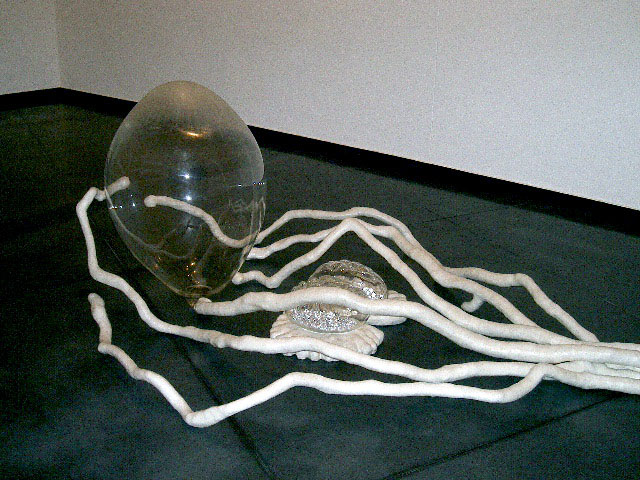
1. The Water Hole by Gerda Steiner and Jorg Lenzlinger at ACCA (Australian Centre for Contemporary Art)


Gerda Steiner (Swiss, b. 1967) and Jorg Lenzlinger (Swiss, b. 1964) 'The Waterhole' 2009


Gerda Steiner (Swiss, b. 1967) and Jorg Lenzlinger (Swiss, b. 1964)
The Water Hole
2009


“The most effective bed has a small meteorite suspended in a net bag above it. The viewer slides underneath the ‘rock’ placing the meteorite about a foot or so above your face. The meteorite is brown, dark and heavy, swinging slightly above your ‘third eye’. You feel its weight pressing down on your energy, on your life force and you feel how old this object is, how far it has traveled, how fragile and mortal you are. It is a sobering and enlightening experience but what an experience it is!”

This was a magical and poignant exhibition that was a joy for children and adults alike. Children love it running around exploring the environments. Adults love it for it’s magical, witty and intelligent response to the problems facing our planet and our lives. A truly enjoyable interplanetary collision.

2. Ocean Without A Shore video installation by Bill Viola at The National Gallery of Victoria


Bill Viola (American, 1951-2024) 'Ocean Without A Shore' 2007 video still


Installation photograph of Ocean Without A Shore at the National Gallery of Victoria, Melbourne


The resurrected are pensive, some wringing the hands, some staring into the light. One offers their hands to the viewer in supplication before the tips of the fingers touch the wall of water – the ends turning bright white as they push through the penumbrae of the interface. As they move forward the hands take on a stricken anguish, stretched out in rigour. Slowly the resurrected turn and return to the other side. We watch them as we watch our own mortality, life slipping away one day after another. Here is not the distraction of a commodified society, here is the fact of every human life: that we all pass.

The effect on the viewer is both sad but paradoxically uplifting. I cried …

These series of encounters at the intersection of life and death are worthy of the best work of this brilliant artist. He continues to astound with his prescience, addressing what is undeniable in the human condition. Long may he continue.

3. Rosalie Gascoigne at The Ian Potter Centre: NGV Australia
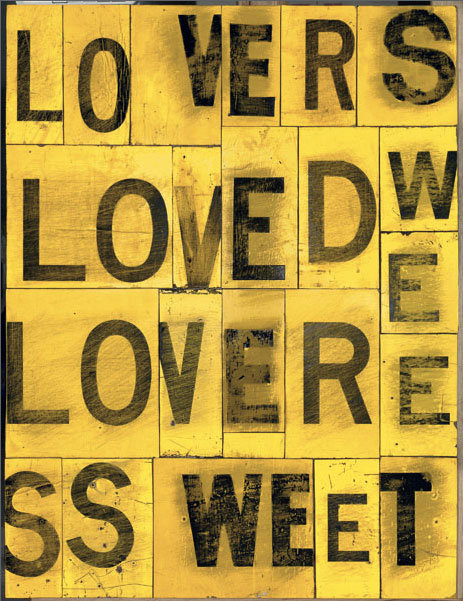
 

Rosalie Gascoigne (Australian born New Zealand, 1917-1999) 'Sweet lovers' 1990


Rosalie Gascoigne (Australian born New Zealand, 1917-1999)
Sweet lovers
1990


This was a wonderful exhibition. Gascoigne rightly commands a place in the pantheon of Australian stars. She has left us with a legacy of music that evokes the rhythms, the air, the spaces and colours of our country. As she herself said,

“Look at what we have: Space, skies. You can never have too much of nothing.”

Nothing more, nothing less.

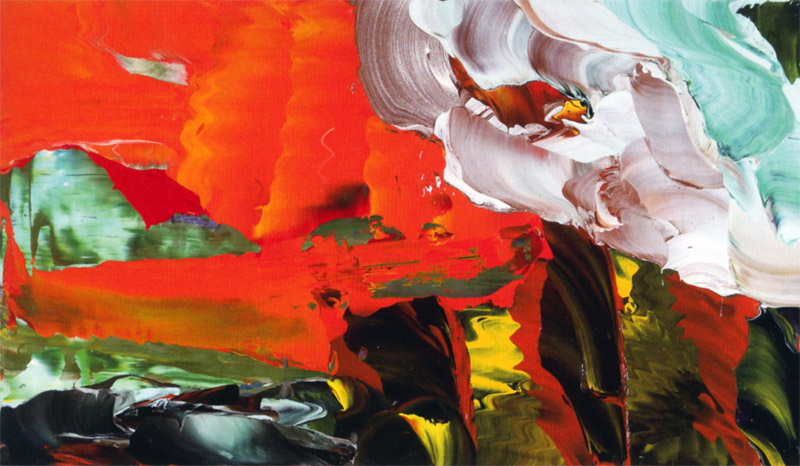
4. The Big Black Bubble paintings by Dale Frank at Anna Schwartz Gallery


Dale Frank (Australian, b. 1959) 'Ryan Gosling' (2008/2009)


Dale Frank (Australian, b. 1959)
Ryan Gosling
2008/2009


The artist offered the viewer the ability to generate their own resonances with the painting, to use the imagination of ‘equivalence’ to suggest what these paintings stand for – and also what else they stand for. States of being, of transformation, wonder and joy emerged in the playfulness of these works.

Ryan Gosling was a tour de force. With the poetic structure of an oil spill, the varnish forms intricate slick upon slick contours that are almost topographical in their mapping. The black oozes light, becomes ‘plastic’ black before your eyes, like the black of Rembrandt’s backgrounds, illusive, illuminative and hard to pin down – perpetually hanging there in two dripping rows, fixed but fluid at one and the same time (you can just see the suspensions in the photograph above).

This painting was one of the most overwhelming syntheses of art and nature, of universal forces that I have seen in recent contemporary art. This exhibition was an electric pulsating universe of life, landscape and transformation. Magnificent!

5. So It Goes by Laith McGregor at Helen Gory Galerie


Laith McGregor (Australian, b. 1977) 'The Last Bastion' 2009 (detail)


Laith McGregor (Australian, b. 1977)
The Last Bastion (detail)
2009


Simply spectacular!

I had never seen such art made using a biro before: truly inspiring.
Inventive, funny, poignant and outrageous this was a must see show of 2009.

6. triestement (more-is u thrill-o) by Domenico De Clario at John Buckley Gallery
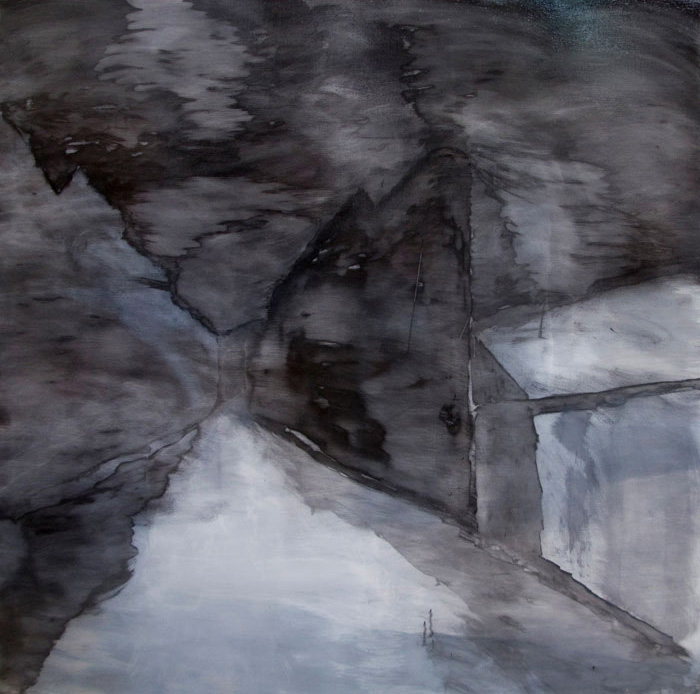
 

Domenico de Clario (Australian born Italy, b. 1947) 'o (la grande maison blanche – snow clouds massing)' 2008/09


Domenico de Clario (Australian born Italy, b. 1947)
o (la grande maison blanche – snow clouds massing)
2008/09


Painted in a limited colour palette of ochres, greys and blacks the works vibrate with energy. Cezanne like spatial representations are abstracted and the paint bleeds across the canvas forming a maze of buildings. Walls and hedges loom darkly over roadways, emanations of heads and figures float in the picture plane and the highlight white of snow hovers like a spectral figure above buildings. These are elemental paintings where the shadow has become light and the light is shadow, meanderings of the soul in space.

de Clario feels the fluid relationship between substance and appearance; he understands that Utrillo is embedded in the position of each building and stone, in the cadences and rhymes of the paintings of Montmarte. de Clario interprets this knowledge in a Zen like rendition of shadow substance in his paintings. Everything has it’s place without possession of here and there, dark and light.

For my part it was my soul responding to the canvases. I was absorbed into their fabric. As in the dark night of the soul my outer shell gave way to an inner spirituality stripped of the distance between viewer and painting. I felt communion with this man, Utrillo, with this art, de Clario, that brought a sense of revelation in the immersion, like a baptism in the waters of dark light. For art this is a fantastic achievement.

7. McLean Edwards: Songs from the Ghost Ship at Karen Woodury Gallery


McLean Edwards (Australian, b. 1972) 'Venus' 2009


McLean Edwards (Australian, b. 1972)
Venus
2009


These heterogeneous paintings were a knockout with their wonderful, layered presence – they really command the viewer to look at them and celebrate the characters within them. Whimsical, ironic and full of humour these phantasmagorical images of creatures cast adrift with the night sky as background are fabulous assemblages of colour, form and storytelling.

My friend and I really enjoyed this exhibition. We were captivated by these songs, going back to the work again and again to tease out the details, to feel connection to the work. These are not lonely isolated figures but sublime emanations of inner states of being expertly rendered in glorious colour. And they made us laugh – what more could you ask for!

8. Tacita Dean at Australian Centre for Contemporary Art (ACCA)


Tacita Dean (English, b. 1965) 'Michael Hamburger' 2007


Tacita Dean (English, b. 1965)
Michael Hamburger [Still]
16mm colour anamorphic, optical sound
28 minutes
2007


“One can see echoes of Sebald’s work in that of Tacita Dean – the personal narratives accompanied by mythical and historical stories and pictures. The tactility of Hamburger’s voice and hands, his caressing of the apples with the summary justice of the tossing away of rotten apples to stop them ruining the rest of the crop is arresting and holds you transfixed. Old varieties and old hands mixed with the old technology of film make for a nostalgic combination … Dean implicitly understands how objects can be elegies for fleeting lives.”

Tacita Dean is a fantastic artist whose work examines the measure of things, the vibrations of spirit in the FLUX of experience. Her work has a trance-like quality that is heavy with nostalgia and memory and reflects the machine-ations of contemporary life. In her languorous and dense work Dean teases out the significance of insignificant actions/events and imparts meaning and life to them. This is no small achievement!

As an exhibition this was an intense and moving experience.

9. Ivy photographs by Jane Burton at Karen Woodbury Gallery


Jane Burton (Australian, b. 1966) 'Ivy #2' 2009


Jane Burton (Australian, b. 1966)
Ivy #2
2009


I feel that in these photographs with their facelessness and the non-reflection of the mirror investigate notions of ‘Theoria’ – a Greek emphasis on the vision or contemplation of God where theoria is the lifting up of the individual out of time and space and created being and through contemplative prayer into the presence of God. In fact the whole series of photographs can be understood through this conceptualisation – not just remembrances of past time, not a blind contemplation on existence but a lifting up out of time and space into the an’other’ dark but enlightening presence.

The greatest wonder of this series is that the photographs magically reveal themselves again and again over time. Despite (or because of) the references to other artists, the beauty of Burton’s work is that she has made it her own. The photographs have her signature, her voice as an artist and it is an informed voice; this just makes the resonances, the vibrations of energy within the work all the more potent and absorbing. I loved them.

10. Sweet Complicity by eX de Medici at Karen Woodbury Gallery


eX de Medici (Australia, b. 1959) 'Tooth and claw' 2009 (detail)


eX de Medici (Australia, b. 1959)
Tooth and claw (detail)
2009


In other less skilled artist’s hands the subject matter could become cliched and trite but here de Medici balances the disparate elements in her compositions and brings the subject matter alive – sinuously jumping off the paper, entwining the viewer in their delicious ironies, all of us sweetly complicit in the terror war (send more meat, send more meat!), fighting tooth and nail to keep urban realities at arm’s length. The dark desires that these works contain possess an aesthetic beauty that swallows us up so that we, too, become ‘Barbarians All’.

11. Emily Kame Kngwarreye: The Person and her Paintings at DACOU Aboriginal Art
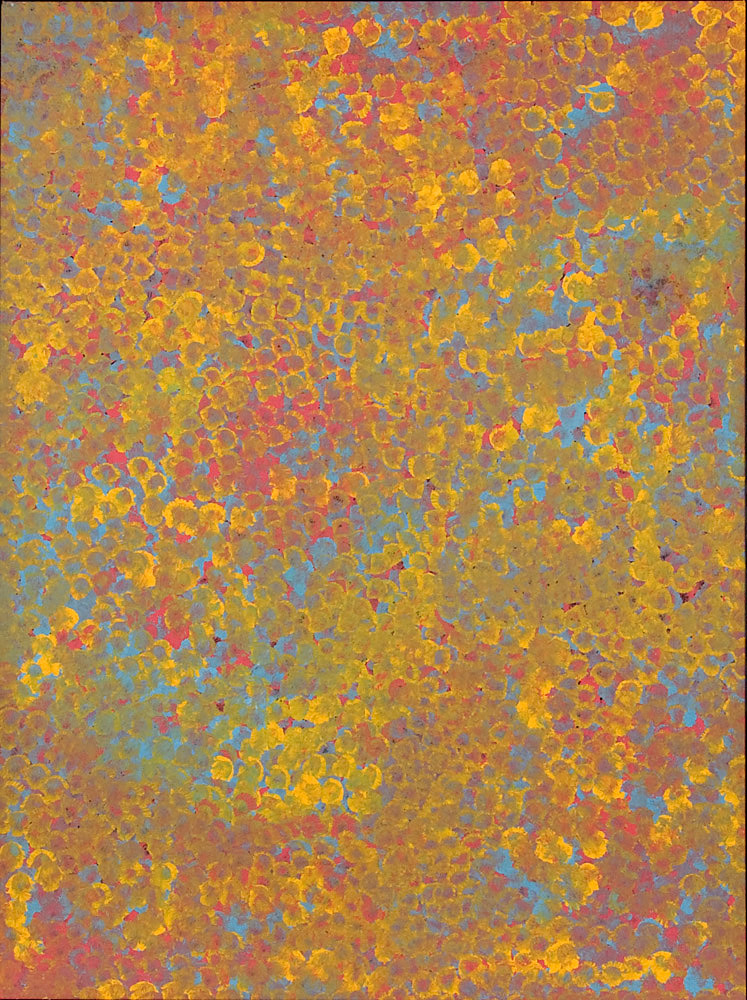
 

Emily Kame Kngwarreye (Australian, 1910-1996) 'Wildflower' 1994


Emily Kame Kngwarreye (Australian, 1910-1996)
Wildflower
1994


The paintings were painted horizontally (like the painter Jackson Pollock who intuitively accessed the spiritual realm) and evidence a horizontal consciousness not a hierarchical one. Knowledge is not privileged over wisdom. There is a balance between knowledge and wisdom – the knowledge gained through a life well lived and the wisdom of ancient stories that represent the intimacy of living on this world. The patterns and diversities of life compliment each other, are in balance.

Wisdom comes from the Indo-European root verb weid, “to see,” the same root from which words like vision come. In this sense these are “Vedic” paintings in that they are ancient, sacred teachings, Veda meaning literally “I have seen.”

On this day I saw. I felt.

12. Unforced Intimacies by Patricia Piccinini at Tolarno Galleries
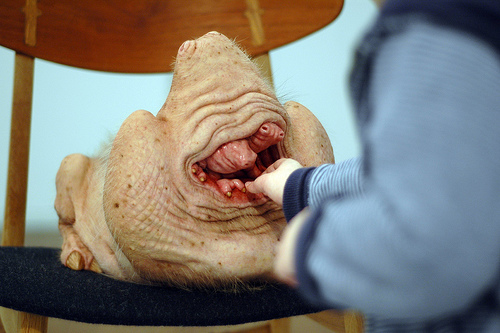
 

Patricia Piccinini (Australian, b. 1965) 'Doubting Thomas' 2008 (detail)


Patricia Piccinini (Australian, b. 1965)
Doubting Thomas (detail)
2008
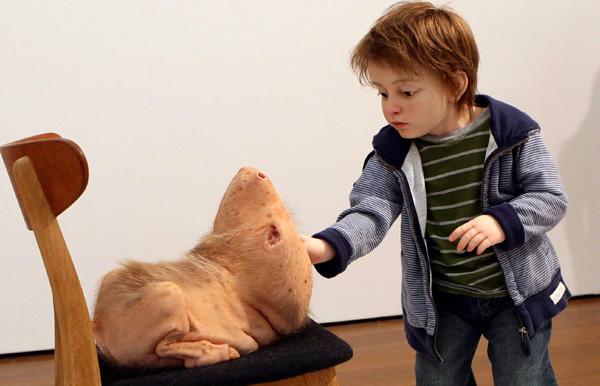
 

Patricia Piccinini (Australian, b. 1965) 'Doubting Thomas' 2008


Patricia Piccinini (Australian, b. 1965)
Doubting Thomas
Silicone, fibreglass, human hair, clothing, chair
2008


The terrains the Piccinini interrogates (nature and artifice, biogenetics, cloning, stem cell research, consumer culture) are a rematerialisation of the actual world through morphological ‘mapping’ onto the genomes of the future. Morphogenetic fields seem to surround the work with an intense aura; surrounded by this aura the animals and children become more spiritual in their silence. Experiencing this new world promotes an evolution in the way in which we conceive the future possibilities of life on this earth, this brave but mutably surreal new world.

This was truly one of the best exhibitions of the year in Melbourne.


Honorable mentions

~ Climbing the Walls and Other Actions by Clare Rae at the Centre for Contemporary Photography
In these photographs action is opposed with stillness, danger opposed with suspension; the boundaries of space, both of the body and the environment, the interior and the exterior, memory and dream, are changed.

~ Johannes Kuhnen: a survey of innovation at RMIT Gallery
We stood transfixed before this work, peering closely at it and gasping in appreciation of the beauty, technical proficiency and pure poetry of the pieces.

~ Double Infinitives by Marco Fusinato at Anna Schwartz Gallery
The images are literally ripped from the matrix of time and space and become the dot dot dot of the addendum. What Fusinato does so excellently is to make us pause and stare, to recognize the flatness of these figures and the quietness of violence that surrounds us.

~ all about … blooming by JUNKO GO at Gallery 101
Go’s musings on the existential nature of our being are both full and empty at one and the same time and help us contemplate the link to the breath of the sublime.

~ Mood Bomb by Louise Paramor at Nellie Castan Gallery
They are dream states that allow the viewer to create their own narrative with the title of the works offering gentle guides along the way. These are wonderfully evocative paintings.

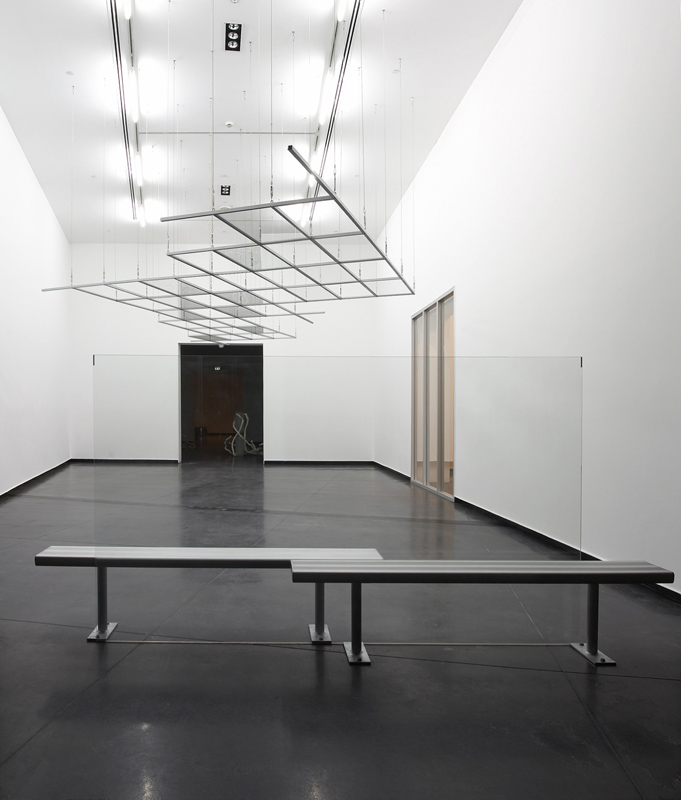
~ New 09 at Australian Centre for Contemporary Art (ACCA)
Finally you sit on the aluminium benches and contemplate in silence all that has come before and wonder what just hit you in a tidal wave of feelings, immediacies and emotions. The Doing and Undoing of Things.

~ My Jesus Lets Me Rub His Belly by Martin Smith at Sophie Gannon Gallery
At the end of days, when all is said and done, the funny diatribes with their ambiguous photographs are homily and heretic and together form a more inclusive body of bliss: ‘And also with you and you and you and you’.


LIKE ART BLART ON FACEBOOK

Back to top

Exhibition: ‘Doug Aitken’ at Regen Projects, Los Angeles

Exhibition dates: 12th September – 17th October, 2009


Many thankx to Regen Projects for allowing me to publish the art work in the posting. Please click on the photographs for a larger version of the image.


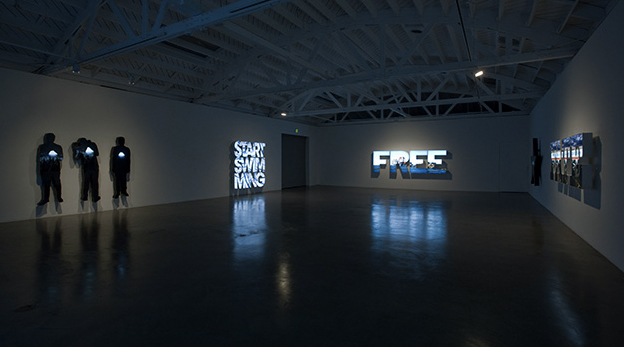
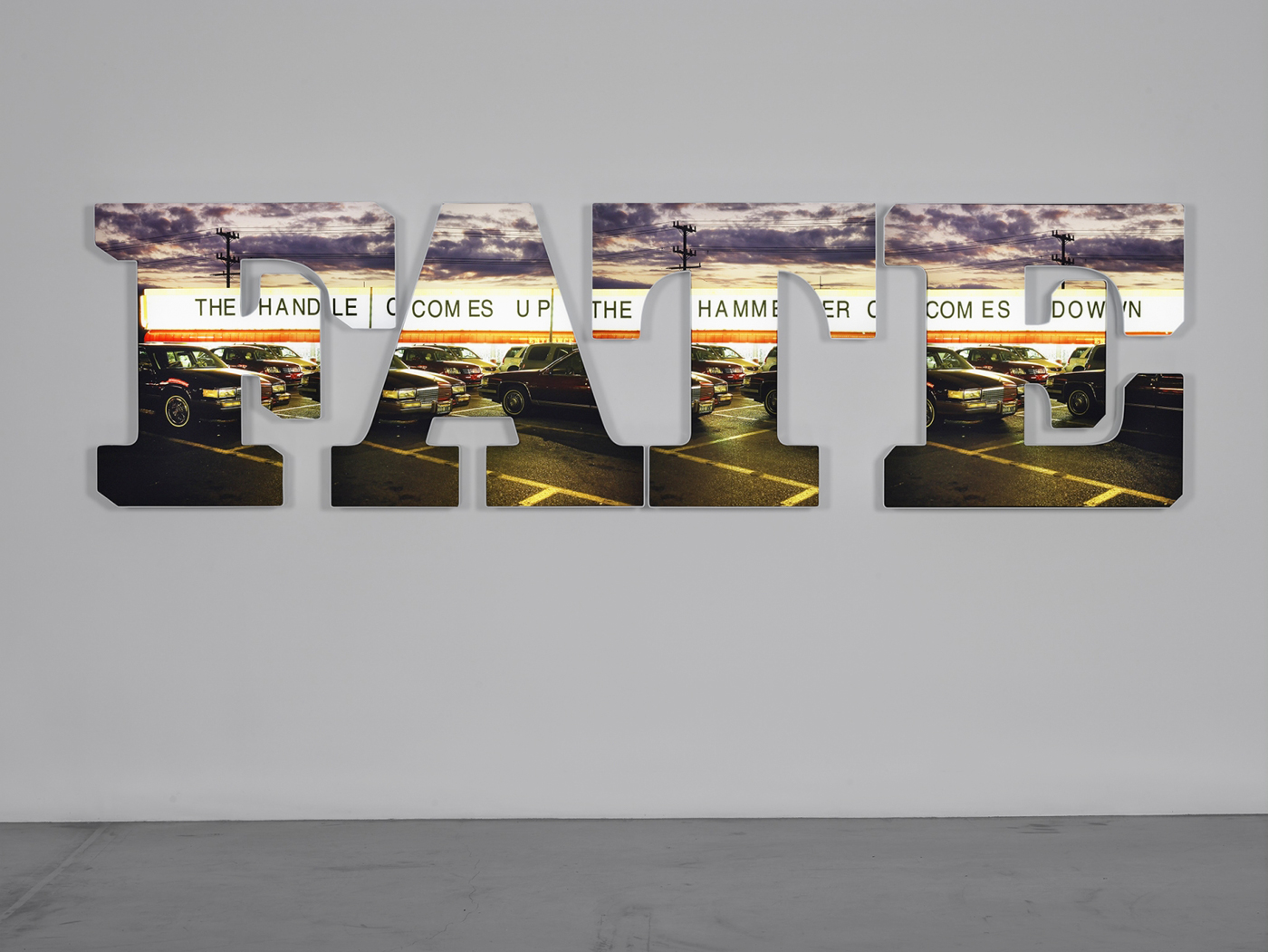
Doug Aitken (American, b. 1968) 'The handle comes up, the hammer comes down' 2009 from the exhibition 'Doug Aitken' at Regen Projects, Los Angeles, Sept - Oct, 2009


Doug Aitken (American, b. 1968)
The handle comes up, the hammer comes down
2009
LED lit lightbox


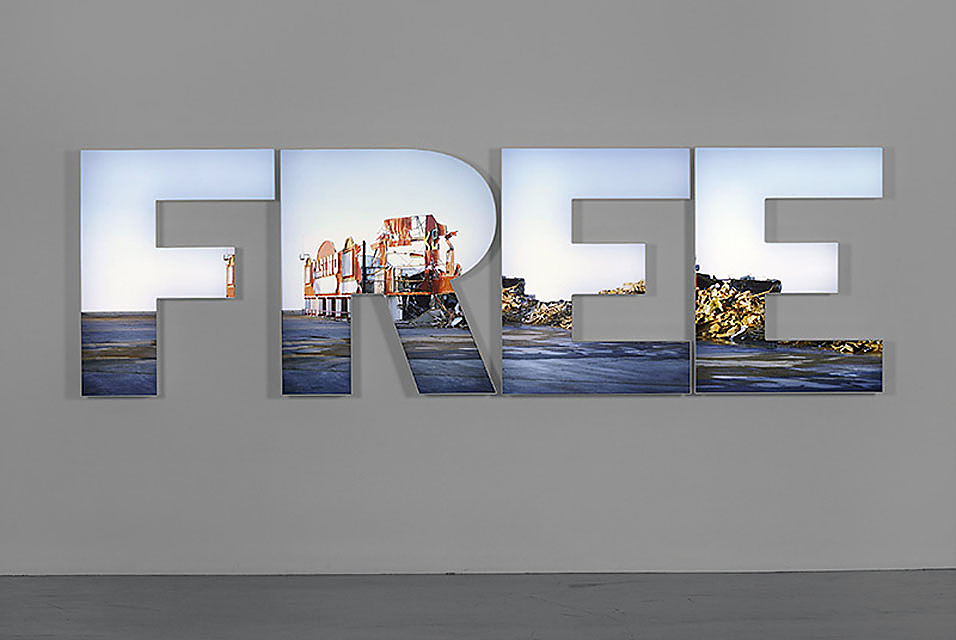
Doug Aitken (American, b. 1968) 'Free' 2009 from the exhibition 'Doug Aitken' at Regen Projects, Los Angeles, Sept - Oct, 2009


Doug Aitken (American, b. 1968)
Free
2009
LED lit lightbox


Doug Aitken (American, b. 1968) 'Start Swimming' 2006 from the exhibition 'Doug Aitken' at Regen Projects, Los Angeles, Sept - Oct, 2009


Doug Aitken (American, b. 1968)
Start Swimming
LED lit lightbox
2006


Doug Aitken (American, b. 1968) 'Start Swimming' 2006


Doug Aitken (American, b. 1968)
Start Swimming
LED lit lightbox
2006


Installation view of ;Doug Aitken; at Regen Projects, Los Angeles


Installation view of Doug Aitken at Regen Projects, Los Angeles


Regen Projects is pleased to announce an exhibition of new works by Los Angeles artist Doug Aitken. This exhibition will present a series of new text-based light boxes and will feature the west coast debut of the film migration. Aitken explores the themes of temporality, space, memory, movement, and landscape in his work. History and themes of both the past and present are interwoven and reconfigured. His work deconstructs the connection between idea and iconography allowing each to reinvent itself.

Doug Aitken’s new light boxes combine image and text in a collision that creates a rupture in which alternate connections are presented. The work frontier depicts a destroyed property on the water’s edge, redefining expectations of what a frontier may hold. The images within some of the light boxes are a photographic collage that references Aitken’s photographic oeuvre and aesthetic. Experimenting with font, borrowed images, and his own photographs, the light boxes will be presented in the darkened gallery, glowing and playing off of one another. The disjunction of word, image, and light in these works also moves toward a cinematic whole, creating panoramic landscapes through text.

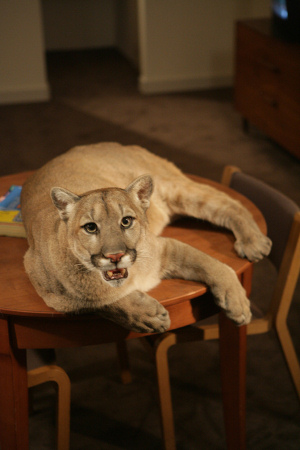
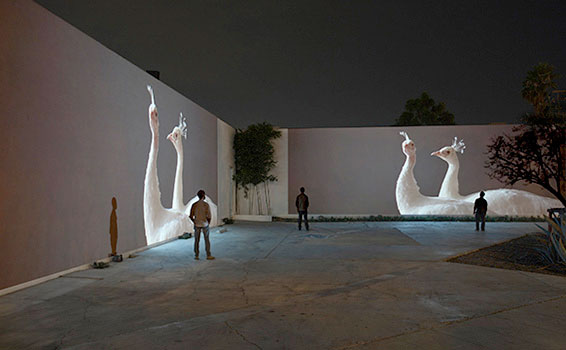
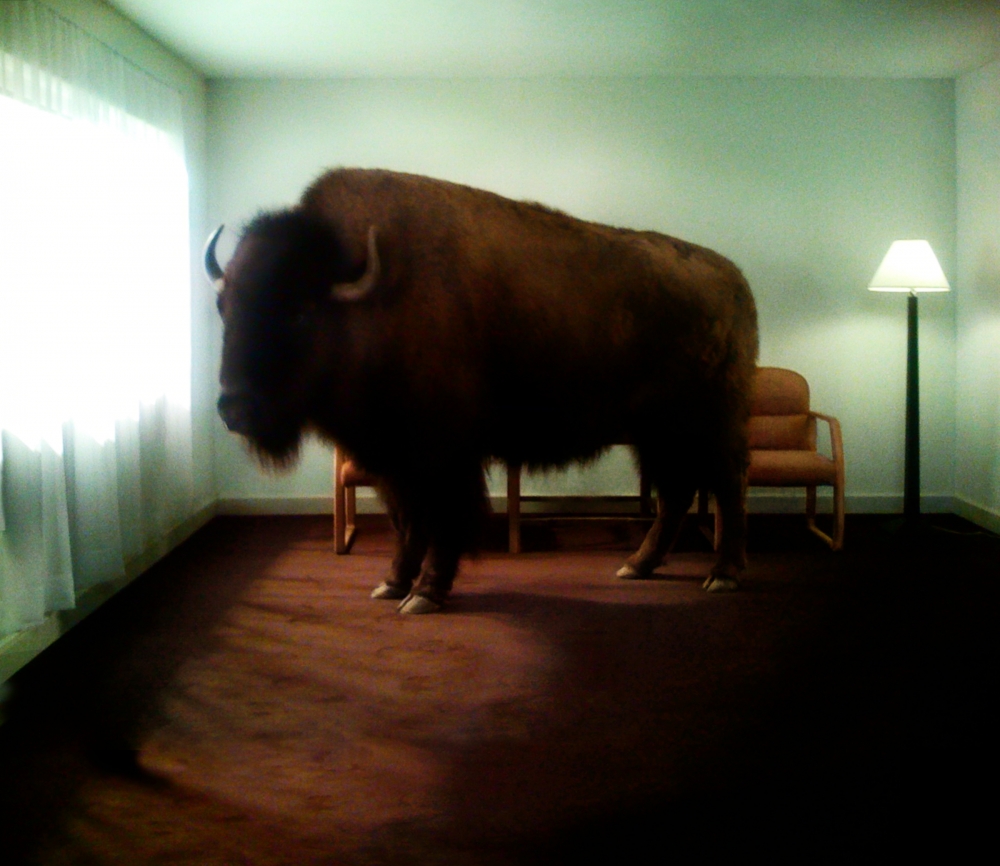
Presented alongside the light boxes will be Aitken’s first large scale public installation in Los Angeles, migration. The film, the first instalment in a three-part trilogy entitled empire, debuted at the 2008 Carnegie International. This hallucinatory epic depicts the movements of migratory animals as they pass through vacant and deserted hotel and motel rooms, delineating a nomadic passage across America from east to west. Fittingly making its first appearance on the west coast, this large-scale cinematic installation will be presented to the public on Santa Monica Boulevard projected onto the courtyard of Regen Projects II; visible only at night from sunset to sunrise. In addition to the nighttime public presentation, migration will also be exhibited at the 633 North Almont Drive space on an indoor billboard accompanied by its original score.

Settlers who met the untamed wilderness to forge new ways of life defined westward expansion. Aitken’s migratory landscape in migration is the opposite; it is a landscape completely devoid of human presence. His non-linear narrative presents a series of different sequences in which the animals and their actions are unique while the rooms and their components are indistinguishable. Hotels such as these offer a sense of both security and isolation and while some animals adapt to these surroundings, others seem conspicuously strange. Rarely do we get to examine these creatures so closely. Their movements and presence make the viewer acutely aware of scale, calling into question various relationships; the most apparent of which is the relationship of the natural and the man-made. In this encounter between the urban and the indigenous the viewer gets a sense of both displacement and habituation. As one critic describes:

“One by one, at different hotels, the animals behave as they behave, sniffing the air, twitching their noses to orient themselves in the desolate human habitat. Imbued with Aitken’s usual intimations of planetary solitude, his sense of spatial dislocation, and gorgeous formalised perception, these images … have the quality not so much of a nonlinear narrative as of a mirage.” (Kim Levin, Artnews, January 2009, p. 110.)


Aitken’s work has been exhibited extensively at museums and galleries worldwide, including his 2007 exhibition “sleepwalkers,” a large-scale outdoor installation at the Museum of Modern Art, New York. He has had numerous solo exhibitions including shows at the Serpentine Gallery, the Kunstmuseum Wolfsberg, the Kunsthaus Bregenz and the Kunsthalle Zurich. Aitken was awarded the international prize at the Venice Biennale in 1999 and was included in the 2000 Whitney Biennial.

Text from the Regen Projects website [Online] Cited 01/11/2009. No longer available online


Doug Aitken (American, b. 1968) Still from 'Migration' 2008

Doug Aitken (American, b. 1968) Still from 'Migration' 2008

Doug Aitken (American, b. 1968) Still from 'Migration' 2008

Doug Aitken (American, b. 1968) Still from 'Migration' 2008

Doug Aitken (American, b. 1968) Still from 'Migration' 2008

Doug Aitken (American, b. 1968) Still from 'Migration' 2008


Doug Aitken (American, b. 1968)
Stills from Migration
2008
Single video projection with billboard (steel and PVC projection screen)


In Migration, peacocks, deer, and beaver are filmed occupying motel rooms in vignettes that strike a poignant, provocative chord: talk about unexpected guests. Nevertheless, the work isn’t funny; it’s too frank in its beauty, too finely and respectfully wrought to be a joke.

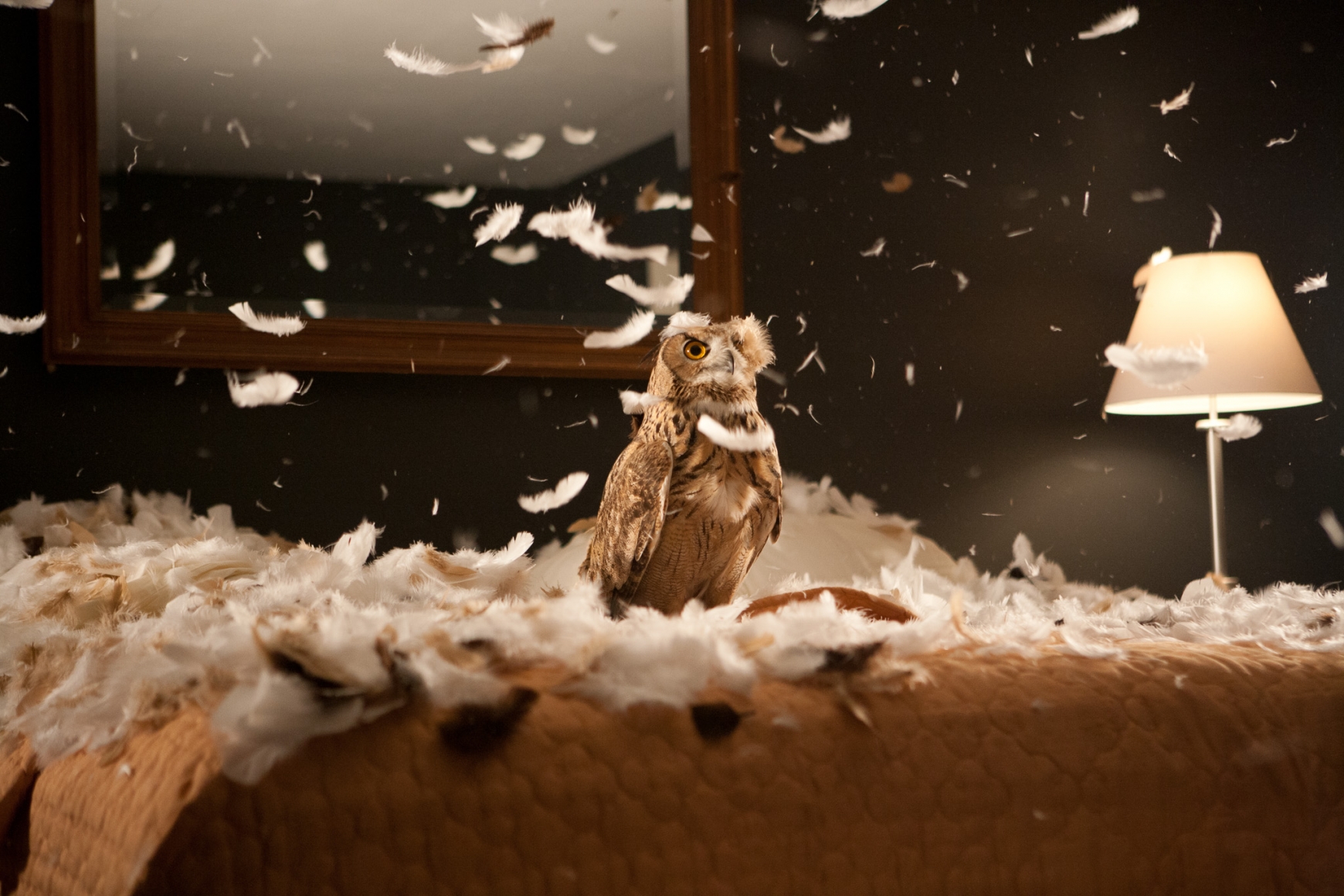
Aitken’s animals are frequently shot in close perspective, which enhances their beauty in a way that is mesmerising. We’re not looking through them as much as we’re looking alongside them, ingesting the utter foreignness of their environs. As evening falls, we see an owl, an already otherworldly creature whose glowing eyes appear extraterrestrial, blinking at us from its perch on a king-size bed. Against the singsong of chirping birds, the camera pans away from the stationary owl as the room fills with thousands of downy feathers. Light is a powerful character in the film, whether gently filtered through sheer curtains or spilling onto carpeted hallways. Rather than highlighting imperfections or ugliness, the light is salvic, evincing a limbo that’s illuminating and warming. In one way or another, all of Aitken’s animals are drawn to light, whether toward a blinking lamp, the refracted surface of a swimming pool, or even the glow of an opened refrigerator door.

Extract from


Regen Projects
6750 Santa Monica Boulevard
Los Angeles, CA 90038
Phone: (310) 276 5424

Gallery hours:
Tuesday – Saturday 10am – 5pm

Regen Projects website

LIKE ART BLART ON FACEBOOK

Back to thttps://artblart.com/2009/10/04/exhibition-doug-aitken-at-regen-projects-los-angeles/op

Review: ‘Scenes’ by David Noonan at the Australian Centre for Contemporary Art (ACCA), Melbourne

Exhibition dates: 15th August – 27th September, 2009

Commissioning Curator: Juliana Engberg
Coordinating Curator: Charlotte Day


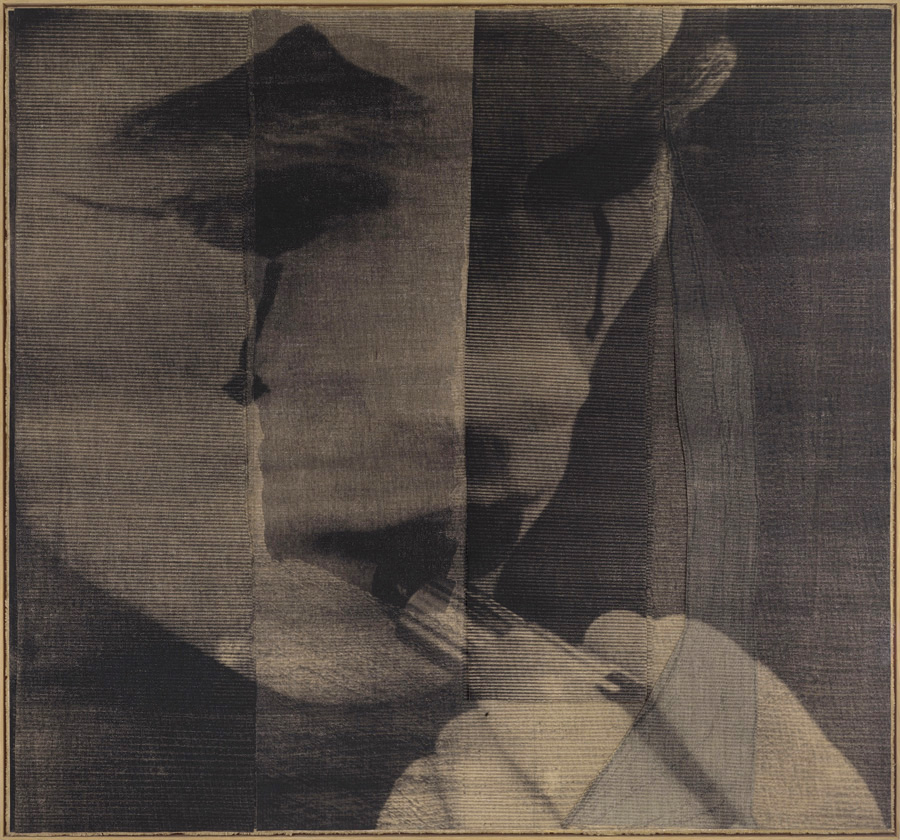
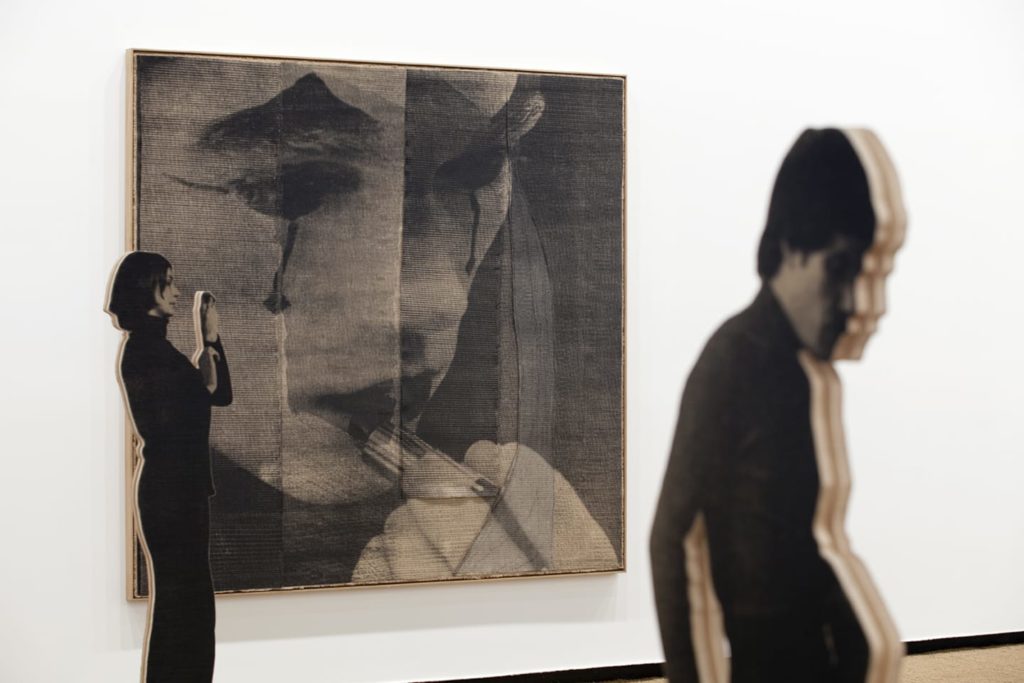
Installation view of 'Scenes' by David Noonan at ACCA


Installation view of Scenes by David Noonan at ACCA
Photo: Marcus Bunyan


Thoughts

Limited colour palette of ochres, whites, browns and blacks.

Rough texture of floor covered in Jute under the feet.

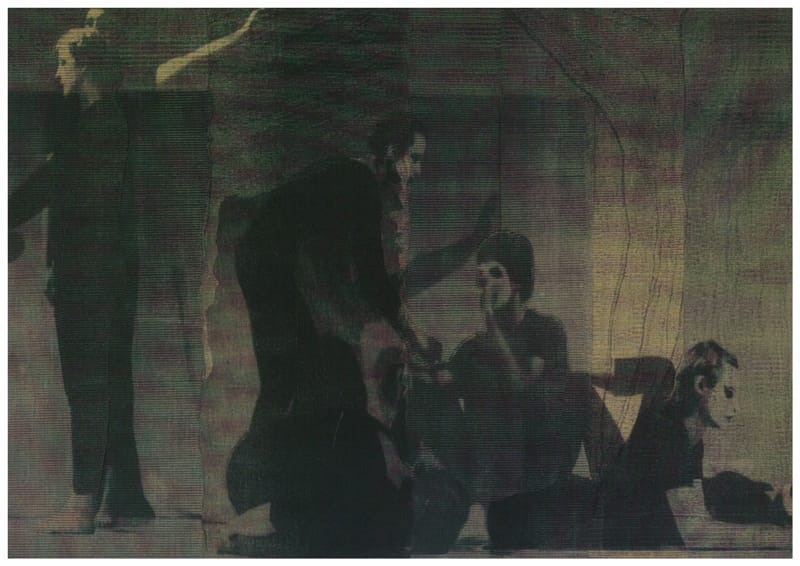
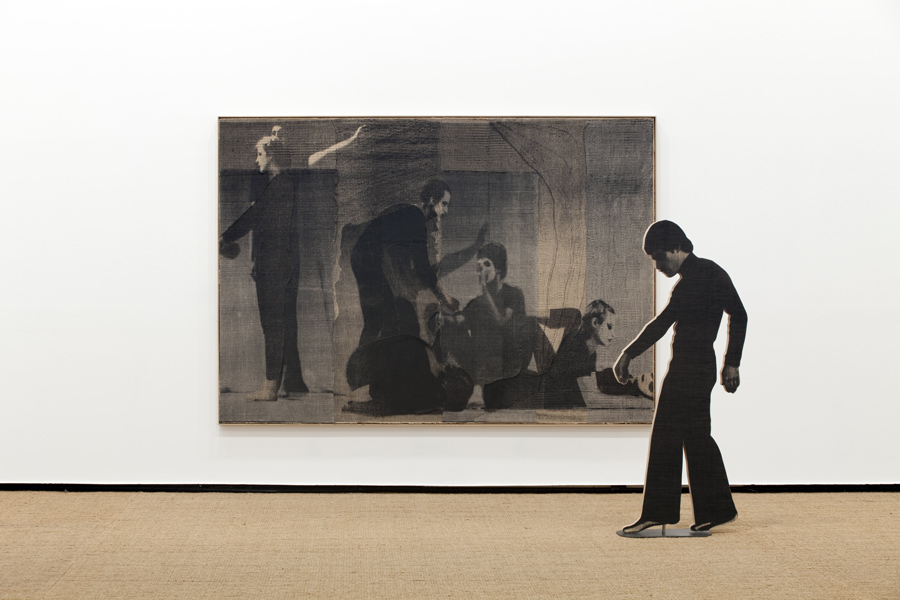
Layered, collaged print media figures roughly printed on canvas – elements of abstraction, elements of figuration.

The ‘paintings’ are magnificent; stripped and striped collages. Faces missing, dark eyes. There is something almost Rembrandt-esque about the constructed images, their layering, like Rembrandt’s Night Watch (1642) – but then the performance element kicks in – the makeup, the lipstick, the tragic / comedic faces.

Mannequin, doll-like cut-out figures, flat but with some volume inhabiting the tableaux vivant.

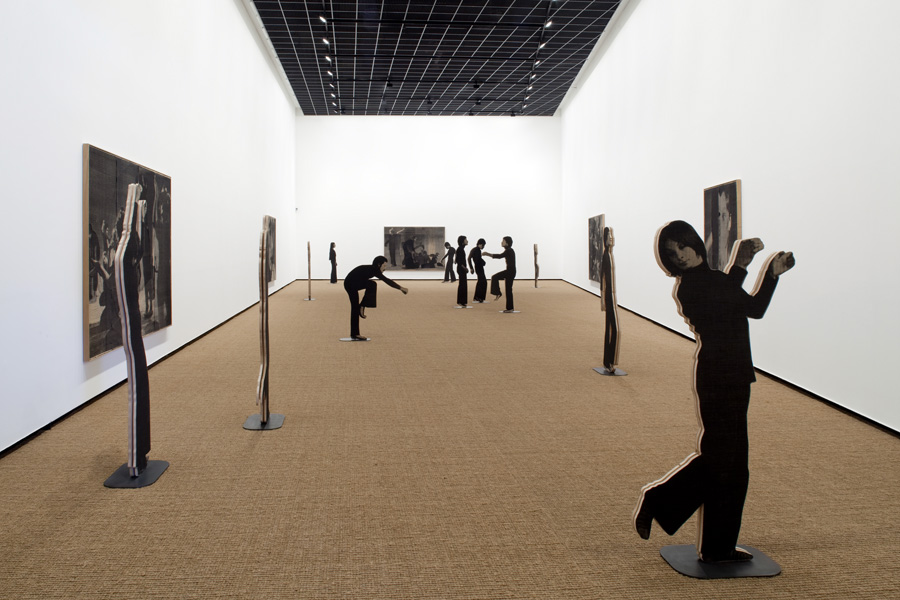
Twelve standing figures in different attitudes – a feeling of dancing figures frozen on stage, very Japanese Noh theater. Spatially the grouping and use of space within the gallery is excellent – like frozen mime.

The figures move in waves, rising and falling both in the standing figures and within the images on the wall.

Looking into the gallery is like looking through a picture window onto a stage set (see above image).

“The fracturing of identity, the distortion of the binaries of light and dark, absence/presence in spatio-temporal environments.

The performance as ritual challenging a regularized and constrained repetition of norms.” (Judith Butler).

Excellent, thought provoking exhibition.

Dr Marcus Bunyan


Many thankx to ACCA for allowing me to publish the photographs in the posting. Please click on the photographs for a larger version of the image.


Photograph from 'Scenes' by David Noonan (installation view)


Installation view of 'Scenes' by David Noonan at ACCA


Installation views of Scenes by David Noonan at ACCA
Photos: Marcus Bunyan


Noonan often works with found photographic imagery taken from performance manuals, textile patterns and archive photographs to make densely layered montages. These works at once suggest specific moments in time and invoke disorientating a-temporal spaces in which myriad possible narratives emerge. The large-scale canvases framing this exhibition depict scenes of role-playing, gesturing characters, and masked figures set within stage-like spaces. Printed on coarsely woven jute, collaged fabric elements applied to the surface of the canvases further signal the cutting and splicing of images.

Noonan’s new suite of figurative sculptures, comprise life size wooden silhouettes faced with printed images of characters performing choreographed movements. While the figurative image suggests a body in space, the works’ two dimensional cut-out supports insist on an overriding flatness which lends them an architectural quality – as stand-ins for actual performers and as a means by which to physically navigate the exhibition space.

Press release from the Chisenhale Gallery website [Online] Cited 20/09/2009. No longer available online


For the Helen Macpherson Smith Commission, he will bring the characters depicted in his signature collage works off the wall and onto an imagined ‘stage’. Several life-size, wooden cut-out figures will inhabit the ACCA exhibition gallery, frozen in choreographed movements.
Noonan’s dancing figures will be framed by several large-scale canvas works, printed photographic and film imagery gleaned from performance manuals, textile patterns and interior books. Printed on coarse woven jute, he cuts, slices and montages images together constructing compositions that hover between two and three dimensionality, positive and negative space, past and present, stasis and action.

“‘Scenes’ recalls the experimental workshops and youth-focused exuberance of a more optimistic era, coinciding with the artists own childhood in the 1970s” says curator Charlotte Day. “With these new works, Noonan re-introduces the idea of ritual, of creating a temporal space beyond reason that is filled with both danger and hope.”

David Noonan (Australian, b. 1969) is the fifth recipient of the Helen Macpherson Smith Commission, one of the most significant and generous commissions in Australia. The partnership between ACCA and the Helen Macpherson Smith Trust offers Victorian artists the opportunity to create an ambitious new work of art, accompanied by an exhibition in ACCA’s exhibition hall.

Press release from the ACCA website [Online] Cited 20/09/2009. No longer available online


David Noonan returned to Melbourne with this significant project which extended his abiding interest in time and space. Using ACCA’s large room as a field of encounter, he created an ensemble of works in 2 and 3 dimensions that make purposeful use of the audience’s own navigation through the gallery. Visitors walking between David’s free-standing figures performed like time travellers in a landscape that had been paused. His enigmatic wall based works appeared to trap momentary scenes in a layered time warp.

This major commission allowed for an ambitious project by a Victorian artist who had reached a significant platform in their own practice. Elements of the commission were gifted to a Victorian regional gallery. In this case the recipient was Bendigo Art Gallery.

Text from the ACCA website [Online] Cited 24/04/2019


Photograph from 'Scenes' by David Noonan at ACCA (installation view)


Installation view of 'Scenes' by David Noonan at ACCA


Installation views of Scenes by David Noonan at ACCA
Photos: Marcus Bunyan


Australia Centre for Contemporary Art (ACCA)
111 Sturt Street, Southbank, Victoria 3006, Australia
Phone: 03 9697 9999

Opening Hours:
Tuesday to Friday 10am – 5pm
Weekends & Public Holidays 11am – 5pm
Open all public holidays except Christmas Day and Good Friday

ACCA website

LIKE ART BLART ON FACEBOOK

Back to top

Exhibition: ‘Ron Arad: No Discipline’ at The Museum of Modern Art (MoMA), New York

Exhibition dates: 2nd August – 19th October, 2009


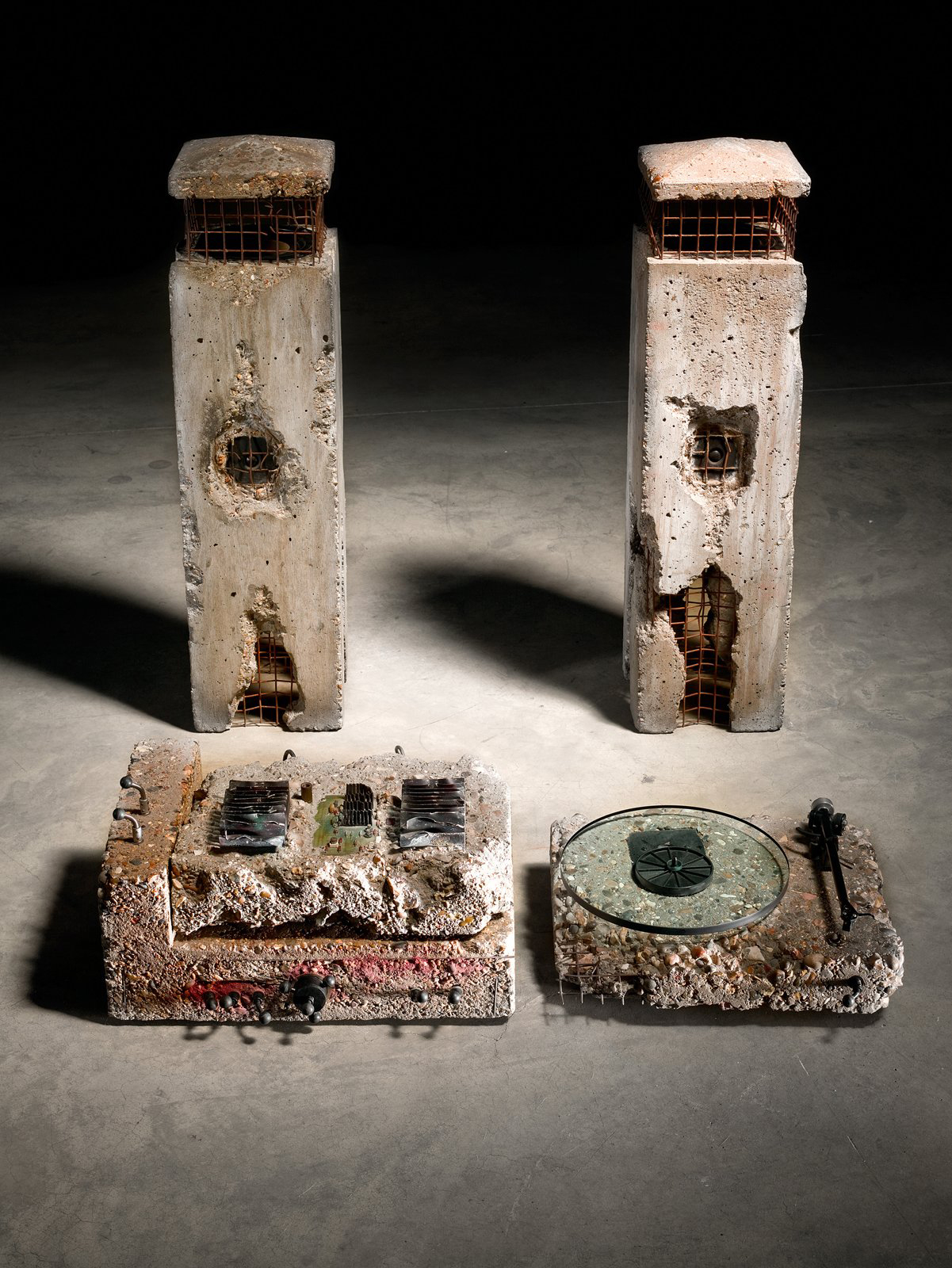
Ron Arad (British-Israeli, b. 1951) 'Concrete Stereo' 1983 from the exhibition 'Ron Arad: No Discipline' at The Museum of Modern Art (MoMA), New York, Aug - Oct, 2009


Ron Arad (British-Israeli, b. 1951)
Concrete Stereo
1983
Photo courtesy of Ron Arad Associates and the Museum of Modern Art


One of my favourite designers!

Marcus


Many thankx to the Museum of Modern Art for allowing me to publish the photographs in the posting. Please click on the photographs for a larger version of the image.


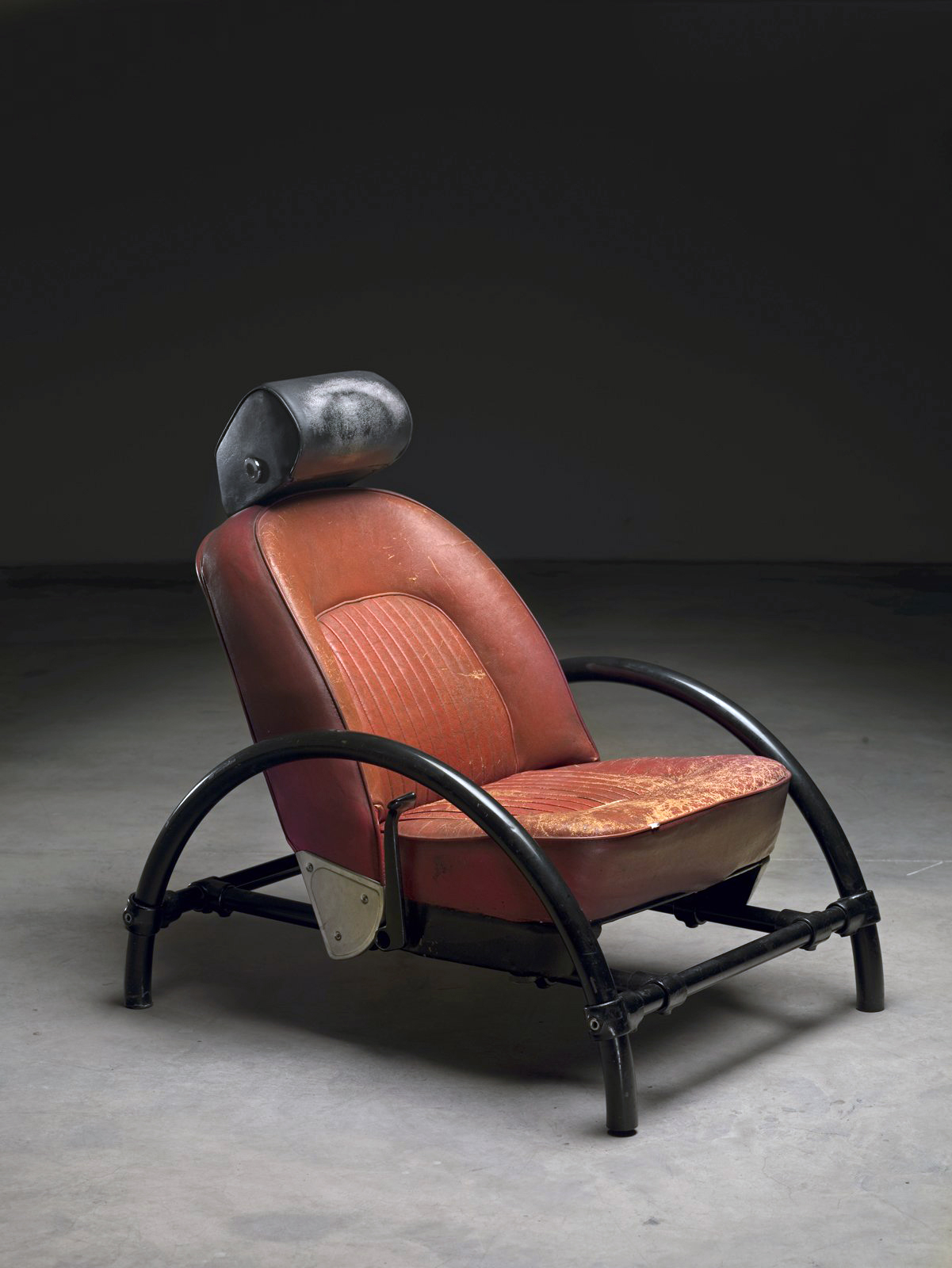
Ron Arad (British-Israeli, b. 1951) 'The Rover Chair' 1981 from the exhibition 'Ron Arad: No Discipline' at The Museum of Modern Art (MoMA), New York, Aug - Oct, 2009


Ron Arad (British-Israeli, b. 1951)
The Rover Chair
1981
Tubular steel, leather, and cast-iron Kee Klamp joints
30 3/4 x 27 3/16 x 36 1/4″ (78 x 69 x 92cm); weight 57.3 lbs (26 kg)
Edition by One Off, London
Private collection, London
Photo by Erik and Petra Hesmerg and courtesy of Private Collection, Maastricht, and the Museum of Modern Art


“I picked up this Rover seat and I made myself a frame and this piece sucked me into this world of design.” “If someone had told me a week before that I was going to be a furniture designer, I would think they were crazy.” 

~  Ron Arad


Ron Arad (British-Israeli, b. 1951) 'Sketch for Well Tempered Chair' 1986


Ron Arad (British-Israeli, b. 1951)
Sketch for Well Tempered Chair
1986
Photo courtesy of Vitra Design Museum and the Museum of Modern Art


Ron Arad (British-Israeli, b. 1951) 'Well Tempered Chair Prototype' 1986


Ron Arad (British-Israeli, b. 1951)
Well Tempered Chair Prototype
1986
Photo courtesy of Vitra Design Museum and the Museum of Modern Art


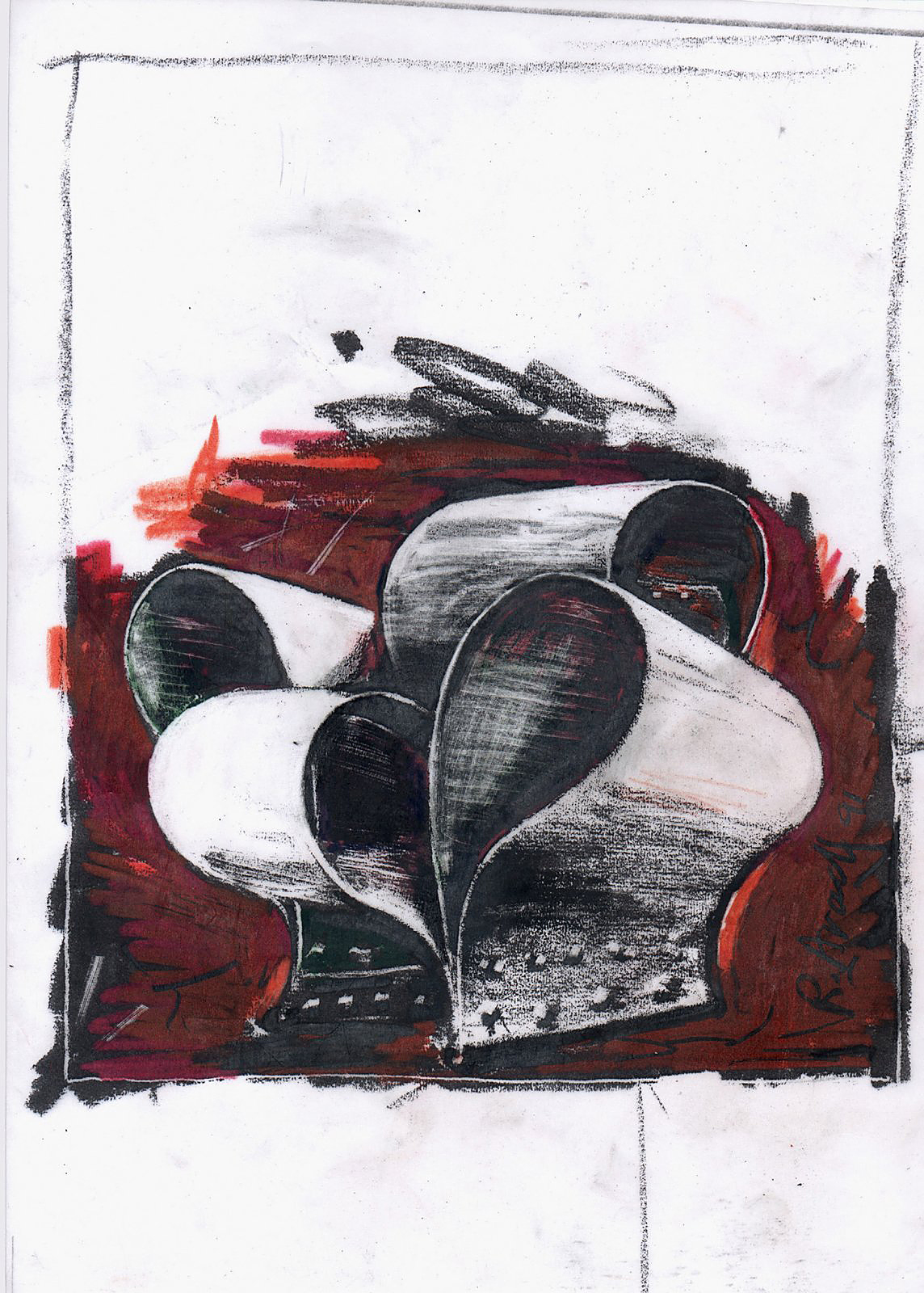
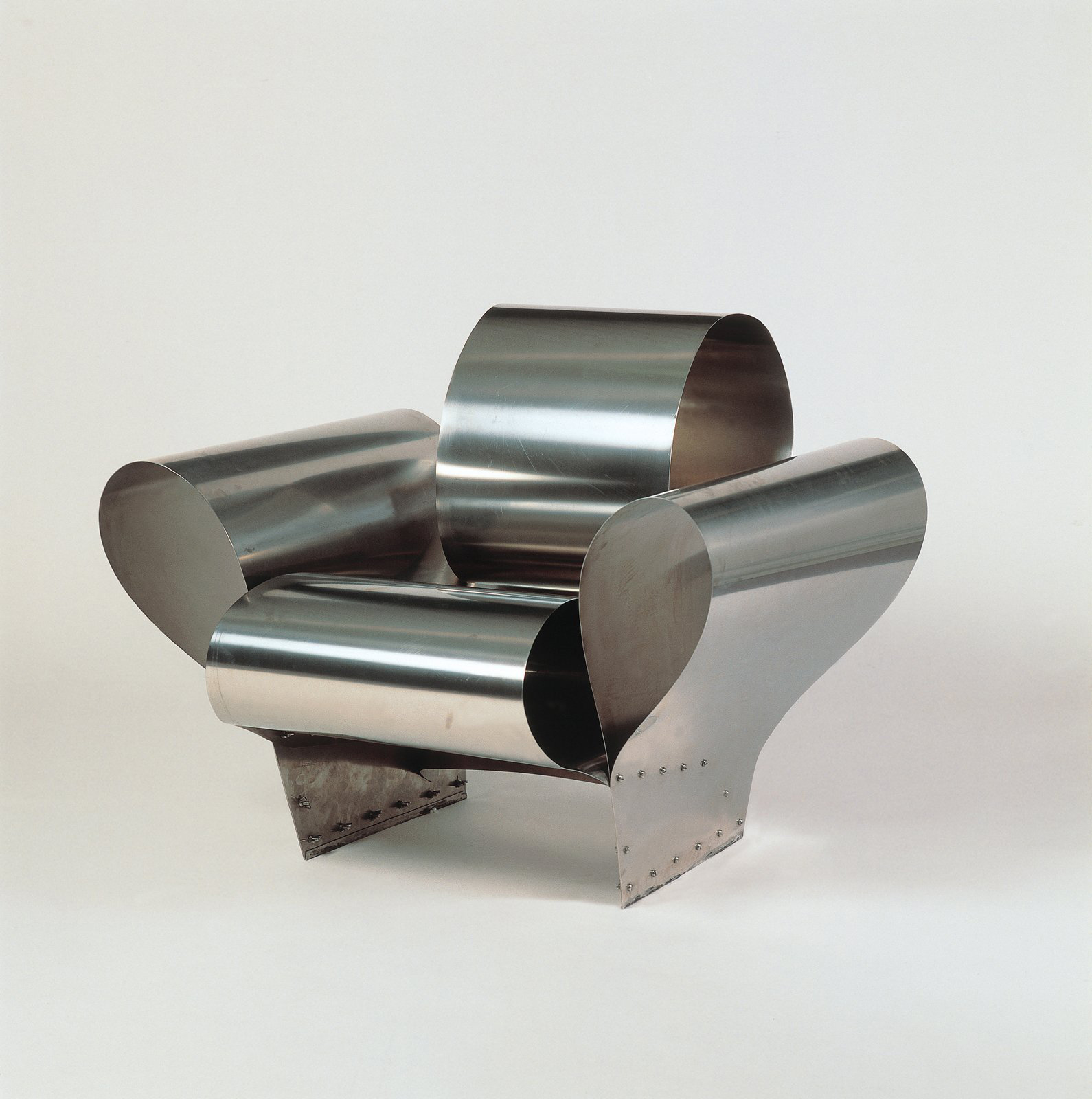
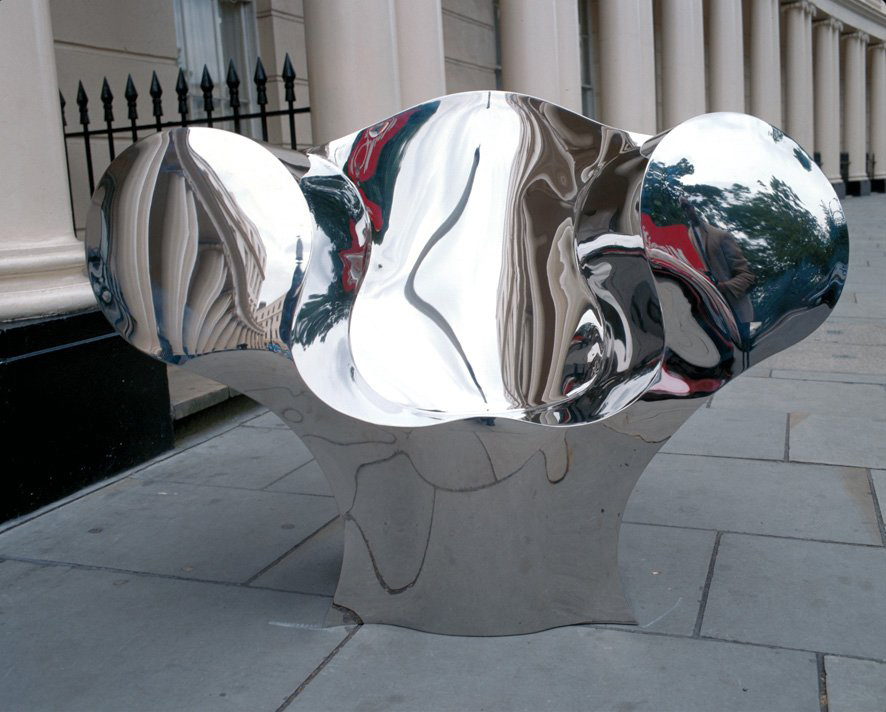
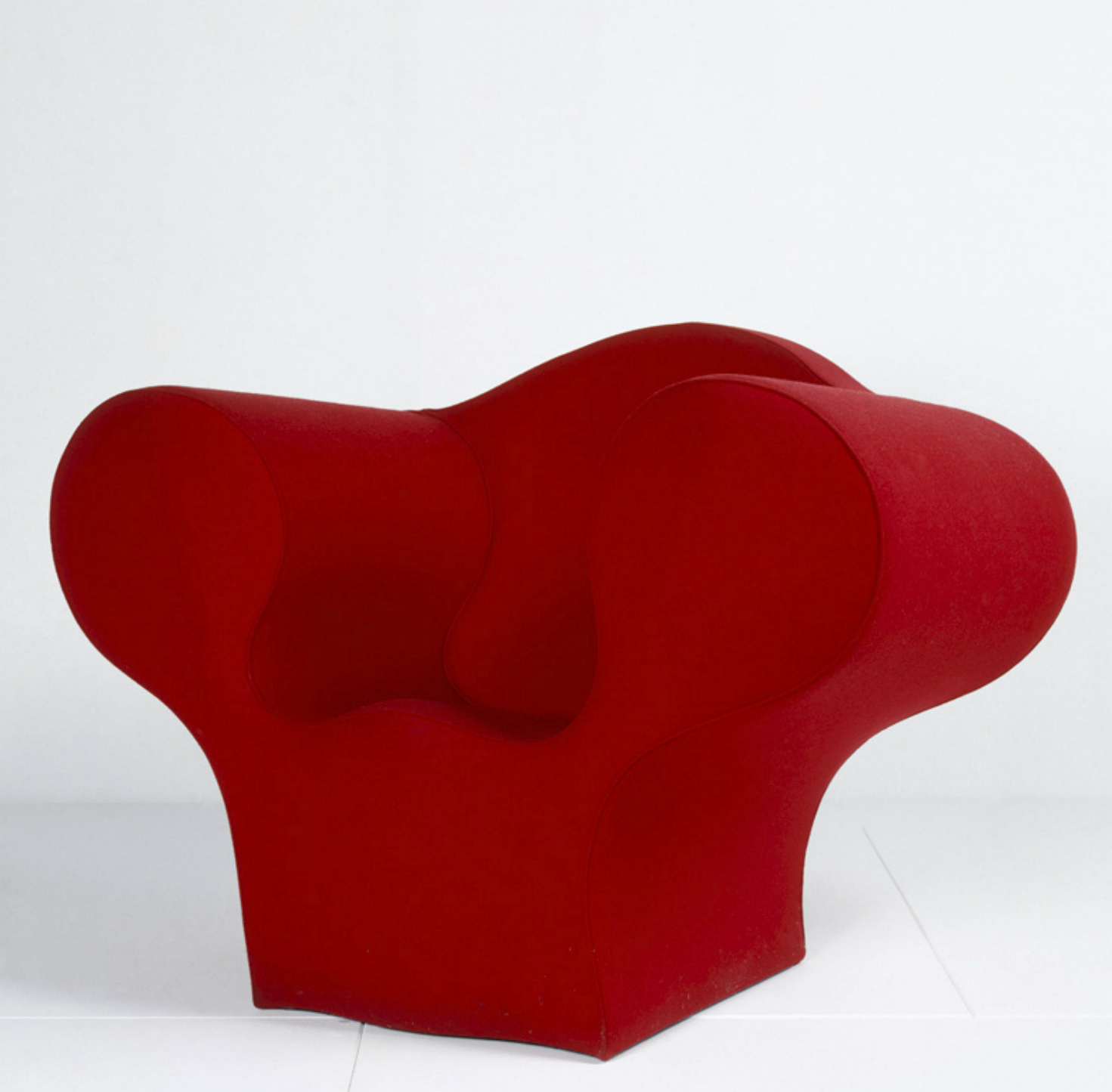
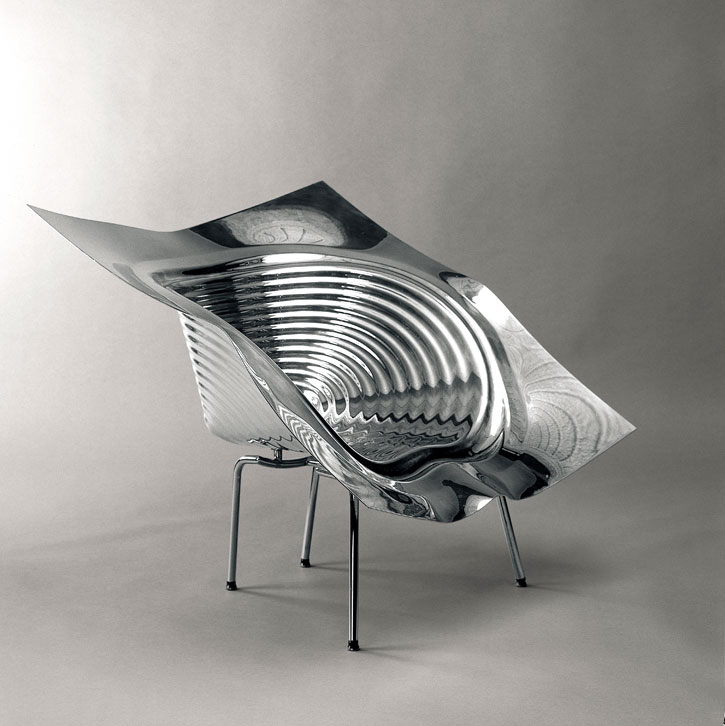
Ron Arad (British-Israeli, b. 1951) 'Big Easy' 1988


Ron Arad (British-Israeli, b. 1951)
Big Easy chair
1988


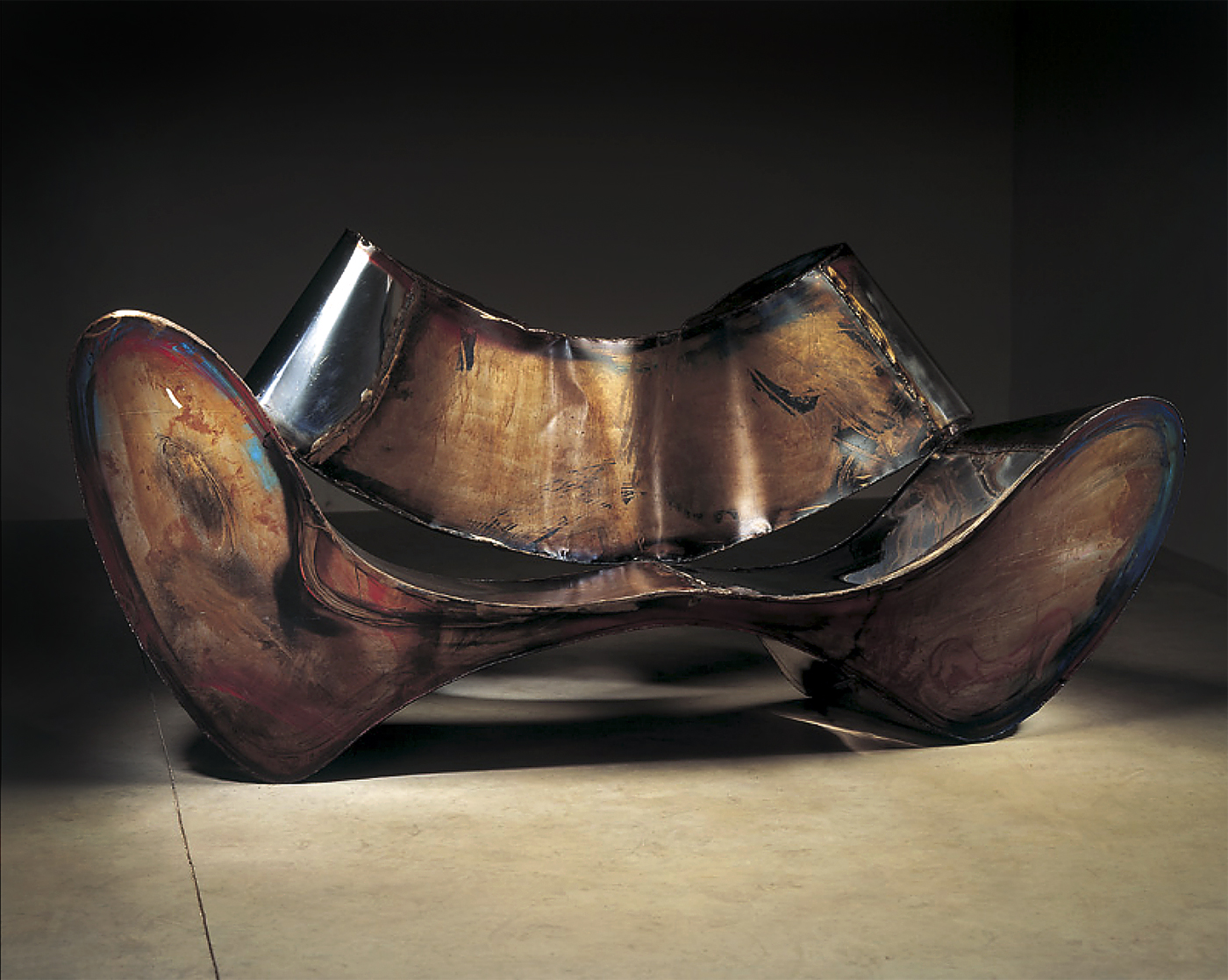
Ron Arad (British-Israeli, b. 1951) 'Big Easy. Volume 2' 1988


Ron Arad (British-Israeli, b. 1951)
Big Easy. Volume 2
1988
Polished stainless steel
42 1/8 x 50 1/2 x 36 1/4″ (107 x 128.3 x 92.1cm); weight 44 lbs (20 kg)
Edition by One Off, London
Collection of Michael G. Jesselson, New York
Image: Ron Arad Associates, London


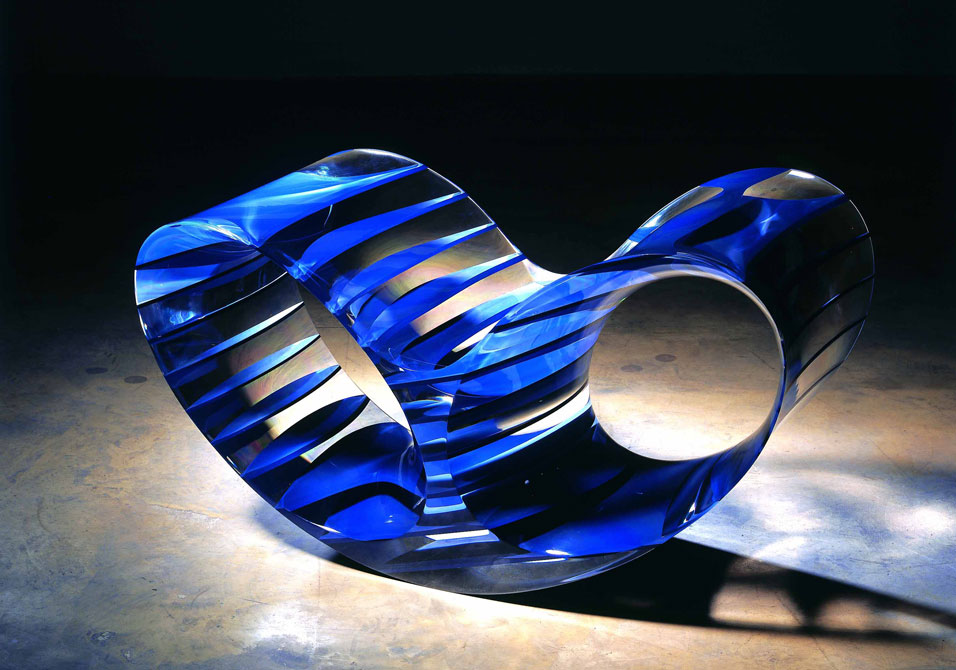
The Museum of Modern Art presents Ron Arad: No Discipline, the first major U.S. retrospective of Arad’s work, from August 2 to October 19, 2009. Among the most influential designers of our time, Arad (British, b. Israel 1951) stands out for his adventurous approach to form, structure, technology, and materials in work that spans the disciplines of industrial design, sculpture, architecture, and mixed-medium installation. Arad’s relentless experimentation with materials of all kinds – from steel, aluminium, and bronze to thermoplastics, crystals, fibre-optics, and LEDs – and his radical reinterpretation of some of the most established archetypes in furniture – from armchairs and rocking chairs to desk lamps and chandeliers – have put him at the forefront of contemporary design.

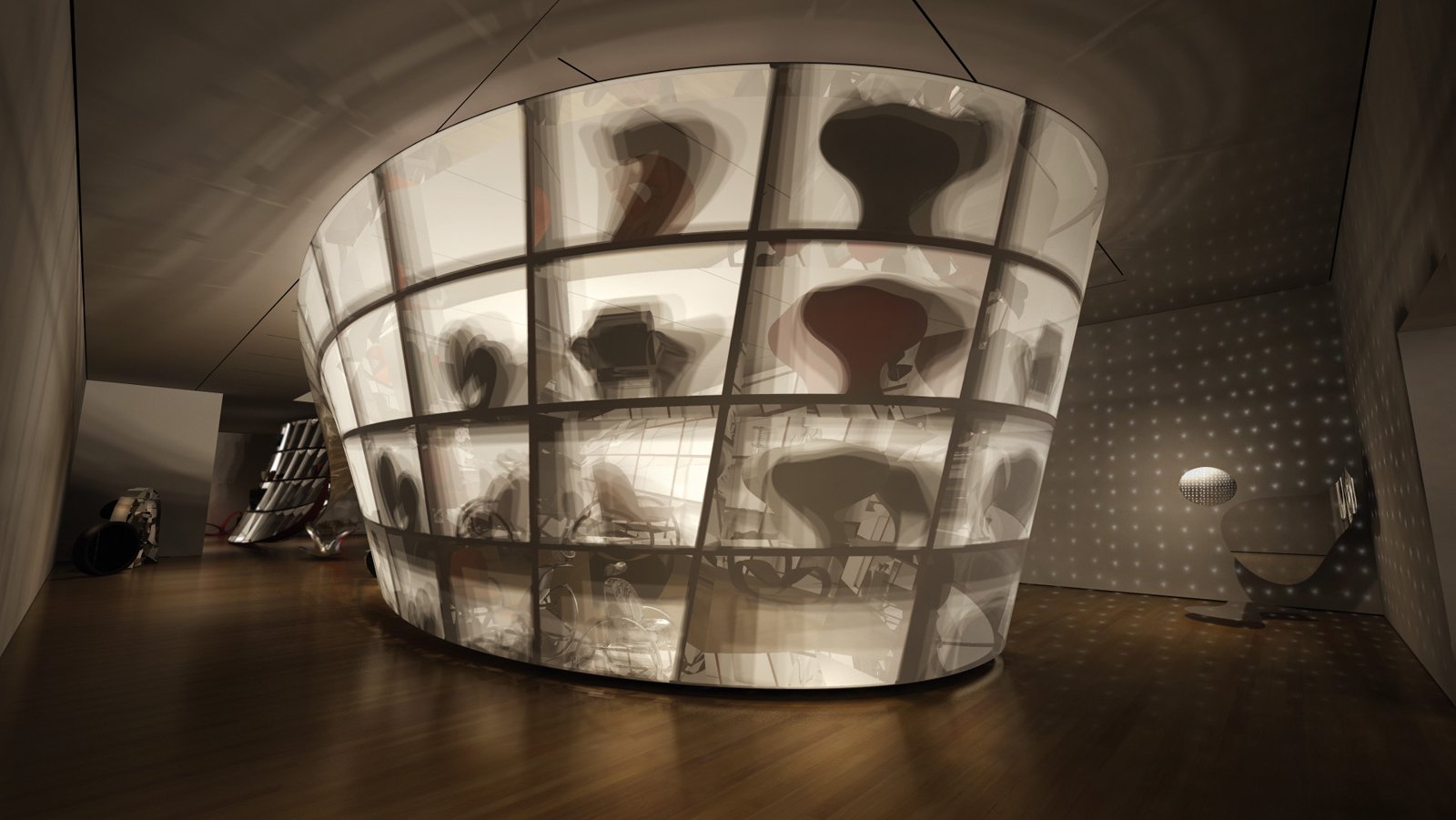
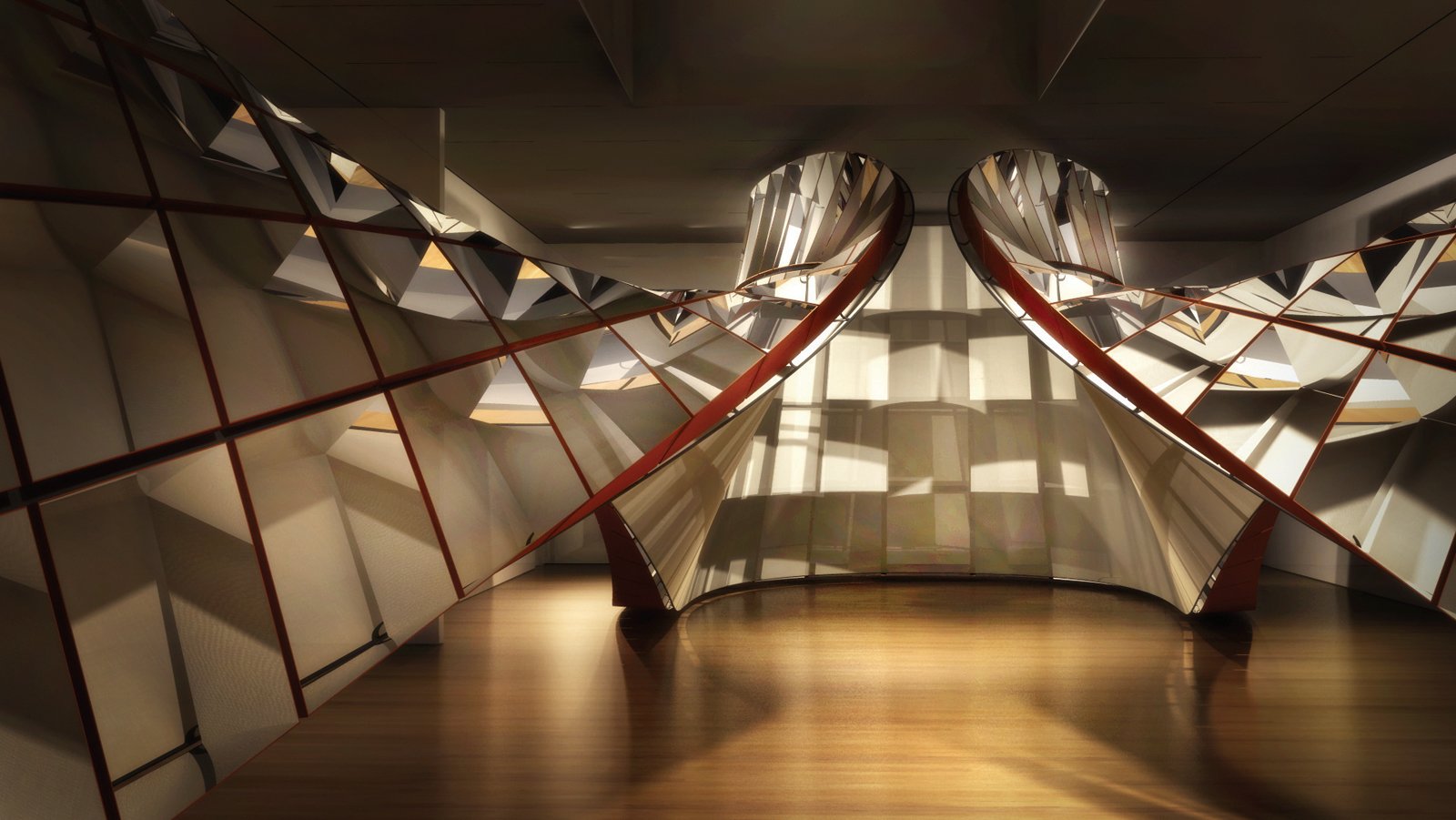
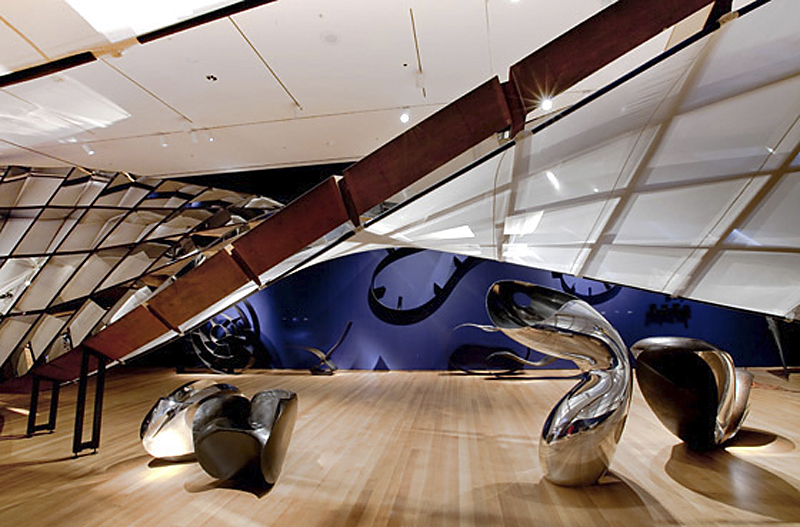
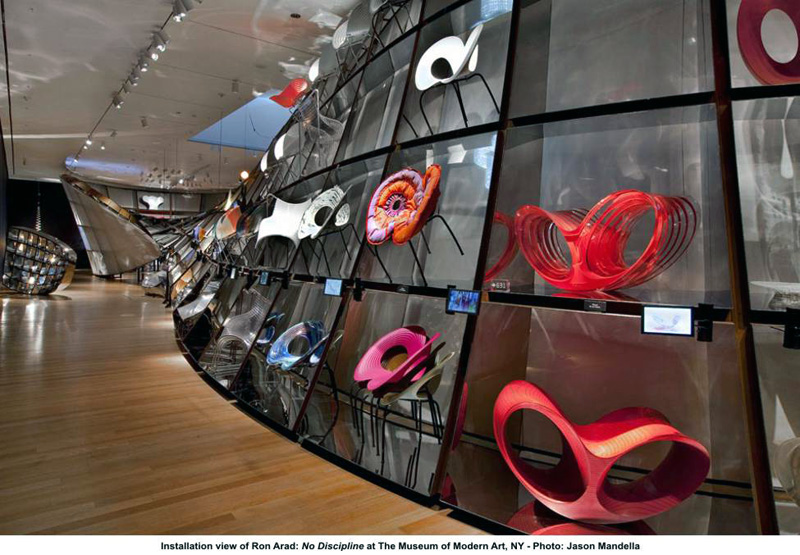
The exhibition features approximately 140 works, including design objects and architectural models, and 60 videos. Most of the objects featured in the exhibition are displayed in a monumental Corten-and-stainless-steel structure specially designed by the artist called Cage sans Frontières (Cage without Borders). The structure measures 126.5 feet (38.5 meters) long, spanning the entire length of the Museum’s International Council gallery, and over 16 feet (5 meters) tall. The exhibition is organised by Paola Antonelli, Senior Curator, and Patricia Juncosa Vecchierini, Curatorial Assistant, Department of Architecture and Design, The Museum of Modern Art.

Ms. Antonelli states: “Arad is well known for his iconoclastic disregard for disciplines – and, at least apparently, for discipline. He has defined much of the current panorama of design, inspiring a generation of practitioners who disregard established modes of practice in favour of mutant design careers that are flexible enough to encompass the range of contemporary design applications, from interactions and interfaces to furniture and shoes.”

Arad’s accomplishments over the past three decades have stirred up the design world by repeatedly updating the concept of the architect / designer / artist and repositioning design side by side with art, both in discourse and in the market – all while keeping one foot firmly in industrial production and large-scale distribution. Idiosyncratic and surprising, Arad’s designs communicate the joy of invention, pleasure, humour, and pride in the display of their technical and constructive skills.

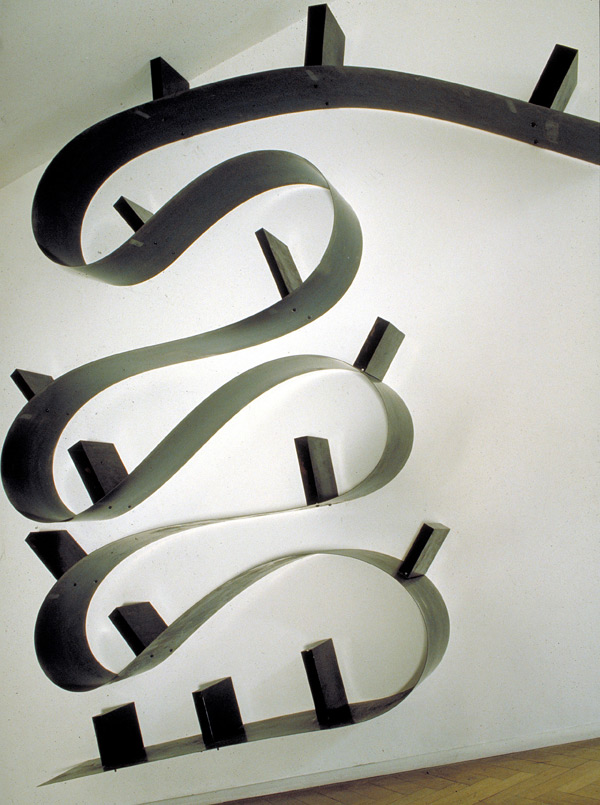
This exhibition celebrates Arad’s spirit by combining industrial design, studio pieces, and architecture. It features Arad’s most celebrated historical pieces, including the Rover Chair (1981) (see above), the Concrete Stereo (1983) (see above), and the Bookworm bookshelves (1993) (see below), along with more recent products such as the PizzaKobra lamp (2008) (see below) and the latest reincarnation of his Volumes series (1998), the armchair duo titled Even the Odd Balls? (2009) (see below).

Cage sans Frontières was specially designed by Arad, developed with Michael Castellana from Ron Arad Associates, and manufactured and installed by Marzorati Ronchetti, Italy, under the direction of Roberto Travaglia. The structure is in the shape of a twisted loop and consists of 240 square cut-outs lined with stainless steel that act as shelves for the objects in the exhibition. The dramatic installation relies on the scale of the structure and on the reflectivity of the inner walls of the cut-outs which creates a ricocheting effect. One side of the structure is continually covered with grey gauze fabric that acts as a translucent, elastic membrane. The fabric was donated by the textile company Maharam and was cut and stitched by the jeans manufacturer Notify, which is also a sponsor of the exhibition. The structure was commissioned and lent to the exhibition by Singapore FreePort Pte Ltd, an arts storage facility.

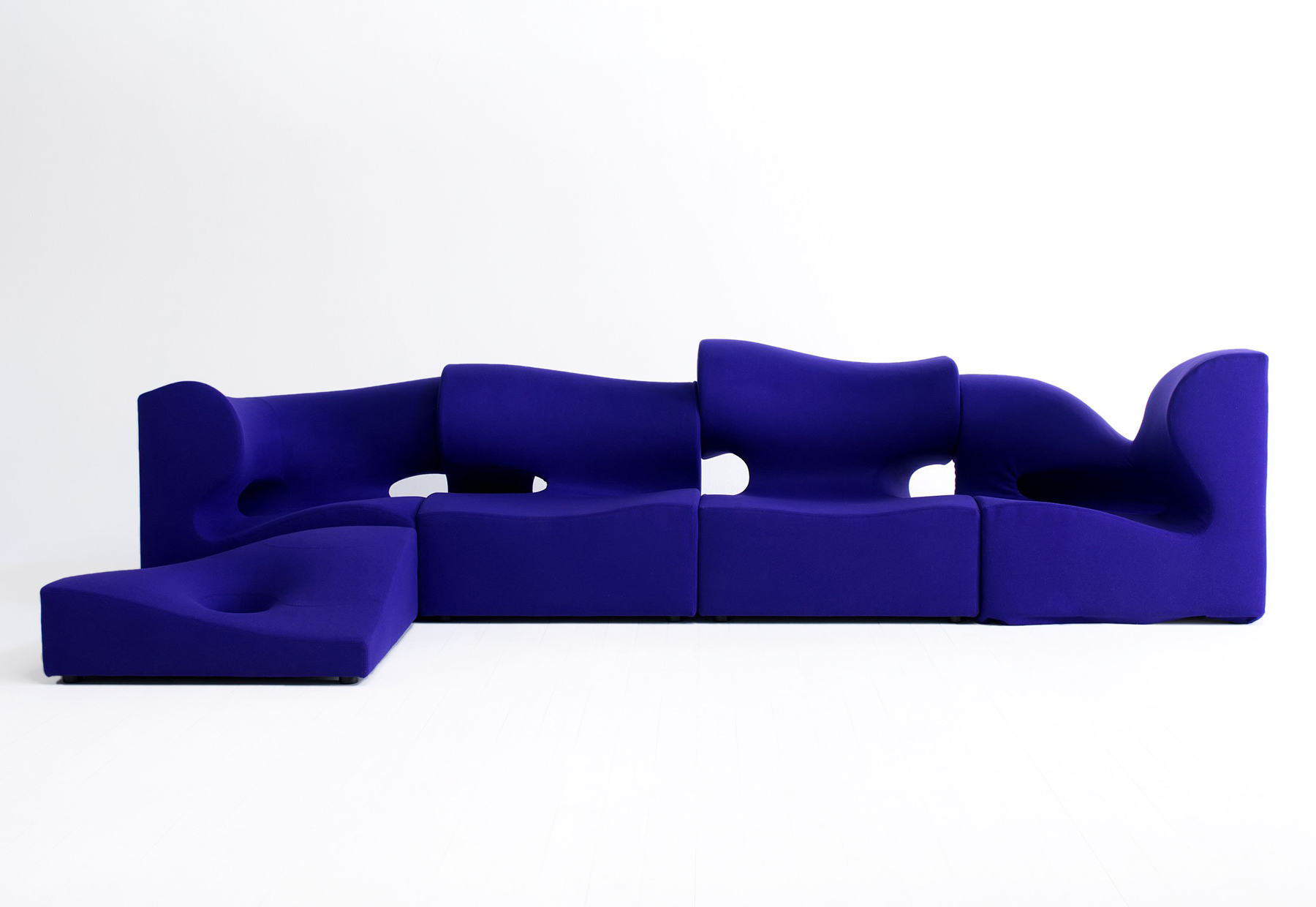
Monitors installed in the structure and on the walls feature animations of the design and production process of some of the objects on view; animated renderings of architectural projects represented in the exhibition by models; and a video showing time-lapse footage of the construction of Cage sans Frontières. Other objects – including the Bookworm and This Mortal Coil bookshelves (both 1993) and the Shadow of Time clock (1986) – are installed along the perimeter of the gallery. Two of Arad’s sofas, Do-Lo-Res (2008) (see below) and Misfits (1993) (see below), are installed outside the exhibition entrance, and visitors are invited to sit on them.

Ever since he founded his studio, together with long-time business partner Caroline Thorman, in 1981 (first called One Off, and then reestablished in 1989 as Ron Arad Associates), Arad has produced an outstanding array of innovative objects, from limited editions to unlimited series, from carbon fibre armchairs to polyurethane bottle racks. A designer and an architect, trained at the Bezalel Academy of Art in Jerusalem and at London’s Architectural Association School of Architecture, he has also designed memorable spaces – some plastic and tactile, others digital and ethereal – such as the lobby of the Tel Aviv Opera House (1994-98), Yohji Yamamoto’s showroom in Tokyo (2003), and the Holon Design Museum, Israel (nearing completion), all of which will be represented in the exhibition with models and videos. In his influential role as Head of the Design Products Masters’ Degree course at the Royal College of Art in London from 1997 until this year, he has nurtured several innovative designers, including Julia Lohmann, Paul Cocksedge, and Martino Gamper.

The 1981 Rover Chairs (see above), which launched Arad’s design career even though at the time he was not seeking any particular professional label, are emblematic of his early readymade creations. The chairs are made of discarded leather seats from the Rover V8 2L, a British car, anchored in tubular-steel frames using Kee Klamps, an inexpensive scaffolding system. Arad stopped making them once he realised that the overwhelming demand for the chairs was transforming his atelier into a dedicated Rover Chair manufacturer. The Italian company Moroso is about to produce an industrial version of the chair under the name Moreover.

The Concrete Stereo (1983) (see above) is another milestone in Arad’s work with readymades. It is very simply a hi-fi system – with turntable, amplifier, and speakers – cast in concrete. The concrete was then partially chipped away, exposing the steel armature, the electronic components, and the pebbles in the cement.

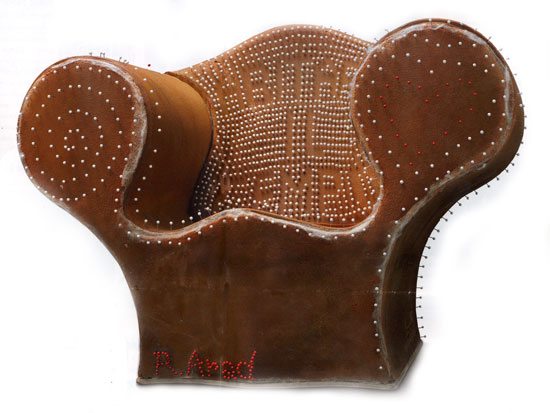
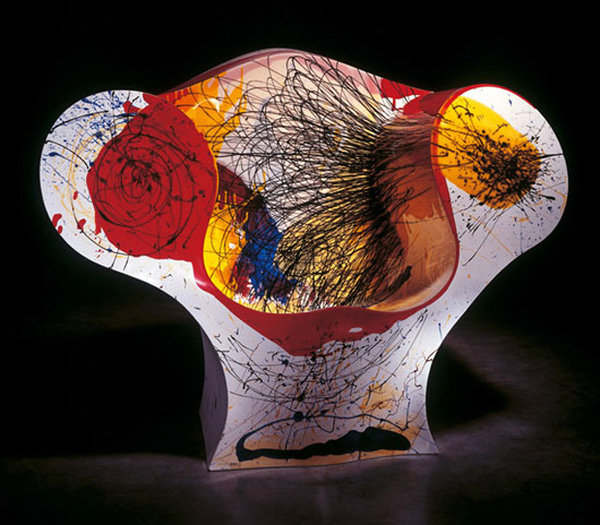
Objects in the exhibition are grouped as families whose common thread is the exploration, sometimes over years, of a form, a material, a technique, or a structural idea. An example is the investigation of elasticity and surprise that began with the Well Tempered Chair (1986) (see above) – a chair made of four sprung sheets of steel held together by wing nuts that come together to suggest the archetypical shape of an armchair. Another example is the Volumes series (1988), which comprises, among others, his renowned Big Easy (1988) (see above) and its various iterations, among them the Soft Big Easy (1990) (see above) and the painted-fibreglass New Orleans (1999) (see above).

Not Made by Hand, Not Made in China, another important family and a milestone in Arad’s career and in the history of design, is a series of limited-edition objects – vases, sculptures, lamps, and bowls – that Arad presented in 2000 at the annual Milan Furniture Fair. All the objects in the series were made using 3-D printing, which at that time was almost exclusively used to create one-off models for objects that would later be produced in series using traditional manufacturing processes. Treating rapid prototypes as final products rather than templates, Arad turned the new process into an advanced production method, a path that was subsequently followed by several designers.

A more recent family is the Bodyguards (2008) (see below), in which the same initial shape in blown aluminium is differently intersected by imaginary planes and cut to reveal ever-changing personalities, from a rocking chair to a stern bodyguard-like sculpture.

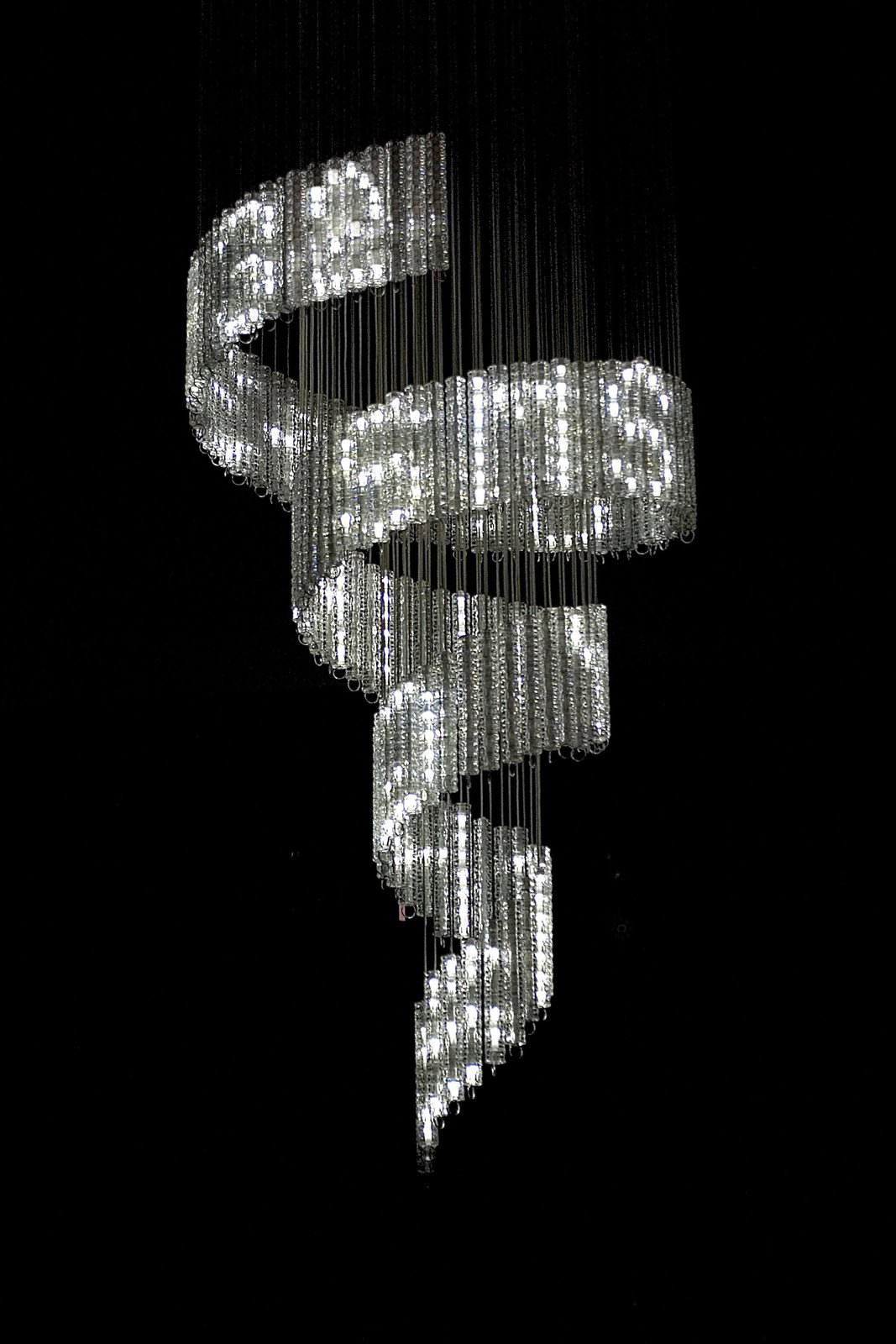
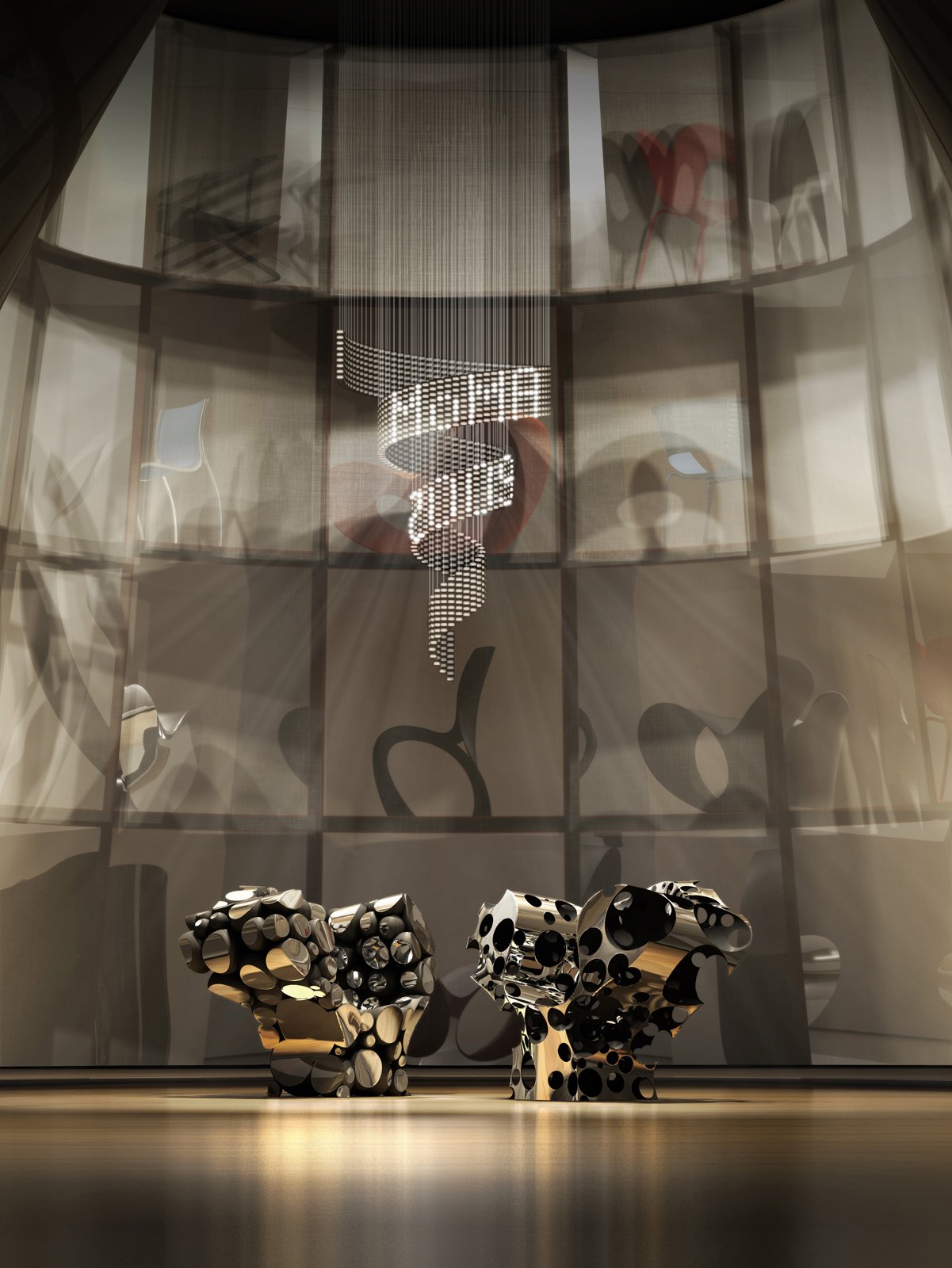
To give life to his ideas, Arad relies on the latitude provided by computers as much as on his own exquisite drafting skills, and he uses both the most advanced automated manufacturing techniques and the simple welding apparatuses in his collaborators’ metal workshops. Often, his work is a combination of high and low technologies, such as his Lolita chandelier (2004) (see below) for Swarovski. Made with 2,100 crystals and 1,050 white LEDs, the Lolita takes the shape of a flat ribbon wound into a corkscrew shape. The ribbon contains 31 processors that enable the display of text messages sent to the Lolita’s mobile phone number. For this exhibition, visitors can send texts to (917) 774-6264. The messages appear at the top of the chandelier and slowly wind down the ribbon’s curves, creating the impression that the chandelier is spinning ever so slightly.”

Press release from the MoMA website


Ron Arad (British-Israeli, b. 1951) 'Soft Big Easy' 1990


Ron Arad (British-Israeli, b. 1951)
Soft Big Easy chair
1990
Injected flame-retardant polyurethane foam, steel, polypropylene, and wool
39 3/8 x 48 7/16 x 31 1/2″ (100 x 123 x 80cm)
Manufactured by Moroso SpA, Italy
Courtesy Moroso SpA, Udine, Italy
Image: CNAC/MNAM/Dist. Réunion des Musées Nationaux/Art Resource, NY. Photo Jean-Claude Planchet


Ron Arad (British-Israeli, b. 1951) 'Large Bookworm' 1993


Ron Arad (British-Israeli, b. 1951)
Large Bookworm
1993
Tempered sprung steel and patinated steel
Bracket height variable, 7 7/8-11 13/16″ (20-30cm); total length 49′ 2 9/16″ (15m); depth 13″ (33cm)
Edition by One Off/Ron Arad Associates, London
Private collection
Image: Ron Arad Associates, London


Ron Arad (British-Israeli, b. 1951) 'Misfits' 1993


Ron Arad (British-Israeli, b. 1951)
Misfits
1993
Injected flame-retardant polyurethane foam, steel, polypropylene, and wool
Six modules: each h. variable, base 39 3/8 x 39 3/8″ (100 x 100cm)
Manufactured by Moroso SpA, Italy, 2007
Courtesy Moroso SpA, Udine, Italy
Image: Ron Arad Associates, London


Misfits is a seating system Arad developed, at Patrizia Moroso’s request, to launch Waterlily, a new water-blown foam made by ICI Polyurethane. From large cubes of foam he carved out modular – or, rather, mock-modular – sections, intending them to be graciously ill-fitting with each other (hence the name). The modules can stand on their own or be combined in various ways, but however they are lined up they are meant to look deliberately mismatched, without continuity from section to section. Some sections have backs and some do not, and the irregular solids and voids created quite a challenge for Moroso, who had to figure out how to cover them all with fabric. The recent reedition of Misfits is made with slightly larger blocks from a different polyurethane foam, which is injected into a mould rather than cut.


Ron Arad (British-Israeli, b. 1951) 'D-Sofa' Prototype 1994


Ron Arad (British-Israeli, b. 1951)
D-Sofa Prototype
1994
Patinated, painted, oxidised stainless steel and mild steel
38 3/16″ x 7′ 1 13/16″ x 35 7/16″ (97 x 218 x 90cm)
Prototype by One Off, London
Pizzuti Collection
Image: Private collection, USA. Photo Erik and Petra Hesmerg


Ron Arad (British-Israeli, b. 1951) 'Uncut' 1997


Ron Arad (British-Israeli, b. 1951)
Uncut chair
1997
Vacuum-formed aluminium sheet and polished stainless steel
32 5/8 x 38 5/8 x 35″ (83 x 98 x 89cm)
Edition by Ron Arad Studio, Italy
Centre Pompidou, Paris, Musée national d’art moderne/Centre de création industrielle


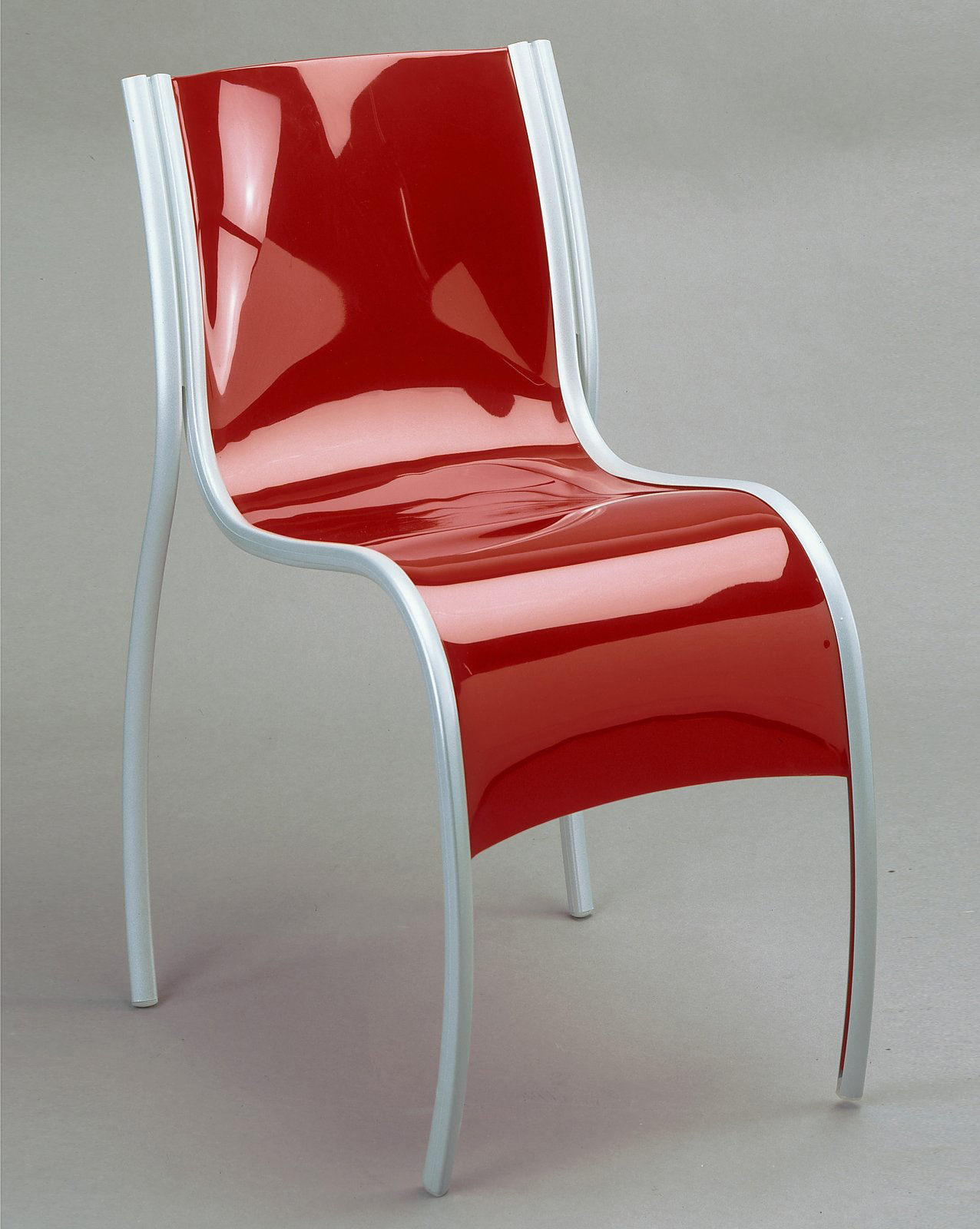
Ron Arad (British-Israeli, b. 1951) 'FPE (Fantastic, Plastic, Elastic)' 1997


Ron Arad (British-Israeli, b. 1951)
FPE (Fantastic, Plastic, Elastic)
1997
Extruded aluminium profiles and injection-moulded polypropylene plastic sheet
31.25 x 17 x 22″ (79.4 x 43.2 x 55.9cm)
Manufactured by Kartell, Italy
The Museum of Modern Art, New York. Gift of the manufacturer
Image: Ron Arad Associates, London


FPE (Fantastic, Plastic, Elastic) is an inexpensive stacking chair made from lightweight plastic and aluminium. The design, originally conceived in plywood (as the Cross Your T’s Chair), was part of a commission from Mercedes-Benz for a transportable exhibition stand that would be taken to motor shows in Europe. The chair was not suited to small-scale production, and was therefore tweaked and perfected for mass manufacture. Its final form is exceptional in the simplicity of its construction: a plastic seat is inserted into channels in double-barrelled extruded aluminium profiles, which, when the chair frame is bent, hold the plastic in place. With no need for glue, screws, or bolts, this method allows the simplest combination of frame and plane to create a sinuous, practical, resilient form – proving Arad’s ability to embrace industrial production and make the best of its possibilities. The FPE can be stacked in groups of eight, comes in three colours (opaline, blue, and red, although it was originally available in yellow), and can be used both indoors and out.


Ron Arad (British-Israeli, b. 1951) 'New Orleans' 1999


Ron Arad (British-Israeli, b. 1951)
New Orleans chair
1999


Ron Arad (British-Israeli, b. 1951) 'Lolita Chandelier' 2004


Ron Arad (British-Israeli, b. 1951)
Lolita Chandelier
2004
Crystals and light-emitting diodes (LEDs)
59″ (150cm) height x 43 1/4″ (110 cm) top-plate diam.; weight 352.7 lbs (160 kg)
Edition by Swarovski, Austria
Courtesy of Galerie Arums, Paris
Send a text message to Lolita: (917) 774-6264
Image: Ron Arad Associates, London


When Nadja Swarovski set out to build a new division for her family’s company, Swarovski Crystal, she invited Arad to reinvent the chandelier as a juxtaposition of traditional form with modern technology. The new collection of chandeliers, called Crystal Palace, launched in 2002, and Arad’s Lolita was ready in 2004. Made with 2,100 crystals and 1,050 white LEDs, Lolita takes the shape of a flat ribbon wound into a corkscrew shape. The ribbon contains thirty-one processors that enable the display of SMS text messages sent to Lolita’s mobile phone number; these messages appear at the top of the chandelier and wind down the ribbon’s curves, slowly enough to give bystanders time to read, creating the impression that the chandelier is spinning ever so slightly. The name is the result of grace under pressure: on the phone with Swarovski and pressed for a name, Arad thought of another work in progress, his LED riddled Lo-Rez-Dolores-Tabula-Rasa, and from there went to “Lolita” – the nickname of Vladimir Nabokov’s Dolores Haze. The name stuck, creating not only a saucy entry in many a design buff’s phone book but a further literary association as well: as a journalist pointed out to Arad, Nabokov’s novel begins, “Lolita, light of my life…”


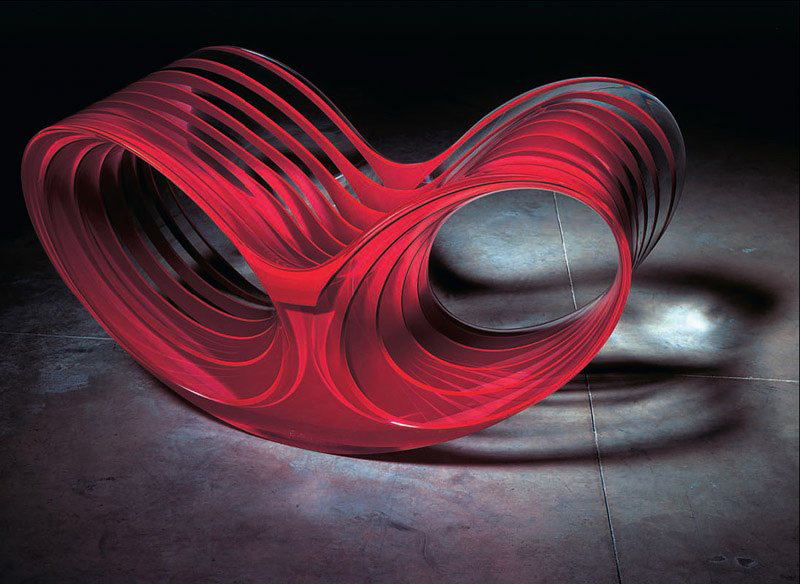
Ron Arad (British-Israeli, b. 1951) 'Oh Void 2' armchair 2004


Ron Arad (British-Israeli, b. 1951)
Oh Void 2 armchair
2004


Ron Arad (British-Israeli, b. 1951) 'Oh Void 2 armchair' 2006


Ron Arad (British-Israeli, b. 1951)
Oh Void 2 armchair
2006
Acrylic
30 1/4 x 43 x 23 5/8″ (76.8 x 109.2 x 60cm)
Edition by The Gallery Mourmans, the Netherlands
Collection of Michael G. Jesselson, New York


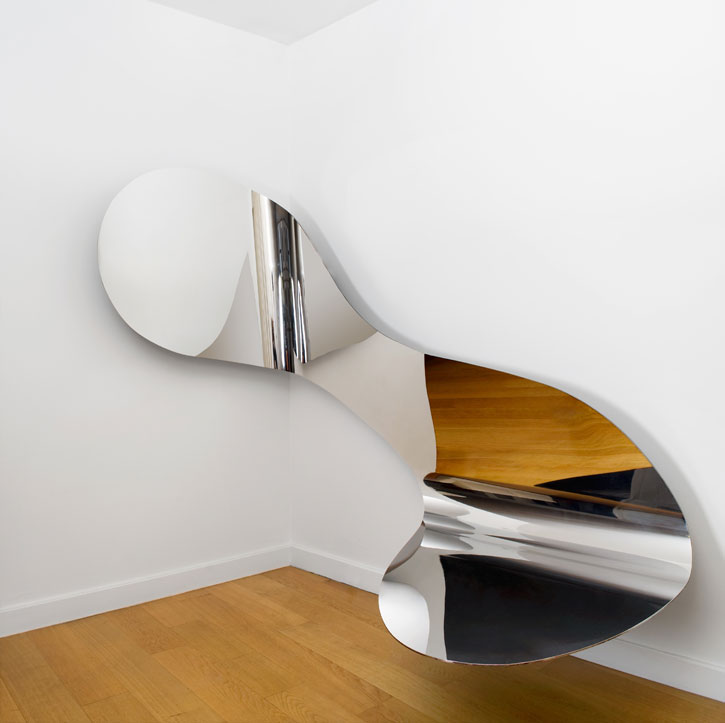
Ron Arad (British-Israeli, b. 1951) 'Table Paved With Good Intentions No. 48' 2005


Ron Arad (British-Israeli, b. 1951)
Table Paved With Good Intentions No. 48
2005
Mirror-polished, laser-cut stainless steel
55″ x 8′ 2″ x 15″ (139.7 x 238.8 x 38.1cm); weight 176.4 lbs (80 kg)
Edition by Ron Arad for The Gallery Mourmans, the Netherlands
Collection Jérôme and Emmanuelle de Noirmont, Paris
Image: Emmanuelle and Jérôme de Noirmont. Photo: Mathieu Ferrier


Arad’s installation for Design Miami in 2005 consisted of sixty-nine tables made of mirror-polished stainless steel and covering an entire gallery, folding at the corners and climbing up the walls like handsome quicksilver parasites from outer space. Arad had experimented with reflective tables eleven years earlier, in an installation for one of the Fondation Cartier’s famous Soirées Nomades, in which designers were invited to provide a stage for music and other types of performances in Jean Nouvel’s building for the Paris-based foundation. There, Arad displayed forty tables that covered the ground floor, reflecting the surrounding trees and enhancing the glass architecture’s openness toward the city surrounding it.


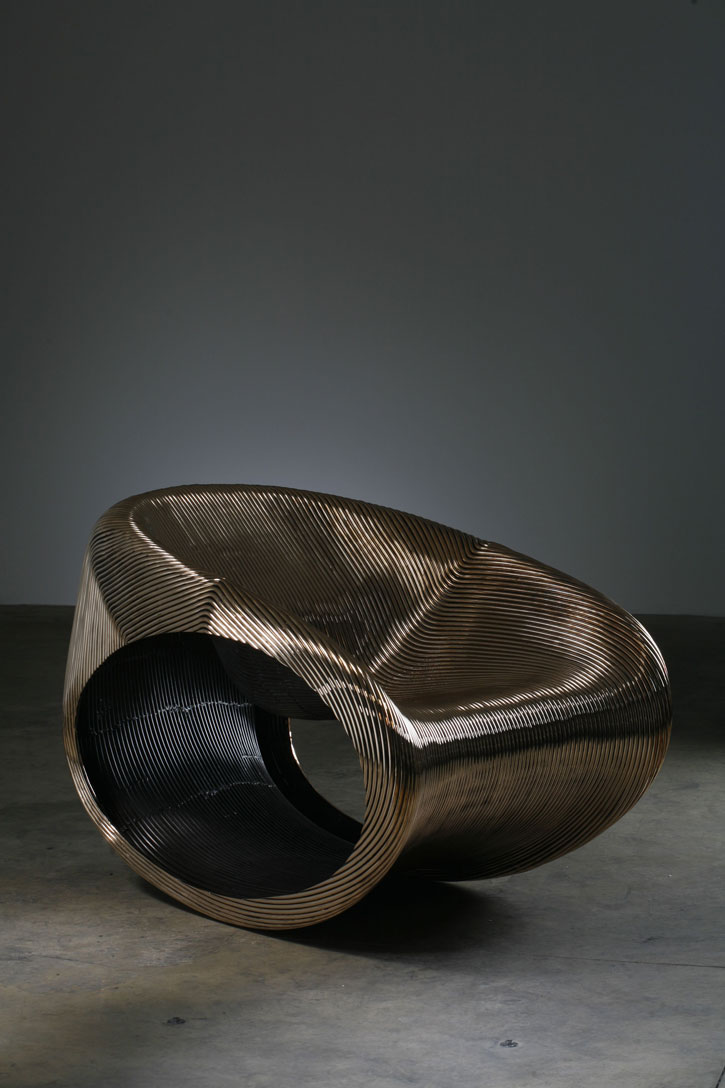
Ron Arad (British-Israeli, b. 1951) 'MT Rocker Chair' 2005


Ron Arad (British-Israeli, b. 1951)
MT Rocker Chair
2005
Polished bronze rods
29 x 33 1/2 x 40″ (73.7 x 85.1 x 101.6cm)
Edition by Ron Arad Associates, London
Private collection, USA
Image: Ron Arad Associates, London


Arad’s work often begins as a studio piece that is later adapted for industrial production, but in some cases the direction is reversed, as was the case with the MT (or “empty”) series. Intrigued by the untapped potential of rotation-moulding, one of the humblest methods of manufacturing plastic products, Arad came up with beautiful, complex concave / convex forms, highlighted by contrasting colours, for an armchair, rocker, and couch. The MT collection is manufactured by Driade, but Arad subsequently translated the rocking piece into versions made of polished stainless steel or bronze, using an exquisite technique involving the patient application, by hand, of metal rods onto a basic structure.


Ron Arad (British-Israeli, b. 1951) 'Southern Hemisphere' 2007


Ron Arad (British-Israeli, b. 1951)
Southern Hemisphere
2007
Patinated aluminium
Photo by Erik and Petra Hesmerg and courtesy of Private Collection, Maastricht, and the Museum of Modern Art


Ron Arad (British-Israeli, b. 1951) 'Do-Lo-Res' 2008


Ron Arad (British-Israeli, b. 1951)
Do-Lo-Res
2008
Polyurethane foam, polyester fibres, and wood
Dimensions variable: 10 13/16 x 8 1/4 x 8 1/4 x 32 1/16″ (27.5 x 21 x 21 x 83cm)
Manufactured by Moroso SpA, Italy
Courtesy Moroso SpA, Udine, Italy
Image: Moroso


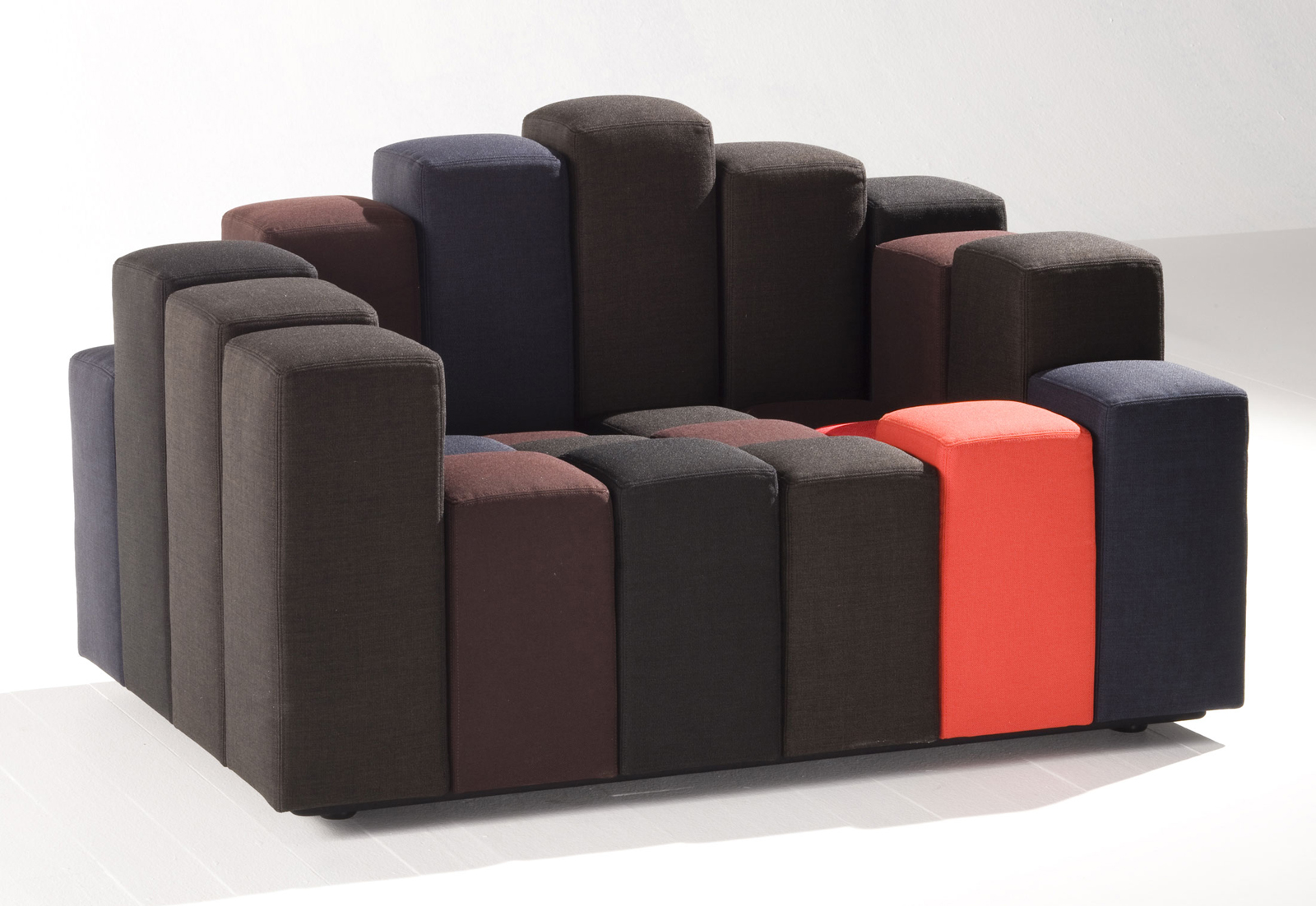
Do-Lo-Rez is a seating unit made of rectangular block elements, each one constructed from polyurethane foam, denser at the bottom and softer at the top. The name echoes the Lo-Rez-Dolores-Tabula-Rasa project, and both designs are different manifestations of Arad’s interest in digital pixilation and low resolution. Here the foam “pixels” of different heights are attached to a platform with steel pins and can be rearranged to create different sofa forms.


Ron Arad (British-Israeli, b. 1951) 'PizzaKobra' lamp 2008


Ron Arad (British-Israeli, b. 1951)
PizzaKobra lamp
2008
Chromed steel, aluminium, and light-emitting diodes (LEDs)
Extended: 28 7/8″ (73.3cm) height x 10 1/4″ (26cm) diam.; collapsed: 3/4″ (1.9cm) height x 10 1/4″ (26cm) diam.
Manufactured by iGuzzini illuminazione SpA, Italy, 2008
The Museum of Modern Art, New York. Gift of the manufacturer


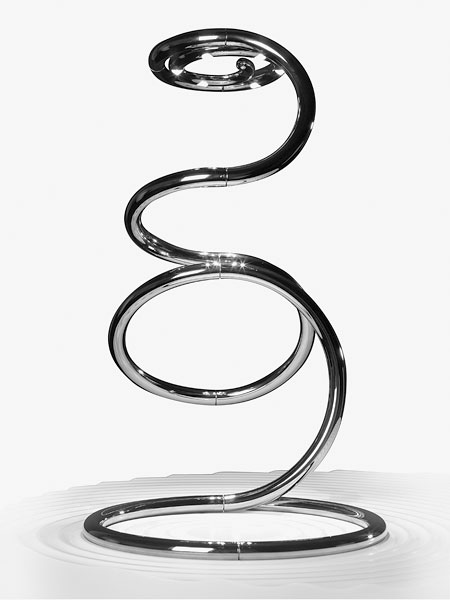
This lamp, which transforms itself from a coil as flat as a pizza to a sinuous, rising metal cobra with a single glowing red eye (its on/off switch), is as surprising as it is playful, as much like a twisty Tangle Toy as a very efficient and flexible light source. With its tubular aluminium sections – except for the base, which is heavier steel, for balance – and six LEDs that can be oriented in any direction, the PizzaKobra can be adjusted to suit any lighting requirements.


Ron Arad (British-Israeli, b. 1951) 'Bodyguard' 2008


Ron Arad (British-Israeli, b. 1951)
Bodyguard chair
2008
Polished and partially coloured superplastic aluminium
49 x 36 x 70 1/2″ (124.5 x 91.4 x 179.1cm)
Edition by The Gallery Mourmans, the Netherlands
Private collection, Palm Beach, Florida


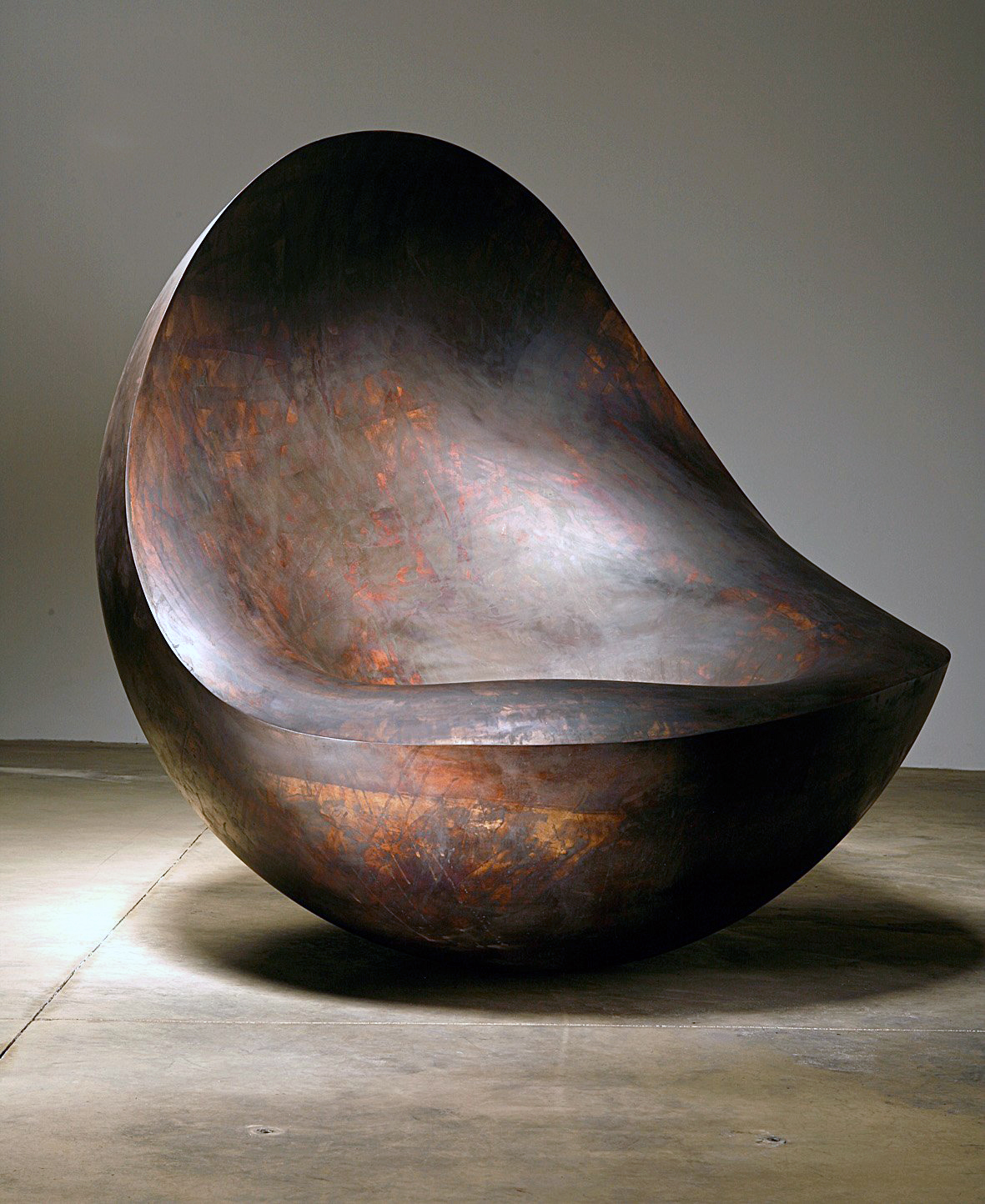
The Bodyguards, a recent result of Arad’s experiments with blown aluminium, are all derived from the same bulbous shape, intersected and carved in various ways. Although Arad had sworn off designing rocking chairs, it seemed a natural application for this new technology, allowing him to create these large, polished pieces, which, in addition to rocking back and forth, also swivel in a way Arad describes as “omnidirectional.” With the Bodyguards, as with much of his furniture, Arad explores the expressive qualities of the material, pursuing a way to transcend its physical limitations. He has described the pieces as monsters – huge and labor intensive, some resembling a human torso and revealing colourful insides when cut. (Arad was teased about the number of security guards present at a show in Dolce & Gabbana’s Metropol space in Milan, in 2006 – hence the name.)


Installation Photographs of the Exhibition

Installation view of 'Ron Arad: No Discipline' exhibition featuring 'Cage sans Frontières (Cage without Borders)' with 'Even the Odd Balls?' chairs (2009) and 'Lolita Chandelier' (2004)


Installation view of Ron Arad: No Discipline exhibition featuring Cage sans Frontières (Cage without Borders) with Even the Odd Balls? chairs (2009) and Lolita Chandelier (2004)
Photo courtesy of Ron Arad Associates and the Museum of Modern Art


Installation view of 'Ron Arad: No Discipline' exhibition, featuring 'Cage sans Frontières (Cage without Borders)'


Installation view of Ron Arad: No Discipline exhibition, featuring Cage sans Frontières (Cage without Borders)
Photo courtesy of Ron Arad Associates and the Museum of Modern Art


Installation view of 'Ron Arad: No Discipline' exhibition, featuring 'Cage sans Frontières (Cage without Borders)'


Installation view of Ron Arad: No Discipline exhibition, featuring Cage sans Frontières (Cage without Borders)
Photo courtesy of Ron Arad Associates and the Museum of Modern Art


Installation view of 'Ron Arad: No Discipline' exhibition, featuring 'Cage sans Frontières (Cage without Borders)' with two 'Rolling Volume' chairs (1989 and 1991), left, and two 'Bodyguard' chairs (2007)


Installation view of Ron Arad: No Discipline exhibition, featuring Cage sans Frontières (Cage without Borders) with two Rolling Volume chairs (1989 and 1991), left, and two Bodyguard chairs (2007)


Installation view of 'Ron Arad: No Discipline' exhibition, featuring 'Cage sans Frontières (Cage without Borders)' with in the foreground, 'Oh Void 2' armchairs


Installation view of Ron Arad: No Discipline exhibition, featuring Cage sans Frontières (Cage without Borders) with in the foreground, Oh Void 2 armchairs


The Museum of Modern Art (MoMA)
11, West Fifty-Third Street, New York

Opening hours:
Sun – Fri, 10.30am – 5.30pm
Sat, 10.30am – 7.00pm

MOMA website

LIKE ART BLART ON FACEBOOK

Back to top

Review: ‘Cineraria’ by Julia deVille at Sophie Gannon Gallery, Richmond, Melbourne

Exhibition dates: 28th July – 22nd August, 2009


Julia deVille (New Zealand, b. 1982) 'Ruby Heart Starling' 2008 from the exhibition 'Cineraria' by Julia deVille at Sophie Gannon Gallery, Richmond, Melbourne, July - Aug, 2009


Julia deVille (New Zealand, b. 1982)
Ruby Heart Starling
2008
Starling, sterling silver, black rhodium & gold plate, rubies, antique frame
30 x 35 x 18cm


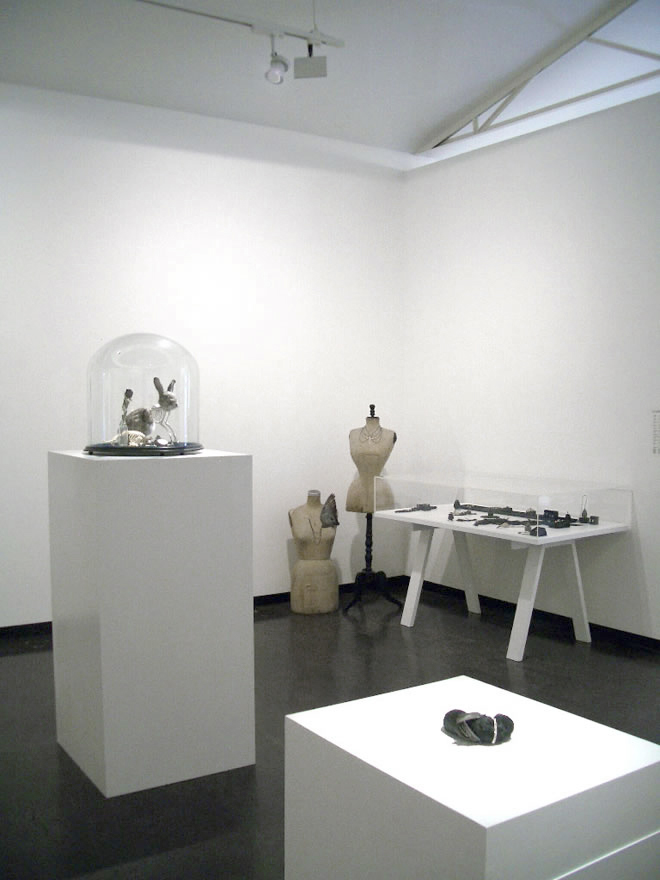
This is an itsy-bitsy show by Julia deVille at Sophie Gannon Gallery in Richmond, Melbourne. Offering a menagerie of macabre stuffed animals and conceptual ideas the exhibition fails to coalesce into a satisfying vision. It features many ideas that are not fully investigated and incorporated into the corporeal body of the work.

We have, variously, The Funerary Urn/Cinerarium, The Ossuary, Skeletons, Black, Victorian Funerary Customs, Feathers, Taxidermy, Time, Eggs and Religion. We also have stuffed animals, cigar boxes, lace and silver, pelts and columns, jet necklaces and Victorian glass domes, glass eyes and ruby hearts to name but a few. The viewer is overwhelmed by ideas and materials.

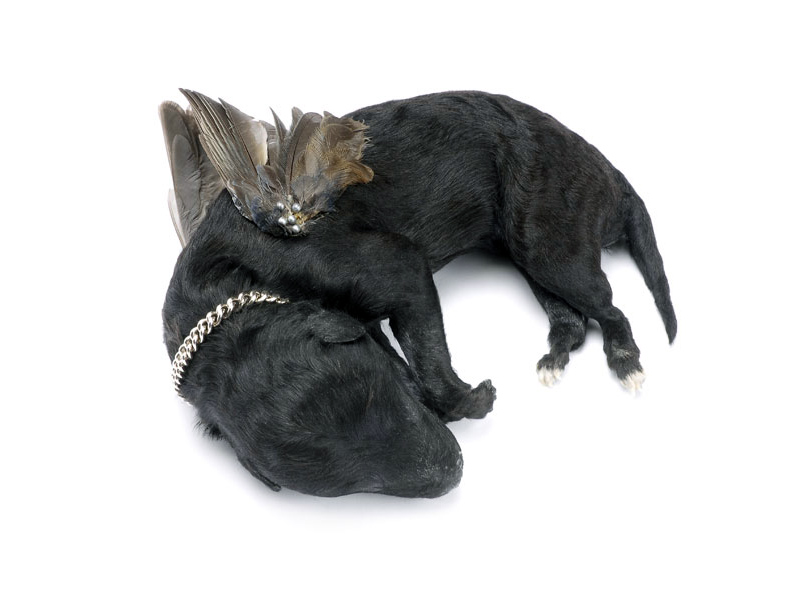
When individual pieces excel the work is magical: the delicate and disturbing Stillborn Angel (2009, below) curled in a foetal position with appended sparrows wings is a knockout. The large suspended raven of Night’s Plutonian Shore (2009, above) effectively evinces the feeling of the shores of the underworld that the title, taken from an Edgar Allan Poe poem, reflects on.

Other pieces only half succeed. Piglet (2009, below) is a nice idea with its lace snout and beaded wings sitting on a bed of feathers awaiting judgement but somehow the elements don’t click into place. Further work are just one shot ideas that really lead nowhere. For example Cat Rug (2008, below) features black crystals in the mouth of a taxidermied cat that lies splayed on a plinth on the gallery floor. And, so … Silver Rook (2008, below) is a rook whose bones have been cast in silver, with another ruby heart, suspended in mid-air in the gallery space. Again an interesting idea that really doesn’t translate into any dialogue that is substantial or interesting.

Another problem with the work is the technical proficiency of some of the pieces. The cast silver front legs and ribs of The Anatomy of a Rabbit (2008, below) are of poor quality and detract from what should have been the delicacy of the skeletal bones of the work. The bronze lion cartouche on the egg shaped Lion Urn (2009) fails to fit the curved shape of the egg – it is just attached at the top most point and sits proud of the egg shape beneath. Surely someone with an eye for detail and a sense of context, perfection and pride in the work they make would know that the cartouche should have been made to fit the shape underneath.

Despite its fashionable position hovering between craft, jewellery and installation this is ‘art’ in need of a good reappraisal. My suggestion would be to take one idea, only one, and investigate it fully in a range of work that is thematically linked and beautifully made. Instead of multiplying the ideas and materials that are used, simplify the conceptual theme and at the same time layer the work so it has more complexity, so that it reveals itself over time. You only have to look at the work of Mari Funaki in the previous post or the simple but conceptually complex photographs of Matthias Koch in the German photography review to understand that LESS IS MORE!

There are positive signs here and I look forward to seeing the development of the artist over the next few years.

Dr Marcus Bunyan


Many thankx to Sophie Gannon Gallery for allowing me to publish the photographs in the posting. Please click on the photographs for a larger version of the image.


Julia deVille (New Zealand, b. 1982) 'Night's Plutonian Shore' 2009 from the exhibition 'Cineraria' by Julia deVille at Sophie Gannon Gallery, Richmond, Melbourne, July - Aug, 2009


Julia deVille (New Zealand, b. 1982)
Night’s Plutonian Shore
2009
Tasmanian Forest Raven, black garnets, cotton, sterling silver, amethyst


Julia deVille (New Zealand, b. 1982) 'L'enfant (Infant Funerary Urn)' 2009 from the exhibition 'Cineraria' by Julia deVille at Sophie Gannon Gallery, Richmond, Melbourne, July - Aug, 2009


Julia deVille (New Zealand, b. 1982)
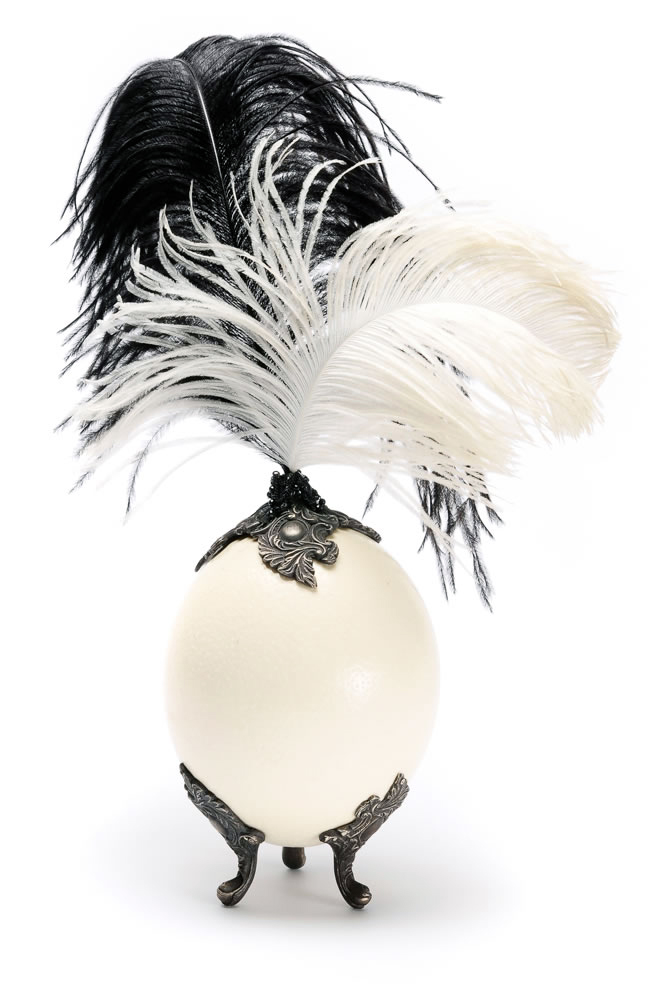
L’enfant (Infant Funerary Urn)
2009
Ostrich egg, sterling silver, ostrich plumes and black garnet
35 x 12 x 12cm


Julia de Ville 'Cineraria' installation view at Sophie Gannon Gallery, Melbourne

Julia de Ville 'Cineraria' installation view at Sophie Gannon Gallery, Melbourne


Julia deVille Cineraria installation views at Sophie Gannon Gallery, Melbourne
Photos: Marcus Bunyan


Julia deVille (New Zealand, b. 1982) 'Piglet' 2009


Julia deVille (New Zealand, b. 1982)
Piglet
2009
Piglet, antique lace, pins and feathers
25 x 23 x 13cm


Julia deVille (New Zealand, b. 1982) 'Cat Rug' 2008


Julia deVille (New Zealand, b. 1982)
Cat Rug
2008
Cat, glitter and fibreglass
100 x 60 x 8cm


Julia deVille (New Zealand, b. 1982) 'Sympathy' 2008


Julia deVille (New Zealand, b. 1982)
Sympathy
2008


Julia deVille (New Zealand, b. 1982) 'Silver Rook' 2008


Julia deVille (New Zealand, b. 1982)
Silver Rook
2008
Sterling silver, rubies
30 x 25 x 35cm


Cinerarium

n. pl. Cineraria
A place for keeping the ashes of a cremated body.

Cineraria
n. any of several horticultural varieties of a composite plant, Senecio hybridus, of the Canary Islands, having clusters of flowers with
white, blue, purple, red, or variegated rays.

Origin: 1590-1600; < NL, fem. of cinerarius ashen, equiv. to L ciner- (s. of cinis ashes) + -rius -ary; so named from ash-coloured down on leaves.

CINERARIA is a study of the ritual and sentiment behind funerary customs from various cultures and eras.


Notes on inspirations

The Funerary Urn/Cinerarium: Funerary Urns have been used since the times of the ancient Greeks and are still used today. After death, the body is cremated and the ashes are collected in the urn.

The Ossuary: An ossuary is a chest, building, well, or site made to serve as the final resting place of human skeletal remains. They are frequently used where burial space is scarce. A body is first buried in a temporary grave, then after some years the skeletal remains are removed and placed in an ossuary. The greatly reduced space taken up by an ossuary means that it is possible to store the remains of many more people in a single tomb than if the original coffins were left as is. This was a common practice in post plague Europe in the 14th-16th Centuries.

Skeletons: Human skeletons and sometimes non-human animal skeletons and skulls are often used as blunt images of death. The skull and crossbones (Death’s Head) motif has been used among Europeans as a symbol of piracy, poison and most commonly, human mortality.

Black: In the West, the colour used for death and mourning is black. Black is associated with the underworld and evil. Kali, the Hindu god of destruction, is depicted as black.

Victorian Funerary Customs:

~ A wreath of laurel, yew or boxwood tied with crape or black ribbons would be hung on the front door to alert passers by that a death had occurred

~ The use of flowers and candles helped to mask unpleasant odours in the room before embalming became common

~ White was a popular colour for the funeral of a child. White gloves, ostrich plumes and a white coffin were the standard

Feathers: In Egyptian culture a recently deceased persons soul had to be as light as a feather to pass the judgment of Ma’at. Ma’at (Maet, Mayet) is the Egyptian goddess of truth, justice and the underworld. She is often portrayed as wearing a feather, a symbol of truth, on her head. She passed judgment over the souls of the dead in the Judgment Hall of Osiris. She also weighted up the soul against a feather. The “Law of Ma’at” was the basis of civil laws in ancient Egypt. If it failed, the soul was sent into the underworld. Ma’at’s symbol, an ostrich feather, stands for order and truth.

Taxidermy: Taxidermy to me is a modern form of preservation, a way for life to continue on after death, in a symbolic visual form.

The Raven: In many cultures for thousands of years, the Raven has been seen symbol of death. This is largely due to the Raven feeding on carrion. Edgar Allan Poe has used this symbolism in his poem, “The Raven”.

Time: Less blunt symbols of death frequently allude to the passage of time and the fragility of life. Clocks, hourglasses, sundials, and other timepieces call to mind that time is passing. Similarly, a candle both marks the passage of time, and bears witness that it will eventually burn itself out. These sorts of symbols were often incorporated into vanitas paintings, a variety of early still life.

Eggs: The egg has been a symbol of the start of new life for over 2,500 years, dating back to the ancient Persians. I have chosen egg shapes and even one Ostrich egg to represent the cycle of life, the beginning and the end.

Religion: Religion has played a large part in many funerary customs and beliefs. I am particularly interested in the Memento Mori period of the 16th-18th centuries. In a Calvinistic Europe, when the plague was a not too distant memory, a constant preoccupation with death became a fashionable devotional trend.

Julia deVille


Julia deVille (New Zealand, b. 1982) 'Stillborn Angel' 2009


Julia deVille (New Zealand, b. 1982)
Stillborn Angel
2009
Stillborn puppy, sparrow wings and sterling silver
13 x 10 x 5cm


Julia deVille (New Zealand, b. 1982) 'The Anatomy of a Rabbit' 2008


Julia deVille (New Zealand, b. 1982)
The Anatomy of a Rabbit
2008
Rabbit, sterling silver, rubies, glitter and mahogany
30 x 30 x 30cm


Julia de Ville 'Cineraria' installation views at Sophie Gannon Gallery, Melbourne


Julia deVille Cineraria installation view at Sophie Gannon Gallery, Melbourne
Photo: Marcus Bunyan


Sophie Gannon Gallery
2, Albert Street, Richmond, Melbourne

Opening hours:
Tuesday – Saturday 11am – 5pm

Sophie Gannon Gallery website

LIKE ART BLART ON FACEBOOK

Back to top

Exhibition: ‘Beuys is Here; Sculpture Object Action Revolution’ at De La Warr Pavilion, Bexhill-on-Sea, England

Exhibition dates: 4th July – 27th September, 2009


All photographs are of work in the exhibition. Many thankx to the De La Warr Pavilion for allowing me to publish the photographs and art work in the posting. Please click on the photographs for a larger version of the image.

Dr Marcus Bunyan


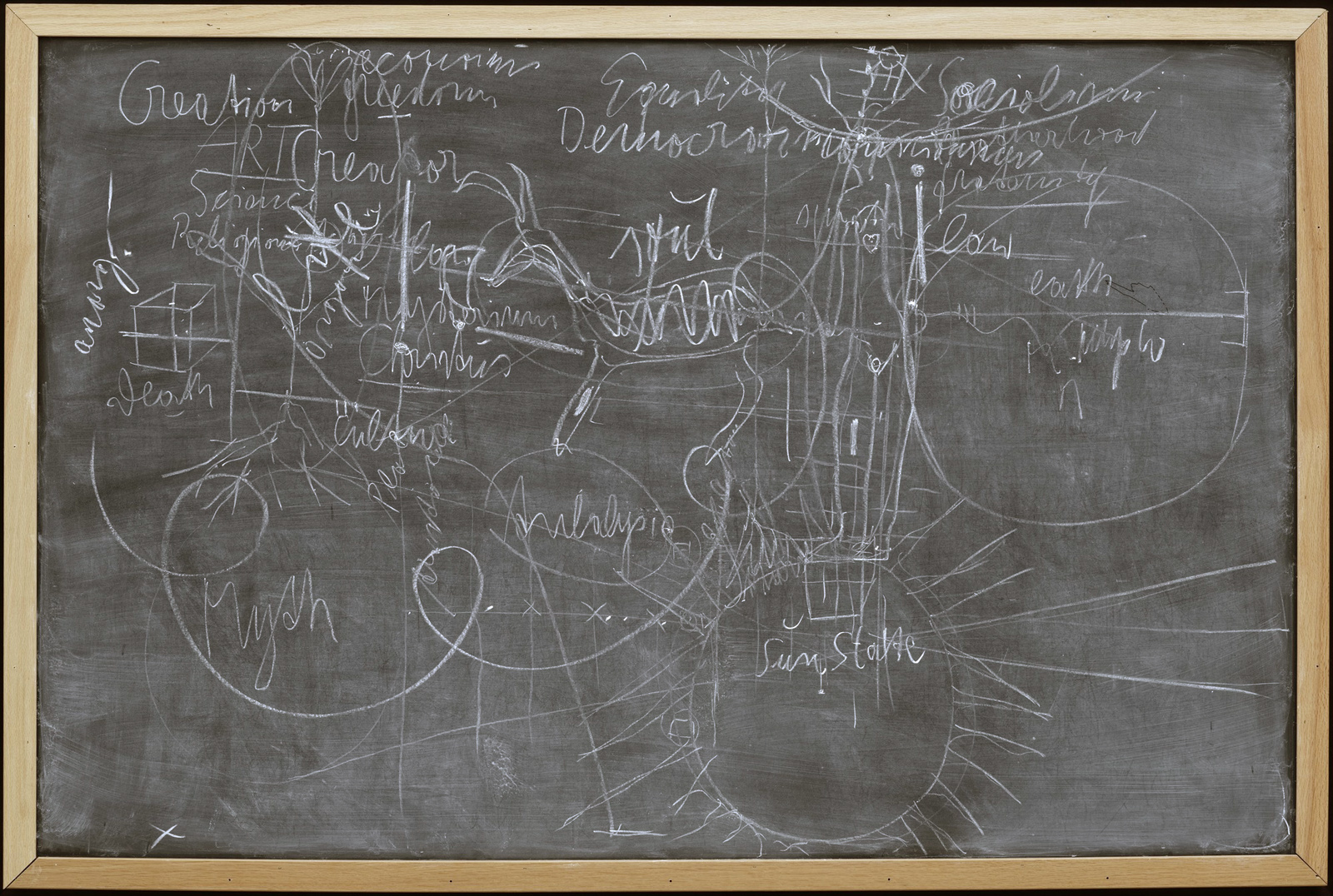
Joseph Beuys (German, 1921-1986) 'Untitled (Sun State)' 1974 from the exhibition 'Beuys is Here; Sculpture Object Action Revolution' at De La Warr Pavilion, Bexhill-on-Sea, England, July - Sept, 2009


Joseph Beuys (German, 1921-1986)
Untitled (Sun State)
1974
Chalk and felt-tip pen on blackboard with wood frame
47 1/2 x 71 1/8″ (120.7 x 180.7cm)


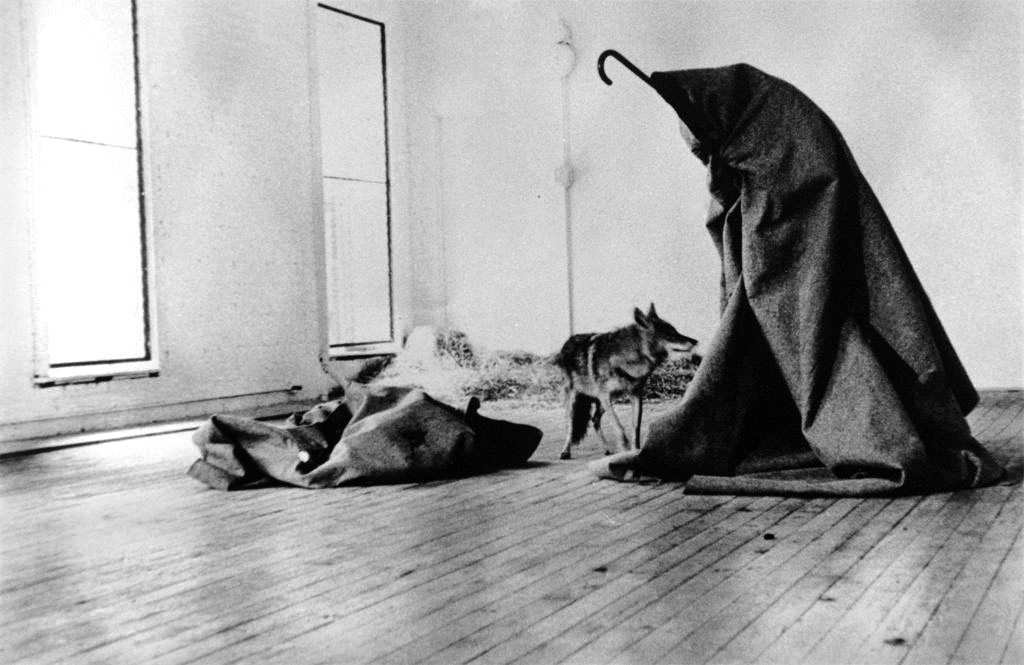
Joseph Beuys (German, 1921-1986) 'I like America and America likes me' action 1974 from the exhibition 'Beuys is Here; Sculpture Object Action Revolution' at De La Warr Pavilion, Bexhill-on-Sea, England, July - Sept, 2009


Joseph Beuys (German, 1921-1986)
I like America and America likes me action
1974


Joseph Beuys (German, 1921-1986) Überwindet endlich die Parteiendiktatur - Poster, N070815SE_118_098 - Overcome Party Dictatorship Now 1971


Joseph Beuys (German, 1921-1986)
Überwindet endlich die Parteiendiktatur – Poster, N070815SE_118_098 – Overcome Party Dictatorship Now
1971
Print on paper
278 x 395 mm
ARTIST ROOMS Tate and National Galleries of Scotland
Galleries of Scotland through The d’Offay Donation with assistance from the National Heritage Memorial Fund and the Art Fund 2008


German artist Joseph Beuys (1921-1986) is widely recognised as one of the most influential and extraordinary artists of the twentieth century.
 Artist, educator, political and social activist, Beuys’s philosophy  proposed the healing power and social function of art, in which everyone can participate and benefit. The works in this exhibition provide an opportunity to experience this expanded concept of art as he understood it. Collectively, the exhibition presents the ‘constellation of ideas’ central to Beuys’s practice, revealing his ideas on zoology, ecology, homeopathy, economics, politics, social activism, teaching and learning. Beuys incorporated into his work various materials such as felt, fat and metal, selected because of their inherent properties such as insulation, conduction and protection which all have associations with Beuys’s ideas.

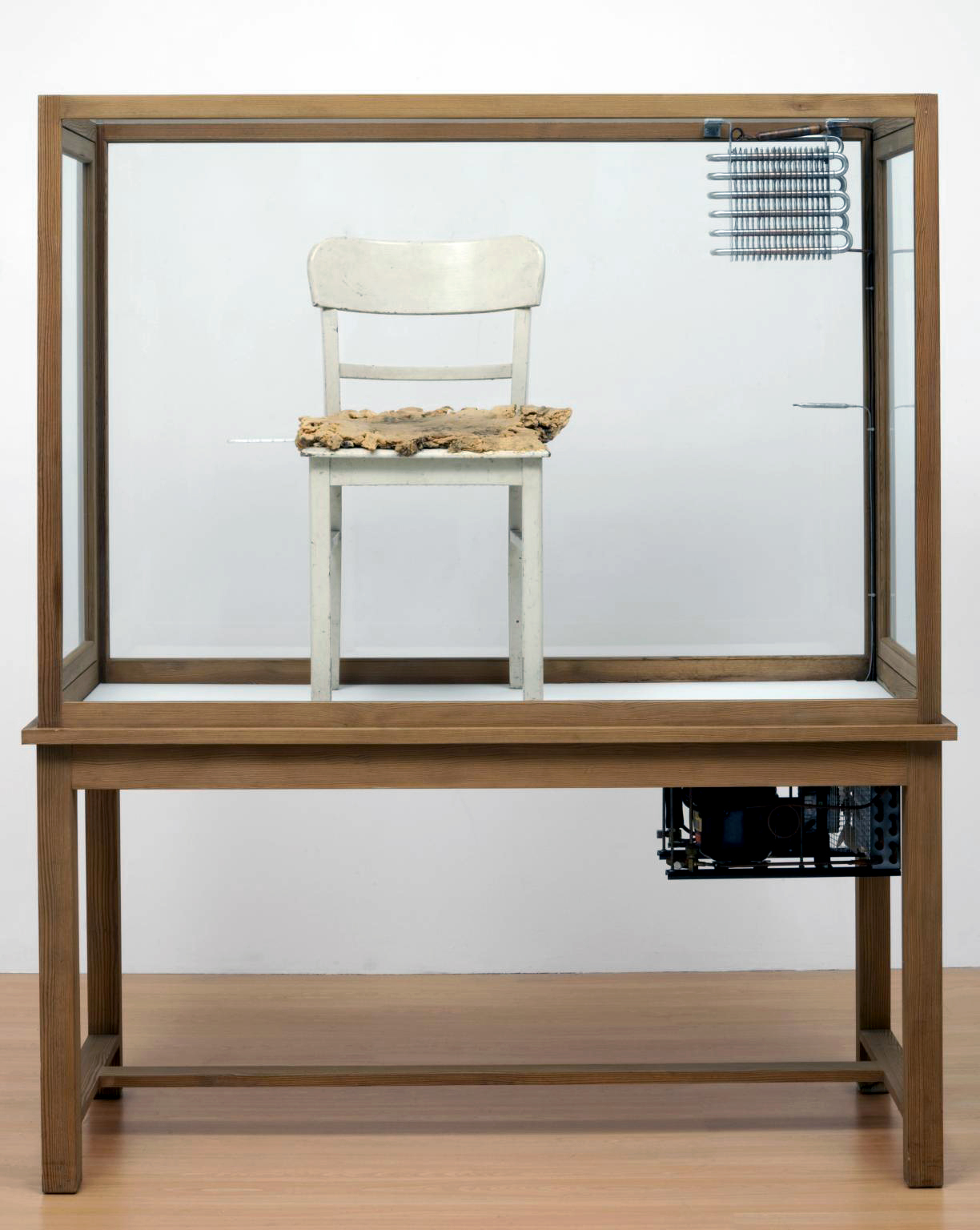
The exhibition is largely selected from the ARTIST ROOMS collection and brings together well-known sculptures, drawings, vitrines and a remarkable selection of posters recalling live actions and events. Works include Fat Chair (1964-1985) and, in Gallery 2, a single major work Scala Napoletana (1985) is shown for the first time in the UK. In addition nearly twenty notable multiples are included within the exhibition selected from National Galleries of Scotland. The multiple was a form of communication for Beuys – a means by which he could share and distribute his ideas beyond the confines of the artworld.

Text from the De La Warr Pavilion website [Online] Cited 23/07/2009. No longer available online


Joseph Beuys. 'Fettstuhl (Fat Chair)' 1964-1985


Joseph Beuys (German, 1921-1986)
Fettstuhl (Fat Chair)
1964-1985
Wood, glass, metal, fabric, paint, fat and thermometer
1830 x 1550 x 640 mm
ARTIST ROOMS Tate and National Galleries of Scotland
Galleries of Scotland through The d’Offay Donation with assistance from the National Heritage Memorial Fund and the Art Fund 2008


Joseph Beuys (German, 1921-1986) 'Entwurf für ein Filzenvironment [Model for a Felt Environment]' 1964


Joseph Beuys (German, 1921-1986)
Entwurf für ein Filzenvironment (Model for a Felt Environment)
1964
Wood, glass, felt, oil paint and lead
1840 x 1680 x 840 mm
ARTIST ROOMS Tate and National Galleries of Scotland
Galleries of Scotland through The d’Offay Donation with assistance from the National Heritage Memorial Fund and the Art Fund 2008


The neat rolls of grey felt on painted wood inside this vitrine are intended as a model for an ‘environment’. Felt insulates and absorbs, representing protection but also a sense of constriction, like being suffocated. The same type of felt rolls are seen in the ‘environment’ Plight (1958/1985), now in the Pompidou Centre, in which the walls and ceiling are covered with felt to create a stifling atmosphere. Beuys used felt in an infamous ‘action’ performed the same year this model was made. The Chief saw the artist being wrapped in a felt blanket, fighting claustrophobia to lie practically still, as if in a coffin, for a nine-hour period.


Joseph Beuys. 'Fettecke (Prozess) [Fat Corner (Process)]' 1968


Joseph Beuys (German, 1921-1986)
Fettecke (Prozess) (Fat Corner (Process))
1968
Wood, glass, 2 cardboard boxes and fat
1835 x 1680 x 840 mm
ARTIST ROOMS Tate and National Galleries of Scotland
Galleries of Scotland through The d’Offay Donation with assistance from the National Heritage Memorial Fund and the Art Fund 2008


Looking inside the two boxes in this vitrine, we can see that in one, the fat has been neatly shaped into the corner to make a wedge. In the other, the shape of the fat has a disturbing biological look to it, like inner organs which have been unceremoniously dumped in a heap. Beuys used triangles of fat in both his sculptures and ‘actions’. From around 1963, he would use wedges of fat or felt to mark the boundaries of a space when performing an ‘action’.


Joseph Beuys (German, 1921-1986) 'Langhaus (Vitrine)' 1953-1962


Joseph Beuys (German, 1921-1986)
Langhaus (Vitrine)
1953-1962
Wood, glass, felt, oil paint and paper
1830 x 1545 x 640 mm
ARTIST ROOMS Tate and National Galleries of Scotland
Galleries of Scotland through The d’Offay Donation with assistance from the National Heritage Memorial Fund and the Art Fund 2008


Langhaus can be variously translated as ‘nave’ such as one finds in a church, or ‘longhouse’, such as the dwelling house for one or several families found in early north European regions or, still today, in tribal communities in the Amazon region or the South Seas. The block of wood has a small piece of felt attached to the top, suggesting, according to Beuys’s usual iconography, the idea of protection, a connotation strengthened by the length of felt also lying in the vitrine. The walking stick lying alongside the felt is a traditional Beuysian symbol for leadership and protection, much as a shepherd looks after his flock.


Beuys is recognised as one of the most influential artists of the late twentieth century. Adopting the roles of political and social activist and educator, his philosophy proposed the healing power and social function of art for all.

From the 1950s onwards, many of his works are made from a distinctive group of materials, in particular felt, fat and copper. These were chosen for their insulating, conductive, protective, transmitting and transforming properties. Animals of all kinds appear in his work, but he was particularly drawn to stags, bees and hares. A childhood interest in the natural sciences remained with him throughout his life, fuelling a desire to explore themes and experiment with the properties of materials.

Beuys produced a vast body of work that includes performance, drawing, print-making, sculpture and installation. His complex, interlocking themes cover science, myth, history, medicine and energy. Beuys’ own image and life story is inextricably linked to his work through his persona of the Shaman, shepherd or stag-leader.

This group of works covers forty years of Beuys’s career. Included are nature-based drawings of the 1950s, images and scores recording 1960s ‘actions’ and later installations, in addition to sculptures and vitrines. The collection brings together drawings with sculpture from the 1960s like the iconic Fat Chair, and images relating to Actions and installations like Coyote and Show Your Wound. It culminates with the sculpture Scala Napoletana which was made only a few months before the artist’s death, and relates to the theme of communication with the beyond.”

Text from the National Galleries of Scotland website [Online] Cited 23/07/2009. No longer available online


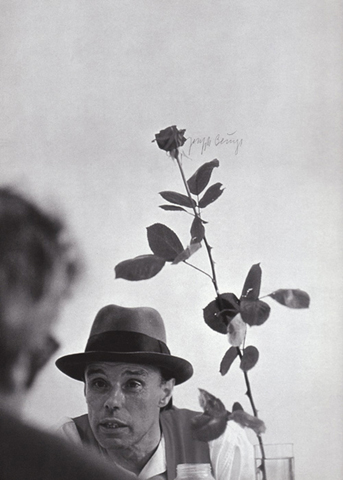
Joseph Beuys with 'Rose for Direct Democracy' 1973


Joseph Beuys with Rose for Direct Democracy
1973


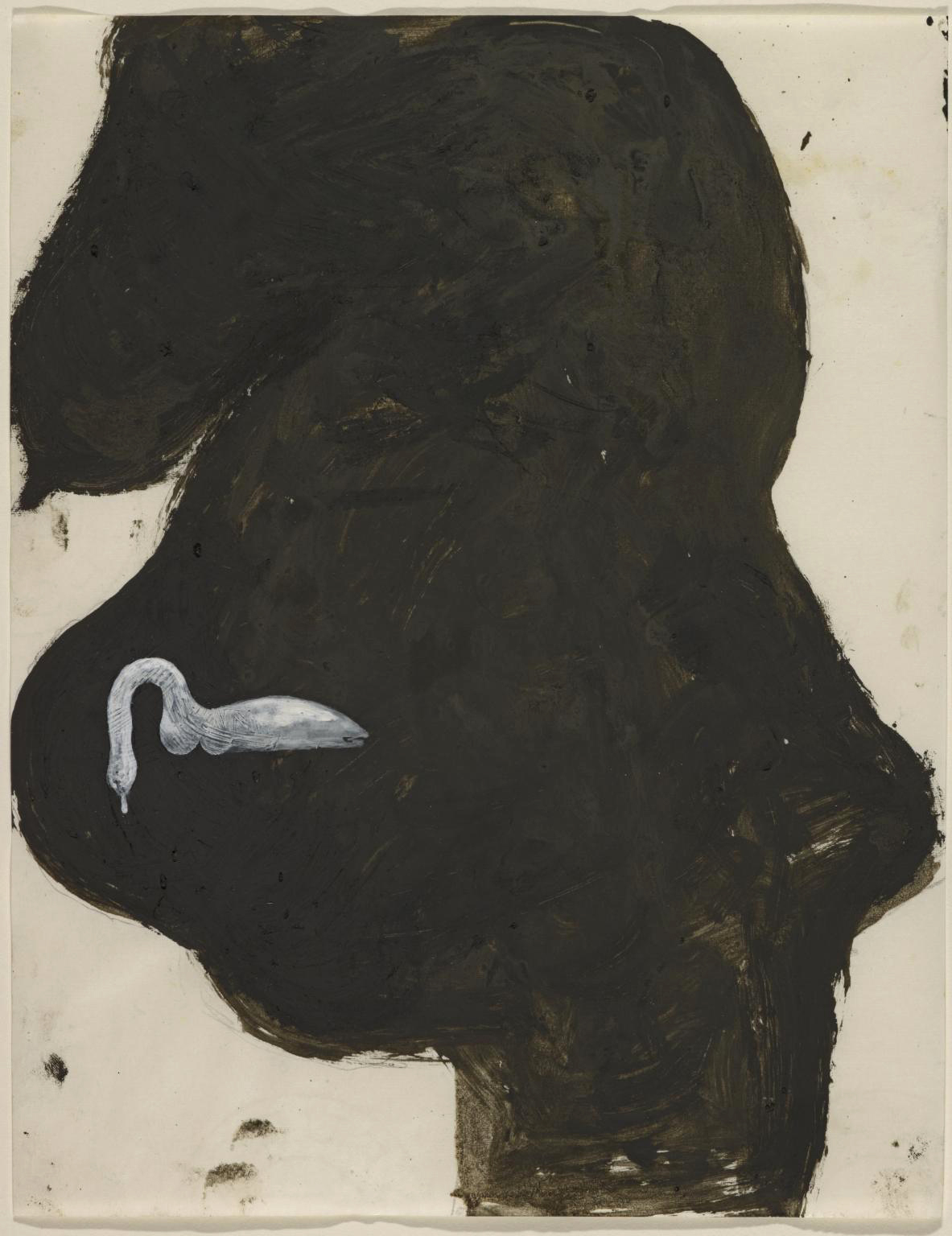
Joseph Beuys (German, 1921-1986) 'Pregnant Woman with Swan' 1959


Joseph Beuys (German, 1921-1986)
Schwangere und Schwan (Pregnant Woman with Swan)
1959
Oil paint and watercolour on paper
276 x 214 mm
ARTIST ROOMS Tate and National Galleries of Scotland
Galleries of Scotland through The d’Offay Donation with assistance from the National Heritage Memorial Fund and the Art Fund 2008


The tiny swan in this painting looks as if it is swimming serenely inside the woman, replacing the foetus inside her pregnant body. The drawing combines male and female elements, with the phallic nature of the swan’s neck. Beuys had been fascinated with swans since childhood. A sculpture of a large golden swan sat on top of the tower of Schwanenburg castle (Swan Castle) in his home town of Cleves, and was visible from his bedroom window while he was growing up. With his interest in language, the artist would also have delighted in the similarity between the German words for pregnant woman (Schwangere) and swan (Schwan).


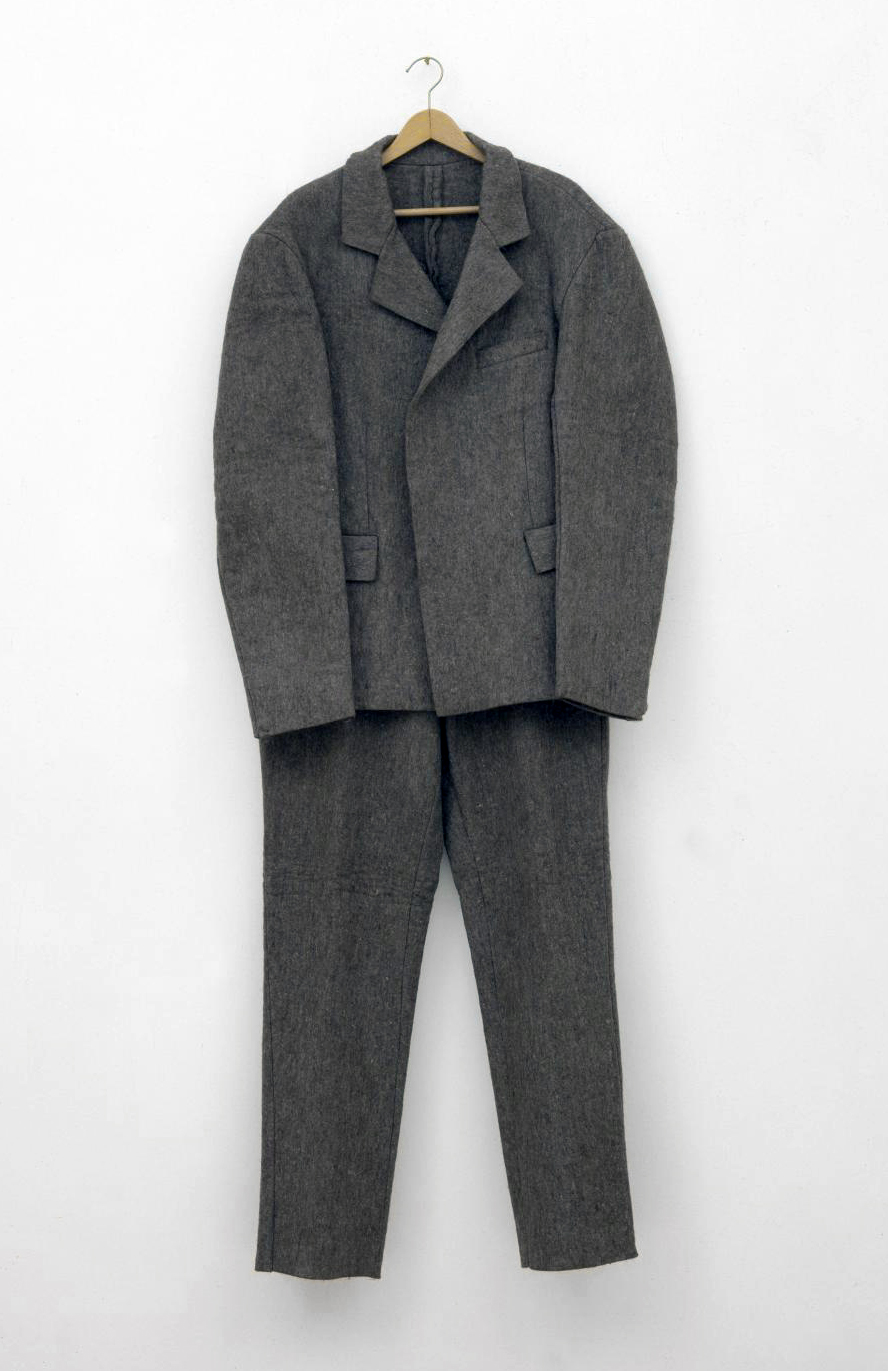
Joseph Beuys (German, 1921-1986) 'Felt Suit' 1970


Joseph Beuys (German, 1921-1986)
Felt Suit
1970
Felt and wood
1660 x 660 x 260 mm
ARTIST ROOMS Tate and National Galleries of Scotland
Galleries of Scotland through The d’Offay Donation with assistance from the National Heritage Memorial Fund and the Art Fund 2008


Beuys began producing works in multiples in the 1960s, partly as a way to combat the elitism of the art world. This is probably his most famous multiple. It has its origins in the performance Action the Dead Mouse/Isolation Unit of 1970, where Beuys wore a felt suit with lengthened arms and legs, like the one seen here. He described the suit as an extension of the sculptures he made with felt, where the material’s insulating properties were integral to the meaning of the work. Beuys intended this concept of warmth to extend beyond the material to encompass what he described as ‘spiritual warmth or the beginning of an evolution’.


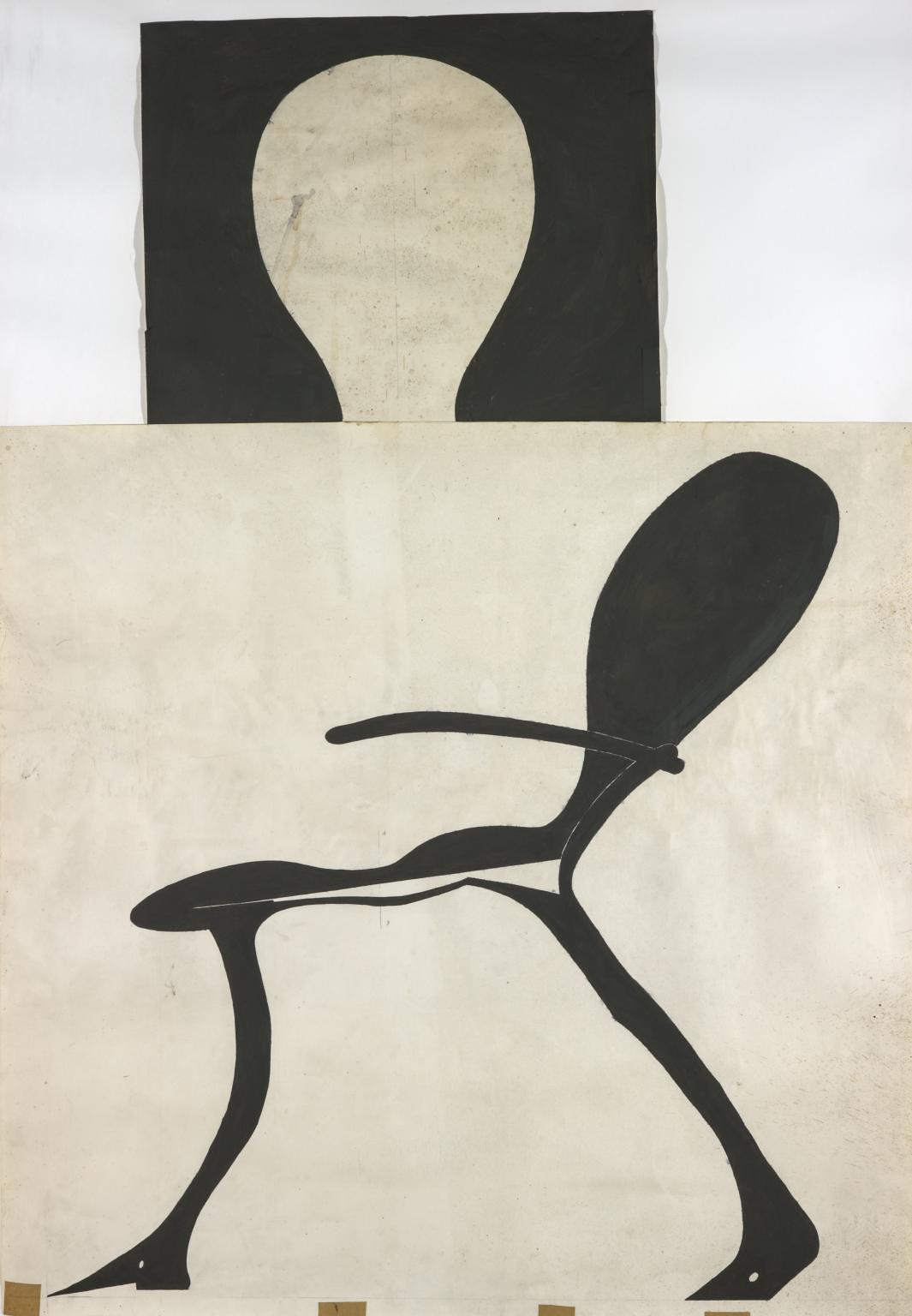
Joseph Beuys (German, 1921-1986) 'Stark beleuchteter Hirschstuhl (Brightly-Lit Stag Chair)' 1957-1971


Joseph Beuys (German, 1921-1986)
Stark beleuchteter Hirschstuhl (Brightly-Lit Stag Chair)
1957-1971
2 works on paper, oil paint, graphite and masking tape
1390 x 963 mm
ARTIST ROOMS Tate and National Galleries of Scotland
Galleries of Scotland through The d’Offay Donation with assistance from the National Heritage Memorial Fund and the Art Fund 2008


Although Beuys began this collage in 1957, it was not finished until 1971. The chair is similar to the subject of the artist’s 1972 sculpture Backrest for a fine-limbed person (Hare-type) of the 20th Century A.D. This is a cast iron impression of a child’s plaster corset, made as a multiple. However, the striding feet of the chair in this collage give it a human aspect, making it seem almost confident and self-possessed. The curved back of the chair is echoed in the lightbulb shape at the top of the image. The stag, in Beuys’s bestiary, guided the soul in its journey to the afterlife.


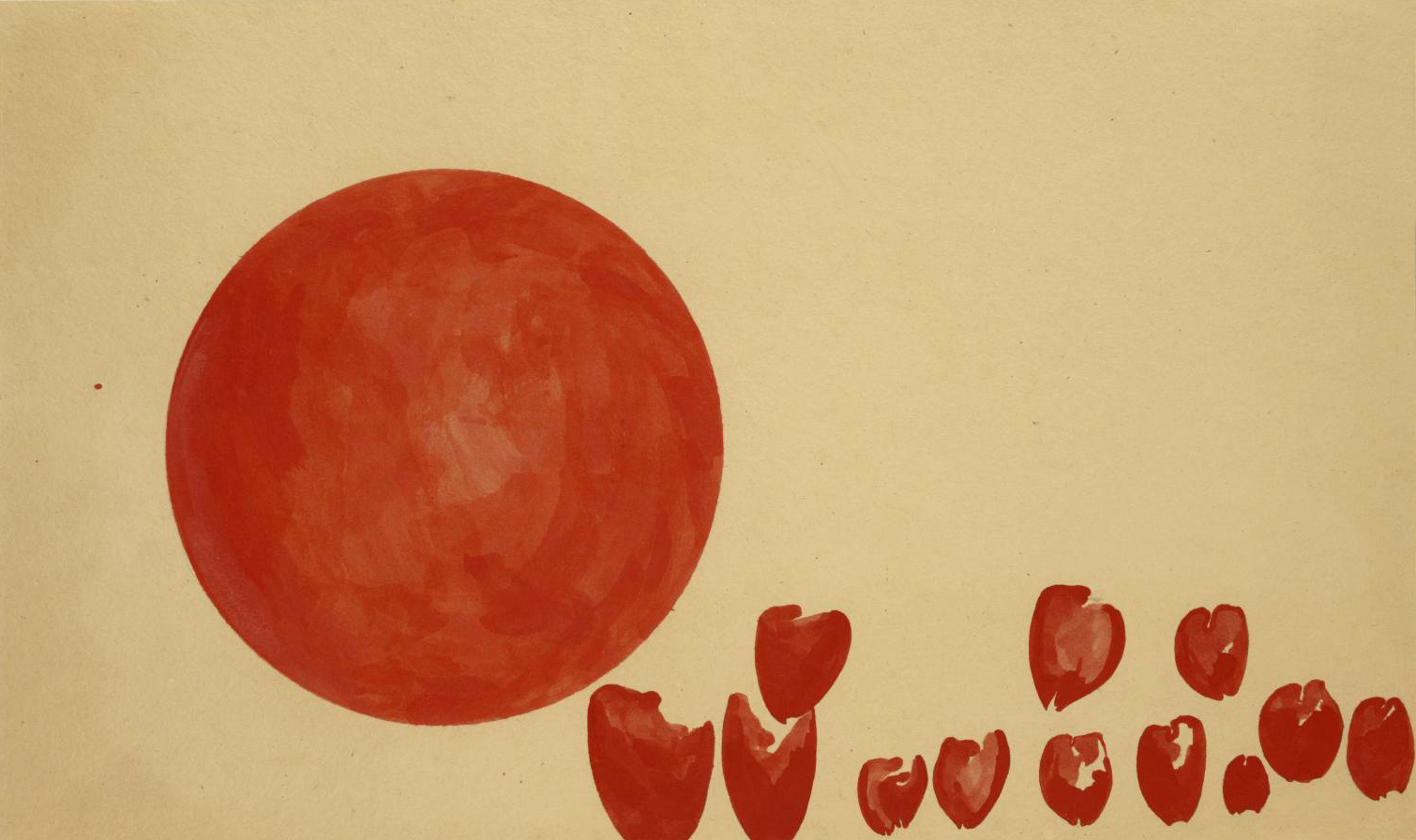
Joseph Beuys (German, 1921-1986) 'Passage der Zukunftplanetoiden' (Hearts of the Revolutionaries: Passage of the Planets of the Future) 1955


Joseph Beuys (German, 1921-1986)
Passage der Zukunftplanetoiden (Hearts of the Revolutionaries: Passage of the Planets of the Future)
1955
Watercolour on card
295 x 490 mm
ARTIST ROOMS Tate and National Galleries of Scotland
Galleries of Scotland through The d’Offay Donation with assistance from the National Heritage Memorial Fund and the Art Fund 2008


The choice of red for this painting would seem like an obvious one, reflecting both the heart and the virtues of honour and courage of the revolutionary in the title of the piece. Red also represents socialism, a belief of Beuys which became central to his later work. However, the colour red is used sparingly and symbolically in the artist’s work, and here it makes a bold statement on life, vitality and the future. The inclusion of the round shape to represent a planet brings an astronomical element into the work.


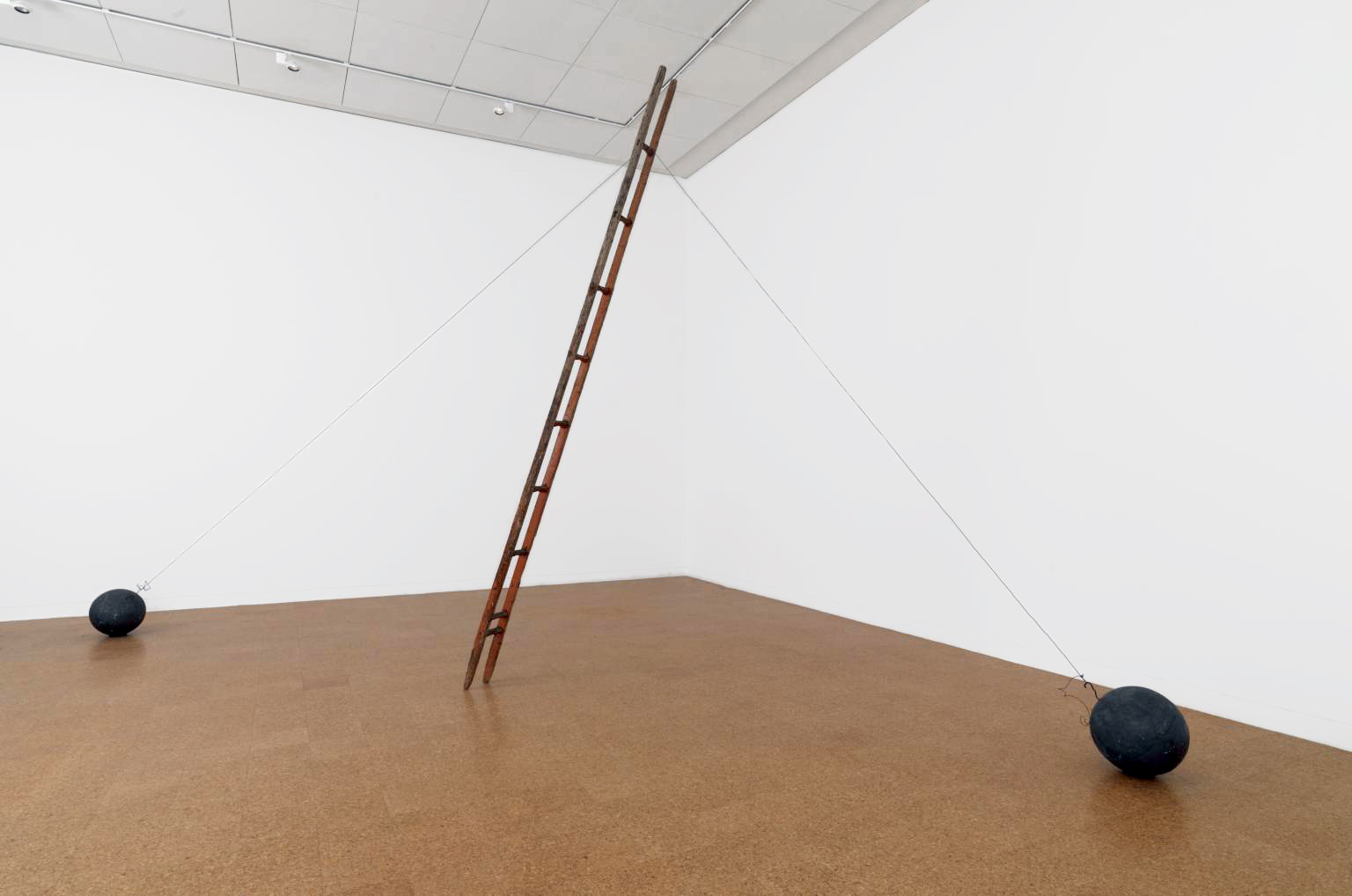
Joseph Beuys (German, 1921-1986) 'Scala Napoletana' 1985


Joseph Beuys (German, 1921-1986)
Scala Napoletana
1985
Overall dimensions variable: 11000 x 10000 x 6000mm (room size at Bexhill)
Ladder: 4510 x 250 x 80mm, Lead spheres: 500mm diameter each
ARTIST ROOMS Tate and National Galleries of Scotland
Galleries of Scotland through The d’Offay Donation with assistance from the National Heritage Memorial Fund and the Art Fund 2008


Much of the work Beuys made in his last few years includes objects or themes which suggest death. This sculpture was originally inspired by a ladder the artist found while recovering from illness on the island of Capri in Autumn 1985, which he hung with two stones. When he visited Amalfi at Christmas in the same year, he purchased a ladder (Scala Libera) from a landlord which he used to make this sculpture. Held in suspension, it appears as if the pair of lead weights are preventing this heavy wooden ladder from soaring into the air. This is one of the last sculptures Beuys made. He died in January 1986.


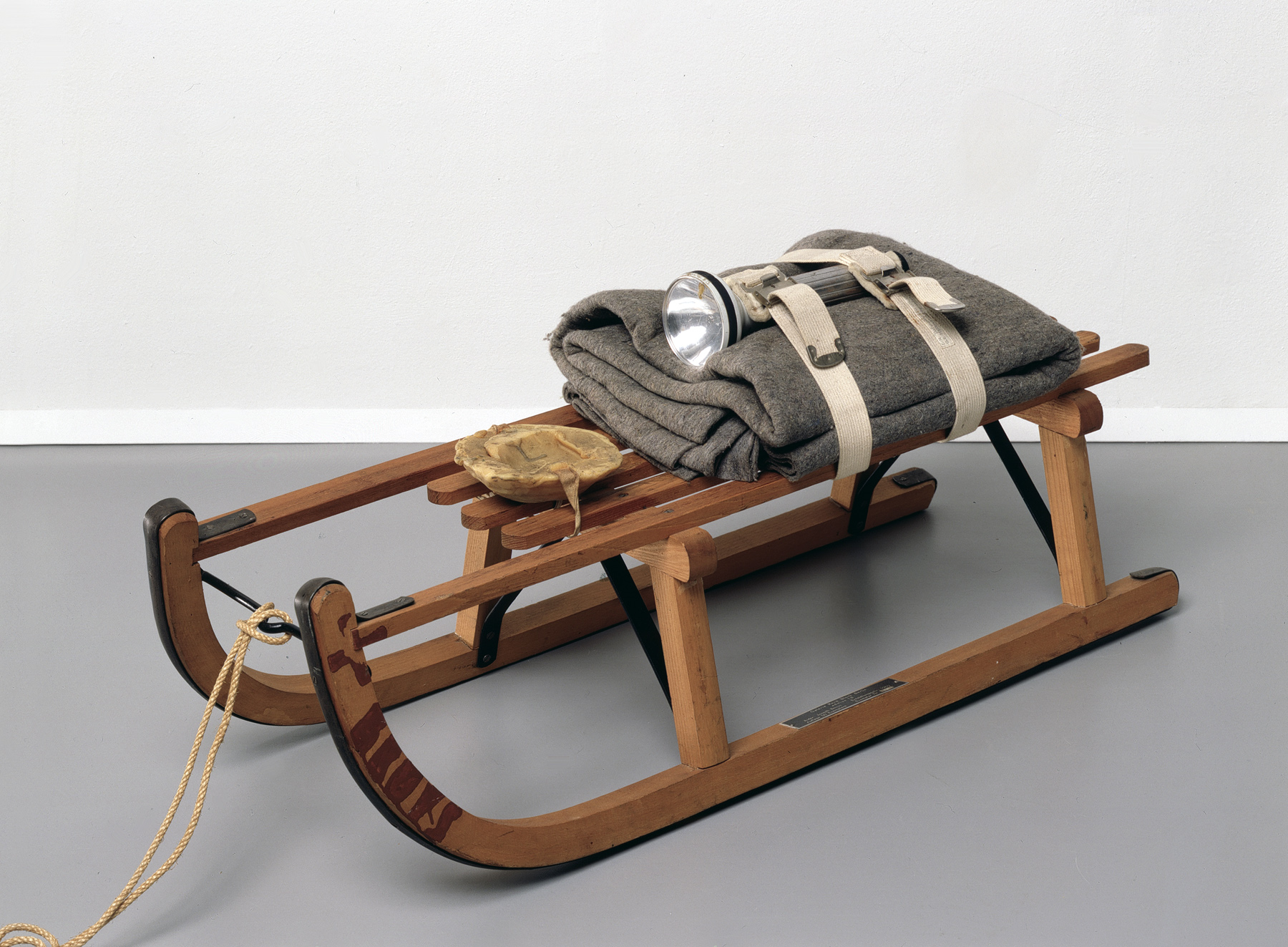
Joseph Beuys (German, 1921-1986) 'Sled' 1969


Joseph Beuys (German, 1921-1986)
Sled
1969


The materials used in the making of this work relate to Beuys’s experience of being rescued by nomadic Tartars when his plane was shot down during the Second World War. Fat was rubbed into his body and he was wrapped in felt to keep him warm. The sled looks as if it has been prepared for an expedition or in response to an emergency, with a survival kit strapped to it. The flashlight represents the sense of orientation, the felt is protective, and the fat is for food.


Joseph Beuys (German, 1921-1986) 'Ohne Titel (Untitled)' 1970


Joseph Beuys (German, 1921-1986)
Ohne Titel (Untitled)
1970
Gelatin silver print on canvas
2330 x 2275 mm
ARTIST ROOMS Tate and National Galleries of Scotland
Galleries of Scotland through The d’Offay Donation with assistance from the National Heritage Memorial Fund and the Art Fund 2008


Wearing his unmistakeable felt trilby hat, with his fishing vest poking through a luxuriant fur-lined jacket, this large image (over two metres square) shows Beuys at his most iconic. The clothes he wears here were part of his artist’s ‘uniform’, chosen for comfort and practicality (the multi-pocketed vest was particularly useful) but also as a way to create his image. Fittingly, he is depicted with one of his most distinctive sculptures. In the foreground is The Pack (1969), a group of twenty-four sledges. Each one has its own survival kit including fat for sustenance, felt for warmth and a torch for navigation, making the artist’s signature materials part of this image too.

Text under images from the National Galleries of Scotland website [Online] Cited 23/07/2009. No longer available online


De La Warr Pavilion
Bexhill-on-Sea,
East Sussex, TN40 1DP

Opening hours:
10am – 5pm, seven days a week

De La Warr Pavilion website

LIKE ART BLART ON FACEBOOK

Back to top

Review: ‘Morphed’ by Emma Davies at Craft Victoria, Melbourne

Exhibition dates: 19th June – 25th July, 2009


Emma Davies (Australian, b. 1968) 'Sekai' (be humorous') 2009


Emma Davies (Australian, b. 1968)
Sekai (meaning ‘be humorous’)
2009


A stimulating exhibition by Emma Davies at Craft Victoria of polypropylene industrial netting and packaging that has been heated, moulded, sculpted and literally morphed into these fantastical sculptures, inspired by the artist’s experiences when visiting Johannesburg in South Africa as part of the South Project. Davies evokes the mysterious and the bizarre in her figures, making the commonplace into something uncommon, taking her themes from the relics of bush medicine present in the street markets: the medicine market of Johannesburg full of dried animal bones, skulls, skins and bottles of alchemistic objects.

Despite their comforting South African names (translated into English as ‘hope’, ‘faith’, ‘quiet, tranquil’, ‘lady’, ‘chief’, ‘prince’ for example) these extremely individual figurative ‘presences’ have a powerful melancholic affect on the viewer. Their elongated long legged and armed, no necked forms create dark eyeless creatures that crouch in rusted boxes or sit on wooden posts with their legs and arms hanging, folded. They seem lonely and sad despite their titles, perhaps reflecting the harsh realities of a life of poverty on the streets of Soweto.

Two figures on wooden blocks seem to walk aimlessly, placed on large rough industrial tables with huge wheels while another figure sits up a rusted ladder propped against the wall. A group of figures are clustered together on top of large wooden posts of different heights, some with arms round each other for comfort, others with black or red feathers sprouting from shoulders, legs or wearing a red feathered skirt. These creatures create a marvellous group of contemplative wandering minstrels while behind them their eerie shadows fall on the gallery wall.

The crystalline nature to the surface of the creatures, like sparkling coal, reminds me of the work of William Kentridge, his white industrial protagonist Felix haunted by images of black workers deep underground mining coal (see Mine (1991) where his coffee plunger goes down into the ground through the bodies of black people). Some of the figures bat like ears also bring to mind the work of Francisco de Goya and specifically his work Los Caprichos (The Whims), plate 43 from the series of 80 etchings published in 1799 titled The Dream of Reason Produces Monsters. The artist described the collection as an exposé of “the innumerable foibles and follies to be found in any civilised society, and from the common prejudices and deceitful practices which custom, ignorance, or self-interest have made usual.”

As Goya began to sympathise with the suffering of the peasants so Davies seems to have been transformed by what she saw around her during her visit, trying to make sense of a foreign culture, dreaming the sleep of reason but surrounded and invaded by a world in which the natural and unnatural has fused and morphed.

I really liked this exhibition and the presence of these figures. I am obviously not alone as the show is almost sold out. A visit to these disturbing, enfolding creatures is recommended.

Dr Marcus Bunyan


All photographs courtesy of Craft Victoria (thankyou Amy Brand!) and taken by their photographer Alexia Skok. Please click on the photographs for a larger version of the image.


Emma Davies (Australian, b. 1968) 'Tariro' (means 'hope') 2009


Emma Davies (Australian, b. 1968)
Tariro (meaning ‘hope’)
2009


Emma Davies (Australian, b. 1968) 'Rutendo' (detail - means 'faith') 2009


Emma Davies (Australian, b. 1968)
Rutendo (detail – meaning ‘faith’)
2009


Francisco de Goya (Spanish, 1746-1828) 'Los Caprichos', plate 43 from the series 'El sueño de la razón produce monstros' 1799


Francisco de Goya (Spanish, 1746-1828)
Los Caprichos plate 43 from the series El sueño de la razón produce monstros
1799
Etching and aquatint
Height: 21.3cm (8.3″)
Width: 15.1cm (5.9″)
Museo del Prado, Madrid


Emma Davies (Australian, b. 1968) 'Zola' (detail - means 'quiet, tranquil') 2009


Emma Davies (Australian, b. 1968)
Zola (detail – meaning ‘quiet, tranquil’)
2009


Emma Davies (Australian, b. 1968) Group with from left to right: Enitan (person of story), Ntombi (lady), Kgosi (chief), Nkosana (prince), Lucky and Alaba (second child after twins)
2009


Emma Davies (Australian, b. 1968)
Group with from left to right: Enitan (person of story), Ntombi (lady), Kgosi (chief), Nkosana (prince), Lucky and Alaba (second child after twins)
2009


Emma Davies (Australian, b. 1968) 'Nkosana' (detail - means 'prince') 2009


Emma Davies (Australian, b. 1968)
Nkosana (detail – meaning ‘prince’)
2009


Craft Victoria
Watson Place, off Flinders Lane,
Melbourne 3000
Phone: 03 9650 7775

Opening hours:
Tuesday – Friday 11am – 6pm
Saturday 11am – 4pm

Craft Victoria website

Emma Davies website

LIKE ART BLART ON FACEBOOK

Back to top

Review: ‘New 09’ at Australian Centre for Contemporary Art (ACCA), Melbourne

Exhibition dates: 17th March – 17th May, 2009

Curator: Charlotte Day


ACCA’s annual commissions exhibition – this year curated by Charlotte Day with new works from eight contemporary Australian artists including Justine Khamara, Brodie Ellis, Marco Fusinato, Simon Yates, Matthew Griffin, Benjamin Armstrong and Pat Foster and Jen Berean.


Simon Yates (Australian, b. 1973) 'Rhabdomancy' 2009 from the exhibition 'New 09' at Australian Centre for Contemporary Art (ACCA), Melbourne, March - May, 2009


Simon Yates (Australian, b. 1973)
Rhabdomancy
Tissue paper, wood, fishing rods, tape, string, electrical components, helium balloons dimensions variable
2009
Photo: Marcus Bunyan


“That’s what art is, he said, the story of a life in all its particularity. It’s the only thing that really is particular and personal. It’s the expression and, at the same time, the fabric of the particular. And what do you mean by the fabric of the particular? I asked, supposing he would answer: Art. I was also thinking, indulgently, that we were pretty drunk already and that it was time to go home. But my friend said: What I mean is the secret story … The secret story is the one we’ll never know, although we’re living it from day to day, thinking we’re alive, thinking we’ve got it all under control and the stuff we overlook doesn’t matter. But every damn thing matters! It’s just that we don’t realise. We tell ourselves that art runs on one track and life, our lives, on another, we don’t even realise that’s a lie.”


From the story “Dentist” from the book ‘Last Evenings on Earth’ by Roberto Bolaño1


“A work of art reminds you of who you are now”


Kepesh from the film ‘Elegy’


The curator Charlotte Day has assembled an interesting selection of artists for New 09 at ACCA, Melbourne. It is an exhibition whose ‘presences’ challenge through dark and light, sound and light, contemplation and silence. The journey is one of here and now moments that transport the viewer to states of being that address the fabric of the particular: doubt, anxiety and enlightenment crowd every corner. The particularities of the experience (material, social, psychological and imaginative) impinge on the viewers interior states of being transcending the very physicality and symbolic realism of the works.2

On entering the gallery you are greeted by Simon Yates self-propelled figures that make up the work Rhabdomancy (2009, above). Suspended, tethered, floating just above the floor the figures move eerily about the entrance to the gallery, startling people who have not seen them move before. They stand silent witness, a simulation of self in tissue paper searching for meaning by using a dowsing rod. The word rhabdomancy has as one of it’s meanings ‘the art or gift of prophecy (or the pretence of prophecy) by supernatural means’. Here the figures are divining and divination rolled into one: grounded they seek release through the balloons but through augury they become an omen or portent from which the future is foretold.

“… cutting and slicing in order to see them better, willing them into three dimensions; an attempt to cheat death, or rather, to ward off forgetting of them as they are/were and as I was when the work was made.”

~ Justine Khamara

In the first gallery, a very minimal installation by Justine Khamara of two fractured faces stare out at you from the wall, my favourite work of the show. These are unsettling faces, protruding towards you like some topographical map, one eyes screwed shut the other beadily following you as you walk around the gallery space. Here the images of brother and sister presence anterior, already formed subjects not through memory (as photographs normally do) but through the insistence of the their multiple here and now planes of existence. Rather than ‘forgetting’ the images authenticate their identity through their ongoing presence in an ever renewing present.3 Their dissection of reality, the affirmation of their presence (not the photographic absence of a lost subject) embodies their secret story on the viewer told through psychological and imaginative processes: how do they make me feel – about my life, my death and being, here, now.

The pathos of the show is continued with the next work Noosphere (2008) by Brodie Ellis (the noosphere is best described as a sort of collective consciousness of human-beings).4 In this work a video above the clouds is projected onto a circular shape on the ceiling in a darkened room. The emotional and the imaginative impact of the message on the audience is again disorientating and immediate. The images look across the clouds to vistas of setting suns, look down on the clouds and the sea and land below. The images first move one way and then another, disorientating the viewer and changing their perspective of the earth; these are alien views of the earth accompanied by heart beat like ambient music. The perspective of the circle also changes depending on where the viewer stands like some anamorphic distortion of reality. On a stand a beaded yoke for a horse adds to the metaphorical allegory of the installation.

In the next gallery is the literal climax to the exhibition, Marco Fusinato’s Aetheric Plexus (2009). (Aether: medium through which light propagates; Plexus: in vertebrates, a plexus is an area where nerves branch and rejoin and is also a network of blood vessels).

Consisting of scaffolding that forms a cross and supports large numbers of silver spotlights with visible wiring and sound system the installation seems innocuous enough at first. Walking in front of the work produces no effect except to acknowledge the dull glow of red from the banks of dormant lights trained on the viewer. The interaction comes not in random fashion but when the viewer walks to the peripheries of the gallery corners triggering the work – suddenly you are are blasted with white light and the furious sound of white noise for about 15 seconds: I jumped half out of my skin! Totally disorientated as though one has been placed in a blast furnace or a heavenly irradiated crematorium one wonders what has just happened to you and it takes some time to reorientate oneself back in the afterlife of the here and now. Again the immediacy of the work, the particularities of the experience affect your interior states of being.

After a video installation by Matt Griffin you wander into the next gallery where two works by Benjamin Armstrong inhabit the floor of the gallery. And I do mean inhabit. Made of blown glass forms and wax coated tree branches the works have a strange affect on the psyche, to me seemingly emanations from the deep subconscious. Twin glass hemispheres of what look like a brain are surrounded by clasping synaptic nerve endings that support an egg like glass protrusion – a thought bubble? a spirit emanation? These are wonderful contemplative but slightly disturbing objects that have coalesced into shape only in another form to melt and disappear: molten glass and melted wax dissipating the very form of our existence.

Finally we come to the three part installation by Pat Foster and Jen Berean (below). On the right of the photograph you can see three aluminium and glass doors, closed, sealed leading to another gallery. What you can’t see in the photograph is the three pieces of gaffer tape stretched across the glass doors, like they do on the building sites of new homes. No entry here. Above your head is a suspended matrix of aluminium and glass with some of the glass planes smashed. Clean, clinical, safe but smashed, secure but threatening the matrix presses down on the viewer. It reminded me of the vertical standing shards of the World Trade Centre set horizontal suspended overhead. Only the steel cable seemed to ruin the illusion and seemed out of place with the work. It would have been more successful if the matrix was somehow suspended with fewer tethers to increase the sense of downward pressure. Finally you sit on the aluminium benches and contemplate in silence all that has come before and wonder what just hit you in a tidal wave of feelings, immediacies and emotions. The Doing and Undoing of Things.

An interesting journey then, one to provoke thought and emotion.
The fabric of the particular. The pathos of the art-iculate.

My only reservations are about the presence, the immediacy, the surface of it all. How persistent will these stories be? Will the work sustain pertinent inquiry above and beyond the here and now, the shock and awe. Or will it be like a meal one eats and then finds one is full but empty at the same time. A journey of smoke and mirrors.

Dr Marcus Bunyan


1/ Bolano, Robert. Last Evenings on Earth. New Directions, 2007. Available on Amazon.

2/ Blair, French. The Artist, The Body. [Online] Cited on 12/04/2009. No longer available online

3/ Ibid.,

4/ “For Teilhard, the noosphere is best described as a sort of ‘collective consciousness’ of human-beings. It emerges from the interaction of human minds. The noosphere has grown in step with the organisation of the human mass in relation to itself as it populates the earth. As mankind organizes itself in more complex social networks, the higher the noosphere will grow in awareness.” From the concept of Nooshpere on Wikipedia.


Many thankx to ACCA for allowing me to publish the photographs in the posting. All Images © Dr Marcus Bunyan and ACCA.


    Justine Khamara (Australian, b. 1971) 'Dilated Concentrations' 2009 from the exhibition 'New 09' at Australian Centre for Contemporary Art (ACCA), Melbourne, March - May, 2009

    Justine Khamara (Australian, b. 1971) 'Dilated Concentrations' 2009  (detail) from the exhibition 'New 09' at Australian Centre for Contemporary Art (ACCA), Melbourne, March - May, 2009

    Justine Khamara (Australian, b. 1971) 'Dilated Concentrations' 2009  (detail) from the exhibition 'New 09' at Australian Centre for Contemporary Art (ACCA), Melbourne, March - May, 2009

    Justine Khamara (Australian, b. 1971) 'Dilated Concentrations' 2009  (detail) from the exhibition 'New 09' at Australian Centre for Contemporary Art (ACCA), Melbourne, March - May, 2009


    Justine Khamara (Australian, b. 1971)
    Dilated Concentrations
    2009
    UV print on laser cut stainless steel
    Photos: Marcus Bunyan


    Benjamin Armstrong (Australian, b. 1975) 'Hold Everything Dear I' 2008


    Benjamin Armstrong (Australian, b. 1975)
    Hold Everything Dear I
    2008
    Photo: Marcus Bunyan


    Pat Foster (Australian, b. 1981) and Jen Berean (Canadian, b. 1981) 'Untitled’ from the series ‘The Doing and Undoing of Things’ 2009


    Pat Foster (Australian, b. 1981) and Jen Berean (Canadian, b. 1981)
    Untitled from the series The Doing and Undoing of Things
    2009
    Aluminium, safety glass, steel cable
    Photo: Marcus Bunyan


    Pat Foster (Australian, b. 1981) and Jen Berean (Canadian, b. 1981) 'Untitled’ from the series ‘The Doing and Undoing of Things’ 2009 (detail)


    Pat Foster (Australian, b. 1981) and Jen Berean (Canadian, b. 1981)
    Untitled from the series The Doing and Undoing of Things (detail)
    2009
    Aluminium, safety glass, steel cable
    Photo: Marcus Bunyan


    Australian Centre for Contemporary Art (ACCA)
    111 Sturt Street
    Southbank
    Victoria 3006
    Australia

    Opening hours:
    Tuesday – Friday 10am – 5pm
    Saturday – Sunday 11am – 5pm
    Closed Monday

    ACCA website

    LIKE ART BLART ON FACEBOOK

    Back to top

    Around the galleries: Derek O’Connor at Karen Woodbury Gallery, Peter Cole ‘Elements + Memories’ at John Buckley Gallery, Melbourne

    April 2009


    In a mad dash around town I managed to see the Derek O’Connor and Peter Cole exhibitions before they finished and also the Siri Hayes En Plein Air exhibition of photographs at Gallerysmith (see next post).

    Marcus


    Please click on the art work for a larger version of the image.


    Derek O’Connor paintings at Karen Woodbury Gallery

    An intense show of small oil paintings that really draw you into their composition. They are paintings of tremendous energy and layering, the surface being in a constant state of flux. The paintings become metaphors for the bodies existence in space, corporeal landscapes full of sensation ‘neither rational nor cerebral’. They become a mediation and a meditation upon life itself – complex, convulsive, concentrated energy that focuses the viewers attention so that they cannot look away.


    Derek O'Connor (Australian born England, b. 1959) 'Horizontal' 2008 from the exhibition Derek O'Connor paintings at Karen Woodbury Gallery


    Derek O’Connor (Australian born England, b. 1959)
    Horizontal
    2008


    Derek O'Connor (Australian born England, b. 1959) 'Horizontal' 2008 from the exhibition Derek O'Connor paintings at Karen Woodbury Gallery


    Derek O’Connor (Australian born England, b. 1959)
    Horizontal
    2008


    “Working with his tools of palette knives and brushes, he sets into motion a train of repetitions, of speeds and slowness1 applying and scrapping paint away in an attempt to move from a position of not knowing towards knowing. He brings … an intense physical and mental awareness to the rhythms of his own movements, his own body. At such moments time seems to expand – to become infinite.

    In erasing from his project the world of appearances, Derek O’Connor embraces something else – the realm of ‘sensation’. Sensation is an open painterly expression which resists definition. The Modernist painter Paul Cezanne described sensation as a “logic of the senses” which is neither rational nor cerebral2 … For Derek, the subject of his painting appears to be the act of making itself. Here subject and object collapse (folding into itself) so that sensation is experienced through the materiality of paint, via the movements of the artists’ body to affect the bodies of others.”

    Paul Uhlmann from the catalogue essay


    1/ Deleuze, G. and Guattari, F. A Thousand Plateaus. London: Continuum, 1987, pp. 292-300
    2/ Deleuze, G. The Logic of Sensation. London: Continuum, 2003, p. 42


    Derek O'Connor (Australian born England, b. 1959) 'Irregular' 2008


    Derek O’Connor (Australian born England, b. 1959)
    Irregular
    2008


    Karen Woodbury Gallery

    This gallery has closed.


    Peter Cole ‘Elements + Memories’ at John Buckley Gallery 18th March – 9th April 2009

    A decidedly underwhelming show by Peter Cole at John Buckley Gallery only redeemed by the amazing Elemental Landscape series of 64 small sculptural pieces displayed as a frieze (see below). The large free standing sculptural works fail to impress with their minimalist Ikea-esque cut out style – especially when viewed from the rear of the work. One would have thought that a sculptor, making several free standing pieces that are going to be walked around in a gallery space, would have designed the work to be viewed ‘in the round’. As it is all the perfection of the clinical front of the works is undone by brackets and screws holding the whole thing together when viewed from the flattened rump. This is pretty, surface work that lacks substance and insight, pretty shapes and cut outs and targets that allude to memory but are just stylised glossy magazine representations of it.

    On the other hand the Elemental Landscape series of sculptures is just magical – playful, ever inventive, wonderfully contemporary, beautifully resolved in concept and manufacture, in their use and bending of geometric shapes, the sculptures really are fantastic when seen ‘in situ’ as a whole. Visit the exhibition just to see this work – buy some pieces and make your own elemental landscape!

    Dr Marcus Bunyan


    Peter Cole (Australian, b. 1947) 'Elements + Memories' installation views at John Buckley Gallery, Melbourne


    Peter Cole (Australian, b. 1947)
    Elements + Memories installation views at John Buckley Gallery, Melbourne (first and second image)
    Bar 4 – Shibuya 2009 (third image)
    Garden – Yoyogi 2009 (fourth image)


    In Peter D Cole’s stunning and ambitious exhibition Elements + Memories he creates a playful interactive work titled Elemental Landscape. Utilising his highly stylised modernist and reductionist technique – influenced at an early age by studies of Miro and Calder – Cole presents 64 small sculptural pieces of varying colour and shape of which the audience is encouraged to create their own compositions. Cole also presents three large-scale sculptures drawing on memories of his times in Japan.

    Cole’s distinct skill of distilling the landscape and architecture into separate elements and symbols is in itself evocative of traditional minimal Japanese aesthetic and he has created a series of works which draw upon Japanese interiors and streetscapes and the gardens of the Sakura Matsuri (Cherry Blossom festival).

    Text from John Buckley Gallery website [Online] Cited 01/04/2009. No longer available online


    Peter Cole. 'Elemental Landscape' 2009

    Peter Cole (Australian, b. 1947) 'Elemental Landscape' 2009

    Peter Cole (Australian, b. 1947) 'Elemental Landscape' 2009

    Peter Cole (Australian, b. 1947) 'Elemental Landscape' 2009


    Peter Cole (Australian, b. 1947)
    Elemental Landscape
    2009


    John Buckley Gallery

    This gallery has closed.

    LIKE ART BLART ON FACEBOOK

    Back to top

    Review: ‘reENLIGHTENMENT’ exhibition by Peter James Smith at Gallery 101, Melbourne

    Exhibition dates: 18th March – 4th April, 2009


    Peter James Smith. 'reENLIGHTENMENT' installation view 2009

    Peter James Smith. 'reENLIGHTENMENT' installation view 2009


    Peter James Smith (New Zealand, b. 1954)
    reENLIGHTENMENT installation views
    2009


    “Every passion borders on the chaotic, but the collector’s passion borders on the chaos of memories. More than that: the chance, the fate, that suffuse the past before my eyes are conspicuously present in the accustomed confusion of these books. For what else is this collection but a disorder to which habit has accommodated itself to such an extent that it can appear as order?”1


    “Thus the claim is that texts themselves can actually be intrinsically ‘genuine’, but that authenticity is a ‘social construct’. In other words, a certain kind of authenticity is created through the interaction of the users, situations and the texts.”2


    Peter James Smith links the culture of science and of human experience, bringing together mathematics and the power of nature in realist imagery that is balanced by strong mark making and text. Redolent still life and landscape images juxtapose with astronomical, poetic and historical observations in the painted images. Handwritten citations, notes, jottings, diagrams and erasures float on the loosely painted surfaces of stretched linen, paper collage and found pieces which bring a Beuysian sense of the charismatic object. A sunset, a violin, a book of verse, an installation of old bells or delicate Jasperware porcelain provide a resonant foil for the artist and viewer – and create a space for the imagination, for mathematical wonder and contemplation.

    “Beyond painting, in the current work there is a sense of history allowing us to privilege its objects, their collecting and their housing on walls, in vitrines, on shelves and on plinths. Like any true collector I am keen to bring them to an audience, to show them in a revelatory way. If they are inflected by hand markings it is to personalise the revelation. There are no plastic imitations: the Jasperware vases are authentic collected Wedgwood; the small Greek Pelike is indeed a c 300 BC vase; the Roman glass is a c 300 AD; the collected Wollemi pine needles are indeed from this prehistoric plant. These and other antiquities have a long museological tradition. The narratives of Wedgwood blue and white Jasperware designs are of Greek antiquity – the firing of the white clay over a cobalt blue base (in around) 1772 was a triumph of chemistry over alchemy. With these objects, it is not a postmodernist kitsch that is revealed, but rather the resuscitated fabric of authenticity. I am re-enlightened by their tactile physical presence that has a timeless beauty. To render such things as a painted image is to engage in a different act, with different rules referring to different histories.”

    Peter James Smith, 2009. Notes from the exhibition catalogue.

     
    Enlightenment, Romanticism, reason, authenticity, revelation.

    I am a collector like Peter James Smith. I display my collection of early 20th century English vases. I have a collection of 300 ties that span from the 1930s to the 1970s. I have eight rare 1940s suits, those suits that Humphrey Bogart used to wear with the wide wide lapels that nearly reach the seam of the sleeve.

    Rare, fragile, beautiful, genuine.

    In this exhibition Smith appeals not to the genuineness of the objects but to the authenticity of the objects he displays: “There are no plastic imitations … With these objects, it is not a postmodernist kitsch that is revealed, but rather the resuscitated fabric of authenticity.” He wants to show these objects in a revelatory way, for us to once more appreciate their authenticity. To make order out of disorder. But then Smith wants to personalise this revelation and overlays the objects with texts that re-order the taxonomy through a reinscription that is both a de-territorialization and re-territorialization of meaning, a loss of original meaning and the production of new meanings. This is the faint silver flicker of re-enlightenment the artist seeks. It is above all authentication as individual spectacle, as social construct.

    “Authenticity is an issue for us today because of a widespread sense that there is something inauthentic in the way we experience the modern world.”3

    In some of the works this process is effective and in other works it falls flat on it’s proverbial, intertextual backside. The process works well in the less cerebral works. The use of black paint in Paradise Lost IV (below) is particularly effective as the re-inscription of paint invades and threatens the motifs of the classical figures with the text and cross reinforcing the idea of a lost paradise. Cathedral (2009, below) is also a stunning installation of different bells hung at various heights within a locked cabinet, complicit in their silence as they would not be inside a cathedral. For me this was probably the best piece in the show for its simplicity of thought, eloquence of execution and understanding of how the installation re-enlightens the viewers socially constructed authenticity in a revelatory way. No double marking is needed – a zen balance is proposed and achieved in the quietness of the viewers mind.

    Other pieces are less successful. Amphora in grey teracotta Han Dynasty c 100BC (2008), the amphora inscribed with text sitting on a painted black video recorder is particularly unengaging and unappealing – there is no revelatory experience to be had here. The Greek Pileke (see below) inscribed with lines from John Keats Ode on a Grecian Urn seems an appropriate intervention but sometimes in this exhibition one just longs to appreciate the sanctity of the object, it’s presence, in silence without the personalising of the revelation by the hand of the artist. To see the object clearly for what it is.

    The large installation reELIGHTENMENT (2009 below, and installation photo at top) falls into darkness. The use of the doors as metaphor is clumsy, book covers have been more successfully used by other artists and the black paint is heavy and oppressive. More interesting are some of the paintings, for example The slow dance of an astronomical twighlight (2009, below) where the poem of William Wordsworth

    … a sense sublime
    Of something far more deeply interfused,
    Whose dwelling is the light of setting suns

    illuminates the poetry of the painting, adding an insightful double meaning to the universal revelation. A vibration of spirit is present both in the landscape and the markings upon the landscape. Unfortunately all too often in this exhibition access to the sublime is denied. Appeals to neo-authenticity fall on deaf ears. The motifs of this exhibition are universal, archetypal but the elements that go to make up this exhibition are too many and lack focus. Sometimes in art less in more and this exhibition is a classic example of this fact. There are some interesting elements but overall the whole is not the sum of its parts.

    As John Donne observed

    “All mankind is of one author, and is one volume; when one man dies, one chapter is not torn out of the book, but translated into a better language; and every chapter must be so translated … No man is an island, entire of itself; every man is a piece of the continent, a part of the main.”4

    Our authentic place in the world, our spiritual space, our re-enlightenment needed to be better defined, more lucidly enunciated in this exhibition NOT IN CAPITAL LETTERS but in the quietness of our hearts.

    Dr Marcus Bunyan


    1/ Benjamin, Walter. “Unpacking my Library: A Talk about Book Collecting,” in Illuminations. English translation. London: Fontana, 1982, pp. 59-60

    2/ Lee, W. “Authenticity revisited: text authenticity and learner authenticity,” in ELT Journal, 49(4). 1995, pp. 323-328 cited in Shomoossi, Nematullah and Ketabi, Saeed. “A Critical Look at the Concept of Authenticity,” in Electronic Journal of Foreign Language Teaching, 2007, Vol. 4, No. 1, pp. 149-155 [Online] cited on 29th March, 2009 at http://e-flt.nus.edu.sg/v4n12007/shomoossi.pdf

    3/ McClure, Christoper. The Concept of Authenticity in Charles Taylor and Martin Heidegger. [Online] cited on March 29th, 2009 (no longer available online)

    4/ Donne, John. Devotions Upon Emergent Occasions, Meditation XVII: Nunc Lento Sonitu Dicunt, Morieris. 1624.


    Variously

    Wedgwood Jasperware, Roman glass, Greek Pileke, books, doors, texts, paintings, bells, video, video machine, wooden boxes, black paint, crosses, albatross, Wollemi Pine needles, Paradise Lost, astronomy, linen, stars, photography, Chinese porcelain, collage, mathematical equations, mirrors, Amphora from the Han Dynasty, a violin, a sunset, a book of verse, notes, shelves, jottings, citations.

    Notes to myself

    ~ Golden ratio
    ~ The archive
    ~ Topographical markings, inscriptions and decodings
    ~ The ‘nature’ of authenticity
    ~ The ‘voice’ of revelation
    ~ Re-possession of clarity and logic
    ~ Re-production of mystery, tenderness and love
    ~ Reverence for the object itself
    ~ Referentiality between image and text
    ~ The colour black: transcendent, the depths of the night sky but also the closing in of darkness at the end of days
    ~ Never one truth but many truths
    ~ Less is more


    Many thankx to Gallery 101 for allowing me to publish the photographs in the posting. Please click on the photographs for a larger version of the image.


    Peter James Smith (New Zealand, b. 1954) 'The slow dance of an astronomical twighlight' 2009 from the exhibition 'reENLIGHTENMENT' exhibition by Peter James Smith at Gallery 101, Melbourne, March - April, 2009


    Peter James Smith (New Zealand, b. 1954)
    The slow dance of an astronomical twighlight
    2009


    Peter James Smith (New Zealand, b. 1954) 'Paradise Lost IV' 2008 from the exhibition 'reENLIGHTENMENT' exhibition by Peter James Smith at Gallery 101, Melbourne, March - April, 2009


    Peter James Smith (New Zealand, b. 1954)
    Paradise Lost IV
    2008


    Peter James Smith (New Zealand, b. 1954) 'Ode on a Grecian Urn' 2008


    Peter James Smith (New Zealand, b. 1954)
    Ode on a Grecian Urn
    2008


    Peter James Smith (New Zealand, b. 1954) 'Cathedral' 2009


    Peter James Smith (New Zealand, b. 1954)
    Cathedral
    2009


    Peter James Smith (New Zealand, b. 1954) 'reENLIGHTENMENT' 2009


    Peter James Smith (New Zealand, b. 1954)
    reENLIGHTENMENT
    2009


    Gallery 101

    This gallery is now closed.

    LIKE ART BLART ON FACEBOOK

    Back to top