Opening night crowd at Colour, Time by David Thomas with from right to left Farbenfreude Series: Movement of Colour, Heart (Large) 2008; Farbenfreude Series: Amid Dark and Light (Dark Painting) 2008; and Farbenfreude Series: A Gentle Pasing (Large) 2008 on back wall Photo: Marcus Bunyan
“A photographed real space and an expanding undefinable painting space (the non-figurative form) confront each other. The result is a coexistence of various models of space, a coexistence and entanglement of inconsistent things.”
Christoph Dahlhausen. David Thomas EIKON nr 53, Vienna, Austria, 2006
A slow burn painting, photography and composites show at Nellie Castan Gallery. Minimalist grid paintings combine with squares of colour taken out of photographs (again! as at the recent Richard Grigg show at Block Projects). This supposedly imparts profundity to insubstantial and mundane photographs that aim to comment on the existential nature of our being through the presence / absence of the missing spatio-temporal slice. This exhibition just didn’t hit the spot for me. Nice to catch up with Jason Smith Director of Heide Museum of Modern Art who was in attendance.
Dr Marcus Bunyan
Many thankx to Nellie Castan Gallery for allowing me to publish the photographs in the posting. Please click on the photographs for a larger version of the image.
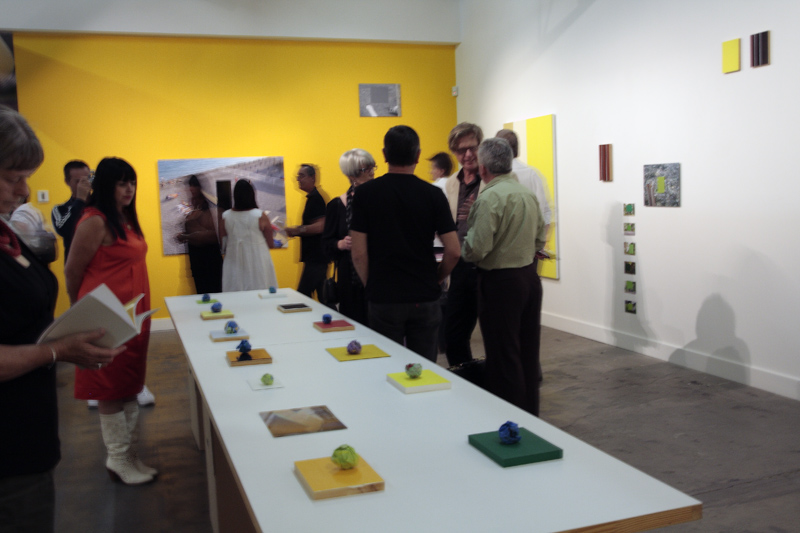
Opening night crowd at Colour, Time by David Thomas with the series Length of Time 2009 on table Photo: Marcus Bunyan
David Thomas (Australian born Northern Ireland, b. 1951) Length of Time Series: Blue tape on red monochrome 2009 Photo: Marcus Bunyan
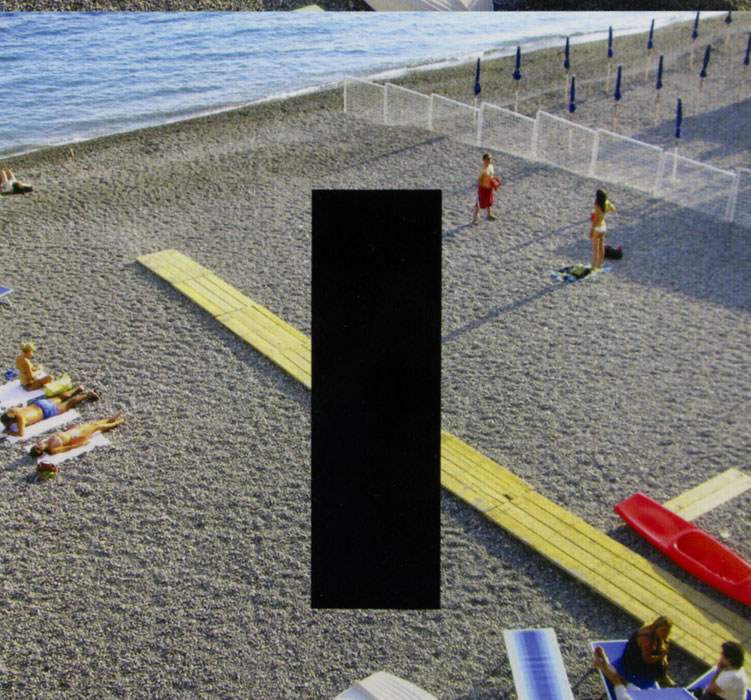
David Thomas (Australian born Northern Ireland, b. 1951) End of Summer: Homage a Tati (small splash) Enamel on photograph 2009
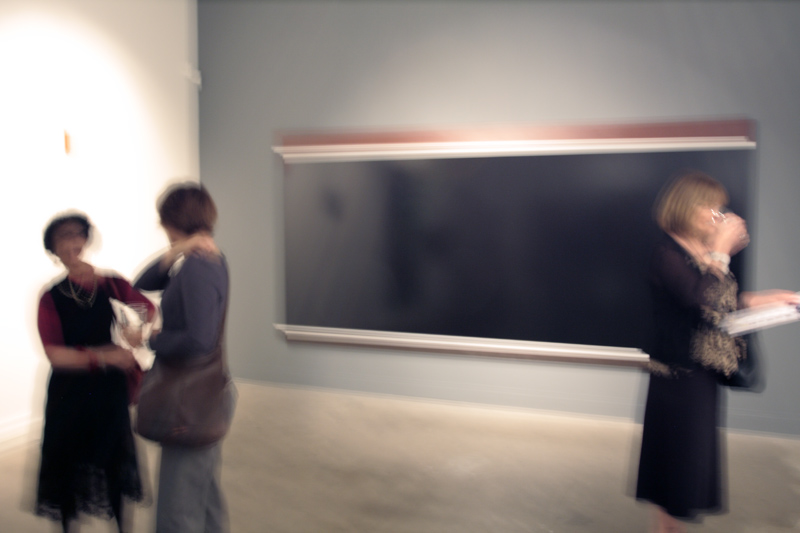
Opening night crowd in front of David Thomas’ Black Reflection Painting: For William Barak 2009 Photo: Marcus Bunyan
Curator: Shane Hulbert Opening: Thursday 2nd April, 2009
Group photography show with artists: Shane Hulbert (Aus), John Billan (Aus), So Hing Keung (HK), Stephanie Neoh (Aus), Darren Sylvester (Aus), Ming Tse Ching (HK), Kellyann Geurts (Aus), Andrew Guthrie (HK), Kim Lawler (Aus), Law Sum Po Jamsen (HK), and Lyndal Walker (Aus).
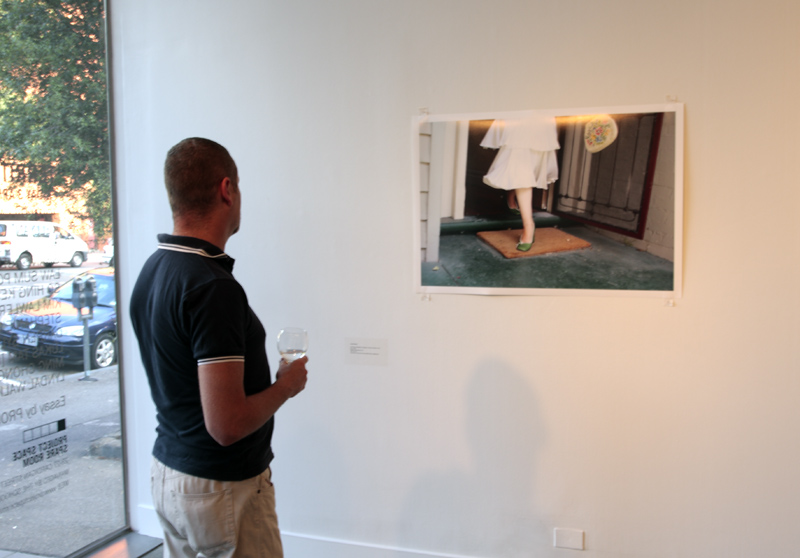
Sculptor Fredrick White in front of Lyndal Walker’s The Time to Hesitate is Through, no Time to Wallow in the Mire 2009
Great to catch up again with John Billan, Shane Hulbert and Les Walkling!
Marcus
Please click on the photographs for a larger version of the image.
Lyndal Walker (Australian, b. 1973) The Time to Hesitate is Through, no Time to Wallow in the Mire 2009
“The images in this show all reflect on an exploration of intersecting territories within Australia and the Chinese Special Administration Region [SAR] of Hong Kong. Central to this exploration are the cultural linkages between claimed and reclaimed territories, social territories and psychological territories and the way this in turn influences national identity. The claim is that these things of importance, and the way we respond to the notion of territory, have recurring similarities between different cultures.
Despite the broadness of the title, the notion of territories is becoming increasingly relevant in a global community, as the traditional borderlines and barriers that define who we are and what we stand for as a culture change in response to internal and external shifts.”
Shane Hulbert 2009
Territories opening night crowd at Project Space/Spare Room, Melbourne
Ming Tse Chong (Chinese, b. 1960) City Still Life II 2008
Peter James Smith (New Zealand, b. 1954) reENLIGHTENMENT installation views 2009
“Every passion borders on the chaotic, but the collector’s passion borders on the chaos of memories. More than that: the chance, the fate, that suffuse the past before my eyes are conspicuously present in the accustomed confusion of these books. For what else is this collection but a disorder to which habit has accommodated itself to such an extent that it can appear as order?”1
“Thus the claim is that texts themselves can actually be intrinsically ‘genuine’, but that authenticity is a ‘social construct’. In other words, a certain kind of authenticity is created through the interaction of the users, situations and the texts.”2
Peter James Smith links the culture of science and of human experience, bringing together mathematics and the power of nature in realist imagery that is balanced by strong mark making and text. Redolent still life and landscape images juxtapose with astronomical, poetic and historical observations in the painted images. Handwritten citations, notes, jottings, diagrams and erasures float on the loosely painted surfaces of stretched linen, paper collage and found pieces which bring a Beuysian sense of the charismatic object. A sunset, a violin, a book of verse, an installation of old bells or delicate Jasperware porcelain provide a resonant foil for the artist and viewer – and create a space for the imagination, for mathematical wonder and contemplation.
“Beyond painting, in the current work there is a sense of history allowing us to privilege its objects, their collecting and their housing on walls, in vitrines, on shelves and on plinths. Like any true collector I am keen to bring them to an audience, to show them in a revelatory way. If they are inflected by hand markings it is to personalise the revelation. There are no plastic imitations: the Jasperware vases are authentic collected Wedgwood; the small Greek Pelike is indeed a c 300 BC vase; the Roman glass is a c 300 AD; the collected Wollemi pine needles are indeed from this prehistoric plant. These and other antiquities have a long museological tradition. The narratives of Wedgwood blue and white Jasperware designs are of Greek antiquity – the firing of the white clay over a cobalt blue base (in around) 1772 was a triumph of chemistry over alchemy. With these objects, it is not a postmodernist kitsch that is revealed, but rather the resuscitated fabric of authenticity. I am re-enlightened by their tactile physical presence that has a timeless beauty. To render such things as a painted image is to engage in a different act, with different rules referring to different histories.”
~ Peter James Smith, 2009. Notes from the exhibition catalogue.
I am a collector like Peter James Smith. I display my collection of early 20th century English vases. I have a collection of 300 ties that span from the 1930s to the 1970s. I have eight rare 1940s suits, those suits that Humphrey Bogart used to wear with the wide wide lapels that nearly reach the seam of the sleeve.
Rare, fragile, beautiful, genuine.
In this exhibition Smith appeals not to the genuineness of the objects but to the authenticity of the objects he displays: “There are no plastic imitations … With these objects, it is not a postmodernist kitsch that is revealed, but rather the resuscitated fabric of authenticity.” He wants to show these objects in a revelatory way, for us to once more appreciate their authenticity. To make order out of disorder. But then Smith wants to personalise this revelation and overlays the objects with texts that re-order the taxonomy through a reinscription that is both a de-territorialization and re-territorialization of meaning, a loss of original meaning and the production of new meanings. This is the faint silver flicker of re-enlightenment the artist seeks. It is above all authentication as individual spectacle, as social construct.
“Authenticity is an issue for us today because of a widespread sense that there is something inauthentic in the way we experience the modern world.”3
In some of the works this process is effective and in other works it falls flat on it’s proverbial, intertextual backside. The process works well in the less cerebral works. The use of black paint in Paradise Lost IV (below) is particularly effective as the re-inscription of paint invades and threatens the motifs of the classical figures with the text and cross reinforcing the idea of a lost paradise. Cathedral (2009, below) is also a stunning installation of different bells hung at various heights within a locked cabinet, complicit in their silence as they would not be inside a cathedral. For me this was probably the best piece in the show for its simplicity of thought, eloquence of execution and understanding of how the installation re-enlightens the viewers socially constructed authenticity in a revelatory way. No double marking is needed – a zen balance is proposed and achieved in the quietness of the viewers mind.
Other pieces are less successful. Amphora in grey teracotta Han Dynasty c 100BC (2008), the amphora inscribed with text sitting on a painted black video recorder is particularly unengaging and unappealing – there is no revelatory experience to be had here. The Greek Pileke (see below) inscribed with lines from John Keats Ode on a Grecian Urn seems an appropriate intervention but sometimes in this exhibition one just longs to appreciate the sanctity of the object, it’s presence, in silence without the personalising of the revelation by the hand of the artist. To see the object clearly for what it is.
The large installation reELIGHTENMENT (2009 below, and installation photo at top) falls into darkness. The use of the doors as metaphor is clumsy, book covers have been more successfully used by other artists and the black paint is heavy and oppressive. More interesting are some of the paintings, for example The slow dance of an astronomical twighlight (2009, below) where the poem of William Wordsworth
… a sense sublime Of something far more deeply interfused, Whose dwelling is the light of setting suns
illuminates the poetry of the painting, adding an insightful double meaning to the universal revelation. A vibration of spirit is present both in the landscape and the markings upon the landscape. Unfortunately all too often in this exhibition access to the sublime is denied. Appeals to neo-authenticity fall on deaf ears. The motifs of this exhibition are universal, archetypal but the elements that go to make up this exhibition are too many and lack focus. Sometimes in art less in more and this exhibition is a classic example of this fact. There are some interesting elements but overall the whole is not the sum of its parts.
As John Donne observed
“All mankind is of one author, and is one volume; when one man dies, one chapter is not torn out of the book, but translated into a better language; and every chapter must be so translated … No man is an island, entire of itself; every man is a piece of the continent, a part of the main.”4
Our authentic place in the world, our spiritual space, our re-enlightenment needed to be better defined, more lucidly enunciated in this exhibition NOT IN CAPITAL LETTERS but in the quietness of our hearts.
Dr Marcus Bunyan
1/ Benjamin, Walter. “Unpacking my Library: A Talk about Book Collecting,” in Illuminations. English translation. London: Fontana, 1982, pp. 59-60
2/ Lee, W. “Authenticity revisited: text authenticity and learner authenticity,” in ELT Journal, 49(4). 1995, pp. 323-328 cited in Shomoossi, Nematullah and Ketabi, Saeed. “A Critical Look at the Concept of Authenticity,” in Electronic Journal of Foreign Language Teaching, 2007, Vol. 4, No. 1, pp. 149-155 [Online] cited on 29th March, 2009 at http://e-flt.nus.edu.sg/v4n12007/shomoossi.pdf
3/ McClure, Christoper. The Concept of Authenticity in Charles Taylor and Martin Heidegger. [Online] cited on March 29th, 2009 (no longer available online)
4/ Donne, John. Devotions Upon Emergent Occasions, Meditation XVII: Nunc Lento Sonitu Dicunt, Morieris. 1624.
Variously
Wedgwood Jasperware, Roman glass, Greek Pileke, books, doors, texts, paintings, bells, video, video machine, wooden boxes, black paint, crosses, albatross, Wollemi Pine needles, Paradise Lost, astronomy, linen, stars, photography, Chinese porcelain, collage, mathematical equations, mirrors, Amphora from the Han Dynasty, a violin, a sunset, a book of verse, notes, shelves, jottings, citations.
Notes to myself
~ Golden ratio ~ The archive ~ Topographical markings, inscriptions and decodings ~ The ‘nature’ of authenticity ~ The ‘voice’ of revelation ~ Re-possession of clarity and logic ~ Re-production of mystery, tenderness and love ~ Reverence for the object itself ~ Referentiality between image and text ~ The colour black: transcendent, the depths of the night sky but also the closing in of darkness at the end of days ~ Never one truth but many truths ~ Less is more
Many thankx to Gallery 101 for allowing me to publish the photographs in the posting. Please click on the photographs for a larger version of the image.
Peter James Smith (New Zealand, b. 1954) The slow dance of an astronomical twighlight 2009
Peter James Smith (New Zealand, b. 1954) Paradise Lost IV 2008
Peter James Smith (New Zealand, b. 1954) Ode on a Grecian Urn 2008
Peter James Smith (New Zealand, b. 1954) Cathedral 2009
Peter James Smith (New Zealand, b. 1954) reENLIGHTENMENT 2009
Dale Frank (Australian, b. 1959) The Big Black Bubble (installation view) Left to right: Timothy Oliphant (2008), Ryan Gosling (2008/2009) and Matthew Macfadyen (2008) 2009
This is a brilliant exhibition by Dale Frank, one of my favourites so far this year in Melbourne.
Six large varnish on linen landscape paintings are presented in the beautiful Anna Schwartz gallery space in Melbourne. Photographs really do not do the paintings justice – they can only give an impression of the size and scale of the work but not of their intimacy or smell. The smell of varnish permeates the air. The serendipity of the natural convulsions of the varnish and the facilitations of the hand of the artist, his performance, have been caught like bugs in amber in the final molecular structure of the painting. Here are pendulous, globular goops of varnish, immersive heroic tone poems that form images in the mind of the viewer. Moving close to the paintings you are surrounded by flows and eddies, the macro and the micro; details become more apparent as you study the work.
While disagreeing that these paintings are the viewers to create (the viewer as author) what I can say is that the artist offers the viewer the ability to generate their own resonances with the painting, to use the imagination of ‘equivalence’ to suggest what these paintings stand for – and also what else they stand for. States of being, of transformation, wonder and joy emerge in the playfulness of these works. Perhaps this is where the titles of the paintings come from, referencing film actors in the pop tradition, but this is the only thing that did not ring true with the work, their titles. The use of this trope seems to me a bit facile given the nature of the work.
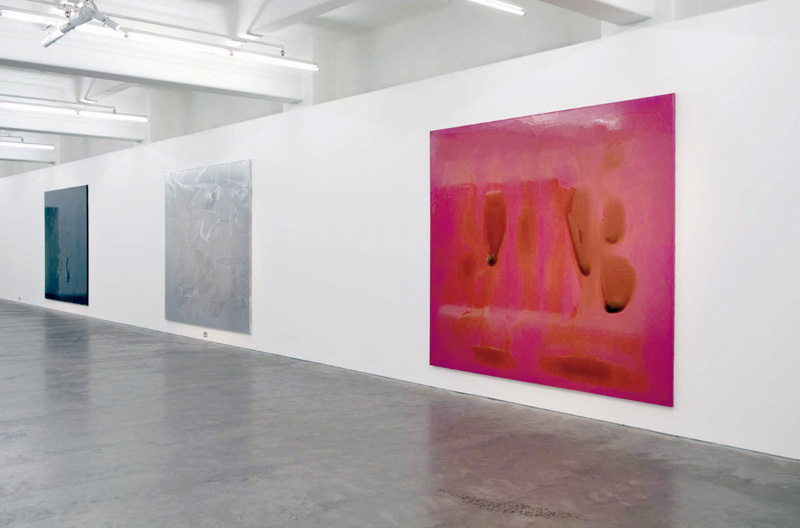
The hot pink painting Rupert Grint (2008/2009, above) is hotter and lighter than in the photograph below, the varnish more translucent, the effect altogether mesmeric. You are drawn into the work, the intensity of the colour, the thickness of the hanging varnish. Two cosmological galaxies (Timothy Oliphant (2008) and Matthew Macfadyen (2008)) surround the most complex painting in the exhibition, the darkness and light that is Ryan Gosling (2008/2009, below).
This painting is a tour de force. With the poetic structure of an oil spill, the varnish forms intricate slick upon slick contours that are almost topographical in their mapping. The black oozes light, becomes ‘plastic’ black before your eyes, like the black of Rembrandt’s backgrounds, illusive, illuminative and hard to pin down – perpetually hanging there in two dripping rows, fixed but fluid at one and the same time (you can just see the suspensions in the photograph above).
The painting reminds me of the black paintings of Mark Rothko that he undertook for The Rothko Chapel in Houston, Texas (see below). As with the Rothko paintings, this painting is not just black (physically there are swirls of purple as in the Rothko paintings), not about darkness at all. What both artists do is create a contemplative, transformative space – in Frank’s case for a world on the edge of oblivion. This is a post post-modern landscape: process and nature, performance and chance coalescing in the colour : black!
This painting is one of the most overwhelming syntheses of art and nature, of universal forces that I have seen in recent contemporary art. This exhibition is an electric pulsating universe of life, landscape and transformation. Magnificent!
Dr Marcus Bunyan
Many thankx to Anna Schwartz Gallery for allowing me to publish the photographs in the posting. Please click on the photographs for a larger version of the image.
Dale Frank (Australian, b. 1959) The Big Black Bubble (installation view) Left to right: Daniel Radcliffe (2008/2009), Khan Chittenden (2009) and Rupert Grint (2008/2009) 2009
The immersive scale of these new paintings at Anna Schwartz Gallery Melbourne allows us to experience their inner qualities of landscape and of transformation. This is painting at fundamental authenticity. The paint is its own agent; it is allowed to act, to behave. The artist is the facilitator of these phenomena of nature and natural forces, whose residue is a metaphor for nature itself.
Black contains all colours, contours and depths. A pink monochrome is transformed by pure varnish into an expressionistic moment of process and performance. All colour is absent from elemental silver aluminium and form and gesture alone survive. New dynamics are possible through an innovative colouration: the emergence of colour through black, and its equivalent power.
Dale Frank’s painting is one of poetry, performance and nature. It represents both the macro and micro. Huge universal forces pulsate with molecular, atomic activities. Imagination is gifted by the artist to the viewer. These are our paintings to create.
Anonymous text from the exhibition flyer.
Dale Frank (Australian, b. 1959) Ryan Gosling 2008/2009
The Rothko Chapel Houston, Texas
Anna Schwartz Gallery 185 Flinders Lane Melbourne 3000 Australia Phone: +61 3 9654 6131
Marcus Bunyan (Australian born England, b. 1958) Oakland, 7-’51 from the series The Shape of Dreams (restored) 2009
“Fragments of harmonic lines assemble and collapse as the meaning of each interval must be continually revised in light of the unfolding precession of further terms in an ultimately unsustainable syntax. The mind’s ear tries to remember the sum of passing intervals, but without the ability to incorporate them into larger identifiable units each note inevitably lapses back into silence, surrendered to the presence of the currently sounding tone, itself soon to give way to another newly isolated note in its turn.”
Craig Dworkin1
The Passing of Memory
Thinking about this photograph
I bought an album on Ebay that contained an anonymous aviator with snapshots of his life: photographs of him in Oakland, California, Cologne in Germany and flying out of Italy – photos of his buddies and the work they did, the places they visited, the fun they had.
This one photograph has haunted me more than the rest.
Who was he? What was his life like? Do he get married and have children? Is he still alive?
When scanned the image was so dirty, so degraded, that I spent 7 weeks of my life cleaning and restoring the photograph working all hours of the day and night. I was obsessive almost to the point of obstinacy. Many times I nearly gave up as I thought the task impossible – thousands of dots and hairs inhabited the surface of the image and, surely, it was just another photograph one of millions that circle the world. Why expend so much energy just to resurrect this one particular image?
Some things that can be said about this photograph
It is small measuring only 9cm high by 7.5 cm wide
It is printed on cheap glossy photographic paper which now has a slight yellow tinge to it.
The image is creased at top left.
The back is annotated ‘Oakland, 7-’51’
The dark roundel with the wing on the side of the aircraft has faint text that spells out the words ‘AERO ACE’.
There is no engine in the aircraft and it looks from the parts lying on the ground that the aircraft is being broken up or used for spares.
The man is wearing work overalls with unidentifiable insignia on them, a worker on the aircraft being dismantled or just a fitter on the base.
Someone standing on the ground has obviously called out the man’s name and he has turned around in response to the call and lent forward and put out his hand in greeting – a beautiful spontaneous response – and the photograph has been taken.
Some other things that can be said about this photograph, in passing
The sun splashes the man’s face. He smiles at the camera.
His arm rests gently on the metal of the aircraft, shielded from the sun.
Perhaps he wears a ring on his fifth finger.
He is blind.
This photograph is an individual, isolated note in the fabric of time. It could easily pass into silence as memory and image fade from view. Memories of the individual form the basis for remembering and photographs act as an aide-memoire both for individual memory and the collective memory that flows from individual memory. Memory is always and only partial and fragmentary – who is remembering, what are they remembering, when do they remember, what prompts them to remember and how these memories are incorporated into the collective memory, an always mediated phenomenon that manifests itself in the actions and statements of individuals, are important questions.
Images are able to trigger memories and emotional responses to a particular time and place, but since this photograph has no personal significance what is going on here? Why did I cry when I was restoring it? What emotional association was happening inside me?
“To remember is always to give a reading of the past, a reading which requires linguistic skills derived from the traditions of explanation and story-telling within a culture and which [presents] issues in a narrative that owes its meaning ultimately to the interpretative practices of a community of speakers. This is true even when what is remembered is one’s own past experience… [The] mental image of the past … becomes a phenomenon of consciousness only when clothed with words, and these owe their meaning to social practices of communication.”2
His blindness stares at us while underneath his body walks away into his passing.
I have become the speaker for this man, for this image.
His brilliant face is our brilliant face.
In this speaking, the phenomenon of making the image conscious, the gap between image and presence, between the photo and its shadow has collapsed. There is no past and present but a collective resonance that has presence in images.
“Such reasoning questions the separation of past and present in a fundamental way. As a consequence it becomes fruitless to discuss whether or not a particular event or process remembered corresponds to the actual past: all that matters are the specific conditions under which such memory is constructed as well as the personal and social implications of memories held.”3
‘The personal and social implications of memories held’. Or not held, if images are lost in passing.
It is such a joyous image, the uplifted hand almost in supplication. I feel strong connection to this man. I bring his presence into consciousness in my life, and by my thinking into the collective memory. Perhaps the emotional response is that as I get older photographs of youth remind me of the passing of time more strongly. Perhaps the image reminds me of the smiling father I never had. These are not projections of my own feelings but resonances held in the collective memory.
As Susan Sontag has observed,
“Remembering is an ethical act, has ethical value in and of itself. Memory is, achingly, the only relation we can have with the dead. So the belief that remembering is an ethical act is deep in our natures as humans, who know we are going to die, and who mourn those who in the normal course of things die before us – grandparents, parents, teachers and older friends.”4
Remembering is an ethical act. It is also a voluntary act. We can choose not to remember. We can choose to forget. In this photograph I choose to remember, to not let pass into the dark night of the soul. My mind, eyes and heart are open.
This is not a simulacra of an original image but an adaptation, an adaptation that tries to find resonances between past and present, between image and shadow. As such this photograph is no longer an isolated tone that inevitably lapses back into silence but part of a bracketing of time that is convulsingly beautiful in it’s illumination, it’s presence. The individual as collective, collected memory present for all to see.
The form of formlessness, the shape of dreams.
Dr Marcus Bunyan
1/ Dworkin, Craig. “Grammar Degree Zero (Introduction to Re-Writing Freud)” (2005) [Online] Cited 23rd March, 2009 (no longer available online)
2/ Holtorf, Cornelius. “Social Memory,” part of a doctoral thesis Monumental Past: The Life-histories of Megalithic Monuments in Mecklenburg-Vorpommern (Germany) submitted 1998 [Online] Cited 23/03/2009
3/ Ibid.,
4/ Sontag, Susan. Regarding the Pain of Others. London: Hamish Hamilton, 2003, p. 103
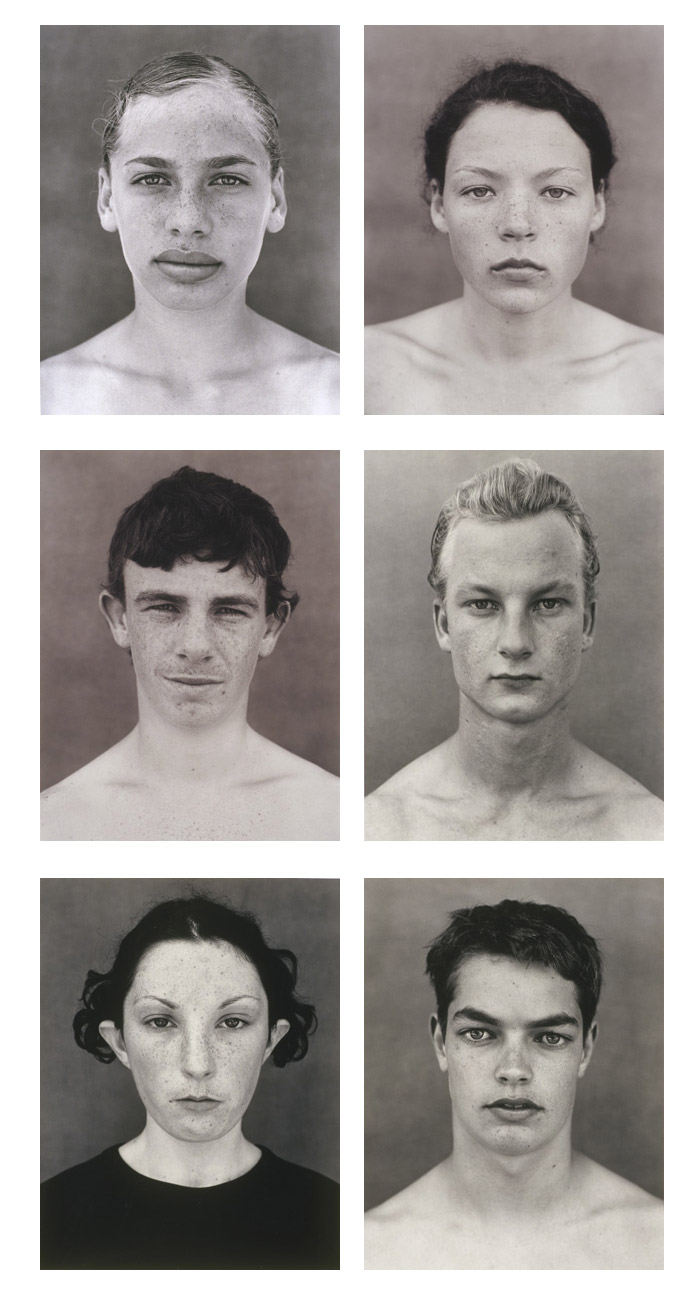
An interesting exhibition is presented in the [now closed] permanent third floor photography gallery at NGV International, Melbourne on a subject that deserved a much more rigorous investigation than could been undertaken in this small gallery space. Presenting single works by Ed Ruscha, Bernd and Hilla Becher, Patrick Pound, Robert Rooney, Simon Obarzanek, Penelope Davis, Candid Hofer, Linda Judge and Charles Green and Lyndell Brown the works seek to investigate the nature of the relationship between photography and the archive, between the semi-permanences of an archival memory and the spaces of a transgressive intertexuality marked by fragmentary, ironic counter-performances.
As noted in the catalogue essay by NGV curator Maggie Finch the archive is a place for holding knowledge that contains elements of truth and error, order and disorder; archives are able to shape history and memory, depending on how, when and by whom the records are accessed. Any disruption of order, governance and authority can lead to alternative readings and interpretations as the arcane ‘mysteries’ of the methods of classification are overturned. Since Victorian times when the body came under the self-surveillance of the camera and was found wanting, photographs have documented the faces of criminals, the physiognomy of degeneration and the fever of war.
As Yiannis Papatheodorou has observed when reviewing Jacques Derrida Mal d’Archive,
“Derrida declares that since the dominant power of the archive derives from the economy of knowledge, it also provides the institutional responsibility of the interpretation. The localisation of the information transforms the inscription, provided by the function of the archive, into the impression of a memory’s trace, conscious or unconscious … The preservation of memory, the access to information, the “resources” of the sources and the working environment are not just the representation of a future memory. They are active practices and discourses that create hierarchies and exclusions. The archives are the languages of the past, activated however dialogically, according to scientific and social demands. The content of our choice is marked by the way we are seeking information. Far from being an abstract principle, our choice is an ideologically oriented negotiation closely related to the politics of interpretation.”1
And there’s the rub. Not only is this exhibition a reordering of an unpublished memory (for that is what an archive is, a unique unpublished memory), it is also a reiteration of the authority of the gallery itself, the “institutional responsibility of the interpretation.”2Deciding what was in this exhibition and what to leave out creates hierarchies of inclusion and exclusion – and in this case the inclusions are mainly ‘safe’ works, ones that challenge the ontology of existence, the cataloguing of reality in a slightly ironic way but oh – nothing too shocking! nothing too disordered! Nothing here then of the archive of images that substantiate the horrors of war, the trans/disfiguration of men in both World Wars for example. There are few images to haunt us, none to refresh our memories in a problematic way.
The more successful pieces, the works that challenge the order of the archive (“what is no longer archived in the same way is no longer lived in the same way”)3, are the ones by Ed Ruscha, Penelope Davis and Simon Obarzaneck (all below).
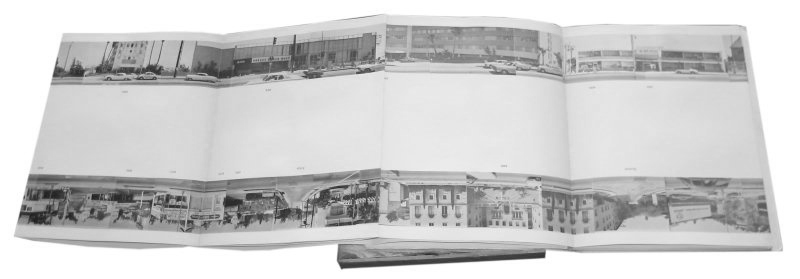
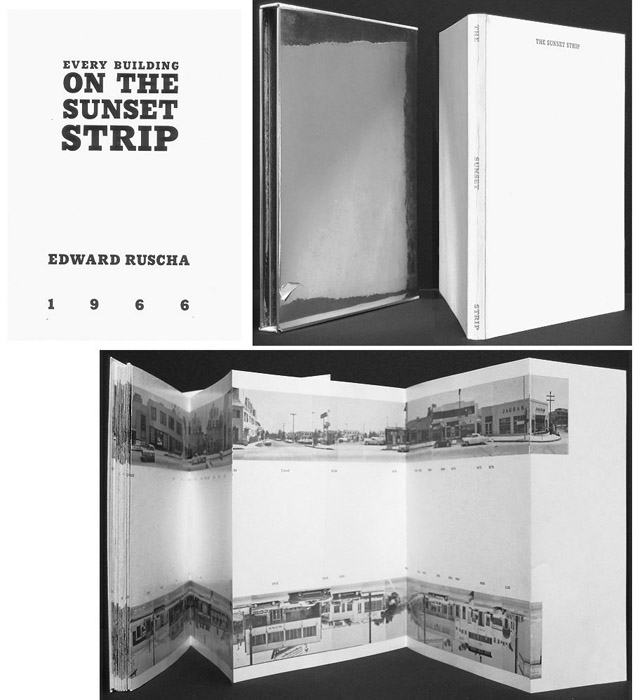
Ruscha’s vertical inverted cityscape is trapped in a display cabinet opened out on the horizontal plane in concertina format, like one of those optical illusion images in which you see an image looking from one direction and a different image from the other direction. Ruscha’s personal experience of driving down Sunset Strip in Los Angeles and his anthropological recording of the urban experience has been disseminated in a mass produced ‘artists’ book. No unique unpublished archive here. Beneath the facades of the shops other narratives emerge – images are stitched together, cars chopped off, people dismembered – all in a very linear, conceptual way; a journey from one point to another, one that is both subjective (the voice and hand of the author) and objective (the en masse production of the book).
As Chris Balaschak has noted, “The images, taken during the day, capture only the facades of the buildings. Ignorance is given to cars or people, both of which are often cut in half between separate exposures. The imperfections of matching the facades are cracks along Ruscha’s drive. Through these cracks we find Ruscha, not such an anonymous author after all. Splitting cars in two, and mismatching facades we become keenly aware of the passage of time. The facades of buildings may appear as stage sets but they are active points on other itineraries, anticipating future and past narratives.”4
This is Ruscha’s trace through the city but also our intersection with his journey, our chance to make our own itineraries as Balaschak (in his insightful writing) rightly points out. The fragmentary dismembering becomes the space between, the disorder of the linear into a heterotopic space of remembering. We the viewer create our own narrative, flitting through the cracks in the archive of memory, the photographer, the author of our own journey.
Penelope Davis photograms are luminous objects. She makes resin casts of the spine of discarded books and places the casts directly onto photographic paper and then exposes them to light. The books glow and hover in the blackness, the words on the spine reversed. Stripped of their context, of their memory, they become ethereal books, phantom texts, liminal images that hover between what is known and what is imagined. As Davis has said, “Most people assume that when they look at a photo that they are looking at the thing photographed – but they are not. They are looking at a photo. Books and photographic images and archives are enigmatic – you can’t be sure of a singular definition or meaning.”
Davis is ‘messing around’ with the idea of veracity, the truth of photography and the ordering of the archive of our mind through the images we collate. We seek to grasp the original memory of an event, of the reading and ordering of our life through images and none is available to us, for as Foucault has observed memories are only ever fragmentary and distorted representations, partial truths a best. Like Jorge Luis Borges’ journey into the infinite universe of The Library of Babel, for Foucault the psyche is not an archive but a mirror, like the shining silver foil surface of the cover of the Ed Ruscha book:
“The search for the self is a journey into a mental labyrinth that takes random courses and ultimately ends at impasses. The memory fragments recovered along the way cannot provide us with a basis for interpreting the overall meaning of the journey. The meanings that we derive from our memories are only partial truths, and their value is ephemeral. For Foucault, the psyche is not an archive but only a mirror. To search the psyche for the truth about ourselves is a futile task because the psyche can only reflect the images we have conjured up to describe ourselves. Looking into the psyche, therefore, is like looking into the mirror image of a mirror. One sees oneself reflected in an image of infinite regress. Our gaze is led not toward the substance of our beginnings but rather into the meaninglessness of previously discarded images of the self.”5
This leads us nicely onto the images of Simon Obarzanek.
In a fantastic series of photographs, the only ones of this exhibition that seemed to haunt me (as Susan Sontag says images do), Obarzanek photographs people in an ordered, almost scientific, manner. Photographed face on against a non-contextual background using a low depth of field, these repetitive, collective, unnamed people remind me of the images of Galton. But here the uniformity is overwhelmed by quirky differences – the placement of eyes and lips seem large offering a strange, surreal physiognomy. These images resonate, the challenge, they remain with you, they question the order of things as no other photograph in this exhibition does. From simplicity comes eloquence.
To finish I must address the elephant in the room, in fact two elephants!
There is not one digital photograph contained in the exhibition, the work being collage, Type C colour or black and white silver gelatin prints. There is no mention in the catalogue of the crisis of cultural memory that is now permeating our world. Some believe the ever expanding digital archive, the Internet, threatens our lived memories “amidst the process of the ‘digitisation of culture’ and the new possibilities of storing.”6 This vision entails the fear of loosing cultural contents, hitting the delete button so that memory passes into forgetting. This is a vision to which I do not subscribe, but the issue needed to be addressed in this exhibition: how are digital technologies altering our re-assemblance of memory, altering photography’s ability inherent ability to record, store and organise visual images? What about the aura of the original or was there never such a thing?
Furthermore, it would seem that with photographs becoming less and less a fixed essence; with the meaning of the photograph more and more divorced from its referent; with the spectators look the key to reading photographs; and the performance of the photograph a cut and paste reality… then perhaps we are left not with the two polar opposites of order and disorder but some orthogonal spaces in-between.
The second elephant in the room in the gallery space itself.
Whilst the curators of photography at the National Gallery of Victoria do an amazing job running large exhibitions such as the Andreas Gursky and Rennie Ellis shows that have starred this year, the NGV ‘International’ is shooting itself in the foot with the current permanent photography gallery space. Small, jaded and dour it seems an addendum to other larger spaces in the gallery and to be honest photography and Melbourne deserves better. Personally I feel more alive in the fashion gallery that is on the floor below and that, for an photographer, is a hard thing to say.
As the theme for this exhibition deserved a greater in depth investigation so the gallery needs to expand it’s horizons and give the permanent photography gallery a redesign and overhaul. Where is the life and passion of contemporary photography displayed in a small space for all to see in a gallery that sees itself as ‘International’? In an occularcentric world the key word is intertexuality: the gallery space should reflect the electri-city, the mixing of a gallery design ethos with images to surround us in a space that makes us passionate about contemporary photography. Now that would really be a new order of things!
Dr Marcus Bunyan
1/ Papatheodorou, Yiannis. History in the promised land of memory. Review of Jacques Derrida, Mal d’Archive, Paris, Éd. Galilée, 1995 [Online] Cited on 20th March 2009 (no longer available online)
2/ “The archive is understood as collective reservoir of knowledge fulfilling diverse functions and conditioned by three main factors: conservation, selection and accessibility. How are contents stored and which media are used to conserve them? What is selected for storage and what is decided to be cleared out and thus forgotten? Who decides what is archived and who has access to the resources? All these questions paint the archive as a political space where relations of power cross aspects of culture and collective identity.” Assmann, A. (2003) Erinnerungsräume, Formen und Wandlungen des kulturellen Gedächtnis. [Memory Spaces, Forms and Transformations of Cultural Memory] Special paperback editon, 1st edition publ. 1999, München: Beck, p. 343-346
3/ Derrida, Jacques. (1996) Archive Fever, A Freudian Impression. Transl. by E. Prenowitz, p. 18 orig. publ. as Mal d’Archive: une impression freudienne in 1995, Chicago, London: The University of Chicago Press
4/ Balaschak, Chris. Itineraries [part 3] [Online] Cited on 20th March 2009 (no longer available online)
5/ Hutton, Patrick. “Foucault, Freud, and the Technologies of the Self,” in Martin, Luther and Gutman, Huck and Hutton, Patrick (eds.,). Technologies of the Self: A Seminar with Michel Foucault. London: Tavistock Publications, 1988, p. 139
6/ Featherstone, M. (2000) “Archiving Cultures,” in British Journal of Sociology, 51(1), pp. 161-184
Many thankx to the National Gallery of Victoria for allowing me to publish the images in the posting. Please click on the photographs for a larger version of the image.
Penelope Davis (Australian, b. 1963) Shelf 2008 From the Fiction-Non-Fiction series 2007-2008 Type C photograph 90.0 x 70.0cm National Gallery of Victoria, Melbourne Purchased, Victorian Foundation for Living Australian Artists, 2008
Archives contain elements of truth and error, order and disorder and are infinitely fascinating. As both collections of records and repositories of data, archives are able to shape history and memory depending on how, when and by whom the materials are accessed. Their vastness allows for multiple readings to be unravelled over time.
Photography is naturally associated with archives because of its inherent ability to record, store and organise visual images. With this in mind, this exhibition brings together artists drawn largely from the permanent collection of the NGV who explore the idea of archives as complex, living and occasionally mysterious systems of knowledge. Several of the selected artists act as archivists, collecting and ordering their own unique bodies of photographs, while others create disorder by critiquing the ideas and systems of archives.
Bernd and Hilla Becher (German, 1931-2007 and 1934-2015) Coal tipple, Goodspring, Pennsylvania 1975 From the Artists and photographs folio 1975 Gelatin silver photographs 24.0 × 33.9cm (image and sheet) 40.7 × 49.6cm (support) National Gallery of Victoria, Melbourne Purchased, 1976
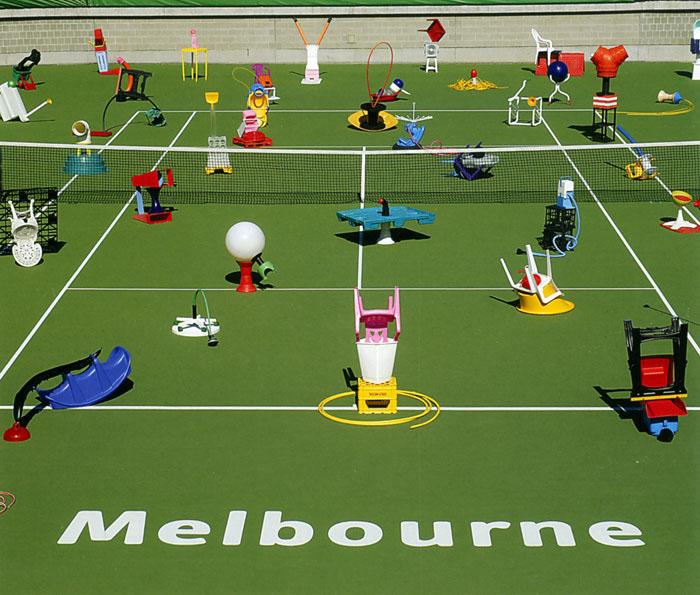
Louise Paramor (Australian, b. 1964) Show Court 3 (II) 2009
Boarding a train at Flinders Street we emerge at South Yarra station to stroll down to River Street for our third opening of the night at Nellie Castan Gallery. We are greeted by the ever gracious Nellie Castan who has just returned from an overseas trip to Europe where she was soaking up the wonders of Rome amongst other places. For the latest exhibition in the gallery Louise Paramor is presenting two bodies of work: Show Court 3 and Mood Bomb (both 2009). Lets look at Show Court 3 first as this work has older origins.
Originally exhibited in 2006 at Nellie Castan under the title Jam Session the sculptures from this exhibition and many more beside (75 in all) were then installed in 2007 on show court 3 at Melbourne & Olympic Parks, hence the title of the installation. In the smaller gallery in 2009 we have six Lambda photographic prints that are records of this installation plus a video of the installation and de-installation of the work.
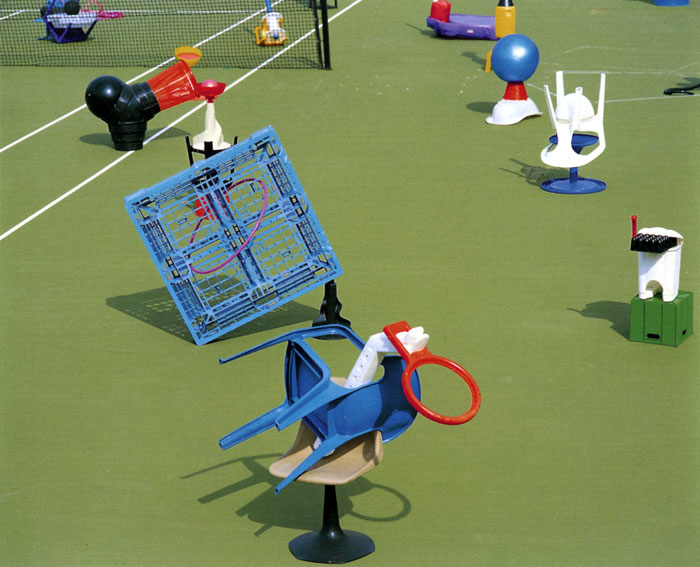
While interesting as documentary evidence of the installation these photographs are thrice removed from the actual sculptures – the sculptures themselves, the installation of the sculptures on court and then the photographs of the installation of the sculptures. The photographs lose something in this process – the presence or link back to the referentiality of the object itself. There is no tactile suggestiveness here, no fresh visual connections to be made with the materials, no human interaction. The intertextual nature of the objects, the jamming together of found pieces of bright plastic to make seductive anthropomorphic creatures that ‘play’ off of each other has been lost.
What has been reinforced in the photographs is a phenomena that was observed in the actual installation.
“The sculptures created a jarring visual disruption when placed in a location normally associated with play and movement. The stadium seating surrounding the tennis court incited an expectation of entertainment; a number of viewers sat looking at the sculptures, as though waiting for them to spin and jump around. But mostly, the exhibition reversed the usual role of visitors to place where one sits and watches others move; here the objects on the tennis court were static and the spectators moved around.” (2007)1
In the photographs of these objects and in the installation itself what occurs is an inversion of perception, a concept noted by the urbanist Paul Virilio.2 Here the objects perceive us instead of us perceiving the object: they stare back with an oculocentric ‘suggestiveness’ which is advertising’s raison d’être (note the eye sculpture above). In particular this is what the photographs suggest – a high gloss surface, an advertising image that grabs our attention and forces us to look but is no longer a powerful image.
In the main gallery was the most interesting work of the whole night – experiments of abstraction in colour “inspired by the very substance of paint itself.” Made by pouring paint onto glass and then exhibiting the smooth reverse side, these paintings are not so much about the texture of the surface (as is Dale Frank’s work below) but a more ephemeral thing: the dreamscapes of the mind that they promote in the viewer, the imaginative connections that ask the viewer to make. Simpler and perhaps more refined than Frank’s work (because of the smooth surface, the lack of the physicality of the layering technique? because of the pooling of amoebic shapes produced, not the varnish that accumulates and recedes?) paint oozes, bleeds, swirls, drips upwards and blooms with a sensuality of intense love. They are dream states that allow the viewer to create their own narrative with the title of the works offering gentle guides along the way: Girl with Flowers, Lovers, Mood Bomb, Emerald God, Mama, and Animal Dreaming to name just a few. To me they also had connotations of melted plastic, almost as if the sculptures of Show Court 3 had dissolved into the glassy surface of a transparent tennis court.
These are wonderfully evocative paintings. I really enjoyed spending time with them.
Dr Marcus Bunyan
1/ O’Neill, Jane. Louise Paramor: Show Court 3. Melbourne: Nellie Castan Gallery, 2009
2/ Virilio, Paul. The Vision Machine. (trans. Julie Rose). Bloomington: Indiana University Press, 1994, pp. 62-63
Many thankx to Nellie Castan Gallery for allowing me to publish the photographs in the posting. Please click on the photographs for a larger version of the image.
Louise Paramor (Australian, b. 1964) Show Court 3 (VI) 2009
Louise Paramor (Australian, b. 1964) Show Court 3 (detail) 2009
Louise Paramor (Australian, b. 1964) Show Court 3 (detail) 2009
Louise Paramor (Australian, b. 1964) Opening night crowd in front of Sky Pilot (left) and Mama (right) 2009 Paint on glass
Louise Paramor (Australian, b. 1964) Opening night crowd in front of Green Eyed Monster (right) and Sky Pilot (right) 2009 Paint on glass
Louise Paramor (Australian, b. 1964) Opening night crowd in front of Pineapple Express 2009 Paint on glass
Louise Paramor (Australian, b. 1964) A Dog and His Master (detail) 2009 Paint on glass
Louise Paramor (Australian, b. 1964) Lovers 2009 Paint on glass
Dale Frank (Australian, b. 1959) 2. One conversation gambit you hear these days: ‘Do you rotate?’ An interesting change of tack? No suck luck. ‘Do you rotate?’ simply fishes for information about the extent of your collection. Do you have enough paintings to hang a different one in your dining room every month? 2005
Louise Paramor (Australian, b. 1964) Mood Bomb 2009 Paint on glass
Louise Paramor (Australian, b. 1964) Slippery Slope (detail) 2009 Paint on glass
Louise Paramor (Australian, b. 1964) Green Eyed Monster (detail) 2009 Paint on glass
Richard Grigg (Australian) New Work exhibition Opening night crowd at Block Projects, Melbourne
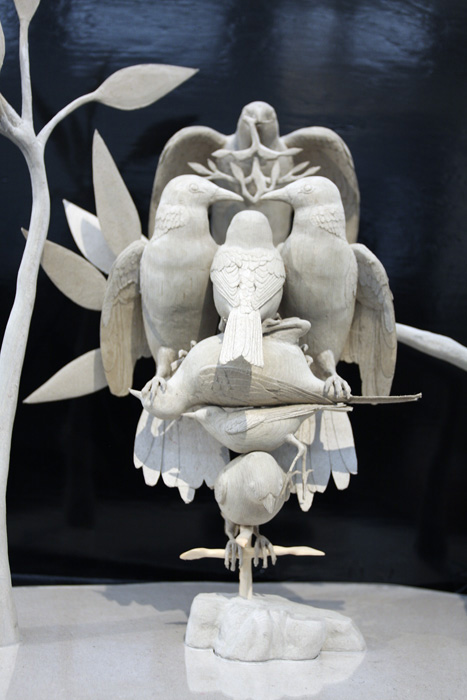
Moving down Flinders Lane we ascended to the fourth floor and entered the beautiful light filled gallery space at Block Projects to view the ‘new work’ of Richard Grigg. An eclectic mix of sculpture, painting, drawing, and collage was presented. Preparatory drawings for one of the sculptures, a pencil drawing of two old men debating, a canvas of a camera in tempera, gold leaf and gesso vie for attention with the two standout pieces of the show: No more songs at funerals/hero today gone tomorrow (2007) and He can’t read well because of his horns (2009), surrealist sculptures both made of compressed cardboard (below).
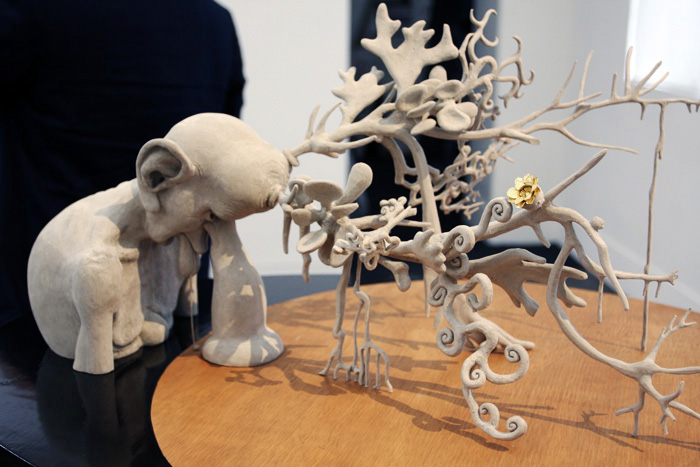
These two sculptures are fantastic: the first forming a skull made out of birds perched on a cross surmounted by a bird holding an olive branch, the title deliciously ironic; the second a stooped gargoyle like creature with a massive extrusion for a nose, hanging tongue dripping saliva and phantasmagorical protrusions emerging from it’s head making it impossible for the creature to ‘read well’ in both the metaphorical and literal sense. This is a beautiful but grotesque primordial fantasy with the horns putting roots down in the soil like the roots of a mangrove tree, a gold leaf flower blooming at their outer reaches, the creature exhausted by the effort of trying to keep his head up.
Unfortunately the rest of the exhibition lacked core strength: conceptually the show is not strong. Evidence of beauty in decay and concerns about the process of ageing vie with environmental contexts; slippages in time (The Moment Between) contrast with cameras and their sight lines; Pinocchio lies under a shroud with a camera trapped in the back of a horse drawn cart (Dream of Rest). Apparently, the cameras do not signify the capturing of the frozen moment of beauty but they are there because the artist’s father collected cameras. To me they seemed to be defining the nature of our interaction with the world, the surface of the image controlling the interface between technology and earth.
One of the problems with undertaking an exhibition titled New Work is the assumption that the new work being produced hangs together holistically and tells a not necessarily linear narrative story but one that the viewer can investigate, question, and tease the pertinent concepts from – something the viewer can hang their hat on (perhaps the horns of a dilemma!) This was not the case here. The bits n bobs approach of this exhibition falls slightly flat but go see the show for the two sculptures – they alone are worth the effort!
Dr Marcus Bunyan
Many thankx to Block Projects for allowing me to publish the photographs in the posting. Please click on the photographs for a larger version of the image.
Richard Grigg (Australian) No more songs at funerals/hero today gone tomorrow 2007-2009 Layered boxboard, wood dowel, glue, pine, black gloss enamel, Perspex
Richard Grigg (Australian) He can’t read well because of his horns 2009 Layered boxboard, gold leaf, wood dowel, glue, pine, black gloss enamel, wood stain
Richard Grigg (Australian) A Late Night Story 2007 pencil on paper
Richard Grigg (Australian) Older than the value of beauty (detail) 2009 Tempera, gold leaf and gesso on board
Richard Grigg (Australian) Cloak 2008 Tempera, gold leaf and gesso on board
Block Projects Level 1 / 252 Church Street Richmond Victoria 3121 Australia Phone: +61 3 9429 0660
Damiano Bertoli (Australian, 1969-2021) Continuous Moment: Bad Infinity 2009 Video stills
In a busy night of openings in Melbourne we arrive to watch, to be a spectator and voyeur at Damiano Bertoli’s new twin video installation at The Narrows on Flinders Lane, ensconced in the darkness of the gallery space. The looped installation features on the left scenes from the original Miami Vice TV series and on the right approximate scenes from the 2006 feature film of the same name. The synchronicity of the two splices of time moving in and out of register is uncanny. We have memories of these appearances, flickering signifiers embedded in our psyche which are called to presence in the space between screen and viewer as we add our own layer of temporal distortion to the unfolding events.
In an erudite catalogue note Bertoli expounds on the nature of the performative and the question of authorship by analysing Glenn Gould’s two recordings of J. S. Bach’s Goldberg Variations, one recorded at the beginning of his career and one in the final year of his life. Bertoli posits that Gould used counterpoint “as a formal construct for its capacity to produce ‘an explosion of simultaneous idea’s’ … as a solution for his dissatisfaction with singularity and linear definition.”
He notes that, “As an interpreter of others work, Gould occupied a position of equivalence – we are aware that we are listening to Bach and Gould – simultaneously … These co-existing yet distinct voices move in and out of synchronicity, as does the listener’s experience of Gould’s interpretation (actually an interpretation of an interpretation) as the latter version iterates and embodies the version which precedes it. We are constantly comparing the two, as is Gould.”
This is quite true but I do not think the metaphor can be so literally applied to the video installation Bertoli has constructed. Firstly Gould’s interpretations and our recognition of them requires knowledge of the authoritative voice of the author as composer and the author as performer: Bach and Gould. Conversely in the videos the directors are unknown by most and the actors anonymous except by those with specific memory of appearances. There is no contrapuntal fugue like working of the sound or images in search of the purity of musical ideas – the dialogue talks over each other and splice cuts jump the scene from one location to another – forming a fractured hypertextual narrative driven by the spectacular gaze of the viewer, a simularcrum of the ‘real’. The simultaneity of being in three worlds at once is the world of simulacra not of equivalence.
As Ron Burnett has observed
“Video creates what I will describe as a logic of the present while simultaneously producing an image-event in the past. This generates a somewhat different temporal context than we are normally accustomed to – a mixture of present and past that is both, and neither, simultaneously. The disjuncture that results is part of the attraction but also part of what makes the electronic image so puzzling. It suggests that history has already been made while one continues to make it. It is this suppleness that allowed broadcasters for example to repeat the Rodney King beating in Los Angeles over and over again, as if each showing would somehow reconstitute the event, as if to prove that this was not a dramatisation, not a fiction. In order to gain control over the many disjunctures, repetition was used … But this only validates the contradictions, proposing that the disjunctures in time and place can be controlled, that there is some way of gaining authority over the impact of the event as image.”1
I would argue that what Bertoli’s installation does offer is a release from inert rationalist geometries, a deterritorialization and reterritorialization of temporal time in a heterotopic space, juxtaposing in a single real place several spaces, several sites that are in themselves incompatible. These are layered images of hyper-performativity and hypermediacy, where the fragmented images become a process and a performance, where the spectator becomes the screen not the author.
As Baudrillard has said, “Today we live in the imaginary world of the screen, of the interface and the reduplication of contiguity and networks. All our machines are screens. We too have become screens, and the interactivity of men has become the interactivity of screens. Nothing that appears on the screen is meant to be deciphered in depth, but actually to be explored instantaneously, in an abreaction immediate to meaning.”2
Here is the immediacy of continuous time – the removal of psychological depth, the reduction of life to a series continuous presents and surface phenomena that repeat over and over again. Is this bad infinity? We will never know… as we can never have knowledge of infinity. It is a noumenal concept, an event known only to the imagination, independent of the senses.
This is an interesting and fun installation. Well worth a visit.
Dr Marcus Bunyan
1/ Burnett, Ron. Cultures of Vision: Images, Media, & the Imaginary. Bloomington: Indiana University Press, 1995, p. 249
2/ Baudrillard, Jean. Xerox and Infinity (trans. Agitac). Paris: Touchepas, 1988, p. 7
Many thankx to The Narrows gallery for allowing me to publish the photographs in the posting. Please click on the photographs for a larger version of the image.
Damiano Bertoli Continuous Moment: Bad Infinity(2009)
Damiano Bertoli (Australian, 1969-2021) Continuous Moment: Bad Infinity 2009 video stills
Vale Damiano Bertoli (1969-2021)
In September, artist Damiano Bertoli passed away unexpectedly at the age of 52. Bertoli was a staple in the Melbourne art community. He could be relied upon to regularly attend openings and see most exhibitions. Along the way, he would dish out wit, sarcasm and charm. Seeing him across a crowded room, he would go cross-eyed as a form of greeting, breaking the ice with humour. Bertoli had a rich and expansive artistic practice, spanning collage, film, sculpture, installation, even theatre, but he was equally known for his large personality. In preparation for this piece, I spoke to several of Bertoli’s closest friends who had many things to say about him, but some underlying themes proved unanimous. He possessed a great sense of curiosity and generosity; he loved sharing knowledge; he built rich relationships with others through engagement with art; and that he has left behind a massive legacy – albeit one that could have been much, much bigger.
Read more about Damiano Bertoli’s legacy. Amelia Winata. “Damiano Bertoli 1969-2021,” on the MeMO website 13 Oct 2021 [Online] Cited 12/06/2022
Damiano Bertoli (Australian, 1969-2021) Continuous Moment: Bad Infinity 2009 video stills
Exhibition dates: 25th February – 14th March, 2009
Junko Go (Australian born Japan, b. 1955) Opium Poppy 2008
“One person’s heaven is another’s nightmare. Seeing both sides to every story can be a blessing and a curse. Good and bad, right and wrong, purity and impurity are inextricably linked.”
A delicate, refined but strong presence is felt in the work of Junko Go in the her new exhibition ‘all about … blooming’ at Gallery 101, Melbourne. Nominally landscape painting about flowers but featuring thoughts and ideas about the seed, the shoot, pollen and the breath of life the work addresses the essence of what it is to be human and live compassionately on this earth in an intelligent and profound way.
Denying the nihilism of abstract expressionism each mark is fully considered by being attentive to the connection between brush, hand and meaning. Almost childlike in their use of charcoal and acrylic her dogs, crosses and flowers, jottings and dashes, rain and rivers, seeds and people show a Zen like contemplation in the marks she makes on the canvas – just so. A releasement towards things is proffered, a letting go of the ego to create an awareness of just being. There is genuine warmth and humility to this work.
In Opium Poppy (2008, above) the darkness of the nightmare is represented by the black marks, ascending like Jacob’s ladder balanced by the mandala like poppies whose petals seem like feathers of a bird’s wing – a flight of fancy both good and bad. In Pollen (2009) bees swarm around a sunflower leaving traces of their presence, a bird flies close to a tiny blue cloud, the sun burst forth in a tiny patch of aqua colour, and people hug arm in arm. As Go says, “Bees in a flower bear pollen unawares and play a crucial roll for the plant to survive. Our love, kindness, warmth and wisdom affect one another unawares and play a crucial roll for our planet to survive.” In New Shoot (2008, below) the puzzle of our existence, the nature of our existential being is laid bare for all to see.
In Seeds (2008) Go reminds us that rather than being focused on what we hoped for, we must make the most of whatever opportunities we are blessed with. This means being aware of the gifts one possesses, not the distance between ‘I’ and want, need and desire – now! The seed of our experience – the calm before the force that propelled us into existence – is already present within us.
Go’s musings on the existential nature of our being are both full and empty at one and the same time and help us contemplate the link to the breath of the sublime. In the end Go’s paintings are about endings and beginnings, about being strong or not, about the infinity of the seed and about our responses to living in harmony on this planet. Through the seed, the shoot, the flower and the earth access may be granted to the sublime and this perfectly sums up the work of this artist, a reflection of her energy and radiance transferred to the canvas. I loved it.
Dr Marcus Bunyan
Many thankx to Gallery 101 for allowing me to publish the art work in the posting. Please click on the art work for a larger version of the image.
Junko Go (Australian born Japan, b. 1955) New Shoot 2008
“Each of us is born to fill a special place in this world. In the process, we sometimes have trouble finding our niche. Life is like a jigsaw puzzle in which we make every effort to find our own place that makes a right connection with others, with the world and even with the whole universe.”
Junko Go (Australian born Japan, b. 1955) Red Hot Poker 2009
“Push and pull our inner strength. Sometimes, we need courage to take risks in confronting pain and loss in order to gain a deep and profound experience.”
“We live in a world where high achievers are congratulated, yet true achievements are not related to what we can get done, but to how deeply we aware of how wonderful it is to be alive. In this exhibition, flowers are not only a predominant source of visual inspiration, looking at them also engenders a kind of appreciation and wonder. The fragile and ephemeral flower provokes in me an awareness of the human condition that reveals the true nature of our existence.
My goal is to create images which are strong and soft, bold and precise, beautiful and ugly, figurative and abstract, all at once. My greatest challenge is to make art about what it is to be human … What really matters in art making to me is a kind of awareness – a being able to say, ‘I am as I am’.”


















 Art Blart _ art and cultural memory archive
You must be logged in to post a comment.