This is a patchy exhibition by Michael Corridore at Edmund Pearce Gallery.
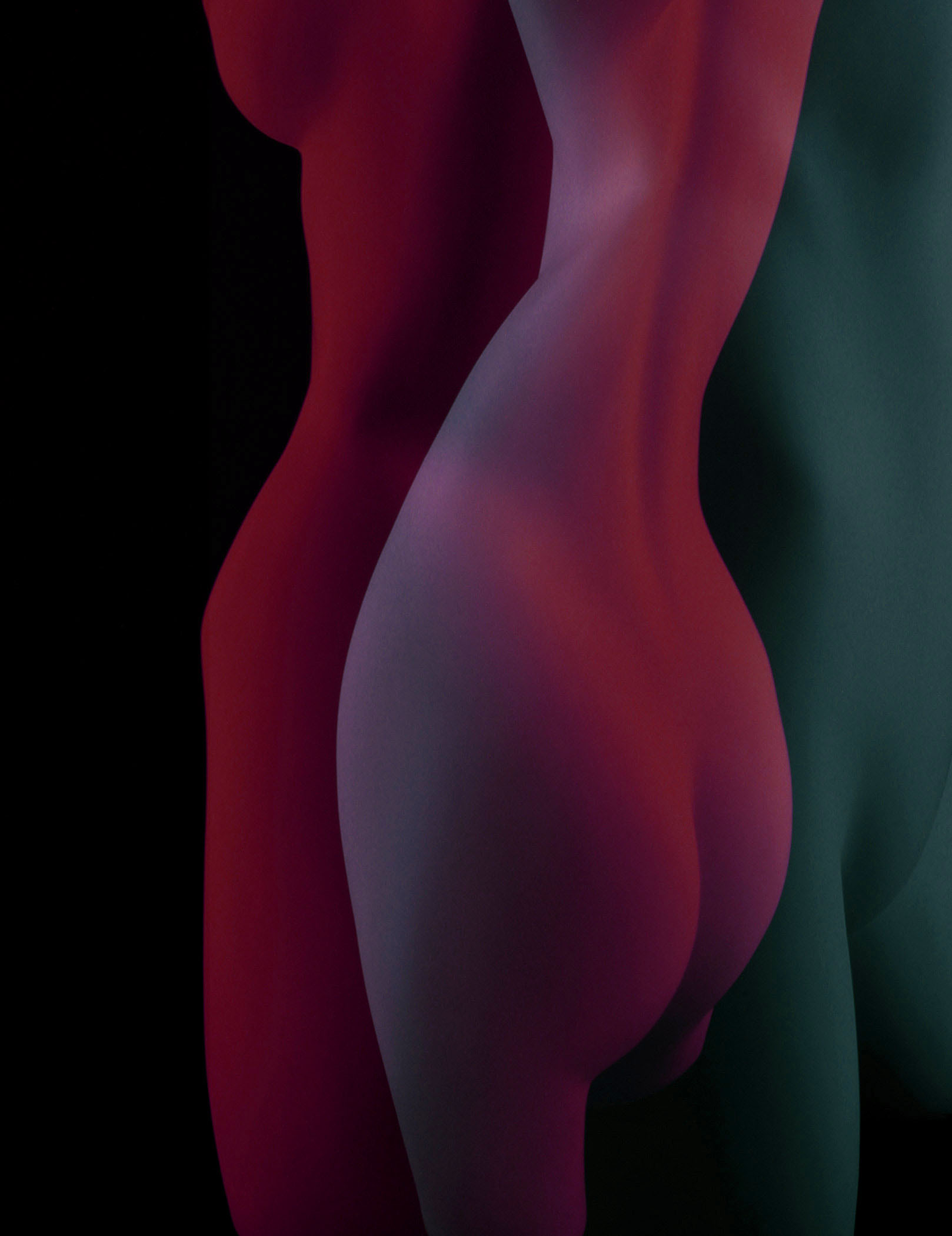
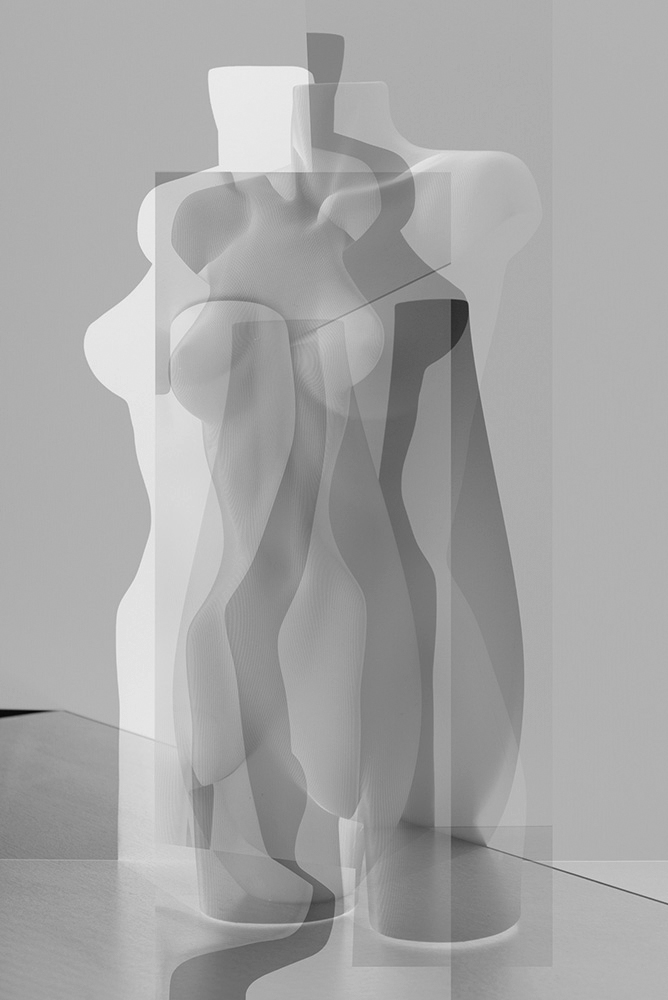
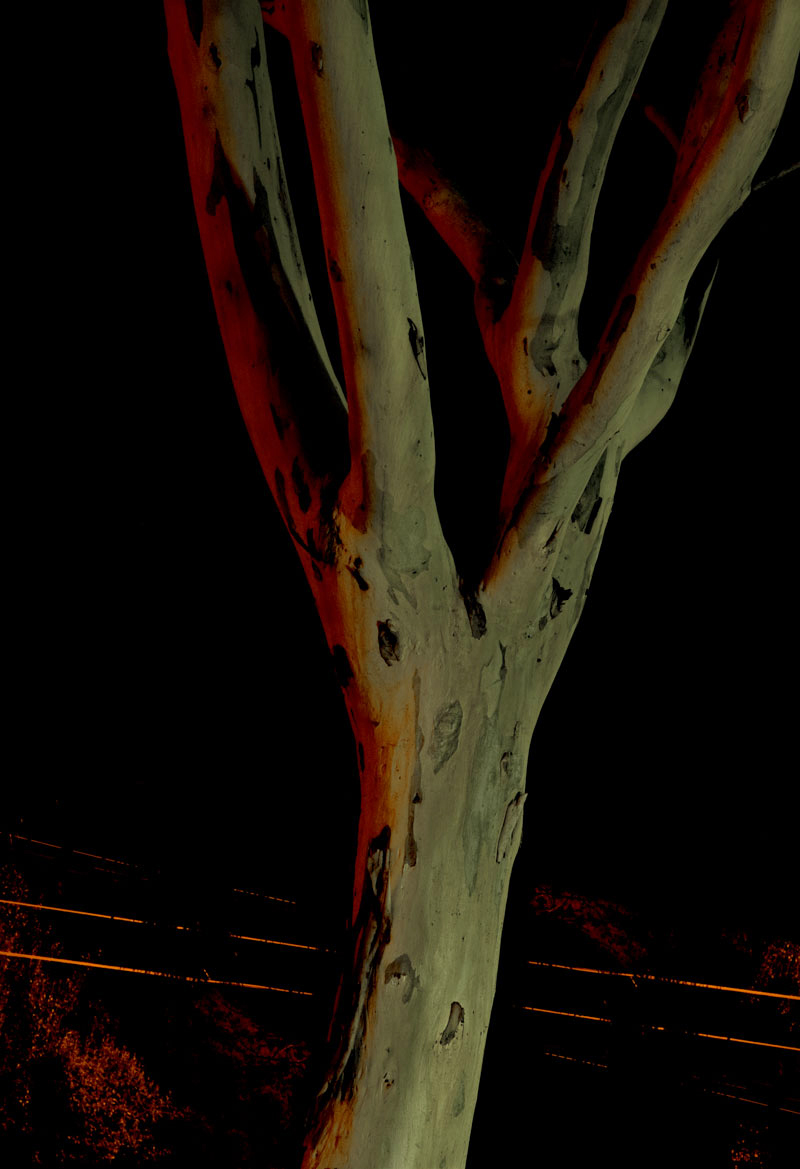
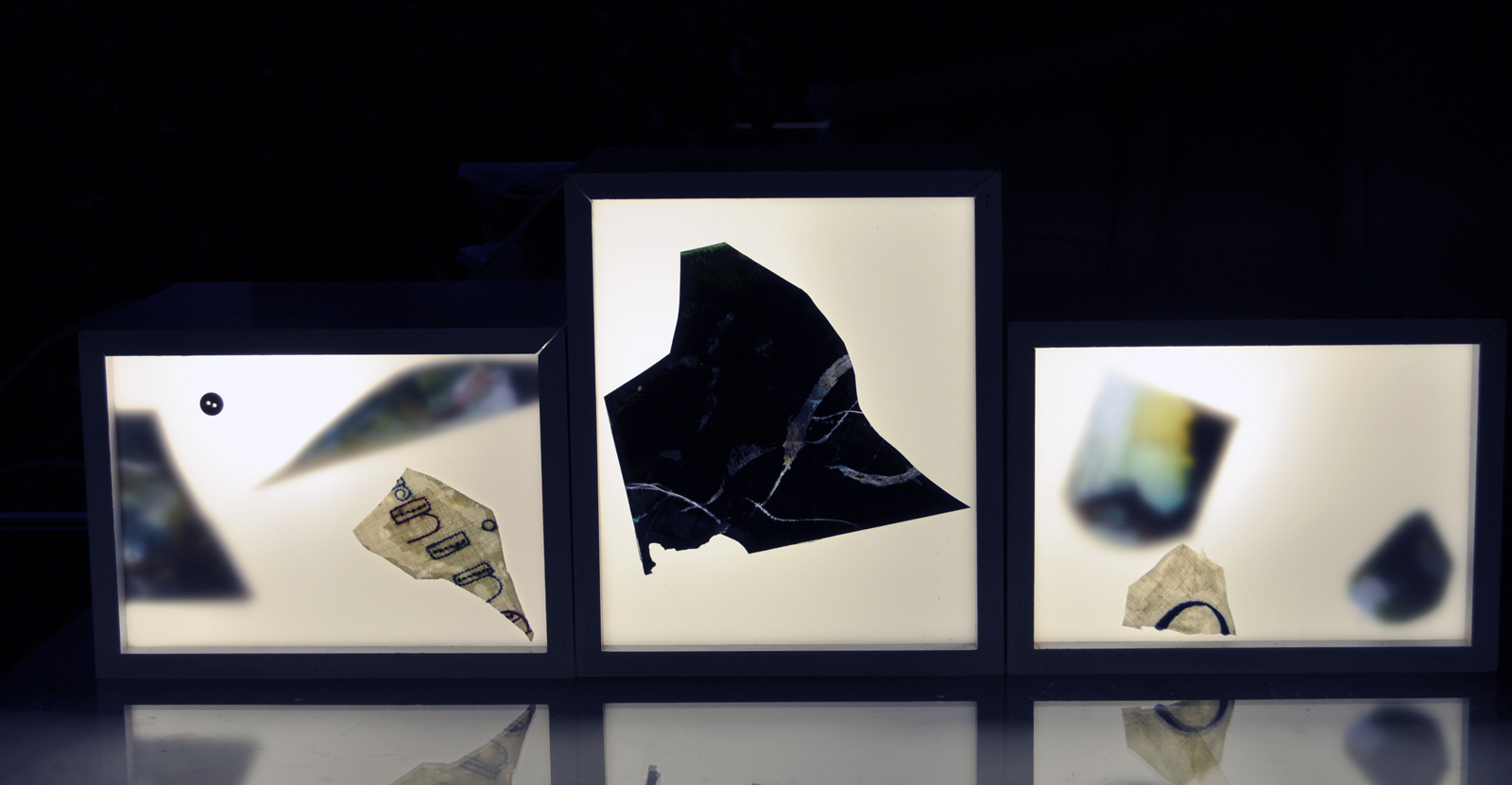
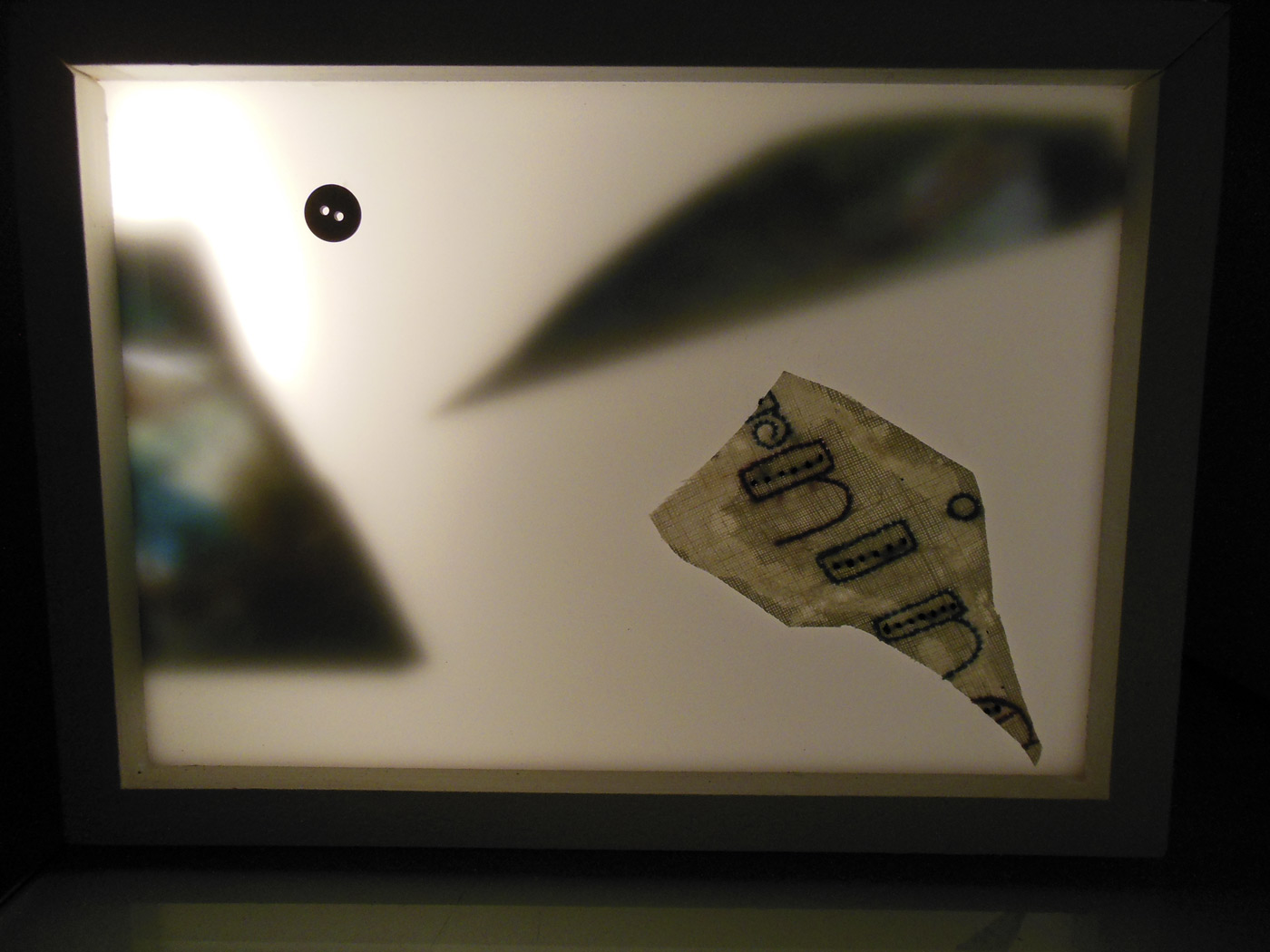
The four small images from the initial foray into digital collage (the photograph above and the top three photographs below, all 2001) are the most striking and effective works in the exhibition. Lucid in their Duchampian layering and movement, these beautiful photographs most clearly express the conceptual ideas behind the collages. The four pieces literally stopped me in my tracks when I saw them in the gallery space. The colours are bold, the overlapping and movement refined and the effect on this viewer was profound, so intense was the visualisation of the work.
The new photographs possess a different order of being. Subtle and requiring greater contemplation there were only five images that impinged on my consciousness in the rest of the exhibition (the first five photographs after the press release below, all 2013). Even the best of them seem more an exercise in the formal qualities of digital collage rather than the élan vital of the earlier work. While Corridore re-interprets “what we see from differing perspectives and synthesise[s] those components of our observations and memory information into a two-dimensional image,” what he produces are images that are not that memorable. Interesting exercises, perhaps, in the topography of being, but not that memorable or emotive as images.
The rest of the new photographs simply did not work for me. Either there was not enough for this viewer to hang his hat on (visually speaking) or the image was so subtle and occluded behind the glass of the frame that the viewer gets no feeling, no presence from the image at all. (Of course, this is the perennial difficulty of framing dark or subtle work in a gallery environment, the ability of the viewer to actually see the work if glass or perspex is placed in front of it. Either you pin the work to the wall, or frame it without glass, or mount on aluminium – unfortunately all but the latter precludes the easy sale to customers who want an artwork ready to purchase off the gallery wall). Tangentially speaking, it is as if the train of thought of the artist has wandered as he seeks other pathways to creation, pathways that fail to interestingly develop the initial topic of conversation.
It is all very well to go off at a tangent (defined as a line, curve, or surface meeting another line, curve, or surface at a common point and sharing a common tangent line or tangent plane at that point; a sudden digression or change of course), but the meeting point between artist’s intentions and the viewer’s reception have to at some point possess some common ground of interest and understanding. As it stands, I will always, always remember Corridore’s initial ‘fictional realities’ for their intensity and beauty but the later work will seep from my mind as easily as thought placed it there.
Dr Marcus Bunyan
Many thankx to Edmund Pearce Gallery for allowing me to publish the photographs in the posting. Please click on the photographs for a larger version of the image.
Although a departure from the Angry Black Snake series and ongoing landscape work, Tangents reflects Michael’s deep artistic practise and an ability to experiment confidently with different techniques and styles. Such strong technique reflects this photographer’s mastery of his craft.
Michael Corridore’s primary interest in his fine-art and commercial photography has been in inventing new narratives. Whether it is spectators shrouded in the smoke of burning rubber, his unique portraits of the famous and not so famous, capturing empty urban everyday spaces, or external landscapes that are at times exceptionally beautiful or beautifully strange and mysterious, you cannot help but be drawn in by Corridore’s ‘fictional realities’.
In this new series, Tangents,Corridore uses references to Cubism and art history, redefining such ideas in a modern photographic context. This project was commenced in 2000 and now in 2013 it has been fully realised by the artist due to advances in digital capture technology. Vibrant and subtle colour can now be fully preserved in the collage process.
“In this series of collages, I have returned to a series that I had started in 2000. The original series resulted in about a dozen or so photographs. My first attempts at collage were through printing negatives onto black and white Lithographic film and layering multiple sheets of those films onto a light box and photographing the assembled sheets as collages.
From there I decided to experiment with digital capture of the original components and assemble the layers in photoshop so that I could preserve colour, which was lost in the lithographic printing process. This was my first foray into working with digital capture technology.
In the past year I began to explore this collage process again photographing various forms working with life models, mannequins and various household objects which offered me the opportunity to explore both malleable and solid forms and shapes that could be layered together in the assembled collages.
This exploration in collage stems from my interest in the Cubists approach to re-interpreting what we see from differing perspectives and synthesise those components of our observations and memory information into a two-dimensional image.”
“The pity is that Jerrems died so young for what this exhibition brought home to me was that here was an artist still defining, refining her subject matter.” Dr Marcus Bunyan
Exhibition dates: 6th July – 30th September, 2013
A National Gallery of Australia exhibition
Curator: Gael Newton and Anne O’Hehir
PLEASE NOTE: THIS POSTING CONTAINS ART PHOTOGRAPHS OF FEMALE NUDITY – IF YOU DO NOT LIKE PLEASE DO NOT LOOK, FAIR WARNING HAS BEEN GIVEN
Carol Jerrems (Australian, 1949-1980) A poem (installation view)
1970
Gelatin silver photographs, letterpress, installed at Monash Gallery of Art Photograph: Katie Tremschnig
The one and only…
This is a fascinating National Gallery of Australia exhibition about the work of Australian photographer Carol Jerrems at Monash Gallery of Art, Wheelers Hill – in part both memorable, intimate, informative, beautiful, uplifting and disappointing. Let me explain what I mean.
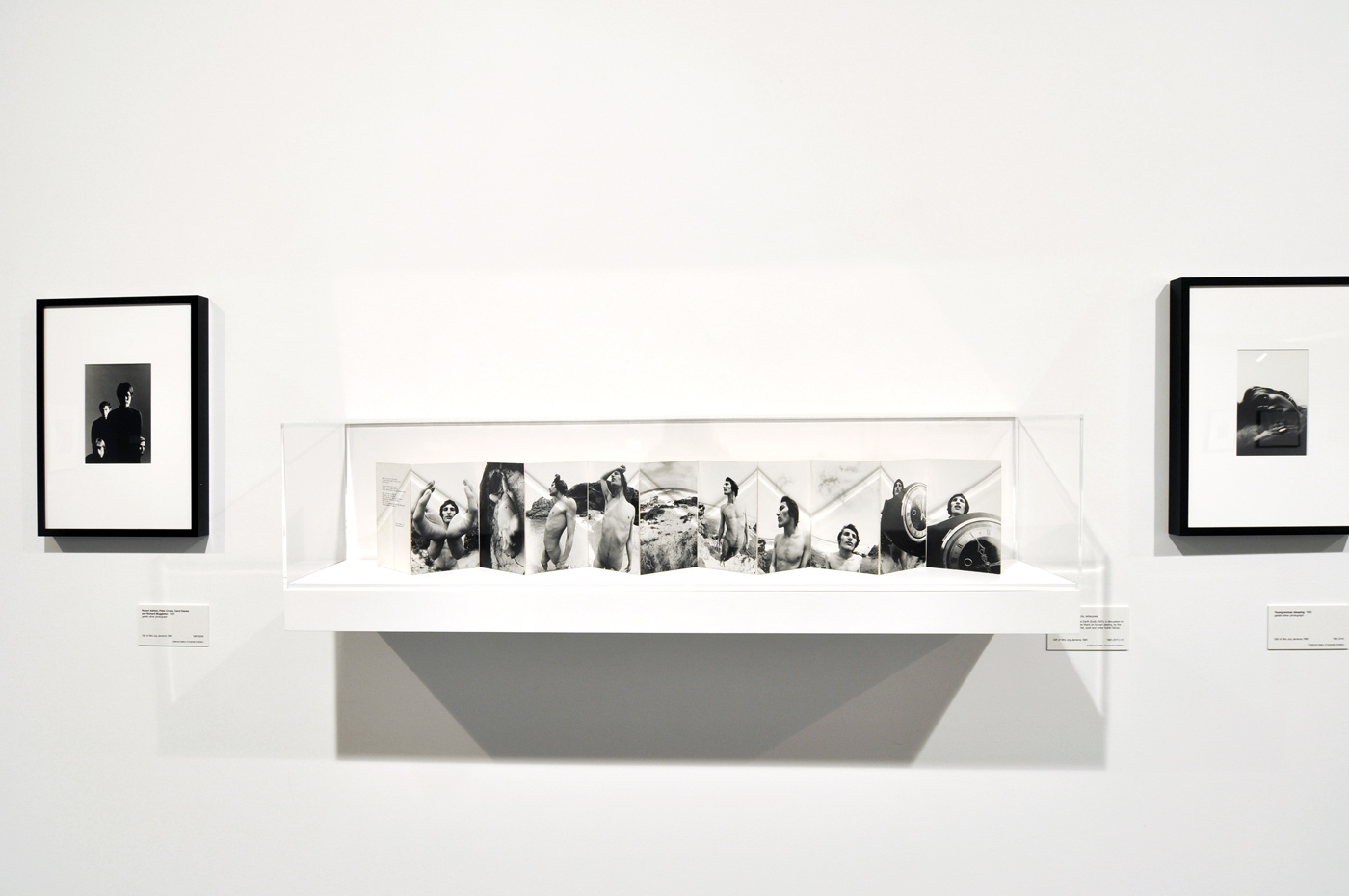
The first section of the exhibition is devoted to Jerrems student work, notably her experiments with overlapping bodies, depth of field, movement and the layering of space and time that can be seen in her vibrant photo boooks and concertina books (see installation photographs below), accompanied by her own poems. This early work, which I had never seen, provides a wonderful insight into how the later images came to be: the shooting down hallways into the light, the pairing and tripling of bodies one behind the other, and how she constructed narrative in her later set piece photographs. This is the informative part of the exhibition.
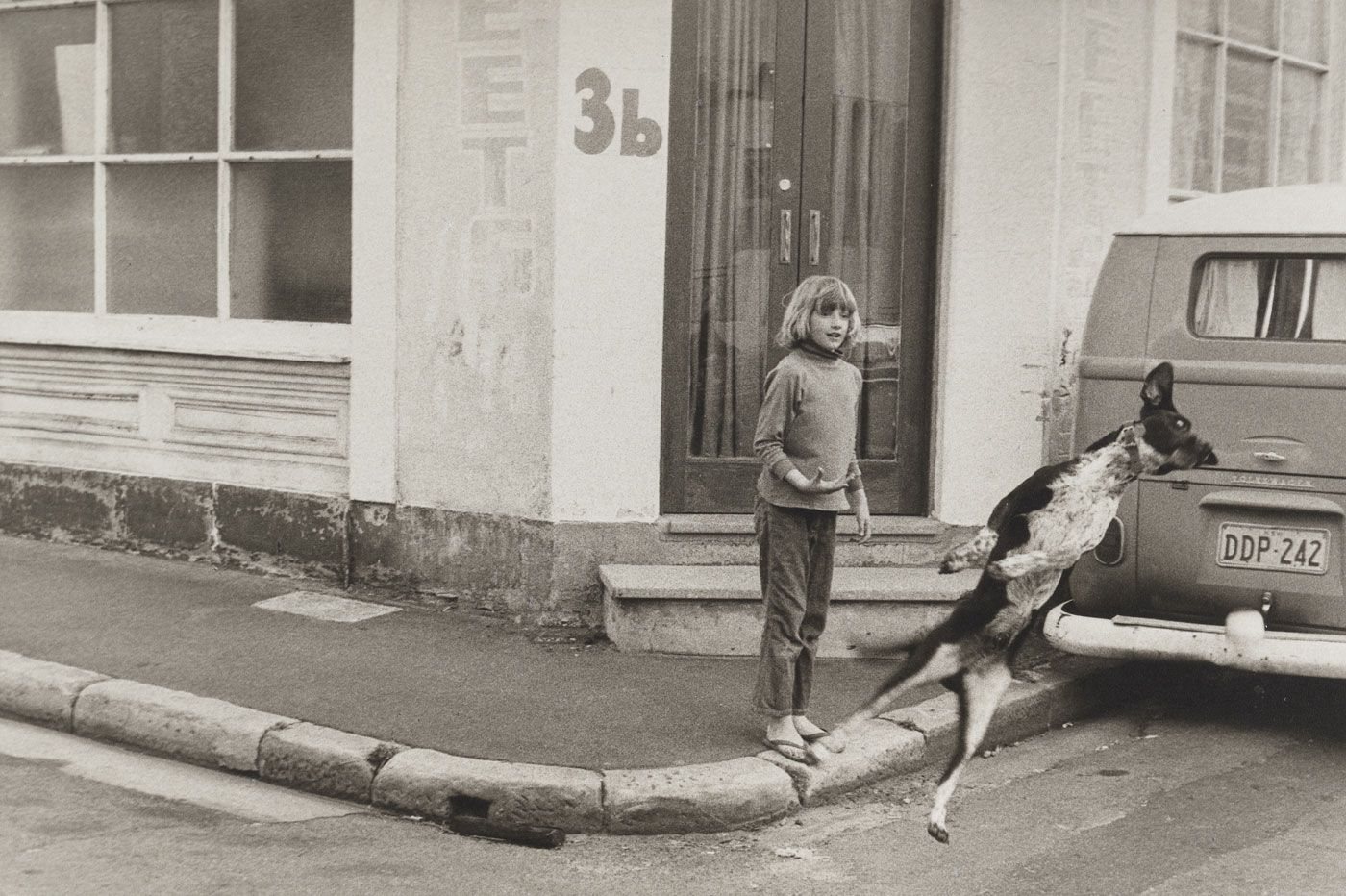
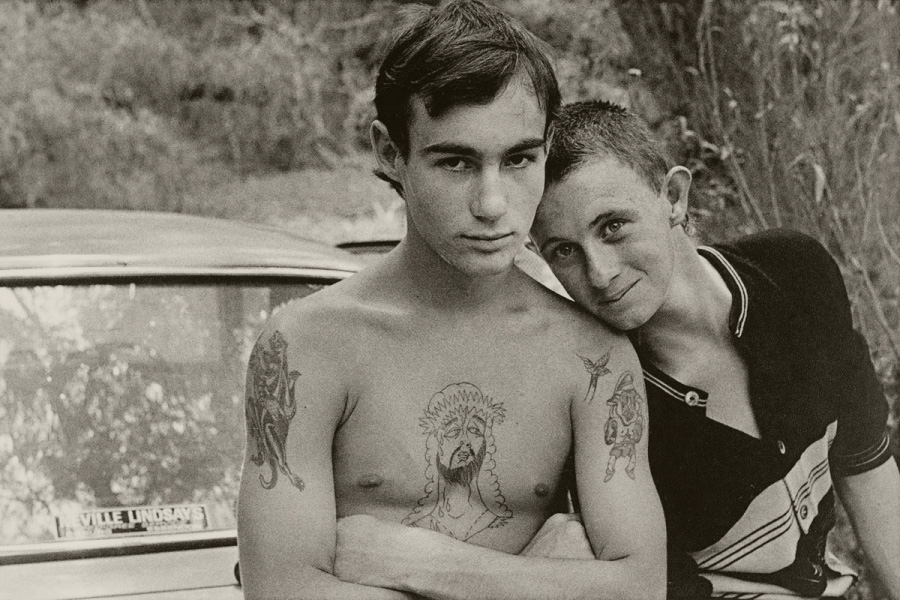
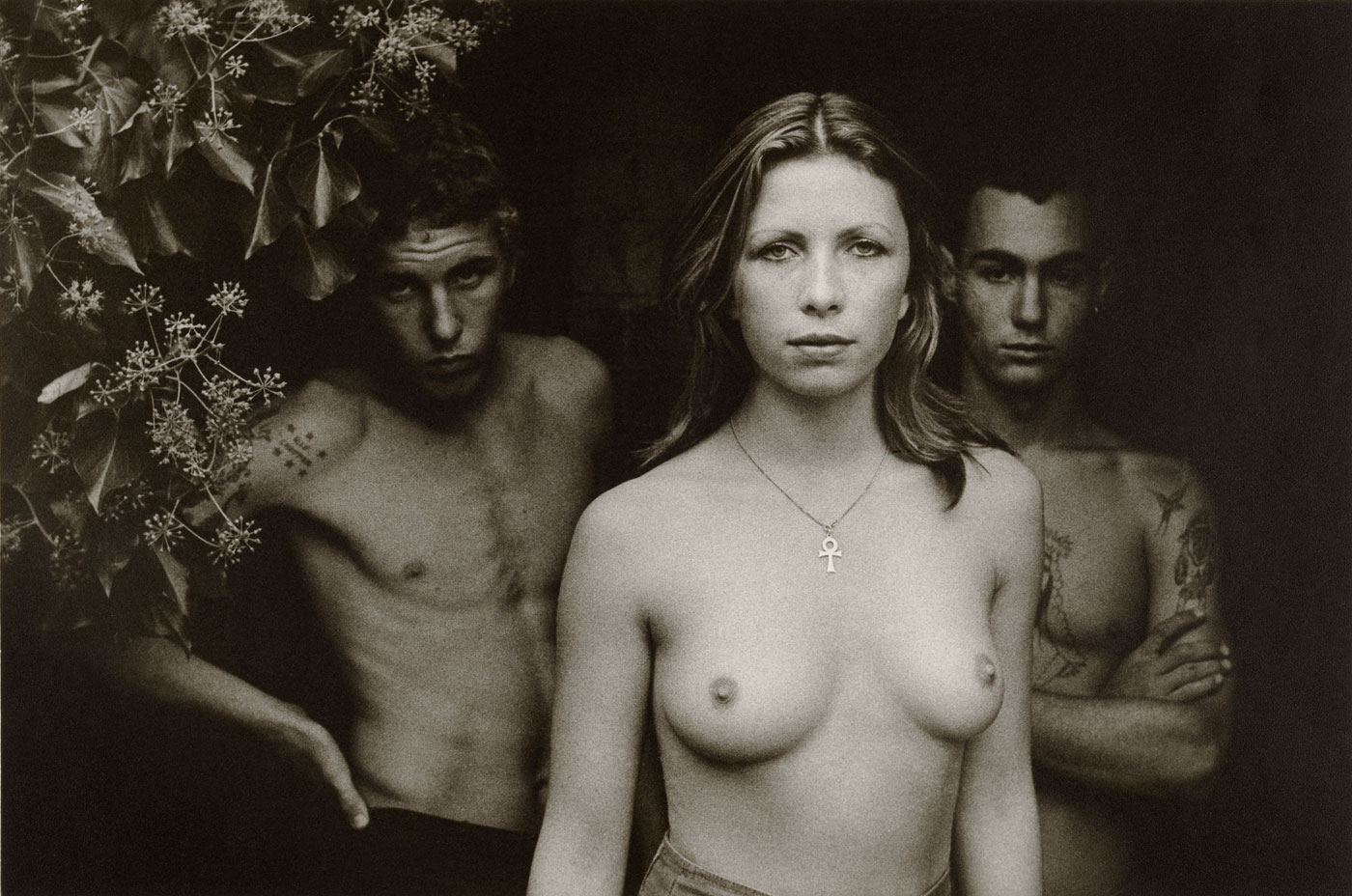
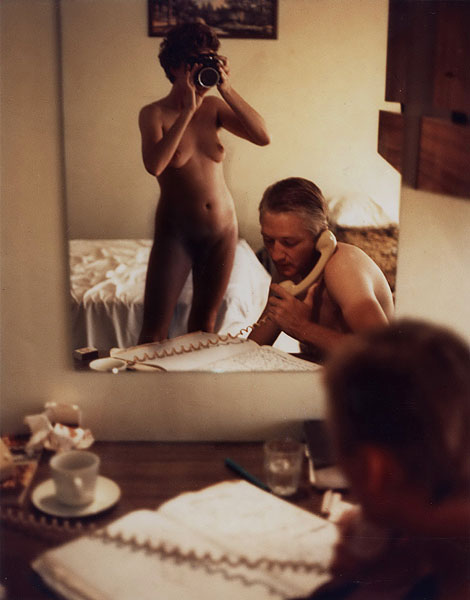
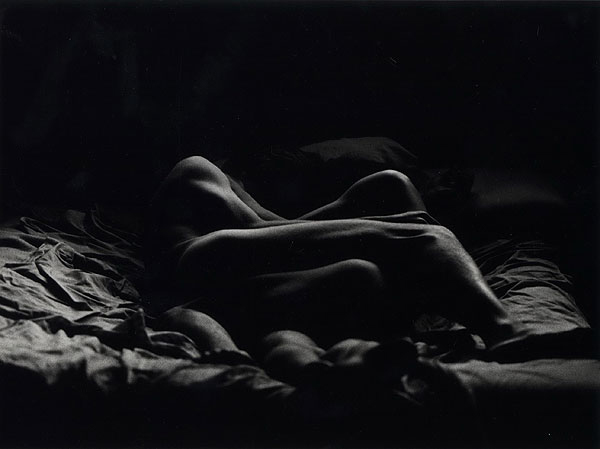
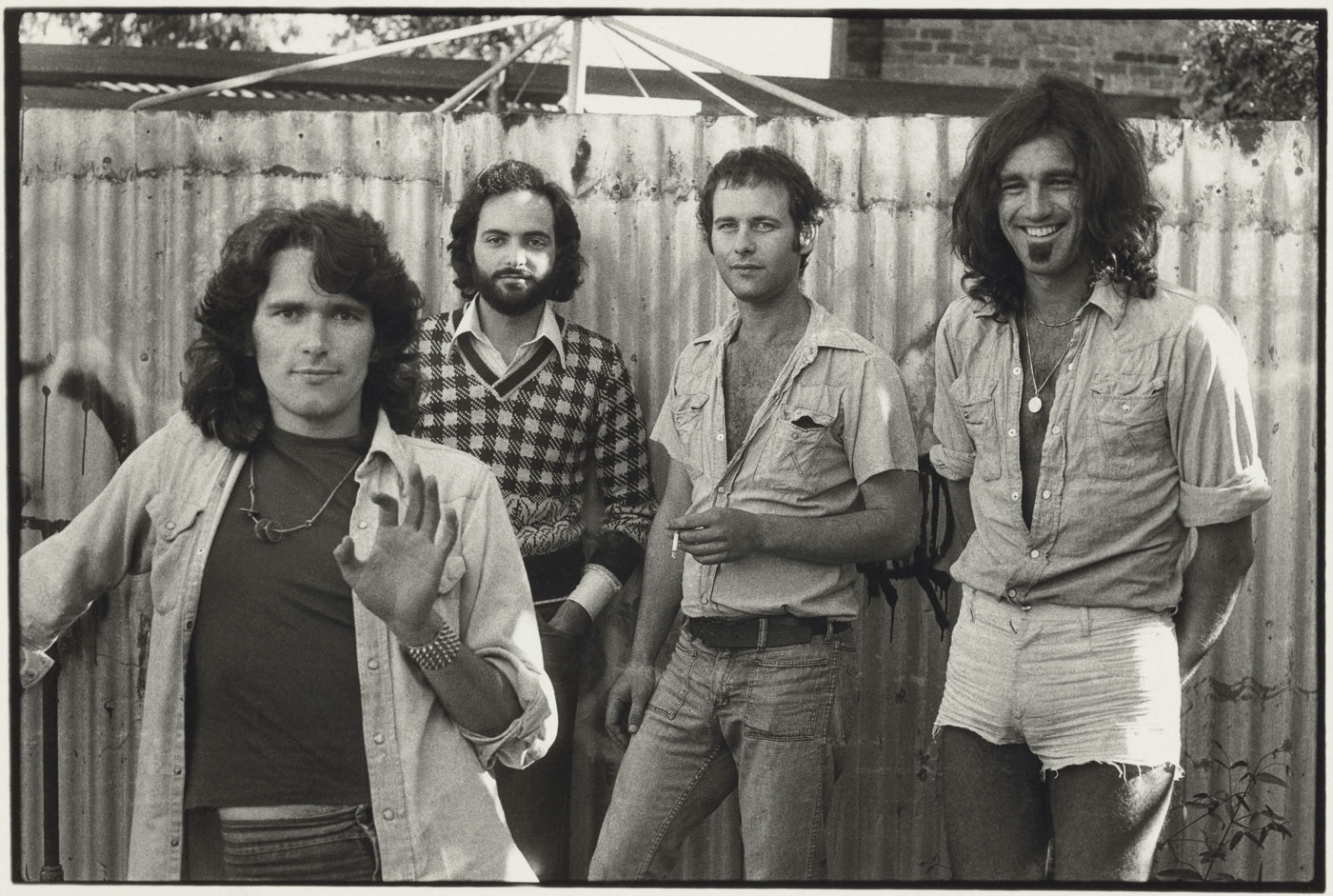
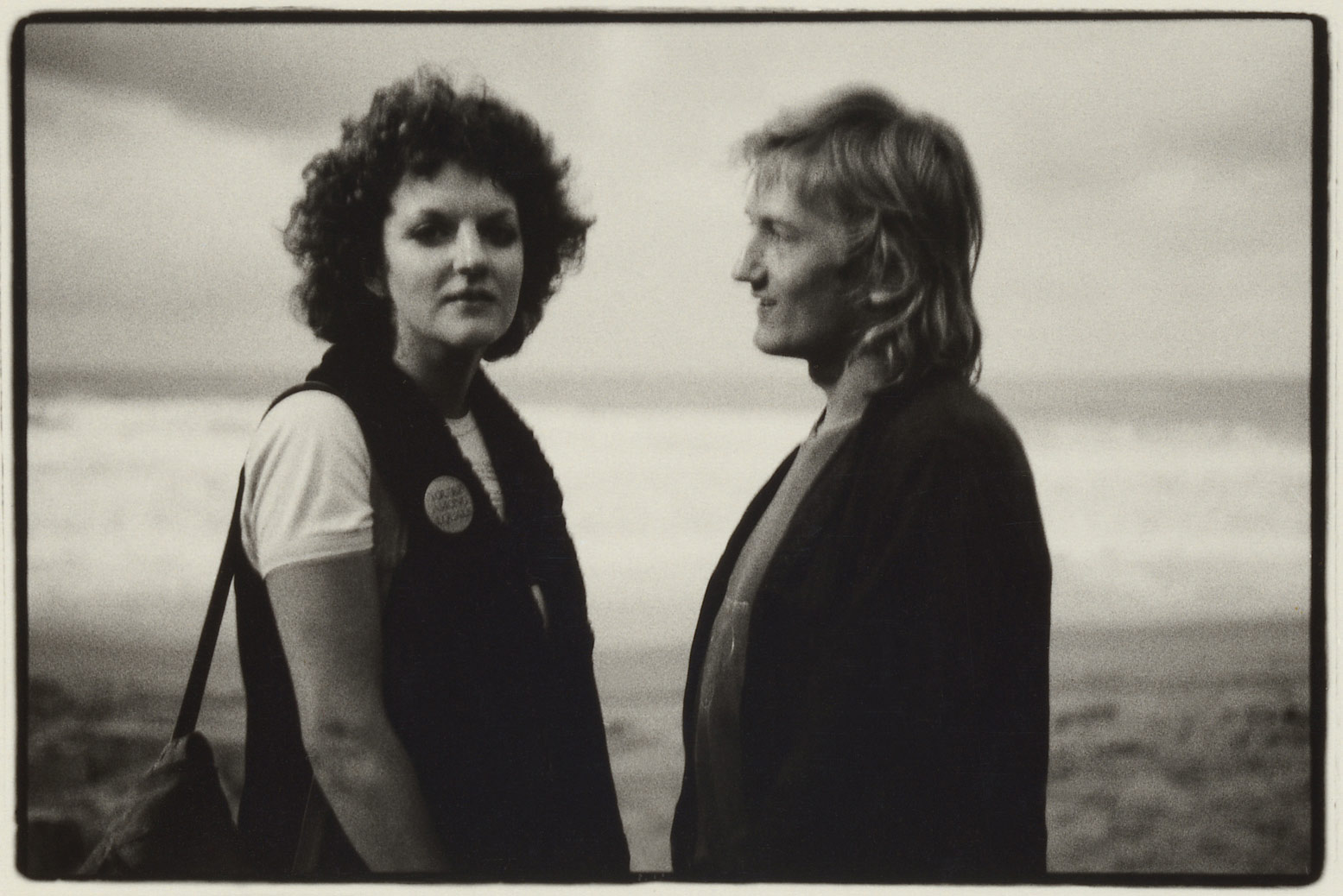
As the exhibition moves on to the main body of Jerrems work there, in all their glory, are the famous images: Evonne Goolagong, Melbourne (1973), Flying dog (1973), Vale Street (1975), Mark and Flappers (1975), Mark Lean: rape game (1975), Mozart Street (1975), Butterfly behind glass [Red Symons from Skyhooks] (1975), Lyn (1976), Lyn and the Buick (1976), Dusan and Esben, Cronulla (1977), the self portraits and the lads with their car down by the river bank. These are memorable, intimate images, at the top of tree in terms of their importance as some of the greatest images taken by any Australian photographer of all time. They are right up there with the very best and there is no denying this. But what else is there? Take away the top dozen images of any photographer and look at the next twenty images. Now, what do you see? In Jerrems case, the results (as evidenced by this exhibition) are a little disappointing. Of course, this is not unusual with any artist.
In her low key, diaristic documentary style, Jerrems focuses on life before her lens. She finds joy, intimacy, love, danger, transgression and rape; she portrays women and gay liberation, youth on the streets, sharpies and the Indigenous population. As Christopher Allen notes, sexuality and its darker side was never far from the surface in Jerrems work and there was a “mix of defiance, erotic assertiveness and vulnerability of that time… [an] intimate closeness to the subject and the direct and unmodified transcription of the world before her.”1 Her intelligent imaging of everyday subject matter “produced a body of photographs that symbolised the hopes and aspirations of the counter-culture in Australia in the 1970s,” but this investigation did not produce particularly memorable photographs. Outside the top group of images I am struggling to remember her other images.
But what we must remember is that this Australia was another time and place. Art photography books had only just arrived in Melbourne in 1970 and Jerrems was one of the first women to point her camera at other women (producing with Virginia Fraser the book A Book About Australian Women in 1974) and people of the revolution. These are socially important documents in terms of Australian (photographic) history. I believe that she said to herself – I know who I am, but I want to know what other people are like – and she transcribed how she was thinking about the world to the people around her through her photographs. Building on the legacy of artists like Henri Cartier-Bresson, André Kertész and Robert Frank, her photographs are like an after-image of some other place, some other Australia that is only forty five years ago but now seems eons away in time and space.
What we take for granted, in terms of sexual liberation, freedom of action and speech, she had to fight for. She had to fight for photographic, conceptual and technical knowledge to arm herself as an intelligent women (for that is what she was), so that she could image / imagine the world. She had to fight damn hard for these things – and then she upped the ante and pushed even harder, even further. These are dangerous photos, for women and gay men were vulnerable and threatened, marginalised and they were a target. Even in the act of photographing, her going into these places (brothels for example), she would have been a target. Does this make for memorable photographs? Not necessarily, and you can see this in the unevenness of the results of her investigation. But socially, these are very important images.
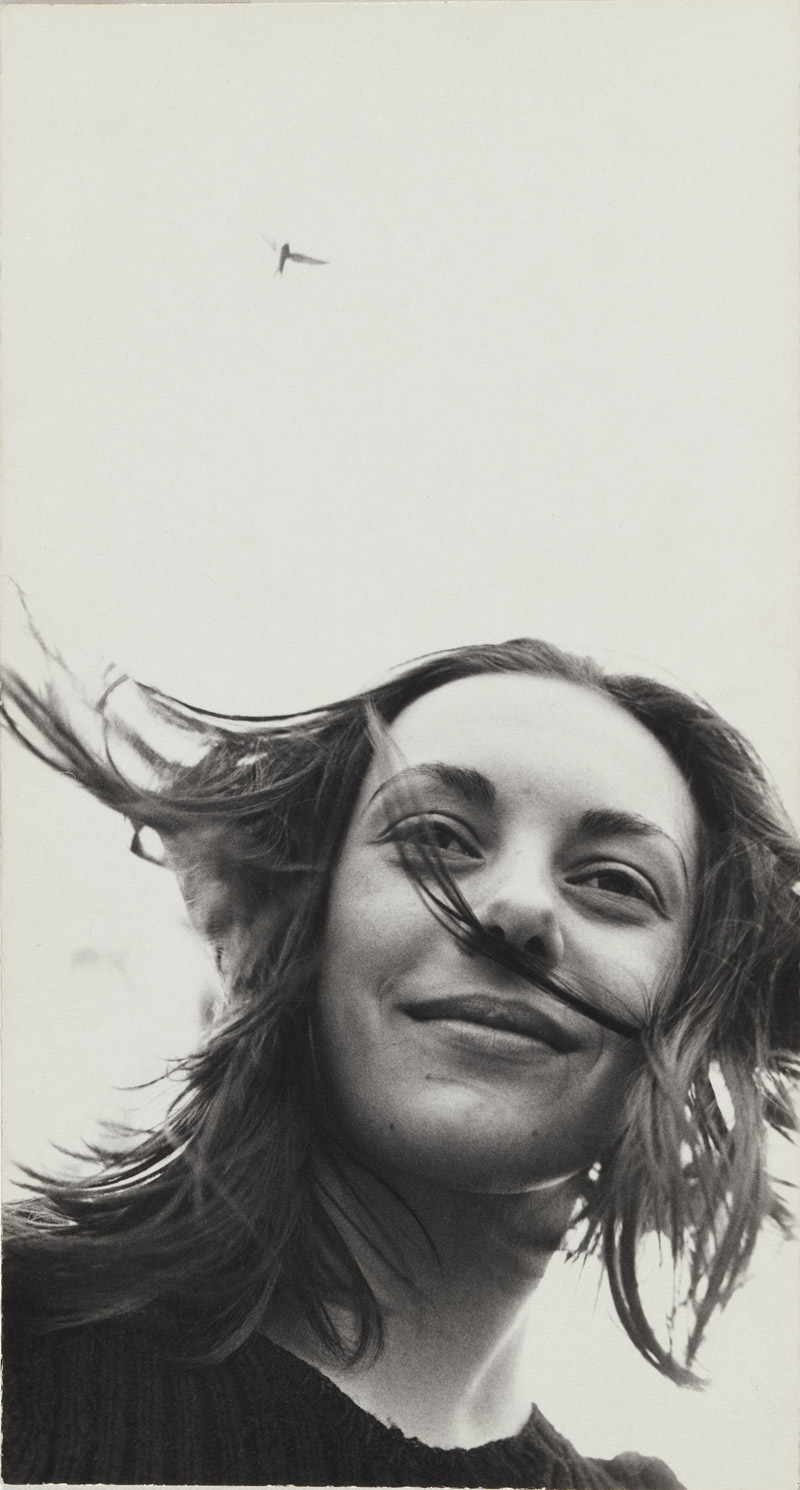
The pity is that she died so young for what this exhibition brought home to me was that here was an artist still defining, refining her subject matter. She never had to time to develop a mature style, a mature narrative as an artist (1975-1976 seems to be the high point as far as this exhibition goes). This is the great regret about the work of Carol Jerrems.
Yes, there is some mediocre work in this exhibition, stuff that really doesn’t work at all (such as the brothel photographs), experimental work, individual and collective images that really don’t impinge on your consciousness. But there are also the miraculous photographs (and for a young photographer she had a lot of those), the ones that stay with you forever. The right up there, knock you out of the ball park photographs and those you cannot simply take away from the world. They live on in the world forever.
Does Jerrems deserve to be promoted as a legend of Australian photography as some people are doing? Not on the evidence of this exhibition, but my god, those top dozen or so images are something truly special to behold. Their ‘presence’ alone – their physicality in the world, their impact on you as you stand before them – guarantees that Jerrems will forever remain in the very top echelons of Australian photographers of all time not as a legend, but as a women of incredible strength, intelligence, passion, determination and vision.
Dr Marcus Bunyan
1/ Allen, Christopher. “Between suburbia and radicalism,” in The Australian newspaper, October 20th, 2012 [Online] Cited 20/09/2013 no longer available online.
Many thankx to Mark Hislop for his help and Monash Gallery of Art for allowing me to publish the photographs in the posting. Please click on the photographs for a larger version of the image.
Carol Jerrems (Australian, 1949-1980) A poem 1970 Gelatin silver photographs, letterpress, installed at Monash Gallery of Art Photo: Katie Tremschnig
Carol Jerrems (Australian, 1949-1980) Jim Fields, a portrait (installation view) 1970 Gelatin silver photographs, letterpress, installed at Monash Gallery of Art Photo: Katie Tremschnig
Carol Jerrems (Australian, 1949-1980) The Royal Melbourne Show…1968, an essay (L) and Movement with Zara (R) 1968 Gelatin silver photographs, letterpress, installed at Monash Gallery of Art Photo: Katie Tremschnig
Living in the seventies
Carol Jerrems’s gritty, poetic and elusive images show people trying to find a new way of life and action in the 1970s. Her images have come to define a decade in Australia’s history. In contrast to an earlier generation of internationally renowned magazine photojournalists such as David Moore, the new generation did not seek commissioned commercial or magazine work and took instead a low key intimate approach with a diaristic personal-documentary style of imagery focussed on themselves and their own, mostly urban, environments. Jerrems put her camera where the counter culture suggested; women’s liberation, social inclusiveness for street youths and Indigenous people in the cities who were campaigning for justice and land rights.
Carol Jerrems was the first contemporary Australian woman photographer to have work acquired by a number of museums including the National Gallery of Australia. The National Gallery holds an extensive archive of Jerrems photographs and film work gifted by the artist’s mother Joy Jerrems in 1983. The current exhibition concentrates on prints signed or formally exhibited, by Carol Jerrems in her lifetime dating from 1968-1978. MGA is the only Victorian venue to host the National Gallery of Australia’s major new exhibition Carol Jerrems: photographic artist. This extraordinary exhibition tells the story of Jerrems’ complex and highly influential practice. Drawn from the National Gallery of Australia’s massive holdings of the artist’s work, Carol Jerrems: photographic artist features more than 100 works, most of which have not been seen in Melbourne since Jerrems lived here during the late ’60s and ’70s.
Jerrems was born in Melbourne in 1949 and studied photography at Prahran Technical College under Paul Cox and Athol Shmith. Although she practised as an artist for only a decade, Jerrems has acquired a celebrated place in the annals of Australian photography. Her reputation is based on her intensely compassionate, formally striking pictures, her intimate connection with the people involved in social movements of the day, and her role in the promotion of ‘art photography’ in this country.
Jerrems was one of several Australian women whose work during the 1970s challenged the dominant ideas of what a photographer was and how they worked. She adopted a collaborative approach to making photographs, often featuring friends and associates, and sought a photographic practice that would bring about social change. Her gritty, poetic and elusive images show people trying to find a new way of life in the 1970s. Her images have come to define Melbourne in a decade of great social and political upheaval.
Carol Jerrems: photographic artist pays tribute to this important period in recent Australian history, showing how Jerrems participated in and helped to define Melbourne’s subculture and style in the 1970s. MGA Director Shaune Lakin said Jerrems’ vision would particularly resonate with Melbourne audiences, especially as her vision was revealed across the full breadth of her work. “Carol Jerrems: photographic artist is a perfect story for MGA to tell, as it is also the story of Melbourne in the 1970s. Jerrems captured Melbourne’s sub-cultures – sharpies, mods, hippies, feminists and gay liberationists – with powerful images that engage the viewer intimately with her subjects.”
As Dr Lakin notes, this is a rare chance to see the works Jerrems intended for exhibition: “Carol Jerrems: photographic artist concentrates on prints signed or formally exhibited by Jerrems in her lifetime, most returning to Melbourne for the first time. In addition to many of the images for which Jerrems is rightly famous, visitors to MGA can see Jerrems’ early work, including her extraordinary concertina books and other photo books,” Lakin said.”
Press release from the Monash Gallery of Art website
From the outset, Jerrems was interested in the expressive possibilities of the photographic medium, declaring that she was ‘an artist whose tool of expression is the camera’. She concentrated on photographing people; her subjects included her students, and her friends and acquaintances. Her first photographs were documentary in style, but by the mid-1970s the scenes she photographed were often contrived. She used a non-exploitative approach, based on the consent of her subjects. For Jerrems, photography had a crucial social role: ‘the society is sick and I must help change it’. Her photographs were a means of ‘bringing people together’ and offered affirmative views of certain aspects of contemporary life. With Virginia Fraser, she published A Book About Australian Women (Melbourne, 1974), to which she contributed the photographs…
Although one critic regarded her work as uneven – ‘she took a casual approach’ – Jerrems’s talents as a photographer were widely recognised. With her camera ‘firmly pointed at the heart of things’, she produced a body of photographs that symbolised the hopes and aspirations of the counter-culture in Australia in the 1970s.
Exhibition dates: 27th August – 21st September, 2013
Curator: Marcus Bunyan
Andrew Follows (Australian, d. 2019) Number 31, Eltham 2013 Digital photograph on archival cotton rag 130 cm x 86.5cm
Only 2 days to go before the ending of Andrew Follows’ exhibition Density at Anita Traverso Gallery, 7 Albert Street Richmond.
You have to see these images in person, they are impressively immersive!
Dr Marcus Bunyan
PS. Preview all the images in the exhibition and read the catalogue essay at this previous posting. Please click on the photographs for a larger version of the image.
It is disappointing when you invite friends from Melbourne and interstate to an opening and one of them turns to you and says, “Well, what was all the fuss about?” The trick is to go with no expectation and you will never be disappointed and may even be pleasantly surprised. Unfortunately, not in this case.
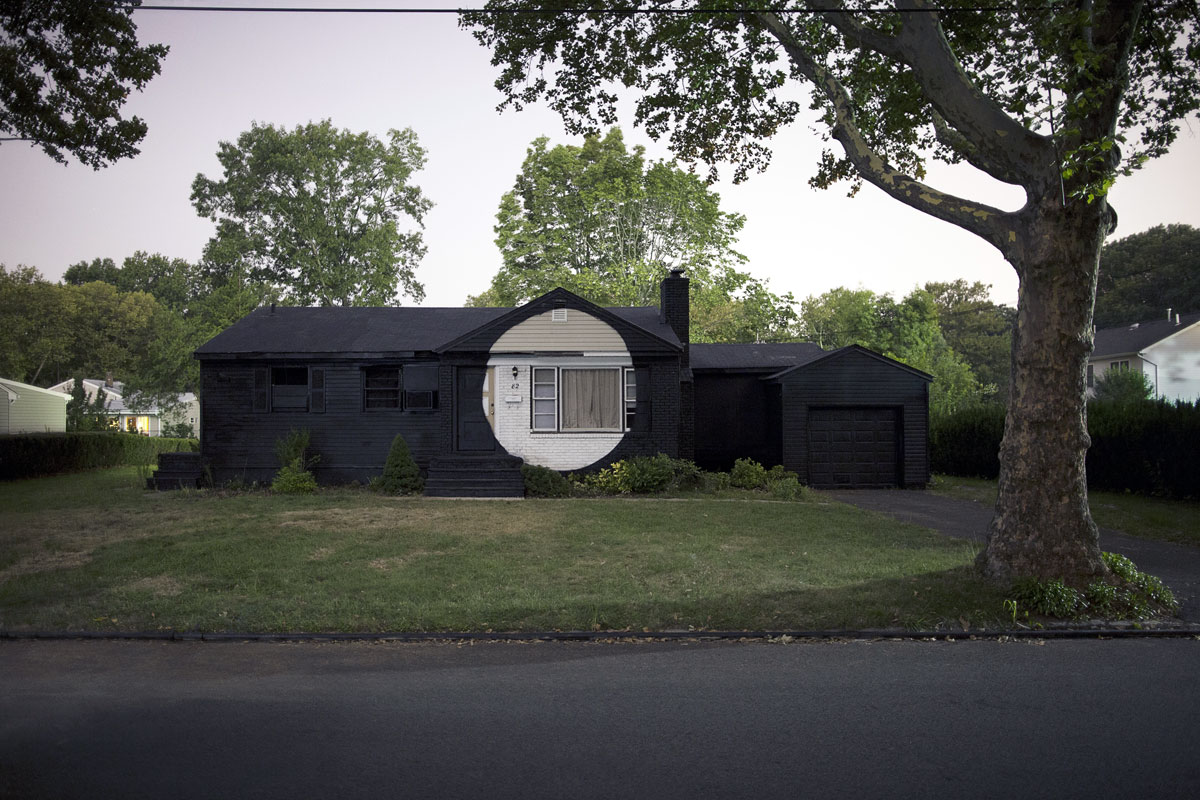
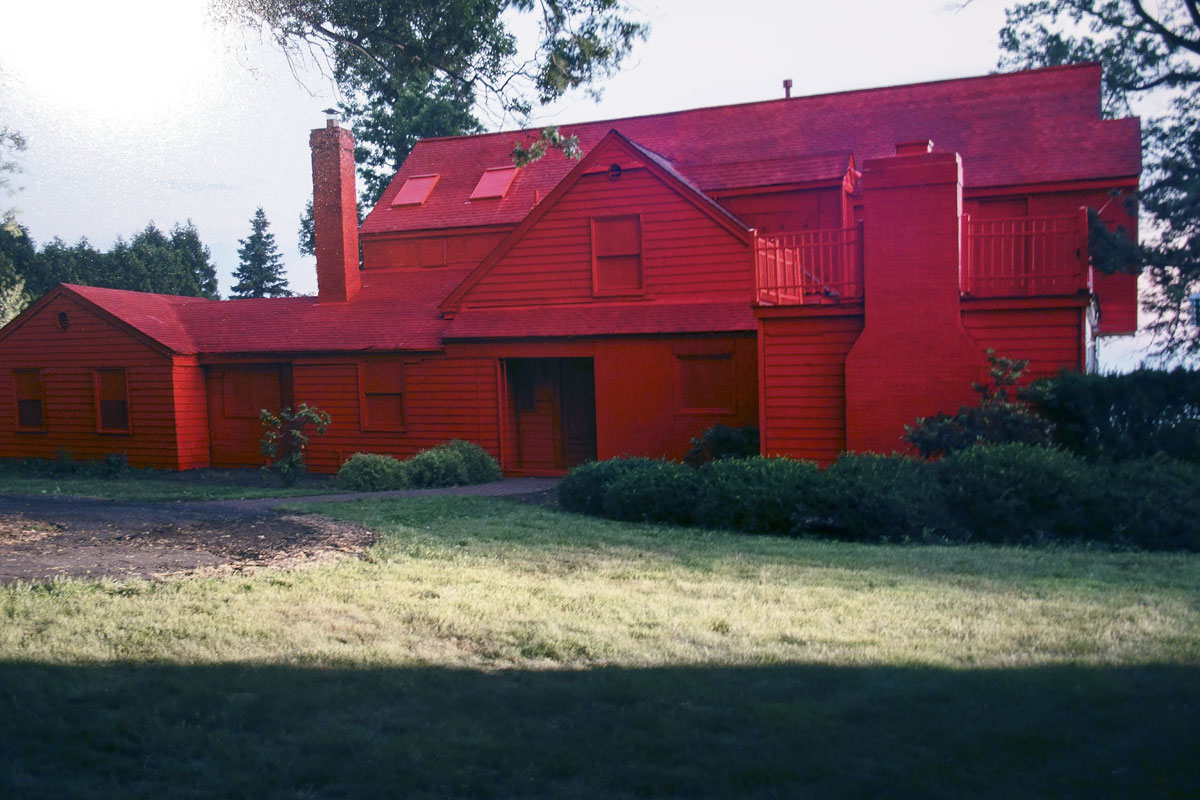
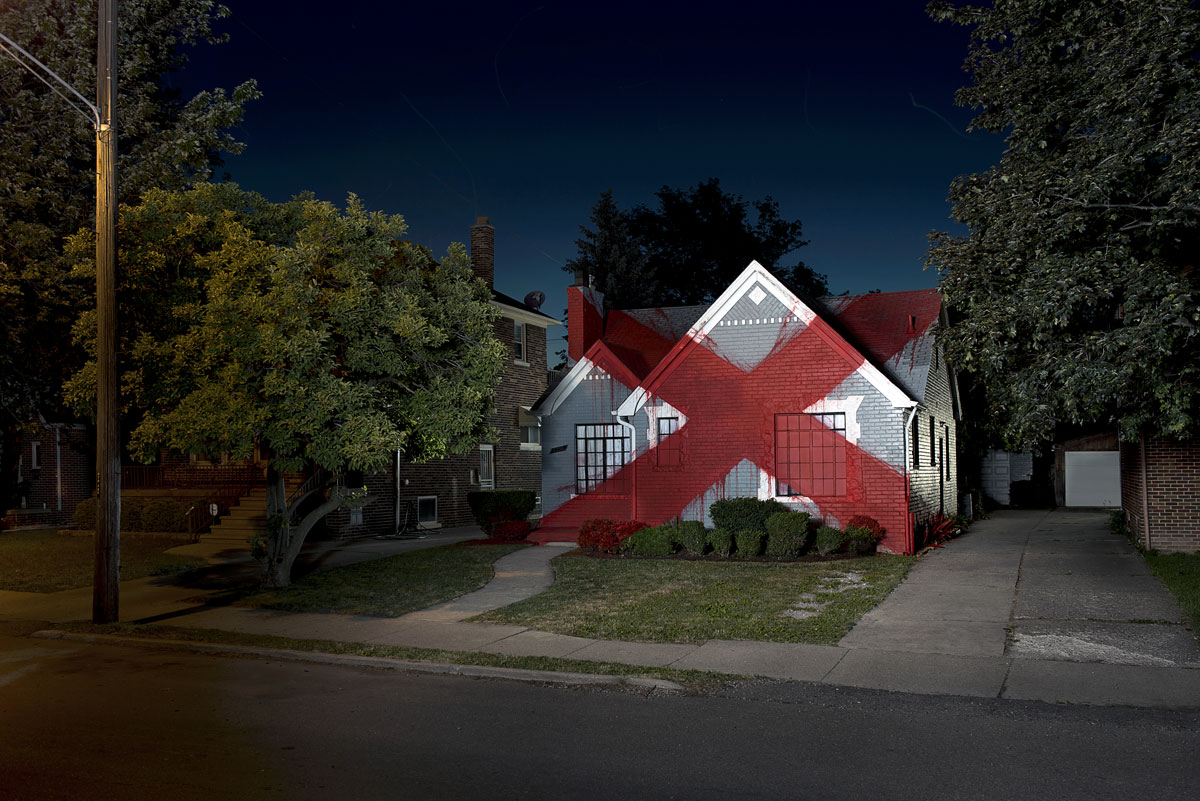
Despite all the years, not to mention money, that have gone into the Crewdson-esque production of this small body of work, what emerges in my mind at least are three interesting and beautiful images (a ying / yang black circle / white circle and a red painted house) and not much else. The three images are outstanding in their psychological excoriation of suburban belonging. Through use of colour and form the images interrogate a sense of home, place, identity and ‘fitting in’ that suburbia promotes, though under the surface there bubbles away the heart of the malcontent (the film American Beauty is a perfect example of this paradigm). In their Zen-like intensity these are incisive, insightful images.
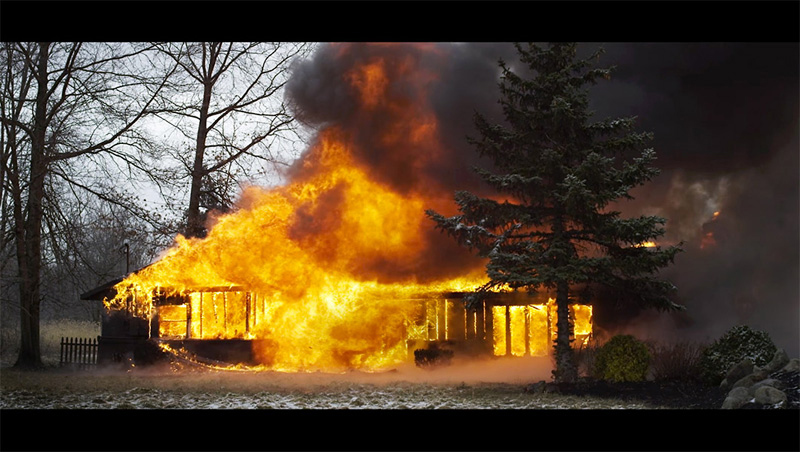
And that’s it. The rest of the exhibition is stocking-filled with a couple more images that don’t really work, a series of stills of a house being set on fire from a film of the same thing. The photos and film of the house being set on fire mean nothing, take me nowhere.* In a word this exhibition is ‘THIN’ to say the least.
While the NGV is to be congratulated for promoting contemporary art, including street art, there has to be at least some basis of depth to an artist’s work, not just the fact that they are”now a noted contemporary artist with a developing international standing.” This is not enough. When you really look at this work it is obvious it needs more matter, more substance.
Like a house of cards its foundation is built on shifting sands, foundations that need time to develop and solidify, thoughts that needed greater time to be delineated and teased out. There is no rush with this kind of investigation and that’s what it feels like here – an interesting idea, painted over, over produced and not fully developed to the point where it becomes unmissable, unmistakable.
Dr Marcus Bunyan
* Look no further than Gregory Crewdson’s Untitled (House Fire)from the series Beneath the Roses (2004), for the use of a burning building to create an interesting narrative about hope and despair in suburbia.
The remarkable work of New York-based Australian artist Ian Strange will take centre stage at NGV Studio from 27 July. Suburban is the culmination of Strange travelling for two and a half years through neighbourhoods in the US. Working on a massive scale across key cities, Strange painted directly on to the surfaces and facades of suburban homes, and in some cases burnt them to the ground, to create a moving statement around Western ideas of home.
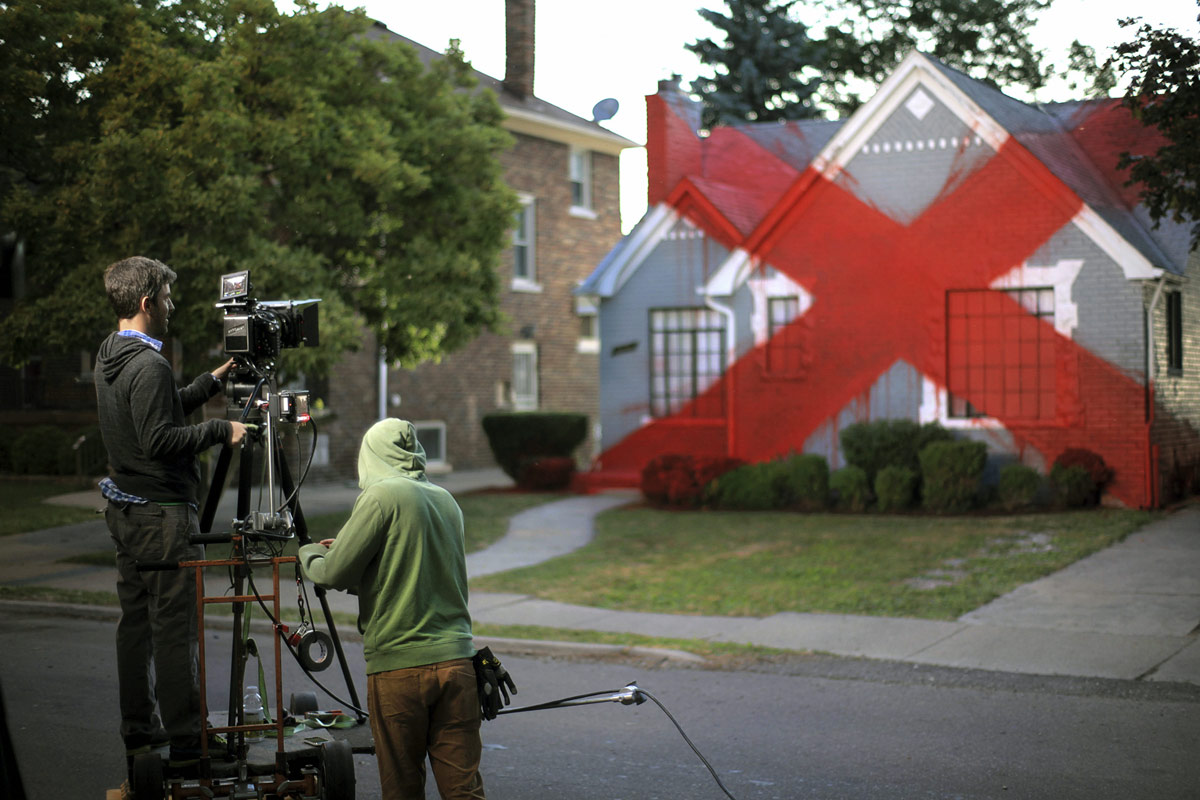
These unique interventions staged across the cities of Ohio, Detroit, Alabama, New Jersey, New York and New Hampshire were documented with a film crew and volunteers and will be shared at NGV Studio as part of Strange’s multifaceted photographic, film and installation work.
Cinematic in both tone and scale, Suburban investigates the iconography surrounding the family home and its place in the current economic climate. Through the work, Strange articulates his own conflicted relationship with suburbia he experienced growing up in the Australian suburbs, juxtaposed with living in New York City and the United States. Strange’s exploration of suburban experience articulates a distinctively Australian sensibility to a global audience.
David Hurlston, Curator of Australian Art, NGV, said that Strange was fast becoming recognised, both locally and internationally, for his distinctive practice and, in particular, for this new and unique body of work.
“We are excited to be able to present this ground-breaking exhibition of work by Ian Strange. From his early work as a street artist in Australia he is now a noted contemporary artist with a developing international standing. Strange is one of the most exciting young artists to have emerged from the street art genre in recent times,” Mr Hurlston said.
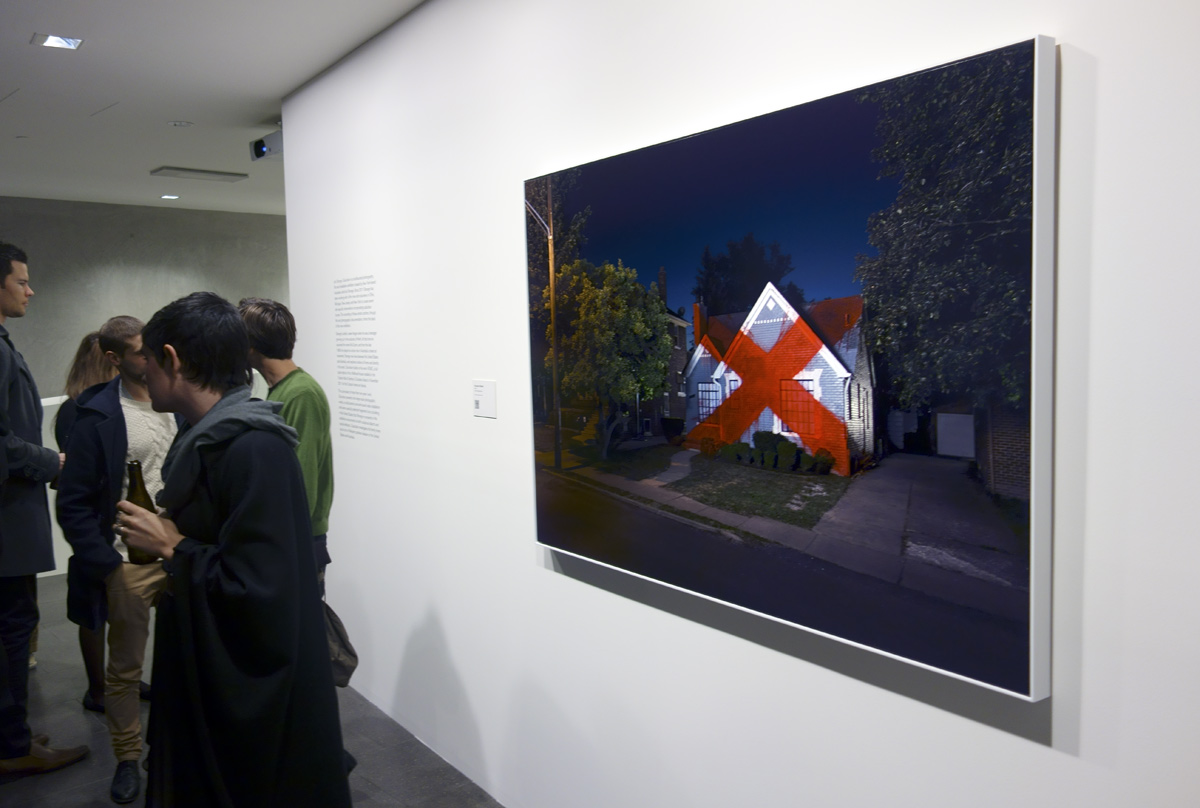
Suburban considers the status of the family home in the United States and Australia through nine large-scale photographic works and a dramatic multi-channel, surround sound video installation. Carefully selected fragments of the original houses will also be on display in the exhibition as both sculptural objects and social artefacts. Exhibiting artist Ian Strange said that Suburban was a culmination of more than two years’ work.
“This project has been all consuming for the past two and a half years of my life. I wanted to create a body of work that reacted to the icon of the suburban home and to the suburbs as a whole. The suburbs have played an important role in shaping who I am as a person and an artist. The suburbs have always been home, but I have always found suburbia isolating. Suburban is my reaction to that,” Mr Strange said.
Strange’s early artistic career evolved as a teenager growing up in the suburbs of Perth. Here he took on the name Kid-Zoom and from the late 1990s played an active role in Australia’s street art movement. After relocating to New York in 2010 under the mentorship of Ron English, he participated in the now legendary underground exhibition The Underbelly Project, before his first solo exhibition and pop-up show in the Meatpacking district, This City Will Eat Me Alive, which generated critical acclaim and attention from the art world. Now an internationally recognised artist living between the United States and Australia, Strange has more recently been exploring the notion of home and identity and exhibited in the inaugural Outpost Street Art Festival on Sydney Harbour’s Cockatoo Island with his work Home, a full-scale replication of his childhood house installed in the Turbine Hall.
Press release from the National Gallery of Victoria
On location in Detroit, July 2012 Photo: Jedda Andrews
Graffiti crosses the picket line
Dan Rule
Indeed, the works that populate the exhibition hardly fit the stylised representational or textual archetypes that have come to typify graffiti and street art. In this series, average suburban homes are immersed in monochrome-painted gestures and motifs or, in one case, flames. But while they bear a resemblance to impulse vandalism, their effect is allegorical rather than literal. In one work, a home in a Detroit street bears a bold, blood-red “X”, which could be read as a metaphor for the wave of loan foreclosures and socio-economic turmoil that has supplanted the city’s suburban dream. Another residence is coated in black paint but for an unpainted circular vacuum, a window into the psychological and emotional underpinnings behind the ideal of the weatherboard home on the spacious block.
And that’s precisely the level on which Strange sees the work operating. “There are some very strong political implications for this work … and I definitely acknowledge that,” he says. “But I was really careful not to make works that were just about these broken-down suburbs and this ‘ruin porn’ thing. I know that in Detroit they’re really sensitive about that kind of thing, and we were really aware of keeping this project focused on the idea of being a reaction to the icon of the house in the suburbs, rather than a reaction to some of those socio-economic factors.”
Dan Rule. “Graffiti crosses the picket line,” on The Age website July 20, 2013 [Online] Cited 05/09/2013. Used under fair use conditions for the purposes of education and research
Exhibition dates: 27th August – 21st September 2013
Curator: Marcus Bunyan
Andrew Follows (Australian, d. 2019) Elevation, Doreen 2013 Digital photograph on archival cotton rag 130 cm x 86.5cm
A wonderful exhibition by vision impaired photographer Andrew Follows at Anita Traverso Gallery, Richmond. It has been a real pleasure to mentor Andrew over the past year and to see the fruits of our labour is incredibly satisfying. The images are strong, elemental, atmospheric, immersive. Due to the nature of Andrew’s tunnel vision there are hardly any traditional vanishing points within the images, instead the ‘plane of existence’ envelops you and draws you in.
Well done to everyone involved with the project. I would particularly like to thank Fiona Cook from Arts Access Victoria for keeping the project on track; the amazing Darren from CPL Digital for his most excellent efforts to print the almost impossible print; Jondi Keane from Deakin University for opening the exhibition; Anna Briers for writing a wonderful catalogue essay; and Anita Traverso for believing in Andrew and giving him an exhibition when many wouldn’t. Many thankx and respect to all.
Dr Marcus Bunyan
The photographs below appear in the order they are in the exhibition. Please click on the photographs for a larger version of the image.
Densityn.
The degree of optical opacity of a medium or material, as of a photographic negative;
Thickness of consistency;
Complexity of structure or content.
Andrew Follows (Australian, d. 2019) Number 31, Eltham 2013 Digital photograph on archival cotton rag 130 cm x 86.5cm
Andrew Follows (Australian, d. 2019) Green, Montsalvat 2013 Digital photograph on archival cotton rag 130 cm x 86.5cm
Andrew Follows (Australian, d. 2019) Shadowlife 2013 Digital photograph on archival cotton rag 130 cm x 86.5cm
Andrew Follows (Australian, d. 2019) Garland, South Melbourne 2013 Digital photograph on archival cotton rag 40 cm x 27cm
Andrew Follows (Australian, d. 2019) Indigo, Edenvale 2013 Digital photograph on archival cotton rag 130 cm x 86.5 cm
The Mind’s Eye: Density in the Work of Andrew Follows
Anna Briers
Seeing has never been about the simple act of looking. It can be defined by the parameters of our past experience and cognitive stock, factors which enable, inhibit and shape our perceptive abilities. Ultimately, our ways of seeing are affected by our learnt cultural assumptions about the universe.1
Cultural theorist James Elkins has said, ‘blindness is not the opposite of vision, but it’s constant companion, and even the foundation of seeing itself.’2 In his seminal text The Object Stares Back, Elkins illustrates that we are blind to the limits of our own vision and that this unknowingness about our visual fallibilities is crucial to ordinary seeing.This blindness relates to a hierarchy of vision, defined not only by our psychological limitations but our physiological ones as well – the selection process that we employ to filter the vast proliferating output of information that we are inundated with on a daily basis. Without which, we would probably experience a kind of cerebral meltdown.
If vision is dependent on a certain amount of blindness, then by extension the notion that a photographic image can accurately document the truth is a misconception. The camera is not simply a black box that can correctly capture a quotation of reality, a machine of ‘logic and light’,3 for the act of taking a photograph is reliant on the careful selection and framing of a particular object or subject. The result of this point of view is the depiction of a subjective reality at the exclusion of everything else which is made invisible: eliminated by the perimeters of the frame.
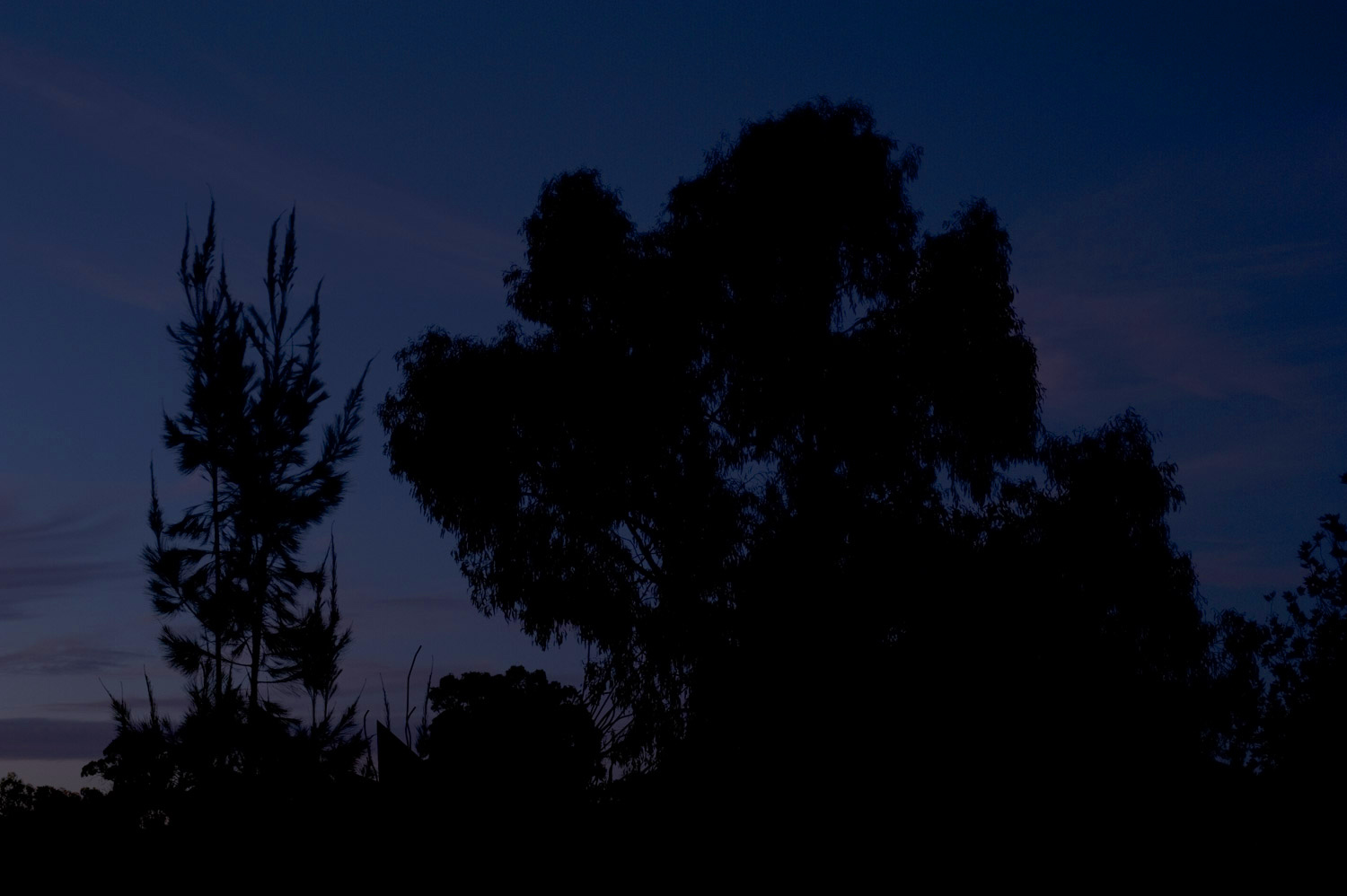
In this context, it is interesting to consider the work of legally blind photographer Andrew Follows. Follows has a degenerative condition called Retinitis Pigmentosa (RP) that has rendered one eye completely blind with ever diminishing tunnel vision in the other. Follows can perceive three meters ahead, albeit through an obscuring haze. The clarity of his vision is dependent on lighting and various environmental factors; objects are often more perceptible at night. Whilst form and structure are apparent, he cannot see the intricate tonal details of a stained glass window. He cannot know that the colour of your scarf is royal blue. All this changes however, when Follows observes light flooding through the lens of a camera.
Through the small rectangular viewing panel on the reverse of a digital camera, Follows’ world is revealed. He is able to discern architectural detail and the vibrancy of nature; he is able to know that his favourite shade in the vast tonal spectrum is royal blue. In a realisation of Marshall McLuhan’s notion of the camera as a prosthetic extension,4 Follows’ camera extends his sight, and through it he is able to capture his unique vision, for a moment or for a millennia, a physical expression of the imaginings of his mind’s eye.
Curated by Dr Marcus Bunyan, the concept of Density was envisaged as a point of departure to explore the manifold variations and subsequent ruminations on the term as it relates to Follows’ perspective. As a technical descriptive, density explains the degree of optical opacity within a photographic negative. Portions of film that have been exposed to greater amounts of light yield a greater deposit of reduced silver. This is referred to as having a higher density than areas of shadow.5
Density also denotes a thickness of consistency and many of Follows’ works exhibit a complexity of compositional structure and content that elucidates the nature of Follows’ perception. ‘Even in the physicality of my vision, these photographs have a certain feeling that reflects my relationship to the world and how I visualise it.’6 A thematic constant that binds this series together is the shallow depth of field that is combined with a sense of the frame or the foreground being the view. Follows’ images, and therefore our view into his world is a restricted one. As the viewer we must frequently gaze through a kind of haze or obstruction in order to participate.
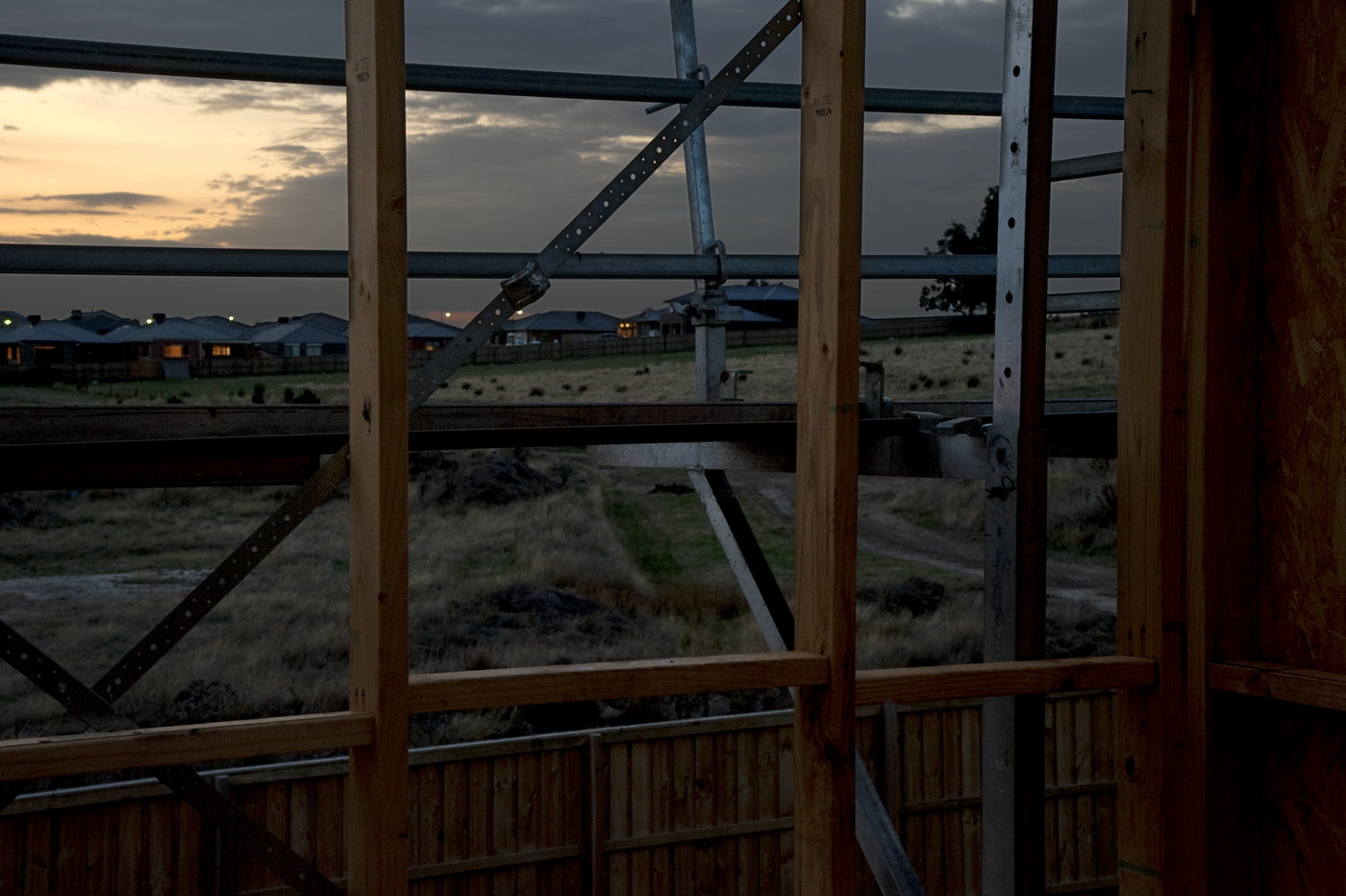
A pivotal example of this is Elevation, Doreen, 2013, where the composition is segmented by the skeletal structure of the wooden and steel supports of a building. Intersecting diagonals and verticals delineate and contain space across the picture plane, framing the mid-ground and background within its architecture. It is not the vista that is of interest to Follows.
This image cannot escape the requisite art historic parallels with movements such as the Russian Constructivists or De Stijl with its ‘Mondrian-esque’ all over composition. However the image speaks of interiority, its emphasis is on the foreground and by drawing our attention to the mechanics of how the view is framed we are made conscious of the act of seeing. There is a layering or doubling that occurs here: Follows makes us aware of the limitations of our own vision, through the act of looking – by revealing his unique vision, as a result of partial blindness.
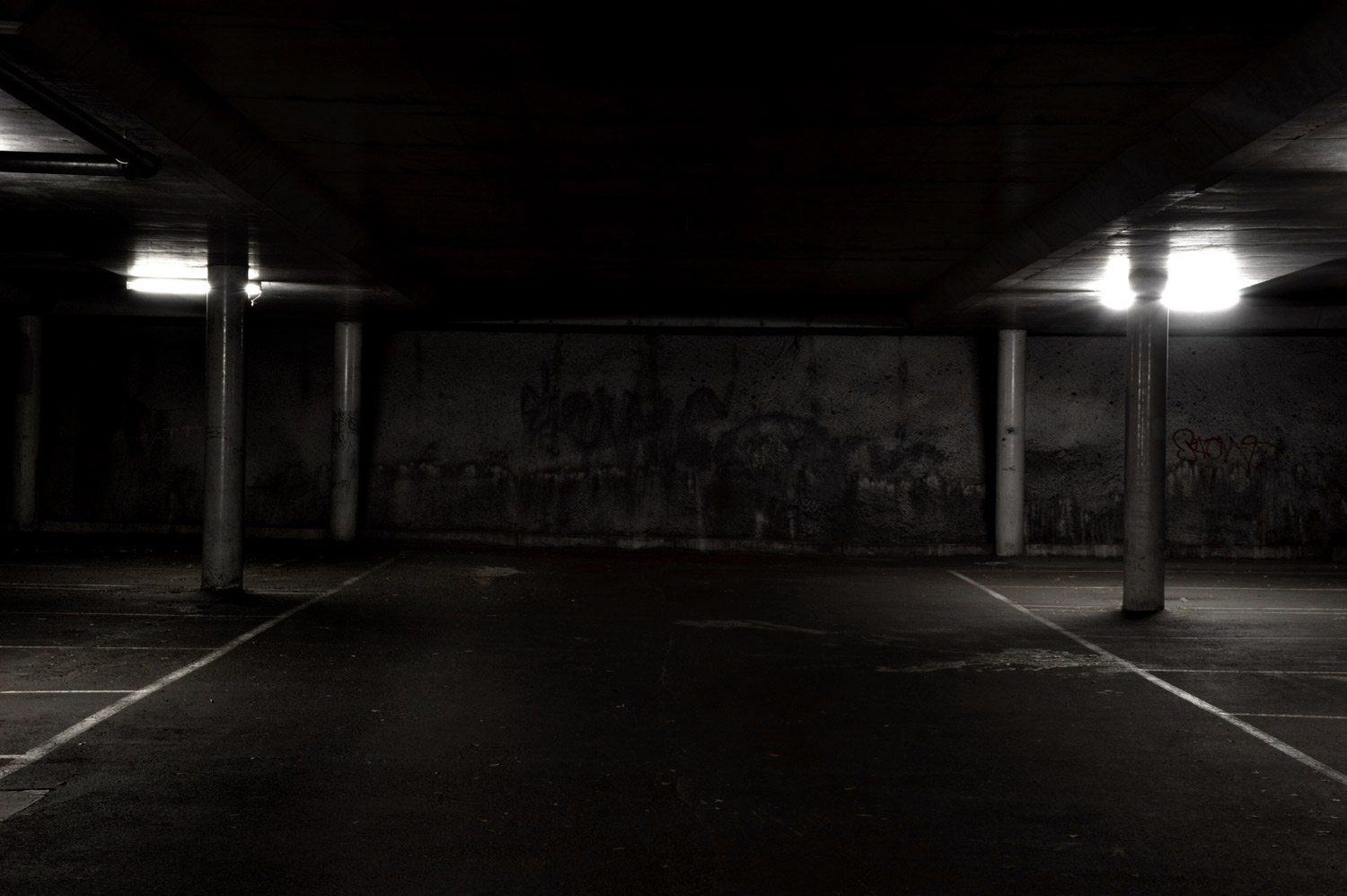
Similarly, Void, Eltham, 2013, leaves us grasping for some semblance of illumination and visual clarity within a desolate and dimly lit car park. While our eye is guided across the picture plane by white lines and columns that recede into space, our view is ultimately obstructed by a concrete barrier covered in territorial markings and thus, we are reminded of the limitations of our own vision as we are left to gaze into the dense abyss.
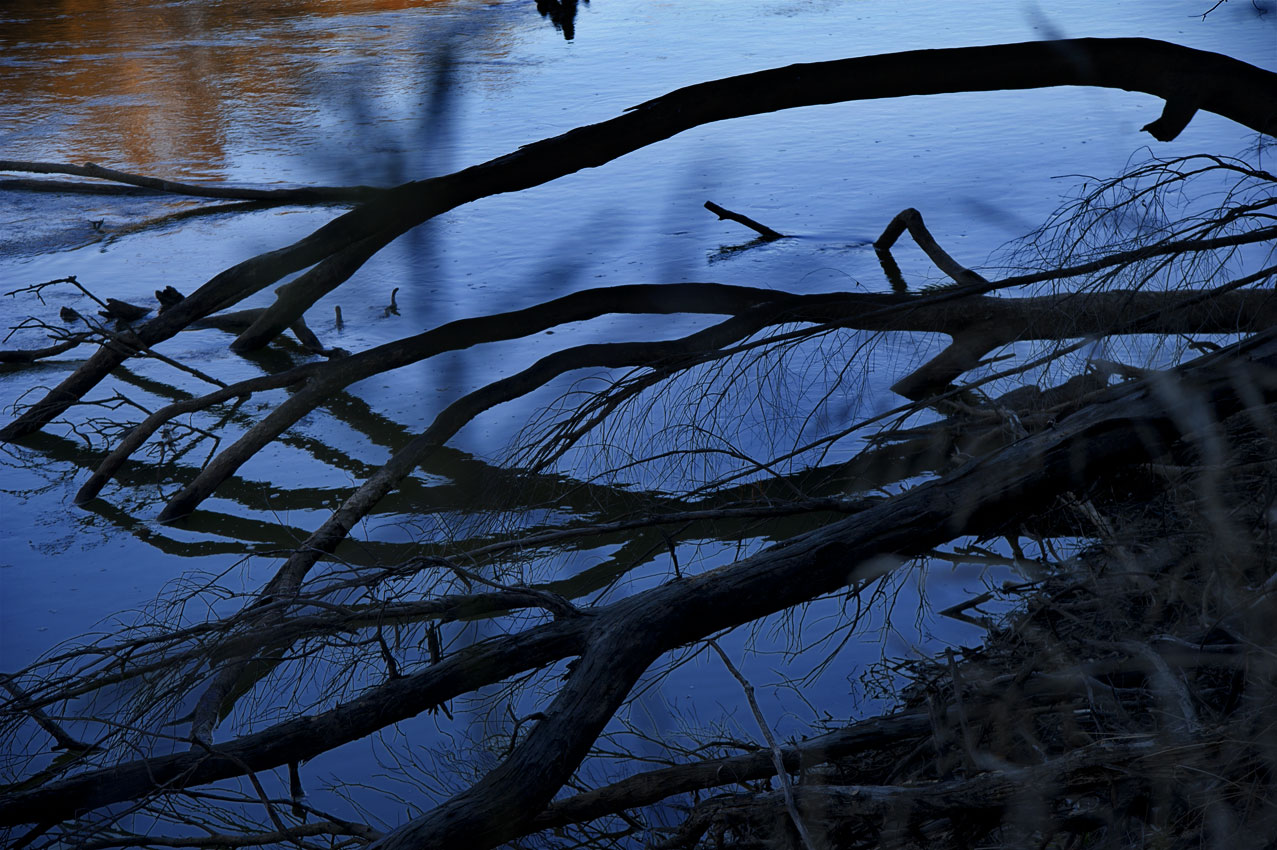
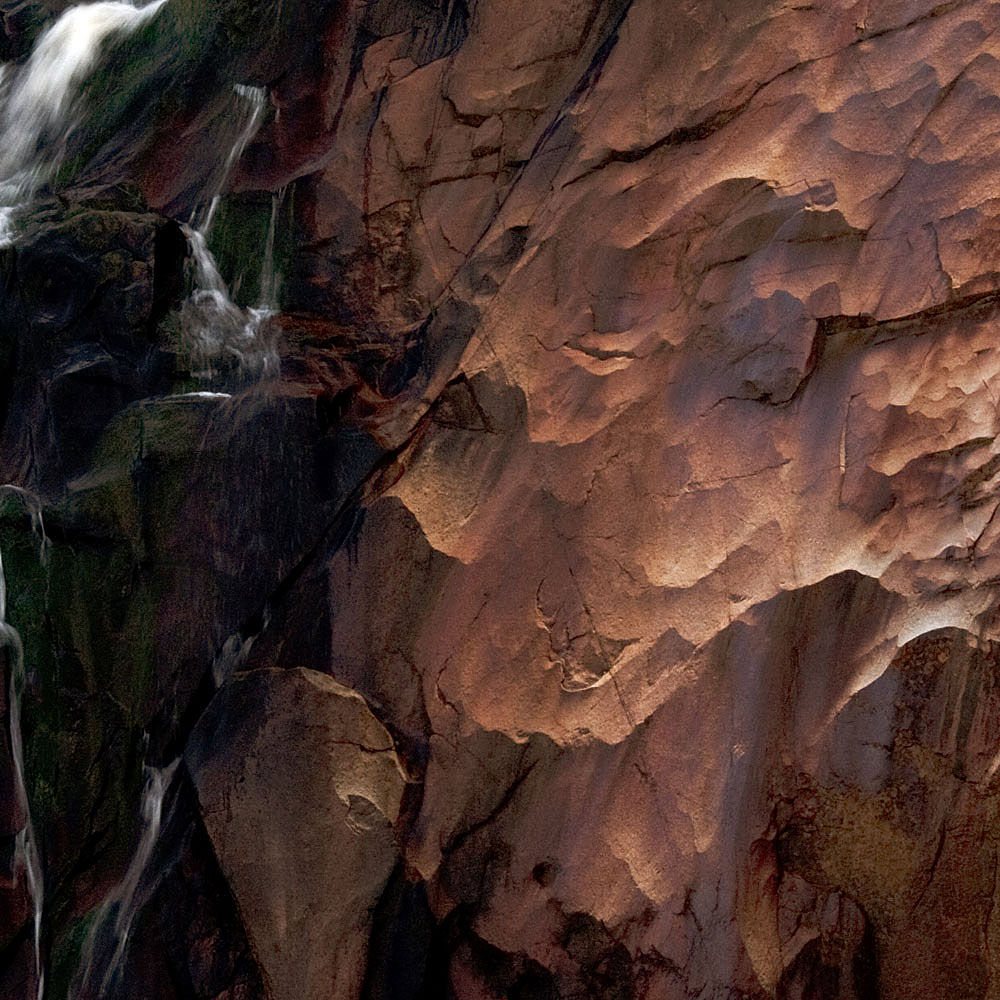
A thematic constant in Follows’ images such as No. 31 Eltham, 2013, is that they resist a singular point of perspective as evidenced by early Renaissance painters where everything was centred on the eye of the beholder; the visible world arranged for the spectator as the universe was once thought to be arranged for God.7 By contrast, many photos evidence a planar sense of spatiality. Often lacking in a noticeable vanishing point, his images have an immersive potential and we are drawn into the various densities within Follows’ shallow depth of field. This is exemplified by the rich textures of Scarp face, Beechworth, 2013, and the lush grassland depicted in Green, Montsalvat, 2013.
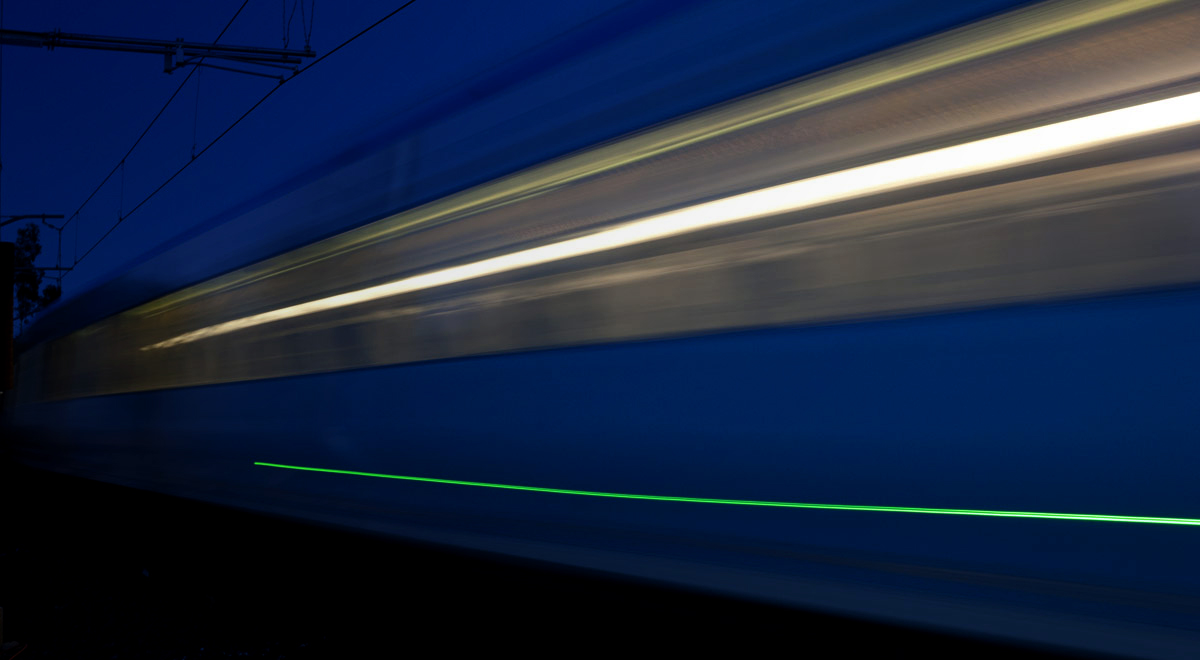
Many of the photographs in Density instill a quiet contemplative mood that is partially evoked by a muted tonal palette. Yet within this visionary series the viewer can also bear witness to the reoccurrence of otherworldly imagery, as well as transient and transformational spaces. This sense is further enhanced by the fact that Follows’ photographs are often shot at times when the light is fleeting, on the interstice of night and day. This is exemplified by Green on Blue, 2013, where Follows captures a train in motion, conveying a temporality and flux that eloquently describes a state of transience: of being between spaces, neither here nor there.
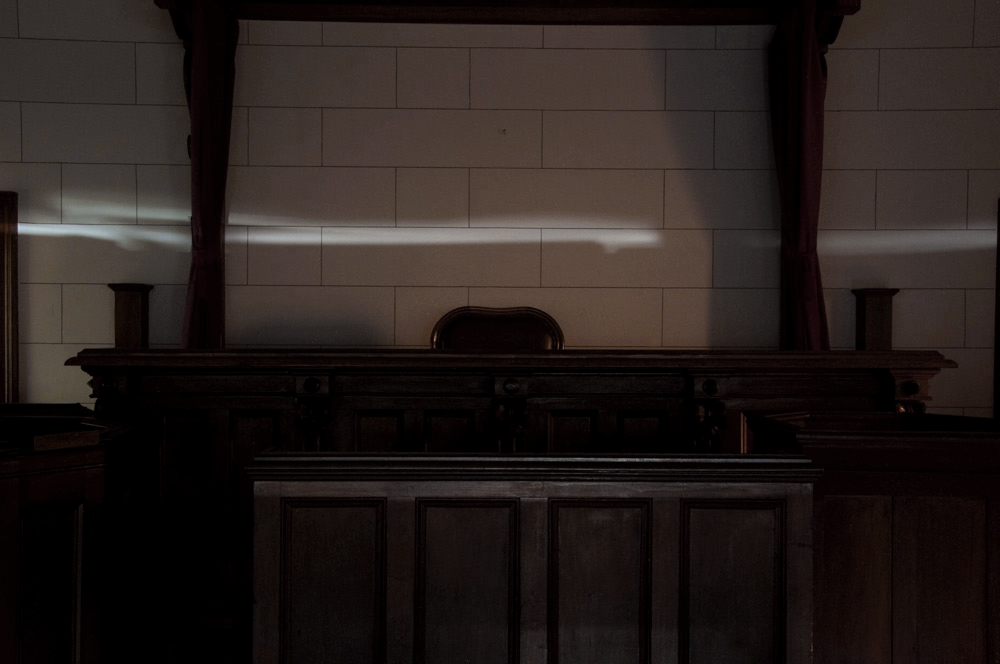
With Judges Chair, Beechworth, 2013, Follows conveys the courtroom where infamous Australian Bushranger Ned Kelly was committed to stand trial for murder, prior to his eventual hanging in 1880. The image pervades an institutional formality that is intensified by a classically balanced composition, combined with ominous historical undertones. Yet the space depicted is interrupted by the glimmer of an ethereal light that bolts across the far wall, puncturing the image. Alternative possibilities become illuminated and a sense of otherworldliness becomes palpable.
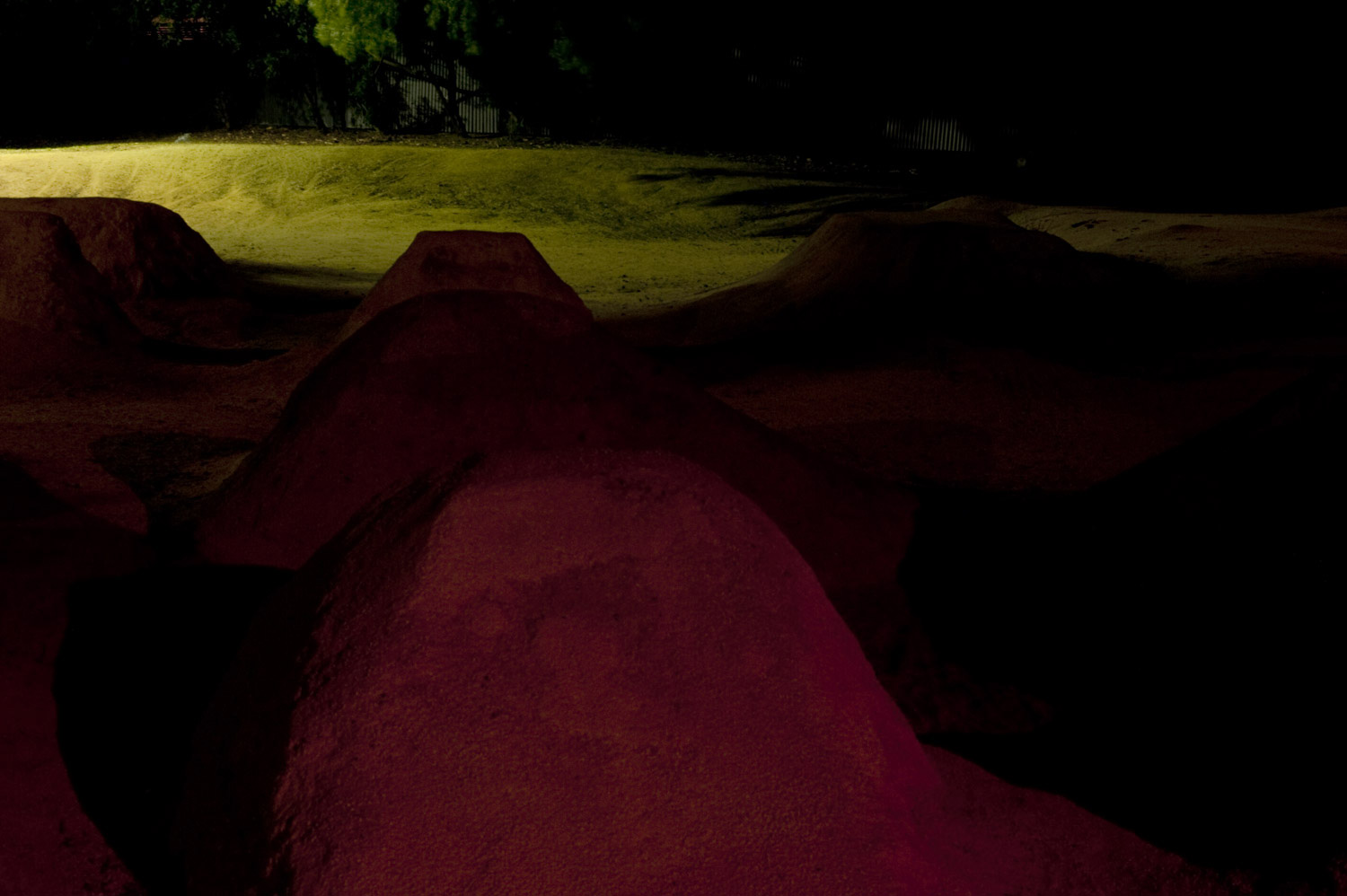
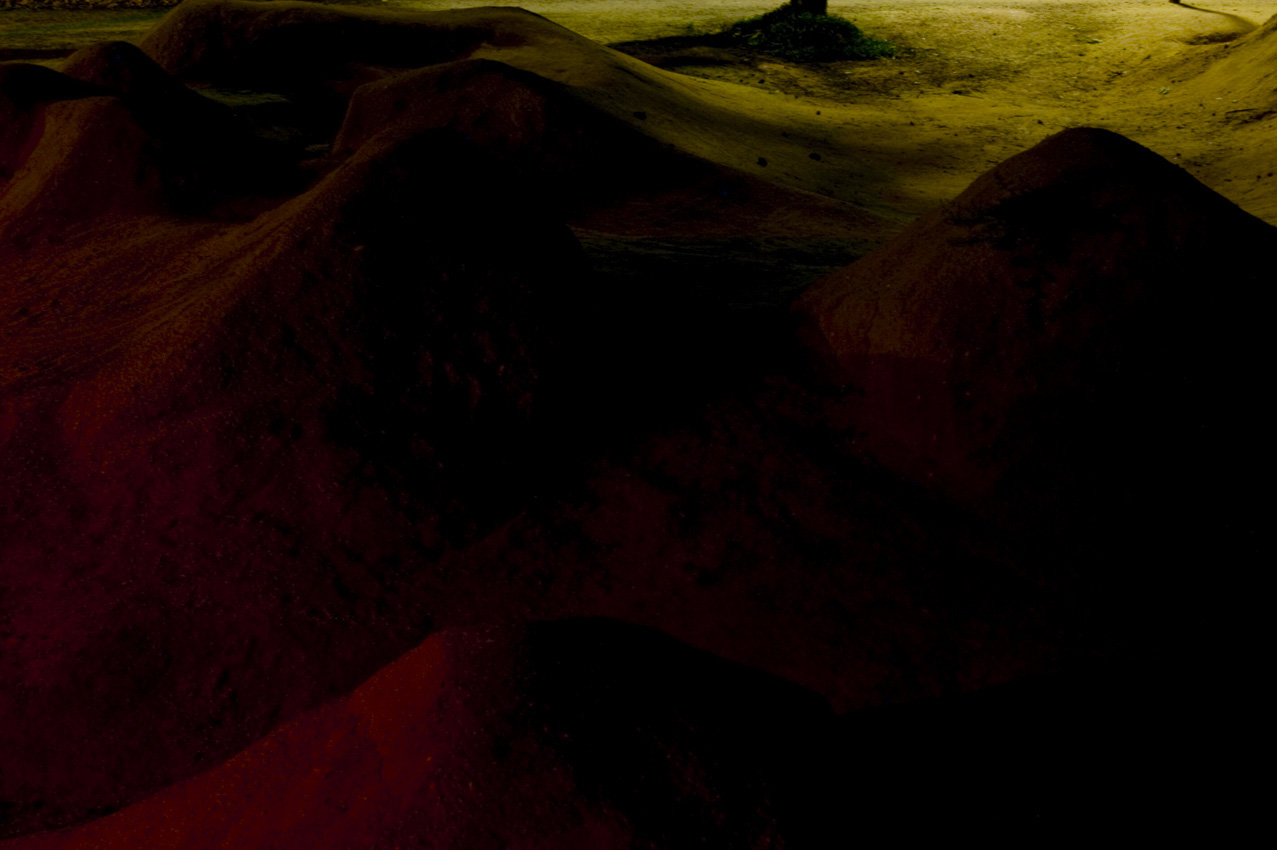
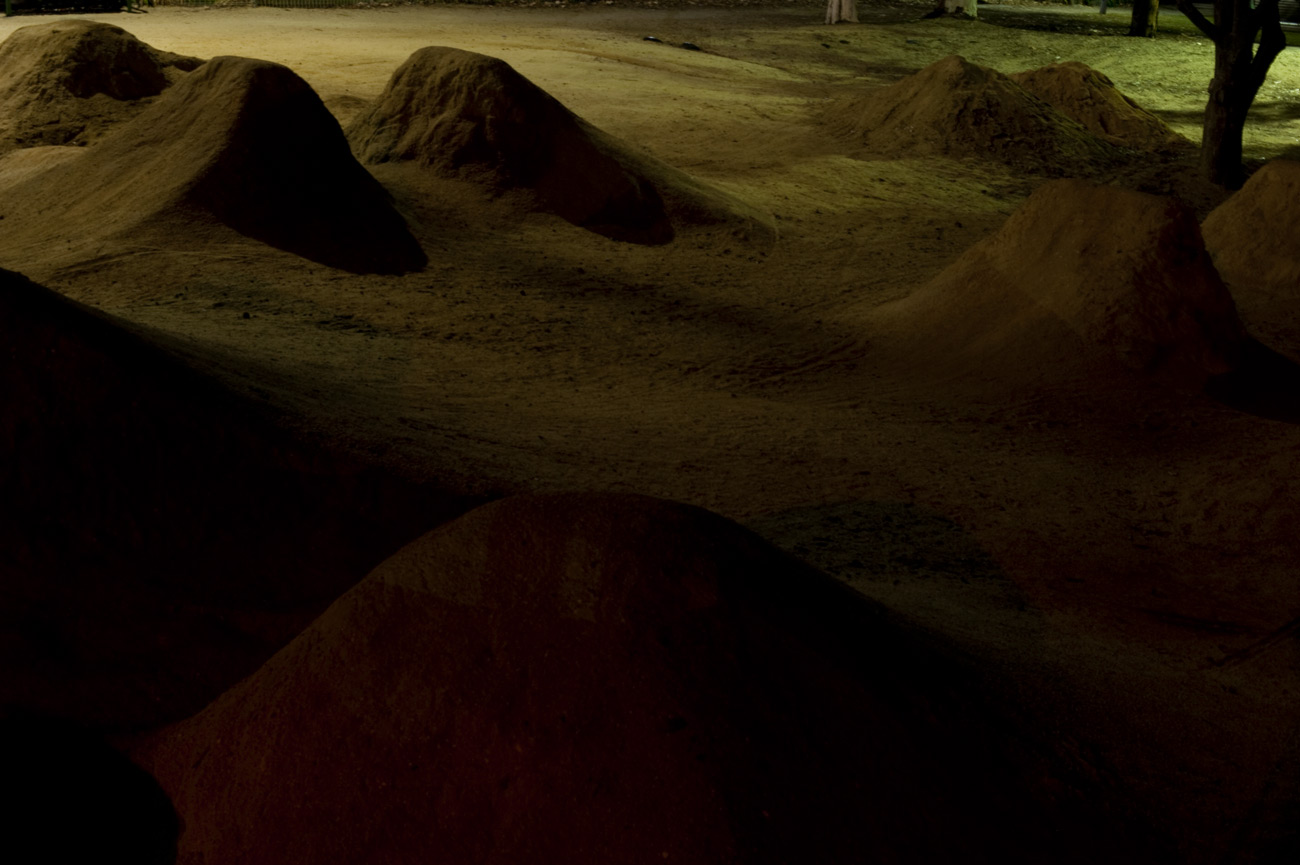
Hillock No’s 1-3, Windsor, conveys the everyday subject matter of a BMX bike park. Photographed at night utilising the urban ambience of streetlights, the mounds of earth are lit by unearthly glow. Under the gaze of Andrew Follows, the site is infused with an eerie quality. No longer a metropolitan playground, it resembles the desertous territories of an alien landscape, perhaps on some other planetary body or far distant moon.
As Elkins said, blindness is not the opposite of sight, but it’s constant companion. It is therefore, not sight that is required to take a great photograph – it is vision. By using the camera as a prosthetic extension through which he is able to perceive and frame the universe, Follows’ photographs expound the limitations and fallibilities of our own ways of seeing. Moreover, he is able to reveal to us the uniqueness of his subjective view – forged from the rich imaginings of his mind’s eye.
Anna Briers independent writer and curator, Melbourne 2013
Endnotes
1/ Berger, John. Ways of seeing: based on the BBC television series. London: British Broadcasting Corporation; Harmondsworth: Penguin, 1972, p. 11.
2/ Elkins, James. The object stares back: on the nature of seeing. New York: Simon & Schuster, 1996.
3/ Elkins, James. What photography is. New York: Routledge, 2011
4/ McLuhan, Marshall. Understanding media: the extensions of man. London: Routledge, 2001. p. 210.
5/ Adams, Ansel. The negative: exposure and development. Hastings-on-Hudson, N. Y.: Morgan & Morgan, 1968.
6/ Quote drawn from artist’s statement.
7/ Berger, Op. cit., p. 16.
Andrew Follows (Australian, d. 2019) Green on blue 2013 Digital photograph on archival cotton rag 157.3 cm x 86.5cm
Andrew Follows (Australian, d. 2019) Scarp face, Beechworth 2013 Digital photograph on archival cotton rag 30 cm x 30cm
Andrew Follows (Australian, d. 2019) Judge’s Chair, Beechworth 2013 Digital photograph on archival cotton rag 90 cm x 60cm
Andrew Follows (Australian, d. 2019) Void, Eltham 2013 Digital photograph on archival cotton rag 90 cm x 60cm
Andrew Follows (Australian, d. 2019) Hillock No.1, Windsor
2013
Digital photograph on archival cotton rag
130 cm x 86.5cm
Andrew Follows (Australian, d. 2019) Hillock No.2, Windsor 2013 Digital photograph on archival cotton rag 130 cm x 86.5cm
Andrew Follows (Australian, d. 2019) Hillock No.3, Windsor 2013 Digital photograph on archival cotton rag 130 cm x 86.5cm
Andrew Follows (Australian, d. 2019) Torso, Eltham 2013 Digital photograph on archival cotton rag 14 cm x 20cm
Exhibition dates: 17th August – 15th September, 2013
“… in my memory John was a teacher determined to seek out the aptitudes and endowments of each student who came before him; his teaching and mentorship involved a deep empathy with each student’s approach. He was almost clairvoyant in being able to very quickly identify one’s strengths and it was on those he would concentrate, unafraid to express criticism; but only in terms of how a certain fault might detract from a strength. Such was his positive and affirming approach to teaching, and consequently we have each been left a different and very personal perception of what he valued in photography.”
The Tam Projects (Tess Hamilton, Adriana Bernado, Melissa Acker) Colour box (installation view) 2013 Lightbox, A3 print on cotton rag + film slides on acrylic 15 x 14 x 33cm
Although I could not get to the second part of the exhibition at Abbotsford Convent, what I saw of this exhibition of light-based art and design by Australian and international artists at Anita Traverso Gallery in Richmond was fascinating. I love interesting concepts and works constructed with light / space / images and this show is certainly exuberant and inventive.
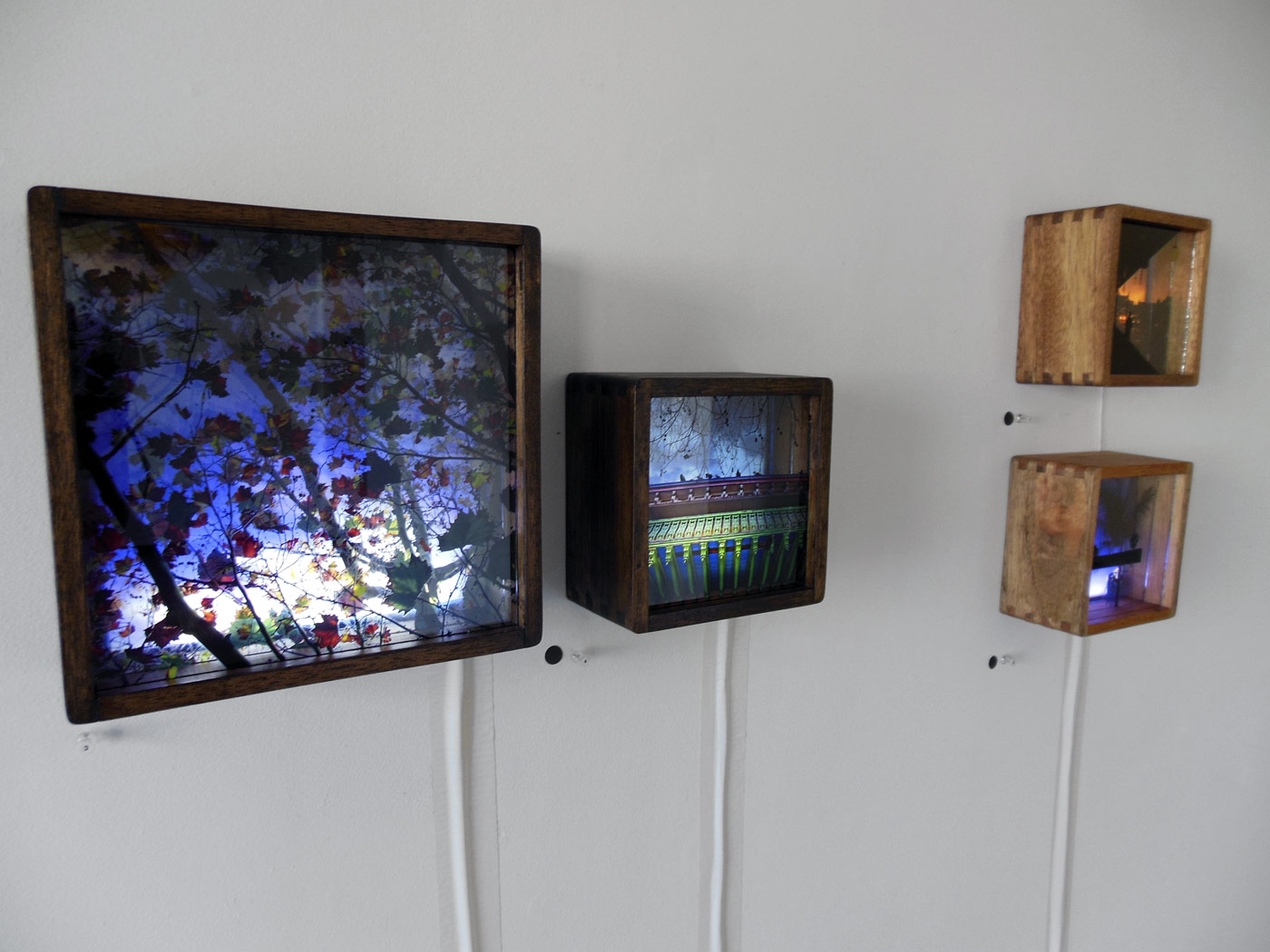
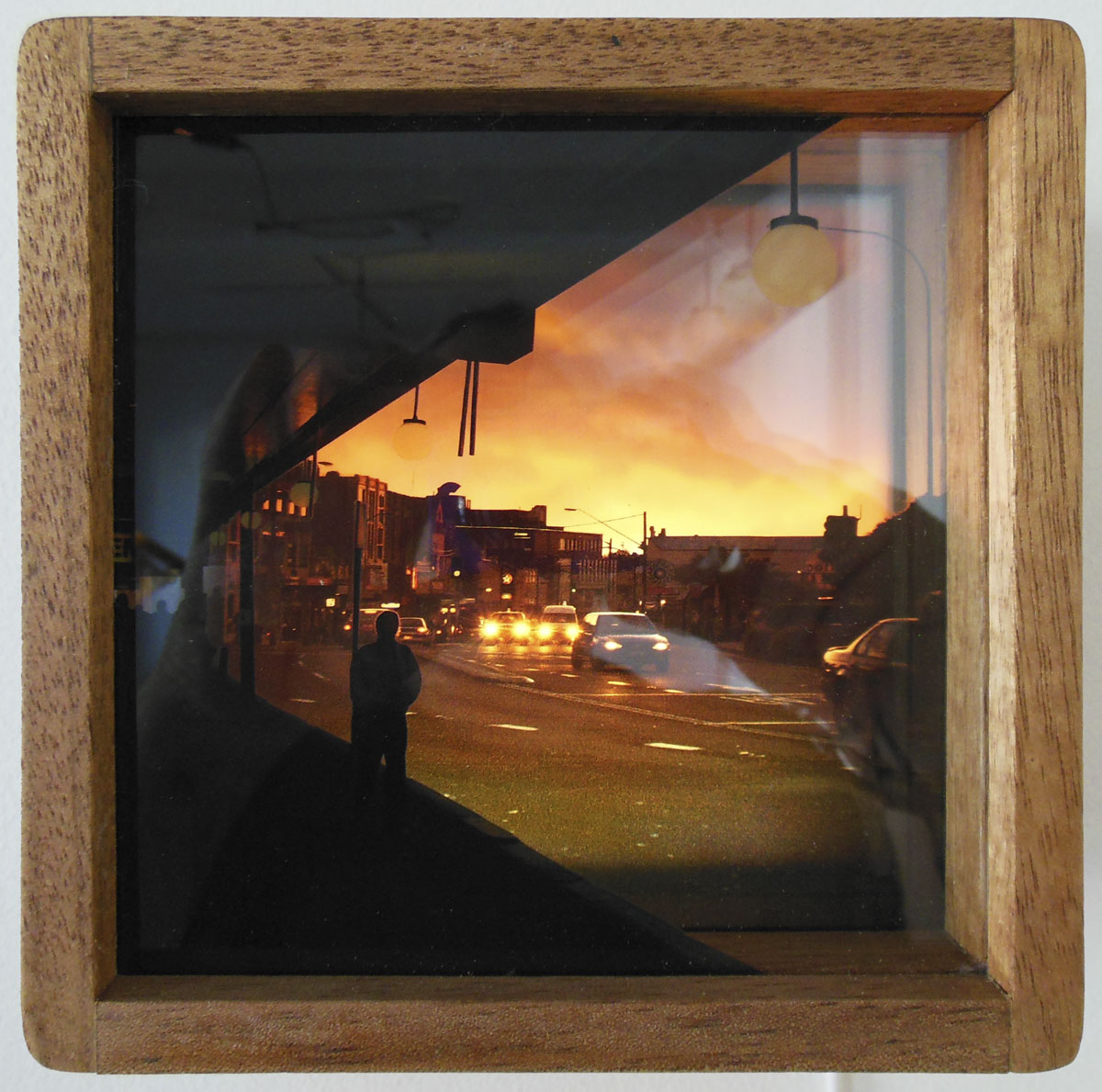
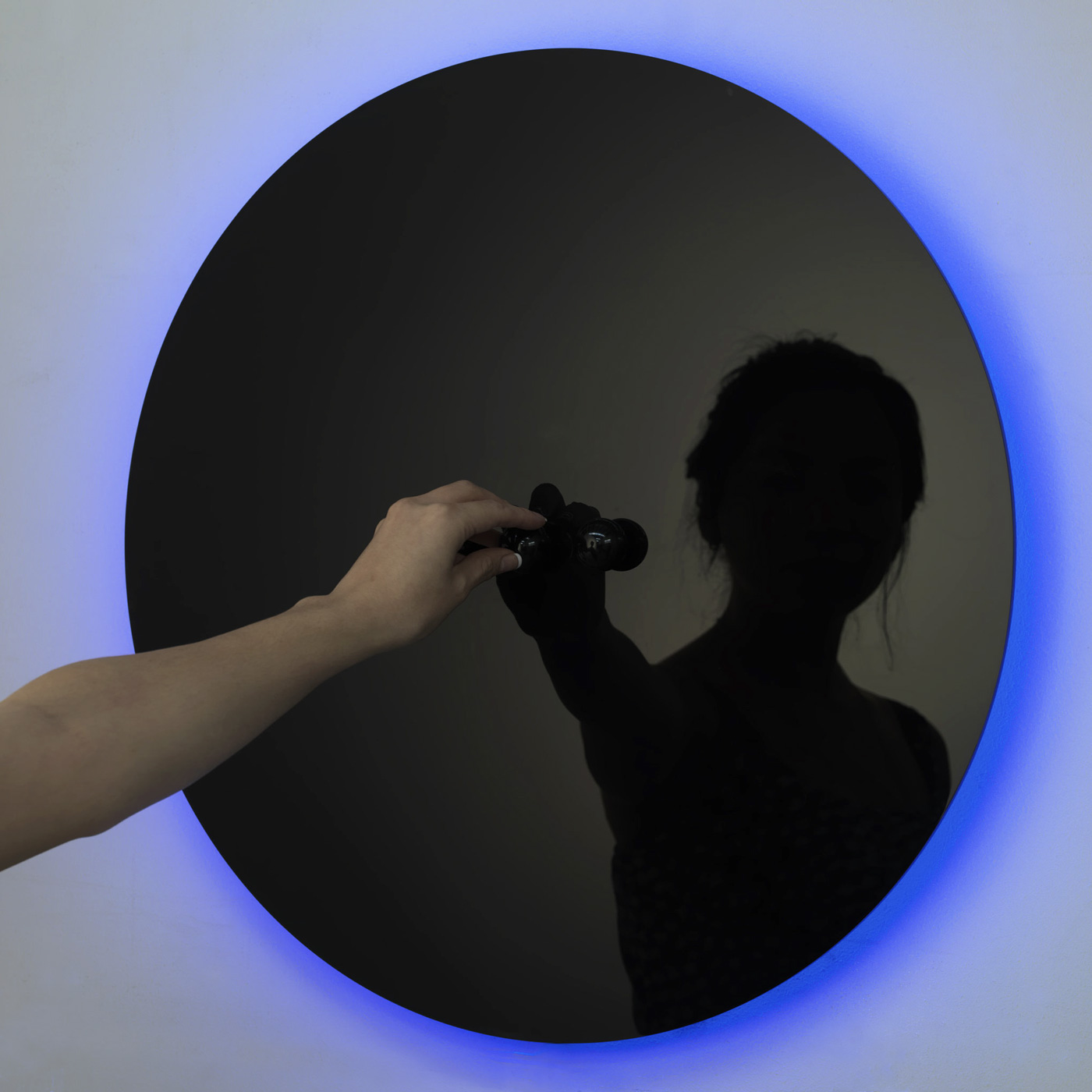
Of particular interest were three artists who use multiple images and objects in boxes to form three-dimensional sculptures, the images inside resembling the spatiality of early stereographs (for- mid- and background). In the work by The Tam Projects the perspex slide at the front of the box with the topographic dots can be removed and replaced with another screen of dots, thus altering the mapping of the image. Catherine Johnstone’s work Grief Keeps Watch 7, 8 + 9 (2012, below) uses collections of bits and pieces, remnants, traces which enable the artist to hold onto the memory of her father who has passed away. Perran Costi’s beautifully made wooden boxes hold Sydney-based scenes in 3D printed on glass and were ravishing in their collective density. Ilan El’s ORA (2011, below) features three black knobs that control the Red, Green and Blue spectrum (RGB), enabling the viewer to create an endless rainbow of colours to match their shifting moods.
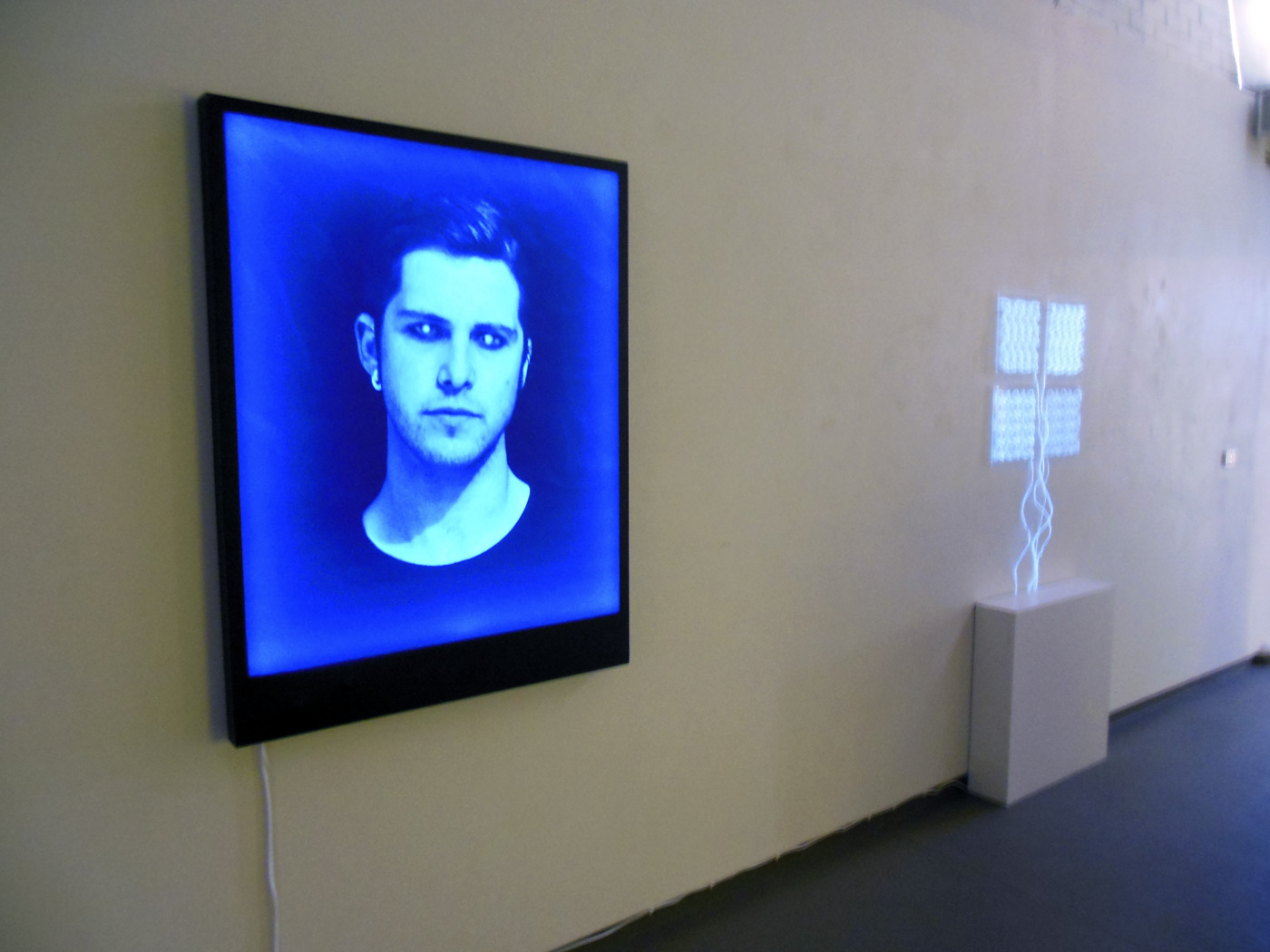
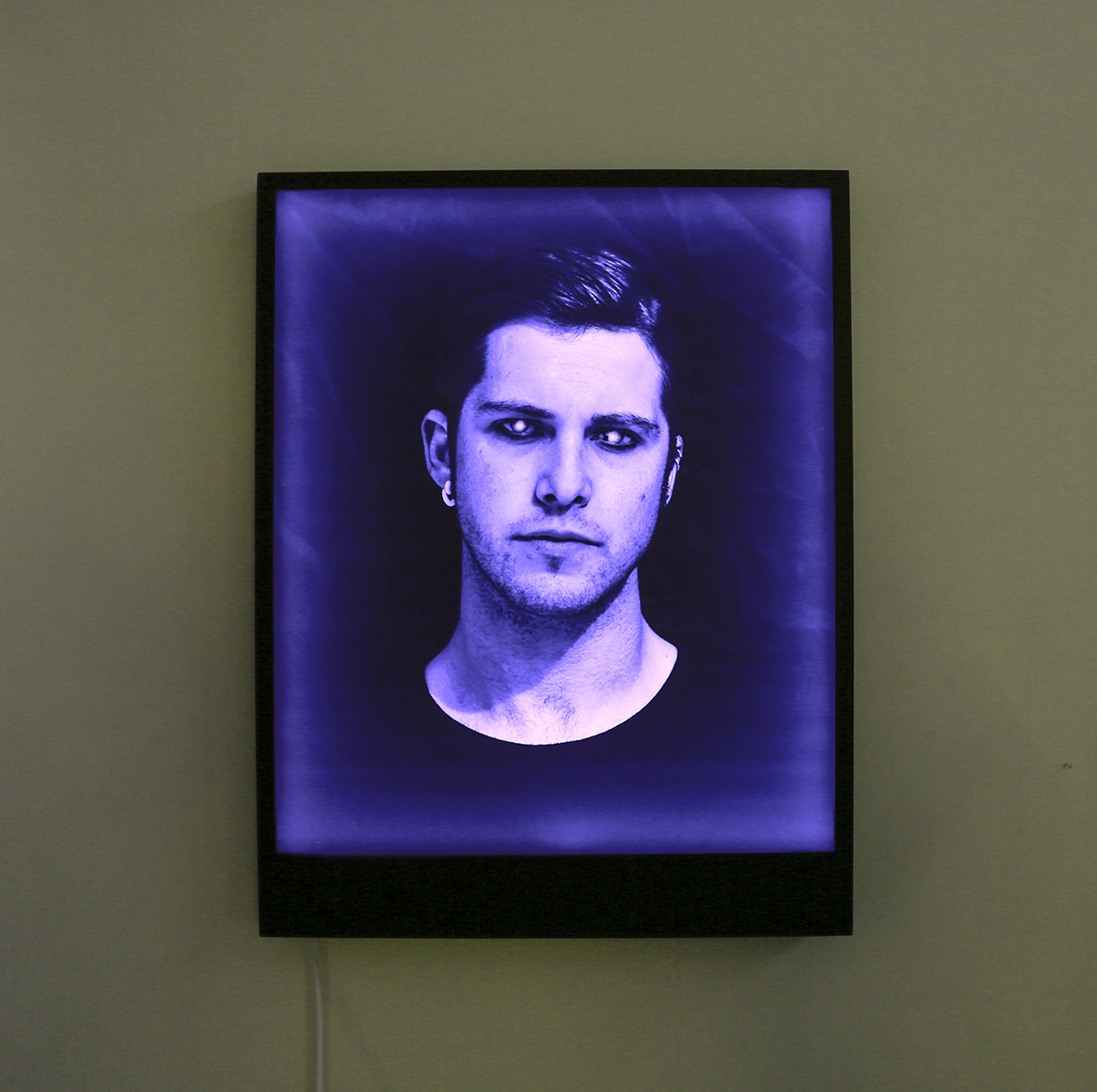
My favourite piece in the exhibition was George Angelovski’s light box LUKAS (2012, below), a portrait which cycles through various colours using remote controlled RGB LEDs which lends the portrait different characters such as threatening or placid, depending on the colour of the moment. This feeling of un/ease is increased because the eyes of LUKAS are white as in a supernova (probably red eye from a flash which has printed white in the black and white image), and in the right eye there is a black spot, an inclusion, a dark star that further disturbs the handsome features of the man. I really loved this beautiful, cerebral work.
Both curators (James Tapscott and Sam Mitchell-Fin) and artists are to be congratulated for this New Light Art + Design initiative. It’s a great idea to have a festival that exhibits a such a wide variety of works across both light art and design in Australia. Let’s hope it is even more successful next year.
Dr Marcus Bunyan
Many thankx to Anita Traverso Gallery for allowing me to publish the photographs in the posting. Please click on the photographs for a larger version of the image.
Catherine Johnstone (Australian) Grief Keeps Watch 7, 8 + 9 (installation view) 2012 Pigment on x-ray + found objects on acrylic, light boxes 25.5 x 23 x 17cm
Catherine Johnstone (Australian) Grief Keeps Watch 8 (installation view detail) 2012 Pigment on x-ray + found objects on acrylic, light boxes 25.5 x 23 x 17cm
Perran Costi (Australian) Autumn (nearest), Bird House, Sunset on King Street and Oasis (installation view) 2012 Glass, hardwood + light Dimensions variable
Perran Costi (Australian) Sunset on King Street (installation view) 2012 Glass, hardwood + light 16 x 16 x 8.7cm
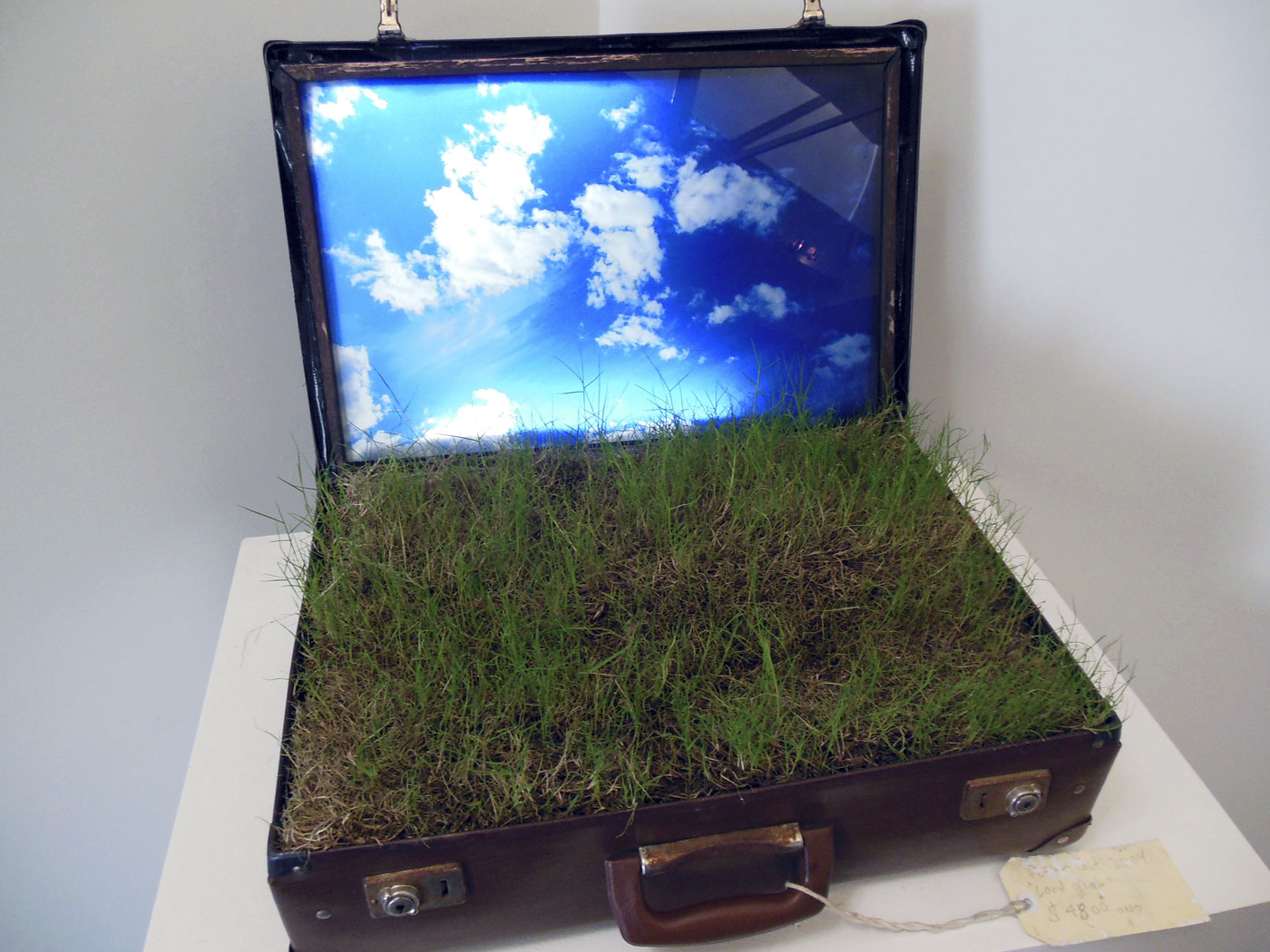
Perran Costi (Australian) Landgrab (installation view) 2012 Suitcase, glass, soil, acrylic + light 57 x 50 x 34cm
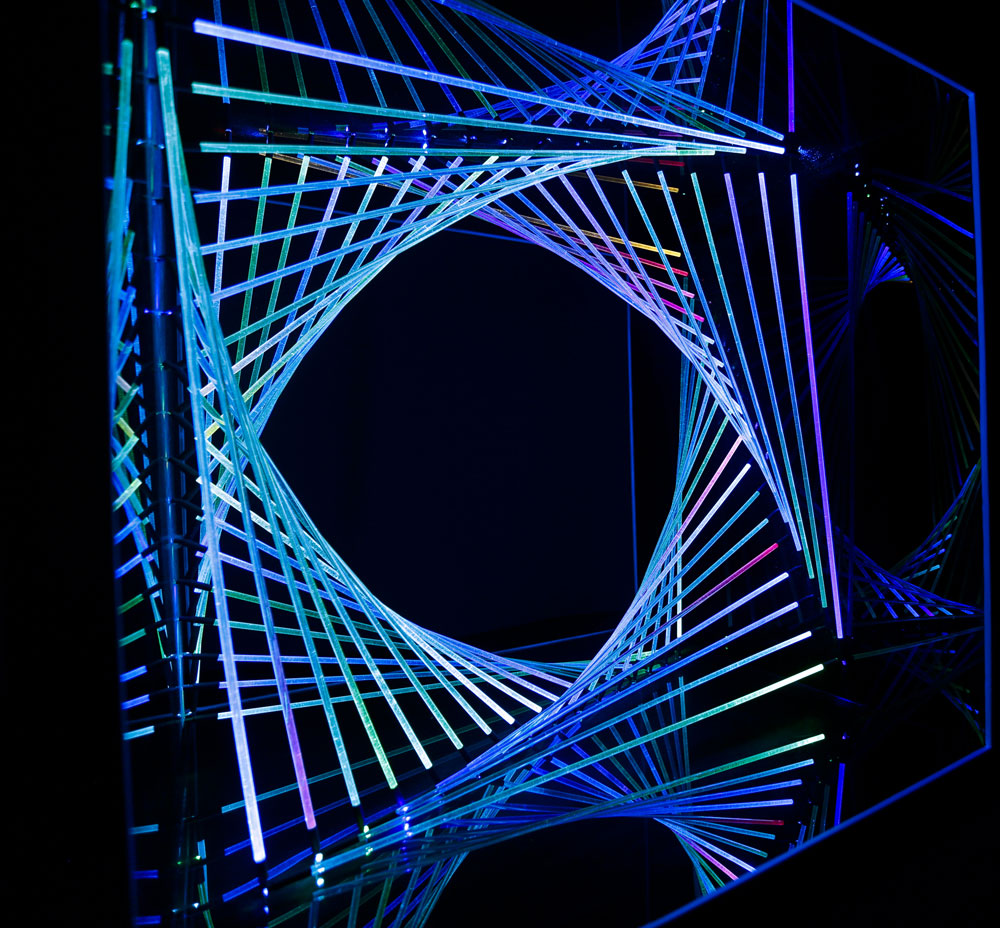
Kent Gration (Australian) Leviathan 1 + 2 (installation view) 2013 Carbonised + natural bamboo, LED lighting 50 x 50 x 125cm each
Globelight ’13 is an exhibition of light-based art and design by Australian and international artists. Curated by James Tapscott and Sam Mitchell-Fin, this is the inaugural event of what is to become an annual festival-style event that aims to grow into a significant part of Victoria’s cultural calendar. An exciting cross-section of Australian and international artists and designers will occupy both spaces at Anita Traverso Gallery and the grounds of the Abbotsford Convent with light-based sculpture, installation, design objects and video art throughout the month of August.
The Festival aims to become an important inclusion on the local and international cultural calendar being the only festival of its kind that exhibits a such a wide variety of works across both light art and design in Australia. The festival has already attracted the attention of the lighting community and related industries, thus confirming the need for such an event that supports the growing number of artists and innovative designers working in this medium.”
Text from the Anita Traverso Gallery and Globelight website
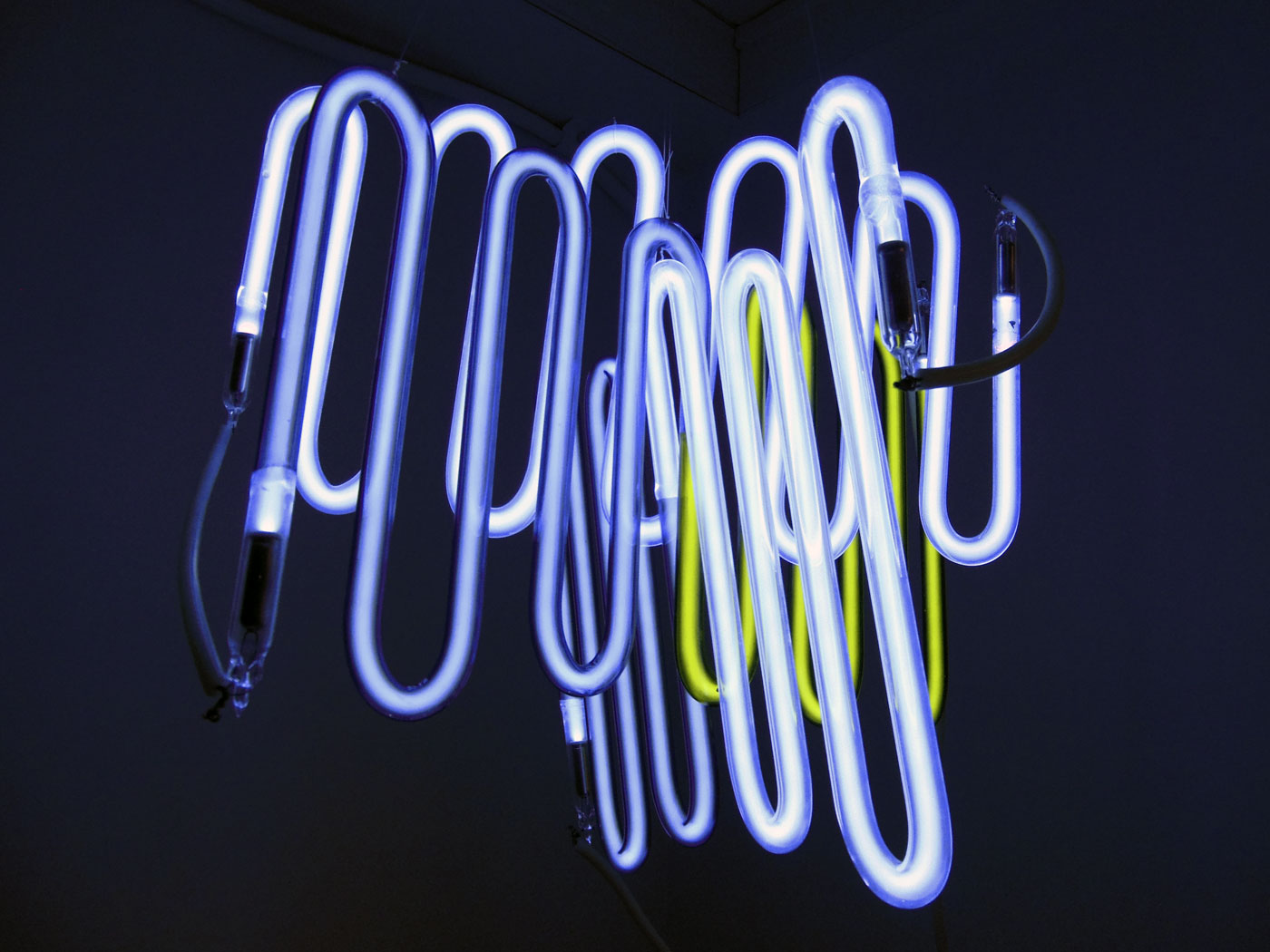
Sam Mitchell-Fin (Australian) Open infinity (blue) (installation view) 2013 Neon Size variable
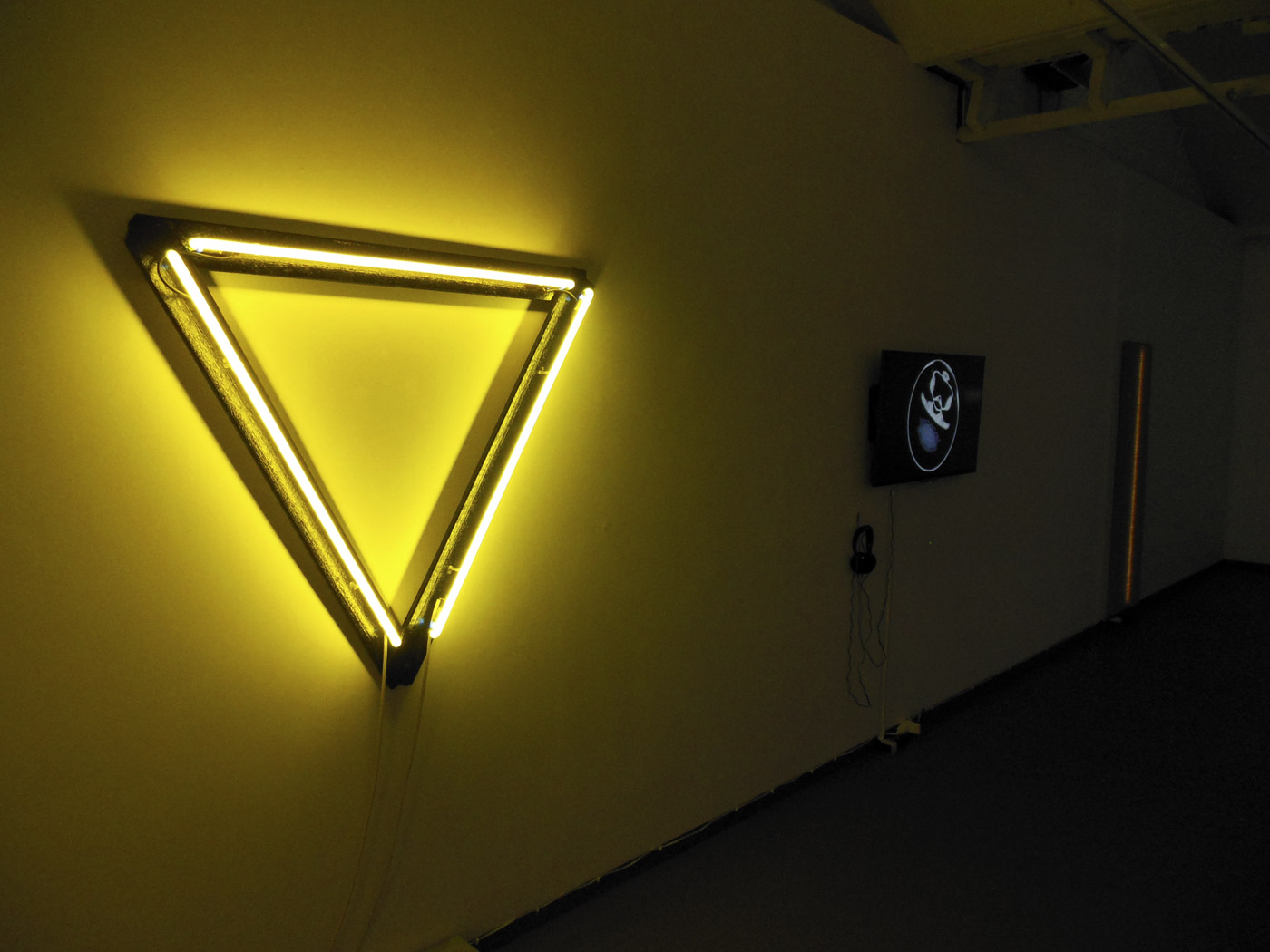
Sam Mitchell-Fin (Australian) I Wish I could tell you, but I can’t find the words (installation view) 2013 Neon + timber Size variable
Ilan El (Australian born Israel, b. 1971) ORA (installation view) 2011 Zenolite front face, RGB LEDs + powder coated mild steel body 4 x 60cm (diameter)
James Tapscott (Australian, b. 1980) Primaries and Secondaries (installation view) 2013 RGB LEDs, perspex, wood 65 x 65 x 65cm
George Angelovski (Australian, b. 1974) LUKAS (installation view) 2012 Remote controlled RGB LEDs + mixed media 100 x 130cm
Laura Lay (Australian) The Established Child Series (installation view) 2013 Acrylic panels with EL wire threads, 4 inverters + plug in adapters 4 x 30 x 30cm
George Angelovski (Australian, b. 1974) LUKAS (installation view) 2012 Remote controlled RGB LEDs + mixed media 100 x 130cm
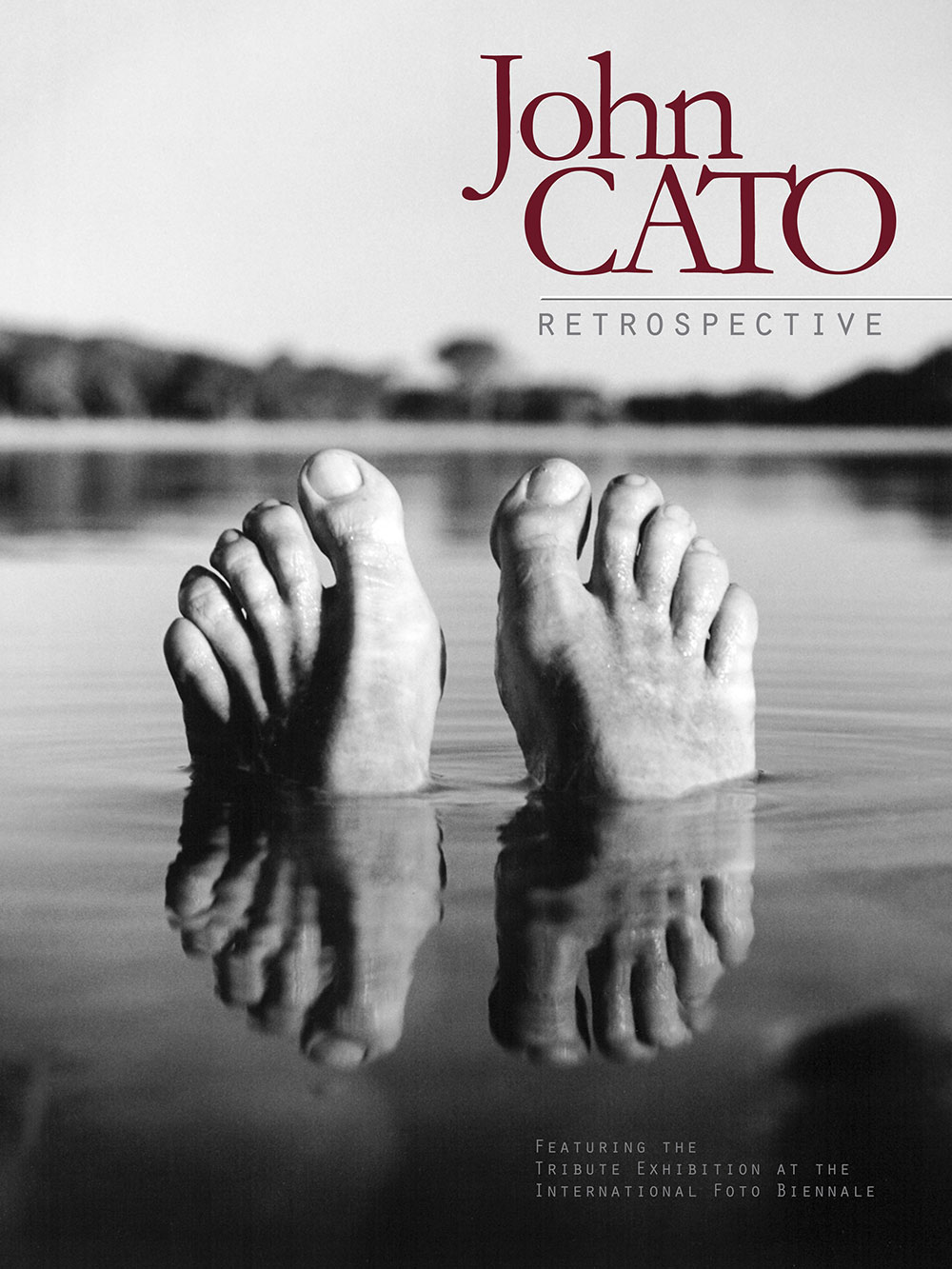
“Cato was one of the first Australian photographers to create musical tone-poems – not traditional photo-essays as for magazines, but spiritual expositions about Self.” Dr Marcus Bunyan
Exhibition dates: 17th August – 15th September, 2013
It was an emotional time on Saturday afternoon as I opened the John Cato Retrospective. I hope I did John and Dawn, their family and everyone proud. I burst into tears after the speech… I got a lovely email from Senga Peckham today which was very much appreciated:
“Dear Marcus
Thank you so much for your excellent speech on Saturday. It was strong, heartfelt and beautiful.
Up there with the microphone you were probably not aware of the sentiment in the space. Many tears were shed. The grand daughters were so happy to be there. They were near me during your talk and extremely emotional. Many others were too. It was more of a wake really than an exhibition opening and book launch. Some people had travelled a long way and everyone wanted to be there. The warmth and tenderness was palpable and will be remembered for a long time.
Thank you for being such a major part of it and for putting your heart into each word.
Senga Peckham”
Many thankx to BIFB for asking me to officially open the John Cato Retrospective and to launch the new book.
Photographers David Callow and Andrew Chapman’s video tribute to John Cato (18 mins 39 secs) can be viewed on Vimeo (Password is Cato).
It is a great pleasure to be here today to officially open the John Cato Retrospective and to launch a book that will have a major contribution to a continuing assessment of John’s work and is also an honouring, a mark of respect and admiration. These brief words are not about the many sides of John and all his aspects and careers – for that you will have to look elsewhere – but they are a short introduction to the personal and wider cultural need for John’s work.
My friendship with John and Dawn goes back to when I was studying photography at RMIT University in the early 1990s. John became a mentor when I held my first three solo photography exhibitions at The Photographers’ Gallery and Workshop in Punt Road between 1991 and 1994. After I had finished my Phd in 2001, I co-curated a retrospective of his work at the very same gallery.
Many a weekend my partner and I travelled down to Carrum to see John and Dawn for lunch and afternoon tea, to talk about the things that matter in life – music, literature, art, love, loss – and to talk about my latest prints. They were the most glorious couple with such wonderful energy and they were so generous with their friendship and advice. John could smell bullshit a mile away and he would tell you, but he would also encourage you to look deeper into yourself and the world for the answers you were seeking. As James McArdle said to me recently, “He was a teacher determined to seek out the aptitudes and endowments of each student who came before him; his teaching and mentorship involved a deep empathy with each student’s approach. He was almost clairvoyant in being able to very quickly identify one’s strengths and it was on those he would concentrate, unafraid to express criticism; but only in terms of how a certain fault might detract from a certain strength.”1
And I will add, all of this with a warmth and affection that opened up a pathway to his insights.
John had strength of character in spades, always backed up by the vivacious Dawn. Imagine having a successful commercial career in Melbourne in the 1960s and giving it all away – to become an artist, a photographic artist at that! Imagine the courage it would have taken, in that time and place, to abandon all that had been successful in your life and follow another path, a path full of doubt and self-discovery, a journey that ultimately enabled him to help others through his teaching. As Ian Lobb said to me recently, “In 1970 where did you go to see a fine art photograph on exhibition in a non-institutional gallery in Melbourne? The only place was the doorway to the John Cato / Athol Shmith / Paul Barr studio in Collins Street. You would never know which of the three photographers would have a print placed in that doorway.”
According to Helen Ennis there has always been a distaste for self-reflective and contemplative modes of thinking in Australia, and photography has overwhelmingly been about ‘things’, “including actions and events, which have a concrete reality and a verifiable, independent existence… For most of the twentieth century inward-looking approaches, whether symbolist, surrealist or abstract, never really took hold.”2
John’s work is different. He was a groundbreaking artist. He was one of the first Australian photographers to create musical tone-poems – not traditional photo-essays as for magazines, but spiritual expositions about Self. In his internal meditation upon subject matter his concern was for the ‘felt’ landscape. He sought to express his relationship with the earth, air and water, aware of the contradictions in contemporary settler relations with the land. His photographs are not about the ‘when’ or ‘where’ but about a feeling in relation to the land, the spirit and the universe.
In this sense (that the photograph is always written by the photographer), these are photographs of the mind as much as they are of the landscape. John exposes himself as much as the landscape he is photographing. This is his spirit in relation to the land, to the cosmos, even. Like Monet’s paintings of water lilies these photographs are a “small dreaming” of his spirit with a section of the land and not necessarily, as in Aboriginal art, a dreaming and connection to the whole land. His photographs are photographs of the imagination as much as they are of place, rid of ego and become just the world. He created visions that placed the individual in harmony with the earth and in the process became not just a citizen of Australia but also a citizen of the world.
In this transformative act the artist not only awakens the reasoning mind but more importantly the soul. This is what John’s work does; it awakens the soul. His Alcheringa, his dreaming (for that is what Alcheringa means), was to pursue poetic truth in the world and it is his “gift” to us, to those that remain looking at his work. John commented that he would rather have questions than answers – I’m sure he would want to say that, and he would want to believe it – but it is my feeling that very deep down he was searching for the more beautiful answer – rather than just the beautiful question.
A very good friend of mine asked me recently whether I thought that John Cato was a great photographer. I have been thinking about that question ever since and my answer is this: he was a great photographer, one of Australia’s greatest, a great teacher and together with the sparkly-eyed Dawn, a wonderful human being. One measure of a photographer’s greatness is the amount of time he is prepared to spend helping others, and John spent a lot of time imparting his hard-earned wisdom.
As an artist, John has for too long been ignored by notable institutions that cannot accept the wonder in his work. There is an inexplicable coolness toward John and guardedness when talking about his work, as though people are afraid of saying anything about it at all. Well, let me say it for them: John’s work is magnificent. It is to the great credit of the people who have organised this exhibition and the publication of this book that finally, John might start to get the recognition he so strongly deserves.
John Cato unquestionably deserves a place in the pantheon of significant and influential Australian photographers for he is right up there with the very best of them. May the cosmos bless him.
Andrew Follows (Australian, d. 2019) Density invitation 2013
density n.
the degree of optical opacity of a medium or material, as of a photographic negative; thickness of consistency; complexity of structure or content.
I welcome all friends to the opening of the first exhibition I have curated since the completion of my Master of Art Curatorship at the University of Melbourne.
You are cordially invited to the opening of Density, a solo exhibition of photographs by Andrew Follows on Saturday 31st August 3.30 – 5pm at The Anita Traverso Gallery, 7 Albert Street Richmond, Victoria.
The works premiered in this exhibition are the culmination of a mentorship between Dr Marcus Bunyan and Andrew Follows, supported by Arts Access Victoria as part of the Boost Pathways Program.
“Curated by Dr Marcus Bunyan, the concept of Density was envisaged as a point of departure to explore the manifold variations and subsequent ruminations on the term as it relates to Follows’ perspective. As a technical descriptive, density explains the degree of optical opacity within a photographic negative. Portions of film that have been exposed to greater amounts of light yield a greater deposit of reduced silver. This is referred to as having a higher density than areas of shadow. Density also denotes a thickness of consistency and many of Follows’ works exhibit a complexity of compositional structure and content that elucidates the nature of Follows’ perception.”
Anna Briers. “The Mind’s Eye: Density in the Work of Andrew Follows.” Catalogue essay 2013
Curator: Dr Marcus Bunyan Guest Speaker: 4pm Dr Jondi Keane, Senior Lecturer Deakin University Artists Floor Talk: 3pm Saturday 7 September Preview from Tuesday 27 August Exhibition until Saturday 21 September Gallery Hours Wed-Sat 11-5 + by appointment
The Opening will be Auslan Interpreted and the exhibition will be Audio Described.
Please click on the images below for a larger version.
Andrew Follows (Australian, d. 2019) Density invitation 2013
Andrew Follows (Australian, d. 2019) Density catalogue cover 2013
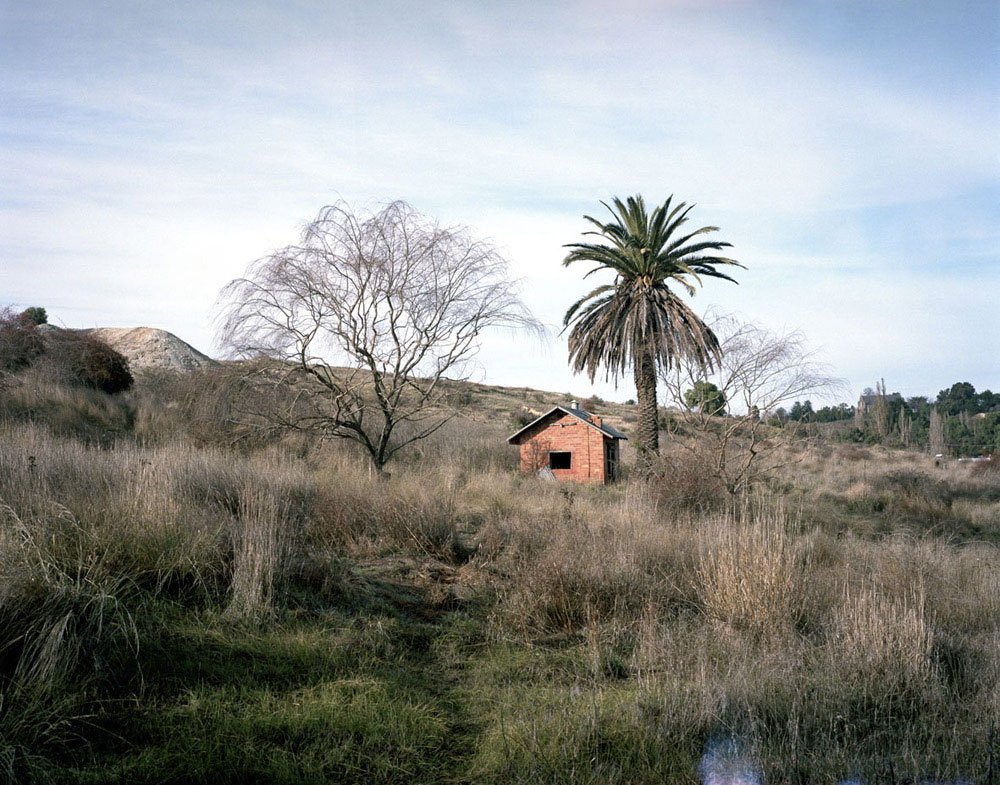
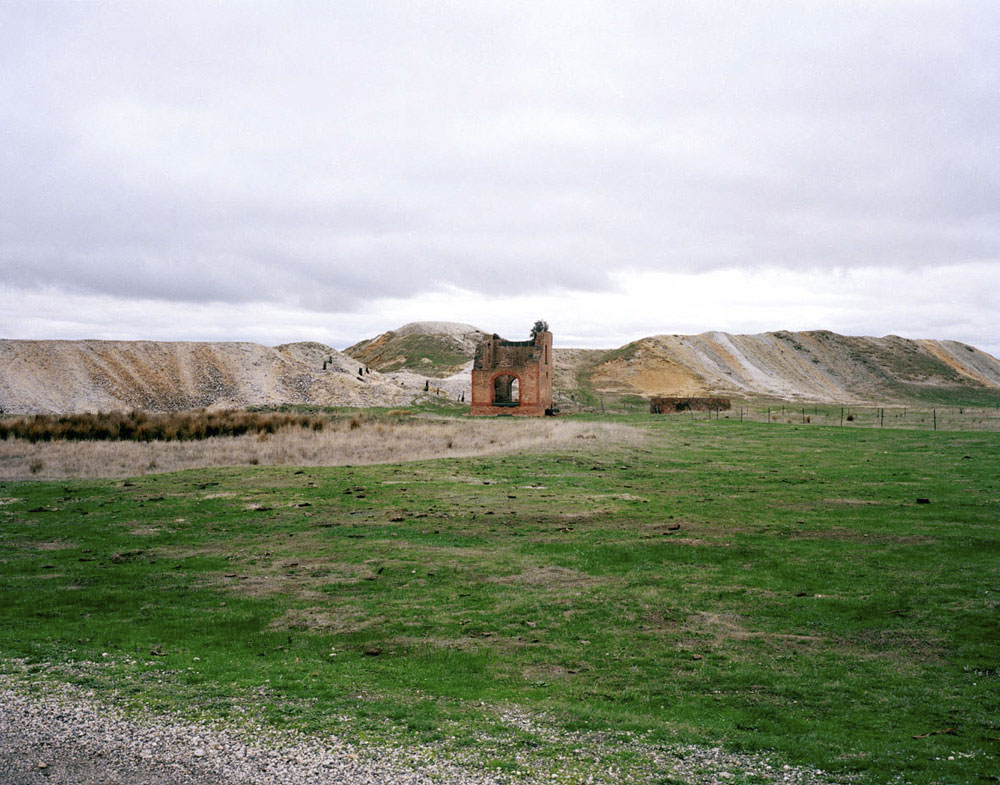
Jessie Boylan (Australian, b. 1986) Clunes (Cottage) 2013 From the series Fourteen Ounces Hahnemuhle Photo Rag 80cm x 60cm Edition 10 +2AP
“… the work itself – which describes various traces of industry and built history amid the expanses of rural and outback Australia – is of a much subtler cadence. These works are more a collection of scattered traces and silent armatures that sit within the vastness of the Australian landscape… While Koenning’s spacious works picture the rusted tractors and empty gain silos of dried-out farming communities and desert towns, Boylan’s images of Victorian forests and mining country have a more claustrophobic feel. In each case. the stories and traces prove elusive and assumed. It is a powerful allegory for Australia… As far as I know whispers of tacit, embedded history – of small echoes amid a vast land.”
Dan Rule “In the Galleries,” in The Saturday Age, July 13, 2013, p. 7.
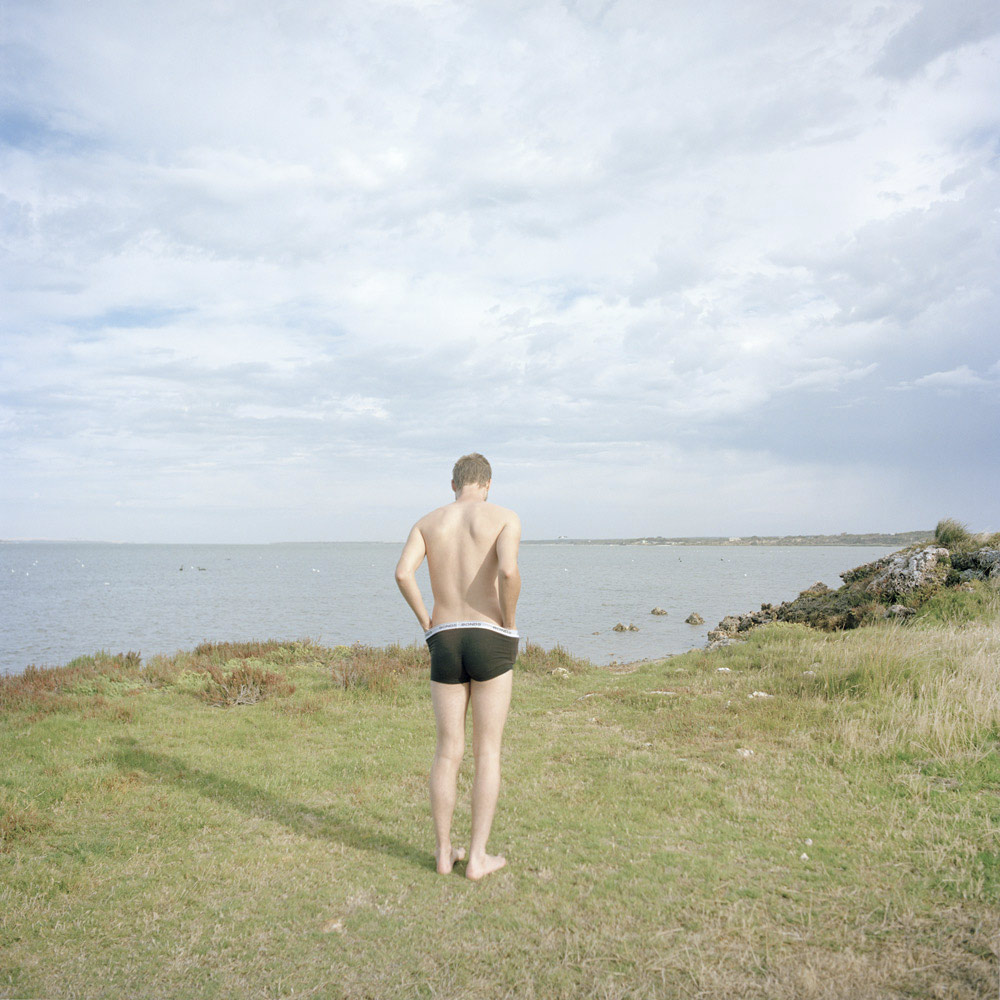
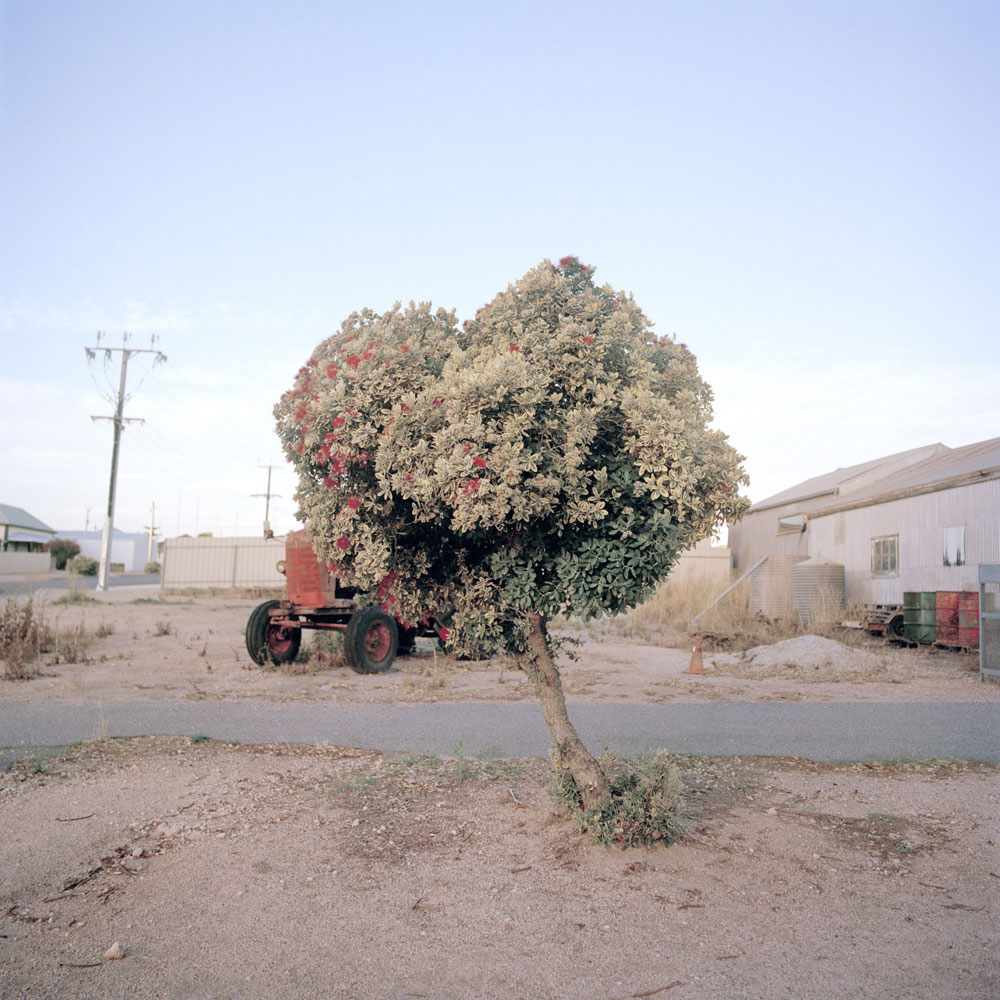
There are some interesting visual elements to this exhibition by Katrin Koenning and Jessie Boylan at The Colour Factory Gallery but ultimately these elements do not add up to a satisfying whole.
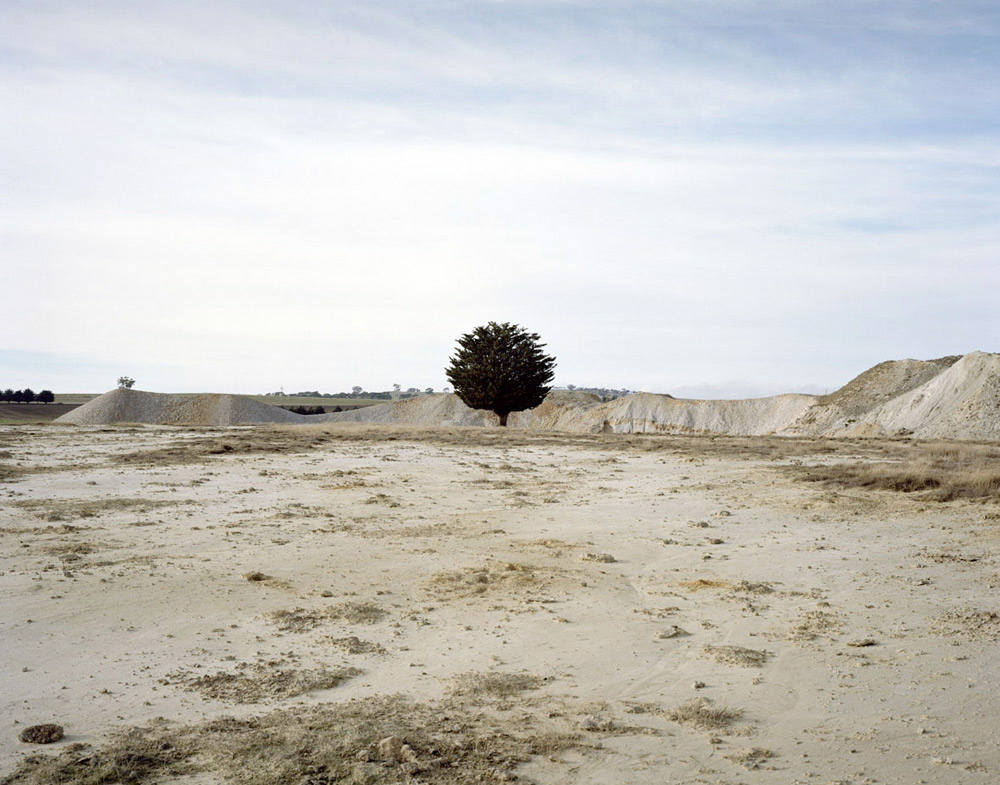
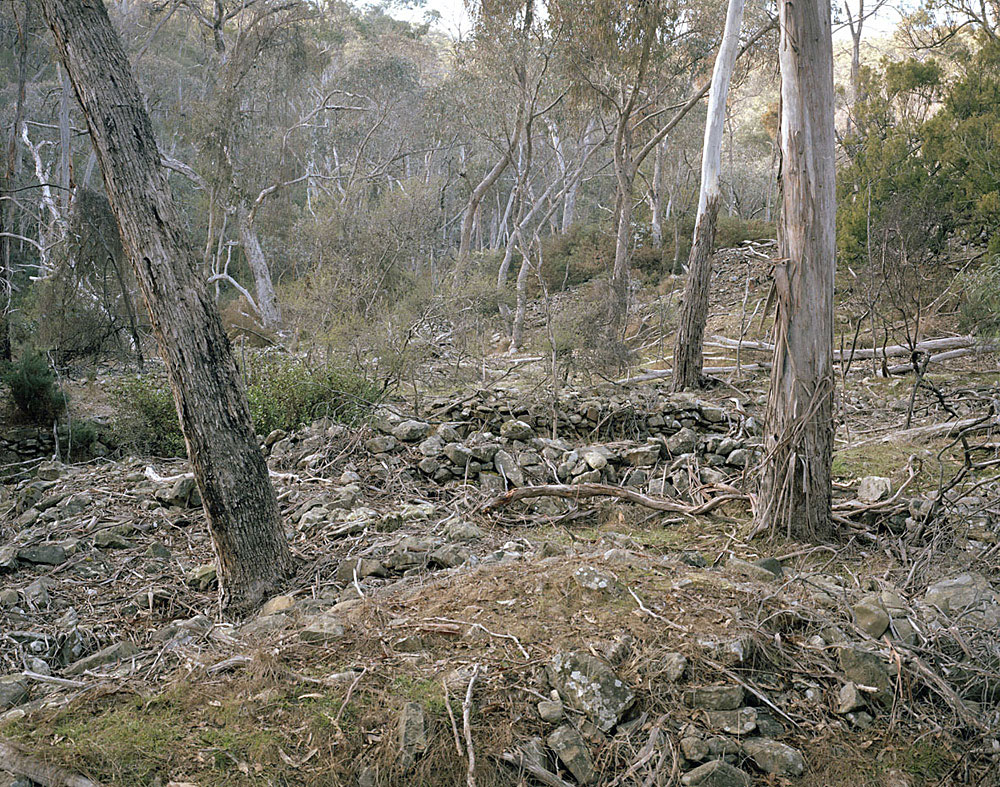
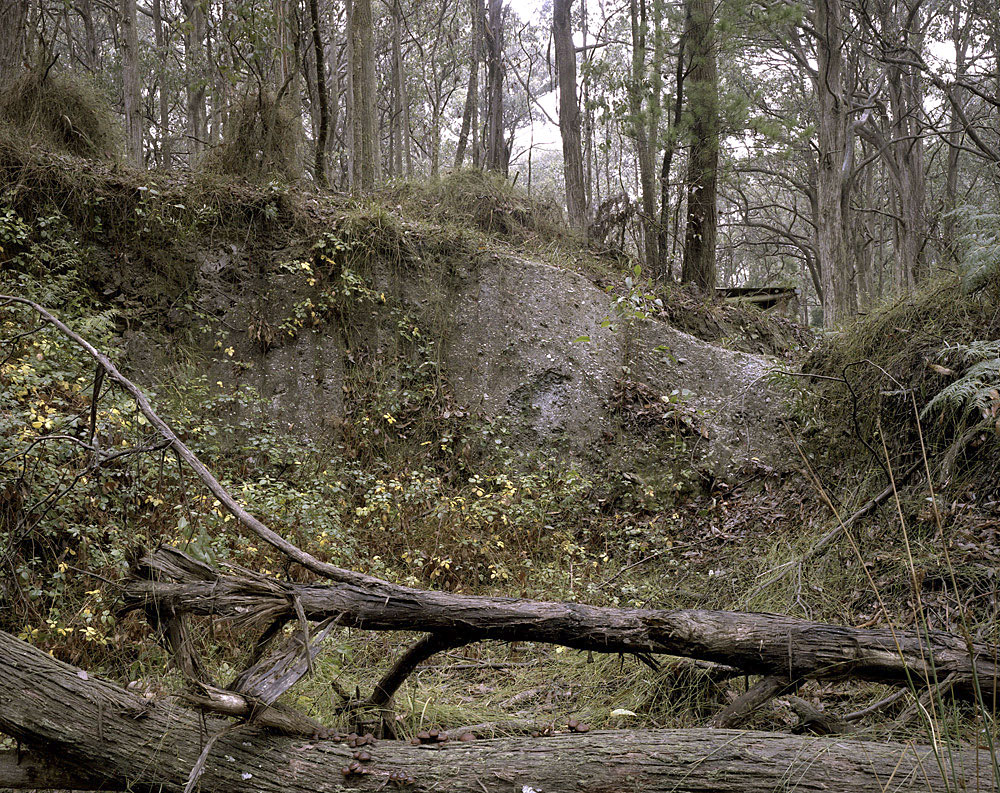
Boylan’s images are well seen and the artist makes the environment within the pictorial plane seem much bigger than the space the photograph occupies, almost cinematic in their scope. However, the artist relies too heavily on the single tree or structure to hold the centre of the image, whilst placing the horizon line all to regularly half way up the image (see the 1, 2, 3, 4, and yes 5 images below). Even in the dense bush scenes there is a horizon line in the middle of the image, mentally blocking the viewer from any imaginative engagement with the landscape.
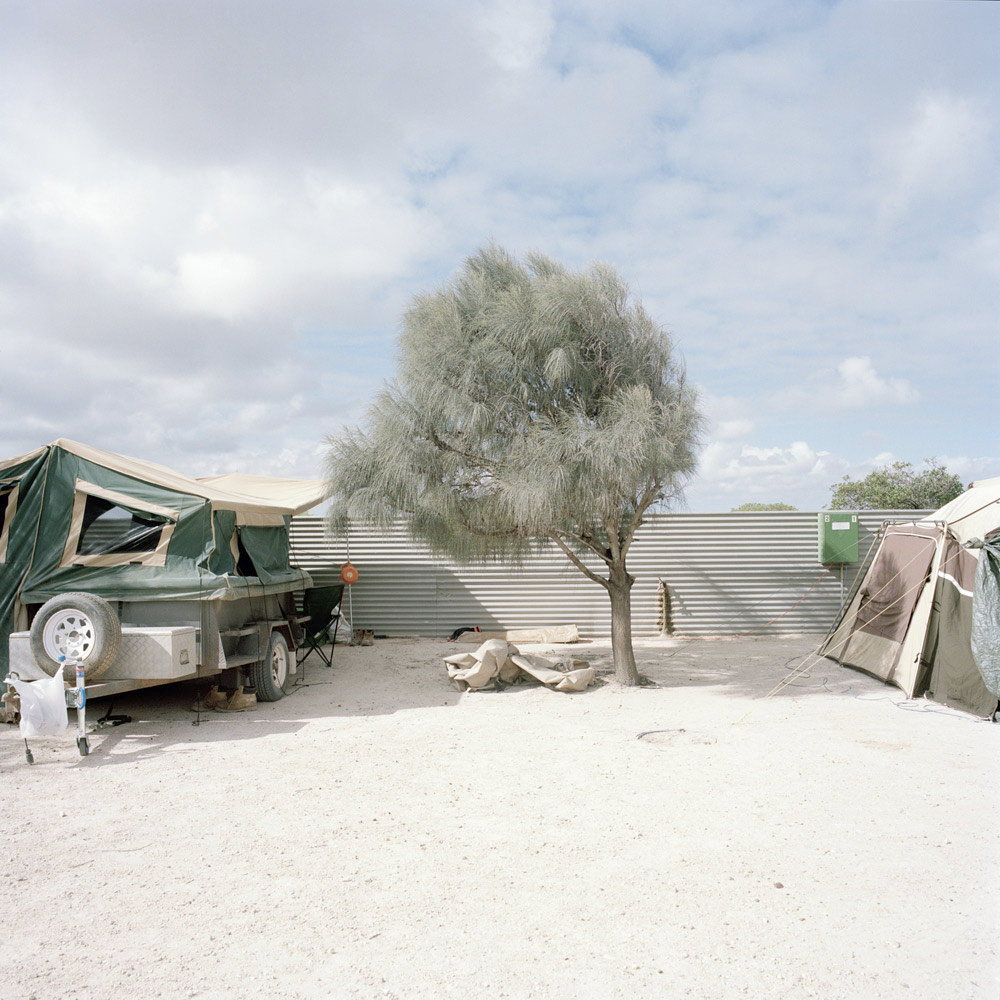
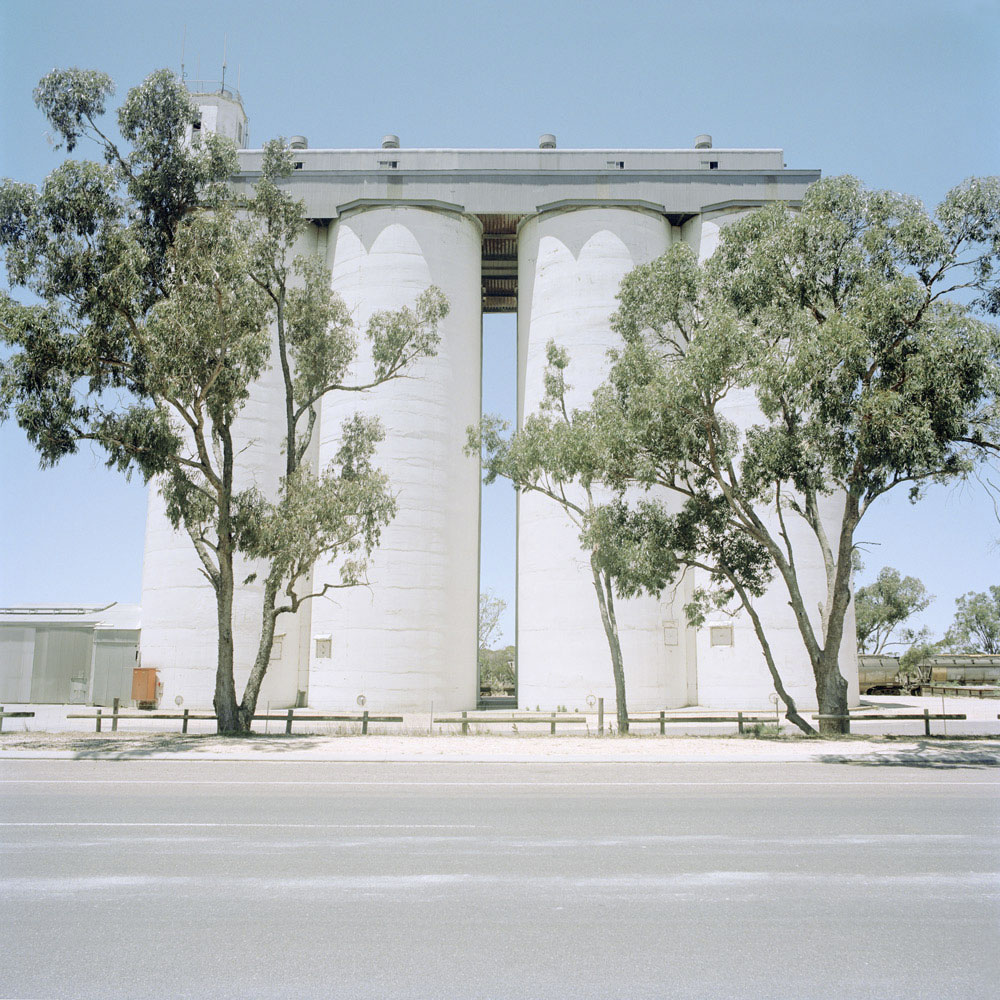
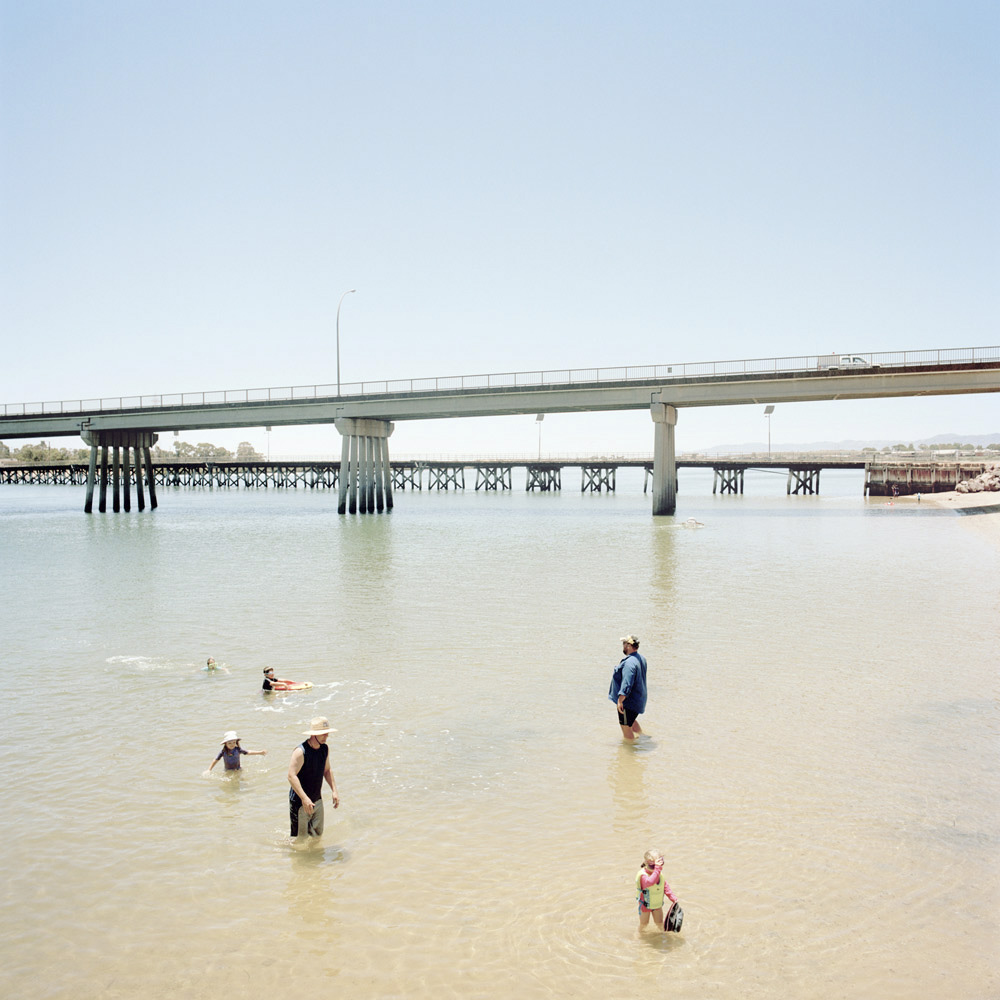
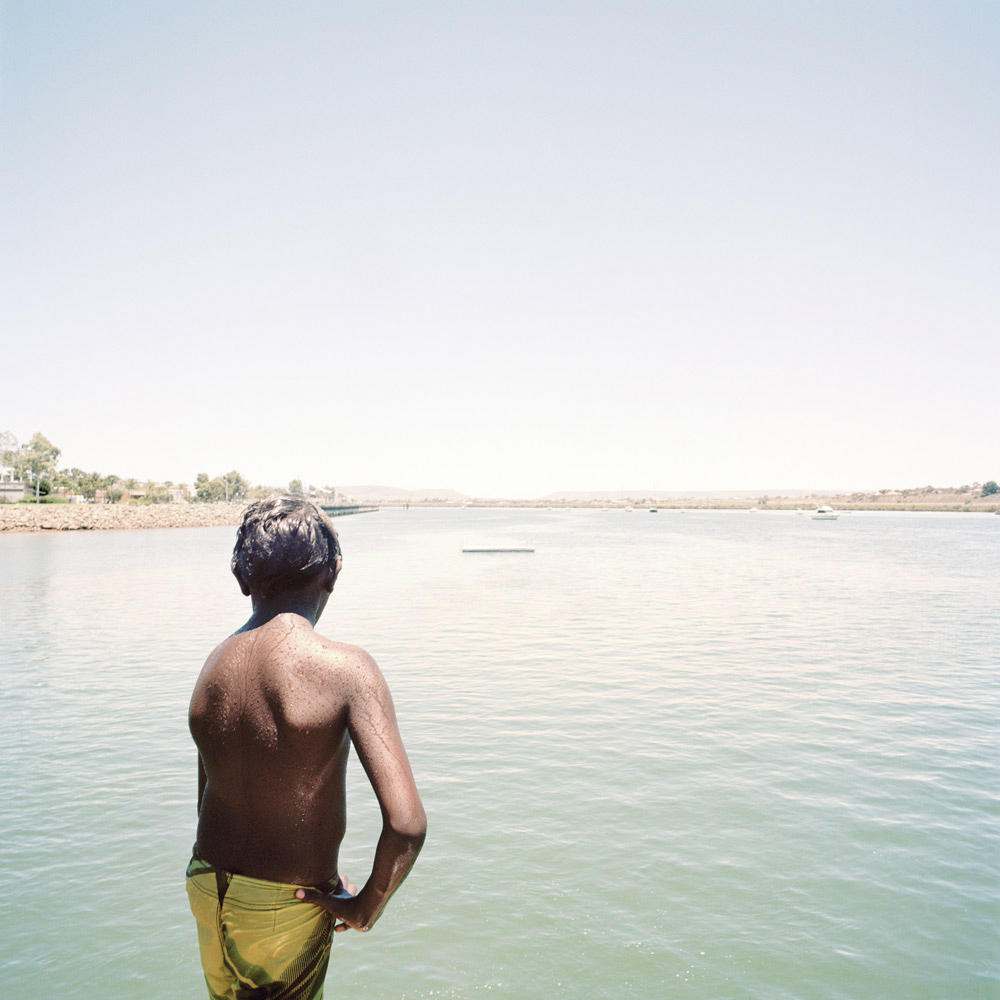
Koenning’s photographs evidence the bleached sunlight of rural Australia with visual elegance, but the artist is much cleverer when she is handling a number of elements within the picture plane (for example, see her series Transit), instead of being out of her environment and then simplifying the pictorial structure. I have seen so many of this type of photograph. They picture the traces of settlement as the detritus of an ailing economy – of a failed negotiation with the land – through a “Tom Roberts” moment. Surely there is more life, more to life in rural Australia than single trees (is there a theme emerging here?), desolate spaces and people in the mid-foreground with their back to the painter / photographer, staring off into the distance. They might have a presence but there are no possible futures intimated here.
But what really puts the nail in the coffin of this exhibition is the quality of the digital printing.
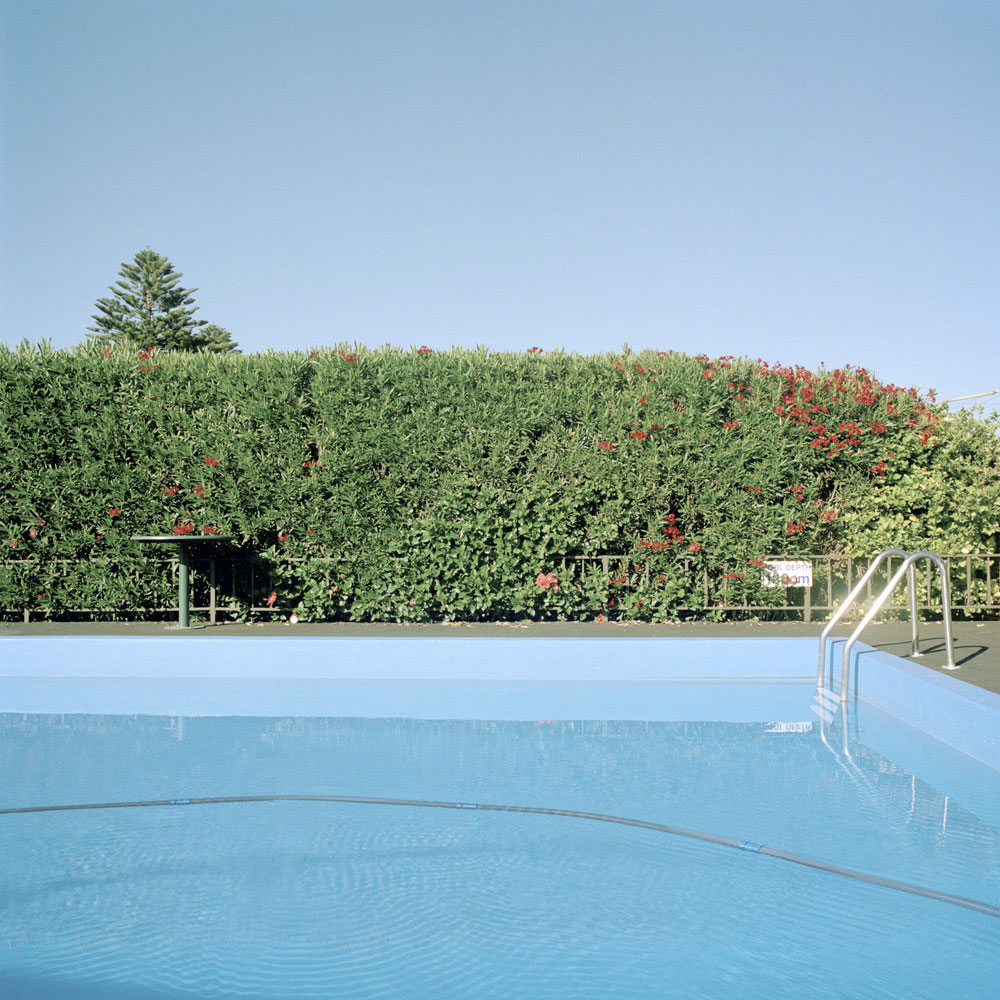
Boylan’s photographs are over saturated in the flesh while Koenning’s photographs are so pale and wane, even in the reproductions, that the print does not HOLD the image. It is one thing to capture the harsh light of rural Australia but when you are printing this light, you must have a STRUCTURE, some base upon which that light can sit in the print. These photographs fail in this regard. It says something when you look at the DL invite to the exhibition and there is the picture of the swimming pool radiant in blue, and then you look at that same photograph in the exhibition which is a pale imitation of the invite. I just wonder what happened in the printing process?
When artist’s used to print their own work in the darkroom they only had themselves to blame for poor printing. Today, photographers are reliant on their relationship with the printer at the digital photo lab, unless they are able to afford thousands of dollars to set up a printing space themselves. To find a good printer and build up a relationship with that person, a person who understands what the artist is trying to achieve in the look and feel of a body of work, takes time and patience. Unfortunately, that chemistry and magic has not happened in this exhibition.
And by the way, none of the photographs in this exhibition were printed at The Colour Factory, just to make that quite clear!
For me, these photographs are not allegories, pictures that can be interpreted to reveal a hidden meaning for what little meaning they have is far to obvious. They are taciturn photographs, reticent, silent of more interesting truths – images that have little new to say which makes me want to look at them less.
Dr Marcus Bunyan
Many thankx to The Colour Factory Gallery for allowing me to publish the photographs in the posting. Please click on the photographs for a larger version of the image.
Jessie Boylan (Australian, b. 1986) Clunes (Tree) 2013 From the series Fourteen Ounces Hahnemuhle Photo Rag 80cm x 60cm Edition 10 +2AP
Jessie Boylan (Australian, b. 1986) Hepburns Clunes Rd 2013 From the series Fourteen Ounces Hahnemuhle Photo Rag 80cm x 60cm Edition 10 +2AP
Jessie Boylan (Australian, b. 1986) Mistletoe Mine #2 2013 From the series Fourteen Ounces Hahnemuhle Photo Rag 80cm x 60cm Edition 10 +2AP
Jessie Boylan (Australian, b. 1986) Amelia Mine #1 2013 From the series Fourteen Ounces Hahnemuhle Photo Rag 80cm x 60cm Edition 10 +2AP
As far as I know…
“Places don’t just have histories – they also have a presence and possible futures” ~ Daniel Palmer
There are limits to what we can know about a place. Its history and memory, somewhat elusive, are always something slightly out of reach. Influenced by individual experience and expectation, understanding and connection to place will always be personal, and what we bring to a place determines how we see it.
Drawing from two different bodies of work, As far as I know is a story of people and place in regional and rural Australia, tracing remnants left behind by the industrial boom. Almost frozen, these traces of past hover in the land, seemingly waiting to be reused and reworked. As far as I know explores passages of time in manufactured, remembered and imaginary Australian landscapes. Contesting the division between the realm of memory and experience, the images study dynamics of landscape, and what this landscape means to us.
Press release from The Colour Factory Gallery website
Katrin Koenning (Australian born Germany, b. 1978) Camp Detail #1, Fowlers Bay 2013 From the series Loraine and the Illusion of Illoura Pigment print 80cm x 80cm Edition 5 +2AP
Katrin Koenning (Australian born Germany, b. 1978) Campsite, Coorong National Park 2013 From the series Loraine and the Illusion of Illoura Pigment print 80cm x 80cm Edition 5 +2AP
Katrin Koenning (Australian born Germany, b. 1978) Grain Silo, Loch 2013 From the series Loraine and the Illusion of Illoura Pigment print 80cm x 80cm Edition 5 +2AP
Katrin Koenning (Australian born Germany, b. 1978) 15 Port Augusta Bathers 2013 From the series Loraine and the Illusion of Illoura Pigment print 80cm x 80cm Edition 5 +2AP
Katrin Koenning (Australian born Germany, b. 1978) Boy #2, Port Augusta Jetty 2013 From the series Loraine and the Illusion of Illoura Pigment print 80cm x 80cm Edition 5 +2AP
Katrin Koenning (Australian born Germany, b. 1978) Port Victoria Main Street 2013 From the series Loraine and the Illusion of Illoura Pigment print 80cm x 80cm Edition 5 +2AP
Katrin Koenning (Australian born Germany, b. 1978) Pool #2, Whyalla Foreshore Motel 2013 From the series Loraine and the Illusion of Illoura Pigment print 80cm x 80cm Edition 5 +2AP









![Carol Jerrems (Australian, 1949-1980) 'Butterfly behind glass [Red Symons from Skyhooks]' 1975](https://artblart.com/wp-content/uploads/2013/09/butterfly_174882_web.jpg "Carol Jerrems (Australian, 1949-1980) 'Butterfly behind glass [Red Symons from Skyhooks]' 1975")

![Carol Jerrems (Australian, 1949-1980) 'Performers on stage,' Hair', Metro Theatre Kings Cross, Sydney, January 1970 [Jim Sharman Director cast included Reg Livermore]' 1970](https://artblart.com/wp-content/uploads/2013/09/jerrems_performers-on-stage-hair-web.jpg "Carol Jerrems (Australian, 1949-1980) 'Performers on stage,' Hair', Metro Theatre Kings Cross, Sydney, January 1970 [Jim Sharman Director cast included Reg Livermore]' 1970")








![The Tam Projects (Tess Hamilton, Adriana Bernado, Melissa Acker) 'Colour box' 2013 (installation view) from the exhibition 'Globelight '13 [New Light Art + Design]' at Anita Traverso Gallery, Richmond, Melbourne, July - August, 2013](https://artblart.com/wp-content/uploads/2013/08/spots-web.jpg "The Tam Projects (Tess Hamilton, Adriana Bernado, Melissa Acker) 'Colour box' 2013 (installation view) from the exhibition 'Globelight '13 [New Light Art + Design]' at Anita Traverso Gallery, Richmond, Melbourne, July - August, 2013")
![Kent Gration (Australian) 'Leviathan 1 + 2' 2013 (installation view) from the exhibition 'Globelight '13 [New Light Art + Design]' at Anita Traverso Gallery, Richmond, Melbourne, July - August, 2013](https://artblart.com/wp-content/uploads/2013/08/hangers-a-web.jpg "Kent Gration (Australian) 'Leviathan 1 + 2' 2013 (installation view) from the exhibition 'Globelight '13 [New Light Art + Design]' at Anita Traverso Gallery, Richmond, Melbourne, July - August, 2013")




 Art Blart _ art and cultural memory archive
You must be logged in to post a comment.