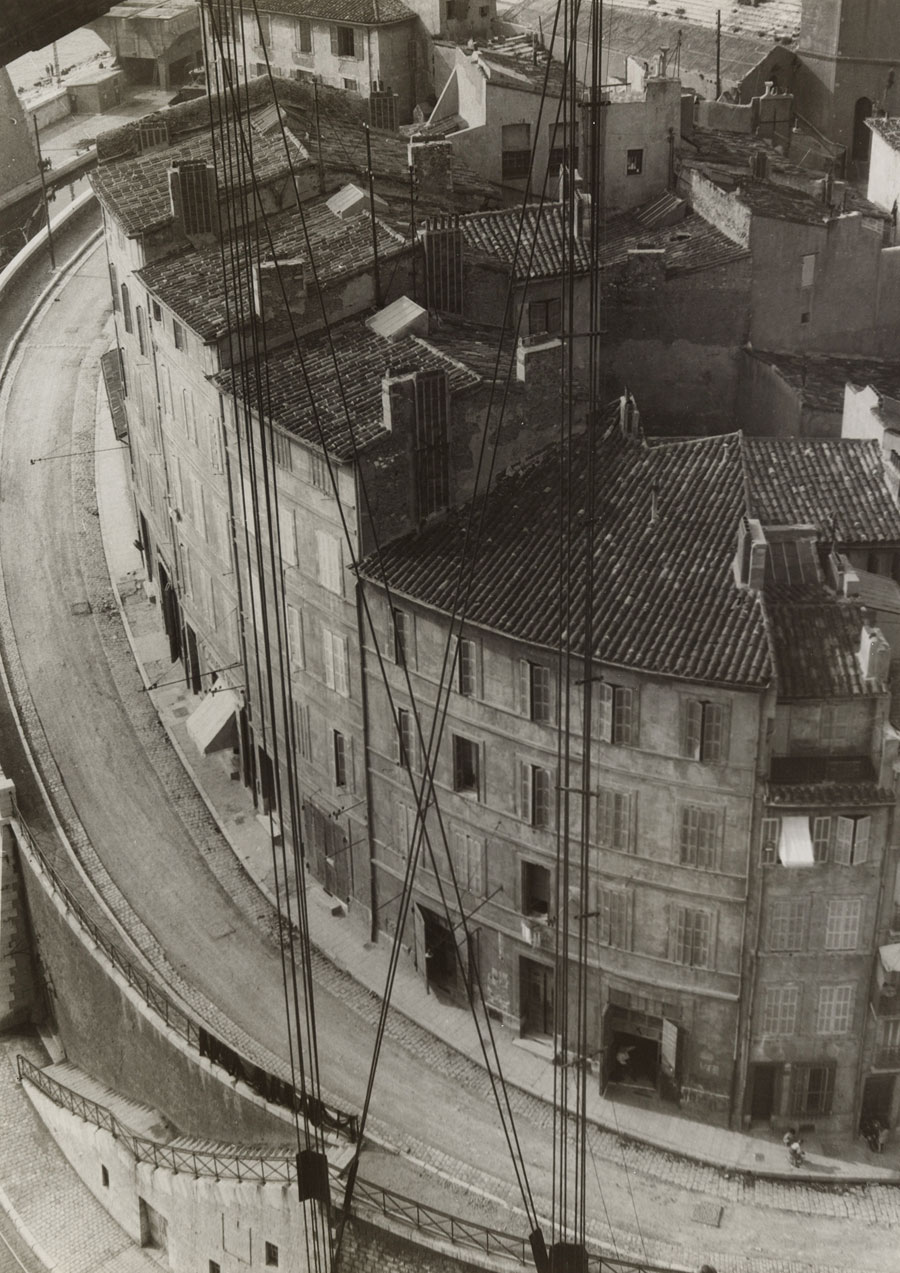
Exhibition: ‘Typologien: Photography in 20th-century Germany’ at Fondazione Prada, Milan

Exhibition dates: 3rd April – 14th July, 2025

Curator: Susanne Pfeffer


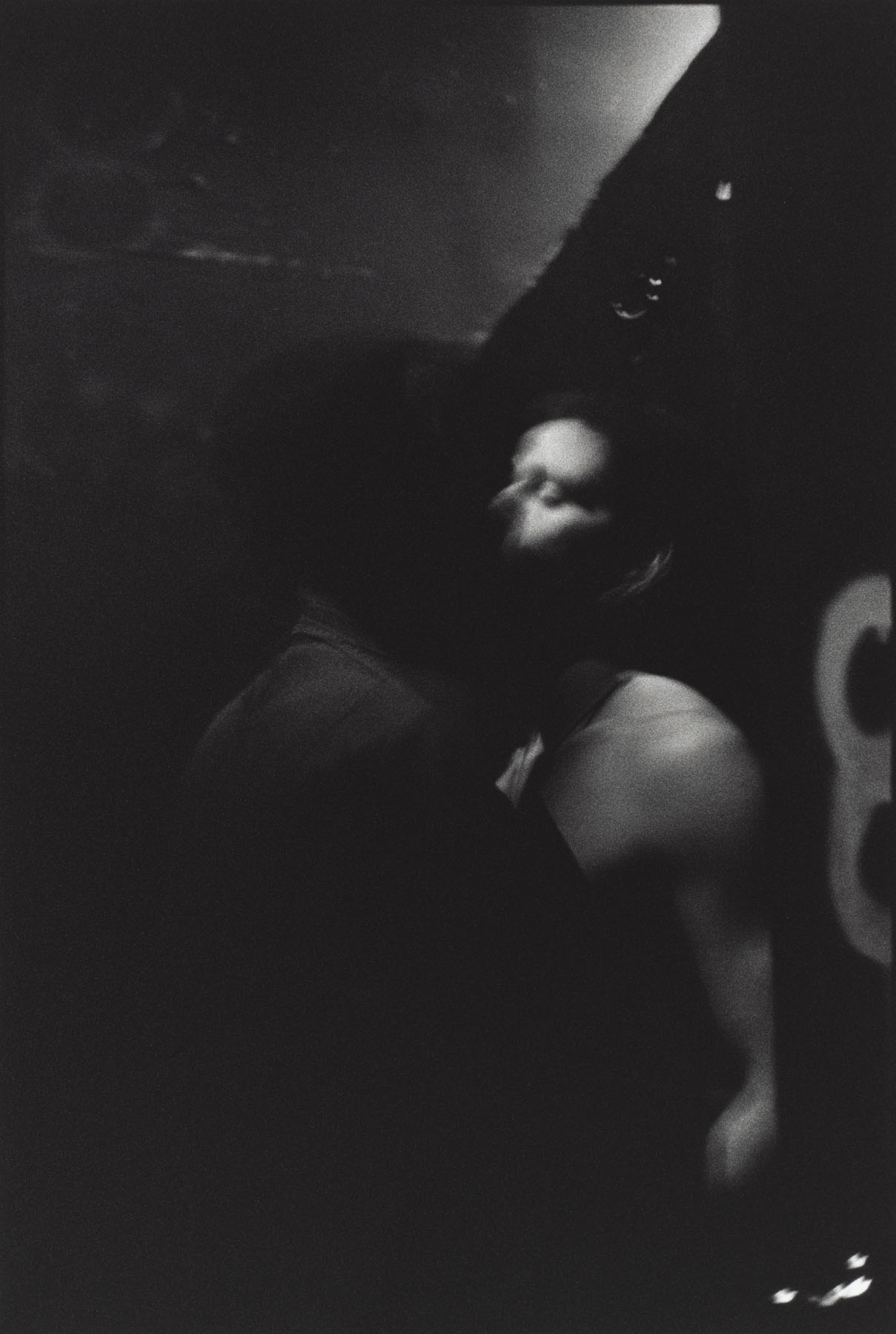
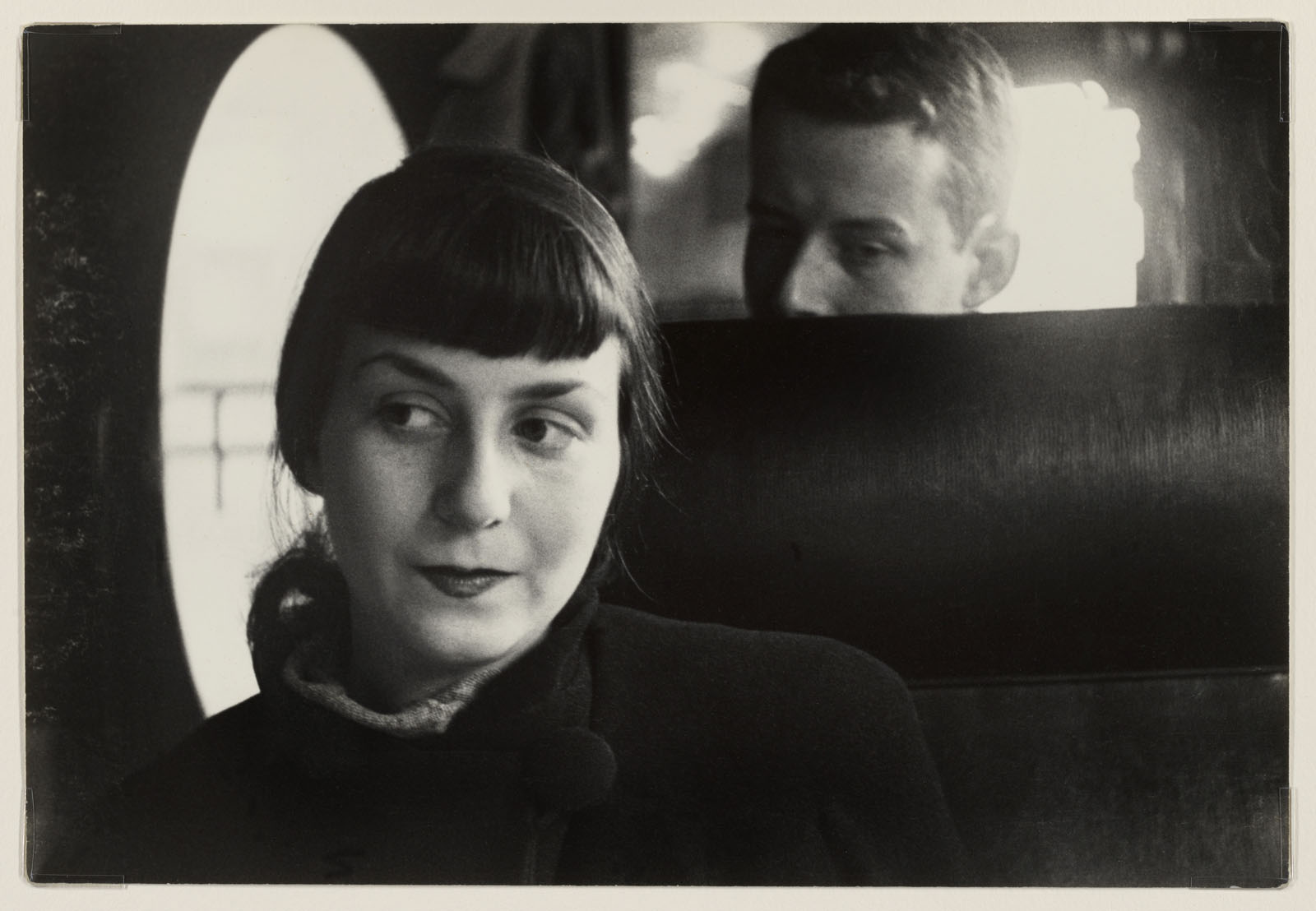
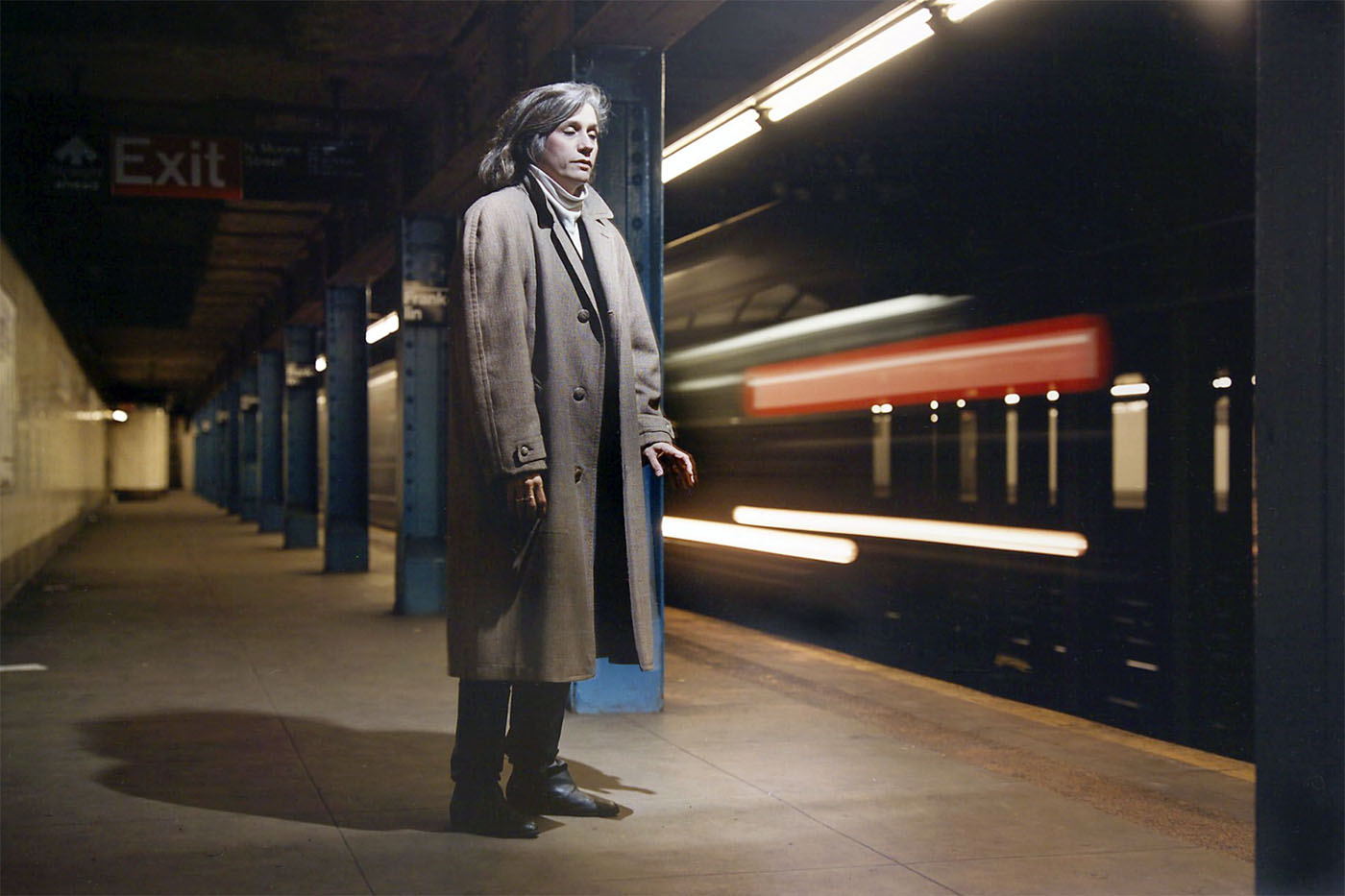
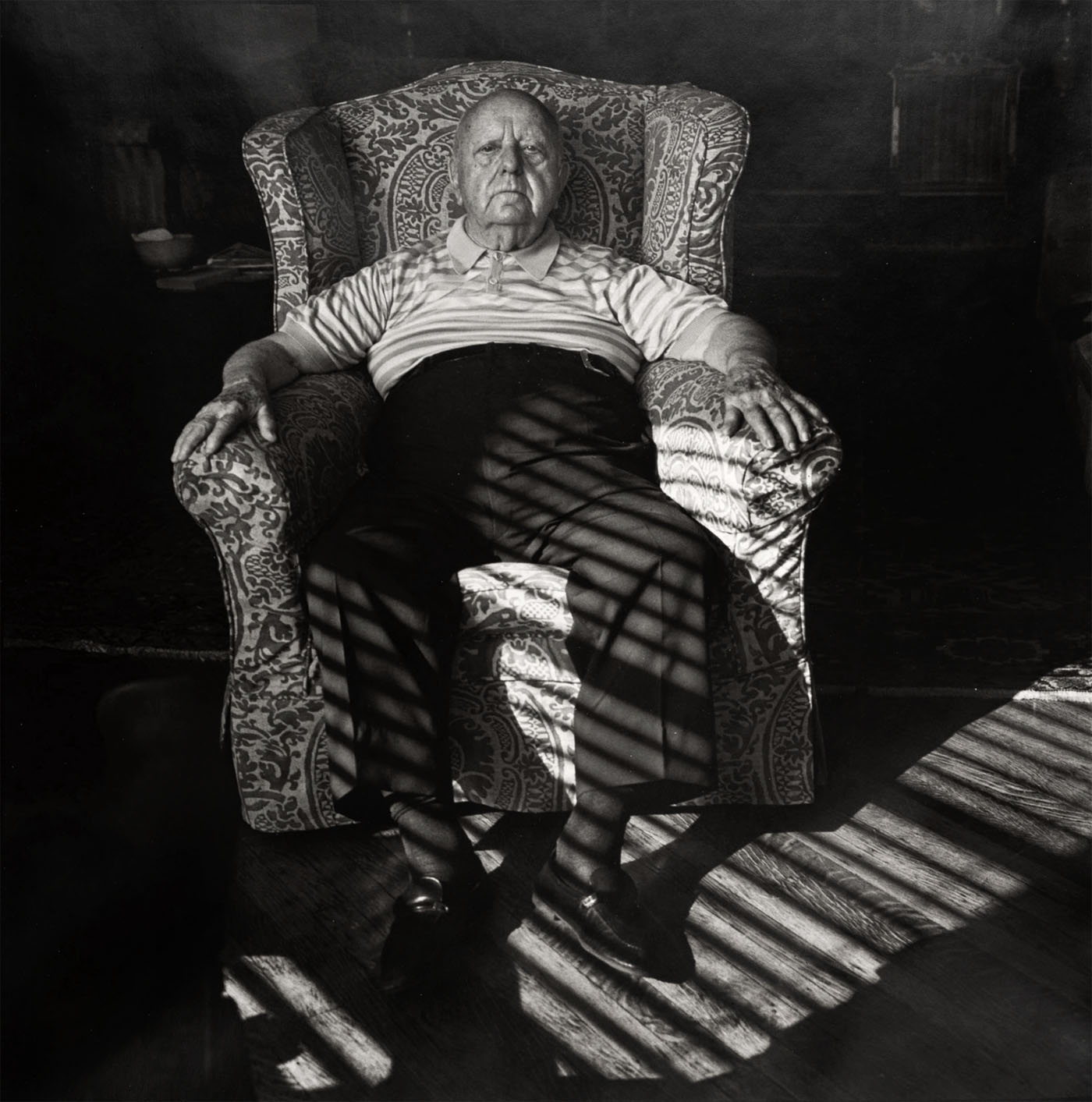
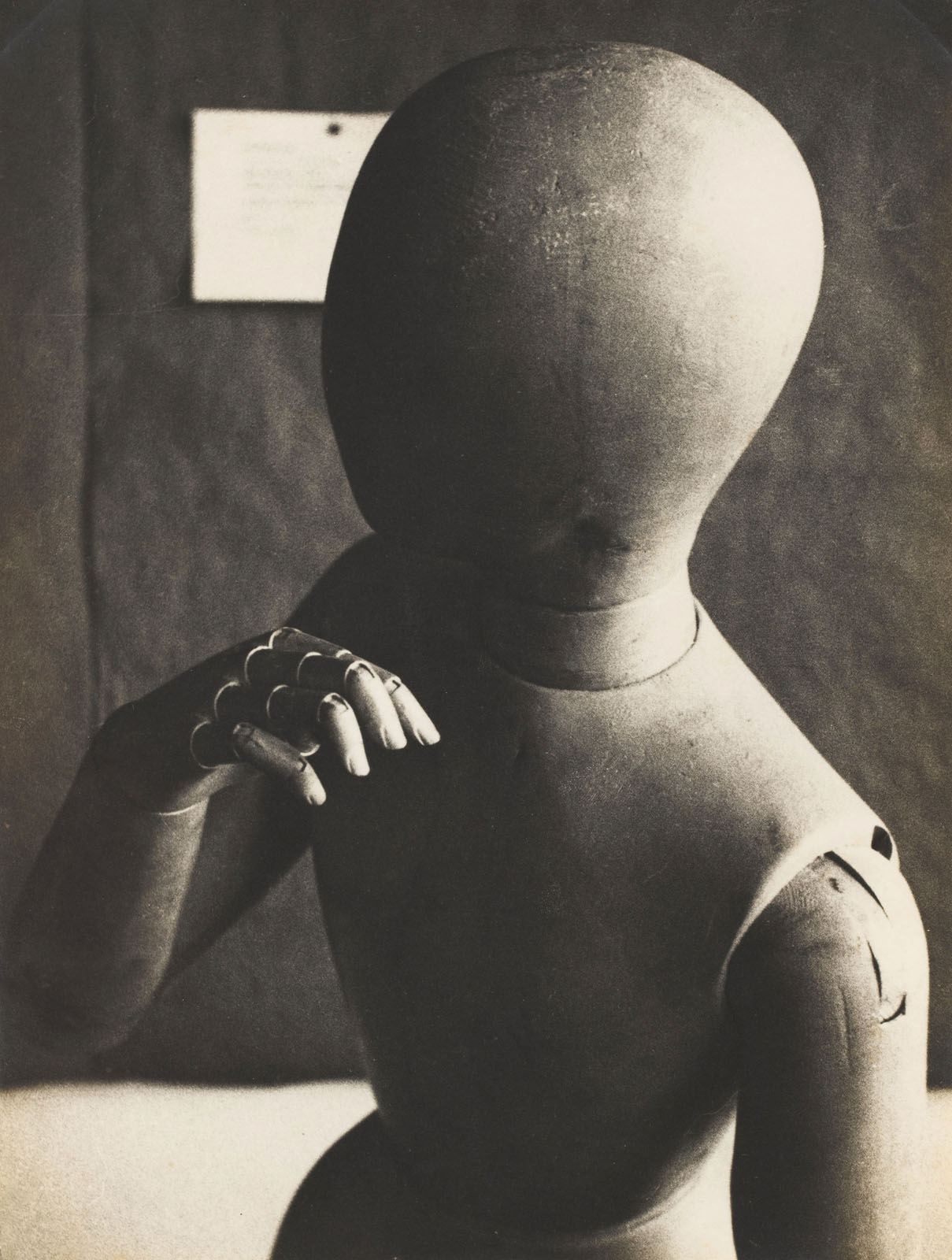
Heinrich Riebesehl (German, 1938-2010) 'Menschen Im Fahrstuhl, 20.11.1969' [People in the Elevator, 20.11.1969] 1969 from the exhibition 'Typologien: Photography in 20th-century Germany' at Fondazione Prada, Milan, April - July, 2025


Heinrich Riebesehl (German, 1938-2010)
Menschen Im Fahrstuhl, 20.11.1969 [People in the Elevator, 20.11.1969]
1969
Gelatin silver print, printed 2007
Kicken Berlin
© Heinrich Riebesehl, by SIAE 2025


Once more, with feeling

“Typology remains a highly challenging and complex notion. It operates in a paradoxical regime: on the one hand, this approach can lead to a systematic recording of people and objects based on extreme objectivity; on the other hand, typology corresponds to an individual and arbitrary choice, revealing itself as a disturbing and potentially subversive act.” (Press release)

Objective / subjective
Pattern / randomness
Isolation / extinction
Morphology / mutation
Specific / anonymous
Repetition / difference
Same / other
Structure / creativity
Orientation / disorientation
Universal / individual
Reality / imagination
Documentation / disruption
Omnipresent / unique
Exact / imprecise
Composed / emotional
Staged / snapshot
Concept / feeling
Formal / intuitive
Ritual / subversion
Collaboration / resistance

Et cetera, et cetera…

Inherent in one is the other.

Every photo within a Becher grid contains its own difference.

Dr Marcus Bunyan


Many thankx to the Fondazione Prada for allowing me to publish the photographs in the posting. Please click on the photographs for a larger version of the image.


Let’s not beat around the bush. Despite protestations to the contrary (appeals to the objectivity of the image, eschewing entirely the aspects of beauty, emotion and opinion; the rigorous frontality of the individual images giving them the simplicity of diagrams, while their density of detail offers encyclopaedic richness) these are subjective images for all their objective desire. The paradox is the more a photographer strives for objectivity, the more ego drops away, the more the work becomes their own: subjective, beautiful, emotive.


Marcus Bunyan commenting on the exhibition Bernd and Hilla Becher: Mines and Mills – Industrial Landscapes at Fotomuseum Winterthur, Zurich, February, 2012


“What happens in the case of mutation? Consider the example of the genetic code. Mutation normally occurs when some random event (for example, a burst of radiation or a coding error) disrupts an existing pattern and something else is put in its place instead. Although mutation disrupts pattern, it also presupposes a morphological standard against which it can be measured and understood as mutation. We have seen that in electronic textuality, the possibility for mutation within the text are enhanced and heightened by long coding chains. We can now understand mutation in more fundamental terms. Mutation is critical because it names the bifurcation point at which the interplay between pattern and randomness causes the system to evolve in a new direction. It reveals the productive potential of randomness that is also recognized within information theory when uncertainty is seen as both antagonistic and intrinsic to information.

We are now in a position to understand mutation as a decisive event in the psycholinguistics of information. Mutation is the catastrophe in the pattern / randomness dialectic analogous to castration in the presence / absence dialectic. It marks a rupture of pattern so extreme that the expectation of continuous replication can in longer be sustained. But as with castration, this only appears to be a disruption located at a specific moment. The randomness to which mutation testifies is implicit in the very idea of pattern, for only against the background of nonpattern can pattern emerge. Randomness is the contrasting term that allows pattern to be understood as such.”


Hayles, Katherine. How We Became Posthuman: Virtual Bodies in Cybernetics, Literature, and Informatics. Chicago: University of Chicago Press, 1999, pp. 30-33


Heinrich Riebesehl (German, 1938-2010) 'Menschen Im Fahrstuhl, 20.11.1969' [People in the Elevator, 20.11.1969] 1969


Heinrich Riebesehl (German, 1938-2010)
Menschen Im Fahrstuhl, 20.11.1969 [People in the Elevator, 20.11.1969]
1969
Gelatin silver print, printed 2007
Kicken Berlin
© Heinrich Riebesehl, by SIAE 2025


In the series Menschen Im Fahrstuhl, 20.11.1969 (People in the elevator, 20.11.1969) shot in 1969, Heinrich Riebesehl conceptualised his interest in the photographic portrait. The portraits of the workers of the Hannoversche Presse (a daily newspaper in Hanover) – taken inside an elevator with a remotely operated small-format camera – are dated and numbered in sequential order: Riebesehl dispensed with a title or a more detailed description of the subjects portrayed. By omitting distinctive elements from the images, such as the profession or age of the subjects, he made the situation the key factor in the shots. In fact, the images are studies of the behaviors of people in that particular space, their body languages and gazes. Riebesehl knew that environment very well, because he had worked for a long time as a photojournalist, before turning to conceptual art photography.

Exhibition text from the Fondazione Prada by Cord Riechelmann
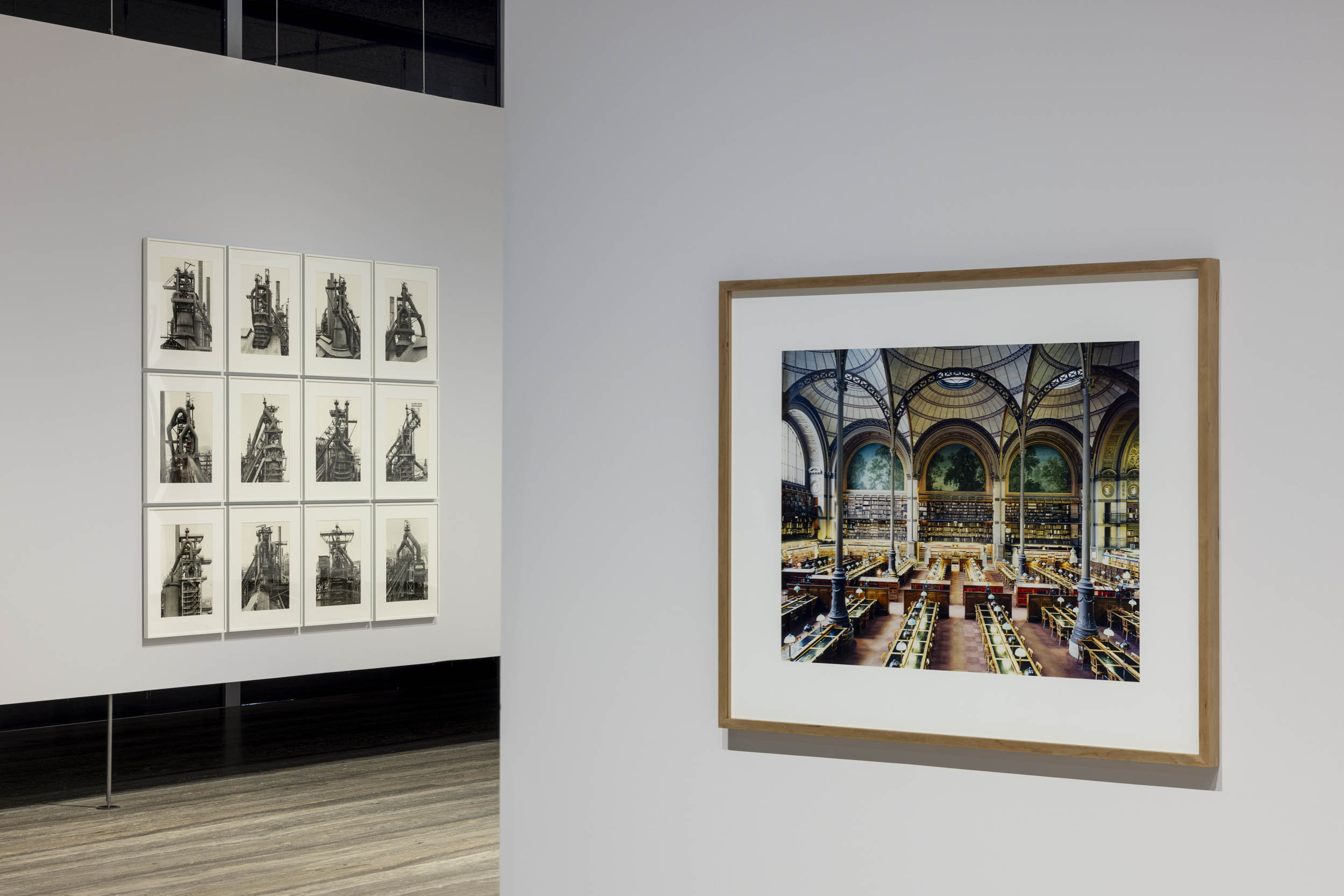
 

Installation view of the exhibition 'Typologien: Photography in 20th-century Germany' at Fondazione Prada, Milan showing at left Bernd and Hiller Becher's 'Hochöfen' (Blast furnaces) 1970-1989; and at right, Candida Höfer's 'Bibliotheque Nationale de France XXIII' 1997


Installation view of the exhibition Typologien: Photography in 20th-century Germany at Fondazione Prada, Milan showing at left Bernd and Hiller Becher’s Hochöfen (Blast furnaces) 1970-1989; and at right, Candida Höfer’s Bibliotheque Nationale de France XXIII 1997
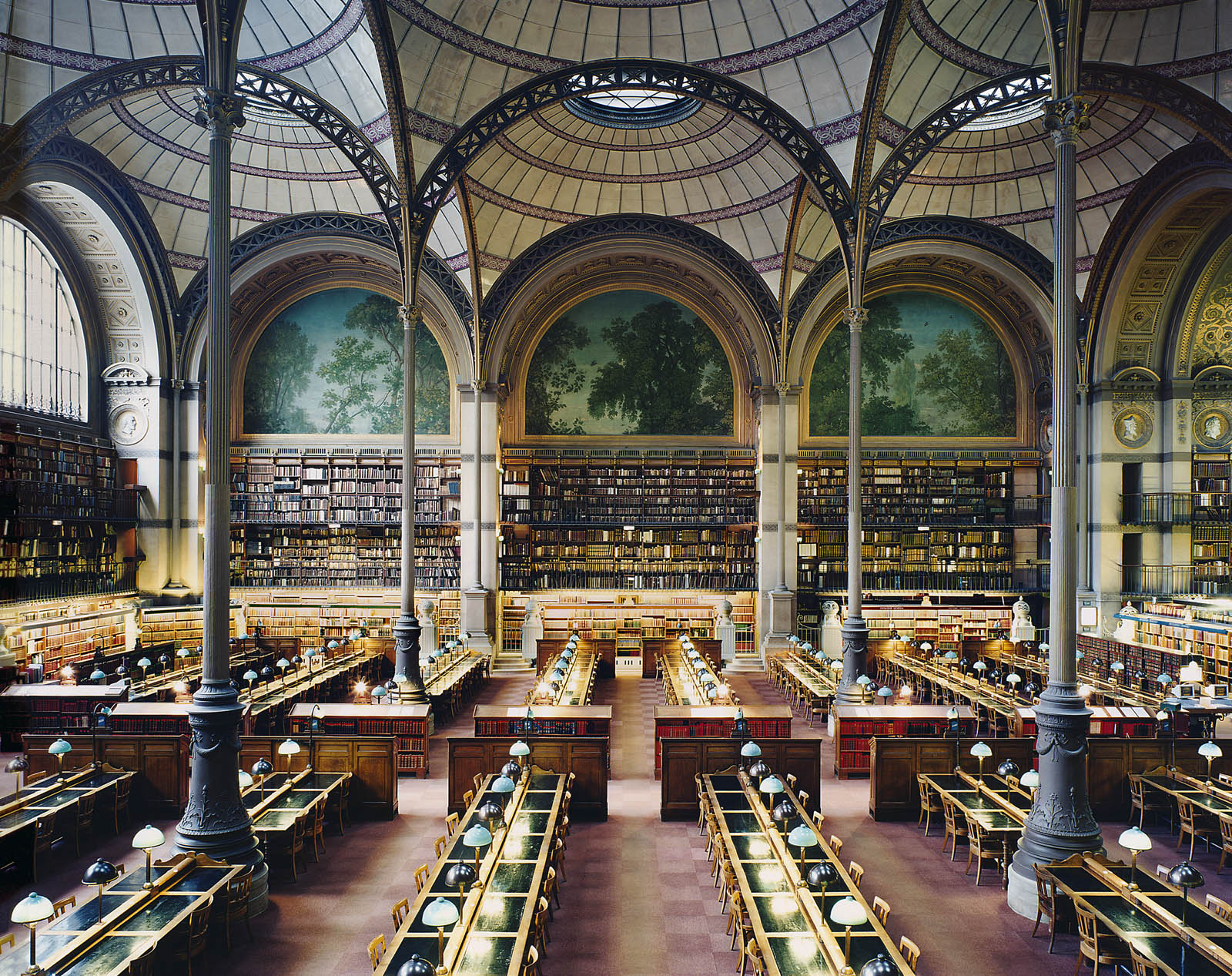
 

Candida Höfer (German, b. 1944) 'Bibliotheque Nationale de France XXIII' 1997 from the exhibition 'Typologien: Photography in 20th-century Germany' at Fondazione Prada, Milan, April - July, 2025


Candida Höfer (German, b. 1944)
Bibliotheque Nationale de France XXIII
1997
Inkjet print
© Candida Höfer, Cologne


In the photographs of libraries in London, Paris, and New York, which at first glance appear to be technically scientific records, Candida Höfer manages to capture something that is not visible: ingenuity. The libraries’ rooms have high ceilings, and the rows of seats are neatly arranged. In their impressiveness, they reflect the architecture of the 19th-century conception of knowledge and science, typical of the dominant nations of the time because of their commercial and colonial power. The objective nature of the deserted spaces, precisely in how they seem to be neutral to the individual needs of the students, suggests something in the image that could hardly be less objective: the possibility for intellectual exchange that these spaces promise and deliver in Höfer’s photographs.

Exhibition text from the Fondazione Prada by Cord Riechelmann


Candida Höfer (German, b. 1944) 'Zoologischer Garten Washington DC IV' 1992


Candida Höfer (German, b. 1944)
Zoologischer Garten Washington DC IV
1992
Inkjet print
© Candida Höfer, by SIAE 2025/VG BildKunst, Bonn 2025


In Candida Höfer’s photographs shot in zoos, the animals document a specific form of loneliness in modern times. In these images, the lines of development of two disciplines collide. Not only in the photographs, but also in reality, they function independently of each other: modern architecture and behavioural research. Modern architecture has become established in zoological gardens but has never considered the animal and its needs. Based on the knowledge gained from behavioural research, by choosing to portray iconic large mammals such as giraffes, lions, and polar bears, Höfer has represented the dilemma of a world in which entire species are threatened with extinction and in which zoos see themselves as a kind of ‘Noah’s Ark.’

Exhibition text from the Fondazione Prada by Cord Riechelmann
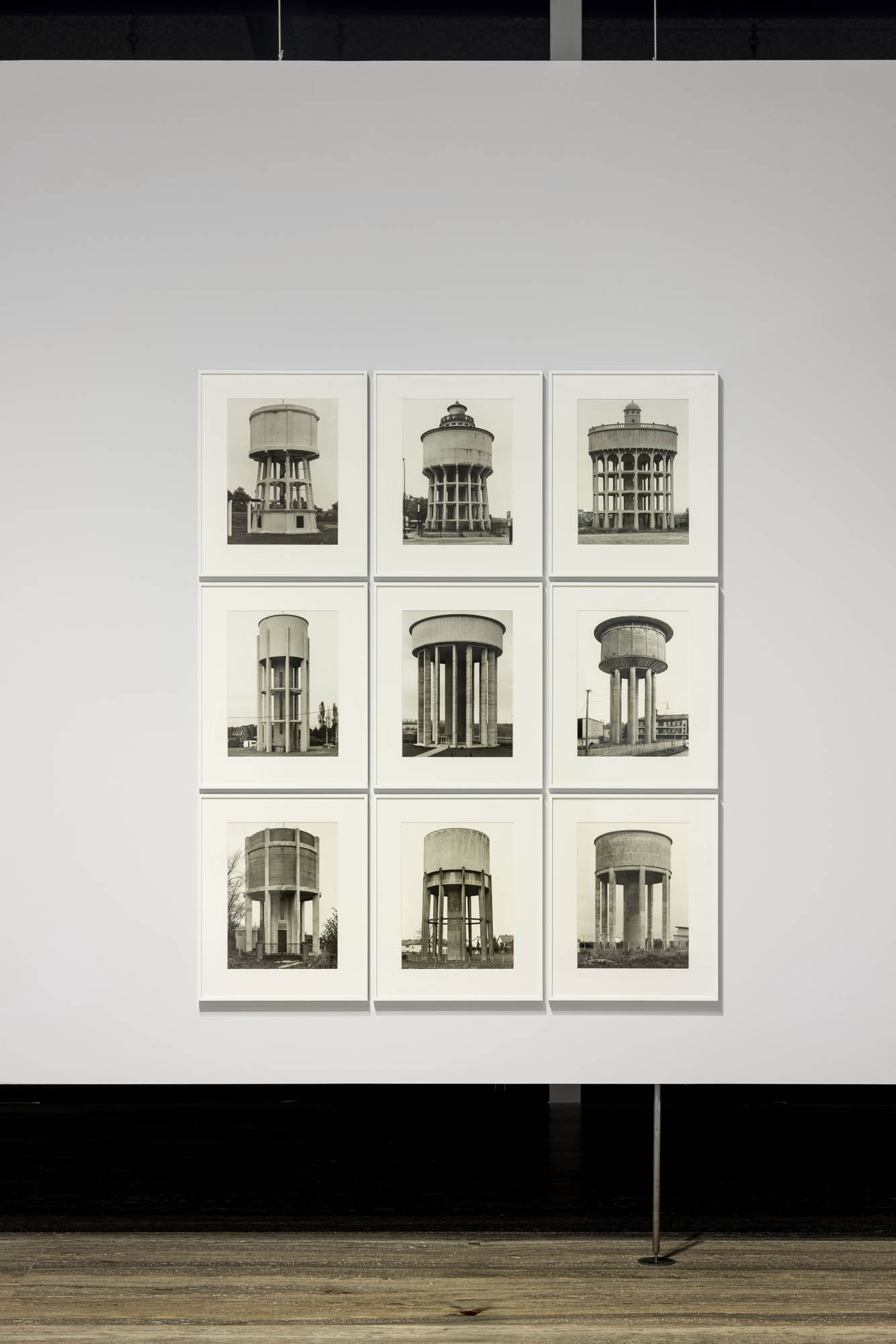
 

Installation view of the exhibition 'Typologien: Photography in 20th-century Germany' at Fondazione Prada, Milan showing Bernd and Hilla Becher's 'Wassertürme (Water towers)' 1966-1986


Installation view of the exhibition Typologien: Photography in 20th-century Germany at Fondazione Prada, Milan showing Bernd and Hilla Becher’s Wassertürme (Water towers) 1966-1986


Bernd and Hilla Becher (German) Bernd Becher (German, 1931-2007) Hilla Becher (German, 1934-2015) 'Wassertürme (Water towers)' 1966-1986 from the exhibition 'Typologien: Photography in 20th-century Germany' at Fondazione Prada, Milan, April - July, 2025


Bernd and Hilla Becher (German)
Bernd Becher (German, 1931-2007)
Hilla Becher (German, 1934-2015)
Wassertürme (Water towers)
1966-1986
Leeds, GB, 1966
Hasselt, B, 1985
Newton le Willows, GB, 1966
Beaufays/Liège, B, 1979
Kwaadmechelen, B, 1971
Padova, I, 1986
Outreau/Boulogne, F, 1973
Primasens, Saarland, D, 1980
Mesnil-Val, F, 1972
9 gelatin silver prints
© Estate Bernd & Hilla Becher, represented by Max Becher, courtesy of Die Photographische Sammlung/SK Stiftung Kultur – Bernd & Hilla Becher Archive, Cologne, 2025


Installation view of the exhibition 'Typologien: Photography in 20th-century Germany' at Fondazione Prada, Milan showing the work of Thomas Struth


Installation view of the exhibition Typologien: Photography in 20th-century Germany at Fondazione Prada, Milan showing the work of Thomas Struth
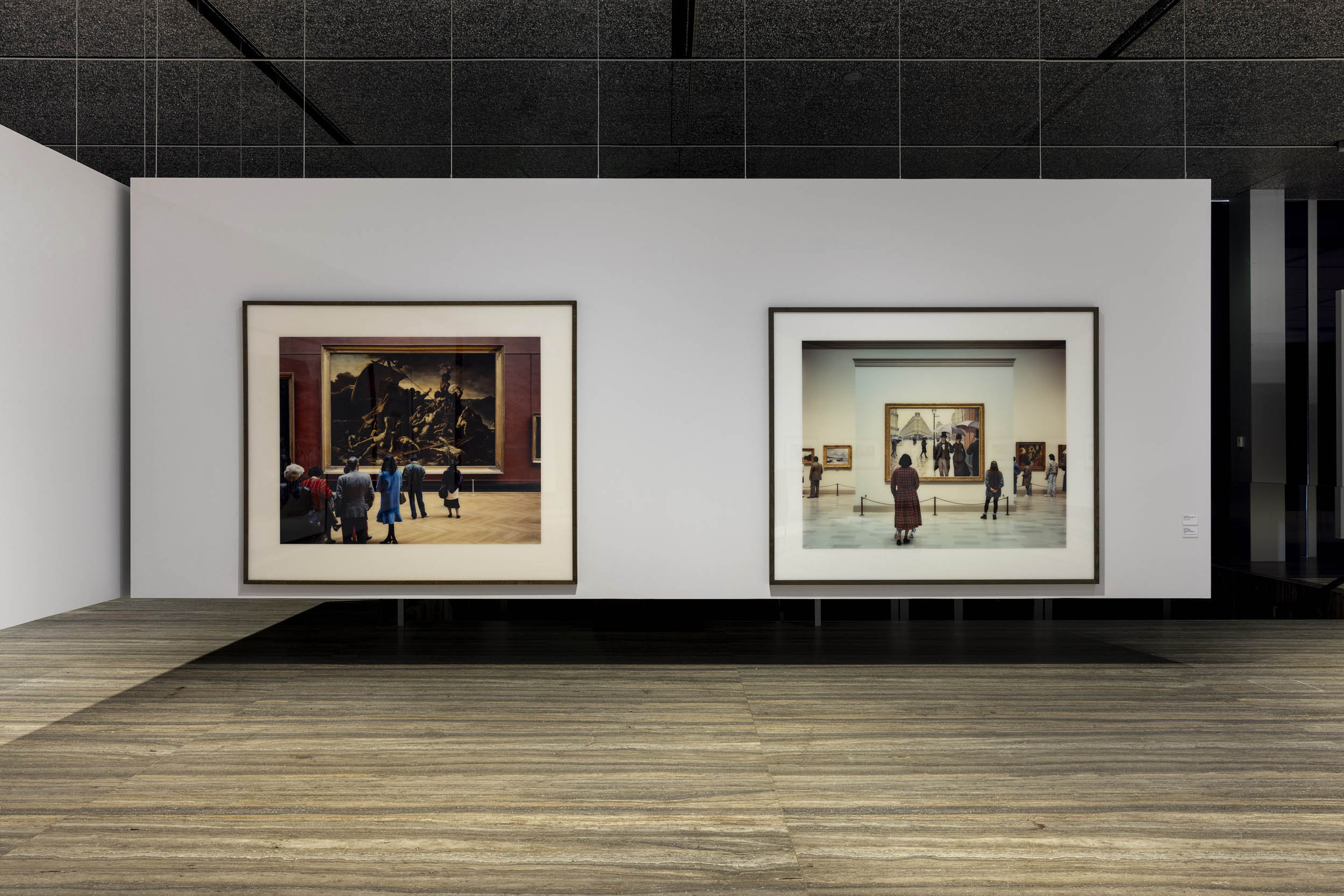
 

Installation view of the exhibition 'Typologien: Photography in 20th-century Germany' at Fondazione Prada, Milan showing the work of Thomas Struth with at left, 'Musée du Louvre IV' Paris, 1989


Installation view of the exhibition Typologien: Photography in 20th-century Germany at Fondazione Prada, Milan showing the work of Thomas Struth with at left, Musée du Louvre IV Paris, 1989
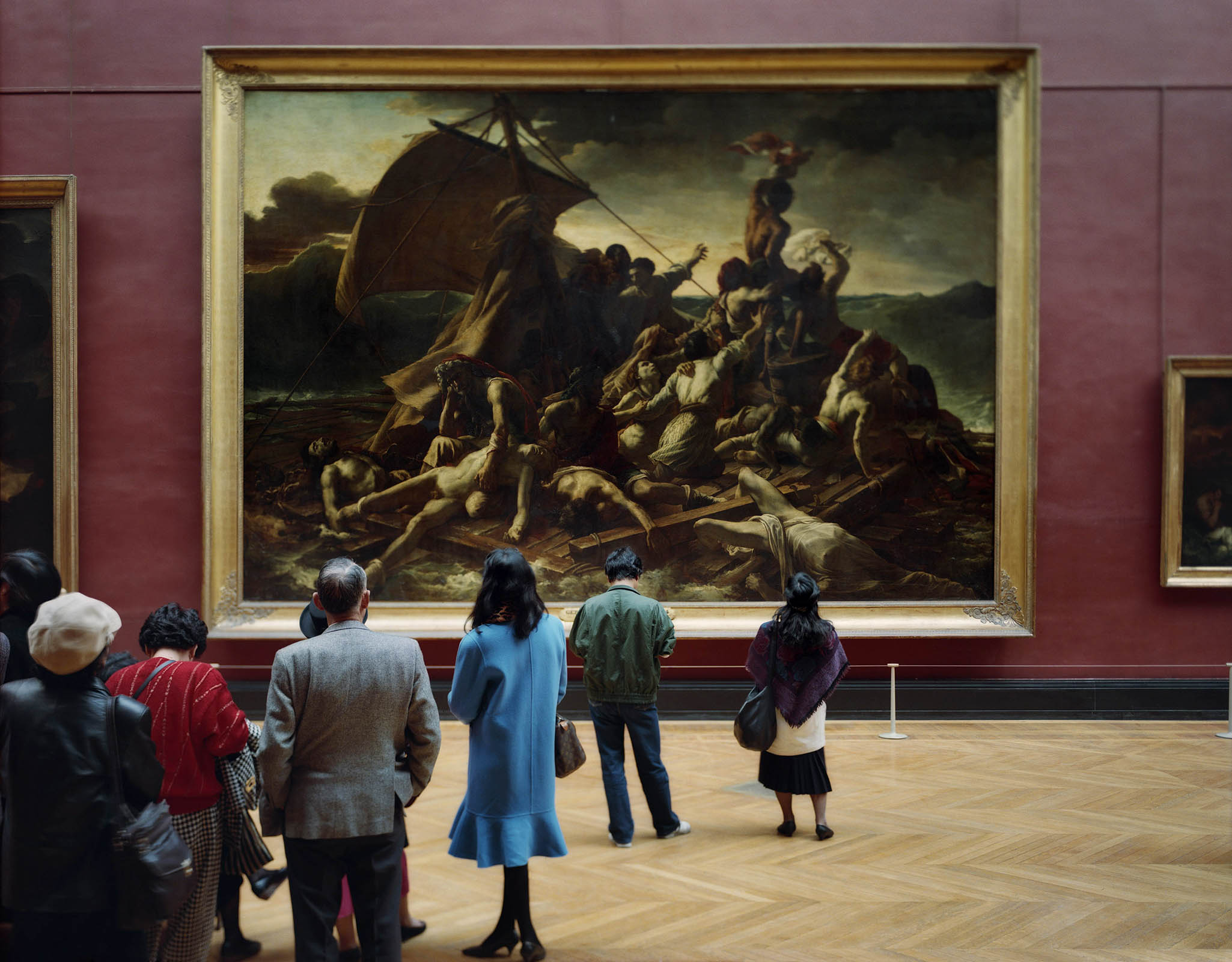
 

Thomas Struth (German, b. 1954) 'Musée du Louvre IV' Paris, 1989


Thomas Struth (German, b. 1954)
Musée du Louvre IV
Paris, 1989
Colour photograph on C-print
© Thomas Struth / Courtesy ZKM | Center for Art and Media Karlsruhe, Karlsruhe


In his practice, Thomas Struth demonstrates meticulous attention to the architectural environment, as well as to people and objects. In his large-format colour series Museum Photographs (1989-1992), Struth captures anonymous individuals and crowds gazing at artworks in museums. A significant example is Louvre 4, Paris 1989, in which the artist photographs from behind a group of viewers standing in front of Théodore Géricault’s The Raft of the Medusa (1819). Often made with a large-format camera, his images reflect what Struth calls “exact vision”: the framing must not conceal anything or suggest secret content, thus resulting in an enigmatic outcome.

Exhibition text from the Fondazione Prada by Cord Riechelmann


Installation view of the exhibition 'Typologien: Photography in 20th-century Germany' at Fondazione Prada, Milan showing Andreas Gursky's 'Paris, Montparnasse' 1993


Installation view of the exhibition Typologien: Photography in 20th-century Germany at Fondazione Prada, Milan showing Andreas Gursky’s Paris, Montparnasse 1993


Andreas Gursky’s large-format work, Paris, Montparnasse (1993) has become an iconic example of his work. It depicts the Maine-Montparnasse II block of flats, located on Rue Commandant-Mouchotte in Paris and built between 1959 and 1964 on a design by French architect Jean Dubuisson. This is one of the first images that Gursky created using digital post-production. In real life, the building does not look the way it appears in the image: using a digital editing process, Gursky transformed the façade into a game of differences and repetitions by processing the windows. In fact, by reiterating forms that are always identical, he produced a seemingly infinite number of them, with colour variations that are activated by a calculated dynamic.

Exhibition text from the Fondazione Prada by Cord Riechelmann
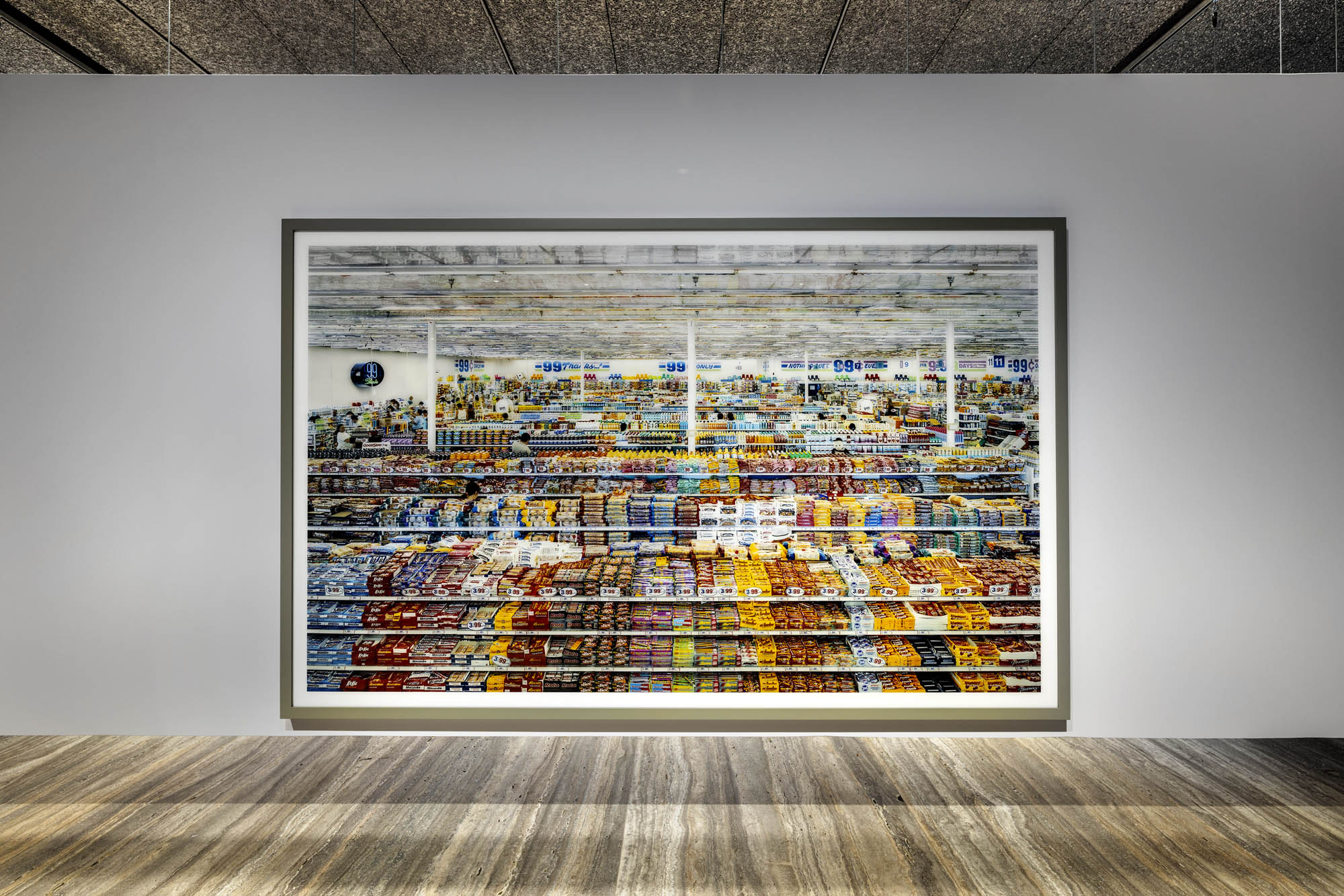
 

Installation view of the exhibition 'Typologien: Photography in 20th-century Germany' at Fondazione Prada, Milan showing Andreas Gursky's '99 Cent' 1999


Installation view of the exhibition Typologien: Photography in 20th-century Germany at Fondazione Prada, Milan showing Andreas Gursky’s 99 Cent 1999


In 99 Cent (1999), Andreas Gursky photographed supermarket shelves using the same formal scheme used in Paris, Montparnasse (1993). The shelves crammed with everyday products such as detergents represent the inexhaustible flow of goods in the global system of production and distribution. Gursky’s work conveys a feeling of disorientation generated by the excessive stimuli and details typical of a shelf in a hypermarket.

Exhibition text from the Fondazione Prada by Cord Riechelmann
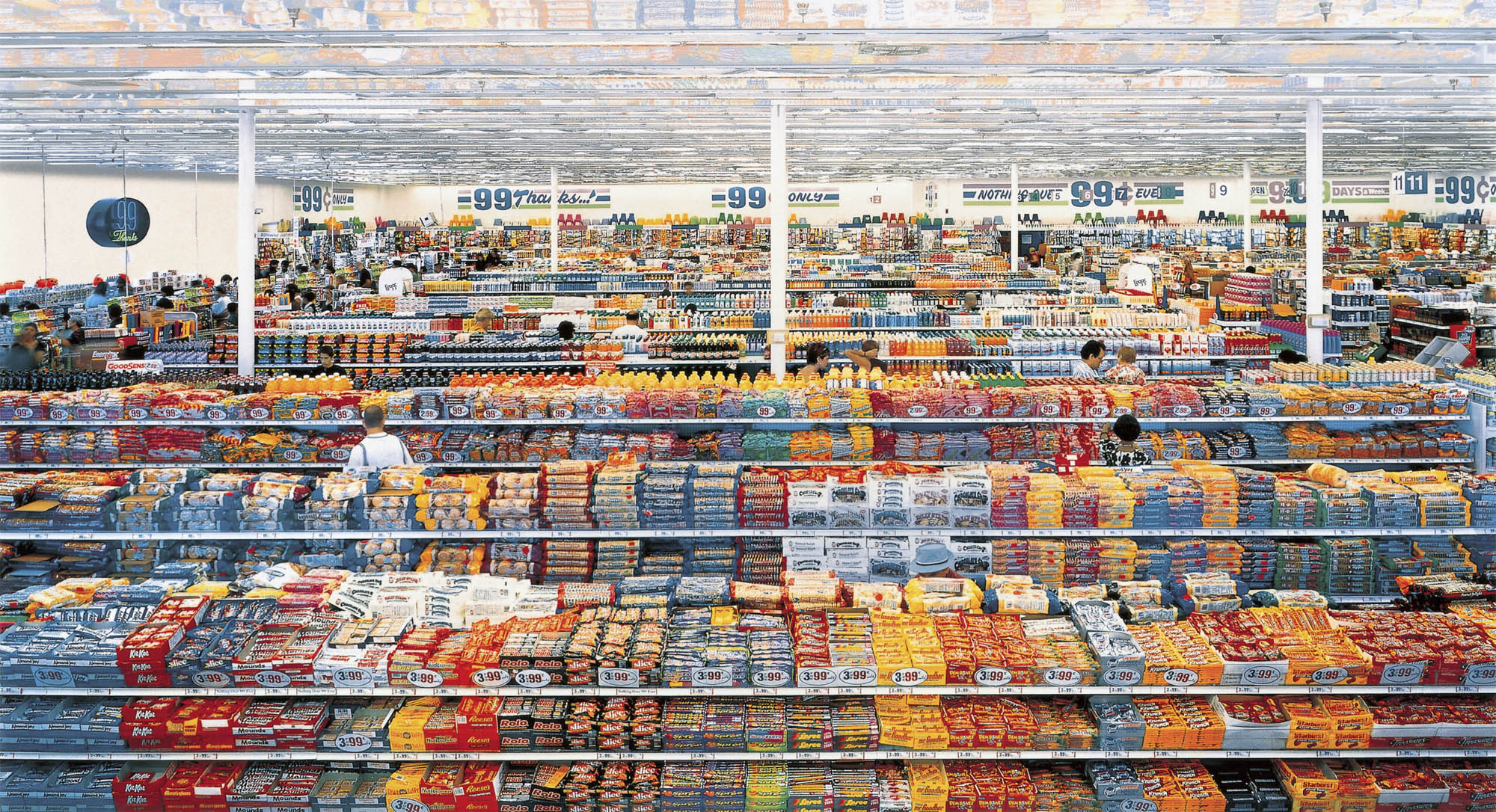
 

Andreas Gursky (German, b. 1955) '99 Cent' 1999


Andreas Gursky (German, b. 1955)
99 Cent
1999 (remastered 2009)
Inkjet print


“Typologien” is an extensive study dedicated to 20th-century German photography. The exhibition, hosted within Podium, the central building of the Milan headquarters, is curated by Susanne Pfeffer, art historian and director of the MUSEUM MMK FÜR MODERNE KUNST, Frankfurt. 

The project attempts to apply the principle of “typology,” which originated in 17th- and 18th-century botany to categorise and study plants, and appeared in photography in the early 1900s, affirming itself in Germany throughout the 20th century. Paradoxically, the given formal principle allows for unexpected convergences of German artists spanning different generations and the manifestation of their individual approaches. 

The exhibition path will follow a typological rather than a chronological order, bringing together more than 600 photographic works by 25 established and lesser-known artists essential for recounting a century of German photography, including Bernd and Hilla Becher, Sibylle Bergemann, Karl Blossfeldt, Ursula Böhmer, Christian Borchert, Margit Emmrich, Hans-Peter Feldmann, Isa Genzken, Andreas Gursky, Candida Höfer, Lotte Jacobi, Jochen Lempert, Simone Nieweg, Sigmar Polke, Gerhard Richter, Heinrich Riebesehl, Thomas Ruff, August Sander, Ursula Schulz-Dornburg, Thomas Struth, Wolfgang Tillmans, Rosemarie Trockel, Umbo (Otto Umbehr), and Marianne Wex. A system of suspended walls will create geometric partitions in the exhibition space, forming unexpected connections between artistic practices that differ from each other, but are united by a common principle or intention of classification.

As stated by Susanne Pfeffer, “Only through juxtaposition and direct comparison is it possible to find out what is individual and what is universal, what is normative or real. Differences are evidence of the abundance of nature and the imagination of humans: the fern, the cow, the human being, the ear; the bus stop, the water tower, the stereo system, the museum. The typological comparison allows differences and similarities to emerge and the specifics to be grasped. Unknown or previously unperceived things about nature, the animal, or the object, about place and time become visible and recognisable.”

In photography, employing typologies means affirming an equivalence between images and the absence of hierarchies in terms of represented subjects, motifs, genres, and sources. Despite this, typology remains a highly challenging and complex notion. It operates in a paradoxical regime: on the one hand, this approach can lead to a systematic recording of people and objects based on extreme objectivity; on the other hand, typology corresponds to an individual and arbitrary choice, revealing itself as a disturbing and potentially subversive act.

The hypothesis that photography plays a key role not only in fixing distinctive phenomena but also in organising and classifying a plurality of visible manifestations remains a vital force in today’s artistic efforts to navigate the complexity of our social and cultural realities. With the spread of digital imagery and practices, the concept of typology continues to be questioned and re-defined by contemporary photographers and artists. 

As underlined by Susanne Pfeffer, “The unique, the individual, seems to have been absorbed into a global mass, the universality of things is omnipresent. The Internet allows typologies to be created in a matter of seconds. And yet this is precisely when it seems important – to artists – to take a closer look.” As further explained by Pfeffer, “When the present seems to have abandoned the future, we need to observe the past more closely. When everything seems to be shouting at you and becoming increasingly brutal, it is important to take a quiet pause and use the silence to see and think clearly. When differences are not seen as something other, but turned into something that divides us, it is crucial to notice what we have in common. Typologies allow us to identify remarkable similarities and subtle differences.”

Text from the Fondazione Prada website


Typologien | Fondazione Prada Milano

An extensive study dedicated to 20th-century German photography. “Typologien” attempts to apply the principle of “typology,” which originated in 17th- and 18th-century botany to categorise and study plants, and appeared in photography in the early 1900s, affirming itself in Germany throughout the 20th century.

The exhibition, hosted within Podium, the central building of the Milan headquarters, is curated by Susanne Pfeffer, art historian and director of the MUSEUM MMK FÜR MODERNE KUNST, Frankfurt.
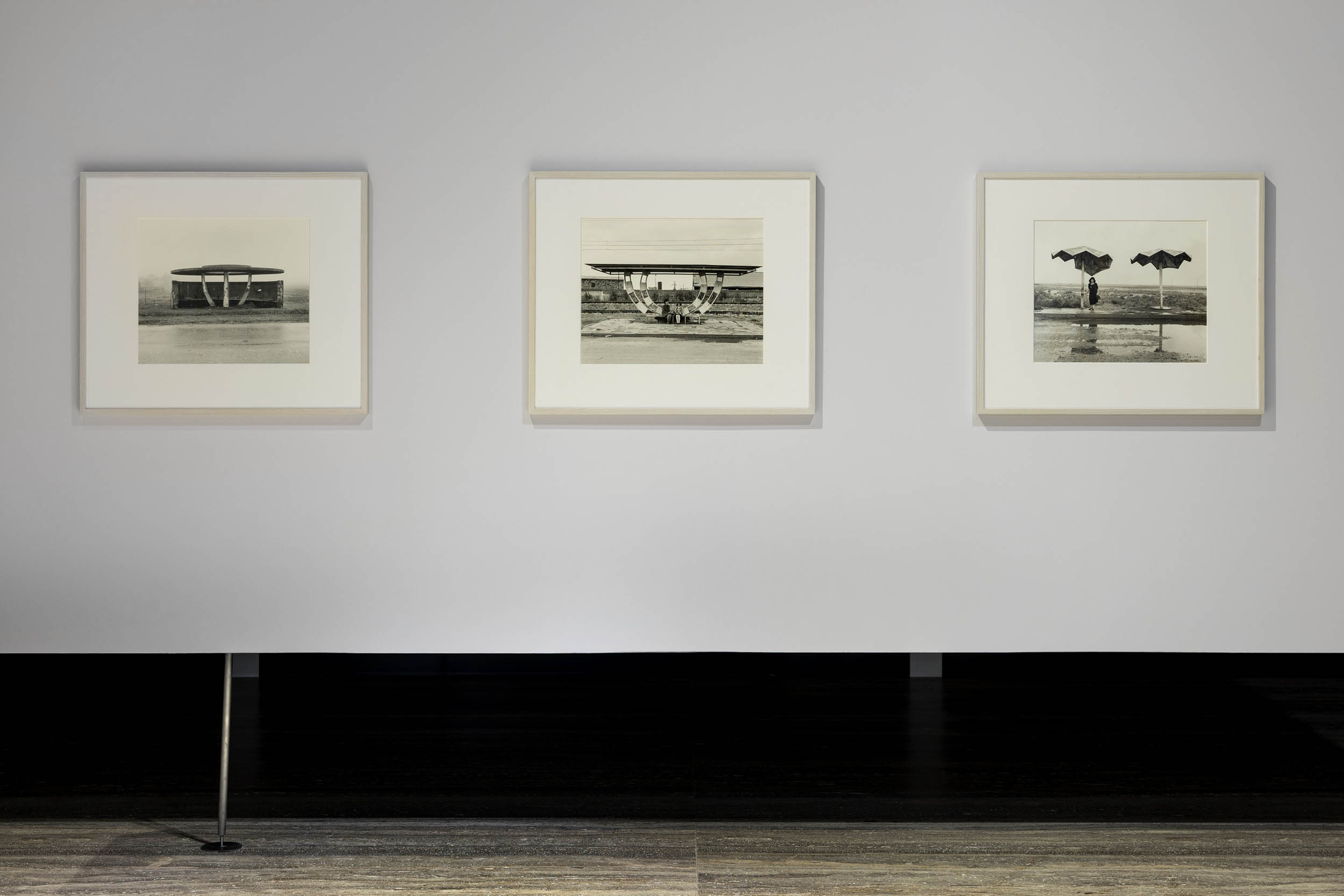
 

Installation view of the exhibition 'Typologien: Photography in 20th-century Germany' at Fondazione Prada, Milan showing the work of Ursula Schulz-Dornburg


Installation view of the exhibition Typologien: Photography in 20th-century Germany at Fondazione Prada, Milan showing the work of Ursula Schulz-Dornburg
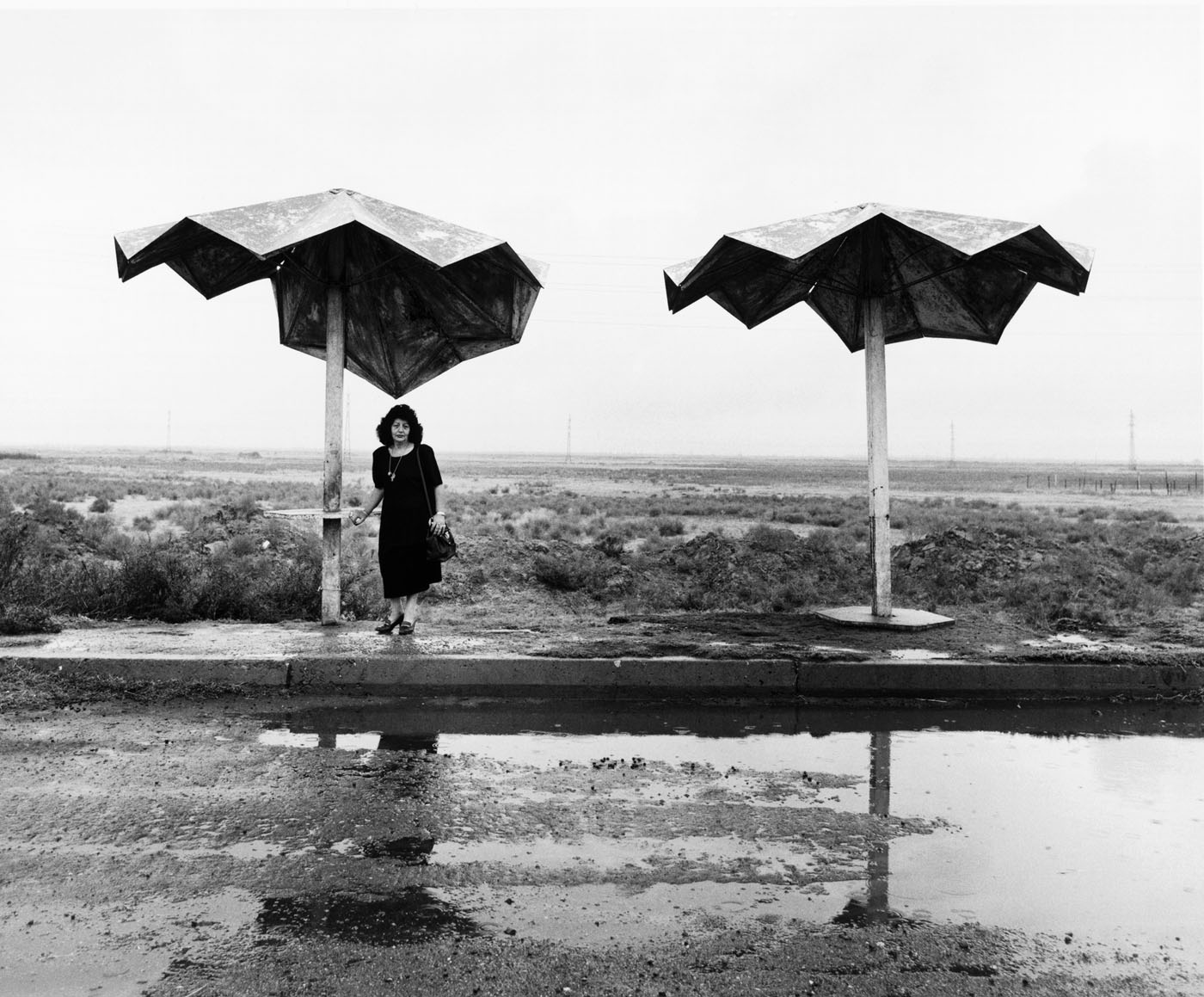
 

Ursula Schulz-Dornburg (German, b. 1938) 'Transit Sites-Armenia-Erevan-Ararat' 2001


Ursula Schulz-Dornburg (German, b. 1938)
Transit Sites-Armenia-Erevan-Ararat
2001
Gelatin silver print on Forte paper
© Ursula Schulz-Dornburg


Ursula Schulz-Dornburg was visiting convents and monasteries in Armenia when she happened to come across one of these unique bus stops, partly futuristic and partly surreal. From 1997 to 2011, she portrayed numerous bus stops, often in very remote locations. In a country that was experiencing a dramatic transition, from being part of the Soviet Union to its new status as an independent republic, these bus stops look like the remnants of a utopian socialism, which in Schulz-Dornburg’s images are kept alive mainly by women and children. The photographer said she was so impressed by the dignity of those women waiting at the bus stop, who even in the most extreme poverty looked as though they were on their way to the Opera, that she asked their permission to photograph them. What emerged was a document of a quiet life that manages with dignity to deal with even the harshest adversity.

Exhibition text from the Fondazione Prada by Cord Riechelmann
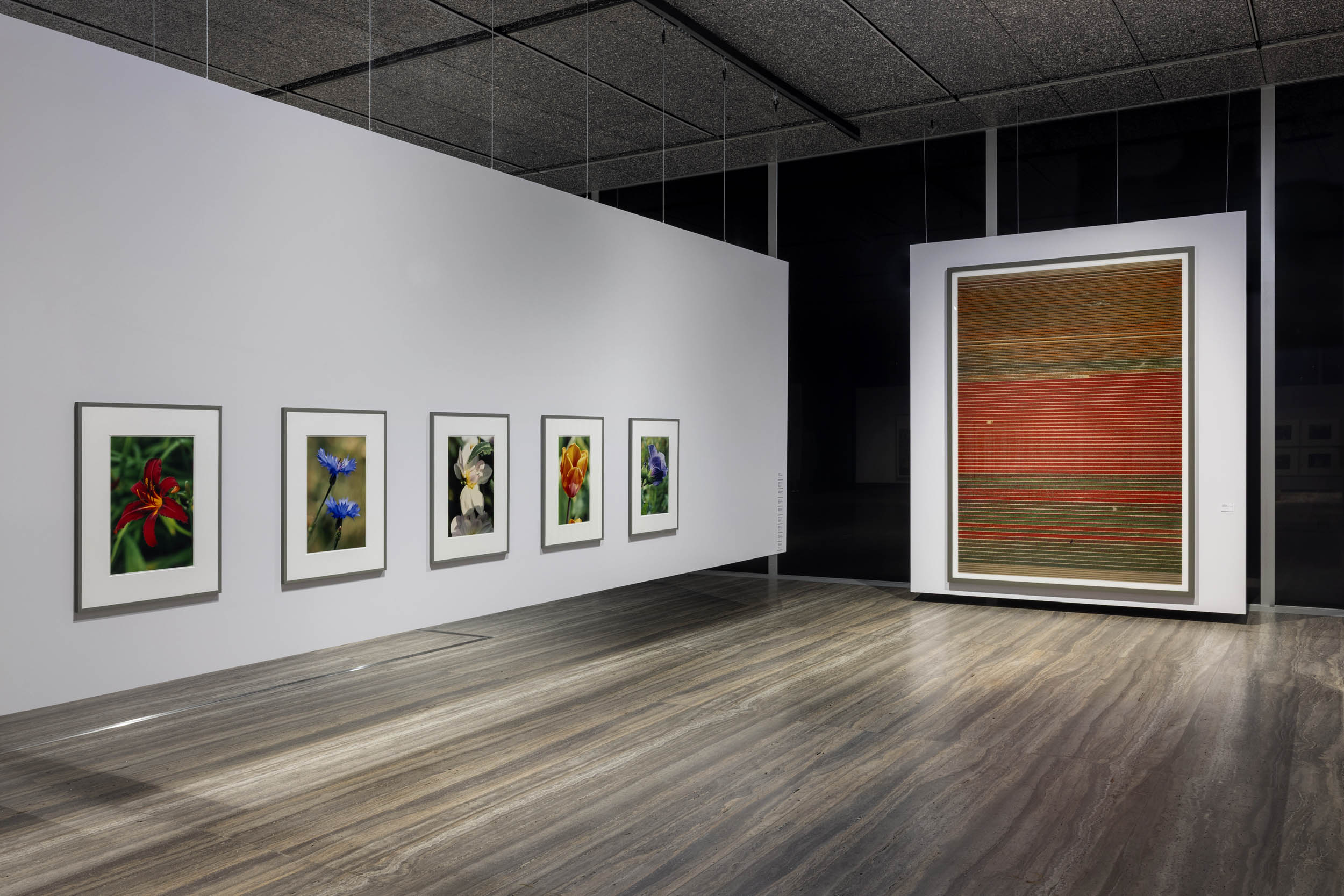
 

Installation view of the exhibition 'Typologien: Photography in 20th-century Germany' at Fondazione Prada, Milan showing at left, flower photographs by Thomas Struth; and at right, Andreas Gursky's 'Untitled XVIII' 2015


Installation view of the exhibition ‘Typologien: Photography in 20th-century Germany’ at Fondazione Prada, Milan showing at left, flower photographs by Thomas Struth; and at right, Andreas Gursky’s Untitled XVIII 2015 (below)
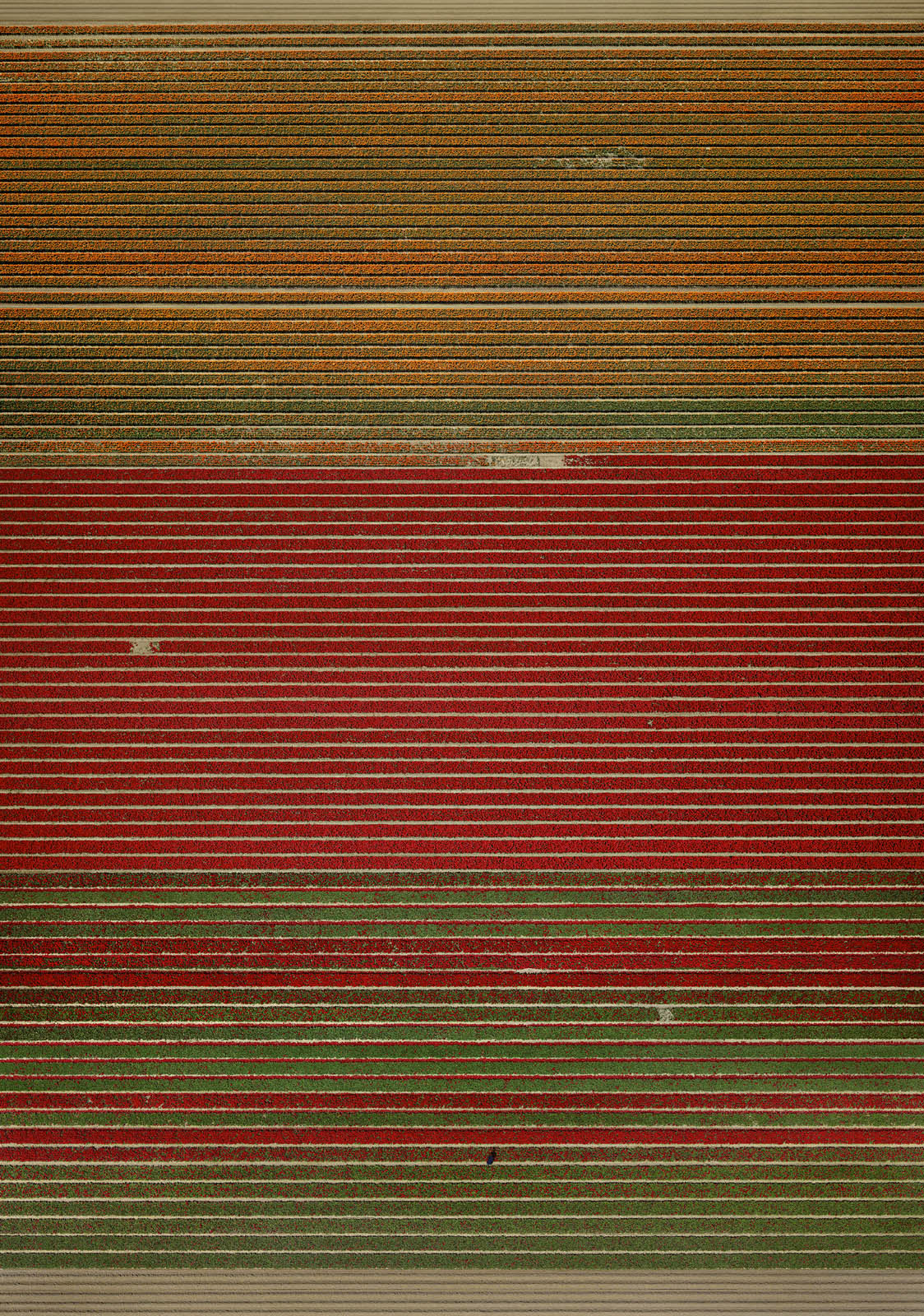
 

Andreas Gursky (German, b. 1955) 'Untitled XVIII' 2015


Andreas Gursky (German, b. 1955)
Untitled XVIII
2015
Inkjet print
Atelier Andreas Gursky


Unlike works such as Paris, Montparnasse (1993), in the Untitled series he produced between 2015 and 2016, Andreas Gursky depicted rows of tulips without providing a title or location for the pictures. Viewed from a distance, the photographs are reminiscent of Abstract Expressionist paintings, but even looking at them at close range, the lushly blooming flowers are undiscernible. Living in Düsseldorf, close to the Dutch border, Gursky is familiar with the intensively cultivated Dutch tulip crops, where no unwanted insect or worm would possibly be allowed to spoil the bulbs. The sterility of industrial flower production, far from being harmless and healthy, is captured by Gursky in images that, in turn, are neither reassuring nor pleasant.

Exhibition text from the Fondazione Prada by Cord Riechelmann


Installation view of the exhibition 'Typologien: Photography in 20th-century Germany' at Fondazione Prada, Milan showing the flower photographs of Thomas Struth with at left, 'Small Closed Sunflower, No. 18, Winterthur'
1992; and at third left, 'Single Red Lily - No. 51, Düsseldorf (Botanischer Garten)' 1993


Installation view of the exhibition Typologien: Photography in 20th-century Germany at Fondazione Prada, Milan showing the flower photographs of Thomas Struth with at left, Small Closed Sunflower, No. 18, Winterthur 1992 (below); and at third left, Single Red Lily – No. 51, Düsseldorf (Botanischer Garten) 1993 (below)
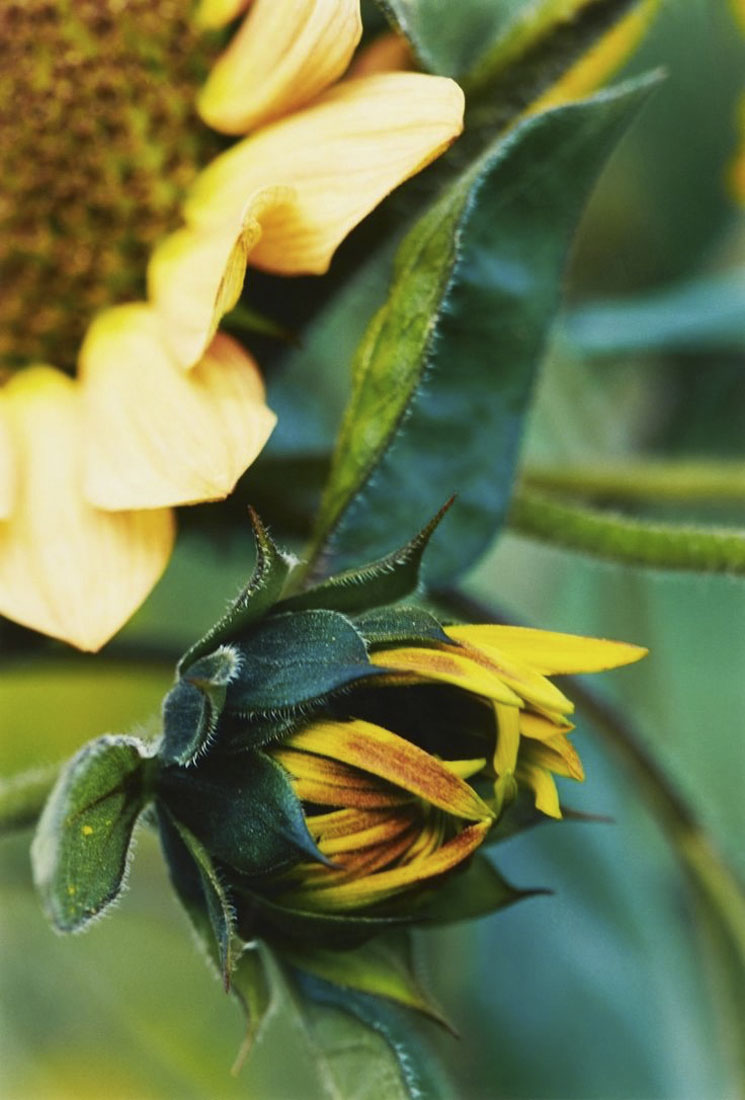
 

Thomas Struth (German, b. 1954) 'Small Closed Sunflower, No. 18, Winterthur' 1992


Thomas Struth (German, b. 1954)
Small Closed Sunflower, No. 18, Winterthur
1992
Colour photograph on C-print
© Thomas Struth / Courtesy ZKM | Center for Art and Media Karlsruhe, Karlsruhe
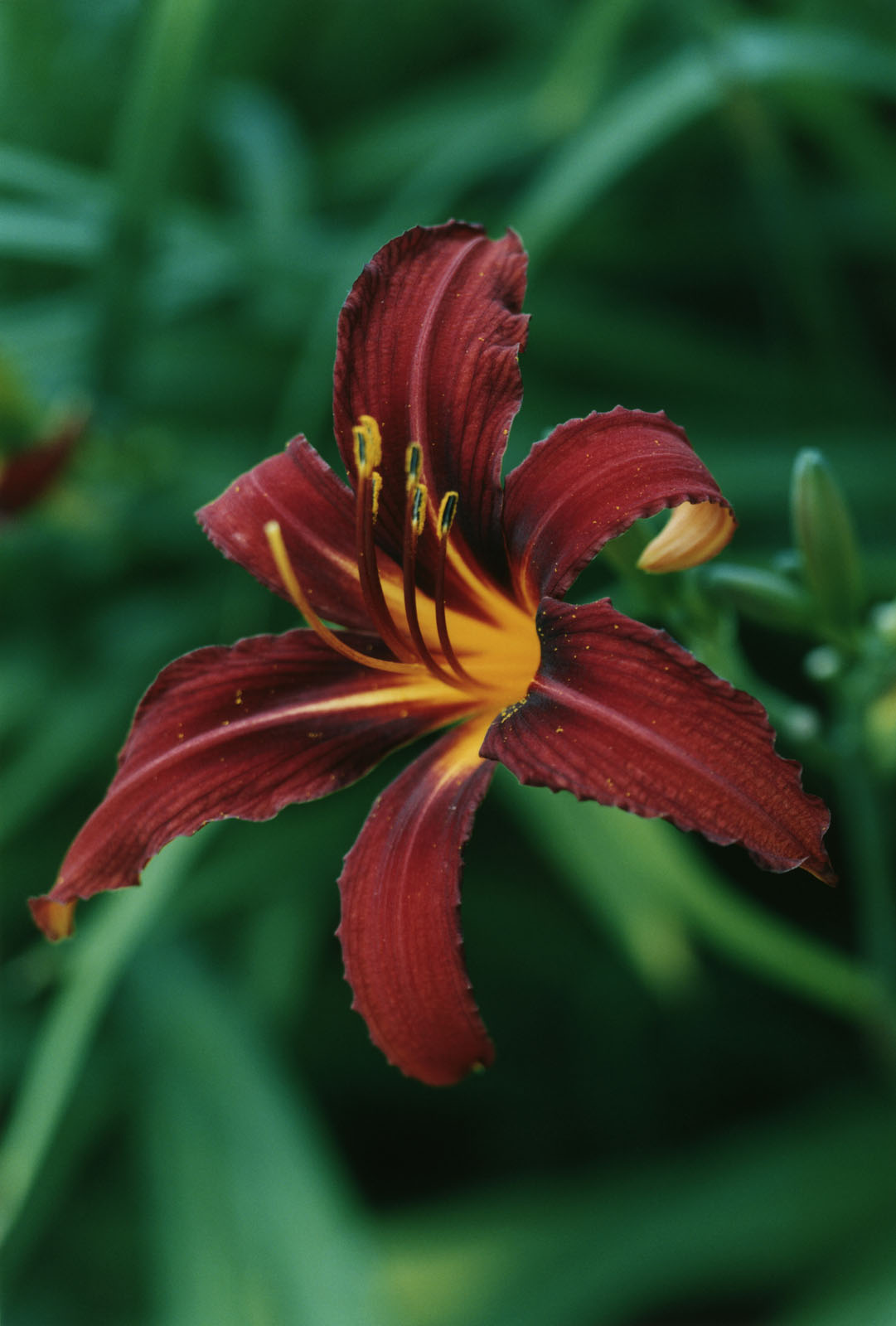
 

Thomas Struth (German, b. 1954) 'Single Red Lily - No. 51, Düsseldorf (Botanischer Garten)' 1993


Thomas Struth (German, b. 1954)
Single Red Lily – No. 51, Düsseldorf (Botanischer Garten)
1993
C-print
Viehof Collection
© Thomas Struth / Courtesy Viehof Collection, Mönchengladbach


A student of the artist Gerhard Richter and later of the photographer Bernd Becher at the Art Düsseldorf Academy from 1973 to 1980, Thomas Struth habitually works in thematic cycles centered around museums, flowers, and portraits of families and passers-by. The “exact vision” – the intention underpinning Struth’s photography – can be seen in both the portraits of two cornflowers shoot in Düsseldorf and the image of a red lily in the city’s Botanical Garden. Struth notes down the name or address of the site where he took the photograph, as in the case of the flower of a hollyhock portrayed in Düsseldorf’s Nordpark. This is to evoke the poetry of the place and provide an exact account of the plants’ origin, preserving the authenticity of the shots without digitally altering them.

Exhibition text from the Fondazione Prada by Cord Riechelmann
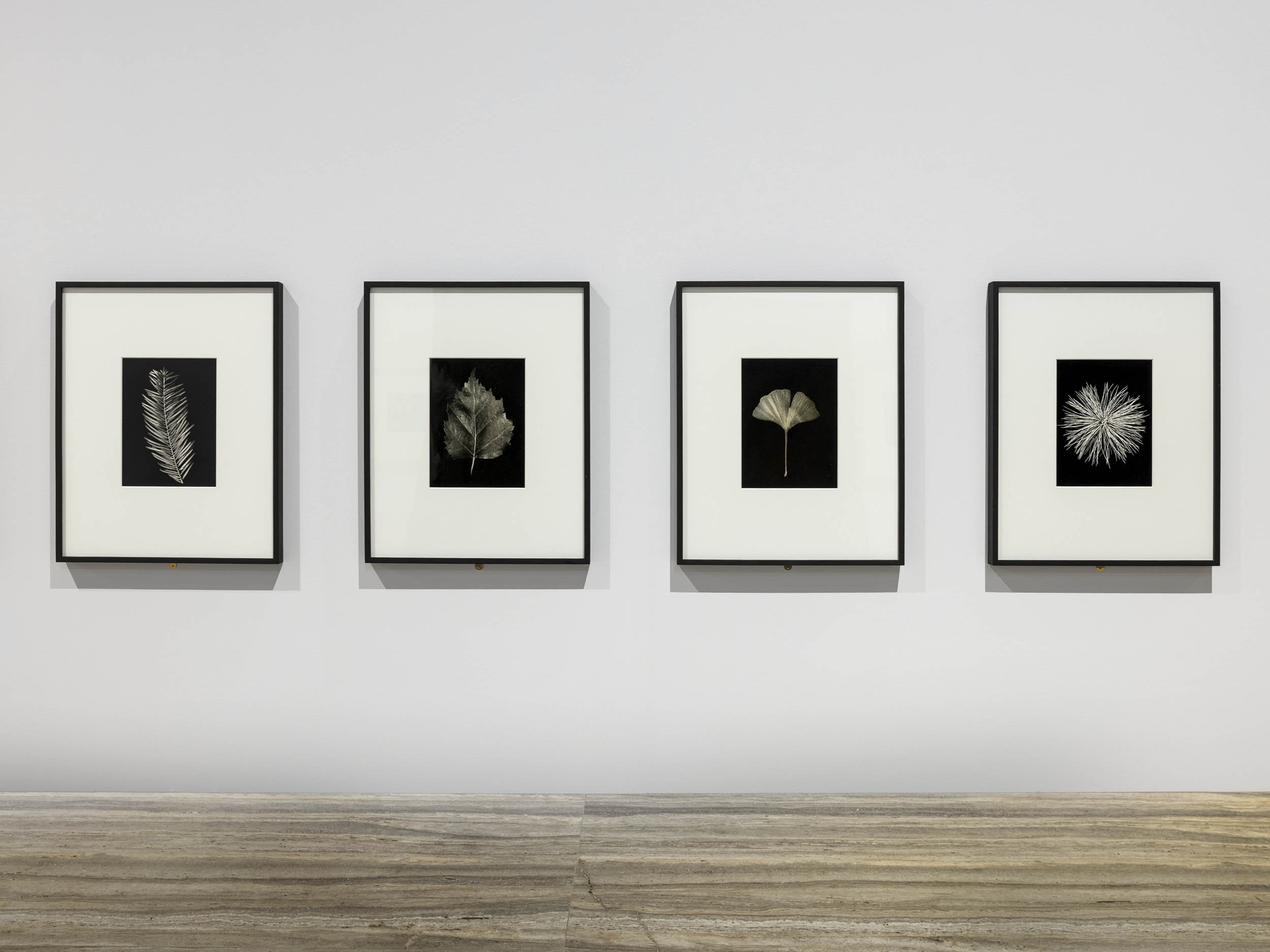
 

Installation view of the exhibition 'Typologien: Photography in 20th-century Germany' at Fondazione Prada, Milan showing the work of Hiller Becher


Installation view of the exhibition Typologien: Photography in 20th-century Germany at Fondazione Prada, Milan showing the work of Hiller Becher


Hilla Becher (German, 1934-2015) 'Eichenblatt [Oak Leaf]' 1965


Hilla Becher (German, 1934-2015)
Eichenblatt [Oak Leaf]
1965
Gelatin silver print
© Estate Bernd & Hilla Becher, represented by Max Becher, courtesy Die Photographische Sammlung/SK Stiftung Kultur – Bernd & Hilla Becher Archive, Cologne, 2025


In terms of the objectivity of the approach, Hilla Becher’s 1965 photographic studies of an oak leaf, a cypress branch, and a ginkgo leaf are in keeping with the series on types of industrial buildings that she made with her husband Bernd Becher. Thematically, however, these studies represent a sort of return to the studies of branches and shoots made years earlier by Karl Blossfeldt. Unlike Blossfeldt’s images, the leaves, particularly the poplar leaves, are not uniformly lit. The shadowy areas cannot be clearly seen with the naked eye even on close and objective observation. One could say that nature has penetrated the technique, disappearing.

Exhibition text from the Fondazione Prada by Cord Riechelmann
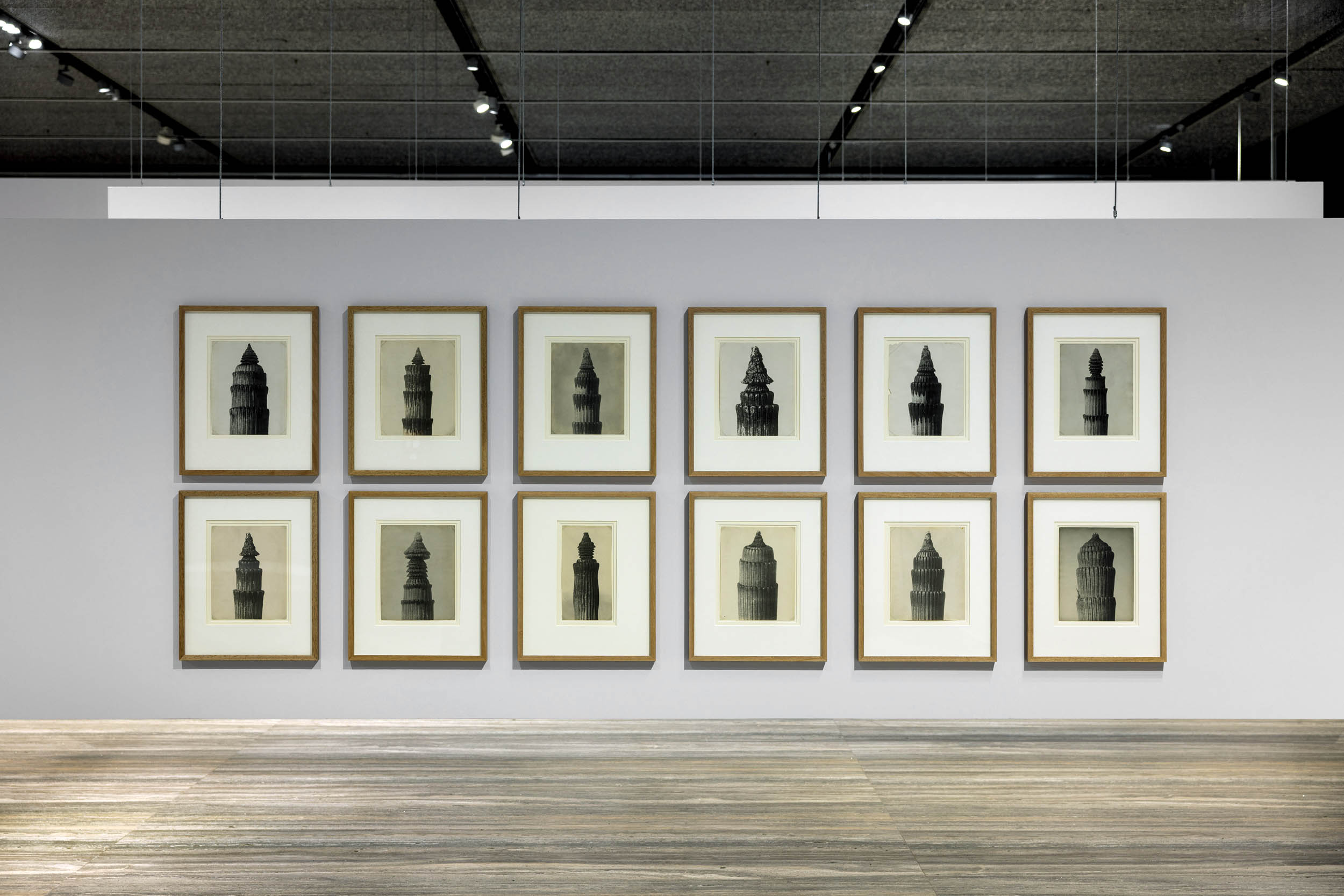
  

Installation view of the exhibition 'Typologien: Photography in 20th-century Germany' at Fondazione Prada, Milan showing the work of Karl Blossfeldt


Installation view of the exhibition Typologien: Photography in 20th-century Germany at Fondazione Prada, Milan showing the work of Karl Blossfeldt


Karl Blossfeldt (German, 1865-1932) 'Adiantum pedatum, haarfarn, junge, noch eingerollte Wedel' [Maidenhair fern, young, still curled fronds] Nd


Karl Blossfeldt (German, 1865-1932)
Adiantum pedatum, haarfarn, junge, noch eingerollte Wedel [Maidenhair fern, young, still curled fronds]
Nd
Gelatin silver print
Courtesy Berlin University of Arts, Archive – Karl Blossfeldt Collection in cooperation with Die Photographische Sammlung/SK Stiftung Kultur, Cologne


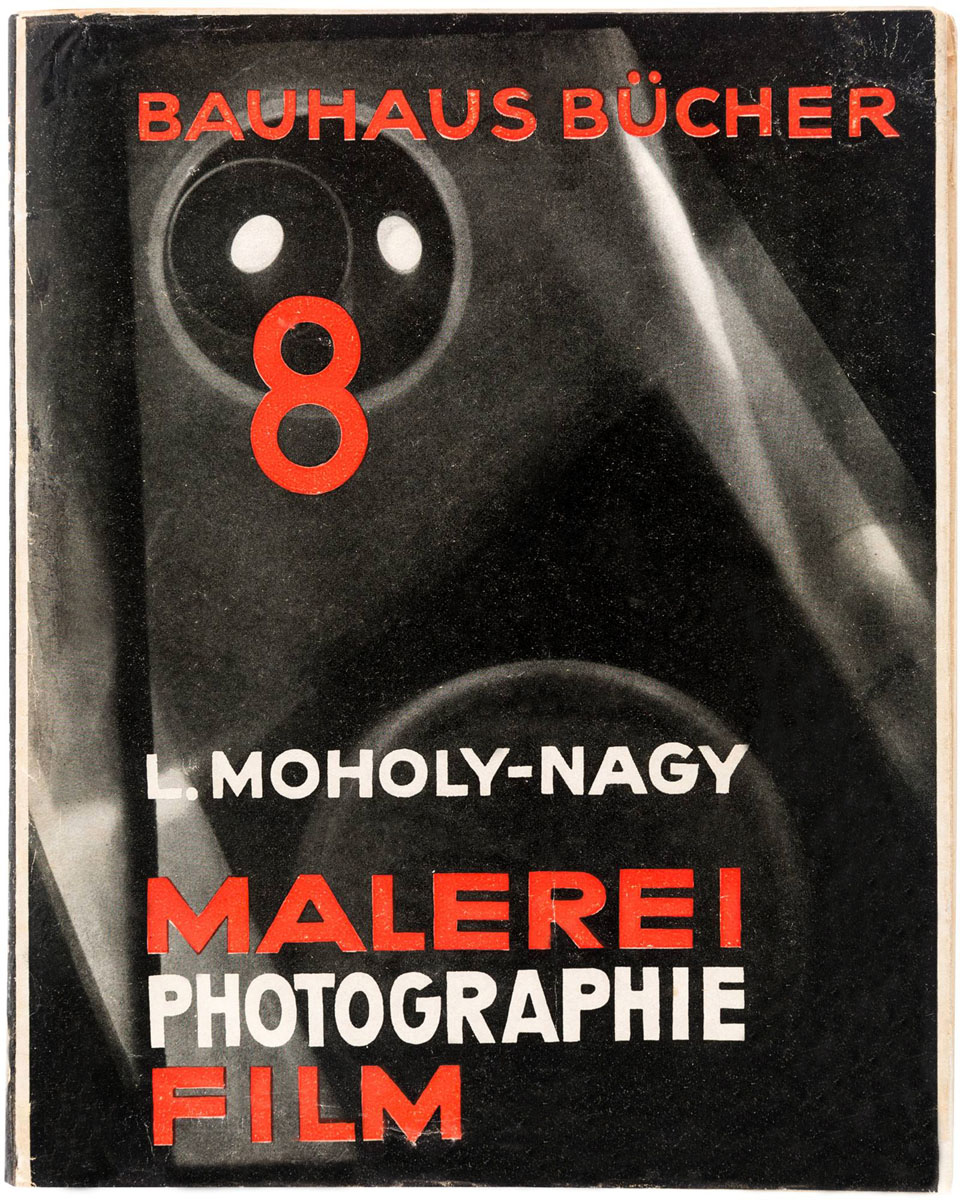
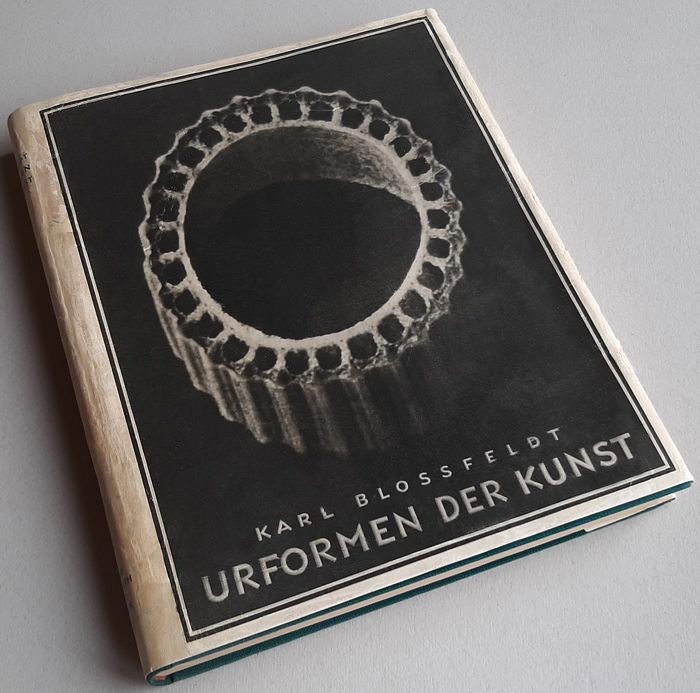
The young, still curling fronds of an ‘Unspecified fern’ are a kind of introduction to the themes that Karl Blossfeldt explored, and his working methods. Faced with a seemingly infinite variety of natural forms, the photographer tried to find an order by using tools borrowed from scientific botany. Blossfeldt collected plant samples tirelessly in and around Berlin, dried them, and enlarged those details not visible to the naked eye. However, the photographer was seeking something different from the aims of botanical research. This is already revealed by the title of the first volume, a publication of his photographs of plants – Urformen der Kunst (Art Forms in Plants, 1928). Right from the title, he explicitly refers to the model he used for the book’s conception: Ernst Haeckel’s Kunstformen in der Natur (Art Forms in Nature), published in 1924 and now a classic. Therefore, Blossfeldt sought archetypal formal models in nature, such as the fronds of the fern.

In his search for a primal form of nature that could then be shaped into art according to the natural model – as in the case of the curled fronds of
the fern – Karl Blossfeldt applied the systematic method specific to botany with a kind of exterior mimicry. He moved from the frond of an unidentified fern, in other words, not yet classified according to an order, to a fern that could at least be identified within a botanical classification. The frond of the order Polypodiales certainly has typological similarities to all the fronds photographed by Blossfeldt, but it remains a case apart in that it cannot be classified in any of the orders in which the other ferns are classified. However, this level of identification is a relevant indication: these very diverse plants in fact number about 9000 known species, and probably many more yet to be identified. Moreover, identifying their species is often only possible for a few specialists, and is even more difficult given the variety of forms that ferns take during their development.

The curled fronds of some ferns from the Osmundaceae family, royal ferns, with their botanical classification, confirm one of the fundamental intentions of Karl Blossfeldt’s studies: only by carefully analyzing the structure of a plant can one fully understand its natural form. He developed his approach opposite to that of the Jugendstil, the artistic movement – a variation of French Art Nouveau and Italian Liberty – that stylized plant forms and conceived of them primarily as ornamental elements. Blossfeldt was not interested in criticism or rejection of the ornamental, but in a radical reconfiguration of it. This could only be achieved by thoroughly studying natural forms.

Three still-curled fronds of a specimen of bracken fern – scientific name Hypolepidaceae – on the one hand, appear denaturalised, because Karl Blossfeldt focused his lens on the detail, leaving out the natural context. But on the other hand, they reveal a scrupulous observation of the plant world. By nature, in fact, fronds develop according to a strict formal principle – no natural form is purely random – and yet they eventually differ from one another. The fronds of ferns could appear as decalcomanias, given that in Blossfeldt’s representation they take on an almost mechanical quality for the observer. The emphasis on differences in resemblance, which Blossfeldt achieved more or less consciously by repeating the leaf motif in differently shaped ferns, can be considered one of the main aesthetic innovations of his photography.

Exhibition text from the Fondazione Prada by Cord Riechelmann


Installation view of the exhibition 'Typologien: Photography in 20th-century Germany' at Fondazione Prada, Milan showing the work of Marianne Wex with at left, 'Let's Take Back Our Space: 'Female' and 'Male' Body Language as a Result of Patriarchal Structures' 1977-2018; and at right, 'Arm and Leg Positions, Lying on the Ground' 1977/2018


Installation view of the exhibition Typologien: Photography in 20th-century Germany at Fondazione Prada, Milan showing the work of Marianne Wex with at left, Let’s Take Back Our Space: ‘Female’ and ‘Male’ Body Language as a Result of Patriarchal Structures 1977-2018 (below); and at right, Arm and Leg Positions, Lying on the Ground 1977/2018


With the photographic project Let’s Take Back our Space, which resulted in a book published in 1979 with the subtitle “‘Female’ and ‘Male’ Body Language as a Result of Patriarchal Structures,” Marianne Wex produced one of the seminal works in 1970s feminist art studies. Starting with a scrupulous observation of the body influenced by the method of structuralism, a scientific approach that studies a whole by breaking it down into elements and units, Wex took hundreds of photographs arranged in specific thematic sections devoted, for example, to specific leg and arm positions. Wex succeeded in showing how apparently natural body postures are actually the result of centuries of social and cultural structures, not a ‘natural’ or genetic predisposition. Her photographs capture movements, postures, and gestures, documenting habits of the body that have been taught and passed down for generations, shaping the behaviour of men and women according to patriarchal expectations.

Exhibition text from the Fondazione Prada by Cord Riechelmann


Marianne Wex (German, 1937-2020) 'Let's Take Back Our Space: 'Female' and 'Male' Body Language as a Result of Patriarchal Structures'
1977-2018


Marianne Wex (German, 1937-2020)
Let’s Take Back Our Space: ‘Female’ and ‘Male’ Body Language as a Result of Patriarchal Structures
1977-2018
Inkjet print
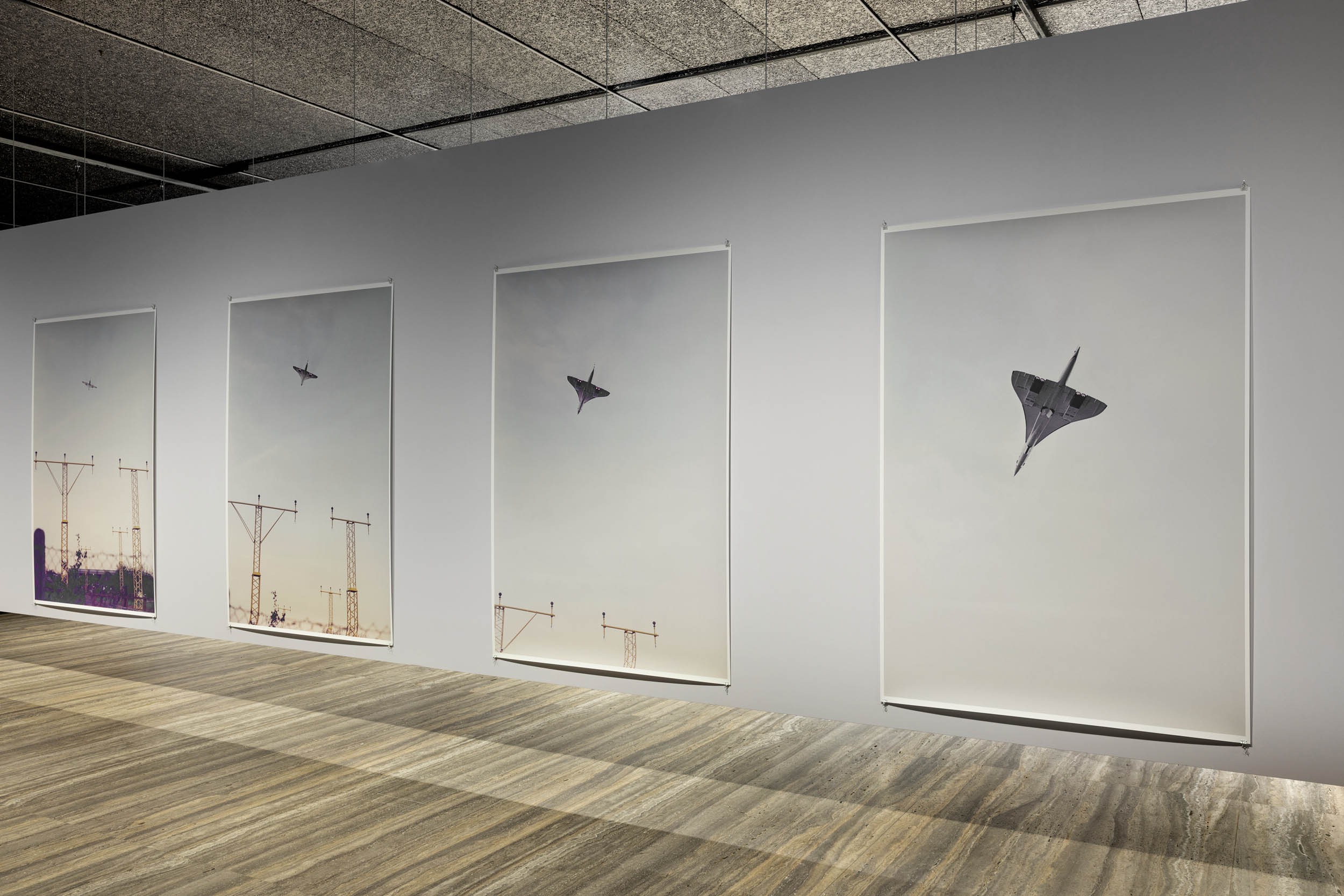
 

Installation view of the exhibition 'Typologien: Photography in 20th-century Germany' at Fondazione Prada, Milan showing photographs from Wolfgang Tillmans' series 'Concorde' 1997


Installation view of the exhibition Typologien: Photography in 20th-century Germany at Fondazione Prada, Milan showing photographs from Wolfgang Tillmans’ series Concorde 1997


In 1997, Wolfgang Tillmans photographed the Concorde, a supersonic passenger plane, in flight during landing and take-off. For him, the plane represented one of the last remaining inventions of the 1960s technological utopia. With its futuristic shape, supersonic speed, and the formidable roar it made during take-off and landing, the plane fascinated generations of technology enthusiasts. Today, the Concorde is a thing of the past and, together with the Titanic, epitomises more of a technological shock than a promise in the history of technology. These photographs reveal one of the aspects that Tillmans wants to highlight: they are symbols of “a super-modern anachronism” that ultimately left nothing behind but air pollution and environmental destruction.

Exhibition text from the Fondazione Prada by Cord Riechelmann
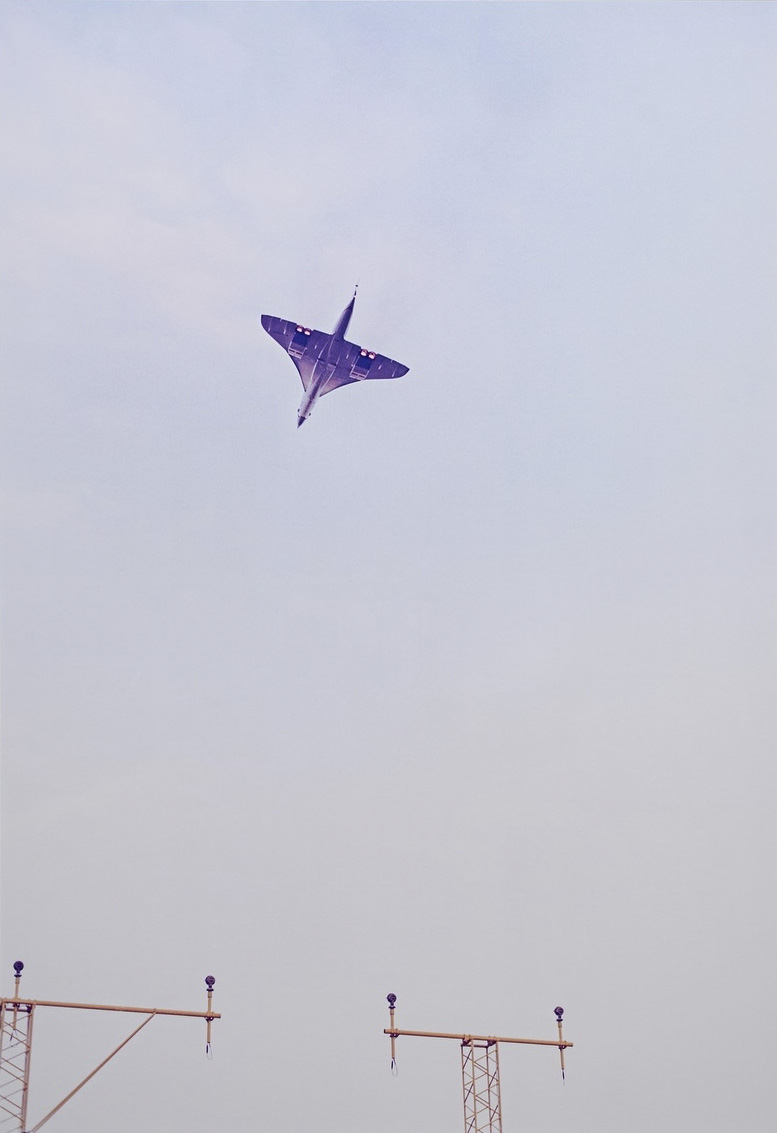
 

Wolfgang Tillmans (German, b. 1968) 'Concorde L449-21' 1997


Wolfgang Tillmans (German, b. 1968)
Concorde L449-21
1997
Inkjet print
Courtesy of Galerie Buchholz


Fondazione Prada presents Typologien: Photography in 20th-century Germany, an extensive study dedicated to 20-century German photography, at its Milan venue from 3 April to 14 July 2025. The exhibition, hosted within Podium, the central building of the Milan headquarters, is curated by Susanne Pfeffer, art historian and director of the MUSEUM MMK FÜR MODERNE KUNST, Frankfurt.

The exhibition attempts to apply the principle of “typology,” which originated in 17th- and 18th-century botany to categorise and study plants, and appeared in photography in the early 1900s, affirming itself in Germany throughout the 20th century. Paradoxically, the given formal principle allows for unexpected convergences of German artists spanning different generations and the manifestation of their individual approaches.

The exhibition path follows a typological rather than a chronological order, bringing together more than 600 photographic works by 25 artists essential for recounting over a century of German photography. The exhibition features photographs by Bernd and Hilla Becher, Sibylle Bergemann, Karl Blossfeldt, Ursula Böhmer, Christian Borchert, Margit Emmrich, Hans-Peter Feldmann, Isa Genzken, Andreas Gursky, Candida Höfer, Lotte Jacobi, Jochen Lempert, Simone Nieweg, Sigmar Polke, Gerhard Richter, Heinrich Riebesehl, Thomas Ruff, August Sander, Ursula Schulz-Dornburg, Thomas Struth, Wolfgang Tillmans, Rosemarie Trockel, Umbo (Otto Umbehr), and Marianne Wex. The project forms unexpected connections between artistic practices that differ from each other but are united by a common principle or intention of classification.

As stated by Susanne Pfeffer, “Only through juxtaposition and direct comparison is it possible to find out what is individual and what is universal, what is normative or real. Differences are evidence of the abundance of nature and the imagination of humans: the fern, the cow, the human being, the ear; the bus stop, the water tower, the stereo system, the museum. The typological comparison allows differences and similarities to emerge and the specifics to be grasped. Unknown or previously unperceived things about nature, the animal, or the object, about place and time become visible and recognizable.”

In photography, employing typologies means affirming an equivalence between images and the absence of hierarchies in terms of represented subjects, motifs, genres, and sources.

Despite this, typology remains a highly challenging and complex notion. It operates in a paradoxical regime: on the one hand, this approach can lead to a systematic recording of people and objects based on extreme objectivity; on the other hand, typology corresponds to an individual and arbitrary choice, revealing itself as a disturbing and potentially subversive act.

The hypothesis that photography plays a key role not only in fixing distinctive phenomena but also in organizing and classifying a plurality of visible manifestations remains a vital force in today’s artistic efforts to navigate the complexity of our social and cultural realities. With the spread of digital imagery and practices, the concept of typology continues to be questioned and re-defined by contemporary photographers and artists.

As underlined by Susanne Pfeffer, “The unique, the individual, seems to have been absorbed into a global mass, the universality of things is omnipresent. The Internet allows typologies to be created in a matter of seconds. In this very precise moment – it seems even more important to follow the artists’ gaze and look closely.” As further explained by Pfeffer, “When the present seems to have abandoned the future, we need to look closer at the past. When everything seems to be shouting at you and becoming increasingly brutal, it is important to take a quiet pause and use the silence to see and think clearly. When differences are no longer perceived seen as something other but are transformed into elements of division, we have to recognize what we have in common. Typologies allow us to identify undeniable similarities and subtle differences.”

In the early 20th century, Karl Blossfeldt (1865-1932) was one of the first artists to transfer the classification system used in botanical studies to photography. His vast and detailed plant atlas represented a foundational moment for German Neue Sachlichkeit (New Objectivity). This artistic and photographic movement emerged in the 1920s during the Weimar Republic and promoted the importance of categories and distinctions and the remarkable ability of photography as a medium to explore the very idea of typology.

Another pioneering figure was August Sander (1876-1964), who published his photo book Antlitz der Zeit (Face of Our Time) in 1929, at the time excerpted from his landmark project Menschen des 20. Jahrhunderts (People of the 20th Century). Described by Walter Benjamin as a “training atlas” of physiognomic perception, Antlitz der Zeit was an ambitious attempt to portray the diversity and the structure of German society using class, gender, age, occupation, and social background as distinct categories of a rigid and neutral classification system.

Both Karl Blossfeldt’s and August Sander’s typologies were fundamental for Bernd Becher (1931-2007) and Hilla Becher (1934-2015) when, at the end of the fifties, they began an enormous and lifelong documentation and preservation project of industrial architecture. In 1971, they described the “industrial constructions” as “objects, not motifs”. They stated that “the information we want to provide is only created through the sequence, through the juxtaposition of similar or different objects with the same function”. Their black-and-white monuments, or “anonymous sculptures”, isolated against a monochromatic sky, centered, framed in the same format and arranged in a block, became an essential reference for American and European Post-Minimalist and Conceptual artists. They also represented a rich heritage for younger generations of German artists and photographers, such as Andreas Gursky (b. 1955), Candida Höfer (b. 1944), Simone Nieweg (b. 1962), Thomas Ruff (b. 1958) and Thomas Struth (b. 1954), who studied at the Academy in Düsseldorf in the class led by Bernd and Hilla Becher from 1976.

Hans-Peter Feldmann (1941-2023), internationally recognised for his fundamental contribution to conceptual art, traced a complementary trajectory in German photography. In his works, he documented everyday objects and historical events and combined deadpan humor with a systematic approach to accumulating, cataloguing, and rearranging elements of contemporary visual culture. In his series, he invented personal yet very political typologies and adopted a deliberate snapshot approach with a commercial aesthetic. For his work Alle Kleider einer Frau (All the Clothes of a Woman, 1975), he took 35mm-format photographs of underwear, hosiery, T-shirts, dresses, trousers, skirts, socks, and shoes, all hanging on hangers on the wall or laid on dark fabric. With his project Die Toten 1967-1993 (The Dead 1967-1993, 1996-1998), he paid homage to individuals murdered in the context of the political and terroristic movements in Post-War Germany. As pointed out by Susanne Pfeffer, “With his typologies, he emphasised the equal value of all photographs, their image sources and motifs, and underscored the de-hierarchisation inherent in every typology.”

In his apparently random collection of found, personal or pornographic images, press clippings, and historical photos of Nazi concentration camps, the Red Army Faction and German reunification, a “private album” named Atlas (1962 – present), Gerhard Richter (b. 1932) seemed to deny or challenge the very idea of typology. Instead, he took the principle of equivalence between images and their trivialization process to the limits, creating a jarring contrast and an acute awareness of a repressed collective memory.

In the seventies and eighties, in a dialectic relationship with the artistic lessons of the Bechers, Gursky, Höfer, Ruff, and Struth progressively abandoned the radicalism and black- and-white purism of their professors. They explored the colorful dominance of banality in their series of individual or family portraits, monumental and detailed city views, and spectacular documentation of cultural or tourist sites, generating a plethora of contemporary and conflicting typologies.

In the late seventies and early eighties, multimedia artist Isa Genzken (b. 1948) engaged in a direct dialogue with the photographic medium. In 1979, she created a series entitled Hi-Fi that featured advertisements of avant-garde Japanese stereo equipment, organising them in an imaginary commercial catalog. The second series entitled Ohr (Ear) (1980) depicted, in large-scale colour close-ups, the ears of random women Genzken photographed on the streets of New York City. She transferred the traditional portrait genre to physiognomic detail and ironically investigating the absolute singularity and infinite individual differentiation the photographic portrait can record.

An illustrated book, published by Fondazione Prada and designed by Zak Group, accompanies the exhibition “Typologien: Photography in 20th-century Germany”. It includes an introduction by Miuccia Prada, President and Director of Fondazione Prada, a text by the exhibition curator Susanne Pfeffer and three essays by renowned international art historians and curators Benjamin Buchloh, Tom Holert, and Renée Mussai.

Press release from Fondazione Prada
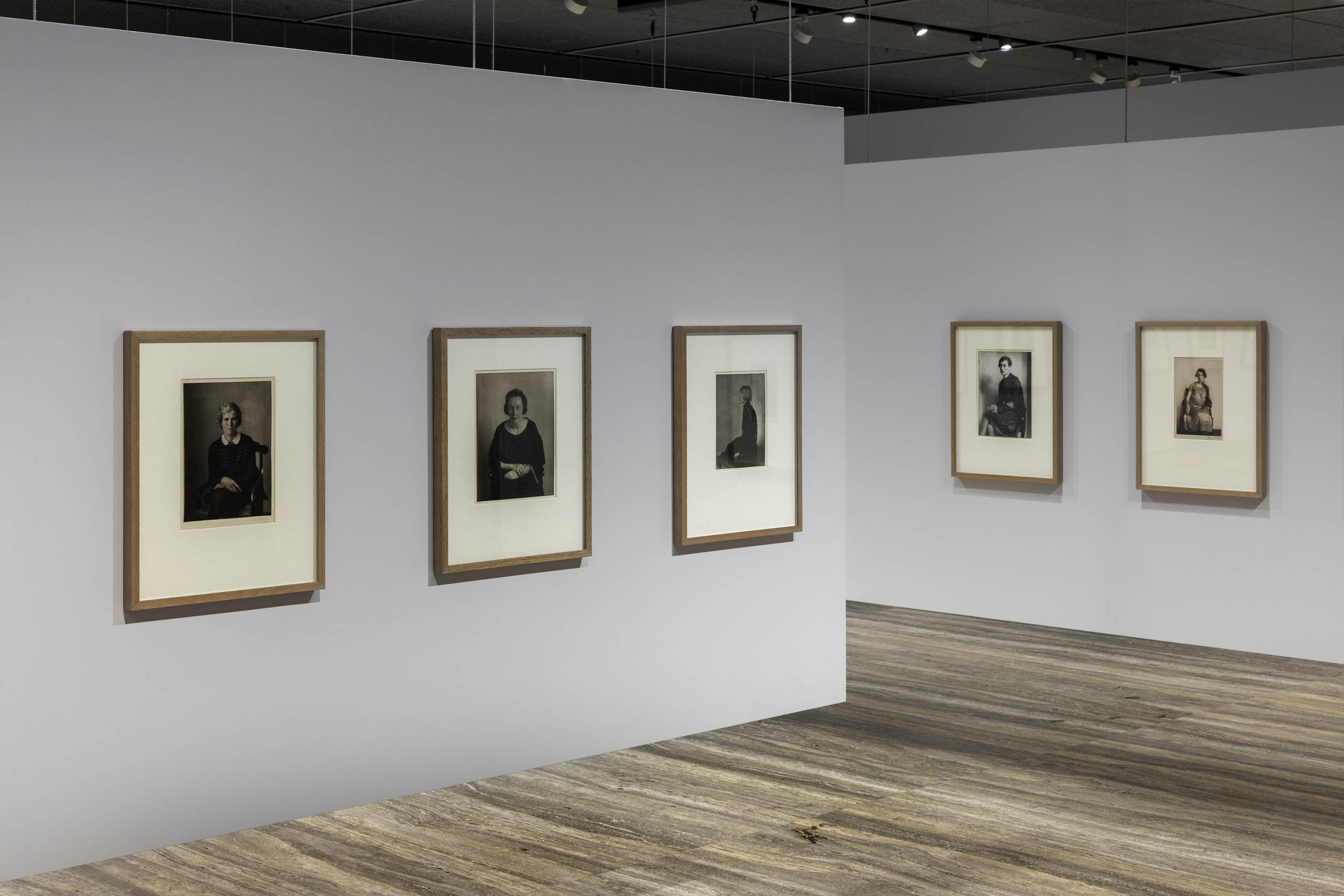
 

Installation view of the exhibition 'Typologien: Photography in 20th-century Germany' at Fondazione Prada, Milan showing the work of August Sander


Installation view of the exhibition Typologien: Photography in 20th-century Germany at Fondazione Prada, Milan showing the work of August Sander


August Sander (German, 1876-1964) 'Sekretärin beim Westdeutschen Rundfunk in Köln' [Secretary at West German Radio in Cologne] 1931-1950s


August Sander (German, 1876-1964)
Sekretärin beim Westdeutschen Rundfunk in Köln [Secretary at West German Radio in Cologne]
1931-1950s
Gelatin silver print
Die Photographische Sammlung/SK Stiftung Kultur, Cologne
© Die Photographische Sammlung/SK Stiftung Kultur – August Sander Archive, Cologne; SIAE, Roma, 2025


The series that August Sander dedicated to women is perhaps where the idea of categorising an archetype or social type shows the cracks most visibly. Whether it is an architect’s companion, an industrialist’s wife, or a high society lady, in Sander’s images the individuality of the female subject, in dress and posture, always prevails over type. And even when the subjects display characteristics that could be traced back to their class, origin, or occupation – such as the secretary who smokes – all the women depicted, from the sculptor to the photographer or the gym teacher, express ‘their own’ individuality. This is most evident when comparing the portraits of women with those of civil servants, whose gazes already show a serial uniformity associated with their positions.

Exhibition text from the Fondazione Prada by Cord Riechelmann


Erich Sander for August Sander's studio. 'Politischer Häftling' [Political Prisoner] 1941-1944 (print date late 1940s)


Erich Sander for August Sander’s studio
Politischer Häftling [Political Prisoner]
1941-1944 (print date late 1940s)
Menschen des 20. Jahrhunderts, 44a Politische Gefangene. [44a Political prisoners]
Gelatin silver print
Die Photographische Sammlung/SK Stiftung Kultur, Cologne
© Die Photographische Sammlung/SK Stiftung Kultur, Cologne – August Sander Archive, Cologne; SIAE, Roma, 2025


In 1935, Erich Sander, August Sander’s son, was sensationally put on trial and sentenced to ten years’ imprisonment for subversive activities. He served most of his sentence in Siegburg Prison, where he worked as the prison’s photographer. Determined to continue his resistance activities even in prison, he did not limit himself to taking ‘official’ photographs. He convinced his fellow prisoners to show him the scars of torture and have their portraits taken. Those photographs seemed to him to be in line with his father’s work. He had learned his trade from his father and worked with him before his imprisonment. He stayed in close contact with his parents during his ten years of imprisonment, and through them, managed to get many of those images out of the prison, leaving a valuable record of Nazi atrocities. Due to a misdiagnosis and lack of medical treatment during his imprisonment, Erich Sander died in 1944, six months before the end of his sentence.

Exhibition text from the Fondazione Prada by Cord Riechelmann
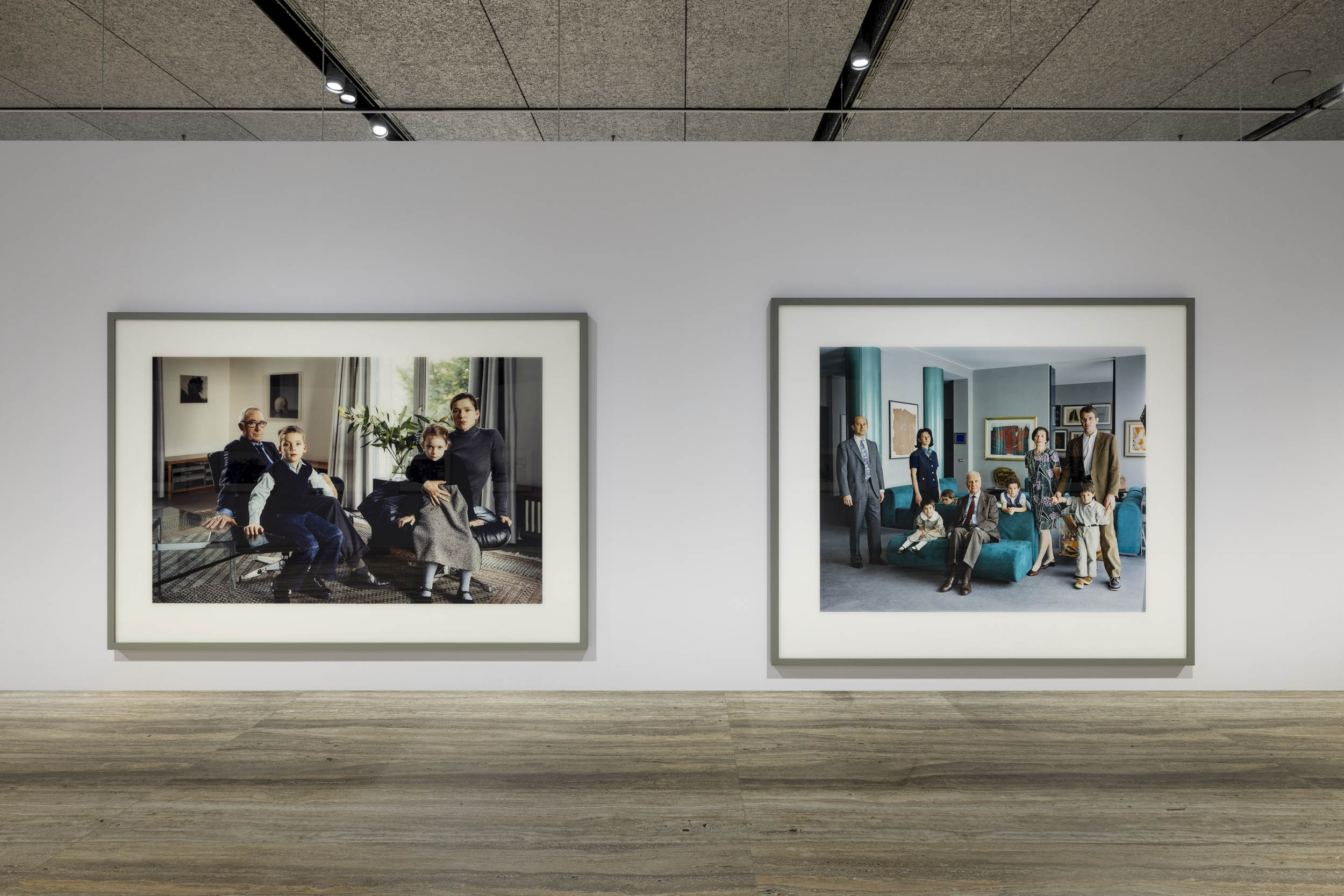
 

Installation view of the exhibition 'Typologien: Photography in 20th-century Germany' at Fondazione Prada, Milan showing photographs by Thomas Struth with at left, 'The Richter Family 1, Cologne' 2002; and at right, 'The Consolandi Family, Milan' 1996


Installation view of the exhibition Typologien: Photography in 20th-century Germany at Fondazione Prada, Milan showing photographs by Thomas Struth with at left, The Richter Family 1, Cologne 2002; and at right, The Consolandi Family, Milan 1996


Thomas Struth (German, b. 1954) 'The Richter Family 1, Cologne' 2002 (installation view)


Thomas Struth (German, b. 1954)
The Richter Family 1, Cologne (installation view)
2002
C-print
Courtesy of the artist
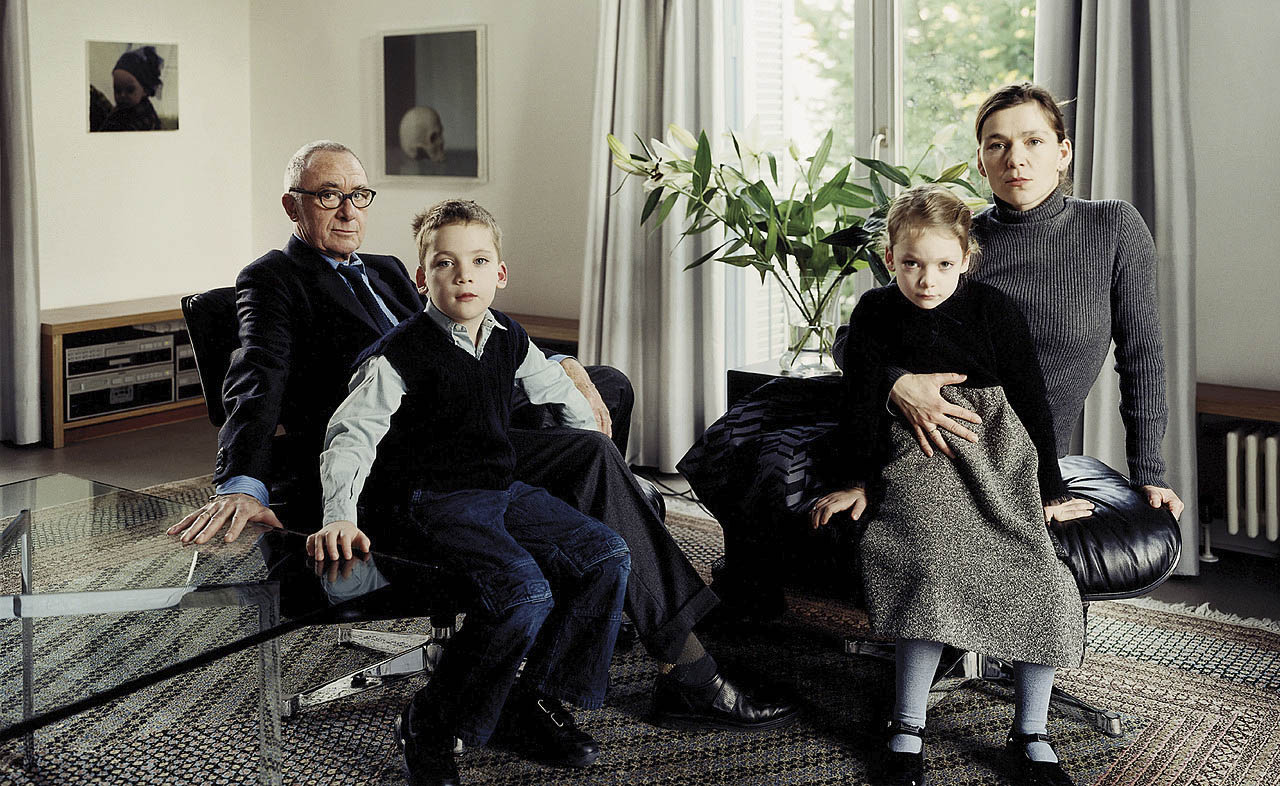
 

Thomas Struth (German, b. 1954) 'The Richter Family 1, Cologne' 2002


Thomas Struth (German, b. 1954)
The Richter Family 1, Cologne
2002
C-print
Courtesy of the artist
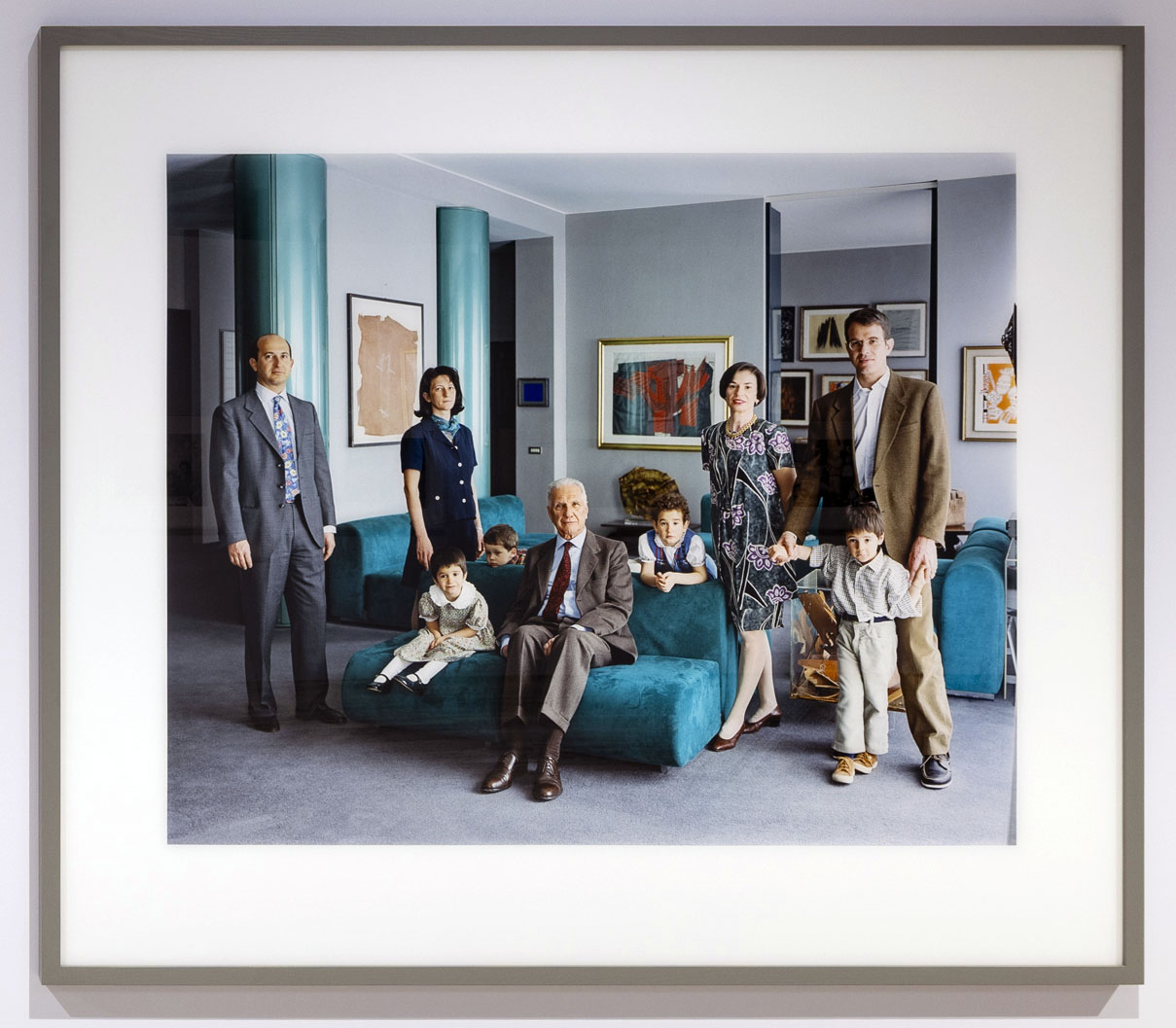
 

Thomas Struth (German, b. 1954) 'The Consolandi Family, Milan'  1996 (installation view)


Thomas Struth (German, b. 1954)
The Consolandi Family, Milan (installation view)
1996
C-print
Courtesy of the artist
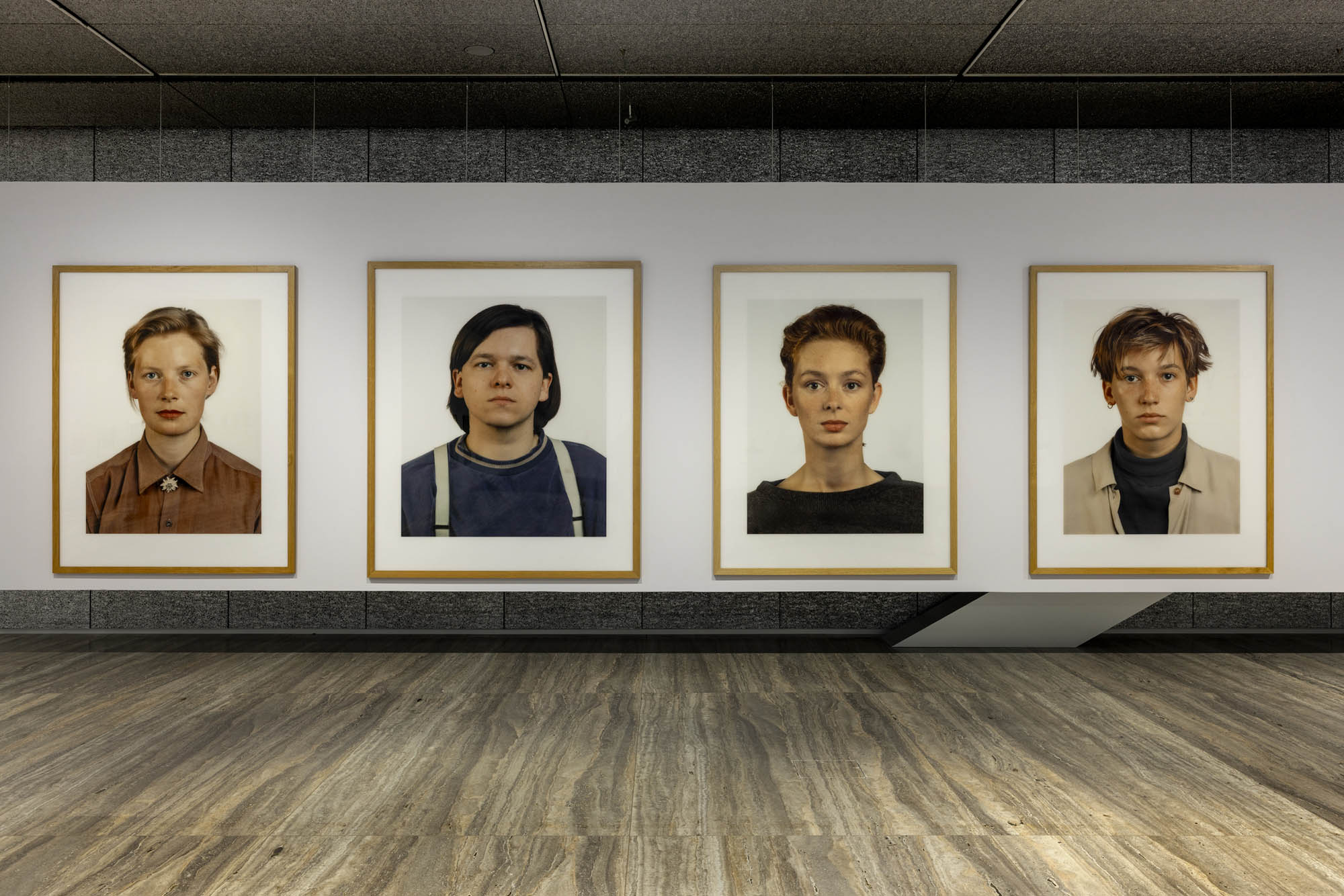
 

Installation view of the exhibition 'Typologien: Photography in 20th-century Germany' at Fondazione Prada, Milan showing Thomas Ruff portraits


Installation view of the exhibition Typologien: Photography in 20th-century Germany at Fondazione Prada, Milan showing Thomas Ruff portraits
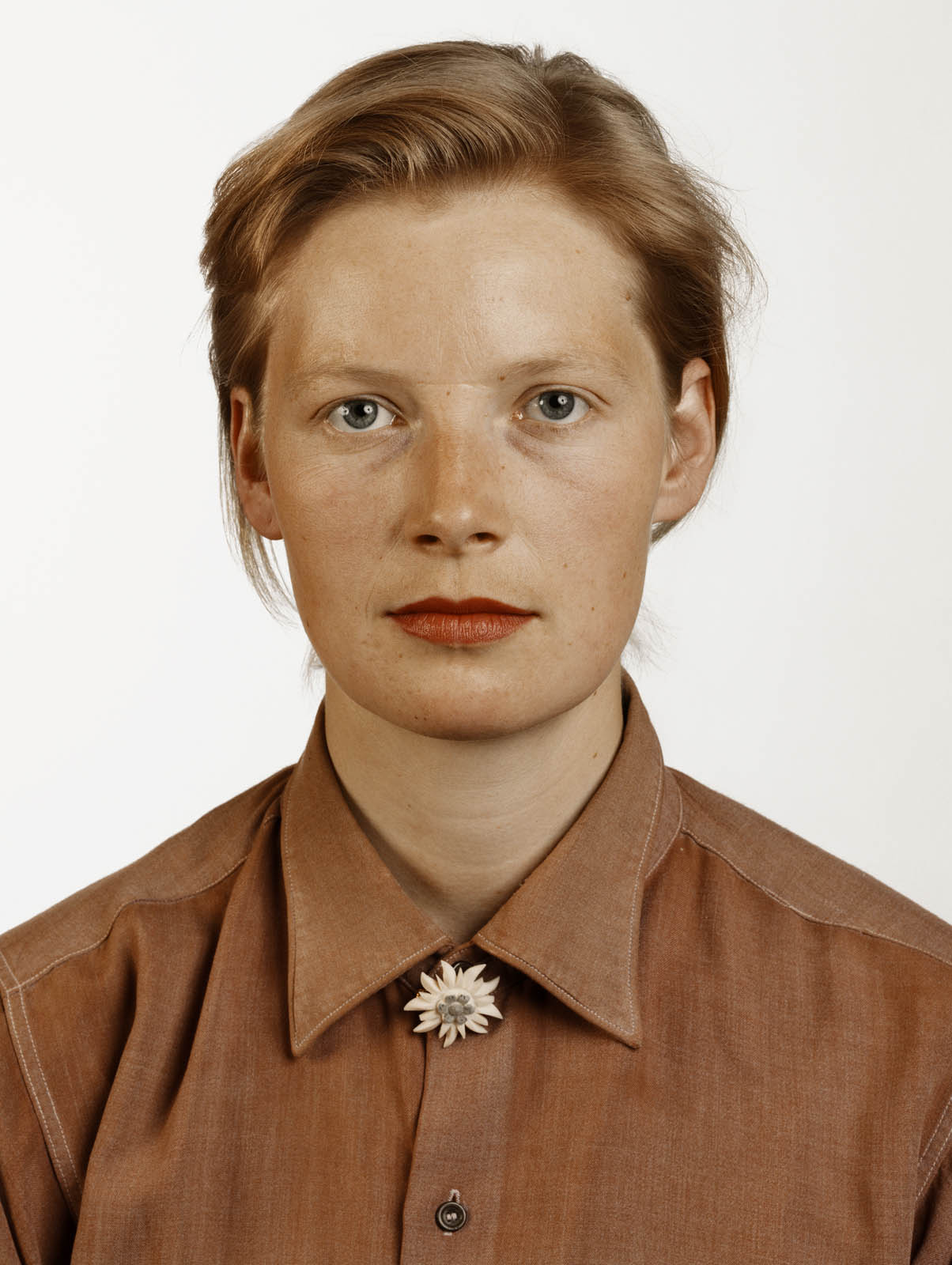
 

Thomas Ruff (German, b. 1958) 'Porträt (Pia Stadtbäumer)' 1988


Thomas Ruff (German, b. 1958)
Porträt (Pia Stadtbäumer)
1988
C-print laminated on acrylic glass
MUSEUM MMK FÜR MODERNE KUNST, Frankfurt
© Thomas Ruff, by SIAE 2025 Photo by Axel Schneider, Frankfurt am Main


Between 1977 and 1985, Thomas Ruff studied with Bernd Becher at the Art Academy in Düsseldorf, where he himself has been teaching photography since 2000. During the 1980s, he photographed people from his circle of acquaintances in a series of identically framed shots. With the subjects portrayed in a half-length pose against a neutral background, the images are striking for their unusually large size. Every detail, every pore, and every imperfection in the skin is visible in the faces of the subjects, whose names Ruff also provides. The strictness of the composition, the uniform lighting, and the impassive gaze of the people portrayed give the images an objective and neutral atmosphere. What formally appears detached and unemotional immediately raises questions about the subject portrayed: who is this person? What does he or she do in life? With this series, Ruff challenges the conventions of the traditional portrait, encouraging the viewer to question not only the identity of the subject, but also the role of the photographer and the meaning of the portrait itself.

Exhibition text from the Fondazione Prada by Cord Riechelmann


Thomas Ruff (German, b. 1958) 'Porträt (Simone Buch)' 1988


Thomas Ruff (German, b. 1958)
Porträt (Simone Buch)
1988
C-print laminated on acrylic glass
MUSEUM MMK FÜR MODERNE KUNST, Frankfurt
© Thomas Ruff, by SIAE 2025 Photo by Axel Schneider, Frankfurt am Main
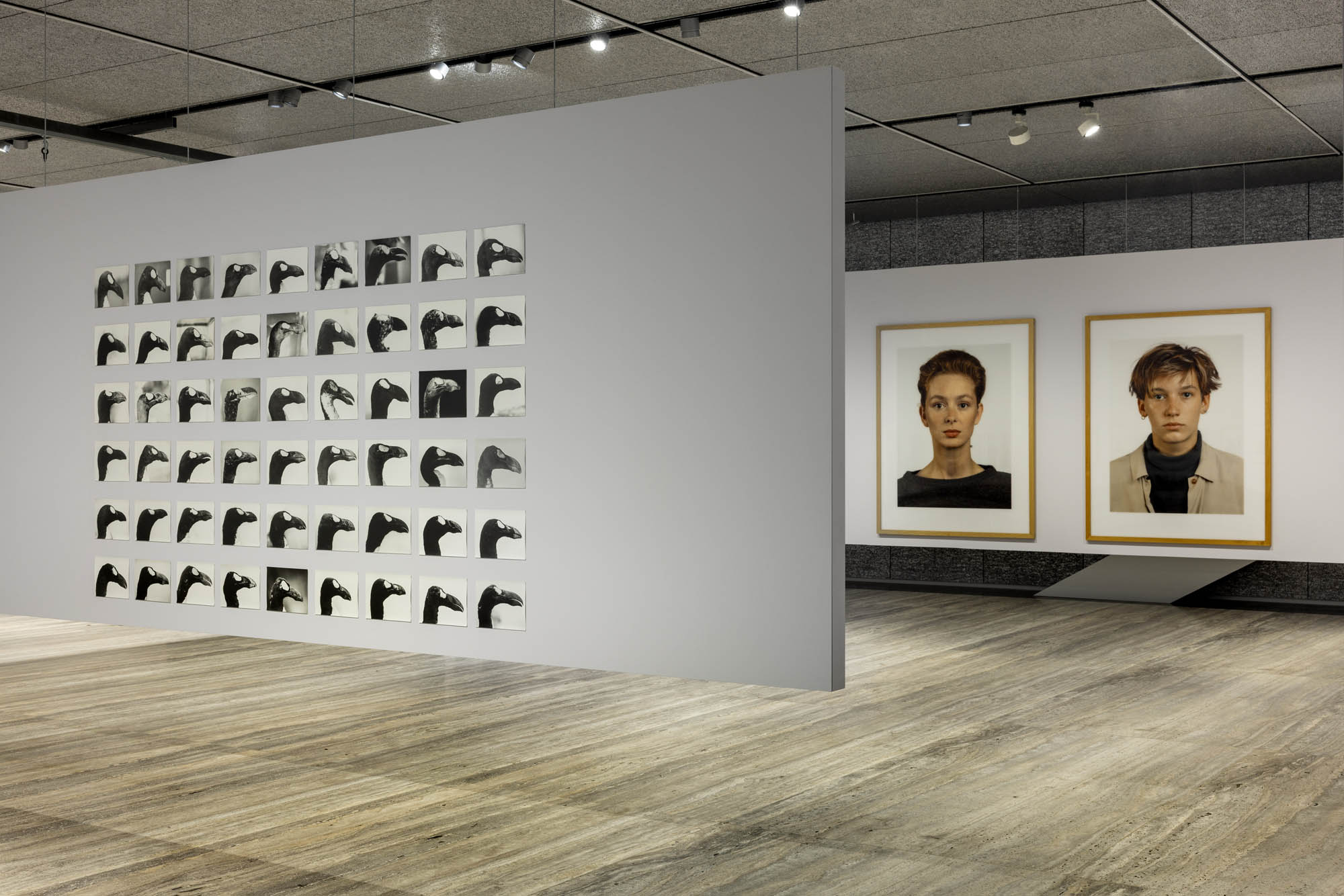
 

Installation view of the exhibition 'Typologien: Photography in 20th-century Germany' at Fondazione Prada, Milan showing at left, Jochen Lempert's 'The Skins of Alca Impennis' 1992-2022; and at right, Thomas Ruff's 'Portrait of Pia Stadtbäumer' and 'Portrait of Simone Buch' both 1988


Installation view of the exhibition Typologien: Photography in 20th-century Germany at Fondazione Prada, Milan showing at left, Jochen Lempert’s The Skins of Alca Impennis 1992-2022; and at right, Thomas Ruff’s Portrait of Pia Stadtbäumer and Portrait of Simone Buch both 1988
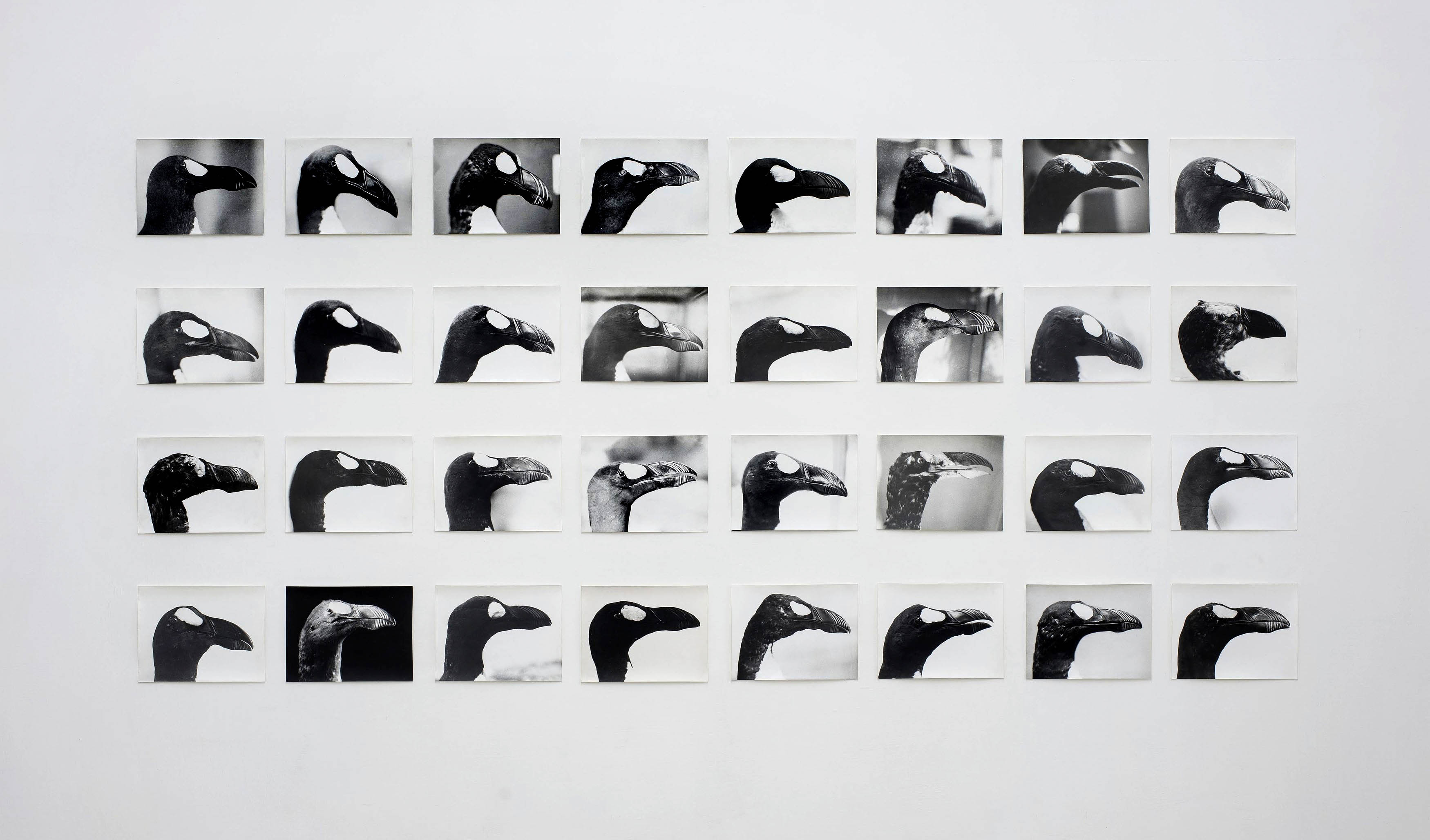
 

Jochen Lempert (German, b. 1958) 'The Skins of Alca Impennis' 1992-2022 (detail)


Jochen Lempert (German, b. 1958)
The Skins of Alca Impennis (detail)
1992-2022
Gelatin silver prints on Bartya paper
54 parts
Courtesy of Jochen Lempert, BQ, Berlin, and ProjecteSD, Barcelona


The fifty-four profiles of the Alca impennis (the great auk), a large flightless bird that became extinct after its last sighting in 1852, are part of a project that took Jochen Lempert more than a decade to complete. Using the same methods, Lempert photographed the profiles of many of the seventy-eight specimens of the Alca impennis preserved in natural history collections. Having become increasingly rare due to hunting, the Alca impennis was increasingly coveted by collectors, so the skins of this species fetched very high prices. The presence of such a large number of stuffed specimens in collections was therefore one of the causes of this species’ extinction.

Lempert’s portraits also hint at a more significant phenomenon. Very marked individual variations can be found in the appearance of individual specimens of a species, testifying to the great degree of differentiation within the species. Therefore, the concept of species, or its depiction in a scientific classification book, provides something akin to an ‘ideal type,’ rather than a true representation of the actual variety found in real life.

Exhibition text from the Fondazione Prada by Cord Riechelmann


Installation view of the exhibition 'Typologien: Photography in 20th-century Germany' at Fondazione Prada, Milan showing the work of Rosemarie Trockel, 'Elena I & II', 1993/2025, 'Maculata I & II', 1993/2025, 'Mela I & II', 1993/2025


Installation view of the exhibition Typologien: Photography in 20th-century Germany at Fondazione Prada, Milan showing the work of Rosemarie Trockel, Elena I & II, 1993/2025, Maculata I & II, 1993/2025, Mela I & II, 1993/2025


The portraits of the dogs Mela, Elena, and Maculata grew out of Rosemarie Trockel’s interest in animals and the relationship between animals and humans, a subject she has been working with for a long time. From the drawings of monkeys, which represent a kind of monument to the profound melancholy of primates kept in captivity by humans, to A House for Pigs and People / Ein Haus føur Schweine und Menschen created with Carsten Höller for documenta X in 1997, Trockel’s exploration of the relationship between humans and animals involves various forms of expression and themes. However, in this case, the double portraits of the three dogs, photographed frontally and in profile, indicate a further correlation. If “every animal is an artist,” as Trockel has stated, these portraits seem to call these roles into question: who directs and who stages who? Does the artist portray the dogs or do the dogs direct the artist?

Exhibition text from the Fondazione Prada by Cord Riechelmann
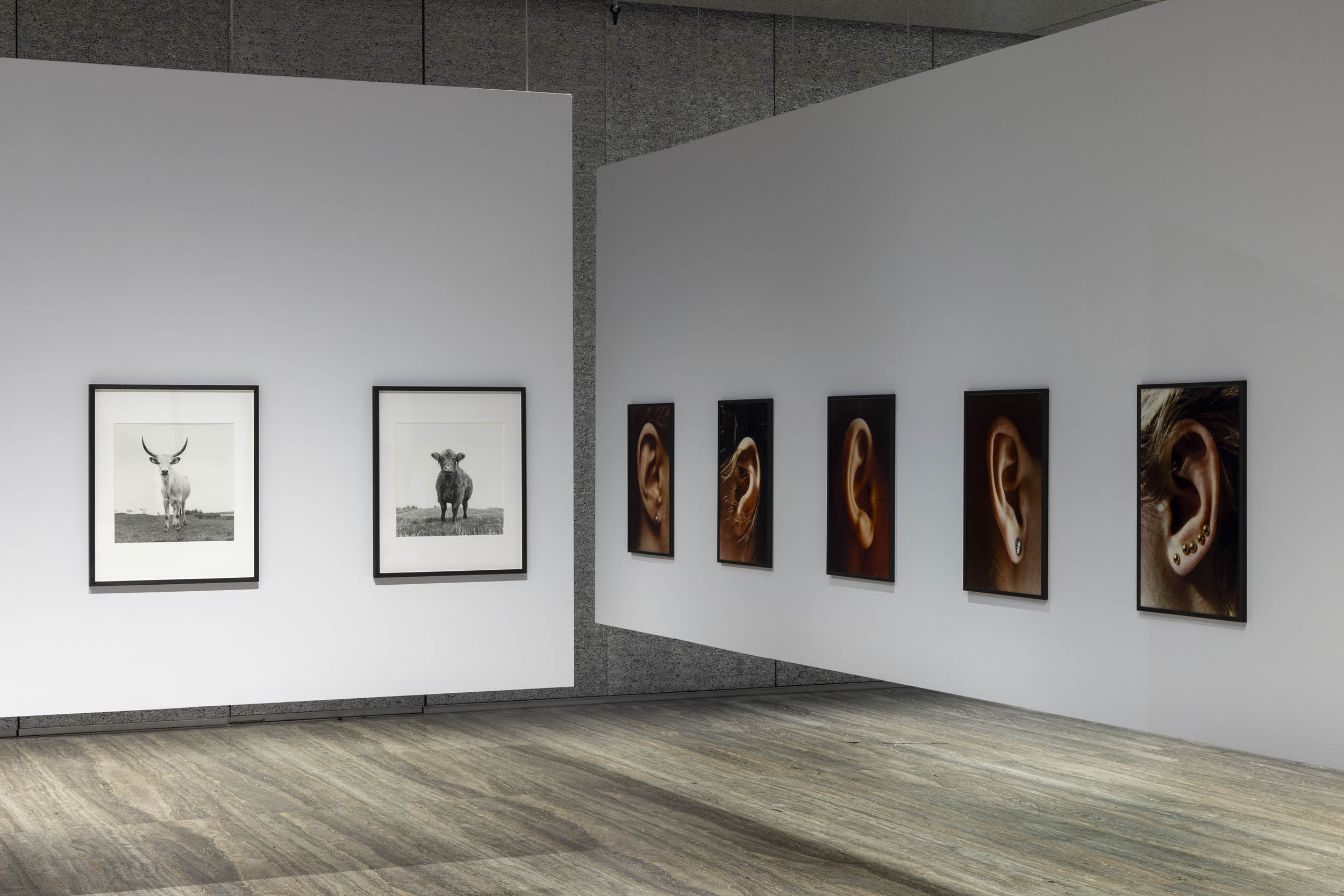
 

Installation view of the exhibition 'Typologien: Photography in 20th-century Germany' at Fondazione Prada, Milan showing at left, the work of Ursula Böhmer and her series 'All Ladies – Cows in Europe', 1998-2011; and at right, the work of Isa Genzken and her series 'Ohr', 1980


Installation view of the exhibition Typologien: Photography in 20th-century Germany at Fondazione Prada, Milan showing at left, the work of Ursula Böhmer and her series All Ladies – Cows in Europe, 1998-2011; and at right, the work of Isa Genzken and her series Ohr, 1980


Ursula Böhmer (German, b. 1965) 'Highland Grampians / Scotland [All Ladies – Cows in Europe]' 2011


Ursula Böhmer (German, b. 1965)
Highland Grampians / Scotland
2011
From the series All Ladies – Cows in Europe, 1998-2011
Gelatin silver print on Baryta paper
© Ursula Böhmer


Getting a cow to stand still in a frontal pose and look towards the camera, as Ursula Böhmer managed to do with a Highlander in the Grampian Mountains, is certainly not an easy task, but one that requires patience and trust, one of the prerequisites for this project. Between 1998 and 2011, Böhmer visited 25 European countries to photograph specimens of cattle breeds in the places where their breeding history began. These breeds, many of them at risk of extinction, had to be portrayed in their own environments in order to illustrate how these environments had influenced their appearance. What emerged was a series of images of docile animals portrayed in often harsh landscapes, which at the same time document the ongoing conditioning by the environment on the forms of life also in breeding conditions.

Exhibition text from the Fondazione Prada by Cord Riechelmann
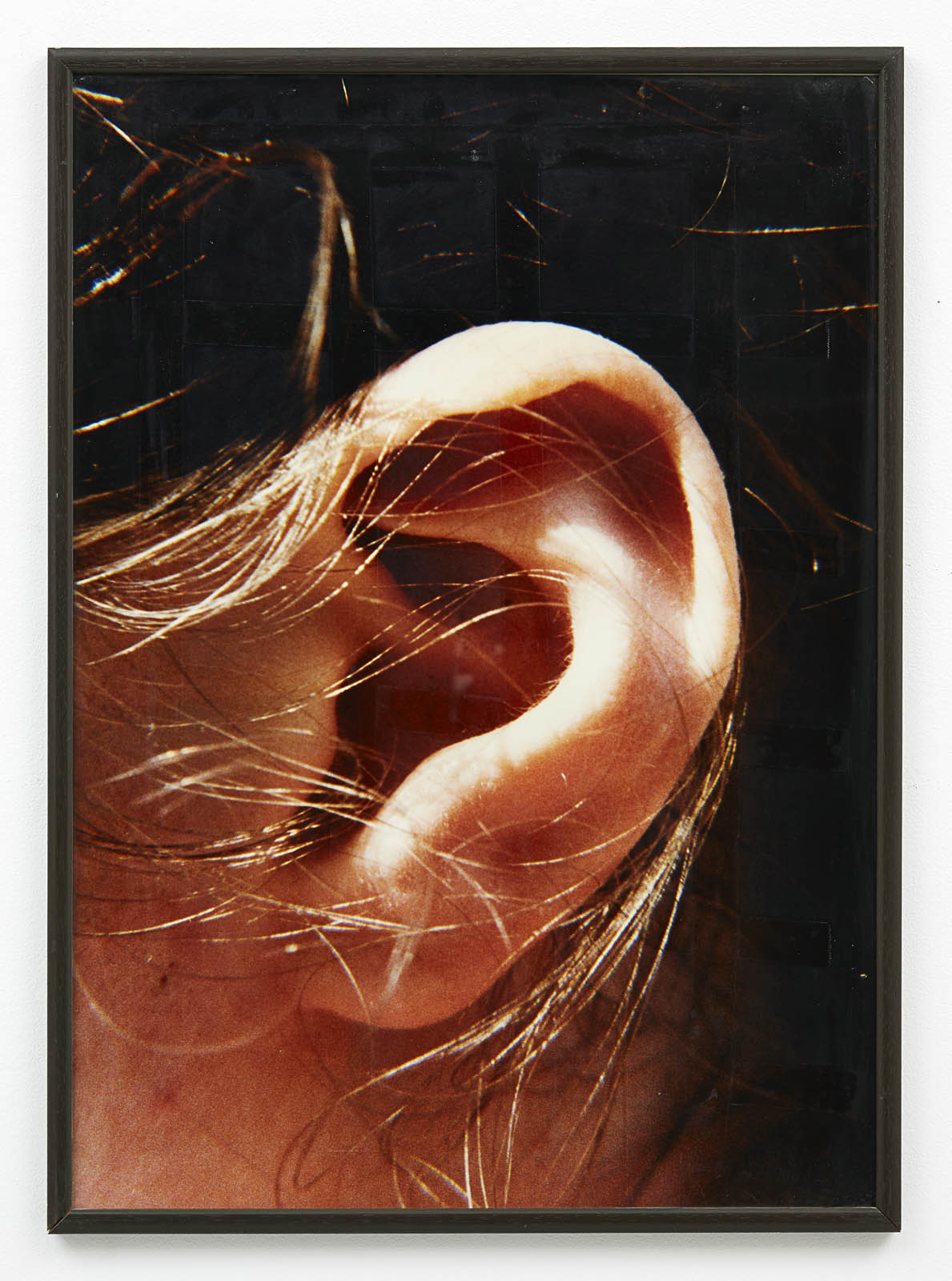
 

Isa Genzken (German, b. 1948) 'Ohr' 1980


Isa Genzken (German, b. 1948)
Ohr
1980
Colour C-print in artist’s frame
Galerie Buchholz Courtesy the artist and Galerie Buchholz
© Isa Genzken, by SIAE 2025


In 1980, Isa Genzken took a series of close-ups of the ears of women she encountered on the streets of New York. The typical portraiture approach used in the photographs exalts and enhances the characteristics of the represented subject, on the one hand, but at the same time, with the anonymity of the immortalized figure, creates a contrast. In the course of the evolution of the human species, the ear has lost its value in terms of expressive power. While in many animal species ears still play an important role in expressing emotions, in the human being they are stiffly positioned at the sides of the head and no longer react to emotional states along with the facial muscles. Georg Simmel, a sociologist of the senses, sees the ear as merely a passive appendage in the human appearance. For Simmel, the ear is the selfish organ par excellence, which simply takes without giving. Genzken contradicts this verdict, because the ears she photographs, with all the ornaments attached, eloquently express individual differences.

Exhibition text from the Fondazione Prada by Cord Riechelmann
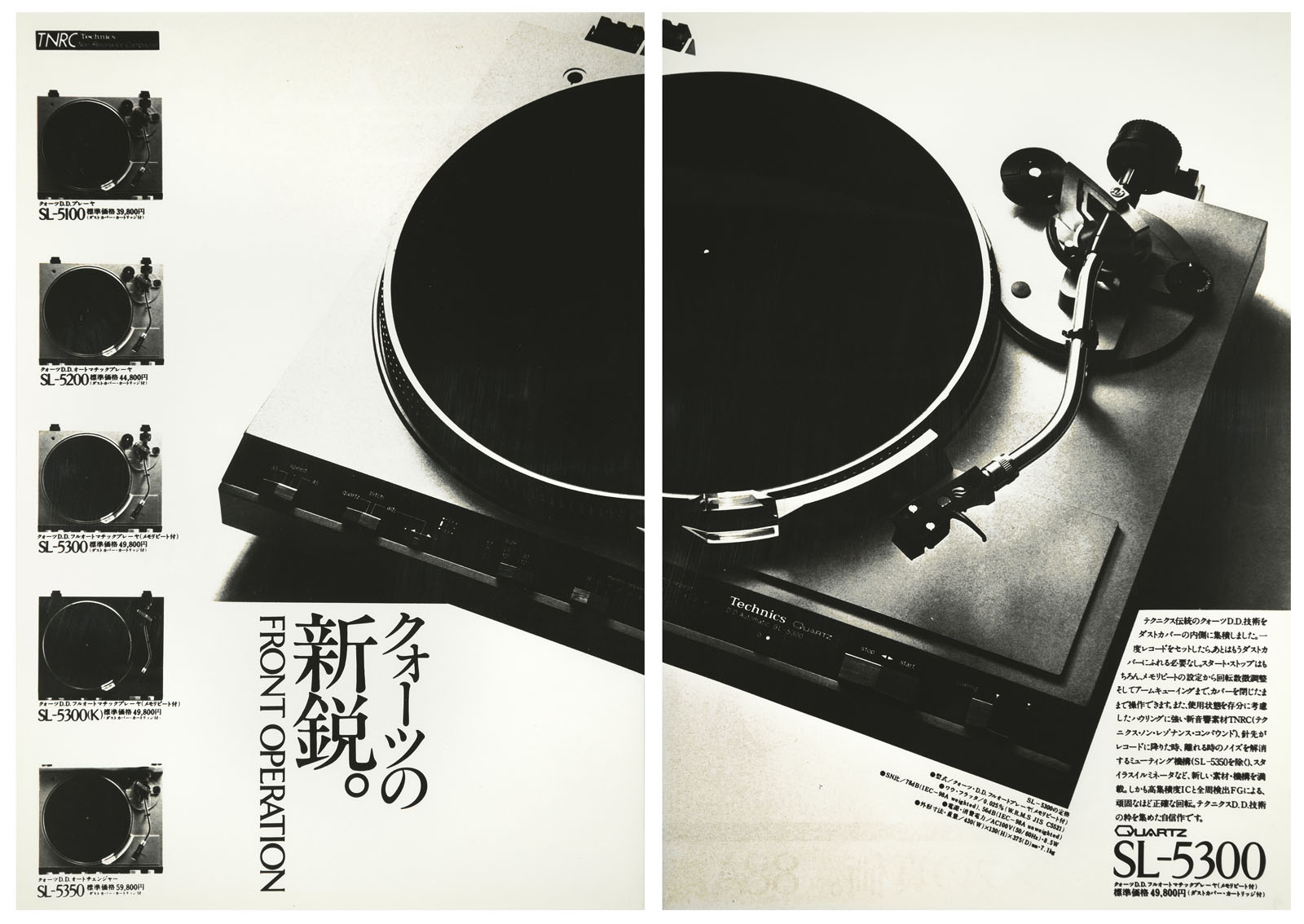
 

Isa Genzken (German, b. 1948) 'Front Operation' 1979


Isa Genzken (German, b. 1948)
Front Operation
1979
B/w photograph
Generali Foundation Collection – Permanent Loan to the Museum der Moderne Salzburg
© Generali Foundation / Isa Genzken, by SIAE 2025


In her first institutional exhibition, presented at the Museum Haus Lange in Krefeld in 1979, alongside sculptures and drawings, Isa Genzken exhibited a photography series dedicated to the latest and most expensive Hi-Fi systems. She created it by cutting out ads for turntables and amplifiers from international magazines and then photographing them. As she told photographer Wolfgang Tillmans in an interview, those advertisements showcased some of the most advanced technology of the time, highlighting cutting-edge design. Genzken also stated that a sculpture should be at least as modern as those devices. Her photography series dedicated to Hi-Fi systems can therefore be interpreted as a conceptual and aesthetic investigation of whether or not her sculptures and works could be compared to the everyday beauty of a stereo system.

Exhibition text from the Fondazione Prada by Cord Riechelmann
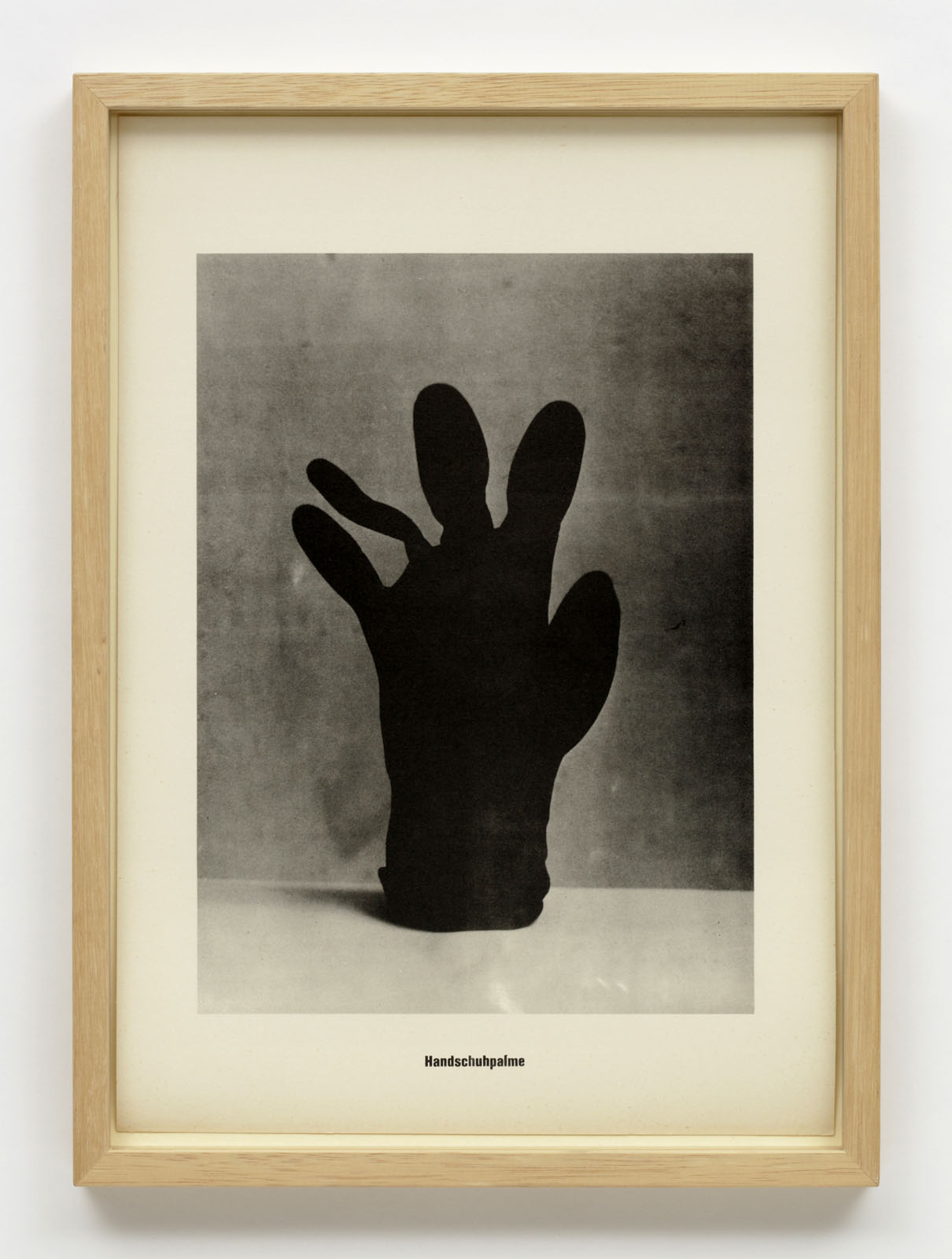
 

Sigmar Polke (German, 1941-2010) 'Handschuhpalme (Glove palm tree)' 1966


Sigmar Polke (German, 1941-2010)
Handschuhpalme (Glove palm tree)
1966
From the series … Höhere Wesen Befehlen, 1968 (… Higher beings Command, 1968)
13 stampe offset su carta artistica / 13 offset prints on art paper
MUSEUM MMK FÜR MODERNE KUNST, Frankfurt am Main


Lotte Jacobi (American born Poland, 1896-1990) 'Folkwang-Auriga-Verlag, Orch 152. Neottia nidus avis. Vogel-Nestwurz, einzelne Blüte' [Bird's-nest orchid, single flower] c. 1930


Lotte Jacobi (American born Poland, 1896-1990)
Folkwang-Auriga-Verlag, Orch 152. Neottia nidus avis. Vogel-Nestwurz, einzelne Blüte [Bird’s-nest orchid, single flower]
c. 1930
Gelatin silver print
Berlinische Galerie – Museum of Modern Art, Photography and Architecture
© Lotte Jacobi


Lotte Jacobi, known for her portraits of intellectuals including Martin Buber and W.E.B du Bois, artists such as Marc Chagall, and poets including Robert Frost and Vladimir Mayakovsky, created a series of plant portraits in 1930. Apart from the individual flowers of the Orchis latifolia, the broad-leaved helleborine or orchid, and Neottia nidus avis, the bird’s nest, she photographed an orchid in its entirety. The names of the plants, which Jacobi, like Karl Blossfeldt, makes explicit in the titles of the photographs, are an integral part of the unique poetics of the subjects. With her plant portraits, Jacobi followed in the tradition of the 1920s workers’ movement’s vision of nature. In fact, Jacobi was a member of the Vereinigung der Arbeiterfotografen Deutschlands (Union of German Labor Photographers), an organisation of photographers who documented the social life and struggles of the German working class.

Exhibition text from the Fondazione Prada by Cord Riechelmann
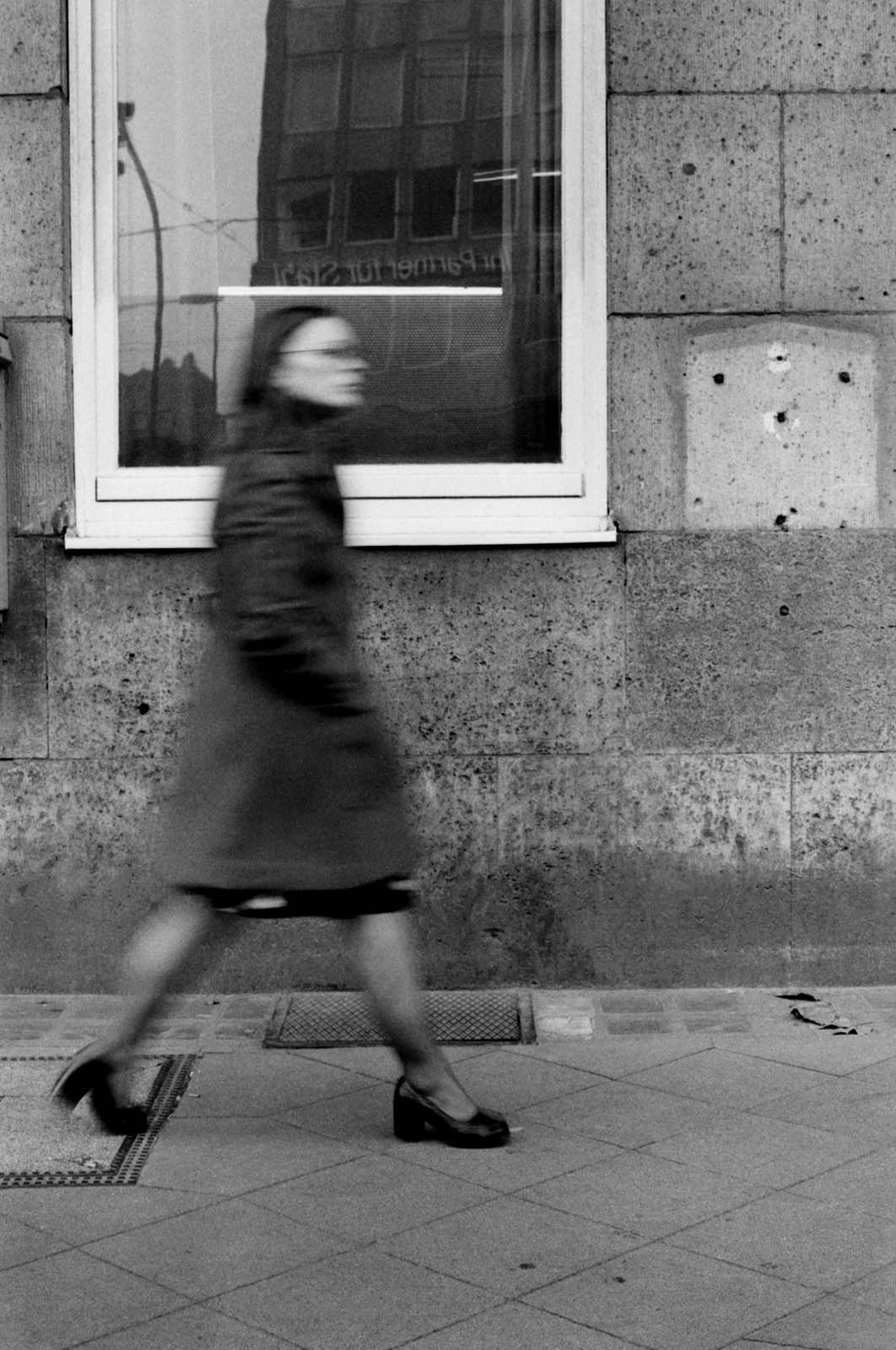
 

Thomas Struth (German, b. 1954) 'People on the Street, Düsseldorf 1974-78' 1974-1978


Thomas Struth (German, b. 1954)
People on the Street, Düsseldorf 1974-78
1974-1978
Gelatin silver print
Atelier Thomas Struth, Berlin
© Thomas Struth


In his photography, Thomas Struth has always been interested in the streets, squares, and houses of cities that consciously or unconsciously shape our experience, as well as that of the passers-by who walk through them. The study People on the Street, Düsseldorf 1974-78 explores the movements and figures of individuals passing in front of the camera lens. The subjects are never shot at close range. While some facial features are blurred in movement, others are clearly visible. Even if they are differentiated by their jackets, coats, or bags, all the subjects have a directional gait in common. No one is simply ‘here’: they all have an intention, which each person pursues in their own way.

Exhibition text from the Fondazione Prada by Cord Riechelmann
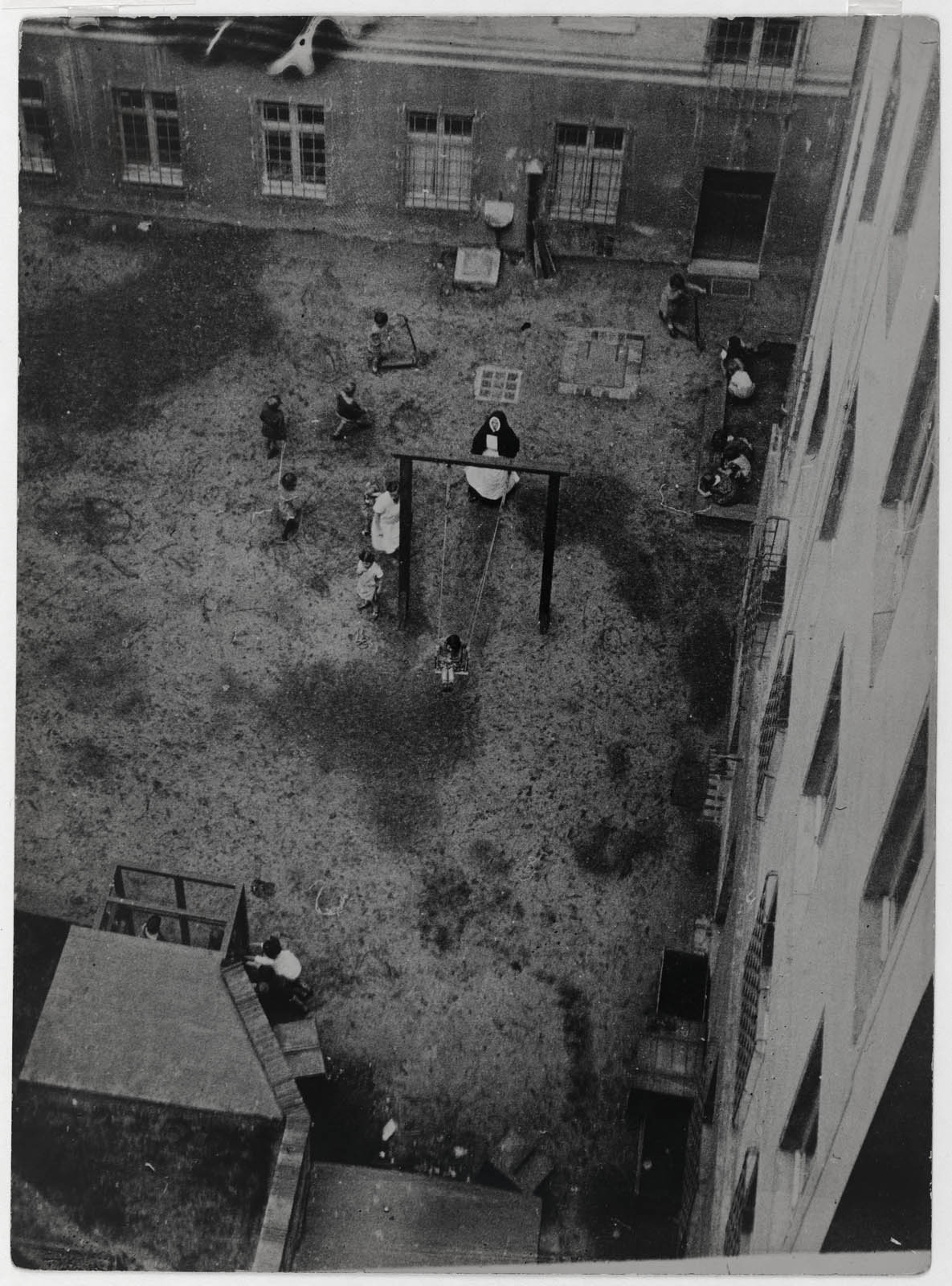
 

Umbo (Otto Umbehr) (German, 1902-1980) 'Untitled (Kindergarten)' 1928


Umbo (Otto Umbehr) (German, 1902-1980)
Untitled (Kindergarten)
1928
Gelatin silver print
Berlinische Galerie – Museum of Modern Art, Photography and Architecture, Berlin
Permanent loan from the Federal Republic of Germany represented by the Government Commissioner for Culture and the Media


Umbo – born Otto Umbehr – found his expressive tool in the camera in 1926. In the early 1920s he studied at the Bauhaus with the intention of becoming a painter, until Walter Gropius, the director of the Institute, expelled him from the school for improper conduct. He then found in photography the medium that allowed him to work with his distinctive play of light and shadow. Photographs such as Unheimliche Straße (Eerie Street, 1928), Am Strand (auch Strandleben) (On the beach [also beach life], 1930) and Ohne Titel (Kindergarten) (Untitled [Kindergarten], 1930) epitomize his artistic innovations. There is nothing random in these images: everything has been composed. Umbo’s photographs are the opposite of snapshots or shots that capture the emotion of a moment; they express a formal intent without overpowering reality. Therefore, with all their poetry, they retain an abstract component. What clearly surfaces in this primacy of composition is his connection to the Bauhaus philosophy, which emphasised design and structure over emotion or spontaneity.

Exhibition text from the Fondazione Prada by Cord Riechelmann


Fondazione Prada Milan
Largo Isarco 2, within the Podium spaces
20139 MILAN
Phone: +39 02 5666 2611

Opening hours:
Mon-Sun, 10am – 7pm

Fondazione Prada Milan website

LIKE ART BLART ON FACEBOOK

Back to top

Exhibition: ‘Suburbia. Building the American Dream’ at the Centre de Cultura Contemporània de Barcelona | CCCB

Exhibition dates: 20th March – 8th September 2024

Curators: Philipp Engel and Francesc Muñoz


'Suburbia. Building the American Dream' exhibition poster


Suburbia. Building the American Dream exhibition poster


An offer you can’t refuse

“The “American dream” can be summed up in a mental image that seems frozen in time: a home of one’s own, surrounded by lawns, with a pool in the back garden and a couple of cars slumbering in the garage… Suburbia. Building the American Dream draws us into the imaginary of the idyllic family home and shows how this lifestyle has been sold and promoted by fiction and the entertainment industry.” (Text from the CCCB website)


To me, there has always be something slightly askew, slightly out of kilter about the “American dream”. It promotes a generalised simulation of a imaginary reality, sold as a lifestyle, more fiction than fact. It is the ghost of desire that haunts the everyday reality of life, entirely on the side of demand: I want therefore I must have.

This desire must be satiated in the nuclear family, the white picket fence, the idyllic family home, the loveable children – as much a surface that reflects the approbation of others as for the sustenance of the self. As Anthony Giddens observes we are inescapably involved in a

“‘reflexive project of the self’: this project is reflexive because it involves unremitting self-monitoring, self-scrutiny, planning and ordering of all elements of our lives appearances and performances in order to marshal them into a coherent narrative called ‘the self’. We have to interpret the past and plan the future in relation to an identity we are attempting to constitute in a particularly immediate and transient social present. Consumerism is central to this self-obsession. This is partly because we not only have to choose a self, but (as Foucault’s line of argument also indicates) have to constitute ourselves as a self who choses, a consumer.”1

The American Dream endeavours to direct the identity we are attempting to constitute (through consumerism), so that it fits into a particularly conformist idea of a wholesome life: patriarchal, hegemonic, puritan (most important in America), god fearing, white – a particularly hyperreal simulation of a world that never existed in the first place. An imaginary construction.2

Photographs reinforce this “imaginary” state of being, this desire for the American Dream. As the wonderful Victor Burgin observes,

“The structure of presentation – point-of-view and frame – is intimately implicated in the reproduction of ideology (the ‘frame of mind’ of our ‘points-of-view’). More than any other textual system, the photograph presents itself as ‘an offer you can’t refuse’. The characteristics of the photographic apparatus position the subject in such a way that the object photographed serves to conceal the textuality of the photograph itself – substituting passive receptivity for active (critical) reading. … With most photographs we see, […] decoding and investiture takes place instantaneously, unselfconsciously, ‘naturally’; but it does take place – the wholeness, coherence, identity, which we attribute to the depicted scene is a projection, a refusal of an impoverished reality in favour of an imaginary plenitude. The imaginary object here, however, is not ‘imaginary’ [as in fictive] in the usual sense of the word, it is seen, it has a projected image.”3 (My bold and italics)


The photographs of the American Dream, then, deny an impoverished reality in favour of a desired imaginary plenitude. You too can live the dream, because you have seen the evidence of the projected image, and this imaginary identification can have very real effects.

In the desire for the dream we witness (elsewhere in the world) the egocentric obsession of some of the builders in the British series “Grand Designs” where people mortgage themselves up to the hilt, become sick, have marriage breakdowns and can’t finish the project, because of a dream… to build huge houses with 7 bedrooms and 4 bathrooms that no one in their right mind needs to build for 2 people. Or the case of the Australian Melissa Caddick who, in a Ponzi scheme stole A$30 million from investors, including her friends and family, in order to appear a successful business woman. “Caddick used the proceeds of her crimes to acquire “all the trappings of wealth” and that her “success was all a façade and the financial services business was an elaborate front for Ms. Caddick’s Ponzi scheme”.”4

Ego is reinforced by the image reflected back to us by the photograph.

Christopher Lasch comments that, “The proliferation of recorded images undermines our sense of reality. As Susan Sontag observes in her study of photography, “Reality has come to seem more and more like what we are shown by cameras.” We distrust our perceptions until the camera verifies them. Photographic images provide us with the proof of our existence, without which we would find it difficult even to reconstruct a personal history…”5

Photographs posit a reality that promotes the dream, that verifies the dream, as ‘an offer you can’t refuse’.

Thankfully, some of the contemporary artists in this posting (I particularly like the work of Weronika Gęsicka) undermine the utopian ideal through wit, humour and critical inquiry.

Dr Marcus Bunyan


1/ Anthony Giddens. Modernity and Self-Identity: Self and Society in the Late Modern Age. Polity Press, Cambridge, 1991

2/ “In sociology, the imaginary as a Lacanian term refers to an illusion and fascination with an image of the body as coherent unity, deriving from the dual relationship between the ego and the specular or mirror image… “The term ‘imaginary’ is obviously cognate with ‘fictive’ but in its Lacanian sense it is not simply synonymous with fictional or unreal; on the contrary, imaginary identifications can have very real effects.””

David Macey, “Introduction”, Jacques Lacan, The Four Fundamental Concepts of Psycho-Analysis. London, 1994, p. xxi  quoted in “Imaginary (sociology)” on the Wikipedia website [Online] Cited 01/09/2024

3/ Victor Burgin (ed.,). Thinking Photography. Macmillan, Basingstoke, 1982, pp. 146-148.

4/ Farid Assaf SC quoted in Kate McClymont. “Melissa Caddick’s ‘trappings of wealth’ a front for her Ponzi scheme”. The Sydney Morning Herald 29 June 2021 in “Melissa Caddick,” on the Wikipedia website [Online] Cited 01/09/2024

5/ Christopher Lasch. The Culture of Narcissism. W.W.Norton and Company, New York, 1978, p. 48.


Many thankx to the Centre de Cultura Contemporània de Barcelona for allowing me to publish the photographs in the posting. Please click on the photographs for a larger version of the image.


Inside the exhibition: Suburbia. Building the American Dream 

Philipp Engel, curator of the exhibition “Suburbia”, examines the origin and vast expansion of residential neighbourhoods in the United States, an urban model centred on constructing large swathes of single-family homes on the outskirts of cities. Engel reflects on the allure that suburban landscapes have stirred in Western culture while highlighting the main issues and contradictions of the model, including segregation, safety paranoia and unsustainable consumption of water and energy.


Introduction

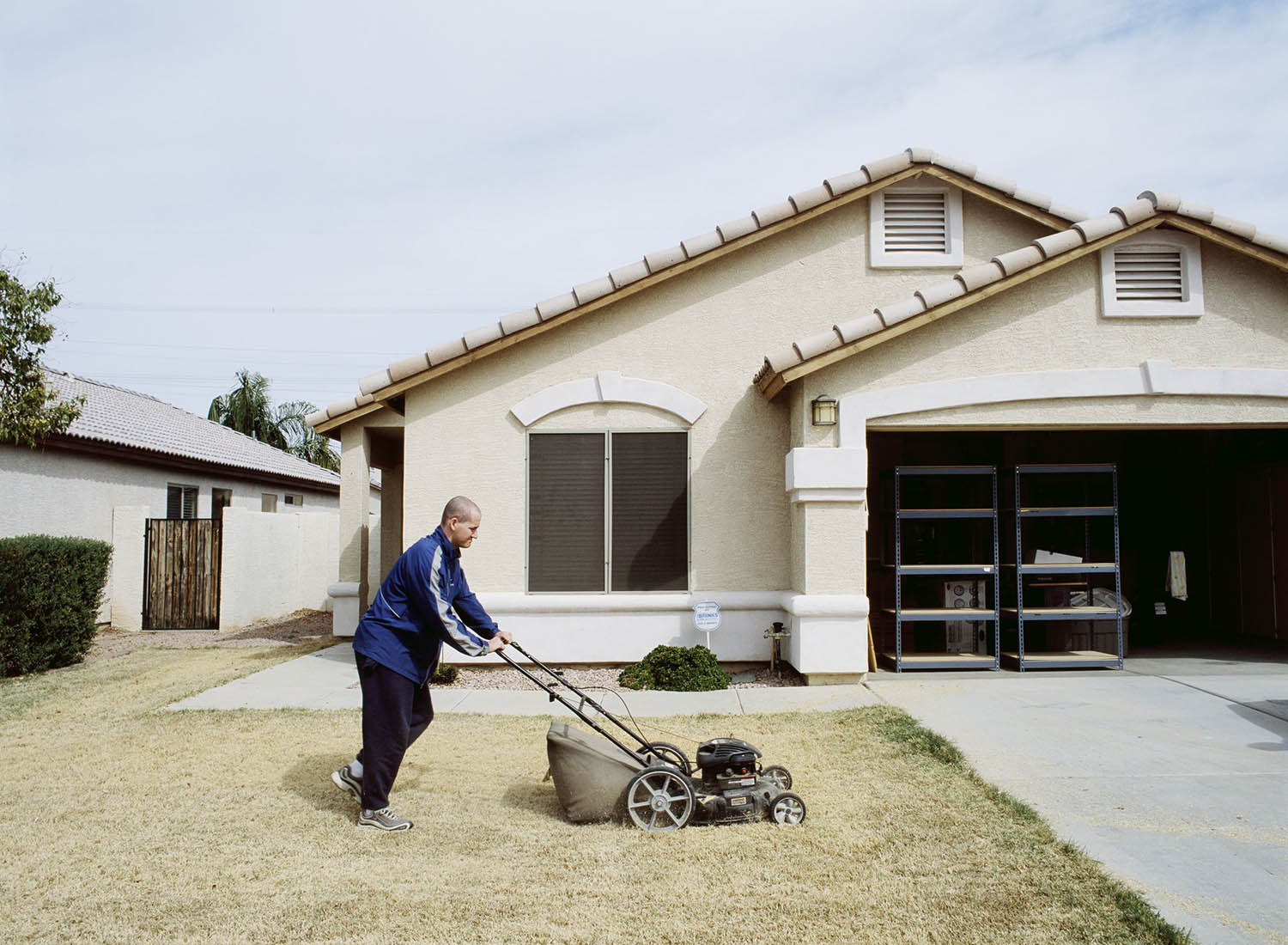
Greg Stimac (American, b. 1976) 'Chandler, Arizona' 2006 From 'Mowing the Lawn' portfolio


Greg Stimac (American, b. 1976)
Chandler, Arizona
2006
From Mowing the Lawn portfolio
Impressió digital Museum of Contemporary Photography, Columbia College Chicago


Who hasn’t longed for the American dream? A big house with a garden, a swimming pool and a couple of cars in the garage. A quiet, safe place to live as a family, close to nature in a people-friendly neighbourhood. This exhibition traces the cultural history of a lifestyle ideal that has been endlessly reproduced on television, in advertising and in cinema, and analyses the validity and the most controversial aspects of its urban planning model.

Suburbia. Building the American Dream draws us into the imaginary of the idyllic family home and shows how this lifestyle has been sold and promoted by fiction and the entertainment industry. The exhibition goes back to the origins of residential neighbourhoods in the early nineteenth century, explains how they developed massively in the 1950s, and reviews the economic, political and social context of their relentless expansion across the United States.

Now, when more and more families are pursuing their own version of the dream on the outskirts of cities, it is a good moment to analyse the contradictions of an urban planning model based on social, ethnic and gender segregation.

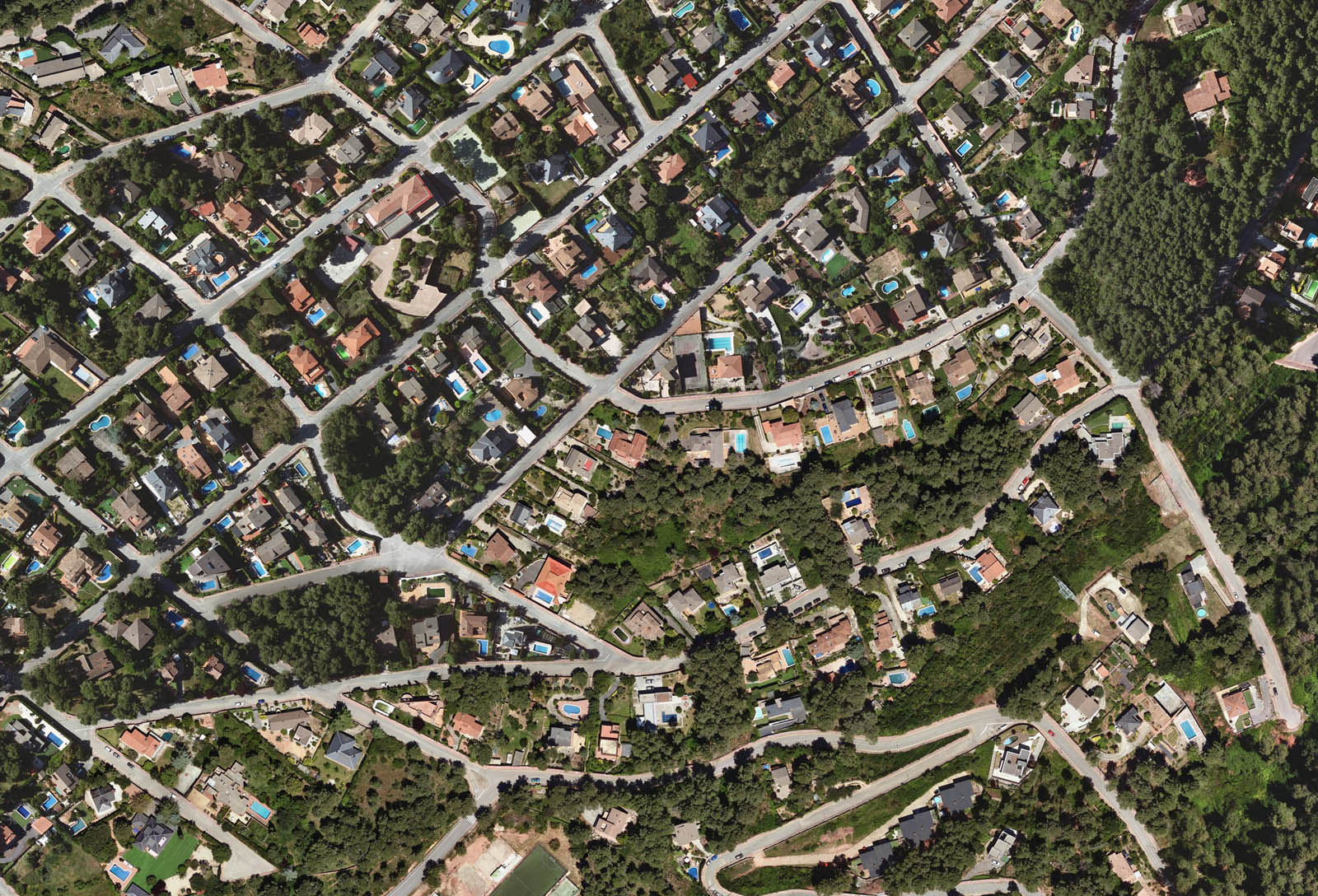
The dream of living in a house with a swimming pool is still very much alive today and has been exported all over the world. The exhibition shows the impact of this highly unsustainable model, based on constant car use, with examples of developments around Barcelona and Madrid.

With abundant historical material, period documentaries, photographs, paintings, films and series, novels and magazines, works of art and everyday objects, the exhibition places us in the mental paradise of the suburb and invites us to rethink the value of the city and public space today.

Suburbia. Building the American Dream presents the work of foremost creators who, from different points of view, help us to take a critical look at the famed American way of life: Jessica Chou, Gregory Crewdson, Thomas Doyle, Gerard Freixes, Rodrigo Fresán, Gabriele Galimberti, Weronika Gesicka, Benjamin Grant, Todd Hido, Joel Meyerowitz, Matthias Müller, Blanca Munt, Alberto Ortega, Bill Owens, Sheila Pree Bright, León Siminiani, Todd Solondz, Amy Stein, Greg Stimac, Angela Strassheim, Deborah Stratman, Ed & Deanna Templeton, Kate Wagner and Christopher Willan.

Text from the CCCB website


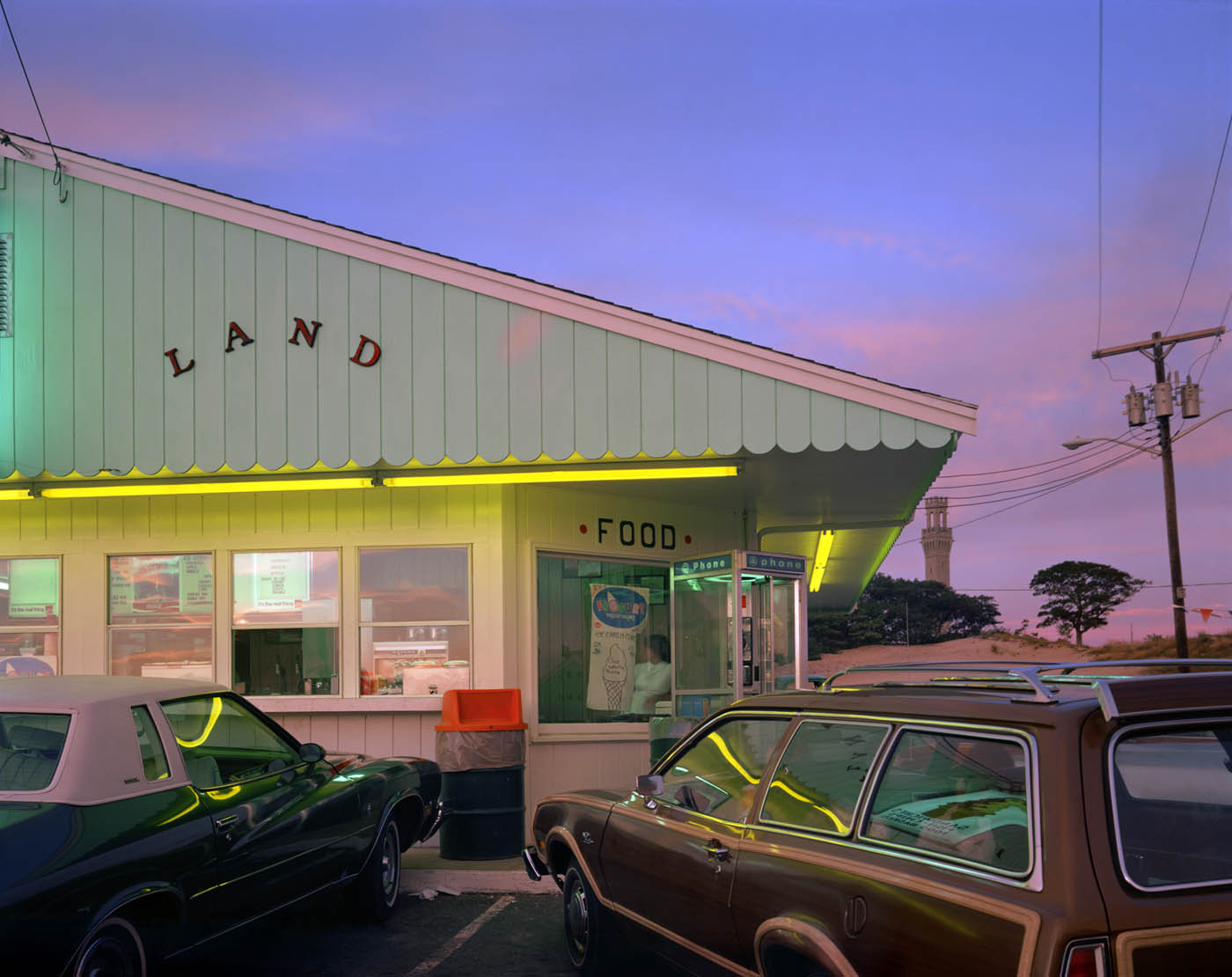
Joel Meyerowitz (American, b. 1938) 'Land. Provincetown' 1976


Joel Meyerowitz (American, b. 1938)
Land. Provincetown
1976
Archival pigment print
Collecció Pancho Saula i Michelle Ferrara / Galeria Alta, Andorra


Joel Meyerowitz (American, b. 1938) 'Dusk, New Jersey' 1978


Joel Meyerowitz (American, b. 1938)
Dusk. New Jersey
1978
Archival pigment print
Collecció Pancho Saula i Michelle Ferrara / Galeria Alta, Andorra


The “American dream” can be summed up in a mental image that seems frozen in time: a home of one’s own, surrounded by lawns, with a pool in the back garden and a couple of cars slumbering in the garage. Suburbia. Building the American Dream traces the cultural history of a lifestyle ideal shared far and wide by literature, television, advertising and cinema, and analyses the most controversial aspects of an urban planning model that has spread beyond US territory and reached our shores. Journalist Philipp Engel curates this exhibition with geographer Francesc Muñoz collaborating as adviser on the model in the local context.

Suburbia. Building the American Dream draws us into the imaginary of the idyllic family home and shows how this lifestyle has been sold and promoted by fiction and the entertainment industry. The exhibition goes back to the origins of residential neighbourhoods in the early nineteenth century, explains how they developed massively in the 1950s, and reviews the economic, political and social context of their relentless expansion across the United States.

Since the 1990s most of the American population has lived in this sprawling urban mass that has continued to spread, even beyond US borders. At a time when more and more families are pursuing their own version of the dream on city outskirts, the exhibition analyses the contradictions of an urban planning model based on social, ethnic and gender segregation. It also shows the impact of this highly unsustainable model, based on constant car use, with examples of developments around Barcelona and Madrid. With abundant historical material, photographs, paintings, audiovisuals, literature, works of art and everyday objects, the exhibition situates us in the mental paradise of the model of residential development inspired by American suburbia, and invites us to rethink the value of the city and public space today.

Suburbia. Building the American Dream decodes an almost abstract landscape that is still valid in pop culture. It does so through the work of foremost creators who help us take a critical look at the famed American way of life. It includes works by Jessica Chou, Gregory Crewdson, Thomas Doyle, Gerard Freixes, Gabriele Galimberti, Weronicka Gęsicka, Benjamin Grant, Todd Hido, Joel Meyerowitz, Matthias Müller, Blanca Munt, Alberto Ortega, Bill Owens, Sheila Pree Bright, León Siminiani, Amy Stein, Greg Stimac, Angela Strassheim, Deborah Stratman, Ed & Deanna Templeton, Kate Wagner and Christopher Willan, among others.


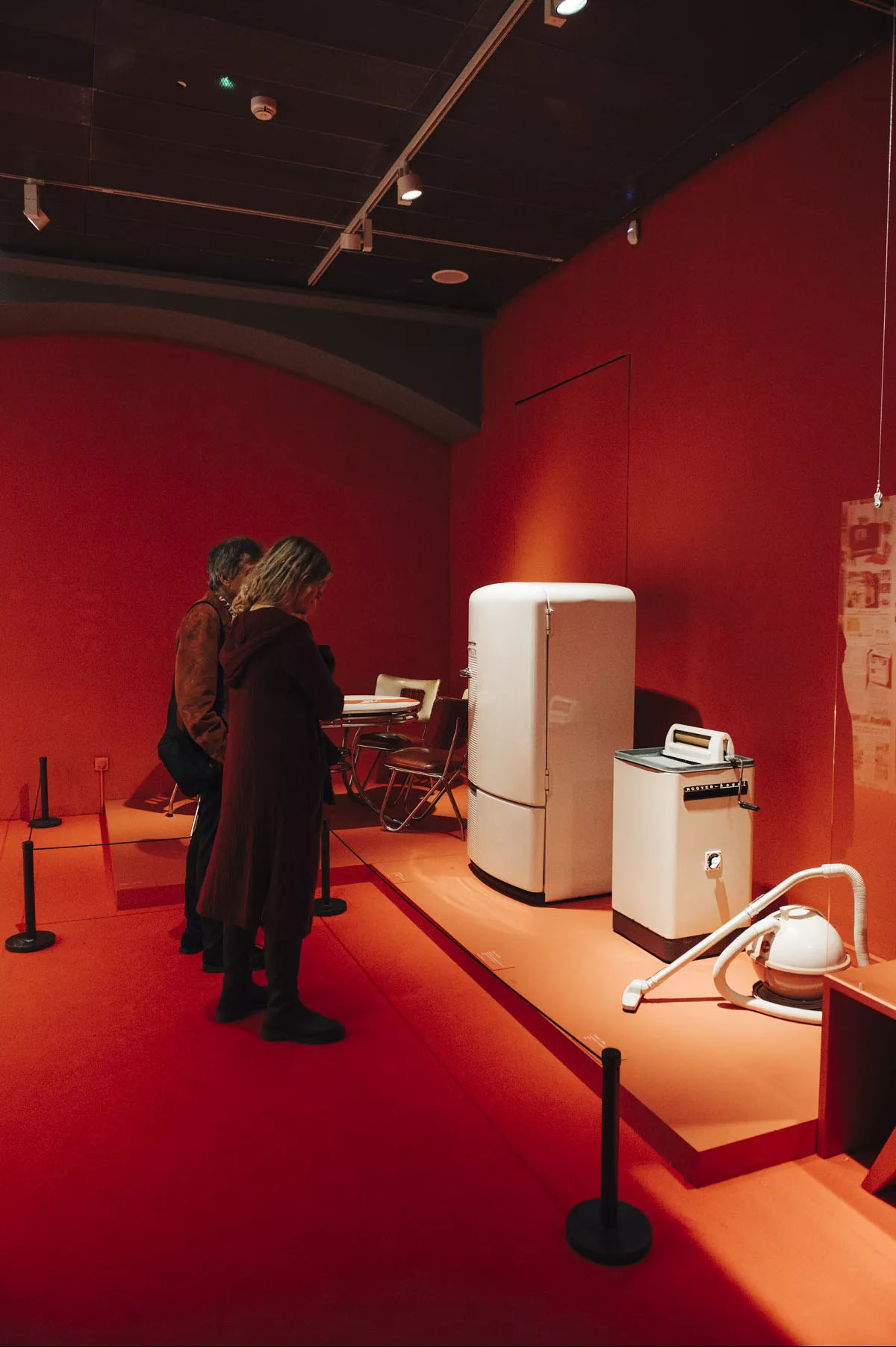
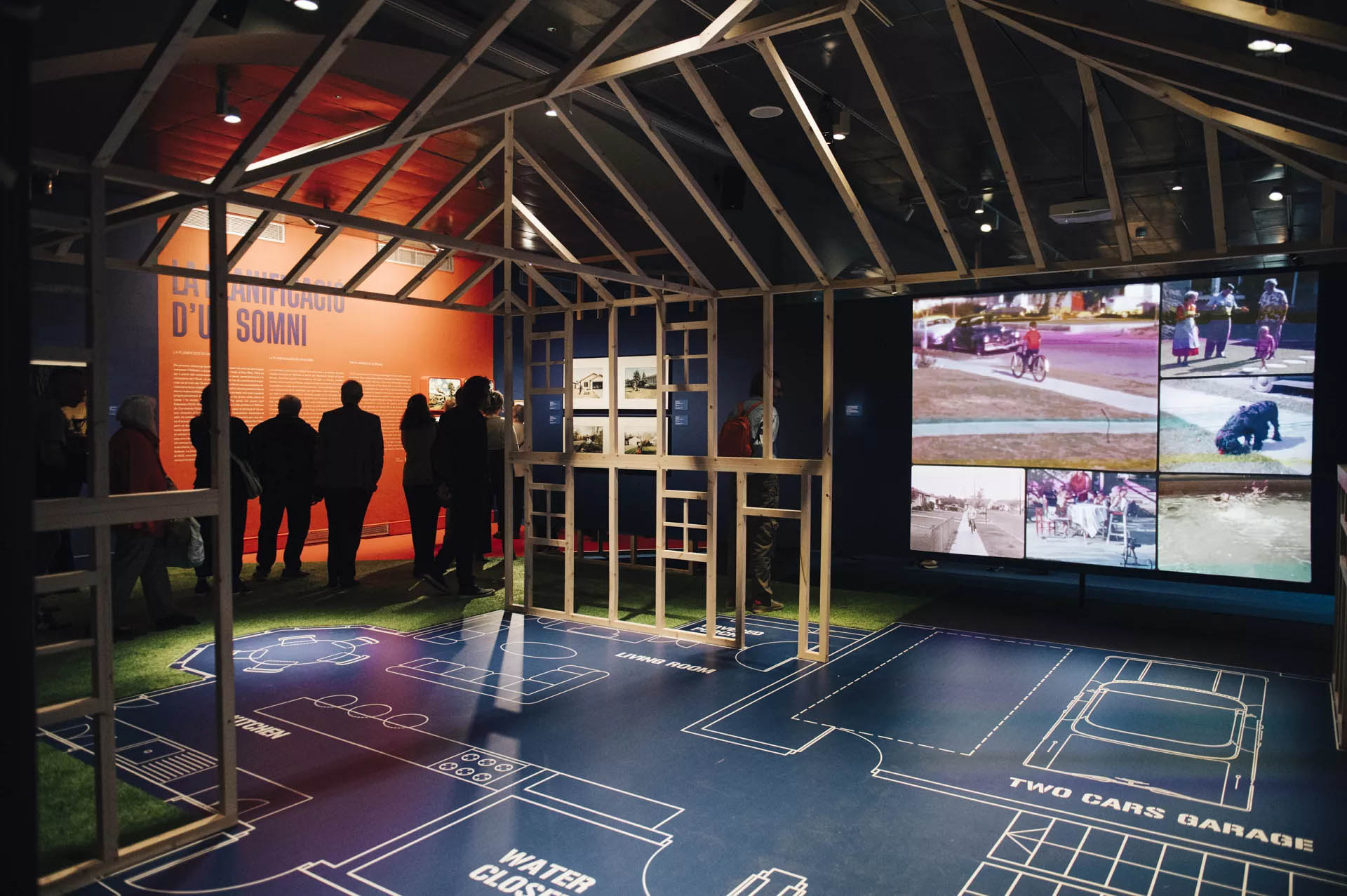
Installation view of the exhibition 'Suburbia. Building the American Dream' at the Centre de Cultura Contemporània de Barcelona | CCCB

Installation view of the exhibition 'Suburbia. Building the American Dream' at the Centre de Cultura Contemporània de Barcelona | CCCB

Installation view of the exhibition 'Suburbia. Building the American Dream' at the Centre de Cultura Contemporània de Barcelona | CCCB

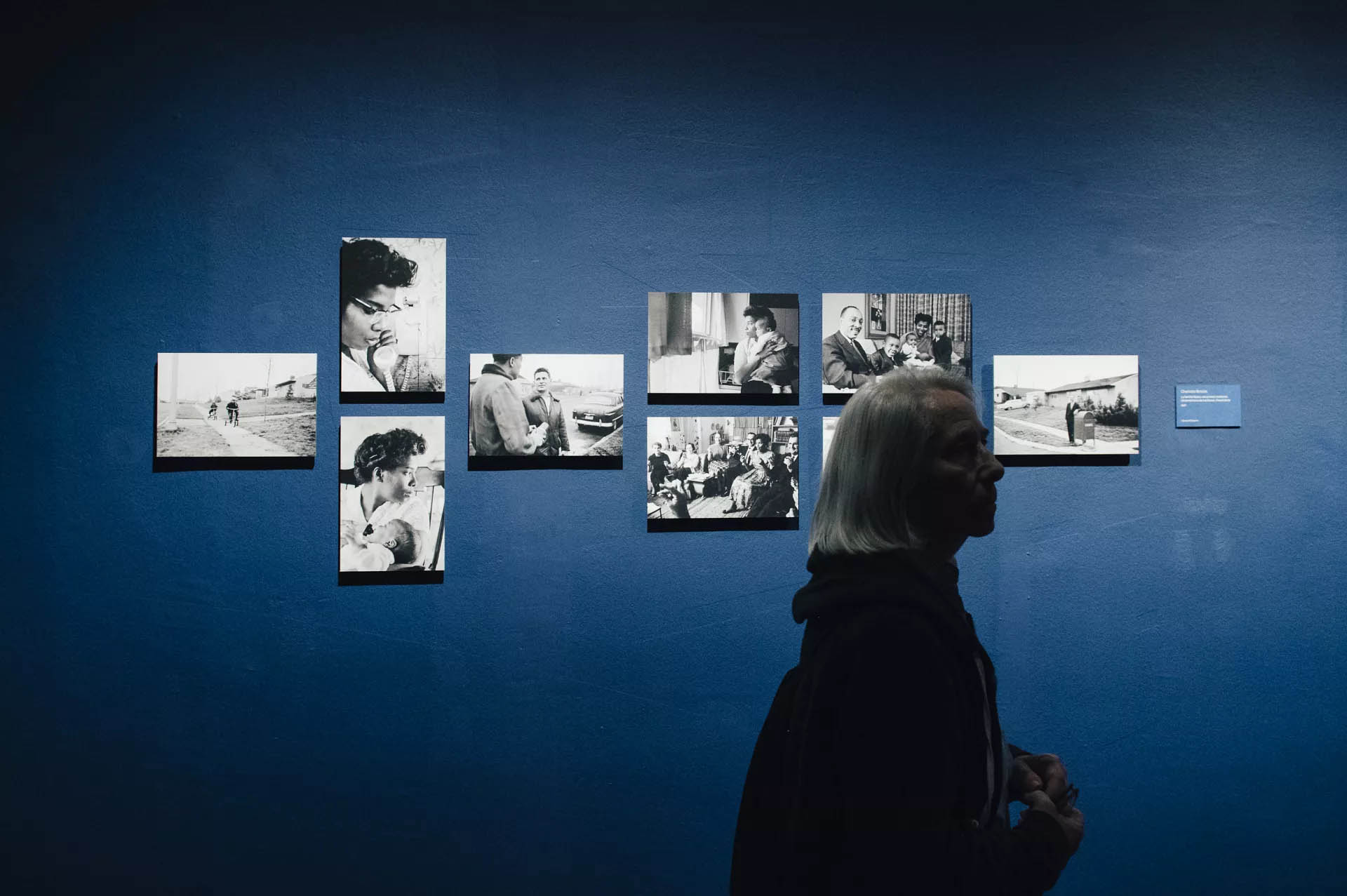
Installation view of the exhibition 'Suburbia. Building the American Dream' at the Centre de Cultura Contemporània de Barcelona | CCCB showing photographs by Charlotte Brooks

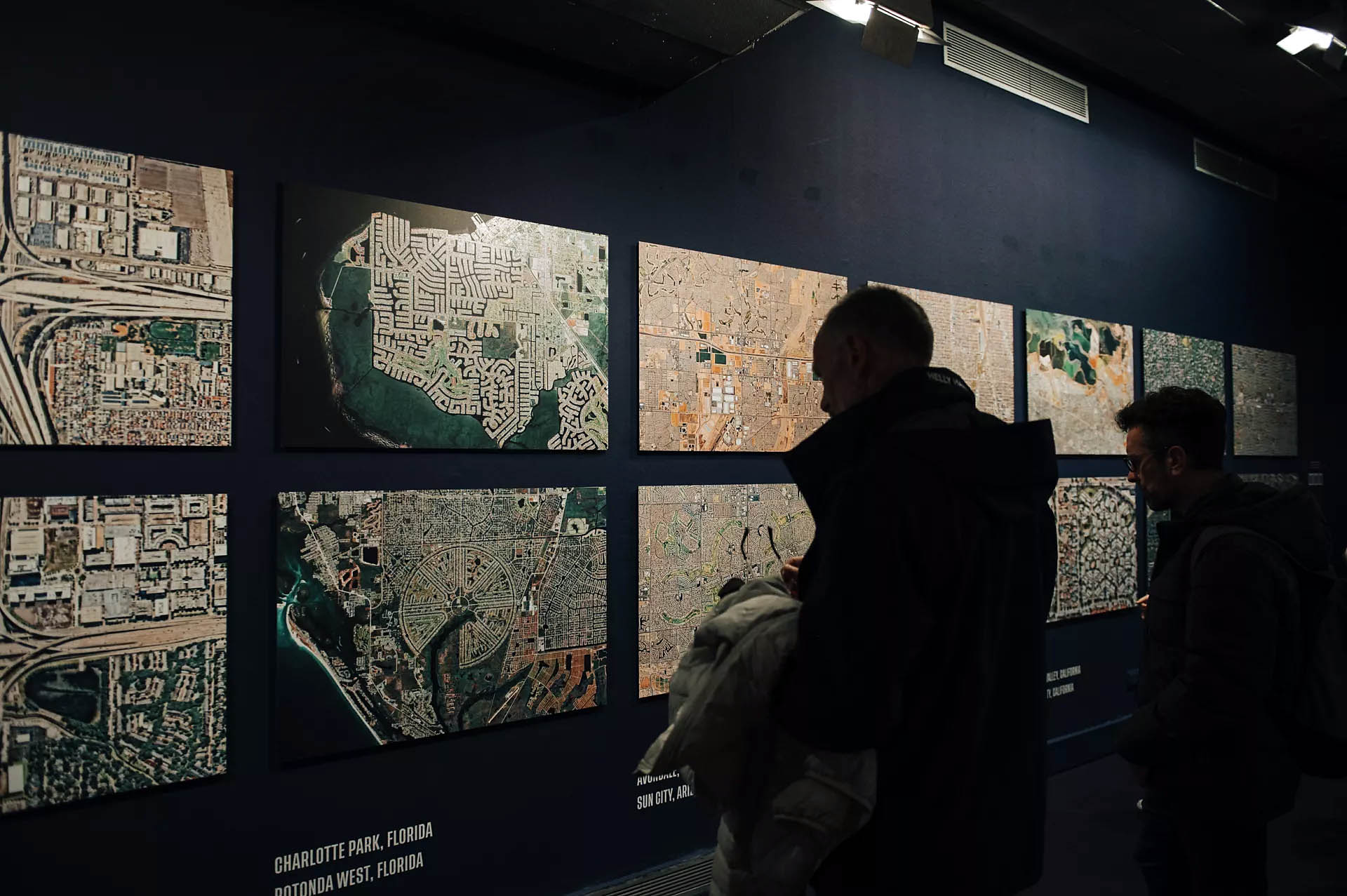
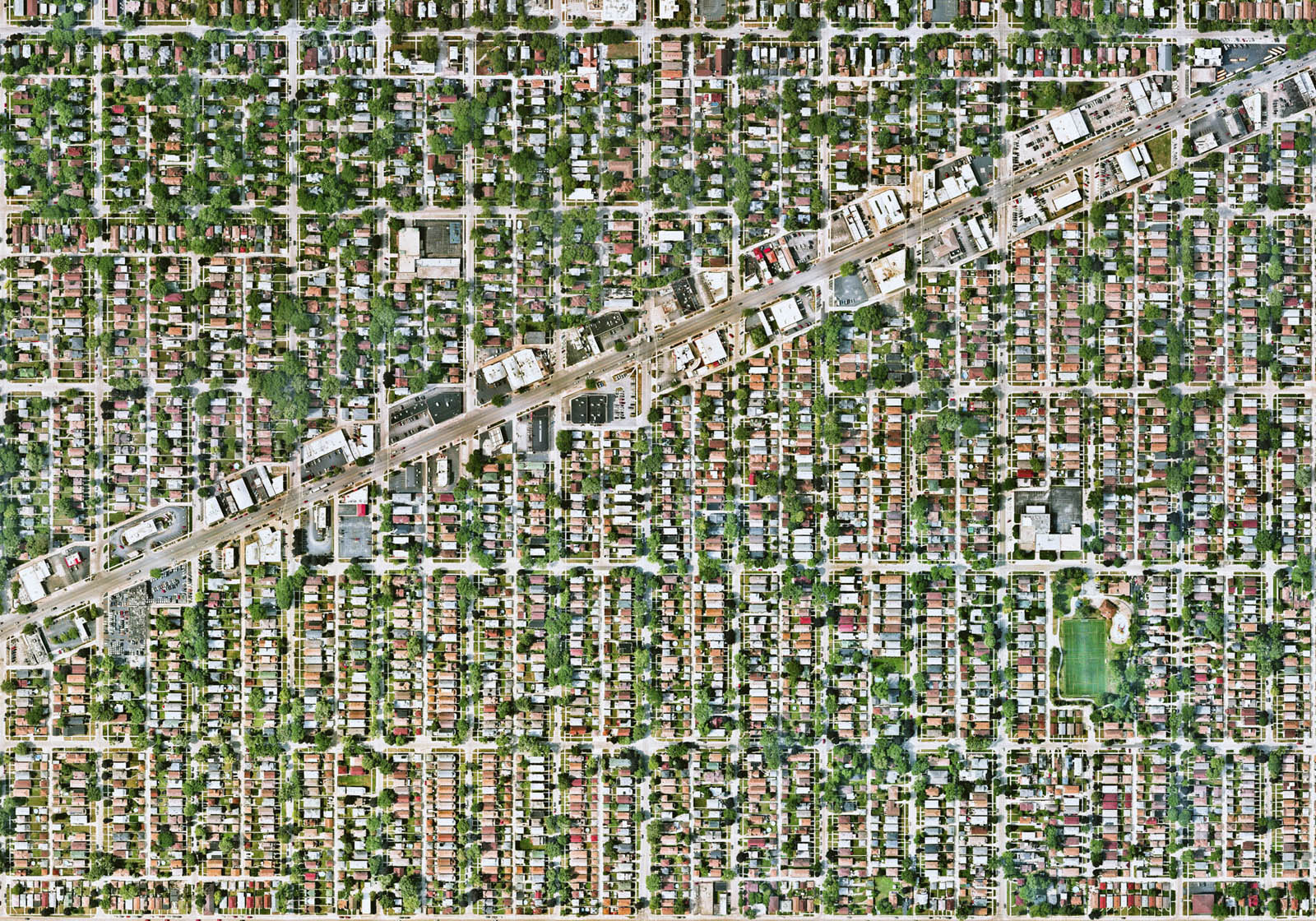
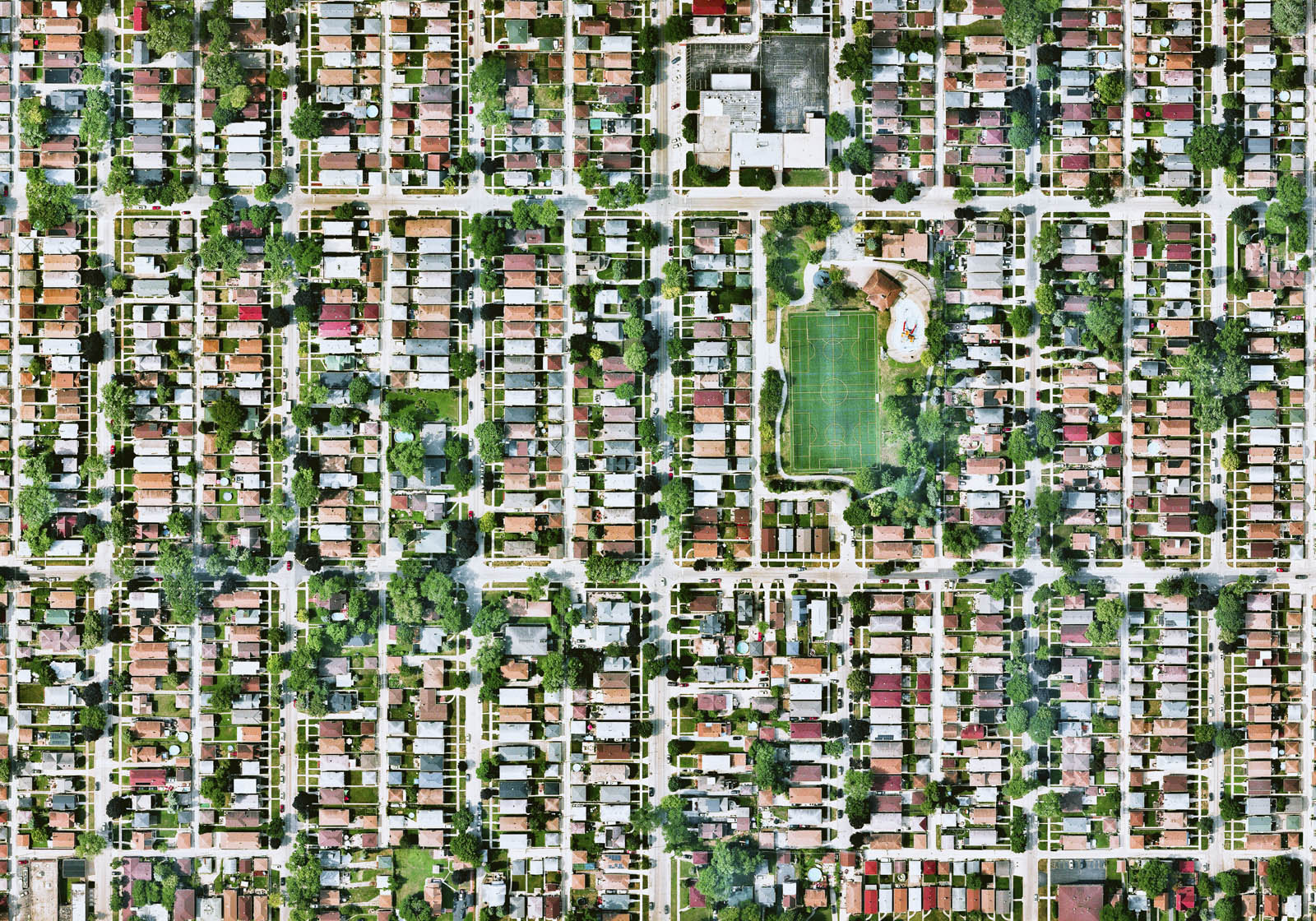
Installation view of the exhibition 'Suburbia. Building the American Dream' at the Centre de Cultura Contemporània de Barcelona | CCCB showing visitors looking at satellite images of US cities and suburbs that show their grid layout


Installation views of the exhibition Suburbia. Building the American Dream at the Centre de Cultura Contemporània de Barcelona | CCCB showing in the second image photographs by Charlotte Brooks (below); and in the bottom image, visitors looking at satellite images of US cities and suburbs that show their grid layout
© Alice Brazzit, CCCB, 2024


Charlotte Brooks (American, 1918-2014) '[Image from LOOK - Job 57-7621 titled Myers family]' 20th December 1957


Charlotte Brooks (American, 1918-2014)
[Image from LOOK – Job 57-7621 titled Myers family]
20th December 1957
Film negative
Look magazine photograph collection (Library of Congress)
Library of Congress Prints and Photographs Division Washington, D.C.


Installation view of the exhibition 'Suburbia. Building the American Dream' at the Centre de Cultura Contemporània de Barcelona | CCCB showing photographs by Gregory Crewdson


Installation view of the exhibition Suburbia. Building the American Dream at the Centre de Cultura Contemporània de Barcelona | CCCB showing photographs by Gregory Crewdson (below)


Gregory Crewdson (American, b. 1962) 'Untitled (Dream House)' 2002


Gregory Crewdson (American, b. 1962)
Untitled (Dream House)
2002
Digital C-print
29 x 44 inches


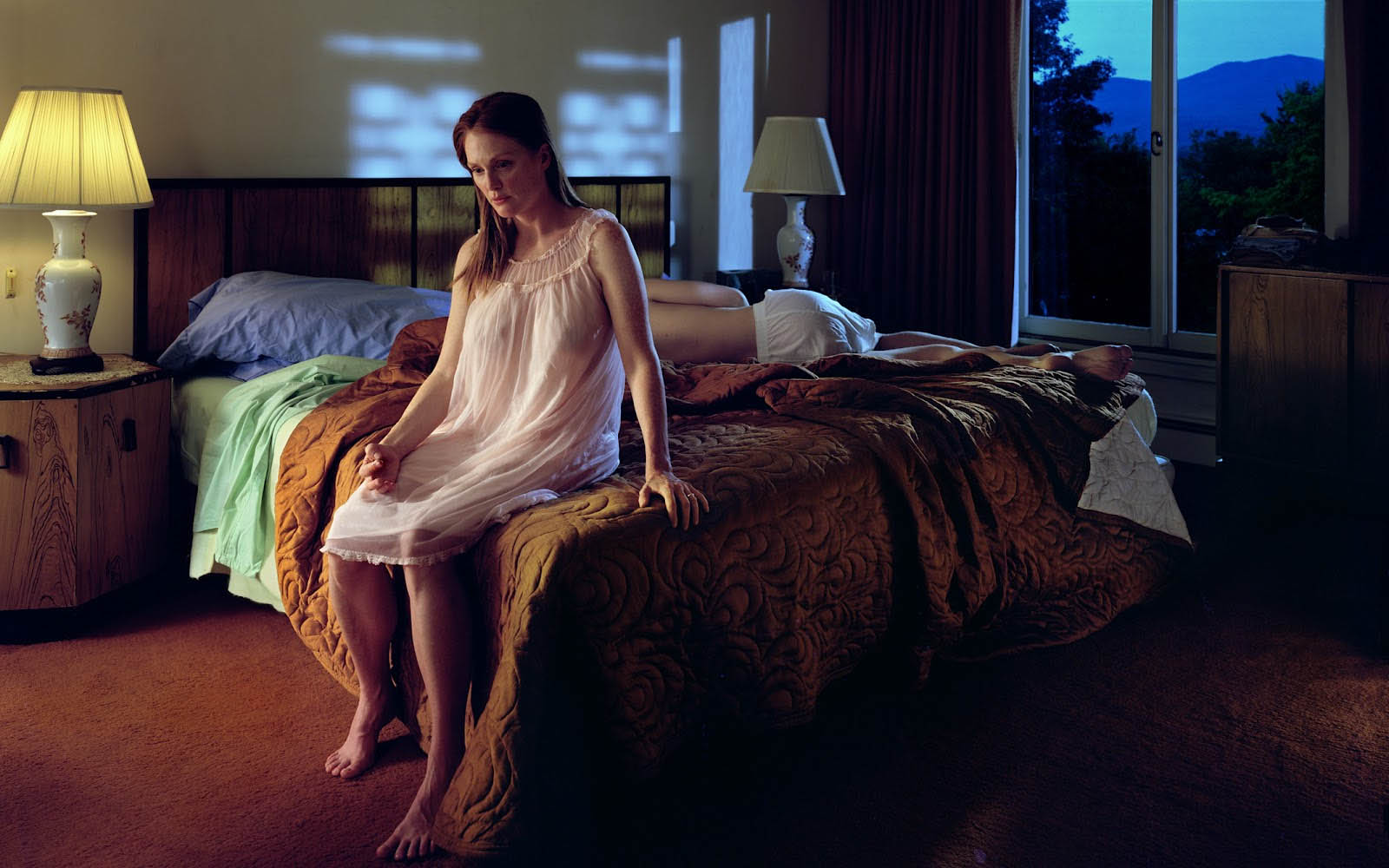
American photographer Gregory Crewdson is best known for his uncanny images of deceptively serene suburban life.  Using Hollywood film techniques and elaborate sets, Crewdson creates what he calls “frozen moments”: meticulously staged scenes whose narrative meaning remains a mystery.  Throughout this series, special attention is paid to light.  The twilight setting favoured by the photographer functions as a metaphor, an eerie evocation of the darkness on the edge of town.

Crewdson created this twelve-part portfolio, Dream House, as a commission for The New York Times Magazine in 2002.  The cinematic character of these frozen vignettes is underscored by the use of Hollywood actors (Gwyneth Paltrow, Tilda Swinton, and Philip Seymour Hoffman among others) whose celebrity contrasts with the “Anytown” anonymity of their environments.

Text from the Mutual Art website


Gregory Crewdson (American, b. 1962) 'Julianne Moore (Dream House)' 2002


Gregory Crewdson (American, b. 1962)
Julianne Moore (Dream House)
2002
Digital C-print
29 x 44 inches


Sections of the exhibition

Planning A Dream

When the Industrial Revolution reached the USA in the first half of the 19th century, big cities became engines of progress, but they were also seen as dangerous places, in contrast with the opulent nature of the New World. With the emergence of the railway, the tram and the automobile, the mobility revolution prompted the gradual colonisation of city outskirts, transforming the countryside into residential neighbourhoods.

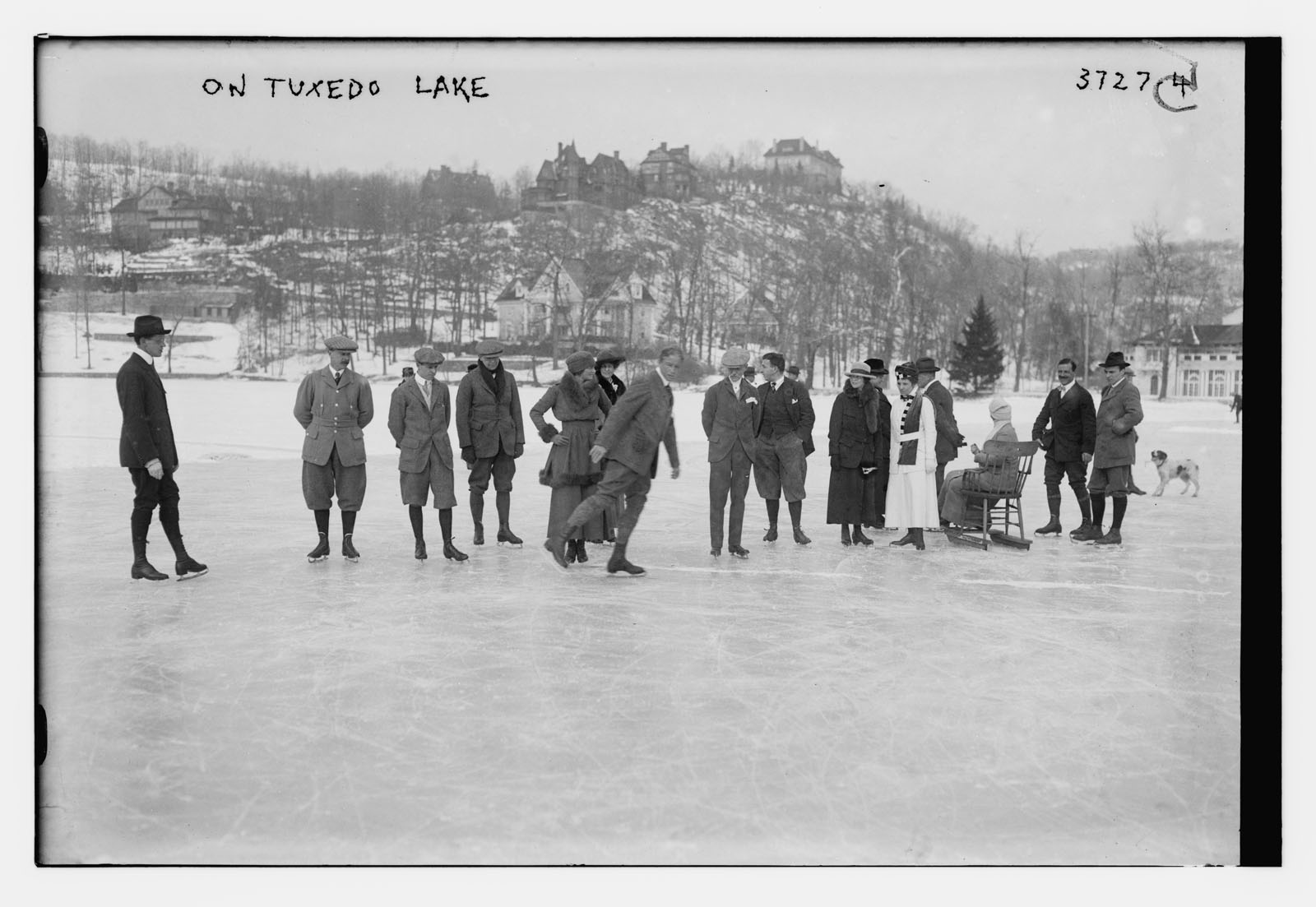
From Llewellyn Park (New Jersey) to Tuxedo Park (New York), throughout the 19th century the first gated communities began to pop up across the United States. At the end of the century, after the West was won, the appearance of the tram gave the middle classes access to the periphery, giving rise to a new type of housing that led to an orderly arrangement of city grids. But it wasn’t until the popularisation of the famous Ford Model T that the US landscape was radically transformed, crisscrossed by roads that became freeways. The automobile became a symbol of freedom, marking the birth of the suburbs that were to spring up everywhere.

This first section includes historical material like the original lithograph View of New York by John William Hill (1836); The American Woman’s Home by Catharine Beecher, the bible of “domestic feminism”; a Ford T Touring (1923) produced by General Motors, and films like The Suburbanite (1908), among other Harold Lloyd and Buster Keaton classics.


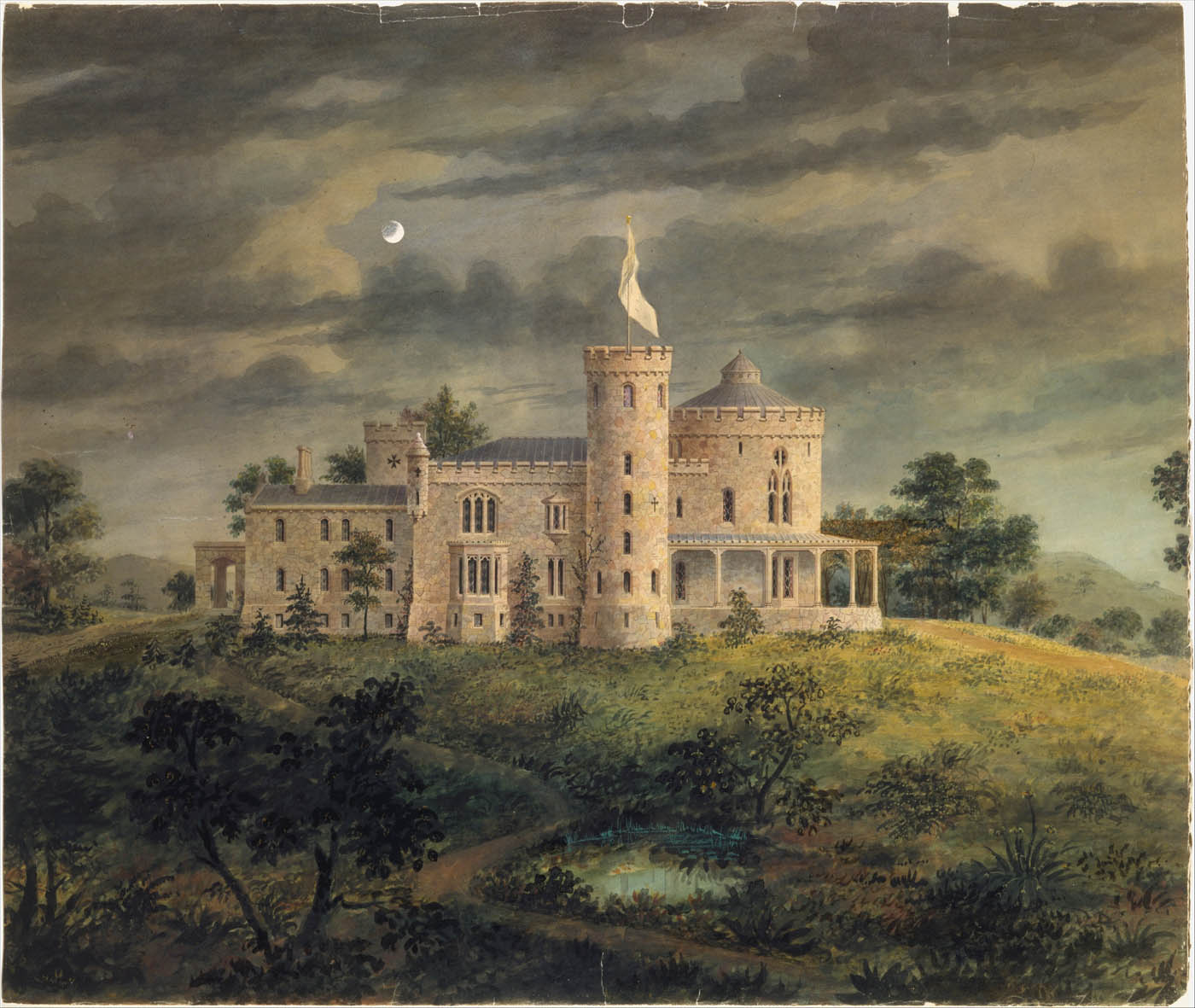
Alexander Jackson Davis (American, 1803–1892) 'Villa for David Codwise, near New Rochelle, NY (project; elevation and four plans)' 1835


Alexander Jackson Davis (American, 1803–1892)
Villa for David Codwise, near New Rochelle, NY (project; elevation and four plans)
1835
Pen and ink, watercolour, graphite
Sheet: 14 5/16 x 9 in. (36.4 x 22.9 cm)
Metropolitan Museum of Art, New York
Harris Brisbane Dick Fund, 1924
Public domain


Alexander Jackson Davis (American, 1803-1892) 'Ericstan, for John J. Herrick, Tarrytown, New York (perspective)' 1855


Alexander Jackson Davis (American, 1803–1892)
Ericstan, for John J. Herrick, Tarrytown, New York (perspective)
1855
Watercolour, ink, and graphite on paper
25 5/16 x 30in. (64.3 x 76.2cm)
Metropolitan Museum of Art, New York
Harris Brisbane Dick Fund, 1924
Public domain


Davis’ most successful castellated villa was built for dry-goods merchant John J. Herrick. The design was dominated by an enormous three-story circular tower facing west over the Hudson River. The tower housed an extraordinary circular parlor that had an intricately vaulted ceiling springing from a massive central cluster of delicate Gothic columns. Ericstan was demolished in 1944.


After Alexander Jackson Davis (American, 1803-1892) Friend & Aub (Publisher Philadelphia, Pennsylvania) 'Map of Llewellyn Park and Villa Sites, on Eagle Ridge in Orange & West Bloomfield' 1857


After Alexander Jackson Davis (American, 1803-1892)
Friend & Aub (Publisher Philadelphia, Pennsylvania)
Map of Llewellyn Park and Villa Sites, on Eagle Ridge in Orange & West Bloomfield
1857
Lithograph
14 7/16 x 23 7/16 in. (36.7 x 59.6cm)
Metropolitan Museum of Art, New York
Harris Brisbane Dick Fund, 1924
Public domain


Morse & Fronti (Charles W. Morse and J. Fronti) 'Residence of Mr. E. Hooker, Fremont Ave., Orange, N.J.' 1860


Morse & Fronti (Charles W. Morse and J. Fronti)
Residence of Mr. E. Hooker, Fremont Ave., Orange, N.J.
1860
The Miriam and Ira D. Wallach Division of Art, Prints and Photographs: Photography Collection
The New York Public Library
Public domain


Currier & Ives (Publisher, New York active between 1856-1907) 'Sunnyside on the Hudson' 1856-1871


Currier & Ives (Publisher, New York active between 1856-1907)
Sunnyside on the Hudson
1856-1871
Hand coloured lithograph
Library of Congress Prints and Photographs Division Washington, D.C.
Public domain


Currier & Ives (Publisher, New York active between 1856-1907) 'Sunnyside on the Hudson' 1856-1871 (detail)


Currier & Ives (Publisher, New York active between 1856-1907)
Sunnyside on the Hudson (detail)
1856-1871
Hand coloured lithograph
Library of Congress Prints and Photographs Division Washington, D.C.
Public domain


Currier & Ives (Publisher, New York active between 1856-1907) 'American railroad scene: lightning express trains leaving the junction' 1874


Currier & Ives (Publisher, New York active between 1856-1907)
American railroad scene: lightning express trains leaving the junction
1874
Hand coloured lithograph
Library of Congress Prints and Photographs Division Washington, D.C.
Public domain


Advertising by Samuel. E. Gross 'August Gast & Co. New York' c. 1900


Advertising by Samuel. E. Gross.
August Gast & Co. New York
c. 1900
Lithography
Library of Congress


Advertising by Samuel. E. Gross 'August Gast & Co. New York' c. 1900 (detail)


Advertising by Samuel. E. Gross.
August Gast & Co. New York (detail)
c. 1900
Lithography
Library of Congress


Anonymous photographer / Bain News Service (publisher) 'Skaters on the lake at Tuxedo Park' 1910


Anonymous photographer
Bain News Service
(publisher)
Skaters on the lake at Tuxedo Park
1910
Glass negative
Library of Congress Prints and Photographs Division Washington, D.C.
Public domain


Anonymous photographer. 'Thomas Edison in the garden of his residence in Glenmont' 1917


Anonymous photographer
Thomas Edison in the garden of his residence in Glenmont
1917
Thomas Edison National Historical Park, West Orange, New Jersey


Anonymous photographer. 'General Motors Pavilion: Futurama, Norman Bel Geddes. New York World's Fair. General Motors – Crowds leading into Futurama' 1939


Anonymous photographer
General Motors Pavilion: Futurama, Norman Bel Geddes. New York World’s Fair. General Motors – Crowds leading into Futurama
1939
New York World’s Fair 1939-1940 records
Manuscripts and Archives Division, The New York Public Library
Public domain


'Catalog of the Aladdin company selling houses by mail' 1950


Catalog of the Aladdin company selling houses by mail
1950
Courtesy Historic New England


'Federal Housing Administration, Minneapolis and St. Paul, Minnesota' c. 1950


Federal Housing Administration, Minneapolis and St. Paul, Minnesota
c. 1950
Courtesy Minnesota Streetcar Museum, Minneapolis


The advertisement reads, “With a small down payment your rent money will buy a home. Consult your architect, builder, material dealer or any participating financial institution. Federal Housing Administration.”


The Suburban Room

The suburban explosion was first and foremost demographic, occurring as World War II soldiers returned, eager to set up home. There was no room for them in the crowded cities. With the support of the state, which offered generous loans, suburbs were built using the Fordist assembly-line production logic. It was the “American way of life”, the start of a collective dream that fascinated the whole world.

And so the baby boom took place in 11 million single-family homes fitted with all kinds of electrical domestic appliances, presided over by a brand new television set on which the new suburbanites watched idealised versions of themselves with identical skin colour and the same war experiences, age, mortgage and feeling of uprootedness. The media echoed this phenomenon, and cinema and literature reflected this standardised landscape in which a wife waited at home for her husband with a drink for him in her hand, children went everywhere by bicycle, and everyone had barbecues on Sundays.

Sponsored by the state, Suburbia became a paradise that excluded racial minorities. But little by little, by the sixties, the gates of paradise were opened to African Americans and other minorities, giving rise to a white exodus, the white flight.

As well as a variety of historical material, this section reviews sitcoms portraying the suburbs, from the 1940s to the present day. It also includes the famous illustration New Kids in the Neighborhood by Norman Rockwell and a broad selection of the photographs that make up Bill Owens’ Suburbia (1972), the first book of photographs about this American urban planning model.


Arthur S. Siegel (American, 1913-1978) 'Detroit, Michigan. Riot at the Sojourner Truth homes, a new U.S. federal housing project, caused by white neighbours' attempt to prevent Negro tenants from moving in. Mounted police and whites' Detroit 1942


Arthur S. Siegel (American, 1913-1978)
Detroit, Michigan. Riot at the Sojourner Truth homes, a new U.S. federal housing project, caused by white neighbours’ attempt to prevent Negro tenants from moving in. Mounted police and whites
Detroit 1942
Library of Congress
Public domain


General Electric advertisement 'It's a promise' 1945


General Electric advertisement
It’s a promise
1945
Private collection, Barcelona


Anonymous photographer. 'Aerial view of Levittown' 1949


Anonymous photographer
Aerial view of Levittown
1949
Courtesy Levittown Public Library


'Mural of household appliance advertisements published in different American magazines' 1947-1962


Mural of household appliance advertisements published in different American magazines
1947-1962


'Mural of household appliance advertisements published in different American magazines' 1947-1962 (detail)

'Mural of household appliance advertisements published in different American magazines' 1947-1962 (detail)

'Mural of household appliance advertisements published in different American magazines' 1947-1962 (detail)

'Mural of household appliance advertisements published in different American magazines' 1947-1962 (detail)


Mural of household appliance advertisements published in different American magazines (details)
1947-1962


Getting to Work. The Trials to U.S. commuters 'Time', January 18, 1960


Getting to Work. The Trials to U.S. commuters
Time, January 18, 1960
Library of Catalonia, Barcelona


John Cheever 'Time', March 27, 1964


John Cheever
Time, March 27, 1964
Library of Catalonia, Barcelona


Norman Rockwell (American, 1894-1978) 'New Kids in the Neighbourhood' 1967


Norman Rockwell (American, 1894-1978)
New Kids in the Neighbourhood
1967
Lithograph
Norman Rockwell Museum Collection


Bill Owens (American, b. 1938) 'Suburbia, Cul de sac, Pleseanton, California' 1972


Bill Owens (American, b. 1938)
Suburbia, Cul de sac, Pleseanton, California
1972
Gelatin silver
Bill Owens Archive, Milan


Bill Owens (American, b. 1938) 'I don't feel that Richie playing with guns will have a negative effect on his personality. (He already wants to be a policeman.)' 1972


Bill Owens (American, b. 1938)
I don’t feel that Richie playing with guns will have a negative effect on his personality. (He already wants to be a policeman.)
1972
Gelatin silver
Bill Owens Archive, Milan


The Residential Nightmare

And night fell on Suburbia. What had been a dream became a nightmare. The idea of a safe, healthy, happy place was gradually contaminated with fears, terrors and paranoias. Doors were bolted and alarms installed. After all, in the American Gothic tradition, the house, often haunted, had always been a source of horror – evil lurked there. With the appearance of mass-produced housing, a new sub genre called Suburban Gothic was consolidated, and began to manifest itself both in literature and in cinema. Unlike the traditional Gothic, in this new landscape the family residence was no longer tied to a specific territory, as it had been in New England; now, with its white picket fence and green lawn, it could be anywhere in the country. And evil came from outside, it threatened to invade the home and even undermine it. Under the guise of shiny normality, American suburbs always conceal cracks through which terror creeps.

To illustrate this residential nightmare, we take in historical materials of the atomic age, photographs of the dark side of suburbia by Amy Stein, Todd Hido, Gregory Crewdson, Angela Strassheim and Gabriele Galimberti, and Kate Wagner’s installation, McMansionHell. Alberto Ortega, an artist from Seville resident in the US who has devoted himself to painting the suburbs at night, presents two works for the first time at the CCCB.


Todd Hido (American, b. 1968) 'Untitled #2214' 1998


Todd Hido (American, b. 1968)
Untitled #2214
1998
From the series House Hunting


Angela Strassheim (American, b. 1969) 'Untitled (Elsa)' 2005


Angela Strassheim (American, b. 1969)
Untitled (Elsa)
2005
Left Behind series
Courtesy of the artist


Installation view of the exhibition 'Suburbia. Building the American Dream' at the Centre de Cultura Contemporània de Barcelona | CCCB showing the work of Gabriele Galimberti from the series 'The Ameriguns' with at top right, 'Joel, Lynne, Paige and Joshua (44, 43, 5 and 11 years old) – central Texas' 2021; and at bottom right, 'Eric Arnsberger (30) and Morgan Gagnier (22) – Lake Forest, California' 2021


Installation view of the exhibition Suburbia. Building the American Dream at the Centre de Cultura Contemporània de Barcelona | CCCB showing the work of Gabriele Galimberti from the series The Ameriguns with at top right, Joel, Lynne, Paige and Joshua (44, 43, 5 and 11 years old) – central Texas 2021; and at bottom right, Eric Arnsberger (30) and Morgan Gagnier (22) – Lake Forest, California 2021
© Alice Brazzit, CCCB, 2024


Gabriele Galimberti (Italian, b. 1977) 'Joel, Lynne, Paige and Joshua (44, 43, 5 and 11 years old) – central Texas' 2021


Gabriele Galimberti (Italian, b. 1977)
Joel, Lynne, Paige and Joshua (44, 43, 5 and 11 years old) – central Texas
2021
Digital printing
Courtesy of the artist


Gabriele Galimberti (Italian, b. 1977) 'Avery Skipalis (33) – Tampa, Florida' 2021


Gabriele Galimberti (Italian, b. 1977)
Avery Skipalis (33) – Tampa, Florida
2021
Digital printing
Courtesy of the artist


Avery Skipalis (33) stands with her firearms in front of her house in Tampa, Florida, USA. Her son looks on from a window. Avery joined the US Air Force when she was 17, and after serving in the UAE, Japan and Germany, left to start a company that offers firearms safety classes to adults and children.


Alberto Ortega (American born Spain, b. 1976) 'Annunciation' 2023


Alberto Ortega (American born Spain, b. 1976)
Annunciation
2023
Oil on aluminium panel
Courtesy of the artist


Alberto Ortega (Sevilla, Spain 1976) creates oil paintings made after miniature sets that he builds as references. The small-scale sets enable him to recreate suburban scenes using details that recall the 1950s. Since he’s able to control the angle and point of view, the lighting, the location of every element, much like a film director would do, his works have a strong cinematic feel.

As an immigrant to the United States, Alberto is intrigued by American suburban life as depicted in film, literature, and visual art. Through these images of American homes, buildings, and neighbourhoods, he portrays society and some of its contradictions. These scenes represent hopes and dreams, the threat of their failure, and alienation.

Text from the Alberto Ortega website


Kate Wagner (American, b. 1993) 'Observations from McMansion Hell' 2023


Kate Wagner (American, b. 1993)
Observations from McMansion Hell
2023
Digital print on palboard
Courtesy of the artist


McMansion Hell is a blog that humorously critiques McMansions, large suburban homes typically built from the 1980s to 2008 and known for their stylistic attempt to create the appearance of affluence using mass-produced architecture. The website is run by Kate Wagner, an architectural writer. …

The blog uses Wagner’s commentary atop images of the interiors and exteriors of McMansions, using arrows to note features she finds questionable or in poor taste. Besides critiquing the homes themselves, the website also criticises the perceived material culture of wastefulness McMansions can represent, gives anecdotes of situations when McMansions have been a poor financial investment, and provides other essays on urban planning and architectural history. The blog offers subscriptions with bonus content, generating sufficient funding for Wagner to work on the blog full-time.

Text from the Wikipedia website


Post-Suburbia?

The appearance of New Urbanism in the 1990s began to herald the inevitable death of Suburbia due to the announced depletion of oil that has not yet occurred. Meanwhile, Suburbia continues to spread, transform and diversify. Today, 8 out of 10 Americans live in sprawl and single-family homes, representing 75% of the residential areas where new generations continue to dream of living. This is a new suburbia that is more open but also more unequal.

This suburb is made up of very diverse communities, as captured by the cameras of the photographers Sheila Pree Bright (who portrays African American life around Atlanta) and Jessica Chou (who immortalises the Asian community in Monterrey Park, California). New lifestyles also proliferate there, like at Huntington Beach, a “contemporary suburb” and surfing capital featured in the works of artist and skateboarder Ed Templeton.

This section also focuses on the environmental impact of this highly polluting city model, through the apocalyptic bonsai of artist Thomas Doyle and the satellite photographs of Benjamin Grant, a lethal panorama of the effects of the sprawling city.


Thomas Doyle (American, b. 1976) 'Proxy (Haven Ln.)' 2012


Thomas Doyle (American, b. 1976)
Proxy (Haven Ln.)
2012
Mixed media
Courtesy of the artist


Thomas Doyle work mines the debris of memory through the creation of intricate worlds sculpted in 1:43 scale and smaller. Often sealed under glass, the works depict the remnants of things past – whether major, transformational experiences, or the quieter moments that resonate loudly throughout a life. In much the way the mind recalls events through the fog of time, the works distort reality through a warped and dreamlike lens.

Text from the Ronchini Gallery website


Weronika Gęsicka (Polish, b. 1984) 'Untitled #16' 2015-2017 From the series 'Traces'


Weronika Gęsicka (Polish, b. 1984)
Untitled #16
2015-2017
From the series Traces
Digital printing
Courtesy of the artist and Jednostka Gallery, Warsaw


For her series “Traces”, Polish artist Weronika Gęsicka searched through various online image databases for photographs from the 1940s to the 1960s that in her eyes reflect the American way of life at that time. Many of these scenes are full of clichés, showing happy-looking people in an apparently perfect world. The exact origin of the pictures is not verifiable. As a result, they are a mixture of advertisements and private photos. Gęsicka manipulates the idyllic scenes in a playful way by digitally distorting the images. In doing so, she does not follow a strict pattern, but instead decides intuitively what detail she finds fascinating and will edit. In this way, the rather stereotypical scenes of suburban American life are transformed into a humorous, but also uncomfortable reality. Covered faces, deformed bodies and peculiar superimpositions create a distorted version of the American dream. Gęsicka’s photos are characterised by a discomforting, almost oppressive mood that sometimes only reveals itself at second glance: young men at a tea dance, whose heads are submerged in the cleavages of their oversized female partners, family members hidden behind a curtain at the dinner table, or a father coming home from work, separated by a trench from his children, who are running towards him.

In “Traces”, Weronika Gęsicka questions how we perceive images. In doing so, she makes us aware that even the medium of photography, which allegedly reflects reality, is not objective. Each photograph merely satisfies a perception of what is happening and, in the photographer’s eye, remains a subjective likeness. By modifying the images, she is playing with the observer, who is initially confident that he can quickly classify and identify the scene – until he notices that nothing in these pictures is as it seems at first glance.

Anonymous. “Weronika Gęsicka: A Disconcerting Idyll,” on the Deutsche Börse Photography Foundation website Nd [Online] Cited 13/08/2024


Weronika Gęsicka (Polish, b. 1984) 'Untitled #52' 2015-2017 From the series 'Traces'


Weronika Gęsicka (Polish, b. 1984)
Untitled #52
2015-2017
From the series Traces
Digital printing
Courtesy of the artist and Jednostka Gallery, Warsaw


Ed Templeton (American, b. 1972) 'Contemporary Suburbium' 2017


Ed Templeton (American, b. 1972)
Contemporary Suburbium
2017
Digital printing on baryta paper
Courtesy of Roberts Projects, Los Angeles


Jessica Chou (American born Taiwan, b. 1985) 'The Mark Keppel High School Dance Team at the 2019 Miss Dance Drill Team USA National Dance Competition' 2019


Jessica Chou (American born Taiwan, b. 1985)
The Mark Keppel High School Dance Team at the 2019 Miss Dance Drill Team USA National Dance Competition
2019
Digital printing
Courtesy of the artist


Benjamin Grant (American, b. 1984) 'Berwyn, Illinois' 2023


Benjamin Grant (American, b. 1984)
Berwyn, Illinois
2023
Digital printing
Images created by Overview, source images
© Nearmap


Overview takes its inspiration from Daily Overview – an Instagram account established by author Benjamin Grant. Since he began the project in December 2013, his daily posts have both delighted and challenged his audience from all corners of the globe. For Overview, Grant has curated and created more than 200 original images by stitching together numerous high-resolution satellite photographs. With each Overview, Grant aims to not only inspire a fresh perspective of our planet but also encourage a new understanding of what human impact looks like. He lives and rides his bike in New York City.

Text from the Penguin Books website


Benjamin Grant (American, b. 1984) 'Berwyn, Illinois' 2023 (detail)


Benjamin Grant (American, b. 1984)
Berwyn, Illinois (detail)
2023
Digital printing
Images created by Overview, source images
© Nearmap


Sprawl Reaches Our Shores

The formation of Suburbia as a cultural phenomenon in Catalonia is a reality historically ignored by narratives about the Catalan process of urbanisation, too focused on city growth and the ideological differentiation between an urban, Barcelona-based Catalonia and an “inner” Catalonia, the birthplace of what still today we call the “countryside”.

Suburban Catalonia shows how, in many territories, urban growth no longer corresponds to the well-known metaphor of city growth as an “oil stain”. In fact, an endless mass of oil stains has spread across the territory, giving rise to the same cloned reality everywhere: regional urban sprawl. The sprawl that is so commonplace today developed with the motorisation of society starting in the latter half of the 20th century as part and parcel of a very heterogeneous cultural discourse: the ideological propaganda of the American way of life mixed with local traditions derived from criticism of the built-up, crowded industrial city popularly disseminated in expressions such as “la caseta i l’hortet” (a little house and a garden) that idealised rural life. The path leading from those initial suburban choices to today’s regional urban sprawl is not a straight one, making the Catalan suburb a world yet to be discovered.

Christopher Willan has made a photographic reportage about the Catalan suburban world specially for the exhibition, which also includes Blanca Munt’s installation Mira-Sol Alert about the neighbourhood’s paranoid state of alert and an audiovisual piece by filmmaker León Siminiani that closes the exhibition.


Pere Torné Esquius (Spanish, 1879-1936) 'The rocking chair' 1913


Pere Torné Esquius (Spanish, 1879-1936)
The rocking chair (El balancí)
1913
Oil on canvas
National Art Museum of Catalonia, Barcelona


For different reasons, the singular work of the painter, illustrator and cartoonist Pere Torné Esquius (Barcelona 1879 – Flavancourt, France, 1936) doesn’t fit in with either the modernist proposals or the noucentista style (turn of the century), even though the latter considered him to be one of theirs.

Settled in Paris from 1905 onwards, although he would often return to Barcelona to regularly exhibit there, his work, of apparent simplicity, responded to a certain primitivism which was somewhat naive and with a strong French influence. His painting, highly singular, maintained pictorial and atmospheric values which provided the whole production with a sense of unity.

The favourite topics of Torné Esquius were interior or secluded spaces, such as gardens or living rooms, humble or of artisan extraction. It is worth highlighting, very often, the absence of the human figure and the main presence of inanimate elements that on occasions would cause a disturbing or even alarming effect. He also produced other genres such as landscapes or portraits.

Despite the fact that he was a painter, his professional work was based on illustration, focused on three main lines: children’s literature, the illustration of literary texts and the collaboration in magazines and periodical publications, often satirical, such as Papitu, Picarol or Le Rire, amongst others.

Anonymous. “Torné Esquius. Poetics of the Everyday,” on the Museu Nacional D’Art De Catalunya website 2017 [Online] Cited 13/08/2024


'XXIII Barcelona International Exhibition Fair, 1955. USA Pavilion. OITF: Office of International Trade Fair. Single-family house model: "house beautiful prefabricated"' 1955


XXIII Barcelona International Exhibition Fair, 1955. USA Pavilion. OITF: Office of International Trade Fair. Single-family house model: “house beautiful prefabricated”
1955
Historical Archive of the College of Architects of Catalonia


Barcelona Metropolitan Area. 'Orthophoto. Dispersed urbanisation in the municipality of Corbera de Llobregat' 2015


Barcelona Metropolitan Area
Orthophoto. Dispersed urbanisation in the municipality of Corbera de Llobregat
2015


Blanca Munt (Spanish, b. 1997) 'Mira-sol alert' 2023


Blanca Munt (Spanish, b. 1997)
Mira-sol alert
2023
Digital printing
Courtesy of the artist


In 2019, photographer Blanca Munt engaged in a neighbourhood chat group created to surveil her own neighbourhood and alert to any potential home burglaries or other suspicious activity. What is initially presented as an effective tool for the neighbours soon becomes a source of speculation, suspicion and paranoia. The seemingly quiet community life in a neighbourhood of well-lit streets and conventional homes founders due to the actual burglaries, but also due to the disintegration of the idea of community when personal security is at stake: mistrust, typically based on suspicious appearance or behaviour, now extends to any neighbours who fail to rigorously conform to the group’s purpose.

With a clean and sober design reminiscent of a real estate or security company brochure, the dispassionate pictures portrayed in Mira-sol Alert intertwine with the mental images stemming from an inflamed rhetoric, which gradually take shape as we learn the self-interested views of the different actors in this landscape – neighbours, suspects, police officers, local authorities – and which appeal strongly to our fears and contradictions. In her own words, Blanca Munt calls for a “reflection on the tension between the privilege of living in a peaceful place and the constant sense of lurking threat encouraged by our current culture of fear.”

Text from the Dalpine website


Christopher Willan (British lives Spain) 'Sant Quirze del Vallès' 2023


Christopher Willan (British lives Spain)
Sant Quirze del Vallès
2023
Digital printing
Courtesy of the artist


Christopher Willan (British lives Spain) 'Els Trullols Park-1' 2023


Christopher Willan (British lives Spain)
Els Trullols Park-1
2023
Digital printing
Courtesy of the artist


The Curators

Philipp Engel: Graduate in Modern Literature from the University of Toulouse, with a thesis on Bret Easton Ellis. After ten years in the music sales and distribution business, he started to work as a cultural journalist, specializing in cinema and literature. He is currently a contributor to various periodicals, such as Cultura(s), El Mundo, Cinemanía, Sofilm and Coolt.

Francesc Muñoz: Lecturer in Urban Geography, director of the Observatory of Urban Planning at the Universitat Autònoma de Barcelona, and professor at the Università IUAV di Venezia. He has received prizes such as the Prize for the Best Doctoral Thesis Attending to Human Values in Engineering (UPC, 2004) and the Bonaplata Award for the exhibition The Light Factory, about the power station in Sant Adrià de Besòs (2014). He has curated shows such as the commemorative exhibition of 30 years of democratic town councils, Local, Local! The City to Come (CCCB, 2010), and the exhibition Architectures on the Waterfront (Fundació Mies van der Rohe, 2019), and was a member of the Cerdà Year Advisory Board (2010).

Press release from the CCCB


Centre de Cultura Contemporània de Barcelona | CCCB
Montalegre, 5 – 08001 Barcelona
Phone: (+34) 933 064 100

Opening hours:
From Tuesday to Sunday and bank holidays 11.00 – 20.00
Closed Monday

Centre de Cultura Contemporània de Barcelona | CCCB website

LIKE ART BLART ON FACEBOOK

Back to top

Photographs: ‘Venice Views’ by Fratelli Gajo c. 1880s

June 2022


Fratelli Gajo – Piazza S.Marco 139 – Venezia. 'Castelo canal with a view of the Church of San Geremia' 1880s


Fratelli Gajo – Piazza S.Marco 139 – Venezia
Castelo canal with a view of the Church of San Geremia 
1880s
Hand-coloured albumen print mounted on cardboard
Image: 20 x 26cm
Support: 27 x 36cm


I bought this album of 30 hand-coloured albumen prints by Fratelli Gajo together with numerous other black and white albumen prints at auction. Unfortunately the album had no cover but to save it for prosperity I had it rebound in leather at one of the only bookbinders left in Melbourne: White’s Law Bindery. They did a superb job.

I cannot find out anything about the Venetian photographer Fratelli Gajo except the address of his business. No dates, no bibliographic information.

What I do know is that these hand-coloured photographs are rare and exceptionally beautiful. They add an early chapter to the story of hand-coloured photography, which stretches from daguerreotypes, albumen prints, and silver gelatin prints to hand-coloured digital photographs with an equally varied subject matter – aerial photographs, landscapes, portraits, bodies, social documentary photographs and architectural renderings to name but a few.

The photographs in the posting are in the order they appear in the album. I have interleaved the albumen photographs with historical and contemporary images giving us a vista of Venice through time. Enjoy.

Dr Marcus Bunyan


Please click on the photographs for a larger version of the image.


Fratelli Gajo – Piazza S.Marco 139 – Venezia. '153 Rivo delle Maravege' 1880s


Fratelli Gajo – Piazza S.Marco 139 – Venezia
153 Rivo delle Maravege
1880s
Hand-coloured albumen print mounted on cardboard
Image: 20 x 26cm
Support: 27 x 36cm


Fratelli Gajo – Piazza S.Marco 139 – Venezia. 'Untitled [The Doges' Palace and the Piazzetta]' 1880s


Fratelli Gajo – Piazza S.Marco 139 – Venezia
Untitled [The Doges’ Palace and the Piazzetta]
1880s
Hand-coloured albumen print mounted on cardboard
Image: 20 x 26cm
Support: 27 x 36cm


Fratelli Gajo – Piazza S.Marco 139 – Venezia. '89 Venezia – Palazzo Ferry, Grand Hotel' 1880s


Fratelli Gajo – Piazza S.Marco 139 – Venezia
89 Venezia – Palazzo Ferry, Grand Hotel
1880s
Hand-coloured albumen print mounted on cardboard
Image: 20 x 26cm
Support: 27 x 36cm


Wolfgang Moroder. 'Palazzo Ferro Fini in Venice. Facade on Grand Canal' 18 April 2016


Wolfgang Moroder
Palazzo Ferro Fini in Venice. Facade on Grand Canal
18 April 2016
CC BY-SA 3.0


Fratelli Gajo – Piazza S.Marco 139 – Venezia. '680 Venezia' 1880s


Fratelli Gajo – Piazza S.Marco 139 – Venezia
680 Venezia
1880s
Hand-coloured albumen print mounted on cardboard
Image: 20 x 26cm
Support: 27 x 36cm


Fratelli Gajo – Piazza S.Marco 139 – Venezia. 'Untitled [St Mark's Basilica]' 1880s


Fratelli Gajo – Piazza S.Marco 139 – Venezia
Untitled [St Mark’s Basilica]
1880s
Hand-coloured albumen print mounted on cardboard
Image: 20 x 26cm
Support: 27 x 36cm


Francesco Guardi (Italy, 1712-93) 'The Piazza San Marco, Venice' c. 1770-1775

Francesco Guardi (Italy, 1712-93) 'The Piazza San Marco, Venice' c. 1770-1775


Francesco Guardi (Italy, 1712-1793)
The Piazza San Marco, Venice (installation views)
c. 1770-1775
Oil on canvas
55.2 x 85.4cm
Scottish National Gallery, Edinburgh Accepted by HM Government in lieu of inheritance tax and allocated to the Scottish National Gallery, 1978
© Trustees of the National Galleries of Scotland
Photos: © Marcus Bunyan and the Art Gallery of New South Wales


Fratelli Gajo – Piazza S.Marco 139 – Venezia. 'Untitled' 1880s


Fratelli Gajo – Piazza S.Marco 139 – Venezia
Untitled
1880s
Hand-coloured albumen print mounted on cardboard
Image: 20 x 26cm
Support: 27 x 36cm


Fratelli Gajo – Piazza S.Marco 139 – Venezia. 'Untitled' 1880s


Fratelli Gajo – Piazza S.Marco 139 – Venezia
Untitled
1880s
Hand-coloured albumen print mounted on cardboard
Image: 20 x 26cm
Support: 27 x 36cm


Fratelli Gajo – Piazza S.Marco 139 – Venezia. 'Canale grande verso Rialto' 1880s


Fratelli Gajo – Piazza S.Marco 139 – Venezia
Canale grande verso Rialto
1880s
Hand-coloured albumen print mounted on cardboard
Image: 20 x 26cm
Support: 27 x 36cm


Canaletto (Italian, 1697-1768) 'Grand Canal from Palazzo Balbi towards the Rialto' between 1720 and 1723


Canaletto (Italian, 1697-1768)
Grand Canal from Palazzo Balbi towards the Rialto
Between 1720 and 1723
Oil on canvas
Height: 144cm (56.6 in)
Width: 207cm (81.4 in)
Museum of 18th-century Venice
Public domain


Fratelli Gajo – Piazza S.Marco 139 – Venezia. 'Untitled [Bridge of Sighs]' 1880s


Fratelli Gajo – Piazza S.Marco 139 – Venezia
Untitled [Bridge of Sighs]
1880s
Hand-coloured albumen print mounted on cardboard
Image: 20 x 26cm
Support: 27 x 36cm


Fratelli Gajo – Piazza S.Marco 139 – Venezia. 'A. Paoletti, Venezia' 1880s


Fratelli Gajo – Piazza S.Marco 139 – Venezia
After the painting by A. Paoletti, Venezia
1880s
Hand-coloured albumen print mounted on cardboard
Image: 20 x 26cm
Support: 27 x 36cm


Antonio Ermolao Paoletti (Venezia, 1834-1912) 'A Venetian ice cream seller' Nd


Antonio Ermolao Paoletti (Venezia, 1834-1912)
A Venetian ice cream seller
Nd
Oil on canvas
50.2 x 74.9cm (19.8 x 29.5 in.)


Fratelli Gajo – Piazza S.Marco 139 – Venezia. 'Untitled [The Courtyard of the Doge's Palace looking towards the Torricella]' 1880s


Fratelli Gajo – Piazza S.Marco 139 – Venezia
Untitled [The Courtyard of the Doge’s Palace looking towards the Torricella]
1880s
Hand-coloured albumen print mounted on cardboard
Image: 20 x 26cm
Support: 27 x 36cm


Fratelli Gajo – Piazza S.Marco 139 – Venezia. 'No. 5 Piazza S. Marco dai Leoni' 1880s


Fratelli Gajo – Piazza S.Marco 139 – Venezia
No. 5 Piazza S. Marco dai Leoni
1880s
Hand-coloured albumen print mounted on cardboard
Image: 20 x 26cm
Support: 27 x 36cm


Fratelli Gajo – Piazza S.Marco 139 – Venezia. '13 Libreria e Loggetto' 1880s


Fratelli Gajo – Piazza S.Marco 139 – Venezia
13 Libreria e Loggetto
1880s
Hand-coloured albumen print mounted on cardboard
Image: 20 x 26cm
Support: 27 x 36cm


Fratelli Gajo – Piazza S.Marco 139 – Venezia. '35. Venezia – Porta del P. Ducale detta della Carta' 1880s


Fratelli Gajo – Piazza S.Marco 139 – Venezia
35. Venezia – Porta del P. Ducale detta della Carta
1880s
Hand-coloured albumen print mounted on cardboard
Image: 20 x 26cm
Support: 27 x 36cm


Jean-Pol Grandmont. 'The Porta della Carta of the Doges Palace on Piazzetta San Marco in Venice' 1 June 2013


Jean-Pol Grandmont
The Porta della Carta of the Doges Palace on Piazzetta San Marco in Venice
1 June 2013
CC BY-SA 4.0


Fratelli Gajo – Piazza S.Marco 139 – Venezia. '230 [Interior of the Doges Palace]' 1880s


Fratelli Gajo – Piazza S.Marco 139 – Venezia
230 [Interior of the Doges Palace]
1880s
Hand-coloured albumen print mounted on cardboard
Image: 20 x 26cm
Support: 27 x 36cm


Torre dell'Orologio, Piazza san Marco, Venice


Torre dell’Orologio, Piazza san Marco, Venice


Fratelli Gajo – Piazza S.Marco 139 – Venezia. '101. Torre del Orologio' 1880s


Fratelli Gajo – Piazza S.Marco 139 – Venezia
101. Torre del Orologio
1880s
Hand-coloured albumen print mounted on cardboard
Image: 20 x 26cm
Support: 27 x 36cm


Fratelli Gajo – Piazza S.Marco 139 – Venezia. '141. Venezia Chiesa della Salute' 1880s


Fratelli Gajo – Piazza S.Marco 139 – Venezia
141. Venezia Chiesa della Salute
1880s
Hand-coloured albumen print mounted on cardboard
Image: 20 x 26cm
Support: 27 x 36cm


Walter Richard Sickert (British, 1860-1942) 'Santa Maria della Salute, Venice' c. 1901


Walter Richard Sickert (British, 1860-1942)
Santa Maria della Salute, Venice
c. 1901
Oil on canvas
56 x 46cm
Royal Academy of Arts


Fratelli Gajo – Piazza S.Marco 139 – Venezia. 'Untitled' 1880s


Fratelli Gajo – Piazza S.Marco 139 – Venezia
Untitled
1880s
Hand-coloured albumen print mounted on cardboard
Image: 20 x 26cm
Support: 27 x 36cm


Fratelli Gajo – Piazza S.Marco 139 – Venezia. '65 Monumento Collooni' 1880s


Fratelli Gajo – Piazza S.Marco 139 – Venezia
65 Monumento Collooni
1880s
Hand-coloured albumen print mounted on cardboard
Image: 20 x 26cm
Support: 27 x 36cm


Federico Moja (Italian, 1802-1885) 'Venice, a View of the Campo Santi Giovanni e Paolo, with the Equestrian Monument to Bartolomeo Colleoni and the Scuola Grande di San Marco in the Background' 1848


Federico Moja (Italian, 1802-1885)
Venice, a View of the Campo Santi Giovanni e Paolo, with the Equestrian Monument to Bartolomeo Colleoni and the Scuola Grande di San Marco in the Background
1848
Oil on canvas
Unframed: 74.5 by 104.5cm
Framed: 89 by 118.5cm


Fratelli Gajo – Piazza S.Marco 139 – Venezia. 'No. 30 Rivo di Canonica' 1880s


Fratelli Gajo – Piazza S.Marco 139 – Venezia
No. 30 Rivo di Canonica
1880s
Hand-coloured albumen print mounted on cardboard
Image: 20 x 26cm
Support: 27 x 36cm


Fratelli Gajo – Piazza S.Marco 139 – Venezia. 'Untitled [Entry to the presbytery of St Mark's Basilica]' 1880s


Fratelli Gajo – Piazza S.Marco 139 – Venezia
Untitled [Entry to the presbytery of St Mark’s Basilica]
1880s
Hand-coloured albumen print mounted on cardboard
Image: 20 x 26cm
Support: 27 x 36cm


Fratelli Gajo – Piazza S.Marco 139 – Venezia. 'Untitled [Bridge of Sighs]' 1880s


Fratelli Gajo – Piazza S.Marco 139 – Venezia
Untitled [Bridge of Sighs]
1880s
Hand-coloured albumen print mounted on cardboard
Image: 20 x 26cm
Support: 27 x 36cm


Fratelli Gajo – Piazza S.Marco 139 – Venezia. 'Untitled' 1880s


Fratelli Gajo – Piazza S.Marco 139 – Venezia
Untitled
1880s
Hand-coloured albumen print mounted on cardboard
Image: 20 x 26cm
Support: 27 x 36cm


Fratelli Gajo – Piazza S.Marco 139 – Venezia. '58. Rio S. Agostino' 1880s


Fratelli Gajo – Piazza S.Marco 139 – Venezia
58. Rio S. Agostino
1880s
Hand-coloured albumen print mounted on cardboard
Image: 20 x 26cm
Support: 27 x 36cm


Didier Descouens. 'Rio di S. Agostino seen from the S. Agostino Bridge in Venice' 11 May 2015


Didier Descouens
Rio di S. Agostino seen from the S. Agostino Bridge in Venice
11 May 2015
CC BY-SA 4.0


Fratelli Gajo – Piazza S.Marco 139 – Venezia. 'Untitled [Torre del Orologio]' 1880s


Fratelli Gajo – Piazza S.Marco 139 – Venezia
Untitled [Torre del Orologio]
1880s
Hand-coloured albumen print mounted on cardboard
Image: 20 x 26cm
Support: 27 x 36cm


Fratelli Gajo – Piazza S.Marco 139 – Venezia. 'Untitled [The Doge's Palace]' 1880s


Fratelli Gajo – Piazza S.Marco 139 – Venezia
Untitled [The Doge’s Palace]
1880s
Hand-coloured albumen print mounted on cardboard
Image: 20 x 26 cm
Support: 27 x 36 cm


Fratelli Gajo – Piazza S.Marco 139 – Venezia. '87 Venezia – Palazzo Contarini Fasan' 1880s


Fratelli Gajo – Piazza S.Marco 139 – Venezia
87 Venezia – Palazzo Contarini Fasan
1880s
Hand-coloured albumen print mounted on cardboard
Image: 20 x 26cm
Support: 27 x 36cm


Wolfgang Moroder. 'Palazzo Contarini Fasan in Venice. Facade on Grand Canal' 31 July 2010


Wolfgang Moroder
Palazzo Contarini Fasan in Venice. Facade on Grand Canal
31 July 2010
CC BY-SA 4.0


Fratelli Gajo – Piazza S.Marco 139 – Venezia. 'Venezia – Palazzo Pisaro' 1880s


Fratelli Gajo – Piazza S.Marco 139 – Venezia
Venezia – Palazzo Pisaro
1880s
Hand-coloured albumen print mounted on cardboard
Image: 20 x 26cm
Support: 27 x 36cm


Fratelli Gajo – Piazza S.Marco 139 – Venezia. '100. Venezia – Palazzo Rezzonico' 1880s


Fratelli Gajo – Piazza S.Marco 139 – Venezia
100. Venezia – Palazzo Rezzonico
1880s
Hand-coloured albumen print mounted on cardboard
Image: 20 x 26cm
Support: 27 x 36cm


Didier Descouens. 'Ca 'Rezzonico, Venice facade of Giorgio Massari on the Grand Canal' 7 May 2012


Didier Descouens
Ca ‘Rezzonico, Venice facade of Giorgio Massari on the Grand Canal
7 May 2012
CC BY-SA 4.0


Fratelli Gajo – Piazza S.Marco 139 – Venezia. 'Untitled [Statue of King Vittorio Emanuel II by the sculptor Ettore Ferrari 1887]' c. 1887


Fratelli Gajo – Piazza S.Marco 139 – Venezia
Untitled [Statue of King Vittorio Emanuel II by the sculptor Ettore Ferrari 1887]
c. 1887
Hand-coloured albumen print mounted on cardboard
Image: 20 x 26cm
Support: 27 x 36cm


Didier Descouens. 'The main gate at the Venetian Arsenal' 9 May 2012


Didier Descouens
The main gate at the Venetian Arsenal
9 May 2012
CC BY-SA 4.0


The so-called “Solid ground entrance” of the Arsenale in Venice was built between 1692 and 1694 on a project by Alessandro Tremignon. Eight standing figures on pedestals on the ground: At the front row: from left to right: La Giustizia by Giovanni Antonio Comino, Marte by Giovanni Antonio Comino, Nettuno by Giovanni Antonio Comino, Bellona by Francesco Cabianca At the the second and the third rows: L’Abbondanza by Francesco Cabianca (last row on the right), La Vigilanza by Francesco Cabianca (second row on the right), Two more Allegorical statues by Giovanni Antonio Comino, (second and third row on the left)


Fratelli Gajo – Piazza S.Marco 139 – Venezia. '157 33 Arsenale' 1880s


Fratelli Gajo – Piazza S.Marco 139 – Venezia
157 33 Arsenale
1880s
Hand-coloured albumen print mounted on cardboard
Image: 20 x 26cm
Support: 27 x 36cm


Keystone View Company (American, Manufacturers and Publishers) 'The Rialto Bridge, Venice' 1929


Keystone View Company (American, Manufacturers and Publishers)
The Rialto Bridge, Venice
1929
Stereograph print on card mount
Mount: 9 x 18cm


Fratelli Gajo – Piazza S.Marco 139 – Venezia 'Untitled [Rialto Bridge]' 1880s


Fratelli Gajo – Piazza S.Marco 139 – Venezia
Untitled [Rialto Bridge]
1880s
Hand-coloured albumen print mounted on cardboard
Image: 20 x 26cm
Support: 27 x 36cm


Fratelli Gajo – Piazza S.Marco 139 – Venezia. '211. Bis- Venezia – Chiesa S. Marco – Interno' (Interior of the San Marco Church) 1880s


Fratelli Gajo – Piazza S.Marco 139 – Venezia
211. Bis- Venezia – Chiesa S. Marco – Interno (Interior of the San Marco Church)
1880s
Hand-coloured albumen print mounted on cardboard
Image: 20 x 26cm
Support: 27 x 36cm


Fratelli Gajo – Piazza S.Marco 139 – Venezia. 'Untitled' c. 1880


Fratelli Gajo – Piazza S.Marco 139 – Venezia
Untitled
1880s
Hand-coloured albumen print mounted on cardboard
Image: 20 x 26cm
Support: 27 x 36cm


LIKE ART BLART ON FACEBOOK

Back to top

Exhibition: ‘Celebrating the City: Recent Acquisitions from the Joy of Giving Something’ at the Museum of the City of New York

Exhibition dates: 18th February – 31st December, 2022

Curator: Sean Corcoran, senior curator of prints and photographs, Museum of the City of New York


William Klein (American, 1928-2022) 'Christmas Shoppers' 1954 from the exhibition 'Celebrating the City: Recent Acquisitions from the Joy of Giving Something' at the Museum of the City of New York, Feb - Dec, 2022


William Klein (American, 1928-2022)
Christmas Shoppers
1954
Gelatin silver print
Museum of the City of New York
Gift of Joy of Giving Something, Inc.,


Happy Easter to everyone around the world!

I had to have an emergency appendectomy on Wednesday night. Home now but not feeling so well just taking it easy… therefore a short text.

A fabulous exhibition in New York of photographs about New York: working, going, shopping, playing, gathering, loving, gazing, being, reflecting and buildings. Some excellent photographs that I have never seen before which evidence the soul of this imaginative city.

Dr Marcus Bunyan


Many thank to the Museum of the City of New York for allowing me to publish the art work in the posting. Please click on the photographs for a larger version of the image.


Installation view of the exhibition 'Celebrating the City: Recent Acquisitions from the Joy of Giving Something' at the Museum of the City of New York

Installation view of the exhibition 'Celebrating the City: Recent Acquisitions from the Joy of Giving Something' at the Museum of the City of New York

Installation view of the exhibition 'Celebrating the City: Recent Acquisitions from the Joy of Giving Something' at the Museum of the City of New York

Installation view of the exhibition 'Celebrating the City: Recent Acquisitions from the Joy of Giving Something' at the Museum of the City of New York

Installation view of the exhibition 'Celebrating the City: Recent Acquisitions from the Joy of Giving Something' at the Museum of the City of New York with at left, Joseph Maida's 'Ben with fan' 2001
At left: Joseph Maida. Ben with fan 2001
Installation view of the exhibition 'Celebrating the City: Recent Acquisitions from the Joy of Giving Something' at the Museum of the City of New York

Installation view of the exhibition 'Celebrating the City: Recent Acquisitions from the Joy of Giving Something' at the Museum of the City of New York showing at right, Mitch Epstein's 'Untitled [New York #3]' 1995
At right: Mitch Epstein. Untitled [New York #3] 1995
Installation view of the exhibition 'Celebrating the City: Recent Acquisitions from the Joy of Giving Something' at the Museum of the City of New York, showing at left, and enlargement of Bruce Cratsley's 'Brooklyn Bridge Centennial' 1983


Installation views of the exhibition Celebrating the City: Recent Acquisitions from the Joy of Giving Something at the Museum of the City of New York, showing in the bottom photograph at left, and enlargement of Bruce Cratsley’s Brooklyn Bridge Centennial 1983
Photos: Brad Farwell


Celebrating the City: Recent Photography Acquisitions from the Joy of Giving Something highlights a gift that has dramatically advanced the Museum’s already exceptional photography collection. Juxtaposing striking recent images with work by some of the 20th century’s most important photographers, including the Museum’s first images by Robert Frank and William Klein, the exhibition is a moving celebration of the power of photography to capture New York and New Yorkers.

Since the invention of photography, the streets of New York City have lured picture-makers from across the world. Each borough, neighbourhood, and corner offers and opportunity to see something new through the lens, yielding images as varied as the street life itself. New York’s diverse built environment provides a backdrop for the true subject of many photographers: the varied lives of New Yorkers.

The photographers in this exhibition have immortalised this ever-changing urban centre. Each has created a distinctive vision of the city, providing a window into a vast and complex metropolis. The have also made use of the changing technology of photography itself to produce images whose meanings range from apparently objective reflections of reality to highly crafted expression of the artists’ responses to the people and the city around them.

Introduction

New York City may always be in flux, but shared activities and experiences connect New Yorkers across time and space. For more than a century, many of the world’s best photographers have used their cameras to capture iconic scenes of New Yorkers in action – from mundane daily routines to special events of gathering and ritual. They have sought out the deeply personal moments that occur within this city of millions and have capture both the “New Yorkiness” of its inhabitants and he ways New York experiences are linked to the larger human condition.

The photographs in this gallery are arranged into themes that capture these quintessential New York moments without consideration to chronology. The images allow us to see a range of photographic styles applied to experiences that are common to so many New Yorkers, while also highlighting the ever-changing state of the city over many decades.

Wall text from the exhibition


Working


Michael Spano (American, b. 1949) 'Untitled (Man in street on phone, Police Plaza near Canal Street)' 1994 from the exhibition 'Celebrating the City: Recent Acquisitions from the Joy of Giving Something' at the Museum of the City of New York, Feb - Dec, 2022


Michael Spano (American, b. 1949)
Untitled (Man in street on phone, Police Plaza near Canal Street)
1994
Gelatin silver print
Museum of the City of New York
Gift of Joy of Giving Something, Inc.,
Courtesy of the Photographer


Michael Spano has made New York City the constant subject of his work over a long career, while exploring the possibilities of the medium, from print solarisation to collage. This photograph exemplifies Spano’s keen observational eye and attention to composition, with repeating patterns and visual dichotomy produced through light and shadow. Several other examples of work by this artist are on also on view in this gallery, including photographs from the series “Auto Portraits” and “Splits.”


William Gordon Shields (American, 1883-1947) 'Flag Day' 1917 from the exhibition 'Celebrating the City: Recent Acquisitions from the Joy of Giving Something' at the Museum of the City of New York, Feb - Dec, 2022


William Gordon Shields (American, 1883-1947)
Flag Day
1917
Museum of the City of New York
Gift of Joy of Giving Something, Inc.,


Joseph Maida (American) 'Pizza Delivery' 2002


Joseph Maida (American)
Pizza Delivery
2002
Chromogenic development print
Museum of the City of New York
Gift of Joy of Giving Something, Inc.,
Courtesy of the Photographer


Mitch Epstein (American, b. 1952) 'Untitled (New York City #21)' 1997


Mitch Epstein (American, b. 1952)
Untitled (New York City #21)
1997
Chromogenic development print
Museum of the City of New York
Gift of Joy of Giving Something, Inc.,
Courtesy of the Photographer


Going


Inge Morath (Austrian, 1923-2002) 'A Llama in Times Square' 1957


Inge Morath (Austrian, 1923-2002)
A Llama in Times Square
1957
Gelatin silver print
Museum of the City of New York
Gift of Joy of Giving Something, Inc.,
Courtesy of the Estate of Inge Morath


The noted photojournalist Inge Morath made this photograph of a llama in Times Square, easily her most recognisable photograph, for Life magazine in 1952. Although the image looks spontaneous, it was part of a highly planned assignment. The image was published in a one-page story, in the magazine’s humorous “Animals” section, and was entitled “High-paid llama in big city.” The piece featured a menagerie of television animals – including, in addition to the llama, dogs, cats, birds, a pig, a kangaroo, and a miniature bull – living at home with their trainers in a Manhattan brownstone. Morath’s full caption for the image reads, “Linda, the Lama [sic], rides home via Broadway. She is just coming home from a television show in New York’s ABC studios and now takes a relaxed and long-necked look at the lights of one of the world’s most famous streets.”


Michael Spano (American, b. 1949) '5th Ave. & the Park' 2005


Michael Spano (American, b. 1949)
5th Ave. & the Park
2005
From the series Auto Portraits
Gelatin silver print
Museum of the City of New York
Gift of Joy of Giving Something, Inc.,
Courtesy of the Photographer


Ted Croner (American, 1922-2005) 'Going Slushy Street, Times Square' 1948


Ted Croner (American, 1922-2005)
Going Slushy Street, Times Square
1948
Gelatin silver print
Museum of the City of New York
Gift of Joy of Giving Something, Inc.,
Courtesy of the Estate of Ted Croner


Ted Croner (American, 1922-2005)

Ted Croner (1922-2005) was an American photographer, described as an influential member of the New York school of photography during the 1940s and 1950s. His images are said to represent the best example of this movement.

Born in Baltimore in 1922 and raised in North Carolina, Croner developed an interest in photography while in high school. He honed his skills while serving as an aerial photographer in World War II before settling in New York City in 1947. At the urging of fashion photographer Fernand Fonssagrives, he enrolled in Alexey Brodovitch’s class at The New School where he studied with Diane Arbus, Richard Avedon and Lisette Model. During this period he produced many of his most memorable images including “Taxi, New York Night, 1947-1948”, which appears on the cover of Bob Dylan’s 2006 album, Modern Times. Another of Croner’s photographs was used on the cover of Luna’s album Penthouse.

Croner also had a successful career as a fashion and commercial photographer – his work was published in Harper’s Bazaar and Vogue. He also worked extensively with corporations such as Coca-Cola and Chase Manhattan Bank.

Text from the Wikipedia website


Ted Croner (1922-2005) was born in Baltimore, MD. and grew up in Charlotte, N.C. After joining the army during World War II, Croner worked as an aerial photographer with the United States Army Air Corps stationed in the South Pacific. In1946, Croner went to New York where he and Bill Helburn, another former Air Corps photographer, used their G.I. Bill aid to open a small photography studio on West 57th street in Manhattan. Shortly after that, Croner enrolled in Alexey Brodovitch’s photography class at the New School. Perhaps Croner’s best-known work, Taxi – New York Night, 1947-1948, was taken while he was a student in Brodovitch’s legendary “design laboratory”.

In 1948 Edward Steichen, then the director of photography at the Museum of Modern Art in New York, chose to include Croner in two exhibitions at the Museum: “In and Out of Focus” and “Four Photographers” which included three other photographers: Bill Brandt, Harry Callahan and Lisette Model. Other exhibitions of Croner’s work followed. As he continued to accept commercial work at magazines like Harper’s Bazaar and Vogue, Croner pursued his own photography, producing vigorously experimental, cinematic images of cafeterias, solitary diners and the city after dark.

Interest in Croner’s work was revived with the publication of The New York School, Photographs by Jane Livingston in 1992 which followed the 1985 exhibition of the same name at the Corcoran Gallery in Washington, DC. For the cover of the book, Livingston chose a picture by Croner, “New York at Night, 1948” which shows a Manhattan skyline reduced to abstract slashes of white light among black tall buildings against a gun-metal grey sky. This was followed by inclusion in the exhibition “By Night” at The Cartier Foundation in Paris in 1996, the Whitney Museum’s 1999 exhibition “American Century Part II” and in 2005, in the exhibition “At The Crossroads of Time: A Times Square Centennial” at the Axa Gallery in New York, and in “Street Seen: The Psychological Gesture in American Photography 1940-1959” at the Milwaukee Art Museum in 2010.

Anonymous text from the Howard Greenberg Gallery website [Online] Cited 11/02/2022


Ted Croner (American, 1922-2005) 'Home of the Brave, Times Square' late 1940s


Ted Croner (American, 1922-2005)
Home of the Brave, Times Square
late 1940s
Gelatin silver print
Museum of the City of New York
Courtesy of the Estate of Ted Croner


Alfred Stieglitz (American, 1864-1946) 'The Street – Design for a Poster' 1903


Alfred Stieglitz (American, 1864-1946)
The Street – Design for a Poster
1903
Photogravure
Museum of the City of New York
Gift of Joy of Giving Something, Inc.,


In the late 19th and early 20th centuries, there was perhaps no more important figure for the advancement of photography’s position in the arts than Alfred Stieglitz. At a time when photography was viewed as a fact-based, scientific craft, Stieglitz had an unerring ambition to prove that the medium was as capable of artistic expression as painting or sculpture. This photograph, taken at Fifth Avenue and 30th Street, with its moody scene and soft-focused, impressionistic aesthetic, exemplifies the painterly qualities Stieglitz espoused (sometimes described as Pictorialism). In later years, the photographer changed course and embraced “straight” sharp-focused photography as the best representation of the artistic qualities of the medium.


Shopping


Walter Rosenblum (American, 1919-2006) 'Chick's Candy Store, Pitt Street, NY' 1938


Walter Rosenblum (American, 1919-2006)
Chick’s Candy Store, Pitt Street, NY
1938
Gelatin silver print
Museum of the City of New York
Gift of Joy of Giving Something, Inc.,


Walter A. Rosenblum (1919-2006) was an American photographer. He photographed the World War II D-Day landing at Normandy in 1944. He was the first Allied photographer to enter the liberated Dachau concentration camp.

Rosenblum was a member of the New York Photo League where he was mentored by Paul Strand and Lewis Hine. He became president of the League in 1941. He taught photography at Brooklyn College for 40 years.

Text from the Wikipedia website


Berenice Abbott (American, 1898-1991) 'Stanton and Orchard Streets' 1936


Berenice Abbott (American, 1898-1991)
Stanton and Orchard Streets
1936
Museum of the City of New York
Gift of Joy of Giving Something, Inc.,


Berenice Abbott (American, 1898-1991) 'Stanton and Orchard Streets' 1936 (detail)


Berenice Abbott (American, 1898-1991)
Stanton and Orchard Streets (detail)
1936
Museum of the City of New York
Gift of Joy of Giving Something, Inc.,


A llama in Times Square… fireworks over the Brooklyn Bridge… polar bears playing in a pool at the zoo… subways, skylines, shadows, and stolen moments… all these things and more tell the varied story of New York City, captured by the lenses of many of the medium’s greatest photographers. Now, these images will be on view as part of “Celebrating the City: Recent Acquisitions from the Joy of Giving Something,” opening February 18th at Museum of the City of New York. The exhibition will feature approximately 100 photographs selected from the more than 1,000 images recently gifted to the Museum by the Joy of Giving Something (JGS), a non-profit organisation dedicated to the photographic arts.

“Photographs of New York are instantly recognisable and help us celebrate and elevate the many stories of our vibrant city that might otherwise go unnoticed,” says Whitney Donhauser, Ronay Menschel Director of Museum of the City of New York. “As we continue to emerge from the challenges of the COVID pandemic, this magnificent gift from the Joy of Giving Something dramatically advances MCNY’s already stellar 400,000+ image photography collection and gives us an even greater ability to share the stories of our beloved city and its inhabitants.”

“JGS is extremely pleased to donate a substantial group of prints from our collection to the Museum of the City of New York. Most of the work in our donation features New York as subject and it is a great match that the photographs stay in New York to be enjoyed by audiences far and wide,” says Jeffrey Hoone, President of Joy of Giving Something (JGS). “New York continues to be a subject for photographic artists from around the world and JGS is proud to help continue that legacy as we support younger artists through our many different programs. We applaud the Museum for their forward-thinking programs and their commitment to preserving and celebrating New York as a vibrant subject for photographers past, present, and future.”

Devoted to the field of photography, and ever on the search for its very best practitioners, JGS founder Howard Stein never limited himself to a single genre or style. Stein began acquiring photographs in the 1980s, eventually forming one of the most comprehensive collections in private hands, spanning the 19th through the 21st centuries. His understanding of the photographic medium and discerning eye for print quality and condition yielded a remarkable collection shared through exhibition loans around the world.

With images ranging from documentary to quirky, architectural to atmospheric, “Celebrating the City” features selections from this transformative donation, which notably includes works by 30+ creators new to the MCNY collection (see list on Page 4). The exhibition presents multiple images from Helen Levitt‘s dynamic and celebrated street photography; Sylvia Plachy‘s playful and eccentric examination of the people, animals, and moments of NYC; and Michael Spano‘s slice-of-life city shots spanning the 1990s and 2000s. Other key figures in 20th century photography are incorporated into the show, including Ilse Bing, Bruce Davidson, Mitch Epstein, Elliott Erwitt, Robert Frank, William Klein, Saul Leiter, Alfred Stieglitz, Rosalind Solomon, and Paul Strand, to name a few – all capturing indelible, sometimes implausible, intimate, and often incredible moments of the city.

MCNY’s “Celebrating the City” is organised into 10 categories, from working, going shopping, playing, and gathering to loving, gazing, being, reflecting and building, all illustrating the universality of the city and offering the opportunity to compare how some of the best-known photographers have returned to the same subjects again and again.

Some exhibition highlights include:

Bruce Cratsley’s “Brooklyn Bridge Centennial” (1983)
Bruce Davidson’s “Square Riggers, South Street Seaport” (1996)
Elliott Erwitt’s “New York City” (1955)
Larry Fink’s “Studio 54” (1977)
Ken Heyman’s “Dogs’ Last Swim in Central Park Lake, New York” (1985)
Philip-Lorca diCorcia’s “Alice (Alice Rose George)” (1987)
Inge Morath’s “A Llama in Times Square” (1957)
Sylvia Plachy’s “Baseball Plié” (1982)


“In addition to offering glimpses of life in the city, ‘Celebrating the City’ juxtaposes various picture-making approaches, showing the different ways in which photographs are created as well as illuminating the decision-making process behind photography, collecting, and curation,” says Sean Corcoran, senior curator of prints and photographs, Museum of the City of New York. “We’ve paired the JGS photographs with a handful of recently acquired works – presented in the anteroom – in an effort to tell the story of a diverse and contemporary city from a range of perspectives.”

Press release from the Museum of the City of New York


Playing


Ken Heyman (American, 1930-2019) 'Dogs' Last Swim in Central Park Lake, New York' 1985


Ken Heyman (American, 1930-2019)
Dogs’ Last Swim in Central Park Lake, New York
1985
Gelatin silver print
Museum of the City of New York
Gift of Joy of Giving Something, Inc.,
Courtesy of the Estate of Ken Heyman


Paul Himmel (American, 1914-2009) 'Dog in Central Park' c. 1955


Paul Himmel (American, 1914-2009)
Dog in Central Park
c. 1955
Gelatin silver print
Museum of the City of New York
Gift of Joy of Giving Something, Inc.,
Courtesy of the Estate of Paul Himmel


Paul Himmel (American, 1914-2009)

Paul Himmel (1914 – February 8, 2009) was a fashion and documentary photographer in the United States.

Himmel was the son of Ukrainian-Jewish immigrants. He took up photography as a teenager and studied graphic journalism under art director Alexey Brodovitch. From 1947 to 1969, he worked as a professional photographer for Vogue and Harper’s Bazaar, and several of his photographs were included in Edward Steichen’s “Family of Man” exhibition.

In the 1950s, Himmel started his own projects, including series on boxers, the circus and ballet. He experimented with grain structure in his negatives and prints, using a series of silhouetted and elongated forms abbreviated almost to the point of abstraction.

Himmel took his last photograph in 1967, and by 1969, he became disenchanted with photography and retrained as a psychotherapist. An exhibit of his photographs in New York City in 1996 brought him back to public attention. Himmel’s photographs are fresh and unusual. Many are high-contrast, emphasising the design and patterns contained in an image. His subjects ranged from New York City scenes to nudes reduced to grainy vestiges to colour abstractions.

Text from the Wikipedia website


Larry Fink (American, 1941-2023) 'Studio 54' 1977


Larry Fink (American, 1941-2023)
Studio 54
1977
Gelatin silver print
Museum of the City of New York
Gift of Joy of Giving Something, Inc.,
Courtesy of the Photographer


Larry Fink was born in Brooklyn in 1941. In the 1960s, he studied with noted photographer Lisette Model. This photograph from Studio 54, made in 1977 in the hedonistic heyday of the disco era, is a well know image from Fink’s series “Social Graces,” which explored social class in America by comparing two different worlds: that of urban New Yorkers of “high society” and that of rural, working-class Pennsylvanians through social events like birthday parties. Fink has described his approach to his subject in a straightforward, non-judgmental manner, “The one thing I was trained in being was non-hierarchical. I don’t have an internal class system. Who you are is who is in front of me and who I am in the same, and that’s how we have to relate to each other.”


Joseph Maida (American) 'Soccer Game' 2002


Joseph Maida (American)
Soccer Game
2002
Chromogenic development print
Museum of the City of New York
Gift of Joy of Giving Something, Inc.,
Courtesy of the Photographer


Pablo Delano. 'Merengue Musicians, Upper Broadway' 1994-1995


Pablo Delano (Puerto Rican, b. 1954)
Merengue Musicians, Upper Broadway
1994-1995
Gelatin silver print
Museum of the City of New York
Gift of the photographer


Pablo Delano (Puerto Rican, b. 1954) 'Dancers at Dominican Day, Parade, Midtown' 1994-1995


Pablo Delano (Puerto Rican, b. 1954)
Dancers at Dominican Day, Parade, Midtown
1994-1995
Gelatin silver print
Museum of the City of New York
Gift of the photographer


Gathering


Elliott Erwitt (American born France, 1928-2023) 'New York City' 1955


Elliott Erwitt (American born France, 1928-2023)
New York City
1955
Gelatin silver print
Museum of the City of New York
Gift of Joy of Giving Something, Inc.,
© Elliott Erwitt/MAGNUM PHOTOS


Dona Ann McAdams (American, b. 1954) 'Group of Hassidic Men, Williamsburg, Brooklyn' 1978


Dona Ann McAdams (American, b. 1954)
Group of Hassidic Men, Williamsburg, Brooklyn
1978
From the series Williamsburg, Brooklyn Portfolio
Gelatin silver print
Museum of the City of New York
Gift of Joy of Giving Something, Inc.,


Ed Grazda (American, b. 1947) 'Abu Bakr Sedig Mosque, Flushing NY' 1995


Ed Grazda (American, b. 1947)
Abu Bakr Sedig Mosque, Flushing NY
1995
Gelatin silver print
Museum of the City of New York
Gift of Joy of Giving Something, Inc.,
Courtesy of the Photographer


Ed Grazda, from Flushing, Queens, had been photographing in Pakistan and Afghanistan for almost 15 years when the underground garage at the World Trade Center became the site of a car bomb attack, on February 26, 1993. The explosion killed six people and injured more than a thousand; in both print and televised media, the grisly scene was often accompanied by the phrase “Muslim terrorist.” As a counter to the spreading media stereotypes, Grazda began a new effort: to document some of the dozens of communities of New Yorkers who practice Islam. He engaged both the immigrant populations and the native New Yorkers, including converts, the longstanding African-American Muslim community, and a growing Latino-Muslim community. This project was eventually published as the book New York Masjid: The Mosques of New York in 2002.


Joseph Maida (American) 'Men in Park' 2001


Joseph Maida (American)
Men in Park
2001
Chromogenic development print
Museum of the City of New York
Gift of Joy of Giving Something, Inc.
Courtesy of the Photographer


Loving


Ted Croner (American, 1922-2005) 'Top Hats at Horse Show' 1947-1949


Ted Croner (American, 1922-2005)
Top Hats at Horse Show
1947-1949
Gelatin silver print
Museum of the City of New York
Gift of Joy of Giving Something, Inc.,
Courtesy of the Estate of Ted Croner


Stephen Barker (American, b. 1956) 'Nightswimming, NYC' 1993-1994


Stephen Barker (American, b. 1956)
Nightswimming, NYC
1993-1994
Gelatin silver print
Museum of the City of New York
Gift of Joy of Giving Something, Inc.,
Courtesy of Daniel Cooney Fine Art, NYC and the Photographer


After Stephen Barker graduated from The Cooper Union School of Art in 1980, he became an assistant for noted portraitist Hans Namuth and architectural photographer Wolfgang Hoyt. In response to the growing AIDS crisis, Barker became an activist, working with ACT UP (the AIDS Coalition to Unleash Power) and managing the Brooklyn Needle Exchange for two years. He also took his camera into New York City’s sex clubs. Given the necessity for anonymity, many of the figures that appeared in this work, entitled Nightswimming, appear indistinct at first glance. The settings are often darkened cinemas and hallways, yet there are flashes of intelligibility – tenderness, passion, and even introspection.


Mitch Epstein (American, b. 1952) 'Untitled (New York #9)' 1996


Mitch Epstein (American, b. 1952)
Untitled (New York #9)
1996
Chromogenic development print
Museum of the City of New York
Gift of Joy of Giving Something, Inc.,
Courtesy of the Photographer


Since the 1970s, Mitch Epstein has been an early proponent of colour photography as a fine art, which he often uses to subtly examine American society. This photograph, and several others on view in this gallery, are drawn from a body of work entitled “The City.” The photographer describes the collection as a “series of photographs that reveal the blurred line between New York City’s public and private space and question its increasing surveillance. These pictures describe a chaotic and layered city, where people create an intimate solar system of family, friends, and associates to survive the brute anonymity of public space.”


Gazing


Helen Levitt (American, 1913-2009) 'New York (Woman and taxi)' 1982


Helen Levitt (American, 1913-2009)
New York (Woman and taxi)
1982
Gelatin silver print
Museum of the City of New York
Gift of Joy of Giving Something, Inc.,


Saul Leiter (American, 1923-2013) 'Dick and Adele, the Village' c. 1947


Saul Leiter (American, 1923-2013)
Dick and Adele, the Village
c. 1947
Gelatin silver print
Museum of the City of New York
Gift of Joy of Giving Something, Inc.,


George S. Zimbel (American-Canadian, b. 1929) 'Irish Dance Hall, The Bronx' 1954


George S. Zimbel (American-Canadian, 1929-2023)
Irish Dance Hall, The Bronx
1954
Gelatin silver print
Museum of the City of New York
Gift of Joy of Giving Something, Inc.,


George S. Zimbel (July 15, 1929 – 9 January 2023) was an American-Canadian documentary photographer. He has worked professionally since the late 1940s, mainly as a freelancer. He was part of the Photo League and is one of its last surviving members. Born in Massachusetts, he settled in Canada about 1971. His works have been shown with increasing frequency since 2000, and examples of his work are part of several permanent collections including the Museum of Modern Art and the Montreal Museum of Fine Arts. He has been described as a humanist. He has published several books of his photographs and in 2016 was the subject of a documentary retrospective film co-directed by his son Matt Zimbel and distributed by the National Film Board of Canada.

Text from the Wikipedia website


Rebecca Norris Webb (American, b. 1956) 'Brooklyn, NY' 2000


Rebecca Norris Webb (American, b. 1956)
Brooklyn, NY
2000
From the series The Glass Between Us
Chromogenic development print


Rebecca Norris Webb has lived in New York City for more than 25 years. Originally a poet, she brings a lyrical sensibility to her photography and often interweaves text into her imagery. This photograph is part of a larger series published as a book entitled The Glass Between Us: Reflections on Urban Creatures (2006), that examines people’s complex relationship with animals in cities, primarily in the context of “conservation parks” such as zoos and aquariums. This image, taken at the New York Aquarium in Coney Island, uses reflections and distortion of the water tanks to blur the boundaries between the young boy and the aquatic life he is observing.


Being


Ken Heyman (American, 1930-2019) 'Willie' 1962


Ken Heyman (American, 1930-2019)
Willie
1962
Gelatin silver print
Museum of the City of New York
Gift of Joy of Giving Something, Inc.,
Courtesy of the Estate of Ken Heyman


Ken Heyman met noted anthropologist Margaret Mead while attending Columbia University. The two became friends and worked together on several projects; the experience influenced Heyman to focus his photography on human relationships and interactions. Heymen went on to become a leading photojournalist, working for Life, LOOK, and TIME magazines. In the mid-1950s Haymen photographed “Willie,” a four-year-old boy from Hell’s Kitchen, over the course of several months in an attempt to observe him negotiate his one-block world. The results were published in Heymen’s first book in 1962. He went on to publish 45 additional books, including collaborations with composer Leonard Bernstein, President Lyndon B. Johnson, and artist Andy Warhol.


Philip-Lorca DiCorcia (American, b. 1951) 'Alice (Alice Rose George)' 1987


Philip-Lorca DiCorcia (American, b. 1951)
Alice (Alice Rose George)
1987
Chromogenic development print
Museum of the City of New York
Gift of Joy of Giving Something, Inc.,


Philip-Lorca diCorcia, a native of Hartford, Connecticut, currently lives in New York City.He attended the School of the Museum of Fine Arts, Boston with other notable New York-based photographers David Armstrong and Nan Goldin. Beginning in the 1980s, he created an influential body of work that blurred the lines between fact and fiction, blending a documentary style with staged photography techniques. The resulting photographs, often depicting mundane moments of life, are known for their dramatic cinematic quality. This image of noted writer, curator, and photography editor Alice Rose George exemplifies the taut psychological quality of diCorcia staged tableaux.


DiCorcia alternates between informal snapshots and iconic quality staged compositions that often have a baroque theatricality.

Using a carefully planned staging, he takes everyday occurrences beyond the realm of banality, trying to inspire in his picture’s spectators an awareness of the psychology and emotion contained in real-life situations. His work could be described as documentary photography mixed with the fictional world of cinema and advertising, which creates a powerful link between reality, fantasy and desire.

During the late 1970s, during diCorcia’s early career, he used to situate his friends and family within fictional interior tableaus, that would make the viewer think that the pictures were spontaneous shots of someone’s everyday life, when they were in fact carefully staged and pre-planned. His work from this period is associated with the Boston School of photography. He would later start photographing random people in urban spaces all around the world. When in Berlin, Calcutta, Hollywood, New York, Rome and Tokyo, he would often hide lights in the pavement, which would illuminate a random subject, often isolating them from the other people in the street.

His photographs give a sense of heightened drama to accidental poses, unintended movements and insignificant facial expressions of those passing by. Even if sometimes the subject appears to be completely detached from the world around them, diCorcia has often used the city of the subject’s name as the title of the photo, placing the passers-by back into the city’s anonymity. Each of his series, Hustlers, Streetwork, Heads, A Storybook Life, and Lucky Thirteen, can be considered progressive explorations of diCorcia’s formal and conceptual fields of interest. Besides his family, associates and random people he has also photographed personas already theatrically enlarged by their life choices, such as the pole dancers in his latest series.

His pictures have black humour within them, and have been described as “Rorschach-like”, since they can have a different interpretation depending on the viewer. As they are pre-planned, diCorcia often plants in his concepts issues like the marketing of reality, the commodification of identity, art, and morality.

In 1989, financed by a National Endowment for the Arts fellowship of $45,000, DiCorcia began his Hustlers project. Starting in the early 1990s, he made five trips to Los Angeles to photograph male prostitutes in Hollywood. He used a 6×9 Linhof view camera, which he positioned in advance with Polaroid tests. At first, he photographed his subjects only in motel rooms. Later, he moved onto the streets. When the Museum of Modern Art exhibited 25 of the photographs in 1993 under the title Strangers, each was labeled with the name of the man who posed, his hometown, his age, and the amount of money that changed hands.

In 1999, diCorcia set up his camera on a tripod in Times Square, attached strobe lights to scaffolding across the street and took a series of pictures of strangers passing under his lights. This resulted in two published books, Streetwork (1998) which showed wider views including subjects’ entire bodies, and Heads (2001), which featured more closely cropped portraits as the name implies.

Text from the Wikipedia website


Reflecting


Stephen Barker (American, b. 1956) 'Nightswimming' 1993-1994


Stephen Barker (American, b. 1956)
Nightswimming
1993-1994
Gelatin silver print
Museum of the City of New York
Gift of Joy of Giving Something, Inc.,
Courtesy of Daniel Cooney Fine Art, NYC and the Photographer


Louis Faurer (American, 1916-2001) 'Mary and Robert Frank at San Gennaro Festival' 1950


Louis Faurer (American, 1916-2001)
Mary and Robert Frank at San Gennaro Festival
1950
Gelatin silver print
Museum of the City of New York
Gift of Joy of Giving Something, Inc.,


Louis Faurer was born in Philadelphia, where he worked as a photo technician in portrait studios. After serving in the U.S. Signal Corps of Philadelphia during World War II, he began to commute to New York City for work at magazines and attended classes at Alexey Brodovitch’s Design Laboratory. There, he met fellow photographer Robert Frank. The two became fast friends and Faurer eventually moved into Frank’s large loft and used his darkroom. At the time, Faurer worked for various magazines, including Harper’s Bazaar, Life, Vogue, and the short-lived Flair.

This image, made in those early days in New York, reflects Faurer’s close relationship with Frank and his then-wife Mary. The late 1940s and 1950s were especially important to Faurer’s development as a photographer and were when he created his most memorable images of New York. As in this photograph, Faurer concentrated his image making on people out on the streets, reflections of store windows, and the bright city lights. This psychologically charged work highlights the complexity and energy of city life.


Louis Faurer (August 28, 1916 – March 2, 2001) was an American candid or street photographer. He was a quiet artist who never achieved the broad public recognition that his best-known contemporaries did; however, the significance and caliber of his work were lauded by insiders, among them Robert Frank, William Eggleston, and Edward Steichen, who included his work in the Museum of Modern Art exhibitions In and Out of Focus (1948) and The Family of Man (1955).

“Faurer … proves to be an extraordinary artist. His eye is on the pulse [of New York City] – the lonely “Times-Square people” for whom Faurer felt a deep sympathy. Every photograph is witness to the compassion and obsession accompanying his life like a shadow. I am happy that these images survive while the world keeps changing.” ~ Robert Frank

Text from the Wikipedia website


Robert Frank (Swiss, 1924-2019) 'Andrea on Third Avenue' 1955


Robert Frank (Swiss, 1924-2019)
Andrea on Third Avenue
1955
Gelatin silver print
Museum of the City of New York
Gift of Joy of Giving Something, Inc.,


Swiss-born Robert Frank immigrated to New York in 1947 to work for Alexey Brodovitch at Harper’s Bazaar. Frank continued to create editorial work for magazines such as Life, LOOK, and Vogue until he was awarded a Guggenheim Fellowship in 1955. The award freed him to travel throughout the country for two years to make the photographs that would result in his seminal book, The Americans. This photograph, of Frank’s daughter Andrea in their apartment near Astor Place on Third Avenue, is emblematic of much of the photographer’s work; it is tender and intimate while remaining slightly enigmatic.


Sylvia Plachy (American born Hungary, b. 1943) 'Virgil Thomson' 1986


Sylvia Plachy (American born Hungary, b. 1943)
Virgil Thomson
1986
Gelatin silver print
Museum of the City of New York
Gift of Joy of Giving Something, Inc.,


Virgil Thomson (November 25, 1896 – September 30, 1989) was an American composer and critic. He was instrumental in the development of the “American Sound” in classical music. He has been described as a modernist, a neo-romantic, a neoclassicist, and a composer of “an Olympian blend of humanity and detachment” whose “expressive voice was always carefully muted” until his late opera Lord Byron which, in contrast to all his previous work, exhibited an emotional content that rises to “moments of real passion”.

Text from the Wikipedia website


Mitch Epstein (American, b. 1952) 'Untitled (New York #11)' 1996


Mitch Epstein (American, b. 1952)
Untitled (New York #11)
1996
Chromogenic development print
Museum of the City of New York
Gift of Joy of Giving Something, Inc.,
Courtesy of the Photographer


Mitch Epstein (American, b. 1952) 'Untitled (New York #3)' 1995


Mitch Epstein (American, b. 1952)
Untitled (New York #3)
1995
Chromogenic development print
Museum of the City of New York
Gift of Joy of Giving Something, Inc.,
Courtesy of the Photographer


Buildings


Paul Strand (American, 1890-1976) 'From the Viaduct, 125th Street, New York' 1915


Paul Strand (American, 1890-1976)
From the Viaduct, 125th Street, New York
1915
Plate from Camera Work No. 49/50, June 1917
Photogravure
Museum of the City of New York
Gift of Joy of Giving Something, Inc.,


Arthur D. Chapman (American, 1882-1956) 'East River, New York' 1914


Arthur D. Chapman (American, 1882-1956)
East River, New York
1914
Platinum print
Museum of the City of New York
Gift of Joy of Giving Something, Inc.,


Arthur D. Chapman (American, 1882-1956)

Arthur D. Chapman (1882-1956) was born in Bakersfield, California. An amateur photographer, he moved to New York and worked as a printer for The Globe and Commercial Advertiser and The New York American; he also listed himself in the New York City directories as a bookbinder (1913) and a photographer (1917). Chapman lived in Greenwich Village from 1911 until 1917 and, in his afternoons off from work, photographed everyday scenes around Manhattan. In his own neighbourhood, he chose to show not the Bohemian image the Village then projected, but rather what the residential Village looked like. With the use of shadow, Chapman was able to give depth and character to his photographs, and those focused down a street usually featured a striking foreground. His subjects include rooftops, buildings, and street scenes with such titles as “9½ Jane Street,” “Clinton Court,” and “Kelly’s Alley.” Most of the photographs are from the 1910s and show a quaint side of the Village that has all but vanished.

During the early 1950s Chapman thought it would be of historical interest to re-shoot some of the areas in Manhattan he had photographed almost a half-century before, in order to document how time had changed those places. Unfortunately, some of the scenes he wanted to photograph were still considered too “sensitive” so soon after the Second World War, and he was unable to obtain permission from the city government.

The New-York Historical Society bought this collection from Chapman between 1950 and 1955 as he, in his retirement, found and printed from old negatives which had lain hidden in his extensive collection. In 1953, Chapman gave two self-portraits to the Society as a gift, one taken in New York in 1913 and the second taken in 1953 in New Jersey. Both show him working with his photographic equipment.

In 1921, following his World War I service in France with the Photographic Section of the Army Signal Corp Chapman moved to New Jersey, where he continued with his “hobby” until his death on June 5, 1956. He was a member of Pictorial Photographers of America, and a member of New York Typographical Union No. 6 for over fifty years.

Anonymous text from the New York Historical Society website Nd [Online] Cited 11/03/2022


André Kertész (Hungarian, 1894-1985) 'A Brick-Built Wall, New York' 1961


André Kertész (Hungarian, 1894-1985)
A Brick-Built Wall, New York
1961
Gelatin silver print
Museum of the City of New York
Gift of Joy of Giving Something, Inc.,


Bruce Cratsley (American, 1944-1998) 'Brooklyn Bridge Centennial' 1983


Bruce Cratsley (American, 1944-1998)
Brooklyn Bridge Centennial
1983
Gelatin silver print
Museum of the City of New York
Gift of Joy of Giving Something, Inc.,


John Reid. 'Harlem Bridge, 4th Ave., NYC' c. 1870


John Reid
Harlem Bridge, 4th Ave., NYC
c. 1870
Albumen print
Museum of the City of New York
Gift of Joy of Giving Something, Inc.,


Museum of the City of New York
1220 Fifth Ave at 103rd St.,

Opening hours:
Open Daily 10am – 6pm

Museum of the City of New York website

LIKE ART BLART ON FACEBOOK

Back to top

Exhibition: ‘Masterworks of Modern Photography 1900-1940: The Thomas Walther Collection at The Museum of Modern Art, New York’ at Jeu de Paume, Paris

Exhibition dates: 14th September, 2021 – 13th February, 2022

Curated by Sarah Meister, former Curator, Department of Photography, The Museum of Modern Art, New York and Quentin Bajac, Director, Jeu de Paume, with Jane Pierce, Carl Jacobs Foundation Research Assistant, The Museum of Modern Art, New York. Organised by the Museum of Modern Art, New York


Max Burchartz (German, 1887-1961) 'Lotte (Eye)' 1928 from the exhibition 'Masterworks of Modern Photography 1900-1940: The Thomas Walther Collection at The Museum of Modern Art, New York' at Jeu de Paume, Paris, Sept 2021 - Feb 2022


Max Burchartz (German, 1887-1961)
Lotte (Eye)
1928
Gelatin silver print
30.2 × 40cm
The Museum of Modern Art, New York. Thomas Walther Collection
Acquired through the generosity of Peter Norton © 2021 Max Burchartz/Artists Rights Society (ARS), New York/VG Bild-Kunst, Germany
Digital Image © 2021 The Museum of Modern Art, New York


A huge posting today that took hours to compile and all I can think of to say is – wow, I want them all in my collection!

If I had to specify one era of photography that is my favourite it would be the experimental, avant-garde photographs from the interwar period. There was such freedom, revolution and danger in the air which encouraged artists to produce radical art that defined a generation (and which ideological others found offensive and degenerate).

The tremendous diversity of “modern” photography is on show in the different sections of the exhibition – from portraiture to perspective, from science to magic realism, from interiority and surrealist dreams to new objective visions of self and the landscape – the works investigating how photographs transcend their conventional function of documentation through their social, psychological, and metaphysical implications.

I have added relevant biographical details and salient book covers and pages from the exhibition catalogue to enhance the viewing experience. My particular favourites in the posting are Willi Ruge’s vertiginous Seconds before Landing (1931, below); Stanisław Ignacy Witkiewicz’s unforgettable portrait of Anna Oderfeld, Zakopane (1911-1912, below); Lyonel Feininger’s almost-there, atmos/sphere Bauhaus (February 26, 1929 below); and Gertrud Arndt’s masterpiece, At the Masters’ Houses (1929-1930, below).

I hope you enjoy your Sunday looking at these stunning images.

Dr Marcus Bunyan


Many thankx to Jeu de Paume for allowing me to publish the photographs in the posting. Please click on the photographs for a larger version of the image.


Kate Steinitz (American born Poland, 1889-1975) 'Backstroke' 1930 from the exhibition 'Masterworks of Modern Photography 1900-1940: The Thomas Walther Collection at The Museum of Modern Art, New York' at Jeu de Paume, Paris, Sept 2021 - Feb 2022


Kate Steinitz (American born Poland, 1889-1975)
Backstroke
1930
Gelatin silver print
26.6 × 34.1cm
The Museum of Modern Art, New York. Thomas Walther Collection
Gift of Thomas Walther
Reprinted with permission of the Steinitz Family Art Collection
Digital Image © 2021 The Museum of Modern Art, New York


El Lissitzky (Russian, 1890-1941) 'Record' 1926


El Lissitzky (Russian, 1890-1941)
Runner in the City (Experiment for a Fresco for a Sports-Club)
1926
Gelatin silver print
26.7 × 22.4cm
The Museum of Modern Art, New York. Thomas Walther Collection
Gift of Thomas Walther
Digital Image © 2021 The Museum of Modern Art, New York


Lotte (Charlotte) Beese (German-Dutch, 1903-1988) 'Untitled (Bauhaus Weavers)' 1928


Lotte (Charlotte) Beese (German-Dutch, 1903-1988)
Untitled (Bauhaus Weavers)
1928
Gelatin silver print
8.4cm (diam.)
The Museum of Modern Art, New York. Thomas Walther Collection
Gift of Thomas Walther
Digital Image © 2021 The Museum of Modern Art, New York


Maurice Tabard (French, 1897-1984) 'Test for the Film "Culte Vaudou," Exposition 1937' 1936


Maurice Tabard (French, 1897-1984)
Test for the Film “Culte Vaudou,” Exposition 1937
1936
Gelatin silver print with cellophane sheet
29.3 × 23cm
The Museum of Modern Art, New York. Thomas Walther Collection
Gift of Shirley C. Burden, by exchange
Digital Image © 2021 The Museum of Modern Art, New York


Maurice Tabard (French, 1897–1984) 'Untitled (Self-Portrait with Roger Parry)' c. 1936


Maurice Tabard (French, 1897–1984)
Untitled (Self-Portrait with Roger Parry)
c. 1936
Gelatin silver print
9 1/4 × 6 5/8″ (23.5 × 16.8cm)
Thomas Walther Collection. Gift of Thomas Walther


Roger M. Parry (French, 1905-1977)

Born and educated in Paris, Roger Parry was originally interested in painting and worked as a draftsman after graduation. In 1928 he met Maurice Tabard, who taught him photography and for whom Parry worked as a darkroom assistant. Parry published his photographs in Art et Métiers Graphiques, a photographic annual, and Banalités, a book of poems. These publications gained the attention of André Malraux, with whom Parry became associated around 1930.

Parry worked for Malraux and the Gallimard publishers for more than forty years. In 1934 Gallimard published Parry’s photographs of Tahiti. During World War II Parry was a photography war correspondent for the news agency L’Express. He eventually became head of photography and art director for the Gallimard publication Nouvelle Revue Française.

Text from the J. Paul Getty website [Online] Cited 25/01/2022


Lotte Jacobi (American, 1896-1990) 'Franz Lederer' c. 1929


Lotte Jacobi (American, 1896-1990)
Franz Lederer
c. 1929
Gelatin silver print
21.3 × 15.5cm
The Museum of Modern Art, New York. Thomas Walther Collection
Grace M. Mayer Fund
© Lotte Jacobi Collection, University of New Hampshire
Digital Image © 2021 The Museum of Modern Art, New York


Francis Lederer (November 6, 1899 Prague – May 25, 2000) was a Czech-born American film and stage actor with a successful career, first in Europe, then in the United States. His original name was Franz (Czech František) Lederer.


Unknown photographer / Press-Photo G.M.B.H. 'Untitled (Cover illustration from 'Here Comes the New Photographer')' c. 1928-1929


Unknown photographer / Press-Photo G.M.B.H.
Untitled (Cover illustration from Here Comes the New Photographer)
c. 1928-1929
Gelatin silver print
21.9 × 16.2cm
The Museum of Modern Art, New York. Thomas Walther Collection
Gift of Edward Steichen, by exchange
Digital Image © 2021 The Museum of Modern Art, New York


Masterworks of MoMA

Introduction

In 2001 and 2017, The Museum of Modern Art in New York acquired more than 350 photographs from the collector Thomas Walther. This collection, which is now one of the pillars of MoMA’s modern collection, is presented for the first time in France in an exhibition of some 230 images.

Comprising iconic works from the first half of the twentieth century, the exhibition provides a history of the European and American photographic avant-gardes. Through the works of a hundred or so photographers, from Berenice Abbott to Karl Blossfeldt, from Claude Cahun to El Lissitzky, from Edward Weston to André Kertész, this fusion of masterpieces and lesser-known images traces the history of modernity in photography. Mixing genres and approaches – architecture and urban landscapes, portraits and nudes, reportage, photomontage, experimentation, etc. – the exhibition delves deep into the artistic networks of the inter-war period, from the Bauhaus to Surrealist Paris, via Moscow and New York.

In their visually radical inventiveness, these images capture perfectly the utopian spirit of those who wanted to change images in order to change the world; now we fully understand the words of the photographer and theoretician Lázló Moholy-Nagy who, a century ago, stated that “the illiterate of the future will be ignorant of the camera and the pen alike.”

The Exhibition

Life as an artist

While it is true that throughout the 20th century photographers took great pleasure in portraiture, the Thomas Walther Collection also illustrates the spirit of freedom that characterised the lives of these artists and the circles they moved in.

Marcel Duchamp once described the Paris of the 1920s as home to the first truly international community of artists. The body of photographs by André Kertész assembled by Thomas Walther offers a fine summary of the photographer’s affinities, empathies and networking during his Parisian years, while also reflecting his interest in abstract and post-Cubist art and the play of light on highly geometric volumes.

The period between the two World Wars saw the affirmation of a collective artistic adventure most strikingly evidenced by the Bauhaus – one of the main axes of the Thomas Walther collection. From Florence Henri to Lotte Beese and Umbo, many of the artists represented in the collection spent time there; and all of them practiced photography without necessarily being photographers. Thus the works relating to the Bauhaus here are essentially snapshots of documentary interest. Lázsló Moholy-Nagy and Lucia Moholy were both very active photographers, but while Lázsló’s work attracted considerable critical attention, this is less true of his wife, who, although not an official member of the school, took numerous photographs of architecture and portraits.

Similarly, Lyonel Feininger, a trained painter and head of the engraving workshop, and Gertrud Arndt and Lotte Beese, students in the weaving workshop, acquired skills through an intense photographic activity that went far beyond the official teaching.

Experiments with night photography, high- and low-angle shots, multiple exposures, distorting reflections: a large part of the vocabulary of the avant-gardes can be found at the Bauhaus.

The third body of work in this section documents these artistic networks and communities in a different way. The self-portrait plays a predominant role here, revealing the shaping of a new identity for the photographer via an emphasis on the camera that underscored photography’s mechanical character – an aspect often skirted by the art photographers of the previous generation.

Now, whether on a tripod or in the hand, the camera was omnipresent, to the point where it merged completely with the user as an artificial extension of the eye.

El Lissitzky redefined photography as a mental activity and the photographer as a “constructor”, a producer of images who must unify the work of eye and hand, in a context of photography become inseparable from graphics.

Here comes the new photographer!

Photography was the ideal medium for catching the feel of modern life in the aftermath of the First World War: looking both up and down – from planes, bridges and skyscrapers – photographers discovered unparalleled views and a new, dynamic visual language, free of convention.

A new thirst for photographic images took hold of the illustrated press between the wars, a period that saw the advent of reports and magazines built entirely around the photographic image. Another feature of this period was its passion for sport and speed. Advances in the sensitivity of photographic film and paper and the development of more manageable cameras allowed artists to capture movement as never before.

Totally unexpected points of view were thus created. One of the most famous is doubtless the aerial view, where the aviator embodies this new sporting modernity, as does the racing driver.

A sense of weightlessness and lightness is found in the images of Kate Steinitz and John Gutmann, both influenced by Dada and European Surrealism. Alexander Rodchenko’s images of divers emphasise the space that the body travels through as well as the athlete himself.

Their out-of-kilter framing, pushing the bodies into the corners of the image, attempts to summarise a rapid, complex movement in a single still image. While using an overtly avant-garde photographic grammar – high-angle, low angle – the themes of these photographs seem to be fully in line with the political context of the Soviet Union in the 1930s. Lissitzky too was fascinated by the figure of the athlete: his photomontage Rekord (Record), a model of a project for the photographic decoration of a sports club in Moscow, offers a modernist yet dreamlike vision in which the entire illuminated metropolis mutates into a sports arena.

Finally, this exaltation of a new humanity underlies in a much more literal way Leni Riefenstahl’s images of the 1936 Berlin Olympic Games. Armed with impressive technical and financial resources, photographer / filmmaker Riefenstahl directed Olympia, commissioned by the Hitler regime to hymn the new Aryan type. In images markedly avant-garde in style, one finds many features of the aesthetics of the Third Reich, from the references to antiquity to the celebration of the athlete-hero and the geometrisation and perfect synchronisation of figures in movement.

Discovering photography

In 1925, László Moholy-Nagy asserted that although photography had been invented a hundred years earlier, its true aesthetic potential had only just been discovered when he and other members of avant-garde circles adopted the medium. With their brief history and no connection to traditional fine arts disciplines, photography and film became true modernist instruments.

Moving away from the efforts of the art photographers of the previous generation, out to obscure the mechanical nature of the photographic print through various subterfuges – timeless subjects, use of blur, etc. – the photographic avant-gardes of the early 20th century drew on images from non-art spheres: X-rays, astronomy, medicine and science provided them with representations of the invisible; photojournalism revealed forms in motion, improbably frozen by the snapshot; amateur photography offered a repertoire of strange viewpoints and aberrations of perspective. See differently, that was the maxim.

They experimented every which way, playfully and undeterred by reversion to archaic forms and processes. The photogram is probably the best illustration of this new language. This camera-less technique, which simply prints images of objects directly onto sensitised paper that has been exposed to light, is the origin of photography. It was practiced by all of photography’s pioneers before falling into disuse except as a mere laboratory exercise. It was only after the First World War that it was rediscovered by a few enthusiasts and became a major avant-garde gambit.

Appreciated for its simplicity, playfulness, and undeniable visual impact, it also became a much appreciated tool in the field of applied photography. Moreover, in addition to the photogram as such, advertising, Industry, and publishing were becoming broadly receptive to the new avant-garde photographic language, just as photography was gradually beginning to oust graphic techniques in their respective fields.

At the same time the laboratory began to function as a venue for exploration of both the negative and the print. The stretching of exposure times, with the resultant blurring of movement, allows the representation of time to be modified by embedding duration and movement in the still image. In some cases – think Albert Renger-Patzsch and Jean Painlevé – the precision of a simple close-up framing a particular being or thing as closely as possible, sufficed to imbue the subject with fresh presence and reality.

Last but not least, the avant-gardes revelled in the construction of composite images, notably through collage and photomontage, using all the resources made available to them by the illustrated press and publishing of the time. To these image games we should add the multiple exposure, long considered as no more than a photographer’s failure. In this sense, this generation was the first to practice borrowing and reusing images and forms on such a scale, attesting to the – already – rapid circulation of images within the European avant-garde.

Magic Realisms

In the mid-1920s, members of European art movements ranging from Surrealism to New Objectivity moved away from a realist approach, seeking instead to highlight the strangeness of everyday life or to bring together dreams and unusual states of consciousness. Echoes of these preoccupations, centred on the human figure, can be found throughout the Thomas Walther collection.

The images in this section hijack two traditional photographic genres, the portrait and the nude, with the aid of various processes: close-ups, inversion of negative-positive values through solarisation, photograms, overprints. Many of the techniques employed by photographers close to Surrealism aimed to transform reality by pushing technique to the point of destroying the human form. The diffuse influence of Surrealism is of course particularly evident among Parisian photographers, as can be seen in the numerous, often virtuoso laboratory games of commercial, advertising or fashion photographers like Maurice Tabard or Aurel Bauh, and even André Kertész in the early 1930s. The “distortions” Kertész produced, using the countless optical possibilities offered by deforming mirrors, are part of a photographic tradition that goes back to the 19th century, but also remind us of the representation and deformation of the human body undertaken by Picasso and Dalí in the same years.

The press of the 1920s was fond of optical visual games, transforming the human body in line with a certain objectification: loss of scale and reference points, oddness induced by a detail or the texture of skin. Of all the parts of the body, it was undoubtedly the eye, the organ of sight, that attracted the attention of distinction between the real and the fantastic – and created interplay between the animate and the inanimate by approaching the human body through substitutes such as dolls, mannequins, or masks.

Symphony of a Great City

Like the cinema, photography in the first half of the 20th century achieved a fragmentation and recomposition of an increasingly insistent urban reality. In an era of rapidly advancing urbanisation, the big city was the stamping ground par excellence for photographers and filmmakers.

The period saw the emergence of a large number of films that treated the city as a living organism: Paul Strand’s Manhattan, Charles Sheeler on New York and Berlin, Walther Ruttmann’s Symphony of a Great City. Often consisting of short, rapidly edited shots, these films have obvious links with the photography of the time: the German photographer Umbo was involved in the making of Ruttmann’s film. The four images on display here play on some of the optical games dear to the avant-garde: the derealisation effected by the bird’s-eye view and cast shadows, the simultaneous transparency and reflection of store windows, and the repetitive geometry of certain urban spaces.

The advent of an architecture of mobility was exactly contemporary with that of the first Kodak-type cameras, which allowed the operator a hitherto unknown freedom and mobility. Photographers would take full advantage of all the new possibilities open to them by favouring symbols and places emblematic of the contemporary: factory chimneys and industry at work; the iron architecture of buildings like the Eiffel Tower in Paris or the Brooklyn Bridge in New York; subjects and objects in movement, such as cyclists caught in urban traffic; newly pullulating public spaces; and, of course, the omnipresent street. The city was indeed this dynamic organism, the locus of human encounters, of incongruous objects and visual signs, captured at random in its streets. Constantly on the lookout, the pedestrian-photographer of the inter-war period appears as a modern version of the Baudelairean flâneur of the preceding century. With its unprecedented vertical extension, the modern city offers a multitude of new points of view, high-angle or low-angle, magnifying the impression of vertigo or crushing weight.

The city allowed for all kinds of new visual and optical experiments. Iron architecture, by erasing the boundaries between interior and exterior, offered countless possibilities for framing, as in the work of Germaine Krull, a photographer particularly attentive to these exercises in “framing within the frame”. Night shots, which gave pride of place to lighting effects, renewed the experience of nocturnal vision to a point of near-abstraction, simple luminous inscriptions of objects in movement.

But the fragmenting dear to Walter Benjamin is probably nowhere more perceptible than in photomontage, with its fantasised, idealised or monstrous version of the urban and industrial universe. The visual chaos of Paul Citroën’s Metropolis, composed of some two hundred images pasted together, is a perfect example. Citroën evokes a city not in ruins but in pieces, a cacophonous space, all the elements piled up in an incoherent spirit close to Dada.

High fidelity

At a time when, in Europe, experimentation was being put forward as a core concept by the photographic avant-gardes, the Americans seem to have put more emphasis on a search for a truth of the world through exact representation. “High fidelity”, a term borrowed from the world of acoustics, was used to designate this approach and its taste for a clear and faithful image.

Pure photography is a discipline in search of perfection and technical mastery at all stages of the production of the image. It is in this near-contradictory tension between the “highly detailed” and the “abstract”, between the use of a large format camera combining an almost hyper-realistic rendering with simplified shooting strategies, that lies one of the main characteristics of a certain American modernist approach. It seems logical, then, that this aesthetic of attention to object, texture and form, quickly pervaded various spheres of American commercial photography of the time.

At Film und Foto, the flagship exhibition of the international photographic avant-garde, some people remarked on the extent to which the American section, with its “refined technique that can rightly be described as cultivated”, contrasted with the more raw work of the Europeans.

However, while straight photography remained a very American movement, it also had ramifications in Europe. In Germany, in the late 1920s and early 1930s, voices began to be raised in photographic circles against the expressive experiments of the previous decade, urging respect for reality and greater objectivity. Karl Blossfeldt’s direct and unmanipulated approach to plants, produced for documentary purposes as part of his teaching at the Berlin School of Applied Arts, was praised. At the same time, it was the sweeping aerial views of Germany taken by balloonist Robert Petschow that aroused the enthusiasm of avant-garde circles, which exhibited them and celebrated both their quasi-abstract singularity and their informative content, blended in the manner of a topographical survey.


Umbo (Otto Umbehr) (German, 1902-1980) 'View of Berlin's Department Store Karstadt' 1929


Umbo (Otto Umbehr) (German, 1902-1980)
View of Berlin’s Department Store Karstadt
1929
Gelatin silver print
23.7 × 15.5cm
The Museum of Modern Art, New York. Thomas Walther Collection
Gift of Shirley C. Burden, by exchange
© ADAGP, Paris, 2021
© 2021 Umbo/ Gallery Kicken Berlin/ Phyllis Umbehr/VG Bild-Kunst, Bonn
Digital Image © 2021 The Museum of Modern Art, New York


El Lissitzky (Russian, 1890-1941) 'Cover study for America: The Development of Style in New Buildings in the United States (New Ways of Building in the World)' 1929-1930


El Lissitzky (Russian, 1890-1941)
Cover study for America: The Development of Style in New Buildings in the United States (New Ways of Building in the World)
1929-1930
Gelatin silver print
10 1/4 × 7 5/8″ (26 × 19.4cm)
Thomas Walther Collection. Gift of Henri Cartier-Bresson, by exchange
© 2022 Artists Rights Society (ARS), New York / VG Bild-Kunst, Bonn


Berenice Abbott (American, 1898-1991) 'Fifth Avenue, Nos. 4, 6, 8, Manhattan' March 20, 1936


Berenice Abbott (American, 1898-1991)
Fifth Avenue, Nos. 4, 6, 8, Manhattan
March 20, 1936
Gelatin silver print
38.6 × 49.5cm
The Museum of Modern Art, New York. Thomas Walther Collection
Gift of Mr. Robert C. Weinberg, by exchange
© 2021 Estate of Berenice Abbott
Digital Image © 2021 The Museum of Modern Art, New York


Albert Renger-Patzsch (German, 1897-1966) 'Pitmen's houses in Essen, Stoppenberg' 1929


Albert Renger-Patzsch (German, 1897-1966)
Pitmen’s houses in Essen, Stoppenberg
1929
Gelatin silver print
10 3/4 × 14 13/16″ (27.3 × 37.6cm)
Thomas Walther Collection. Gift of James Thrall Soby, by exchange
© 2022 / Artists Rights Society (ARS), New York / VG Bild-Kunst, Germany


Aenne Biermann (German, 1898-1933) 'Summer Swimming' 1925-1930


Aenne Biermann (German, 1898-1933)
Summer Swimming
1925-1930
Gelatin silver print
17.8 × 20cm
The Museum of Modern Art, New York. Thomas Walther Collection
Bequest of Ilse Bing, by exchange
Digital Image © 2021 The Museum of Modern Art, New York


Aurel Bauh (Romanian, 1900-1964) 'Untitled' 1929-1932


Aurel Bauh (Romanian, 1900-1964)
Untitled
1929-1932
Gelatin silver print
29.4 × 23.3cm
The Museum of Modern Art, New York. Thomas Walther Collection
Gift of Thomas Walther
Digital Image © 2021 The Museum of Modern Art, New York


Karl Blossfeldt (German, 1865-1932) 'Acanthus mollis (Soft Acanthus, Bear's Breeches. Bracteoles with the Flowers Removed, Enlarged 4 Times)' 1898-1928


Karl Blossfeldt (German, 1865-1932)
Acanthus mollis (Soft Acanthus, Bear’s Breeches. Bracteoles with the Flowers Removed, Enlarged 4 Times)
1898-1928
Gelatin silver print
29.8 × 23.8cm
The Museum of Modern Art, New York. Thomas Walther Collection
Gift of Thomas Walther
Digital Image © 2021 The Museum of Modern Art, New York


Aenne Biermann (German, 1898-1933) 'Ficus elastica' 1926


Aenne Biermann (German, 1898-1933)
Ficus elastica
1926
Gelatin silver print
14 3/4 × 11 1/8″ (37.5 × 28.2cm)
Thomas Walther Collection. Gift of Thomas Walther


John Gutmann (American born Germany, 1905-1998) 'Classe (Marjorie Gestring, championne olympique 1936 de plongeon de haut vol)' Class (Marjorie Gestring, 1936 Olympic champion in high diving) 1935


John Gutmann (American born Germany, 1905-1998)
Classe (Marjorie Gestring, championne olympique 1936 de plongeon de haut vol)
Class (Marjorie Gestring, 1936 Olympic champion in high diving)

1935
Gelatin silver print
22.3 x 19.2cm
The Museum of Modern Art, New York. Thomas Walther Collection
© 2020 The Museum of Modern Art, New York/Scala, Florence


Aleksandr Rodchenko. 'Girl with Leica' 1932-1933


Aleksandr Rodchenko (Russian, 1891-1956)
Girl with a Leica
1932-1933
Gelatin silver print
30 x 20.3cm
The Museum of Modern Art, New York. Collection Thomas Walther
Gift of Shirley C. Burden, by exchange
© ADAGP, Paris 2021
Digital Image © 2021 The Museum of Modern Art, New York


Wanda Wulz (Italian, 1903-1984) 'Exercise' 1932


Wanda Wulz (Italian, 1903-1984)
Exercise
1932
Gelatin silver print
11 1/2 × 8 5/8″ (29.2 × 21.9cm)
Thomas Walther Collection
Abbott-Levy Collection funds, by exchange
© Fratelli Alinari Museum Collections-Studio Wulz Archive, Florence


George Hoyningen-Huene (American born Russia, 1900-1968) 'Henri Cartier-Bresson' 1935


George Hoyningen-Huene (American born Russia, 1900-1968)
Henri Cartier-Bresson
1935
Gelatin silver print
9 11/16 × 7 11/16″ (24.6 × 19.5cm)
Thomas Walther Collection
Abbott-Levy Collection funds, by exchange
© George Hoyningen-Huene Estate Archives


El Lissitzky (Russian, 1890-1941) 'Self-Portrait' 1924


El Lissitzky (Russian, 1890-1941)
Self-Portrait
1924
Gelatin silver print
5 1/2 × 3 1/2″ (13.9 × 8.9cm)
Thomas Walther Collection
Gift of Shirley C. Burden, by exchange
© 2022 Artists Rights Society (ARS), New York / VG Bild-Kunst, Bonn


The essence of New Vision photography is pointedly expressed in this picture, commonly known as The Constructor, which puts the act of seeing at center stage. Lissitzky’s hand, holding a compass, is superimposed on a shot of his head that explicitly highlights his eye: insight, it expresses, is passed through the eye and transmitted to the hand, and through it to the tools of production. Devised from six different exposures, the picture merges Lissitzky’s personae as photographer (eye) and constructor of images (hand) into a single likeness. Contesting the idea that straight photography provides a single, unmediated truth, Lissitzky held instead that montage, with its layering of one meaning over another, impels the viewer to reconsider the world. It thus marks a conceptual shift in the understanding of what a picture can be.

Gallery label from The Shaping of New Visions: Photography, Film, Photobook, April 16, 2012 – April 29, 2013


Aleksandr Rodchenko (Russian, 1891-1956) 'Demonstration' 1932


Aleksandr Rodchenko (Russian, 1891-1956)
Demonstration
1932
Gelatin silver print
11 5/8 × 9″ (29.6 × 22.8cm)
Thomas Walther Collection
Gift of Shirley C. Burden, by exchange


Alvin Langdon Coburn (American, 1882-1966) 'The Octopus' 1909


Alvin Langdon Coburn (American, 1882-1966)
The Octopus
1909
Gelatin silver print
22 1/8 × 16 3/4″ (56.2 × 42.6cm)
Thomas Walther Collection. Gift of Thomas Walther
© George Eastman House


Franz Roh (German, 1890-1965) 'Lightbulb' 1928-1933


Franz Roh (German, 1890-1965)
Lightbulb
1928-1933
Gelatin silver print
7 3/16 × 9 7/16″ (18.2 × 23.9cm)
Thomas Walther Collection. Gift of Willys P. Wagner and Mrs. Gerald F. Warburg, by exchange
© Estate Franz Roh, Munich


Hans Finsler (Swiss, 1891-1972) 'Incandescent Lamp' 1928


Hans Finsler (Swiss, 1891-1972)
Incandescent Lamp
1928
Gelatin silver print
14 1/2 × 9 3/4″ (36.9 × 24.7cm)
Thomas Walther Collection. Gift of Thomas Walther
© Stiftung Moritzburg, Kunstmuseum des Landes. Sachsen-Anhalt


Jaroslav Rössler (Czech, 1902-1990) 'Untitled' 1923-1925


Jaroslav Rössler (Czech, 1902-1990)
Untitled
1923-1925
Gelatin silver print
8 11/16 × 8 9/16″ (22.1 × 21.8cm)
Thomas Walther Collection. Horace W. Goldsmith Fund through Robert B. Menschel
© 2022 Sylva Vitove-Rösslerova


André Kertész (Hungarian, 1894-1985) 'Les Lunettes et la Pipe de Mondrian, Paris' 'Glasses and Pipe of Mondrian, Paris' 1926


André Kertész (Hungarian, 1894-1985)
Les Lunettes et la Pipe de Mondrian, Paris (Glasses and Pipe of Mondrian, Paris)
1926
Gelatin silver print
3 1/8 × 3 11/16″ (7.9 × 9.3cm)
Thomas Walther Collection. Grace M. Mayer Fund
© 2022 Estate of André Kertész


André Kertész (Hungarian, 1894-1985) 'Chez Mondrian, Paris' 1926


André Kertész (American, born Hungary. 1894-1985)
Chez Mondrian
1926
Gelatin silver print
4 1/4 × 3 1/16″ (10.8 × 7.8cm)
Thomas Walther Collection. Grace M. Mayer Fund and gift of the artist, by exchange
© 2022 Estate of André Kertész


Gertrud Arndt. 'At the Masters' Houses' (An den Meisterhäusern) 1929-1930


Gertrud Arndt (German, 1903-2000)
At the Masters’ Houses
1929-1930
Gelatin silver print
8 7/8 × 6 1/4″ (22.6 × 15.8cm)
Thomas Walther Collection. Gift of Thomas Walther
© 2022 Artists Rights Society (ARS), New York / VG Bild-Kunst, Bonn


Germaine Krull (Dutch born Germany, 1897-1985) 'Untitled' 1927-1928


Germaine Krull (Dutch born Germany, 1897-1985)
Untitled
1927-1928
Gelatin silver print
9 × 6 1/4″ (22.9 × 15.9cm)
Thomas Walther Collection. Gift of Thomas Walther
© Estate Germaine Krull, Museum Folkwang, Essen


Germaine Krull (Dutch born Germany, 1897-1985)

Germaine Krull was a pioneer in the fields of avant-garde photomontage, the photographic book, and photojournalism, and she embraced both commercial and artistic loyalties. Born in Wilda-Poznań, East Prussia, in 1897, Krull lived an extraordinary life lasting nine decades on four continents – she was the prototype of the edgy, sexually liberated Neue Frau (New Woman), considered an icon of modernity and a close cousin of the French garçonne and the American flapper. She had a peripatetic childhood before her family settled in Munich in 1912. She studied photography from 1916 to 1918 at Bayerische Staatslehranstalt für Lichtbildwesen (Instructional and Research Institute for Photography), and in 1919 opened her own portrait studio. Her early engagement with left-wing political activism led to her expulsion from Munich. Then, on a visit to Russia in 1921, she was incarcerated for her counterrevolutionary support of the Free French cause against Hitler. In 1926, she settled in Paris, where she became friends with artists Sonia and Robert Delaunay and intellectuals André Malraux, Jean Cocteau, Colette, and André Gide, who were also subjects of her photographic portraits.

Krull’s artistic breakthrough began in 1928, when she was hired by the nascent VU magazine,the first major French illustrated weekly. Along with photographers André Kertész and Éli Lotar, she developed a new form of reportage rooted in a freedom of expression and closeness to her subjects that resulted in intimate close-ups, all facilitated by her small-format Icarette, a portable, folding bed camera. During this period, she published the portfolio, Metal (Métal) (1928), a collection of 64 pictures of modernist iron giants, including cranes, railways, power generators, the Rotterdam transporter bridge, and the Eiffel Tower, shot in muscular close-ups and from vertiginous angles. Krull participated in the influential Film und Foto, or Fifo, exhibition (1929-1930), which was accompanied by two books, Franz Roh’s and Jan Tschichold’s Foto-Auge (Photo-Eye) and Werner Gräff’s Es kommt der neue Fotograf! (Here Comes the New Photographer!). Fifo marked the emergence of a new critical theory of photography that placed Krull at the forefront of Neues Sehen or Neue Optik (New Vision) photography, a new direction rooted in exploring fully the technical possibilities of the photographic medium through a profusion of unconventional lens-based and darkroom techniques. After the end of World War II, she traveled to Southeast Asia, and then moved to India, where, after a lifetime dedicated to recording some of the major upheavals of the twentieth century, she decided to live as a recluse among Tibetan monks.

Introduction by Roxana Marcoci, Senior Curator, Department of Photography, 2016, text from the MoMA website [Online] Cited 01/02/2022


Paul Citroen (Dutch born Germany, 1896-1983) 'Metropolis' 1923


Paul Citroen (Dutch born Germany, 1896-1983)
Metropolis (City of My Birth) (Weltstadt (Meine Geburtsstadt))
1923
Gelatin silver print
8 × 6″ (20.3 × 15.3cm)
Thomas Walther Collection
Gift of Thomas Walther
© 2022 Paul Citroen/Artist Rights Society (ARS), New York/Pictoright, Amsterdam


César Domela-Nieuwenhuis (Dutch, 1900-1992) 'Hamburg, Germany's Gateway to the World' 1930


César Domela-Nieuwenhuis (Dutch, 1900-1992)
Hamburg, Germany’s Gateway to the World
1930
Gelatin silver print
Dimensions
15 7/8 × 16 1/2″ (40.3 × 41.9cm)
Thomas Walther Collection
Abbott-Levy Collection funds, by exchange
© 2022 César Domela/ Artists Rights Society (ARS), New York / ADAGP, Paris


Masterworks of Modern Photography 1900-1940 book


'Masterworks of Modern Photography 1900-1940' book cover


'Masterworks of Modern Photography 1900-1940' book pages

'Masterworks of Modern Photography 1900-1940' book pages

'Masterworks of Modern Photography 1900-1940' book pages

'Masterworks of Modern Photography 1900-1940' book pages

'Masterworks of Modern Photography 1900-1940' book pages

'Masterworks of Modern Photography 1900-1940' book pages

'Masterworks of Modern Photography 1900-1940' book pages

'Masterworks of Modern Photography 1900-1940' book pages

'Masterworks of Modern Photography 1900-1940' book pages

'Masterworks of Modern Photography 1900-1940' book pages


The creative possibilities explored through photography were never richer or more varied than in the years between the two world wars, when photographers tested the medium with unmatched imaginative fervor. This moment of inventive approaches to documentary, abstract, and architectural subjects is dramatically captured in the more than three hundred and fifty photographs that constitute the Thomas Walther Collection at The Museum of Modern Art. The Museum acquired these photographs from Thomas Walther’s private collection, which includes exceptionally striking prints by towering figures in the field alongside lesser known treasures by more than one hundred other practitioners. This exhibition also highlights the artists whose work Walther collected in depth, including André Kertész, Germaine Krull, Franz Roh, Willi Ruge, Maurice Tabard, Umbo, and Edward Weston. Made on the street and in the studio, intended for avant-garde exhibitions and the printed page, these photographs provide unique insight into the radical objectives of their creators. The transatlantic circulation of ideas, images, objects, and people stimulated vibrant dialogues concerning the transformation of vision, and the varied uses and capacities of photography. Organised to explore thematic connections between the works, the exhibition testifies to the dynamic experience of modernity through genres such as portraiture, expressions of the urban experience, and techniques of estrangement and experimentation, including unfamiliar points of view and distortions.

Purisms

Beginning in the 1890s, in an attempt to distinguish their efforts from those of the growing ranks of professionals and the new hordes of Kodak-wielding amateurs, “artistic” photographers referred to themselves as Pictorialists. They embraced soft focus and painstakingly wrought prints to encourage an awareness of the preciousness of their photographs as objects, often emulating strategies from contemporary fine-art prints and drawings and choosing subjects that underscored the ethereal effects of their methods. Before long, however, some avant-garde photographers came to celebrate precise and distinctly photographic qualities as virtues, and by the early twentieth century, photographers on both sides of the Atlantic were transitioning from Pictorialism to Modernism – and occasionally blurring the distinction. Modernist photographers made exhibition prints using precious platinum or palladium, or, particularly after World War I, matte surfaces that mimicked those materials. These techniques are in evidence in the work of Edward Weston, whose suite of prints in the Walther Collection suggests the range of appearances achievable with unadulterated contact prints from large-format negatives.

Edward Weston (United States, 1886-1958)

In 1922, en route from his home in Los Angeles to New York City, where he planned to meet Alfred Stieglitz, Weston stopped to visit his sister in Ohio. There he made a series of pictures of the Armco Steel factory that signalled a break from the ethereal portrait practice that characterised his early professional work and an embrace of pure, industrial form. The following year Weston relocated to Mexico City, where he expanded his modernist vocabulary in the company of his apprentice, lover, and muse, the photographer Tina Modotti. In 1926, Weston returned to the United States, where he received increasingly international recognition for the formal rigour of his distilled subjects and the expressive luminosity of his prints.


Edward Weston (American, 1886-1958) 'Shells' 1927


Edward Weston (American, 1886-1958)
Shells
1927
Gelatin silver print
9 1/2 × 7 1/2″ (24.1 × 19cm)
Thomas Walther Collection. Purchase
© 1981 Center for Creative Photography, Arizona Board of Regents


Books and Magazines

The extraordinary fecundity of the photographic medium between the First and Second World Wars can be persuasively attributed to the dynamic circulation of people, ideas and images that was a hallmark of that era in Europe and the United States. Migration, a profusion of publications distributed and read on both sides of the Atlantic, and landmark exhibitions that brought artistic achievements into dialogue with one another all contributed to a period of innovation that was a creative peak both in the history of photography and in the field of arts and letters. Overall, only a small number of European photobooks made their way to the United States, but their significance was evidently appreciated by those Americans who encountered them. These publications signalled a recognition of the artistic potential of photography while also cementing its centrality in the popular imagination, as well as providing the opportunity to discover photographic works no matter the artist’s place of origin. Photographs also circulated in Europe and America through various types of publications such as avant-garde magazines and more widely circulated periodicals. The vast majority of magazines and reviews founded in the 1910s and 1920s did not survive the economic crisis of the end of the decade. This is not to say that the era of photographs in magazines was over – far from it. Life was founded in 1936, and its extraordinary success was followed, if not matched, by dozens of other magazines in the United States and Europe. These, however, did not embrace the experimental artistic and literary practices that had flourished on the pages of magazines and journals in the first quarter of the twentieth century.


László Moholy-Nagy, 'Painting, Photography, Film' 1925


Cover of László Moholy-Nagy (Hungarian, 1895-1946)
Painting, Photography, Film (Malerei, Fotografie, Film)
Munich: Albert Langen Verlag, 1925


Malerei Photographie Film (Painting Photography Film) marked the beginning of an explosively creative and influential decade of photography books. The book features the work of Walther Collection artists Paul Citroen, Georg Muche, and István Kerny in addition to Moholy-Nagy, and was the eighth in the Bauhausbücher (Bauhaus Books) publications series, which was edited by Moholy-Nagy and Walter Gropius, the German art school’s founding director. Although photography was central to the thinking of Moholy-Nagy and his fellow Bauhaus teacher Josef Albers, and each incorporated it into the school’s preliminary course, the medium was not formally made a part of the curriculum until 1929, when the Bauhaus hired photographer Walter Peterhans. Peterhans balanced a rigorous attention to technical detail with the reputational benefits of having his work circulate in publications and exhibitions, and he was responsible for teaching a significant number of Walther Collection photographers – from the Argentine Horacio Coppola to the German Umbo.

In 1922, Laszlo Moholy-Nagy published the short article “Produktion-Reproduktion” in the Dutch journal De Stijl, identifying the potential for the relatively new mediums of photography and film to transcend their conventional function of documentation. He advocated for their creative application – through multiple exposures, typographic interventions, montage, and oblique perspectives – to produce “new, as yet unfamiliar relationships” in the visual field. In the first half of the twentieth century, publications featuring photography were one of the primary outlets for expressing these new ways of seeing. Viewing these books and journals today provides a richer understanding of modernist photography and its impact on other mediums.

Text from the MoMA website


Werner Gräff. 'Es kommt der neue Fotograf!' (Here comes the new photographer!) 1929


Cover of Werner Gräff (German, 1901-1978)
Es kommt der neue Fotograf! (Here comes the new photographer!)
Berlin: H. Reckendorf, 1929


Es kommt der neue Fotograf! (Here Comes the New Photographer!) features eleven artists (and four artworks) of the Walther Collection, and was likewise designed as a primer for those interested in but unfamiliar with the experimental front lines of its medium. “The purpose of this book is to break down barriers, not create them,” wrote the author of the book Werner Gräff. He declared his bias in favour of “unconventional photographs,” including photomontage, which is featured in a dedicated section.


Cover of Franz Roh and Jan Tschichold. 'Foto-Auge: 76 Fotos der Zeit' (Photo-eye: 76 photos of the time) Stuttgart: F. Wedekind, 1929


Cover of Franz Roh (German, 1890-1965) and Jan Tschichold (German, 1902-1974)
Foto-Auge: 76 Fotos der Zeit (Photo-eye: 76 photos of the time)
Stuttgart: F. Wedekind, 1929
The Museum of Modern Art Library, New York
© 2014 Artists Rights Society (ARS), New York/VG Bild-Kunst, Bonn


Foto-Auge (Photo-Eye) features on its cover El Lissitzky’s work Self-Portrait (The Constructor), a complex photomontage that collapses pictorial and graphic space, merging image with text, geometry with human form, and the act of seeing with, as the title suggests, constructing. In 1931, just two years after it appeared, Foto-Auge was recognised as a vital publication by the American photographer Walker Evans. Evans wrote, “Photo-Eye is a nervous and important book. Its editors call the world not only beautiful but exciting, cruel, and weird. In intention social and didactic, this is an anthology of the ‘new’ photography; yet its editors knew where to look for their material, and print examples of the news photo, aerial photography, microphotography, astronomical photography, photomontage and the photogram, multiple-exposure and the negative print.”


Cover from August Sander and Alfred Döblin. 'Antlitz der Zeit. Sechzig Aufnahmen Deutscher Menschen Des 20. Jahrhunderts' (Face of our time: Sixty portraits of twentieth-century Germans) Munich: Transmare Verlag, 1929


Cover from August Sander (German, 1876-1964) and Alfred Döblin (German, 1878-1957)
Antlitz der Zeit. Sechzig Aufnahmen Deutscher Menschen Des 20. Jahrhunderts (Face of our time: Sixty portraits of twentieth-century Germans)
Munich: Transmare Verlag, 1929


By the mid-1920s, August Sander had fixed on a wildly ambitious (if not intentionally impossible) goal of publishing a synthetic portrait – Menschen des 20. Jahrhunderts (People of the Twentieth Century) – comprising hundreds of individual portraits of his fellow Germans. Although this project of capturing “an absolutely faithful historical picture of our time” would remain unrealised in his lifetime, Antlitz der Zeit (Face of Our Time), published in Munich in 1929, distilled his vision into a suite of sixty photographs accompanied by an essay by novelist Alfred Doblin.


Cover of Albert Renger-Patzsch. 'Die Welt ist schön' 1928


Cover of Albert Renger-Patzsch (German, 1897-1966)
Die Welt ist schön
1928
Munich: Kurt Wolff Verlag, 1928


Albert Renger-Patzsch (German, 1897-1966) 'Die Welt ist schön' 1928


Pages from Albert Renger-Patzsch (German, 1897-1966)
Die Welt ist schön. Einhundert photographische Aufnahmen (The world is beautiful: One hundred photographic images)
Munich: Kurt Wolff Verlag, 1928
The Museum of Modern Art Library, New York
© 2014/Artists Rights Society (ARS), New York/VG Bild-Kunst, Germany

Left: Albert Renger-Patzsch. Kauper, von unten gesehen. Hochofenwerk. Herrenwyk (Cowper, Seen from below. Blast furnace plant. Herrenwyk).
Right: Albert Renger-Patzsch. Bügeleisen für Schuhfabrikation (Iron shoe for fabrication).


Karl Blossfeldt (German, 1865-1932) .Urformen der Kunst' (Art forms in nature). Berlin: Ernst Wasmuth, 1928


Cover from Karl Blossfeldt (German, 1865-1932)
Urformen der Kunst (Art forms in nature) with original dust jacket
Berlin: Ernst Wasmuth, 1928
The Metropolitan Museum of Art, New York. Ford Motor Company Collection. Gift of Ford Motor Company and John C. Waddell
© 2014 Karl Blossfeldt/Artists Rights Society (ARS), New York


Karl Blossfeldt (German, 1865-1932) .Urformen der Kunst' (Art forms in nature). Berlin: Ernst Wasmuth, 1928


Pages from Karl Blossfeldt (German, 1865-1932)
Urformen der Kunst (Art forms in nature)
Berlin: Ernst Wasmuth, 1928
The Metropolitan Museum of Art, New York. Ford Motor Company Collection. Gift of Ford Motor Company and John C. Waddell
© 2014 Karl Blossfeldt/Artists Rights Society (ARS), New York

Left: Adiantum pedatum. Haarfarn
Right: Acanthus mollis. Akanthus. Bärenklau


Albert Renger-Patzsch’s Die Welt ist schön (The World Is Beautiful) and Karl Blossfeldt’s Urformen der Kunst (Art Forms in Nature) both appeared in 1928, published in Munich and Berlin, respectively. Renger-Patzsch and Blossfeldt represented two threads of the New Vision: the former was committed to unadulterated photographic depiction as the essence of a modern way of seeing, while the latter explored the intersection of mechanical processes and natural form. Neither chose the path of experimentation that Moholy-Nagy had defined earlier in the decade with Malerei Photographie Film, but in their embrace of the camera’s mechanical capacity, their work resonated with avant-garde practices.


Albert Renger-Patzsch was one of the most important promoters of modern photography in Weimar Germany. Die Welt ist Schön (The World is Beautiful) is his most well-known book, and the one that has come to define his career. It contains 100 closeup photographs of natural and man-made objects which are sequenced in progression from plants, animals, people, and the natural landscape, to turbines, girders, and other elements of industry before ending with a pair of hands clasped in prayer. The book was hugely popular at the time but received some criticism, particularly over the title which has contributed to a possible misreading of the work. In A Short History of Photography, Walter Benjamin wrote: ‘Therein is unmasked a photography which is able to relate a tin of canned food to the universe, yet cannot grasp a single one of the human connections in which that tin exists.’ Renger-Patzsch himself maintains that he would have preferred to have used the title Die Dinge (Things), which is more in keeping with his straight documentary approach. He maintained that his aesthetic arose from an interest in the precise nature of scientific photography and an interest in the composition of visual structures of the outside world, rather than from a desire to create a harmonic universal design. In a 1930 letter to Franz Roh he expressed his concern that Die Welt ist Schön was being interpreted philosophically, holding it up instead as his declared belief in optimism. To the end of his life Renger-Patzsch rejected any attempts to push photography toward total abstraction. He maintained his belief that photography was not an art but a means of documenting and recording, and that any attempt to compete with the graphic arts would cause photography to lose it own inherent characteristics of nuance and detail.

Text from the Oliver Wood Books website [Online] Cited 26/01/2022


Artist’s Life

Photography is particularly well suited to capture the distinctive nuances of the human face, and photographers delighted in portraiture throughout the twentieth century. In the Thomas Walther Collection, portraits and self-portraits of artists – as varied as the individuals portrayed – are complemented by works that convey a free-spirited sense of artists’ lives and communities, generously represented here through photographs made by André Kertész in Paris, and by students and faculty at the Bauhaus. When the Hungarian-born Kertész moved to the French capital in 1925, large sheets of photographic paper were a luxury he couldn’t afford. Choosing less expensive postcard stock instead, he made intimate prints that function as miniature windows into the lives of his bohemian circle of friends. The group of photographs made at the Bauhaus in the mid-1920s, before the medium was formally integrated into the school’s curriculum, includes playful and spontaneous snapshot-like pictures, as well as more considered compositions in which students explore their relationship to the architecture of the school and other aspects of their coursework.


Lucia Moholy (European, 1894-1989) 'Florence Henri' 1927


Lucia Moholy (European, 1894-1989)
Florence Henri
1927
Gelatin silver print
37.2 × 27.9cm
The Museum of Modern Art, New York. Thomas Walther Collection
Gift of Thomas Walther
© 2021 Lucia Moholy Estate/Artists Rights Society (ARS), New York/VG Bild-Kunst, Bonn.
Digital Image © 2021 The Museum of Modern Art, New York


Between 1924 and 1930, Moholy photographed dozens of Bauhaus students, masters, and their families, creating often startlingly close views with her large-format camera. Within very narrow parameters, Moholy conveys her sensitivity to her sitters. Having printed many enlargements for her husband, László Moholy-Nagy, she was well aware of the visual impact afforded by large prints, and she had the experience and talent required to produce them.

The glass plate negative from which this image was made is the largest Moholy used, exposed in a large wooden camera on a tripod. The advantage to working with these fragile and cumbersome glass plates is their exceptionally high resolution, as well as the possibility that one could retouch directly on the negative. Indeed, this print reveals extensive retouching, both in the negative and on the print.


Lyonel Feininger (German-American, 1871-1956) 'Bauhaus' February 26, 1929


Lyonel Feininger (German-American, 1871-1956)
Bauhaus
February 26, 1929; print 1929-1932
Gelatin silver print
7 × 8 1/2″ (17.8 × 21.6cm)
Thomas Walther Collection. Gift of Thomas Walther
© 2022 Artists Rights Society (ARS), New York / VG Bild-Kunst, Bonn


At the Bauhaus in Dessau, all members of the Feininger family (Lyonel, his wife, Julia, and their sons, Andreas, Laurence, and Theodore Lux) were active photographers. In 1927, Andreas built a darkroom in the Feininger basement. The year after, his father also took up photography, initially as an activity to enliven his long, solitary evening walks. Bauhaus is a view of the workshop wing of the school, carefully trimmed, retouched, and inscribed on the verso with the time and place it was taken. Feininger chose a matte paper that invites the eye to sink into the velvety blacks and allows the gradual discrimination of degrees of darkness within this nocturne.

In 1926, Lyonel Feininger, accompanied by his wife, Julia, and their adolescent sons, Andreas, Laurence, and Theodore Lux, moved into one of the double Masters’ Houses at the Dessau Bauhaus. In the other half of the house – designed by Walter Gropius, the director of the school – lived the photographer Lázsló Moholy-Nagy with his wife, Lucia Moholy, a skilled professional photographer. Moholy-Nagy enthusiastically advocated photography as the essential modern language, a message he broadcast in his influential book Malerei, Fotographie, Film (Painting, Photography, Film), which was published by the school in 1925 and reprinted in 1927. Feininger initially considered Moholy’s vigorous embrace of camera optics, new perspectives, and recombinant techniques to be outside the realm of art, but after a few years of living in the same house he changed his views: Moholy’s ideas and vitality had proved irresistible not only to the painter but to his three sons as well.

From the Feininger basement, where Andreas built a darkroom in 1927, emerged lively photographs of Bauhaus theatre productions, of the Bauhaus jazz band in which T. Lux and other students played, and of their friends involved in all manner of events. To enlarge their images, the young Feiningers fabricated a projector from a wood box, four lightbulbs, and a camera lens. They secured a glass negative to the front of the device and projected the negative’s image onto sheets of unexposed photographic paper pinned to an easel. The only signs of this procedure in the prints are the tiny white lines of shadow cast by the pins, which blocked the paper’s exposure to the light.

Prior to his arrival at the Bauhaus, in 1919, Feininger had shown his paintings with the artist group Blaue Reiter (Blue Rider), at the Galerie der Sturm and at the Galerie Dada. Because of these and other accomplishments, Gropius deferred to the somewhat older master and let him give up teaching and devote himself entirely to painting. In 1928 Feininger also took up photography, initially as an activity to enliven his long, solitary evening walks. Bauhaus is a view of the workshop wing of the school printed from a 4.5 by 6 centimeter (1 3/4 by 2 3/8 inch) glass-plate negative using the projection technique worked out by his sons. Feininger carefully trimmed, retouched, and inscribed this large print on the verso with the time and place it was taken.

In making his prints Feininger drew from his experience as a printmaker who knew the critical role of craft and materials – of inks and papers – and Lucia Moholy’s fine printing may also have made him especially attentive to print quality. Feininger chose a thin matte paper with a high rag content, which instead of reflecting light, as glossy papers do, absorbs it. This invites the viewer’s eye to sink into the velvety blacks and allows the gradual discrimination of degrees of darkness within these meditative nocturnes.

Lee Ann Daffner, Maria Morris Hambourg on the Object: Photo MoMA website [Online] Cited 26/01/202


Hajo Rose (German, 1910–1989) 'Untitled (Self-Portrait)' 1931


Hajo Rose (German, 1910-1989)
Untitled (Self-Portrait)
1931
Gelatin silver print
9 7/16 × 7 1/16″ (23.9 × 17.9cm)
Thomas Walther Collection. Gift of Thomas Walther
© 2022 Hajo Rose/ Artists Rights Society (ARS), New York / VG Bild-Kunst, Germany


Trained first as a graphic artist and introduced to photography only upon enrolling at the Bauhaus in 1930, Rose applied his talents with both disciplines to generate this superimposition made from two different negatives: the distinctive facade of the Bauhaus in Dessau circumscribed by a self-portrait. Photography was formally integrated into the Bauhaus curriculum with the appointment of Walter Peterhans to the faculty in 1929, and this image may have been Rose’s response to a Peterhans assignment. Like the school’s curriculum, the picture weaves together photography, graphic design, and architecture into a unique, instructive whole, suggesting the collective nature of the school and the inculcation of Constructivist ideals in the individuals that made up the student body.


Claude Cahun (Lucy Schwob) (French, 1894-1954), Marcel Moore (Suzanne Malherbe) (French, 1892-1972) 'Untitled' 1921-1922


Claude Cahun (Lucy Schwob) (French, 1894-1954), Marcel Moore (Suzanne Malherbe) (French, 1892-1972)
Untitled
1921-1922
Gelatin silver print
9 5/16 × 5 7/8″ (23.7 × 15cm)
Thomas Walther Collection. Gift of Mrs. Leon Dabo, by exchange
© 2022 Estate of Claude Cahun


Lucy Schwob was a writer, actress, and outspoken member of the lesbian community of Paris between the two world wars. She and her half-sister, Suzanne Malherbe, became partners in life, love, and art, and took the ambiguously gendered pseudonyms Claude Cahun and Marcel Moore for their theatrical and photographic works. These mostly depict Cahun, and sometimes Moore, in a variety of masculine, androgynous, and feminine personas in minimally staged scenes in their home. This cropped image shows just Cahun’s head. In the full negative she appears full-length as a dandy in a man’s evening suit, her stance brazen, with hand on hip and improper cigarette in hand.

Lucy Schwob was a writer, actress, and outspoken member of the Parisian lesbian community between the two world wars. She and Suzanne Malherbe, her stepsister, became partners in life, love, and art, and took the ambiguously gendered pseudonyms Claude Cahun and Marcel Moore for their collaborative theatrical and photographic works. The images they made mostly depict Cahun, and sometimes Moore, in a variety of masculine, androgynous, and feminine personas set in minimally staged scenes in their home.

This print is an enlargement from a negative that was cropped to frame Cahun’s face and torso; the full-length image reveals a dandy in a men’s evening suit, her stance brazen, with hand on hip and cigarette in hand. Cahun erased the visible traces of her femininity by shaving her head, wearing masculine clothes, and avoiding jewellery and makeup. Through her wide variety of self-portrayals, she undercut the notion of a fixed identity and challenged the concept of a strict gender binary. Cahun and Moore’s writings – particularly their 1930 book Aveux non avenus (Disavowals), where this photograph was reproduced – also explored a shifting, malleable concept of personhood. Cahun considered their self-imaging project to be never-ending, explaining, “Under this mask another mask. I will never finish removing all these faces.”

Publication excerpt from MoMA Highlights: 375 Works from The Museum of Modern Art, New York. New York: The Museum of Modern Art, 2019


Claude Cahun (1894-1954) 'Aveux Non Avenus' Paris- Éditions du Carrefour, 1930


Cover of Claude Cahun (Lucy Schwob) (French, 1894-1954)
Aveux Non Avenus
Paris- Éditions du Carrefour, 1930


Claude Cahun (1894-1954) 'Aveux Non Avenus' Paris- Éditions du Carrefour, 1930

Claude Cahun (1894-1954) 'Aveux Non Avenus' Paris- Éditions du Carrefour, 1930

Claude Cahun (1894-1954) 'Aveux Non Avenus' Paris- Éditions du Carrefour, 1930

Claude Cahun (1894-1954) 'Aveux Non Avenus' Paris- Éditions du Carrefour, 1930

Claude Cahun (1894-1954) 'Aveux Non Avenus' Paris- Éditions du Carrefour, 1930


Pages of Claude Cahun (Lucy Schwob) (French, 1894-1954)
Aveux Non Avenus
Paris- Éditions du Carrefour, 1930


Man Ray (Emmanuel Radnitzky) (American, 1890-1976) 'Three Heads – Joseph Stella and Marcel Duchamp' 1920


Man Ray (Emmanuel Radnitzky) (American, 1890-1976)
Three Heads – Joseph Stella and Marcel Duchamp
1920
Gelatin silver print
8 1/8 × 6 3/16″ (20.7 × 15.7cm)
Thomas Walther Collection. Gift of Thomas Walther
© 2022 Man Ray Trust / Artists Rights Society (ARS), New York / ADAGP, Paris


In 1920, collector-philanthropist Katherine Dreier and Marcel Duchamp cofounded the Société Anonyme, an organisation intended to promote and exhibit modern European and American art in New York. Various other artists assisted in this enterprise, including Man Ray, who photographed the art and artists for publicity and postcards, and the Italian Futurist Joseph Stella, who helped to select and hang the early exhibitions.

The presence of Stella and Duchamp together on the couch in this image reflects their close association with Dreier at this moment. Stella contrasts in joviality and girth with the monkish intensity of Duchamp; combined with the photograph of the woman smoking on the wall (an image also taken by Man Ray) this incidental pairing was just the sort of delicious, lightly barbed nonsense that delighted Man Ray. He referred to portrait photography, with which he would earn his living in Paris, as “taking heads”; that he considered the picture of the woman an essential part of this image is indicated by his title, Three Heads.


August Sander (German, 1876-1964) 'High School Student' 1926


August Sander (German, 1876-1964)
High School Student
1926
Gelatin silver print
10 3/16 × 7 3/8″ (25.8 × 18.7cm)
Thomas Walther Collection. Gift of Edward Steichen, by exchange
© 2022 Die Photographische Sammlung / SK Stiftung Kultur – August Sander Archiv, Cologne / ARS, NY


Around 1910 Sander began producing his monumental project, Menschen des 20. Jahrhunderts (People of the Twentieth Century): a photographic catalogue of the German people that traces the country’s transformation from agrarian society into modern industrialised nation, organised in seven categories: farmers, workers, women, professionals, artists, urbanites, and the “last people,” or those individuals on the fringe of society. In 1929, he published Antlitz der Zeit (Face of Our Time), a group of sixty of these photographs that outlined his ideas about the existing social order, but the project’s incompatibility with Nazi ideology eventually caught the attention of Third Reich censors, who destroyed the printing plates in 1936. This portrait appeared in Antlitz der Zeit, and was classified in Menschen des 20. Jahrhunderts as a representative image of a modern high school student.


Atelier Stone. Sasha Stone (Russian, 1895-1940) and Cami Stone (born Wilhelmine Schammelhout, Belgian 1892-1975) 'Woman Smoking' 1928


Atelier Stone. Sasha Stone (Russian, 1895-1940) and Cami Stone (born Wilhelmine Schammelhout, Belgian 1892-1975)
Woman Smoking
1928
Gelatin silver print
23 1/16 × 16 5/16″ (58.6 × 41.4cm)
Thomas Walther Collection. Committee on Photography Fund


Atelier Stone was a photography studio founded in Berlin by Sasha and Cami Stone, a married couple who collaborated professionally. Their pictures were disseminated in German magazines throughout the 1920s, and in 1929 their photographs were included in the exhibition Film und Foto. This large-scale print was almost certainly made for display, rather than reproduction. Oozing cool confidence, the figure portrayed here is emblematic of the Weimar-era “neue Frau,” or “new woman,” a social type whose independence, feminist outlook, and daring style challenged traditional gender expectations.

Magic Realisms

In the mid-1920s, members of European artistic movements ranging from Surrealism to New Objectivity shifted away from a realist approach, instead seeking to highlight the strangeness of everyday life or to mingle dreams and conscious states. Echoes of these concerns, centred on the human figure, can be found throughout the Walther Collection. Some photographers used anti-naturalistic methods – capturing hyperreal, close-up details, playing with scale, or rendering the body as landscape – to challenge the viewer’s perception. Others, in line with Sigmund Freud’s definition of “the uncanny” in 1919 as an effect resulting from the blurring of distinctions between the real and the fantastic, offered plays on life and the lifeless, the animate and the inanimate, engaging the human body through surrogates in the form of dolls, mannequins, and masks. Photographers influenced by Surrealism, such as Maurice Tabard, subjected the human figure to distortions and transformations by experimenting with photographic techniques while capturing the image or developing prints in the darkroom.

Maurice Tabard (France, 1897-1984)

Although he started out as a more conventional portrait photographer in the United States, Tabard made his name internationally as a magician of solarisation – a method that creates a hybrid image (part negative, part positive) by interrupting the development process to expose the image to an additional flash of light – and other darkroom manipulations. From 1928 to 1931 he was director of the photography lab at the Parisian type foundry Deberny & Peignot, which was at the forefront of the printing, advertising, and magazine trades, bringing him into contact with leading writers and artists of the day.


Herbert Bayer (American born Austria, 1900-1985) 'Humanly Impossible (Self-Portrait)' 1932


Herbert Bayer (American born Austria, 1900-1985)
Humanly Impossible (Self-Portrait)
1932
Gelatin silver print
38.9 × 29.3cm
The Museum of Modern Art, New York. Thomas Walther Collection
Acquired through the generosity of Howard Stein
© ADAGP, Paris, 2021
© 2021 Artists Rights Society (ARS), New York/VG Bild-Kunst, Bonn
Digital Image © 2021 The Museum of Modern Art, New York


In the case of the Germans Herbert Bayer and John Guttman, it is the photographer’s own body that is the object of this doubling. In his Humanly Impossible – part of a series of photomontages titled Man and Dream – Bayer calls up the themes of the double and the ancient. Mingling disbelief and horror, the photographer watches himself performing his own amputation. The reflection in the mirror shows him his own body turned into a statue, his own flesh transformed into marble, and the present reverting to antiquity.

From 1925 to 1928 Bayer led the workshop in printing and advertising at the Bauhaus. In 1928, he relocated to Berlin, where he became the art director of the German edition of Vogue magazine and of Dorland Studio, an international advertising agency. It is at that time that he started creating dramatic montages, including this one, in which Bayer observes his reflected double in a mirror. A slice of his arm is severed from his torso. Although the picture is playful, reflecting both Dada humour and Surrealist dream states, the horror on Bayer’s face could reflect something darker, perhaps the physical and psychological traumas of World War I and the growing fears that such a cataclysmic nightmare might recur.


Raoul Hausmann (Austrian, 1886-1971) 'Untitled' February 1931


Raoul Hausmann (Austrian, 1886-1971)
Untitled
February 1931; print 1931-1933
Gelatin silver print
5 3/8 × 4 7/16″ (13.7 × 11.3cm)
Thomas Walther Collection. Gift of Thomas Walther
© 2015 Raoul Hausmann / Artists Rights Society (ARS), New York / ADAGP, Pari


A key Berlin-based Dadaist, Hausmann exhibited assemblage sculptures, collages, and photomontages made with magazines and newspaper clippings between 1918 and 1922. By the late 1920s he had taken up photography in earnest, making straight camera-based images of landscapes and plants before turning to more experimental works on light and optics. Hausmann made this untitled image during these years of intense focus on photography. The model is his second wife, Hedwig Mankiewitz-Hausmann. The reflection in the shaving mirror magnifies the organ of vision, the eye, a strategy popular in avant-garde photography of that period. The round mirror becomes a metaphor for the camera’s mechanical lens, which enables the operator to see the world literally larger than life.


Jindřich Štyrský (Czech, 1899-1942) 'Untitled' 1934-1935


Jindřich Štyrský (Czech, 1899-1942)
Untitled
1934-1935
From Na jehlách těchto dní. On the Needles of These Days
Gelatin silver print
3 9/16 × 3 3/8″ (9 × 8.5cm)
Thomas Walther Collection. Abbott-Levy Collection funds, by exchange


Štyrský – an avant-garde poet, photographer, editor, painter, and collagist – was among the many avant-garde artists between the two world wars who were interested in the mannequin motif. Like the Surrealists in France, he was drawn to the bizarre, erotic, and morbid, and to the symbolic forms in which they appeared in popular culture. Štyrský trawled the streets of Paris and Prague, looking for such subjects. In 1941, in occupied Czechoslovakia, he published a clandestine edition of On the Needles of These Days, a book of photographs accompanied by Jindřich Heisler’s poems. This print of a mannequin in the window of a Prague shop comes from a maquette for the book.

“Na Jehlach Techto Dni (On the Needles of These Days)” published by Fr. Borovy v Praze, Prague in 1945 was preceded by the extremely scarce clandestine self-published edition of 1941 with original tipped-in silver gelatin prints. In “The Photobook: A History”, Parr and Badger write, “This remains a haunting photobook, 50 years after the war. It is a prime example of one of the photobook’s great truths – it’s not necessarily the individual pictures that count, but what you do with them”. Commenting in the book, “The Book of 101 Books: Seminal Photographic Books of the Twentieth Century”, Vince Aletti states, “On the Needles of These Days” is a Surrealist meditation on war and resistance the book’s aura of alienation, repression, and anxiety not only captured the war’s home front theatre of the absurd, it anticipated the depth of postwar pessimism.” Cited in all three reference books on photobooks: “The Book of 101 Books: Seminal Photographic Books of the Twentieth Century” by Andrew Roth and “The Photobook: A History”, by Parr and Badger, and “The Open Book” by Andrew Roth.

Text from the Abebooks website


Raoul Ubac (Belgian born Germany, 1910-1985) 'The Secret Gathering' 1938


Raoul Ubac (Belgian born Germany, 1910-1985)
The Secret Gathering
1938
Gelatin silver print
15 5/8 × 11 11/16″ (39.7 × 29.7cm)
Thomas Walther Collection
Abbott-Levy Collection funds, by exchange
© 2022 / Artists Rights Society (ARS), New York / ADAGP, Paris


At the time of his association with Surrealism in the 1930s, Ubac distinguished himself with deft darkroom manipulations, creating complex photographs through multiple experimental techniques. This image is from a series that has come to be associated with the legend of Penthesilea, the mythical queen of the Amazons. To construct this picture, Ubac carefully lit and posed his wife, Agui, and a friend in the studio. The resulting images were collaged into a new composition, which he rephotographed and solarised (exposed to an additional flash of light) to partially annihilate their forms. Recalling the transformative rituals of secret societies, the tangled mass of naked flesh and hair evokes unconscious sexual and aggressive drives, while the title suggests secret societies and subterfuge.


Stanisław Ignacy Witkiewicz (Polish, 1885-1939) 'Anna Oderfeld, Zakopane' 1911-1912


Stanisław Ignacy Witkiewicz (Polish, 1885-1939)
Anna Oderfeld, Zakopane
1911-1912
Gelatin silver print
6 11/16 × 4 3/4″ (17 × 12.1 cm)
Thomas Walther Collection. Gift of Mrs. Willard Helburn, by exchange


Writer, painter, and philosopher, Witkiewicz made extraordinary close-up portraits of himself, his parents, and his friends, including this elusive portrait of his lover, Anna Oderfeld. This photograph is an intimate record of a young man’s romantic obsession, yet the blurred image and extremely tight cropping look nothing like a traditional portrait of a sweetheart. As evidenced by the dark oval left by a negative clip in the top right corner, this is a contact print, and the light source – a paned window – is reflected in the dark of the subject’s eyes. Witkiewicz’s embrace of these technical “flaws” was not merely a signal of creative license; he was keenly attuned to their social, psychological, and metaphysical implications.


Iwao Yamawaki (Japanese, 1898-1987) 'Articulated Mannequin' 1931


Iwao Yamawaki (Japanese, 1898-1987)
Articulated Mannequin
1931
Gelatin silver print
9 1/16 × 6 13/16″ (23 × 17.3cm)
Thomas Walther Collection. Gift of Thomas Walther
© 2022 Makoto Yamawaki


Trained in architecture at the Tokyo School of Arts but disenchanted with architectural practice in his native country, Yamawaki applied to study architecture and interior design at the Bauhaus in Dessau. Once in Germany, however, he turned to photography, creating images of architecture, people, furniture, and objects. This image is a prime example of the exquisite sculptural quality Yamawaki could achieve in his photographs. Involved in designing and producing theatre and dance at the school, Yamawaki employed theatrical lighting to emphasise the voluminous forms of a commonly available artist’s mannequin.

Experiments in Form

In 1925 László Moholy-Nagy asserted that although photography had been invented one hundred years earlier, its true aesthetic possibilities were only then being discovered, as he and others in his avant-garde circles adopted the medium. As products of technological culture, with short histories and no connection to the old fine-art disciplines, photography and cinema were truly modern instruments with the greatest potential for transforming visual habits – a key goal of the New Vision, the movement of young photographers synthesised through Moholy’s writing. These ideas were distilled in widely circulated publications by Moholy-Nagy, Franz Roh, and others who deployed innovative combinations of text and image. From the photogram to solarisation, from negative prints to double exposures, New Vision photographers explored the medium in countless ways, rediscovering older techniques and inventing new ones. Echoing the cinematic experiments of the same period, their emerging photographic vocabulary was adopted by the advertising industry, which was quick to exploit the visual efficiency of its bold graphic simplicity.

Franz Roh (Germany, 1890-1965)

Roh was an art historian and a pioneering critic of the twentieth-century avant-garde, with a special interest in photography. In 1927, encouraged by his friend László Moholy-Nagy, whom he had visited at the Bauhaus in Dessau the year before, he started making his own experimental photos. Some of Roh’s favourite techniques were photomontage, which he often used to combine shots of nudes and of architecture in nonsensical compositions; negative printing; and sequenced contact prints that suggest a film-like narrative. He coauthored the seminal photography book Foto-Auge with the Dutch graphic designer Jan Tschichold in 1929 and launched Fotothek (Photo Library), a short-lived series of small books about new photographers, in 1930.


Florence Henri (European born America, 1893-1982) 'Composition No.19' 1928-1930


Florence Henri (European born America, 1893-1982)
Composition No.19
1928-1930
10 5/16 × 14 3/8″ (26.2 × 36.5cm)
Thomas Walther Collection. Gift of Shirley C. Burden, by exchange
© 2022 Florence Henri, Galleria Martini e Ronchetti, Genova, Italy


Henri arrived at the Bauhaus in Dessau in 1927 as a painter and left a few short months later as a photographer. Back in Paris in 1928 and influenced by Lucia Moholy’s ideas about photography, Henri started a series of still lifes with mirrors, playing with photography’s usual perspective. Every adjustment of mirrors and objects yielded fascinating new perceptions in this elastic environment. These images circulated in avant-garde magazines and major photography exhibitions of the day, including the 1929 exhibition Film und Foto.

“With photography, what I really want to do is compose the image, as I do in painting,” the artist Florence Henri has said about her artistic approach. “The volumes, lines, shadows and light should submit to my will and say what I would like them to say. All of this under the strict control of the composition, because I do not claim to be able to explain the world or to explain my own thoughts.” …

Henri turned to photography after spending a semester at the Bauhaus in Dessau, Germany, in 1927. Even though photography wasn’t introduced into the curriculum until 1929, it had already been used on campus for documentary, publicity, and experimental purposes for years. Henri’s professor, László Maholy-Nagy said, “With Florence Henri’s photos, photographic practice enters a new phase, the scope of which would have been unimaginable before today… Reflections and spatial relationships, superposition and intersections are just some of the areas explored from a totally new perspective and viewpoint.”

Though photography is a medium that uses light to capture the surfaces of physical objects, she manipulated light and manipulated objects to create a dialogue between realism and abstraction. Henri frequently experimented with mirror, angling them to create surreal still lives and self-portraits marked by spatial ambiguity. She also manipulated her images via photomontage, multiple exposures, and negative printing. This experimental work exemplified the New Vision movement (a term coined by Moholy-Nagy), and it earned its place on the walls of the prominent international photography exhibitions of the time, including Fotografie der Gegenwart (1929), Film und Foto (1929), and Das Lichtbild (1930).

In 1929, Henri established her own successful studio in Paris, and she taught photography to artists such as Gisèle Freund and Lisette Model. During the Nazi occupation, photographic supplies became difficult to acquire, and Henri’s experimental style was in danger of being deemed “degenerate” by the regime. Henri returned to painting, but it was her photographs, taken mainly between 1927 and 1940, that left lasting impressions on her contemporaries and later generations alike.

Jane Pierce, Carl Jacobs Foundation Research Assistant, Department of Photography. “Florence Henri,” on the MoMA website Nd [Online’ Cited 292/01/2022


The Modern World

Even before the introduction of the handheld Leica camera in 1925, photographers were avidly exploring the unique experience of capturing the world through a camera’s lens. Photography was ideally suited to express the tenor of modern life in the wake of World War I: looking both up and down (from airplanes, bridges, and skyscrapers), photographers found unfamiliar points of view and a new dynamic visual language, freed from convention. Improvements in the light sensitivity of photographic films and papers meant that photographers could capture motion as never before. At the same time, technological advances in printing resulted in an explosion of opportunities for photographers to present their work to ever-widening audiences. From inexpensive weekly magazines to extravagantly produced journals, periodicals exploited the potential of photographs and imaginative layouts to tell a story. It wasn’t just photojournalists like Willi Ruge whose work appeared in magazines and newspapers; the illustrated press was a primary means of distribution and circulation for most photographers of this era.


Leni Riefenstahl (German, 1902-2003) 'Schönheit im Olympischen Kampf'. Berlin: Deutschen Verlag 1937


Leni Riefenstahl (German, 1902-2003)
Schönheit im Olympischen Kampf
Berlin: Deutschen Verlag 1937


Having enjoyed success as a dancer and actress, Riefenstahl pivoted to directing films in the 1930s. Although never a formal member of the Nazi Party, she infamously made propaganda films for the Nazi Party and cultivated a close personal and professional relationship with Hitler. With the assistance of various cameramen Riefenstahl extensively documented the 1936 Olympics in Berlin in both still photography and film, using her technical virtuosity to craft an image of German triumph for an international audience. The resultant 1938 film Olympia broke ground with its innovative cinematography, and many photographs of the games taken by her and her team, including this one, were compiled in the 1936 multilingual publication Schönheit im Olympischen Kampf (Beauty in the Olympic Games) [above]. During post-war denazification proceedings, Riefenstahl was classified as a Nazi sympathiser.


Willi Ruge. 'Seconds before Landing' (Sekunden vor der Landung) 1931


Willi Ruge (German, 1892-1961)
Seconds before Landing
1931
From the series I Photograph Myself during a Parachute Jump
Gelatin silver print
20.4 × 14.1cm
The Museum of Modern Art, New York. Thomas Walther Collection
Gift of Thomas Walther
Digital Image © 2021 The Museum of Modern Art, New York


In 1931, the photojournalist Willi Ruge took a series of photographs during a parachute jump over Berlin, using a camera attached to his waist. The reportage was backed up by a number of more conventional shots from another plane and from the ground. The story was published in the Berliner Illustrierte Zeitung, at the time Germany’s leading magazine using photography. Such was the success of the story that it was subsequently picked up by other magazines ranging from England to the United States.

Oscillating between documentation and entertainment stunt, this series depicts a parachute jump made by press photographer Ruge in 1931 from the Staaken airfield, near Berlin. In addition to the photographs Ruge made during his descent using a camera strapped to his belt, published accounts included pictures made from a second plane, and by at least one other photographer on the ground before and after the jump. The images Ruge produced while jumping echo many of the concerns and qualities put forward by New Vision photographers, including taking a more personal and almost amateur approach; unusual, dynamic vantage points; unexpected cropping; fractured, collage-like images; and the exaltation of modern sporting heroism. Distributed by the Berlin-based press agency Fotoaktuell, the pictures were published in a variety of magazines, first in Germany and then in Great Britain.


Jeu de Paume
1, Place de la Concorde
75008 Paris
métro Concorde
Phone: 01 47 03 12 50

Opening hours:
Tuesday – Sunday 11am – 7pm
Closed Mondays

Jeu de Paume website

LIKE ART BLART ON FACEBOOK

Back to top

European research tour exhibition: ‘Into the Night: Cabarets and Clubs in Modern Art’ at the Barbican Art Gallery, UK Part 2

Exhibition dates: 4th October, 2019 – 19th January, 2020
Visited October 2019 posted January 2020

Curator: Florence Ostende


Theo van Doesburg (Dutch, 1883-1931) 'The Ciné-bal (cinema-ballroom) at Café L'Aubette, Strasbourg, designed by Theo van Doesburg' 1926-1928 from the exhibition 'Into the Night: Cabarets and Clubs in Modern Art' at the Barbican Art Gallery, Oct 2019 - Jan 2020


Theo van Doesburg (Dutch, 1883-1931)
The Ciné-bal (cinema-ballroom) at Café L’Aubette, Strasbourg, designed by Theo van Doesburg
1926-1928
Image: Collection Het Nieuwe Instituut, donation Van Moorsel, archive (code): DOES, inv.nr AB5252


Part 2 on this exceptional exhibition. Of particular interest here are:

the inspired paintings and drawings by Jeanne Mammen of Berlin nightlife which documents “the changing role of women and offer rare images of queer female desire.” Her work, associated with the New Objectivity and Symbolism movements, is incisive and sympathetic in its observation of difference and “depravity”. Her line is strong and the characterisation, assured;

Elfriede Lohse-Wächtler’s “scenes of Hamburg after dark [which] convey a raw sense of possibility through bold line, clashing colour and startling imagery.” The attitude of the hands in the painting Lissy (1931, below) balanced by the simplicity of the chair at left, and the furious line and bleeding, washes of watercolour of the men at the table at right – replete with their protruding, predatory teeth – make this a compelling image.

I think I might have found myself a new art hero.

Dr Marcus Bunyan


Many thankx to the Barbican Art Gallery for allowing me to publish the media photographs in the posting. All installation images are iPhone images © Dr Marcus Bunyan unless otherwise stated. Please click on the photographs for a larger version of the image. See Part 1 of the posting with my comments on the exhibition.


Strasbourg L'Aubette 1928 wall text from the exhibition Theo van Doesburg (Dutch, 1883-1931) 'The Ciné-bal (cinema-ballroom) at Café L'Aubette, Strasbourg, designed by Theo van Doesburg' 1926-1928 from the exhibition 'Into the Night: Cabarets and Clubs in Modern Art' at the Barbican Art Gallery, Oct 2019 - Jan 2020

Strasbourg L'Aubette 1928 wall text Theo van Doesburg (Dutch, 1883-1931) 'The Ciné-bal (cinema-ballroom) at Café L'Aubette, Strasbourg, designed by Theo van Doesburg' 1926-1928 from the exhibition 'Into the Night: Cabarets and Clubs in Modern Art' at the Barbican Art Gallery, Oct 2019 - Jan 2020


Strasbourg: L’Aubette 1928 wall text
Photos: Marcus Bunyan


Installation view of the exhibition 'Into the Night: Cabarets and Clubs in Modern Art' at the Barbican Art Gallery, Oct 2019 - Jan 2020


Into the Night: Cabarets and Clubs in Modern Art
Installation view Barbican Art Gallery 4 October 2019 – 19 January 2020
© Tristan Fewings / Getty Images


Installation view of the exhibition 'Into the Night: Cabarets and Clubs in Modern Art' at the Barbican Art Gallery, Oct 2019 - Jan 2020

Installation view of the exhibition 'Into the Night: Cabarets and Clubs in Modern Art' at the Barbican Art Gallery, Oct 2019 - Jan 2020

Installation view of the exhibition 'Into the Night: Cabarets and Clubs in Modern Art' at the Barbican Art Gallery, Oct 2019 - Jan 2020


Installation views of the exhibition Into the Night: Cabarets and Clubs in Modern Art at the Barbican Art Gallery, London
Photos: Marcus Bunyan


Theo van Doesburg (Dutch, 1883-1931) 'L'Aubette: Projet de composition pour le sol du café-brasserie et du café-restaurant' (L'Aubette: Design for a composition for the floor of the café-brasserie and the café-restaurant) 1927 (installation view)


Theo van Doesburg (Dutch, 1883-1931)
L’Aubette: Projet de composition pour le sol du café-brasserie et du café-restaurant (L’Aubette: Design for a composition for the floor of the café-brasserie and the café-restaurant) (installation view)
1927
Gouache and graphite pencil on tracing paper
Paris, Centre Pompidou – Museé national d’art moderne – Centre de création industrielle
Photo: Marcus Bunyan


Theo van Doesburg (Dutch, 1883-1931) 'L'Aubette: Projet de composition pour le sol du café-brasserie et du café-restaurant' (L'Aubette: Design for a composition for the floor of the café-brasserie and the café-restaurant) 1927 (installation view)


Theo van Doesburg (Dutch, 1883-1931)
L’Aubette: Projet de composition pour le sol du café-brasserie et du café-restaurant (L’Aubette: Design for a composition for the floor of the café-brasserie and the café-restaurant) (installation view)
1927
Gouache and graphite pencil on tracing paper
Paris, Centre Pompidou – Museé national d’art moderne – Centre de création industrielle
Photo: Marcus Bunyan


Theo van Doesburg (Dutch, 1883-1931) 'Final colour design for the screen wall of the Ciné-Dancing at L'Aubette' 1927 (installation view)


Theo van Doesburg (Dutch, 1883-1931)
Final colour design for the screen wall of the Ciné-Dancing at L’Aubette (installation view)
1927
East India ink and paint on paper
Collection Het Nieuwe Instituut, Rotterdam. Gift Van Moorsel
Photo: Marcus Bunyan


Theo van Doesburg Ciné-Dancing wall text from the exhibition 'Into the Night: Cabarets and Clubs in Modern Art' at the Barbican Art Gallery, Oct 2019 - Jan 2020


Theo van Doesburg Ciné-Dancing wall text
Photo: Marcus Bunyan


Installation view of the exhibition 'Into the Night: Cabarets and Clubs in Modern Art' (downstairs gallery, room recreation)


Into the Night: Cabarets and Clubs in Modern Art (downstairs gallery, room recreation)
Installation view Barbican Art Gallery 4 October 2019 – 19 January 2020
© Tristan Fewings / Getty Images


Downstairs gallery, room recreation


Sophie Taeuber-Arp (Swiss, 1889-1943) 'Aubette 63' 1927 (installation view)


Sophie Taeuber-Arp (Swiss, 1889-1943)
Aubette 63 (installation view)
1927
Gouache on paper
Musée d’Art Moderne et Contemporain de Strasbourg
Photo: Marcus Bunyan


Paris: Loïe Fuller 1890s wall text from the exhibition 'Into the Night: Cabarets and Clubs in Modern Art' at the Barbican Art Gallery, Oct 2019 - Jan 2020

Paris: Loïe Fuller 1890s wall text from the exhibition 'Into the Night: Cabarets and Clubs in Modern Art' at the Barbican Art Gallery, Oct 2019 - Jan 2020


Paris: Loïe Fuller 1890s wall text
Photos: Marcus Bunyan


Unknown photographer (attributed to Falk Studio). 'Loie Fuller' c. 1901


Unknown photographer (attributed to Falk Studio)
Loïe Fuller
c. 1901
Courtesy of the Library of Congress, Prints and Photographs Division, Washington, DC


1895-1908 Loie Fuller’s Serpentine Dance (highlights from the greatest movie pioneers’ films)

Many of the earliest filmmakers chose Loie Fuller’s Serpentine Dance as a subject for one or more films: the Skladanowsky brothers (1895), Dickson and Heise for Edison Manifacturing Company (1895), Dickson for American Mutoscope (1896), Lumière (1896), Demeny (1897), possibly Alice Guy (1899+1900+1902), Méliès (1899), G.A. Smith (1902), De Chomon (1902+1908) and many others.

Loie Fuller was a pioneer of modern dance and of theatrical lighting effects. She developed this dance in 1891 and combined her choreography with silk costumes illuminated by multi-colored lighting of her own design. In several of the Serpentine Dance movies her lighting has been reinterpreted through hand-colored effects. Fuller also had a successful Fire Dance of which elements are often incorporated in filmed Serpentine Dance performances (yet rarelymentioned).

It is unclear whether any performance by Loie Fuller herself has ever been filmed. Possibly all of the featured dancers are imitators, although Segundo de Chomon’s 1902 film title “Loie Fuller” makes a strong claim.

 Text from the YouTube website

Magnificent! Not Loïe Fuller but one of her many imitators. She refused to be captured on film.


Henri de Toulouse-Lautrec (French, 1864-1901) 'Miss Loïe Fuller' 1893 (installation view)

Henri de Toulouse-Lautrec (French, 1864-1901) 'Miss Loïe Fuller' 1893 (installation view)

Henri de Toulouse-Lautrec. 'Miss Loïe Fuller' 1893 wall text from the exhibition 'Into the Night: Cabarets and Clubs in Modern Art' at the Barbican Art Gallery, Oct 2019 - Jan 2020


Installation views of the exhibition Into the Night: Cabarets and Clubs in Modern Art at the Barbican Art Gallery, London showing the work of Henri de Toulouse-Lautrec
Photos: Marcus Bunyan


Henri de Toulouse-Lautrec (French, 1864-1901) 'Miss Loïe Fuller' 1893


Henri de Toulouse-Lautrec (French, 1864-1901)
Miss Loïe Fuller
1893
Bibliothèque de l’Institut National d’Histoire de l’Art, Collections Jacques Doucet
Inv. no. NUM EM TOULOUSE-LAUTREC 49 e
Courtesy Bibliothèque de l’Institut National d’Histoire de l’Art, Collections Jacques Doucet


Installation view showing Jules Chéret (French, 1836-1932) 'Folies Bergere La Loie Fuller' lithographs from the exhibition 'Into the Night: Cabarets and Clubs in Modern Art' at the Barbican Art Gallery, Oct 2019 - Jan 2020

Jules Chéret (French, 1836-1932) 'Fioles Bergère, La Loïe Fuller' 1893 (installation view)


Jules Chéret (French, 1836-1932)
Fioles Bergère, La Loïe Fuller (installation view)
1893
Lithograph
Paris, Musée des Arts Décoratifs
Photos: Marcus Bunyan


Jules Chéret (French, 1836-1932) 'Folies Bergère, La Danse du Feu' (The Fire Dance) 1897 (installation view)


Jules Chéret (French, 1836-1932)
Folies Bergère, La Danse du Feu (The Fire Dance) (installation view)
1897
Lithograph
Paris, Musée des Arts Décoratifs
Photos: Marcus Bunyan


Paris: Chat Noir 1880s-90s wall text from the exhibition 'Into the Night: Cabarets and Clubs in Modern Art' at the Barbican Art Gallery, Oct 2019 - Jan 2020

Paris: Chat Noir 1880s-90s wall text from the exhibition 'Into the Night: Cabarets and Clubs in Modern Art' at the Barbican Art Gallery, Oct 2019 - Jan 2020


Paris: Chat Noir 1880s-90s wall text
Photos: Marcus Bunyan


Installation view of the exhibition 'Into the Night: Cabarets and Clubs in Modern Art' at the Barbican Art Gallery, London

Installation view of the exhibition 'Into the Night: Cabarets and Clubs in Modern Art' at the Barbican Art Gallery, London


Installation views of the exhibition Into the Night: Cabarets and Clubs in Modern Art at the Barbican Art Gallery, London
Photos: Marcus Bunyan


Henri Rivière (French, 1864-1951) 'Poster for the performances Clairs de lune by Georges Fragerolle, L'honnête gendarme by Jean Richepin and Le treizième travail d'Hercule by Eugène Courboin (Le Chat Noir, 16 December 1896)' (installation view)


Henri Rivière (French, 1864-1951)
Poster for the performances Clairs de lune by Georges Fragerolle, L’honnête gendarme by Jean Richepin and Le treizième travail d’Hercule by Eugène Courboin (Le Chat Noir, 16 December 1896) (installation view)
Cliché and letterpress printing in black on wove paper on linen
58.7cm x 42.2cm
Van Gogh Museum, Amsterdam
Photo: Marcus Bunyan


Installation view of the exhibition 'Into the Night: Cabarets and Clubs in Modern Art' at the Barbican Art Gallery, London showing Henri Rivière and Henry Somm's shadow theatre

Installation view of the exhibition 'Into the Night: Cabarets and Clubs in Modern Art' at the Barbican Art Gallery, London showing Henri Rivière and Henry Somm's shadow theatre

Installation view of the exhibition 'Into the Night: Cabarets and Clubs in Modern Art' at the Barbican Art Gallery, London showing Henri Rivière and Henry Somm's shadow theatre

Installation view of the exhibition 'Into the Night: Cabarets and Clubs in Modern Art' at the Barbican Art Gallery, London showing Henri Rivière and Henry Somm's shadow theatre wall text

Installation view of the exhibition 'Into the Night: Cabarets and Clubs in Modern Art' at the Barbican Art Gallery, London showing Henri Rivière and Henry Somm's shadow theatre wall text


Installation views of the exhibition Into the Night: Cabarets and Clubs in Modern Art at the Barbican Art Gallery, London showing Henri Rivière and Henry Somm’s shadow theatre and wall text
Photos: Marcus Bunyan


Installation view of the exhibition 'Into the Night: Cabarets and Clubs in Modern Art' (downstairs gallery, room recreation)

Installation view of the exhibition 'Into the Night: Cabarets and Clubs in Modern Art' (downstairs gallery, room recreation)


Into the Night: Cabarets and Clubs in Modern Art (downstairs gallery, room recreation)
Installation view Barbican Art Gallery 4 October 2019 – 19 January 2020
© Tristan Fewings / Getty Images


Downstairs gallery, room recreation


Adolphe-Leon Wilette (French, 1857-1926) 'La Vierge verte' (The Green Virgin) c. 1881 (installation view)


Adolphe-Leon Wilette (French, 1857-1926)
La Vierge verte (The Green Virgin) (installation view)
c. 1881
Oil on canvas
Collection Zimmerli Art Museum at Rutgers University
Photo: Marcus Bunyan


In this oil study for a stained-glass window exhibited inside the cabaret, the black cat is held aloft in adoration under the full moon, as though part of an occult ceremony. The ‘chat’ noir’ of the cabaret’s title was celebrated throughout its design, symbolising fierce independence as well as night-time frolics. It gazes imperiously at the onlooker from Théophile-Alexandre Steinlen’s famous posters, perches on a crescent moon in Adolphe-Léon Willette’s street sign, and endangers pet goldfish in humorous cartoons.

Wall text from the exhibition


Installation view of the exhibition 'Into the Night: Cabarets and Clubs in Modern Art' at the Barbican Art Gallery, London


Installation view of the exhibition Into the Night: Cabarets and Clubs in Modern Art at the Barbican Art Gallery, London
Photo: Marcus Bunyan


Théophile-Alexandre Steinlen (Swiss-born French, 1859-1923) 'Réouverture du cabaret du Chat Noir' (Reopening of the Chat Noir Cabaret) 1896 (installation view)


Théophile-Alexandre Steinlen (Swiss-born French, 1859-1923)
Réouverture du cabaret du Chat Noir (Reopening of the Chat Noir Cabaret) (installation view)
1896
Lithograph
Victoria and Albert Museum, London
Photo: Marcus Bunyan


Théophile-Alexandre Steinlen (Swiss-born French, 1859-1923) 'Réouverture du cabaret du Chat Noir' (Reopening of the Chat Noir Cabaret) 1896


Théophile-Alexandre Steinlen (Swiss-born French, 1859-1923)
Réouverture du cabaret du Chat Noir (Reopening of the Chat Noir Cabaret)
1896
Victoria and Albert Museum, London
© Victoria and Albert Museum, London


George Auriol (French, 1863-1938) 'Théâtre du Chat Noir (Couverture aux coquelicots)' (Programme for the Chat noir Theatre (Cover with Poppies)) 1890 (installation view)


George Auriol (French, 1863-1938)
Théâtre du Chat Noir (Couverture aux coquelicots) (Programme for the Chat noir Theatre (Cover with Poppies)) (installation view)
1890
Photomechanical print
Bibliothèque nationale de France, Paris
Photo: Marcus Bunyan


Opening 4 October 2019, Into the Night: Cabarets and Clubs in Modern Art explores the social and artistic role of cabarets, cafés and clubs around the world. Spanning the 1880s to the 1960s, the exhibition presents a dynamic and multi-faceted history of artistic production. The first major show staged on this theme, it features both famed and little-known sites of the avant-garde – these creative spaces were incubators of radical thinking, where artists could exchange provocative ideas and create new forms of artistic expression. Into the Night offers an alternative history of modern art that highlights the spirit of experimentation and collaboration between artists, performers, designers, musicians and writers such as Henri de Toulouse-Lautrec, Loïe Fuller, Josef Hoffmann, Giacomo Balla, Theo van Doesburg and Sophie Taeuber-Arp, as well as Josephine Baker, Jeanne Mammen, Aaron Douglas, Jacob Lawrence, Ramón Alva de la Canal and Ibrahim El-Salahi.

Focusing on global locations from New York to Tehran, London, Paris, Mexico City, Berlin, Vienna and Ibadan, Into the Night brings together over 350 works rarely seen in the UK, including paintings, drawings, prints, photographs, films and archival material. Liberated from the confines of social and political norms, many of the sites provided immersive, often visceral experiences, manifesting the ideals of the artists and audiences who founded and frequented them. The exhibition features full-scale recreations of specific spaces, such as the multi-coloured ceramic tiled bar of the Cabaret Fledermaus in Vienna (1907), designed by Josef Hoffmann for the Wiener Werkstätte, and the striking abstract composition of the Ciné-Dancing designed by Theo van Doesburg for L’Aubette in Strasbourg (1926-1928). The exhibition will feature a soundscape created by hrm199, the studio of acclaimed artist Haroon Mirza, specifically commissioned for the show.

Jane Alison, Head of Visual Arts, Barbican, said: “Into the Night casts a spotlight on some of the most electrifying cabarets and clubs of the modern era. Whether a creative haven, intoxicating stage or liberal hangout, all were magnets for artists, designers and performers to come together, collaborate and express themselves freely. Capturing the essence of these global incubators of experimentation and cross-disciplinarity, immersive 1:1 scale interiors will take the visitor on a captivating journey of discovery.”

Into the Night begins in Paris, on the eve of the 20th century, with two thrilling and iconic locations of the avant-garde. The theatrical shadow plays of the Chat Noir in the 1880s are brought to life through original silhouettes and works that decorated the interior of the cabaret, which acted as a forum for satire and debate for figures such as founder Rodolphe Salis, artist Henri Rivière and composer Erik Satie. The captivating serpentine dances of Loïe Fuller staged at the Folies Bergère in the 1890s were trail-blazing experiments in costume, light and movement. Henri de Toulouse-Lautrec captured her performances in his extraordinary series of delicately hand-coloured lithographs, brought together for the exhibition. Visitors will encounter the immersive “Gesamtkunstwerk” (total work of art) design of the Cabaret Fledermaus (1907) in Vienna by the Wiener Werkstätte, where experimental cabaret productions were staged. The exhibition includes original documentation of Oskar Kokoschka’s exuberant puppet theatre and Gertrude Barrison’s expressionist dance.

The Cave of the Golden Calf (1912), an underground haunt in Soho epitomising decadence and hedonism, is evoked through designs for the interior by British artists Spencer Gore and Eric Gill, as well as Wyndham Lewis’s highly stylised programmes for the eclectic performance evenings – advertised at the time as encompassing “the picturesque dances of the South, its fervid melodies, Parisian wit, English humour.” In Zurich, the radical atmosphere of the Cabaret Voltaire (1916) is manifested through absurdist sound poetry and fantastical masks that deconstruct body and language, evoking the anarchic performances by Hugo Ball, Emmy Hennings and Marcel Janco. This is the birthplace of Dada, where humour, chaos and ridicule reign. Two significant clubs in Rome provide insights into the electrifying dynamism of Futurism in Italy in the 1920s. Giacomo Balla’s mesmerising Bal Tic Tac (1921) is summoned by colour-saturated designs for the club’s interior, capturing the swirling movement of dancers. Also on show are drawings and furnishings for Fortunato Depero’s spectacular inferno-inspired Cabaret del Diavolo (1922) which occupied three floors representing heaven, purgatory and hell. Depero’s flamboyant tapestry writhes with dancing demons, expressing the club’s motto “Tutti all’inferno!!! (Everyone to hell!!!)”.

A few years later, a group of artists and writers from the radical movement Estridentismo, including Ramón Alva de la Canal, Manuel Maples Arce and Germán Cueto, began to meet at the Café de Nadie (Nobody’s Café) in Mexico City, responding to volatile Post-Revolutionary change and the urban metropolis. The ¡30-30! group expressed its values by holding a major print exhibition (partially reassembled here) in a travelling circus tent open to all. Meanwhile in Strasbourg, Theo van Doesburg, Hans Arp and Sophie Taeuber-Arp worked together to create the L’Aubette (1926-1928), conceived as the ultimate “deconstruction of architecture”, with bold geometric abstraction as its guiding principle. The vast building housed a cinema-ballroom, bar, tearoom, billiards room, restaurant and more, each designed as immersive environments.

After a period of restraint in Germany during the First World War, the 1920s heralded an era of liberation and the relaxation of censorship laws. Numerous clubs and bars in metropolitan cities, such as Berlin, playing host to heady cabaret revues and daring striptease; the notorious synchronised Tiller Girls are captured in Karl Hofer’s iconic portrait. Major works by often overlooked female artists such as Jeanne Mammen and Elfriede Lohse-Wächtler, as well as George Grosz, Otto Dix and Max Beckmann, capture the pulsating energy of these nightclubs and the alternative lifestyles that flourished within them during the 1920s and 1930s. During the same time in New York, the literary and jazz scenes thrived and co-mingled in the predominantly African American neighbourhood of Harlem, where black identity was re-forged and debated. Paintings and prints by Aaron Douglas and Jacob Lawrence convey the vibrant atmosphere and complex racial and sexual politics of the time, while poetry by Langston Hughes and early cinema featuring Duke Ellington shed light on the rich range of creative expression thriving within the city.

Into the Night also celebrates the lesser known but highly influential Mbari Artists and Writers Club, founded in the early 1960s in Nigeria. Focusing on two of the club’s key locations, in Ibadan and Osogbo, the exhibition explores how they were founded as laboratories for postcolonial artistic practices, providing a platform for a dazzling range of activities – including open-air dance and theatre performances, featuring ground breaking Yoruba operas by Duro Ladipo and Fela Kuti’s Afro-jazz; poetry and literature readings; experimental art workshops; and pioneering exhibitions by African and international artists such as Colette Omogbai, Ibrahim El-Salahi and Uche Okeke. Meanwhile in Tehran, Rasht 29 emerged in1966 as a creative space for avant-garde painters, poets, musicians and filmmakers to freely discuss their practice. Spontaneous performances were celebrated and works by artists like Parviz Tanavoli and Faramarz Pilaram hung in the lounge while a soundtrack including Led Zeppelin and the Beatles played constantly.

The exhibition is curated and organised by Barbican Centre, London, in collaboration with the Belvedere, Vienna.

Press release from the Barbican Art Gallery [Online] Cited 28/12/2019


Berlin: Weimar Nightlife 1920s-30s wall text from the exhibition 'Into the Night: Cabarets and Clubs in Modern Art' at the Barbican Art Gallery, Oct 2019 - Jan 2020

Berlin: Weimar Nightlife 1920s-30s wall text from the exhibition 'Into the Night: Cabarets and Clubs in Modern Art' at the Barbican Art Gallery, Oct 2019 - Jan 2020

Berlin: Weimar Nightlife 1920s-30 wall text from the exhibition 'Into the Night: Cabarets and Clubs in Modern Art' at the Barbican Art Gallery, Oct 2019 - Jan 2020


Berlin: Weimar Nightlife 1920s-30s wall text from the exhibition
Photos: Marcus Bunyan


Rudolf Schlichter (German, 1890-1955) 'Damenkneipe' (Women's Club) c. 1925


Rudolf Schlichter (German, 1890-1955)
Damenkneipe (Women’s Club)
c. 1925
Private collection
© Viola Roehr v. Alvensleben, Munich
Photo: akg-images


Rudolf Schlichter (German, 1890-1955) 'Damenkneipe' (Women's Club) c. 1925 (installation view)


Rudolf Schlichter (German, 1890-1955)
Damenkneipe (Women’s Club) (installation view)
c. 1925
Photo: Marcus Bunyan


Installation view of the exhibition 'Into the Night: Cabarets and Clubs in Modern Art' at the Barbican Art Gallery, London with Rudolf Schlichter's 'Damenkneipe' (Women's Club) c. 1925 at left, followed by work by Jeanne Mammen


Installation view with Rudolf Schlichter’s Damenkneipe (Women’s Club) c. 1925 at left, followed by work by Jeanne Mammen
Photo: Marcus Bunyan


Jeanne Mammen (German, 1890-1976) 'Bar' c. 1930 (installation view)


Jeanne Mammen (German, 1890-1976)
Bar (installation view)
c. 1930
Ömer Koç Collection
Photo: Marcus Bunyan


Jeanne Mammen (German, 1890-1976) 'Bar' c. 1930


Jeanne Mammen (German, 1890-1976)
Bar
c. 1930
Ömer Koç Collection
© DACS, 2019


Jeanne Mammen (German, 1890-1976) 'Bierseidelbetrachtung I' (The Contemplative Drinkers I) c. 1929 (installation view)

Jeanne Mammen (German, 1890-1976) 'Bierseidelbetrachtung I' (The Contemplative Drinkers I) c. 1929 (installation view detail)


Jeanne Mammen (German, 1890-1976)
Bierseidelbetrachtung I (The Contemplative Drinkers I) (installation views)
c. 1929
Watercolour and pencil on paper
Ömer Koç Collection
Photos: Marcus Bunyan


Jeanne Mammen (German, 1890-1976) 'Untitled (Vor dem Auftritt)' (Before the Performance) c. 1928 (installation view)

Jeanne Mammen (German, 1890-1976) 'Untitled (Vor dem Auftritt)' (Before the Performance) c. 1928 (installation view)


Jeanne Mammen (German, 1890-1976)
Untitled (Vor dem Auftritt) (Before the Performance) (installation views)
c. 1928
Jeanne Mammen Foundation at Stadtmuseum Berlin
Photos: Marcus Bunyan


Jeanne Mammen (German, 1890-1976) 'Café Nollendorf' c. 1931 (installation view)


Jeanne Mammen (German, 1890-1976)
Café Nollendorf (installation view)
c. 1931
Watercolour and India ink over pencil
Private collection
Photo: Marcus Bunyan


Jeanne Mammen’s paintings and drawings of Berlin nightlife document the changing role of women and offer rare images of queer female desire. In contrast to the bitingly satirical images characteristic of George Grosz and Max Beckmann, Mammen sympathetically portrays her mostly female figures. Café Nollendorf is one of several by Mammen published in Curt Moreck’s subversive 1931 Guide to ‘Depraved’ Berlin (shown nearby). It illustrates his account of a lesbian club for ‘open-minded’ clientele. Mammen was also a successful commercial artist, recording modern fashions and mores in popular magazines.

Wall text from the exhibition


Otto Dix (German, 1891-1969) 'Anita Berber' 1925 (installation view)


Otto Dix (German, 1891-1969)
Anita Berber (installation view)
1925
Pastel on paper
Private collection
Photo: Marcus Bunyan


Otto Dix met the 26-year-old cabaret dancer and silent film star Anita Berber in Dūsseldorf in 1925. Berber was among the most provocative performers of her time, appearing at major Berlin venues like the Wintergarten and the Apollo, as well as the political cabaret Schall und Rauch and the lesbian club Topkeller. In her notorious dance ‘Cocaine’, accompanied by Camille Saint-Saëns’ Valse mignonne (1896), Berber played a sex worker and addict, wearing a leather corset with her breast exposed. Simulating trembles of pain, she dances spasms of hallucination before collapsing on the floor. Despite her theatrical makeup, Dix’s portrait offers a more intimate side of Berber.

Wall text from the exhibition


Installation view of the exhibition 'Into the Night: Cabarets and Clubs in Modern Art' at the Barbican Art Gallery, London showing on the left, the work of Dodo Burgner and on the right, the work of George Grosz


Installation view of the exhibition Into the Night: Cabarets and Clubs in Modern Art at the Barbican Art Gallery, London showing on the left, the work of Dodo Burgner and on the right, the work of George Grosz.
Photo: Marcus Bunyan


Dodo (Dodo Burgner, German, 1927-1933) 'Revue neger (Josephine Baker)' c. 1926 (installation view)


Dodo (Dodo Burgner, German, 1927-1933)
Revue neger (Josephine Baker) (installation view)
c. 1926
Gouache over pencil on cardboard
Collection Krümmer, Hamburg
Photo: Marcus Bunyan


Dodo (Dodo Burgner, German, 1927-1933) 'The Fortune Teller', published in 'ULK' February 1929 (installation view)

Dodo (Dodo Burgner, German, 1927-1933) 'The Fortune Teller', published in 'ULK' February 1929 (installation view)


Dodo (Dodo Burgner, German, 1927-1933)
The Fortune Teller, published in ULK (installation views)
February 1929
Gouache over pencil on cardboard
Collection Krümmer, Hamburg
Photos: Marcus Bunyan


George Grosz (German, 1893-1959) 'Schönheit, dich will ich preisen' (Beauty, Thee Will I Praise) 1923 (installation view)

George Grosz (German, 1893-1959) 'Schönheit, dich will ich preisen' (Beauty, Thee Will I Praise) 1923 (installation view)


George Grosz (German, 1893-1959)
Schönheit, dich will ich preisen (Beauty, Thee Will I Praise) (installation views)
1923
Offset lithograph
Publisher: Malik-Verlag, Berlin
Printer: Kunstanstalt Dr. Selle & Co. A.G. Berlin
Photos: Marcus Bunyan


Installation view of the exhibition 'Into the Night: Cabarets and Clubs in Modern Art' at the Barbican Art Gallery, London


Installation view of the exhibition Into the Night: Cabarets and Clubs in Modern Art at the Barbican Art Gallery, London
Photos: Marcus Bunyan


Installation view of the exhibition 'Into the Night: Cabarets and Clubs in Modern Art' at the Barbican Art Gallery, London showing at left, Elfriede Lohse-Wächtler's 'Ausblick im Nachtlokal' (View of a Nightclub) 1930


Installation view of the exhibition Into the Night: Cabarets and Clubs in Modern Art at the Barbican Art Gallery, London showing at left, Elfriede Lohse-Wächtler’s Ausblick im Nachtlokal (View of a Nightclub) 1930
Photo: Marcus Bunyan


Elfriede Lohse-Wächtler (German, 1899-1940) 'Ausblick im Nachtlokal' (View of a Nightclub) 1930 (installation view)

Elfriede Lohse-Wächtler (German, 1899-1940) 'Ausblick im Nachtlokal' (View of a Nightclub) 1930 (installation view)


Elfriede Lohse-Wächtler (German, 1899-1940)
Ausblick im Nachtlokal (View of a Nightclub) (installation view)
1930
Pastel on paper
Private collection, Berlin
Photos: Marcus Bunyan


Elfriede Lohse-Wächtler 'Ausblick im Nachtlokal' (View of a Nightclub) wall text from the exhibition 'Into the Night: Cabarets and Clubs in Modern Art' at the Barbican Art Gallery, Oct 2019 - Jan 2020


Elfriede Lohse-Wächtler Ausblick im Nachtlokal (View of a Nightclub) wall text
Photo: Marcus Bunyan


Elfriede Lohse-Wächtler (German, 1899-1940) 'Ausblick im Nachtlokal' (View of a Nightclub) 1930


Elfriede Lohse-Wächtler (German, 1899-1940)
Ausblick im Nachtlokal (View of a Nightclub)
1930
Private collection, Berlin


Installation view of the exhibition 'Into the Night: Cabarets and Clubs in Modern Art' at the Barbican Art Gallery, London showing at left, Elfriede Lohse-Wächtler's 'Lissy' (1931) and at right, Karl Hofer's 'Tiller Girls' (before 1927)


Installation view of the exhibition Into the Night: Cabarets and Clubs in Modern Art at the Barbican Art Gallery, London showing at left, showing at left, Elfriede Lohse-Wächtler’s Lissy (1931) and at right, Karl Hofer’s Tiller Girls (before 1927)
Photo: Marcus Bunyan


Elfriede Lohse-Wächtler (German, 1899-1940) 'Lissy' 1931 (installation view)

Elfriede Lohse-Wächtler (German, 1899-1940) 'Lissy' 1931 (installation view)

Elfriede Lohse-Wächtler (German, 1899-1940) 'Lissy' 1931 (installation view)

Elfriede Lohse-Wächtler (German, 1899-1940) 'Lissy' 1931 (installation view detail)


Elfriede Lohse-Wächtler (German, 1899-1940)
Lissy (installation views)
1931
Watercolour and pencil on paper
Private collection. Courtesy Städel Museum, Frankfurt
Photos: Marcus Bunyan


Elfriede Lohse-Wächtler (born Anna Frieda Wächtler; 4 December 1899 – 31 July 1940) was a German painter of the avant-garde whose works were banned as “degenerate art”, and in some cases destroyed, in Nazi Germany. She was murdered in a former psychiatric institution at Sonnenstein castle in Pirna under Action T4, a forced euthanasia program of Nazi Germany. Since 2000, a memorial centre for the T4 program in the house commemorates her life and work in a permanent exhibition.

Life

Elfriede Lohse-Wächtler grew up in a middle-class family, but left at the age of 16 to study at the Royal Arts School Dresden from 1915 to 1918 (fashion, then applied graphics). From 1916 to 1919, she also attended drawing and painting courses at the Dresden Art Academy. She came into contact with the Dresden Secession Group 1919 and became part of the circle of friends around Otto Dix, Otto Griebel, and Conrad Felixmüller. Renting part of the studio of the latter near the Dresden city center she made a living with batiks, postcards and illustrations.

In June 1921, she married the painter and opera singer Kurt Lohse [de], following him to Görlitz in 1922 and in 1925 to Hamburg. The marriage was a difficult one and the couple separated several times in the following years. In 1926, Elfriede Lohse-Wächtler joined the Federation of female Hamburgian artists and art lovers; in 1928. she was able to participate in some exhibitions of the New Objectivity.

In 1929, she suffered a nervous breakdown because of financial and partnership difficulties and was committed to a psychiatric institution in Hamburg-Friedrichsberg. During the two months’ stay she painted the Friedrichsberg heads, a piece of work consisting of about 60 drawings and pastels, mainly portraits of fellow patients. After her recovery and a final separation from Kurt Lohse (in 1926), she had a very creative phase. She painted numerous paintings of Hamburg’s harbor, scenes from the life of workers and prostitutes, and pitiless self-portraits. But despite some exhibitions, sales, and smaller grants, she lived in grinding poverty.

Due to financial problems and increasing social isolation, she returned to her parents’ home in Dresden by midyear 1931. When her mental state worsened her father admitted her to the state mental home at Arnsdorf in 1932. There she was diagnosed with schizophrenia. From 1932 to 1935 she was still creatively active, drawing portraits and creating arts and crafts. After Kurt Lohse divorced her in May 1935 she was incapacitated due to “incurable insanity”.

After refusing to consent to a sterilisation, she was denied the permission to go out of the hospital any more. In December 1935, she underwent a forced surgical sterilisation in the Dresden-Friedrichstadt women’s hospital on the grounds of Nazi eugenicist policies. After this traumatic event she never painted again. In 1940 she was deported to the former psychiatric institution at Pirna-Sonnenstein (located in the Sonnenstein castle in Pirna), where, on 31 July, she was murdered along with the majority of the other residents as part of the Nazi “euthanasia” program, Action T4. The official cause of death was “pneumonia with myocardial insufficiency”. In the years of 1940 and 1941, a total of 13,720 mainly mentally ill or handicapped people were gassed by Nazis in this institution formerly well known for its humanistic traditions.

Text from the Wikipedia website


Installation view of the exhibition 'Into the Night: Cabarets and Clubs in Modern Art' at the Barbican Art Gallery, London showing at left, Karl Hofer's 'Tiller Girls' (before 1927)


Installation view of the exhibition Into the Night: Cabarets and Clubs in Modern Art at the Barbican Art Gallery, London showing at left, Karl Hofer’s Tiller Girls (before 1927)
Photo: Marcus Bunyan


Karl Hofer. 'Tiller Girls' before 1927 (installation view)


Karl Hofer (German, 1878-1955)
Tiller Girls (installation view)
before 1927
Photo: Marcus Bunyan


Karl Hofer (German, 1878-1955) 'Tiller Girls' before 1927


Karl Hofer (German, 1878-1955)
Tiller Girls
before 1927
Kunsthalle Emden – Stiftung Henri und Eske Nannen
© Elke Walford, Fotowerkstatt Hamburg


Installation view of the exhibition 'Into The Night: Cabarets And Clubs In Modern Art' showing at left, Elfriede Lohse-Wächtler's 'Lissy' (1931); and at centre, Karl Hofer's 'Tiller Girls' (before 1927)


Into the Night: Cabarets and Clubs in Modern Art
Installation view Barbican Art Gallery 4 October 2019 – 19 January 2020 showing at left, Elfriede Lohse-Wächtler’s Lissy (1931, above); and at centre, Karl Hofer’s Tiller Girls (before 1927, above)
© Tristan Fewings / Getty Images


Installation view of the exhibition 'Into the Night: Cabarets and Clubs in Modern Art' at the Barbican Art Gallery, London showing at left, Karl Hofer's 'Tiller Girls' (before 1927); and at third from left, Erna Schmidt-Caroll's 'Chansonette' (Singer) (c. 1928)


Installation view of the exhibition Into the Night: Cabarets and Clubs in Modern Art at the Barbican Art Gallery, London showing at left, Karl Hofer’s Tiller Girls (before 1927, above); and at third from left, Erna Schmidt-Caroll’s Chansonette (Singer) (c. 1928, below)
Photo: Marcus Bunyan


Erna Schmidt-Caroll (German, 1896-1964) 'Chansonette' (Singer) c. 1928 (installation view)

Erna Schmidt-Caroll (German, 1896-1964) 'Chansonette' (Singer) c. 1928 (installation view)


Erna Schmidt-Caroll (German, 1896-1964)
Chansonette (Singer) (installation views)
c. 1928
Private collection
© Estate Erna Schmidt-Caroll
Photos: Marcus Bunyan


Erna Schmidt-Caroll (German, 1896-1964) 'Chansonette' (Singer) c. 1928


Erna Schmidt-Caroll (German, 1896-1964)
Chansonette (Singer)
c. 1928
Private collection
© Estate Erna Schmidt-Caroll


Installation view of the exhibition 'Into the Night: Cabarets and Clubs in Modern Art' at the Barbican Art Gallery, London showing the work of George Grosz and Max Beckmann


Installation view of the exhibition Into the Night: Cabarets and Clubs in Modern Art at the Barbican Art Gallery, London showing the work of George Grosz and Max Beckmann
Photo: Marcus Bunyan


George Grosz (German, 1893-1959) 'Menschen in Cáfe' (People in a Cáfe) 1917 (installation view)


George Grosz (German, 1893-1959)
Menschen in Cáfe (People in a Cáfe) (installation view)
1917
Black ink and pen on paper
On loan from the Trustees of the British Museum
Photo: Marcus Bunyan


Max Beckmann (German, 1884-1950) 'Nackttanz' (Striptease), from 'Berliner Reise' (Trip to Berlin) 1922 (installation view)


Max Beckmann (German, 1884-1950)
Nackttanz (Striptease), from Berliner Reise (Trip to Berlin) (installation view)
1922
Lithograph, one from a portfolio of eleven (including cover)
Publisher: J.B. Neumann, Berlin
Photo: Marcus Bunyan


Jeanne Mammen (German, 1890-1976) 'Sie reprasentiert!' (She Represents!), published in 'Simplicissimus' vol. 32, no 47, February 1928


Jeanne Mammen (German, 1890-1976)
Sie reprasentiert! (She Represents!), published in Simplicissimus vol. 32, no 47, February 1928
Printed magazine
Jeanne Mammen Foundation at Stadtmuseum Berlin
Photo: Marcus Bunyan


Jeanne Mammen (German, 1890-1976) 'Maskenball' (Masked Ball), published in 'Jugend' vol. 34, no 5, January 1929


Jeanne Mammen (German, 1890-1976)
Maskenball (Masked Ball), published in Jugend vol. 34, no 5, January 1929
Printed magazine
Jeanne Mammen Foundation at Stadtmuseum Berlin
Photo: Marcus Bunyan


Jeanne Mammen (German, 1890-1976) 'Fasting' (Carnival), published in Simplicissimus vol. 34, no 46, February 1930


Jeanne Mammen (German, 1890-1976)
Fasting (Carnival), published in Simplicissimus vol. 34, no 46, February 1930
Printed magazine
Jeanne Mammen Foundation at Stadtmuseum Berlin
Photo: Marcus Bunyan


Unknown photographer. 'Slide on the Razor', performance as part of the Haller Revue 'Under and Over', Berlin, 1923


Unknown photographer
‘Slide on the Razor’, performance as part of the Haller Revue ‘Under and Over’, Berlin, 1923
Courtesy Feral House


Ibadan & Osogbo Mbari Clubs 1961-66 wall text from the exhibition 'Into the Night: Cabarets and Clubs in Modern Art' at the Barbican Art Gallery, Oct 2019 - Jan 2020

Ibadan & Osogbo Mbari Clubs 1961-66 wall text from the exhibition 'Into the Night: Cabarets and Clubs in Modern Art' at the Barbican Art Gallery, Oct 2019 - Jan 2020

Ibadan & Osogbo Mbari Clubs 1961-66 wall text from the exhibition 'Into the Night: Cabarets and Clubs in Modern Art' at the Barbican Art Gallery, Oct 2019 - Jan 2020


Ibadan & Osogbo Mbari Clubs 1961-66 wall text
Photos: Marcus Bunyan


Installation view of the exhibition 'Into the Night: Cabarets and Clubs in Modern Art' at the Barbican Art Gallery, London showing at left, Twins Seven-Seven 'Devil's Dog' (1964) and at right, Twins Seven-Seven 'THE BEAUTIFUL LADY and THE FULLBODIED GENTLEMAN THAT REDUCED TO HEAD' (1967)


Installation view of the exhibition Into the Night: Cabarets and Clubs in Modern Art at the Barbican Art Gallery, London showing at left, Twins Seven-Seven Devil’s Dog (1964) and at right, Twins Seven-Seven THE BEAUTIFUL LADY and THE FULLBODIED GENTLEMAN THAT REDUCED TO HEAD (1967)
Photo: Marcus Bunyan


Twins Seven-Seven. 'Devil's Dog' (1964) (installation view detail)


Twins Seven-Seven
Devil’s Dog (installation view detail)
1964
Ink, gouache and varnish  on paper
Iwalewahaus, Universitat Bayreuth
Photos: Marcus Bunyan


Twins Seven-Seven. 'THE BEAUTIFUL LADY and THE FULLBODIED GENTLEMAN THAT REDUCED TO HEAD' 1967 (installation view)

Twins Seven-Seven. 'THE BEAUTIFUL LADY and THE FULLBODIED GENTLEMAN THAT REDUCED TO HEAD' 1967  (installation view)


Twins Seven-Seven
THE BEAUTIFUL LADY and THE FULLBODIED GENTLEMAN THAT REDUCED TO HEAD (installation views)
1967
Gouache on paper
Iwalewahaus, Universitat Bayreuth
Photos: Marcus Bunyan


Installation view of the exhibition 'Into the Night: Cabarets and Clubs in Modern Art' at the Barbican Art Gallery, London showing at left, Muraina Oyelami's 'Burial Ground (1967) with Georgina Beier's 'Gelede' (1966) third from right


Installation view of the exhibition Into the Night: Cabarets and Clubs in Modern Art at the Barbican Art Gallery, London showing at left, Muraina Oyelami’s Burial Ground (1967) with Georgina Beier’s Gelede (1966) third from right
Photo: Marcus Bunyan


Muraina Oyelami (Nigerian, b. 1940) 'Burial Ground' 1967 (installation view)

Muraina Oyelami (Nigerian, b. 1940) 'Burial Ground' 1967 (installation view)

Muraina Oyelami (Nigerian, b. 1940) 'Burial Ground' 1967 (installation view detail)


Muraina Oyelami (Nigerian, b. 1940)
Burial Ground (installation views)
1967
Oil on board
Collection of M.K. Wolford
Photos:
Marcus Bunyan


Georgina Beier (British, 1938-2021) 'Gelede' 1966 (installation view)


Georgina Beier (British, 1938-2021)
Gelede (installation view)
1966
Woodcut
Iwalewahaus, Universitat Bayreuth
Photo: Marcus Bunyan


Installation view of the exhibition 'Into the Night: Cabarets and Clubs in Modern Art' at the Barbican Art Gallery, London showing at second left, Valente Malangatana Ngwenya's 'Untitled' (1961)


Installation view of the exhibition Into the Night: Cabarets and Clubs in Modern Art at the Barbican Art Gallery, London showing at second left, Valente Malangatana Ngwenya’s Untitled (1961)
Photo: Marcus Bunyan


Valente Malangatana Ngwenya (Mozambican, 1936-2011) 'Untitled' 1961 (installation view)

Valente Malangatana Ngwenya (Mozambican, 1936-2011) 'Untitled' 1961 (installation view)


Valente Malangatana Ngwenya (Mozambican, 1936-2011)
Untitled (installation views)
1961
Oil on canvas
Iwalewahaus, Universität Bayreuth
Photos: Marcus Bunyan


The programme at the Mbari clubs was highly international: in addition to artists from across Africa, those from Europe, the Caribbean and the UA (particularly African Americans) were often invited to participate. When Mozambican artist Malangatana exhibited in Ibadan in 1962, Uli Beier’s accompanying text described his work as ‘wild and powerful but it is more than that. Far from being repelled by the scenes of horror, we are brought under an irresistible spell. For Malangatana’s work also contains a strong element of human sympathy and suffering and agony… he is full of stories. The artist was closely involved in the struggle against Portuguese rule in Mozambique and many of his works can be seen as allegories of colonial oppression.

Wall text from the exhibition


Colette Omogbai (Nigeria, b. 1942) 'Agony' 1963 (installation view)


Colette Omogbai (Nigeria, b. 1942)
Agony (installation view)
1963
Oil on hardboard
Iwalewahaus, Universität Bayreuth
Photo: Marcus Bunyan


Collete Omogbai held her first solo exhibition at the Mbari club in Ibadan in 1963, while still a student. Deconstructing the body ith saturated colours and jagged shapes, Agony conveys great emotional intensity. Omogbai’s highly expressive forms reflect the modernist ideas advocated in her 1965 manifesto, ‘Man Loves What is “Sweet” and Obvious’, in which she parodied mainstream taste: “‘Give us reality’, Man proclaims, ‘if possible, the reality as real as that of Bouguereau… No touch of black’.” Like many of the works in this section, it was acquired by Mbari founder Ulli Beier and later entered the collection of the University of Bayreuth in Germany.

Wall text from the exhibition


Colette Omogbai (Nigeria, b. 1942) 'Agony' c. 1963


Colette Omogbai (Nigeria, b. 1942)
Agony
c. 1963
Iwalewahaus|DEVA, University of Bayreuth
© Colette Omogbai


Twins Seven-Seven. 'Untitled (Devil's Dog)' 1964 (installation view)

Twins Seven-Seven. 'Untitled (Devil's Dog)' 1964 (installation view detail)


Twins Seven-Seven
Untitled (Devil’s Dog) (installation views)
1964
Iwalewahaus, Universität Bayreuth
Photos: Marcus Bunyan


Twins Seven-Seven 'Devil's Dog' wall text from the exhibition 'Into the Night: Cabarets and Clubs in Modern Art' at the Barbican Art Gallery, Oct 2019 - Jan 2020


Devil’s Dog wall text
Photo: Marcus Bunyan


Twins Seven-Seven. 'Untitled (Devil's Dog)' 1964


Twins Seven-Seven
Untitled (Devil’s Dog)
1964
Iwalewahaus, Universität Bayreuth
© DACS, 2019. Courtesy DEVA|Iwalewahaus, University of Bayreuth and CBCIU, Oshogbo


Interior courtyard of the Mbari Artists' and Writers' Club, Ibadan, with murals by Uche Okeke © Centre for Black Culture and International Understanding (CBCIU), Osogbo, Oshun State, Nigeria / Iwalewahaus, University of Bayreuth, Germany


Interior courtyard of the Mbari Artists’ and Writers’ Club, Ibadan, with murals by Uche Okeke
© Centre for Black Culture and International Understanding (CBCIU), Osogbo, Oshun State, Nigeria / Iwalewahaus, University of Bayreuth, Germany


Installation view of the exhibition 'Into The Night: Cabarets And Clubs In Modern Art'

Installation view of the exhibition 'Into The Night: Cabarets And Clubs In Modern Art'


Into the Night: Cabarets and Clubs in Modern Art
Installation view Barbican Art Gallery 4 October 2019 – 19 January 2020
© Tristan Fewings / Getty Images


Installation view of the exhibition 'Into the Night: Cabarets and Clubs in Modern Art' at the Barbican Art Gallery showing some of the publishing output of the Mbari clubs

Installation view of the exhibition 'Into the Night: Cabarets and Clubs in Modern Art' at the Barbican Art Gallery showing some of the publishing output of the Mbari clubs

Installation view of the exhibition 'Into the Night: Cabarets and Clubs in Modern Art' at the Barbican Art Gallery showing some of the publishing output of the Mbari clubs

Installation view of the exhibition 'Into the Night: Cabarets and Clubs in Modern Art' at the Barbican Art Gallery showing some of the publishing output of the Mbari clubs

Installation view of the exhibition 'Into the Night: Cabarets and Clubs in Modern Art' at the Barbican Art Gallery showing some of the publishing output of the Mbari clubs

Installation view of the exhibition 'Into the Night: Cabarets and Clubs in Modern Art' at the Barbican Art Gallery showing some of the publishing output of the Mbari clubs

Installation view of the exhibition 'Into the Night: Cabarets and Clubs in Modern Art' at the Barbican Art Gallery showing some of the publishing output of the Mbari clubs

Installation view of the exhibition 'Into the Night: Cabarets and Clubs in Modern Art' at the Barbican Art Gallery showing some of the publishing output of the Mbari clubs

Installation view of the exhibition 'Into the Night: Cabarets and Clubs in Modern Art' at the Barbican Art Gallery showing some of the publishing output of the Mbari clubs

Installation view of the exhibition 'Into the Night: Cabarets and Clubs in Modern Art' at the Barbican Art Gallery showing some of the publishing output of the Mbari clubs

Installation view of the exhibition 'Into the Night: Cabarets and Clubs in Modern Art' at the Barbican Art Gallery showing some of the publishing output of the Mbari clubs

Installation view of the exhibition 'Into the Night: Cabarets and Clubs in Modern Art' at the Barbican Art Gallery showing some of the publishing output of the Mbari clubs

Installation view of the exhibition 'Into the Night: Cabarets and Clubs in Modern Art' at the Barbican Art Gallery showing some of the publishing output of the Mbari clubs

Installation view of the exhibition 'Into the Night: Cabarets and Clubs in Modern Art' at the Barbican Art Gallery showing some of the publishing output of the Mbari clubs

Installation view of the exhibition 'Into the Night: Cabarets and Clubs in Modern Art' at the Barbican Art Gallery showing some of the publishing output of the Mbari clubs

Installation view of the exhibition 'Into the Night: Cabarets and Clubs in Modern Art' at the Barbican Art Gallery showing some of the publishing output of the Mbari clubs

Installation view of the exhibition 'Into the Night: Cabarets and Clubs in Modern Art' at the Barbican Art Gallery showing some of the publishing output of the Mbari clubs

Installation view of the exhibition 'Into the Night: Cabarets and Clubs in Modern Art' at the Barbican Art Gallery showing some of the publishing output of the Mbari clubs and wall text

Installation view of the exhibition 'Into the Night: Cabarets and Clubs in Modern Art' at the Barbican Art Gallery showing some of the publishing output of the Mbari clubs and wall text


Installation views of the exhibition Into the Night: Cabarets and Clubs in Modern Art at the Barbican Art Gallery showing some of the publishing output of the Mbari clubs and wall text
Photos: Marcus Bunyan


London Cave of the Golden Calf wall text from the exhibition 'Into the Night: Cabarets and Clubs in Modern Art' at the Barbican Art Gallery, Oct 2019 - Jan 2020

London Cave of the Golden Calf wall text from the exhibition 'Into the Night: Cabarets and Clubs in Modern Art' at the Barbican Art Gallery, Oct 2019 - Jan 2020


London Cave of the Golden Calf wall text
Photos: Marcus Bunyan


Installation view of the exhibition 'Into the Night: Cabarets and Clubs in Modern Art' at the Barbican Art Gallery


Installation view of the exhibition Into the Night: Cabarets and Clubs in Modern Art at the Barbican Art Gallery
Photo: Marcus Bunyan


Spencer Gore (British, 1878-1914) 'Design for Tiger Hunting Mural in the Cabaret Theatre Club' 1912 (installation view)


Spencer Gore (British, 1878-1914)
Design for Tiger Hunting Mural in the Cabaret Theatre Club (installation view)
1912
Oil and pencil on card
Yale Center for British Art, Paul Mellon Fund
Photo: Marcus Bunyan


Spencer Gore (British, 1878-1914) 'Design for Deer Hunting Mural in the Cabaret Theatre Club 1912' (installation view)


Spencer Gore (British, 1878-1914)
Design for Deer Hunting Mural in the Cabaret Theatre Club (installation view)
1912
Oil and chalk on paper
Yale Center for British Art, Paul Mellon Fund
Photo: Marcus Bunyan


None of the original decorations from the Cave of the Golden Calf survive except for Eric Gill’s carved bull calf. Contemporaneous reports, however, describe their collective impact as intense, conveying a hedonistic energy. Gore’s murals depicted an Arcadian hunt, with frisking tigers and deep portrayed in glowing colours. The Times recounted ‘mural decorations representing we should not care to say what precise stage beyond impressionism – they would easily, however, turn into appalling goblins after a little too much supper in the cave’. The artists then at the forefront of modernism in Britain, were dubbed ‘Troglodytes’ or ‘Cave-dwellers’ by the press.

Wall text from the exhibition


Installation view of the exhibition 'Into the Night: Cabarets and Clubs in Modern Art' at the Barbican Art Gallery showing some of the works by Wyndham Lewis


Installation view of the exhibition Into the Night: Cabarets and Clubs in Modern Art at the Barbican Art Gallery showing some of the works by Wyndham Lewis (below)
Photo: Marcus Bunyan


Wyndham Lewis (English, 1882-1957) 'Kermesse' 1912 (installation view)

Wyndham Lewis (English, 1882-1957) 'Kermesse' 1912 (installation view)


Wyndham Lewis (English, 1882-1957)
Kermesse (installation views)
1912
Gouache, watercolour, pen and black ink, black wash and graphite on paper
Yale Center for British Art, Paul Mellon Fund
Photos: Marcus Bunyan


Wyndham Lewis designed the cabaret’s programme and posted as well as some of its interior decorations, which are now lost. His large oil painting, Kermesse (1912), whose dynamic figures evoked a carnival spirit hung on the club’s wall; only this drawing now survives. Along with other British modernist contemporaries, Lewis was fascinated by dance during this period, producing multiple works that may have been inspired by the cabaret’s ‘exotic’ programme.

Wall text


Wyndham Lewis (English, 1882-1957) 'Drop curtain design' 1912 (installation view)

Wyndham Lewis (English, 1882-1957) 'Drop curtain design' 1912 (installation view)


Wyndham Lewis (English, 1882-1957)
Drop curtain design (installation views)
1912
Pencil, black in and watercolour on paper
V&A Theatre and Performance, London
Photos: Marcus Bunyan


Wyndham Lewis (English, 1882-1957) 'Indian Dance' 1912 (installation view)


Wyndham Lewis (English, 1882-1957)
Indian Dance (installation view)
1912
Chalk and watercolour on paper
Tate, Purchased 1955
Photo: Marcus Bunyan


Harlem Jazz Clubs and Cabarets 1920s-40s wall text from the exhibition 'Into the Night: Cabarets and Clubs in Modern Art' at the Barbican Art Gallery, Oct 2019 - Jan 2020

Harlem Jazz Clubs and Cabarets 1920s-40s wall text from the exhibition 'Into the Night: Cabarets and Clubs in Modern Art' at the Barbican Art Gallery, Oct 2019 - Jan 2020

Harlem Jazz Clubs and Cabarets 1920s-40s wall text from the exhibition 'Into the Night: Cabarets and Clubs in Modern Art' at the Barbican Art Gallery, Oct 2019 - Jan 2020


Harlem Jazz Clubs and Cabarets 1920s-1940s wall text
Photos: Marcus Bunyan


Installation view of the exhibition 'Into the Night: Cabarets and Clubs in Modern Art' at the Barbican Art Gallery

Installation view of the exhibition 'Into the Night: Cabarets and Clubs in Modern Art' at the Barbican Art Gallery showing at left, Jacob Lawrence's 'Vaudeville' (1951); at second left, William H, Johnson's 'Jitterbugs (III)' (c. 1941); at second right, William H, Johnson's 'Jitterbugs (II)' (c. 1941); and at right, Edward Burra's 'Savoy Ballroom, Harlem' (1934)


Installation view of the exhibition Into the Night: Cabarets and Clubs in Modern Art at the Barbican Art Gallery showing at left in the bottom image, Jacob Lawrence’s Vaudeville (1951); at second left, William H, Johnson’s Jitterbugs (III) (c. 1941); at second right, William H, Johnson’s Jitterbugs (II) (c. 1941); and at right, Edward Burra’s Savoy Ballroom, Harlem (1934)
Photos: Marcus Bunyan


Jacob Lawrence (American, 1917-2000) 'Vaudeville' 1951 (installation view)

Jacob Lawrence (American, 1917-2000) 'Vaudeville' 1951 (installation view)


Jacob Lawrence (American, 1917-2000)
Vaudeville (installation view)
1951
Egg tempera and pencil on Fibreboard
Hirshhorn Museum and Sculpture Garden
Photos: Marcus Bunyan


in this work, Lawrence pays tribute to his formative experiences watching vaudeville performances at the Apollo Theater as a young man during the Harlem renaissance. He later recalled, ‘I wanted a staccato-type thing – raw, sharp, rough – that’s what I tried to get’. The vibrant composition reveals Lawrence’s virtuoso handling of colour and form. The patterned backdrop comprises circles, triangles and organic forms in myriad colours, interlocking to create a syncopated, rhythmic effect. In contrast to their carnivalesque costumes and the comedic nature of vaudeville, the figure bear sorrowful expressions, perhaps reflecting the ‘melancholy-comic’ mood that contemporary Harlem writer Claude McKay identified as central to the black American experience.

Wall text from the exhibition


William H. Johnson (American, 1901-1970) 'Jitterbugs (III)' c. 1941 (installation view)


William H. Johnson (American, 1901-1970)
Jitterbugs (III) (installation view)
c. 1941
Oil on plywood
Smithsonian American Art Museum
Gift of the Harmon Foundation
Photo: Marcus Bunyan


William H. Johnson (American, 1901-1970) 'Jitterbugs (II)' c. 1941 (installation view)


William H. Johnson (American, 1901-1970)
Jitterbugs (II) (installation view)
c. 1941
Oil on paperboard
Smithsonian American Art Museum
Gift of the Harmon Foundation
Photo: Marcus Bunyan


Edward Burra (English, 1905-1976) 'Savoy Ballroom, Harlem' 1934 (installation view)

Edward Burra (English, 1905-1976) 'Savoy Ballroom, Harlem' 1934 (installation view)


Edward Burra (English, 1905-1976)
Savoy Ballroom, Harlem (installation views)
1934
Gouache and watercolour on paper
Omer Koc Collection
Photos: Marcus Bunyan


Aaron Douglas (American, 1899-1979) 'Dance' c. 1930 (installation view)


Aaron Douglas (American, 1899-1979)
Dance (installation view)
c. 1930
Gouache on illustration board
Collection of Dr Anita White
Photo: Marcus Bunyan


Aaron Douglas (American, 1899-1979) 'Dance' c. 1930


Aaron Douglas (American, 1899-1979)
Dance
c. 1930
© Heirs of Aaron Douglas/VAGA at ARS, NY and DACS, London 2019


Aaron Douglas (American, 1899-1979) 'Untitled (Dancers and Cityscape)' c. 1928 (installation view)

Aaron Douglas (American, 1899-1979) 'Untitled (Dancers and Cityscape)' c. 1928 (installation view)


Aaron Douglas (American, 1899-1979)
Untitled (Dancers and Cityscape) (installation views)
c. 1928
Ink on paper
Private collection
Photos: Marcus Bunyan


Tehran Rasht 29 1966-69 wall text from the exhibition 'Into the Night: Cabarets and Clubs in Modern Art' at the Barbican Art Gallery, Oct 2019 - Jan 2020

Tehran Rasht 29 1966-69 wall text from the exhibition 'Into the Night: Cabarets and Clubs in Modern Art' at the Barbican Art Gallery, Oct 2019 - Jan 2020


Tehran Rasht 29 1966-69 wall text
Photos: Marcus Bunyan


Installation view of the exhibition 'Into the Night: Cabarets and Clubs in Modern Art' at the Barbican Art Gallery showing the Tehran Rasht 29 1966-69 section

Installation view of the exhibition 'Into the Night: Cabarets and Clubs in Modern Art' at the Barbican Art Gallery

Installation view of the exhibition 'Into the Night: Cabarets and Clubs in Modern Art' at the Barbican Art Gallery

Installation view of the exhibition 'Into the Night: Cabarets and Clubs in Modern Art' at the Barbican Art Gallery


Installation views of the exhibition Into the Night: Cabarets and Clubs in Modern Art at the Barbican Art Gallery showing the Tehran Rasht 29 1966-69 section
Photos: Marcus Bunyan


Kamran Diba (Iranian, b. 1937) 'I'm a Clever Waterman' 1966 (installation view)


Kamran Diba (Iranian, b. 1937)
I’m a Clever Waterman (installation view)
1966
Lithograph (reproduction of lost painting)
Collection Kamran Diba
Photo: Marcus Bunyan


I’m a Clever Waterman was first created during a performance by artist and architect Kamran Diba and his contemporaries, which combined movement and live music with live painting. Faramarz Pilaram added the calligraphic text, which includes the work’s enigmatic title and the number 29, reflecting the importance of the Rasht 29 club to their artistic circle. The painting was shown at the bar area at Rasht but was lost during the 1979 Iranian Revolution: only the print survives now.

Wall text from the exhibition


Kamran Diba (Iranian, b. 1937) 'I'm a Clever Waterman' 1966


Kamran Diba (Iranian, b. 1937)
I’m a Clever Waterman
1966
Collection Kamran Diba
© Kamran Diba


Leyl Matine-Daftary (Iranian, 1937-2007) 'Still-life' 1962 (installation view)


Leyl Matine-Daftary (Iranian, 1937-2007)
Still-life (installation view)
1962
Oil on canvas
Mohammed Afkhami Collection
Photo: Marcus Bunyan


Parviz Tanavoli (Iranian, b. 1937) 'Heech and Hands' 1964


Parviz Tanavoli (Iranian, b. 1937)
Heech and Hands
1964
Collection Parviz Tanavoli
© Parviz Tanavoli


Parviz Tanavoli (Iranian, b. 1937) 'Cage, cage, cage' 1966 (repaired 2009) (installation view)


Parviz Tanavoli (Iranian, b. 1937)
Cage, cage, cage (installation view)
1966 (repaired 2009)
Wood, metal, feather, glass, paint and light
Tate
Photo: Marcus Bunyan


Parviz Tanavoli (Iranian, b. 1937) 'Boohoo, boohoo, boohoo, or her, or a gazelle' 1966 (installation view)


Parviz Tanavoli (Iranian, b. 1937)
Boohoo, boohoo, boohoo, or her, or a gazelle (installation view)
1966
Wood, paint, plexiglass and metal
Collection Parviz Tanavoli
Photo: Marcus Bunyan


Throughout the 1960s Iran’s economy was rapidly industrialising. Tanavoli began incorporating found industrial elements into his work, scouring welding shops, blacksmiths, potteries and street vendors for salvage. Boohoo, boohoo, boohoo, or her, or a gazelle, which was shown at Rasht 29, incorporates the decorative grille motif that recurs in the artists work. Playfully juxtaposed with elements from pop culture, the grille alludes to the traditional design of a saqqakhaneh, the sacred commemorative water fountains from which the artistic community took its name.

Wall text from the exhibition


Faramarz Pilaram (Iranian, 1937-1982) 'Untitled (Composition 8)' c. 1960-65 (installation view)


Faramarz Pilaram (Iranian, 1937-1982)
Untitled (Composition 8) (installation view)
c. 1960-1965
Ink, metallic paint and acrylic on paper
Mohammed Afkhami Collection
Photo: Marcus Bunyan


Barbican Art Gallery
Silk Street, London
EC2Y 8DS

Opening hours:
Sat – Wed 10am – 6pm
Thu – Fri 10am – 8pm

Barbican Art Gallery website

LIKE ART BLART ON FACEBOOK

Back to top

Exhibition: ‘Night Fever. Designing Club Culture 1960 – Today’ at the Vitra Design Museum, Basel, Germany

Exhibition dates: 17th March – 9th September, 2018


Marcus Bunyan. 'Armin van Buuren at Festival Hall, Melbourne' 2018

Marcus Bunyan. 'Armin van Buuren at Festival Hall, Melbourne' 2018

Marcus Bunyan. 'Armin van Buuren at Festival Hall, Melbourne' 2018


Photographs of Armin van Buuren’s set at Festival Hall, Melbourne, 21 April 2018
© Marcus Bunyan


Last track, one of the hardest of Armin van Buuren’s set at Festival Hall, Melbourne, 21 April 2018
© Marcus Bunyan


I have been to so many clubs in my life I have lost count!

I started going to clubs in 1975 when I came out as a gay man – a year before disco hit, with Sylvester’s You Make Me Feel Mighty Real, the first (gay) superstar of disco. What a star he was. I danced on revolving turntables with lights underneath, just like in the movie Saturday Night Fever, dressed in my army gear for uniform night at Scandals nightclub in Soho, London. Adams club, in Leicester Square, was also a favourite gay nightclub haunt.

I remember dancing to a 17 minute extended version of Donna Summer’s MacArthur Park several times a night at the Pan Club in Luton; and going to Bang on Tottenham Court Road on a Monday and Thursday night to hear the latest releases from the USA. Heaven nightclub (still going), the largest gay nightclub in Europe at the time, was a particular favourite. All around the world, Ibiza, America, Amsterdam, Berlin, etc… I have partied, and still do, in clubs. Night fever for a night owl, one who loves do dance, loves music and life.

After disco came High NRG where we used to dance for hours on the dance floor at Heaven on pure adrenaline, only coming off the dance floor to have a drink of water. New romantics, punk, and soul, techno and trance (my favourite) followed. I am a recovering trance addict. So many memories, so many people, good times and tunes – Black Box, Gloria Gaynor, Barry White, David Bowie, Grace Jones, the list goes on and on.

While this posting shows the design of some amazing clubs, and some photographs of the people who inhabited them, what it cannot capture is the atmosphere of a place. The most important thing in any club are… the people; the music; the lighting; and the DJs.

Without all four working together it doesn’t matter how good the design of a club, it will fail. You can have the most minimal lighting but the most electric atmosphere if the vibe is there: a congress of like-minded people who love dance music, who commune together on the dance floor and in the club, all having a good time. The DJ’s orchestrate this secular celebration of spirit. They can take you up, bring you around, twist you inside out. The modern temple of love, light and healing. Party hard, party on.

Dr Marcus Bunyan


Many thankx to the Vitra Design Museum for allowing me to publish the photographs in the posting. Please click on the photographs for a larger version of the image.


Palladium, New York, 1985 from the exhibition 'Night Fever. Designing Club Culture 1960 – Today' at the Vitra Design Museum, Basel, Germany, March - Sept, 2018


Palladium, New York
1985
Architect: Arata Isozaki, mural by Keith Haring
© Timothy Hursley, Garvey|Simon Gallery New York


Installation view of the exhibition 'Night Fever. Designing Club Culture 1960 - Today' at the Vitra Design Museum 2018


Installation view of the exhibition Night Fever. Designing Club Culture 1960 – Today, at the Vitra Design Museum 2018
© Vitra Design Museum
Photo: Mark Niedermann


An evening at the Space Electronic, Florence, 1971 from the exhibition 'Night Fever. Designing Club Culture 1960 – Today' at the Vitra Design Museum, Basel, Germany, March - Sept, 2018


An evening at the Space Electronic
Florence, 1971
Interior Design: Gruppo 9999
Photo: Carlo Caldini
© Gruppo 9999


Discotheque Flash Back, Borgo San Dalmazzo c. 1972 from the exhibition 'Night Fever. Designing Club Culture 1960 – Today' at the Vitra Design Museum, Basel, Germany, March - Sept, 2018


Discotheque Flash Back
Borgo San Dalmazzo c. 1972
Interior Design: Studio65
© Paolo Mussat Sartor


Nightclub Les Bains Douches, Paris, 1990


Nightclub Les Bains Douches
Paris, 1990
Interior Design: Philippe Starck
© Foc Kan


DJ Larry Levan in Paradise Garage, New York, 1979


DJ Larry Levan in Paradise Garage
New York, 1979
© Bill Bernstein, David Hill Gallery, London


Guests in Conversation on a Sofa, Studio 54, New York, 1979


Guests in Conversation on a Sofa, Studio 54
New York, 1979
© Bill Bernstein, David Hill Gallery, London


Akoaki. 'Mobile DJ Booth, The Mothership' Detroit, 2014


Akoaki
Mobile DJ Booth, The Mothership
Detroit, 2014
© Akoaki


OMA/Rem Koolhaas. 'Isometric Plan Ministry of Sound II' London, 2015


OMA/Rem Koolhaas
Isometric Plan Ministry of Sound II
London, 2015
© OMA


'Newcastle Stage at Horst Arts & Music Festival' Belgium, 2017


Newcastle Stage at Horst Arts & Music Festival
Belgium, 2017
Architects: Assemble
© Jeroen Verrecht


Diane Alexander White. 'The backlash against disco peaked at the Disco Demolotion Night at Comiskey Park, Chicago, in the summer 1979'


Diane Alexander White
The backlash against disco peaked at the Disco Demolotion Night at Comiskey Park, Chicago, in the summer 1979
July 12, 1979
Silver gelatin print
© Diane Alexander White Photography


'Poster for the Nightclub The Electric Circus' New York, 1967


Poster for the Nightclub The Electric Circus
New York, 1967
Design: Chermayeff & Geismar
© Ivan Chermayeff and Tom Geismar


'Poster for the Discotheque Flash Back' Borgo San Dalmazzo, 1972


Poster for the Discotheque Flash Back
Borgo San Dalmazzo, 1972
Design: Gianni Arnaudo / Studio65


Hasse Persson. 'Calvin Klein Party' 1978


Hasse Persson (Swedish, b. 1942)
Calvin Klein Party
1978
© Hasse Persson


Bill Bernstein. 'Dance floor at Xenon' New York, 1979


Bill Bernstein (American, b. 1950)
Dance floor at Xenon
New York, 1979
© Bill Bernstein / David Hill Gallery, London


'Dance floor at Paradise Garage' New York, 1978


Dance floor at Paradise Garage
New York, 1978
© Bill Bernstein / David Hill Gallery, London


'Trojan, Nichola and Leigh Bowery at Taboo' 1985


Trojan, Nichola and Leigh Bowery at Taboo
1985
© Dave Swindells


Musa N. Nxumalo. 'Wake Up, Kick Ass and Repeat!' 2017


Musa N. Nxumalo (South African, b. 1986)
Wake Up, Kick Ass and Repeat!
Photograph from the series 16 Shots
2017
© Musa N. Nxumalo / Courtesy of SMAC Gallery, Johannesburg


Volker Hinz. 'Grace Jones at "Confinement" theme, Area' New York, 1984


Volker Hinz (German, b. 1947)
Grace Jones at “Confinement” theme, Area
New York, 1984
© Volker Hinz


'Keith Haring in front of his contribution to Art theme' Nd


Keith Haring in front of his contribution to Art theme
Nd
© Volker Hinz


Walter Van Beirendonck. 'Fashion show of Wild & Lethal Trash (W.&L.T.) collection for Mustang Jeans' Fall / Winter 1995/9


Walter Van Beirendonck (Belgium, b. 1957)
Fashion show of Wild & Lethal Trash (W.&L.T.) collection for Mustang Jeans
Fall / Winter 1995/9
© Dan Lecca / Courtesy of Mustang Jeans


Chen Wei. 'In the Waves #1' 2013


Chen Wei (Chinese, b. 1980)
In the Waves #1
2013
© Chen Wei / Courtesy of LEO XU PROJECTS, Shanghai


Despacio Sound System, New Century Hall, Manchester International Festival July 2013


Despacio Sound System, New Century Hall, Manchester International Festival
July 2013
© Rod Lewis


Interior view of Haçienda, Manchester Nd


Interior view of Haçienda, Manchester
Nd
Courtesy of Ben Kelly


Bureau A. 'DJ booth inside The Club, Lisbon Architecture Triennale' 2016


Bureau A
DJ booth inside The Club, Lisbon Architecture Triennale
2016
© Mariana Lopes


Gruppo UFO. 'Bamba Issa, Night Shelter for the Beach Rescue Camels' 1969


Gruppo UFO
Bamba Issa, Night Shelter for the Beach Rescue Camels
Bamba Issa, 1969
© Photo: Carlo Bachi / Courtesy of Gruppo UFO


'Interior view of Tresor' Berlin 1996/97


Interior view of Tresor, Berlin
1996/97
© Gustav Volker Heuss


Martin Eberle. 'Tresor außen' Berlin, 1996


Martin Eberle
Tresor außen
Berlin, 1996
From the series Temporary Spaces
© Martin Eberle


Gianni Arnaudo. 'Aliko chair, designed for Flash Back' 1972


Gianni Arnaudo (Italian, b. 1947)
Aliko chair, designed for Flash Back
Borgo San Dalmazzo, Italy, 1972
Gufram
© Andreas Sütterlin / Courtesy of Gianni Arnaudo


Roger Tallon. 'Swivel Chair Module 400 for the (unrealised) Nightclub Le Garage' Paris, 1965


Roger Tallon (French, 1929-2011)
Swivel Chair Module 400 for the (unrealised) Nightclub Le Garage
Paris, 1965
© Vitra Design Museum
Photo: Thomas Dix


Vincent Rosenblatt. 'Tecnobrega #093' Tupinambá, 2016


Vincent Rosenblatt (French lives Brazil, b. 1972)
Tecnobrega #093
Tupinambá, 2016
From the series Tecnobrega – The Religion of Soundmachines
Metropoles Club, Belém do Pará, Brazil
Inkjet print on Baryta paper (2018)
100 x 66cm
© Vincent Rosenblatt


The nightclub is one of the most important design spaces in contemporary culture. Since the 1960s, nightclubs have been epicentres of pop culture, distinct spaces of nocturnal leisure providing architects and designers all over the world with opportunities and inspiration. Night Fever. Designing Club Culture 1960 – Today offers the first large-scale examination of the relationship between club culture and design, from past to present. The exhibition presents nightclubs as spaces that merge architecture and interior design with sound, light, fashion, graphics, and visual effects to create a modern Gesamtkunstwerk. Examples range from Italian clubs of the 1960s created by the protagonists of Radical Design to the legendary Studio 54 where Andy Warhol was a regular, from the Haçienda in Manchester designed by Ben Kelly to more recent concepts by the OMA architecture studio for the Ministry of Sound in London. The exhibits on display range from films and vintage photographs to posters, flyers, and fashion, but also include contemporary works by photographers and artists such as Mark Leckey, Chen Wei, and Musa N. Nxumalo. A spatial installation with music and light effects takes visitors on a fascinating journey through a world of glamour and subcultures – always in search of the night that never ends.

Night Fever opens with the 1960s, exploring the emergence of nightclubs as spaces for experimentation with interior design, new media, and alternative lifestyles. The Electric Circus (1967) in New York, for example, was designed as a countercultural venue by architect Charles Forberg while renowned graphic designers Chermayeff & Geismar created its distinctive logo and font. Its multidisciplinary approach influenced many clubs in Europe, including Space Electronic (1969) in Florence. Designed by the collective Gruppo 9999, this was one of several nightclubs associated with Italy’s Radical Design avant-garde. The same goes for Piper in Turin (1966), a club designed by Giorgio Ceretti, Pietro Derossi, and Riccardo Rosso as a multifunctional space with a modular interior suitable for concerts, happenings, and experimental theatre as well as dancing. Gruppo UFO’s Bamba Issa (1969), a beach club in Forte dei Marmi, was another highly histrionic venue, its themed interior completely overhauled for every summer of its three years of existence.

With the rise of disco in the 1970s, club culture gained a new momentum. Dance music developed into a genre of its own and the dance floor emerged as a stage for individual and collective performance, with fashion designers such as Halston and Stephen Burrows providing the perfect outfits to perform and shine. New York’s Studio 54, founded by Ian Schrager and Steve Rubell in 1977 and designed by Scott Bromley and Ron Doud, soon became a celebrity favourite. Only two years later, the movie Saturday Night Fever marked the apex of Disco’s commercialisation, which in turn sparked a backlash with homophobic and racist overtones that peaked at the Disco Demolition Night staged at a baseball stadium in Chicago.

Around the same time, places in New York’s thriving nightlife like the Mudd Club (1978) and Area (1983) offered artists new spaces to merge the club scene and the arts and launched the careers of artists like Keith Haring and Jean-Michel Basquiat. In early 1980s London, meanwhile, clubs like Blitz and Taboo brought forth the New Romantic music and fashion movement, with wild child Vivienne Westwood a frequent guest at Michael and Gerlinde Costiff’s Kinky Gerlinky club night. But it was in Manchester that architect and designer Ben Kelly created the post-industrial cathedral of rave, The Haçienda (1982), from where Acid House conquered the UK. House and Techno were arguably the last great dance music movements to define a generation of clubs and ravers. They reached Berlin in the early 1990s just after the fall of the wall, when disused and derelict spaces became available for clubs like Tresor (1991); more than a decade later, the notorious Berghain (2004) was established in a former heating plant, demonstrating yet again how a vibrant club scene can flourish in the cracks of the urban fabric, on empty lots and in vacant buildings.

Developments have become ever more complex since the early 2000s. On the one hand, club culture is thriving and evolving as it is adopted by global brands and music festivals; on the other, many nightclubs have been pushed out of the city or survive merely as sad historical monuments and modern ruins of a hedonistic past. At the same time, a new generation of architects is addressing the nightclub typology. The architectural firm OMA, founded by Rem Koolhaas, has developed a proposal for a twenty-first-century Ministry of Sound II for London, while Detroit-based designers Akoaki have created a mobile DJ booth called The Mothership to promote their hometown’s rich club heritage.

Based on extensive research and featuring many exhibits never before displayed in a museum, Night Fever brings together a wide range of material, from furniture to graphic design, architectural models to art, film and photography to fashion. The exhibition takes visitors through a fascinating nocturnal world that provides a vital contrast to the rules and routines of our everyday life.

While the exhibition basically follows a chronological concept, a music and light installation created specially by exhibition designer Konstantin Grcic and lighting designer Matthias Singer offers visitors the opportunity to experience all the many facets of nightclub design, from visual effects to sounds and sensations. A display of record covers, ranging from Peter Saville’s designs for Factory Records to Grace Jones’s album cover Nightclubbing, underlines the significant relationship between music and design in club culture. The multidisciplinary exhibition reveals the nightclub as much more than a dance bar or a music venue; it is an immersive environment for intense experiences.

Represented artists, designers and architects (extract): François Dallegret, Gruppo 9999, Halston, Keith Haring, Arata Isozaki, Grace Jones, Ben Kelly, Bernard Khoury, Miu Miu, OMA (Office for Metropolitan Architecture), Peter Saville, Studio65, Roger Tallon, Walter Van Beirendonck, Andy Warhol

Represented clubs (extract): The Electric Circus, New York, 1967 Space Electronic, Florenz, 1969 Il Grifoncino, Bolzano, 1969 Studio 54, New York, 1977 Paradise Garage, New York, 1977 Le Palace, Paris, 1978 The Saint, New York, 1980 The Haçienda, Manchester, 1982 Area, New York, 1983 Palladium, New York, 1985 Tresor, Berlin, 1991 B018, Beirut, 1998 Berghain, Berlin, 2004

Press release from the Vitra Design Museum


Installation view of the exhibition 'Night Fever. Designing Club Culture 1960 - Today' at the Vitra Design Museum 2018

Installation view of the exhibition 'Night Fever. Designing Club Culture 1960 - Today' at the Vitra Design Museum 2018

Installation view of the exhibition 'Night Fever. Designing Club Culture 1960 - Today' at the Vitra Design Museum 2018

Installation view of the exhibition 'Night Fever. Designing Club Culture 1960 - Today' at the Vitra Design Museum 2018

Installation view of the exhibition 'Night Fever. Designing Club Culture 1960 - Today' at the Vitra Design Museum 2018

Installation view of the exhibition 'Night Fever. Designing Club Culture 1960 - Today' at the Vitra Design Museum 2018

Installation view of the exhibition 'Night Fever. Designing Club Culture 1960 - Today' at the Vitra Design Museum 2018

Installation view of the exhibition 'Night Fever. Designing Club Culture 1960 - Today' at the Vitra Design Museum 2018

Installation view of the exhibition 'Night Fever. Designing Club Culture 1960 - Today' at the Vitra Design Museum 2018

Installation view of the exhibition 'Night Fever. Designing Club Culture 1960 - Today' at the Vitra Design Museum 2018

Installation view of the exhibition 'Night Fever. Designing Club Culture 1960 - Today' at the Vitra Design Museum 2018

Installation view of the exhibition 'Night Fever. Designing Club Culture 1960 - Today' at the Vitra Design Museum 2018

Installation view of the exhibition 'Night Fever. Designing Club Culture 1960 - Today' at the Vitra Design Museum 2018

Installation view of the exhibition 'Night Fever. Designing Club Culture 1960 - Today' at the Vitra Design Museum 2018

Installation view of the exhibition 'Night Fever. Designing Club Culture 1960 - Today' at the Vitra Design Museum 2018

Installation view of the exhibition 'Night Fever. Designing Club Culture 1960 - Today' at the Vitra Design Museum 2018

Installation view of the exhibition 'Night Fever. Designing Club Culture 1960 - Today' at the Vitra Design Museum 2018

Installation view of the exhibition 'Night Fever. Designing Club Culture 1960 - Today' at the Vitra Design Museum 2018

Installation view of the exhibition 'Night Fever. Designing Club Culture 1960 - Today' at the Vitra Design Museum 2018

Installation view of the exhibition 'Night Fever. Designing Club Culture 1960 - Today' at the Vitra Design Museum 2018

Installation view of the exhibition 'Night Fever. Designing Club Culture 1960 - Today' at the Vitra Design Museum 2018

Installation view of the exhibition 'Night Fever. Designing Club Culture 1960 - Today' at the Vitra Design Museum 2018


Installation views of the exhibition Night Fever. Designing Club Culture 1960 – Today, at the Vitra Design Museum 2018
© Vitra Design Museum
Photos: Mark Niedermann


Vitra Design Museum
Charles-Eames-Strase 2 79576
Weil am Rhein/Basel Germany
Phone: +49.7621.702.3200

Opening hours:
Daily 10am – 5pm

Vitra Design Museum website

LIKE ART BLART ON FACEBOOK

Back to top

Exhibition: ‘Art Nouveau. The Great Utopia’ at Museum für Kunst und Gewerbe Hamburg

Exhibition dates: 17th October, 2015 – 7th February, 2016

Among the artists exhibited are: Emile Bernard, Edward Burne-Jones, Peter Behrens, Carlo Bugatti, Mariano For-tuny, Loïe Fuller, Emile Gallé, Paul Gauguin, Karl Gräser, Josef Hoffmann, Gustav Klimt, Fernand Khnopff, René Lalique, Elena Luksch-Makowsky, Charles R. Mackintosh, Madame D’Ora, Louis Majorelle, Paula Modersohn-Becker,  William Morris, Alfons Mucha, Richard Riemerschmid, Dante Gabriel Rossetti, Louis C. Tiffany, Henry van de Velde.


Anonymous photographer. 'Sports at the beach in Wyk on the island of Föhr' c. 1912 from the exhibition 'Art Nouveau. The Great Utopia' at Museum für Kunst und Gewerbe Hamburg, Oct 2015 - Feb 2016


Anonymous photographer
Sports at the beach in Wyk on the island of Föhr
Sanatorium Carl Gmelin, c. 1912
Collection The Ingwersen Family
© Fotoarchiv Ingwersen Wyk


What a memorable exhibition!

The presentation of the work is excellent, just what one would hope for, and the works themselves are magnificent – objects that you would hope existed, but didn’t know for sure that they did.

Particularly interesting are the use of large historical photographs of the objects in use in situ, behind the actual object itself; the presence of large three-dimensional structures (such as the Erkerzimmer for the Hotel Gallia in Nice, 1894-1900) built in the gallery; and the welcome lack of “wallpaper noise” (as I call it) that has dogged recent exhibitions at the National Gallery of Victoria (eg. the ongoing Andy Warhol / Ai Weiwei exhibition). It is so nice to be able to contemplate these objects without the additional and unnecessary “noise” of competing wallpaper behind each object.

The work itself reflects the time from which it emanates – visual, disruptive, psychological, technical, natural, beautiful and sensual – locating “Art Nouveau in its historical context of ideas as a reform movement with all its manifold facets and extremes. Adopting a particular focus on the relationship between nature and technology, [the exhibition] illuminates the most varied disciplines, ranging far beyond the movement of arts and crafts and reaching as far as the history of medicine and the technology of film-making… The ideal of superior craft in contrast to industrial articles collides with the commercial idea of competition and the marketing strategies at that time. Therefore the exhibition project manoeuvres at the intersection of utopia and capitalism.”

One of the most vital periods of creativity in all fields in recent history.

Dr Marcus Bunyan


Many thankx to the Museum für Kunst und Gewerbe Hamburg for allowing me to publish the photographs in the posting. Please click on the photographs for a larger version of the image.


Paul Gauguin (French, 1848-1903) 'Manao Tupapau (The Ghost of the Dead awakens)' 1894 from the exhibition 'Art Nouveau. The Great Utopia' at Museum für Kunst und Gewerbe Hamburg, Oct 2015 - Feb 2016


Paul Gauguin (French, 1848-1903)
Manao Tupapau (The Ghost of the Dead awakens)
Manao Tupapau (Der Geist der Toten wacht) | Manao Tupapau (The Spirit Watches Over Her)

1894
Lithograph on zinc sheet
Sheet: 30.6 x 46cm
© Kunsthalle Bremen – Der Kunstverein in Bremen


Gustav Klimt (Austrian, 1862-1918) 'Lying Female Nude' Vienna, 1914-1915


Gustav Klimt (Austrian, 1862-1918)
Lying Female Nude
Vienna, 1914-1915
Pencil
37.6 x  57.1cm
© Wien Museum


Anne Brigman (American, 1869-1950) 'The Wondrous Globe' 1912


Anne Brigman (American, 1869-1950)
The Wondrous Globe
1912
Photogravure (from Camera Work)
21.1 x 19.9cm
Museum für Kunst und Gewerbe Hamburg
© Museum für Kunst und Gewerbe Hamburg


George Méliès (French, 1861-1938) (Regie) 'Voyage to the Moon' 1902


George Méliès (French, 1861-1938) (Regie)
Le Voyage dans la Lune | Die Reise zum Mond | Voyage to the Moon
France, 1902
16 Min.
© BFI National Archive


A Trip to the Moon – the 1902 Science Fiction Film by Georges Méliès

A Trip to the Moon (French: Le Voyage dans la Lune) is a 1902 French silent film directed by Georges Méliès. It’s considered one of the first science fiction film.

A Trip to the Moon ( Le Voyage dans la Lune) is a 1902 French adventure film directed by Georges Méliès. Inspired by a wide variety of sources, including Jules Verne’s novels From the Earth to the Moon and Around the Moon, the film follows a group of astronomers who travel to the Moon in a cannon-propelled capsule, explore the Moon’s surface, escape from an underground group of Selenites (lunar inhabitants), and return to Earth with a captive Selenite. It features an ensemble cast of French theatrical performers, led by Méliès himself in the main role of Professor Barbenfouillis, and is filmed in the overtly theatrical style for which Méliès became famous.A Trip to the Moon was named one of the 100 greatest films of the 20th century by The Village Voice, ranked 84th. The film remains the best-known of the hundreds of films made by Méliès, and the moment in which the capsule lands in the Moon’s eye remains one of the most iconic and frequently referenced images in the history of cinema. It is widely regarded as the earliest example of the science fiction film genre and, more generally, as one of the most influential films in cinema history.


Fernand Khnopff (Belgian, 1858-1921) 'Mask' c. 1897


Fernand Khnopff (Belgian, 1858-1921)
Mask
c. 1897
Gypsum, mounted
18.5 x 28 x 6.5cm
© bpk, Hamburger Kunsthalle, Elke Walford


Installation photograph of the exhibition 'Art Nouveau. The Great Utopian Vision' at Museum für Kunst und Gewerbe Hamburg

Installation photograph of the exhibition 'Art Nouveau. The Great Utopian Vision' at Museum für Kunst und Gewerbe Hamburg


Installation photographs of the exhibition Art Nouveau. The Great Utopian Vision at Museum für Kunst und Gewerbe Hamburg


Damon & Colin (Maison Krieger) 'Erkerzimmer for the Hotel Gallia in Nice' 1894-1900

Damon & Colin (Maison Krieger) 'Erkerzimmer for the Hotel Gallia in Nice' 1894-1900 (detail)


Damon & Colin (Maison Krieger)
Erkerzimmer for the Hotel Gallia in Nice
1894-1900
Museum für Kunst und Gewerbe Hamburg
© Museum für Kunst und Gewerbe Hamburg


Installation photograph of the exhibition 'Art Nouveau. The Great Utopian Vision' at Museum für Kunst und Gewerbe Hamburg

Installation photograph of the exhibition 'Art Nouveau. The Great Utopian Vision' at Museum für Kunst und Gewerbe Hamburg

Installation photograph of the exhibition 'Art Nouveau. The Great Utopian Vision' at Museum für Kunst und Gewerbe Hamburg

Installation photograph of the exhibition 'Art Nouveau. The Great Utopian Vision' at Museum für Kunst und Gewerbe Hamburg


Installation photographs of the exhibition Art Nouveau. The Great Utopian Vision at Museum für Kunst und Gewerbe Hamburg


Peter Behrens (German, 1868-1940) 'Salonflügel aus dem Haus Behrens' | Salon grand from house Behrens, Darmstadt c. 1901


Peter Behrens (German, 1868-1940)
Salonflügel aus dem Haus Behrens | Salon grand from house Behrens, Darmstadt
c. 1901
Execution: J. P. Schiedmayer Pianofortefabrik, Stuttgart; Intarsienwerkstatt G. Wölfel & Kiessling
Palisander, mahagony, maple, cherry and walnut, burl birch, partly coloured red, lapis lazuli and mother of peral inlay
H. 99cm x B. 150cm x 192cm
Museum für Angewandte Kunst, Köln
© Rheinisches Bildarchiv Köln


The Museum für Kunst und Gewerbe Hamburg (MKG) would like to dare a quite new approach to the epoch of the Art Nouveau in its exhibition project Art Nouveau. The Great Utopia. In contrast to the period about a century ago, when Art Nouveau was le dernier cri, it can be seen today not just as a mere historical stylistic era, but can open up parallels to complex phenomena familiar to visitors from their own experience: scarcity of resources and issues of what materials to use, precarious working conditions and consumer behaviour, the trade-off between ecological and aesthetic considerations in manufacturing processes or the desire for stylishly elegant, prestigious interior furnishings. These are just a few of the aspects which emerge as central motives common to both the reform movement of the years around 1900 and for the decisions facing today’s consumers. The exhibition has therefore been chosen in order to bring out as clearly as possible in this new setting the roots of the ideas and motives which informed Art Nouveau. The new presentation still revolves, for instance, around the World Exhibition of 1900 as an international platform of modern design. Furthermore the flight away from European industrialisation and the march of technology to imagined places of yearning such as the Middle Ages or nature is highlighted.

A further aspect is the change in the way people experienced their bodies in the fashion of the rational dress reform movement and modern dance. The exhibition project will attempt to locate Art Nouveau in its historical context of ideas as a reform movement with all its manifold facets and extremes. Adopting a particular focus on the relationship between nature and technology, it illuminates the most varied disciplines, ranging far beyond the movement of arts and crafts and reaching as far as the history of medicine and the technology of film-making. The exhibits can be read as artistic positions that address technological innovation as well as theories from Karl Marx (1818-1883) to Sigmund Freud (1856-1939). The ideal of superior craft in contrast to industrial articles collides with the commercial idea of competition and the marketing strategies at that time. Therefore the exhibition project manoeuvres at the intersection of utopia and capitalism. Visitors will be able to see paintings, sculptures, drawings and prints, posters, books, tapestries, reform dresses, photo-graphs and films as well as scientific and historical medical apparatus and models.

Text from the Museum für Kunst und Gewerbe Hamburg website


Rudolph Dührkoop (German, 1848-1918) 'Head with Halo' 1908


Rudolph Dührkoop (German, 1848-1918)
Kopf mit Heiligenschein | Head with Halo
1908
Platinotype
21 x 16cm
Museum für Kunst und Gewerbe Hamburg
© Museum für Kunst und Gewerbe Hamburg


Gabriel Charles Rossetti (English, 1828-1882) 'Helen of Troy' 1863


Gabriel Charles Rossetti (English, 1828-1882)
Helena von Troja | Helen of Troy
1863
Oil on mahogany
32.8 x 27.7cm
Hamburger Kunsthalle
© bpk, Hamburger Kunsthalle
Photo: Elke Walford


Paula Modersohn-Becker (German, 1876-1907) 'Kniender Mädchenakt vor blauem Vorhang' | 'Kneeling Nude Girl', Worpswede, 1906/1907


Paula Modersohn-Becker (German, 1876-1907)
Kniender Mädchenakt vor blauem Vorhang | Kneeling Nude Girl
Worpswede, 1906/1907
Oil on canvas
72 x 60cm
© Landesmuseum Oldenburg, H. R. Wacker – ARTOTHEK


Unknown photographer. 'Ein Bogenschütze "Naturmenschenkolonie" bei Zürich | Archer "Naturmenschenkolonie" near Zurich' (Naked archer, member of a nudists' community in Zurich, Switzerland) 1910


Unknown photographer
Ein Bogenschütze “Naturmenschenkolonie” bei Zürich | Archer “Naturmenschenkolonie” near Zurich
Naked archer, member of a nudists’ community in Zurich, Switzerland
1910
From Berliner Illustrierte Zeitung, Nr. 34, 1910
© Ullstein Bild


Ferdinand Hodler (Swiss, 1853-1918) 'Childhood' c. 1894


Ferdinand Hodler (Swiss, 1853-1918)
Die Kindheit | Childhood
c. 1894
Oil on canvas
50 x 31cm
© Städel Museum – U. Edelmann – ARTOTHEK


Elena Luksch-Makowsky (Russian, 1878-1967) 'Adolescentia' 1903


Elena Luksch-Makowsky (Russian, 1878-1967)
Adolescentia
1903
Oil on canvas
172 x 79cm
Österreichische Galerie Belvedere, Wien
© Österreichische Galerie Belvedere, Wien


Atelier d'Ora (Dora Philippine Kallmus) (1881-1963) 'Red Hair' 1911


Atelier d’Ora (Dora Philippine Kallmus) (1881-1963)
Rotes Haar | Red Hair
1911
Gummidruck
38 x 28.2cm
Museum für Kunst und Gewerbe Hamburg
© Museum für Kunst und Gewerbe Hamburg


Alfons Mucha (Czech, 1860-1939) 'Salon des Cent' Paris 1896


Alfons Mucha (Czech, 1860-1939)
Salon des Cent
Paris, 1896
Lithograph
63.5 x 46cm
Museum für Kunst und Gewerbe Hamburg
© Museum für Kunst und Gewerbe Hamburg


Alfons Mucha (Czech, 1860-1939) 'Salon des Cent' Exhibition, Paris, 1897


Alfons Mucha (Czech, 1860-1939)
Salon des Cent
Paris, 1897
Lithograph
63.5 x 46cm
Museum für Kunst und Gewerbe Hamburg
© Museum für Kunst und Gewerbe Hamburg


Eugène Grasset (Swiss, 1845-1917) 'Ausstellungsplakat für eine eigene Ausstellung im Salon des Cent | Exhibition poster for an exhibition at the Salon des Cent' 1894


Eugène Grasset (Swiss, 1845-1917)
Print: G. de Malherbe, Zinkätzung
Ausstellungsplakat für eine eigene Ausstellung im Salon des Cent | exhibition poster for his own exhibition at Salon des Cents
1894
Stencil
60 x 40cm
Museum für Kunst und Gewerbe Hamburg
© Museum für Kunst und Gewerbe Hamburg


Verm. Albert Londe (French, 1858-1917) 'Hysterics' Nd


Verm. Albert Londe (French, 1858-1917)
Hysterischer Anfall (Bâillement hystérique) | Hysterics
Silver print
9 x 12cm
Bibliothèque de Toulouse
© Bibliothèque Municipale de Toulouse


Albert Londe (French, 1858-1917)

Albert Londe (1858-1917) was an influential French photographer, medical researcher and chronophotographer. He is remembered for his work as a medical photographer at the Salpêtrière Hospital in Paris, funded by the Parisian authorities, as well as being a pioneer in X-ray photography. During his two decades at the Salpêtrière, Albert Londe developed into arguably the most outstanding scientific photographer of his time.

In 1878 neurologist Jean-Martin Charcot hired Londe as a medical photographer at the Salpêtrière. In 1882 Londe devised a system to photograph the physical and muscular movements of patients (including individuals experiencing epileptic seizures). This he accomplished by using a camera with nine lenses that were triggered by electromagnetic energy, and with the use of a metronome he was able to sequentially time the release of the shutters, therefore taking photos onto glass plates in quick succession. A few years later Londe developed a camera with twelve lenses for photographing movement. In 1893 Londe published the first book on medical photography, titled La photographie médicale: Application aux sciences médicales et physiologiques. In 1898 he published Traité pratique de radiographie et de radioscope: technique et applications médicales.

Text from the Wikipedia website


Paul Gauguin (French, 1848-1903) 'Vase mit Selbstbildnis | Vase with self-portrait' 1889


Paul Gauguin (French, 1848-1903)
Vase mit Selbstbildnis | Vase with self-portrait
1889
Stoneware, engobe, copper and oxblood glaze
19.5 x 12cm
Designmuseum Danmark, Kopenhagen
Photo: Pernille Klemp


Ernst Haeckel (German, 1834-1919) 'Discomedusae – Scheibenquallen | Scyphozoans' 1904


Ernst Haeckel (German, 1834-1919)
Discomedusae – Scheibenquallen | Scyphozoans
Table 8 from Ernst Haeckel, Kunstformen der Natur, Leipzig und Wien
1904
© Museum für Kunst und Gewerbe Hamburg


Eugène Feuillâtre (French, 1870-1916) 'Vase "La Mer"' c. 1900


Eugène Feuillâtre (French, 1870-1916)
Vase “La Mer”
c. 1900
Cloisonné enamel, gilded copper
37.5cm
Petit Palais, Musée des Beaux-Arts de la Ville de Paris
© Petit Palais, Musée des Beaux-Arts de la Ville de Paris


The goldsmiths and jewellers of the second half of the nineteenth century constantly strove to perfect and develop the techniques of enamelling for artistic purposes. Eugène Feuillâtre, who headed the Lalique enamelling workshop before opening his own workshop in 1897, specialised in enamel on silver. The dilatation of the metal and its reactions with the colouring agents made this technique difficult. But it allowed Feuillâtre to obtain the blurred, milky, pearly tones that are so characteristic of his work. Feuillâtre’s use of colours illustrates his ability to choose materials to suit the effect he wanted. He is one of the craftsmen whose talent swept artistic enamelling to a veritable apotheosis about 1900.


Daum Frères (Hersteller | Manufacturer) 'Vase in Kürbisform | Vase formed like a pumpkin' Nancy, around 1909


Daum Frères (Hersteller | Manufacturer)
Vase in Kürbisform | Vase formed like a pumpkin
Nancy c. 1909
Cameo glass, mould blown, etched and cut
29.2 x 11.7cm
Düsseldorf, Museum Kunstpalast
© Museum Kunstpalast – Horst Kolberg – ARTOTHEK


Louis C. Tiffany (American, 1848-1933) 'Pond Lily-Lampe | Pont Lily-lamp' New York, 1900, execution around 1910


Louis C. Tiffany (American, 1848-1933)
Pond Lily-Lampe | Pont Lily-lamp
New York, 1900, execution around 1910
Favrile glass, Bronze
57cm
Museum für Kunst und Gewerbe Hamburg
© Museum für Kunst und Gewerbe Hamburg


Albert Klein (German, 1871-1926) 'Irisvase' 1900


Albert Klein (German, 1871-1926)
Irisvase
1900
Execution: Königliche Porzellanmanufaktur, Berlin
Porcelain with glaze and sculptural decoration
61.5cm
Bröhan-Museum
© Bröhan-Museum
Photo: Martin Adam, Berlin


William Morris (British, 1834-1896) 'Decoration fabric Strawberry Thief' London, 1883


William Morris (British, 1834-1896)
Decoration fabric Strawberry Thief
London, 1883
Execution: Morris & Co., Merton Abbey/Surrey, 1883
Cotton, indigo discharge print, block print, 3-coloured
518 x 98cm, Rapport 51 x 45cm
Museum für Kunst und Gewerbe Hamburg
© Museum für Kunst und Gewerbe Hamburg


William Morris (British, 1834-1896) 'Decoration fabric Strawberry Thief' London, 1883 (detail)


William Morris (British, 1834-1896)
Decoration fabric Strawberry Thief (detail)
London, 1883
Execution: Morris & Co., Merton Abbey/Surrey, 1883
Cotton, indigo discharge print, block print, 3-coloured
518 x 98cm, Rapport 51 x 45cm
Museum für Kunst und Gewerbe Hamburg
© Museum für Kunst und Gewerbe Hamburg


René Lalique (French, 1860-1945) 'Haarkamm | Hair comb' 1898-1899


René Lalique (French, 1860-1945)
Haarkamm | Hair comb
1898-1899
Horn, gold, enamel
15.5cm
Designmuseum Danmark, Kopenhagen
Photo: Pernille Klemp


Unknown maker. 'Tageskleid einer Suffragetten-Sympathisantin | Day dress of a sufragette sympathiser' England, 1905-1909


Unknown maker
Tageskleid einer Suffragetten-Sympathisantin | Day dress of a sufragette sympathiser
England, 1905-1909
Studio work or self-made, cotton, canvas lining, machine-made lace
L. 143cm
Museum für Kunst und Gewerbe Hamburg
© Museum für Kunst und Gewerbe Hamburg


Mariano Fortuny y Madrazo (designer) (Spanish, 1871-1949) 'Damenkleid Delphos | Lady's dress Delphos' Venice, 1911-1913


Mariano Fortuny y Madrazo (designer) (Spanish, 1871-1949)
Damenkleid Delphos | Lady’s dress Delphos
Venice, 1911-1913
Label: Mariano Fortuny Venise
Pleated silk satin, silk cord, Murano glass beads
L. 148cm
Museum für Kunst und Gewerbe Hamburg
© Museum für Kunst und Gewerbe Hamburg


Carlo Bugatti (Italian, 1856-1940) 'Stuhl | Chair' Milan 1902


Carlo Bugatti (Italian, 1856-1940)
Stuhl | Chair
Milan, 1902
Oak, parchment, brass
98 x 48 x 48cm
Museum für Kunst und Gewerbe Hamburg
© Museum für Kunst und Gewerbe Hamburg


Karl Gräser (Austro-Hungarian, 1849-1899) 'Sessel im Stil seiner Zimmereinrichtung auf dem Monte Verità | Chair in the style of his room furnishings on Monte Verità' Museum Casa Anatta, Monte Verita, Ascona, 1910


Karl Gräser (Austro-Hungarian, 1849-1899)
Sessel im Stil seiner Zimmereinrichtung auf dem Monte Verità | Chair in the style of his room furnishings on Monte Verità
Museum Casa Anatta, Monte Verità, Ascona, um Verità 1910
Unhandeled branches, wooden panel
84 x 66 x 60cm
Photo: Elena Mastrandrea
© Museum für Kunst und Gewerbe Hamburg


In the nineteenth century, Europe is shaken by the arrival of industrialisation which upsets the social organisation. This crisis is particularly felt in Germany where signs of rejection of the industrial world appear as early as 1870. Thus, in response to the urbanisation generated by a new organisation of work, Naturism appears. Attempting to flee the pollution of the cities, to create communities and “garden city” to live in harmony with nature. Those who share this view soon gather around the movement of Reform of the life (Lebensreform, 1892). The movement attracts followers of vegetarianism, naturism, spiritism, natural medicines, the Hygienism, the Theosophical Society, as well as artists.

In 1889, Franz Hartmann, German astrologer and Alfredo Pioda, a local man into progressive politics, both loving theosophical theories under strong Hindu influence, launched the idea of ​​a “secular monastery” bringing together individuals “regardless of race, creed, sex, caste or colour. ” But nothing came of it. Eleven years later, he resurfaced with seven young men from good families, born in Germany, Holland, Slovenia and Montenegro, who landed in Ascona (Switzerland), attracted by the beauty of the place, its climate and possible telluric forces which the place would wear. The clan consists of Henri Oedenkoven (son of wealthy industrialists Antwerp), Karl Gräser (former officer of the Imperial Army, founder of the peace group Ohne Zwang, Unconstrained), his brother, the painter Gustav Gräser, Ida Hoffman (a feminist intellectual) Jeny and her sister, Lotte Hattemer (a beautiful young girl with anarchist ideas, breaking with a father who nonetheless supports herself needs) and Ferdinand Brune.

Spiritualist sects, pharmacists, nudists, philosophical circles, feminist movements, pacifists, socialists, libertarians, gurus, Theosophists, come together to form a nebula of more or less related interest, a band that will unite in a place that combines lifestyle and utopian effervescence. The hill is named Monte Verità, the Mountain of the truth. The group advocated free love, equality between men and women, they gardening scantily clad (or bare), alcohol was banned, meals consist of raw vegetables and fruits. As often, the ideal was overtaken by reality: after several months of reciprocity disagreement appears, especially between Henry Oedenkoven, who plans to open a place of cure, and the brothers Gräser. They who dedicate themselves to self-sufficiency and barter reject this conversion to money. Monte Verita knowns immediately two trends: the bourgeois dream paradise enjoying the modern comfort (water, electricity) and potentially profitable; and aspiration of returning to a liberated state of nature.

L.M.L.M. “Karl Gräser,” text translated from the La Maud La Maud website January 23, 2014 [Online] Cited 30/01/2016


Unknown photographer. 'Monte Verita' c. 1900


Unknown photographer
Monte Verita
c. 1900


Charles Rennie Mackintosh (Scottish, 1868-1928) 'Stuhl für den Argyle Tea Room | Chair for the Argyle Tea Room' Glasgow 1897


Charles Rennie Mackintosh (Scottish, 1868-1928)
Stuhl für den Argyle Tea Room | Chair for the Argyle Tea Room
Glasgow, 1897
Oak, stained
81cm x 60cm x 45cm
Museum für Kunst und Gewerbe Hamburg
© Museum für Kunst und Gewerbe Hamburg


Museum für Kunst und Gewerbe Hamburg
Steintorplatz, 20099 Hamburg

Opening hours:
Tuesday to Sunday 10am – 6pm
Thursday 10am – 9pm
Closed Mondays

Museum fur Kunst und Gewerbe Hamburg website

LIKE ART BLART ON FACEBOOK

Back to top

Exhibitions: ‘Coney Island: Visions of an American Dreamland, 1861-2008’ and ‘Forever Coney: Photographs from the Brooklyn Museum Collection’ at the Brooklyn Museum, New York

Exhibition dates: 20th November, 2015 – 13th March, 2016

Curator of Coney Island exhibition: Dr Robin Jaffee Frank


Samuel S. Carr (American, 1837-1908). 'Beach Scene' c. 1879 from the exhibition 'Coney Island: Visions of an American Dreamland, 1861-2008', Nov 2015 - March 2016


Samuel S. Carr (American, 1837-1908)
Beach Scene
c. 1879
Oil on canvas
12 x 20 in. (30.5 x 50.8cm)
Smith College Museum of Art, Northampton, Massachusetts; Bequest of Annie Swan Coburn (Mrs. Lewis Larned Coburn)


The first posting of 2016, and it is a doozy – a multimedia extravaganza of sight and sound showcasing exhibitions that focus on that eclectic playground, Coney Island.

Featuring images supplied by the gallery – plus videos, other art work featured in the exhibitions and texts that I sourced myself – this posting documents “the luridness of the sideshow acts, the drunk sailors, the amorous couples and the scantily dressed bathers who were so much a part of the allure and menace of Coney Island.” I spent many hours scouring the internet, undertaking research and cleaning poor quality images to bring this selection to you.

The exhibition is divided into five sections, and I have attempted to keep the posting in this chronological order.

~ Down at Coney Isle, 1861-1894
~ The World’s Greatest Playground, 1895-1929
~ The Nickel Empire, 1930-1939
~ A Coney Island of the Mind, 1940-1961
~ Requiem for a Dream, 1962-2008


There are some interesting art works in both exhibitions. The correspondence between elephant / handler and mural is delightful in Edgar S. Thomson’s Coney Island (1897, below), while Joseph Stella’s Battle of Lights, Coney Island, Mardi Gras (1913-1914, below) is a revelation to me, considering the date of production and the portrayal of contemporary life which is akin to our own. Walker Evans’ Couple at Coney Island, New York (1928, below) seems staged and confused in its pictorial construction, not one of his better photographs, while Edward J. Kelty’s photographs of sideshow revues including a “coloured revue” are interesting for their social context and formalism.

Paul Cadmus’ satirical view of American vacationers Coney Island (1934, below) is a riot of colour, movement and social commentary, including references to homosexuality and Hitler, while his friend Reginald Marsh’s effusive Coney Island paintings play with “reimagined bathers and sideshow audiences in poses derived from Michelangelo and Rubens” packed into compressed, collage like spaces. Particular favourites are photographs by Garry Winograd, Bruce Davidson, Diane Arbus and Robert Frank. Surprise of the posting are the black and white photographs of Morris Engel.

Dr Marcus Bunyan


Many thankx to the Brooklyn Museum for allowing me to publish the photographs in the posting. Please click on the photographs for a larger version of the image.


Strobridge Lithographing Company. 'The great Forepaugh & Sells Brothers shows combined' c. 1899 from the exhibition 'Coney Island: Visions of an American Dreamland, 1861-2008', Nov 2015 - March 2016


Strobridge Lithographing Company
The great Forepaugh & Sells Brothers shows combined. Terrific flights over ponderous elephants by a company of twenty five splendid artists in a great contest for valuable prizes, introducing high, long distance, layout, twisting, single and double somersault leapers, enlivened by mirth provoking comedy surprises.
c. 1899
Promotional poster for Forepaugh & Sells Brothers circus
Colour lithograph poster


“The mixed-media exhibit captures Coney Island’s campy, trippy aesthetic with a hodgepodge of photographs by the likes of Walker Evans, Weegee, Bruce Davidson, and Diane Arbus (since Coney Island was basically tailor-made for a Diane Arbus photo shoot). Also on view are pastoral seascapes from the 1800s; sideshow posters galore; a turn-of-the-century gambling wheel and carousel animals presented like sculpture; film stills from Woody Allen’s Annie Hall and Darren Aronofsky’s Requiem for a Dream; and a modernist abstract composition by Frank Stella. With red and yellow stripes around a blue square, Stella distills the sand and sea and sun into a primary-colored flag for Brooklyn’s most famous destination.

In these pictures, Coney Island serves as a microcosm of American mass culture as a whole, and the chronology of 140 art objects here chart major societal shifts, from the dawn of the Great Depression to desegregation. “The modern American mass-culture industry was born at Coney Island, and the constant novelty of the resort made it a seductively liberating subject for artists,” Dr Robin Jaffee Frank, curator of the exhibit, which Wadsworth Athenaeum helped organize, said in a statement. “What these artists saw from 1861 to 2008 at Coney Island, and the varied ways in which they chose to portray it, mirrored the aspirations and disappointments of the era and the country. Taken together, these tableaux of wonder and menace, hope and despair, dreams and nightmares become metaphors for the collective soul of a nation.”

Carey Dunne. “Dreamland as Muse: A Look Back at 150 Years of Coney Island Art, Photography, and Film,” on the Brooklyn Magazine website 17/08/2015 [Online] Cited 02/01/2016


Strobridge Lithographing Company. 'The Barnum & Bailey Greatest Show on Earth /The Great Coney Island Water Carnival /Remarkable Head-Foremost Dives from Enormous Heights into Shallow Depths of Water' 1898


Strobridge Lithographing Company
The Barnum & Bailey Greatest Show on Earth /The Great Coney Island Water Carnival /Remarkable Head-Foremost Dives from Enormous Heights into Shallow Depths of Water
1898
Colour lithograph poster
30 1/6 x 38 3/4 in. (76.6 x 98.4 cm)
Cincinnati Art Museum; Gift of the Strobridge Lithographing Company


Strobridge Lithographing Company. 'Beach and boardwalk scenes, Coney Island' c. 1898


Strobridge Lithographing Company
Beach and boardwalk scenes, Coney Island
c. 1898
Colour lithograph foldout poster
approx. 21 feet long


George Bradford Brainerd (American, 1845-1887). 'Bathers, Steel Pier, Coney Island' c. 1880–1885


George Bradford Brainerd (American, 1845-1887)
Bathers, Steel Pier, Coney Island
c. 1880-1885, printed 1940s
Gelatin silver photograph
7 5/8 x 12 in. (19.4 x 30.5cm)
Brooklyn Museum, Brooklyn Museum Collection
Photo: Sarah DeSantis, Brooklyn Museum


Edgar S. Thomson (American, active 1890s-1900s) 'Coney Island' 1897


Edgar S. Thomson (American, active 1890s-1900s)
Coney Island
1897
Gelatin dry glass plate negative
4 x 5 in. (10.2 x 12.7cm)
Brooklyn Museum, Brooklyn Museum/Brooklyn Public Library, Brooklyn Collection
Photo: Althea Morin, Brooklyn Museum


Edgar S. Thomson (American, active 1890s-1900s) 'Coney Island' 1897 (detail)


Edgar S. Thomson (American, active 1890s-1900s)
Coney Island (detail)
1897
Gelatin dry glass plate negative
4 x 5 in. (10.2 x 12.7cm)
Brooklyn Museum, Brooklyn Museum/Brooklyn Public Library, Brooklyn Collection
Photo: Althea Morin, Brooklyn Museum


William Merritt Chase (American, 1849-1916). 'Landscape, near Coney Island' c. 1886


William Merritt Chase (American, 1849-1916)
Landscape, near Coney Island
c. 1886
Oil on panel
8 1/8 x 12 5/8 in. (20.6 x 32cm)
The Hyde Collection, Glens Falls, New York; Gift of Mary H. Beeman to the Pruyn Family Collection


Joseph Stella (American born Italy, 1877-1946) 'Battle of Lights, Coney Island, Mardi Gras' 1913-1914


Joseph Stella (American born Italy, 1877-1946)
Battle of Lights, Coney Island, Mardi Gras
1913-1914
Oil on canvas
77 by 84 3/4 inches
Yale University Art Gallery, New Haven, Conn.


“In 1913, to celebrate Mardi Gras, Joseph Stella took a bus ride to Coney Island that changed his life. The Italian immigrant painter remembered that up until this point he had been “struggling … working along the lines of the old masters, seeking to portray a civilization long since dead.” He continued:

“Arriving at the Island I was instantly struck by the dazzling array of lights. It seemed as if they were in conflict. I was struck with the thought that here was what I had been unconsciously seeking for so many years… On the spot was born the idea for my first truly great picture.” (Joseph Stella, “I Knew Him When (1924),” in Barbara Haskell, ed., Joseph Stella, New York, Whitney Museum of American Art, distributed by Harry N. Abrams, 1994, p. 206)


The result of Stella’s revelation, the enormous oil painting Battle of Lights, Coney Island, Mardi Gras (1913-1914), was the inspiration for the traveling exhibition Coney Island: Visions of an American Dreamland, 1861-2008

If the broken planes and neon coloring of Stella’s painting suggest the exhilaration of contemporary life, they also express dislocation and alienation. Stella himself spoke of the “dangerous pleasures” of Coney Island, implying that its unleashing of desires could provoke anxiety (Joseph Stella, “Autobiographical Notes (1946),” in Barbara Haskell, ed., Joseph Stella, p. 213). And yet for all of the dynamism of Stella’s aesthetic, his painting’s sweeping arabesques are checked by the rectangle of the picture plane, and its decorative unity distances the disruptive power of its discordant subjects. The contained anarchy of Stella’s painting is the perfect metaphor for Coney Island’s manipulation and control of the unruly masses, who, at the end of the day, go back to their homes and their ordered existence.

Looking closely at Battle of Lights we might be able to make out fragments of actual rides and even shapes that suggest people, but Stella’s abstraction obscures the luridness of the sideshow acts, the drunk sailors, the amorous couples and the scantily dressed bathers who were so much a part of the allure and menace of Coney Island.”

Text from Jonathan Weinberg “Coney Island Forever,” on the Art in America website, October 1st 2015 [Online] Cited 14/12/2015.


Irving Underhill (American, 1872-1960). 'Luna Park and Surf Avenue, Coney Island' 1912


Irving Underhill (American, 1872-1960)
Luna Park and Surf Avenue, Coney Island
1912
Gelatin dry glass plate negative
Brooklyn Museum, Brooklyn Museum/Brooklyn Public Library, Brooklyn Collection
Photo: Althea Morin, Brooklyn Museum


Irving Underhill (American, 1872-1960). 'Luna Park and Surf Avenue, Coney Island' 1912 (detail)


Irving Underhill (American, 1872-1960)
Luna Park and Surf Avenue, Coney Island (detail)
1912
Gelatin dry glass plate negative
Brooklyn Museum, Brooklyn Museum/Brooklyn Public Library, Brooklyn Collection
Photo: Althea Morin, Brooklyn Museum


Roscoe Fatty Arbuckle (director)
Fatty Arbuckle and Buster Keaton (actors)
Coney Island
1917
25 mins – short, comedy


The 5th film starring the duo of Buster Keaton & Fatty Arbuckle, who also directed. Taking place at the Coney Island amusement park of New York City, it’s notable as the only film where Buster Keaton is seen laughing as this is before he developed his “Great Stoneface” persona.


Gambling Wheel, 1900-1920


Gambling Wheel
1900-1920
Wood, glass, metal
65 x 14 in. (165.1 x 35.6cm)
Collection of The New-York Historical Society; Purchase


Charles Carmel (American born Russia, 1865-1931) 'Carousel Horse with Raised Head, Coney Island, Brooklyn, New York' c. 1914


Charles Carmel (American born Russia, 1865-1931)
Carousel Horse with Raised Head, Coney Island, Brooklyn, New York
c. 1914
Paint on wood, jewels, glass eyes, horsehair tail
62 x 58 x 14 in. (157.5 x 147.3 x 36.6cm)
Collection of American Folk Art Museum, New York; Gift of Laura Harding


Born in Russia in 1865, Charles Carmel and his young bride immigrated to the U.S. in 1883 and lived in Brooklyn for most of their lives. Charles was a perfectionist in his work and a disciplinarian with his family. Their home was located close to Prospect Park and its stable of riding horses, which served as a source of inspiration for Charles’ carousel horse carving work. It is generally accepted that Charles Carmel carved carousel horses from 1905 to 1920, and sold his work to all of the major carousel manufacturers of the time including Dolle, Borelli, Murphy, and Mangels.

In 1911 Charles invested most of his money in a newly constructed carousel that he intended to operate on Coney Island. The day before the park was to open, a fire totally destroyed the amusement park along with the uninsured carousel. This was a devastating financial blow to the Carmel family. Later his health deteriorated due to diabetes and arthritis until Charles closed his shop and carved a few hours a day at home, filling orders. Charles died in 1933 of cancer, but his legacy lives on with the exquisite carousel animals that he produced throughout his life.

Text from the Gesa Carousel of Dreams website [Online] Cited 01/01/2016. No longer available online


Anonymous artist. 'Looping the Loop, Coney Island' 1901-1910


Anonymous artist
Looping the Loop, Coney Island
1901-1910
Postcard
Private Collection


Walker Evans (American, 1903-1975) 'Couple at Coney Island, New York' 1928


Walker Evans (American, 1903-1975)
Couple at Coney Island, New York
1928
Gelatin silver print
8 x 5 13/16 inches
The Metropolitan Museum of Art, New York, Ford Motor Company Collection. Gift of Ford Motor Company and John C. Waddell, 1987


Edward J. Kelty (American, 1888-1967) 'X-ray of Ajax, the sword swallower' 1928


Edward J. Kelty (American, 1888-1967)
X-ray of Ajax, “The Sword Swallower”
1928
20 x 20 inches
Collection of Ken Harck


Edward J. Kelty (American, 1888-1967) 'Wonderland Circus Sideshow, Coney Island' 1929


Edward J. Kelty (American, 1888-1967)
Wonderland Circus Sideshow, Coney Island
1929
Collection of Ken Harck
© Edward J. Kelty


Edward J. Kelty (American, 1888-1967) 'Harlem Black Birds, Coney Island' 1930


Edward J. Kelty (American, 1888-1967)
Harlem Black Birds, Coney Island
1930
12 x 20 in. (30.5 x 50.8cm)
Collection of Ken Harck
© Edward J. Kelty


Edward J. Kelty (American, 1888-1967) 'Harlem Black Birds, Coney Island' 1930 (detail)


Edward J. Kelty (American, 1888-1967)
Harlem Black Birds, Coney Island (detail)
1930
12 x 20 in. (30.5 x 50.8cm)
Collection of Ken Harck
© Edward J. Kelty


Milton Avery (American, 1885-1965) 'The Steeplechase, Coney Island' 1929


Milton Avery (American, 1885-1965)
The Steeplechase, Coney Island
1929
Oil on canvas, 32 x 40 in. (81.3 x 101.6cm)
The Metropolitan Museum of Art, New York; Gift of Sally M. Avery, 1984
Photo: © The Metropolitan Museum of Art, courtesy of Art Resource, New York
© 2013 Milton Avery Trust/Artists Rights Society (ARS), New York


Paul Cadmus (American, 1904-1999) 'Coney Island' 1934


Paul Cadmus (American, 1904-1999)
Coney Island
1934
Oil on canvas
32 7/16 x 36 5/16 inches
Los Angeles County Museum of Art. Gift of Peter Paanakker


Paul Cadmus’s “Coney Island” takes a satirical view of American vacationers. The fleshy members of the human pyramid seem carefree and frivolous in light of the ominous rise to power of the Nazi Party in Germany (Hitler’s face can be seen printed on the magazine resting on the sleeping man’s chest at the bottom of the painting).


“… Paul Cadmus, who shared Marsh’s use of old-master forms and techniques but not his heterosexuality, filled his beach painting with purposely ugly women and mostly beautiful men. The main action in Cadmus’s Coney Island (1934) is the human pyramid of men and women at its center. And yet the Adonis who lies on his stomach in the foreground has no interest in this heterosexual game. Instead, he looks off at another muscular youth farther down the beach. For Marsh, Cadmus and their fellow Coney Island artists, the chance to gaze unabashedly at the body of a stranger was one of the great pleasures of the milieu.

… traditional figuration, like that of Cadmus and Marsh, is so dominant that the exhibition arguably offers an alternate history of American art – one in which the modernist painting of Milton Avery or Frank Stella seems like a sideshow. Breaking out of the canon of modernism, “Coney Island” puts new focus on neglected realist painters like Harry Roseland, Robert Riggs, George Tooker and a particular favorite of mine, Henry Koerner.”

Text from Jonathan Weinberg “Coney Island Forever,” on the Art in America website, October 1st 2015 [Online] Cited 14/12/2015.


Curator notes

Coney Island was the first painting Cadmus made after he ceased working for the federally sponsored Public Works of Art Project. It is typical of his paintings of the period in both theme and form. Cadmus viewed the prosaic activity of bathing on a beach in devastatingly satirical terms. Poking fun at the bathers’ carefree pleasures, Cadmus accumulated an odd assortment of bulging, burnt bodies. The bathers are oblivious to their ridiculous appearance and uncouth behaviour. Swarming the beach, their bodies are strangely intertwined, their faces smiling inanely. Everything is exaggerated, the color verging on the garish to intensify their grossness. In the 1930s Cadmus used oil paint almost as if it were a graphic medium, consequently Coney Island looks more like a tinted drawing than a painting. His small, exacting brushstrokes impart a flickering quality to the surface, which intensifies the impression that the figures are in constant motion. Cadmus actually began to sketch the scene on Martha’s Vineyard, before he visited Coney Island. He was attracted to the Brooklyn beach because it offered him the opportunity to delineate the human figure with as little clothing as possible. Moreover, he considered the beach scene to be a classical subject. His treatment, however, is rather baroque.

As was his friend Reginald Marsh, Cadmus was attracted to the elaborate compositions of old master paintings. Coney Island, with its seminude figures arranged in complex groupings, their bodies twisted and in constant motion, was for Cadmus the twentieth-century version of a baroque allegorical composition. Cadmus claimed that his intent was not to be sensational, but when the painting was exhibited in the Whitney Museum of American Art’s second biennial, it suffered the same hostile reception as did his earlier The Fleet’s In!. The Coney Island Showmen’s League, a local trade group, denounced the painting as offensive and inaccurate and threatened a libel suit if the painting was not removed from the exhibition. According to the artist’s incomplete records, it seems that the painting was rejected from several annual exhibitions to which it was submitted soon after it was shown at the Whitney biennial, probably because of the controversy it stirred. In 1935 Cadmus produced an etching from a photograph of the painting in the hope that it would reach a larger public. In the etching the image is reversed but otherwise differs only in a few minor details.

Exhibition Label, 1997

Cadmus was one of the most controversial American artists of the 1930s. His satirical perspective made people uncomfortable, and consequently reviewers sometimes questioned the decency of his rollicking scenes of New York City life. Coney Island, with its amusement park and beach on the south shore of Brooklyn, was a favourite destination of working-class people. Rather than glamorise labourers enjoying their day off, Cadmus poked fun at these beachgoers and their bulging, entangled bodies. They seem oblivious to their sunburnt flesh and the silliness of their activities. Coney Island met a particularly hostile reception when it was first exhibited. A businessman organisation associated with the amusement park denounced the painting as offensive, resulting in its rejection from subsequent exhibitions. Cadmus’s meticulous painting technique – pigments applied with thin, pencil like strokes – enabled him to delineate minute detail. For example, the viewer can read the headline about Hitler in the newspaper held by the reclining man in the foreground. This subtle reference to the horrifying political developments abroad underscores the inanities of the beachgoers. Carved in wood, this simple frame was rubbed with pigment rather than gilded, a treatment that came into fashion during World War I, as gold became scarce.

Text from the LACMA website [Online] Cited 01/01/2016.


Reginald Marsh (American, 1898-1954) 'Pip and Flip' 1932


Reginald Marsh (American, 1898-1954)
Pip and Flip
1932
Tempera on paper mounted on canvas
48 1/4 x 48 1/4 in.
Terra Foundation for American Art, Chicago
Daniel J. Terra Collection


“Such bodies were the great subjects of Reginald Marsh. Instead of Stella’s spirals of lights abstracted and seen from a distance, Marsh’s George C. Tilyou’s Steeplechase Park (1936) gives us a close-up view of the Human Roulette Wheel where young women are spun into all kinds of unladylike postures. For the Yale-educated Marsh, Coney Island was a chance to go “slumming,” to mingle with the lower classes on the beach and in the amusement parks. Hostile to modernism and abstract art, he reimagined bathers and sideshow audiences in poses derived from Michelangelo and Rubens. And yet, like Stella, Marsh overpacked his Coney Island paintings so that every inch is activated and in motion like a carnival ride. The highly compressed space of a Marsh painting like Pip and Flip (1932, above)with its collage-like play of rectangular billboards advertising human-oddity sideshows, would be unthinkable without the precedent of Cubism that he supposedly detested.”

Text from Jonathan Weinberg “Coney Island Forever,” on the Art in America website, October 1st 2015 [Online] Cited 14/12/2015.


Human Roulette Wheel at Steeplechase Park, Coney Island, early 1900s


Reginald Marsh (American, 1898-1954). 'Wooden Horses' 1936


Reginald Marsh (American, 1898-1954)
Wooden Horses
1936
Tempera on board, 24 x 40 in. (61 x 101.6cm)
Wadsworth Atheneum Museum of Art, Hartford, Connecticut; The Dorothy Clark Archibald and Thomas L. Archibald Fund, The Krieble Family Fund for American Art, The American Paintings Purchase Fund, and The Ella Gallup Sumner and Mary Catlin Sumner Collection Fund
Photo: © 2013 Estate of Reginald Marsh/Art Students League, New York/Artists Rights Society (ARS), New York


Reginald Marsh (American, 1898-1954) 'George Tilyou's Steeplechase Park' 1936


Reginald Marsh (American, 1898-1954)
George Tilyou’s Steeplechase Park
1936
Oil and egg tempera on linen mounted on fiberboard
30 1/8 x 40 1/8 in. (76.5 x 101.8cm)
Smithsonian American Art Museum
Gift of the Sara Roby Foundation


Steeplechase Mechanical Horse Ride at Steeplechase Park, Coney Island, early 1900s


The spirit of Coney Island comes alive with Coney Island: Visions of an American Dreamland, 1861-2008 on view at the Brooklyn Museum. The exhibition traces the evolution of the Coney Island phenomenon from tourist destination during the Civil War to the World’s Greatest Playground to a site of nostalgia. Covering a period of 150 years, the exhibition features 140 objects, including paintings, drawings, photographs, prints, posters, artefacts, carousel animals, ephemera, and film clips. Also on view is Forever Coney, 42 photographs from the Brooklyn Museum collection.

An extraordinary array of artists have viewed Coney Island as a microcosm of the American experience and used their works to investigate the area as both a place and an idea. Coney Island: Visions of an American Dreamland offers up early depictions of “the people’s beach” by Impressionists William Merritt Chase and John Henry Twachtman; modernist depictions of the amusement park by Joseph Stella; Depression-era scenes of cheap thrills by Reginald Marsh; photographs by Walker Evans, Diane Arbus, Weegee, and Bruce Davidson; and contemporary works by Daze and Swoon.

“The modern American mass-culture industry was born at Coney Island, and the constant novelty of the resort made it a seductively liberating subject for artists,” said Dr Robin Jaffee Frank, exhibition curator. “What these artists saw from 1861 to 2008 at Coney Island, and the varied ways in which they chose to portray it, mirrored the aspirations and disappointments of the era and the country. Taken together, these tableaux of wonder and menace, hope and despair, dreams and nightmares become metaphors for the collective soul of a nation.”

Coney Island: Visions of an American Dreamland, 1861-2008 is organised by the Wadsworth Atheneum Museum of Art, Hartford, Connecticut. The Brooklyn presentation is organised by Connie H. Choi, Assistant Curator, Arts of the Americas and Europe, Brooklyn Museum. A fully illustrated 304-page catalogue, co-published by Yale University Press and the Wadsworth Athenaeum, incorporates the first continuous visual analysis of great works of art about Coney Island by Dr Frank as well as essays by distinguished cultural historians.

Forever Coney

As one of America’s first seaside resorts, Coney Island has attracted adventurous visitors and undergone multiple transformations, inspiring photographers since the mid-nineteenth century. Forever Coney: Photographs from the Brooklyn Museum Collection features forty-two images that celebrate the people and places that make up Coney Island. The earliest works, taken by photographers such as George Bradford Brainerd and Irving Underhill, document the resort from the post-Civil War period through the turn of the twentieth century. Later artists such as Harry Lapow and Stephen Salmieri have photographed the many personalities that have passed through the site.

The photographers included in this exhibition are George Bradford Brainerd, Lynn Hyman Butler, Anita Chernewski, Victor Friedman, Kim Iacono, Sidney Kerner, Harry Lapow, Nathan Lerner, Jack Lessinger, H.S. Lewis, John L. Murphy, Ben Ross, Stephen Salmieri, Edgar S. Thomson, Arthur Tress, Irving Underhill, Breading G. Way, Eugene Wemlinger, and Harvey R. Zipkin. Forever Coney: Photographs from the Brooklyn Museum Collection is organized by Connie H. Choi, Assistant Curator of American Art, Brooklyn Museum. It is presented in conjunction with the exhibition Coney Island: Visions of an American Dreamland, 1861-2008.

Text from the Brooklyn Museum website


Morris Engel (American, 1918-2005). 'Coney Island Embrace, New York City' 1938


Morris Engel (American, 1918-2005)
Coney Island Embrace, New York City
1938
Gelatin silver print
10 9/16 x 11 1/2 inches
Orkin/Engel Film and Photo Archive, New York
© Morris Engel


Morris Engel (American, 1918-2005) 'Mother with Children' 1938


Morris Engel (American, 1918-2005)
Mother with Children
1938
Gelatin silver print
8 x 10 inches
Orkin/Engel Film and Photo Archive, New York


Nieman Studios, Inc., Chicago. 'Shackles the Great' 1940


Nieman Studios, Inc., Chicago
Shackles the Great
1940
Sideshow banner
118 x 108 inches
Collection of Ken Harck


'Quito, Human Octopus' 1940


Quito, Human Octopus
1940
Sideshow banner
140 x 117 inches
Collection of Ken Harck


Anonymous maker. 'Steeplechase Funny Face' Nd


Steeplechase Funny Face
Nd
Painted metal
23 inches
Collection of Ken Harck


Henry Koerner (American born Austria, 1915-1991) 'The Barker’s Booth' 1948-1949


Henry Koerner (American born Austria, 1915-1991)
The Barker’s Booth
1948-1949
Oil on Masonite
26 x 40 1/2 in. (66 x 102.9cm)
Collection of Alice A. Grossman


George Tooker (American, 1920-2011) 'Coney Island' 1948


George Tooker (American, 1920-2011)
Coney Island
1948
Egg tempera on gesso panel
19 1/4 x 26 1/4 inches
Curtis Galleries, Minneapolis


George Tooker’s thought-provoking “Coney Island” places traditional beach goers in a Pietà tableau.


Weegee (Arthur Fellig) (American, 1899-1968) 'Coney Island' 1940


Weegee (Arthur Fellig) (American, 1899-1968)
Coney Island Beach
1940
Gelatin silver print
8 1/8 x 10 inches
The Metropolitan Museum of Art, New York. Ford Motor Company Collection, Gift of Ford Motor Company and John C. Waddell, 1987


Looking at Weegee’s photograph, it is easy to be carried away with longing for what seems like a simpler and happier time. Undoubtedly, the picture’s sense of naïve jubilation was part of its appeal for Red Grooms, who essentially copied the image in paint for Weegee 1940 (1998-1999). And yet, like much at Coney Island, Weegee’s photograph is an illusion. Taken when Europe was already at war and the Depression had not yet ended, its merriment was only a momentary respite.

Text from Jonathan Weinberg “Coney Island Forever,” on the Art in America website, October 1st 2015 [Online] Cited 14/12/2015.


Unknown artist. 'Modern Venus of 1947' Coney Island, 1947


Unknown artist
Modern Venus of 1947
Coney Island, 1947
Gelatin silver photograph
10 3/4 x 13 7/8 in. (27.3 x 35.2cm)
Brooklyn Museum, Brooklyn Museum Collection
Photo: Christine Gant, Brooklyn Museum


Unknown artist. 'Modern Venus of 1947, Coney Island, 1947' (detail)


Unknown artist
Modern Venus of 1947 (detail)
Coney Island, 1947
Gelatin silver photograph
10 3/4 x 13 7/8 in. (27.3 x 35.2cm)
Brooklyn Museum, Brooklyn Museum Collection
Photo: Christine Gant, Brooklyn Museum


Homer Page (American, 1918-1985). 'Coney Island' July 30, 1949


Homer Page (American, 1918-1985)
Coney Island
July 30, 1949
Gelatin silver print
11 x 14 in. (27.9 x 35.6cm)
The Nelson-Atkins Museum of Art, Kansas City, Missouri; Gift of the Hall Family Foundation
© Homer Page
Photo: John Lamberton


Morris Engel (American, 1918-2005) 'Little Fugitive', production still, 1953


Morris Engel (American, 1918-2005)
Under the Boardwalk, Coney Island [Production still from Little Fugitive]
1953
Gelatin silver print
8 x 10 inches
Orkin/Engel Film and Photo Archive, New York


Raymond Abrashkin (as “Ray Ashley”), Morris Engel and Ruth Orkin (directors)
Little Fugitive
1953


Joey, a young boy, runs away to Coney Island after he is tricked into believing he has killed his older brother. Joey collects glass bottles and turns them into money, which he uses to ride the rides.

Little Fugitive (1953), one of the most beautiful films featured in the exhibition, conveys the feeling of moving through the enormous crowds in Weegee’s photographThe creation of two master still photographers, Morris Engel and Ruth Orkin, and writer Ray Ashley, the film tells the story of Joey, a seven-year-old boy who runs away to Coney Island. But if Joey initially exalts in the freedom of being lost in the crowd, he feels abandoned when the amusement park closes down. Robert Frank’s photograph from the same year of a man asleep on a deserted beach with the Parachute Tower at his back [see below] echoes the film’s invocation of the resort’s fleeting joys. When Coney Island empties out it reveals the superficiality and pathos of the fantasies it evokes. In 1894, even before the big amusement parks were built, Stephen Crane mused about how in winter the “mammoth” hotels became “gaunt and hollow, impassively and stolidly suffering from an enormous hunger for the public.” (Stephen Crane, “Coney Island’s Failing Days,” in A Coney Island Reader, p. 69).”

Text from Jonathan Weinberg “Coney Island Forever,” on the Art in America website, October 1st 2015 [Online] Cited 14/12/2015.


Installation of view of the exhibition 'Coney Island: Visions of an American Dreamland, 1861-2008' at the Brooklyn Museum

Installation of view of the exhibition 'Coney Island: Visions of an American Dreamland, 1861-2008' at the Brooklyn Museum

Installation of view of the exhibition 'Coney Island: Visions of an American Dreamland, 1861-2008' at the Brooklyn Museum

Installation of view of the exhibition 'Coney Island: Visions of an American Dreamland, 1861-2008' at the Brooklyn Museum

Installation of view of the exhibition 'Coney Island: Visions of an American Dreamland, 1861-2008' at the Brooklyn Museum

Installation of view of the exhibition 'Coney Island: Visions of an American Dreamland, 1861-2008' at the Brooklyn Museum

Installation of view of the exhibition 'Coney Island: Visions of an American Dreamland, 1861-2008' at the Brooklyn Museum showing at centre left, 'Cyclops Head from Spook-A-Rama' c. 1955

Installation of view of the exhibition 'Coney Island: Visions of an American Dreamland, 1861-2008' at the Brooklyn Museum showing 'Cyclops Head from Spook-A-Rama' c. 1955


Installation of views of the exhibition Coney Island: Visions of an American Dreamland, 1861-2008 at the Brooklyn Museum, New York


Cyclops Head from Spook-A-Rama
c. 1955
Mixed media
60 x 47 x 42 inches
The Vourderis Family. Deno’s Wonder Wheel


Garry Winogrand (American, 1928-1984) 'Coney Island, New York City, N.Y.,' 1952


Garry Winogrand (American, 1928-1984)
Coney Island, New York City, N.Y.,
1952
Silver bromide
8 1/2 x 13 inches
Yale University Art Gallery, New Haven, Conn. Gift of Barbara and James L. Melcher


Bruce Davidson (American, b. 1933) 'Two Youths, Coney Island'From the series 'Brooklyn Gang, 1958' print c. 1965


Bruce Davidson (American, b. 1933)
Untitled (Cathy and Cigarette Machine), from the series Brooklyn Gang
1959, printed later
Gelatin silver print
Image: 8 3/8 x 12 5/8
Sheet: 11 x 14 inches
Yale University Art Gallery, New Haven, Conn. The Heinz Family Fund


Diane Arbus (American, 1923-1971) ‘The House of Horrors’ 1961


Diane Arbus (American, 1923-1971)
The House of Horrors
1961
Gelatin silver print
14 1/2 x 14 inches
Fraenkel Gallery, San Francisco


“As its carnival rides and sideshows became increasingly dated in the 1960s, Coney Island was unable to maintain even the phony thrills that Miller derided in the 1930s. In Diane Arbus’s The House of Horrors (1961)the fake skeleton and the cartoon ape mask aren’t as scary as the ride’s sorry state and the impression that something terrible has driven all the people away. (The 1970 low-budget slasher film Carnival of Blood, not included in the exhibition, brilliantly uses this seediness to create a sense of uncanny doom.) In Arnold Mesches’s painting Anomie 1991: Winged Victory (1991), the creaky rides mingle with images of war, turning dreamland into an apocalyptic nightmare.”

Text from Jonathan Weinberg “Coney Island Forever,” on the Art in America website, October 1st 2015 [Online] Cited 14/12/2015.


Diane Arbus (American, 1923-1971) 'Couple Arguing, Coney Island, N.Y.,' 1960


Diane Arbus (American, 1923-1971)
Couple Arguing, Coney Island, N.Y.,
1960
Vintage gelatin silver print
Image: 8 1/2 x 6 5/8 inches
Sheet: 14 x 11 inches
Collection Thomas H. Lee and Ann Tenenbaum


Robert Frank (American, 1924-2019) ‘Coney Island' 4th of July, 1958


Robert Frank (American, 1924-2019)
Coney Island
July 4, 1958
15 5/8 x 11 9/16 inches
Gelatin silver print
National Gallery of Art, Washington, D.C., Robert Frank Collection. Gift of the Richard Florsheim Art Fund and an Anonymous Donor


Frank Stella (American, b. 1936) 'Coney Island' 1958


Frank Stella (American, b. 1936)
Coney Island
1958
Oil on canvas
85 1/4 x 78 3/4 inches
Yale University Art Gallery, New Haven, Conn. Gift of Larom B. Munson, B.A. 1951


Harry Lapow (American, 1909-1982) 'Untitled (Buried Alive)' c. 1960s or 1970s


Harry Lapow (American, 1909-1982)
Untitled (Buried Alive)
c. 1960s or 1970s
Gelatin silver photograph
12 1/8 x 9 1/16 in. (30.8 x 23cm)
Brooklyn Museum, Gift of the artist
© Estate of Harry Lapow
Photo: Sarah DeSantis, Brooklyn Museum


Harry Lapow began frequenting Coney Island to capture quirks of the beach and boardwalk after receiving a Ciroflex camera on his forty-third birthday. He was intrigued by the camera’s ability to isolate details and fleeting moments of everyday life. Here, a toddler’s crossed legs appear above the head of a buried woman whose eyes are covered by a floral towel. In cropping this beach sighting, Lapow crafts a surprising juxtaposition, forming an unlikely dynamic between the lively child and the masked adult.


Bruce Davidson (American, b. 1933) 'Untitled' July 4, 1962


Bruce Davidson (American, b. 1933)
Untitled
July 4, 1962
Gelatin silver print
11 x 14 inches
Howard Greenberg Gallery, New York


Stephen Salmieri (American, b. 1945) 'Coney Island' 1971


Stephen Salmieri (American, b. 1945)
Coney Island
1971
Gelatin silver photograph
8 x 10 1/8 in. (20.3 x 25.7cm)
Brooklyn Museum, Gift of Edward Klein
© Stephen Salmieri
Photo: Sarah DeSantis, Brooklyn Museum


Harvey Stein (American, b. 1941) 'The Hug: Closed Eyes and Smile' 1982


Harvey Stein (American, b. 1941)
The Hug: Closed Eyes and Smile
1982
Digital, inkjet archival print
13 x 19 in. (33 x 48.3cm)
Collection of the artist
© Harvey Stein, 2011


Red Grooms (American, b. 1937) 'Weegee 1940' 1998-1999


Red Grooms (American, b. 1937)
Weegee 1940
1998-1999
Acrylic on paper
56 1/8 x 62 in. (142.6 x 157.5cm)
Private Collection
© 2013 Red Grooms/Artists Rights Society (ARS), New York
Photo: Courtesy of Marlborough Gallery, New York


Arnold Mesches (American, 1923-2016) 'Anomie 1991: Winged Victory' 1991


Arnold Mesches (American, 1923-2016)
Anomie 1991: Winged Victory
1991
Acrylic on canvas
92 x 135 in. (233.7 x 342.9cm)
The San Diego Museum of Art; Museum purchase with partial funding from the Richard Florsheim Art Fund
© 2013 Arnold Mesches


Daze (American, b. 1962) 'Coney Island Pier' 1995


Daze (American, b. 1962)
Coney Island Pier
1995
Oil on canvas
60 x 80 in. (152.4 x 203.2cm)
Collection of the artist


Daze (American, b. 1962) 'Kiddlyand Spirits' 1995


Daze (American, b. 1962)
Kiddyland Spirits
1995
Oil on canvas
42 x 71 inches
Collection of the artist


'Requiem for a Dream', production still, directed by Darren Aronofsky, 2000


Requiem for a Dream, production still, directed by Darren Aronofsky, 2000


Marie Roberts (American, b. 1954) 'A Congress of Curious Peoples' 2005


Marie Roberts (American, b. 1954)
A Congress of Curious Peoples
2005
Acrylic on unstretched canvas
84 x 120 in. (213.4 x 304.8cm)
Collection of Liz and Marc Hartzman


Swoon. 'Coney, Early Evening' 2005


Swoon
Coney, Early Evening
2005
Linoleum print on Mylar
Variable; overall: 213 x 39 x 113 inches
Brooklyn Museum. Healy Purchase Fund B, Emily Winthrop Miles Fund, and Designated Purchase Fund


Swoon’s “Coney, Early Evening” suspends youthful figures intertwined throughout the iconic tracks of a Coney Island roller coaster.


Frederick Brosen (American, b. 1954) 'Fortune Teller, Jones Walk, Coney Island' 2008


Frederick Brosen (American, b. 1954)
Fortune Teller, Jones Walk, Coney Island
2008
Watercolor over graphite on paper
17 7/8 x 11 1/4 in. (45.4 x 28.6cm)
Courtesy of Hirschl & Adler Modern, New York
© 2013 Frederick Brosen/Artists Rights Society (ARS), New York
Photo: Joshua Nefsky, courtesy of Hirschl & Adler Modern, New York


Brooklyn Museum
200 Eastern Parkway
Brooklyn, NY 11238-6052
Phone: (718) 638-5000

Opening hours:
Wednesday – Sunday 11am – 5pm
Closed Thanksgiving, Christmas, and New Year’s Day

Brooklyn Museum website

LIKE ART BLART ON FACEBOOK

Back to top

Exhibition: ‘Germaine Krull (1897-1985) A Photographer’s Journey’ at Jeu de Paume, Paris

Exhibition dates: 2nd June – 27th September, 2015

Curator: Michel Frizot, historian of photography


Germaine Krull (European, 1897-1985) 'Rue Auber in Paris' about 1928 from the exhibition 'Germaine Krull (1897-1985) A Photographer's Journey' at Jeu de Paume, Paris, June - September, 2015


Germaine Krull (European, 1897-1985)
Rue Auber in Paris
about 1928
Gelatin silver print
The Museum of Modern Art, New York. Thomas Walther Collection. Gift of David H. McAlpin, by exchange
© Estate Germaine Krull, Museum Folkwang, Essen


Je l’adore cette femme. Je pense que je suis en amour.

I absolutely love this women’s art. Everything she touches is inventive, vibrant, made with panache. The light, the hands, the angles, the objects – cranes and barges, brooding ancient architecture hanging in time – and then, to top it all off, the sensuality!

Left-wing convictions, lesbian love affairs, “the love of cars and road trips, the interest in women (whether writers or workers), the fascination with hands, and the free, maverick spirit that drove her work and kept her outside schools and sects.”

How can an artist make two piles of cauliflowers seem so enigmatic, so surreal and wondrous – like so many excised eyes of dead creatures staring at you, coming at you from out of the darkness. Les Halles de nuit (en toute amitié à Van Ecke) (around 1920, below) amazes me every time I look at it.

If I had to name one period above all others that I enjoy looking at most in the history of photography, the avant-garde period of the 1920s-30s would be up there near the very top. Especially the female photographers.

Dr Marcus Bunyan


Many thankx to Jeu de Paume for allowing me to publish the photographs in the posting. Please click on the photographs for a larger version of the image.


Germaine Krull: A Photographer’s Journey 

Michel Frizot, curator of the exhibition, talks about Germaine Krull, her life, her works and her publications.

Germaine Krull (Wilda-Poznań, East Prussia [after 1919: Poland], 1897 – Wetzlar, Germany, 1985) is at once one of the best-known figures in the history of photography, by virtue of her role in the avant-garde’s from 1920 to 1940, and a pioneer of modern photojournalism. She was also the first to publish in book form as an end in itself.


Germaine Krull (European, 1897-1985) 'Étalage: les mannequins [Display: mannequins]' 1928 from the exhibition 'Germaine Krull (1897-1985) A Photographer's Journey' at Jeu de Paume, Paris, June - September, 2015


Germaine Krull (European, 1897-1985)
Étalage: les mannequins [Display: mannequins]
1928
Gelatin silver print
10.8 x 15.7cm
Amsab-Institut d’Histoire Sociale, Gand
© Estate Germaine Krull, Museum Folkwang, Essen


Germaine Krull (European, 1897-1985) 'Mannequins in a shop window' 1930


Germaine Krull (European, 1897-1985)
Mannequins in a shop window
1930
Gelatin Silver Print
13.7 x 23.5cm
Collection Bouqueret-Rémy
© Estate Germaine Krull, Museum Folkwang, Essen


Hans Basler. 'Portait of Germaine Krull, Berlin' 1922


Hans Basler
Portait of Germaine Krull, Berlin
1922
Gelatin silver print
15.9 x 22cm
Museum Folkwang, Essen
© Estate Germaine Krull, Museum Folkwang, Essen


Germaine Krull (European, 1897-1985) 'Nude' Nd


Germaine Krull (European, 1897-1985)
Nude
Nd
Gelatin Silver Print
Collection Dietmar Siegert
© Estate Germaine Krull, Museum Folkwang, Essen


Anonymous photographer. 'Germaine Krull in her car, Monte-Carlo' 1937


Anonymous photographer
Germaine Krull in her car, Monte-Carlo
1937
Gelatin Silver Print
13 x 18.3cm
Museum Folkwang, Essen
© Germaine Krull Estate, Museum Folkwang, Essen


Germaine Krull (Wilda-Poznań, East Prussia [after 1919: Poland], 1897 – Wetzlar, Germany, 1985) is at once one of the best-known figures in the history of photography, by virtue of her role in the avant-garde’s from 1920 to 1940, and a pioneer of modern photojournalism. She was also the first to publish in book form as an end in itself.

The exhibition at Jeu de Paume revisits Germaine Krull’s work in a new way, based on collections that have only recently been made available, in order to show the balance between a modernist artistic vision and an innovative role in print media, illustration and documentation. As she herself put it – paradoxically, in the introduction to her Études de nu (1930) –, ‘The true photographer is the witness of each day’s events, a reporter.’

If Krull is one of the most famous women photographers, her work has been little studied in comparison to that of her contemporaries Man Ray, László Moholy-Nagy and André Kertész. Nor has she had many exhibitions: in 1967, a first evocation was put on at the Musée du Cinéma in Paris, then came the Rheinisches Landesmuseum, Bonn, in 1977, the Musée Réattu, Arles, in 1988, and the 1999 retrospective based on the archives placed at the Folkwang Museum, Essen.

The exhibition at Jeu de Paume focuses on the Parisian period, 1926-1935, and more precisely on the years of intensive activity between 1928 and 1933, by relating 130 vintage prints to period documents, including the magazines and books in which Krull played such a unique and prominent role. This presentation gives an idea of the constants that run through her work while also bringing out her aesthetic innovations. The show features many singular but also representative images from her prolific output, putting them in their original context.

Born in East Prussia (later Poland) to German parents, Krull had a chaotic childhood, as her hapless father, an engineer, travelled in search of work. This included a spell in Paris in 1906. After studying photography in Munich, Krull became involved in the political upheavals of post-war Germany in 1919, her role in the communist movement leading to a close shave with the Bolsheviks in Moscow. Having made some remarkable photographs of nudes during her early career, noteworthy for their freedom of tone and subject, in 1925 she was in the Netherlands, where she was fascinated by the metal structures and cranes in the docks, and embarked on a series of photographs that, following her move to Paris, would bear fruit in the portfolio Métal, publication of which placed her at the forefront of the avant-garde, the Nouvelle Vision in photography. Her new-found status earned her a prominent position on the new photographic magazine VU, created in 1928, where, along with André Kertész and Eli Lotar, she developed a new form of reportage that was particularly congenial to her, affording freedom of expression and freedom from taboos as well as closeness to the subject – all facilitated by her small-format (6 x 9cm) Icarette camera.

This exhibition shows the extraordinary blossoming of Krull’s unique vision in around 1930, a vision that is hard to define because it adapted to its subjects with a mixture of charisma and empathy, while remaining constantly innovative in terms of its aesthetic. It is essential, here, to show that Krull always worked for publication: apart from the modernist VU, where she was a contributor from 1928 to 1933, she produced reportage for many other magazines, such as Jazz, Variétés, Art et Médecine and L’Art vivant. Most importantly, and unlike any other photographer of her generation, she published a number of books and portfolios as sole author: Métal (1928), 100 x Paris (1929), Études de nu (1930), Le Valois (1930), La Route Paris-Biarritz (1931), Marseille (1935). She also created the first photo-novel, La Folle d’Itteville (1931), in collaboration with Georges Simenon. These various publications represent a total of some five hundred photographs. Krull also contributed to some important collective books, particularly on the subject of Paris: Paris, 1928; Visages de Paris, 1930; Paris under 4 Arstider, 1930; La Route Paris-Méditerranée, 1931. Her images are often disconcerting, atypical and utterly free of standardisation.

An energetic figure with strong left-wing convictions and a great traveller, Krull’s approach to photography was antithetical to the aesthetically led, interpretative practice of the Bauhaus or Surrealists. During the Second World War, she joined the Free French (1941) and served the cause with her camera, later following the Battle of Alsace (her photographs of which were made into a book). Shortly afterwards she left Europe for Southeast Asia, becoming director of the Oriental Hotel in Bangkok, which she helped turn into a renowned establishment, and then moving on to India where, having converted to Buddhism, she served the community of Tibetan exiles near Dehra-Dun.

During all her years in Asia, Krull continued to take photographs. Her thousands of images included Buddhist sites and monuments, some of them taken as illustrations for a book planned by her friend André Malraux. The conception of the books she published throughout her life was unfailingly original: Ballets de Monte-Carlo (1937); Uma Cidade Antiga do Brasil; Ouro Preto (1943); Chieng Mai (c. 1960); Tibetans in India (1968).

In her photojournalism, Krull began by focusing on the lower reaches of Parisian life, its modest, working population, the outcasts and marginal of the “Zone,” the tramps (subject of a hugely successful piece in VU), Les Halles and the markets, the fairgrounds evoked by Francis Carco and Pierre Mac Orlan (her greatest champion). The exhibition also explores unchanging aspects of her tastes and attachments: the love of cars and road trips, the interest in women (whether writers or workers), the fascination with hands, and the free, maverick spirit that drove her work and kept her outside schools and sects.

The works come from a public and private collections including the Folkwang Museum, Essen; Amsab, Institute for Social History, Ghent; the Ann and Jürgen Wilde Foundation, Pinakothek der Moderne, Munich; The Museum of Modern Art (MoMA), New York; the Centre Pompidou, Musée National d’Art Moderne, Paris; the Bibliothèque Nationale de France, Paris; the Collection Bouqueret-Rémy; the Dietmar Siegert Collection.

Press release from the Jeu de Paume


Germaine Krull (European, 1897-1985) 'Self Portrait with Icarette' around 1925


Germaine Krull (European, 1897-1985)
Self Portrait with Icarette
around 1925
Gelatin silver print
23.6 x 17.5cm
Purchase through the patronage of Yves Rocher, 2011. Former collection Bouqueret Christian. Centre Pompidou, Paris. National Museum of Modern Art / Industrial Design Centre
© Germaine Krull Estate, Museum Folkwang, Essen
Photo: © Centre Pompidou MNAM-CCI, Dist. RMN / picture Centre Pompidou-CCI MNAM


Germaine Krull (European, 1897-1985) 'Self Portrait, Paris' 1927


Germaine Krull (European, 1897-1985)
Self Portrait, Paris
1927
Gelatin silver print
23.9 x 17.9cm
Foundation Ann and Jürgen Wilde, Pinakothek der Moderne, Munich
© Estate Germaine Krull, Museum Folkwang, Essen


Germaine Krull (European, 1897-1985) 'Assia's profile' 1930


Germaine Krull (European, 1897-1985)
Assia’s profile
1930
Gelatin silver print
22.2 x 15.8cm
Collection Bouqueret-Rémy
© Estate Germaine Krull, Museum Folkwang, Essen


Germaine Krull (European, 1897-1985) 'Étude pour La Folle d’Itteville [Study for The Madwoman of Itteville]' 1931


Germaine Krull (European, 1897-1985)
Étude pour La Folle d’Itteville [Study for The Madwoman of Itteville]
1931
Gelatin silver print
21.9 x 16.4cm
Purchase through the patronage of Yves Rocher, 2011. Former collection Bouqueret Christian. Centre Pompidou, Paris. National Museum of Modern Art / Industrial Design Centre
© Germaine Krull Estate, Museum Folkwang, Essen.
Photo: © Centre Pompidou MNAM-CCI, Dist. RMN / Guy Carrard


Germaine Krull (European, 1897-1985) 'Advertising Study for Paul Poiret' 1926


Germaine Krull (European, 1897-1985)
Advertising Study for Paul Poiret
1926
Gelatin silver print
Purchase through the patronage of Yves Rocher, 2011. Former collection Bouqueret Christian. Centre Pompidou, Paris. National Museum of Modern Art / Industrial Design Centre
© Germaine Krull Estate, Museum Folkwang, Essen
Photo: © Centre Pompidou MNAM-CCI, Dist. RMN / Georges Meguerditchian


Germaine Krull (European, 1897-1985) 'Female nude' 1928


Germaine Krull (European, 1897-1985)
Female nude
1928
Gelatin silver print
21.6 x 14.4cm
Purchase through the patronage of Yves Rocher, 2011. Former collection Bouqueret Christian. Centre Pompidou, Paris. National Museum of Modern Art / Industrial Design Centre
© Germaine Krull Estate, Museum Folkwang, Essen
Photo: © Centre Pompidou MNAM-CCI, Dist. RMN / Guy Carrard


Germaine Krull (European, 1897-1985) 'Jean Cocteau' 1929


Germaine Krull (European, 1897-1985)
Jean Cocteau
1929
Gelatin silver print 1976
23.7 x 17.2cm
Bouqueret Remy collection
© Germaine Krull Estate, Museum Folkwang, Essen


Germaine Krull (European, 1897-1985) 'André Malraux' 1930


Germaine Krull (European, 1897-1985)
André Malraux
1930
Gelatin silver print
23 x 17.3cm
Museum Folkwang, Essen
© Estate Germaine Krull, Museum Folkwang, Essen


Germaine Krull (European, 1897-1985) 'Tibetan religious ceremony offering of the white scarf' Undated


Germaine Krull (European, 1897-1985)
Tibetan religious ceremony offering of the white scarf
Undated
Gelatin silver print
24.1 x 18.5cm
Museum Folkwang, Essen
© Germaine Krull Estate, Museum Folkwang, Essen


Germaine Krull (1897-1985) A Photographer’s Journey

A famous figure of the avant-garde in the 1920-1940s, Germaine Krull (Wilda, Poland, 1897 – Wetzlar, Germany, 1985) was a pioneer of modern photojournalism and of the photographic book. Produced mainly between 1928 and 1931, her innovative work cannot be understood outside the context of her chaotic and poorly educated childhood and her activist youth, which saw her become involved in the Spartacist uprising in Germany in 1919.

After Berlin, where she produced some ambiguous nude photographs in 1923, Paris was where her career as a photographer took off. She won acclaim for her fers, the photographs of metal structures, bridges and cranes that featured in her portfolio Métal (1928), their unusual angles and framing typical of the New Vision in photography. In March 1928 she began producing innovative reportage for the newly created photographic magazine VU, focusing particularly on Parisian life, the marginal world of humble folk and popular neighbourhoods, and the “Zone.”

Often disconcerting and seemingly casual, these images taken with a hand-held Icarette were nevertheless well received by a number of illustrated magazines. Krull innovated even more as sole author of books and portfolios, which were a novelty at this time: 100 x Paris (1929), Études de nu (1930), Le Valois (1930), La Route Paris-Biarritz (1931), Marseille (1935), and the first photo-novel (phototexte) with Georges Simenon, La Folle d’Itteville (1931). Taken together, these publications represent some five hundred photos.

A woman of action and initiative, Krull had a great love of cars and road travel (which inspired  several books), and was particularly interested in behaviour, gesture and the work of women, as well as in the expressiveness of hands. Her free, maverick spirit was always in evidence, as if taking a fresh look at the world also meant constantly rising to new challenges in her photography. “Germaine Krull,” noted Pierre Mac Orlan, “does not create easy anecdotes, but she makes visible the secret details that people do not always see.”

Berlin and Paris: early days

After a free adolescence, Germaine Krull studied  photography in Munich, later contributing to a portfolio of female nudes. Her involvement with the Spartacist uprising of 1919 led all the way to prisons in Moscow in 1921. Returning to photography in 1923, she produced more female nudes, with strong erotic connotations (one series shows two women “friends”). Moving to Paris in 1926, she worked as a fashion photographer, mainly for Sonia Delaunay’s textile studio.

1928: “My fers” and VU

In 1928 Krull became known for her fers, dramatically framed photographs of cranes, bridges and silos, and of the Eiffel Tower. Often low-angle shots, these established her as an “avant-garde” photographer. At the end of  the year her portfolio Métal (64 plates) had a tremendous impact in modernist photographic circles and in progressive artistic magazines (L’Art vivant, Jazz).

Reportage and magazines

Krull’s greatest contribution was in the field of  reportage, which she pioneered in March 1928 for the magazine VU. Her favourite subject was Parisian popular culture – fairgrounds and flea markets, bars and dance halls, tramps. Her approach was free and spontaneous, favouring closeness to the subject, photographed at eye height (as enabled by her 6 x 9 Icarette), rather than elegance and balance of composition. Her idiosyncratic and highly evocative images were appreciated by the bolder magazines, which published some six hundred of them between 1928 and 1934.

Paris, Paris!

For a determined photographer like Krull, the big city represented a unique set of opportunities with real potential: department stores, shop window mannequins, effects of lighting at night and the banks of the Seine were among the subjects. Enthusiastic about the book format, she published 100 x Paris, a book of a hundred unusual views of Paris, in 1929, and contributed to Visages de Paris by Warnod (1930), and Paris by Adolf Hallman (1930). Her images gave visual expression to the “social fantastic” explored by her friend, writer Pierre Mac Orlan (Quai des Brumes, 1927).

Cars, the open road

Krull was fascinated by cars, speed and machines. In Paris she photographed the teeming traffic. After a commission to take advertising photos for  the Peugeot 201 in 1929, she developed a strong enthusiasm for road trips, the great novelty of the day, and photographed sites glimpsed from inside the vehicle. This daring work bore fruit in a new kind of photography book, Le Valois de Gérard de Nerval (1930), La Route Paris-Biarritz (1931), La Route de Paris à la Méditerranée (1931) and Marseille (1935), an aesthetic and mental as well as geographical journey to the south.

Women

As a woman photographer, Krull took an interest in artistic women such as Colette, the actress Berthe Bovy who played in La Voix humaine by Cocteau, and the singer Damia. She was especially keen to do social reportage on women’s themes, a notable example being her series on working women in Paris, published by VU in 1931-1932. Her Études de nu (1930) was an aesthetic manifesto by virtue of its  fragmented and unstructured vision of the female body. Another innovation was her photography for La Folle d’Itteville, a ground-breaking photographic version of a Simenon story, featuring an enigmatic Mrs Hubbell.

“My collection of hands”

Krull was fascinated by hands, which she  photographed with a blend of imagination and  invention. Her “collection” included Cocteau with his hand in front of his eyes or mouth, and Malraux with his cigarette. In her reportage, she homed in on gestures and postures in which the hands were signally expressive. Shown on their own, they became portraits, intriguing the viewer.

Le Courrier littéraire, 1930

The second issue (April-May-June 1930) of this ephemeral magazine contained an astonishing  portfolio of Krull’s work, with 24 photos over 17  pages. The rather emphatic presentation showed  her as a true artist, and as part of the avant-garde of the day. A letter from Cocteau was reprinted by way of an introduction. In it, the poet, Krull’s friend, expresses his surprise at her striking photos, both of Berthe Bovy in La Voix humaine and of his own hands.

Free spirit

Krull liked to concentrate on “the visual side  of things” and escape from the documentary imperatives of reportage. Her bold framing, details and situations, her use of cast shadow and touch of fantasy stimulate the imagination and create surprise. Her series on superstitions, published in VU and Variétés, was conceived with the enthusiasm of an amateur photographer exclusively intent on the narrative power of the images. Without ever entering the world of Surrealism, her very individual vision brought out an unexpected strangeness in apparently ordinary things.

War

In 1940 Krull took the boat to Brazil, aiming to work for Free France. In 1942 she was sent to Brazzaville to set up a propaganda photography  service. She also produced reportage around French Equatorial Africa. In 1943 she travelled to Algiers as a reporter, then sailed with the troops of De Lattre, arriving in the South of France and heading up to Alsace, where she witnessed the Battle of Alsace and the liberation of the Vaihingen  concentration camp.

Asia

Keen to continue working as a reporter in Southeast Asia, in 1946 Krull settled in Bangkok. Not long after, she became manager of the Oriental Hotel there, which she turned into a highly renowned establishment. Drawn to Buddhism, she photographed its temples and statues in Thailand and Burma. Leaving her position at the hotel, she travelled to India, where she took up  the cause of the Tibetan exiles (Tibetans in India, 1968). Ill, impecunious, and having lost most of her prints, Krull returned to Germany, where she died on 30 July 1985.

The films

Through Joris Ivens, Krull was in touch with many of the avant-garde filmmakers of the day, including René Clair, Georges Lacombe and Alberto  Cavalcanti. Although she claimed to dislike cinema’s complicated interdependence of machines, script and actors, she did make two short films, both in 1931: Six pour dix francs (9 min) and Il partit pour un long voyage (11 min 20 s). The second, about a young boy who dreams of travel and distant  lands and hides on a barge on the Seine at Bercy, allowed her to take some “photographically” meticulous shots of activities along the river.

Michel Frizot
Exhibition curator


Germaine Krull (European, 1897-1985) 'Gibbs Advertising' L'Illustration, No. 4533, January 18, 1930


Germaine Krull (European, 1897-1985)
Gibbs Advertising
L’Illustration, No. 4533, January 18, 1930
36.7 x 27.8cm
Private collection
© Estate Germaine Krull, Museum Folkwang, Essen


Germaine Krull (European, 1897-1985) 'Pol Rab (illustrator)' 1930


Germaine Krull (European, 1897-1985)
Pol Rab (illustrator)
1930
Photomontage, Gelatin silver print
19.5 x 14.5cm
Amsab-Institute of Social History, Ghent
© Germaine Krull Estate, Museum Folkwang, Essen


Germaine Krull (European, 1897-1985) '100 x Paris' 1929


Germaine Krull (European, 1897-1985)
100 x Paris
1929
Cover, Publisher of the series Berlin-Westend
24.3 x 17.3cm
Private collection
© Germaine Krull Estate, Museum Folkwang, Essen


Germaine Krull (European, 1897-1985) 'Cover of the photogravure portfolio Métal (set of 64 plates)' 1928


Germaine Krull (European, 1897-1985)
Métal
Cover of the photogravure portfolio Métal (set of 64 plates)
1928
30 x 23.5cm
Collection Bouqueret-Rémy
© Estate Germaine Krull, Museum Folkwang, Essen


Germaine Krull (European, 1897-1985) 'Bridge crane, Rotterdam' from the series 'Métal', about 1926


Germaine Krull (European, 1897-1985)
Bridge crane, Rotterdam
about 1926
from the series Métal
Gelatin silver print
21.9 x 15.3cm
Foundation Ann and Jürgen Wilde, Pinakothek der Moderne, Munich
© Estate Germaine Krull, Museum Folkwang, Essen


Germaine Krull (European, 1897-1985) 'Ancient architecture: printing house Clock' 1928


Germaine Krull (European, 1897-1985)
Architecture ancienne: imprimerie de l’Horloge [Ancient architecture: printing house Clock]
1928
Gelatin silver print
21.9 x 15.2cm
Amsab-Institute of Social History, Ghent
© Germaine Krull Estate, Museum Folkwang, Essen


Germaine Krull (European, 1897-1985) 'Electric plant, Issy les Moulineaux' 1928


Germaine Krull (European, 1897-1985)
Electric plant, Issy les Moulineaux
1928
Gelatin silver print
22.6 x 16.6cm
Amsab-Institute of Social History, Ghent
© Germaine Krull Estate, Museum Folkwang, Essen


Germaine Krull (European, 1897-1985) 'Halls of Night (in friendship to Van Ecke)' around 1920


Germaine Krull (European, 1897-1985)
Les Halles de nuit (en toute amitié à Van Ecke) [Halls of Night (in friendship to Van Ecke)]
around 1920
Gelatin silver print
22 x 16.2cm
Amsab-Institute of Social History, Ghent
© Germaine Krull Estate, Museum Folkwang, Essen


Germaine Krull (European, 1897-1985) 'At the right corner, Paris' 1929


Germaine Krull (European, 1897-1985)
Au bon coin, Paris [At the right corner, Paris]
1929
Gelatin silver print
14.2 x 10.5cm
Collection Bouqueret-Rémy
© Estate Germaine Krull, Museum Folkwang, Essen


Germaine Krull (European, 1897-1985) 'Marseille' June 1930


Germaine Krull (European, 1897-1985)
Marseille
June 1930
Gelatin silver print
21.2 x 15.3cm
The Museum of Modern Art, New York. Thomas Walther Collection.Gift of Thomas Walther
© Estate Germaine Krull, Museum Folkwang, Essen
Photo: © 2015. Digital image, The Museum of Modern Art, New York/Scala, Florence


Jeu de Paume
1, Place de la Concorde
75008 Paris
métro Concorde
Phone: 01 47 03 12 50

Opening hours:
Tuesday – Sunday 11am – 7pm
Closed Mondays

Jeu de Paume website

LIKE ART BLART ON FACEBOOK

Back to top