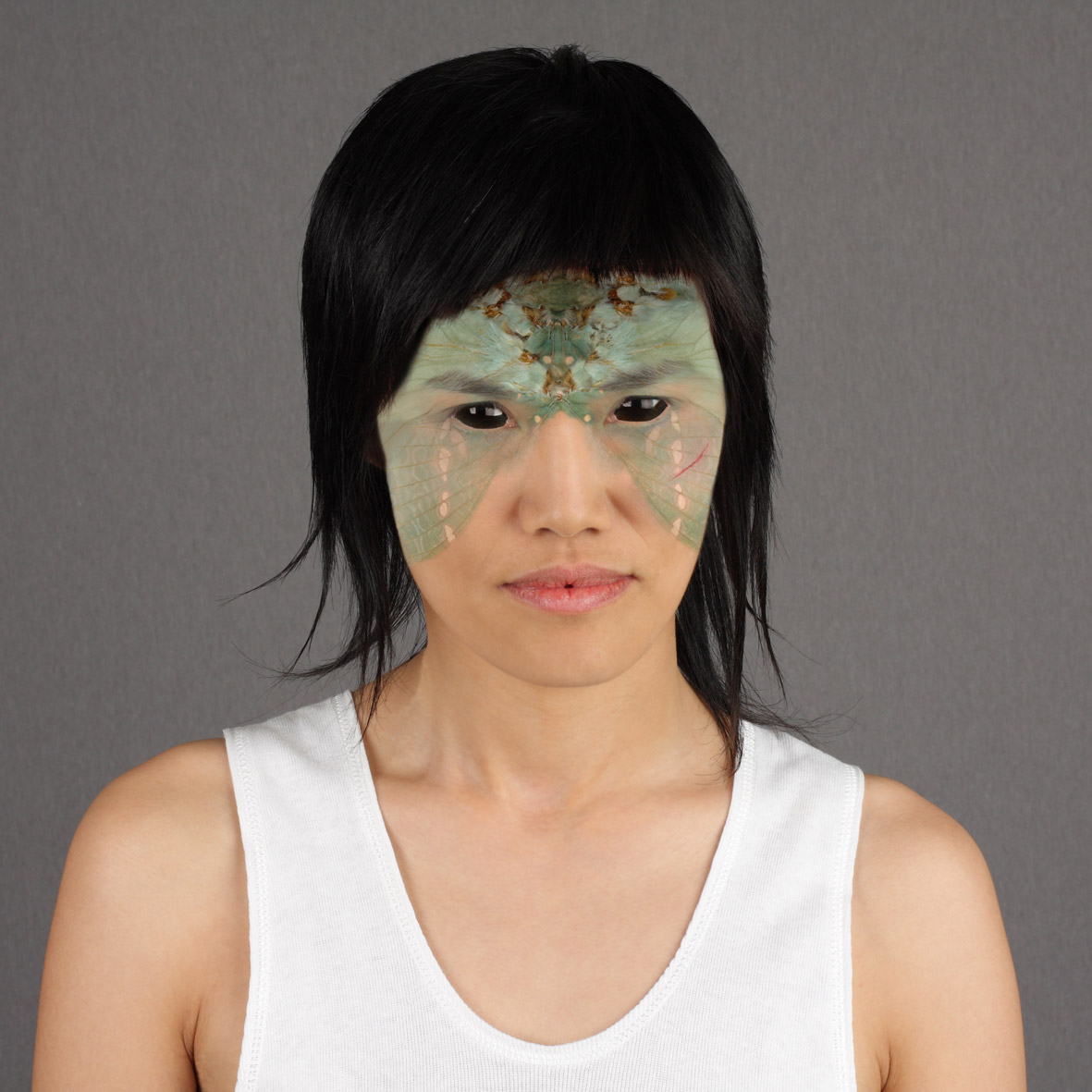
Owen Leong (Australian, b. 1979) Chi 2009-2010 Pigment print on archival paper 73 x 73cm, edition of 5 Courtesy of the artist and Anna Pappas Gallery
Apologies for the late posting on this exhibition but I only received the images for the posting today.
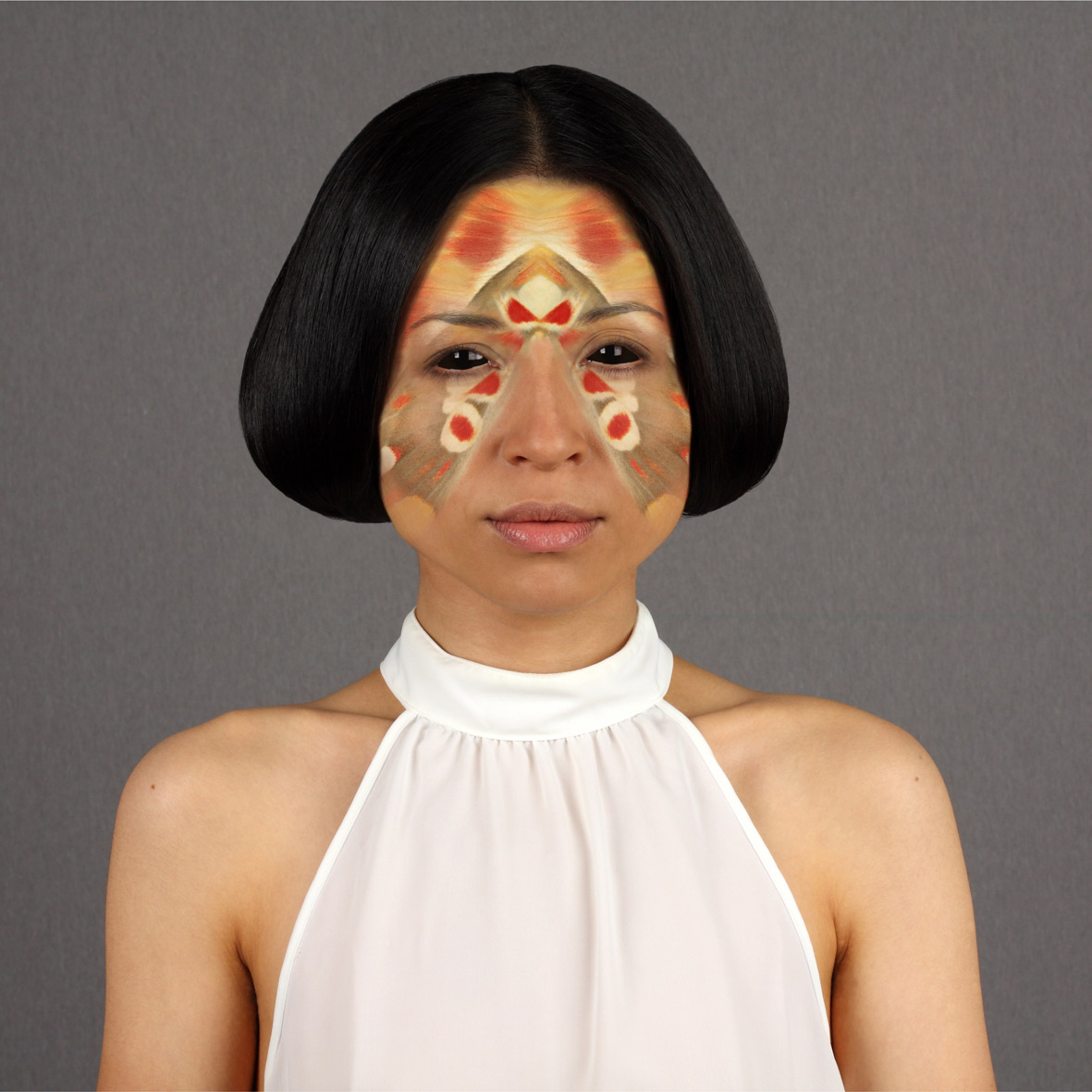
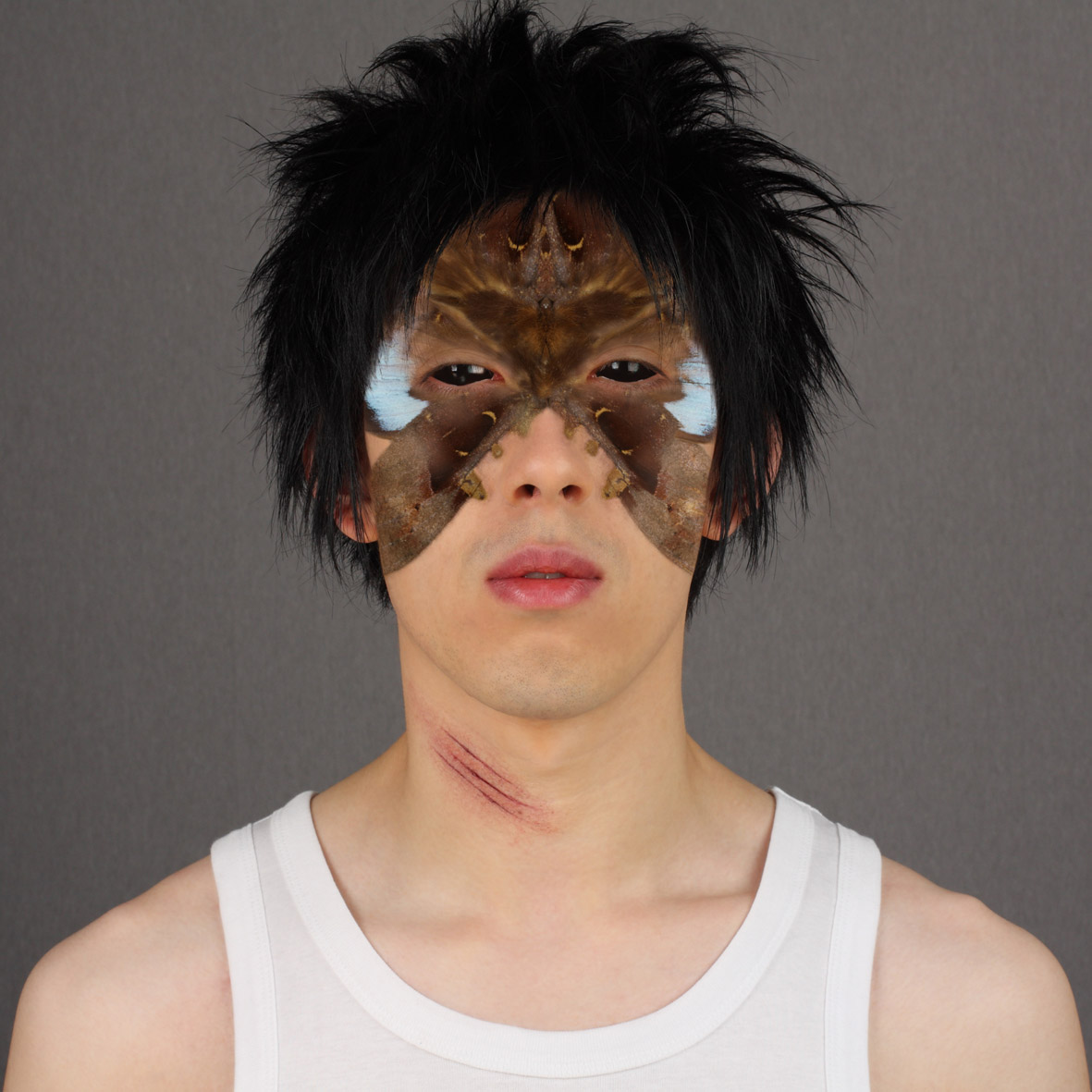
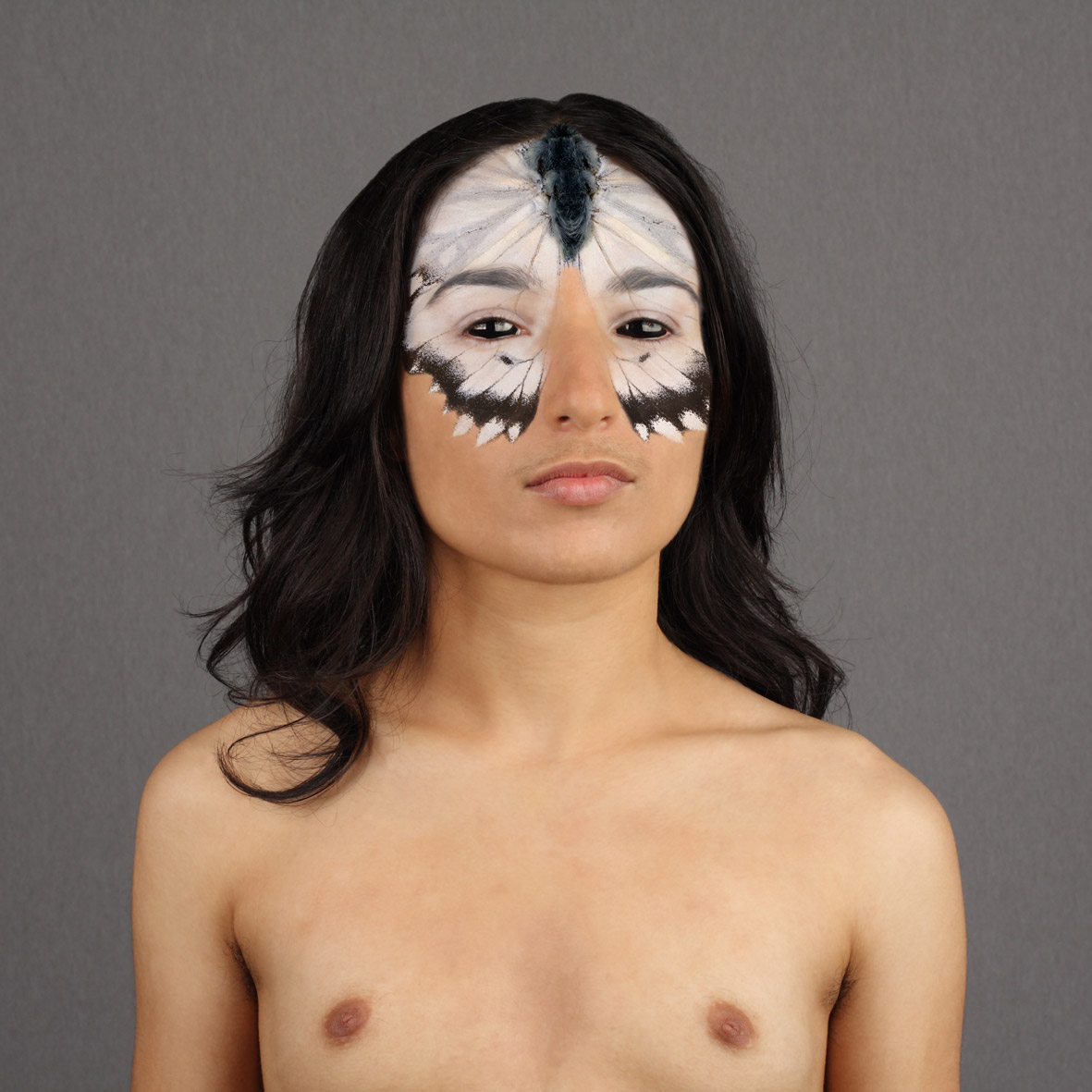
A strong body of work by Owen Leong, twelve portraits of Asian-Australians, their faces digitally overlaid with the unique wing patterns of the Bogong moth, an insect often seen as a pest in Australia. Uniformly lit, of consistent size and presented in modern white frames the series hangs quietly but impressively in the upstairs space of the Anna Pappas Gallery. Here the uniqueness of human physiognomy (and attendant modifications such as scars, piercings and tattoos) is symbiotically paired with that of the moth – it is almost as though one breathes the other – with the eyes of the humans occluded, becoming blackened pits.
The slightly amateurish digital blacking out of some of the eyes is my only point of contention: perhaps this was intentional (?) but sharp shape selections in Photoshop do not make for a good blend between layers of information. Be that as it may, Leong’s practice of selective breeding applied to humans has produced some beautiful, eloquent photographs that promote difference and diversity through a palpable intimacy with the subject matter.
Dr Marcus Bunyan
Many thankx to Anna Pappas, Leah Crossman and the Anna Pappas Gallery for allowing me to use the photographs in the posting. Please click on the photographs for a larger version of the image.
Owen Leong (Australian, b. 1979) Jac 2009-2010 Pigment print on archival paper 73 x 73cm, edition of 5 Courtesy of the artist and Anna Pappas Gallery
Owen Leong (Australian, b. 1979) Justin 2009-2010 Pigment print on archival paper 73 x 73cm, edition of 5 Courtesy of the artist and Anna Pappas Gallery
Owen Leong (Australian, b. 1979) Raina 2009-2010 Pigment print on archival paper 73 x 73cm, edition of 5 Courtesy of the artist and Anna Pappas Gallery
I seen to have become a little smitten by Romy Schneider. What charisma!
Marcus
Many thankx to the Deutsche Kinemathek – Museum for Film and Television for allowing me publish the images in the posting. Please click on the images for a larger version.
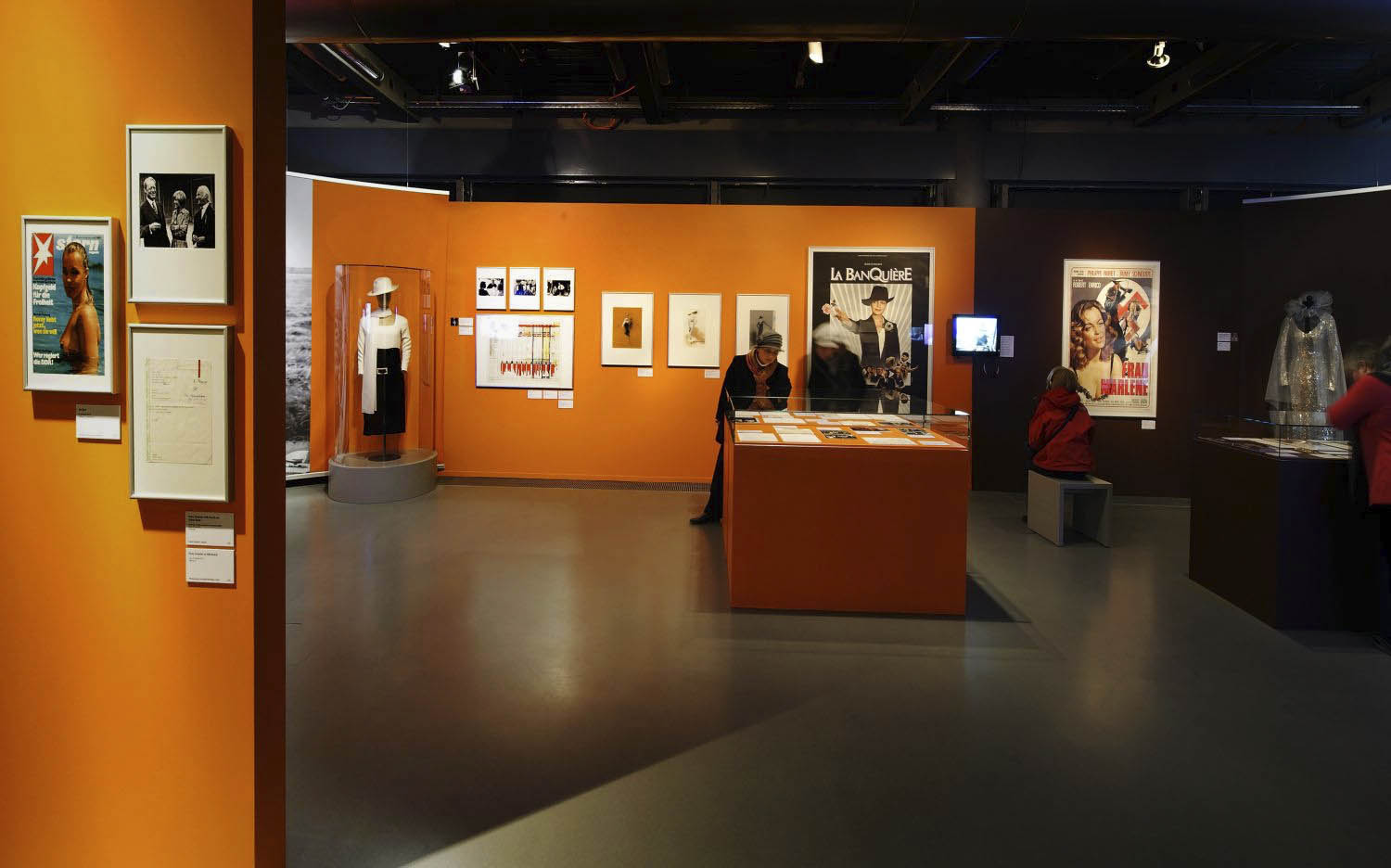
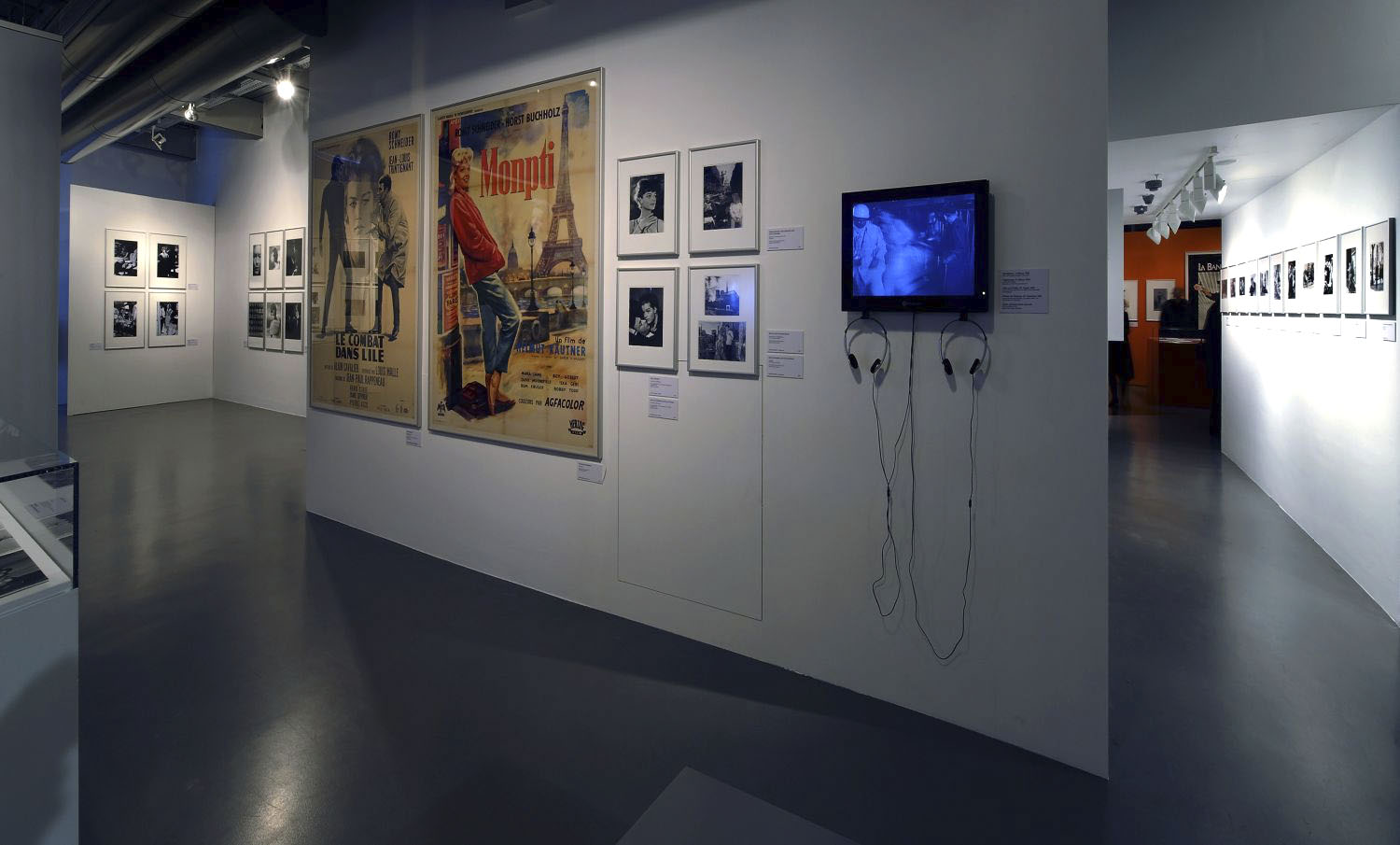
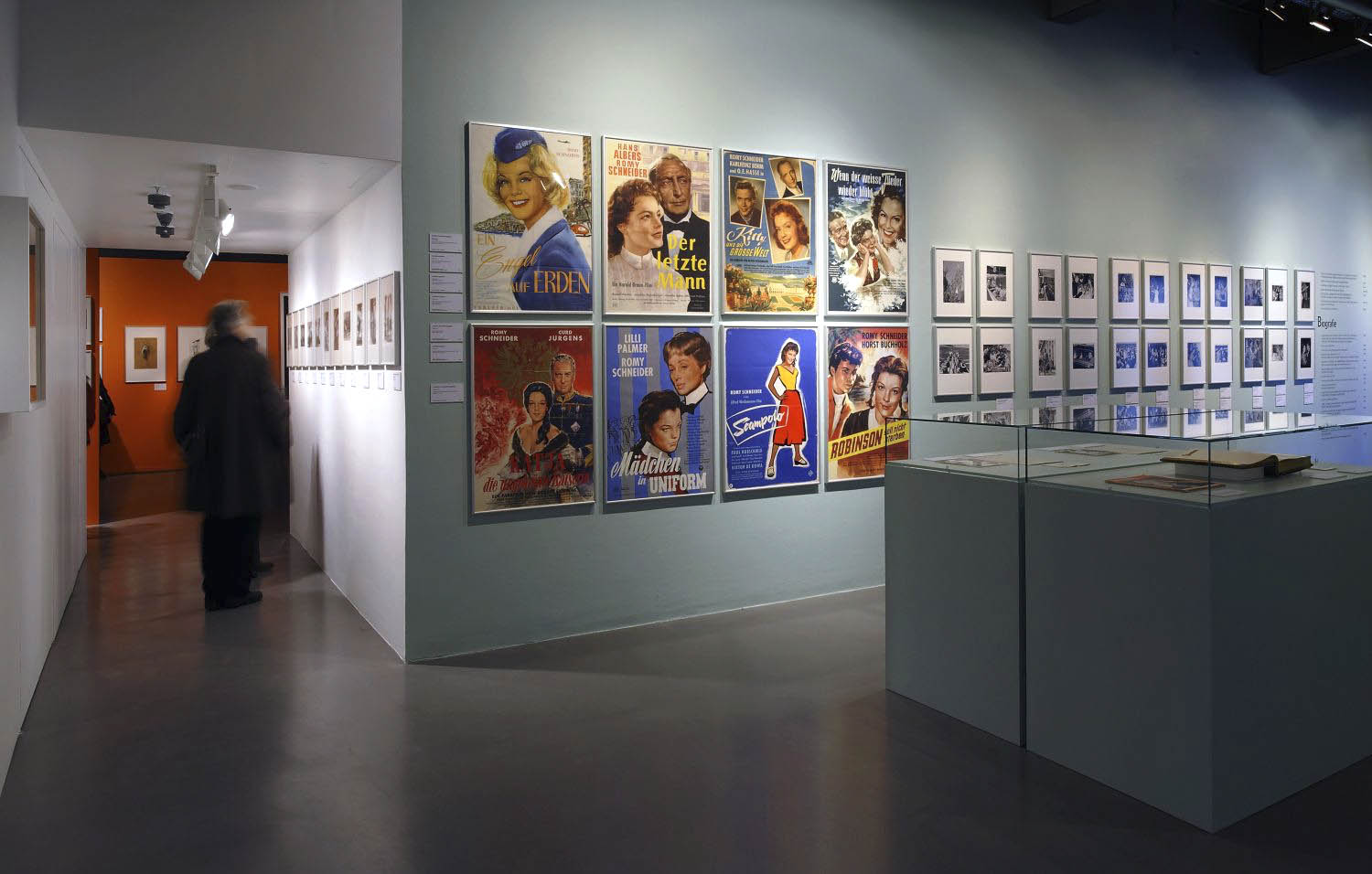
The exhibition documents the eventful career of Romy Schneider, who by the late 1950s no longer wanted to be Sissi, and by the 1970s was a celebrated star of French cinema. A large number of unknown photographs of Romy Schneider, her film partners, and family from the 1950s and 1960s will be on display from the collections of the Deutsche Kinemathek. The exhibition will also present loans from private individuals and institutions from France and Austria …
The exhibition Romy Schneider. Wien – Berlin – Paris, which the Museum für Film und Fernsehen will present beginning on December 5th, documents the varied and wide-ranging career of Romy Schneider, who no longer wanted to be “Sissi” at the end of the 1950s and was celebrated as a star of French cinema in the 1970s.
Romy Schneider publicly bemoaned her roles in Germany and went to Paris to play women who did justice to her acting abilities and her expectations. She settled in France at the beginning of the 1970s, where she advanced to one of the biggest stars of French cinema. She won several awards and made films with nearly all the great directors and actors of that period. The paparazzi followed the actress at every turn, documenting her strokes of fate for the international popular press, and throughout her life Romy Schneider considered herself to be their victim. Romy Schneider died in Paris in May 1982. To this day, she is admired by millions of fans around the world as one of cinema’s international stars.
This homage, which can be seen in 450 sq. m. of exhibition space at the Filmhaus, treats both the diverse roles and changing image of the actress, as well as her representation in the media.
Pictures from films, the press and her private life are grouped according to recurring motifs and combined with film clips. Media installations show the interplay between projection and active self-promotion. Posters, costumes, correspondence and fan souvenirs will augment the presentation.
Numerous photographs from the 1950s and 1960s of Romy Schneider, her film partners and her family, largely unknown until now, originate from the collections of Deutsche Kinemathek. Loans from other institutions and private individuals will also be on view, for instance from the photographers F. C. Gundlach and Robert Lebeck, as well as from the personal archives of the film director Claude Sautet.
Press release from the Museum für Film und Fernsehen website [Online] Cited 25/05/2010 no longer available online
F. C. Gundlach (Franz Christian Gundlach) was a German photographer, gallery owner, collector, curator und founder. In 2000 he created the F.C. Gundlach Foundation, since 2003 he has been founding director of the House of Photography – Deichtorhallen Hamburg.
Alain Delon and Romy Schneider in La Piscine/Der Swimmingpool R- Jacques Deray, F/I 1969 Gelatin silver print Foto/Quelle: Filmarchiv Austria, Wien
Romy Schneider and Alain Delon in La Piscine/Der Swimmingpool R- Jacques Deray, F/I 1969 Gelatin silver print Foto/Quelle: Deutsche Kinemathek
Romy Schneider and Claude Sautet during the shooting of UNE HISTOIRE SIMPLE / A SIMPLE STORY 1978 Gelatin silver print Foto/Quelle: Yves Sautet, Paris
Claude Sautet
Claude Sautet (23 February 1924 – 22 July 2000) was a French author and film director. Born in Montrouge, Hauts-de-Seine, France, Sautet first studied painting and sculpture before attending a film university in Paris where he began his career and later became a television producer. He filmed his first movie, Bonjour Sourire, in 1955.
He earned international attention with Les choses de la vie, which he wrote and directed, like the rest of his later films. It was shown in competition at the 1970 Cannes Festival, where it was well received. The film also revived the career of Romy Schneider; she acted in several of Sautet’s later films. In his next film Max et les Ferrailleurs (1971) she played a prostitute, while in César et Rosalie (1972) she portrayed a married woman who copes with the reappearance of an old flame.
Vincent, Paul, François, et les Autres (1974) is one of Sautet’s most acclaimed films. Four middle-class men meet in the country every weekend mainly to discuss their lives. The film featured a cast of major stars of French cinema: Michel Piccoli, Yves Montand, Gérard Depardieu, and Stéphane Audran. He achieved even further critical success with Mado (1976).
His 1978 film A Simple Story (Une Histoire simple) was nominated for an Academy Award for Best Foreign Language Film. The film featured Schneider again, this time as a dissatisfied working woman in her 40s. She won the César Award for Best Actress for her performance.
Artists: Lionel Bawden, Penny Byrne, Nicholas Folland, Locust Jones, Rhys Lee, Rob McHaffie, Derek O’Connor, Alex Spremberg, Madonna Staunton
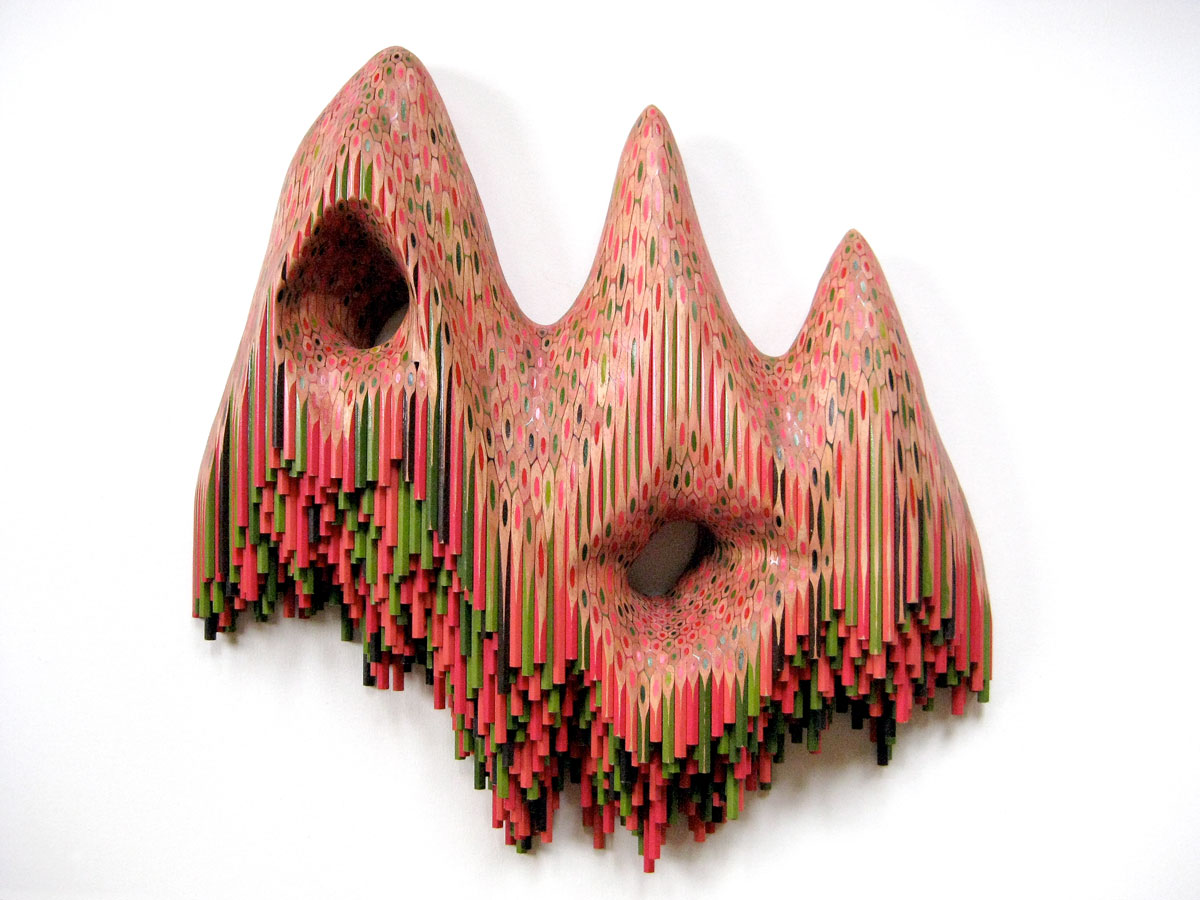
Lionel Bawden (Australian, b. 1974) formless worlds move through me 2010 Coloured Staedtler pencils, epoxy, incralac 51.0 x 51.0 x 9.5cm
Some good work in this exhibition – especially the Staedtler hexagonal coloured pencil constructions by Lionel Bawden. Beautifully crafted by hand they remind me of ghosts, the ‘millefiori’ (thousand flowers) of Italian glass and the inside of caverns with their stalactites.
Dr Marcus Bunyan
Many thankx to the Karen Woodbury Gallery for allowing me to publish the photographs in the posting. Please click on the photographs for a larger version of the image.
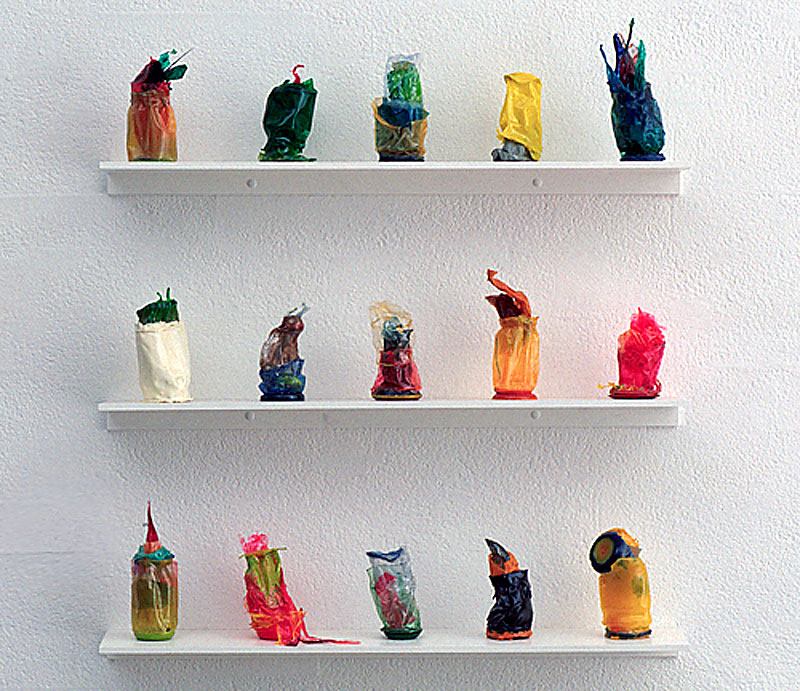
Alex Spremberg (Australian born Germany, b. 1950) Inside skins 2002
These artists have been selected for their interest in ideas of assemblage and re-use of pre-existing materials. Working across a range of media, each artist in the exhibition employs a process of manipulation to create completely different concepts and forms with their finished works. These works comprise of found objects and assembled from disparate elements, scavenged or foraged by the artists and juxtaposed in inventive ways. All works included in The Navigators take on their own form and imbue a new meaning to the original source materials.
Not originally intended as art materials, yet these artists have seen potential for a new idea in the materials; creating a new thought for the object. The original useful element of the preformed material thus comes under more aesthetic and creative significance. The impetus for such artistic practice is located in a desire by these artists to re-use, re-model, reshape and recycle within their practices. Despite an obvious interest and emphasis in the materiality of the works, the conceptual underpinning are the key motivation within these varying works and pose questions regarding the value of the objects within society. The artists included in The Navigators are continuously surveying and navigating their practice, allowing for deeper exploration in their work.
The exhibition will include various two and three-dimensional objects that interact with each other in unique ways. In the example of Lionel Bawden’s sculptures, his work exploits hexagonal coloured pencils as a sculptural material, reconfiguring and carving into amorphous shapes. Here the rich qualities of colour are explored as pencils are carved, shaped and fused together. Bawden explores themes of flux, transformation, rhythm and repetition as preconditions to our experience of the physical world. Bawden’s wall mounted works ‘the caverns of temporal suspension’ explore shapes within and outside the work as they hover ominously, melting, conjoined, growing, in transformation. These works are at the forefront of his current practice.
Penny Byrne’s work makes use of vintage porcelain sculptures that are adorned with a range of materials. Through this process, Byrne makes the base sculptures appear starkly different to that of the original, taking on new connotations that are often humorous and quirky but also convey political and social issues. In her work Mercury Rising. Hunted, Slaughtered, Eaten vintage porcelain dolphins and new plastic Manga figurines are employed to relate to the annual Japanese slaughter of tens of thousands dolphins as highlighted in the documentary ‘The Cove’. The Japanese eat the dolphins and then suffer mercury poisoning due to the high mercury levels in the dolphins flesh, leading to symptoms of madness.
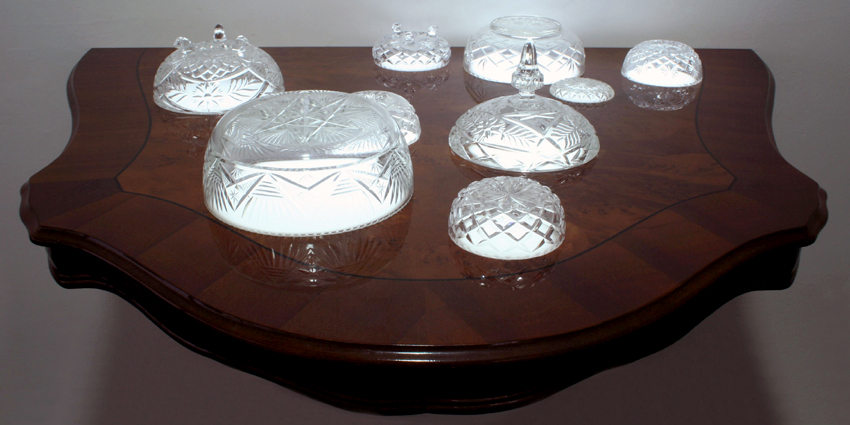
Nicholas Folland’s Navigator sculptures are indicative Folland’s continued interest in utilising, modifying and experimenting with various sourced materials. These sculptures comprise of various upturned intricately detailed crystal objects that sit above a wood panelled shelf. These glass object are lit and act as beacons or floating satellite cities. Folland personifies the intrepid creative explorer via his navigation of various found materials.
Locust Jones’ three-dimensional globes are made from papier mache and pictorially and graphically convey global issues. These works sit on the floor and allow the viewer to orient themselves around the works allowing for a detached, objective perspective on contemporary societal issues. The quickly worked surfaces reflect a stream of consciousness in process. Imagery and themes are taken from various media such as the Internet, photojournalism, film culture and nightly news broadcasts.
The two sculptures in the exhibition by Rhys Lee imbue associations of debris and deal with found objects such as a money box, a dead bird and a clowns face. These trophy-like pieces are decorated by old, worn and found vintage materials that engage with the everyday. The intimate scale of these works do not account for the potency of symbolism and accumulation of collected ideas. The blistered silver patina and bronze sculptures allude to a dark gothic sentiment that extends beyond the morphing forms. The shapes have been smashed, manipulated and stuck back together again resulting in frozen miniature icons that represent a contemporary zest for defiance.
Rob McHaffie’s works comprise a pastiche of painted anonymous unrelated objects and shapes that somehow come together to create unlikely compositions and formations. The highly skilled execution of McHaffie’s paintings attracts the viewer, who is then faced with a banality in subject matter, often of depictions of clothing, crumpled paper, plants and disfigured creatures and figures. These perfectly rendered images of everyday objects are unsettling in their clarity and realism, which are then skewed, moulded and displaced in unlikely relationships. There is a sense of a deliberate haphazard nature to McHaffie’s work that draws upon a range of elements brought together to mimic something else. Humour surfaces through this stylistic creative process.
Derek O’Connor’s re-worked painting collages resemble distorted and fragmented realities and stories via the manipulation and playful technique of alteration and re-use of book covers and record album and EP covers. O’Connor’s characteristic gestural sweeping luscious brushstrokes are employed with precision yet allow for organic spontaneity. The old material takes on new meaning and are given new life via O’Connor’s creations.
Alex Spremberg’s work Inside Skins highlights the artist’s accidental processes at work. This sculptural piece was made as an ancillary to his broader practice – working with acrylic, enamel and varnish on board and canvas. These objects where literally created via chance – an after thought that was noticed to be a finished piece in its own right. Left to dry within their containers these ‘skins’ were extracted and proved to provide aesthetic attraction and conceptual ideas of the ready-made.
The mainstay of Madonna Staunton’s practice surrounds the physicality of assemblage. Essentially she is a collage artist. The components of her two- and three-dimensional assemblages are usually drawn from old, faded and battered discards such as frames and chairs that are carefully put together in new ways and given another life. A play between precision and randomness animates her work. Her sensitivity to tonal and formal arrangement always remains acute during this process and the results are austerely and chaotically beautiful.
Press release from the Karen Woodbury Gallery website [Online] Cited 20/05/2010 no longer available online
Nicholas Folland (Australian, b. 1967) Navigators 1 2008 Glassware, table and lightbox 25.0 x 110.0 x 87.0cm
Nicholas Folland (Australian, b. 1967) Navigators 2 2008 Glassware, table and lightbox 25.0 x 110.0 x 87.0cm
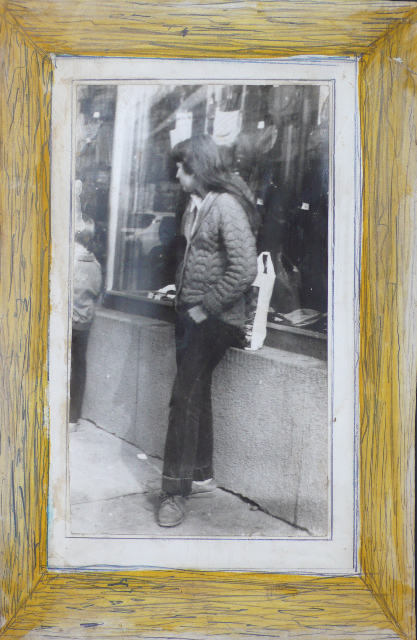
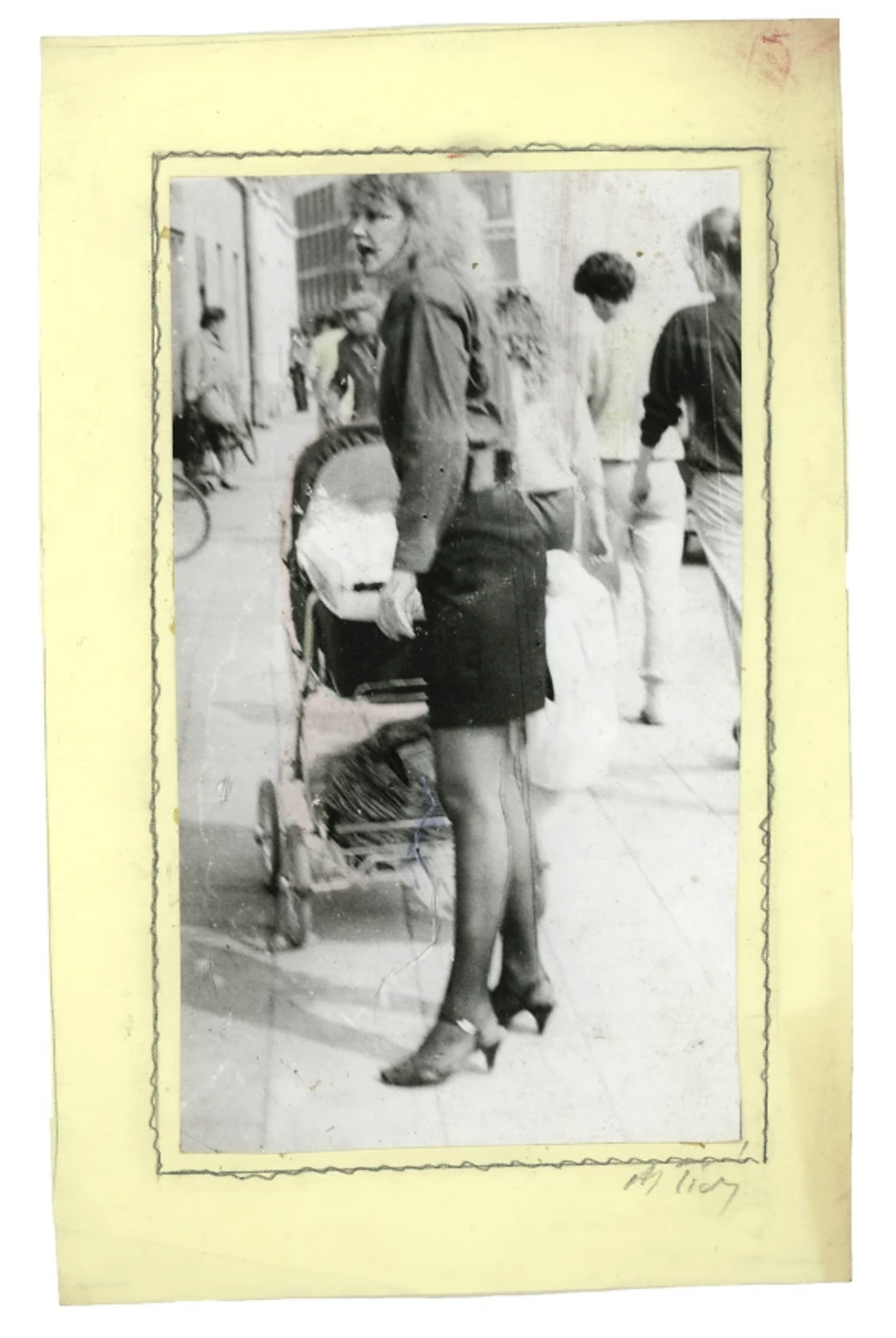
These are fascinating photographs (and in part, more than a little what? marginal, disturbing, poetic, beautiful, creepy, voyeuristic, misogynist).
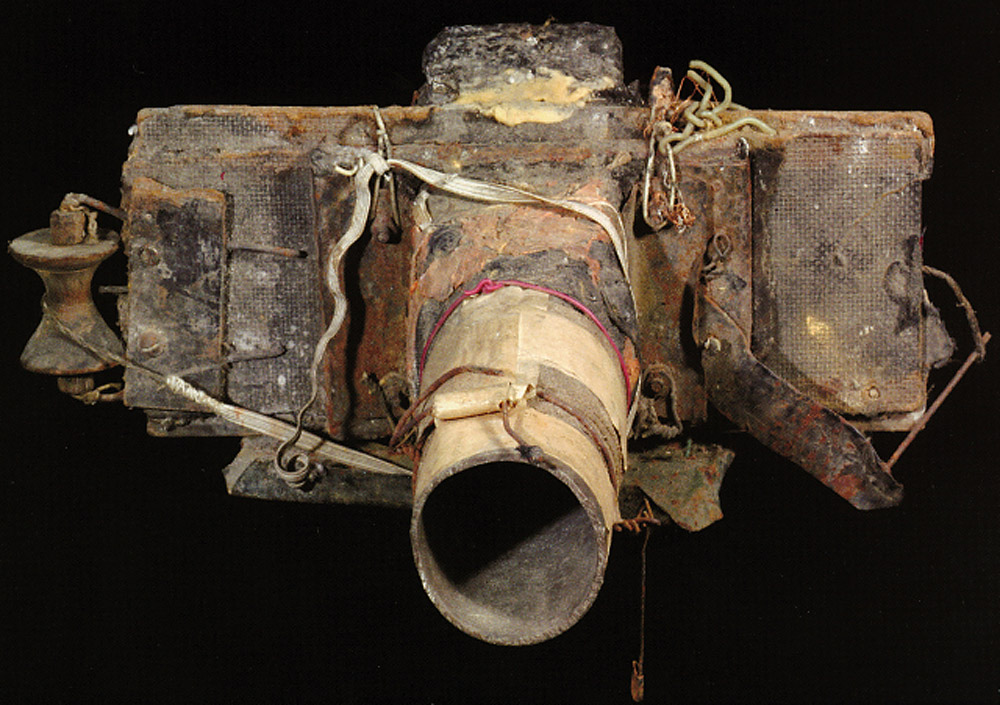
Tichy’s camera is such an amazing construction (click on the image above to see a larger version).
Dr Marcus Bunyan
Many thankx to Jim Edwards and the Michael Hoppen Gallery for allowing me to publish the photographs in the posting.
“Women are just a motif to me. The figure – standing, bending, or sitting. The movement, walking. Nothing else Interests me. The erotic is just a dream anyway. The world is only an illusion, our illusion.”
“Everything is decided by the earth, which is turning. You can only live as long as the earth keeps turning. That is predetermined.
The recently unknown photographic work of Czech artist Miroslav Tichý has become a noteworthy presence in the worlds of photography and contemporary art over the last few years. Timeless and uncategorisable, Tichý’s work captures the women of Kijov, from the artist’s native city in Moravia. On 28 April 2010, the Michael Hoppen Gallery will bring together unique photographs, previously unseen in the UK, created in the 1960’s by Tichý with his makeshift cameras and enlargers.
Marginal and exceptionally voyeuristic, in his methods Tichý could be described as an “art brut photographer” yet he is marked by many classical influences. Though his images are produced with poor-quality equipment and carelessly shot, they offer an idiosyncratic and almost hallucinatory vision of a fantastical, eroticised reality. With his endless return to the same subject and the volume and regularity of his production, Tichý’s work draws many parallels to certain practices of conceptual art during the same period.
For thirty years Tichý took up to one hundred photographs each day, pursuing his artistic obsession with the female form. Dressed in rags and using a homemade camera, Tichy captured the universe of the people in the small town of Brno in the Czech Republic. This discovery of photography saved him from madness and the claustrophobia of political dictatorship. Though his work today is widely exhibited, Tichý worked for years as an unknown artist in complete isolation on the periphery of the art world.
A student at the Academy of Arts in Prague, Tichý left following the communist overthrow of 1948. Unwilling to subordinate to the political system he spent some eight years in prison and psychiatric wards for no reason, other than he was ‘different’ and considered subversive. Upon his release he became an outsider, occupying his time by obsessively taking photographs of the women of his home town, using homemade cameras constructed from tin cans, children’s spectacle lenses, rubber bands, scotch tape and other junk found on the streets.
He captured images of their ankles, faces and torsos whilst out strolling or sunbathing, shop-girls behind the counter, mothers pushing prams, and any others who caught his eye, sometimes finding himself in trouble with the police. These small objects of obsession, which might appear to the casual viewer to be simply voyeurism, are simultaneously melancholic and poetic.
Tichý’s work surfaced in July 2005, when he won the ‘New Discovery Award’ at Arles. Within a year he had already been featured in two solo museum exhibitions, at the Wintertaur in Zurich and the Rudolfinum, Prague, and his work has been purchased by the Victoria & Albert Museum here in London. Tichý has now exhibited in museums from Holland to Canada, Finland to Ireland and Tokyo. In 2009, a seminal show was held at the Centre Pompidou in Paris where it received rave reviews. Since then, Tichý’s work has recently been on show at ICP in New York where The New York Times reviewed his work as … ‘intensely fascinating’. American artist Richard Prince wrote an essay for the catalogue. In his signature smart-aleck, red-blooded-male persona, Prince links Tichý to Bettie Page, Swanson’s TV dinners and the short stories of John Cheever. Tichý’s work will also appear at Tate Modern later this year as part of their Voyerism, Surveillance and Camera exhibition in May 2010.
Press release from the Michael Hoppen Gallery website [Online] Cited 21/05/2010 no longer available online
Miroslav Tichý (Czech, November 20, 1926 – April 12, 2011) was a photographer who from the 1960s until 1985 took thousands of surreptitious pictures of women in his hometown of Kyjov in the Czech Republic, using homemade cameras constructed of cardboard tubes, tin cans and other at-hand materials. Most of his subjects were unaware that they were being photographed. A few struck beauty-pageant poses when they sighted Tichý, perhaps not realising that the parody of a camera he carried was real.
His soft focus, fleeting glimpses of the women of Kyjov are skewed, spotted and badly printed – flawed by the limitations of his primitive equipment and a series of deliberate processing mistakes meant to add poetic imperfections. Of his technical methods, Tichý has said, “First of all, you have to have a bad camera”, and, “If you want to be famous, you must do something more badly than anybody in the entire world.”
During the Communist regime in Czechoslovakia, Tichý was considered a dissident and was badly treated by the government. His photographs remained largely unknown until an exhibition was held for him in 2004. Tichý did not attend exhibitions, and lived a life of self-sufficiency and freedom from the standards of society. Tichý died on April 12, 2011 in Kyjov, Czech Republic. …
An essay in Artforum International describes Tichý as “practically reinventing photography from scratch”, rehabilitating the soft focus, manipulated pictorial photography of the late 1800s,
“… not as a distortion of the medium but as something like its essence. What counts for him is not only the image – just one moment in the photographic process – but also the chemical activity of the materials, which is never entirely stable or complete, and the delimitation of the results via cropping and framing.”
Director Radek Horacek of the Brno House of Art, which held an exhibition of Tichý’s photographs in 2006, describes them thus:
“They are all very careful observations of women from Kyjov and of everyday trivial activities. But soon you realise that these trivial situations such as someone sitting on a bench, women waiting for a bus, someone taking a T-shirt off at a swimming pool, are somehow extraordinary. Tichý managed to give this banality a feeling of exceptionality and rarity. Just part of a female body in his pictures can look very esoteric. There are so many magazines that offer much more nudity than Tichý but his photographs are different. A woman’s tights between a knee and a skirt or a swimming costume in his pictures look somehow mysterious.”
It is with great sadness that I hear of the passing of Mari Funaki on the 13th May 2010.
I met Mari many times and she was always wonderfully generous with her energy, knowledge and enthusiasm. She was an amazing artist, I loved her work especially the stunning anamorphic black bracelets and the fact that she used photography of Bernd and Hiller Becher as part of her inspiration. My conversation with Mari in 2006 and photographs of her work can be found on the Notes from a Conversation with Mari Funaki posting.
Vale Mari Funaki
“A memorial will be held on Tuesday June 1st, 2010 at 11.00am in THE GREAT HALL of the National Gallery of Victoria, International.“
Mari Funaki outside Gallery Funaki Photo: Marcus Bunyan
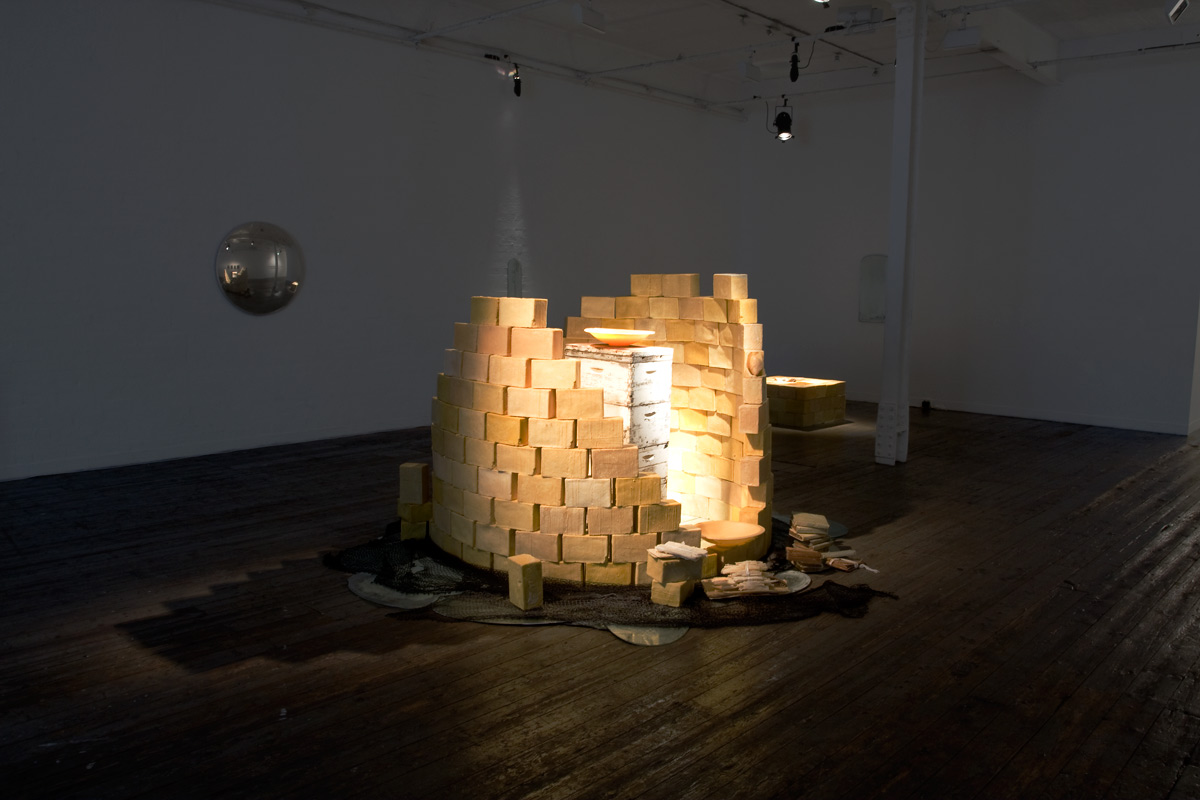
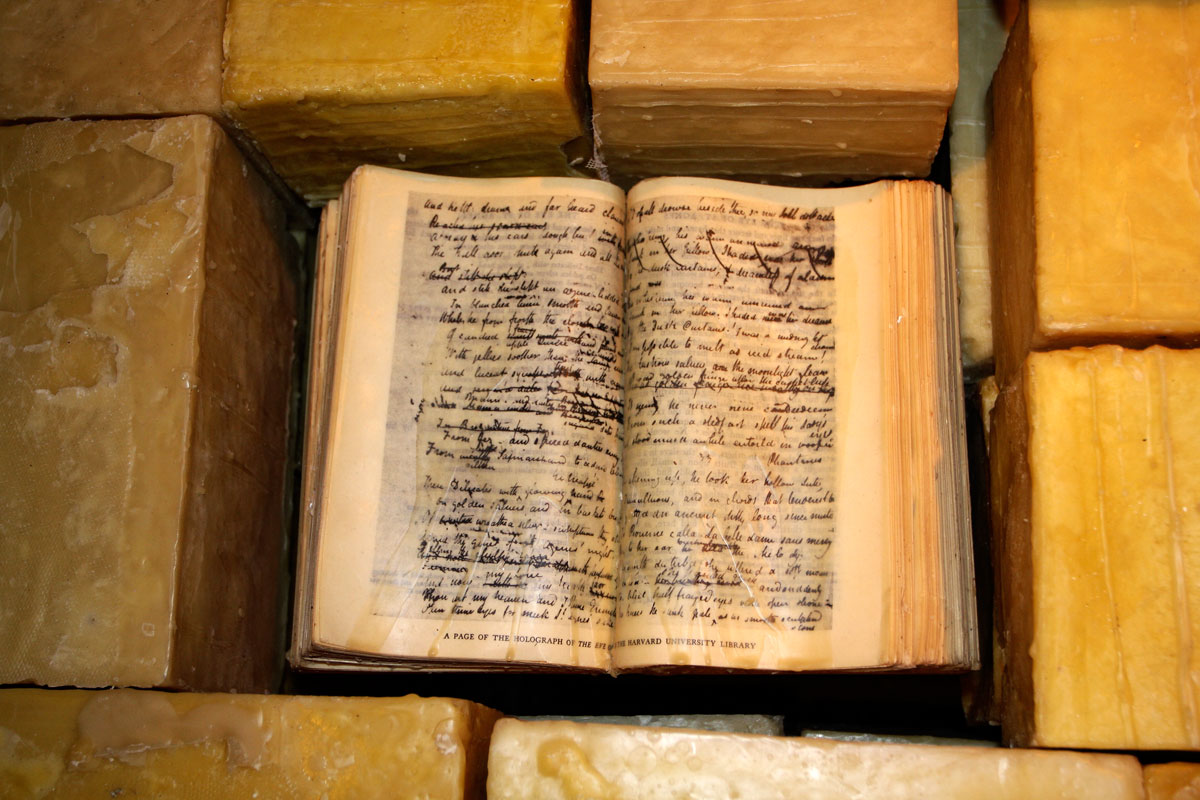
Installation views of the exhibition A Shrine for Orpheus by Pip Stokes at fortyfivedownstairs, Melbourne Photos: Marcus Bunyan
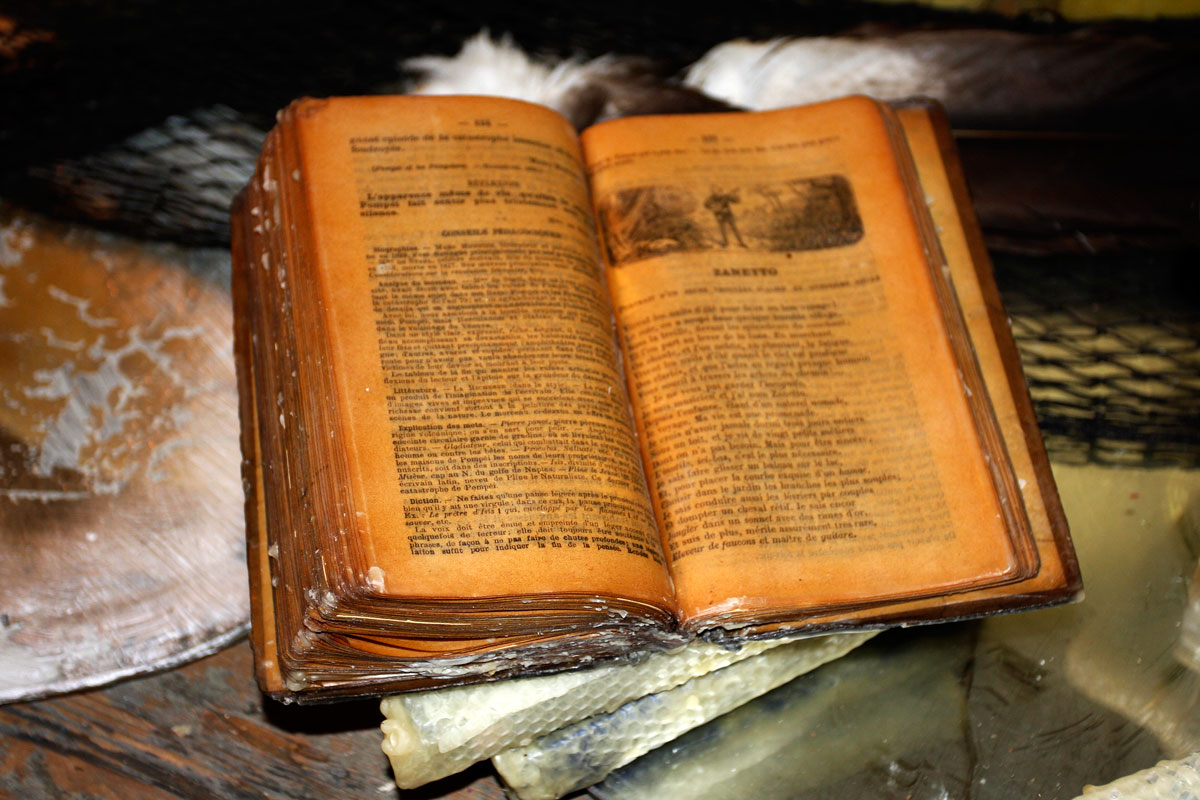
Bees, books, bones… and biding (one’s) time, attaining the receptive state of being needed to contemplate this work.
This is a strong, beautiful installation by Pip Stokes at fortyfivedownstairs that rewards such a process.
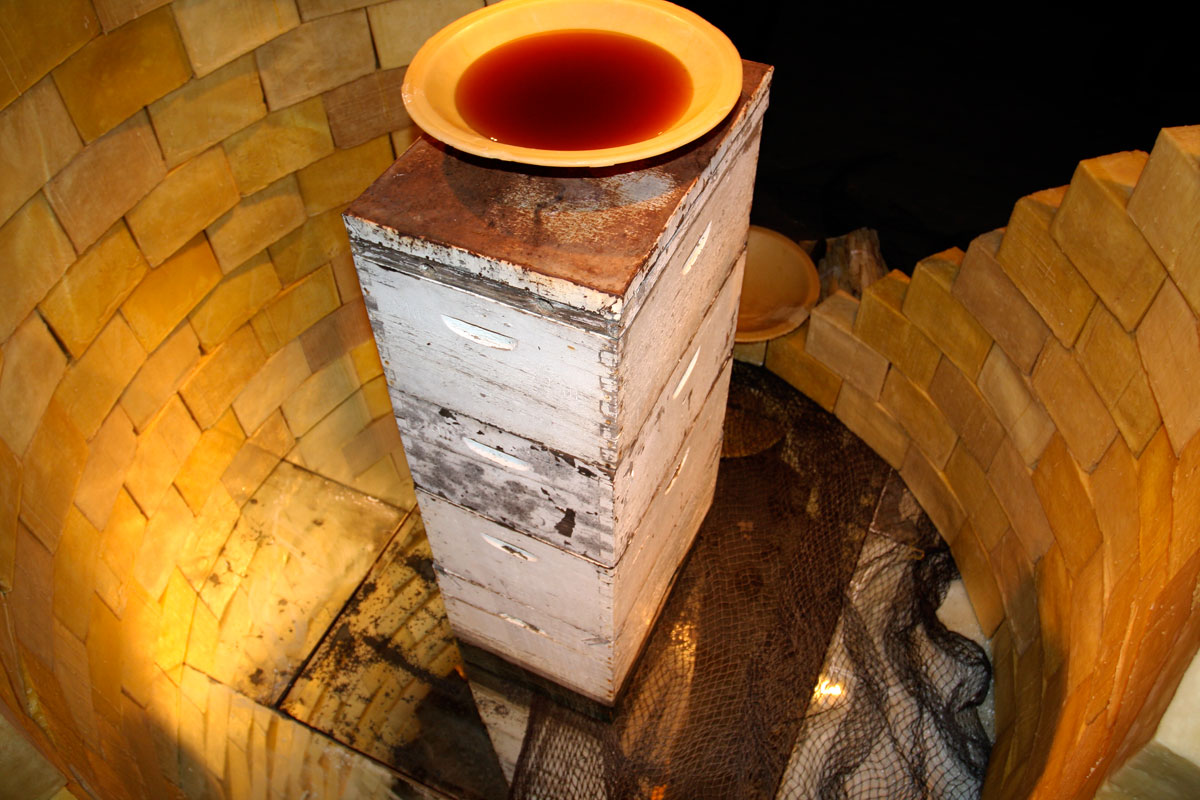
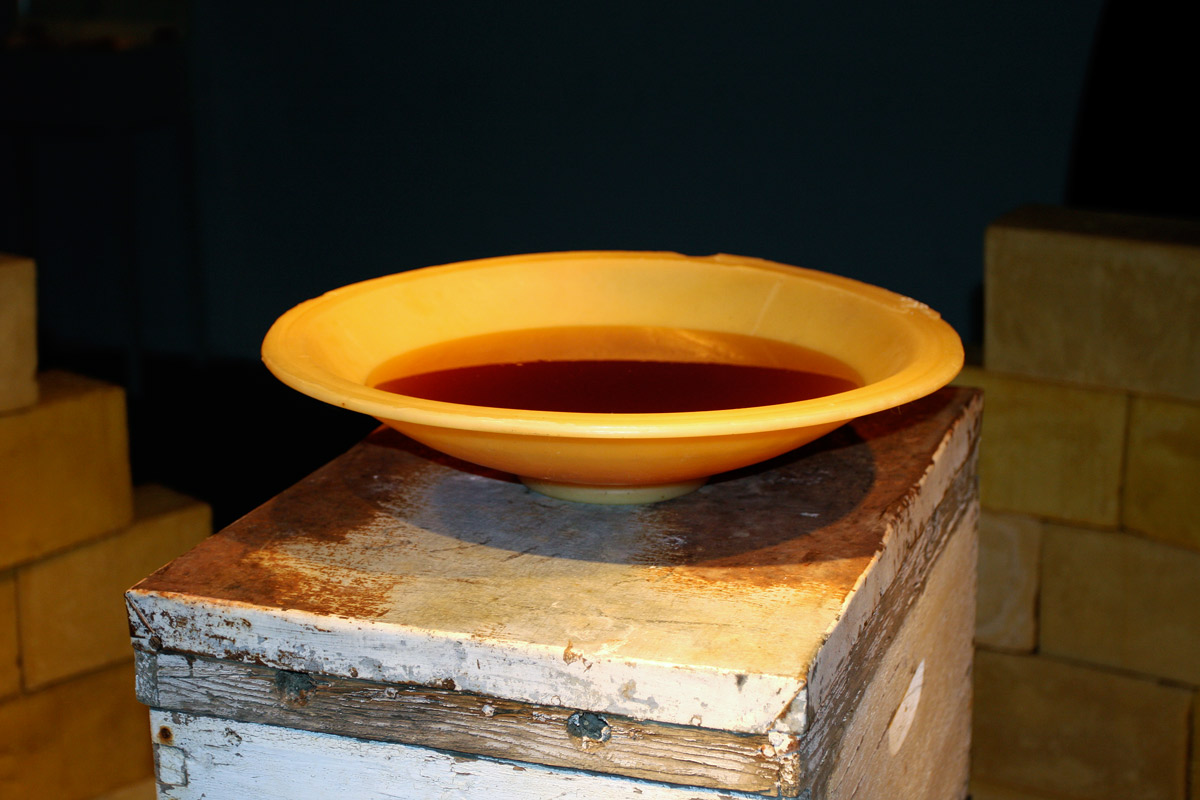
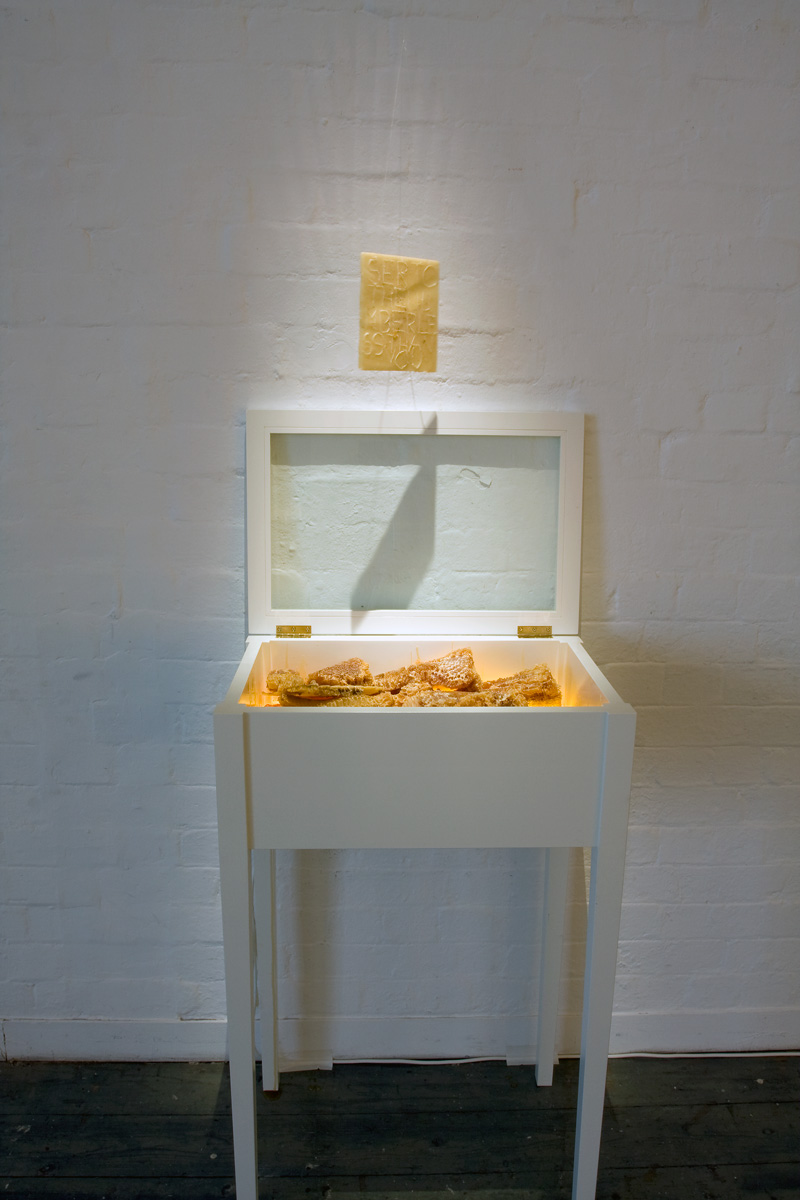
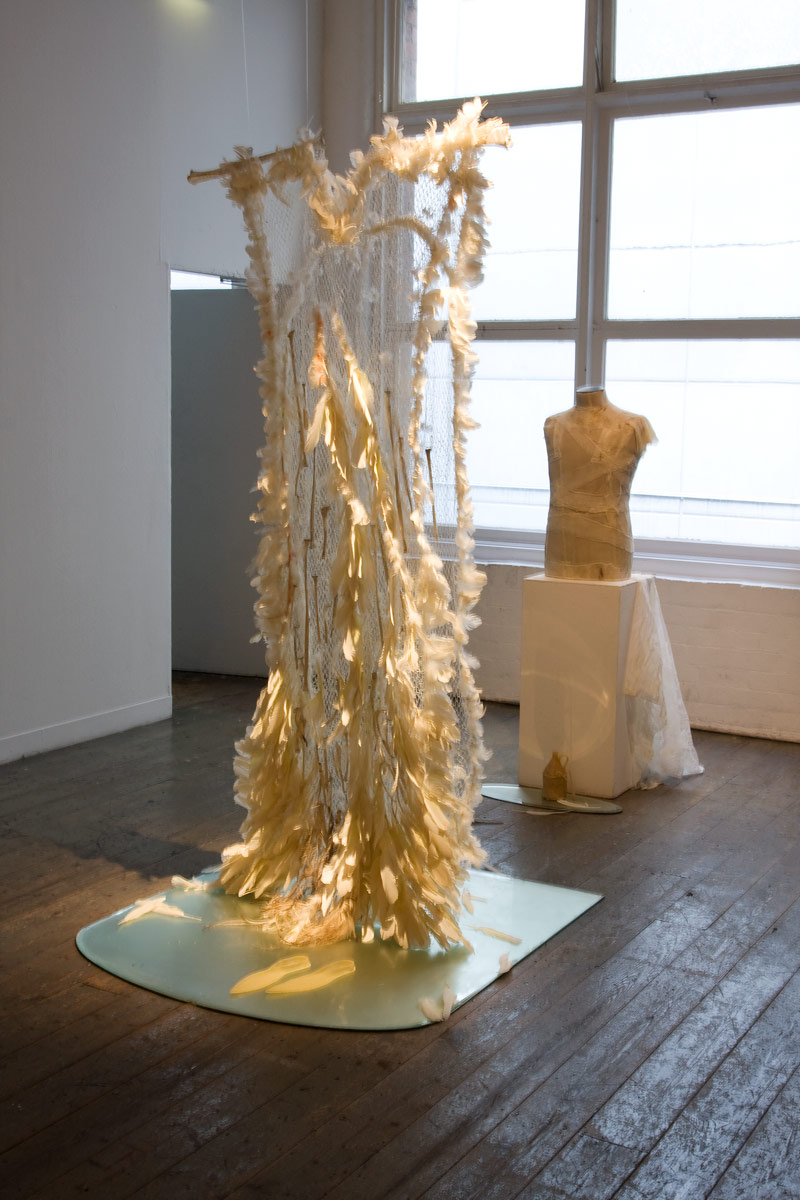
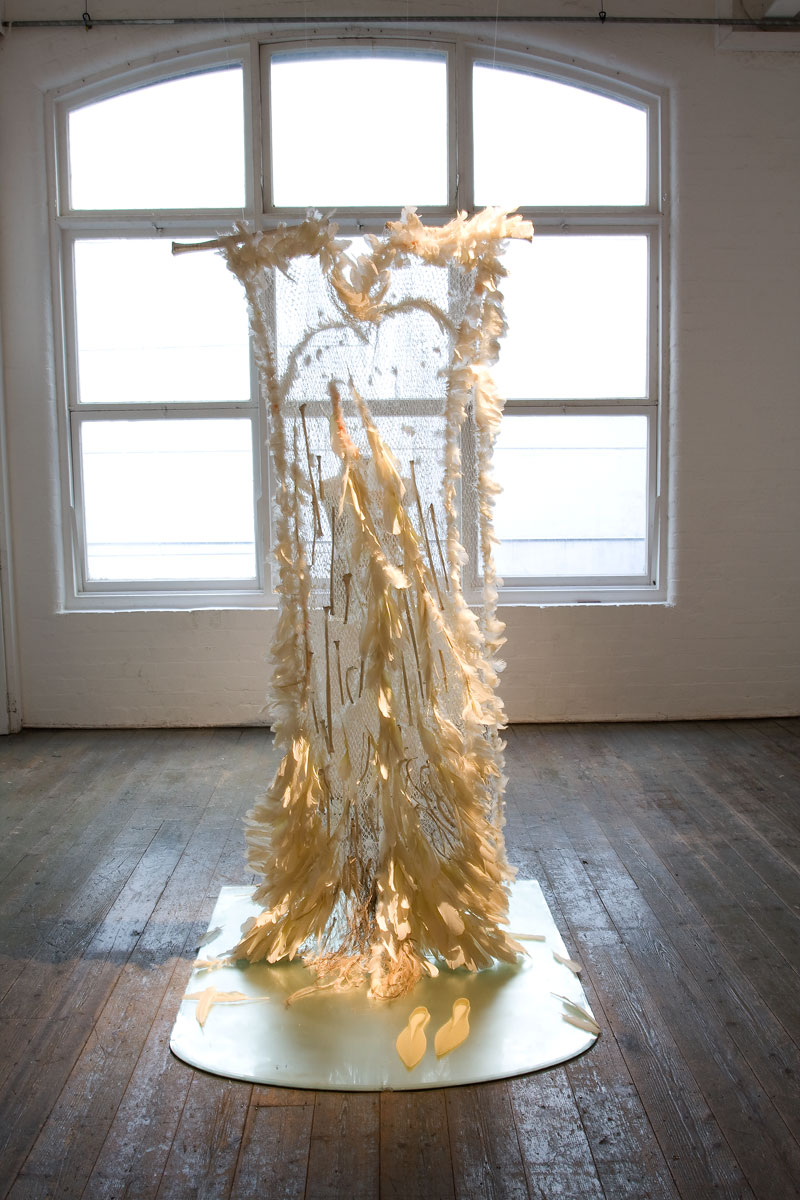
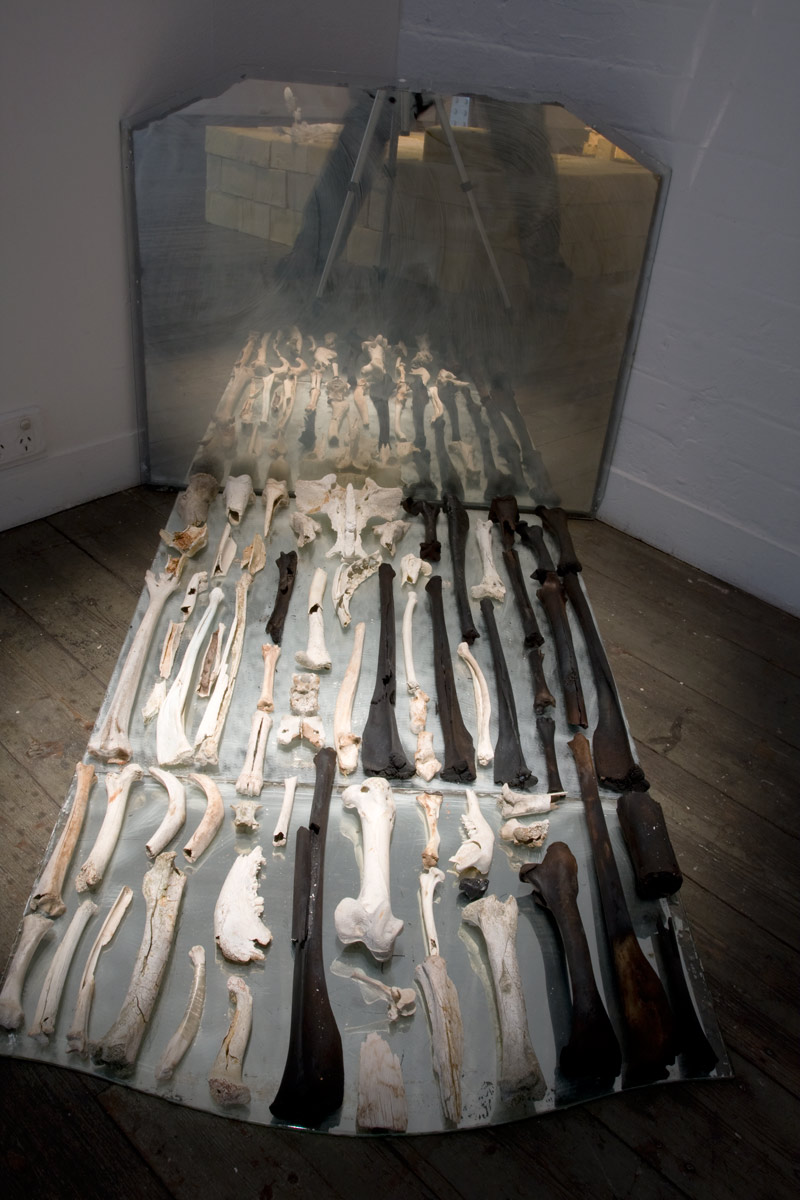
What is memorable about the work is the physicality, the textures: the sound of the bees; the Beuy-esque yellowness and presence of the beeswax blocks; the liquidness of the honey in the bowl atop the beehives; the incinerated bones, books and personal photographs; the tain-less mirrors, the books dipped in beeswax; the votive offering of poems placed into the beehive re-inscribed by the bees themselves – and above all the luscious, warm smell of beeswax that fills the gallery (echoing Beuys concept of warmth, to extend beyond the material to encompass what he described as ‘spiritual warmth or the beginning of an evolution’).
This alchemical installation asks the viewer to free themselves from themselves – “the moment in which he frees himself of himself and… gives the sacred to itself, to the freedom of its essence…” as Maurice Blanchot put its – a process Carl Jung called individuation, a synthesis of the Self which consists of the union of the unconscious with the conscious. Jung saw alchemy as an early form of psychoanalysis in which the alchemist tried to turn lead into gold, a metaphor for the dissolving of the Self into the prima materia and the emergence of a new Self at the end of the process, changing the mind and spirit of the Alchemist. Here the process is the same. We are invited to let go the eidetic memory of shape and form in order to approach the sacred not through ritual but through the reformation of Self.
As Pip Stokes last few paragraphs of her artist statement succinctly observes,
“Maurice Blanchot, has interpreted this myth as the descent of the artist to the realm of death to gain the work of art. Out of the failure of the artist, a necessary failure, emerges the artwork, wounded and bearing the ash of its origins.
The work of mourning, the work of healing.
Reflection, apparition, illusion: what appears as image, disappears evaporatively. As we change our place the space is already gone: the mirror holds a trace. What is veiled, enigmatic, uncertain remains as shadow that casts a light.”
The space in which we stand falls away: the mirror may hold a trace but it is only ever a trace. Our visions elude the senses, slipping between dreaming and waking, between conscious and subconscious realms. As Orpheus turns back to look so Eurydice dissolves, “falling out of the skin into the soul.” We, the viewer, are changed.
So far so good.
Unfortunately what does not facilitate this engagement with change is the combined verbiage of both the artist’s statement and the catalogue essay by Lisa Jacobson. These texts, especially the latter one, with quotations by Blanchot, Rilke, Calasso, Beuys, Cocteau, Neruda, Cobb, Virgil, Rilke again, Cocteau again, Poe and Derrida and meditations on mythos, the sacred, resurrection, mourning et al are mostly unnecessary to support what is strong work – in fact they seem to put a physical, textual wall between the viewer and the work, between the installation and the proposed dissolution of Self into the sacred. The catalogue essay is confusing and needed a judicious edit with the understanding that sometimes less is more! The work needs to speak for itself, not to be didactically spoken for and knowing when to merely suggest an idea is one of the skills of good writing. Perhaps all that was needed was the quotation by Blanchot and the two paragraphs above by Pip Stokes – nothing more.
Approaching the sacred is, I believe, and act of letting go, of aware-less-ness. As we immerse ourselves in that enigma we find that it is our fluid shadow aspect that has cast the light, with all attendant expectations, beliefs, dreams, visions, weaknesses, shortcomings, and instincts. This exhibition asks us to reconcile the journey into darkness with the hope of redemption.
“The Greek myth says: one cannot create a work unless the enormous experience of the depths – an experience which the Greeks recognised as necessary to the work, an experience in which the work is put to the test by that enormousness – is not pursued for its own sake. The depth does not surrender itself face to face; it only reveals itself by concealing itself in the work. But the myth also shows that Orpheus’ destiny is not to submit to that law – and it is certainly true that by turning around to look at Eurydice, Orpheus ruins the work… and Eurydice returns to the shadows; under his gaze, the essence of the night reveals itself to be inessential. He thus betrays the work and Eurydice and the night. But if he did not turn around to look at Eurydice, he still would be betraying,… the boundless and imprudent force of his impulse, which does not demand Eurydice in her diurnal truth and her everyday charm, but in her nocturnal darkness, in her distance, her body closed, her face sealed, which wants to see her not when she is visible, but when she is invisible, and not as the intimacy of a familiar life, but as the strangeness of that which excludes all intimacy; it does not want to make her live, but to have the fullness of her death living in her.”
“The sacred night encloses Eurydice, encloses within the song something which went beyond the song. But it is also enclosed itself: it is bound, it is the attendant, it is the sacred mastered by the power of ritual – that word which means order, rectitude, law, the way of Tao and the axis of Dharma. Orpheus gaze unties it, destroys its limits, breaks the law which contains, which retains the essence. Thus Orpheus’ gaze is … the moment in which he frees himself of himself and…, gives the sacred to itself, to the freedom of its essence…”
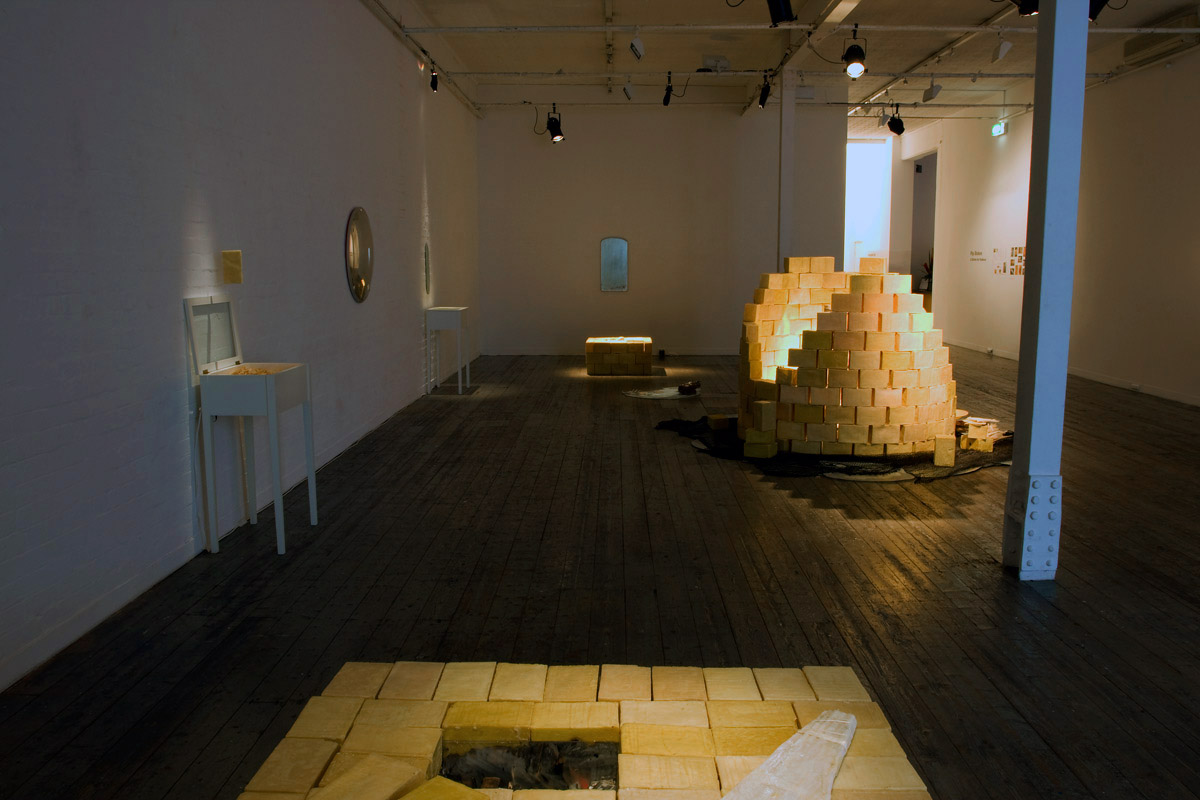
Installation views of the exhibition A Shrine for Orpheus by Pip Stokes at fortyfivedownstairs, Melbourne Photos: Marcus Bunyan
A Shrine for Orpheus
Pip Stokes
The first temple was made by the bees with feathers, wax and honey.
~ Calasso
… it is Orpheus. His metamorphosis In this one and this. We should not trouble about other names. Once and for all It’s Orpheus when there’s singing.
~ Rilke. Sonnets to Orpheus
We are the bees of the invisible We frantically plunder the visible of its honey To accumulate it in the great golden hive Of the invisible
~ Rilke
In mythology, honey was regarded as a spiritual substance and the bees were godly… This belief was… influenced by the whole process of honey production as constituting a link between earthly and heavenly levels. The influx of a substance from the whole environment – plants, minerals, and sun – was the essence of the bee-cult… The whole builds a unity, … in a humane, warm way, through principles of cooperation and brotherhood.
~ Beuys
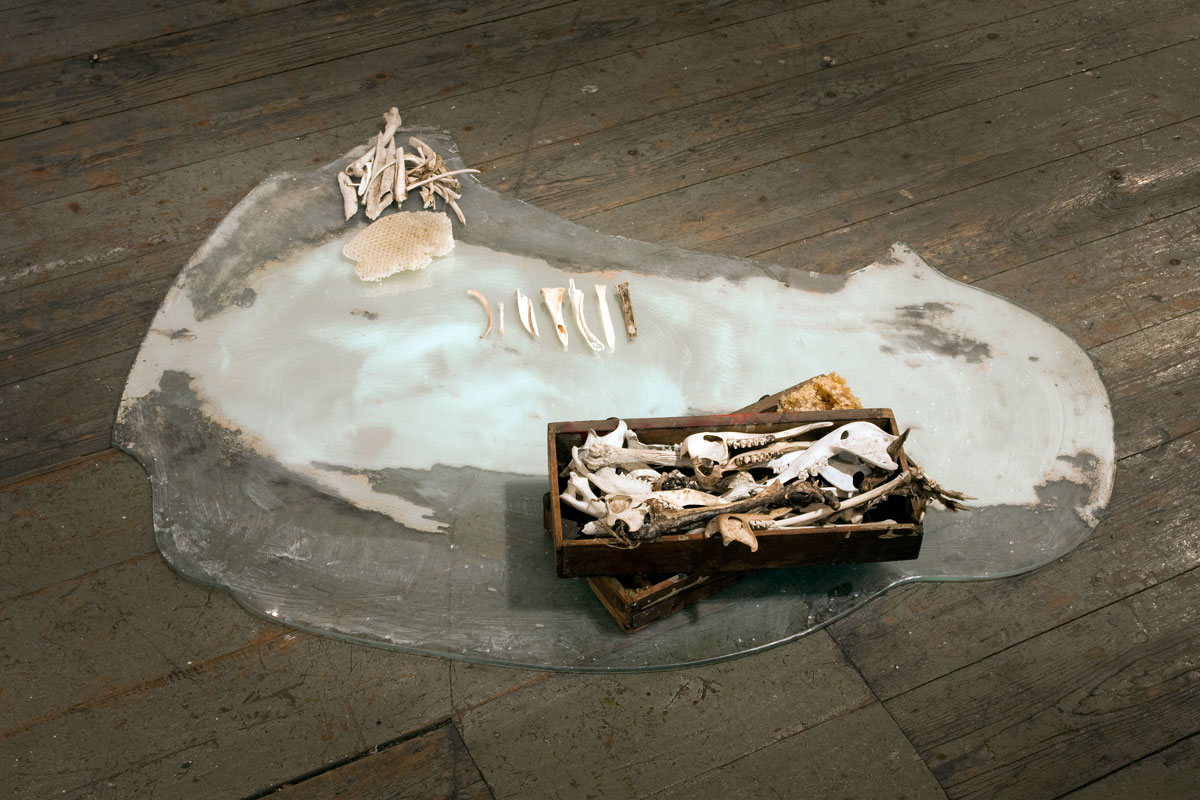
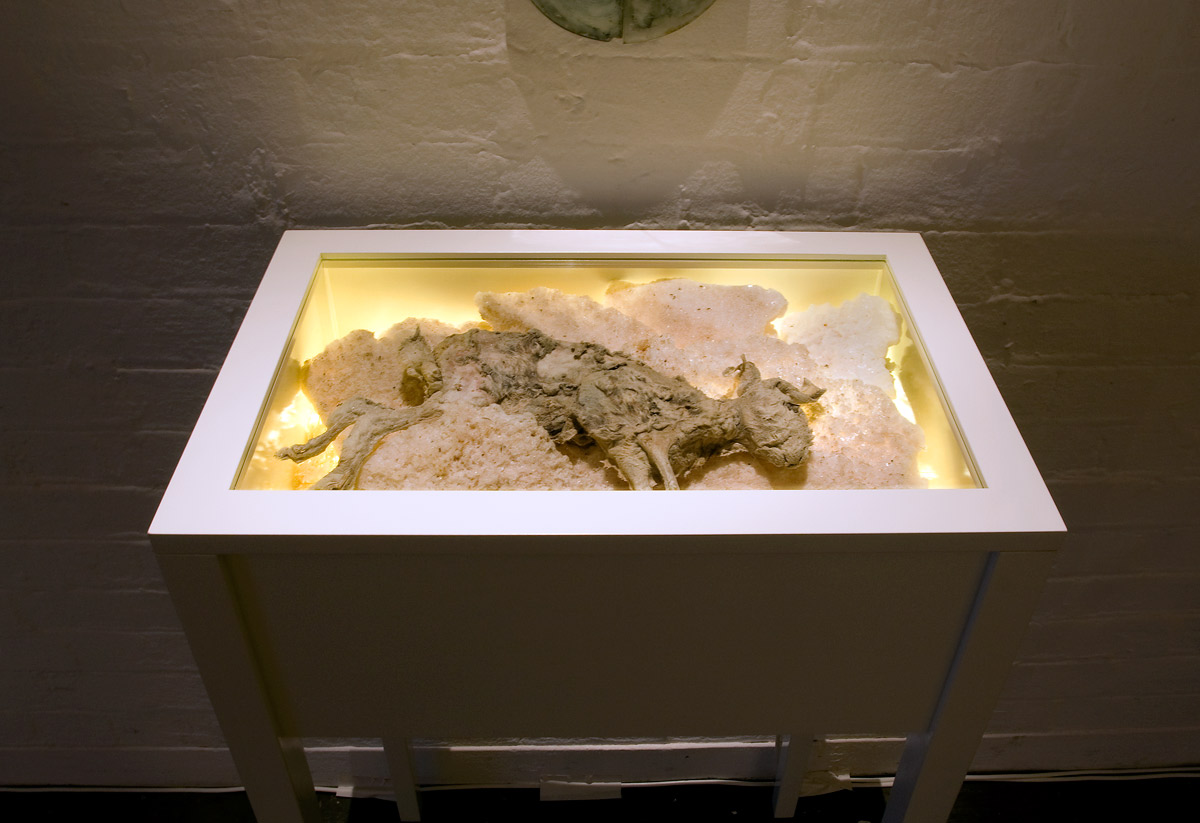
This installation, A Shrine for Orpheus, comprises four hundred hand cast beeswax blocks and a traditional beebox, in use by the bees until recently, accompanied by found objects such as old mirrors as well as ephemera collected from nature including feathers, bones and the salt mummified skeleton of a rabbit. Over the past year I have worked with the living beehive, placing votive offerings associated with poetry, death and renewal into the hive: objects such as books, cast wax pages, vessels, textiles and bones. Melbourne writer, Paul Carter has engraved wax tablets with aphoristic poems to the bees. These objects have been transformed through the bees’ processes of honeycomb- building.
The metaphors of the beehive in this connection to poetry, death and renewal are explored in the materials and structures of the installation. The warm sweet- smelling wax of the bees, cast into six sided blocks, provides the building material for the Shrine and two mausoleums, each with a void space, a space of underworld. The void of the larger mausoleum contains, ashy, burnt books, personal photos from family albums scorched by fire, evoking ‘shades’, the shadowy dead – and porcelain-like bones which have been materially transformed by cremation in a kiln. The second beeswax ‘grave’ has two voids, one of which contains a beeswax- bound and dipped facsimile of handwritten poems by Keats and, in the other opening, a book of insect morphology, also dipped and bound in beeswax.
The traditional beebox in the centre of the ruin of the Shrine is placed on a lake of mirrors. The mirrors have lost their tain and been translucently washed with plaster of Paris to further dim our view into the obscurely reflective world that lies beneath. The Shrine is accompanied by offerings of honey, honeycomb, beeswax bound books and pages cast from beeswax awaiting new poems, laid at its entrance.
Myths of death, dismemberment, transformation and resurrection have haunted the Western imagination from Isis to Dionysus, Orpheus and Christ. In his essay, The Gaze of Orpheus, the French literary theorist, Maurice Blanchot, has interpreted this myth as the descent of the artist to the realm of death to gain the work of art. Out of the failure of the artist, a necessary failure, emerges the artwork, wounded and bearing the ash of its origins.
The work of mourning, the work of healing.
Reflection, apparition, illusion: what appears as image, disappears evaporatively. As we change our place the space is already gone: the mirror holds a trace. What is veiled, enigmatic, uncertain remains as shadow that casts a light.
The temple re admits this invisible.
Pip Stokes. May. 2010 A Shrine for Orpheus
Beeswax, beehive box, mirror. Mixed media, dimensions variable. Original texts by Paul Carter, writer. Sound by Kasimir Burgess, filmmaker.
Installation views of the exhibition A Shrine for Orpheus by Pip Stokes at fortyfivedownstairs, Melbourne Photos: Marcus Bunyan
A Shrine for Orpheus
Lisa Jacobson
If Orpheus is guardian of the sacred arts, then it is possible that never before has there been a century so much in need of his song. This is because the world insists, on a daily basis, that we lose ourselves rather than commune with loss, to be drawn to darkness as logos rather than seek out its mythos. The myth of Orpheus has an integral role today in that it returns us and brings us back into communion with the sacred through poetry, dance, music and art.
Pip Stokes’ most recent exhibition, A Shrine for Orpheus, provides a mythic language for the story of Orpheus. It is a contemplation of myth that reflects back on itself in an endless refraction of associations and images; a visual representation of the myth itself which is never simple or linear but, rather, layered with metaphor and re-imaginings. Stokes’ installation reveals the ways in which myth enters us, but does not belong to us. Rather, we are the conduit through which myth runs and Orpheus, indeed, does run and has run through the dreams of humankind for as long as we have been able to dream.
This is in keeping with the Neo-Platonic notion, in which Orpheus plays no small part, that the figures of myth occupy not only the rooms of the psyche, but the rooms of other houses outside of us. It is not the artist who invents these figures of the psyche, of Orpheus and Eurydice, of Persephone and Hades, but they who reinvent themselves. The zeitgeist or midrash (as the Jewish mystics call the spirit of the times) summons up those gods it needs most. In Stokes’ work, it is Orpheus who answers this call.
Orpheus, playing quietly on his lyre in the middle of the forest, coaxes the animals out to listen, as Rainer Maria Rilke writes in his first sonnet to Orpheus:
“… And where there had been just a makeshift hut to receive the music, a shelter nailed up out of their darkest longing, with an entryway that shuddered in the wind- you built a temple deep inside their hearing.”
Summoning the animals translates, perhaps, into an ecological sensibility; to hear the call of Orpheus is to answer the ecological call, to re-sacralise nature. At a time when the world seems intent on hurtling towards its own demise, A Shrine for Orpheus inclines towards meditation and the transformation of nature, the stillness of catacombs, the quietness of wax, the purposeful industry of bees and silkworms, the potential for flight, the distillation of air, the reflective gaze, the emptying out of all colour until there are only shades of white: bleached bones, wax, ash, silk and paper, feathers in contemplation of flight as if, as the poet Pablo Neruda writes, “we lived falling out of the skin into the soul.” Like the bees which flew in through the open window of Stokes’ studio to busy themselves on the beeswax, even the very act of art-making has summoned and sung up, in its own way, the problematic aspects of creation. As Jean Cocteau observes in his film, Orphée, “Look for a lifetime in mirrors and you will see Death at work, like bees in a hive of glass.”
The music of Orpheus, as Noel Cobb has said, is “the activity of the theologos, the one who spoke with and about the Gods.” His sanctuary also encompasses poetry and art. Orpheus’ lyre has to do with both dismemberment and re-membering, god-like attributes, as Stokes alludes to in her depiction of Orpheus’ wax heart awaiting resurrection. Orpheus’ lyre was said to be strung with human sinews, and the music he plays as he sings nature and animals into being dips, inevitably, into the underworld, into death and decay, dismemberment, a scattering of the psyche into fields not yet dreamt of, in the act of its resounding. The wax which forms the foundation of Stokes’ Shrine for Orpheus, the books on which bees have fed in order to make their own inscriptions (texts by writers from Keats to the contemporary Paul Carter) also hint at resurrection and immortality. At the centre of this ‘temple’ is the beehive, symbol of transformation.
As Virgil notes in The Georgics in a section entitled “The Peculiarly Wonderful Features of Bees”, bee stock is immortal in that the hive itself is passed on from generation to generation, the structure keeps on singing, and never really dies despite the passing of the bees who composed it. In a similar fashion, Orpheus’ own lyre is carried forth, made from the shell of a tortoise whose death made possible the music itself. The heart of Orpheus, like his own severed head in the myth, does not cease its previous musicality, the song of its rhythmic beating. So too might the artist reach down into the darkness of herself, even if she risks being torn apart, knowing that the heart remains intact and can be resurrected.
Rilke again:
Only the man who has also raised his lyre among the darkling shades may be allowed a sense of infinite praise.
Inside the Orphic vision which Pip Stokes’ art immerses itself in, everything is panoramic and ornamented by mythic figures whom we cannot ever really know, but only glimpse via the language of metaphor: the hand that plunges through the earth while one is gathering flowers, the hem of a beekeeper’s shroud-like coat, the thin silken thread of a worm, the trace of words upon wax, or feathers, burnt books or ash. These are the images that translate the emotion of the myth but which remain, nevertheless, untranslatable because should they be hardened into the prosaic everyday language of the world, they would cease to be mythos.
Perhaps it is for this very reason that Eurydice cannot be brought back up to the shining world of which Rilke writes, in a different poem on Orpheus, and that Orpheus himself rises into at the very moment Hermes ushers Eurydice once again below. Eurydice is too far into death to be brought back to life. She has sunk into the “dream within the dream” in which, as Edgar Allan Poe writes, we are all participants. All Orpheus can take with him is the imprint of her, the illicit gaze, the melancholic pathology of the backward glance, that perhaps was not so much hastily stolen as executed too quickly. How long must the artist gaze into the underworld? Is it ever enough? Must she not continually turn back and gaze at what cannot be brought to the surface but that she must, even so, attempt to translate? Is it this that Rilke refers to when he writes in his sonnets, “it is in overstepping that [Orpheus] obeys?” Cocteau, speaking about his film, commented that “Poets, in order to live must often die, and shed not only the red blood of their hearts, but the white blood of their souls, that flows and leaves traces which can be followed.”
There is loss in this of course, great loss, that Stokes’ art both acknowledges and makes a place for. As Orpheus travels along “the path ascending steeply into life” towards “the shining exit-gates,” he cannot help but glance back. In the sonnets Rilke cautions, “Be ahead of all parting as though it already were / behind you.” This has echoes of Jacques Derrida’s The Work of Mourning, in which he argues that mourning begins the moment friendship begins; that we cannot enter into relationship without becoming conscious of the loss that will inevitably come with the other’s death. Indeed, the very idea of this loss precipitates the event itself, leaves us prematurely bereft and continually turning back towards the absent loved one in our grief. And if we are always turning back, is not the artist most required to do so, is not the artist most compelled to incline her head towards the darkness in order to write of what stirs beneath the shining surface of the world, of what calls to be heard? Is this not the invisible that Orpheus calls into being through poetry, music and art? Orpheus rises in Rilke’s poem, and in Pip Stokes’ work. In fact, if we dare to journey with him, he will rise in us all.
Installation views of the exhibition A Shrine for Orpheus by Pip Stokes at fortyfivedownstairs, Melbourne Photos: Marcus Bunyan
fortyfivedownstairs 45, Flinders Lane Melbourne 3000
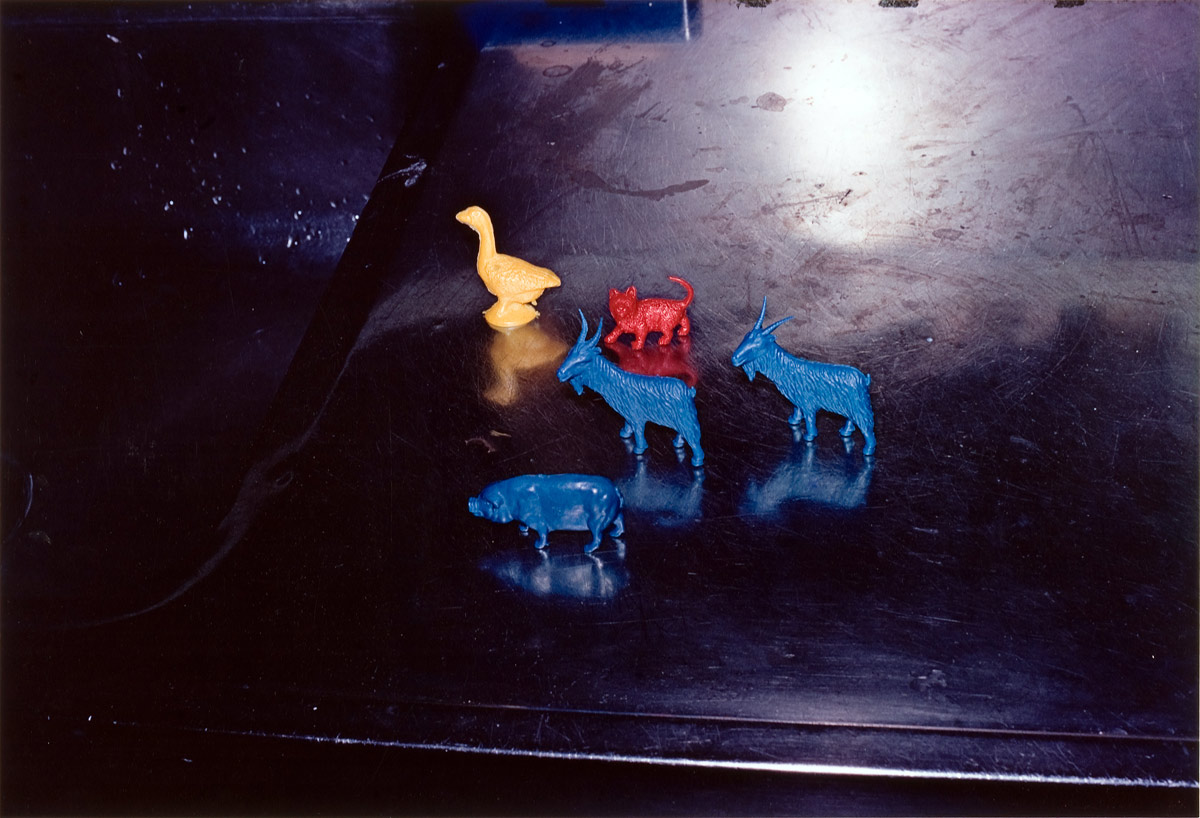
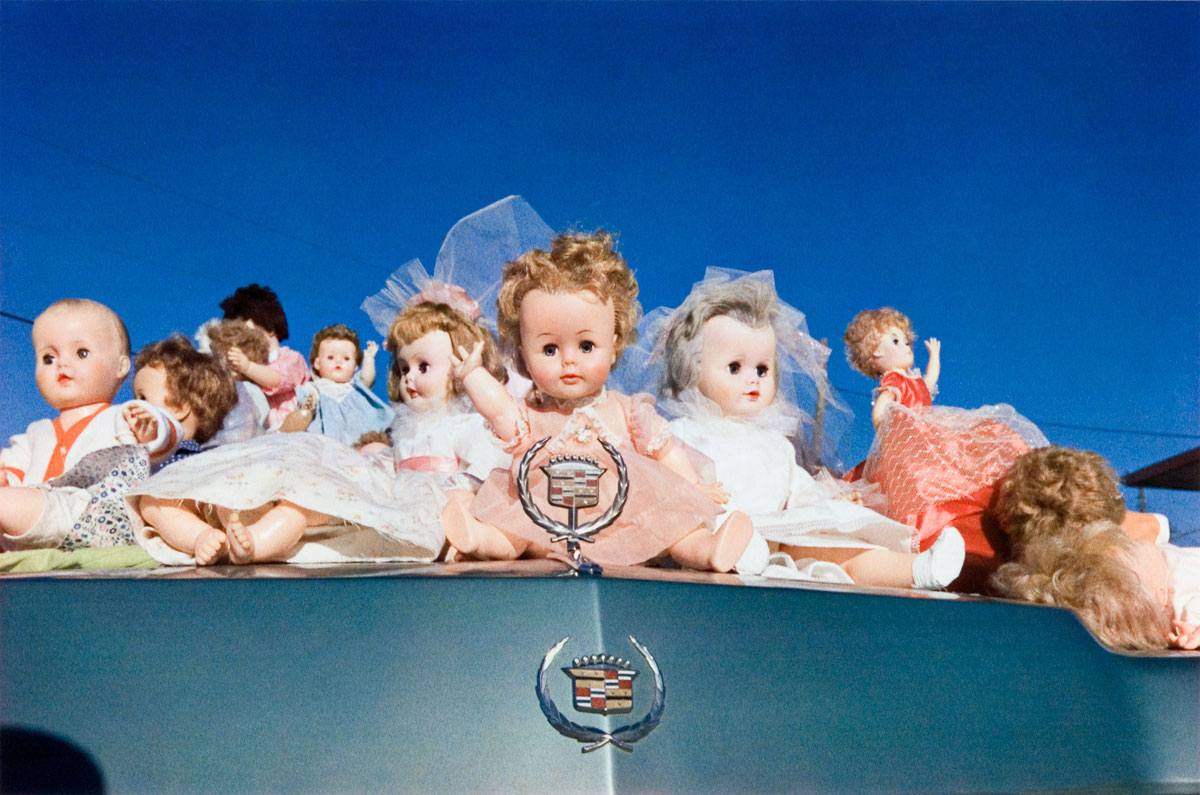
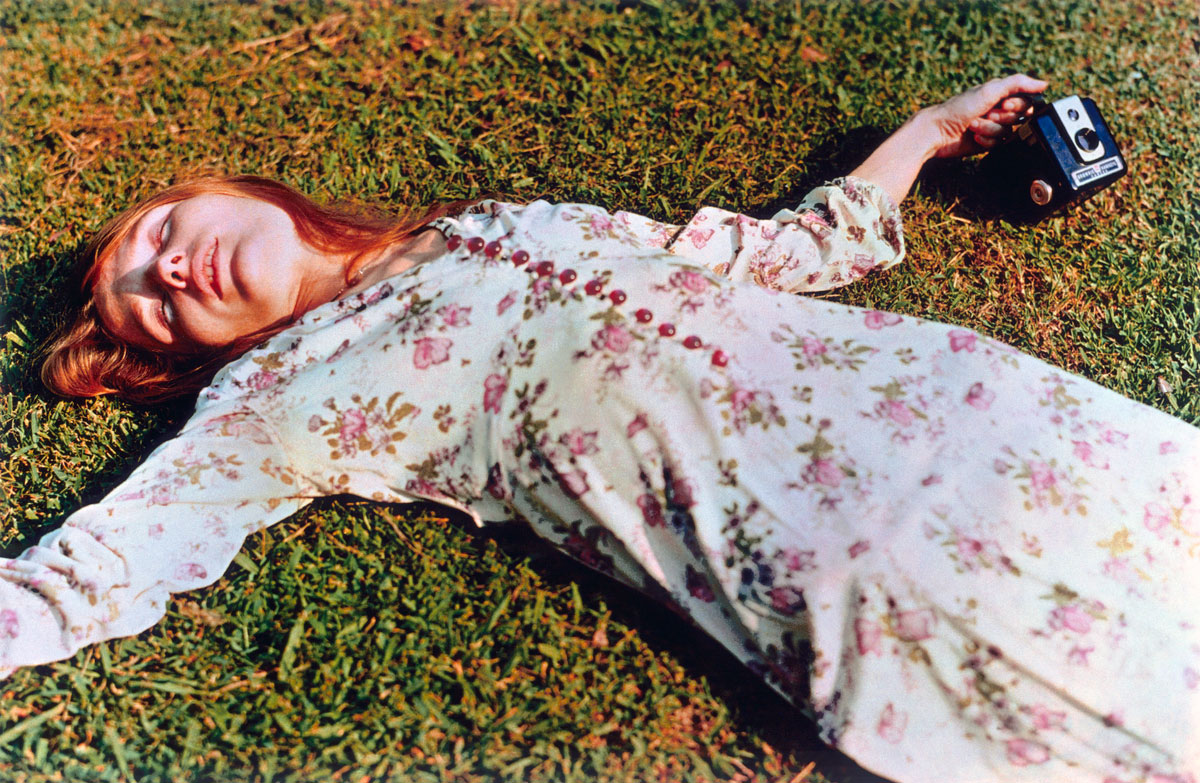
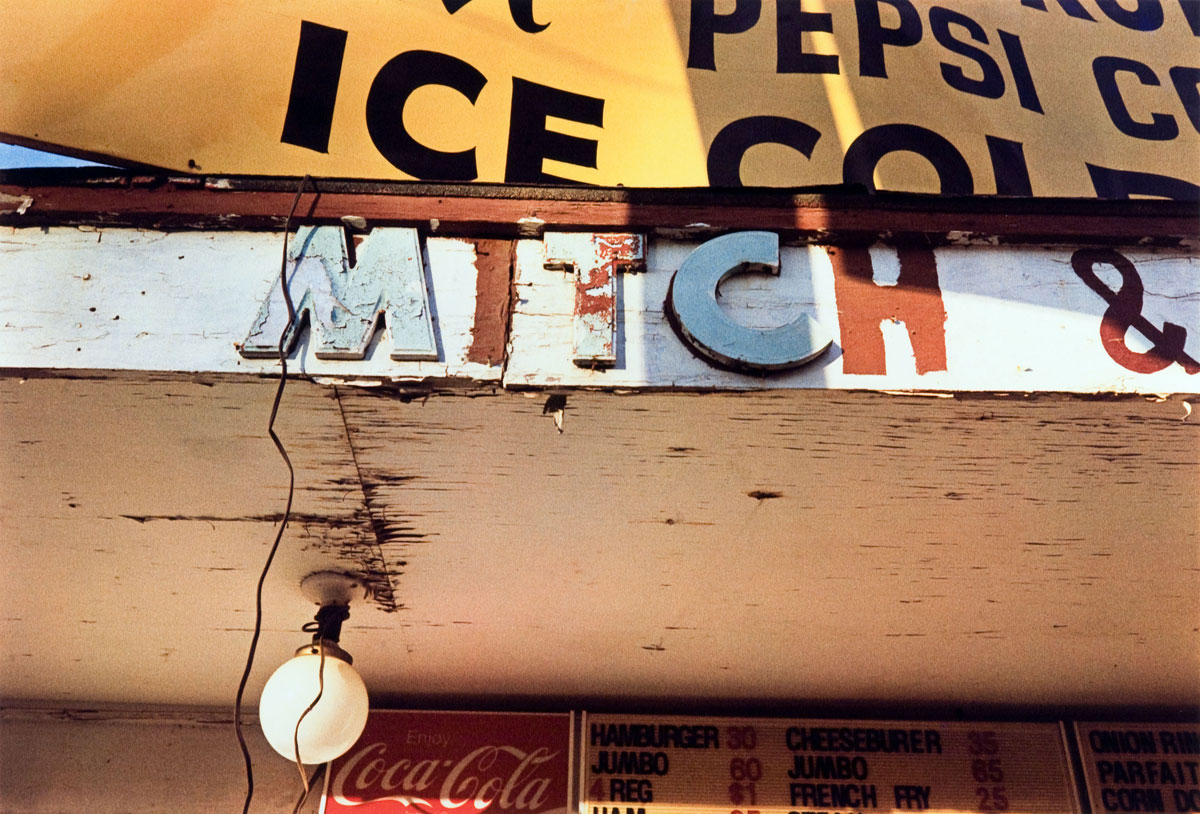
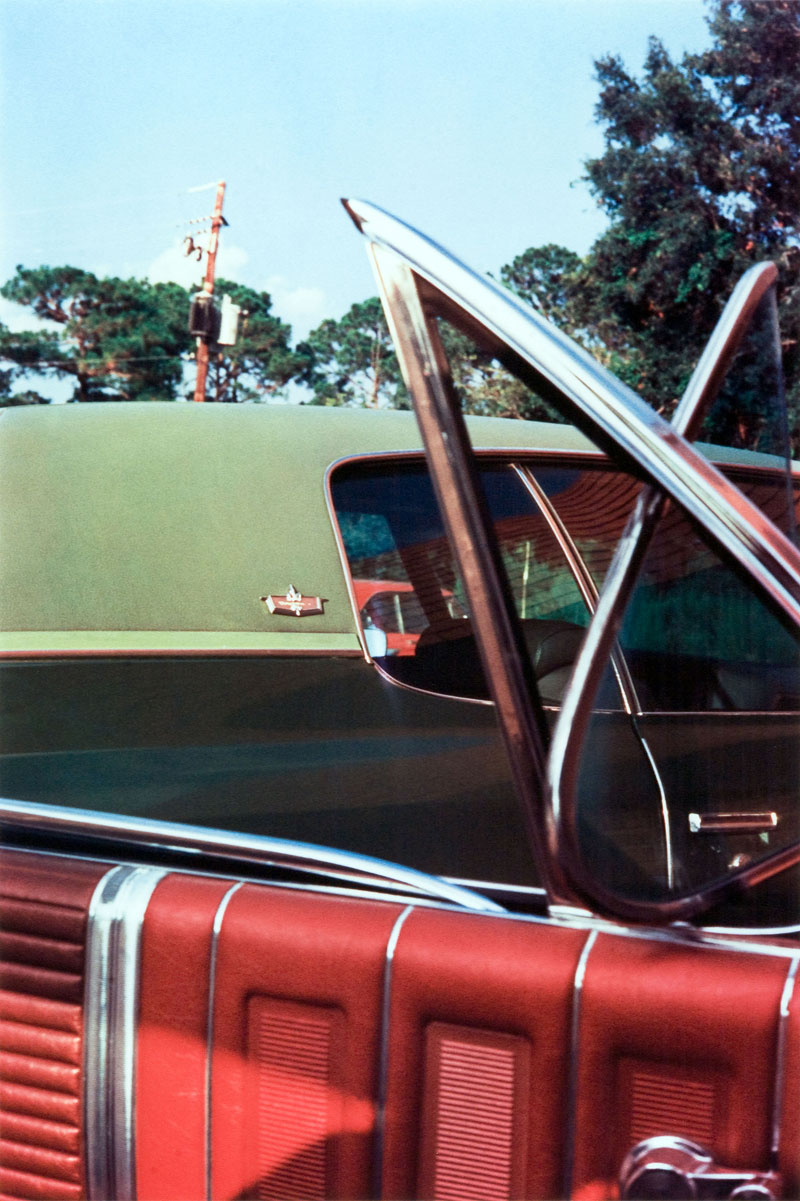
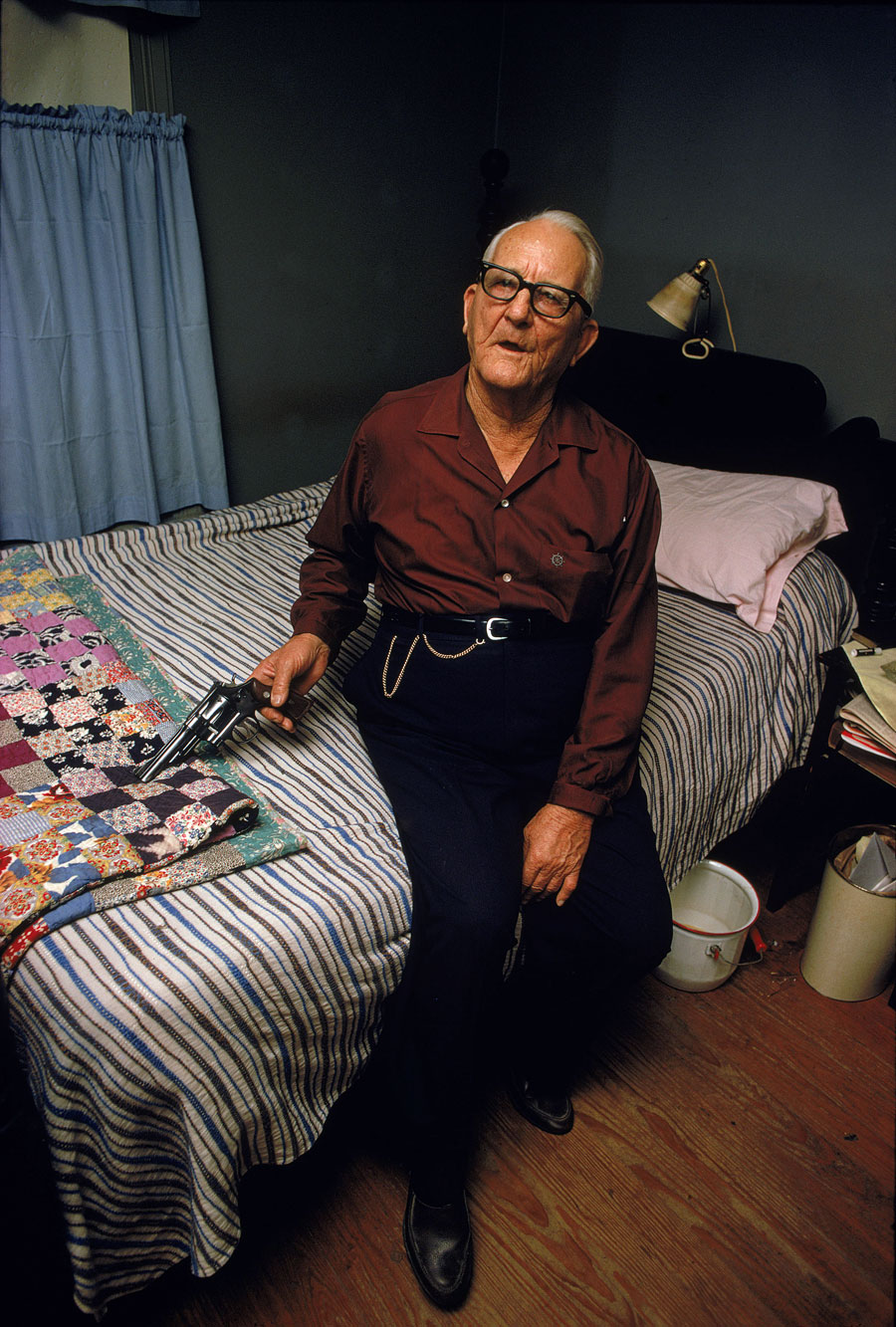
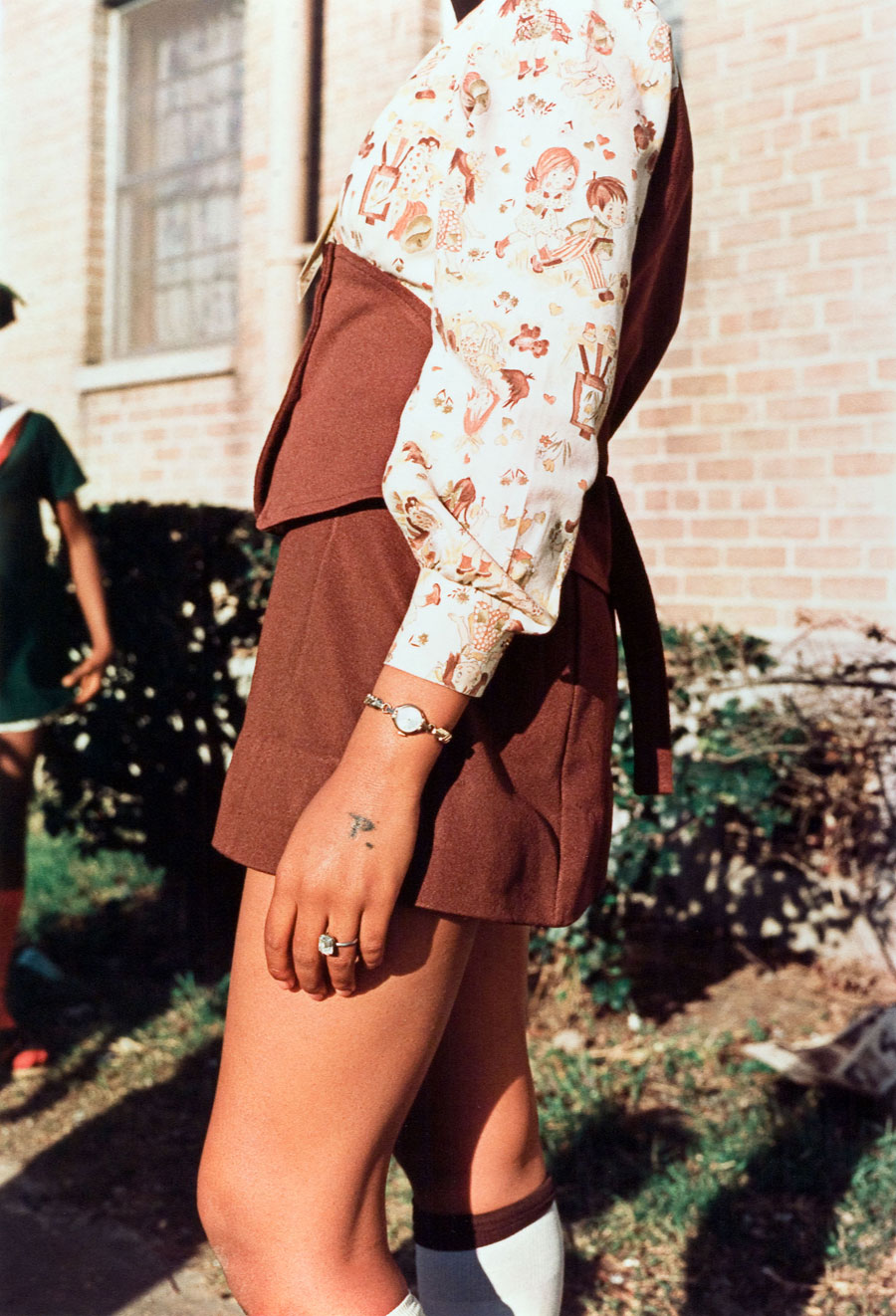
THE classic William Eggleston, the one and only. Feel the heat of sun on body. Look at the construction of the image plane, all angles and fractures. The slight movement of the woman’s hand as she sits on a cracked yellow wall. The distance between her body and the metal pole with wrapped chain and padlock, that ice/fire tension as Minor White would say. Man with gun vs melancholy monochromatic self portrait, the reverie of the lone thinker. Colour and light as emotional sounding board, “colour as a means of discovery and expression, and as a way to highlight aspects of life hidden in plain sight.” This is what Eggleston points his democratic camera at – life hidden in plain sight, revealed in all its intricacies, in all its mundanity and glory.
Dr Marcus Bunyan
Many thankx to Chai Lee and the Art Institute of Chicago for allowing to me reproduce the photographs in this posting. Please click on the photographs for a larger version of the image.
The unconventional beauty and artistry of works by photographer William Eggleston will be showcased in a major exhibition opening at the Art Institute of Chicago this winter. William Eggleston: Democratic Camera, Photographs and Video, 1961-2008 – on view from February 27 through May 23, 2010, in the Modern Wing’s Abbott Galleries (G182, G184) and Carolyn S. and Matthew Bucksbaum Gallery (G188) – is the most comprehensive retrospective to date of the Memphis-based contemporary photographer. The exhibition brings together more than 150 extraordinary images of familiar, everyday subjects with lesser-known, early black-and-white prints and provocative video recordings, all produced over a five-decade period.
Born in 1939 in Memphis, Tennessee, and raised on his family’s cotton plantation in Mississippi, William Eggleston held a casual interest in photography until 1959, when he came across photo books by Henri Cartier-Bresson and Walker Evans. Among his earliest pictures, made during stints at universities in Tennessee and Mississippi, were black-and-white scenes found in his native South, as well as portraits of friends and family members.
By the 1960s and early 1970s he had begun experimenting with colour film, and he eventually produced rich, vivid prints through the dye transfer process – prints that are created through the alignment of three separate matrices (cyan, magenta, and yellow) generated from three separate negatives (red, green, and blue filters). The resulting prints are known for the vividness and permanence of their colours. Hence, Eggleston is often credited for single-handedly ushering in the era of colour art photography.
Eager to show his work to a broader audience, Eggleston traveled to New York with a suitcase of slides and prints to meet with Museum of Modern Art (MoMA) curator John Szarkowski. This visit eventually yielded a controversial but revolutionary exhibition in 1976 – MoMA’s first solo show to feature colour photographs – and a classic accompanying book, William Eggleston’s Guide. At this point in his career, Eggleston had already distinguished himself by treating colour as a means of discovery and expression, and as a way to highlight aspects of life hidden in plain sight.
William Eggleston: Democratic Camera, Photographs and Video, 1961-2008 demonstrates Eggleston’s “democratic” approach to his photographic subjects in both colour and black-and-white. Everything that happens in front of the camera is worthy of becoming a picture for the artist – no matter how seemingly circumstantial or trivial. Eggleston finds his motifs in everyday life, resulting in telling portrayals of American culture. His iconic images such as Elvis’s Graceland, a supermarket clerk corralling grocery carts in the afternoon sunlight, and a freezer stuffed with food proves that the photographer points his “democratic camera” at everything. Eggleston’s quiet, thoughtful pictures have profoundly impacted subsequent generations of photographers, filmmakers, and scholars.
The exhibition also includes Eggleston’s cult video work, Stranded in Canton. In the 1960s, Eggleston used film to document Fred McDowell, a well-known Delta blues musician, but ultimately abandoned the film project. Eggleston later acquired a video camera and began using video to shoot in bars and in people’s homes; sometimes he shot monologues friends delivered for his video camera, most often at night. The result, Stranded in Canton, recently restored and re-edited, is a portrait of a woozy subculture that adds dimension and texture to the world of Eggleston’s colour photographs.
Internationally acclaimed, Eggleston has spent the past four decades photographing around the world, responding intuitively to fleeting configurations of cultural signs and specific expressions of local colour. By not censoring, rarely editing, and always photographing even the seemingly banal, Eggleston convinces us completely of the idea of the democratic camera.
Press release from the Art Institute of Chicago website [Online] Cited 15/05/2010 no longer available online
Paul Ogier (Australia born New Zealand, b. 1974) Saint Stephen 2009 Courtesy of the artist
Mark Hislop from the Monash Gallery of Art (MGA) has asked me to post details of the William and Winifred Bowness Photography Prize 2010. More than happy too. To see the standard take a look at the 2009 Finalists online. Details on how to enter are posted below. Have a go, get your entries in, you never know who will win!
Many thankx to the MGA for allowing me to publish the photographs in the posting. Please click on the photographs for a large version of the image.
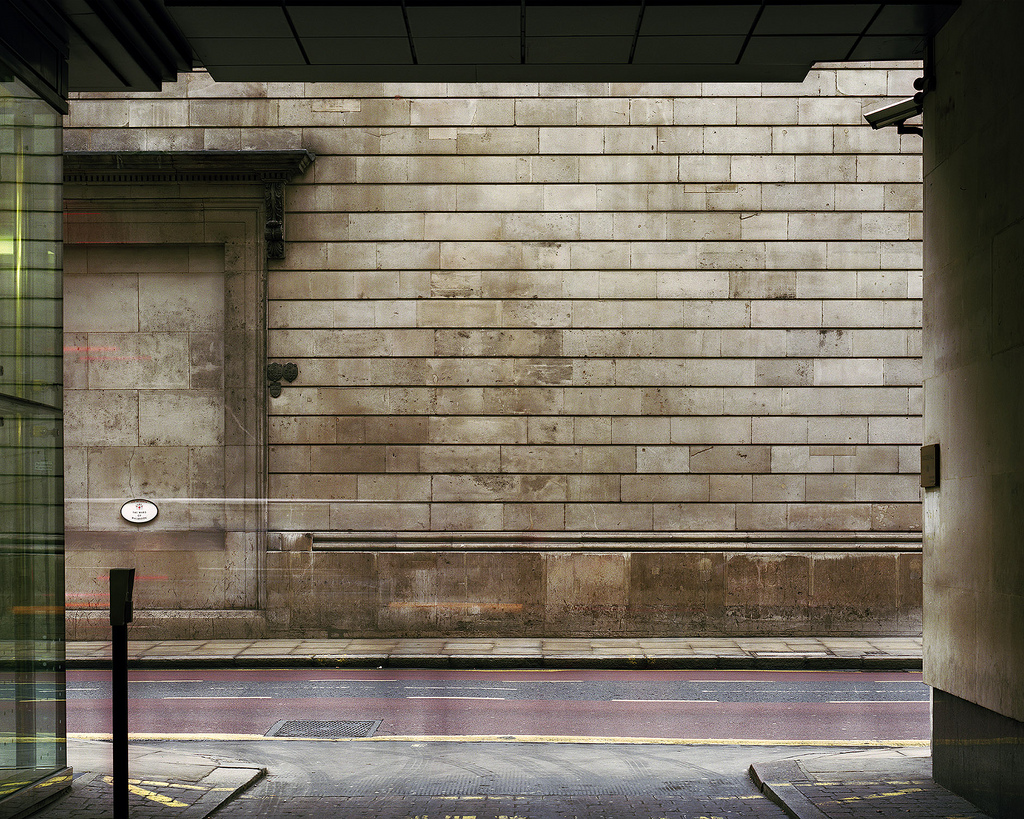
Simon Terrill (Australian, b. 1969) Bank of England 9AM 2009 Courtesy of the artist
The Monash Gallery of Art Foundation is pleased to announce the CALL FOR ENTRIES for the William and Winifred Bowness Photography Prize 2010.
The MGA Foundation will once again showcase the work of Australia’s best photographers in Australia’s most coveted photography award. Photographers from all over Australia are encouraged to submit entries to this year’s Bowness Photography Prize. Each year, finalists are drawn from the breadth of Australian photographic practice: editorial, commercial, street and fine art.
In recognition of the support shown the prize by Australian photographers, prize money for this year’s award has increased substantially. Last year, a record 459 photographers submitted entries in anticipation of the $20,000 non-acquisitive first prize. In 2010, photographers will be competing for $25,000 first prize and $1,000 People’s Choice Award.
The winner of the 2010 Bowness Photography Prize and Honourable Mentions will be announced on Thursday night 23 SEP 2010 during a cocktail party held at MGA. Winners and finalists will enjoy unprecedented visibility for their work. All finalists will be published on MGA’s flickr page and included in a substantial catalogue. The winner will receive the $25,000 first prize. And in recognition of the strength of the prize and MGA’s commitment to promoting the best of contemporary Australian photography, Honourable Mentions will have the opportunity to stage an exhibition at MGA.
This year’s entries will be judged by Gael Newton, Senior Curator of Photographs, National Gallery of Australia, Max Pam, Australian photographer, and Shaune Lakin, Director of MGA.
About the BOWNESS Photography Prize
Established in 2006 to promote excellence in photography, the annual non-acquisitive William and Winifred Bowness Photography Prize is an initiative of the MGA Foundation. The Bowness Photography Prize has quickly become Australia’s most coveted photography prize. It is also one of the country’s most open prizes for photography. In the past, finalists have included established and emerging photographers, art and commercial photographers. All film-based and digital work from amateurs and professionals is accepted. There are no thematic restrictions.
The 2009 Bowness Prize recipient was Paul Knight. Since winning the Prize, Knight has received an Australia Council for the Arts Skills and Development Grant and is currently presenting new work at the prestigious international artfair Art Cologne.
Jane Burton (Australian, b. 1966) Ivy # 3 2009 Courtesy of the artist and Karen Woodbury Gallery, Melbourne
Owen Leong (Australian, b. 1979) Justin 2009 Courtesy of the artist and Anna Pappas Gallery, Melbourne
Paul Knight (Australian, b. 1976) 14 months # 01 2008 Courtesy of the artist and Neon Parc, Melbourne Winner of the William and Winifred Bowness Photography Prize 2009
Monash Gallery of Art 860 Ferntree Gully Road Wheelers Hill Victoria 3150 Phone: +61 3 8544 0503
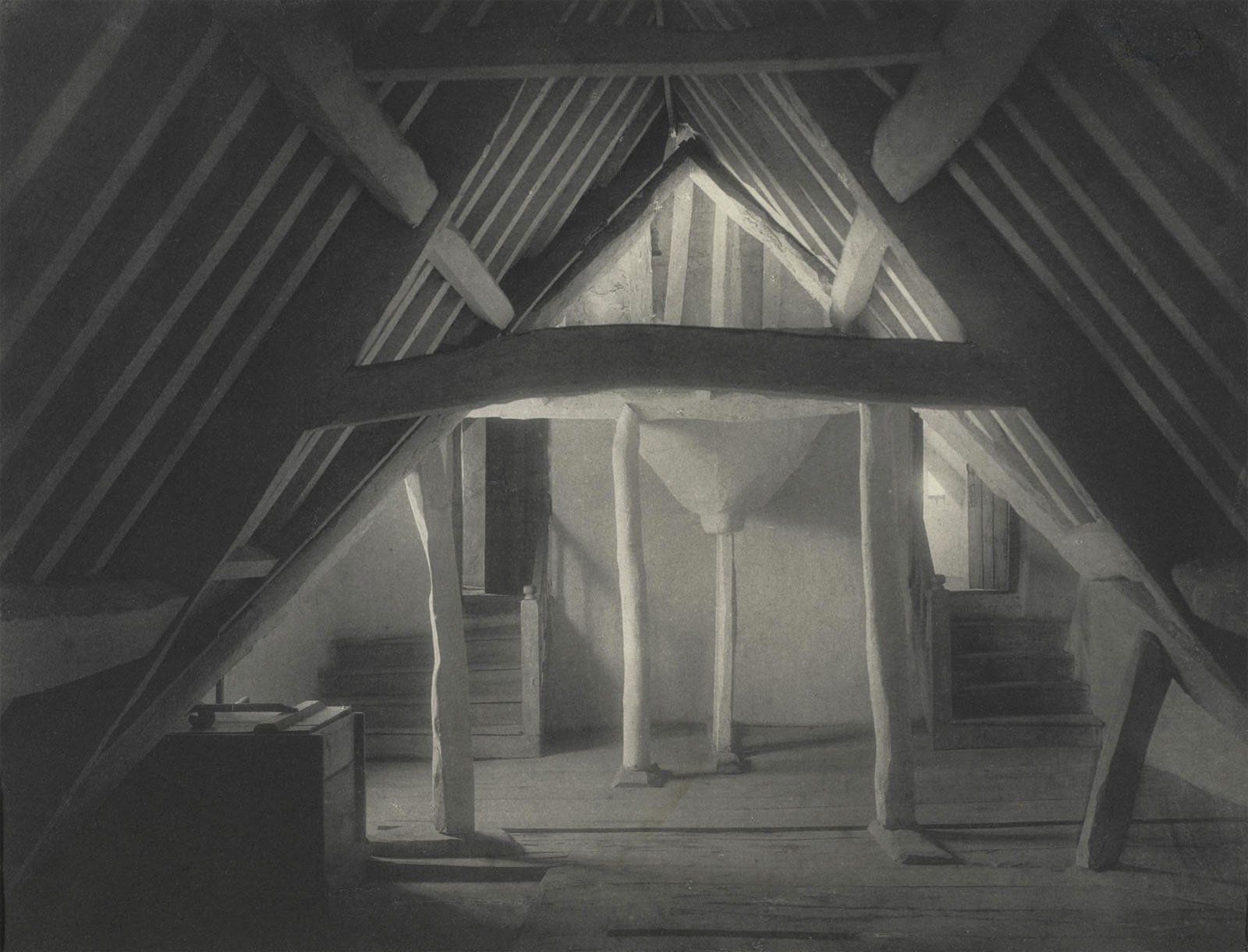
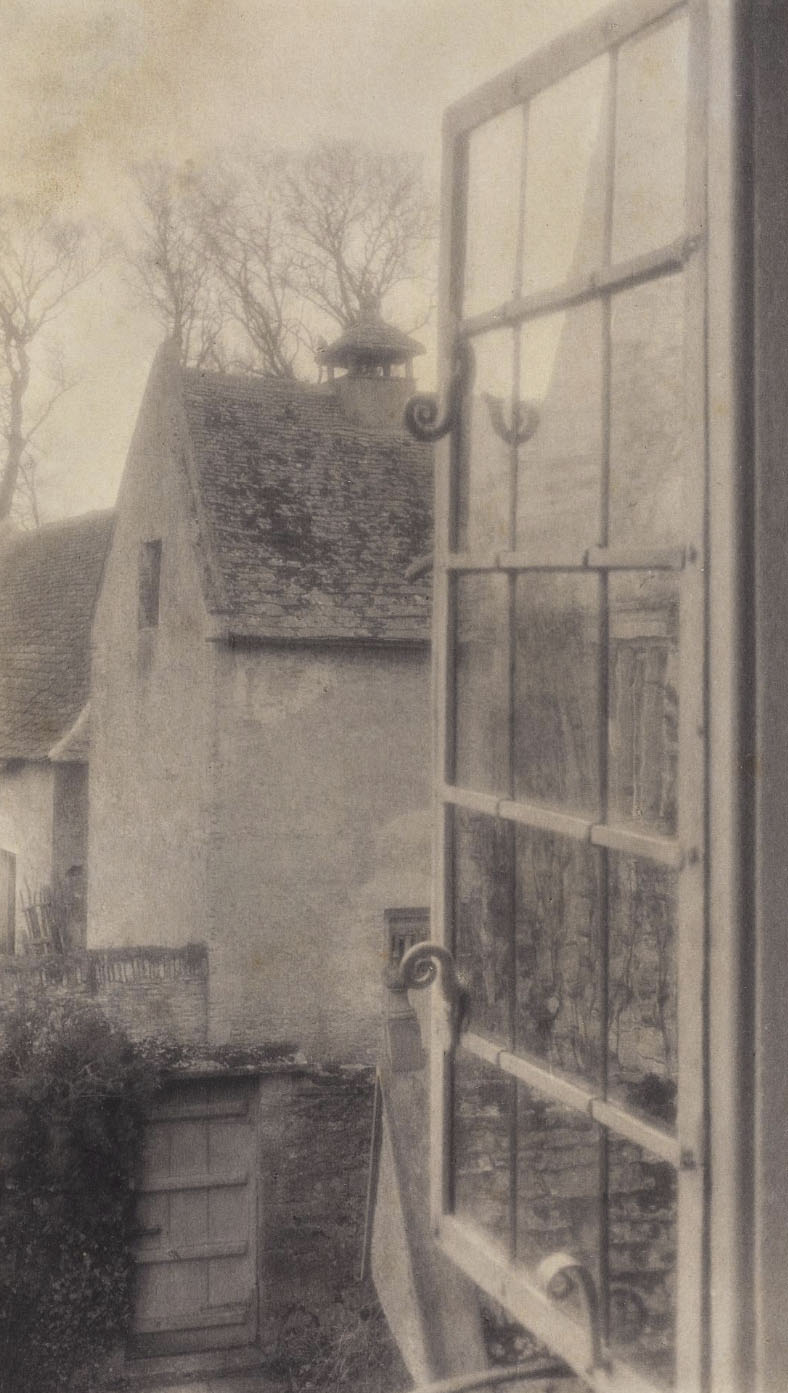
Frederick H. Evans (British, 1853-1943) Kelmscott Manor: Attics 1896 Platinum print Image and sheet: 6 1/16 × 7 7/8 inches (15.4 × 20cm) Philadelphia Museum of Art Gift of the artist, 1932
Attics often serve as metaphors for the space where memories reside. Here Frederick Evans captures the warm glow, the simple, rough-hewn timbers, and the striking geometry of the attic at Kelmscott Manor, the beloved summer retreat of designer William Morris (British, 1834-1896).
Morris, the leader of the Arts and Crafts movement – which valued Britain’s craft tradition and rejected its industrial revolution – drew inspiration from the architecture and workmanship of Kelmscott, designed and constructed in the 1500s. In 1896 Morris invited Evans to photograph the home, which he felt embodied the memory of Britain’s aesthetic past.
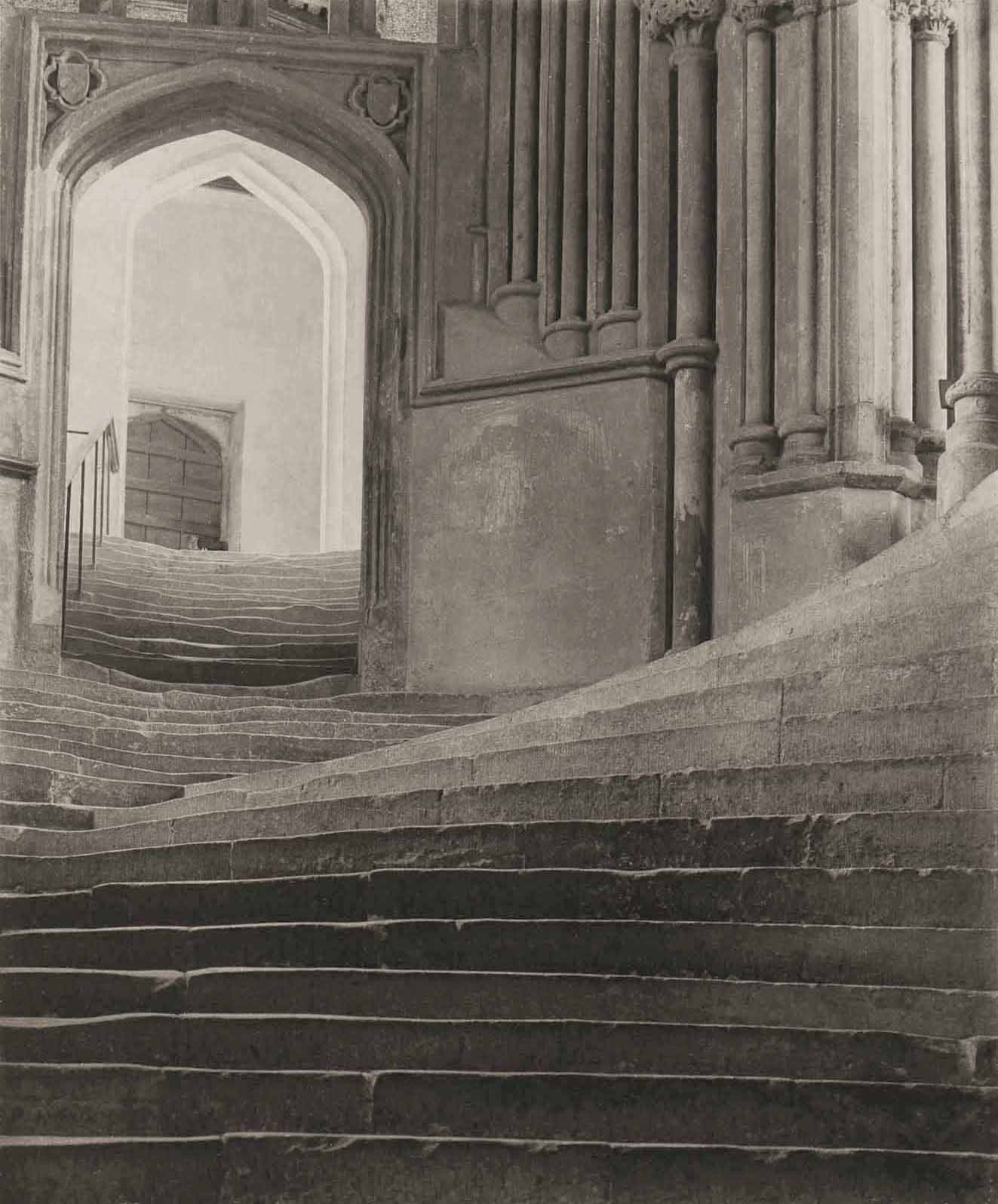
Platinum prints always have such luminosity. A Sea of Steps by Fredrick H. Evans (1903, below) is a knockout. I remember some beautiful platinum prints many years ago (1989) up in Sydney at the Museum of Contemporary Art in the touring exhibition Robert Mapplethorpe: The Perfect Moment that were an absolute knockout as well. Pity he didn’t print them himself but they were still superlative!
Dr Marcus Bunyan
Many thankx to Shen Shellenberger and the Philadelphia Museum of Art for allowing me to publish the last five images in the posting. Please click on the photographs for a larger version of the image.
Frederick H. Evans (British, 1853-1943) Kelmscott Manor 1896 Platinum print Image and sheet: 7 3/8 × 4 1/4 inches (18.7 × 10.8cm) Philadelphia Museum of Art Purchased with funds contributed by Dorothy Norman and with the Director’s Discretionary Fund, 1968
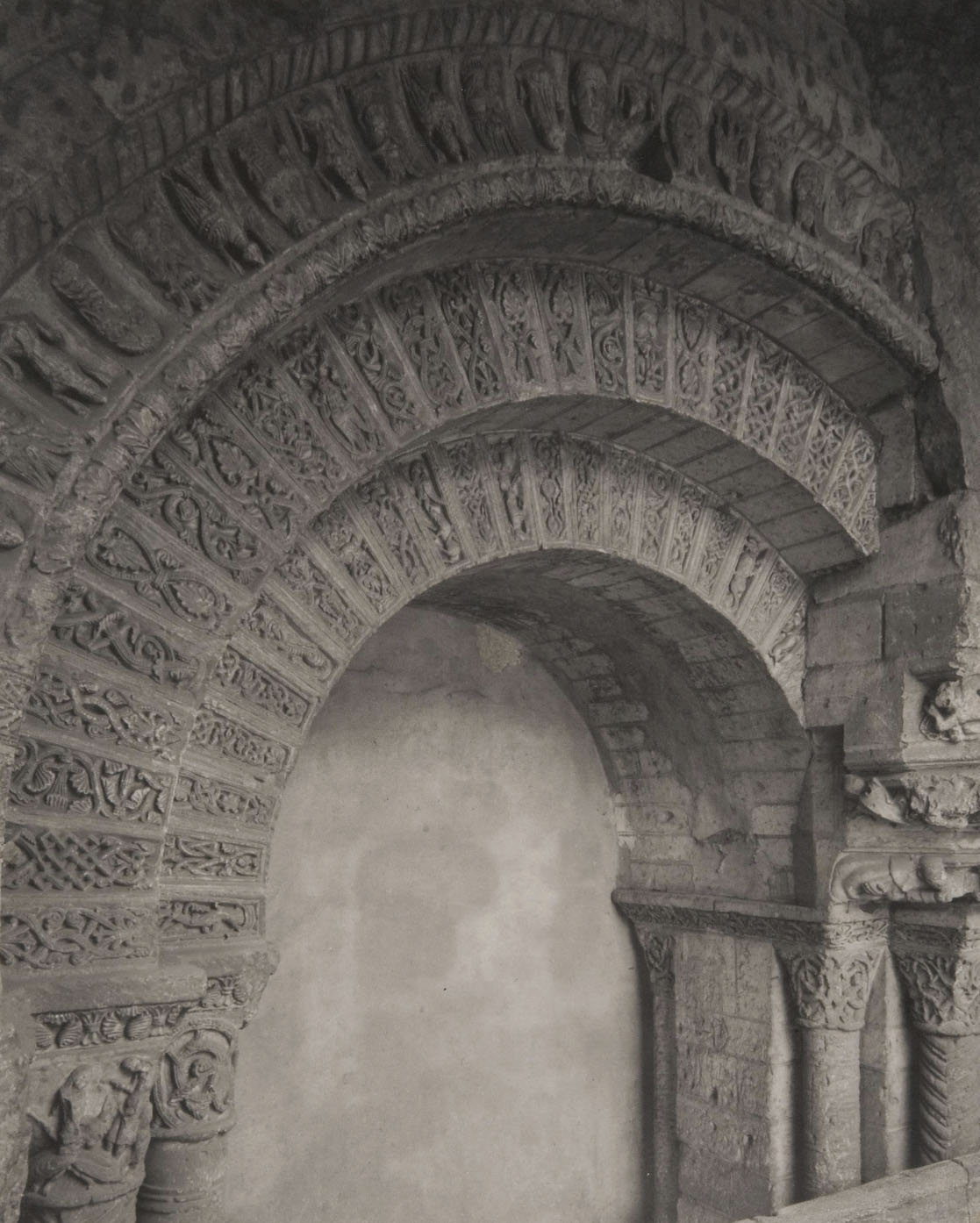
Frederick H. Evans (British, 1853-1943) Angers: Prefecture, Sculptured Arches of 11th-12th Century c. 1906-1907 Platinum print Image and sheet: 9 11/16 × 7 7/8 inches (24.6 × 20 cm) Philadelphia Museum of Art Purchased with funds contributed by Dorothy Norman and with the Director’s Discretionary Fund, 1968
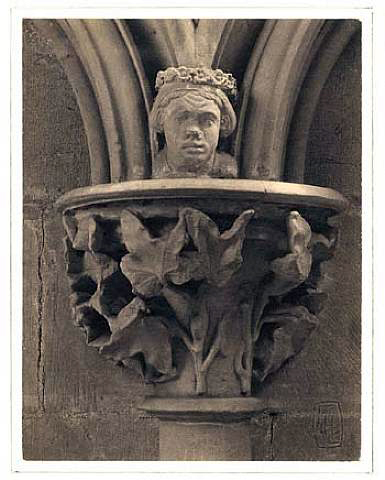
Frederick H. Evans (British, 1853-1943) Southwell Cathedral, Chapter House Capital 1898 Platinum print Philadelphia Museum of Art
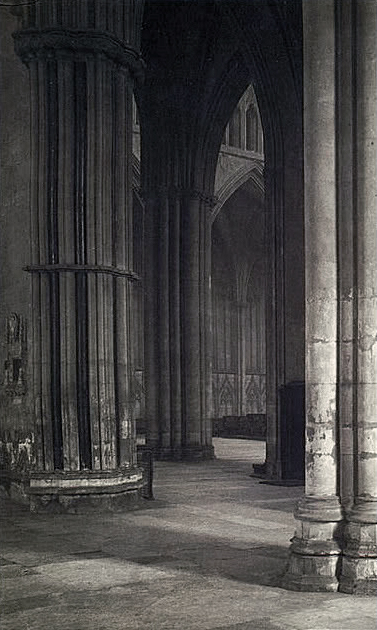
Frederick H. Evans (British, 1853-1943) View across the nave to the transept at York Minster 1901 Platinum print Philadelphia Museum of Art
Frederick H. Evans (British, 1853-1943) Durham Cathedral: West End Nave 1912 Platinum print Image and sheet: 9 1/2 × 4 13/16 inches (24.1 × 12.3cm) Philadelphia Museum of Art Purchased with funds contributed by Dorothy Norman, 1973
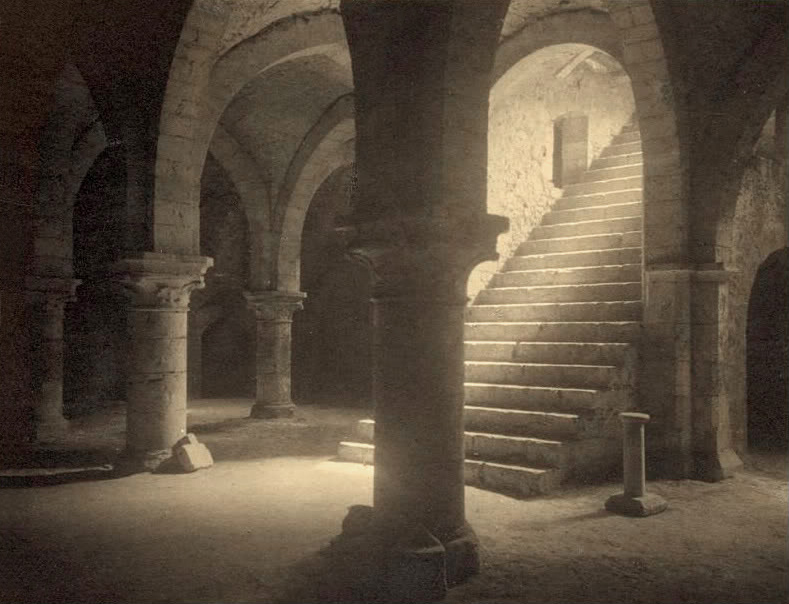
Frederick H. Evans (British, 1853-1943) Ancient crypt cellars in Provins 1910 Platinum print Philadelphia Museum of Art
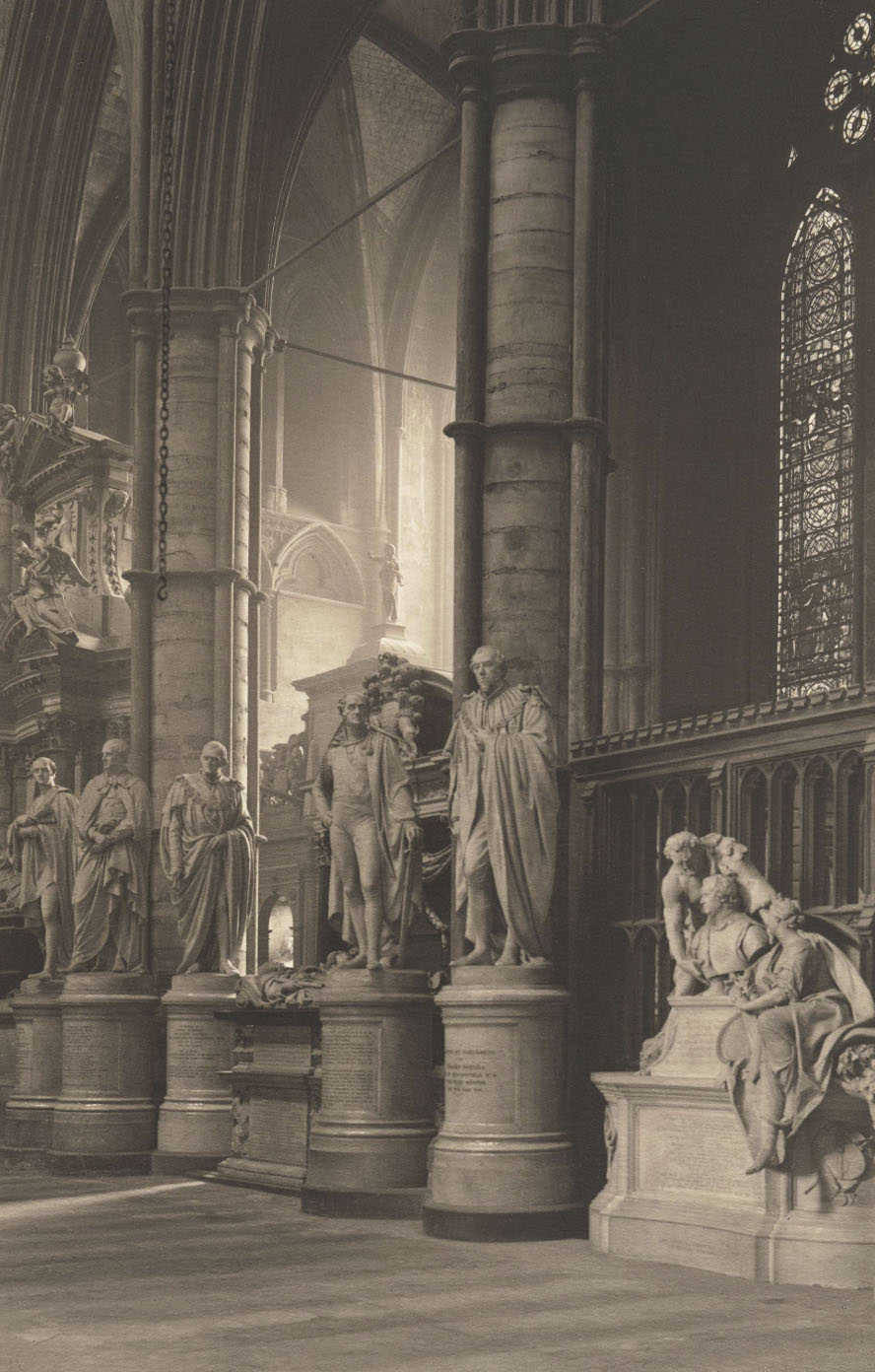
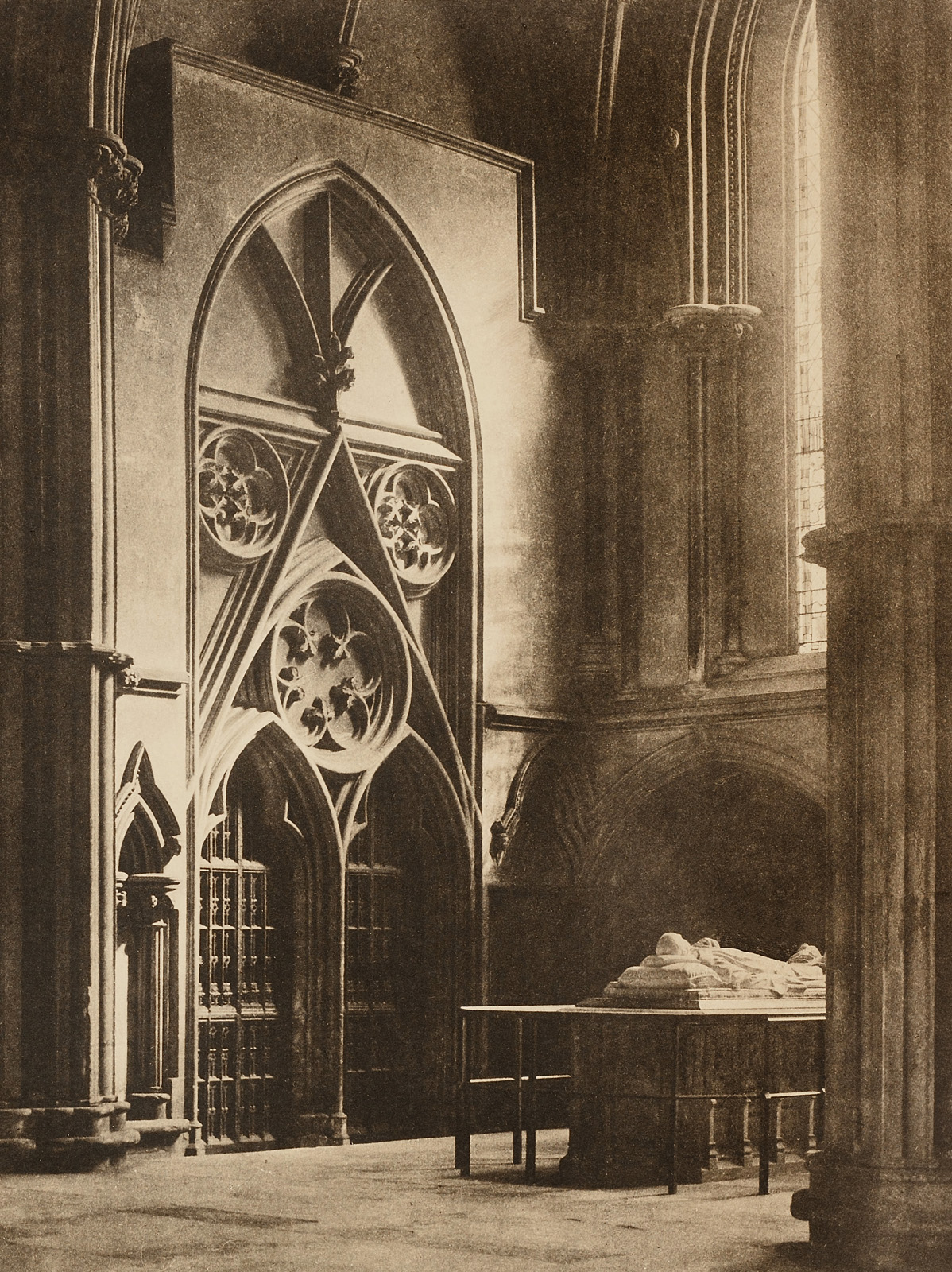
Frederick H. Evans (British, 1853-1943) Westminster Abbey: North Transept: East Side 1911 Platinum print Image and sheet: 9 7/16 × 6 inches (23.9 × 15.3cm) Philadelphia Museum of Art Purchased with the Lola Downin Peck Fund, 1969
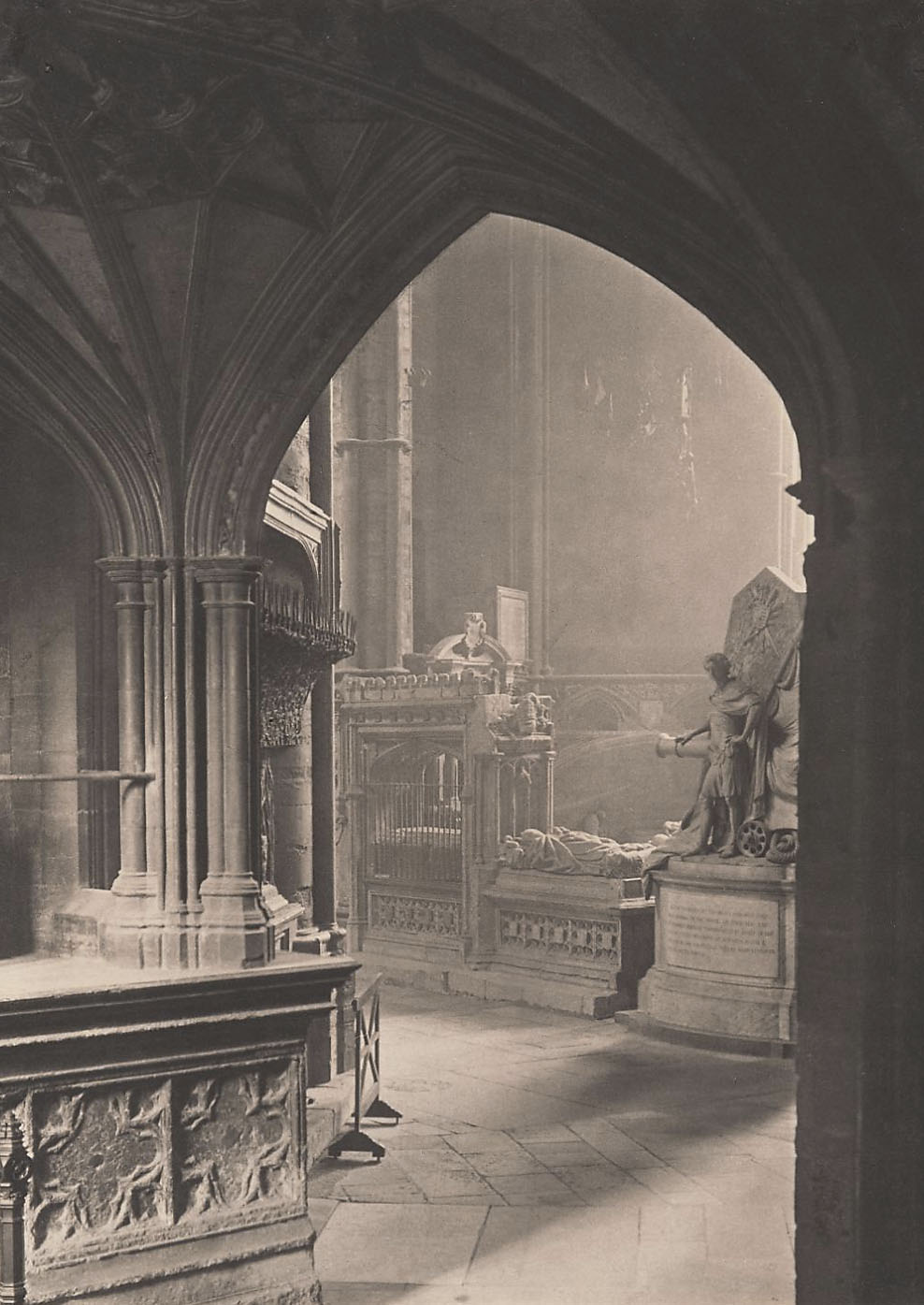
Frederick H. Evans (British, 1853-1943) Westminster Abbey: Staircase in Confessor’s Chapel 1911 Platinum print Image and sheet: 9 1/2 × 6 1/8 inches (24.2 × 15.6cm) Philadelphia Museum of Art Purchased with the Lola Downin Peck Fund, 1969
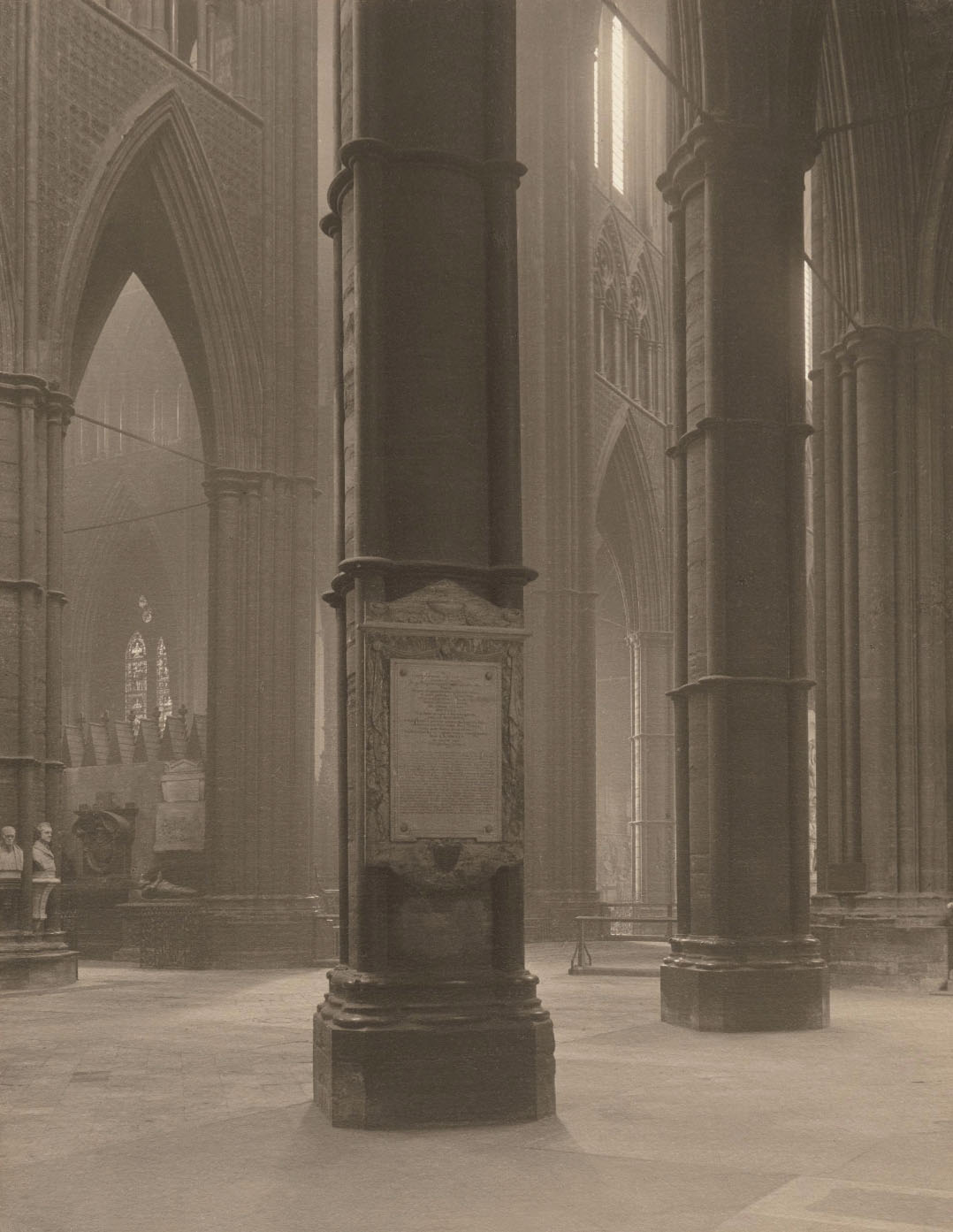
Frederick H. Evans (British, 1853-1943) Westminster Abbey: From the South Transept 1911 Platinum print Image and sheet: 9 1/2 × 7 7/16 inches (24.2 × 18.9cm) Philadelphia Museum of Art Purchased with the Lola Downin Peck Fund, 1969
Frederick H. Evans (British, 1853-1943) Westminster Abbey: East Ambulatory 1911 Platinum print Image and sheet: 9 5/16 × 6 11/16 inches (23.7 × 17cm) Purchased with the Lola Downin Peck Fund, 1969
Frederick H. Evans (British, 1853-1943) Westminster Abbey: 12th-Century Mosaic Floor at the Sanctuary 1911 Platinum print Image and sheet: 7 5/16 × 8 7/8 inches (18.6 × 22.6 cm) Philadelphia Museum of Art Purchased with the Lola Downin Peck Fund, 1969
Although Evans indicated that this mosaic floor was created in the twelfth century, the surface surrounding the High Altar of Westminster Abbey was in fact laid in 1268. King Henry III (1207-1272) commissioned the mosaic from Roman craftsmen who specialised in the opus sectile, or “cut work” technique, commonly called “Cosmati” after a well-known Italian family of mosaic artists. Materials used here include blue, red, and turquoise glass as well as yellow limestone, purple porphyry, green serpentine, and onyx. Evans’s unusual composition privileges the floor, drawing attention to the intricate and abstract design of squares, rectangles, and roundels.
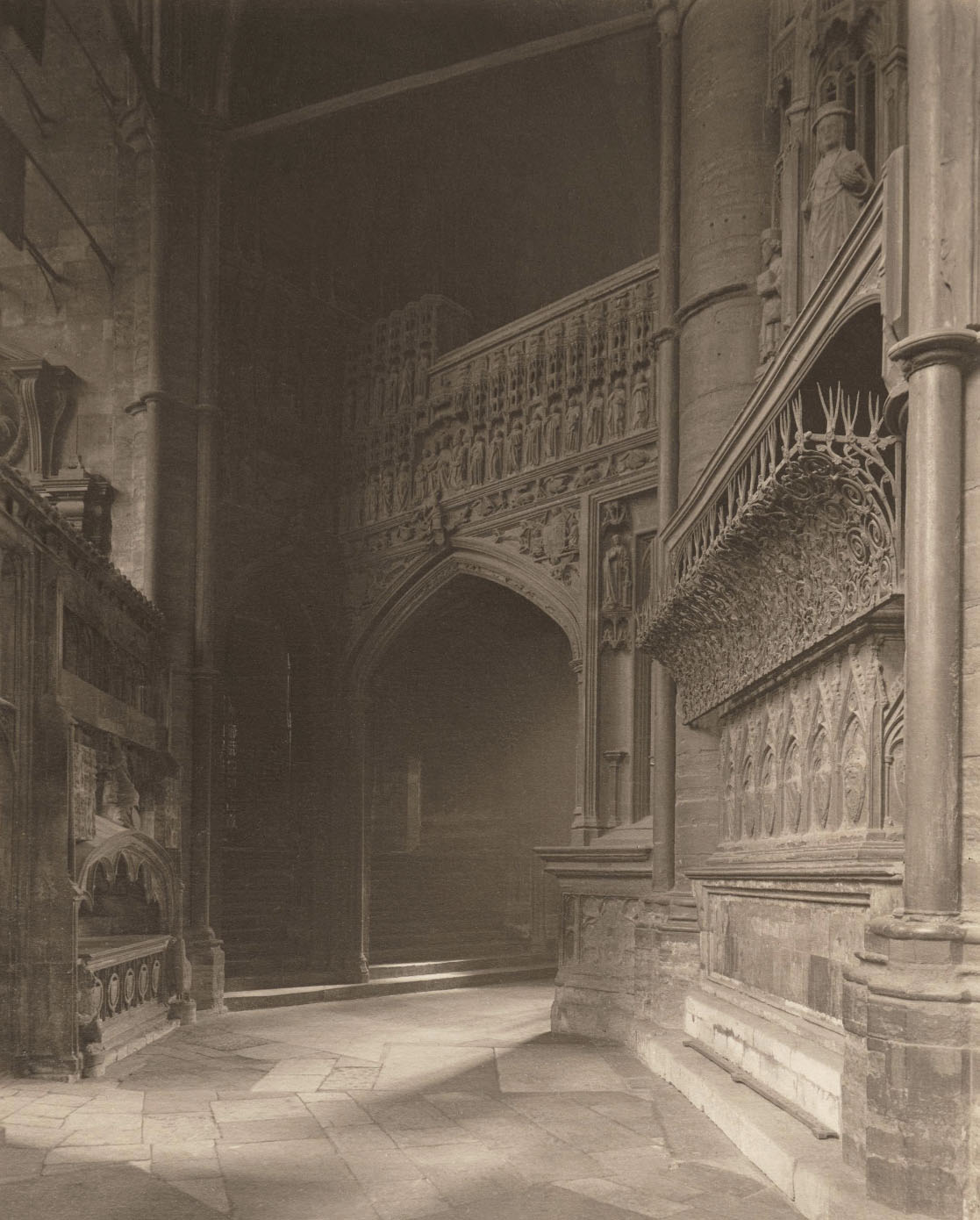
Frederick H. Evans (British, 1853-1943) Westminster Abbey: East End, North Ambulatory 1911 Platinum print Image and sheet: 9 3/8 × 7 1/2 inches (23.8 × 19.1cm) Philadelphia Museum of Art Purchased with the Lola Downin Peck Fund, 1969
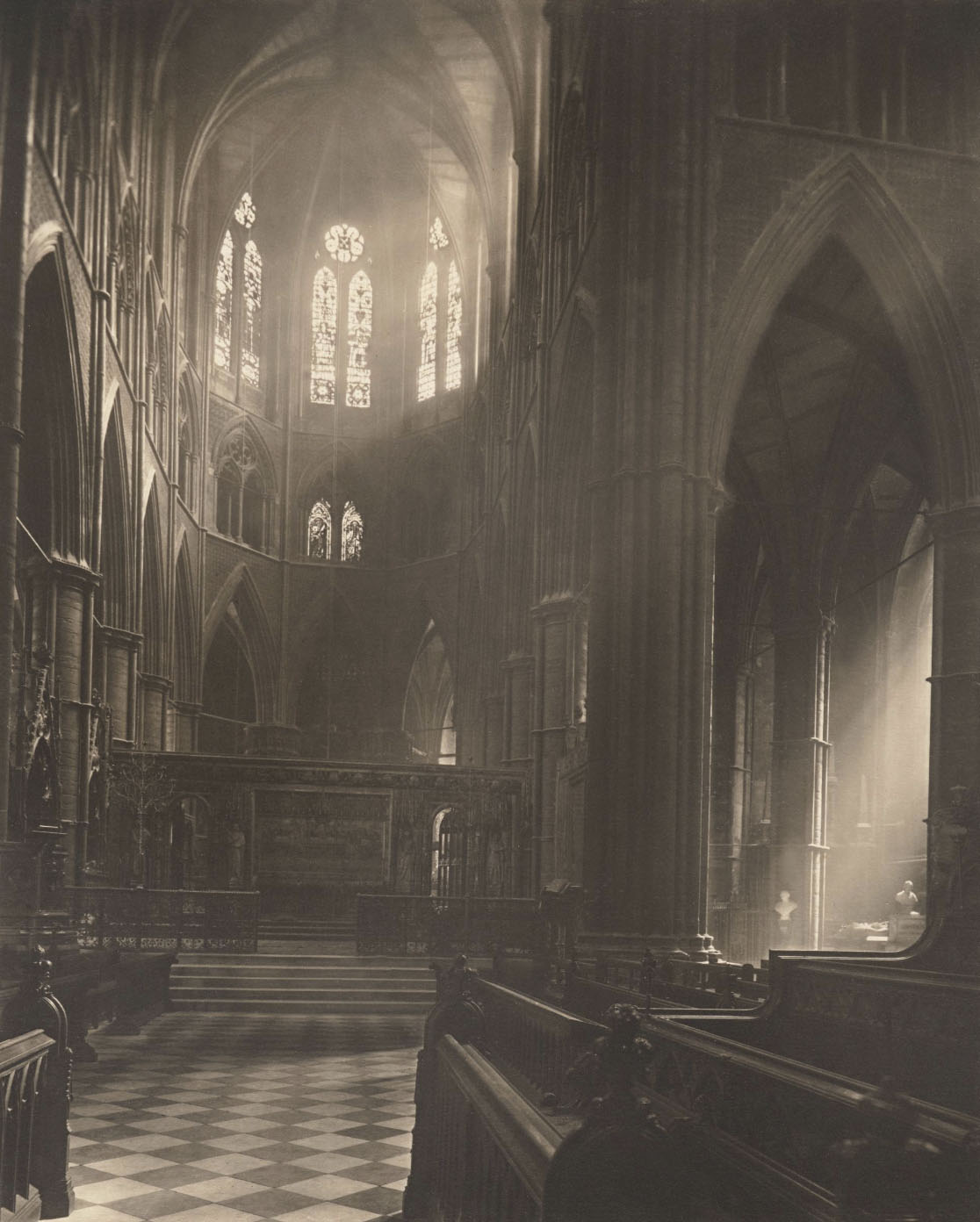
Frederick H. Evans (British, 1853-1943) Westminster Abbey: Apse from Choir 1911 Platinum print Image and sheet: 9 7/16 × 7 1/2 inches (23.9 × 19.1cm) Philadelphia Museum of Art Purchased with the Lola Downin Peck Fund, 1969
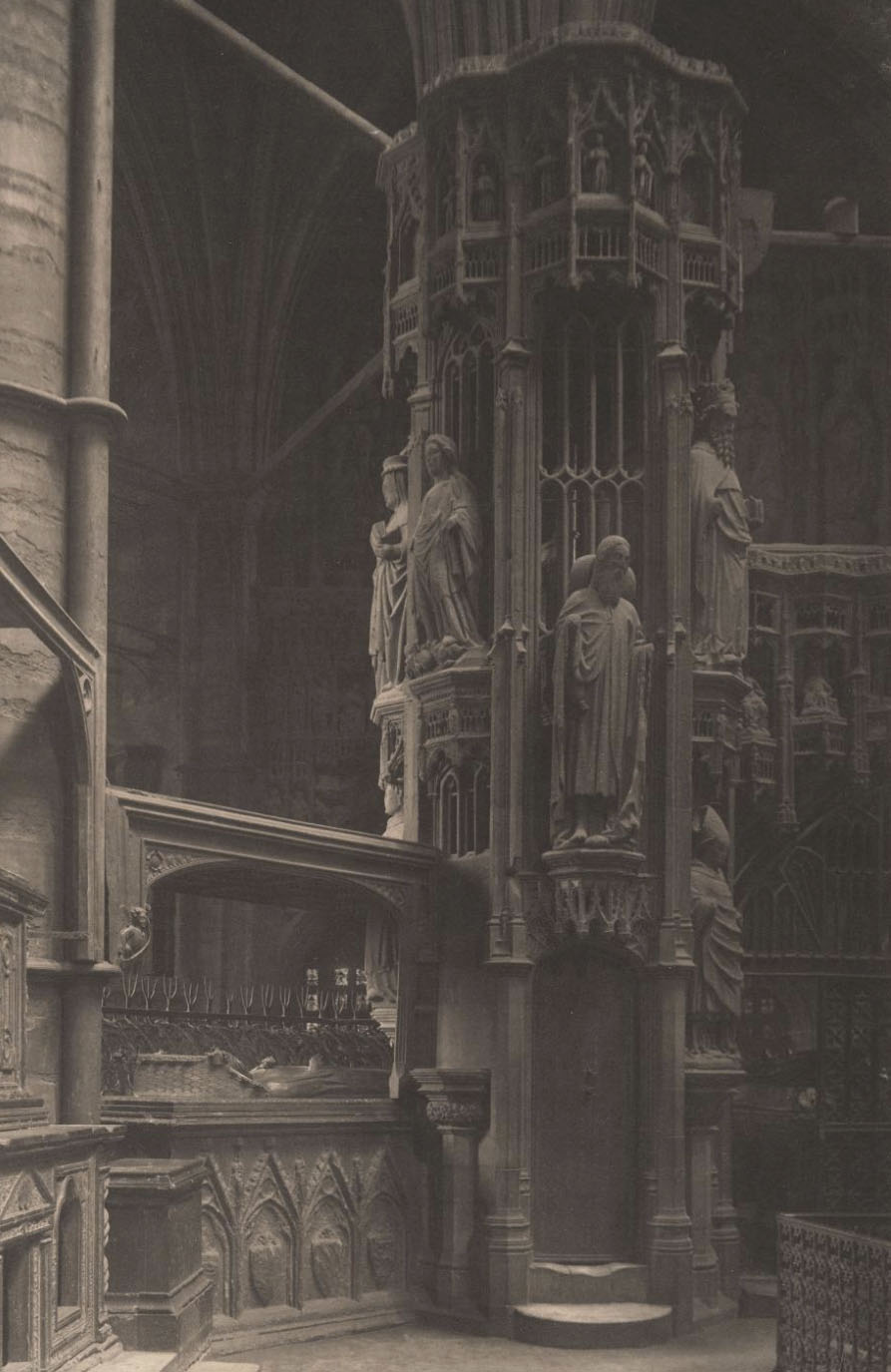
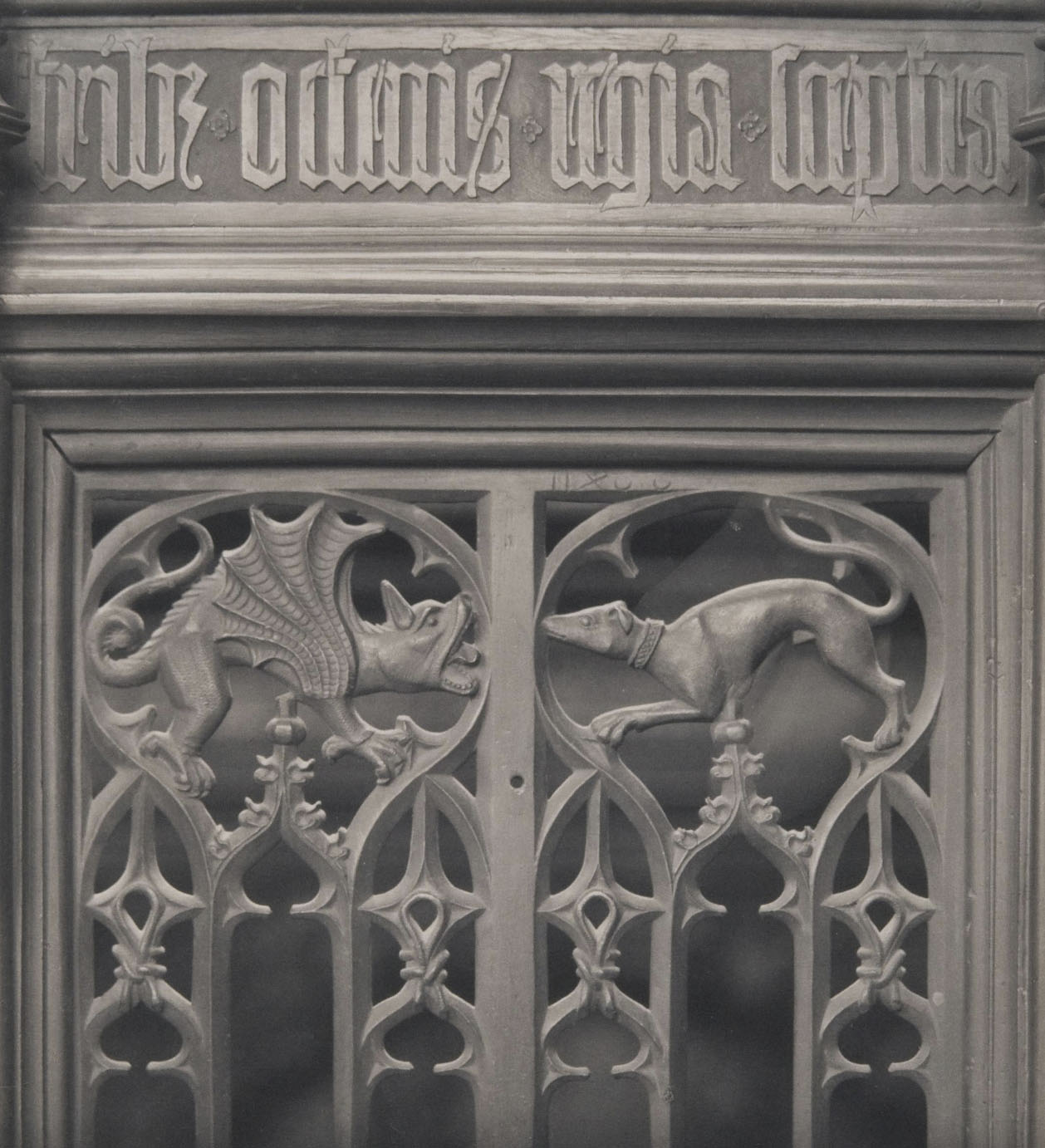
Country Life magazine commissioned Evans to photograph the interior of London’s Westminster Abbey in 1911, while the church was closed to worshipers in preparation for the coronation of King George V (1865-1936) and Queen Mary (1867-1953). Although the construction and removal of temporary facilities relating to the coronation regularly disrupted Evans’s work, the more than fifty photographs in the resulting portfolio reveal only the timeless beauty and grandeur of the Gothic structure that has hosted thirty-eight royal coronations since the year 1066.
Frederick H. Evans (British, 1853-1943) Westminster Abbey: Henry VII Chapel, Detail of Henry VII Tomb 1911 Platinum print Image and sheet: 8 1/16 × 7 3/16 inches (20.4 × 18.2cm) Philadelphia Museum of Art Purchased with the Lola Downin Peck Fund, 1969
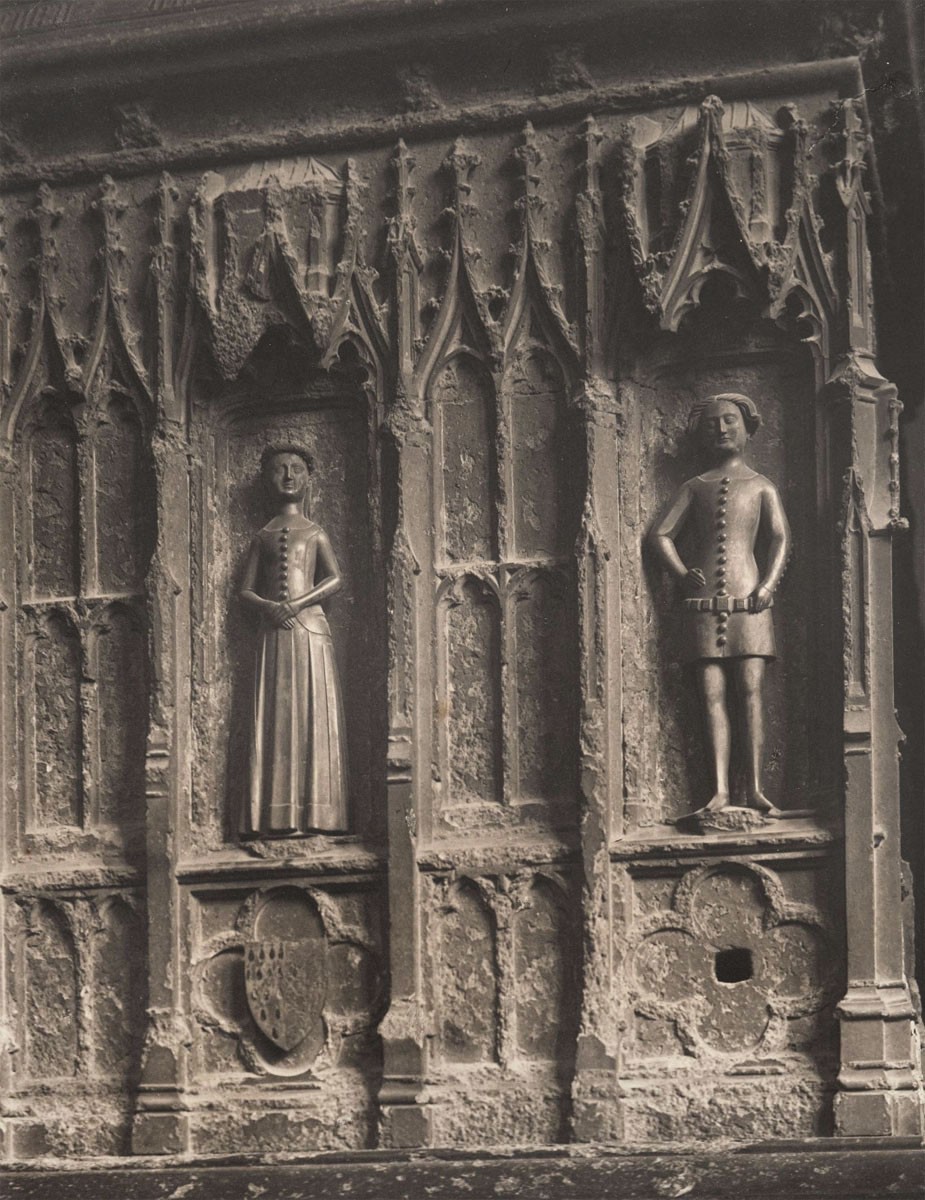
Frederick H. Evans (British, 1853-1943) Westminster Abbey: Tomb of Edward III, Mary and William 1911 Platinum print Image and sheet: 8 11/16 × 6 5/8 inches (22.1 × 16.9cm) Philadelphia Museum of Art Purchased with the Lola Downin Peck Fund, 1969
Frederick H. Evans (British, 1853-1943) York Minster – In Sure and Certain Hope 1903 Platinum print Philadelphia Museum of Art
Frederick H. Evans (British, 1853-1943) A Sea of Steps – Stairs to Chapter House – Wells Cathedral 1903 Platinum print Philadelphia Museum of Art
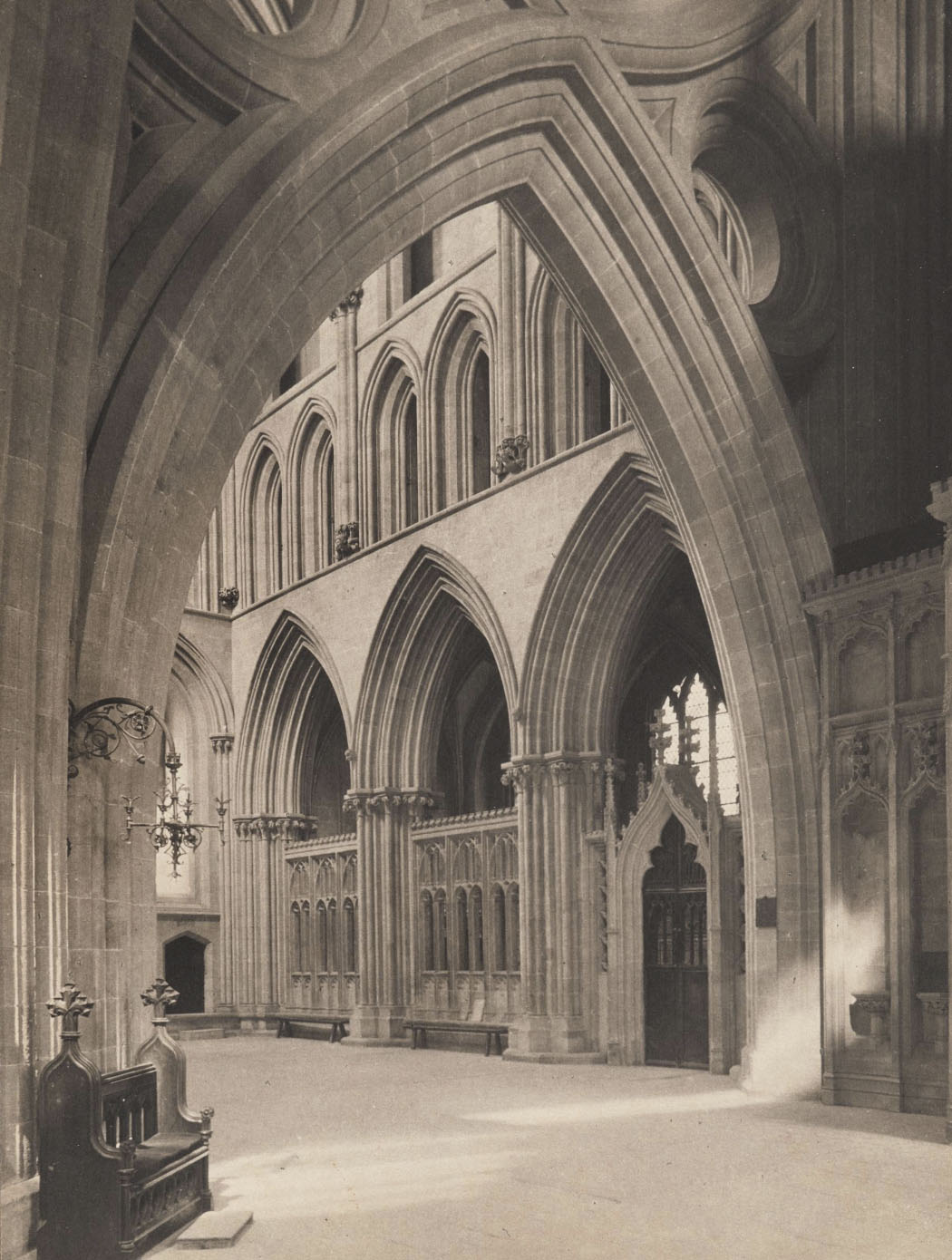
Frederick H. Evans (British, 1853-1943) Wells Cathedral: North Transept c. 1903 Platinum print Image and sheet: 7 1/4 × 5 7/16 inches (18.4 × 13.8cm) Purchased with funds contributed by Dorothy Norman, 1973
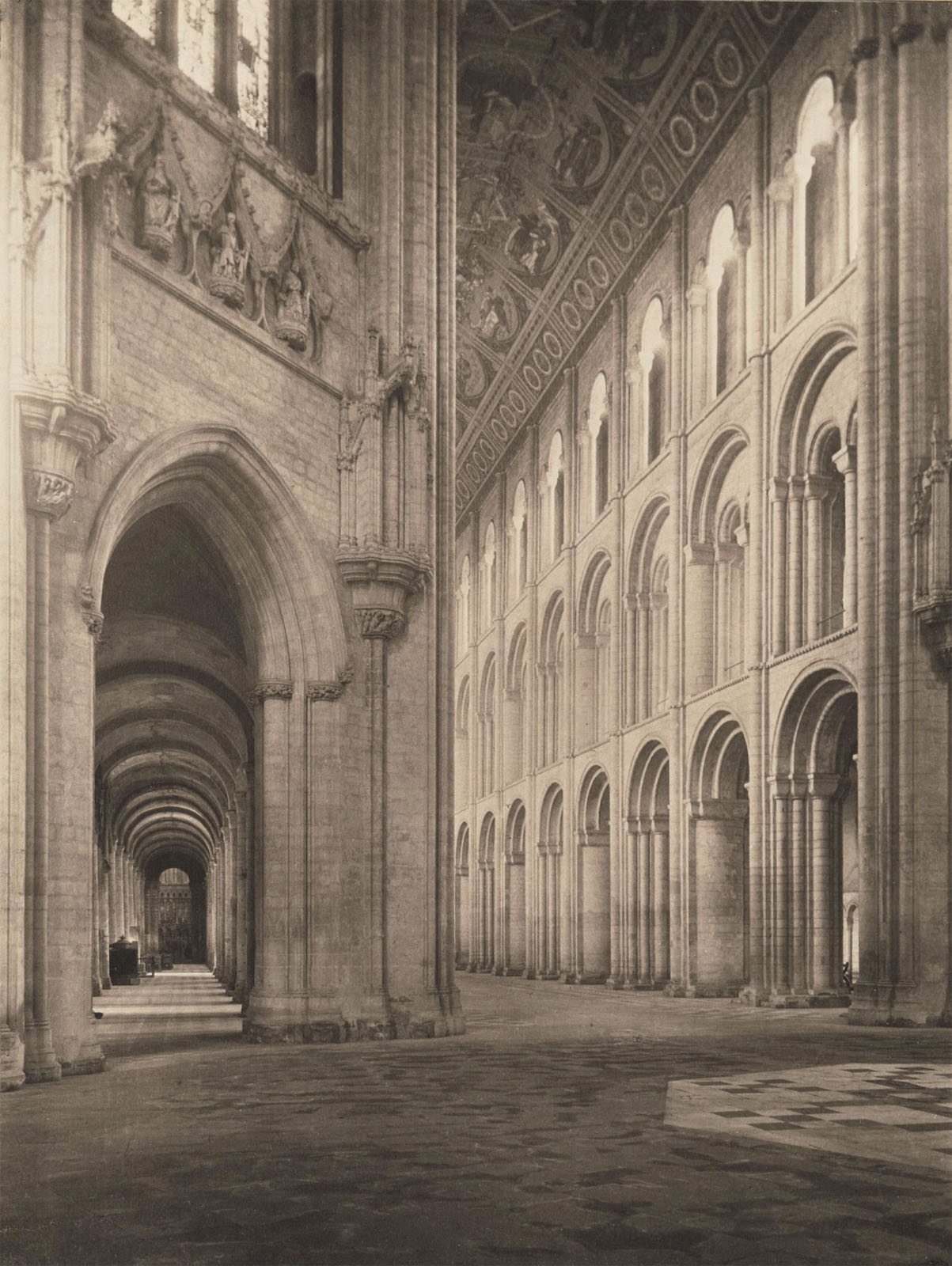
Frederick H. Evans (British, 1853-1943) Ely Cathedral: Octagon into Nave Aisle c. 1899 Platinum print Image and sheet: 7 15/16 × 6 1/8 inches (20.2 × 15.6cm) Philadelphia Museum of Art Purchased with funds contributed by Dorothy Norman, 1973
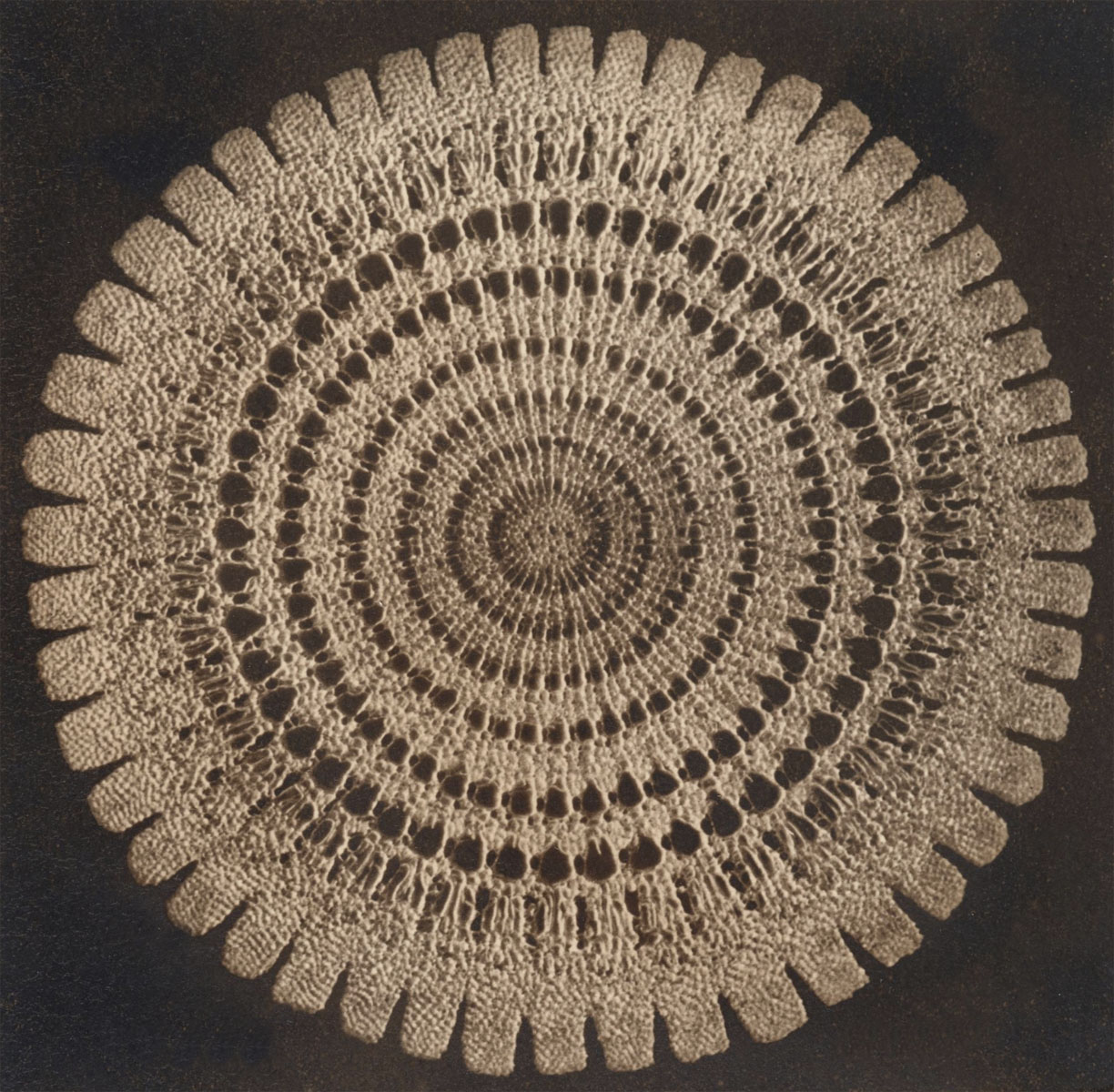
Frederick H. Evans (British, 1853-1943) Fr: Sec: Spine of Echinus x. 40 c. 1887 Platinum print Image and sheet: 4 3/4 × 4 5/8 inches (12 × 11.8cm) Philadelphia Museum of Art Purchased with funds contributed by Dorothy Norman, 1973
Unlike many beginning photographers of the nineteenth century who experimented with straightforward portrait or landscape compositions, Evans’s earliest trials with photography involved minute organic matter and required the use of a microscope. His complicated “photo-microgram” process allowed him to capture the intricate structures of objects including a water beetle’s eye, tiny sea shells, and this section of a sea urchin’s spine. Although classified as scientific rather than artistic imagery by the Photographic Society of Great Britain, this photo-microgram demonstrates Evans’s ability to delineate the magnificence of organic patterns and presage his photographs that depict the structural beauty of cathedrals.
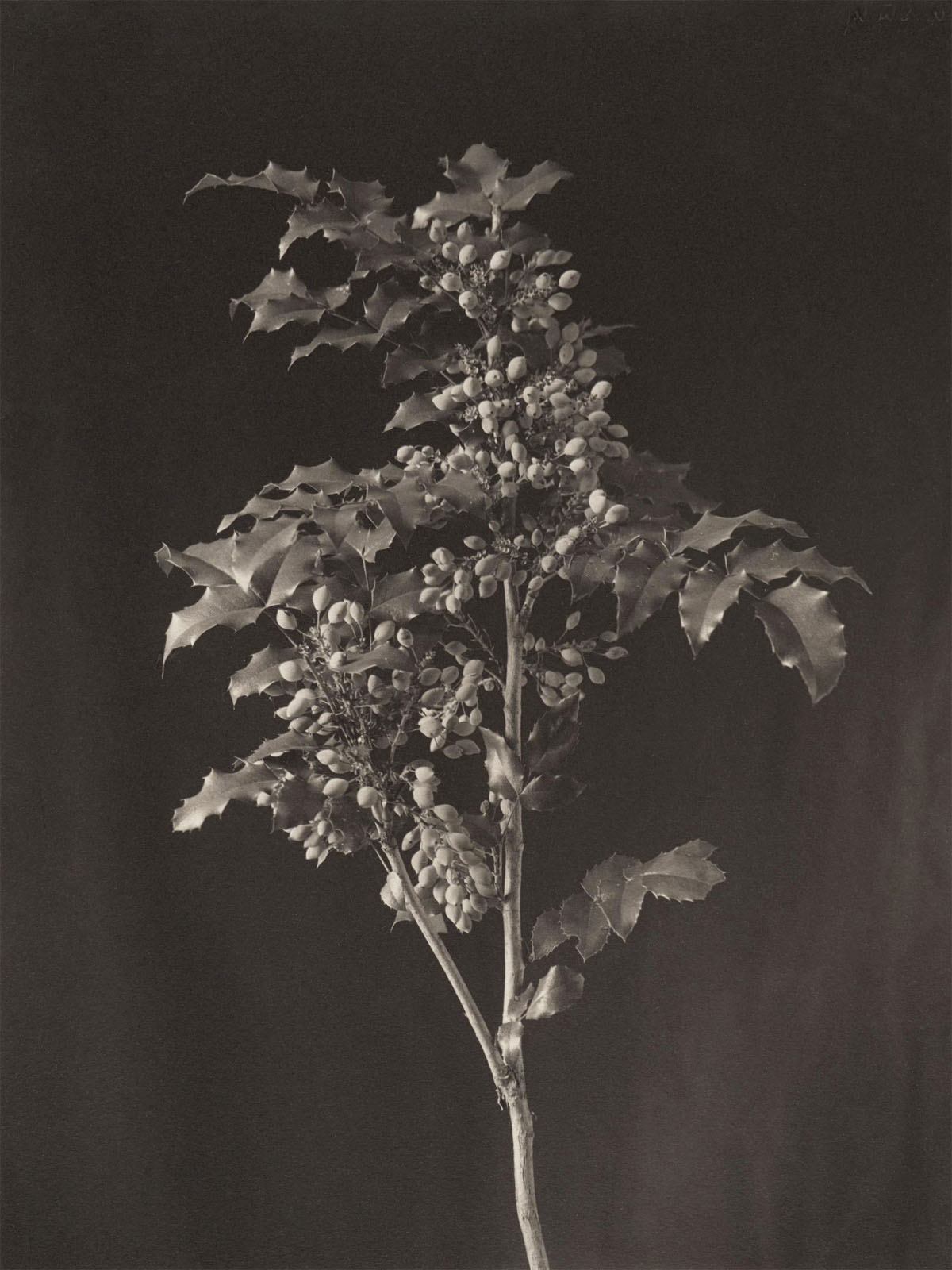
Frederick H. Evans (British, 1853-1943) Berberis: Plant Study c. 1908 Platinum print Image and sheet: 9 3/8 × 7 1/16 inches (23.8 × 17.9cm) Philadelphia Museum of Art Purchased with funds contributed by Dorothy Norman and with the Director’s Discretionary Fund, 1968
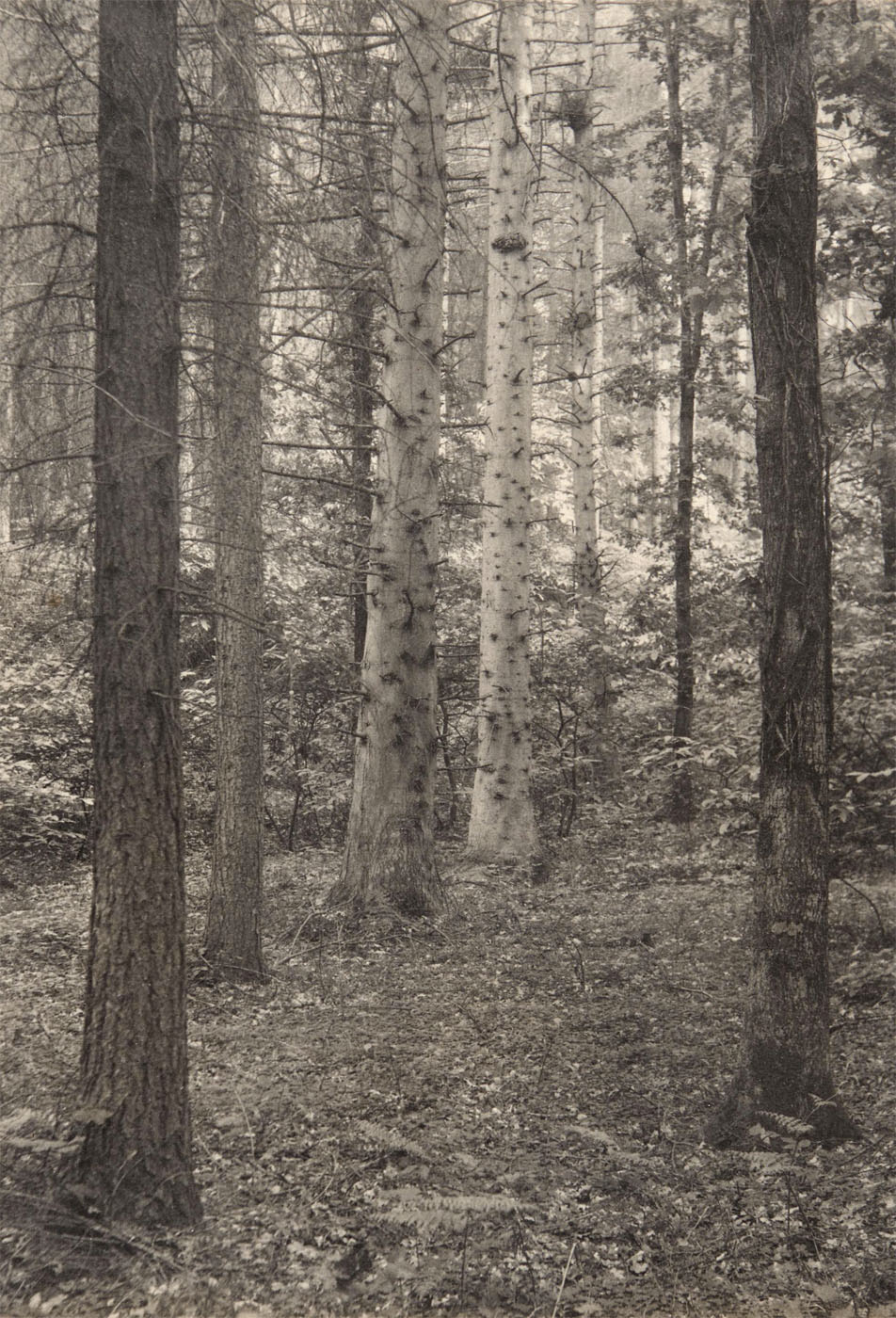
Frederick H. Evans (British, 1853-1943) Redlands Woods c. 1908 Platinum print Image and sheet: 6 × 4 3/16 inches (15.3 × 10.6cm) Philadelphia Museum of Art Purchased with funds contributed by Dorothy Norman and with the Director’s Discretionary Fund, 1968
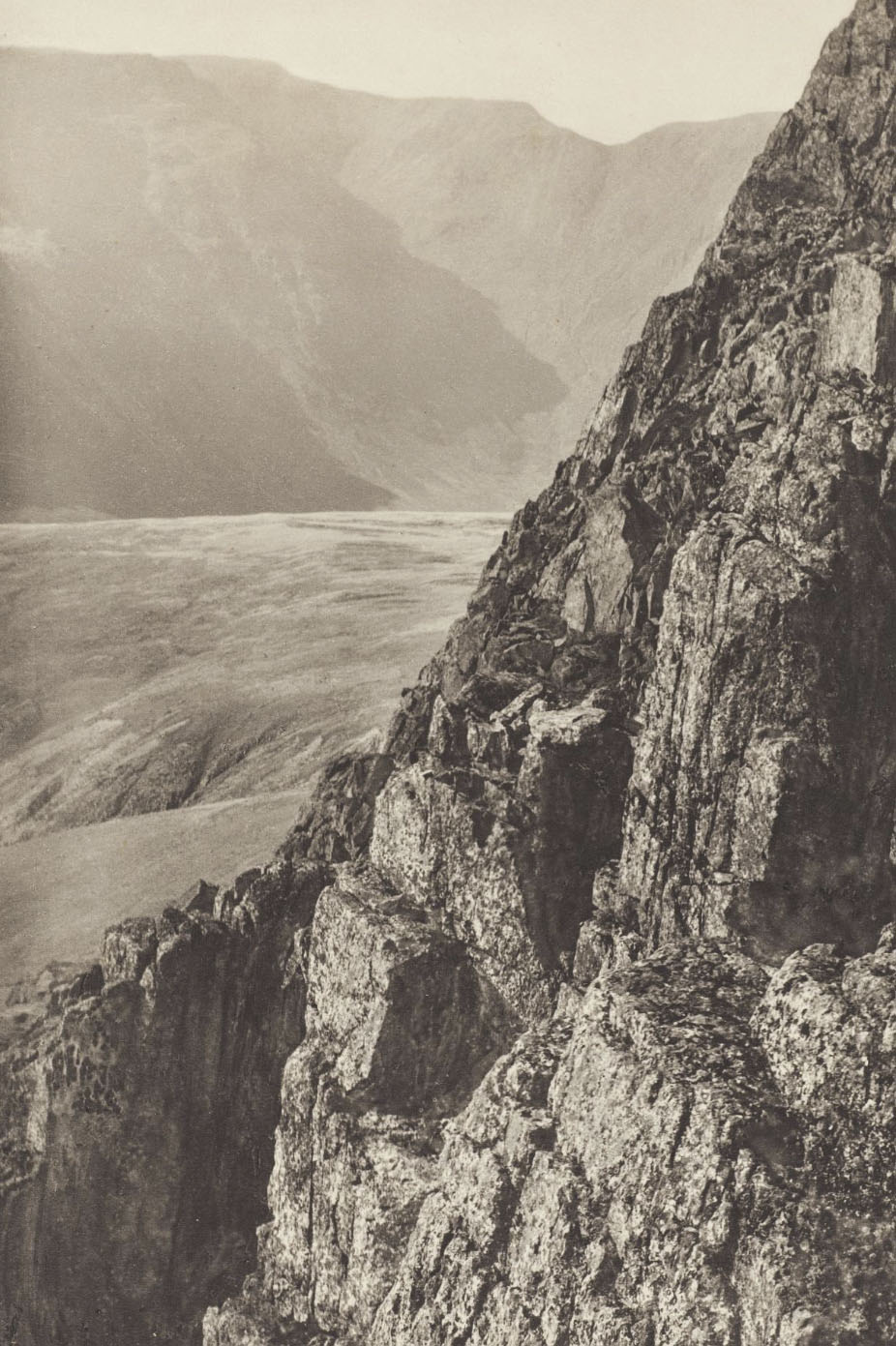
Frederick H. Evans (British, 1853-1943) An English Glacier: Near Summit of Scafell c. 1905 Platinum print Image and sheet: 9 3/4 × 6 1/2 inches (24.8 × 16.5 cm) Philadelphia Museum of Art Purchased with funds contributed by Dorothy Norman and with the Director’s Discretionary Fund, 1968
Exhibition Highlights the Exceptional Beauty of the Platinum Process in Photography
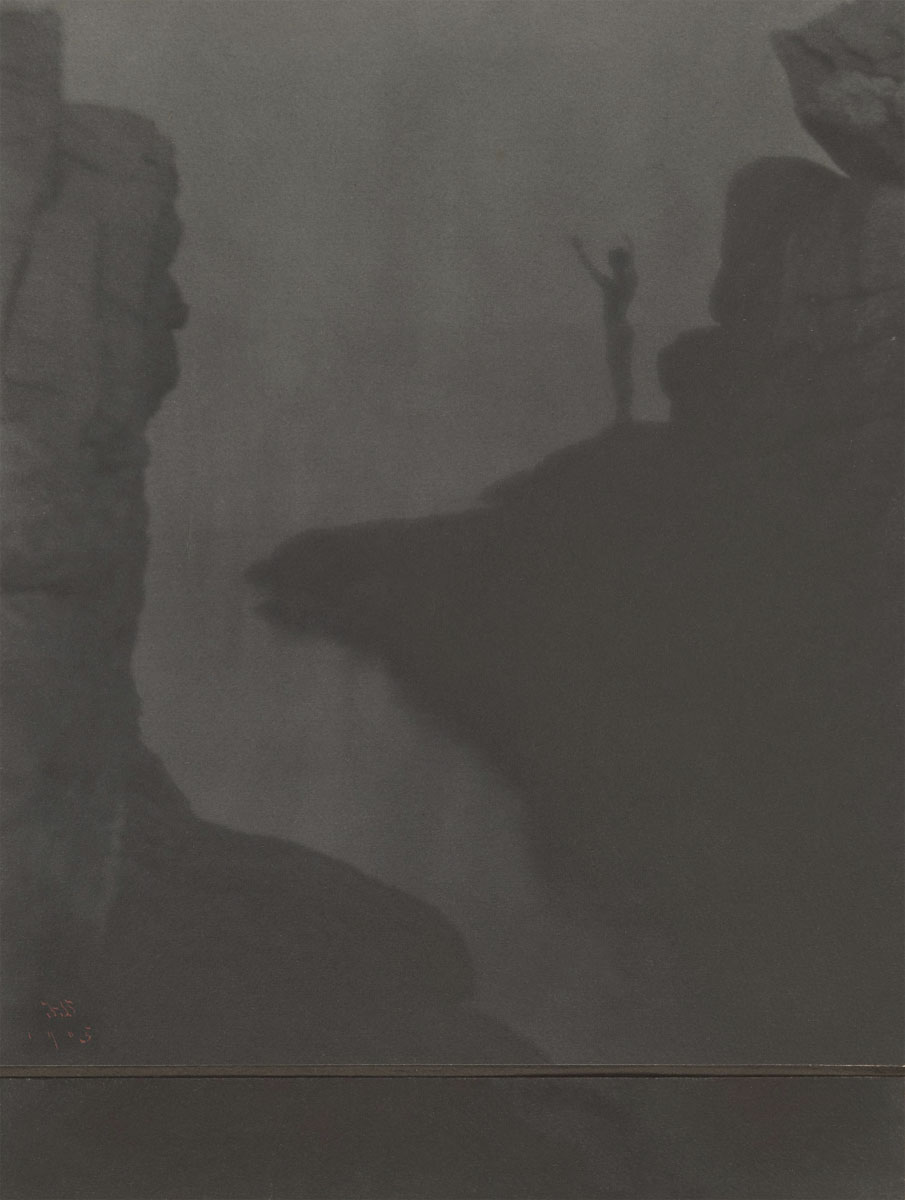
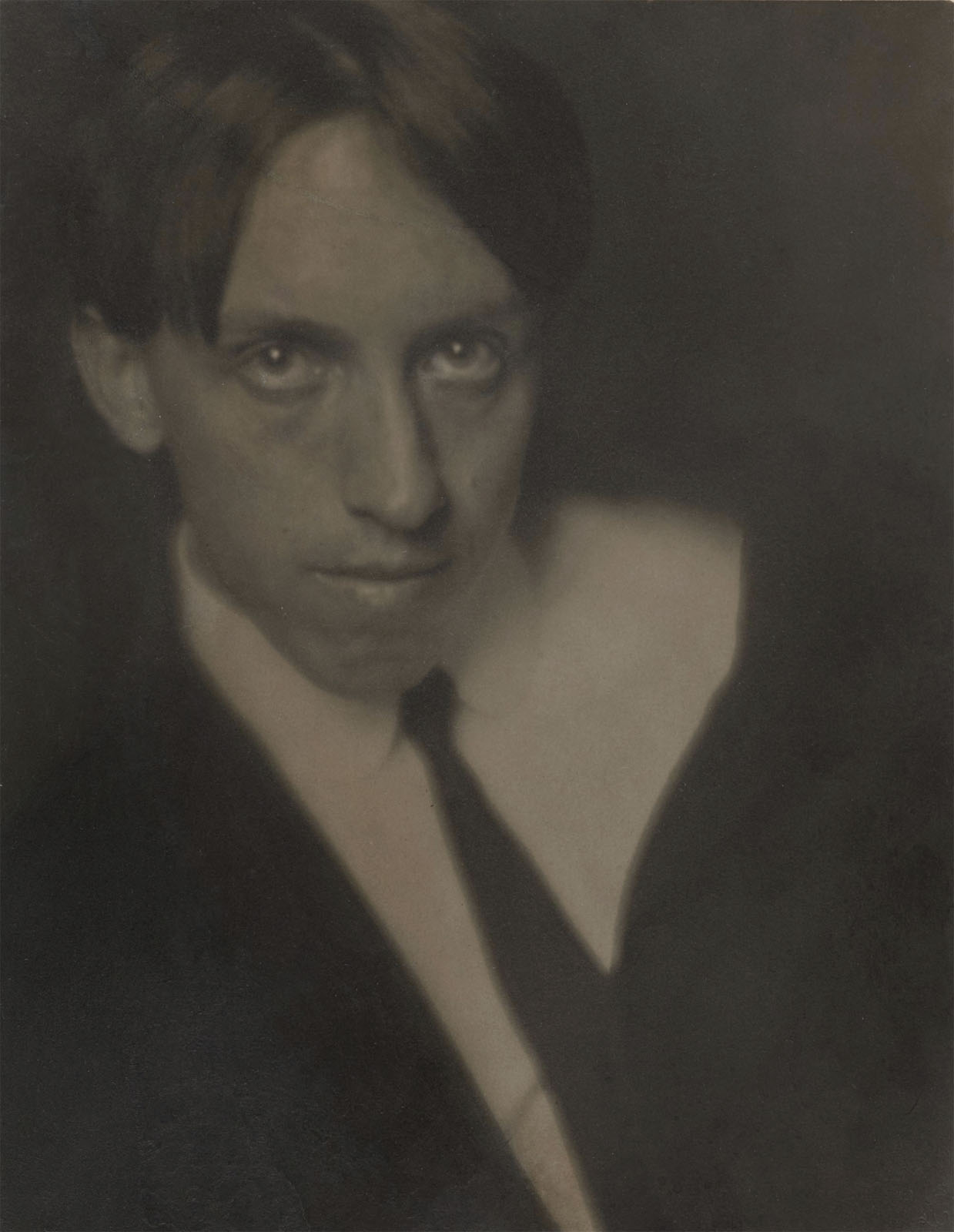
A cornerstone of photographic practice during the late nineteenth and early twentieth centuries, the platinum print is revered by photographers and viewers alike as one of the most beautiful forms of photography, with subtle and lustrous shades that range from the deepest blacks to the most delicate whites. The Philadelphia Museum of Art will present an exhibition of more than 50 works from the late 19th century to the present, showcasing outstanding prints largely drawn from the Museum’s collection of photographs. The Platinum Process: Photographs from the Nineteenth to the Twenty-First Century, on view February 27 – May 23 in the Julien Levy Gallery at the Museum’s Perelman Building, will include images by early masters of the process including Frederick H. Evans (British, 1853-1943) and Alfred Stieglitz (American, 1864-1946), as well as works by skilled contemporary practitioners such as Lois Conner (American, born 1951) and Andrea Modica (American, born 1960), who continue to engage in this historic and painstaking process in an era noted for electronic imaging.
“The exhibition offers an opportunity to share this exceptionally beautiful form of photography with our visitors, some of whom may be seeing it for the first time,” Curator of Photographs Peter Barberie said, adding “the Museum is fortunate to have a particularly strong and varied collection of work by some of the truly great practitioners of this process.”
Unlike standard silver printing, in which particles are suspended in gelatin, platinum is brushed directly onto the paper, allowing artists to create a matte image with an exceptionally wide tonal range. Introduced in 1873, the process was enthusiastically embraced by the group of photographers known as the Pictorialists, who believed that fine art photography should emulate the aesthetic values of painting. The group included Evans, whose beautifully rendered images of Britain’s Westminster Abbey, York Minster Abbey and Ely Cathedral are included in the exhibition, and Stieglitz (American, 1876-1946), who is represented in the show by a portrait of his wife, the artist Georgia O’Keeffe (American, 1887-1986), as well as a landscape that foreshadows his Equivalents series.
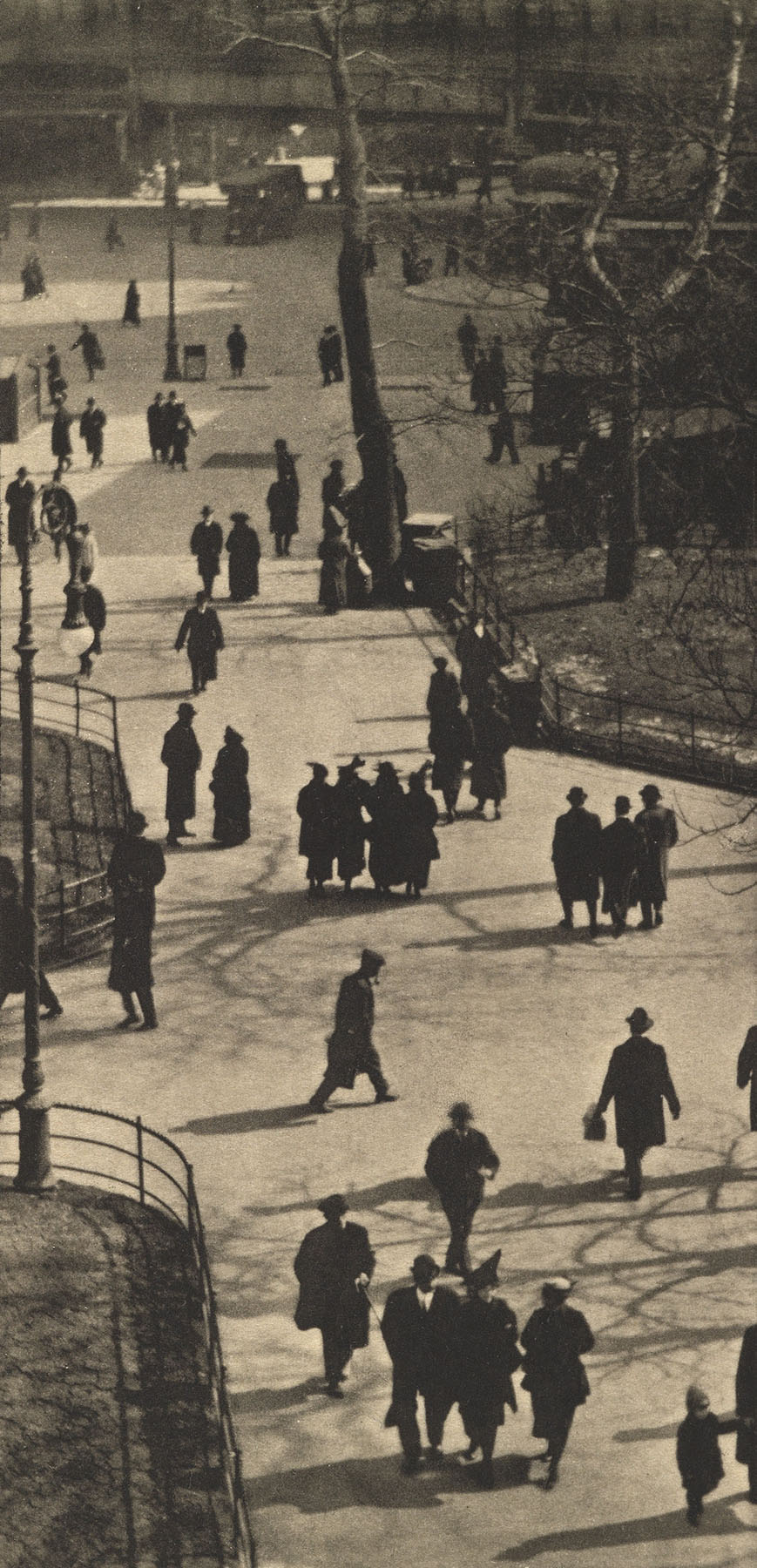
While encompassing works spanning many dates and styles, The Platinum Process highlights one of the Museum’s treasures, the 1915 masterpiece “Wall Street” by Paul Strand (1890-1976, see above), whose work was at the forefront of the modernist aesthetic developing in New York during the early 20th century. Strand used the subtlety of the platinum print in this work to emphasise abstract patterns in the long shadows cast by figures that walk before a succession of monumental windows.
Reserves of platinum were appropriated for military use during World War I, and its high cost led manufacturers to cease production of commercial platinum paper by the 1930s. As photographers became more engaged in social concerns, documentation and realism, the process fell into disuse. It was not until the early 1960s when Irving Penn, then a successful photographer for Vogue magazine, began to experiment with the long-forgotten technique and took the first steps toward its revival. A meticulous craftsman, Penn was delighted by the luminous prints and lavish tonal range he could achieve using platinum and began to make new photographs with this process in the 1970s. Penn and many of the other contemporary artists on view including Thomas Shillea and Jennette Williams followed Strand’s example, using platinum not for idealised pictures, but to capture nuances of modern experience.
Press release from The Philadelphia Museum of Art website [Online] Cited 25/07/2019. No longer available online
Robert S. Redfield (American, 1849-1923) Heloise Redfield at Mount Washington 1889 Platinum print Image and sheet: 6 5/16 × 8 1/4 inches (16 × 21cm) Philadelphia Museum of Art Gift of Alfred G. Redfield, 1985
F. Holland Day (American, 1864-1933) Untitled 1905 Platinum prints mounted to paper Image and sheet (overall): 10 1/16 × 7 1/2 inches (25.6 × 19.1cm) Philadelphia Museum of Art From the Collection of Dorothy Norman, 1970
Katharine Steward Stanbery (American, 1870-1928) Untitled (Two Girls Playing Jacks) 1907 Platinum print Image and sheet: 8 15/16 x 4 11/16 inches (22.7 x 11.9cm) Philadelphia Museum of Art 125th Anniversary Acquisition. Purchased with the Lola Downin Peck Fund, the Alice Newton Osborn Fund, and with funds contributed by The Judith Rothschild Foundation, 2002
Paul Strand (American, 1890-1976) City Hall Park, New York 1915 Platinum print Sheet: 13 7/8 x 7 3/4 inches (35.2 x 19.7cm) Philadelphia Museum of Art Gift of the artist, 1972
Paul Strand (American, 1890-1976) Washington Heights, New York 1915 (negative); 1915 (print) Platinum print Image and sheet: 9 3/8 x 11 7/8 inches (23.8 x 30.2cm) Philadelphia Museum of Art The Paul Strand Retrospective Collection, 1915-1975, gift of the estate of Paul Strand, 1980
Paul Strand (American, 1890-1976) Wall Street 1915 (negative); 1915 (print) Platinum print Image: 9 3/4 × 12 11/16 inches (24.8 × 32.2cm) Philadelphia Museum of Art The Paul Strand Retrospective Collection, 1915-1975, gift of the estate of Paul Strand, 1980
Paul Strand (American, 1890-1976) Man in a Derby, New York 1916 Platinum print Image: 12 13/16 x 9 15/16 inches (32.5 x 25.2cm) Mat: 22 11/16 x 19 7/16 inches (57.6 x 49.4cm) Philadelphia Museum of Art The Paul Strand Retrospective Collection, 1915-1975, gift of the estate of Paul Strand, 1980
Paul Strand (American, 1890-1976) The Italian, New York 1916 (negative); 1916 (print) Platinum print Image and sheet: 13 × 9 5/16 inches (33 × 23.7cm) Philadelphia Museum of Art The Paul Strand Retrospective Collection, 1915-1975, gift of the estate of Paul Strand, 1980
Paul Strand (American, 1890-1976) Rebecca, New York 1922 (negative); 1922 (print) Palladium print Image: 9 3/4 x 7 13/16 inches (24.8 x 19.8cm) Philadelphia Museum of Art The Paul Strand Collection, purchased with funds contributed by Mr. and Mrs. Robert A. Hauslohner (by exchange), 1985
Alvin Langdon Coburn (British, born United States, 1882-1966) George Seeley c. 1902-1903 Platinum print Image and sheet: 11 x 8 9/16 inches (27.9 x 21.7cm) Philadelphia Museum of Art Purchased with the Lola Downin Peck Fund, the Alice Newton Osborn Fund, and with funds contributed by The Judith Rothschild Foundation in honour of the 125th Anniversary of the Museum, 2002
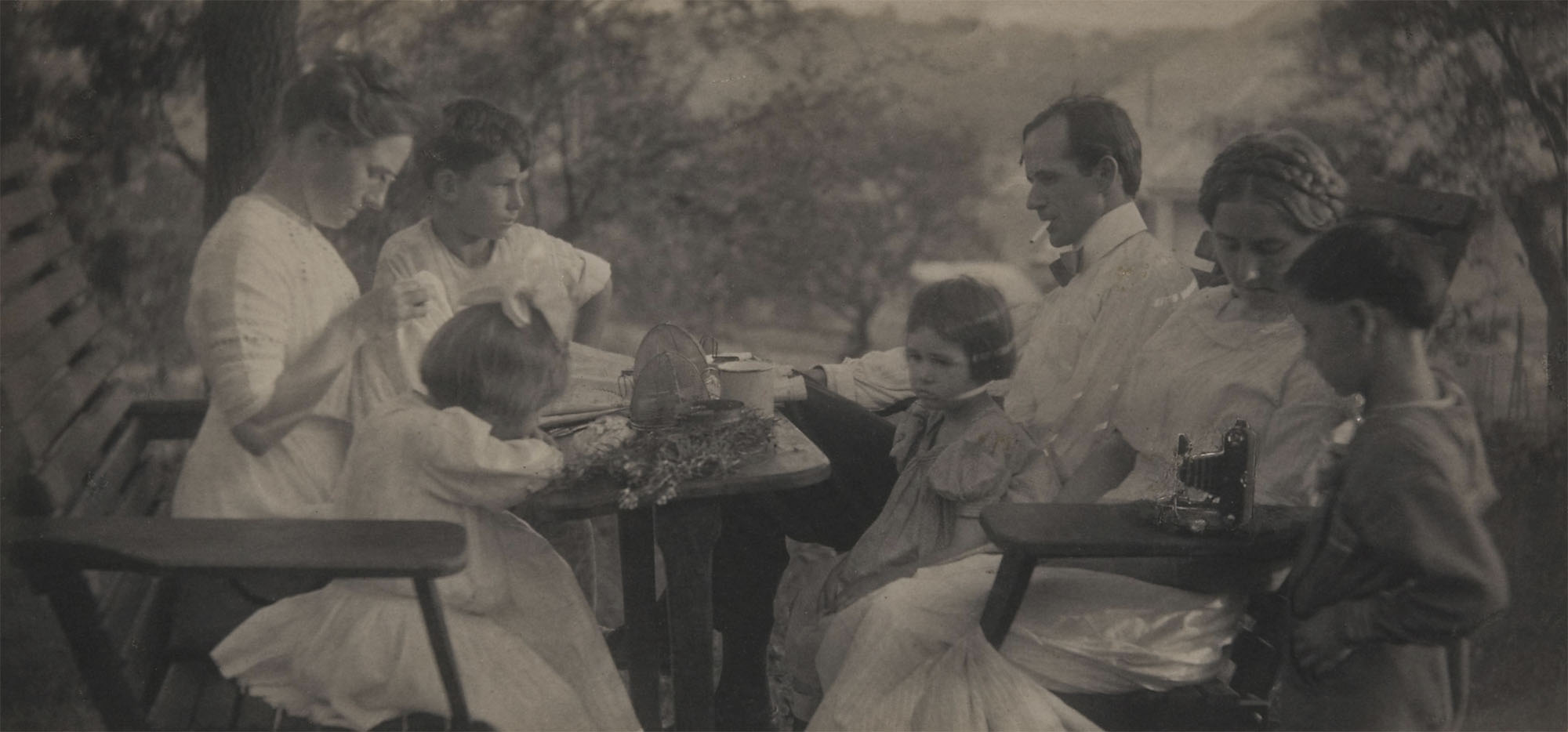
Gertrude Käsebier (American, 1852-1934) The Two Families c. 1910 Platinum print Image and sheet: 5 3/8 × 11 5/16 inches (13.6 × 28.8cm) Philadelphia Museum of Art Gift of William Innes Homer, 1986
Käsebier’s family members and close friends served as her earliest photographic subjects, and familial themes remained paramount in the images she produced throughout her career. This photograph of Käsebier’s two daughters and their families, taken in Woburn, Massachusetts, is a dynamic portrait of a multigenerational gathering. Curiously, Käsebier manipulated this print to emphasise the act of photography. In the original scene, the young boy and seated woman at right look downward at a wire-mesh food cover resting on a plate. These objects have been removed from this print, replaced by the considerably more fascinating camera.
Gertrude Käsebier (American, 1852-1934) Mrs. F. H. Evans c. 1900 Platinum print Image and sheet: 7 1/2 × 5 1/4 inches (19.1 × 13.4 cm) Philadelphia Museum of Art Purchased with funds contributed by Dorothy Norman, 1973
In 1889, at the age of thirty-seven, Käsebier enrolled at Brooklyn’s Pratt Institute to study portrait painting. Although the art school did not teach photography, Käsebier began using a camera at home to document her growing children, eventually favoring photography over other mediums. She established a commercial portrait studio in New York City in 1897, working to “bring out in each photograph the essential personality that is variously called temperament, soul, humanity.” This portrait features Ada Emily Longhurst, wife of photographer Frederick H. Evans, whom Käsebier befriended while on a trip to England in 1901.
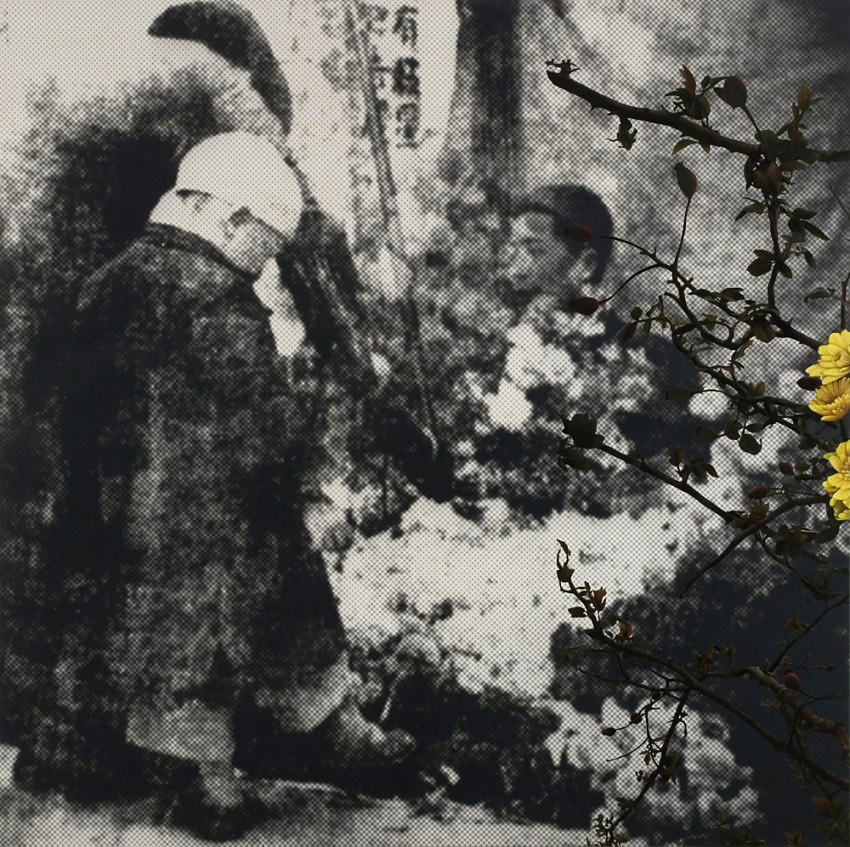
John Young (Australian born Hong Kong, b. 1956) Flower Market (Nanjing 1936) #2 2010 Digital print and oil on Belgian linen 240 x 331cm image courtesy of the artist and Anna Schwartz Gallery
What can one say about work that is so confronting, poignant and beautiful – except to say that it is almost unbearable to look at this work without being emotionally charged, to wonder at the vicissitudes of human life, of events beyond one’s control.
Simply, this is the best exhibition that I have seen in Melbourne so far this year.
The exhibition tells the story of the massacre of 300,000 people in the city of Nanjing in Jiangsu, China by Japanese troops in December, 1937 in what was to become known as the Nanjing Massacre. It also tells the story of a group of foreigners led by German businessman John Rabe and American missionary Minnie Vautrin who set up a “safety zone” to protect the lives of at least 250,000 Chinese citizens. The work is conceptually and aesthetically well resolved, the layering within the work creating a holistic narrative that engulfs and enfolds the viewer – holding them in the shock of brutality, the poignancy of poetry and the (non)sublimation of the human spirit to the will of others.
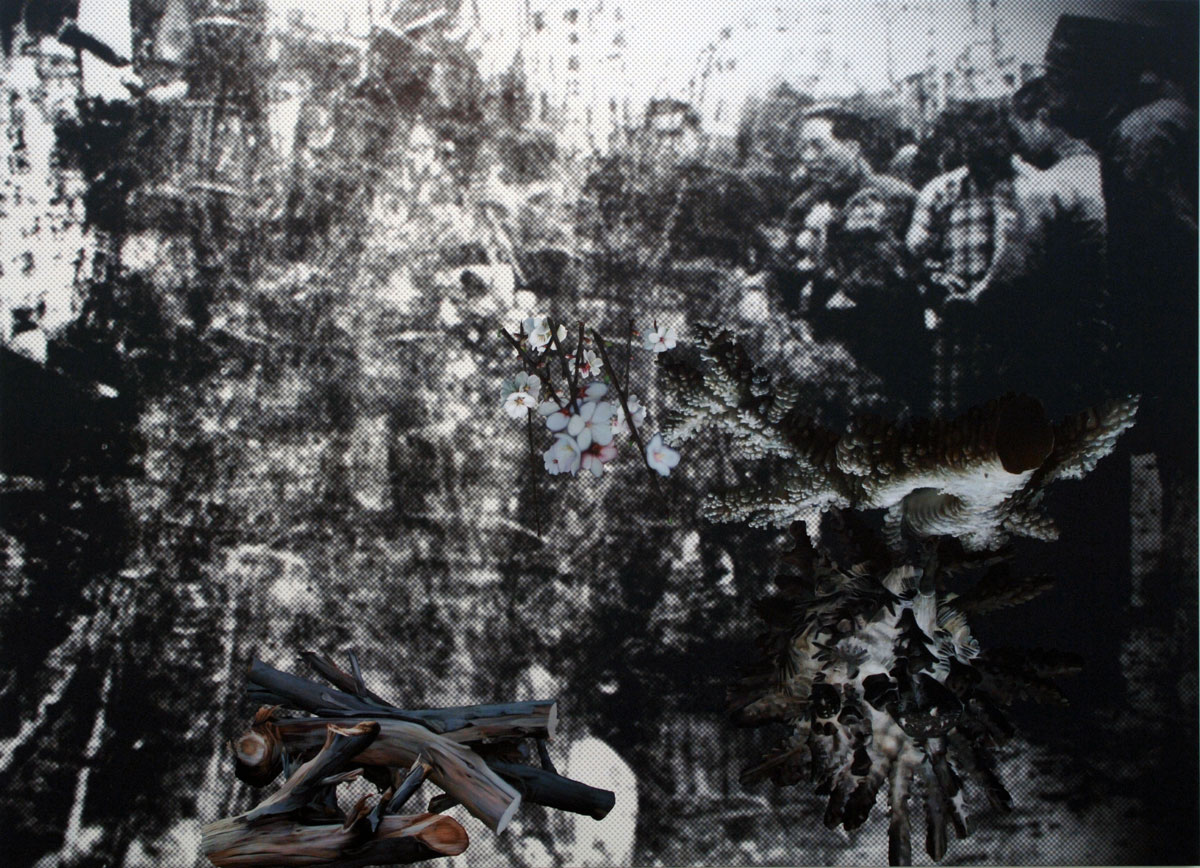
On the left wall of the gallery are three large mixed-media paintings of screen printed photographs of the Nanjing Flower Market taken the year before the massacre (see three images directly below). The printing of the press photographs at such a scale (a la Marco Fusinato) emphasises the dot structure of the photograph, the intensity of a newspaper reality ‘blown up’ to a huge scale. Unfortunately, you cannot see this deconstruction of the image very well in the examples below (clicking on the lower two images to get a larger version will give you a better idea), but believe me it most effective in creating a spatio-temporal distance between the viewer and the image. The dissolution of the image into dots is surmounted by painted cherry blossoms, bleached corals and piles of logs that overlay the photographic text. The reason-ances are sublime. The mind tries to process the distance between the death of the people and the photograph, the knowledge of what is about to happen to them, and the sensuality of the buds and flowers: new life!
To my friend and I the coral in the last painting reminded us both of the emanations of psychic phenomena at a seance, a series of radiations originating in the godhead.
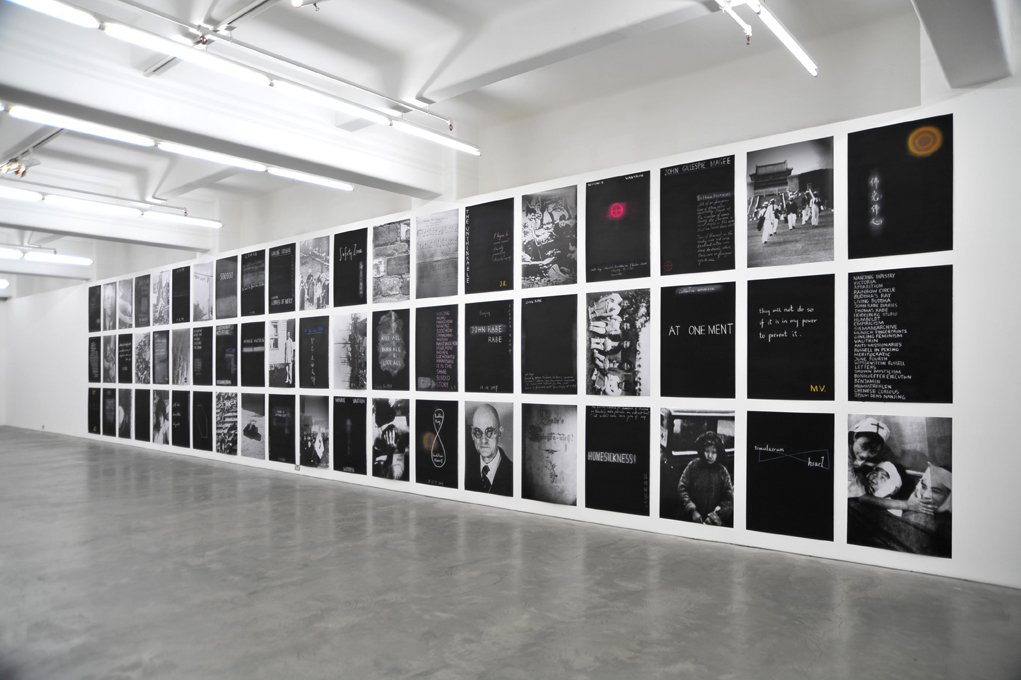
On the right wall of the gallery is a grid of three rows of twenty images that make up the work Safety Zone (2010, see bottom image). Made up of chalk drawings on black paper (a la Rudolf Steiner), writings by the Europeans including Vautrin and Rabe, statistics, gruesome photographs of the massacre and observations by the artist, this is in part both a confronting and benevolent work.
Archival photographs are printed digitally (the dot structure working to less affect here); some vertical photographs are shown horizontally. Text written in chalk is erased with a sweep of the hand. Thoughts of the Buddha, the infinity symbol linked to the Buddha’s Ray and the Buddha’s Heart are a physical presence. Two blue chalk lines intersect and cross over, so poignant and sublime amongst the destruction that surrounds. Golf clubs, beer bottles, bayonets.
‘THERE IS NOTHING LEFT’ 13.12.37 (Robert Wilson)
‘HOME SICKNESS’
‘Simulacrum > Heart’
A simply drawn coffin shape on black ground
‘I began to roam around the city preventing further atrocities myself’
‘They will not do so, if it is in my power to prevent it’ (Minnie Vautrin)
UNSPEAKABLE ACTS OF EVIL … BECOMING BANAL
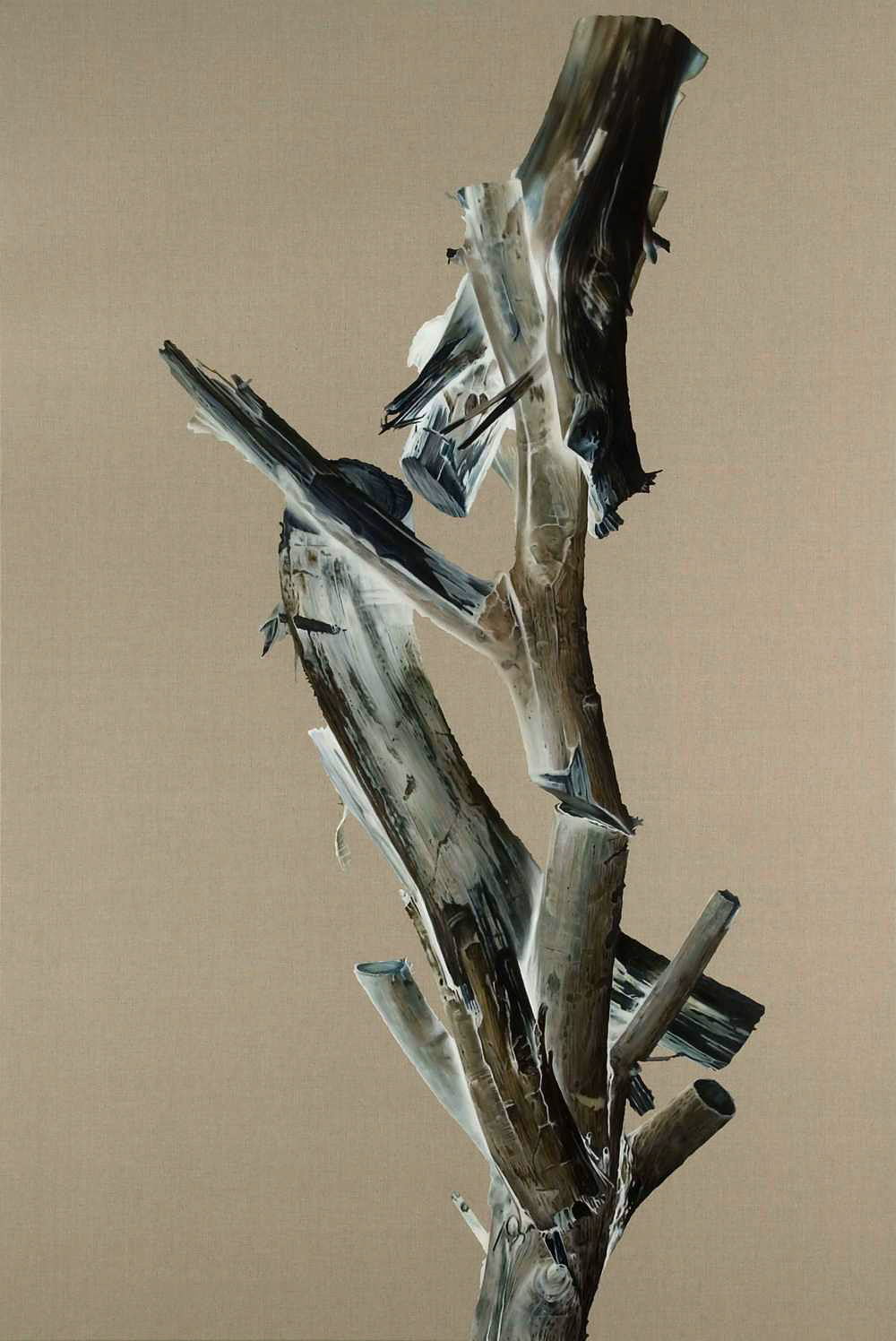
At both ends of the gallery is the last element in this play of hope, mutability and madness. Two large oil-on-linen paintings, titled The Crippled Tree #1 & #2 (see images below) “provide another register to the memory of the event. According to Young, the battered and split logs, painted in the negative, resonate and recollect the violence done to the victims of the massacre.” Unfortunately the two small images below cannot really give you an idea of the metaphorical power of these paintings. Like twisted and broken bodies larger than life size they become the glue that holds the other elements of the exhibition together. Without them there would be no transition from one side of the gallery, one element of the work to another. In their solarisation they emote an energy that flows down the length of the gallery = is this possible? Yes it is!
You feel the cracking of their branches, the amputation of their limbs but their spirit, their efflorescence (which, most appropriately considering the use of the Flower Market photographs, means “to flower out” in French) shines on. Such is the nature of the human spirit. Take the time and see this work. It is well worth the journey.
Dr Marcus Bunyan
Many thankx to the artist, Serena Bentley and Anna Schwartz Gallery for allowing me to reproduce the images in the posting. Please click on the photographs for a larger version of the image.
John Young (Australian born Hong Kong, b. 1956) Flower Market (Nanjing 1936) #3 2010 Digital print and oil on Belgian linen 240 x 331cm image courtesy of the artist and Anna Schwartz Gallery
John Young (Australian born Hong Kong, b. 1956) Flower Market (Nanjing 1936) #1 2010 digital print and oil on Belgian linen 240 x 331cm image courtesy of the artist and Anna Schwartz Gallery
Safety Zone, John Young’s latest project presents a series of intricate paintings that reassemble historical reminiscences of human survival by linking experimental contemporary art with investigative visual reports, in historical photographs and documents.
This body of work draws attention to incidents across the city of Nanjing in Jiangsu, China, just moments before the onset of the Nanjing Massacre, which followed the capture of the city by Japanese Imperial Forces on 13 December 1937. In the six weeks following the invasion, a quarter of a million Chinese citizens were killed in what the American historian Iris Chang described as the ‘forgotten holocaust of World War II’.
Through Chang’s book, The Rape of Nanking, the world was introduced to the personal memoirs of foreigners living in Nanjing who had been working on creating a ‘safety zone’ that would protect 250,000 Chinese citizens from the invading Japanese troops. Two of the twenty-one foreigners who stayed in the city to help set up the Nanjing Safety Zone were the American missionary Minnie Vautrin and the German businessman John Rabe. Their experiences have been noted by Young, who travelled to Nanjing, Berlin and Heidelberg, conducting first hand interviews and research for this compelling multi-layered project which exemplifies the transformative function of art.
The installation Safety Zone consists of three series of works which reference acts of resistance by individuals to protect fellow human beings against these atrocities that were underpinned by autocratic regimes and nationalist ideologies.
In the Flower Market (Nanjing 1936) series, carefully painted spring flowers and bleached corals are superimposed over historical photographs taken in Nanjing a year prior to the massacre. The meticulously rendered impressions of logs in The Crippled Tree #1 & #2 provide another register to the memory of the event. According to Young, the battered and split logs, painted in the negative, resonate and recollect the violence done to the victims of the massacre.
The carefully assembled bank of 60 chalk drawings and digital prints that make up the centerpiece of Safety Zone provides an intricate understanding of the humanity that lies beneath this tragic event through the revelation of extraordinary acts of self-sacrifice.
Dr Thomas J. Berghuis Department of Art History and Film, The University of Sydney
John Young (Australian born Hong Kong, b. 1956) The Crippled Tree #1 2010 Oil on linen 274 x 183cm image courtesy of the artist and Anna Schwartz Gallery
John Young (Australian born Hong Kong, b. 1956) The Crippled Tree #2 2010 Oil on linen 274 x 183cm image courtesy of the artist and Anna Schwartz Gallery
John Young (Australian born Hong Kong, b. 1956) Safety Zone (installation view) 2010 60 works, digital prints on photographic paper and chalk on blackboard-painted archival cotton paper Image courtesy of the artist and Anna Schwartz Gallery
Anna Schwartz Gallery 185 Flinders Lane Melbourne, Victoria 3000




























 Art Blart _ art and cultural memory archive
You must be logged in to post a comment.