Exhibition: ‘Now You See Us: Women Artists in Britain 1520-1920’ at Tate Britain, London

Exhibition dates: 16th May – 13th October 2024

Curator: Tabitha Barber


Attributed to Levina Teerlinc (Flemish, 1510-1576) 'Portrait of a Lady holding a Monkey' 1560s


Attributed to Levina Teerlinc (Flemish, 1510-1576)
Portrait of a Lady holding a Monkey
1560s
Watercolour and bodycolour heightened with gold and silver
Image: 46 × 46 mm
Frame, circular: 62 × 62 mm
Victor Reynolds and Richard Chadwick


There have been some mixed reviews of this exhibition – “tremendous show… an archaeological dig into the nation’s cultural past” (Jonathan Jones in The Guardian); “niggardly photography section… Only rarely do women’s art and women’s history spark together in this show… For even the best of the artists here are occasionally represented by the least of their works, quite apart from the mystifying omissions.” (Laura Cumming in The Guardian).

Indeed, Laura Cumming poses an interesting question: “Here is a dilemma straight away: which should take precedence, the painting or the fact? Should the show present art on its own terms, or as instance, evidence, expression of social history? It is an extremely complex remit…”

Having not been to London to see the exhibition I can only make generalised comment, but in my opinion the presentation should be a combination of both – art and social history – recognising that one does not exist, emerge, without the other. Art does not live in a bubble isolated from society and society itself is influenced by new ideas, new concepts of art. It’s not the chicken and the egg, it’s the scramble to make sense of living in this world using art as an expression, a (real, surreal, revolutionary, dream, abstract etc…) vision of the world that surrounds us.

Just from compiling this posting I have been enlightened as to the lives of many artists that I had never heard of before. I have admired their work and learnt about their lives and the conditions under which they worked. The exhibition has brought into my consciousness (and the consciousness of others) artists that I would have never have known about. It tells their stories in however fragmented a way … but at least it tells them. And that is a very good thing.

My particular favourites in the posting are three portraits where the sitter stares directly at you: Joan Carlile’s perceptive Portrait of a Lady Wearing an Oyster Satin Dress (1650s, below) so captivating of gaze, so incisive in its simplicity; Maria Cosway’s beautifully rendered Self Portrait (Nd, below) such a luminous and engaging presence; and Gwen John’s powerful Self-Portrait (1902, below) vibrant of colour, full of self-assurance. Wonderful evocations of humanity.

Scottish artist Dame Ethel Walker observes,

“There is no such thing as a woman artist. There are only two kinds of artist – bad and good.”


And that is what his exhibition gives you the obligation to do: to educate yourself, to make yourself a little more informed, to use your brain, eyes, and heart …and make up your own mind about the merit of the work.

I for one are very grateful for that opportunity.

Dr Marcus Bunyan

PS. I have added relevant text from the large print guide and other bibliographic information from accredited sources to illuminate the works presented.


Many thankx to the Tate for allowing me to publish the art work and photographs in the posting. Please click on the photographs for a larger version of the image.


Installation view of the exhibition 'Now You See Us Women Artists in Britain 1520-1920' at Tate Britain showing at right, Lucy Kemp-Welch's 'Colt Hunting in the New Forest' 1897


Installation view of the exhibition Now You See Us Women Artists in Britain 1520-1920 at Tate Britain showing at right, Lucy Kemp-Welch’s Colt Hunting in the New Forest 1897


Spanning 400 years, this exhibition follows women on their journeys to becoming professional artists. From Tudor times to the First World War, artists such as Mary Beale, Angelica Kauffman, Elizabeth Butler and Laura Knight paved a new artistic path for generations of women. They challenged what it meant to be a working woman of the time by going against society’s expectations – having commercial careers as artists and taking part in public exhibitions.

Including over 150 works, the show dismantles stereotypes surrounding women artists in history, who were often thought of as amateurs. Determined to succeed and refusing to be boxed in, they daringly painted what were usually thought to be subjects for male artists: history pieces, battle scenes and the nude.

The exhibition sheds light on how these artists championed equal access to art training and academy membership, breaking boundaries and overcoming many obstacles to establish what it meant to be a woman in the art world.

Text from the Tate Britain website


Installation view of the exhibition 'Now You See Us Women Artists in Britain 1520-1920' at Tate Britain showing Artemisia Gentileschi's 'Self-Portrait as the Allegory of Painting (La Pittura)' c. 1638-1639


Installation view of the exhibition Now You See Us Women Artists in Britain 1520-1920 at Tate Britain showing Artemisia Gentileschi’s Self-Portrait as the Allegory of Painting (La Pittura) c. 1638-1639 (below)


Artemisia Gentileschi (Italian, 1593-1653) 'Self-Portrait as the Allegory of Painting (La Pittura)' c. 1638-1639 (installation view)


Artemisia Gentileschi (Italian, 1593-1653)
Self-Portrait as the Allegory of Painting (La Pittura)
c. 1638-1639
Oil on canvas
98.6 x 75.2cm (support, canvas/panel/stretcher external)
Royal Collection Trust
© His Majesty King Charles III 2024


Artemisia Gentileschi (Italian, 1593-1653) 'Self-Portrait as the Allegory of Painting (La Pittura)' c. 1638-1639


Artemisia Gentileschi (Italian, 1593-1653)
Self-Portrait as the Allegory of Painting (La Pittura)
c. 1638-1639
Oil on canvas
98.6 x 75.2cm (support, canvas/panel/stretcher external)
Royal Collection Trust
© His Majesty King Charles III 2024


Gentileschi claimed that ‘all the … Princes’ displayed her self-portrait in their galleries. In addition to this work, Charles I owned another self-portrait, which is now lost. Here, Gentileschi uses her own image to portray the allegorical figure of Pittura (also the Italian feminine noun for painting), who she depicts in a working apron before an easel absorbed in the act of creation.

Text from the exhibition large print guide


As a self-portrait the painting is particularly sophisticated and accomplished. The position in which Artemisia has portrayed herself would have been extremely difficult for the artist to capture, yet the work is economically painted, with very few pentiments. In order to view her own image she may have arranged two mirrors on either side of herself, facing each other. Depicting herself in the act of painting in this challenging pose, the angle and position of her head would have been the hardest to accurately render, requiring skilful visualisation.

Text from the Royal Collection Trust website


Installation view of the exhibition 'Now You See Us Women Artists in Britain 1520-1920' at Tate Britain showing Artemisia Gentileschi's 'Susanna and the Elders' c. 1638-1640


Installation view of the exhibition ‘Now You See Us Women Artists in Britain 1520-1920’ at Tate Britain showing Artemisia Gentileschi’s Susanna and the Elders c. 1638-1640 (below)
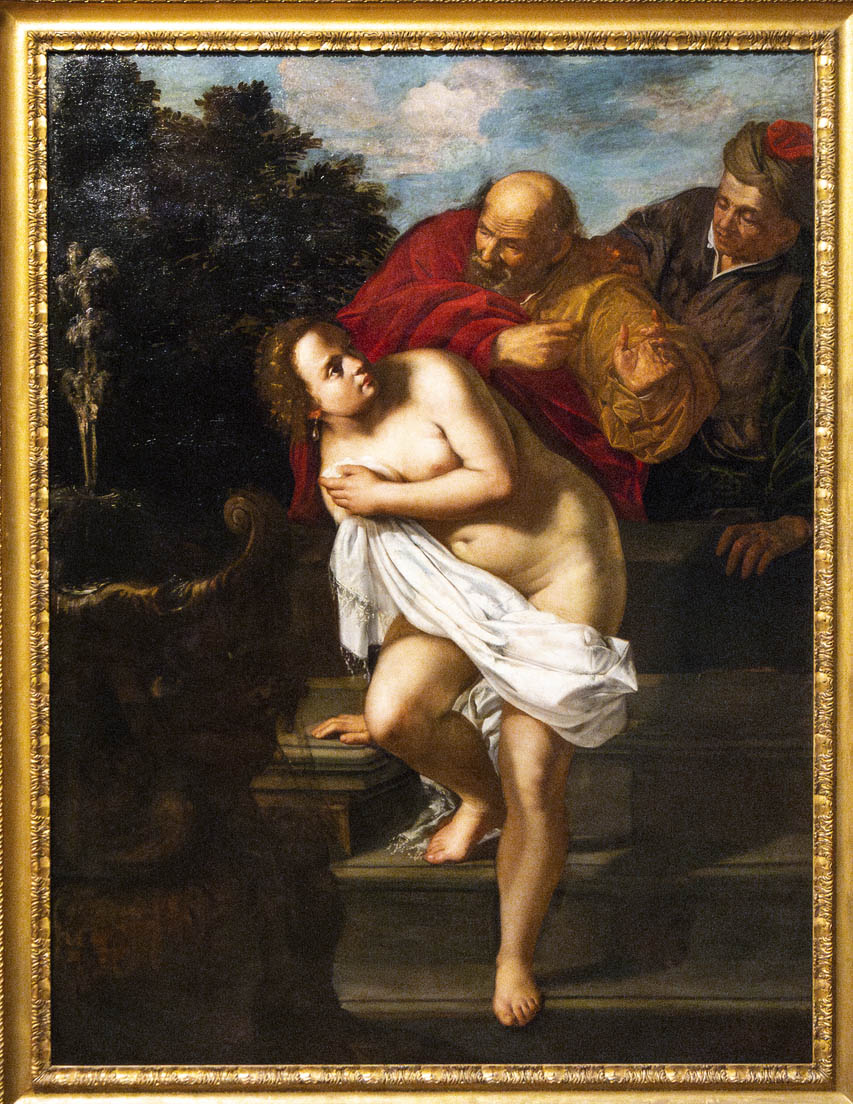
 

Artemisia Gentileschi (Italian, 1593-1653) 'Susanna and the Elders' c. 1638-1640 (installation view)


Artemisia Gentileschi (Italian, 1593-1653)
Susanna and the Elders
c. 1638-1640
Oil on canvas
189.0 x 143.2cm (support, canvas/panel/stretcher external)
Royal Collection Trust / © His Majesty King Charles III 2024


Artemisia Gentileschi (Italian, 1593-1653) 'Susanna and the Elders' c. 1638-1640


Artemisia Gentileschi (Italian, 1593-1653)
Susanna and the Elders
c. 1638-1640
Oil on canvas
189.0 x 143.2cm (support, canvas/panel/stretcher external)
Royal Collection Trust / © His Majesty King Charles III 2024


Likely commissioned by Queen Henrietta Maria, this work was displayed in her Withdrawing Chamber in Whitehall Palace. The subject is an Old Testament narrative on virtue and faith. Susanna, bathing in privacy, is spied on by two elders who attempt to sexually assault her. When she resists them, the men accuse her of adultery. Susanna is arrested and about to be put to death until the men are questioned, and her innocence is revealed. Here, Gentileschi depicts Susanna as vulnerable and fearful, shielding her nakedness. She returned to the subject throughout her career.

Text from the exhibition large print guide


This spring, Tate Britain will present Now You See Us: Women Artists in Britain 1520-1920. This ambitious group show will chart women’s road to being recognised as professional artists, a 400-year journey which paved the way for future generations and established what it meant to be a woman in the British art world. The exhibition covers the period in which women were visibly working as professional artists, but went against societal expectations to do so.

Featuring over 100 artists, the exhibition will celebrate well-known names such as Artemisia GentileschiAngelica Kauffman, Julia Margaret Cameron and Gwen John, alongside many others who are only now being rediscovered. Their careers were as varied as the works they produced: some prevailed over genres deemed suitable for women like watercolour landscapes and domestic scenes. Others dared to take on subjects dominated by men like battle scenes and the nude, or campaigned for equal access to training and membership of professional institutions. Tate Britain will showcase over 200 works, including oil painting, watercolour, pastel, sculpture, photography and ‘needlepainting’ to tell the story of these trailblazing artists.

Now You See Us will begin at the Tudor court with Levina Teerlinc, many of whose miniatures will be brought together for the first time in four decades, and Esther Inglis, whose manuscripts contain Britain’s earliest known self-portraits by a woman artist. The exhibition will then look to the 17th century. Focus will be given to one of art history’s most celebrated women artists, Artemisia Gentileschi, who created major works in London at the court of Charles I, including the recently rediscovered Susanna and the Elders 1638-40, on loan from the Royal Collection for the very first time. The exhibition will also look to women such as Mary BealeJoan Carlile and Maria Verelst who broke new ground as professional portrait painters in oil.

In the 18th century, women artists took part in Britain’s first public art exhibitions, including overlooked figures such as Katherine Read and Mary Black; the sculptor Anne Seymour Damer; and Margaret Sarah Carpenter, a leading figure in her day but little heard of now. The show will look at Angelica Kauffman and Mary Moser, the only women included among the Founder Members of the Royal Academy of Arts; it took 160 years for membership to be granted to another woman. Women artists of this era are often dismissed as amateurs pursuing ‘feminine’ occupations like watercolour and flower painting, but many worked in these genres professionally: needlewoman Mary Linwood, whose gallery was a major tourist attraction; miniaturist Sarah Biffin, who painted with her mouth, having been born without arms and legs; and Augusta Withers, a botanical illustrator employed by the Horticultural Society.

The Victorian period saw a vast expansion in public exhibition venues. Now You See Us will showcase major works by critically appraised artists of this period, including Elizabeth Butler (née Thompson)‘s monumental The Roll Call 1874 (Butler’s work prompted critic John Ruskin to retract his statement that “no women could paint”), and nudes by Henrietta Rae and Annie Swynnerton, which sparked both debate and celebration. The exhibition will also look at women’s connection to activism, including Florence Claxton‘s satirical ‘Woman’s Work’: A Medley 1861 which will be on public display for the first time since it was painted; and an exploration of the life of Barbara Leigh Smith Bodichon, an early member of the Society of Female Artists who is credited with the campaign for women to be admitted to the Royal Academy Schools. On show will be the student work of women finally admitted to art schools, as well as their petitions for equal access to life drawing classes.

The exhibition will end in the early 20th century with women’s suffrage and the First World War. Women artists like Gwen John, Vanessa Bell and Helen Saunders played an important role in the emergence of modernism, abstraction and vorticism, but others, such as Anna Airy, who also worked as a war artist, continued to excel in conventional traditions. The final artists in the show, Laura Knight and Ethel Walker, offer powerful examples of ambitious, independent, confident professionals who achieved critical acclaim and – finally – membership of the Royal Academy.

Press release from Tate Britain
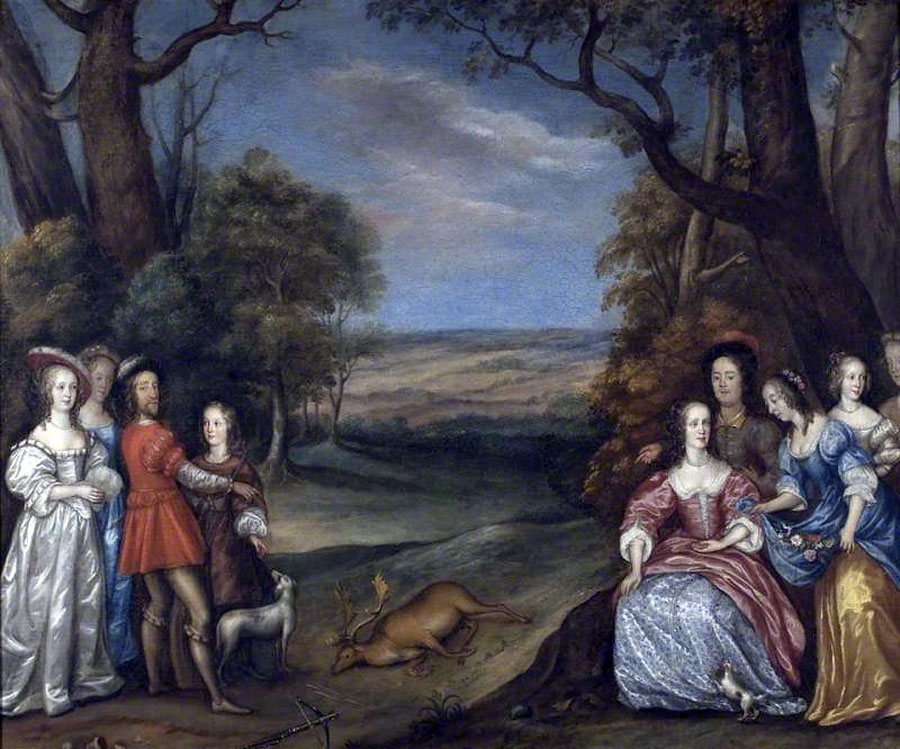
 

Joan Carlile (English, 1606-1679) 'The Carlile Family with Sir Justinian Isham in Richmond Park' 1650s


Joan Carlile (English, 1606-1679)
The Carlile Family with Sir Justinian Isham in Richmond Park
1650s
Oil on canvas
Lamport Hall
CC BY-NC-ND
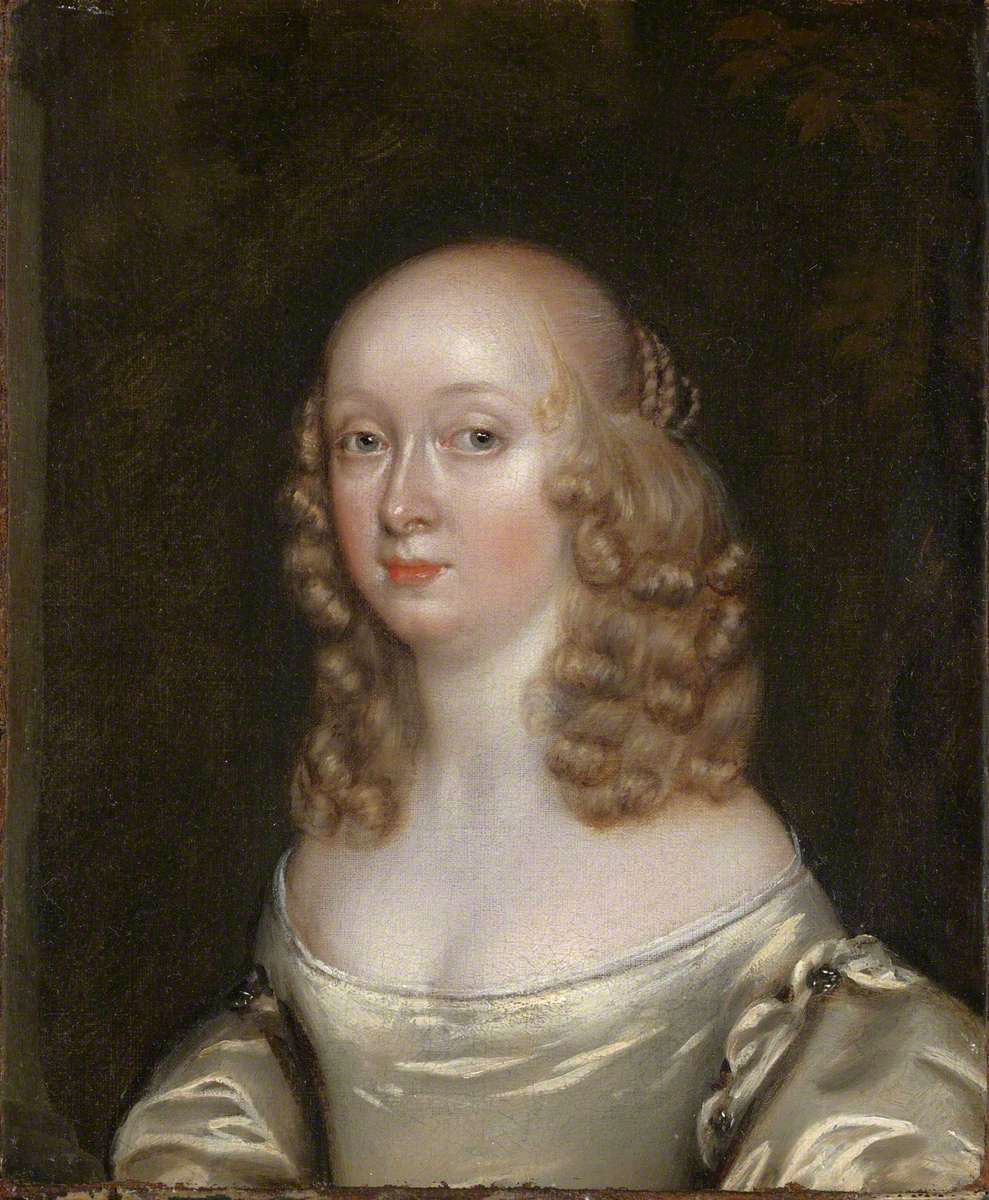
 

Joan Carlile (English, 1600-1679) 'Portrait of a Lady Wearing an Oyster Satin Dress' 1650s


Joan Carlile (English, 1600-1679)
Portrait of a Lady Wearing an Oyster Satin Dress
1650s
Oil on canvas
30.8 x 25.5cm
National Portrait Gallery, London
Government Art Collection
Purchased from Philip Mould Ltd, 2018


Joan Carlile or Carlell or Carliell (c. 1606-1679), was an English portrait painter. She was one of the first British women known to practise painting professionally. Before Carlile, known professional female painters working in Britain were born elsewhere in Europe, principally the Low Countries.


Installation view of the exhibition 'Now You See Us Women Artists in Britain 1520-1920' at Tate Britain showing at left, Joan Carlile's 'Portrait of an Unknown Lady known as Elizabeth Murray, Countess of Dysart and Duchess of Lauderdale' 1650s; and at right, 'Portrait of an Unknown Lady' 1650-1655


Installation view of the exhibition Now You See Us Women Artists in Britain 1520-1920 at Tate Britain showing at left, Joan Carlile’s Portrait of an Unknown Lady known as Elizabeth Murray, Countess of Dysart and Duchess of Lauderdale 1650s (below); and at right, Portrait of an Unknown Lady 1650-1655 (below)
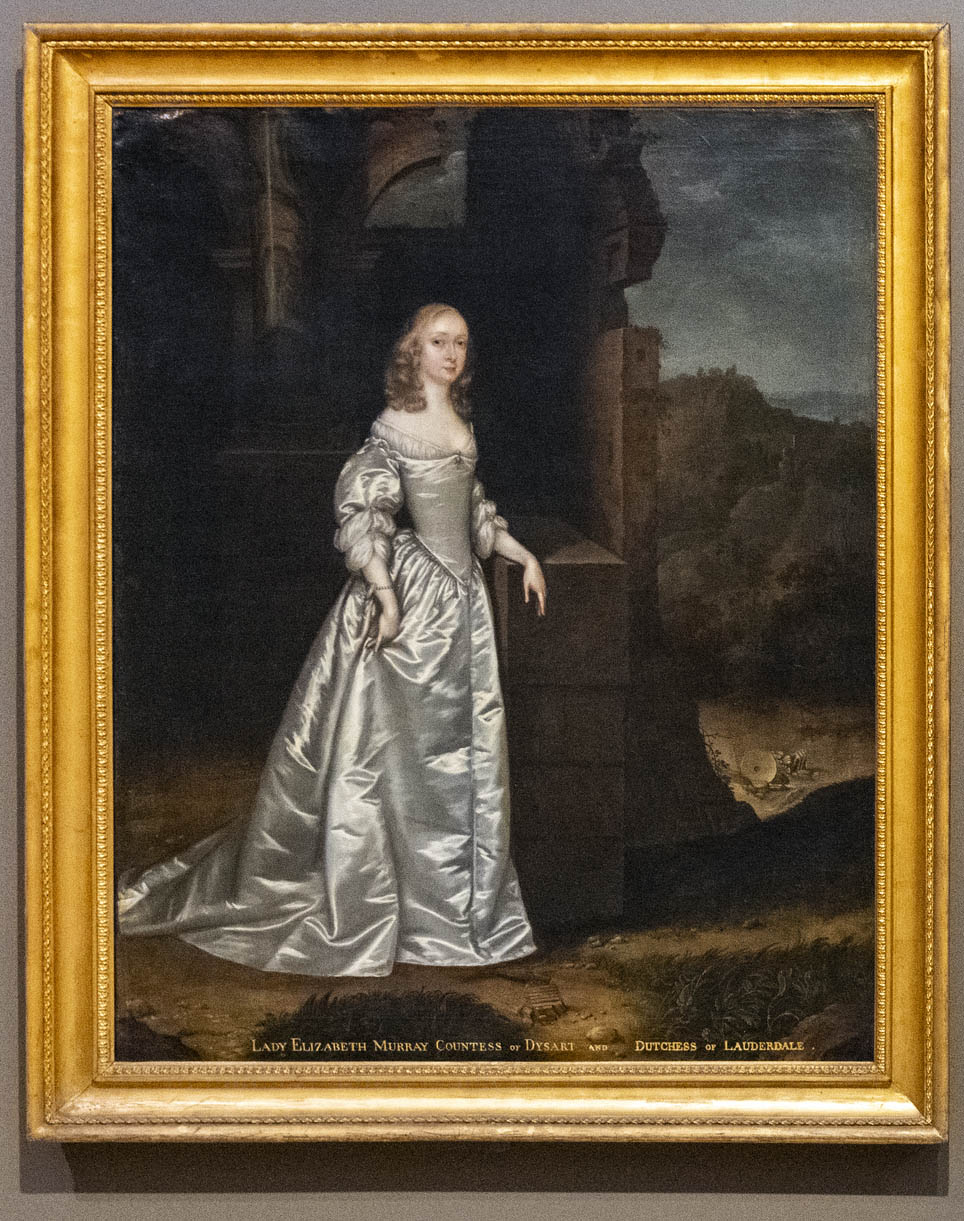
 

Joan Carlile (English, 1606-1679) 'Portrait of an Unknown Lady' 1650-1655 (installation view)


Joan Carlile (English, 1606-1679)
Portrait of an Unknown Lady (installation view)
1650-1655
Oil on canvas
Support: 1107 × 900 mm
Frame: 1205 × 1012 × 73 mm
Photo: Tate
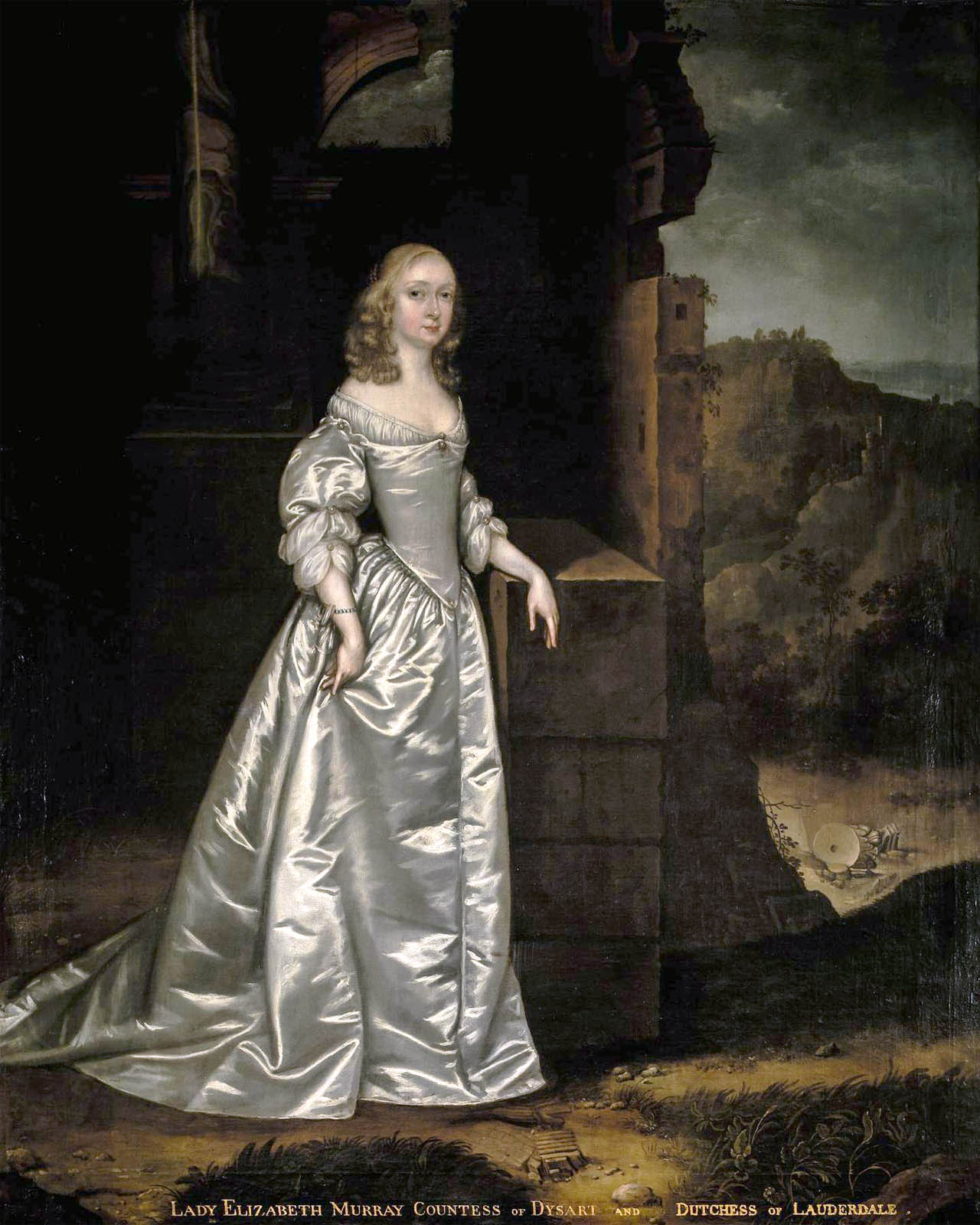
 

Joan Carlile (English, 1606-1679) 'Portrait of an Unknown Lady known as Elizabeth Murray, Countess of Dysart and Duchess of Lauderdale' 1650s


Joan Carlile (English, 1606-1679)
Portrait of an Unknown Lady known as Elizabeth Murray, Countess of Dysart and Duchess of Lauderdale
1650s
Oil on canvas
The Bute Collection at Mount Stuart


Here, Carlile uses the same white satin dress seen in a nearby painting. The pose, with the sitter elegantly gathering a handful of fabric, is taken from works by Charles I’s portrait painter, Flemish artist Anthony van Dyck (1599-1641). The sitter is sometimes identified as Elizabeth Murray, Countess of Dysart and Duchess of Lauderdale. She was Carlile’s near neighbour in Petersham, at Ham House. The broken columns in the background are often used to symbolise loss.

Text from the exhibition large print guide


Joan Carlile (English, 1606-1679) 'Portrait of an Unknown Lady' 1650-1655


Joan Carlile (English, 1606-1679)
Portrait of an Unknown Lady
1650-1655
Oil on canvas
Support: 1107 × 900 mm
Frame: 1205 × 1012 × 73 mm
Photo: Tate


Portraits by Joan Carlile are rare and this is one of only approximately ten that can be identified. Of these, two are in public collections (Ham House, Surrey, and National Portrait Gallery, London), while others are held in historic house collections and family trusts in the United Kingdom, for example Lamport Hall, Burghley House and Berkeley Castle. Carlile seems to have specialised in small-scale full length portraits of figures, usually female, set in large landscape or garden settings. The composition employed here, in which the figure holds the skirt of her dress with one hand and shawl with another, was most likely a template arrangement. It appears in two other portraits, one showing the figure facing the same way as here, the other in reverse, but with both figures wearing the same white satin dress. This repeated composition adds weight to the proposition that Carlile was a professional artist. The wife of Lodowick Carlile (or Carlell), a minor poet and dramatist who also held the office of Gentleman of the Bows to Charles I, Joan Carlile lived with her husband in Petersham, a suburb of London. However, in 1653 their neighbour, Brian Duppa, recorded that ‘the Mistress of the Family intends for London, where she meanes to make use of her skill to som more Advantage then hitherto she hath don’ (quoted in Toynbee and Isham 1954, p.275). In 1654 Carlile is recorded as living in London’s Covent Garden, then the heart of the artistic community (see Burnett 2004/2010, accessed 2 October 2015).

Text from the Tate website


Joan Carlile challenged societal expectations by becoming one of Britain’s first professional women artists in the 1600s, earning her living as an oil painter. Initially employed in King Charles I’s household, Carlile liked to paint in her spare time. With the outbreak of the Civil War, she began painting to support herself.

Carlile moved to Covent Garden in the 1650s – then the centre of the art world – and set up a successful commercial portrait business. Her template of carefully posed figures in silk gowns against landscape backgrounds, seen here in Portrait of an Unknown Lady (1650-5), proved extremely popular. Admired as a professional artist in her lifetime, only a small number of her portraits still exist, some which have never been seen in public.

Text from the Tate website


In her Portrait of an Unknown Lady (1650-1655) the astonishing nacreous lustre of the sitter’s white silk gown, shown full length, shines against the foil of the dull brown foliage behind her. At this point, the Civil War had ended but the restoration of the monarchy was still in the future, and Carlile’s painting, with its overt celebration of luxury and leisure (the spotless pale fabric speaks of both) seems provocative.

It is possible that Carlile taught Anne Killigrew (1660-1685), an accomplished painter and poet whose family encouraged her creative pursuits, although it’s not clear if she ever painted professionally. Only a handful of Killigrew’s works survive today, including Venus Attired by the Three Graces, which reveals her interest in mythological scenes.

Although she died of smallpox aged just 25, Killigrew stands alongside Beale and Carlile as one of Britain’s first female artists.

Alicia Foster. “Blazing a trail: Britain’s first women artists deserve to be better known,” on the Art UK website 13 May 2024 [Online] Cited 03/09/2024
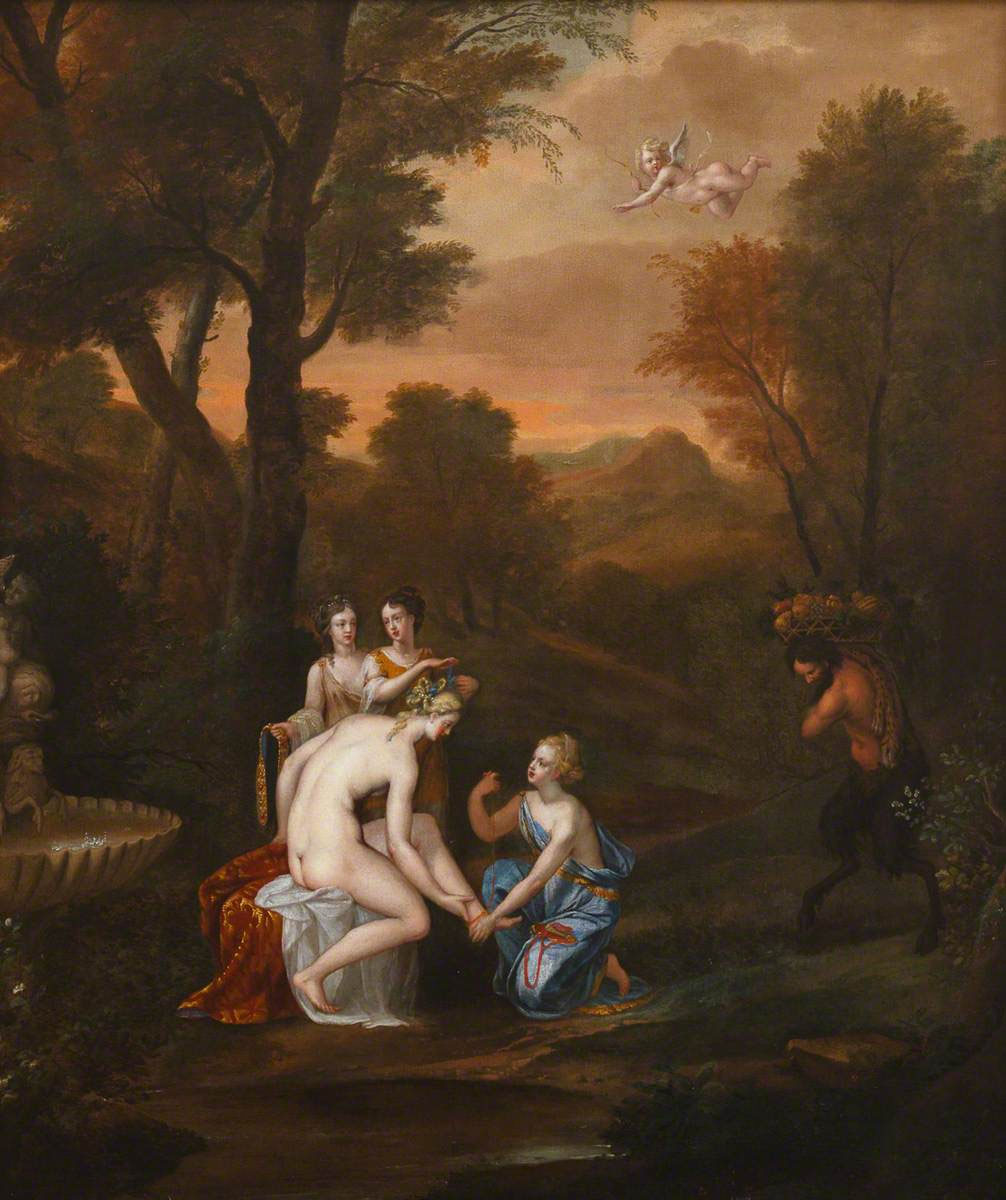
 

Anne Killigrew (English, 1660-1685) 'Venus Attired by the Three Graces' c. 1680


Anne Killigrew (English, 1660-1685)
Venus Attired by the Three Graces
c. 1680
Oil on canvas
Support: 1120 × 950 mm
Frame: 1282 × 1102 × 63 mm
Falmouth Art Gallery
Purchased with the assistance of the Victoria and Albert Museum Purchase Grant Fund, Heritage Lottery Fund, the Art Fund, the Beecroft Bequest, Falmouth Decorative and Fine Arts Society, the Estate of Barry Hughes in memory of Grace and Thomas Hughes and generous donations from local supporters
Public domain


Anne Killigrew has been described as the most celebrated female English prodigy of the Seventeeth Century. A poet and artist of great beauty and repute, Killigrew died of smallpox at the age of just 25. Anne’s exceptional qualities as an artist and a poet were highly praised in her short lifetime. The poet John Dryden dedicated a poem to her in which he refers directly to this picture: ‘Where nymphs of brightest form appear, and shaggy satyrs standing near’ (from ‘To the Pious Memory of the Accomplished Young Lady Mrs Anne Killigrew Excellent In The Two Sister-Arts of Poesy And Painting: An Ode’). Anne Killigrew worked at the Royal Court of King James II as Lady-in-Waiting to the Queen. Anne’s grandfather, Sir William Killigrew, was the Governor of Pendennis Castle, and his son, Dr Henry Killigrew moved to London to work as chaplain to King Charles I. He later became master of the Savoy Hospital.

Text from the Falmouth Art Gallery website
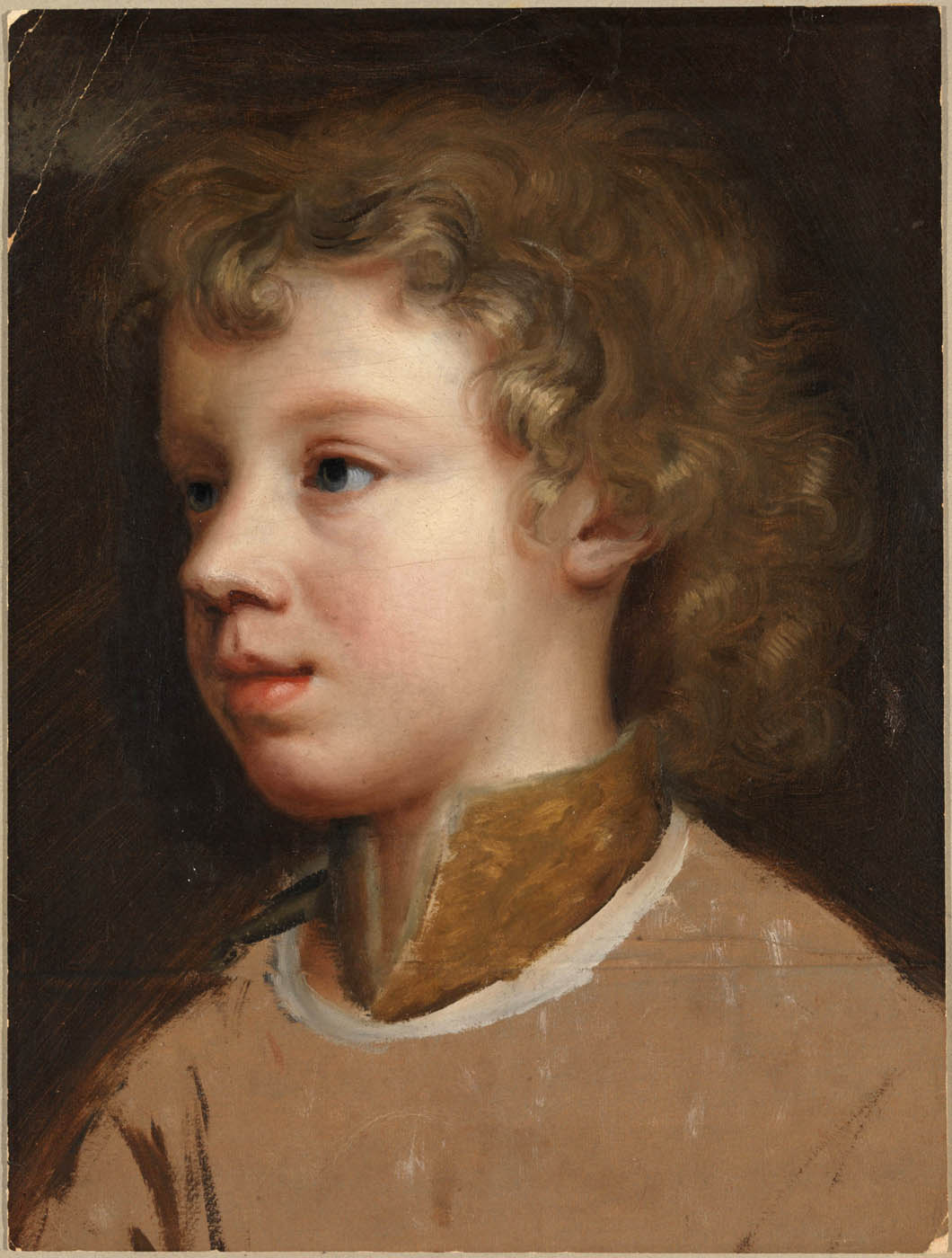
 

Mary Beale (English, 1633-1699) 'Sketch of the Artist's Son, Bartholomew Beale, Facing Left' c. 1660


Mary Beale (English, 1633-1699)
Sketch of the Artist’s Son, Bartholomew Beale, Facing Left
c. 1660
Oil on paper
Support: 325 × 245 mm
Frame: 421 × 340 × 32 mm
Tate
Purchased 2010
Photo: Tate


In the late 1650s and early 1660s Beale and her family were living on Hind Court, off Fleet Street in London. She painted privately and had a painting room in her home. Her husband had a civil service position as Deputy Clerk of the Patents. Portrait sittings of family and friends were often social occasions, with conversation and dinner afterwards. It is in this period that Beale produced small oil sketches on paper of family members, particularly her two young sons. Whether they relate to larger oil on canvas portraits is unclear.

This oil sketch of a young boy, shown in three-quarter profile, is of Mary Beale’s eldest son Bartholomew, baptised in 1656. His appearance, both in age and costume, is very similar to that in Mary Beale’s Self-portrait with her family (Geffrye Museum, London), painted c. 1659-60, before the birth of her youngest son Charles. It relates closely to another sketch of Bartholomew in oil on paper painted at the same time, Sketch of the Artist’s Son, Bartholomew Beale, in Profile c. 1660 (Tate T13245). Whether these sketches are connected to the production of the Geffrye Museum portrait, or were simply executed at around the same time, is not known. They are painted in oil on paper, which seems to have been a feature of Beale’s working method in the early 1660s but is not known in her later career, when she made preparatory sketches in chalk on paper or in oil on canvas (see, for example, Portrait of a Young Girl c. 1679-81, Tate T06612). When this sketch was made, the Beale family was living in Hind Court, off Fleet Street in London, where Mary Beale’s husband, Charles, was employed as Deputy Clerk of the Patents Office. It is difficult to determine whether Beale had much of a commercial portrait practice at this date, but documents certainly record the production of portraits of family and friends. In her ‘painting room’, Beale had ‘pencills [sic.], brushes, goose & swan fitches’, as well as ‘quantities of primed paper to paint on’ (George Vertue, transcription of Charles Beale’s 1661 notebook, now lost, quoted in Barber 1999, p. 16).

Text from the Tate website


Installation view of the exhibition 'Now You See Us Women Artists in Britain 1520-1920' at Tate Britain showing Mary Beale’s 'Anne Sotheby' (1676-1677)


Installation view of the exhibition Now You See Us Women Artists in Britain 1520-1920 at Tate Britain showing Mary Beale’s Anne Sotheby 1676-1677 


Mary Beale (English, 1633-1699) 'Anne Sotheby' 1676-1677


Mary Beale (English, 1633-1699)
Anne Sotheby
1676-1677
Oil on canvas
Tate
Purchased with funds provided by the Nicholas Themans Trust 2024


Beale’s husband kept a daily record of her activities in the studio. Two of his over 30 notebooks and a few partial transcripts are still known. They record Beale’s sitters, her painting stages, her painting materials and her prices. For her commissioned works, she borrowed poses from the portraits of the court artist Peter Lely (1618-1680). Anne Sotheby’s pose is taken from his portrait of Lady Essex Finch. Beale charged £10 for paintings of this size. Her sons acted as studio assistants; her youngest, Charles, was paid to paint the drapery in this portrait.

Text from the exhibition large print guide


Mary Beale (née Cradock) (1633-1699) was an English portrait painter. She was part of a small band of female professional artists working in London. Beale became the main financial provider for her family through her professional work – a career she maintained from 1670/71 to the 1690s. Beale was also a writer, whose prose Discourse on Friendship of 1666 presents a scholarly, uniquely female take on the subject. Her 1663 manuscript Observations, on the materials and techniques employed “in her painting of Apricots”, though not printed, is the earliest known instructional text in English written by a female painter. Praised first as a “virtuous” practitioner in “Oyl Colours” by Sir William Sanderson in his 1658 book Graphice: Or The use of the Pen and Pensil; In the Excellent Art of PAINTING, Beale’s work was later commended by court painter Sir Peter Lely and, soon after her death, by the author of “An Essay towards an English-School”, his account of the most noteworthy artists of her generation.

Text from the Wikipedia website
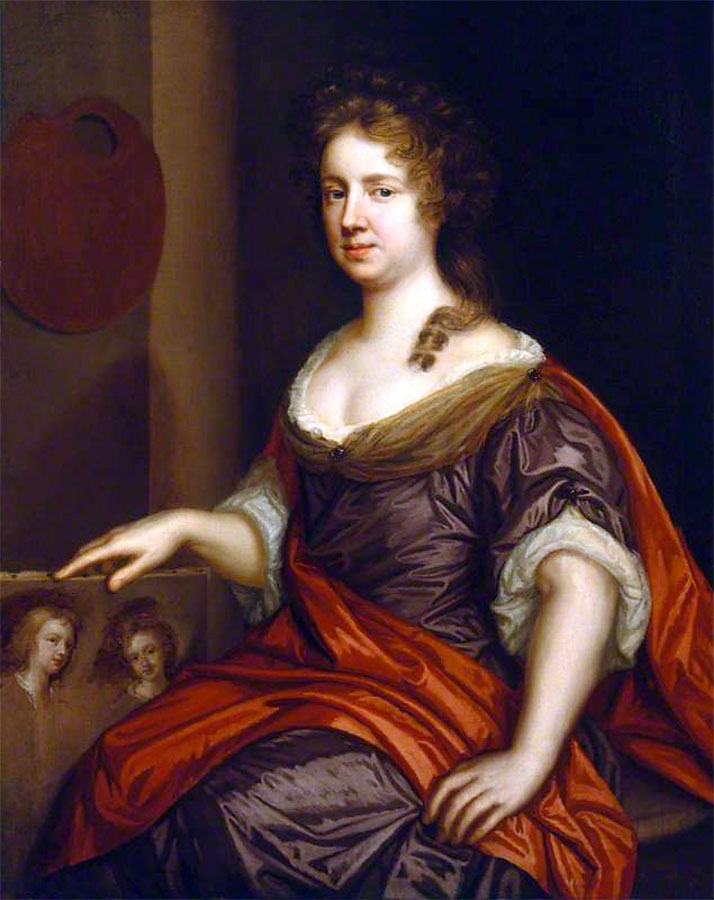
 

Mary Beale (English, 1633-1699) 'Mary Beale' c. 1666


Mary Beale (English, 1633-1699)
Mary Beale
c. 1666
Oil on canvas
109.2 x 87.6cm
National Portrait Gallery, London
Purchased, 1912
CC BY-NC-ND


Beale is shown holding an unframed canvas on which are sketch portraits of her two sons, Bartholomew (1656-1709) and Charles (1660-1714?)


Mary Beale (English, 1633-1699) 'Self Portrait' c. 1675


Mary Beale (English, 1633-1699)
Self Portrait
c. 1675
Oil on sacking
89 x 73cm
West Suffolk Heritage Service
Purchased
CC BY-NC-ND


The early English portrait painter Mary Beale (1622/1623-1699) had a father who was an amateur artist, miniature painter and a collector of paintings (her family owned work by Peter Paul Rubens and Anthony van Dyck) and her husband, Charles, was also an amateur painter and ran her studio in London’s fashionable Pall Mall.

Unusually, in her case, her talent was matched by her spouse’s high regard of it, and she was allowed to supersede him and establish a professional career. She took on female apprentices, though no records of their subsequent careers survive.

Alicia Foster. “Blazing a trail: Britain’s first women artists deserve to be better known,” on the Art UK website 13 May 2024 [Online] Cited 03/09/2024


Exhibition guide

Now You See Us: Women Artists in Britain 1520-1920 celebrates over 100 women who forged public careers as artists. The exhibition begins with the earliest recorded women artists working in Britain. It ends with women’s place in society fundamentally changed by the First World War and the first women gaining the right to vote. Across these 400 years, women were a constant presence in the art world. Now You See Us explores these artists’ careers and asks why so many have been erased from mainstream art histories.

Organised chronologically, the exhibition follows women who practised art as a livelihood rather than an accomplishment. The chosen works were often exhibited at public exhibitions, where these artists sold their art and made their reputations. Most of the women featured belonged to a social class that gave them the time and opportunity to develop their talents. Many were the daughters, sisters or wives of artists. Yet even these women were regarded differently. Now You See Us charts their fight to be accepted as professional artists on equal terms with men.

Many of the exhibited works reflect prejudiced notions of the most appropriate art forms and subjects for women. Others challenge the commonly held belief that women were best suited to ‘imitation’, proving they have always been capable of creative invention. From painting epic battle scenes to campaigning for access to art academies, these women defied society’s limited expectations of them and forged their own paths. Yet so many of their careers have been forgotten and artworks lost. Drawing on the artists’ own writings, art criticism, and new and established research, this exhibition attempts to restore these women to their rightful place in art history. Now You See Us aims to ensure these artists are not only seen but remembered.

Women at the Tudor Courts

There are significant gaps in our knowledge of women’s artistic lives in the sixteenth century. As is the case for many artists in this exhibition, their lives are poorly documented and often hidden behind those of their husbands and fathers. The problems this presents are evident in this room.

Susanna Horenbout (1503-1554) and Levina Teerlinc (c. 1510s-1576) are among the earliest women in Britain to be named as artists. Their reputations are clearly recorded. In 1521, Horenbout’s skill was admired by the German painter and printmaker Albrecht Dürer (1471-1528), and in 1567, both artists were praised by the Italian historian Lodovico Guicciardini (1521-1589). Yet no works by Horenbout have been identified, and those attributed to Teerlinc are not certain.

Horenbout and Teerlinc were both daughters of Flemish manuscript illuminators and were likely trained in their family workshops. Both arrived in England to work at the court of Henry VIII. But as women, they were not employed as artists. While Horenbout’s brother Lucas Horenbout (1490-1544) was Henry VIII’s painter, she served Anne of Cleves as one of her Gentlewomen of the Privy Chamber. Teerlinc served Elizabeth I likewise. This does not mean that they did not paint – at court, their artistic talents would have been a distinguishing skill – but, as is a common feature of this exhibition, written histories have failed to record their activities.

Working in a different context – as a scribe and calligrapher – the works of Esther Inglis (1571-1624) can be identified. Inglis authored more than 60 manuscript books and included her name and self-portrait in many. Raised in Scotland, she may have learnt the art of calligraphy from her mother, Marie Presot (active 1569-1574).

Artemisia Gentileschi

Italian artist Artemisia Gentileschi arrived in London in c. 1638-9 by invitation of Charles I. Like other European rulers, Charles I employed artists of international reputation to signal the cultural sophistication of his court. Gentileschi had prestigious patrons across Europe, including the Grand Duke of Tuscany and Philip IV of Spain. She was the first woman to be a member of the Academy of the Arts of Drawing in Florence, and in Rome, her house had been ‘full of cardinals and princes’. Gentileschi’s fame as an artist was augmented by her status as a woman.

In London, Gentileschi worked for Charles I and Queen Henrietta Maria. Records suggest she produced seven works for the royal collection. These included self-portraits and large history paintings, with subject matter drawn from classical history, mythology, and the Bible. Only the two displayed here are still known. Gentileschi often placed women at the centre of her works, depicting narratives that celebrate their strength and virtue. Susanna and the Elders is an example of the kind of work for which Gentileschi was celebrated.

Gentileschi achieved in her lifetime what many women who came after her had to fight to attain: she was a professional artist who ran her own studio, was a member of an art academy, worked from life models and was ranked as a serious artist alongside men. Despite this, Gentileschi’s status has fluctuated over time, and the artist has faded in and out of art history.

Early accounts of Gentileschi’s work focus on her personal life as much as her painting. Like many of the women artists who came after her, the details of her biography continue to dictate interpretations of her work.

The First Professionals

In 1658, historian William Sanderson (c. 1586-1676) published Graphice. The use of the pen and pensil. Or, The most excellent art of painting. The publication lists contemporary artists practising in England. He includes four women working in oil paint: ‘Mrs Carlile’ (Joan Carlile), ‘Mrs Beale’ (Mary Beale), ‘Mrs Brooman’ (probably Sarah Broman) and ‘Mrs Weimes’ (Anne Wemyss). Carlile and Beale are believed to be two of the earliest British women to have worked as professional artists. Very little is known about Broman or Wemyss beyond snatches of information in archives.

This short list highlights how unusual it was for British women to pursue art as a profession in the seventeenth century. Women had little agency over their own lives and were subject first to their fathers and then their husbands. Limited to the domestic sphere, they were not expected to conduct public lives. Many women painted privately with no thought of turning it into a career. While young men began as apprentices or assistants in the studios of professionals, this route was not open to most women.

In the seventeenth century women writers, poets, playwrights and artists began to give voice to those questioning their secondary status and petitioning for women’s rights. They argued that it was lack of education, not ‘weak minds’ that limited their opportunities. This fight for equality and access to education runs throughout the exhibition.

The First Exhibitors

The first public art exhibition in Britain took place in London in 1760, and art shows soon became an important part of the city’s social calendar. Founded in 1768, the Royal Academy quickly emerged as a driving force in cultural life, with its Summer Exhibition attracting tens of thousands of visitors every year. Other venues, including the Society of Artists and the British Institution also hosted exhibitions.

Women artists played an active part in this competitive world. An estimated 900 women exhibited their work between 1760 and 1830. Angelica Kauffman and Mary Moser were both founding members of the Royal Academy (although, as women, they weren’t awarded full membership and were excluded from the Academy’s council meetings and governance). Despite this precedent, it would take more than 150 years for the next woman to be elected to membership.

Kauffman is one of the few women artists of the eighteenth century whose profile has been sustained. Many others made names for themselves, but their careers are not well documented. Even Moser is less well known, perhaps because she painted flowers while Kauffman pursued the ‘high genre’ of history painting, depicting historical, mythological and biblical narratives.

Art critics of the time often criticised women for their ‘weak’ figurative work, yet they were denied access to life-drawing classes. Women artists also had to battle social expectations. Publishing a private or studio address in an exhibition catalogue was a signal of commercial practice, but painting for money was considered improper. Women artists of higher social rank were listed as ‘honorary’ exhibitors; some exhibited simply as ‘a Lady’, and after marriage, many switched their status from ‘commercial’ to ‘amateur’.

‘Just What Ladies Do For Amusement’

In 1770, the Royal Academy banned ‘Needle-work, artificial Flowers, cut Paper, Shell-work, or any such baubles’ from its exhibitions. They also banned works that were copies. Other categories of art that the Academy considered ‘lower’, such as miniature painting, pastel and watercolour were also treated dismissively. Joshua Reynolds (1723-1792), the Academy’s President, said that working in pastel was unworthy of real artists and was ‘just what ladies do when they paint for their own amusement’.

These ‘lower arts’ were ones that women practised the most. Small in scale and considered less technically challenging than oil painting, they demanded less equipment and could be pursued at home. They were taught to middle and upper-class girls and were the realm of women who pursued art as amateur accomplishment.

Despite this, these art forms offered opportunities for women to earn a living. Many turned miniature painting, needlework and pastel into lucrative professional careers, supplementing their income through tutoring. Their patrons were often women, and some boasted large, fashionable clienteles and even galleries which became tourist attractions.

Founded in 1754, the Society for the Encouragement of Arts, Manufactures and Commerce (the Society of Arts) offered cash prizes and medals in many categories, including the ‘polite arts’. Awards were given for patterns for embroidery, copies of prints, drawings of statues and of ‘beasts, birds, fruit or flowers’, as well as landscapes. Some prizes were specifically intended for young women. The Society was a stepping stone to a career and many of the artists in this exhibition won medals. Yet most of the women recorded as submitting work for competition can no longer be identified beyond their names.

Flowers

In the eighteenth and nineteenth centuries, painting flowers was considered a suitably delicate pursuit for women. Imitating nature (rather than demonstrating creative or imaginative flair) was thought to be an appropriate outlet for women’s artistic skills. Flowers were also at the heart of respectable hobbies like embroidery, botany and gardening. In the 1850s, the women’s periodical the Ladies’ Treasury called flower painting ‘a ladylike and truly feminine accomplishment’. When Mary Moser exhibited Cymon and Iphigenia (based on a poem by John Dryden, 1631-1700) at the Royal Academy in 1789, a reviewer urged her to stick to flowers. She painted flowers ‘transcendently’, he noted, and should do ‘nothing else’.

Many women were employed as professional illustrators, recording plant species for horticulturists and botanical publishers. Some conducted hybrid careers, working as illustrators and drawing tutors while exhibiting flower paintings for a wider market. In the Victorian era, critics applauded several women artists as leaders of the genre. Yet the idea that flower painting, especially in watercolour, was an exclusively amateur pastime has damaged the legacies of many accomplished artists who successfully worked within this genre.

Victorian Spectacle

Grand exhibitions were a defining part of the Victorian art world. The Royal Academy, the leading art institution since 1768, was still Britain’s most prestigious exhibition venue, but was later criticised for its traditional conservatism. New venues, such as London’s Grosvenor Gallery, which opened in 1877, became rival spaces, and exhibitions in Liverpool and Manchester offered fresh opportunities for exhibiting artists. The Victorian era was also the age of World Fairs. Major exhibitions were held in London and Paris, and in 1893, the World’s Exposition in Chicago was visited by over 25 million people.

This room explores the successes of women artists on this public stage. Many of the works on display were shown in these exhibitions. They won international medals, praise from art critics and public recognition. Yet women tackling ‘male’ subjects, such as battle scenes, caused surprise. Opinion was also divided on women painting the nude: some thought it immoral, others brave.

Exhibitions gave women a public platform to build substantial reputations, and some became popular names. Despite this, membership of the Royal Academy, which was a mark of professional recognition, remained out of reach. As a result, women had no automatic exhibiting rights and were reliant on committees of men selecting their works for exhibition. Without institutional support, they had to navigate the commercial art market on their own.

Women artists’ campaigns for access to the Academy joined calls for greater equality in society. From the 1850s, women petitioned for equal rights to education and work, as well as women’s suffrage. These causes are reflected in the works in this room.

Watercolour

Watercolour was considered one of the ‘polite arts’ best suited to women. However, there were few opportunities to practice professionally. The principal watercolour societies – the Old (founded in 1804) and the rival New (founded in 1807 and reconstituted in 1831) – restricted the membership of women. Membership of the Old was limited to six women (in practice, usually four), while the New admitted around ten.

In both societies, women were confined to the category of ‘Lady Members’ until the end of the nineteenth century. They had no say in governance and were denied access to the financial premiums awarded to full members. Since the annual exhibitions of both societies were closed to non-members, most women had limited opportunities to exhibit their work.

Against these odds, many women water colourists achieved significant commercial and critical success. They enjoyed solo shows and developed commercial relationships with dealers, taking control of their careers.

In 1857, a group of women founded the Society of Female Artists (later, the Society of Lady Artists in c. 1869, then the Society of Women Artists in 1899) to promote the work of women artists in Britain.

Photography

The announcement of photography in 1839 marked a major shift in the art world. In its first decades, photography was a laborious practice that required an understanding of chemistry and optics, as well as expensive equipment. It needed more money, specialist instruction and time than most other art forms. For women who had access to these privileges, the medium provided new opportunities.

From its foundation in 1853, the Photographic Society of London welcomed women members. However, they rarely attended meetings, which were scheduled in the evenings when women required a chaperone to leave the house. The atmosphere of the meetings was described as a ‘men’s club’ and it wasn’t until 1898 that the Society belatedly banned smoking ‘in respect of ladies’ attendance’. Meetings often included papers on new techniques and equipment, providing significant benefits to those who were able to join.

Women participated in London’s first public photographic exhibitions at the Royal Society of Arts in 1852-3 and at the Photographic Society in 1854. The Amateur Photographic Association, established in 1861, also welcomed women from its outset. In the 1890s and early 1900s, London’s Photographic Salon became a key venue. Founded by the Linked Ring Brotherhood, who promoted photography as a fine art, Salon exhibitors included women from across Europe and the US. A photograph of British photographer Carine Cadby in silhouette, examining one of her glass plate negatives, featured on the cover of the 1896 Salon catalogue. Despite this, women were not elected as members of the Linked Ring until 1900. By 1909, they numbered just 8 among 63 men.

Art School

Women were excluded from enrolment at the Royal Academy Schools, Britain’s principal art academy, until 1860. Laura Herford (1831-1870) was the first woman admitted. She had submitted her work for consideration using only her initials and was assumed to be a man. Once women gained entry, they were determined to achieve equal access to training.

Women were barred from the Academy’s life-drawing classes until 1893. Their exclusion from this vital component of art education was justified on many grounds. Chiefly, it was to ‘protect’ women’s supposed modesty, but also because they were considered amateurs who lacked the intellectual capacity to practice art at the highest level. Women students marshalled critical support for their cause and submitted petitions. Life drawing was considered essential to the training of men pursuing careers as artists. Why, they argued, was it not also essential for women?

The Female School of Art, founded in 1842, provided another route into art education. Like several regional schools, such as that in Manchester, it encouraged women into vocational careers in design. Women also had access to private academies, including Sass’s and Leigh’s (later Heatherleys) in London, which prepared students for admission to the Royal Academy Schools. And some women artists, such as Louise Jopling, established their own art school.

In 1871, the founding of the Slade School of Fine Art at University College London signalled a fundamental change of attitudes. From the outset, the Slade offered women an education on equal terms with men. Studying from life models was a central focus of teaching and by the turn of the century, women students outnumbered men by three to one. Access to life drawing had been regarded as the last barrier to equal opportunity. Now they could study from life, some critics argued it was up to women to prove they could be successful artists.

Being Modern

The first two decades of the twentieth century saw rapid change for women, with their rights, roles and opportunities evolving at an unprecedented pace. The First World War signalled a decisive change for women’s place in society and in 1918, after decades of campaigning, some women finally gained the right to vote.

At the same time, the art world was also changing. New art groups and exhibiting societies rejected tradition and promoted modernist aesthetics. Instead of figurative realism, they privileged form, colour and experimentation. Many saw modernism as an opportunity for greater artistic freedom. However, despite growing liberalism in art and society, women artists still faced challenges. The New English Art Club became a rival exhibiting venue to the Royal Academy but was slow to admit women. The Camden Town Group labelled itself ‘progressive’ but openly excluded women.

While modernism is often presented as the dominant movement of the early twentieth century, it doesn’t account for all artistic production of the period. Membership of the Royal Academy, an exhibiting venue many now regarded as too traditional, remained a symbolic goal for many women. When Annie Swynnerton was elected an Associate Member in 1922, Laura Knight said she had broken down the ‘barriers of prejudice’. In 1936, Knight was elected a Royal Academician, becoming the first woman to achieve full membership since the eighteenth century.

The artworks in the final room of the exhibition explore this complex period. Their variety reveals women forging their own paths and pursuing professional careers with purpose and confidence. While many chose not to challenge traditional artistic values, they pushed the boundaries of what was expected of them, paving the way for generations of women artists who came after them.

Text from the Tate exhibition guide
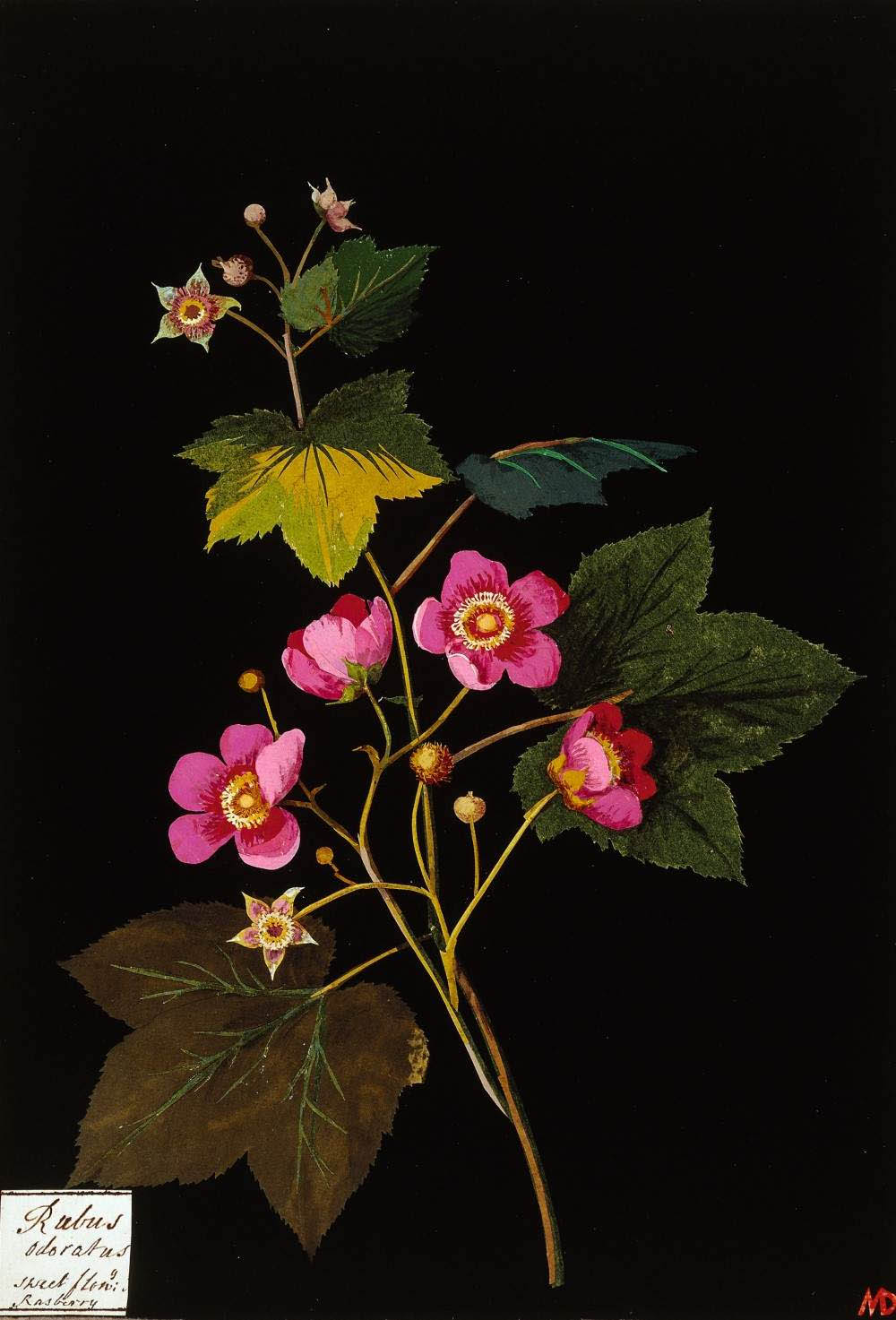
 

Mary Delany (English, 1700-1788) 'Rubus Odoratus' 1772-1782


Mary Delany (English, 1700-1788)
Rubus Odoratus
1772-1782
The British Museum
Bequeathed by Augusta Hall, Baroness Llanover in 1897


Delany was not a professional artist. However, she pursued art with a seriousness of purpose, working in a range of artistic and decorative mediums. She was in her early seventies when she turned to botanical collage, which stemmed from the Dutch art known as knipkunst or schaarkunst. Over the course of a decade, Delany created nearly one thousand botanically accurate collages of plants made from intricately cut pieces of coloured paper. In this collage, Delany shows a flowering raspberry, which was introduced to Britain from North America in 1770.

Text from the exhibition large print guide
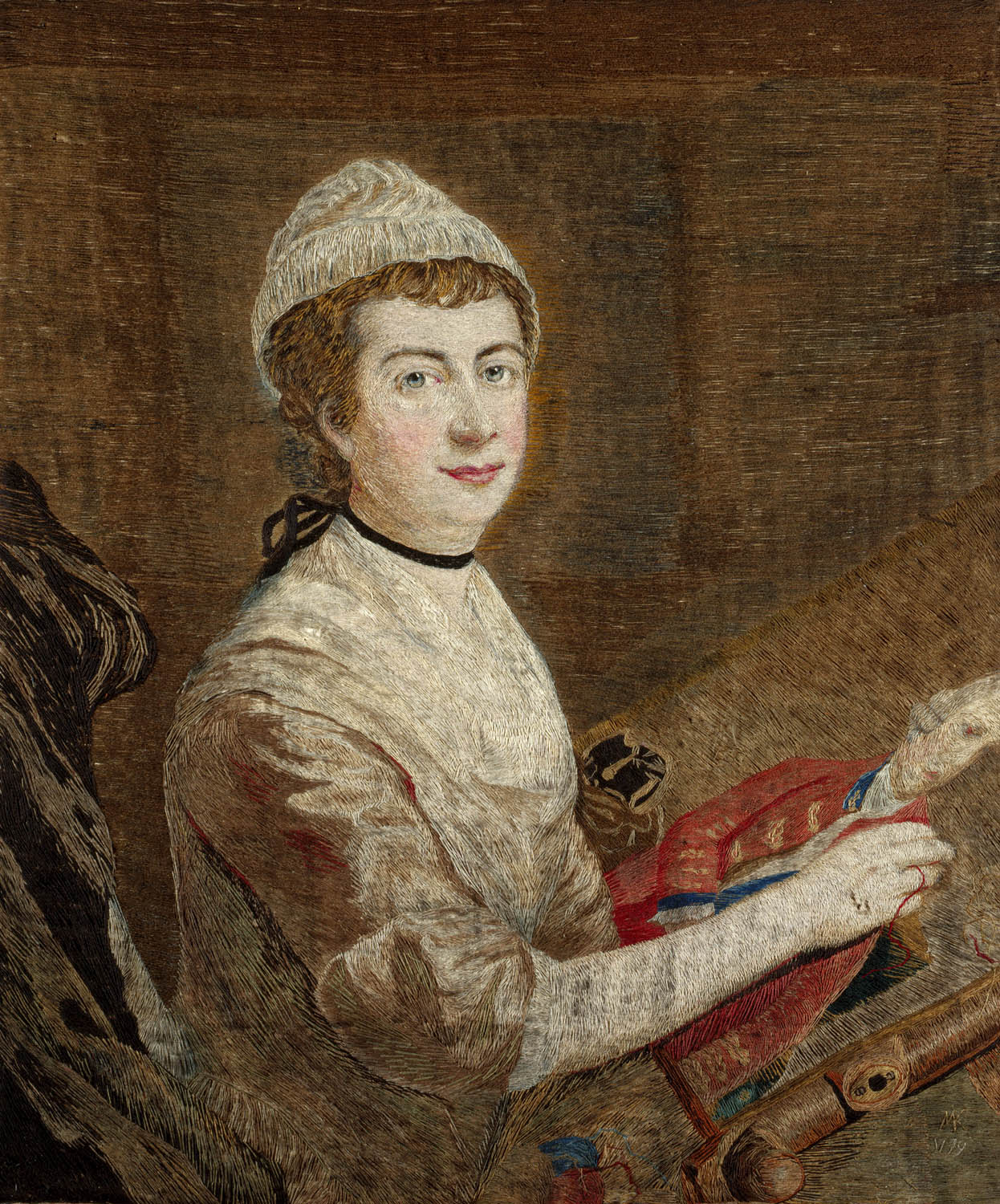
 

Mary Knowles (English, 1733-1807) 'Needlework Picture' 1779


Mary Knowles (English, 1733-1807)
Needlework Picture
1779
Silk (textile), wool, giltwood, glass (material) embroidered, dyeing
89.2 x 84.5cm (frame, external)
Royal Collection Trust / © His Majesty King Charles III 2024


Mary Morris Knowles, born of a Quaker family in Rugeley, Staffordshire, was celebrated as much for her intellect, religious conviction and unusual powers of conversation as for her skill with the needle. A friend of the poetess Anna Seward (‘The Swan of Lichfield’) and of Dr Johnson, she is now regarded as an important early protagonist of the feminist viewpoint in English cultural life. Her support for the abolition of slavery, her investigation into mystical science and her knowledge of garden design, in addition to her accomplishment as a needlewoman, suggest the breadth of her interests. In 1771 she was introduced by her fellow Quaker Benjamin West to Queen Charlotte, who remained on terms of friendship with her over the next thirty years and whose interest in female accomplishments, notably needlework, was well known. Mrs Knowles’s visits to Buckingham House included an occasion in 1778 on which she presented her 5-year-old son George to the King and Queen.

Following the first visit in 1771, the Queen commissioned Mrs Knowles to make a copy of Zoffany’s portrait of George III in needlework or ‘needle painting’ as it was also known. This technique ‘so highly finished, that it has all the softness and Effect of painting’ was achieved with a combination of irregular satin-stitch and long-and-short stitch, worked on hand-woven tammy in an arbitrary pattern and at speed, using fine wool dyed in a wide range of colours under her own supervision. Eight years later Mrs Knowles embroidered the self portrait showing her at work on the Zoffany which, like the earlier piece, she signed with initials and dated. This appears always to have been in the Royal Collection and was presumably also commissioned by Queen Charlotte.

Text from the Royal Collection Trust website
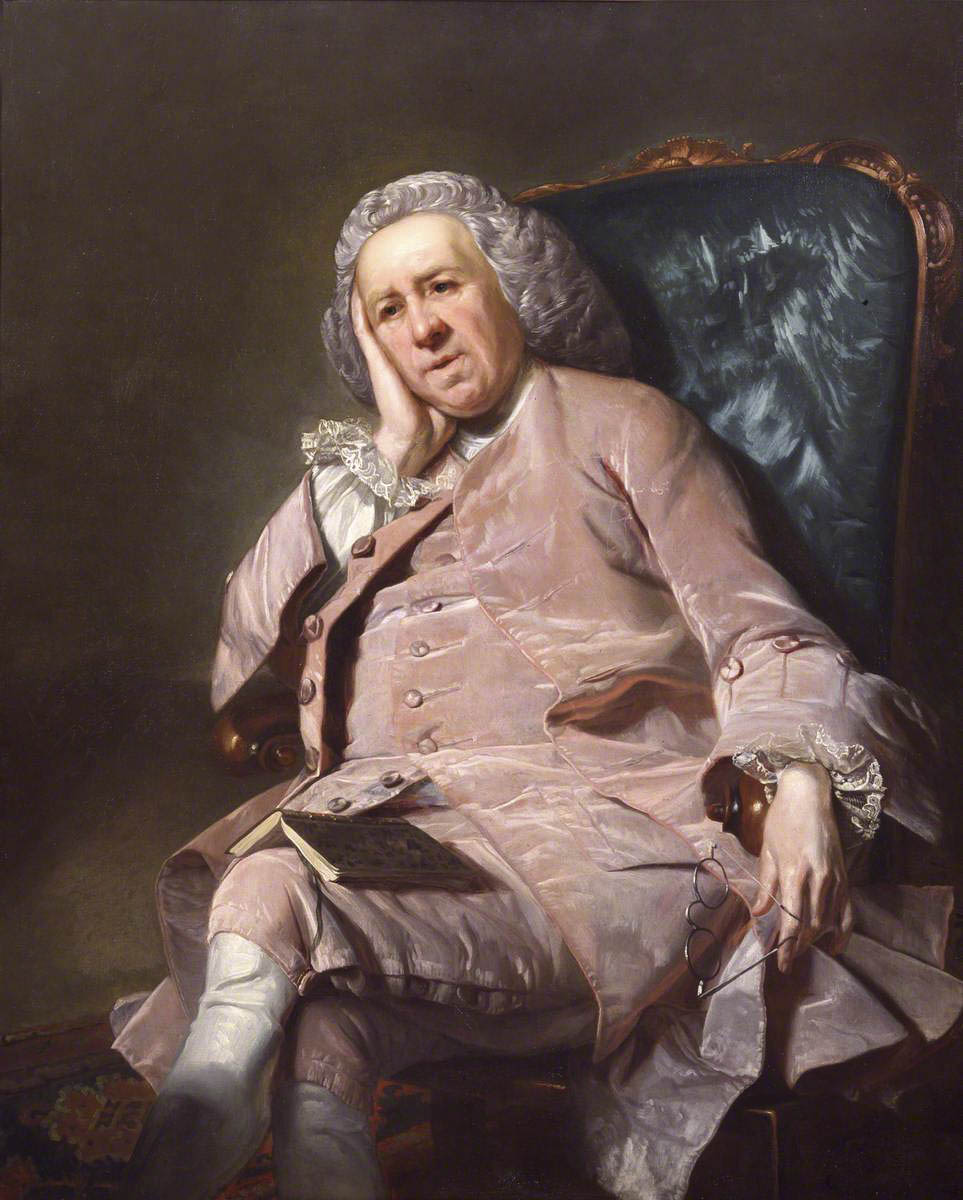
 

Mary Black (English, c. 1737-1814) 'Messenger Monsey (1693-1788)' 1764


Mary Black (English, c. 1737-1814)
Messenger Monsey (1693-1788)
1764
Oil on canvas
127 x 101.6cm
Gift from Frederick Walford, 1877
Royal College of Physicians, London
CC BY-NC-ND


This portrait of the physician Messenger Monsey (1694-1788) is Black’s only known oil painting. Black likely hoped it was a step towards establishing herself as a professional artist, but the issue of payment caused friction. Black hope to charge her client £25, half the amount charged by leading portraitist Joshua Reynolds, but after Monsey’s complaint offered to drop it to a quarter. Monsey considered Black’s expectation of a fee improper. He claimed it would damage her reputation if word got out, and even referred to her as a ‘slut’ in a letter to his cousin.

Wall text from the exhibition


Little is known of the father-and-daughter artists Thomas and Mary Black. Thomas was mainly employed painting draperies for more successful painters, and Mary usually painted copies of old masters. In a letter from Monsey to Mary Black, the doctor wrote: ‘I was bedevilled to let you make your first attempt upon my gracefull person… drawn like a Hog in armour’.

Text from the Art UK website


Black was clearly unfazed by awkward sitters. She built a flourishing artistic practice, painting and teaching the aristocracy, earning enough to live independently (she never married) and keep servants and a horse and carriage at her London home. She died there in old age just as the nineteenth century began.

Alicia Foster. “Blazing a trail: Britain’s first women artists deserve to be better known,” on the Art UK website 13 May 2024 [Online] Cited 03/09/2024


Mary Moser RA (English, 1744-1819) 'Standing Female Nude' Nd


Mary Moser RA (English, 1744-1819)
Standing Female Nude
Nd
Black and white chalk on grey-green paper
49 x W 30.2cm
The Fitzwilliam Museum, Cambridge


As women were excluded from life drawing classes, many took their own steps to improve their anatomical knowledge. They sketched from casts and statues and copied from other artists’ drawings and anatomy books. These rare works show that some artists found ways around these restrictions, although little is known about how Moser and Stone accessed life models.

Text from the exhibition large print guide


Mary Moser RA (English, 1744-1819) 'Flowers in a vase, which stands on a ledge' 1765


Mary Moser RA (English, 1744-1819)
Flowers in a vase, which stands on a ledge
1765
Watercolour and bodycolour on paper
The Syndics of the Fitzwilliam Museum, University of Cambridge


From the same series as the work nearby, this watercolour represents Sagittarius. The vase is filled with a cascade of late flowering plants: asters, chrysanthemums and rare pale nerines, captured in the cold light of winter. In addition to her professional profile as a Royal Academician, Moser acted as a royal tutor. She was part of Queen Charlotte’s circle and taught the princesses botany, embroidery and flower painting. She worked alongside other artists, including Meen and Delany, whose work is also displayed in this room.

Text from the exhibition large print guide


Admired for her striking paintings of flowers, Mary Moser was recognised for her talent from a very young age. She trained with her father, an acclaimed artist and goldsmith, winning her first medal for flower drawing at 14. At just 24, she became one of only two female founders of the Royal Academy, alongside Angelica Kauffman.

Moser painted portraits and historical scenes, but her skilled floral still life works, like Flowers in a vase, which stands on a ledge (1765), were praised by critics. Though still life was traditionally seen as a ‘lesser subject’, her floral works were so widely appreciated she received royal commissions, including one from Queen Charlotte. Despite recognition and the exhibition of many paintings, few of Moser’s works survive today.

Text from the Tate website
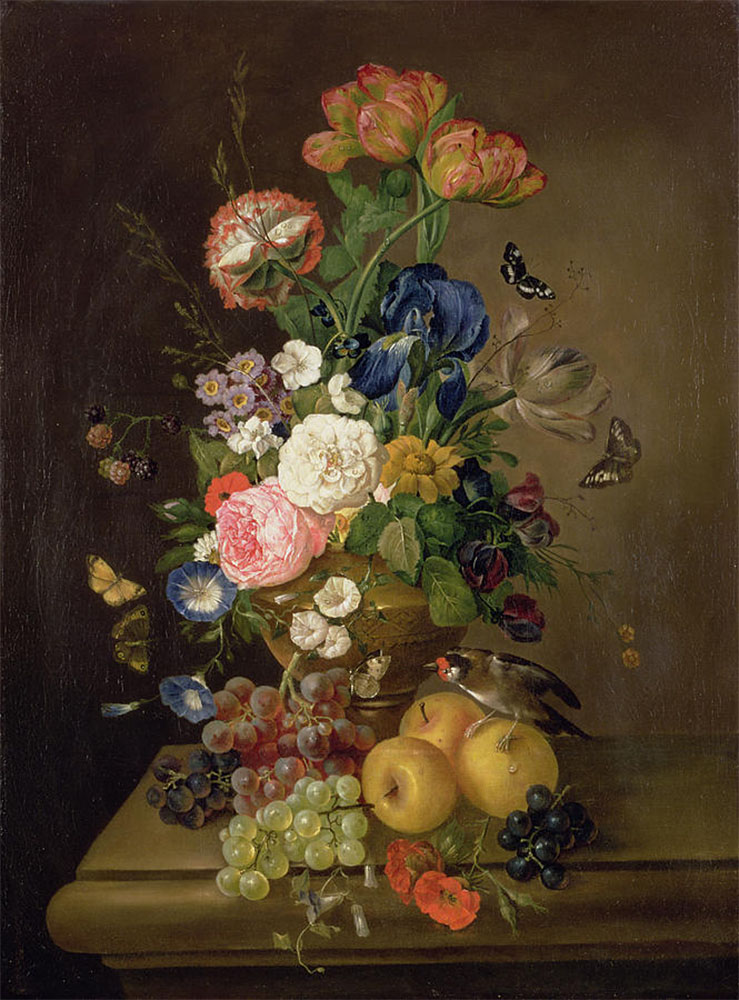
 

Mary Moser RA (English, 1744-1819) 'Vase of Flowers' Between 1758 and 1819


Mary Moser RA (English, 1744-1819)
Vase of Flowers
Between 1758 and 1819
Oil on canvas
72.1 x W 53.6cm
The Fitzwilliam Museum
Gift from Major the Hon. Henry Rogers Broughton, 1966


The exquisite attention to detail in her painting, with its beads of dew and butterflies on the wing, was perhaps nurtured by seeing her father’s work; as a goldsmith and medallion maker, this was also his talent. But the gorgeous sensuality – seen also in her approach to the nude figure – was entirely her own. She married, aged 53, but also had an affair with the estranged husband of another artist: Maria Hadfield Cosway (1759-1839).

Alicia Foster. “Blazing a trail: Britain’s first women artists deserve to be better known,” on the Art UK website 13 May 2024 [Online] Cited 03/09/2024


Installation view of the exhibition 'Now You See Us Women Artists in Britain 1520-1920' at Tate Britain showing Angelica Kauffman's 'Colouring' 1778-1780


Installation view of the exhibition Now You See Us Women Artists in Britain 1520-1920 at Tate Britain showing Angelica Kauffman’s Colouring 1778-1780 (below)
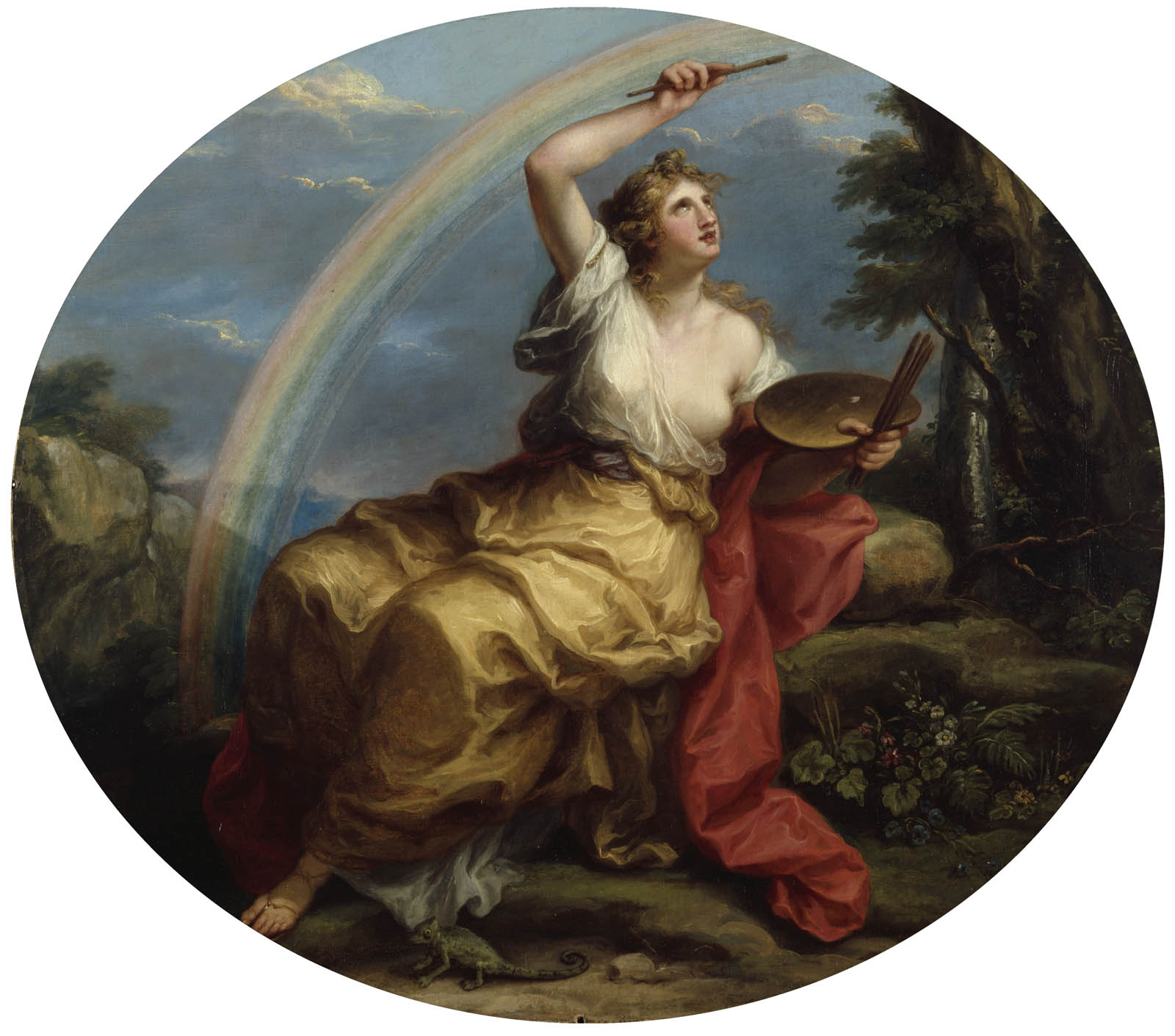
 

Angelica Kauffman RA (Swiss, 1741-1807) 'Colouring' 1778-1780


Angelica Kauffman RA (Swiss, 1741-1807)
Colouring
1778-1780
Oil on canvas
1260 x 1485 x 25 mm
© Royal Academy of Arts, London
Photo: John Hammond


This painting is part of a set of the four [titled ‘Elements of Art’] commissioned from Kauffman by the Royal Academy to decorate the ceiling of the Royal Academy’s new Council Room in Somerset House which opened in 1780. …

Kauffman represented each of her four Elements of Art as women. Female personifications of abstract concepts and values were commonplace in European art but depicting all four as women was unusual. Design (or Disegno), in particular, was known as ‘the father of all the arts’ and was traditionally depicted as a man, often in contrast to Colour or Painting personified as a woman (see Baumgartel). In Design and Colouring, the women are physically engaged in the act of creating whereas in Composition and Invention they are shown in contemplation. In Invention the figure looks to the sky for inspiration and in Composition she is deep in thought with her head resting on her hand in the traditional gesture of melancholy or reverie.

Text from the Royal Academy website


Installation view of the exhibition 'Now You See Us Women Artists in Britain 1520-1920' at Tate Britain showing at centre, Maria Cosway's 'Georgiana as Cynthia from Spenser's 'Faerie Queene'' 1781-1882; and at right, Cosway's 'A Persian Lady Worshipping the Rising Sun' 1784


Installation view of the exhibition Now You See Us Women Artists in Britain 1520-1920 at Tate Britain showing at centre, Maria Cosway’s Georgiana as Cynthia from Spenser’s ‘Faerie Queene’ 1781-1782 (below); and at right, Cosway’s A Persian Lady Worshipping the Rising Sun 1784 (below)
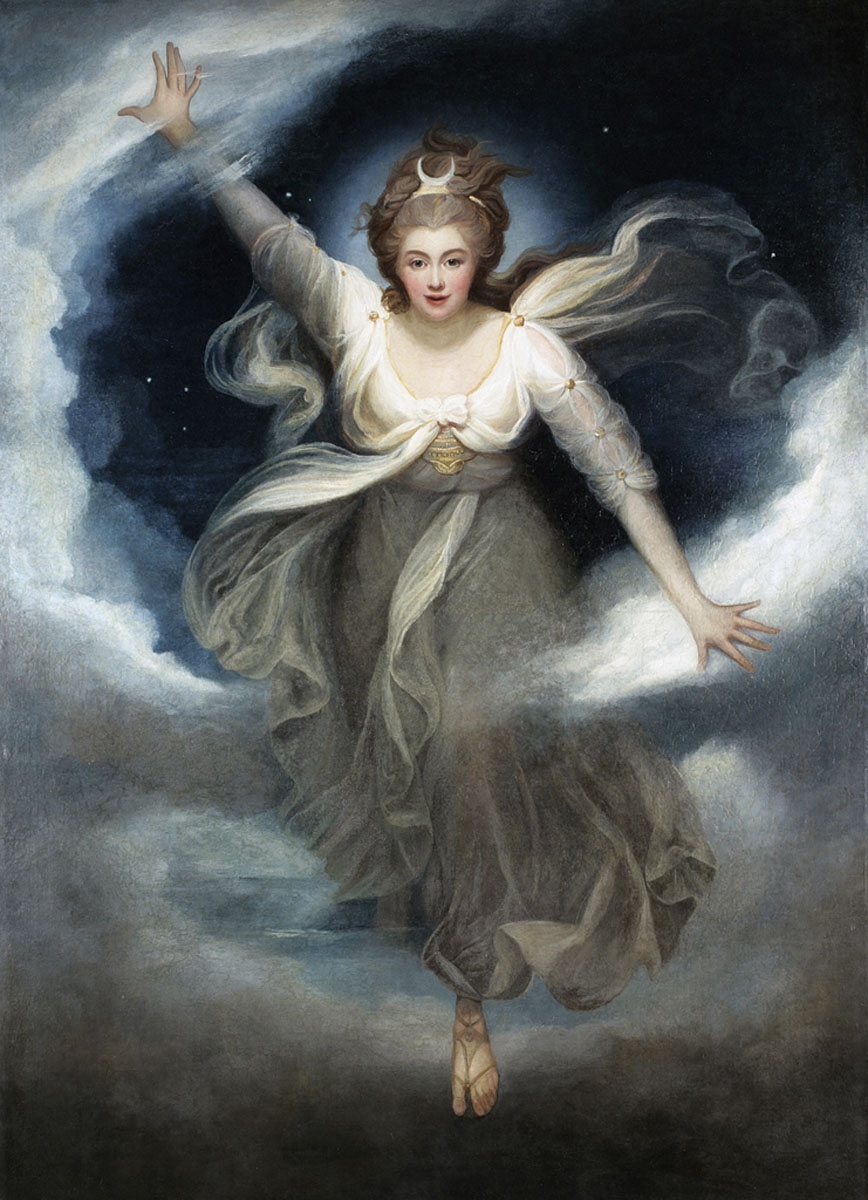
 

Maria Cosway (Italian-English 1760-1838) 'Georgiana as Cynthia from Spenser's 'Faerie Queene'' 1781-1782


Maria Cosway (Italian-English 1760-1838)
Georgiana as Cynthia from Spenser’s ‘Faerie Queene’
1781-1782
Oil on canvas
Chatsworth House
Reproduced by permission of Chatsworth Settlement Trustees / Bridgeman Images
Public domain
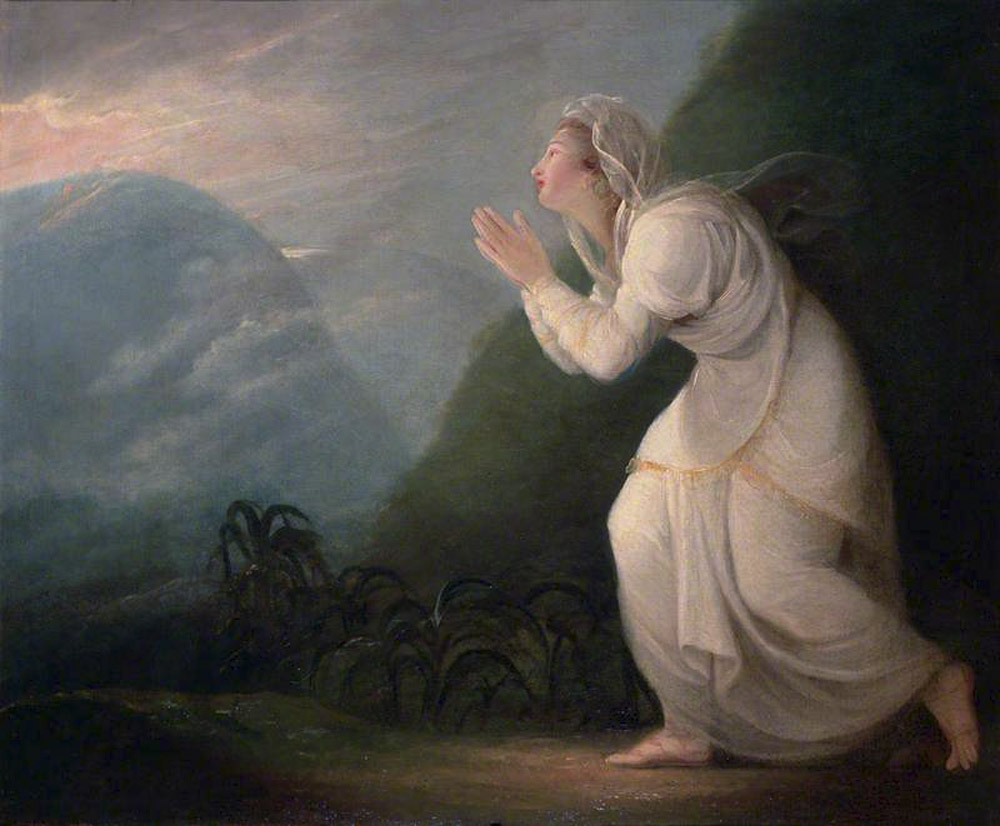
 

Maria Cosway (Italian-English 1760-1838) 'A Persian Lady Worshipping the Rising Sun' 1784


Maria Cosway (Italian-English 1760-1838)
A Persian Lady Worshipping the Rising Sun
1784
Oil on canvas
61 x 73.7cm
Sir John Soane’s Museum
Gift from the artist, 1822
By courtesy of the Trustees of Sir John Soane’s Museum, London
CC BY-NC-ND


As well as portraits, Cosway exhibited history paintings. This work was shown at the Royal Academy in 1784. Although only a few of Cosway’s history pictures can be located now, paintings such as this one were well known through reproductions made by leading engravers and print publishers. Cosway’s success was hindered by her husband, who did not like her to paint professionally. She reflected later that had he permitted it, she would have ‘made a better painter, but left to myself by degrees, instead of improving, I lost what I brought from Italy of my early studies.’

Text from the exhibition large print guide
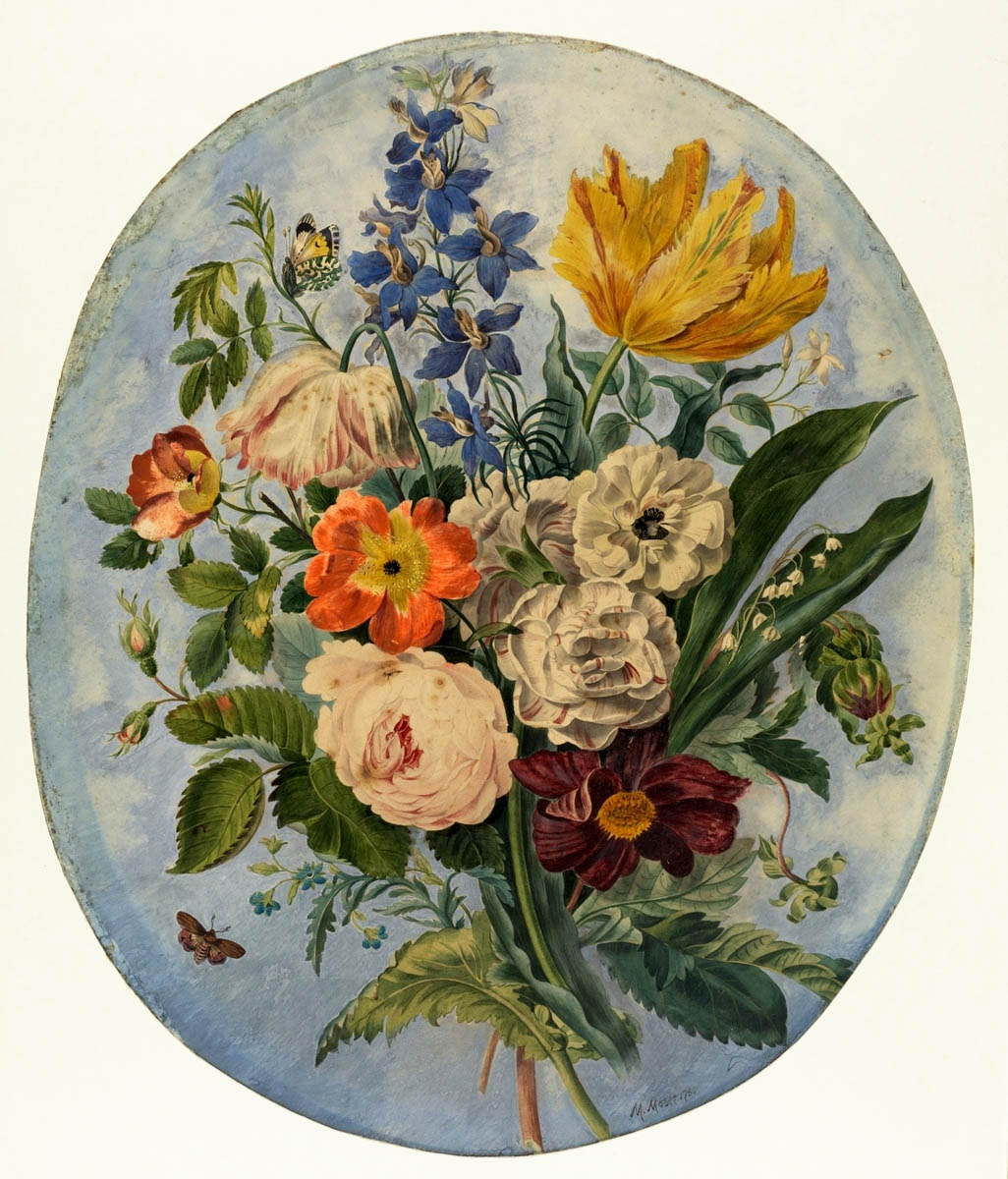
 

Maria Cosway (Italian-English 1760-1838) 'Bouquet of Flowers' 1780


Maria Cosway (Italian-English 1760-1838)
Bouquet of Flowers
1780
Watercolour on paper
The Courtauld, London (Samuel Courtauld Trust)
Bequeathed by Sir Robert Clermont Witt, 1952
CC BY-NC-ND
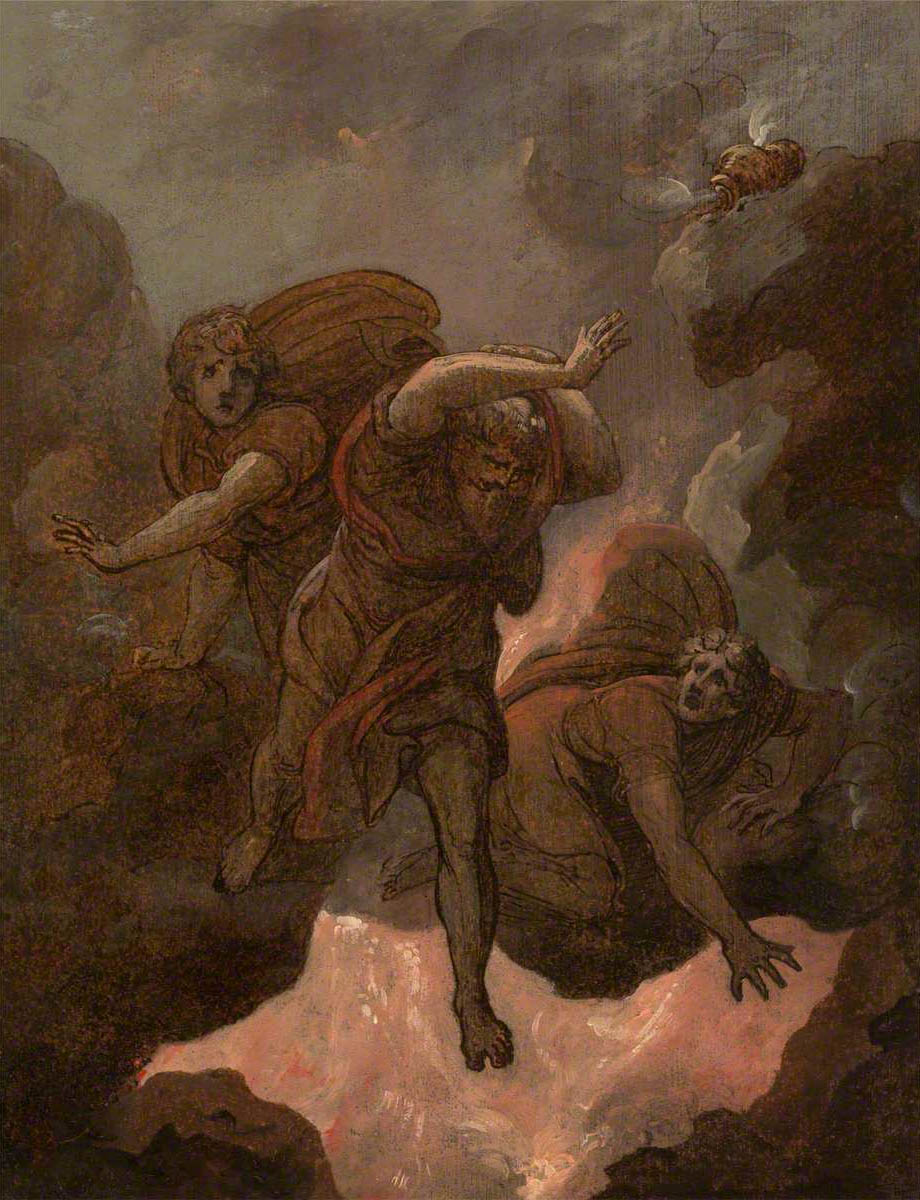
 

Maria Cosway (Italian-English 1760-1838) 'The Judgement of Korah, Dathan and Abiram' c. 1801


Maria Cosway (Italian-English 1760-1838)
The Judgement of Korah, Dathan and Abiram
c. 1801
Pen, ink and oil on canvas
37.5 x 29.2cm
Yale Center for British Art
Paul Mellon Collection
CC BY-NC-ND
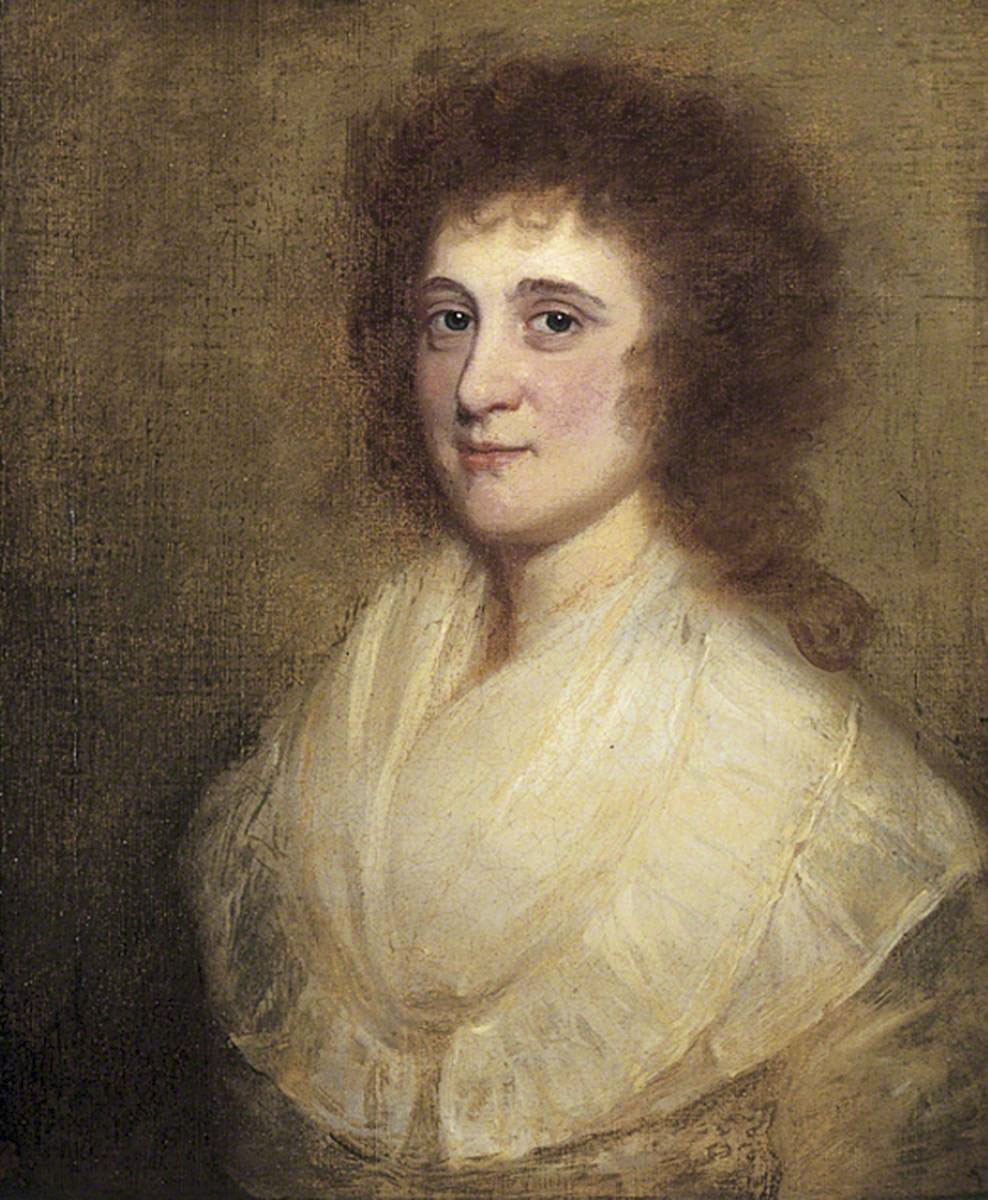
 

Maria Cosway (1759-1838) (after) 'Self Portrait' Nd


Maria Cosway (1759-1838) (after)
Self Portrait
Nd
Oil on canvas
61 x W 50.8cm
Temple Newsam House, Leeds Museums and Galleries
Bequeathed by Sam Wilson, 1925
CC BY-NC-ND
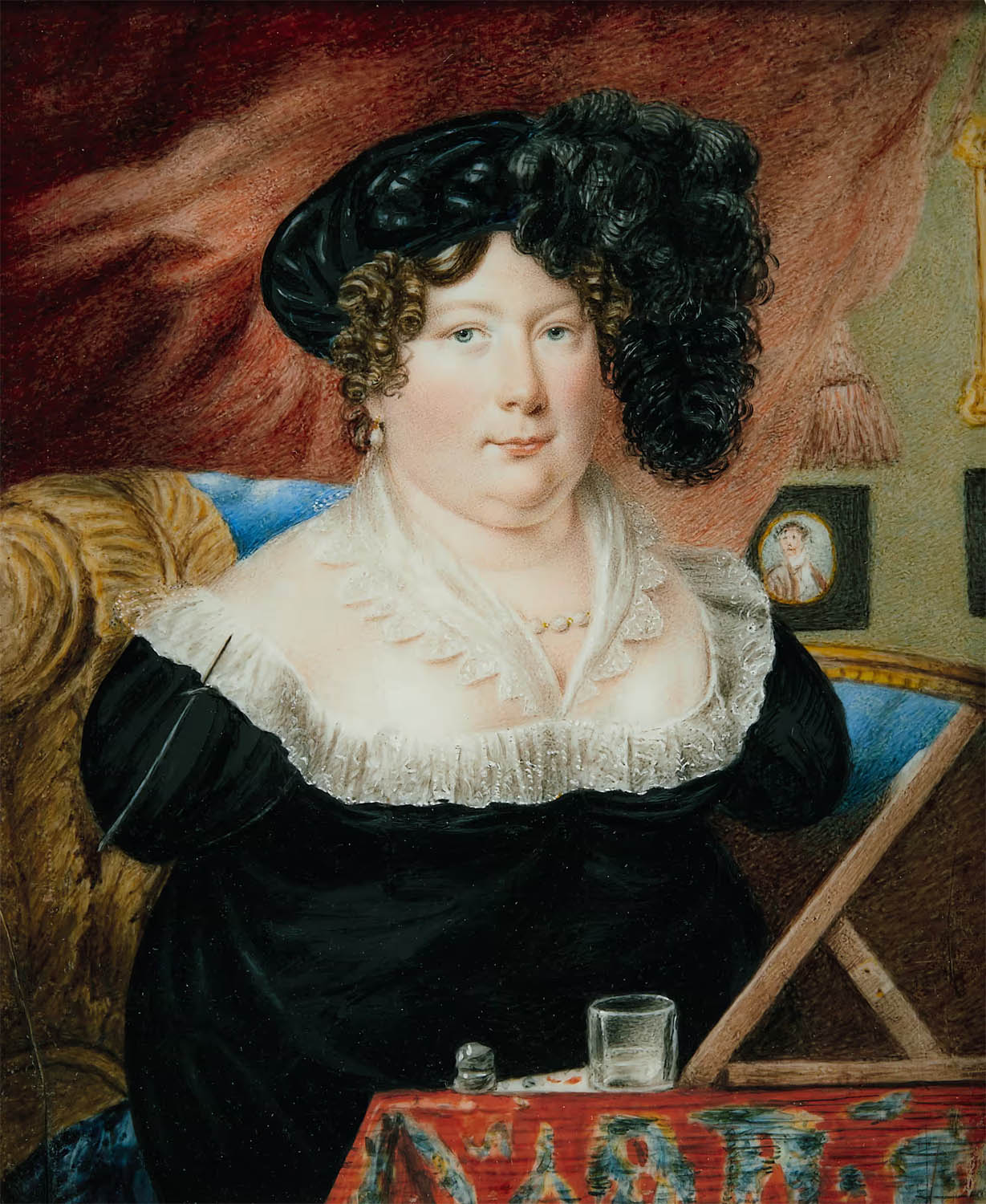
 

Sarah Biffin (English, 1784-1850) 'Self-portrait' c. 1821


Sarah Biffin (English, 1784-1850)
Self-portrait
c. 1821
Watercolour and bodycolour on ivory
Private collection


Biffin, whose baptism record notes that she was born ‘without arms or legs’, taught herself to sew, write and paint using her mouth and shoulder. She wrote that, as a child, ‘I was continually practising every invention; till at length I could, with my mouth – thread a needle – tie a knot – do fancy work – cut out and make my own dresses’.

Text from the exhibition large print guide
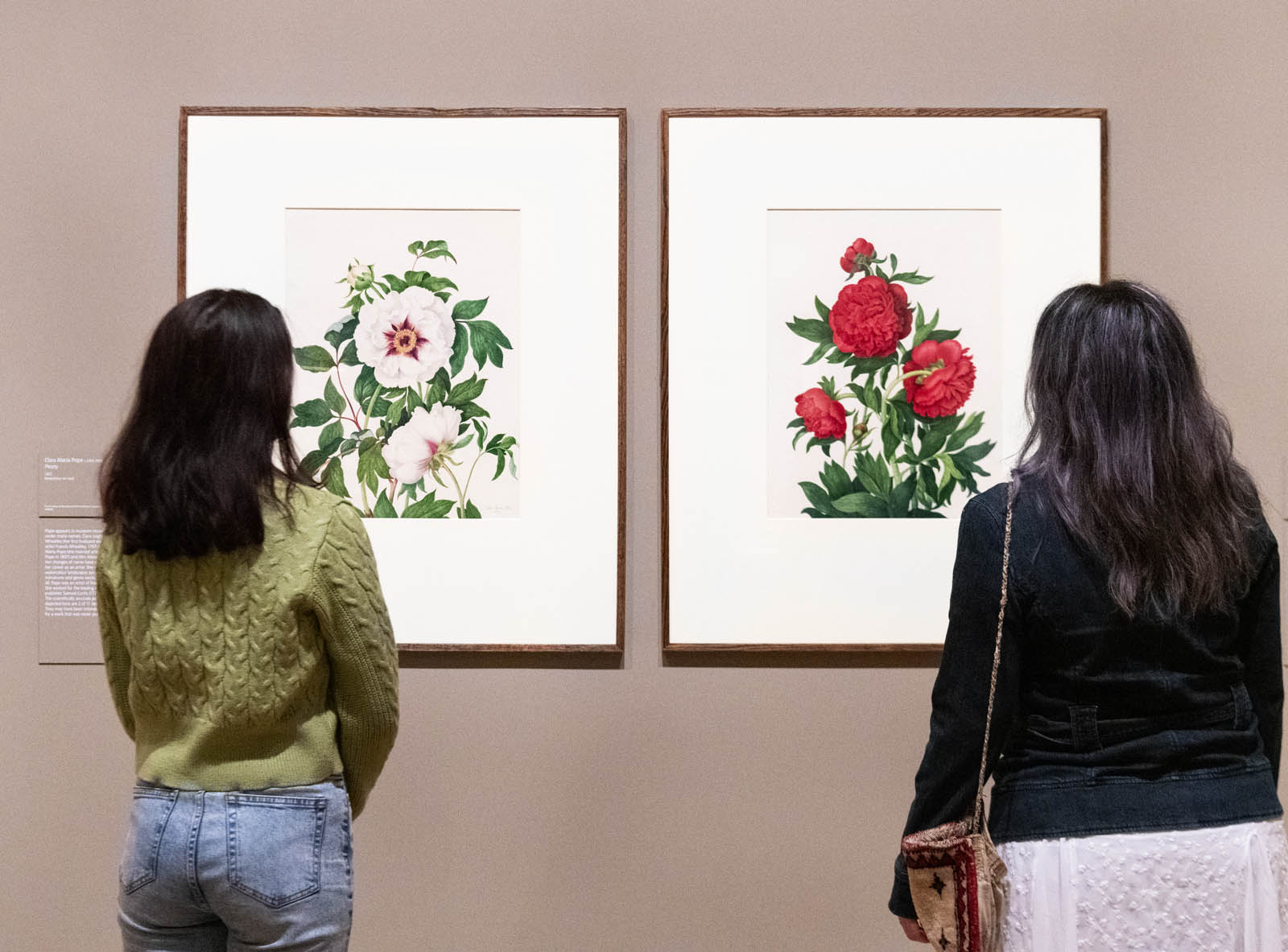
 

Installation view of the exhibition 'Now You See Us Women Artists in Britain 1520-1920' at Tate Britain showing at left, Clara Maria Pope's 'Peony' 1822; and at right, Pope's 'Peony' 1821


Installation view of the exhibition Now You See Us Women Artists in Britain 1520-1920 at Tate Britain showing at left, Clara Maria Pope’s Peony 1822 (below); and at right, Pope’s Peony 1821 (below)
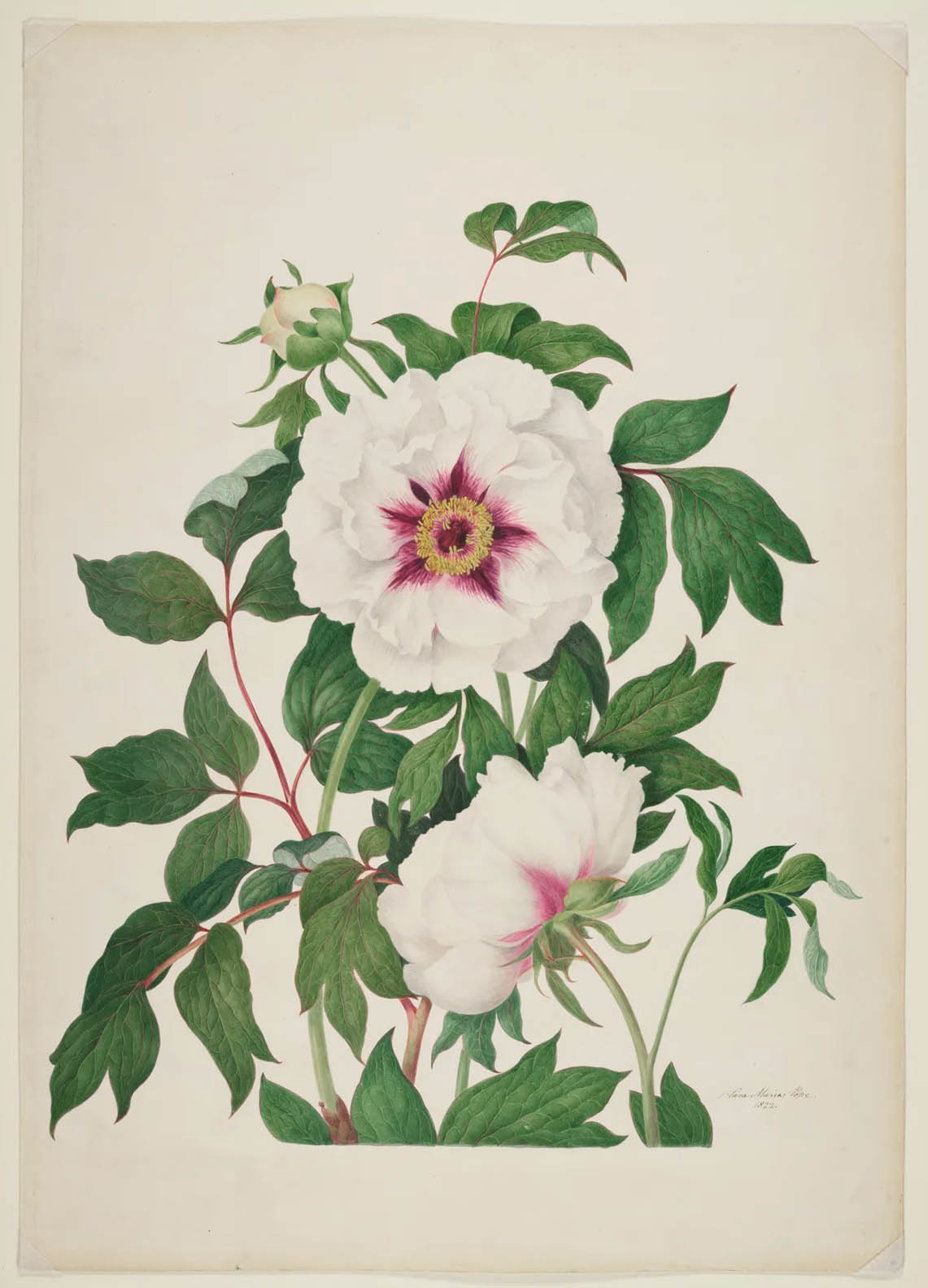
 

Clara Maria Pope (British, 1767-1831) 'Peony' 1822


Clara Maria Pope (British, 1767-1831)
Peony
1822
Bodycolour on card
The Trustees of the Natural History Museum, London
Courtesy the Natural History Museum
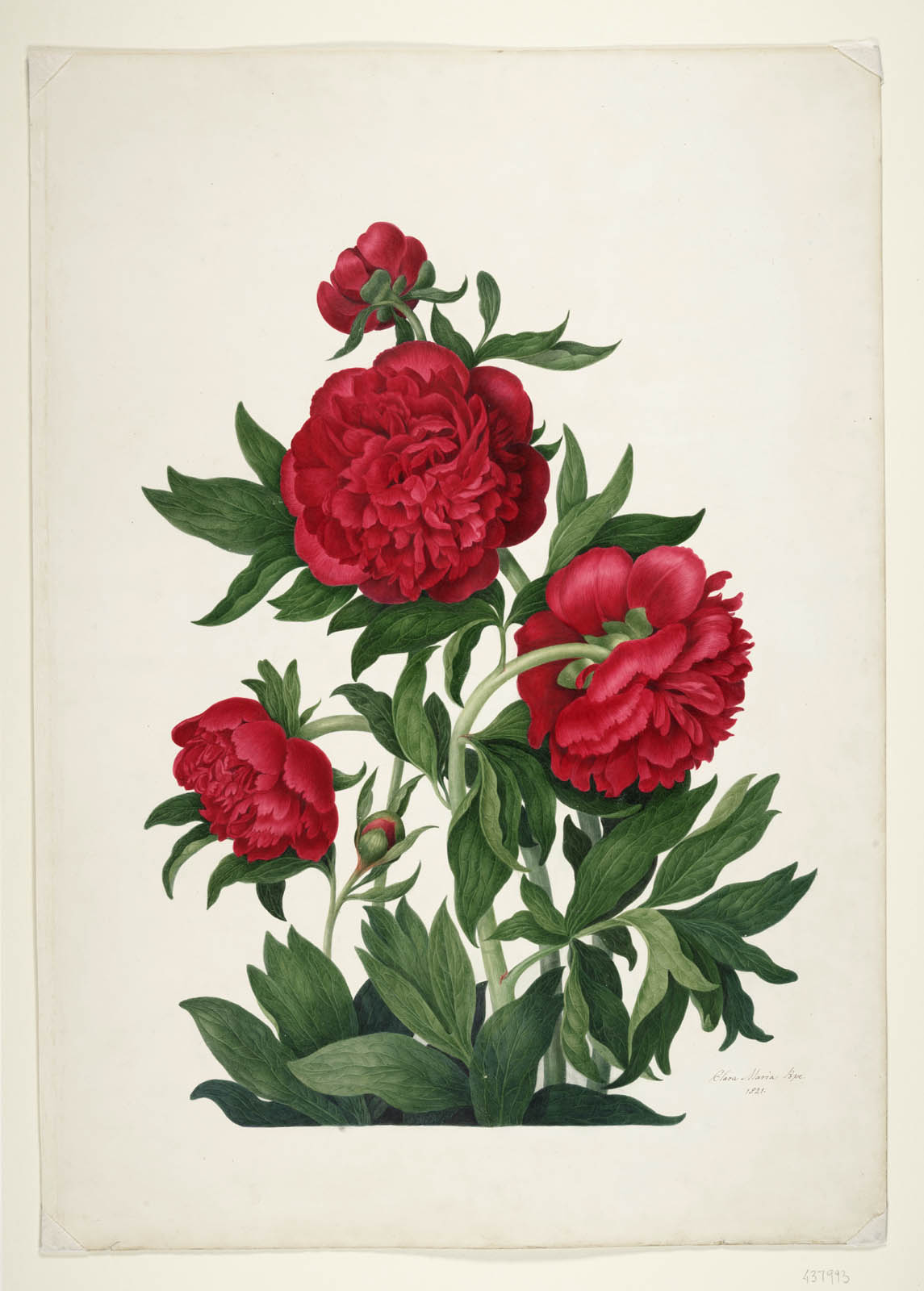
 

Clara Maria Pope (British, 1767-1831) 'Peony' 1821


Clara Maria Pope (British, 1767-1831)
Peony
1821
Bodycolour on card
The Trustees of the Natural History Museum, London
Courtesy the Natural History Museum


Pope appears in museum records under many names: Clara Leigh, Clara Wheatley (her first husband was the artist Francis Wheatley, 1747-1801), Clara Maria Pope (she married actor Alexander Pope in 1807) and Mrs Alexander Pope. Her changes of name have obscured her career as an artist. She exhibited watercolour landscapes and portraits, miniatures and genre works, but above all, Pope was an artist of flowers. She worked for the leading botanical publisher Samuel Curtis (1779-1860). The scientifically accurate peonies depicted here are 2 of 11 designs. They may have been intended as plates for a work that was never published.

Text from the exhibition large print guide
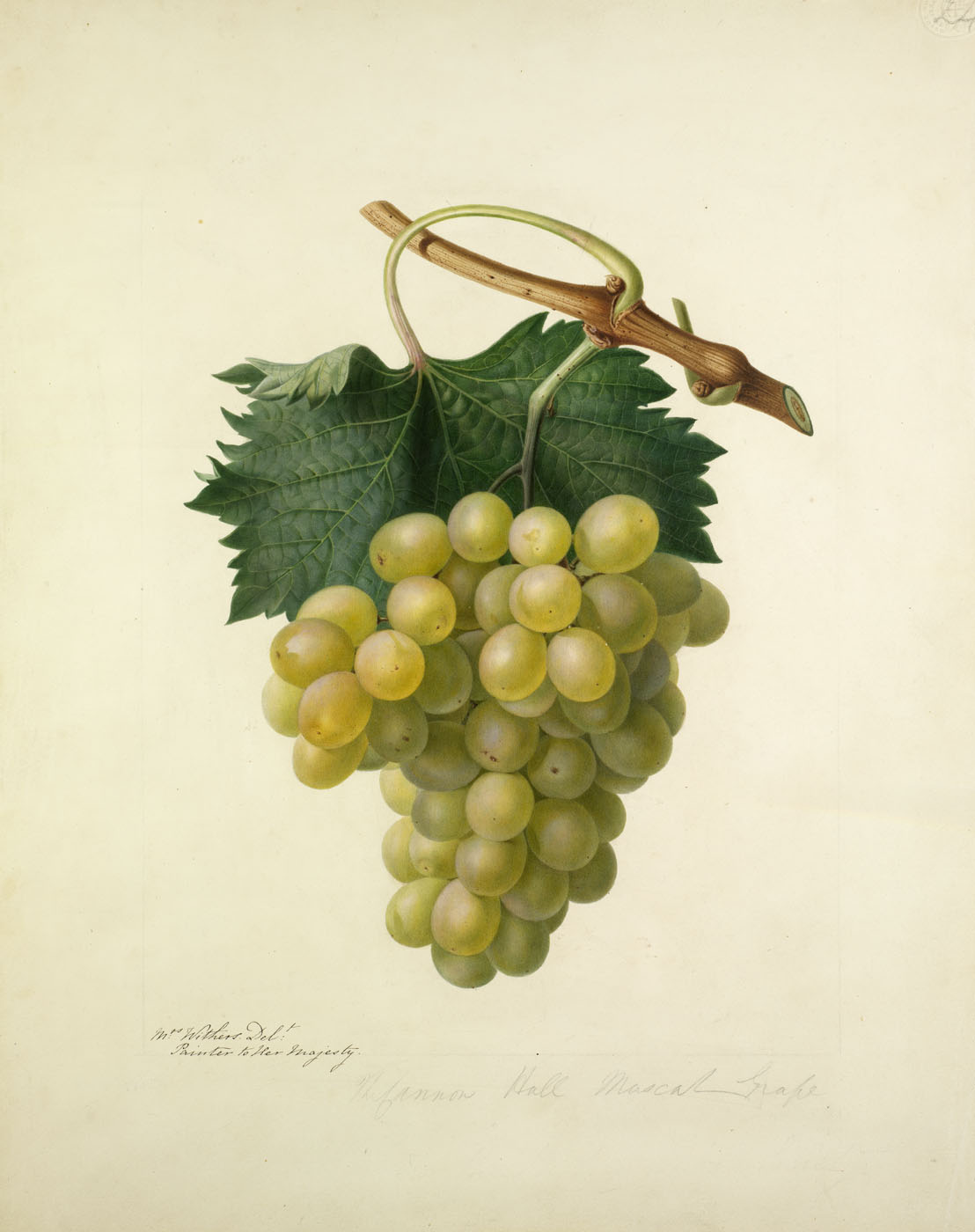
 

Augusta Innes Withers (English, 1792-1877) 'The Canon Hall Muscat Grape' c. 1825


Augusta Innes Withers (English, 1792-1877)
The Canon Hall Muscat Grape
c. 1825
Watercolour on paper
444 × 352 mm
RHS Lindley Collections
Courtesy the Royal Horticultural Society, Lindley Library


Withers was employed by the Horticultural Society to make official ‘portraits’ of varieties of fruit growing in their orchards. The quality of Withers’s work meant her high fees were not questioned. Here, she paints sunlight glowing through grapes and the translucency of the skin of gooseberries in great detail. Withers drew and handcoloured engraved illustrations in the Horticultural Society’s Transactions and made illustrations of fruit for John Lindley’s Pomological Magazine in 1828 (Lindley was Secretary of the Society). Withers was also regarded as one of the best teachers of botanical illustration.

Text from the exhibition large print guide
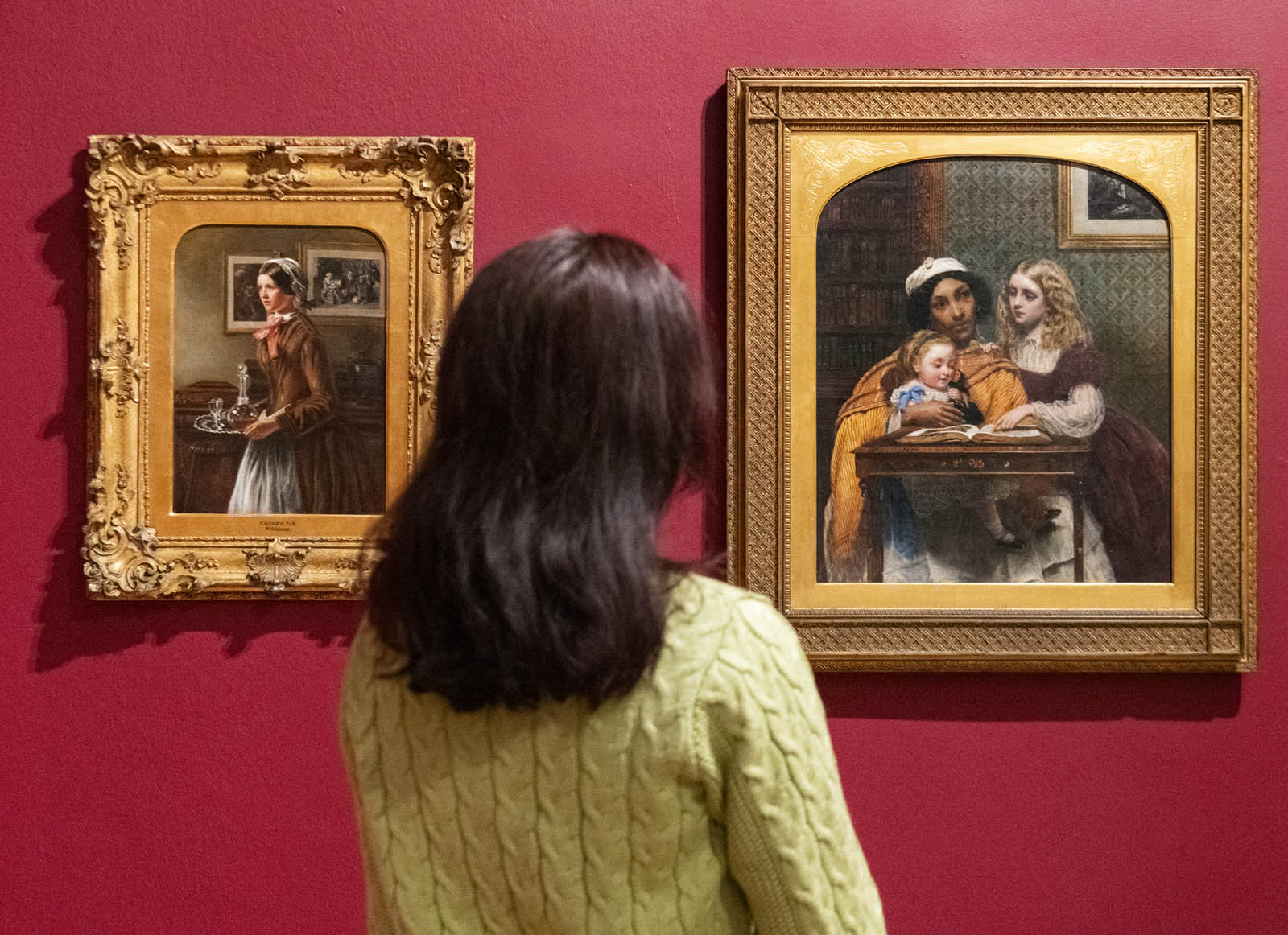
 

Installation view of the exhibition 'Now You See Us Women Artists in Britain 1520-1920' at Tate Britain showing at left, Rebecca Solomon's 'Sherry, Sir?' c. 1858-1862; and at right, Solomon's 'A Young Teacher' 1861


Installation view of the exhibition Now You See Us Women Artists in Britain 1520-1920 at Tate Britain showing at left, Rebecca Solomon’s Sherry, Sir?
c. 1858-1862 (below); and at right, Solomon’s A Young Teacher 1861 (below)
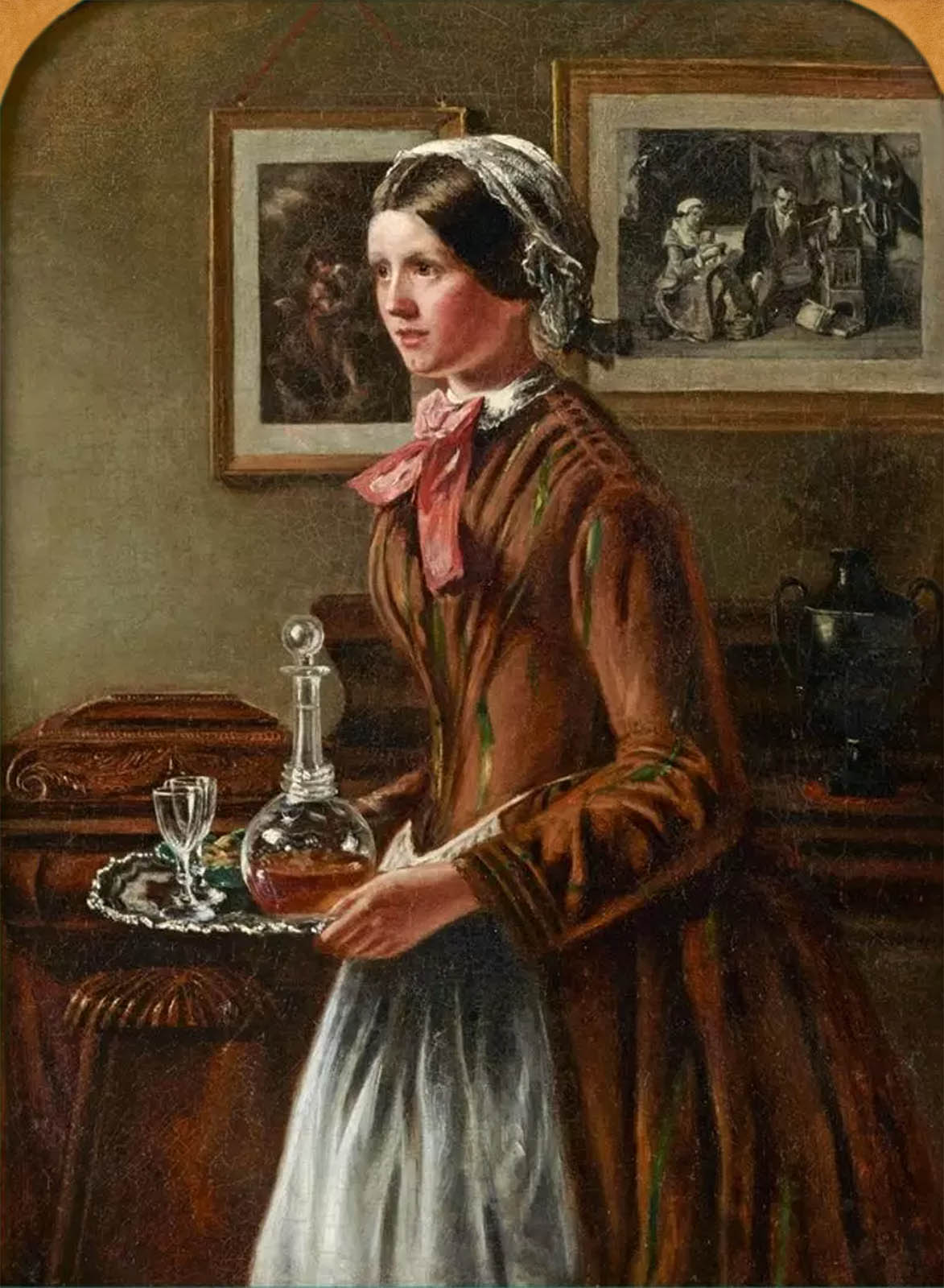
 

Rebecca Solomon (English, 1832-1886) 'Sherry, Sir?' c. 1858-1862


Rebecca Solomon (English, 1832-1886)
Sherry, Sir?
c. 1858-1862
Oil on canvas
Private collection


Solomon often painted scenes of domestic life and interiors, which were considered more suitable subjects for women artists than history painting. Solomon’s domestic scenes include subtle commentary on social hierarchies. Sherry, Sir? depicts a maid with a silver tray. It reprises a well-known painting of the same title, painted by William Powell Frith (1819-1909) in 1851, but unlike Frith’s painting, Solomon draws attention to domestic labour and the hierarchies of a middle-class home. Solomon was the sister of artists Abraham Solomon (1823-1862) and Simeon Solomon (1840-1905).

Text from the exhibition large print guide


Rebecca Solomon (London 26 September 1832 – 20 November 1886 London) was a 19th-century English Pre-Raphaelite draftsman, illustrator, engraver, and painter of social injustices. She is the second of three children who all became artists, in a prominent Jewish family. …

Solomon’s artistic style was typical of popular 19th-century painting at the time and falls under the category of genre painting. She used her visual images to critique ethnic, gender and class prejudice in Victorian England. When Solomon started painting genre scenes, her work demonstrated an observant eye for class, ethnic and gender discrimination. Solomon’s paintings reflect a combination of interest in the theatre and commitment to social consciousness that is not exist in other artist’s painting in the nineteenth century.

Text from the Wikipedia website


Solomon painted in a more equivocal manner… She [the subject of the painting] is equally attractive and demure, but, by being painted from the side and against the background of a middle-class interior, the viewer is invited to reflect on her social status.

This is framed in a genre painting and by no means a piece with pretensions to social realism, but Solomon seems to be underlining the definite restrictions on this young woman’s position in society.

The pictures hanging behind her may contribute to that interpretation of the artist. They are not yet identified, but it seems that on the left we are shown an allegorical subject later than Gainsborough or Reynolds, depicting a young peasant boy or young peasant girl holding a dog in a landscape. On the right, a more specific engraving of a genre painting from Solomon’s own time showing what appears to be an itinerant family of street vendors. By placing his servant girl between these two paintings, Solomon seems to be asking us to compare.

José Luis Jiménez García. “La otra versión de la ‘Sherry Girl’,” on the Diario de Jerez website 07 June 2023 [Online] Cited 28/08/2024 Translated from the Spanish by Google Translate
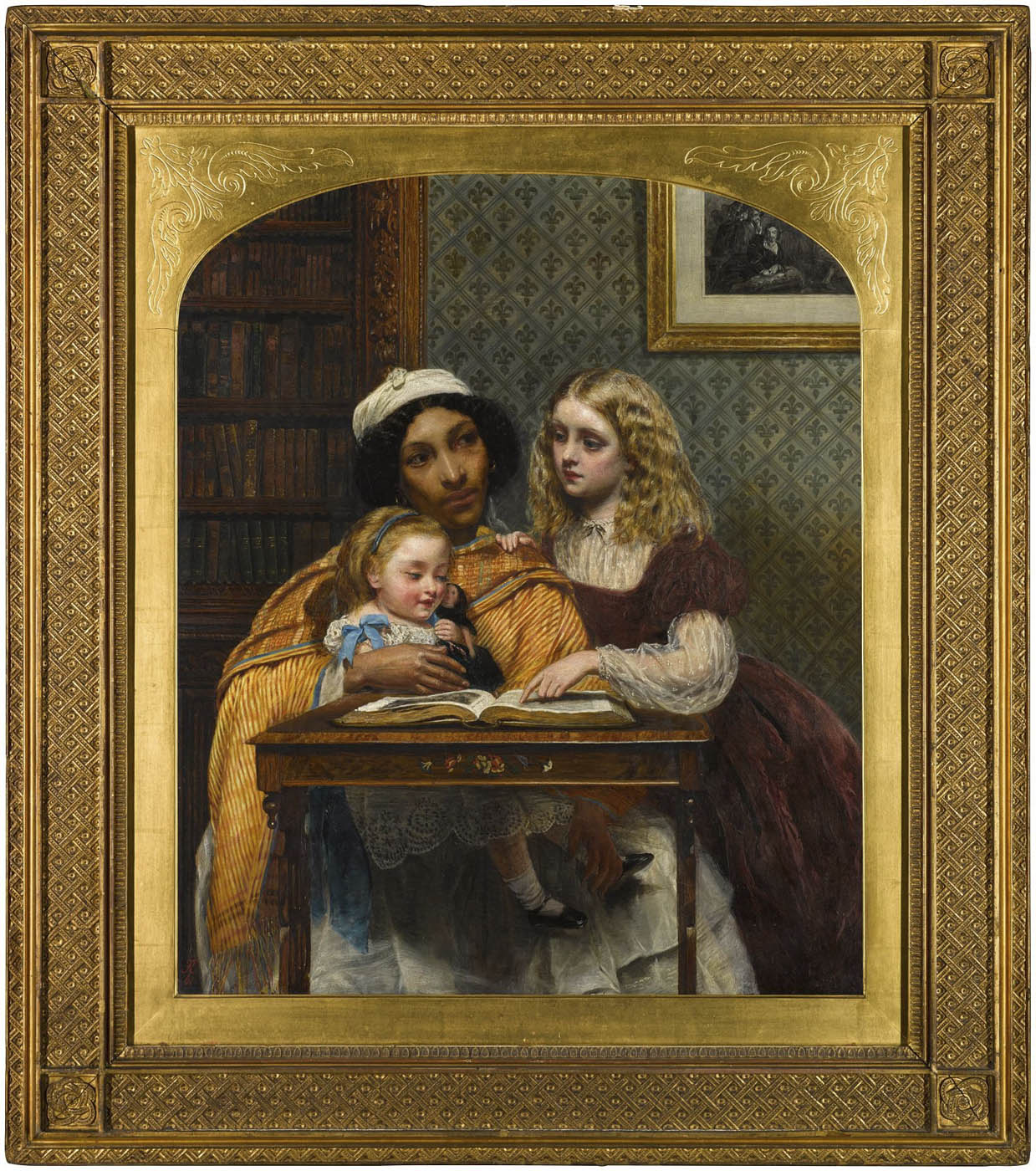
 

Rebecca Solomon (English, 1832-1886) 'A Young Teacher' 1861


Rebecca Solomon (English, 1832-1886)
A Young Teacher
1861
Oil on canvas
61 by 51cm
Tate and the Museum of the Home


Rebecca Solomon’s painting is a complex reflection on gender, race, religion and education in mid-nineteenth century London. As with many of her works, it considers women who worked in better-off households as professional carers. In A Young Teacher, Solomon modifies a traditional domestic scene between mother and child, with the surrounding books stressing the theme of learning. The woman at the centre of the image was modelled by Jamaican-born Fanny Eaton, who became a prominent muse for many Victorian artists and featured in some of the most iconic paintings of the Pre-Raphaelite period. …

Believed to be the first Jewish woman to become a professional artist in England, Rebecca Solomon’s work shone a light on inequality and prejudice at a time when these subjects were far from mainstream. She was active in social reform movements, including as part of a group of 38 artists who petitioned the Royal Academy of Arts to open its schools to women.

Text from the Tate website
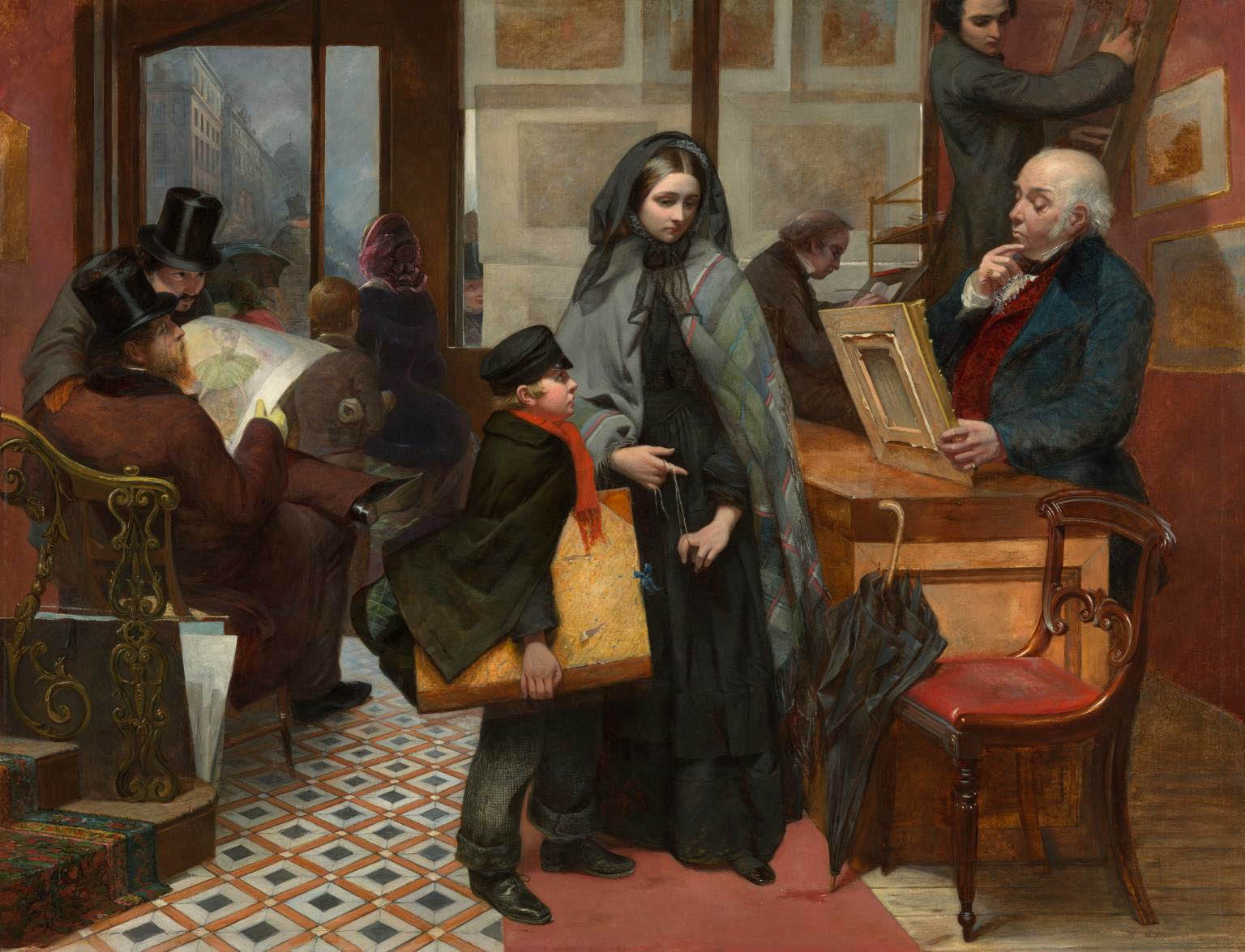
 

Emily Osborn (English, 1828-1925) 'Nameless and Friendless. "The rich man's wealth is his strong city: the destruction of the poor is their poverty (Proverbs: 10:15)' 1857


Emily Osborn (English, 1828-1925)
Nameless and Friendless.
“The rich man’s wealth is his strong city: the destruction of the poor is their poverty” (Proverbs: 10:15)
1857
Oil on canvas
Support: 825 × 1038 mm
Frame: 1042 × 1258 × 75 mm
Tate
Purchased with assistance from Tate Members, the Millwood Legacy and a private donor 2009
Creative Commons CC BY-NC-ND 4.0 DEED


Osborn exhibited widely and was supported by wealthy patrons. She was also part of the ‘rights of woman’ debate, campaigning for more public roles for women. Nameless and Friendless, exhibited at the Royal Academy in 1857, dramatises the difficulties faced by women artists. Osborn shows a young woman offering a painting to a sceptical dealer. With no reputation (‘Nameless’) and no connections (‘Friendless’), she has little chance of a sale. Behind her, two leering men emphasise the impression of her isolation and vulnerability.

Text from the exhibition large print guide


Installation view of the exhibition 'Now You See Us Women Artists in Britain 1520-1920' at Tate Britain showing Emily Mary Osborn's 'Barbara Bodichon (1827-1891)' Nd (below)


Installation view of the exhibition Now You See Us Women Artists in Britain 1520-1920 at Tate Britain showing Emily Mary Osborn’s Barbara Bodichon (1827-1891) Nd (below)
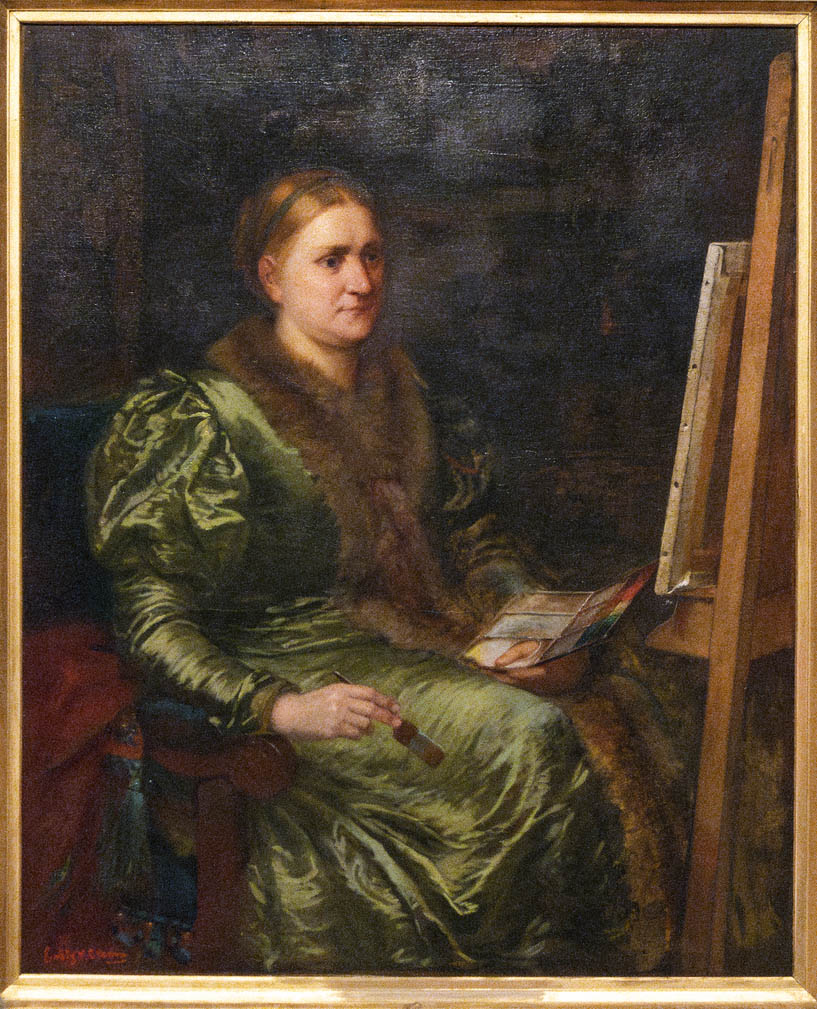
 

Emily Mary Osborn (1828-1925) 'Barbara Bodichon (1827-1891)' Nd (installation view)


Emily Mary Osborn (1828-1925)
Barbara Bodichon (1827-1891) (installation view)
Nd
Oil on canvas
120 x 97cm
Girton College, University of Cambridge


Martha Darley Mutrie (British, 1824-1885) 'Wild Flowers at the Corner of a Cornfield' 1855-1860


Martha Darley Mutrie (British, 1824-1885)
Wild Flowers at the Corner of a Cornfield
1855-1860
Oil on canvas
Support: 821 × 632 mm
Frame: 958 × 781 × 65 mm
Photo: Tate (Seraphina Neville)


Martha Darley Mutrie is considered one of the leading painters of flowers active in Britain in the nineteenth century. She was born in Ardwick, near Manchester. She trained together with her sister, the painter Annie Feray Mutrie (1826-1893), under George Wallis (1811-1891) at the Manchester School of Design from 1844 to 1846, and also undertook private lessons with him. The sisters began exhibiting at the Royal Manchester Institution from 1845 and at the Royal Academy, London, showing there consistently from the early 1850s. Their work was regularly well received by the critics. Mutrie and her sister moved to London in 1854, where they painted flowers in interior settings, carefully arranged, and also outdoors in mock natural settings.

Despite the prominence of women artists painting still lifes and flowers, the men practitioners of the genre, such as George Lance (1802-1864) and William Henry ‘Birds Nest’ Hunt (1790-1864), received greater critical and institutional attention. Martha and Annie Mutrie achieved success that was otherwise rare for women working as artists at the time.

The art critic John Ruskin admired both artists’ work and wrote about one of Annie’s pictures in his review of the 1855 Royal Academy exhibition. In his review Ruskin suggested that she abandon artificial compositions and paint instead ‘some banks of flowers in wild country, just as they grow’ (John Ruskin, Notes on Some of the Principal Pictures Exhibited at the Royal Academy, London, 1855). This painting might be seen as a response to Ruskin’s insight and the advances in science that in the 1850s brought a new focus to the study of nature, with arguments over beauty and truth.

Text from the Tate website
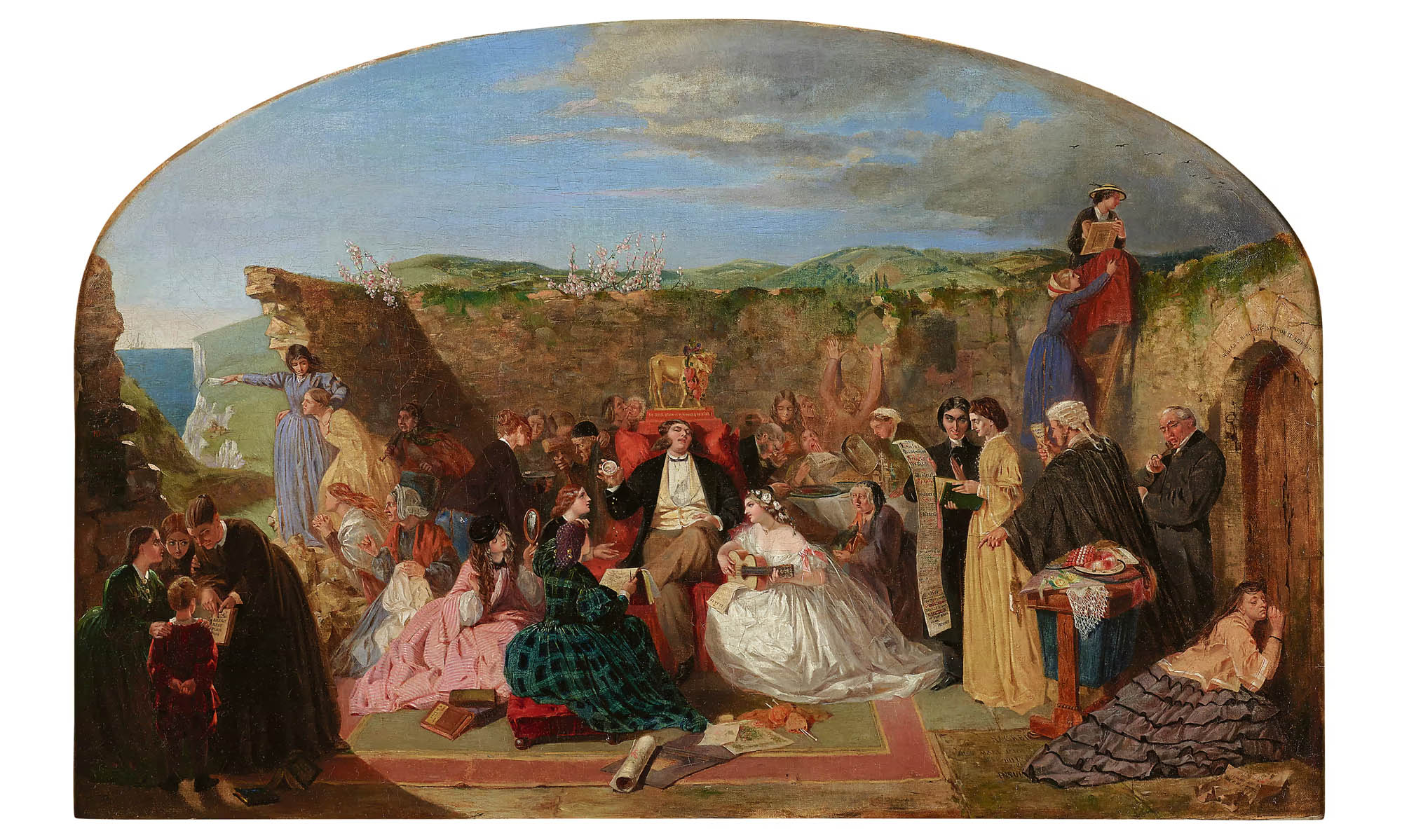
 

Florence Claxton (British, 1838-1920) ''Woman's Work': A Medley' 1861


Florence Claxton (British, 1838-1920)
‘Woman’s Work’: A Medley
1861
Oil on canvas
Martin Beisly Fine Art, London


In the 1850s, Claxton became part of the UK’s first organised movement for women’s rights. Woman’s Work satirises women’s opportunities for professional employment. At its centre a group of women fawn at the feet of a man seated below a statue of the Golden Calf – a false idol. Confined by
a surrounding wall, doors to professions such as medicine are shut to the women. Only the artist Rosa Bonheur has managed to scale the wall’s heights. The painting was exhibited at London’s National Institution for Fine Arts in 1861 and received mixed reviews. Some praised its comic strength but others described it as ‘vulgar’.

Text from the exhibition large print guide
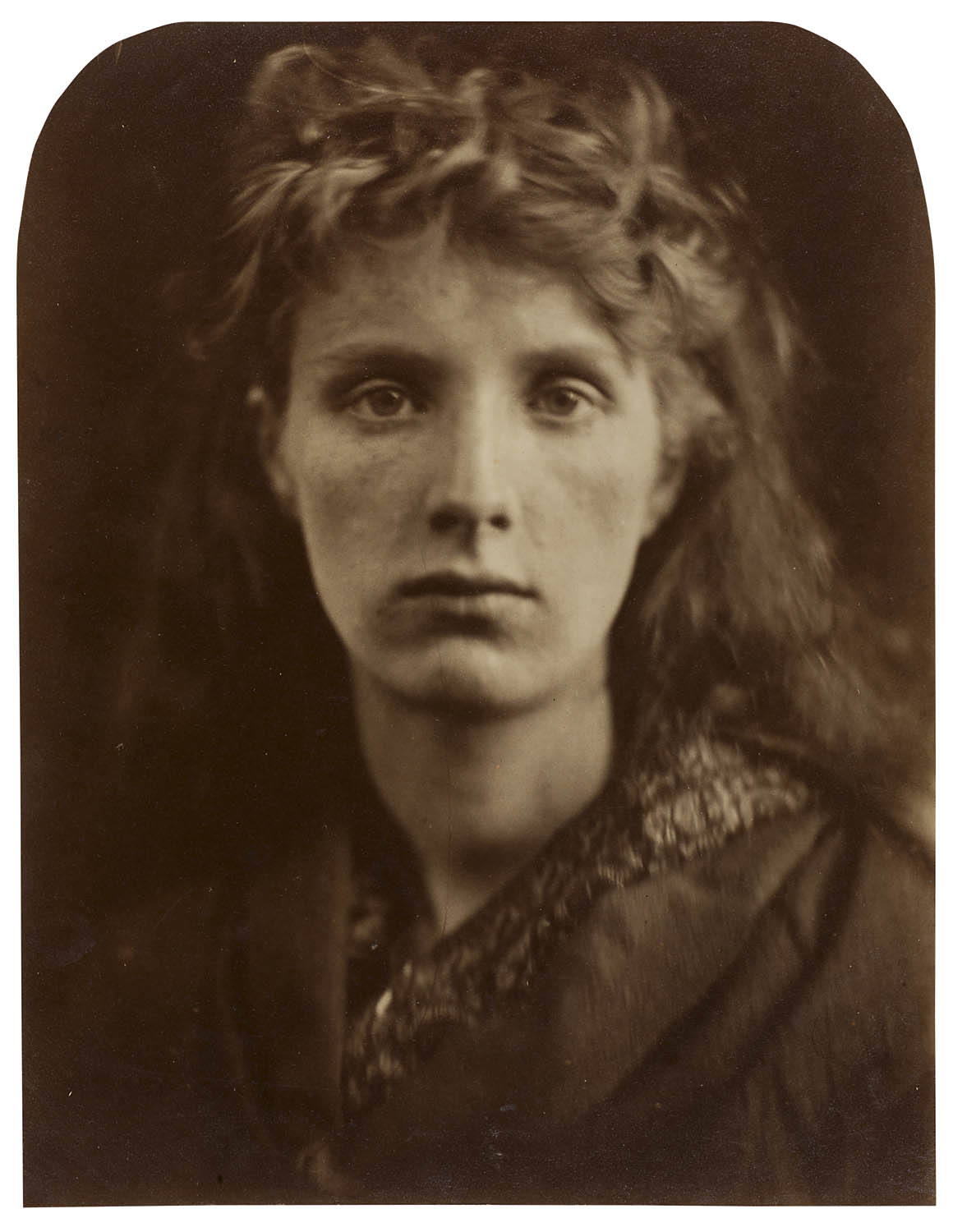
 

Julia Margaret Cameron (British born India, 1815-1879) 'Mountain Nymph, Sweet Liberty' 1865


Julia Margaret Cameron (British born India, 1815-1879)
Mountain Nymph, Sweet Liberty
1865
Albumen print
Wilson Centre of Photography


Annie Keene (1842/3-1901) was an artist’s model at the Royal Academy Schools. Cameron showed Keene’s portrait at the 1866 Hampshire and Isle of Wight Loan Exhibition, and it was for sale at her 1868 exhibition at London’s German Gallery. In this photograph, Cameron’s shallow depth-of-field gives a bold effect. Her friend, the scientist and photographic innovator John Herschel (1792-1871), praised the portrait as ‘a most astonishing piece of high relief – She is absolutely alive and thrusting out her head from the paper into the air’.

Text from the exhibition large print guide
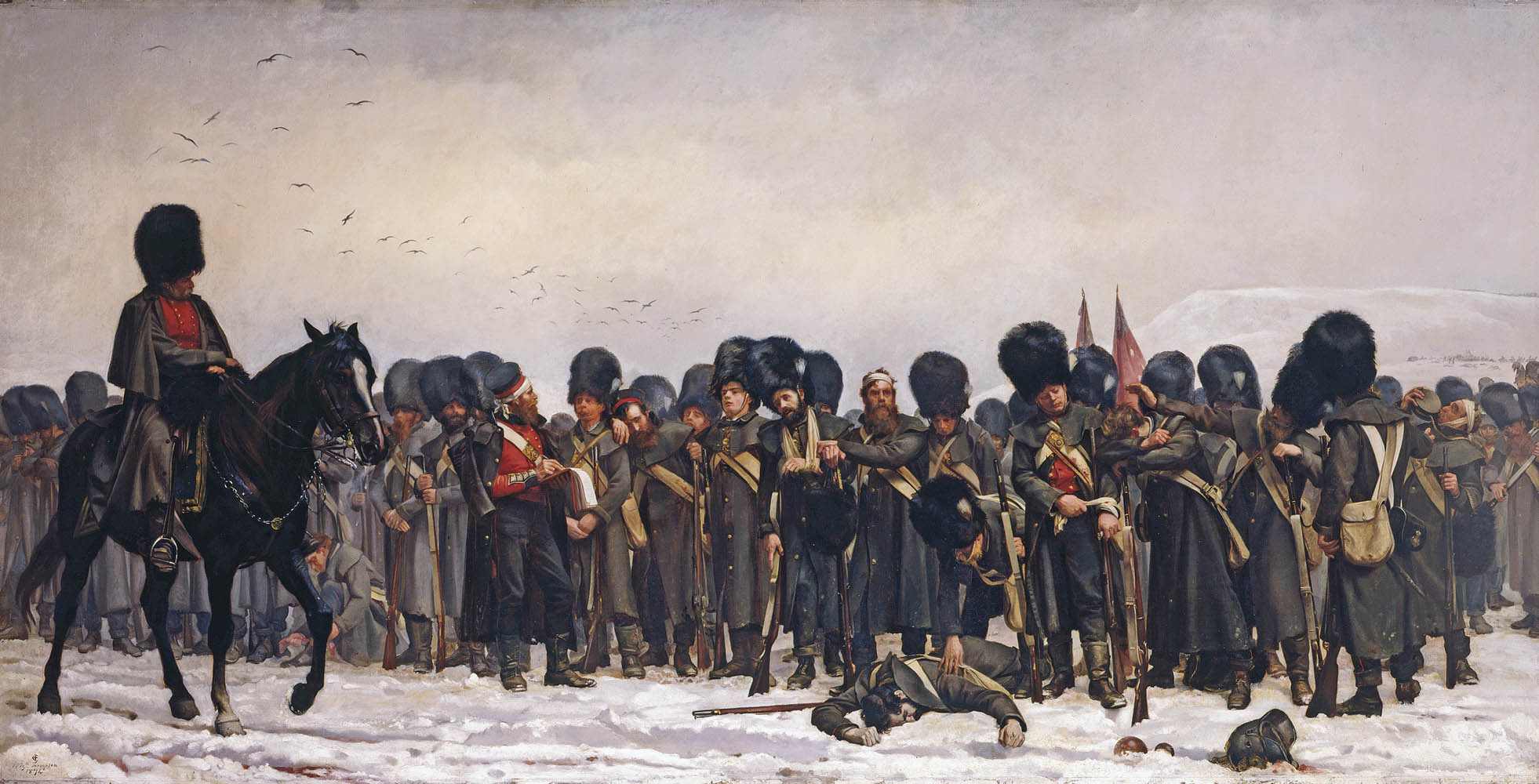
 

Elizabeth Butler (British, 1846-1933) 'The Roll Call' 1874


Elizabeth Butler (British, 1846-1933)
The Roll Call
1874
Oil on canvas
93.3 x 183.5cm (support, canvas/panel/stretcher external)
Royal Collection Trust
© Royal Collection Trust / His Majesty King Charles III 2024


Butler specialised in battle paintings, challenging society’s expectations of women artists. The exhibition of The Roll Call at the Royal Academy in 1874 was one of the greatest art sensations of the nineteenth century. It was praised by Academicians and hung ‘on the line’ (the most prestigious, eye-level position). The painting proved so popular with the public that a policeman had to be stationed nearby to protect the adjacent paintings. Queen Victoria summoned the work to Buckingham Palace for a private viewing, and the copyright sold for the enormous sum of £1,200.

Text from the exhibition large print guide


The Roll Call captured the imagination of the country when exhibited at the Royal Academy in 1874, turning the artist into a national celebrity. So popular was the painting that a policeman had to be stationed before it to hold back the crowds and it went on to tour the country in triumph. The painting’s focus on the endurance and bravery of ordinary soldiers without reference to the commanders of the army accorded with the mood of the times and the increasing awareness of the need for social and military reforms.

Though the public had been exposed to other images of the Crimean War, primarily prints, photographs and newspaper illustrations, never before had the plight of ordinary soldiers been portrayed with such realism. Butler researched her subject by studying A. W. Kinglake’s seminal history of the Crimean War, as well as by consulting veterans of the Crimea, several of whom served as models for the painting. She also painstakingly sought out uniforms and equipment from the Crimean period in order to be correct in the smallest military details. The sombre mood and simple yet dramatic composition Butler achieved in The Roll Call vividly epitomised the grimness not only of the Crimean War but of all wars.

Text from the Royal Collection Trust website


Installation view of the exhibition 'Now You See Us Women Artists in Britain 1520-1920' at Tate Britain showing at left, Louise Jopling's 'Through the Looking-Glass' 1875; and at right, Jopling's 'A Modern Cinderella' 1875


Installation view of the exhibition Now You See Us Women Artists in Britain 1520-1920 at Tate Britain showing at left, Louise Jopling’s Through the Looking-Glass 1875 (below); and at right, Jopling’s A Modern Cinderella 1875 (below)


Louise Jopling (English, 1843-1933) 'Through the Looking-Glass' 1875


Louise Jopling (English, 1843-1933)
Through the Looking-Glass
1875
Oil paint on canvas
Support: 539 × 437 mm
Tate
Purchased with funds provided by the Nicholas Themans Trust and Tate Patrons 2024
Photo: Tate (Sonal Bakrania)


This is a self-portrait Jopling made while pregnant with her son, Lindsay, in 1875.

Jopling was one of the most successful and best-known women artists of the late nineteenth century. She exhibited regularly and, from the 1880s, ran her own art school for women. Jopling hosted receptions and established connections with many artists and art dealers. She carefully planned the exhibition of her work by choosing venues appropriate to each painting’s scale and ambition. Jopling sent this self-portrait to the Society of Lady Artists in 1875. In the same year, A Modern Cinderella, hanging nearby, was shown at the Royal Academy. Both works were purchased by the dealer Agnew: this work for £26, but Cinderella for £262.

Text from the exhibition large print guide


Tabitha Barber, curator of the exhibition, said: “What’s happened to Jopling’s legacy is the story of what’s happened to most women artists … They have been regarded, studied and judged differently.”

Jopling, who in 1901 became one of the first women admitted to the Royal Society of British Artists, was a celebrated artist in her day, Barber said. Her patrons included the de Rothschild family, and the Grosvenor Gallery founders Sir Coutts and Lady Lindsay. “At a time when women weren’t allowed to be members of the Royal Academy, her works were exhibited there almost every year and spoken about in the press. She was reviewed by male art critics, and reviewed well.”

Jopling’s paintings were also commercially successful, selling for some of the highest prices that British female artists could command – albeit far less than their male contemporaries.

“She is among a handful of female artists who were society figures and household names – and it just seems so astonishing that they’re so little known now,” said Barber.

Donna Ferguson. “Tate Britain acquires first painting by pioneering English female artist overlooked for a century,” on The Guardian website 12 May 2024 [Online] Cited 02/09/2024


Louise Jopling (English, 1843-1933) 'A Modern Cinderella' 1875 (installation view)


Louise Jopling (English, 1843-1933)
A Modern Cinderella
1875
Oil on canvas
Support: 910 × 700 mm
Private collection


Louise Jopling (English, 1843-1933) 'A Modern Cinderella' 1875


Louise Jopling (English, 1843-1933)
A Modern Cinderella
1875
Oil on canvas
Support: 910 × 700 mm
Private collection


A Modern Cinderella shows a model removing her fine clothes at the end of a painting session. A glimpse of Jopling’s easel can be seen in the mirror’s reflection. In 1875, Jopling exhibited this work at the Royal Academy. There, the model’s naked shoulder was cause for criticism. Although one reviewer thought it was ‘quite harmless’, a picture dealer’s wife reportedly said that ‘she could never hang such a thing in her house’. Jopling also showed the painting at the 1878 Exposition Universelle in Paris, where she had also trained.

Text from the exhibition large print guide


If this is, indeed, a self-portrait, Jopling has painted herself as somewhere in the liminal space between the social groups she simultaneously belonged to and was excluded from. Despite Jopling’s notoriety and prominence among high-class Pre-Raphaelite artist circles, she experienced a high degree of discrimination. In 1883, she was commissioned to paint a portrait for 150 guineas but lost her employment in favour of Sir John Everett Millais, who requested 1000 guineas for the same project (Clement). In the traditional circles of high society, Jopling was looked down upon for pursuing a career in the fine arts, which was inherently a masculine task. The woman in the image is either taking the dress off or putting it on, but either way, has turned her back to her easel, which could be interpreted as forfeiting a part of her true identity to fit either end of the accepted spectrum of femininity. The underclothing she portrays herself in fit the Pre-Raphaelite aesthetic style of dress, which fit natural waists and emphasised a woman’s beauty through medieval and Greek-inspired silhouettes (Shrimpton, Jayne. Victorian Fashion. Shire Publications, 2016). The inclusion of this white aesthetic dress, as well as the scandalous drop of the strap is a signal of societal rebellion against traditional beauty norms. The woman in the image could also be read as shedding the skin of the two dresses before her to reveal her true, natural, artistic self below.

Emily Goldstein. “‘A modern Cinderella, 1875. Oil on Canvas’ by Louise Jopling,” on the COVE Studio website 23/10/2020 [Online] Cited 02/09/2024


Marianne Stokes (Austrian, 1855-1927) 'The Passing Train' 1890


Marianne Stokes (Austrian, 1855-1927)
The Passing Train
1890
Oil on canvas
Support: 600 × 760 mm
Frame: 885 × 955 mm
Private collection


Marianne Stokes (née Preindlsberger; 1855-1927) was an Austrian painter. She settled in England after her marriage to Adrian Scott Stokes (1854-1935), the landscape painter, whom she had met in Pont-Aven. Stokes was considered one of the leading women artists in Victorian England.


Annie Louisa Swynnerton ARA (British, 1844-1933) 'Mater Triumphalis' 1892


Annie Louisa Swynnerton ARA (British, 1844-1933)
Mater Triumphalis
1892
Paris, musée d’Orsay
Donated by Edmund Davis, 1915


Swynnerton campaigned for women’s suffrage, access to professional training, and equal opportunities. She rebelled against the belief that ‘women could not paint’. Exhibited at the New Gallery in 1892, Mater Triumphalis was regarded as a bold work. It brought Swynnerton international recognition, winning a medal at the 1893 World Exposition in Chicago. Despite this, Swynnerton received mixed reviews from British critics. They were impressed by the artist’s skill and the painting’s ‘quivering life’ but found the ‘frank realism’ of the woman’s naked body disconcerting.

Text from the exhibition large print guide
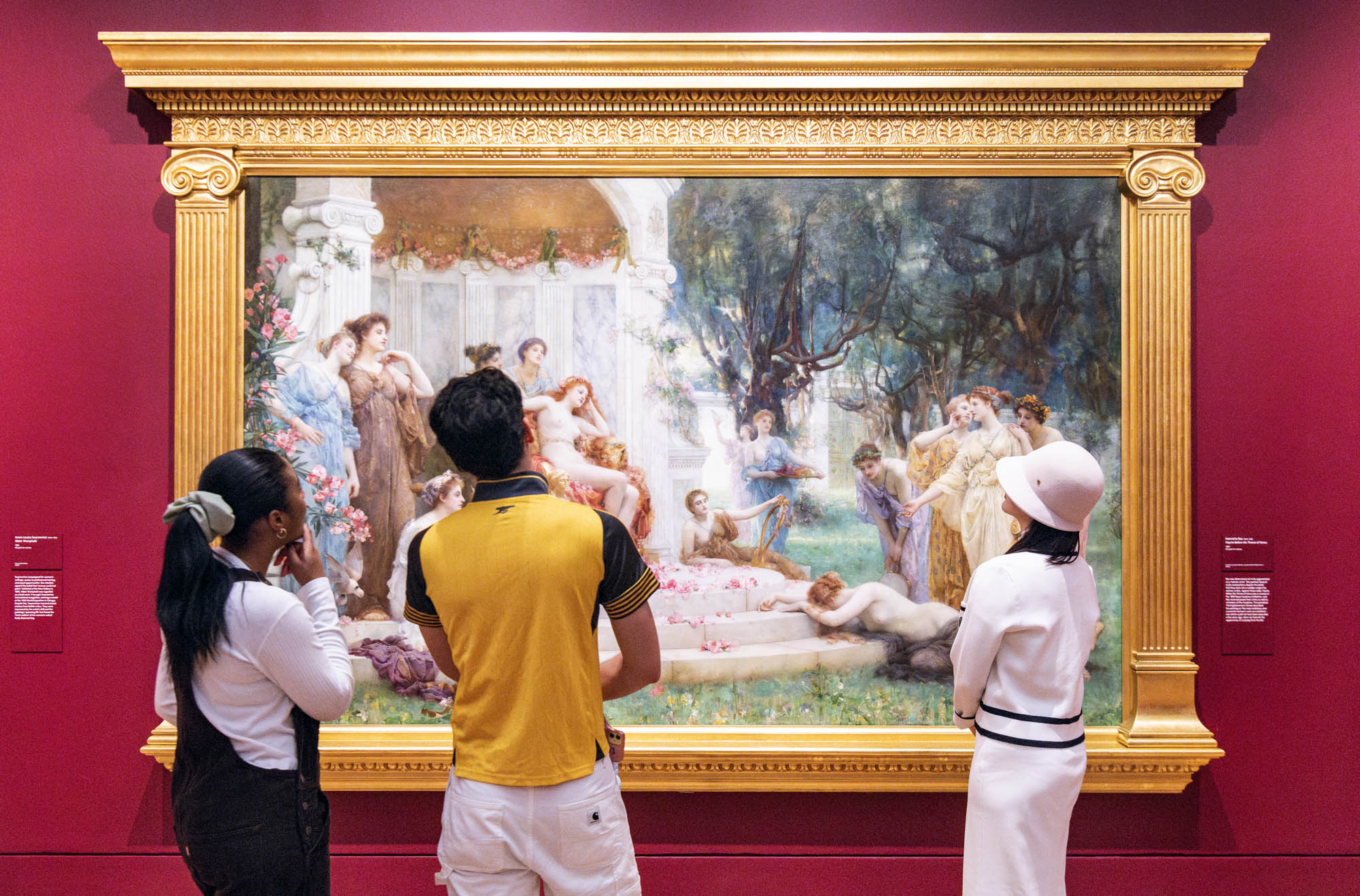
 

Installation view of the exhibition 'Now You See Us Women Artists in Britain 1520-1920' at Tate Britain showing Henrietta Rae's 'Psyche before the throne of Venus' 1894


Installation view of the exhibition Now You See Us Women Artists in Britain 1520-1920 at Tate Britain showing Henrietta Rae’s Psyche before the throne of Venus 1894 (below)
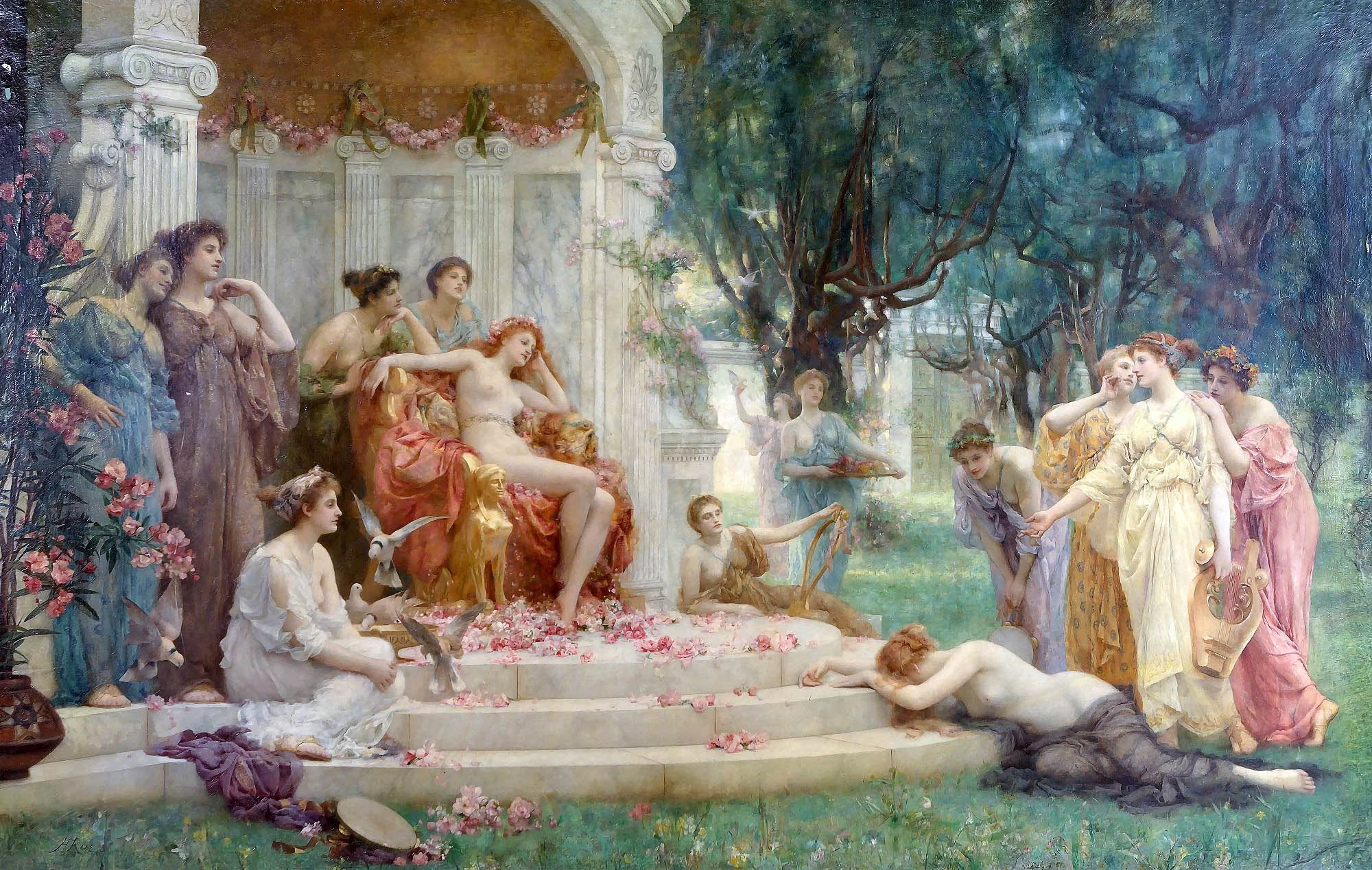
 

Henrietta Rae (British, 1859-1928) 'Psyche before the throne of Venus' 1894


Henrietta Rae (British, 1859-1928)
Psyche before the throne of Venus
1894
Oil paint on canvas
Support: 1941 × 3058 × 31 mm
Frame: 2525 × 3826 × 270 mm
Lent from a private collection, courtesy of Martin Beisly Fine Art


Rae was determined not to be pigeonholed as a ‘woman artist’. She painted classical nude compositions despite the belief that they were not a suitable subject for women artists. Against these odds, Psyche Before the Throne of Venus was a success at the 1894 Royal Academy Exhibition, and Rae received praise from critics as well as members of the Academy. The periodical The Englishwoman’s Review described the painting as ‘the most ambitious and successful woman’s work yet exhibited – one which could not have been executed a few years ago, when we had not the opportunity of studying from the life’.

Text from the exhibition large print guide


Installation view of the exhibition 'Now You See Us Women Artists in Britain 1520-1920' at Tate Britain showing Lucy Kemp-Welch's 'Colt Hunting in the New Forest' 1897


Installation view of the exhibition Now You See Us Women Artists in Britain 1520-1920 at Tate Britain showing Lucy Kemp-Welch’s Colt Hunting in the New Forest 1897


One of the most important pieces of art ever inspired by the New Forest was a painting by Lucy Kemp-Welch (1869-1958), entitled ‘Colt Hunting in the New Forest’. This painting was exhibited at the Royal Academy in 1897, when she was only 26 years old. It was an impressive canvas measuring 1537 x 3060 mm (approximately 5ft x 10ft) and was described as depicting ‘a wide glade in the forest, along which race a number of colts unwilling to relinquish their liberty and to fall into the hands of the four mounted lads who try to catch them’.[1] Lucy Kemp-Welch was born in Bournemouth, in 1869, and spent much of her time wandering in the New Forest, where she ‘personally studied the wild ponies in this pleasant part of England’.[2] Her love of horses and wild ponies remained with her all her life. In order to capture the energy and excitement of the pony drifts for ‘Colt Hunting’ she actually had the full-sized canvas transported to the Forest, where she sketched from life, as the commoners galloped their ponies past her. When the painting was exhibited at the Royal Academy it caused a sensation and was promptly purchased for £525.00.[3] The buyers were trustees of the Chantrey Bequest, who administered a large sum of money left in the will of Sir F. L. Chantrey to obtain works of art by British artists, in order to create a national collection. It was only the third time, since its creation in 1875, that the Chantrey Bequest had purchased artwork by a woman. Lucy Kemp-Welch became a celebrity overnight.[4]

In the same year that Lucy Kemp-Welch exhibited ‘Colt Hunting in the New Forest’, the Tate Galley was built and her painting was transferred to this new, public collection. However, ‘Colt Hunting’ was immediately archived and has never been publicly exhibited. Indeed, there are rumours that the Tate Gallery loaned the painting to the Royal Academy during the Blitz ‘in the hope that the Luftwaffe’s friendly bombs might rid them of this monstrous woman’s work for good’.[5] It is difficult to conceive of the prejudice against women in the late Victorian period and early 20th century, particularly women such as Lucy Kemp-Welch, who stepped out of the roles proscribed to them by a patriarchal society.[6] Her sympathies for the suffragette movement certainly didn’t endear her to the male-establishment figures that controlled the art world. She nevertheless continued to paint and made a successful, and award winning (Paris Salon) career as an artist.

newforestcommoner. “Lucy Kemp-Welch: Colt Hunting in the New Forest,” on the New Forest Commoner website November 27, 2016 [Online] Cited 28/08/2024
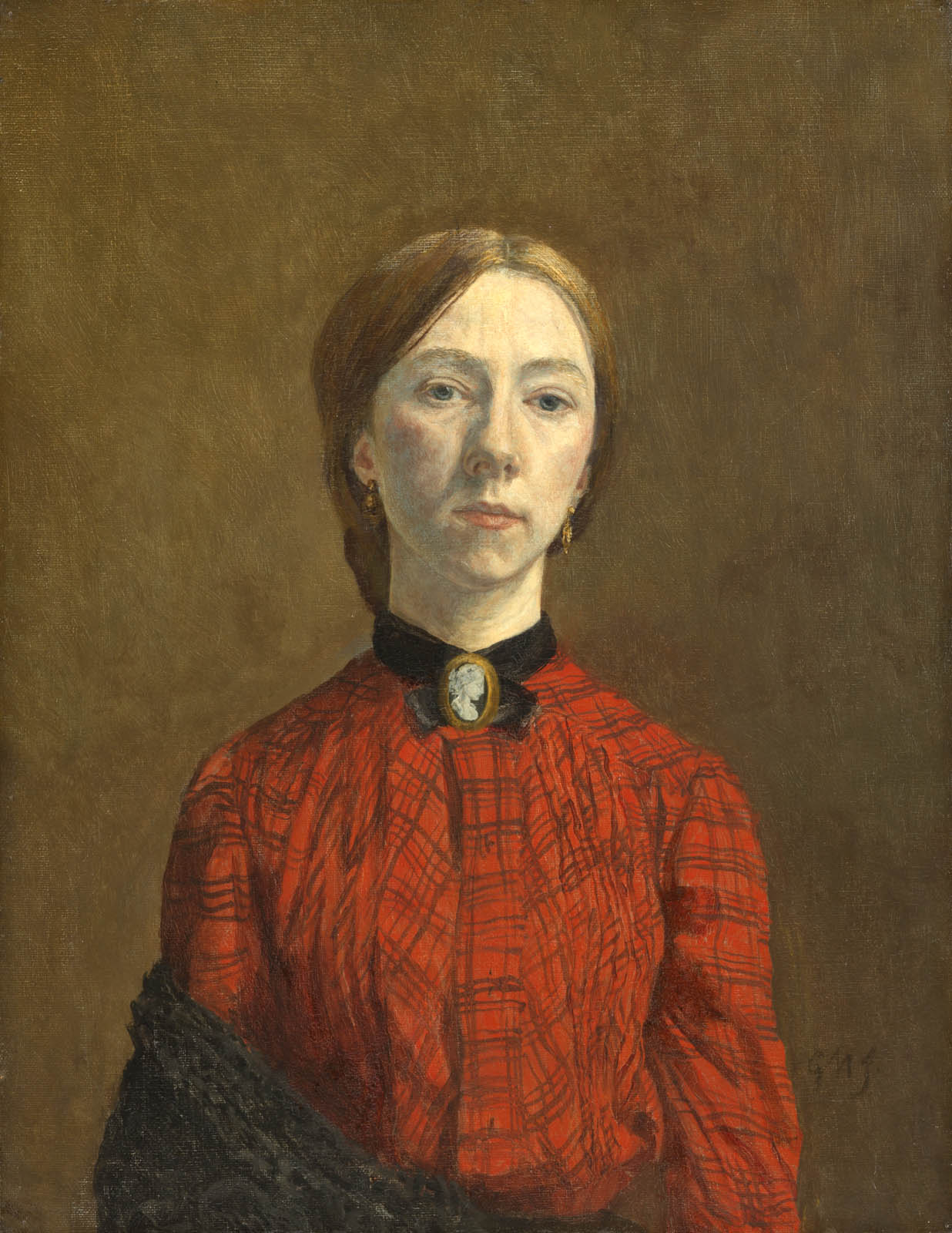
 

Gwen John (Welsh, 1876-1939) 'Self-Portrait' 1902


Gwen John (Welsh, 1876-1939)
Self-Portrait
1902
Oil on canvas
Tate
Purchased 1942
Photo: Tate (Mark Heathcote and Samuel Cole)


John exhibited this self-portrait at the New English Art Club (NEAC) in 1900. It was her debut as an exhibitor. The NEAC had been founded as a forward-thinking artists’ group, created out of dissatisfaction with the art establishment, exemplified by the conservative Royal Academy. Tutors from the Slade, where John had trained, were on the NEAC committee. Despite its progressive stance, in 1900 John was one of only 16 women exhibitors among 75 men. John’s choice to show a self-portrait was perhaps a deliberate assertion of her presence.

Text from the exhibition large print guide


Here is a dilemma straight away: which should take precedence, the painting or the fact? Should the show present art on its own terms, or as instance, evidence, expression of social history? It is an extremely complex remit…

[Laura] Knight is strongly represented with a sequence of cliff-edge paintings; but what about her near-namesake, Winifred Knights? The Deluge is a shattering masterpiece of British modernism, painted in 1920 and thus eligible, yet not here. And why are the ethereal and supremely original blue cyanotypes of Anna Atkins (1799-1871) missing from the niggardly photography section, along with Christina Broom (1862-1939), pioneering photojournalist, whose stirring portraits of suffragettes would have been so apt?

The show is thick with flowers, descending from Delany right down to Helen Allingham’s twee cottage gardens, all ready for their postcard reproductions. And if Allingham, then why not the visionary genius of Beatrix Potter? Weak pre-Raphaelite schlock fills the largest gallery, along with Victorian pieties such as Emily Osborn’s distressed gentlewoman, eyes downcast, awaiting the verdict of a dealer on her latest canvas, while two male artists leer in the background. Nameless and Friendless is terminally mawkish.

Only rarely do women’s art and women’s history spark together in this show. You see it in Ethel Wright’s fabulous 1912 portrait of the suffragette Una Dugdale Duval, in an arsenical green dress beneath a wallpaper of ludicrous fighting cocks, where Wright’s modern bravado exactly meets that of her sitter. And you see it in Gwen John’s immortal 1902 self-portrait, small and distanced, light catching her eyelashes in an atmosphere of hushed stillness, so direct and yet so self-contained: the momentous assertion of reticence.

That epochal image appears on the exhibition posters, perhaps promising too much. For even the best of the artists here are occasionally represented by the least of their works, quite apart from the mystifying omissions. The theme of Now You See Us is undoubtedly riveting. The captions (and the excellent catalogue) are superbly written. But art is trumped by social history too often in this show, words overshadowing images.

Laura Cumming. “Now You See Us: Women Artists in Britain 1520-1920 review – revelations and mystifying omissions,” on The Guardian website 19 May 2024 [Online] Cited 02/09/2024


Gwen John (Welsh, 1876-1939) 'Chloë Boughton-Leigh (1868-1947)' 1904-1908


Gwen John (Welsh, 1876-1939)
Chloë Boughton-Leigh (1868-1947)
1904-1908
Oil on canvas
58.4 x 38.1cm
Tate
Purchased 1925


Gwendolen Mary John (22 June 1876 – 18 September 1939) was a Welsh artist who worked in France for most of her career. Her paintings, mainly portraits of anonymous female sitters, are rendered in a range of closely related tones. Although in her lifetime, John’s work was overshadowed by that of her brother Augustus and her mentor and lover Auguste Rodin, awareness and esteem for John’s artistic contributions has grown considerably since her death.

Gwen John trained at the Slade School of Art in London, where her brother Augustus was also a student. She settled in Paris in 1904, working as a model, becoming Rodin’s mistress and immersing herself in the artistic world of the metropolis. She lived in France for the rest of her life, exhibiting on both sides of the Channel. The portrait shown here is of a Paris friend, Chloë Boughton-Leigh. The subdued colouring, short foreground and self-absorption of the sitter create a deeply intense atmosphere. John showed it in London, at the New English Art Club.

Text from the WikiArt website


Minna Keene (née Bergmann, Canadian born Germany, 1861-1943) 'Decorative Study No. 1, Pomegranates' c. 1906


Minna Keene (née Bergmann, Canadian born Germany, 1861-1943)
Decorative Study No. 1, Pomegranates
c. 1906
Carbon print


The subject of this photograph is believed to be of Violet Keene, Minna Keene’s daughter.
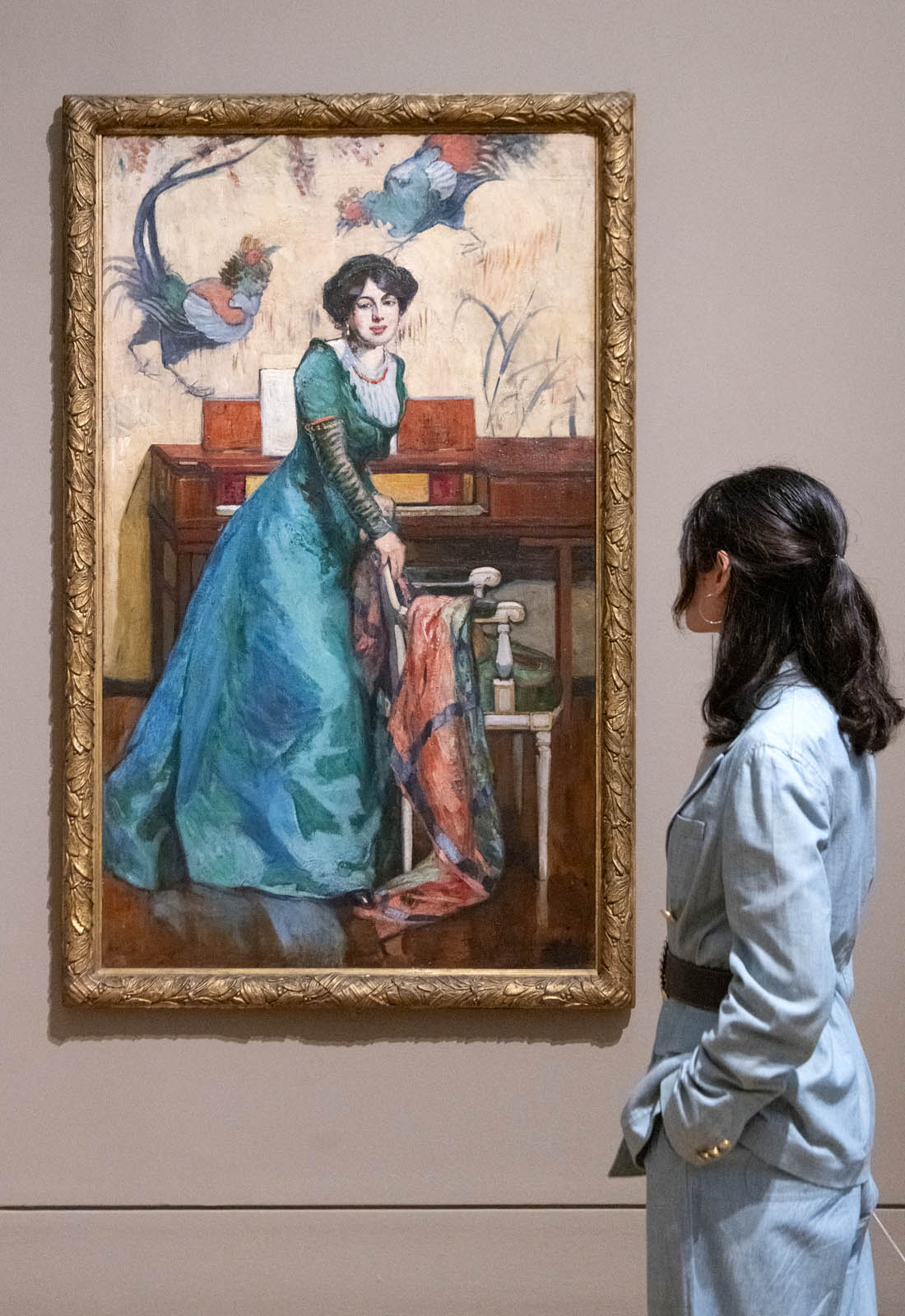
 

Installation view of the exhibition 'Now You See Us Women Artists in Britain 1520-1920' at Tate Britain showing Ethel Wright's 'The Music Room, Portrait of Una Dugdale' 1912


Installation view of the exhibition Now You See Us Women Artists in Britain 1520-1920 at Tate Britain showing Ethel Wright’s The Music Room, Portrait of Una Dugdale 1912 (below)


Ethel Wright (British, 1866-1939) 'The Music Room, Portrait of Una Dugdale' 1912 (installation view)


Ethel Wright (British, 1866-1939)
The Music Room, Portrait of Una Dugdale (installation view)
1912
Oil on canvas
Private collection


This portrait of suffragette and women’s rights activist Una Dugdale Duval (1879-1975) was exhibited at the Stafford Gallery in October 1912. Its flat areas of colour and bold outlines represent a stylistic shift for Wright, who had exhibited at the Royal Academy since the 1880s. Wright shows Duval as cultured and sophisticated, dressed in green, a suffrage colour. Wright made the work the same year Duval made national news for her refusal to promise to obey her husband during their marriage vows. In 1913, Duval published a pamphlet, Love and Honour but Not Obey.

Text from the exhibition large print guide
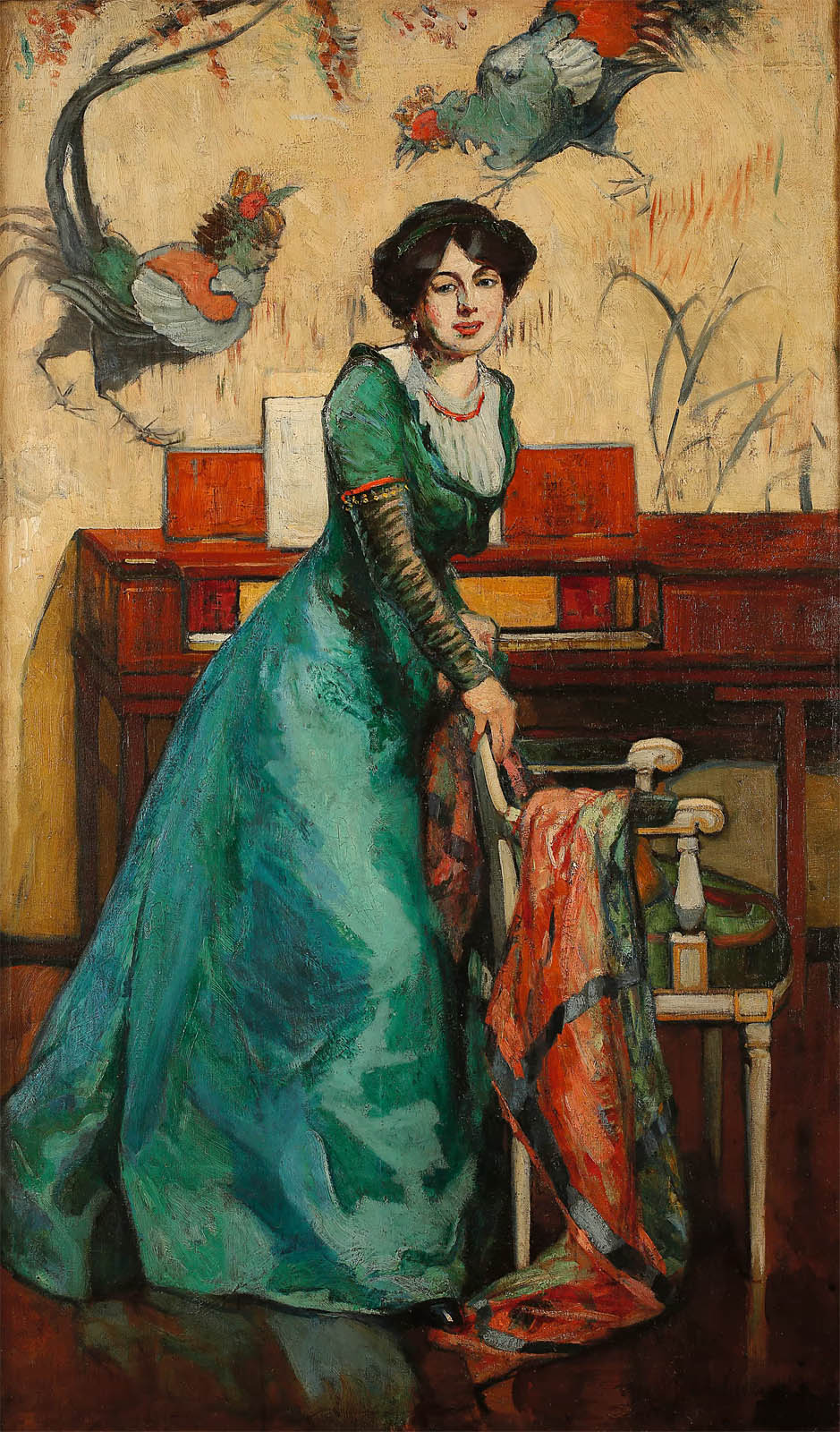
 

Ethel Wright (British, 1866-1939) 'The Music Room, Portrait of Una Dugdale' 1912


Ethel Wright (British, 1866-1939)
The Music Room, Portrait of Una Dugdale
1912
Oil on canvas
Private collection


Vanessa Bell (English, 1879-1961) 'Still Life on Corner of a Mantelpiece' 1914


Vanessa Bell (English, 1879-1961)
Still Life on Corner of a Mantelpiece
1914
Oil on canvas
Support: 559 × 457 mm
Frame: 614 × 512 × 49 mm
Tate
Purchased 1969
© Estate of Vanessa Bell


In 1913, Bell left the Friday Club for the short-lived exhibiting society, the Grafton Group. It included artists who were experimenting with post-impressionism. She was also a founding member of the Omega Workshops. Based in Bloomsbury’s Fitzroy Square, the Workshops aimed to remove the false divisions between fine and decorative arts. The mantelpiece in this painting was in Bell’s house at 46 Gordon Square in London. The objects on it include handmade paper flowers from the Omega Workshops. Bell’s use of an unconventional low viewpoint, fractured, abstracted forms and bright colours show her exploring different techniques associated with twentieth-century art movements.

Text from the exhibition large print guide


Dame Laura Knight DBE RA RWS (English, 1877-1970) 'A Dark Pool' 1917


Dame Laura Knight DBE RA RWS (English, 1877-1970)
A Dark Pool
1917
Oil on canvas
460 × 458 mm
Tyne & Wear Archives & Museums, Laing Art Gallery, Newcastle upon Tyne
© Estate of Dame Laura Knight. All rights reserved 2024 / Bridgeman Images
Image credit: Laing Art Gallery


Anna Airy (English, 1882-1964) 'Shop for Machining 15-inch Shells: Singer Manufacturing Company, Clydebank, Glasgow' 1918


Anna Airy (English, 1882-1964)
Shop for Machining 15-inch Shells: Singer Manufacturing Company, Clydebank, Glasgow
1918
Oil on canvas
Support: Height 1828 mm., Width 2133 mm
© Imperial War Museum


In 1918, Airy received a commission from the Imperial War Museum, thereby becoming Britain’s first official woman war artist. Her 1.7 by 1.8-metre canvases depict munitions production and war-related heavy industry. She later recalled the hot and dangerous conditions in which she worked. A former Slade student, Airy enjoyed a high public profile, won through exhibition and good reviews at the Royal Academy. In 1915, an art critic hailed her as ‘the most accomplished artist of her sex’. Airy was aware, however, of the prejudice women artists still faced. Galleries and buyers, she said, felt ‘safer with a man’.

Text from the exhibition large print guide
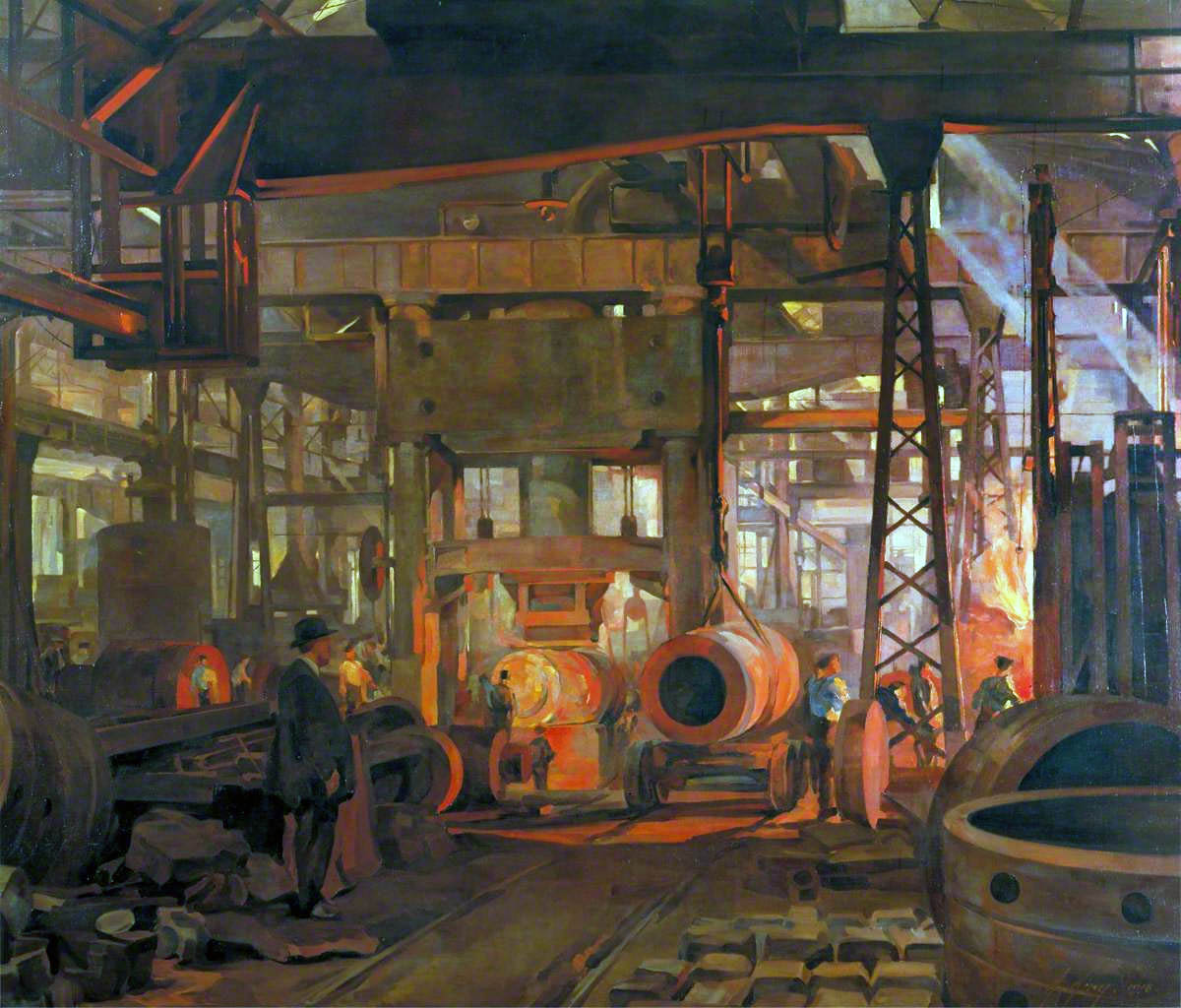
 

Anna Airy (English, 1882-1964) 'Study for 'The L Press: Forging the Jacket of an 18-inch Gun, Armstrong-Whitworth Works, Openshaw'' 1918


Anna Airy (English, 1882-1964)
Study for ‘The L Press: Forging the Jacket of an 18-inch Gun, Armstrong-Whitworth Works, Openshaw’
1918
Oil on canvas
Private collection
 

Olive Edis (British, 1876-1955) 'War' 1919


Olive Edis (British, 1876-1955)
War
1919
Carbon print on paper
Wilson Centre for Photography


Edis was Britain’s first woman war photographer. She was commissioned by the Imperial War Museum to photograph the activities of servicewomen on duty in France and Flanders. This bleak, blasted landscape captures the impact of the First World War.

Text from the exhibition large print guide


Installation view of the exhibition 'Now You See Us Women Artists in Britain 1520-1920' at Tate Britain


Installation view of the exhibition Now You See Us Women Artists in Britain 1520-1920 at Tate Britain showing Dame Ethel Walker’s Decoration The Excursion of Nausicaa 1920 (below)
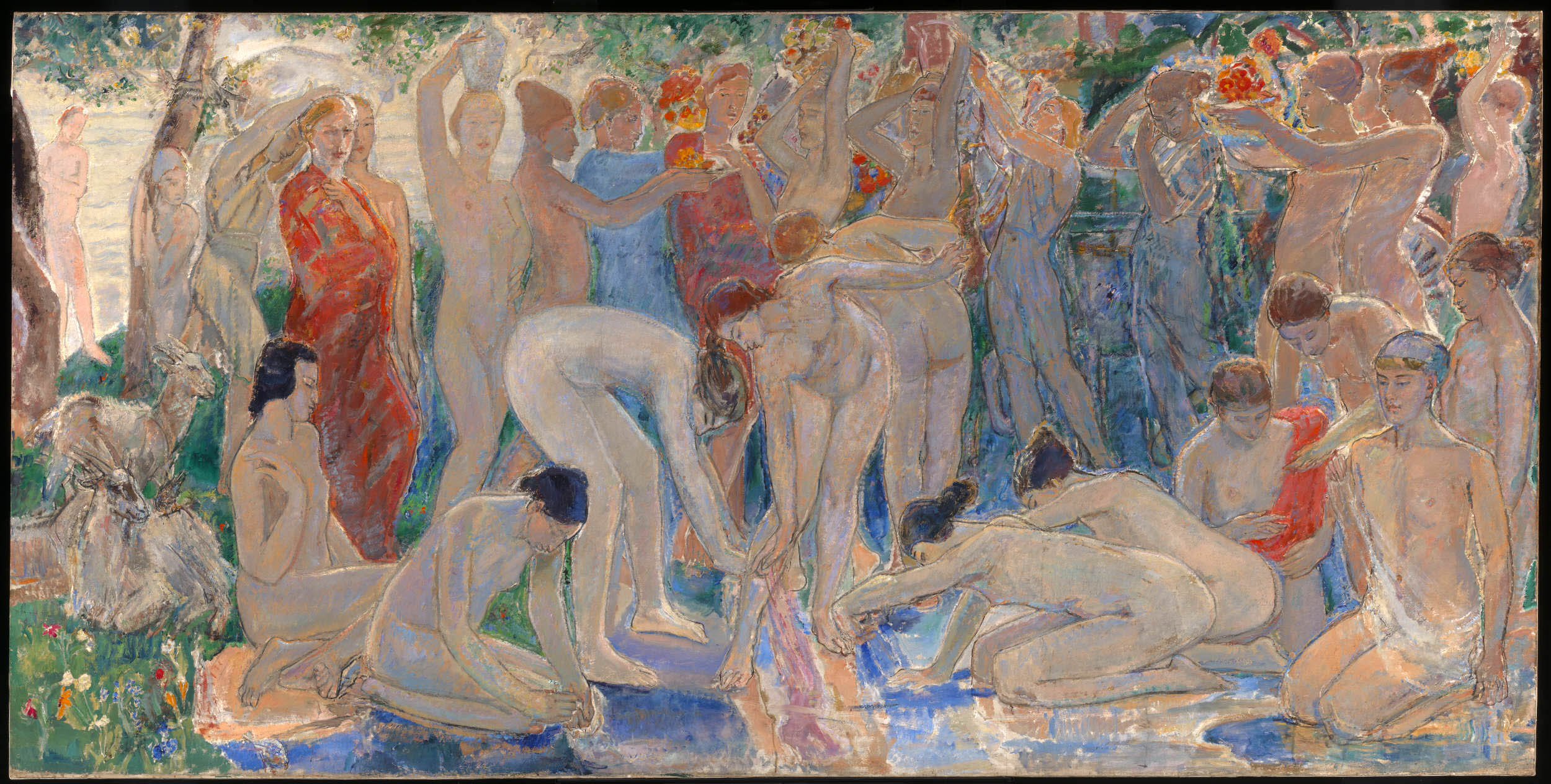
 

Dame Ethel Walker DBE ARA (Scottish, 1861-1951) 'Decoration: The Excursion of Nausicaa' 1920


Dame Ethel Walker DBE ARA (Scottish, 1861-1951)
Decoration: The Excursion of Nausicaa
1920
Oil on canvas
1835 × 3670 mm
Tate
Purchased 1924
Photo: Tate


Writing to J. B. Manson (Monday, 2 June, no year given, but almost certainly 1924), the artist described her work thus:’… Nausicaa early one lovely summer’s morning goes to her father and mother – the King and Queen – to ask permission to have a waggon and mules given to her to take her and her attendants and to fill it with the clothes of the palace that require washing, also with dainties and wine and good food for a forthcoming picnic – and go down to the river adjoining the sea to wash them – which he gives her. On arriving at the river they unharness the mules and are unpacking or unloading the waggons of the clothes and the food for the picnic, and are beginning to wash them in the river. A little wood divides the sea from the river where the goat girl – kneeling by the tree near her goats – hears the strange voices that are sounding in her usually silent little wood. To show it is the sea a girl, nude, has stepped up on to the bank after bathing….’ The story is based on Book VI of the Odyssey: ‘… they spread/The raiment orderly along the beach/Where dashing tides …/… leaving the garments, stretch’d/ In noon-day fervour of the sun, to dry.’

Text from the Tate website


In her lifetime Scottish artist Ethel Walker was celebrated for her trailblazing paintings of the female form. A teacher before she painted fulltime, she developed her own unique style – large, mural-like paintings, which she called her ‘decorations.’ Walker often painted male and female nudes confidently placing female sensuality at the centre of her work, as seen in Decoration: The Excursion of Nausicaa (1920). Its dream-like vision of a feminist utopia was ahead of its time.

Working steadily for decades, she achieved many professional milestones, exhibiting around the world and representing Britain at the Venice Biennale four times. In 1943, Walker was made a Dame of the British Empire, and after her death The Times called her ‘the most important woman artist of her time.’ Despite this, it is only now that her artistic legacy is finally being recognised.

Text from the Tate website


‘There is no such thing as a woman artist. There are only two kinds of artist – bad and good.’

– Ethel Walker


Tate Britain
Millbank, London SW1P 4RG
United Kingdom
Phone: +44 20 7887 8888

Opening hours:
10.00am – 18.00pm daily
Tate Britain website

LIKE ART BLART ON FACEBOOK

Back to top

Exhibition: ‘Hannah Villiger: Amaze Me’ at Museum Susch, Switzerland

Exhibition dates: 7th January – 2nd July 2023

Curated by Madeleine Schuppli and Yasmin Afschar


Hannah Villiger (Swiss, 1951-1997) 'Work' 1980 from the exhibition Exhibition: 'Hannah Villiger: Amaze Me' at Museum Susch, Switzerland, Jan - July 2023


Hannah Villiger (Swiss, 1951-1997)
Work
1980
C-print of a polaroid, mounted on aluminium
100 x 100cm
© Foundation The Estate of Hannah Villiger


who am I who I am

I love artists who push the boundaries of seeing / being, body / Self, self / spirit.

Artists who see and feel the world in unique and tantalising – excites the senses or desires of (someone) – ways.

Hannah Villiger is one such artist.

Her fragmentary, space-related assemblages (Works or Blocks) investigate the representation of the female body, “its classification in the media, questions of surface, space and body, and the objectification of the body. In Villiger’s work, the skin – where humans enter a dialogue with their environment – is a setting for highly topical questions of gender and ethnicity, as well as vulnerability and healing. The body was the artist’s primary working material. We encounter it abstracted or deconstructed; it can be human, but also of plant or artificial origin.” (Exhibition text)

But more than that, it is the conceived ‘idea in the mind’ strangeness of Villiger’s out of body gridded experiences… that promote in the viewer an acknowledgement of the physicality, touch, and emotion of actually living and feeling in the human body and beyond. Touch your skin, run your hands over the shape of your mouth, feel your ears, raise your foot, look at your reflection. Marvel at the bodies distortion, energy, spirit. For there is only one you. “I listen to my naked, bare body, the outside of it, the inside of it, traversing it.”

You are unique. An individual, unique, sentient animal. A human – being.

Dr Marcus Bunyan


Many thankx to Museum Susch for allowing me to publish the photographs in the posting. Please click on the photographs for a larger version of the image.


“With my Polaroid camera I listen to my naked, bare body, the outside of it, the inside of it, traversing it. Thus I create images that I can correct immediately.”


Hannah Villiger


“The longest distance between the camera and any body part is between raised arm and my toes. I always trigger the camera myself, sometimes without looking through the viewfinder. I tilt the camera to an angle of 90, 180, 270 degrees. I turn myself – literally – upside down.”


Hannah Villiger. On My Book Envy


Hannah Villiger (1951-1997) was an extraordinary voice in the late 20th-century contemporary art, but her work came to an abrupt end with her untimely death. She became known above all for her photographic works based on the body.

Muzeum Susch is hosting the largest presentation of Hannah Villiger’s oeuvre in fifteen years. Hannah Villiger: Amaze Me offers new perspectives on the work of this important Swiss artist. Villiger’s large-format works based on Polaroid photographs make a lasting contribution to the genre of the self-image within art history. At the same time, her explorations of the body can be discussed against the background of numerous contemporary themes. Her oeuvre spans from the drawings she made in the 1970s to the black-and-white photographs and works with the Polaroid camera that she created from the 1980s onwards. These fragmentary close-ups of her own body, greatly enlarged via an internegative and mounted on aluminium, are presented individually or assembled into space-related ensembles. The results are unlimited possibilities of at times spectacular views of the body. The exhibition expands the view of Villiger to include contemporary themes and issues. The focus is on the representation of the female body, one’s own perspective, as well as that of others, on the human physique, its classification in the media, questions of surface, space and body, and the objectification of the body. In Villiger’s work, the skin – where humans enter a dialogue with their environment – is a setting for highly topical questions of gender and ethnicity, as well as vulnerability and healing. The body was the artist’s primary working material. We encounter it abstracted or deconstructed; it can be human, but also of plant or artificial origin. Although Villiger’s early death brought her oeuvre to an abrupt end, her works point unwaveringly to the present.

Text from the Museum Susch website


Trix Wetter. 'Portrait of Hannah Villiger' 1976, Rome from the exhibition Exhibition: 'Hannah Villiger: Amaze Me' at Museum Susch, Switzerland, Jan - July 2023


Trix Wetter
Portrait of Hannah Villiger
1976, Rome
© Foundation The Estate of Hannah Villiger


Hannah Villiger (Swiss, 1951-1997) 'Work' 1976 from the exhibition Exhibition: 'Hannah Villiger: Amaze Me' at Museum Susch, Switzerland, Jan - July 2023


Hannah Villiger (Swiss, 1951-1997)
Work
1976
Four black and white photographs
61 x 51cm / 40.5 x 33.5cm each
© Foundation The Estate of Hannah Villiger


Hannah Villiger (Swiss, 1951-1997) 'Work' 1976


Hannah Villiger (Swiss, 1951-1997)
Work
1976
black and white photograph
70 x 100cm
© Foundation The Estate of Hannah Villiger


Hannah Villiger (Swiss, 1951-1997) 'Work' 1976


Hannah Villiger (Swiss, 1951-1997)
Work
1976
68 x 97cm
© Foundation The Estate of Hannah Villiger


Hannah Villiger (Swiss, 1951-1997) 'Work' 1980


Hannah Villiger (Swiss, 1951-1997)
Work
1980
C-print of a polaroid, mounted on aluminium
99.5 x 99.5cm
© Foundation The Estate of Hannah Villiger


Installation view of 'Hannah Villiger: Amaze Me' at Muzeum Susch showing at left Hannah Villager's 'Block' (1997); and at right, 'Work' (1980-1981)


Installation view of Hannah Villiger: Amaze Me at Muzeum Susch showing at left Hannah Villager’s Block (1997); and at right, Work (1980-1981, below)
Courtesy: © Muzeum Susch / Art Stations Foundation
Photograph: Federico Sette


Installation view of 'Hannah Villiger: Amaze Me at Muzeum Susch' showing at left Hannah Villiger's 'Work' (1987); and at right, 'Work' (1980-1981)


Installation view of Hannah Villiger: Amaze Me at Muzeum Susch showing at left Hannah Villiger’s Work (1987, below); and at right, Work (1980-1981, below)
Courtesy: © Muzeum Susch / Art Stations Foundation
Photograph: Federico Sette


Hannah Villiger (Swiss, 1951-1997) 'Work' 1987


Hannah Villiger (Swiss, 1951-1997)
Work
1987
Black and white photograph
127.5 x 86.5cm
© Foundation The Estate of Hannah Villiger


Hannah Villiger (Swiss, 1951-1997) 'Work' 1980-1981


Hannah Villiger (Swiss, 1951-1997)
Work
1980-1981
C-prints of polaroids, mounted on aluminium (12 pieces)
355 x 475cm
© Foundation The Estate of Hannah Villiger


Installation view of 'Hannah Villiger: Amaze Me' at Muzeum Susch showing at left Hannah Villiger's 'Work' (1981); and at right, 'Work' (1982)


Installation view of Hannah Villiger: Amaze Me at Muzeum Susch showing at left Hannah Villiger’s Work (1981, below); and at right, Work (1982, below)
Courtesy: © Muzeum Susch / Art Stations Foundation
Photograph: Federico Sette


Hannah Villiger (Swiss, 1951-1997) 'Work' 1981


Hannah Villiger (Swiss, 1951-1997)
Work
1981
Two C-prints of polaroids, mounted on aluminium
Each 38 x 38cm
© Foundation The Estate of Hannah Villiger


Running from 4 January to 2 July 2023, Muzeum Susch presents Hannah Villiger: Amaze Me, a comprehensive survey dedicated to the Swiss artist Hannah Villiger (1951-1997) with contributions from contemporary artists Alexandra Bachzetsis, Lou Masduraud (b. 1990) and Manon Wertenbroek (b. 1991).

The exhibition Hannah Villiger: Amaze Me offers new perspectives on the work of this important Swiss artist. Hannah Villiger’s (1951-1997) large-format works based on Polaroid photographs make a lasting contribution to the genre of the self-image within art history. At the same time, her explorations of the body can be discussed against the background of numerous contemporary themes.

Muzeum Susch is hosting the largest presentation of Hannah Villiger’s work in fifteen years. The exhibition spans her oeuvre, from the drawings she made in the 1970s to the black-and-white photographs and works with the Polaroid camera that she created from the 1980s onwards. These fragmentary close-ups of her own body, greatly enlarged via an internegative and mounted on aluminium, are presented individually or assembled into space-related ensembles. The results are unlimited possibilities of at times spectacular views of the body. On display are vintage prints, existing though often still unknown individual works, as well as so-called blocks, large-format assemblages of up to fifteen square picture panels. Some of these will be shown for the first time in the exhibition in Susch.

The exhibition expands the view of Villiger to include contemporary themes and issues. The focus is on the representation of the female body, one’s own perspective, as well as that of others, on the human physique, its classification in the media, questions of surface, space and body, and the objectification of the body. In Villiger’s work, the skin – where humans enter a dialogue with their environment – is a setting for highly topical questions of gender and ethnicity, as well as vulnerability and healing. The body was the artist’s primary working material. We encounter it abstracted or deconstructed; it can be human, but also of plant or artificial origin. Although Villiger’s early death brought her oeuvre to an abrupt end, her works point unwaveringly to the present.

The undiminished relevance of Villiger’s work is underscored by the inclusion of works by the contemporary artists Alexandra Bachzetsis, Lou Masduraud and Manon Wertenbroek. These younger women artists present thematically related works – distributed throughout the entire exhibition – in dialogue with Villiger and at the same time represent strong contemporary positions. The artists have been selected based on their exploration of similar themes to those of Villiger. Bachzetsis in collaboration with Julia Born presents This Side Up, a video installation of the artist moving in all directions in a confined space, much like the way Villiger writhes, turns and shapes her own body under the eye of her Polaroid camera. Masduraud presents Petrifying basin (kisses with the nymphs), a sculptural installation and small wall objects that playfully and sensually rethink organic life and anchors mythological traditions in the present day. And finally, Wertenbroek presents a selection of objects addressing the boundaries between the skin and surrounding world and reflects on themes such as unveiling and veiling.

On the exhibition and Hannah Villiger, Muzeum Susch’s found Grazyna Kulczyk says, “Female artists are no longer afraid to document their bodies being destructed due to illness or ageing – often the artworks become projects showing chronicles of pain. Observing and recording their own bodies has become a form of manifesto for female artists, reclaiming the subjectivity of the body. Female artists have painted, photographed and sculpted themselves. In this way, the shame of nakedness or imperfection has often become a point of pride. Hannah Villiger, through photographs of her body, become the body’s conscious sculptor.”

The exhibition is accompanied by a monograph on the latest research on Hannah Villiger’s practice and influence. Villiger is often likened to an artist’s artist, which has inspired the editors to invite artists who knew her to contribute texts, including Katja Schenker, Beat Streuli, and Claudia and Julia Müller. The book, part of a series of monographs by Muzeum Susch and Skira, will be published in March 2023.

Hannah Villiger (1951-1997) grew up as the fourth of five children in Cham (CH). After completing her studies at the School of Applied Arts in Lucerne, Villiger spent a period travelling and living between Toronto, Rome, Montefalco and Switzerland until she finally settled in Basel in 1977. In Basel, she produced her first black-and-white photographs as well as wood and Plexiglas objects. In 1980 Villiger fell ill with open tuberculosis and spent a month isolated in the Basel Cantonal Hospital, followed by a stay in a sanatorium in Davos. Despite her poor health, Villiger continued to create and exhibit her work. From 1981 to 1982 she undertook a world road-trip with Susan Wyss, with whom she had been in a relationship since 1975. In the early 1980s, Villiger began to use Polaroid cameras primarily to explore her body, serving as a working material, and increasingly moved away from the classic black-and-white and colour photographs. In 1988 in Paris, she met Mouhamadou Mansour (“Joe”) Kébé, with whom she had a son with in 1991. Between 1992 and 1997, Villiger taught at the Basel School of Art and Design. She died of heart failure in 1997.
Text from the Museum Susch website


Installation view of 'Hannah Villiger: Amaze Me' at Muzeum Susch

Installation view of 'Hannah Villiger: Amaze Me' at Muzeum Susch showing at left in the bottom image, Hannah Villiger's 'Work' (1982); and at right, 'Sculpting' (1983)


Installation views of Hannah Villiger: Amaze Me at Muzeum Susch showing at left in the bottom image, Hannah Villiger’s Work (1982, below); and at right, Sculpting (1983, below)
Courtesy: © Muzeum Susch / Art Stations Foundation
Photograph: Federico Sette


Hannah Villiger (Swiss, 1951-1997) 'Work' 1982


Hannah Villiger (Swiss, 1951-1997)
Work
1982
C-print of a polaroid, mounted on aluminium
125 x 123cm
© Foundation The Estate of Hannah Villiger


Hannah Villiger (Swiss, 1951-1997) 'Sculpting' 1983


Hannah Villiger (Swiss, 1951-1997)
Sculpting
1983
Six C-prints of polaroids, mounted on aluminium
222 x 322cm
© Foundation The Estate of Hannah Villiger
Courtesy of Collection Pictet


Installation view of 'Hannah Villiger: Amaze Me' at Muzeum Susch

Installation view of 'Hannah Villiger: Amaze Me' at Muzeum Susch showing in the bottom image at left, 'Sculptural' (1984-1985); at centre, 'Sculptural' (1984-1985); and at right, 'Sculptural' (1984-1985)


Installation views of Hannah Villiger: Amaze Me at Muzeum Susch showing in the bottom image at left, Sculptural (1984-85, below); at centre, Sculptural (1984-85, below); and at right, Sculptural (1984-85, below)
Courtesy: © Muzeum Susch / Art Stations Foundation
Photograph: Federico Sette


Hannah Villiger (Swiss, 1951-1997) 'Sculptural' 1984-1985


Hannah Villiger (Swiss, 1951-1997)
Sculptural
1984-85
C-print of a polaroid, mounted on aluminium
© Foundation The Estate of Hannah Villiger


Hannah Villiger (Swiss, 1951-1997) 'Sculptural' 1984-1985


Hannah Villiger (Swiss, 1951-1997)
Sculptural
1984-85
C-print of a polaroid, mounted on aluminium
© Foundation The Estate of Hannah Villiger


Hannah Villiger (Swiss, 1951-1997) 'Sculptural' 1984-1985


Hannah Villiger (Swiss, 1951-1997)
Sculptural
1984-85
C-print of a polaroid, mounted on aluminium
© Foundation The Estate of Hannah Villiger


Installation view of 'Hannah Villiger: Amaze Me' at Muzeum Susch showing at centre, 'Block XVI' (1989); and at right, 'Sculptural' (1988-1989)


Installation views of Hannah Villiger: Amaze Me at Muzeum Susch showing at centre, Block XVI (1989, below); and at right, Sculptural (1988-89, below)
Courtesy: © Muzeum Susch / Art Stations Foundation
Photograph: Federico Sette


Hannah Villiger (Swiss, 1951-1997) 'Block XVI' 1989


Hannah Villiger (Swiss, 1951-1997)
Block XVI
1989
Nine C-prints of polaroids, mounted on aluminium
© Foundation The Estate of Hannah Villiger


Hannah Villiger (Swiss, 1951-1997) 'Block XVI' 1989 (detail)

Hannah Villiger (Swiss, 1951-1997) 'Block XVI' 1989 (detail)

Hannah Villiger (Swiss, 1951-1997) 'Block XVI' 1989 (detail)


Hannah Villiger (Swiss, 1951-1997)
Block XVI (details)
1989
Nine C-prints of polaroids, mounted on aluminium
© Foundation The Estate of Hannah Villiger


Hannah Villiger (Swiss, 1951-1997) 'Sculptural' 1988-1989


Hannah Villiger (Swiss, 1951-1997)
Sculptural
1988-89
C-print of a polaroid, mounted on aluminium
© Foundation The Estate of Hannah Villiger


Hannah Villiger (Swiss, 1951-1997) 'Sculptural' 1988-1989


Hannah Villiger (Swiss, 1951-1997)
Sculptural
1988-89
C-print of a polaroid, mounted on aluminium
© Foundation The Estate of Hannah Villiger


Installation view of 'Hannah Villiger: Amaze Me' at Muzeum Susch

Installation view of 'Hannah Villiger: Amaze Me' at Muzeum Susch


Installation views of Hannah Villiger: Amaze Me at Muzeum Susch
Courtesy: © Muzeum Susch / Art Stations Foundation
Photograph: Federico Sette


Installation view of 'Hannah Villiger: Amaze Me' at Muzeum Susch showing at left 'Block XIII' (1989)


Installation view of Hannah Villiger: Amaze Me at Muzeum Susch showing at left Block XIII (1989, below)
Courtesy: © Muzeum Susch / Art Stations Foundation
Photograph: Federico Sette


Installation view of 'Hannah Villiger: Amaze Me' at Muzeum Susch showing 'Block XIII' (1989)


Installation view of Hannah Villiger: Amaze Me at Muzeum Susch showing Block XIII (1989, below)
Courtesy: © Muzeum Susch / Art Stations Foundation
Photograph: Federico Sette


Hannah Villiger (Swiss, 1951-1997) 'Block XIII' 1989


Hannah Villiger (Swiss, 1951-1997)
Block XIII
1989
Fifteen C-prints of polaroids, mounted on aluminium
© Foundation The Estate of Hannah Villiger


Hannah Villiger (Swiss, 1951-1997) 'Block XIII' 1989 (detail)

Hannah Villiger (Swiss, 1951-1997) 'Block XIII' 1989 (detail)

Hannah Villiger (Swiss, 1951-1997) 'Block XIII' 1989 (detail)


Hannah Villiger (Swiss, 1951-1997)
Block XIII (details)
1989
Fifteen C-prints of polaroids, mounted on aluminium
© Foundation The Estate of Hannah Villiger


Installation view of 'Hannah Villiger: Amaze Me' at Muzeum Susch showing at left, 'Sculptural' (1990-91); and at right, 'Block XXX' (1993-1994)


Installation view of Hannah Villiger: Amaze Me at Muzeum Susch showing at left, Sculptural (1990-91, below); and at right, Block XXX (1993-1994)
Courtesy: © Muzeum Susch / Art Stations Foundation
Photograph: Federico Sette


Hannah Villiger (Swiss, 1951-1997) 'Sculptural' 1990-1991


Hannah Villiger (Swiss, 1951-1997)
Sculptural
1990-91
C-print of a polaroid, mounted on aluminium
© Foundation The Estate of Hannah Villiger


Hannah Villiger (Swiss, 1951-1997) 'Block XXX' 1993-1994


Hannah Villiger (Swiss, 1951-1997)
Block XXX
1993-94
Six C-prints of polaroids, mounted on aluminium
Jacques Herzog und Pierre de Meuron Kabinett, Basel
© Foundation The Estate of Hannah Villiger


Installation view of 'Hannah Villiger: Amaze Me' at Muzeum Susch showing at left, 'Block XXXV' (1994); and at right, 'Place' (1985)


Installation view of Hannah Villiger: Amaze Me at Muzeum Susch showing at left, Block XXXV (1994, below); and at right, Place (1985, below)
Courtesy: © Muzeum Susch / Art Stations Foundation
Photograph: Federico Sette


Hannah Villiger (Swiss, 1951-1997) 'Block XXXV' 1994


Hannah Villiger (Swiss, 1951-1997)
Block XXXV
1994
Four C-prints of polaroids, mounted on aluminium
© Foundation The Estate of Hannah Villiger


Hannah Villiger (Swiss, 1951-1997) 'Place' 1985


Hannah Villiger (Swiss, 1951-1997)
Place
1985
C-print of a polaroid, mounted on aluminium
© Foundation The Estate of Hannah Villiger


Hannah Villiger (Swiss, 1951-1997) 'Sculptural' 1995


Hannah Villiger (Swiss, 1951-1997)
Sculptural
1995
Six C-prints of polaroids, mounted on aluminium
© Foundation The Estate of Hannah Villiger


Installation view of 'Hannah Villiger: Amaze Me' at Muzeum Susch showing the work 'Block' (1996)


Installation view of Hannah Villiger: Amaze Me at Muzeum Susch showing the work Block (1996, below)
Courtesy: © Muzeum Susch / Art Stations Foundation
Photograph: Federico Sette


Hannah Villiger (Swiss, 1951-1997) 'Block' 1996


Hannah Villiger (Swiss, 1951-1997)
Block
1996
Six C-prints of polaroids, mounted on aluminium
© Foundation The Estate of Hannah Villiger


Hannah Villiger (Swiss, 1951-1997) 'Block' 1997


Hannah Villiger (Swiss, 1951-1997)
Block
1997
Nine C-prints of polaroids, mounted on aluminium
© Foundation The Estate of Hannah Villiger


Hannah Villiger (Swiss, 1951-1997) 'Block' 1997 (detail)

Hannah Villiger (Swiss, 1951-1997) 'Block' 1997 (detail)


Hannah Villiger (Swiss, 1951-1997)
Block (details)
1997
Nine C-prints of polaroids, mounted on aluminium
© Foundation The Estate of Hannah Villiger


Installation view of 'Hannah Villiger: Amaze Me' at Muzeum Susch showing at left, 'City' (1997)


Installation view of Hannah Villiger: Amaze Me at Muzeum Susch showing at left, City (1997, below)
Courtesy: © Muzeum Susch / Art Stations Foundation
Photograph: Federico Sette


Hannah Villiger (Swiss, 1951-1997) 'City' 1997


Hannah Villiger (Swiss, 1951-1997)
City
1997
Two C-prints of polaroids, mounted on aluminium
© Foundation The Estate of Hannah Villiger


Museum Susch
Surpunt 78
CH – 7542 Susch, Switzerland

Opening hours:
Wednesday: 11.00 – 17.00
Thursday: 11.00 – 17.00
Friday: 11.00 – 17.00
Saturday: 11.00 – 17.00
Sunday: 11.00 – 17.00

Museum Susch website

LIKE ART BLART ON FACEBOOK

Back to top

Exhibition: ‘Our Selves: Photographs by Women Artists from Helen Kornblum’ at the Museum of Modern Art (MoMA), New York

Exhibition dates: 16th April – 2nd October, 2022

Organised by Roxana Marcoci, The David Dechman Senior Curator of Photography, with Dana Ostrander, Curatorial Assistant, and Caitlin Ryan, Curatorial Assistant, Department of Photography, MoMA


Lotte Jacobi (American, 1896-1990) 'Head of the Dancer' 1929 from the exhibition 'Our Selves: Photographs by Women Artists from Helen Kornblum' at the Museum of Modern Art (MoMA), New York, April - Oct, 2022


Lotte Jacobi (American, 1896-1990)
Head of the Dancer Niura Norskaya
1929
Gelatin silver print
7 1/2 × 9 3/8″ (19.1 × 23.8cm)
The Museum of Modern Art, New York
Gift of Helen Kornblum in honour of Roxana Marcoci


With a focus on people, this is a challenging exhibition that can only scratch the surface of the importance of the photographic work of women artists to the many investigations critical to the promotion of equality and diversity in a complex and male orientated world.

Germaine Krull is always a favourite, as is the work of neutered genius (and my hero), Claude Cahun. Susan Meiselas’s immersive work is also impressive in its “understanding of social, political and global issues and of the potentially complex ethical relationship between photographer and subject”, especially in her early work Carnival Strippers (1972-1975). I also particularly like the sensibility of the Mexican women photographers: sensitive portraits of strong women.

The most cringe worthy photograph that illustrates some of the ills associated with a male-orientated society is Ruth Orkin’s staged but spontaneous photograph, American Girl in Florence, Italy (1951, below) which was “an instant conversation starter about feminism and street harassment long… [and which is] more relevant now than ever for what it truly represents: independence, freedom and self-determination.”

“The photos ran in Cosmopolitan magazine in 1952 in a photo essay, “When You Travel Alone…”, offering tips on “money, men and morals to see you through a gay trip and a safe one.” The article encourages readers to buy ship and train tickets ahead of time. It reminds them to bring their birth certificate and check in with the State Department. The caption on the photo of Craig walking down the street reflects cultural mores of the era.

“Public admiration … shouldn’t fluster you. Ogling the ladies is a popular, harmless and flattering pastime you’ll run into in many foreign countries. The gentlemen are usually louder and more demonstrative than American men, but they mean no harm.”

It’s a far cry from what we tell women these days, but for its time the mere notion of encouraging women to travel alone was progressive. That’s what made the photos so special, Craig says. They offered a rare glimpse of two women – behind and in front of the camera – challenging the era’s gender roles and loving every minute of it.”1


Talking of challenging gender roles, I’m rather surprised there aren’t any photographs by Diane Arbus, Cindy Sherman or Francesca Woodman for example, critical women photographers who challenge our orientation towards our selves and the world. Many others could have been included as well. But that is the joy and paradox of collecting: what do you collect and what do you leave out. You have to focus on what you like and what is available.

“Rather than presenting a chronological history of women photographers or a linear account of feminist photography, the exhibition prompts new appraisals and compelling dialogues from a contemporary, intersectional feminist perspective. African-diasporic, queer, and postcolonial / Indigenous artists have brought new mindsets and questions to the canonical narratives of art history. Our Selves will reexamine a host of topics, countering racial and gender invisibility, systemic racial injustice, and colonialism, through a diversity of photographic practices, including portraiture, photojournalism, social documentary, advertising, avant-garde experimentation, and conceptual photography.” (Press release)

Dr Marcus Bunyan


1/ Emanuella Grinberg. “The real story behind ‘An American Girl in Italy’,” on the CNN website March 30, 2017 [Online] Cited 28/08/2022


Many thankx to the Museum of Modern Art for allowing me to publish the photographs in the posting. Please click on the photographs for a larger version of the image.


The Museum of Modern Art announces Our Selves: Photographs by Women Artists from Helen Kornblum, an exhibition that will present 90 photographic works by female artists from the last 100 years, on view from April 16 to October 2, 2022. Drawn exclusively from the Museum’s collection, thanks to a transformative gift of photographs from Helen Kornblum in 2021, the exhibition takes as a starting point the idea that the histories of feminism and photography have been intertwined.


Installation view of the exhibition 'Our Selves: Photographs by Women Artists from Helen Kornblum' at the Museum of Modern Art (MoMA), New York

Installation view of the exhibition 'Our Selves: Photographs by Women Artists from Helen Kornblum' at the Museum of Modern Art (MoMA), New York

Installation view of the exhibition 'Our Selves: Photographs by Women Artists from Helen Kornblum' at the Museum of Modern Art (MoMA), New York

Installation view of the exhibition 'Our Selves: Photographs by Women Artists from Helen Kornblum' at the Museum of Modern Art (MoMA), New York

Installation view of the exhibition 'Our Selves: Photographs by Women Artists from Helen Kornblum' at the Museum of Modern Art (MoMA), New York


Installation views of the exhibition Our Selves: Photographs by Women Artists from Helen Kornblum at the Museum of Modern Art (MoMA), New York


How have women artists used photography as a tool of resistance? Our Selves: Photographs by Women Artists from Helen Kornblum reframes restrictive notions of womanhood, exploring the connections between photography, feminism, civil rights, Indigenous sovereignty, and queer liberation. “Society consumes both the good girl and the bad girl,” wrote artist Silvia Kolbowski in 1984. “But somewhere between those two polarities, space must be made for criticality.”

Spanning more than 100 years of photography, the works in this exhibition range from Frances Benjamin Johnston’s early documentary photographs of racially segregated education in turn-of-the-century United States, to a contemporary portrait by Chemehuevi artist Cara Romero that celebrates the specificity of Indigenous art forms. A tribute to the generosity of collector Helen Kornblum, Our Selves features women’s contributions to a diversity of practices, including portraiture, photojournalism, social documentary, avant-garde experimentation, advertising, and performance.

As we continue to reckon with equity and diversity, Our Selves invites viewers to meditate on the artist Carrie Mae Weems’s evocative question: “In one way or another, my work endlessly explodes the limits of tradition. I’m determined to find new models to live by. Aren’t you?”

Text from the MoMA website


Alma Lavenson (American, 1897-1989) 'Self-Portrait' 1932 from the exhibition 'Our Selves: Photographs by Women Artists from Helen Kornblum' at the Museum of Modern Art (MoMA), New York, April - Oct, 2022


Alma Lavenson (American, 1897-1989)
Self-Portrait
1932
Gelatin silver print
9 × 11 7/8″ (22.9 × 30.2cm)
The Museum of Modern Art, New York
Gift of Helen Kornblum in honour of Roxana Marcoci


Germaine Krull (Dutch born Germany, 1897-1985) 'The Hands of the Actress Jenny Burnay' c. 1930 from the exhibition 'Our Selves: Photographs by Women Artists from Helen Kornblum' at the Museum of Modern Art (MoMA), New York, April - Oct, 2022


Germaine Krull (Dutch born Germany, 1897-1985)
The Hands of the Actress Jenny Burnay
c. 1930
Gelatin silver print
6 1/2 × 8 5/8″ (16.5 × 21.9cm)
The Museum of Modern Art, New York
Gift of Helen Kornblum in honour of Roxana Marcoci


Germaine Krull (Dutch born Germany, 1897-1985)

Germaine Krull was a pioneer in the fields of avant-garde photomontage, the photographic book, and photojournalism, and she embraced both commercial and artistic loyalties. Born in Wilda-Poznań, East Prussia, in 1897, Krull lived an extraordinary life lasting nine decades on four continents – she was the prototype of the edgy, sexually liberated Neue Frau (New Woman), considered an icon of modernity and a close cousin of the French garçonne and the American flapper. She had a peripatetic childhood before her family settled in Munich in 1912. She studied photography from 1916 to 1918 at Bayerische Staatslehranstalt für Lichtbildwesen (Instructional and Research Institute for Photography), and in 1919 opened her own portrait studio. Her early engagement with left-wing political activism led to her expulsion from Munich. Then, on a visit to Russia in 1921, she was incarcerated for her counterrevolutionary support of the Free French cause against Hitler. In 1926, she settled in Paris, where she became friends with artists Sonia and Robert Delaunay and intellectuals André Malraux, Jean Cocteau, Colette, and André Gide, who were also subjects of her photographic portraits.

Krull’s artistic breakthrough began in 1928, when she was hired by the nascent VU magazine, the first major French illustrated weekly. Along with photographers André Kertész and Éli Lotar, she developed a new form of reportage rooted in a freedom of expression and closeness to her subjects that resulted in intimate close-ups, all facilitated by her small-format Icarette, a portable, folding bed camera. During this period, she published the portfolio, Metal (Métal) (1928), a collection of 64 pictures of modernist iron giants, including cranes, railways, power generators, the Rotterdam transporter bridge, and the Eiffel Tower, shot in muscular close-ups and from vertiginous angles. Krull participated in the influential Film und Foto, or Fifo, exhibition (1929-1930), which was accompanied by two books, Franz Roh’s and Jan Tschichold’s Foto-Auge (Photo-Eye) and Werner Gräff’s Es kommt der neue Fotograf! (Here Comes the New Photographer!). Fifo marked the emergence of a new critical theory of photography that placed Krull at the forefront of Neues Sehen or Neue Optik (New Vision) photography, a new direction rooted in exploring fully the technical possibilities of the photographic medium through a profusion of unconventional lens-based and darkroom techniques. After the end of World War II, she traveled to Southeast Asia, and then moved to India, where, after a lifetime dedicated to recording some of the major upheavals of the twentieth century, she decided to live as a recluse among Tibetan monks.

Introduction by Roxana Marcoci, Senior Curator, Department of Photography, 2016


Ruth Orkin (American, 1921-1985) 'American Girl in Italy' 1951


Ruth Orkin (American, 1921-1985)
American Girl in Florence, Italy
1951
Gelatin silver print
8 1/2 × 11 15/16″ (21.6 × 30.3cm)
The Museum of Modern Art, New York
Gift of Helen Kornblum in honour of Roxana Marcoci


Although this photograph appears to be a street scene caught on the fly-an instance of what Henri Cartier-Bresson called the “decisive moment”  – it was actually staged for the camera by Orkin and her model. “The idea for this picture had been in my mind for years, ever since I had been old enough to go through the experience myself,” Orkin later wrote. While travelling alone in Italy, she met the young woman in the photograph at a hotel in Florence and together they set out to reenact scenes from their experiences as lone travellers. “We were having a hilarious time when this corner of the Piazza della Repubblica suddenly loomed on our horizon,” the photographer recalled. “Here was the perfect setting I had been waiting for all these years… And here I was, camera in hand, with the ideal model! All those fellows were positioned perfectly, there was no distracting sun, the background was harmonious, and the intersection was not jammed with traffic, which allowed me to stand in the middle of it for a moment.” The picture, with its eloquent blend of realism and theatricality, was later published in Cosmopolitan magazine as part of the story “Don’t Be Afraid to Travel Alone.”

Text from the Metropolitan Museum of Art website


Imogen Cunningham (American, 1883-1976) 'Three Harps' 1935


Imogen Cunningham (American, 1883-1976)
Three Harps
1935
Gelatin silver print
9 5/8 × 7 1/2″ (24.4 × 19.1cm)
The Museum of Modern Art, New York
Gift of Helen Kornblum in honour of Roxana Marcoci


Consuelo Kanaga (American, 1894-1978) 'School Girl, St. Croix' 1963


Consuelo Kanaga (American, 1894-1978)
School Girl, St. Croix
1963
Gelatin silver print
12 13/16 × 8 15/16″ (32.5 × 22.7cm)
The Museum of Modern Art, New York
Gift of Helen Kornblum in honour of Roxana Marcoci


Gertrud Arndt (German, 1903–2000) 'Untitled (Masked Self-Portrait, Dessau)' 1930


Gertrud Arndt (German, 1903–2000)
Untitled (Masked Self-Portrait, Dessau)
1930
Gelatin silver print
9 × 5 5/8 in. (22.9 × 14.3cm)
The Museum of Modern Art, New York
Gift of Helen Kornblum in honour of Roxana Marcoci


Gertrud Arndt (German, 1903-2000)

Gertrud Arndt (born Gertrud Hantschk in Upper Silicia) set out to become an architect, beginning a three-year apprenticeship in 1919 at the architecture firm of Karl Meinhardt in Erfurt, where her family lived at the time. While there, she began teaching herself photography by taking pictures of buildings in town. She also attended courses in typography, drawing, and art history at the Kunstgewerbeschule (School of design). Encouraged by Meinhardt, a friend of Walter Gropius, Arndt was awarded a scholarship to continue her studies at the Bauhaus in Weimar. Enrolled from 1923 to 1927, Arndt took the Vorkurs (foundation course) from László Moholy-Nagy, who was a chief proponent of the value of experimentation with photography. After her Vorkurs, Georg Muche, leader of the weaving workshop, persuaded her to join his course, which then became the formal focus of her studies. Upon graduation, in March 1927, she married fellow Bauhaus graduate and architect Alfred Arndt. The couple moved to Probstzella in Eastern Germany, where Arndt photographed buildings for her husband’s architecture firm.

In 1929, Hannes Meyer invited Alfred Arndt to teach at the Bauhaus, where Arndt focused her energy on photography, entering her period of greatest activity, featuring portraits of friends, still-lifes, and a series of performative self-portraits, as well as At the Masters’ Houses, which shows the influence of her studies with Moholy-Nagy as well as her keen eye for architecture. After the Bauhaus closed, in 1932, the couple left Dessau and moved back to Probstzella. Three years after the end of World War II the family moved to Darmstadt; Arndt almost completely stopped making photographs.

Introduction by Mitra Abbaspour, Associate Curator, Department of Photography, 2014


Claude Cahun (Lucy Schwob) (French, 1894-1954) 'M.R.M (Sex)' c. 1929-1930


Claude Cahun (Lucy Schwob) (French, 1894-1954)
M.R.M (Sex)
c. 1929-1930
Gelatin silver print
6 × 4 in. (15.2 × 10.2cm)
The Museum of Modern Art, New York
Gift of Helen Kornblum in honour of Roxana Marcoci


Juliet Jacques: I’m Juliet Jacques. I am a writer and filmmaker based in London. You’re looking at a photomontage by the French artist Claude Cahun, entitled M.R.M (Sex). It’s a photomontage of Cahun’s self-portraits.

Claude Cahun was born in 1894 in France into a family of prominent Jewish intellectuals and began making photomontages in 1912 when she was 18. The works were often exploring Cahun’s own identity in terms of gender and sexuality, but also this sense of a complex and fragmented personhood. Nonbinary pronouns, as we’d understand them now, weren’t officially in existence in the 1920s. Cahun actually wrote “Masculine? Feminine? It depends on the situation. Neuter is the only gender that always suits me.” So, I think either she or they is appropriate.

M.R.M was published as one of the illustrations in Cahun’s book Aveux non Avenus in 1930. Throughout the book you see this playing with the possibilities of gender expression that are kind of funny, sometimes melancholic, but are very emotionally complicated and do really speak to a sense of sometimes being trapped by the confines of gender and sometimes finding these very playful and beautiful ways to break out of it.

Artists and writers, we’re supposed to be dreamers, I think, and people who want to come up with a better world. And of course Cahun’s work is really suggesting different possibilities of free expression.

It’s hard to know how Cahun might have felt about being included in an exhibition of women artists. But, I think Cahun definitely deserves a place within this feminist canon, if not a strictly female one.

Transcript of audio from the MoMA website


Claude Cahun (Lucy Schwob) (French, 1894-1954) 'Aveux non avenus' (Disavowals or Cancelled Confessions) 1930


Claude Cahun (Lucy Schwob) (French, 1894-1954)
Aveux non avenus (Disavowals or Cancelled Confessions)
1930
Illustrated book with photogravures
Cover (closed) approx. 8 11/16 × 6 11/16″ (22 × 17cm)
The Museum of Modern Art, New York
Gift of Helen Kornblum in honour of Roxana Marcoci


Juliet Jacques: My name is Juliet Jacques.

You’re looking at Claude Cahun’s book Aveux non Avenus, which has been translated variously as “denials” or “disavowals” or “cancelled confessions.”

It’s an autobiographical text that doesn’t just refuse the conventions of memoir, it also really refuses to open up to the reader in a clearly understandable way. It’s this mixture of photography and aphorisms and longer prose-poetic passages. It doesn’t have a formalised narrative. It’s rather just exploring the fragmented and somewhat chaotic nature of their own consciousness and what they are able to access.

I’ve just flipped to page 91. Cahun writes:

“Consciousness. The carver. My enthusiasms, my impulses, my little passions were irksome. … Come on, then. … By a process of elimination, what is necessary about me? … The material is badly cut. I want it to be straightened up. A clumsy snip with the scissors. Bach! Let’s even it up on the other side. … A stain? We’ll cover it up. Let’s trim it again. I no longer exist. Perfect. Now nothing can come between us.”


The affinity I felt with Cahun is because I ended up doing a lot of writing that got bracketed as confessional or sort of first-person autobiographical writing. You can get yourself into a situation where you’re constantly expected to give away details about your personal life. And what I have always found really interesting about Cahun is the refusal of that trap, even in the project of putting oneself on the page.

I was always looking for queer and trans writers, and Cahun’s work gave me this gender non-conforming take on art that I thought always should have been there.

Transcript of audio from the MoMA website


Hulleah J. Tsinhnahjinnie (Native American (Seminole-Muscogee-Navajo)) 'Vanna Brown, Azteca Style' 1990


Hulleah J. Tsinhnahjinnie (Native American (Seminole-Muscogee-Navajo))
Vanna Brown, Azteca Style
1990
Photocollage
15 11/16 × 22 13/16″ (39.9 × 58cm)
The Museum of Modern Art, New York
Gift of Helen Kornblum in honour of Roxana Marcoci


Veronica Passalacqua: My name is Veronica Passalacqua, and I’m a curator at the C.N. Gorman Museum at the University of California Davis. My research focus is upon contemporary Native American art with a specialty in photography. This is a work called Vanna Brown, Azteca Style by the Navajo-Tuskegee artist Hulleah Tsinhnahjinnie.

It’s a hand collage that depicts Tsinhnahjinnie’s friend, dressed in her Azteca dancing regalia within the frame of a Philco television set. It was the beginning of a series of works and videos related to a project called NTV, or Native Television. She wanted to create her own vision of what she’d like to see on television.

Curator, Roxana Marcoci: The photograph makes reference to Wheel of Fortune, a televised game show where contestants guess words and phrases one letter at a time. Vanna White has been the show’s co-host for 40 years.

Veronica Passalacqua: Vanna White was always dressed in these elaborate gowns to show the letters of the enduring game show. She was there really as a symbol of the idealised beauty that television was portraying. Tsinhnahjinnie changes the name from Vanna White to Vanna Brown, addressing the beauty that she sees in her friend. What Tsinhnahjinnie wanted to focus on was this notion that you can create these beautiful images when you have a relationship with the sitter.

I’d like to read you a quote by Tsinhnahjinnie: “No longer is the camera held by an outsider looking in, the camera is held with brown hands opening familiar worlds. We document ourselves with a humanising eye, we create new visions with ease, and we can turn the camera to show how we see you.”

Transcript of audio from the MoMA website


Laura Gilpin (American, 1881-1979) 'Navajo Weaver' 1933


Laura Gilpin (American, 1881-1979)
Navajo Weaver
1933
Platinum print
13 1/8 × 9 3/8 in. (33.3 × 23.8cm)
The Museum of Modern Art, New York
Gift of Helen Kornblum in honour of Roxana Marcoci


Lola Alvarez Bravo (Mexican, 1907-1993) 'Frida Kahlo' c. 1945


Lola Alvarez Bravo (Mexican, 1907-1993)
Frida Kahlo
c. 1945
Gelatin silver print
8 3/8 × 6 1/4″ (21.3 × 15.9cm)
The Museum of Modern Art, New York
Gift of Helen Kornblum in honour of Roxana Marcoci


Lucia Moholy (British born Prague, 1894-1989) 'Frau Finsler' 1926


Lucia Moholy (British born Prague, 1894-1989)
Frau Finsler
1926
Gelatin silver print
7 7/8 × 10″ (20 × 25.4cm)
The Museum of Modern Art, New York
Gift of Helen Kornblum in honour of Roxana Marcoci


Margaret Bourke-White (American, 1904-1971) 'Woman, Locket, Georgia' 1936


Margaret Bourke-White (American, 1904-1971)
Woman, Locket, Georgia
1936
Gelatin silver print
13 × 9 3/4″ (33 × 24.8cm)
The Museum of Modern Art, New York
Gift of Helen Kornblum in honour of Roxana Marcoci


Margrethe Mather (American, 1885-1952) 'Buffie Johnson, Painter' 1933


Margrethe Mather (American, 1885-1952)
Buffie Johnson, Painter
1933
Gelatin silver print
3 3/4 × 2 7/8″ (9.5 × 7.3cm)
The Museum of Modern Art, New York
Gift of Helen Kornblum in honour of Roxana Marcoci


Meridel Rubenstein (American, b. 1948) 'Fatman with Edith' 1993


Meridel Rubenstein (American, b. 1948)
Fatman with Edith
1993
Palladium print
18 1/2 × 22 1/2″ (47 × 57.2cm)
The Museum of Modern Art, New York
Gift of Helen Kornblum in honour of Roxana Marcoci


Helen Kornblum: I’m Helen Kornblum. If there’s a theme in my collection, I’d say it’s people. My interest in people, meeting people, knowing people, learning about people.

I have felt about my photographs almost like a third child. Each one actually has its own story for me. Where I found them, who led me to them. I’ve just attached myself in different ways to each one.

One, for instance, is Fatman with Edith by Meridel Rubenstein. With this photograph she conflates war with the feminine. She has the inhumanly destructive warhead, the plutonium bomb, called Fatman, dropped on Nagasaki, juxtaposed with a portrait of a woman, Edith Warner, and a nurturing, warm cup of tea.

Curator, Roxana Marcoci: In the early 1940s Robert Oppenheimer, a physicist in charge of The Manhattan Project developed the first atomic bomb.This photograph belongs to a series that explores encounters in New Mexico between indigenous communities and the scientists who created the bomb. These two worlds collided in the home of Edith Warner, who ran a tearoom in Los Alamos.

Helen Kornblum: Oppenheimer knew Edith Warner, who lived near Santa Fe. And when he came to create the bomb at Los Alamos, he asked Edith if he could bring scientists to her home for a place away from the creation of this bomb, and he would come with them for dinner, all during the Manhattan Project.

Roxana Marcoci: By pairing two seemingly dissimilar images, Rubenstein said she hopes “to enlarge the lives of ordinary people, and strip the mythic characters of history down to their ordinariness.”

Transcript of audio from the MoMA website


Edith Warner (1893-1951), also known by the nickname “The Woman at Otowi Crossing”, was an American tea room owner in Los Alamos, New Mexico, who is best known for serving various scientists and military officers working at the Los Alamos National Laboratory during the original creation of the atomic bomb as a part of the Manhattan Project. Warner’s influence on the morale and overall attitude of the people there has been noted and written about by various journalists and historians, including several books about her life, a stage play, a photography exhibition, an opera, and a dance.

Text from the Wikipedia website


Rosemarie Trockel (German, b. 1952) 'Untitled' 2004


Rosemarie Trockel (German, b. 1952)
Untitled
2004
Chromogenic print
20 3/4 × 19″ (52.7 × 48.3 cm)
The Museum of Modern Art, New York
Gift of Helen Kornblum in honour of Roxana Marcoci


Tatiana Parcero (Mexican, b. 1967) 'Interior Cartography #35' 1996


Tatiana Parcero (Mexican, b. 1967)
Interior Cartography #35
1996
Chromogenic print and acetate
9 3/8 × 6 3/16 in. (23.8 × 15.7cm)
The Museum of Modern Art, New York
Gift of Helen Kornblum in honour of Roxana Marcoci


Artist, Tatiana Parcero

My name is Tatiana Parcero. I’m from Mexico and I’m a visual artist and a psychologist. The work is called Interior Cartography #35, and belongs to the series of the same name.

Cartography is a science that deals with maps. I am interested in working with the body as a territory, where I can explore different paths at a physical and also in a symbolic level.

I am the one that appears in all the photographs. When I did this specific shot, I wanted to show a moment of introspection and calm. And when you see my hands near my cheeks, I wanted to represent a way to be in touch with myself, not just in a physical way, but in a more spiritual way.

The image superimposed on the face is from the Codex Tudela of the 16th century. The codices are documents that were created by ancient civilisations, like Mayans, Aztecs, that represent the pre-Columbian cultures of Mexico, their amazing universe, and the way that they lived.

When I moved to New York from Mexico, I was feeling a little bit out of place and I wanted to recreate a sense of belonging. The work is a way to connect myself with my country and the ancient cultures that are before me.

I decided to study psychology because I wanted to help people. I wanted to be able to understand emotions and be able to translate personal experiences into images and make them more accessible. It’s important for me to give the viewer several layers so that you can really explore the image and make your own interpretations and reflections. I think art can transform you and take you to a parallel universe. That is where I feel that you can be able to heal and to cure.

Transcript of audio from the MoMA website


Lorie Novak (American, b. 1954) 'Self-Portraits' 1987


Lorie Novak (American, b. 1954)
Self-Portraits
1987
Chromogenic print
22 1/2 × 18 9/16″ (57.2 × 47.1cm)
The Museum of Modern Art, New York
Gift of Helen Kornblum in honour of Roxana Marcoci


The Museum of Modern Art announces Our Selves: Photographs by Women Artists from Helen Kornblum, an exhibition that will present 90 photographic works by female artists from the last 100 years, on view from April 16 to October 2, 2022. Drawn exclusively from the Museum’s collection, thanks to a transformative gift of photographs from Helen Kornblum in 2021, the exhibition takes as a starting point the idea that the histories of feminism and photography have been intertwined. Our Selves: Photographs by Women Artists from Helen Kornblum is organised by Roxana Marcoci, The David Dechman Senior Curator, with Dana Ostrander, Curatorial Assistant, and Caitlin Ryan, Curatorial Assistant, Department of Photography, MoMA.

Rather than presenting a chronological history of women photographers or a linear account of feminist photography, the exhibition prompts new appraisals and compelling dialogues from a contemporary, intersectional feminist perspective. African-diasporic, queer, and postcolonial / Indigenous artists have brought new mindsets and questions to the canonical narratives of art history. Our Selves will reexamine a host of topics, countering racial and gender invisibility, systemic racial injustice, and colonialism, through a diversity of photographic practices, including portraiture, photojournalism, social documentary, advertising, avant-garde experimentation, and conceptual photography. Highlighting both iconic and rare or lesser-known images, the exhibition’s groupings and juxtapositions of modern and contemporary works will encourage unexpected connections in the Museum’s fifth-floor collection galleries, which are typically devoted to art from the 1880s through the 1940s.

Our Selves will open with a wall of self-portraits and portraits of female artists by such modernist photographers as Lola Álvarez Bravo, Gertrud Arndt, Lotte Jacobi, and Lucia Moholy, alongside contemporary practitioners including Tatiana Parcero, Rosemarie Trockel, and Lorie Novak. Inviting viewers to consider the structural relationship between knowledge and power, Frances Benjamin Johnston’s Penmanship Class (1899) – a depiction of racially segregated education at the turn of the 20th century in the United States – will hang near Candida Höfer’s Deutsche Bucherei Leipzig IX (1997) – a part of Höfer’s series documenting library interiors weighted by forms of social inequality and colonial supremacy. Lorna Simpson’s Details (1996), a portfolio of 21 found photographs, signals how both the camera and language can culturally inscribe the body and reinforce racial and gender stereotypes.

Works by Native artists including Cara Romero and Hulleah J. Tsinhnahjinnie, and non-Native practitioners such as Sharon Lockhart and Graciela Iturbide, explore indigeneity and its relationship to colonial history. Photographs by Flor Garduño, Ana Mendieta, Marta María Pérez Bravo, and Mariana Yampolsky attest to the overlapping histories of colonialism, ethnographic practice, and patriarchy in Latin America.

Our Selves is accompanied by a richly illustrated catalogue that features more than 100 colour and black-and-white photographs. A critical essay by curator Roxana Marcoci asks the question, “What is a Feminist Picture?” and a series of 12 focused essays by Dana Ostrander, Caitlin Ryan, and Phil Taylor address a range of themes, from dance to ecology to perception. The catalogue offers both historical context and critical interpretation, exploring the myriad ways in which different photographic practices can be viewed when looking through a feminist lens.

Press release from the MoMA website


Installation view of the exhibition 'Our Selves: Photographs by Women Artists from Helen Kornblum' at the Museum of Modern Art (MoMA), New York


Installation view of the exhibition Our Selves: Photographs by Women Artists from Helen Kornblum at the Museum of Modern Art (MoMA), New York.

The images below before the next installation image are left to right in the above installation image.


Graciela Iturbide (Mexican, b. 1943) 'Mujercita' 1981


Graciela Iturbide (Mexican, b. 1943)
Mujercita
1981
Gelatin silver print
10 1/8 × 6 3/4″ (25.7 × 17.1cm)
The Museum of Modern Art, New York
Gift of Helen Kornblum in honour of Roxana Marcoci


Mariana Yampolsky (Mexican, 1925-2002) 'Mujeres Mazahua' 1989


Mariana Yampolsky (Mexican, 1925-2002)
Mujeres Mazahua
1989
Gelatin silver print
13 5/8 × 18 1/2″ (34.6 × 47cm)
The Museum of Modern Art, New York
Gift of Helen Kornblum in honour of Roxana Marcoci


Flor Garduño (Mexican, b. 1957) 'Reina (Queen)' 1989


Flor Garduño (Mexican, b. 1957)
Reina (Queen)
1989
Gelatin silver print
12 1/4 × 8 3/4″ (31.1 × 22.2cm)
The Museum of Modern Art, New York
Gift of Helen Kornblum in honour of Roxana Marcoci


Barbara Morgan (American, 1900-1992) 'Corn Stalks Growing' 1945


Barbara Morgan (American, 1900-1992)
Corn Stalks Growing
1945
Gelatin silver print
12 3/16 × 9″ (31 × 22.9cm)
The Museum of Modern Art, New York
Gift of Helen Kornblum in honour of Roxana Marcoci


Sonya Noskowiak (American born Germany, 1900-1975) 'Plant Detail' 1931


Sonya Noskowiak (American born Germany, 1900-1975)
Plant Detail
1931
Gelatin silver print
9 11/16 × 7 1/2″ (24.6 × 19.1cm)
The Museum of Modern Art, New York
Gift of Helen Kornblum in honour of Roxana Marcoci


Imogen Cunningham (American, 1883-1976) 'Agave Design I' 1920s


Imogen Cunningham (American, 1883-1976)
Agave Design I
1920
Gelatin silver print
12 7/8 × 9 13/16″ (32.7 × 24.9cm)
The Museum of Modern Art, New York
Gift of Helen Kornblum in honour of Roxana Marcoci


Florence Henri (Swiss born United States, 1893-1982) 'Composition Nature Morte' 1931


Florence Henri (Swiss born United States, 1893-1982)
Composition Nature Morte
1931
Gelatin silver print
3 3/8 × 4 1/2″ (8.6 × 11.4cm)
The Museum of Modern Art, New York
Gift of Helen Kornblum in honour of Roxana Marcoci


Alma Lavenson (American, 1897-1989) 'Eucalyptus Leaves' 1933


Alma Lavenson (American, 1897-1989)
Eucalyptus Leaves
1933
Gelatin silver print
12 × 9″ (30.5 × 22.9cm)
The Museum of Modern Art, New York
Gift of Helen Kornblum in honour of Roxana Marcoci


Ruth Bernhard (American born Germany, 1905-2006) 'Angel Wings' 1943


Ruth Bernhard (American born Germany, 1905-2006)
Angel Wings
1943
Gelatin silver print
9 5/8 × 6 1/4″ (24.4 × 15.9cm)
The Museum of Modern Art, New York
Gift of Helen Kornblum in honour of Roxana Marcoci


Nelly (Elli Sougioultzoglou-Seraidari) (Greek born Turkey, 1899-1998) 'Elizaveta "Lila" Nikolska in the Parthenon, Athens, Greece' November 1930


Nelly (Elli Sougioultzoglou-Seraidari) (Greek born Turkey, 1899-1998)
Elizaveta “Lila” Nikolska in the Parthenon, Athens, Greece
November 1930
Gelatin silver print
6 × 8 1/2″ (15.2 × 21.6cm)
The Museum of Modern Art, New York
Gift of Helen Kornblum in honour of Roxana Marcoci


Installation view of the exhibition 'Our Selves: Photographs by Women Artists from Helen Kornblum' at the Museum of Modern Art (MoMA), New York


Installation view of the exhibition Our Selves: Photographs by Women Artists from Helen Kornblum at the Museum of Modern Art (MoMA), New York

The images below before the next installation image are left to right in the above installation image.


Laurie Simmons (American, b. 1949) 'Three Red Petit-Fours' 1990


Laurie Simmons (American, b. 1949)
Three Red Petit-Fours
1990
Chromogenic print
23 × 35″ (58.4 × 88.9cm)
The Museum of Modern Art, New York
Gift of Helen Kornblum in honour of Roxana Marcoci


Kati Horna (Mexican, 1912-2000) 'Figurines' c. 1933


Kati Horna (Mexican, 1912-2000)
Figurines
c. 1933
Gelatin silver print
8 1/2 × 8″ (21.6 × 20.3cm)
The Museum of Modern Art, New York
Gift of Helen Kornblum in honour of Roxana Marcoci


Dora Maar (French 1907-1997) 'Mannequin in Window' 1935


Dora Maar (French 1907-1997)
Mannequin in Window
1935
Gelatin silver print
9 1/2 × 6″ (24.1 × 15.2 cm)
The Museum of Modern Art, New York
Gift of Helen Kornblum in honour of Roxana Marcoci


Inge Morath (Austrian, 1923-2002) 'Siesta of a Lottery Ticket Vendor, Plaza Mayor, Madrid' 1955


Inge Morath (Austrian, 1923-2002)
Siesta of a Lottery Ticket Vendor, Plaza Mayor, Madrid
1955
Gelatin silver print
7 3/16 × 4 3/4″ (18.3 × 12.1cm)
The Museum of Modern Art, New York
Gift of Helen Kornblum in honour of Roxana Marcoci


Ringl + Pit (German) Grete Stern (Argentine born Germany, 1904-1999) Ellen Auerbach (German, 1906-2004) 'Columbus' Egg' 1930


Ringl + Pit (German)
Grete Stern (Argentine born Germany, 1904-1999)
Ellen Auerbach (German, 1906-2004)
Columbus’ Egg
1930
Gelatin silver print
8 3/4 × 7 1/2″ (22.2 × 19.1cm)
The Museum of Modern Art, New York
Gift of Helen Kornblum in honour of Roxana Marcoci


Yva (Else Ernestine Neuländer) (German, 1900-1942) 'Untitled' 1935


Yva (Else Ernestine Neuländer) (German, 1900-1942)
Untitled
1935
Gelatin silver print
9 1/16 × 6 11/16″ (23 × 17cm)
The Museum of Modern Art, New York
Gift of Helen Kornblum in honour of Roxana Marcoci


Marie Cosindas (American, 1923-2017) 'Masks, Boston' 1966


Marie Cosindas (American, 1923-2017)
Masks, Boston
1966
Dye transfer print
10 × 7″ (25.4 × 17.8cm)
The Museum of Modern Art, New York
Gift of Helen Kornblum in honour of Roxana Marcoci


Kati Horna (Mexican, 1912-2000) 'Man and Candlesticks' c. 1933


Kati Horna (Mexican, 1912-2000)
Man and Candlesticks
c. 1933
Gelatin silver print
8 × 7 3/4″ (20.3 × 19.7cm)
The Museum of Modern Art, New York
Gift of Helen Kornblum in honour of Roxana Marcoci


Barbara Probst (German, b. 1964) 'Exposure #78, NYC, Collister and Hubert St.' 2010


Barbara Probst (German, b. 1964)
Exposure #78, NYC, Collister and Hubert St.
2010
Two inkjet prints (diptych)
18 3/4 × 28″ (47.6 × 71.1cm)
The Museum of Modern Art, New York
Gift of Helen Kornblum in honour of Roxana Marcoci


Barbara Probst (German, b. 1964)

Artist, Barbara Probst: I am Barbara Probst. I’m an artist working with photography. I’m born in Munich, in Germany, and I live in New York.

I’m interested in photography as a phenomenon that seemingly and supposedly depicts reality. But maybe it is the subjectivity of the photographer, which determines the image. And not the objectivity of the world.

I get a set of pictures from the same moment. By comparing these pictures, it becomes quite clear that the link between reality and photography is very thin and fragile because every picture from this moment gives a different take of this moment.

None of these images is more true or more false than any others. They are equally truthful. The viewpoints and angles and settings of the cameras and the framing and all these things determine the picture.

It’s not what is in front of the camera that determines the picture. It’s the photographer behind the camera that decides how reality is translated into an image.

Audio of Barbara Probst from the video “Elles X Paris Photo: Barbara Probst.” © Fisheye l’Agence 2021

Transcript of audio from the MoMA website


Installation view of the exhibition 'Our Selves: Photographs by Women Artists from Helen Kornblum' at the Museum of Modern Art (MoMA), New York


Installation view of the exhibition Our Selves: Photographs by Women Artists from Helen Kornblum at the Museum of Modern Art (MoMA), New York

The images below before the next installation image are left to right in the above installation image.


Carrie Mae Weems (American, b. 1953) 'Untitled (Woman and Daughter with Makeup)' 1990


Carrie Mae Weems (American, b. 1953)
Untitled (Woman and Daughter with Makeup)
1990
Gelatin silver print
27 3/16 × 27 3/16″ (69.1 × 69.1cm)
The Museum of Modern Art, New York
Gift of Helen Kornblum in honour of Roxana Marcoci


“My work endlessly explodes the limits of tradition.”

~ Carrie Mae Weems


What does it mean to bear witness to history? The artist Carrie Mae Weems has asked this question for decades through photography, video, performance, installation, and social practice. For Weems, to examine the past is to imagine a different future. “In one way or another, my work endlessly explodes the limits of tradition,” she declared in an interview with her friend, the photographer Dawoud Bey. “I’m determined to find new models to live by. Aren’t you?”1

Weems was trained as both a dancer and a photographer before enrolling in the folklore studies program at the University of California, Berkeley, in the mid-1980s, where she became interested in the observation methods used in the social sciences. In the early 1990s, she began placing herself in her photographic compositions in an “attempt to create in the work the simultaneous feeling of being in it and of it.”2 She has since called this recurring figure an “alter-ego,” “muse,” and “witness to history” who can stand in for both the artist and audience. “I think it’s very important that as a Black woman she’s engaged with the world around her,” Weems has said, “she’s engaged with history, she’s engaged with looking, with being. She’s a guide into circumstances seldom seen.”3

In her 1990 Kitchen Table series – 20 gelatin silver prints and 14 texts on silkscreen panels – Weems uses her own persona to “respond to a number of issues: woman’s subjectivity, woman’s capacity to revel in her body, and the woman’s construction of herself, and her own image.”4 Weems, or rather her protagonist, inhabits the same intimate domestic interior throughout the series. Anchored around a wooden table illuminated by an overhead light, scenes such as Untitled (Man smoking) and Untitled (Woman and Daughter with Makeup) portray the protagonist alongside a rotating cast of characters (friends, children, lovers) and props (posters, books, playing cards, a birdcage). In Untitled (Woman and Daughter with Makeup), for example, the woman sits at the table with a young girl; they gaze into mirrors at their own reflections, applying lipstick in parallel gestures. The photograph shows that gender is a learned performance, at the same time tenderly centering its Black women subjects.

With projects such as From Here I Saw What Happened and I Cried (1995), the act of witnessing is suggested in the first-person title. The J. Paul Getty Museum commissioned the work in 1994, inviting the artist to respond to 19th-century photographs of African American subjects collected by the lawyer Jackie Napoleon Wilson. In 28 chromogenic photographic prints overlaid with text on glass, Weems appropriated images from a variety of sources: Wilson’s collection, museum and university archives, The National Geographic, and the work of photographers like Walker Evans, Robert Frank, and Garry Winogrand. The artist cropped and reformatted these photographs, adding blue and red tints, text, and circular mats resembling a camera lens. Through this reframing, Weems poses a question about power: Who is doing the looking, and for what reasons?

Among the rephotographed images are four daguerreotypes by photographer J. T. Zealy of enslaved men and women – two father-and-daughter pairs, named Renty, Delia, Jack, and Drana – commissioned as racial types by Swiss naturalist Louis Agassiz in 1850. Weems exposes Agassiz’s racist pseudoscience and the violence of the white Anglo-American gaze through the addition of texts that address the subjects: “You became a scientific profile,” “a negroid type,” “an anthropological debate,” “& a photographic subject.” Discussing the daguerreotypes, the artist has described the sitters as agents of resistance and refusal: “In their anthropological way, most of these photographs were meant to strip the subjects of their humanity. But if you look closely, what you see is the evidence of a contest of wills over contested territory, contested terrain – contested by the by the owner of the Black body and the photographer’s attempt to conquer it vis-à-vis the camera.”5

Caitlin Ryan, Curatorial Assistant, Department of Photography, 2021


1/ “Carrie Mae Weems by Dawoud Bey,” BOMB, July 1, 2009, https://bombmagazine.org/articles/carrie-mae-weems/
2/ Ibid.
3/ Ibid.
4/ Weems, quoted in Carrie Mae Weems: The Kitchen Table Series (Houston: Contemporary Arts Museum Houston, 1996), 6.
5/ Weems to Deborah Willis, “In Conversation with Carrie Mae Weems,” in To Make Their Own Way in the World: The Enduring Legacy of the Zealy Daguerreotypes, eds. Ilisa Barbash, Molly Rogers, and Deborah Willis (Cambridge, MA: Peabody Museum Press; New York, NY: Aperture, 2020), 397.


Curator, Roxana Marcocci: We’re looking at a photograph from Carrie Mae Weems’s larger body of work, the Kitchen Table series.

Artist, Carrie Mae Weems: About 1990, I think, I had been really thinking a lot about what it meant to develop your own voice. And so I made this body of work.

It started as a kind of response to my sense of what needed to happen, what needed to be and these ideas about the sort of spaces of domesticity that have historically belonged to women.

Roxana Marcoci: In this image, Weems applies makeup in front of a mirror while a young girl seated in front of another mirror, puts on lipstick and looks at her own reflection. The two enact beauty in a synchronised performance, through posing, mirroring, and self-empowerment.

Carrie Mae Weems: I made them all in my own kitchen, using a single light source hanging over the kitchen table. It just swung open this door of what I could actually do in my own environment. What I’m suggesting really is that the battle around the family, the battle around monogamy, the battle around polygamy, the social dynamics that happens between men and women, that war gets carried on in that space.

The Kitchen Table series would not be simply a voice for African-American women, but more generally for women.

Audio of Carrie Mae Weems in the Art21 digital series Extended Play, “Carrie Mae Weems / ‘The Kitchen Table Series.'” © Art21, Inc. 2011

Transcript of audio from the MoMA website


Cara Romero (Native American (Chemehuevi), b. 1977) 'Wakeah' 2018


Cara Romero (Native American (Chemehuevi), b. 1977)
Wakeah
2018
Inkjet print
52 × 44″ (132.1 × 111.8cm)
The Museum of Modern Art, New York
Gift of Helen Kornblum in honour of Roxana Marcoci


Artist, Cara Romero: My name is Cara Romero, and this photograph is called Wakeah.

The inspiration for the First American Girl series was a lifetime of seeing Native American people represented in a dehumanised way. My daughter was born in 2006 and I really wanted her self image to be different. But all of the dolls that depict Native American girls were inaccurate. They lacked the detail. They lacked the love. They lacked the historical accuracy. So the series began with Wakeah.

Wakeah is Wakeah Jhane Myers and she is an incredible artist in her own right. She descends from both the Kiowa and Comanche tribes of Oklahoma. We posed Wakeah in the doll box much like you would find on the store shelves, placing all of her cultural accoutrement around her. She is wearing a traditional Southern Buckskin dress. She has a change of moccasins and her fan that she uses in dance. A lot of people ask me about the suitcase, and this is an inside joke between Native people, many of us carry our regalia in a suitcase as a way to keep it safe.

It took five family members over a year to make her regalia that she wears to compete at the pow wow dance. These contemporary pieces of regalia are really here against all odds. They exist through activism, through resistance.

A lot of what I’m doing is constructing these stories about resisting these ideas of being powerless, of being gone. Instead, I’m constructing a story of power and of knowledge and of presence. I want the viewer to fall in love. I want them to see how much I love the people that I’m working with.

Transcript of audio from the MoMA website


Catherine Opie (American, b. 1961) 'Angela Scheirl' 1993


Catherine Opie (American, b. 1961)
Angela Scheirl
1993
Silver dye bleach print
19 5/16 × 15″ (49.1 × 38.1cm)
The Museum of Modern Art, New York
Gift of Helen Kornblum in honour of Roxana Marcoci


Louise Lawler (American, b. 1947) 'Sappho and Patriarch' 1984


Louise Lawler (American, b. 1947)
Sappho and Patriarch
1984
Silver dye bleach print
39 3/4 × 27 1/2″ (101 × 69.9cm)
The Museum of Modern Art, New York
Gift of Helen Kornblum in honour of Roxana Marcoci


Installation view of the exhibition 'Our Selves: Photographs by Women Artists from Helen Kornblum' at the Museum of Modern Art (MoMA), New York


Installation view of the exhibition Our Selves: Photographs by Women Artists from Helen Kornblum at the Museum of Modern Art (MoMA), New York

The images below before the next installation image are left to right in the above installation image.


Candida Höfer (German, b. 1944) 'Deutsche Bücherei Leipzig IX' 1997


Candida Höfer (German, b. 1944)
Deutsche Bücherei Leipzig IX
1997
C-print
The Museum of Modern Art, New York
Gift of Helen Kornblum in honour of Roxana Marcoci


Sharon Lockhart (American, b. 1964) 'Untitled' 2010


Sharon Lockhart (American, b. 1964)
Untitled
2010
Chromogenic print
37 × 49″ (94 × 124.5cm)
The Museum of Modern Art, New York
Gift of Helen Kornblum in honour of Roxana Marcoci


Installation view of the exhibition 'Our Selves: Photographs by Women Artists from Helen Kornblum' at the Museum of Modern Art (MoMA), New York


Installation view of the exhibition Our Selves: Photographs by Women Artists from Helen Kornblum at the Museum of Modern Art (MoMA), New York

The images below are left to right in the above installation image.


Mary Ellen Mark (American, 1940-2015) 'Tiny, Halloween, Seattle' 1983


Mary Ellen Mark (American, 1940-2015)
Tiny, Halloween, Seattle
1983
Gelatin silver print
Image: 13 5/16 × 9″ (33.8 × 22.9cm)
Sheet: 14 × 11″ (35.6 × 27.9cm)
The Museum of Modern Art, New York
Gift of Helen Kornblum in honour of Roxana Marcoci


Dorothea Lange (American, 1895-1965) 'Mother and Child, San Joaquin Valley' 1938


Dorothea Lange (American, 1895-1965)
Mother and Child, San Joaquin Valley
1938
Gelatin silver print
7 × 9 1/2″ (17.8 × 24.1cm)
The Museum of Modern Art, New York
Gift of Helen Kornblum in honour of Roxana Marcoci


Anne Noggle (American, 1922-2005) 'Shirley Condit de Gonzales' 1986


Anne Noggle (American, 1922-2005)
Shirley Condit de Gonzales
1986
Gelatin silver print
18 1/8 × 13″ (46 × 33cm)
The Museum of Modern Art, New York
Gift of Helen Kornblum in honour of Roxana Marcoci


Nell Dorr (American, 1893-1988) 'Mother and Child' 1940


Nell Dorr (American, 1893-1988)
Mother and Child
1940
Gelatin silver print
13 15/16 × 10 13/16″ (35.4 × 27.5cm)
The Museum of Modern Art, New York
Gift of Helen Kornblum in honour of Roxana Marcoci


Susan Meiselas (American, b. 1948) 'Carnival Strippers' book cover 1975


Susan Meiselas (American, b. 1948)
Carnival Strippers
1976
New York: Farrar, Straus and Giroux.
The Museum of Modern Art Library, New York


Susan Meiselas (American, b. 1948) 'Tentful of marks, Tunbridge, VT' 1974


Susan Meiselas (American, b. 1948)
Tentful of Marks, Tunbridge, Vermont
1974, printed c. 2000
Gelatin silver print
7 11/16 × 11 3/4″ (19.5 × 29.9cm)
The Museum of Modern Art, New York
Gift of Helen Kornblum in honour of Roxana Marcoci


Wary of photography’s power to shape our understanding of social, political and global issues and of the potentially complex ethical relationship between photographer and subject, Susan Meiselas has developed an immersive approach through which she gets to know her subjects intimately. Carnival Strippers is among her earliest projects and the first in which she became accepted by the community she was documenting. Over the summers of 1972 to 1975, she followed an itinerant, small-town carnival, photographing the women who performed in the striptease shows. She captured not only their public performances, but also their private lives. To more fully contextualise these images, Meiselas presents them with audio recordings of interviews with the dancers, giving them voice and a measure of control over the way they are presented.

Additional text from “Seeing Through Photographs online course”, Coursera, 2016


Susan Meiselas (American, b. 1948)

Artist, Susan Meiselas: My name is Susan Meiselas. I’m a photographer based in New York.

Carnival Strippers is my first real body of work. The idea of projecting a self to attract a male gaze was completely counter to my sense of culture, what I wanted for myself. So I was fascinated by women who were choosing to do that. I just felt, magnetically, I need to know more.

The feminists of that period were perceiving the girl shows as exploitative institutions that should be closed down. I actually was positioned in the place of feeling these voices should be heard. They should self-define as to who they are and what their economic realities are.

Getting to know the women was very much one by one, obviously I’m in the public fairgrounds making this photograph so there are many other people surrounding me. There weren’t many other cameras. I mean, if we were making this picture today, it’s interesting the differences of how many people would have been with cameras, iPhones, etc. So I don’t think she’s performing for me. She’s performing for the public.

The girl show moves around from town to town. My working process was to be somewhere on a weekend, go back to Boston, which at the time was my base, and process the work and bring back the contact sheets and show whoever was there the following weekend, what the pictures were. And they left little initials saying, I like this one, I don’t like that one.

This negotiated or collaborative space with photography really still fascinates me. It’s a kind of offering, it’s a moment in which someone says, I want you to be here with us. The challenge of making that moment, creating that moment, that’s what still intrigues me, I think, and keeps me engaged with photography.

Transcript of audio from the MoMA website


Susan Meiselas (American, b. 1948) 'Traditional Indian dance mask from the town of Monimbó, adopted by the rebels during the fight against Somoza to conceal identity, Nicaragua' 1978


Susan Meiselas (American, b. 1948)
Traditional mask used in the popular insurrection, Monimbo, Nicaragua
1978
Chromogenic print
23 1/2 × 15 3/4″ (59.7 × 40cm)
The Museum of Modern Art, New York
Gift of Helen Kornblum in honour of Roxana Marcoci


Traditional Indian dance mask from the town of Monimbó, adopted by the rebels during the fight against Somoza to conceal identity, Nicaragua


Susan Meiselas (American, b. 1948) 'A Funeral Procession in Jinotepe for Assassinated Student Leaders. Demonstrators Carry a Photograph of Arlen Siu, an FSLN Guerilla Fighter Killed in the Mountains Three Years Earlier' 1978


Susan Meiselas (American, b. 1948)
A Funeral Procession in Jinotepe for Assassinated Student Leaders. Demonstrators Carry a Photograph of Arlen Siu, an FSLN Guerilla Fighter Killed in the Mountains Three Years Earlier
1978
Chromogenic print
15 3/8 × 23 1/4″ (39.1 × 59.1cm)
The Museum of Modern Art, New York
Gift of Helen Kornblum in honour of Roxana Marcoci


“The camera…gives me both a point of connection and a point of separation.”

~ Susan Meiselas


“The camera is an excuse to be someplace you otherwise don’t belong,” said the photographer Susan Meiselas. “It gives me both a point of connection and a point of separation.” Meiselas studied anthropology before turning to teaching and photography, and her photographic work has remained firmly rooted in those early interests.

Beginning in 1972, Meiselas spent three consecutive summers documenting women who performed stripteases as part of itinerant, small-town carnivals throughout New England. She not only photographed them at work and during their down time, but she made audio recordings of interviews she conducted with the dancers (and the men who surrounded them), to add context and give her subjects a voice. Meiselas later reflected, “The feminists of that period were perceiving the girls’ shows as exploitative institutions that should be closed down, and so I actually was positioned in the place of feeling these voices should be heard, they should self-define as to who they are and what their economic realities are.”1 Meiselas travelled with the dancers from town to town, eventually becoming accepted by the community of women. This personal connection comes across in the intimacy of the scenes. Her photo book Carnival Strippers2 was published in 1976, the same year that Meiselas was invited to join the international photographic cooperative Magnum Photos.

Over the last 50 years, Meiselas has remained dedicated to getting to know her subjects, and she maintains relationships with them, sometimes returning to photograph them decades after the initial project. One place she has photographed again and again is Nicaragua, starting with the burgeoning Sandinista revolution. From June 1978 to July 1979, she documented the violent end of the regime of dictator Anastasio Somoza Debayle. In 1990 she returned to the country with her book of photographs made at that time, Nicaragua3, and used it as a tool to track down as many subjects of those photographs as she could: “Now I want to retrace my steps, to go back to the photos I took at the time of the insurrection, and search for the people in them. What brought them to cross my path at the moment they did? What’s happened to them since? What do they think now? What do they remember?”4 She gathered their testimonies and co-directed a film, Pictures from a Revolution 5, that explored the Nicaraguan people’s hardships after the revolution. She went back to Nicaragua yet again in 2004, on the 25th anniversary of Somoza’s overthrow, and worked with local communities to install murals of her photographs on the sites where they were taken.6 It is the job of a photojournalist to bear witness, but Meiselas also considers ways in which she can challenge and confront future communities with the scenes she has witnessed.

In 1997, Meiselas completed a six-year-long project about the photographic history of the Kurds, working to piece together a collective memory of people who faced extreme displacement and destruction. She gathered these memories in a book – Kurdistan: In the Shadow of History7 – an exhibition and an online archive that can still be added to today. Throughout this project Meiselas worked with both forensic and historical anthropologists who added their own specialised context; the innumerable oral accounts from the Kurdish people themselves provide a perspective often left out of history books.

Referring to her early studies in anthropology, Meiselas said, “Those very primary experiences of diversity led me to be more curious about the world, putting me into a certain mode of exploration and openness to difference at a young age.” She has long understood the importance of giving a voice to her often little-known and marginalised subjects, and through her work she draws attention to a wide variety of human rights and social justice issues. Meiselas constantly considers the challenging relationship between photographer and subject, and the relationship of images to memory and history, always looking for new cross-disciplinary and collaborative ways to evolve the medium of documentary storytelling.

Jane Pierce, Carl Jacobs Foundation Research Assistant, Department of Photography


1/ The Museum of Modern Art, New York, “Seeing Through Photographs,” YouTube video, 5:03. February 13, 2019 https://youtu.be/HHQwAkPj8Bc
2/ Susan Meiselas, Carnival Strippers (New York: Noonday Press, 1976) and a revised second edition with bonus CD (New York: Steidl, 2003).
3/ Susan Meiselas, Nicaragua (New York: Pantheon Books, 1981).
4/ Susan Meiselas, Alfred Guzzetti and Richard P. Rogers, Pictures from a Revolution, DVD (New York: Kino International Corp., 1991).
5/ Susan Meiselas, Alfred Guzzetti, and Richard P. Rogers, Pictures from a Revolution, DVD (New York: Kino International Corp., 1991).
6/ Susan Meiselas, Alfred Guzzetti, and Pedro Linger Gasiglia, Reframing History, DVD (2004).
7/ Susan Meiselas, Kurdistan: In the Shadow of History (New York: Random House, 1997).


Frances Benjamin Johnston (American, 1864-1952) 'Penmanship Class' 1899


Frances Benjamin Johnston (American, 1864-1952)
Penmanship Class
1899
Platinum print
7 3/8 × 9 3/8 in. (18.7 × 23.8cm)
The Museum of Modern Art, New York
Gift of Helen Kornblum in honour of Roxana Marcoci


Frances Benjamin Johnston (American, 1864-1952)

After setting up her own photography studio in 1894, in Washington, D.C., Frances Benjamin Johnston was described by The Washington Times as “the only lady in the business of photography in the city.”1 Considered to be one of the first female press photographers in the United States, she took pictures of news events and architecture and made portraits of political and social leaders for over five decades. From early on, she was conscious of her role as a pioneer for women in photography, telling a reporter in 1893, “It is another pet theory with me that there are great possibilities in photography as a profitable and pleasant occupation for women, and I feel that my success helps to demonstrate this, and it is for this reason that I am glad to have other women know of my work.”2

In 1899, the principal of the Hampton Normal and Agricultural Institute in Virginia commissioned Johnston to take photographs at the school for the 1900 Exposition Universelle in Paris. The Hampton Institute was a preparatory and trade school dedicated to preparing African American and Native American students for professional careers. Johnston took more than 150 photographs and exhibited them in the Exposition Nègres d’Amerique (American Negro Exhibit) pavilion, which was meant to showcase improving race relations in America. The series won the grand prize and was lauded by both the public and the press.

Years later, writer and philanthropist Lincoln Kirstein discovered a leather-bound album of Johnston’s Hampton Institute photographs. He gave the album to The Museum of Modern Art, which reproduced 44 of its original 159 photographs in a book called The Hampton Album, published in 1966. In its preface, Kirstein acknowledged the conflict inherent in Johnston’s images, describing them as conveying the Institute’s goal of assimilating its students into Anglo-American mainstream society according to “the white Victorian ideal as criterion towards which all darker tribes and nations must perforce aspire.”3 The Hampton Institute’s most famous graduate, educator, leader, and presidential advisor Booker T. Washington, advocated for black education and accommodation of segregation policies instead of political pressure against institutionalised racism, a position criticised by anti-segregation activists such as author W. E. B. Du Bois.

Johnston’s pictures neither wholly celebrate nor condemn the Institute’s goals, but rather they reveal the complexities of the school’s value system. This is especially clear in her photographs contrasting pre- and post-Hampton ways of living, including The Old Well and The Improved Well (Three Hampton Grandchildren). In both images, black men pump water for their female family members. The old well system is represented by an aged man, a leaning fence, and a wooden pump that tilts against a desolate sky, while the new well is handled by an energetic young boy in a yard with a neat fence, a thriving tree, and two young girls dressed in starched pinafores. Johnston’s photographs have prompted the attention of artists like Carrie Mae Weems, who has incorporated the Hampton Institute photographs into her own work to explore what Weems described as “the problematic nature of assimilation, identity, and the role of education.”4

Johnston’s photographs of the Hampton Institute were only a part of her long and productive career. Having started out by taking society and political portraits, she later extensively photographed gardens and buildings, hoping to encourage the preservation of architectural structures that were quickly disappearing. Her pictures documenting the changing landscape of early-20th-century America became sources for historians and conservationists and led to her recognition by the American Institute for Architects (AIA). At a time when photography was often thought of as scientific in its straightforwardness, Johnston recognised its expressive power. As she wrote in 1897, “It is wrong to regard photography as purely mechanical. Mechanical it is, up to a certain point, but beyond that there is great scope for individual and artistic expression.”5

Introduction by Kristen Gaylord, Beaumont and Nancy Newhall Curatorial Fellow, Department of Photography, 2016


1/ “Washington Women with Brains and Business,” The Washington Times, April 21, 1895, 9.
2/ Clarence Bloomfield Moore, “Women Experts in Photography,” The Cosmopolitan XIV.5 (March 1893), 586.
3/ Lincoln Kirstein, “Introduction,” in The Hampton Album: 44 photographs by Frances B. Johnston from an album of Hampton Institute (New York: The Museum of Modern Art, 1966), 10.
4/ Quoted in Denise Ramzy and Katherine Fogg, “Interview: Carrie Mae Weems,” Carrie Mae Weems: The Hampton Project (New York: Aperture, 2000), 78.
5/ Frances Benjamin Johnston, “What a Woman Can Do with a Camera,” The Ladies’ Home Journal (September 1897): 6-7.


Installation view of the exhibition 'Our Selves: Photographs by Women Artists from Helen Kornblum' at the Museum of Modern Art (MoMA), New York

Installation view of the exhibition 'Our Selves: Photographs by Women Artists from Helen Kornblum' at the Museum of Modern Art (MoMA), New York


Installation views of the exhibition Our Selves: Photographs by Women Artists from Helen Kornblum at the Museum of Modern Art (MoMA), New York


The Museum of Modern Art
11 West 53 Street
New York, NY 10019
Phone: (212) 708-9400

Opening hours:
10.30am – 5.30pm
Open seven days a week

MoMA website

LIKE ART BLART ON FACEBOOK

Back to top

Exhibition: ‘Photography’s Last Century: The Ann Tenenbaum and Thomas H. Lee Collection’ at the Metropolitan Museum of Art, New York

Exhibition dates: 10th March – 30th November, 2020

Curator: Jeff L. Rosenheim, Joyce Frank Menschel Curator in Charge of the Department of Photographs


André Kertész (Hungarian, 1894-1985) 'Underwater Swimmer, Esztergom, Hungary' 1917 from the exhibition 'Photography's Last Century: The Ann Tenenbaum and Thomas H. Lee Collection' at the Metropolitan Museum of Art, New York, March - Nov, 2020


André Kertész (Hungarian, 1894-1985)
Underwater Swimmer, Esztergom, Hungary
1917
Gelatin silver print
1 1/2 in. × 2 in. (3.8 × 5.1cm)
Promised Gift of Ann Tenenbaum and Thomas H. Lee, in celebration of the Museum’s 150th Anniversary
The Metropolitan Museum of Art
© 2020 Estate of André Kertész/Higher Pictures


This tiny but iconic masterpiece of twentieth-century photography is the second earliest work in the exhibition, and a gem in the Tenenbaum and Lee collection. Made while André Kertész was convalescing from a gunshot wound received while serving in the Austro-Hungarian army during World War I, it prefigures by some fifteen years his renowned mirror distortions produced in Paris. Displaying both Cubist and Surrealist influences, the photograph reveals the artist’s commitment to the spontaneous yet analytic observation of fleeting commonplace occurrences – one of the essential and most idiosyncratic qualities of the medium.


It’s a mystery

There are some eclectic photographs in this posting, many of which have remained un/seen to me before.

I have never seen the above version of Kertész’s Underwater Swimmer, Esztergom, Hungary (1917), with wall, decoration and water flowing into the pool at left. The usual image crops these features out, focusing on the distortion of the body in the water, and the lengthening of the figure diagonally across the picture frame. That both images are from the same negative can be affirmed if one looks at the patterning of the water. Even as the exhibition of Kertész’s work at Jeu de Paume at the Château de Tours that I saw last year stated that their version was a contact original… this is not possible unless the image has been cropped.

Other images by Alfred Stieglitz, Paul Outerbridge Jr., Eugène Atget, Walker Evans, Pierre Dubreuil, Ilse Bing, Bill Brandt, Dora Maar, Joseph Cornell, Nan Goldin, Laurie Simmons, Robert Gober, Rachel Whiteread, Zanele Muholi have eluded my consciousness until now.

What I can say after viewing them is this.

I am forever amazed at how deep the spirit, and the medium, of photography is… if you give the photograph a chance. A friend asked me the other day whether photographs had any meaning anymore, as people glance for a nano-second at images on Instagram, and pass on. We live in a world of instant gratification was my answer to him. But the choice is yours if you take / time with a photograph, if it possesses the POSSIBILITY of a meditation from its being. If it intrigues or excites, or stimulates, makes you reflect, cry – that is when the photographs pre/essence, its embedded spirit, can make us attest to the experience of its will, its language, its desire. In our presence.

The more I learn about photography, the less I find I know. The lake (archive) is deep – full of serendipity, full of memories, stagings, concepts and realities. Full of nuances and light, crevices and dark passages. To understand photography is a life-long study. To an inquiring mind, even then, you may only – scratch the surface to reveal – a sort of epiphany, a revelation, unknown to others. Every viewing is unique, every interpretation different, every context unknowable (possible).

Dr Marcus Bunyan

PS. When Minor White was asked, what about photography when he dies? When he is no longer there to influence it? And he simply says – photography will do what it wants to do. This is a magnificent statement, and it shows an egoless freedom on Minor White’s part. It is profound knowledge about photography, about its freedom to change.


Many thankx to the Metropolitan Museum of Art for allowing me to publish the photographs in the posting. Please click on the photographs for a larger version of the image.


This exhibition will celebrate the remarkable ascendancy of photography in the last century, and Ann Tenenbaum and Thomas H. Lee’s magnificent promised gift of over sixty extraordinary photographs in honour of The Met’s 150th anniversary in 2020. The exhibition will include masterpieces by the medium’s greatest practitioners, including works by Paul Strand, Dora Maar, Man Ray, and László Moholy-Nagy; Edward Weston, Walker Evans, and Joseph Cornell; Diane Arbus, Andy Warhol, Sigmar Polke, and Cindy Sherman.

The collection is particularly notable for its breadth and depth of works by women artists, its sustained interest in the nude, and its focus on artists’ beginnings. Strand’s 1916 view from the viaduct confirms his break with the Pictorialist past and establishes the artist’s way forward as a cutting-edge modernist; Walker Evans’s shadow self-portraits from 1927 mark the first inkling of a young writer’s commitment to visual culture; and Cindy Sherman’s intimate nine-part portrait series from 1976 predates her renowned series of “film stills” and confirms her striking ambition and stunning mastery of the medium at the age of twenty-two.

Text from the Metropolitan Museum of Art website


Alfred Stieglitz (American, 1864-1946) 'Georgia O'Keeffe' 1918 from the exhibition 'Photography's Last Century: The Ann Tenenbaum and Thomas H. Lee Collection' at the Metropolitan Museum of Art, New York, March - Nov, 2020


Alfred Stieglitz (American, 1864-1946)
Georgia O’Keeffe
1918
Platinum print
9 1/2 × 7 1/2 in. (24.1 × 19.1cm)
Ann Tenenbaum and Thomas H. Lee Collection
The Metropolitan Museum of Art


This photograph marks the beginning of the romantic relationship between Alfred Stieglitz and Georgia O’Keeffe, which transformed each of their lives and the story of American art. The two met when Stieglitz included O’Keeffe, a then-unknown painter, in her first group show at his gallery 291 in May 1916. A year later, O’Keeffe had her first solo show at the gallery and exhibited her abstract charcoal No. 15 Special, seen in the background here. In the coming months and years, O’Keeffe collaborated with Stieglitz on some three hundred portrait studies. In its physical scope, primal sensuality, and psychological power, Stieglitz’s serial portrait of O’Keeffe has no equal in American art.


Paul Outerbridge Jr. (American, 1896-1958) 'Telephone' 1922 from the exhibition 'Photography's Last Century: The Ann Tenenbaum and Thomas H. Lee Collection' at the Metropolitan Museum of Art, New York, March - Nov, 2020


Paul Outerbridge Jr. (American, 1896-1958)
Telephone
1922
Platinum print
4 1/2 × 3 3/8 in. (11.4 × 8.5cm)
Promised Gift of Ann Tenenbaum and Thomas H. Lee, in celebration of the Museum’s 150th Anniversary
The Metropolitan Museum of Art


A well-paid advertising photographer working in New York in the 1930s, Paul Outerbridge Jr. was trained as a painter and set designer. Highly influenced by Cubism, he was a devoted advocate of the platinum-print process, which he used to create nearly abstract still lifes of commonplace subjects such as cracker boxes, wine glasses, and men’s collars. With their extended mid-tones and velvety blacks, platinum papers were relatively expensive and primarily used by fine-art photographers like Paul Strand, Edward Steichen, and Alfred Stieglitz. This modernist study of a Western Electric “candlestick” telephone attests to Outerbridge’s talent for transforming banal, utilitarian objects into small, but powerful sculptures with formal rigour and startling beauty.


Edward Weston. 'Anita ("Pear-Shaped Nude")' 1925


Edward Weston (American, 1886-1958)
Nude
1925, printed 1930s
Gelatin silver print
8 1/2 × 7 1/2 in. (21.6 × 19cm)
Promised Gift of Ann Tenenbaum and Thomas H. Lee, in celebration of the Museum’s 150th Anniversary
The Metropolitan Museum of Art
© Center for Creative Photography, Arizona Board of Regents


Edward Weston moved from Los Angeles to Mexico City in 1923 with Tina Modotti, an Italian actress and nascent photographer. They were each influenced by, and in turn helped shape, the larger community of artists among whom they lived and worked, which included Diego Rivera, Jean Charlot, and many other members of the Mexican Renaissance. In fall 1925 Weston made a remarkable series of nudes of the art critic, journalist, and historian Anita Brenner. Depicting her body as a pear-like shape floating in a dark void, the photographs evoke the hermetic simplicity of a sculpture by Constantin Brancusi. Brenner’s form becomes elemental, female and male, embryonic, tightly furled but ready to blossom.


Eugène Atget (French, 1857-1927) 'Boulevard de Strasbourg' 1926


Eugène Atget (French, 1857-1927)
Boulevard de Strasbourg
1926
Gelatin silver print
8 7/8 in. × 7 in. (22.5 × 17.8cm)
Ann Tenenbaum and Thomas H. Lee Collection
The Metropolitan Museum of Art


Eugène Atget became the darling of the French Surrealists in the mid-1920s courtesy of Man Ray, his neighbour in Paris, who admired the older artist’s seemingly straight forward documentation of the city. Another American photographer, Walker Evans, also credited Atget with inspiring his earliest experiments with the camera. A talented writer, Evans penned a famous critique of his progenitor in 1930: “[Atget’s] general note is a lyrical understanding of the street, trained observation of it, special feeling for patina, eye for revealing detail, over all of which is thrown a poetry which is not ‘the poetry of the street’ or ‘the poetry of Paris,’ but the projection of Atget’s person.”


Walker Evans (American, 1903-1975) 'Self-portrait, Juan-les-Pins, France, January 1927' 1927


Walker Evans (American, 1903-1975)
Self-portrait, Juan-les-Pins, France, January 1927
1927
Promised Gift of Ann Tenenbaum and Thomas H. Lee, in celebration of the Museum’s 150th Anniversary
The Metropolitan Museum of Art


Walker Evans (American, 1903-1975) 'Shadow, Self-Portrait (Right Profile, Wearing Hat), Juan-les-Pins, France, January 1927' 1927


Walker Evans (American, 1903-1975)
Shadow, Self-Portrait (Right Profile, Wearing Hat), Juan-les-Pins, France, January 1927
1927
Film negative
Promised Gift of Ann Tenenbaum and Thomas H. Lee, in celebration of the Museum’s 150th Anniversary
The Metropolitan Museum of Art, New York


Pierre Dubreuil (French, 1872-1944) 'The Woman Driver' 1928


Pierre Dubreuil (French, 1872-1944)
The Woman Driver
1928
Bromoil print
9 7/16 × 7 5/8 in. (24 × 19.3cm)
Promised Gift of Ann Tenenbaum and Thomas H. Lee, in celebration of the Museum’s 150th Anniversary
The Metropolitan Museum of Art
© 2019 Artists Rights Society (ARS), New York / ADAGP, Paris


Like many other European and American photographers, Pierre Dubreuil was indifferent to the industrialisation of photography that followed the invention and immediate global success of the Kodak camera in the late 1880s. A wealthy member of an international community of photographers loosely known as Pictorialists, he spurned most aspects of modernism. Instead, he advocated painterly effects such as those offered by the bromoil printing process seen here. What makes this photograph exceptional, however, is the modern subject and the work’s title, The Woman Driver. Dubreuil’s wife, Josephine Vanassche, grasps the steering wheel of their open-air car and stares straight ahead, ignoring the attention of her conservative husband and his intrusive camera.


Florence Henri (French, born America 1893-1982) 'Windows' 1929


Florence Henri (French, born America 1893-1982)
Windows
1929
Gelatin silver print
14 1/2 × 10 1/4 in. (36.8 × 26cm)
Promised Gift of Ann Tenenbaum and Thomas H. Lee, in celebration of the Museum’s 150th Anniversary
The Metropolitan Museum of Art


A peripatetic French American painter and photographer, Florence Henri studied with László Moholy-Nagy at the Bauhaus in Germany in summer 1927. Impressed by her natural talent, he wrote a glowing commentary on the artist for a small Amsterdam journal: “With Florence Henri’s photos, photographic practice enters a new phase, the scope of which would have been unimaginable before today… Reflections and spatial relationships, superposition and intersections are just some of the areas explored from a totally new perspective and viewpoint.” Despite the high regard for her paintings and photographs in the 1920s, Henri remains largely under appreciated.


Ilse Bing (German, 1899-1998) '[Rue de Valois, Paris]' 1932


Ilse Bing (German, 1899-1998)
[Rue de Valois, Paris]
1932
Gelatin silver print
11 1/8 × 8 3/4 in. (28.3 × 22.2cm)
Ann Tenenbaum and Thomas H. Lee Collection
The Metropolitan Museum of Art
© Estate of Ilse Bing


Ilse Bing trained as an art historian in Germany and learned photography in 1928 to make illustrations for her dissertation on neoclassical architecture. In 1930 she moved to Paris, supporting herself as a freelance photographer for French and German newspapers and fashion magazines. Known in the early 1930s as the “Queen of the Leica” due to her mastery of the handheld 35 mm camera, Bing found the old cobblestone streets of Paris a rich subject to explore, often from eccentric perspectives as seen here. She moved to New York in 1941 after the German occupation of Paris and remained here until her death at age ninety-eight.


Bill Brandt (British, 1904-1983) 'Soho Bedroom' 1932


Bill Brandt (British, 1904-1983)
Soho Bedroom
1932
Gelatin silver print
8 7/16 × 7 5/16 in. (21.4 × 18.5cm)
Ann Tenenbaum and Thomas H. Lee Collection
The Metropolitan Museum of Art


Bill Brandt challenged the standard tenets of documentary practice by frequently staging scenes for the camera and recruiting family and friends as models. In this intimate study of a couple embracing, the male figure is believed to be either a friend or the artist’s younger brother; the female figure is an acquaintance, “Bird,” known for her beautiful hands. The photograph appears with a different title, Top Floor, along with sixty-three others in Brandt’s second book, A Night in London (1938). After the book’s publication, Brandt changed the work’s title to Soho Bedroom to reference London’s notorious Red Light district and add a hint of salaciousness to the kiss.


Dora Maar (French, 1907-1997) '[Woman and Child in Window, Barcelona]' 1932-1934


Dora Maar (French, 1907-1997)
[Woman and Child in Window, Barcelona]
1932-1934
Gelatin silver print
11 1/8 × 8 3/8 in. (28.2 × 21.2cm)
Promised Gift of Ann Tenenbaum and Thomas H. Lee, in celebration of the Museum’s 150th Anniversary
The Metropolitan Museum of Art
© 2020 Artists Rights Society (ARS), New York / ADAGP, Paris


When Dora Maar first traveled to Barcelona in 1932 to record the effects of the global economic crisis, she was twenty-five and still finding her footing as a photographer. To sustain her practice, she opened a joint studio with the film designer Pierre Kéfer. Working out of his parents’ villa in a Parisian suburb, he and Maar produced mostly commercial photographs for fashion and advertising – projects that funded Maar’s travel to Spain. With an empathetic eye, she documents a mother and her child peering out of a makeshift shelter. Adapting an avant-garde strategy, she chose a lateral angle to monumentalise her subjects.


Edward Weston (American, 1886-1958) 'Nude' 1934


Edward Weston (American, 1886-1958)
Nude
1934
Gelatin silver print
3 5/8 in. (9.2cm)
Promised Gift of Ann Tenenbaum and Thomas H. Lee, in celebration of the Museum’s 150th Anniversary
The Metropolitan Museum of Art
© Center for Creative Photography, Arizona Board of Regents


The nude as a subject for the camera would occupy Edward Weston’s attention for four decades, and it is a defining characteristic of his achievement and legacy. This physically small but forceful, closely cropped photograph is a study of the writer Charis Wilson. Although presented headless and legless, Wilson tightly crosses her arms in a bold power pose. Weston was so stunned by Wilson when they first met that he ceased writing in his diary the day after he made this photograph: “April 22 [1934], a day to always remember. I knew now what was coming; eyes don’t lie and she wore no mask… I was lost and have been ever since.” Wilson and Weston immediately moved in together and married five years later.


The exhibition Photography’s Last Century: The Ann Tenenbaum and Thomas H. Lee Collection celebrates the remarkable ascendancy of photography in the last hundred years through the magnificent promised gift to The Met of more than 60 extraordinary photographs from Museum Trustee Ann Tenenbaum and her husband, Thomas H. Lee, in honour of the Museum’s 150th anniversary in 2020. The exhibition will feature masterpieces by a wide range of the medium’s greatest practitioners, including Diane Arbus, Richard Avedon, Ilse Bing, Joseph Cornell, Walker Evans, Robert Frank, Andreas Gursky, Helen Levitt, Dora Maar, László Moholy-Nagy, Jack Pierson, Sigmar Polke, Man Ray, Laurie Simmons, Alfred Stieglitz, Paul Strand, Cindy Sherman, Andy Warhol, Edward Weston, and Rachel Whiteread.

The exhibition is made possible by Joyce Frank Menschel and the Alfred Stieglitz Society.

Max Hollein, Director of The Met, said, “Ann Tenenbaum brilliantly assembled an outstanding and very personal collection of 20th-century photographs, and this extraordinary gift will bring a hugely important group of works to The Met’s holdings and to the public’s eye. From works by celebrated masters to lesser-known artists, this collection encourages a deeper understanding of the formative years of photography, and significantly enhances our holdings of key works by women, broadening the stories we can tell in our galleries and allowing us to celebrate a whole range of crucial artists at The Met. We are extremely grateful to Ann and Tom for their generosity in making this promised gift to The Met, especially as we celebrate the Museum’s 150th anniversary. It will be an honour to share these remarkable works with our visitors.”

“Early on, Ann recognised the camera as one of the most creative and democratic instruments of contemporary human expression,” said Jeff Rosenheim, Joyce Frank Menschel Curator in Charge of the Department of Photographs. “Her collecting journey through the last century of picture-making has been guided by her versatility and open-mindedness, and the result is a collection that is both personal and dynamic.”

The Tenenbaum Collection is particularly notable for its focus on artists’ beginnings, for a sustained interest in the nude, and for the breadth and depth of works by women artists. Paul Strand’s 1916 view from the viaduct confirms his break with the Pictorialist past and establishes the artist’s way forward as a cutting-edge modernist; Walker Evans’s shadow self-portraits from 1927 mark the first inkling of a young writer’s commitment to visual culture; and Cindy Sherman’s intimate nine-part portrait series from 1976 predates her renowned series of “film stills” and confirms her striking ambition and stunning mastery of the medium at the age of 22.

Ms. Tenenbaum commented, “Photographs are mirrors and windows not only onto the world but also into deeply personal experience. Tom and I are proud to support the Museum’s Department of Photographs and thrilled to be able to share our collection with the public.”

The exhibition will feature a diverse range of styles and photographic practices, combining small-scale and large-format works in both black and white and colour. The presentation will integrate early modernist photographs, including superb examples by avant-garde American and European artists, together with work from the postwar period, the 1960s, and the medium’s boom in the late 1970s and early 1980s, and extend up to the present moment.

Photography’s Last Century: The Ann Tenenbaum and Thomas H. Lee Collection is curated by The Met’s Jeff L. Rosenheim, Joyce Frank Menschel Curator in Charge of the Department of Photographs.

Press release from the Metropolitan Museum of Art


Joseph Cornell (American, 1903-1972) 'Tamara Toumanova (Daguerreotype-Object)' October 1941


Joseph Cornell (American, 1903-1972)
Tamara Toumanova (Daguerreotype-Object)
October 1941
Construction with photomechanical reproduction, mirror, rhinestones or sequins, and tinted glass in artist’s frame
Dimensions: 5 1/8 × 4 3/16 in. (13 × 10.6cm)
Frame: 9 3/4 × 8 3/4 × 1 7/8 in. (24.8 × 22.2 × 4.8cm)
Promised Gift of Ann Tenenbaum and Thomas H. Lee, in celebration of the Museum’s 150th Anniversary
The Metropolitan Museum of Art
© 2020 The Joseph and Robert Cornell Memorial Foundation / Licensed by VAGA at Artists Rights Society (ARS), NY


Joseph Cornell is celebrated for his meticulously constructed, magical shadow boxes that teem with celestial charts, ballet stars, parrots, mirrors, and marbles. Into these tiny theatres he decanted his dreams, obsessions, and unfulfilled desires. Here, his subject is the Russian prima ballerina Tamara Toumanova. Known for her virtuosity and beauty, the dancer captivated Cornell, who met her backstage at the Metropolitan Opera and thereafter saw her as his personal Snow Queen and muse.


Tamara Toumanova (Georgian 2 March 1919 – 29 May 1996) was a Georgian-American prima ballerina and actress. A child of exiles in Paris after the Russian Revolution of 1917, she made her debut at the age of 10 at the children’s ballet of the Paris Opera.

She became known internationally as one of the Baby Ballerinas of the Ballet Russe de Monte Carlo after being discovered by her fellow émigré, balletmaster and choreographer George Balanchine. She was featured in numerous ballets in Europe. Balanchine featured her in his productions at Ballet Theatre, New York, making her the star of his performances in the United States. While most of Toumanova’s career was dedicated to ballet, she appeared as a ballet dancer in several films, beginning in 1944. She became a naturalised United States citizen in 1943 in Los Angeles, California.

Text from the Wikipedia website


Richard Avedon (American, 1923-2004) 'Noto, Sicily, September 5, 1947' September 5, 1947


Richard Avedon (American, 1923-2004)
Noto, Sicily, September 5, 1947
September 5, 1947
Gelatin silver print
6 × 6 in. (15.2 × 15.2cm)
Promised Gift of Ann Tenenbaum and Thomas H. Lee, in celebration of the Museum’s 150th Anniversary
The Metropolitan Museum of Art


Richard Avedon believed this early street portrait of a young boy in Sicily was the genesis of his long fashion and portrait career. On the occasion of The Met’s groundbreaking 2002 exhibition on the artist, curators Maria Morris Hambourg and Mia Fineman described the work as “a kind of projected self-portrait” in which “a boy stands there, pushing forward to the front of the picture. … He is smiling wildly, ready to race into the future. And there, hovering behind him like a mushroom cloud, is the past in the form of a single, strange tree – a reminder of the horror that split the century into a before and after, a symbol of destruction but also of regeneration.”


Lee Friedlander (American, b. 1934) 'Philadelphia' 1961


Lee Friedlander (American, b. 1934)
Philadelphia
1961
Gelatin silver print
12 1/16 × 17 15/16 in. (30.7 × 45.5cm)
Promised Gift of Ann Tenenbaum and Thomas H. Lee, in celebration of the Museum’s 150th Anniversary
The Metropolitan Museum of Art


Philadelphia is the earliest dated photograph from a celebrated series of television sets beaming images into seemingly empty rooms that Lee Friedlander made between 1961 and 1970. The pictures provided a prophetic commentary on the new medium to which Americans had quickly become addicted. Walker Evans published a suite of Friedlander’s TV photographs in Harper’s Bazaar in 1963 and noted: “The pictures on these pages are in effect deft, witty, spanking little poems of hate… Taken out of context as they are here, that baby might be selling skin rash, the careful, good-looking woman might be categorically unselling marriage and the home and total daintiness. Here, then, from an expert-hand, is a pictorial account of what TV-screen light does to rooms and to the things in them.”


Edward Ruscha (American, b. 1937) 'Self-Service – Milan, New Mexico' 1962


Edward Ruscha (American, b. 1937)
Self-Service – Milan, New Mexico
1962
Gelatin silver print
4 11/16 × 4 11/16 in. (11.9 × 11.9cm)
Promised Gift of Ann Tenenbaum and Thomas H. Lee, in celebration of the Museum’s 150th Anniversary
The Metropolitan Museum of Art
© Ed Ruscha


This intentionally mundane work by the Los Angeles–based painter and printmaker, Ed Ruscha, appears in Twentysix Gasoline Stations (1963), the first of sixteen landmark photographic books he published between 1963 and 1978. The volume established the artist’s reputation as a conceptual minimalist with a mastery of typography, an appreciation for seriality and documentary practice, and a deadpan sense of humour. Early on, he was influenced by the photographs of Walker Evans. “What I was after,” said Ruscha, “was no-style or a non-statement with a no-style.”


Nan Goldin (American, b. 1953) 'Ivy in the Boston Garden: Back' 1973


Nan Goldin (American, b. 1953)
Ivy in the Boston Garden: Back
1973
Gelatin silver print
Sheet: 20 × 16 in. (50.8 × 40.6cm)
Ann Tenenbaum and Thomas H. Lee Collection
The Metropolitan Museum of Art
Courtesy of the artist and Marian Goodman Gallery
© Nan Goldin


While still in college, Nan Goldin spent two years recording performers at the Other Side, a Boston drag bar that hosted beauty pageants on Monday nights. This black-and-white study of Ivy, Goldin’s friend from the bar, walking alone through the Boston Common is one of the artist’s earliest photographs. The portrait evokes the glamorous world of fashion photography and hints at its loneliness. In all of her photographs, Goldin explores the natural twinning of fantasy and reality; it is the source of their pathos and rhythmic emotional beat. A decade after this elegiac photograph, she conceived the first iteration of her 1985 breakthrough colour series, The Ballad of Sexual Dependency, which was presented as an ever-changing visual diary using a slide projector and synchronised music.


Laurie Simmons (American, b. 1949) 'Woman/Interior I' 1976


Laurie Simmons (American, b. 1949)
Woman/Interior I
1976
Gelatin silver print
5 3/4 × 7 1/2 in. (14.6 × 19.1cm)
Promised Gift of Ann Tenenbaum and Thomas H. Lee, in celebration of the Museum’s 150th Anniversary
The Metropolitan Museum of Art
© 2020 Laurie Simmons
Courtesy of the artist and Salon 94, New York


Laurie Simmons began her career in 1976 with a series of enchantingly melancholic photographs of toy dolls set up in her apartment. The accessible mix of desire and anxiety in these early photographs resonates with, and provides a useful counterpoint to, Cindy Sherman’s contemporaneous “film stills” such as Untitled Film Still #48 seen nearby. Simmons and Sherman were foundational members of one of the most vibrant and productive communities of artists to emerge in the late twentieth century. Although they did not all see themselves as feminists or even as a unified group of “women artists,” each used the camera to examine the prescribed roles of women, especially in the workplace, and in advertising, politics, literature, and film.


Cindy Sherman (American, b. 1954) 'Untitled Film Still #48' 1979


Cindy Sherman (American, b. 1954)
Untitled Film Still #48
1979
Gelatin silver print
6 15/16 × 9 3/8 in. (17.6 × 23.8cm)
Promised Gift of Ann Tenenbaum and Thomas H. Lee, in celebration of the Museum’s 150th Anniversary
The Metropolitan Museum of Art


A lone woman on an empty highway peers around the corner of a rocky outcrop. She waits and waits below the dramatic sky. Is it fear or self-reliance that challenges the unnamed traveler? Does she dread the future, the past, or just the present? So thorough and sophisticated is Cindy Sherman’s capacity for filmic detail and nuance that many viewers (encouraged by the titles) mistakenly believe that the photographs in the series are reenactments of films. Rather, they are an unsettling yet deeply satisfying synthesis of film and narrative painting, a shrewdly composed remaking not of the “real” world but of the mediated landscape.


Robert Mapplethorpe (American, 1946 - 1989) 'Coral Sea' 1983


Robert Mapplethorpe (American, 1946-1989)
Coral Sea
1983
Platinum print
23 1/8 × 19 1/2 in. (58.8 × 49.5cm)
Promised Gift of Ann Tenenbaum and Thomas H. Lee, in celebration of the Museum’s 150th Anniversary
The Metropolitan Museum of Art


This study of a Midway-class aircraft carrier shows a massive warship not actually floating on the ocean’s surface but seemingly sunken beneath it. The rather minimal photograph is among the rarest and least representative works by Robert Mapplethorpe, who is known mostly for his uncompromising sexual portraits and saturated flower studies, as well as for his mastery of the photographic print tradition. Here, he chose platinum materials to explore the subtle beauty of the medium’s extended mid-grey tones. By rendering prints using the more tactile platinum process, Mapplethorpe hoped to transcend the medium; as he said it is “no longer a photograph first, [but] firstly a statement that happens to be a photograph.”


Robert Gober (American, b. 1954) 'Untitled' 1988 (detail)


Robert Gober (American, b. 1954)
Untitled (detail)
1988
Gelatin silver print
6 1/2 × 9 7/16 in. (16.5 × 24cm)
Promised Gift of Ann Tenenbaum and Thomas H. Lee, in celebration of the Museum’s 150th Anniversary
The Metropolitan Museum of Art
© Robert Gober, Courtesy Matthew Marks Gallery


Although Robert Gober is not often thought of as a photographer, his conceptual practice has long depended on a camera. From the time of his first solo show in 1984 Gober has documented temporal projects in hundreds of photographs, and today many of his site-specific installations survive as images. His photography resists classification, seeming to split the difference between archival record and independent artwork. Here, across three frames, flimsy white dresses advance and recede into a deserted wood. Gober sewed the garments from fabric printed by the painter Christopher Wool in the course of a related collaboration. Seen together, Gober’s staged photographs record an ephemeral intervention in an unwelcoming, almost fairy-tale landscape.


Hiroshi Sugimoto (Japanese, b. 1948) 'Imperial Montreal' 1995


Hiroshi Sugimoto (Japanese, b. 1948)
Imperial Montreal
1995
Gelatin silver print
20 × 24 in. (50.8 × 61cm)
Ann Tenenbaum and Thomas H. Lee Collection
The Metropolitan Museum of Art


A self-taught expert on the history of photography and Zen Buddhism, Hiroshi Sugimoto posed a question to himself in 1976: what would be the effect on a single sheet of film if it was exposed to all 172,800 photographic frames in a feature-length movie? To visualise the answer, he hid a large-format camera in the last row of seats at St. Marks Cinema in Manhattan’s East Village and opened the shutter when the film started; an hour and a half later, when the movie ended, he closed it. The series (now forty years in the making) of ethereal photographs of darkened rooms filled with gleaming white screens presents a perfect example of yin and yang, the classic concept of opposites in ancient Chinese philosophy.


Andreas Gursky (German, b. 1955) 'Prada II' 1996


Andreas Gursky (German, b. 1955)
Prada II
1996
Chromogenic print
65 in. × 10 ft. 4 13/16 in. (165.1 × 317cm)
Promised Gift of Ann Tenenbaum and Thomas H. Lee, in celebration of the Museum’s 150th Anniversary
The Metropolitan Museum of Art
© Andreas Gursky / Courtesy Sprüth Magers / Artists Rights Society (ARS), New York


To produce this quasi-architectural study of a barren luxury store display, Andreas Gursky used newly available software both to artificially stretch the underlying chemical image and to digitally generate the billboard-size print. At ten feet wide, the work is a Frankensteinian glimpse of what would transform the medium of photography over the next two decades. Gursky seems to have fully understood the Pandora’s box he had opened by using digital tools to manipulate his pictures, which put into question their essential realism: “I have a weakness for paradox. For me… the photogenic allows a picture to develop a life of its own, on a two-dimensional surface, which doesn’t exactly reflect the real object.”


Rachel Whiteread (English, b. 1963) 'Watertower Project' 1998


Rachel Whiteread (English, b. 1963)
Watertower Project
1998
Screenprint with applied acrylic resin and graphite
20 in. × 15 15/16 in. (50.8 × 40.5cm)
Promised Gift of Ann Tenenbaum and Thomas H. Lee, in celebration of the Museum’s 150th Anniversary
The Metropolitan Museum of Art
© Rachel Whiteread


How might one solidify water other than by freezing it? In New York in June 1998, a translucent 12 x 9-foot, 4 1/2-ton sculpture created by Rachel Whiteread landed like a UFO atop a roof at the corner of West Broadway and Grand Street. The artist described the work – a resin cast of the interior of one of the city’s landmark wooden water tanks – as a “jewel in the Manhattan skyline.” This print is a poetic trace of the massive sculpture, which was commissioned by the Public Art Fund. The original work of art holds and refracts light just like the acrylic resin applied to the surface of this print.


Gregory Crewdson (American, b. 1962) 'Untitled' 2005


Gregory Crewdson (American, b. 1962)
Untitled
2005
Chromogenic print
57 × 88 in. (144.8 × 223.5cm)
Promised Gift of Ann Tenenbaum and Thomas H. Lee, in celebration of the Museum’s 150th Anniversary
The Metropolitan Museum of Art


Gregory Crewdson describes his highly scripted photographs as single-frame movies; to produce them, he engages teams of riggers, grips, lighting specialists, and actors. The story lines in most of his photographs centre on suburban anxiety, disorientation, fear, loss, and longing, but the final meaning almost always remains elusive, the narrative unfinished. In this photograph something terrible has happened, is happening, and will likely happen again. A woman in a nightgown sits in crisis on the edge of her bed with the remains of a rosebush on the sheets beside her. The journey from the garden was not an easy one, as evidenced by the trail of petals, thorns, and dirt. Even so, the protagonist cradles the plant’s roots with tender regard.


Catherine Opie (American, b. 1961) 'Football Landscape #8 (Crenshaw vs. Jefferson, Los Angeles, CA)' 2007


Catherine Opie (American, b. 1961)
Football Landscape #8 (Crenshaw vs. Jefferson, Los Angeles, CA)
2007
Chromogenic print
48 × 64 in. (121.9 × 162.6cm)
Ann Tenenbaum and Thomas H. Lee Collection
The Metropolitan Museum of Art


High school football is not a conventional subject for contemporary artists in any medium. Neither are freeways nor surfers, each of which are series by the artist Catherine Opie. A professor of photography at the University of California, Los Angeles, Opie spent several years traveling across the United States making close-up portraits of adolescent gladiators as well as seductive, large-scale landscape views of the game itself. Poignant studies of group behaviour and American masculinity on the cusp of adulthood, the photographs can be seen as an extension of the artist’s diverse body of work related to gender performance in the queer communities in Los Angeles and San Francisco.


Zanele Muholi (South African, b. 1972) 'Vukani II (Paris)' 2014


Zanele Muholi (South African, b. 1972)
Vukani II (Paris)
2014
Gelatin silver print
23 1/2 in. × 13 in. (59.7 × 33cm)
Promised Gift of Ann Tenenbaum and Thomas H. Lee, in celebration of the Museum’s 150th Anniversary
The Metropolitan Museum of Art


The South African photographer Zanele Muholi is a self-described visual activist and cultural archivist. In the artist’s hands, the camera is a potent tool of self-representation and self-definition for communities at risk of violence. Muholi has chosen the nearly archaic black-and-white process for most of their portraits “to create a sense of timelessness – a sense that we’ve been here before, but we’re looking at human beings who have never before had an opportunity to be seen.” Challenging the immateriality of our digital age, Muholi has restated the importance of the physical print and connected their work to that of their progenitors. In this recent self-portrait, Muholi sits on a bed, sharing a quiet moment of reflection and self-observation. The title, in the artist’s native Zulu, translates loosely as “wake up.”


The Metropolitan Museum of Art
1000 Fifth Avenue at 82nd Street
New York, New York 10028-0198
Phone: 212-535-7710

Opening hours:
Thursday – Tuesday 10am – 5pm
Closed Wednesday

The Metropolitan Museum of Art website

LIKE ART BLART ON FACEBOOK

Back to top

Exhibition: ‘Australian Women Artists Between the Wars’ at Lauraine Diggins Fine Art, Melbourne

Exhibition dates: 3rd March – 30th April, 2015

Artists: Clarice Beckett, Dorrit Black, Bessie Davidson, Ethel Carrick Fox, Joy Hester, Nora Heysen, Hilda Rix Nicholas, Margaret Preston, Jane Price, Thea Proctor, Kathleen Sauerbier, Grace Cossington Smith, Clara Southern and others.


Clarice Beckett (Australian, 1887-1935) 'Winter Morning, Beaumaris' c. 1927-1931 from the exhibition 'Australian Women Artists Between the Wars' at Lauraine Diggins Fine Art, Melbourne, March - April, 2015


Clarice Beckett (Australian, 1887-1935)
Winter Morning, Beaumaris
c. 1927-1931
Oil on canvas
39.3 x 55cm


A delightful exhibition on a subject I freely admit that I knew very little about. An intelligent opening speech from Associate Professor Alison Inglis from The University of Melbourne helped me to be more informed about this fascinating period in Australian art history.

The hero for me in this posting is the work of Clarice Beckett. The atmosphere of her paintings when seen in the flesh is incredible, perfectly capturing the suffused light of the bayside suburbs of Melbourne where she painted. Her impressions are so purposeful and vivid; no extraneous flourish is necessary. Look at the painting The Red Bus for example (below) … the brief almost cartoonish outline of the bus hugs the right hand side of the composition, the red picked up by one of the two people walking in the middle of a road that runs behind the tea-trees that shield the beach from view. Every Australian would understand the symbolic quality of this mythic road.

Shadows are delineated by a few patches of darkness, telegraph poles by four swiftly drawn lines balanced on the left-hand side of the painting by a faint sign post that is almost not there, reinforced spatially by a ghostly white figure further up the painting in the middle of the road. We can almost hear the cicadas song, feel the heat rising from the tarmac, a little breeze rolling in from the sea every now and then. These cultural memories, as annotated by Beckett, will last forever.

Dr Marcus Bunyan


Many thankx to Lauraine Diggins Fine Art for allowing me to publish the text and art work in the posting. Please click on the photographs for a larger version of the art.


Clarice Beckett (Australian, 1887-1935) 'Morning Ride' Nd


Clarice Beckett (Australian, 1887-1935)
Morning Ride
Nd
Oil on canvas on pulp board
29.5 x 35cm


Clarice Beckett (Australian, 1887-1935)

Clarice Majoribanks Beckett (21 March 1887-7 July 1935) was an Australian painter whose works are featured in the collections of the National Gallery of Australia, National Gallery of Victoria and the Art Gallery of South Australia.

Beckett is recognised as one of Australia’s most important modernist artists. Despite a talent for portraiture and a keen public appreciation for her still lifes, Beckett preferred the solo, outdoor process of painting landscapes. She relentlessly painted sea and beachscapes, rural and suburban scenes, often enveloped in the atmospheric effects of early mornings or evening. Her subjects were often drawn from the Beaumaris area, where she lived for the latter part of her life. She was one of the first of her group to use a painting trolley, or mobile easel to make it easier to paint outdoors in different locations..

Australian Tonalism

Australian Tonalism is characterised by a particular “misty” or atmospheric quality created by the Meldrum painting method of building “tone on tone”. Tonalism developed from Meldrum’s “Scientific theory of Impressions”; claiming that social decadence had given artists an exaggerated interest in colour and, to their detriment, were paying less attention to tone and proportion. Art, he said, should be a pure science based on optical analysis; its sole purpose being to place on the canvas the first ordered tonal impressions that the eye received. All adornments and narrative and literary references should be rejected.

Tonalism opposed Post-Impressionism and Modernism, and is now regarded as a precursor to Minimalism and Conceptualism. The whole movement had been under fierce controversy and they were without doubt the most unpopular group of artists, in the eyes of most other artists, in the history of Australian art. Influential Melbourne artist and teacher George Bell described Australian Tonalism as a “cult which muffles everything in a pall of opaque density”.

While painting the wild sea off Beaumaris during a big storm in 1935, Beckett developed pneumonia and died four days later in a hospital at Sandringham. She was buried in the Cheltenham Memorial Park (Wangara Road) not far from another noted female artist, Mary Vale. She was only 48 when she died, the year after her mother’s death.

Text from the Wikipedia website


Clarice Beckett (Australian, 1887-1935) 'The Red Bus' Nd from the exhibition 'Australian Women Artists Between the Wars' at Lauraine Diggins Fine Art, Melbourne, March - April, 2015


Clarice Beckett (Australian, 1887-1935)
The Red Bus
Nd
Oil on canvas on composition board
36.5 x 44cm


Dorrit Black (Australian, 1891-1951) 'The Parish Hall' 1937


Dorrit Black (Australian, 1891-1951)
The Parish Hall
1937
Coloured linocut
23 x 36cm


Family archive image of Dorrit Black


“It is the artist’s business to reveal to mankind a new outlook on life and the world.”

Dorrit Black, 1946


It should come as no surprise that Dorothea Foster (Dorrit) Black, like other women artists, would be scorned by the sexist, conservative Australian art establishment during her lifetime. When her life was tragically cut short by a car accident in Adelaide in 1951, artist and critic Ivor Francis’s obituary declared Black was that city’s first and, perhaps least understood “modern” artist.

“She has so consistently been artistically cold-shouldered and ignored since her return here about 20 years ago that it is amazing how she maintained the courage to fight on against so much prejudice and misunderstanding,” he wrote. “… It will be many years before her exceptional talent can be properly appreciated in its right perspective, as it most certainly will be.” …

Black was part of a generation of women, alongside Margaret Preston, Grace Cossington-Smith and Grace Cowley, who took risks by travelling overseas, painting in modernist styles and pursuing artistic careers often against the wishes of their family.

“What decided me to throw in my hand altogether the other day was your declaration that I ought to consider my time as belonging to the family first, leaving my painting for my spare time …” Black wrote in a letter to her brother in 1938. “After more than 20 years of struggling to make an artist of myself, I cannot give it all up and settle down to being nothing but a good sister and daughter.”

“She was a very modern woman which meant she belonged to an age when educated women started to break out of Victorian traditions and become independent and self-determined,” Lock-Weir says.

Black travelled to Europe on three occasions, including a two-year stint beginning in from September 1927 when she studied with printmaker Claude Flight at London’s Grosvenor School of Art, and cubists Andre Lhote and Albert Gleizes in Paris. In the summer of 1928, she travelled to the south of France with Crowley and Anne Dangar, where each painted views of the medieval hillside town of Mirmande. Black returned to Adelaide in 1935 to care for her ailing mother, building a studio-house on the city’s edge at Magill where she mainly painted landscapes of the Adelaide Hills and south coast. She also continued to advocate modern art and taught at the South Australian School of Art, influencing a generation of artists led by Jeffrey Smart and Ruth Tuck.

“Plump, dignified, black-haired and well-groomed, she was regarded as a mother-figure by younger artists,” wrote Ian North in the Australian Dictionary of Biography.

Black’s untimely death in 1951 at the age of 59 left a small legacy of around 130 oil paintings, 159 watercolours, 50 linocuts and a handful of drawings, according to art consultant John Cruthers. “Some painters paint a lot, some paint a little, and then there’s Dorrit.”

Andrew Taylor. “Rescuing the reputation of early Australian modernist Dorrit Black,” on The Sydney Morning Herald website, June 6th 2015 [Online] Cited 24/04/2015. Used under fair use conditions for the purposes of education and research


Miriam Moxham (Australian, 1885-1971) 'Country Morning' c.1940


Miriam Moxham (Australian, 1885-1971)
Country Morning
c. 1940
Oil on composition board
94 x 182cm


Bessie Davidson (Australian, 1879-1965) 'Autumn Table at Villeneuve' 1935


Bessie Davidson (Australian, 1879-1965)
Autumn Table at Villeneuve
1935
Oil on plywood
44 x 82cm


Bessie Davidson (Australian, 1879-1965)

Bessie Davidson (1879-1965) was an Australian painter known for her impressionist, light-filled landscapes and interiors.

Davidson traveled to Australia to visit family in 1914 and was there when World War I began. She returned to France immediately, where she joined the French Red Cross and served in various military hospitals. During the war, she met the woman who would be her companion for the next two decades, Marguerite Leroy (d. 1938), whose nickname was “Dauphine”.

The postwar period between 1918 and 1920 saw Davidson producing quiet, intimate, loosely impressionistic paintings – mostly interiors, still lives, and portraits – in muted tones. Her style evolved in a more vigorous direction in the 1920s and 1930s, with rich, vibrant, often dramatic colours laid on with a palette knife. In this period her work sold well and was well-received by critics. She traveled around Europe, Russia, and Morocco making outdoor sketches that she used as the basis for paintings later produced in her studio. Her landscapes are notable for their quality of light and sense of atmosphere.

In 1930 Davidson was a founding vice-president of La Société Femmes Artistes Modernes. She was a founding member of the Société Nationale Indépendentes and a member of the Salon d’Automne. In 1931 she was appointed to the French Legion of Honor, in part for her cofounding of the Salon des Tuileries, the only Australian woman to receive that honour up to that time. She exhibited widely with such artists as Mary Cassatt, Tamara de Lempicka, Camille Claudel, and Suzanne Valadon.

Although still a citizen of the British Commonwealth, Davidson decided to stay in France during World War II. She lived with friends in Grenoble, and some sources say that she was a member of the French Resistance. Her paintings from this period are strong, bright, and lively. In 1945, she returned to her old studio in Paris, occasionally spending time at a farm she bought near Rouen. In the postwar period, she painted mostly outdoors on small wood panels. She died at Montparnasse in France in 1965. She was buried in Saint-Saëns, Seine-Maritime.

Text from the Wikipedia website


Bessie Davidson (Australian, 1879-1965) 'Still Life with Flowers and Pears' Nd


Bessie Davidson (Australian, 1879-1965)
Still Life with Flowers and Pears
Nd
Oil on cardboard
61 x 46cm


In the period between the wars, Australian women artists were leading the way by challenging traditions and exploring new ideas in art with a focus on colour, form and design, and subjects such as urban culture.

Role models like Jane Price, Jane Sutherland and Clara Southern had provided women with a basis to seriously pursue art as a profession. Circumstances and opportunity1 saw a flourishing of female artists establish a career through dedicated studies at a growing number of art schools, combined with travel overseas and, quite often, financial independence.

Painting en plein air was continued but rather than romanticised landscapes concerned with effects of light, the rise of the modern woman artist painted the landscape familiar to them with an adventurous attitude towards colour: from the buses and telegraph poles of Beckett’s Melbourne bayside suburbs; to the South Australian landscapes of Sauerbier; urban scenes such as Tempe Manning’s Princes Street and the intimate depictions of home or studio as seen in Gurdon’s Under the Window and as favoured by Cossington Smith.

Whilst there was no overall identifying modernist movement, a common experience of nearly all the women represented in this exhibition was travel and studies overseas, particularly to Paris and London,2 where the exposure to influences such as postimpressionism, modernism, futurism, cubism shaped each individual artist’s subsequent style.

Seemingly traditional and feminine subjects such as still life, flowers, intimate interior and leisure scenes and were invigorated through the work of artists such as Proctor (The Sewing Basket); Preston (Flowers) and Davidson, who maintained her career in France.3 Women artists were also exploring more modern and urban subjects, such as Craig’s HMAS Cerberus and the iconic renditions of the building of the Sydney Harbour Bridge.

Women artists tackled a wide variety of subjects, including those more accepted in the male domain, and which modern women now inhabited. Rix Nicholas ventured out to capture Australians in remote rural areas as seen in the well-known Fair Musterer (1935, QAG) and as in Boy on a Horse. Nora Heysen was the first woman awarded the Archibald Prize4 and appointed as an official war artist in 1943, as was Sybil Craig in 1945. Printmaking was also a key to the rise of modernism, most effectively by Dorrit Black as seen in The Parish Hall and also by Mabel Pye and Lisette Kohlhagen. Greater commercial and domestic design opportunities were a further important influence, including murals as undertaken by Haxton5 and the frieze-like Country Morning by Moxham.

There is an ever-growing understanding and appreciation of women artists and their influence in shaping Australian art, from ‘lost’ moderns6 to the household names such as Preston and Cossington Smith.

Text from the catalogue to the exhibition

Footnotes

1/ For example, the massive impact of the First World War allowed a shift away from the role of women simply as wife and mother and the economic affluence post-war, prior to the Depression, facilitated the ability to travel and contributed to opportunities for commercial art; the growth of art schools; the rise of domestic decoration.

2/ For example, Black studied in London with Claude Flight 1927 and with Andre Lhote and Albert Gleizes 1927-1929 in Paris; Proctor studied in London with George Lambert in 1903; Sauerbier studied at the Central School of Art in London 1925-1927; Cossington Smith attended the Winchester School of Art in 1912; Crowley studied in Paris 1926-1929; Davidson attended the Academie de la Chaumiere in Paris as did Syme and Rix Nicholas, among other studies in Paris and London; Heysen travelled to England, Paris and Italy; Carrick Fox travelled extensively throughout her life including London, Paris, Spain, Italy, Northern Africa, Australia, Tahiti; Preston travelled to Europe and her work was hung in the Old Salon in 1905.

3/ Davidson was appointed Chevalier de la Legion d’Honneur for Art and Humanity by the French Government in 1931.

4/ Portrait of Madame Elink Schuurman, 1938.

5/ Elaine Haxton was awarded the Sulman Prize (AGNSW) in 1943 for her mural designs.

6/ See Dessmann, J. and Edwards, D., ‘The lost moderns: Tempe Manning, Niel A Gren and Norah Simpson’, Sydney Moderns: Art for a New World, Art Gallery of NSW, 2013.


Sybil Craig (Australian, 1901-1989) '[HMVS Cerberus, Half Moon Bay, Melbourne]' Nd


Sybil Craig (Australian, 1901-1989)
HMVS Cerberus, Half Moon Bay, Melbourne
c. 1927-1928
Oil on paper
44.8 x 49.3cm


HMVS Cerberus (Her Majesty’s Victorian Ship) is a breastwork monitor that served in the Victoria Naval Forces, the Commonwealth Naval Forces (CNF), and the Royal Australian Navy (RAN) between 1871 and 1924. Built for the colony of Victoria under the supervision of Charles Pasley, Cerberus was completed in 1870, and arrived in Port Phillip in 1871, where she spent the rest of her career. In 1924, the monitor was sold for scrap, and was sunk as a breakwater off Half Moon Bay. The wreck became a popular site for scuba diving and picnics over the years, but there was a structural collapse in 1993. Cerberus was sold to the Melbourne Salvage Company for £409 on 23 April 1924, with the buyer to break her up for scrap. The warship was towed from Corio Bay to Williamstown Naval Dockyard on 14 May for disassembly. After the salvage company removed what they could, she was then sold on to the Sandringham council for £150. The monitor was scuttled on 26 September 1926 at Half Moon Bay to serve as a breakwater for the Black Rock Yacht Club.

Sybil Craig studied privately with John Shirlow before attending art school at the National Gallery of Victoria (1924-1931) with Bernard Hall, William McInnes and Charles Wheeler. She also took private classes with George Bell and held her first solo exhibition in 1932 and as well as painting (in oils, watercolours and pastels) she also undertook more graphic work, including prints.

Craig was a founding member of the New Melbourne Art Club and was appointed an official war artist in 1945 (the third woman to be appointed after Nora Heysen and Stella Bowen) and depicted women workers at the munitions factory at Maribyrnong. Her paintings are particularly characterised by her use of colour and strong design. She is represented in key texts covering modern women artists.


Nora Gurdon (Australian, c. 1881-1974) 'Under the Window' 1922


Nora Gurdon (Australian, c. 1881-1974)
Under the Window
1922
Oil on canvas
44.5 x 54.5cm


Nora Gurdon is well known for her late impressionist landscapes and is also associated with the Heidelberg School with Streeton a frequent guest at her country property. In 1914 Gurdon went to England and during the war nursed for two years at the Le Croisic, France. Streeton was also in Europe working as an official war artist often painting hospital scenes. In 1920 Gurdon returned to Australia and from that time added scenes from domestic life to her painting oeuvre (Peers p. 149). However she remained independent, did not marry, and made further trips to Europe in 1927 and 1937.

She was a member of the Australian Art Association and the Melbourne Society of Women Painters and Sculptors, (MESWAPS) joining as early as 1923. From her country property, Gurdon welcomed many fellow painters. For the members of the MESWAPS ‘successful outdoor painting days were held at the studio of Nora Gurdon in Mount Dandenong’.


Nora Heysen (Australian, 1911-2003) '(Self Portrait)' 1936


Nora Heysen (Australian, 1911-2003)
Self Portrait
1936
Charcoal on paper
35 x 25cm


Thea Proctor (Australian, 1879-1966) 'The Sewing Basket' c. 1926


Thea Proctor (Australian, 1879-1966)
The Sewing Basket
c. 1926
Watercolour
13.5 x 14cm


May Moore (New Zealand, Australia 1881-1931) Mina Moore (New Zealand, Australia 1882-1957) 'Thea Proctor' 1912


May Moore (New Zealand, Australia 1881-1931)
Mina Moore (New Zealand, Australia 1882-1957)
Thea Proctor
1912
Gelatin silver photograph, brown tone
18.5 x 10.0cm


“… the portrait of Thea Proctor is brown-toned, although the minimal studio background and the very direct gaze of the subject signals change. Jack Cato wrote of May and Mina that: ‘these enterprising young women were unable to afford the great studio premises filled with light from glass roofs and glass walls that were then the order of the day. By necessity they devised a method of portraiture by using the meagre light from an ordinary window in an ordinary room. It made their work so distinctive.’1 Despite the strong chiaroscuro, Proctor’s face is clear and her gaze direct. Her very upright pose, with her hand on her hip and no props to lean against, is that of a modern woman. Proctor’s dress was made by herself for the going-away party of her relative John Peter Russell in 1912. Other photographs from this shoot were published in The Lone Hand in July 1913 where it was noted that ‘she is singularly free from feminine tremors concerning her own work’.”2

1/ Cato J. (1955), The story of the camera in Australia, Georgian House, Melbourne p. 136
2/ Engledow, S. (2005), ‘The world of Thea Proctor’, The world of Thea Proctor, S. Engledow, A. Sayers and B. Humphries, National Portrait Gallery, Canberra p. 37

© Art Gallery of New South Wales Photography Collection Handbook, 2007


Mabel Pye (Australian, 1894-1982) 'Blue Vase' c. 1936


Mabel Pye (Australian, 1894-1982)
Blue Vase
c. 1936
Coloured linocut
22.7 x 18.7cm


Mabel Pye was a printmaker and painter from Melbourne who studied with Adelaide Perry and Napier Waller under Bernard Hall at the National Gallery School. Mabel introduced the use of linocuts into her work in the early 1930’s with bold colors and lines. Her work encompassed the use of the everyday including landscapes, portraits and still life. Mabel was a member of both the Victorian Art Society from 1918-1941 and also the Melbourne Society of Women Painters and Sculptures from 1920-1950.


Ethel Carrick Fox (1872-1952)


Ethel Carrick Fox (Australian, 1872-1952)


Ethel Carrick Fox (Australian, 1872-1952) (Arabs Walking Down a Street) Nd


Ethel Carrick Fox (Australian, 1872-1952)
Arabs Walking Down a Street
Nd
Oil on canvas
45.7 x 37.9cm


Ethel Carrick Fox (Australian, 1872-1952)

Ethel Carrick Fox (1872-1951) was the wife of painter Emanuel Phillips Fox and a major artist in her own right. Carrick studied at the Slade School. She married E. Phillips Fox in 1905 and moved to Paris. She exhibited at the Salon D’Automne, Royal Academy London, Australian Art Association, Melbourne Society of Women Painters and Sculptors, as well as at solo exhibitions and dual shows with her husband’s work.

She travelled extensively from 1920-1940, and lobbied Australian public gallery directors and curators to buy her husband’s works. During the 1920s she was recommended by the Atelier Grande Chaumiere as a private teacher of still life painting in Paris, and included a number of Australians and Americans in Paris amongst her students. Carrick died in Melbourne in 1951.

Text from the Wikipedia website


Lauraine Diggins Fine Art
Boonwurrung Country
5 Malakoff Street
North Caulfield
Melbourne, Victoria, Australia, 3161
Phone: (61 3) 9509 9855

Opening hours:
Tuesday – Friday 10am – 6pm

Lauraine Diggins Fine Art website

LIKE ART BLART ON FACEBOOK

Back to top