Exhibition: ‘Robert Capa’ at Ludwig Museum – Museum of Contemporary Art, Budapest

Exhibition dates: 3rd July – 11th October, 2009
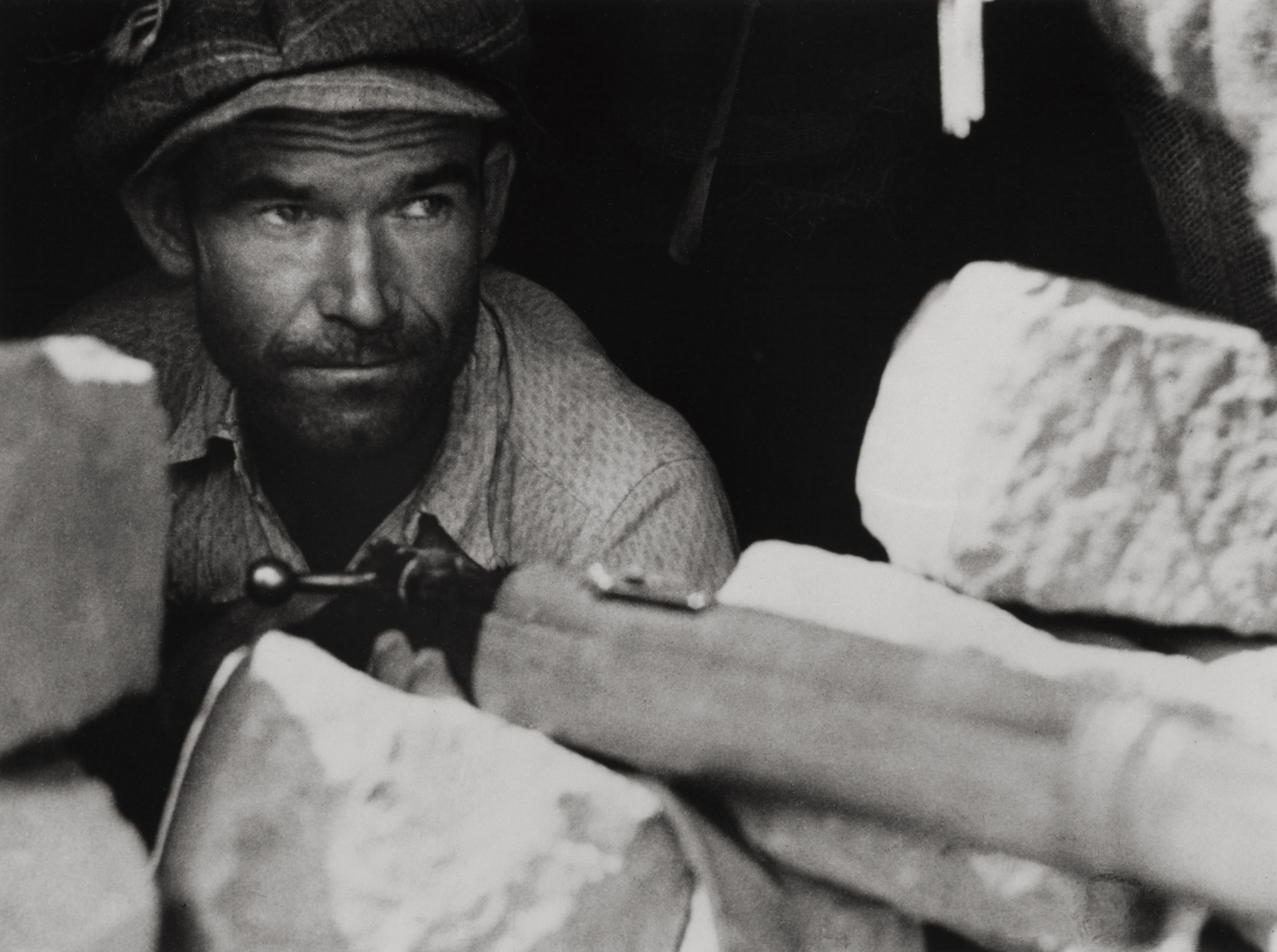
 

Robert Capa (Hungarian, 1913-1954) 'Barcelona or its vicinity, August 1936. Loyalist militiamen.' 1936


Robert Capa (Hungarian, 1913-1954)
Barcelona or its vicinity, August 1936. Loyalist militiamen
1936
Gelatin silver print


Thankyou to the Ludwig Museum press office for allowing me to use these photographs to illustrate the post. Another exhibition about Robert Capa, This is War! Robert Capa at Work is on show at Museu Nacional d’Art de Catalunya from 7th July – 27th September, 2009

Dr Marcus Bunyan


Please click on the photographs for a larger version of the image.
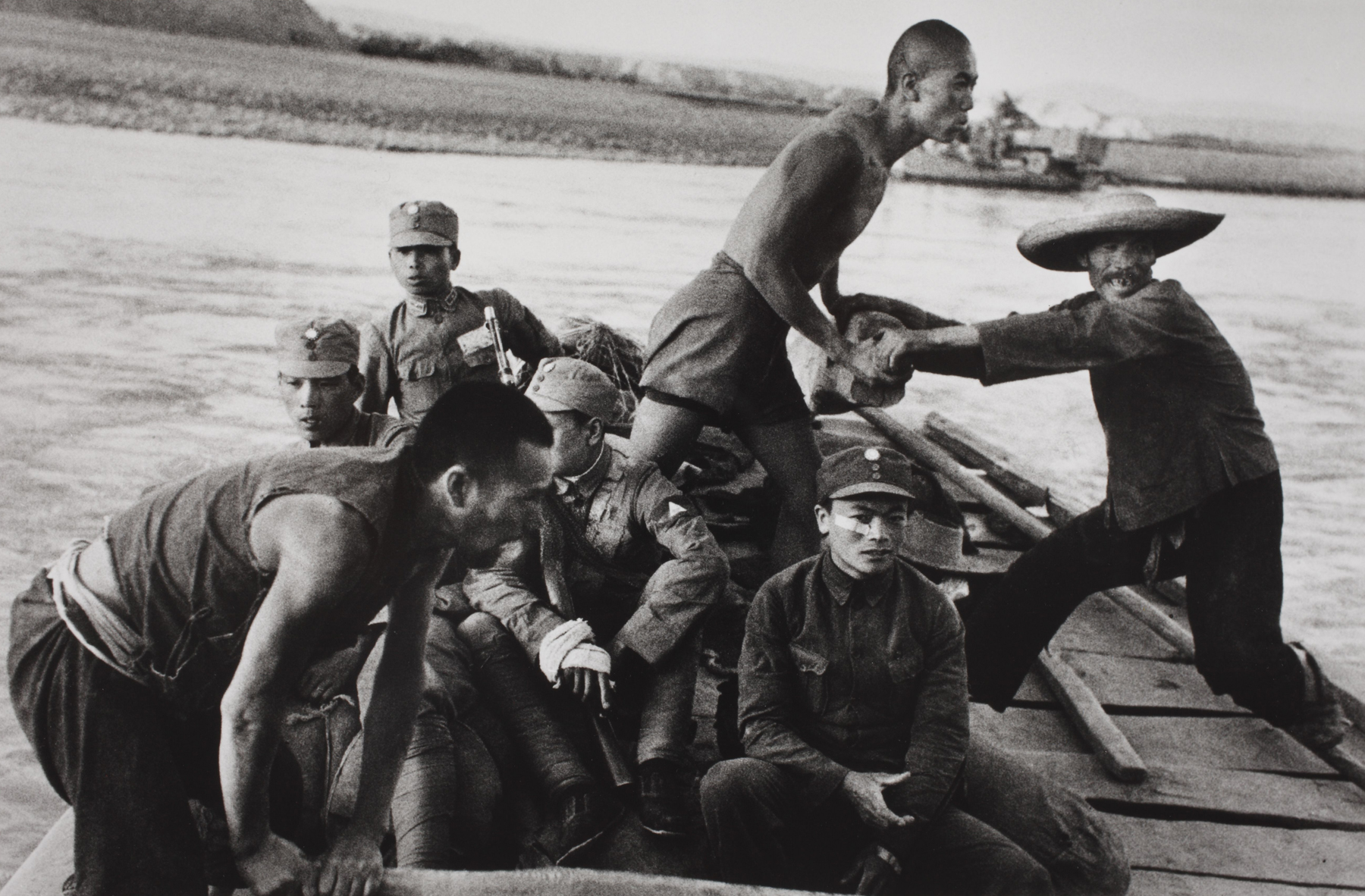


Robert Capa (Hungarian, 1913-1954) 'Near Zhengzhou, June-July 1938' 1938


Robert Capa (Hungarian, 1913-1954)
Near Zhengzhou, June-July 1938
1938
Gelatin silver print


Near Zhengzhou, June-July 1938. As the Japanese advanced on Zhengzhou – the crossroads of the two major railway lines of northern and eastern China, and the gateway to the Hankow region – Chiang Kai-shek ordered the dikes of the Yellow River blown up. The flood, which halted the Japanese only temporarily, inundated eleven cities and four thousand villages, destroyed the crops of four provinces, and rendered two million people homeless. In this photograph Chinese soldiers are being ferried across the river.
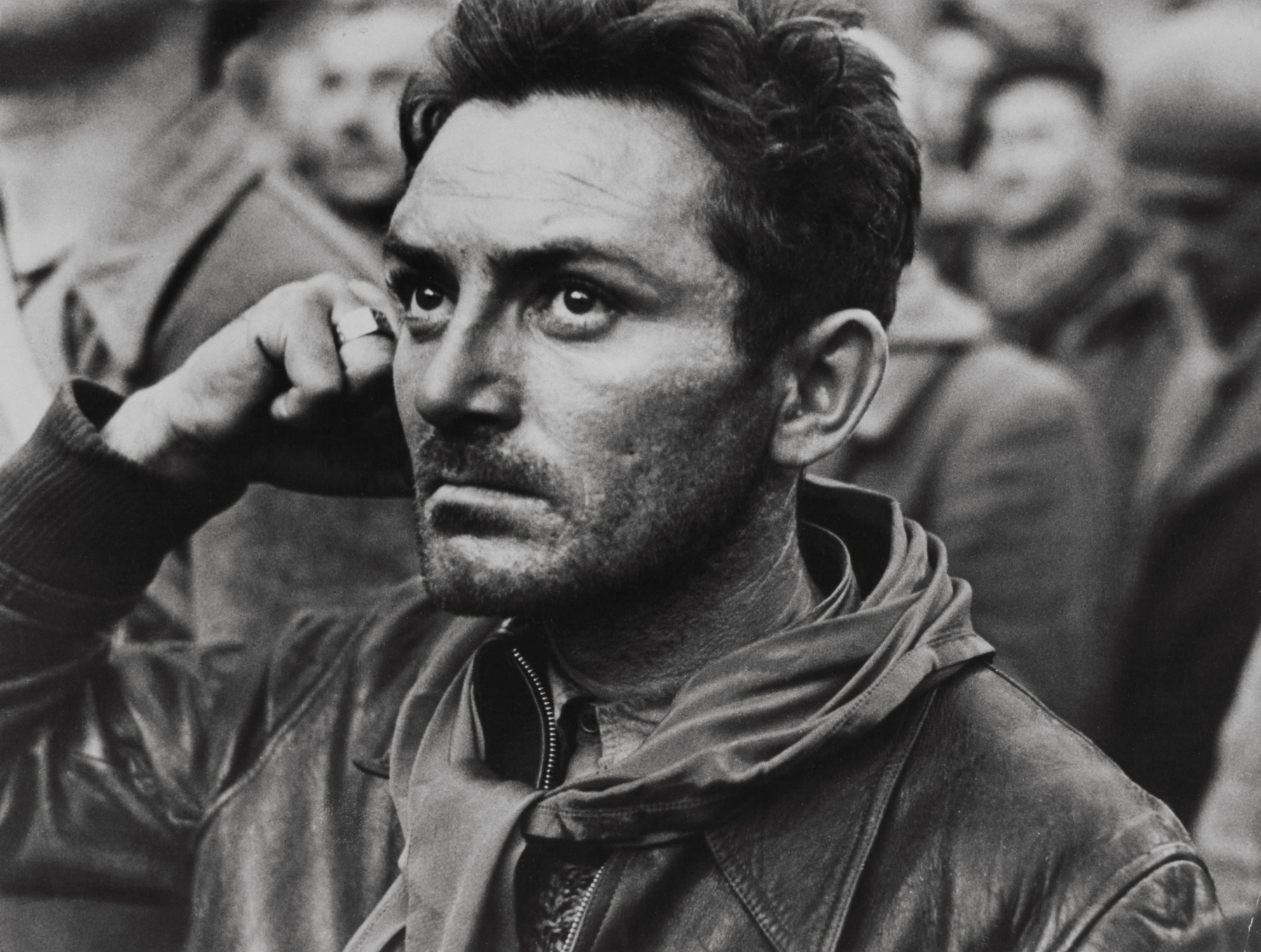
 

Robert Capa (Hungarian, 1913-1954) 'Near Barcelona, October 1938' 1938


Robert Capa (Hungarian, 1913-1954)
Near Barcelona, October 1938
1938
Gelatin silver print


Near Barcelona, October 1938. Farewell ceremony for the International Brigades. As an overture of friendship toward Hitler (who naturally wanted General Franco’s fascists to win the civil war), Stalin forced the Spanish Loyalist government to disband this Communist-supported force. This move was a terrible blow both to the Loyalist cause and to the men of the International Brigades.


Robert Capa (Hungarian, 1913-1954) 'September 5, 1936. The death of a Loyalist militiaman' 1936


Robert Capa (Hungarian, 1913-1954)
September 5, 1936. The death of a Loyalist militiaman
1936
Gelatin silver print
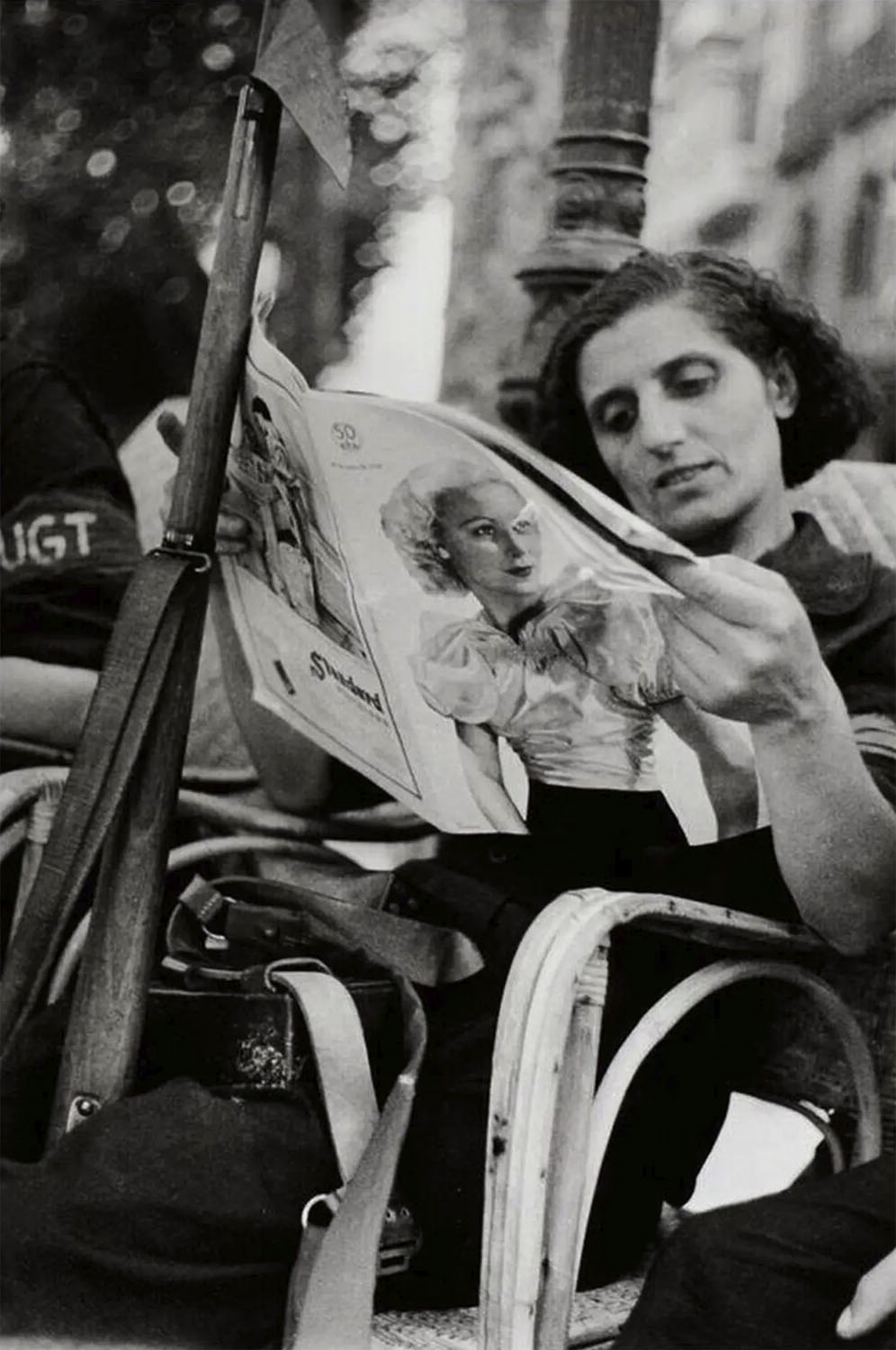
 

Robert Capa (Hungarian, 1913-1954) 'Loyalist Militiawoman' 1936


Robert Capa (Hungarian, 1913-1954)
Loyalist Militiawoman
1936
Gelatin silver print


“The precocious Budapest teenager who would eventually become known to the world as Robert Capa did not aspire to be a photographer. He wanted to be a writer – a reporter and a novelist.”


Richard Whelan


Capa’s evolution into a press photographer and war reporter (all the while entertaining the idea of filmmaking) was fundamentally determined by history, as well as by factors like the accelerated technical developments in photography, the changes in the printed picture press in the 1920s as a result of the influence of motion pictures, as well as the increasingly refined techniques and strategies of photographers.

Capa distinguished himself among the ranks of war reporters who thought – with the visual appearance of magazine pages already in mind – in series of images that rolled like film footage, and who had the courage and the ability to “get in close” and show aspects of war and fighting on the front lines in a form that had hitherto been impossible, partly due to technological limitations and partly because of the restrictions of censorship.

Capa worked for a number of US and European agencies; his photo reports appeared in the columns of such publications as Vu, Regards, Ce Soir, Life, Picture Post, Collier’s and Illustrated. At the same time, in addition to his work as a photo correspondent, being one of the founders of the Magnum photo agency (1947), educating and supporting young photographers were of primary importance to him.

Following his death in 1954, his brother Cornell Capa, in addition to his own work as press photographer, strove to preserve and introduce to the world the oeuvre of his brother and his colleagues. As a first step, he expanded the International Fund for Concerned Photography, which he had co-founded with others in 1956. Then, in 1974, he established the International Center of Photography (ICP) – one of the world’s most prominent institutions of photography, simultaneously a museum, a school and an archive – with himself as director.

Between 1990 and 1992, Cornell Capa and Richard Whelan looked through Capa’s more than seventy thousand photos and chose 937 of them, the most outstanding photos of his oeuvre from 1932 to 1954, to represent the cornerstones of his life’s work and his career as a press photographer.

In 1995, from the 937 negatives that had been selected, three identical, excellent quality series were produced using traditional photographic technique. These consisted of 40 x 50 cm enlargements and marked with Robert Capa’s embossed seal. It was determined that no additional series could be made after this time. Of the three series, one remained in New York, the second one found a home in the Fuji Art Museum of Tokyo, and the third set was purchased by the Hungarian Ministry of Culture and added to the Historical Photo Collection of the Hungarian National Museum.

Besides the 937 photographs that constitute what is known as the “Definitive Collection”, the Hungarian National Museum also acquired 48 original Robert Capa vintage copies dating back to the same time. The backbone of the exhibition consists of selected groups of photographs. The more than 200 images lead viewers through the key stages of Robert Capa’s career as war correspondent through highlighted themes of his oeuvre, in chronological order.

The exhibition starts off with Budapest – presenting family photos, portraits and other documents – and moves on to the first serious commission in Berlin (the series on the speech given by the exiled Lev Trotsky in 1932, in Copenhagen) and the difficulties of the Paris years. Then we arrive to the most definitive stage in the oeuvre, the three-year period (1936-1939) spent photographing the Spanish Civil War and the Second Sino-Japanese War, during which Endre Friedmann / André Friedmann became Robert Capa, one of the most famous war press photographers in the world. Next we see the seats of world war operations: photos capturing the North African, Southern Italian and Sicilian fronts as well as the Normandy Landing on June 6, 1944. The “D-Day” series, which also served as inspiration to film director Steven Spielberg, is followed by images documenting the denigration of the French women who collaborated with the Germans and the liberation of Paris. The sequence of wartime photographs ends with images of the Ardennes Offensive and the advances of the Allied Forces. Capa’s post-world war work is represented by his reports on the establishment of the State of Israel and the associated conflicts, the immigrants and the refugees, as well as the material from his journey to the Soviet Union with John Steinbeck in 1947 and the photos of his 1948-1949 trip around Eastern Europe, which also include some Budapest shots. The chronological sequence ends with Capa’s photographs of Indochina and the photos taken on May 25, 1954, immediately preceding his death.

A separate section is devoted to the photographic documents of his social life, which became inextricably intertwined with his work as press photographer. His portraits which were taken in parallel with his war reports capture people that were important to him – colleagues, friends and lovers – as well as many prominent figures of the era, including Pablo Picasso, Ingrid Bergman, John Steinbeck and Ernest Hemingway.”

Press release from the Ludwig Museum – Museum of Contemporary Art Cited 10/07/2009
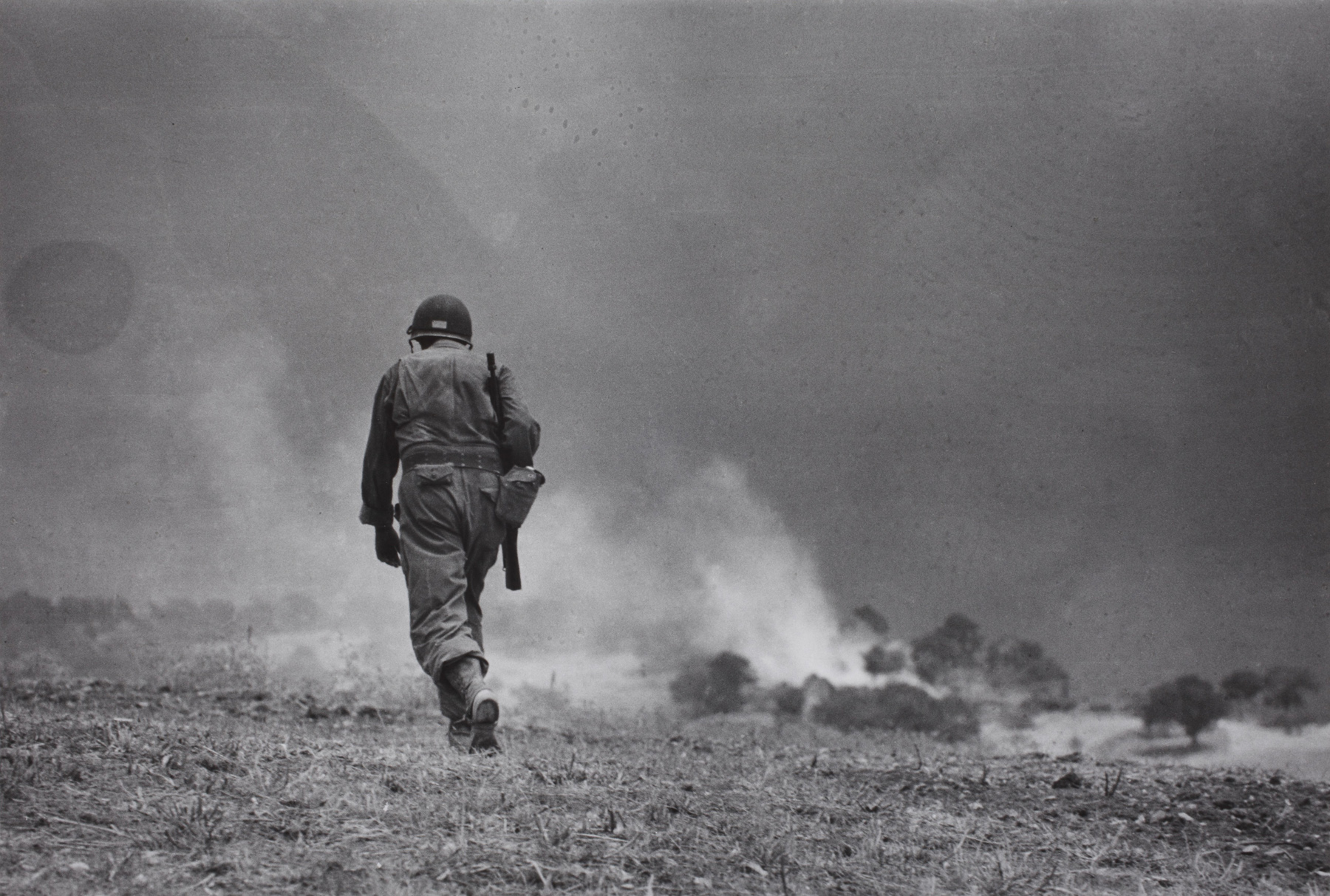
 

Robert Capa (Hungarian, 1913-1954) 'Near Troina, Sicily, August 4-5, 1943. Reconnaissance mission.' 1943


Robert Capa (Hungarian, 1913-1954)
Near Troina, Sicily, August 4-5, 1943. Reconnaissance mission
1943
Gelatin silver print
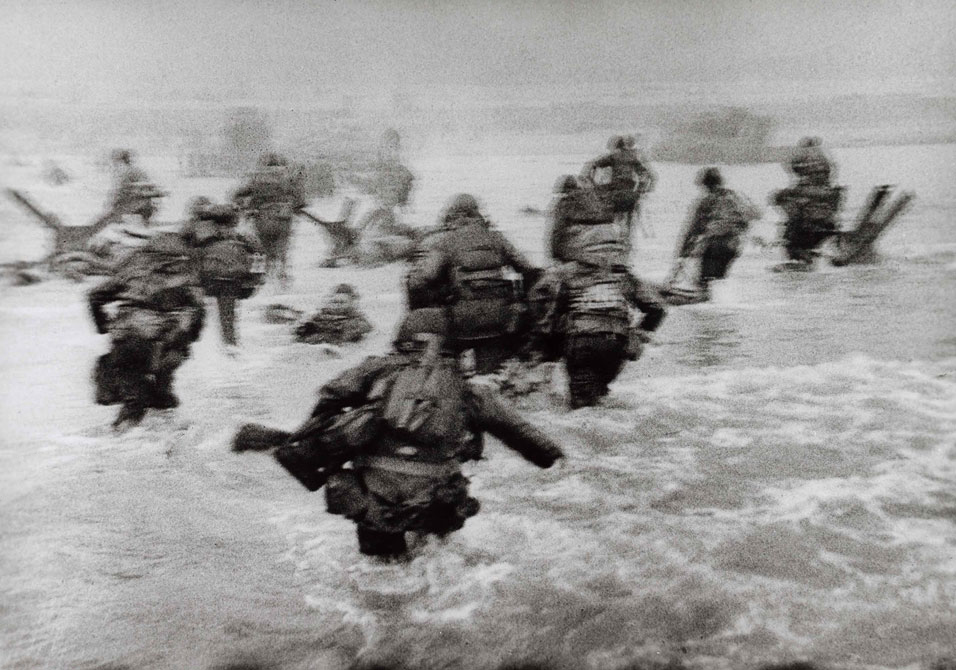
 

Robert Capa (Hungarian, 1913-1954) 'American soldiers landing on Omaha Beach, D-Day, Normandy, France, June 6, 1944' 1944


Robert Capa (Hungarian, 1913-1954)
American soldiers landing on Omaha Beach, D-Day, Normandy, France, June 6, 1944
1944
Gelatin silver print
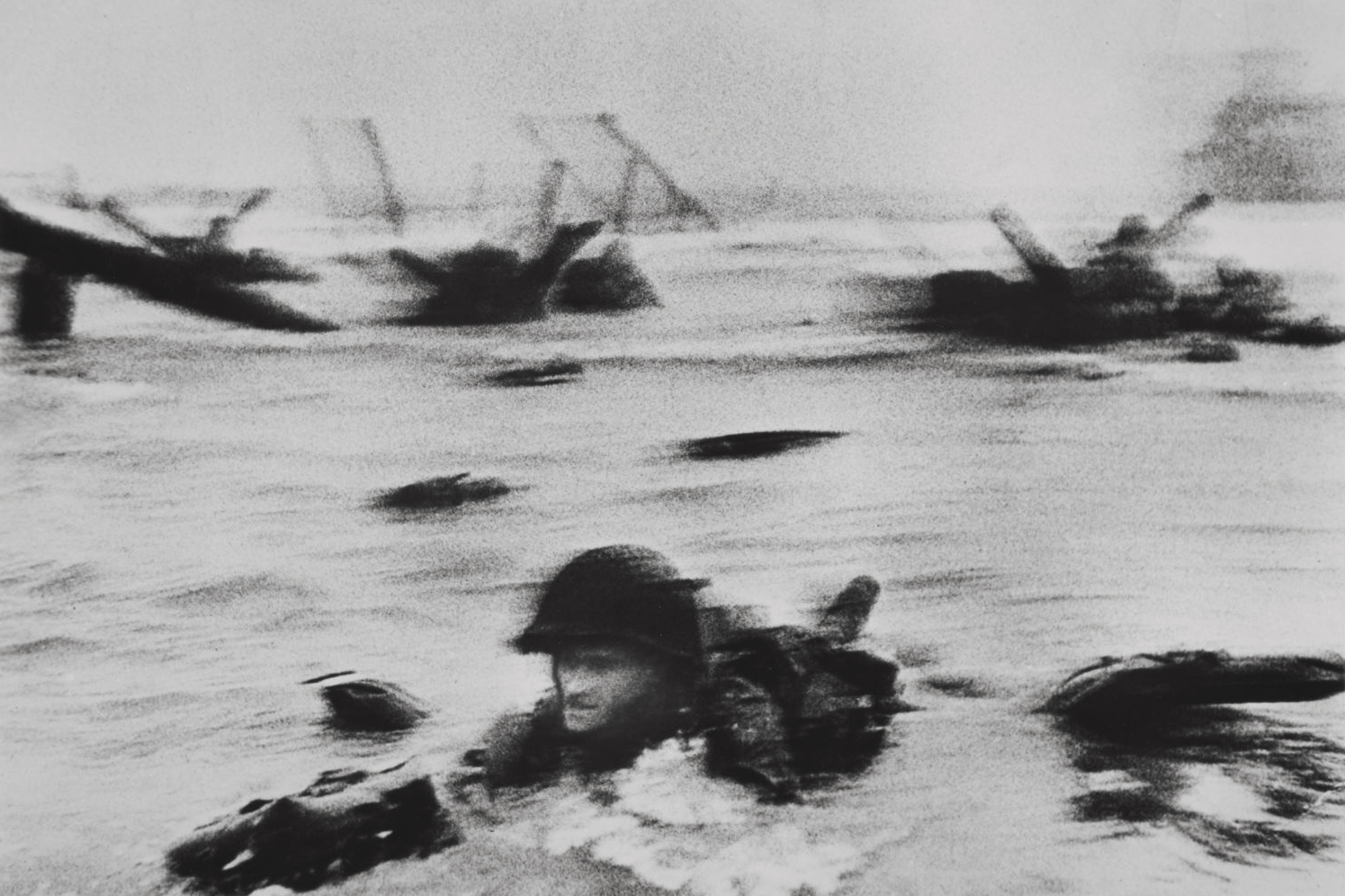
 

Robert Capa (Hungarian, 1913-1954) 'Omaha Beach, near Colleville-sur-Mer, Normandy coast, June 6, 1944. The first wave of American troops landing on D-Day' 1944


Robert Capa (Hungarian, 1913-1954)
Omaha Beach, near Colleville-sur-Mer, Normandy coast, June 6, 1944. The first wave of American troops landing on D-Day
1944
Gelatin silver print


One of the greatest photographers of the 20th century, Robert Capa was born in Budapest, on October 22, 1913, as Endre Ernő Friedmann. He started to work as a photographer in the 1930s, first as a correspondent of Dephot, a Berlin-based agency. In 1933 he moved to Paris, where he befriended André Kertész, Henri Cartier-Bresson and David Seymour (Chim), and met with the great love of his life, Gerda Taro, also a photographer. He changed his name to Robert Capa in 1935, and his pictures of the 1936-1937 Spanish civil war were already published under this nom de plume. He immigrated to the US in 1939. Between 1941 and 1945, he worked on the European scenes of the war for Life magazine. He was one of the founders of the Magnum Photos agency. He died in May 1954, when he stepped on a landmine in Vietnam.

In 2008, a government grant enabled the Hungarian National Museum to buy 985 of Robert Capa’s photos from the collection of the International Center of Photography, New York. 48 of these are original prints by Robert Capa, and 937 form the so-called Robert Capa Master Selection III. Founded in 1974, the International Center of Photography holds about seventy thousand negatives made by the Hungarian born Robert Capa, considered the greatest war photographer of all time. In 1995, Cornell Capa (Robert’s brother, who died last year) and Richard Whelan (Robert Capa’s friend and biographer) selected 937 of these negatives to represent the oeuvre. Of these, three identical, limited-edition series were made, each excellent 40 x 50 cm print marked with Robert Capa’s dry seal. No further prints will be made. One of the series stayed in New York, the second was bought by the Tokyo Fuji Art Museum, Japan, and the third by the Hungarian National Museum. Not only does the series offer a comprehensive overview of the oeuvre, it also enables exhibition-goers to have a visual experience of important events in the history of the 20th century through high-quality material. The 937 pictures were made on four continents, in 23 countries. 461 were made before the Second World War, of which images of the Spanish civil war are the most important. 276 of these photos he made on the fronts of the World War – the poignant pictures of the D-Day landing in Normandy were later to inspire film director Steven Spielberg. 154 photos from after the world war illustrate more struggle and suffering during the establishment of the state of Israel and the Indochina War. 46 images bear testimony to the talent of Capa the portrait photographer, with pictures of Gary Cooper, Ingrid Bergman, Alfred Hitchcock, John Steinbeck, Pablo Picasso and others. ICP made a gift of large prints of 20 negatives considered especially important in the series, and five portraits of Robert Capa. In all, the national collection was enriched with 1010 photographs.

Robert Capa was a war photographer, with all the important traits of an excellent correspondent: he owned the right amount of persistence, aggressiveness to get to the scenes, resourcefulness and communication skills to match the capacities of a great artist: a high degree of sensitivity, the talent to recognise and choose subjects, and composition skills. Bravely, though not fearlessly, he was there in all of the large wars of the middle of the 20th century, and he struggled with the eternal dilemma of journalists and photographers, whether he is a hyena when his participation stops at recording the events, and does not extend to helping those who flee or are wounded. His vocation, to which his dedication was always complete, was thus a source of moral conflict for him, while also compelled him to show what he considered really important. To show things in a way no one else could because no one else was close enough. “If your pictures are not good enough, you weren’t close enough,” he said. He was close when the militiaman died, he was there in the bloodbath of the landing in Normandy, and he was of course close enough to the Indochina War when he stepped on that fatal mine. He lived an intensive, passionate life, taking risks, even gambling; a life that promised childlessness, social solitude, homelessness and a preordained mode of death. This was probably the only way to live through and show all that surrounded him.

A selection from the new acquisition, about 30 pictures, will be on view in the Hungarian National Museum, between March 6 and 15, 2009. The first large exhibition of this exceptional material opens in Ludwig Museum on July 2, and can be seen until October 11. A travelling selection is also planned, to be shown in ten Hungarian cities.

Press release from the Ludwig Museum website [Online] Cited 16/03/2019
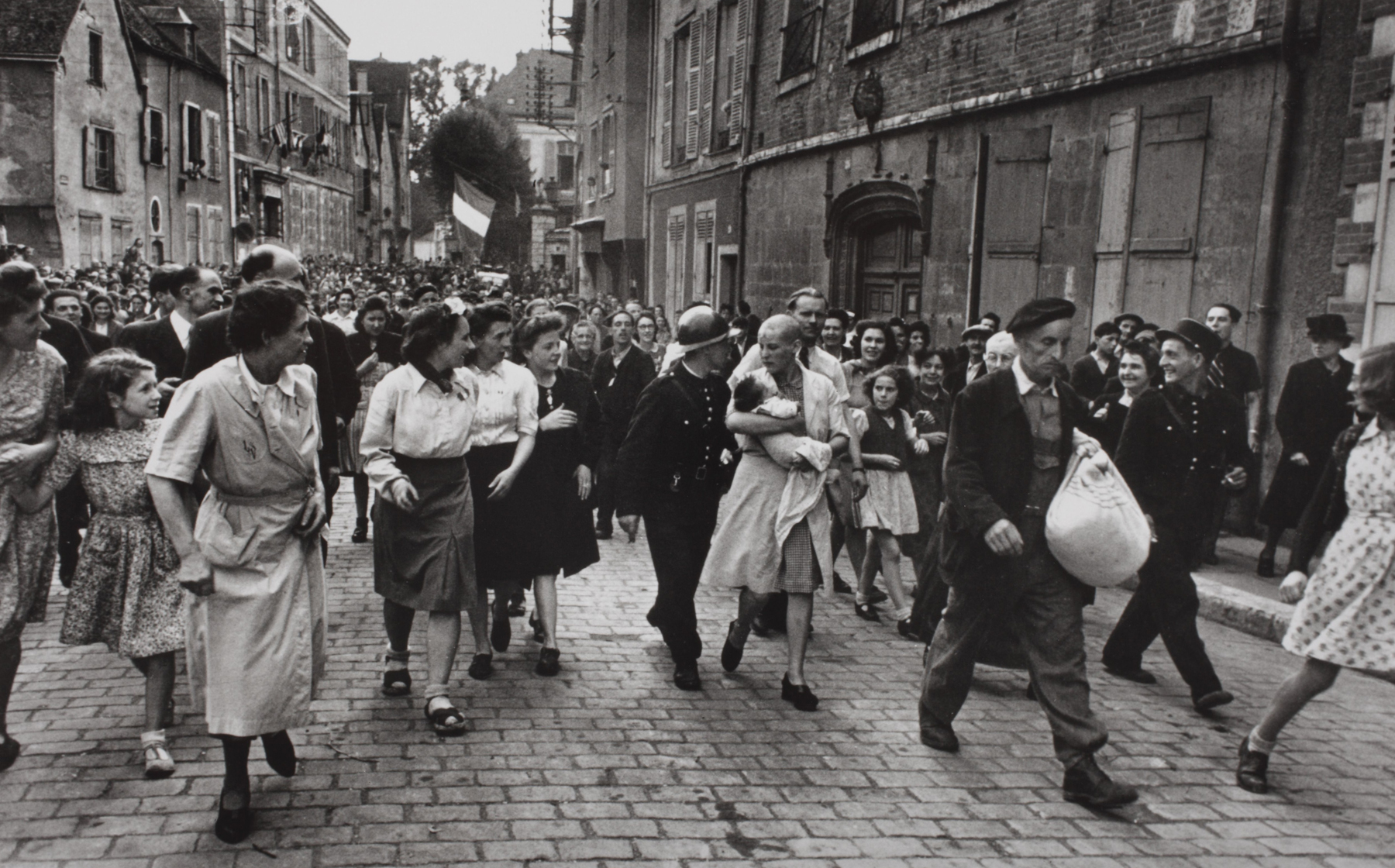
 

Robert Capa (Hungarian, 1913-1954) 'Chartres, August 18, 1944' 1944


Robert Capa (Hungarian, 1913-1954)
Chartres, August 18, 1944
1944
Gelatin silver print
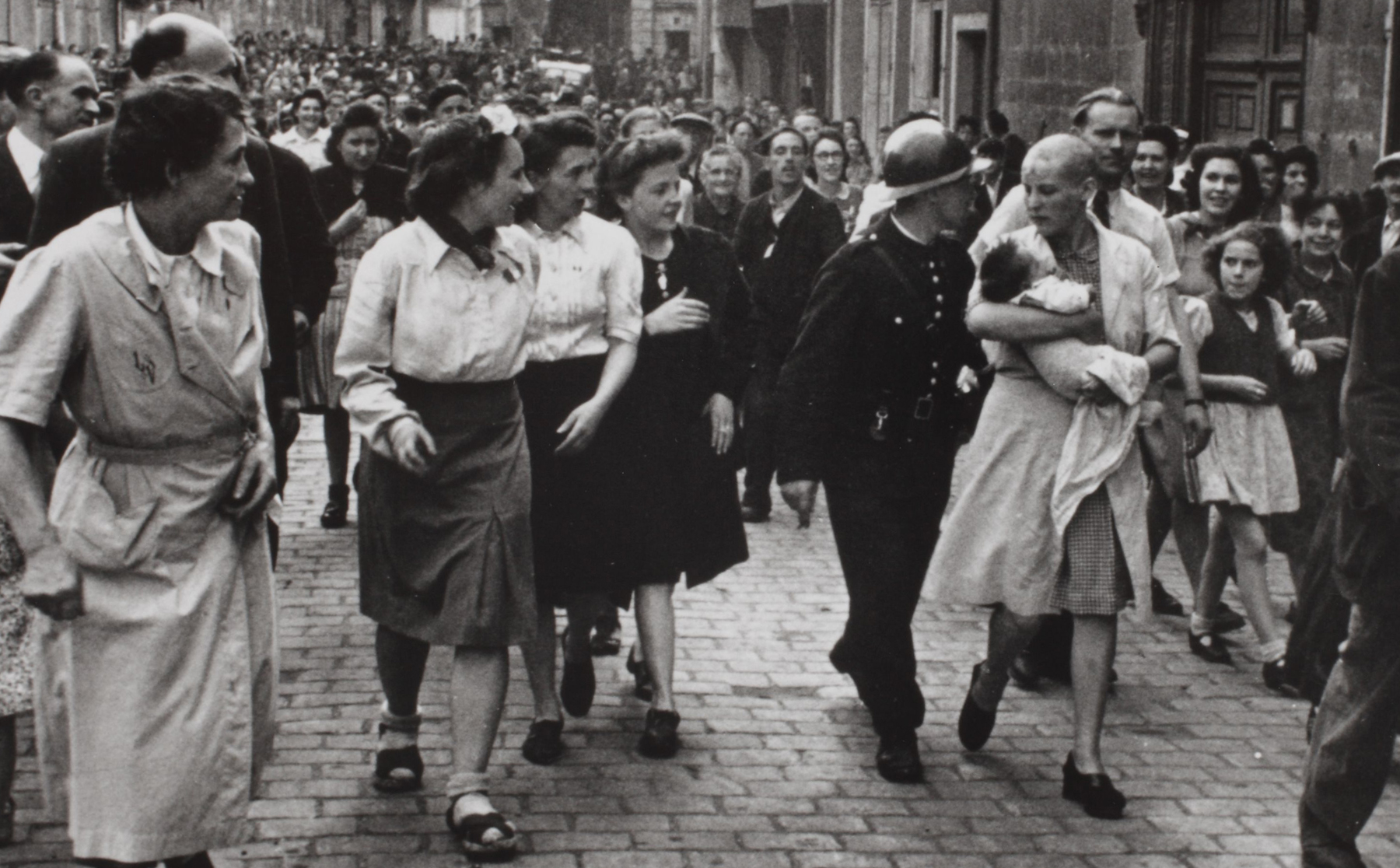
 

Robert Capa (Hungarian, 1913-1954) 'Chartres, August 18, 1944' 1944 (detail)


Robert Capa (Hungarian, 1913-1954)
Chartres, August 18, 1944 (detail)
1944
Gelatin silver print


Chartres, August 18, 1944. Just after the Allies had liberated the town, a Frenchwoman who had had a baby by a German soldier was punished by having her head shaved. Here she is seen being marched home. Her mother (barely visible over the right shoulder of the man at right carrying cloth sack) was similarly punished.


Ludwig Museum – Museum of Contemporary Art

Palace of Arts, 
Komor Marcell u. 1, Budapest, H-1095
Phone: +36 1 555 3444

Opening hours:
Tuesday – Sunday: 10am – 6pm
Closed on Mondays
Ludwig Museum of Art website

LIKE ART BLART ON FACEBOOK

Back to top

Review: ‘Framing Conflict – Iraq and Afghanistan’ exhibition by Lyndell Brown and Charles Green at The Ian Potter Museum of Art, The University of Melbourne

Exhibition dates: 5th November, 2008 – 1st February, 2009


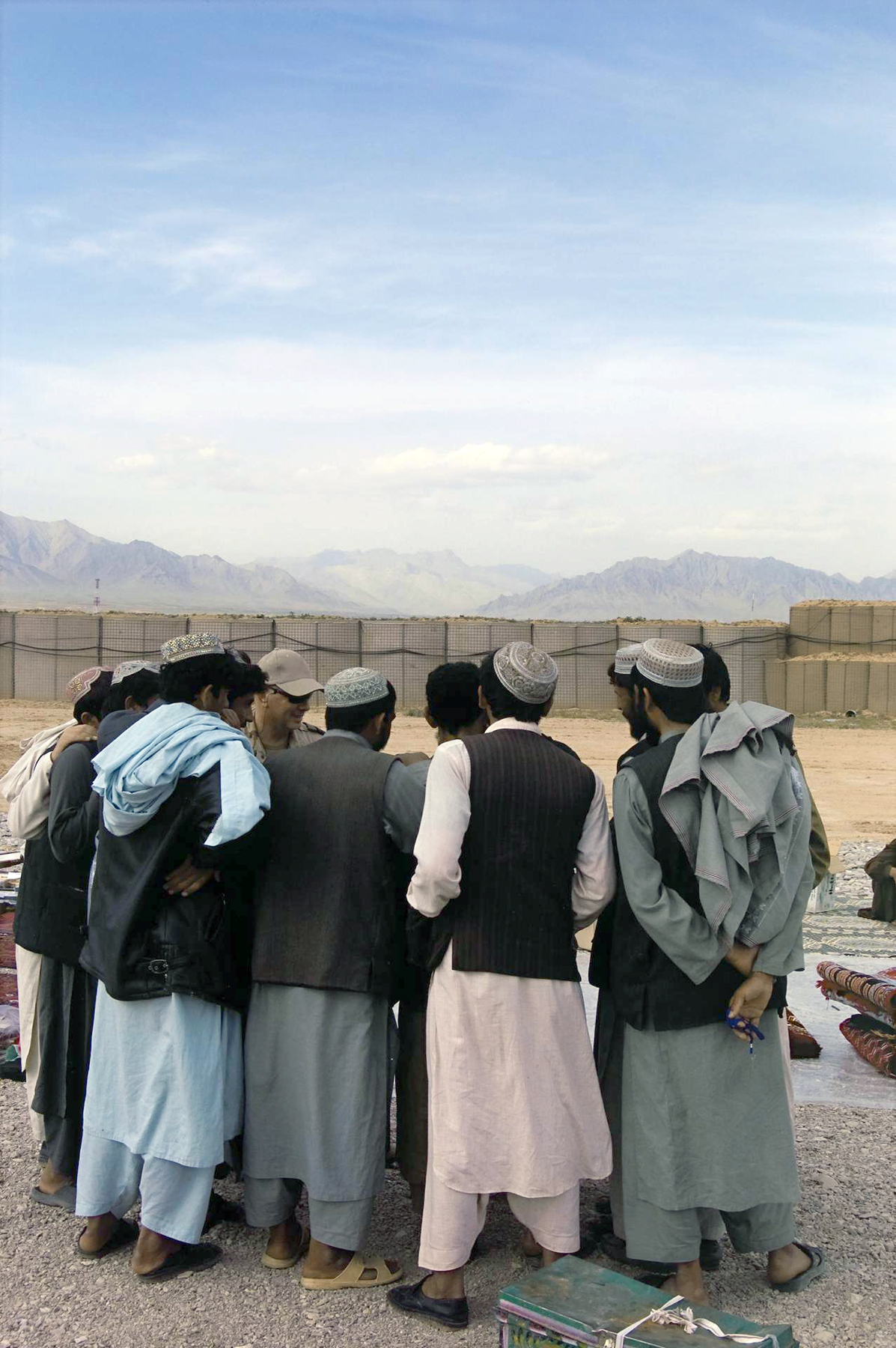
Lyndell Brown (Australian, b. 1961) and Charles Green (Australian, b. 1953) 'Afghan traders with soldiers, market, Tarin Kowt base, Uruzgan province, Afghanistan.' 2007-2008 from the exhibition 'Framing Conflict – Iraq and Afghanistan' exhibition by Lyndell Brown and Charles Green at The Ian Potter Museum of Art, The University of Melbourne, Nov 2008 - Feb 2009


Lyndell Brown (Australian, b. 1961) and Charles Green (Australian, b. 1953)
Afghan traders with soldiers, market, Tarin Kowt base, Uruzgan province, Afghanistan
2007-2008
From The approaching storm series 2007-2009
Digital colour inkjet photograph
155 × 107.5cm


Despite one brilliant photograph and some interesting small painted canvases this exhibition is a disappointment. No use beating around the figurative bush in the landscape so to speak, talking plainly will suffice. Firstly, let’s examine the photographs. Thirteen large format colour photographs are presented in the exhibition out of an archive of “thousands of photographs Brown and Green created on tour”1 from which the paintings are derived.

Most of the photographs are inconsequential and need not have been taken. Relying on the usual trope of painters who take photographs they are shot at night, dusk or dawn when the shadows are long, the colours lush supposedly adding ‘mystique’ to the scene being portrayed. In some cases they are more like paintings than the paintings themselves. Perhaps this was the artist’s plan, the reverse marriage of photography and painting where one becomes the other, but this does little to advance photography as art. There is nothing new or interesting here: sure, some of the photographs are beautiful in the formal representation of a vast and fractured landscape but the pre-visualisation is weak: bland responses to the machines, industry, people and places of the conflict. Go look at the Andreas Gursky photographs at the National Gallery of Victoria to see world-class photography taking reality to the limit, head on.

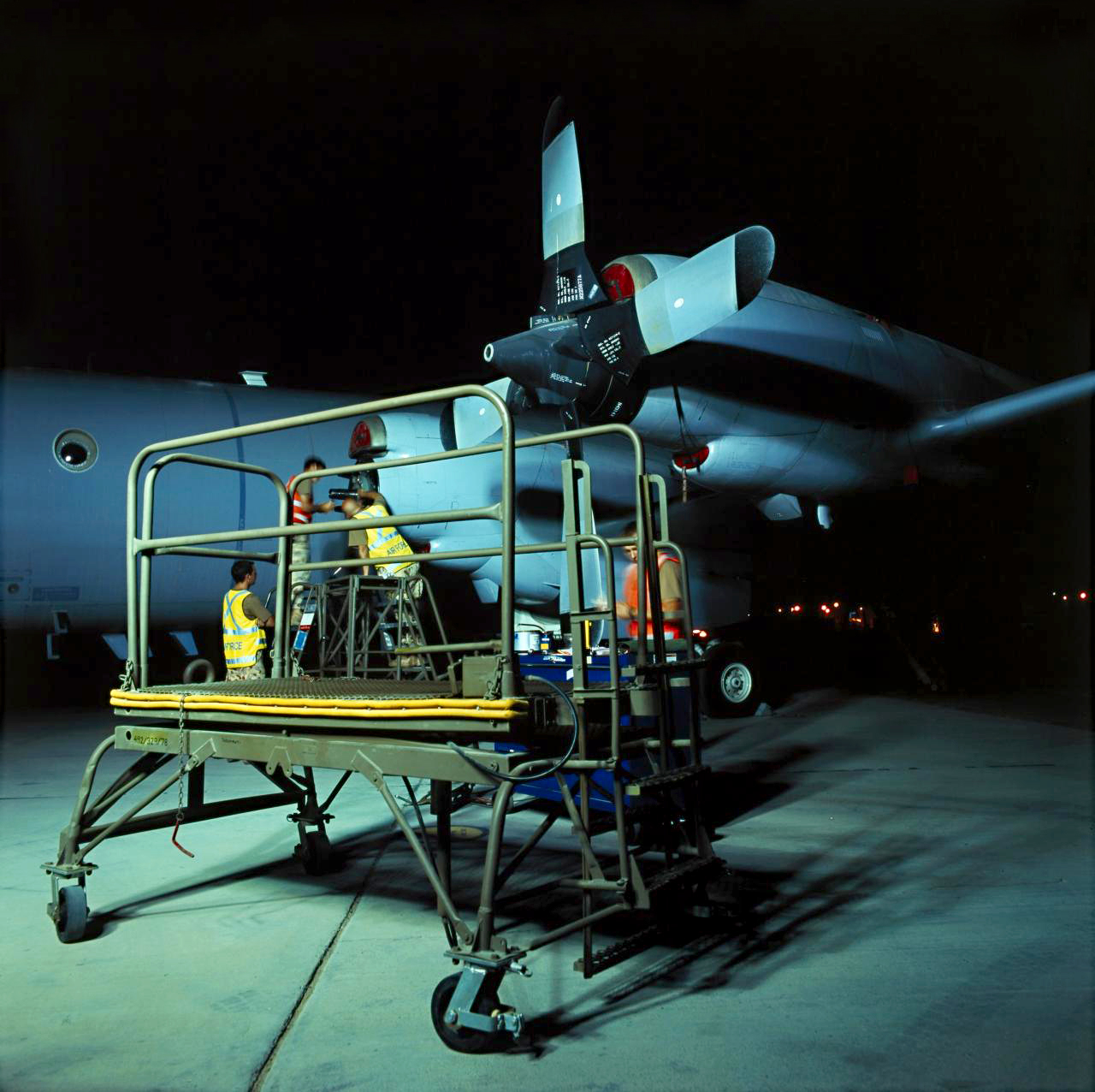
Too often in these thirteen images the same image is repeated with variants – three images of the an aircraft having it’s propeller changed show a lack of ideas or artefacts to photograph – presented out of the thousands taken seems incongruous. The fact that only one photograph is reproduced in the catalogue is also instructive.

Some images are just unsuccessful. For example the photograph Dusk, ship’s bridge with two sailors, northern Gulf is of a formulaic geometry that neither holds the viewers attention nor gives a deeper insight into their lives aboard ship and begs the question why was the photograph taken in the first place? The dark space has little physical or metaphysical illumination and seems purely to be an exercise in formalism. The photograph Dusk, ships’ bridge with sailor, northern Gulf is more successful in the use of light and shade as they play across the form of a sailor, his head resting pensively in his hand, red life vests adding a splash of colour to the bottom right of the photograph.

The brilliant photograph of the group is View from Chinook, Helmand province, Afghanistan. This really is a monstrous photograph. With the large black mass of the helicopter in the foreground of the image containing little detail, the eye is drawn upwards to the windscreen through which a mountain range rises, with spines like the back of a Stegosaurus. To the right a road, guarded by a desolate looking pillbox and yellow barrier, meanders into the distance. Dead flies on the windscreen look like small bullet holes until you realise what they are. This is the image that finally evidences a disquieting beauty present in the vast and ancient landscape.

Turning to the paintings we can say that some of the small 31cm x 31cm paintings work well. From an ‘original’ photograph the artist selects and crops a final image that they work up into a highly detailed oil painting. Distilled (as the artist’s like to put it) from the ‘original’ photographs, the paintings become a “merging of a contemporary sense of composition – borrowed from photography, film and video – with the textures and processes of traditional oil painting.”2

“These works were developed by the artists to be something akin to “Hitchcockian clues” which create the sense of looking out at a scene but being distanced from the action. To some degree the entire suite of small pictures participate in developing this intrigue, by showing an array of ambiguous scenes in which direct action is never present, or is obscured by limited perspectives … The artists noted that the war zones they witnessed were low in action but high in tension”3

To an extent this tension builds in some of the small paintings: the small size lends an intimate, intense quality and forces the viewer to engage with highly detailed renditions of textures of clothing, material, skin and hair and the distorted scale of the ships and aeroplanes portrayed. In these intense visions the painting seems less like a photograph and more like a new way of seeing. However, this occurs only occasionally within the group of small paintings.

If we think of a photograph in the traditional sense as a portrayal of reality, then a distillation of that photograph (the removal of impurities from, an increase in the concentration of) must mean that these paintings are a double truth, a concentrated essence of the ‘original’ photograph that changes that essence into something new. Unfortunately most of these small canvases show limited viewpoints of distilled landscapes that do not lead to ambiguous enigmas, but to the screen of the camera overlaid by a skein of paint, a patina of posing.

This feeling is only amplified in the three large ‘History’ paintings. The three paintings seem static, lifeless, over fussy and lacking insight into the condition of the ‘machine’ that they are attempting to portray. It’s a bit like the ‘Emperors New Clothes’, the lack of substance in the paintings overlaid with the semantics of History painting (“a traditional genre that focused on mythological, biblical, historical and military subjects”) used to confirm their existence and supposed insight into the doubled, framed reality. As Robert Nelson noted in his review of 2008 art in Melbourne in The Age newspaper it would seem that painting is sliding into terminal decline. These paintings only seem to confirm that view.

Here was a golden opportunity to try something fresh in terms of war as conflict – both in photography and painting – to frame the discourse in an eloquent, innovative manner. Most of this work is not interesting because it does not seem to be showing, or being discursive about anything beyond a personal whim. Because an artist can talk about some things, doesn’t mean that he can make comments about other things that have any value. Although the artist was looking to portray landscapes of globalisation and entropy, there are more interesting ways of doing this, rather than the nature of the transcription used here.

“It is very good to copy what one sees: it is much better to draw what you can’t see any more but in your memory. It is a transformation in which imagination and memory work together. You only reproduce what struck you, that is to say, the necessary. That way your memory and your fantasy are freed from the tyranny of nature.”4

No thinking but the putting away of intellect and the reliance on memory and imagination, memory and fantasy to ‘distil’ the essence. This is what needed to happen both in the photographs and paintings – leaving posturing aside (perhaps an ‘unofficial war artist’ would have had more success!) to uncover the transformation of landscape that the theatre of this environment richly deserves.

Dr Marcus Bunyan


Footnotes

1/ Heywood, Warwick. Framing Conflict: Iraq and Afghanistan exhibition catalogue. Canberra: Australian War Memorial, 2008, p. 6
2/ Heywood, Warwick. Framing Conflict: Iraq and Afghanistan exhibition catalogue. Canberra: Australian War Memorial, 2008, p. 6
3/ Heywood, Warwick. Framing Conflict: Iraq and Afghanistan exhibition catalogue. Canberra: Australian War Memorial, 2008, p. 11
4/ Degas, Edgar quoted in Halligan, Marion. “Between the brushstrokes,” in A2 section, The Saturday Age newspaper, January 17th 2008, p. 18


Many thankx to The Ian Potter Museum of Art for allowing me to publish the photographs in the posting. Please click on the photographs for a larger version of the image.


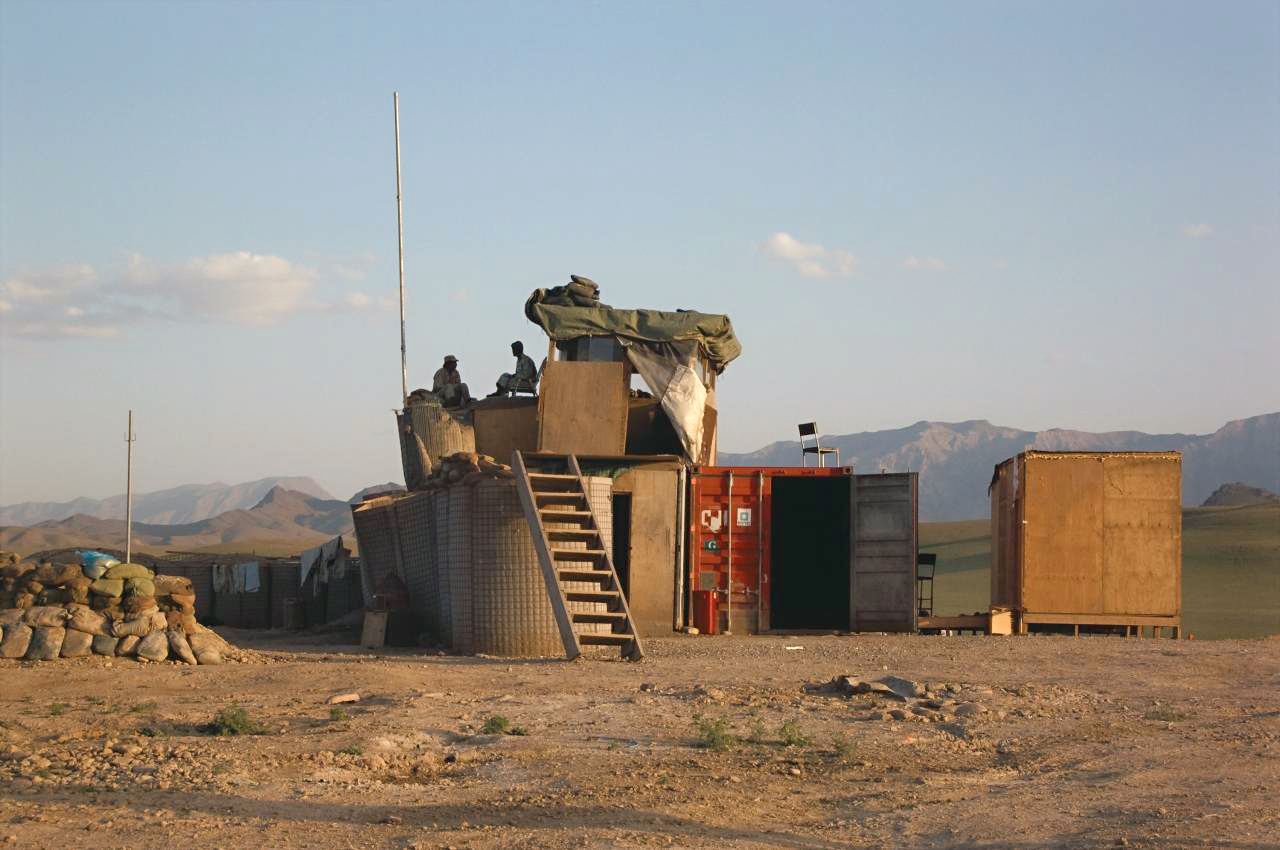
Lyndell Brown (Australian, b. 1961) and Charles Green (Australian, b. 1953) 'Afghan National Army perimeter post with chair, Tarin Kowt base, Uruzgan province, Afghanistan' 2007-2008 from the exhibition 'Framing Conflict – Iraq and Afghanistan' exhibition by Lyndell Brown and Charles Green at The Ian Potter Museum of Art, The University of Melbourne, Nov 2008 - Feb 2009


Lyndell Brown (Australian, b. 1961) and Charles Green (Australian, b. 1953)
Afghan National Army perimeter post with chair, Tarin Kowt base, Uruzgan province, Afghanistan
2007-2008
From The approaching storm series 2007-2009
Digital colour inkjet photograph
111.5 × 151.5cm


Lyndell Brown (Australian, b. 1961) and Charles Green (Australian, b. 1953) 'Dusk, ship's bridge with two sailors, northern Gulf' 2007-2008


Lyndell Brown (Australian, b. 1961) and Charles Green (Australian, b. 1953)
Dusk, ship’s bridge with two sailors, northern Gulf
2007-2008
Digital colour inkjet photograph


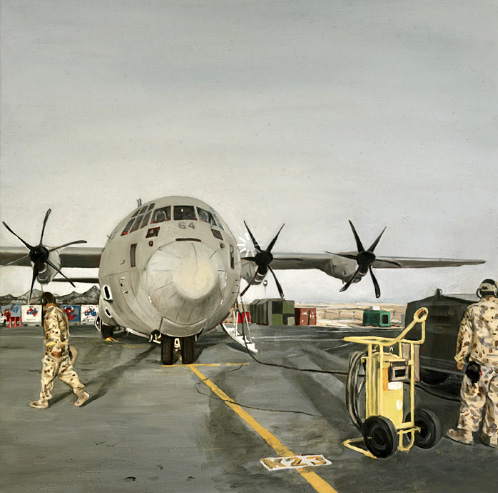
Lyndell Brown (Australian, b. 1961) and Charles Green (Australian, b. 1953) 'Late afternoon, flight line, military installation, Middle East' 2007


Lyndell Brown (Australian, b. 1961) and Charles Green (Australian, b. 1953)
Late afternoon, flight line, military installation, Middle East
2007
Oil on linen


Lyndell Brown (Australian, b. 1961) and Charles Green (Australian, b. 1953) 'Market, Camp Holland, Tarin Kowt, Uruzgan province, Afghanistan' 2007


Lyndell Brown (Australian, b. 1961) and Charles Green (Australian, b. 1953)
Market, Camp Holland, Tarin Kowt, Uruzgan province, Afghanistan
2007
Oil on linen


Lyndell Brown (Australian, b. 1961) and Charles Green (Australian, b. 1953) 'View from Chinook, Helmand province, Afghanistan' 2007-2008


Lyndell Brown (Australian, b. 1961) and Charles Green (Australian, b. 1953)
View from Chinook, Helmand province, Afghanistan
2007-2008
From The approaching storm series 2007-2009
Digital colour inkjet photograph
111.5 × 151.5cm


Lyndell Brown (Australian, b. 1961) and Charles Green (Australian, b. 1953) 'View from Chinook, Helmand province, Afghanistan' 2007


Lyndell Brown (Australian, b. 1961) and Charles Green (Australian, b. 1953)
View from Chinook, Helmand province, Afghanistan
2007
Oil on linen


Lyndell Brown (Australian, b. 1961) and Charles Green (Australian, b. 1953) 'Trolley, propeller change, on flightline at night, military installation, Gulf' 2007-2008


Lyndell Brown (Australian, b. 1961) and Charles Green (Australian, b. 1953)
Trolley, propeller change, on flightline at night, military installation, Gulf
2007-2008
From The approaching storm series 2007-2009
Digital colour inkjet photograph
87.0 × 87.4cm


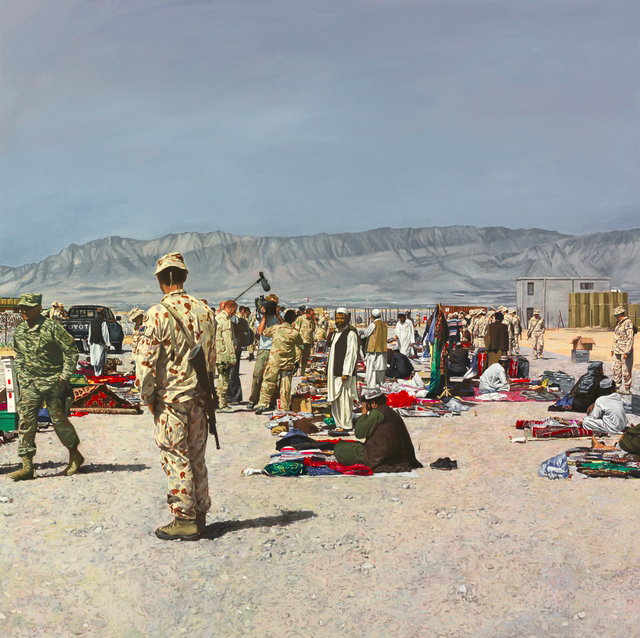
Lyndell Brown (Australian, b. 1961) and Charles Green (Australian, b. 1953) 'History painting: market, Tarin Kowt, Uruzgan province, Afghanistan' 2007


Lyndell Brown (Australian, b. 1961) and Charles Green (Australian, b. 1953)
History painting: market, Tarin Kowt, Uruzgan province, Afghanistan
2007
Oil on linen


Lyndell Brown and Charles Green. Installation view of photographs from the exhibition 'Framing Conflict' at The Ian Potter Museum of Art, The University of Melbourne


Lyndell Brown and Charles Green
Installation view of photographs from the exhibition Framing Conflict at The Ian Potter Museum of Art, The University of Melbourne
2009


Lyndell Brown and Charles Green. Installation view of paintings from the exhibition 'Framing Conflict' at The Ian Potter Museum of Art, The University of Melbourne 2009


Lyndell Brown (Australian, b. 1961) and Charles Green (Australian, b. 1953)
Installation view of paintings from the exhibition Framing Conflict at The Ian Potter Museum of Art, The University of Melbourne
2009


The Ian Potter Museum of Art
The University of Melbourne,
Corner Swanston Street and Masson Road
Parkville, Victoria 3010

Opening hours:
Tuesday – Saturday 11am – 5pm

The Ian Potter Museum of Art website

LIKE ART BLART ON FACEBOOK

Back to top

Review: ‘The Art of Existence’ exhibition by Les Kossatz at Heide Museum of Modern Art, Melbourne

Exhibition dates: 22nd November, 2008 – 8th March, 2009


Les Kossatz (Australian, 1943-2011) 'Digger's glory box' 1965 from the exhibition 'The Art of Existence' exhibition by Les Kossatz at Heide Museum of Modern Art, Melbourne, Nov 2008 - March 2009


Les Kossatz (Australian, 1943-2011)
Digger’s glory box
1965
Silk, felt, canvas, cardboard, wood, brass, ink, fibre-tipped pen and synthetic polymer paint
106.0 x 76.0 x 7.0cm
Courtesy the artist
Photographer: Viki Petherbridge
© Les Kossatz


Heide Museum of Modern Art has brought together nearly 100 pieces of work by the Australian artist Les Kossatz in an eclectic survey show, appropriately titled The Art of Existence. Featuring sculpture, painting and mixed media from the 1960s to the present the exhibition is appropriately titled because Kossatz’s work addresses certain archetypal themes that affect human existence:

“His life-long fascination with the natural world and desire to understand both its human and animal inhabitants; exploration of the systems of knowledge and codes of behaviour that structure individual and communal life; and his critical and playful reflections on contemporary behaviour and the mysteries of existence.”1

Strong symbolic paintings are the focus of the work in the 1960s, paintings that address the shocking brutality of war and its aftermath, when soldiers return home. To the observation that these are of the ‘pop-style’ school of painting suggested by the Heide website I feel these works are also influenced by the collage of Cubism, the boxes of Joseph Cornell and the dismembered bodies of Francis Bacon. They engage with the symbolism of war and remembrance: memory, myth, and the banality of heroism and sacrifice.

The key work in this series is the painting Diggers throne (1966). This is a powerful disturbing image, effervescent and unnerving at the same time. It features a disembodied arm on the hand of a throne, surrounded by a wonderful kaleidoscopic assemblage of pictorial planes, artefacts and memories – an English flag, the flag of St George, a crown, medals and the words RSL. The arm reminds me of the Francis Bacon painting Study after Velázquez’s Portrait of Pope Innocent X (1953) as it rests, roughly drawn in pencil on the arm of the throne, drawing the eye back up into nothingness.

The Diggers throne painting also features these prophetic words:

“throne slow to rot
and twisted the memory
becomes sacred.
Bloody was the truth
And this a chair.”


All other work in this period seems to flow through this painting – the other large paintings, the small canvases featuring individual medals and the less successful hanging banners. But it is to this work we return again and again as a viewer, trying to decipher and reconcile our inner conflicts about the painting.

As we move into the 1970s the work changes focus and direction. There emerges a concern with the desecration of the Australian landscape investigated in a series of large paintings and sculptures. In Packaged landscape 1 (1976) a steel suitcase with leather straps, slightly ajar, fulminates with artificial gum leaves trying to escape the strictures of the trap. In Caged landscape (1972) nature is again trapped behind steel wire, weighed in the balance on a set of miniature scales. The paintings feature trees that are surrounded by concrete and the rabbit becomes a powerful symbol for Kossatz – a suffering beast, strung up on fences, a plague in a pitted landscape of chopped down trees, erosion and empty holes.

Into this vernacular emerges the key symbol of the artist’s oeuvre – the sheep. In 1972 Kossatz began a series of sculptures of sheep, “initially inspired by the experience of nursing an injured ram.” For Kossatz the sheep represent the hardship of pioneer existence, the grazing industries prosperity, environmental concerns and the sheep act as narrative devices, potent metaphors for human behaviour.”2

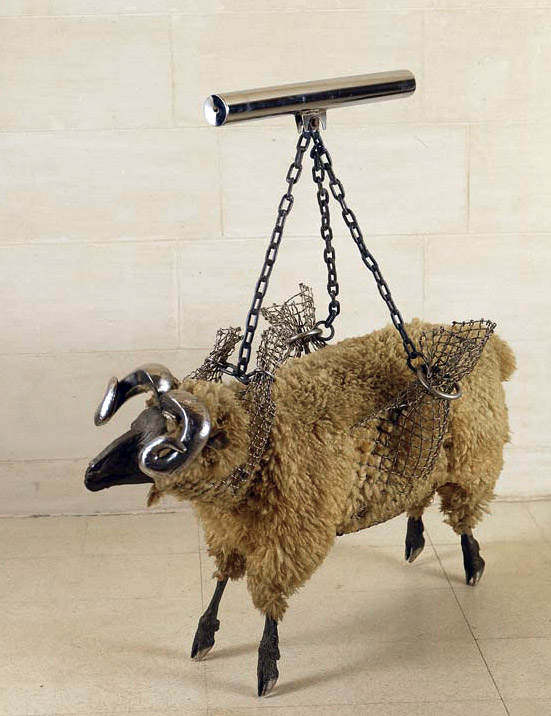
The first sheep presented ‘in show’ is Ram in Sling (1973, below). In this sculpture a metal bar is suspended in mid-air and from this bar heavy wire mesh drops to support the fleecy stomach and neck of the ram almost seeming to strangle it in the process, it’s metal feet just touching the ground. Again the scales of justice seem to weigh nature in the balance.

The themes life and death, order and chaos are further developed in the work Hard slide (1980, below) where a sheep emerges mid-air from a trapdoor, two more tumble down a wooden slide end over end and another disappears into the ground through a wooden trapdoor opening. Sacrifice seems to be a consistent theme with both the earlier paintings and the metallised sheep:

“The completed life cycle, down the trapdoor, down the chute, after sacrifice by shearing.” ~ Daniel Thomas 1994

Further sculptures of sheep, both small maquettes and large sculptures follow in the next room of the exhibition. This is the artist is full flow, featuring the inventive taking of 2D things into the round, investigating the key themes of his work: the contrast between nature and artifice, or humanity.

The small maquettes of sheep feature races, gantries, sluices, pens, trapdoors and paddocks. Sheep tumble in a cataclysmic maelstrom, falling with flailing legs into the darkness of the holding pen below. These are my favourite works – small, intimate, detailed, dark bronzes of serious intensity – the sheep becoming a theatre of the absurd, suspended, weighed and balancing in the performance of ritualised acts, a cacophony of flesh at once both intricate and unsettling. Their skins lay flayed and lifeless disappearing into the ‘unearth’ of the slated wooden floor of the shearing shed. The sheep “can be viewed metaphorically as a commentary of the existential situation of the individual and collective behaviour.”3 As Kossatz himself has noted, “It is hard to bring a piece of landscape inside and give it a living animated form. The sheep somehow gives me this quality of landscape.”

But we must also remember that this strictly a white man’s view of the Australian landscape. Nowhere does this work comment on the disenfranchisement of the native people’s of this land – the destruction of native habitats that the sheep brought about, the starvation that they caused to Aboriginal people just as they bought riches to the pastoralists and the country that mined the land with this amorphous mass of flesh.

Recent work in the exhibition returns to the earlier social themes of memory, war, remembrance, religion, shrines, atomic clouds and temples but it is the work of the late 1970s-1980s that is the most cogent. As Kossatz ponders the nature of existence on this planet he does not see a definitive answer but emphasises the journey we take, not the arrival. Here is something that we should all ponder, giving time to the nature of our personal journey in this life, on this earth.

Here also is an exhibition worthy our time and attention as part of that journey. Go visit!

Dr Marcus Bunyan

Word count: 1,074


1/ From the Heide website
2/ From wall notes to the exhibition
3/ From wall notes to the exhibition


Many thankx to Heide Museum of Modern Art for allowing me to publish the photographs in the posting. Please click on the photographs for a larger version of the image.


    Postscript 2018

    The late Les Kossatz (1943-2011) was a well known Melbourne-based artist and academic whose work is represented in many regional and state galleries and the National Gallery of Australia. He studied art at the Melbourne Teachers’ College and the RMIT, and went on to teach at the RMIT and Monash University. Kossatz’s first significant commission was for the stained glass windows at the Monash University Chapel in Melbourne. Later commissions included works for the Australian War Memorial, the High Court, the Ian Potter Foundation at the National Gallery of Victoria and the Darling Harbour Authority, Sydney. His sculpture, Ainslie’s Sheep, commissioned by Arts ACT in 2000, is a popular national capital landmark in the centre of Civic. A major retrospective of Kossatz’s work was held in 2009 at the Heide Park and Art Gallery, Melbourne.

    Text from the High Court of Australia website


    Francis Bacon (British born Ireland, 1909-1992) 'Study after Velázquez’s Portrait of Pope Innocent X' 1953


    Francis Bacon (British born Ireland, 1909-1992)
    Study after Velázquez’s Portrait of Pope Innocent X
    1953
    Oil on canvas


    Les Kossatz (Australian, 1943-2011) "Ram in sling" 1973 from the exhibition 'The Art of Existence' exhibition by Les Kossatz at Heide Museum of Modern Art, Melbourne, Nov 2008 - March 2009


    Les Kossatz (Australian, 1943-2011)
    Ram in sling
    1973
    Cast and fabricated stainless steel and sheepskin
    129.3 x 126.5 x 66.0cm
    Heide Museum of Modern Art Collection
    Purchased from John and Sunday Reed 1980
    © Les Kossatz


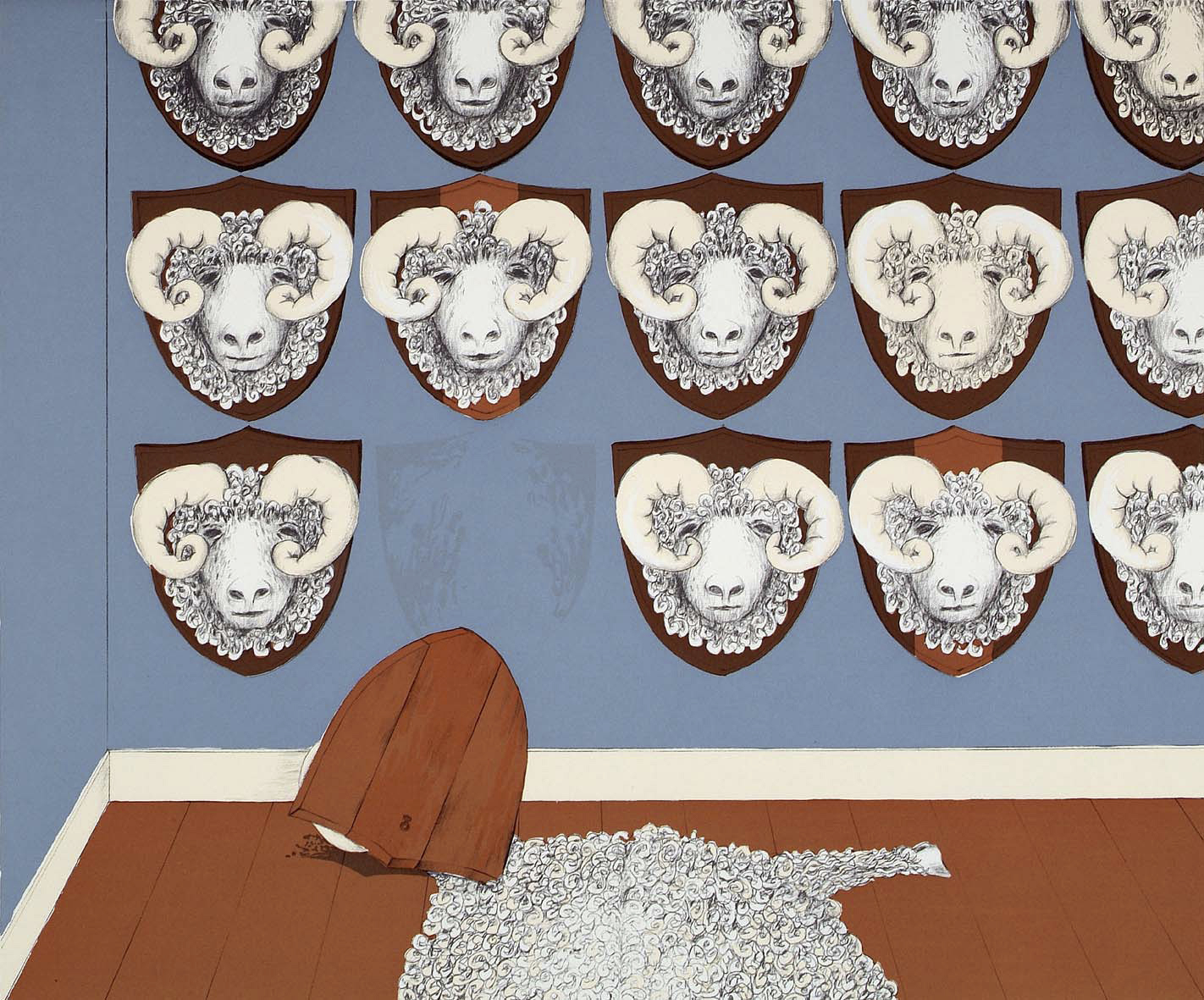
    Les Kossatz (Australian, 1943-2011) 'Trophy room' 1975


    Les Kossatz (Australian, 1943-2011)
    Trophy room
    1975
    Colour lithograph
    74.0 x 76.0cm (sheet)
    Courtesy the artist
    Photographer: Viki Petherbridge
    © Les Kossatz


    The art of existence is the first exhibition to review Les Kossatz’s contribution to Australian art in a career that spans the 1960s to today. Kossatz’s consistently experimental approach to media and techniques is revealed in works that display a lifelong fascination with humanity and the interaction of man and nature. His paintings, sculptures and works on paper stimulate a questioning and exploration of such concerns, which form the basis of this artist’s practice.

    Les Kossatz’s early works of the 1960s draw on his training and ability to work across a diversity of media, including painting, drawing, printmaking and glass. Early paintings and etchings on the theme of the emptiness of memorials to the Australian ‘digger’ or soldiers were succeeded by images and objects offering impressions of the world around the artist – the rural domain and interior life of St Andrews in Victoria where Kossatz lived and worked. Such works demonstrated his determination to pursue a figurative practice at a time when abstract art had been imported to Australia and was considered the avant garde.

    Remaining a staunchly independent artist, at the start of the 1970s Kossatz painted images of rabbits and sheep from St Andrews. In addition, the practice of working in three dimensions was to become more significant. Kossatz continued to develop familiar themes in the creation of installations and cast objects. Although he has produced drawings and prints across his career, working with sculpture has, since the early 1970s, been his primary mode of art-making. Large scale cast and assembled objects show Kossatz pursuing related themes of caged and packaged landscapes, shrines to the harvest and the still life.

    The art of existence surveys Kossatz’s monumental life-sized sheep sculptures, which he began making in 1972 from casts of animal parts, and for which he is best known. These include Hard slide (1980), his prize-winning commission in the collection of the National Gallery of Victoria. Kossatz has won numerous commissions for outdoor sculptures that employ the sheep as literal and metaphorical beings. Kossatz’s work across three decades reveals a number of ongoing engagements, such as his observations of human behaviour and at times its similar manifestation in animals; the beliefs that sustain individuals and communities (such as religion, music and politics); and the forms of the landscape and our understanding of these relationships.

    Introduction to the exhibition written by Zara Stanhope, Guest Curator, Heide Museum of Modern Art, 2008


    Les Kossatz (Australian, 1943-2011) "Hard slide" 1980


    Les Kossatz (Australian, 1943-2011)
    Hard slide
    1980
    Sheepskins, aluminium, Douglas-fir (Pseudotsuga sp.), leather, steel
    372.0 x 100.0 x 304.0cm (installation)


    Les Kossatz (Australian, 1943-2011) "Guggenheim spiral" 1983


    Les Kossatz (Australian, 1943-2011)
    Guggenheim spiral
    1983


    Heide Museum of Modern Art
    7 Templestowe Road
    Bulleen Victoria 3105 Australia
    Phone: +61 3 9850 1500

    Opening hours:
    (Heide II and Heide III)
    Tuesday to Sunday and public holidays, 10am – 5pm

    Heide Museum of Modern Art website

    LKE ART BLART ON FACEBOOK

    Back to top