Exhibition: ‘Deborah Turbeville: Photocollage’ at The Photographers’ Gallery, London

Exhibition dates: 9th October, 2024 – 23rd February, 2025

Curators: Nathalie Herschdorfer, Director of Photo Elysée, and Karen McQuaid, Senior Curator at The Photographers’ Gallery.


Deborah Turbeville (American, b. 1932-2013) 'Untitled' Passage Vivienne, Paris, France, November 1980 from the exhibition Deborah Turbeville: Photocollage' at The Photographers' Gallery, London


Deborah Turbeville (American, b. 1932-2013)
Untitled
Passage Vivienne, Paris, France, November 1980
From the series Comme des Garçons
© Deborah Turbeville/MUUS Collection


There are some haunting photographs in this posting on the work of American photographer Deborah Turbeville but unfortunately I can make little comment on her work.

Despite trawling through numerous sites looking at her images – there is not much online – and more importantly having not seen the exhibition, I find that I have no real handle on the photographic series.

A couple of photographs from the Passport, Comme des Garçons, Block Island and Unseen Versailles series, plus a few photocollage which investigate the nature of photography and its fragility in this posting doesn’t allow me to understand the full sweep of her artistic work… which is a great pity.

The only way to really understand and feel Turbeville’s work is to visit The Photographers’ Gallery and immerse yourself in the artist’s world. Unfortunately I cannot do that.

Dr Marcus Bunyan


Many thankx to The Photographers’ Gallery for allowing me to publish the photographs in the posting. Please click on the photographs for a larger version of the image.


“When I’m making photographs, I think of films”


Deborah Turbeville, 1985


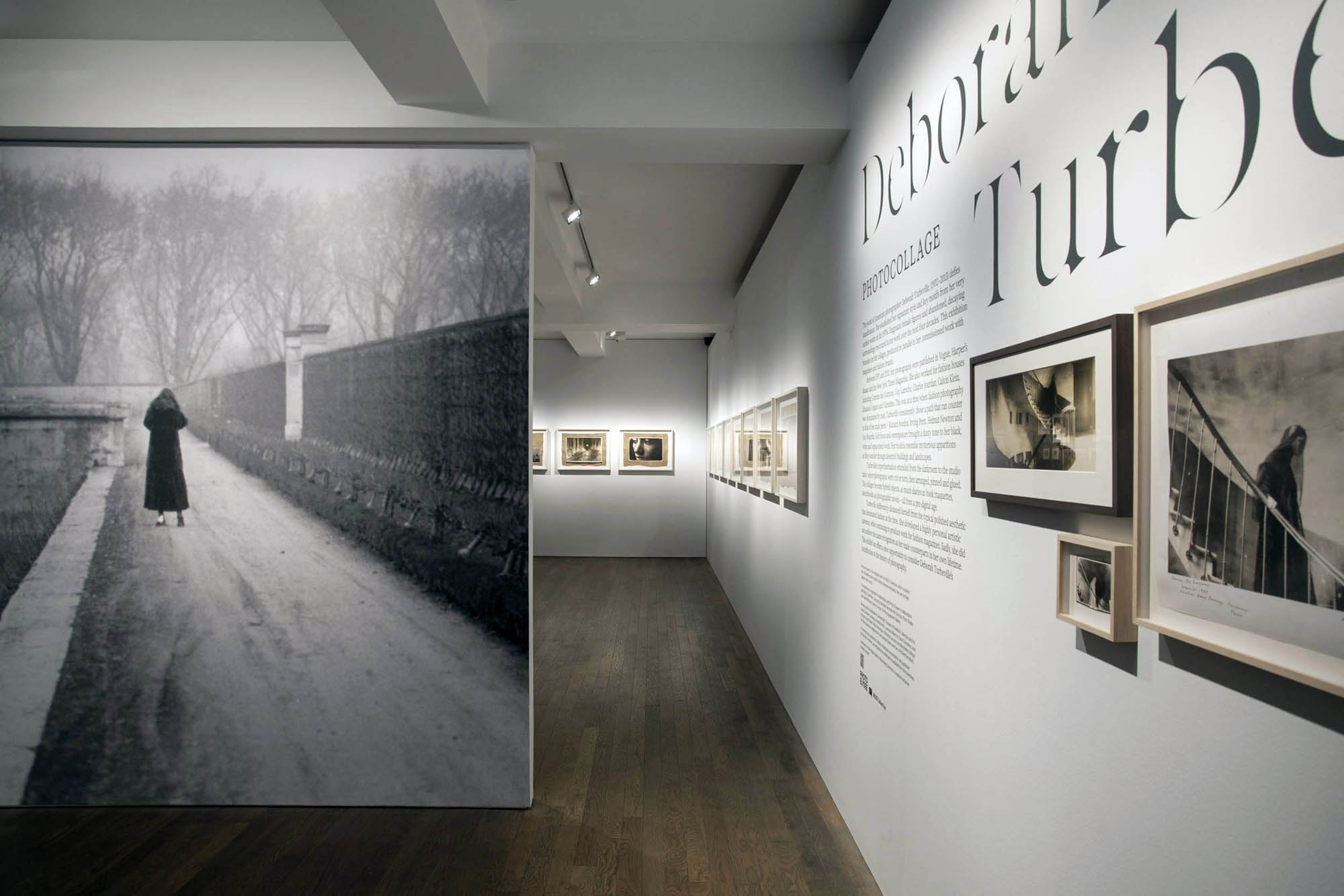
Deborah Turbeville: Photocollage highlights the work of a truly innovative, American fashion photographer, Deborah Turbeville (1932-2013) who transformed fashion imagery into avant-garde art. Her signature dreamlike and melancholic style became recognisable with her earliest works in the 1970s: enigmatic female figures, cloudy skies, wintry nature and abandoned, decaying surroundings. She deliberately distanced herself from the typical glamourous, polished aesthetic that dominated fashion at the time.


An interview on the exhibition Deborah Turbeville: Photocollage with Nathalie Herschdorfer, Exhibition Curator, and Karen McQuaid, Senior Curator, The Photographers’ Gallery.


Deborah Turbeville (American, b. 1932-2013) 'Walking down Passage Vivienne' (Escalier dans Passage Vivienne) Paris, France, November 1980  from the exhibition Deborah Turbeville: Photocollage' at The Photographers' Gallery, London


Deborah Turbeville (American, 1932-2013)
Walking down Passage Vivienne (Escalier dans Passage Vivienne)
Paris, France, November 1980
From the series Comme des Garçons
© Deborah Turbeville/MUUS Collection


Deborah Turbeville’s signature dreamlike and melancholic style became recognisable with her earliest works in the 1970s: enigmatic female figures, cloudy skies, wintry nature and abandoned, decaying surroundings. She deliberately distanced herself from the typical glamourous, polished aesthetic that dominated fashion at the time.

Deborah Turbeville: Photocollage presents Turbeville’s trailblazing photographic explorations, from fashion photos to her very personal work. Bringing together unique pieces, the exhibition reveals Turbeville’s highly personal artistic universe, which has been credited with transforming fashion imagery into avant-garde art.

She experimented with the developing process, from the darkroom to the studio table. She ripped, cut and tore her photographs; manipulated, pinned and glued them together to create unique hybrid objects. Deborah Turbeville: Photocollage is a new appreciation of Turbeville’s ground-breaking contribution to the history of photography.

Text from The Photographers’ Gallery website
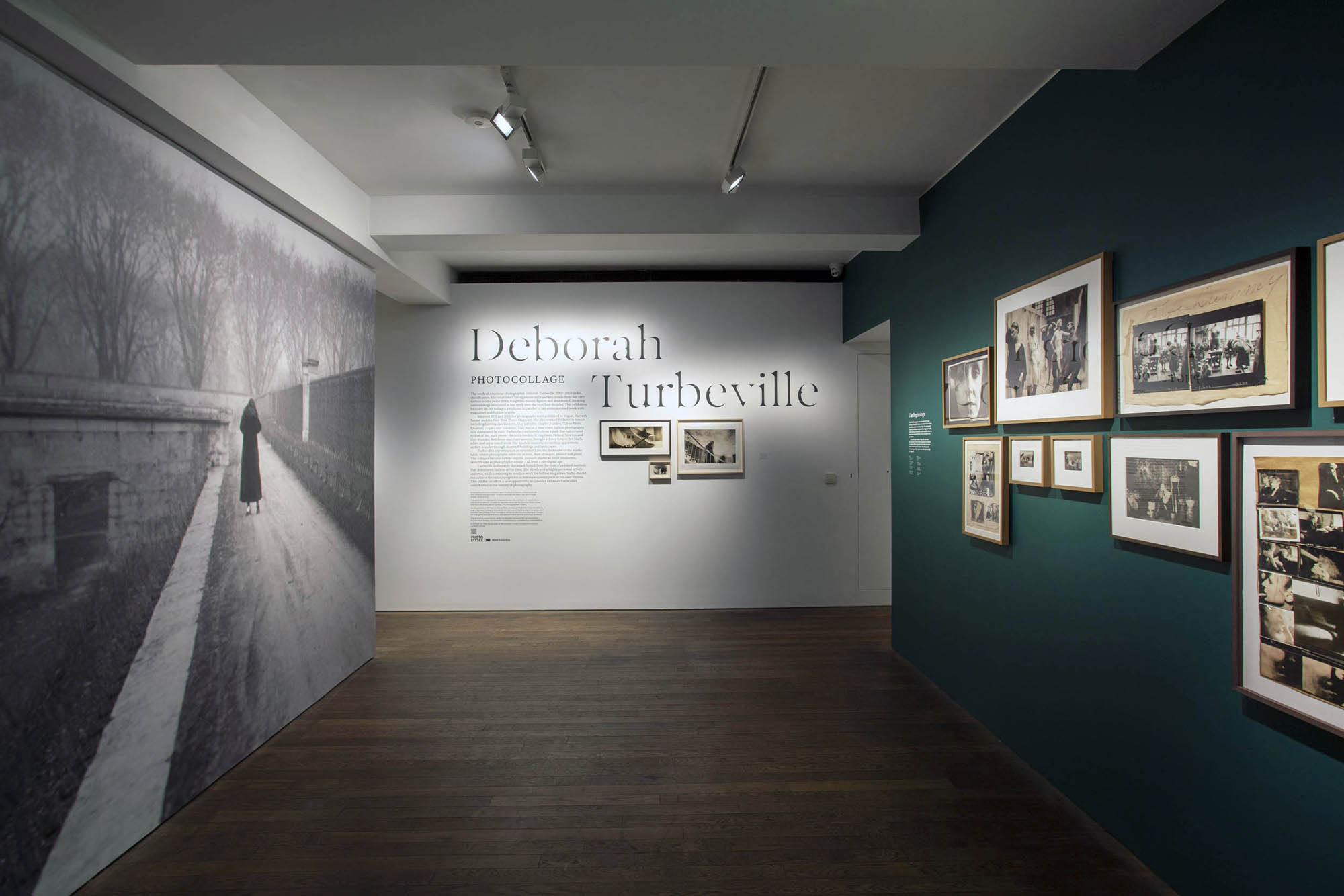
 

Installation view of the exhibition 'Deborah Turbeville: Photocollage' at The Photographers' Gallery, London

Installation view of the exhibition 'Deborah Turbeville: Photocollage' at The Photographers' Gallery, London

Installation view of the exhibition 'Deborah Turbeville: Photocollage' at The Photographers' Gallery, London

Installation view of the exhibition 'Deborah Turbeville: Photocollage' at The Photographers' Gallery, London


Unseen Versailles

Jacqueline Onassis commissioned Turbeville to photograph the Palace of Versailles during her tenure as an editor at the American publishing house Doubleday. With help from Onassis she gained access to the labyrinth of hidden chambers and antechambers which were off limits to tourists. She photographed barren rooms, Baroque furniture covered with sheets, broken statues, and curtains thick with dust. The curator of the estate initially blocked the introduction of props, but Onassis eventually gained her permission to bring in models in period costumes. Unseen Versailles won the American Book Award in 1982 and enabled Turbeville to find a readership outside fashion magazines.

Wall text from the exhibition


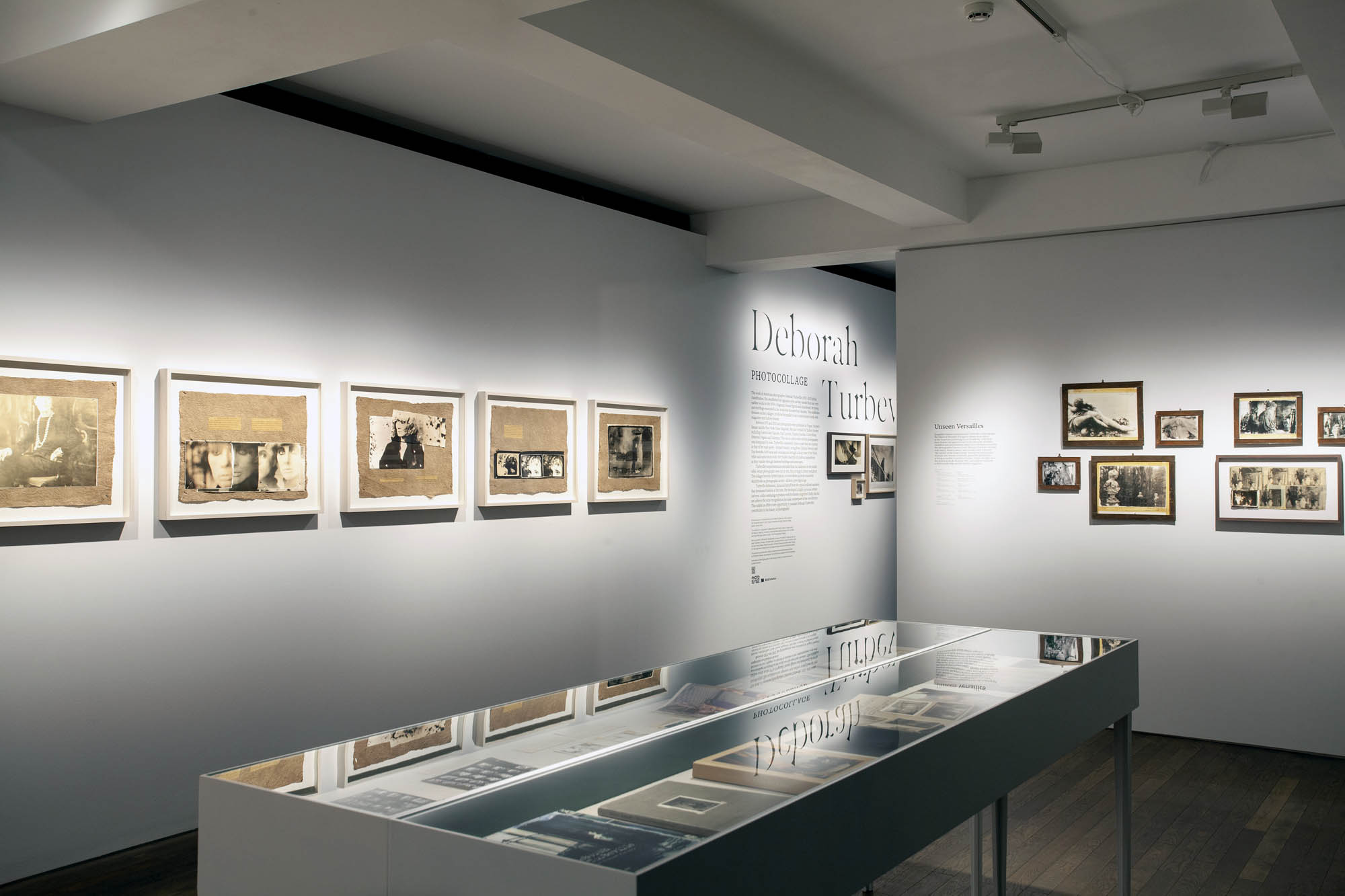
Installation view of the exhibition 'Deborah Turbeville: Photocollage' at The Photographers' Gallery, London

Installation view of the exhibition 'Deborah Turbeville: Photocollage' at The Photographers' Gallery, London

Installation view of the exhibition 'Deborah Turbeville: Photocollage' at The Photographers' Gallery, London

Installation view of the exhibition 'Deborah Turbeville: Photocollage' at The Photographers' Gallery, London

Installation view of the exhibition 'Deborah Turbeville: Photocollage' at The Photographers' Gallery, London


Installation views of the exhibition Deborah Turbeville: Photocollage at The Photographers’ Gallery, London


Deborah Turbeville: Photocollage at The Photographers’ Gallery, London (until 23 February 2025), celebrates Turbeville’s trailblazing photographic explorations, from fashion photos to her very personal work. To coincide with the exhibition, we’re looking at some of her photographic series in more detail, starting with the Passport series!

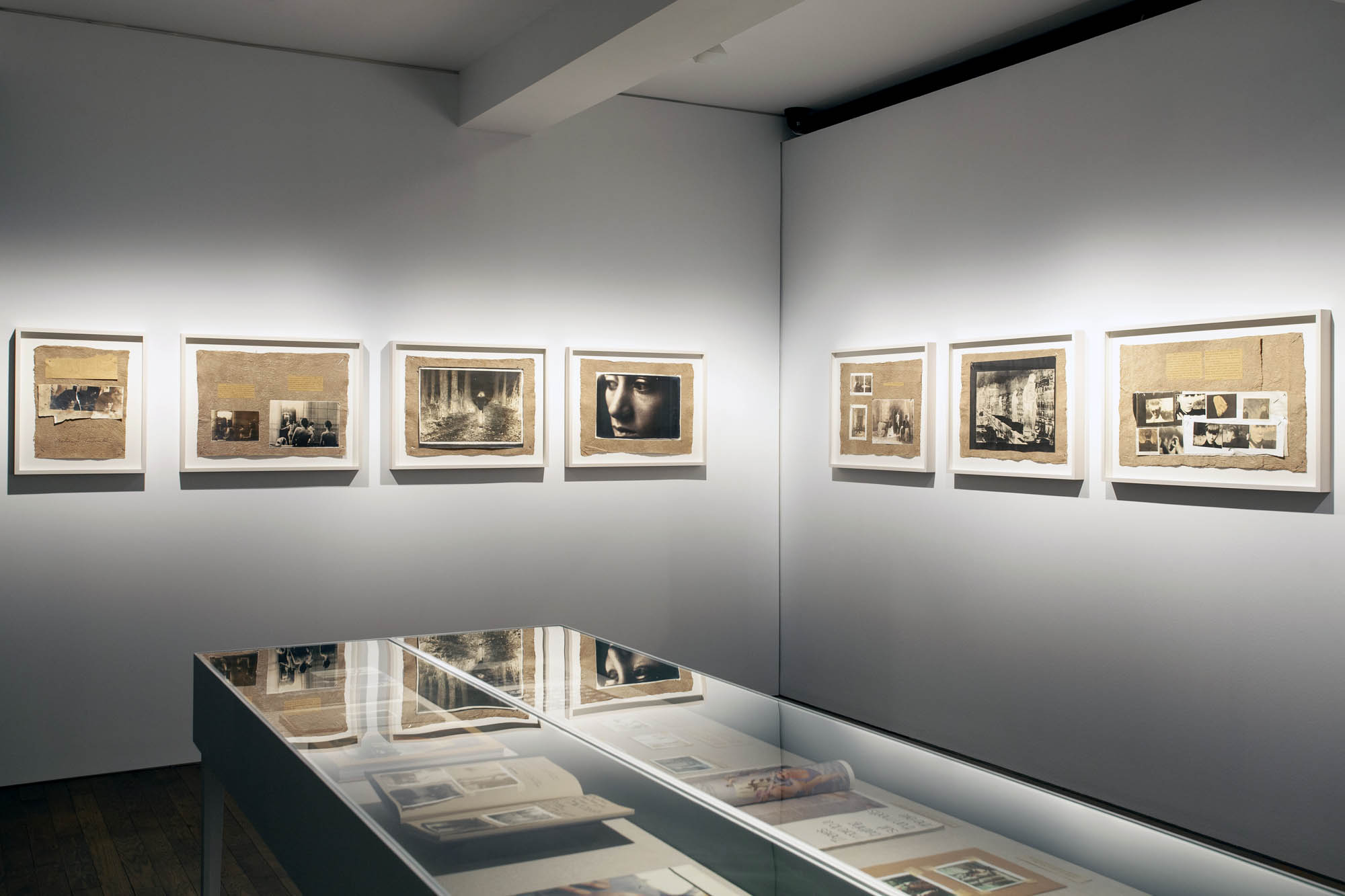
Turbeville’s Passport series of collages, which accompanied a novella she wrote with the same name, demonstrates her very cinematic, narrative approach to photography.

Fixed to wrinkled brown paper with unusually large T-pins, the series heavily features portrait photographs. The gelatin silver prints all have slightly varying hues of black and white; their torn edges overlap, each revealing a different fragment. The torn sections of women’s faces stand out against grainy backgrounds, like a ghostly white sky. Turbeville selected images, largely from her archives, showing repeated shots positioned together, repurposing her work to create new experimental compositions that felt cinematic in style. Alongside the images, fragments of her unpublished novella are cut out and pasted, so that the series can be read narratively as well as visually.

Unlike many of her contemporaries, Turbeville considered photography to be more than just a means of pictorial representation. Curious about the materials and nature of photography, she was inescapably interested in its fragility. Her photocollages suggested new possibilities for photography, which had, until then, cleaved very closely to reality. Collage became a form of manual work which allowed her to create three-dimensional objects and a chance to gather up her own images and give them new depth. She embraced the visible imperfections in a handmade, narrative style that gives her work a unique stylistic voice.

Text from The Photographers’ Gallery Instagram page


Deborah Turbeville (American, 1932-2013) 'Maquillage' 1975  from the exhibition Deborah Turbeville: Photocollage' at The Photographers' Gallery, London


Deborah Turbeville (American, 1932-2013)
Maquillage
1975
© Deborah Turbeville/MUUS Collection
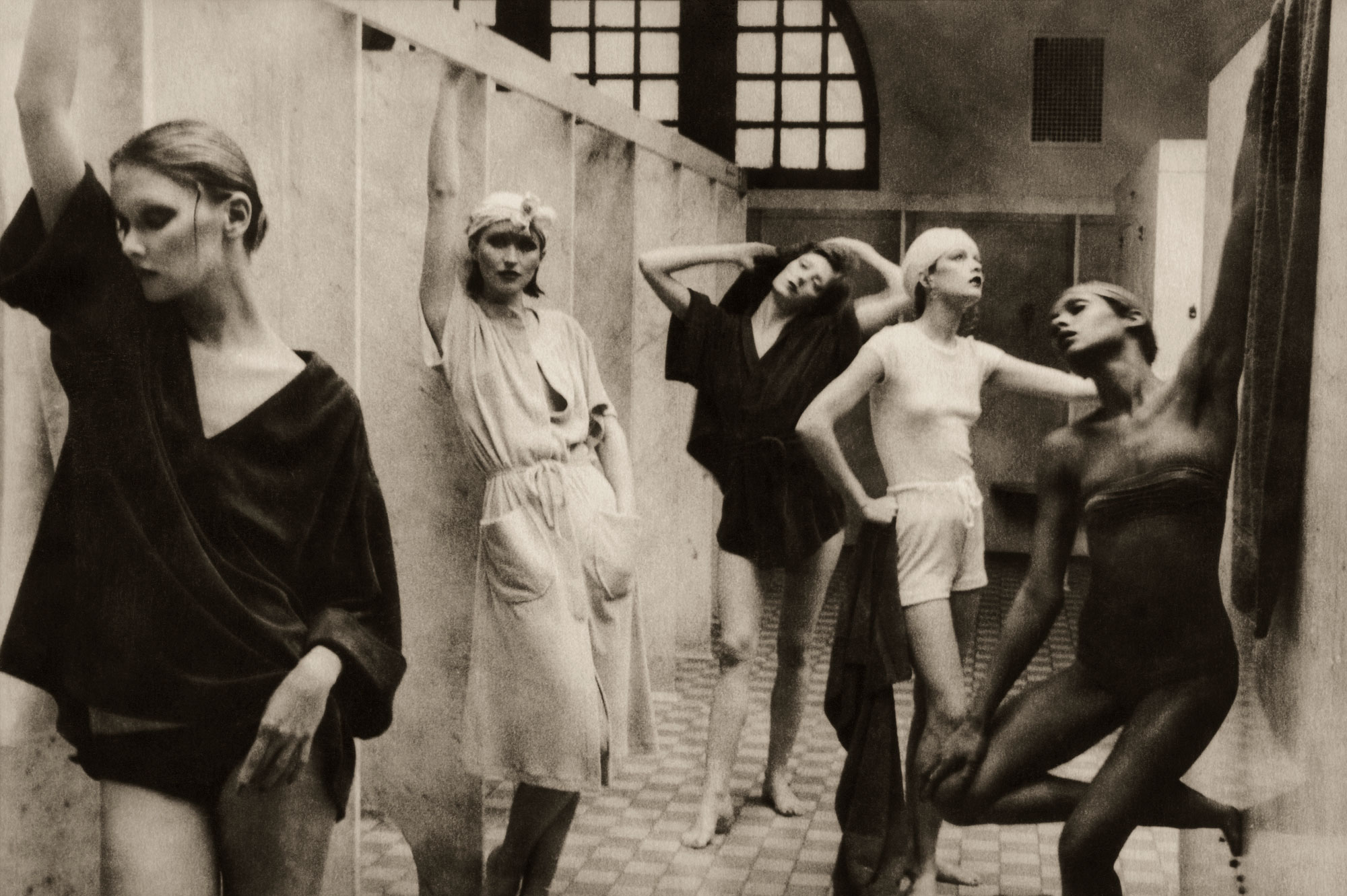
 

Deborah Turbeville (American, 1932-2013) 'Bathhouse, New York' New York, 1975  from the exhibition Deborah Turbeville: Photocollage' at The Photographers' Gallery, London


Deborah Turbeville (American, 1932-2013)
Bathhouse, New York
New York, 1975
From the series Bathhouse
© Deborah Turbeville/MUUS Collection
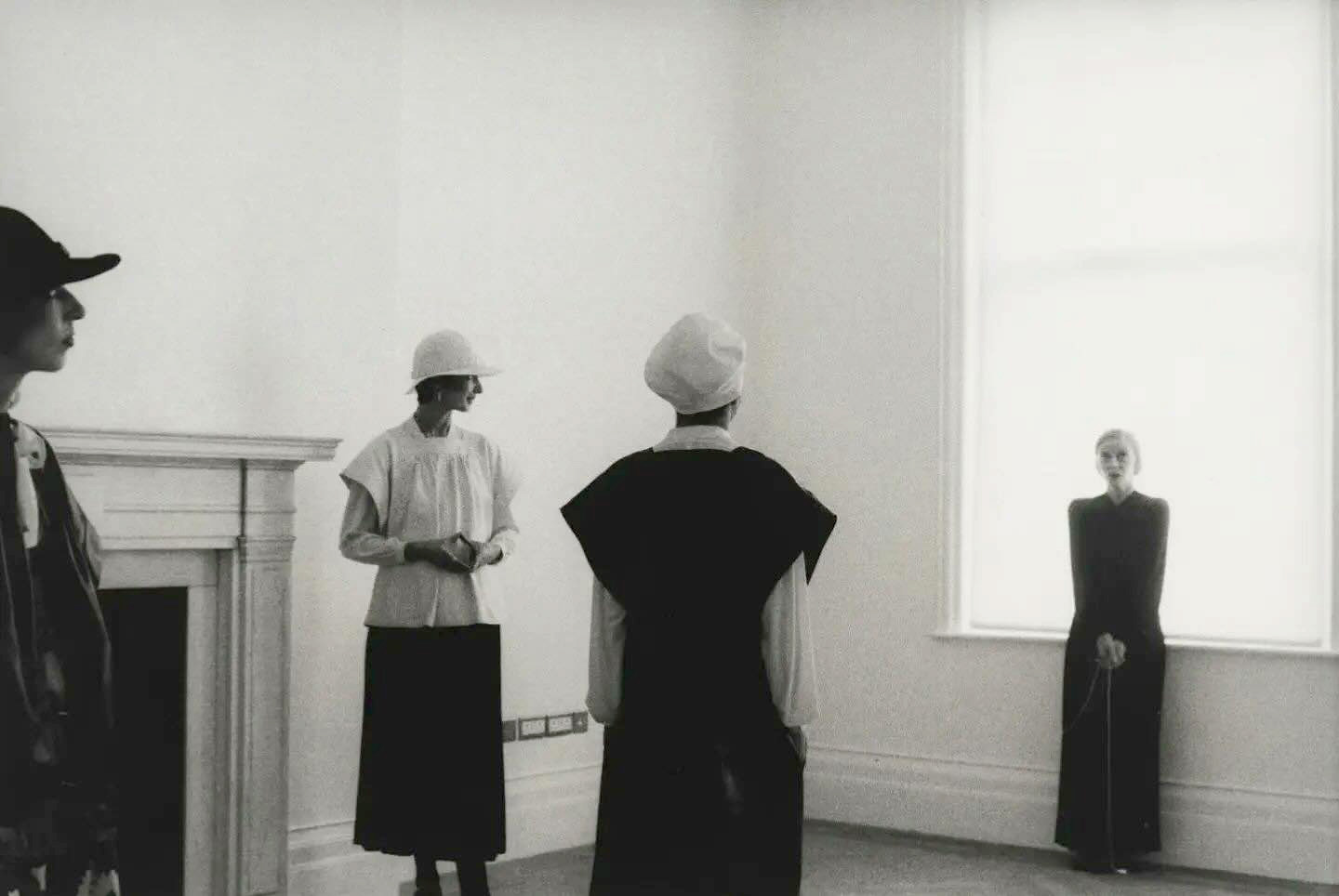
 

Deborah Turbeville (American, 1932-2013) 'Jean Muir and Three Unknown Models' 1975  from the exhibition Deborah Turbeville: Photocollage' at The Photographers' Gallery, London


Deborah Turbeville (American, 1932-2013)
Jean Muir and Three Unknown Models
1975
© The Estate of Deborah Turbeville


For her second spread in Vogue Magazine, Deborah Turbeville photographed designers with their models and muses in a February 1975 editorial titled “European Fashion: The Movers”. Here, she captured the British doyenne of dressmaking, Jean Muir, with her friends modelling her designs.


Deborah Turbeville (American, 1932-2013) 'Untitled' Block Island, Rhode Island, 1976  from the exhibition Deborah Turbeville: Photocollage' at The Photographers' Gallery, London


Deborah Turbeville (American, 1932-2013)
Untitled
Block Island, Rhode Island, 1976
From the series Block Island
© Deborah Turbeville/MUUS Collection
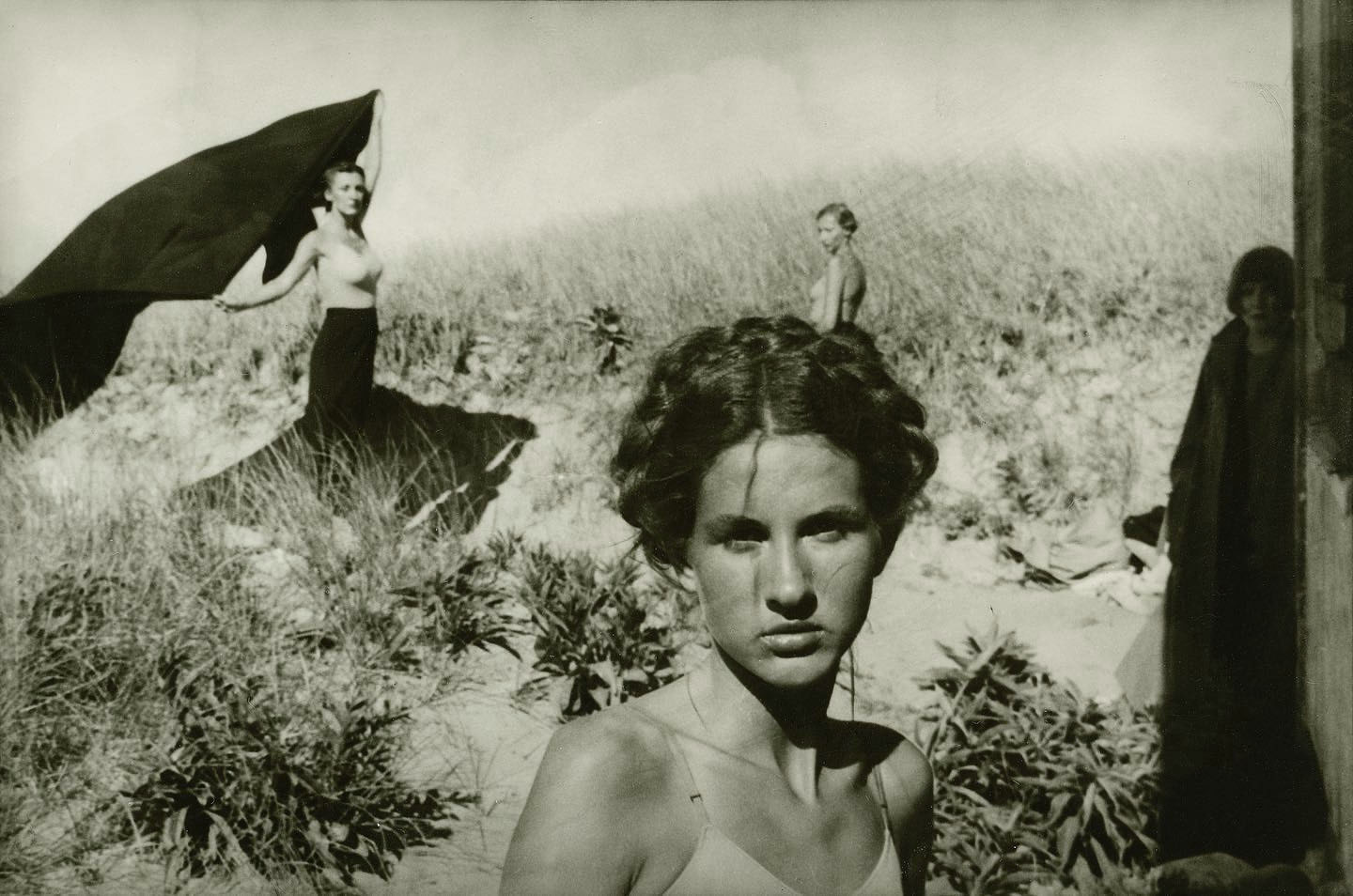
 

Deborah Turbeville (American, 1932-2013) 'Untitled' Block Island, Rhode Island, 1976  from the exhibition Deborah Turbeville: Photocollage' at The Photographers' Gallery, London


Deborah Turbeville (American, 1932-2013)
Untitled
Block Island, Rhode Island, 1976
From the series Block Island
© Deborah Turbeville/MUUS Collection
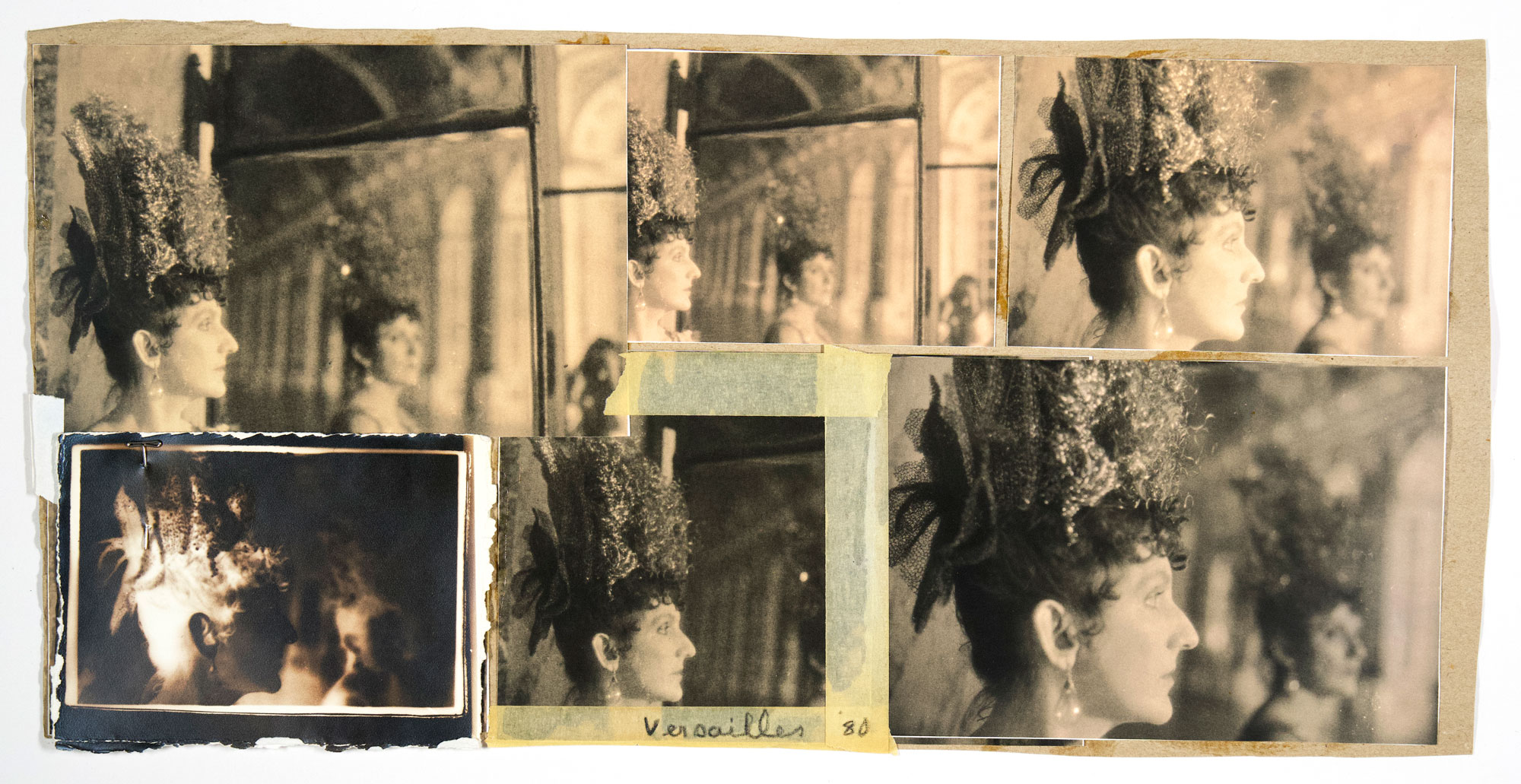
 

Deborah Turbeville (American, 1932-2013) 'Versailles' Versailles, France 1980  from the exhibition Deborah Turbeville: Photocollage' at The Photographers' Gallery, London


Deborah Turbeville (American, 1932-2013)
Versailles
Versailles, France, 1980
From the series Unseen Versailles
© Deborah Turbeville/MUUS Collection


How Deborah Turbeville tore up the rules

Deborah Turbeville is remembered today as a pioneering figure in fashion photography, known for her melancholic, dreamlike imagery that diverged from conventional standards. Born in 1932 in Stoneham, Massachusetts, USA, she initially pursued acting before being discovered by fashion designer Claire McCardell, who employed her as an assistant and model. Through McCardell, Turbeville met Diana Vreeland, then editor of Harper’s Bazaar, which launched her editorial career. However, she soon lost interest in conventional editorial work, turning instead to photography as an outlet for artistic expression and experimentation.

In the 1960s, after buying her first camera, Turbeville began early experimentation in photography. Her creative direction was refined through a workshop with photographer Richard Avedon and art director Marvin Israel. Moving from fashion editing to photography, she worked for magazines like Vogue and Harper’s Bazaar, though she always insisted she was not a traditional fashion photographer. Rather, she used fashion within her work to tell emotionally charged stories, setting herself apart from the industry’s glamorous norms.

One of her most iconic works is the Bathhouse series for Vogue in 1975, featuring models posed in a dilapidated bathhouse. The images conveyed vulnerability, decay and isolation, starkly contrasting with the glossy fashion photography of the time. Although controversial, the series exemplified Turbeville’s atmospheric aesthetic – soft focus, grainy textures and muted tones. She often distressed her photographs to give them an aged appearance, blurring the lines between fashion photography and fine art.

Turbeville’s work rejected the conventions of fashion industry ideals, choosing instead to explore themes of memory, loss and feminine vulnerability. Her approach stood in contrast to contemporaries like Helmut Newton and Guy Bourdin, whose images typically celebrated female sensuality. In contrast, Turbeville’s subjects appeared introspective and distant, encouraging viewers to engage with them on a deeper, emotional level.

In 1981, Turbeville was commissioned by Jacqueline Kennedy Onassis to photograph the abandoned rooms of the Palace of Versailles, which resulted in the book Unseen Versailles. The images of faded grandeur reflected her fascination with decay and received critical acclaim, winning an American Book Award.

Her body of work extended beyond fashion to other notable publications, including Studio St. Petersburg, The Voyage of the Virgin Maria Candelaria, and Newport Remembered. Throughout her career, she consistently merged fashion with fine art, creating images defined more by atmosphere and emotion than style alone.

Her photocollages show her experimental approach to constructing compositions. Her photographs are just one element among several. She builds up mysterious narratives through overlapping layers of pinned, ripped, cut, creased and taped images, found objects and printed texts. These layers are built up on heavy brown paper – a complete departure from the glossy white pages of fashion magazines. Her Passport series of collages, which accompanied a novella she wrote with the same name, demonstrates her very cinematic, narrative approach to photography.

Turbeville’s influence on future generations of photographers is significant. She opened doors for more experimental, avant-garde approaches to fashion photography, transforming it from a commercial medium into a space for artistic exploration. Her rejection of industry norms allowed her to create a distinctive visual language that continues to inspire photographers and artists today.

Turbeville once remarked that she was more interested in creating “atmosphere and mood” than simply photographing clothes, a sentiment that underpinned her career. By embracing imperfection, decay and the passage of time, she redefined fashion photography as more than a vehicle for selling clothes.

Turbeville’s career represents a turning point in fashion photography. Her dreamlike, melancholic style and innovative approach broke industry conventions, transforming fashion photography into a medium for personal and artistic expression. Her legacy continues to inspire, and her influence remains enduring long after her death in 2013.

Anonymous. “How Deborah Turbeville tore up the rules,” on The Photographers’ Gallery website Nd [Online] Cited 16/01/2025
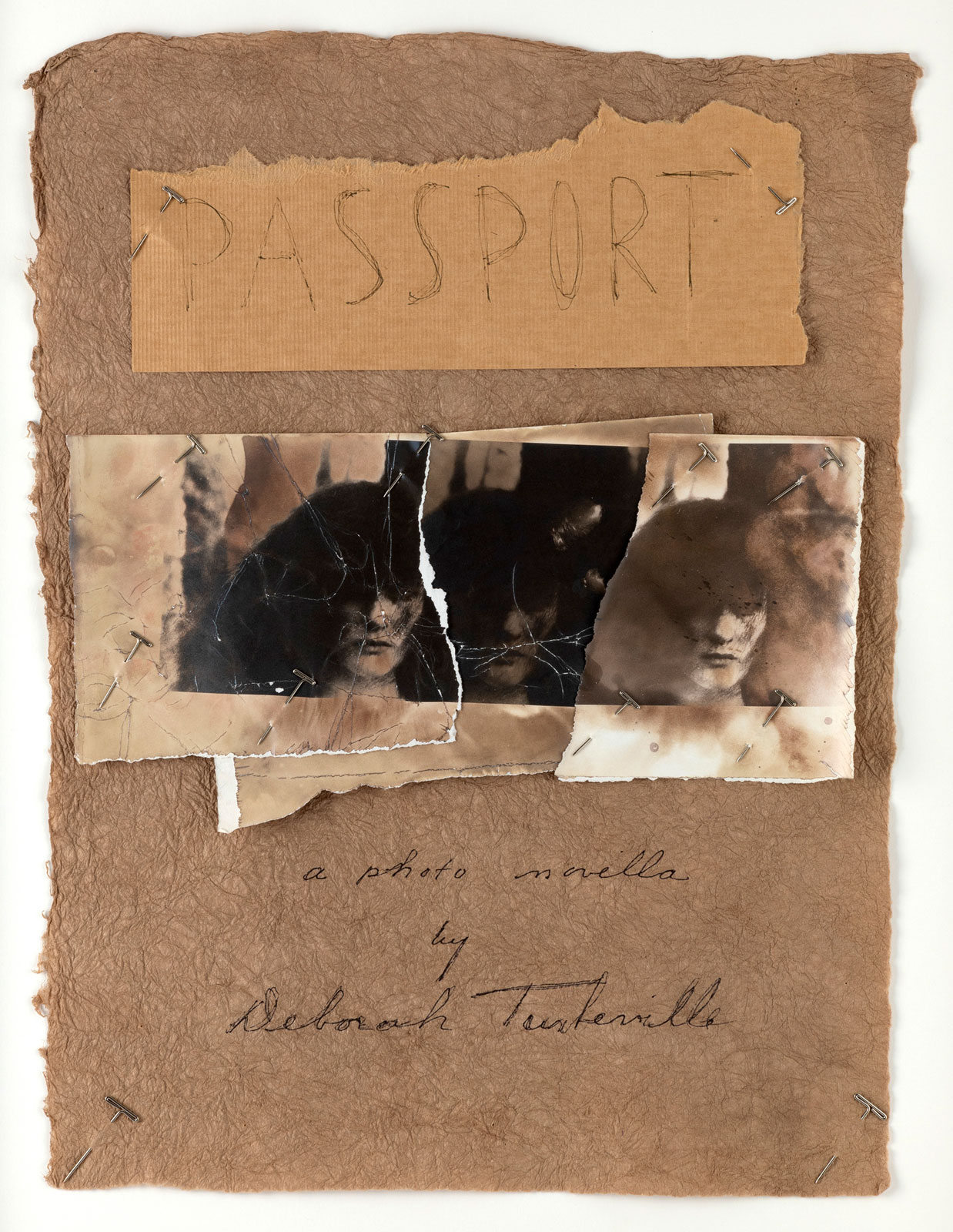
 

Deborah Turbeville (American, 1932-2013) 'Page from Passport' c. 1990  from the exhibition Deborah Turbeville: Photocollage' at The Photographers' Gallery, London


Deborah Turbeville (American, 1932-2013)
Page from Passport
c. 1990
© Deborah Turbeville/MUUS Collection 


Deborah Turbeville (American, 1932-2013) 'Page from Passport' c. 1990 from the exhibition Deborah Turbeville: Photocollage' at The Photographers' Gallery, London


Deborah Turbeville (American, 1932-2013)
Page from Passport
c. 1990
© Deborah Turbeville/MUUS Collection
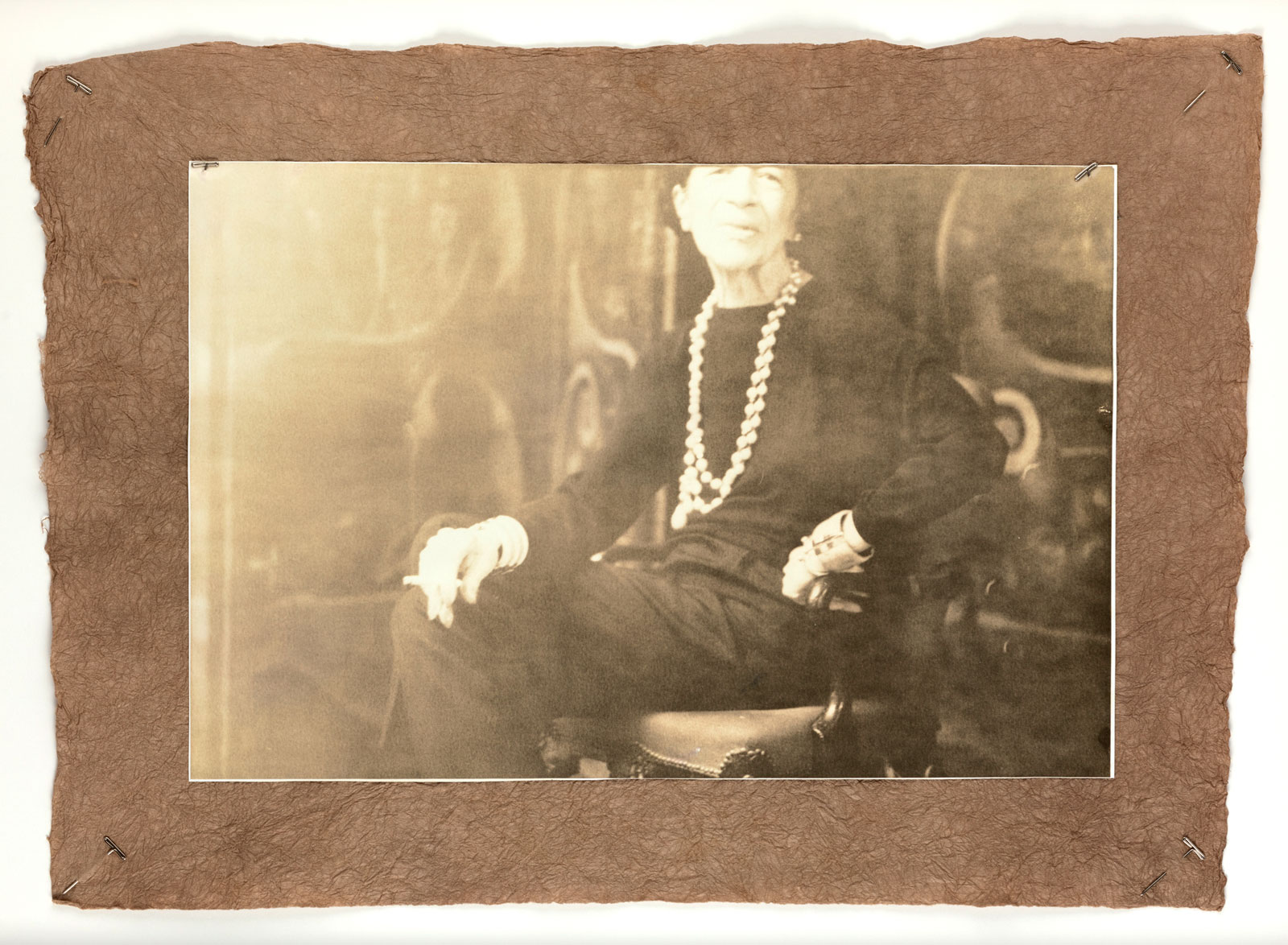
 

Deborah Turbeville (American, 1932-2013) 'Page from Passport' c. 1990 from the exhibition Deborah Turbeville: Photocollage' at The Photographers' Gallery, London


Deborah Turbeville (American, 1932-2013)
Page from Passport
c. 1990
© Deborah Turbeville/MUUS Collection
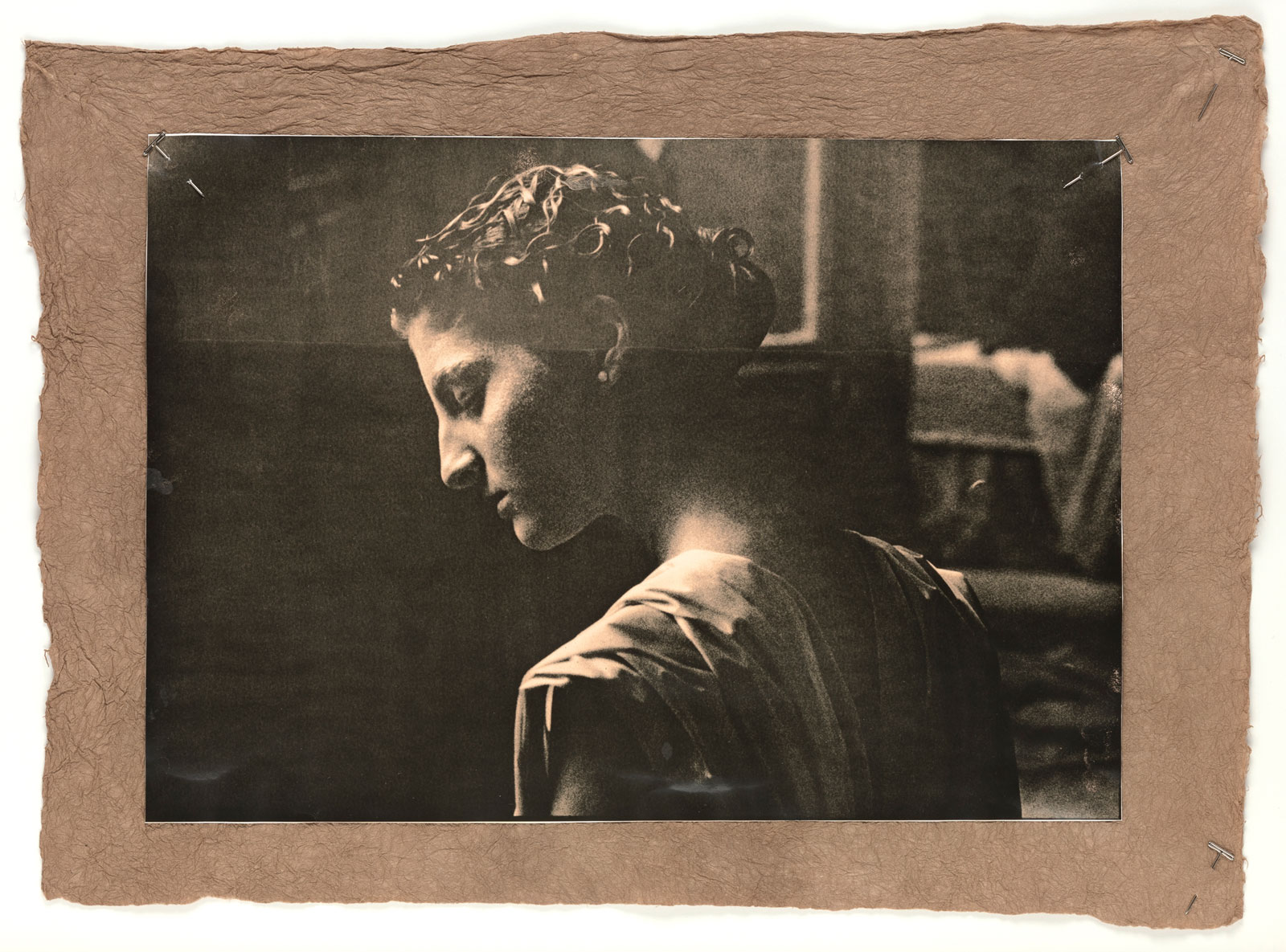
 

Deborah Turbeville (American, 1932-2013) 'Page from Passport' c. 1990 from the exhibition Deborah Turbeville: Photocollage' at The Photographers' Gallery, London


Deborah Turbeville (American, 1932-2013)
Page from Passport
c. 1990
© Deborah Turbeville/MUUS Collection 


Deborah Turbeville (American, 1932-2013) 'Luisa, Posos, January 1991' 1991 from the exhibition Deborah Turbeville: Photocollage' at The Photographers' Gallery, London


Deborah Turbeville (American, 1932-2013)
Luisa, Posos, January 1991
1991
© Deborah Turbeville/MUUS Collection


“Fashion takes itself more seriously than I do. I’m not really a fashion photographer.”


Deborah Turbeville in The New Yorker


Deborah Turbeville: Photocollage opens at The Photographers’ Gallery this Autumn, from 9 October 2024 – 23 February 2025. Presenting the work of the truly innovative American photographer, Deborah Turbeville (1932-2013), the exhibition will feature a selection of her personal vintage photocollages and editorial work.

Deborah Turbeville revolutionised the world of fashion photography, transforming it from its commercial clean standard into an art form. Turbeville deliberately distanced herself from the typical glamorous, polished aesthetic that dominated fashion at the time. Her signature dreamlike and melancholic style became recognisable with her earliest works in the 1970s: enigmatic female figures, cloudy skies, wintry nature and abandoned, decaying surroundings.

Turbeville’s work for the fashion industry launched her career, which lasted over four decades. Between 1975 and 2013, her photographs were published in Vogue, Harper’s Bazaar and New York Times Magazine. She also worked for fashion houses including Comme des Garçons, Guy Laroche, Charles Jourdan, Calvin Klein, Emanuel Ungaro and Valentino. At a time when fashion photography was dominated by men, Turbeville chose a path that ran counter to that of her male peers, like Richard Avedon, Irving Penn, Helmut Newton and Guy Bourdin.

Soft focus and overexposure brought a surreal and dusty tone to her black, white and sepia-toned work. Her models resemble ghostly apparitions as they wander through deserted buildings and landscapes. The exhibition includes her most controversial photograph, Bath House, New York City, 1975, part of a swimsuit photoshoot for Vogue, which featured five models, slouching and stretching in an abandoned bathhouse. The picture was so unlike the traditional fashion imagery of the time it prompted a public outcry.

Turbeville was undeterred and continued to produce images with an element of decay, saying “the idea of disintegration is really the core of my work.”

Other works on show include images from Turbeville’s 1981 American Book Award-winning series Unseen Versailles, and her first photocollage magazine, Maquillage (1975).

Turbeville’s experimentation extended from the darkroom to the studio table as she unpicked the developing process. She ripped, cut and tore her photographs; manipulated, pinned and glued them. Her handmade collages are hybrid objects – as much diaries as book maquettes, sketchbooks as photographic novels – all from a pre-digital age.

Describing her work, she said “I destroy the image after I’ve made it, obliterate it a little so you never have it completely there.”

Turbeville developed a highly personal artistic universe, which has been credited with transforming fashion imagery into avant-garde art. Although she did not achieve the same recognition as her male counterparts in her lifetime. Deborah Turbeville: Photocollage is a new opportunity to consider and celebrate Turbeville’s ground-breaking contribution to the history of photography.

Deborah Turbeville: Photocollage is organised by The Photographers’ Gallery, produced by Photo Elysée in collaboration with MUUS Collection. The exhibition is curated by Nathalie Herschdorfer, Director of Photo Elysée, and Karen McQuaid, Senior Curator at The Photographers’ Gallery.

The accompanying catalogue Deborah Turbeville: Photocollage is published by Thames & Hudson and available at The Photographers’ Gallery’s bookshop at £55.

Deborah Turbeville short biography

Deborah Turbeville was born in Stoneham, Massachusetts, USA in 1932. She moved to New York with ambitions to study drama when she was 19. Instead she was discovered by the fashion designer Claire McCardell, who hired Turbeville as an assistant and house model. While working for McCardell, she met Diana Vreeland, the famed editor of Harper’s Bazaar. Their introduction led to Turbeville being offered a job as an editor at the magazine.

Disinterested in her editorial work at Harper’s Bazaar and later at Mademoiselle, she began experimenting with photography in the 1960s. She took part in a workshop led by Richard Avedon and art director Marvin Israel in 1966. From there, she began her photographic career, mainly working for magazines like Vogue, Harper’s Bazaar and Mirabella.

In 1981, Turbeville was commissioned by Jaqueline Onassis, then an editor at Doubleday, to photograph disused rooms in the Palace of Versailles. The book, Unseen Versailles, won an American Book Award, for its rare look into the Palace’s off-limits decaying grandeur.

Turbeville published many books of her photography, including Studio St. Petersburg, The Voyage of the Virgin Maria Candelaria and Newport Remembered. Posthumous publications include Comme des Garçons 1981, a series of photographs she took during the 1980s in collaboration with the fashion house and its designer, Rei Kawakubo.

Turbeville died in 2013, having left an indelible mark on the world of photography. Her work is collected by major institutions worldwide, including the National Portrait Gallery, Metropolitan Museum of Art, the Museum of Modern Art, the Getty Museum, the Art Institute of Chicago, the Los Angeles County Museum of Art and the Whitney Museum of American Art.

Press release from The Photographers’ Gallery


Deborah Turbeville (American, 1932-2013) 'Untitled (Metamorphosis of Ella M.)' Paris, France, early 1990s from the exhibition Deborah Turbeville: Photocollage' at The Photographers' Gallery, London


Deborah Turbeville (American, 1932-2013)
Untitled (Metamorphosis of Ella M.)
Paris, France, early 1990s
From the series L’École des Beaux Arts
© Deborah Turbeville/MUUS Collection


Stephan Lupino (Croatian, b. 1952)
'Portrait of Deborah Turbeville' Nd


Stephan Lupino (Croatian, b. 1952)
Portrait of Deborah Turbeville
Nd
Gelatin silver print
© Stephan Lupino


The Photographers’ Gallery
16-18 Ramillies Street
London
W1F 7LW

Opening hours:
Mon – Wed: 10.00 – 18.00
Thursday – Friday: 10.00 – 20.00
Saturday: 10.00 – 18.00
Sunday: 11.00 – 18.00
The Photographers’ Gallery website

LIKE ART BLART ON FACEBOOK

Back to top

Exhibition: ‘Irving Penn: Centennial’ at the Metropolitan Museum of Art, New York Part 1

Exhibition dates: 24th April – 30th July, 2017

 Curators: Jeff Rosenheim, Curator in Charge, Photographs, The Metropolitan Museum of Art and Maria Morris Hambourg, Independent Curator and Former Curator in Charge, Photographs, The Metropolitan Museum of Art


'Irving Penn: Centennial' at the Metropolitan Museum of Art


Part 1 of this bumper posting, with some biographical information on the lesser known sitters.

See Part 2 of the posting with my commentary

Dr Marcus Bunyan


Many thankx to the Metropolitan Museum of Art for allowing me to publish the photographs in the posting. Please click on the photographs for a larger version of the image.


The most comprehensive retrospective to date of the work of the great American photographer Irving Penn (1917-2009), this exhibition will mark the centennial of the artist’s birth. Over the course of his nearly 70-year career, Penn mastered a pared-down aesthetic of studio photography that is distinguished for its meticulous attention to composition, nuance, and detail.

The exhibition follows the 2015 announcement of the landmark promised gift from The Irving Penn Foundation to The Met of more than 150 photographs by Penn, representing every period of the artist’s dynamic career with the camera. The gift will form the core of the exhibition, which will feature more than 200 photographs by Penn, including iconic fashion studies of Lisa Fonssagrives-Penn, the artist’s wife; exquisite still lifes; Quechua children in Cuzco, Peru; portraits of urban labourers; female nudes; tribesmen in New Guinea; and colour flower studies. The artist’s beloved portraits of cultural figures from Truman Capote, Picasso, and Colette to Ingmar Bergman and Issey Miyake will also be featured. Rounding out the exhibition will be photographs by Penn that entered The Met collection prior to the promised gift.

Text from the Metropolitan Museum of Art website


Irving Penn (American, Plainfield, New Jersey 1917-2009 New York) 'Union Bar Window, American South' 1941, printed c. 1941-1942 from the exhibition 'Irving Penn: Centennial' at the Metropolitan Museum of Art, New York, April - July, 2017


Irving Penn (American, Plainfield, New Jersey 1917-2009 New York)
Union Bar Window, American South
1941, printed c. 1941-42
Gelatin silver print
7 3/16 x 8 3/4 in. (18.2 x 22.3cm)
Promised Gift of The Irving Penn Foundation
© The Irving Penn Foundation


Irving Penn (American, Plainfield, New Jersey 1917-2009 New York) 'O'Sullivan's Heels, New York' c. 1939


Irving Penn (American, Plainfield, New Jersey 1917-2009 New York)
O’Sullivan’s Heels, New York
c. 1939
Gelatin silver print
9 x 9 3/8 in. (22.9 x 23.8cm)
Promised Gift of The Irving Penn Foundation
© The Irving Penn Foundation


Irving Penn (American, Plainfield, New Jersey 1917-2009 New York) 'Pulquería Decoration, Mexico' 1942


Irving Penn (American, Plainfield, New Jersey 1917-2009 New York)
Pulquería Decoration, Mexico
1942
Gelatin silver print
11 7/8 x 10 9/16 in. (30.2 x 26.8cm)
Promised Gift of The Irving Penn Foundation
© The Irving Penn Foundation


Irving Penn (American, Plainfield, New Jersey 1917-2009 New York) 'Le Corbusier, New York' 1947


Irving Penn (American, Plainfield, New Jersey 1917-2009 New York)
Le Corbusier, New York
1947
Gelatin silver print
9 15/16 x 7 15/16 in. (25.3 x 20.2cm)
Promised Gift of The Irving Penn Foundation
© Condé Nast


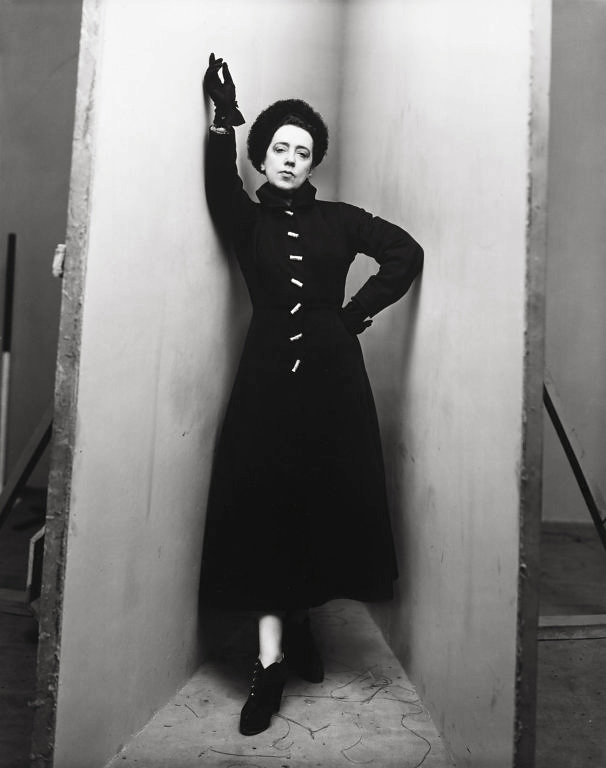
Irving Penn (American, Plainfield, New Jersey 1917–2009 New York) 'Elsa Schiaparelli, New York' March 29, 1948, printed c. 1948


Irving Penn (American, Plainfield, New Jersey 1917-2009 New York)
Elsa Schiaparelli, New York
March 29, 1948, printed c. 1948
Gelatin silver print
9 7/8 x 7 7/8 in. (25.1 x 20cm)
Promised Gift of The Irving Penn Foundation
© The Irving Penn Foundation


Irving Penn (American, Plainfield, New Jersey 1917-2009 New York) 'Charles James, New York' February 28, 1948, printed June 2002


Irving Penn (American, Plainfield, New Jersey 1917-2009 New York)
Charles James, New York
February 28, 1948, printed June 2002
Gelatin silver print
9 15/16 x 7 15/16 in. (25.3 x 20.1cm)
Promised Gift of The Irving Penn Foundation
© The Irving Penn Foundation


Charles Wilson Brega James (18 July 1906 – 23 September 1978) was a British-born fashion designer known as “America’s First Couturier”. He is widely considered to have been a master of cutting and is known for his highly structured aesthetic. …

James looked upon his dresses as works of art, as did many of his customers. Year after year, he reworked original designs, ignoring the sacrosanct schedule of seasons. The components of the precisely constructed designs were interchangeable, so that James had a never-ending fund of ideas on which to draw. He is most famous for his sculpted ball gowns made of lavish fabrics and to exacting tailoring standards, but is also remembered for his capes and coats, often trimmed with fur and embroidery, and his spiral zipped dresses. He is also famed for a unique, one of a kind white satin quilted jacket made in 1938 and now in the Victoria and Albert Museum, described as the starting point for “anoraks, space man and even fur jackets”.

Text from the Wikipedia website


Irving Penn (American, Plainfield, New Jersey 1917-2009 New York) 'Ballet Society, New York [Tanaquil Le Clercq with Corrado Cagli, Vittorio Rieti, and George Balanchine]' March 5, 1948, printed November 1976


Irving Penn (American, Plainfield, New Jersey 1917-2009 New York)
Ballet Society, New York [Tanaquil Le Clercq with Corrado Cagli, Vittorio Rieti, and George Balanchine]
March 5, 1948, printed November 1976
Platinum-palladium print
22 3/4 x 18 3/8 in. (57.8 x 46.7cm)
Promised Gift of The Irving Penn Foundation
© Condé Nast


Tanaquil Le Clercq (October 2, 1929 – December 31, 2000) was a principal dancer with the New York City Ballet. Her dancing career ended abruptly when she was stricken with polio in Copenhagen during the company’s European tour in 1956. Eventually regaining most of the use of her arms and torso, she remained paralysed from the waist down for the rest of her life. …

When she was fifteen years old, George Balanchine asked her to perform with him in a dance he choreographed for a polio charity benefit. In an eerie portent of things to come, he played a character named Polio, and Le Clercq was his victim who became paralysed and fell to the floor. Then, children tossed dimes at her character, prompting her to get up and dance again.

Corrado Cagli (Ancona, 1910 – Rome, 1976) was an Italian painter of Jewish heritage, who lived in the United States during World War II. …

He enlisted in the U.S. Army and was involved in the 1944 Normandy landings, and fought in Belgium and Germany. He was with the forces that liberated the Buchenwald concentration camp, and made a series of dramatic drawings on that subject. In 1948, Cagli returned to Rome to take up permanent residence there. From that time forward, he experimented in various abstract and non-figurative techniques (neo-metaphysical, neo-cubist, informal). He was awarded the Guggenheim prize (1946) and the Marzotto prize (1954).

Vittorio Rieti (January 28, 1898 – February 19, 1994) was a Jewish-Italian composer. Born in Alexandria, Egypt, Rieti moved to Milan to study economics. He subsequently studied in Rome under Respighi and Casella, and lived there until 1940. … He emigrated to the United States in 1940, becoming a naturalised American citizen on the 1st of June 1944. He taught at the Peabody Conservatory of Music in Baltimore (1948-49), Chicago Musical College (1950-54), Queens College, New York (1958-60), and New York College of Music (1960-64).

George Balanchine (January 22 [O.S. January 9] 1904 – April 30, 1983) was a choreographer. Styled as the father of American ballet, he co-founded the New York City Ballet and remained its Artistic Director for more than 35 years.

Balanchine took the standards and technique from his time at the Imperial Ballet School and fused it with other schools of movement that he had adopted during his tenure on Broadway and in Hollywood, creating his signature “neoclassical style”. He was a choreographer known for his musicality; he expressed music with dance and worked extensively with leading composers of his time like Igor Stravinsky. Balanchine was invited to America in 1933 by a young arts patron named Lincoln Kirstein, and together they founded the School of American Ballet. Along with Kirstein, Balanchine also co-founded the New York City Ballet (NYCB).

All texts from the Wikipedia website


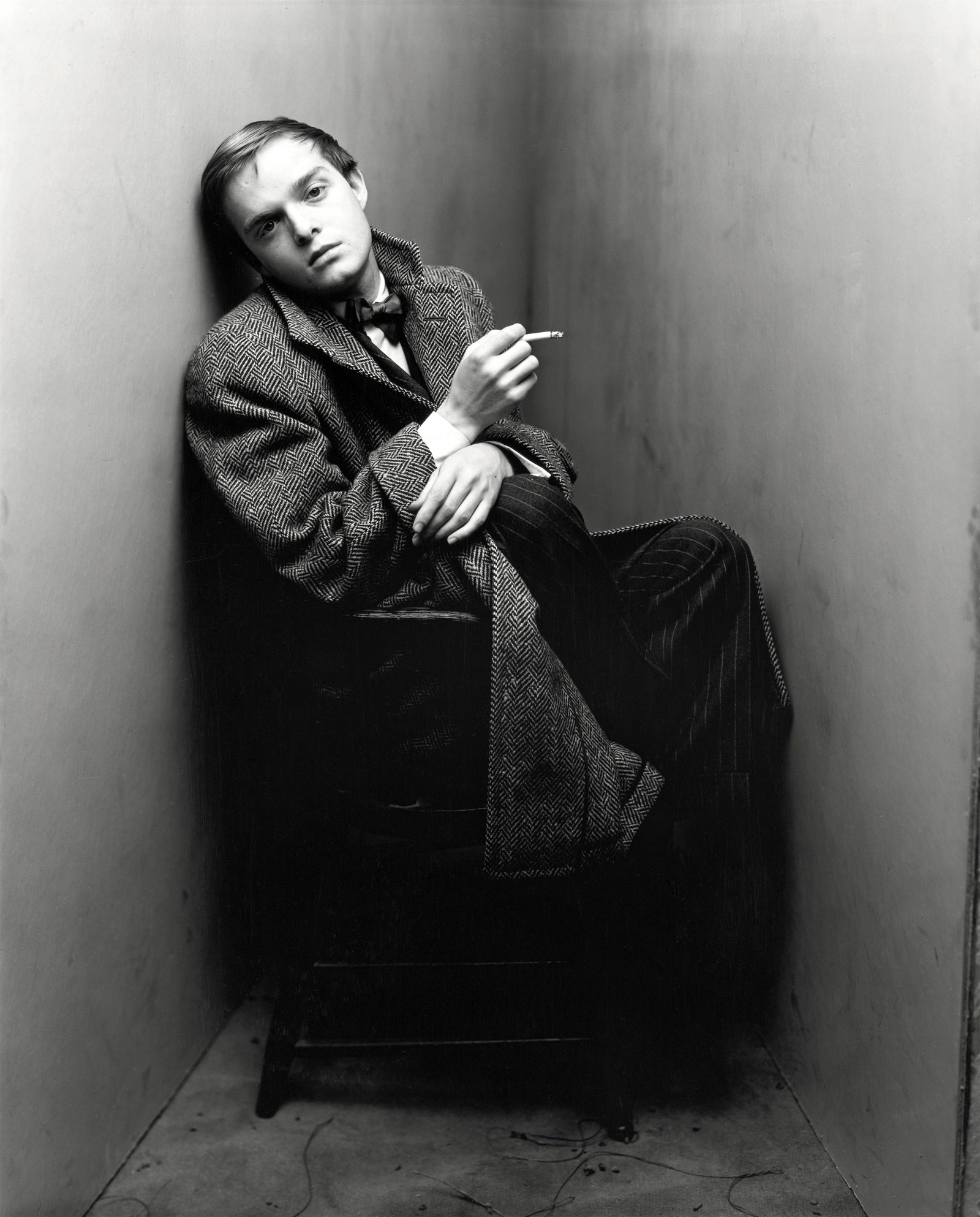
Irving Penn (American, Plainfield, New Jersey 1917-2009 New York) 'Truman Capote, New York' March 5, 1948


Irving Penn (American, Plainfield, New Jersey 1917-2009 New York)
Truman Capote, New York
March 5, 1948
Gelatin silver print
10 1/16 x 8 3/16 in. (25.5 x 20.8cm)
Promised Gift of The Irving Penn Foundation
© The Irving Penn Foundation


The Metropolitan Museum of Art will present a major retrospective of the photographs of Irving Penn to mark the centennial of the artist’s birth. Over the course of his nearly 70-year career, Irving Penn (1917-2009) mastered a pared-down aesthetic of studio photography that is distinguished for its meticulous attention to composition, nuance, detail, and printmaking. Irving Penn: Centennial, opening April 24, 2017, will be the most comprehensive exhibition of the great American photographer’s work to date and will include both masterpieces and hitherto unknown prints from all his major series.

Long celebrated for more than six decades of influential work at Vogue magazine, Penn was first and foremost a fashion photographer. His early photographs of couture are masterpieces that established a new standard for photographic renderings of style at mid-century, and he continued to record the cycles of fashions year after year in exquisite images characterised by striking shapes and formal brilliance. His rigorous modern compositions, minimal backgrounds, and diffused lighting were innovative and immensely influential. Yet Penn’s photographs of fashion are merely the most salient of his specialties. He was a peerless portraitist, whose perceptions extended beyond the human face and figure to take in more complete codes of demeanour, adornment, and artefact. He was also blessed with an acute graphic intelligence and a sculptor’s sensitivity to volumes in light, talents that served his superb nude studies and life-long explorations of still life.

Penn dealt with so many subjects throughout his long career that he is conventionally seen either with a single lens – as the portraitist, fashion photographer, or still life virtuoso – or as the master of all trades, the jeweller of journalists who could fine-tool anything. The exhibition at The Met will chart a different course, mapping the overall geography of the work and the relative importance of the subjects and campaigns the artist explored most creatively. Its organisation largely follows the pattern of his development so that the structure of the work, its internal coherence, and the tenor of the times of the artist’s experience all become evident.

The exhibition will most thoroughly explore the following series: street signs, including examples of early work in New York, the American South, and Mexico; fashion and style, with many classic photographs of Lisa Fonssagrives-Penn, the former dancer who became the first supermodel as well as the artist’s wife; portraits of indigenous people in Cuzco, Peru; the Small Trades portraits of urban labourers; portraits of beloved cultural figures from Truman Capote, Joe Louis, Picasso, and Colette to Alvin Ailey, Ingmar Bergman, and Joan Didion; the infamous cigarette still lifes; portraits of the fabulously dressed citizens of Dahomey (Benin), New Guinea, and Morocco; the late “Morandi” still lifes; voluptuous nudes; and glorious colour studies of flowers. These subjects chart the artist’s path through the demands of the cultural journal, the changes in fashion itself and in editorial approach, the fortunes of the picture press in the age of television, the requirements of an artistic inner voice in a commercial world, the moral condition of the American conscience during the Vietnam War era, the growth of photography as a fine art in the 1970s and 1980s, and personal intimations of mortality. All these strands of meaning are embedded in the images – a web of deep and complex ideas belied by the seeming forthrightness of what is represented.

Penn generally worked in a studio or in a traveling tent that served the same purpose, and favoured a simple background of white or light grey tones. His preferred backdrop was made from an old theatre curtain found in Paris that had been softly painted with diffused grey clouds. This backdrop followed Penn from studio to studio; a companion of over 60 years, it will be displayed in one of the Museum’s galleries among celebrated portraits it helped create. Other highlights of the exhibition include newly unearthed footage of the photographer at work in his tent in Morocco; issues of Vogue magazine illustrating the original use of the photographs and, in some cases, to demonstrate the difference between those brilliantly coloured, journalistic presentations and Penn’s later reconsidered reuse of the imagery; and several of Penn’s drawings shown near similar still life photographs.

Exhibition credits

Irving Penn: Centennial is co-curated by Maria Morris Hambourg, independent curator and the founding curator of The Met’s Department of Photographs, and Jeff L. Rosenheim, Joyce Frank Menschel Curator in Charge of the Department of Photographs at The Met.

Press release from the Metropolitan Museum of Art


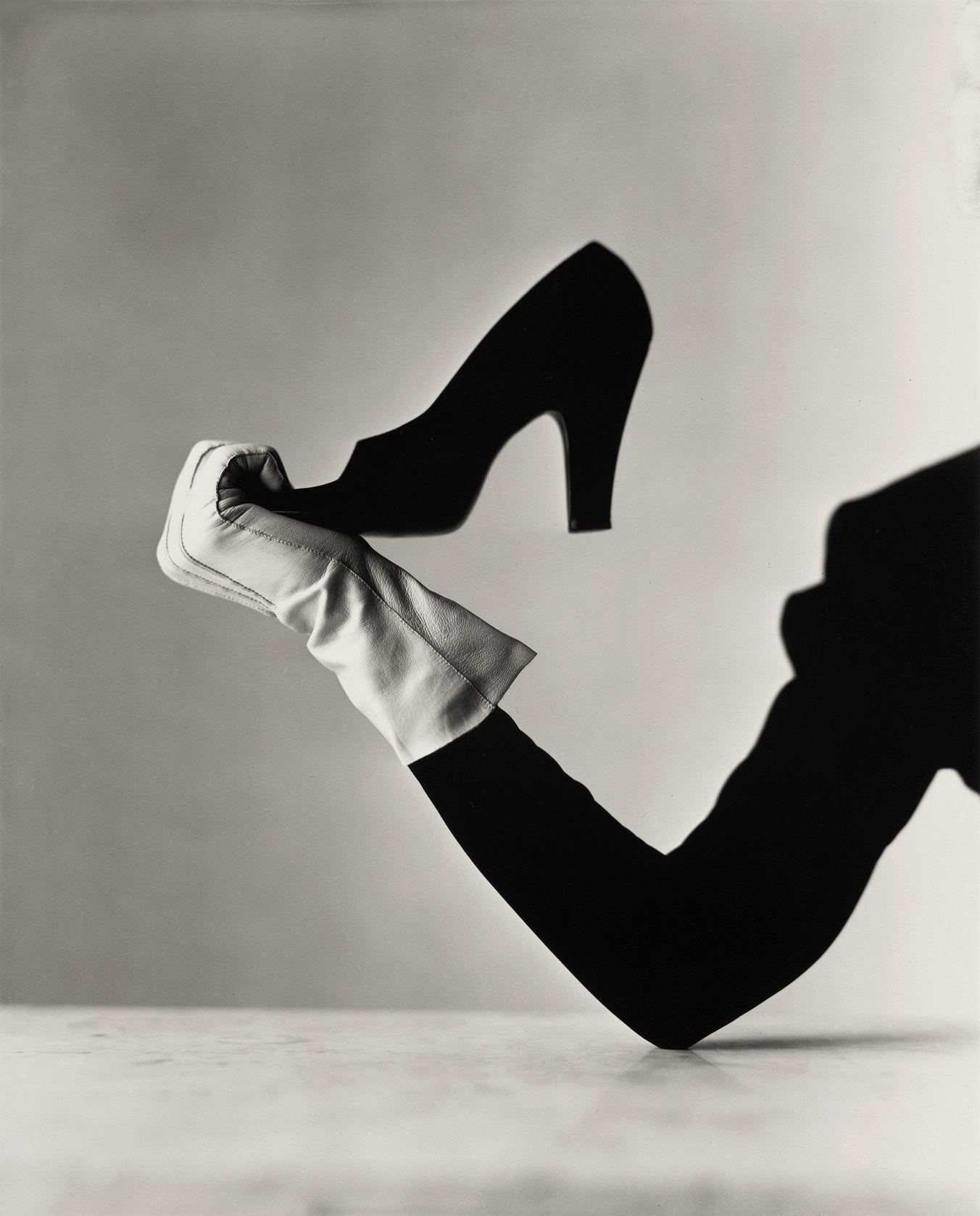
Irving Penn (American, Plainfield, New Jersey 1917-2009 New York) 'Glove and Shoe, New York' July 7, 1947


Irving Penn (American, Plainfield, New Jersey 1917-2009 New York)
Glove and Shoe, New York
July 7, 1947
Gelatin silver print
9 9/16 x 7 3/4 in. (24.3 x 19.7cm)
Promised Gift of The Irving Penn Foundation
© Condé Nast


Irving Penn (American, Plainfield, New Jersey 1917-2009 New York) The 'Tarot Reader (Bridget Tichenor and Jean Patchett), New York' 1949, printed 1984


Irving Penn (American, Plainfield, New Jersey 1917-2009 New York)
The Tarot Reader (Bridget Tichenor and Jean Patchett), New York
1949, printed 1984
Gelatin silver print
19 5/16 x 18 1/2 in. (49 x 47cm)
Promised Gift of The Irving Penn Foundation
© Condé Nast


Bridget Bate Tichenor (born Bridget Pamela Arkwright Bate on November 22, 1917 – died on October 20, 1990), also known as Bridget Tichenor or B.B.T., was a Mexican surrealist painter of fantastic art in the school of magic realism and a fashion editor. Born in Paris and of British descent, she later embraced Mexico as her home. …

Bate Tichenor’s painting technique was based upon 16th-century Italian tempera formulas that artist Paul Cadmus taught her in New York in 1945, where she would prepare an eggshell-finished gesso ground on masonite board and apply (instead of tempera) multiple transparent oil glazes defined through chiaroscuro with sometimes one hair of a #00 sable brush. Bate Tichenor considered her work to be of a spiritual nature, reflecting ancient occult religions, magic, alchemy, and Mesoamerican mythology in her Italian Renaissance style of painting.

The cultures of Mesoamerica and her international background would influence the style and themes of Bate Tichenor’s work as a magic realist painter in Mexico. She was among a group of surrealist and magic realist female artists who came to live in Mexico in the late 1940s and early 1950s.

Jean Patchett (February 16, 1926 – January 22, 2002) was a leading fashion model of the late 1940s, 1950s and early 1960s. She was among the best known models of that era, which included Dovima, Dorian Leigh, Suzy Parker, Evelyn Tripp and Lisa Fonssagrives. Patchett was the subject of two of Vogue Magazine’s most famous covers, both shot in 1950 by Erwin Blumenfeld and Irving Penn. She was famous for being one of the first high-fashion models to appear remote; previously, models had appeared warm and friendly. Irving Penn described her as “a young American goddess in Paris couture”.

Texts from the Wikipedia website


Irving Penn (American, Plainfield, New Jersey 1917-2009 New York) 'The Twelve Most Photographed Models, New York' 1947


Irving Penn (American, Plainfield, New Jersey 1917-2009 New York)
The Twelve Most Photographed Models, New York
1947
Gelatin silver print
13 3/8 x 16 15/16 in. (34 x 43cm)
Promised Gift of The Irving Penn Foundation
© Condé Nast


Irving Penn (American, Plainfield, New Jersey 1917-2009 New York) 'Girl Drinking (Mary Jane Russell), New York' 1949, printed December 1977


Irving Penn (American, Plainfield, New Jersey 1917-2009 New York)
Girl Drinking (Mary Jane Russell), New York
1949, printed December 1977
Platinum-palladium print
20 1/2 x 19 1/4 in. (52.1 x 48.9cm)
Loan from The Irving Penn Foundation
© Condé Nast


Mary Jane Russell (10 July 1926 – 2003) was a successful New York-based American photographic fashion model between 1948 and 1961. She often worked with Louise Dahl-Wolfe and Irving Penn, and appeared on many covers for Vogue and Harper’s Bazaar during the course of her modelling career. …

Russell was … a favourite model of Irving Penn, who remembered her qualities of concentration and tenderness. Two of Penn’s better known images of her were Girl Drinking, published in Vogue in 1949, and the 1951 photograph Girl with Tobacco on Tongue. As Russell did not smoke, the process of taking the latter photograph made her physically sick.

Text from the Wikipedia website


Irving Penn (American, Plainfield, New Jersey 1917-2009 New York) 'Marlene Dietrich, New York' November 3, 1948, printed April 2000


Irving Penn (American, Plainfield, New Jersey 1917-2009 New York)
Marlene Dietrich, New York
November 3, 1948, printed April 2000
Gelatin silver print
10 x 8 1/16 in. (25.4 x 20.4cm)
Promised Gift of The Irving Penn Foundation
© The Irving Penn Foundation


Irving Penn (American, Plainfield, New Jersey 1917-2009 New York) 'Theatre Accident, New York' 1947, printed 1984


Irving Penn (American, Plainfield, New Jersey 1917-2009 New York)
Theatre Accident, New York
1947, printed 1984
Dye transfer print
19 1/2 x 15 1/4 in. (49.6 x 38.8cm)
Promised Gift of The Irving Penn Foundation
© Condé Nast


Irving Penn (American, Plainfield, New Jersey 1917-2009 New York) 'Still Life with Watermelon, New York' 1947, printed 1985


Irving Penn (American, Plainfield, New Jersey 1917-2009 New York)
Still Life with Watermelon, New York
1947, printed 1985
Dye transfer print
22 x 17 1/2 in. (55.9 x 44.5cm)
Promised Gift of The Irving Penn Foundation
© Condé Nast


Irving Penn (American, Plainfield, New Jersey 1917-2009 New York) 'Salad Ingredients, New York' 1947, printed 1984


Irving Penn (American, Plainfield, New Jersey 1917-2009 New York)
Salad Ingredients, New York
1947, printed 1984
Dye transfer print
19 7/16 x 15 3/16 in. (49.3 x 38.6cm)
Promised Gift of The Irving Penn Foundation
© Condé Nast


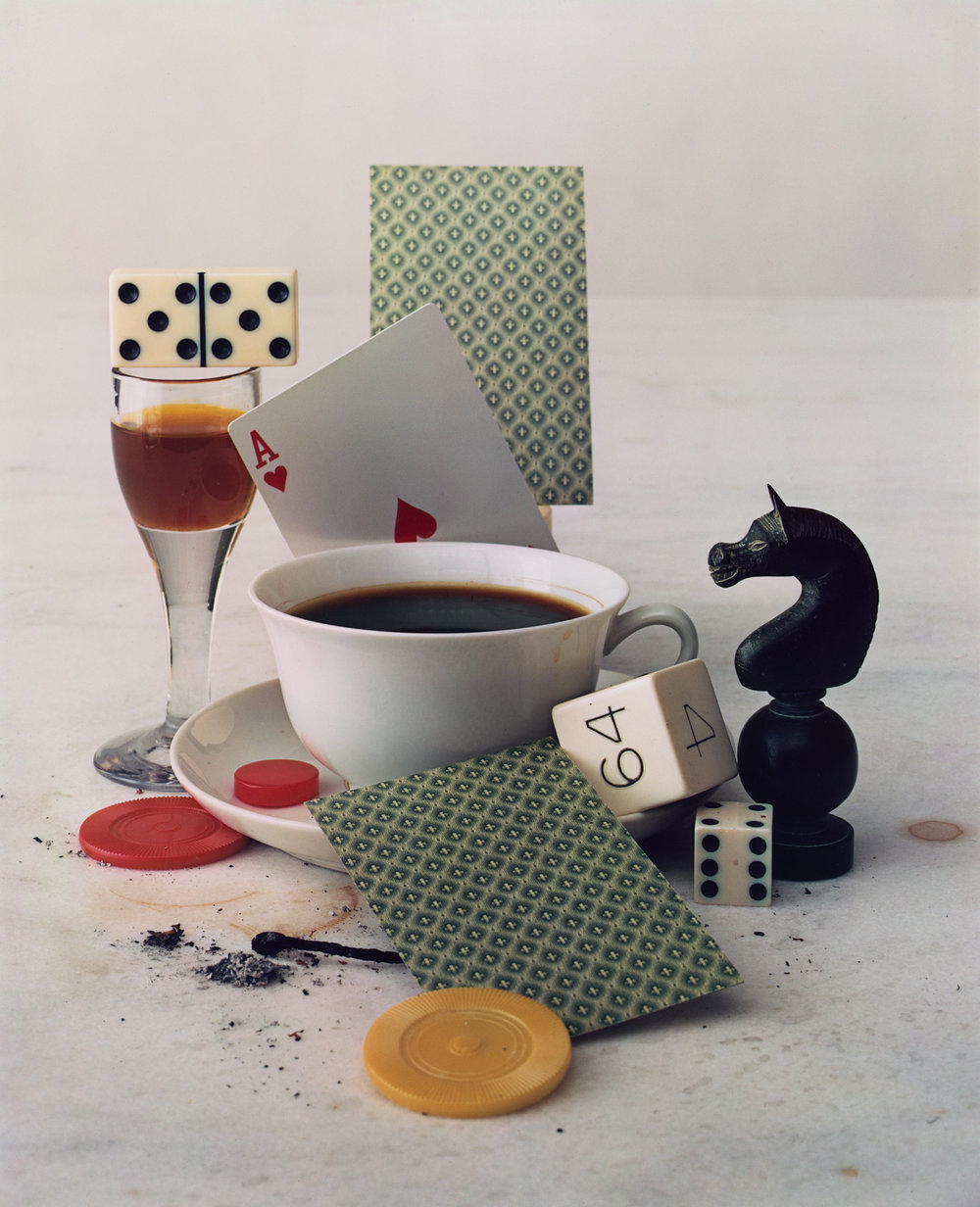
Irving Penn (American, Plainfield, New Jersey 1917-2009 New York) 'After-Dinner Games, New York' 1947, printed 1985


Irving Penn (American, Plainfield, New Jersey 1917-2009 New York)
After-Dinner Games, New York
1947, printed 1985
Dye transfer print
22 3/16 x 18 1/16 in. (56.4 x 45.8cm)
Promised Gift of The Irving Penn Foundation
© Condé Nast


The Metropolitan Museum of Art
1000 Fifth Avenue at 82nd Street
New York, New York 10028-0198
Phone: 212-535-7710

Opening hours:
Thursday – Tuesday 10am – 5pm
Closed Wednesday

The Metropolitan Museum of Art website

LIKE ART BLART ON FACEBOOK

Back to top

Exhibition: ‘Sabine Weiss’ at Jeu de Paume – Château de Tours

Exhibition dates: 18th June – 30th October, 2016

Curator: Virginie Chardin, independent curator


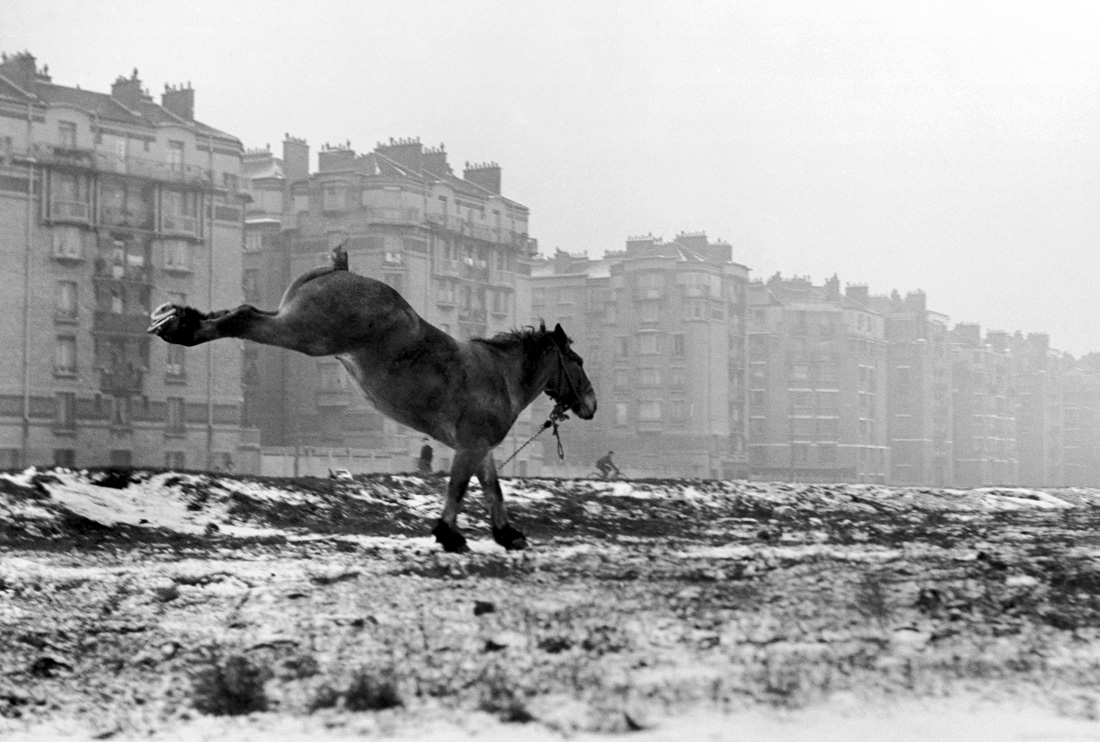
Sabine Weiss (Swiss-French, 1924-2021) 'Cheval, Porte de Vanves' Paris, 1952 from the exhibition 'Sabine Weiss' at Jeu de Paume – Château de Tours, June - Oct, 2016


Sabine Weiss (Swiss-French, 1924-2021)
Cheval, Porte de Vanves (Horse, Porte de Vanves)
Paris, 1952
Silver gelatin print
© Sabine Weiss


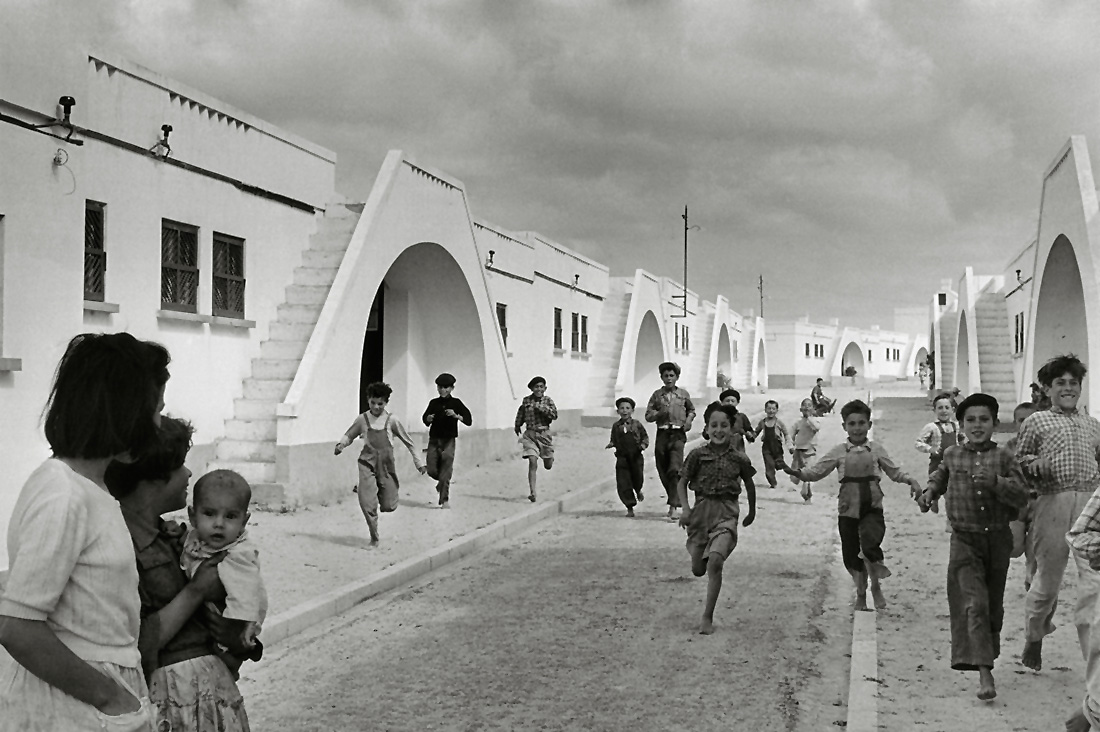
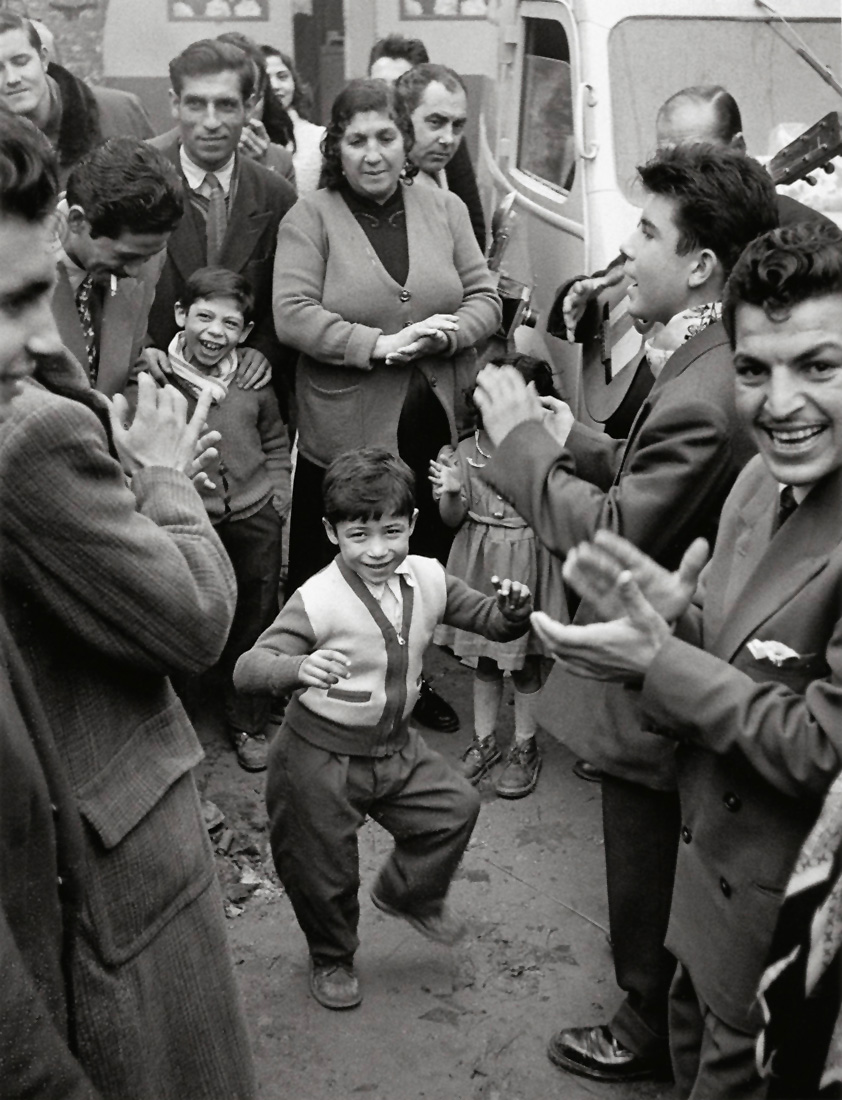
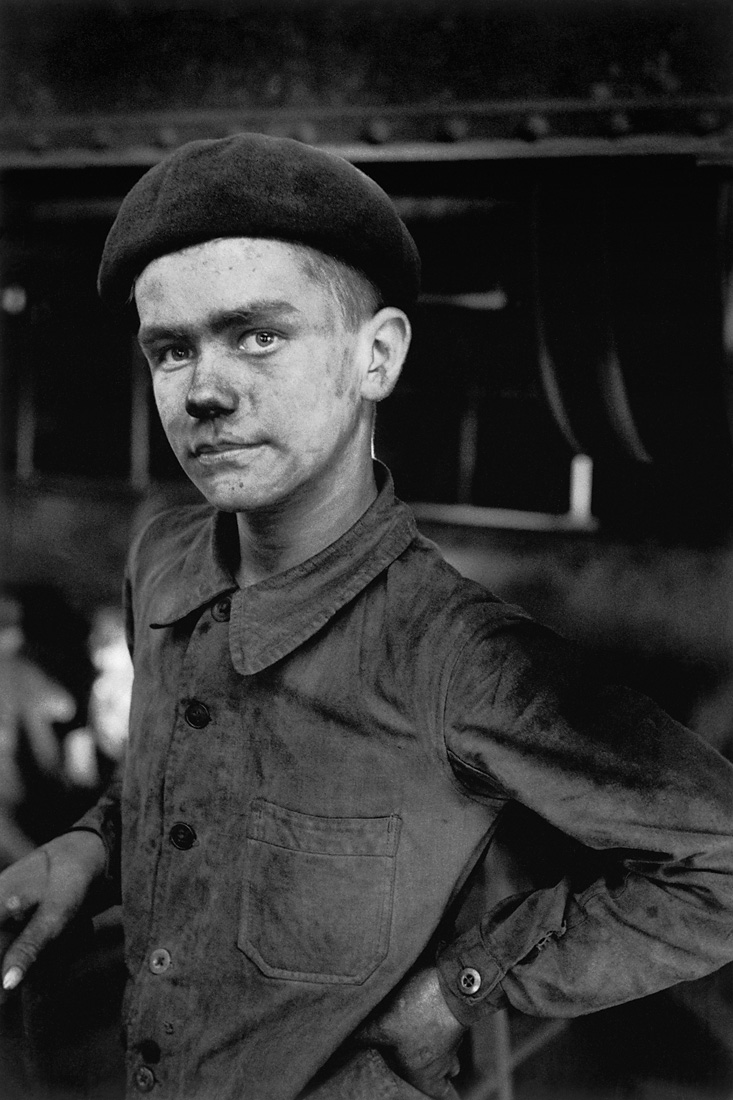
A photographer I knew very little about before assembling this posting. The undoubted influence of Henri Cartier-Bresson can be seen in many images (such as Vendeurs de pain, Athènes 1958 and Village moderne de pêcheurs 1954, both below), while other images are redolent of Josef Koudelka (Marriage gitan, 1953) and Paul Strand (Jeune mineur, 1955).

Weiss strikes one as a solid photographer in the humanist, Family of Man tradition who doesn’t push the boundaries of the medium or the genre, nor generate a recognisable signature style.

Dr Marcus Bunyan


Many thankx to Jeu de Paume for allowing me to publish the photographs in the posting. Please click on the photographs for a larger version of the image.


Sabine Weiss – Jeu de Paume Château de Tours

“Sabine Weiss”: exhibition at Jeu de Paume Château de Tours from 18 June 2016 until 30 October 2016.

Sabine Weiss is the last representative of the French humanist school of photography, which includes photographers like Robert Doisneau, Willy Ronis, Édouard Boubat, Brassaï and Izis.

Still active at over 90 years of age, she has accepted for the first time to present her personal archives, thereby providing a privileged insight into her life and career as a photographer. The exhibition at the Château de Tours will showcase just a few milestones from her long career. 

Through almost 130 prints, as well as numerous period documents – many of which are being shown for the first time – this exhibition provides visitors with an overview of the multiple facets of this prolific artist, for whom photography was first and foremost, a fascinating occupation.

Text from the Vimeo website


Sabine Weiss au Jeu de Paume, Château de Tours


Sabine Weiss (Swiss-French, 1924-2021) 'Vendeurs de pain' Athènes Grèce, 1958 from the exhibition 'Sabine Weiss' at Jeu de Paume – Château de Tours, June - Oct, 2016


Sabine Weiss (Swiss-French, 1924-2021)
Vendeurs de pain, Athènes (Sellers of bread, Athens)
Greece, 1958
Silver gelatin print
© Sabine Weiss


Sabine Weiss is the last representative of the French humanist school of photography, which includes photographers like Robert Doisneau, Willy Ronis, Édouard Boubat, Brassaï and Izis.

Still active at over 90 years of age, she has accepted for the first time to present her personal archives, thereby providing a privileged insight into her life and career as a photographer. The exhibition at the Château de Tours will showcase just a few milestones from her long career. Through almost 130 prints, as well as numerous period documents – many of which are being shown for the first time – this exhibition provides visitors with an overview of the multiple facets of this prolific artist, for whom photography was first and foremost, a fascinating occupation.


Sabine Weiss (Swiss-French, 1924-2021) 'Village moderne de pêcheurs, Olhão, Algarve' Portugal, 1954


Sabine Weiss (Swiss-French, 1924-2021)
Village moderne de pêcheurs, Olhão, Algarve (Modern fishing village, Olhão, Algarve)
Portugal, 1954
Silver gelatin print
© Sabine Weiss


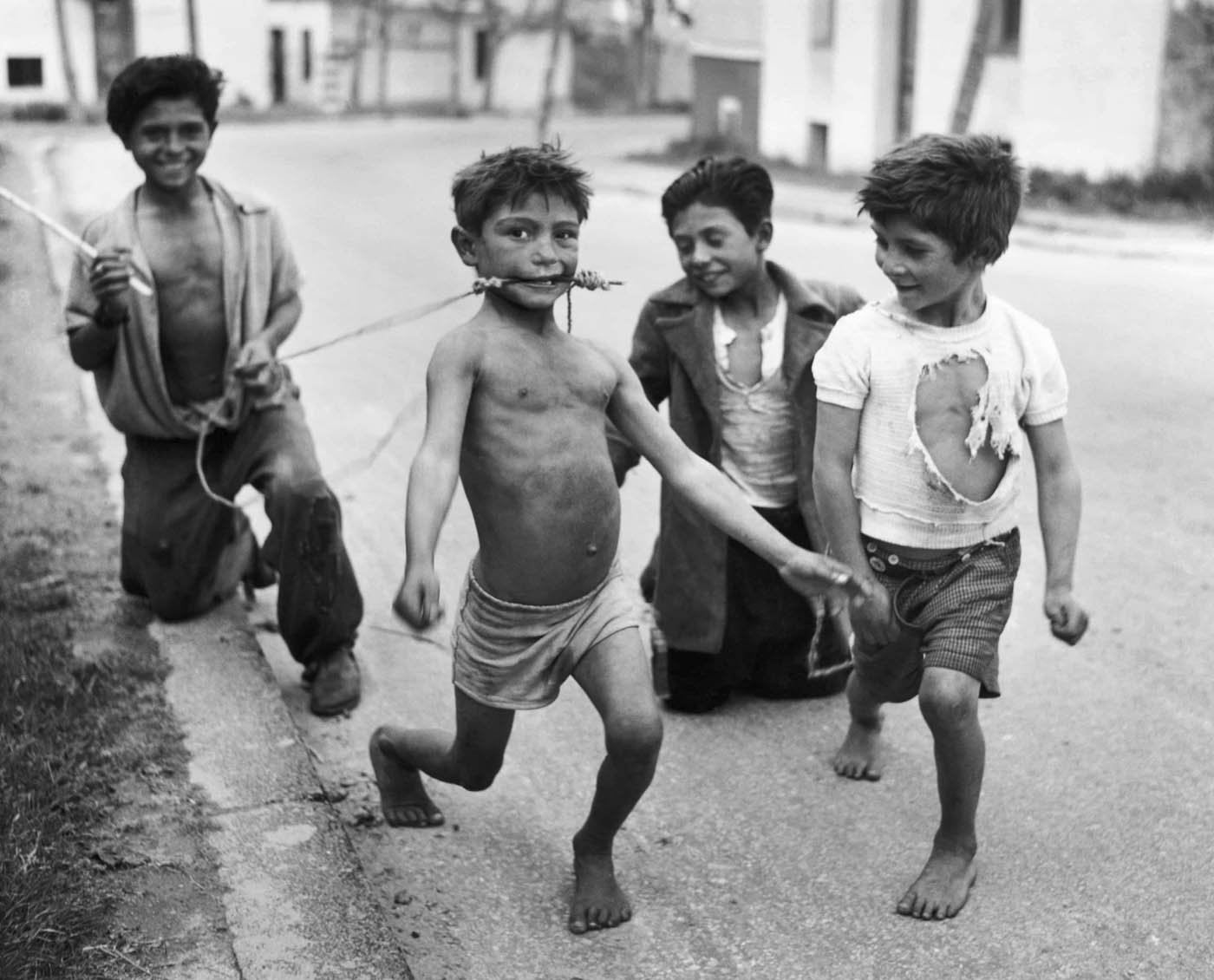
Sabine Weiss (Swiss-French, 1924-2021) 'I Am A Horse, Spain' 1954


Sabine Weiss (Swiss-French, 1924-2021)
I Am A Horse, Spain
1954
Gelatin silver print
© Sabine Weiss


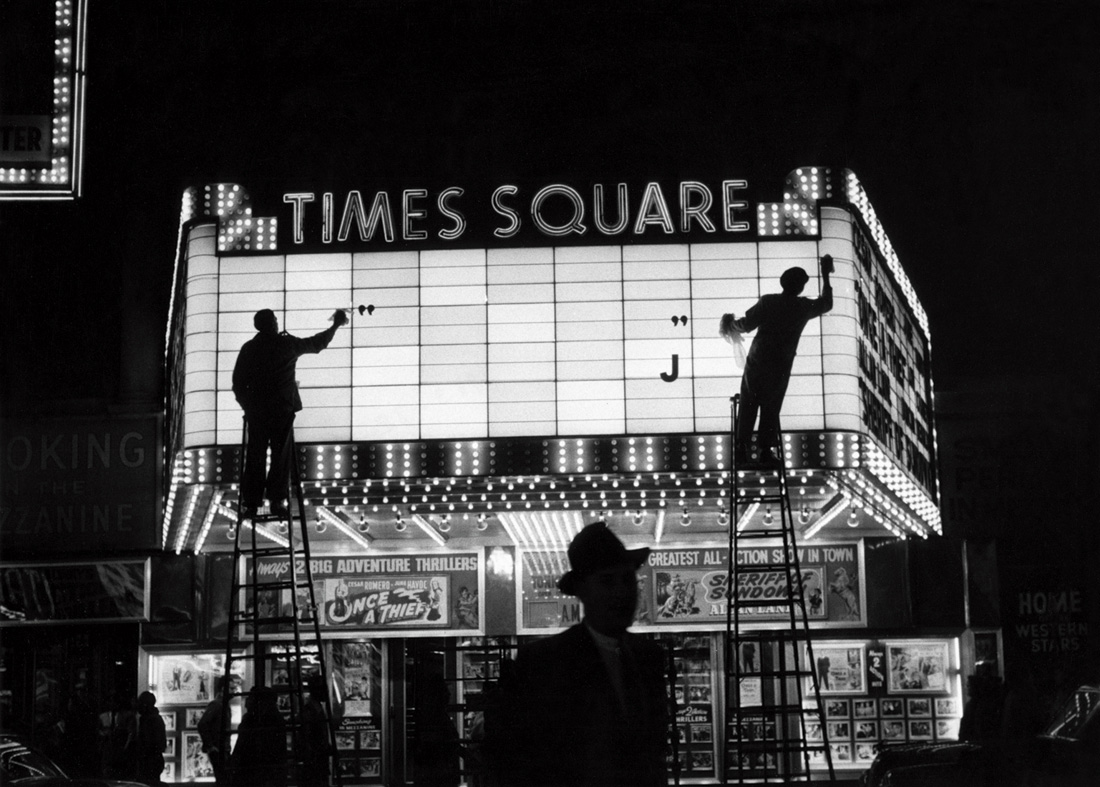
Sabine Weiss (Swiss-French, 1924-2021) 'Times Square, New York' États-Unis, 1955


Sabine Weiss (Swiss-French, 1924-2021)
Times Square, New York
United States, 1955
Silver gelatin print
© Sabine Weiss


Sabine Weiss (Swiss-French, 1924-2021) 'Feux de Bengale, Naples' Italie, 1955


Sabine Weiss (Swiss-French, 1924-2021)
Feux de Bengale, Naples (Fires of Bengal, Naples)
Italy, 1955
Silver gelatin print
© Sabine Weiss


Sabine Weiss (Swiss-French, 1924-2021) 'André Breton chez lui, 42, rue Fontaine' Paris, 1956


Sabine Weiss (Swiss-French, 1924-2021)
André Breton chez lui, 42, rue Fontaine (André Breton at home, 42 rue Fontaine)
Paris, 1956
Silver gelatin print
© Sabine Weiss


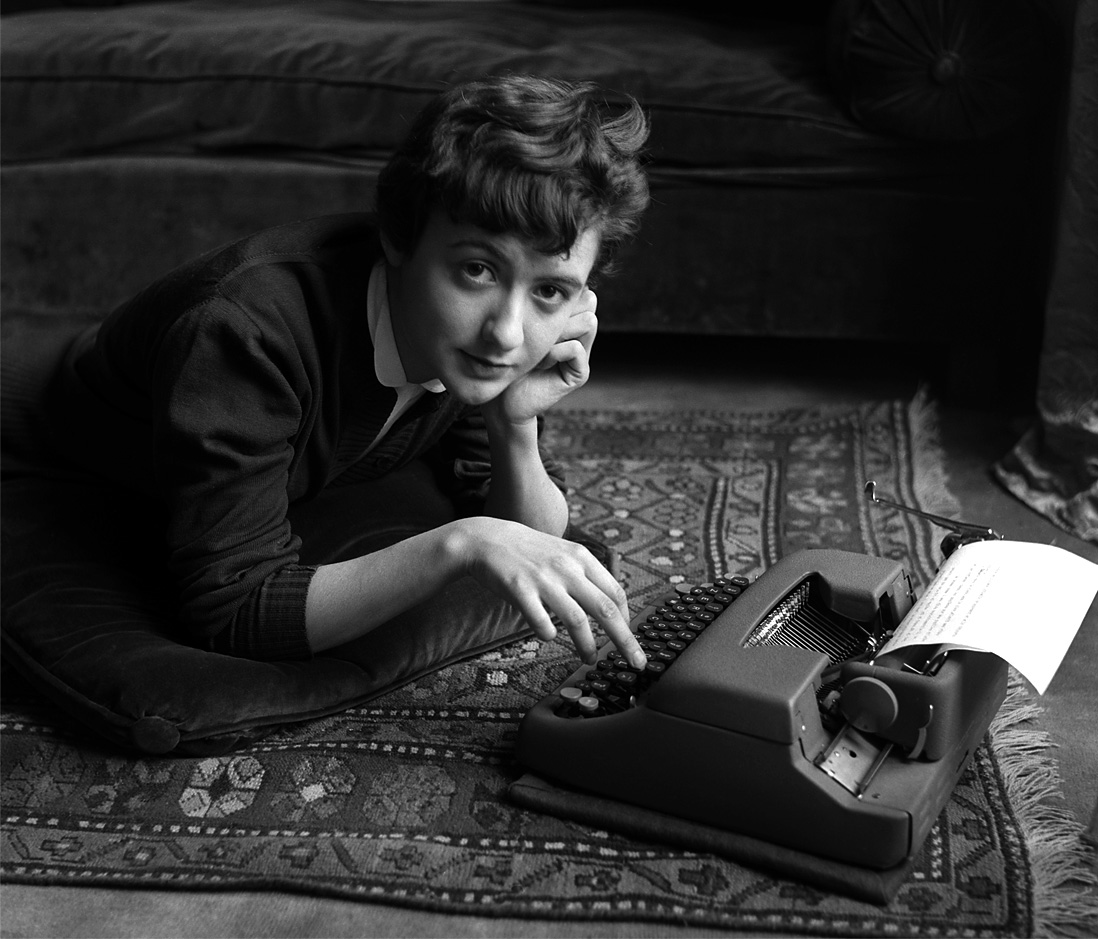
Sabine Weiss (Swiss-French, 1924-2021) 'Françoise Sagan chez elle, lors de la sortie de son premier roman Bonjour tristesse' Paris, 1954


Sabine Weiss (Swiss-French, 1924-2021)
Françoise Sagan chez elle, lors de la sortie de son premier roman Bonjour tristesse
(Françoise Sagan at home, with the release of his first novel Bonjour Tristesse)

Paris, 1954
Silver gelatin print
© Sabine Weiss


Sabine Weiss (Swiss-French, 1924-2021) 'Enfant perdu dans un grand magasin, New York' États-Unis, 1955


Sabine Weiss (Swiss-French, 1924-2021)
Enfant perdu dans un grand magasin, New York (Lost child in a department store, New York)
United States, 1955
Silver gelatin print
© Sabine Weiss


Sabine Weiss (Swiss-French, 1924-2021) 'Vieille dame et enfant' Guadeloupe 1990


Sabine Weiss (Swiss-French, 1924-2021)
Vieille dame et enfant, Guadeloupe (Old lady and child, Guadeloupe)
1990
Silver gelatin print
© Sabine Weiss


Sabine Weiss (Swiss-French, 1924-2021) 'La Petite Égyptienne' 1983


Sabine Weiss (Swiss-French, 1924-2021)
La Petite Égyptienne (Little Egyptian)
1983
Silver gelatin print
© Sabine Weiss


Sabine Weiss is the last representative of the French humanist school of photography, which includes photographers like Robert Doisneau, Willy Ronis, Édouard Boubat, Brassaï and Izis.

Still active at over 90 years of age, she has accepted for the first time to present her personal archives, thereby providing a privileged insight into her life and career as a photographer. The exhibition at the Château de Tours will showcase just a few milestones from her long career. Through almost 130 prints, as well as numerous period documents – many of which are being shown for the first time – this exhibition provides visitors with an overview of the multiple facets of this prolific artist, for whom photography was first and foremost, a fascinating occupation.

Née Weber in Switzerland in 1924, Sabine Weiss was drawn to photography from a very early age and did her apprenticeship at Paul Boissonnas’ studio, a dynasty of photographers practising in Geneva since the late nineteenth century. In 1946, she left Geneva for Paris and became the assistant of Willy Maywald, a German photographer living in the French capital, specialising in fashion photography and portraits. She married the American painter Hugh Weiss in 1950, and at this time embarked upon a career as an independent photographer. She moved into a small Parisian studio with her husband – where she continues to live today – and socialised in the artistic circles of the post-war period. This allowed her to photograph Georges Braque, Joan Miró, Alberto Giacometti, André Breton and Ossip Zadkine, and later numerous musicians, writers and actors.

Circa 1952, Sabine Weiss joined the Rapho Agency thanks to Robert Doisneau’s recommendation. Her personal work met with immediate critical acclaim in the United States with exhibitions at the Museum of Modern Art in New York, the Art Institute of Chicago, the Walker Art Institute in Minneapolis and the Limelight Gallery, New York. Three of her photographs were shown as part of the famous exhibition “The Family of Man”, organised by Edward Steichen in 1955, and Sabine obtained long-lasting contracts with The New York Times Magazine, Life, Newsweek, Vogue, Point de vue-Images du monde, Paris Match, Esquire, and Holiday. From that time and up until the 2000s, Sabine Weiss continued to work for the international illustrated press, as well as for numerous institutions and brands, seamlessly passing from reportage to fashion features, and from advertising to portraits of celebrities or social issues.

In the late 1970s, her work returned to the spotlight thanks to a growing revival of interest in so-called humanist photography on behalf of festivals and institutions. This interest encouraged Sabine to return to black and white photography. At over sixty years of age, she began a new body of personal work, punctuated by her travels in France, Egypt, India, Reunion Island, Bulgaria and Burma, and in which a more sentimental melody may be heard, centred on the pensive and solitary moments of human existence. At the same time, Sabine became the focus of a growing number of tributes, all of which has contributed to her reputation as an independent and dynamic photographer, with a great humanist sensibility and an eye for the detail of everyday life.

Virginie Chardin

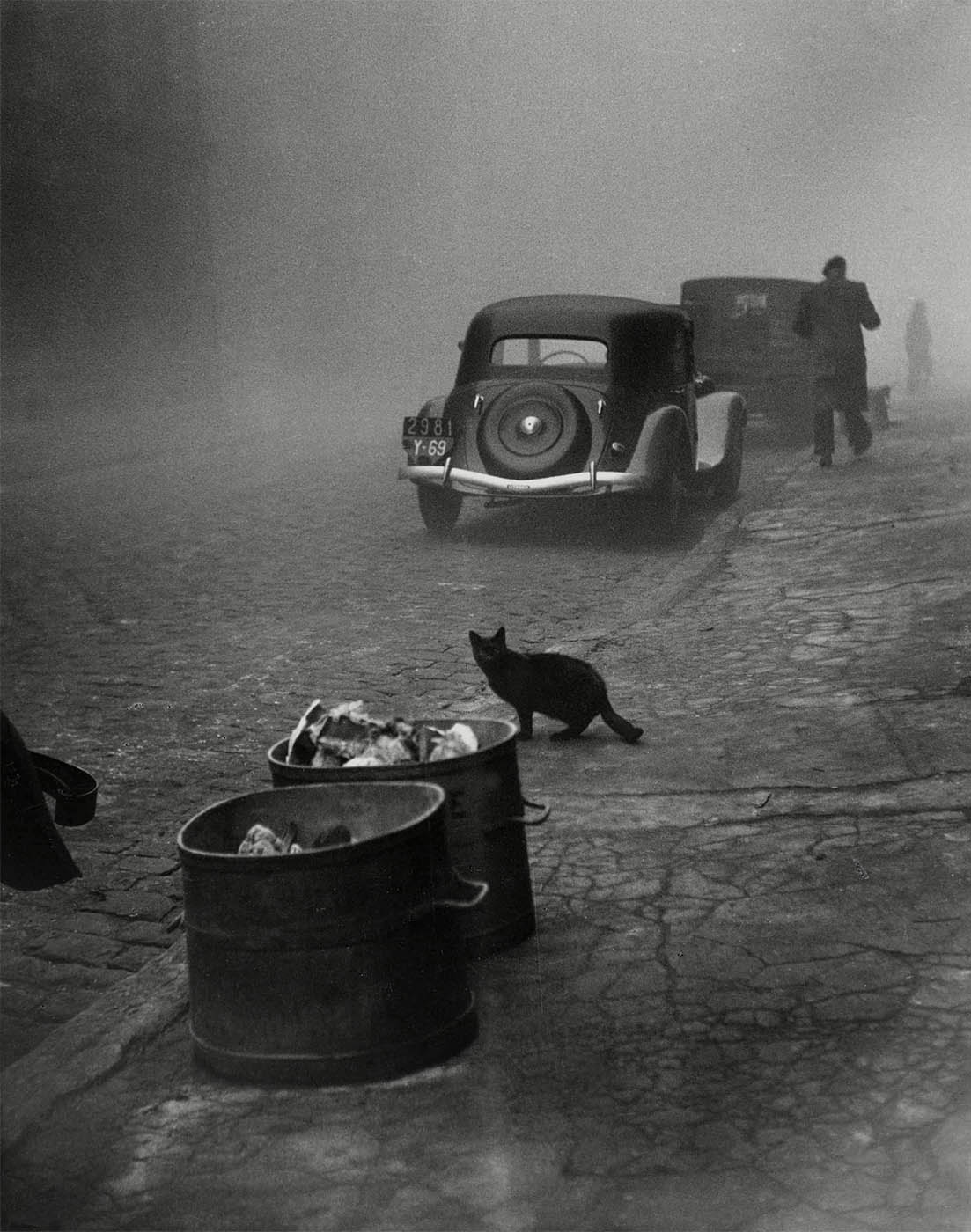
Sabine Weiss (Swiss-French, 1924-2021) 'Petit matin brumeux, Lyon, France' 1950

Sabine Weiss (Swiss-French, 1924-2021)
Petit matin brumeux, Lyon, France (Misty early morning, Lyon, France)
1950
Silver gelatin print
© Sabine Weiss


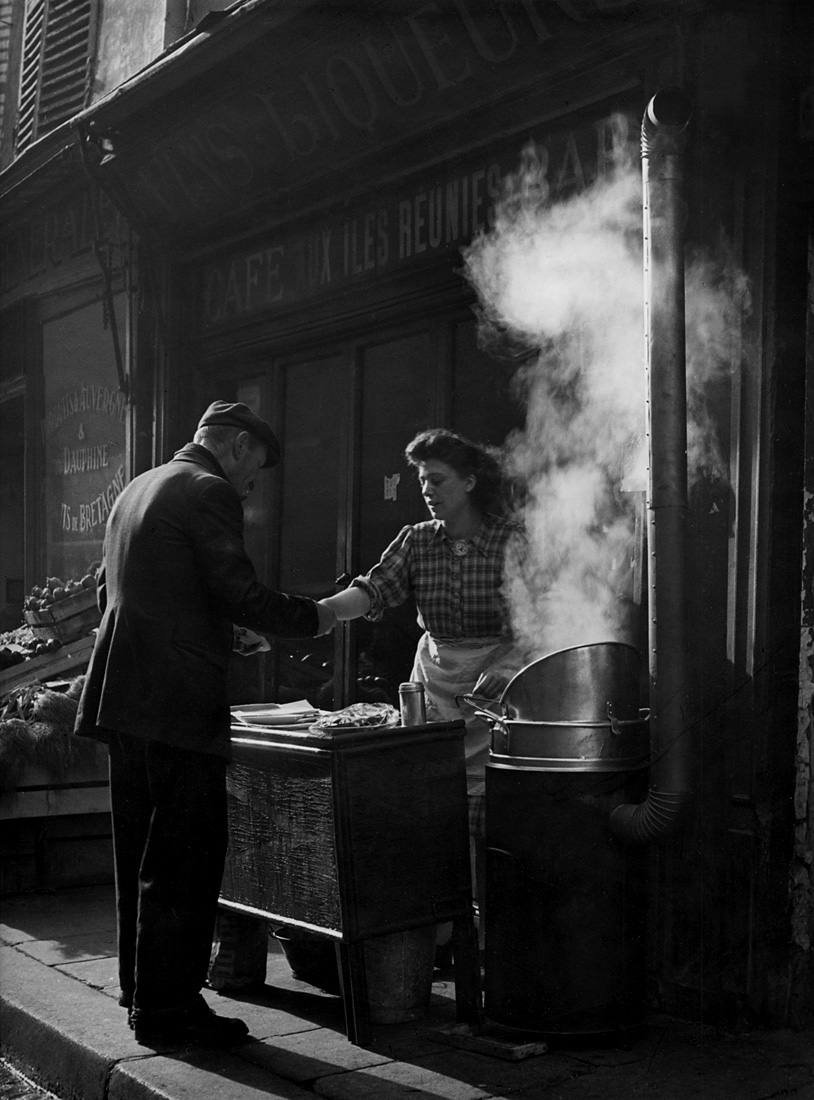
Sabine Weiss (Swiss-French, 1924-2021) 'Marchande de frites' Paris, 1952


Sabine Weiss (Swiss-French, 1924-2021)
Marchande de frites (French fries seller)
Paris, 1952
Silver gelatin print
© Sabine Weiss


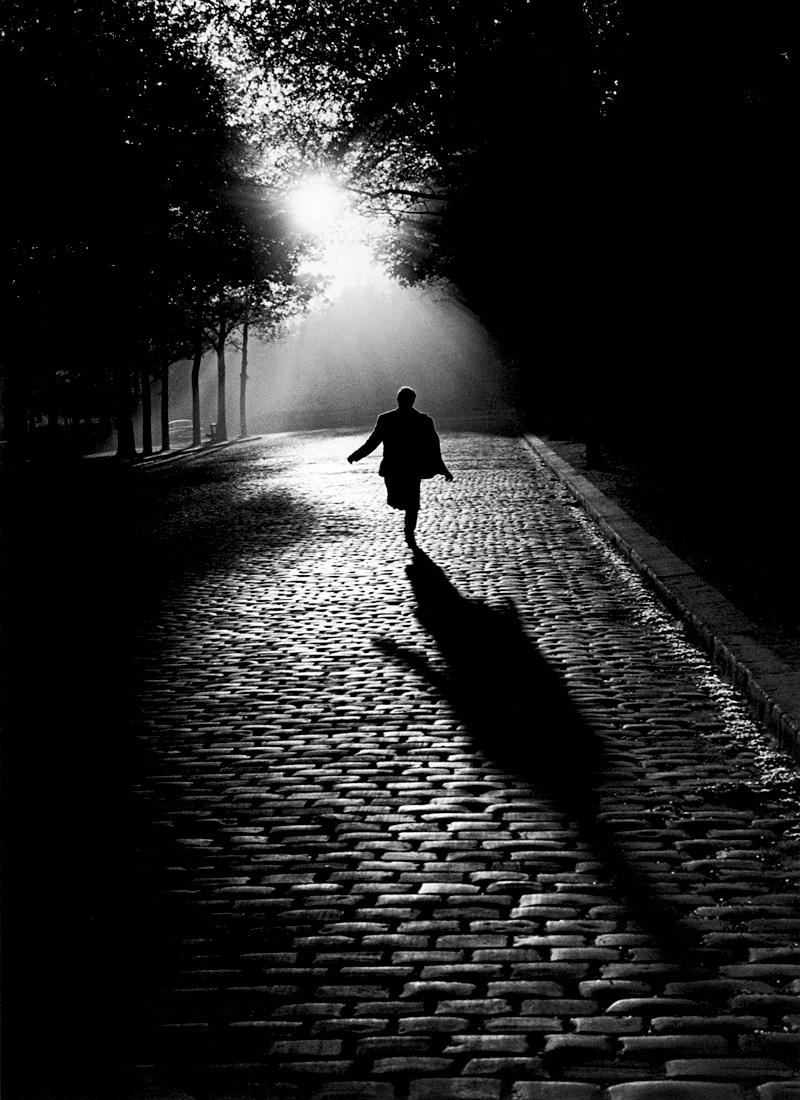
Sabine Weiss (Swiss-French, 1924-2021) 'L'homme qui court' Paris 1953


Sabine Weiss (Swiss-French, 1924-2021)
L’homme qui court, Paris (The man who runs, Paris)
1953
Silver gelatin print
© Sabine Weiss


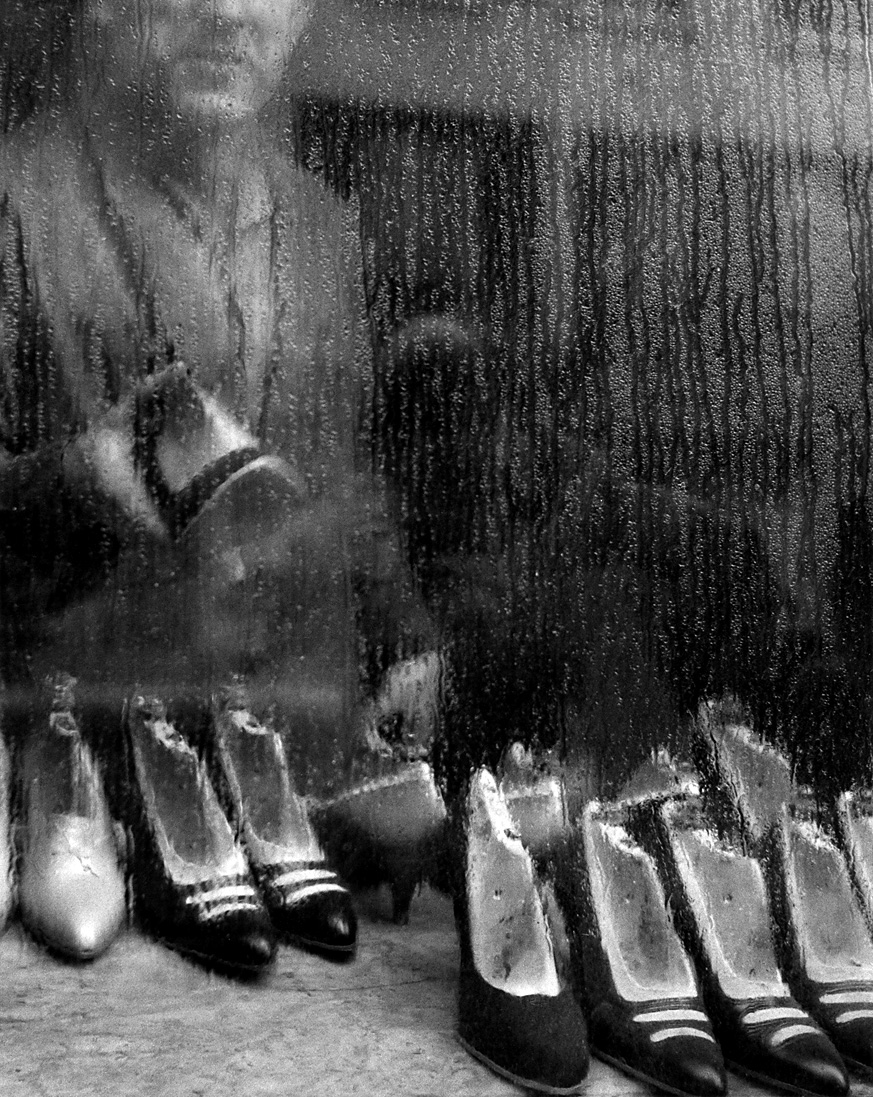
Sabine Weiss (Swiss-French, 1924-2021) 'Vitrine, Paris' 1955


Sabine Weiss (Swiss-French, 1924-2021)
Vitrine, Paris (Showcase, Paris)
1955
Silver gelatin print
© Sabine Weiss


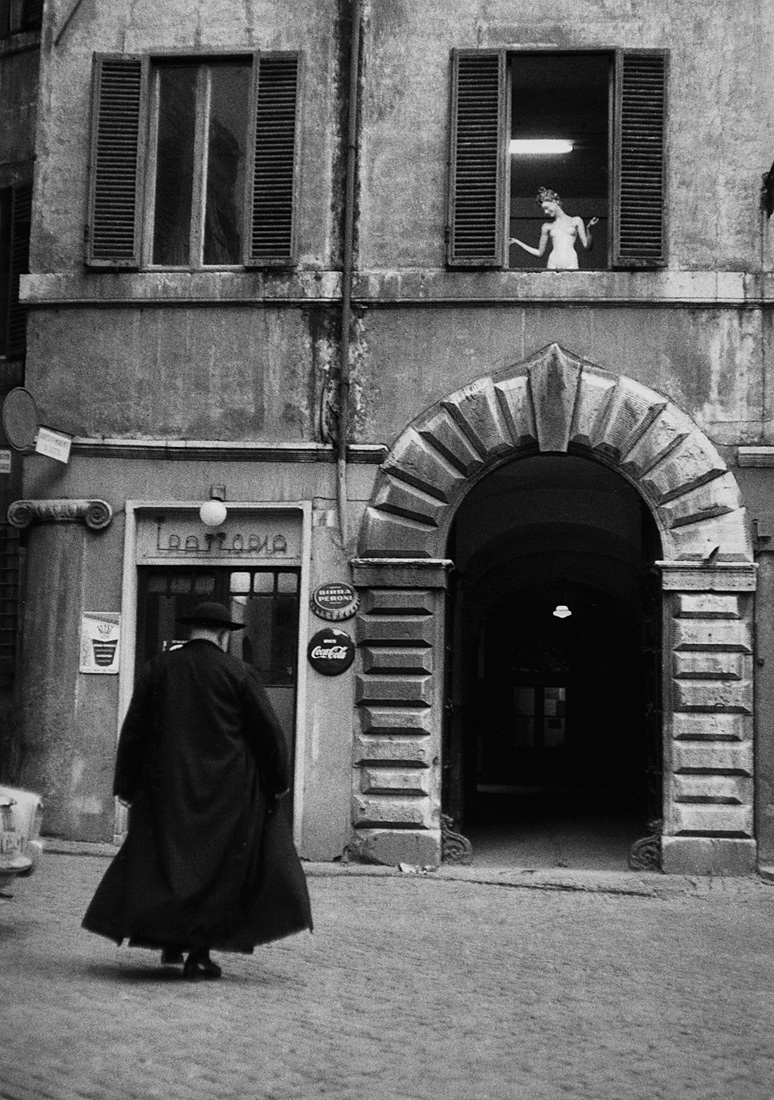
Sabine Weiss (Swiss-French, 1924-2021) 'Prêtre devant une trattoria, Rome' Italie, 1957


Sabine Weiss (Swiss-French, 1924-2021)
Prêtre devant une trattoria, Rome (Priest before a trattoria, Roma)
Italie, 1957
Silver gelatin print
© Sabine Weiss


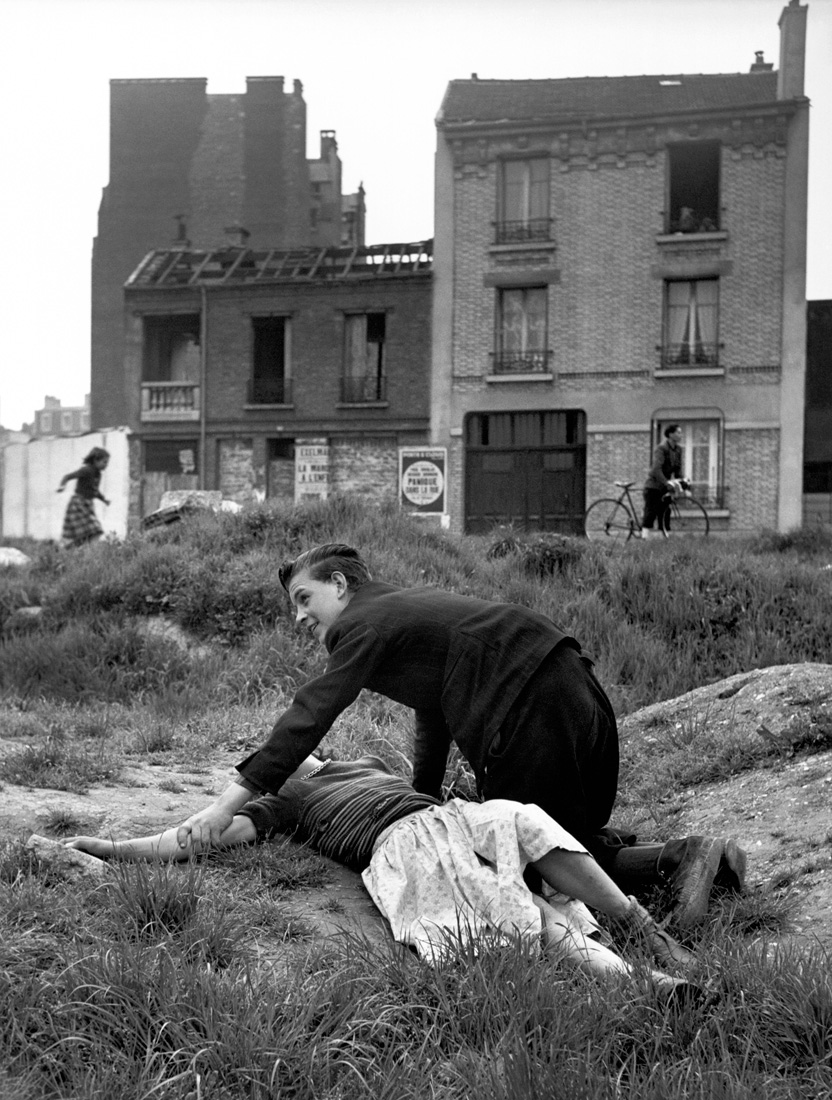
Sabine Weiss (Swiss-French, 1924-2021) 'Terrain vague, Porte de Saint-Cloud' Paris, 1950


Sabine Weiss (Swiss-French, 1924-2021)
Terrain vague, Porte de Saint-Cloud (Vacant Land, Porte de Saint-Cloud)
Paris, 1950
Silver gelatin print
© Sabine Weiss


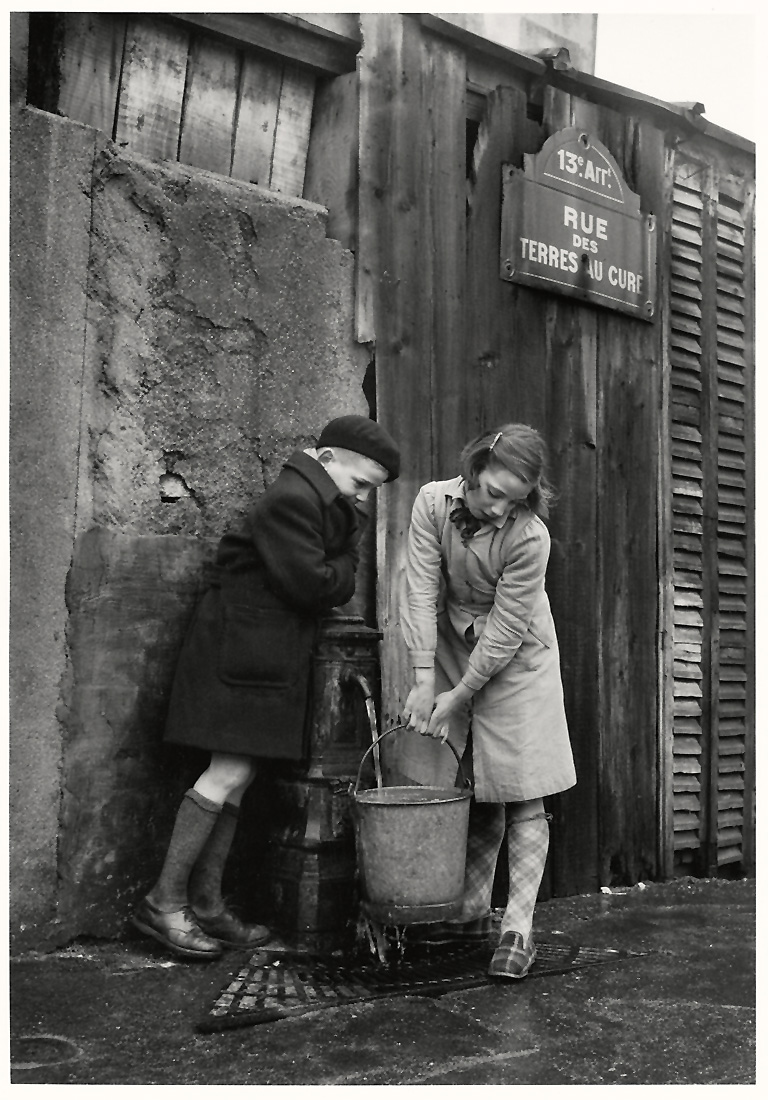
Sabine Weiss (Swiss-French, 1924-2021) 'Enfants prenant de l’eau à la fontaine, rue des Terres-au-Curé' Paris, 1954


Sabine Weiss (Swiss-French, 1924-2021)
Enfants prenant de l’eau à la fontaine, rue des Terres-au-Curé
(Children taking water from the fountain, rue des Terres au Curé)

Paris, 1954
Silver gelatin print
© Sabine Weiss


Sabine Weiss (Swiss-French, 1924-2021) 'Mariage gitan' Tarascon, 1953


Sabine Weiss (Swiss-French, 1924-2021)
Mariage gitan (Gypsy wedding)
Tarascon, 1953
Silver gelatin print
© Sabine Weiss


Sabine Weiss (Swiss-French, 1924-2021) 'Enfants jouant, rue Edmond-Flamand' [Children playing, rue Edmond-Flamand] Paris, 1952


Sabine Weiss (Swiss-French, 1924-2021)
Enfants jouant, rue Edmond-Flamand (Children playing, rue Edmond-Flamand)
Paris, 1952
Silver gelatin print
© Sabine Weiss


Sabine Weiss (Swiss-French, 1924-2021) 'Jeune mineur, Lens' 1955


Sabine Weiss (Swiss-French, 1924-2021)
Jeune mineur, Lens (Young minor, Lens)
1955
Silver gelatin print
© Sabine Weiss


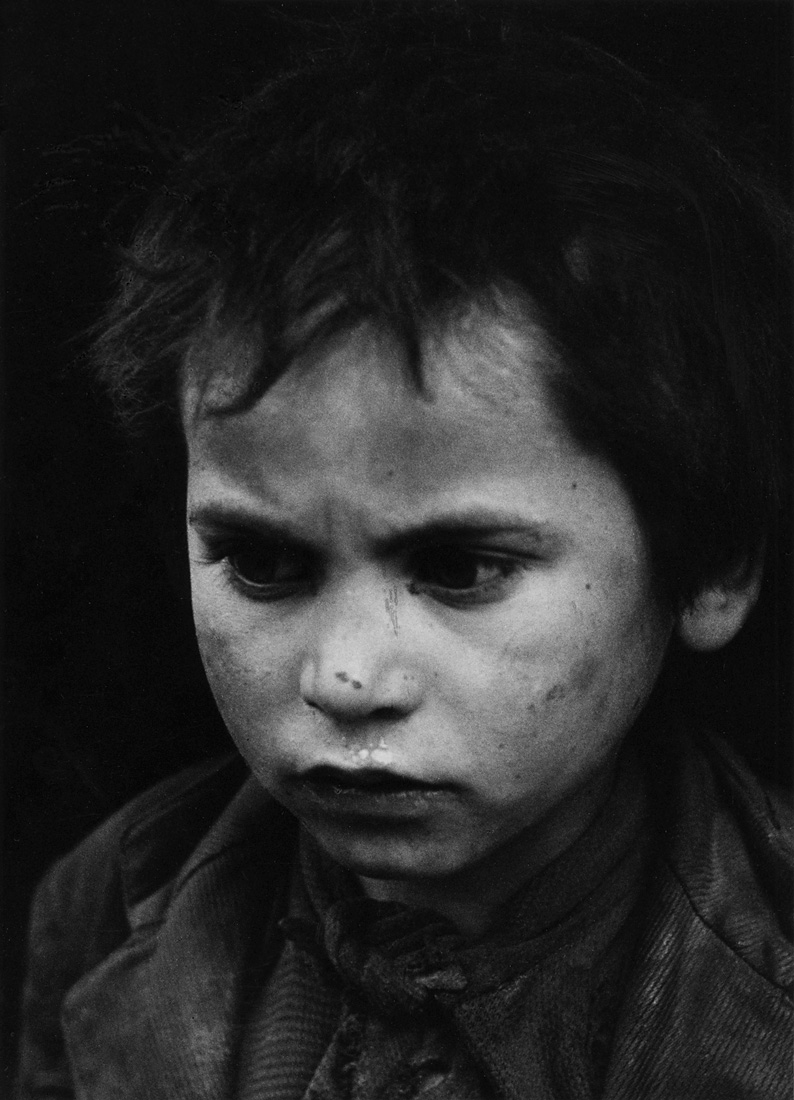
Sabine Weiss (Swiss-French, 1924-2021) 'Mendiant, Tolède' Espagne, 1949


Sabine Weiss (Swiss-French, 1924-2021)
Mendiant, Tolède (Beggar, Toledo)
Espagne, 1949
Silver gelatin print
© Sabine Weiss


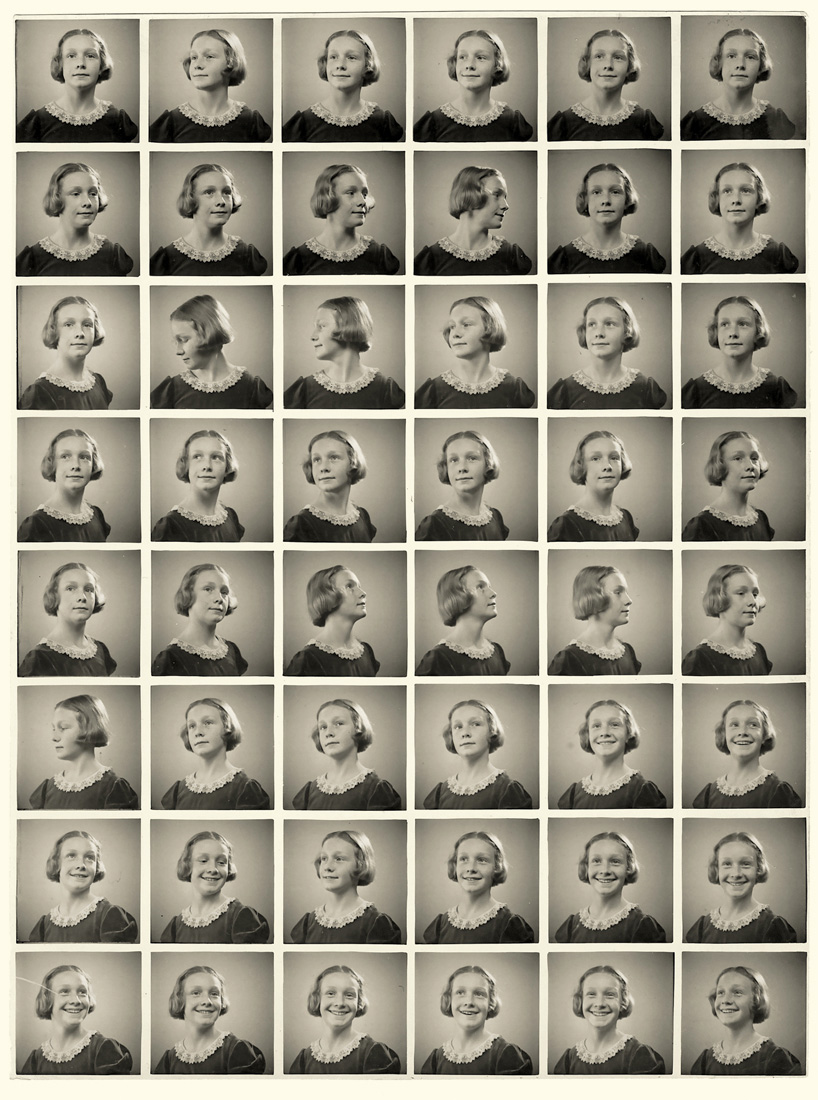
Sabine Weiss (Swiss-French, 1924-2021) 'Portraits multiples, procédé Polyfoto' Genève, 1937


Sabine Weiss (Swiss-French, 1924-2021)
Portraits multiples, procédé Polyfoto (multiple portraits, Polyfoto process)
Genève, 1937
Silver gelatin print
© Sabine Weiss


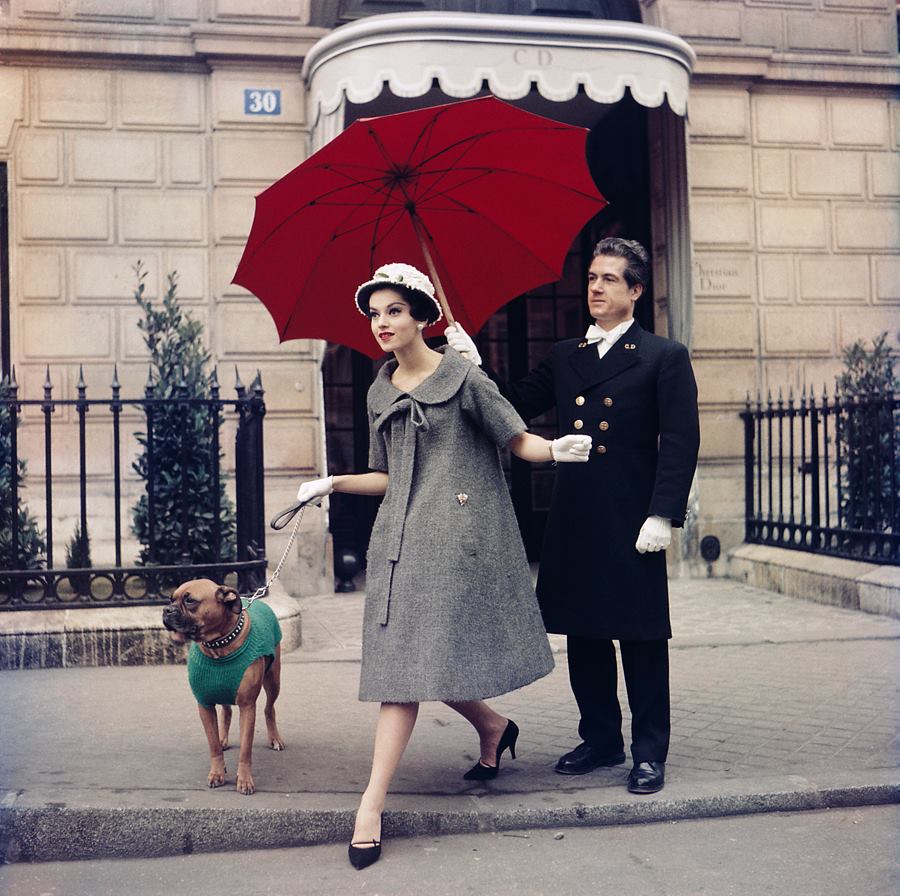
Sabine Weiss (Swiss-French, 1924-2021) 'Chez Dior, Paris' 1958


Sabine Weiss (Swiss-French, 1924-2021)
Chez Dior, Paris
1958
© Sabine Weiss


Sabine Weiss (Swiss-French, 1924-2021) 'Anna Karina pour la marque Korrigan' [Anna Karina for the brand Korrigan] 1958


Sabine Weiss (Swiss-French, 1924-2021)
Anna Karina pour la marque Korrigan (Anna Karina for the brand Korrigan)
1958
© Sabine Weiss


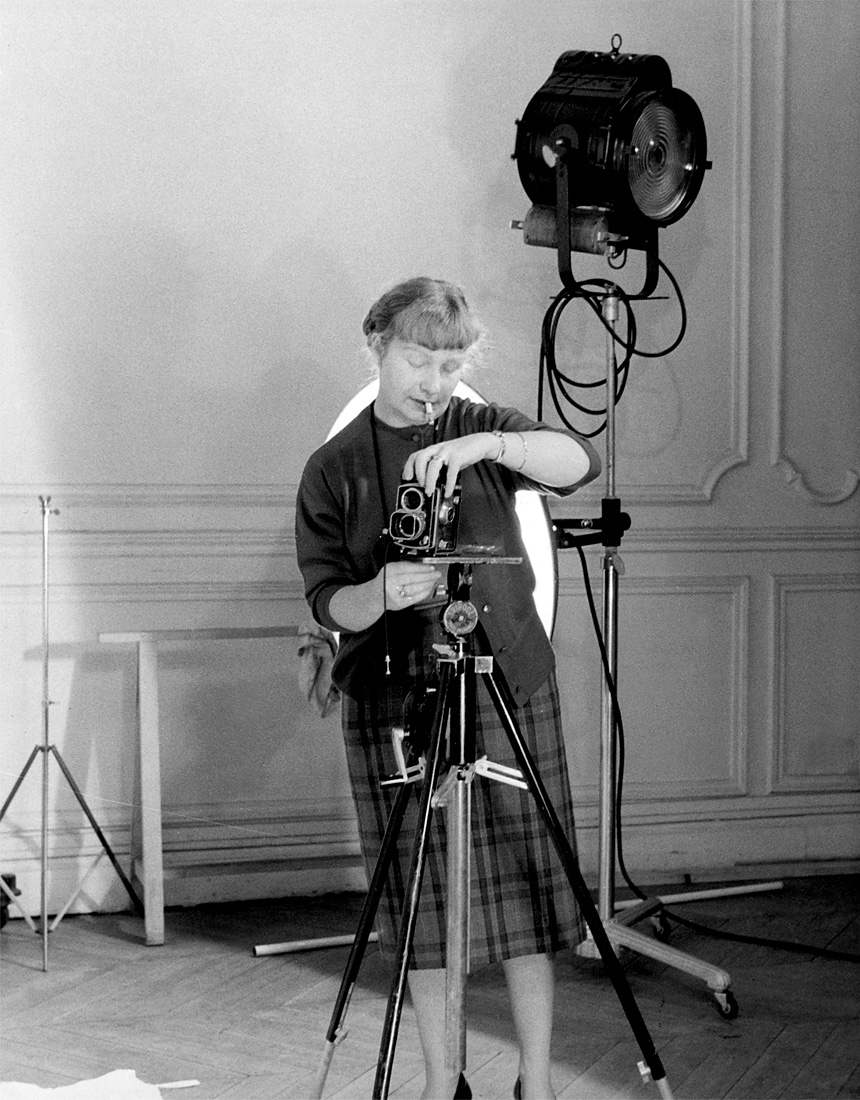
Studio Fllebé. 'Sabine Weiss chez Vogue' Paris 1956


Studio Fllebé
Sabine Weiss chez Vogue, Paris
1956
Silver gelatin print
© Studio Fllebé


Jeu de Paume – Château de Tours
25 avenue André Malraux
37000 Tours

Opening hours:
Tuesday to Sunday: 2pm – 6pm
Closed Mondays

Jeu de Paume – Château de Tours

LIKE ART BLART ON FACEBOOK

Back to top