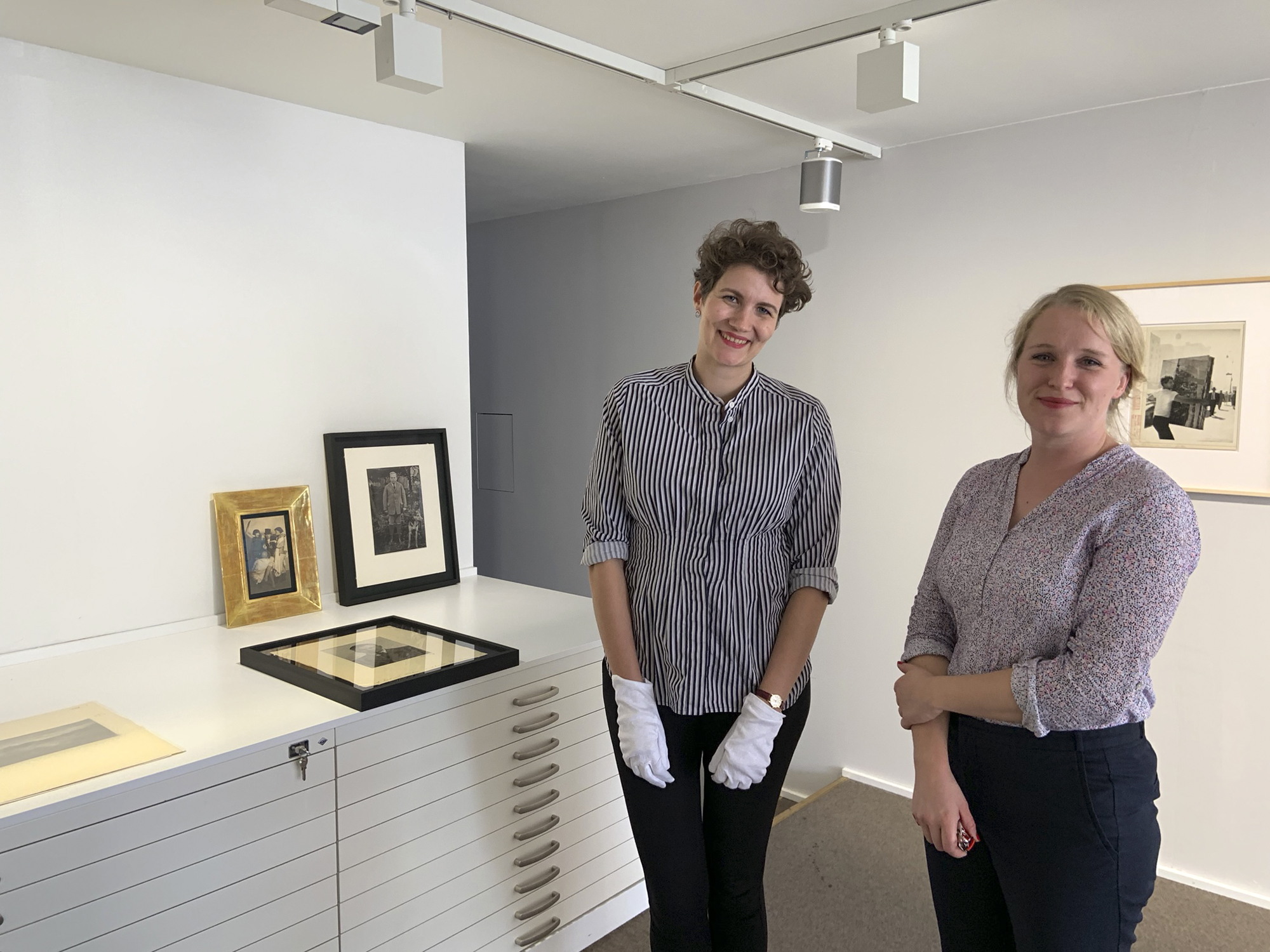
Tamara Könen of the gallery (left) and Kristina Engels from August Sander Stiftung – at Galerie Julian Sander, standing in front of August Sander’s photographs.
On my European photographic research tour in late 2019, I had a memorable visit to Galerie Julian Sander to see some vintage and later prints from the August Sander Archive / August Sander Stiftung with Tamara Könen from the gallery (left) and Kristina Engels from August Sander Stiftung.
It was a privilege to be able to see about 10 prints… the highlights being a stunning 1929-1930 vintage landscape, a vintage carnivalesque image of the Cologne avant-garde and a later print by his son of Painter’s Wife [Helene Abelen] 1926. The vintage landscape, like the vintage prints of Sudek, possessed no true black or white, the tonal range prescribed between zones 2-8.
The use of low depth of field in the portraits was outstanding. For example the shoes of Helene are completely out of focus whereas her hands are as crisp and clear as a summer breeze. Most astonishing was the panache of the bohemians, with the outstretched arm top left… printed on matt brown toned paper with a thin gold edge.
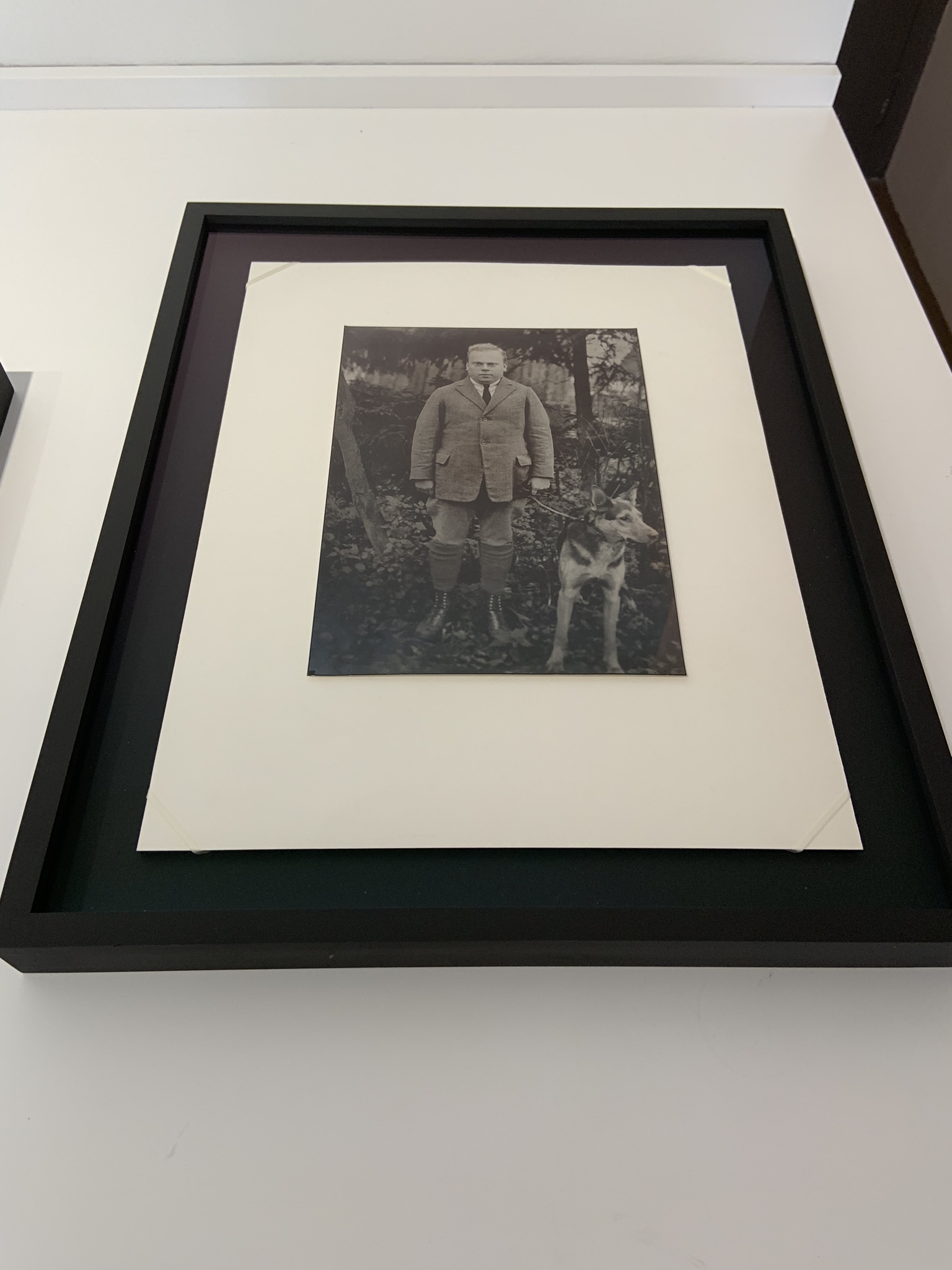
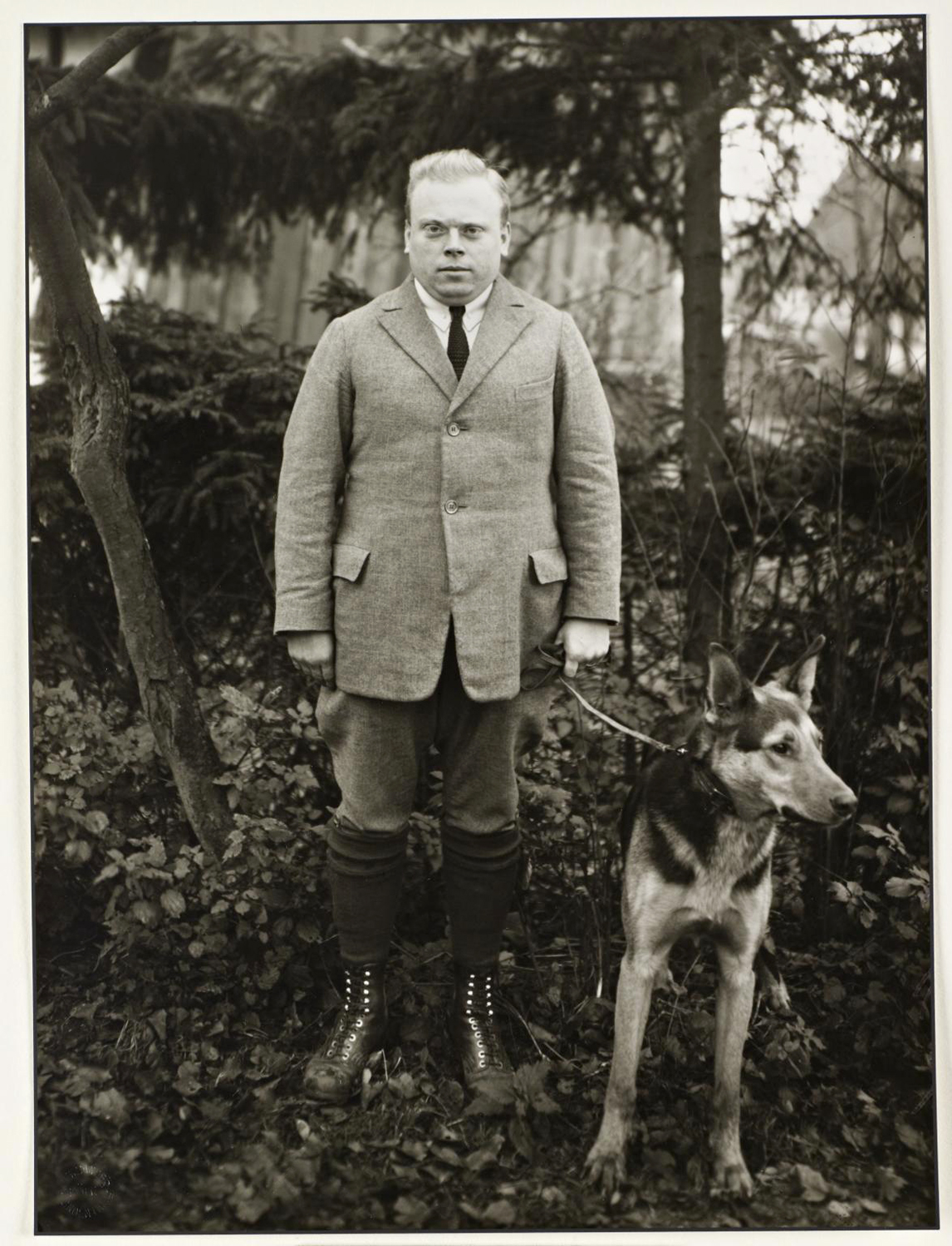
Another vintage print that showed selective depth of field was the photograph of a man with his dog, Junglehrer (Young Teacher) 1928. The dog’s lower legs were completely out of focus (Sander tilting his large format camera) making this oh so German photograph seem so surreal!
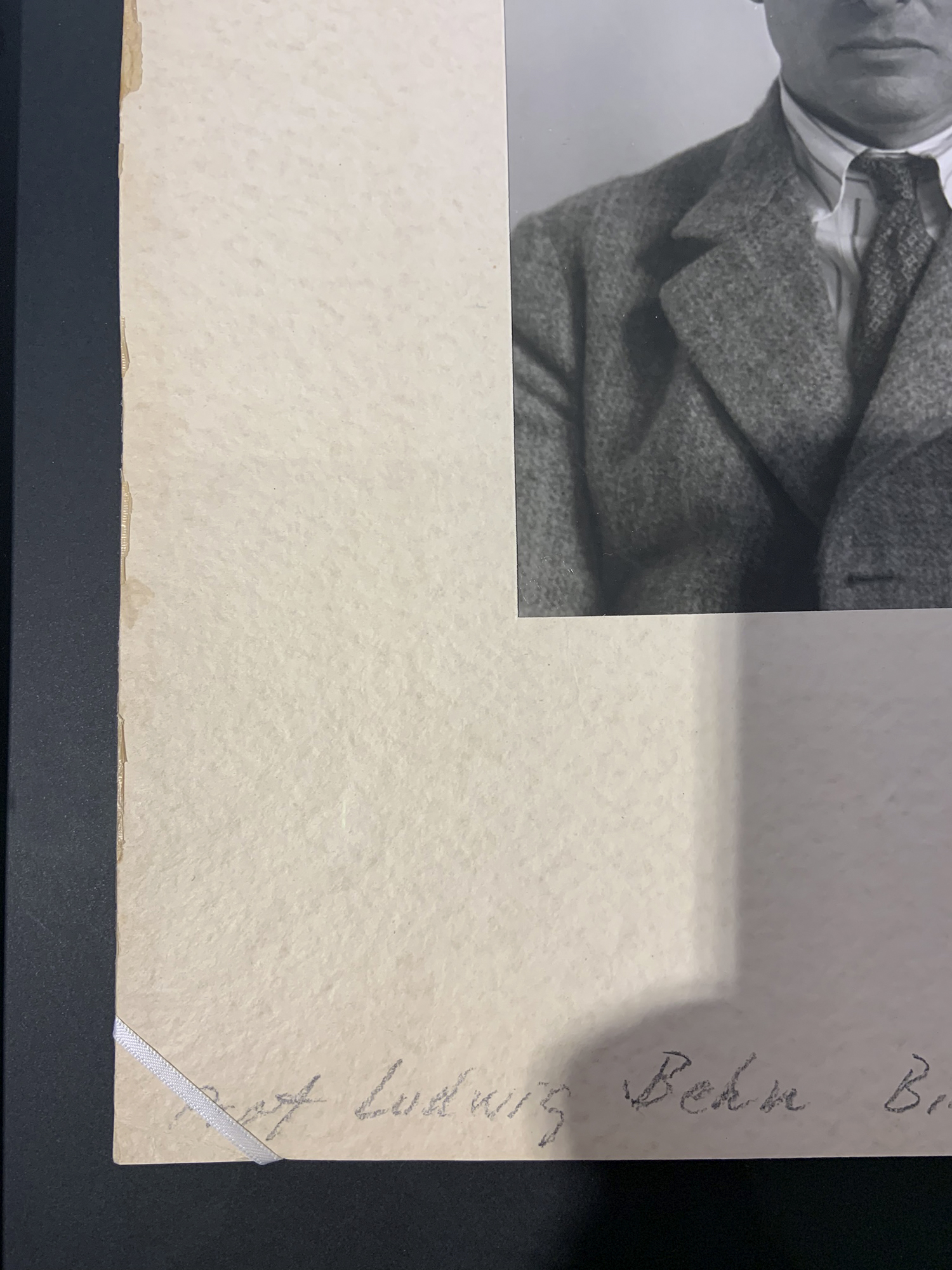
Other prints had a thin black edge and the vintage press print landscape (c. 1920s) was printed on thin single weight paper, while the vintage photograph of the sculptor Professor Ludwig Benh shows an original Sander mount – the print mounted behind an artist cut window. All prints were enlargements from 4×5” glass negatives or German equivalent size.
Such a wonderful learning experience! Thank you to the gallery for their time and knowledge.
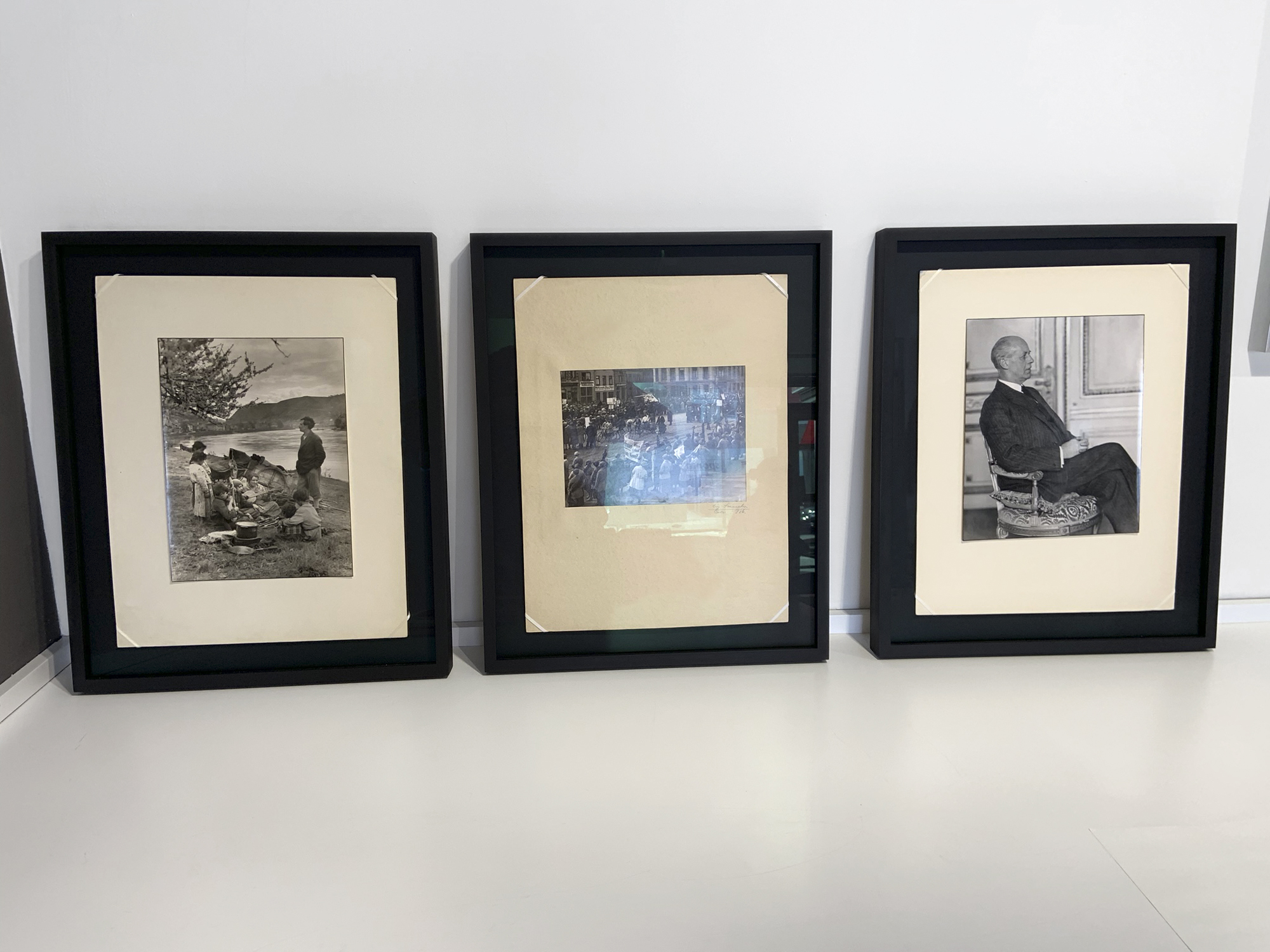
3 vintage silver gelatin prints, the left one with black edge floating free of the backboard; the second c. 1920s of a Communist rally; and the third of an industrialist (Großindustrieller / The Industrialist, 1927) Galerie Julian Sander, Cologne Photo: Marcus Bunyan
August Sander (German, 1876-1964) Das Siebengebirge: Blick vom Rolandsbogen [The Siebengebirge: view from the Rolandsbogen] 1929-1930 (center) and Untitled [Remagen Bridge on the Rhine] c. 1930 (right) Galerie Julian Sander, Cologne Photo: Marcus Bunyan
August Sander (German, 1876-1964) Das Siebengebirge: Blick vom Rolandsbogen [The Siebengebirge: view from the Rolandsbogen] 1929-1930 Vintage gelatin silver print Also titled: Siebengebirge von der linken Rheinseite gesehen [Siebengebirge seen from the left side of the Rhine] Blick vom Rolandsbogen auf das Siebengebirge mit Drachenfels [View from Roland Arch on the Siebengebirge with Drachenfels] Galerie Julian Sander, Cologne Photo: Marcus Bunyan
August Sander (German, 1876-1964) Das Siebengebirge: Blick vom Rolandsbogen [The Siebengebirge: view from the Rolandsbogen] 1929-1930 Vintage gelatin silver print Also titled: Siebengebirge von der linken Rheinseite gesehen [Siebengebirge seen from the left side of the Rhine] Blick vom Rolandsbogen auf das Siebengebirge mit Drachenfels [View from Roland Arch on the Siebengebirge with Drachenfels] Galerie Julian Sander, Cologne Photo: Marcus Bunyan
August Sander (German, 1876-1964) Das Siebengebirge: Blick vom Rolandsbogen [The Siebengebirge: view from the Rolandsbogen] 1929-1930 Vintage gelatin silver print
August Sander (German, 1876-1964) Untitled [Remagen Bridge on the Rhine] c. 1930 Vintage gelatin silver press print Galerie Julian Sander, Cologne Photo: Marcus Bunyan
August Sander (German, 1876-1964) Untitled [Bohemians: avant-garde of Cologne] 1920s (left) and Professor Ludwig Behn 1920s (right) Vintage gelatin silver print with gold edge printed on matt warm toned paper Galerie Julian Sander, Cologne Photo: Marcus Bunyan
August Sander (German, 1876-1964) Untitled [Bohemians: avant-garde of Cologne] 1920s Vintage gelatin silver print with gold edge printed on matt warm toned paper Galerie Julian Sander, Cologne Photo: Marcus Bunyan
August Sander (German, 1876-1964) Untitled [Bohemians: avant-garde of Cologne] 1920s Vintage gelatin silver print with gold edge printed on matt warm toned paper Galerie Julian Sander, Cologne Photo: Marcus Bunyan
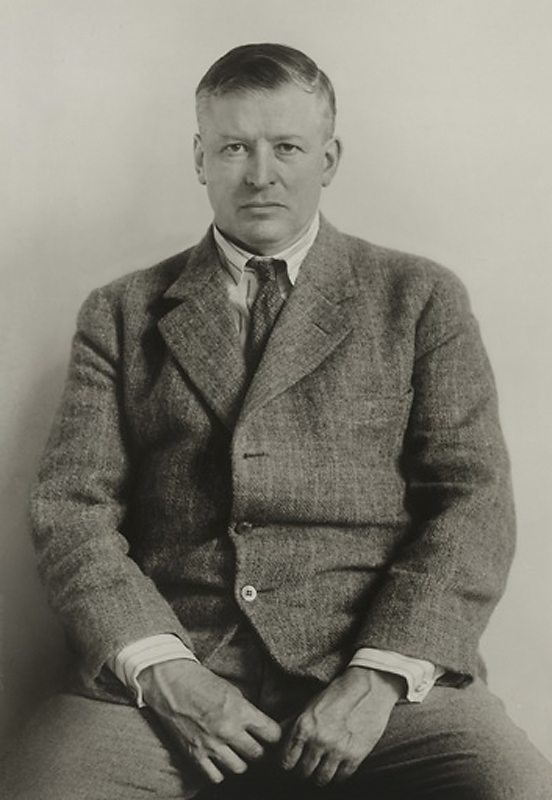
August Sander (German, 1876-1964) Professor Ludwig Behn, Bildhaver, Münich 1920s Gelatin silver print
August Sander (German, 1876-1964) Professor Ludwig Behn, Bildhaver, Münich 1920s Vintage gelatin silver print with original Sander mount Galerie Julian Sander, Cologne Photo: Marcus Bunyan
August Sander (German, 1876-1964) Painter’s Wife [Helene Abelen] 1926 Later gelatin silver print by Sander’s son Galerie Julian Sander, Cologne Photo: Marcus Bunyan
This photograph shows Helene Abelen, wife of the Cologne painter, Peter Abelen. During the 1920s August Sander befriended many Cologne artists because of his involvement with the Cologne Progressive Artists Group (Gruppe Progressiver Künstler Köln). In 1926 Sander was asked by Peter Abelen to create a portrait of his young wife. With her short, slicked-back hair, collared shirt, thin necktie and trousers, Frau Abelen is presented as a distinctly androgynous figure. Her masculine garb and haircut, as well as the cigarette held between her teeth, signal a defiance of traditional gender roles. Staring determinedly out at the viewer Helene Abelen’s animated expression is unusual for a Sander portrait and falls somewhere between bravado and agitation.
This portrait reflects the so-called ‘new woman’ of the Weimar Republic. The concept of the ‘new woman’ dates from before the First World War but became firmly rooted during it when women were mobilised in the workforce. Within Germany this created considerable anxiety about women’s roles, particularly in relation to the family. In 1928, on the tenth anniversary of the end of the war, the Münchner Illustrierte Presse showed on its cover a photograph of a young woman, with short hair and skirt, astride a motorcycle with a lit cigarette in hand, with the heading, ‘Only ten years – a different world’. Like this magazine image, Sander’s portrait of Helene Abelen reflected a consciousness about the blurring of gender roles in the wake of the ‘new woman’.
Painter’s Wife represents an anomaly in Sander’s work. For the most part, his depictions of women show them as wives and mothers, as the soul of the home and the family. Contrary to appearances, this portrait should not be taken to represent an unqualified vision of female independence. The costume Helene Abelen is wearing was created for her by Peter Abelen and the haircut she sports was also his choice. Her daughter later commented of this work: ‘This was the creation of my father. He wanted her to look like this. He always did our dresses’ (quoted in Greenberg 2000, p. 121).
Matthew Macaulay November 2011
Text from the Tate website [Online] Cited 24/06/2020
August Sander (German, 1876-1964) Junglehrer (Young Teacher) 1928 Vintage gelatin silver print with black edge Galerie Julian Sander, Cologne Photo: Marcus Bunyan
August Sander (German, 1876-1964) Junglehrer (Young Teacher) 1928 Vintage gelatin silver print with black edge Galerie Julian Sander, Cologne Photo: Marcus Bunyan
Exhibition curators: Dr Simone Förster together with Anna Volz
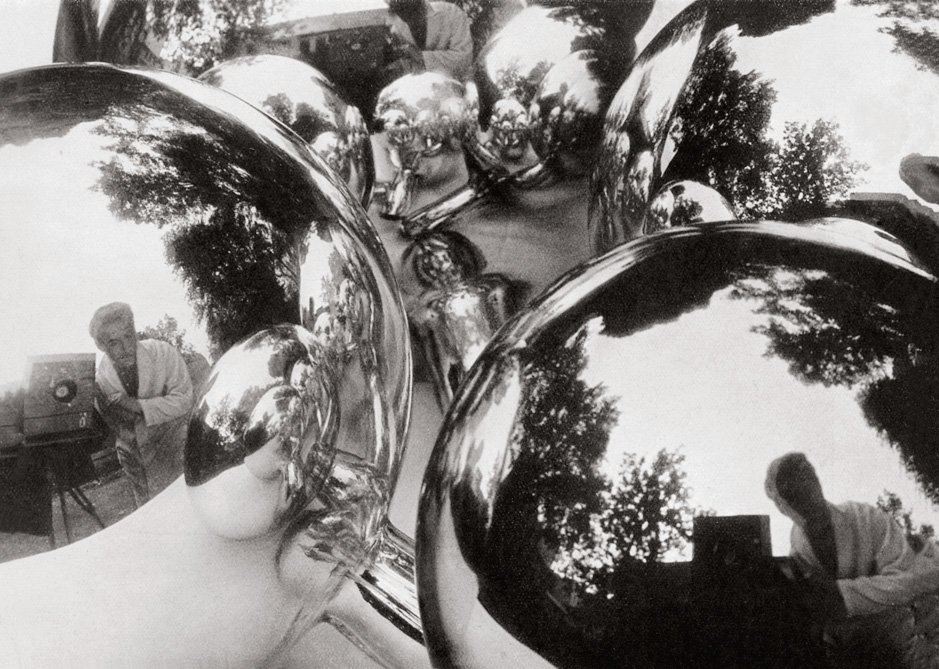
Aenne Biermann (German, 1898-1933) Self-Portrait with Silver Ball 1931 Gelatin silver print Museum für Kunst und Gewerbe, Hamburg
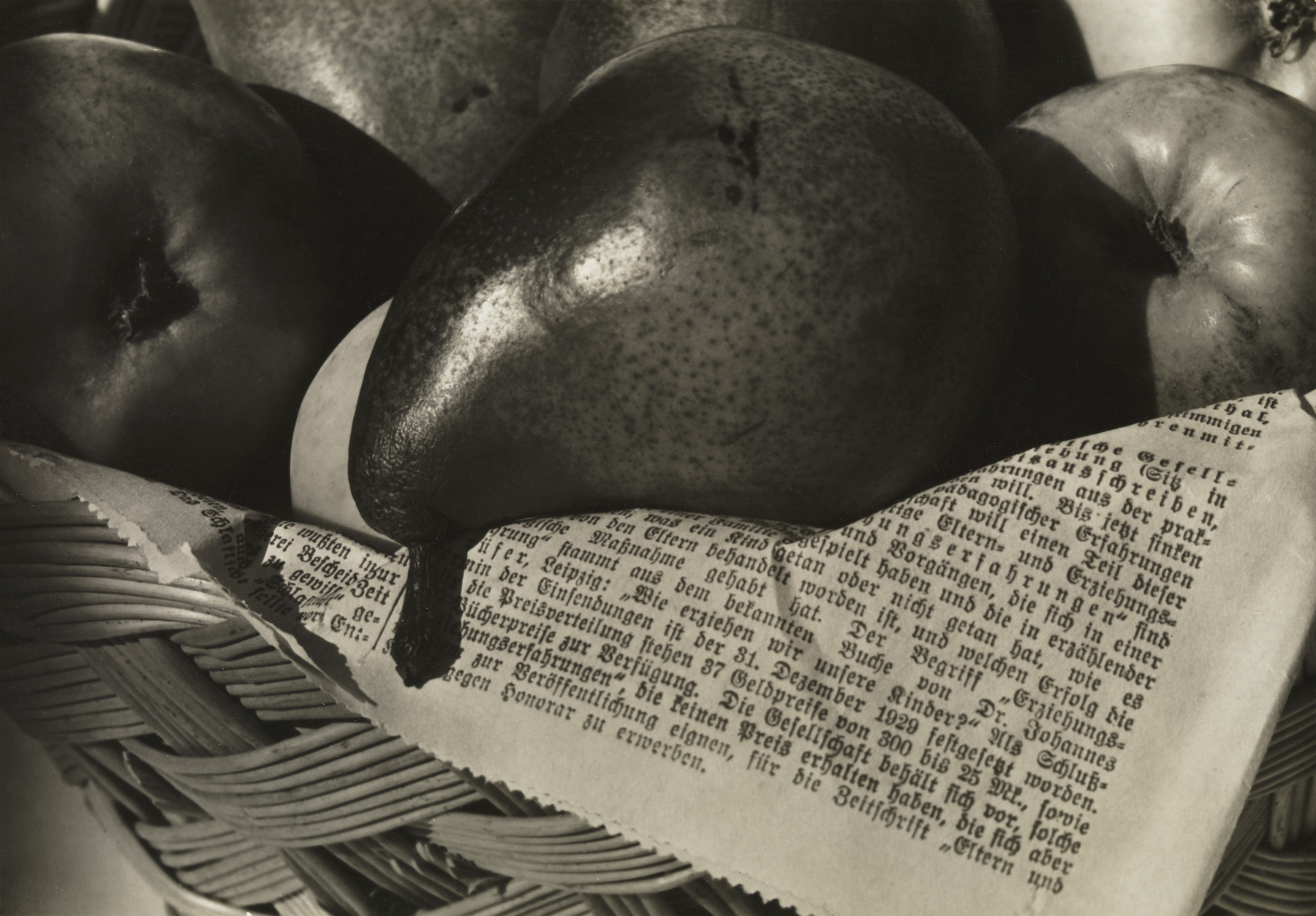
Another strong woman, another inspirational female avant-garde 1930s photographer. Just look at the darkness of the pear in her photograph Fruit Basket (1931, below). The photographer proclaims the beauty and decay of nature. Magnificent.
Marcus
Many thankx to the Pinakothek der Moderne for allowing me to publish the photographs in the posting. Please click on thep hotographs for a larger version of the image.
For the autodidact Aenne Biermann (1898-1933) the camera was a means of closing in on things and situations in her immediate environment. From the mid 1920s onwards she found great pleasure in capturing unfamiliar and unexpected views of everyday experiences and events in her photographs. Although Aenne Biermann worked in relative isolation with regard to the avant-garde developments in larger cities, comprehensive displays of her work were shown at all major modern photographic exhibitions from 1929 onwards. Her oeuvre, created within just a few years – Aenne Biermann died in 1933 following an illness – is now regarded as one of the most important within the Neues Sehen (New Vision) movement in photography and New Objectivity.
The exhibition comprises some 100 original photographs from the holdings of the Ann and Jürgen Wilde Foundation that boasts one of the most extensive collections of Aenne Biermann’s work. Selected works from public and private collections, together with records and archival documents, illuminate the artist’s work and career.
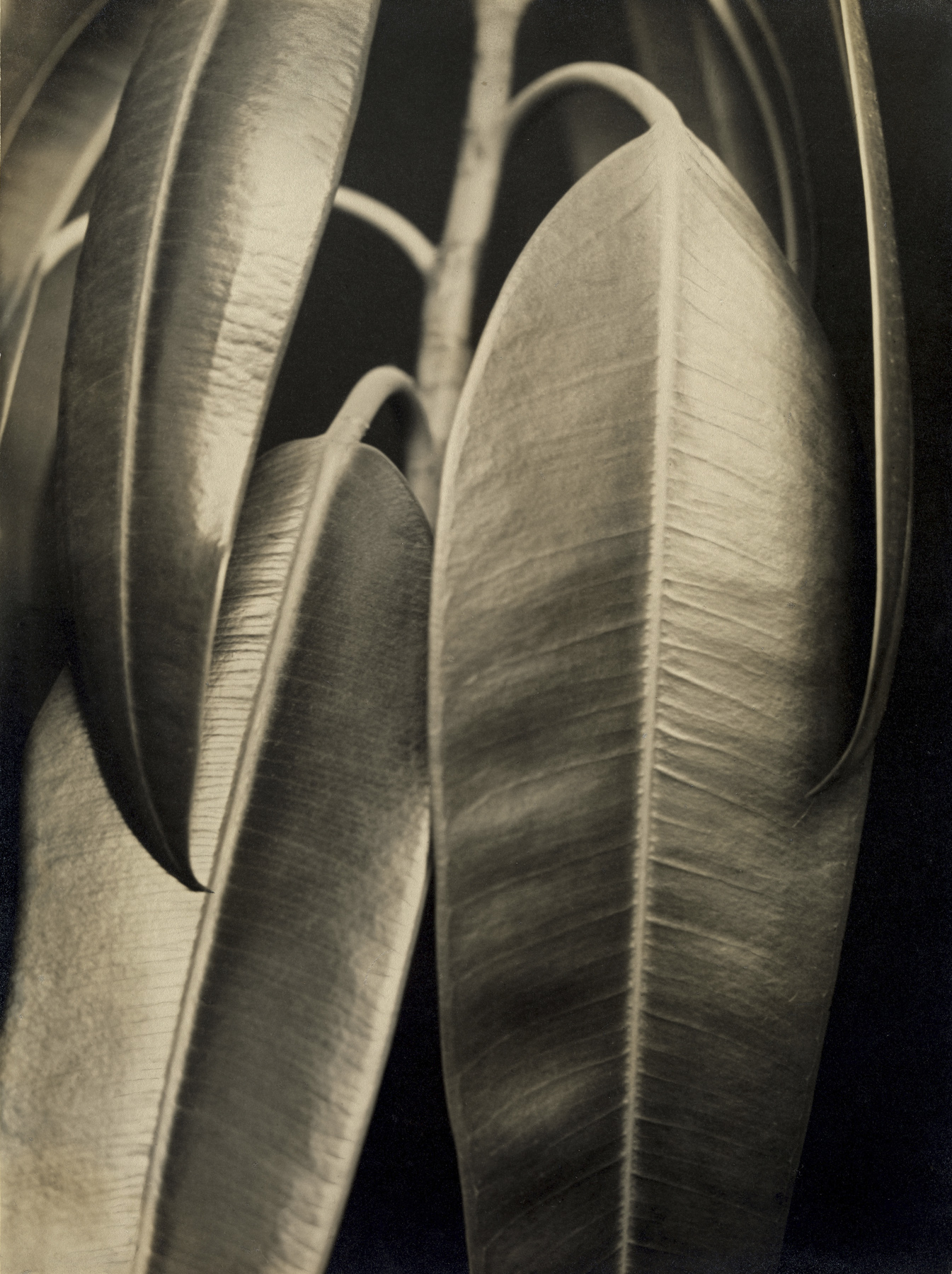
Aenne Biermann (German, 1898-1933) Ficus elastica 1926-1928 Silver gelatine print 46.7 x 35cm Ann and Jürgen Wilde Foundation, Pinakothek der Moderne, Munich Photo: Sibylle Forster
An avid amateur mineralogist, it was through her collection of rocks that in 1926 she met the geologist Rudolf Hundt, who commissioned her to photograph his specimens the following year for his scientific work. Her photographs of minerals transformed her practice from the early personal views of her children to the close-up, direct studies of form that would define her photographs of plants and people that followed and make her a central figure in New Objectivity photography. Thus 1926 began a period of intense productivity for Biermann that lasted until her untimely death, from liver disease, at the age of thirty-five, in 1933.
Mitra Abbaspour on the Museum of Modern Art website Nd [Online] Cited 03/08/2019
Aenne Biermann (German, 1898-1933) Finale before October 1928 Silver gelatine print 47.4 x 34.8cm Ann and Jürgen Wilde Foundation, Pinakothek der Moderne, Munich Photo: Sibylle Forster
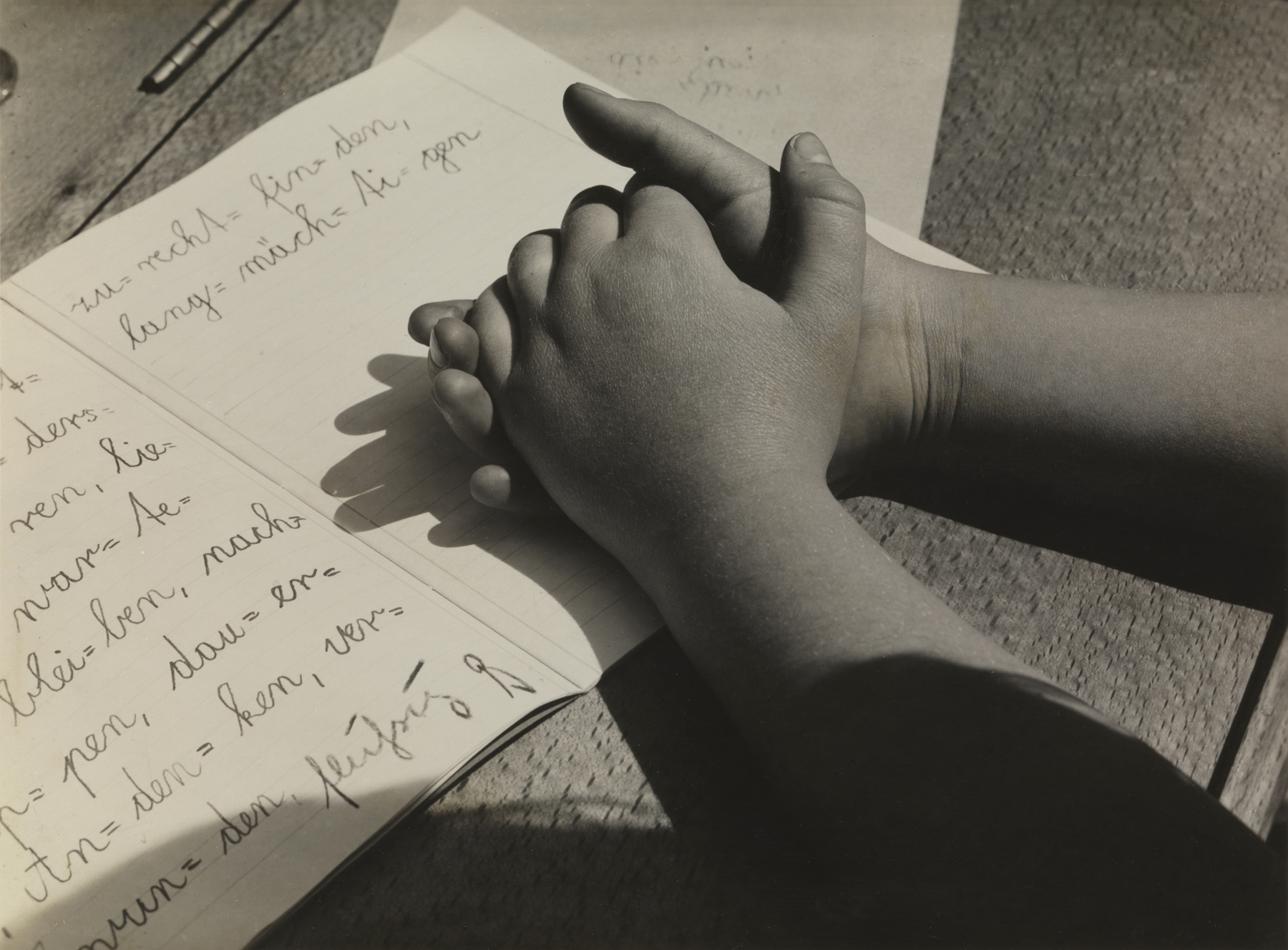
Aenne Biermann (German, 1898-1933) A Child’s Hands 1928 Silver gelatine print 12.3 x 16.6cm Ann and Jürgen Wilde Foundation, Pinakothek der Moderne, Munich Photo: Sibylle Forster
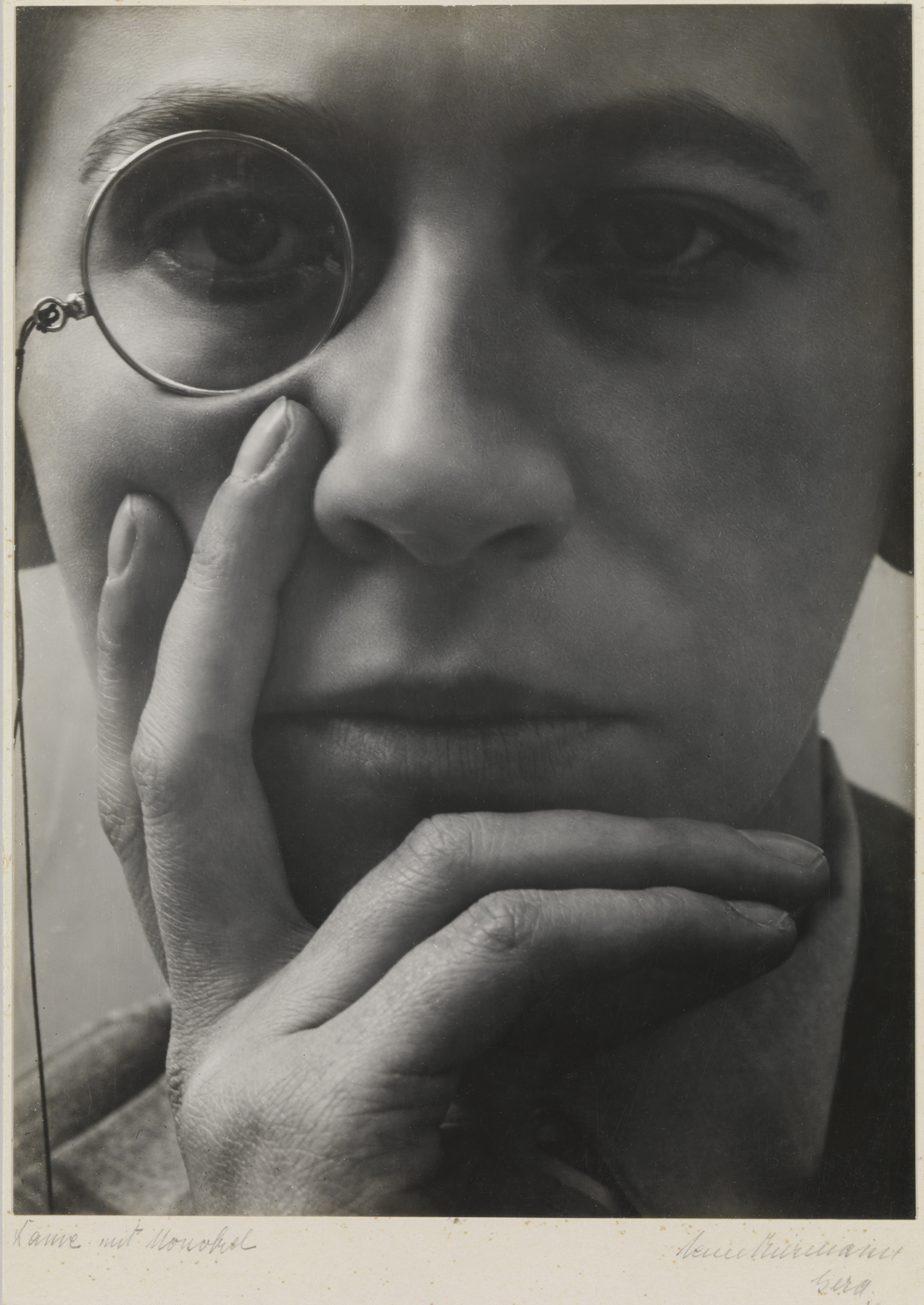
Aenne Biermann (German, 1898-1933) Lady with Monocle 1928/1929 Silver gelatine print 17 x 12.6 cm Ann and Jürgen Wilde Foundation, Pinakothek der Moderne, Munich Photo: Sibylle Forster
Aenne Biermann (German, 1898-1933) View from my Studio Window 1929 Silver gelatine print 23.6 x 17.3cm Ann and Jürgen Wilde Foundation, Pinakothek der Moderne, Munich Photo: Sibylle Forster
Today, Aenne Biermann (1898-1933) is considered one of the major proponents of ‘New Photography’. Although she was only active as a photographer for a few years and, unlike her female colleagues Florence Henri, Germaine Krull and Lucia Moholy, for example, had neither an artistic training nor moved within the avant-garde circles of major urban centres, Aenne Biermann developed her own markedly modern pictorial style that established her position as a representative of contemporary avant-garde photography within a very short time. Clear structures, precise compositions with light and shadow, as well as cropped images focussing on specific details are characteristic of Aenne Biermann’s photography. They elicit a unique poetry from the people and objects in her everyday surroundings and establish an ‘intimacy with things’, as Aenne Biermann wrote in 1930.
Growing up in a Jewish factory owner’s family on the Lower Rhine, Aenne Biermann did not move on to higher education; instead, her musical skills were furthered and she was given piano lessons. Following her marriage to the merchant Herbert Biermann in 1920, she moved to Gera / Thuringia and became part of an upper-middle class, intellectual society that was extremely open to modern movements in art and culture and cultivated these within its own local radius. For Aenne Biermann, the starting point for her close involvement with photography was the birth of her children Helga (1920) and Gerd (1923). Initially used merely as a medium to document her children’s progress, from the mid 1920s Aenne Biermann developed her own, creative sphere in her photographic work. She focussed her camera on plants, objects, people and everyday situations and used the medium as an artistic means to access her own personal surroundings.
In 1928 the art critic Franz Roh arranged for the photographer’s first solo exhibition to be held at the Graphisches Kabinett Günther Franke in Munich and presented her work in Das Kunstblatt, a trend-setting monthly magazine for contemporary art in Germany. This led to her participation in numerous major exhibitions of modern photography, such as Film und Foto (1929), and solo exhibitions in Oldenburg, Jena and Gera. Aenne Biermann’s pictures received awards in photographic competitions and were published in books, art magazines and illustrated journals. In 1930 her photographs appeared in Franz Roh’s Fototek series of books: Aenne Biermann. 60 Fotos is one of the rare monographs of a photographer’s work of the time.
As a result of the artist’s early death and the family’s forced emigration in the 1930s, a large part of the photographer’s archive was lost. Its whereabouts remains unknown to this day. In more than forty years of extensive and intense research Ann and Jürgen succeeded in assembling a large number of images that give a representative picture of Aenne Biermann’s œuvre and now form one of the largest collections of the photographer’s work.
The presentation comprises more than 100 original photographs, 73 of which are, in part, large-format exhibition prints from the holdings of the Ann and Jürgen Wilde Foundation. Loans from the Museum Folkwang, Essen, the Museum für Angewandte Kunst Gera, the Museum Ludwig, Cologne, the Staatliche Museen zu Berlin / Kunstbibliothek, the Münchner Stadtmuseum, the Galerie Berinson, Berlin, the Franz Roh Estate and the Dietmar Siegert Collection, Munich, as well as the Ann and Jürgen Wilde Archive, Zülpich, complement the exhibition.
Press release from the Pinakothek der Moderne [Online] Cited 28/07/2019
Aenne Biermann (German, 1898-1933) Contemplation 1930 Silver gelatine print 58 × 42cm Ann and Jürgen Wilde Foundation, Pinakothek der Moderne, Munich Photo: Sibylle Forster
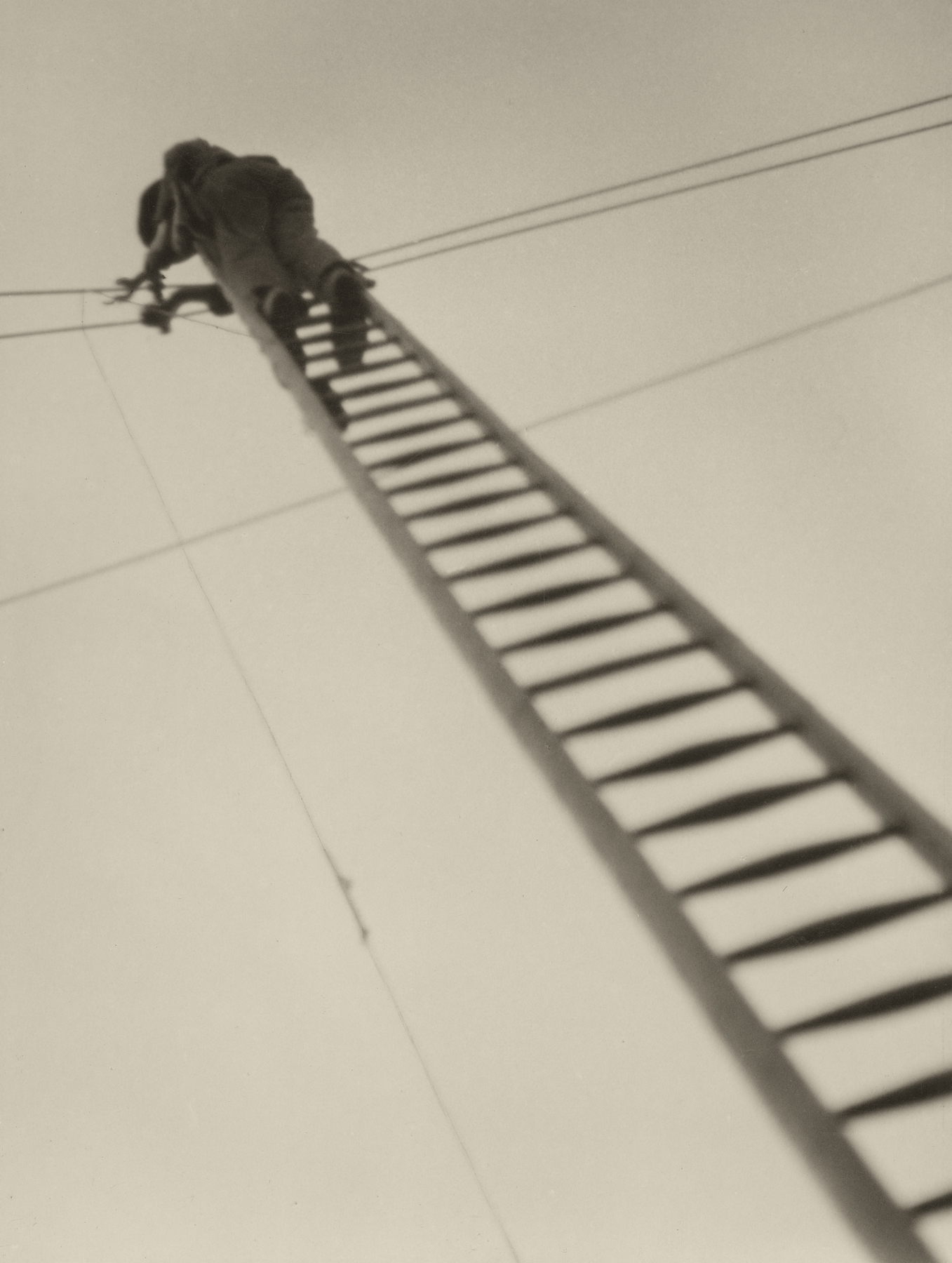
Aenne Biermann (German, 1898-1933) Repair 1930/31 Silver gelatine print 24.8 x 18cm Ann and Jürgen Wilde Foundation, Pinakothek der Moderne, Munich Photo: Sibylle Forster
Aenne Biermann (German, 1898-1933) Rail Tracks 1932 Silver gelatine print 24.1 x 17.5cm Ann and Jürgen Wilde Foundation, Pinakothek der Moderne, Munich Photo: Sibylle Forster
Aenne Biermann (German, 1898-1933) Fruit Basket 1931 Silver gelatin print 16.6 x 23.6 cm Ann and Jürgen Wilde Foundation, Pinakothek der Moderne, Munich Photo: Sibylle Forster
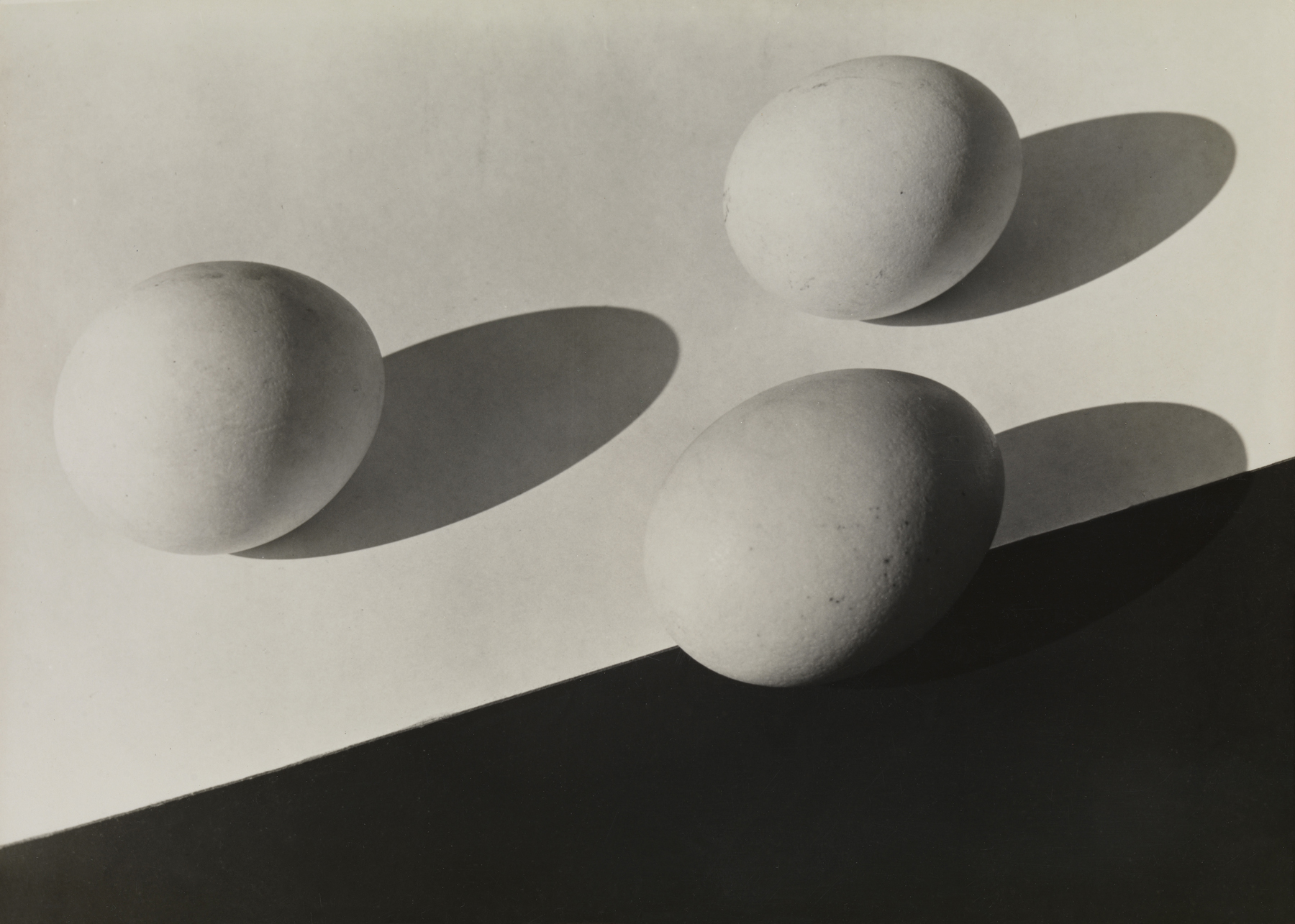
Aenne Biermann (German, 1898-1933) Eggs 1931 Silver gelatin print 17 x 23.9cm Ann and Jürgen Wilde Foundation, Pinakothek der Moderne, Munich Photo: Sibylle Forster
“[Walter Isaacson] describes the photographs, of which 7200 … miraculously survive today, as the greatest record of curiosity, because his “cross-disciplinary brilliance whirls across every page, providing a delightful display of a mind dancing with nature”. Renger-Patzsch delighted in seeing patterns in nature, so he would juxtapose a photograph of the branching arteries of the heart with the roots of a sprouting tree.”1
A mind dancing with nature.
Of course, the original quote (which I have altered) was talking about Leonardo da Vinci… but the same enquiring mind, the same display can be seen in the work of Albert Renger-Patzsch. His was a mind entranced by the nature of technology, and the technology, the structure of nature. However, he is ambivalent about the benefits of industrialisation even as he photographed it in ‘New Objectivity’ style – that is, supposedly free from emotion and subjectivity.
No writing about his work can put it better than this quote from when this exhibition was at Fundación MAPFRE in Madrid:
“Technical precision and exact representation of the subject; psychological contention and rejection of pictorial stylisation and expressionism; a keen sense of composition with attention to details, structures and forms; a sharp and clear construction of the image: these were some of the fundamental premises of a tendency that understands photography as a privileged medium to promote an artistic and simultaneously perceptive shift.
Renger-Patzsch’s work amalgamates a great number of photographic subjects, typologies and genres. In a historical period marked by deep political tension and significant social and economic change, his work allows the viewer to envision a unique worldview, a platform of intersections and re-appreciations between the domains of nature and technology.”
The only point I would not support in this quotation are these words, “psychological contention and rejection of pictorial stylisation and expressionism.”
Of course, “through the disconcerting simplicity of the photographs Renger-Patzsch highlights the phenomenological and psychological aspects that are part of experiencing the image,” but he does so not through a REJECTION of pictorial stylisation and expressionism (and all the baggage that those words embody), but through an INTENSIFICATION of a different form of pictorial style which forces? the image to emit a new form of expression. That is, the object is just its surface and is captured, instantly, by the camera in this perceptive shift.
Can you imagine seeing these photographs in the 1920s, having never seen anything like them before? They would have been revolutionary, in their rendering of the surface of the object and nothing more. Placing the camera directly before the object which requires nothing else but itself… the eye of the snake, the darkness of a tree trunk, the ordering of shoemakers’ irons. But then he finishes his ode to life, Die Welt ist schön (The World is Beautiful), with his version of Albrecht Dürer’s Praying Hands (c. 1508).I suspect that the idea the Renger-Patzsch was working with is that beauty is truth, and truth is beauty.
In contemporary society, have we lost the ability to see these photographs as he intended, with a child-like innocence? Was he saying, this is objective, do you agree? Or does the poetic intensity in the life of things refuse to be stilled?
For me, these photographs are not e/motion-less, they are the very essence of a reality rendered wonderful in my eyes.
Dr Marcus Bunyan
1/ Paraphrase of Tina Allen. “Prophetic Polymath,” on Leonardo da Vinci by Walter Isaacson in Weekend Australian Review January 6-7 2018, p. 14
Many thankx to Jeu de Paume for allowing me to publish the photographs in the posting. Please click on the photographs for a larger version of the image.
Albert Renger Patzsch / Trailer
Independently of the role he played in New Objectivity – an artistic movement that appeared in Germany at the beginning of the 1920s – Albert Renger-Patzsch (1897-1966) is today considered one of the most important and most important figures / influences in the history of 20th century photography.
The exhibition pays tribute to this extraordinary photographer and allows us to rediscover the posterity of a work that invites us to reflect on the nature of photography and on its artistic and speculative potential in the context of contemporary art and culture.
Albert Renger-Patzsch (German, 1897-1966)
Albert Renger-Patzsch (1897-1966), who produced a huge body of work spanning four and half decades, was one of the most influential photographers of the New Objectivity movement that emerged in Germany in the mid 1920s. His work helped to establish photography as a unique and important medium within modern art. Renger-Patzsch revived realism in photography, adopting an approach that was characterised by formal and technical rigour and a rejection of expressionism and pictorial stylisation. He had a highly developed sense of composition, and his attention to detail, structure and form resulted in images with sharp, clear compositions. For Renger-Patzsch, photography was a medium that made possible new forms of artistic imagery, while being perfectly in step with a period marked by industrialisation and the spread of technology. By highlighting the medium’s unique properties and the creative possibilities of documentary photography, Renger-Patzsch forged a unique role for photography within the arts of his time.
His original, simple images combine extraordinary realism and documentary value with poetic and phenomenological resonance, giving them great power. Renger-Patzsch was a highly prolific photographer who explored a wide range of subjects and genres. This exhibition highlights the invaluable legacy of this extraordinary photographer, whose work provides an ideal context for reflecting on the specificities and relevance of photography within the field of contemporary art and culture.
– The Design of Nature – From Vernacular Landscape to the Modern City – The vision of things – Landscapes of the Ruhr: the Topography of a Transformation – Industrial Objects and Architecture: Geometry and Series – The Destiny of Nature
Sérgio Mah
The Design of Nature
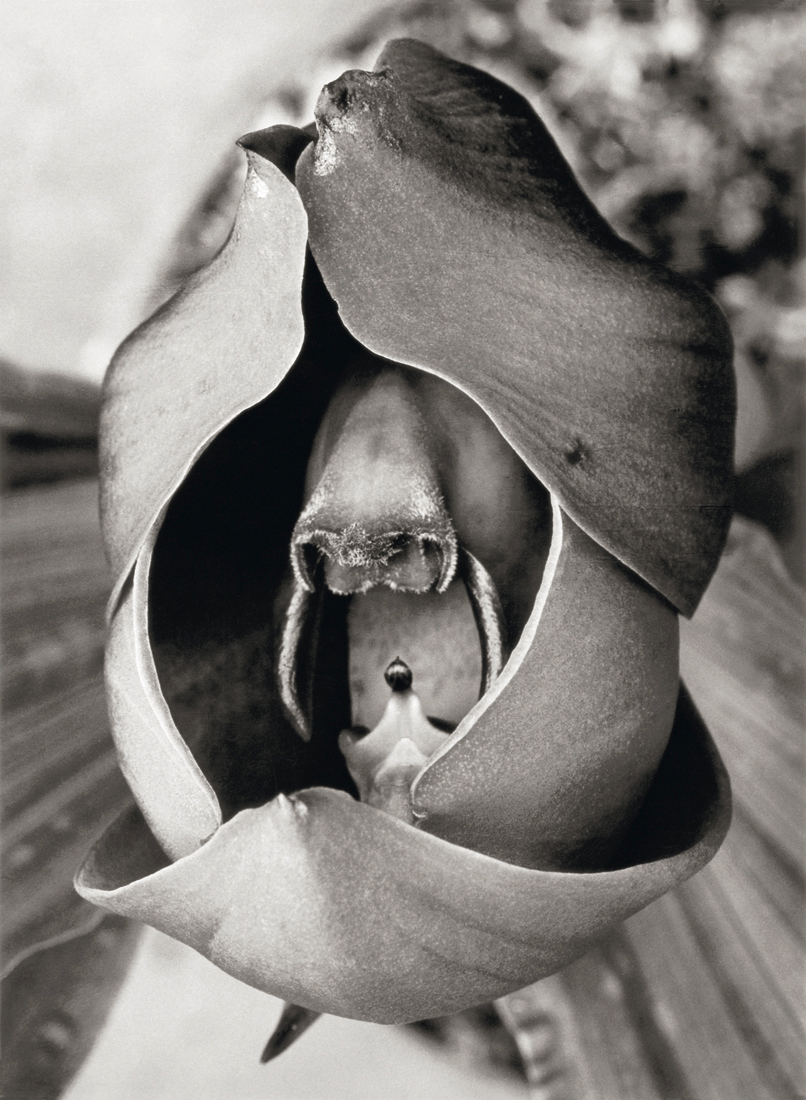
During the initial phase of his career, Albert Renger-Patzsch produced a series of photographs depicting plants and flowers for the collection Die Welt der Pflanze (The World of Plants), coordinated by Ernst Fuhrmann as part of his biosophical studies.
The first two volumes in the series, both published in 1924, were Orchideen (Orchids) and Crassula. Renger-Patzsch worked within the general parameters of the book, reproducing fragments of nature with as much objectivity and clarity as possible. He produced a large number of photographs distinguished by their great technical and compositional rigour, including systematic close-ups of plants and flowers. In 1923, Renger-Patzsch wrote his first text, “Pflanzenaufnahmen” (Plant photographs), setting out his views on photography and its extraordinary capacity for capturing nature. Among the images and arguments in the text he outlines some of the key principles that would underpin his photography: attention to detail and emphasis on the formal, structural and material aspects of nature, as well as, correspondingly, a reiterative affirmation of the intrinsic qualities of photography – realism, objectivity, neutrality – and its unique role in expanding our perception of reality.
In 1927, Albert Renger-Patzsch published his most ambitious book to date, Die Halligen (The Halligen Islands), with images of the islands in the Wadden Sea, on the northern coast of Germany.
His photographs featured a number of subjects: landscapes, portraits, architectural motifs and everyday activities. These subjects encapsulated the relationship between local ways of life (genuine, deep-rooted, traditional) and the physical and symbolic characteristics of this peculiar area. This vernacular reality contrasted with the rampant industrialisation that was transforming many of the great urban centres in Germany.
Over the ensuing years, Renger-Patzsch published Lübeck (1928) and Hamburg (1930), books that highlight the emerging characteristics of the modern city, the coexistence of different historic periods and the intersection between historical culture and the impact of industrialisation. In these photographs the photographer’s interest in combining documentary objectives with the creative potential of a modern vision is evident in his use of close-cropped, asymmetrical compositions and innovative perspectives, alternating between general shots and a focus on details. He displays sensitivity to the formal and structural aspects of reality, rejecting the atavistic influence of painting in order to embrace the possibilities of a “new vision” governed by photography.
In 1928, Albert Renger-Patzsch’s best-known book was published, Die Welt ist schön (The World is Beautiful), although the photographer would have preferred the title Die Dinge (Things).
It exemplifies the principles and characteristics of the photographer’s work: a desire to represent the immanent substance of an object/subject while demonstrating photography’s capacity for recording reality. In this respect, representing the unique character of a particular thing was also a way of affirming the unique character of photography.
The book encompasses a wide range of subjects and elements from the photographer’s world. It is an anthology of photographs taken since the beginning of his career, including several images produced for the books Die Welt der Pflanze, Die Halligen and Lübeck. Photographic genres are equally diverse, spanning portrait, landscape, still life and architectural images. The subjects are presented in an evolving thematic and conceptual sequence: first nature, plants, animals, people and landscapes; next, the manmade world of objects, architecture, the city, machines, and industrial structures and spaces. In this way a worldview is organised, a context of intersections and reappraisals, between nature and technology, between the sacred and the profane, between historical heritage and modernity.
Focus on the book Die Welt ist schön (The World is Beautiful)
Like other artists of his time, Renger-Patzsch was especially keen on exploring the formal analogies between the things of nature and industrial things. Industry led to mass production and the manufacture of standardised objects, exemplified in this image. This contrasts with other images from Die Welt ist schön (The World is Beautiful), such as Gebirgsforst im Winter (Mountain forest in winter) (below), which capture repetition in nature.
Renger-Patzsch identifies a coherence, a parity, between nature and culture as non-antagonistic doHands. He suggests a measure of naturalness in technology, and a measure of rationality in nature. For the photographer the emphasis on industrial seriality also allowed him to underscore the seriality of photography itself (as a means of technical reproduction), thus demonstrating the unique, mediating condition of this medium for visual reproduction in the connection between the natural world and the world of modern industry.
Focus on the book Die Welt ist schön (The World is Beautiful)
Painstaking attention to detail is a central feature of Renger-Patzsch’s photography, as demonstrated by several images in Die Welt ist schön (The World is Beautiful). Resorting to pronounced close-ups or subsequent reframing, the photographer breaks down and isolates the vision of certain things, thereby providing a fresh perspective: in this case, the image of a serpent’s head surrounded by a section of its body.
The close-up framing allows him to accentuate the two-dimensionality of the image, the part being more suggestive than the whole. This is a realistic, objective vision, but one aimed at creating a tension between the concrete nature of the motif and its abstract character.
Focus on the book Die Welt ist schön (The World is Beautiful)
This is the hundredth and last image of Die Welt ist schön (The World is Beautiful). It shows a pair of hands joined together, isolated from the rest of the body, rising over a black background in a gesture heavy with symbolic, meditative and spiritual fervour.
Aware that photography was increasingly becoming mundane and banal, and that the experience of attention was crumbling in the face of the accelerating transformation of reality, in Die Welt ist schön Renger-Patzsch offers an imaginary world where modern subjects can be reconnected with the things surrounding them via the mediation of a diffuse and calm temporality, the temporality of tradition and myth. A symptom of this vision is precisely the closing image of the book.
“To do justice to modern technology’s rigid linear structure, to the lofty gridwork of cranes and bridges, to the dynamism of machines operating at one thousand horsepower – only photography can do that. […] The absolutely correct rendering of form, the subtlety of tonal gradation from the brightest light to the darkest shadow, impart to a technically expert photograph the magic of experience.”
Albert Renger-Patzsch, “Ziele”, ‘Das Deutsche Lichtbild’, Berlin, 1927
“There is an urgent need to examine old opinions and look at things from a new viewpoint. There must be an increase in the joy one takes in an object, and the photographer should become fully conscious of the splendid fidelity of reproduction made possible by this technique.”
Albert Renger-Patzsch, “Die Freude am Gegenstand,” ‘Das Kunstblatt’, Berlin, 1928
“[…] the eye is subjective; it views with pleasure the essential things and completely overlooks what is unimportant. The camera, on the other hand, has to reproduce the entire image in focus and in a particular size. It will see the essential and the inessential with equal clarity.”
Albert Renger-Patzsch, in ‘Meister der Kamera erzählen wie sie wurden und wie sie arbeiten’, Halle (Saale), 1937
“[…] the eye is not isolated in its perception of the world. Rather its connections to the brain and the support of our senses in experience heat, cold wind, noise, smells and so on create an extraordinarily compact image of the world, whose plasticity and density are perhaps intensified by a particularly appropriate emotional state. Photography reduces this colourful world into a black-and-white rectangle. It is obvious that this most unpretentious of art forms requires the greatest reliability of taste, ability for abstraction, fantasy and concentration.”
Albert Renger-Patzsch, in ‘Meister der Kamera erzählen wie sie wurden und wie sie arbeiten’, Halle (Saale), 1937
The aim of this exhibition is to rediscover and pay tribute to the legacy of this unique photographer in the conviction that his work offers a context for encouraging reflection on the nature and artistic and speculative potential of photography within the framework of contemporary art and culture.
Of enormous simplicity and originality, Renger-Patzsch’s photography is notable for being based on a documentary style that prioritised realist sobriety and frankness as fundamental characteristics of photographic representation. In other words, his work offers a rigorous approach in technical and formal terms, in which the camera is only used to intensify our vision and aware of things. For Renger-Patzsch, this not only explained his photographic procedures but above all the potential for an aesthetic and conceptual identity for photography that visibly distanced itself from the Pictorialist legacy and from the hybrid experimentalism characteristic of the early 20th-century avant-gardes.
Both Renger-Patzsch’s photography and the various texts in which he set out his ideas reveal his determination to exploit the qualities inherent in the photographic medium. He stated that his aim was: “to use photographic means to create a photography that could exist through its own photographic nature.” In another text Renger-Patzsch wrote that,
“the eyes are not isolated from their perception of the world.
On the contrary, they are part of our senses and, by being connected to the brain, allow us to experience heat, cold, wind, noise, smell, and to rapidly construct a remarkably compacted image of the world, the plasticity and density of which also depend on our emotional states.
Photography reduces the world in colour to a rectangle in black and white. And logically, given that it is the least pretentious form of art, it requires rigorous taste, a capacity for abstraction, imagination and concentration.”
Such statements reveal that the exceptional quality of Renger-Patzsch’s work and thought is also notable for the way it conceives and expands the horizon and scope of the idea of documentary photography. As a result, the descriptive and objective qualities of photography are combined with and articulated by its aesthetic, poetic and phenomenological powers.
This retrospective aims to encompass the principal themes, periods and genres that define Renger-Patzsch’s photographic output through the identification of three moments that are fundamental for an understanding of his career: firstly, his early years, from his photographs of plants taken for Folkwang / Auriga publishers, to the profusion of themes and photographic eclecticism which would be decisive for the creation of his book Die Welt ist schön (The World is Beautiful) of 1928. The period that began after his move to Essen was one of intense photographic creation on the Ruhr area, principally involving subjects associated with places, buildings and industrial objects. Finally, the years after World War II reveal a new interest in the themes of nature and landscape particularly trees and rocks.
Including around 154 photographs, this is one of the largest retrospectives on the artist to date and undoubtedly the one to bring together the largest number of works by Renger-Patzsch from institutional and private collections: the Stiftung Ann und Jürgen Wilde / Pinakothek der Moderne München (Munich), the Museum Folkwang (Essen), the Ludwig Museum (Cologne), the Galerie Berinson (Berlin), the Centre Georges Pompidou (Paris).
Press release from Jeu de Paume
Highlights of the exhibition
Author of a monumental oeuvre created over four and a half decades, Albert Renger-Patzsch (1897-1966) was the leading photographer of the New Objectivity movement that appeared in German art in the mid 1920s.
Renger-Patzsch was a prolific photographer and his oeuvre encompasses a variety of themes, types and genres. This exhibition covers the most important stages in Renger-Patzsch’s career, from his first photographs of plant details, urban scenes and industrial subjects to his later landscape work. In total the exhibition features more than 150 photographs, mostly vintage prints from the most important collections in Germany.
Renger-Patzsch devoted himself to creating a new photographic realism, characterised by an extreme simplicity and originality. He created a modern visual language that was imbued with a poetic resonance and helped to redefine the photographic image. For Renger-Patzsch, photography was the most appropriate medium for carrying out a change that was simultaneously artistic and perceptual, i.e., the possibility of a new kind of image that reflected the changes of the 1920s and 1930s, a period marked by industrialisation and the spread of technology.
Albert Renger-Patzsch is the author of one of the seminal books in the history of photography, Die Welt ist schön (The World is Beautiful), which was published in 1928. This work reveals the full scope of Renger-Patzsch’s approach, which was to capture the unique character of each concrete thing in order to affirm also the unique character of photography.
Renger-Patzsch produced an exceptional body of work on the theme of industrial architecture, which he helped to turn into a genre in itself. He exerted a decisive influence on generations of photographers, not least Bernd and Hilla Becher. This exhibition sets out to highlight the vital legacy of this extraordinary photographer. In so doing, it sheds light on the important role of photography within the context of contemporary art and culture.
Landscapes of the Ruhr: the Topography of a Transformation
In 1929, Renger-Patzsch relocated to Essen, in the Ruhr, Germany’s leading industrial region and one the photographer was familiar with.
Two years earlier, he had produced the first images in an ambitious project focusing on the landscapes of the Ruhr, which he would work on until 1935. In this realm of contrasts, he became particularly interested in spaces that were between cities, between the urban and the rural, landscapes that displayed the process of change that the region was undergoing due to industrialisation and the development of public infrastructure.
The works reflect a change in Renger-Patzsch’s photographic vision: the compositions are widened, in some cases into large panoramic views. The images now focus on a multiplicity of elements and explore interpretative relationships and associations. His preference for more open images that include the surroundings of objects, rather than just close-ups, reflects a more inclusive objectivity. Some images include people, usually seen from afar. These figures are set in particular socio-spatial contexts and help to highlight the enormous disparity in scale between the human figure and the new industrial complexes. Vertical and horizontal elements, close up and in the distance, are combined and juxtaposed. The relationship between different planes, between foreground and background, is intensified in order to show how industry has shaped the landscape, turning it into a heterogeneous and paradoxical landscape (in historical and social terms).
In the photographs of the Ruhr, the landscape emerges as a genre in which disparate elements are combined and contrasted, a way of exploring the boundaries between the rural and industrial worlds, the city and the periphery.
One of the most extraordinary examples from this period is the 1928 image Landschaft bei Essen und Zeche “Rosenblumendelle” (Landscape near Essen with the Rosenblumendelle colliery) (above). This photograph that seems to result from the collage of two layers (two regions, two realities), bringing together the idyllic serenity of the rural world, in the foreground, and the massive and disproportionate character of the new industrial complexes in the background, as the fatal destiny of the modern world.
At the centre is a road, a metaphor for history, mediating two different realities and suggesting the dilemma between tradition and modernity – a dilemma that highlights Renger-Paztsch’s ambivalent and paradoxical stance towards industrialisation.
Industrial Objects and Architecture: Geometry and Series
From the late 1920s onwards, Renger-Patzsch produced numerous works following commissions from architects and industrial companies.
At this time, the expansion of the press and advertising, boosted by industry, was having a big impact on art, providing an abundance of work opportunities for artists and photographers.
Photographs of industrial objects and buildings lent themselves to rigorous, carefully calculated compositions. In many cases, the viewer’s perception is guided by planimetric compositions, which are sometimes orthogonal, sometimes diagonal. His architectural photographs combine structural and formal aspects with a desire to record the functional reality of industrial complexes. His images of objects are characterised by their attention to detail and a desire to give aesthetic meaning to each of the objects photographed through meticulous graphic composition.
However, Renger-Patzsch emphasises the repetitive, standardised nature of the objects – aspects inherent to mass production. For him, the theme of technology was further confirmation of how photography differed from painting and provided the most suitable medium for representing the new reality – technical, material and spatial – of modern industrialisation.
Throughout his career, Renger-Patzsch created a huge number of photographs of industrial architecture. Its emergence as an artistic genre owes much to him, and his legacy exerted a decisive influence on generations of future photographers, including Bernd and Hilla Becher.
The perspective and the composition accentuate the geometry of the vertical, horizontal and diagonal lines. The photographer seeks to highlight the significance of a building designed according to strict functional and rational principles. In doing so, Renger-Patzsch reveals a correspondence between method and object in the sense that precision, objectivity and the documentary value of photography were in harmony with the rationality, coherence and functionality of the new industrial and modern architecture.
For Renger-Patzsch commercial commissions also provided opportunities for a personal and creative approach to photography. This image is part of a commission from the Jenaer Glaswerke Schott company, for whom he photographed several sets of laboratory objects in glass (recipients, flasks, tubes, jars). In this particular image Renger-Patzsch arranges eight glass beakers, all with the same cylindrical shape but of differing dimensions, on a reflecting surface and photographs them from a slightly elevated angle. The larger items are placed to the rear. The objects overlap with each other. The mirroring effect of the base creates the impression that the glassware is floating, especially at the centre of the image where the smaller cylinder (on which the manufacturer’s logo can be read) is the focal point. In their simple, standardised shape, and their transparency, the objects create a choreography of light, shadows and reflections, an experiment with the possibilities of looking at objects and reconfiguring their shapes.
The Destiny of Nature
In 1944, a large part of his archives at the Folkwang Museum were destroyed in an Allied bombing raid. With his family, Renger-Patzsch moved to the rural area of Wamel, close to Soest. He began to work on a new theme, returning to natural subjects, although now with an emphasis on landscape.
The photographer seemed to find among the trees, forests, rocks and craggy scenes a vital energy. These images suggest a diffuse sense of time contrasting with the linear nature of history and immune to the contingencies of modernity and the devastating consequences of war. In this final phase of his life, Renger-Patzsch published Baüme (Trees) in 1962 and Gestein (Rocks) in 1966, two volumes that exemplify the conceptual and aesthetic bases of this renewed, revitalised view of nature. Both books include essays by the writer and philosopher Ernst Jünger, with whom the photographer maintained an intense and regular correspondence for over twenty years.
The photographs in Baüme and Gestein are the logical corollary to Renger-Patzsch’s extraordinary trajectory. The images are less graphic, in part due to the fact that they depict forms that are apparently disordered, uncontrollable and unpredictable. Nevertheless, through the disconcerting simplicity and sobriety of these photographs, Renger-Patzsch also highlights the phenomenological and psychological aspects that are part of experiencing the image.
Nature can thus be seen as a subject that allows the viewer to experience a primal gaze. This is the condition for a vision simultaneously concrete, poetic and metaphysical that leads to a rediscovery of nature, its destiny, its silence, its rhythms, forms and forces.
This is one of Renger-Patzsch’s best-known and most outstanding photographs. This landscape with a tree in the middle heralds his later work. Because of its links to the history of painting, landscape was not a central theme of New Objectivity. In this image Renger-Patzsch chose a vertical landscape, a less usual format than the horizontal landscape. It is a hybrid image in the sense that it combines the tree as the central motif (leafless and reduced to its branch structure) with a panoramic view of a vast landscape. Of particular note is the way the photographer explores the different planes within the image, playing with depth and distance, with the foreground, where the tree stands and the background of the endless landscape. The differences between near and far are diluted on the two-dimensional surface of the image.
Rocks and geological phenomena became of great interest to Renger-Patzsch in the latter phase of his career as a photographer, during which he travelled to France, Norway, Northern Ireland, Italy, Sweden and several parts of Germany to take the photographs published in Gestein (Rocks). In the book, the images are strategically interspersed with text by geologist and palaeontologist Max Richter and an essay by writer and philosopher Ernst Jünger.
Renger-Patzsch photographed the rocks and layers of rock as evidence of the slower phenomena of nature, but also as metaphors for time and history. This image, taken on the coast of Brittany, shows a series of geological folds, a phenomenon that occurs when different forces cause the planar rock sheets to curve or fold. The photographic precision and objectivity of the image, along with the stunning (peculiar, expressive, pictorial) appearance generated by tectonic forces on the surface of the rock, create a vision that combines figuration and abstraction.
Jeu de Paume 1, Place de la Concorde 75008 Paris métro Concorde Phone: 01 47 03 12 50
Curators:Portraying a Nation: Germany 1919-1933 is made up of Otto Dix: The Evil Eye, Kunstsammlung Nordrhein-Westfalen, Düsseldorf and ARTIST ROOMS: August Sander, an exhibition of works from the ARTIST ROOMS collection of international modern and contemporary art. Otto Dix: The Evil Eye is curated by Dr Susanne Meyer-Büser, Kunstsammlung Nordrhein-Westfalen, Düsseldorf, Francesco Manacorda, Artistic Director and Lauren Barnes, Assistant Curator, Tate Liverpool. ARTIST ROOMS: August Sander is curated by Francesco Manacorda, and Lauren Barnes, Assistant Curator, with the cooperation of ARTIST ROOMS and the German Historical Institute.
Writing sociology: picturing an uncertain cultural landscape
There is something completely unexpected in the strange correlation and synergy between the work of these two artists.
While it is inadvisable to compare and contrast (why pick those particular images out of thousands!), I have paired several images from the exhibition together in this posting. Let’s look at the pairing above.
Technically, Sander’s photograph of The Painter Otto Dix and his Wife Martha (1925-1926) evidences a slightly flattened perspective especially in the “face on” aspect of the androgynous woman – but the photograph also possesses a surreal air, the silhouette of the woman’s hair contrasting with the swept back slickness of the man and his jutting, three-quarter profile. The unusual space between them adds admirably to the overall frisson of the photograph, it’s non/objectivity and performativity. In Dix’s painting Hugo Erfurth with Dog (1926) a greater distortion of perspective is in evidence. The mythic dog is painted as if photographed using a telephoto lens, while the man’s face is all over the place… the jaw elongated as if by using a wide angle lens, the front of the face flattened in an earnest manner. This is what painting can do, and is allowed to do, that photography can never match. But it doesn’t have to. It does it in a different way.
Here we need to excavate – that’s a good word for this investigation – we need to excavate the ethos in the zeitgeist. We need to understand the attitudes and aspirations of the cultural era in which these artists lived in order to comprehend the defining spirit of the period, as shown by the ideas and beliefs of the time. These artists emerge out of the same society, they inhabit the spirit of the age – those interwar years of the avant-garde, speed, and change; of poverty, postwar realities and politics; of The Great Depression, disfiguration and disenfranchisement.
I look at the obscurity of faces in Dix’s Assault Troops Advance under Gas (1924) and then adjust to the pensiveness of hand, pose and gaze in Sander’s Working Students (1926) … and then mentally add in Avedon’s later portraiture. Interesting. I look at Sander’s National Socialist, Head of Department of Culture (c. 1938) and note the “exemplary mastery of illumination”, but just as distinctively the averted gaze, the line on head where the unnamed man (who is he? what was his name?) had just taken his cap off. Just below is Dix’s Self-Portrait with Easel (1926) with three-quarter profile, piercing stare, bent finger. Who is capturing reality here? No body.
In his own way, Sander plays with the reality of time and space just as much as Dix. In my mind, Sander’s “staged performativity and the artifice of construction [which] is paramount to the surreal effects created,” are no less un/real than the paintings of Dix. There are things that just don’t fit. The strangeness of the era, the creation of these non/objective environments, cause an alignment of the stars between both artists. This is inspired curating, to bring these two extra-ordinary talents together.
These artists walked the same streets, they breathed the same air. They excavated the spirit of the age. And in so doing, their art becomes impervious to time.
Dr Marcus Bunyan
Many thankx to Tate Liverpool for allowing me to publish the photographs in the posting. Please click on the photographs for a larger version of the image.
“We want to see things completely naked, clear, almost without art. I invented the New Objectivity.”
Otto Dix, 1965
German artist Otto Dix was a committed painter of portraits. At a time when photography had diminished portraiture’s importance and the genre was seen as a deeply unfashionable pursuit for so-called serious artists, he was making a living – and cementing his reputation – out of exactly that. He commented:
“Painting portraits is regarded by modernist artists as a lower artistic occupation; and yet it is one of the most exciting and difficult tasks for a painter.”
Dix was a key supporter of the New Objectivity (Neue Sachlichkeit) movement, a name coined after an exhibition held in Mannheim, Germany in 1925. Described by art historian G.F. Hartlaub, as ‘new realism bearing a socialist flavour’, the movement sought to depict the social and political realities of the Weimar Republic.
Tate Liverpool presents the faces of Germany between the two World Wars seen through the eyes of painter Otto Dix (1891-1969) and photographer August Sander (1876-1964). Portraying a Nation: Germany 1919-1933 brings together two artists whose works document the glamour and misery of the Weimar Republic, a time of radical extremes and political and economic upheaval.
Portraying a Nation, which exhibits Dix and Sander as a pair for the first time, reflects a pivotal point in Germany’s history, as it introduced democratic rule in the aftermath of the First World War. The period was one of experimentation and innovation across the visual arts, during which both artists were concerned with representing the extremes of society, from the flourishing cabaret culture to intense poverty and civilian rebellions.
Featuring more than 300 paintings, drawings, prints and photographs, Portraying a Nation unites two complementary exhibitions. Otto Dix: The Evil Eye explores Dix’s harshly realistic depictions of German society and the brutality of war, while ARTIST ROOMS: August Sander presents photographs from Sander’s best known series People of the Twentieth Century, from the ARTIST ROOMS collection of international modern and contemporary art.
The exhibition focusses on the evolution of Dix’s work during his years in Düsseldorf, from 1922 to 1925, when he became one of the foremost New Objectivity painters, a movement exploring a new style of artistic representation following the First World War. Dix’s paintings are vitriolic reflections on German society, commenting on the country’s stark divisions. His work represents the people who made up these contradictions in society with highlights including Portrait of the Photographer Hugo Erfurth with Dog 1923, Self-Portrait with Easel 1926, as well as a large group of lesser known watercolours. Dix’s The War 1924 will also form a key element of the exhibition, a series of 50 etchings made as a reaction to and representation of the profound effect of his personal experiences of fighting in the First World War.
Sander’s photographs also observe a cross-section of society to present a collective portrait of a nation. Sander commenced his major photographic project People of the Twentieth Century in 1910, an ambitious task that occupied him until the 1950s. The project resulted in more than 600 images in which people were categorised into what he described as ‘types’, including artists, musicians, circus workers, farmers and, in the late 1930s, images of Nazi officers. More than 140 photographs from the ARTIST ROOMS collection will be displayed to create a large-scale timeline of Weimar Germany, placing individual subjects against a backdrop of the era’s tumultuous cultural and political history.
Portraying a Nation: Germany 1919-1933 is made up of Otto Dix: The Evil Eye, Kunstsammlung Nordrhein-Westfalen, Düsseldorf and ARTIST ROOMS: August Sander, an exhibition of works from the ARTIST ROOMS collection of international modern and contemporary art.
The ARTIST ROOMS collection is jointly owned by National Galleries of Scotland and Tate on behalf of the public, and was established through The d’Offay donation in 2008 with the assistance of the Heritage Memorial Fund, Art Fund and the Scottish and British governments. It is shared with UK museums and galleries including Tate, National Galleries of Scotland and a network of Associate venues through ARTIST ROOMS On Tour, which is a partnership until 2019 with lead Associate Ferens Art Gallery, supported by the National Lottery through Arts Council England, Art Fund and the National Lottery through Creative Scotland.
Otto Dix: The Evil Eye is curated by Dr Susanne Meyer-Büser, Kunstsammlung Nordrhein-Westfalen, Düsseldorf, Francesco Manacorda, Artistic Director and Lauren Barnes, Assistant Curator, Tate Liverpool. ARTIST ROOMS: August Sander is curated by Francesco Manacorda, and Lauren Barnes, Assistant Curator, with the cooperation of ARTIST ROOMS and the German Historical Institute.
Seen together, Sander’s images form a pictorial mosaic of inter-war Germany. Rapid social change and newfound freedom were accompanied by financial insecurity and social and political unrest. By photographing the citizens of the Weimar Republic – from the artistic, bohemian elite to the Nazis and those they persecuted – Sander’s photographs tell of an uncertain cultural landscape. It is a world characterised by explosions of creativity, hyperinflation and political turmoil. The faces of those he photographed show traces of this collective historical experience. Alfred Döblin, author of the 1929 novel Berlin Alexanderplatz said:
“Sander has succeeded in writing sociology not by writing, but by producing photographs – photographs of faces and not mere costumes.”
Dix served in the First World War from 1915, fighting on the Western front in the Battle of the Somme. Although an enthusiastic soldier – his service earned him the Iron Cross (Second Class) – Dix’s experiences affected him deeply. He marked the war’s 10th anniversary with a group of etchings entitled Der Krieg (The War), leaving few of the horrors of the front line to the imagination. Commenting later, he said:
“For years, [I] constantly had these dreams in which I was forced to crawl through destroyed buildings, through corridors through which I couldn’t pass. The rubble was always there in my dreams.”
From the early 1920s, he devoted himself to the study of old master painting techniques, using a layering effect, produced first with egg tempera and, later, finished with oils. This moved his contemporary George Grosz to jokingly call him ‘Otto Hans Baldung Dix’ (after the German old master Hans Baldung Grien). Later, Grosz would write:
“Dix did all the drawing in a thin tempera, then went over it with thin mastic glazes in various cold and warm tones. He was the only Old Master I ever watched using this technique.”
When the Nazis came to power in 1933, Dix was dismissed from his professorship teaching art at the Dresden Academy, where he had worked since 1927. The reason given was that, through his painting, he had committed a ‘violation of the moral sensibilities and subversion of the militant spirit of the German people’.
In the years following, some 260 of his works were confiscated by the Nazi Propaganda Ministry. Several of these works, including The Jeweller Karl Krall 1923 (which features in the Tate Liverpool exhibition Portraying a Nation), appeared in the Entartete Kunst (degenerate art) exhibition of 1937-1938. The exhibition was staged by the Nazis to destroy the careers of those artists they considered mentally ill, inappropriate or unpatriotic.
In the mid-1920s, Sander began his highly ambitious project People of the 20th Century. In it, Sander aimed to document Germany by taking portraits of people from all segments of society. The project adapted and evolved continuously, falling into seven distinct groups: ‘The Farmer’, ‘The Skilled Tradesman’, ‘The Woman’, ‘Classes and Professions’, ‘The Artists’, ‘The City’ and ‘The Last People’. Sander once said ‘The portrait is your mirror. It’s you’. He believed that, through photography, he could reveal the characteristic traits of people. He used these images to tell each person’s story; their profession, politics, social situation and background.
Sander did not use the newly invented Leica camera. Instead he remained devoted to an old-fashioned large-format camera, glass negatives and long exposure times. This allowed him to capture minute details of individual faces. Sander prized the daguerreotype, a photographic process introduced in the previous century, of which he said: ‘it cannot be surpassed in the delicacy of the delineation, it is objectivity in the best sense of the word’. Allied to this, his portraits were anonymous. Shot against neutral backgrounds and titled more often than not by profession alone, he let the images – and the faces in them – speak for themselves.
The ambition and reach of People of the 20th Century (both in terms of the quality of his photography and in his representation of a cross-section of society) made him a monumental figure of twentieth century photography. The likes of American social realist photographers such as Walker Evans and Dorothea Lange (whose works became iconic symbols of the depression), and later photographers such as Diane Arbus, each owe a debt to the trailblazing Sander. More recently, the work of conceptual artists such as Bernd and Hilla Becher (known for their typologies of industrial buildings and structures) and Rineke Dijkstra, whose photography is infused with psychological depth and social awareness, resonates with the influence of August Sander’s career-long project.
What a fascinating exhibition this looks to be… I wish I could see it! Quite a few Sander photographs I have never seen before in the posting. Sander is another photographer that would be near the top of my list.
Dr Marcus Bunyan
Many thankx to the Pinakothek der Moderne for allowing me to publish the photographs in the posting. Please click on the photographs for a larger version of the image.
August Sander’s epochal cycle People of the 20th Century is considered one of the most important works in the history of art and photography of the last century.
Sander’s photographic typology of German society did not only fascinate artists, writers and philosophers of that period but, at the same time, formed an important point of reference for the artistic concept contemporary photographers had of themselves. This is also reflected in the Munich publisher Lothar Schirmer’s photographic collection, the starting point of which was a group of some 80 works by Sander comprising not only portraits, but also landscapes and urban pictures, acquired in the early 1970s.
This batch of works, acquired from the artist’s estate back in the 1970s, comprises not only more than 40 originals of Sander’s famous portraits, including masterpieces such as the Stammmappe focussing on farmers in Westerwald, the portrait of the artist Heinrich Hoerle in the austere style of New Objectivity and Handlanger, with its impressive visual directness, but also a rare group of lesser known Rhineland landscapes and vedute of Cologne from the 1930s. Precisely the last two groups of works mentioned are enduring proof that Sander’s vision of an equally authentic and veritable document of the times was not only to be limited to people within their social and societal structure but should also include their immediate surroundings, the landscape and the urban environment – an aspect that, for a long time, was given little attention in analyses of the photographer’s work since his death in April, fifty years ago.
In view of the undisputed importance of Sander’s portraits, it is surprising that a more extensive selection of the photographer’s work is only now to be seen in the exhibition People in a River Landscape – and that in Munich too, although there were in fact a number of links between the artist and the city. Sander’s pioneering photography book, Antlitz der Zeit, was published in 1929 by the Munich-based Kurt Wolff Verlag; one year later, his works were to be seen in the exhibition Das Lichtbild – one of the rare presentations of Sander’s works anywhere before 1933; and in the 1960s and ’70s his extensive estate was stored not far from Munich.
Sander’s photographs from this collection will be exhibited for the first time in their entirety and be displayed in dialogue with works by contemporary artists such as Bernd and Hilla Becher, Andreas Gursky, Thomas Ruff, Cindy Sherman, Thomas Struth and Jeff Wall. The selection will be extended by a rare group of extraordinary photographs taken in Berlin by Heinrich Zille in the late 19th / early 20th century and enlarged by Thomas Struth almost 100 years later.
The exhibition presents a both representative and focussed cross section of Sander’s photographic oeuvre. At the same time it shows the medium of photography in a wider perspective by placing individual groups of works by Sander in dialogue with those of contemporary artists. Starting with a typology by Bernd and Hilla Becher, whose encyclopaedically structured work can be regarded as an immediate successor to Sander’s photographic credo, the selection – supplemented by works from the holdings of the Sammlung Moderne Kunst – includes Andreas Gursky’s Rhine picture, urban views by Thomas Struth and Jeff Wall and portraits by Thomas Ruff and Cindy Sherman, among others. The interplay between the past and the present, between small-format, black-and-white prints and colour images the size of large canvases, between austere documentary works and staged and digitally processed pictures, not only illustrates the immediate relevance of Sander’s concept, far beyond any temporal or formal distinctions, but also how photography has become established as an artistic form of expression in its own right within the context of contemporary art. This topic will be explored in greater depth in the accompanying series of lectures Why Photography Matters, at which the artists Hilla Becher and Thomas Struth, as well as the art historians Wolfgang Kemp and Michael Fried will be speaking. As a modest homage to another historical precursor, the exhibition finishes with a rare group of photographs of Berlin by Heinrich Zille taken at the turn of the century, which Thomas Struth enlarged and reinterpreted in 1985 using the original negatives.
Press release from the Pinakothek der Moderne website
Some familiar images that were also seen in the posting Wols’ Photography: Images Regained are complimented by 5 new ones. The two portraits of the artist Max Ernst are eerie (is that a suitable word for a portrait that is strong and unsettling?) and perceptive, Wols responsive to the status of his sitter as a pioneer of the Dada movement and Surrealism.
Dr Marcus Bunyan
Many thankx to the Martin-Gropius-Bau for allowing me to publish the photographs in the posting. Please click on the photographs for a larger version of the image.
The term Art Informel was originated by the French critic Michel Tapié and popularised in his 1952 book Un Art autre (Another art). A Parisian counterpart of Abstract Expressionism, Art Informel emphasised intuition and spontaneity over the Cubist tradition that had dominated School of Paris painting. The resulting abstractions took a variety of forms. For instance, Pierre Soulages’s black-on-black paintings composed of slashing strokes of velvety paint suggest the nocturnal mood of Europe immediately after the war.
Germaine Émilie Krebs (1903-1993), known as Alix Barton and later as “Madame Grès”, relaunched her design house under the name Grès in Paris in 1942. Prior to this, she worked as “Alix” or “Alix Grès” during the 1930s. Formally trained as a sculptress, she produced haute couture designs for an array of fashionable women, including the Duchess of Windsor, Marlene Dietrich, Greta Garbo, Jacqueline Kennedy, and Dolores del Río. Her signature was cut-outs on gowns that made exposed skin part of the design, yet still had a classical, sophisticated feel. She was renowned for being the last of the haute couture houses to establish a ready-to-wear line, which she called a “prostitution”.
The name Grès was a partial anagram of her husband’s first name and alias. He was Serge Czerefkov, a Russian painter, who left her soon after the house’s creation. Grès enjoyed years of critical successes but, after Grès herself sold the business in the 1980s to Yagi Tsucho, a Japanese company, it faltered. In 2012, the last Grès store in Paris was closed.
Wolfgang Schulze, known as Wols, was born in Berlin in 1913. As a painter and graphic artist he is considered to have been an important trailblazer of Art Informel. For the first time the Martin-Gropius-Bau in Berlin is presenting the largely unknown photographic oeuvre of Wols. These works foreshadow his development in the direction of non-representational art.
Wols grew up in Dresden, where he had an early encounter with photography as a profession through his attendance at a course in the studio of the Dresden photographer Genja Jonas. In 1932, after a brief sojourn in the milieu of the Berlin Bauhaus – then in the process of breaking up – the young Wols set off for Paris to realise his artistic ambitions.
Soon he was involved with the local Surrealists and made the acquaintance of other personalities in the theatrical, literary and art scenes. In this period Wols was mainly active as a photographer. In 1937 his works were exhibited for the first time in the prestigious Parisian Galérie de la Pléiade, which established his reputation as a photographer. It was at this time that he adopted the pseudonym Wols. One of his commissions was to document the Pavillon de l’Elégance at the 1937 World Exhibition in Paris.
At the same time he produced striking multiple black-and-white portraits of personalities such as Max Ernst, Nicole Boubant or Roger Blin. Over the years Wols’ imagery became increasingly radical. The representational motifs gradually acquired a more abstract dimension and forced the viewer to see the objects represented in a new light. In particular, an extraordinary set of photograms confirms his interest in replacing representational motifs with non-representational ones. Transferred to painting, this trend would later make him a pioneer of Art Informel.
Immediately after the outbreak of the Second World War Wols spent over a year in various internment camps in the south of France. In this period he turned more to watercolours, most of which were lost while he was fleeing from the Nazis.
Living in straitened circumstances Wols fought a losing battle with alcoholism and poor health. In 1951, as a result of his weakened physical condition, he died of food poisoning in Paris at the early age of 38. After his death, Wols’ work was displayed at the first three documenta exhibitions in Kassel (1955, 1959, 1964) and, in 1958, at the Venice Biennale. On 27 May 2014 he would have been 101.
The show covers all of his photographic work, including multiple portraits of famous artists, actors and writers, photographs of the “Pavillon de l’Élégance”, numerous still lifes, and many hitherto unknown motifs. The exhibition has been curated by the Kupferstich-Kabinett, Staatliche Kunstsammlungen Dresden, where this unique collection will be kept and systematically catalogued.
Wols permanently settled in Paris in 1933, producing his first paintings but also working as a photographer. His photographic work of this period showed the clear influence of Surrealism. In 1936, he received official permission to live in Paris with the help of Fernand Léger; as an army deserter, Schulze had to report to the Paris police on a monthly basis. In 1937, the year in which he adopted his pseudonym WOLS, his photographs began to appear in fashion magazines such as Harper’s Bazaar, Vogue, Femina as well as Revue de l’art. Many of these photographs anticipate the displays at the Exposition Internationale du Surréalisme held in Paris in the following year, in which much use was made of mannequins.
At the outbreak of World War II Wols, as a German citizen, was interned for 14 months in the notorious Les Milles camp – together with some 3500 other artists and intellectuals. He was not released until late 1940. After his release Wols moved for two years to Cassis, near Marseille, where he struggled to earn a living. The occupation of Southern France by the Germans in 1942 forced him to flee to Dieulefit, near Montélimar, where he met the writer Henri-Pierre Roché, one of his earliest collectors. He spent most of the war trying to emigrate to the United States, an unsuccessful and costly enterprise that may have driven him to alcoholism.
After the war Wols returned to Paris where he met Jean-Paul Sartre, Tristan Tzara and Jean Paulhan. He started to paint in oils in 1946 at the suggestion of the dealer René Drouin, who showed 40 of his paintings at his gallery in 1947. The same year Wols began to work on a number of illustrations for books by Paulhan, Sartre, Franz Kafka and Antonin Artaud. He fell ill but lacked the money to go to hospital, and throughout 1948 he worked largely in bed on these illustrations. In 1949 he took part in the exhibition Huit oeuvres nouvelles at the Galerie Drouin, along with Jean Dubuffet, Roberto Matta, Henri Michaux and other artists with whom he had a stylistic affinity.
Undergoing treatment for alcoholism, he moved to the country at Champigny-sur-Marne in June 1951. His early death later that year from food poisoning helped foster the legendary reputation that grew up around him soon afterwards. His paintings helped pioneer Art informel and Tachism, which dominated European art during and after the 1950s as a European counterpart to American Abstract Expressionism. Influenced by the writings of the philosopher Lao Tzu throughout his life, Wols also wrote poems and aphorisms that expressed his aesthetic and philosophical ideas.”

![August Sander (German, 1876-1964). 'Das Siebengebirge: Blick vom Rolandsbogen' [The Siebengebirge: view from the Rolandsbogen] 1929-30 (center) and 'Untitled [Remagen Bridge on the Rhine]' c. 1930 (right)](https://artblart.com/wp-content/uploads/2020/06/sander-landscape-a.jpg "August Sander (German, 1876-1964). 'Das Siebengebirge: Blick vom Rolandsbogen' [The Siebengebirge: view from the Rolandsbogen] 1929-30 (center) and 'Untitled [Remagen Bridge on the Rhine]' c. 1930 (right)")
![August Sander (German, 1876-1964) 'Das Siebengebirge: Blick vom Rolandsbogen' [The Siebengebirge: view from the Rolandsbogen] 1929-1930](https://artblart.com/wp-content/uploads/2020/06/sander-landscape-b1.jpg "August Sander (German, 1876-1964) 'Das Siebengebirge: Blick vom Rolandsbogen' [The Siebengebirge: view from the Rolandsbogen] 1929-1930")
![August Sander (German, 1876-1964) 'Das Siebengebirge: Blick vom Rolandsbogen' [The Siebengebirge: view from the Rolandsbogen] 1929-1930](https://artblart.com/wp-content/uploads/2020/06/sander-landscape-b.jpg "August Sander (German, 1876-1964) 'Das Siebengebirge: Blick vom Rolandsbogen' [The Siebengebirge: view from the Rolandsbogen] 1929-1930")
![August Sander (German, 1876-1964) 'Das Siebengebirge: Blick vom Rolandsbogen' [The Siebengebirge: view from the Rolandsbogen] 1929-1930](https://artblart.com/wp-content/uploads/2020/07/sander-the-siebengebirge.jpg "August Sander (German, 1876-1964) 'Das Siebengebirge: Blick vom Rolandsbogen' [The Siebengebirge: view from the Rolandsbogen] 1929-1930")
![August Sander (German, 1876-1964) 'Untitled [Remagen Bridge on the Rhine]' c. 1930](https://artblart.com/wp-content/uploads/2020/06/sander-landscape-c.jpg "August Sander (German, 1876-1964) 'Untitled [Remagen Bridge on the Rhine]' c. 1930")
![August Sander (German, 1876-1964) 'Untitled [Bohemians: avant-garde of Cologne]' 1920s (left) and 'Professor Ludwig Behn' 1920s (right)](https://artblart.com/wp-content/uploads/2020/06/sander-installation-a.jpg "August Sander (German, 1876-1964) 'Untitled [Bohemians: avant-garde of Cologne]' 1920s (left) and 'Professor Ludwig Behn' 1920s (right)")
![August Sander (German, 1876-1964) 'Untitled [Bohemians: avant-garde of Cologne]' 1920s](https://artblart.com/wp-content/uploads/2020/06/sander-avant-garde-a.jpg "August Sander (German, 1876-1964) 'Untitled [Bohemians: avant-garde of Cologne]' 1920s")
![August Sander (German, 1876-1964) 'Untitled [Bohemians: avant-garde of Cologne]' 1920s](https://artblart.com/wp-content/uploads/2020/06/sander-avant-garde.jpg "August Sander (German, 1876-1964) 'Untitled [Bohemians: avant-garde of Cologne]' 1920s")
![August Sander (German, 1876-1964) 'Painter's Wife [Helene Abelen]' 1926](https://artblart.com/wp-content/uploads/2020/06/sander-painters-wife.jpg "August Sander (German, 1876-1964) 'Painter's Wife [Helene Abelen]' 1926")






![Albert Renger-Patzsch (German, 1897-1966) 'Brasilianischer Melonenbaum von unten gesehen [Brazilian melon tree seen from below]' 1923](https://artblart.com/wp-content/uploads/2018/01/renger-patzsch-brasilianischer-melonenbaum.jpg "Albert Renger-Patzsch (German, 1897-1966) 'Brasilianischer Melonenbaum von unten gesehen [Brazilian melon tree seen from below]' 1923")
![Albert Renger-Patzsch (German, 1897-1966) 'Krabbenfischerin [Shrimp fisherwoman]' 1927](https://artblart.com/wp-content/uploads/2018/01/renger-patzsch-krabbenfischerin.jpg "Albert Renger-Patzsch (German, 1897-1966) 'Krabbenfischerin [Shrimp fisherwoman]' 1927")
![Albert Renger-Patzsch (German, 1897-1966) 'Ritzel and Zahnräder, Lindener Eisen-und Stahlwerke [Sprockets and gears, Lindener Eisen-und Stahlwerke factory]' 1927](https://artblart.com/wp-content/uploads/2018/01/renger-patzsch-ritzel-und-zahnracc88der.jpg "Albert Renger-Patzsch (German, 1897-1966) 'Ritzel and Zahnräder, Lindener Eisen-und Stahlwerke [Sprockets and gears, Lindener Eisen-und Stahlwerke factory]' 1927")
![Albert Renger-Patzsch (German, 1897-1966) 'Bügeleisen für Schuhfabrikation, Faguswerk Alfeld [Shoemakers' irons, Fagus factory, Alfeld]' 1928](https://artblart.com/wp-content/uploads/2018/01/renger-patzsch-bugeleisen-fur-schuhfabrikation.jpg "Albert Renger-Patzsch (German, 1897-1966) 'Bügeleisen für Schuhfabrikation, Faguswerk Alfeld [Shoemakers' irons, Fagus factory, Alfeld]' 1928")
![Albert Renger-Patzsch (German, 1897-1966) 'Gebirgsforst im Winter (Fichtenwald im Winter)' [Mountain forest in winter (spruce forest in winter)] 1926](https://artblart.com/wp-content/uploads/2018/01/renger-patzsch-gebirgsforst-im-winter.jpg "Albert Renger-Patzsch (German, 1897-1966) 'Gebirgsforst im Winter (Fichtenwald im Winter)' [Mountain forest in winter (spruce forest in winter)] 1926")
![Albert Renger-Patzsch (German, 1897-1966) 'Natterkopf [Head of an adder]' 1925](https://artblart.com/wp-content/uploads/2018/01/renger-patzsch-natterkopf.jpg "Albert Renger-Patzsch (German, 1897-1966) 'Natterkopf [Head of an adder]' 1925")
![Albert Renger-Patzsch (German, 1897-1966) 'Hände [Hands]' 1926-1927](https://artblart.com/wp-content/uploads/2018/01/renger-patzsch-hacc88nde.jpg "Albert Renger-Patzsch (German, 1897-1966) 'Hände [Hands]' 1926-1927")
![Albert Renger-Patzsch (German, 1897-1966) 'Landstraße bei Essen [Country road near Essen]' 1929](https://artblart.com/wp-content/uploads/2018/01/renger-patzsch-landstrac39fe-bei-essen.jpg "Albert Renger-Patzsch (German, 1897-1966) 'Landstraße bei Essen [Country road near Essen]' 1929")
![Albert Renger-Patzsch (German, 1897-1966) 'Landschaft bei Essen und Zeche "Rosenblumendelle" [Landscape near Essen with the Rosenblumendelle colliery]' 1928](https://artblart.com/wp-content/uploads/2018/01/renger-patzsch-landschaft.jpg "Albert Renger-Patzsch (German, 1897-1966) 'Landschaft bei Essen und Zeche \"Rosenblumendelle\" [Landscape near Essen with the Rosenblumendelle colliery]' 1928")
![Albert Renger-Patzsch (German, 1897-1966) 'Zeche "Victoria Mathias" in Essen [Colliery "Victoria Mathias" in Essen]' 1929](https://artblart.com/wp-content/uploads/2018/01/renger-patzsch-zeche-victoria-mathias.jpg "Albert Renger-Patzsch (German, 1897-1966) 'Zeche \"Victoria Mathias\" in Essen [Colliery \"Victoria Mathias\" in Essen]' 1929")
![Albert Renger-Patzsch (German, 1897-1966) 'Kauper, Hochofenwerk Herrenwyk, Lübeck [Cowper, blast furnace Herrenwyk, Lübeck]' 1927](https://artblart.com/wp-content/uploads/2018/01/renger-patzsch-kauper.jpg "Albert Renger-Patzsch (German, 1897-1966) 'Kauper, Hochofenwerk Herrenwyk, Lübeck [Cowper, blast furnace Herrenwyk, Lübeck]' 1927")
![Albert Renger-Patzsch (German, 1897-1966) 'Ein Knotenpunkt der Fachwerkbrücke Duisburg-Hochfeld [A node from the latticework bridge in Duisburg-Hochfeld]' 1928](https://artblart.com/wp-content/uploads/2018/01/albert-renger-patzsch-ein-knotenpunkt-der-fachwerkbrucc88cke-duisburg-hochfeld-1928-web.jpg "Albert Renger-Patzsch (German, 1897-1966) 'Ein Knotenpunkt der Fachwerkbrücke Duisburg-Hochfeld [A node from the latticework bridge in Duisburg-Hochfeld]' 1928")
![Albert Renger-Patzsch (German, 1897-1966) 'Zeche "Heinrich-Robert", Turmförderung, Pelkum bei Hamm [Headframe at the Heinrich-Robert colliery in Pelkum, near Hamm]' 1951](https://artblart.com/wp-content/uploads/2018/01/renger-patzsch-zeche-heinrich-robert.jpg "Albert Renger-Patzsch (German, 1897-1966) 'Zeche \"Heinrich-Robert\", Turmförderung, Pelkum bei Hamm [Headframe at the Heinrich-Robert colliery in Pelkum, near Hamm]' 1951")
![Albert Renger-Patzsch (German, 1897-1966) 'Zeche "Graf Moltke", Gelsenkirchen-Gladbeck [Graf Moltke colliery, in the Gladbeck district of Gelsenkirchen]' 1952-1953](https://artblart.com/wp-content/uploads/2018/01/renger-patzsch-zeche-graf-moltke.jpg "Albert Renger-Patzsch (German, 1897-1966) 'Zeche \"Graf Moltke\", Gelsenkirchen-Gladbeck [Graf Moltke colliery, in the Gladbeck district of Gelsenkirchen]' 1952-1953")
![Albert Renger-Patzsch (German, 1897-1966) 'Zeche "Katharina", Schacht Ernst Tengelmann, Essen-Kray [Katharina colliery, Ernst Tengelmann well, in the Kray district of Essen]' 1955-1956](https://artblart.com/wp-content/uploads/2018/01/renger-patzsch-zeche-katharina.jpg "Albert Renger-Patzsch (German, 1897-1966) 'Zeche \"Katharina\", Schacht Ernst Tengelmann, Essen-Kray [Katharina colliery, Ernst Tengelmann well, in the Kray district of Essen]' 1955-1956")
![Albert Renger-Patzsch (German, 1897-1966) 'Jenaer Glas (Zylindrische Gläser) [Jena glass (cylinders)]' 1934](https://artblart.com/wp-content/uploads/2018/01/renger-patzsch-jenaer-glas.jpg "Albert Renger-Patzsch (German, 1897-1966) 'Jenaer Glas (Zylindrische Gläser) [Jena glass (cylinders)]' 1934")
![Albert Renger-Patzsch (German, 1897-1966) 'Buchenwald [Beech forest]' 1936](https://artblart.com/wp-content/uploads/2018/01/renger-patzsch-buchenwald.jpg "Albert Renger-Patzsch (German, 1897-1966) 'Buchenwald [Beech forest]' 1936")
![Albert Renger-Patzsch (German, 1897-1966) 'Das Bäumchen [The little tree]' 1928](https://artblart.com/wp-content/uploads/2018/01/renger-patzsch-das-bacc88umchen.jpg "Albert Renger-Patzsch (German, 1897-1966) 'Das Bäumchen [The little tree]' 1928")
![Albert Renger-Patzsch (German, 1897-1966) 'Mechanismus der Faltung [Fold mechanism]' 1962](https://artblart.com/wp-content/uploads/2018/01/renger-patzsch-mechanismus-der-faltung.jpg "Albert Renger-Patzsch (German, 1897-1966) 'Mechanismus der Faltung [Fold mechanism]' 1962")
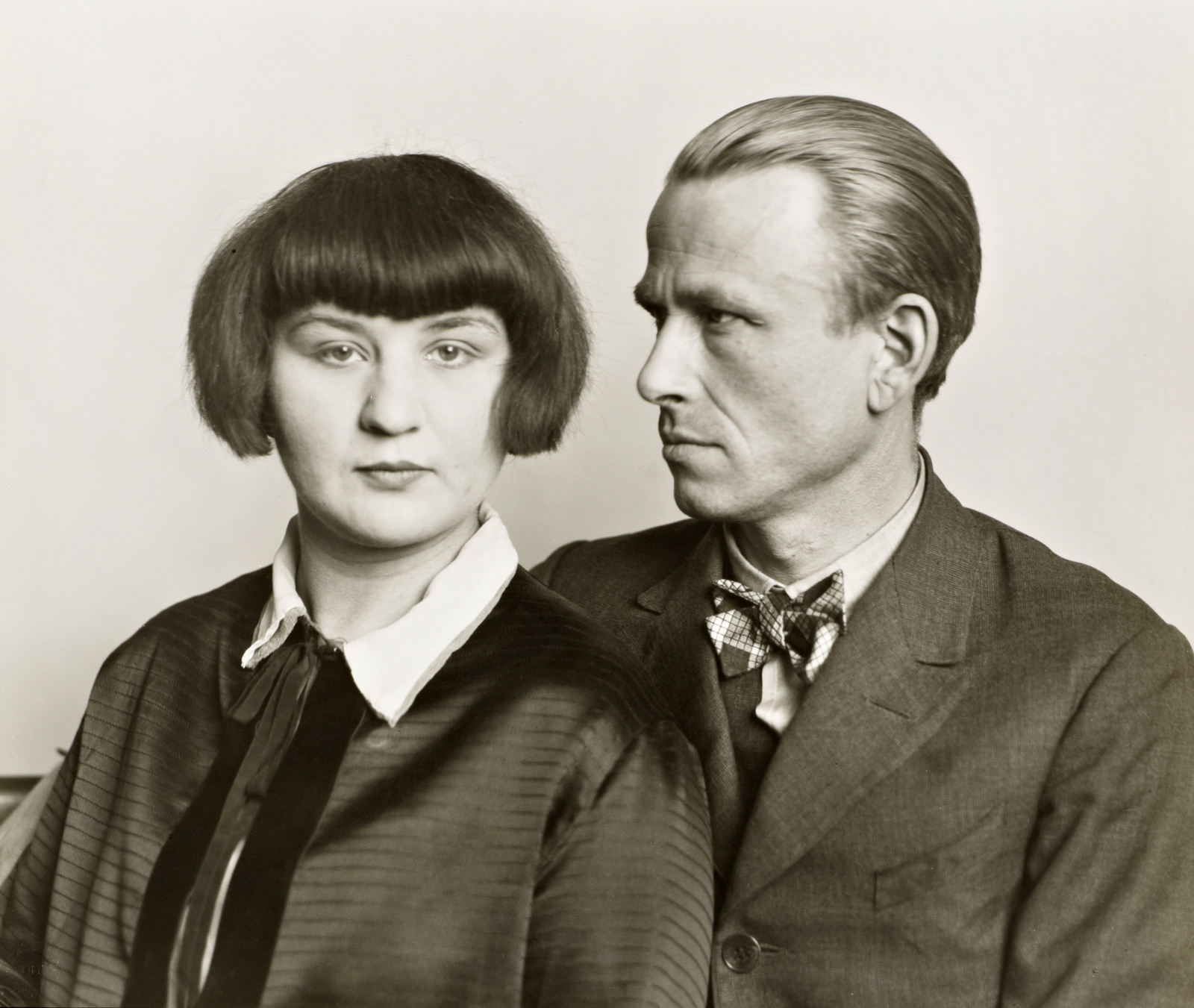


![August Sander (German, 1876-1964) 'Bohemians [Willi Bongard, Gottfried Brockmann]' c. 1922-1925, printed 1990](https://artblart.com/wp-content/uploads/2017/09/august-sander-bohemians-willi-bongard-gottfried-brockmann-c-1922e280935-web.jpg "August Sander (German, 1876-1964) 'Bohemians [Willi Bongard, Gottfried Brockmann]' c. 1922-1925, printed 1990")
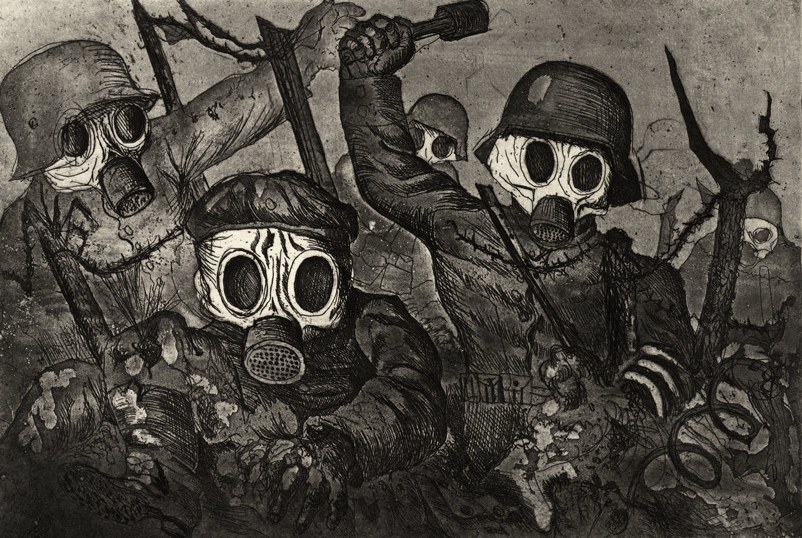




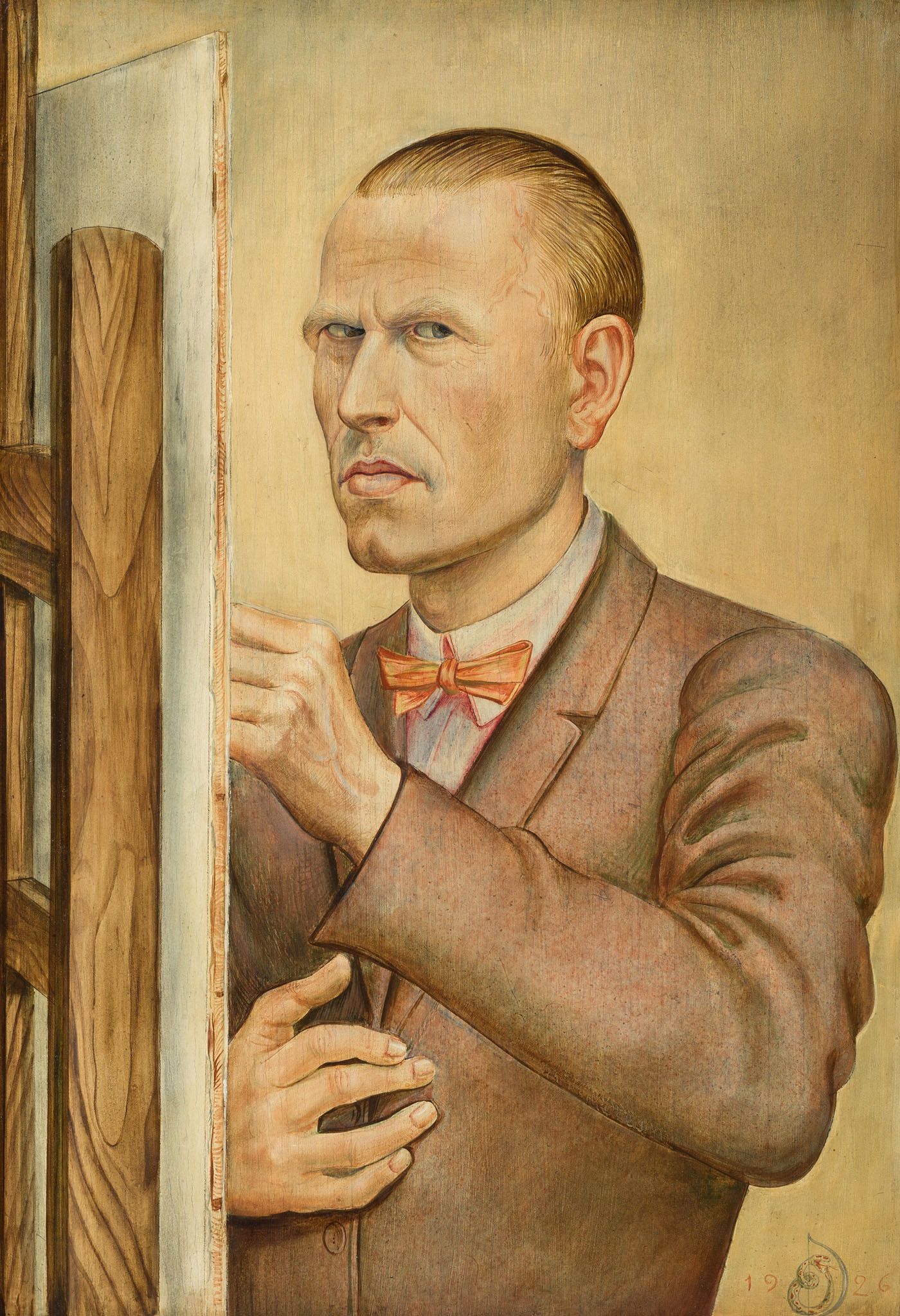
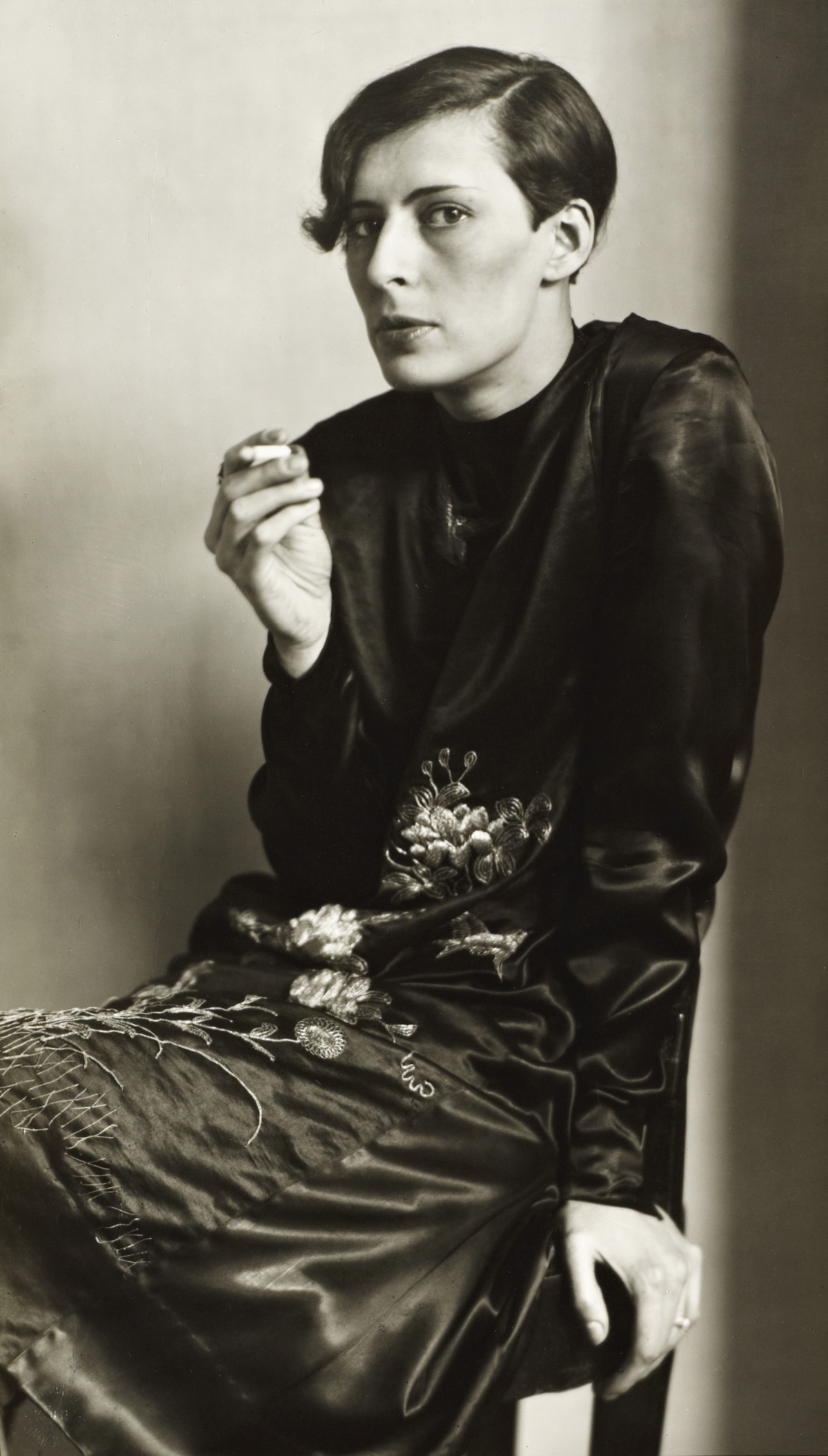


![August Sander (German, 1876-1964) 'Photographer [August Sander]' 1925, printed 1990](https://artblart.com/wp-content/uploads/2017/09/august_sander_august_sander_1925-web.jpg "August Sander (German, 1876-1964) 'Photographer [August Sander]' 1925, printed 1990")
![August Sander (German, 1876-1964) 'Stadtwald [Urban Forest]' c. 1938 from the exhibition 'People In A River Landscape: August Sander And The Photography Of The Present From The Lothar Schirmer Collection' at the Pinakothek der Moderne, Munich, April - August, 2014](https://artblart.com/wp-content/uploads/2014/08/sander-stadtwald-web.jpg "August Sander (German, 1876-1964) 'Stadtwald [Urban Forest]' c. 1938 from the exhibition 'People In A River Landscape: August Sander And The Photography Of The Present From The Lothar Schirmer Collection' at the Pinakothek der Moderne, Munich, April - August, 2014")


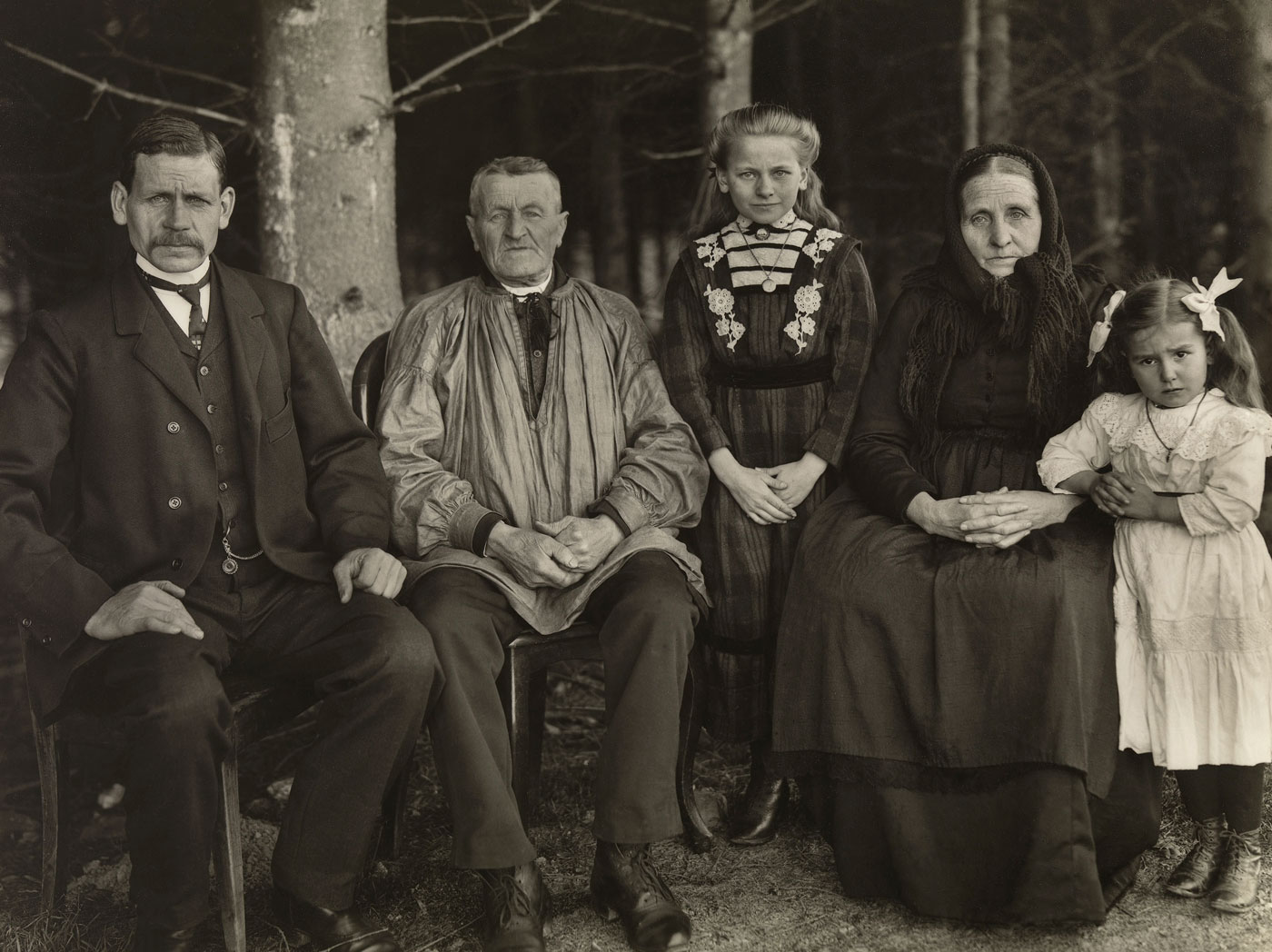
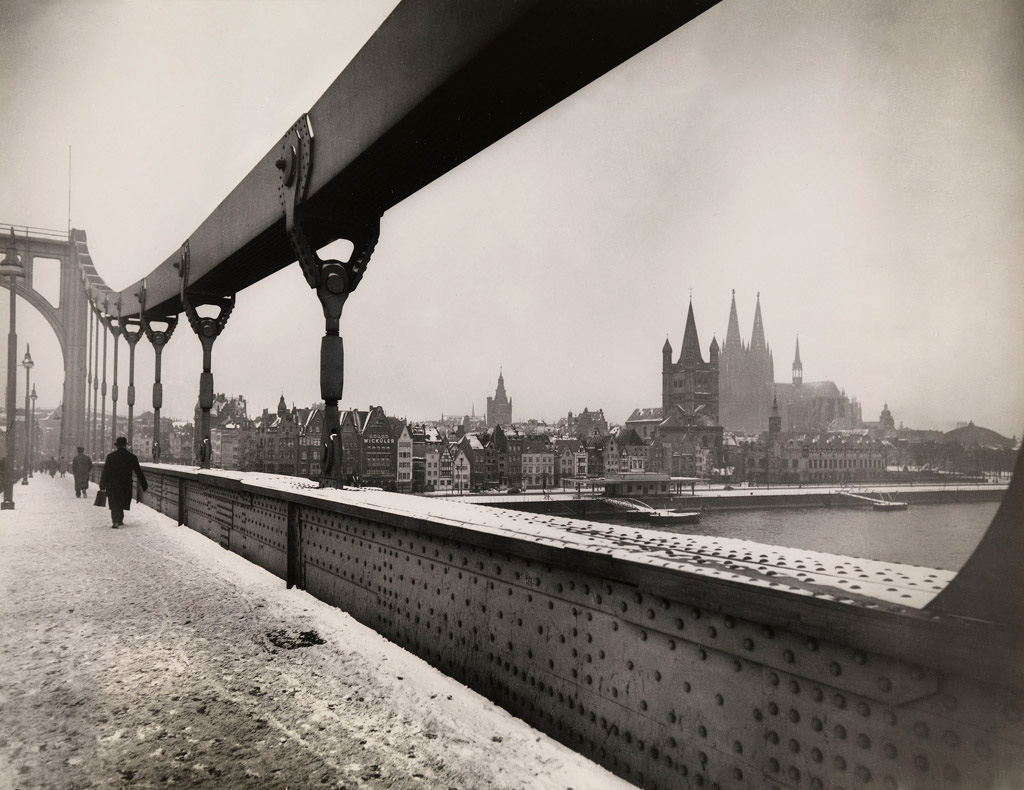
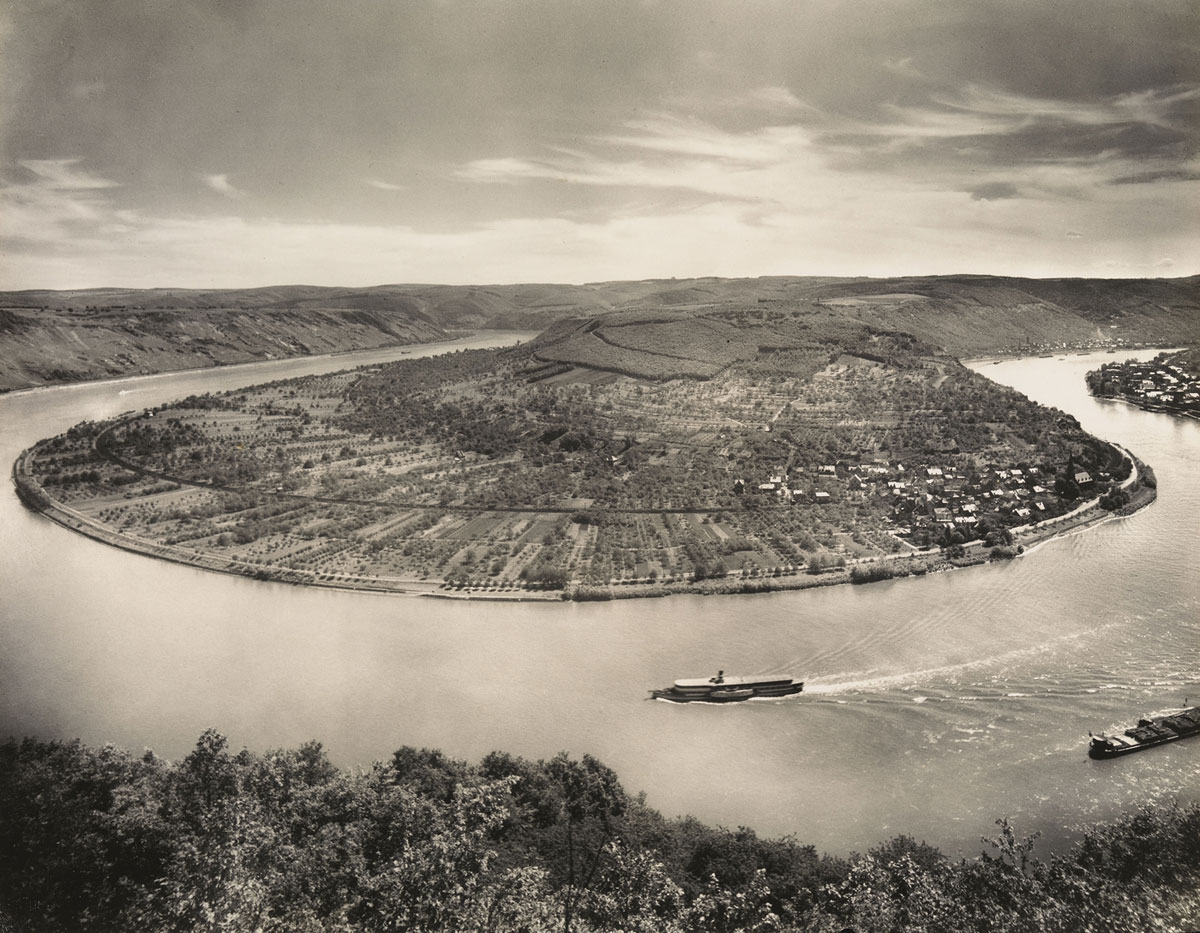

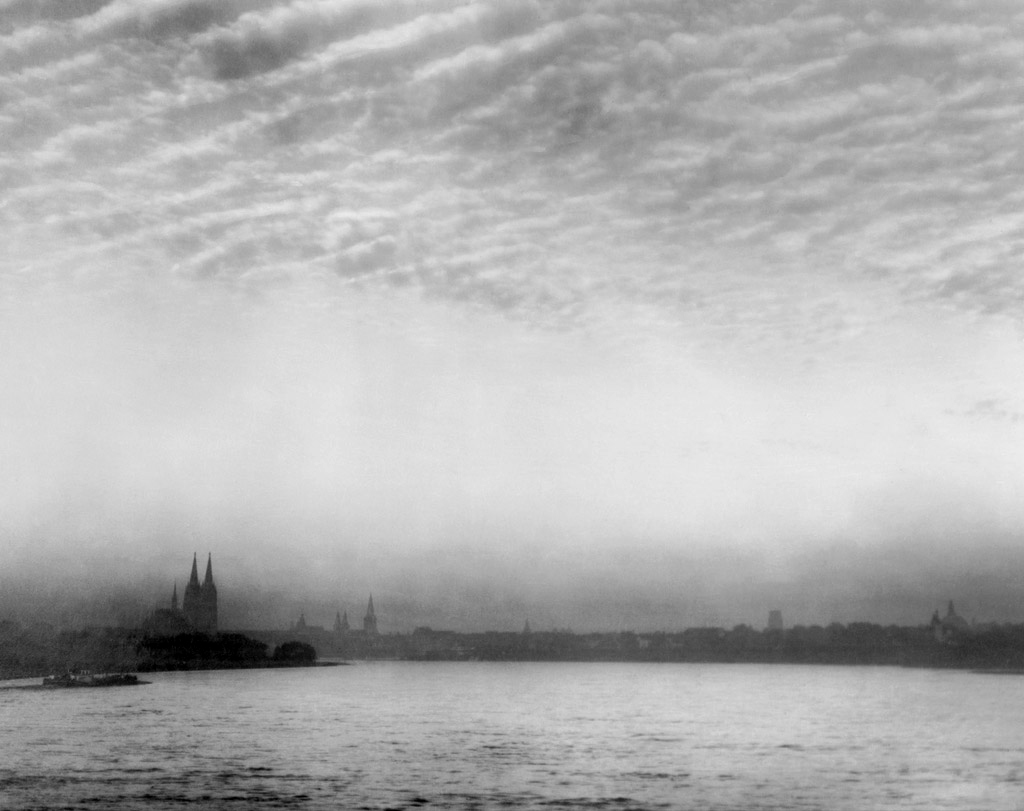
![August Sander (German, 1876-1964) 'Handlanger [Odd-job man]' 1928](https://artblart.com/wp-content/uploads/2014/08/sander-handlanger-web.jpg "August Sander (German, 1876-1964) 'Handlanger [Odd-job man]' 1928")

![August Sander (German, 1876-1964) 'The Architect [Hans Poelzig]' 1929](https://artblart.com/wp-content/uploads/2014/08/sander-der-architekt-web.jpg "August Sander (German, 1876-1964) 'The Architect [Hans Poelzig]' 1929")
![Thomas Ruff (German, b. 1958) 'Portrait (T. Ruff)' [Selfportrait] 1987](https://artblart.com/wp-content/uploads/2014/08/ruff-self-portrait-web.jpg "Thomas Ruff (German, b. 1958) 'Portrait (T. Ruff)' [Selfportrait] 1987")
![August Sander (German, 1876-1964) 'Der erdgebundene Mensch' [The Earthbound Human] 1910](https://artblart.com/wp-content/uploads/2014/08/sander-der-erdgebundene-mensch-web.jpg "August Sander (German, 1876-1964) 'Der erdgebundene Mensch' [The Earthbound Human] 1910")
![August Sander (German, 1876-1964) 'Bauernpaar – Zucht und Harmonie' [Peasant Couple – Breeding and Harmony] 1912](https://artblart.com/wp-content/uploads/2014/08/sander-bauernpaar-web.jpg "August Sander (German, 1876-1964) 'Bauernpaar – Zucht und Harmonie' [Peasant Couple – Breeding and Harmony] 1912")
![August Sander (German, 1876-1964) 'Painter [Heinrich Hoerle]' 1928](https://artblart.com/wp-content/uploads/2014/08/sander-maler-web.jpg "August Sander (German, 1876-1964) 'Painter [Heinrich Hoerle]' 1928")
![Wols (German, 1913-1951) 'Untitled [Still life - dining table]' 1937 from the exhibition 'Wols Photographer. The Guarded Look' at Martin-Gropius-Bau, Berlin, March - June, 2014](https://artblart.com/wp-content/uploads/2014/05/wols_09_esstisch-web.jpg "Wols (German, 1913-1951) 'Untitled [Still life - dining table]' 1937 from the exhibition 'Wols Photographer. The Guarded Look' at Martin-Gropius-Bau, Berlin, March - June, 2014")

![Wols (German, 1913-1951) 'Untitled [Pavilion de l'Elegance - Creating a home with Alix (Germaine Krebs)]' 1937](https://artblart.com/wp-content/uploads/2014/05/wols_05_pavillon_de_l_elegance_2-web.jpg "Wols (German, 1913-1951) 'Untitled [Pavilion de l'Elegance - Creating a home with Alix (Germaine Krebs)]' 1937")
![Wols (German, 1913-1951) 'Untitled [Swiss Pavilion - Wire Figure]' 1937](https://artblart.com/wp-content/uploads/2014/05/wols_04_pavillon_drahtfigurine-web.jpg "Wols (German, 1913-1951) 'Untitled [Swiss Pavilion - Wire Figure]' 1937")


![Wols (German, 1913-1951) 'Untitled [Paris - Flea Market]' Autumn 1932 - October 1933 / January 1935 to 1936](https://artblart.com/wp-content/uploads/2014/05/wols_08_flohmarkt-web.jpg "Wols (German, 1913-1951) 'Untitled [Paris - Flea Market]' Autumn 1932 - October 1933 / January 1935 to 1936")
![Wols (German, 1913-1951) 'Untitled [Paris - Palisade]' Fall 1932 - October 1933 / January 1935 - August 1939](https://artblart.com/wp-content/uploads/2014/05/wols_07_paris_palisade.jpg "Wols (German, 1913-1951) 'Untitled [Paris - Palisade]' Fall 1932 - October 1933 / January 1935 - August 1939")
![Wols (German, 1913-1951) 'Untitled [Paris - Eiffel Tower]' 1937](https://artblart.com/wp-content/uploads/2014/05/wols_03_eiffelturm-web.jpg "Wols (German, 1913-1951) 'Untitled [Paris - Eiffel Tower]' 1937")
![Wols (German, 1913-1951) 'Untitled [Still Life - Grapefruit]' 1938 - August 1939](https://artblart.com/wp-content/uploads/2014/05/wols_06_pampelmuse-web.jpg "Wols (German, 1913-1951) 'Untitled [Still Life - Grapefruit]' 1938 - August 1939")

 Art Blart _ art and cultural memory archive
You must be logged in to post a comment.