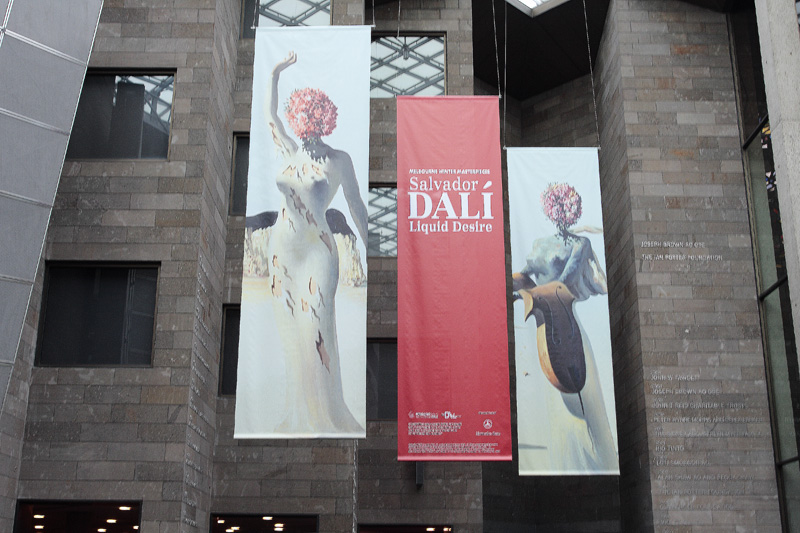
Installation view of the interior forecourt of the National Gallery of Victoria showing banners for the exhibition Salvador Dalí: Liquid Desire Photo: Marcus Bunyan
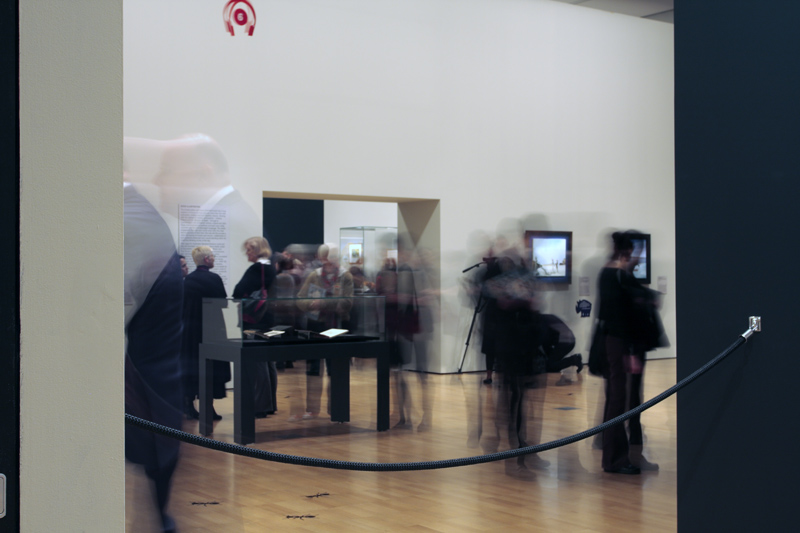
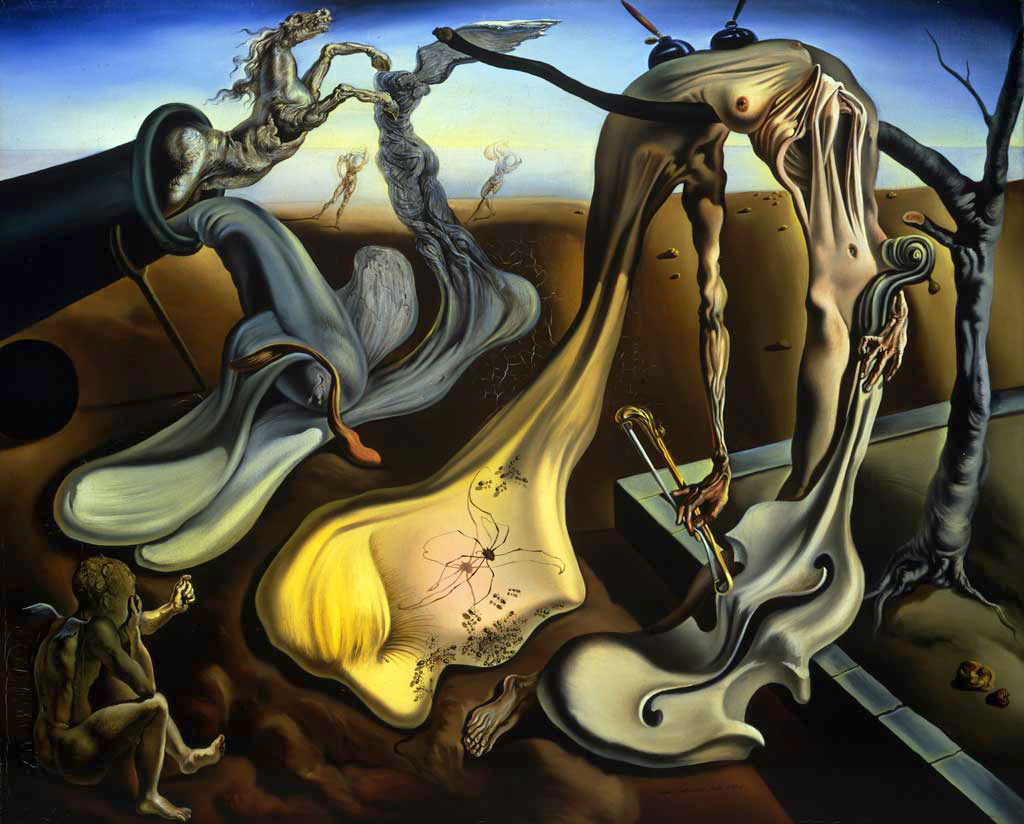
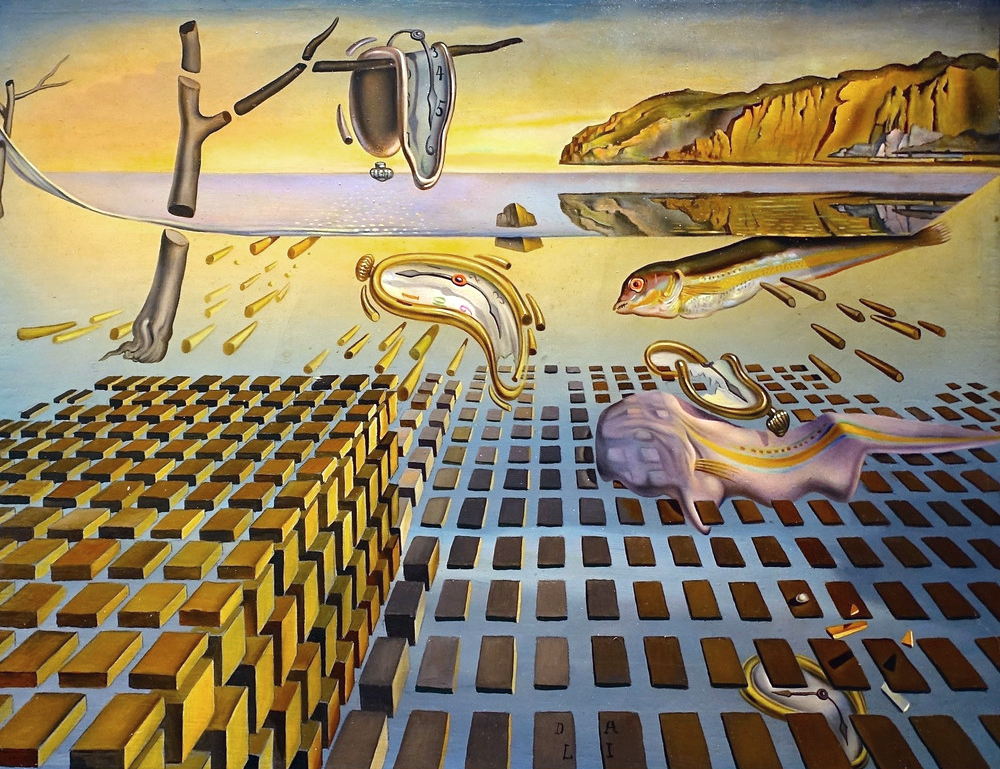
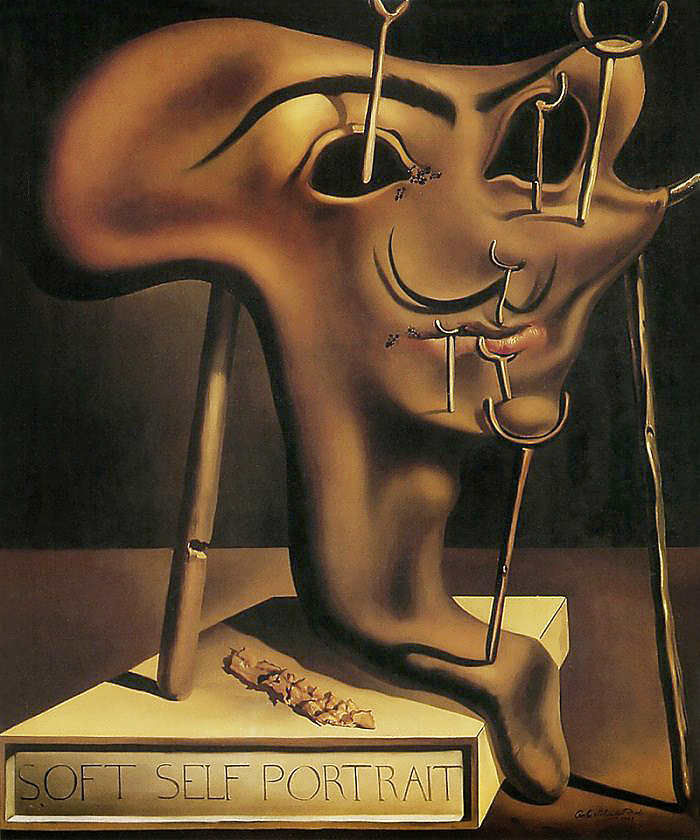
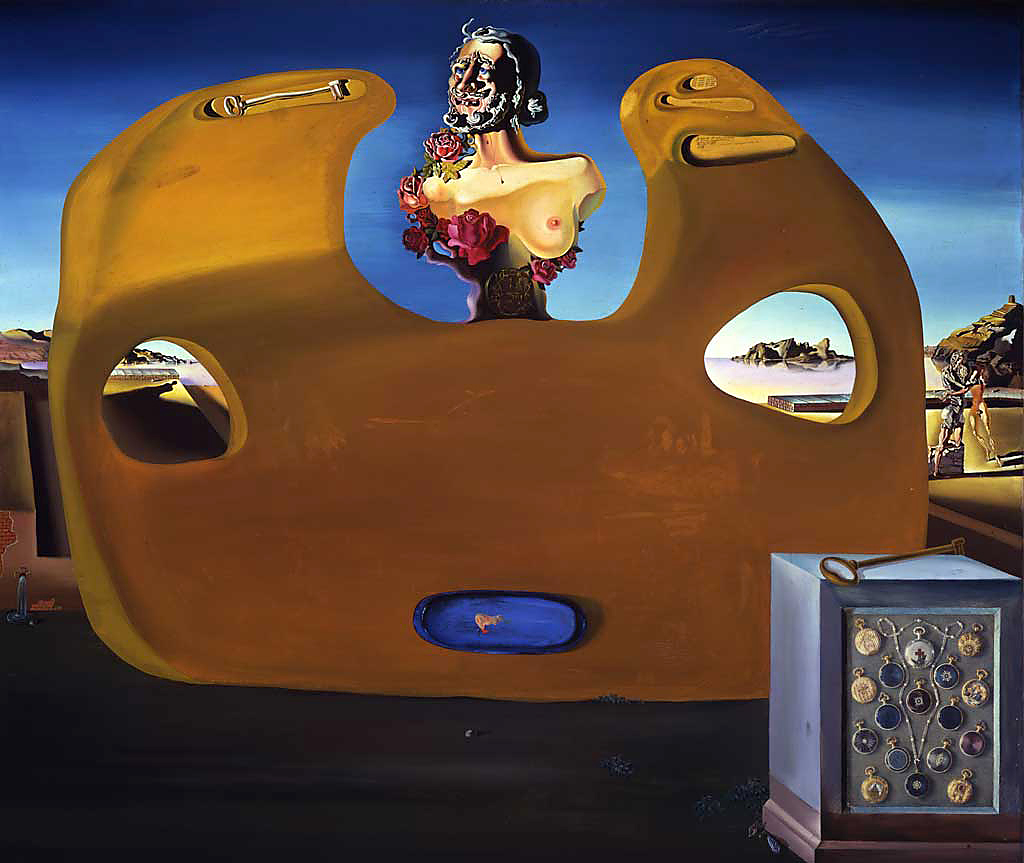
Installation photographs from the latest Winter Masterpieces blockbuster Salvador Dalí: Liquid Desire from the media preview on the day the exhibition opened at NGV International, Melbourne. Thank you to Jemma Altmeier, Media and Public Affairs Administrator at the NGV for the invitation. Photographs were taken using a digital camera, tripod and available light.
Fantastic to see my friend and curator of the exhibition, Dr Ted Gott, at the opening. Congratulations on a wonderful show!
Photographs proceed from the beginning to the end of the exhibition in chronological order.
Many thankx to the National Gallery of Victoria for allowing me to publish the photographs in the posting. Please click on the photographs for a larger version of the image.
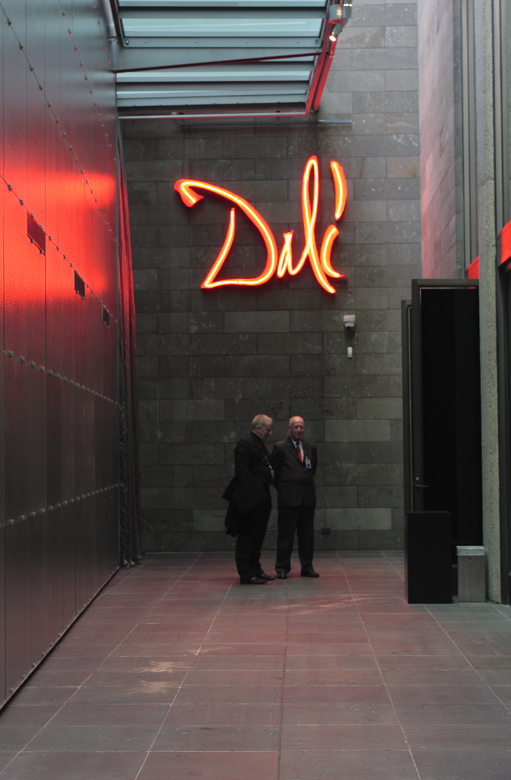
Entrance to the Salvador Dalí: Liquid Desire Winter Masterpieces exhibition at the National Gallery of Victoria, Melbourne Photo: Marcus Bunyan
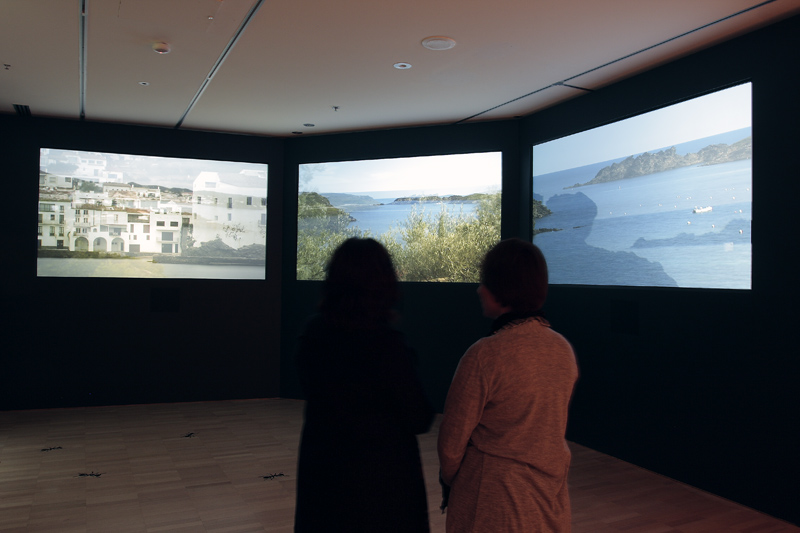
3 panel video installation of the Catalan countryside where Salvador Dali lived. 13 minutes duration from the exhibition Salvador Dalí: Liquid Desire Winter Masterpieces at the National Gallery of Victoria, Melbourne Photo: Marcus Bunyan
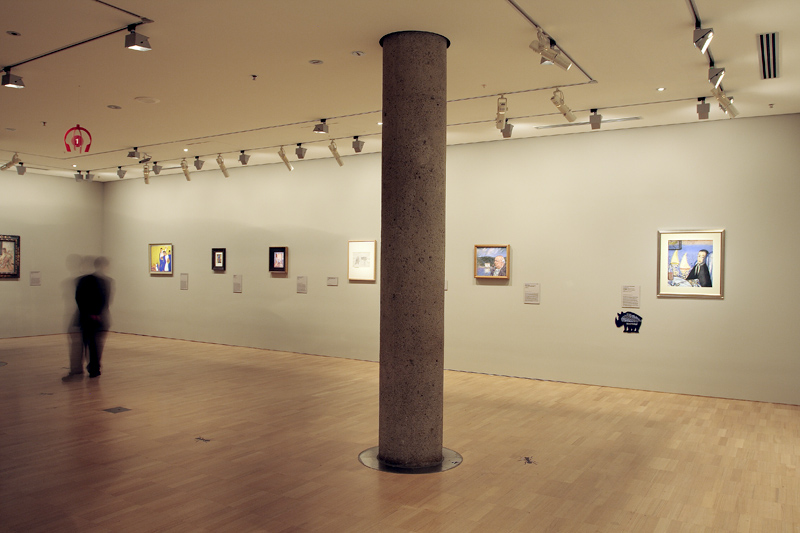
Early work from the Salvador Dalí: Liquid Desire Winter Masterpieces exhibition at the National Gallery of Victoria, Melbourne Photo: Marcus Bunyan
To the left View of the Cadaques from the Creus Tower 1923; to the right Table in front of the Sea. Homage to Eric Satie 1926 from the Salvador Dalí: Liquid Desire Winter Masterpieces exhibition at the National Gallery of Victoria, Melbourne Photos: Marcus Bunyan
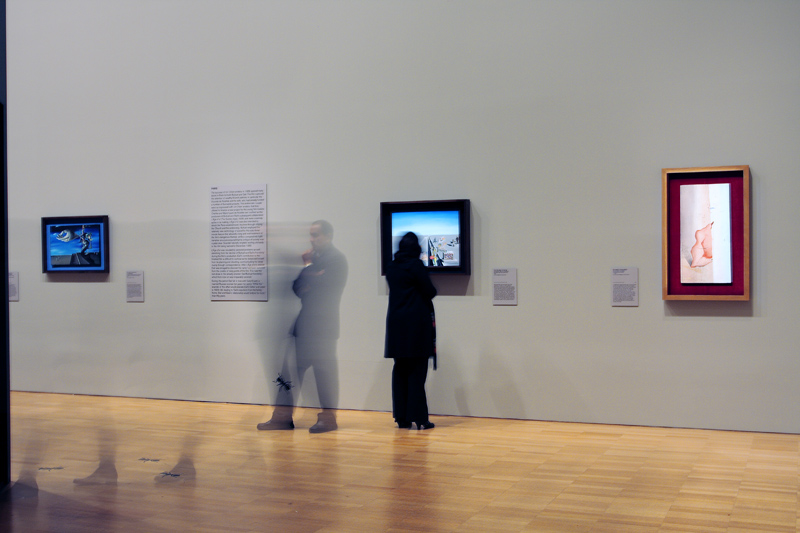
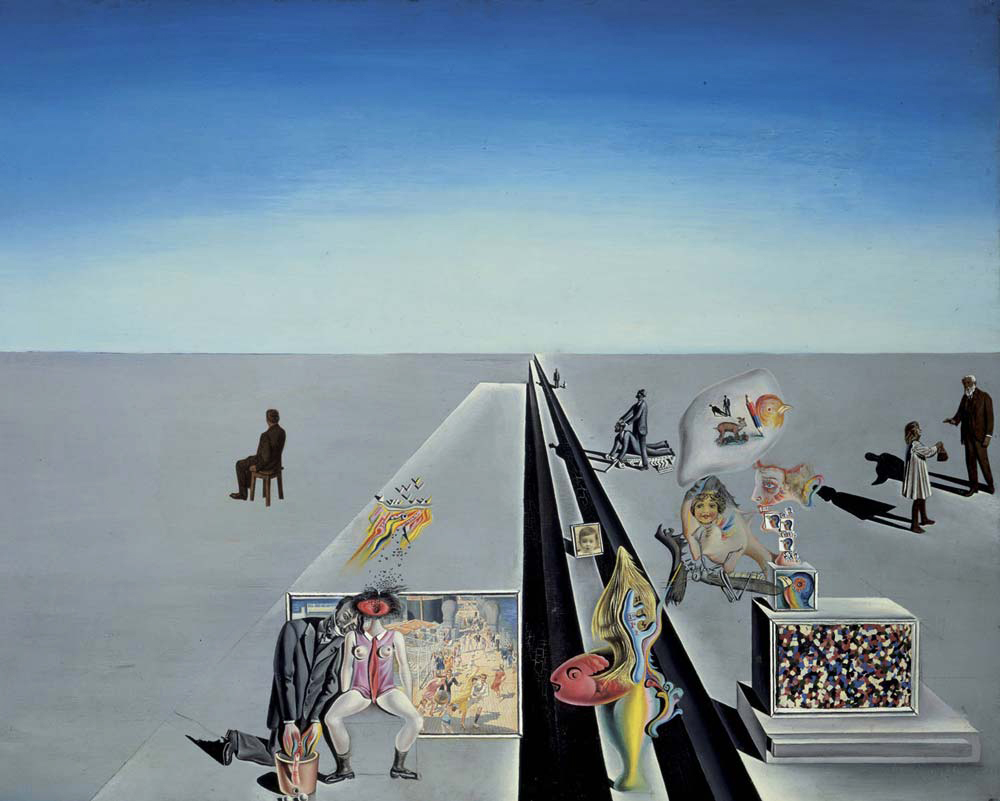
In the centre The First Days of Spring 1929; to the right Surrealist composition 1928 from the Salvador Dalí: Liquid Desire Winter Masterpieces exhibition at the National Gallery of Victoria, Melbourne Photo: Marcus Bunyan
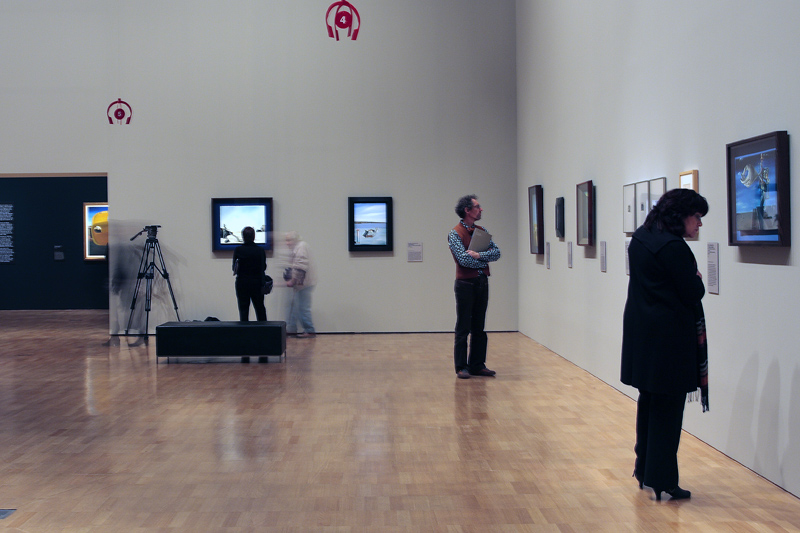
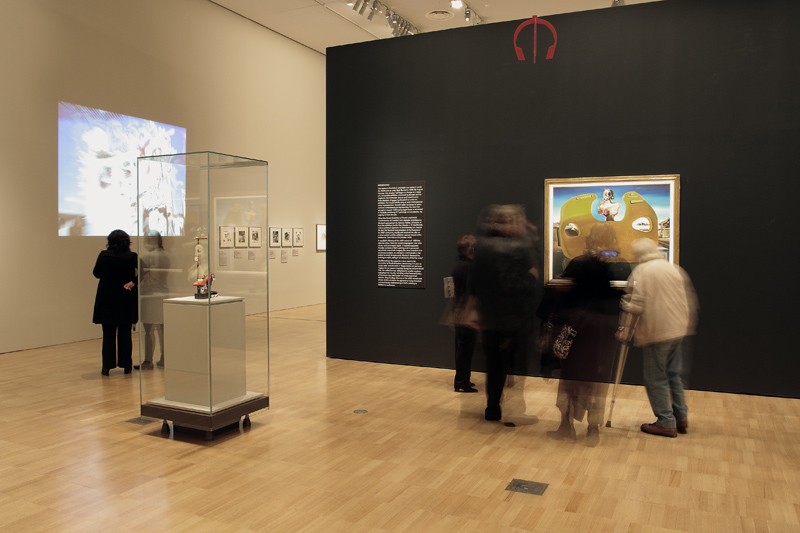
Installation view with The Age art critic Associate Professor Robert Nelson at centre right and The hand. The remorse of conscience 1930 at far right, from the Salvador Dalí: Liquid Desire Winter Masterpieces exhibition at the National Gallery of Victoria, Melbourne Photo: Marcus Bunyan
Installation view with Memory of the child-woman 1932 at right from the Salvador Dalí: Liquid Desire Winter Masterpieces exhibition at the National Gallery of Victoria, Melbourne Photo: Marcus Bunyan
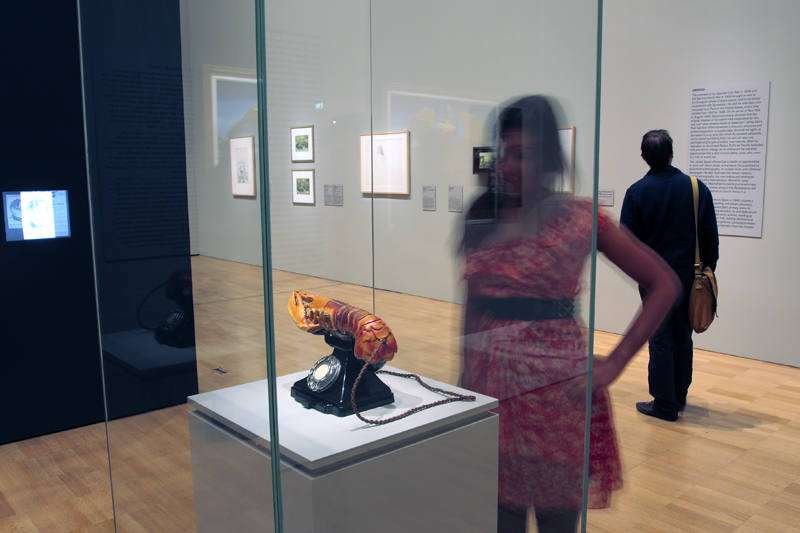
Salvador Dalí (Spanish 1904-1989, worked in United States 1940-1948) Lobster Telephone (installation view) 1936 Photo: Marcus Bunyan
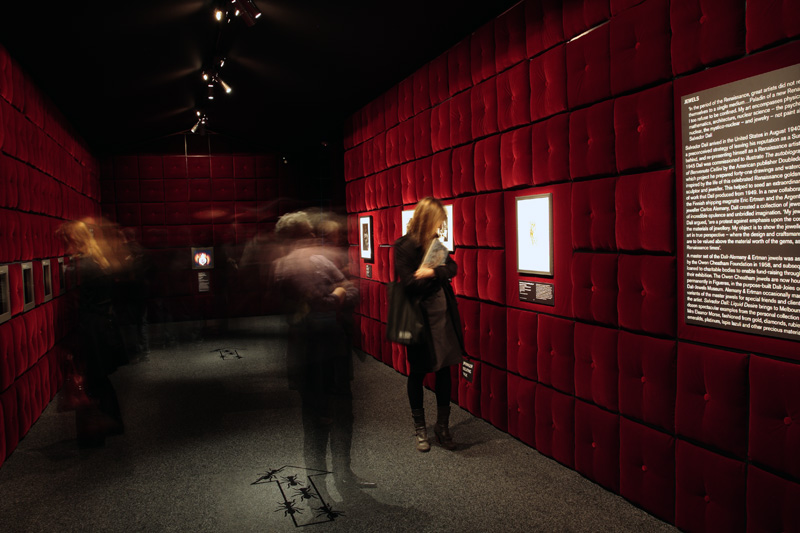
Jewellery gallery at the Salvador Dalí: Liquid Desire Winter Masterpieces exhibition at the National Gallery of Victoria, Melbourne Photos: Marcus Bunyan
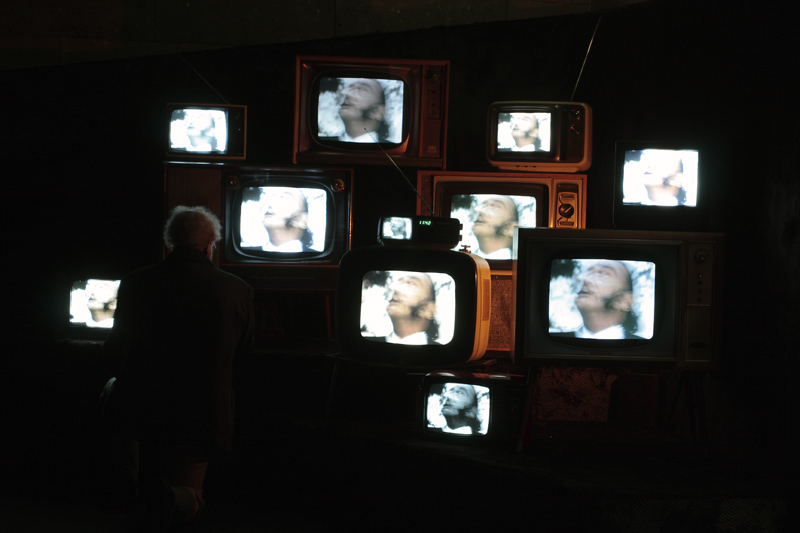
Televisions with film installation from the Salvador Dalí: Liquid Desire Winter Masterpieces exhibition at the National Gallery of Victoria, Melbourne Photo: Marcus Bunyan
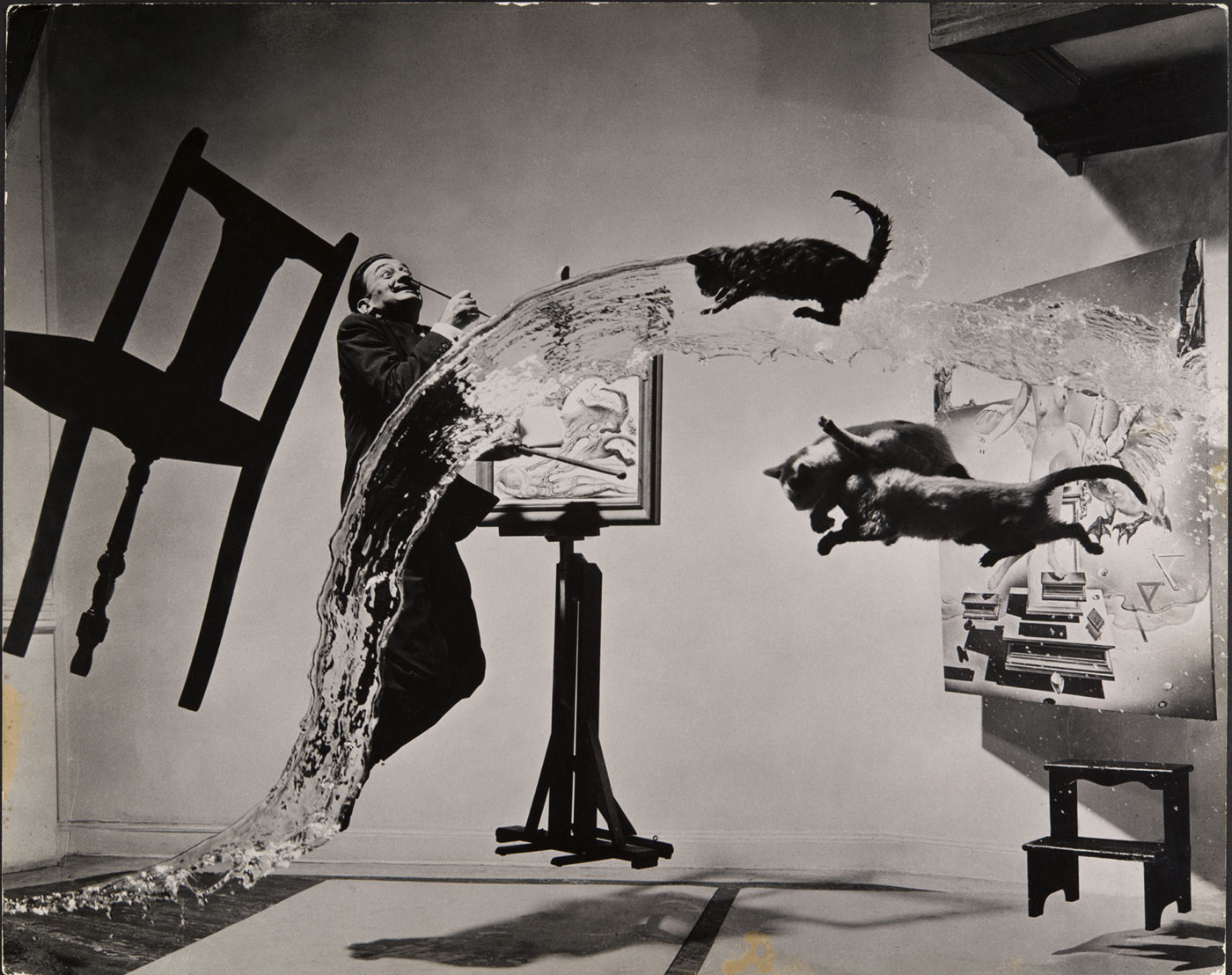
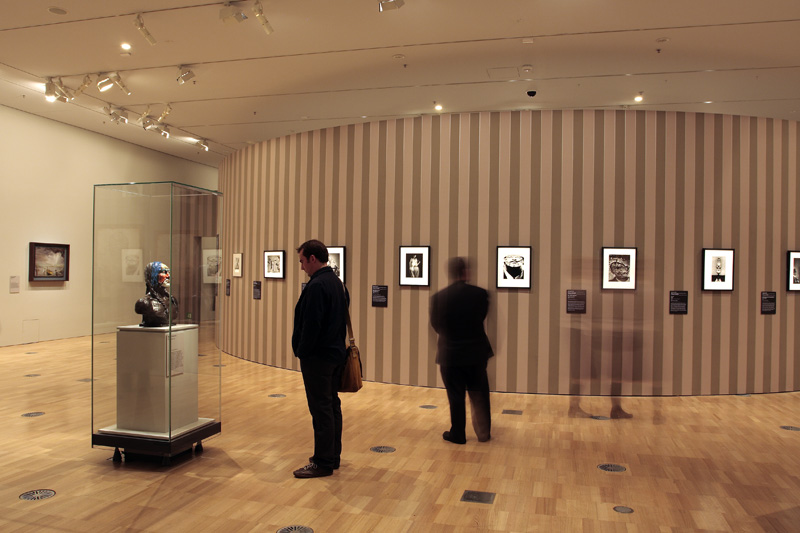
Installation of black and white photography from the exhibition Salvador Dalí: Liquid Desire Winter Masterpieces exhibition at the National Gallery of Victoria, Melbourne with Dr Ted Gott, curator of the exhibition, with back to camera at centre Photo: Marcus Bunyan
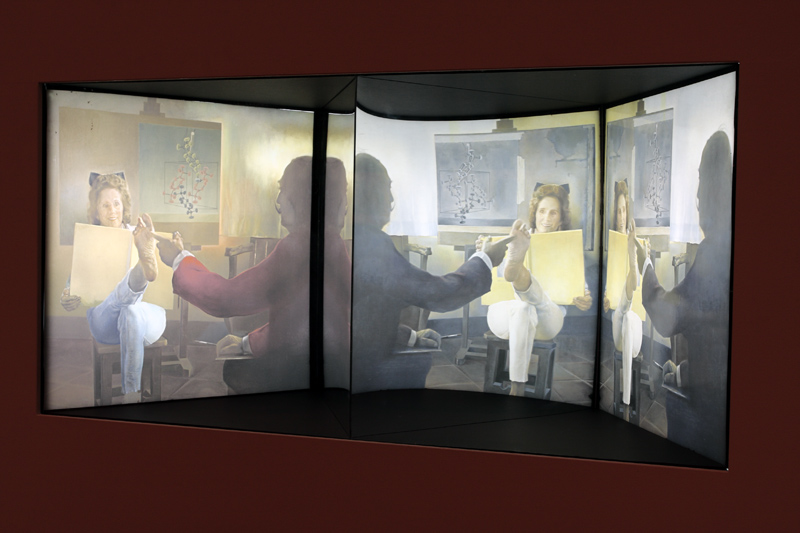
Reproduction of Gala foot. Stereoscopic paintings 1975-1976 in an installation using mirrors that would have been originally used to obtain the stereoscopic effect Photo: Marcus Bunyan
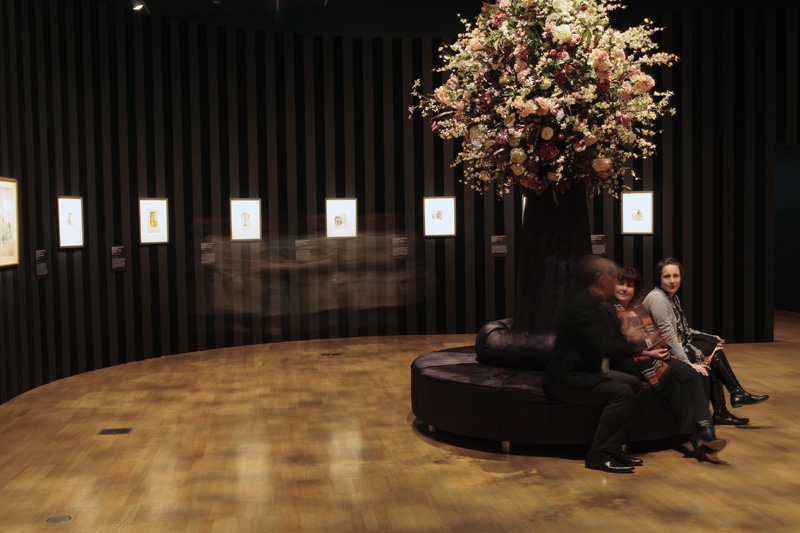
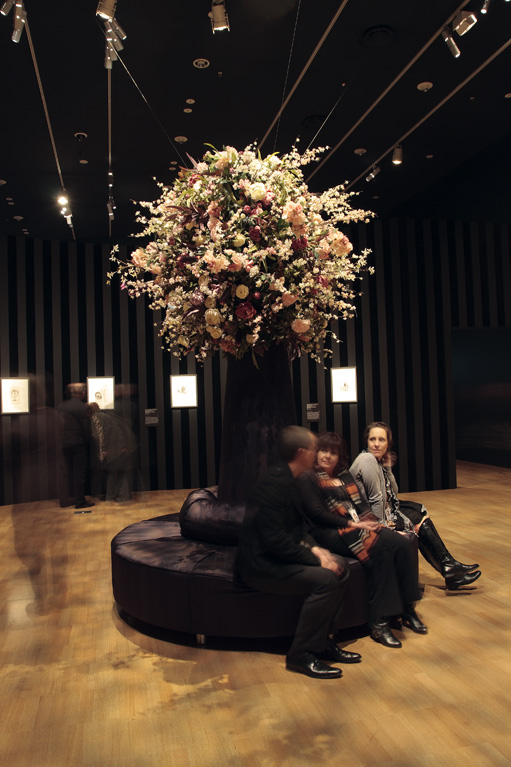
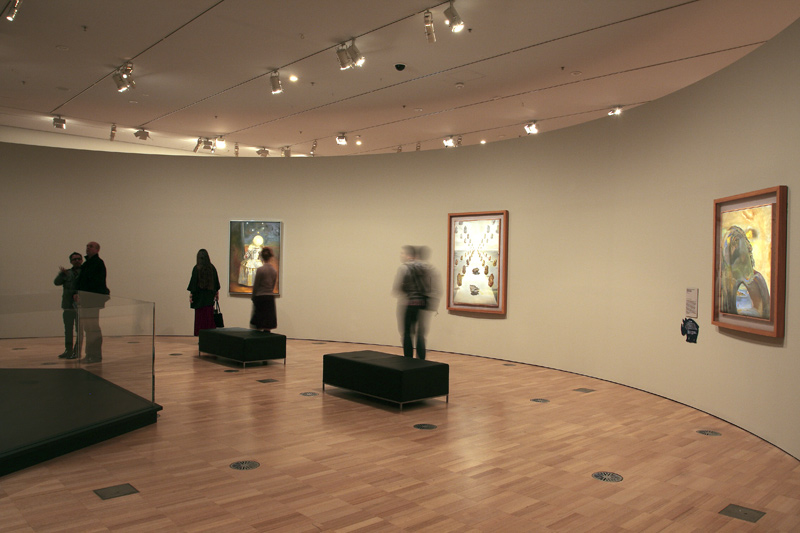
Final exhibition space from the Salvador Dalí: Liquid Desire Winter Masterpieces exhibition at the National Gallery of Victoria, Melbourne Photo: Marcus Bunyan
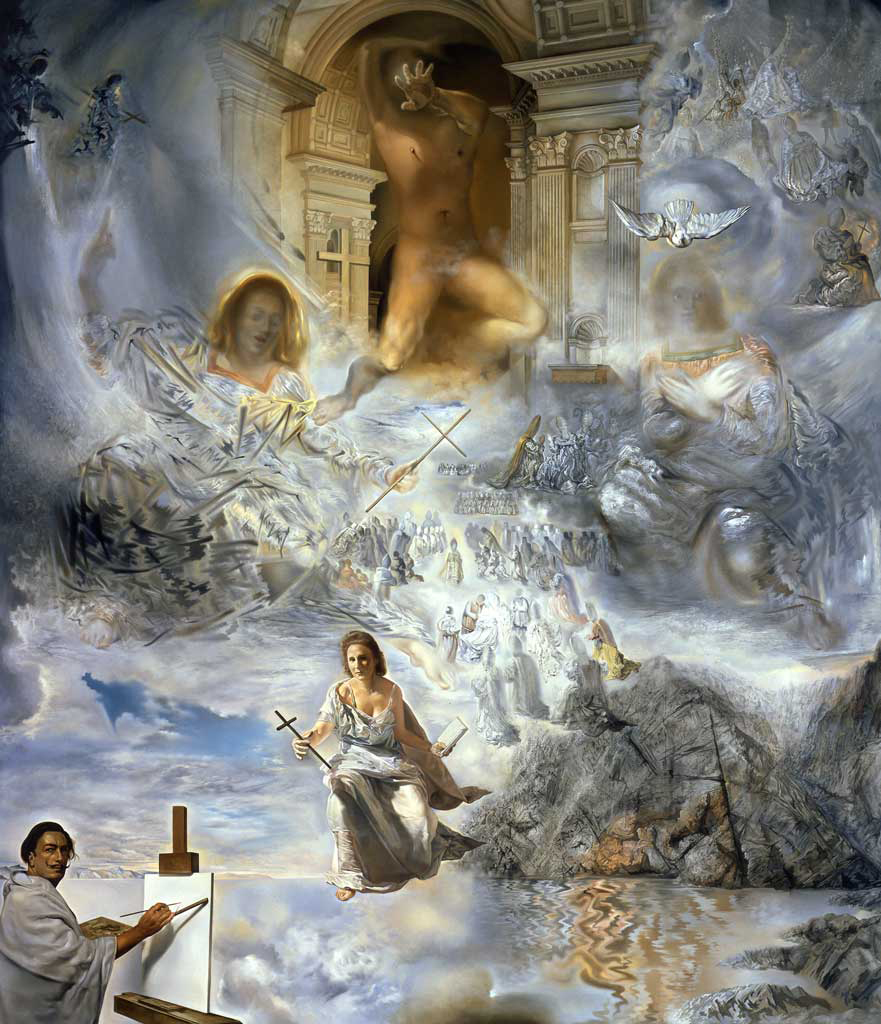
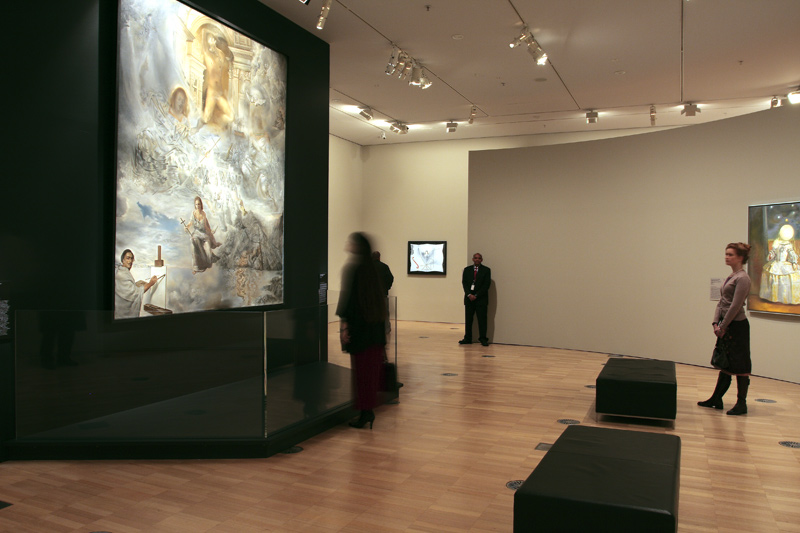
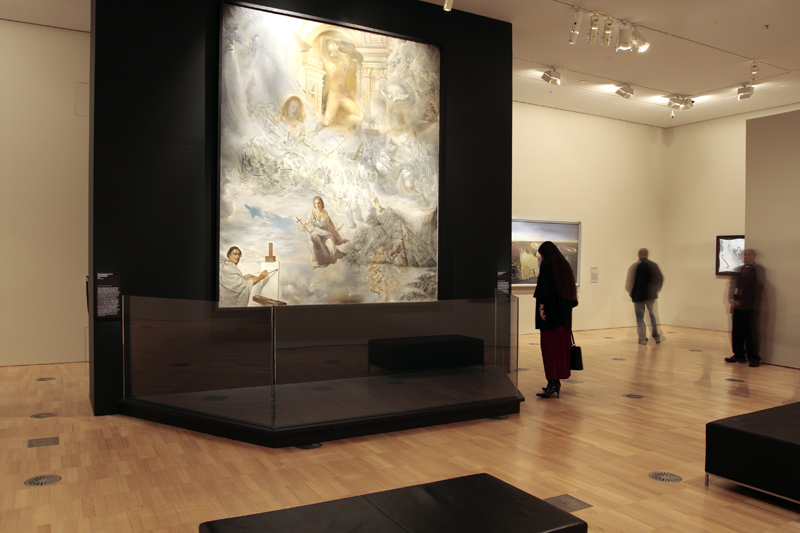
Final gallery space from the Salvador Dalí: Liquid Desire Winter Masterpieces exhibition at the National Gallery of Victoria, Melbourne featuring The Ecumenical Council 1960 Photos: Marcus Bunyan
National Gallery of Victoria (International) 180 St Kilda Road, Melbourne
Opening hours: Salvador Dalí: Liquid Desire is open 7 days a week and until 9pm every Wednesday from 17 June
Tickets Adult: $23 Concession: $18 Child: $11 (ages 5-15) Family (2 adults + 3 children): $60 NGV Member Adult: $16 NGV Member Family: $40
Roy de Maistre (Australian, 1894-1968) Colour Composition derived from three bars of music in the Key of Green 1935 Oil and pencil on composition board Private Collection
Despite some interesting highlight pieces this is a patchy, thin, incoherent exhibition assembled by the Powerhouse Museum, Sydney now showing at Heide Museum of Modern Art, Melbourne. Featuring a hotchpotch of work ranging across fields such as drawing, architecture, photography, painting, film, graphic design, craft, advertising, Australiana and aboriginal works the exhibition attempts to tell the untold story of Modernism in Australia to little effect. Within the exhibition there is no attempt to define exactly what ‘Modernism’ is and therefore an investigation into Modernism in Australia is all the more confusing for the visitor as there seems to be no stable basis on which to build that investigation. Perhaps reading the catalogue would give a greater overview of the development of Modernism in Australia but for the average visitor to the exhibition there seems to be no holistic rationale for the inclusion of elements within the exhibition which, much like Modernism itself, seems eclectically gathered from all walks of life with little regard for narrative structure.
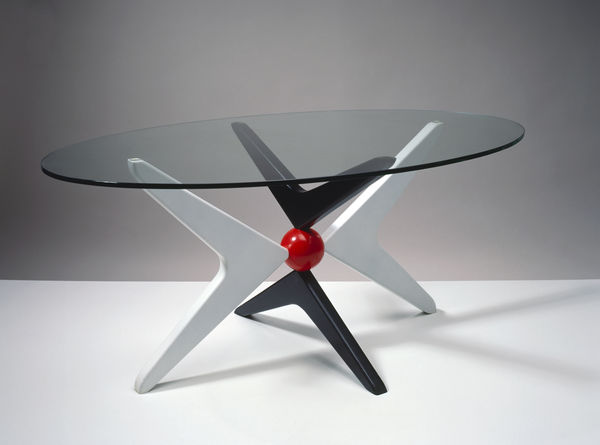
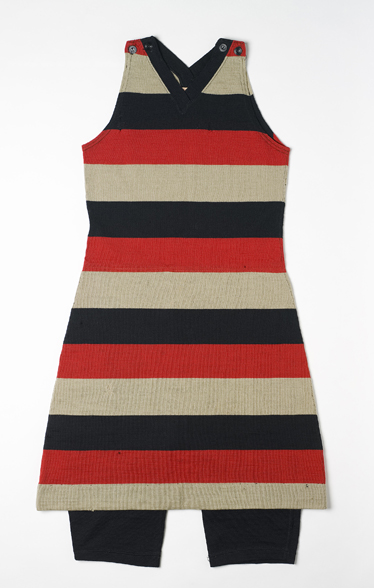
With work spanning five decades from 1917-1967 we are presented with, variously, Robert Klippel’s kitsch Boomerang table from 1955, Robin Boyd’s ‘House of Tomorrow’ from 1949, Wolfgang Sievers ‘new objective’ photographs, Berlei’s scientific system for calculating beauty in woman in use till the 1960s, swimsuits from the 1920s-1940s, Featherston chairs from the Australian pavilion at the 1967 Expo, a recreation of Australian architect Harry Seidler’s office (the most interesting part of this being the books he had in his office library: Frank Lloyd Wright, Mies van de Rohe and Concerning Town Planning by Le Corbusier) and the wind tunnel test model of the Sydney Opera House in wood from 1960. Etcetera, etcetera, etcetera …
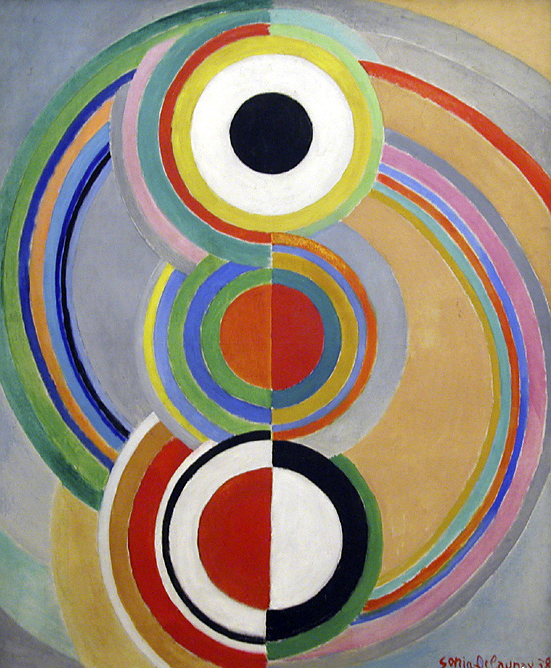
Highlight pieces include the above mentioned test model of the Sydney Opera House which is stunning in its scale and woodenness, in it’s simplicity of shape and form. Other highlight pieces are the colour music compositions of Roy de Maistre which were the tour de force of the show for me, true revelations in their rhythmic synchronic Moebius-like construction with layered planes of colour swirling in purples, greens and yellows. The large vintage photographic print of Sunbaker (1934) by Max Dupain was also a revelation with it’s earthy brown tones, the blending of the atmospheric out of focus foreground with the clouds behind, the architectural nature of the outline of the body almost like the outline of Uluru, the darkness of the head with the sensuality of the head and shoulders framed against the largeness of the hand resting on the sand. Lastly the two paintings and one rug by French artist Sonia Delaunay are a knockout. It says something about an exhibition when the best work in the show are two paintings by a French artist seemingly plucked at random to show external influences on Australian artists and designers.
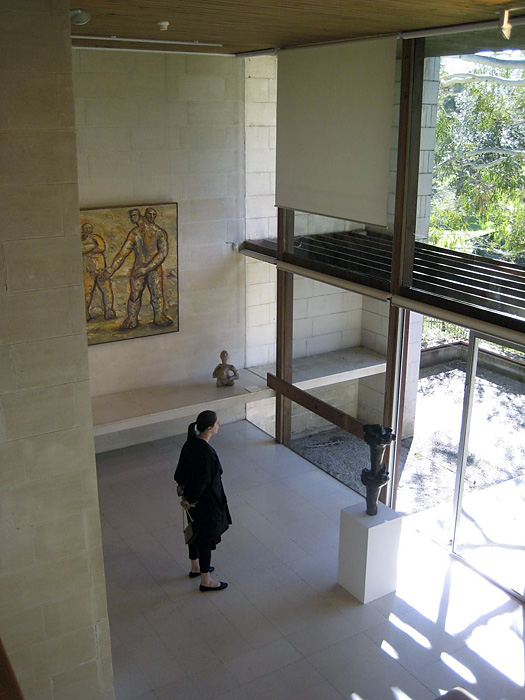
While the exhibition does attempt to portray the breadth of the development of Modernism in Australia ultimately it falls well short in this endeavour. The most striking example of this shortcoming is the true star of the exhibition – the building that is Heide II itself. Commissioned by John and Sunday Reed and designed by the Victorian architect David McGlashan of the architectural firm McGlashan and Eversit in 1963 the building epitomises everything that is good about architectural Modernism and it’s form overshadows the exhibition itself. In this building we have beautiful spaces and volumes, an amazing staircase down into the lower area, suspended decking overlooking gardens, the blending of inside and outside areas, large expanses of glass to view the landscape, nooks and studies for privacy and the simplicity and eloquence of form that is Modernist design. With money one can indulge in the best of elitist Modernism. With position, position, position one can side steep the alienation of the city and the spread of surburbia where the dream of Australians owning a home of their own still continues in the vast, tasteless expanses of McMansion estates.
Robert Nelson in his review of this exhibition sees the car as creating the suburbs and Modernism as the emptying of the city after 6pm, the lessening of community and the devaluing of space he insists that there is little difference between a Californian bungalow in the suburbs and a utopian geometric neo-Corbusian box by Harry Seidler because they were equally shackled to motor transport.1 This is to miss the point.
Although Modernism in its basic form influenced most walks of life in Australia from swimsuit design to milk bars, from cinema to naturism, from bodies to advertising the most effective expressions of Modernism are architectural (as evidenced by Heide II) and were only open to those with money, power and position. Although Le Corbusier’s concept of public housing was a space ‘for the people’ the most interesting of his houses were the private commissions for wealthy clients. And so it proves here. One can imagine the parties on the deck at Heide II in the 1960s with men in their tuxedo and bow ties and woman in their gowns, or the relaxation of the Reed’s sitting in front of their fire in the submerged lounge. For the ordinary working class person Modernism brought a sense of alienation from the aspirational things one cannot buy in the world, an alienation that continues to this day; for the privileged few Modernism offered the exclusivity of elitism (or is it the elitism of exclusivity!) and an aspirational alienation of a different kind – that of the separation from the masses.
Go to Heide for the glorious gardens, the wonders of Heide II but don’t go to this exhibition expecting grand insights into the basis of Australian Modernism for that story, as Robert Nelson rightly notes, remains as yet untold.
Dr Marcus Bunyan
Many thankx to Heide Museum of Modern Art for allowing me to publish the art work in the posting. Please click on the photographs for a larger version of the image.
An excellent review of the exhibition by Jill Julius Matthews, “Modern times: The untold story of modernism in Australia,” (reCollections Volume 4 number 1) can be found on the Journal of the National Museum of Australia website [Online] Cited 20/02/2019
1/ “Emanating from Sydney’s Powerhouse Museum, Modern Times“explores how modernism transformed Australian culture from 1917 to 1967.” But something is missing. The overwhelming modern development in these 50 years was the proliferation of automotive transport, which redefined the layout and function of Australian cities.The cars created the suburbs; and as the individual bungalow drew out the vast dormitories of Sydney and Melbourne, the city centre was spiritually drained, dedicated to bureaucratic and commercial premises.The story at Heide emphasises the gradual triumph of the tall buildings of the CBD. It doesn’t really reflect how these abstract monuments didn’t contain a soul after 6pm.Although the project makes such a big deal of being interdisciplinary, the social history doesn’t have a robust geographical basis. And because of this, the exhibition and book fail to handle the new alienation that modernism brings: the evacuation of the city and the insularity of suburban people in bungalows with little street life and roads increasingly deemed unsafe for children.
What does it really matter if a house looks like a Californian bungalow or a utopian geometric neo-Corbusian box by Harry Seidler? In social terms, they’re structurally the same, equally retracting from a sense of community and equally shackled to motor transport. In this sense, the styles are immaterial, except that one of them gives you a feeling of intimacy while the other has a bit more light and is easily wiped with a sponge.
At the end of the chosen period, the folly of the dominant suburban pattern came to be understood in its dire ecological consequences. Alas, it was too late. The modernist devaluation of space had already occurred, and our whole society had been reorganised around petrol.”
Robert Nelson. The Age. Wednesday 6th May, 2009
Roy de Maistre (Australian, 1894-1968) Arrested Movement from a Trio 1934 Oil and pencil on composition board 72.3 × 98.8cm National Gallery of Victoria, Melbourne
In late 1918, Roy de Maistre collaborated with fellow artist Roland Wakelin in exploring the relationship between art and music. Their experiments produced Australia’s first abstract paintings, characterised by high-key colour, large areas of flat paint and simplified forms. The works received critical acclaim, but modernist developments were largely derided by the conservative establishment.
This painting exemplifies de Maistre’s theory of colour harmonisation based on analogies between colours of the spectrum and notes of the musical scale. It is also aligned with de Maistre’s search for spiritual meaning through abstraction, akin to other artists such as Kandinsky who were interested in the ideas of the theosophy and anthroposophy movements, spiritualism and the occult.
Text from the Art Gallery of New South Wales website
Sonia Delaunay (Ukraine, b. 1885 moved Paris 1905-1979) Rhythm 1938 Oil on canvas
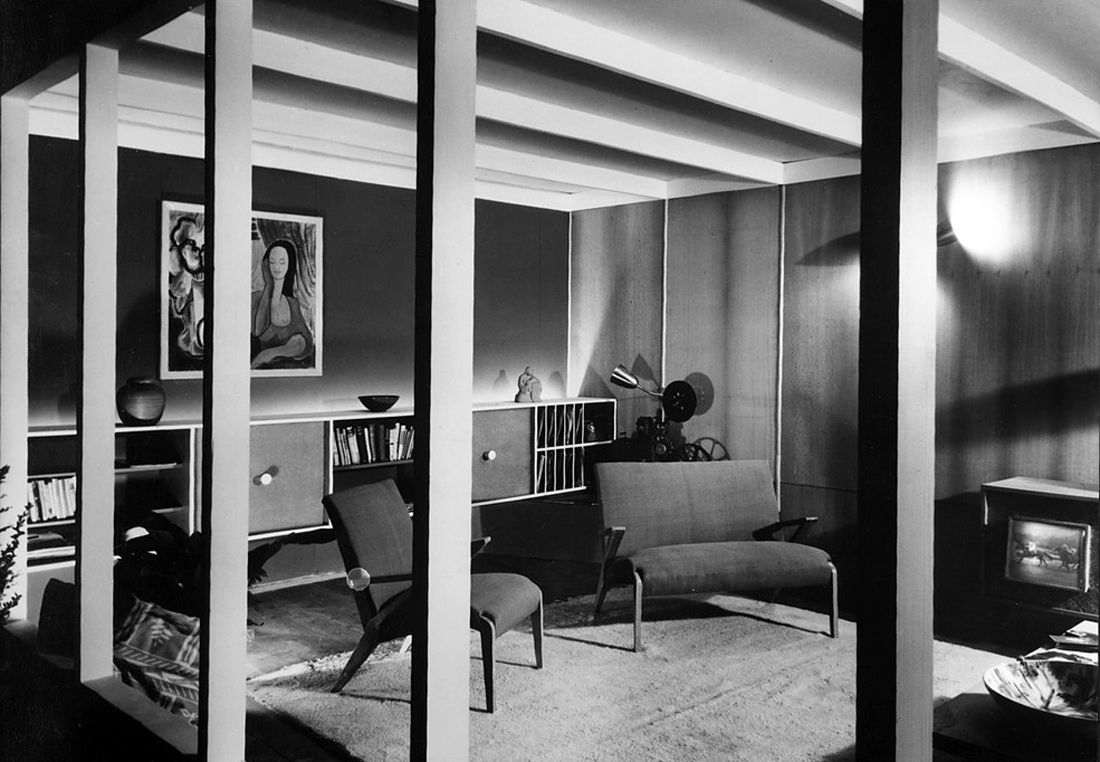
Wolfgang Sievers (Australian born Germany, 1913-2007) “House of Tomorrow” exhibition at Exhibition Building, Melbourne 1949 Gelatin silver print National Library of Australia
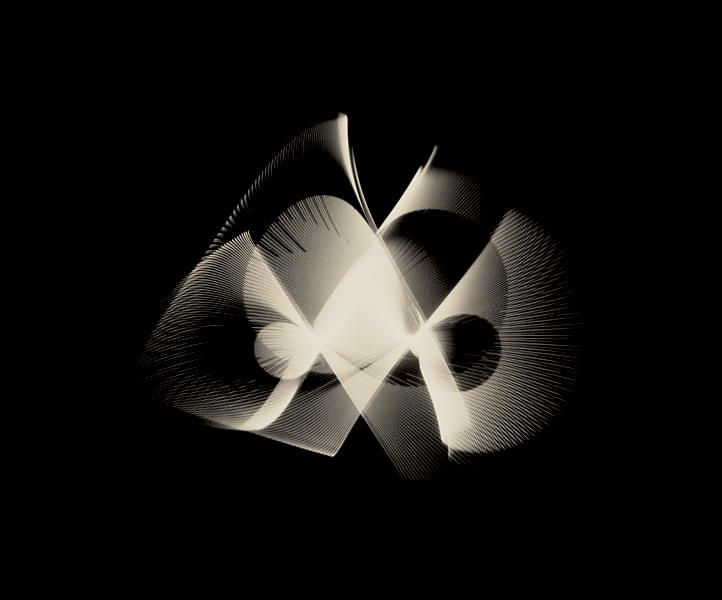
Stanislaus Ostoja-Kotkowski (Australian born Poland, 1922-1994) Nymphex 1966 Gelatin silver photograph from electronic image 50.6 x 60.8cm Gift of Dr George Berger 1978 Art Gallery of New South Wales @ Estate of Stanislaus Ostoja-Kotkowski
Rayner Hoff (Australian born United Kingdom, 1894-1937) Decorative portrait – Len Lye 1925 Marble 30.5 x 22.5 x 16.5cm Purchased 1938 Art Gallery of New South Wales
Cossington Smith captures the drama of a crowd in Rushing, which depicts commuters clamouring down to the ferries of Circular Quay to get home after work. The flying scarf and fallen hat emphasise the speed at which the travellers are moving and the peril and claustrophobia of a, mostly faceless, city crowd. The steep gangplank and diagonal composition accentuates the dynamism of the painting.
A brilliant colourist, Cossington Smith’s work of the early 1920s adopts a darker palette than the vivid colours she is usually associated with. Inspired by a visit to Sydney in 1920 by the tonalist painter and teacher Max Meldrum, her paintings became studies in tone, rather than colour, a practice she had abandoned by 1925.
Text from the Art Gallery of New South Wales website
Robert Klippel (Australian, 1920-2001) Boomerang coffee table 1955
The Powerhouse Museum travelling exhibition Modern times: the untold story of modernism in Australia explores how modernism transformed Australian culture from 1917 to 1967, a period of great social, economic, political and technological change. From the ideals of abstraction and functionalism to the romance of high-rise cities, new leisure activities and the healthy body, modernism encapsulated the possibilities of the twentieth century. This exhibition is the first interdisciplinary survey of the impact of modernism in Australia, spanning art, design, architecture, advertising, photography, film and fashion.
Modern times is presented at Heide across all four of the Museum’s gallery spaces. It unfolds in thematic sections highlighting key stories about international exchange, the modern body, modernist ‘primitivism’, the city, modern pools, and the Space Age. Comprising over 300 objects and artworks, it showcases works by major artists including Sidney Nolan, Margaret Preston, Albert Tucker, Grace Cossington Smith, Max Dupain, Wolfgang Sievers, and Clement Meadmore, key architects Robin Boyd, Roy Grounds and Harry Seidler, and designers Fred Ward and Grant and Mary Featherston. An installation, Cannibal Tours, by Madrid-based Australian artist Narelle Jubelin is a contemporary adjunct to the exhibition.
Inspired by the futurist visions of various European avant-gardes, modernist ideas were often controversial and shaped by many competing positions. Modern times reveals how these ideas were circulated and took hold in Australia, via émigrés, expatriates, exhibitions, films and publications. Australian contact with significant international modernist sources, such as the Bauhaus school in Germany, occurred through figures such as influential artist and teacher Ludwig Hirschfeld-Mack, who taught Bauhaus principles at Geelong Grammar, and renowned architect Harry Seidler, who played a central role in shaping the modern city in Australia. Hirschfeld-Mack’s extraordinary film Colour Light Play of 1923 is shown for the first time in Australia, and Seidler’s 1948 studio, designed on his arrival from New York, has been re-created for the exhibition.
While modernism was international in character, an ‘Australian modernism’ was first championed in the 1920s by artist Margaret Preston, whose promotion of Aboriginal forms and motifs was important to the understanding of their artistic value. Preston’s designs, Len Lye’s stunning animation Tusalava (1929), Robert Klippel’s boomerang table (c. 1955) and other works show the development of a vernacular modernism.
Other highlights of Modern times include works from the visionary experiment in colour theory by Roy de Maistre and Roland Wakelin in 1919, a model of Robin Boyd’s innovative House of Tomorrow (1949), the iconic Featherston wing sound chairs from the Australian pavilion at the 1967 Montreal Expo, and a large wooden model for Jørn Utzon’s Sydney Opera House.
Text from the Heide Museum of Art website [Online] Cited 06/06/2009. No longer available online
Athlete and movie-star Annette Kellerman’s Modern Kellerman Bathing Suit for Women which became commercially available by the mid-1920s. The one-piece bathing suit became Kellermans trademark Gift of Dennis Wolanski Library, Sydney Opera House, 2000 Photo: Powerhouse Museum
On hot summer days cool off with Tooth’s KB Lager About 1940 Advertising poster Colour and process lithograph, artist name “Parker” in image lower right 100.4 x 75.4cm Sydney Living Museums
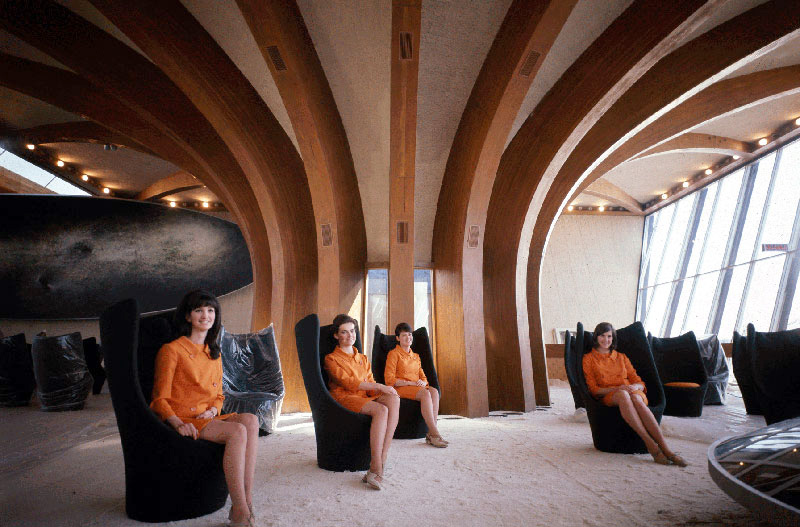
Grant Featherston (Australian, 1922-1995) and Mary Featherston (Australian, b. London 1943, migrated to Australia 1952) Expo mark II sound chair 1967 Aristoc Industries Polystyrene, polyurethane foam, Dunlopillo foam rubber, Pirelli webbing, fibreglass, hardwood, sound equipment, upholstery fabric Powerhouse Collection
The Expo Mark II sound chair, adapted for the Australian domestic market after Expo 67 in Montreal.
A cloth-covered high back winged chair with a circular base. The chair has a circular orange cloth covered cushion in the base and an integral full-width headrest. Two 125mm diameter inserts are pressed into the top of the back of the chair where speakers are fitted inside it. There is a cylindrical knob on the side of the chair.
National Archives of Australia A modernist vision of Australia: Grant and Mary Featherston’s wing sound chairs were a feature of the Australian Pavilion, designed by architect James Maccormick with exhibits selected by Robin Boyd, at Expo 67 in Montreal, 1967 1967
In 1967 Australia participated in the International and Universal Exposition held in Montreal, Canada. Australia’s Expo ’67 theme was the ‘Spirit of Adventure’. In the 30,000 square feet glass-walled Australian Pavilion, developed by the Australian Government and designed by Robin Boyd, exhibits explored Australian science, arts, people and development. The pavilion was designed as a ‘haven’ of ‘space and tranquillity’ floating above an Australian bushland setting. Inside, 240 innovative sound chairs offered ‘foot-weary Expo visitors’ the chance to hear the voices of famous Australians describing the exhibits, in French as well as English. The Great Barrier Reef was re-created in a lagoon beneath the pavilion while wallabies and kangaroos could be viewed in a sunken enclosure.
Text from the National Museum of Australia website [Online] Cited 20/02/2019
James Birrell (Australian, 1928-2019) View of the elevated restaurant, Centenary Pool, Brisbane Nd Powerhouse Museum
“A major exhibition opening for Sydney Design 08 in August, Modern times looks closely at the transformation of modern city life. The advent of cars, freeways, skyscrapers and new entertainment such as cinemas, milk bars, swimming pools, cafes and pubs are all legacies of modernism as revealed through the exhibition. The exhibition spans five decades from 1917 to 1967 – a tumultuous period marked by global wars, economic depression, a technological revolution and major social changes – out of which a modern cosmopolitan culture was shaped.
“The modernist movement was inspired by various European avant-gardes that projected visions of a better future, shaped by many competing positions. It was through émigrés, expatriates, exhibitions and publications that modernism become known in Australia,” Ann Stephen said. Encompassing art, design and architecture, Modern times focuses on seven themes: 1. the human body, image and health; 2. international influences and exchanges; 3. Indigenous art and modernism; 4. Interdisciplinary projects with retailers; 5. city landscapes and urban life; 6. public pools and milk bars; and 7. the space age.
Several great modern public pools were designed in Australia initially as part of an international swimming boom in the 1930s and boosted by the 1956 Melbourne Olympics. These will be shown on a large, immersive, panoramic audio visual screen celebrating the most Australian of past-times, being poolside. The earliest 1920s swimming costumes by silent film star Annette Kellerman, several decades of Australian icon ‘Speedo’ cossies and an early bikini will also be on display.
The much-loved corner milk bar from the 1930s will also be recreated in the exhibition for visitors to enter, complete with lolly jars, milkshakes and a juke box.
Other story highlights in the exhibition include Robin Boyd’s ‘House of Tomorrow’ that featured at the 1949 Modern Home Exhibition in Melbourne; and Boyd’s memorable Australian pavilion at the 1967 Montreal Expo that showcased Australian design including the iconic Featherston wing sound chairs and hostess uniforms designed by Zara Holt, wife of then prime minister Harold Holt.
Modernism also inspired new forms of public art and design like the abstract fountains by Tom Bass on Sydney’s former P&O building and Robert Woodward’s El Alamein Memorial Fountain, a popular tourist site in Sydney’s Kings Cross. Modernism shaped an exultant explosion of experiment as part of the Space Age informing such spectacular architectural feats as Roy Grounds’ dome for the Australian Academy of Science in Canberra and Jørn Utzon’s internationally-acclaimed Sydney Opera House, both featured in the exhibition.”
Ruzan Haruriunyan, “Modern Times: Untold Story Of Modernism In Australia,” on the Huliq News website [Online] Cited 20/02/2019
Hedie II photographs by Rory Hyde. More photos of Heide are on his Flickr photoset
Heide II – commissioned by John and Sunday Reed 1963, designed 1964, constructed 1964-1967
Designed by Melbourne architect David McGlashan of McGlashan Everist, it was intended as “a gallery to be lived in” and served as the Reeds’ residence between 1967 and 1980. The building is considered one of the best examples of modernist architecture in Victoria and awarded the Royal Institute of Architects (Victorian Chapter) Bronze Medal – the highest award for residential architecture in the State – in 1968. It is currently used to display works from the Heide Collection and on occasion projects by contemporary artists.
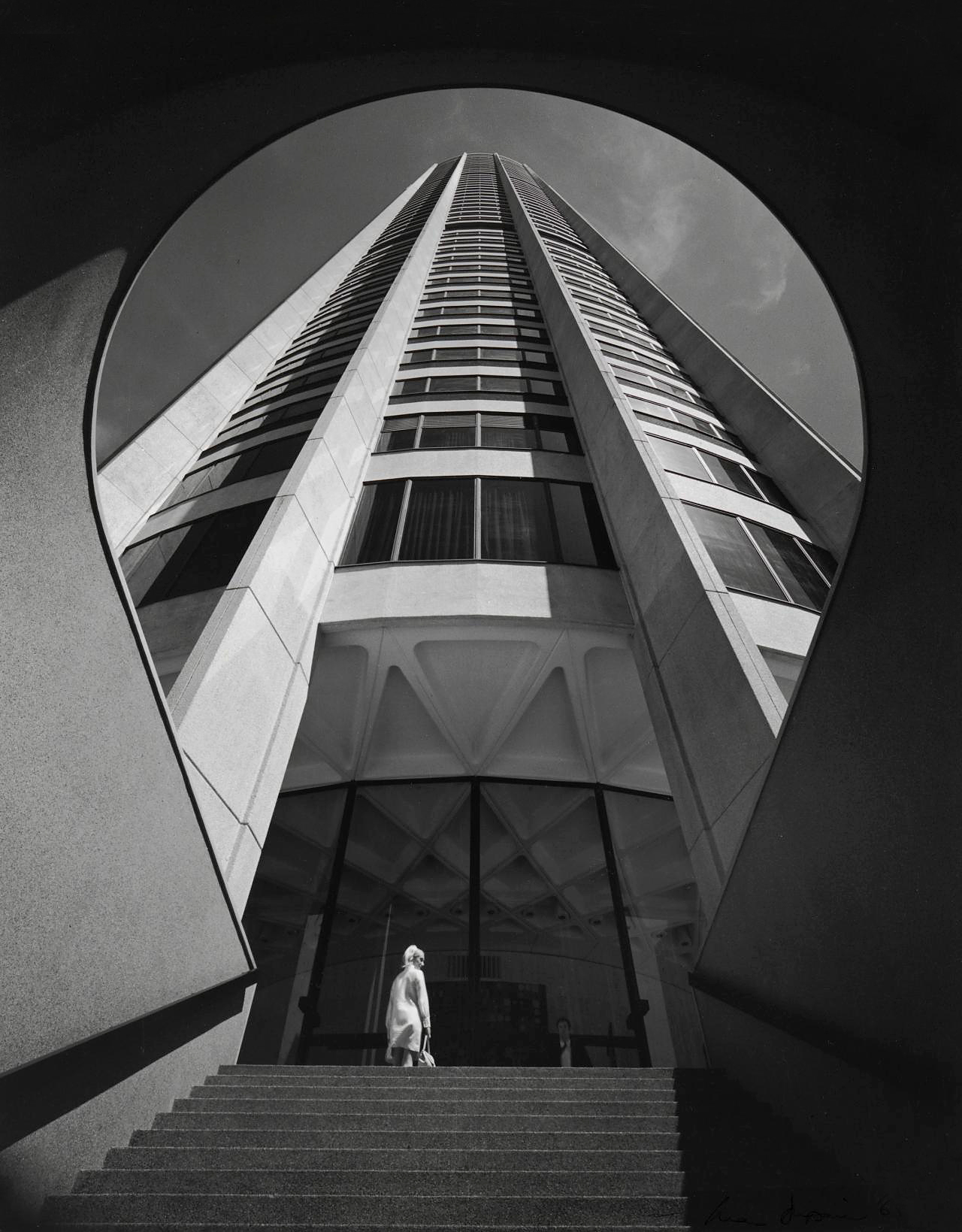
Max Dupain (Australian, 1911-1992) Australia Square: a keyhole to the future [Australia Square Tower] 1968 Gelatin silver print 49.9 × 39.2cm Courtesy of Max Dupain and Associates
Jeff Carter (Australian, 1928-2010) At the Pasha Nightclub, Cooma c. 1957-1959 Gelatin silver print
Modern Times: The Untold Story of Modernism in Australia, edited by Ann Stephen, Philip Goad and Andrew McNamara, Powerhouse Publishing, 2008 (paperback).
Heide Museum of Modern Art 7 Templestowe Road, Bulleen, Victoria 3105
Opening hours: Tuesday – Sunday Public holidays 10am – 5pm
Rowan McNamara, Marissa Gibson, Mitjili Napanangka Gibson and Scott Thornton
Rowan McNamara as Samson and Marissa Gibson as Delilah
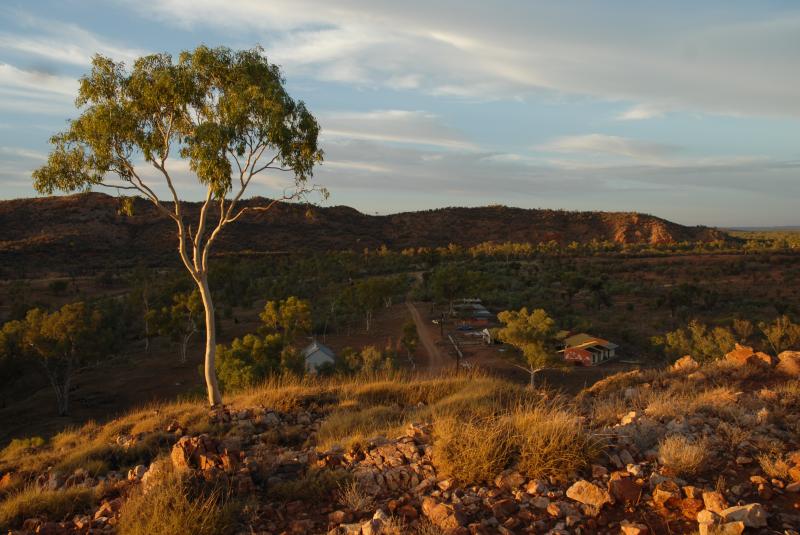
This is a tough nugget of a film, an absolute gem. It is a love story.
The deceptively simple narrative takes you into the dark side of Aboriginal life in the remote desert communities of central Australia. It pulls no punches taking the viewer on a empathetic ride into the lives of two young people struggling to find their reason for being on this earth. Here is violence, abuse, rape and addiction with the subtle hope of redemption.
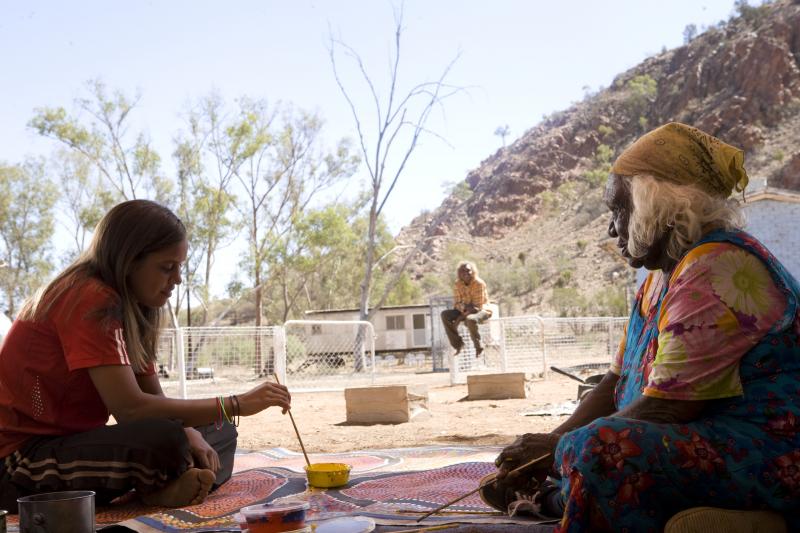
Samson is addicted to petrol sniffing. Delilah tries to ignore him. She looks after her grandmother who is an artist, pushing her around in an wheelchair, feeding her medicine and taking her to the health clinic. Samson forces himself on Delilah, sleeping next to her but never with her. Then her grandmother dies and Delilah is blamed by the women elders of the community. Samson’s addiction escalates. He steals a car and with Delilah in tow they flee to Alice Springs to live under a flyover and sniff petrol, to be looked down upon by tourists in trendy cafes. Things get worse before they get (slightly) better.
That is the bare bones of the story. But I want to talk about other things.
The film is the traditional three acts but the narrative reads like an oral history only shown in images: themes are repeated over and again with subtle variations, like the arc of great music reiterating the flow of energy. There is little dialogue which intensifies the sounds of the desert, the band that plays on the verandah and the ringing of telephones. Every human seems to be alienated from the landscape. The Aborigines seem to be just floating on the surface of the land like everyone else, just struggling to survive. The landscape towers above the participants. Unlike our usual perception of Aboriginal people being in touch with the earth through the Dreamtime, here the director Warwick Thornton seems to suggest otherwise, until right at the end of the film.
Delilah is the strength in the film. It is her stoicism, her strength that helps Samson see it through. She ends up pushing Samson in the same wheelchair that she pushed her grandmother around in. His loss of strength is palpable, his addiction ongoing. You believe this story, the non-professional actors grounding you in the red dust of the desert.
There are several remarkable elements that lift this film to sublime places. Some of them are the most moving moments I have seen in a film in many a year:
The soundtrack, like a disjointed heartbeat, that accompanies their life under the flyover. The soundtrack of Samson’s rock and roll competing with Delilah’s music in her 4 wheel drive as one fades into the other.
Samson and Delilah sitting outside the health centre in white plastic chairs picking their feet off the ground so they won’t get bitten by ants.
Samson sitting in the wheelchair in the middle of the road at night, rocking back and forward on the wheels of the chair, so off his face that he is oblivious of the approaching 4 wheel drive until it is right upon him. Exceptional.
Delilah, towards the end of the film, washing the body of Samson with soap while he sits in a trough of water. More sensuality, more sexuality packed into 30 seconds than you will ever see in a full blown love scene. Amazing.
Samson, his head under a blanket under the flyover. The scene fades not to black as it does regularly in this film but to 80% of black and hovers there, just under the level of consciousness, before the sun rises again. This is masterful, poetic film making.
Samson, taking his ghetto blaster outside at night, dancing under the light of the verandah to rock and roll music watched by Delilah from her refuge in a 4 wheel drive. This scene is so beautiful, so genuine. The natural grace of Samson’s dancing opens Delilah’s eyes towards him. For the audience it is a revelatory, transcendent moment that crosses space and time as great cinema does. It grips you in an esoteric awareness: we are all human, we all live on the same earth. We all dance.
. Go and see this film. It is one of the finest ever made in Australia. Besides a beautiful love story it will take you to places and connect with your heart like no other. It’s not perfect by any means (in terms of some improbabilities in the narrative) but this can be forgiven in the arc of the story telling. It is harrowing there is no doubt, but in the almost timeless ebb and flow of the film, in the communion with the infinite, something that defines human existence, this film stands above all else.
Curator: Curator of Media Arts Rudolf Frieling and Mark Rosenthal, adjunct curator of contemporary art at the Norton Museum of Art
William Kentridge (South African, b. 1955) Drawing for the film Stereoscope [Felix Crying] 1998-1999
One of my favourite artists in the world. His technique – the palimpsestic nature of his practice where the history, memories and spaces of previous drawings are overwritten again and again on a single piece of paper without their ever being lost (unlike traditional animation techniques) – is amazing. His use of drawing, animation and the camera to record narratives of connection always has personal and archetypal themes – love, loss, bigotry, big business, persecution, reconciliation and social conflict in the stories of his homeland South Africa. His perspective on the world, his knowledge of books and philosophy, his understanding that stories exist as faint, legible remains completes the perception that he is an artist drawn to the line of the world. His work is moving and compassionate as all great art should be.
Dr Marcus Bunyan
Many thankx to the San Francisco Museum of Modern Art for allowing me to publish the art work in the posting.
Combining the political with the poetic, William Kentridge’s work has made an indelible mark on the contemporary art scene. Dealing with subjects as sobering as apartheid and colonialism, Kentridge often imbues his art with dreamy, lyrical undertones or comedic bits of self-deprecation, making his powerful messages both alluring and ambivalent. Perhaps best known for his stop-motion films of charcoal drawings, the internationally renowned South African artist also works in etching, collage, sculpture, and the performing arts, opera in particular. This exhibition explores five primary themes that have engaged Kentridge over the last three decades through a comprehensive selection of his work from the 1980s to the present. Concentrating on his most recent production and including many pieces that have not been seen in the United States, the exhibition reveals as never before the full arc of his distinguished career.
Text from the SFMOMA website [Online] Cited 01/04/2009. No longer available online
William Kentridge (South African, b. 1955) “Invisible Mending” from 7 Fragments for Georges Méliès 2003 35-mm and 16-mm animation film
William Kentridge: Five Themes, a comprehensive survey of the contemporary South African artist’s work, will premiere at the San Francisco Museum of Modern Art (SFMOMA) on March 14, 2009. Featuring more than 75 works in a range of media – including animated films, drawings, prints, theater models, sculptures, and books – the exhibition is co-organised by SFMOMA and the Norton Museum of Art in West Palm Beach, Florida. The San Francisco presentation, overseen by SFMOMA Curator of Media Arts Rudolf Frieling, will be on view through May 31, 2009.
Curated by Mark Rosenthal, adjunct curator of contemporary art at the Norton Museum of Art, in close collaboration with the artist, the exhibition explores five primary themes that have engaged Kentridge over the past three decades. Although the exhibition highlights projects completed since 2000 (many of which have not been seen in the United States), it will also present, for the first time, Kentridge’s most recent work alongside his earlier projects from the 1980s and 1990s – revealing as never before the full arc of his distinguished career.
Following its debut at SFMOMA, the survey will travel to the Modern Art Museum of Fort Worth, the Norton Museum of Art, and The Museum of Modern Art in New York. Plans for the European tour – which will tentatively include Galerie nationale du Jeu de Paume in Paris, the Stedelijk Museum in Amsterdam, the Albertina Museum in Vienna, and the Israel Museum in Jerusalem – are being finalised. Accompanying the exhibition is a richly illustrated catalogue, complete with a DVD produced by the artist for this special occasion. The San Francisco presentation of William Kentridge: Five Themes is made possible by the generous support of the Koret Foundation and Doris and Donald Fisher.
William Kentridge is one of today’s most influential artists, and with this exhibition, SFMOMA continues its commitment to bringing such groundbreaking artists as Olafur Eliasson, Richard Tuttle, and Jeff Wall to local and international audiences,” says SFMOMA Director Neal Benezra, who co-curated the last major retrospective of the artist’s work in the United States in 2001. “Although Kentridge is primarily recognised for his animated films, he has devoted most of his time to making works on paper. The drawn line is completely inseparable from his work in other media, informing everything he creates. His transformation of drawing into animated film reflects his deep interest in how content evolves from process, how meaning accrues through making.”
Exhibition curator Rosenthal adds, “Even as Kentridge has established his reputation as a master draftsman, printmaker, and one of the preeminent artist–filmmakers of our time, he has also expanded the traditional notion of political art, evolving the genre from a conventional depiction of horrors to a more nuanced portrayal of the psychological effects of political events upon those who observe them, whether they be perpetrators, victims, or onlookers.”
Born in 1955 in Johannesburg, where he continues to live and work, Kentridge has earned international acclaim for his interdisciplinary practice, which often fuses drawing, film, and theater. Known for engaging with the social landscape and political background of his native South Africa, he has produced a searing body of work that explores themes of colonial oppression and social conflict, loss and reconciliation, and the ephemeral nature of both personal and cultural memory.
Kentridge first gained recognition in 1997, when his work was included in Documenta X in Kassel, Germany, and in the Johannesburg and Havana Biennials, which were followed by prominent solo exhibitions internationally. His art was widely introduced to American audiences in 2001 through a traveling retrospective – co-curated by Neal Benezra when he served as deputy director of the Art Institute of Chicago – which primarily included works made before 2000. William Kentridge: Five Themes brings viewers up to date on the artist’s work over the past decade, exploring how his subject matter has evolved from the specific context of South Africa to more universal stories. In recent years, Kentridge has dramatically expanded both the scope of his projects (such as recent full-scale opera productions) and their thematic concerns, which now include his own studio practice, colonialism in Namibia and Ethiopia, and the cultural history of post-revolutionary Russia. His newer work is based on an intensive exploration of themes connected to his own life experience, as well as the political and social issues that most concern him.
Although his hand-drawn animations are often described as films, Kentridge himself prefers to call them “drawings for projection.” He makes them using a distinctive technique in which he painstakingly creates, erases, and reworks charcoal drawings that are photographed and projected as moving image. Movement is generated within the image, by the artist’s hand; the camera serves merely to record its progression. As such, the animations explore a tension between material object and time-based performance, uniquely capturing the artist’s working process while telling poignant and politically urgent stories.
Concerning the artist’s innovative film installations of the past ten years, Rudolf Frieling adds: “Kentridge has been considered primarily as an artist who draws for projections. Yet his recent installation-based films explore an expanded cinema space and question the very foundation of what it means to produce and perceive a moving image.”
In light of SFMOMA’s history with Kentridge – in 2004 the museum acquired the artist’s landmark film Tide Table (2003) and a set of related drawings – and the rich holdings of his work in private Bay Area collections, the occasion to present the first major exhibition of his work in San Francisco has particular resonance and reflects the museum’s ongoing commitment to his art. In conjunction with the exhibition, SFMOMA will bring the artist’s multimedia opera The Return of Ulysses to San Francisco for performances at Project Artaud Theater from March 25 through 29, 2009. Kentridge will also present his lecture-format solo performance I am not me, the horse is not mine at SFMOMA on March 14, 2009.
The Five Themes
“Parcours d’Atelier: Artist in the Studio”
The first section of the exhibition examines a crucial turning point in Kentridge’s work, one in which his own art practice became a subject. According to the artist, many of these projects are meant to reflect the “invisible work that must be done” before beginning a drawing, film, or sculpture. This theme is epitomised by the large-scale multiscreen projection 7 Fragments for Georges Méliès (2003), an homage to the early French film director, who, like Kentridge, often combined performance with drawing. The suite of seven films – each depicting Kentridge at work in his studio or interacting with his creations – has only been shown once before in the United States and will be accompanied by a rarely seen group of related drawings, forming an intimate portrayal of the artist’s process.
“Thick Time: Soho and Felix”
A second section of the exhibition is dedicated to Kentridge’s best-known fictional characters, Soho Eckstein, a domineering industrialist and real estate developer whose troubled conscience reflects certain miens of contemporary South Africa, and his sensitive alter ego, Felix Teitlebaum, who pines for Soho’s wife and often functions as a surrogate for the artist himself. The centrepiece of this section, an ongoing work entitled 9 Drawings for Projection, comprises nine short animated films: Johannesburg, 2nd Greatest City after Paris (1989), Monument (1990), Sobriety, Obesity & Growing Old (1991), Mine (1991), Felix in Exile (1994), History of the Main Complaint (1996), WEIGHING … and WANTING (1998), Stereoscope (1999), and Tide Table (2003). These projections, along with a key selection of related drawings, follow the lives of Soho and Felix as they struggle to navigate the political and social climate of Johannesburg during the final decade of apartheid. According to Kentridge, the Soho and Felix films were made without a script or storyboards and are largely about his own process of discovery.
“Occasional and Residual Hope: Ubu and the Procession”
In 1975 Kentridge acted in Ubu Rex (an adaptation of Ubu Roi, Alfred Jarry’s satire about a corrupt and cowardly despot), and he subsequently devoted a large body of work to the play. He began with a series of eight etchings, collectively entitled Ubu Tells the Truth (1996), and in 1997 made an animated film of the same name, as well as a number of related drawings. These works also deal with the South African experience, specifically addressing the Truth and Reconciliation Commission hearings set up by the nation’s government in 1995 to investigate human rights abuses during apartheid. Other highlights in this grouping include the film Shadow Procession (1999), in which Kentridge first utilises techniques of shadow theatre and jointed-paper figures; the multi-panel collage Portage (2000); a large charcoal-and-pastel-on-paper work entitled Arc Procession (Smoke, Ashes, Fable) (1990); and some of the artist’s rough-hewn bronze sculptures.
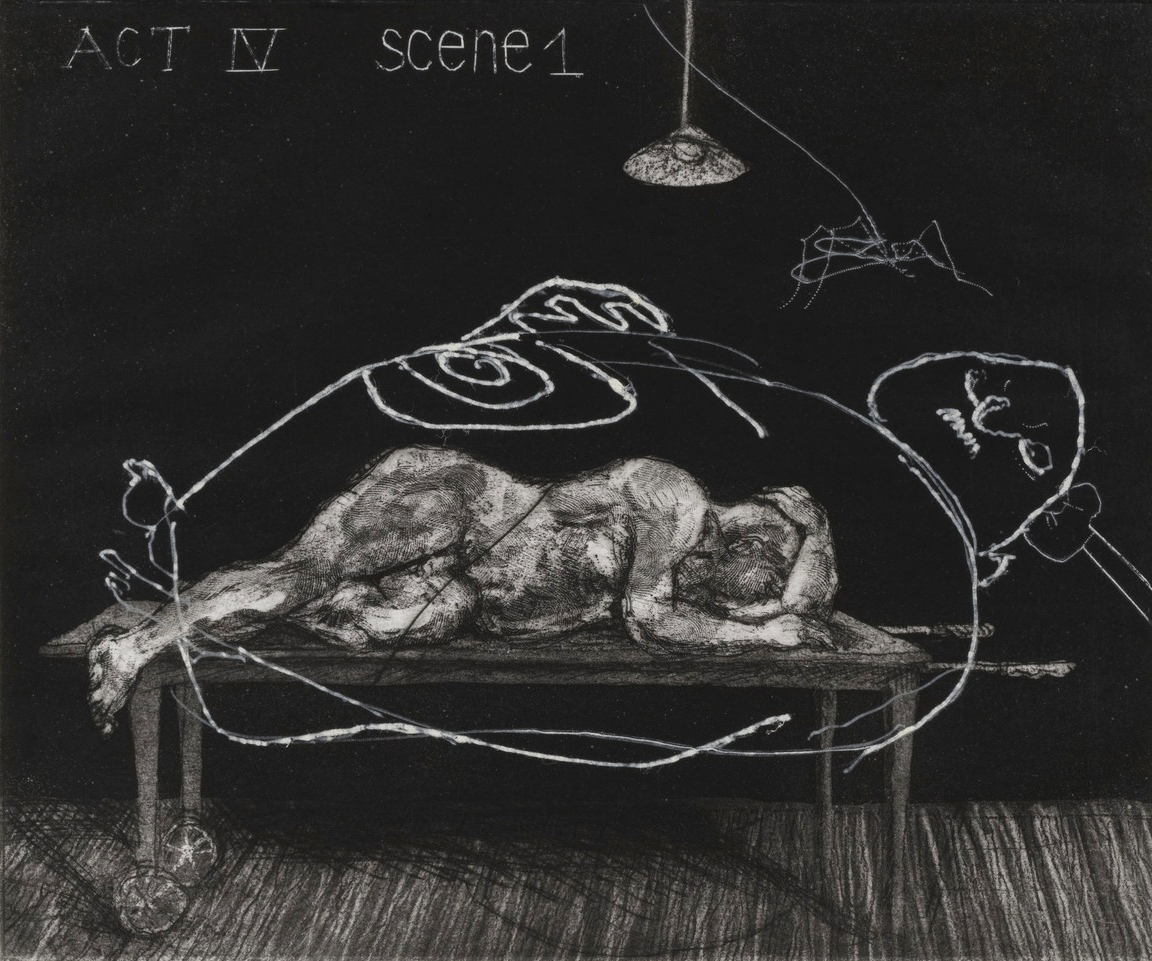
William Kentridge (South African, b. 1955) Act IV Scene I from Ubu Tells the Truth 1996-1997
“Sarastro and the Master’s Voice: The Magic Flute”
A selection of Kentridge’s drawings, films, and theatre models inspired by his 2005 production of the Mozart opera The Magic Flute for La Monnaie, the leading opera house in Belgium, will be a highlight of the exhibition. The artist’s video projection Learning the Flute (2003), which started the Flute project, shifts between images of black charcoal drawings on white paper and white chalk drawings projected onto a blackboard, forming a meditation on darkness and light. Preparing the Flute (2005) was created as a large-scale maquette within which to test projections central to the production of the opera. Another theatre model, Black Box/Chambre Noire (2006), which has never been seen in the United States, addresses the opera’s themes, specifically through an examination of the colonial war of 1904 in German South-West Africa, and of the genocide of the Herero people. What Will Come (has already come) (2007), a consideration of colonialism in Ethiopia, presents an anamorphic film installation in which intentionally distorted images projected onto a tabletop right themselves only when reflected in a cylindrical mirror. This work was recently acquired, under the guidance of Rosenthal, by the Norton Museum of Art.
“Learning from the Absurd: The Nose”
The fifth section comprises a multichannel projection made in preparation for Kentridge’s forthcoming staging of The Nose, a Metropolitan Opera production that will premiere in New York in March 2010. The Nose – a 1930 Dmitri Shostakovich opera based on Nikolai Gogol’s absurdist short story of 1836 – concerns a Russian official whose nose disappears from his face, only to turn up, in uniform, as a higher-ranking official moving in more respected circles. Kentridge’s related work, I am not me, the horse is not mine (2008), on view in the United States for the first time, is a room-size installation of projected films that use Gogol’s story as the basis for examining Russian modernism and the suppression of the Russian avant-garde in the 1920s and 1930s.
Related Performances
Acknowledging the profound importance of theatrical work in Kentridge’s oeuvre, SFMOMA will bring the artist’s opera The Return of Ulysses to San Francisco in conjunction with the exhibition. First performed in Brussels in 1998, Kentridge’s acclaimed reinterpretation of Claudio Monteverdi’s classic 1640 opera (based on Homer’s epic poem) is transposed to a mid-20th-century Johannesburg setting. This limited-engagement performance features live actors and musicians, as well as 13 life-size, artisan-crafted wooden puppets and projections of Kentridge’s animated charcoal drawings. The Return of Ulysses will run at Project Artaud Theater from Tuesday, March 24, through Saturday, March 28 (preview March 24, opening March 25), and is a production of Pacific Operaworks, in Seattle, incorporating puppeteers from Kentridge’s longtime collaborator, the Handspring Puppet Company of Cape Town, in South Africa.
In a special opening-night event on March 14, Kentridge will present a lecture-format solo performance of I am not me, the horse is not mine, which premiered at the 16th Biennale of Sydney in June 2008 (and shares the same title of the related multichannel projection making its U.S. debut with the exhibition). This live performance focuses on the development process of Kentridge’s upcoming opera production, The Nose.
Definitive Publication with Companion DVD
To coincide with the exhibition, SFMOMA and the Norton Museum of Art, in association with Yale University Press, will publish a richly illustrated catalogue (hardcover, $50). In the catalogue’s principal essay, exhibition curator Mark Rosenthal presents a portrait of the artist, showing the interrelationship between aspects of Kentridge’s character and the protagonists that populate his work. Carolyn Christov-Bakargiev, chief curator at the Castello di Rivoli Museum of Contemporary Art, examines the artist’s themes and iconography in closer detail, addressing Kentridge’s working methods as he moves freely between disciplines. Rudolf Frieling demonstrates that although Kentridge is not typically discussed as an installation artist, there are compelling reasons to consider him as such. Cornelia H. Butler, Judith B. Hecker, and Klaus Biesenbach, curators at the Museum of Modern Art, New York, explore the subject of performance in Kentridge’s work. Finally, a conversation between Kentridge and Michael Auping, chief curator at the Modern Art Museum of Fort Worth, focuses on the artist’s drawing practice. In addition, the artist has written texts to introduce each of the book’s five plate sections.
For the first time, Kentridge will produce a DVD for distribution with the publication, making the catalogue unique among existing literature on the artist. Combining intimate studio footage of the artist at work with fragments from significant film projects, the DVD offers a fascinating look at how Kentridge’s ideas evolve from raw concept to finished work.
Press release from the San Francisco Museum of Modern Art
William Kentridge (South African, b. 1955) Johannesburg 1989
William Kentridge (South African, b. 1955) Drawing for the projection Felix in Exile 1994
William Kentridge (South African, b. 1955) Felix in Exile 1994
More videos of William Kentridge’s work are available on You Tube
San Francisco Museum of Modern Art 151 Third Street San Francisco CA 94103 Phone: 415.357.4000















![William Kentridge (South African, b. 1955) 'Drawing for the film 'Stereoscope [Felix Crying]'' 1998-1999 from the exhibition 'William Kentridge: Five Themes' at San Francisco Museum of Modern Art (SFMOMA), March - May, 2009](https://artblart.com/wp-content/uploads/2009/04/kentridge2.jpg "William Kentridge (South African, b. 1955) 'Drawing for the film 'Stereoscope [Felix Crying]'' 1998-1999 from the exhibition 'William Kentridge: Five Themes' at San Francisco Museum of Modern Art (SFMOMA), March - May, 2009")

 Art Blart _ art and cultural memory archive
You must be logged in to post a comment.