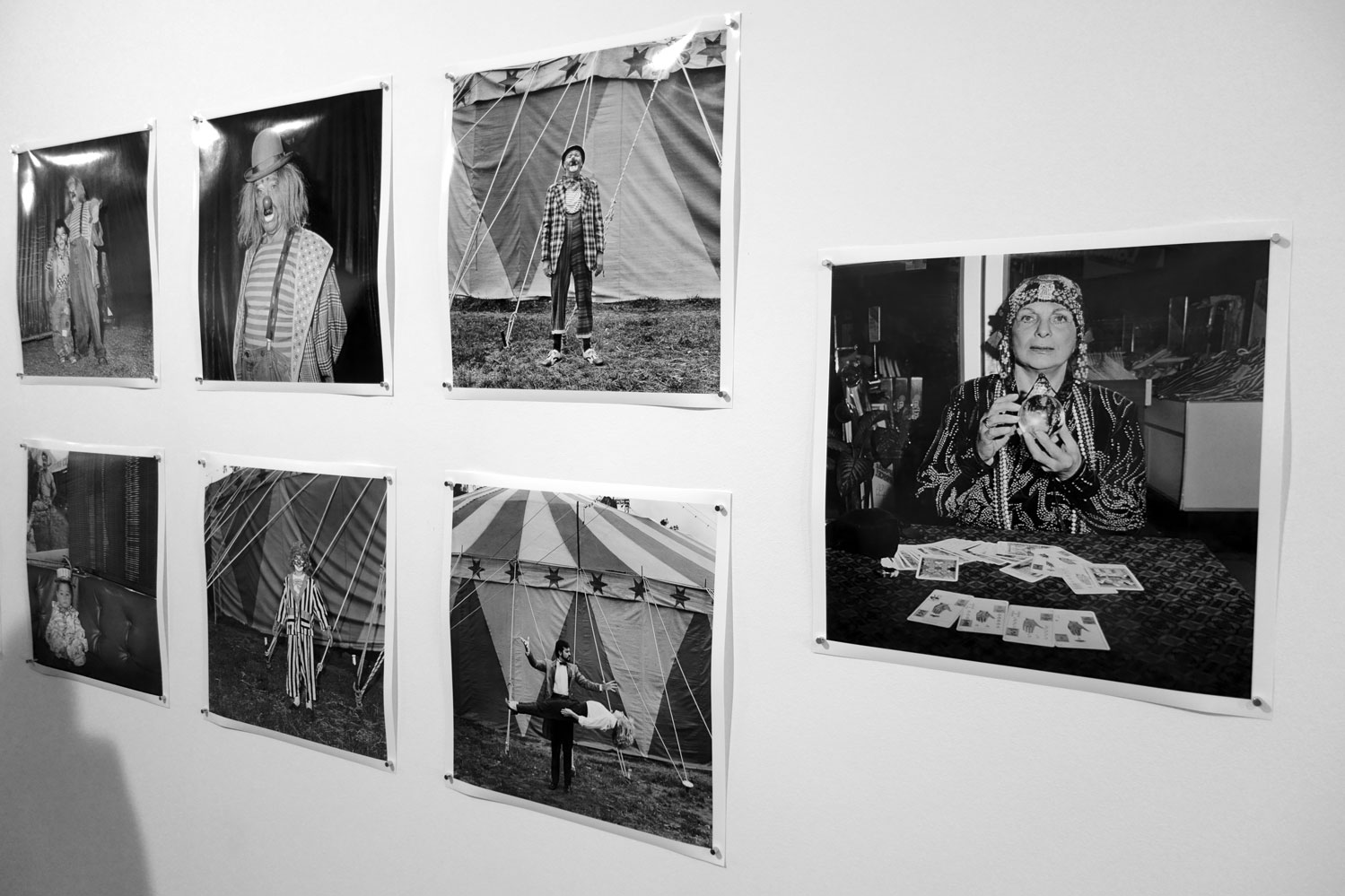
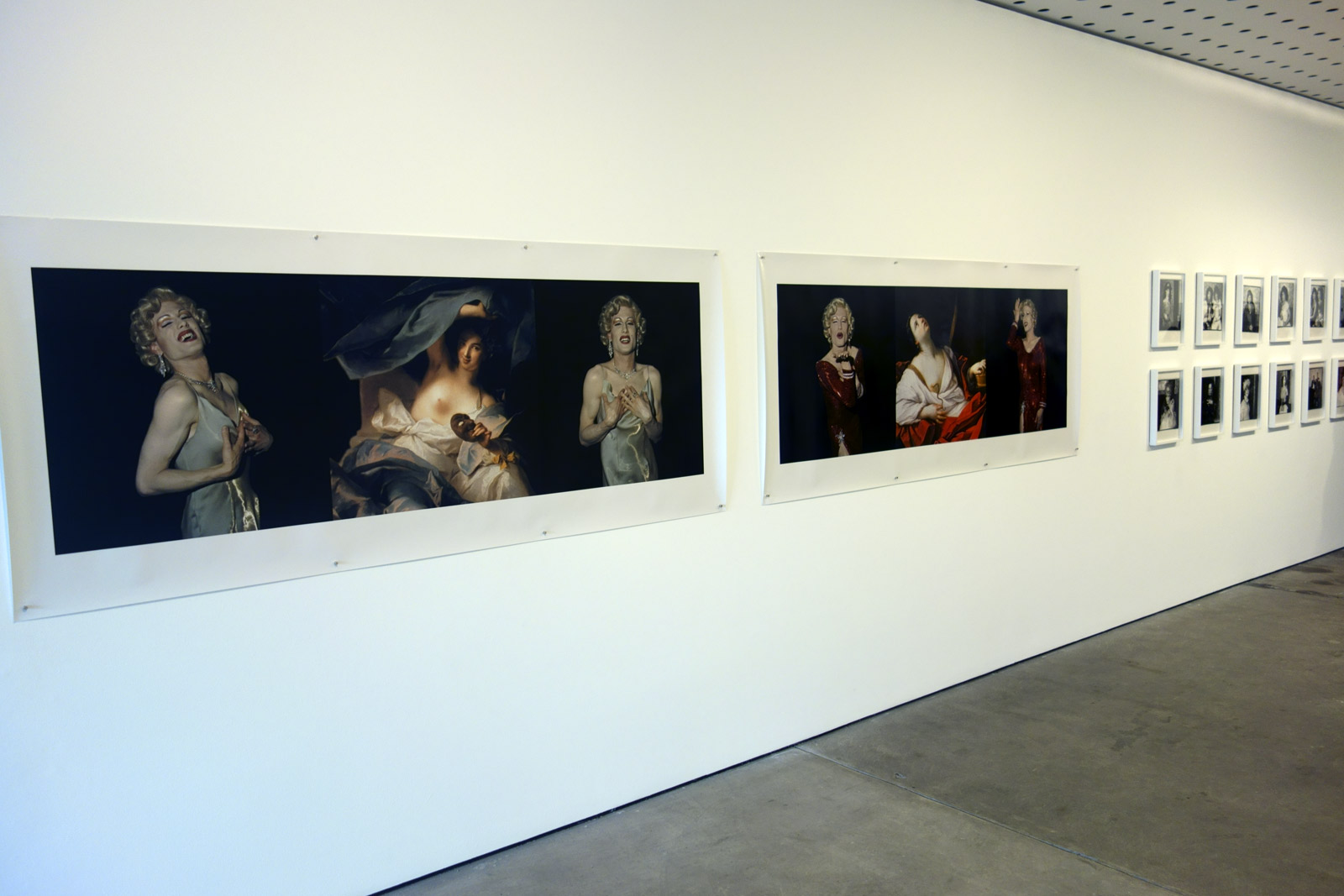
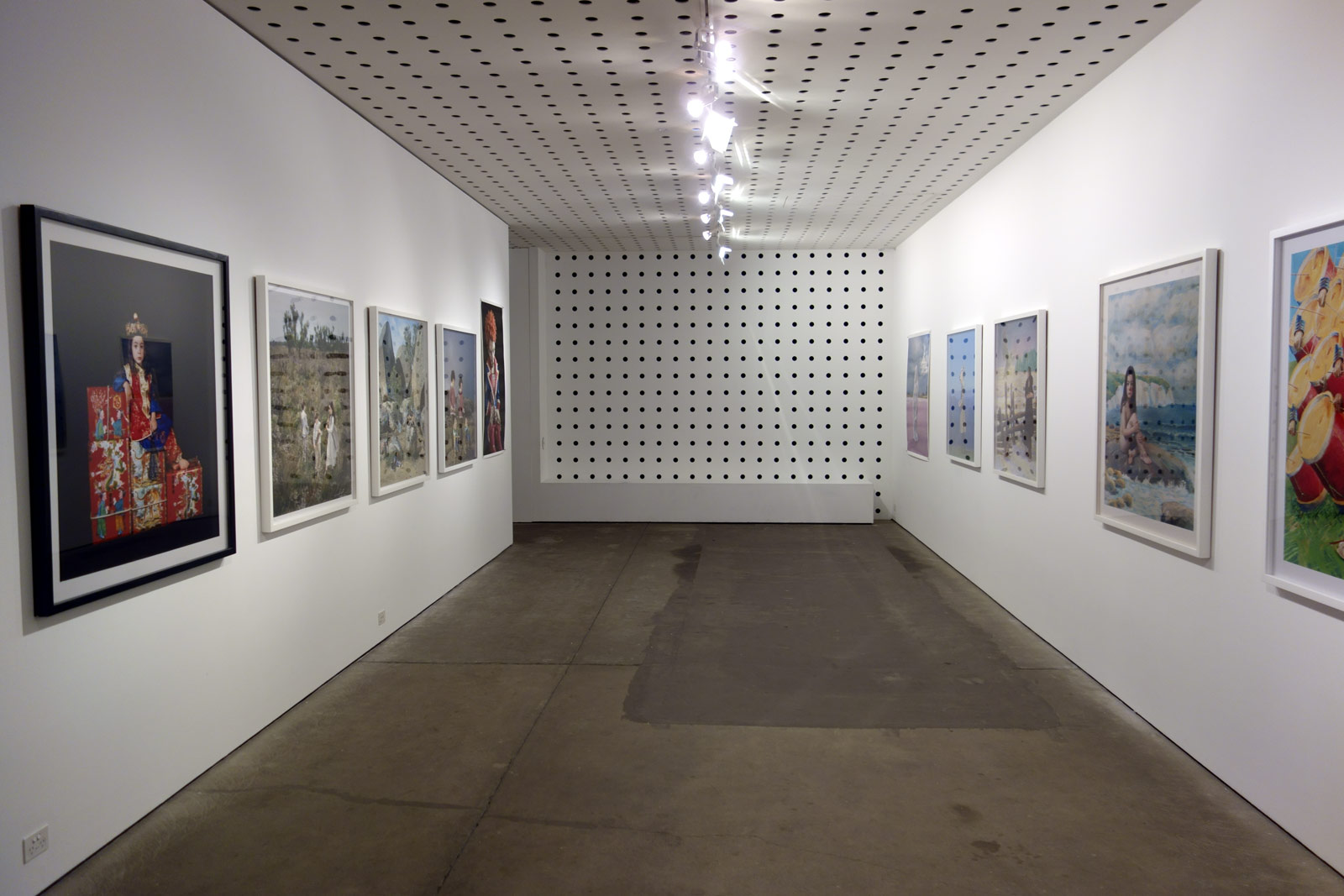
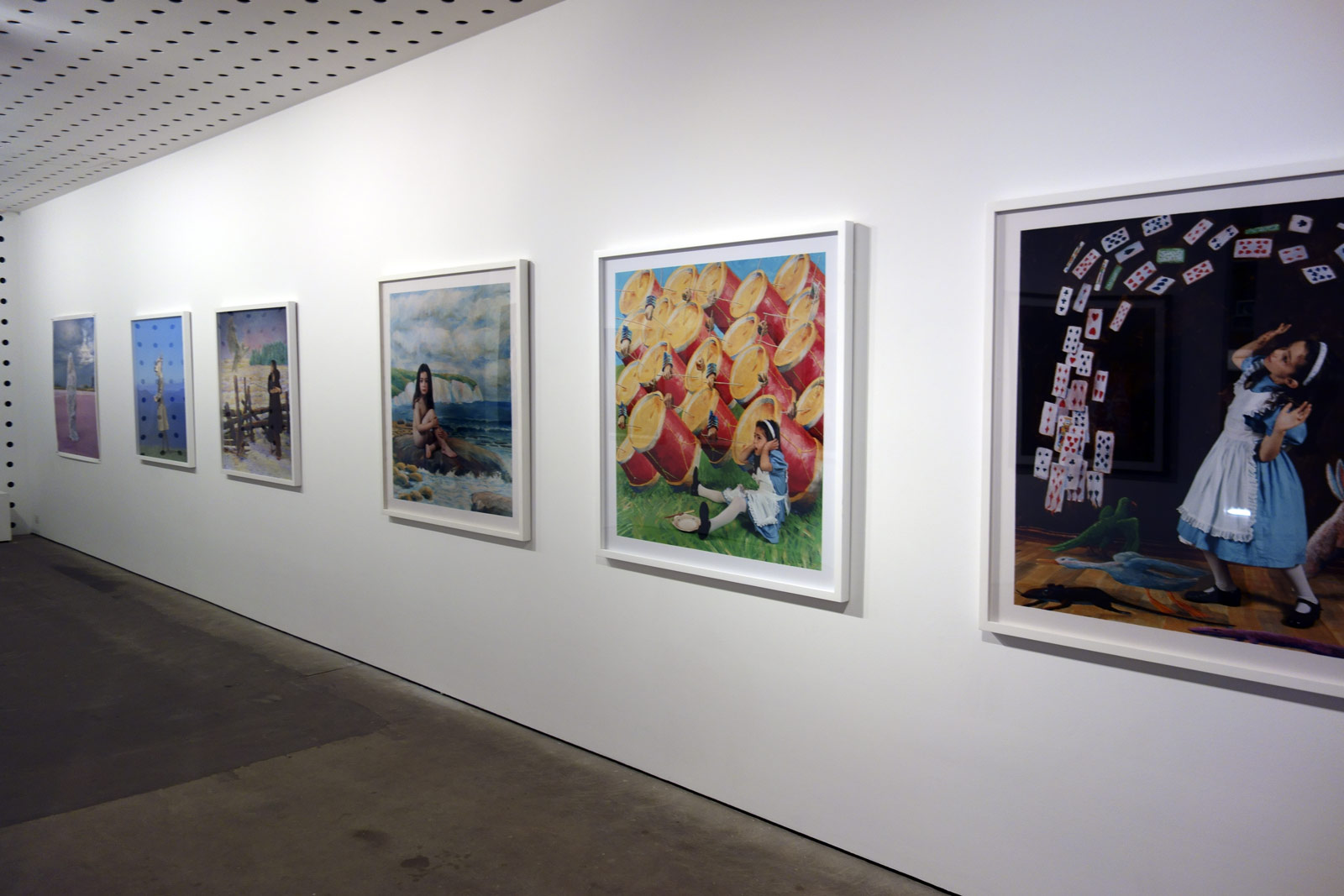
Exhibition: ‘Carrie Mae Weems: Three Decades of Photography and Video’ at The Solomon R. Guggenheim Museum, New York

Exhibition dates: 24th January – 14th May, 2014

Curators: Senior Curator of Photography Jennifer Blessing with Assistant Curator Susan Thompson
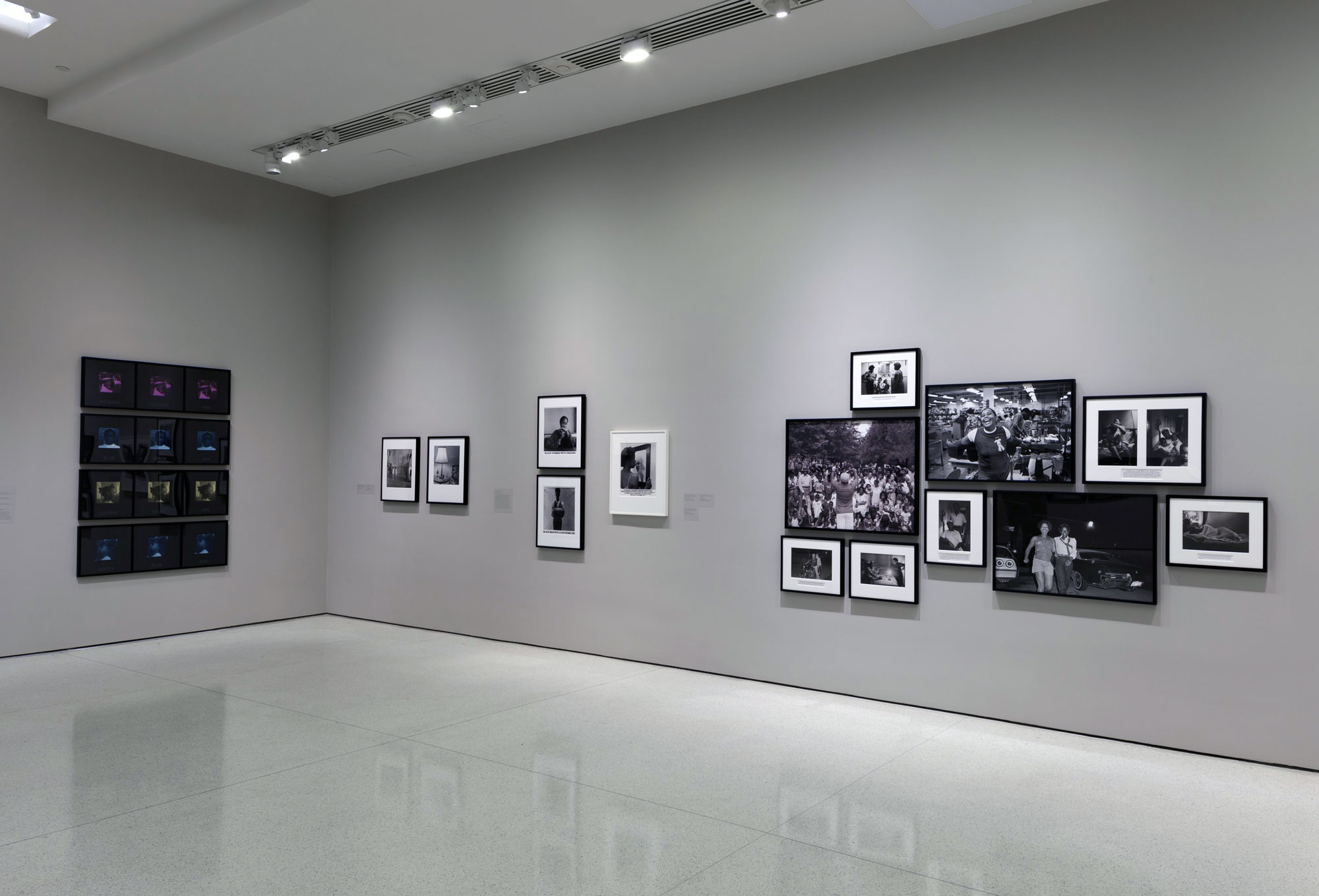
 

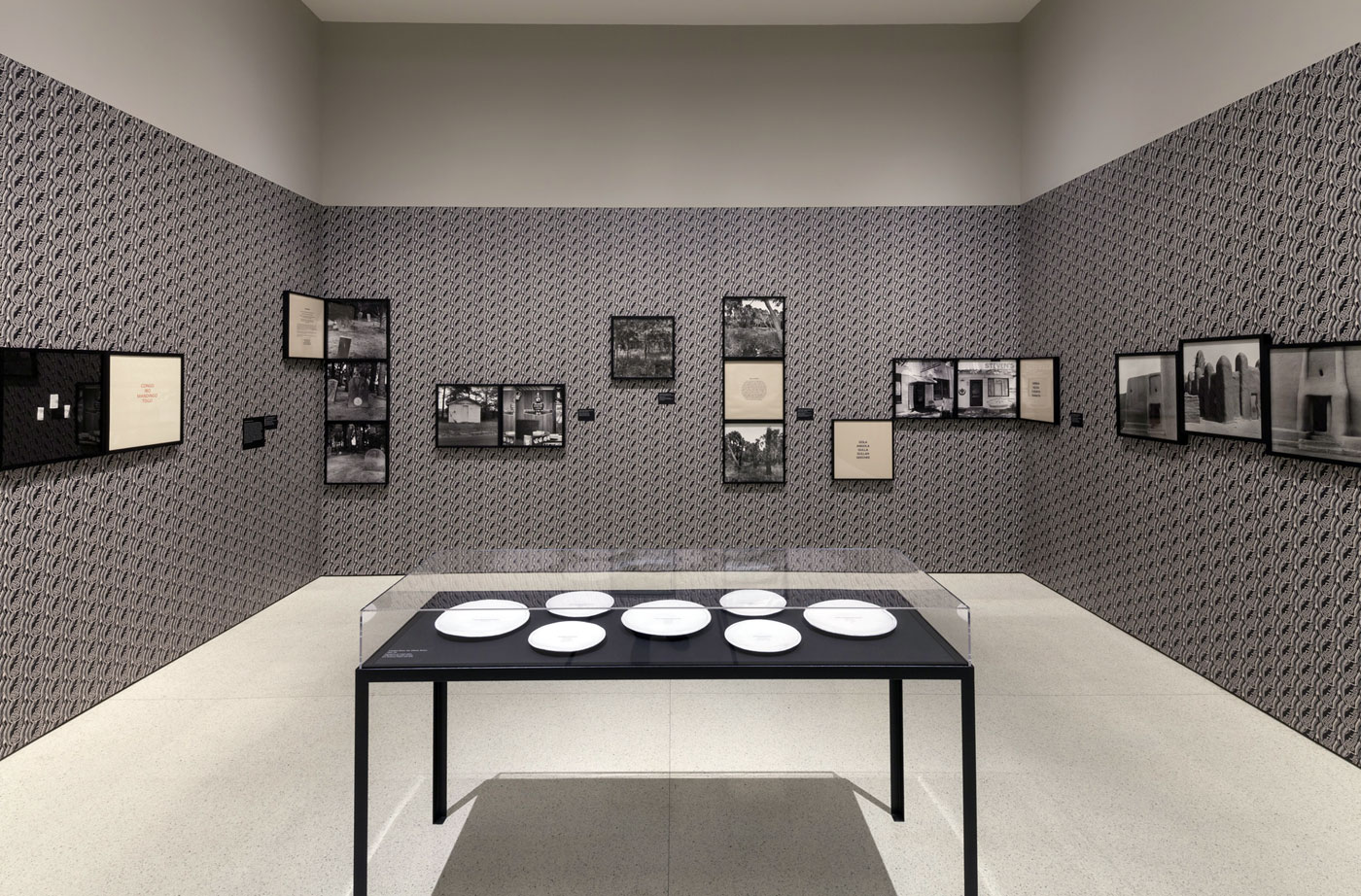
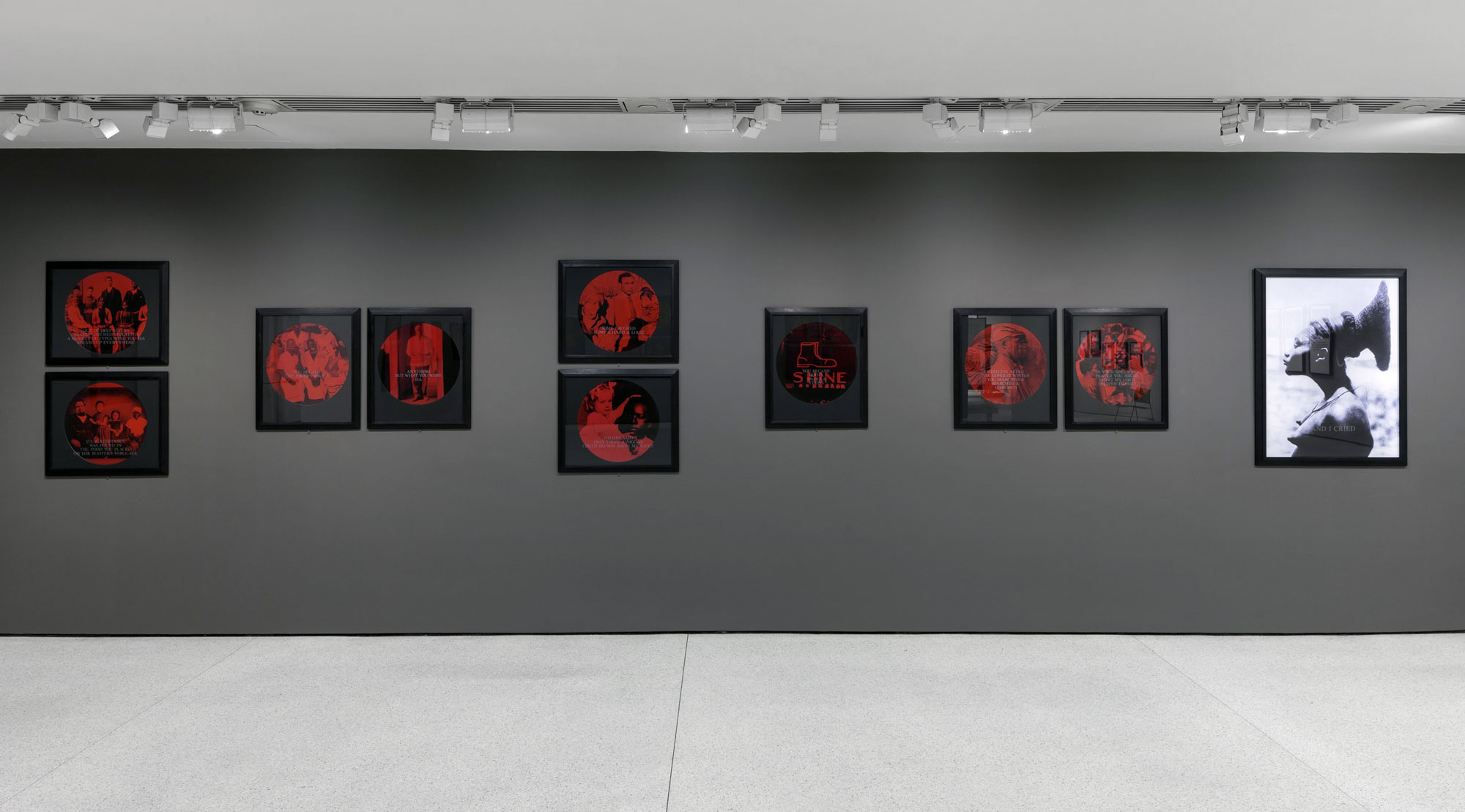
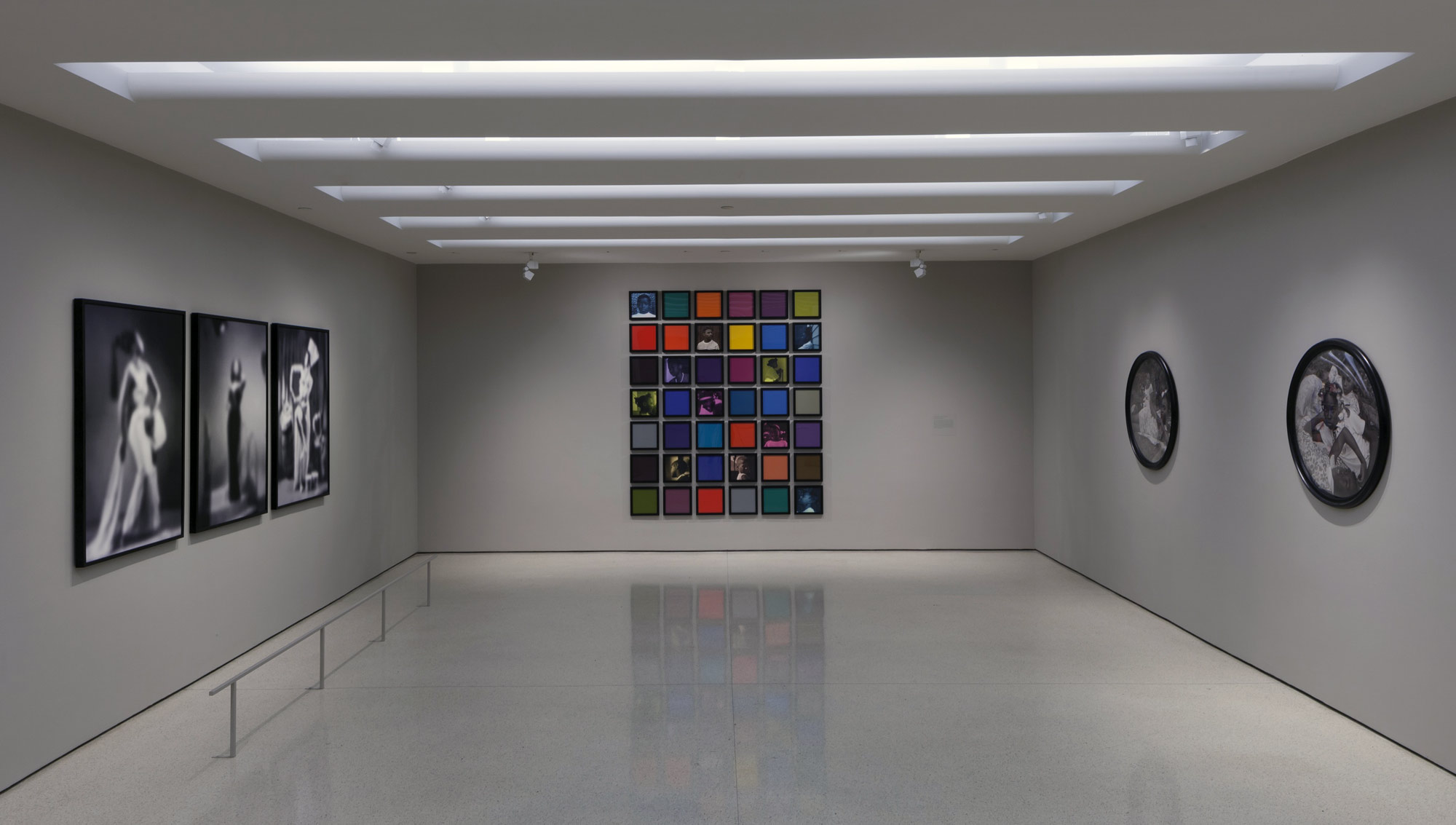
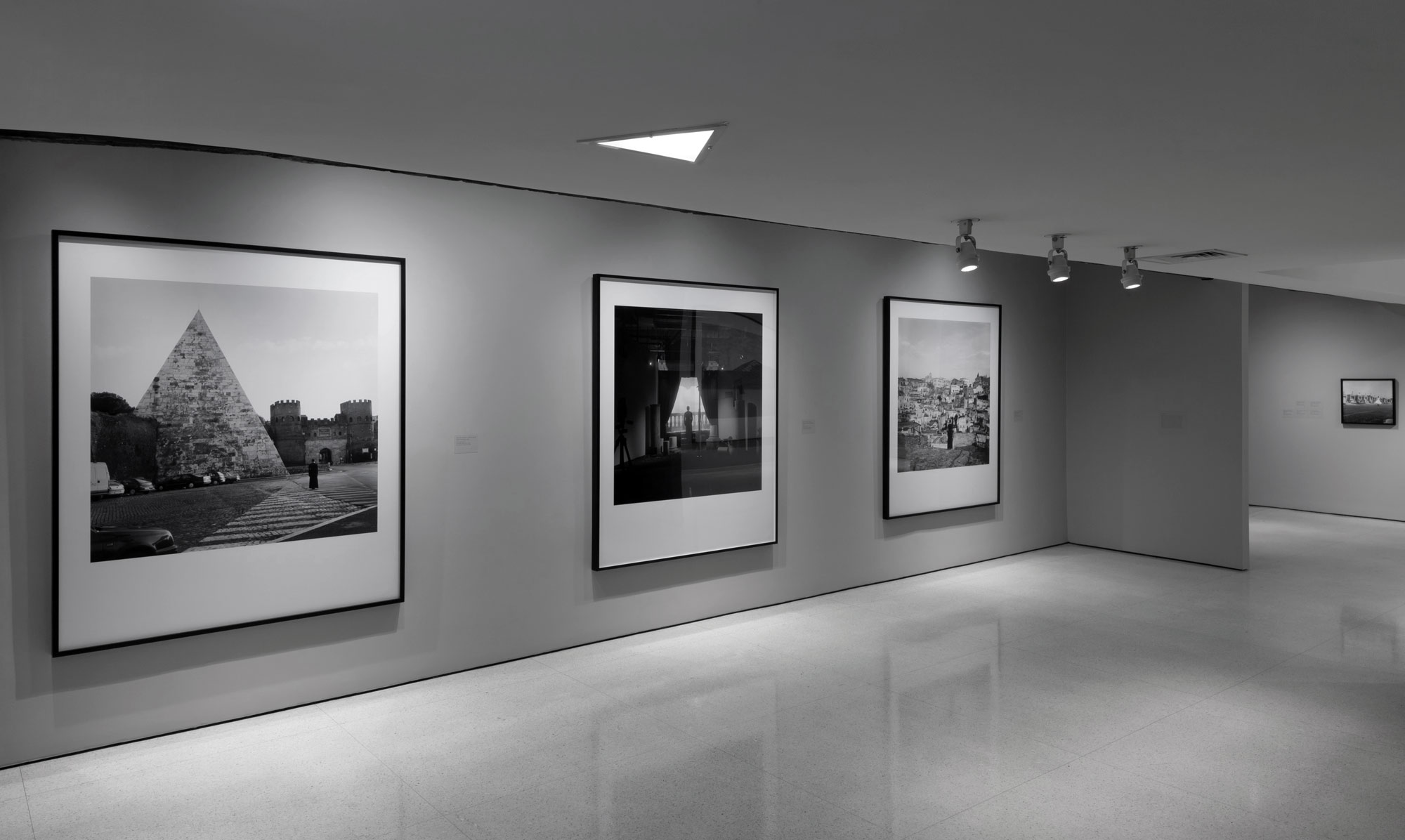
Installation view: 'Carrie Mae Weems: Three Decades of Photography and Video', Solomon R. Guggenheim Museum, New York, January 24-May 14, 2014


Installation view of the exhibition Carrie Mae Weems: Three Decades of Photography and Video, Solomon R. Guggenheim Museum, New York, January 24-May 14, 2014
Photo: David Heald © Solomon R. Guggenheim Foundation.


A busy time with postings on the archive over the next week with a lot of exhibitions finishing on the 18th May 2014. The posting about this artist is one of the best of them. I have been wanting to show this artist on this site since it started, nearly 6 years ago. Finally, I get my chance!

I ask the question:

Who are the interesting photographers anywhere who are alive now?

That is – by looking at the ideas that are present in poetry, music, philosophy or even politics – who is there that is truly taking these ideas forward (or ideas that are as interesting). Or, who is arranging images with the elegance of a Sommer or an Atget or the dynamics of Arbus.

In other words whose acts am I hanging upon, so that I am waiting with great anticipation to see what they are going to do next?

Which living photographers would I walk over broken glass to see their work? = some

If I was being essential (and if you were walking over glass you would be), the list would be very short:

Carrie Mae Weems and Wolfgang Tillmans.


What both these image makers – for they are not photographers in the traditional sense – do, is problematise and reconfigure narration and visualisation in the conceptualisation of subject. Tillmans experiments with a sensory experiential backdrop against and within which the photographs are produced. Modes of perception and the regimes of emotion are inducted into the aesthetics of production and meaning so that, “the pictures communicate with each other in a way that is not bound to the pattern of a closed narrative or any particular line of argument.” The mobilisation and reversal of value and meaning are central strategies in Tillmans’ praxis, where realistic and abstract elements are never intentionally separated from each other, and where the physicality and space of the photographs is also acknowledged in the installation of the work.

A similar sensory experience can be observed in the work of Carrie Mae Weems, only this artist invites contemplation of issues surrounding race, gender, and class inequality – bringing to light the voices of marginalised and oppressed people and histories – through a multidimensional picture of history and humanity, intended to spur greater cultural awareness and compassion. As the press release observes, “Although her subjects are often African American, Weems wants “people of color to stand for the human multitudes” and for her art to resonate with audiences of all backgrounds… Weems often appropriates words and images, re-presenting them to viewers as biting reminders of the persistence of bigoted attitudes in the United States.”

This is the power of both artists work, the creation of open ended narratives, multidimensional pictures of history and humanity which allows the viewer to create a space beyond the art works.

Using ekphrasis – the structuring patterns of language, in Weems’ case emphasising the role of both spoken and written narrative – to vividly represent a wide range of perceptual experiences, she creates a complementary space outside of the art work in the reader’s mind. The author creates links, “designating the paths along which the reader may travel, and thus, in a much freer manner than modernist authors, structures the network of allusions, parallelisms, and juxtapositions that contribute to the sense of textual space.”1 This allows the viewer to create a language of personal associations and engages in them an autonomy of experience, one encouraged by the products, the texts and images that these authors create.

These thoughts come to mind. Some things we interpret and then remember that interpretation, but we are no longer involved in the actual act of interpretation – and there are other, probably fewer things that continue to involve us – where we never finish the first way of looking at them, we are always coming to them and not arriving. Unfortunately, I find a lot of things in the first group, and as much as theoreticians try to inspire me to re-interpret, the work they have done often only works as an adjunct to something that has settled.

The art of Weems and Tillmans resides, lives and breathes of the second category, for we can never be sure of the pattern of narrative, the form of aesthetic and thematic interaction and the specificity of the marginalised histories they examine. These histories apply to all of us.

Dr Marcus Bunyan


1/ Tolva, John. Ut Pictura Hyperpoesis: Spatial Form, Visuality, and the Digital World,” in HYPERTEXT ’96 Proceedings of the the seventh ACM conference on Hypertext, 1996, p. 71.


Many thankx to The Solomon R. Guggenheim Museum for allowing me to publish the photographs in the posting. Please click on the photographs for a larger version of the image.


“Over the past thirty years, Carrie Mae Weems has yearned to insert marginalized peoples into the historical record. She does this not only to bring ignored or erased experiences to light but to provide a more multidimensional picture of humanity as a whole, a picture that ultimately will spur greater awareness and compassion. Weems believes deeply that “my responsibility as an artist is to … make art. beautiful and powerful, that adds and reveals; to beautify the mess of a messy world, to heal the sick and feed the helpless; to shout bravely from the roof-tops and storm barricaded doors and voice the specifics of our historic moment.””


Carrie Mae Weems quoted in Kathryn E. Delmez. “Introduction,” from Kathryn E. Delmez (ed.,). Carrie Mae Weems: Three Decades of Photography and Video. Yale University Press 2012, p. 1.


“Weems [work] exist at the intersection of photography and race, image and text.”


John Pultz


“Belying the myth that conceptual artists disdain the old-fashioned notion of aesthetics, Weems has long been consumed and galvanized by the idea of beauty. The notion of beauty encompasses and reaches beyond aesthetics. It is not a simple concept, as often there are unspoken political implications in her use. Beauty is a powerful adjective in her hands and an important tool in her work. Her work is always about beauty and purposely so. She seduces the viewer through the very process of creating luscious prints, or beautiful images, without ever using beauty purely to seduce. But no matter what one encounters within the text or within one’s own revelations about what the texts ultimately say, the religion of beauty always undergirds Weem’s vision and informs her work.”


Thelma Golden. “Some Thoughts on Carrie Mae Weems,” in Golden, T. and Piché Jr., T. Carrie Mae Weems: Recent Work, 1992-1998. New York: George Braziller, 1998, p. 32 quoted in Deborah Willis. “Photographing between the Lines: Beauty, Politics, and the Poetic Vision of Carrie Mae Weems,” in Kathryn E. Delmez (ed.,). Carrie Mae Weems: Three Decades of Photography and Video. Yale University Press 2012, p. 33.
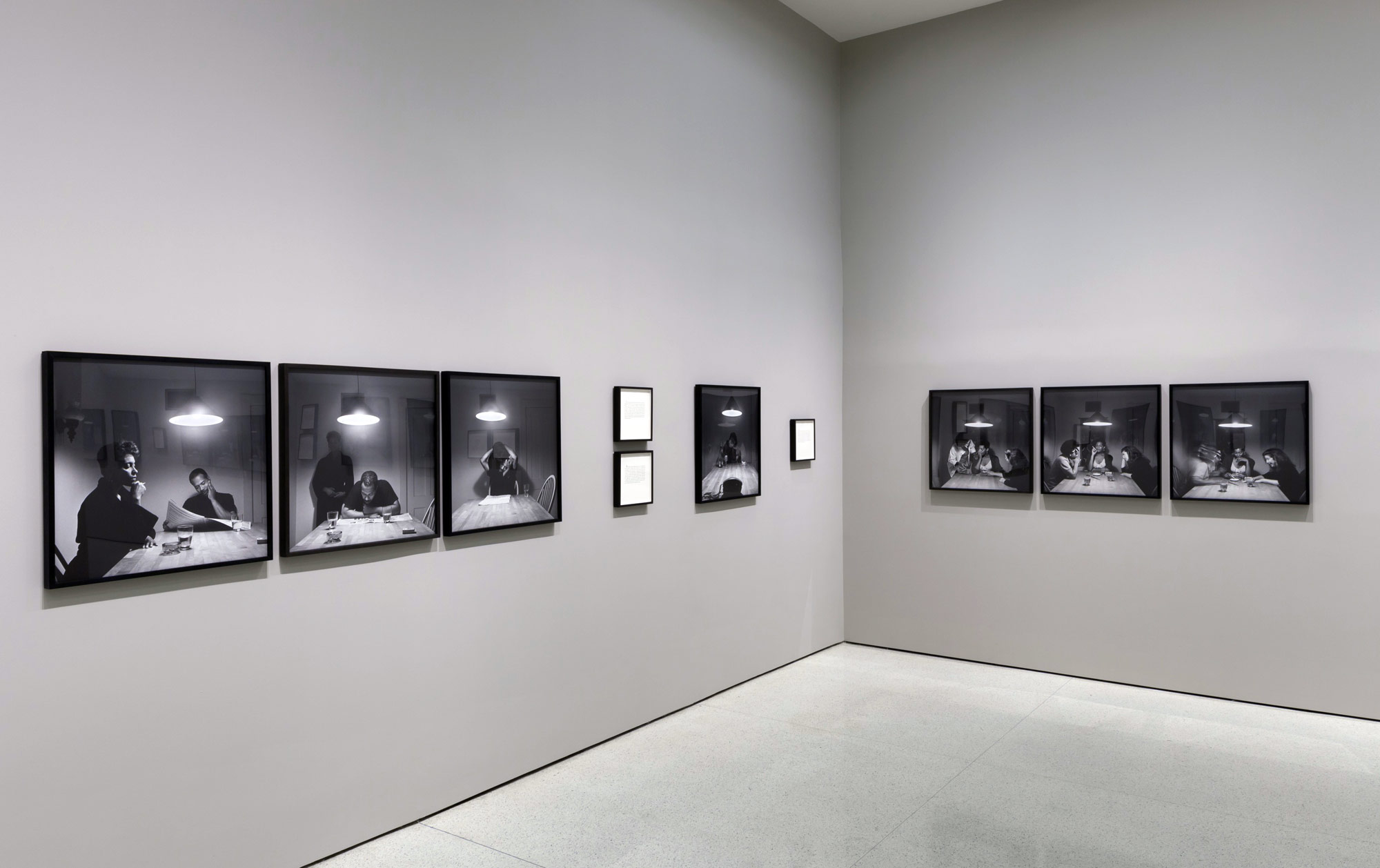


Installation view: 'Carrie Mae Weems: Three Decades of Photography and Video', Solomon R. Guggenheim Museum, New York, January 24-May 14, 2014

Installation view: 'Carrie Mae Weems: Three Decades of Photography and Video', Solomon R. Guggenheim Museum, New York, January 24-May 14, 2014

Installation view: 'Carrie Mae Weems: Three Decades of Photography and Video', Solomon R. Guggenheim Museum, New York, January 24-May 14, 2014

Installation view: 'Carrie Mae Weems: Three Decades of Photography and Video', Solomon R. Guggenheim Museum, New York, January 24-May 14, 2014

Installation view: 'Carrie Mae Weems: Three Decades of Photography and Video', Solomon R. Guggenheim Museum, New York, January 24-May 14, 2014


Installation views: Carrie Mae Weems: Three Decades of Photography and Video, Solomon R. Guggenheim Museum, New York, January 24-May 14, 2014
Photos: David Heald © Solomon R. Guggenheim Foundation.


The Solomon R. Guggenheim Museum presents Carrie Mae Weems: Three Decades of Photography and Video, the first major New York museum retrospective devoted to this socially motivated artist. Weems has long been acclaimed as one of the most eloquent and respected interpreters of African American experiences, and she continues to be an important influence for many young artists today. Featuring more than 120 works – primarily photographs, but also texts, videos, and an audio recording – as well as a range of related educational programs, this comprehensive survey offers an opportunity to experience the full breadth of the artist’s oeuvre and gain new insight into her practice.

Carrie Mae Weems: Three Decades of Photography and Video is organised by the Frist Center for the Visual Arts, Nashville, Tennessee. The exhibition has been curated by Kathryn Delmez, the Frist Center, where it opened in September 2012. The Solomon R. Guggenheim Museum presentation is organised by Jennifer Blessing, Senior Curator, Photography, with Susan Thompson, Assistant Curator. This exhibition is supported in part by The Robert Mapplethorpe Foundation. The Leadership Committee for Carrie Mae Weems: Three Decades of Photography and Video is also gratefully acknowledged for its support, including Jo Carole and Ronald S. Lauder, Robert Menschel Vital Projects, and Jack Shainman Gallery, as well as Henry Buhl, Crystal R. McCrary and Raymond J. McGuire, Beth Rudin DeWoody, Rhona Hoffman Gallery, Toby Devan Lewis, Louise and Gerald W. Puschel, and Miyoung Lee and Neil Simpkins. Additional funding is provided by the William Talbott Hillman Foundation and the New York State Council on the Arts.

The work of Carrie Mae Weems (b. 1953, Portland, Oregon) invites contemplation of issues surrounding race, gender, and class inequality. Over the past thirty years, Weems has used her art to bring to light the ignored or erased experiences of marginalised people. Her work proposes a multidimensional picture of history and humanity, intended to spur greater cultural awareness and compassion. Although her subjects are often African American, Weems wants “people of colour to stand for the human multitudes” and for her art to resonate with audiences of all backgrounds.

Organised in a loosely chronological order throughout two of the museum’s Annex Levels, the exhibition begins on Level 2 with the series Family Pictures and Stories (1978-1984). This series, like many of Weems’s early works, explores matters relating to contemporary black identity, highlighting individuals in social contexts – including in this case her own kin. Her landmark Kitchen Table Series (1990) employs text and photography to explore the range of women’s roles within a community, pointedly situating the photographs’ subject within a domestic setting. Selections from Weems’s Sea Islands Series (1991-1992), Africa (1993), and Slave Coast (1993) demonstrate her ongoing interest in language and storytelling. These works, made during the artist’s travels to the titular locales, pair images with evocative vernacular texts or etymological investigations that trace English words to African roots. The artist’s practice emphasises the role of both spoken and written narrative, reflecting her graduate studies in folklore.

Weems often appropriates words and images, re-presenting them to viewers as biting reminders of the persistence of bigoted attitudes in the United States. Her renowned series From Here I Saw What Happened and I Cried (1995-1996), presented on Annex Level 4, layers new text over found historical imagery to critique and lament prejudiced attitudes toward African Americans throughout the nineteenth and twentieth centuries. A yearning to investigate the underlying causes and effects of racism, slavery, and imperialism has spurred Weems to travel widely throughout the United States, Africa, Europe, and the Caribbean. During extended visits to these places, depicted in series such as Dreaming in Cuba (2002), The Louisiana Project (2003), and Roaming (2006), all represented in the exhibition, she looks to the surrounding land and architecture in order to foster communion with inhabitants past and present.

Video is a natural extension of Weems’s narrative photographic practice, also providing an opportunity for the artist to include music in her work. Although she worked in film during her undergraduate years at the California Institute of the Arts, Weems’s first major endeavour in the medium came in 2003-2004 with Coming Up for Air, a work comprised of series of poetic vignettes that will be screened in the New Media Theater in the Guggenheim’s Sackler Center for Arts Education. Other video works, including Italian Dreams (2006), Afro Chic (2009), and Constructing History: A Requiem to Mark the Moment (2008) will be integrated into the exhibition near related photographs.

Press release from The Solomon R. Guggenheim Museum website
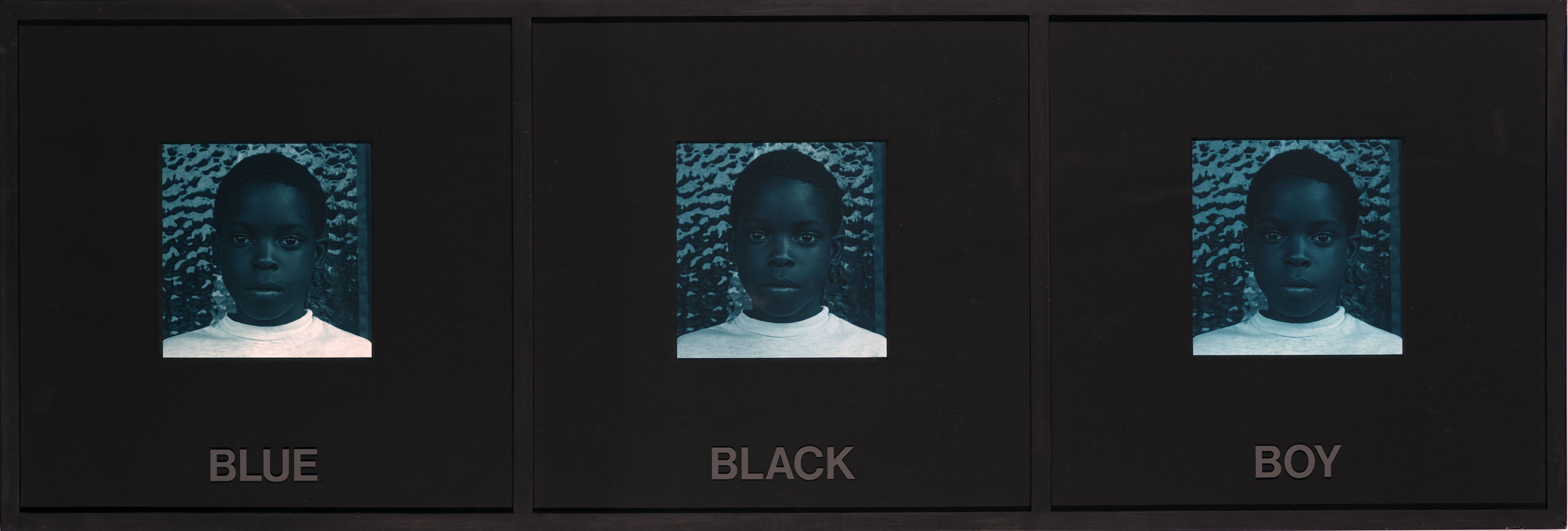
 

Carrie Mae Weems (American, b. 1953) 'Blue Black Boy (from 'Colored People')' 1989-1990 from the exhibition 'Carrie Mae Weems: Three Decades of Photography and Video' at The Solomon R. Guggenheim Museum, New York, January - May, 2014


Carrie Mae Weems (American, b. 1953)
Blue Black Boy (from Colored People)
1989-90
Triptych, three toned gelatin silver prints with Prestype and frame
16 x 48 inches (40.6 x 121.9cm) overall
Whitney Museum of American Art, New York, Purchase, with funds from the Photography Committee
© Carrie Mae Weems
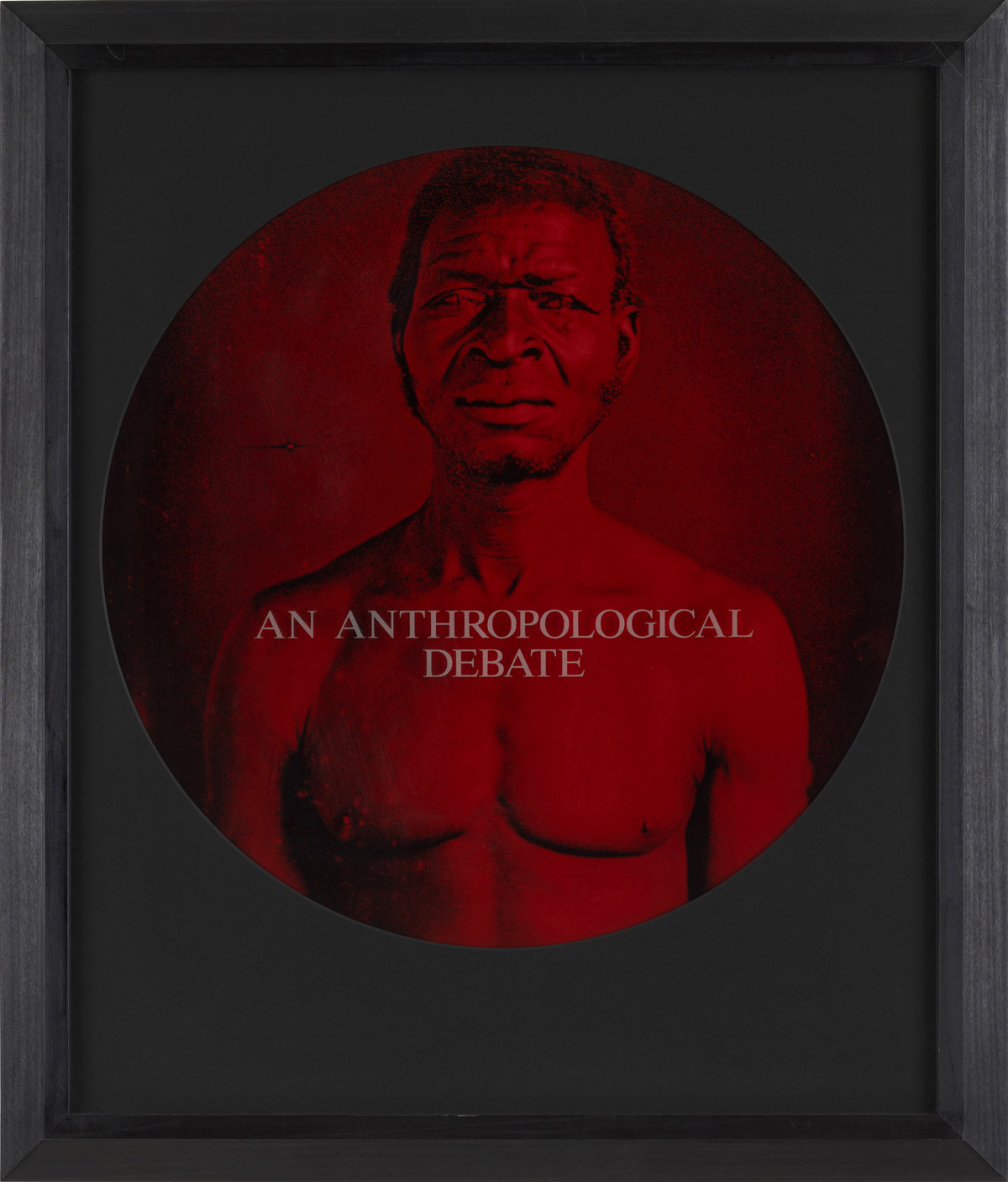
 

Carrie Mae Weems (American, b. 1953) 'An Anthropological Debate' (from 'From Here I Saw What Happened and I Cried') 1995-1996 from the exhibition 'Carrie Mae Weems: Three Decades of Photography and Video' at The Solomon R. Guggenheim Museum, New York, January - May, 2014


Carrie Mae Weems (American, b. 1953)
An Anthropological Debate (from From Here I Saw What Happened and I Cried)
1995-1996
Chromogenic print with etched text on glass
26 1/2 x 22 3/4 inches (67.3 x 57.8cm)
The Museum of Modern Art, New York, Gift on behalf of The Friends of Education of the Museum of Modern Art
From an original daguerreotype taken by J.T. Zealy, 1850. Peabody Museum, Harvard University.Copyright President & Fellows of Harvard College, 1977. All rights reserved.
Photo: © 2012, MoMA, NY
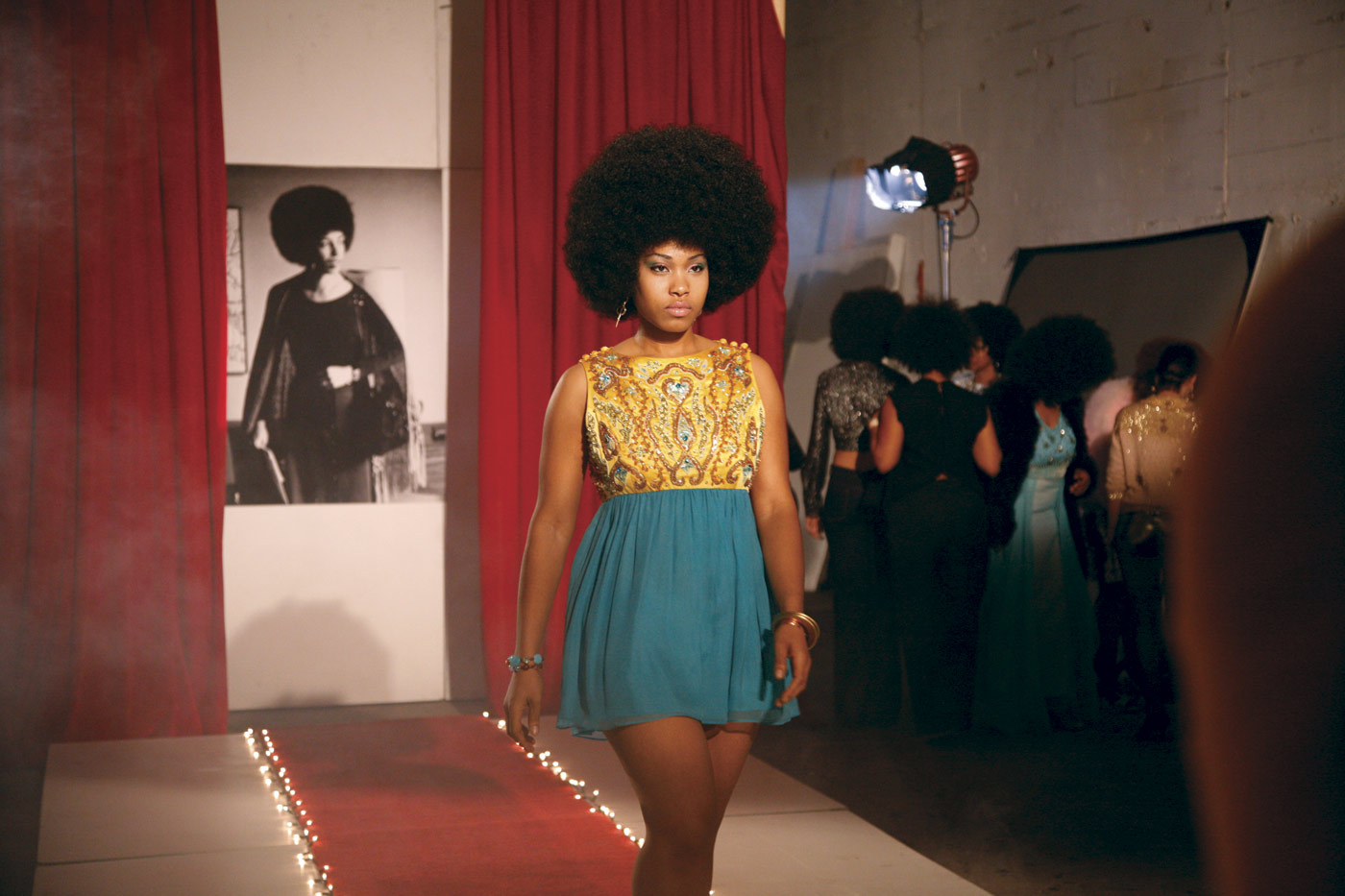
 

Carrie Mae Weems (American, b. 1953) 'Afro-Chic' 2010


Carrie Mae Weems (American, b. 1953)
Afro-Chic
2010
Digital colour video, with sound, 5 min., 30 sec.
Collection of the artist, courtesy Courtesy the artist and Jack Shainman Gallery, New York
© Carrie Mae Weems
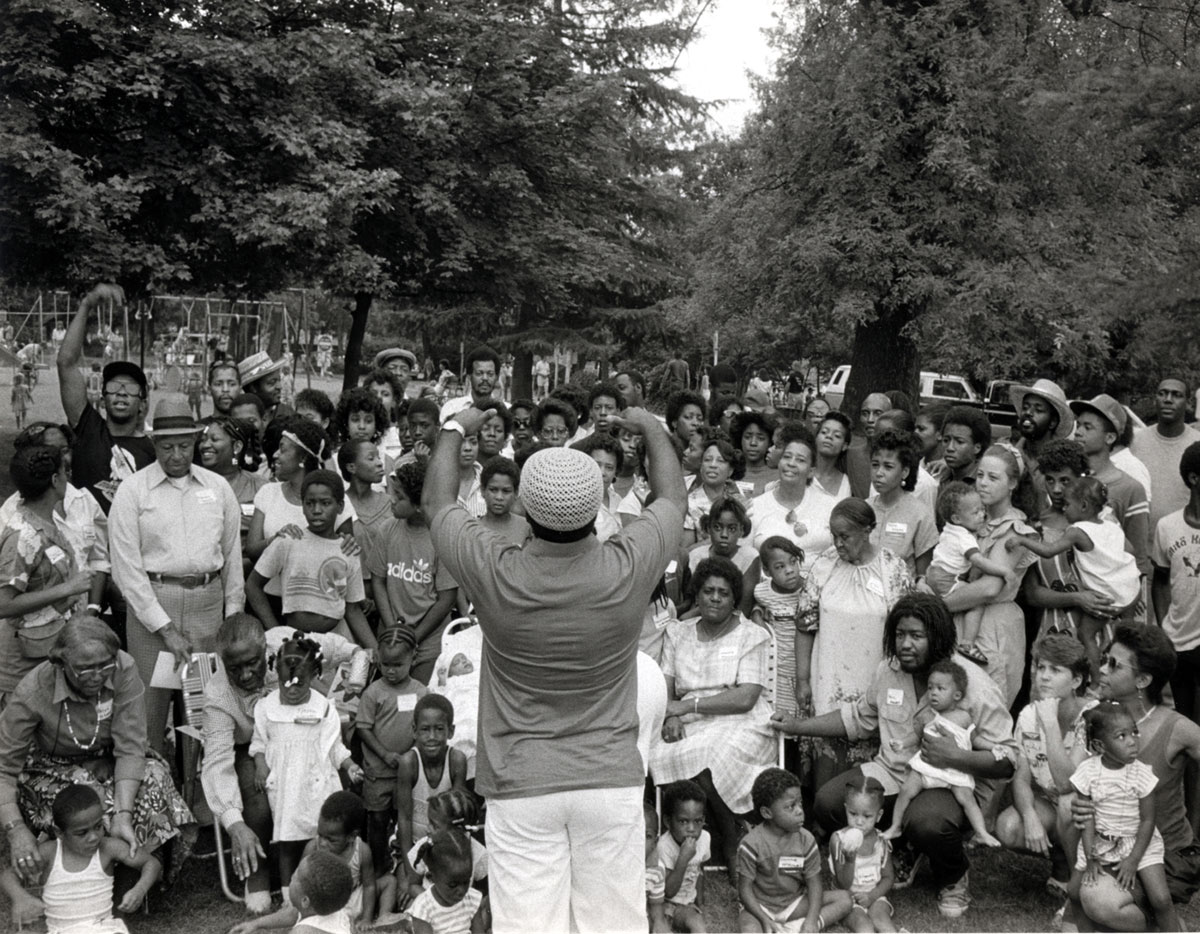
 

Carrie Mae Weems (American, b. 1953) 'Family Reunion' (from 'Family Pictures and Stories') 1978-1984


Carrie Mae Weems (American, b. 1953)
Family Reunion (from Family Pictures and Stories)
1978-1984
Gelatin silver print
30 x 40 inches (76.2 x 101.6cm)
Collection of the artist, courtesy Jack Shainman Gallery, New York
© Carrie Mae Weems
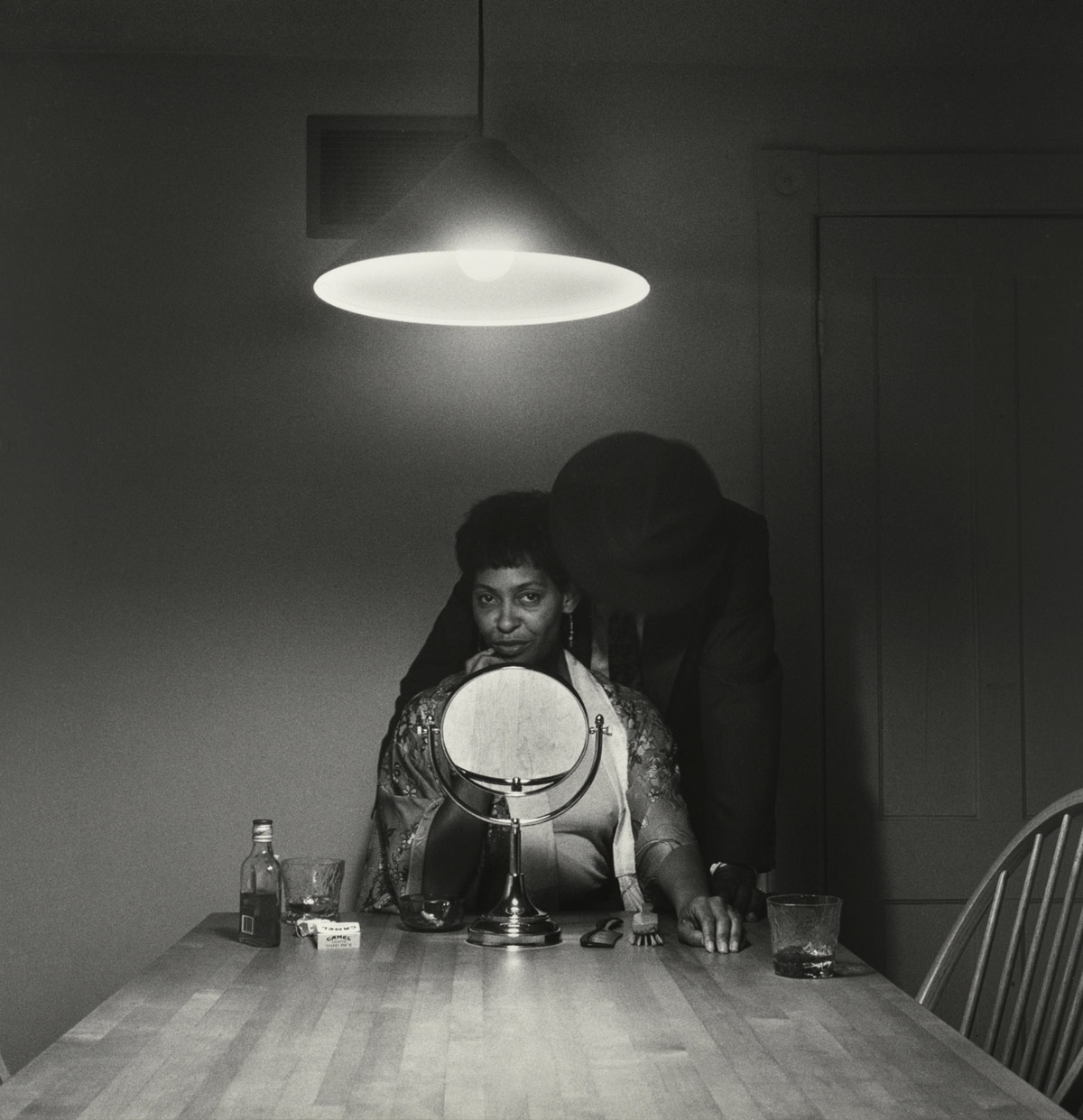
 

Carrie Mae Weems (American, b. 1953) 'Untitled (Man and mirror)' (from 'Kitchen Table Series') 1990


Carrie Mae Weems (American, b. 1953)
Untitled (Man and mirror) (from Kitchen Table Series)
1990
Gelatin silver print
27 1/4 x 27 1/4 inches (69.2 x 69.2 cm)
Collection of Eric and Liz Lefkofsky, Promised gift to The Art Institute of Chicago
© Carrie Mae Weems
Photo: © The Art Institute of Chicago
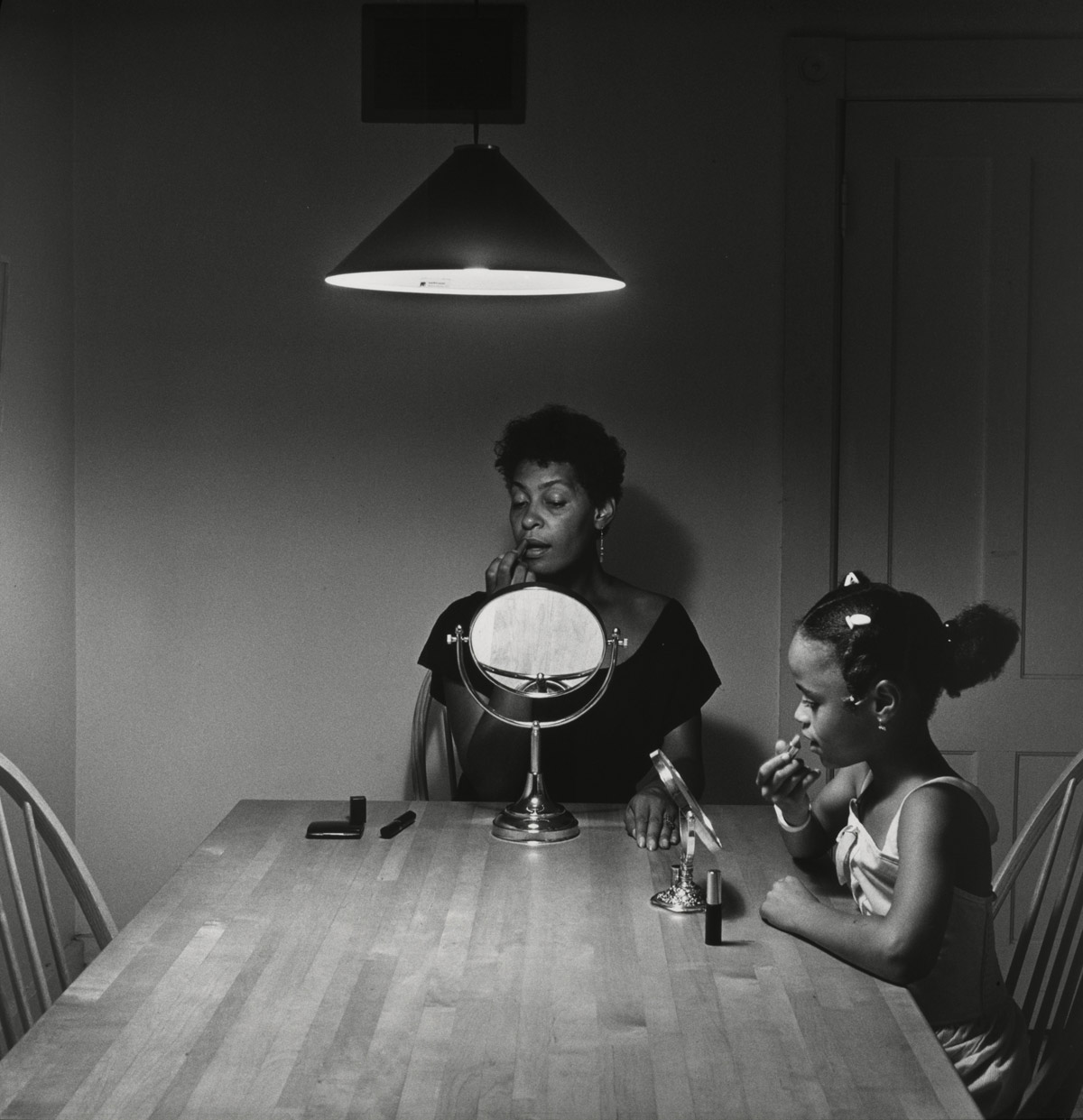
 

Carrie Mae Weems (American, b. 1953) 'Untitled (Woman and daughter with makeup)' (from 'Kitchen Table Series') 1990


Carrie Mae Weems (American, b. 1953)
Untitled (Woman and daughter with makeup) (from Kitchen Table Series)
1990
Gelatin silver print
27 1/4 x 27 1/4 inches (69.2 x 69.2cm)
Collection of Eric and Liz Lefkofsky, Promised gift to The Art Institute of Chicago
© Carrie Mae Weems
Photo: © The Art Institute of Chicago
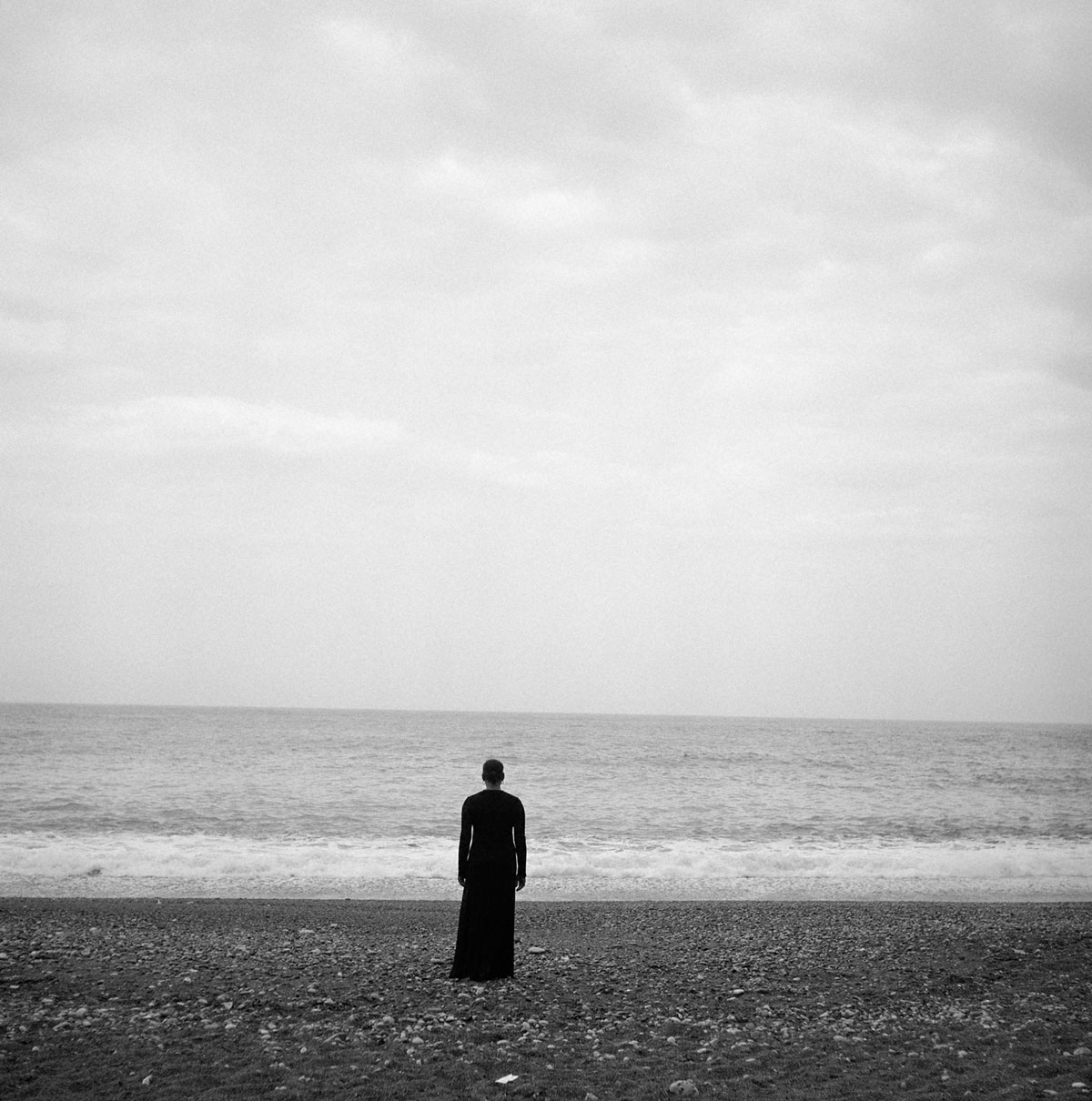
 

Carrie Mae Weems (American, b. 1953) 'A Broad and Expansive Sky - Ancient Rome' (from 'Roaming') 2006


Carrie Mae Weems (American, b. 1953)
A Broad and Expansive Sky – Ancient Rome (from Roaming)
2006
Chromogenic print
73 x 61 inches (185.4 x 154.9cm)
Private collection, Portland, Oregon
© Carrie Mae Weems
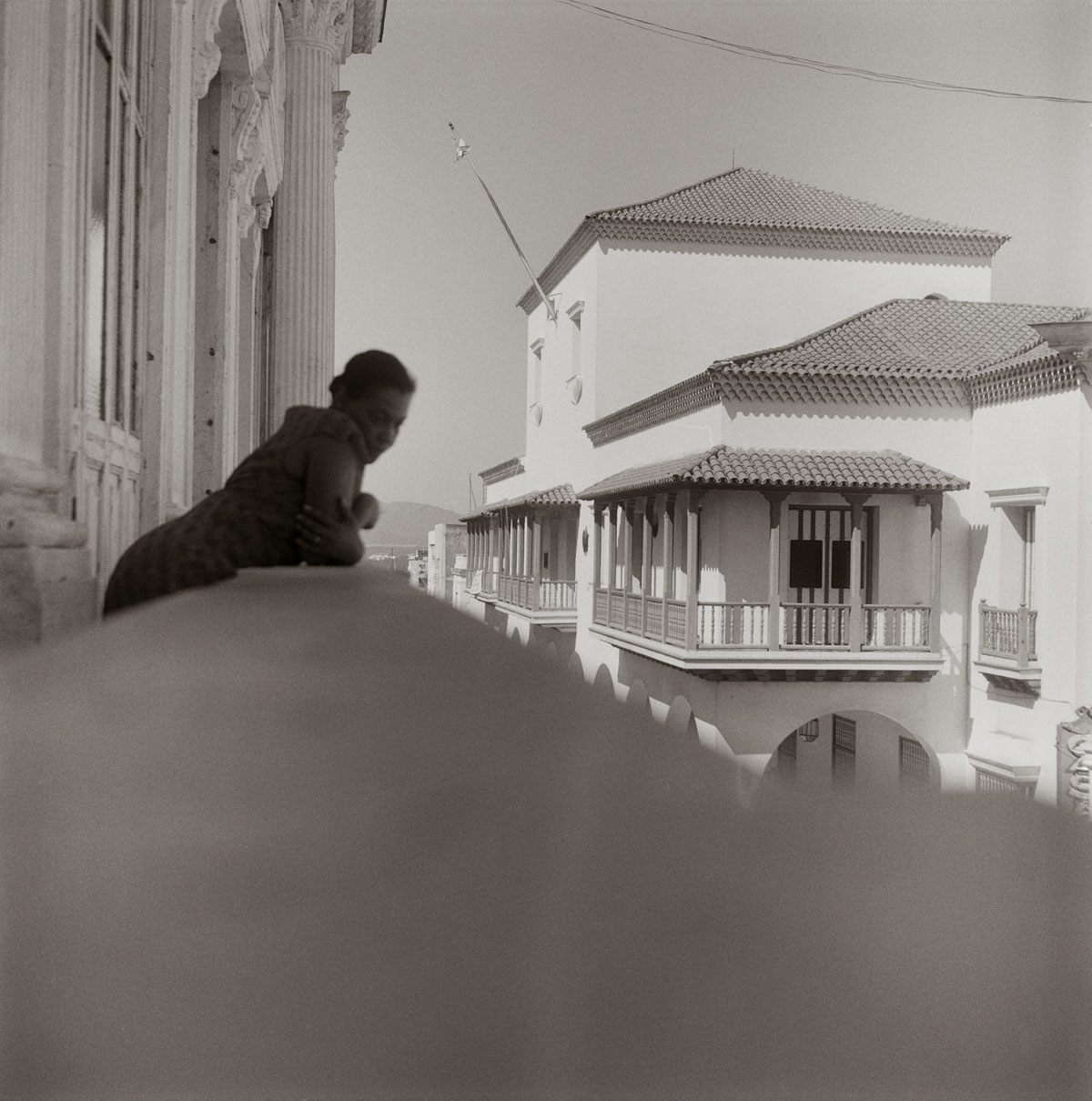
 

Carrie Mae Weems (American, b. 1953) 'Listening for the Sounds of Revolution' (from 'Dreaming in Cuba') 2002


Carrie Mae Weems (American, b. 1953)
Listening for the Sounds of Revolution (from Dreaming in Cuba)
2002
Gelatin silver print
28 1/2 x 28 1/2 inches (72.4 x 72.4cm)
Collection of the artist, courtesy Courtesy the artist and Jack Shainman Gallery, New York
© Carrie Mae Weems
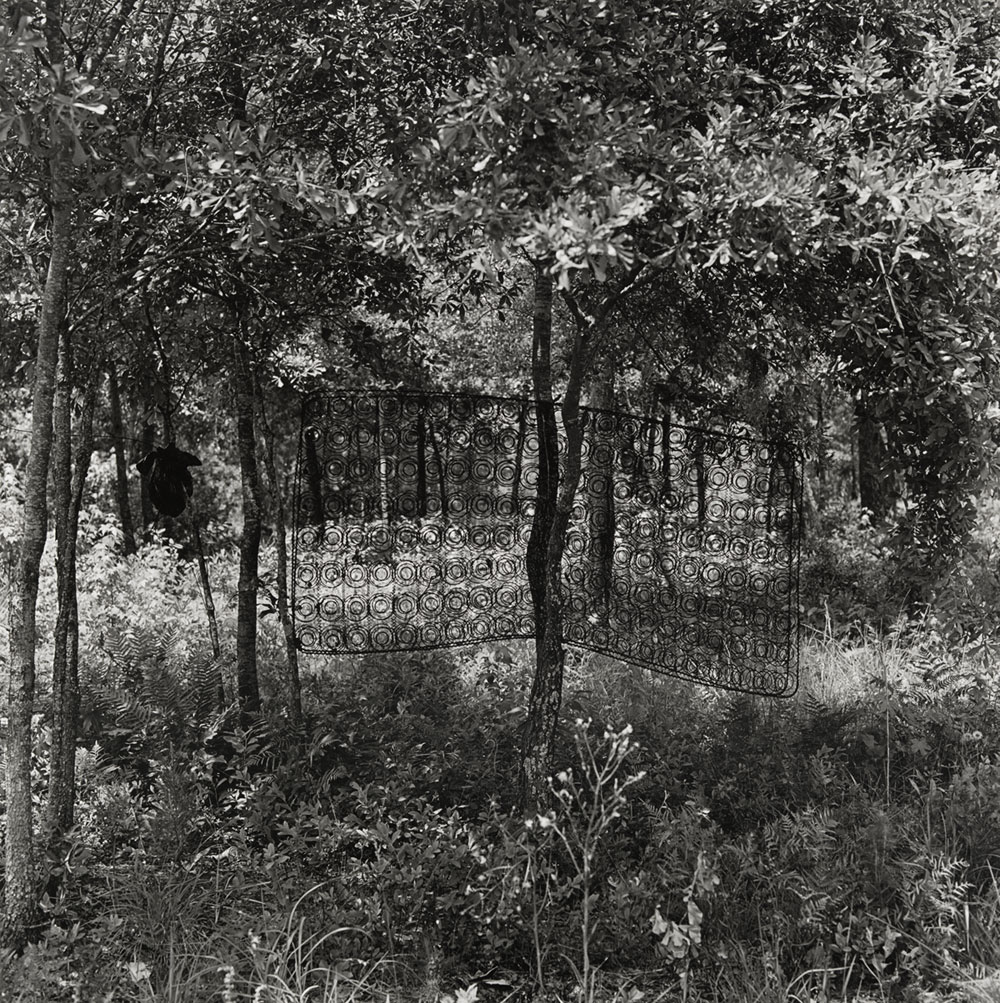
 

Carrie Mae Weems. 'Untitled (Box Spring in Tree)' (from 'Sea Islands Series') 1991-92
 

Carrie Mae Weems (American, b. 1953)
Untitled (Box Spring in Tree) (from Sea Islands Series)
1991-1992
Gelatin silver print
20 x 20 inches (50.8 x 50.8cm)
Whitney Museum of American Art, New York, Gift of Carrie Mae Weems and P•P•O•W, 97.97.1
© Carrie Mae Weems
Photo: Robert Gerhardt
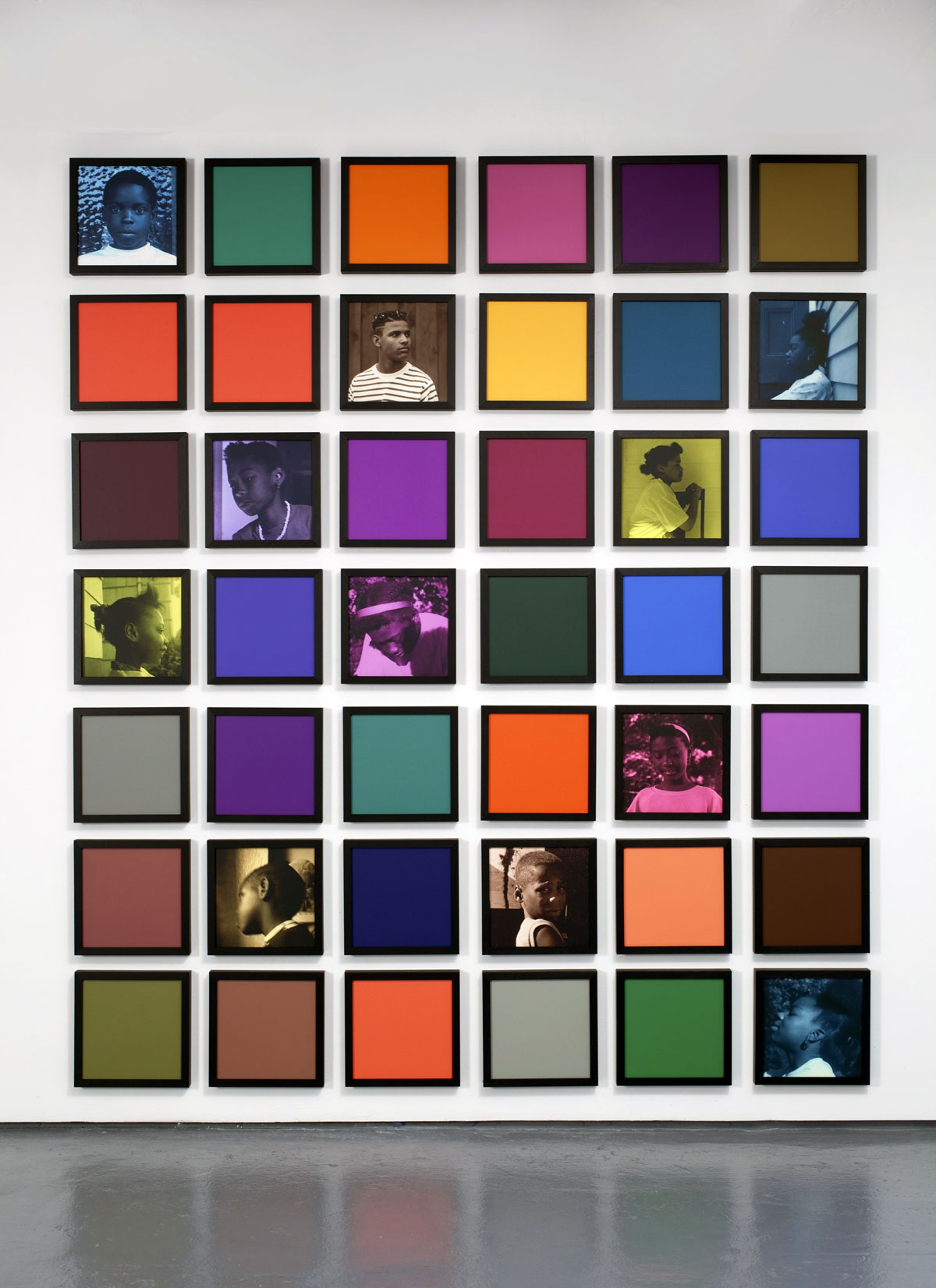
 

Carrie Mae Weems (American, b. 1953) 'Untitled (Colored People Grid)' 2009-2010


Carrie Mae Weems (American, b. 1953)
Untitled (Colored People Grid)
2009-2010
11 inkjet prints and 31 coloured clay papers
Dimensions variable overall; individual components: 10 x 10 inches (25.4 x 25.4cm) each
Collection of Rodney M. Miller
© Carrie Mae Weems


Solomon R. Guggenheim Museum
1071 5th Avenue (at 89th Street)
New York

Opening hours:
Sunday – Monday, 11am – 6pm
Wednesday – Friday 11am – 6pm
Saturday 11am – 8pm
Closed Tuesday
Solomon R. Guggenheim Museum website

LIKE ART BLART ON FACEBOOK

Back to top

Review: ‘The Paper’ by Rosemary Laing at Tolarno Galleries, Melbourne

Exhibition dates: 5th April 2014 – 3rd May, 2014


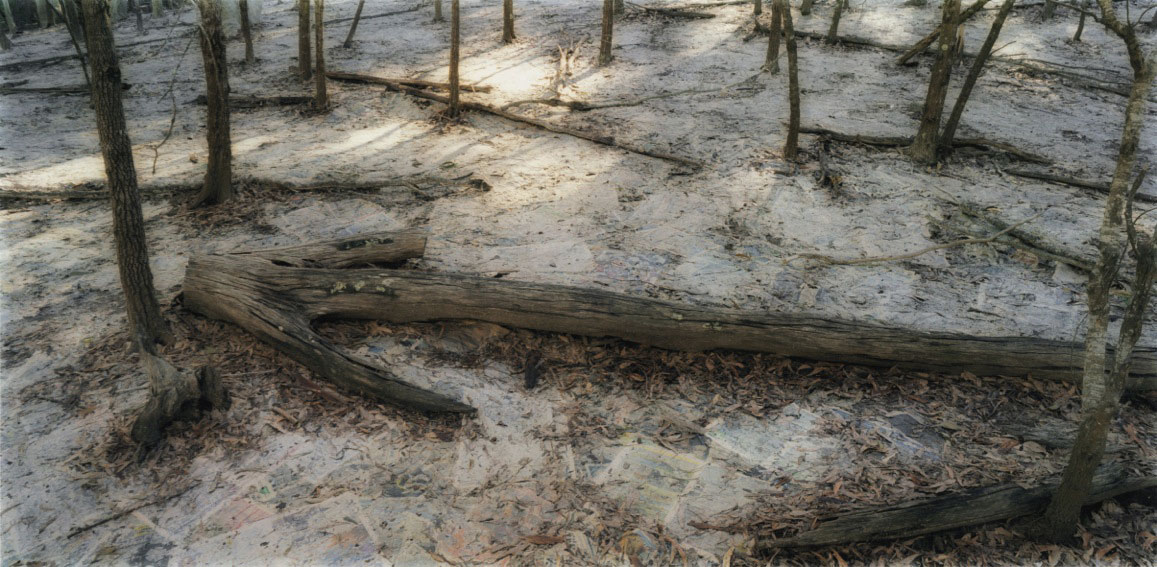
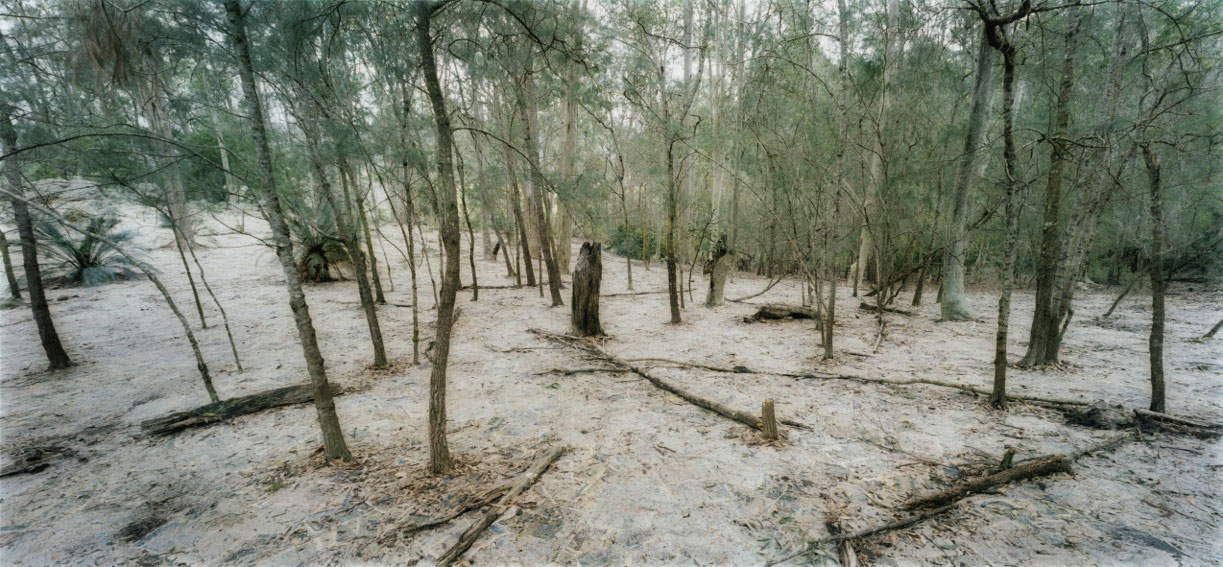
Rosemary Laing (Australian, 1959-2024) 'The Paper, Monday' 2013 from the exhibition 'The Paper' by Rosemary Laing at Tolarno Galleries, Melbourne, April - May, 2014


Rosemary Laing (Australian, 1959-2024)
The Paper, Monday
2013
C Type photograph
110 x 214cm
Courtesy the artist and Tolarno Galleries, Melbourne


I always look forward to new work by the incomparable Rosemary Laing with great anticipation. I have never been disappointed. This magnificent group of five images is no exception, one of the photographic highlights so far this year in Melbourne.

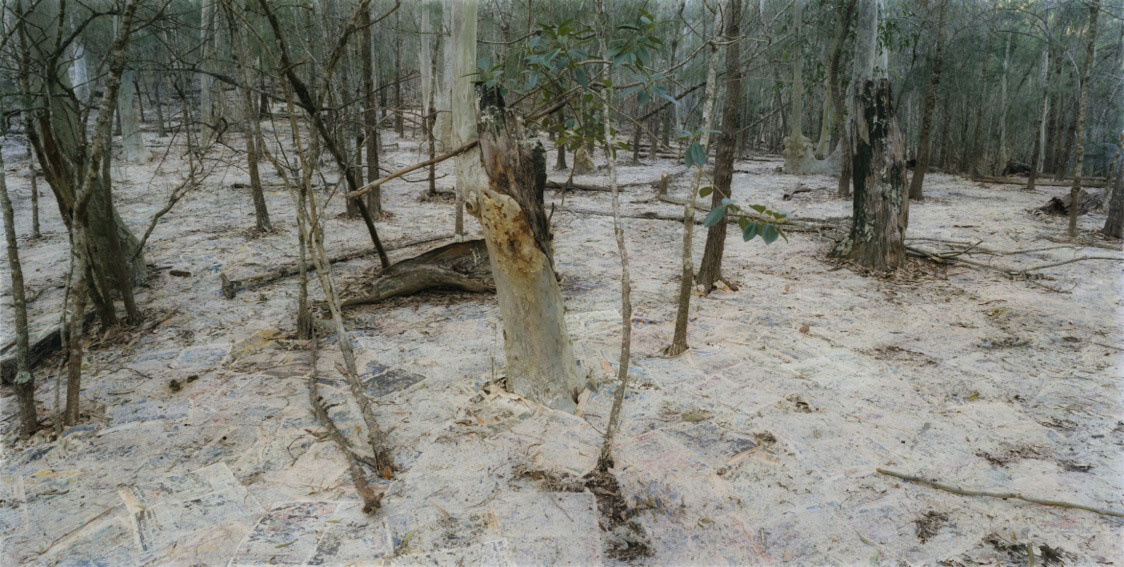
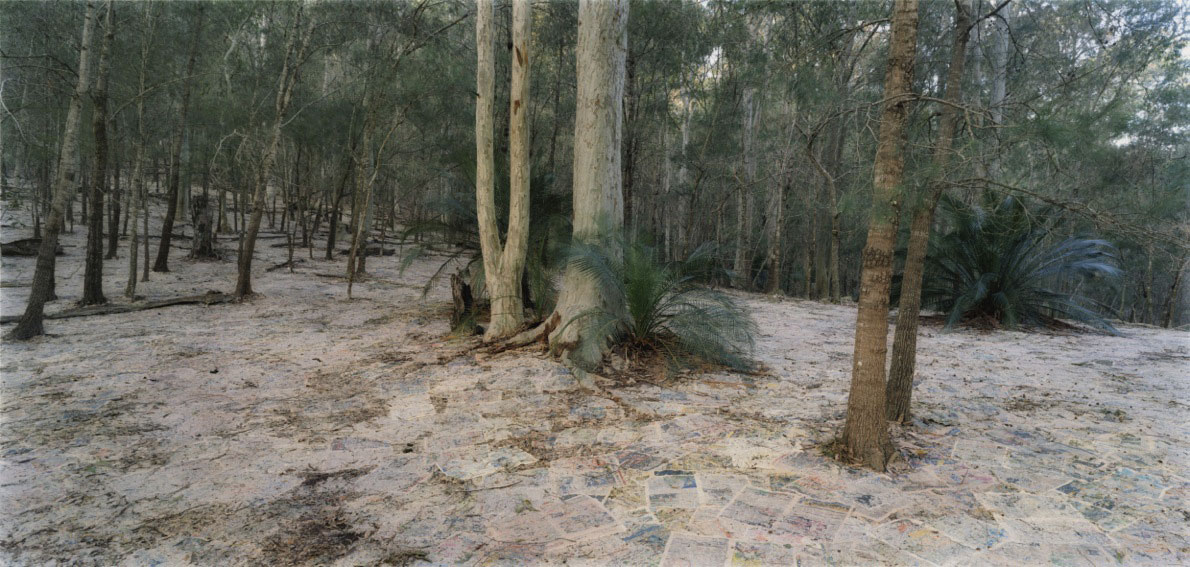
These large, Type-C analogue landscape format photographs feature decomposing newspapers literally (being words) carpeting the forest floor. These site-specific interventions feature no digital manipulation and, as the erudite catalogue essay by George Alexander observes below, investigate the replacement of our daily newspaper by online information bytes, “the graphic graphic newsprint breaking down like typographic stew,” the “transmigration of matter from one form to another,” “a meditation on time,” recycling, deforestation, information overload. These concepts build on earlier fragments from work by the artist (such as groundspeed2001) into something transformational, transnational and, even, otherworldly.

These entropic panoramas, which hang mysteriously between words and worlds, are indeed meditations on time and space. As Annette Hughes states,

“Laing’s pictorial space, like that of cinema, is generally art-directed, constructed, rehearsed, performed and shot in physical time and space, and though it could easily be Photoshopped these days, that’s not the point. The art object is only the end product of the making of these images. Being able to see the many human hours devoted to their execution is also a way of building duration back into the photograph.”1


Here’s my tuppence worth on Laing’s new work.

This suite of photographs has a panoramic immersiveness. The viewer feels as though time has stood still when looking at these photographs, where the newspapers are analogous to snow upon the ground, imparting something of a dream-like existence to the images. There is a talismanic quality to the images, like a standing stone circle that is believed to have magic powers and cause good things to happen. And they are full of symbols, such as arrows, to mark the way (see The Paper, Wednesday, earlier, 2013, below).

These are not unquiet images, suspended midway between fantasy and reality, but (un)quiet images – a subtle but pivotal difference. They possess the quietness of the forest but also the isolation and loneliness. They are based on a harmonic instability, like a minor chord at the beginning of a Beethoven symphony, which is then eventually resolved in the major. These images are the journey of that resolution. The words, the flesh of the textural body, has been pulped: that immersive instability of the fecund body laying down in the soil of mother earth.

The viewer is disorientated. We have no idea where we are, the paper (the word and world) creating for the body this foggy, dream-like atmosphere. As in all of Laing’s work, there is an inquiring instability here, one that seeks the resolution of stability through the love of the human body and of our existence. I stand still before them.

Dr Marcus Bunyan


1/ Hughes, Annette. “ABIGAIL SOLOMON-GODEAU Rosemary Laing,” Review on The Newtown Review of Books website 3th July 2012 [Online] Cited 27th April 2014. No longer available online


Many thankx to Tolarno Galleries for allowing me to publish the photographs in the posting. Please click on the photographs for a larger version of the image.


Rosemary Laing (Australian, 1959-2024) 'The Paper, Tuesday' 2013 from the exhibition 'The Paper' by Rosemary Laing at Tolarno Galleries, Melbourne, April - May, 2014


Rosemary Laing (Australian, 1959-2024)
The Paper, Tuesday
2013
C Type photograph
110 x 209cm
Courtesy the artist and Tolarno Galleries, Melbourne


Rosemary Laing (Australian, 1959-2024) 'The Paper, Wednesday, earlier' 2013


Rosemary Laing (Australian, 1959-2024)
The Paper, Wednesday, earlier
2013
C Type photograph
110 x 203cm
Courtesy the artist and Tolarno Galleries, Melbourne


Rosemary Laing

The Paper

A forest is carpeted with truckloads of newspapers. A cacophony of printed voices layers the soil horizon of the ground. The former surface litter of loose and partly decayed organic matter is overlaid with pulped tree product. The 21st century cultural carpet of current events and mercenary babble is already time-lined by weathering, which is fast-tracking the decomposition of the worded pages. The graphic of newsprint is breaking down like typographic stew, falling apart like old lacework, dissolving like paint – it’s losing its imprint as fallen branches and leaves scatter over it. It seems to expect that over time it will disappear beneath what comes after, what fresh coats some future century will lay over it.

For this undertaking, Rosemary Laing located her activity among the woodlands of Bundanon, a casuarina forest peppered with eucalyptus and Burrawang. Located in the Shoalhaven of southern New South Wales, the site was originally the land of the Wodi Wodi people of the Yuin nation. Layered with subsequent occupations since the early 19th century, in 1993 the properties were gifted by Arthur and Yvonne Boyd and became the Bundanon Trust – a place for artists of all disciplines to work and a place for all people to draw inspiration.

Two unique opportunities here were made possible by the Trust to Rosemary Laing. The opportunity to develop and consider her actions unhindered by a time frame; together with access to the Bundanon collection of the influential gnarled ceramics that Arthur’s father Merric Boyd (1888-1959) made with their blue and green underglazes and swaying lines of treescapes on clay.

As it happened, while making this work, the place was inundated with floodwaters. Natural disaster has often enclosed her work, as in swanfires (2002-2004), with its incinerated sheds and buildings, following bushfires in the Sussex Inlet area – also part of the Shoalhaven. Destruction sculpts and re-sculpts the world, and Laing joins the material cycle, the perpetual transmigration of matter from one form to another. A “terrible beauty”, as a friend remarked.

This series is called The Paper, for the daily newspaper – our long time companion and a primary fix for information of the world – that is swiftly being superseded by the new material technologies of our times. If the overwhelming flood of data and culture and spin is hitting us with some 500,000 discrete bits of information at any time, then we may be faced with inabilities to absorb that Total Noise. We probably missed the 25 bits that were important. The latest innovations of the Infosphere replay confections of overstimulation and boredom, sugar-hits of overload followed by emotional numbness.

Yet the covering of the ground that we saw in 2001 with groundspeed – not far geographically from this site – isn’t the same as here in the series The Paper. The point of loungeroom carpets in groundspeed was as an index of the latecomer’s sense of belonging. A kind of comfort zone for the non-indigenous, bridging old world and new. The carpeting this time – as she writes in her notes – “seems to be composting the present as a past about to happen; taking a once-upon- a-time not-that-long-ago standard as the ground-amendment-of- tomorrow already.” It is, among other things, a meditation on time.

Every new presentation of Laing’s work is also a running commentary on her previous corpus of work. The Paper explores themes touched upon in – Natural Disasters (1988), groundspeed (2001) with its patterned loungeroom carpets out in the ‘wild’ and in 2006, weather with its cyclone of newspaper shreds – while constantly replenishing what had remained surplus to that work. And this compost of earlier fragments, that are dismembered and scattered and gathered again, expands her material formation on this site.

From top to bottom the planet is being transfigured. Something essential is changing now and forever. The “global” has become everyone’s “local”. The human race is going through things it has never experienced before – as we are forced to join the caravan of this moment in time.

Hellish or heavenly? Promised Land or Wasteland? Take your pick. You do get the sense – with the dramatic shiny green of the ancient Burrrawang palms scattered about – of human impermanence against the bedrock temporal dimensions of the primitive Gondawan rainforest margins. As anyone who has spent time slogging through genuine bushland, and sensing the century’s long pulse of trees: we’ve fallen out of tune with the eternal present of the animal world, we’ve fallen into Time with its past and future, the chopped-up time of daily newspapers.

Find tongues in trees, books in the running brooks, sermons in stones … wrote Shakespeare (As You Like It, 2.1). The quote recalls the medieval idea of the Book of Nature that we are here to read, whose infinite pages unfold enormous landscapes: some see good, some evil, some both, some neither. Laing’s art takes root in a fissure, in that crack in the covenant between word and world, and the historical moment is right: we are in the age of the “trans-book” with the rise of the Kindle and iGoogle, and with it the end of newspapers, the demise of print and the retrenchment of journalists.

So as you enter the space, walk around the room with the suite of images – named for the days of the week – there’s an entropic feel with their grubby matte and muted beauty. Underfoot, things fall apart, the riggings of the page disintegrate into tissue, print naturalises into leaf mould, and words on paper are composted back into wood pulp and waste slurry. Accordingly, to make the images this time around, she put her dalliances with digital cameras and print-output machines aside, in favour of analogue, for all the lovely limitations and imperfections of light on cellulose triacetate, and the physical shadings of Laing’s printer in the darkroom.

The curving earth is a body, and these lacework landscapes show off the marks of ageing. The woods are a damp chamber, with a thick carpet of newspapers, and many doors open to the wind and faraway light. The images enclose you in brushwork of soft jade while the soggy colours of disintegration make time tangible.

There’s nothing said about the world here (recycling, deforestation, information overload) that you couldn’t find more reliably elsewhere. It’s rather Laing’s process of invention, through the hinterlands of her material imagination, that communicates her unexpected vision, tells her story of an imagined afterwards of along-the-way. There’s a stand of trees in these pictures still growing inside the shellacking and composting of our times.

George Alexander
September 2013

Published with permission


Rosemary Laing (Australian, 1959-2024) 'The Paper, Wednesday' 2013


Rosemary Laing (Australian, 1959-2024)
The Paper, Wednesday
2013
C Type photograph
110 x 197.5cm
Courtesy the artist and Tolarno Galleries, Melbourne


Rosemary Laing (Australian, 1959-2024) 'The Paper, Thursday' 2013


Rosemary Laing (Australian, 1959-2024)
The Paper, Thursday
2013
C Type photograph
110 x 207cm
Courtesy the artist and Tolarno Galleries, Melbourne


Rosemary Laing (Australian, 1959-2024) 'The Paper, Friday' 2013


Rosemary Laing (Australian, 1959-2024)
The Paper, Friday
2013
C Type photograph
110 x 196.3cm
Courtesy the artist and Tolarno Galleries, Melbourne


Tolarno Galleries
Level 4
104 Exhibition Street
Melbourne VIC 3000
Australia
Phone: 61 3 9654 6000

Opening hours:
Tue – Fri 10am – 5pm
Sat 1pm – 4pm

Tolarno Galleries website

LIKE ART BLART ON FACEBOOK

Back to top

Exhibition: ‘Louise Lawler. Adjusted’ at the Ludwig Museum of Contemporary Art, Budapest

Exhibition dates: 11th October, 2013 – 26th January, 2014

Curator: Philipp Kaiser


Louise Lawler (American, b. 1947) '16' 1985 from the exhibition 'Louise Lawler. Adjusted' at the Ludwig Museum of Contemporary Art, Budapest, October 2013 - January 2014


Louise Lawler (American, b. 1947)
16
1985
Cibachrome (museum box)
27 x 39-5/8 inches (68.6 x 100.6cm)
© Louise Lawler, Metro Pictures, New York, Sprüth Magers Berlin/London
Andy Warhol Artwork
© The Andy Warhol Foundation for the Visual Arts, Inc.


Complex and polyglot, conceptual and analytical, but simultaneously ironically light, elegiac, and unfathomable. Abstract, non-evaluative, impartial presentations and suggestive settings gazing toward the fringes of art. Strongly shaped by institutional critique, the works are casual (causal?) sociological commentaries reflecting on aesthetic, economic, and historical factors in art.

Apparently…

But do you like them?

Dr Marcus Bunyan


Many thankx to the Ludwig Museum of Contemporary Art for allowing me to publish the photographs in the posting. Please click on the photographs for a larger version of the image.


Louise Lawler (American, b. 1947) 'Etude pour La Lecture, 1923, This Drawing is for Sale, Paris' 1985 from the exhibition 'Louise Lawler. Adjusted' at the Ludwig Museum of Contemporary Art, Budapest, October 2013 - January 2014


Louise Lawler (American, b. 1947)
Etude pour La Lecture, 1923, This Drawing is for Sale, Paris
1985
Gelatin silver print
39.5 x 59cm
© Louise Lawler, Metro Pictures, New York, Sprüth Magers Berlin/London


Etude pour La Lecture, 1923, This Drawing is for Sale, Paris, 1985 is a gelatine silver print showing a corner in a Paris room. The image is a careful composition of vertical and horizontal lines made up by architectural features in the background and, in the foreground, a square-edged leather covered chair on the right and a group of framed artworks, stacked against the wall, on the left. A free-standing ashtray in the image centre firmly anchors the composition on its vertical-horizontal axis: its narrow metal tube stand creating a strong vertical line and the ashtray repeating the horizontal plane of the chair arm below it. One artwork is visible in its entirety: a drawing by Fernand Léger (1881-1955) showing two women, one standing and one reclining, both holding books. Propped on a much larger frame that is turned towards the wall, the image – Etude pour La Lecture, 1923 – reinforces the combination of horizontal and vertical elements in Lawler’s picture. Below it, a painting of an organic form, also by Léger (La Racine, 1934), is partially visible behind the arm of the chair.

Extract from Elizabeth Manchester. “Etude pour La Lecture, 1923, This Drawing is for Sale, Paris,” on the Tate website April 2007 [Online] Cited 21/01/2021. Used under fair use conditions for the purposes of education and research


Louise Lawler (American, b. 1947) (Holzer, Nadin and Other Artists) 'Baby Blue' 1981


Louise Lawler (American, b. 1947)
(Holzer, Nadin and Other Artists)
Baby Blue
1981
Cibachrome (museum box)
28 1/2 x 37 1/4 x 1 inches (72.4 x 94.6 x 2.5cm)
© Louise Lawler, Metro Pictures, New York, Sprüth Magers Berlin/London

Top left: Edward Weston’s photographs of his son Neil Weston


Louise Lawler (American, b. 1947) 'I-O (adjusted to fit)' 1993-1998


Louise Lawler (American, b. 1947)
I-O (adjusted to fit)
1993-1998
Cibachrome (museum box)
19 5/16 x 23 3/8 inches (49.1 x 59.4cm)
© Louise Lawler, Metro Pictures, New York, Sprüth Magers Berlin/London
Andy Warhol Artwork
© The Andy Warhol Foundation for the Visual Arts, Inc.


Louise Lawler (American, b. 1947) 'Taking Place - Il m'aime, un peu, beaucoup, passionnément, à la folie, pas du tout' (He loves me, a little, a lot, passionately, madly, not at all) 2008/2009


Louise Lawler (American, b. 1947)
Taking Place – Il m’aime, un peu, beaucoup, passionnément, à la folie, pas du tout (He loves me, a little, a lot, passionately, madly, not at all)
2008-2009
Cibachrome face mounted to plexiglass on 2″ museum box
47 3/4 x 55 3/4 inches (121.3 x 141.6cm)
© Louise Lawler, Metro Pictures, New York, Sprüth Magers Berlin/London


Louise Lawler (American, b. 1947) 'Salon Hodler' 1992/1993


Louise Lawler (American, b. 1947)
Salon Hodler
1992-1993
Cibachrome
58 1/2 x 49 1/4 inches (148.6 x 125.1cm)
© Louise Lawler, Metro Pictures, New York, Sprüth Magers Berlin/London


Louise Lawler (American, b. 1947) 'Unsentimental' 1999/2000


Louise Lawler (American, b. 1947)
Unsentimental
1999-2000
Cibachrome
120.7 x 144.8cm
© Louise Lawler, Metro Pictures, New York, Sprüth Magers Berlin/London


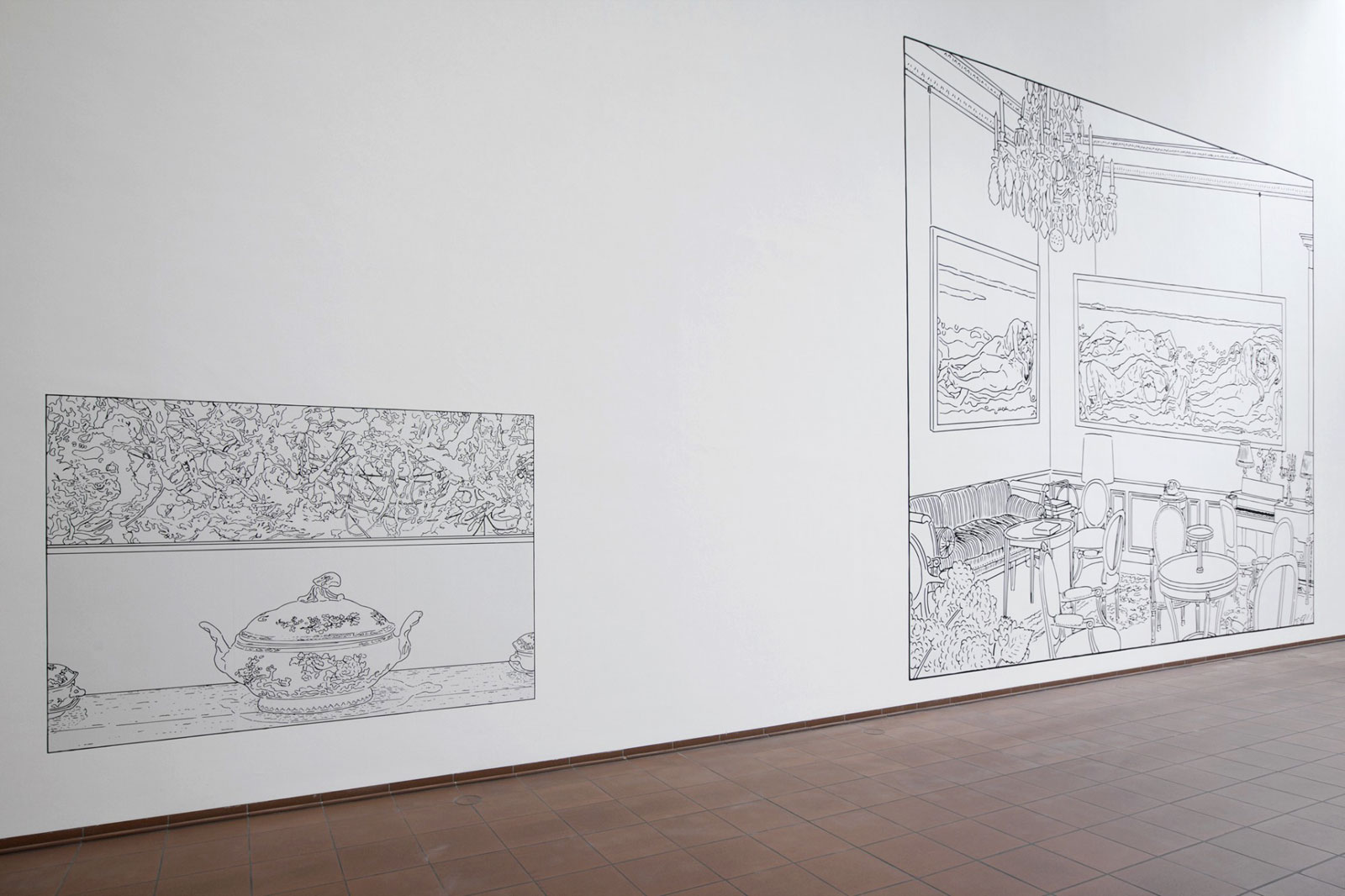
Left: Louise Lawler (American, b. 1947) 'Pollock and Tureen (traced)' 1984/2013; Right: Louise Lawler (American, b. 1947) 'Salon Hodler (traced)' 1992/1993/2013 (installation view)


Left:

Louise Lawler (American, b. 1947)
Pollock and Tureen (traced) (installation view)
1984-2013
Bedruckte Folie / printed vinyl
Dimensions variable

Right:

Louise Lawler (American, b. 1947)
Salon Hodler (traced) (installation view)
1992/1993/2013
Bedruckte Folie / printed vinyl
Dimensions variable


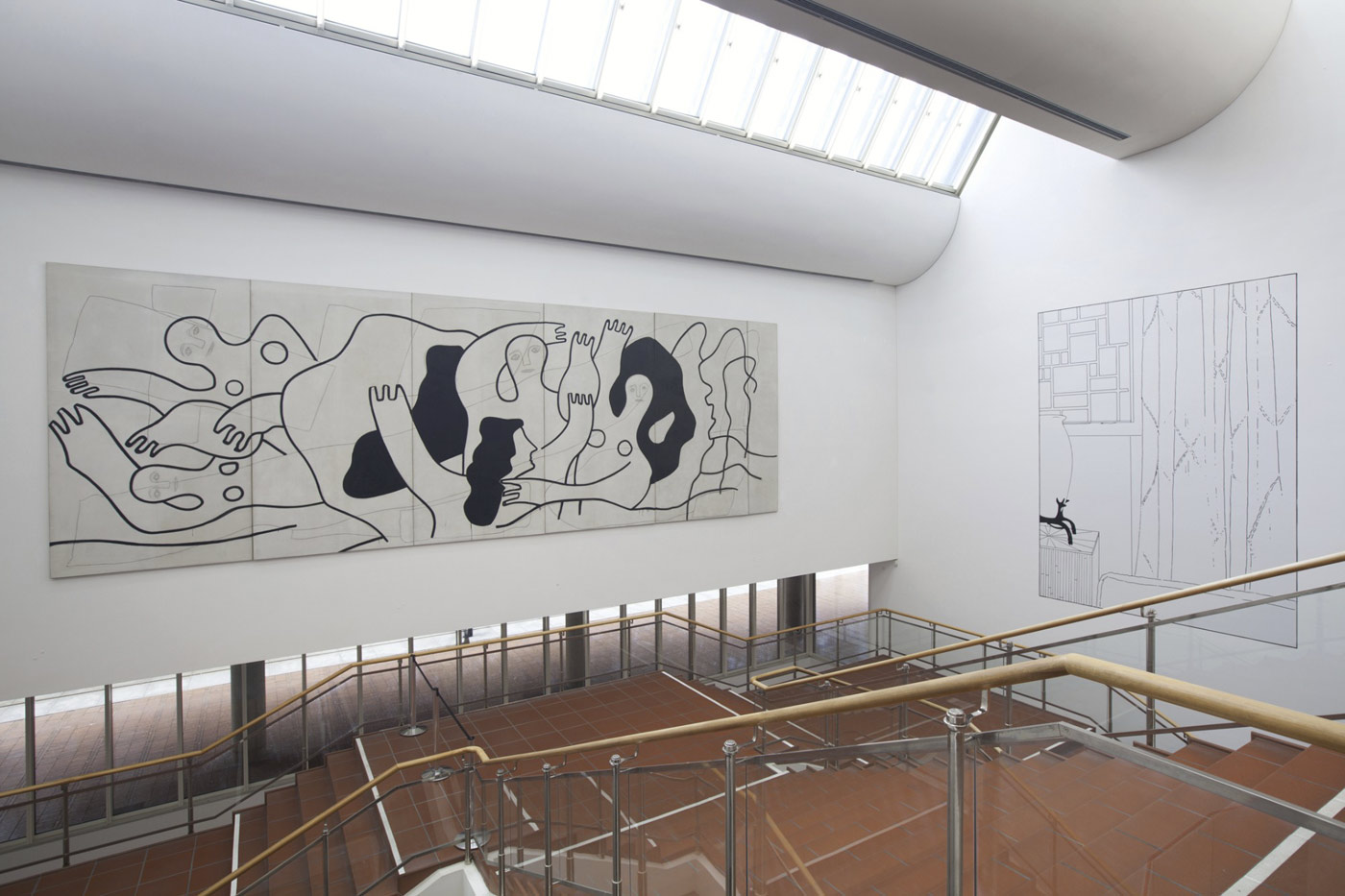
Louise Lawler (American, b. 1947) 'Hand On Her Back (traced)' 1997/1998 (installation view)


Louise Lawler (American, b. 1947)
Hand On Her Back (traced) (installation view)
1997/1998/2013
Bedruckte Folie / printed vinyl
Dimensions variable


The Museum Ludwig is hosting the first comprehensive exhibition in Germany of the American Conceptual artist Louise Lawler (born 1947, lives and works in New York). The exhibition comprises around 80 works, which are positioned throughout the entire building, thus engendering surprising situations through their encounters with the Museum Ludwig’s permanent collection. In addition, a new series of ten “tracings” has been created for the show – outline drawings that are reminiscent of children’s colouring books and draw on earlier works by Lawler. Furthermore, the artist has agreed to create two new, large-format “stretches” for the Museum Ludwig. These are photos that she has printed out on self-adhesive vinyl film and whose proportions she tailors to the space in question – even if that means deforming the motifs. Lawler’s work has been featured in numerous international exhibitions, including Documenta 12, the Whitney Biennial 2008, and recently in a large overview at the Wexner Art Center in Columbus, Ohio.

Louise Lawler photographs works by other artists and captures them in their various contexts: in museums, in private collections, at auctions, or in storage. Her works illustrate just how much the meaning of art is influenced by how it is presented and by the attendant circumstances in the institutions where it is located. Her analytical and at times ironic approach is revealing, but by no means evaluative, such as when her view of an abstract work by Jackson Pollock correlates with the way she looks at a decorative soup tureen.

Louise Lawler, who embarked on her oeuvre in the late 1970s, belongs to the broader field of the “Pictures Generation,” which also includes Sherrie Levine, Jack Goldstein, Richard Prince, and Cindy Sherman. At the same time, her beginnings were also strongly shaped by the institutional critique of the early 1970s, and consequently her works were initially interpreted as sociological commentaries reflecting on aesthetic, economic, and historical factors in art. Yet beyond this, her photographs illustrate to this day that an impartial presentation of art simply does not exist; they reveal the ideological implications inherent in the suggestive settings given to artworks, which would otherwise scarcely be visible. Lawler directs her gaze toward the fringes of art, as it were, creating subtle commentaries of a poetic casualness via compositions that distinguish themselves by their formal approach as well as by their eccentricity.

Press release from Museum Ludwig


Louise Lawler (American, b. 1947) 'Pink and Yellow and Black II (Green Coca Cola Bottles) from On a Wall, On a Cow, In a Book, In the Mail' 1999


Louise Lawler (American, b. 1947)
Pink and Yellow and Black II (Green Coca Cola Bottles) from On a Wall, On a Cow, In a Book, In the Mail
1999
Cibachrome (museum box)
26 5/8 x 26 5/8 inches (67.6 x 67.6cm)
© Louise Lawler, Metro Pictures, New York, Sprüth Magers Berlin/London
Andy Warhol Artwork
© The Andy Warhol Foundation for the Visual Arts, Inc.


Louise Lawler (American, b. 1947) 'Pink and Yellow and Black I (Red Disaster) from On a Wall, On a Cow, In a Book, In the Mail' 1999


Louise Lawler (American, b. 1947)
Pink and Yellow and Black I (Red Disaster) from On a Wall, On a Cow, In a Book, In the Mail
1999
Cibachrome (museum box)
38 3/4 x 32 1/2 inches (98.4 x 82.6cm)
© Louise Lawler, Metro Pictures, New York, Sprüth Magers Berlin/London
Andy Warhol Artwork
© The Andy Warhol Foundation for the Visual Arts, Inc.


Foreword

To describe Louise Lawler’s artistic practice is not easy: it is complex and polyglot, conceptual and analytical, but simultaneously ironically light, elegiac, and unfathomable. Lawler eyes the incidental, undermining the economy of attention, dislocating hierarchies, and querying, with the air of critical nonchalance, the system of art and its institutions. When works of art, arranged based on their colours and forms like flowers, unashamedly reveal the tastes and values of their owners, or sculptures held in gloomy depots are deprived of the attention they deserve, then Lawler’s works are a means of redress – what is not visible is given visibility. Her camera registers not only the life of artworks (after they have left the artists’ studios) in museums, corporate collections, depots, or at auctions, it also penetrates the most intimate abodes of the collectors, intruding even into their bedrooms. Lawler’s practice here is ambivalent, hardly judgmental, but constantly interested in poetic ambiguities, fractured harmony, and suggestive relationships. Her work does not seek out the essence of art but looks for compulsions, rules, and their readability. Incidental contiguities, formal-aesthetic analogies, but also savage thought shape the work of Louise Lawler, which had its beginnings in the late 1970s in the context of appropriation art and followed in the footsteps of the practice of institutional critique, which has been all too often discursively co-opted. Almost forty years later a differentiated perspective on this subtle work opens up, a work that does not understand melancholy and postmodernist criticality as a contradiction and unfolds its potency precisely in subtle unsharpness.

We are delighted that with Adjusted Louise Lawler has put together such an extensive survey of her work for the very first time, a show that covers the early conceptual and performative relics, the so-called ephemera, as well as a wide-ranging selection of photographic works and the latest wall works. Although the greater part of her oeuvre is photographic, it becomes clear that Lawler is not a photographer. She uses the medium as a means to appropriate situations and, in resolute focusing, to let the things which would otherwise remain unarticulated speak for themselves. Her exhibition title, Adjusted, which is to be understood as referring to her large format wallpapers adjusted to fit the given circumstances, is the distant echo of a critical practice fully aware that adjusting is a dialectic process where there are neither winners nor losers, neither conquerors nor conquered.

Louise Lawler’s exhibition Adjusted opens simultaneously with the new presentation of the collection Not Yet Titled. New and Forever at Museum Ludwig, which emphasises the provisional nature of art historical narratives and presentations, colliding with the claim to eternity raised by the institution of the museum. Lawler’s exhibition spans the entire building, intervenes in the contexts of the collection, and spreads itself out, then retreats, or functions plainly and simply as a casual commentary. The reflectivity of her work, its context-specific changeability, presents the provisional as a quality constitutive for art, which in the process makes it clear just how much circumstances determine the way of looking at things.

Excerpt from the Foreword by Philipp Kaiser


Louise Lawler (American, b. 1947) 'Life After 1945 (Hats)' 2006/2007


Louise Lawler (American, b. 1947)
Life After 1945 (Hats)
2006-2007
Cibachrome (mounted on museum box)
27 1/4 x 22 3/4 inches (69.2 x 57.8cm)
© Louise Lawler, Metro Pictures, New York, Sprüth Magers Berlin/London
Andy Warhol Artwork
© The Andy Warhol Foundation for the Visual Arts, Inc.


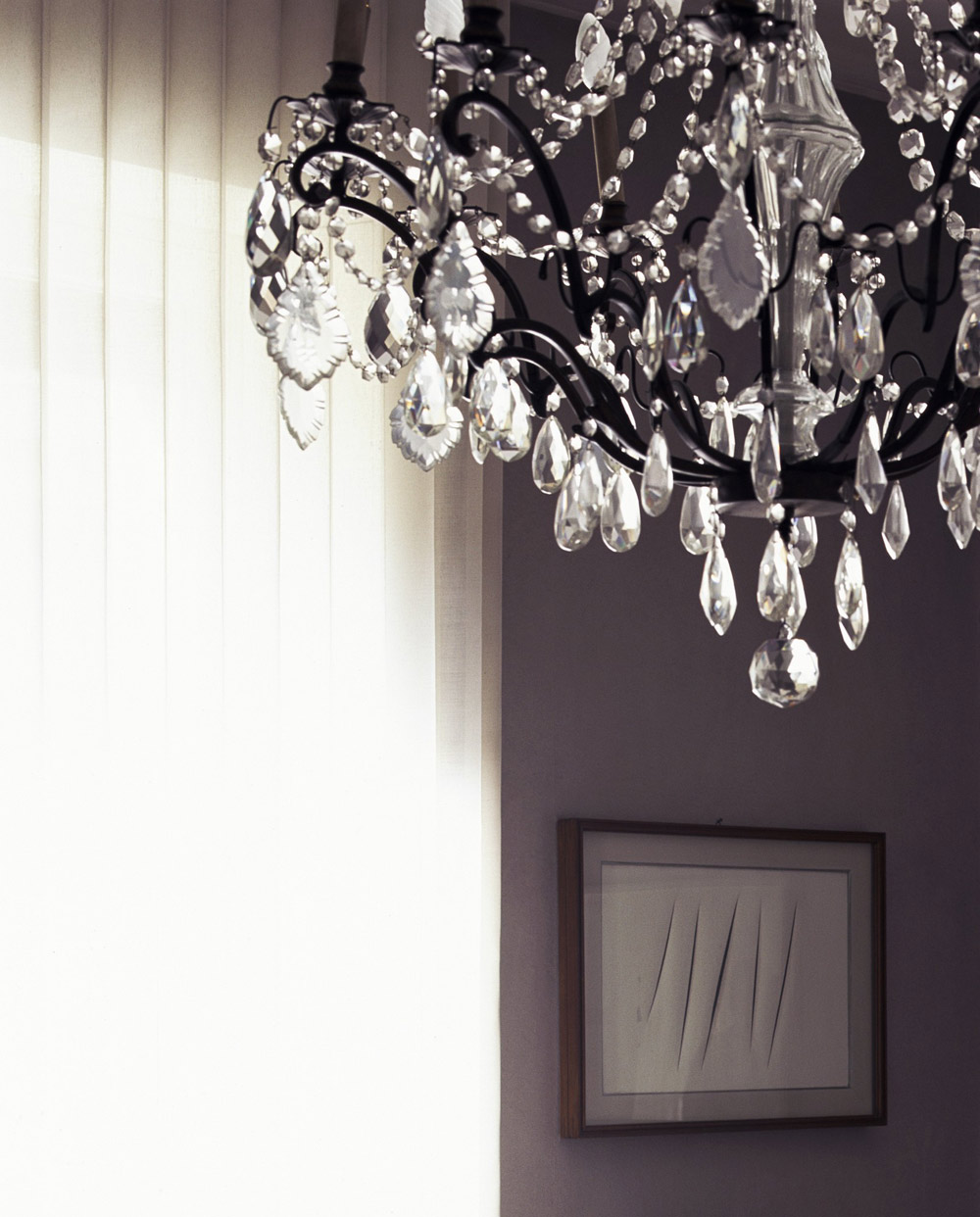
Louise Lawler (American, b. 1947) 'Chandelier' 2001/2007


Louise Lawler (American, b. 1947)
Chandelier
2001-2007
Cibachrome (mounted on museum box)
19 1/4 x 15 1/2 inches (48.9 x 39.4cm)
© Louise Lawler, Metro Pictures, New York, Sprüth Magers Berlin and London

(Lucio Fontana)


Louise Lawler (American, b. 1947) 'Nude' 2002/2003


Louise Lawler (American, b. 1947)
Nude
2002/2003
Cibachrome (museum mounted)
59.5 x 47.5 inches (151.1 x 12.70cm)
© Louise Lawler, Metro Pictures, New York, Sprüth Magers Berlin/London

(Gerhard Richter. Ema (Nude on a Staircase) 1966, 200 x 130cm, Oil on canvas)


Louise Lawler (American, b. 1947) 'Still Life (Napkins)' 2003


Louise Lawler (American, b. 1947)
Still Life (Napkins)
2003
Digital cibachrome on aluminum museum box
19 3/4 x 14 1/4 inches (50.2 x 36.2cm)
© Louise Lawler, Metro Pictures, New York, Sprüth Magers Berlin/London


Louise Lawler (American, b. 1947) 'WAR IS TERROR' 2001/2003 (Julia Margaret Cameron)


Louise Lawler (American, b. 1947)
WAR IS TERROR
2001-2003
Cibachrome (museum mounted)
30 x 25 3/4 inches (76.2 x 65.4cm)
© Louise Lawler, Metro Pictures, New York, Sprüth Magers Berlin/London

(Julia Margaret Cameron)


Louise Lawler (American, b. 1947) 'Monogram' 1984


Louise Lawler (American, b. 1947)
Monogram
1984
Cibachrome, type on wall (sometimes)
39 1/2 x 28 inches (100.3 x 71.1cm)
© Louise Lawler, Metro Pictures, New York, Sprüth Magers Berlin/London

(Jasper Johns)


Louise Lawler (American, b. 1947) 'Portrait' 1982


Louise Lawler (American, b. 1947)
Portrait
1982
Cibachrome
19 x 19 inches (48.3 x 48.3cm)
© Louise Lawler, Metro Pictures, New York, Sprüth Magers Berlin/London


Ludwig Museum of Contemporary Art
1095 Budapest Komor Marcell Street 1
Hungary 06 1 555-3444

Opening hours:
Tuesday – Sunday: 10.00 – 18.00
Closed on Mondays

Ludwig Museum of Contemporary Art website

LIKE ART BLART ON FACEBOOK

Back to top

Exhibition: ‘Everyday Epiphanies: Photography and Daily Life Since 1969’ at The Metropolitan Museum of Art, New York

Exhibition dates: 25th June, 2013 – 26th January, 2014

 Curator: Doug Eklund, curator in the Department of Photographs


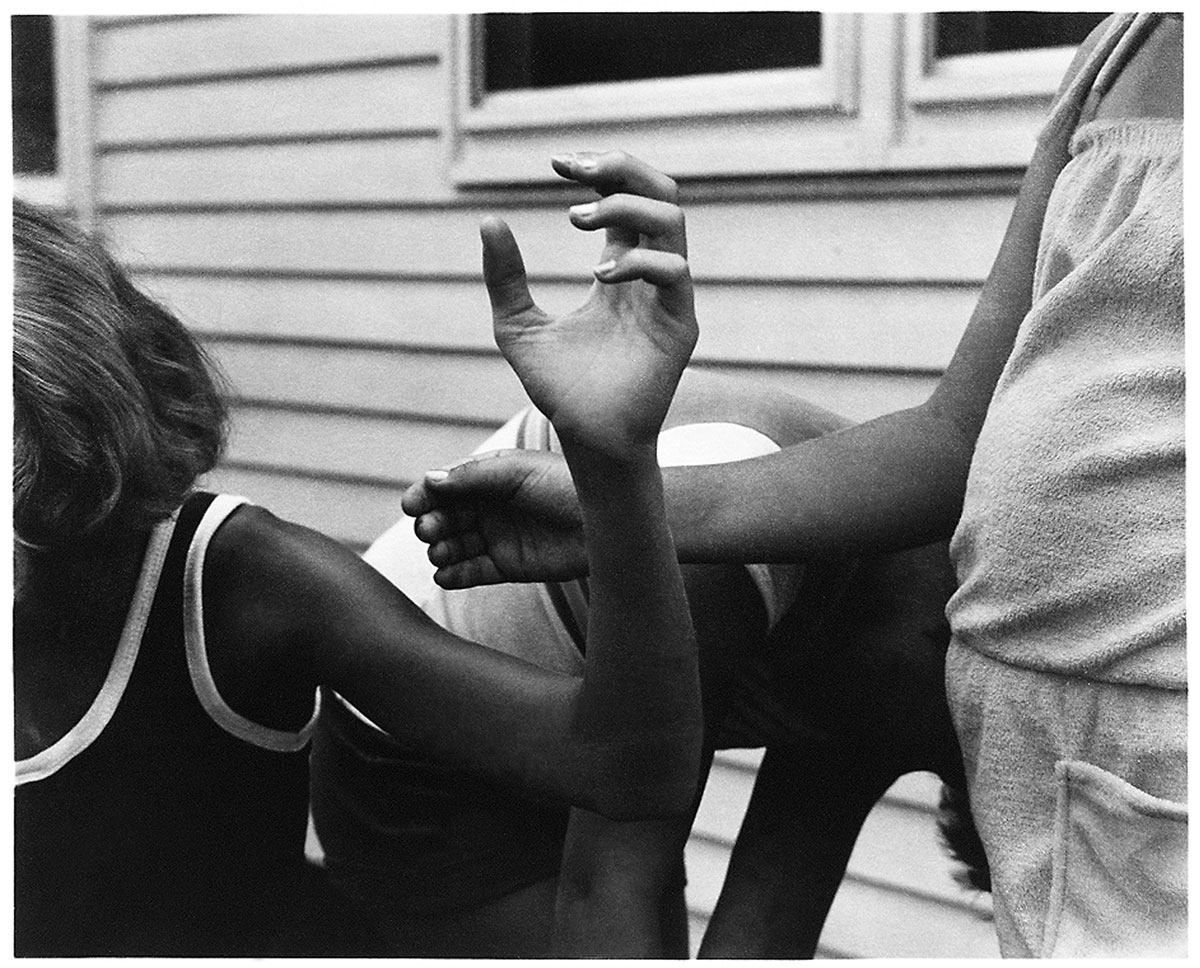
John Baldessari (American, 1931-2020) 'Hands Framing New York Harbor' 1971


John Baldessari (American, 1931-2020)
Hands Framing New York Harbor
1971
Gelatin silver print
25.4 x 18cm (10 x 7 1/16 in.)
Purchase, The Horace W. Goldsmith Foundation Gift, through Joyce and Robert Menschel, 1992
Shunk-Kender © Roy Lichtenstein Foundation


Epiphany: a moment in which you suddenly see or understand something in a new or very clear way.

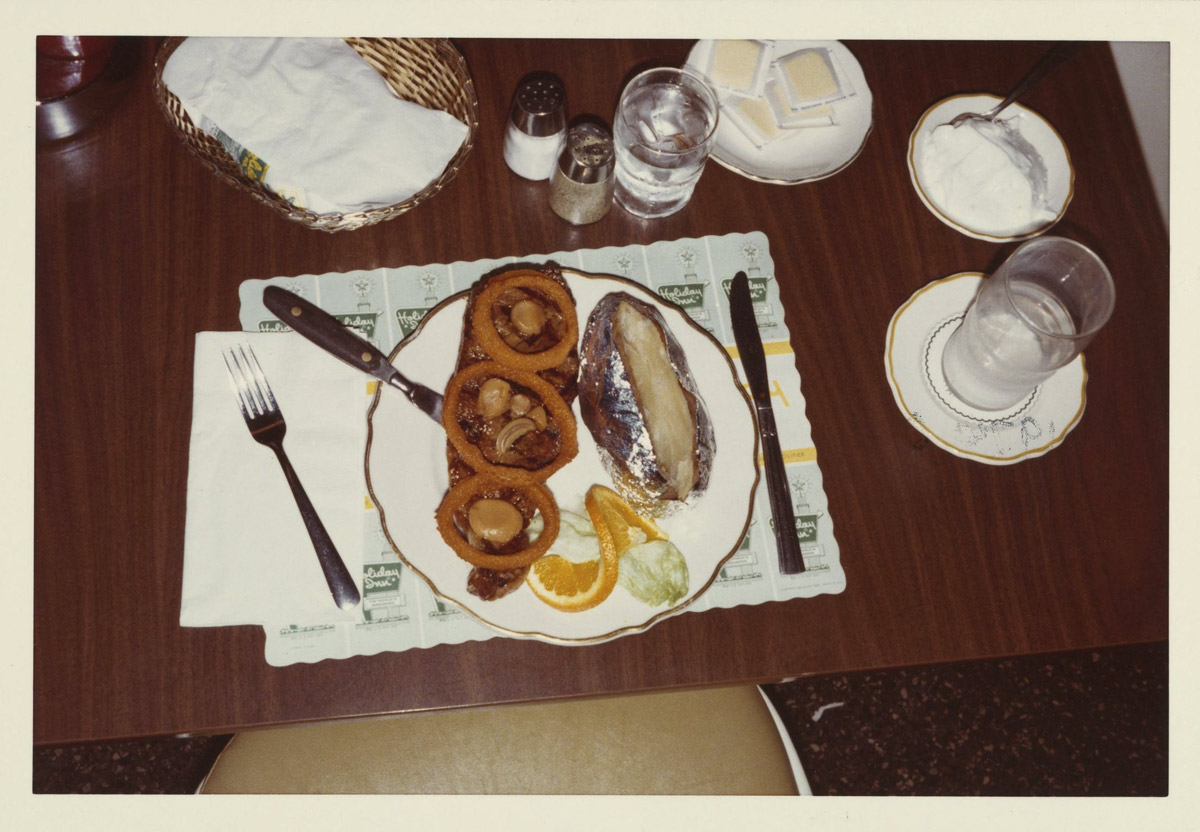
Stephen Shore’s photographs are the most insightful epiphanies in this posting, picturing as they do “what he ate, the rest stops he visited, the people he met.” In other words, the wor(l)d as he saw it.

Dr Marcus Bunyan


Many thankx to The Metropolitan Museum of Art, New York for allowing me to publish the photographs in the posting. Please click on the photographs for a larger version of the image.


“With the unspoken rules that exhibitions in the Met’s contemporary photography gallery must be drawn exclusively from the museum’s permanent collection and be organised as surveys of the period from the late 1960s to the present, it’s no wonder that these long running shows are often so broad that their themes seem to dissolve into edited collections of everything. The newest selection of images is tied up under the umbrella of “everyday epiphanies”, a construct that implies a delight in the ordinary, the quotidian, or the familiar, but in fact, reaches outward beyond these routine boundaries to works that have a wide variety of conceptual underpinnings and points of view. With some effort, it’s possible to follow the logic of why each piece has been included here, but when seen together, the diversity of the works on view diminishes the show’s ability to deliver any durable insights… The works that function best inside this theme are those that capture moments of unexpected, elemental elegance, often as a result of the way the camera sees the world.”


Loring Knoblauch. “Everyday Epiphanies: Photography and Daily Life Since 1969 @Met,” on the Collector Daily website August 14, 2013 [Online] Cited 20/01/2014. Used under fair use conditions for the purposes of education and research


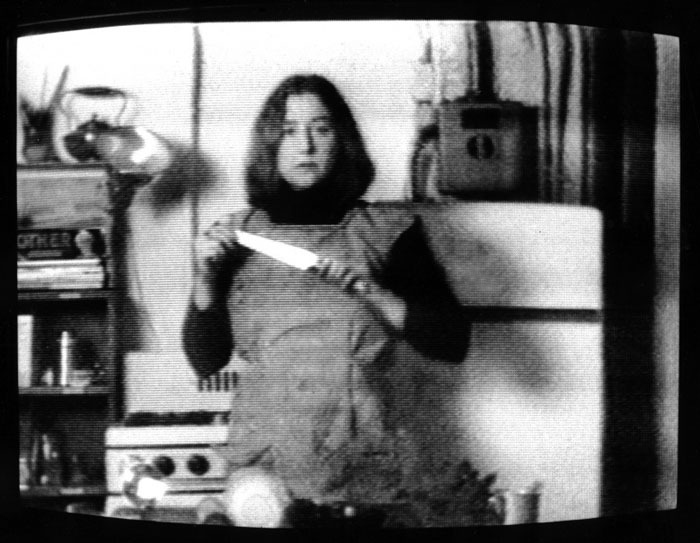
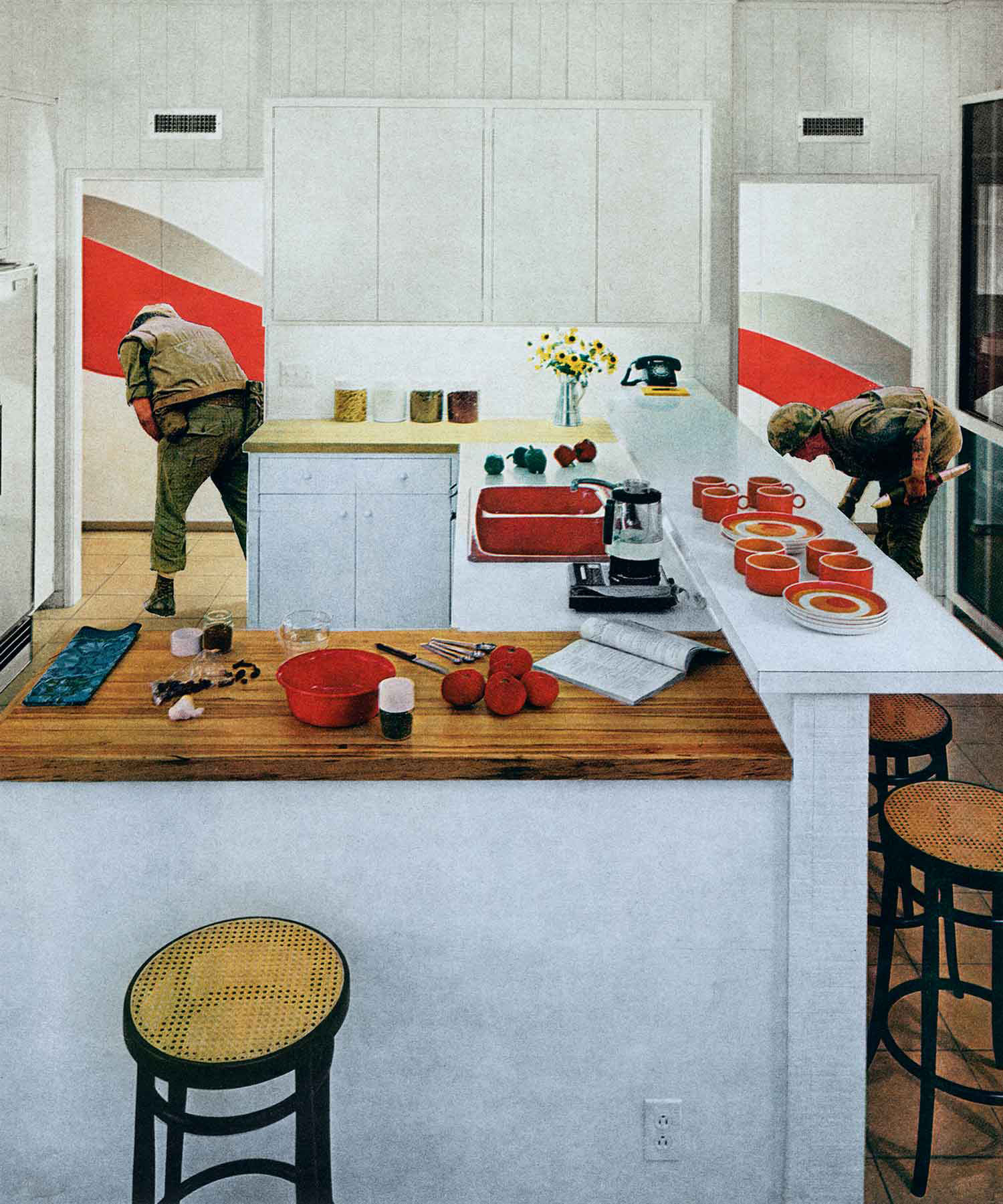
Martha Rosler (American, b. 1943) 'Semiotics of the Kitchen' 1975 (still)


Martha Rosler (American, b. 1943)
Semiotics of the Kitchen (still)
1975
Video
Purchase, Henry Nias Foundation Inc. Gift, 2010
Courtesy Electronic Arts Intermix (EAI), New York


Jan Groover (American, 1943-2012) 'Untitled' 1980


Jan Groover (American, 1943-2012)
Untitled
1980
Platinum print
19 x 24cm (7 1/2 x 9 7/16 in.)
David Hunter McAlpin Fund, 1981
The Metropolitan Museum of Art
© Jan Groover


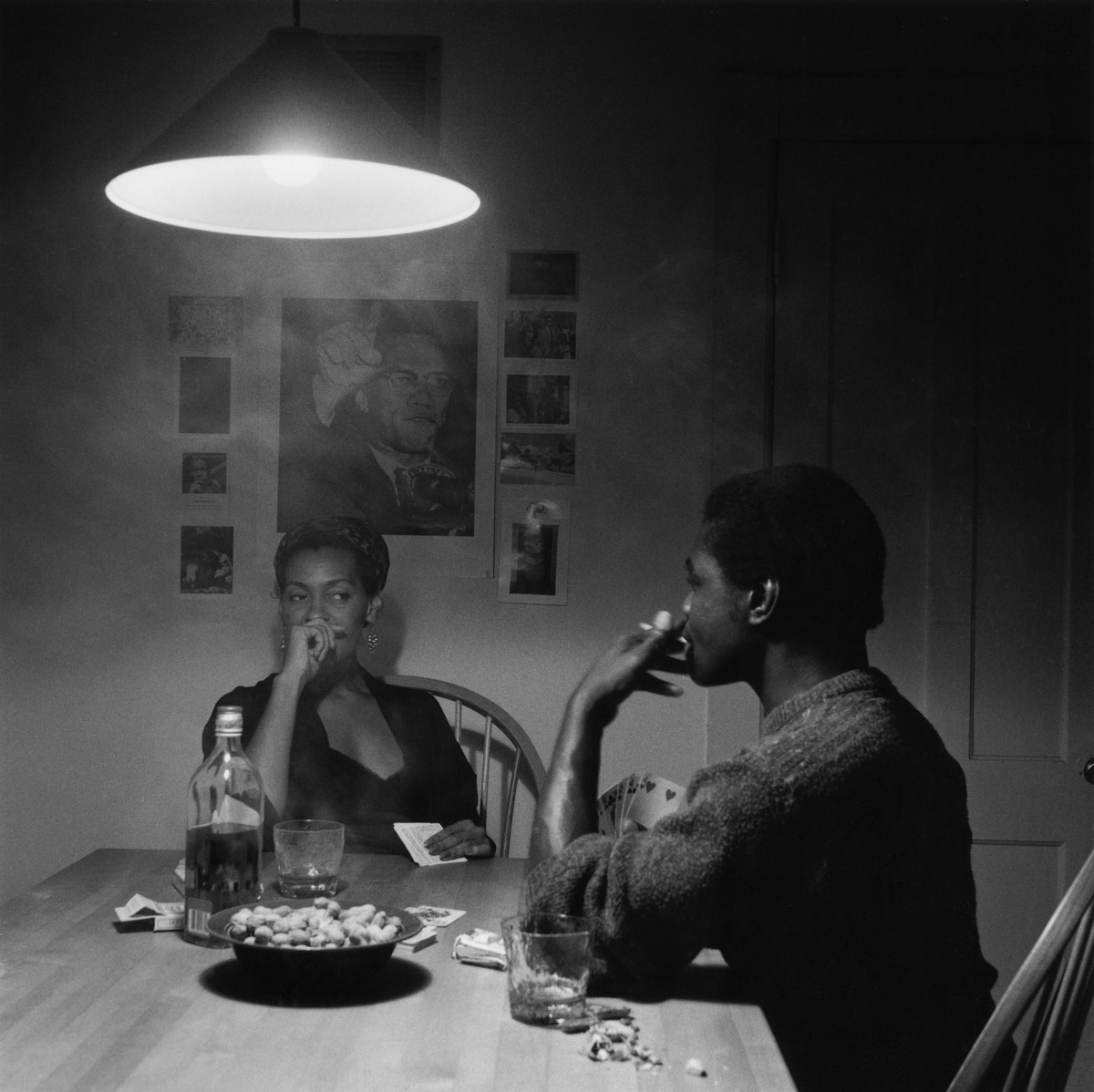
Carrie Mae Weems (American, b. 1953) 'Untitled (Man Smoking)' 1990


Carrie Mae Weems (American, b. 1953)
Untitled (Man Smoking)
1990
From the Kitchen Table Series
Gelatin silver print
Image: 71.8 × 71.8cm (28 1/4 × 28 1/4 in.)
Courtesy of the artist and Jack Shainman Gallery, New York


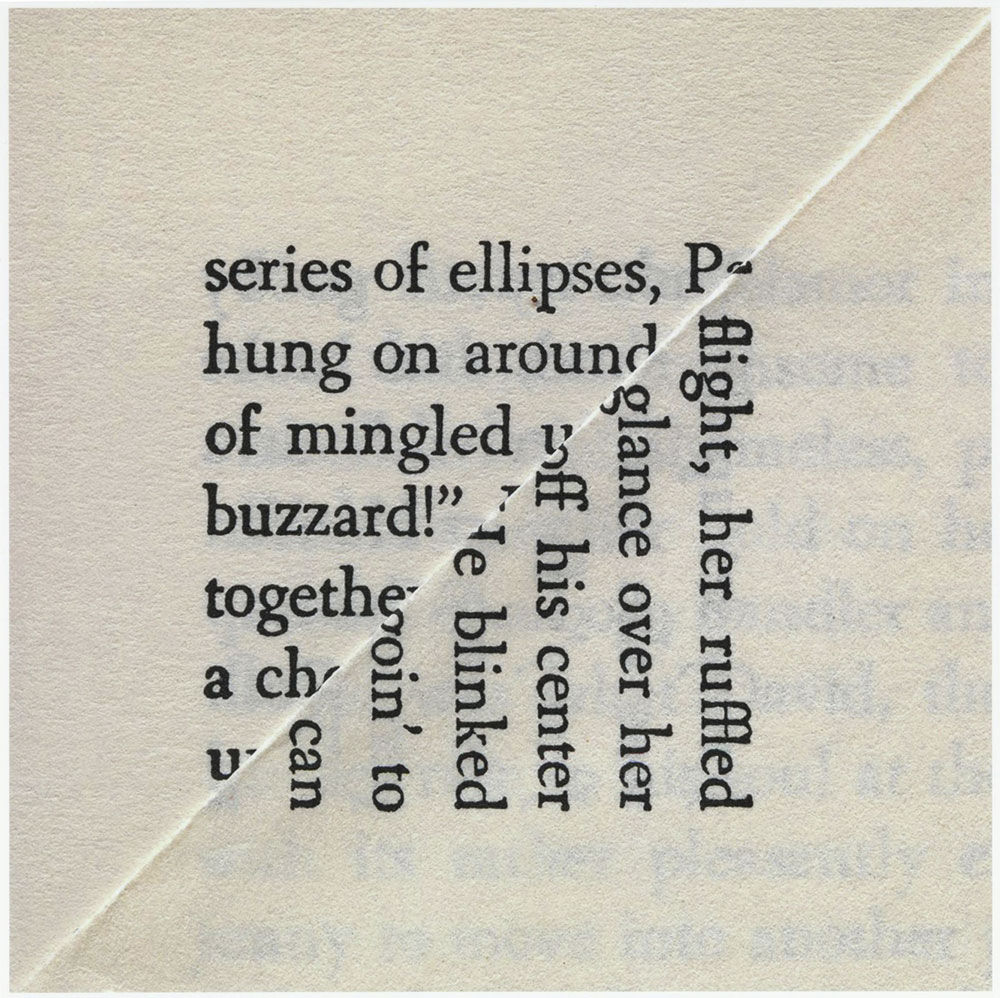
Erica Baum (American, b. 1961)  'Buzzard' 2009


Erica Baum (American, b. 1961) 
Buzzard
2009
Inkjet print
22.9 x 22.9cm (9 x 9 in.)
Purchase, Marian and James H. Cohen Gift, in memory of their son, Michael Harrison Cohen, 2012
The Metropolitan Museum of Art
© Erica Baum


Since the birth of photography in 1839, artists have used the medium to explore subjects close to home – the quotidian, intimate, and overlooked aspects of everyday existence. Everyday Epiphanies: Photography and Daily Life Since 1969, an exhibition of 40 works at The Metropolitan Museum of Art, presents photographs and videos from the last four decades that examine these ordinary moments. The exhibition features photographs by a wide range of artists including John Baldessari, Philip-Lorca diCorcia, Fischli & Weiss, Jan Groover, Robert Gober, Nan Goldin, Elizabeth McAlpine, Gabriel Orozco, David Salle, Robert Smithson, Stephen Shore, and William Wegman, as well as videos by Martha Rosler, Ilene Segalove, Brandon Lttu, and Svetlana and Igor Kopytiansky.

Daily life, as it had been lived in Western Europe and America since the 1950s, was called into question in the late 1960s by a counterculture that rebelled against the prior “cookie-cutter” lifestyle. Everything from feminism to psychedelic drugs to space exploration suggested a nearly infinite array of alternative ways to perceive reality; and artists and thinkers in the ’60s and ’70s proposed a “revolution of everyday life.” A four-part work by David Salle from 1973 exemplifies the artist’s flair for piquant juxtaposition at an early stage in his career. In depicting four women in bathrobes standing before their respective kitchen windows in contemplative states, Salle goes against the grain of feminist orthodoxy – revealing a penchant for courting controversy that he would expand in his later paintings; pasted underneath the black-and-white images of the women are brightly coloured labels of their preferred coffee brands, with the arbitrarily differentiated brands signifying an insufficient substitute for true freedom in the postwar era. Martha Rosler’s bracingly caustic video Semiotics of the Kitchen and Ilene Segalove’s wistfully funny The Mom Tapes complete a trio of works investigating the role of women in a rapidly changing society.

In the 1980s, artists’ renewed interest in conventions of narrative and genre led to often highly staged or produced images that hint at how even our deepest feelings are mediated by the images that surround us. In the wake of the economic crash of the late 1980s, photographers focused increasingly on what was swept under the carpet – the repressed and the taboo. Sally Mann’s Jesse at Five (1987) depicts the artist’s daughter as the central figure, half-dressed, dolled-up, and posed like an adult. Mann often created these frank images of her children and caused some controversy during the culture wars of the late 1980s and early 1990s. However, her photographs of her children are remarkable for the artist’s assured handling of a potentially explosive subject with equanimity and grace.

During the following decade, artists created photographs and videos that confused the real and the imaginary in ways that almost eerily predicted the epistemological quandaries posed by the digital revolution. Meanwhile, a trio of recently made works by Erica Baum, Elizabeth McAlpine, and Brandon Lattu combine process and product in novel ways to comment obliquely on the shifting sands of how we come to know the world in our digital age.

Press release from The Metropolitan Museum of Art website


Jean-Marc Bustamante (French, b. 1952) 'Untitled' 1997


Jean-Marc Bustamante (French, b. 1952) 
Untitled
1997
Chromogenic print
40 x 59cm (15 3/4 x 23 1/4 in.)
Purchase, The Horace W. Goldsmith Foundation Gift, through Joyce and Robert  Menschel, 1999
The Metropolitan Museum of Art
© Jean-Marc Bustamante


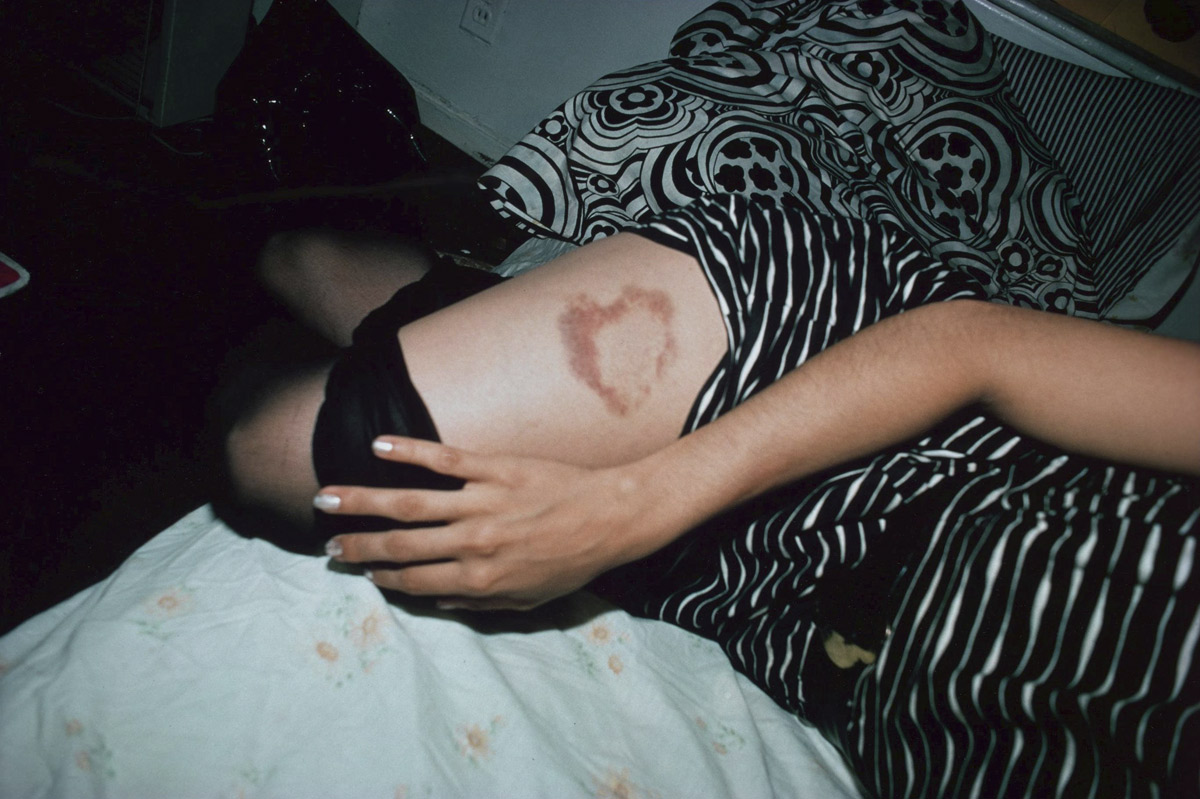
Nan Goldin (American, b. 1953) 'Heart-Shaped Bruise, NYC' 1980


Nan Goldin (American, b. 1953)
Heart-Shaped Bruise, NYC
1980
Silver dye bleach print
50.8 x 60.96cm (20 x 24 in.)
Purchase, The Horace W. Goldsmith Foundation Gift, through Joyce and Robert  Menschel, 2001
The Metropolitan Museum of Art
© Nan Goldin, Courtesy Matthew Marks Gallery, New York


Larry Sultan (American, 1946-2009) 'My Father Reading the Newspaper' 1989


Larry Sultan (American, 1946-2009)
My Father Reading the Newspaper
1989
Chromogenic print
Stewart S. MacDermott Fund, 1991
© Larry Sultan


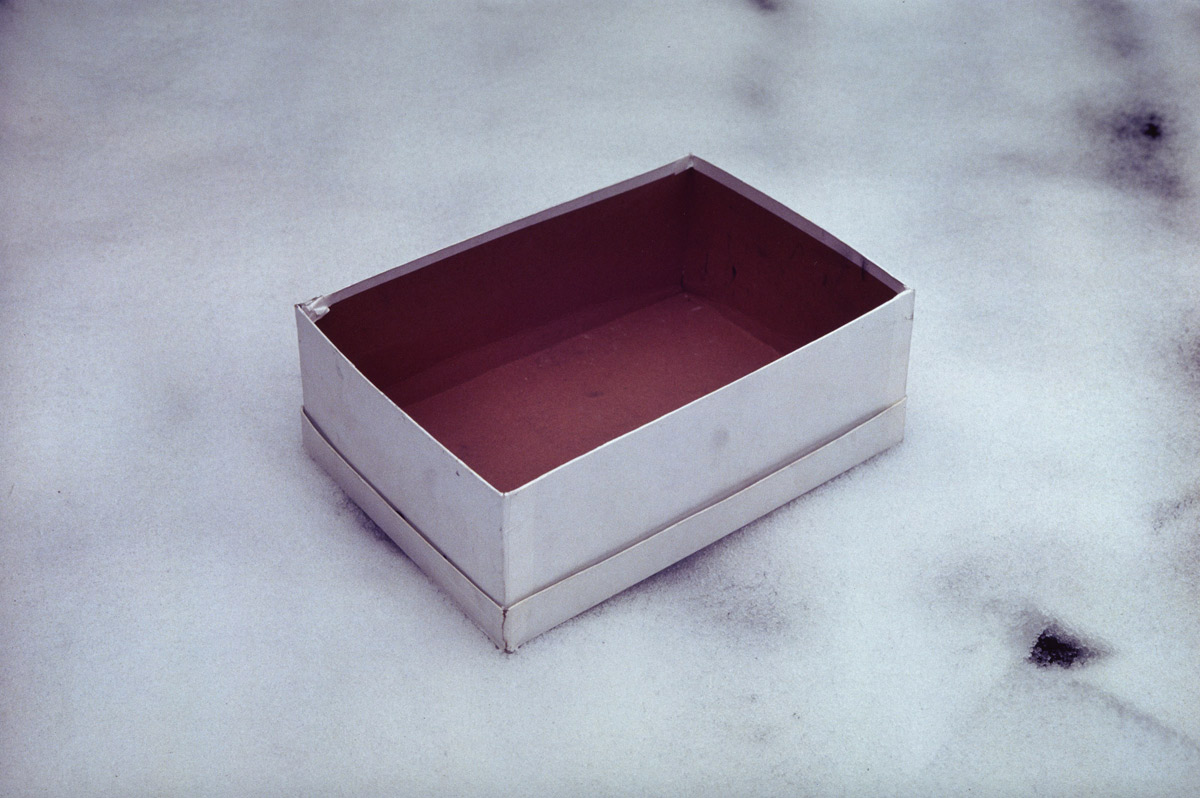
Gabriel Orozco (Mexican, b. 1962) 'Caja vacia de zapatos' (Empty shoebox) 1993


Gabriel Orozco (Mexican, b. 1962)
Caja vacia de zapatos (Empty shoebox)
1993
Silver dye bleach print
31.8 x 46.4cm (12 1/2 x 18 1/4 in.)
Gift of the artist, 1995
The Metropolitan Museum of Art
© Gabriel Orozco


Gabriel Orozco (Mexican born Jalapa Enriquez, b. 1962) 'Vitral' 1998


Gabriel Orozco (Mexican, born Jalapa Enriquez, b. 1962)
Vitral
1998
Silver dye bleach print
40.6 x 50.8cm (16 x 20 in.)
Purchase, The Judith Rothschild Foundation Gift, 1999
© Gabriel Orozco


Stephen Shore (American, b. 1947) 'Oklahoma City, Oklahoma' July 9, 1972


Stephen Shore (American, b. 1947)
Oklahoma City, Oklahoma
July 9, 1972
From the series American Surfaces
Chromogenic print
Gift of Weston J. Naef, 1974
© Stephen Shore


As a teenager in the 1960s, Shore was one of two in-house photographers at Andy Warhol’s Factory. During his first cross-country photographic road trip, Shore adopted the catholic approach of his mentor, accepting into his art everything that came along – what he ate, the rest stops he visited, the people he met. He then processed his colour film as “drugstore prints”, the imprecise, colloquial term for the kind of amateur non-specialised snapshots that filled family photo albums. The entire series of 229 prints was shown for the first time in 1974 and acquired by the Metropolitan from that exhibition.


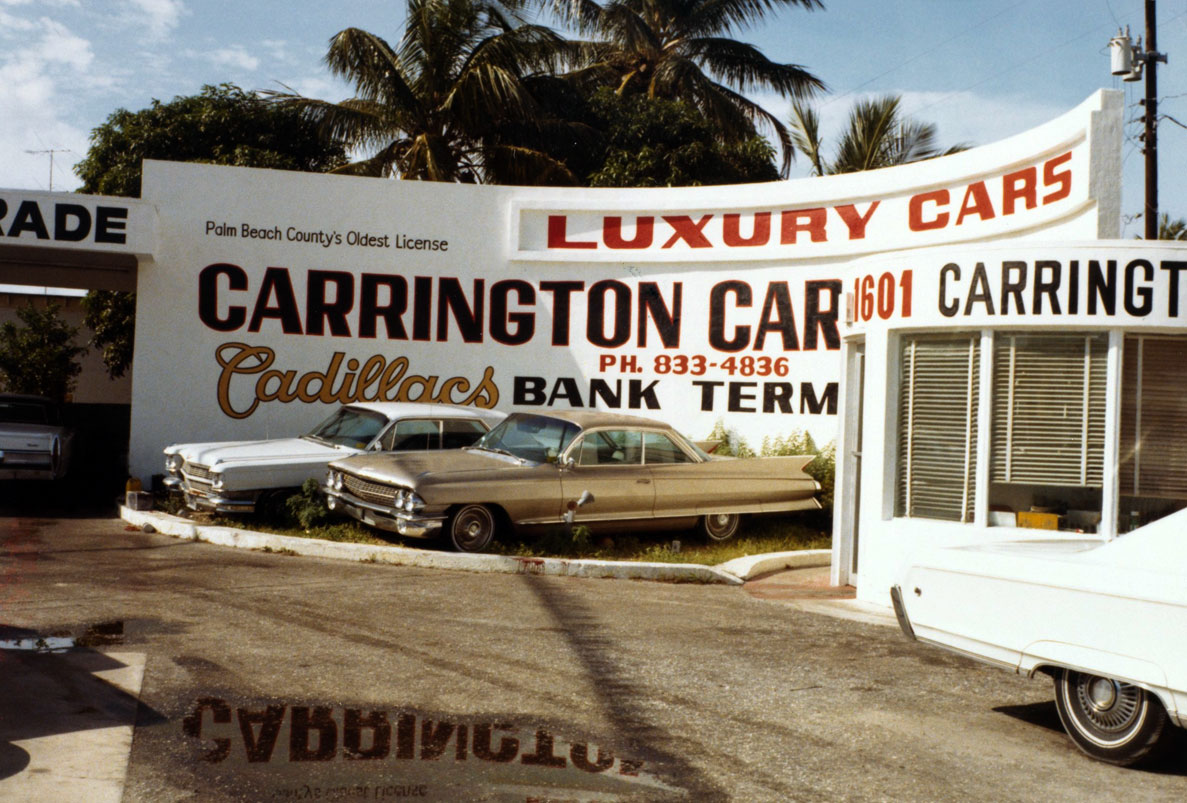
Stephen Shore (American, b. 1947) 'West Palm Beach, Florida' January 1973


Stephen Shore (American, b. 1947)
West Palm Beach, Florida
January 1973
From the series American Surfaces
Chromogenic print
Gift of Weston J. Naef, 1974
© Stephen Shore


Stephen Shore (American, b. 1947) 'Clovis, New Mexico' 1974


Stephen Shore (American, b. 1947)
Clovis, New Mexico
1974
From the series American Surfaces
Chromogenic print
Gift of Weston J. Naef, Jr., 1974
The Metropolitan Museum of Art
© Stephen Shore


The Metropolitan Museum of Art
1000 Fifth Avenue at 82nd Street
New York, New York 10028-0198
Phone: 212-535-7710

Opening hours:
Sunday – Tuesday and Thursday: 10am – 5pm
Friday and Saturday: 10am – 9pm
Closed Wednesday

The Metropolitan Museum of Art website

LIKE ART BLART ON FACEBOOK

Back to top

Exhibition: ‘Yasumasa Morimura: Theater of the Self’ at The Andy Warhol Museum, Pittsburgh, Pennsylvania

Exhibition dates: 6th October, 2013 – 12th January, 2014

Curator: Nicholas Chambers, The Milton Fine Curator of Art at The Andy Warhol Museum


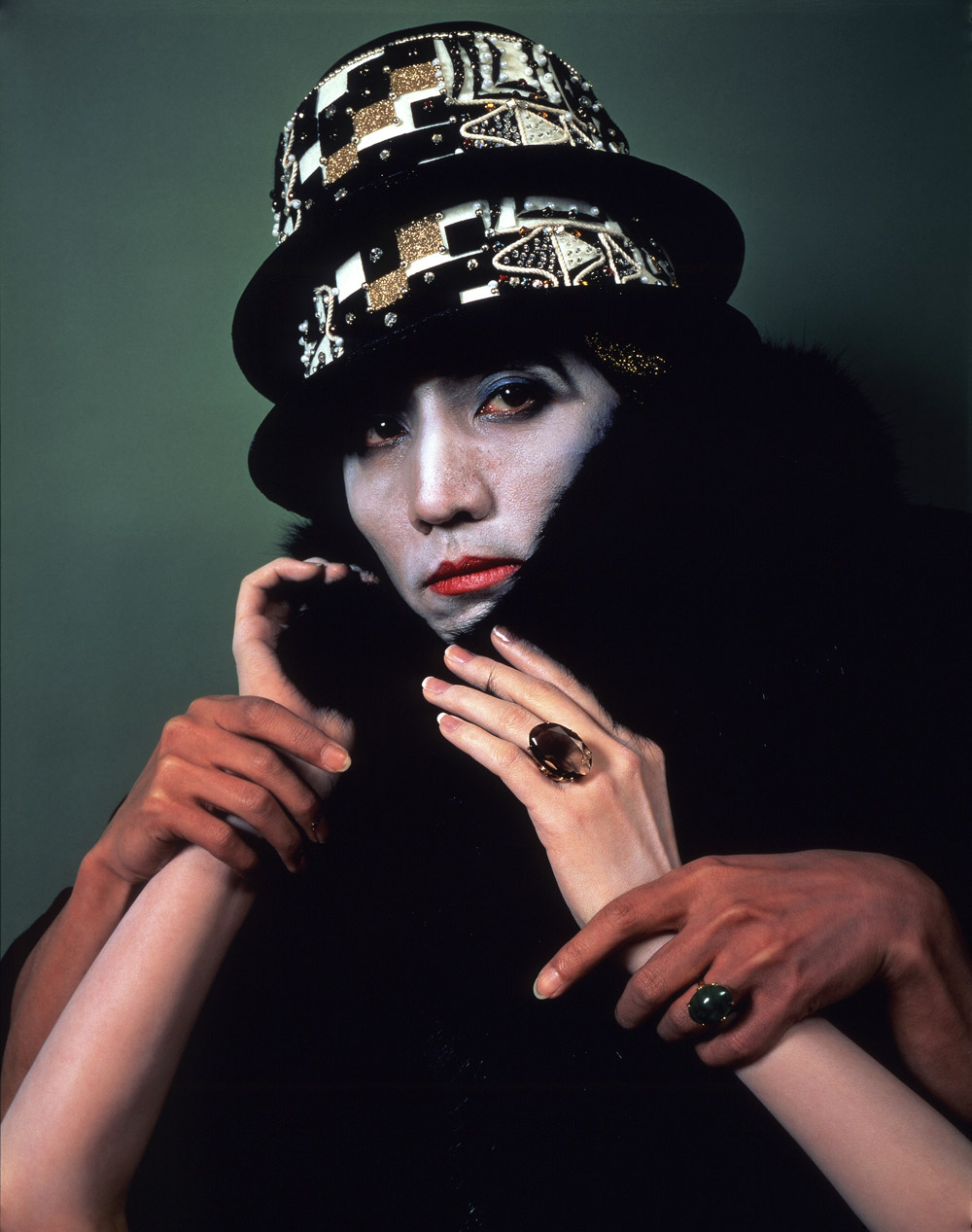
Yasumasa Morimura (Japanese, b. 1951) 'To My Little Sister: for Cindy Sherman' 1998 from the exhibition 'Yasumasa Morimura: Theater of the Self' at The Andy Warhol Museum, Pittsburgh, Pennsylvania, October 2013-  January 2014


Yasumasa Morimura (Japanese, b. 1951)
To My Little Sister: for Cindy Sherman
1998
Ilfochrome print mounted on aluminium
55 x 31 inches
Private Collection, New York


Cindy Sherman, eat your actress out…

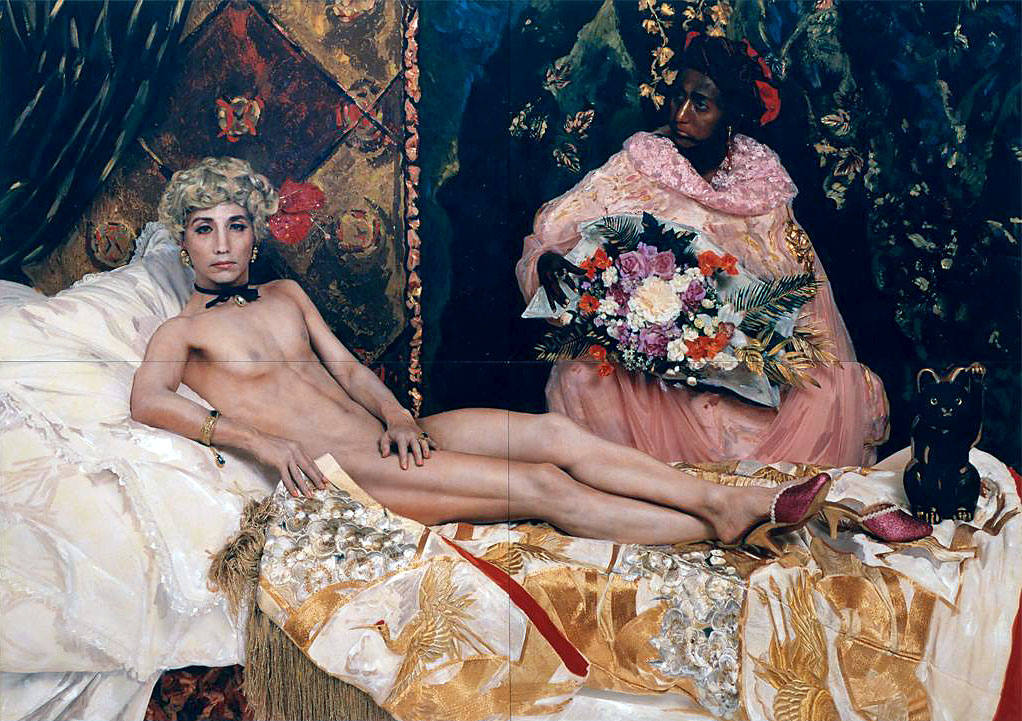
A fascinating, erudite analysis of the difference between Edouard Manet’s Olympia and Yasumasa Morimura’s Futago can be found on the seemingly anonymous Hoegen: Thoughts About Gender, Sex And Sexuality web page (excerpt below).

If you can find an author’s name it would be appreciated!

Dr Marcus Bunyan


Many thankx to The Andy Warhol Museum for allowing me to publish the photographs in the posting. Please click on the photographs for a larger version of the image.


Yasumasa Morimura (Japanese, b. 1951) 'Portrait (Futago)' 1988 from the exhibition 'Yasumasa Morimura: Theater of the Self' at The Andy Warhol Museum, Pittsburgh, Pennsylvania, October 2013-  January 2014


Yasumasa Morimura (Japanese, b. 1951)
Portrait (Futago)
1988
Colour photograph
82 3/4 x 118 inches
Carnegie Museum of Art, Pittsburgh; A.W. Mellon Acquisition Endowment Fund, 92.108


In Anne D’Alleva’s article concerning reception theory, she draws upon several scholars of art and literature to discuss the importance of not only the artist, but also of the viewer. She discusses the symbiotic relationship that must exist and the merits of the ideal viewer. The two artworks that she mentions to support her arguments are Edouard Manet’s Olympia and Ysumasa Morimura’s Futago. These two artworks are prime examples of works that establish an ideal viewer, or viewers, as well as a mirror stage. These two theories assist the art historian to go beyond the biography of the artist and question the relationship of the image and it’s audience.

Just as Wolfgang Iser believes there is an implied reader for literature, one must believe that there is an implied viewer of Edouard Manet’s Olympia and a different implied viewer for Yasumasa Morimura’s Futago (114). In the case of Manet’s Olympia, one might believe the ideal implied viewer is a white and wealthy man of the upper class. This ideal viewer would appreciate, or maybe question, the bold gaze of Olympia, and possibly even recognize her as the popular courtesan (116)…

The ideal viewer for Morimura’s photograph is not as easy to define.  One might make the presumption that Morimura desires the same ideal viewer of Manet, so that they can simply see the work differently. Also, one could assume that he intended his painting to be viewed by Asian, upper class homosexuals who have seen Manet’s Olympia and want to connect on a more personal level. Either of these audiences may be ideal.

According to Ernest Kris, art “requires the participation of both artist and spectator.” (110) Therefore, there must be something that establishes a relationship of the ideal viewer and the photograph of Yasumasa Morimura. Since it is a photograph, and not a painting, there is a humanistic connection that is not present in Manet’s Olympia that ultimately assists the creation of an image-audience relationship. The gaze is not a representation of a gaze but the actual gaze of Morimura establishing a deeper relationship with the ideal viewer of the artist and subject. Since the ideal audience is harder to define for Morimura’s photograph, the establishing element of the relationship between the ideal viewer and the artwork are also hard to define. If the ideal viewer is exactly that of Manet’s: a white, wealthy, upper-class man, then the “shock factor” of the image is multiplied. The ideal viewer has just begun to accept this shocking image of a nude female daring to look at her viewer when Morimura decided to change the race, gender, and possibly the sexual orientation of the subject of the artwork. This assumption, however, provides that the viewer come with “pre-understanding” as described by Roman Ingarden (113); in this case, a memory of Manet’s Olympia. If one assumes that this image is meant for the common man, this relationship is established through the use of photography, the universal and common way to capture images. If one assumes the connection between the inclusive group of Asian, male, homosexuals, then the establishment of the relationship is directly associated with the subject and artist…

The reception theory of Ernest Gombrich states the importance of perception is clearly prevalent within these works (113). The artists have taken their own interpretations of these works, but one must value the fact that their ideal viewers can be similar and have similar perceptions. The differences of their individual perceptions provide for the differences between their viewers. However, the perception of the viewer, whether ideal or not, is the ultimate reflection of the artwork in the culture.

Clearly, the mirror stage is present in these two images. The viewer does not seem to view their self in the artwork directly, but they do feel a connection to the work. Morimura most definitely used Manet’s Olympia as a basis image for his Futago. Although some details are incongruous, the overall effect of Futago is a mirrored image of the whole self of Olympia. There are several differences in these paintings that one may attribute to race and gender that affect the dynamics of the mirror effect. Most obviously, Morimura, who was his own subject in his photographic rendition of Manet’s Olympia, is a man. This affects the mirror image of the body. He is leaner, has no curves and is more muscular. Also, his race affects skin color as well as the some of the details of the picture. He has clearly chosen a kimono to replace the intricate shawl, and a seated, waving cat to replace standing one – both of these depictions have significance in Asian culture (116). Cultural implications are evident.

Overall, these two images reflect Anne D’Avelia’s idea that that two similar artworks can have two different implied viewers. Also, they can mirror each other in certain respects, but diverge in others. These help reinforce D’Avelia notes that gender, expression, details, and race, all play roles in developing the image-audience relationship. They also reflect our class work exploring the troubling of gender norms and the gaze.

Anonymous. “Olympia vs. Futago,” in the article ‘Hoegen: Thoughts about Gender, Sex and Sexuality’ on the Fairfield University website [Online] Cited 19/01/2021. Used under fair use conditions for the purposes of education and research


Yasumasa Morimura (Japanese, b. 1951) 'Doublonnage (Marcel)' 1988


Yasumasa Morimura (Japanese, b. 1951)
Doublonnage (Marcel)
1988
Colour photograph
59 x 47 1/4 inches
Private Collection, New York


Art History

Yasumasa Morimura’s reprisals of European masterpieces are, at once, acts of homage and parody. Painstakingly realised, his photographic reconstructions of paintings by Leonardo da Vinci, Johannes Vermeer, Rembrandt van Rijn and Edouard Manet, among others, bring compositional questions together with those pertaining to race, gender and sexuality. In doing so, they reveal both the aesthetics and the politics embedded in the art historical canon.

Actresses

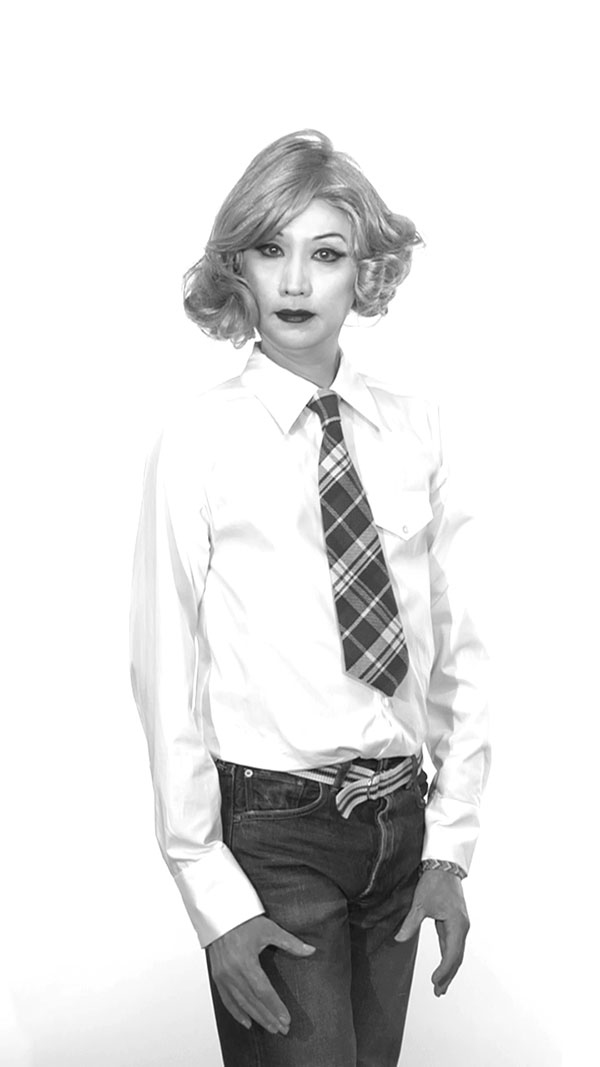
This section of the exhibition focuses on Morimura’s restaging of scenes from award winning films featuring Marlene Dietrich, Audrey Hepburn, Liza Minnelli, Jodie Foster and many others. It is notable that the artist’s impersonations are not anonymous but well-known stars, archetypes of Hollywood’s leading ladies. As stated in their titles, each work is a self-portrait and together they propose a range of possibilities for the artist’s own identity. Morimura has stated, “My own self-definition includes this entire zone of possibilities. When I apply this way of thinking to making a self-portrait, it becomes what I call an ‘open self-portrait.’


Yasumasa Morimura (Japanese, b. 1951) 'M's Self-portrait No.15' 1995


Yasumasa Morimura (Japanese, b. 1951)
M’s Self-portrait No.15
1995
Gelatin silver print
18 1/2 x 21 1/4 inches (framed)
Collection of the artist, on deposit at the Toyota Municipal Museum of Art


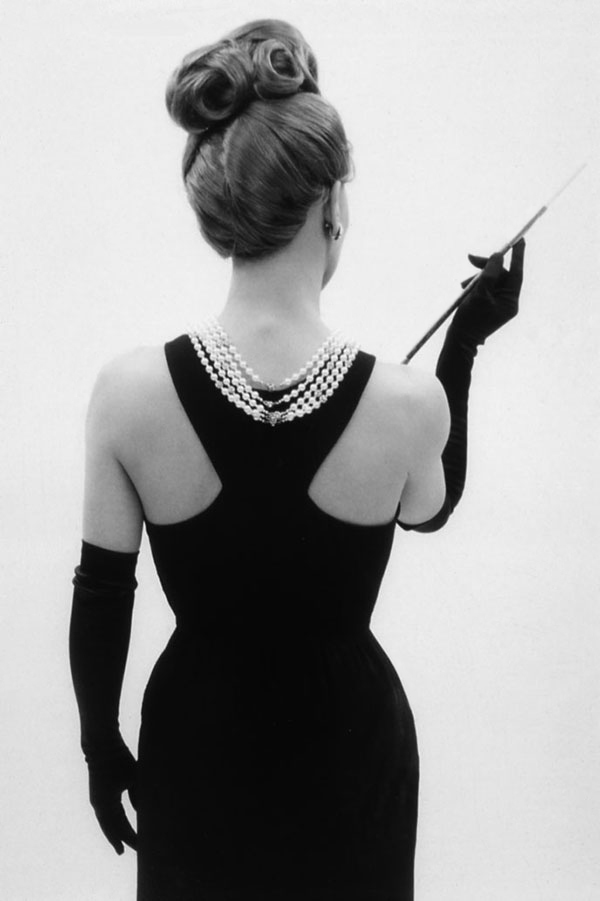
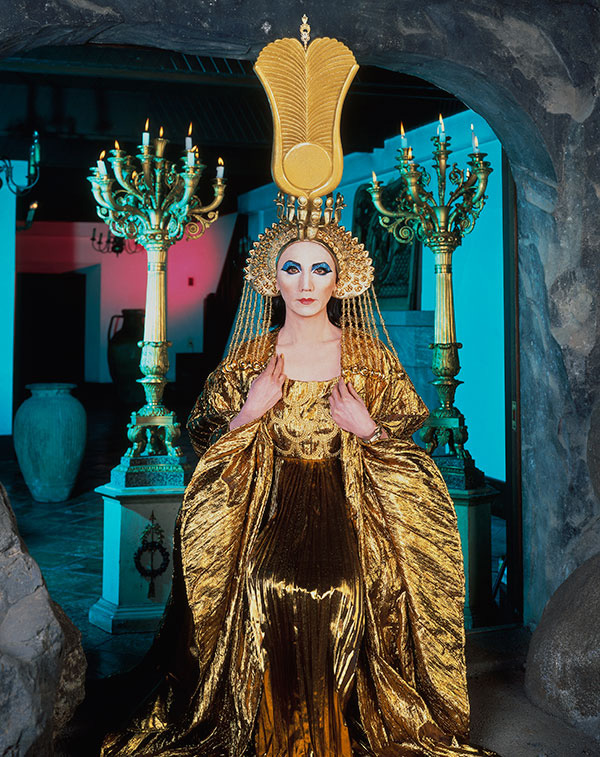
Yasumasa Morimura (Japanese, b. 1951) 'Self-portrait (Actress)/after Elizabeth Taylor 1' 1996


Yasumasa Morimura (Japanese, b. 1951)
Self-portrait (Actress)/after Elizabeth Taylor 1
1996
Ilfochrome print mounted to plexiglass
47 1/4 x 37 1/4 inches
Courtesy of the artist and Luhring Augustine, New York


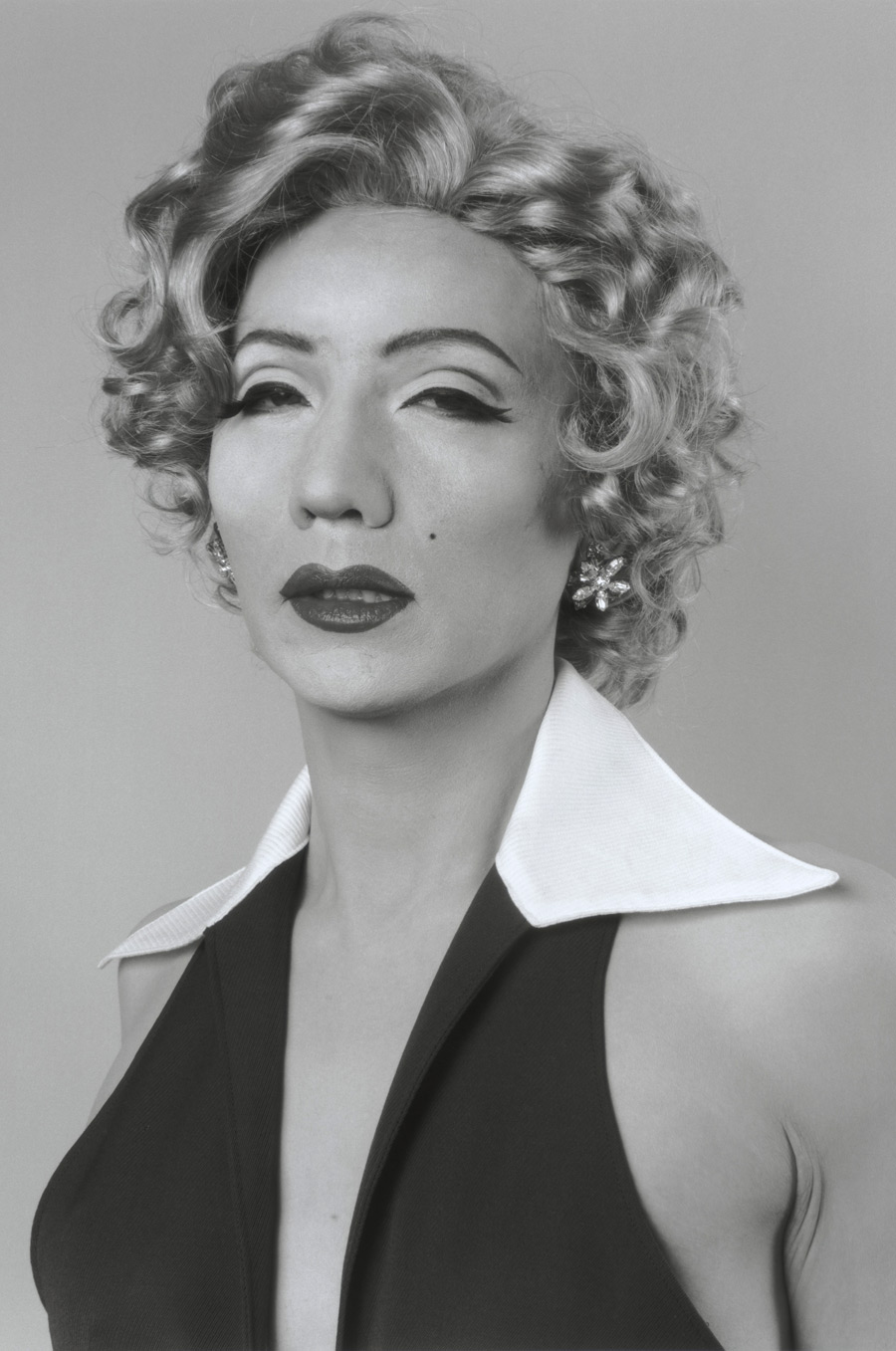
Yasumasa Morimura (Japanese, b. 1951) 'M's self-portrait No. 56/B 9 (or "as Marilyn Monroe")' 1996


Yasumasa Morimura (Japanese, b. 1951)
M’s self-portrait No. 56/B 9 (or “as Marilyn Monroe”)
1996
Gelatin silver print
Edition 6 of 10
11 3/4 x 14 inches


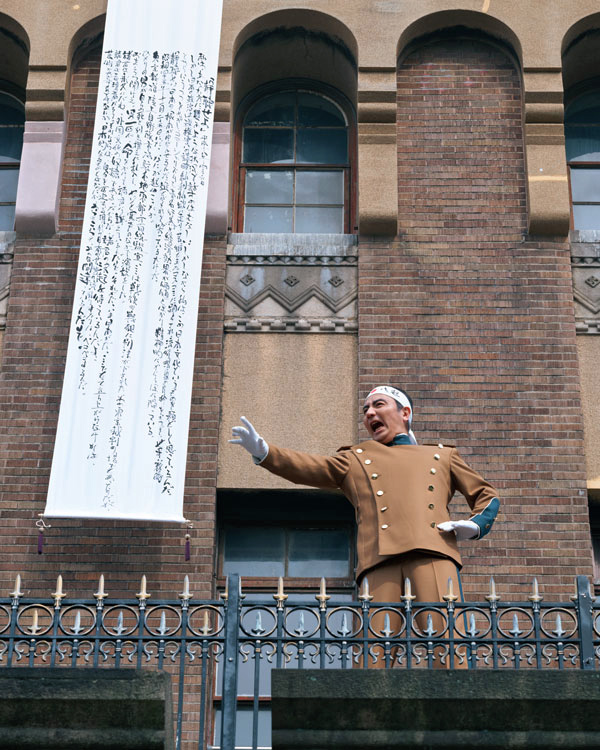
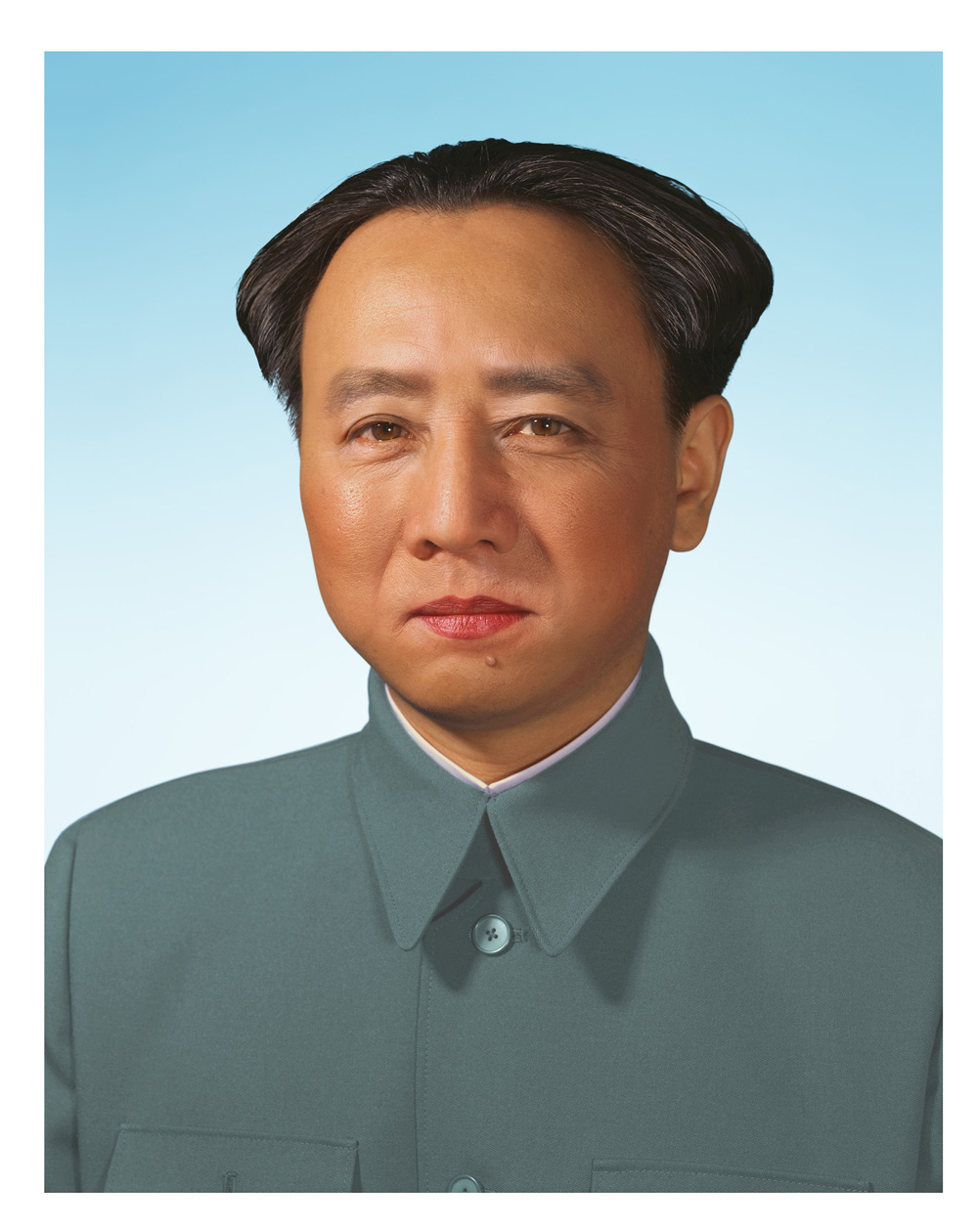
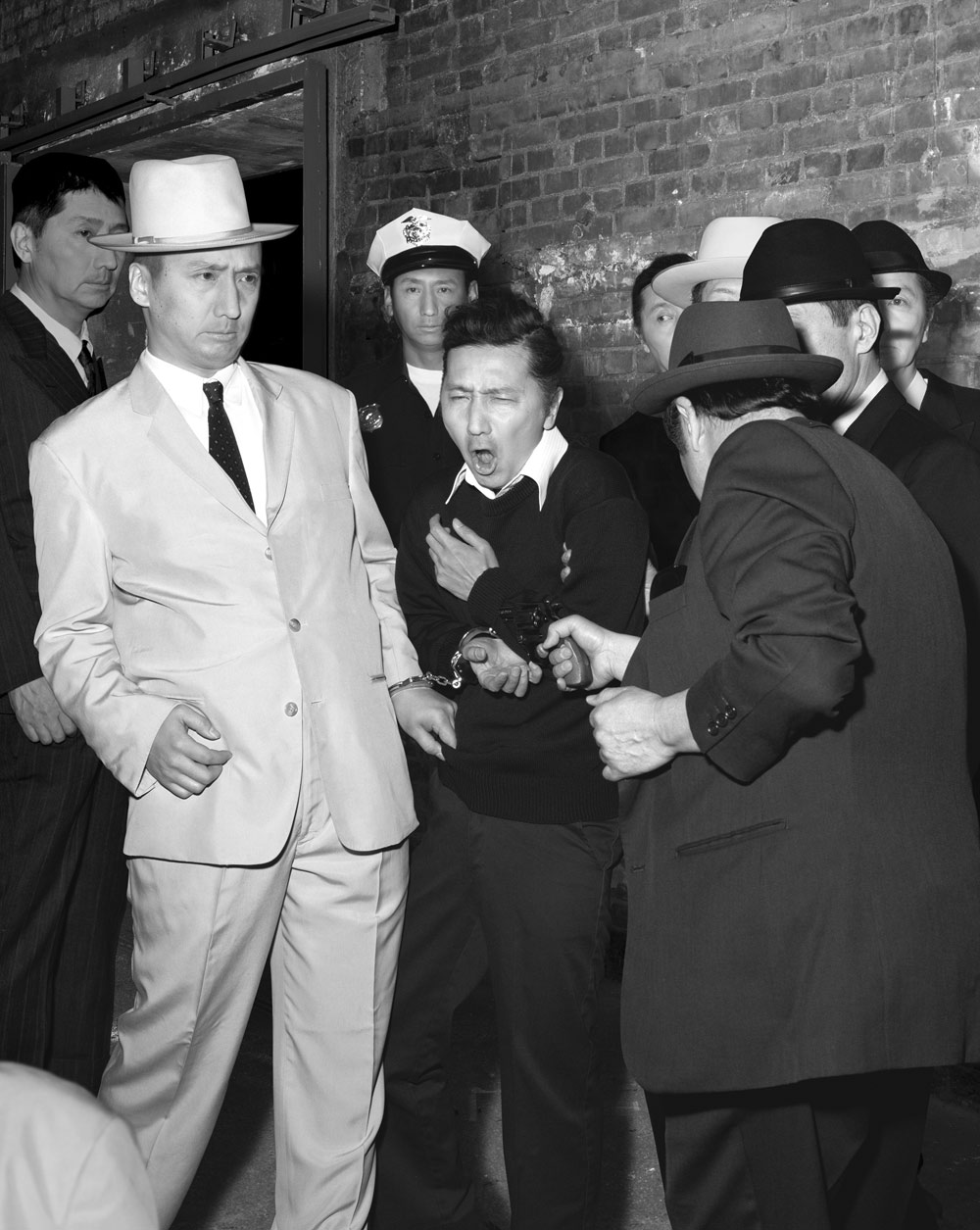
For more than three decades Japanese artist Yasumasa Morimura has forged an extraordinary body of work that reimagines the visual culture of the West, as well as that of his native Japan. Whether portraying Elizabeth Taylor, Mao Zedong or Andy Warhol, Morimura’s iconic images examine the practice of photography while also claiming a space for the self in historical narratives. The artist inserts himself as the subject(s) in all of his works. The exhibition, Yasumasa Morimura: Theater of the Self, is a retrospective of Morimura’s 30 year career covering his fascination with the self-portrait, celebrity, gay and transgendered life, art history, and popular culture align him closely with the work of Andy Warhol. Morimura has described himself as Warhol’s “conceptual son.”

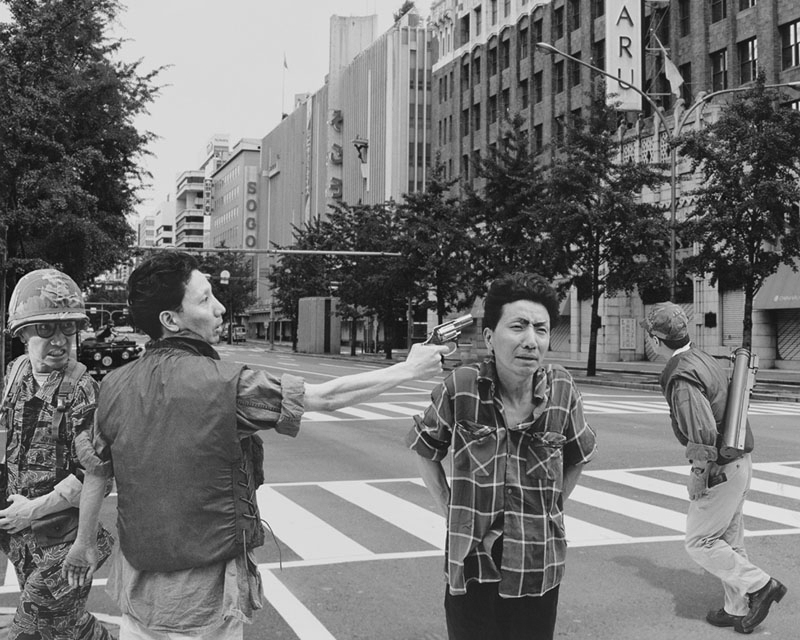
Developed in close collaboration with the artist, the exhibition focuses on three important bodies of work: his celebrated “Art History” photographs in which he painstakingly restages European masterpieces; “Requiem” in which Morimura recreates iconic photographs relating to political and cultural life; and the “Actors” series in which he assumes the personae of Hollywood luminaries such as Marilyn Monroe, Elvis Presley and Audrey Hepburn.

Milton Fine Curator of Art, Nicholas Chambers states, “Including almost 100 images, many of which have never before been seen in the United States, Theater of the Self offers audiences an in-depth view of Morimura’s work. His pictures reveal a sophisticated form of engagement with the worlds of celebrity, art and the mass media that is at once celebration and critique, homage and parody, and has the effect of questioning the nature of the individual’s relationship to culture-at-large.””

Press release from The Warhol website


Requiem

The artworks comprising the Requiem Series are derived from photographic sources and depict prominent masculine figures in moments of triumph or transition. Substituting himself for ideologues, dictators and creative thinkers, Morimura reflects on what these figures represent for the broader culture and on the role of photography in celebrating, demonising or memorialising them.


Yasumasa Morimura (Japanese, b. 1951) 'A Requiem: Vietnam War 1968-1991' 1991-2006


Yasumasa Morimura (Japanese, b. 1951)
A Requiem: Vietnam War 1968-1991
1991-2006
Gelatin silver print


Yasumasa Morimura (Japanese, b. 1951) 'A Requiem: Theater of Creativity / Andy Warhol in Motion' 2010


Yasumasa Morimura (Japanese, b. 1951)
A Requiem: Theater of Creativity / Andy Warhol in Motion
2010
Digital video, black and white, silent, 3:58 minutes
Collection of the artist


Yasumasa Morimura (Japanese, b. 1951) 'A Requiem: Mishima 1970' 2006


Yasumasa Morimura (Japanese, b. 1951)
A Requiem: Mishima 1970
2006
Digital video, colour, sound, 7:42 minutes
Courtesy of the artist and Luhring Augustine, New York


Yasumasa Morimura (Japanese, b. 1951) 'A Requiem: Red Dream/ Mao' 2007


Yasumasa Morimura (Japanese, b. 1951)
A Requiem: Red Dream / Mao
2007
C- print mounted on alpolic
59 x 47 1/4 inches
Courtesy of the artist and Luhring Augustine, New York


Yasumasa Morimura (Japanese, b. 1951) 'A Requiem: Oswald, 1963' 2006


Yasumasa Morimura (Japanese, b. 1951)
A Requiem: Oswald, 1963
2006
Gelatin silver print
Courtesy of the artist and Luhring Augustine, New York


The Andy Warhol Museum
117 Sandusky Street
Pittsburgh, PA 15212-5890
Phone: 412.237.8300

Opening hours:
Wednesday – Monday 10am – 5pm
Tuesday closed

The Andy Warhol Museum website
LIKE ART BLART ON FACBEOOK

Back to top

Exhibition: ‘Party’ by Anne MacDonald at Bett Gallery, Hobart

“In these bittersweet longings for innocence (of person, of situation), small vibrations of energy carry great import…” Dr Marcus Bunyan

Exhibition dates: 11th October – 1st November, 2013

Curator: Unknown


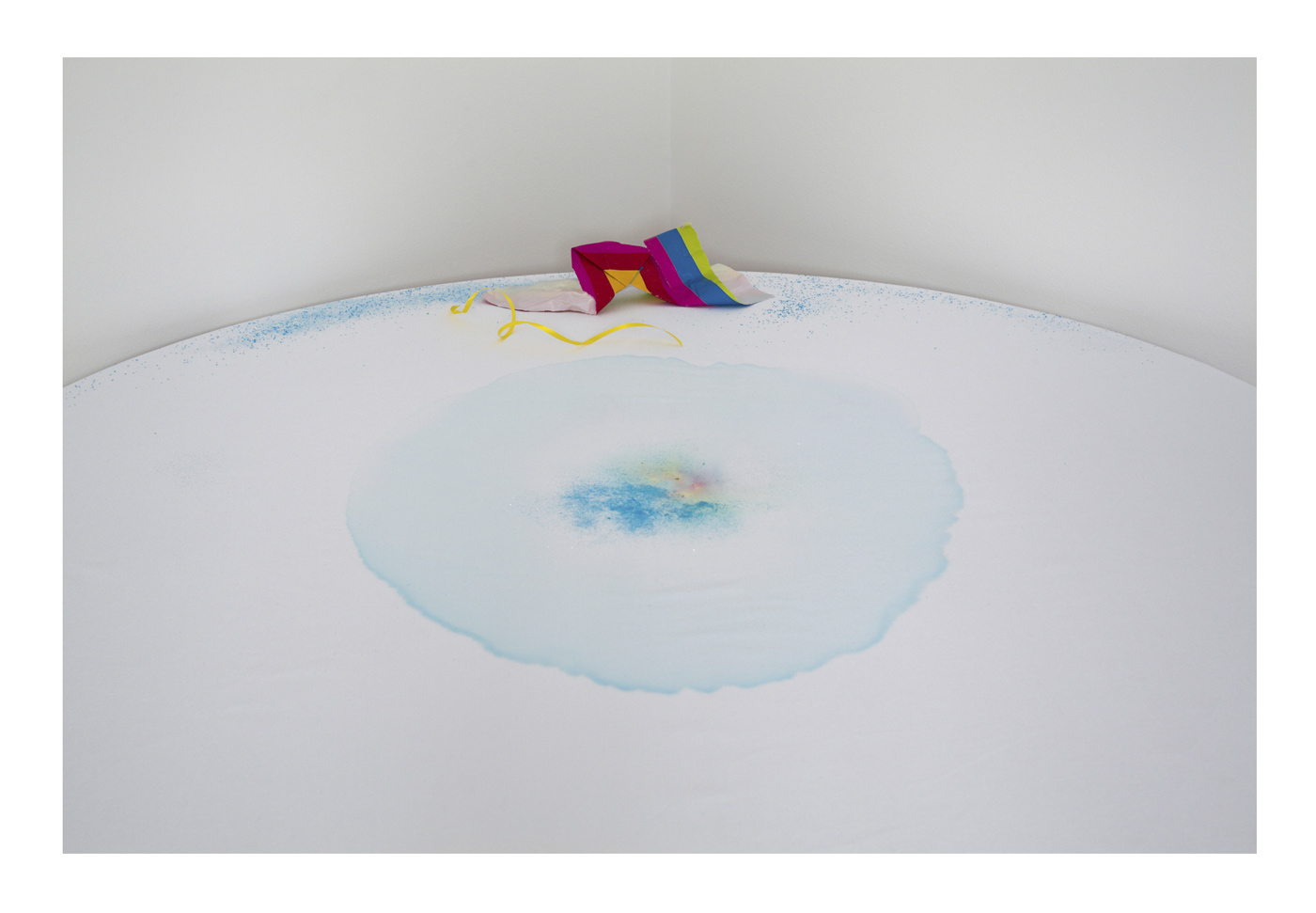
Anne MacDonald (Australian, b. 1960) 'Party no.1' 2012-13


Anne MacDonald (Australian, b. 1960)
Party no.1
2012-2013
Fine art ink-jet print
110 x 160cm
Edition of 5


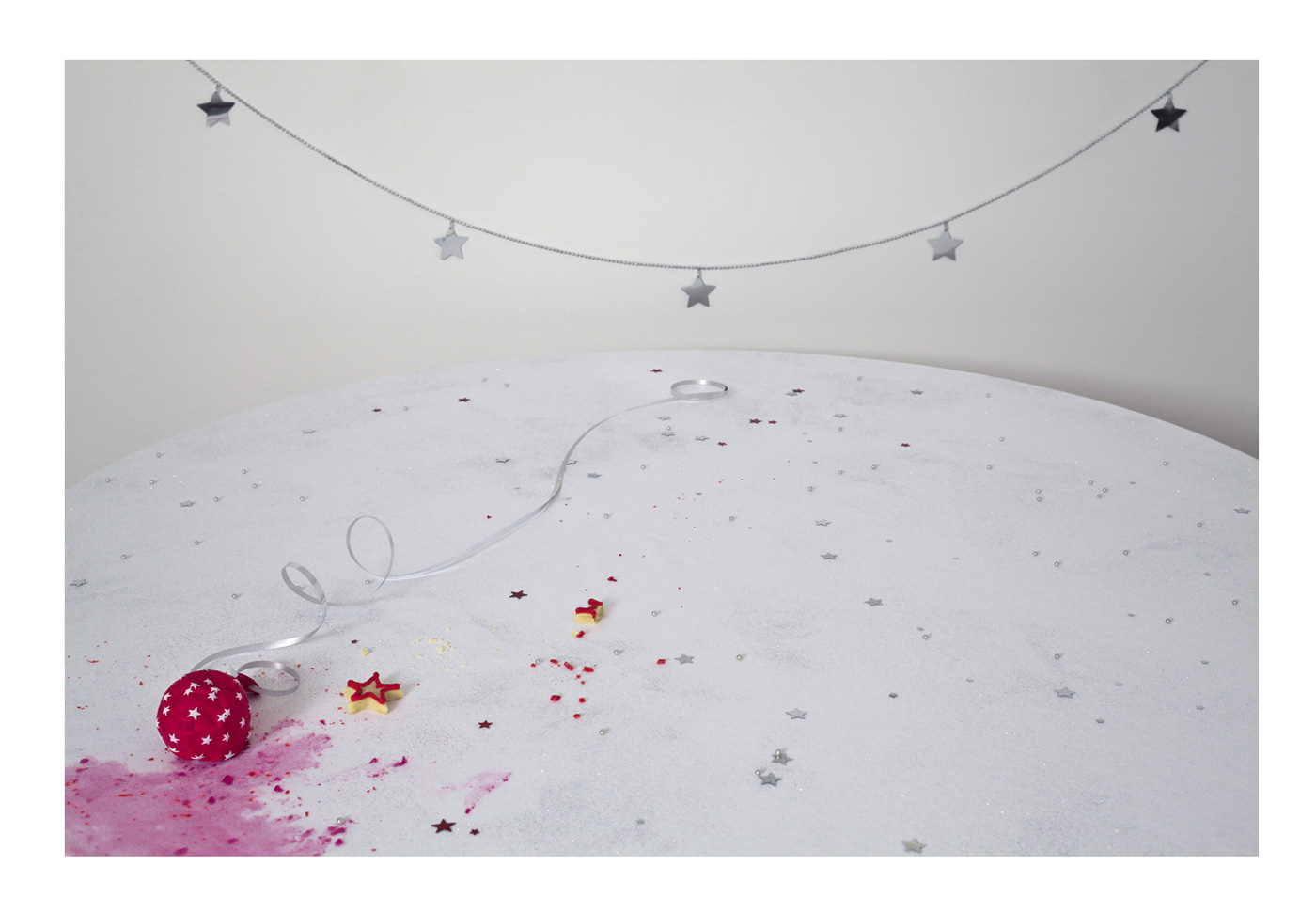
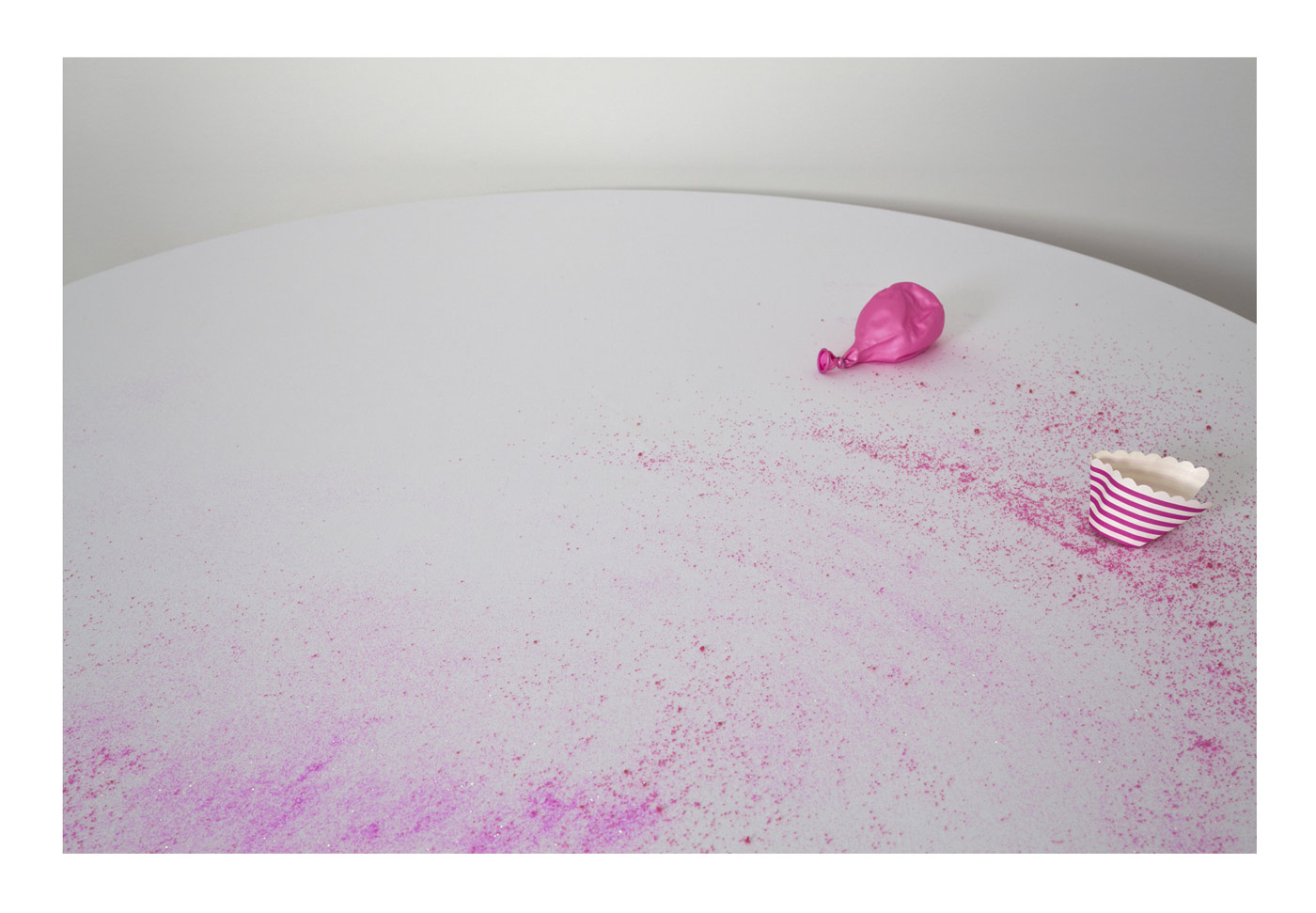
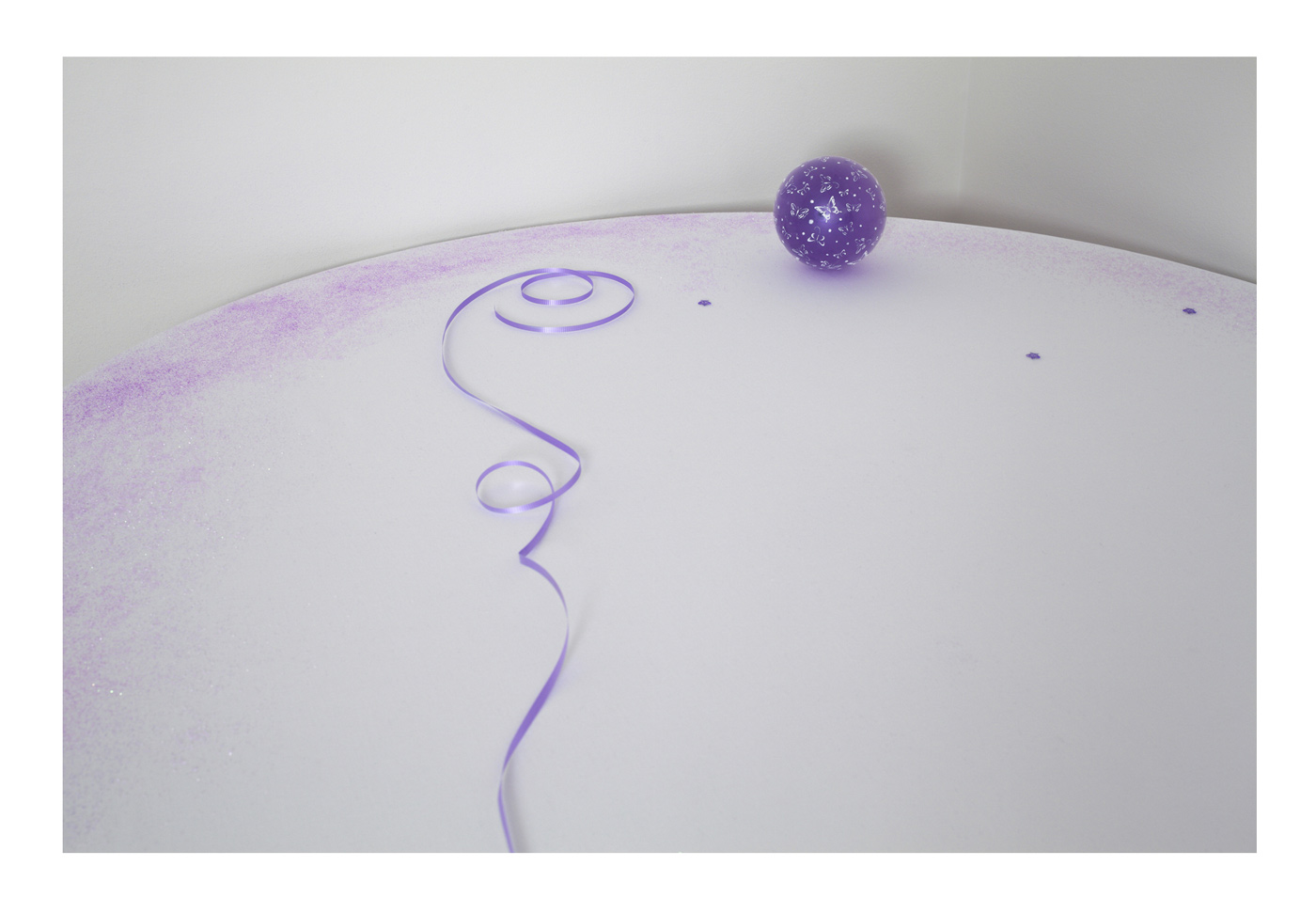
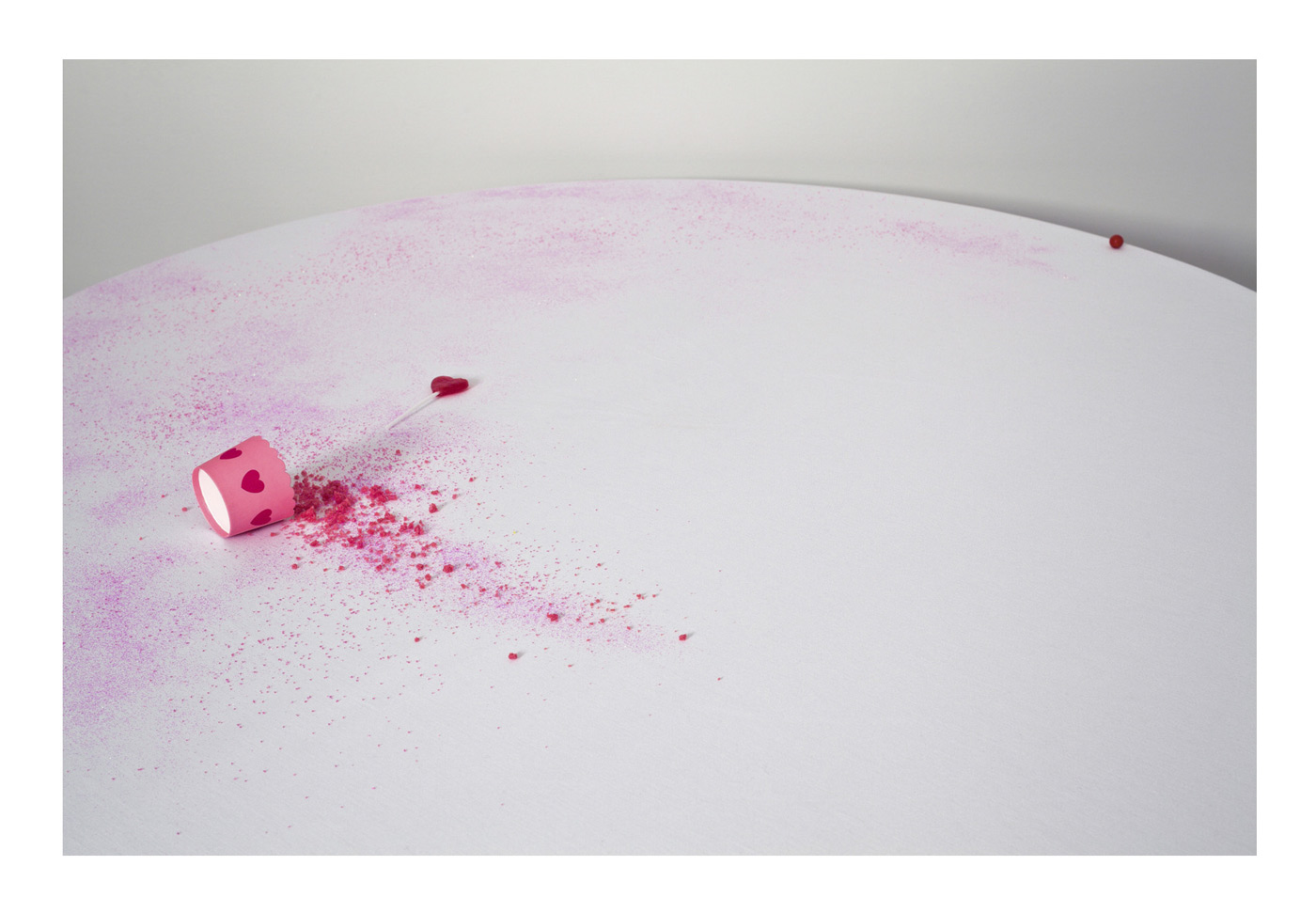
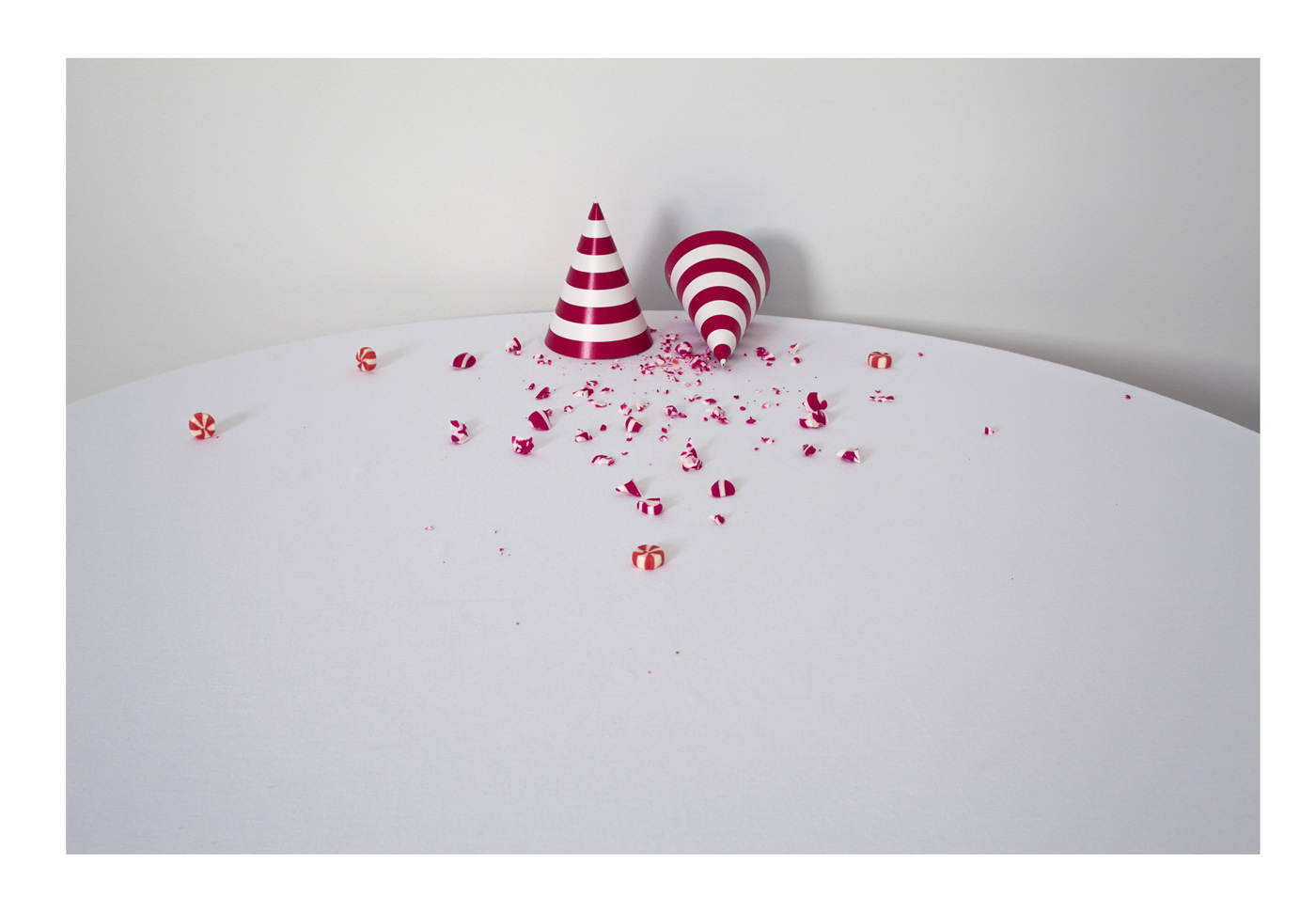
In her artist statement, Anne MacDonald observes that children’s birthday parties as symbols of loss and impermanence.

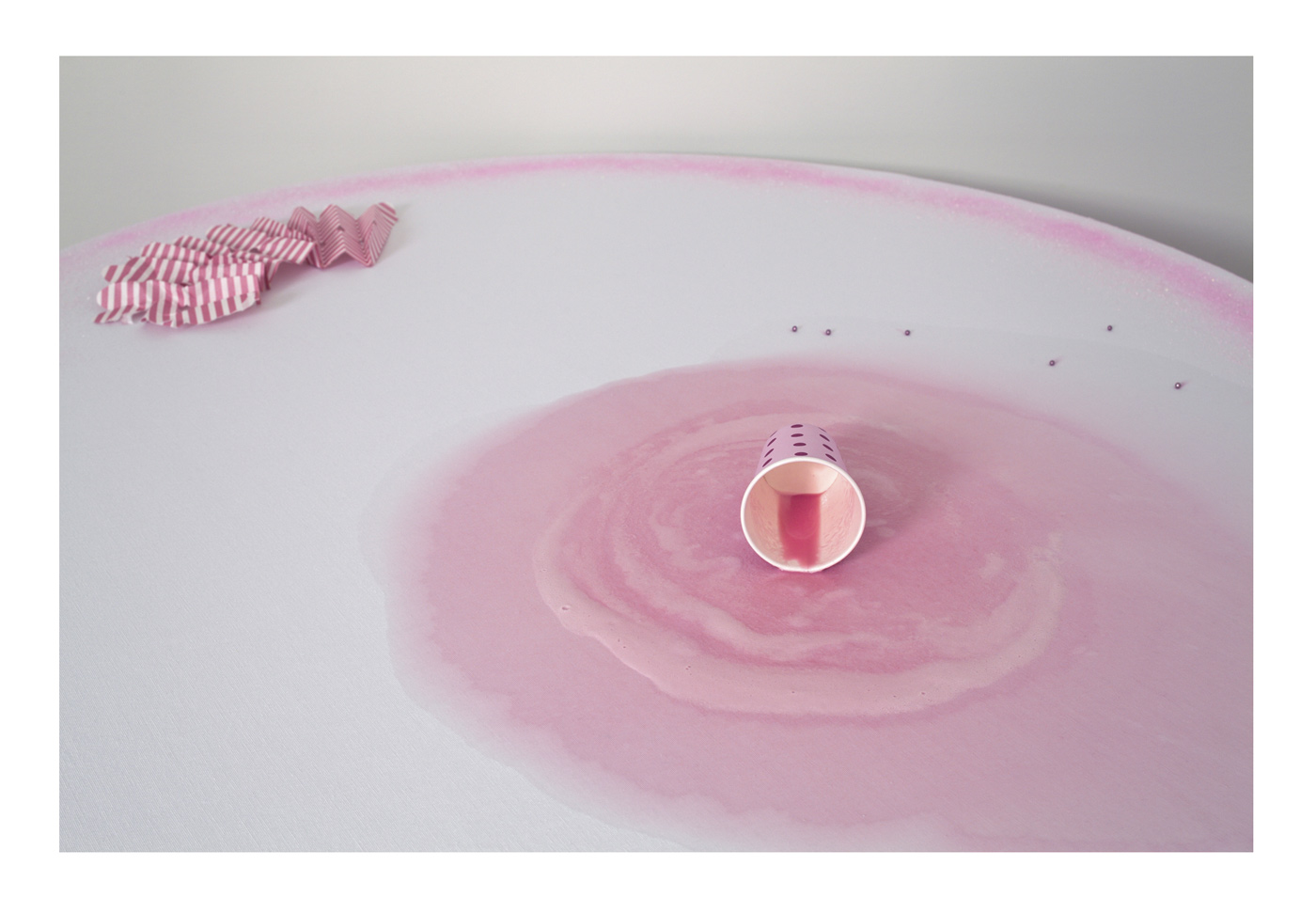
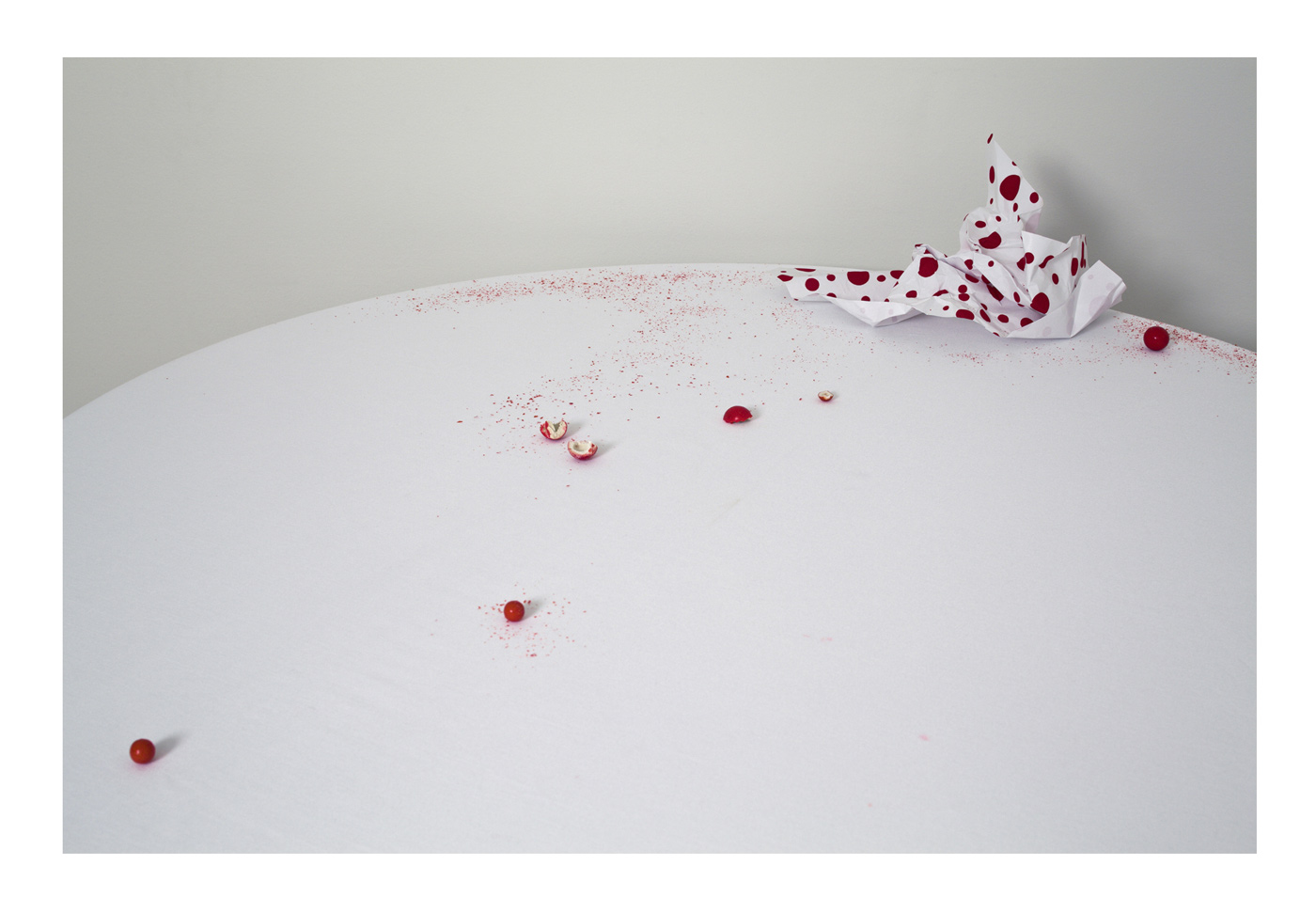
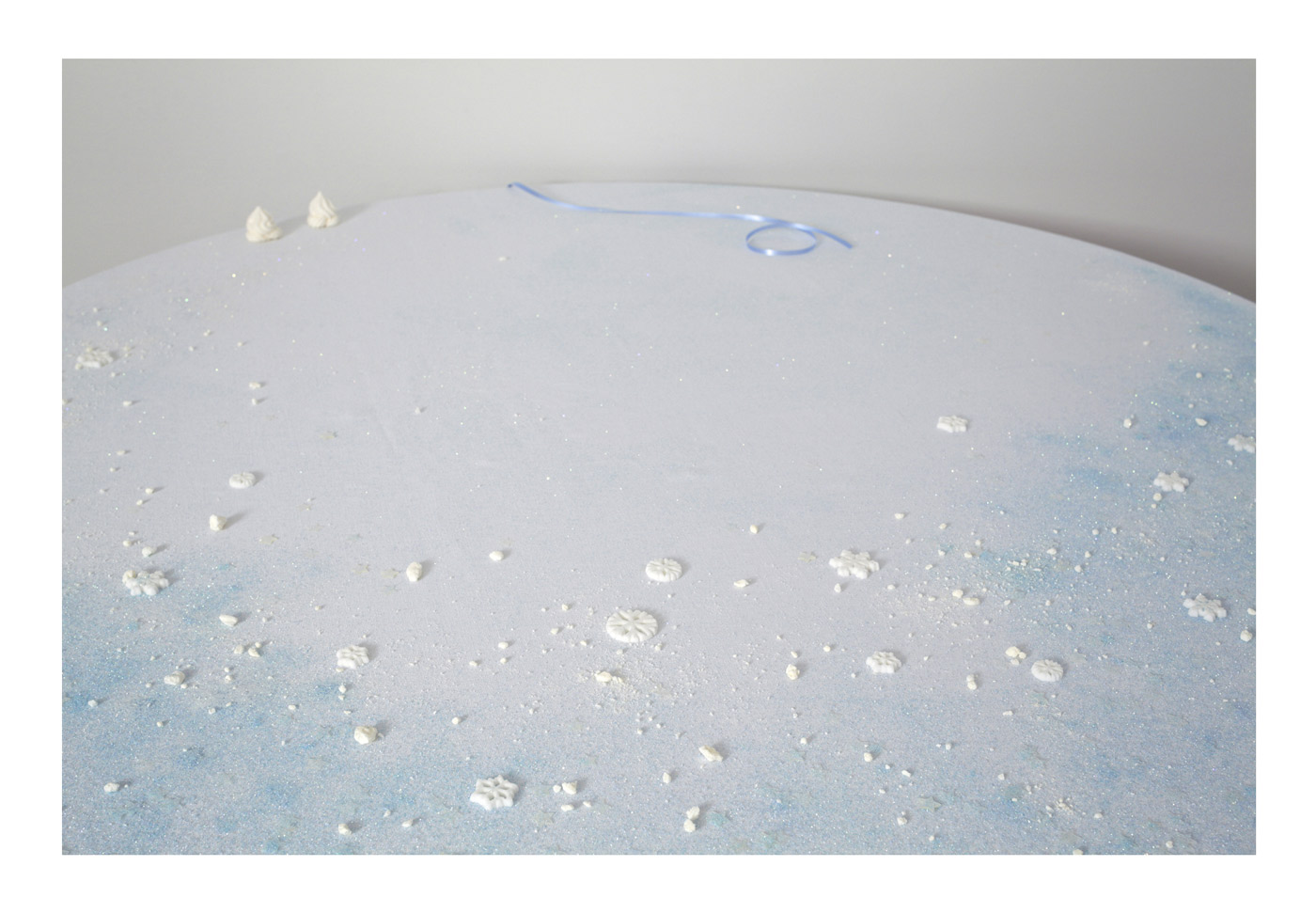
In these wonderful photographs there is a sense of sadness and perhaps even nostalgia. There is a certain wistfulness at play, a longing / yearning / pining for the past: a past that never happened (in my case). There is a delicacy and spareness here – in the colours and placement of objects in the mise-en-scène – which enhances the poetic telling of the story, the restrained aesthetic emphasising the choreographed movements within the scene. This, in turn, emphasises a sense of loss.

In these bittersweet longings for innocence (of person, of situation), small vibrations of energy carry great import. The suspended stars of Party No. 1, the abandoned heart of Party No. 5 with the single red ball perched precariously on the edge of the table – a masterstroke! If that little red ball was not there, the image simply would not work. To realise what the image needed, and to place that single ball there in the most knowing (yet spiritual) of positions, shows that this artist really knows what she is doing in this body of work. The fun / longing continues in Party No. 7, with its delicious monochromatic colours counterbalanced with the effusive staining of the spilt slurpee. Balance, restraint and intimacy are the key to these works, and MacDonald has achieved this to marvellous effect.

The only mis-step is the size of these images. I saw Party No. 2 at the William and Winifred Bowness Photography Prize 2013 at the Monash Gallery of Art recently at the largest size (110 x 160cm, the other sizes being 76 x 110cm and 33 x 38cm) and it simply didn’t work. No ifs and buts, it simply did not work at the size it was displayed. Why artists persist is printing their work at a huge scale when the image simply cannot sustain such a size, both conceptually and visually, is beyond me. Is it because they think it will be lost in the crowd (of a prize) if they don’t print it that big, or because it’s fashionable to print so large and the clientele want it that size as a statement piece for their home? The ONLY size out of the three that these images will work is at 33 x 38cm because of the intimacy of the subject matter. They photographs need to be jewel-like to radiate their energy. At the larger sizes this energy is totally lost.

So if you like this work buy three or four at the smaller size and let the images draw you into an intimate embrace with an impermanent, and perhaps fond remembered, past.

Dr Marcus Bunyan


Many thankx to Bett Gallery for allowing me to publish the photographs in the posting. Please click on the photographs for a larger version of the image.


Anne MacDonald (Australian, b. 1960) 'Party no.2' 2012-13


Anne MacDonald (Australian, b. 1960)
Party no.2
2012-2013
Fine art ink-jet print
110 x 160cm
Edition of 5


Anne MacDonald (Australian, b. 1960) 'Party no.3' 2012-13


Anne MacDonald (Australian, b. 1960)
Party no.3
2012-2013
Fine art ink-jet print
110 x 160cm
Edition of 5


Anne MacDonald (Australian, b. 1960) 'Party no.4' 2012-13


Anne MacDonald (Australian, b. 1960)
Party no.4
2012-2013
Fine art ink-jet print
110 x 160cm
Edition of 5


As a parent, observing my child growing up fills me with wonder, but also a sense of loss.

Children’s birthday parties are important social rituals, and on the surface of things, joyous and festive celebrations of life. However, on another level, they are compelling indicators of time’s inexorable passing. Children’s party decorations, food, gifts, games, toys and costumes alter each year with the age of the child. Their role extends beyond pure ornament and artifice to become symbolic of a transitory childhood world.

Looking at children’s birthday parties as symbols of loss and impermanence, Party continues my exploration into the relationship between the photographic still life, transience and mortality. In this series I have recreated ephemeral banquet scenes of party cakes and decorations. The images record the aftermath of the party, when all the fun is over, the presents have been opened, the cake eaten and the guests have left.

Artist statement


Anne MacDonald (Australian, b. 1960) 'Party no.5' 2012-13


Anne MacDonald (Australian, b. 1960)
Party no.5
2012-2013
Fine art ink-jet print
110 x 160cm
Edition of 5


Anne MacDonald (Australian, b. 1960) 'Party no.6' 2012-13


Anne MacDonald (Australian, b. 1960)
Party no.6
2012-2013
Fine art ink-jet print
110 x 160cm
Edition of 5


Anne MacDonald (Australian, b. 1960) 'Party no.7' 2012-13


Anne MacDonald (Australian, b. 1960)
Party no.7
2012-2013
Fine art ink-jet print
110 x 160cm
Edition of 5


Anne MacDonald (Australian, b. 1960) 'Party no.8' 2012-13


Anne MacDonald (Australian, b. 1960)
Party no.8
2012-2013
Fine art ink-jet print
110 x 160cm
Edition of 5


Anne MacDonald (Australian, b. 1960) 'Party no.9' 2012-13


Anne MacDonald (Australian, b. 1960)
Party no.9
2012-2013
Fine art ink-jet print
110 x 160cm
Edition of 5


Bett Galllery
369 Elizabeth Street
North Hobart Tasmania 7000
Australia
Phone: +61 (0) 3 6231 6511

Opening hours:
Mon – Fri 10am – 5.30pm
Sat 10am – 4pm

Bett Gallery website

LIKE ART BLART ON FACEBOOK

Back to top

Review: Polixeni Papapetrou ‘A Performative Paradox’ and Daniel von Sturmer 
’After Images’ at the Centre for Contemporary Photography (CCP), Fitzroy, Melbourne

Exhibition dates: 24th May – 14th July 2013


Polixeni Papapetrou (Australian, 1960-2018) 'Drag queen wearing cut out dress' 1993


Polixeni Papapetrou (Australian, 1960-2018)
Drag queen wearing cut out dress
1993
Gelatin silver photograph
28.5 x 28.5cm
Courtesy the artist and Nellie Castan Gallery, Melbourne and Stills Gallery, Sydney


Two solid if not overly memorable exhibitions are presented at the Centre for Contemporary Photography.

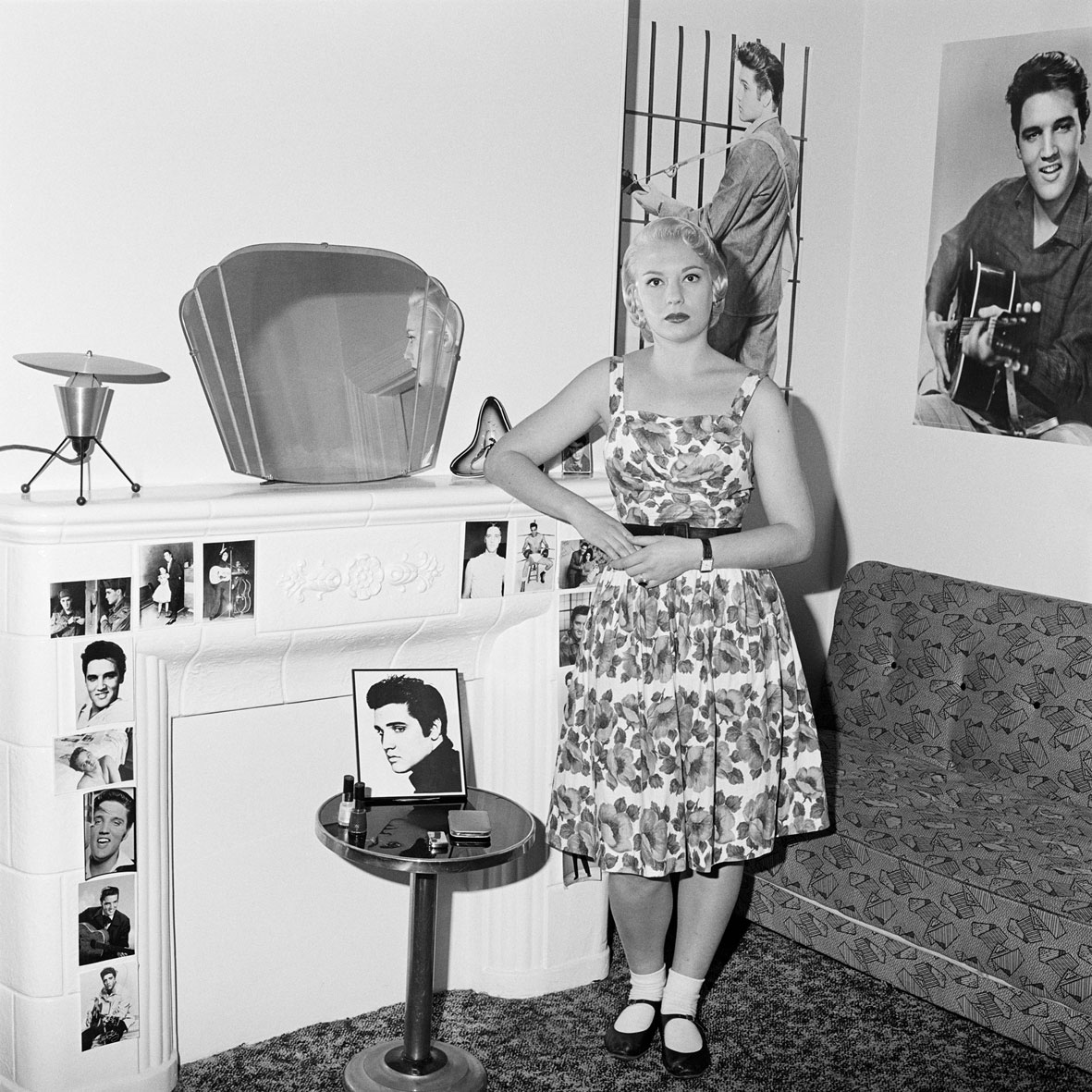
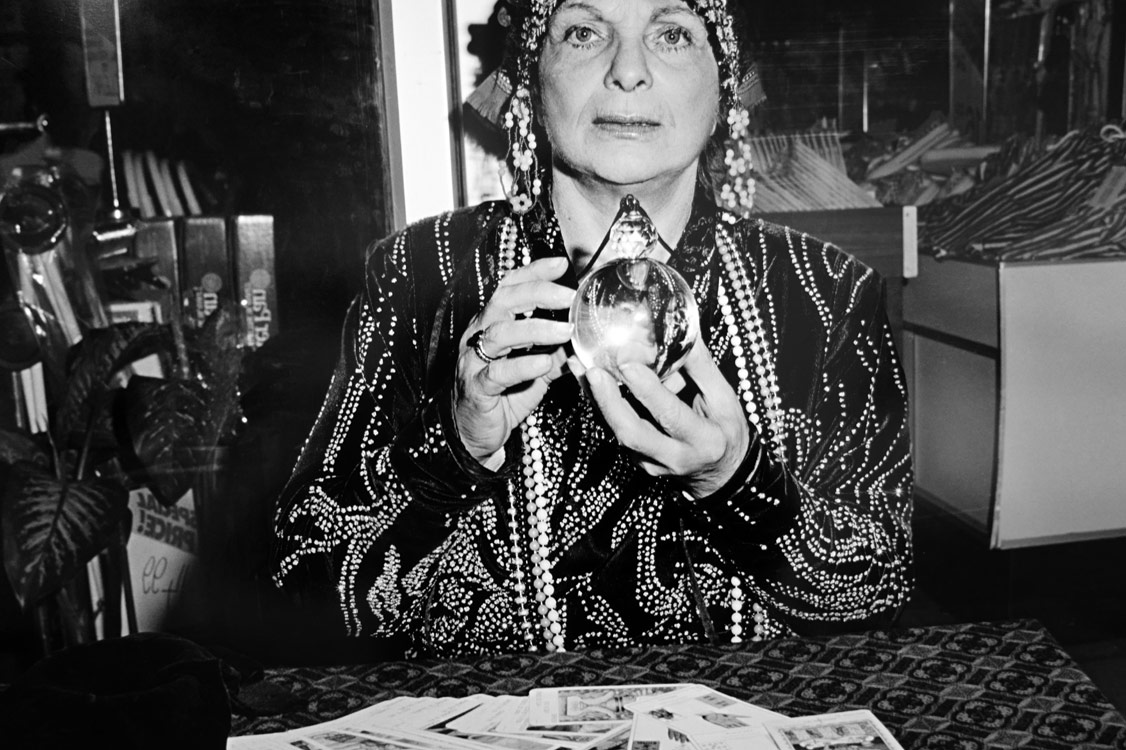
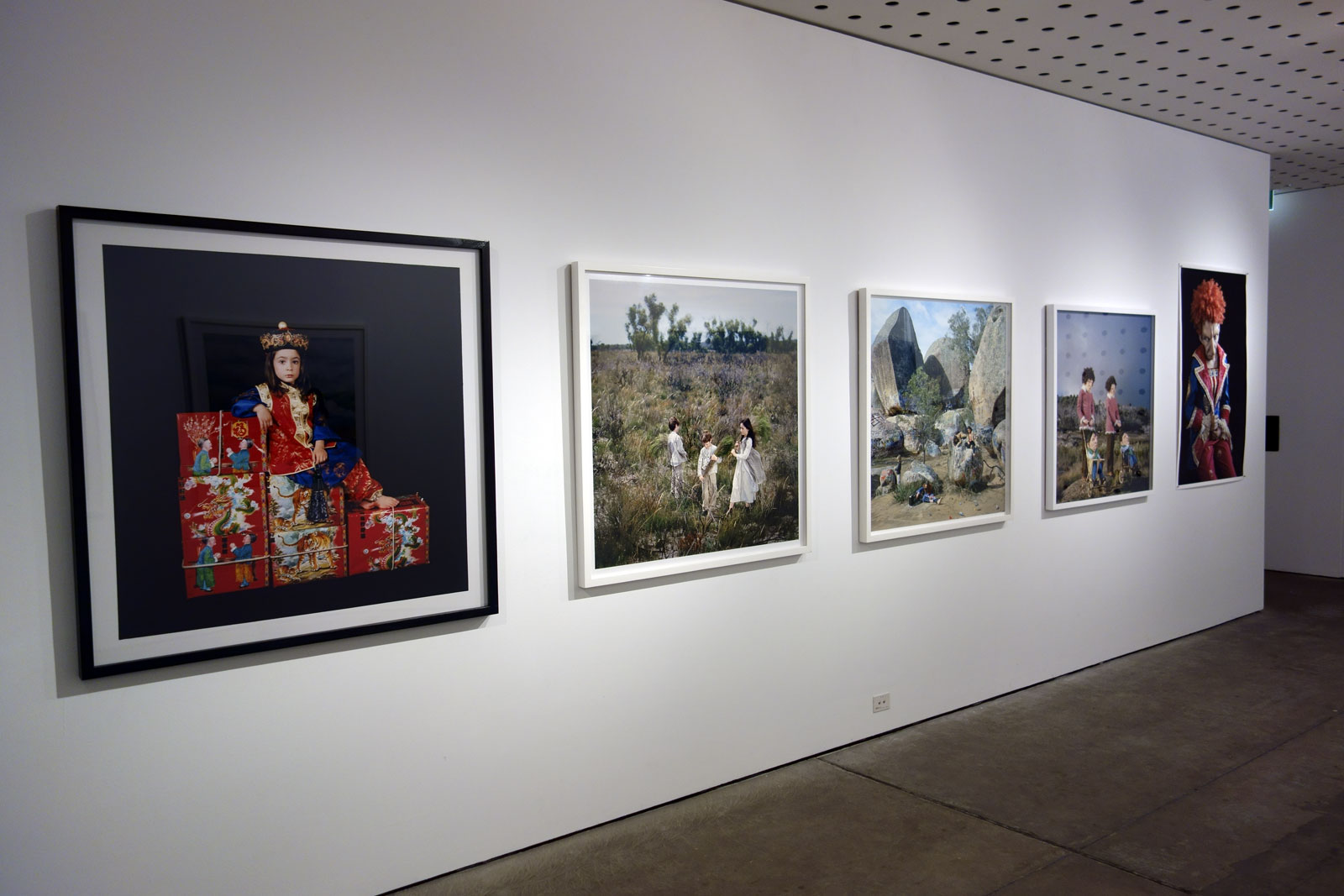
Polixeni Papapetrou A Performative Paradox is a bit of a dog’s breakfast. While it is wonderful to see early work by this artist – work that features Marilyn and Elvis impersonators, circus people, body builders and drag queens – too many bodies of work are crammed into too small a space with too few images. Some of the later series are represented by just one image giving a hotch potch feel to the whole exhibition ensemble. Perhaps it would have been better to concentrate solely on the early black-and-white images and colour images, work that is rarely seen and informs the staged work that followed. Having said that the black-and-white photographs are a joy to behold, documenting as they do performative identities. The photographs have an intangible presence. There are strong elements of the frontality of Diane Arbus in the photographs of circus performers and drag queens, coupled with a intrinsic understanding of light and texture. The photographs of drag queens are the highlight of both exhibitions and Drag queen wearing cut out dress (1993, below) reminded me of an early black-and-white photograph by Fiona Hall (Leura, New South Wales1974) in its use of patterned wallpaper. Let us hope there is a large retrospective of Polixeni’s work (at NGV or Heide for example) in the future, one that can do justice to the depth and complexity of her vision as an artist.

Daniel von Sturmer 
After Images is an interesting conceptual experiment, one that investigates the splitting of the image (shadow) from its referent (object). “The images propose a kind of transference; the object itself may be insignificant but its subjective meaning carries weight, and its shadow leaves a space the viewer fills with their own reading.” In their black-and-white fuzziness the work looks impressive when viewed in the gallery space (see installation views below) but upon close inspection the individual photographs fail to hold the viewers attention. Personally, I found it difficult to impart any great meaning to any of these works and the investigation certainly does not produce memorable images, ones that will stay with the viewer months and years later. For me the exhibition became an exercise in guessing what shadows were which objects, a game that grew quickly tiresome. The work then became an exercise in the importance of captioning an image, as I constantly looked around the room trying to match the titles of the works with the images themselves. As abstract images they imparted little metaphysical poetry as ghost images (an afterimage or ghost image is an optical illusion that refers to an image continuing to appear in one’s vision after the exposure to the original image has ceased). As images that investigate the link between text, object, shadow and language they started to become what the artist sought to enunciate: shadow objects bound to the realm of signification in some amorphous play, shadows that have the potential to become ‘Other’.

PS. As an analogy you could see these images as the equivalent of Jung’s human “shadow aspect” where, according to Jung, the shadow, in being instinctive and irrational, is prone to projection (as these shadows are projected by their objects). The shadow represents the entirety of the unconscious, ie. everything of which a person is not fully conscious, and is the seat of creativity. “Everyone carries a shadow,” Jung wrote, “and the less it is embodied in the individual’s conscious life, the blacker and denser it is.” (Jung, C.G. (1938). “Psychology and Religion.” In CW 11: Psychology and Religion: West and East. p. 131). Hence the potential halo/cination of these images.

Dr Marcus Bunyan


Many thankx to the CCP for allowing me to publish the photographs in the posting. Please click on the photographs for a larger version of the image. All installation photographs © Marcus Bunyan


Polixeni Papapetrou (Australian, 1960-2018) 'Suzie, Elvis fan at home, Melbourne' 1989


Polixeni Papapetrou (Australian, 1960-2018)
Suzie, Elvis fan at home, Melbourne
1989
Selenium toned gelatin silver photograph
40.7 x 40.7cm
Courtesy the artist and Nellie Castan Gallery, Melbourne and Stills Gallery, Sydney


Polixeni Papapetrou (Australian, 1960-2018) 'Indian Brave' 2002


Polixeni Papapetrou (Australian, 1960-2018)
Indian Brave
2002
Pigment ink print
85 x 85cm
Courtesy the artist and Nellie Castan Gallery, Melbourne and Stills Gallery, Sydney


Polixeni Papapetrou (Australian, 1960-2018) 'Three young men paying homage to Elvis on the 13th anniversary of Elvis' death, Elvis Memorial Melbourne' 1990


Polixeni Papapetrou (Australian, 1960-2018)
Three young men paying homage to Elvis on the 13th anniversary of Elvis’ death, Elvis Memorial Melbourne
1990
Selenium toned gelatin silver photograph
40.7 x 40.7cm
Courtesy the artist and Nellie Castan Gallery, Melbourne and Stills Gallery, Sydney


This exhibition focuses on the performative in the work of Polixeni Papapetrou, from her early documentary work through to her directorial work with her children since 2002, regarded internationally as some of the most powerful and provocative works in the field of perfomative photography. Papapetrou’s enduring interest is in how the ‘other’ is represented and how the ‘other’ performs in reinforcing our own identity.

Polixeni Papapetrou is one of Australia’s leading contemporary photomedia artists. She has been exploring relationships between history, contemporary culture, landscape, identity and childhood through her photographic practice since the mid-eighties. In this exhibition, selected by Professor Anne Marsh in consultation with the artist, a particular thread has been selected across Papapetrou’s practice – that of the performative – from her early documentary work through to her directorial work with her children from 2002 to the present.

Her images are informed by her own experience as ‘other’, growing up as a Greek immigrant in a white, Anglo-Saxon, male-dominated culture in Australia in the 1960s and 1970s. Marilyn Monroe impersonators, Elvis Presley fans, body builders, circus performers and drag queens have all taken their turn in front of Papapetrou’s camera. All of these people are, one way or another, performing identities.

In 2002 Papapetrou turned her focus to the experience of childhood, using her children as the performers in her pictures. There is a challenging confusion between fantasy, mythology, archetype, animism and theatricality present in these works, ranging from the playful to the transgressive, wrangling with the question of identity and stressing the embodied nature of experience.

Text from the CCP website


Polixeni Papapetrou (Australian, 1960-2018) 'Fortune teller' 1989 (detail)


Polixeni Papapetrou (Australian, 1960-2018)
Fortune teller (detail)
1989
From the series Ashton Circus, Silvers Circus 1989-1990


Polixeni Papapetrou. 'Levitation, Silvers Circus' 1989 (detail)


Polixeni Papapetrou (Australian, 1960-2018)
Levitation, Silvers Circus (detail)
1989
From the series Ashton Circus, Silvers Circus 1989-1990


Polixeni Papapetrou (Australian, 1960-2018) 'Ashton Circus, Silvers Circus' series 1989-1990 (installation view)


Polixeni Papapetrou (Australian, 1960-2018)
Ashton Circus, Silvers Circus series (installation view)
1989-1990
Photo: Marcus Bunyan


Installation view of Polixeni Papapetrou 'A Performative Paradox' at the Centre for Contemporary Photography (CCP)

Installation view of Polixeni Papapetrou 'A Performative Paradox' at the Centre for Contemporary Photography (CCP)

Installation view of Polixeni Papapetrou 'A Performative Paradox' at the Centre for Contemporary Photography (CCP)

Installation view of Polixeni Papapetrou 'A Performative Paradox' at the Centre for Contemporary Photography (CCP)

Installation view of Polixeni Papapetrou 'A Performative Paradox' at the Centre for Contemporary Photography (CCP)


Installation views of Polixeni Papapetrou A Performative Paradox at the Centre for Contemporary Photography (CCP)
Photos: Marcus Bunyan


Daniel von Sturmer (New Zealand, b. 1972) 'Production Still for After Images'


Daniel von Sturmer (New Zealand, b. 1972)
Production Still for After Images
Courtesy the artist and Anna Schwartz Gallery, Melbourne and Sydney


In After Images the shadows of a set of subjectively ‘important artefacts’ (a business card, a phone, a letter…) are presented alongside generic objects from the studio, for example: a bin, some tape, a ruler… Presented at 1:1 scale, the images propose a kind of transference; the object itself may be insignificant but its subjective meaning carries weight, and its shadow leaves a space the viewer fills with their own reading.

Photographed using a specially constructed ‘set’ to enable the separation of an object from its shadow, the resulting image stands alone, separated from its object yet inextricably bound to the realm of signification from which it has been cast.

Text from the CCP website


Installation view of Daniel von Sturmer 'After Images' at the Centre for Contemporary Photography (CCP)

Installation view of Daniel von Sturmer 'After Images' at the Centre for Contemporary Photography (CCP)

Installation view of Daniel von Sturmer 'After Images' at the Centre for Contemporary Photography (CCP)

Installation view of Daniel von Sturmer 'After Images' at the Centre for Contemporary Photography (CCP)

Installation view of Daniel von Sturmer 
'After Images' at the Centre for Contemporary Photography (CCP)


Installation views of Daniel von Sturmer 
After Images at the Centre for Contemporary Photography (CCP)
Photos: Marcus Bunyan


Centre for Contemporary Photography

No permanent exhibition space at the moment

Centre for Contemporary Photography website

LIKE ART BLART ON FACEBOOK

Back to top

Exhibition: ‘The Shaping of New Visions: Photography, Film, Photobook’ at the Museum of Modern Art (MoMA), New York

Exhibition dates: 18th April 2012 – 29th April 2013


Josef Albers (German, 1888-1976) 'Marli Heimann, Alle während 1 Stunde (Marli Heimann, All During an Hour)' 1931


Josef Albers (German, 1888-1976)
Marli Heimann, Alle während 1 Stunde (Marli Heimann, All During an Hour)
1931
Twelve gelatin silver prints
Overall 11 11/16 x 16 7/16″ (29.7 x 41.8cm)
The Museum of Modern Art, New York
Gift of The Josef Albers Foundation, Inc.
© 2012 The Josef and Anni Albers Foundation / Artists Rights Society (ARS), New York


Another fascinating exhibition and a bumper posting to boot (pardon the pun!)

A panoply of famous photographers along with a few I had never heard of before (such as Georges Hugnet) are represented in this posting. As the press blurb states, through “key photographic projects, experimental films, and photobooks, The Shaping of New Visions offers a critical reassessment of photography’s role in the avant-garde and neo-avant-garde movements, and in the development of contemporary artistic practices.”

The large exhibition seems to have a finger in every pie, wandering from the birth of the 20th-century modern metropolis, through “New Vision” photography in the 1920s, experimental film, Surrealism, Constructivism and New Objectivity, Dada, Rayographs, photographic avant-gardism, photocollages, photomontages, street photography of the  1960s, colour slide projection performance, through New Topographics, self-published books, and conceptual photography, featuring works that reevaluate the material and contextual definitions of photography. “The final gallery showcases major installations by a younger generation of artists whose works address photography’s role in the construction of contemporary history.”

Without actually going to New York to see the exhibition (I wish!!) – from a distance it does seem a lot of ground to cover within 5 galleries even if there are 250 works. You could say this is a “meta” exhibition, drawing together themes and experiments from different areas of photography with rather a long bow. Have a look at the The Shaping of New Visions exhibition checklist to see the full listing of what’s on show and you be the judge. There are some rare and beautiful images that’s for sure. From the photographs in this posting I would have to say the distorted “eyes” have it…

Dr Marcus Bunyan


Many thankx to MoMA for allowing me to publish the photographs in the posting. Please click on the photographs for a larger version of the image.


Paul Strand (American, 1890-1976) and Charles Sheeler (American, 1883-1965)
Manhatta
1921
Film
Courtesy of the Museum of Modern Art, New York
© Aperture Foundation Inc., Paul Strand Archive


In 1920 Paul Strand and artist Charles Sheeler collaborated on Manhatta, a short silent film that presents a day in the life of lower Manhattan. Inspired by Walt Whitman’s book Leaves of Grass, the film includes multiple segments that express the character of New York. The sequences display a similar approach to the still photography of both artists. Attracted by the cityscape and its visual design, Strand and Sheeler favoured extreme camera angles to capture New York’s dynamic qualities. Although influenced by Romanticism in its view of the urban environment, Manhatta is considered the first American avant-garde film.


Man Ray (American, 1890-1976) 'Rayograph' 1922


Man Ray (American, 1890-1976)
Rayograph
1922
Gelatin silver print (photogram)
9 3/8 x 11 3/4″ (23.9 x 29.9cm)
The Museum of Modern Art, New York
Gift of James Thrall Soby
© 2012 Man Ray Trust / Artists Rights Society (ARS), New York / ADAGP, Paris


Aleksandr Rodchenko (Russian, 1891-1956) 'Sovetskoe foto (Soviet Photo)' No. 10 October 1927


Aleksandr Rodchenko (Russian, 1891-1956)
Sovetskoe foto (Soviet Photo) No. 10
October 1927
Letterpress
10 3/8 x 7 1/4″ (26.3 x 18.4cm)
Publisher: Ogonek, Moscow
The Museum of Modern Art, New York. Gift of the Judith Rothschild Foundation


August Sander (German, 1876-1964) 'Das rechte Auge meiner Tochter Sigrid (The Right Eye of My Daughter Sigrid)' 1928


August Sander (German, 1876-1964)
Das rechte Auge meiner Tochter Sigrid (The Right Eye of My Daughter Sigrid)
1928
Gelatin silver print
7 1/16 x 9″ (17.9 x 22.9cm)
The Museum of Modern Art, New York
Gift of the photographer
© 2012 Artists Rights Society (ARS), New York / VG Bild-Kunst, Bonn


Claude Cahun (French, 1894-1954) 'Untitled' c. 1928


Claude Cahun (French, 1894-1954)
Untitled
c. 1928
Gelatin silver print
4 9/16 x 3 1/2″ (10 x 7.6cm)
The Museum of Modern Art, New York
Purchase and anonymous promised gift
© 2012 Estate of Claude Cahun


Dziga Vertov (Russian, 1896-1954) 'Chelovek s kinoapparatom (Man with a Movie Camera)' (still) 1929


Dziga Vertov (Russian, 1896-1954)
Chelovek s kinoapparatom (Man with a Movie Camera) (still)
1929
35mm film
65 min ( black and white, silent)
The Museum of Modern Art, New York
Department of Film


Excerpt from a camera operators diary
ATTENTION VIEWERS:
This film is an experiment in cinematic communication of real events
Without the help of Intertitles
Without the help of a story
Without the help of theatre
This experimental work aims at creating a truly international language of cinema based on its absolute separation from the language of theatre and literature


Man with a Movie Camera (Russian: Человек с киноаппаратом (Chelovek s kinoapparatom) is an experimental 1929 silent documentary film, with no story and no actors by Soviet-Russian director Dziga Vertov, edited by his wife Elizaveta Svilova.

Vertov’s feature film, produced by the film studio VUFKU, presents urban life in the Soviet cities of Kiev, Kharkov, Moscow and Odessa. From dawn to dusk Soviet citizens are shown at work and at play, and interacting with the machinery of modern life. To the extent that it can be said to have “characters,” they are the cameramen of the title, the film editor, and the modern Soviet Union they discover and present in the film.

This film is famous for the range of cinematic techniques Vertov invents, deploys or develops, such as double exposure, fast motion, slow motion, freeze frames, jump cuts, split screens, Dutch angles, extreme close-ups, tracking shots, footage played backwards, stop motion animations and self-reflexive visuals (at one point it features a split-screen tracking shot; the sides have opposite Dutch angles).

In the British Film Institute’s 2012 Sight & Sound poll, film critics voted Man with a Movie Camera the 8th best film ever made. In 2014 Sight & Sound also named it the best documentary of all time.

Text from the YouTube website


László Moholy-Nagy (Hungarian, 1895-1946)
Ein Lichtspiel: schwarz weiss grau (A Lightplay: Black White Gray) (excerpt)
1930


This short film made by László Moholy-Nagy is based on the shadow patterns created by his Light-Space Modulator, an early kinetic sculpture consisting of a variety of curved objects in a carefully choreographed cycle of movements. Created in 1930, the film was originally planned as the sixth and final part of a much longer work depicting the new space-time.


Raoul Hausmann (Austrian, 1886-1971) 'Untitled' February 1931


Raoul Hausmann (Austrian, 1886-1971)
Untitled
February 1931
Gelatin silver print
5 3/8 x 4 7/16″ (13.6 x 11.2cm)
The Museum of Modern Art, New York
Thomas Walther Collection Gift of Thomas Walther
© 2012 Raoul Hausmann / Artists Rights Society (ARS), New York / ADAGP, Paris


Georges Hugnet (French, 1906-1974) 'Untitled [Surrealist beach collage]' c. 1935


Georges Hugnet (French, 1906-1974)
Untitled [Surrealist beach collage]
c. 1935
Collage of photogravure, lithograph, chromolithograph and gelatin silver prints on gelatin silver print
11 7/8 x 9 7/16″ (30.2 x 24cm)
The Museum of Modern Art, New York
Gift of Timothy Baum in memory of Harry H. Lunn, Jr.


Grete Stern (German-Argentinian, 1904-1999) No. 1 from the series 'Sueños' (Dreams) 1949


Grete Stern (German-Argentinian, 1904-1999)
No. 1 from the series Sueños (Dreams)
1949
Gelatin silver print
10 1/2 x 9″ (26.6 x 22.9cm)
Latin American and Caribbean Fund through gift of Marie-Josée and Henry R. Kravis in honor of Adriana Cisneros de Griffin
© 2012 Horacio Coppola


Berenice Abbott (American, 1898-1991) 'Portrait of the Artist as a Young Woman' Negative c. 1930/Distortion c. 1950


Berenice Abbott (American, 1898-1991)
Portrait of the Artist as a Young Woman
Negative c. 1930/Distortion c. 1950
Gelatin silver print
12 3/4 x 10 1/8″ (32.6 x 25.7cm)
The Museum of Modern Art, New York
Frances Keech Fund in honor of Monroe Wheeler
© 2012 Berenice Abbott/Commerce Graphics


William Klein (American, 1928-2022) 'Gun, Gun, Gun, New York' 1955


William Klein (American, 1928-2022)
Gun, Gun, Gun, New York 
1955
Gelatin silver print
10 1/4 x 13 5/8″ (26 x 34.6cm)
The Museum of Modern Art, New York
Gift of Arthur and Marilyn Penn


Martha Rosler (American, b. 1943) 'Red Stripe Kitchen' 1967-1972


Martha Rosler (American, b. 1943)
Red Stripe Kitchen
1967-1972
From the series Bringing the War Home: House Beautiful 
Pigmented inkjet print, printed 2011
23 3/4 x 18 1/8″ (60.3 x 46cm)
The Museum of Modern Art, New York
Purchase and The Modern Women’s Fund


Eleanor Antin (American, b. 1935) '100 Boots' 1971-1973

Eleanor Antin (American, b. 1935) '100 Boots' 1971-1973

Eleanor Antin (American, b. 1935) '100 Boots' 1971-1973


Eleanor Antin (American, b. 1935)
100 Boots
1971-1973
Photographed by Philip Steinmetz
Halftone reproductions on 51 cards
4 1/2 x 7 in. each
Courtesy Ronald Feldman Fine Arts, New York
© Eleanor Antin


The Museum of Modern Art draws from its collection to present the exhibition The Shaping of New Visions: Photography, Film, Photobook on view from April 18, 2012, to April 29, 2013. Filling the third-floor Edward Steichen Photography Galleries, this installation presents more than 250 works by approximately 90 artists, with a focus on new acquisitions and groundbreaking projects by Man Ray, László Moholy-Nagy, Aleksandr Rodchenko, Germaine Krull, Dziga Vertov, Gerhard Rühm, Helen Levitt, Robert Frank, Daido Moriyama, Robert Heinecken, Edward Ruscha, Martha Rosler, Bernd and Hilla Becher, Philip-Lorca diCorcia, Paul Graham, and The Atlas Group / Walid Raad. The exhibition is organised by Roxana Marcoci, Curator, Department of Photography, The Museum of Modern Art.

Punctuated by key photographic projects, experimental films, and photobooks, The Shaping of New Visions offers a critical reassessment of photography’s role in the avant-garde and neo-avant-garde movements, and in the development of contemporary artistic practices. The shaping of what came to be known as “new vision” photography in the 1920s bore the obvious influence of “lens-based” and “time-based” works. The first gallery begins with photographs capturing the birth of the 20th-century modern metropolis by Berenice Abbott, Edward Steichen, and Alfred Stieglitz, presented next to the avant-garde film Manhatta (1921), a collaboration between Paul Strand and Charles Sheeler.

The 1920s were a period of landmark constructions and scientific discoveries all related to light – from Thomas Edison’s development of incandescent light to Albert Einstein’s theory of relativity and light speed. Man Ray began experimenting with photograms (pictures made by exposing objects placed on photosensitive paper to light) – which he renamed “rayographs” after himself – in which light was both the subject and medium of his work. This exhibition presents Man Ray’s most exquisite rayographs, alongside his first short experimental film, Le Retour à la raison (Return to Reason, 1923), in which he extended the technique to moving images.

In 1925, two years after he joined the faculty of the Bauhaus school in Weimar Germany, László Moholy-Nagy published his influential book Malerei, Fotografie, Film (Painting, Photography, Film) – part of a series that he coedited with Bauhaus director Walter Gropius – in which he asserted that photography and cinema are heralding a “culture of light” that has overtaken the most innovative aspects of painting. Moholy-Nagy extolled photography and, by extension, film as the quintessential medium of the future. Moholy-Nagy’s interest in the movement of objects and light through space led him to construct Light-Space Modulator, the subject of his only abstract film, Ein Lichtspiel: schwarz weiss grau (A Lightplay: Black White Gray, 1930), which is presented in the exhibition next to his own photographs and those of Florence Henri.

The rise of photographic avant-gardism from the 1920s to the 1940s is traced in the second gallery primarily through the work of European artists. A section on Constructivism and New Objectivity features works by Paul Citroën, Raoul Hausmann, Florence Henri, Germaine Krull, El Lissitzky, Albert Renger-Patzsch, and August Sander. A special focus on Aleksandr Rodchenko underscores his engagement with the illustrated press through collaborations with Vladimir Mayakovsky and Sergei Tretyakov on the covers and layouts of Novyi LEF, the Soviet avant-garde journal of the “Left Front of the Arts,” which popularised the idea of “factography,” or the manufacture of innovative aesthetic facts through photomechanical processes. Alongside Rodchenko, film director Dziga Vertov redefined the medium of still and motion-picture photography with the concept of kino-glaz (cine-eye), according to which the perfectible lens of the camera led to the creation of a novel perception of the world. The exhibition features the final clip of Vertov’s 1929 experimental film Chelovek s kinoapparatom (Man with a Movie Camera), in which the eye is superimposed on the camera lens to form an indivisible apparatus fit to view, process, and convey reality, all at once. This gallery also features a selection of Dada and Surrealist works, including rarely seen photographs, photocollages, and photomontages by Hans Bellmer, Claude Cahun, George Hugnet, André Kertész, Jan Lukas, and Grete Stern, alongside such avant-garde publications as Documents and Littérature.

The third gallery features artists exploring the social world of the postwar period. On view for the first time is a group of erotic and political typo-collages by Gerhard Rühm, a founder of the Wiener Gruppe (1959-1960), an informal group of Vienna-based writers and artists who engaged in radical visual dialogues between pictures and texts. The rebels of street photography – Robert Frank, William Klein, Daido Moriyama, and Garry Winogrand – are represented with a selection of works that refute the then prevailing rules of photography, offering instead elliptical, off-kilter styles that are as personal and controversial as are their unsparing views of postwar society. A highlight of this section is the pioneering slide show Projects: Helen Levitt in Color (1971-1974). Capturing the lively beat, humour, and drama of New York’s street theatre, Levitt’s slide projection is shown for the first time at MoMA since its original presentation at the Museum in 1974.

Photography’s tradition in the postwar period continues in the fourth gallery, which is divided into two sections. One section features “new topographic” works by Robert Adams, Bernd and Hilla Becher, Stephen Shore, and Joel Sternfeld, along with a selection of Edward Ruscha’s self-published books, in which the use of photography as mapmaking signals a conceptual thrust. This section introduces notable works from the 1970s by artists who embraced photography not just as a way of describing experience, but as a conceptual tool. Examples include Eleanor Antin’s 100 Boots (1971-1973), Mel Bochner’s Misunderstandings (A theory of photography) (1970), VALIE EXPORT’s Einkreisung (Encirclement) (1976), On Kawara’s I Got Up… (1977), and Gordon Matta-Clark’s Splitting (1974), all works that reevaluate the material and contextual definitions of photography. The other section features two major and highly experimental recent acquisitions: Martha Rosler’s political magnum opus Bringing the War Home (1967-1972), developed in the context of her anti-war and feminist activism, for which the artist spliced together images of domestic bliss clipped from the pages of House Beautiful with grim pictures of the war in Vietnam taken from Life magazine; and Sigmar Polke’s early 1970s experiments with multiple exposures, reversed tonal values, and under-and-over exposures, which underscore the artist’s idea that “a negative is never finished.” The unmistakably cinematic turn that photography takes in the 1980s and early 1990s is represented with a selection of innovative works ranging from Robert Heinecken’s Recto/Verso (1988) to Philip-Lorca diCorcia’s breakthrough Hustler series (1990-1992).

The final gallery showcases major installations by a younger generation of artists whose works address photography’s role in the construction of contemporary history. Tapping into forms of archival reconstitution, The Atlas Group / Walid Raad is represented with My Neck Is Thinner Than a Hair: Engines (1996-2004), an installation of 100 pictures of car-bomb blasts in Beirut during the Lebanese civil war (1975-1990) that provokes questions about the factual nature of existing records, the traces of war, and the symptoms of trauma. A selection from Harrell Fletcher’s The American War (2005) brings together bootlegged photojournalistic pictures of the U.S. military involvement in Southeast Asia, throwing into sharp focus photography’s role as a documentary and propagandistic medium in the shaping of historical memory. Jules Spinatsch’s Panorama: World Economic Forum, Davos (2003), made of thousands of still images and three surveillance video works, chronicles the preparations for the 2003 World Economic Forum, when the entire Davos valley was temporarily transformed into a high security zone. A selection of Paul Graham’s photographs from his major photobook project a shimmer of possibility (2007), consisting of filmic haikus about everyday life in today’s America, concludes the exhibition.

Press release from the MoMA website


Daido Moriyama. 'Entertainer on Stage, Shimizu' 1967


Daido Moriyama (Japanese, b. 1938)
Entertainer on Stage, Shimizu
1967
Gelatin silver print
18 7/8 x 28″ (48.0 x 71.2cm)
The Museum of Modern Art, New York
Gift of the photographer
© 2012 Daido Moriyama


Martha Rosler (American, b. 1943) 'Hands Up / Makeup' 1967-1972


Martha Rosler (American, b. 1943)
Hands Up / Makeup
1967-1972
From the series Bringing the War Home: House Beautiful
Pigmented inkjet print, printed 2011
23 3/4 x 13 15/16″ (60.4 x 35.4cm)
The Museum of Modern Art, New York
Purchase and The Modern Women’s Fund
© 2012 Martha Rosler


Helen Levitt (American, 1913-2009) 'Projects: Helen Levitt in Color' 1971-1974 (detail)

Helen Levitt (American, 1913-2009) 'Projects: Helen Levitt in Color' 1971-1974 (detail)


Helen Levitt (American, 1913-2009)
Projects: Helen Levitt in Color (detail)
1971-1974
40 colour slides shown in continuous projection
Originally presented at The Museum of Modern Art, New York, September 26-October 20, 1974


On Kawara (Japanese, 1932-2014) 'I Got Up At...' 1974-1975


On Kawara (Japanese, 1932-2014)
I Got Up At…
1974-1975
(Ninety postcards with printed rubber stamps)


The semi autobiographical I Got Up At… by On Kawara is a series of postcards sent to John Baldessari. Each card was sent from his location that morning detailing the time he got up. The time marked on each card varies drastically from day to day, the time stamped on each card is the time he left his bed as opposed to actually waking up. Kawara’s work often acts to document his existence in time, giving a material form to which is formally immaterial. The series has been repeated frequently sending the cards to a variety of friends and colleagues.


Sigmar Polke (German, 1941-2010) 'Untitled (Mariette Althaus)' c. 1975


Sigmar Polke (German, 1941-2010)
Untitled (Mariette Althaus)
c. 1975
Gelatin silver print (red toned)
9 1/4 x 11 13/16″ (23.5 x 30cm)
The Museum of Modern Art, New York
Acquired through the generosity of Edgar Wachenheim III and Ronald S. Lauder
© 2012 Estate of Sigmar Polke / Artists Rights Society (ARS), New York / VG Bild-Kunst, Bonn, Germany


VALIE EXPORT (Austrian, b. 1940) 'Einkreisung (Encirclement)' 1976


VALIE EXPORT (Austrian, b. 1940)
Einkreisung (Encirclement)
1976
From the series Körperkonfigurationen (Body Configurations)
Gelatin silver print with red ink
14 x 23 7/16″ (35.5 x 59.6cm)
The Museum of Modern Art, New York
Carl Jacobs Fund
© 2012 VALIE EXPORT / Artists Rights Society (ARS), New York / VBK, Austria


Robert Heinecken (American, 1931-2006) 'Recto/Verso #2' 1988


Robert Heinecken (American, 1931-2006)
Recto/Verso #2
1988
Silver dye bleach print
8 5/8 x 7 7/8″ (21.9 x 20cm)
The Museum of Modern Art, New York
Mr. and Mrs. Clark Winter Fund
© 2012 The Robert Heinecken Trust


Philip-Lorca diCorcia (American, b. 1951) 'Marilyn; 28 Years Old; Las Vegas, Nevada; $30' 1990-1992


Philip-Lorca diCorcia (American, b. 1951)
Marilyn; 28 Years Old; Las Vegas, Nevada; $30
1990-1992
Chromogenic colour print
24 x 35 15/16″ (61 x 91.4cm)
The Museum of Modern Art, New York
E.T. Harmax Foundation Fund
© 2012 Philip-Lorca diCorcia, courtesy David Zwirner, New York


Atlas Group, Walid Raad. 'My Neck is Thinner Than a Hair: Engines' 1996-2004 (detail)


Atlas Group, Walid Raad
My Neck is Thinner Than a Hair: Engines (detail)
1996-2004
100 pigmented inkjet prints
9 7/16 x 13 3/8″ (24 x 34cm) each
The Museum of Modern Art, New York
Fund for the Twenty-First Century


The Museum of Modern Art
11 West 53 Street
New York, NY 10019
Phone: (212) 708-9400

Opening hours:
10.30am – 5.30pm
Open seven days a week

MoMA website

LIKE ART BLART ON FACEBOOK

Back to top

Exhibition: ‘The Photographs of Ray K. Metzker and the Institute of Design’ at the J. Paul Getty Museum, Los Angeles

Exhibition dates: 25th September, 2012 – 24th February, 2013


Ray K. Metzker (American, 1931-2014) 'New Mexico' negative 1972; print 1987


Ray K. Metzker (American, 1931-2014)
New Mexico
Negative 1972; print 1987
Gelatin silver print
17.8 x 27.9cm (7 x 11 in.)
The Nelson-Atkins Museum of Art, Gift of the Hall Family Foundation
© Ray K. Metzker


It is a pleasure to able to post more of the tough, no nonsense photographs of Ray. K. Metzker. Atlantic City (1966, below) is an absolute beauty – from the shards of light raining down at exaggerated speed on the right hand wall, to the colour of the body, the colouration of the sole of the uplifted foot matching that of the bathers, the out flung arm, the single ray of light hitting the top of the head, to the march into endless darkness at left of image. Imagine actually seeing that image and then capturing it on film…

My personal favourite in the posting are the two photographs by Aaron Siskind. His monumental series, Pleasures and Terrors of Levitation, are photographs of divers leaping through the air captured from below to emphasise the abstract quality of their twisting shapes by isolating them against the sky:

“Highly formal, yet concerned with their subject as well as the idea they communicate, The Pleasures and Terrors of Levitation photographs depict the dark shapes of divers suspended mid-leap against a blank white sky. Shot with a hand-held twin-lens reflex camera at the edge of Lake Michigan in Chicago, the balance and conflict suggested by the series’ title is evident in the divers’ sublime contortions.” (Anonymous. “Aaron Siskind,” on the Museum of Contemporary Photography website 17/02/2013. No longer available online)

Such a simple idea, so well executed, the photographs become a single frame of Muybridge’s motion studies where the audience can imagine the rest of the sequence without seeing. Balance and conflict are in equilibrium and the pleasure and terror of jumping from the top board at the local swimming pool is caught in stasis, crystallised in a sublime field of existence under the gaze of the viewer.

Dr Marcus Bunyan


Many thankx to the J. Paul Getty Museum for allowing me to publish the photographs in the posting. Please click on the photographs for a larger version of the image.


Ray K. Metzker (American, 1931-2014) 'Valencia' 1961


Ray K. Metzker (American, 1931-2014)
Valencia
1961
Gelatin silver print
14.3 x 22.9cm (5 5/8 x 9 in.)
The Nelson-Atkins Museum of Art, Gift of the Hall Family Foundation
© Ray K. Metzker


Ray K. Metzker (American, 1931-2014) 'Atlantic City' negative, 1966; print, 2003


Ray K. Metzker (American, 1931-2014)
Atlantic City
negative, 1966; print, 2003
Gelatin silver print
20.3 x 20.3cm (8 x 8 in.)
The Nelson-Atkins Museum of Art, Gift of the Hall Family Foundation
© Ray K. Metzker


Ray K. Metzker (American, 1931-2014) 'Double Frame: Philadelphia' negative 1965; print 1972


Ray K. Metzker (American, 1931-2014)
Double Frame: Philadelphia
Negative 1965; print 1972
Gelatin silver print
21.6 x 9.8cm (8 1/2 x 3 7/8 in.)
The Nelson-Atkins Museum of Art, Gift of the Hall Family Foundation
© Ray K. Metzker


Ray K. Metzker (American, 1931-2014) 'Couplets: Atlantic City' negative 1969; print 1984


Ray K. Metzker (American, 1931-2014)
Couplets: Atlantic City
Negative 1969; print 1984
Gelatin silver print
22.9 x 15.6cm (9 x 6 1/8 in.)
The Nelson-Atkins Museum of Art, Gift of the Hall Family Foundation
© Ray K. Metzker


Ray K. Metzker (American, 1931-2014) 'City Whispers: Los Angeles' negative 1981; print 2006


Ray K. Metzker (American, 1931-2014)
City Whispers: Los Angeles
Negative 1981; print 2006
Gelatin silver print
26.8 x 41.4cm (10 9/16 x 16 5/16 in.)
The Nelson-Atkins Museum of Art, Gift of the Hall Family Foundation
© Ray K. Metzker


Ray K. Metzker (American, 1931-2014) 'City Whispers, Philadelphia' 1983


Ray K. Metzker (American, 1931-2014)
City Whispers, Philadelphia
1983
Gelatin silver print
24.5 x 24cm (9 5/8 x 9 7/16 in.)
The J. Paul Getty Museum, Los Angeles
© Ray K. Metzker


Metzker’s work is part of a revered tradition that emerged from the experimental approach of Chicago’s Institute of Design (ID), where he received his graduate degree in 1959. Inspired by instructors Harry Callahan and Aaron Siskind, Metzker fashioned an entirely personal synthesis of formal elegance, technical precision, and optical innovation. His composite works hold an important status in the history of creative photography: at the time of their making, they were unprecedented in ambition and perceptual complexity.

Metzker’s devotion to photographic seeing as a process of discovery is also deeply humanistic in its illumination of isolation and vulnerability. This exhibition offers a comprehensive overview of Metzker’s five-decade career, while also providing examples of work by instructors and fellow students at the Institute of Design in Chicago, where Metzker studied from 1956 to 1959. Learn more about Metzker’s diverse forays into photography as well as the ID and its profound influence.

Ray K. Metzker (American, 1931-2014) is one of the most dedicated and influential American photographers of the last half century. His photographs strike a distinctive balance between formal brilliance, optical innovation, and a deep human regard for the objective world. The Photographs of Ray K. Metzker and the Institute of Design, on view at the Getty Center September 25, 2012 – February 24, 2013, offers a comprehensive overview of Metzker’s five-decade career, while also providing examples of work by instructors and fellow students at the Institute of Design in Chicago, where Metzker studied from 1956 to 1959.

Organised in collaboration with Keith F. Davis, senior curator of photography at The Nelson-Atkins Museum of Art in Kansas City, Missouri, the exhibition is curated by Virginia Heckert, curator of photographs, and Arpad Kovacs, assistant curator of photographs, at the J. Paul Getty Museum. The exhibition features nearly 200 photographs, including approximately 80 from the holdings of The Nelson-Atkins Museum.

Ray K. Metzker

Dynamically composed, Metzker’s luminous black-and-white photographs feature subjects ranging from urban cityscapes to nature, all demonstrating the inventive potential of the photographic process. While a student at the ID, Metzker was mentored by renowned photographers Harry Callahan and Aaron Siskind. His curiosity led to experiments with high contrast, selective focus, and multiple images.

Metzker’s thesis project for the ID, a study of Chicago’s business district, or Loop, displayed many of these techniques. One image, a multiple exposure of commuters ascending a sun-bathed staircase, prefigures the novel Composites that he began to make in 1964. Whether documenting everyday life in an urban environment or exploring the natural landscapes, Metzker’s photographs often incorporate elements of abstraction. A longtime resident of Philadelphia, Metzker taught at the Philadelphia College of Art for many years. His frequent focus on Philadelphia and other cityscapes has yielded iconic images of automobiles, commuters, streets, sidewalks, and architectural facades.

“Metzker’s love of the photographic process has produced a rich body of work that suggests a vulnerability underlying the human condition,” explains Virginia Heckert, curator of photographs at the J. Paul Getty Museum. “With highlights and shadows pushed to extremes and multiple frames combined in innovative ways, his photographs create a graceful choreography of human interaction against urban settings.”

Metzker titles and groups his images based on their location or technique. The exhibition features Metzker’s most significant bodies of work, including Chicago (1956-59), Europe (1960-61), Early Philadelphia (1961-64), Double Frames and Couplets (1964-1969), Composites (1964-1984), Sand Creatures (1968-1977), Pictus Interruptus (1971-1980), City Whispers (1980-1983), Landscapes (1985-1996), and Late Philadelphia (1996-2009).

From the New Bauhaus to the Institute of Design

Revered for an energetic atmosphere of experimentation, the ID opened in the fall of 1937 under the name of the New Bauhaus. With the avant-garde artist and educator László Moholy-Nagy at the helm, the school was modelled after the German Bauhaus (1919-1933), which integrated principles of craft and technology into the study of art, architecture, and design. Photography quickly became an integral component of the curriculum.

Moholy-Nagy’s death in 1946 marked a pivotal moment in the school’s history. That year also saw the introduction of a new four-year photography program and the arrival of Harry Callahan, who was instrumental in hiring Aaron Siskind in 1951. The two became a formidable teaching duo and together created a graduate program that encouraged prolonged investigation of a single idea.

Callahan and Siskind served as Ray Metzker’s mentors during his graduate studies at the ID from 1956-59. Other key photography instructors at the ID included György Kepes, Nathan Lerner, Henry Holmes Smith, Arthur Siegel, Edmund Teske, Art Sinsabaugh, and Frederick Sommer. A selection from Metzker’s thesis project, along with those of fellow students Kenneth Josephson, Joseph Sterling, Joseph Jachna, and Charles Swedlund, was included in a 1961 issue of Aperture magazine devoted to the IDs graduate program in photography. Now a part of the Illinois Institute of Technology, the ID continues to educate students with the same innovative teaching philosophy that was a hallmark of the original Bauhaus.

Harry Callahan and Aaron Siskind

In 1946, the year of Moholy-Nagy’s death, the ID introduced a new four-year photography program and welcomed instructor Harry Callahan. Callahan was instrumental in hiring Aaron Siskind in 1951, and together they became a formidable teaching duo. Their work will be featured in two galleries within the exhibition, with a focus on photographs they created while at the ID.

Harry Callahan’s work benefitted greatly from the attitude of experimentation that was a hallmark of the ID, and his time at the school marked a particularly productive period in his own career. Architectural details, views of nature and intimate photographs of his wife, Eleanor and daughter, Barbara became subjects that defined his career. A central tenet of his teaching was to return to previously explored subjects, an approach that he himself practiced, as did Metzker.

Influenced by the Abstract Expressionist painters he befriended in the 1940s, Aaron Siskind’s work features abstracted textures and patterns excerpted from the real world. Often calligraphic in form, the urban facades, graffiti, stains, and debris he photographed capitalise on the flatness of the picture plane. In Pleasures and Terrors of Levitation, his studies of male divers against a blank sky experiments with the figure-ground relationship.

“Callahan and Siskind had vastly different visual styles and interests in subject matter” said Arpad Kovacs, assistant curator of photographs at the J. Paul Getty Museum. “However, both emphasised the expressive possibilities of the medium rather than the mechanics of producing a photograph. It was this shared interest in constantly challenging their students that came to define their influential presence at the ID.”

Also featured in the exhibition is work by a number of founding ID photography instructors and those who taught in the years Metzker attended the school, including György Kepes, Nathan Lerner, Henry Holmes Smith, Arthur Siegel, Edmund Teske, Art Sinsabaugh, and Frederick Sommer. Another gallery is dedicated to the work of ID students Kenneth Josephson, Joseph Sterling, Joseph Jachna, and Charles Swedlund, all of whom, together with Metzker, were featured in a 1961 issue of Aperture magazine that extolled the virtues of the ID’s photography program.”

Press release from the J. Paul Getty Museum website


Arthur Siegel (American, 1913-1978) 'State Street' 1949


Arthur Siegel (American, 1913-1978)
State Street
1949
Dye transfer print
21.9 x 26.4cm (8 5/8 x 10 3/8 in.)
The Nelson-Atkins Museum of Art, Gift of Hallmark Cards, Inc.,
© Estate of Arthur Siegel


Aaron Siskind (American, 1903-1991) 'Jerome, Arizona 21' 1949


Aaron Siskind (American, 1903-1991)
Jerome, Arizona 21
1949
Gelatin silver print
The J. Paul Getty Museum
© Aaron Siskind Foundation


Harry Callahan (American, 1912-1999) 'Eleanor, Chicago' 1952


Harry Callahan (American, 1912-1999)
Eleanor, Chicago
1952
Gelatin silver print
10.2 x 12.7cm (4 x 5 in.)
The J. Paul Getty Museum, Los Angeles
© Estate of Harry Callahan


Aaron Siskind (American, 1903-1991) 'Pleasures and Terrors of Levitation 25' 1957


Aaron Siskind (American, 1903-1991)
Pleasures and Terrors of Levitation 25
1957
Gelatin silver print
27.9 x 26.4cm (11 x 10 3/8 in.)
The J. Paul Getty Museum, Los Angeles
© Aaron Siskind Foundation


Aaron Siskind (American, 1903-1991) 'Pleasures and Terrors of Levitation 94' 1961


Aaron Siskind (American, 1903-1991)
Pleasures and Terrors of Levitation 94
1961
Gelatin silver print
27.9 x 26.1cm (11 x 10 1/4 in.)
The J. Paul Getty Museum, Los Angeles
© Aaron Siskind Foundation


Joseph Sterling (American, 1936-2010) 'Untitled' 1961


Joseph Sterling (American, 1936-2010)
Untitled
1961
Gelatin silver print
19.1 x 19.1cm (7 1/2 x 7 1/2 in.)
The Nelson-Atkins Museum of Art, Gift of Hallmark Cards, Inc.
Courtesy Stephen Daiter Gallery
© Deborah Sterling


Charles Swedlund (American, b. 1935) 'Buffalo, NY' about 1970


Charles Swedlund (American, b. 1935)
Buffalo, NY
about 1970
Gelatin silver print
18.7 x 15.9cm (7 3/8 x 6 1/4 in.)
The J. Paul Getty Museum, Los Angeles, Purchased in part with funds provided by an anonymous donor in memory of James N. Wood
© Charles Swedlund


The J. Paul Getty Museum
1200 Getty Center Drive
Los Angeles, California 90049

Opening hours:
Tuesday – Friday, Sunday 10am – 5.30pm
Saturday 10am – 8pm
Monday Closed

The J. Paul Getty Museum website

LIKE ART BLART ON FACEBOOK

Back to top

Exhibition: ‘Jeff Wall Photographs’ at The Ian Potter Centre: National Gallery of Victoria Australia, Melbourne

Exhibition dates: 30th November 2012 – 17th March 2013


Installation view of 'Jeff Wall Photographs' at NGV Australia showing, at right, 'The Destroyed Room' 1978


Installation view of Jeff Wall Photographs at NGV Australia showing, at right, The Destroyed Room 1978
Photo: Marcus Bunyan


Installation shots of the new Jeff Wall exhibition at NGV Australia. Review to follow in due course.

Many thankx to Jemma Altmeier and all the media team at NGV for all their wonderful help and congratulations to the curators, Susan van Wyk and Dr Isobel Crombie, for their restrained yet contemporary installations and for getting the exhibitions to Melbourne. They look magnificent. Well done!

Dr Marcus Bunyan


Many thankx to the NGV for allowing me to publish the photographs in the posting. Please click on the photographs for a larger version of the image. All photographs © Marcus Bunyan © National Gallery of Victoria. May not be reproduced without permission.


Jeff Wall & Thomas Demand: In Conversation, National Gallery of Victoria


Jeff Wall (Canadian, b. 1946) 'The Destroyed Room' 1978 (detail)


Jeff Wall (Canadian, b. 1946)
The Destroyed Room (detail)
1978
Transparency in light box, AP
159.0 x 234.0cm
Collection of the artist
© Jeff Wall


Installation view of 'Jeff Wall Photographs' at NGV Australia showing, at left, 'The Destroyed Room' 1978, and at right, 'Double Self-Portrait' 1979


Installation view of Jeff Wall Photographs at NGV Australia showing, at left, The Destroyed Room 1978, and at right, Double Self-Portrait 1979
Photo: Marcus Bunyan


Installation view of 'Jeff Wall Photographs' at NGV Australia showing, at right, 'Double Self-Portrait' 1979


Installation view of Jeff Wall Photographs at NGV Australia showing, at right, Double Self-Portrait 1979
Photo: Marcus Bunyan


Installation view of 'Jeff Wall Photographs' at NGV Australia showing, at left, 'Doorpusher' 1984, and at right, 'Polishing' 1998


Installation view of Jeff Wall Photographs at NGV Australia showing, at left, Doorpusher 1984, and at right, Polishing 1998
Photo: Marcus Bunyan


Jeff Wall (Canadian, b. 1946) 'Polishing' 1998 (detail)


Jeff Wall (Canadian, b. 1946)
Polishing (detail)
1998
Transparency in light box, 1/2
162.0 x 207.0cm
State Art Collection, Art Gallery of Western Australia
Purchased with assistance from the Art Gallery of Western Australia Foundation, 1999
© Jeff Wall


Jeff Wall (Canadian, b. 1946) 'Doorpusher' 1984 (detail)


Jeff Wall (Canadian, b. 1946)
Doorpusher
(detail)
1984
Transparency in lightbox
249 x 122cm
© Jeff Wall


Installation view of 'Jeff Wall Photographs' at NGV Australia showing, at centre, 'Doorpusher' 1984, and at right, 'Polishing' 1998


Installation view of Jeff Wall Photographs at NGV Australia showing, at centre, Doorpusher 1984, and at right, Polishing 1998
Photo: Marcus Bunyan


Installation view of 'Jeff Wall Photographs' at NGV Australia showing, at left, 'Diagonal Composition' 1993, and at right, 'Doorpusher' 1984


Installation view of Jeff Wall Photographs at NGV Australia showing, at left, Diagonal Composition 1993, and at right, Doorpusher 1984
Photo: Marcus Bunyan


Jeff Wall (Canadian, b. 1946) 'Diagonal Composition' 1993


Jeff Wall (Canadian, b. 1946)
Diagonal Composition
1993
Transparency in light box, AP
40 x 46cm
Collection of the artist
© Jeff Wall


Jeff Wall (Canadian, b. 1946) 'Pipe Opening' 2002 (detail)


Jeff Wall (Canadian, b. 1946)
Pipe Opening (detail)
2002
Transparency in light box, AP
40 x 46cm
Collection of the artist
© Jeff Wall


Installation view of 'Jeff Wall Photographs' at NGV Australia showing, at right, 'A view from an apartment' 2004-2005


Installation view of Jeff Wall Photographs at NGV Australia showing, at right, A view from an apartment 2004-2005
Photo: Marcus Bunyan


Installation view of 'Jeff Wall Photographs' at NGV Australia showing 'After 'Invisible Man' by Ralph Ellison, the Prologue' 1999-2000


Installation view of Jeff Wall Photographs at NGV Australia showing After ‘Invisible Man’ by Ralph Ellison, the Prologue 1999-2000
Photo: Marcus Bunyan


Jeff Wall (Canadian, b. 1946) 'After 'Invisible Man' by Ralph Ellison, the Prologue' 1999-2000 (detail)


Jeff Wall (Canadian, b. 1946)
After ‘Invisible Man’ by Ralph Ellison, the Prologue (detail)
1999-2000
Transparency in light box, AP
174 x 250.5cm
Collection of the artist
© Jeff Wall


Jeff Wall (Canadian, b. 1946) 'A view from an apartment' 2004-05 (detail)


Jeff Wall (Canadian, b. 1946)
A view from an apartment (detail)
2004-2005
Transparency in light box, 1/2
167.0 x 244.0cm
Tate, London
Purchased with assistance from the American Fund for the Tate Gallery and Tate Members, 2006
© Jeff Wall


Installation view of 'Jeff Wall Photographs' at NGV Australia showing 'A sudden gust of wind (after Hokusai)' 1993


Installation view of Jeff Wall Photographs at NGV Australia showing A sudden gust of wind (after Hokusai) 1993
Photo: Marcus Bunyan


The Ian Potter Centre: NGV Australia
Federation Square
Corner of Russell and 
Flinders Streets, Melbourne

Opening hours:
Daily 10am – 5pm

National Gallery of Victoria website

LIKE ART BLART ON FACEBOOK

Back to top