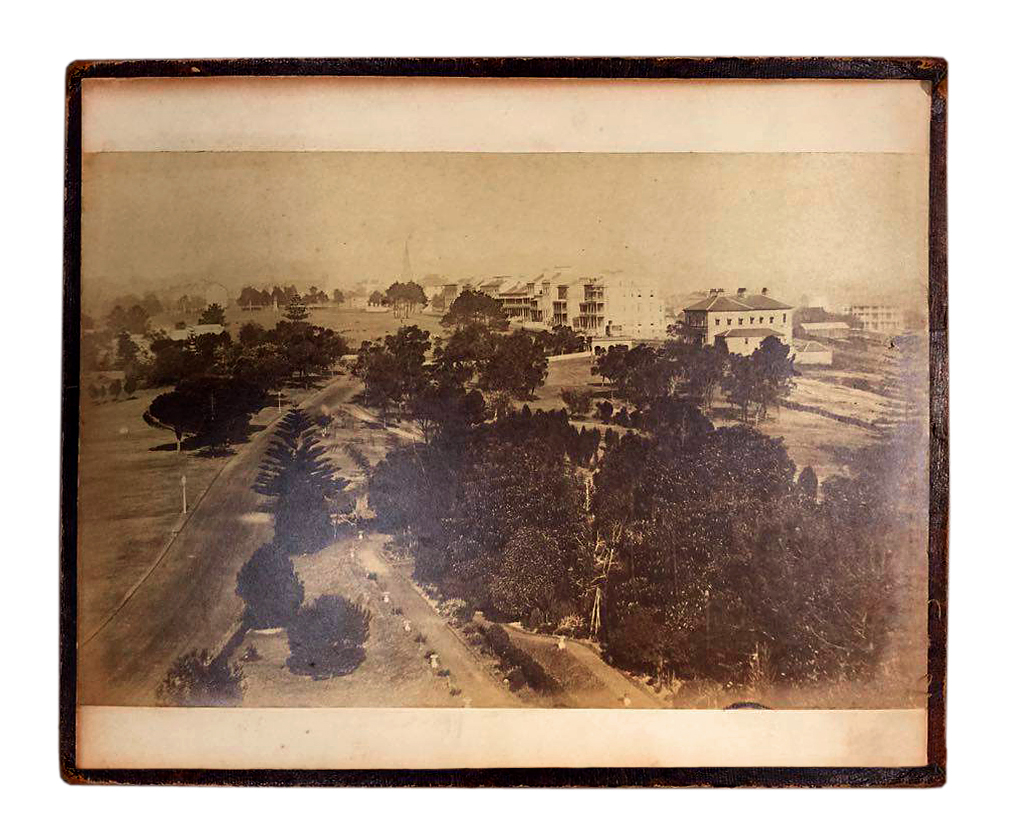
William Blackwood: ‘Panorama of Sydney & Harbour from Government House’ 1858

July 2016


William Blackwood (1824-1897) 'Panorama of Sydney & Harbour from Government House' 1858 front cover


Blackwood’s Panorama of Sydney & Harbour from Government House 1858 front cover


We can only imagine the impact viewing this immense panorama (over 3m long) of eleven imperial size, wet plate photographs had on the populace of Sydney. They would have seen little like it before, and of such clarity and quality.

I have included text, additional photographs and paintings to help the viewer and researcher position the panorama historically within the context of time and place.

For example, note how illustriously and romantically the artist captures every detail in a painting such as Conrad Martens Campbell’s Wharf (1857, below), then notice how rough and ready the sections of this photographic panorama are even as they pertain to the veracity of the occasion. The length of each exposure can be estimated by the movement of the large sailing ship in the centre of section 7 of the panorama – at a guess probably just under a minute.

While larger individual images of the panorama can be found on the State Library of New South Wales website, the whole panorama photograph on that site is very small and gives little idea of how the individual sections concertina out. Some of the images also seem denuded, drained of their colour, probably due to the poor condition of the images (notably sections 2, 8, 9 and 11) .

Hopefully these images – which can be reproduced without getting permission from institutions – more fully reflect the beauty and sensitivity of the panorama.

It was a great pleasure to meet collector Dennis Joachim, the owner of this panorama, up at Mossgreen in Armadale, Victoria recently. What a remarkable man and such great energy!

Dr Marcus Bunyan


Please click on the long small image below to see the full panorama. Click again to enlarge and scroll from left to right.


William Blackwood (Australian, 1824-1897) 'Panorama of Sydney & Harbour from Government House' 1858


William Blackwood (Australian, 1824-1897)
Panorama of Sydney & Harbour from Government House
1858
12 albumen photoprints (comprising 1 panorama in 11 sections – 1 photoprint) in a leather and gold embossed album
Images 19 x 29cm
Panorama length 324.5cm


Olaf William Blackwood, also known as William Blackwood, was a portrait painter of Swedish and Scottish descent. It was, however as a professional photographer of panoramic Sydney views that he achieved the greatest success. By 1858, he had established a photographic studio in Woolloomooloo and began photographing surrounding street scenes, using the collodion wet-plate process. He took eleven imperial size, wet plate photographs from the roof of Government House which he then combined to form a large scale Panorama of Sydney Harbour, the first and largest produced in the colony. His panoramic views were met with critical acclaim, and were praised by The Sydney Morning Herald as ‘faultless’, ‘super-excellent’ and the ‘largest yet seen’1

By August, his 180 degree panorama of Sydney Harbour was again praised as ‘superior to anything of the kind we have seen. Nothing dim or smoky appears … no muddled trees – no hazy outlines – no hard sheets of glaring white for water’2 This was the most sophisticated and extensive panorama photography ever produced in Australia. Blackwood published another album that same year consisting of some of the earliest Australian architectural studies, and photographs of Sydney’s nine banks. From a technical point of view, Blackwood’s albums were an extraordinary achievement.

Large format views required extreme skill on the part of the photographer, and he coated his plates and processed them while still wet. In the early 1860s Blackwood worked in partnership with Henry Goodes and they created eight photographic views which were submitted to the New South Wales section of the 1862 London International Exhibition. Between 1862 and 1864, Blackwood worked with James Walker at Walker’s Pitt Street studio. Despite his early, energetic and entrepreneurial projects, little is known of Blackwood’s output after 1859 and he seems to have left photography after 1864.

1/ Sydney Morning Herald, 26 March 1858
2/ Sydney Morning Herald, 4 August 1858

Text from the Mossgreen website [Online] Cited 01/07/2016. No longer available online
 

William Blackwood (Australian, 1824-1897) 'Panorama of Sydney & Harbour from Government House' 1858 section 1


Blackwood’s Panorama of Sydney & Harbour from Government House 1858 section 1

Entrance to Government House, Macquarie Street, city view including Customs House, Sydney Cove


William Blackwood (Australian, 1824-1897) 'Panorama of Sydney & Harbour from Government House' 1858 section 2


Blackwood’s Panorama of Sydney & Harbour from Government House 1858 section 2

Entrance to Government House, Macquarie Street, city view including Customs House, Sydney Cove.

(The Customs House is horizontally left of the tall ship’s mast with the row of double windows)


Charles Percy Pickering (Australian, 1825-1908) 'Customs House' 1872


Charles Percy Pickering (Australian, 1825-1908)
Customs House
1872
New South Wales. Government Printing Office
Collection of the State Library of New South Wales


Customs House

The Customs House is an historic Sydney landmark located in the city’s Circular Quay area. Constructed initially in 1844-1845, the building served as the headquarters of the Customs Service until 1990. The driving force behind the construction of the original sandstone edifice on Circular Quay was Colonel John George Nathaniel Gibbes, the Collector of Customs for New South Wales for a record term of 25 years from 1834 to 1859. Colonel Gibbes persuaded the Governor of New South Wales, Sir George Gipps, to begin construction of the Customs House in 1844 in response to Sydney’s growing volume of maritime trade. The building project also doubled as an unemployment relief measure for stonemasons and labourers during an economic depression which was afflicting the colony at the time.

The two-storey Georgian structure was designed by Mortimer Lewis and featured 13 large and expensive windows in the facade to afford a clear view of shipping activity in Sydney Cove. Colonel Gibbes, who dwelt opposite Circular Quay on Kirribilli Point, was able to watch progress on the Customs House’s construction from the verandah of his private residence, Wotonga House (now Admiralty House). The Customs House opened for business in 1845 and replaced cramped premises at The Rocks. It was partially dismantled and expanded to three levels under the supervision of the then Colonial Architect, James Barnet, in 1887. Various additions were made over the next century, particularly during the period of the First World War, but some significant vestiges of the original Gibbes-Lewis building remain.

Text from the Wikipedia website


Charles Percy Pickering (Australian, 1825-1908) 'Panorama of Sydney & Harbour from Government House' 1858 section 3


Blackwood’s Panorama of Sydney & Harbour from Government House 1858 section 3

City view, Sydney Cove, The Rocks, Campbell’s Wharf and Dawes Point


Conrad Martens (England 1801 - Australia 1878; Australia from 1835) 'Campbell's Wharf' 1857


Conrad Martens (England 1801 – Australia 1878; Australia from 1835)
Campbell’s Wharf
1857
Watercolour with highlights in gum arabic
Image: 46 x 66cm
National Gallery of Australia


Campbell’s Wharf

From his arrival in 1835 until his death in 1878, Conrad Martens was the most celebrated artist in Sydney. Although a skilled painter in oils, his greatest works were executed in watercolour, and Campbell’s Wharf is among his most ambitious compositions. Commissioned by John Campbell in 1857, the work portrays the income source of the Campbell family, whose eighteenth and nineteenth century business interests encompassed wharfing, storing and merchant shipping.

On the right is Campbell’s Wharf and warehouses that stretched along the west side of Sydney Cove. To their left are the old Campbell residence and the new Mariners Church. In the centre of the painting rises the four-storied Miles Building, and to its left juts the Cumberland Place buildings along the skyline. All this is viewed through a jumble of trading vessels, the source of the Campbell family wealth. The painting is, however, more than a depiction of maritime industry and family property. Martens was well acquainted with the work of the British painter JMW Turner, whose romantic landscapes are suffused with delicate evocations of light. Silhouetted against a soft pink sky, Martens transforms an industrial setting into a picturesque landscape awash with luminous colour.

Text © National Gallery of Australia, Canberra 2014


William Blackwood (Australian, 1824-1897) 'Panorama of Sydney & Harbour from Government House' 1858 section 4


Blackwood’s Panorama of Sydney & Harbour from Government House 1858 section 4

City view, Sydney Cove, The Rocks, Campbell’s Wharf & Dawes Point


Dawes Point, New South Wales

By the 1840s the people of Dawes Point and Millers Point were a maritime community in which rich and poor mixed more than elsewhere in Sydney. Wharf owners and traders lived and worked beside those who worked on the wharves and bond stores, as well as those who arrived and left on ships. Only two of the merchant houses, built by and for the early wharf owners, survive. One is Walker’s 50-foot wide villa built around 1825 and now part of Milton Terrace at 7-9 Lower Fort Street; the other is the home and offices of Edwards and Hunter, built in 1833 above their wharves which is where the Wharf Theatre now stands.

The fortunes of Dawes Point and Millers Point fluctuated more than elsewhere in Sydney. Mostly prosperous in its early years, the area was less desirable by the 1890s, and in 1900 there was a catastrophic event that led to a complete reshaping of Millers Point. At the beginning of the 20th century the government compulsorily acquired all private wharves, homes and commercial properties in the Rocks, Dawes Point and Millers Point. Modern and efficient wharves with dual level access were built, as well as new accommodation for workers, such as the Workers Flats of Lower Fort Street designed by Government Architect Vernon.

Most people still believe this redevelopment can be attributed entirely to an outbreak of plague in 1900, with the government acting benevolently as it demolished homes as well as wharves, and not for the last time decimated a community, while presenting their actions as ‘slum clearance’. In the 1960s and ’70s the government tried again to clear the area and build high-rise offices, but this was thwarted by the Green Bans, supported community and unions. In 2016, the NSW Government is again ‘relocating’ the long-term community of Dawes Point, Millers Point and The Rocks, and only a handful of these residents remain, while the majority of houses and flats along Lower Fort Street and Trinity Avenue are vacant.

Text from the Wikipedia website


William Blackwood (Australian, 1824-1897) 'Panorama of Sydney & Harbour from Government House' 1858 section 5


Blackwood’s Panorama of Sydney & Harbour from Government House 1858 section 5

Sydney Harbour, Fort Macquarie, views to the North Shore


North Shore

Before British settlement, the Lower North Shore was home to the Gorualgal (Mosman and southern Willoughby) and Cammeraygal (North Sydney and Eastern Lane Cove). After the establishment of Sydney in 1788, settlement of the North Shore of the harbour was quite limited. One of the first settlers was James Milson who lived in the vicinity of Jeffrey Street in Kirribilli, directly opposite Sydney Cove. The north shore was more rugged than the southern shore and western areas of the harbour and had limited agricultural potential. The early activities in the area included tree felling, boatbuilding and some orchard farming in the limited areas of good soil. The North Shore railway line was built in the 1890s. Access to the Sydney CBD, located on the southern shore of the harbour remained difficult until the completion of the Sydney Harbour Bridge in 1932. This led to commencement the development of suburbs on the North Shore.

Text from the Wikipedia website


William Blackwood (Australian, 1824-1897) 'Panorama of Sydney & Harbour from Government House' 1858 section 6


Blackwood’s Panorama of Sydney & Harbour from Government House 1858 section 6

Sydney Harbour, Fort Macquarie (Bennelong Point/Opera House), views to the North Shore


Fort Macquarie (Bennelong Point/Opera House)

Fort Macquarie was a square castellated battlement fort built at Bennelong Point, Sydney, New South Wales, Australia, where the Sydney Opera House now stands. A half moon battery on the east point of Bennelong Point was constructed in May 1798 when the ship HMS Supply was withdrawn from service, Lieutenant William Kent and crew were assigned to man the battery. The battery consisted of some of the guns taken from HMS Supply.

Governor Lachlan Macquarie directed that a fort be built between December 1817 to February 1821 under the direction of Francis Greenway. The fort was named after Governor Lachlan Macquarie. It was a square fort with circular bastions at each corner and a castellated square tower. The battery consisted of fifteen pieces of ordnance: ten 24-pounders and five 6-pounders. Three sides of the fort abutted Sydney Harbour. The two-storey tower in the middle of the fort, housed a guardroom and storehouse. The tower was 27.4 m (90 ft) in circumference. A powder magazine capable of storing 350 barrels of gunpowder was constructed underneath and the tower could provide accommodation for a small military detachment of 1 officer and 18 men, with stores for the battery. A drawbridge, on the landward side, over a small channel leading to a gate beneath the tower provided entry to the fort.

Fort Macquarie was demolished in 1901 to make way for new electric tramway sheds named Fort Macquarie Tram Depot.

Text from the Wikipedia website


Bennelong Point

The point was originally a small tidal island, Bennelong Island, that largely consisted of rocks with a small beach on the western side. The island was located on the tip of the eastern arm of Sydney Cove and was apparently separated from the mainland at high tide. For a brief period in 1788, this relatively isolated protrusion into Port Jackson (Sydney’s natural harbour) was called Cattle Point as it was used to confine the few cattle and horses that had been brought from Cape Town by Governor Phillip with the First Fleet.

The area at that time was also strewn with discarded oyster shells from many long years of gathering by the local aboriginal women. Those shells were regathered by the newly arrived convict women and burnt to make lime for cement mortar. The point was called Limeburners’ Point for that reason, though those shells only furnished enough lime to make a single building, the two-storey government house. In the early 1790s, the Aborigine Bennelong – employed as a cultural interlocutor by the British – persuaded New South Wales Governor Arthur Phillip to build a brick hut for him on the point, giving it its name.

In the period from 1818 to 1821, the tidal area between Bennelong Island and the mainland was filled with rocks excavated from the Bennelong Point peninsula. The entire area was levelled to create a low platform and to provide suitable stone for the construction of Fort Macquarie. While the fort was being built, a large portion of the rocky escarpment at Bennelong Point was also cut away to allow a road to be built around the point from Sydney Cove to Farm Cove. This was known as Tarpeian Way. The existence of the original tidal island and its rubble fill were largely forgotten until the late 1950s when both were rediscovered during the excavations related to the construction of the Sydney Opera House. Prior to the Opera House’s construction, Bennelong Point had housed Fort Macquarie Tram Depot.

Text from the Wikipedia website


Kerry & Co. 'Fort Macquarie' 1870


Kerry & Co.
Fort Macquarie
1870
Albumen photograph
From the collections of the Mitchell Library, State Library of New South Wales


Fort Macquarie was built on the end of Bennelong Point, where the Sydney Opera House now stands. Completed by convict labour in 1821 using stone from the Domain, the fort had 15 guns and housed a small garrison. The powder magazine beneath the tower was capable of storing 350 barrels of gunpowder. The fort was demolished in 1901 to make way for the tramway sheds that occupied the site until the construction of the Utzon masterpiece


Kerry & Co. 'Fort Macquarie' 1870


Kerry & Co.
Fort Macquarie
1870
Albumen photograph
From the collections of the Mitchell Library, State Library of New South Wales


Anonymous photographer. 'The tram shed at Bennelong Point before the Sydney Opera House was built' 1952


Anonymous photographer
The tram shed at Bennelong Point before the Sydney Opera House was built
1952

William Blackwood (Australian, 1824-1897) 'Panorama of Sydney & Harbour from Government House' 1858 section 7


Blackwood’s Panorama of Sydney & Harbour from Government House 1858 section 7

Sydney Harbour view, sailing ships, Fort Denison (to the far right in the distance), Garden Island, Lady Macquarie’s Chair


Anonymous photographer. 'SS Nieuw Holland passing Fort Denison, Sydney Harbour' c. 1930


Anonymous photographer
SS Nieuw Holland passing Fort Denison, Sydney Harbour
c. 1930
Australian National Maritime Museum collection


Fort Denison was built on an island that was known to Indigenous people in the area as Muddawahnyuh, meaning ‘rocky island’. After European settlement in 1788 the island was called Pinchgut by convicts who were marooned there with meagre rations of bread and water as punishment for serious breaches of the peace. The island was originally a 15 metre sandstone rock, but during the 1800s it was excavated to provide sandstone to build Circular Quay, at that time the centre of shipping in Sydney.
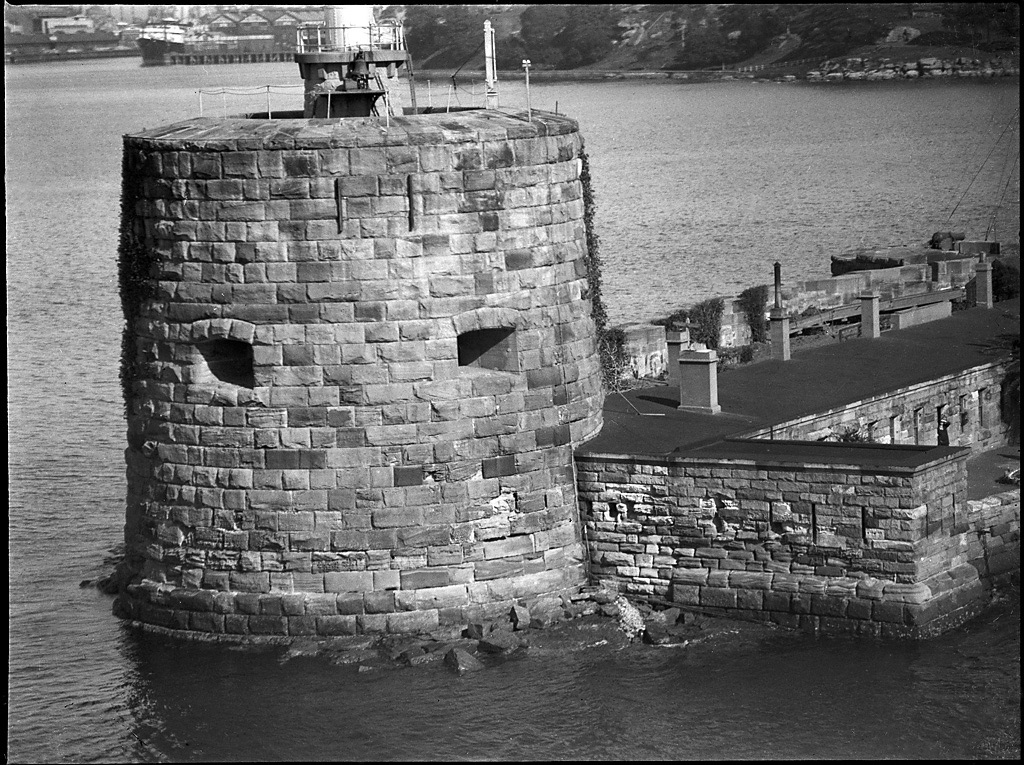
 

Anonymous photographer. 'Fort Denison' c. 1930


Anonymous photographer
Fort Denison
c. 1930
Glass negative, quarter plate
Tom Lennon Photographic Collection from the Powerhouse Museum


Fort Denison

In 1839, two American warships entered the harbour at night and circled Pinchgut Island. Concern with the threat of foreign attack caused the government to review the harbour’s inner defences. Barney, who had earlier reported that Sydney’s defences were inadequate, recommended that the government establish a fort on Pinchgut Island to help protect Sydney Harbour from attack by foreign vessels. Fortification of the island began in 1841 but was not completed. Construction resumed in 1855 because of fear of a Russian naval attack during the Crimean War, and was completed on 14 November 1857. The newly built fort then took its current name from Sir William Thomas Denison, the Governor of New South Wales from 1855 to 1861.

The fortress features a distinctive Martello tower, the only one ever built in Australia and the last one ever constructed in the British Empire. It was constructed using 8,000 tonnes (7,900 long tons) of sandstone from nearby Kurraba Point, Neutral Bay. The tower’s walls are between 3.3-6.7 metres (11-22 ft) thick at the base and 2.7 metres (8 ft 10 in) thick at the top. However, developments in artillery rendered the fort largely obsolete by the time it was completed. The tower itself had quarters for a garrison of 24 soldiers and one officer. Fort Denison’s armament included three 8-inch (200 mm) muzzle loaders in the tower, two 10-inch (250 mm) guns, one on a 360-degree traverse on the top of the tower and one in a bastion at the other end of the island, and twelve 32-pound (15 kg) cannons in a battery between the base of the tower and the flanking bastion. Eventually all the guns were removed, except for the three 8-inch (200 mm) muzzle-loading cannons in the gun room in the tower, which were installed before construction was complete.

Text from the Wikipedia website


George Roberts (Australian born United Kingdom, c. 1800-1865) '[Mrs Macquarie's chair]' c. 1843-1865


George Roberts (Australian born United Kingdom, c. 1800-1865)
[Mrs Macquarie’s chair]
c. 1843-1865
Watercolour
Mitchell Library, State Library of New South Wales


American & Australasian Photographic Company. 'Mrs Macquarie's Chair, Sydney' c. 1870-1875


American & Australasian Photographic Company
Mrs Macquarie’s Chair, Sydney (B. O. Holtermann seated at centre)
c. 1870-1875
State Library of New South Wales


Bernhardt Otto Holtermann (Australian born Germany, 1838-1885)

Bernhardt Otto Holtermann (29 April 1838 – 29 April 1885) was a successful gold miner, businessman, sponsor of photography for the encouragement of immigration and member of parliament. Perhaps his greatest claim to fame is his association with the Holtermann Nugget, the largest gold specimen ever found, 1.5 meters (59 inches) long, weighing 286 kg (630 pounds), in Hill End, near Bathurst, and with an estimated gold content of 3000 troy ounces (93 kg).

Holtermann financed and possibly participated in photographer Beaufoy Merlin’s project to photograph New South Wales and exhibit the results abroad to encourage immigration. The work was taken up after Merlin’s death in 1873 by his assistant, Charles Bayliss. In 1875, Holtermann and Bayliss produced the Holtermann panorama, a series of “23 albumen silver photographs which join together to form a continuous 978-centimetre view of Sydney Harbour and its suburbs.” Some of the photographs, including the panorama, were displayed at the Philadelphia Centennial Exhibition, where they won a bronze medal. The panorama was also displayed at the 1878 Exposition Universelle Internationale in Paris. 

Almost seventy years after Holtermann’s death, more than 3,000 of the glass negatives created by Merlin and Bayliss were retrieved from a garden shed in the Sydney suburb of Chatswood. The UNESCO-listed collection of negatives, known as The Holtermann Collection, is housed in the State Library of New South Wales.

Text from the Wikipedia website


Mrs Macquarie’s Chair

Mrs Macquarie’s Chair (also known as Lady Macquarie’s Chair) is an exposed sandstone rock cut into the shape of a bench, on a peninsula in Sydney Harbour, hand carved by convicts from sandstone in 1810 for Governor Macquarie’s wife Elizabeth. The peninsula itself is named Mrs Macquarie’s Point, and is part of the The Domain, near the Royal Botanic Gardens. Mrs Macquarie was the wife of Major-General Lachlan Macquarie, Governor of New South Wales from 1810 to 1821. Folklore has it that she used to sit on the rock and watch for ships from Great Britain sailing into the harbour. She was known to visit the area and sit enjoying the panoramic views of the harbour.

Above the chair is a stone inscription referring to Mrs Macquarie’s Road. That road was built between 1813 and 1818, and ran from the original Government House (now the Museum of Sydney) to Mrs Macquarie’s Point. It was built on the instruction of Governor Macquarie for the benefit of his wife. There is no remaining evidence of the original road, other than a culvert over which the road ran.

Text from the Wikipedia website


William Blackwood (Australian, 1824-1897) 'Panorama of Sydney & Harbour from Government House' 1858 section 8


Blackwood’s Panorama of Sydney & Harbour from Government House 1858 section 8

Sydney Harbour view, sailing ships, Fort Denison, Garden Island, Lady Macquarie’s Chair
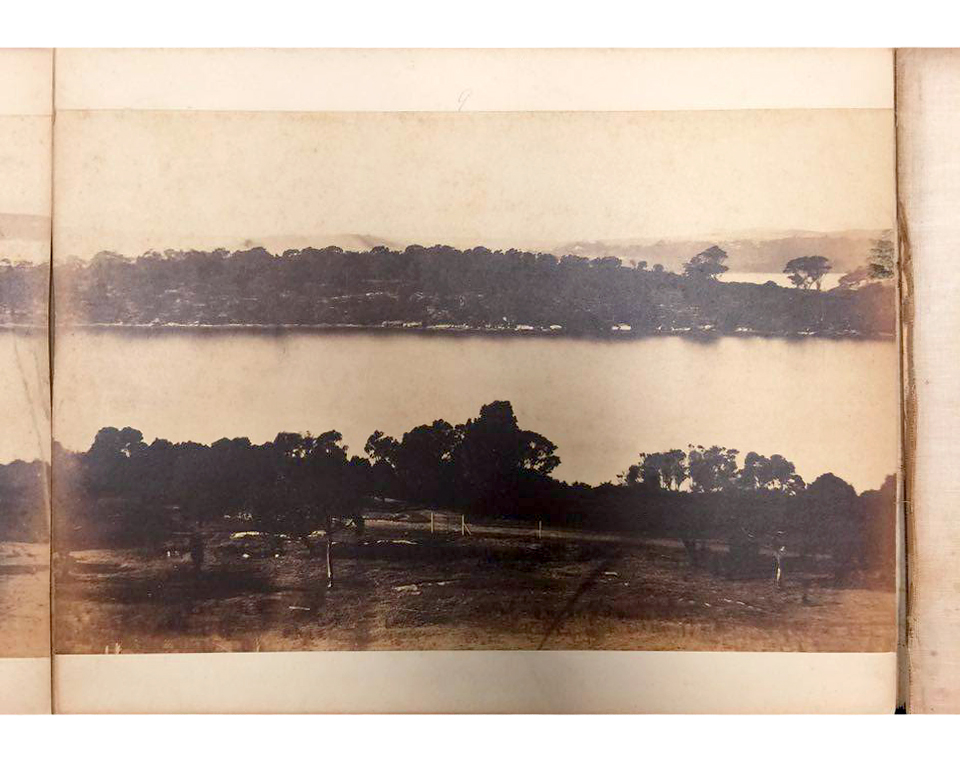
 

William Blackwood (Australian, 1824-1897) 'Panorama of Sydney & Harbour from Government House' 1858 section 9


Blackwood’s Panorama of Sydney & Harbour from Government House 1858 section 9

Farm Cove, views to Potts Point and Darlinghurst


William Blackwood (Australian, 1824-1897) 'Panorama of Sydney & Harbour from Government House' 1858 section 10


Blackwood’s Panorama of Sydney & Harbour from Government House 1858 section 10

Farm Cove, views to Potts Point and Darlinghurst


Potts Point

Potts Point is named for Joseph Hyde Potts, who was employed by the Bank of New South Wales. He purchased six-and-a-half acres of harbourside land in an area then known as Woolloomooloo Hill – which he renamed Potts Point. Much of the area that today comprises Potts Point and the adjacent suburb of Elizabeth Bay, originally constituted part of a land grant to Alexander Macleay, who was the New South Wales Colonial Secretary from 1826 to 1837, and for whom Macleay Street is named. NSW Judge Advocate, John Wylde (for whom Wylde Street is named) was another 19th-century public servant who owned land in the area.


William Blackwood (Australian, 1824-1897) 'Panorama of Sydney & Harbour from Government House' 1858 section 11


Blackwood’s Panorama of Sydney & Harbour from Government House 1858 section 11

The Government Domain, Government House Stables
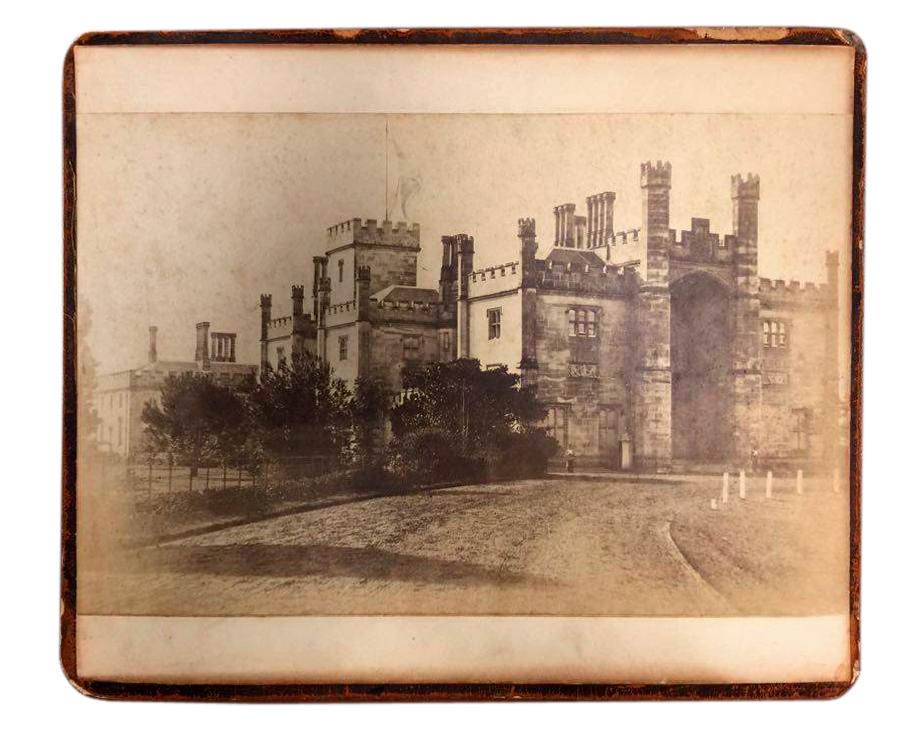
 

William Blackwood (Australian, 1824-1897) 'Panorama of Sydney & Harbour from Government House' 1858 Government House


Blackwood’s Panorama of Sydney & Harbour from Government House 1858

Government House with porte cochère


Government House

In 1845 the British government agreed that a new Government House in Sydney had become a necessity, and the royal architect, Edward Blore, was instructed to draw up plans. Construction commenced in 1837 and was supervised by colonial architect Mortimer Lewis and Colonel Barney of the Royal Engineers. Stone, cedar, and marble for the construction were obtained from various areas of New South Wales. A ball in honour of the birthday of Queen Victoria was held in the new building in 1843, although construction was not complete. The first resident, Governor George Gipps, did not move in until 1845.

Government House, with its setting on Sydney Harbour, has a garden area of 5 hectares and is located south of the Sydney Opera House, overlooking Farm Cove. It was designed in a romantic Gothic revival style – castellated, crenellated, turreted and is decorated with oil portraits and the coats of arms of its successive occupants. Additions have included a front portico in 1873, an eastern verandah in 1879 and extensions to the ballroom and governor’s study in 1900-01.

Text from Wikipedia website


Definition of porte cochère. 1: a passageway through a building or screen wall designed to let vehicles pass from the street to an interior courtyard. 2: a roofed structure extending from the entrance of a building over an adjacent driveway and sheltering those getting in or out of vehicles.


John Paine (Australian born England, 1833-1908) 'The entrance gates of Government House, Sydney' c. 1878


John Paine (Australian born England, 1833-1908)
The entrance gates of Government House, Sydney
c. 1878
Albumen print
15 x 20.4cm
Caroline Simpson Library & Research Collection


The Government House entrance gates and guardhouse, completed in 1848, are shown here in their original location on Macquarie Street. The elaborate iron gates were supported by six sandstone piers: in the centre was the ceremonial entrance, marked by metalwork lanterns complete with crowns, and this was flanked by two carriage gates and a pair of pedestrian gates. The design of the gates and guardhouse is attributed to the Colonial Architect Mortimer Lewis, the gatehouse being identical to the ‘Forest Gate Keeper’s Lodge’ illustrated in H B Zeigler’s ‘The Royal Lodges in Windsor Great Park’ (1839) The Gothic Revival guardhouse consisted of four rooms to accommodate the guard, with open verandahs on two sides, and it was to also serve the Treasury, completed on the opposite side of Macquarie Street c. 1850 (also designed by Lewis). The entrance gates and guardhouse, as a Gothic style entrance lodge, were consistent with Picturesque ideals for the entrance to a large estate and formed an appropriately imposing entrance to the vice regal residence.


William Blackwood (Australian, 1824-1897) 'Panorama of Sydney & Harbour from Government House' 1858 back cover


Blackwood’s Panorama of Sydney & Harbour from Government House 1858 back cover


LIKE ART BLART ON FACEBOOK

Back to top

Exhibition: ‘Crowd Source’ at the State Library of New South Wales, Sydney

Exhibition dates: 4th April – 23rd August 2015


Arthur K. Syer (Australian, d. 1935) 'Argyle Cut, The Rocks' c. 1880s - 1900


Arthur K. Syer (Australian, d. 1935)
Argyle Cut, The Rocks
c. 1880s-1900
Albumen print
From an album of Sydney street life, harbour and beach scenes, domestic animals
81 photographs in album: 15.2 x 20.4cm or smaller
Mitchell Library, State Library of New South Wales


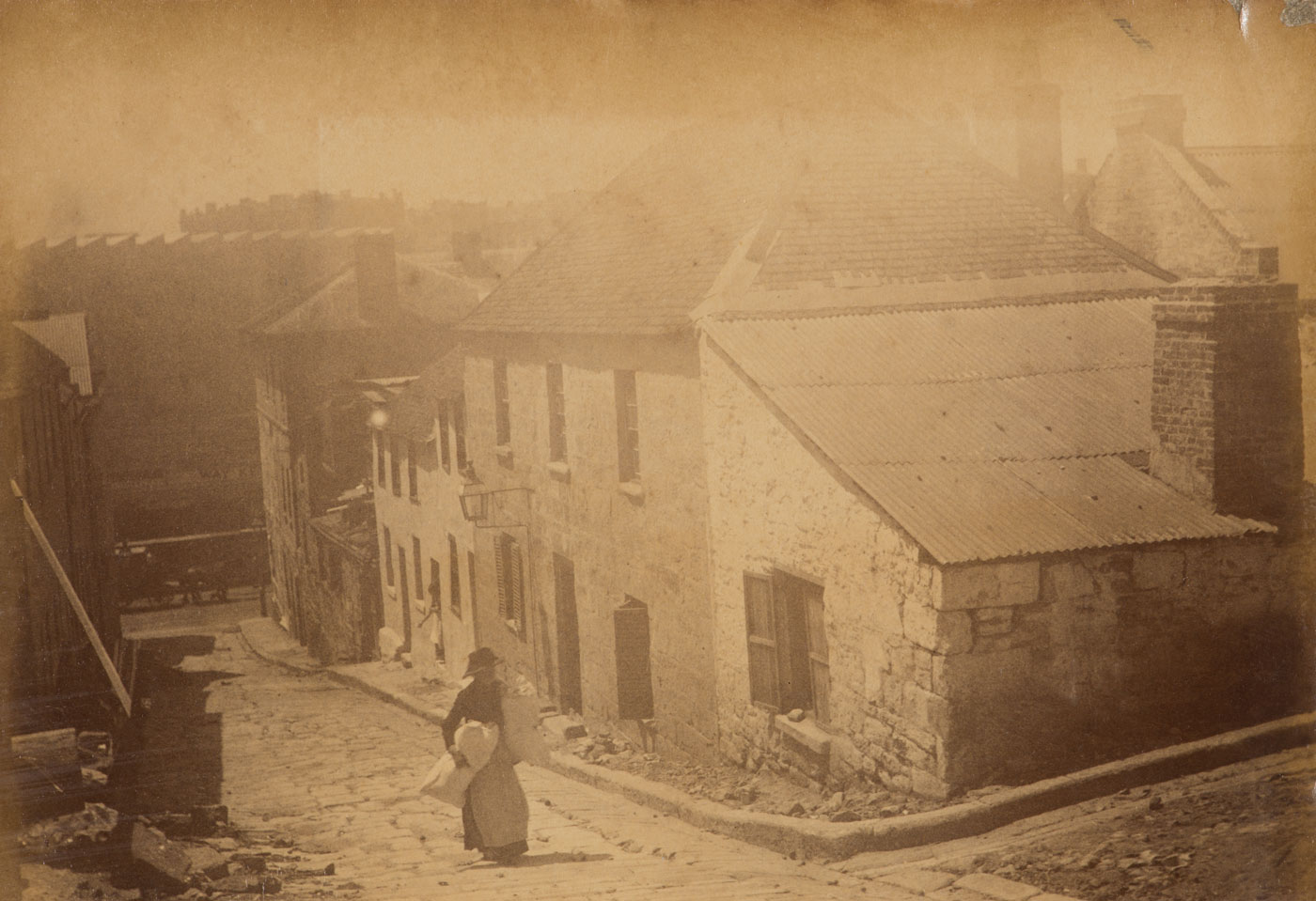
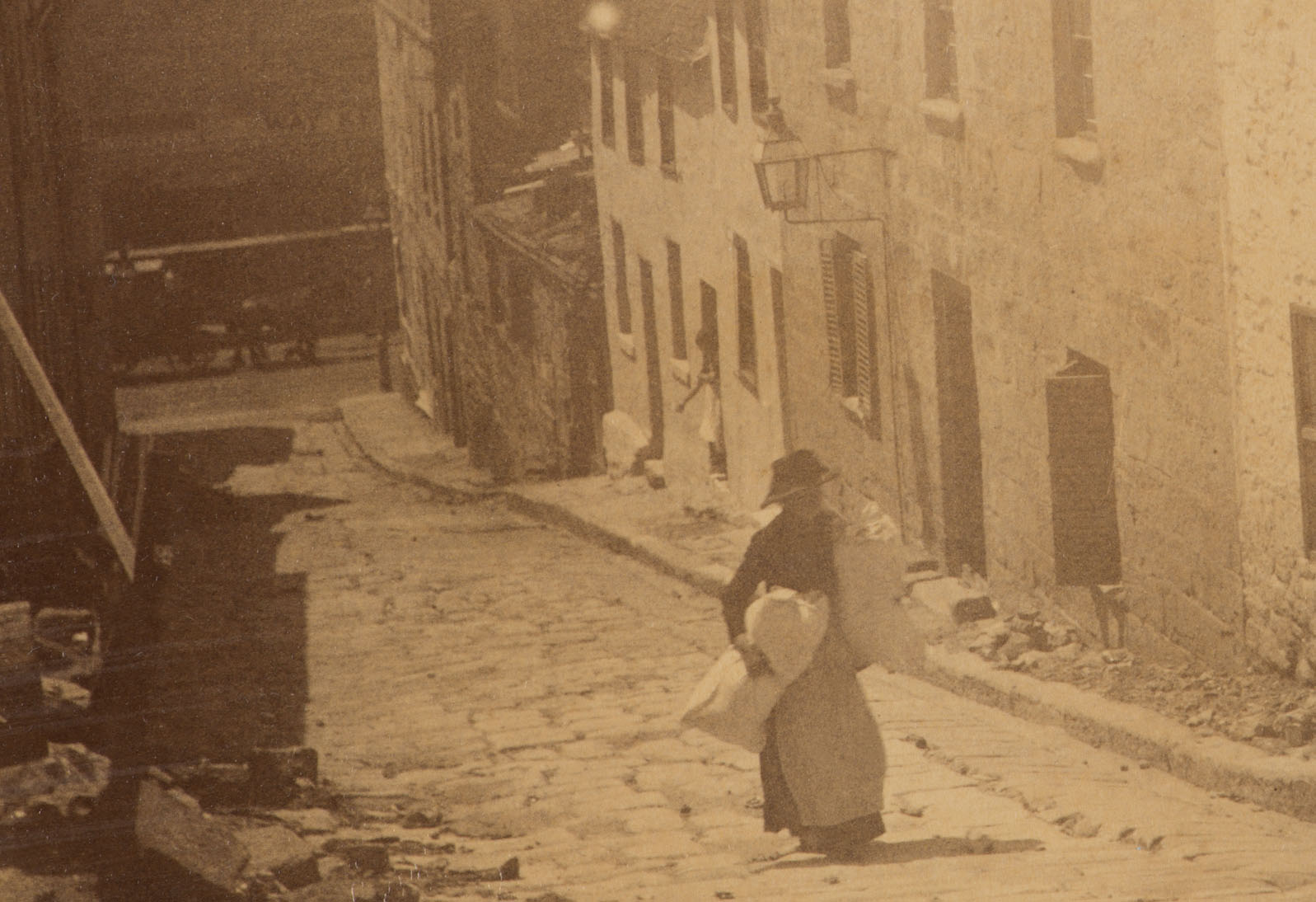
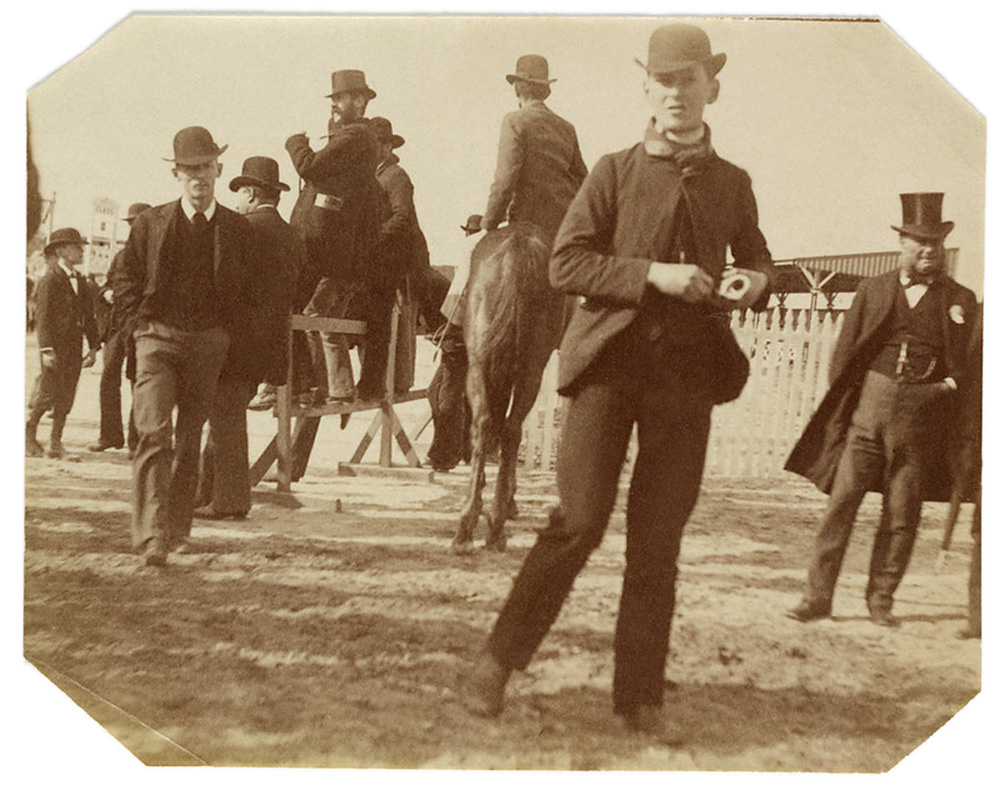
There is an almost Dickensian mellow dramatic feel to some of these 1880s-1900 albumen photographs by Sydney photographer Arthur K. Syer.

While the photographs offer a unique point of view (low down by the waist) of Victorian era Sydney, you get the feeling that Syer was more interested in the fact that his camera was hidden, and the game he was playing to get these photographs, than in the visual construction of the images themselves.

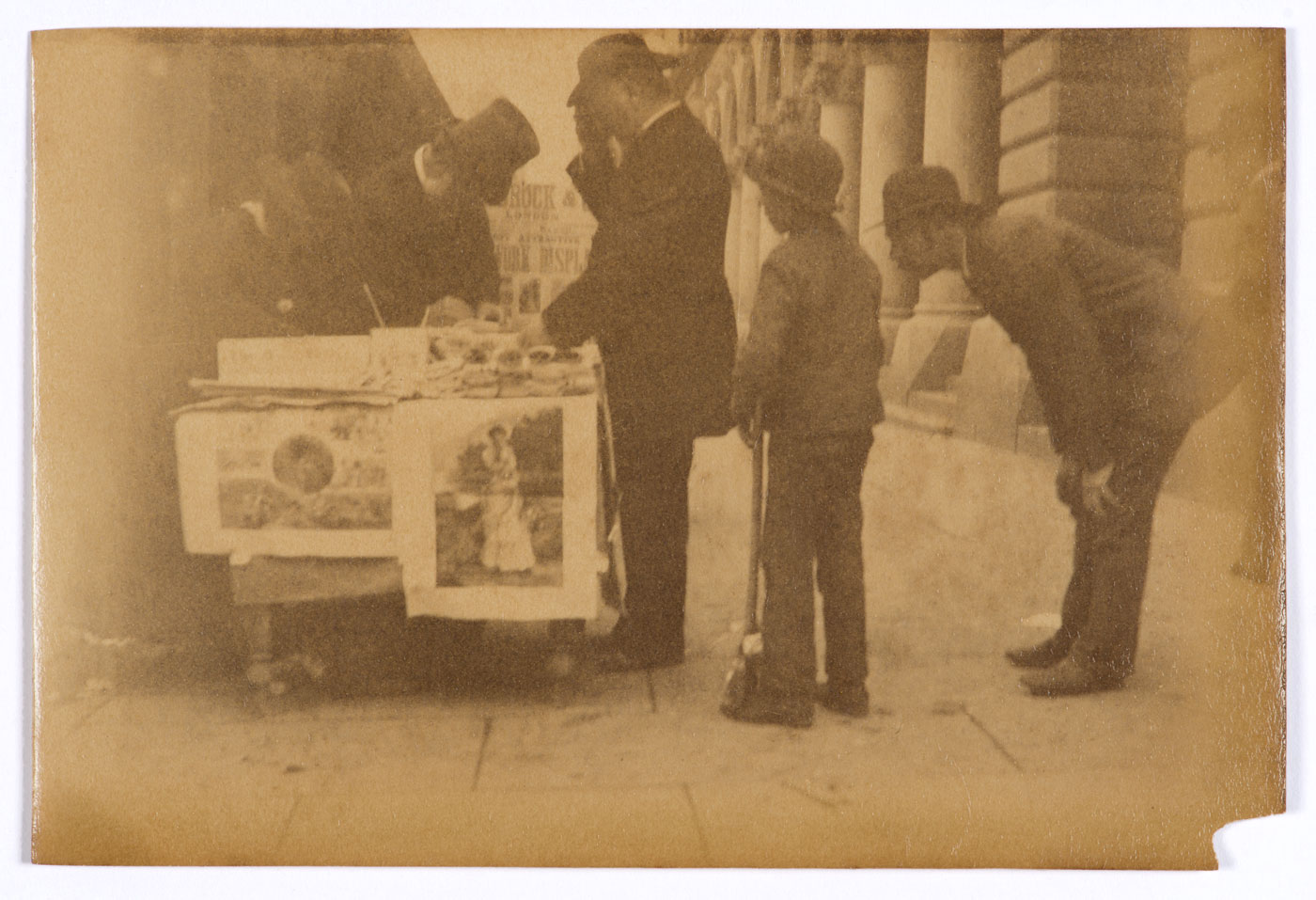
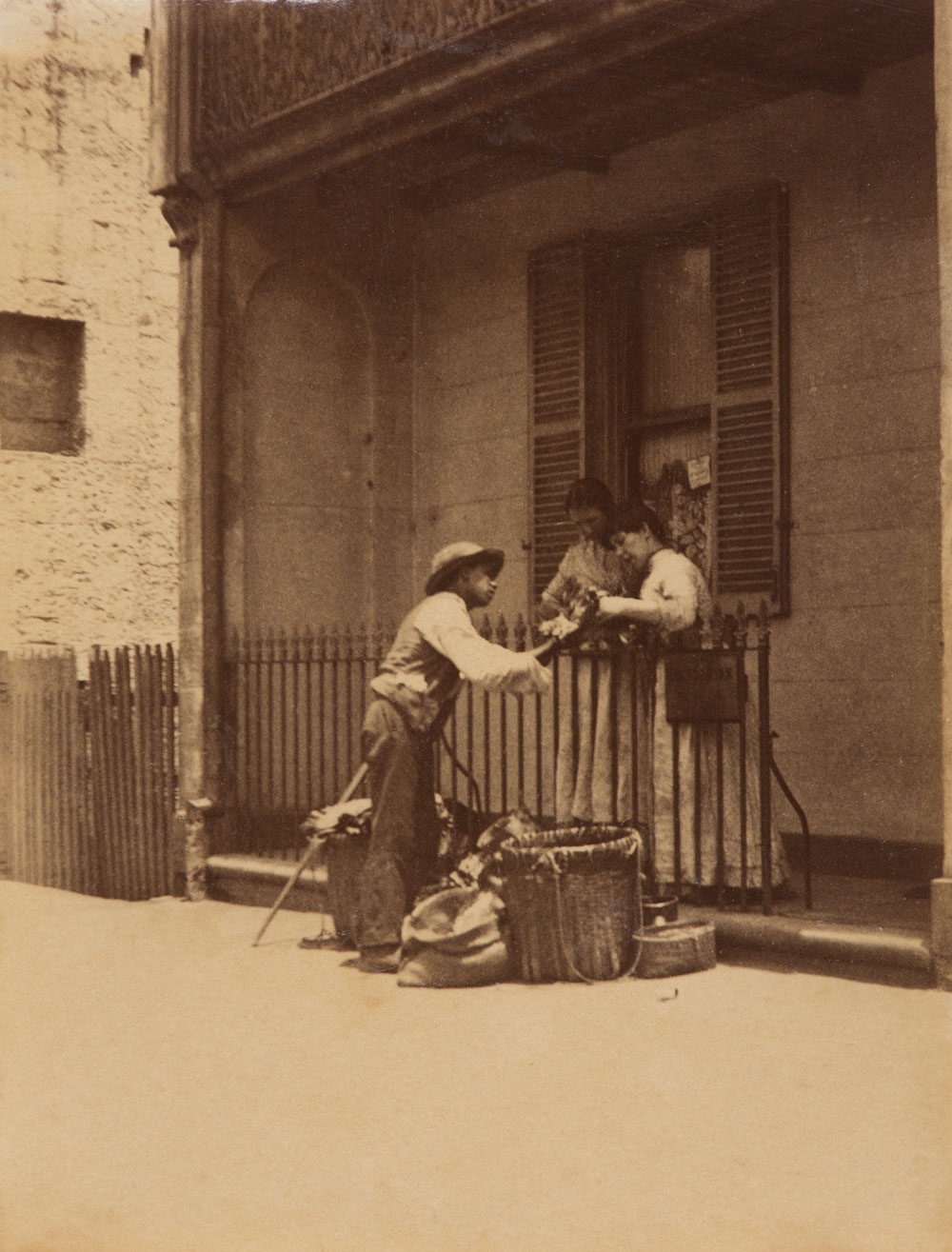
The best of them are photographs – such as Hawker haggling with customers, with its links to the photography of Atget, and crowd scenes like Men in street, where the different poses of the men and the rising and falling of the six items of headgear – which offer a rhythmic consideration and interest that other photographs in the posting lack.

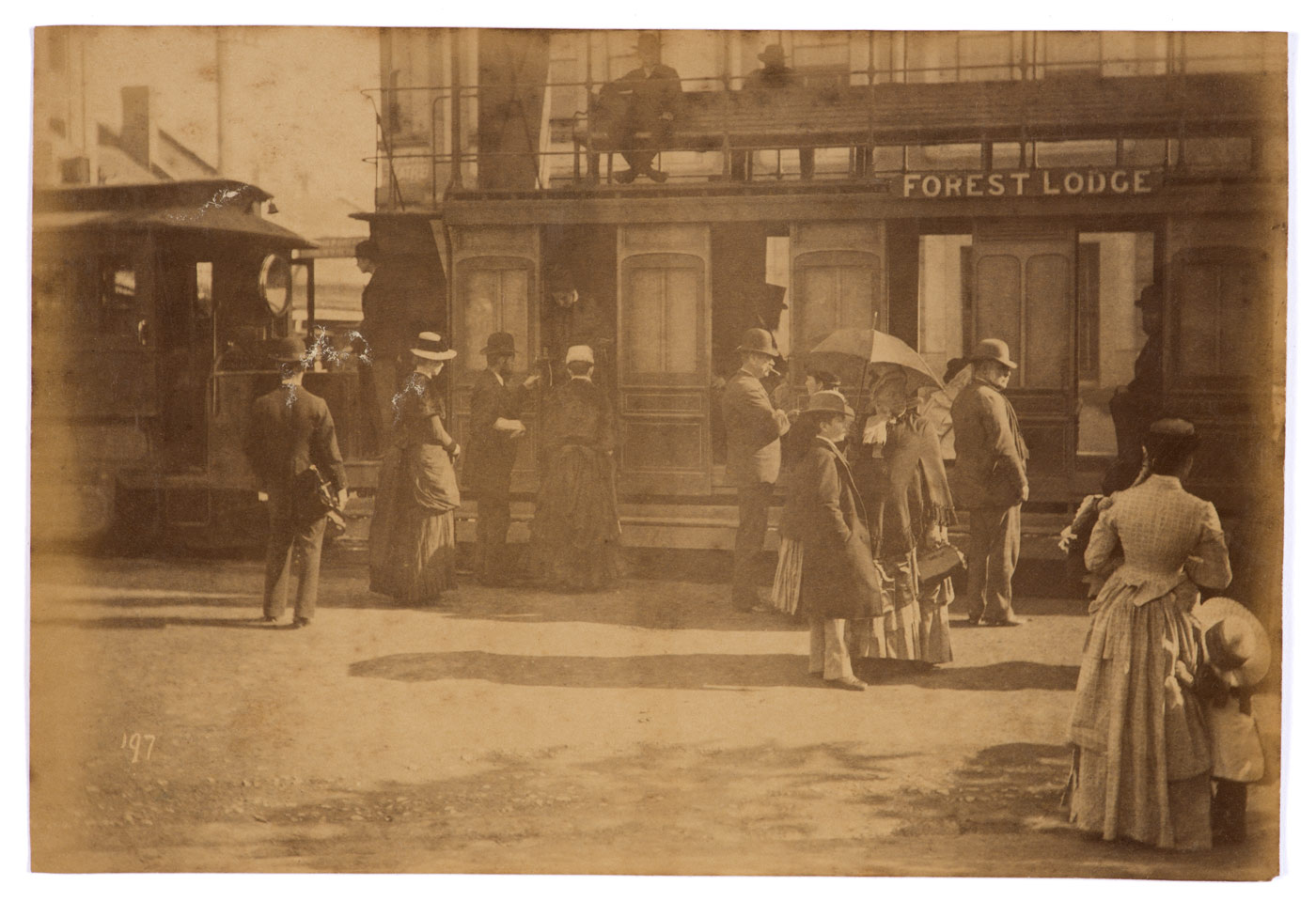
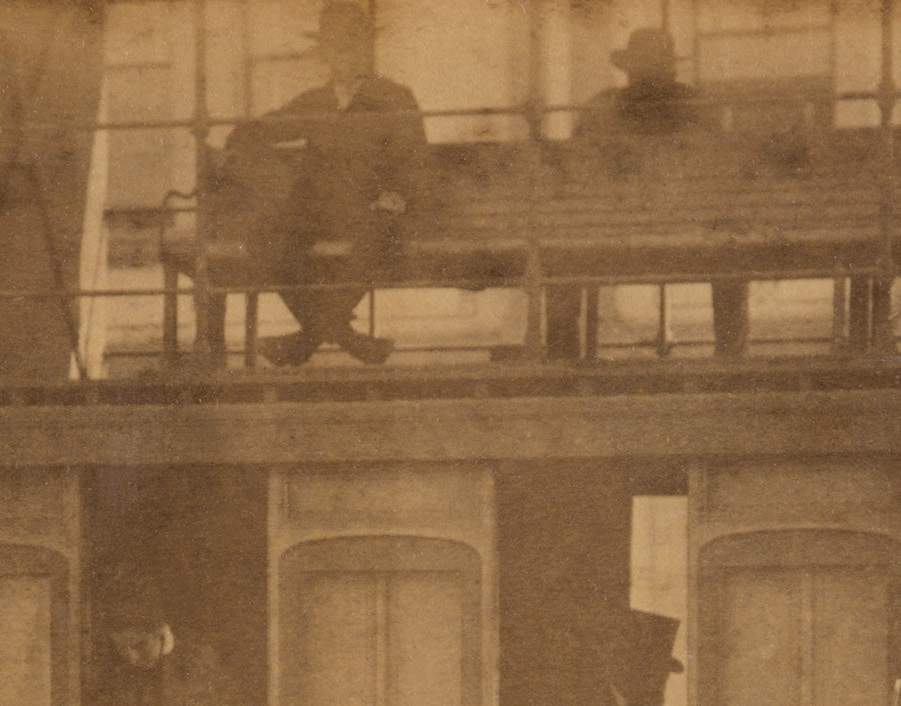
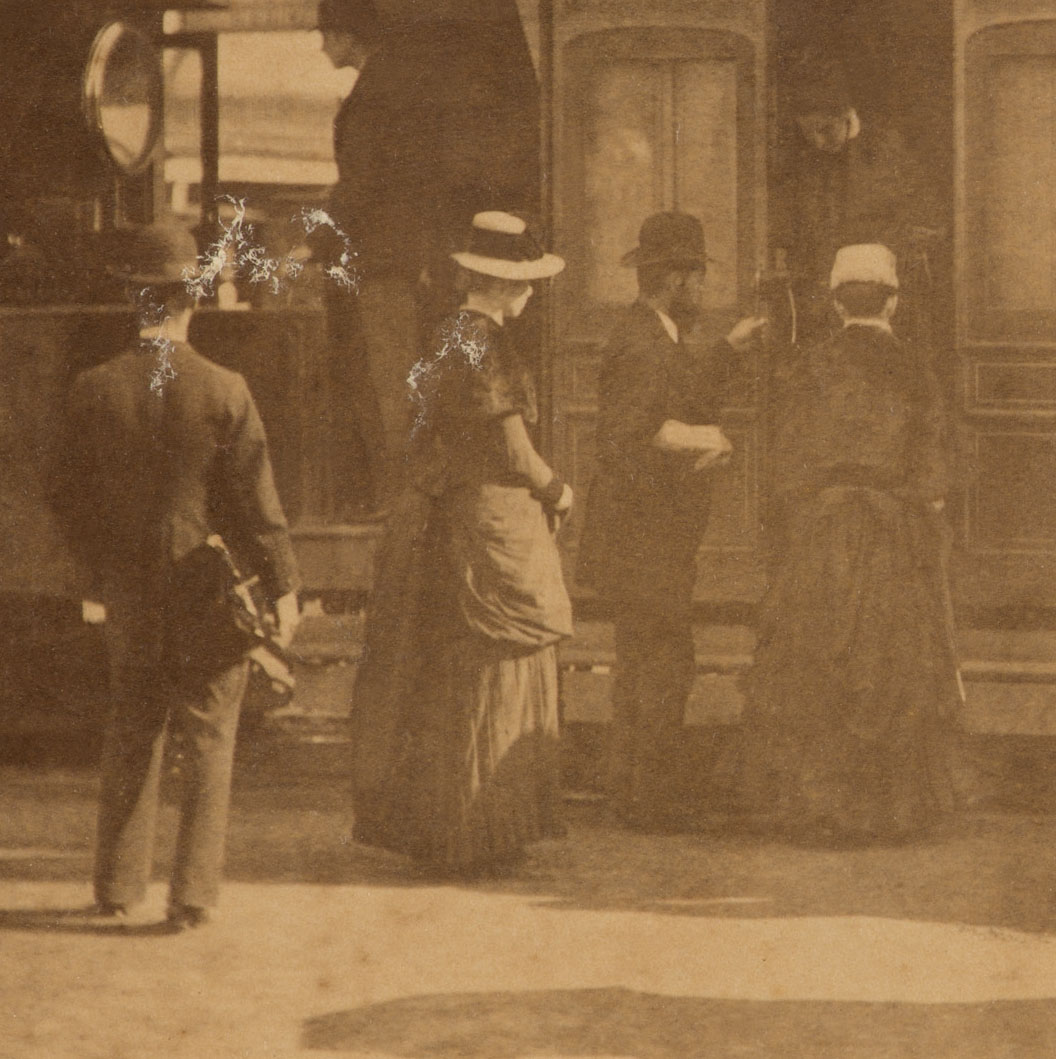
The gem in this group of images is the outstanding Forest Lodge double decker steam tram stopped on Elizabeth Street near Supreme Court N.S.W. Again, it is the attitude and rhythm of the protagonists within the image frame that makes this diorama so engaging. The man at left looks away from us with his back to the camera, while above him a man stands in the tram perpendicular to him, giving a nice play to the space between the tram carriages. Three people in alternating dark and light hats wait patiently for a old biddie to descend from the open door of the tram, the man holding on to the hand rail of the tram ready to pull himself up, just as everyone still does on old trams in Melbourne to this day. Above on the top deck sits a young man staring straight at the camera (without knowing it is there), with his legs crossed in a most unusual and uncomfortable way.

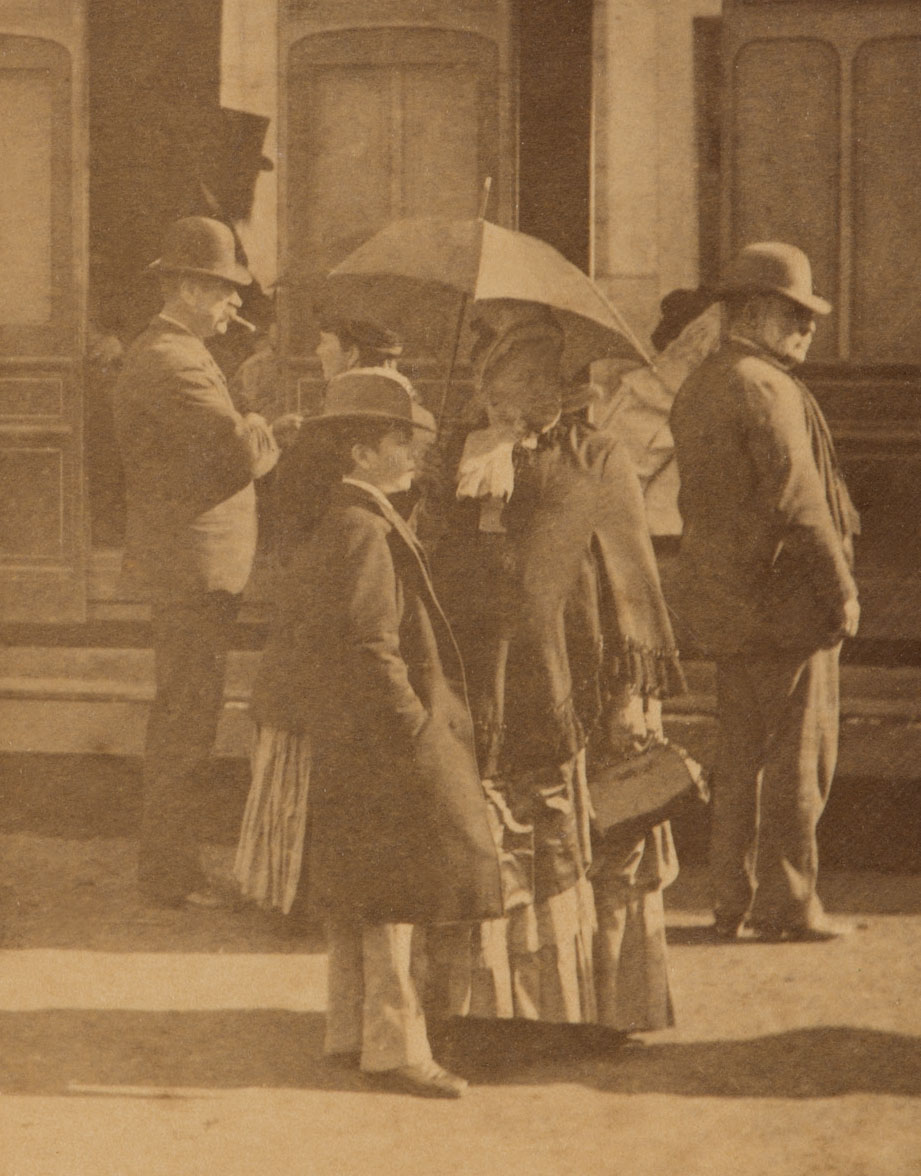
Below him to the right a gent in a bowler hat talks with his wife, cigar stuck in his mouth. His facial outline, lit by the sun, is echoed in the darkness of the interior of the tram by another man with a beard and hat sitting in shadow. In front of this husband and wife is a son with his mother / grandmother – she, clutching her bag in heavy tassel-fringed cloak, protecting herself with umbrella against the sun – he, in long gents morning coat and hat looking very dapper. It must be mid afternoon by the length of the shadows cast by the sun. To the right of this pair is an older, heavy set man with great beard and hat, looking out of the image to the right. His gaze is cut across by a man sitting in the tram, all darkness and outline, beard and hat, looking out onto the scene from the interior. Finally, to ground the foreground of the image, there is a mother and daughter at bottom right of the image, with the small child clutching at the mother’s dress.

The characters in this Dickens play rise and fall from left to right. They wash over you in their happenstance, frozen interaction. It is a superbly constructed image. Interesting as they are in their own vernacular way, it just makes the other images in this posting seem rather, well, prosaic.

Dr Marcus Bunyan


Many thankx to the State Library of New South Wales for allowing me to publish the photographs in the posting. Please click on the photographs for a larger version of the image.


Arthur K. Syer (Australian, d. 1935) 'George Street, The Rocks' c. 1880s - 1900


Arthur K. Syer (Australian, d. 1935)
George Street, The Rocks
c. 1880s-1900
Albumen print
From an album of Sydney street life, harbour and beach scenes, domestic animals
81 photographs in album: 15.2 x 20.4cm or smaller

Mitchell Library, State Library of New South Wales


Thank you to Philip Cohen for pointing out this is Little Essex Street, looking East towards George Street; this street is no more as the underground railway now comes out at this point.


Arthur K. Syer (Australian, d. 1935) 'George Street, The Rocks' c. 1880s - 1900 (detail)


Arthur K. Syer (Australian, d. 1935)
George Street, The Rocks (detail)
c. 1880s-1900
Albumen print
From an album of Sydney street life, harbour and beach scenes, domestic animals
81 photographs in album: 15.2 x 20.4cm or smaller
Mitchell Library, State Library of New South Wales


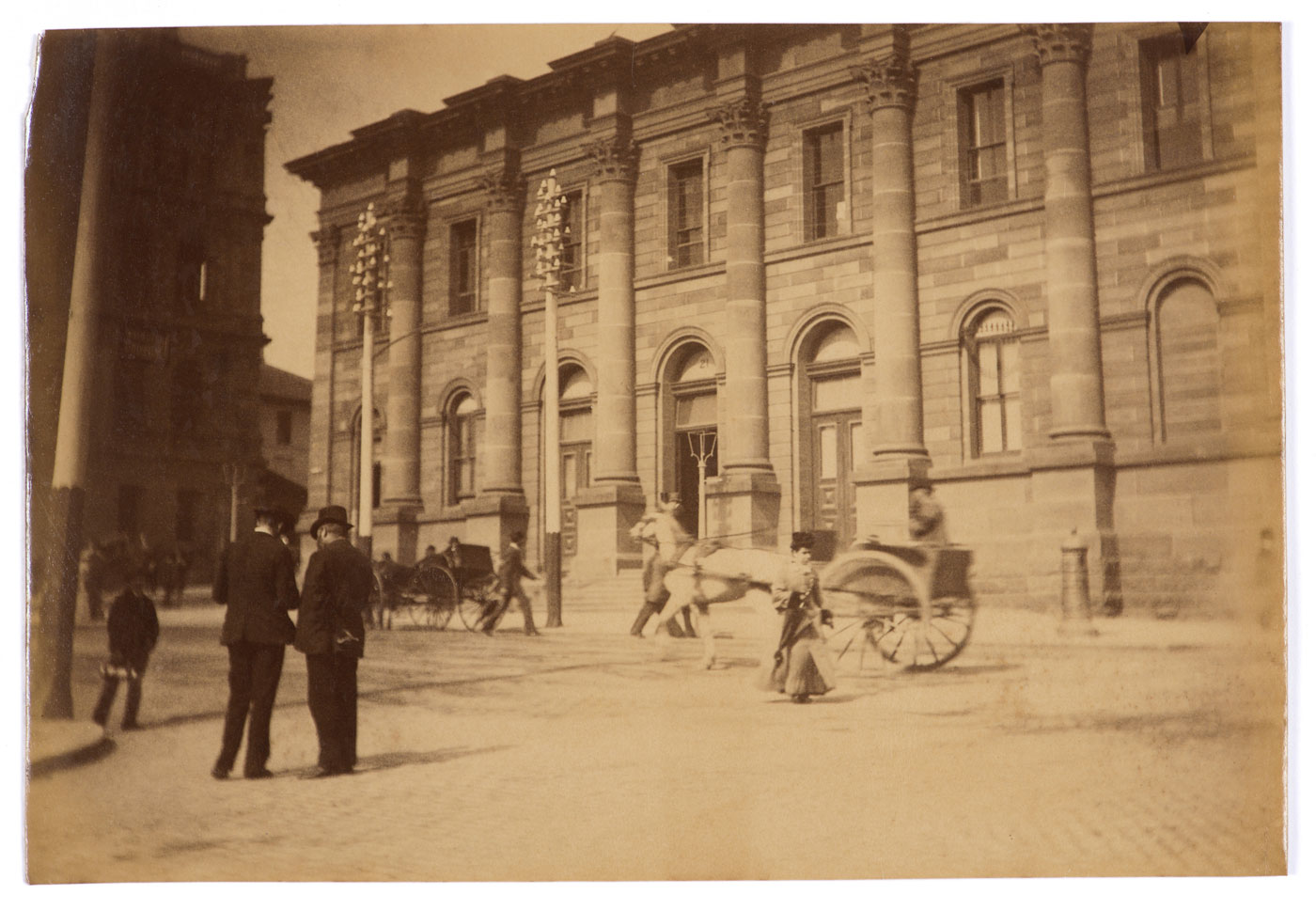
Arthur K. Syer (Australian, d. 1935) 'Martin Place near the GPO Colonnade' c. 1880s - 1900


Arthur K. Syer (Australian, d. 1935)
Martin Place near the GPO Colonnade
c. 1880s-1900
Albumen print
From an album of Sydney street life, harbour and beach scenes, domestic animals
81 photographs in album: 15.2 x 20.4cm or smaller
Mitchell Library, State Library of New South Wales


Arthur K. Syer (Australian, d. 1935) 'Devonshire and Chalmers Streets near Central Station' c. 1880s - 1900


Arthur K. Syer (Australian, d. 1935)
Devonshire and Chalmers Streets near Central Station
c. 1880s-1900
Albumen print
From an album of Sydney street life, harbour and beach scenes, domestic animals
81 photographs in album: 15.2 x 20.4cm or smaller
Mitchell Library, State Library of New South Wales


Arthur K. Syer (Australian, d. 1935) Forest Lodge double decker steam tram stopped on Elizabeth Street near Supreme Court N.S.W. c. 1880s - 1900 (detail)


Arthur K. Syer (Australian, d. 1935)
Forest Lodge double decker steam tram stopped on Elizabeth Street near Supreme Court N.S.W.
c. 1880s-1900
Albumen print
From an album of Sydney street life, harbour and beach scenes, domestic animals
81 photographs in album: 15.2 x 20.4cm or smaller
Mitchell Library, State Library of New South Wales


Thank you to Philip Cohen for the following comments:

I’d love to know how you [the Mitchell Library that is] identified this view as being “near Supreme Court”. Does this imply that it is King Street on the left? But the building behind the tram has a window on the corner facade; the Supreme Court building has no such feature; then, the destination is Forest Lodge which implies that the tram is traveling South. The building behind the tram looks more like that one on the corner of Park Street, complete with telegraph pole; see “Trams in Elizabeth Street, Sydney, 1886” on the City of Sydney Archives & History Resources website Len Stone and Vic Solomons Collection Nd [Online] Cited 29/01/202.


Arthur K. Syer (Australian, d. 1935) 'Forest Lodge double decker steam tram stopped on Elizabeth Street near Supreme Court N.S.W.' (detail) c. 1880s - 1900


Arthur K. Syer (Australian, d. 1935)
Forest Lodge double decker steam tram stopped on Elizabeth Street near Supreme Court N.S.W. (detail)
c. 1880s-1900
Albumen print
From an album of Sydney street life, harbour and beach scenes, domestic animals
81 photographs in album: 15.2 x 20.4cm or smaller
Mitchell Library, State Library of New South Wales


Arthur K. Syer (Australian, d. 1935) 'Forest Lodge double decker steam tram stopped on Elizabeth Street near Supreme Court N.S.W.' (detail) c. 1880s - 1900


Arthur K. Syer (Australian, d. 1935)
Forest Lodge double decker steam tram stopped on Elizabeth Street near Supreme Court N.S.W. (detail)
c. 1880s-1900
Albumen print
From an album of Sydney street life, harbour and beach scenes, domestic animals
81 photographs in album: 15.2 x 20.4cm or smaller
Mitchell Library, State Library of New South Wales


Arthur K. Syer (Australian, d. 1935) 'Forest Lodge double decker steam tram stopped on Elizabeth Street near Supreme Court N.S.W.' c. 1880s - 1900 (detail)


Arthur K. Syer (Australian, d. 1935)
Forest Lodge double decker steam tram stopped on Elizabeth Street near Supreme Court N.S.W. (detail)
c. 1880s-1900
Albumen print
From an album of Sydney street life, harbour and beach scenes, domestic animals
81 photographs in album: 15.2 x 20.4cm or smaller
Mitchell Library, State Library of New South Wales


Some of the world’s earliest street photographs, capturing many previously unseen views of Sydney from the 1880s will go on public display for the first time in a new exhibition opening at the State Library of NSW, from Saturday 4 April. Crowd Source presents over 50 rare snapshots of Sydneysiders and Sydney’s bustling streets secretly taken with the world’s first hand‐held camera – branded the ‘Detective Camera’ – by amateur local photographer Arthur Syer.

“Arthur Syer took candid photographs of ordinary people in everyday situations which he supplied to illustrators to use as ‘source material’ to help them create a life-like quality and characters in their drawings,” says exhibition co-curator Margot Riley. “Syer’s distinctive low angle photographs evocatively capture the buzz of 1880s Sydney showing the shoe-shiners and fruit sellers, road workers, transport deliveries and barrow shopping, queues at Circular Quay, children playing, shipping and scenes at the horses races,” said Ms Riley.

Syer crossed into the publishing industry through his artist brother Walter, who introduced him to internationally renowned English cartoonist, Phil May. Invited to Sydney by The Bulletin in 1885, May often used Syer’s images to add authenticity to the backgrounds for his illustrations, for example drawings of people at the racecourse.

When the hand‐held camera was introduced in Australia in the mid‐1880s “it became a craze much like the smart phone or selfie stick of today, with photographs for the first time being able to be taken quickly and unnoticed,” said Ms Riley. The camera resembled “a square case… disguised as a … shoeblack’s box, or even a book. The operator places it upon the ground, or under his arm, the pressure of the pneumatic ball opening or closing the hidden lens at the required moment.” (The Sydney Mail, 2 July 1881).

No skill was required to operate the Detective Camera, signalling the beginning of mass photography. It used dry plate negatives – commercialised by George Eastman of Kodak fame – which were available over the counter at photography shops where negatives could be taken for developing and printing.

“This new technology, which also saw the introduction of other novelties like the ‘vest camera’ and ‘watch camera’, triggered debate around issues of privacy which led to the passing of new privacy laws in America,” says Ms Riley. “Manners and rules around candid photography continue to be a hot topic today.”

The State Library holds over 170 original Arthur Syer photographs – the most extensive collection of early Australian street photography known to exist. With the help of the Flickr community the Library has been able to label many of the images in the collection.

Crowd Source is a free exhibition at the State Library of NSW from 4 April to 23 August 2015. #1880Sydney @statelibrarynsw

Press release from the State Library of New South Wales


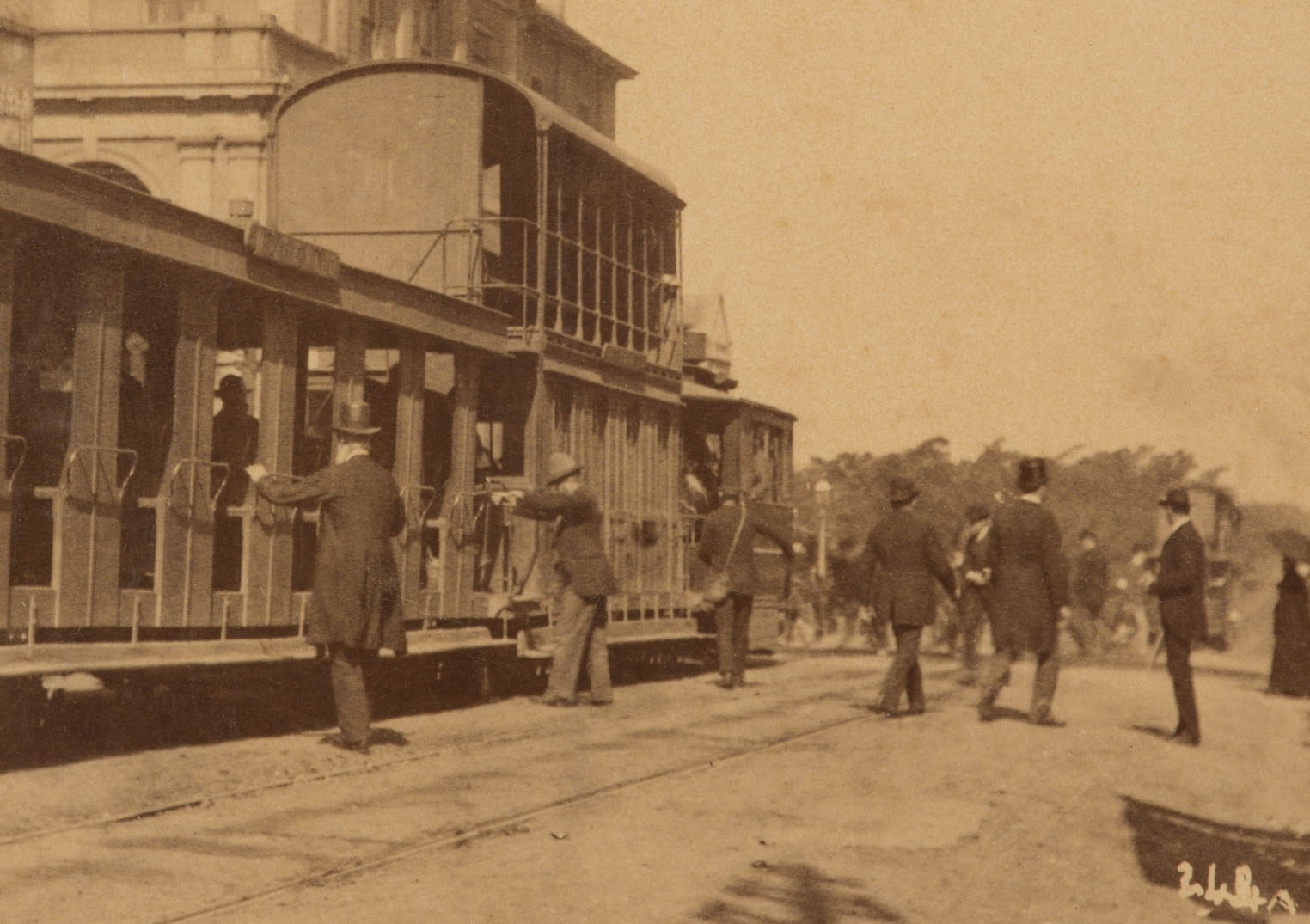
Arthur K. Syer (Australian, d. 1935) 'Tram, West Crescent St., North Sydney' c. 1880s - 1900


Arthur K. Syer (Australian, d. 1935)
Tram, West Crescent St., North Sydney
c. 1880s-1900
Albumen print
From an album of Sydney street life, harbour and beach scenes, domestic animals
81 photographs in album: 15.2 x 20.4cm or smaller
Mitchell Library, State Library of New South Wales


Thank you to Philip Cohen for pointing out this is in fact Elizabeth Street, near King Street.


Arthur K. Syer (Australian, d. 1935) 'Tram, West Crescent St., North Sydney' (detail) c. 1880s - 1900


Arthur K. Syer (Australian, d. 1935)
Tram, West Crescent St., North Sydney (detail)
c. 1880s-1900
Albumen print
From an album of Sydney street life, harbour and beach scenes, domestic animals
81 photographs in album: 15.2 x 20.4cm or smaller
Mitchell Library, State Library of New South Wales


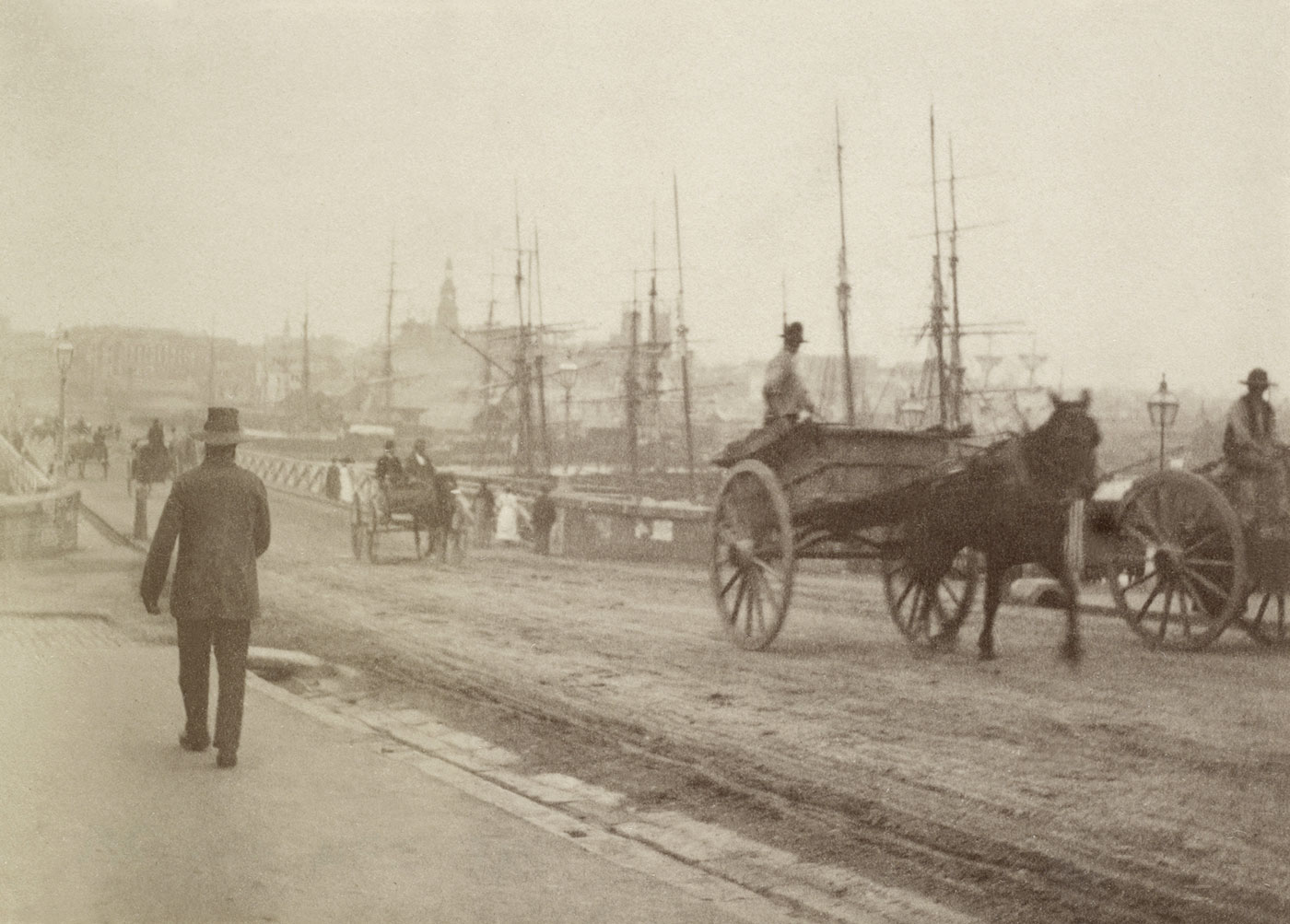
Arthur K. Syer (Australian, d. 1935) 'Pyrmont Bridge looking across to City' c. 1880s - 1900


Arthur K. Syer (Australian, d. 1935)
Pyrmont Bridge looking across to City
c. 1880s-1900
Albumen print
From an album of Sydney street life, harbour and beach scenes, domestic animals
81 photographs in album: 15.2 x 20.4cm or smaller
Mitchell Library, State Library of New South Wales


Arthur K. Syer (Australian, d. 1935) 'Circular Quay near First Fleet Park' c. 1880s - 1900


Arthur K. Syer (Australian, d. 1935)
Circular Quay near First Fleet Park
c. 1880s-1900
Albumen print
From an album of Sydney street life, harbour and beach scenes, domestic animals
81 photographs in album: 15.2 x 20.4cm or smaller
Mitchell Library, State Library of New South Wales


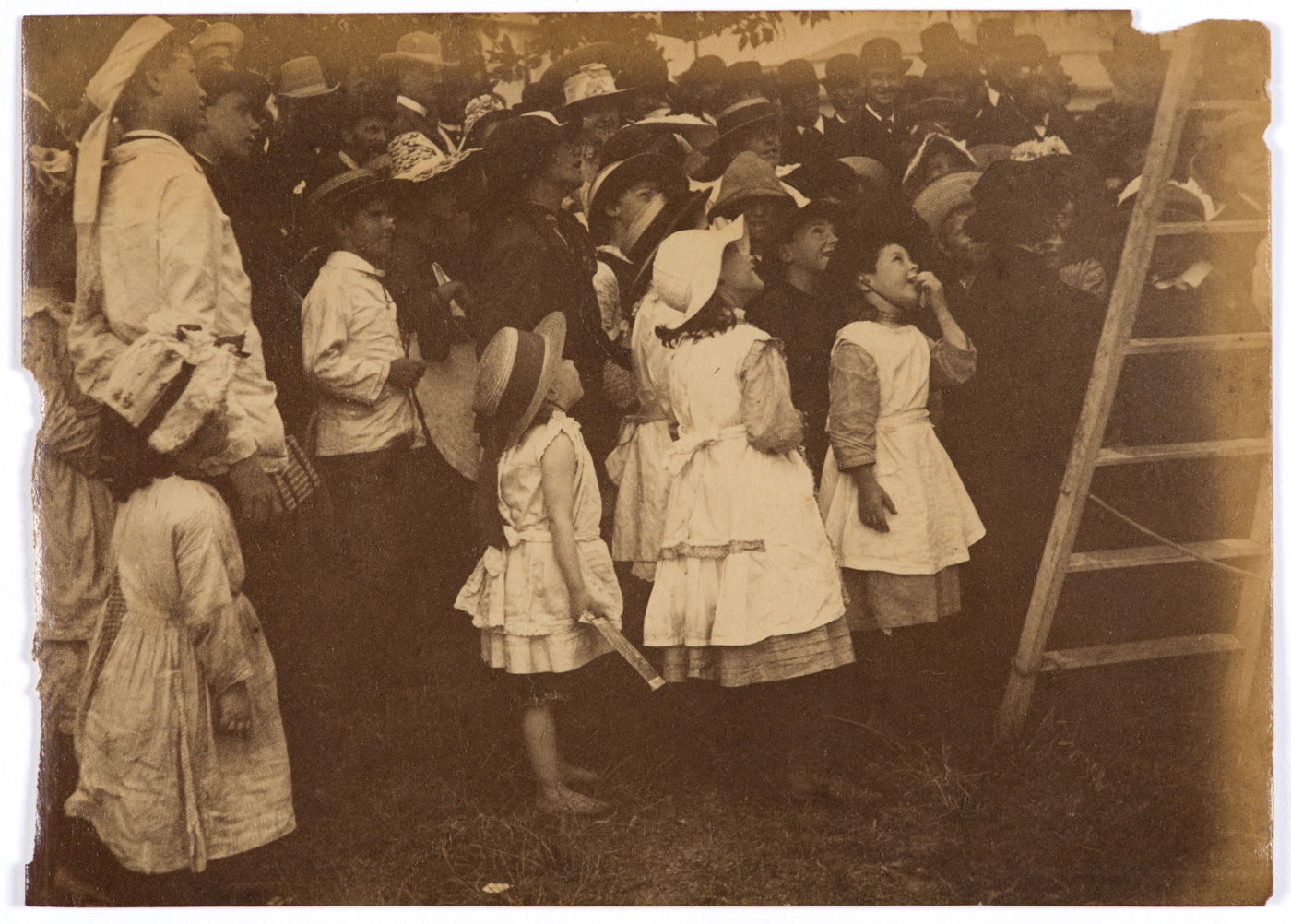
Arthur K. Syer (Australian, d. 1935) 'Children crowd around a ladder' c. 1880s - 1900


Arthur K. Syer (Australian, d. 1935)
Children crowd around a ladder
c. 1880s-1900
Albumen print
From an album of Sydney street life, harbour and beach scenes, domestic animals
81 photographs in album: 15.2 x 20.4cm or smaller
Mitchell Library, State Library of New South Wales


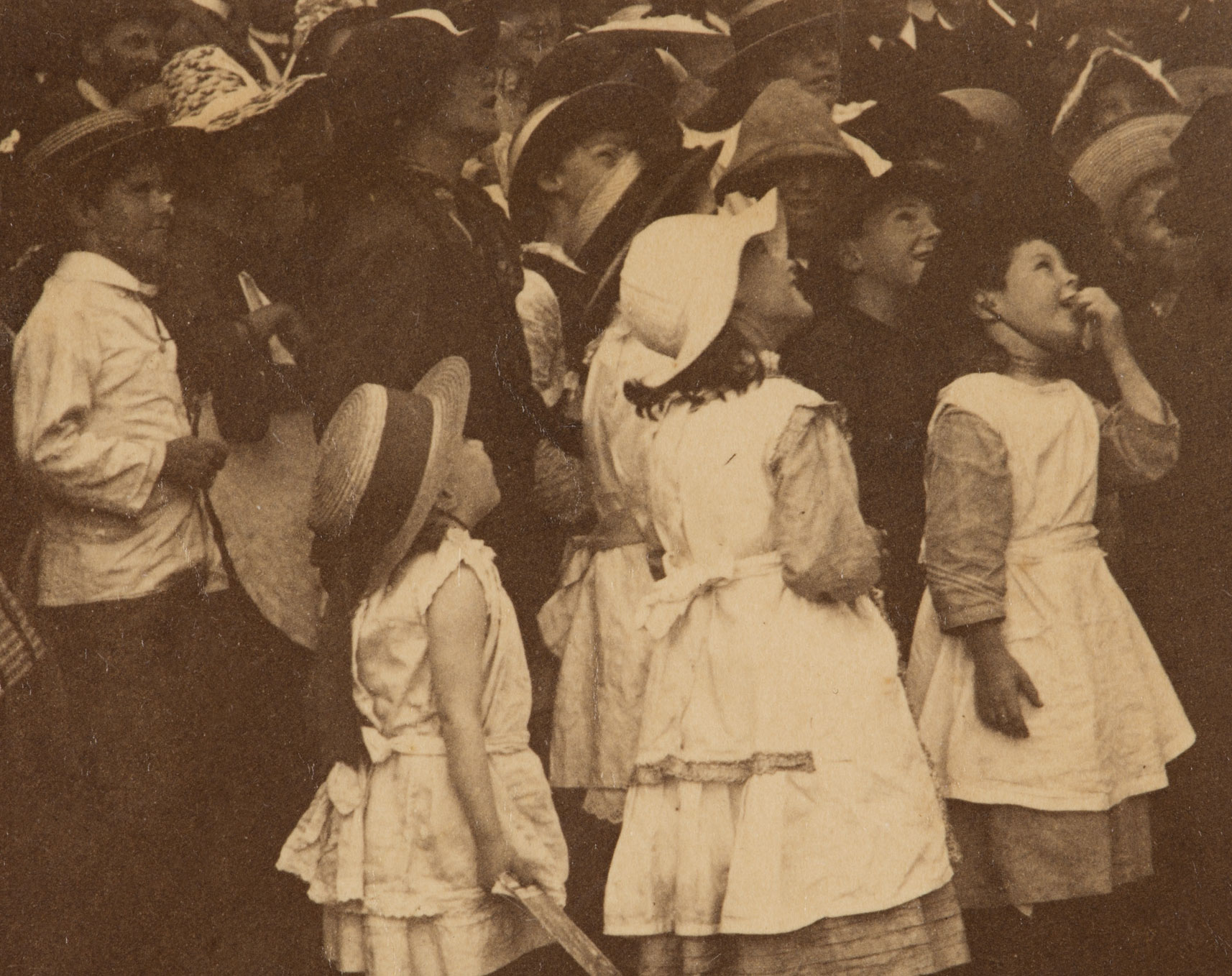
Arthur K. Syer (Australian, d. 1935) 'Children crowd around a ladder' (detail) c. 1880s - 1900


Arthur K. Syer (Australian, d. 1935)
Children crowd around a ladder (detail)
c. 1880s-1900
Albumen print
From an album of Sydney street life, harbour and beach scenes, domestic animals
81 photographs in album: 15.2 x 20.4cm or smaller
Mitchell Library, State Library of New South Wales


Arthur K. Syer (Australian, d. 1935) 'Royal Exchange Building in Bridge Street' c. 1880s - 1900


Arthur K. Syer (Australian, d. 1935)
Royal Exchange Building in Bridge Street
c. 1880s-1900
Albumen print
From an album of Sydney street life, harbour and beach scenes, domestic animals
81 photographs in album: 15.2 x 20.4cm or smaller
Mitchell Library, State Library of New South Wales


Arthur K. Syer (Australian, d. 1935) 'Men in street' c. 1880s - 1900


Arthur K. Syer (Australian, d. 1935)
Men in street
c. 1880s-1900
Albumen print
From an album of Sydney street life, harbour and beach scenes, domestic animals
81 photographs in album: 15.2 x 20.4cm or smaller
Mitchell Library, State Library of New South Wales


Arthur K. Syer (Australian, d. 1935) 'Hawker haggling with customers' c. 1880s - 1900


Arthur K. Syer (Australian, d. 1935)
Hawker haggling with customers
c. 1880s-1900
Albumen print
From an album of Sydney street life, harbour and beach scenes, domestic animals
81 photographs in album: 15.2 x 20.4cm or smaller
Mitchell Library, State Library of New South Wales


Arthur K. Syer (Australian, d. 1935) 'Shoe shiner with customer' c. 1880s - 1900


Arthur K. Syer (Australian, d. 1935)
Shoe shiner with customer
c. 1880s-1900
Albumen print
From an album of Sydney street life, harbour and beach scenes, domestic animals
81 photographs in album: 15.2 x 20.4cm or smaller

Mitchell Library, State Library of New South Wales


State Library of New South Wales
Macquarie Street, Sydney
NSW 2000 Australia
Phone: +61 2 9273 1414

Opening hours:
Monday – Friday 9 am – 5 pm
Saturday – Sunday 10 am – 5 pm

State Library of New South Wales website

LIKE ART BLART ON FACEBOOK

Back to top

Exhibition: ‘The Greatest Wonder of the World’ at the State Library of New South Wales, Sydney

Exhibition dates: 23rd February – 12th May 2013


American & Australasian Photographic Company. '[Merlin's photographic cart ?] and Mitchell's London Hotel, Railway Place, Sandridge [Port Melbourne]' 1870-1875


American & Australasian Photographic Company
[Merlin’s photographic cart?] and Mitchell’s London Hotel, Railway Place, Sandridge [Port Melbourne]
1870-1875


Another fascinating posting, this time featuring Australian colonial photography. In 1951, a hoard of 3,500 glass plate negatives from the nineteenth century was discovered in a garden shed in Chatswood. In time, the find proved to be the most important photographic documentation of goldfields life in Australia. All negatives have now been scanned at high resolution and for the first time in 140 years, it is possible to see what Merlin and Bayliss (from the American & Australasian Photographic Company) photographed, with astonishing clarity and fidelity. “Many of the images in the Holtermann collection were created for an ambitious 1870s publicity campaign to sell the wonders of the Australian colonies to the world.”

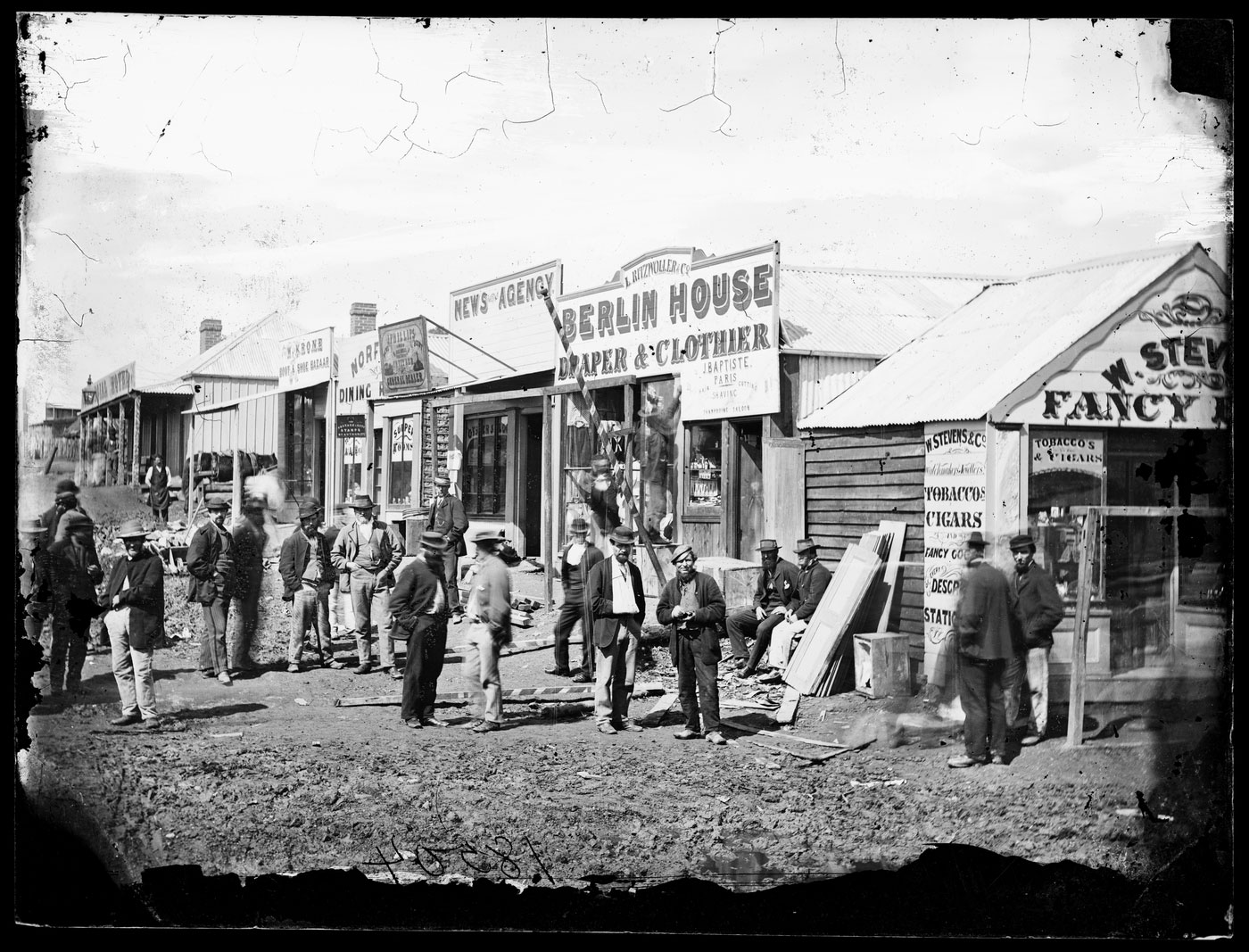
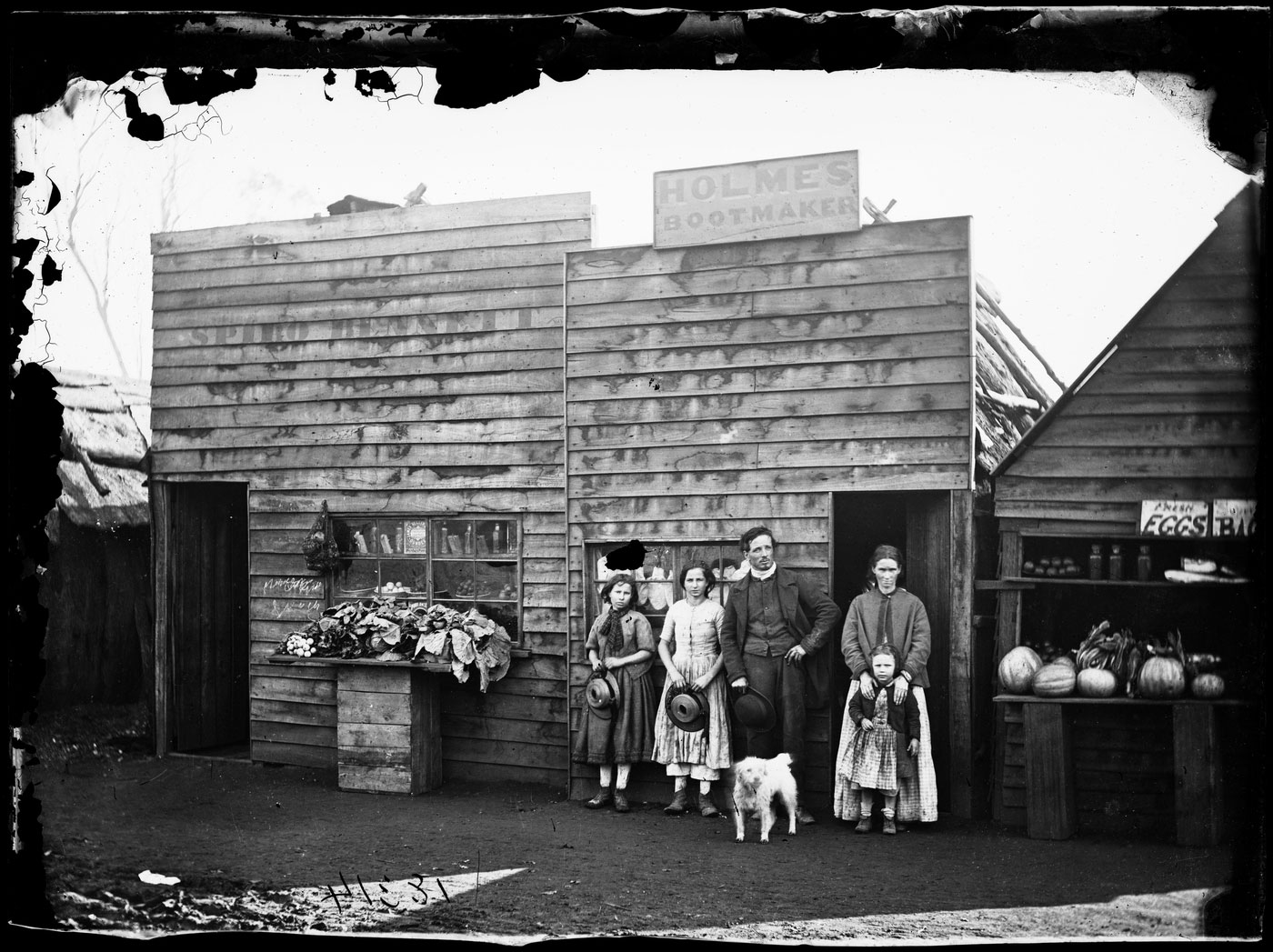
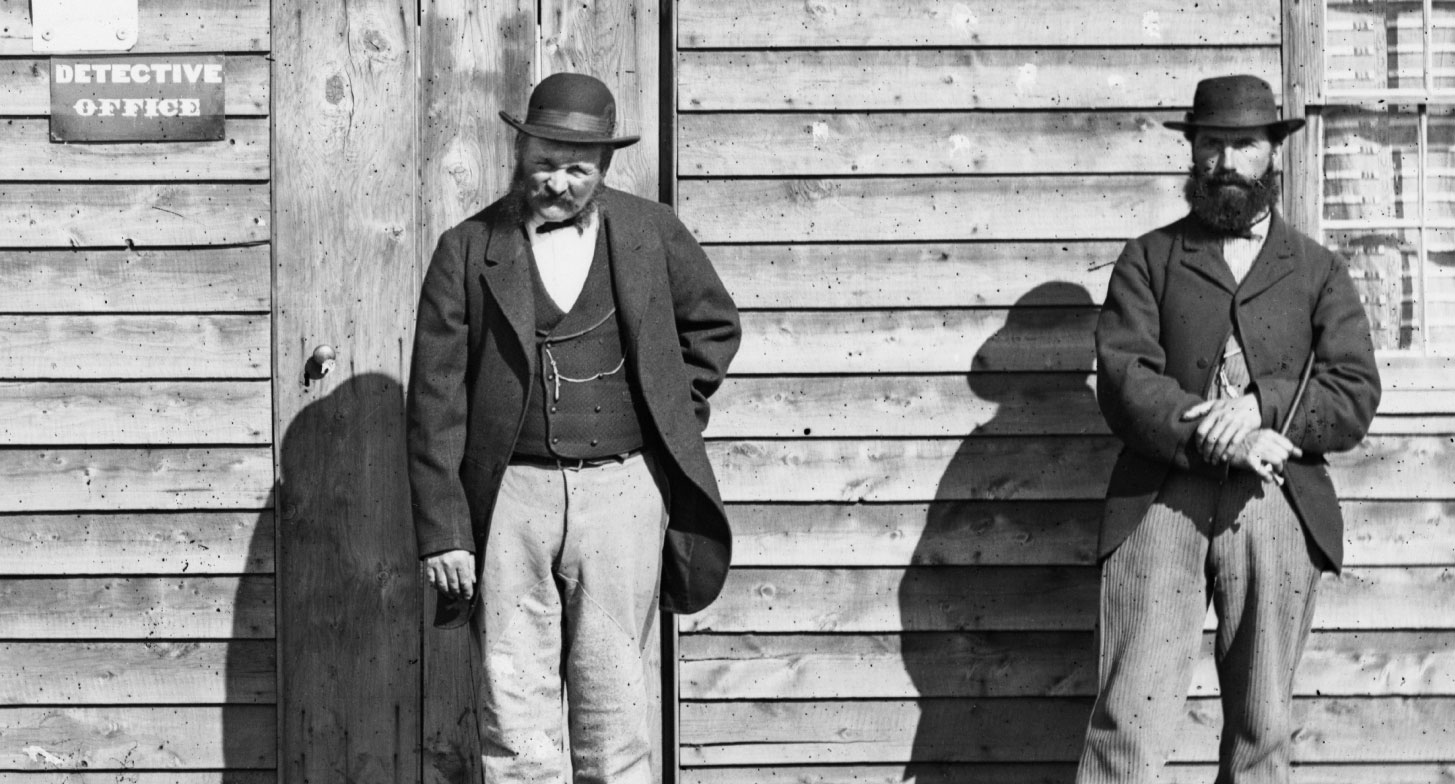
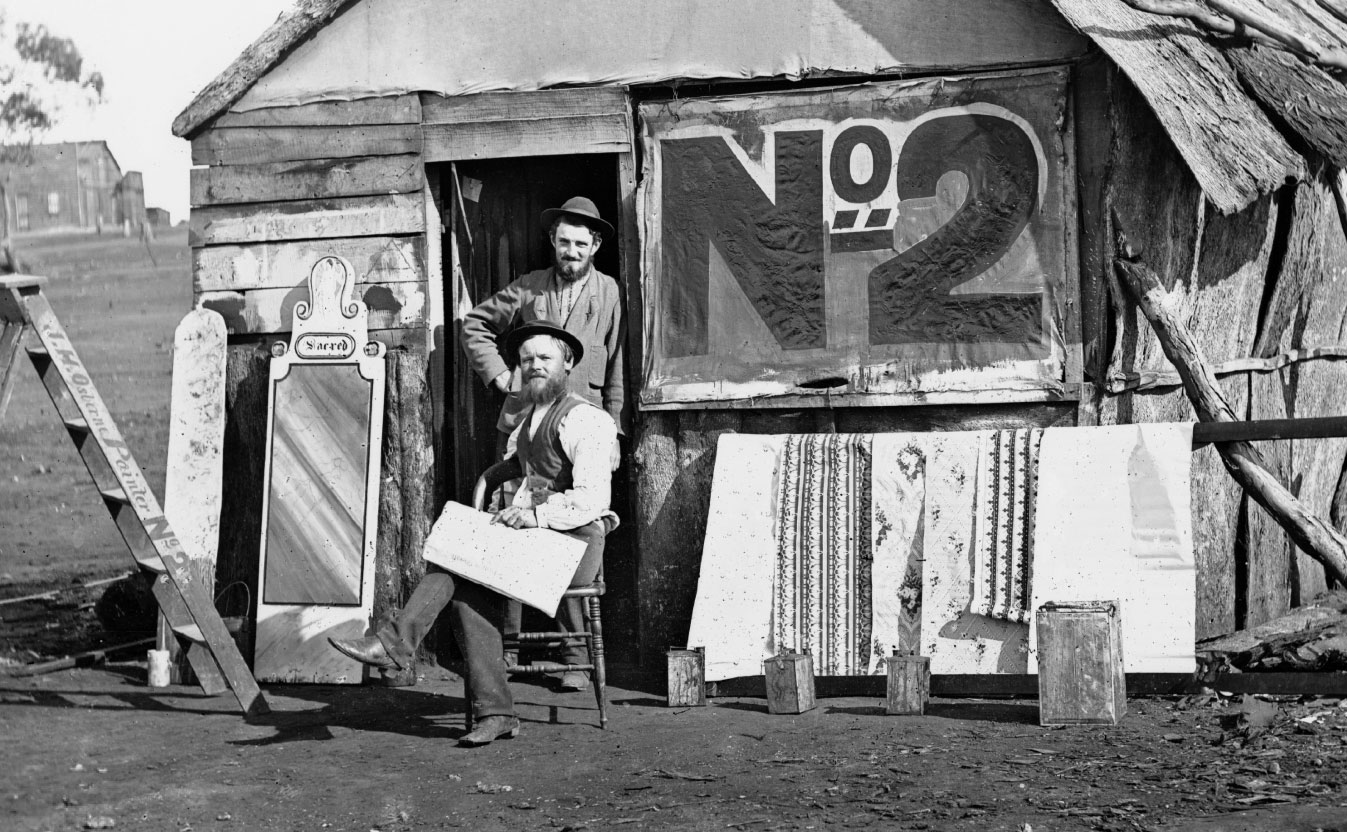
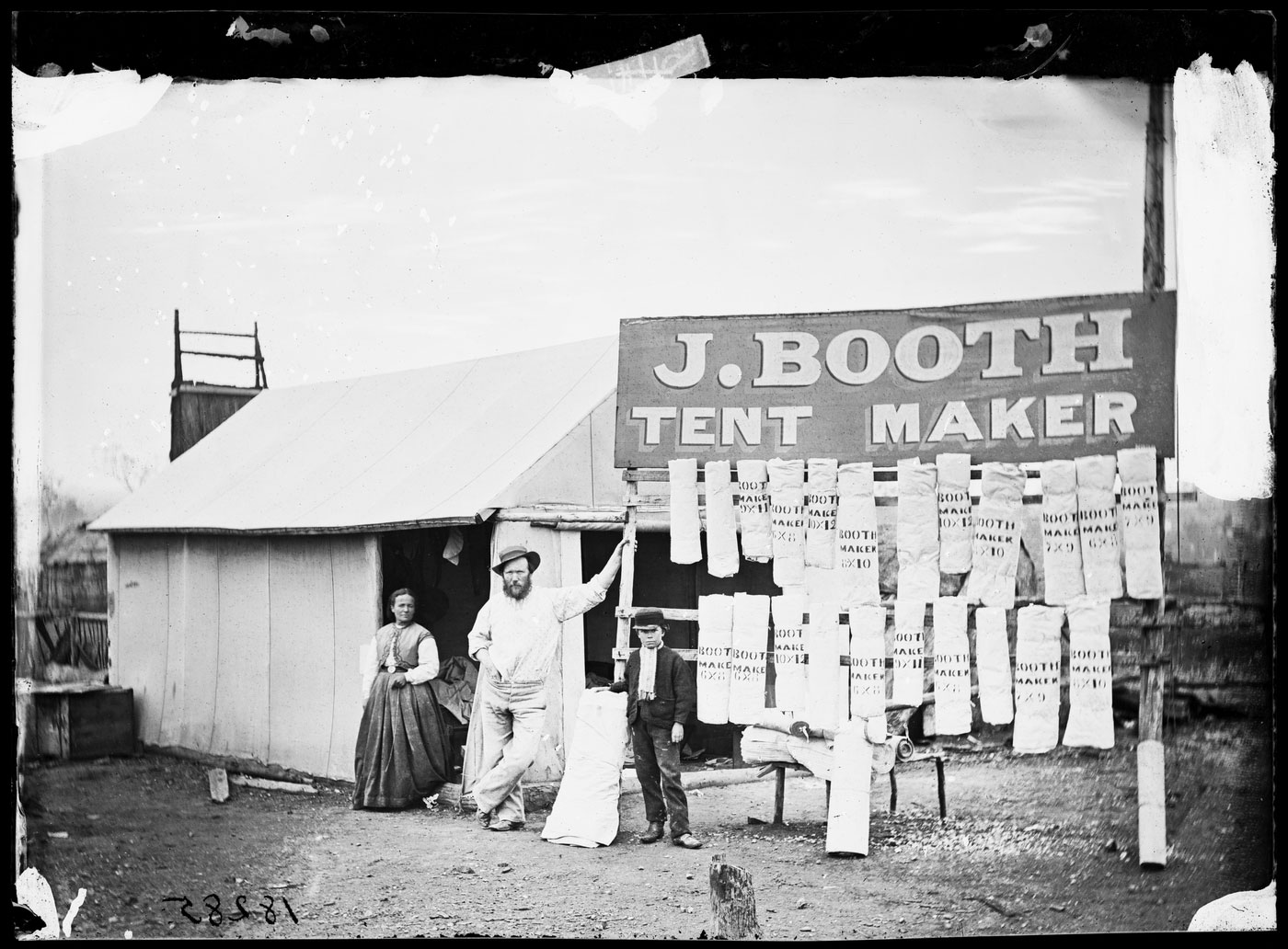
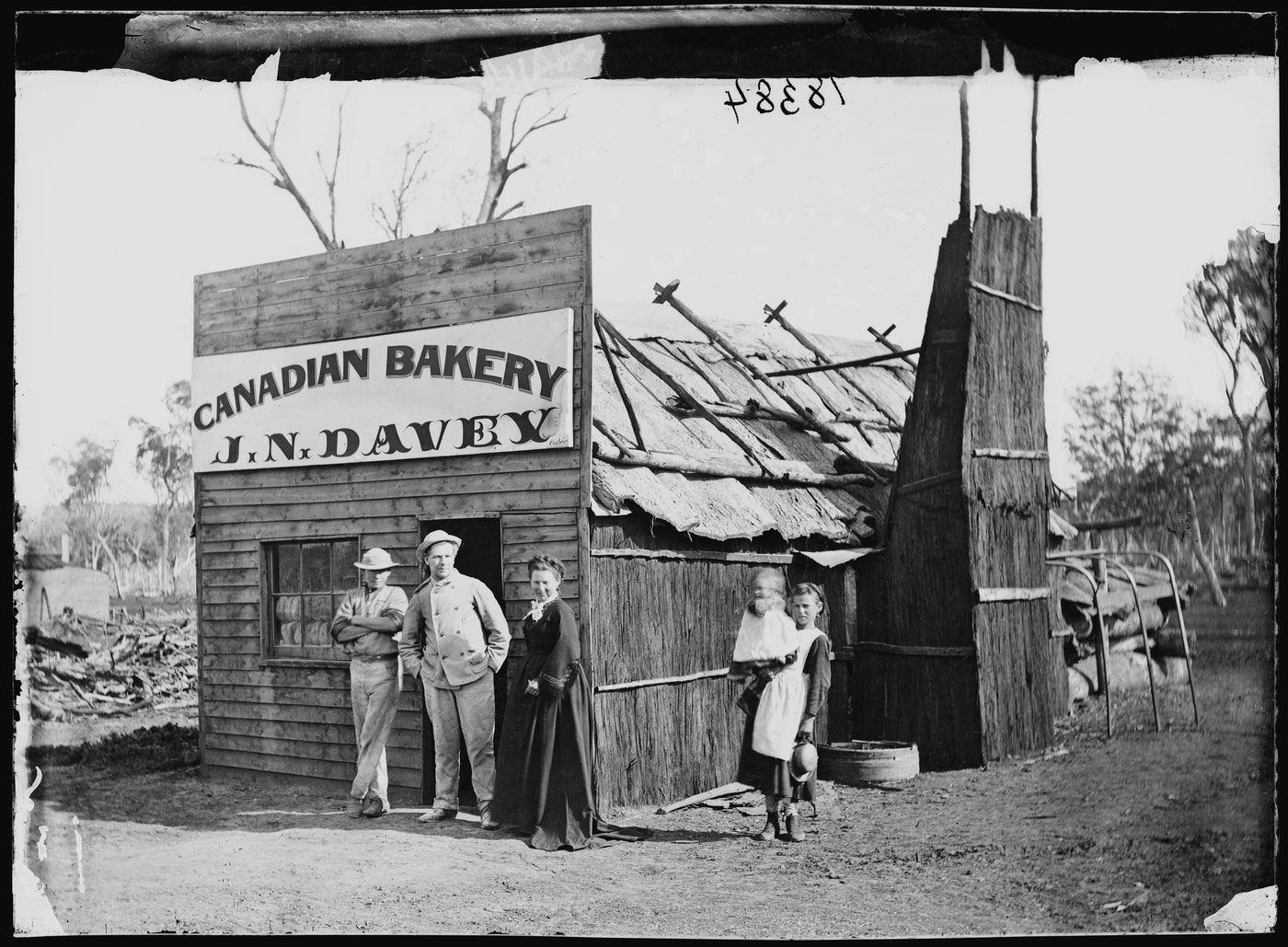
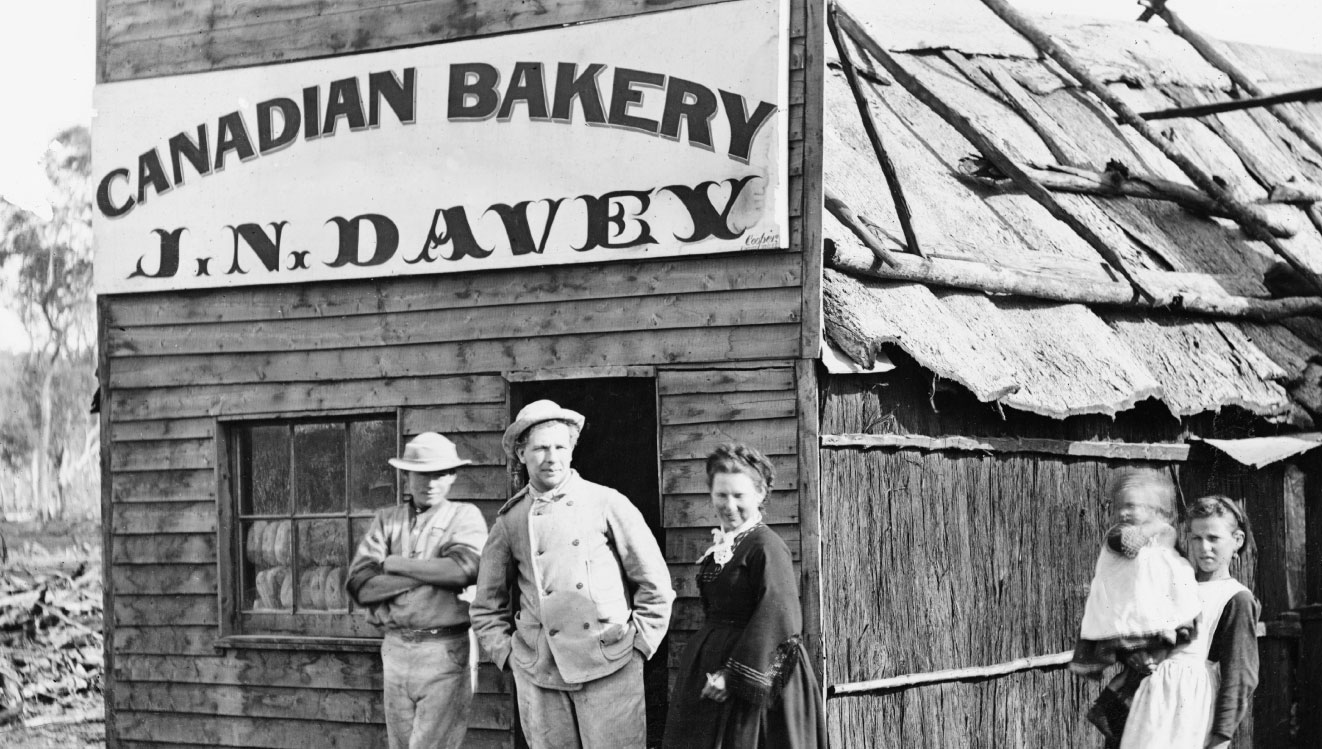
What I find particularly interesting is the familiarity of all photographs of goldfields from around the world, whether it be Californian or Victorian – the working class men, the pictures of diggings, etc… but also the particular Australian vernacular that these photographs possess. The photographs could be taken no where else but Australia. Observe the abject poverty of some of the shopkeepers – draper, blacksmith, bootmaker and undertaker (who also acted as carpenter, joiner, builder and cabinet maker) – the timber clad facade of their buildings failing to conceal the bark structure behind (see Holmes, bootmaker, and Spiro Bennett’s store, Gulgong, 1872 below). And yet in their poverty they still thought it important to spend money on advertising with wonderful examples of distinctive typography that I have highlighted in detail – on the photographers, bakers and tent makers shops, on the undertakers facade replete with horses and funeral carriage, and on the painters and sign writers bark clad establishment. Contemporary typographers could have a field day studying these photographs for new typefaces!

Notice in the detail wonderful things:

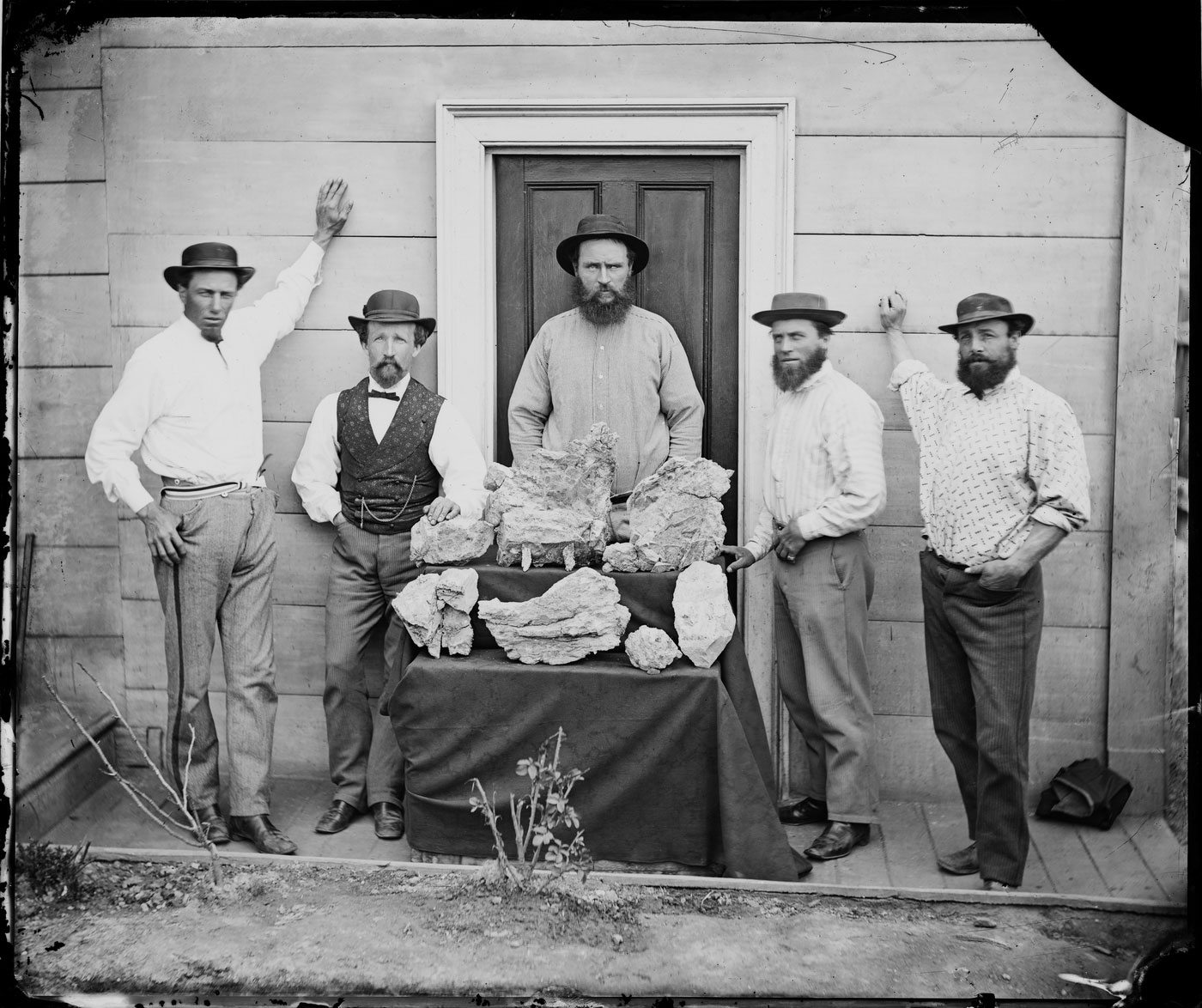
~ The roughness of a man’s hand as they stand in front of their loot, the gold specimens;

~ The incongruous sight of toy dogs among the rough-and-ready types that inhabited a frontier gold town;

~ The riding crop tucked under the arm of one of the detectives;

~ The flour that covers the bakers shoes;

~ The decorative wallpaper hanging outside the painter and signwriters shack, the word ‘Sacred’ on top of the mirror, and his name ‘J.H. Osborne Painter No.2′ emblazoned on the side of his ladder.


Of particular poignancy is the way the undertaker William Lewis leans in the entrance of his establishment. Propped up against the door (to stop himself from moving during the exposure), his hands stiffly by his side, his eyes stare straight ahead as though he is in a trance. In the photograph he has almost become the corpse that it is his business to bury. We must also acknowledge the temporary nature of these gold field towns, their unsubstantial character and the transitory life of the people that lived and died in them. Bootmaker William Holmes’ wife passed away a few months after the photograph of her family was taken. It was a tough life living on a frontier town. We can also note how desolate the major cities seem, as can be seen in photographs of Sandridge [Port Melbourne] and Pall Mall, Bendigo, with the odd carriage on the street and a single man standing on a street corner.

This is such a rich photographic collection and to have all the negatives digitised and available online is such a pleasure, such a treasure for Australian photographers, historians, researchers and the general public who, with an inquiring mind, can begin to understand the colonisation and conquest of this never empty country.

Dr Marcus Bunyan


Many thankx to the State Library of New South Wales for allowing me to publish the photographs in the posting. Please click on the photographs for a larger version of the image.


The State Library of NSW’s world-renowned photographic archive, the Holtermann collection, will be officially included on the UNESCO Australian Memory of the World register at a ceremony in May 2013… The Australian UNESCO Memory of the World program is part of an international initiative, which aims to safeguard the documentary heritage of humanity and recognise the significance of all heritage materials… Many of the images in the Holtermann collection were created for an ambitious 1870s publicity campaign to sell the wonders of the Australian colonies to the world. The campaign was funded by German-born entrepreneur, Bernhardt Otto Holtermann, who made his fortune from mining in Hill End. For the first time 100 amazing large format prints from the Holtermann collection are on show [until 12 May] in the State Library’s free exhibition, The Greatest Wonder of the World.


Beaufoy Merlin (Australian, 1830-1873) 'Short Street, Hill End' 1872


Beaufoy Merlin (Australian, 1830-1873)
Short Street, Hill End
1872
Wet plate glass negative, on 4/Box 5/No. 18504


Hill End in 1872 was a gold town at its peak. According to the Empire 7 June 1872, “The streets were thronged by a motley crowd; the stores and places of business crowded with customers; the little theatre so densely packed by an admiring audience, that there was not what is facetiously called ‘standing room,’ and even the public-houses, whose name is legion, were crammed. Yet I saw less, far less, drunkenness than can be met with in any street in the metropolis after 10 o’clock at night. There were very few inebriates, no filthy dishevelled women, no crouching loafers, no abject vice. The general aspect of the crowds of decently dressed folk who thronged ‘The Hill’ was that of respectability – rough indeed in many respects, and loud and noisy too, in some instances, but not disreputable, and altogether good-humoured.”


American & Australasian. 'Photographic Company Hawkins Hill 'Golden Quarter Mile'' 1872


American & Australasian Photographic Company
Hawkins Hill ‘Golden Quarter Mile’
1872
Wet plate glass negative, on 4/Box 71/No. C


This panorama of Hawkins Hill was taken by Beaufoy Merlin, who erected his camera in a tree more than a kilometre away across a gully nearly 300 metres deep. In the centre of the image is Krohmann’s mine, with the twin buildings and two storied structure of Beyers and Holtermann’s immediately to the left of it. These two mines contributed to the 12.4 tonnes of gold extracted from Hawkins Hill, but such are the vagaries of goldmining, that Rapp’s, on the extreme right, returned little to its investors, despite digging to a depth of over 380 feet [115 metres]. An almost identical view of the Hawkins Hill ‘Golden Quarter Mile’ taken by Merlin appeared as an engraving in the Australian Town and Country Journal 18 May 1872.


American & Australasian Photographic Company. 'Gold Specimens from the Star of Hope mine' 1872


American & Australasian Photographic Company
Gold Specimens from the Star of Hope mine
1872
Wet plate glass negative, on 4/Box 71/No. T


A month before discovery of the 286 kg Holtermann “nugget” [estimated to hold around 93kg of gold], Bernhardt Holtermann (second from left) Richard Ormsby Kerr (centre) and Louis Beyers (fourth from left) posed with 3,663 ozs [114 kg] of gold specimens from their claim. The specimens were described in The Sydney Morning Herald 28 September 1872 ; “To say they were good would be to say but little – they were almost without rival – magnificent – the talk of this town, where specimens are not unknown.” Holtermann took the best to the Sydney Mint for smelting, “as being clotted with gold it would be almost impossible to crush it in the ordinary way.” The item of clothing on the floor to the right is Beyer’s waistcoat.


American & Australasian Photographic Company. 'Gold Specimens from the Star of Hope mine' 1872 (detail)


American & Australasian Photographic Company
Gold Specimens from the Star of Hope mine (detail)
1872
Wet plate glass negative, on 4/Box 71/No. T


American & Australasian Photographic Company. 'A domestic miner [Hill End]' 1872


American & Australasian Photographic Company
A domestic miner [Hill End]
1872
Wet plate glass negative, on 4/Box 10/No. 70154


Thomas Browne (better known as Rolf Boldrewood) was Gold Commissioner in Gulgong, during the period of Merlin and Bayliss’s photographs. Although this photograph was taken in Hill End, Boldrewood’s description of the domestic miner in his novel The Miners Right seems universal. “The thrifty miner who possesses the treasure, not less common on Australian goldfields than in other places, of a cleanly managing wife, is enabled to surround himself with rural privileges. A plot of garden ground, well fenced, grows not only vegetables but flowers, which a generation since were only to be found in conservatories… the domestic miner is often seen surrounded by his children, hoeing up his potatoes or cauliflowers, or training the climbing rose which beautifies his rude but by no means despicable dwelling.”


American & Australasian Photographic Company. 'Studio and staff of American & Australasian Photographic Co., Hill End' 1872


American & Australasian Photographic Company
Studio and staff of American & Australasian Photographic Co., Hill End
1872
Wet plate glass negative, on 4/Box 9/No. 18850


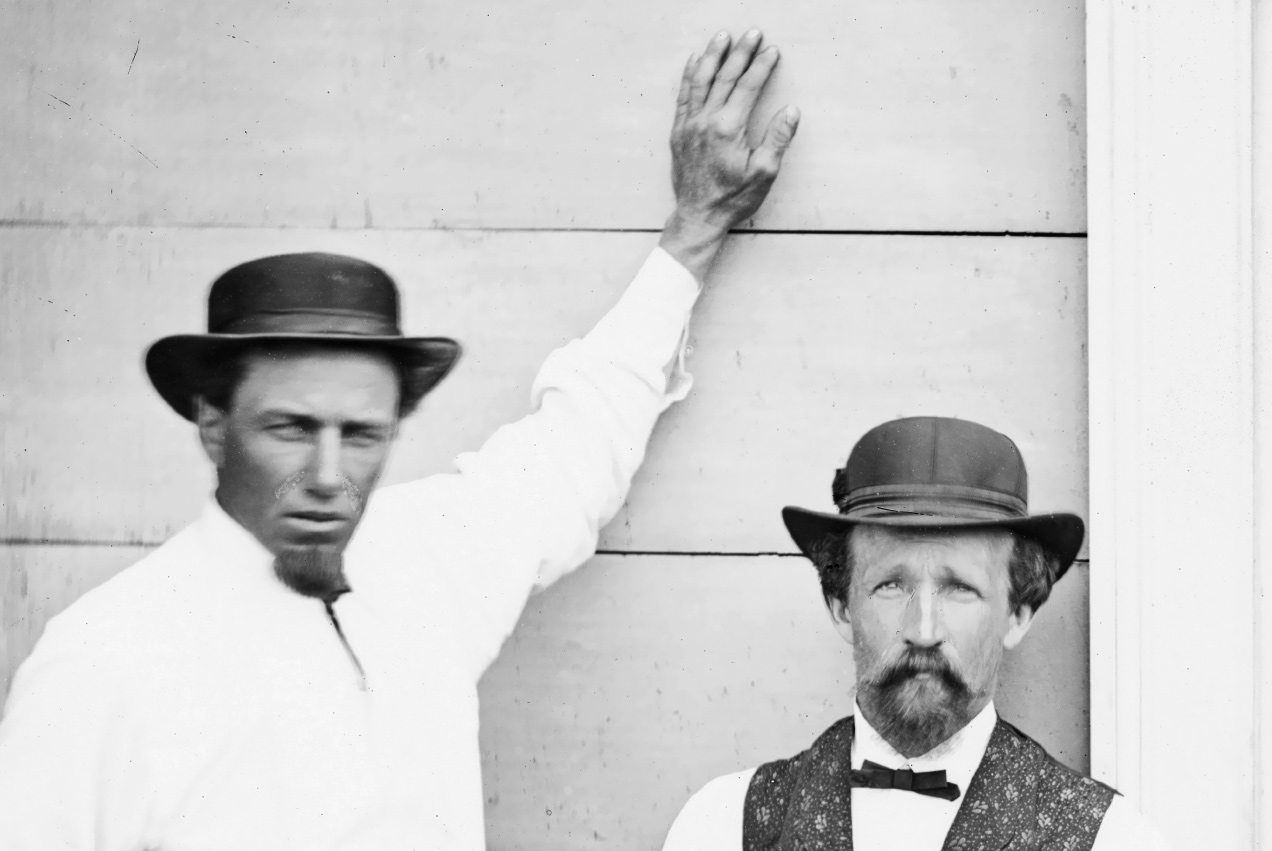
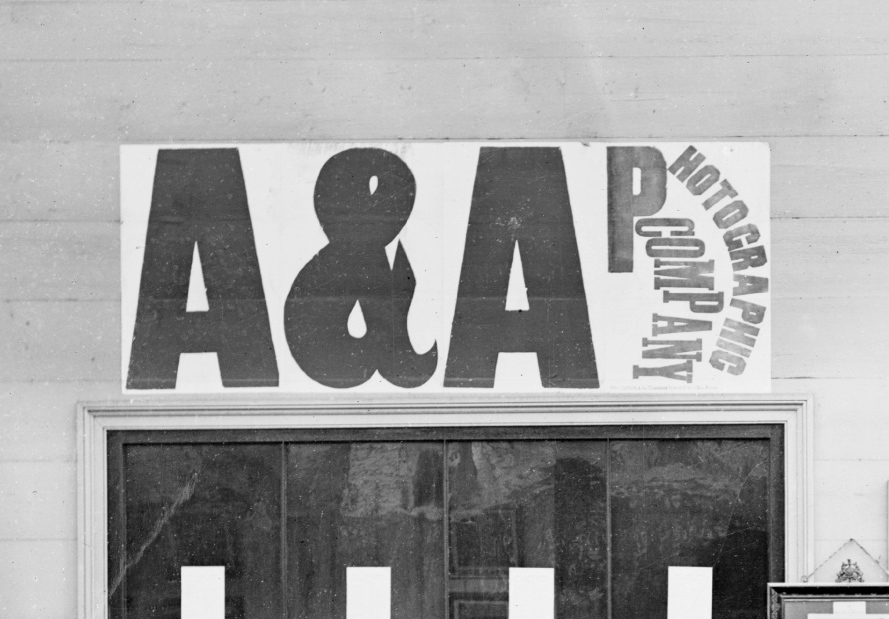
The American and Australasian Photographic Company established a studio in Tambaroora Street, Hill End in 1872. Beaufoy Merlin’s assistant Charles Bayliss stands, hands in pockets, in the doorway, with studio operator James Clinton behind him. Beside the door is a frame containing large photographic views of Sydney, including the General Post Office and harbour.


American & Australasian Photographic Company. 'Studio and staff of American & Australasian Photographic Co., Hill End' 1872 (detail)


American & Australasian Photographic Company
Studio and staff of American & Australasian Photographic Co., Hill End (detail)
1872
Wet plate glass negative, on 4/Box 9/No. 18850


American & Australasian Photographic Company. 'Blacksmith William Jenkyns' 1872


American & Australasian Photographic Company
Blacksmith William Jenkyns
1872
Wet plate glass negative, on 4/Box 7/No. 18715


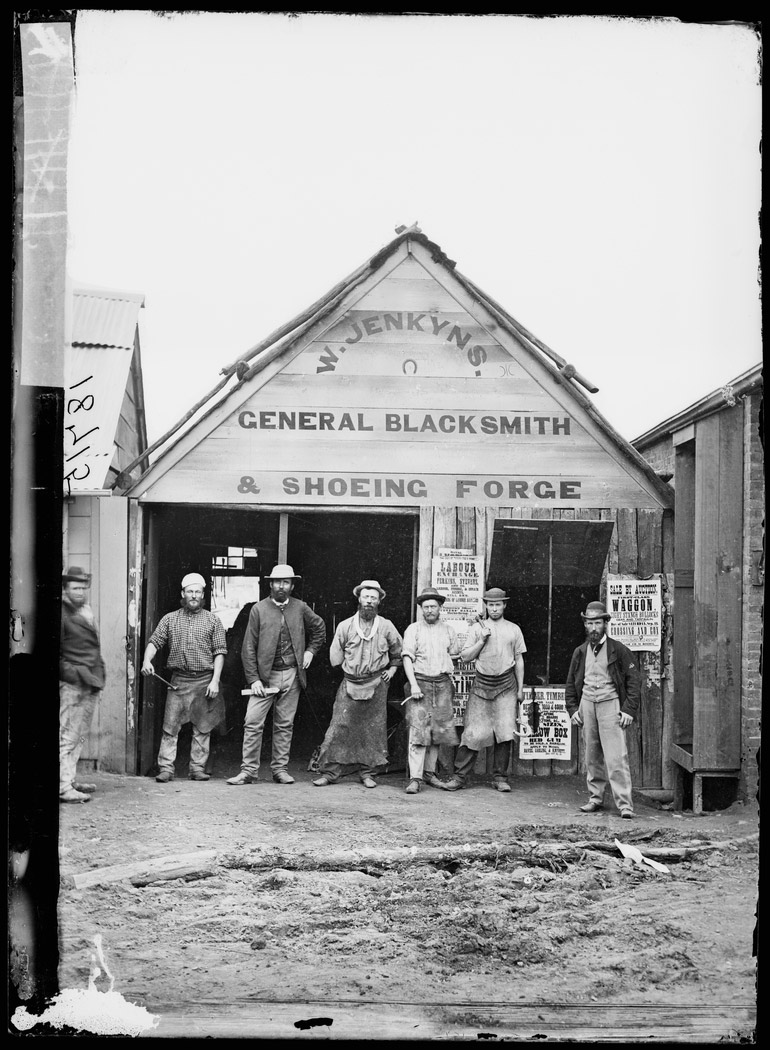
William Jenkyns’ blacksmith and shoeing forge was situated in Clarke Street, Hill End. The condition of roads around Hill End ensured Jenkyns was busy. A correspondent to The Sydney Morning Herald 23 May 1872 wrote of the road between Bathurst and Hill End, “For miles at a stretch there is nothing to indicate that any money has been spent upon the road for years, and it is doubtful whether any portion of it has ever been properly made.” On 3 December 1872 another wrote, “I think I have travelled the worst of roads; for the sake of humanity, I hope there are none worse than those I have travelled.” Despite a superficial resemblance, the man on the right is not B.O. Holtermann.


Gibbs, Shallard & Co., Colour Printers [188-?] 'Holtermann's Life Preserving Drops' 1872


Gibbs, Shallard & Co., Colour Printers [188-?]
Holtermann’s Life Preserving Drops
1872
Poster


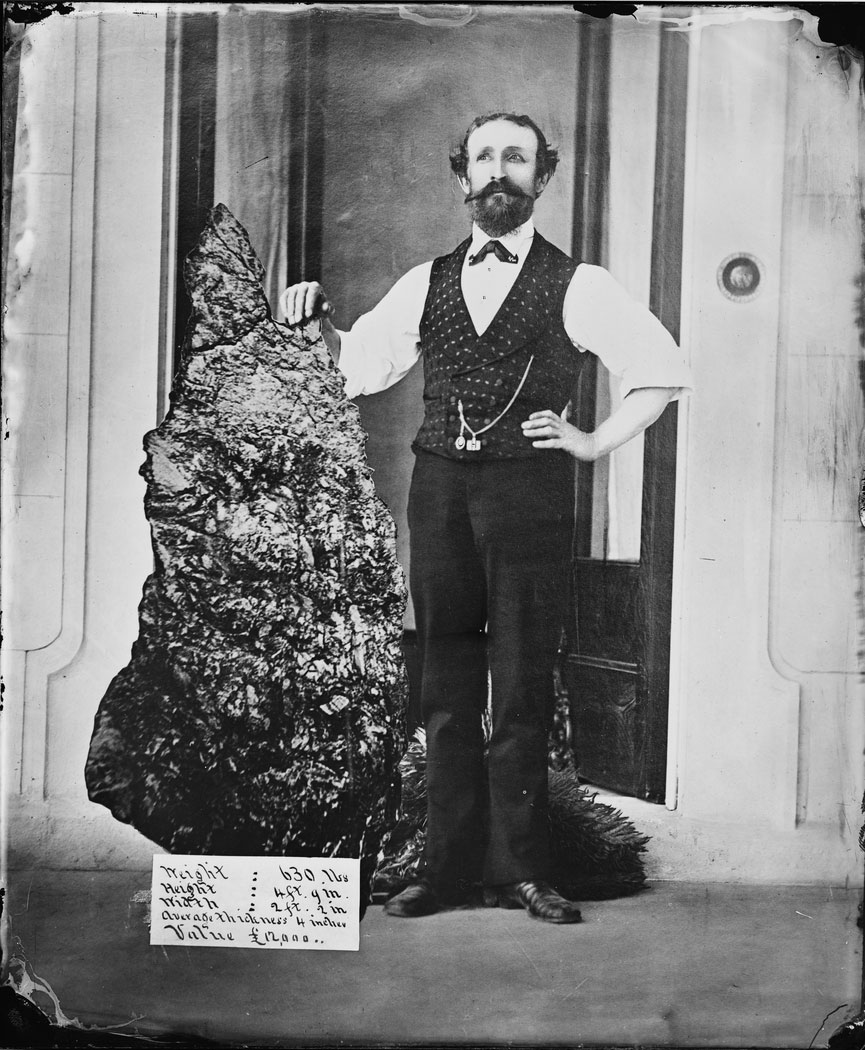
There is no doubt that Bernhardt Otto Holtermann understood the importance and value of maintaining his association with the world’s largest specimen of reef gold. Unable to purchase the monster quartz and gold specimen when it was extracted from the Star of Hope mine in Tambaroora in 1872, he commissioned the American and Australasian Photographic Company to produce a photographic montage of him standing beside it. Photographers Beaufoy Merlin and Charles Bayliss seem to have carried out this assignment on more than one occasion, as Holtermann wears different clothing in the several known examples of the image.

Obviously pleased with the result, Holtermann used the montage on his business card and on the label to a patent medicine bearing his name. As an advertising ploy, the image of Holtermann resting his hand on the world’s largest hunk of gold can only have been interpreted as a symbol of success and a guarantee of the worth of his product.

(Alan Davies author)


American & Australasian Photographic Company. 'B.O. Holtermann with the Holtermann Nugget, North Sydney' 1874-1876?


American & Australasian Photographic Company
B.O. Holtermann with the Holtermann Nugget, North Sydney
1874-1876?


During the 1870’s goldrush in central New South Wales, Bernard Holtermann, his partners and miners brought the largest agglomeration of gold to the surface. It was not a nugget of pure gold but he was instantly rich! An even larger gold find was broken up when it came to the surface in late January-early February 1873 but it was not photographed. With his wealth Holtermann financed the photography of the goldfields, a collection of international significance showing the ordinary people from all over the world with their houses and businesses on the goldfields. This composite photograph was put together later to give the appearance of Holtermann with the gold on the veranda of his new mansion at North Sydney, now the site of Shore Grammar School.

Three photographs were used to create this image of Holtermann, (supposedly holding the worlds’ largest accumulation of rock and gold ever brought to the surface in one piece). He was posed in the studio with his hand on a headclamp, the nugget was inserted and both placed on a photograph of the verandah of his mansion, built from the proceeds of his goldmine. The “nugget” was found in Hill End, New South Wales on 19th October 1872. More than half of the 630 lbs weight was pure gold, value 12,000 pounds ($24,000). With gold worth say $1400 per ounce, the value today would be over $A7,000,000. Amazingly Holtermann’s mine had already made him rich before the discovery of this boulder and there was reputed to be an even larger aggregate in the mine!


In 1872, the newly rich Bernhardt Otto Holtermann used some of his wealth to employ Henry Beaufoy Merlin and Charles Bayliss, of the American and Australasian (A&A) Photographic Company, to photograph gold producing areas and cities in NSW and Victoria for exhibition overseas. These images provide the most comprehensive and detailed record of nineteenth century goldfields life and, with the commissioned photographs, now form the Library’s Holtermann archive of 3500 wet plate negatives. The Greatest Wonder of the World features this extraordinary collection of nineteenth century documentary images. Through enlargements, digital images and a selection of vintage prints and wet plate negatives, the exhibition tells the remarkable story of the A&A Photographic Company and the philanthropy and vision of Bernhardt Holtermann.

In 1951, a hoard of 3,500 glass plate negatives from the nineteenth century was discovered in a garden shed in Chatswood. In time, the find proved to be the most important photographic documentation of goldfields life in Australia. The photographers responsible for the images were Beaufoy Merlin and Charles Bayliss of the American and Australasian Photographic Company, who had travelled to the town of Hill End in 1872 to record the rush. From there, they also recorded the burgeoning Gulgong and Mudgee goldfields.

In October 1872, the world’s largest specimen of reef gold, known as the Holtermann nugget, was unearthed at nearby Hawkins Hill and Merlin and Bayliss were there to record it. In an extraordinary act of patronage, the newly rich Bernhardt Otto Holtermann used some of his wealth to employ Merlin and Bayliss to photograph other gold producing areas and cities in NSW and Victoria for exhibition overseas. Proud of his own success, he believed that his travelling exposition would encourage immigration to Australia.  Merlin and Bayliss’s documentation was slow, with long exposures and the difficulty of processing one photograph at a time. Their wet plate negatives captured exceptional detail, but copies made in the twentieth century failed to reveal the wealth of information hidden within.

In 2008, plans were made to digitally scan the Holtermann Collection at very high resolution and this became reality through the generous assistance of the Graham and Charlene Bradley Foundation; Simon and Catriona Mordant; Geoffrey and Rachel O’Conor; Morningstar and numerous other benefactors. For the first time in 140 years, it is possible to see what Merlin and Bayliss photographed, with astonishing clarity and fidelity.

Press release from the State Library of New South Wales website


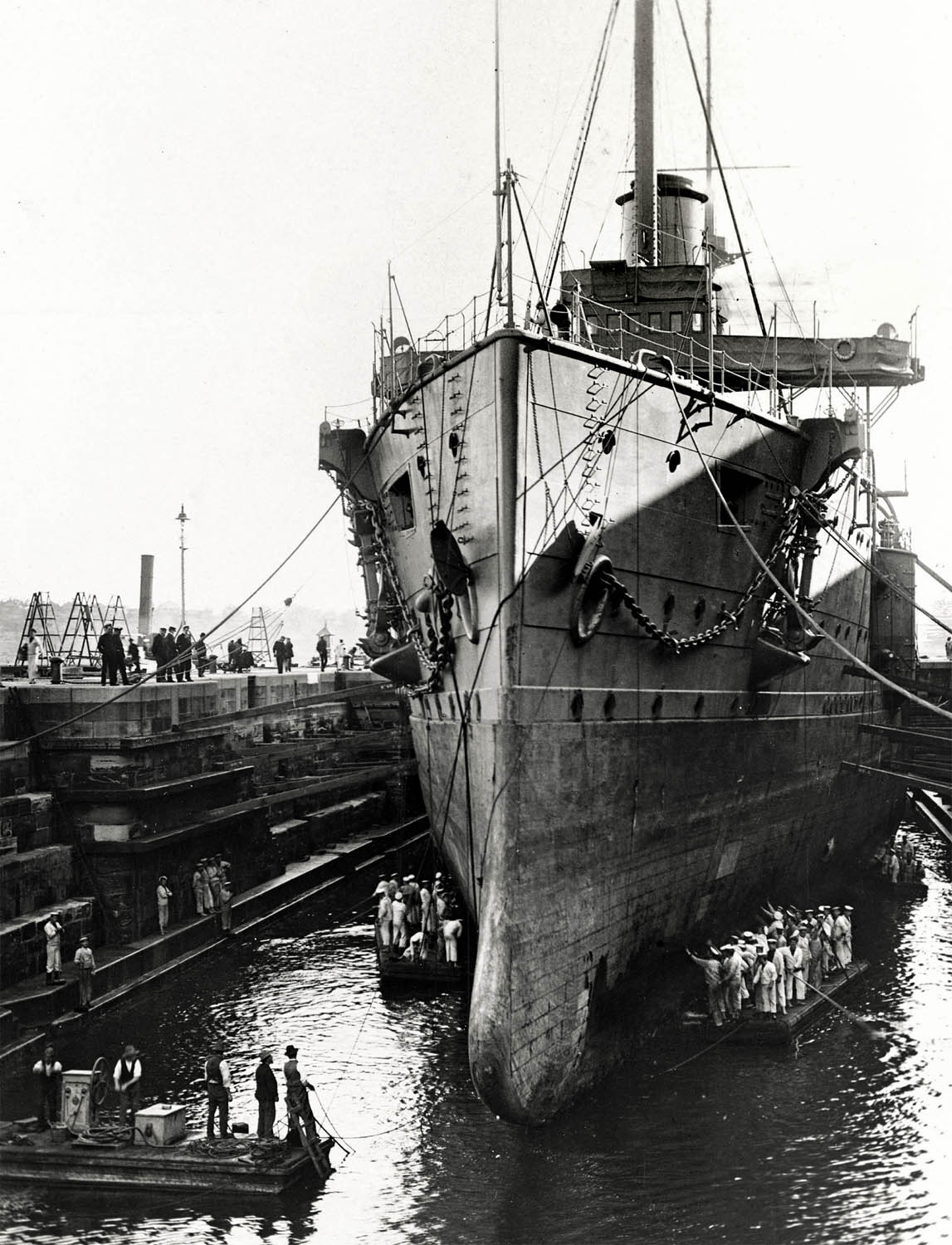
American & Australasian Photographic Company. '[French warship 'Atalante', Fitzroy Dock, Sydney, 1873]' Aug 1873


American & Australasian Photographic Company
[French warship ‘Atalante’, Fitzroy Dock, Sydney, 1873]
Aug 1873


This photograph of the French warship Atalante in Fitzroy Dock on Cockatoo Island, with Balmain in the background, was taken in August 1873. Built in 1865, the iron clad Atalante had a protruding brass bow for ramming lesser vessels. It had taken part in the Franco Prussian War in 1870 and at the time of this photograph was the flagship of the Pacific Squadron, under the command of Rear Admiral Baron Roussin. Beaufoy Merlin was particularly pleased with his photographs of the Atalante and wrote about them in the Town and Country Journal.


American & Australasian Photographic Company. '[French warship 'Atalante' at Fitzroy Dock, Sydney, 1873 / attributed to the American & Australasian Photographic Company]' 1873


American & Australasian Photographic Company
[French warship ‘Atalante’ at Fitzroy Dock, Sydney, 1873 / attributed to the American & Australasian Photographic Company]
1873


“… One of the solar pictures which I took on the occasion of my last visit to the Atalante, of which an engraving accompanies the present pen-and-ink sketch, is taken  from the rocks to the north-west, and shows her “ram,” with its massive projecting extremity of solid brass, her swelling sides, portholes, section of the dock, and men at work. The steps to the bottom of the basin as well as [its depth], are fairly indicated. Probably there is no one more difficult to please in procuring a picture of this kind than the landscape photographer himself. I may therefore be permitted to say in behalf of the one referred to, that it gave me satisfaction.”

Sadly, these images of Atalante were among the last photographs taken by Merlin. He contracted pneumonia and died, age 43, in September 1873.


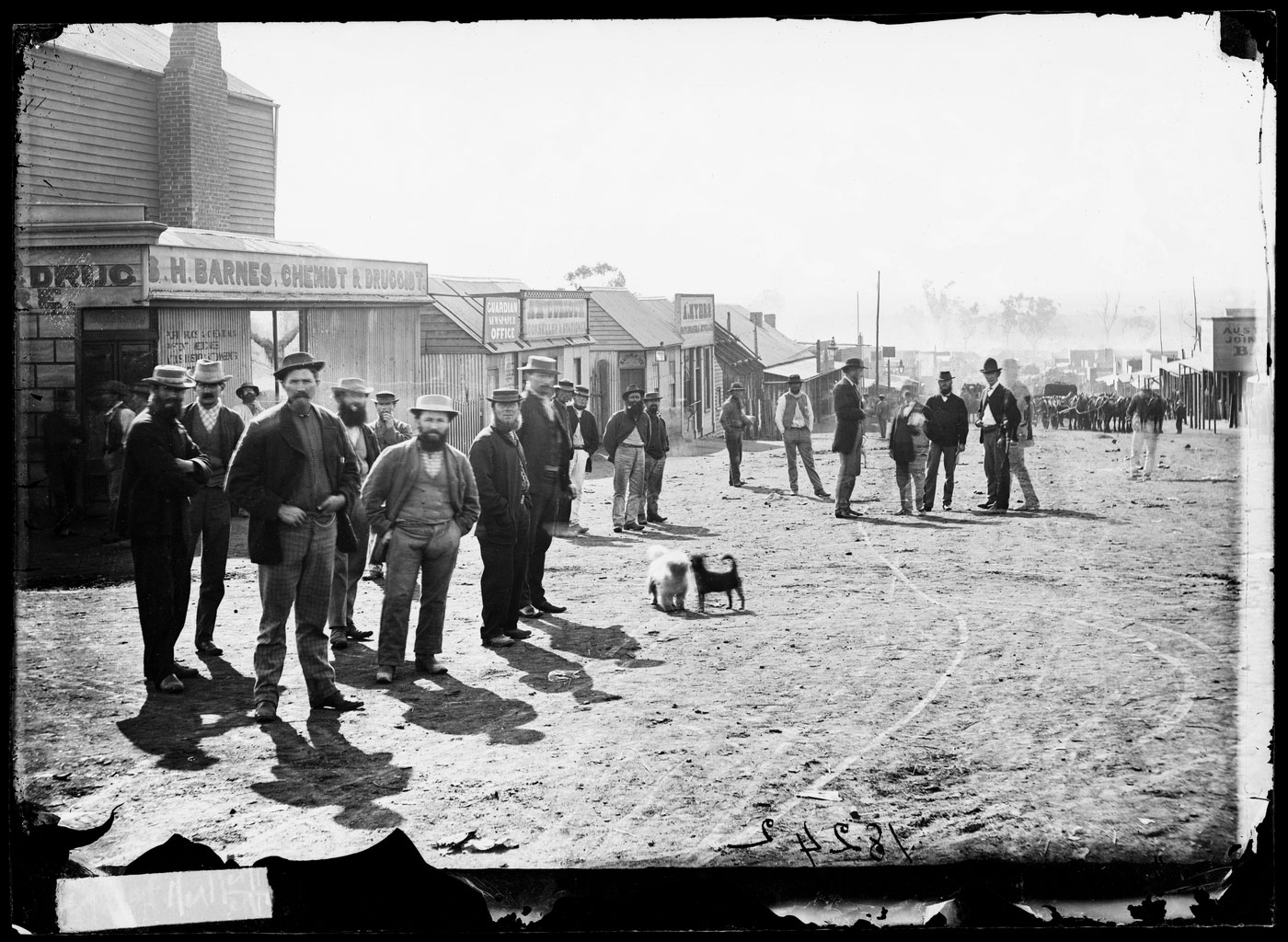
American & Australasian Photographic Company. 'Herbert Street, west side looking north from Mayne Street and showing Barnes' Chemist Shop, Gulgong' 1872


American & Australasian Photographic Company
Herbert Street, west side looking north from Mayne Street and showing Barnes’ Chemist Shop, Gulgong
1872
Wet plate glass negative, on 4/Box 2/No. 18242


The incongruous sight of toy dogs among the rough-and-ready types that inhabited a frontier gold town has been captured in this view of Herbert Street, Gulgong. According to the Empire 28 May 1872, “The streets – so to call the dusty avenues between the rows of shops and Inns – are thronged in the daytime, by much about the same number, though not, apparently by the same sort of persons, as the streets in Sydney. There is not the same bustling activity about them… There are also fewer women amongst them, and fewer well dressed men. The yellow, clay-stained fustian trousers which have never made and never will make acquaintance with the wash-tub, invest the lower extremities of every two men out of three…”


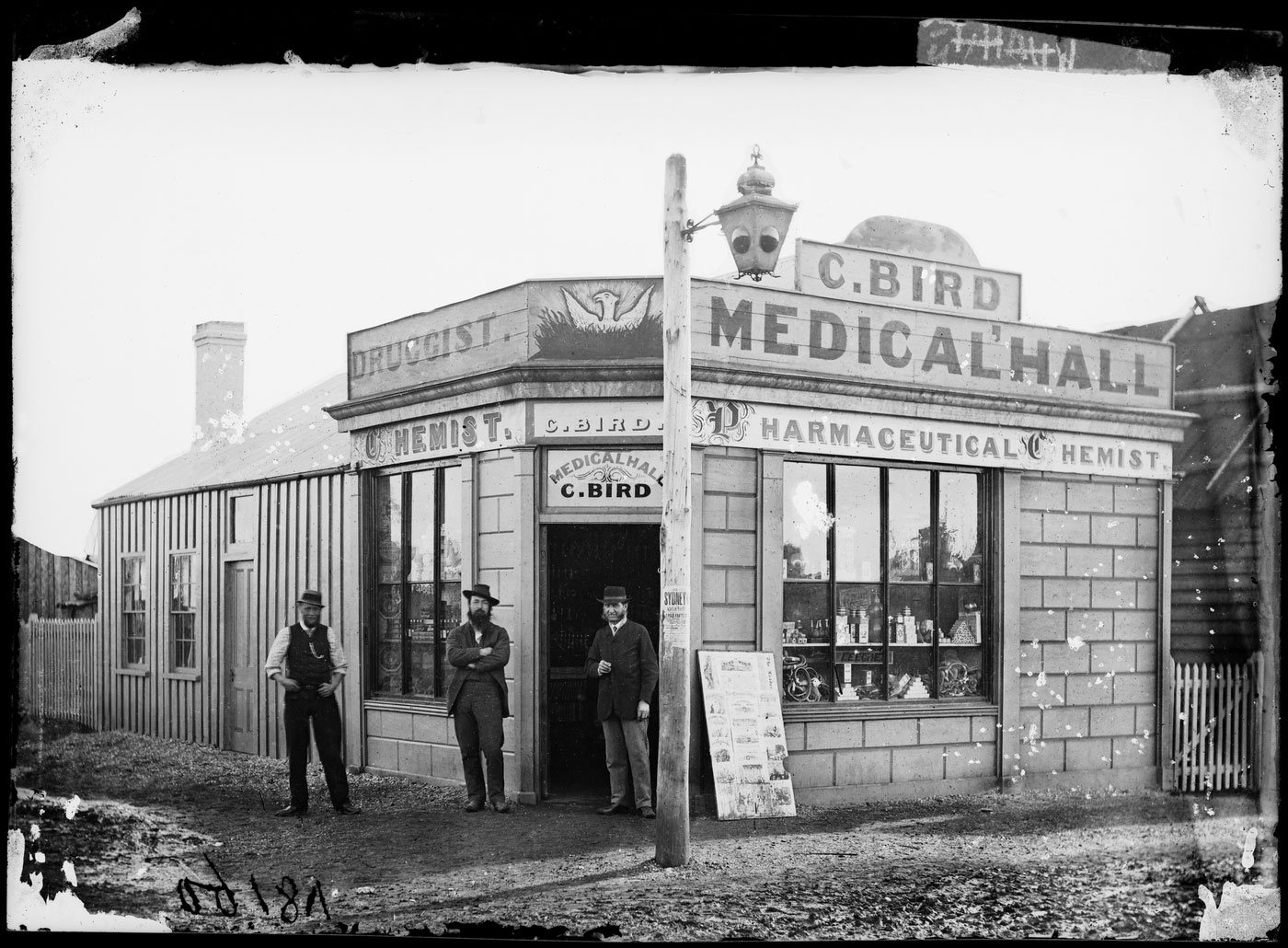
American & Australasian Photographic Company. 'Charles Bird, Medical Hall, Gulgong' 1872


American & Australasian Photographic Company
Charles Bird, Medical Hall, Gulgong
1872
Wet plate glass negative, on 4/Box 2/No. 18160


The Medical Hall of Charles Bird Jnr was situated at the corner of Belmore and Herbert Streets, Gulgong. Charles Bird Snr. conducted another shop at the corner of Mayne and Herbert Streets, until the Medical Hall was sold and converted into a hotel in 1879. The Gulgong Guardian 20 November 1872 noted that Charles Bird had received a new disinfectant “which will be invaluable during the summer months to all who are unfortunate enough to live in those parts of town where stenches are pungent and plentiful.”


American & Australasian Photographic Company. 'Holmes, bootmaker, and Spiro Bennett's store, Gulgong' 1872


American & Australasian Photographic Company
Holmes, bootmaker, and Spiro Bennett’s store, Gulgong
1872
Wet plate glass negative, on 4/Box 3/No. 18314


This timber clad facade fails to conceal the bark structure behind and the poverty of its inhabitants. This is Gulgong bootmaker William Holmes and his family outside their shop in Mayne Street west. His wife Emily, in the doorway, died a few months after the photograph was taken. The town’s short-term architecture was described in The Sydney Morning Herald 30 September 1872. “Gulgong is not singular in its buildings. The followers of alluvial rushes have ere this found that business is fleeting. As leads work out so does business tide away. Hence have we buildings of a temporary nature; and, although the town of Gulgong may be reckoned three years old, yet not a single brick building stands on its site…”


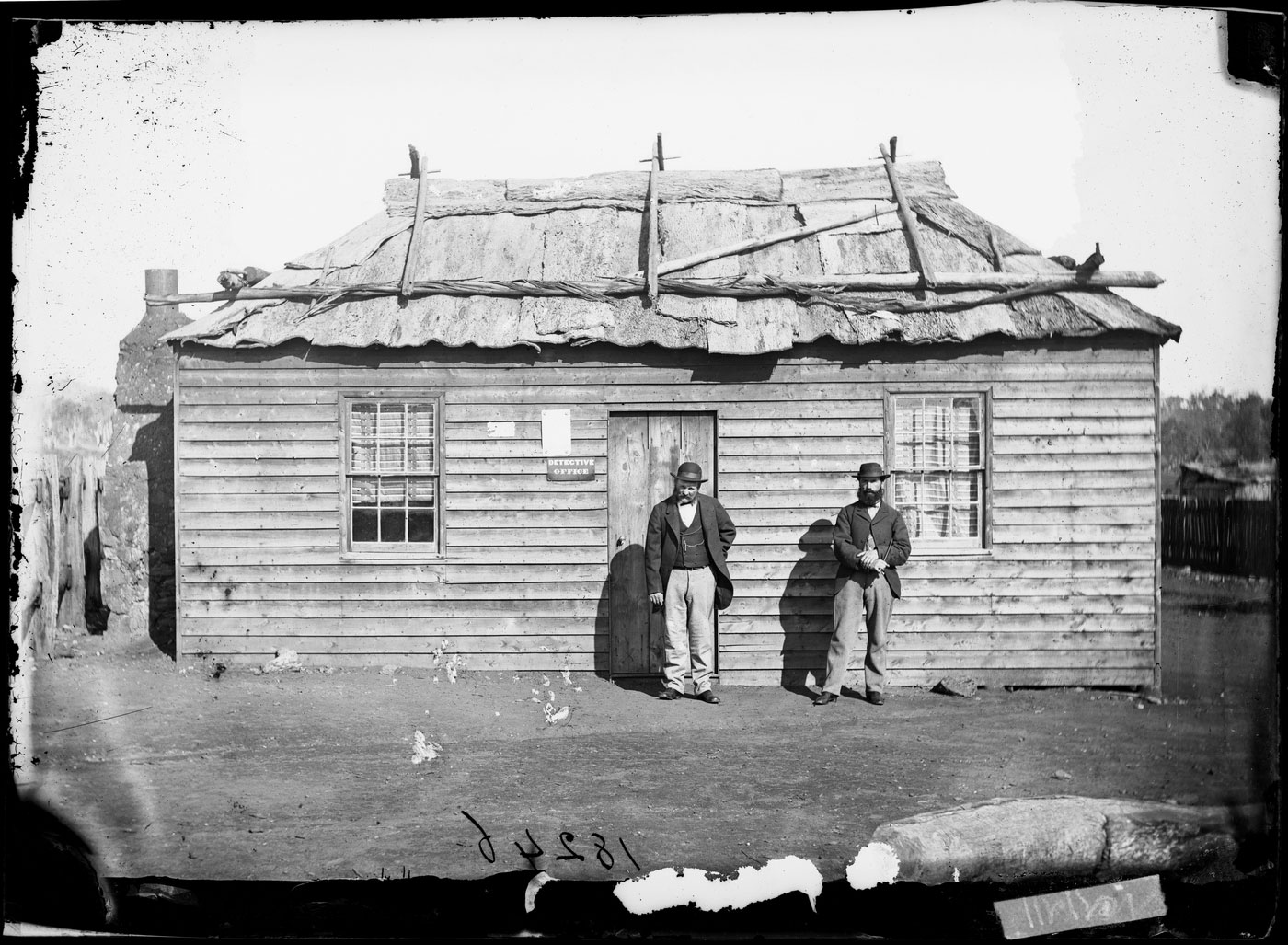
American & Australasian Photographic Company. 'The detectives' 1872


American & Australasian Photographic Company
The detectives
1872
Wet plate glass negative, on 4/Box 2/No. 18246


These are detectives Charles Powell and Robert Hannan, outside their Gulgong office. They had plenty to do. In a letter to the editor of the Maitland Mercury 16 May 1872, William Collins stated “The people (except the bankers and storekeepers), are in general a rough and ready set, occasionally a fight is to be seen, but the very diligent police speedily settle such hostile engagements, by marching the pugilists to a place called the town cage, from which place they are brought in the morning before the magistrate, who has often heard of mercy, but does not know what it means…” Powell and Hannan arrested 14 Chinese for gambling in January 1872 and the Empire 20 January 1872 noted, “In all these cases the lawyers reap a rich harvest, and it was somewhat amusing to witness their actively and interest within ten minutes of the time of arrest.”


American & Australasian Photographic Company. 'The detectives' 1872 (detail)


American & Australasian Photographic Company
The detectives (detail)
1872
Wet plate glass negative, on 4/Box 2/No. 18246


American & Australasian Photographic. 'Company William Lewis, undertaker' 1872


American & Australasian Photographic Company
William Lewis, undertaker
1872
Wet plate glass negative, on 4/Box 2/No. 18168


The establishment of William Thomas Lewis, Undertaker and Carpenter at the corner of Belmore and Herbert Streets was primitive, but his funerals were said to be carried out ‘with his usual taste and completeness’. In 1871, Gulgong lacked a suitable place for burials and the Gulgong Guardian commented several times on the growing outcry for a cemetery. The locals had a valid complaint, particularly because of the considerable mortality rate among the young. In April 1871 alone, nine children died in a fortnight. Even Thomas De Courcy Brown, editor of the Guardian, lost his daughter Rose, age 7 months, in December that year. In January 1872, there were 37 deaths in Gulgong, (including 21 children under 5 years) and 17 births. The newspaper complained that the new cemetery was still unfenced.


American & Australasian Photographic. 'Company William Lewis, undertaker' 1872 (detail)


American & Australasian Photographic Company
William Lewis, undertaker (detail)
1872
Wet plate glass negative, on 4/Box 2/No. 18168


American & Australasian Photographic Company. 'John Osborne, painter and signwriter' 1872


American & Australasian Photographic Company
John Osborne, painter and signwriter
1872
Wet plate glass negative, on 4/Box 4/No. 18372


J.H. Osborne, painter & signwriter of Gulgong also supplied decorative wallpaper. It seems he painted faux marble headstones as well. Osborne’s bark clad establishment was located at 2 Medley Street, at the sparsely populated northern end of town, which explains the prominent display of his sign writing skill. The Empire 28 May 1872 commented on the temporary nature of buildings in Gulgong. “The shops and public-houses are, for the most part, of a very temporary and unsubstantial character, considered as buildings. A large proportion of them are capable of being removed, piecemeal, and set up again on a new diggings in the event of Gulgong declining in prosperity, and a rush taking place to another field within a day or two’s journey.”


American & Australasian Photographic Company. 'John Osborne, painter and signwriter' 1872 (detail)


American & Australasian Photographic Company
John Osborne, painter and signwriter (detail)
1872
Wet plate glass negative, on 4/Box 4/No. 18372


A meeting between gold miner Bernard Otto Holtermann and photographer Beaufoy Merlin in Hill End in 1872 resulted in one of the most astonishing photographic documentations ever undertaken. Holtermann had been associated with the recent discovery of the world’s largest specimen of reef gold, weighing 145 kilograms, extracted from the Star of Hope mine at nearby Tambaroora. Merlin, an itinerant photographer, had just opened a temporary studio in Hill End. In January 1873, the two announced their plans for Holtermann’s great International Travelling Exposition, which would publicise the potential of their adopted country to the world through photography. Merlin and his assistant Charles Bayliss had already photographed some of the gold producing towns of the colony and Holtermann’s patronage enabled them to continue the undertaking, using a larger camera.

Merlin had begun his photographic career in Victoria in 1866 and within a few years had developed a unique style of outdoor photography. Charles Bayliss joined American & Australasian Photographic Company in Melbourne and the pair headed north into New South Wales, photographing towns along the way. When Beaufoy Merlin and Charles Bayliss arrived in Sydney in September 1870, they had already completed an extraordinary documentation of “almost every house in Melbourne, and the other towns in Victoria.” They were aware that their venture was unusual and contemporary advertising by the American & Australasian Photographic Company reflects a considered understanding of the photographic medium and an intellectual approach to their work.

“The chief characteristic and distinguishing feature of the Company’s style of work, is the introduction of figures into the photograph – the most complete and life-like portraits of individuals who happen, or may choose to stand outside, being incorporated in the picture. The A&A Photographic Company desire further to remind the public that these negatives are not taken for the mere immediate object of sale, but that being registered, copies can at all times be had by or of those parties residing in any part of the colonies wherever the Company’s operations have extended, thus forming a novel means of social and commercial intercourse.”

Nevertheless, it is not surprising that Merlin and Bayliss headed west in 1872 with the new gold rushes. The cry “Rush-O!” meant money for businesses, including photographers. A studio for the A&A Photographic Company was built on land owned by Holtermann in Hill End and excursions were made to surrounding areas by horse drawn caravan. The photographic process of the day required the photographer coat each plate just before use and develop it immediately before it lost sensitivity. For the itinerant photographer, this meant taking a portable darkroom wherever he went. Despite the difficulty of the wet plate process, the comprehensive goldfields photography of Merlin and Bayliss has provided a unique documentation of frontier life.

Merlin fell ill and died from pneumonia in 1873, leaving his assistant the task of documenting towns for Holtermann’s Exposition. Consequently, Bayliss toured Victoria the following year, but returned to Sydney in 1875 and began making giant panoramas of the city from Holtermann’s house in North Sydney. The venture was to cost Holtermann over ₤4000, but resulted in the production of the world’s largest wet-plate negatives and several panoramas. One, measuring 10 metres long, astonished audiences overseas and received the Bronze award at the Philadelphia Centennial Exhibition of 1876 and a Silver Medal at the Paris Exposition Universelle Internationale in 1878. Only a small percentage of the A&A Photographic Company’s output has survived, but 3,500 small format wet plates negatives (including extensive coverage of the towns of Hill End and Gulgong) and the world’s largest wet plate negatives, measuring a massive 1 x 1.5 metres, are held by the Library.

Text from The Holtermann Collection website


Charles Bayliss (Australian, 1850-1897) 'The beginning of Home Rule' 1872


Charles Bayliss (Australian, 1850-1897)
The beginning of Home Rule
1872
Wet plate glass negative, on 4/Box 3/No. 18278


Home Rule, 11 km south-east of Gulgong, was only two months old when Charles Bayliss took this photograph. A reporter from the Gulgong Guardian was also in town and wrote on 13 July 1872, “During the past fortnight there has been a great improvement for the better in the appearance of the township at the Home Rule. Large and costly buildings are springing up in every direction and being fitted up for almost every trade. In hotels there is a great change for the better, as in several of them notably Messrs Wright, Moss, and Oliver, the accommodation is almost equal to any on Gulgong; so visitors need not fear that they will suffer hunger or thirst.”


Charles Bayliss (Australian, 1850-1897) 'Tent city, Home Rule' 1872


Charles Bayliss (Australian, 1850-1897)
Tent city, Home Rule
1872
Wet plate glass negative, on 4/Box 3/No. 18285


In the early days of gold rushes, miners usually lived in tents. Here tentmaker J. Booth has confidently set up his canvas shop in Home Rule. The burgeoning new field was described in the Sydney Morning Herald 22 May 1872, “On Friday last there must have been fully fifteen hundred persons upon the ground, and tents and habitations of every description were springing, apparently Iike mushrooms, from the ground, and such is the rapidity with which a gold-fields town is formed, I shall not be surprised to see the place well supplied with stores, and, of course, hotels, when I again visit the place about a fortnight hence.”


Charles Bayliss (Australian, 1850-1897) 'John Davey, baker' 1872


Charles Bayliss (Australian, 1850-1897)
John Davey, baker
1872
Wet plate glass negative, on 4/Box 3/No. 18384


With his shoes covered in flour, John Davey steps outside his bakery in the main street of Canadian Lead. Bread cost 6d a 2lb [5 cents per 900g] loaf. The woman and children to the right also appear outside Ruth Beck’s North Star Hotel, three doors away. The rush to Canadian Lead began in early 1872 and the Maitland Mercury 6 April 1872 was able to state “the Canadian Lead, where a month ago some four hundred people were, can now boast of a couple of thousands…” Not everyone was law-abiding. The Maitland Mercury 24 August 1872 related the story of Mrs Beck dropping a purse containing £21 [$42, worth about $2000 today], which was picked up by her little boy, but taken from him by two men claiming that it was theirs. The miscreants were arrested in Mudgee two days later, drinking the profits.


Charles Bayliss (Australian, 1850-1897) 'John Davey, baker' 1872 (detail)


Charles Bayliss (Australian, 1850-1897)
John Davey, baker (detail)
1872
Wet plate glass negative, on 4/Box 3/No. 18384


Beaufoy Merlin (Australian, 1830-1873) 'Circular Quay from Dawes Battery' 1873


Beaufoy Merlin (Australian, 1830-1873)
Circular Quay from Dawes Battery
1873
Wet plate glass negative, on 4/Box 58/No. 285


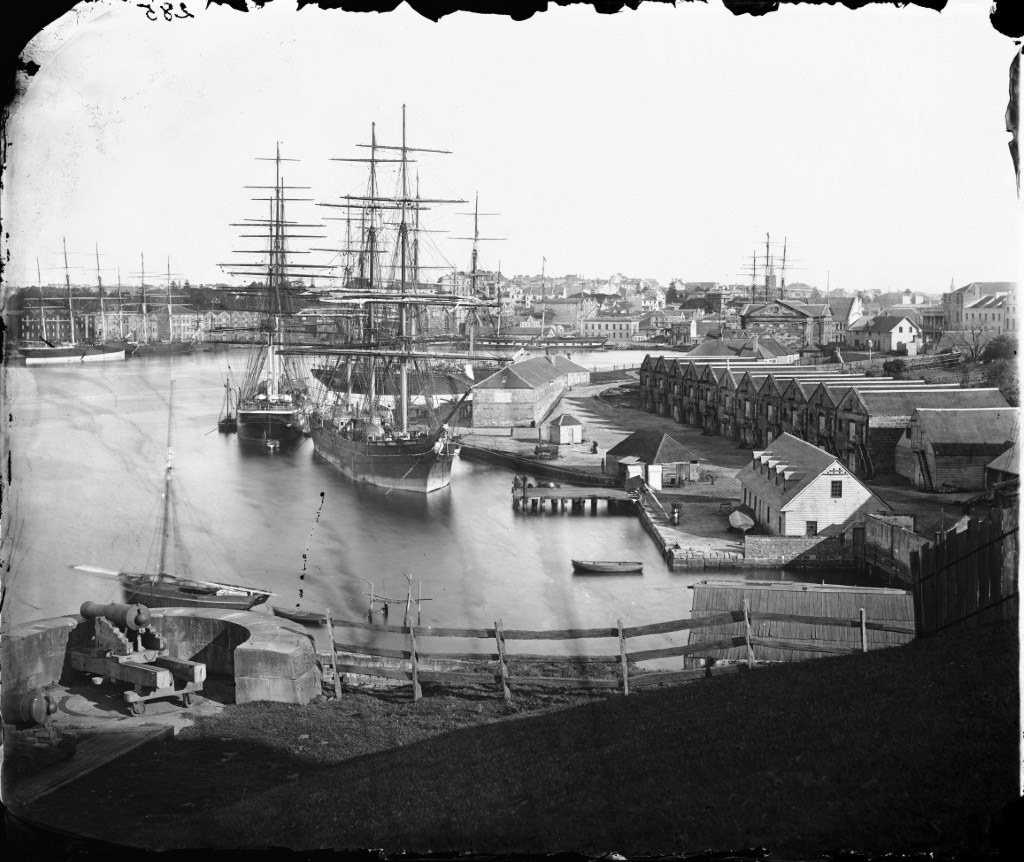
In mid 1873, Beaufoy Merlin returned to Sydney to continue photographing the city for Holtermann. The Sydney Morning Herald 2 August 1873 noted, “Mr. Beaufoy Merlin has taken a considerable number of photographic views of Sydney for the first section of ‘Holtermann’s Intercolonial Exposition’.” This image from Dawes Battery, past Campbell’s Wharf to Circular Quay can be dated to early September 1873, as the Haddon Hall (r) from London, is loading for San Francisco at Campbell’s wharf. Behind it is Aviemore and the ship in background in front of Customs House is La Hogue. Both Aviemore and La Hogue left for London on 13 September 1873.


Charles Bayliss (Australian, 1850-1897) (American & Australasian Photographic Company) 'Pall Mall, Bendigo' 1874


Charles Bayliss (Australian, 1850-1897) (American & Australasian Photographic Company)
Pall Mall, Bendigo
1874
Wet plate glass negative, on 4/Box 78/No. 2


After the death of Beaufoy Merlin in 1873, Bernhardt Holtermann engaged Merlin’s assistant, 24 year-old Charles Bayliss, to continue taking photographs for his planned Exposition. This view of Pall Mall from Hadley’s City Family Hotel, Sandhurst [Bendigo, Victoria] was taken in April 1874. Bayliss photographed the town using the Exposition’s standard 10 x 12 inch (25 x 30cm) glass negatives, but for this image used a mammoth camera specially imported by Holtermann which took glass plates measuring 18 x 22 inches (46 x 56cm). Bayliss also photographed Ballarat in June 1874, using the mammoth camera to produce a panorama from the town hall clock tower.


State Library of New South Wales
Macquarie Street, Sydney
NSW 2000 Australia
Phone: +61 2 9273 1414

Opening hours:
Daily 10am – 5pm

State Library of New South Wales website

LIKE ART BLART ON FACEBOOK

Back to top

Exhibition: ‘An Edwardian Summer: Sydney & beyond through the lens of Arthur Wigram Allen’ at the Museum of Sydney

Exhibition dates: 11th December, 2010 – 25th April, 2011


Many thankx to the Museum of Sydney for allowing me to publish the photographs in the posting. Please click on the photographs for a larger version of the image. All images © Arthur Wigram Allan, courtesy Mitchell Library, State Library of NSW.

More photographs can be found on the An Edwardian Summer website.


Arthur Wigram Allen (Australian, 1894-1967) 'We left Medlow at 10.15 am & drove through Blackheath & Mt Victoria to Bathurst' Nd


Arthur Wigram Allen (Australian, 1894-1967)
We left Medlow at 10.15 am & drove through Blackheath & Mt Victoria to Bathurst
Nd
Mitchell Library, State Library of New South Wales


Arthur Wigram Allen (Australian, 1894-1967) 'AWA & Boyce at lunch' Nd


Arthur Wigram Allen (Australian, 1894-1967)
AWA & Boyce at lunch
Nd
Mitchell Library, State Library of New South Wales


Arthur Wigram Allen (Australian, 1894-1967) 'Kitty and Katha working at the drawn work' Nd


Arthur Wigram Allen (Australian, 1894-1967)
Kitty and Katha working at the drawn work
Nd
Mitchell Library, State Library of New South Wales


Family and friends

Arthur Allen spent many hours recording his home life and outings with family and friends. The Allens’ circle comprised a large extended family and a close-knit group of friends, who came and went as they liked and were always welcome at the various Allen households. They often stayed at the Allens’ properties on the coast and in country New South Wales, as did visiting celebrities, particularly those from the theatre.

While the social and legal status of Australian women improved toward the end of the 19th century, the Allen girls, their cousins and a small group of friends were still taught by governesses. This in turn helped to foster close ties between the members of their social class.

Sydney society among the wealthy classes was like a big, familiar club of relatives and friends, with a continual round of visiting, parties and picnics that also included, for example, visiting naval officers. There were also lively, large-scale social events organised to coincide with special occasions, such as the visit of the Duke of York in 1901, and charity fundraisers for causes in Australia and abroad, including annual Red Cross charity balls and local functions to support soldiers serving in the war.

Arthur Allen owned many cars but drove only one type – Detroit Electric broughams, one of which is now in the Powerhouse Museum, Sydney. Its batteries needed charging every 60 kilometres, but the recharging device was formidable.

Text from the An Edwardian Summer website [Online] Cited 11/01/2020


Arthur Wigram Allen (Australian, 1894-1967) 'Wedding Group at 'Merioola', Saturday 23rd December 1911. Wedding Group consisting of Lieutenant Knowles (best man), Joyce Pat and Kitty, Alex Leeper's two daughters Valentine and Molly [Kitty's half-sisters]' December 1911


Arthur Wigram Allen (Australian, 1894-1967)
Wedding Group at ‘Merioola’, Saturday 23rd December 1911. Wedding Group consisting of Lieutenant Knowles (best man), Joyce Pat and Kitty, Alex Leeper’s two daughters Valentine and Molly [Kitty’s half-sisters]
December 1911
PX*D596 Negative 240
Mitchell Library, State Library of New South Wales


Arthur Wigram Allen (Australian, 1894-1967) '11 November 1917 Mrs Frank Osborne and Miss Catterall wait in the back of one of Arthur Allens Detroit Electric broughams' 1917


Arthur Wigram Allen (Australian, 1894-1967)
11 November 1917 Mrs Frank Osborne and Miss Catterall wait in the back of one of Arthur Allens Detroit Electric broughams
1917
Mitchell Library, State Library of New South Wales


An Edwardian Summer, a new book and an exhibition opening 11th December 2010 at the Museum of Sydney showcases for the first time an extraordinary collection of photographs that capture Sydney at the turn of the century at one of the most rapidly changing times in Australia’s history.

A talented amateur photographer, lawyer and Sydney identity Arthur Wigram Allen was fascinated by the social and technological changes that occurred during his lifetime, 1862-1941. Allen created 51 albums now held by the State Library of NSW.

In 1885 after the sudden death of his father and uncle and at the age of just 23, Allen was thrust into the role of heading up the family law firm founded by his grandfather George Allen, known internationally today as Allens Arthur Robinson. While Allen’s photographs span 1890-1934, the book and exhibition concentrate on the Edwardian years, 1890s-1915, a brief often overlooked but important period in Australia’s history that heralded a new century of significant inventions and social changes, including powered flight, the rise of the motorcar and a new federated Australia.

Through Allen’s lens, we see the first mixed bathing on Sydney beaches, sporting events, pageants and processions, dramatic shipwrecks, the latest fashions as well as intimate family events such as motoring and harbour excursions and bush picnics. Meticulously captioned by Allen, his exquisitely personal and beautiful photographs capture a time of optimism and new ideas as Sydney emerged from the strict moral codes of the Victorian era.

Both the book and exhibition feature art works from the era by Australian artists including Arthur Streeton, Rupert Bunny, Grace Cossington Smith and Theodore Penleigh Boyd. The exhibition will also showcase items from the Historic Houses Trust collection and from the Powerhouse Museum, including examples of Edwardian fashion, children’s dress up costumes, jewellery and accessories and furniture.

Text from the Sydney Museum website [Online] Cited 08/04/2011 no longer available online


 Sydney lawyer and identity Arthur Wigram Allen, a tirelessly enthusiastic photographer, was fascinated by the social and technological changes occurring during his lifetime. His talent for amateur photography produced extraordinary pictures that offer a fresh insight into the Edwardian years in Sydney.

The Edwardian era was sandwiched between the great achievements of the Victorian age and the global catastrophe of World War I. The death of Queen Victoria in January 1901 heralded a new century of significant inventions and social changes, including powered flight, the rise of the motorcar and a new federated Australia.

An Edwardian Summer will present a selection of Arthur Allen’s beautiful images, depicting intimate moments with family and friends, motoring and harbour excursions, theatrical celebrities, bush picnics, the introduction of surf bathing on Sydney beaches, processions, pageants and mass celebrations, and new freedoms in fashion. Most have never before been published, and they form an unrivalled personal pictorial record of these rapidly changing times.

The exhibition will also include artworks by Rupert Bunny, Ethel Carrick Fox, Arthur Streeton and Grace Cossington Smith, examples of male and female fashion including evening and day wear, motoring ensembles and children’s dress-up costumes, jewellery and accessories, furniture and decorative embellishments characteristic of the Edwardian era.

Text from the Sydney Museum website [Online] Cited 11/01/2020


Installation view of the exhibition 'An Edwardian Summer: Sydney & beyond through the lens of Arthur Wigram Allen' at the Museum of Sydney, December 2010 - April 2011


Installation views of the exhibition An Edwardian Summer: Sydney & beyond through the lens of Arthur Wigram Allen at the Museum of Sydney, December 2010 – April 2011


Arthur Wigram Allen

Sydney lawyer and identity Arthur Wigram Allen, a tirelessly enthusiastic photographer, was fascinated by the social and technological changes occurring during his lifetime. His talent for amateur photography produced extraordinary pictures that offer a fresh insight into the Edwardian years in Sydney.

Arthur Wigram Allen was born in 1862 into a large family of wealthy Sydney solicitors. One of 11 children and third in a line of six boys he attended Sydney Grammar School before moving to Melbourne in 1880 to study law at Trinity College at the University of Melbourne. In 1885 after the sudden death of his two elder brothers Arthur assumed control of the familíes Sydney firm and many business interests.

Allen married Ethel Lamb in 1891 and they went on to have four children: Ethel Joyce, born in 1893, Arthur Denis Wigram in 1894, Ellice Margaret in 1896 and Marcia Maria in 1905.

Fascinated by the new inventions of the era, he became interested in photography, purchasing the latest cameras. He soon proved to be a talented amateur photographer, capturing images of his family and friends, the city and its surrounds.

Arthur died in 1941, aged 79; his photographs, taken from the 1890s through to 1934, provide a detailed photographic record of a changing society and the emergence of the great city of Sydney.

A man of extraordinary vitality, Allen was fascinated by the times in which he lived, and tried to photograph everything he saw: family and friends; visiting ships and theatrical celebrities; bush picnics; the first mixed bathing on Sydney beaches; dramatic shipwrecks; processions, pageants and mass celebrations; coal miners; domestic life and fashion; house interiors; and sporting events. These photographs, contained in 51 albums, are now held by the Mitchell Library, State Library of New South Wales, and provide a view of the dramatic changes that took place in Edwardian Sydney.

Arthur Allen’s photographs span 1890 to 1934, but the Edwardian Summer exhibition and book concentrate on those depicting the Edwardian years, a brief, often-overlooked but important period in Australia’s history. The photographs, most of them never published before, form an unrivalled personal pictorial record of these rapidly changing times.

Text from the An Edwardian Summer website [Online] Cited 11/01/2020


Arthur Wigram Allen (Australian, 1894-1967) 'Self-portrait' August - October 1890


Arthur Wigram Allen (Australian, 1894-1967)
Self-portrait
August – October 1890
PX*D 562 negative 162​
Mitchell Library, State Library of New South Wales


Arthur Wigram Allen (or AWA as he often referred to himself) was a man of many interests and a talented amateur photographer, capturing images of family and friends, city and surrounds. He is seen here on the steps of Wantabadgery homestead, site of a famous siege in 1879 between police and the gang of bushranger Captain Moonlight.


Arthur Wigram Allen (Australian, 1894-1967) 'Album 05: Photographs of the Allen family'
August 1890 - October 1890


Arthur Wigram Allen (Australian, 1894-1967)
Album 05: Photographs of the Allen family
August 1890 – October 1890
PX*D 562 FL576221 / FL576430
Mitchell Library, State Library of New South Wales


Arthur Wigram Allen (Australian, 1894-1967) 'Cecil Healy in the dinghy, 'Port Hacking', October 16 1904' 1904


Arthur Wigram Allen (Australian, 1894-1967)
Cecil Healy in the dinghy, ‘Port Hacking’, October 16 1904
1904
PX*D 575 negative 858
Mitchell Library, State Library of New South Wales


Cecil Healy (1881-1918) found fame as the captain of Manly Surf Club and a champion swimmer; he won gold and silver medals in the 1912 Stockholm Olympics.

Cecil Patrick Healy (28 November 1881 – 29 August 1918) was an Australian freestyle swimmer of the 1900s and 1910s, who won silver in the 100 m freestyle at the 1912 Summer Olympics in Stockholm. He also won gold in the 4 × 200 m freestyle relay. He was killed in the First World War at the Somme during an attack on a German trench. Healy was the second swimmer behind Frederick Lane to represent Australia in Swimming and has been allocated the number “2” by Swimming Australia on a list of all Australians who have represented Australia at an Open International Level.

Text from the Wikipedia website


Arthur Wigram Allen (Australian, 1894-1967) '[Roller skating on the verandah at Moombara]' Nd


Arthur Wigram Allen (Australian, 1894-1967)
[Roller skating on the verandah at Moombara]
Nd
PX*D575 negative 836
Mitchell Library, State Library of New South Wales


Roller skating on the verandah at Moombara, September 24, 1904. “Ethel and I and the children came down this afternoon for the Michaelmas holidays bringing Janet & Bob Rabete also. Immediately on arrival Joyce, Denis & Bob began to skate on the verandah and they used Janet & Margaret as horses to pull them along. Margaret also had some splendid rides on her tricycle”

Perhaps the greatest joy for the Allen children was the family’s waterfront holiday house, Moombara, where they played, swam, rode horses and roller skated around the verandah. Roller skating was a popular pastime of the era, with numerous rinks being built from the inner city to the beaches in the late 1880s. The Sydney Skating Club was formed in 1906 and skating displays were a common form of entertainment.

Text from the An Edwardian Summer website


Childhood

The four Allen children had a happy home life. Their somewhat reserved Victorian mother was balanced by their gregarious father, and as in many affluent families of the era they had numerous domestic helpers, including a nurse, Florence, who remained with the family until the children were almost grown.

The family enjoyed many excursions to local Sydney attractions as well as seaside visits, picnics and journeys further afield, including to their beach property at Port Hacking. The children celebrated birthdays with elaborate parties and were dressed in the latest fashions, which were still very much influenced by Britain. Little girls had to contend with layers of petticoats, profuse frills and, during the 1890s and 1900s, increasingly wide-brimmed hats; and neither boys nor girls could be seen in public without hats, gloves, coats and shoes.

Public education in New South Wales, established in the 1860s, also grew steadily towards the century’s end. The three Allen girls, however, like many children from wealthier families, were tutored at home by a governess. The only boy, Denis, attended a private boarding school and was then sent to England to complete his schooling.

Text from the An Edwardian Summer website


Arthur Wigram Allen (Australian, 1894-1967) 'This afternoon Marcia Lamb [centre] and I took Lord Orford and Lady Dorothy Walpole [right], also Nell Knox [left] for a drive to South Head, Bondi and Coogee' February 22, 1911


Arthur Wigram Allen (Australian, 1894-1967)
This afternoon Marcia Lamb [centre] and I took Lord Orford and Lady Dorothy Walpole [right], also Nell Knox [left] for a drive to South Head, Bondi and Coogee
February 22, 1911
PX*D594 negative 4188
Mitchell Library, State Library of New South Wales


Brief stop on a drive to South Head, Bondi and Coogee, February 22, 1911. As Sydneysiders embraced the outdoors, they began picnicking at every opportunity, flocking to local beauty spots or favourite retreats such as Coogee Beach. Although the beach was thronged with bathers and spectators, Coogee’s headland provided a quieter spot for picnicking and, for Arthur Allen, taking photographs. Seen here is his camera equipment, including the box of his Guardia and Newman camera that took 5 x 4 inch (13 x 10 cm) photographic plates. The women are wearing elaborate motoring hats with scarves, which were also useful for securing their hats on a windy cliff to prevent their hair from blowing out of style.

Text from the An Edwardian Summer website


The beach

The pleasures of sea-bathing had been discouraged in colonial Sydney on the grounds of both risk and indecency, and early laws prohibited bathing during daylight hours. People gradually defied the daylight bathing laws and by 1900 there were reports in the press of whole families bathing. In 1902, a male swimmer at Manly Beach entered the water at midday. Although arrested, he was not charged, and by 1903 new laws were introduced that permitted surf bathing but required neck-to-knee outfits and prohibited the sexes to mingle. Mixed bathing soon followed, but swimming attire continued to be stringently regulated for some years to come.

Sydneysiders increasingly flocked to the coast to enjoy the cooling summer breezes and the glorious ocean views. The ‘pleasure palaces’ near many beaches provided popular entertainment for all ages. For picnics, families sought out Clark Island, quiet beaches around Middle Harbour or the popular Manly Beach.

Bondi and Coogee beaches in Sydney’s east were connected to the city by public transport and provided the ideal day-trip for large crowds of visitors. With growing numbers of people taking to the surf, the dangers of beach bathing became apparent, and in 1906 the first surf lifesaving club in the world was founded at Bondi Beach.

Text from the An Edwardian Summer website


Arthur Wigram Allen (Australian, 1894-1967) 'Sea bathing: Coogee'
January 27, 1900


Arthur Wigram Allen (Australian, 1894-1967)
Sea bathing: Coogee
January 27, 1900
PX*D 582 negative 2563
Mitchell Library, State Library of New South Wales


The immense and immediate popularity of sea bathing: Coogee Beach on a summer’s day. The boy in the tie and straw boater contrasts with the enthusiastic swimming groups clad in simple black singlets and shorts or cut-down dresses. In truth, most are just paddling, as few had learnt to swim properly.


Arthur Wigram Allen (Australian, 1894-1967) 'Wonderland city near Bondi' December 26, 1906


Arthur Wigram Allen (Australian, 1894-1967)
Wonderland city near Bondi
December 26, 1906
PX*D580 negative 2002
Mitchell Library, State Library of New South Wales


Wonderland city near Bondi (there were 26 000 people there today). Wonderland city, a large amusement park, the Royal Aquarium and Pleasure Grounds at Tamarama near Bondi, December 26, 1906. By 1901, Bondi Beach was already a fashionable tourist destination. A tramline had been built to the beach in 1894, and a large amusement park, the Royal Aquarium and Pleasure Grounds, had opened at nearby Tamarama in 1887. Wonderland City – promoted as ‘Sydney’s Great Playground’ – opened in December 1906, also at Tamarama. Described as the Coney Island of Australia, its 50 major attractions were ‘designed by artists in architecture and landscape gardening’, with ‘no expense spared in achieving the highest standard of excellence’.1 The wooded slopes featured pleasure palaces, brightly coloured sideshows, a switchback (roller-coaster), scenic railway, slippery dips and underground rivers.

1/ Caroline Mackaness (ed.), An Edwardian Summer: Sydney and Beyond through the Lens of Arthur Wigram Allen, Historic Houses Trust, Sydney, 2010

Text from the An Edwardian Summer website


Arthur Wigram Allen (Australian, 1894-1967) 'Walter resting after lunch' November 19, 1898


Arthur Wigram Allen (Australian, 1894-1967)
Walter resting after lunch
November 19, 1898
PX*D566 negative 3649
Mitchell Library, State Library of New South Wales

Rex Walter and I went to day to Bulli mainly to see some land which had been offered to us to purchase but also to show Walter (Who had never been to Illawarra) the scenery. We lunched at the fig tree not far from the Pass Road at the Bulli “B” pit.


Renowned for its beauty, the Illawarra district was home to towering forests of turpentine and fig trees and tangled, dense stands of ferns and cabbage palms, tinted by the conspicuous red flowers of the Illawarra flame tree. Arthur Allen, his brother Walter and brother-in-law Rex travelled in a horsedrawn wagonette to Bulli, a small coal-mining town in the northern Illawarra, via the steep Bulli Pass road, which was built in 1867. The journey down the Bulli Pass afforded many spectacular views of the south coast.

Text from the An Edwardian Summer website


The bush

In the later 19th century, city dwellers’ attitudes to the Australian bush changed. Formerly a foreign wilderness, it now became a place of Arcadian bliss, offering something peculiarly Australian and very different from the more familiar urban landscapes.

Nationalism increased in the 1890s, and with it the Australian bush legend was born. Artists such as Tom Roberts and Frederick McCubbin created nostalgic bush scenes, depicting rural life as a simplistic and uniquely Australian ideal. Writers such as Banjo Paterson and Henry Lawson fashioned similar impressions in poetry and prose, strengthening the link between the bush and the Australian national identity.

By the early 1900s, the attributes of bush life were seen as an intrinsic part of the nation’s greatness. Bush characters were imbued with the same pioneering qualities as the diggers on the goldfields. By World War I these characteristics would be identified as uniquely Australian traits in our soldiers.

Expanded road and railway networks in the second half of the 19th century opened the bush to city visitors. Roads were cut to link sights of interest, and clear tracks were carved into the bush to allow access to vantage points. Swathes of descriptive tourist guides promoted the state’s many health, holiday and tourist resorts.

Text from the An Edwardian Summer website


Arthur Wigram Allen (Australian, 1894-1967) 'Crossing a creek, Belmore Falls, south of Robertson, on the edge of the Illawarra escarpment' February 13, 1899


Arthur Wigram Allen (Australian, 1894-1967)
Crossing a creek, Belmore Falls, south of Robertson, on the edge of the Illawarra escarpment
February 13, 1899
PX*D567 negative 3822
Mitchell Library, State Library of New South Wales


The Belmore Falls, south of Robertson, are on the edge of the Illawarra escarpment at the headwaters of Barrengarry Creek. They cascade into the Barrengarry Creek Valley, with the main fall dropping a spectacular 78 metres. A road from Robertson was cut through the scrub in 1887, making the falls accessible to tourists, who had been arriving in increasing numbers since the Southern Highlands railway to Mittagong was opened in 1867. The picturesque scenery and cooler climate of the Southern Highlands had made the region a popular summer holiday retreat for well-to-do Sydneysiders. Guesthouses and country homes were built from the 1870s, encouraging the expansion of road networks to connect various sights of interest.

Text from the An Edwardian Summer website


Arthur Wigram Allen (Australian, 1894-1967) '"Lunch at the head of the river" Royal National Park. Frida, Herbert, Ethel, William Wate, Jack, Hilda' Nd


Arthur Wigram Allen (Australian, 1894-1967)
“Lunch at the head of the river” Royal National Park. Frida, Herbert, Ethel, William Wate, Jack, Hilda
Nd
PX*D566 negative 3656
Mitchell Library, State Library of NSW, November 26, 1898


In 1879, an area 32 kilometres south of Sydney was dedicated as Australia’s first national park. It could be reached by road or rail, and swiftly became ‘a national pleasure ground’1 and a popular destination for Sydneysiders on a day-trip. Picnic sites were fashioned throughout the park, rustic bridges and furniture decorated the landscape and imported flora and fauna enhanced the native scenery. By 1886 a boatshed and jetties had been established, enabling visitors to hire boats and explore the park via its waterways. Parties of ladies and gentlemen favoured the freshwater river above the dam, rowing to suitable locations for a relatively informal picnic on the rocky banks by the water.

Text from the An Edwardian Summer website


Arthur Wigram Allen (Australian, 1894-1967) 'One of the new boilers just installed at the mine' November 22, 1907


Arthur Wigram Allen (Australian, 1894-1967)
One of the new boilers just installed at the mine
November 22, 1907
PX*D581 negative 2403
Mitchell Library, State Library of New South Wales


One of the new boilers just installed at the mine. November 22, 1907.

Mt Kembla was one of a series of towns established in the Illawarra region in the mid 19th century after coal mining began at nearby Mt Keira in 1848. The first coal export from the Illawarra left Wollongong harbour in 1849 destined for Sydney. Coal was mined at Mt Kembla from 1865, and in 1880 the Mount Kembla Coal and Oil Company was formed, building a loading wharf at Port Kembla in 1883 and installing a rail link from Mount Kembla to Port Kembla in 1886. By 1900, the Illawarra mines employed 2300 men. In 1902 a disastrous gas explosion, caused by the naked flames of the miners’ torches, killed 94 men.

Text from the An Edwardian Summer website


Further afield

During the Edwardian era, touring became immensely popular. With the introduction of better working conditions and shorter working hours many people had more leisure time, and took every opportunity to enjoy it. Even before the arrival of the motorcar, a growing love of the outdoors led the people of Sydney to flock to beauty spots in the Blue Mountains and Southern Highlands. Rural and waterside retreats around Sydney were as popular then as they are now, and the Allen family and their friends spent many weekends and vacations at their holiday houses at Port Hacking and Burradoo in the Southern Highlands.

To escape the hectic and at times unhealthy city, Sydneysiders sought the more relaxed lifestyle offered in rural locations. People began to enjoy the physical pleasures of life outdoors and the benefits of sun and clean air, and this was reflected in the way they behaved and dressed away from the confines of the city.

People who lacked their own transport could still enjoy tourism via the ever-expanding railway network. For those with private carriages and later motorcars, the ability to travel was only limited by the condition of the roads. The coming of the motorcar changed both the physical development of Sydney and the way people spent their leisure time, as they toured ever further.

Text from the An Edwardian Summer website


Arthur Wigram Allen (Australian, 1894-1967) 'Florence and the children on the lawn at Moombara'
July 1903


Arthur Wigram Allen (Australian, 1894-1967)
Florence and the children on the lawn at Moombara
July 1903
PX*D 572 negative 6
Mitchell Library, State Library of New South Wales


One of the most important people in the lives of the Allen children was their nurse, Florence, who remained with the family until the children were almost grown. She is shown here relaxing with her charges on the lawn at Moombara, the family holiday home that Arthur Allen purchased in 1903. Located between the unspoilt landscape of the Royal National Park and the beaches of Cronulla, it was built on a steep slope with a magnificent view over the river and pristine bushland. Soon after Allen bought the property, a second storey was added to accommodate the family and their many visitors. It was a popular place for family and friends to spend their honeymoon, and came to be nicknamed ‘Honeymoombara’.

Text from the An Edwardian Summer website


Arthur Wigram Allen (Australian, 1894-1967) ''Moombaha'. 5.45 pm on the wharf, Jacob having just caught a large conger eel, Little Turriell Bay at Port Hacking' December 7, 1904


Arthur Wigram Allen (Australian, 1894-1967)
‘Moombaha’. 5.45 pm on the wharf, Jacob having just caught a large conger eel, Little Turriell Bay at Port Hacking
December 7, 1904
PX*D 575 negative 921
Mitchell Library, State Library of New South Wales


Moombara was located on Little Turriell Bay at Port Hacking. In 1901-02 nearly a third of a million tonnes of sand had been removed from the Simpsons Bay area of the estuary to create access to a fish hatchery in Cabbage Tree Basin. This helped to make the area more navigable for boating and better for fishing, both pastimes that the Allens and their friends enjoyed. With increasing numbers of residential subdivisions, the area’s waterways became popular for recreational use.

Text from the An Edwardian Summer website


Arthur Wigram Allen (Australian, 1894-1967) 'Joyce preparing to dive 15 January 1905' 1905


Arthur Wigram Allen (Australian, 1894-1967)
Joyce preparing to dive 15 January 1905
1905
Mitchell Library, State Library of New South Wales


Out and about

Edwardian Sydney offered entertainment for every taste. Apart from the large-scale parades, military displays and massed bands that accompanied public celebrations, annual events such as the Royal Easter Show and the Public Schools’ Amateur Athletics Association carnival drew crowds from all walks of life. Expanding tram and rail networks carried passengers to venues such as the Zoo (then at Moore Park), Sydney Stadium at Rushcutters Bay and the Glaciarium Skating Rink, which operated at Ultimo from 1907.

Among the more popular leisure activities was horse racing, with racecourses as far afield as Randwick, Canterbury, Moorefield and Warwick Farm. The annual amateur picnic race held at Bong Bong, near Moss Vale, was as popular with Sydneysiders as with locals.

The growth in international sporting competition also provided spectacles for large crowds. Due to Australia’s success in rowing, the world championship sculling contest was regularly held on the Parramatta River, while in 1909 the Davis Cup tennis tournament came to Rose Bay. Cricket, cycling, athletics and football were also popular, with the Sydney Cricket Ground a versatile venue.

Text from the An Edwardian Summer website


Arthur Wigram Allen (Australian, 1894-1967) 'Ladies double championship rowing race held on the Parramatta River between Abbotsford and Mortlake' Saturday 4 August 1906


Arthur Wigram Allen (Australian, 1894-1967)
Ladies double championship rowing race held on the Parramatta River between Abbotsford and Mortlake
Saturday 4 August 1906
PX*D 579 negative 1817
Mitchell Library, State Library of New South Wales


On Saturday 4 August 1906, eager onlookers crowded the banks of the Parramatta River and hundreds of launches, boats and steamers plied the water in anticipation of the veteran scullers’ handicap and the ladies’ double sculling championship, contested by a field of ten crews. One week earlier, Stanbury and Towns had competed for stakes of £500 each plus a lucrative share of the steamer takings, but on this day the ladies rowed for a more modest £20. On the 1.5-mile (2.4-km) course between Abbotsford and Mortlake, the Newcastle team of Mrs Hyde and Mrs Woodbridge narrowly beat Misses G and K Lewis of North Sydney for first place.


Arthur Wigram Allen (Australian, 1894-1967) 'Joyce and Denis at the ostrich farm' 15 November 1903


Arthur Wigram Allen (Australian, 1894-1967)
Joyce and Denis at the ostrich farm
15 November 1903
PX*D 573 negative 580
Mitchell Library, State Library of New South Wales


Children hold baby Emus at Ostrich Farm at South Head, 15 November 1903. Joseph Barracluff’s Ostrich Farm at South Head was established in 1889, when ostrich feathers were a popular women’s fashion accessory for boas, hats and fans. Arriving in Australia from Lincolnshire in 1884, Barracluff originally established a small business selling feathers from a shop on Elizabeth Street, before setting up the farm with birds reportedly imported from South Africa and Morocco. A trip to Barracluff’s farm soon became a popular excursion, and patrons could select feathers to be cut directly from a flock of 100 birds. In 1901, as a memento of her visit, the women of Sydney presented the Duchess of Cornwall and York with a gold mirror and fan embellished with tortoiseshell and Barracluff’s feathers, grown and curled on site.


Arthur Wigram Allen (Australian, 1894-1967) 'The 'Electra' … T. H. Kelly, Denis, Miss Kelly, Joyce, W. Kelly. The children's first experience of yachting Arthur Allen. The children's first experience of yachting' 14 April 1901


Arthur Wigram Allen  (Australian, 1894-1967)
The ‘Electra’ … T. H. Kelly, Denis, Miss Kelly, Joyce, W. Kelly. The children’s first experience of yachting Arthur Allen. The children’s first experience of yachting
14 April 1901
PX*D 571 negative 95
Mitchell Library, State Library of New South Wales


Yachting built up a strong following among the wealthy during the Edwardian years, with boats from the Royal Sydney Yacht Squadron regularly competing in organised races on the harbour. Joining Arthur Allen and his two elder children, Joyce and Denis, in this photo are members of the Kelly family: Thomas, William and their sister. Thomas Kelly was managing director of the family firm, the Sydney Smelting Company, and chairman of the Australian Alum Company; his brother William was a politician. Both brothers were considered dashing young men about town. The Kellys were keen yachtsmen and closely involved with Royal Sydney Yacht Squadron, founded in 1863.


A day on the harbour

Sydney’s waterways were the focus of both industry and pleasure in the Edwardian era. From its colonial foundations Sydney Cove had developed as the hub of a trading port and working harbour with a strong shipbuilding industry and other maritime trades.

During the Edwardian years, full-rigged ships gradually disappeared from Sydney Harbour, and after the bubonic plague arrived in 1900, large areas of residential and commercial buildings around Darling Harbour, Millers Point and The Rocks were resumed by the government and rebuilt.

By the early 1900s Circular Quay was dominated by ferry wharves and served as an interchange for all the traffic – pedestrian and vehicular – between Sydney and the north shore. This was the heyday of the harbour ferry, with commuter craft dominating the waters during peak hour. On weekends, the ‘great picnic trade’ ferried Sydney’s multitudes to the harbour’s pleasure destinations, many of which were owned and operated by the ferry companies.

Other Sydneysiders preferred to spend a day on the water, enjoying a leisurely steamer excursion, messing about in a small boat or sailing a yacht. Sporting events provided a further form of entertainment, with annual yachting and rowing regattas held on the harbour.


Arthur Wigram Allen (Australian, 1894-1967) 'Another who is not quite so sure' Nd


Arthur Wigram Allen (Australian, 1894-1967)
Another who is not quite so sure
Nd
Mitchell Library, State Library of New South Wales


Arthur Wigram Allen (Australian, 1894-1967) 'The 'Euryalus' in dock' 17 August 1905


Arthur Wigram Allen (Australian, 1894-1967)
The ‘Euryalus’ in dock
17 August 1905
PX*D 577 negatives 1279
Mitchell Library, State Library of New South Wales


HMS Euryalus was the flagship of the Australian station of the Royal Navy between 1904 and 1905. The 144-metre armoured cruiser was built in England in 1901, and Arthur Allen photographed it in August 1905, while it was being overhauled in the Sutherland Dock at Cockatoo Island.[1] Soon afterwards the Euryalus was replaced by HMS Powerful, and in 1920 it was broken up in Germany. On its completion in 1890, the Sutherland Dock was the world’s largest dry dock. The island’s smaller Fitzroy Dock had been built by convicts between 1839 and 1847. Cockatoo Island became the Commonwealth Naval Dockyard in 1913 and shipbuilding continued there until the dockyard closed in 1991.


Museum of Sydney
cnr Bridge & Phillip Streets, Sydney

Opening hours:
Open daily 10am – 5pm

Sydney Living Museums website

An Edwardian Summer website

LIKE ART BLART ON FACEBOOK

Back to top