Exhibition: ‘Photo-Secession: Painterly Masterworks of Turn-of-the-Century Photography’ at the Utah Museum of Fine Arts, Salt Lake City

Exhibition dates: 24th August – 29th December 2024


Peter Henry Emerson (British born Cuba, 1856-1936) 'Poling the Marsh Hay' c. 1885 from the exhibition 'Photo-Secession: Painterly Masterworks of Turn-of-the-Century Photography' at the Utah Museum of Fine Arts, Salt Lake City, August - December 2024


Peter Henry Emerson (British born Cuba, 1856-1936)
Poling the Marsh Hay
c. 1885
Platinum print on paper


Id est / that is

Voluptuous = relating to or characterised by luxury or sensual pleasure

Sensual = late Middle English (in the sense ‘sensory’): from late Latin sensualis, from sensus (see sense)

Sense = various; including:

~ a reasonable or comprehensible rationale i.e. the latent and emerging Modernism inherent in Photo-Secession photographs

~ the way in which a situation [in this case the “reading” of a photograph] can be interpreted i.e. the interpretation of Photo-Secession photographs as either Pictorialist, Modernist or a combination of both

~ a keen intuitive awareness of or sensitivity to the presence or importance of something i.e. the feeling of the photographer towards the object of their attention, revealed in the print, whether that be a nude, a building, pears and an apple or the side of a white barn

~ to be aware of (something) without being able to define exactly how one knows i.e. to be able to detect, recognise, and feel that ineffable “something” that emanates from the object of (y)our attention… in the act of creativity, in the act of seeing

Bringing something to our senses

Thus, the older I get the more I appreciate the faculty of feeling, thought and meaning that is revealed in these revolutionary photographs.

Dr Marcus Bunyan


Many thankx to the Utah Museum of Fine Arts for allowing me to publish the photographs in the posting. Please click on the photographs for a larger version of the image.


Quotes on Walls

“Why, Mr. Stieglitz, you won’t insist that a photograph can possibly be a work of art – you are a fanatic!”


Luigi Palma de Cesnola, Director of the Metropolitan Museum of Art, reportedly said to Alfred Stieglitz, 1902


“The painter need not always paint with brushes, he can paint with light itself. Modern photography has brought light under control and made it as truly art-material as pigment or clay. … The photographer has demonstrated that his work need not be mechanical imitation. He can control the quality of his lines, the spacing of his masses, the depth of his tones and the harmony of his gradations. He can eliminate detail, keeping only the significant. More than this, he can reveal the secrets of personality. What is this but Art?”


Arthur Wesley Dow, 1921


“The photographer’s problem therefore, is to see clearly the limitations and at the same time the potential qualities of his medium… without tricks of process or manipulation, through the use of straight photographic methods. … Photography is only a new road from a different direction but moving toward the common goal, which is Life.”


Paul Strand, 1917


“Pictorial photography owes its birth to the universal dissatisfaction of artist photographers in front of the photographic errors of the straight print. Its false values, its lack of accents, its equal delineation of things important and useless, were universally recognised and deplored by a host of malcontents… I consider that, from an art point of view, the straight print of today is not a whit better than the straight print of fifteen years ago. If it was faulty then it is still faulty now.”


Robert Demachy, 1907


“Gum, diffused lenses, (ultra) glycerining, were of experimental interest once. … Most of these are of more value historically than artistically. The prints are neither painting (or its equivalents) nor photographs. Let the photographer make a perfect photograph. It will be straight and beautiful – a true photograph.”


Alfred Stieglitz, 1919


Photo-Secession: Painterly Masterworks of Turn-of-the-Century Photography celebrates an intrepid group of photographers, led by preeminent photographer Alfred Stieglitz, who fought to establish photography as fine art, coequal with painting and sculpture at the turn of the 20th century. The Photo-Secession movement took cues from European modernists – who seceded from centuries-old academic traditions – to demonstrate photographic pictures’ aesthetic, creative, and skilful value as art. An homage to Stieglitz, Photo-Secession includes some of the very images that established the appreciation of photography’s artistic merits.

The UMFA will present this exhibition concurrently with Blue Grass, Green Skies: American Impressionism and Realism from the Los Angeles County Museum of Art to draw attention to the cyclical dialogue between painting and photography in the late 19th and early 20th centuries. During this period, photographers manipulated their images at various stages of production to imitate painterly effects, while painters worked and reworked their oils to imitate the immediacy of photography, demonstrating a remarkable reciprocity between these two art forms.

Text from the Utah Museum of Fine Arts website


Installation view of the exhibition 'Photo-Secession: Painterly Masterworks of Turn-of-the-Century Photography' at the Utah Museum of Fine Arts showing the work of Heinrich Kühn

Installation view of the exhibition 'Photo-Secession: Painterly Masterworks of Turn-of-the-Century Photography' at the Utah Museum of Fine Arts showing the work of Heinrich Kühn


Installation view of the exhibition Photo-Secession: Painterly Masterworks of Turn-of-the-Century Photography at the Utah Museum of Fine Arts showing the work of Heinrich Kühn
Image courtesy of the Utah Museum of Fine Arts


Installation view of the exhibition 'Photo-Secession: Painterly Masterworks of Turn-of-the-Century Photography' at the Utah Museum of Fine Arts showing at centre from left to right, Bernard Shea Horne 'Doorway Abstraction'; Drahomir Josef Ruzicka 'The Arch, Pennysylvannia Station' c. 1920; Arnold Genthe 'Acoma Pueblo, New Mexico' c. 1920; William E. Dassonville 'The Great Highway, San Francisco' c. 1905


Installation view of the exhibition Photo-Secession: Painterly Masterworks of Turn-of-the-Century Photography at the Utah Museum of Fine Arts showing at centre from left to right, Bernard Shea Horne Doorway Abstraction; Drahomir Josef Ruzicka The Arch, Pennysylvannia Station c. 1920; Arnold Genthe Acoma Pueblo, New Mexico c. 1920; William E. Dassonville The Great Highway, San Francisco c. 1905


Installation view of the exhibition 'Photo-Secession: Painterly Masterworks of Turn-of-the-Century Photography' at the Utah Museum of Fine Arts showing from top left to right, Edward Steichen 'Lotus, Mount Kisco' 1915; Edward Steichen 'Calla Lily' c. 1921; Edward Steichen 'Three pears and an apple' c. 1921; Edward Steichen 'Blossom of White Fingers' c. 1923


Installation view of the exhibition Photo-Secession: Painterly Masterworks of Turn-of-the-Century Photography at the Utah Museum of Fine Arts showing from top left to right, Edward Steichen Lotus, Mount Kisco 1915; Edward Steichen Calla Lily c. 1921; Edward Steichen Three pears and an apple c. 1921; Edward Steichen Blossom of White Fingers c. 1923


Installation view of the exhibition 'Photo-Secession: Painterly Masterworks of Turn-of-the-Century Photography' at the Utah Museum of Fine Arts

Installation view of the exhibition 'Photo-Secession: Painterly Masterworks of Turn-of-the-Century Photography' at the Utah Museum of Fine Arts


Installation view of the exhibition Photo-Secession: Painterly Masterworks of Turn-of-the-Century Photography at the Utah Museum of Fine Arts


Installation view of the exhibition 'Photo-Secession: Painterly Masterworks of Turn-of-the-Century Photography' at the Utah Museum of Fine Arts showing in the display cabinet issues of the magazine 'Camera Work', 1903-1917. Edited by Alfred Stieglitz and Edward Steichen


Installation view of the exhibition Photo-Secession: Painterly Masterworks of Turn-of-the-Century Photography at the Utah Museum of Fine Arts showing in the display cabinet issues of the magazine Camera Work, 1903-1917. Edited by Alfred Stieglitz and Edward Steichen


The Role of Camera Work

One of the key platforms for the Photo-Secession movement was the influential journal Camera Work, edited by Stieglitz and Steichen. Published from 1903 to 1917, Camera Work featured the work of Photo-Secessionists alongside essays and critiques that championed the artistic potential of photography. The journal played a crucial role in shaping public and critical perceptions of photography, providing a space for photographers to showcase their work and engage in intellectual discourse.

Adelaide Ryder. “The Photo-Secession Movement: Pioneering Artistry in Early Photography,” on the UMFA website Nd [Online] Cited 22/10/2024


Introduction

This exhibition celebrates 26 intrepid artists at the turn of the 20th century who sought to establish photography as a fine art equal to long-established media like painting, sculpture, drawing, and printmaking. This movement in the United States centred on the group dubbed the Photo-Secession. While each of the Photo-Secessionists had their distinctive approaches, their works are hand-crafted photographic prints of traditional artistic subjects, such as landscape, portraiture, figure study, and still life. This combination of painterly imagery and printmaking is also known as Pictorialism.

The passionate leader and tenacious advocate of the Photo-Secession was Alfred Stieglitz, who advanced the visions of the most ambitious photographers of the time, including Heinrich Kühn, Gertrude Käsebier, Edward Steichen, Paul Strand, and Clarence White. Stieglitz tirelessly promoted art photography through his exhibition space in New York City – the Little Galleries of the Photo-Secession and later called simply 291 – as well as through the journals he edited – Camera Notes (1897-1903) and Camera Work (1903-1917).

This exhibition also covers the breakup of the Photo-Secession, as some photographers rejected Pictorialism while others remained staunchly committed to it. The Photo-Secession itself irrevocably split apart around 1917. Artists led by Stieglitz, Steichen, and Strand switched to Straight Photography, an approach involving sharp focus and direct printing of the original shot. Artists led by Käsebier and White continued to innovate through painterly approaches using soft focus and manipulated prints.

The works in this exhibition represent some of the most influential artists and iconic images of the period as well as superb examples of a variety of photographic printing techniques, including platinum, gum-bichromate, carbon, cyanotype, and bromoil.

All works of art this exhibition are from the private collection of Michael Mattis and Judith Hochberg. This exhibition is organised by art2art Circulating Exhibitions.

The Rebirth of Art Photography in Europe

In the first few decades after the invention of photography in 1839, painters played an instrumental role in the development of this new medium. Artist-photographers like D.O. Hill in Edinburgh and Gustave Le Gray in Paris exhibited their photographs alongside paintings, drawings, and prints. The novelty of the photograph led to the proliferation of portrait studios and mass-produced views of famous monuments or exotic locales for the tourist trade. By the 1860s photography was considered a bourgeois technical profession. The Kodak camera, first issued in 1888, further popularised photography with its roll film, simple controls, and reasonable cost of one dollar (about $33 today).

Even as more and more individuals could access the means to make photos, artist-photographers advocated for the status of their medium and demanded a differentiation between their work and the products of point-and-shoot cameras. In 1889 Peter Henry Emerson published the book Naturalistic Photography for Students of the Art, which proposed a role for landscape photographers equal to esteemed painters like Camille Corot and Jean-François Millet. Emerson’s publication was a clarion call for a new generation of artistic photographers, and Pictorialism was born.

Pictorialist photographers enthusiastically pursued their new movement, pioneering soft-focus lenses and manipulatable printing methods. Soon they were forming regional clubs across Europe and resumed exhibiting their prints as art. The photographers that formed the t in London were particularly active and influential, and Pictorialism spread to other cultural centres like Paris, Berlin, and Vienna.

Alfred Stieglitz and the American Pictorialist Movement

Born in Hoboken, New Jersey, but educated largely in Germany, Alfred Stieglitz (1864-1946) watched the flowering of European Pictorialism with a mixture of aesthetic appreciation and fierce competitiveness, writing in 1892:

“Every unbiased critic will grant that we [American photographers] are still many lengths in the rear, apparently content to remain there, inasmuch as we seem to lack the energy to strive forward – to push ahead with that American will-power which is so greatly admired by the whole civilised world.”

Energised by European Pictorialism, Stieglitz championed juried photographic salons in Boston, New York, and Philadelphia. He also edited a series of increasingly ambitious journals about Pictorialist photography, starting with The American Amateur Photographer in 1893, then Camera Notes in 1897, and finally Camera Work starting in 1903. He inaugurated and named the Photo-Secession movement through the landmark exhibition he curated in 1903 at the National Arts Club in New York, which comprised 162 works by 32 artists. The name “Photo-Secession” referred to European avant-garde artistic movements, and in his own words, “Photo-Secession actually means a seceding from the accepted idea of what constitutes a photograph.” Eventually European artists would also be invited to join the Photo-Secession.

In 1905 Stieglitz opened a space at 291 Fifth Avenue in New York, the Little Galleries of the Photo-Secession, later simply called 291. It was the first retail gallery devoted to photography. He supported the venture with his own resources and generous assistance from others, and Edward Steichen was his steadfast associate. By 1915 Stieglitz was also showing avant-garde painting and sculpture at 291, including works by Pablo Picasso, Henri Matisse, and Constantin Brâncuși. Thus, he sought to demonstrate the idea that all art forms were on par with and informed one another.

Close Collaborations and the Sudden End of the Photo-Secession

From 1907 to 1910 Alfred Stieglitz and Clarence White closely collaborated on photographs and a landmark photography exhibition. In 1907 they made a series of 60 nudes, Stieglitz posing the models and White focusing the camera and making most of the prints. The following year, Stieglitz devoted an entire issue of Camera Work to White. In 1910 Stieglitz and White co-curated the International Exhibition of Pictorial Photography at Buffalo’s Albright Gallery (now Albright Knox Gallery). This historic project that included over 600 prints is now regarded as the apex of the Photo-Secession. It was also the final monument of the movement, as each of the major Pictorialists, White included, broke away from Stieglitz in the years that followed.

Significant reasons for the end of the Photo-Secession were Stieglitz’s authoritarian personality and disdain for photographers who needed to earn a living rather than exclusively pursue art for art’s sake. Philosophical differences also explain the rupture. Stieglitz had come to believe that Pictorialism had run its course. The irony was that the Photo-Secession had established photography as fine art through images that imitated other art forms by manipulation at every stage of the process – from lens to negative to print. Their pictures to varying degrees used methods that denied the very essence of photography. Stieglitz asserted that it was time to abandon the “painterly photograph” and to champion photography as fine art with compelling pictures that were truly photographic.

Late Pictorialism and the Clarence White School

As the artist Georgia O’Keeffe, Alfred Stieglitz’s partner for 30 years, acknowledged, “He was either loved or hated – there wasn’t much in between.” For reasons both personal and professional, most of the leading Photo-Secessionists chose not to follow Stieglitz and Paul Strand into Straight Photography. Many clustered instead around Clarence White, who in his gentle and encouraging manner was the antithesis of Stieglitz. In 1914 White founded the Clarence White School of Photography in New York City. In 1916 White along with Gertrude Käsebier and Alvin Langdon Coburn co-founded Pictorial Photographers of America; this new society welcomed members of all backgrounds and published the new journal Photo-Graphic Art.

The Clarence White School continued to be a locus for the training of new photographers until 1940, under the guidance of White’s widow Jane White after his death in 1925. Among the most prominent students of Clarence White are Karl Struss, Anne Brigman, Laura Gilpin, and Doris Ulmann, all of whom are represented in this exhibition. Other notable pupils of White include Margaret Bourke-White, Anton Bruehl, Paul Outerbridge, and Dorothea Lange.

Straight Photography, Edward Steichen, and Paul Strand

The final section of this exhibition focuses on Straight Photography and two of Alfred Stieglitz’s most notable protégés, Edward Steichen and Paul Strand. Between them, they pioneered leading branches of 20th-century American photography.

With the entry of the United States into World War I, both Steichen and Strand were drafted into the U.S. Army. Steichen was a photographer for the Army Air Service Signal Corps in Europe, and Strand was an X-ray technician in the Army Medical Corps. In the years immediately after WWI, they each turned their attention to photographing the natural world: flowers and fruit in Steichen’s case, and toadstools, grasses, and ferns in Strand’s. Both would return to photographing their gardens in the final years of their lives.

Outside the naturalist realm, Steichen and Strand’s paths diverged.

Steichen, an extrovert, pioneered modern fashion and advertising photography for the Condé Nast magazines Vogue and Vanity Fair. Later he was named Director of the Department of Photography at the Museum of Modern Art in New York, where he organised the landmark exhibition, Family of Man, which traveled to 37 countries on six continents and was seen by an estimated nine million people.

Strand, an introvert, traveled to remote places around the world, documenting the landscape, architecture, and people, his work exuding a respect for the dignity of the labouring class, which he absorbed from his mentor, Lewis Hine. Overall, Strand’s profoundly humanist scenes of everyday life influenced a generation of socially conscious photographers who documented the 20th-century crises of the Dust Bowl, the Great Depression, World War II, and more.

Heinrich Kühn

In the late 19th century, European Pictorialism was divided into two camps. On the one side were the purist photographers who, aside from a softening of the lens, opposed extensive manipulation of the negative or the print for artistic effect. On the other side were those who derided “button-pushers” and viewed the “straight” photograph as merely the raw material from which to create an artistic print through elaborate handiwork.

The leader of this latter camp was Heinrich Kühn (1866-1944). Eschewing Modernist tendencies, he chose traditional subject matter of painting from the 17th through 19th centuries: still life, figural studies, and genre scenes. His preference for gum-bichromate and bromoil printmaking techniques, which allowed for extensive manipulation, were intended to provoke the reaction in the viewer: is that really a photograph?

Born in Dresden, Kühn moved to Innsbruck, Austria, after youthful studies in science and medicine. Thanks to a sizeable inheritance, he could devote himself to artistic photography, joining both the Linked Ring in London and Stieglitz’s Photo-Secession in the United States. A trans-Atlantic correspondence with Stieglitz began in 1899 and lasted three decades. They congratulated one another on their latest triumphs and encouraged each other through professional and personal disappointments. In 1909, with Stieglitz’s assistance, Kühn organised the International Photographic Exhibition in Dresden, one of the high points of Pictorialism.

Later in life, Kühn filed multiple patents in photochemistry and camera technology related to Pictorialist photography, but none earned him any money. Tastes had changed, and the painterly photograph had become a quaint curiosity.

Gertrude Käsebier

Gertrude Käsebier (1852-1934) was 37 years old, married, and had three children by the time she began studying art at the Pratt Institute. She had originally purchased a camera to make portraits of her children, but Pratt encouraged its women students to earn a living in the arts. By 1897 she opened a one-room commercial portrait studio in New York City. Her ambition was to make “not maps of faces, but likenesses that are biographies, to bring out in each photograph the essential personality that is variously called temperament, soul, humanity.”

Recognition for Käsebier’s talent and ability came swiftly. In 1898 the painter William Merritt Chase, judging the Philadelphia Photographic Salon, called her work “as fine as anything that [Anthony] Van Dyck has ever done.” For Stieglitz, who organised her first solo show in 1899 at the Camera Club of New York, Käsebier was “beyond dispute the leading portrait photographer in this country.” That year, she sold one of her photographs for the unheard-of sum of $100 (almost $3,800 today).

However, by the time that the Brooklyn Museum honoured Käsebier with a career retrospective in 1929, Pictorialist photography had fallen so far out of fashion that the exhibition was not even reviewed in major journals.

Clarence Hudson White

Clarence Hudson White (1871-1925) was a modest, soft-spoken, entirely self-taught genius from America’s heartland. Raised in the small town of Newark, Ohio, he eked out a living as a bookkeeper for a wholesale grocer; each week he saved enough to purchase two glass plates for his camera. He specialised in gorgeously back-lit domestic interior scenes featuring his friends and members of his close-knit extended family.

White’s contributions to the 1898 Philadelphia Photographic Salon were so highly praised that, like Gertrude Käsebier, he was appointed a judge for the following year. The annual salons of the Newark Camera Club that he organised featured the nation’s preeminent Pictorialists and were the direct precursor to Stieglitz’s Photo-Secession. Indeed, the 1900 salon featured his friend and latest discovery, Edward Steichen of Milwaukee.

From 1907 onwards, both in New York City and during summers in rural Maine, White was also America’s foremost teacher of photography. Many of the leading American photographers of the 20th century studied at the Clarence White School.

Paul Strand

In 1915 Alfred Stieglitz found in the young Paul Strand (1890-1976) the leader of a remarkable new direction in photography. Strand had been a senior at the Ethical Culture High School in 1907 when he first visited Gallery 291 on a class trip with his photography teacher, Lewis Hine, whose poignant documents of immigrants and child labor were staples of the Progressive Movement. Eight years later, after thousands of hours in the darkroom at the New York Camera Club, Strand returned to 291 with a portfolio of platinum prints that pointed the way to a new era. Stieglitz deemed them “brutally direct, devoid of all flim-flam, devoid of trickery and of any ‘ism’. These photographs are the direct expression of today.” Stieglitz not only offered Strand an exhibition at 291, but also devoted the final two issues of Camera Work exclusively to him.

What was so compelling and inspiring to Stieglitz in Strand’s photography? His portfolio contained pictures of urban street life and architecture, as well as powerful close-ups of weathered New York faces (influenced by Lewis Hine), boldly composed still lifes, and shadow abstractions taken on a porch in Twin Lakes, Connecticut.

As for photography’s future, Strand and Stieglitz saw eye to eye. In his essay in Camera Work, Strand called for the universal adoption of Straight Photography “without tricks of process or manipulation.” In a provocative lecture at the Clarence White School, Strand condemned “this so-called pictorial photography, which is nothing but an evasion of everything photographic.”


Works by Emerson, Post, Evans, and Sutcliffe
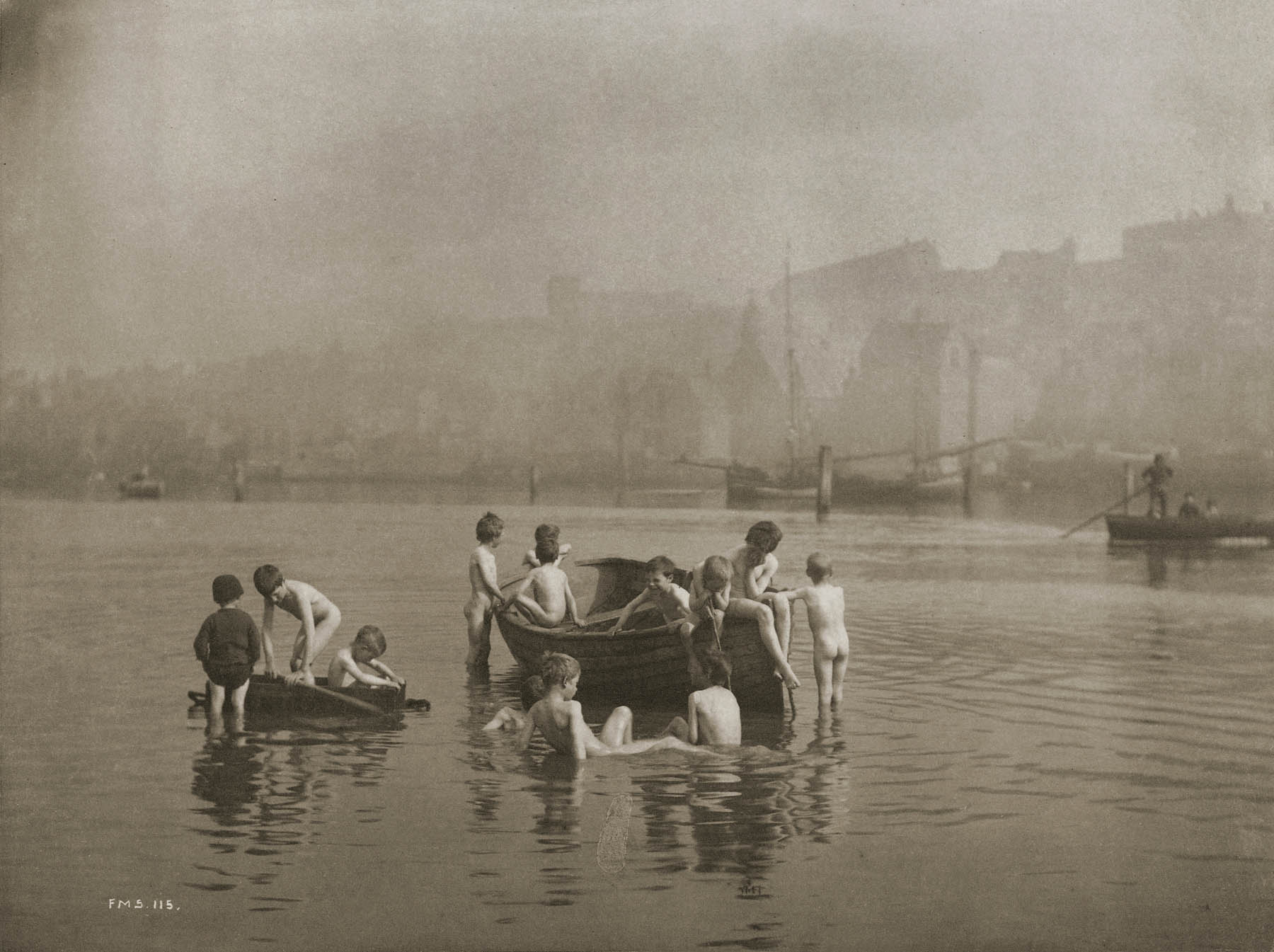
 

Frank Meadow Sutcliffe (British, 1853-1941) 'The Water Rats' 1886 from the exhibition 'Photo-Secession: Painterly Masterworks of Turn-of-the-Century Photography' at the Utah Museum of Fine Arts, Salt Lake City, August - December 2024


Frank Meadow Sutcliffe (British, 1853-1941)
The Water Rats
1886
Platinum print on paper


Sutcliffe was a member of the British photographic society the Linked Ring, which sought to make their work recognised as fine art. He operated a portrait studio in the seaside town of Whitby in North Yorkshire but is remembered for his charming, naturalistic depictions of local life. This photograph resulted in his excommunication by local clergy for its “corrupting” effects. Today this is his best-known photograph, regarded as a study of pure childhood joy.
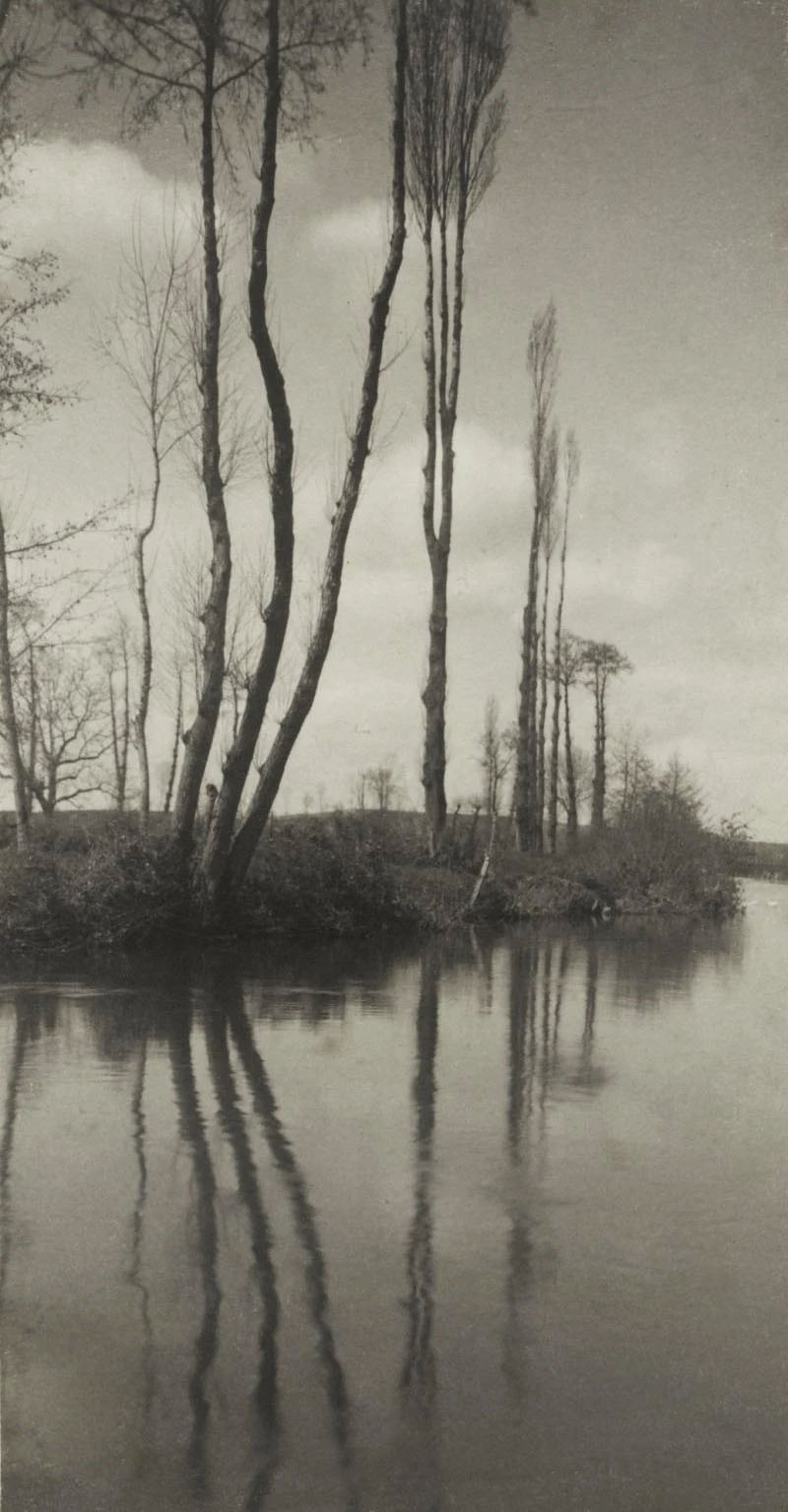
 

Frederick H. Evans (British, 1853-1943) 'Poplars on a French River' c. 1900


Frederick H. Evans (British, 1853-1943)
Poplars on a French River
c. 1900
Platinum print on paper
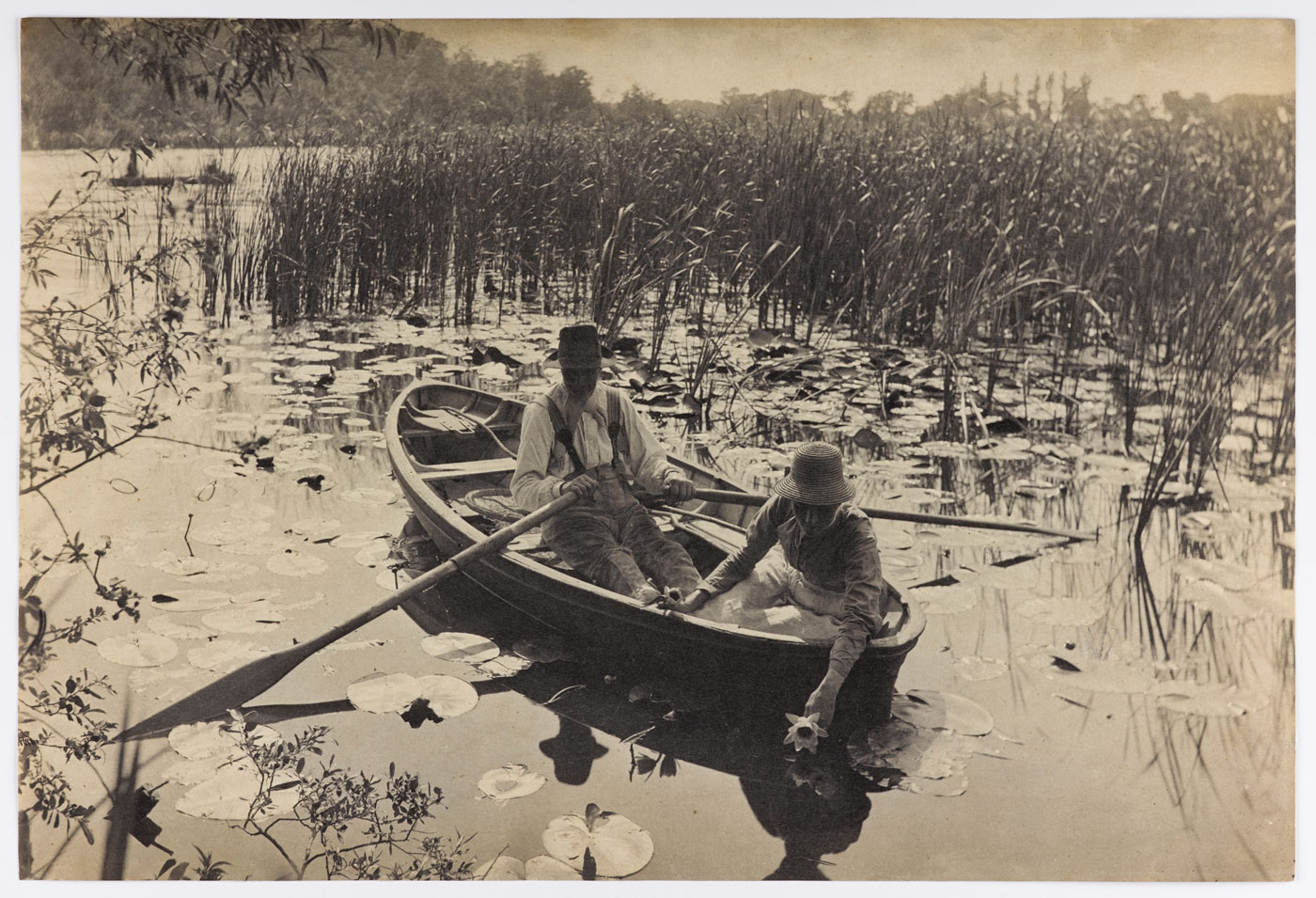
 

Peter Henry Emerson (British born Cuba, 1856-1936) 'Gathering Water Lilies' c. 1885


Peter Henry Emerson (British born Cuba, 1856-1936)
Gathering Water Lilies
c. 1885
Platinum print on paper


In addition to his photographic work, Emerson wrote persuasively that photography could match – and even surpass – painting as an emotive art form. His writings were influential to the young Alfred Stieglitz, with whom he corresponded over four decades.

All from the Collection of Michael Mattis and Judith Hochberg


Works by Thiollier
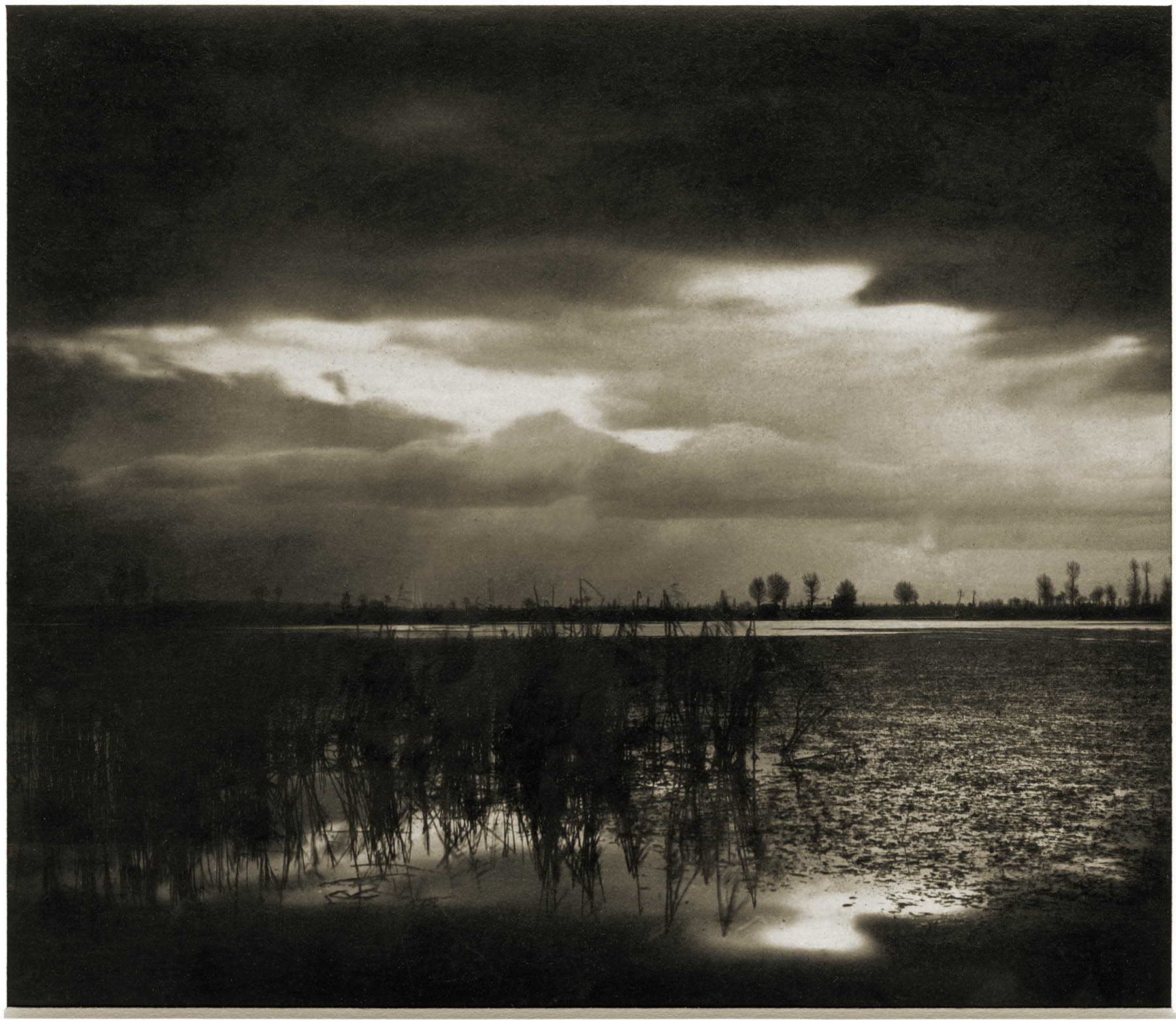
 

Félix Thiollier (French, 1842-1914) 'Landscape in Bugey' c. 1885


Félix Thiollier (French, 1842-1914)
Landscape in Bugey
c. 1885
Carbon print on paper


Thiollier’s photographic career is a fairly recent discovery, highlighted in the first ever retrospective of his career at the Musée d’Orsay in Paris in 2012.

From the Collection of Michael Mattis and Judith Hochberg


Works by Kühn


Heinrich Kühn (Austrian born Germany, 1866-1944) 'Nude in Morning Sun' c. 1920


Heinrich Kühn (Austrian born Germany, 1866-1944)
Nude in Morning Sun
c. 1920
Multiple bromoil transfer print on Japanese tissue paper


Heinrich Kühn (Austrian born Germany, 1866-1944) 'Female torso in sunlight' c. 1920


Heinrich Kühn (Austrian born Germany, 1866-1944)
Female torso in sunlight
c. 1920
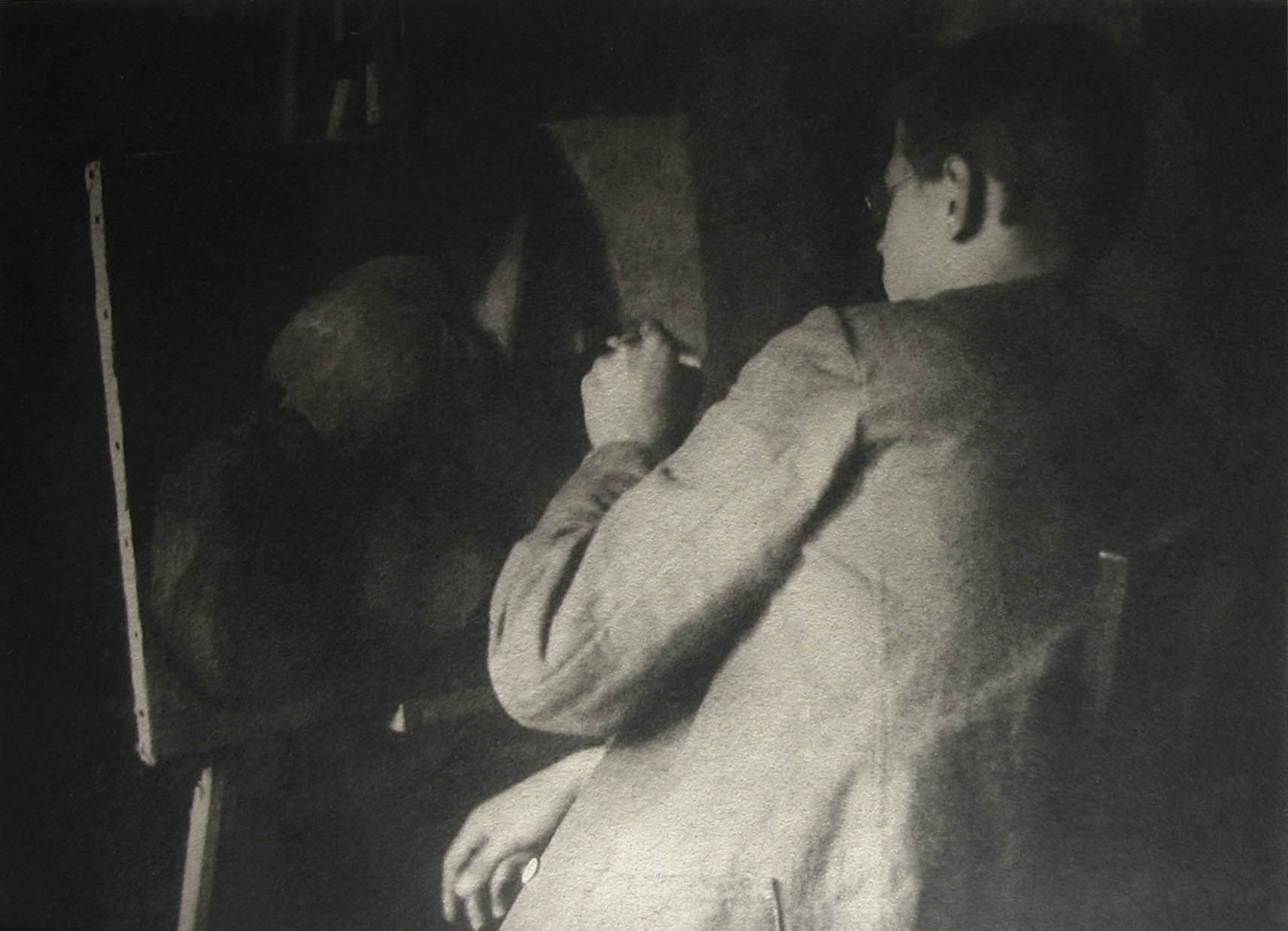
 

Heinrich Kühn (Austrian born Germany, 1866-1944) 'Walter at Easel' c. 1909


Heinrich Kühn (Austrian born Germany, 1866-1944)
Walter at Easel
c. 1909
Gum-bichromate print on paper


Heinrich Kühn (Austrian born Germany, 1866-1944) 'Still Life with Fruit and Pottery' c. 1896


Heinrich Kühn (Austrian born Germany, 1866-1944)
Still Life with Fruit and Pottery
c. 1896
Gum-bichromate print on paper with an applied watercolour wash


Kühn’s still lifes deliberately recall paintings from earlier centuries. This scene – his first published image – contains similar elements to 17th-century still-life compositions. He even included insects, which are traditional references to mortality called memento mori (reminders of death). Can you spot the housefly?

All from the Collection of Michael Mattis and Judith Hochberg


Portraits by Steichen


Edward Steichen (American born Luxembourg, 1879-1973) 'George Frederic Watts, London' 1901


Edward Steichen (American born Luxembourg, 1879-1973)
George Frederic Watts, London
1901
Varnished platinum print on paper


This dramatic profile portrait of the English Pre-Raphaelite painter was the first in what Steichen termed his “Great Men” series. Steichen wrote about his approach to portraiture, “I aim for the expression of something psychological. I am not satisfied with the mere reproduction of features and expression.”

Published in Camera Work, 14, 1906
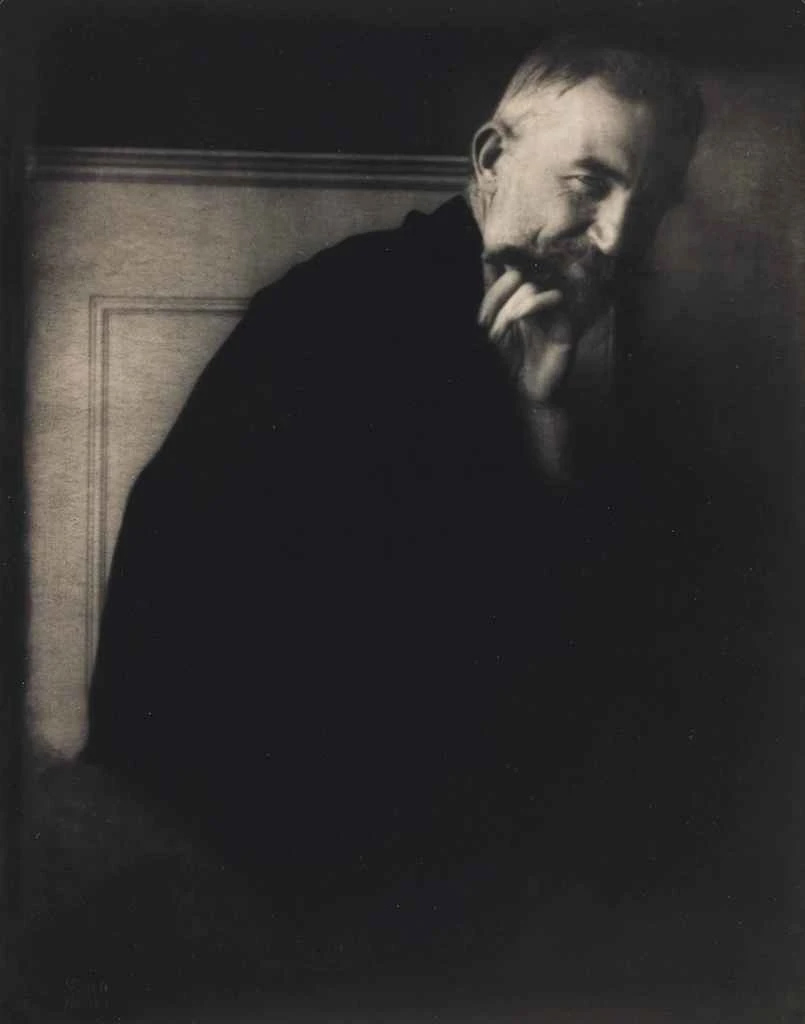
 

Edward Steichen (American born Luxembourg, 1879-1973) 'The Photographer's Best Model: George Bernard Shaw, London' 1907


Edward Steichen (American born Luxembourg, 1879-1973)
The Photographer’s Best Model: George Bernard Shaw, London
1907
Platinum print on paper


Steichen was elated after his photographic sitting with Shaw, writing to Stieglitz: “Well I’ve seen and done Shaw (photographically of course). He’s the nicest kind of fellow imaginable – genial and boyish – there is a little of the sardonic about him as you see him but when you get the camera at him you are tempted with possibilities in that way. He seems to know a lot about photography and certainly skilfully bluffs you into believing he knows it all.”

Published in Camera Work, 42/43, 1913

All from the Collection of Michael Mattis and Judith Hochberg


Glossary of Photographic Printing Methods and Terms from the History of Photography

Gelatin Silver Print

For over a century, from the 1880s until the digital era, the gelatin silver print was the most common technique for producing black-and-white photographs. The paper is coated with a binder layer of gelatin incorporating light-sensitive silver chloride or silver bromide. The paper is exposed under a negative, either by contact-printing or through an enlarger, then chemically developed, stopped, fixed, and dried. In the process, the silver salts are reduced to metallic silver, which carries the image. The overall color of the print can be altered through toning.

Cyanotype

A sheet of paper is sensitised in a solution of potassium ferricyanide and ferric ammonium citrate. After contact-printing under a negative, the iron compounds form an insoluble blue (“cyan”) dye known as Prussian blue. Apart from its occasional artistic use, the only regular use of the cyanotype was in copying architectural plans, thus called “blueprints.”

Platinum or Palladium Print

A platinum print is produced by sensitising a sheet of paper with platinum and iron salts. The sheet is then contact-printed under a negative until a faint image is visible. The print is developed in a potassium oxalate solution that dissolves unexposed iron salts and transforms the platinum salts into metallic platinum, which intensifies the image. Mercury chloride can be added to the solution to give a warmer tone. Unlike a silver print, where the image lives in a gelatin binder layer on top of the paper (akin to a watercolour), the image in a platinum print is embedded in the paper fibres (akin to an oil painting). The rich mid-tone range and matte surface made the platinum print the favoured medium for the Pictorialist photographers, from P.H. Emerson onward. When the price of platinum spiked during World War I, palladium was introduced as a more affordable (and generally warmer-toned) substitute.

Pigment Prints

The following processes are known as pigment prints, because the photographic image is carried by inks or pigments, rather than by metallic particles like silver, iron, or platinum.

Gum Bichromate Print

A sheet of paper is coated with diluted gum-arabic mixed with coloured pigment and light-sensitive potassium bichromate. During exposure under a negative, the bichromate causes the coloured gum-arabic to harden in proportion to the amount of light received. The areas not exposed to light remain soluble in water, and the print is developed by washing away the soluble areas, leaving a positive image on the paper. The prints can be exposed and reprinted numerous times with different coloured pigments, as well as manipulated by brushing away more pigmented gum during the washing stage.

Bromoil (Transfer) Print

This process does not begin with a negative, but rather with a gelatin silver print that is bleached in a solution of potassium bromide. The bleaching removes the silver-based image and selectively hardens the underlying gelatin in proportion to the image density. The sheet is then hand-coloured with an oil-based ink, which is selectively absorbed depending on the hardness of the gelatin: the softer areas contain more water, which repels the oil-based ink. An inked print is sometimes used as a kind of printing plate for transferring the image to another sheet of paper (a bromoil transfer print).

Photogravure

This is a sophisticated photomechanical process used for reproducing photographs in ink in a large edition. It is a form of intaglio printing, in which a photographic image is acid-etched into a copper plate. The relief image is then inked and printed. Alfred Stieglitz’s magazine Camera Work was largely printed in photogravure.

The Photo-Secession

This was the brief but influential artistic movement led by American Alfred Stieglitz during the years 1902–1915 that championed photography as an art form that was as aesthetic, creative, and skilful as traditional media like painting, drawing, watercolour, and printmaking. The European artistic movement Secessionism inspired the name Photo-Secession, and both movements were committed to Modernism by seceding from centuries-old academic traditions.

Pictorialism / Pictorialist

The approach to photography in which artists sought to make images that imitated the tradition of paintings through photographic prints. Pictorialist photographers used soft focus lenses and manipulated both their negatives and printing media to create their prints.

The Linked Ring

Also known as the Brotherhood of the Linked Ring, this photographic society founded in 1892 in London promoted photography as a form of art and was influential for the American society of the Photo-Secession.

Straight Photography

The approach to photography in which artists use sharp focus and print directly from their negatives with minimal or no manipulation.

Camera Notes

Camera Notes was the journal of the Camera Club of New York, edited by Alfred Stieglitz from 1897 to 1902. Under Stieglitz’s editorship, the purposes of Camera Notes were “to take cognisance also of what is going on in the photographic world at large, to review new processes and consider new instruments and agents as they come into notice; in short to keep our members in touch with everything connected with the progress and elevation of photography.”

Camera Work

Camera Work was the journal about contemporary photography that Alfred Stieglitz edited and published with the assistance of Edward Steichen from 1903 to 1917. The goal of this journal “devoted largely to the interests of pictorial photography” was “to issue quarterly an illustrated publication which will appeal to the ever-increasing ranks of those who have faith in photography as a medium of individual expression, and, in addition, to make converts of many at present ignorant of its possibilities.”

This glossary has been edited from primary sources and text by Ina Schmidt-Runke, Meike Harder, and Andreas Gruber.


The Photo-Secession Movement: Pioneering Artistry in Early Photography

By Adelaide Ryder, head photographer and digital assets manager at the UMFA

The Birth of the Photo-Secession Movement

This fall the Utah Museum of Fine Arts will exhibit Photo-Secession: Painterly Masterworks of Turn-of-the-Century Photography. This exhibition of art photography from the early 20th century will be on view from August 24 to December 29, 2024. Who were the Photo-Secessionists and why was their work so pivotal to the advancement of photography as an art form?

In the mid-19th century photography was regarded as a complex technical field that only a trained professional could do. By the 1880s, however, the hand-held camera had become affordable and easy to use, and the “snapshot” became commonplace. Smaller, easier-to-use cameras and the ability to send the film off to a lab for development gave the public accessibility to the medium in a new way. This technological advancement greatly affected the professional photography business, as people began to question the skills needed to make a photograph when “anyone could push a button.”

How did photographers respond to this shift in aesthetics and business? Many searched for ways to use photography to express abstract ideas or subjective points of view, shifting from using photography to document objective likeness to illustrating subjective conditions or the subject’s inner state. This helped elevate the photographer’s status, as the expressive ability of the person behind the camera became as important as the subject. Photographers embraced symbolism and started printing with complex techniques like gum bichromate to elevate their craft above the basic snapshot. Two significant movements were born from this struggle to gain recognition as a legitimate form of artistic expression rather than simply a means of mechanical documentation: Pictorialism and the Photo-Secession.

The camera was seen as a tool, and many felt that photographs visually lacked the “artist’s hand,” an essential factor in calling something “art.” The Photo-Secession movement, founded by Alfred Stieglitz in 1902, aimed to change this perception. Stieglitz and his contemporaries believed photography deserved the same artistic consideration as painting and sculpture. They aimed to elevate photography to fine art, emphasizing the photographer’s vision and creativity over mere technical skill. Stieglitz said the Photo-Secession was founded “loosely to hold together those Americans devoted to pictorial photography in their endeavour to compel its recognition, not as a handmaiden of art, but as a distinctive medium of individual expression.” (Camera Work, no. 6, April 1904.)

The Photo-Secession movement emerged from the broader Pictorialist movement, which dominated photographic art in the late 19th and early 20th centuries. While both movements sought to establish photography as an art form, the Photo-Secessionists emerged with their own philosophy.

Similarities

Artistic Expression: The Photo-Secession and Pictorialism emphasized the photographer’s role as an artist rather than a mere technician. They believed that photography should convey the photographer’s vision and emotional intent.

Aesthetic Quality: Both movements valued the aesthetic quality of photographs. They often employed techniques like soft focus, manipulation of light, and careful composition to create visually striking images.

Influence of Painting: Both were heavily influenced by the aesthetics of painting, particularly Impressionism and Symbolism. They sought to create images that were painterly in style, blurring the lines between photography and traditional fine arts.

Differences

Philosophical Focus: Pictorialism focused on creating images that looked like paintings, often using elaborate darkroom techniques to achieve a painterly effect. Photo-Secession, while also influenced by painting, emphasised the photographer’s personal expression and the inherent qualities of the photographic medium, sometimes even embracing the “snapshot” aesthetic if it helped to illustrate more hidden ideas and thoughts.

Technical Innovation: The Photo-Secessionists were more open to embracing the amateur artist and experimentation in techniques and technologies, whereas the Pictorialists held on to the traditional hierarchy of the European artistic schools of the time. Photo-Secessionists saw innovation as a means to expand photography’s artistic potential.

Subject Matter: Pictorialists focused on romanticized and idealized subjects, such as landscapes, portraits, and allegorical scenes. The Photo-Secessionists, on the other hand, explored a wider range of subjects, including urban scenes, modern life, and abstract forms. They embraced art movements like Cubism and Futurism, reflecting a broader and more progressive vision of art.

Exhibition and Display: The Photo-Secessionists were disenchanted with the outdated salons and gate-keeping ways of many photo schools commonly practiced in Europe. They began publications like The American Amateur Photographer, Camera Notes, and Camera Work to help give a platform to young photographers and people practicing these new ways of image making.

Adelaide Ryder. “The Photo-Secession Movement: Pioneering Artistry in Early Photography,” on the UMFA website Nd [Online] Cited 22/10/2024
 

Who were the Photo-Secessionists?

Works by Stieglitz

Alfred Stieglitz: The Visionary Leader

Alfred Stieglitz was a driving force behind the Photo-Secession movement. His passion for photography galvanized his dedication to promoting it as an art form. He saw photography as a means of personal expression. He helped catapult the idea that image-making can happen in the darkroom, during the printing process, as much as in the camera.

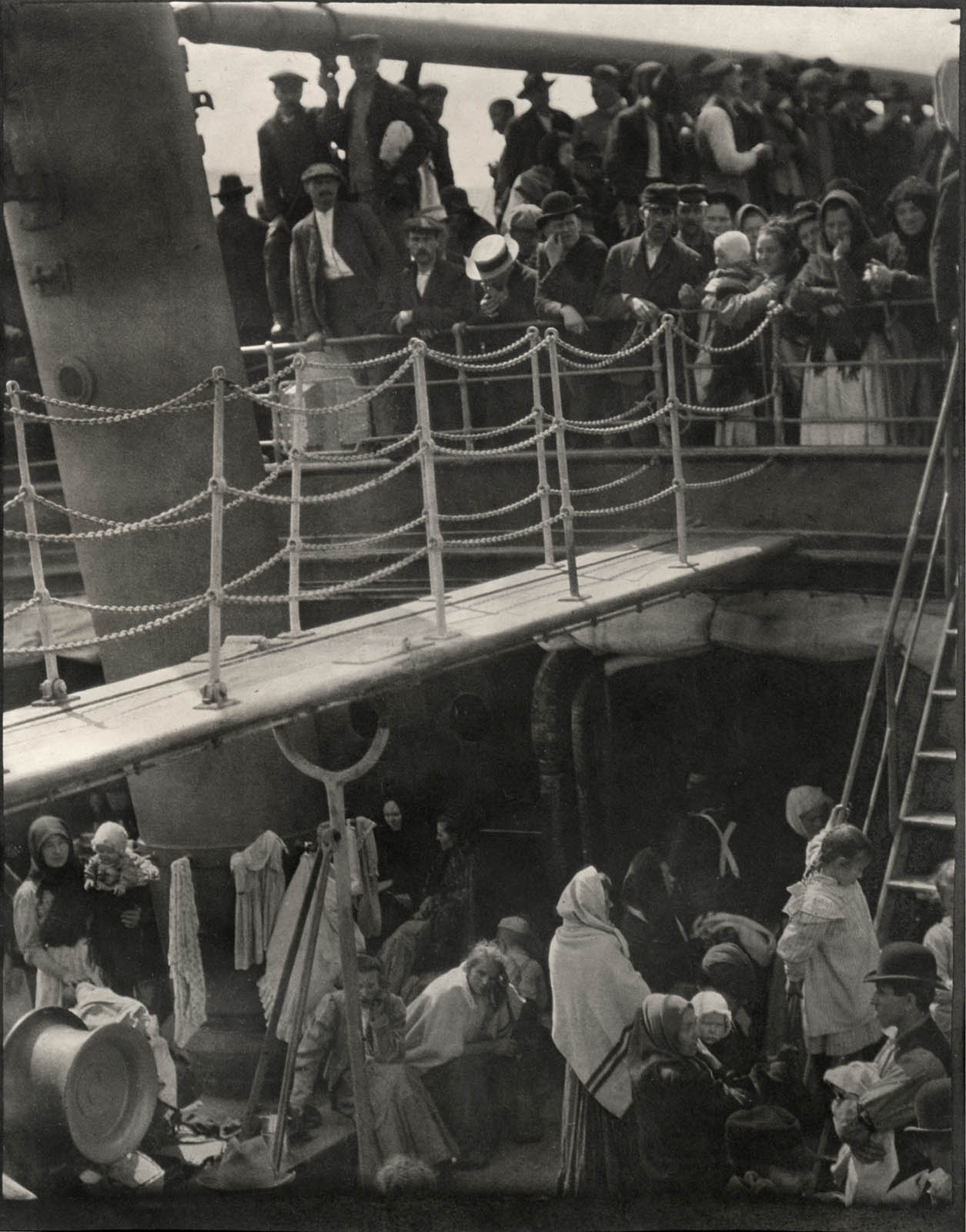
Stieglitz’s photograph The Steerage (1907, below) is one of the most iconic images in the history of photography. This powerful image captures the crowded lower deck of a transatlantic steamer, where people traveled in steerage class, the part of the ship with accommodations for those with the cheapest tickets. The Steerage is celebrated for its striking composition, which combines geometric shapes and human forms to create a dynamic and balanced visual narrative. Stieglitz considered this photograph one of his most outstanding achievements, as it encapsulated his transition to straight photography, which embraced photographs looking like photographs rather than the painterly qualities of Pictorialism. This photograph shows his ability to convey the complexity and depth of human experience through a single image. The photograph is a masterpiece of visual artistry and a compelling social document, reflecting the conditions and aspirations of early 20th century immigrants.

Adelaide Ryder. “The Photo-Secession Movement: Pioneering Artistry in Early Photography,” on the UMFA website Nd [Online] Cited 22/10/2024


Alfred Stieglitz (American, 1864-1946) 'The Steerage' 1907


Alfred Stieglitz (American, 1864-1946)
The Steerage
1907
Hand-pulled photogravure on paper


This photograph has become the iconic image of the Photo-Secession and has legendary status. In June 1907 he sailed to Europe to visit family and booked a first-class cabin. On a stroll around the ship, he encountered a bustling scene of labourers and their families traveling in steerage class, the part of the ship with accommodations for those with the cheapest tickets. With a single four-by-five-inch glass plate left in his camera, Stieglitz shot what would be regarded as a definitive masterpiece of both photography and Modernism.

About making this picture Stieglitz recalled: “There were men and women and children on the lower deck of the steerage. There was a narrow stairway leading to the upper deck of the steerage, a small deck right on the bow of the steamer. To the left was an inclining funnel and from the upper steerage deck there was fastened a gangway bridge that was glistening in its freshly painted state. It was rather long, white, and during the trip remained untouched by anyone. On the upper deck, looking over the railing, there was a young man with a straw hat. The shape of the hat was round. He was watching the men and women and children on the lower steerage deck. A round straw hat, the funnel leaning left, the stairway leaning right, the white drawbridge with its railing made of circular chains – white suspenders crossing on the back of a man in the steerage below, round shapes of iron machinery, a mast cutting into the sky, making a triangular shape. I saw shapes related to each other. I saw a picture of shapes and underlying that the feeling I had about life.”


Alfred Stieglitz (American, 1864-1946) 'The Hand of Man' 1902


Alfred Stieglitz (American, 1864-1946)
The Hand of Man
1902
Hand-pulled photogravure on paper

All from the Collection of Michael Mattis and Judith Hochberg


Works by Käsebier

Gertrude Käsebier: The Master of Portraiture

Gertrude Käsebier was known for her compelling portraits and allegorical imagery. Käsebier’s work transcended traditional portrait photography by infusing her images with a deep sense of intimacy and character. She believed that a photograph should reveal the inner essence of its subject, and her portraits are renowned for capturing the personality and spirit of the people she photographed.

Käsebier’s approach to portraiture was both innovative and empathetic. This image from the UMFA’s permanent collection is a perfect example of how she photographed women and children, presenting them with dignity and respect at a time when they were not the usual subjects of portraiture. Her work challenged conventional representations and highlighted her subjects’ emotional depth and individuality.

Adelaide Ryder. “The Photo-Secession Movement: Pioneering Artistry in Early Photography,” on the UMFA website Nd [Online] Cited 22/10/2024
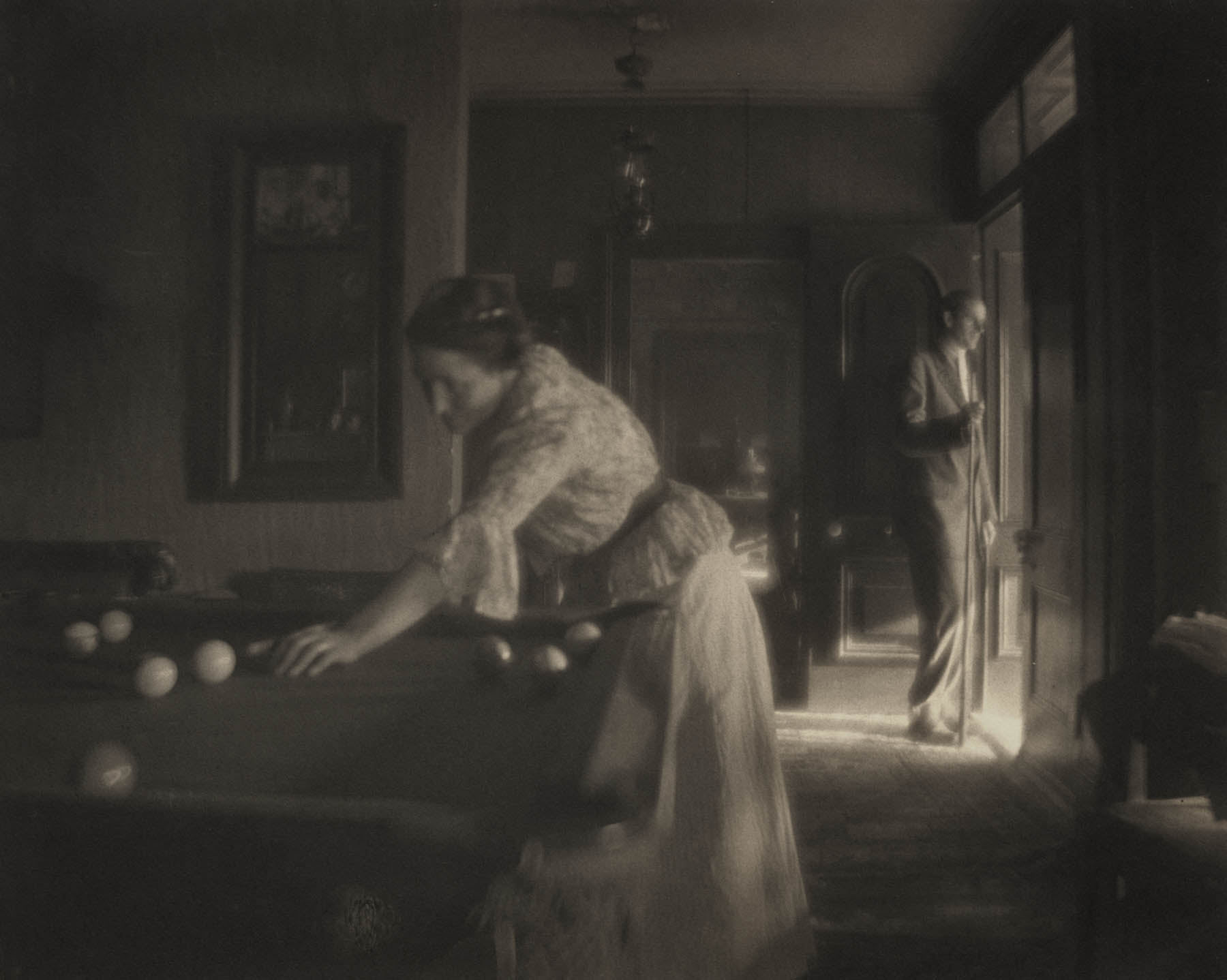
 

Gertrude Käsebier (American, 1852-1934) 'Untitled (Billiard Game)' c. 1909


Gertrude Käsebier (American, 1852-1934)
Untitled (Billiard Game)
c. 1909
Platinum print on paper
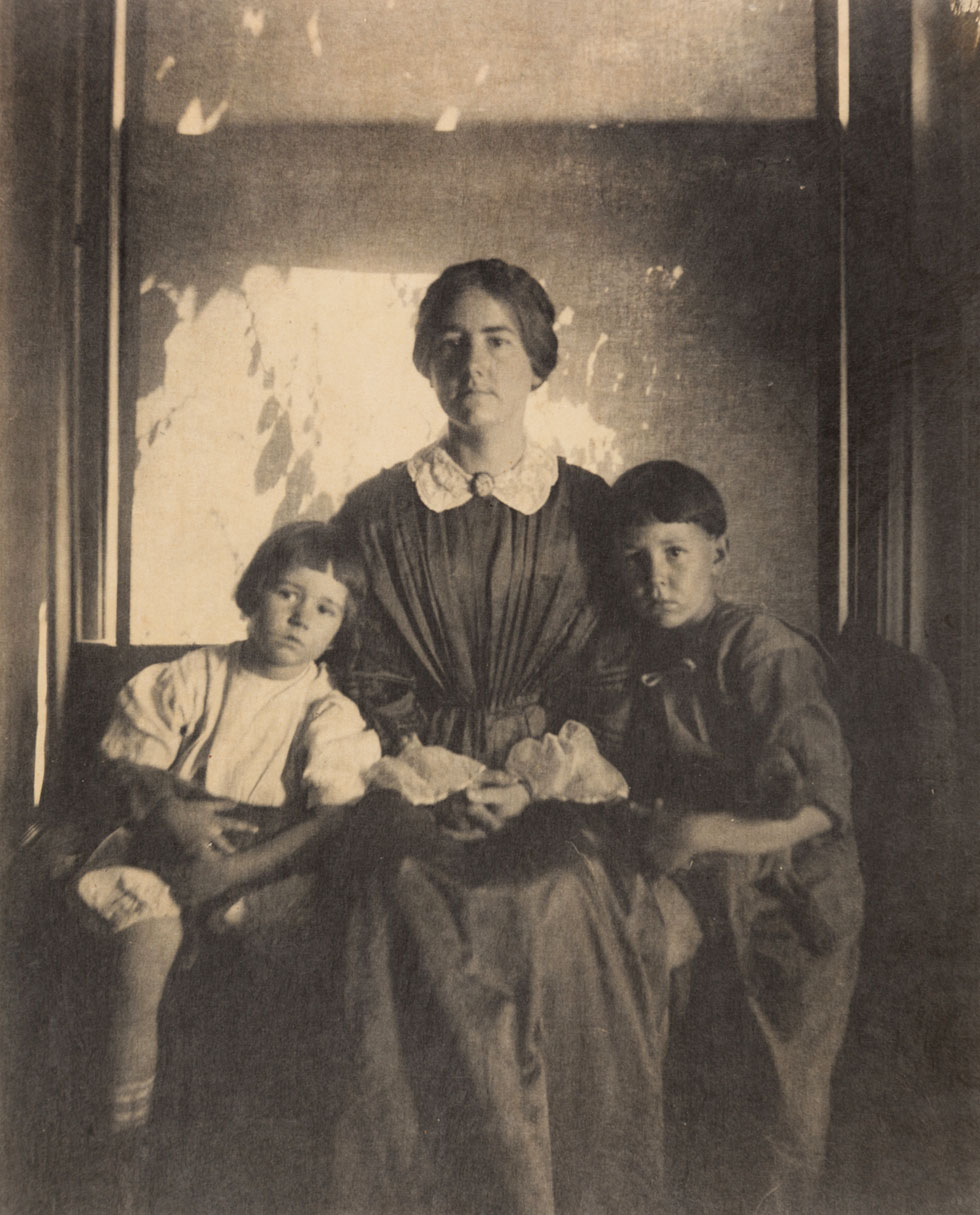
 

Gertrude Käsebier (American, 1852-1934) 'Mother and Two Children' 1899


Gertrude Käsebier (American, 1852-1934)
Mother and Two Children
1899
Platinum print on paper


Gertrude Käsebier (American, 1852-1934) 'Serbonne (A Day in France)' 1901


Gertrude Käsebier (American, 1852-1934)
Serbonne (A Day in France)
1901
Platinum print on paper


Both Pumpkin Pie, Voulangis and Serbonne (A Day in France) were set in France in 1901, when the artist was chaperoning art students. The young man in both scenes is Edward Steichen at age 22, whose interest in photography was then budding.

Serbonne is Käsebier’s chaste reference to Édouard Manet’s famous painting Le Déjeuner sur l’herbe (The Luncheon on the Grass) of 1863. An example of ultra-soft focus, this photo was reproduced in the inaugural issue of Camera Work, which was devoted to Käsebier.

Published in Camera Work, 1, 1903
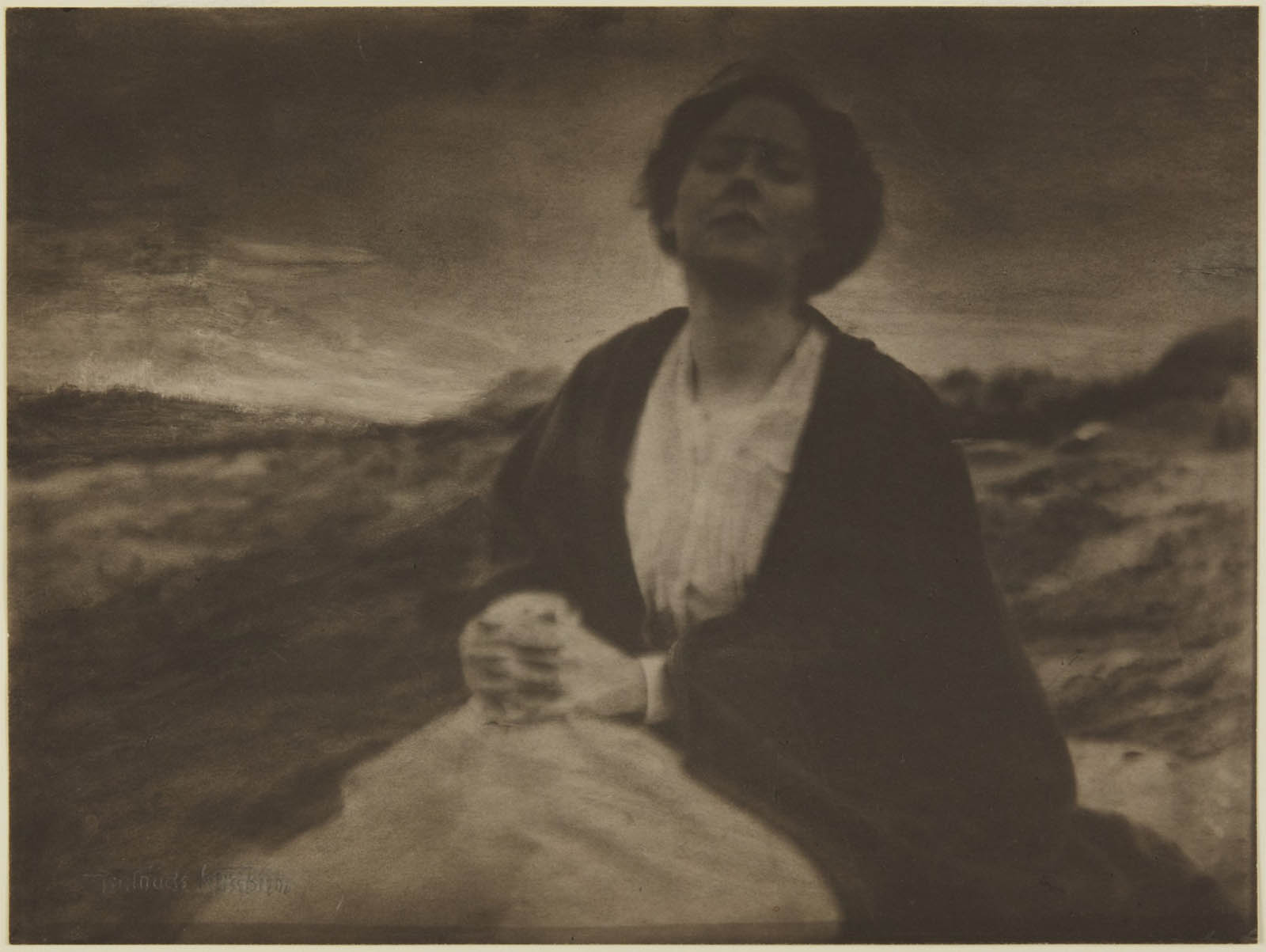
 

Gertrude Käsebier (American, 1852-1934) 'The Heritage of Motherhood' 1904


Gertrude Käsebier (American, 1852-1934)
The Heritage of Motherhood
1904
Gum-bichromate print on paper


This portrays the children’s book author Agnes Rand Lee in mourning after the sudden death of her daughter from illness. A contemporary photographer and critic deemed this image “one of the strongest things that Käsebier has ever done, and one of the saddest and most touching that I have ever seen.” Käsebier extensively manipulated the gum-bichromate process to make this print appear like a charcoal drawing.
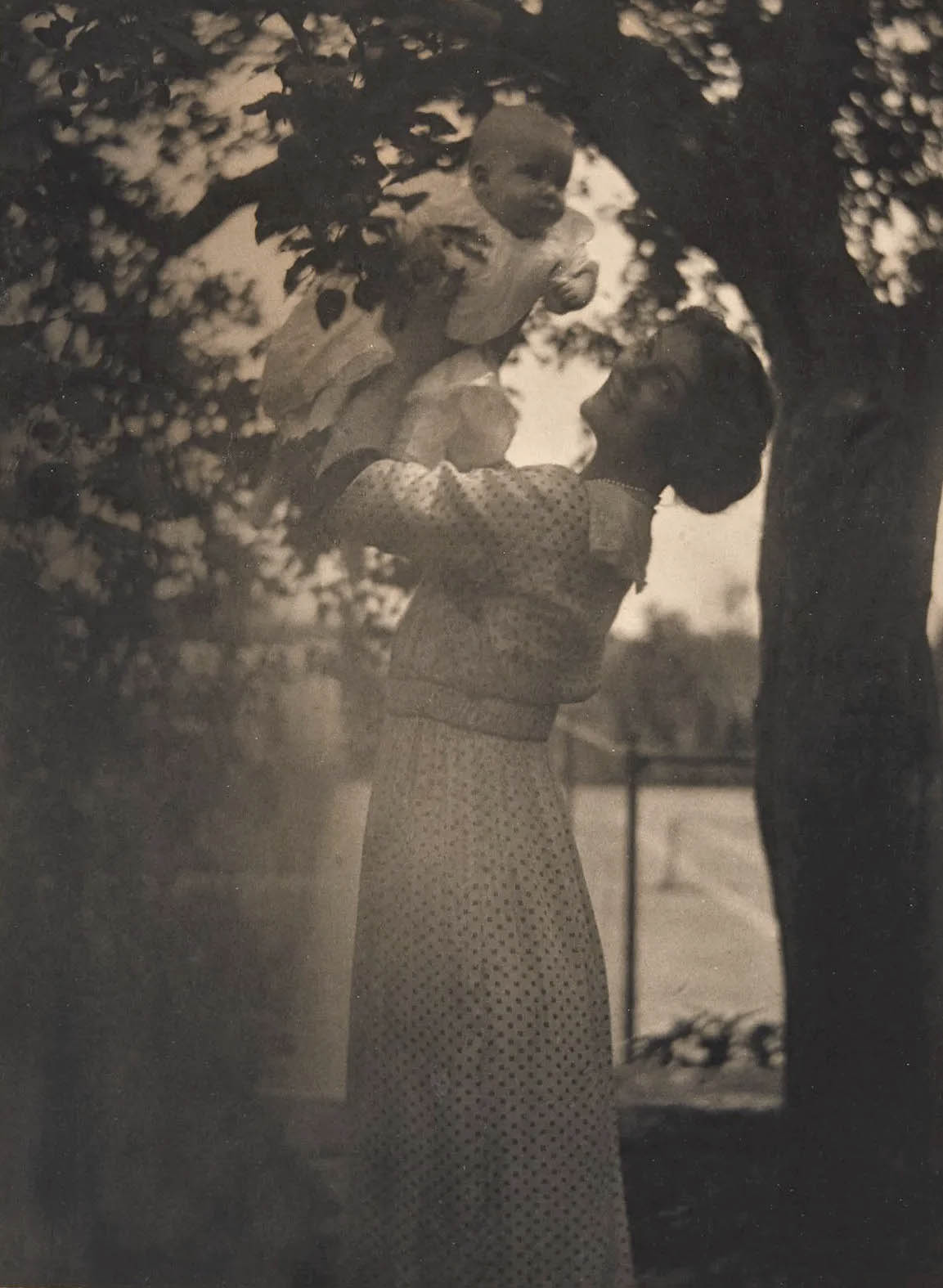
 

Gertrude Käsebier (American, 1852-1934) 'Mother and Child' c. 1900


Gertrude Käsebier (American, 1852-1934)
Mother and Child
c. 1900
Multiple gum-bichromate print on paper


The subject of mother and child was a frequent one for Pictorialists, especially Käsebier and Clarence White. The contrast between the tiny infant and the mighty tree gives this image additional symbolic meaning.


Gertrude Käsebier (American, 1852-1934) 'The Picture Book' 1903


Gertrude Käsebier (American, 1852-1934)
The Picture Book
1903
Platinum print on paper


Alfred Stieglitz had a print of this photograph in his personal collection, which he bequeathed to the Metropolitan Museum of Art in New York.

Published in Camera Work, 10, 1905

All from the Collection of Michael Mattis and Judith Hochberg


Works by Evans


Frederick Evans (British, 1853-1943) 'Aubrey Beardsley' 1893


Frederick H. Evans (British, 1853-1943)
Aubrey Beardsley
1893
Platinum print on paper


Evans, a member of the British art photography group the Linked Ring, was close friends with prominent authors and artists, such as George Bernard Shaw and Aubrey Beardsley. Portrayed here around age 20, Beardsley was a talented artist, designer, and illustrator, whose promising career was cut short by tuberculosis just five years after this photo was made.
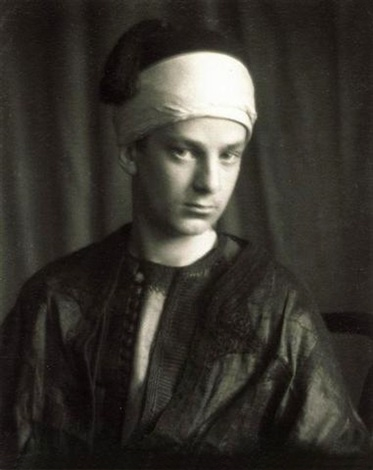
 

Frederick H. Evans (British, 1853-1943) 'Alvin Langdon Coburn in Eastern Clothing' 1901


Frederick H. Evans (British, 1853-1943)
Alvin Langdon Coburn in Eastern Clothing
1901
Platinum print on paper


Coburn was a precocious young American artist. An eighth birthday gift of a Kodak camera sparked his interest in photography. By age 16 Coburn had moved to London to work with his cousin the photographer F. Holland Day, whose portrait by Gertrude Käsebier is in this exhibition. After being included in a landmark exhibition at the Royal Photographic Society, Coburn returned to New York and apprenticed with Käsebier. By the tender age of 20, he became a founding member of the Photo-Secession and launched an international career dividing his time between New York, London, and Paris.

All from the Collection of Michael Mattis and Judith Hochberg


Works by Dow


Arthur Wesley Dow (American, 1857-1922) 'Silhouetted Trees' c. 1910


Arthur Wesley Dow (American, 1857-1922)
Silhouetted Trees
c. 1910
Cyanotype print on paper


A painter, printmaker, and photographer, Dow is mainly remembered today as a pioneering educator who taught in New York at the Pratt Institute, Art Students League, and Teacher’s College of Columbia University. Among Dow’s students were Gertrude Käsebier, Alvin Langdon Coburn, Charles Sheeler, and Georgia O’Keeffe. Dow also hired Clarence White to teach photography at Columbia, thereby launching White’s important teaching career.

From the Collection of Michael Mattis and Judith Hochberg


Works by Haviland
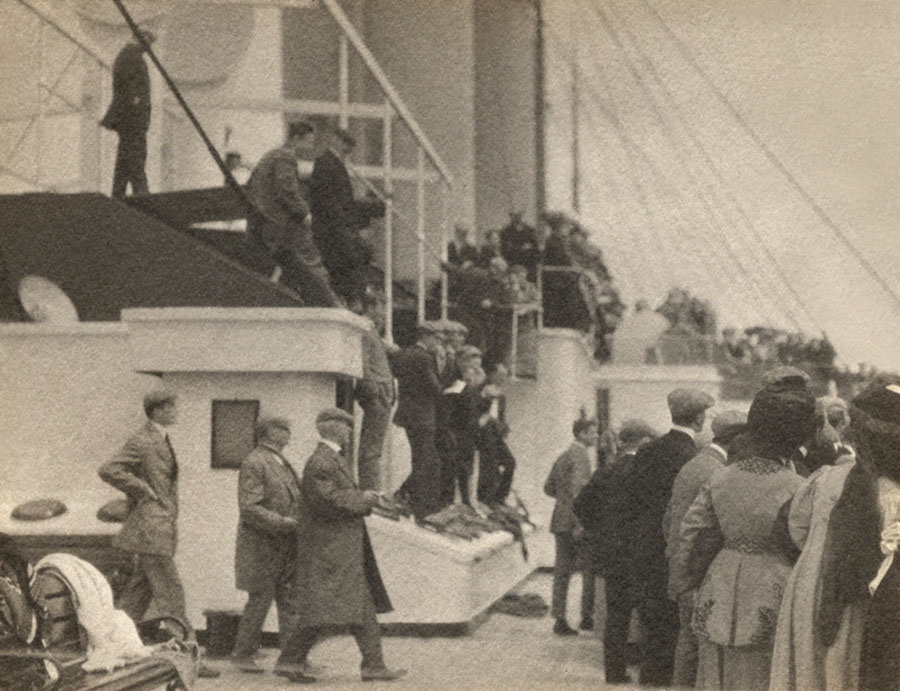
 

Paul Burty Haviland (American, 1880-1950) 'Ship Deck' 1910


Paul Burty Haviland (American, 1880-1950)
Ship Deck
1910
Platinum print on paper


Haviland was an amateur photographer from a young age and grew up immersed in the arts. His grandfather was an early photography critic in Paris, and his father owned Haviland porcelain factory in Limoges, France. As the New York representative of the family business, Haviland happened to meet Alfred Stieglitz in 1908. Just two years later he became associate editor of Camera Work and helped financially support Stieglitz’s gallery 291.

All from the Collection of Michael Mattis and Judith Hochberg


Works by Struss
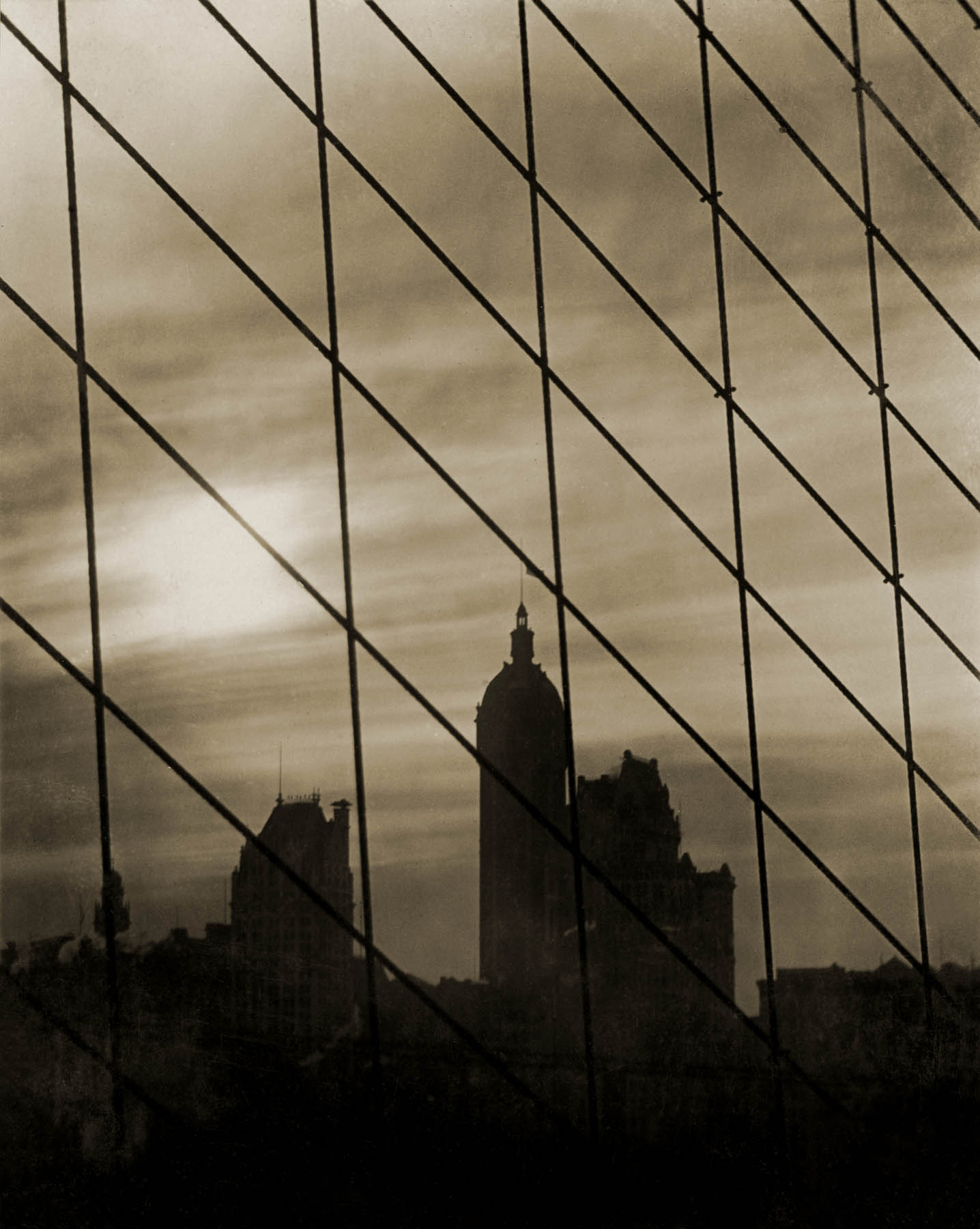
 

Karl Struss (American, 1886-1981) 'Cables' 1912


Karl Struss (American, 1886-1981)
Cables
1912
Gelatin silver print on paper


Struss was a star pupil of Clarence White and became a favourite of Alfred Stieglitz and the youngest member of the Photo-Secession. He is best known for his compelling cityscapes of New York, including the view of the Singer Building through the cables of the Brooklyn Bridge and the dramatic Flatiron Building, Twilight.


Karl Struss (American, 1886-1981) 'Flatiron Building, Twilight' c. 1915


Karl Struss (American, 1886-1981)
Flatiron Building, Twilight
c. 1915
Gelatin silver print on paper


Struss eventually broke away from Stieglitz and cofounded the society of the Pictorial Photographers of America along with Clarence White and Gertrude Käsebier in 1916. He … accepted a job as a cameraman for filmmaker Cecil B. DeMille. Struss would become one of the most prolific Hollywood cinematographers with 150 films, an Academy Award, and three Academy nominations to his credit.

All from the Collection of Michael Mattis and Judith Hochberg


Nudes by Stieglitz and White


Clarence Hudson White (American, 1871-1925) 'Reflected Nude' 1909


Clarence Hudson White (American, 1871-1925)
Reflected Nude
1909
Platinum print on paper
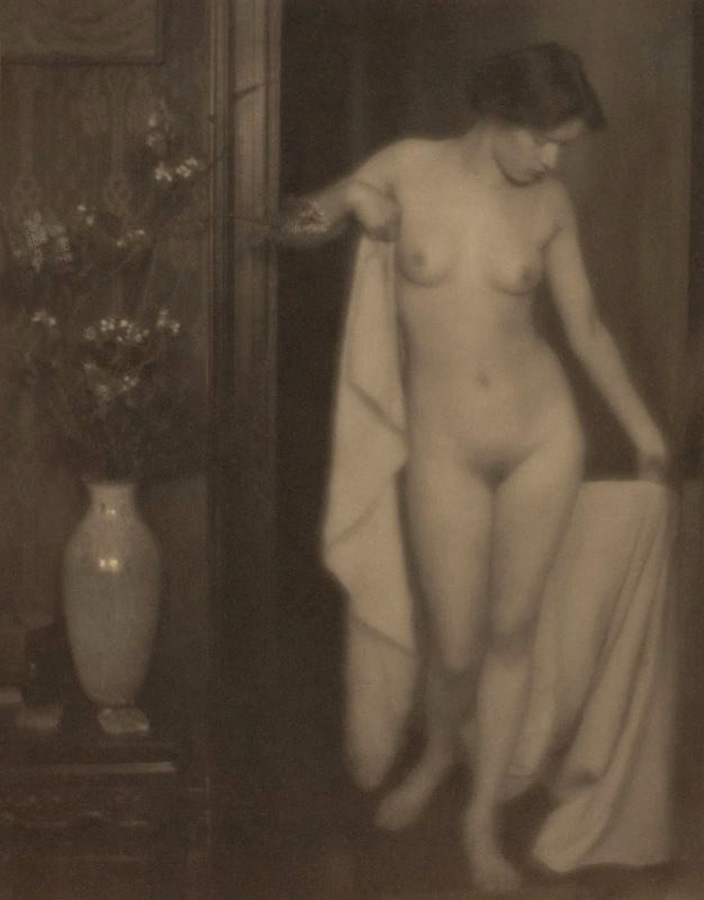
 

Alfred Stieglitz (American, 1864-1946) and Clarence Hudson White (American, 1871-1925) 'Nude Posed in Doorway (Miss Thompson)' 1907


Alfred Stieglitz (American, 1864-1946) and Clarence Hudson White (American, 1871-1925)
Nude Posed in Doorway (Miss Thompson)
1907
Platinum print on paper


Alfred Stieglitz (American, 1864-1946) and Clarence Hudson White (American, 1871-1925) 'The Torso' 1907


Alfred Stieglitz (American, 1864-1946) and Clarence Hudson White (American, 1871-1925)
The Torso
1907
Palladium print on paper


This is likely the most widely reproduced nude by Photo-Secession artists.

After their personal and professional rupture, Stieglitz wrote White a letter that specifically referred to their collaboration in 1907. Stieglitz insisted “that my name be not mentioned by you in connection with either the prints or the negatives” and further instructed White to erase his name from any prints they had jointly signed. Despite this vitriol, Stieglitz retained in his personal collection two prints of The Torso, one of them jointly signed in pencil.

Published in Camera Work, 27, 1909

All from the Collection of Michael Mattis and Judith Hochberg


Images of O’Keeffe by Stieglitz
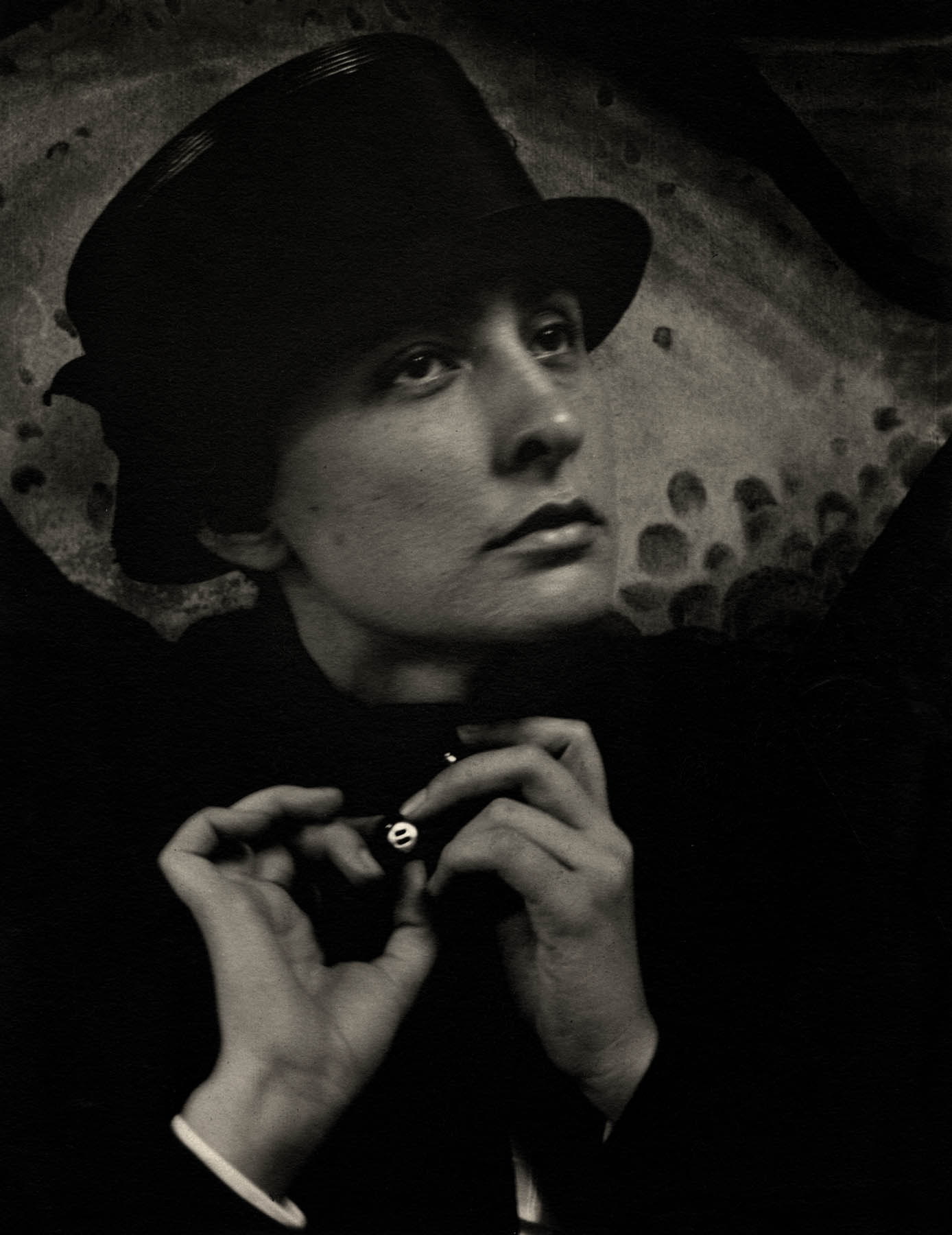
 

Alfred Stieglitz (American, 1864-1946) 'Georgia O'Keeffe' 1918


Alfred Stieglitz (American, 1864-1946)
Georgia O’Keeffe
1918
Palladium print on paper
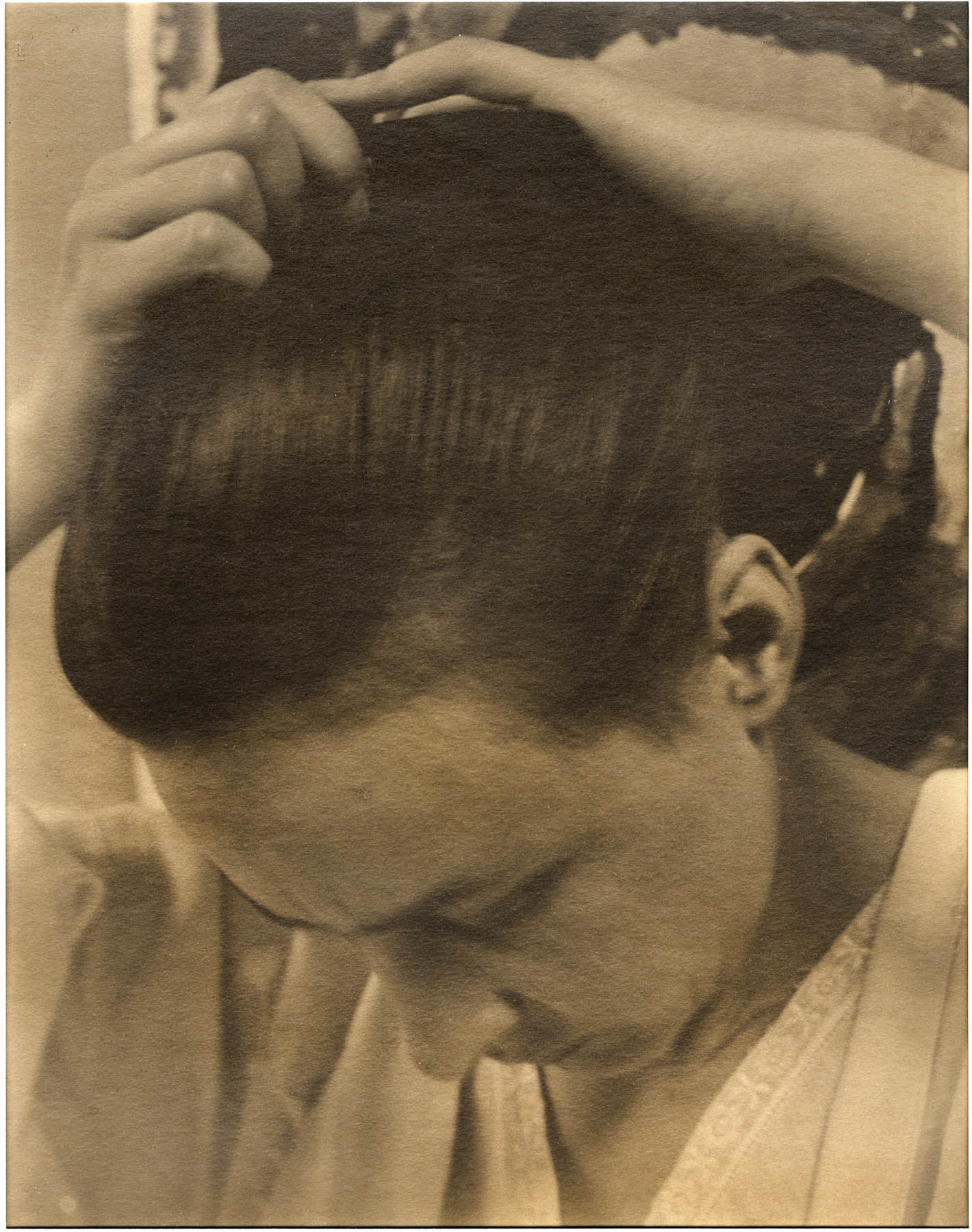
 

Alfred Stieglitz (American, 1864-1946) 'Georgia O'Keeffe (Fixing Hair)' 1919-1921


Alfred Stieglitz (American, 1864-1946)
Georgia O’Keeffe (Fixing Hair)
1919-1921
Palladium print on paper


Over two decades, Stieglitz made over 300 photos of O’Keeffe, producing an extraordinary and candid portrait of the artist. She recalled, “I was photographed with a kind of heat and excitement and in a way wondered what it was all about.” The directness and intimacy of this series of photos differ from the idealised nudes that Stieglitz and White made together during the heyday of the Photo-Secession.

All from the Collection of Michael Mattis and Judith Hochberg


Works by White

Clarence Hudson White: The Romantic

Clarence Hudson White was celebrated for his romanticised and intimate approach to photography. His 1904 image The Kiss perfectly illustrates his unique style. This platinum print on paper captures a tender moment with a soft focus and gentle lighting. The Kiss portrays an intimate scene imbued with a sense of emotional depth. White’s use of the platinum printing process, which provides a broad tonal range and exquisite detail, enhances the image’s delicate and dreamlike quality. His work reflects the movement’s early emphasis on creating photographs that evoke the emotional and aesthetic qualities of fine art while also paving the way for future explorations in photographic expression.

Adelaide Ryder. “The Photo-Secession Movement: Pioneering Artistry in Early Photography,” on the UMFA website Nd [Online] Cited 22/10/2024


Clarence H. White (American, 1871-1925) 'The Bubble' 1898, printed 1905


Clarence Hudson White (American, 1871-1925)
The Bubble
1898
Platinum print on paper


This image was exhibited at the 1898 Philadelphia Photographic Salon to great acclaim. Fellow photographer and critic Joseph Keiley commented, “Like most of Mr. White’s pictures, it is a well nigh perfect piece of composition whose subject with subtle poetry stimulates and leaves much to the imagination.”


Clarence Hudson White (American, 1871-1925) 'The Mirror' 1912


Clarence Hudson White (American, 1871-1925)
The Mirror
1912
Platinum print on paper
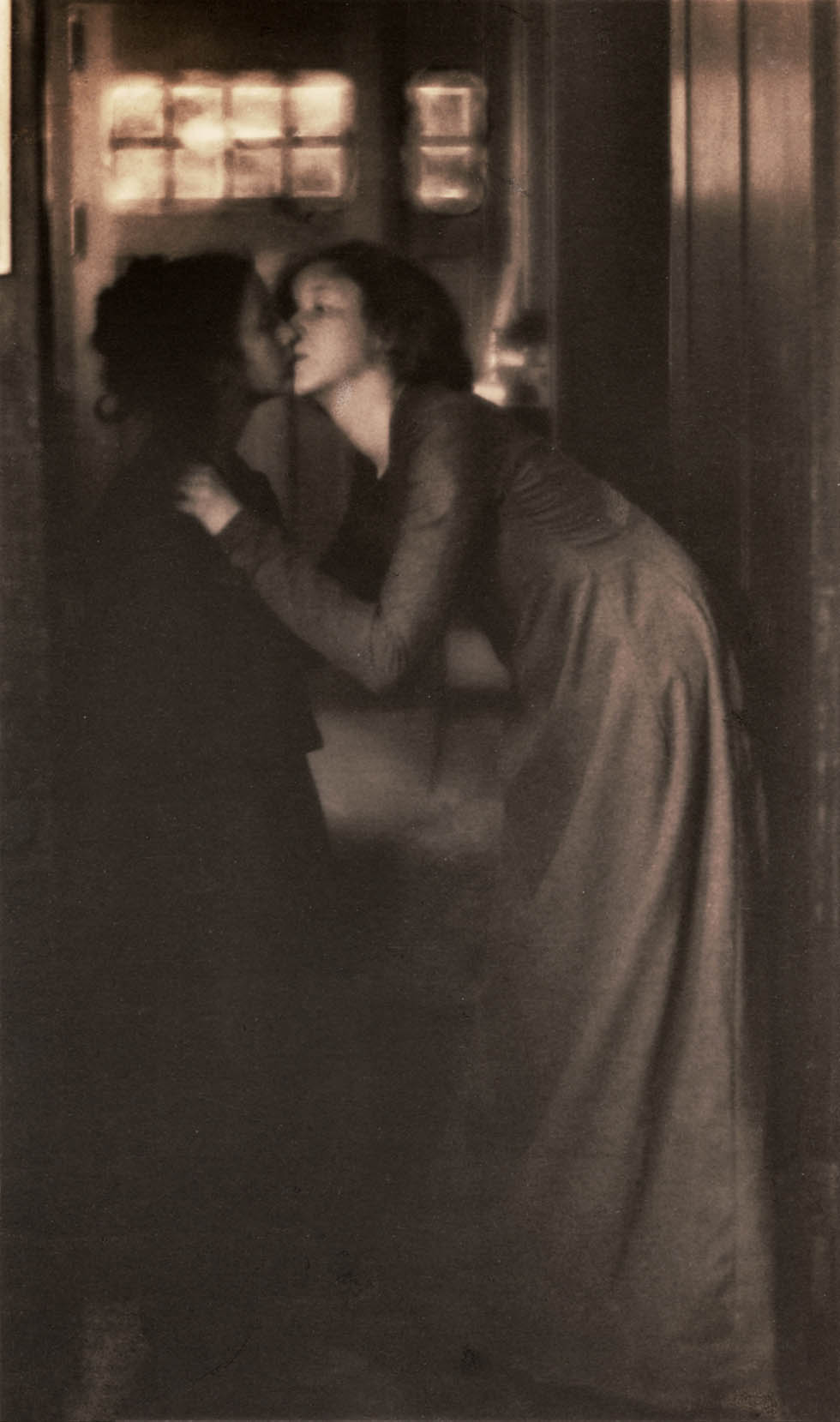
 

Clarence Hudson White (American, 1871-1925) 'The Kiss' 1904


Clarence Hudson White (American, 1871-1925)
The Kiss
1904
Platinum print on paper


This is one of White’s best known photographs. Despite his separation from White, Stieglitz kept prints of both The Kiss and The Bubble in his personal collection throughout his life.

All from the Collection of Michael Mattis and Judith Hochberg


Works by followers of White

Anne Brigman: The Feminine Mystic of Photo-Secession

Anne Brigman was known for her evocative and mystical imagery. She often placed herself within her compositions, challenging traditional gender roles and expectations. Her connection to the Photo-Secession movement was cemented through her association with Alfred Stieglitz, who published her work in Camera Work and admired her innovative spirit.

Brigman’s 1911 photograph The Pine Sprite exemplifies her distinctive style. The image features a nude female figure intertwined with the natural landscape, blending the human form seamlessly with the rugged environment. This work reflects Brigman’s themes of femininity, nature, and freedom, aligning with the Photo-Secessionist emphasis on personal expression and artistic experimentation. Brigman’s contributions highlighted the movement’s inclusive spirit, showcasing how female photographers could assert their voices and artistic visions in a male-dominated field.

Adelaide Ryder. “The Photo-Secession Movement: Pioneering Artistry in Early Photography,” on the UMFA website Nd [Online] Cited 22/10/2024
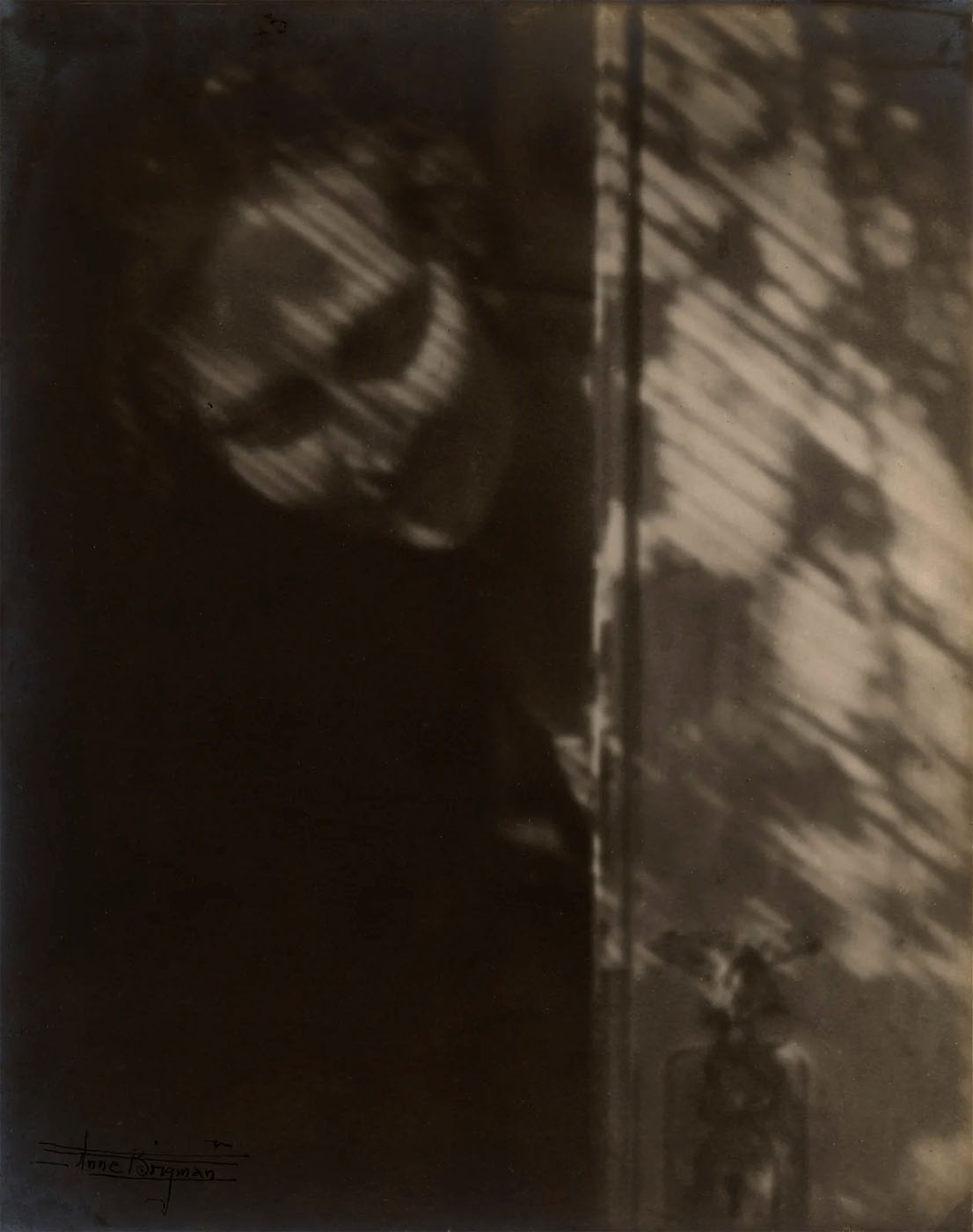
 

Anne Brigman (American, 1869-1950) 'The Shadow on My Door (Self Portrait)' 1921


Anne Brigman (American, 1869-1950)
The Shadow on My Door (Self Portrait)
1921
Gelatin silver print on paper
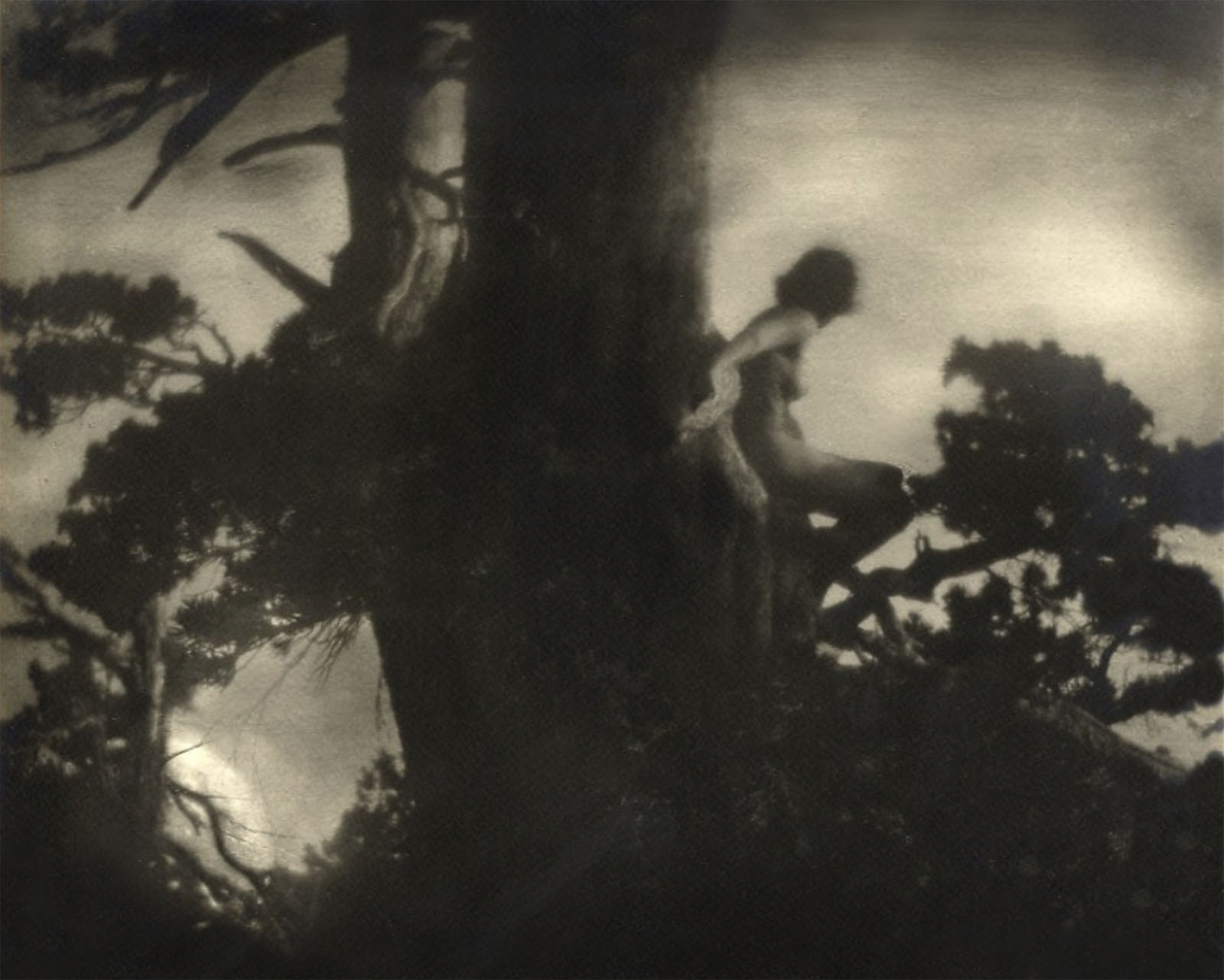
 

Anne Brigman (American, 1869-1950) 'The Pine Sprite' 1911 from the exhibition 'Photo-Secession: Painterly Masterworks of Turn-of-the-Century Photography' at the Utah Museum of Fine Arts, Salt Lake City, August - December 2024


Anne Brigman (American, 1869-1950)
The Pine Sprite
1911
Gelatin silver print on paper


Brigman was for a long time the only Californian member of the Photo-Secession. She was a free spirit and pagan whose woodsy nudes inspired by fantasy and folklore were frequently reproduced in Camera Work.


Laura Gilpin (American, 1891-1979) 'Ghost Rock, Garden of the Gods, Colorado' 1919


Laura Gilpin (American, 1891-1979)
Ghost Rock, Garden of the Gods, Colorado
1919
Palladium print on paper


An amateur photographer from Colorado Springs, Gilpin moved to New York to study with Clarence White in 1916. This photograph was one of Gilpin’s first successes after returning home in 1919, the beginning of her decades-long career as one of the most notable photographers of the West and Southwest.

All from the Collection of Michael Mattis and Judith Hochberg


In 1916 Gilpin enrolled at the Clarence H. White School of Photography in New York. Two years later, she returned to her native Colorado Springs and became one of the few women to pursue landscape photography.

This is her depiction of the Garden of the Gods, a scenic rock formation in Colorado Springs. It captures the stillness and otherworldly quality of the area. The photograph also reflects an emphasis on the evocation of mood rather than on descriptive detail.

Text from the National Gallery of Art Facebook page


Edward Steichen

Edward J. Steichen: The Innovator

Edward J. Steichen, a close associate of Stieglitz, brought a unique perspective to the Photo-Secession movement. Steichen was not only a photographer but also a painter, which influenced his photographic style. He experimented with various techniques, including soft focus and manipulation of light, to create both ethereal and visually striking images.

An avid gardener, Steichen propagated and grew a bountiful garden at his French country house. This image of a calla lily is rendered with exquisite detail and tonal richness. Steichen’s botanical images showcase his ability to find harmony between nature and art. His meticulous composition and sensitivity to light transform a simple flower into a work of art, reflecting his painterly approach to photography. His botanical works contributed to the Photo-Secession movement by highlighting the artistic potential of natural forms.

Adelaide Ryder. “The Photo-Secession Movement: Pioneering Artistry in Early Photography,” on the UMFA website Nd [Online] Cited 22/10/2024
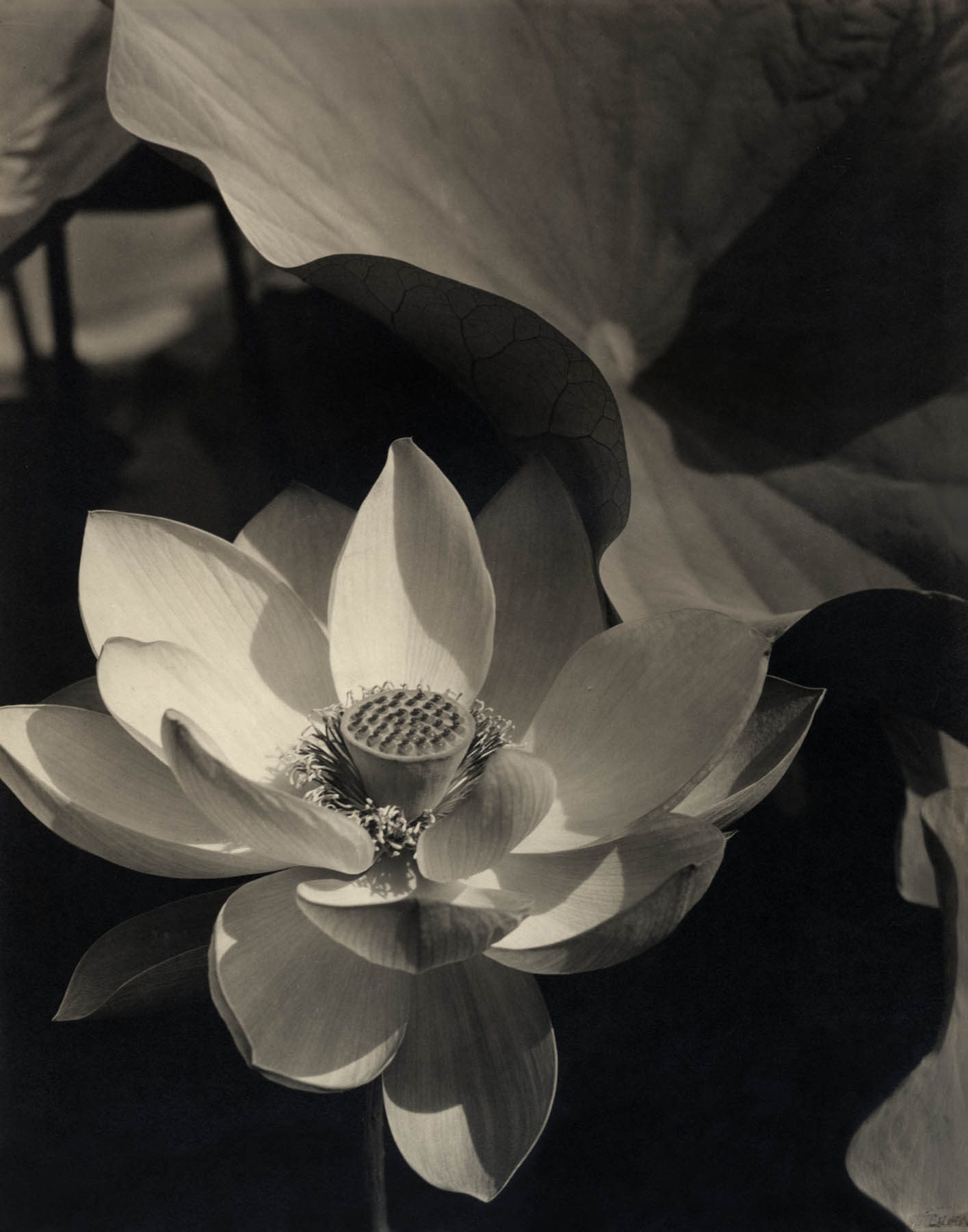
 

Edward Steichen (American born Luxembourg, 1879-1973) 'Lotus, Mount Kisco' 1915 from the exhibition 'Photo-Secession: Painterly Masterworks of Turn-of-the-Century Photography' at the Utah Museum of Fine Arts, Salt Lake City, August - December 2024


Edward Steichen (American born Luxembourg, 1879-1973)
Lotus, Mount Kisco
1915
Gelatin silver print on paper


Edward Steichen (American born Luxembourg, 1879-1973) 'Calla Lily' c. 1921


Edward Steichen (American born Luxembourg, 1879-1973)
Calla Lily
c. 1921
Platinum print on paper


Steichen had previously photographed flowers in compositions that placed delicate floral arrangements next to women figured as ideals of feminine beauty. In contrast, here he presents the lotus and calla lily in sharp focus and as singular subjects without overt metaphorical meaning.


Edward Steichen (American born Luxembourg, 1879-1973) 'Three Pears and an Apple' 1921


Edward Steichen (American born Luxembourg, 1879-1973)
Three Pears and an Apple
1921
Gelatin silver print on paper


On making this picture Steichen wrote: “I was particularly interested in a method of representing volume, scale, and a sense of weight. In my small greenhouse I constructed a tent of opaque blankets. From a tiny opening, I directed light against one side of the covering blanket, and this light, reflected from the blanket, was all. I made a series of exposures that lasted more than two days and one night. As the nights were cool, everything, including the camera, contracted and the next day expanded. Instead of producing one meticulously sharp picture, the infinitesimal movement produced a succession of slightly different sharp images, which optically fused as one. Here for the first time in a photograph, I was able to sense volume as well as form.”


Edward Steichen (American born Luxembourg, 1879-1973) 'Blossom of White Fingers' c. 1923


Edward Steichen (American born Luxembourg, 1879-1973)
Blossom of White Fingers
c. 1923
Gold-toned gelatin silver print on paper


This study of the graceful hands of Steichen’s wife with ultra-soft focus and high-key lighting and printed on gold-toned gelatin paper is one of the rare instances of Steichen using Pictorialist methods after the end of the Photo-Secession.
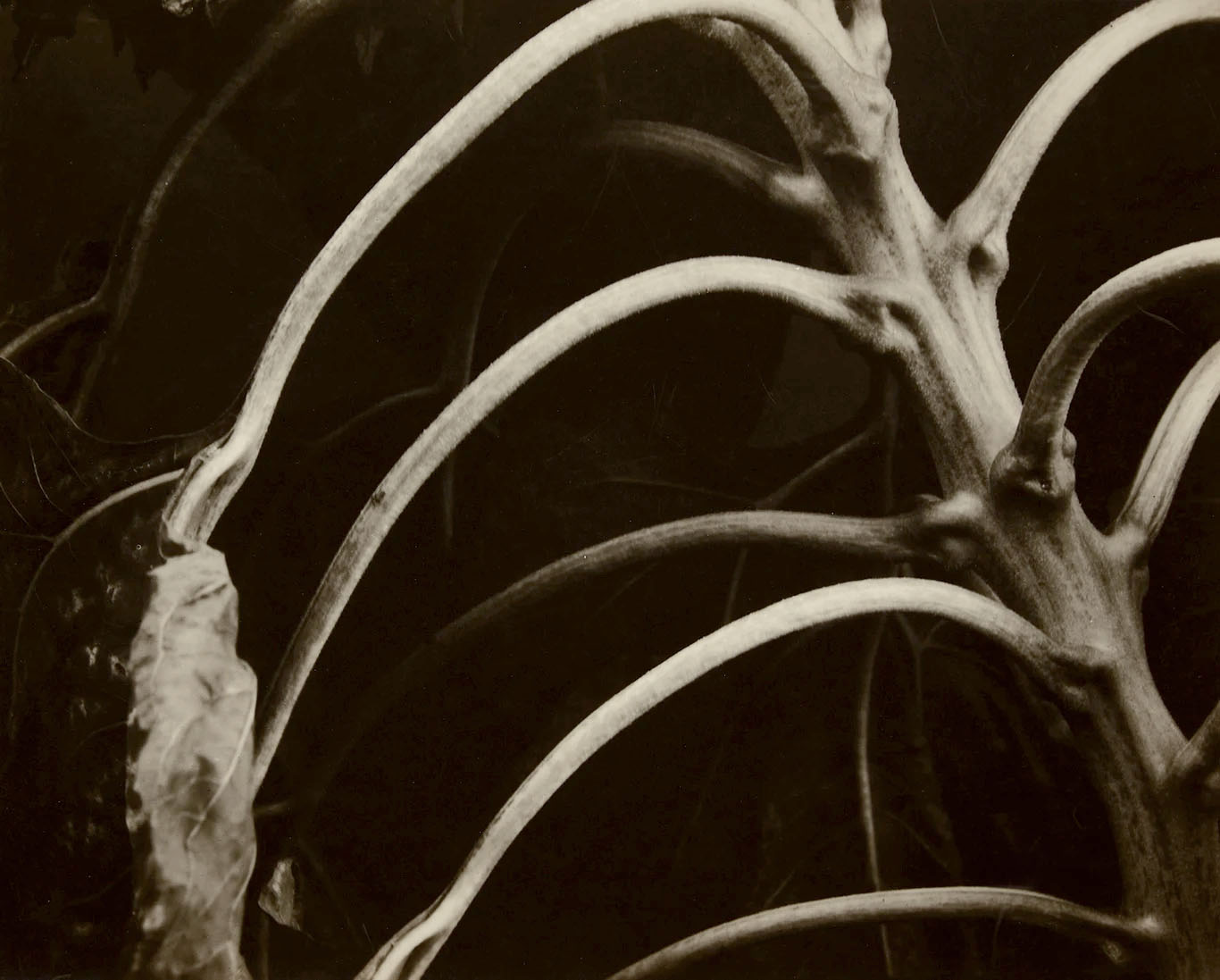
 

Edward Steichen (American born Luxembourg, 1879-1973) 'Backbone and Ribs of a Sunflower' c. 1920


Edward Steichen (American born Luxembourg, 1879-1973)
Backbone and Ribs of a Sunflower
c. 1920
Gelatin silver print on paper


Steichen was a knowledgeable botanist and spent five decades photographing the life cycle of sunflowers. This is one of his earliest studies of the plant. He became fascinated with spirals in nature, writing, “I found some form of the spiral in most succulent plants and in certain flowers, particularly in the seed pods of the sunflower.”


Edward Steichen (American born Luxembourg, 1879-1973) 'Advertising Study for Coty Lipstick' 1929


Edward Steichen (American born Luxembourg, 1879-1973)
Advertising Study for Coty Lipstick
1929
Gelatin silver print on paper


Steichen is credited as a founding figure of modern advertising and fashion photography. From 1923 to 1938, he served as chief photographer for the Condé Nast magazines Vogue and Vanity Fair. He had extensive experience in graphic design and advertising from his youth and earlier career. He had designed posters as a young man for a lithographic printer in Milwaukee. As Alfred Stieglitz’s associate on Camera Work from 1903 to 1917, Steichen produced the logo, typeface, and page layouts.

All from the Collection of Michael Mattis and Judith Hochberg


Works by Strand
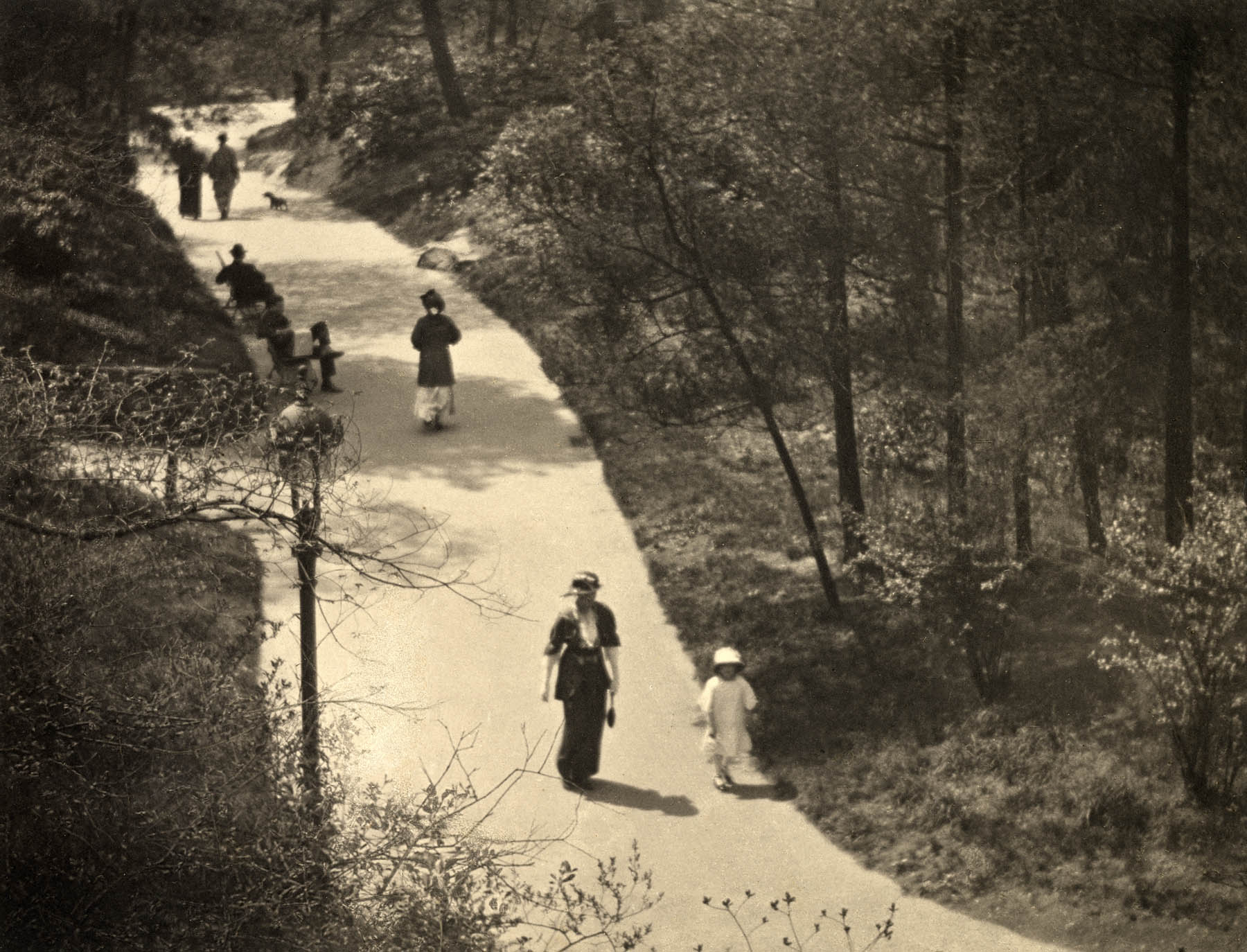
 

Paul Strand (American, 1890-1976) 'Central Park' 1915-1916 from the exhibition 'Photo-Secession: Painterly Masterworks of Turn-of-the-Century Photography' at the Utah Museum of Fine Arts, Salt Lake City, August - December 2024


Paul Strand (American, 1890-1976)
Central Park
1915-1916
Platinum print on paper


Urban life preoccupied Strand and in the 1920s would become a central subject of Modernist photographers around the world. From a Central Park overpass Strand identified this interesting composition with the bright, sinuous path dividing the picture plane. The decisive moment to snap the shutter occurred with the appearance of the two advancing figures and their angular shadows.
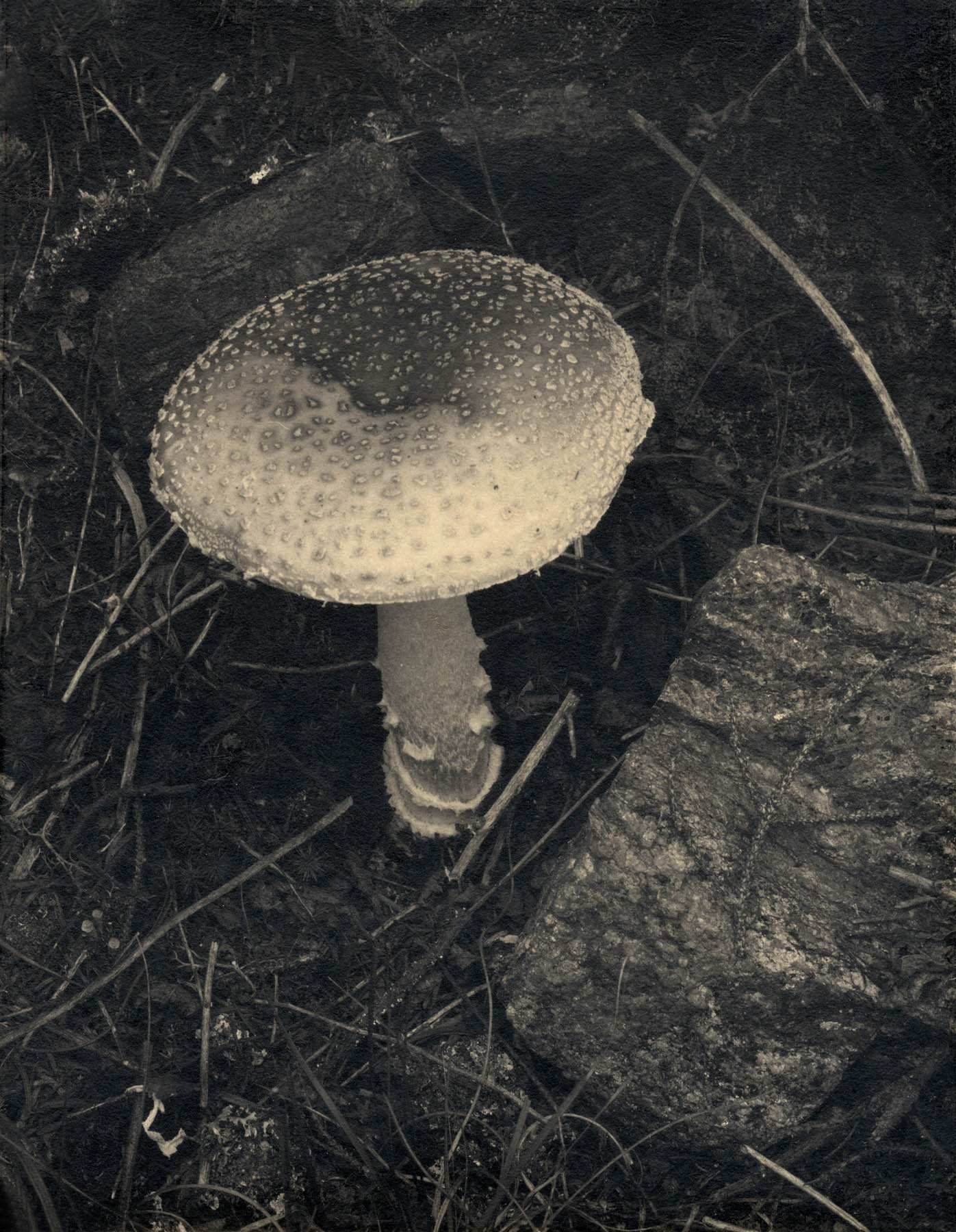
 

Paul Strand (American, 1890-1976) 'Speckled Toadstool, Georgetown, Maine' 1927


Paul Strand (American, 1890-1976)
Speckled Toadstool, Georgetown, Maine
1927
Waxed platinum print on paper


Strand continued to use platinum printing long after most other photographers adopted gelatin silver papers, which were more efficient and versatile and had a glossier surface. His prints in platinum are highly regarded for capturing minute detail and a wide range of tonal values.
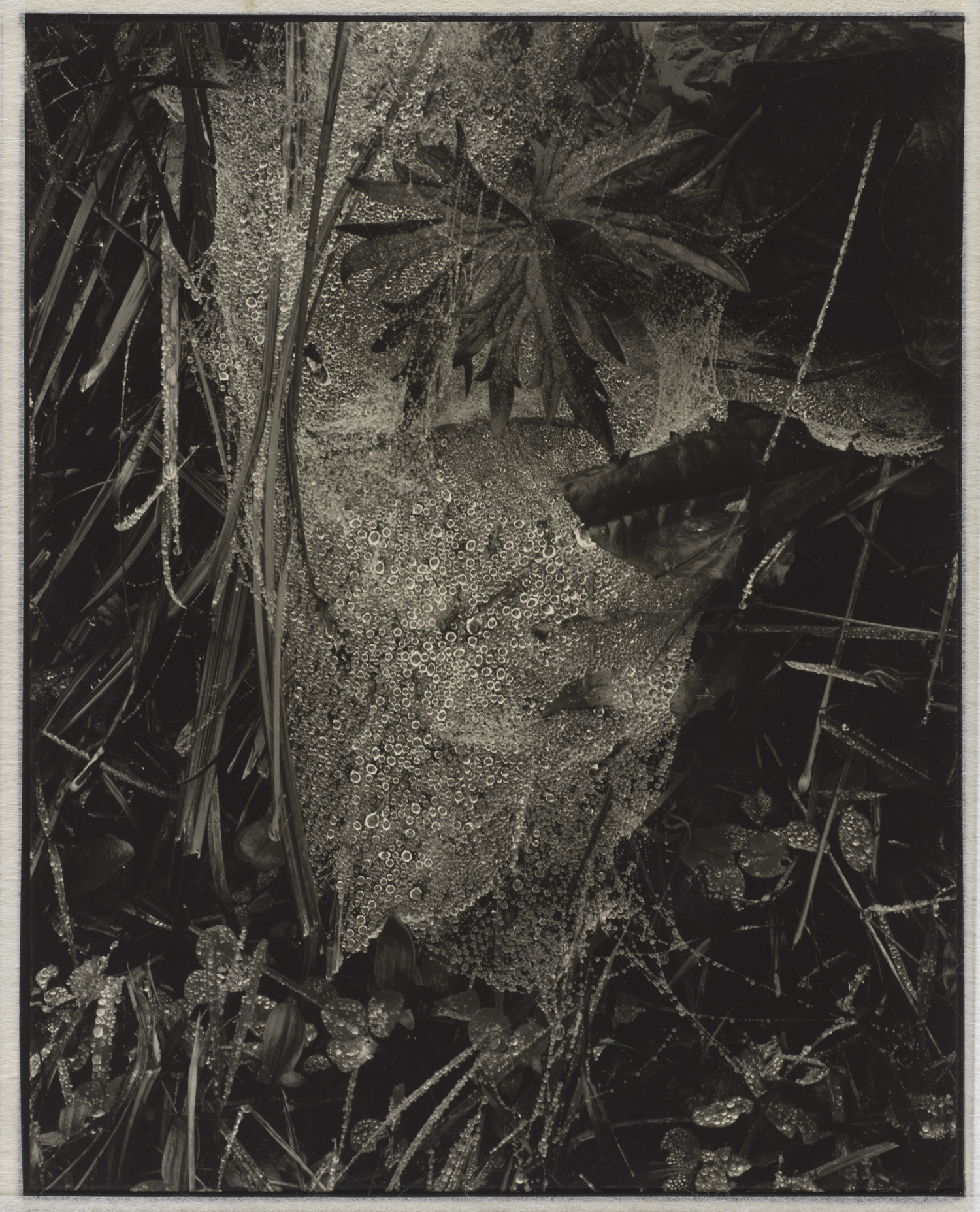
 

Paul Strand (American, 1890-1976) 'Cobweb in the Rain, Georgetown, Maine' 1928


Paul Strand (American, 1890-1976)
Cobweb in the Rain, Georgetown, Maine
1928
Gelatin silver print on paper

All from the Collection of Michael Mattis and Judith Hochberg


Works of Straight photography
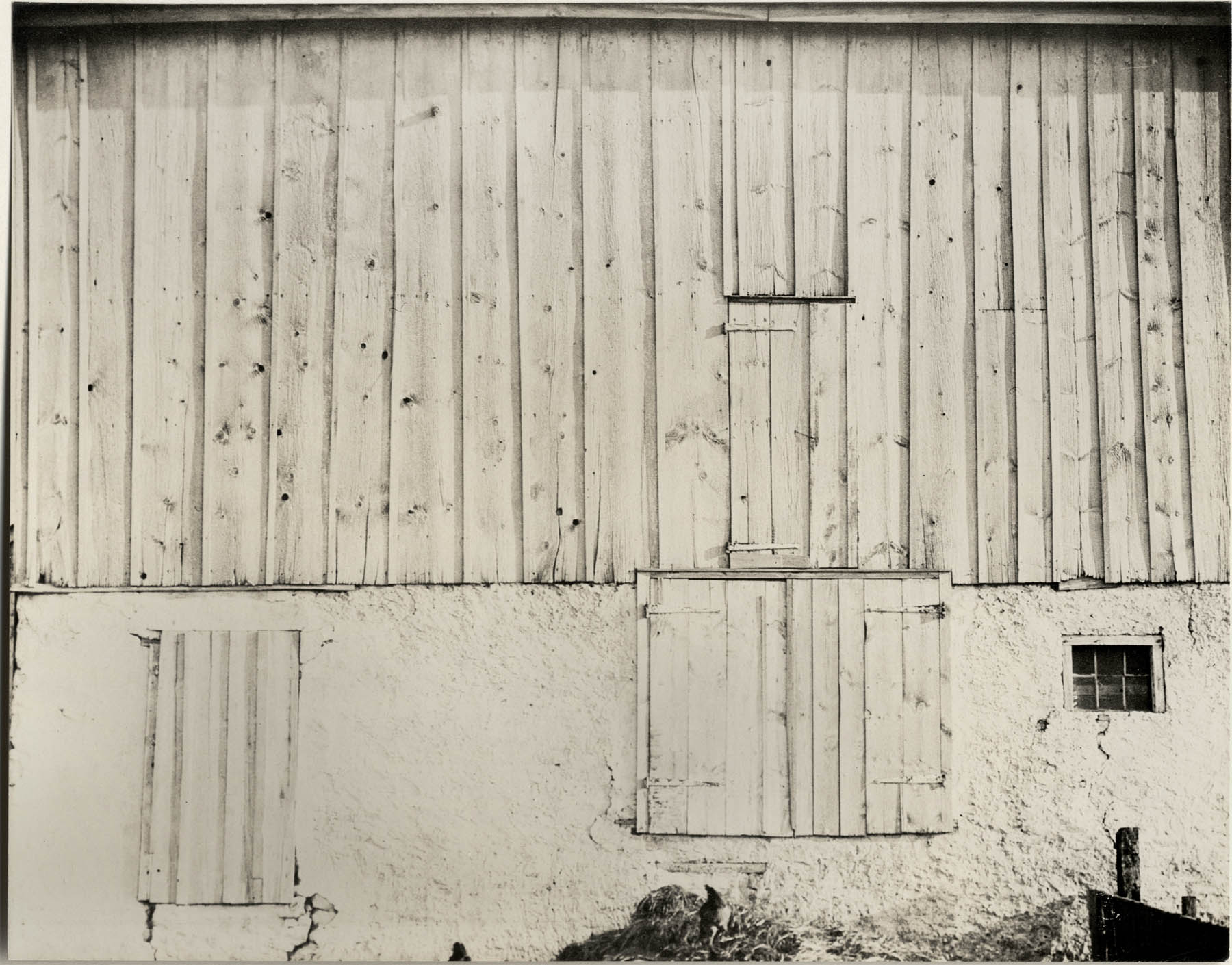
 

Charles Sheeler (American, 1883-1965) 'Side of White Barn, Bucks County' 1917


Charles Sheeler (American, 1883-1965)
Side of White Barn, Bucks County
1917
Gelatin silver print on paper


A painter and photographer, Sheeler became a close friend of Alfred Stieglitz as the Photo-Secession dissolved. This photographic study of line, shape, and tone recalls the hard-edged style of Sheeler’s paintings. Only the chickens appearing at the bottom edge give a sense of scale to the barn.


Alvin Langdon Coburn: The Avant-Garde Creator

Alvin Langdon Coburn pushed the boundaries of photography with his innovative Vortographs, created in 1916-1917. These images are considered some of the first abstract photographs, born from Coburn’s desire to create art that combined the physical with the spiritual. By placing a vortoscope, a triangular arrangement of mirrors and prisms, over a camera’s lens, Coburn created complex images of kaleidoscopic and geometric patterns that simplify the photograph to the essential elements of light and form. This technique broke away from traditional photographic representation, emphasising form, structure, and abstraction. The Vortographs were influenced by the Vorticist movement, which celebrated dynamic and abstract art. Coburn’s pioneering work with these images marked a significant departure from Pictorialism, embracing modernist principles and demonstrating the artistic potential of photography beyond mere depiction. The Vortographs stand as a testament to Coburn’s visionary approach and contributions to the evolution of photographic art.

Adelaide Ryder. “The Photo-Secession Movement: Pioneering Artistry in Early Photography,” on the UMFA website Nd [Online] Cited 22/10/2024
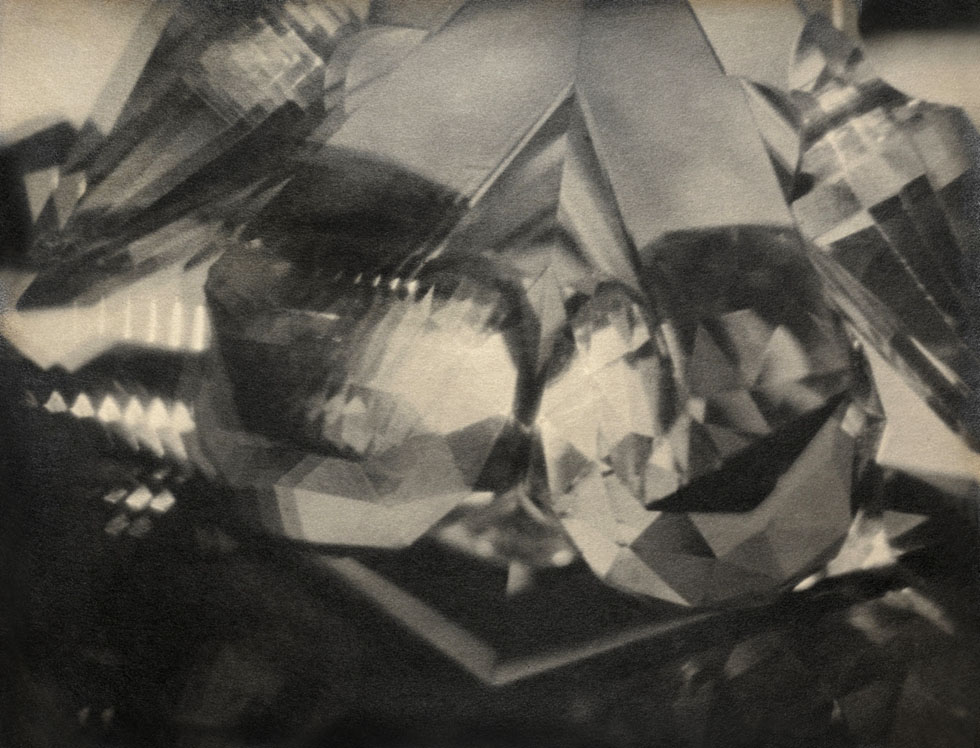
 

Alvin Langdon Coburn (British American, 1882-1966) 'Vortograph' 1917


Alvin Langdon Coburn (British American, 1882-1966)
Vortograph
1917
Gelatin silver print on paper


Coburn was one of the Photo-Secessionists who rejected Pictorialism. In his 1916 essay “The Future of Pictorial Photography,” he called for abstraction in photography, concluding, “it is my hope that photography may fall in line with all the other arts, and with her infinite possibilities, do things stranger and more fascinating than the most fantastic dreams.” Coburn created vortographs like this by placing a devise with three mirrors between his camera and subject. When he exhibited them to great fanfare in London in 1917, Ezra Pound proclaimed: “The Camera is freed from Reality!”

All from the Collection of Michael Mattis and Judith Hochberg


Utah Museum of Fine Arts
University of Utah campus
Marcia and John Price Museum Building
410 Campus Center Drive

Opening hours:
Tuesday – Sunday 10am – 5pm
Closed Mondays
Utah Museum of Fine Arts website

LIKE ART BLART ON FACEBOOK

Back to top

Exhibition: ‘A Lasting Memento: John Thomson’s Photographs Along the River Min’ at the Peabody Essex Museum (PEM), Salem MA

Exhibition dates: 1st June, 2019 – 17th May, 2020

Curator: Sarah Kennel, PEM’s Byrne Family Curator of Photography


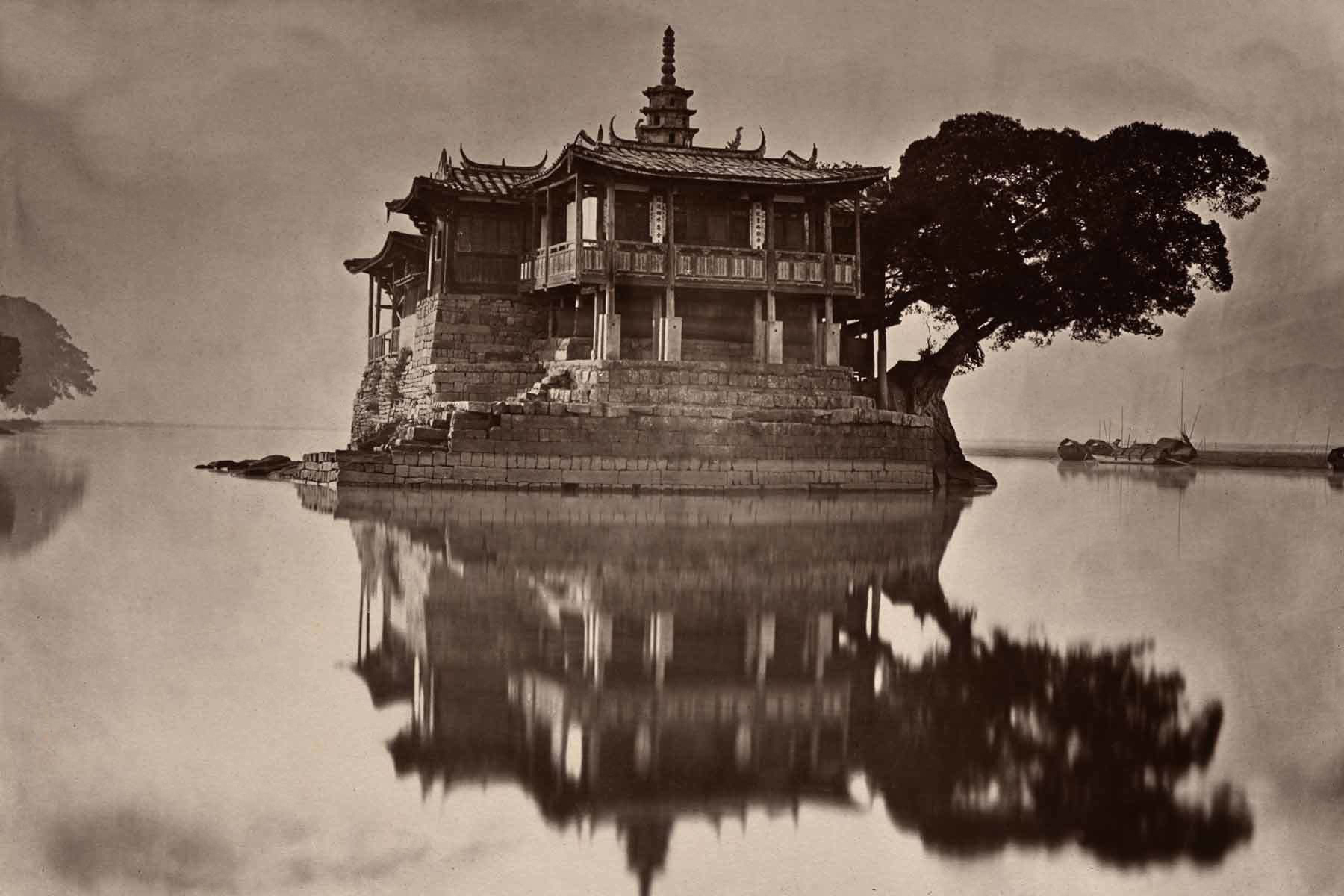
John Thomson (Scottish, 1837-1921) 'The Island Pagoda' 1873 from the exhibition 'A Lasting Memento: John Thomson's Photographs Along the River Min' at the Peabody Essex Museum (PEM), Salem MA, June 2019 - May 2020


John Thomson (Scottish, 1837-1921)
The Island Pagoda
1873
Carbon print
Gift of the Estate of Mrs. Anthony Rives
© Peabody Essex Museum. Photography by Ken Sawyer


Greetings from Australia.

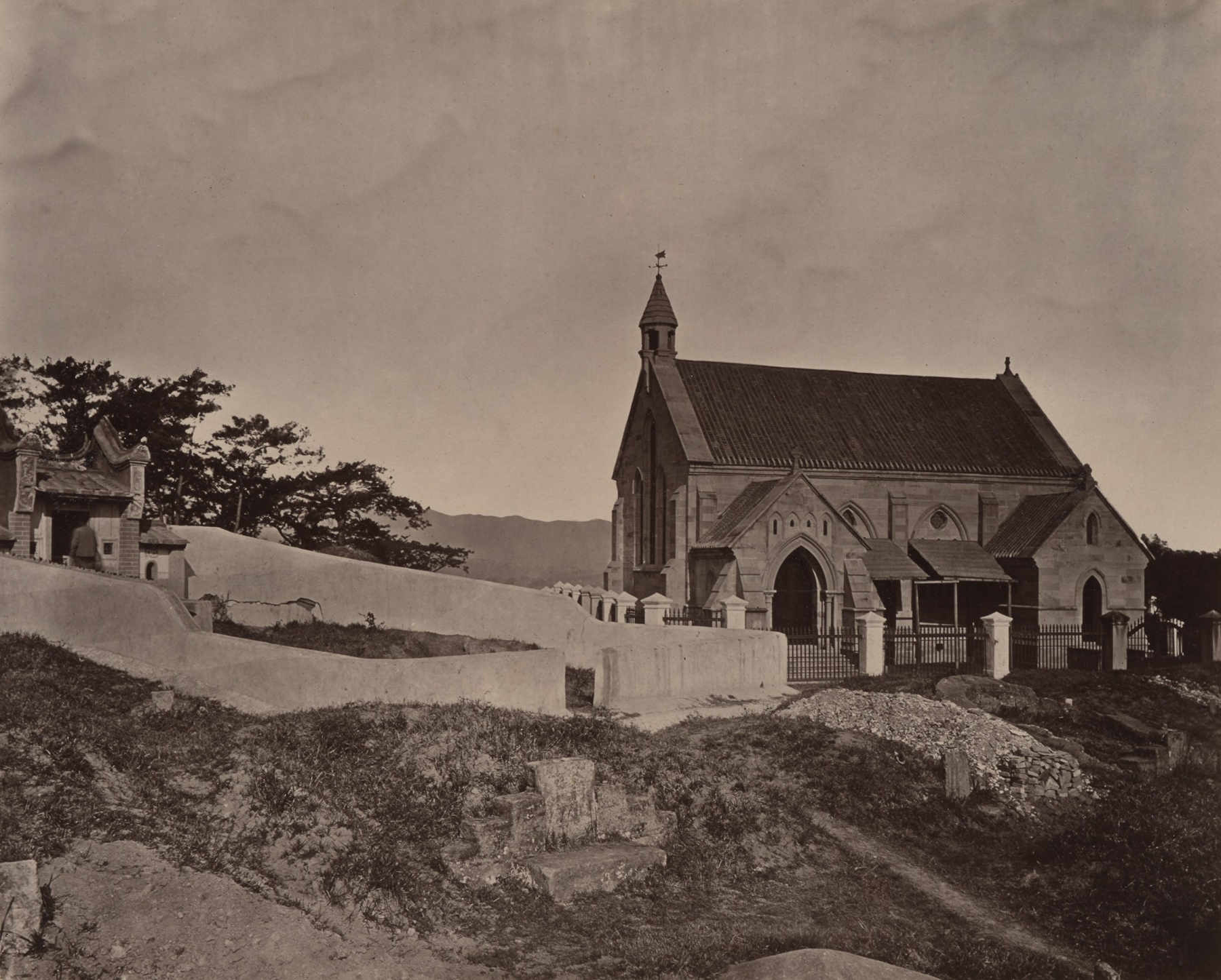
Since we can’t go travelling ourselves at the moment let us travel, virtually, through time – back to the 19th century – and space, to journey with Scottish-born travel photographer up the River Min to the Chinese city of Fuzhou (Foochow). Let us wonder at these European colonial photographs, reflections of pagoda, bucolic landscapes, Eastern temples, Western churches and dangerous rapids. Thomson “portrayed a halcyon land, with romanticised vistas that reference the ethereal atmosphere of Chinese paintings and the sweeping panoramas of European paintings.”

Let us luxuriate, then, in these stunning carbon prints – their rich colour, their stillness – as lasting mementos of a vanished land, as memory objects reanimated in our imagination, so that we can travel beyond our current confinement.

Dr Marcus Bunyan


Many thankx to the Peabody Essex Museum for allowing me to publish the photographs in the posting. Please click on the photographs for a larger version of the image.


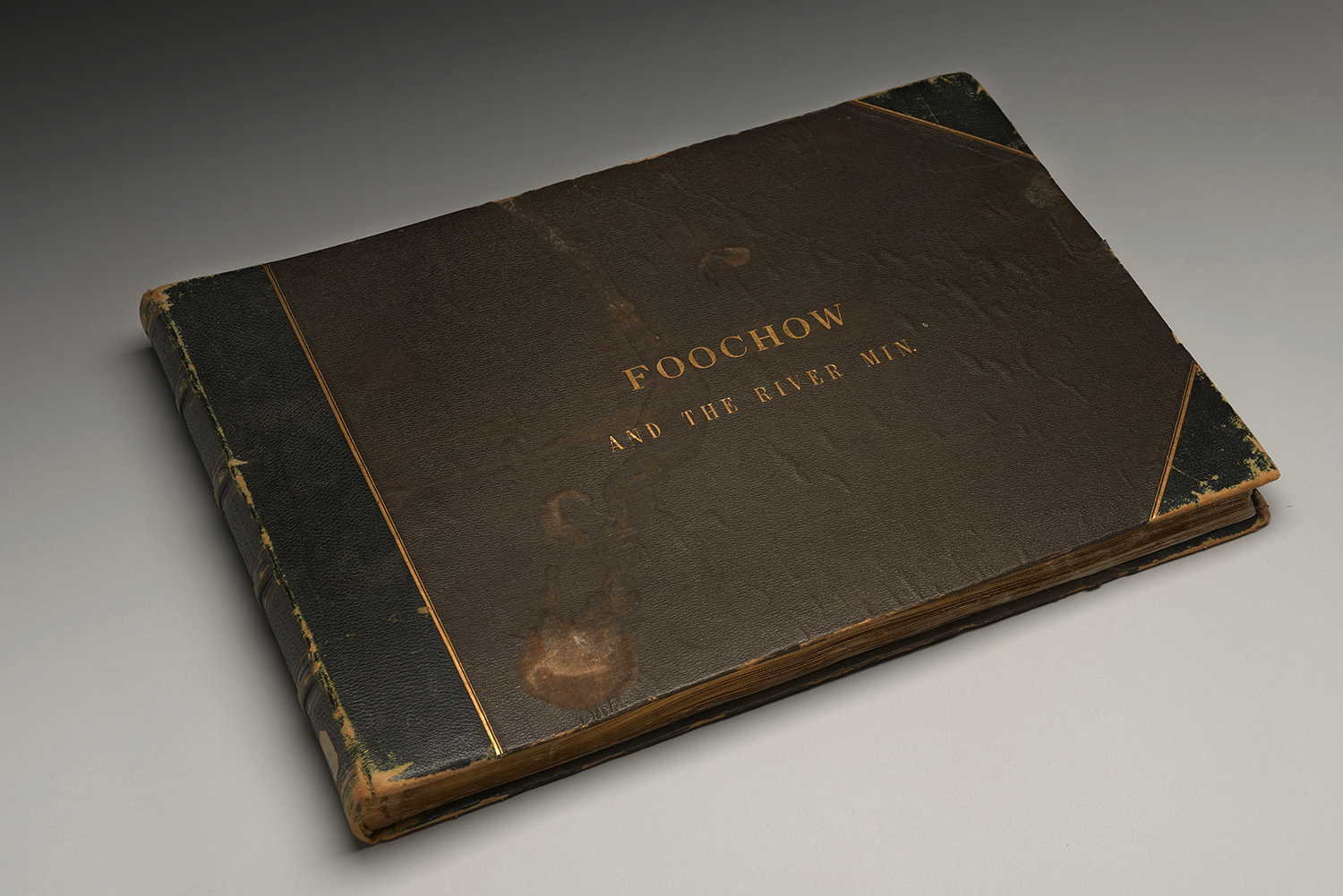
As far as travel souvenirs go, few can beat John Thomson’s leather-bound photo album Foochow and the River Min. From 1870 to 1871, the Scottish-born photographer traveled 160 miles up the River Min to document the area in and around the city of Fuzhou (Foochow), an important centre of international trade and one of the most picturesque provinces in China. Thomson sold his book by advance subscription to the foreign residents of Fuzhou – tea planters, merchants, missionaries and government officials 0 who wanted a way to share their experiences with friends and family back home.

Fewer than 10 of the original 46 copies of this album survived, and the Peabody Essex Museum is privileged to own two of them. A Lasting Memento: John Thomson’s Photographs Along the River Min presents this rare collection of photographs for the first time at PEM. The exhibition also features 10 works by contemporary Chinese photographer Luo Dan.


Installation view of the exhibition 'A Lasting Memento: John Thomson's Photographs Along the River Min' at the Peabody Essex Museum (PEM), Salem MA 


Installation view of the exhibition A Lasting Memento: John Thomson’s Photographs Along the River Min at the Peabody Essex Museum (PEM), Salem MA


John Thomson (Scottish, 1837-1921) 'Foochow and the River Min' 1870-1871


John Thomson (Scottish, 1837-1921)
Foochow and the River Min
1870-1871
Leather-bound photo album
© Peabody Essex Museum
Photography by Ken Sawyer


John Thomson (Scottish, 1837-1921) 'Pagoda Island' 1870-1871 from the exhibition 'A Lasting Memento: John Thomson's Photographs Along the River Min' at the Peabody Essex Museum (PEM), Salem MA, June 2019 - May 2020


John Thomson (Scottish, 1837-1921)
Pagoda Island
1870-1871
Carbon print
Gift of the Estate of Mrs. Anthony Rives
© Peabody Essex Museum
Photography by Ken Sawyer


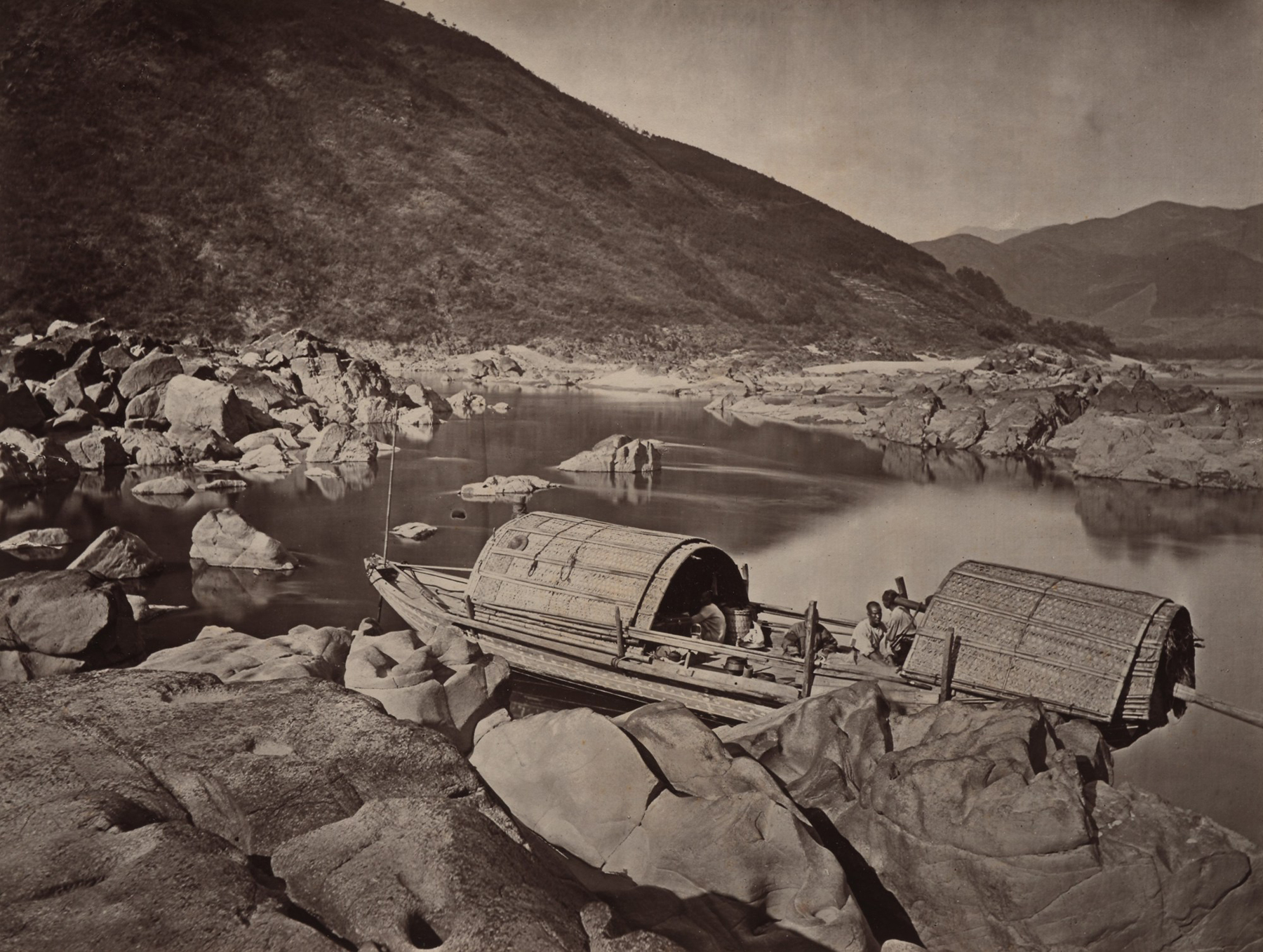
John Thomson (Scottish, 1837-1921) 'Yuen-Fu Rapid' 1870-1871 from the exhibition 'A Lasting Memento: John Thomson's Photographs Along the River Min' at the Peabody Essex Museum (PEM), Salem MA, June 2019 - May 2020


John Thomson (Scottish, 1837-1921)
Yuen-Fu Rapid
1870-1871
Carbon print
Gift of the Estate of Mrs. Anthony Rives
© Peabody Essex Museum
Photography by Ken Sawyer


John Thomson (Scottish, 1837-1921) 'Yen Ping Rapid' 1870-1871


John Thomson (Scottish, 1837-1921)
Yen Ping Rapid
1870-1871
Carbon print
Gift of the Estate of Mrs. Anthony Rives
© Peabody Essex Museum
Photography by Ken Sawyer


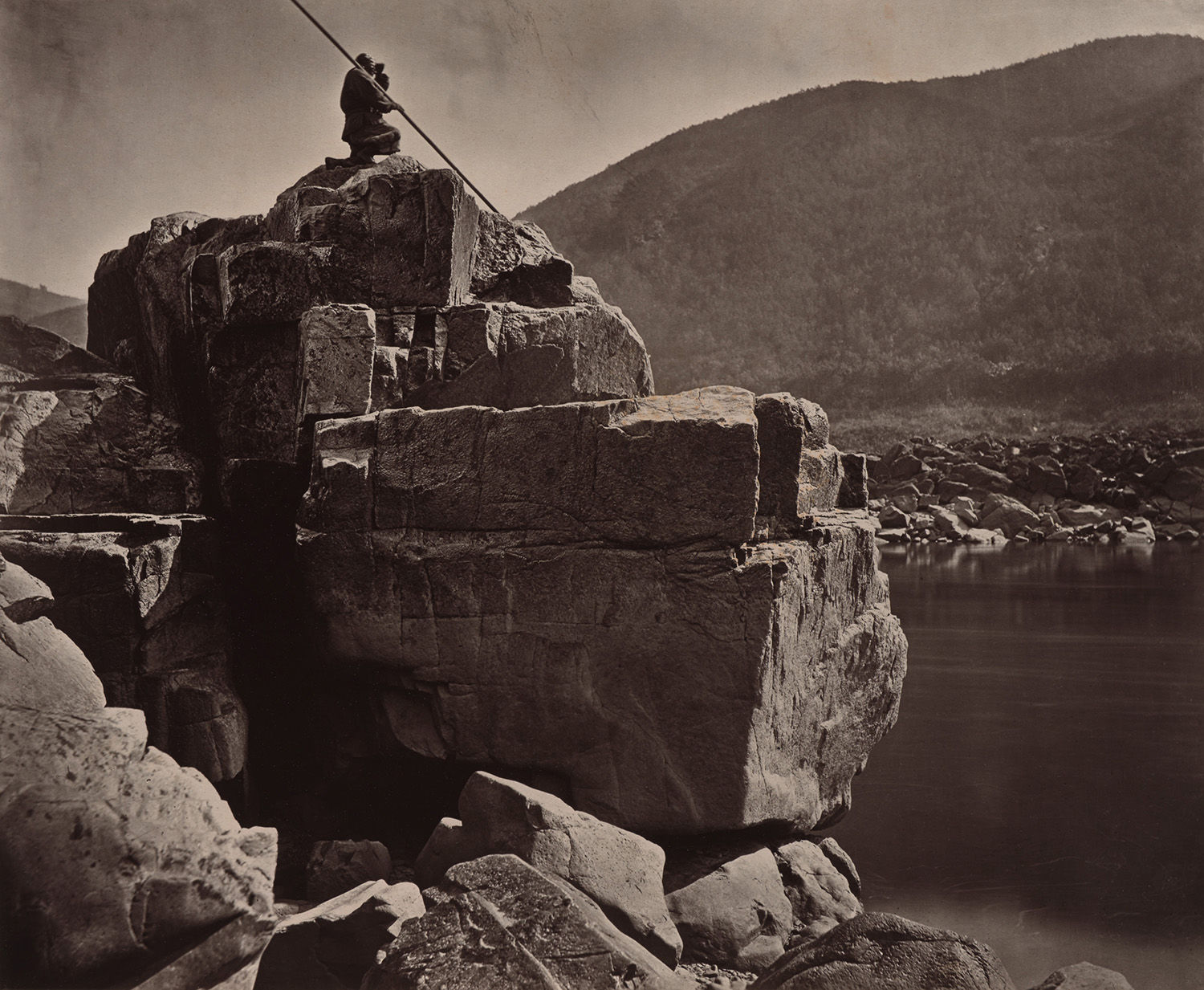
John Thomson (Scottish, 1837-1921) 'Rocks in the Rapids' 1870-1871


John Thomson (Scottish, 1837-1921)
Rocks in the Rapids
1870-1871
Carbon print
Gift of the Estate of Mrs. Anthony Rives
© Peabody Essex Museum
Photography by Ken Sawyer


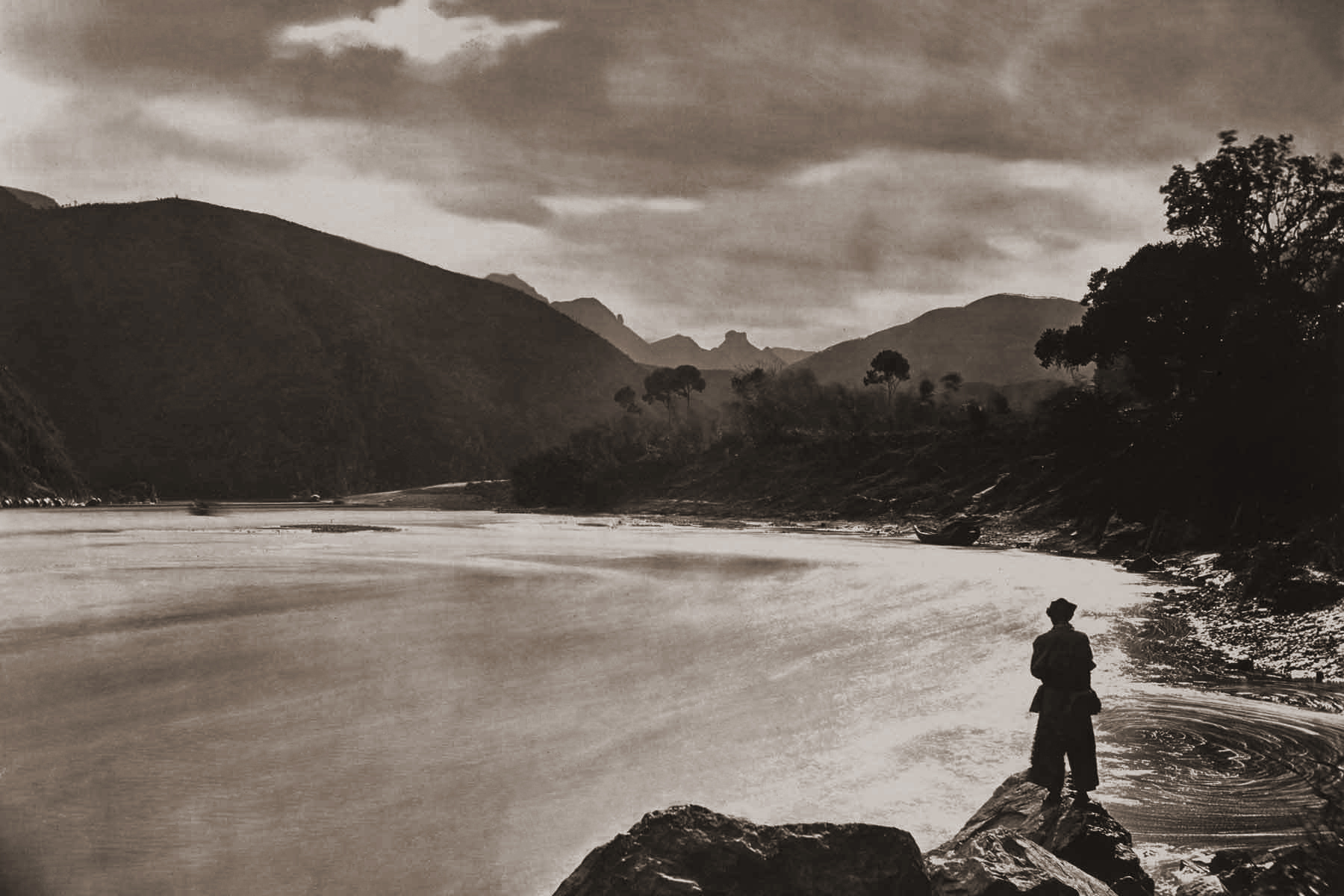
John Thomson (Scottish, 1837-1921) 'A Reach of the Min' 1870-1871


John Thomson (Scottish, 1837-1921)
A Reach of the Min
1870-1871
Carbon print
Gift of the Estate of Mrs. Anthony Rives
© Peabody Essex Museum
Photography by Ken Sawyer


John Thomson (Scottish, 1837-1921) 'A Rapid Boat' 1870-1871


John Thomson (Scottish, 1837-1921)
A Rapid Boat
1870-1871
Carbon print
Gift of the Estate of Mrs. Anthony Rives
© Peabody Essex Museum
Photography by Ken Sawyer


Photographic Journeys Past and Present Show China in a New Light

The Peabody Essex Museum (PEM) presents a voyage into 19th-century China through one of PEM’s photographic treasures, John Thomson’s rare album Foochow and the River Min. More than forty striking landscapes, city views, and portrait studies will be on view, captured by Thomson as he travelled in the Fujian province in Southeast China from 1870 to 1871. These prints are complemented by a selection of photographs by contemporary artist Luo Dan, who was inspired by Thomson to undertake his own journey in southwestern China in 2010. A Lasting Memento: John Thomson’s Photographs Along the River Min is on view at PEM from June 1, 2019 through May 17, 2020.

From 1870 to 1871, Scottish-born photographer John Thomson traveled 160 miles up the River Min to document the area in and around the city of Fuzhou (Foochow), one of the most picturesque regions in China. Thomson gathered eighty photographs from this voyage into an album titled Foochow and the River Min which was sold by advance subscription to the foreign residents of Fuzhou – tea planters, merchants, missionaries and government officials – who wanted a way to share their experiences with friends and family back home. Of the 46 copies originally published, fewer than 10 survive today and PEM is privileged to own two of them, both of which are featured in the exhibition.

“Many people have a conception of China as very industrialised and modern, even sterile, but these photographs complicate that notion and reveal the country’s incredible beauty and geographic diversity,” says Sarah Kennel, PEM’s Byrne Family Curator of Photography. “The roots of China’s rapid modernisation go back to the 19th-century and are part of a larger history of maritime culture, trade, and globalisation that are also entwined with PEM’s origin story. This exhibition affirms how photography can bring us back to another place in time and can change the way we see the world.”

Thomson was a renowned photographer, focusing on fine art, landscape, and architectural photos, and was often credited with being one of the first photographers to use pictures in conjunction with journalistic commentary. Foochow and the River Min is accompanied by introductory text, presenting a pictorial journey featuring the character of the growing city of Fuzhou, the beauty of the landscapes surrounding the River Min, as well as Thomson’s studies of the people he encountered there.

Documenting Eastern culture

Thomson is considered one of the first photographers to document East and South Asia. Born in Scotland, he learned photography while still in school, working as an apprentice to a maker of optical and scientific instruments. In 1862, he joined his older brother William, also a photographer and watchmaker, in Singapore, where they established a studio. Thomson spent the next several years photographing throughout Asia, including Cambodia, India, and Thailand. By 1866, he had joined the Royal Ethnological Society of London, was elected a Fellow member of the Royal Geographic Society, and styled himself as an expert on Eastern cultures. In 1868, he established a studio in Hong Kong, a burgeoning centre of photography and trade. For the next four years, Thomson traveled and photographed throughout China before returning in 1872 to Britain, where he remained until his death in 1921.

The exhibition follows Thomson’s journey up the River Min, from the city of Fuzhou to Nanping. “Thomson’s extraordinary gifts as a photographer are evident in his compositions, including his famous view of the floating island pagoda,” says Kennel. “You can look at these as merely beautiful pictures, but if you unlock them a little bit they tell the story of an important moment of economic trade, cultural exchange, and political tension.”

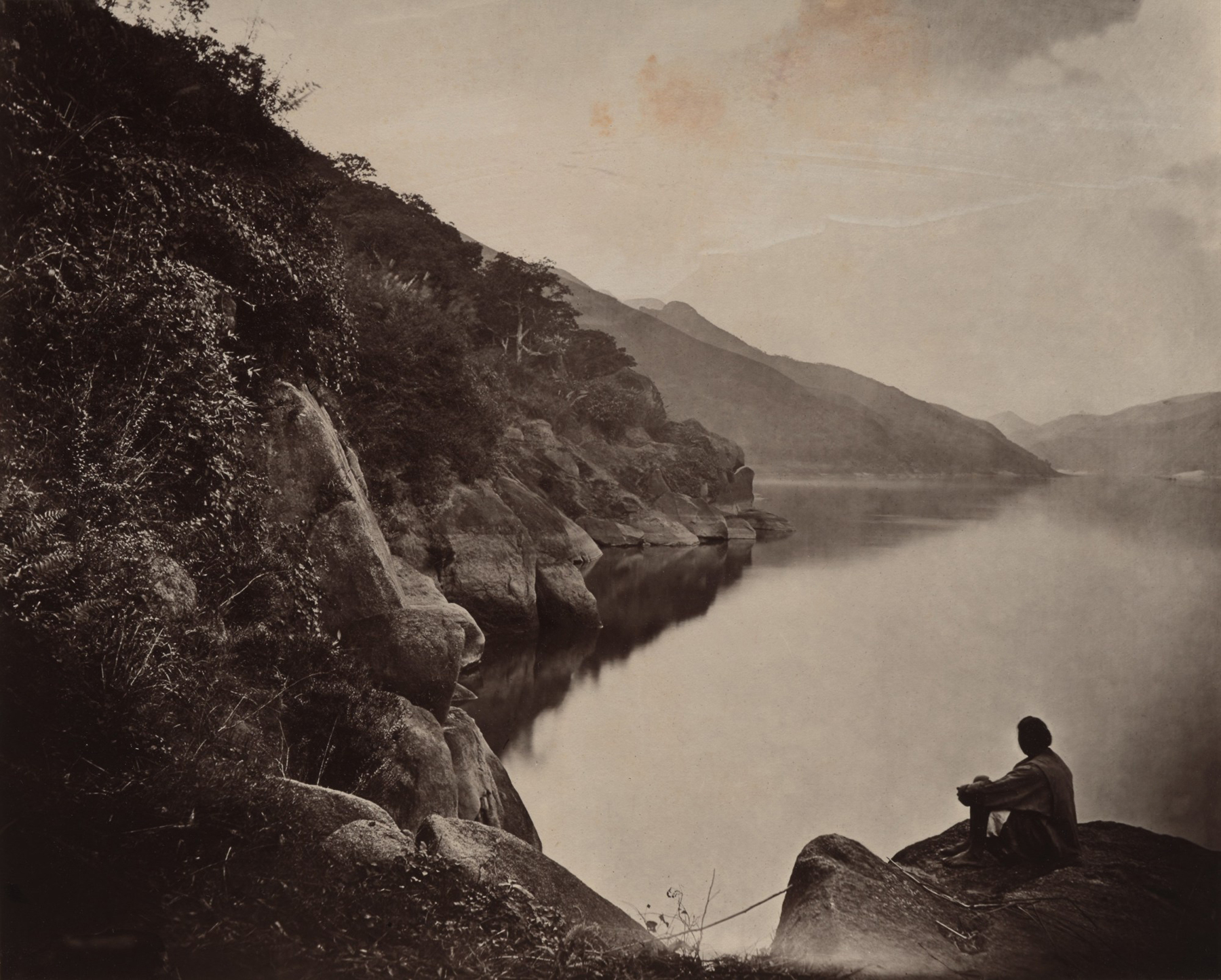
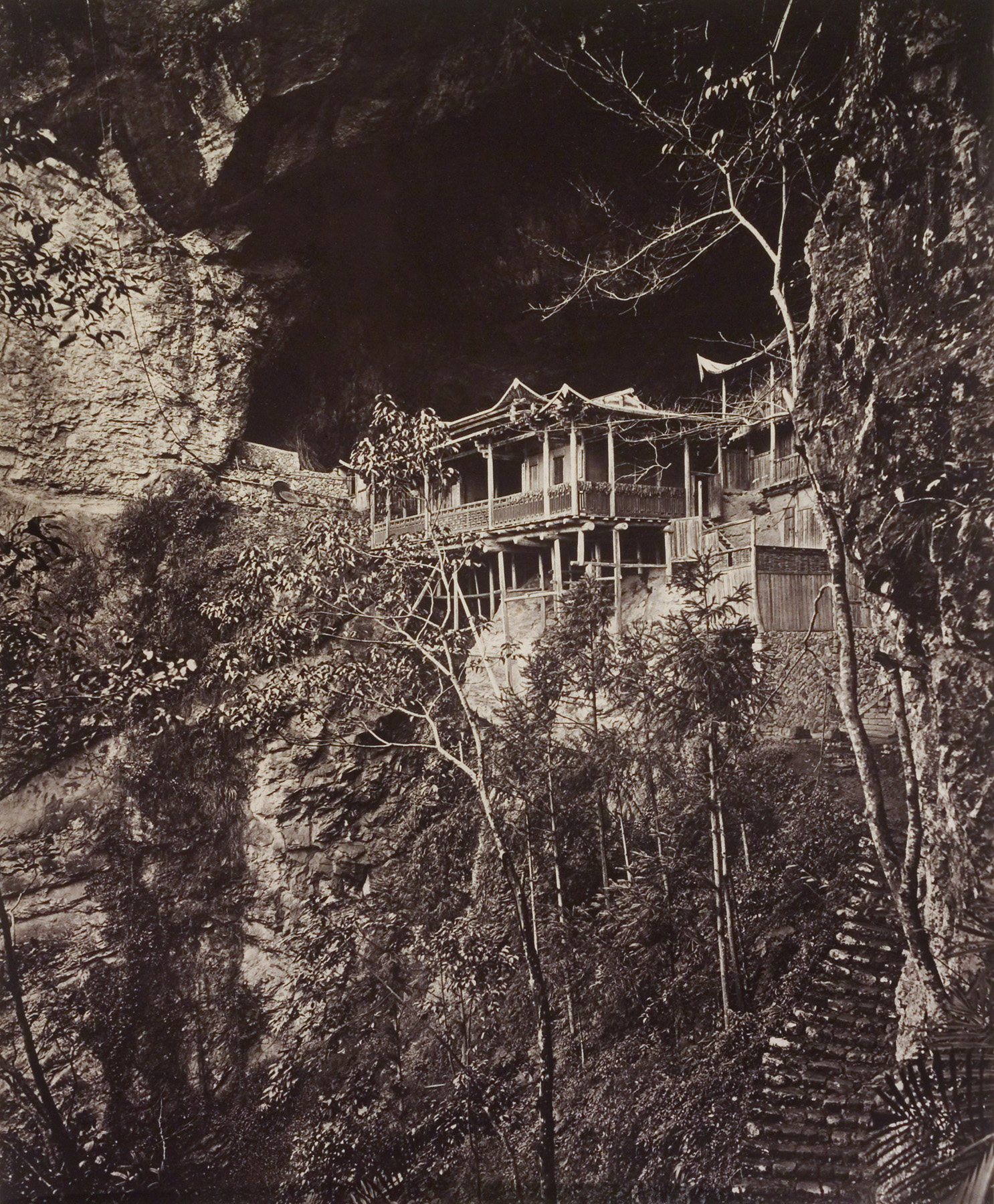
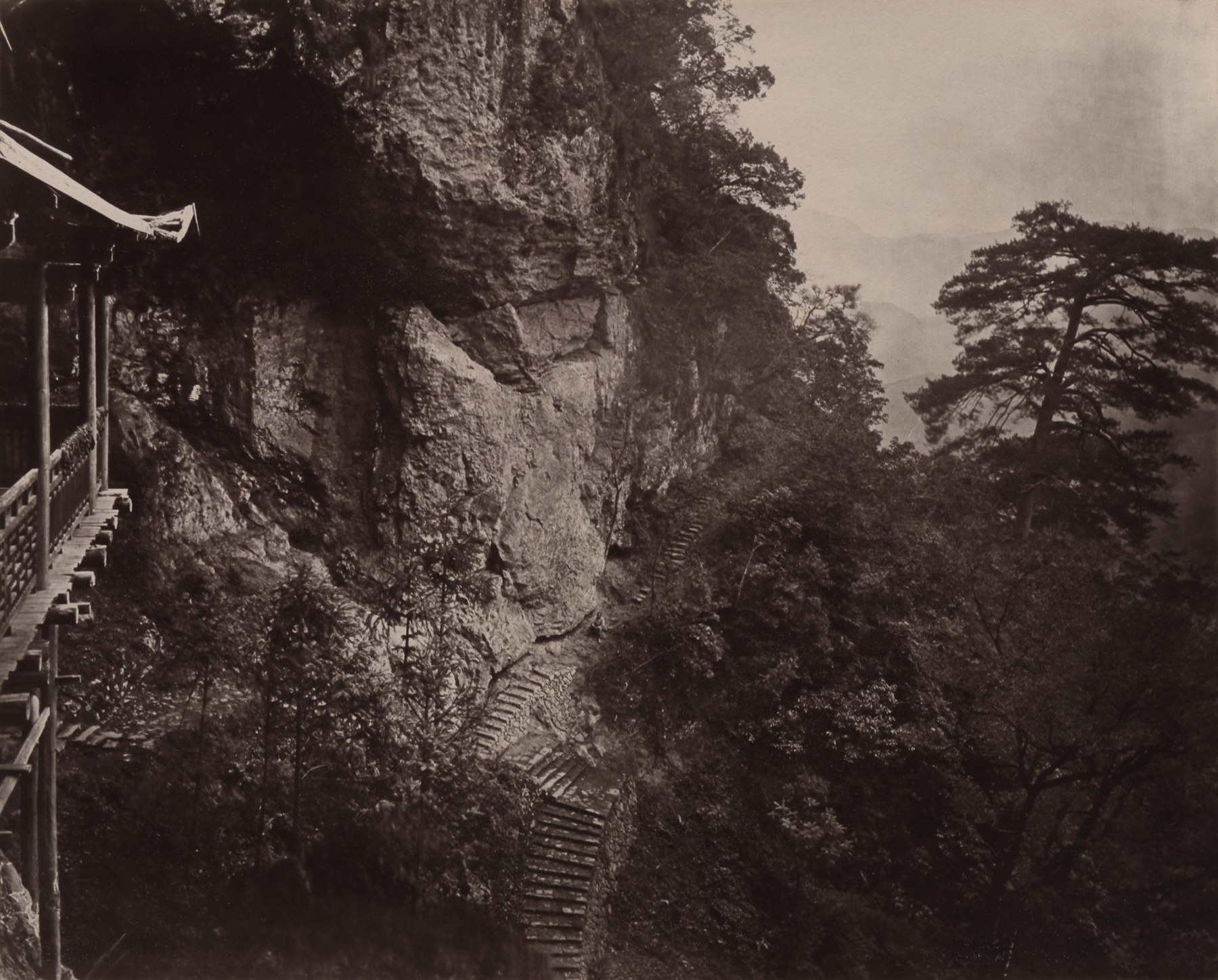
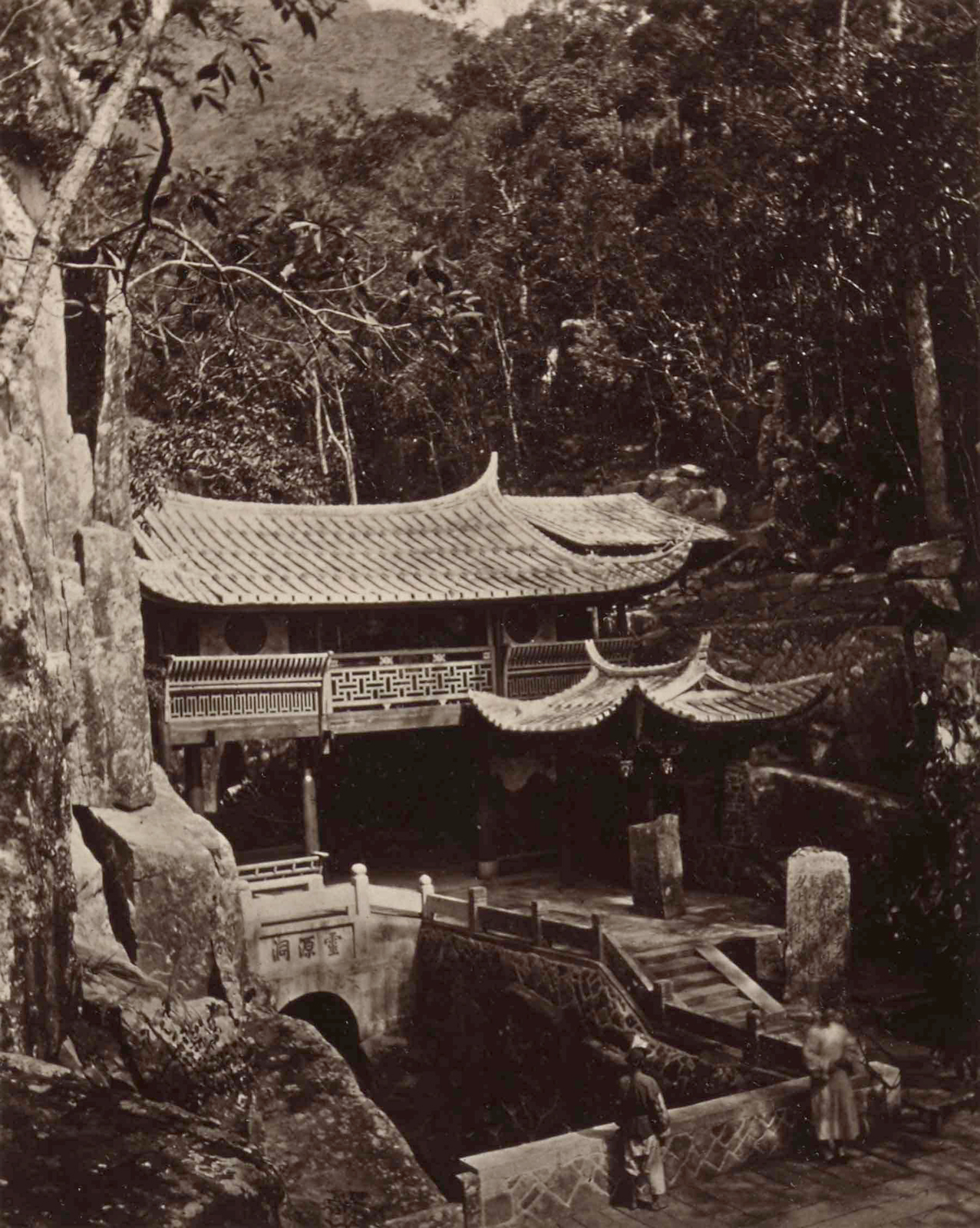
Among the works on view are an extraordinary series on the Yuen Fu monastery, tucked high up a steep, rocky ravine. A strain of wistful romanticism is present, particularly in landscape photographs that incorporate a solitary figure.

In order to make his negatives, Thomson used the wet-collodion process. This required him to set up a large camera on a tripod and prepare the photographic plate on the spot by dipping it into light-sensitive chemicals in a makeshift darkroom, putting it in a plate holder and making the exposure within five minutes. He experimented with these processes while traveling by boat or ascending very steep hills and traversing rough terrain with a coterie of Chinese employees who not only hauled his equipment but also sometimes carried Thomson himself. Missionary and business colleagues helped facilitate introductions and provide access to unique locations so that Thomson could make his landscapes and portraits. The albums were printed using the carbon process, which imbues them with a rich, purplish tonality.

Inspired by Thomson

Contemporary Chinese photographer Luo Dan’s work focuses on the impact of modernisation and globalisation in China. Inspired by Thomson’s example, Luo traveled to the remote Nu River Valley in southwestern China, where he lived with and photographed the Lisu and Nu Christian ethnic minority communities for nearly two years, using the same hand-made wet-collodion process that Thomson had employed some 150 years earlier. Luo was especially interested in what he perceived as the villagers’ connection to local cultural traditions. A Lasting Memento features 10 works by Luo that reflect on and reverberate with the spirit and enterprise of Thomson’s 19th-century project.

Press release from the Peabody Essex Museum website


John Thomson (Scottish, 1837-1921) 'Foochow Church' 1870-1871


John Thomson (Scottish, 1837-1921)
Foochow Church
1870-1871
Carbon print
Gift of the Estate of Mrs. Anthony Rives
© Peabody Essex Museum
Photography by Ken Sawyer


John Thomson (Scottish, 1837-1921) 'Foochow and the River Min (Yuen Fu monastery)' 1870-1871


John Thomson (Scottish, 1837-1921)
Foochow and the River Min (Yuen Fu monastery)
1870-1871
Carbon print
Gift of the Estate of Mrs. Anthony Rives
© Peabody Essex Museum
Photography by Ken Sawyer


John Thomson (Scottish, 1837-1921) 'Right Shoulder of Cave' 1870-1871


John Thomson (Scottish, 1837-1921)
Right Shoulder of Cave (view from the building above looking down to the left)
1870-1871
Carbon print
Gift of the Estate of Mrs. Anthony Rives
© Peabody Essex Museum
Photography by Ken Sawyer


John Thomson (Scottish, 1837-1921) 'A Small Temple at Ku-Shan' 1870-1871


John Thomson (Scottish, 1837-1921)
A Small Temple at Ku-Shan
1870-1871
Carbon print
Gift of the Estate of Mrs. Anthony Rives
© Peabody Essex Museum
Photography by Ken Sawyer


John Thomson (Scottish, 1837-1921) 'Road to the Plantation' 1870-1871


John Thomson (Scottish, 1837-1921)
Road to the Plantation
1870-1871
Carbon print
Gift of the Estate of Mrs. Anthony Rives
© Peabody Essex Museum
Photography by Ken Sawyer


“In an eerie parallel to today, the late 1800’s represented an international inflection point, with rampant Western industrialisation spurring expansive global trade, cultural exchange and attendant political tension. The invention of photography in 1839 enabled our earliest photographs of faraway lands and exotic cultures, most often brought back by wealthy amateurs (many of those images are held in the rich archives of the PEM.) Not so with John Thomson, a renowned professional photographer who garnered capital through pre-paid subscriptions to his album “Foochow and the River Min.” Thomson photographed the project on a two-year journey, traveling 160 miles up the River Min, from the city of Fuzhou (Foochow) to Nanping, considered one of the most picturesque regions in China.

In this scenic southeast region of China, a new British tea trade was flourishing. Thomson’s album catered to the interests of foreign tea planters, merchants, missionaries and governmental officials. These ex-patriots clamoured to share with their European family and friends Thomson’s skilfully crafted documentary photographs of the Chinese land and people who shaped their new lives. Interestingly, Thomson did not photograph much industry or commerce. Rather, he portrayed a halcyon land, with romanticised vistas that reference the ethereal atmosphere of Chinese paintings and the sweeping panoramas of European paintings. …

Thomson’s carbon prints are technically awe-inspiring. Utilising the cumbersome wet-plate collodion method of creating negatives on large, delicate glass plates that must be exposed while still wet in a hefty view camera on a tripod, Thomson then created his photographic prints on paper with the tricky but stable carbon method in his studio. I imagine this undertaking bore similarities to Hannibal crossing the Alps and that Thomson must have been a robust and determined 33 year-old. Perhaps he was also a perfectionist, because Thomson’s prints from the 1870’s are impeccably pristine. Come see, it is uncanny.”

Elin Spring. “Images of China, Then & Now,” on the What Will You Remember? website [Online] Cited 29/03/2020


John Thomson (Scottish, 1837-1921) 'Part of Lower Bridge' 1870-1871


John Thomson (Scottish, 1837-1921)
Part of Lower Bridge
1870-1871
Carbon print
Gift of the Estate of Mrs. Anthony Rives
© Peabody Essex Museum
Photography by Ken Sawyer


John Thomson (Scottish, 1837-1921) 'A Military Mandarin' (detail) 1873


John Thomson (Scottish, 1837-1921)
A Military Mandarin (detail)
1873
Carbon print
Gift of the Estate of Mrs. Anthony Rives, 1972


John Thomson (Scottish, 1837-1921) 'Hired Labourers' 1870-1871


John Thomson (Scottish, 1837-1921)
Hired Labourers
1870-1871
Carbon print
Gift of the Estate of Mrs. Anthony Rives
© Peabody Essex Museum
Photography by Ken Sawyer


John Thomson (Scottish, 1837-1921) 'Mode of Dressing the Hair' 1870-1871


John Thomson (Scottish, 1837-1921)
Mode of Dressing the Hair
1870-1871
Carbon print
Gift of the Estate of Mrs. Anthony Rives
© Peabody Essex Museum
Photography by Ken Sawyer


John Thomson (Scottish, 1837-1921)

John Thomson (14 June 1837 – 29 September 1921) was a pioneering Scottish photographer, geographer, and traveller. He was one of the first photographers to travel to the Far East, documenting the people, landscapes and artefacts of eastern cultures. Upon returning home, his work among the street people of London cemented his reputation, and is regarded as a classic instance of social documentary which laid the foundations for photojournalism. He went on to become a portrait photographer of High Society in Mayfair, gaining the Royal Warrant in 1881. …

Travels in China

After a year in Britain, Thomson again felt the desire to return to the Far East. He returned to Singapore in July 1867, before moving to Saigon for three months and finally settling in Hong Kong in 1868. He established a studio in the Commercial Bank building, and spent the next four years photographing the people of China and recording the diversity of Chinese culture.

Thomson traveled extensively throughout China, from the southern trading ports of Hong Kong and Canton to the cities of Peking and Shanghai, to the Great Wall in the north, and deep into central China. From 1870 to 1871 he visited the Fukien region, travelling up the Min River by boat with the American Protestant missionary Reverend Justus Doolittle, and then visited Amoy and Swatow.

He went on to visit the island of Formosa (modern-day Taiwan) with the missionary Dr James Laidlaw Maxwell, landing first in Takao in early April 1871. The pair visited the capital, Taiwanfu (now Tainan), before travelling on to the aboriginal villages on the west plains of the island. After leaving Formosa, Thomson spent the next three months travelling 3,000 miles up the Yangtze River, reaching Hupeh and Szechuan.

Thomson’s travels in China were often perilous, as he visited remote, almost unpopulated regions far inland. Most of the people he encountered had never seen a Westerner or camera before. His expeditions were also especially challenging because he had to transport his bulky wooden camera, many large, fragile glass plates, and potentially explosive chemicals. He photographed in a wide variety of conditions and often had to improvise because chemicals were difficult to acquire. His subject matter varied enormously: from humble beggars and street people to Mandarins, Princes and senior government officials; from remote monasteries to Imperial Palaces; from simple rural villages to magnificent landscapes.

Thomson returned to England in 1872

See the full Wikipedia website entry


Luo Dan (Chinese, b. 1968) 'Simple Song No. 4 (Yang Du Lei and Her Sister Yang Hua Lin, WaWa Village)' 2010


Luo Dan (Chinese, b. 1968)
Simple Song No. 4 (Yang Du Lei and Her Sister Yang Hua Lin, WaWa Village)
2010
Inkjet print from collodion negatives
© Luo Dan, Courtesy of M97 Gallery


Luo Dan (Chinese, b. 1968) 'Simple Song No. 7 (Jin Ma Wei, Lao Mu Deng Village)' 2010


Luo Dan (Chinese, b. 1968)
Simple Song No. 7 (Jin Ma Wei, Lao Mu Deng Village)
2010
Inkjet print from collodion negatives
© Luo Dan, Courtesy of M97 Gallery


Luo Dan (Chinese, b. 1968)

Luo Dan was born in Chongqing, China, in 1968 and graduated from the Sichuan Fine Art Academy in 1992. He currently lives and works in Chengdu, China.

On another trip, Luo Dan found a remote village, in the Nu River valley in the western part of Yunnan Provence that still remained authentic to a simple agricultural life. This was a predominantly Christian village, the Lisu (a Chinese minority nationality), who were converted to Christianity by missionaries many years before. Luo Dan was attracted to their lifestyle and beliefs.

Luo Dan returned to photograph the villagers with a wooden box camera that he had found in Shandong. The camera was really a museum piece with a lens from 1900 that was slightly soft in its focus. Luo Dan decided to use a wet plate collodion process. This process was first used in the 1850s, using glass plates to make a negative. The process required the photographic material to be coated, sensitised, exposed and developed within the span of about fifteen minutes, necessitating a portable darkroom for use in the field. Luo Dan converted a minivan to a travelling darkroom.

Luo himself says,

“As photography grew ever more technologically complete, it drifted ever farther from its earliest starting point. External factors entered in, and its purity was gradually lost. …

The collodian process is from the earliest times of photography and although laborious, produces remarkable detail and a sense of timelessness that comes from the historic nature of the process. This area is very remote and has almost been forgotten by the modern world. In his photographs, titled “Simple Song”, Luo Dan wishes to show something of the human condition that goes beyond the preoccupations of modern China; materialism, urban development and economic growth. China’s economic achievements are remarkable but on other levels there are many gaps and voids in human experience due to this rapid development. Luo Dan’s work holds a mirror to show that there is an alternate view, one that may have a more spiritual value.

Luo Dan photographs his subjects with a very clear, steady gaze with an awareness of placement and composition. The collodion process makes very slow exposures and the subject must hold the position for up to a minute depending on the light. Often the images are slightly soft due to the movement of the subject or the surroundings. There is also a limited depth of field at times that selectively isolates the subject in front of the softer focus of the background.

His interest in this place and its people has some reference to anthropology in his scrutiny, however the photographs are so much more than an anthropological or ethnographic study by an outsider. The photographs document the lives of the Lisu people through their daily activities, their possessions and traditional costumes. The people are often posed in their Sunday best. They have a timelessness, a ‘difficult to place’ sense of being from the past but also the present and the future. The villagers could continue with this traditional lifestyle for many years to come. There is some concern however, that China’s demand for power will result in dams for hydropower, forever changing this region. Luo Dan stayed in the villages for about twelve months while making this series and he keeps returning.

The wet-plate process necessitates a very hands-on approach by the photographer. It reaches back to the basic fundamentals of photography; the effect of light on silver halide crystals that results in an image. Luo Dan’s photographs show the collodion process through the peeling and painterly edges of the prints, the marks and imperfections and the incredible detail of the collodion. The final works are the result of scanning the glass plates and printing the works to a larger scale on Ilford gold silk fibre paper. They are incredibly beautiful and capture a moment in time with great sensitivity. For some photographers who use this process it becomes all about the technique, however this is not the case. Luo Dan uses the wet-plate collodion technique as a way to return to a handcrafted skill of the past that mirrors the primitive tools and farming methods of the villagers. He is an alchemist in the way he creates ‘magic’ with his wooden box, glass and chemicals. The immediacy of the technique enables the villages to share this magic in the making of the glass plates. He is an authentic cultural observer.

In his words, “I travelled a long road, saw a lot of things, and in the end realised that all differences are actually similarities. And so I stopped, and looked in a single place for something unchanging, tried to figure out why this place had the power to stand still in time.”

Anonymous text from the China Photo Education website [Online] Cited 31/03/2020


Luo Dan (Chinese, b. 1968) 'Simple Song No. 28 (Sha Yi Hai with His Crossbow, Shi Di Village)' 2010


Luo Dan (Chinese, b. 1968)
Simple Song No. 28 (Sha Yi Hai with His Crossbow, Shi Di Village)
2010
Inkjet print from collodion negatives
© Luo Dan, Courtesy of M97 Gallery


Luo Dan (Chinese, b. 1968) 'Simple Song No. 62 (Door)' 2012


Luo Dan (Chinese, b. 1968)
Simple Song No. 62 (Door)
2012
Inkjet print from collodion negatives
© Luo Dan, Courtesy of M97 Gallery


Peabody Essex Museum
East India Square
161 Essex Street
Salem, MA 01970-3783 USA
Phone: 978-745-9500, 866-745-1876

Opening hours:
Open Thursday – Monday 10am – 5pm
Closed Tuesday and Wednesday

Peabody Essex Museum website

LIKE ART BLART ON FACEBOOK

Back to top

Exhibition: ‘Oscar Rejlander: Artist Photographer’ at the J. Paul Getty Museum, Getty Center, Los Angeles

Exhibition dates: 12th March – 9th June, 2019

Curators: Lori Pauli, curator of photographs at the National Gallery of Canada, and Karen Hellman, assistant curator of photographs at the J. Paul Getty Museum


Oscar G. Rejlander (British born Sweden, 1813-1875) 'The Two Ways of Life' 1856-1857 from the exhibition 'Oscar Rejlander: Artist Photographer' at the J. Paul Getty Museum, Getty Center, Los Angeles, March - June, 2019


Oscar G. Rejlander (British born Sweden, 1813-1875)
Two Ways of Life (Hope in Repentance)
1857
Albumen silver print
21.8 x 40.8cm (8 9/16 x 16 1/16 in.)
Moderna Museet, Stockholm


Oscar Rejlander, the father of photography, sets in motion many of the later developments of photographic art.

I could wax lyrical about the light, staging and humour of the images; the allegorical, religious and emotional portraits; the influence of photography on painting; the spontaneous act caught on film (Eh!); the combination printing, precursor to digital manipulation (Two Ways of Life); the costume dramas (The Comb Seller); or the presaging of the work of August Sander (The Juggler). But I won’t.

Instead, I just want you to think about the period in which these photographs were made – that Dickensian era of archetypal humanity, intricate narrative. I want you to feel that these reality pictures are alive and how they transcend the time of their creation through the lyricism of the print.

From the mind of the artist to works of art that stare down that cosmic time shift, from cradle to grave.

Marcus


Many thanks to the J. Paul Getty Museum for allowing me to publish the photographs in the posting. Please click on the photographs for a larger version of the image.


“It is the mind of the artist, and not the nature of his materials which makes his production a work of art.”


Oscar G. Rejlander


Oscar Gustav Rejlander is best known for his work “Two Ways of Life,” a masterpiece for which he used over 32 different negatives. It took him around six weeks to create it and over 3 days to produce a final print.


Oscar G. Rejlander (British born Sweden, 1813-1875) 'The Infant Photography Giving the Painter an Additional Brush' c. 1856 from the exhibition 'Oscar Rejlander: Artist Photographer' at the J. Paul Getty Museum, Getty Center, Los Angeles, March - June, 2019


Oscar G. Rejlander (British born Sweden, 1813-1875)
The Infant Photography Giving the Painter an Additional Brush
c. 1856
Albumen silver print
6 × 7.1cm (2 3/8 × 2 13/16 in.)
Courtesy The J. Paul Getty Museum, Los Angeles


After emigrating from Sweden to England in 1839 and taking up photography in 1852, he became one of the first to recognise photography’s potential as a “handmaid of art” – exemplified by early photographs like “The Infant Photography Giving the Painter an Additional Brush.” This tiny print served to demonstrate how photography could preserve an allegorical scene for a painter’s extended study. It also functioned as a self-portrait and hinted at Rejlander’s hidden ambitions: reflected in the convex mirror, he presents himself as a modern-day Jan van Eyck.

Extract from Dana Ostrander. “The Overlooked Legacy of Oscar Rejlander, Who Elevated Photography to an Art,” on the Hyperallergic website April 2, 2019 [Online] Cited 06/06/2019


Oscar G. Rejlander (British born Sweden, 1813-1875) 'Non Angeli sed Angli (Not Angels but Anglos), after Raphael’s Sistine Madonna' c. 1854-1856


Oscar G. Rejlander (British born Sweden, 1813-1875)
Non Angeli sed Angli (Not Angels but Anglos), after Raphael’s Sistine Madonna
c. 1854-1856
Albumen silver print
20.5 x 26.3cm (8 1/16 x 10 3/8 in.)
Princeton University Art Museum
Museum purchase, David H. McAlpin, Class of 1920, Fund


Oscar G. Rejlander (British born Sweden, 1813-1875) 'Mary Constable and Her Brother' 1866


Oscar G. Rejlander (British born Sweden, 1813-1875)
Mary Constable and Her Brother
1866
Albumen silver print
16.8 x 22.1cm (6 5/8 x 8 11/16 in.)
The Metropolitan Museum of Art, Gilman Collection
Purchase, Harriette and Noel Levine Gift, 2005


Oscar G. Rejlander (British born Sweden, 1813-1875) 'The Bachelor's Dream' c. 1860


Oscar G. Rejlander (British born Sweden, 1813-1875)
The Bachelor’s Dream
c. 1860
Albumen silver print
13.9 x 19.6cm (5 1/2 x 7 11/16 in.)
George Eastman Museum, purchase
Photo: Courtesy of the George Eastman Museum


Oscar G. Rejlander (British born Sweden, 1813-1875) 'Hard Times (The Out of Work Workman's Lament)' 1860


Oscar G. Rejlander (British born Sweden, 1813-1875)
Hard Times (The Out of Work Workman’s Lament)
1860
Albumen silver print
13.8 x 19.7cm (5 7/16 x 7 3/4 in.)
George Eastman Museum, purchase
Photo: Courtesy of the George Eastman Museum


Oscar G. Rejlander (British born Sweden, 1813-1875) 'Head of St. John the Baptist in a Charger' c. 1860


Oscar G. Rejlander (British born Sweden, 1813-1875)
Head of St. John the Baptist in a Charger
c. 1860
Albumen silver print
14.1 x 17.8cm (5 9/16 x 7 in.)
George Eastman Museum, purchase
Photo: Courtesy of the George Eastman Museum


Oscar G. Rejlander (British born Sweden, 1813-1875) 'Study of Hands' 1856


Oscar G. Rejlander (British born Sweden, 1813-1875)
Study of Hands
1856
Albumen silver print
14.8 x 17.6cm (5 13/16 x 6 15/16 in.)
National Gallery of Canada, Ottawa
Purchased 2014


Oscar G. Rejlander (British born Sweden, 1813-1875) 'A "Set To"' 1855


Oscar G. Rejlander (British born Sweden, 1813-1875)
A “Set To”
1855
In “Prince Albert’s Calotype Album,” vol. 2, about 1860
Salted paper print
15 x 21cm (5 7/8 x 8 1/4 in.)
Royal Collection Trust
© Her Majesty Queen Elizabeth II 2019


Oscar G. Rejlander (British, born Sweden, 1813-1875) was one of the 19th century’s greatest innovators in the medium of photography, counting Queen Victoria, Prince Albert, Charles Darwin, Lewis Carroll and Julia Margaret Cameron among his devotees. Nevertheless, the extent of Rejlander’s work and career has often been overlooked. Oscar Rejlander: Artist Photographer, on view March 12 – June 9, 2019 at the J. Paul Getty Museum, Getty Center, Los Angeles, is the first exhibition to explore the prolific career of the artist who became known as “the father of art photography,” and whose bold experimentation with photographic techniques early in the medium’s development and keen understanding of human emotion were ahead of their time.

The exhibition features 150 photographs that demonstrate Rejlander’s remarkable range, from landscapes and portraits to allegories and witty commentaries on contemporary society, alongside a selection of his early paintings, drawings, and prints.

“Rejlander tells us in his writings that ‘It is the mind of the artist, and not the nature of his materials, which makes his production a work of art’,” says Timothy Potts, director of the J. Paul Getty Museum. “While technologies have dramatically changed, some of the fundamental issues that Rejlander grappled with in his photographs still resonate with photographic practice today. His photographs, though made a century and a half ago, are both meticulously of their time and timeless, foreshadowing many later achievements of the medium through to the digital age.”

Oscar G. Rejlander was born in Sweden and moved to England in 1839, working first as a painter before turning to photography in 1852. He made a living as a portrait photographer while experimenting with photographic techniques, most notably combination printing, in which parts of multiple negatives were exposed separately and then printed to form a single picture. Rejlander moved to London in 1862, where his business continued to grow and where his wife, Mary Bull, worked alongside him in his photography studios.

Portraits and Images of Everyday Life

Portraiture, particularly of members of the higher ranks of London society, was Rejlander’s main professional activity and supported his livelihood. Art critics and clients alike admired his skill with lighting as well as the natural and seemingly spontaneous expressions he was able to capture. Rejlander photographed some of the most important figures of the day, including the English scientist Charles Darwin, known for his theory of evolution, and poets Alfred Lord Tennyson and Henry Taylor. He also guided the first photographic efforts of the writer and mathematician Charles Lutwidge Dodgson (known as Lewis Carroll), the creator of Alice’s Adventures in Wonderland, as well as photographer Julia Margaret Cameron.

From the beginning of his career as a photographer, Rejlander was keenly interested in depicting the activities of ordinary people, particularly the middle and lower classes of society. It was through his staged domestic images that he illustrated familial relationships with tenderness and humour, often using models and props to re-create in his studio the scenes he had witnessed in the streets, from young boys who swept up dirt and debris in exchange for tips, to street vendors such as “flower girls” who offered bouquets for sale to passersby. Like a modern street photographer, Rejlander chose his compositions and subjects based on what he saw and heard, realising the final images in the studio.

In 1863 Rejlander constructed a unique iron, wood, and glass “tunnel studio,” where the sitter, positioned in the open, light-filled part of the studio, would look into the darker part of the room where the camera and operator were situated, nearly invisible. The pupils of the sitters’ eyes expanded, allowing for “more depth and expression,” as a writer observed in Photographic News. In addition to this technique, Rejlander often exploited his own unique ability to enact exaggerated emotions to assist his subjects. Charles Darwin illustrated many of Rejlander’s expressive photographs in The Expression of the Emotions in Man and Animals, published in 1872.

Combination Printing and Two Ways of Life

Rejlander holds an important place in the history of photography primarily because of the groundbreaking way he applied the technique of combination printing. On view in the exhibition is the most ambitious example of the artist’s pioneering experimentation, the epic photograph, Two Ways of Life, or Hope in Repentance (1857). It attracted immediate attention upon its exhibition both for its large size and the ambition of its production, which included the combination printing of over 30 separate wet collodion on glass negatives, a process that took more than three days.

The work represents an intricate allegory of two opposing philosophies of life: Vice and Virtue. In the centre of the picture, a wise man guides a younger man to the right, toward a life of virtue – work, study, and religion. To the left, a second young man is tempted by the call of desire, gambling, idleness, and vice. Prince Albert may have worked with Rejlander on the overall conception of the picture, and he and Queen Victoria purchased three versions for their art collection.

Despite this support from the Royal Family, Two Ways of Life divided the photographic community, with professional photographers considering it a technical tour de force, and amateurs seeing it as not only artificial in production but also immoral in its subject. However, it remains one of finest examples of combination printing to come from this period.

Art and Photography

Today, the debate about photography’s status as an art may be obsolete, but the arts community in 19th-century Britain was passionately divided over Rejlander’s chosen medium. Rejlander strongly advocated the view that photography was an independent art, while he was also convinced that a photograph could help artists by providing an effective substitute for working from live models. He was possibly the first to provide artists with visual references for their work in photographs, creating figure studies in a range of poses and costumes, including close-ups of hands, feet, drapery, and even fleeting facial expressions. Although many painters were reluctant to disclose their reliance on photography, several collected Rejlander’s photographs, including George Frederic Watts (English, 1817-1904) and Henri Fantin-Latour (French, 1836-1904).

Paintings also strongly influenced Rejlander’s choice of subjects, leading him not only to imitate the styles of artists but also to re-create the figures found in their compositions. He frequently photographed actors or models posing as a “Madonna,” a “Devotee,” a “Disciple,” or specific Christian figures such as John the Baptist. He may have intended these studies, as well as others showing figures in classical robes, for artists to consult as well.

“What we hope comes through in the exhibition is Rejlander’s humanity and humour, as well as his humble nature, particularly evident in the fact that he often sent his work to exhibitions under the name ‘amateur’,” says Karen Hellman, assistant curator of photographs at the Getty Museum. “His explanation: ‘When I compare what I have done with what I think I ought to do, and some day hope I shall do, I think of myself as only an amateur, after all – that is to say, a beginner’.”

Oscar Rejlander: Artist Photographer, is on view March 12 – June 9, 2019 at J. Paul Getty Museum, Getty Center. The exhibition is curated by Lori Pauli, curator of photographs at the National Gallery of Canada, and Karen Hellman, assistant curator of photographs at the J. Paul Getty Museum.

Press release from the J. Paul Getty Museum


Oscar G. Rejlander (British born Sweden, 1813-1875) 'Mr. Collett's Return' 1841


Oscar G. Rejlander (British born Sweden, 1813-1875)
Mr. Collett’s Return
1841
Black chalk, charcoal and white wash highlights on paper (backed)
92.8 × 74.4cm
The Collection: Art and Archaeology in Lincolnshire (Usher Gallery, Lincoln)


Attributed to Oscar G. Rejlander (British born Sweden, 1813-1875) '[Landscape]' c. 1855


Attributed to Oscar G. Rejlander (British born Sweden, 1813-1875)
[Landscape]
c. 1855
Salted paper print
22.3 × 19.7cm
National Gallery of Canada, Ottawa
Purchased 2014


Oscar G. Rejlander (British born Sweden, 1813-1875) 'The Sailor Boy' 1855, printed 1873


Oscar G. Rejlander (British born Sweden, 1813-1875)
The Sailor Boy
1855, printed 1873
Carbon print
19 x 16cm (7 1/2 x 6 5/16 in.)
Royal Collection Trust
© Her Majesty Queen Elizabeth II 2019


Oscar G. Rejlander (British born Sweden, 1813-1875) 'Ariadne' 1857


Oscar G. Rejlander (British born Sweden, 1813-1875)
Ariadne
1857
Albumen print from a wet collodion negative
Paul Mellon Fund
Courtesy National Gallery of Art, Washington


“I believe photography will make painters better artists and more careful draughtsmen. You may test their figures by photography. In Titian’s Venus and Adonis, Venus has her head turned in a manner that no female could turn it and at the same time shows so much of her back. Her right leg also is too long. I have proved the correctness of this opinion by photography with variously shaped female models.” ~ Oscar G. Rejlander 1863

“He was perhaps the first to market photographic nude studies to artists, and he even used them to test the anatomical accuracy of the Old Masters. His photograph “Ariadne” was created, in part, to expose the unnatural pose and elongated feminine proportions in Titian’s “Venus and Adonis.” Many of Rejlander’s contemporaries came to rely on these nude studies, and the exhibition contains at least three originally owned by the painter Henri Fantin-Latour.”

Extract from Dana Ostrander. “The Overlooked Legacy of Oscar Rejlander, Who Elevated Photography to an Art,” on the Hyperallergic website April 2, 2019 [Online] Cited 06/06/2019


Oscar G. Rejlander (British born Sweden, 1813-1875) 'Madonna and Child with St. John the Baptist' c. 1860


Oscar G. Rejlander (British born Sweden, 1813-1875)
Madonna and Child with St. John the Baptist
c. 1860
Albumen silver print
17.8 × 12.4cm (7 × 4 7/8 in.)
Courtesy The J. Paul Getty Museum, Los Angeles


Oscar G. Rejlander (British born Sweden, 1813-1875) 'Young Lady in a Costume' c. 1860


Oscar G. Rejlander (British born Sweden, 1813-1875)
Young Lady in a Costume
c. 1860
Albumen silver print
Courtesy National Gallery of Canada, Ottawa


Oscar G. Rejlander (British born Sweden, 1813-1875) 'Eh!' negative about 1854-1855; print about 1865


Oscar G. Rejlander (British born Sweden, 1813-1875)
Eh!
negative about 1854-1855; print about 1865
Albumen silver print
8.9 x 5.9cm (3 1/2 x 2 5/16 in.)
The J. Paul Getty Museum, Los Angeles


Oscar G. Rejlander (British born Sweden, 1813-1875) 'The First Negative' 1857


Oscar G. Rejlander (British born Sweden, 1813-1875)
The First Negative
1857
Albumen silver print
29 x 15cm (11 7/16 x 5 7/8 in.)
Musée d’Orsay, Paris Photo
© RMN-Grand Palais / Art Resource, NY / Patrice Schmidt


In “The First Negative,” Rejlander restages Pliny’s account of the origins of painting, boldly suggesting that the act of tracing a shadow is more akin to creating a photographic negative than a painting.


Oscar G. Rejlander (British born Sweden, 1813-1875) 'The Participles, or Grammar for Little Boys: Catching' 1857


Oscar G. Rejlander (British born Sweden, 1813-1875)
The Participles, or Grammar for Little Boys: Catching
1857
Albumen silver print
18.7 x 12.7cm (7 3/8 x 5 in.)
Moderna Museet, Stockholm


Oscar G. Rejlander (British born Sweden, 1813-1875) 'The Participles, or Grammar for Little Boys: Caught' 1857


Oscar G. Rejlander (British born Sweden, 1813-1875)
The Participles, or Grammar for Little Boys: Caught
1857
Albumen silver print
20.3 x 15.7cm (8 x 6 3/16 in.)
The J. Paul Getty Museum, Los Angeles


Oscar G. Rejlander (British born Sweden, 1813-1875) 'Mr. Coleman as Belphegor' c. 1857, printed later


Oscar G. Rejlander (British born Sweden, 1813-1875)
Mr. Coleman as Belphegor
c. 1857, printed later
Platinum print
18.2 x 14.4cm (7 3/16 x 5 11/16 in.)
The Royal Photographic Society Collection at the V&A, acquired with the generous assistance of the Heritage Lottery Fund and Art Fund Image
© Victoria & Albert Museum, London


Oscar G. Rejlander (British born Sweden, 1813-1875) 'Please Give Us a Copper' c. 1866-1868


Oscar G. Rejlander (British born Sweden, 1813-1875)
Please Give Us a Copper
c. 1866-1868
Albumen silver print
17.9 x 12.6cm (7 1/16 x 4 15/16 in.)
Princeton University Art Museum. Museum purchase


A copper is a brown coin of low value made of copper or bronze.


Oscar G. Rejlander (British born Sweden, 1813-1875) 'The Juggler' c. 1865, printed later


Oscar G. Rejlander (British born Sweden, 1813-1875)
The Juggler
c. 1865, printed later
Platinum print
19.5 x 14.6cm (7 11/16 x 5 3/4 in.)
The Royal Photographic Society Collection at the V&A, acquired with the generous assistance of the Heritage Lottery Fund and Art Fund Image
© Victoria and Albert Museum, London


Oscar G. Rejlander (British born Sweden, 1813-1875) 'Enchanted by a Parrot (Mary Rejlander?)' c. 1860


Oscar G. Rejlander (British born Sweden, 1813-1875)
Enchanted by a Parrot (Mary Rejlander?)
c. 1860
Albumen silver print
Image (approx.): 50 x 30cm (19 11/16 x 11 13/16 in.)
William Talbott Hillman Collection
Photo: Hans P. Kraus, Jr., New York


Oscar G. Rejlander (British born Sweden, 1813-1875) 'The Cup that Cheers' c. 1860


Oscar G. Rejlander (British born Sweden, 1813-1875)
The Cup that Cheers
c. 1860
Albumen silver print
19.9 x 15cm (7 13/16 x 5 7/8 in.)
Princeton University Art Museum
Museum purchase, gift of Mr. and Mrs. Max Adler


Oscar G. Rejlander (British born Sweden, 1813-1875) 'Knuckle Bones' 1860


Oscar G. Rejlander (British born Sweden, 1813-1875)
Knuckle Bones
1860
Albumen silver print
15.4 x 12.5cm (6 1/16 x 4 15/16 in.)
George Eastman Museum, purchase
Photo: Courtesy of the George Eastman Museum


Knucklebones

Knucklebones, also known as TaliFivestones, or Jacks, is a game of ancient origin, usually played with five small objects, or ten in the case of jacks. Originally the “knucklebones” (actually the astragalus, a bone in the ankle, or hock) were those of a sheep, which were thrown up and caught in various manners. Modern knucklebones consist of six points, or knobs, projecting from a common base, and are usually made of metal or plastic. The winner is the first player to successfully complete a prescribed series of throws, which, though similar, differ widely in detail. The simplest throw consists in either tossing up one stone, the jack, or bouncing a ball, and picking up one or more stones or knucklebones from the table while it is in the air. This continues until all five stones or knucklebones have been picked up. Another throw consists in tossing up first one stone, then two, then three and so on, and catching them on the back of the hand. Different throws have received distinctive names, such as “riding the elephant”, “peas in the pod”, “horses in the stable”, and “frogs in the well”.

Text from the Wikipedia website


Oscar G. Rejlander (British born Sweden, 1813-1875) '"Father Times" (Where's the Cat?)' c. 1860


Oscar G. Rejlander (British born Sweden, 1813-1875)
“Father Times” (Where’s the Cat?)
c. 1860
Albumen paper print
16.5 x 14.2cm (6 1/2 x 5 9/16 in.)
Wilson Centre for Photography


Oscar G. Rejlander (British born Sweden, 1813-1875) 'Night in Town (Poor Jo, Homeless)' before 1862; print after 1879


Oscar G. Rejlander (British born Sweden, 1813-1875)
Night in Town (Poor Jo, Homeless)
before 1862; print after 1879
Carbon print
20.3 x 15.7cm (8 x 6 3/16 in.)
National Gallery of Canada, Ottawa
Purchased 1993


Oscar G. Rejlander (British born Sweden, 1813-1875) 'Grief (Hidden Her Face, Yet Visible Her Anguish)' 1864


Oscar G. Rejlander (British born Sweden, 1813-1875)
Grief (Hidden Her Face, Yet Visible Her Anguish)
1864
Albumen silver print
19.6 x 14cm (7 11/16 x 5 1/2 in.)
Fine Arts Museums of San Francisco, M. H. de Young Memorial Museum. Gift of John H. Rubel


Oscar G. Rejlander (British born Sweden, 1813-1875) 'The Comb Seller (Oscar and Mary Rejlander)' c. 1860


Oscar G. Rejlander (British born Sweden, 1813-1875)
The Comb Seller (Oscar and Mary Rejlander)
c. 1860
Albumen silver print
20 x 14.9cm (7 7/8 x 5 7/8 in.)
University of New Mexico Art Museum, Albuquerque. Gift of Eleanor and Van Deren Coke


Oscar G. Rejlander (British born Sweden, 1813-1875) 'Lionel Tennyson' c. 1863


Oscar G. Rejlander (British born Sweden, 1813-1875)
Lionel Tennyson
c. 1863
Albumen print from a wet collodion negative
Image (oval): 18.3 x 14.3cm (7 3/16 x 5 5/8 in.)
National Gallery of Art, Washington, Paul Mellon Fund


Oscar G. Rejlander (British born Sweden, 1813-1875) 'Mental Distress (Mother's Darling)' 1871


Oscar G. Rejlander (British born Sweden, 1813-1875)
Mental Distress (Mother’s Darling)
1871
Carbon print of a polychrome drawing from a photograph
54 x 43.2cm (21 1/4 x 17 in.)
The Royal Photographic Society Collection at the V&A, acquired with the generous assistance of the Heritage Lottery Fund and Art Fund Image
© Victoria & Albert Museum, London


Oscar G. Rejlander (British born Sweden, 1813-1875) 'Lewis Carroll (Charles Lutwidge Dodgson)' 1863


Oscar G. Rejlander (British born Sweden, 1813-1875)
Lewis Carroll (Charles Lutwidge Dodgson)
1863
Albumen silver print
8.9 x 5.9cm (3 1/2 x 2 5/16 in.)
The Metropolitan Museum of Art, Gilman Collection
Purchase, Sam Salz Foundation Gift, 2005


Oscar G. Rejlander (British born Sweden, 1813-1875) 'Allegorical Study (Sacred and Profane Love)' c. 1860


Oscar G. Rejlander (British born Sweden, 1813-1875)
Allegorical Study (Sacred and Profane Love)
c. 1860
Albumen paper print
12 x 17.5cm (4 3/4 x 6 7/8 in.)
Wilson Centre for Photography


Oscar G. Rejlander (British born Sweden, 1813-1875) 'Bad Temper' Negative about 1865; print later


Oscar G. Rejlander (British born Sweden, 1813-1875)
Bad Temper
Negative about 1865; print later
Albumen paper print
The Royal Photographic Society Collection at the V&A, acquired with the generous assistance of the Heritage Lottery Fund and Art Fund, Image
© Victoria & Albert Museum, London


Oscar G. Rejlander (British born Sweden, 1813-1875) 'Henry Taylor' 1863


Oscar G. Rejlander (British born Sweden, 1813-1875)
Henry Taylor
1863
Albumen silver print
20.2 x 15cm (7 15/16 x 5 7/8 in.)
Spencer Museum of Art, University of Kansas
Gift of Dr. and Mrs. William D. Paden


Sir Henry Taylor KCMG (18 October 1800 – 27 March 1886) was an English dramatist and poet, Colonial Office official, and man of letters.


Oscar G. Rejlander (British born Sweden, 1813-1875) 'Self-Portrait with Parrot' c. 1865


Oscar G. Rejlander (British born Sweden, 1813-1875)
Self-Portrait with Parrot
c. 1865
In “Album of Photographs by Oscar G. Rejlander,” 1856-72
Albumen silver print
Closed: 37.4 x 27.6 x 0.3cm (14 3/4 x 10 7/8 x 1/8 in.)
Sir Nicholas Mander Collection


The J. Paul Getty Museum
1200 Getty Center Drive
Los Angeles, California 90049

Opening hours:
Daily 10am – 5.30pm
Monday closed

The J. Paul Getty Museum website

LIKE ART BLACK ON FACEBOOK

Back to top

Exhibition: ‘Written in Light – The First Photographers’ at Moderna Museet, Stockholm

Exhibition dates: 8th April – 3rd September, 2017

Curator: Anna Tellgren


Nils Strindberg (Swedish, 1872-1897) '14/7 1897. The Eagle Balloon after landing' 1897/1930 from the exhibition 'Written in Light – The First Photographers' at Moderna Museet, Stockholm, April - Sept, 2017


Nils Strindberg (Swedish, 1872-1897)
Örnen efter landningen. Ur serien Ingenjör Andrées luftfärd, 14/7 1897
14/7 1897. The Eagle Balloon after landing

From the series The Flight of the Eagle
1897/1930
Gelatin silver print


While there are some outstanding photographs in this posting, the selection seems rather ad hoc. It is always good to see the work of Julia Margaret Cameron and other illuminati of late 19 century photography, but the highlight in this posting are the ethereal and tragic photographs from the Eagle polar expedition.

We can only be grateful that so many negatives have survived, a testament to both the photographer, the developer and the coldness of the ice, leaving us with such transcendent images of human endurance.

Dr Marcus Bunyan


Many thankx to Moderna Museet for allowing me to publish the photographs in the posting. Please click on the photographs for a larger version of the image.


Nils Strindberg (Swedish, 1872-1897) '14/7 1897. After the crash' 1897/1930 from the exhibition 'Written in Light – The First Photographers' at Moderna Museet, Stockholm, April - Sept, 2017


Nils Strindberg (Swedish, 1872-1897)
14/7 1897. After the crash

From the series The Flight of the Eagle
1897/1930
Gelatin silver print
Some rights reserved by Tekniska museet


Nils Strindberg (Swedish, 1872-1897) 'Setting up-camp, raising the Swedish flag' 1897/1930


Nils Strindberg (Swedish, 1872-1897)
Setting up-camp, raising the Swedish flag

From the series The Flight of the Eagle
1897/1930
Gelatin silver print
Some rights reserved by Tekniska museet


Nils Strindberg (Swedish, 1872-1897) 'Moving a boat through the icy waters' 1897/1930


Nils Strindberg (Swedish, 1872-1897)
Moving a boat through the icy waters

From the series The Flight of the Eagle
1897/1930
Gelatin silver print
Some rights reserved by Tekniska museet


Nils Strindberg (Swedish, 1872-1897)

In July 1897, Salomon August Andrée (1854-1897) embarked on his voyage to the North Pole in the balloon Örnen [The Eagle], accompanied by the engineer Knut Frænkel (1870-1897) and the photographer Nils Strindberg. A few days later, the balloon crashed on the ice, and they were forced to continue their journey on foot. The conditions were severe, and the expedition ended in disaster. After a few months, in October, they made up camp on Kvitøya on Svalbard. This is where their bodies were found thirty years later, along with Strindberg’s camera.

The expedition and the events surrounding it, were widely publicised both at the time of the expedition, and later when they were found. Per Olof Sundman’s book The Flight of the Eagle (1967) was turned into a film by Jan Troell in 1982. Although these photographs were taken as scientific observations, and to document the work of the members of the expedition, they now appear as some of the most remarkable and beautiful photographs in polar history.

John Hertzberg (1871-1935) was a photographer and docent at the KTH Royal Institute of Technology. He was commissioned to develop the exposed films, and managed successfully to process ninety-three of Strindberg’s photo­graphs. He made copies of the negatives, which were used to produce the prints on paper that are now at institutions including Moderna Museet, the National Museum of Science and Technology in Stockholm and Grenna Museum – Polarcenter in Gränna.

The original negatives ended up at the Royal Swedish Acad­emy of Sciences in Stockholm. Hertzberg re-touched some of the pictures, and these are primarily the ones that have been published and embody the public perception of the expedition. Moderna Museet has both sets, and the re-touched photographs are shown above the un-retouched versions in this exhibition.

More fascinating insights into the Flight of the Eagle can be found on James McArdle’s excellent website.


Nils Strindberg (Swedish, 1872-1897) 'At camp' 1897/1930


Nils Strindberg (Swedish, 1872-1897)
At camp
From the series The Flight of the Eagle
1897/1930
Gelatin silver print
Some rights reserved by Tekniska museet


Nils Strindberg (Swedish, 1872-1897) 'Camp on White Island' 1897/1930


Nils Strindberg (Swedish, 1872-1897)
Camp on White Island
From the series The Flight of the Eagle
1897/1930
Gelatin silver print
Some rights reserved by Tekniska museet


William Henry Fox Talbot (English, 1800-1877) 'Four Shelves of Books' 1844


William Henry Fox Talbot (English, 1800-1877)
Four Shelves of Books
1844
Salted Paper Print


William Henry Fox Talbot (English, 1800-1877)

The Scientist William Henry Fox Talbot in Britain experimented with various silver salt solutions on paper. In the mid-1830s, he succeeded in producing a negative image on photosensitive paper in a camera and had thus ingeniously invented the negative.

In 1844-1846, he published what could be regarded as the first photographically illustrated magazine, The Pencil of Nature, in which he described the technique and how photography could be used in practice. He himself claimed that its most important use was to produce evidence, but he also had artistic ambitions for his photographic images. It was Talbot who eventually launched the term “photography” (writing with light) for his invention. Many different words and metaphors were used to describe this new medium, but photography was soon established as its proper name.


Oscar Gustave Rejlander (British born Sweden, 1813-1875) 'Lesson' 1860


Oscar Gustave Rejlander (British born Sweden, 1813-1875)
Lesson
1860
Albumen silver print


Carl Jacob Malmberg (Swedish, 1824-1895) 'The copper quay and the polishing works at Fiskars bruk, Finland' 1872


Carl Jacob Malmberg (Swedish, 1824-1895)
The copper quay and the polishing works at Fiskars bruk, Finland
1872
Albumen silver print


Fiskars (Swedish, Finnish: Fiskari) is a village in the town of Raseborg (Raasepori) in western Uusimaa, Finland. The village is the site of the former Fiskars Bruk, which was founded in 1646 and gave rise to the company Fiskars.


The exhibition Written in Light – The First Photographers explores Moderna Museet’s collection of photography from the second half of the 19th century. It includes the Museum’s unique collection of daguerreotypes and works by a few of the world’s most famous photographers: Julia Margaret Cameron, Oscar Gustave Rejlander, and Carleton E. Watkins.

Since its invention, photography has developed, changed, and been used for many different aims and purposes. With the breakthrough of digital images, and their omnipresence in social media, photography is once again in a period of change. This gives all the more reason to look back and consider the impact of its legacy on contemporary photography. This exhibition highlights the Museum’s collection of daguerreotypes, but also gives examples of other early photographic techniques.

Thanks to two significant acquisitions in the mid-1960s, the Helmut Gernsheim Duplicate Collection, and the Helmer Bäckström Photographic Collection, some of the most internationally famous photographers in history are represented at Moderna Museet.

Before and Behind the Lens

Written in Light and Film Inside an Image are part of the photographic project Before and Behind the Lens, which consists of a series of exhibitions, discussions and guided tours. Before and Behind the Lens examines the role of photographic images in art and the transformation of the medium since the early experiments with new technology in the 19th century, to today’s explorations of the potential of the optical lens. Moderna Museet has one of Europe’s finest collections of photography, ranging from pioneers such as Julia Margaret Cameron to many of the most influential contemporary artists who visualise the world for us with the camera lens.

Press release from Moderna Museet


Robert Adamson and David Octavius Hill. 'Misses Grierson' c. 1845


Robert Adamson and David Octavius Hill
Misses Grierson
c. 1845
Salted paper print, calotype


Robert Adamson (Scottish, 1821-1848) and David Octavius Hill (Scottish, 1802-1870)

The first prominent calotype practitioners were active in Scotland, which was exempt from Talbot’s patent restrictions. David Octavius Hill was a portrait painter, and Robert Adamson an engineer. In 1843, they began collaborating as photographers, after Hill had been assigned to portray a group of clergymen and laymen who had left the Church of Scotland and founded the Free Church of Scotland. Hill wanted to use photographs to create individual portraits of the several hundred participants in this assembly.

It took them more than a year to produce a calotype of each member, and the painting took another 20 years for Hill to complete. They continued working together for four years, until Adamson’s premature death, producing nearly 3,000 photo­graphs of architecture, landscapes, but especially portraits, which they always signed together. They also documented working women and men in the fishing village of Newhaven near Edinburgh in a natural and personal style that was unusual for that period.


Salted Paper Print, Calotype

Silver in common salt on/in paper 1839 – c. 1870

A paper is first soaked in a saline solution and then brushed on one side with silver nitrate, forming light-sensitive silver chloride. After allowing the paper to dry in the dark, it is exposed in sunlight for hours, in contact with a negative, until the image appears (printing-out). Excess silver chloride is then subjected to fixation in a strong saline solution or in sodium thiosulphate and is rinsed away in water. Subsequent gold toning (after 1849) lent the picture a richer tonal range and greater permanence. After 1850 they were often waxed and/or sometimes coated with a layer of albumen. Salted paper prints have a matte finish, and the paper fibres of the support are clearly visible in magnification. When fixed in salt, the image tone is reddish brown; in sodium sulphate it is a yellowish orange. Permanence is relatively low, and when faded or discoloured the prints turn to a yellowish brown. This technique was the first used to reproduce an image on paper from a negative. Although the term calotype is sometimes used, a calotype is actually a salted paper negative.


Johan Wilhelm Bergström (Swedish, 1812-1881) 'Self-Portrait' c 1850


Johan Wilhelm Bergström (Swedish, 1812-1881)
Self-Portrait
c 1850
Daguerreotype


In 1844 Bergström became a photographer, an occupation he would hold for about ten years. As a daguerreotypist he became diligently engaged, and took pictures of the great people of the day. He also took a series of topographic images, which today are of great value. During a visit to Uppsala in 1845, he captured what is today the oldest known photographic image of the city, as well as a stereoscope image.


Daguerreotype

Amalgam on silver-coated copper 1839 – c. 1865

A copper plate is coated with a thin layer of silver, buffed and treated with iodine vapour in a closed container, transforming the silver to light-sensitive silver iodide. After being exposed in the camera for 10-30 minutes, the image is developed in heated mercury vapour. Silver and mercury form a white amalgam and the image is a reverse, low contrast positive. The picture was initially fixed in a saline bath, later in a bath of sodium sulphite. A subsequent toning in gold solution strengthened the sharpness and stability of the image. To protect the image against chemical and physical damage, the plate was tightly sealed with mats and glass and often enclosed in a case. Daguerreotypes are detailed, neutral in tone, sometimes hand-tinted, and are easily distinguishable by their alternately negative and positive impressions, depending on the angle of the light in which they are viewed.


Marcus Selmer (Danish worked Norway, 1819-1900) 'Bride from Birkeland' 1855


Marcus Selmer (Danish worked Norway, 1819-1900)
Bride from Birkeland
1855
Daguerreotype, hand coloured


Marcus Selmer (Danish worked Norway, 1819-1900) 'Bride from Birkeland' 1855 (detail)


Marcus Selmer (Danish worked Norway, 1819-1900)
Bride from Birkeland (detail)
1855
Daguerreotype, hand coloured


It is not immediately clear what drew Marcus Selmer (1819-1900), a Danish portrait photographer, to spend most of his life working in Norway. He trained as a pharmacist in his native Denmark, and was working in a chemist owned by his uncle when he discovered daguerreotype photography. He experimented with this new technology in his spare time and began sending his pictures in to local exhibitions. In 1852, Selmer travelled to Norway, to visit some of his uncle’s family in the city of Bergen. He never returned.

He soon found work as a photographer in Bergen and, within a year, was able to establish his own studio. This became the first permanent photographic studio in Bergen, as few photographers who visited would stay all year round. Photographers often visited Bergen in the summer, hoping to capture the fjords and mountains that surround the area, but, as they needed good light for their work, the dark and cold weather had driven most of them away by the time winter rolled around. Selmer ingeniously built his studio almost entirely out of glass, allowing enough light into the space, which enabled him to continue working throughout the year.

Selmer’s work quickly became well-known throughout Norway. He sold many books of his photographs, and sold individual images to the press and the burgeoning tourist industry, before eventually being appointed the royal photographer in 1880. Although his career was varied, Selmer is primarily remembered today for his portraits of local people in national folk costume… These photographs depict the customs, traditions and culture of the Norwegian people, and reflect Selmer’s interest in his adopted home.

Anonymous. “Marcus Selmer’s Photographs of 19th-Century Norwegians,” on the The Public Domain Review website March 2, 2017 [Online] Cited 05/08/2017


Carl Jacob Malmberg (Swedish, 1824-1895) 'Maria Catharina Malmberg with Children' c. 1860


Carl Jacob Malmberg (Swedish, 1824-1895)
Maria Catharina Malmberg with Children
c. 1860
Ambrotype


Ambrotype

Silver in collodion on glass 1854 – c. 1880

A glass plate, coated with silver halogens in collodion, is sensitised with silver nitrate and then exposed wet in the camera. After being developed in iron sulphate – occasionally with the addition of silver nitrate – and fixed in potassium cyanide and washed, the plate is allowed to dry. The picture is then lacquered or protected with a sheet of glass, and the back is coated with black lacquer, textile, or cardboard so that the picture – actually a thin negative – is seen as a positive. It is a direct positive which is often tastefully displayed with mats and under glass in cases. Ambrotypes have a neutral tone, but are sometimes hand-tinted. The surface is characterised by a typical “doubleness”, as high-keys can be seen in the negative on the glass surface and low-keys against the dark background lining.


Oscar Gustave Rejlander. 'No title (Shoeless boy playing whistle)' c. 1860


Oscar Gustave Rejlander (British born Sweden, 1813-1875)
No title (Shoeless boy playing whistle)
c. 1860
Albumen silver print


Oscar Gustave Rejlander (British born Sweden, 1813-1875)

One of few internationally famous Swedish photographers is Oscar Gustave Rejlander, but little is known of his early life in Sweden. He settled in Britain around 1840, where he worked as a photographer until he died. He had probably studied art and was interested in art history. His works show distinct influences from Italian renaissance, Span­ish baroque, Dutch 17th-century painting and the British Pre-Raphaelites.

In his studio, he would build and photograph a kind of “tableaux vivants”, or staged scenes. Perhaps the most famous of Rejlander’s works is The Two Ways of Life from 1857, a negative montage consisting of some 30 exposures combined into a composition. Rejlander’s oeuvre also includes a series of pictures of poor children and families. Towards the end of his life, Rejlander met Charles Darwin and was commissioned to illustrate his acclaimed book The Expressions of the Emotions in Man and Animals (1872).


Oscar Gustave Rejlander (British born Sweden, 1813-1875) 'The Two Ways of Life' 1857


Oscar Gustave Rejlander (British born Sweden, 1813-1875)
The Two Ways of Life
1857
Albumen silver print


In 1857 Rejlander made his best-known allegorical work, The Two Ways of Life. This was a seamlessly montaged combination print made of thirty-two images in about six weeks. First exhibited at the Manchester Art Treasures Exhibition of 1857, the work shows two youths being offered guidance by a patriarch. Each youth looks toward a section of a stage-like tableaux vivant – one youth is shown the virtuous pleasures and the other the sinful pleasures. (Wikipedia)


Carleton E. Watkins (American, 1829-1916) 'Down the Valley, Yosemite' 1861


Carleton E. Watkins (American, 1829-1916)
Down the Valley, Yosemite
1861
Albumen silver print


Carleton E. Watkins (American, 1829-1916) 'Tutueamela, El Capitan, 3000ft, Yosemite' 1861


Carleton E. Watkins (American, 1829-1916)
Tutueamela, El Capitan, 3000ft, Yosemite
1861
Albumen silver print


Carleton E. Watkins (American, 1829-1916)

Voyages of discovery, nature and landscapes were popular motifs for the early photographers. The growing tourism increased demand for pictures from exotic places, making this a source of income for publishers of photographic literature. The Ameri­can West was one such region, and some of the photographers who began working there also documented the American Civil War. One of the most prominent of these was Carleton E. Watkins, who had travelled and photographed the Yosemite Valley on several occasions in the first half of the 1860s.

In his large-format photographs, so-called mammoth prints, he captured the massive mountain formations, dramatic waterfalls and gigantic trees. His heavy equipment was carried by some ten mules, and it is almost a miracle, considering the difficult conditions, that so many of his photographs survived.

A definite advancement in the process of creating negatives was made by the Brit Frederick Scott Archers (1813-1857), who discovered how to use glass sheets for the negative instead of paper. Collodion was used to bind the necessary silver salt to the glass, but it could only be exposed while wet, hence the term wet plate process. The glass negatives gave sharp details, and a large number of paper prints could be made from one negative.


Julia Margaret Cameron (British, 1815-1879) 'The Mother of Salome' 1870


Julia Margaret Cameron (British, 1815-1879)
The Mother of Salome
1870
Albumen silver print


Julia Margaret Cameron (British, 1815-1879) 'The Angel at the Tomb' 1870


Julia Margaret Cameron (British, 1815-1879)
The Angel at the Tomb
1870
Albumen silver print


Julia Margaret Cameron (British born India, 1815-1879)

In Victorian Britain, a small group of photographers were the very first to attempt to create and formulate art photography. Julia Margaret Cameron, who belonged to this group, left behind a fantastic collection of intimate portraits of her family and large circle of friends. She was an amateur photographer who was active mainly in the 1860s and 1870s.

Her staged pictures, inspired by myths, biblical stories and English literature, have a characteristically expressive soft focus. Cameron’s photographs are reminiscent of the Pre-Raphaelites and renaissance painting. The Moderna Museet collection of Julia Margaret Cameron includes portraits of Charles Darwin, Henry Taylor and Alfred Tennyson, along with staged tableaux of The Angel at the Grave and the melodramatic Maud from one of Tennyson’s most famous poems. Cameron’s last major photo­graphic project in the UK, before she and her family moved to Ceylon, present Sri Lanka, was to illustrate Tennyson’s work Idylls of the King (1874-75).


Julia Margaret Cameron (British, 1815-1879) 'Maud "There has Fallen a splendid Tear From the Passion Flower at the Gate"' 1875


Julia Margaret Cameron (British, 1815-1879)
Maud “There has Fallen a splendid Tear From the Passion Flower at the Gate”
1875
Illustration to Tennyson’s Idylls of the King and Other Poems. Sitter is Mary Ann Hillier
Albumen silver print


Albumen Silver Print

Silver in albumen on paper 1850 – c. 1900

A paper is brushed with a solution of albumen (egg white) and table salt and is allowed to dry. It is then bathed in silver nitrate and again allowed to dry, this time in darkness. Albumen, salt and silver form an emulsion containing light-sensitive silver salts which are exposed in daylight in direct contact with a negative until the desired image appears (printing-out). Residual light-sensitive silver salts are then removed through fixation, and the picture is washed in water. After 1855, most albumen silver photographs were gold-toned, followed by additional fixation and rinsing. Commercially produced albumen silver paper became available in 1863. Albumen silver prints have a thin paper support and are therefore normally mounted. The surface is usually glossy, and the tone may vary from yellow / red / brown to a violet blue, depending on exposure time and toning. Prints commonly change in tone to yellow / yellow-green in high-keys due to deterioration of the albumen. In magnification characteristic cracks can be seen.


Rosalie Sjöman (Swedish, 1833-1919) 'Alma Sjöman' c. 1875


Rosalie Sjöman (Swedish, 1833-1919)
Alma Sjöman
c. 1875
Albumen silver print, hand coloured


Rosalie Sjöman (Swedish, 1833-1919)

Rosalie Sjöman was one of many prominent women photographers. She opened a studio in 1864 on Drott-ninggatan 42 in Stockholm, after being widowed with three small children. The photographer Carl Jacob Malmberg had had his studio at this address previously, and there are some indications that Sjöman may have been working for him. Her business prospered, and towards the end of the 1870s Rosalie Sjöman had five female employees, and she seems to have chosen to hire women only. R. Sjöman & Comp. later opened studios on Regeringsgatan 6, and in Kalmar, Halmstad and Vaxholm.

Her oeuvre includes numerous carte-de-visite portraits and larger so-called cabinet cards, with a mixture of classic portraits, various staged scenes, people wear-ing local folk costumes, and mosaics. The expertly hand-tinted photographs are especially eye-catch­ing; several of them portray her daughter Alma Sjöman.

In the 1860s, photography progressed from being an exclusive novelty into a more widespread and popular medium. The popular carte-de-visite were introduced in France in the mid-1850s, but became extremely fashionable when Emperor Napoleon III had his portrait made in the new format (6 x 9 cm). This trend spread rapidly, and portrait studios opened in large cities and smaller towns. This cartomania lasted for a decade, and the market stabilised around the mid-1870s, when the photographic medium entered a calmer phase.


Carl Jacob Malmberg (Swedish, 1824-1895) 'No title' From the series 'Gymnastics' c. 1875


Carl Jacob Malmberg (Swedish, 1824-1895)
No title
From the series Gymnastics
c. 1875
Albumen silver print


Carl Jacob Malmberg (Swedish, 1824-1895)

The collection Carl Jacob Malmberg left behind includes most photographic techniques and image types. He is also an example of a photographer’s career development after the first innovative period in the 1840s and up to the 1890s. Malmberg was born in Finland and first studied to be a goldsmith in St Petersburg, where he also learned photography.

He moved to Stockholm, where he opened a studio in 1859 on Drottninggatan 42, and later on Norrtullsgatan 2, and finally on Regeringsgatan 6. Around this period, when cartes-de-visite portraits came into fashion, Malmberg’s practice really took off. On a visit to Finland in 1872, he took a series of photographs at Fiskars iron mill, documenting all the workshops and buildings. A slightly odd portfolio in Malmberg’s collection consists of more than 100 pictures of gymnasts. He had been commissioned by Hjalmar Ling at the Gymnastiska Centralinsti­tutet in Stockholm to take these pictures to illustrate the book Förkortad Öfversikt af allmän Rörelselära (Short Summary of General Exercise Physiology, 1880).


David Octavius Hill and Robert Adamson. 'William Etty' 1844 / c. 1880


David Octavius Hill and Robert Adamson
William Etty
1844/c. 1880
Carbon Print
Reproduction photo: Prallan Allsten/Moderna Museet


Carbon Print

Charcoal (and colour) pigments and potassium bichromate in gelatin on paper 1864 – c. 1930

An emulsion with pigment and potassium dichromate in gelatin on thin paper is exposed in contact with a negative in daylight. The gelatin is hardened in relation to the amount of light during the exposure. The soaked paper is then turned over and pressed against a new support, coated with insoluble gelatin. The original support comes off in a bath of warm water or may be pulled off, and leaves an image with hardened pigmented gelatin. Any unexposed gelatin can then be washed off. The picture is finally subjected to an alum bath to remove the residual light-sensitive dichromate and to further harden the remaining gelatin. The result is a reversed image. It can be corrected by first reversing the negative or by transferring the image to a new support (Autotype).

Bühler and Höchheimer: A direct process on fabricated papers which were sensitised in alcohol, exposed in contact with a negative and developed in water. Carbon prints have a clear relief character with raised and glossy low-key areas. The tone is usually deep brown or black, but may vary with the choice of pigment. In magnification the emulsion gives a “ragged” impression, especially in high-keys.


Carl Curman (Swedish, 1833-1913) 'Waldemarsudde 1888' 1888


Carl Curman (Swedish, 1833-1913)
Waldemarsudde 1888
1888
Cyanotype


Carl Curman (Swedish, 1833-1913)

The physician Carl Curman had many interests, and studied both medicine and art as a young man. Eventually, he became a famous balneologist, and initiated the plan for public baths in Stockholm and eventually also the Sturebadet swimming baths.

He built a photographic studio at the Karolinska Institute in the early 1860s, and was a pioneer of medical photography, before being appointed a professor of plastic anatomy at the Royal Acad­emy of Fine Arts in 1869. His lectures have been documented, in pictures showing students gathered around Curman for dissections. These photographic studies of the human anatomy were also used in the emerging field of eugenics – a troubling part of Western history.

Curman was never a professional photographer, but is one of the many practitioners who have made their mark on the history of photography. His more private projects include pictures from Lysekil, where he worked as a balneologist, from Stockholm where he lived, and from various travels abroad, together with his wife Calla Curman, co-founder of the women’s society Nya Idun.


Moderna Museet, Stockholm

Moderna Museet is ten minutes away from Kungsträdgården, and twenty minutes from T-Centralen or Gamla Stan. Walk past Grand Hotel and Nationalmuseum on Blasieholmen, opposite the Royal Palace. After crossing the bridge to Skeppsholmen, continue up the hill. The entrance to Moderna Museet and Arkitekturmuseet is on the left-hand side.

Opening hours:
Tuesday 10-20
Wednesday-Sunday 10-18
Monday closed

Moderna Museet website

LIKE ART BLART ON FACEBOOK

Back to top

Exhibition: ‘A Ballad of Love and Death: Pre-Raphaelite Photography in Great Britain, 1848-1875’ at the Musée d’Orsay, Paris

Exhibition dates: 8th March – 29th May 2011


Julia Margaret Cameron – you are one of my heroes!


Many thankx to the Musée d’Orsay for allowing me to publish the photographs in the posting. Please click on the photographs for a larger version of the image.


Henry White (British, 1819-1903) 'Ferns and brambles' 1856


Henry White (British, 1819-1903)
Fougères et ronces (Ferns and brambles)
1856
Albumen print
19.1 x 24.1cm
Collection particulière
© Droits réservés


John Ruskin (English, 1819-1900) 'Fribourg' 1859


John Ruskin (English, 1819-1900)
Fribourg
1859
Pencil, ink, watercolour and gouache on paper
22.5 x 28.7cm
London, The British Museum
© The Trustees of The British Museum. All rights reserved


Frederick Crawley, under the direction of John Ruskin (English, 1819-1900) 'Fribourg, Switzerland, Palm Street and Berne Bridge' about 1854 or 1856


Frederick Crawley, under the direction of John Ruskin (English, 1819-1900)
Fribourg, Suisse, Rue de la Palme et Pont de Berne (Fribourg, Switzerland, Palm Street and Berne Bridge)
about 1854 or 1856
Daguerréotype
11.5 x 15.1cm
Angleterre, Courtesy K. and J. Jacobson
© Droits réservés


Roger Fenton (British, 1819-1869) 'Bolton Abbey' 1854


Roger Fenton (British, 1819-1869)
Bolton Abbey, West window
1854
Albumen print
25.1 x 34.5cm
Bradford, National Media Museum
© National Media Museum, Bradford/Science & Society Picture Library


John William Inchbold (English, 1830-1888) 'La Chapelle de Bolton Abbey' 1853


John William Inchbold (English, 1830-1888)
La Chapelle de Bolton Abbey (The Vault of Bolton Abbey)
1853
Oil on canvas
50 x 68.4cm
Northampton, Museum and Art Gallery
© Northampton, Museum and Art Gallery


Henry Peach Robinson (English, 1830-1901) 'Fading Away' 1858


Henry Peach Robinson (English, 1830-1901)
Fading Away
1858
Albumen print
28.8 x 52.1cm
Bradford, The Royal Photographic Society Collection au National Media Museum.
© National Media Museum, Bradford/Science & Society Picture Library


Henry Peach Robinson (English, 1830-1901) 'She Never Told her Love' 1857


Henry Peach Robinson (English, 1830-1901)
She Never Told her Love
1857
Albumen print
18.6 x 23.3cm
Paris, musée d’Orsay
© Musée d’Orsay (dist. RMN)/Patrice Schmidt


Consumed by the passion of unrequited love, a young woman lies suspended in the dark space of her unrealised dreams in Henry Peach Robinson’s illustration of the Shakespearean verse “She never told her love,/ But let concealment, like a worm i’ the bud,/ Feed on her damask cheek” (Twelfth Night II,iv,111-13). Although this picture was exhibited by Robinson as a discrete work, it also served as a study for the central figure in his most famous photograph, Fading Away, of 1858.

Purportedly showing a young consumptive surrounded by family in her final moments, Fading Away was hotly debated for years. On the one hand, Robinson was criticised for the presumed indelicacy of having invaded the death chamber at the most private of moments. On the other, those who recognised the scene as having been staged and who understood that Robinson had created the picture through combination printing (a technique that utilised several negatives to create a single printed image) accused him of dishonestly using a medium whose chief virtue was its truthfulness.

While addressing the moral and literary themes that Robinson believed crucial if photography were to aspire to high art, this picture makes only restrained use of the cloying sentimentality and showy technical artifice that often characterise this artist’s major exhibition pictures. Perhaps intended to facilitate the process of combination printing, the unnaturally black background serves also to envelop the figure in palpable melancholia.

Text from the Metropolitan Museum of Art website [Online] Cited 27/01/2020


Frederick Pickersgill (English, 1820-1900) 'Sunshine and Shade' 1859


Frederick Pickersgill (English, 1820-1900)
Sunshine and Shade
1859
Albumen print
16.4 x 19.4cm
The Royal Photographic Society Collection at the National Media Museum.
© National Media Museum, Bradford/Science & Society Picture Library


The historian and art critic, John Ruskin, had a great influence in Great Britain not only on the Pre-Raphaelite movement created in 1848, but on the development of early photography in the 1850s. The leading Pre-Raphaelite painters, John Everett Millais, Dante Gabriel Rossetti, Holman Hunt and Ford Madox Brown and their followers, wished to change the pictorial conventions laid down by the Royal Academy, and in order to demonstrate the transformations in modern life, invented a radically new idiom marked by bright colours and clarity of detail.

Pre-Raphaelite painters and photographers frequently made similar choices of subjects, and the photographers, particularly Julia Margaret Cameron, David Wilkie Wynfield and Lewis Carroll, were often had close links with the painters.

When painting landscapes, the Pre-Raphaelite artists answered Ruskin’s call, meticulously observing nature in order to capture every nuance of detail. For their part, photographers, such as Roger Fenton, Henry White, William J. Stillman and Colonel Henry Stuart Wortley, experimented with the new process of wet plate collodion negatives that allowed much greater image detail, and achieved similar effects. Although highly impressed at first by the daguerreotype, which enabled the eye to see tiny, overlooked details, Ruskin was nonetheless still very critical of landscape photography, which could not reproduce the colours of nature and in particular of the sky. This failing also gave rise to a major debate amongst photography critics.

In portraiture, there were clear links between the painted portraits of Watts and Cameron’s photographic portraits. By using special lenses and photographing her models in close-up, Cameron, achieved, with a glass negative, exactly the opposite effect to the clear image advocated by Ruskin, and her work was distinctive for the breadth of relief and contour, as well as the compositions evoking Raphael’s paintings, also a source of inspiration for Watts.

The painter Dante Gabriel Rossetti repeatedly drew and painted Jane Morris, a model with whom he was infatuated, and he asked Robert Parsons to produce a series of photographs, under his personal direction, which captured the fascinating presence of the young woman as effectively as his own paintings.

Just like the Pre-Raphaelite painters, Victorian photographers would turn to religious or historical subjects, finding a shared inspiration in the poems of Dante, Shakespeare and possibly Byron, and above all in the Arthurian legend made popular once more by Lord Tennyson, the poet laureate. From a formal point of view, Millais’ Ophelia, one of his most successful paintings, was a source for Henry Peach Robinson’s photograph, The Lady of Shalott, even though it had a different theme.

Finally, Pre-Raphaelite painters and Victorian photographers both liked to present scenes from modern life with a moralising undertone: hence She Never Told Her Love, a photograph by Robinson that was very successful when exhibited at the Crystal Palace in 1858, William Holman Hunt’s painting, Awakening of Conscience, and Rossetti’s Found, a painting depicting a countryman who comes across his former sweetheart, now a prostitute in the city.

In the 1880s, Pre-Raphaelite painting would be transformed, with artists and writers like William Morris, Burne-Jones, Whistler and Oscar Wilde, into a very different movement concerned only with the cult of beauty and rejecting Ruskin’s concept of art as something moral or useful. British photographers, however, inspired by the Pre-Raphaelites would inspire the Pictorialist movement that flourished in the 1890s, encouraged by the writings of Henry Peach Robinson and Peter Henry Emerson, extolling artistic photography.

Press release from the Musée d’Orsay website


James Sinclair 14th Earl of Caithness (Scottish, 1821-1881) 'Weston Avenue, Warwickshire' c. 1860


James Sinclair 14th Earl of Caithness (Scottish, 1821-1881)
Avenue à Weston, Warwickshire (Weston Avenue, Warwickshire)
c. 1860
Albumen print
23 x 18.3cm
New York, Courtesy George Eastman House Rochester
© Courtesy of George Eastman House, International Museum of Photography and Film


Julia Margaret Cameron (British, 1815-1879) 'The sunflower' 1866-1870


Julia Margaret Cameron (British, 1815-1879)
Le tournesol (The sunflower)
1866-1870
Albumen print
35.2 x 24.3cm
Washington, National Gallery of Art, Fond Paul Mellon
© National Gallery of Art, Washington


John Robert Parsons (Irish, 1826-1909), under the direction of Dante Gabriel Rossetti (English, 1828-1882) 'Jane Morris posing in the house of Rossetti' summer 1865


John Robert Parsons (Irish, 1826-1909), under the direction of Dante Gabriel Rossetti (English, 1828-1882)
Jane Morris posant dans la maison de Rossetti (Jane Morris posing in the house of Rossetti)
Summer 1865
Modern print
22.6 x 17.5cm
London, Victoria and Albert Museum
© V&A Images / Victoria and Albert Museum, London


John Robert Parsons (Irish, 1826-1909) 'Jane Morris posing in the garden of the house of Rossetti' summer 1865


John Robert Parsons (Irish, 1826-1909)
Jane Morris posant dans le jardin de la maison de Rossetti (Jane Morris posing in the garden of the house of Rossetti)
Summer 1865
Albumen print
Private collection
© Tim Hurst Photography


Dante Gabriel Rossetti (English, 1828-1882) 'Jane Morris, the blue silk dress' 1868


Dante Gabriel Rossetti (English, 1828-1882)
Jane Morris, the blue silk dress
1868
Oil on canvas
110.5 x 90.2cm
Londres, The Society of Antiquaries
© Kelmscott Manor Collection, by Permission of the Society of Antiquaries of London


Charles Lutwidge Dodgson (Lewis Caroll) (English, 1832-1898) 'Amy Hughes' 1863


Charles Lutwidge Dodgson (Lewis Caroll) (English, 1832-1898)
Amy Hughes
1863
Austin, The University of Texas, Harry Ransom Center, Gernsheim Collection
© Droits réservés


Julia Margaret Cameron (British, 1815-1879) 'Maud' 1875


Julia Margaret Cameron (British, 1815-1879)
Maud
1875
Charcoal print
30 x 25cm
Paris, musée d’Orsay
© Musée d’Orsay (dist. RMN)/Patrice Schmidt


Sir John Everett Millais (British, 1829-1896) 'A Huguenot, on St. Bartholomew's Day Refusing to Shield Himself from Danger by Wearing the Roman Catholic Badge' 1851-1852


Sir John Everett Millais (British, 1829-1896)
A Huguenot, on St. Bartholomew’s Day Refusing to Shield Himself from Danger by Wearing the Roman Catholic Badge
1851-1852
Oil on canvas
91.4 x 62.2cm
Collection Makins
© The Makins Collection/The Bridgeman Art Library


Sir Edward Burne-Jones (British, 1833-1898) 'Princess Sabra (The King's Daughter)' 1865-1866


Sir Edward Burne-Jones (British, 1833-1898)
Princess Sabra (The King’s Daughter)
1865-1866
Oil on canvas
105 x 61cm
Paris, Musée d’Orsay
© Musée d’Orsay (dist. RMN)/Patrice Schmidt


Julia Margaret Cameron  (British, 1815-1879) 'And Enid Sang' 1874


Julia Margaret Cameron  (British, 1815-1879)
And Enid Sang
1874
Print on albumen paper, collodion glass negative, laminated on cardboard
35 x 28cm
Paris, Musée d’Orsay
© Musée d’Orsay (dist. RMN)


Musée d’Orsay
62, rue de Lille
75343 Paris Cedex 07
France

Opening hours:
Tuesday – Sunday 9.30am – 6pm
Thursdays 9.30am – 9.45pm
Closed on Mondays
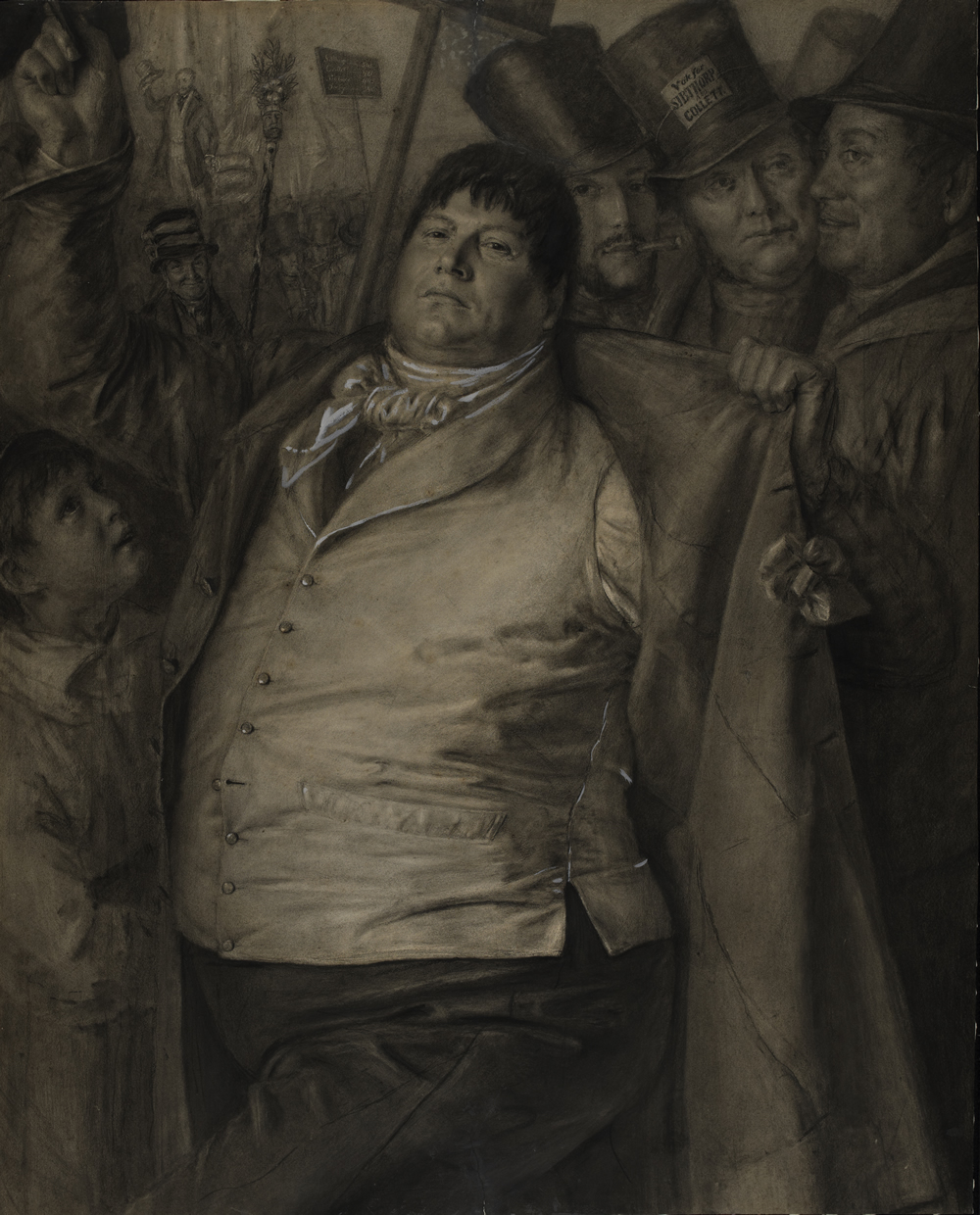
Musée d’Orsay website

LIKE ART BLART ON FACEBOOK

Back to top