Exhibition: ‘Ricky Swallow: The Bricoleur’ at The Ian Potter Centre, NGV Australia, Melbourne

Exhibition dates: 16th October, 2009 – 28th February, 2010
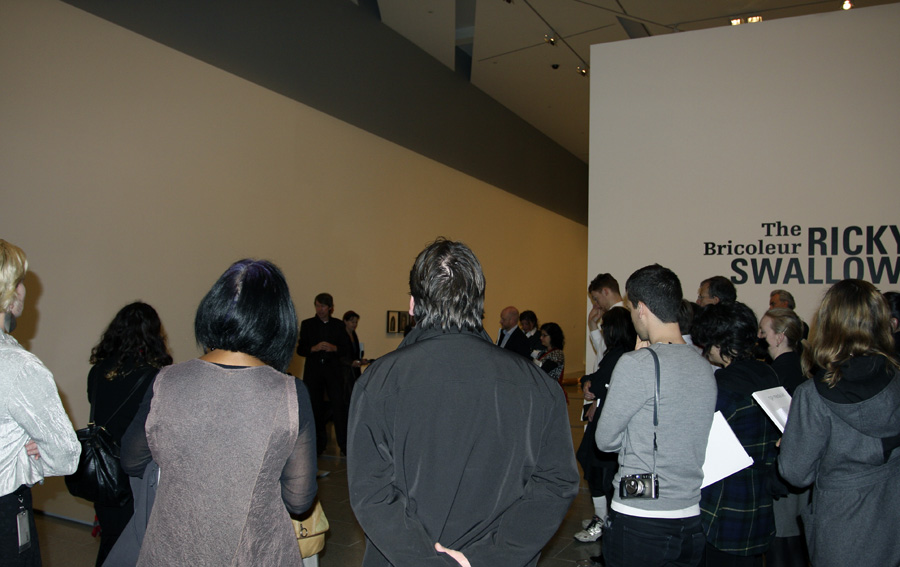
 

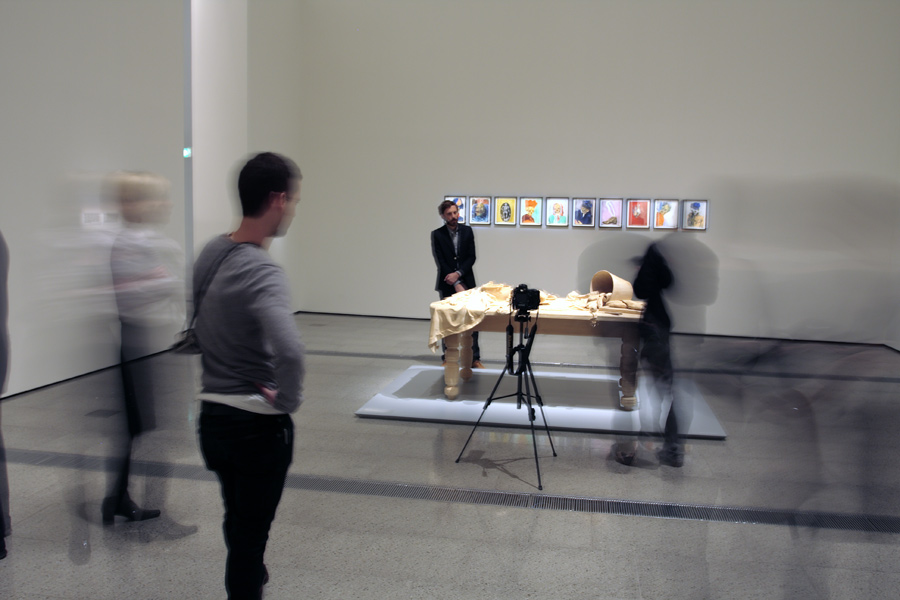
Media crowd at the Ricky Swallow exhibition 'The Bricoleur' at NGV Australia


Media crowd at the Ricky Swallow exhibition The Bricoleur at NGV Australia with Alex Baker, Senior Curator, Contemporary Art, NGV fourth from left with clasped hands.
Photo: Marcus Bunyan


Hot off the press straight to you here at Art Blart!

Photographs of the exhibition Ricky Swallow: The Bricoleur at the National Gallery of Victoria Australia, Federation Square. The photographs are in the chronological order that I took them, walking through the three spaces of the exhibition. A spare, visually minimalist aesthetic to the show, where every vanitas, every mark (in)forms the work as transcendent momenti mori. Review to follow.

Many thankx to Sue, Alison, Jemma and the team for the usual excellent job and for allowing me to document the exhibition. Please click on the photographs for a larger version of the image. All photographs © Marcus Bunyan


“I’ve always been interested in how an object can be remembered and how that memory can be sustained and directed sculpturally, pulling things in and out of time, passing objects through the studio as a kind of filter returning them as new forms.”


Ricky Swallow


Ricky Swallow (Australian, b. 1974) 'The Bricoleur' 2006 from the exhibition 'Ricky Swallow: The Bricoleur' at The Ian Potter Centre, NGV Australia, Melbourne, Oct 2009 - Feb 2010


Ricky Swallow (Australian, b. 1974)
The Bricoleur
2006
Jelutong
48 x 9.75 x 9.75 inches
Photo: Marcus Bunyan


Ricky Swallow (Australian, b. 1974) 'Unbroken Ways (for Derek Bailey)' 2006 from the exhibition 'Ricky Swallow: The Bricoleur' at The Ian Potter Centre, NGV Australia, Melbourne, Oct 2009 - Feb 2010


Ricky Swallow (Australian, b. 1974)
Unbroken Ways (for Derek Bailey)
2006
English Limewood
5 x 30 x 7 inches
Photo: Marcus Bunyan


Ricky Swallow (Australian, b. 1974) 'One Nation Underground' 2007


Ricky Swallow (Australian, b. 1974)
One Nation Underground
2007
Photo: Marcus Bunyan


Ricky Swallow (Australian, b. 1974) 'One Nation Underground' 2007  (detail)


Ricky Swallow (Australian, b. 1974)
One Nation Underground (detail)
2007
Photo: Marcus Bunyan


Ricky Swallow (Australian, b. 1974) 'Tusk' 2007


Ricky Swallow (Australian, b. 1974)
Tusk
2007
Bronze with white patina, brass fixtures
19.75 x 41.25 x 2.25 inches
Photo: Marcus Bunyan


Ricky Swallow (Australian, b. 1974) 'Tusk' 2007 (detail)


Ricky Swallow (Australian, b. 1974)
Tusk (detail)
2007
Bronze with white patina, brass fixtures
19.75 x 41.25 x 2.25 inches
Photo: Marcus Bunyan


Ricky Swallow (Australian, b. 1974) 'Rehearsal for Retirement' 2008 (detail)


Ricky Swallow (Australian, b. 1974)
Rehearsal for Retirement (detail)
2008
English Lime Wood, Poplar
Photo: Marcus Bunyan


Ricky Swallow (Australian, b. 1974) 'Rehearsal for Retirement' 2008 (detail)


Ricky Swallow (Australian, b. 1974)
Rehearsal for Retirement (detail)
2008
English Lime Wood, Poplar
Photo: Marcus Bunyan


Ricky Swallow (Australian, b. 1974) 'Bowman’s record' 2008 (detail)


Ricky Swallow (Australian, b. 1974)
Bowman’s record (detail)
2008
Bronze
Photo: Marcus Bunyan


Ricky Swallow (Australian, b. 1974) 'Bowman’s record' 2008 (detail)


Ricky Swallow (Australian, b. 1974)
Bowman’s record (detail)
2008
Bronze
Photo: Marcus Bunyan


Ricky Swallow’s sculptures address fundamental issues that lie at the core of who we are. Things have lives. We are our things. We are things. When all is said and done it is our things – our material possessions – that outlive us. Anyone who has lost a family member or close friend knows this: what we have before us once that person is gone are the possessions that formed a life. Just as we are defined and represented by the things that we collect over time, we are ultimately objects ourselves. When we are dead and decomposed what remains are our bones, another type of object. And then there is social science. Archaeology, a subfield of anthropology, is entirely based on piecing together narratives of human relations based on material culture, that is, objects both whole and fragmentary. It may seem obvious but it is worth stressing here that our understanding of cultures from the distant past, those that originated before the advent of writing, is entirely based on the study of objects and skeletal remains. Swallow’s art addresses these basic yet enduring notions and reminds us of our deep symbiotic relationship to the stuff of daily life.

Like the bricoleur put into popular usage by anthropologist Claude Levi-Strauss in his seminal book The Savage Mind, Ricky Swallow creates works of art often based on objects from his immediate surroundings. His method, however, is more of a second order bricolage: his sculptures are not assemblages of found objects, but rather elegantly crafted things. Hand carved from wood or plaster or cast in bronze, these humble objects are transformed into memorials to both the quotidian and the passage of time.

Still life

The still life has been an important touchstone throughout Swallow’s recent practice as it is an inspired vehicle for the exploration of how meaning is generated by objects. Several sculptures in the exhibition reference the still-life tradition in which Swallow updates and personalises this time-honoured genre, in particular the vanitas paintings of 17th century Holland. Vanitas still lifes, through an assortment of objects that had recognisable symbolism to a 17th-century viewer, functioned as allegories on the futility of pleasure and the inevitably of death. Swallow’s embrace of still life convention, however, is non-didactic, secular and open-ended. Swallow is not obsessed by death. On the contrary, his focus on objects is about salvaging them from the dust bin of history and honouring their continued resonance in his life.

Killing time, 2003-2004, and Salad days, 2005, depict animals that Swallow and his family either found or caught when he was young and best highlight how the artist reclaims the still life genre to explore personal narrative. Killing time, which depicts a bounty of fish and crustaceans spread across a table modelled after the Swallow family kitchen table of the artist’s youth, is rife with autobiographical association. It not only references an object from Swallow’s past, but also the profession of his father, a fisherman, and the fact that Swallow was raised by the sea. Salad days is another autobiographical work depicting a range of animals such as birds, a rabbit, mice and a fox skull. Like many boys growing up in rural environments, Swallow recalls shooting magpies, encountering nesting birds in his garage or discovering dead lizards or trapping live ones in an attempt to keep them as pets.

While not an overt still life, History of holding, 2007, suggests the genre in its fragmentary depiction of a musical instrument and the appearance of a lemon with falling rind. The hand holding / presenting a peeled lemon as the rind winds around the wrist in bracelet-like fashion is based on a cast of Swallow’s own hand, insinuating himself into this antiquated tradition. It is as if Swallow is announcing to us his deep interest in the temporality of objects through the presentation of the peeled lemon, which symbolises the passing of time and also appears in Killing time. The second component of History of holding is a sculptural interpretation of the Woodstock music festival icon designed by Arthur Skolnick in 1969, which still circulates today. History of holding, then, also references music, a leitmotif in Swallow’s art that appears both within the work itself, and also through Swallow’s use of titles.

Body fragments

Tusk, 2007 among several other works in the exhibition, explores the theme of body as fragment. Much has been discussed about Swallow’s use of the skeleton as a form rich in meaning within both the traditions of art history as well as popular culture (references range from the Medieval dance macabre and the memento mori of the still life tradition to the skeleton in rock music and skateboard art iconography). Tusk represents two skeletal arms with the hands clasped together in eternal union. A poignant work, Tusk is a meditation on permanence: the permanence of the human body even after death; the permanence of the union between two people, related in the fusion of the hands into that timeless symbol of love, the heart.

Watercolours: atmospheric presentations, mummies, music, homage

Swallow calls his watercolours “atmospheric presentations”, in contradistinction to his obviously more physical sculptures, and he sees them as respites from the intensity of labour and time invested in the sculptural work. They also permit experimentation in ways that sculpture simply does not allow. One nation underground, 2007, is a collection of images based on rock / folk musicians, several who had associations to 1960s Southern California, Swallow’s current home. Most of the subjects Swallow has illustrated in this work are now deceased; several experienced wide recognition only after their deaths. Like many of his sculptures, this group of watercolours tenderly painted with an air of nostalgia has the sensibility of a memorial – or as Swallow has called it “a modest monument”. The title of the work is based on a record album by another under-heralded rock band from the 1960s, Pearls Before Swine, and is a prime example of Swallow’s belief in the importance of titles to the viewing experience as clues or layers of meaning. In this case, the title hints at the quasi-cult status of the musicians and singers depicted. The featured musicians are Chris Bell (Big Star), Karen Dalton (a folk singer), Tim Buckley (legendary singer whose style spanned several genres and father to the late Jeff Buckley), Denny Doherty (The Mamas & the Papas ), Judee Sill (folk singer), Brian Jones (Rolling Stones), Arthur Lee (Love), John Phillips (The Mamas & the Papas ), Skip Spence (Jefferson Airplane and Moby Grape) and Phil Ochs (folk singer).

Text from the National Gallery of Victoria website [Online] Cited 15/10/2010


Installation view of 'Ricky Swallow: The Bricoleur' second room at NGV Australia

Installation view of 'Ricky Swallow: The Bricoleur' second room at NGV Australia


Installation views of Ricky Swallow: The Bricoleur second space at NGV Australia
Photos: Marcus Bunyan


Ricky Swallow (Australian, b. 1974) 'Caravan' 2008 (detail)


Ricky Swallow (Australian, b. 1974)
Caravan (detail)
2008
Bronze
Photo: Marcus Bunyan


Ricky Swallow (Australian, b. 1974) 'Salad days' c. 2005


Ricky Swallow (Australian, b. 1974)
Salad days
c. 2005
Photo: Marcus Bunyan


Ricky Swallow (Australian, b. 1974) 'Killing time' 2003-2004


Ricky Swallow (Australian, b. 1974)
Killing time
2003-2004
Photo: Marcus Bunyan


Ricky Swallow (Australian, b. 1974) 'Killing time' 2003-2004 (detail)


Ricky Swallow (Australian, b. 1974)
Killing time (detail)
2003-2004
Photo: Marcus Bunyan


Ricky Swallow (Australian, b. 1974) 'Killing time' 2003-2004


Ricky Swallow (Australian, b. 1974)
Killing time
2003-2004
Photo: Marcus Bunyan


Ricky Swallow (Australian, b. 1974) 'Killing time' 2003-2004 (detail)


Ricky Swallow (Australian, b. 1974)
Killing time (detail)
2003-2004
Photo: Marcus Bunyan


A new exhibition featuring the work of internationally renowned Australian artist Ricky Swallow will open at The Ian Potter Centre: NGV Australia on 16 October 2009.

Ricky Swallow: The Bricoleur is the artist’s first major exhibition in Australia since 2006. This exhibition will feature several of the artist’s well‐known intricately detailed, carved wooden sculptures as well as a range of new sculptural works in wood, bronze and plaster. The exhibition will also showcase two large groups of watercolours, an aspect of Swallow’s practice that is not as well known as his trademark works.

Salad days (2005) and Killing time (2003-2004), which were featured in the 2005 Venice Biennale and are considered Swallow icons, will strike a familiar chord with Melbourne audiences.

Sculptures completed over the past year include bronze balloons on which bronze barnacles seamlessly cling (Caravan, 2008); a series of cast bronze archery targets (Bowman’s Record, 2008) that look like desecrated minimalist paintings; and carved wooden sculpture of a human skull inside what looks like a paper bag (Fig 1, 2008).

A highlight of the show will be Swallow’s watercolour, One Nation Underground (2007), recently acquired by the NGV. The work presents a collection of images based on 1960s musicians including Tim Buckley, Denny Doherty, Brian Jones and John Phillips.

Alex Baker, Senior Curator, Contemporary Art, NGV said the works in this exhibition explore the themes of life and death, time and its passing, mortality and immortality.

“Swallow’s art investigates how memory is distilled within the objects of daily life. His work addresses the fundamental issues that lie at the core of who we are, reminding us of our deep symbiotic relationship to the stuff of everyday life.”

“The exhibition’s title The Bricoleur refers to the kind of activities performed by a handyman or tinkerer, someone who makes creative use of whatever might be at hand. The Bricoleur is also the title of one of the sculptures in the exhibition, which depicts a forlorn houseplant with a sneaker wedged between its branches,” said Mr Baker.

Gerard Vaughan, Director, NGV, said this exhibition reinforces the NGV’s commitment to exhibiting and collecting world‐class contemporary art.

“The NGV has enjoyed a long and successful relationship with Ricky Swallow, exhibiting and acquiring a number of his works over the years. His detailed and exquisitely crafted replicas of commonplace objects never fail to inspire visitors to the Gallery.”

Ricky Swallow was born in Victoria in 1974 and currently lives and works in Los Angeles, California. His career has enjoyed a meteoric rise since winning the NGV’s prestigious Contempora5 art prize in 1999. Since then, Swallow has exhibited in the UK, Europe and the United States, and represented Australia at the 2005 Venice Biennale.”

Press release from the NGV website [Online] Cited 10/10/2009. No longer available online


Ricky Swallow facing the media behind his work 'Killing time' (2003-2004)

Ricky Swallow facing the media behind his work 'Killing time' (2003-2004)


Ricky Swallow facing the media behind his work Killing time (2003-2004)
Photos: Marcus Bunyan


The Ian Potter Centre: NGV Australia Federation Square
Corner of Russell and 
Flinders Streets, Melbourne

Opening hours:
Open daily 10am – 5pm

National Gallery of Victoria website

LIKE ART BLART ON FACEBOOK

Back to top

Review: ‘Sweet Complicity’ by eX de Medici at Karen Woodbury Gallery, Richmond, Melbourne

Exhibition dates: 30th September – 24th October, 2009


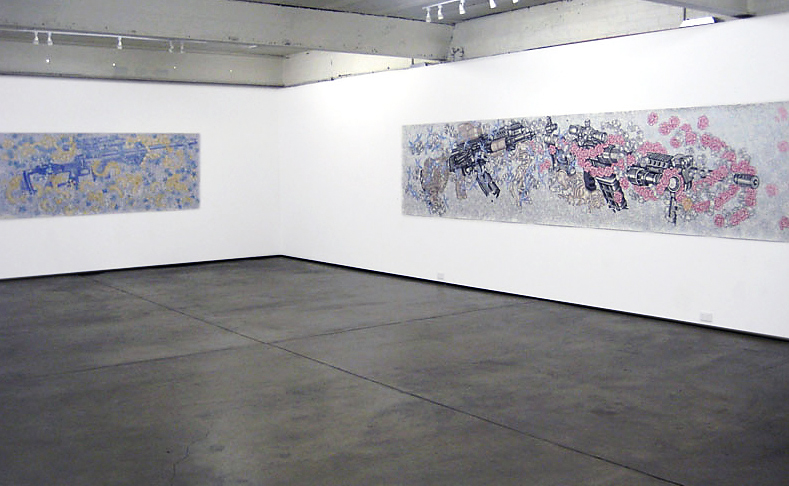
eX de Medici (Australia, b. 1959) 'Tooth and claw' 2009 from the exhibition 'Sweet Complicity' by eX de Medici at Karen Woodbury Gallery, Richmond, Melbourne, Sept - Oct, 2009


eX de Medici (Australia, b. 1959)
Tooth and claw
2009
Pen, ink and mica on archival paper
114.0 x 521.0cm


Is it sinful to say that an Armalite rifle can be voluptuously seductive? Not in the hands of artist eX de Medici!

Taking a variety of contemporary military high-powered weapons (Armalite AR30 Tactical .308 Sniper, Modified AK 47, Blackwater AR15, Patriot Ordinance P45 .223 for example) eX de Medici’s armaments have a steely presence softened and consumed by multitudinous garlands of traditional tattoo ‘flash’ iconography (flowers, skulls, bows, stars, Chinese dragons, waves and swallows repeated in Escher-like patterns) and contorted skeletons. Using individual colour palettes for each of the three large pen, ink and mica on paper works in the exhibition, eX subverts the masculine symbology of gun culture and decomposes it within an ornamentation of deathly desire – new compositions in the dance of death: ‘U hurt me Baby, U Fkd me up gd, the hole tht u made (cross) me Ded …’

In other less skilled artist’s hands the subject matter could become cliched and trite but here de Medici balances the disparate elements in her compositions and brings the subject matter alive – sinuously jumping off the paper, entwining the viewer in their delicious ironies, all of us sweetly complicit in the terror war (send more meat, send more meat!), fighting tooth and nail to keep urban realities at arm’s length. The dark desires that these works contain possess an aesthetic beauty that swallows us up so that we, too, become ‘Barbarians All’. Highly recommended!

Dr Marcus Bunyan


Many thankx to Karen Woodbury Gallery for allowing me to publish the art work in the posting. Please click on some of the photographs for a larger version of the image.


eX de Medici (Australia, b. 1959) 'Tooth and Claw' 2009 (detail) from the exhibition 'Sweet Complicity' by eX de Medici at Karen Woodbury Gallery, Richmond, Melbourne, Sept - Oct, 2009


eX de Medici (Australia, b. 1959)
Tooth and claw (detail)
2009
Pen, ink and mica on archival paper
114.0 x 521.0cm


eX de Medici (Australia, b. 1959) 'Tooth and claw' 2009 (detail)

eX de Medici (Australia, b. 1959) 'Tooth and claw' 2009 (detail)


eX de Medici (Australia, b. 1959)
Tooth and claw (details)
2009
Pen, ink and mica on archival paper
114.0 x 521.0cm


Installation view of 'Sweet Complicity' by eX de Medici at Karen Woodbury Gallery, Melbourne showing at left, 'Send more meat' (2009) and at right, 'Tooth and claw' (2009)


Installation view of Sweet Complicity by eX de Medici at Karen Woodbury Gallery, Melbourne showing at left, Send more meat (2009) and at right, Tooth and claw (2009)
Photo: Marcus Bunyan


eX de Medici (Australia, b. 1959) 'Send more meat' 2009


eX de Medici (Australia, b. 1959)
Send more meat
2009
Pen, ink and mica on archival paper


eX de Medici (Australia, b. 1959) 'Send more meat' 2009 (detail)


eX de Medici (Australia, b. 1959)
Send more meat (detail)
2009
Pen, ink and mica on archival paper


Sweet complicity is eX de Medici’s first and much anticipated exhibition at Karen Woodbury Gallery. The exhibition will comprise of three monumental pen, ink and mica works on archival paper. These works examine recurring themes in her practice such as power, war, death and violence via a decorative feminine veneer and aesthetic.

The recurrent use of symbolism in the form of weapons, skulls and garlands in her work re-appear with the addition of Chinese imagery (Imperial golden dragons, China’s five-pointed star, and the use of chrysanthemums). These potent works display a latent interest in scientific illustration and allude to de Medici’s characteristic stylised tattoo motifs that stems from her work as a tattooist. The almost obsessive repetition of pattern and immense detailing display eX’s dedication to her practice through the strong mental and physical commitment required to complete such awe-inspiring artworks that seduce the viewer.

There is an unmistaken polemic tone in de Medici’s practice that cannot be ignored. Different cultures, identities, actions and consequences are represented and centred on objects of warfare, allowing for disguised and layered political and moral statements.

de Medici lives and produces much of her work in the nation’s capital Canberra. Streams of influences inform the work; Canberra’s political and physical agendas, research resourced from various national institutions such as the CSIRO Entomological and Taxonomy Division, the National Library of Australia and the Australian War Memorial. She has recently returned from the Solomon Islands where she was chosen as an official war artist.

Text from the Karen Woodbury Gallery website [Online] Cited 05/10/2009. No longer available online


The defining theme in eX de Medici’s paintings is a consistent interrogation of power. The notion of ‘the personal’ doesn’t interest the artist. Instead she investigates authority and dissent through paintings of guns, surveillance devices and gas masks.


eX de Medici (Australia, b. 1959) 'American Sex/Funky Beat Machine' 2009


eX de Medici (Australia, b. 1959)
American Sex/Funky Beat Machine
2009
Pen, ink and mica on archival paper
Diptych, 114.0 x 249.0cm


eX de Medici (Australia, b. 1959) 'American Sex/Funky Beat Machine' 2009 (detail)


eX de Medici (Australia, b. 1959)
American Sex/Funky Beat Machine (detail)
2009
Pen, ink and mica on archival paper
Diptych, 114.0 x 249.0cm


Karen Woodbury Gallery

This gallery is now closed.

LIKE ART BLART ON FACEBOOK

Back to top

Review: ‘Diction’ by Stormie Mills at Helen Gory Galerie, Prahran, Melbourne

16th September – 10th October, 2009


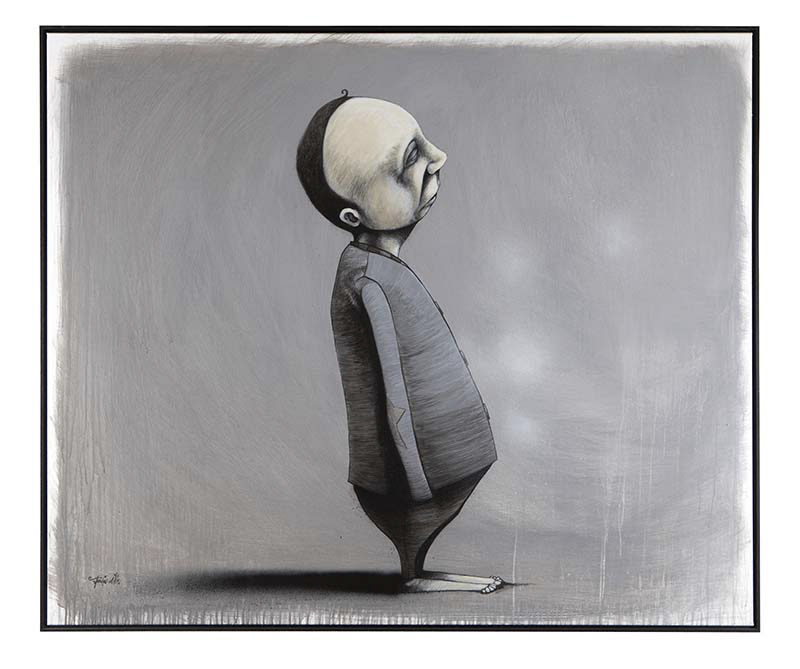
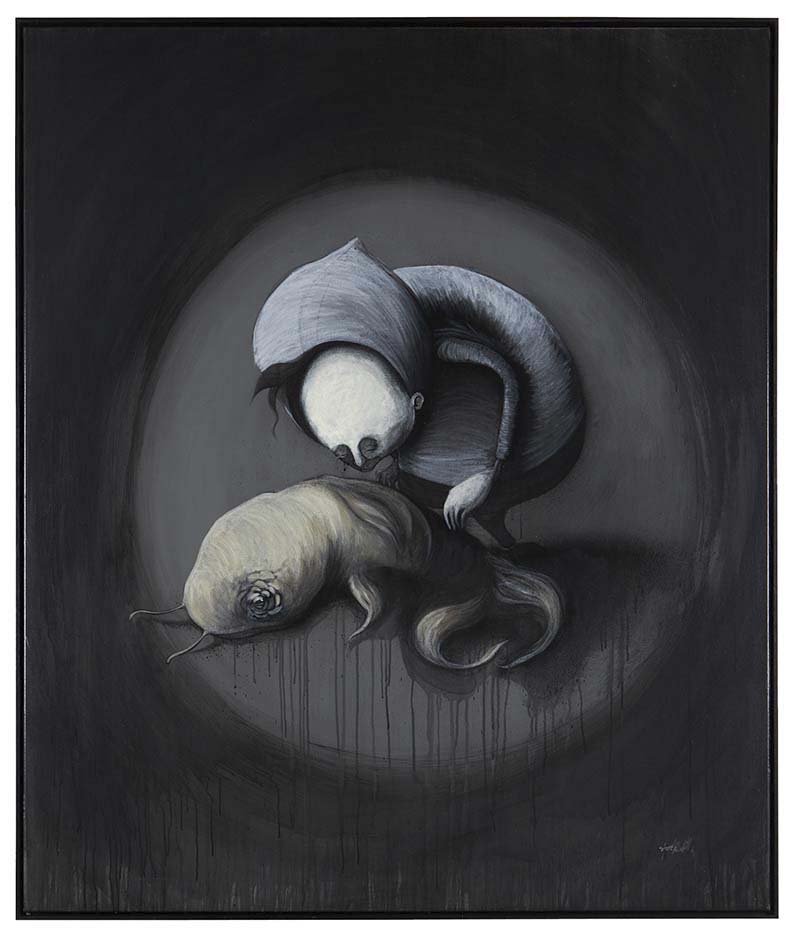
Stormie Mills (Australian, b. 1969) 'Some days all my shadow are behind me' 2009 from the exhibition 'Diction' by Stormie Mills at Helen Gory Galerie, Prahran, Melbourne, Sept - Oct, 2009


Stormie Mills (Australian, b. 1969)
Some days all my shadows are behind me
2009
Acrylic, spray paint and dirt on canvas
1370 mm x 1620 mm


This is a hit and miss show by Stormie Mills at Helen Gory Galerie in Prahran, Melbourne. Some pieces (mainly the smaller paintings) work incredibly well whilst others (mainly the larger paintings such as There is an unkroken continuity and Here I stand) fail to inspire, laden as they are with much dourness and lacking a lightness of touch.

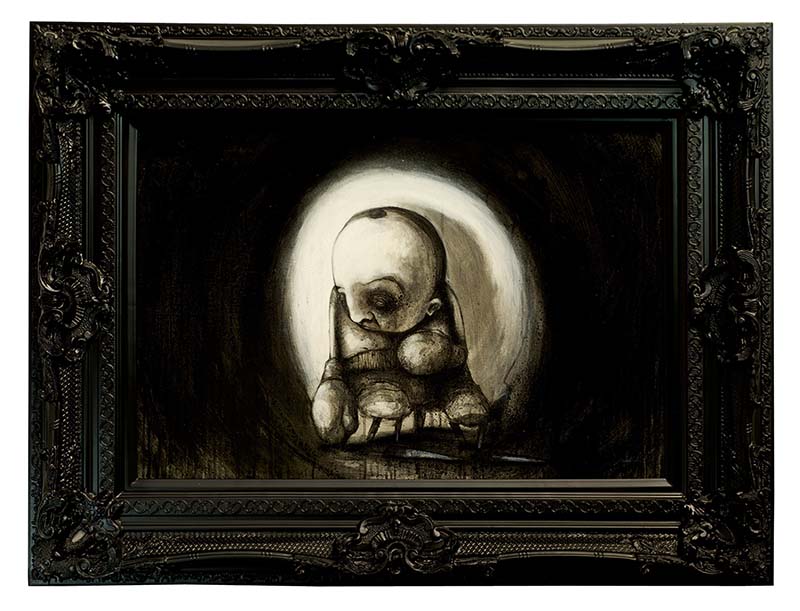
Mills’ uses a palette of greys, blacks and whites to create layered, dripping contextless backgrounds against which his characters tell their prophetic stories. His laconic figures offer a knowing stoicism, surviving everything the world throws at them. The best work made me chuckle at their delicious ironies: I feel how the character is in Some days all my shadows are behind me (2009, above). Not yet ready to quit (2009, below) portrays a boxer slumped on his stool surrounded in a halo of white paint. The heavy remarkably wax-like black carved frame reminds me of Victorian mourning frames and works well with the sentiment proposed by the painting: again I feel a direct response. Elsewhere the use of these heavy black frames less suit the works, even overpower the delicacy of some of the paintings (for example in Fabrique de Pain and Summer Solitude (both 2009)).

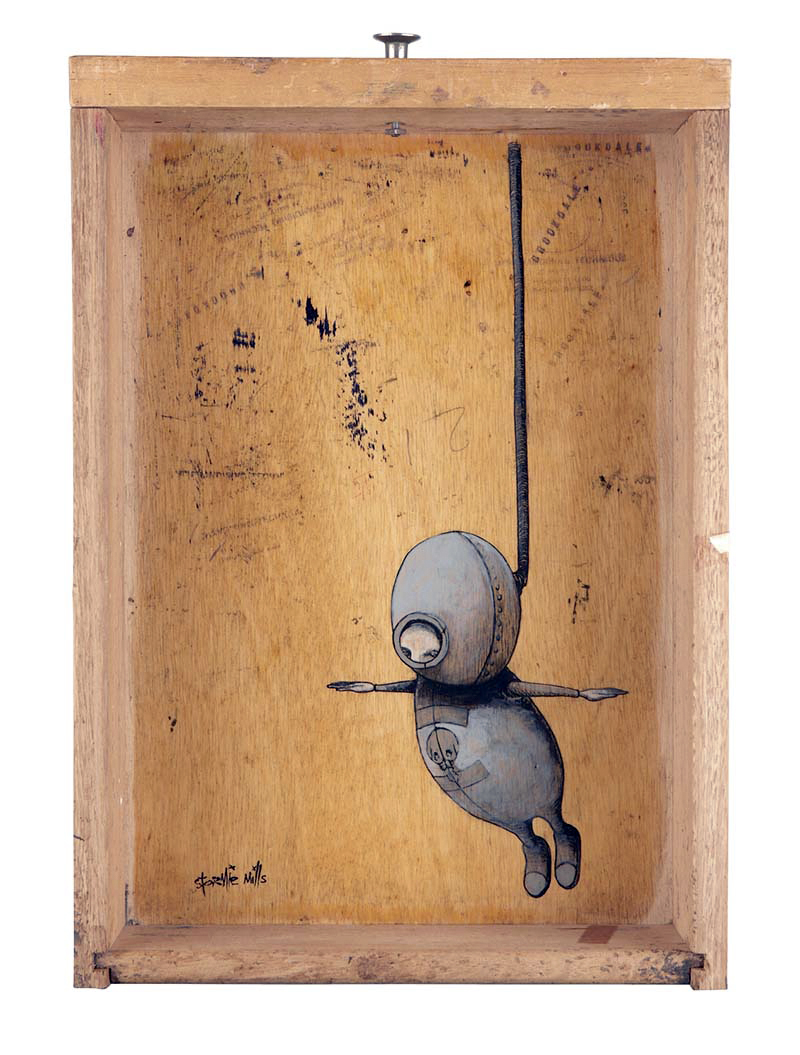
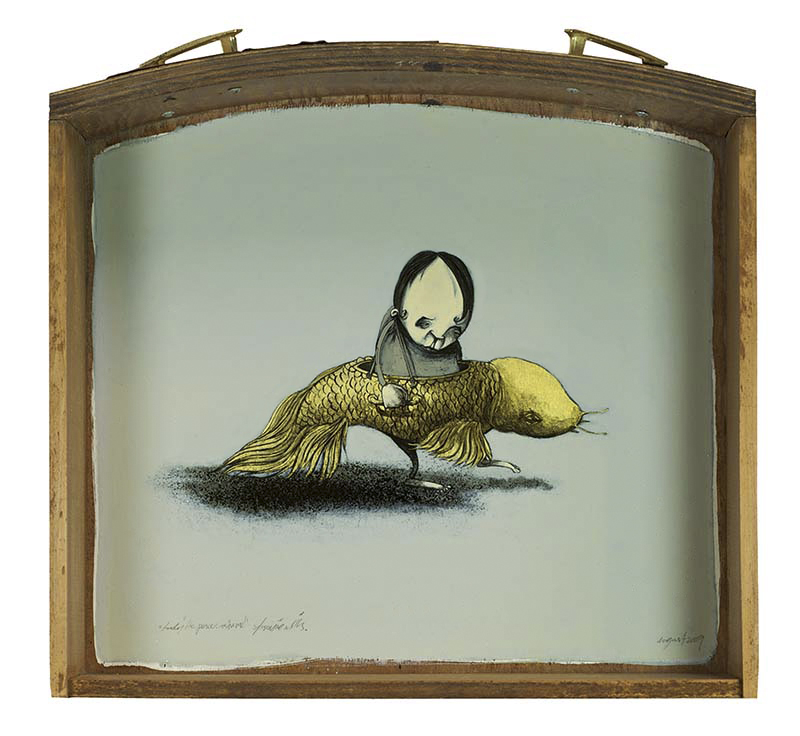
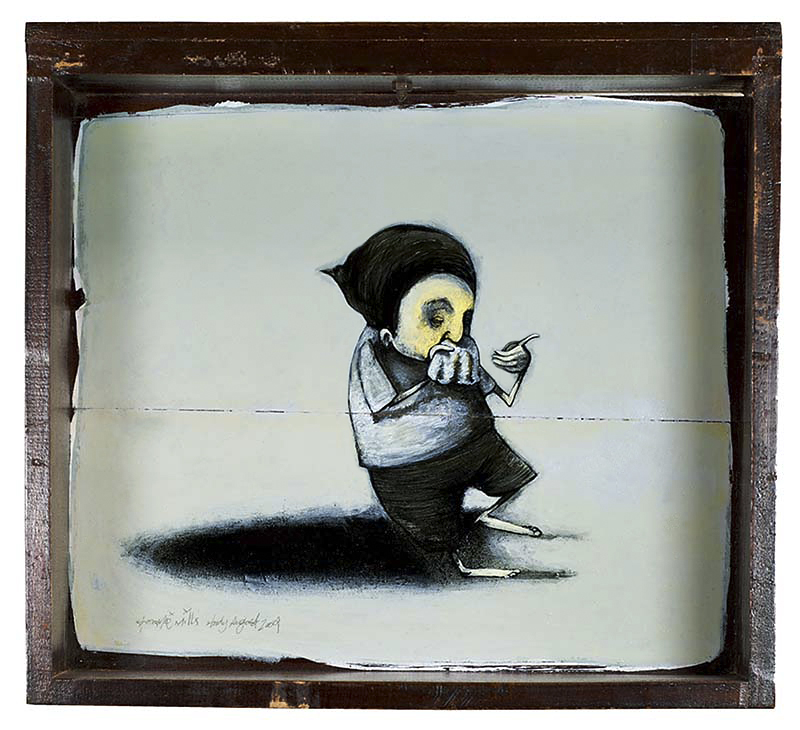
The best grouping in the exhibition are eight works painted on the bottom of old drawers, complete with handles and hung together (three of which are pictured below). This cohesion of concept, painting and intensities seems to bring all the ideas together in a satisfying whole, the characters trapped by the four walls of the drawers, insulated in their contextless worlds. I adored 5 fathoms for the simplicity of it’s design and execution, the use of the box reminding me of the work of Joseph Cornell and the drawing Banksy at one and the same time. Here in this work there is a generosity of spirit which some of the other work lacks, a balance between dark and light, empathy and hope.

Overall some interesting work that had me thinking and feeling but ultimately failed to convince with their melancholic melange.

Dr Marcus Bunyan


Many thankx to Helen Gory Galerie for allowing me to publish the art work in the posting. Please click on the photographs for a larger version of the image.


Stormie Mills (Australian, b. 1969) 'Not yet ready to quit' 2009 from the exhibition 'Diction' by Stormie Mills at Helen Gory Galerie, Prahran, Melbourne, Sept - Oct, 2009


Stormie Mills (Australian, b. 1969)
Not yet ready to quit
2009
Acrylic, spray paint and dirt on canvas
610 mm x 920 mm


Stormie Mills (Australian, b. 1969) 'Come on mate, Get up' 2009 from the exhibition 'Diction' by Stormie Mills at Helen Gory Galerie, Prahran, Melbourne, Sept - Oct, 2009


Stormie Mills (Australian, b. 1969)
Come on mate, Get up
2009
Acrylic, spray paint and dirt on canvas
1630 mm x 1370 mm


Stormie Mills (Australian, b. 1969) '5 fathoms' 2009


Stormie Mills (Australian, b. 1969)
5 fathoms
2009
Mixed media on found object
400 mm x 280 mm x 100 mm


Stormie Mills (Australian, b. 1969) The pesca costume' 2009


Stormie Mills (Australian, b. 1969)
The pesca costume
2009
Mixed media on found object
450 mm x 480 mm x 130 mm


Stormie Mills (Australian, b. 1969) 'Wiping the smile from his face' 2009


Stormie Mills (Australian, b. 1969)
Wiping the smile from his face
2009
Mixed media on found object
360 mm x 390 mm x 100 mm


Helen Gory Galerie

This gallery is now closed.

LIKE ART BLART ON FACEBOOK

Back to top

Review: ‘All the Little Pieces’ by Lyndal Hargrave at Anita Traverso Gallery, Richmond, Melbourne

Exhibition dates: 3rd September – 3rd October, 2009


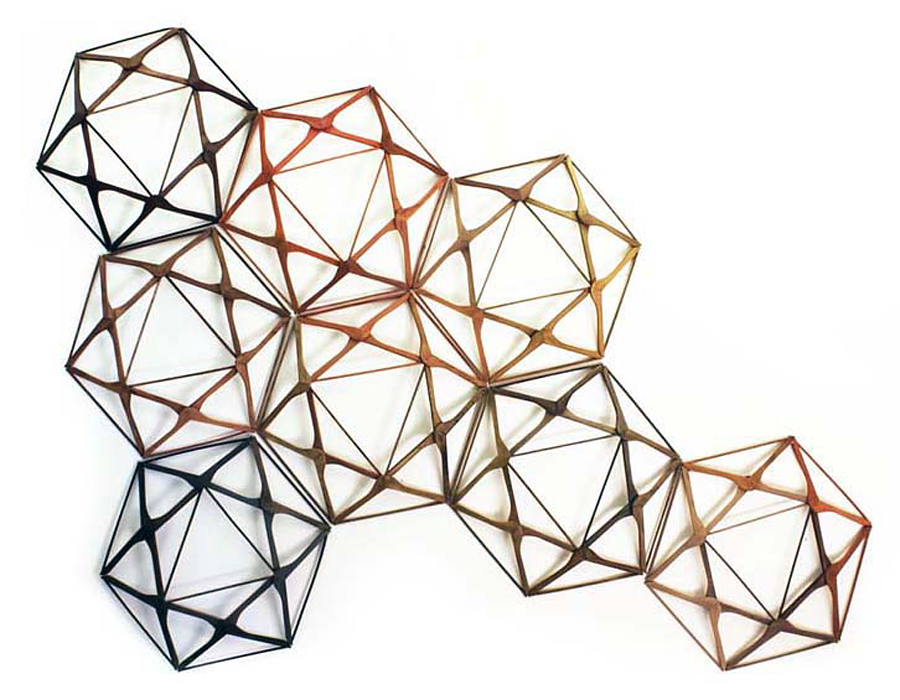
Lyndal Hargrave (Australia, b. 1959) 'Sacred Geometry' 2009 from the exhibition 'All the Little Pieces' by Lyndal Hargrave at Anita Traverso Gallery, Richmond, Melbourne, Sept - Oct, 2009


Lyndal Hargrave (Australia, b. 1959)
Sacred Geometry
2009
Acrylic painted timber coat hangers, screws, staples
180 x 170cm
Photo: Marcus Bunyan


This is a mixed bag of an exhibition by Lyndal Hargrave at Anita Traverso Gallery in Richmond, Melbourne.

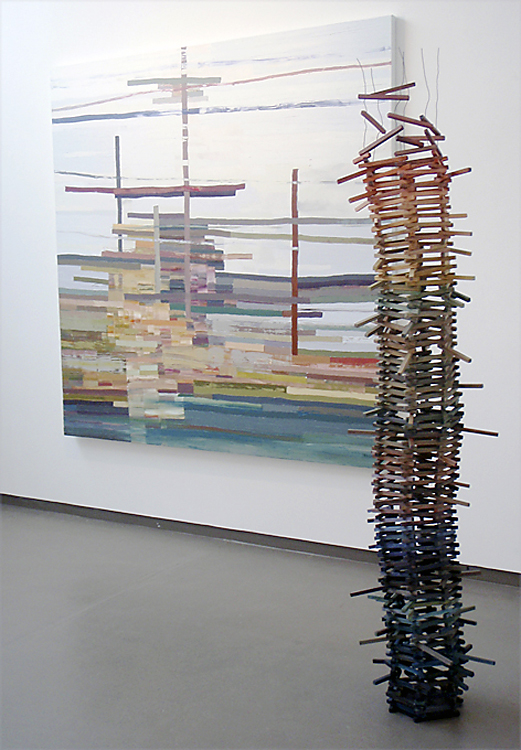
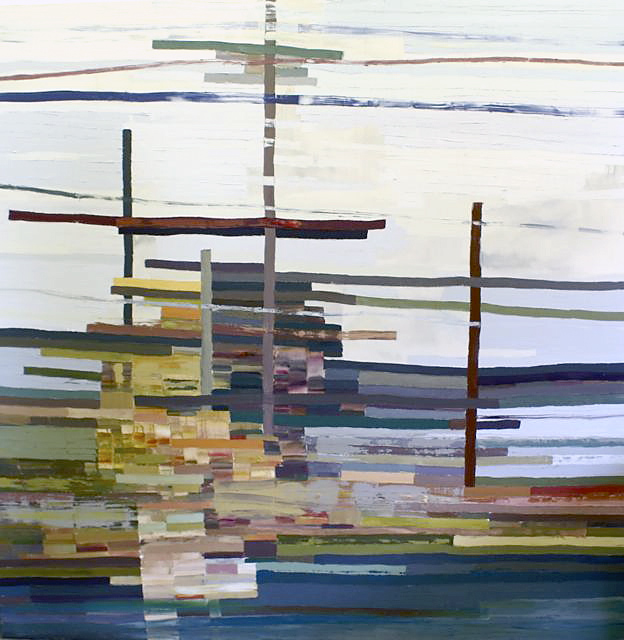
Despite one outstanding painting Breathing Space (2009, see below), the view from the back of the artist’s house onto a jetty with attendant wooden posts and sky, the other paintings are the weakest elements of the exhibition, lacking the strength and resonance of the sculptural work.

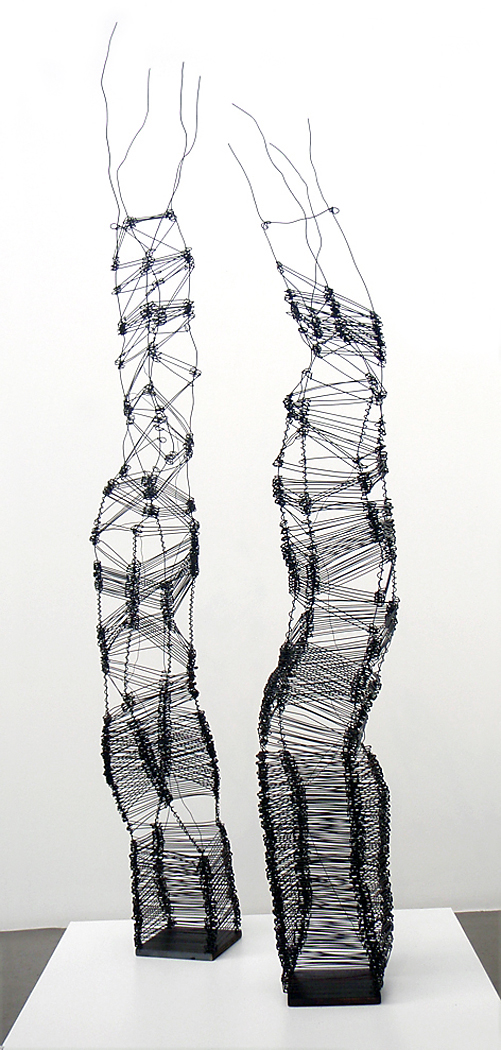
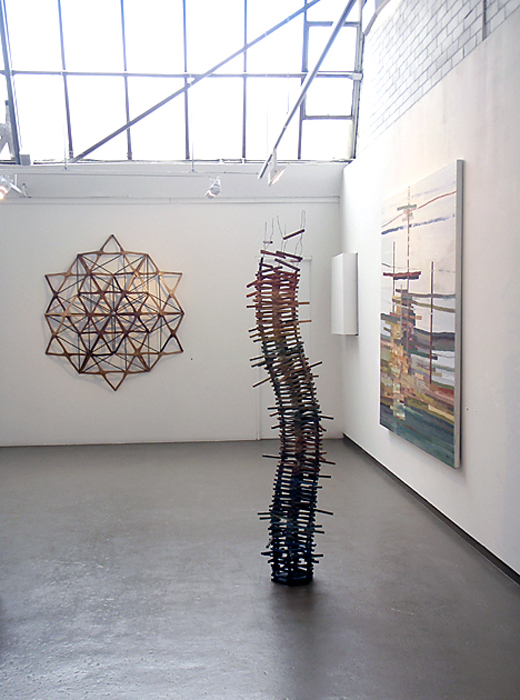
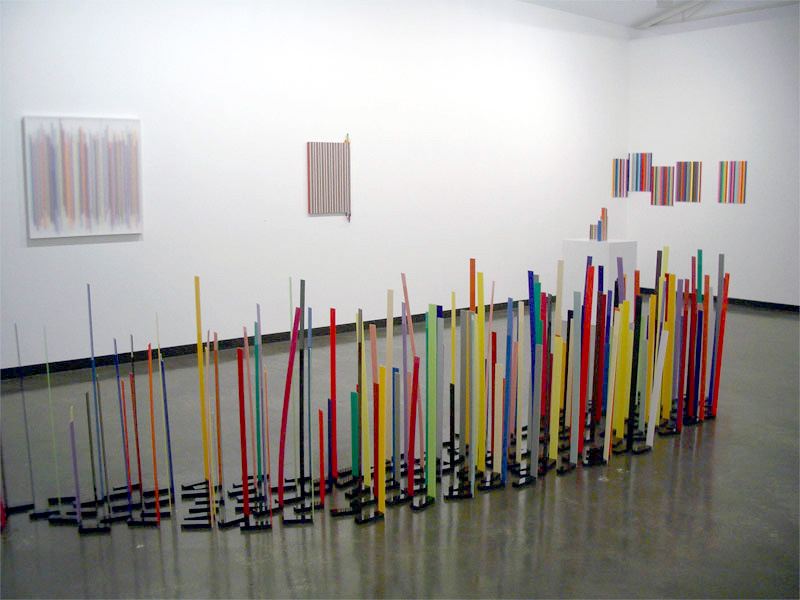
The two standing towers, Hairpin Dragons I & II and Jacob’s Ladder (both 2009, see below) are stronger work, Jacobs Ladder imitating the form of the painting Breathing Space in three-dimensional Cuisenaire-type coloured rods (see the installation photograph of the two pieces below).

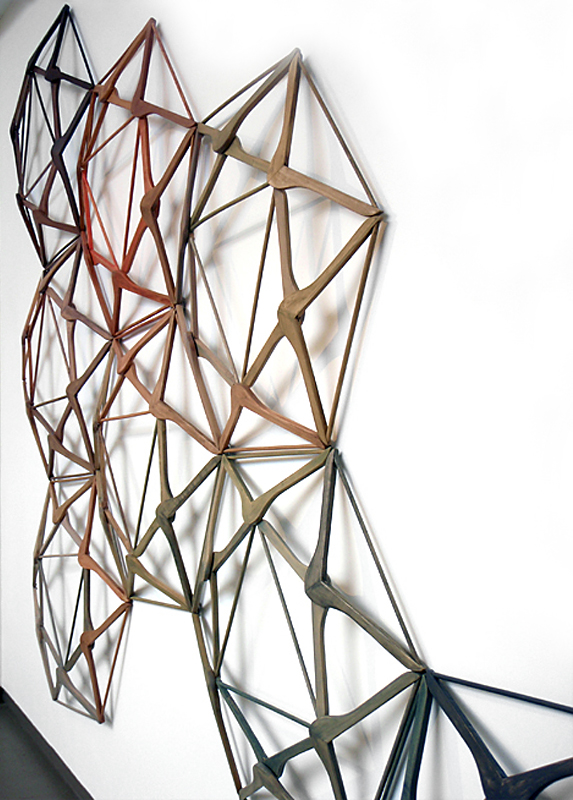
The best pieces in the exhibition are the wall mounted geometric, mandala-like sculptures made of wooden coat hangers. Delicately shifting patterns take the micro cellular form and make it macro, their patterns of construction offering a pleasing visual balance that is both complex, layered and innovative at one and the same time. As explorations of the notion of the universal structure, the golden ratio, they reward repeated viewing.

As the exhibition stands there are too many little pieces to make a holistic whole. Perhaps an exhibition solely of the towers or geometric pieces would have been stronger. I look forward to seeing how the geometric pieces (d)evolve in future work. Will the structures break down and reassemble in other marvellous incantations? I hope so!

Dr Marcus Bunyan


Many thankx to Anita Traverso Gallery for allowing me to publish the art work in the posting. Please click on some of the photographs for a larger version of the image.


Lyndal Hargrave (Australia, b. 1959) 'Arabesque' 2009 from the exhibition 'All the Little Pieces' by Lyndal Hargrave at Anita Traverso Gallery, Richmond, Melbourne, Sept - Oct, 2009


Lyndal Hargrave (Australia, b. 1959)
Arabesque
2009
Acrylic painted timber coat hangers, screws, staples
200 x 360cm
Photo: Marcus Bunyan


Lyndal Hargrave (Australia, b. 1959) 'Arabesque' 2009 (detail)


Lyndal Hargrave (Australia, b. 1959)
Arabesque (detail)
2009
Acrylic painted timber coat hangers, screws, staples
200 x 360cm
Photo: Marcus Bunyan


Lyndal Hargrave (Australia, b. 1959) 'Hairpin Dragons I & II' 2009


Lyndal Hargrave (Australia, b. 1959)
Hairpin Dragons I & II
2009
Wire, formply
170 x 15cm (varying)
Photo: Marcus Bunyan


“It is a constant idea of mine that behind the cotton wool (of daily reality) is hidden a pattern, that we – I mean all human beings – are connected with this: that the whole world is a work of art; that we are parts of the work of art.”

~ Virginia Woolf


For as long as I can remember, my art practice has served as a filter between the outside world and my inside world. I realise now that the act of making the artwork informs my ideas rather than the other way round. Working intuitively results in a continuous stream of surprises that in retrospect mirror the pressing issues surrounding me at that time.

In All the Little Pieces my fascination with patterns of construction from micro to macro and natural to man-made continues. My work explores the gap between order and chaos and helps me to understand the meaning of balance.

Using mundane found objects, my sculptures probe the possibility of re-invention through the way the componentry of human habitation can be re-configured to offer us a new way of seeing and experiencing our world.

It is this process of metamorphosis that is at the centre of my investigation: how life forms make the transition from one state to another – tree to timber to tower or talisman; why some systems remain strong and others crumble.

Overarching my work is the notion of universal structure and the geometry that has informed our evolution from molecule to macro-system.”

Lyndal Hargrave 2009

Text from the Anita Traverso Gallery website


Lyndal Hargrave (Australia, b. 1959) 'Whirlpool Galaxy' (2009) and 'The Samarian Star' (2009)


Lyndal Hargrave (Australia, b. 1959)
Whirlpool Galaxy and The Samarian Star
2009
Acrylic painted timber coat hangers, screws, staples
Photo: Marcus Bunyan


Installation view of Lyndal Hargrave exhibition at Anita Traverso Gallery, Melbourne


Installation view of the Lyndal Hargrave exhibition at Anita Traverso Gallery
Photo: Marcus Bunyan


Photograph showing the relationship of form between the work 'Jacob’s Ladder' (2009) and the painting 'Breathing Space' (2009)


Photograph showing the relationship of form and colour between the work Jacob’s Ladder (2009) and the painting Breathing Space (2009)
Photo: Marcus Bunyan


Lyndal Hargrave (Australia, b. 1959) 'Breathing Space' 2009


Lyndal Hargrave (Australia, b. 1959)
Breathing Space
2009
Oil on canvas
200 x 200cm


Anita Traverso Gallery

The physical gallery has now closed.

PO Box 7001, Hawthorn North 3122
Phone: 0408 534 034
Email: art@anitatraversogallery.com.au

Anita Traverso Gallery website

LIKE ART BLART ON FACEBOOK

Back to top

Review: ‘Connection is Solid’ by John Nicholson at Sophie Gannon Gallery, Richmond, Melbourne

Exhibition dates: 25th August – 19th September, 2009


John Nicholson (Australian, b. 1970) 'Untitled' 2009 from the exhibition 'Connection is Solid' by John Nicholson at Sophie Gannon Gallery, Richmond, Melbourne, Aug - Sept, 2009


John Nicholson (Australian, b. 1970)
Aerial Navigation
2009


You could say that the essence of the cosmos is not matter, it is consciousness.

It is not the external world that is real – it is “maya”, an illusion, for the real world lies within.

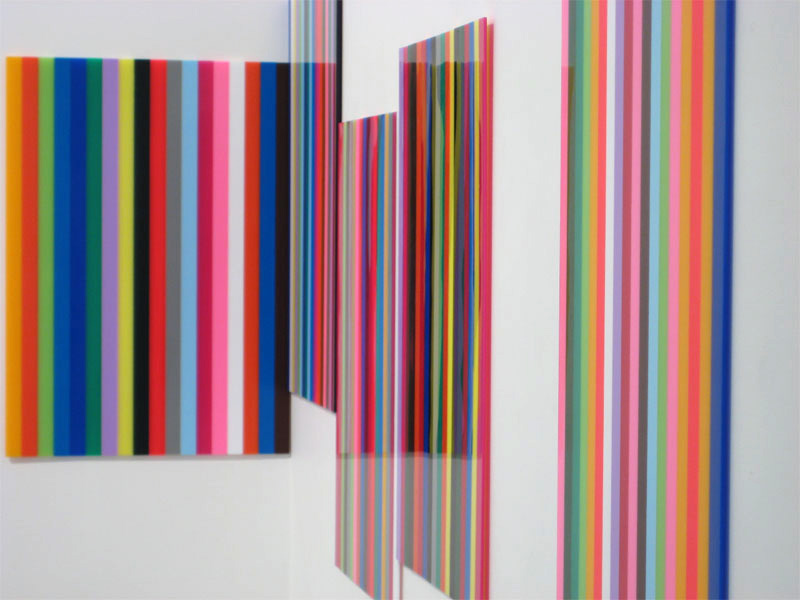
These works, with their striations, strata and suspension are emanations of that spirit – projections of the inner reality.

In terms of the ancient Chinese philosophy Lao Tzu we dream the butterfly and the butterfly is us. If you don’t ‘get’ these works, let go all pretensions and feel their colour as sound, as vibrations of energy.

Submerge yourself in their shape and form. Like DNA structure, a heart beat or the record of a seismic shock these works are music as art, the length of harmony quivering and slipping in our minds, before our eyes.

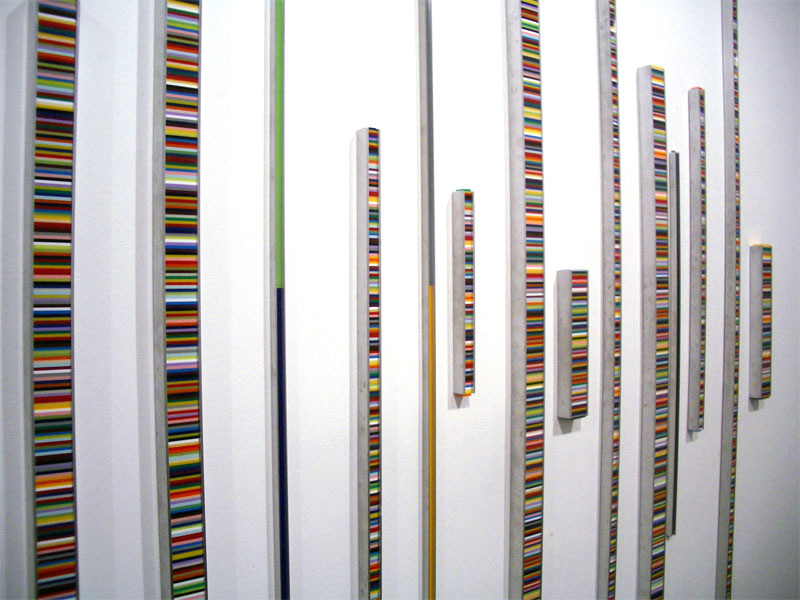
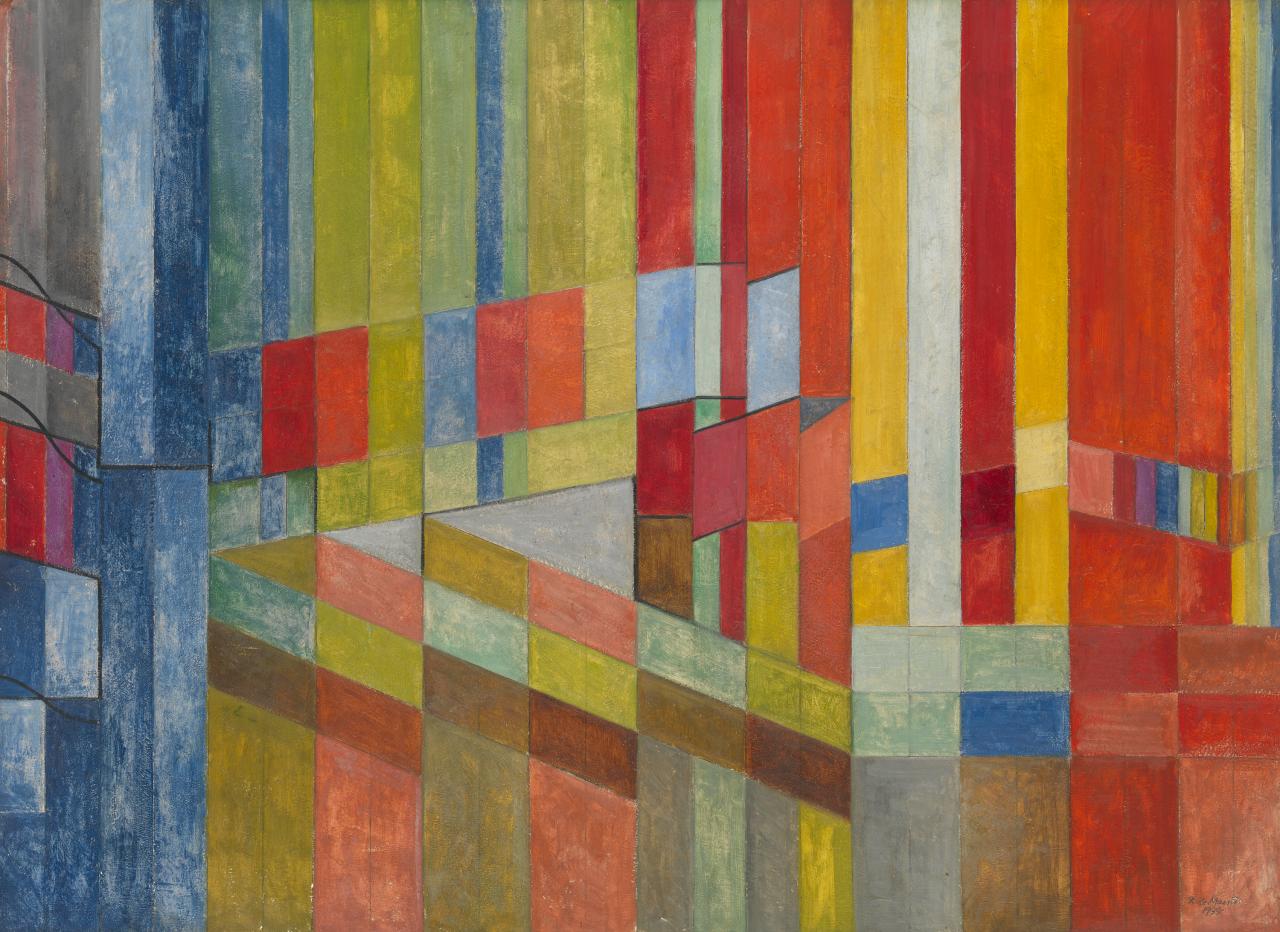
This is the colour music of Roy De Maistre’s paintings of the 1930’s updated to the 21st century. They are fugues of sound made physical entities, intertwining, coming and going. Here lines, tones and colours are organised in a parallel way – tone after tone, line after line. They are wavelengths of the interior made visible. The connection is solid and fluid at one and the same time; there are many connections to be discovered, many journeys to be made.

I hear them, I like them.

Dr Marcus Bunyan


Many thankx to Sophie Gannon Gallery for allowing me to publish the photographs in the posting. Please click on the photographs for a larger version of the image.


John Nicholson (Australian, b. 1970) 'Under the radar' 2009 from the exhibition 'Connection is Solid' by John Nicholson at Sophie Gannon Gallery, Richmond, Melbourne, Aug - Sept, 2009


John Nicholson (Australian, b. 1970)
Under the radar
2009
Photo: Marcus Bunyan


Installation view of 'Connection is Solid' by John Nicholson at Sophie Gannon Gallery, Melbourne

Installation view of 'Connection is Solid' by John Nicholson at Sophie Gannon Gallery, Melbourne


Installation views of Connection is Solid by John Nicholson at Sophie Gannon Gallery
Photos: Marcus Bunyan


John Nicholson (Australian, b. 1970) 'Thrill seeker' 2009 (detail)


John Nicholson (Australian, b. 1970)
Thrill seeker (detail)
2009
Photo: Marcus Bunyan


Roy de Maistre (Australian, 1894-1968) 'Arrested Movement from a Trio' 1934


Roy de Maistre (Australian, 1894-1968)
Arrested Movement from a Trio
1934
Oil and pencil on composition board
72.3 × 98.8cm


John Nicholson (Australian, b. 1970) 'Slip' 2009


John Nicholson (Australian, b. 1970)
Slip
2009


John Nicholson (Australian, b. 1970) 'The wire might sense' 2009


John Nicholson (Australian, b. 1970)
The wire might sense
2009


John Nicholson (Australian, b. 1970) 'Swoop' 2009


John Nicholson (Australian, b. 1970)
Swoop
2009
Photo: Marcus Bunyan


Installation view of 'Connection is Solid' by John Nicholson with on the wall 'Satellite Graffitti' (2009) and on the floor 'Cascade' (2009) and 'Swoop' (2009)


Installation view of Connection is Solid by John Nicholson with on the wall Satellite Graffitti (2009) and on the floor Cascade (2009) and Swoop (2009)
Photo: Marcus Bunyan


Sophie Gannon Gallery
2, Albert Street, Richmond, Melbourne

Opening hours:
Tuesday – Saturday 11am – 5pm

Sophie Gannon Gallery website

LIKE ART BLART ON FACEBOOK

Back to top

Review: ‘Symmetrical Spirit Guides and Fractal Alchemy’ by Carl Scrase at John Buckley Gallery, Richmond, Melbourne

Exhibition dates: 19th August – 5th September, 2009


Carl Scrase 'Fractal Alchemy' installation view 2009


Carl Scrase (Australian, b. 1983)
Fractal Alchemy installation view
2009


This is a slight exhibition of collages and constructions by Carl Scrase at John Buckley Gallery, Melbourne. Ironically, given the nature of the catalogue essay by Tai Snaith (see below) that waxes lyrical about the mystery and magic of symmetry, synchronicity and spirit, this exhibition lacks the depth of purpose needed to address spiritual elements that are the very basis of human existence.

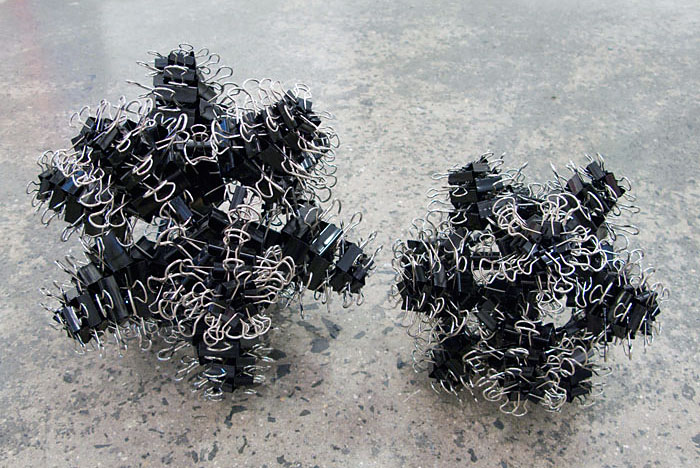
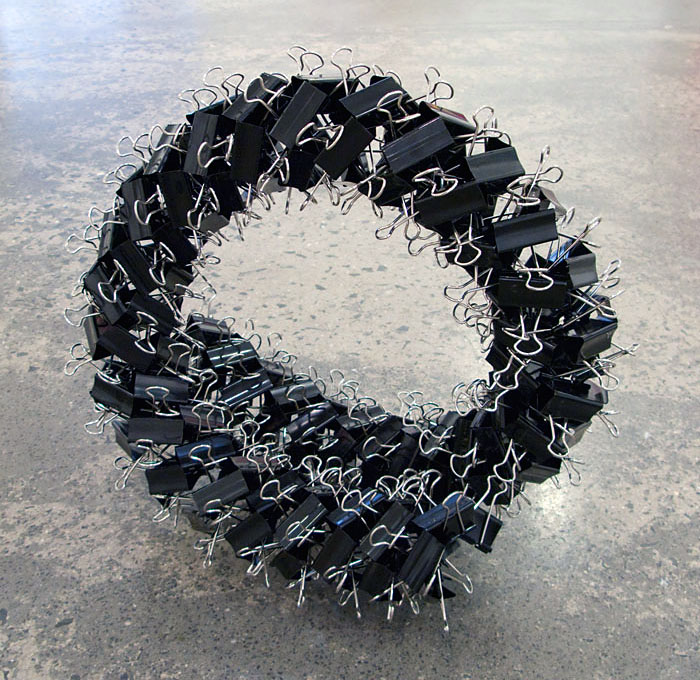
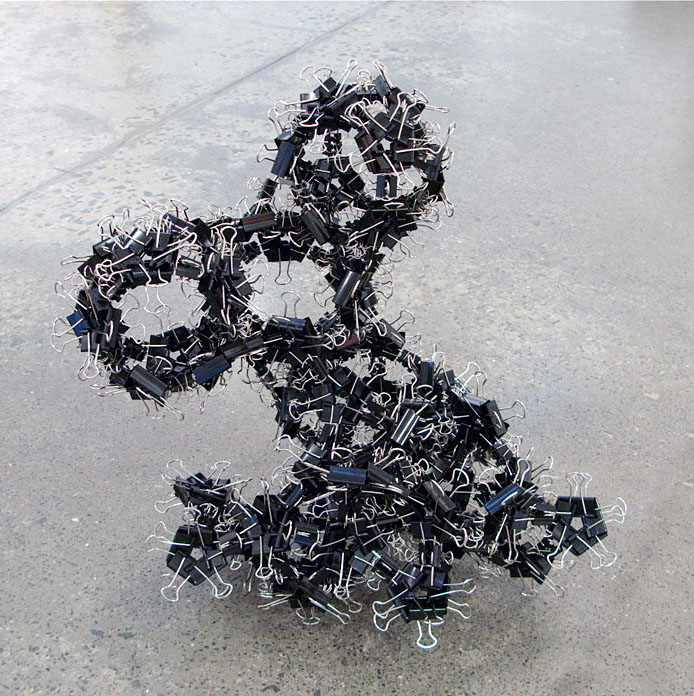
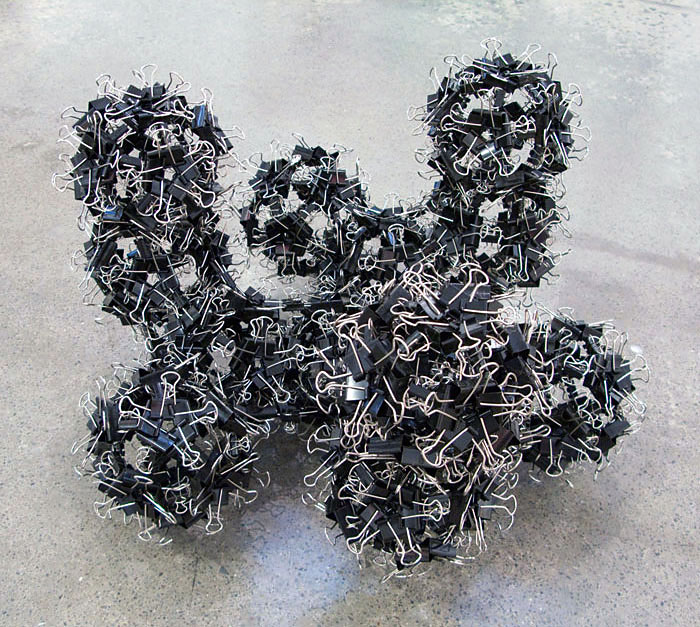
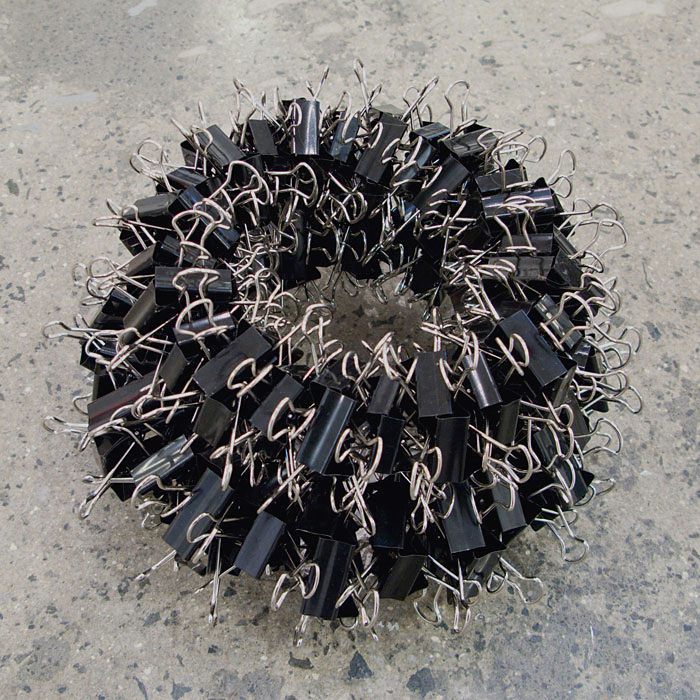
The biomorphic forms that go to make up the work Fractal Alchemy (2009) fair better in this regard, the various size bull dog clips offering non-representational patterns that resemble living organisms and genetic structures in shape and appearance. At their best these elemental shapes start to transcend form and function to become something else: an instinctive and intuitive connection to the inherent fold in the universe, like the embedded pattern, the DNA template in a blank piece of paper before the folding of the origami model. Unfortunately the wonder of this piece is short-lived. Unlike the ever magical repetition of fractal geometry with its inherent iteration of forms that constantly a/maze, here the shapes are not stretched far enough, the exposition not grounded in broken or fractured forms that invite alchemical awareness in the viewer.

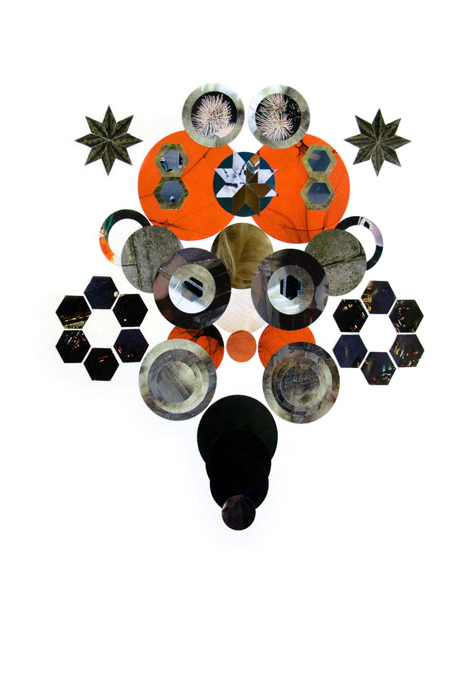
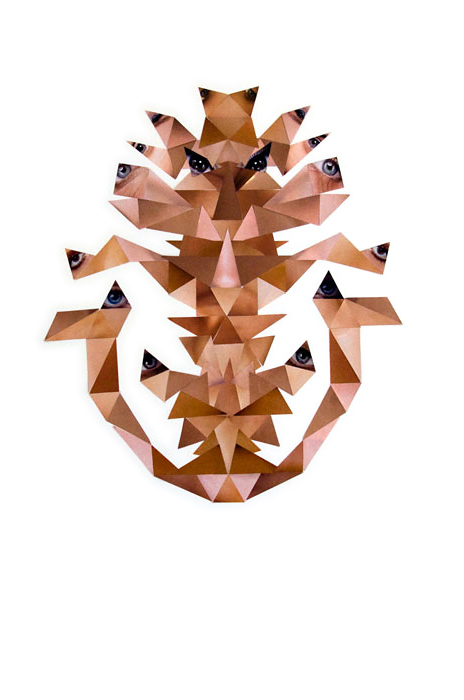
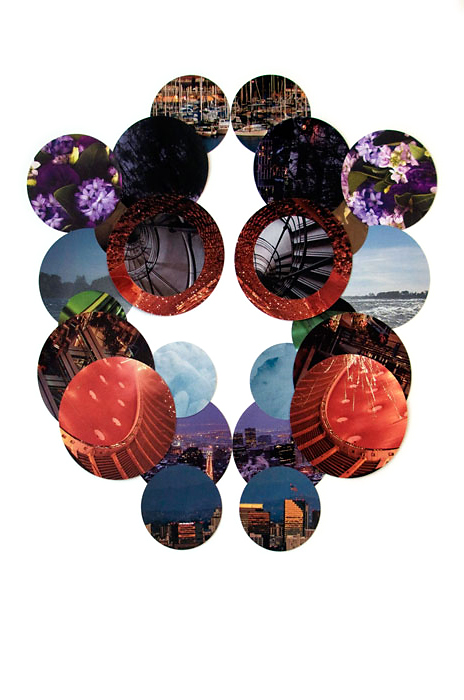
The collages are less successful in this mystery project. Made from cut-up images from magazines these symmetrical constructions lack spiritual presence. Like the aspired to symmetrical beauty of a human face it is, paradoxically, the irregularities of the human face that are their most attractive feature – our individuality. In the photographic stereoscopes of Victorian landscapes it is the difference between the left and right image that adds three-dimensional depth in the eye of the viewer, that transports them to other places, other worlds. In the collages of  Picasso it is the irregularities that also transport the viewer into a hypertextural, hypertextual world of wonder. Scrase’s collages on the other hand, are flat, rigidly symmetrical life-less things that belie their stated aim – to be kaleidoscopic spirit guides in search of a pattern for inner peace. Although some of their forms are attractive their is no wonder, no my-story to be gleaned here.

Overall the work lacks the gravitas and sense of fun in and through the act of creation that the concepts require: to see things clearly and to ground this visualisation in objects that transcend ‘now’ and extend spirit into the eternal. These constructions do not stand as ‘equivalents’ for other states of consciousness, of being-in-the-world, nor do they offer a re-velatio where they open up ‘poetic spaces’ in which the alienation and opposition of inside and outside, of objectivity and subjectivity are seen to be disconnected. The Japanese ‘ma’, the interval which gives substance to the whole, is missing.

To express deep inner emotions and connection to spirit requires utmost focus on their expression-in-the-world, a releasement from ego and a layering of materials and form that transport the object and viewer into an’other’ plane of existence. Unfortunately this work falls short of this state of no-desire.

Dr Marcus Bunyan


Many thankx to John Buckley Gallery for allowing me to publish the photographs in the posting.


Carl Scrase (Australian, b. 1983) 'Fractal Alchemy' 2009 from the exhibition Review: 'Symmetrical Spirit Guides and Fractal Alchemy' by Carl Scrase at John Buckley Gallery, Richmond, Melbourne, Aug - Sept, 2009


Carl Scrase (Australian, b. 1983)
Fractal Alchemy installation view
2009


Carl Scrase (Australian, b. 1983) 'Fractal Alchemy' 2009 (detail)


Carl Scrase (Australian, b. 1983)
Fractal Alchemy (detail)
2009


Carl Scrase (Australian, b. 1983) 'Fractal Alchemy' 2009 (detail)


Carl Scrase (Australian, b. 1983)
Fractal Alchemy (detail)
2009


Carl Scrase (Australian, b. 1983) 'Fractal Alchemy' 2009 (detail)


Carl Scrase (Australian, b. 1983)
Fractal Alchemy (detail)
2009


Carl Scrase (Australian, b. 1983) 'Fractal Alchemy' 2009 (detail)


Carl Scrase (Australian, b. 1983)
Fractal Alchemy (detail)
2009


Carl Scrase (Australian, b. 1983) 'Fractal Alchemy' 2009 (detail)


Carl Scrase (Australian, b. 1983)
Fractal Alchemy (detail)
2009


Carl Scrase is a perfect example of an artist marking the turn of a tide. At this distinct ebb of the ravenous, rampant seas of consumption and production we’ve been surfing for the past couple of hundred years and with the onset of the new flow, towards the riptide of Mayan prophesies of fast approaching 2012, Carl is on it, or should I say in it. And he’s splashing around.

This new generation of creative humans (to which Carl belongs) are not really concerned with how much money, time or status something is worth, or what kind of flashy object the human next to them owns. They seem to be more interested in what kind of wisdom can be procured, how many friends can be found and how a thing can be recycled or was born from something else. It is all about a search for the spirit, the feeling. Moreover, what it means. We are getting sick of the bland smog of consumerism, the stench of blatant big business and seem to be looking for escape pointers, for enlightenment, for answers and for CHANGE.

Carl’s work suggests his role as an artist is almost akin to a kind of medium slash alchemist – a self-proclaimed, new-age, anonymous shaman of sorts. Big boots to fill indeed, but don’t worry, its not like Carl is about to declare himself a Secret Chief and start welcoming in the new Golden Dawn or reading your tarot at openings. Nor is he concerned with the alchemical properties and behaviour of inorganic compounds or scientific explanations or measurements of the planets. His interest lies in noticing the sparkling mist of questions surrounding these things. The mystery and magic of how these marvels, such as symmetry and synchronicity occur in nature and how we can possibly learn from them and experience them in our day-to-day lives.

A true spiritualist in an atheist age, Carl uses his work as a kind of cipher for sorting his beliefs via a material creative process. His collages begin with found images from magazines, chosen relatively arbitrarily. His sculptures begin in a similar fashion with found objects, usually of the mundane or mass produced variety. It may be that they are all parts of images of human faces or just a complete add for a pair of Crocs or a hundred boxes of bull dog clips. Starting with the colour and then cutting the shape, or with the objects and then finding their natural function- almost as if listening to an instinctive, visual Ouija board somewhere in his subconscious. Carl then arranges the pieces through play. Similar to the way that you need to relax your eyes to receive the effects of a Magic Eye picture (remember them?), Carl relaxes his mind in order to let his collages find their final composition. This allows a kind of subconscious code to come forward, thus acting as both a reflection of his thoughts but also a kind of guide or suggestion for other’s thoughts, and perhaps something deeper that we don’t understand just yet.

I remember as a child I found an empty plastic tubular casing of a biro pen whilst walking along the beach one day. It had been washed and scratched by the ocean and gave the pale blue, semi-translucent plastic a soft almost sparkly effect. I picked it up and instinctively looked through the tiny tunnel at the sun. The way the sunlight refracted through the plastic before reaching my retina made me think of a magical kaleidoscope and I immediately classified it as having ‘special powers’, granting it prime position in my pocket for months. It became a type of personal talisman or spirit guide.

Traditionally, in animist belief systems (such as Shinto and certain parts of Hinduism) sprits need either an object or a medium (ie, thunder, lightening, wind, animals, plants, etc) to be experienced or seen by humans. They need something else to exist in order to communicate with us. Carl’s images and objects seem to suggest or demonstrate this kind of medium as well as subtly questioning the message. In the same way that a child finds wonder in the changing symmetry of a Kaleidoscope before they even understand the science of the mirror involved, there is a wonder in these images and objects as soon as we encounter them. A wonder in creation, in ritual, in synchronicity and light. A wonder in life.

For Carl, the practice of Alchemy (and in this instance one might just as comfortably read Alchemy as Art) is ‘not the search for some magic potion’ but rather the ‘awareness that all life is eternal and the inner peace that comes from that realisation’. Just as we recognise similar patterns within nature, like the spiral formation of a shell or the layering of petals on a flower or the direction of the hair growing on a man’s scalp, we can notice these patterns on a spiritual and philosophical plane also. It doesn’t take a genius to recognise a similar search for meaning and self-realisation being revisited amongst some of the most interesting artists of our time, but let’s just hope that the search continues to prove that the process of making art itself is both the question and the answer.

Tai Snaith
 2009

Text from the John Buckley website [Online] Cited 20/08/2009 no longer available online


Carl Scrase (Australian, b. 1983) 'Spiritguide 090501' 2009 from the exhibition Review: 'Symmetrical Spirit Guides and Fractal Alchemy' by Carl Scrase at John Buckley Gallery, Richmond, Melbourne, Aug - Sept, 2009


Carl Scrase (Australian, b. 1983)
Spiritguide 090501
2009


Carl Scrase (Australian, b. 1983) 'Spiritguide 090624' 2009 from the exhibition Review: 'Symmetrical Spirit Guides and Fractal Alchemy' by Carl Scrase at John Buckley Gallery, Richmond, Melbourne, Aug - Sept, 2009


Carl Scrase (Australian, b. 1983)
Spiritguide 090624
2009


Carl Scrase (Australian, b. 1983) 'Spiritguide 090504' 2009


Carl Scrase (Australian, b. 1983)
Spiritguide 090504
2009


Carl Scrase (Australian, b. 1983) 'Spiritguide 090509' 2009


Carl Scrase (Australian, b. 1983)
Spiritguide 090509
2009


Carl Scrase (Australian, b. 1983) 'Spiritguide 090520' 2009


Carl Scrase (Australian, b. 1983)
Spiritguide 090520
2009


Carl Scrase (Australian, b. 1983) 'Spiritguide 090601' 2009


Carl Scrase (Australian, b. 1983)
Spiritguide 090601
2009


Carl Scrase (Australian, b. 1983) 'Spiritguide 090617' 2009


Carl Scrase (Australian, b. 1983)
Spiritguide 090617
2009


John Buckley Gallery

This gallery is now closed.

LIKE ART BLART ON FACEBOOK

Back to top

Photographs: Marcus Bunyan. ‘The Shape of Dreams’ 2009

June 2009


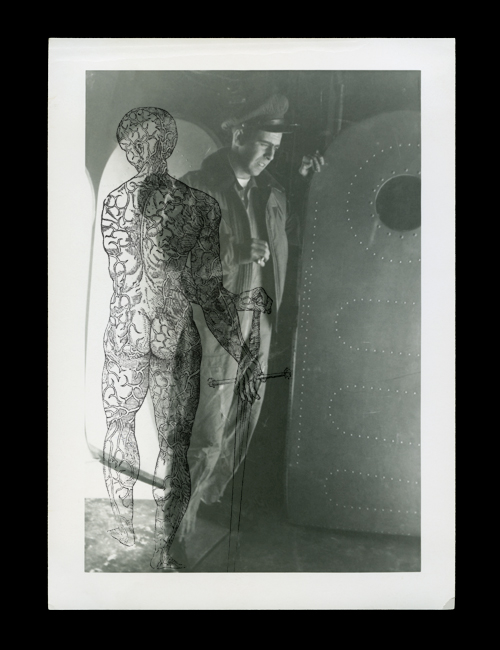
Marcus Bunyan (Australian, b. 1958) 'Spire of der Dom, 1 - 52' 2009 from the series 'The Shape of Dreams'


Marcus Bunyan (Australian, b. 1958)
Spire of der Dom, 1 – 52
2009
From the series The Shape of Dreams
Gelatin silver print


The Shape of Dreams

I am pleased to announce a body of work, the second for 2009, is now online on my website.

The photographs are a sequence: one tone follows another (much like a piece of music) until the final coda. With this in mind please view the work sequentially. Below are a selection of photographs from the whole work.

Dr Marcus Bunyan


Please click on the photographs for a larger version of the image.

Photographs are available from this series for purchase. As a guide, a digital colour 16″ x 20″ costs $1000 plus tracked and insured shipping. For more information please see my Store web page.


Photographs from the series The Shape of Dreams 2009


“the form of formlessness
the shape of dreams”


Marcus Bunyan (Australian, b. 1958) 'Untitled' from the series 'The Shape of Dreams' 2009


Marcus Bunyan (Australian, b. 1958)
Untitled
2009
From the series The Shape of Dreams
Gelatin silver print


Marcus Bunyan (Australian, b. 1958) 'Untitled' from the series 'The Shape of Dreams' 2009


Marcus Bunyan (Australian, b. 1958)
Untitled
2009
From the series The Shape of Dreams
Gelatin silver print


Marcus Bunyan (Australian, b. 1958) 'Untitled' from the series 'The Shape of Dreams' 2009


Marcus Bunyan (Australian, b. 1958)
Untitled
2009
From the series The Shape of Dreams
Gelatin silver print


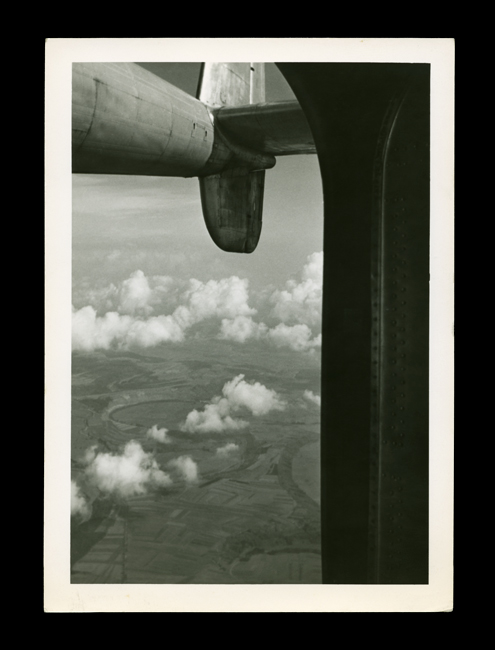
Marcus Bunyan (Australian, b. 1958) '9/24/52' from the series 'The Shape of Dreams' 2009


Marcus Bunyan (Australian, b. 1958)
9/24/52
2009
From the series The Shape of Dreams
Gelatin silver print


Marcus Bunyan (English-Australian, b. 1958) 'Untitled' from the series 'The Shape of Dreams' 2009


Marcus Bunyan (Australian, b. 1958)
Untitled
2009
From the series The Shape of Dreams
Gelatin silver print


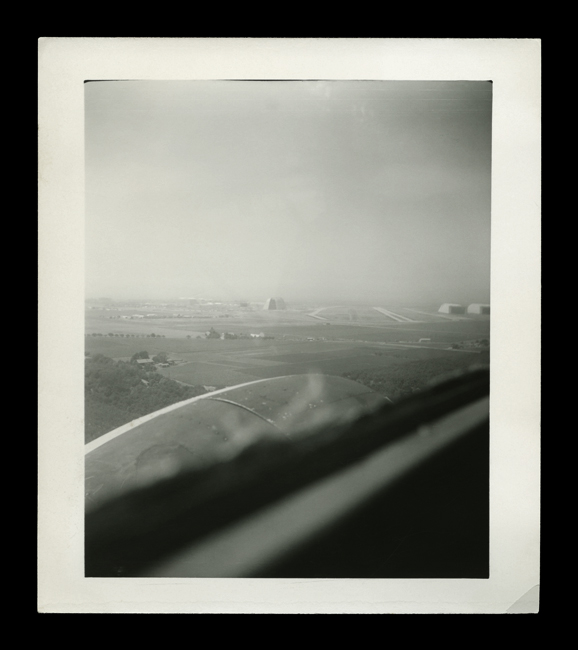
Marcus Bunyan (Australian, b. 1958) 'Navy Base, Unidentified' from the series 'The Shape of Dreams' 2009


Marcus Bunyan (Australian, b. 1958)
Navy Base, Unidentified
2009
From the series The Shape of Dreams
Gelatin silver print


Marcus Bunyan (Australian, b. 1958) 'Untitled' from the series 'The Shape of Dreams' 2009


Marcus Bunyan (Australian, b. 1958)
Untitled
2009
From the series The Shape of Dreams
Gelatin silver print


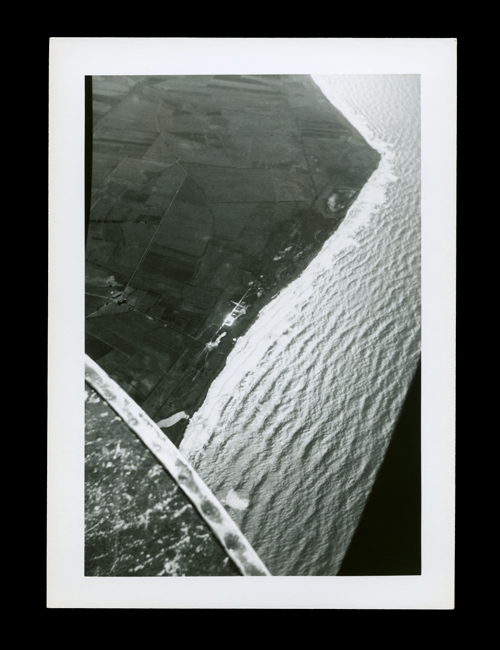
Marcus Bunyan (Australian, b. 1958) 'Part of the French Riviera taken while Whit held me at the door!' from the series 'The Shape of Dreams' 2009


Marcus Bunyan (Australian, b. 1958)
Part of the French Riviera taken while Whit held me at the door!
2009
From the series The Shape of Dreams
Gelatin silver print


Marcus Bunyan (Australian, b. 1958) 'Untitled' from the series 'The Shape of Dreams' 2009


Marcus Bunyan (Australian, b. 1958)
Untitled
2009
From the series The Shape of Dreams
Gelatin silver print


Marcus Bunyan (Australian, b. 1958) 'Untitled' from the series 'The Shape of Dreams' 2009


Marcus Bunyan (Australian, b. 1958)
Untitled
2009
From the series The Shape of Dreams
Gelatin silver print


All the photographs from the series are now on my website.


Marcus Bunyan website

LIKE ART BLART ON FACEBOOK

Back to top

Opening: ‘Nicola Loder: Tourist #3 sighted child 1-11’ at Helen Gory Gallery, Melbourne

Exhibition dates: 15th April – 2nd May, 2009


Installation photograph of the opening of Nicola Loder's exhibition 'Tourist #3 sighted child 1-11' at Helen Gory Gallery, Melbourne


Installation photograph of the opening of Nicola Loder’s exhibition Tourist #3 sighted child 1-11 at Helen Gory Gallery, Melbourne


A wonderful, social opening at Helen Gory Gallery of Nicola Loder’s latest work in her ongoing Tourist photographic series. As always Loder’s work looks superb, the mounting of the images at the back of thick perspex giving the images an almost holographic 3D effect. I still remember her exhibition of black and white children’s faces at the sadly closed Stop 22 Gallery in St Kilda many years ago: those images still impinge on the subconscious. This work continues those themes of instability in the mapping of identity, how we begin to see, to represent ourselves as an individual entity. Speaking of Stop 22 it was great to see Marianne, ex curator of that gallery at the opening with new bub in tow! There is an excellent catalogue essay by Stuart Koop (below).

Dr Marcus Bunyan


Many thankx to Nicola Loder and Helen Gory Gallery for allowing me to publish the photographs in the posting. Please click on the photographs for a larger version of the image.


Installation photograph of the opening of Nicola Loder's exhibition 'Tourist #3 sighted child 1-11' at Helen Gory Gallery, Melbourne


Installation photograph of the opening of Nicola Loder’s exhibition Tourist #3 sighted child 1-11 at Helen Gory Gallery, Melbourne


“We might think of Loder’s work as ‘undoing’ visuality. She sets technology in reverse, working against the imperatives of photography to clarify, focus, refine and sharpen images, as if our eyes worked backwards, as if acuity worsened. The face is an obvious (originary) limit beyond which chaos prevails and other senses are engaged to interpret what looks like abstract static but which many now believe is an unstriated sensory realm, a liberated space of interrelated, undifferentiated holistic sensory experiences; the original synaesthesia from which perception emerges as a travesty according to 5 distinct categories.

So it’s not blindness after all that the work references, not the failing of vision, but the first moments of looking, when ‘seeing’ begins to separate from the other senses and consolidates into a face, a percept, then into a code, a genre, a representation.”

Stuart Koop


Installation photograph of the opening of Nicola Loder's exhibition 'Tourist #3 sighted child 1-11' at Helen Gory Gallery, Melbourne


I don’t know who the lady and the bub are but thank you for the wonderful photograph – children upon children!


Nicola Loder (Australian, b. 1964) 'Tourist #3 sighted children 1-11' 2009


Nicola Loder (Australian, b. 1964)
Tourist #3 sighted child 1-11
2009
1200mm x 900mm,
lambda digital prints,10mm acrylic


The radiant Nicola Loder in front of one of her works


The radiant Nicola Loder in front of one of her works


Helen Gory Gallery

This gallery has now closed.

Nicola Loder website

LIKE ART BLART ON FACEBOOK

Back to top

Review: ‘reENLIGHTENMENT’ exhibition by Peter James Smith at Gallery 101, Melbourne

Exhibition dates: 18th March – 4th April, 2009


Peter James Smith. 'reENLIGHTENMENT' installation view 2009

Peter James Smith. 'reENLIGHTENMENT' installation view 2009


Peter James Smith (New Zealand, b. 1954)
reENLIGHTENMENT installation views
2009


“Every passion borders on the chaotic, but the collector’s passion borders on the chaos of memories. More than that: the chance, the fate, that suffuse the past before my eyes are conspicuously present in the accustomed confusion of these books. For what else is this collection but a disorder to which habit has accommodated itself to such an extent that it can appear as order?”1


“Thus the claim is that texts themselves can actually be intrinsically ‘genuine’, but that authenticity is a ‘social construct’. In other words, a certain kind of authenticity is created through the interaction of the users, situations and the texts.”2


Peter James Smith links the culture of science and of human experience, bringing together mathematics and the power of nature in realist imagery that is balanced by strong mark making and text. Redolent still life and landscape images juxtapose with astronomical, poetic and historical observations in the painted images. Handwritten citations, notes, jottings, diagrams and erasures float on the loosely painted surfaces of stretched linen, paper collage and found pieces which bring a Beuysian sense of the charismatic object. A sunset, a violin, a book of verse, an installation of old bells or delicate Jasperware porcelain provide a resonant foil for the artist and viewer – and create a space for the imagination, for mathematical wonder and contemplation.

“Beyond painting, in the current work there is a sense of history allowing us to privilege its objects, their collecting and their housing on walls, in vitrines, on shelves and on plinths. Like any true collector I am keen to bring them to an audience, to show them in a revelatory way. If they are inflected by hand markings it is to personalise the revelation. There are no plastic imitations: the Jasperware vases are authentic collected Wedgwood; the small Greek Pelike is indeed a c 300 BC vase; the Roman glass is a c 300 AD; the collected Wollemi pine needles are indeed from this prehistoric plant. These and other antiquities have a long museological tradition. The narratives of Wedgwood blue and white Jasperware designs are of Greek antiquity – the firing of the white clay over a cobalt blue base (in around) 1772 was a triumph of chemistry over alchemy. With these objects, it is not a postmodernist kitsch that is revealed, but rather the resuscitated fabric of authenticity. I am re-enlightened by their tactile physical presence that has a timeless beauty. To render such things as a painted image is to engage in a different act, with different rules referring to different histories.”

Peter James Smith, 2009. Notes from the exhibition catalogue.

 
Enlightenment, Romanticism, reason, authenticity, revelation.

I am a collector like Peter James Smith. I display my collection of early 20th century English vases. I have a collection of 300 ties that span from the 1930s to the 1970s. I have eight rare 1940s suits, those suits that Humphrey Bogart used to wear with the wide wide lapels that nearly reach the seam of the sleeve.

Rare, fragile, beautiful, genuine.

In this exhibition Smith appeals not to the genuineness of the objects but to the authenticity of the objects he displays: “There are no plastic imitations … With these objects, it is not a postmodernist kitsch that is revealed, but rather the resuscitated fabric of authenticity.” He wants to show these objects in a revelatory way, for us to once more appreciate their authenticity. To make order out of disorder. But then Smith wants to personalise this revelation and overlays the objects with texts that re-order the taxonomy through a reinscription that is both a de-territorialization and re-territorialization of meaning, a loss of original meaning and the production of new meanings. This is the faint silver flicker of re-enlightenment the artist seeks. It is above all authentication as individual spectacle, as social construct.

“Authenticity is an issue for us today because of a widespread sense that there is something inauthentic in the way we experience the modern world.”3

In some of the works this process is effective and in other works it falls flat on it’s proverbial, intertextual backside. The process works well in the less cerebral works. The use of black paint in Paradise Lost IV (below) is particularly effective as the re-inscription of paint invades and threatens the motifs of the classical figures with the text and cross reinforcing the idea of a lost paradise. Cathedral (2009, below) is also a stunning installation of different bells hung at various heights within a locked cabinet, complicit in their silence as they would not be inside a cathedral. For me this was probably the best piece in the show for its simplicity of thought, eloquence of execution and understanding of how the installation re-enlightens the viewers socially constructed authenticity in a revelatory way. No double marking is needed – a zen balance is proposed and achieved in the quietness of the viewers mind.

Other pieces are less successful. Amphora in grey teracotta Han Dynasty c 100BC (2008), the amphora inscribed with text sitting on a painted black video recorder is particularly unengaging and unappealing – there is no revelatory experience to be had here. The Greek Pileke (see below) inscribed with lines from John Keats Ode on a Grecian Urn seems an appropriate intervention but sometimes in this exhibition one just longs to appreciate the sanctity of the object, it’s presence, in silence without the personalising of the revelation by the hand of the artist. To see the object clearly for what it is.

The large installation reELIGHTENMENT (2009 below, and installation photo at top) falls into darkness. The use of the doors as metaphor is clumsy, book covers have been more successfully used by other artists and the black paint is heavy and oppressive. More interesting are some of the paintings, for example The slow dance of an astronomical twighlight (2009, below) where the poem of William Wordsworth

… a sense sublime
Of something far more deeply interfused,
Whose dwelling is the light of setting suns

illuminates the poetry of the painting, adding an insightful double meaning to the universal revelation. A vibration of spirit is present both in the landscape and the markings upon the landscape. Unfortunately all too often in this exhibition access to the sublime is denied. Appeals to neo-authenticity fall on deaf ears. The motifs of this exhibition are universal, archetypal but the elements that go to make up this exhibition are too many and lack focus. Sometimes in art less in more and this exhibition is a classic example of this fact. There are some interesting elements but overall the whole is not the sum of its parts.

As John Donne observed

“All mankind is of one author, and is one volume; when one man dies, one chapter is not torn out of the book, but translated into a better language; and every chapter must be so translated … No man is an island, entire of itself; every man is a piece of the continent, a part of the main.”4

Our authentic place in the world, our spiritual space, our re-enlightenment needed to be better defined, more lucidly enunciated in this exhibition NOT IN CAPITAL LETTERS but in the quietness of our hearts.

Dr Marcus Bunyan


1/ Benjamin, Walter. “Unpacking my Library: A Talk about Book Collecting,” in Illuminations. English translation. London: Fontana, 1982, pp. 59-60

2/ Lee, W. “Authenticity revisited: text authenticity and learner authenticity,” in ELT Journal, 49(4). 1995, pp. 323-328 cited in Shomoossi, Nematullah and Ketabi, Saeed. “A Critical Look at the Concept of Authenticity,” in Electronic Journal of Foreign Language Teaching, 2007, Vol. 4, No. 1, pp. 149-155 [Online] cited on 29th March, 2009 at http://e-flt.nus.edu.sg/v4n12007/shomoossi.pdf

3/ McClure, Christoper. The Concept of Authenticity in Charles Taylor and Martin Heidegger. [Online] cited on March 29th, 2009 (no longer available online)

4/ Donne, John. Devotions Upon Emergent Occasions, Meditation XVII: Nunc Lento Sonitu Dicunt, Morieris. 1624.


Variously

Wedgwood Jasperware, Roman glass, Greek Pileke, books, doors, texts, paintings, bells, video, video machine, wooden boxes, black paint, crosses, albatross, Wollemi Pine needles, Paradise Lost, astronomy, linen, stars, photography, Chinese porcelain, collage, mathematical equations, mirrors, Amphora from the Han Dynasty, a violin, a sunset, a book of verse, notes, shelves, jottings, citations.

Notes to myself

~ Golden ratio
~ The archive
~ Topographical markings, inscriptions and decodings
~ The ‘nature’ of authenticity
~ The ‘voice’ of revelation
~ Re-possession of clarity and logic
~ Re-production of mystery, tenderness and love
~ Reverence for the object itself
~ Referentiality between image and text
~ The colour black: transcendent, the depths of the night sky but also the closing in of darkness at the end of days
~ Never one truth but many truths
~ Less is more


Many thankx to Gallery 101 for allowing me to publish the photographs in the posting. Please click on the photographs for a larger version of the image.


Peter James Smith (New Zealand, b. 1954) 'The slow dance of an astronomical twighlight' 2009 from the exhibition 'reENLIGHTENMENT' exhibition by Peter James Smith at Gallery 101, Melbourne, March - April, 2009


Peter James Smith (New Zealand, b. 1954)
The slow dance of an astronomical twighlight
2009


Peter James Smith (New Zealand, b. 1954) 'Paradise Lost IV' 2008 from the exhibition 'reENLIGHTENMENT' exhibition by Peter James Smith at Gallery 101, Melbourne, March - April, 2009


Peter James Smith (New Zealand, b. 1954)
Paradise Lost IV
2008


Peter James Smith (New Zealand, b. 1954) 'Ode on a Grecian Urn' 2008


Peter James Smith (New Zealand, b. 1954)
Ode on a Grecian Urn
2008


Peter James Smith (New Zealand, b. 1954) 'Cathedral' 2009


Peter James Smith (New Zealand, b. 1954)
Cathedral
2009


Peter James Smith (New Zealand, b. 1954) 'reENLIGHTENMENT' 2009


Peter James Smith (New Zealand, b. 1954)
reENLIGHTENMENT
2009


Gallery 101

This gallery is now closed.

LIKE ART BLART ON FACEBOOK

Back to top

Review: ‘The Big Black Bubble’ exhibition by Dale Frank at Anna Schwartz Gallery, Melbourne

Exhibition dates: 12th March – 11th April, 2009


Dale Frank (Australian, b. 1959) 'The Big Black Bubble' installation view at Anna Schwartz Gallery, Melbourne 2009


Dale Frank (Australian, b. 1959)
The Big Black Bubble (installation view)
Left to right: Timothy Oliphant (2008), Ryan Gosling (2008/2009) and Matthew Macfadyen (2008)
2009


This is a brilliant exhibition by Dale Frank, one of my favourites so far this year in Melbourne.

Six large varnish on linen landscape paintings are presented in the beautiful Anna Schwartz gallery space in Melbourne. Photographs really do not do the paintings justice – they can only give an impression of the size and scale of the work but not of their intimacy or smell. The smell of varnish permeates the air. The serendipity of the natural convulsions of the varnish and the facilitations of the hand of the artist, his performance, have been caught like bugs in amber in the final molecular structure of the painting. Here are pendulous, globular goops of varnish, immersive heroic tone poems that form images in the mind of the viewer. Moving close to the paintings you are surrounded by flows and eddies, the macro and the micro; details become more apparent as you study the work.

While disagreeing that these paintings are the viewers to create (the viewer as author) what I can say is that the artist offers the viewer the ability to generate their own resonances with the painting, to use the imagination of ‘equivalence’ to suggest what these paintings stand for – and also what else they stand for. States of being, of transformation, wonder and joy emerge in the playfulness of these works. Perhaps this is where the titles of the paintings come from, referencing film actors in the pop tradition, but this is the only thing that did not ring true with the work, their titles. The use of this trope seems to me a bit facile given the nature of the work.

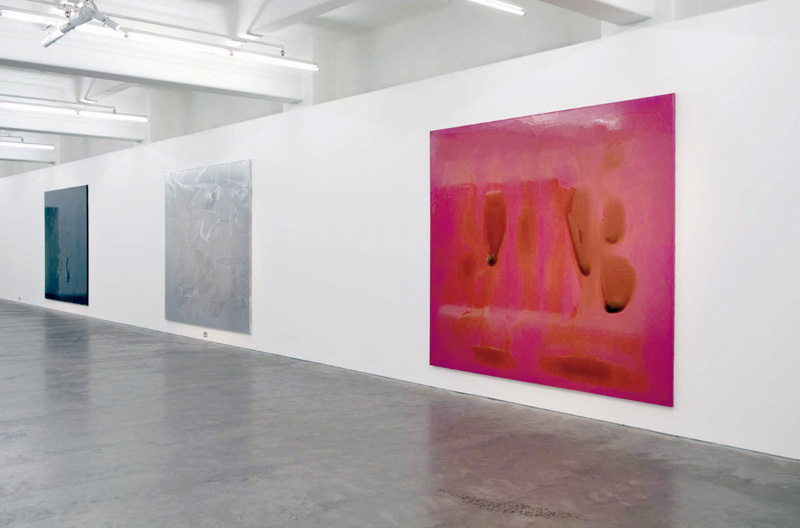
The hot pink painting Rupert Grint (2008/2009, above) is hotter and lighter than in the photograph below, the varnish more translucent, the effect altogether mesmeric. You are drawn into the work, the intensity of the colour, the thickness of the hanging varnish. Two cosmological galaxies (Timothy Oliphant (2008) and Matthew Macfadyen (2008)) surround the most complex painting in the exhibition, the darkness and light that is Ryan Gosling (2008/2009, below).

This painting is a tour de force. With the poetic structure of an oil spill, the varnish forms intricate slick upon slick contours that are almost topographical in their mapping. The black oozes light, becomes ‘plastic’ black before your eyes, like the black of Rembrandt’s backgrounds, illusive, illuminative and hard to pin down – perpetually hanging there in two dripping rows, fixed but fluid at one and the same time (you can just see the suspensions in the photograph above).

The painting reminds me of the black paintings of Mark Rothko that he undertook for The Rothko Chapel in Houston, Texas (see below). As with the Rothko paintings, this painting is not just black (physically there are swirls of purple as in the Rothko paintings), not about darkness at all. What both artists do is create a contemplative, transformative space – in Frank’s case for a world on the edge of oblivion. This is a post post-modern landscape: process and nature, performance and chance coalescing in the colour : black!

This painting is one of the most overwhelming syntheses of art and nature, of universal forces that I have seen in recent contemporary art. This exhibition is an electric pulsating universe of life, landscape and transformation. Magnificent!

Dr Marcus Bunyan


Many thankx to Anna Schwartz Gallery for allowing me to publish the photographs in the posting. Please click on the photographs for a larger version of the image.


Dale Frank (Australian, b. 1959) 'The Big Black Bubble' installation view at Anna Schwartz Gallery, Melbourne 2009


Dale Frank (Australian, b. 1959)
The Big Black Bubble (installation view)
Left to right: Daniel Radcliffe (2008/2009), Khan Chittenden (2009) and Rupert Grint (2008/2009)
2009


The immersive scale of these new paintings at Anna Schwartz Gallery Melbourne allows us to experience their inner qualities of landscape and of transformation. This is painting at fundamental authenticity. The paint is its own agent; it is allowed to act, to behave. The artist is the facilitator of these phenomena of nature and natural forces, whose residue is a metaphor for nature itself.

Black contains all colours, contours and depths. A pink monochrome is transformed by pure varnish into an expressionistic moment of process and performance. All colour is absent from elemental silver aluminium and form and gesture alone survive. New dynamics are possible through an innovative colouration: the emergence of colour through black, and its equivalent power.

Dale Frank’s painting is one of poetry, performance and nature. It represents both the macro and micro. Huge universal forces pulsate with molecular, atomic activities. Imagination is gifted by the artist to the viewer. These are our paintings to create.

Anonymous text from the exhibition flyer.


Dale Frank (Australian, b. 1959) 'Ryan Gosling' 2008/2009


Dale Frank (Australian, b. 1959)
Ryan Gosling
2008/2009


The Rothko Chapel, Houston, Texas


The Rothko Chapel
Houston, Texas


Anna Schwartz Gallery
185 Flinders Lane
Melbourne 3000
Australia
Phone: +61 3 9654 6131

Opening hours:
Tuesday – Friday 12 – 5pm
Saturday 1 – 5pm
Anna Schwartz Gallery website

LIKE ART BLART ON FACEBOOK

Back to top