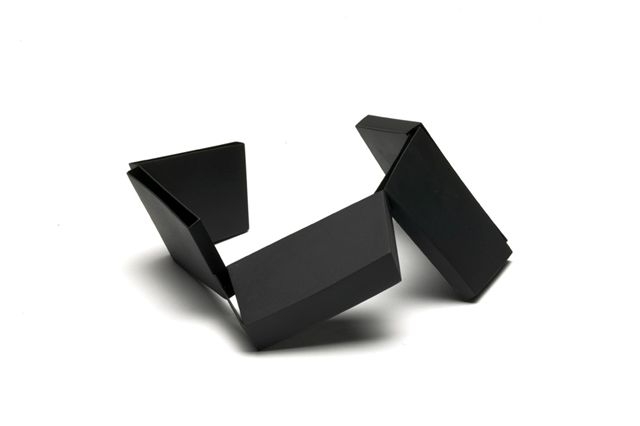
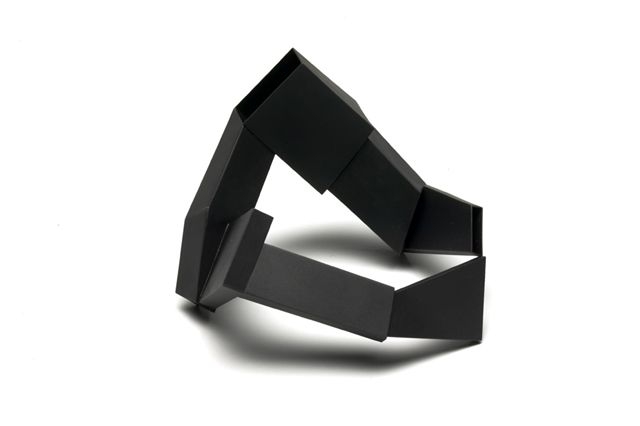
Mari Funaki (Australian, 1950-2010) Bracelet 1 from Space between 2005-2006 Heat-coloured mild steel
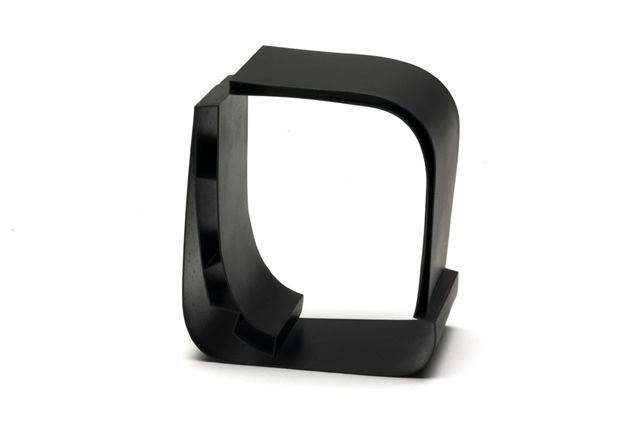
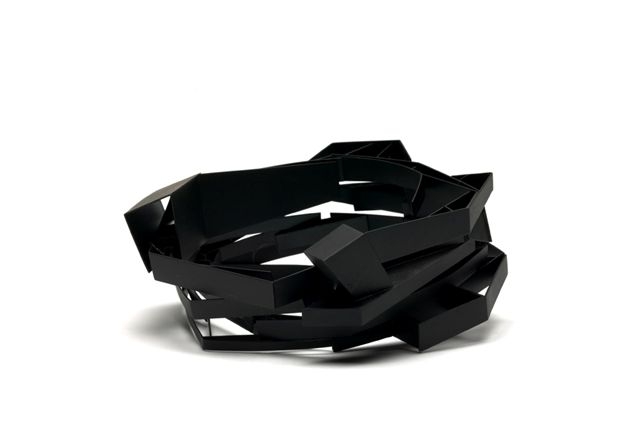
Mari Funaki (Australian, 1950-2010) Bracelet 2 from Space between 2005-2006 Heat-coloured mild steel
Mari Funaki is one of Australia’s leading jewellers. This exhibition celebrates her considerable achievements between 1992 and the present day. Her first major show in a state gallery, it includes nearly fifty works and will be the first time Perth audiences have seen her work in such depth. Many of these are new works produced especially for this show.
The exhibition will focus on rings, containers and bracelets. These forms have been the core of her practice, the foundation of her intricate material experimentations. Her sheer intensity of focus has seen her hone these forms into objects of extreme power and beauty. Funaki’s is no simple beauty, however. It is sharp, complicated. There is always a sense of danger in her work, as the spindly legs of her insect-like containers support unlikely, unwieldy torsos, and as her rings and bracelets cultivate miniature monoliths that play with scale and weight in fascinating ways.
This exhibition will frame these unique objects in such a way as to acknowledge Funaki’s ability to work with space and matter to form entrancing works that adorn the imagination in the same they adorn the body.
Text from the Art Gallery of Western Australia website [Online] Cited 10/08/2009. No longer available online
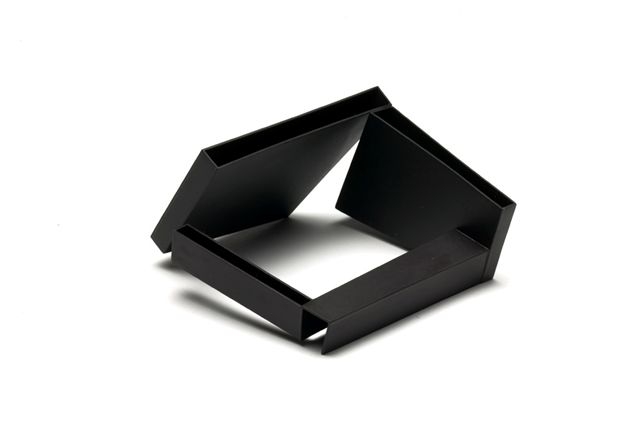
Mari Funaki (Australian, 1950-2010) Bracelet 3 from Space between 2005-2006 Heat-coloured mild steel
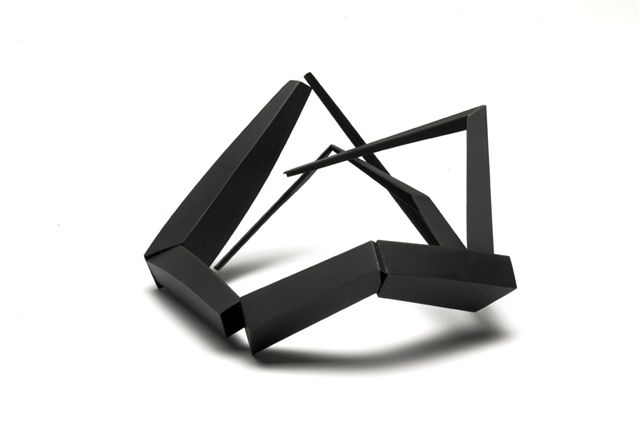
Mari Funaki (Australian, 1950-2010) Bracelet 4 from Space between 2005-2006 Heat-coloured mild steel
Notes from a Conversation with Mari Funaki, July 2006
Mari Funaki’s initial response comes from the environment – the response is part random, part constructed idea.
Funaki likes the ‘animated’ response from the viewer – allowing them to make their own associations with the work and their own meaning. The making of the work doesn’t emerge out of nothing but through the development of ideas over a long period of time.
Mari starts with a flat drawing – this approach comes from an Eastern perspective in the history of art making i.e. screens, woodcuts and scrolls. Initially when starting with the idea Mari is mentally thinking in two dimensions – then drawing out onto paper in two dimensions the ideas.
When actually making the work Mari then starts working and thinking in three dimensions – starting with a base piece of metal and working physically and intuitively around the object, to form a construction that evidences her feelings about what she wants to create. She likes the aesthetic beauty but uneasy aspect of a dead insect for example (like the Louise Bourgeois Maman spider outside the Guggenheim in Bilbao).
Now collaborating with architect Nonda Kotsalidis, Mari is working to produce her sculptural objects on a larger scale, up to 6 metres high. She needs the objects to have an emotional and physical impact on the viewer – both beautiful and threatening at one and the same time. How will her objects translate to a larger scale? Very well I think.
Funaki likes the physical distortion of space – and she likes telling a story to the viewer. She is working on a building where the facade is really strongly geometric and then she is embedding an emotion into the front of the building – constructing a narrative – constructing an emotional response with the viewer and establishing a relationship with the building. Here she is working from photographs of the space, her own recognition and remembrance of that space. She is having to work physically in 3D from the beginning for the first time, but still uses drawings to sketch out her ideas.
Several of Funaki’s pieces in the Cecily and Colin Rigg Contemporary Design Award (2006) at the NGV Federation Square were inspired by the work of Bernd and Hilla Becher. Their photographs of factories and gasworks, specifically the facades of such buildings (see image below), were the jumping off point for the development of the objects (the bracelets). Funaki takes the front of these buildings, a 3D structure ‘in reality’ but pictorially imaged on a 2D plane, and then twists and distorts their structure back into a 3D environment. The facades move up and around, as though a body is twisting around its own axis, pirouetting around an invisible central spine.
Each piece is created and then the next one is created in relation to the previous, or to each other. Each individual piece has its own character and relation to each other. They are never variations of the same piece with small differences – each is a separate but fully (in)formed entity.
Dr Marcus Bunyan
Bernd and Hiller Becher (German, 1931-2007 and 1934-2015) Water Towers 1980 Gelatin silver prints
“Black. Sharp, shifting contours. Familiar and alien. Confident, expressive and agile, it is easy to take the existence of these works for granted – and it is hard enough to trace in one’s mind the physical evolution back through heat colouring, sandblasting, soldering, assembling and cutting, to unremarkable, thin sheets of mild steel – let alone comprehend their conception and resolution.
They inhabit space in a way that is difficult to describe – the edge between each object and the space that encloses it is shockingly sudden.
How can something human-made be so insanely artificial and natural at the same time? It must be no accident that I described them as articulate – ambiguous and wide ranging in the breadth of associations and allusions, they can tell you everything and nothing at the same time.”
Sally Marsland, 2006
Text from the Gallery Funaki website [Online] Cited 10/08/2009 no longer available online
Mari Funaki (Australian, 1950-2010) Bracelet 5 from Space between 2005-2006 Heat-coloured mild steel
Mari Funaki (Australian, 1950-2010) Bracelet 6 from Space between 2005-2006 Heat-coloured mild steel
Art Gallery of Western Australia Perth Cultural Centre Perth WA 6000
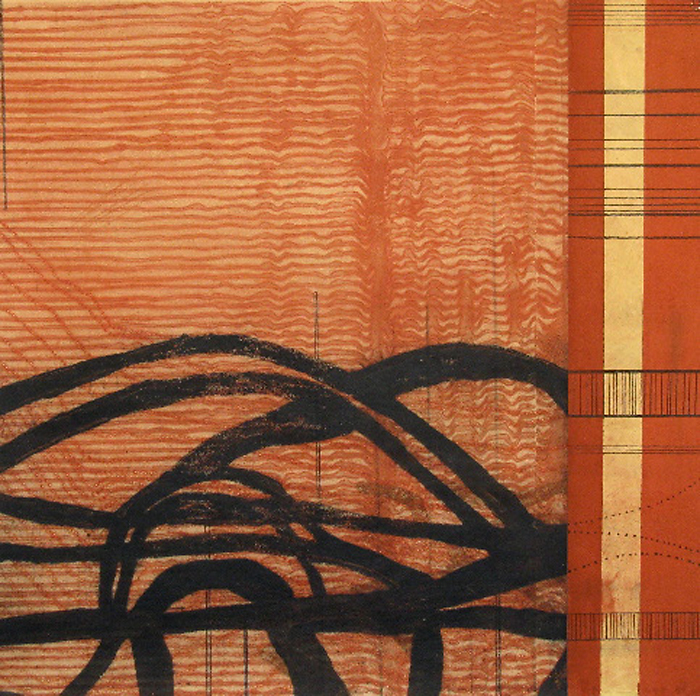
Sarah Amos (Australian, b. 1965) Red Walk 2009 Collagraph and Monoprint
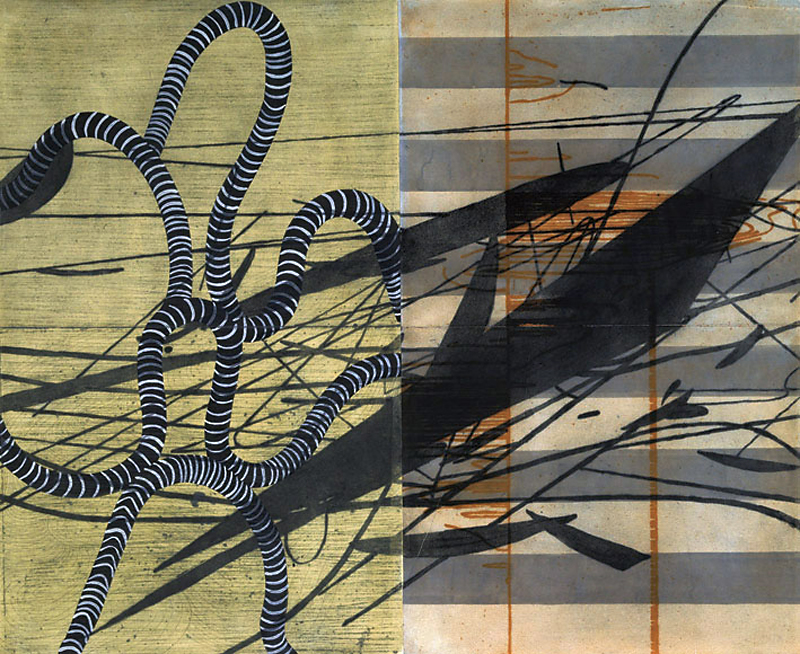
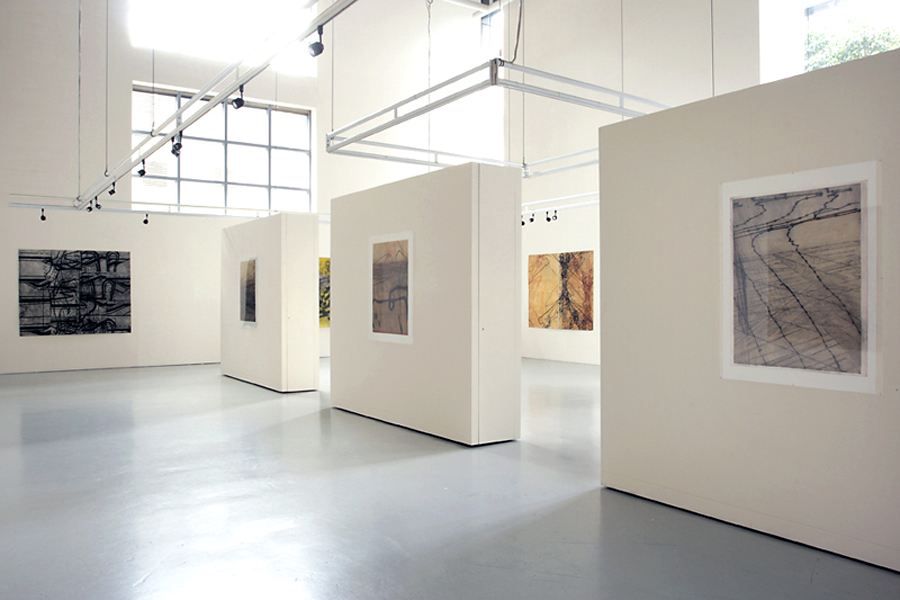
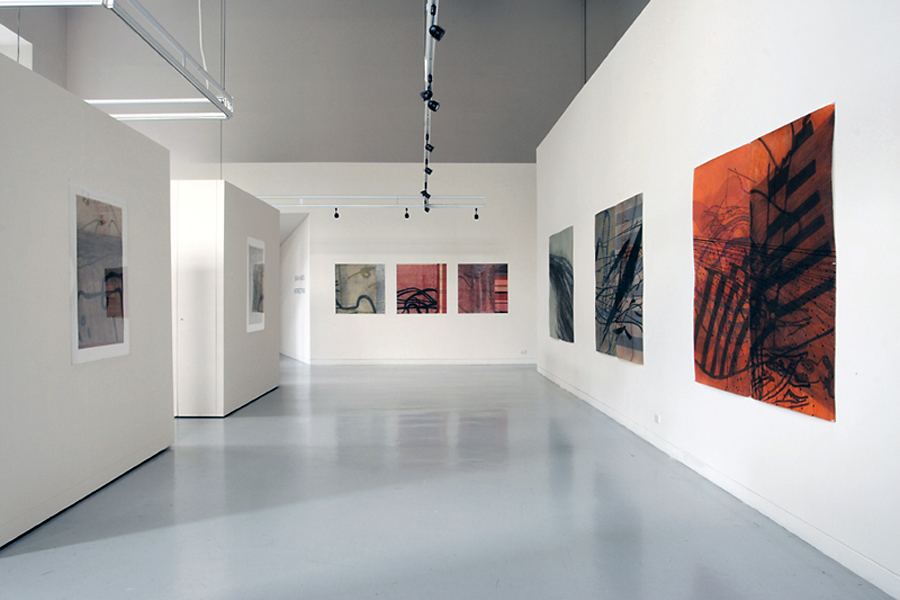
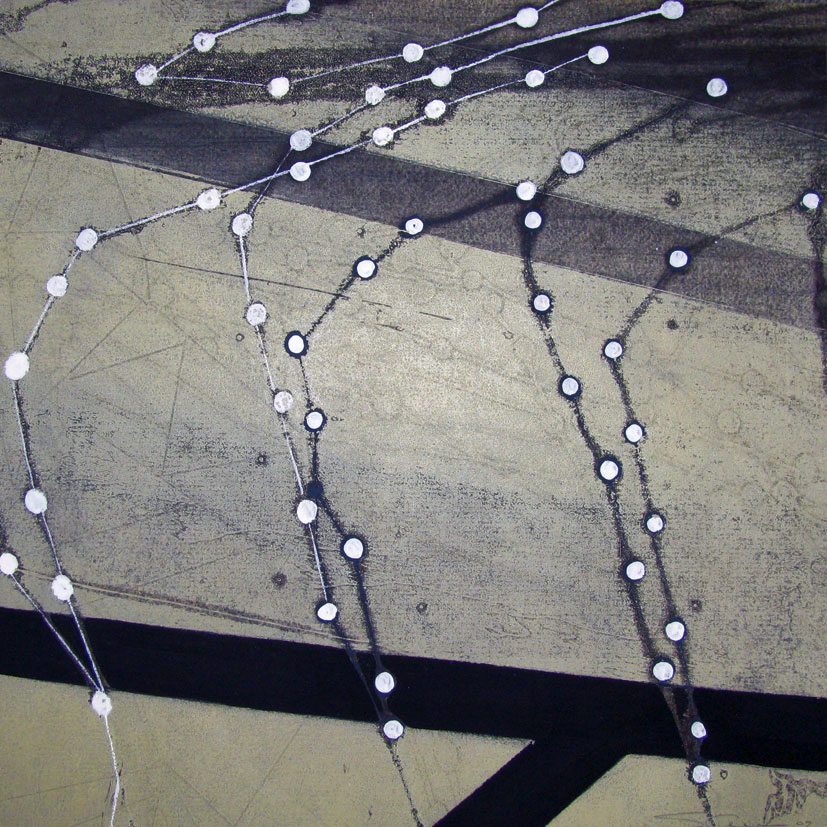
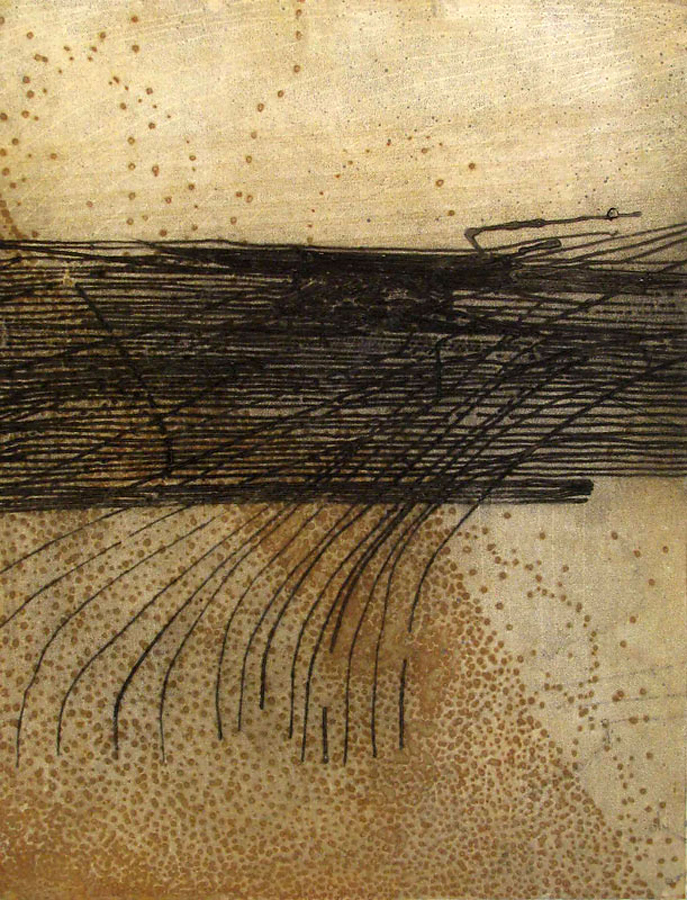
An interesting exhibition of Collagraphs (a type of collage printmaking)1 and etchings is presented by Sarah Amos at Gallery 101, Melbourne, work that is full of delicate coloured layering, topographical mapping and nodal, rhizomic and Spirogyra-type structures.
The ‘flux’ of the work, it’s musical cadence if you like, is the fusion of palimpsestic markings as viewed from the air – the dotted contours, the ploughed fields, the beautiful spatial layering that has an almost Kandinsky-like effect – with the aesthetics of Japanese paper, matt black colour (that subtly glistens on close inspection) and the tactility of the surface of the work. These intersections produce images that have some outstanding resonances: vibrations of energy that ebb and flow around the gallery space. These works are captivating!
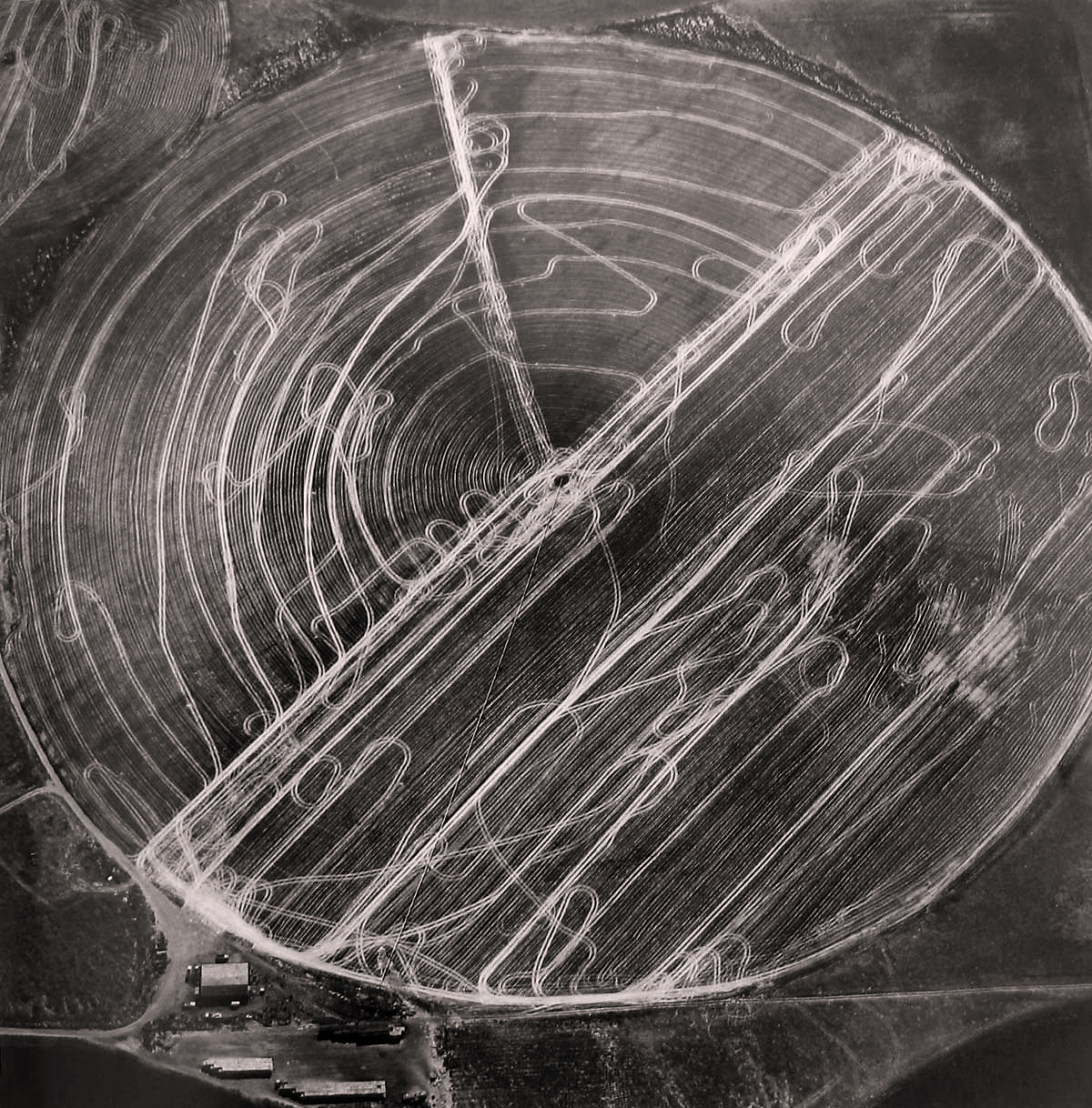
For me the simpler images were the more successful especially the series named Intersections with their muted tonalities, shifting colours and topographical structure. They also reminded me of the black and white aerial landscape photography of Emmet Gowin (see below).
While I am unsure of the validity of the ‘landscape’/’urban lens’ ‘urban temperature’ references (which I found unnecessary and slightly irrelevant) these works and their synaptic interfaces must be experienced. For the viewer they hold a strange attraction as you stand before them drawn, inexorably, into their penumbral spaces. Recommended.
Dr Marcus Bunyan
Many thankx to gallery 101 for allowing me to publish the art work in the posting. Please click on the photographs for a larger version of the image.
1/ “A Collagraph print is a collage printmaking technique and is a form of Intaglio printing. The collagraph plate is printed in the same way as etchings, but also include the basic principle of relief printing and can be printed either as intaglio or relief.
The term collagraph refer to a collage board where the materials are assembled on a flat base or plate (matrix) to form a relief block with different surface levels and textures.
Collagraph plates are created by sticking and gluing materials like textured paper or fabric onto the plate and then coat it with varnish or acrylic medium afterwards to protect the materials.
Anonymous. “Printmaking: Collagraphs/Collage Blocks,” on the ArtistTerms.com website [Online] Cited 03/08/2009. No longer available online
Sarah Amos (Australian, b. 1965) Storm Loading 2009 Etching and hand drawing on Shiramine Japanese paper
Installation views of Intersections by Sarah Amos at Gallery 101, Melbourne Photos: Marcus Bunyan
Emmet Gowin (American, b. 1941) Harvest traffic over agricultural pivot near Hermiston, Orgeon, 1991 1991 Gelatin silver print
Sarah Amos (Australian, b. 1965) Intersections 8 2009 Collagraph with gouache
“(Flux) – where a total electric or magnetic field passes through a surface.”
My work is a fusion of both land and cityscape. I am interested in interpreting spatially dynamic, real and half forgotten landscapes through an urban lens. New to this body of work is my interest in the visual graphics of scientific diagrams in which dynamic and informative landscapes are drafted into linear minimal lines. I have absorbed this distilled language, translating it into an architectural and organic landscape where the intersections of line, volume and space are constantly in flux. This obscure knowledge is pared down, simplified and ordered into a clean analysis ready for instant translation.
The Australian landscape is central to my work and influences my use of colour, idiosyncratic marks and open space. These works are personalised maps of accumulated information, like printed histories, that record the duelling intersections where the weathers of the landscape and the urban temperature have begun to take on new and vital immediacy.”
Sarah Amos, 2009
Text from the Gallery 101 website [Online] Cited 01/08/2009. No longer available online
Sarah Amos (Australian, b. 1965) Lute 2009 Collagraph
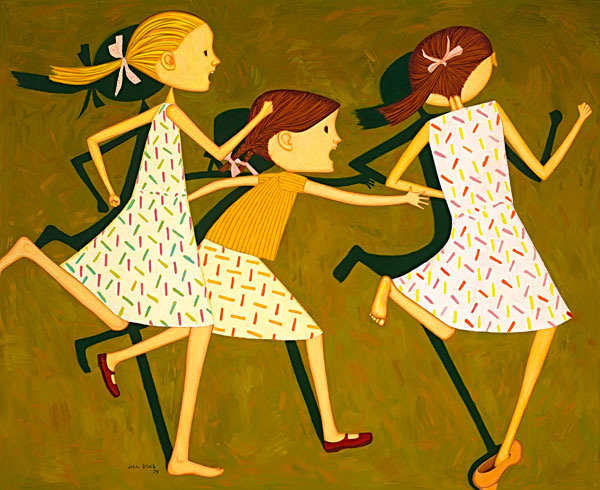
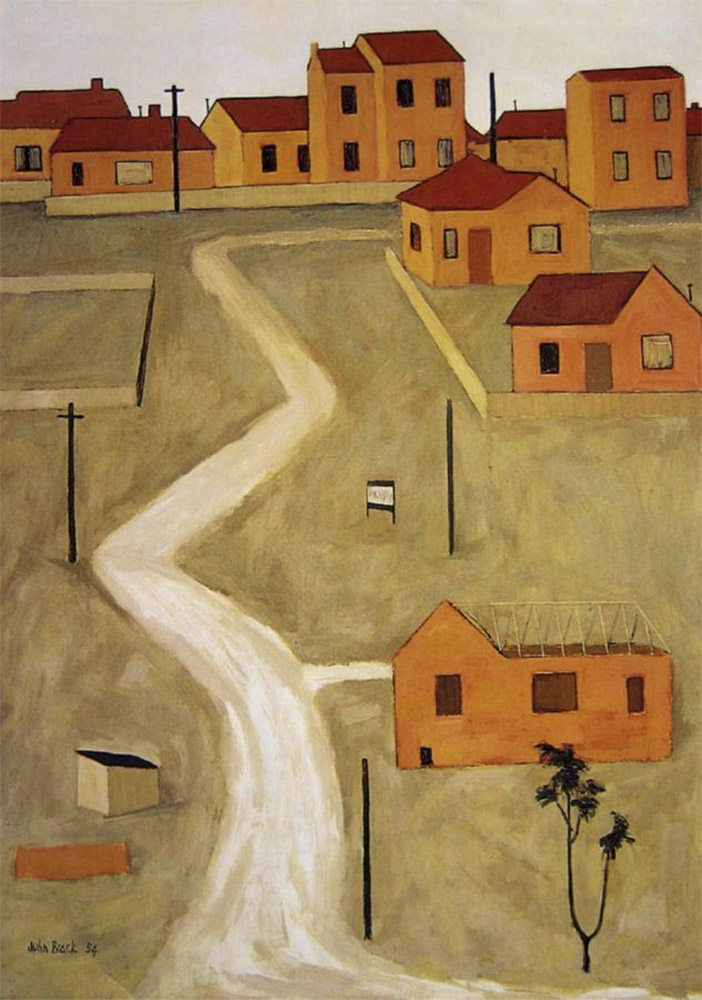
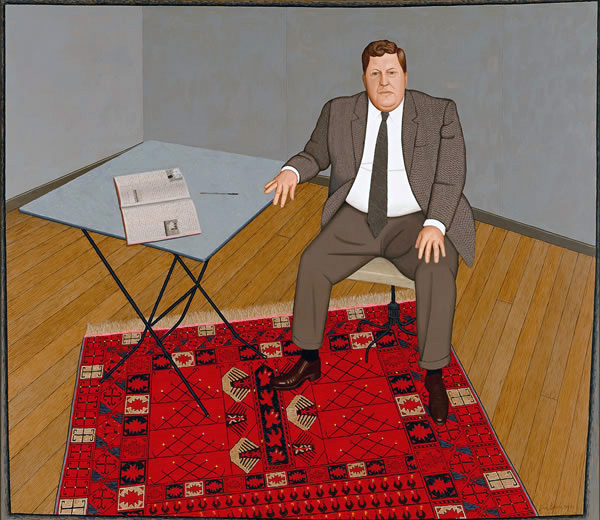
This is a solid retrospective of the work of the Australian artist John Brack (1920-1999) presented by the National Gallery of Victoria, Melbourne. John Brack is, quintessentially, an Australian and more specifically a Melbourne artist. Melbournians have a love hate relationship with his work – loving the earlier paintings that view the working classes of 1950s Melbourne through a nostalgic, humorous, sardonic lens (when originally the popularity of the work in the 1950s/60s was, as Robert Nelson has observed, mistakenly identified with ridicule of the subject matter)1 while finding the later work of massed pencils, postcards, deities and wooden people mystifying, cold and elusive.
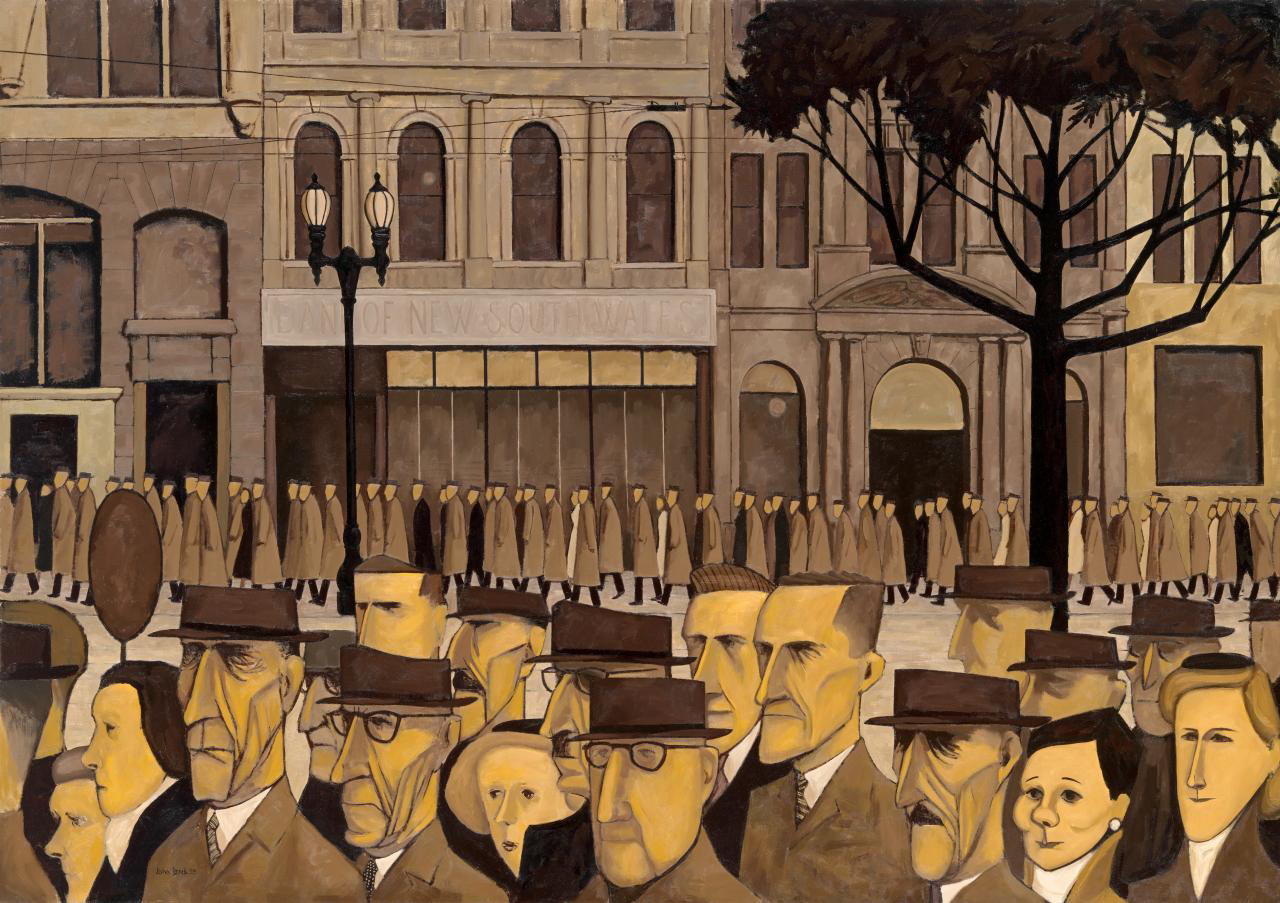
Brack saw his paintings of suburbia as honest portrayals of the new milieux. His sparse, graphic style evidenced the emotionally distanced relationships between space and people in the new cityscapes and best suited his cerebral approach to the subject matter. Men become mannequins with skeletal faces that hover menacingly behind the barmaid in The bar (1954, above), an amorphous mass of brown-suited humanity. Two women are portrayed in all their high-collared stiffness in the painting ‘Two typists’ (1955, above), their stylised faces, black hat and hair surmounted by hanging, disembodied legs at the top of the painting. These two women then reappear at bottom right in one of Brack’s most famous paintings, Collins St, 5p.m. (1955, above) subsumed into the two lines of people wearily trudging home from a day’s work at the office.
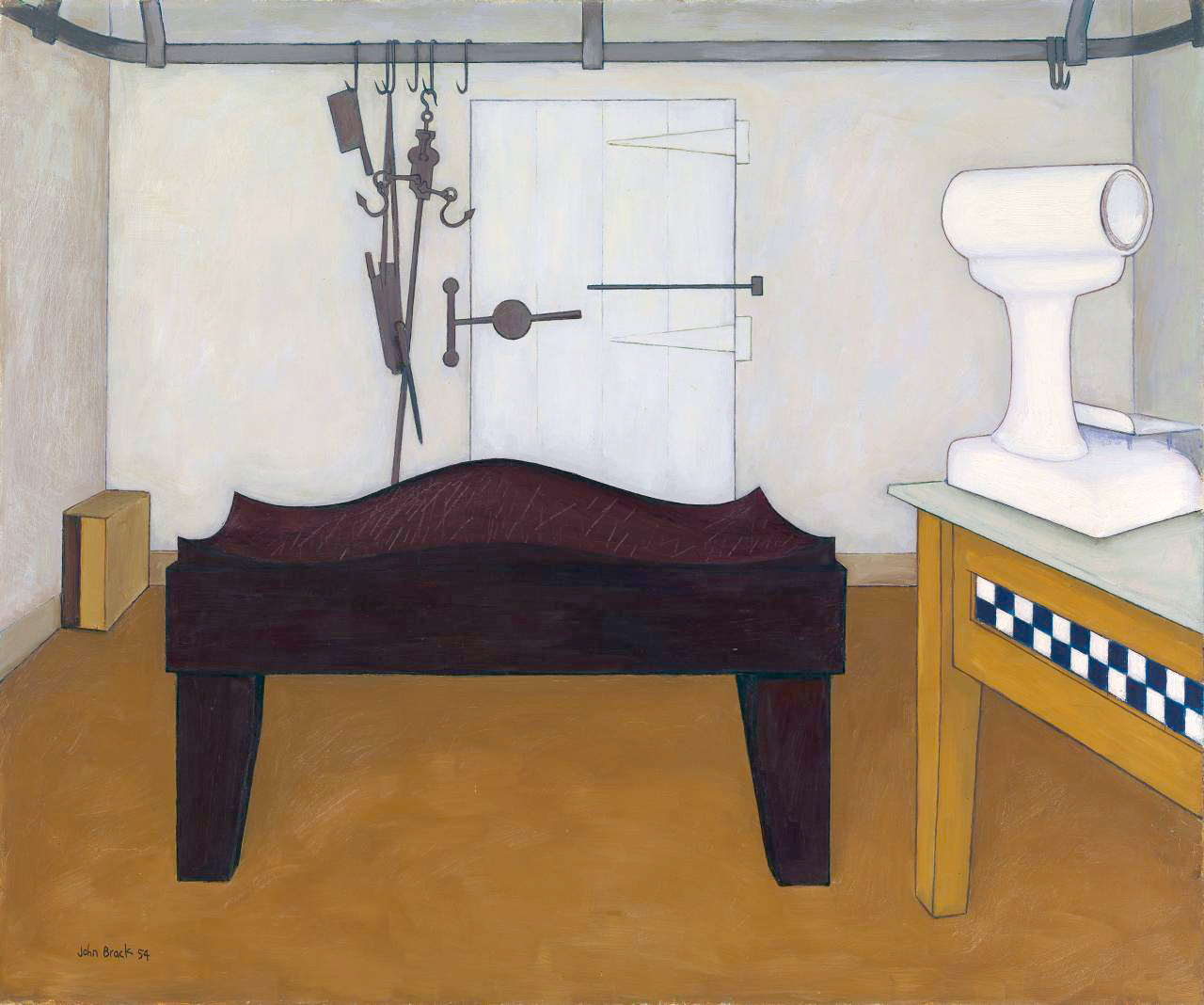
Brack’s early paintings are full of stylised metaphor – for example the clinical emptiness of space, the implied threat of hanging ‘instruments’ in ‘The block’ (1954, above) or the decapitated bird-like alienation of the fish head in The fish shop (1955, above) – offer comment on the nature of suburban life: ordered, dead, soulless surfaces, facades behind which life seethes. Brack recognises the slightly macabre beauty of these industrial spaces, their form and purpose, where no one had recognised them before. There are oversized teeth (The veil, 1952), large hands, the fleshy pink of faces (The barbers shop, 1952) and the tribal mask of a face in Man in pub (1953) where man becomes fragment. Above all there is a simplicity and eloquence in line and form grounded in a limited palette of ochres, yellows, greys, blacks, whites and browns. These are the colours of the early cave painters and it’s poignant that Brack uses them so effectively to anchor his subject matter both in history, memory and the present of contemporary life, a life we still recognise intimately over fifty years later.
Here is the ‘Human Condition’ writ large (with capitals!), the humility of professions such as butchers, seamstresses, typists and barmaids (with their limited control of the environment) portraying the body of the worker, as in Satre’s ‘Nothingness’,2 living the tedium of suburban life whilst wanting to flee the anguish of this existence into the desirable light of the future toward which man projects himself. This a theme that Brack develops in the later paintings with their stilted, cerebral investigation of existentialism. These paintings offer a more general contribution to a view of the human condition – love and hate, we, us, them, pros and cons – a view originally grounded in the suburbs of Melbourne but elevated to the ethereal, paintings that seem to lack material substance but offer a hyper-refined conceptual aesthetic.
Sticks and Stones Will Break My Bones But Pencils Will Never Hurt Me
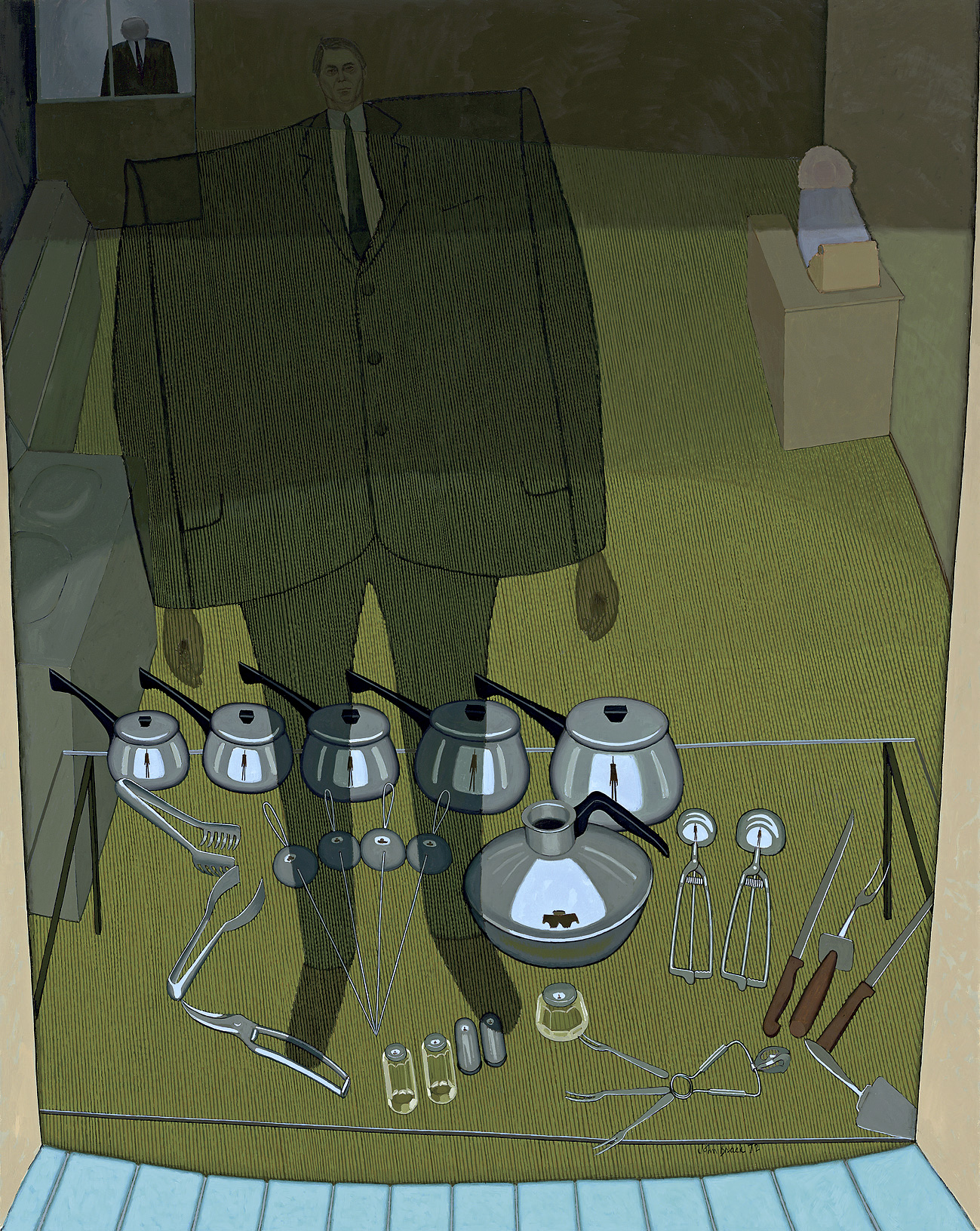
As early as Knives and forks (1958) and The playground (1959) we can observe the beginnings of the spaces of his later pencil paintings with their uniting of form, line and plane (think the planes of Cezanne). The later work is literally much colder, the palette now blues instead of the warmer ochres and yellows and this change is very obvious when you walk around the exhibition. There is an emotional distance here – from human contact and the warmth of company. Ronald Miller observed in 1970 that Brack’s work is about the rituals of life, about states of uneasy poise and vulnerability, about realities behind facades but in the later work the paintings become the facades: gone are the ambiguities and vulnerabilities to be replaced by an altogether different ‘order’ of existence.
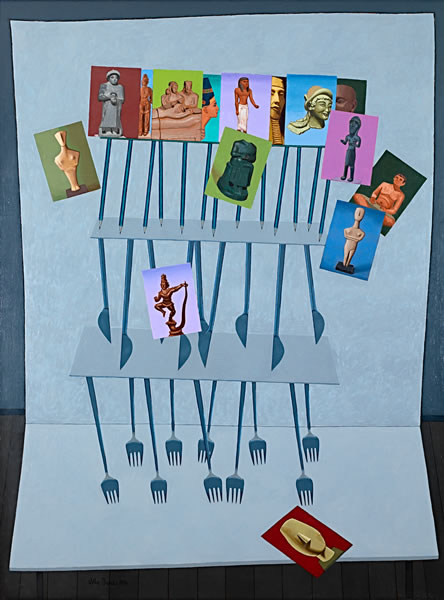
We see in paintings such as Souvenirs (1976), We, Us, Them (1983), The pros and cons (1985) and Watching the flowers (1990-91 – see all below) how the canvas has become a stage set replete with turned up edges, spaces of ritual performance containing generalised metaphors for the nature of human existence, metaphors with universal themes. In his investigation of the universal Brack looses sight of the personal. His towers made of playing cards, his thrusting planes, the military precision of his opposing armies of goose-steeping pencils lack empathy for the thing that he was searching to be attuned with: the nature of existence, the human condition.
As Sartre observed,
“To apprehend myself as seen is, in fact, to apprehend myself as seen in the world and from the standpoint of the world. The look does not carve me out in the universe; it comes to search for me at the heart of my situation and grasps me only in irresolvable relations with instruments. If I am seen as seated, I must be seen as “seated-on-a-chair,” … But suddenly the alienation of myself, which is the act of being-looked-at, involves the alienation of the world which I organise. I am seated on this chair with the result that I do not see it at all, that it is impossible for me to see it …”3
This is the point that John Brack reached: through his desire to paint universal themes he was unable to visualise and apprehend himself as seen in the world from the standpoint of the world. It feels (yes feeling!) that he was alienated from the very thing he sought to portray – how the personal and the universal are one and the same.
Brack’s ‘failure’ as an artist (if indeed it can be called that) is not, as Robert Nelson has suggested, “because he didn’t talk enough or wisely enough to negotiate his way out of a misunderstanding” (that his work was sardonic). On the contrary I believe his ‘success’ as an artist is that he painted exactly what he wanted to paint in the time and place that he wanted to paint it. His later work might strike some as cold and impenetrable but if one looks clearly, with a steady eye, there still beats a heart under that chill exterior, a heart grounded in the life of suburban Melbourne. In the end Brack returns to the beginning, still exploring, still searching.
As T.S. Eliot wrote in one of The Four Quartets,4
“We shall not cease from exploration And the end of all our exploring Will be to arrive where we started And know the place for the first time.”
Dr Marcus Bunyan
Many thankx to the NGV for allowing me to publish the art work in the posting. Please click on the photographs for a larger version of the image.
1/ Nelson, Robert. The Age newspaper. Melbourne, Friday 24th April, 2009
2/ “We learn that Nothingness is revealed to us most fully in anguish and that man generally tries to flee this anguish, this Nothingness which he is, by means of “bad faith.” The study of “bad faith” reveals to us that whereas Being-in-itself simply is, man is the being “who is what he is not and who is not what he is.” In other words man continually makes himself. Instead of being, he “has to be”; his present being has meaning only in the light of the future toward which he projects himself. Thus he is not what at any instant we might want to say he is, and he is that towards which he projects himself but which he is not yet.” Barnes, Hazel. Introduction to Jean-Paul Satre’s Being and Nothingness. London: Methuen, 1966, pp. xvii-xix
3/ Satre, Jean-Paul. Being and Nothingness. (trans. Hazel Barnes). London: Methuen, 1966, p. 263
4/ Eliot, T.S. “Little Gidding” from The Four Quartets (1942)
“What I paint most is what interests me most, that is, people; the Human Condition, in particular the effect on appearance of environment and behaviour… A large part of the motive is the desire to understand, and if possible, to illuminate …”
John Reed, New Painting 1952-62, Longmans, Melbourne, 1963, p. 19.
Opening 24 April, the National Gallery of Victoria will present a major retrospective of the work of John Brack, the first in more than twenty years. This exhibition will survey John Brack’s complete career, incorporating over 150 works from all of his major series. John Brack will bring together a significant body of the artist’s paintings and works on paper, including pictures that have developed ‘icon status’ and others that have rarely, if ever, been seen publicly since they were first exhibited.
Kirsty Grant, Senior Curator Australian Art, NGV said that more than any other artist of his generation, John Brack was a painter of modern Australian life.
“John Brack painted images which explored the social rituals and realities of everyday life. Long considered the quintessential Melbourne artist, Brack’s images of urban and suburban Melbourne painted during the 1950s drew attention for their novelty of subject and instantly recognisable references. His work is much broader however and in this exhibition we will see the continuity throughout his career of his fundamental interest in people, human nature and the human condition,” said Ms Grant.
Frances Lindsay, NGV Deputy Director said John Brack was widely considered one of Australia’s greatest twentieth century artists.
“The NGV has enjoyed a long association with John Brack: he worked as an assistant frame maker at the gallery in 1949, became head of the National Gallery School in 1962, and the NGV was also the first public institution to purchase one of his works. Brack’s iconic works are certainly the highlight for many visitors to the Gallery. We are thrilled to be continuing this special relationship by presenting this important and timely retrospective.”
The exhibition will be displayed chronologically, beginning with some rare early student works. Each phase of Brack’s practice will be explored, from his well-known urban scenes of the 1950s to the highly symbolic paintings from the 1970s. Many of Brack’s most familiar paintings are included in the exhibition such as Collins St, 5p.m, The bar and The Old Time.
Brack produced compelling pictures which captured the essential characteristics of his subjects involved in everyday activities and, in some of his most engaging series, he depicted the characters of the racecourse, children at school and professional ballroom dancers. Throughout his career Brack also painted the nude, still life subjects and portraits, both of family and friends – including artists Fred Williams and John Perceval – as well as commissioned subjects, such as Barry Humphries as his alter-ego Edna Everage. During the 1970s Brack replaced the human figure with an assortment of everyday implements including cutlery, pens and pencils which he used as metaphors for the complexities of human behaviour and relationships.
Press release from the NGV website [Online] Cited 26/07/2009. No longer available online
John Brack (Australian, 1920-1999) Inside and outside (The shop window) 1972 Oil on canvas
Emma Davies (Australian, b. 1968) Sekai (meaning ‘be humorous’) 2009
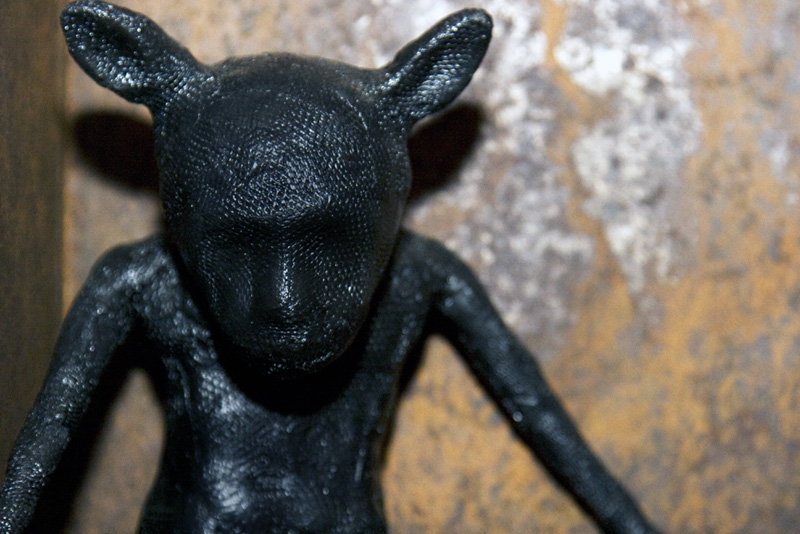
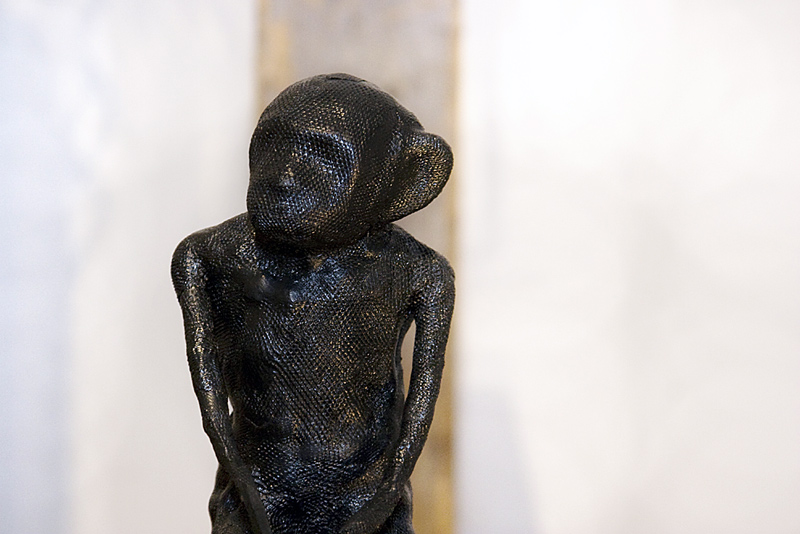
A stimulating exhibition by Emma Davies at Craft Victoria of polypropylene industrial netting and packaging that has been heated, moulded, sculpted and literally morphed into these fantastical sculptures, inspired by the artist’s experiences when visiting Johannesburg in South Africa as part of the South Project. Davies evokes the mysterious and the bizarre in her figures, making the commonplace into something uncommon, taking her themes from the relics of bush medicine present in the street markets: the medicine market of Johannesburg full of dried animal bones, skulls, skins and bottles of alchemistic objects.
Despite their comforting South African names (translated into English as ‘hope’, ‘faith’, ‘quiet, tranquil’, ‘lady’, ‘chief’, ‘prince’ for example) these extremely individual figurative ‘presences’ have a powerful melancholic affect on the viewer. Their elongated long legged and armed, no necked forms create dark eyeless creatures that crouch in rusted boxes or sit on wooden posts with their legs and arms hanging, folded. They seem lonely and sad despite their titles, perhaps reflecting the harsh realities of a life of poverty on the streets of Soweto.
Two figures on wooden blocks seem to walk aimlessly, placed on large rough industrial tables with huge wheels while another figure sits up a rusted ladder propped against the wall. A group of figures are clustered together on top of large wooden posts of different heights, some with arms round each other for comfort, others with black or red feathers sprouting from shoulders, legs or wearing a red feathered skirt. These creatures create a marvellous group of contemplative wandering minstrels while behind them their eerie shadows fall on the gallery wall.
The crystalline nature to the surface of the creatures, like sparkling coal, reminds me of the work of William Kentridge, his white industrial protagonist Felix haunted by images of black workers deep underground mining coal (see Mine (1991) where his coffee plunger goes down into the ground through the bodies of black people). Some of the figures bat like ears also bring to mind the work of Francisco de Goya and specifically his work Los Caprichos (The Whims), plate 43 from the series of 80 etchings published in 1799 titled The Dream of Reason Produces Monsters. The artist described the collection as an exposé of “the innumerable foibles and follies to be found in any civilised society, and from the common prejudices and deceitful practices which custom, ignorance, or self-interest have made usual.”
As Goya began to sympathise with the suffering of the peasants so Davies seems to have been transformed by what she saw around her during her visit, trying to make sense of a foreign culture, dreaming the sleep of reason but surrounded and invaded by a world in which the natural and unnatural has fused and morphed.
I really liked this exhibition and the presence of these figures. I am obviously not alone as the show is almost sold out. A visit to these disturbing, enfolding creatures is recommended.
Dr Marcus Bunyan
All photographs courtesy of Craft Victoria (thankyou Amy Brand!) and taken by their photographer Alexia Skok. Please click on the photographs for a larger version of the image.
Emma Davies (Australian, b. 1968) Tariro (meaning ‘hope’) 2009
Emma Davies (Australian, b. 1968) Rutendo (detail – meaning ‘faith’) 2009
Francisco de Goya (Spanish, 1746-1828) Los Caprichos plate 43 from the series El sueño de la razón produce monstros 1799 Etching and aquatint Height: 21.3cm (8.3″) Width: 15.1cm (5.9″) Museo del Prado, Madrid
Emma Davies (Australian, b. 1968) Zola (detail – meaning ‘quiet, tranquil’) 2009
Emma Davies (Australian, b. 1968) Group with from left to right: Enitan (person of story), Ntombi (lady), Kgosi (chief), Nkosana (prince), Lucky and Alaba (second child after twins) 2009
Emma Davies (Australian, b. 1968) Nkosana (detail – meaning ‘prince’) 2009
Craft Victoria Watson Place, off Flinders Lane, Melbourne 3000 Phone: 03 9650 7775
Johannes Kuhnen (Australian born Germany, b. 1952) Rings 1971
This is a superlative exhibition, one of the highlights of the year so far in Melbourne.
The exhibition presents work from the early 1970s to contemporary work and evidences the breadth of vision of this master craftsman and artist, the arc of his investigation showing a consistency of feeling for the energy and form of his materials over many decades. Technically the work is superb; conceptually the work transcends the boundaries of jewellery and becomes something else altogether: it becomes magical.
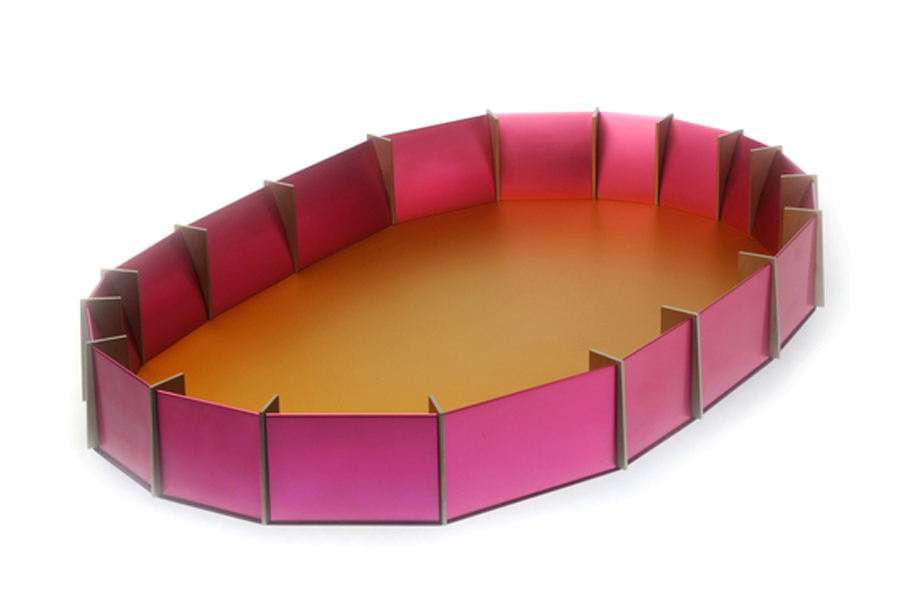
Kuhnen’s use of colour in his favoured anodised aluminium material is exquisite, the perfection of his forms flawless. His fabulous Vessels reminding me of the ancient Neolithic standing stone circles at Stonehenge in their shape and use of vertical buttresses in different materials (such stainless steel and granite) that intersect the oval forms. His Boxes are like small ancient reliquaries, objects for holding ashes worked with a delicacy, simplicity and feeling for form and colour that is absolutely beautiful and consistent with the containment of energy within their structure.
I went with Marianne Cseh a jeweller friend of mine. We stood transfixed before this work, peering closely at it and gasping in appreciation of the beauty, technical proficiency and pure poetry of the pieces. This exhibition is highly recommended and not to be missed!
Now showing with the international SCHMUCK jewellery exhibition from Germany.
A book to accompany the exhibition is available from the RMIT Gallery.
Dr Marcus Bunyan
Many thankx to RMIT Gallery for allowing me to publish the photographs in the posting. Please click on the photographs for a larger version of the image.
Johannes Kuhnen (Australian born Germany, b. 1952) Ring 1972 Stainless steel, synthetic ruby disc
Johannes Kuhnen (Australian born Germany, b. 1952)
Brooch 2003 Anodised aluminium, monel
Ring 1972 Stainless steel, synthetic ruby disc
Johannes Kuhnen (Australian born Germany, b. 1952) Boxes 1980
Johannes Kuhnen (Australian born Germany, b. 1952) Box and pendant 1980
Johannes Kuhnen (Australian born Germany, b. 1952) Tray 1986 Anodised aluminium, titanium, stainless steel
Johannes Kuhnen (Australian born Germany, b. 1952) Centrepiece 1987
Johannes Kuhnen (Australian born Germany, b. 1952) Centrepiece 1991 Anodised aluminium, silver, monel: fabricated
In his work as a jeweller, object maker and photographer, Johannes Kuhnen is engaged with the interpretation and manipulation of a precise visual language of forms. The dramatic curvilinear shape of this centrepiece has been designed to emphasise the particular visual qualities of its materials and to fulfil its role as a low, but commanding central presence on a table. The vivid, iridescent colour of its anodised aluminium rim is designed to interact with differing light conditions, while the technical and precious qualities of its monel and silver elements play against each other. This orchestration of metals is underpinned with an unseen but precise and ingenious inner structure, giving this object weight and functional strength.
Johannes Kuhnen has made a pioneering contribution to Australian design and gold and silver smithing through his commitment as a generous educator and innovative practitioner. This exhibition will create linkages between his earlier works, some of which was made in Germany prior to migrating to Australia and new work specifically produced for this exhibition and this will be done both with objects and through a catalogue / monograph to be launched at the opening venue. The exhibition will borrow from Australian public and private collections to facilitate the demonstration of connecting design elements in the work from both significant streams in Kuhnen’s work in jewellery and hollowware.
Text from the RMIT Gallery website [Online] Cited 02/07/2009. No longer available online
Johannes Kuhnen (Australian born Germany, b. 1952) Vessel 2007 Anodised aluminium, titanium, stainless steel 11.2 h x 84.5 w x 21.0 d cm Weight 14 kg
Johannes Kuhnen (Australian born Germany, b. 1952) Vessel 2008 Anodised aluminium, titanium, stainless steel
Johannes Kuhnen (Australian born Germany, b. 1952) Vessel 2009 Anodised aluminium, titanium, stainless steel
Johannes Kuhnen (Australian born Germany, b. 1952) Armring 1981 Anodised aluminium 9.8 h x 10.4 w cm
Johannes Kuhnen (Australian born Germany, b. 1952) Armring 1990 Armring, anodised aluminium, gold 750, granite
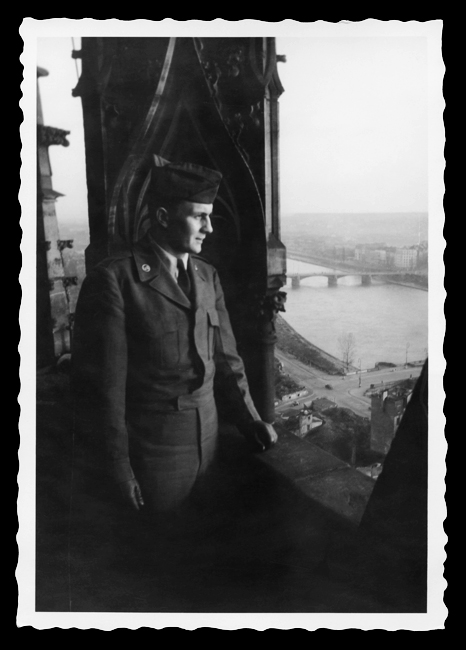
Marcus Bunyan (Australian, b. 1958) Spire of der Dom, 1 – 52 2009 From the series The Shape of Dreams Gelatin silver print
The Shape of Dreams
I am pleased to announce a body of work, the second for 2009, is now online on my website.
The photographs are a sequence: one tone follows another (much like a piece of music) until the final coda. With this in mind please view the work sequentially. Below are a selection of photographs from the whole work.
Dr Marcus Bunyan
Please click on the photographs for a larger version of the image.
Photographs are available from this series for purchase. As a guide, a digital colour 16″ x 20″ costs $1000 plus tracked and insured shipping. For more information please see my Store web page.
Photographs from the series The Shape of Dreams 2009
“the form of formlessness the shape of dreams”
Marcus Bunyan (Australian, b. 1958) Untitled 2009 From the series The Shape of Dreams Gelatin silver print
Marcus Bunyan (Australian, b. 1958) Untitled 2009 From the series The Shape of Dreams Gelatin silver print
Marcus Bunyan (Australian, b. 1958) Untitled 2009 From the series The Shape of Dreams Gelatin silver print
Marcus Bunyan (Australian, b. 1958) 9/24/52 2009 From the series The Shape of Dreams Gelatin silver print
Marcus Bunyan (Australian, b. 1958) Untitled 2009 From the series The Shape of Dreams Gelatin silver print
Marcus Bunyan (Australian, b. 1958) Navy Base, Unidentified 2009 From the series The Shape of Dreams Gelatin silver print
Marcus Bunyan (Australian, b. 1958) Untitled 2009 From the series The Shape of Dreams Gelatin silver print
Marcus Bunyan (Australian, b. 1958) Part of the French Riviera taken while Whit held me at the door! 2009 From the series The Shape of Dreams Gelatin silver print
Marcus Bunyan (Australian, b. 1958) Untitled 2009 From the series The Shape of Dreams Gelatin silver print
Marcus Bunyan (Australian, b. 1958) Untitled 2009 From the series The Shape of Dreams Gelatin silver print
All the photographs from the series are now on my website.
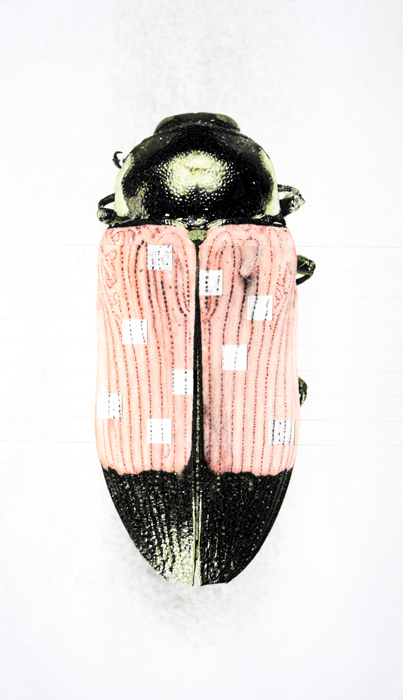
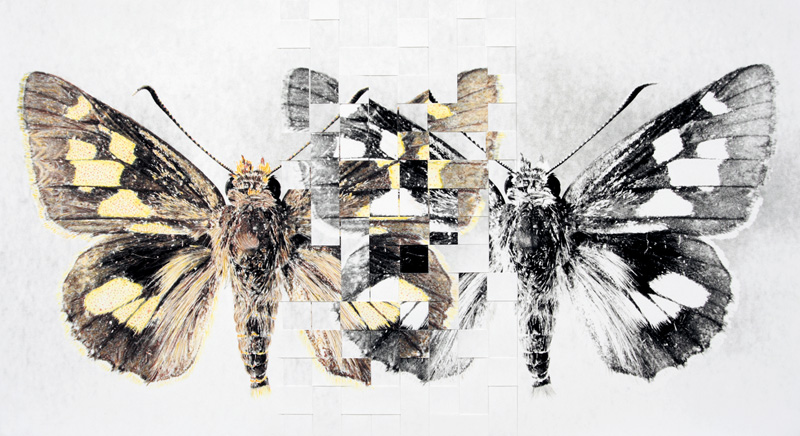
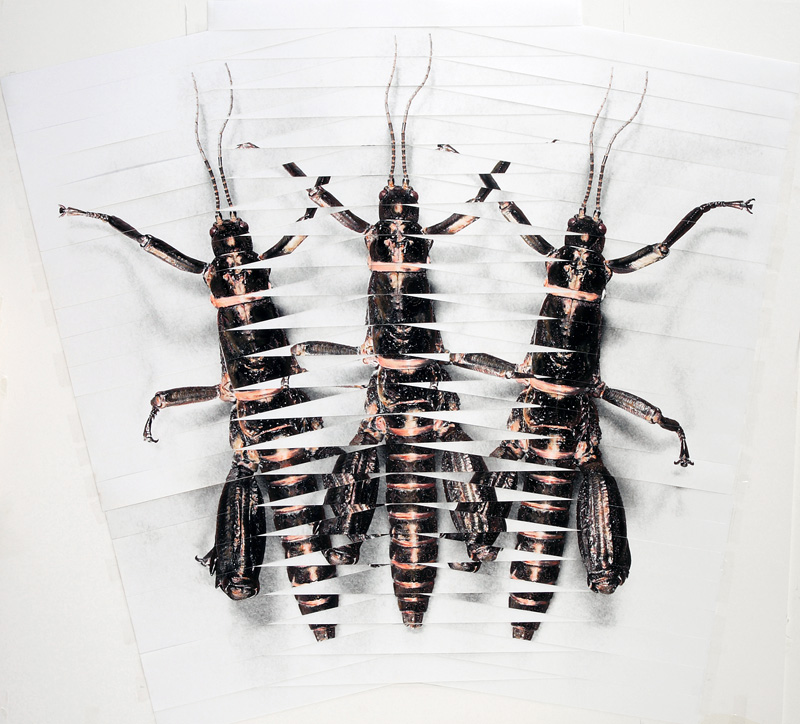
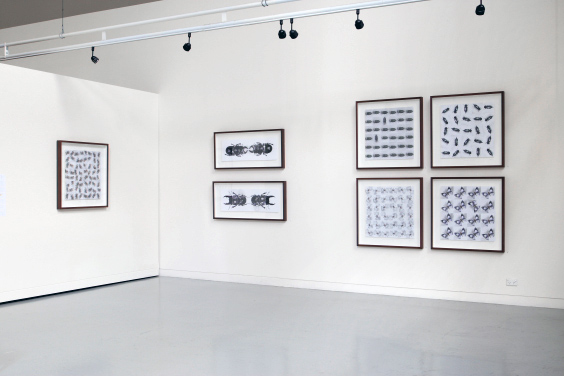
Josephine Kuperholz presents a beautifully engineered set of photographs in her exhibition Blight at Gallery 101, Melbourne. Featuring hand coloured silver gelatin photographs of endangered Australian insects sourced from the Entomology collection of the Victoria Museum, Kuperholz literally weaves multiple narratives into the photographs. The execution (an apt word for the circumstances of extinction facing these insects) of these images is fastidious, the weaving superlative, almost clinical.
The layering of the photographs disrupts their surface tension. There is a disjunction between the dead specimen and the singular photograph of it, a disruption of the smooth surface of the photograph by the hand colouring and a further fragmentation of the original photograph by cutting and weaving. Through these processes the photographs become intertextual in their construction, assemblages, creating new tissues of past citations: animal, colour, silver, artist, text, photograph, environment. At their best the work subverts the concept of the text as self-sufficient and hermetically sealed, blurring the outlines of the fixed image, “dispersing its image of totality into an unbounded, illimitable tissue of connections and associations, paraphrases and fragments, texts and con-texts.”1
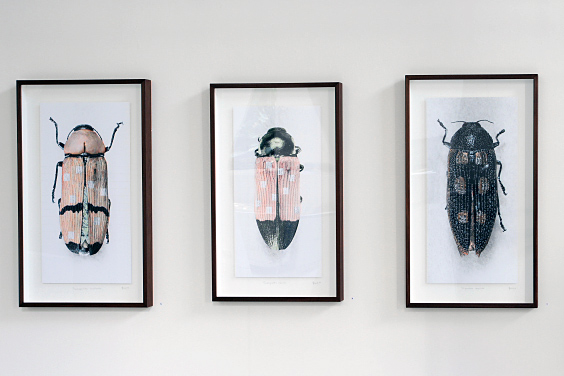
Kuperholz’s mutations, ‘differance’ in Derrida’s terminology, produce spaces that are both fluid and fixed at one and the same time; neither her nor there.Though the original specimens and photographs are already narrativised, already textualised, Kuperholz disrupts this marking, the continual reiteration of norms, by weaving a lack of fixity into her objects; in her reconceptualisations of space and matter Kuperholz redefines the significations of the body of the animal in the fold of inscription, through a process of materialisation. Kuperholz attempts to ground these re-inscriptions through the naming of these disrupted surfaces, equating the images back to the scientific labels for the original specimen, Trapezites eliena for example (see below), and through the box frames surrounding the work that are much like museum cases. Unfortunately I found the constant reference to the habitat of the insect, it’s Latin name inscribed in pencil under the images and the use of plain brown box frames somewhat irritating. These tropes are not necessary for the work is strong enough to stand on it’s own without having to tell the viewer what to think.
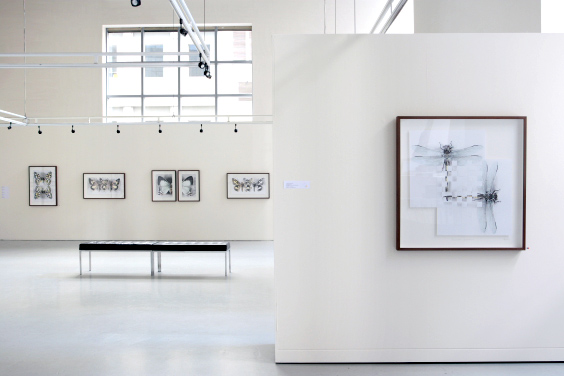
The singular beetles (as seen above) are beautiful images and the multiple images where the weaving intermingles, the self decentred and multiple, fluttering and vibrating like the strobing of a time lapse photograph caught in three-dimensional space, are fantastic. Other photographs are less successful: the reflected beetles are a little passe, while the grid photographs of insects lack presence and intensity (see bottom installation photograph below). Where the concept works it is pushed hard, the fragmentation and interweaving causes an anxiety of identity and a meditation on the problematic nature of existence, revealing the changing sizes, shapes and rhythms of space and structure.
Perhaps a loosening of the rigid structure surrounding the works (the text, the frame, the incantations) would have let the photographs ascend into the ether, further releasing the work from the constraints of author, text and earth. It will be interesting to see future developments of this work. Perhaps the incorporation of gentle, subtle physical elements into the photographs (through the sowing of patterns, through the sowing of objects directly onto the photograph?), will elevate these already beautiful photographs to an-other plane of existence.
Dr Marcus Bunyan
Many thankx to Gallery 101 for allowing me to publish the photographs in the posting. Please click on the photographs for a larger version of the image.
Josephine Kuperholz (Australian) Trapezites eliena 2008 Common name – Eliena Skipper Woven hand coloured silver gelatin photographic image
Josephine Kuperholz (Australian) Dryococelus australis 2008 Common name – Lord Howe Island Phasmid Woven hand coloured silver gelatin photographic image
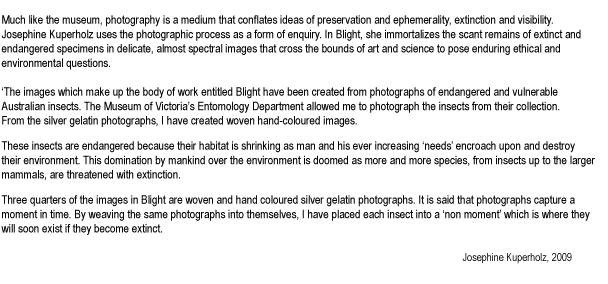
Josephine Kuperholz Blight exhibition, Gallery 101 website text
Josephine Kuperholz Blight exhibition installation views at Gallery 101, Melbourne Photos: Marcus Bunyan
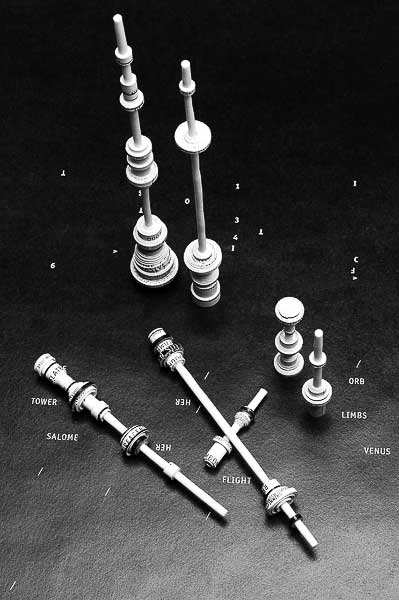
Natasha Dusenjko (Australian) Towers of Babel 2009 Mixed media
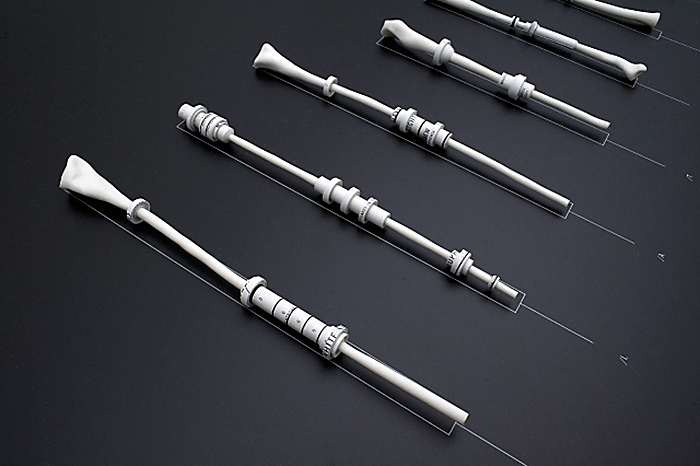
Three very interesting exhibitions at Craft Victoria at the moment: Babel by Natasha Dusenjko, Gleaning Potential by Simon Lloyd and Cycle by Liz Low. I particularly liked the delicacy and textuality of Natasha Dusenjko’s sci-fi towers and bone fragments and the wonderful box of 6 red bricks (small and large) that you can buy from the Simon Lloyd show, like blocks for a child builder.
There is an excellent and erudite review of the exhibitions at Daniel Neville’s Nevolution website.
Dr Marcus Bunyan
Many thankx to Craft Victoria for allowing me to publish the photographs in the posting. Please click on the photographs for a larger version of the image.
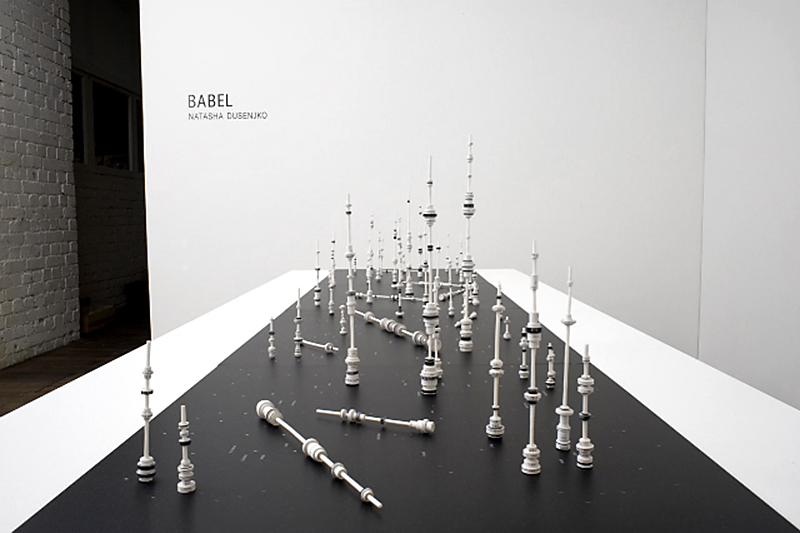
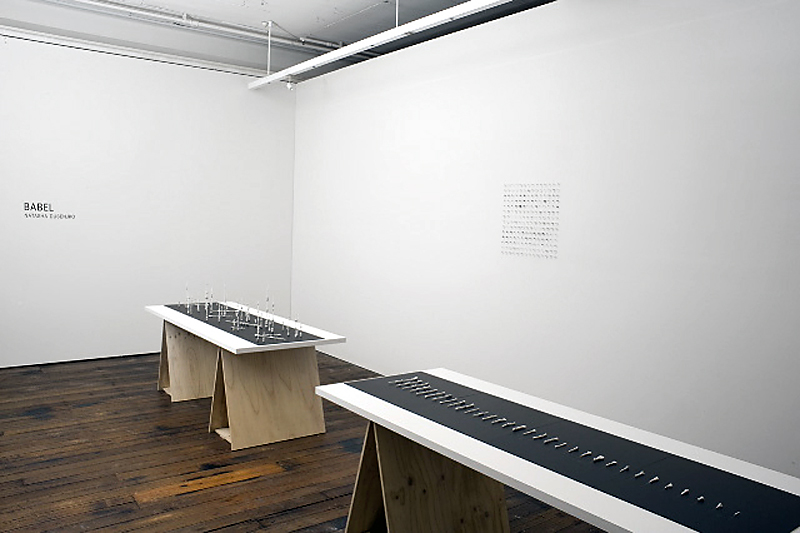
“The two tables allow for different meanings and scales when viewed in opposition. Table 1 alludes to star charts; constellations of texts hinting at importance, especially in relation to the placement of towers. The map looking up to the stars via the towers of babel, communicating unknown messages to the stars above. The cold stark forms of the towers work well with the organic forms of the bones on Table 2. Perfectly ordered and numbered archaeological bone fragments repeat the textual ciphers and codes, meticulously ordered. The jump in scale between the architectural and the archaeological is lovely; each hinting at an underlying language and mythology. Meanwhile both contain elements of each other – the towers of rationality have been placed in a seemingly random manner, while the organic forms of the bones have been laid out in perfect order ranging down in sizes.”
Daniel Neville. Extract from “On the nature of language, order and decay,” on the Nevolution website June 03, 2009 [Online] Cited 05/06/2009
Installation views of Natasha Dusenjko’s exhibition Babel at Craft Victoria, Melbourne
Babel is a word-based collection of fine porcelain and paper works. This collection of short texts constitutes a series of incantations, codes and instructions scrolled around porcelain bones or thin spines. The porcelain bones are internal structures and vessels of ancestor memory. This memory is fluid, is evasive, is aquatic. The thin spines resemble futuristic Towers of Babel reaching into space, anticipating communication and new frontiers. These towers have either an upright or collapsed form.
In the making, both forms build toward new possibility, words become obscured, resulting in a non-defined beginning or end, now replaced by chance permutations of the accumulated text.
The sculptural works are deliberately placed onto two large scale text based charts. Each chart is placed on a raised surface, analogous to work benches in an observatory or laboratory suggesting a process of decipherment. Map 1 exhibits a similarity to ancient star charts, the placement of towers alluding to significant points of a constellation. The accompanying Chart 2 resembles an organised series of archeological artefacts, each piece methodically numbered and labelled.
Ultimately, Babel evokes a spiral passage both outward and inward. To unravel the scrolls initiates a return to the spine – the axis mundi, the source of a universal native tongue – love.
Text from the Craft Victoria website [Online] 05/06/2009. No longer available online
Natasha Dusenjko (Australian) Babelbones 2009 Mixed media
Craft Victoria Watson Place, off Flinders Lane Victoria 3000 Phone: 03 9650 7775
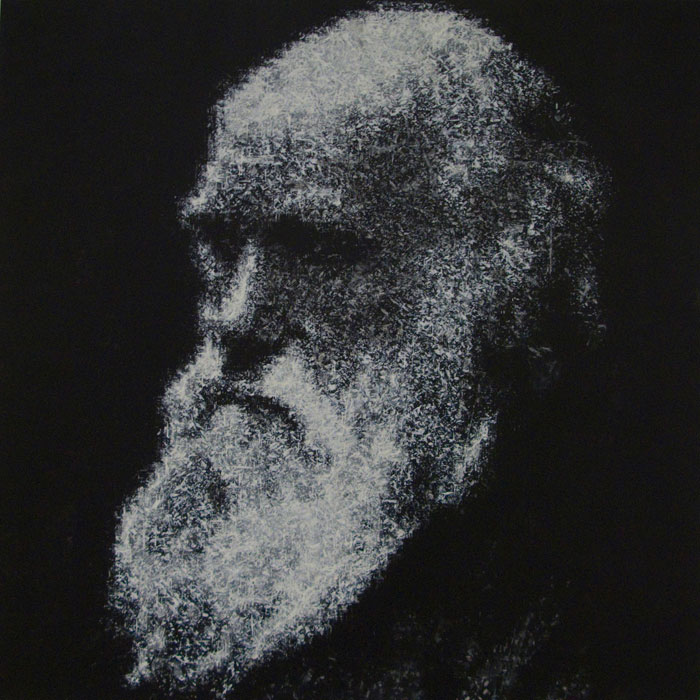
John Beard (Australian born Wales, b. 1943) Darwin 2009
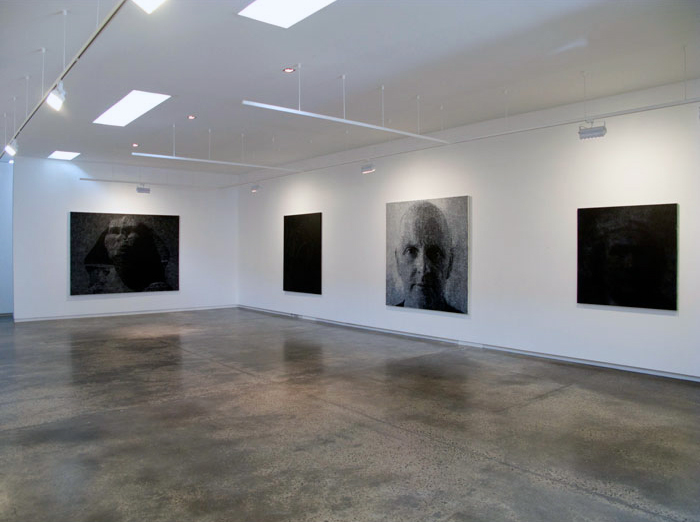
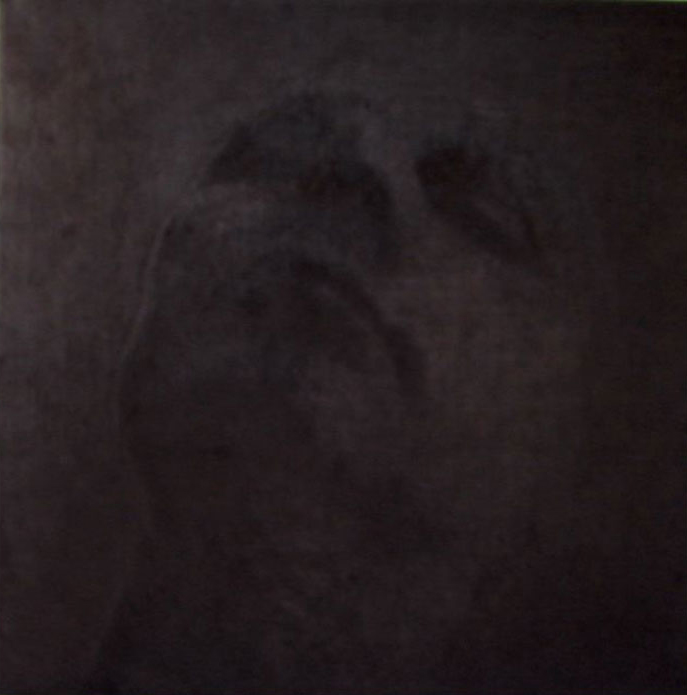
The final exhibition of the afternoon were the ephemeral images of John Beard at John Buckley Gallery, Melbourne. This was an enthralling show that I enjoyed tremendously. Beard draws in a multitude of cultural sources for his paintings often referencing painters, scientists, animals and evolution. His work has an intimate sense of knowing, a meditative mediation on the essence of the object being painted, the very presence of the thing itself. The marks on the canvas may be intuitive but it is an informed intuition that results in works that hover at the edge of consciousness. As much as the works are after images, or ghost images, they are also about the persistence of vision, the persistence of the artists vision in addressing issues of collective memory and cultural history that draw emotive responses from the viewer.
These images may be ‘on the verge of disappearance’ as an after-image but they are also pre-images as well, conjured from the mind of the artist and layered with complexity, presence and holistic wholeness. Their seduction, if I may use that word, is that they draw from the viewer peripheral memories and emotions that flit at the edges of consciousness. As Portugese curator Isabel Carlos has noted, “… Beard recreates a ‘figural’ space where the essence of the thing represented lies beyond its singular physical evidence.”1
Beard’s fragmented surfaces form a rhizomic web of dissolved pixellation, their structure almost fractal like in their linked hyper-real intimacies. These in between spaces open up the possibility of subversive commentaries that, on one level, bring a sense of disquiet to the holistic presence of the work. As Mark Poster has noted of the work of Deleuze and Guittari and which can be aptly applied to the work of John Beard,
“Deleuze and Guittari configure the social as a complex of bodily intensities in a state of continuous nonlinear movement. The logic they present is multidimensional, shifting, discontinuous. They speak of strata, assemblages, territorializations, lines of flight, abstract machines, a congerie of terms that disrupts the function of concepts to control a field through discursive articulations. Their categories cut through the normal lines of comprehension, the binary logic that governs modern social theory to present a picture of reality from the perspective of a sort of primitive life force. It is as if the earth itself were to describe the changes on its surface in the course of human history, a vantage point quite remote from the ego of the individual or from the disciplined consciousness of the social scientist.”2
Nonlinear, logical, shifting territorializations in multidimensional environments that hover below the edge of consciousness, investigations into the binary of presence / absence in the dreams of the imaginary. Powerful and poetic these works irradiate the viewer with their visceral presence.
Dr Marcus Bunyan
1/ Isabel Carlos quoted in Wright, William. HEADLANDS: John Beard works 1993-2008. Catalogue essay
2/ Poster, Mark. The Mode of Information: Poststructuralism and Social Context. Cambridge: Polity Press, 1990, pp. 135-137
Many thankx to John Buckley Gallery for allowing me to publish the art work in the posting. Please click on the photographs for a larger version of the image.
John Beard (Australian born Wales, b. 1943) Gorilla 2007
Installation view of John Beard’s exhibition After image at John Buckley Gallery, Melbourne
John Beard (Australian born Wales, b. 1943) Hand 6 2009
John Beard (Australian born Wales, b. 1943) Head SP3 2004
“Beard’s paintings often convey an overpowering sense of brooding stillness, but equally this volatile effervescence of light-reverberant phenomena, where head, headland, the Adraga rock, are no longer object so much as apparition, a painted parallel existence, a material presence invoking nature’s own organic processes …
There is a distinctive sense when encountering a body of John Beard’s works of entering into a site of composure, withheld, of images silently bespeaking truths both personal and historical; hovering presences each conveying some species quality of time-less recognition.”
William Wright from the catalogue essay HEADLANDS: John Beard works 1993-2008 [Online] Cited 29/05/2009. No longer available online
John Beard (Australian born Wales, b. 1943) Rose 2007
John Beard (Australian born Wales, b. 1943) Einstein 2 2009
John Beard (Australian born Wales, b. 1943) Rembrandt 2009
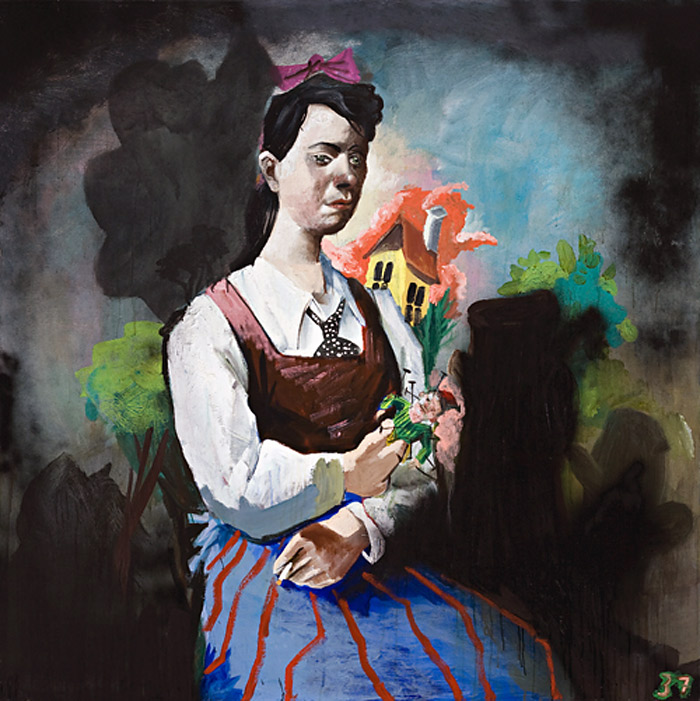
McLean Edwards (Australian, b. 1972) Fifty-Fifty 2009
The next show on our marvellous walkabout were the eclectic paintings of McLean Edwards at Karen Wodbury Gallery, Melbourne. Continuing the carnivalesque theme from the previous review these heterogeneous paintings are a knockout with their wonderful, layered presence – they really command the viewer to look at them and celebrate the characters within them. Whimsical, ironic and full of humour these phantasmagorical images of creatures cast adrift with the night sky as background are fabulous assemblages of colour, form and storytelling.
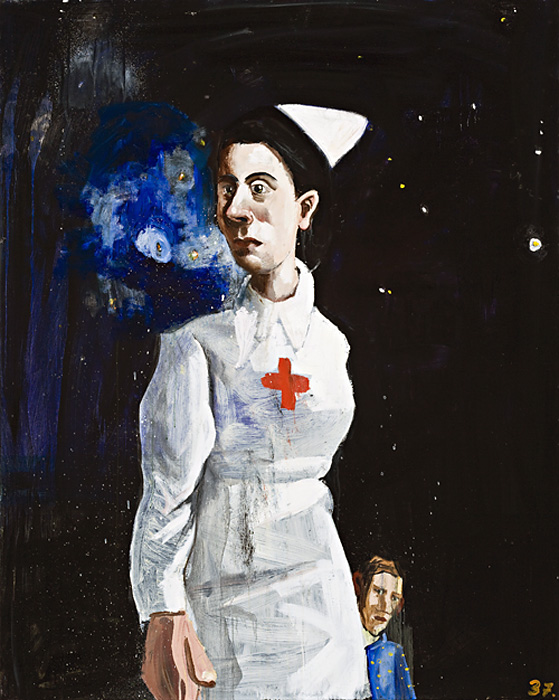
Further to the evidences noted in the text on the website (the coils, the curling smoke, the starry night sky) one can also say other things about the paintings. There is an effervescence of colour within the blocking of clothing areas. There is the disproportionate size of the hands and bulbous noses of the characters, the shortening of the feet so that the figures almost become caricatures – but hold back from this through the mastery of the painting, through the intent of the artist. There is the symbology of other elements within the pictures: a doll with pins stuck in it’s body being clasped in a clumpy hand, a small house protruding over the protagonists shoulder (Fifty-Fifty); beetles on tree stumps with human faces (Hey, Bastard, Hey); and flowers, teapots and small humans appearing from around the edges of the larger characters in several of the works (Julia 1 and Night Nurse #2 for example). The numbers in the paintings were also puzzling but it turns out that they represent the age of the artist when he painted the works.
Finally one must acknowledge the carnivalesque in the paintings – their fun at playing dress-ups, the almost Alice in Wonderland fantasy and humour of the characterisations. There is an almost androgynous feeling to these characters as some of the female faces seem almost male. Personally I had a feeling that the artist is investigating the subconscious of Carl Jung’s ‘anima’ and ‘animus’ – the feminine inner personality of the male (anima) and the masculine inner personality of the female (animus). These states are manifested by appearing as figures in dreams and so they seem here: the anima or animus vies for attention by projecting itself onto others, here projecting itself outwards onto the painted surface.
My friend and I really enjoyed this exhibition. We were captivated by these songs, going back to the work again and again to tease out the details, to feel connection to the work. These are not lonely isolated figures but sublime emanations of inner states of being expertly rendered in glorious colour. And they made us laugh – what more could you ask for!
Dr Marcus Bunyan
Many thankx to Karen Woodbury Gallery for allowing me to publish the art work in the posting. Please click on the photographs for a larger version of the image.
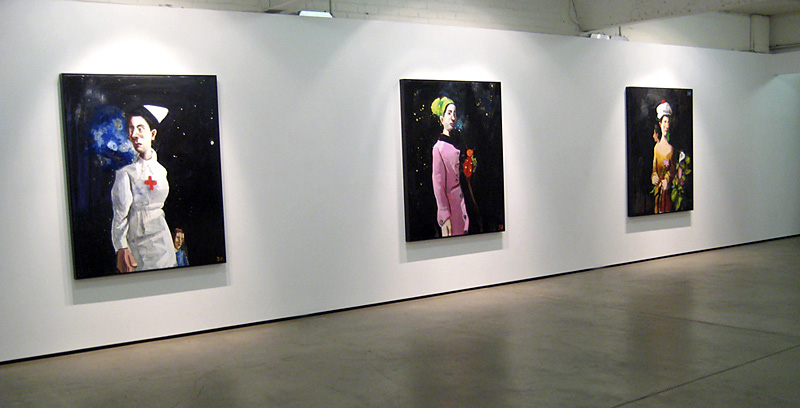
Installation views of McLean Edwards: Songs from the Ghost Ship at Karen Woodbury Gallery, Melbourne
McLean Edwards (Australian, b. 1972) Venus 2009
McLean Edwards (Australian, b. 1972) Hey, Bastard, Hey 2009
McLean Edwards (Australian, b. 1972) Restoration 2009
“McLean’s works are theatrical, comical, eccentric and often political with the employment of symbolic imagery. His painting technique involves a painterly layering to create a defined and textured surface.
In this most recent series, Songs from the Ghost Ship, semi-fictional characters are set against the dark starry night sky. The exhibition includes nine oil paintings in addition to four works on paper. One of the works on paper shares its name with the exhibition, depicting a jumpered man with a white ghost looking over his shoulder.
The ink on paper work introduces a theme prominent throughout the exhibition, that of wafting smoke. Emanating either from a clasped cigarette or an iconic green curled mosquito coil, the smoke, in elegant strokes of white, grey, tan or black, draw the eye to the face of the central figures. The figures, often with the light of the moon or stars behind them only partially illuminating their faces, stare into the distance or coyly at the viewer, almost unaware of their solitary state against the night sky. The coil appears elsewhere, surreptitiously working its way into the dark pink weave of Twiggy’s jacket, or the blue and red dress of Venus, in the tyre marks of the Arctic Traveller or the grassy landscape in Hey, Bastard, Hey. The soft curl and filigree detail of both the smoke and the mosquito coil are similarly echoed by elements in other works, through the organic features of flowers, leaves and bugs.
Adrift at night, these haunting figures are about to embark on a journey, either from the wharf at the edge of an ocean, as in Venus, or across the vast ice of the Arctic, through the mist and smoke.”
Text from the Karen Woodbury website [Online] Cited 28/05/2009. No longer available online
McLean Edwards (Australian, b. 1972) For Elsa (Twiggy) 2009
McLean Edwards (Australian, b. 1972) Night Nurse #2 2009



























 Art Blart _ art and cultural memory archive
You must be logged in to post a comment.