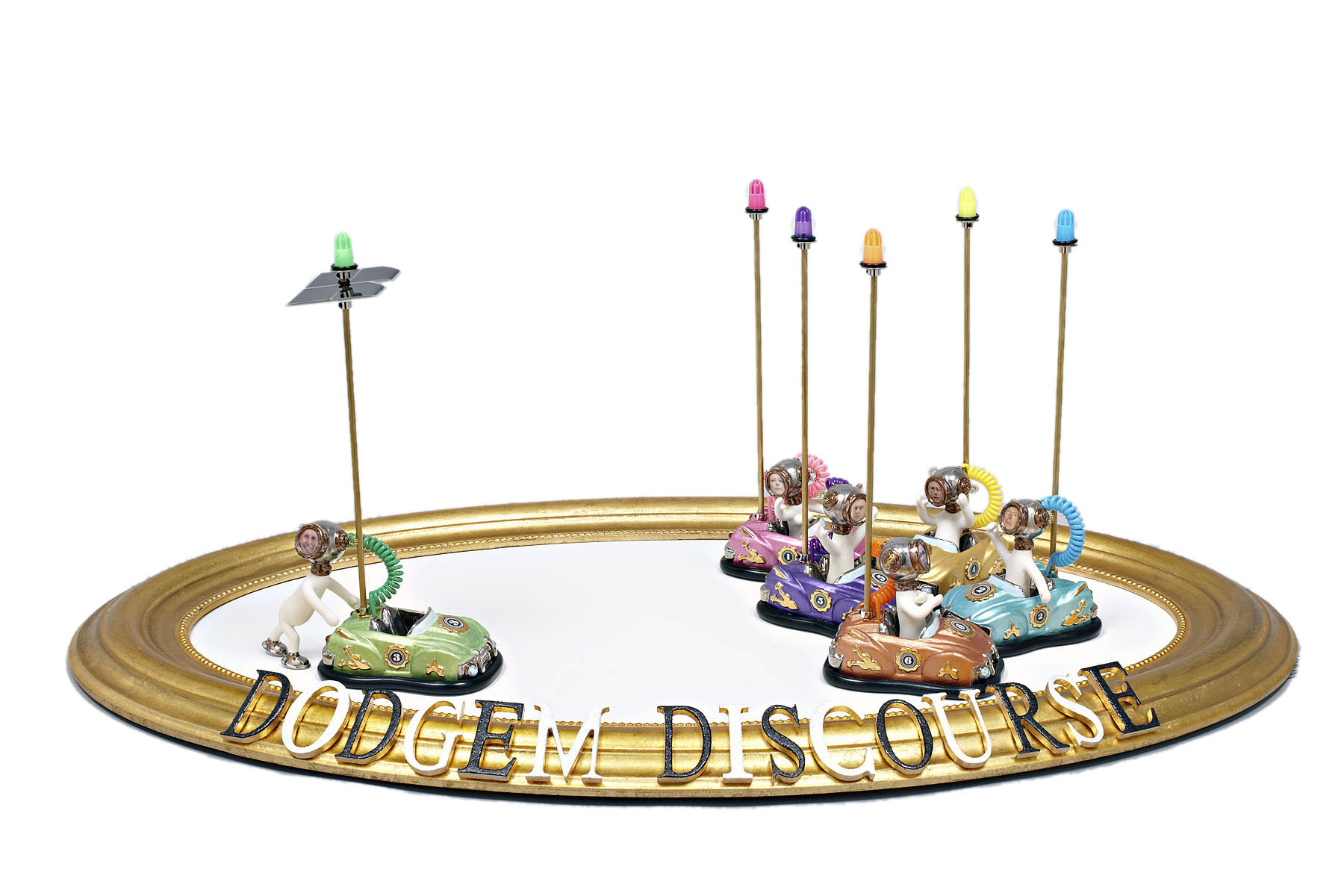
Robyn Hosking (Australian, b. 1948) Dodgem Discourse
2011
Mixed media
Although not the first to promote the concept, Anita Traverso Gallery must be congratulated for exhibiting nine unrepresented emerging and mid-career artists in the AT_SALON exhibition program. This inaugural exhibition features hand-picked artists practicing over a variety of media including ceramics, textiles, drawing, painting and photography allowing them to exhibit in a professional gallery environment which bridges the gap between artist-run spaces and full gallery representation.
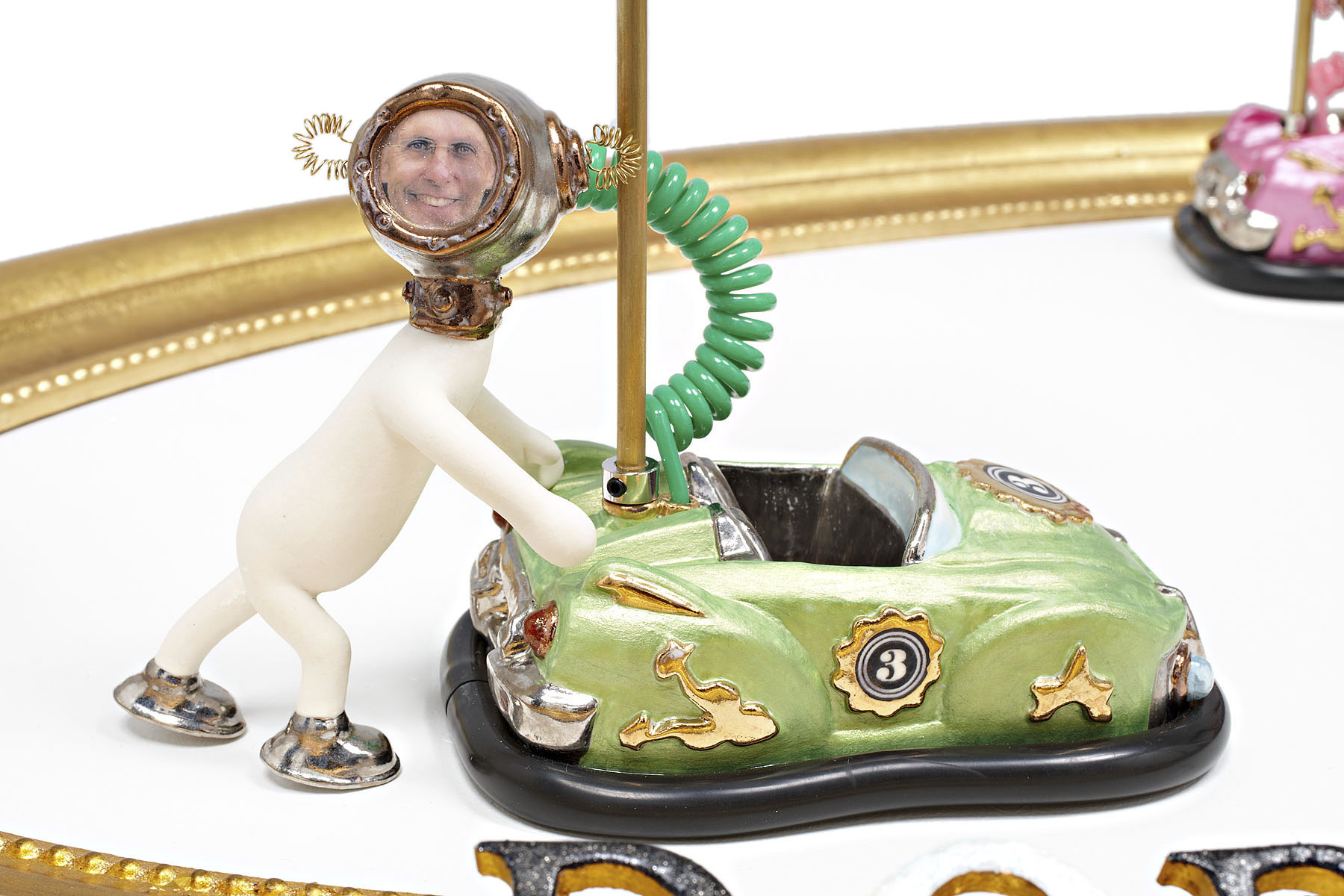
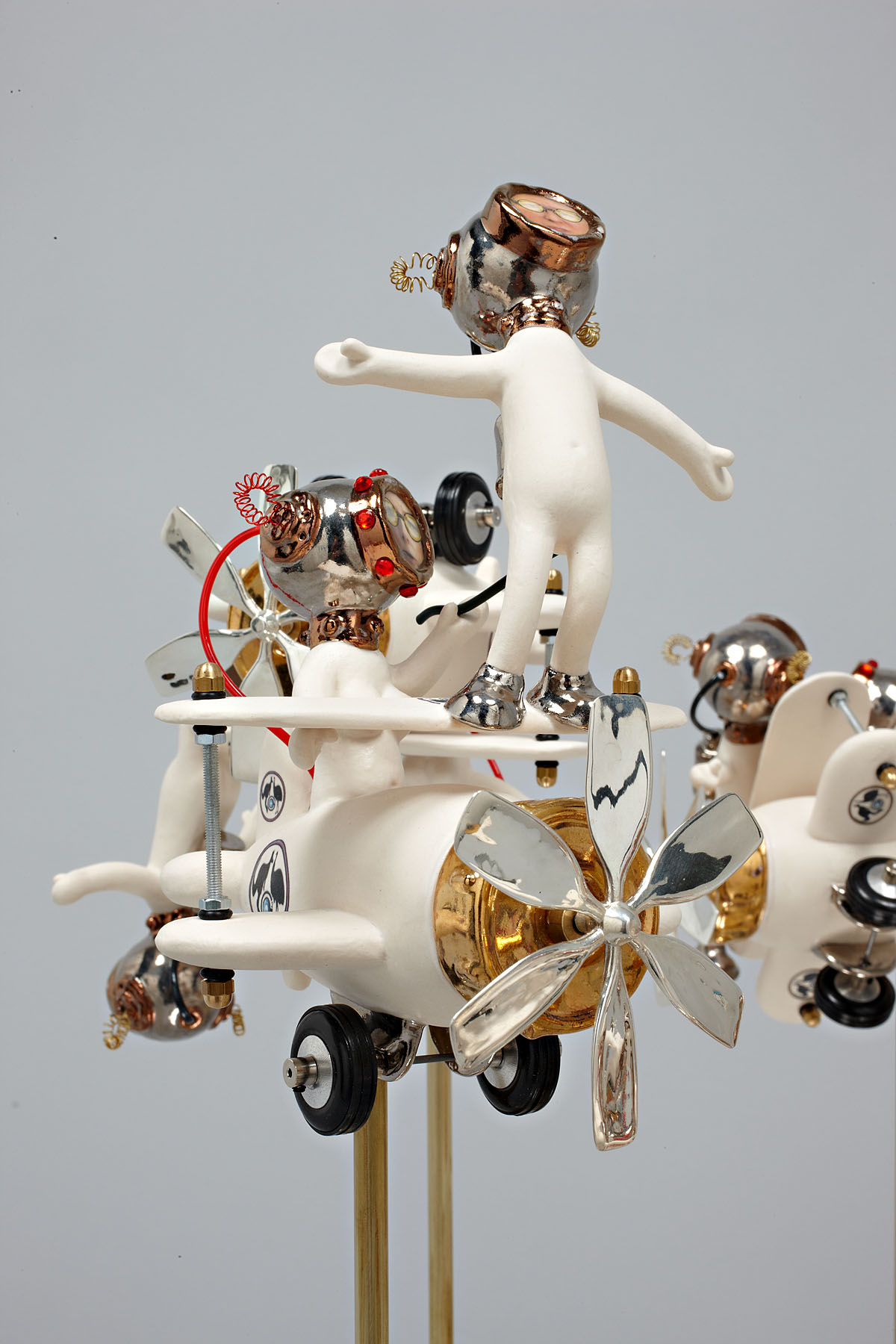
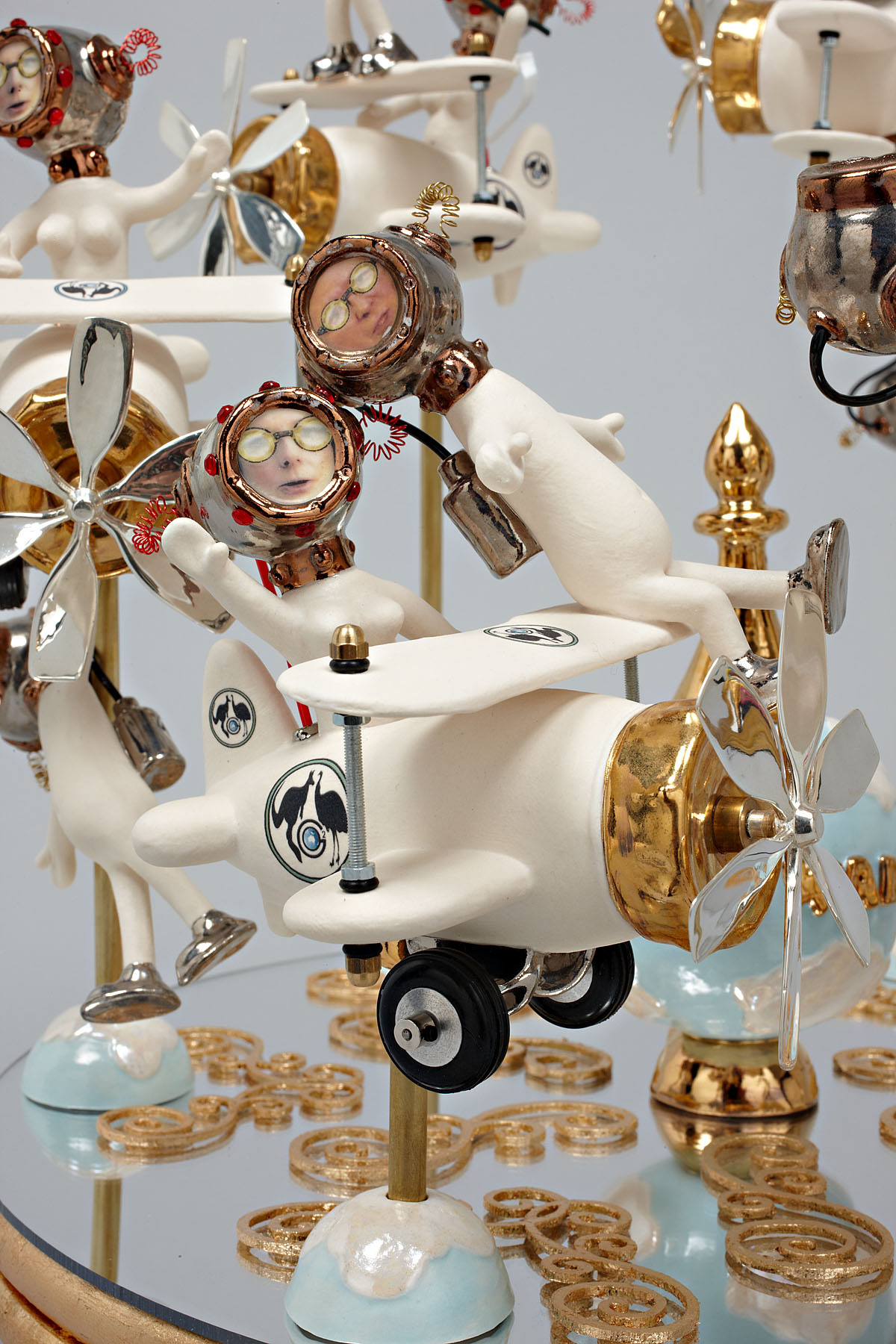
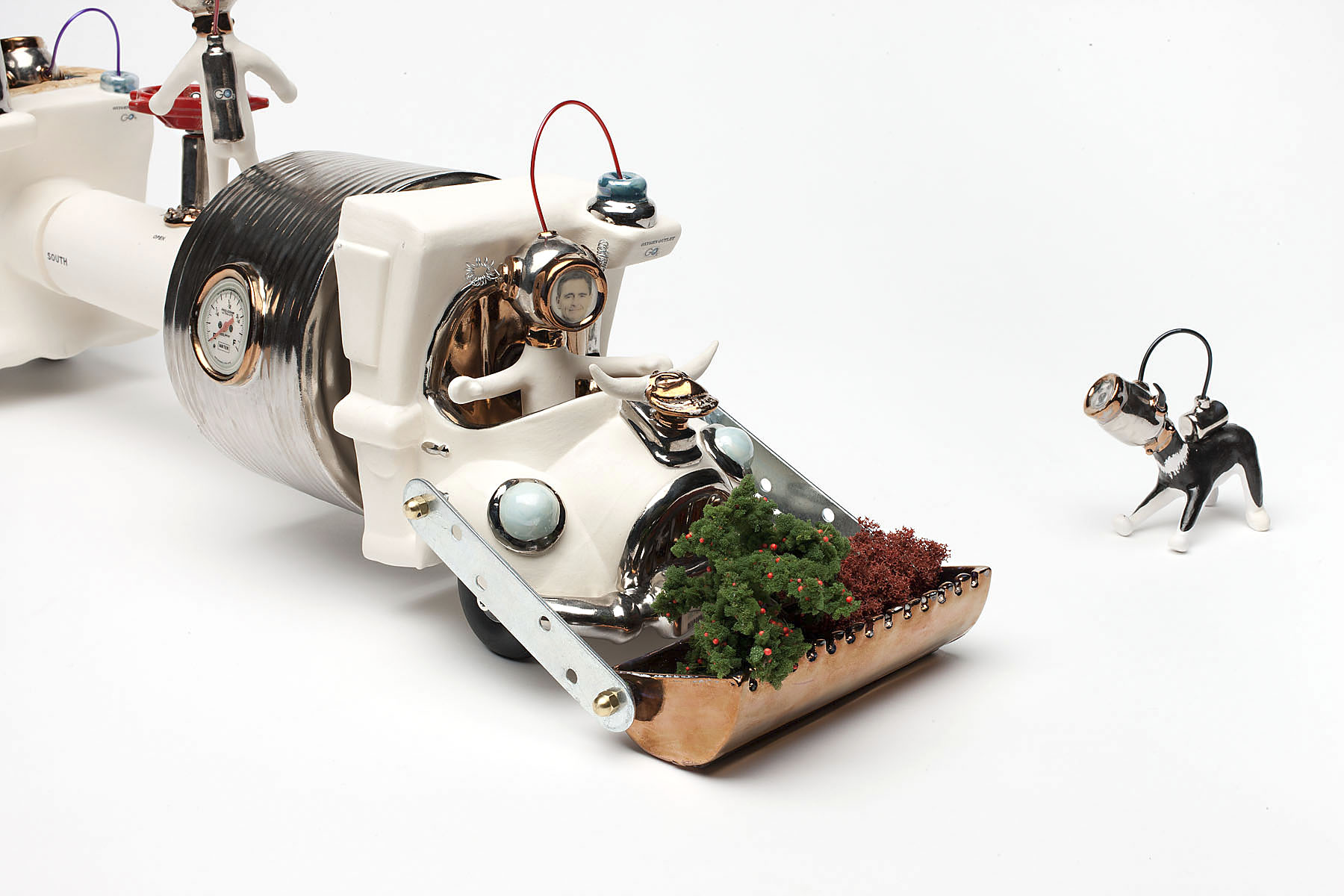
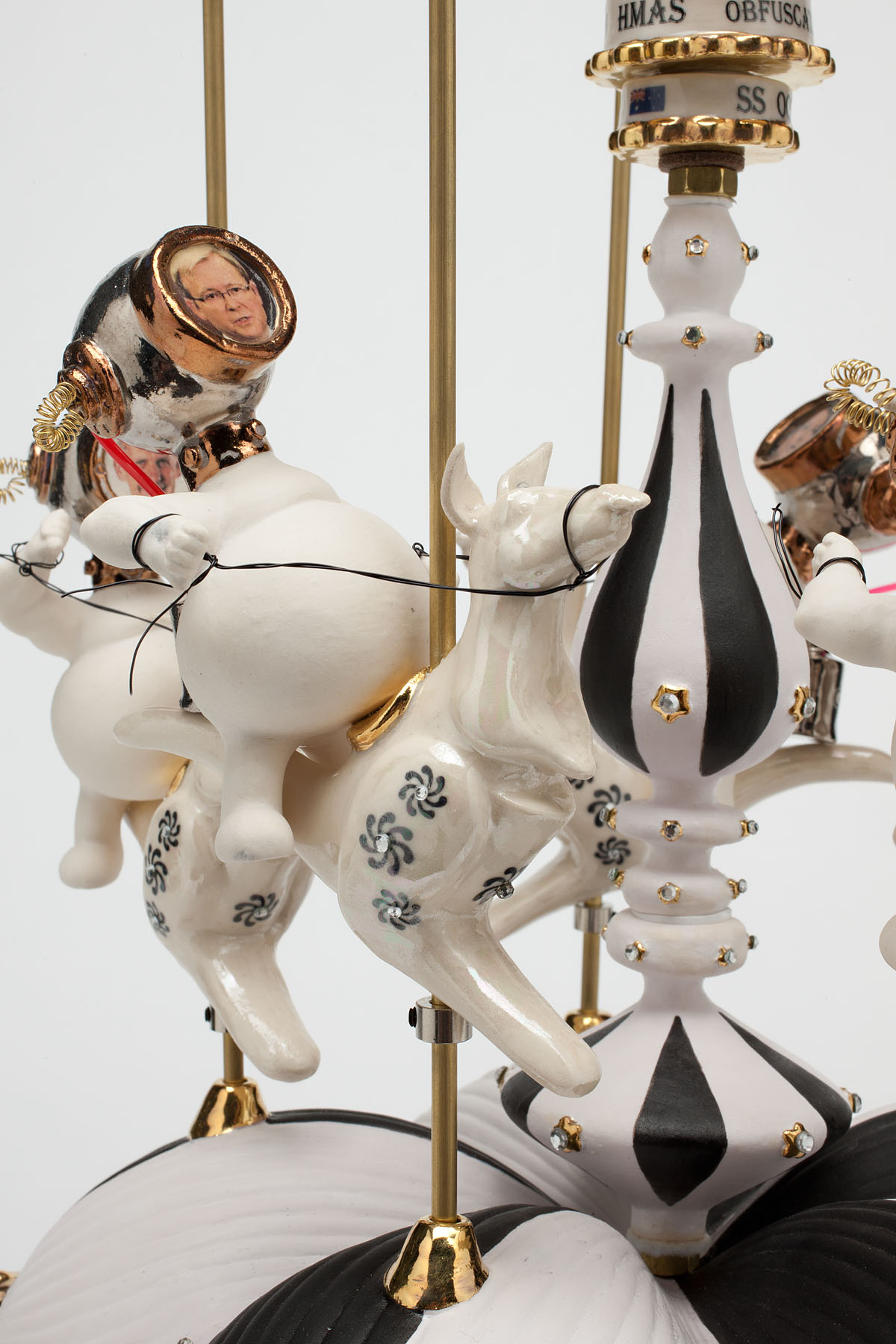
Out of the nine artists it was the hilarious work of Robyn Hosking that was the standout for me. While guffaw inducing one couldn’t help but be entranced by these waggish, chimerical creations and wonder at their technical brilliance. Every detail, every nuance is meticulously observed and the sculptures are beautifully made (mostly using glazed ceramics). Every observation on contemporary politics, war and beauty regimes is concisely conceptualised and executed with panache and humour. For example, in the work Dodgem Discourse (2011) Senator Bob Brown, leader of the Australian Greens, is the only diver figure not to be in his dodgem car while everyone else is bashing into each other, having got out to push his car because the solar power has failed. What you cannot see in the photograph is that the lights atop the dodgem poles flash on and off on every other car except his! While Julia Gillard’s car is emblazoned with the number 1 on its side, another gem is that the number plates say “Question Time” referring to question time in Parliament, but also a double entendre as the viewer questions the supposed wisdom of our elected officials.
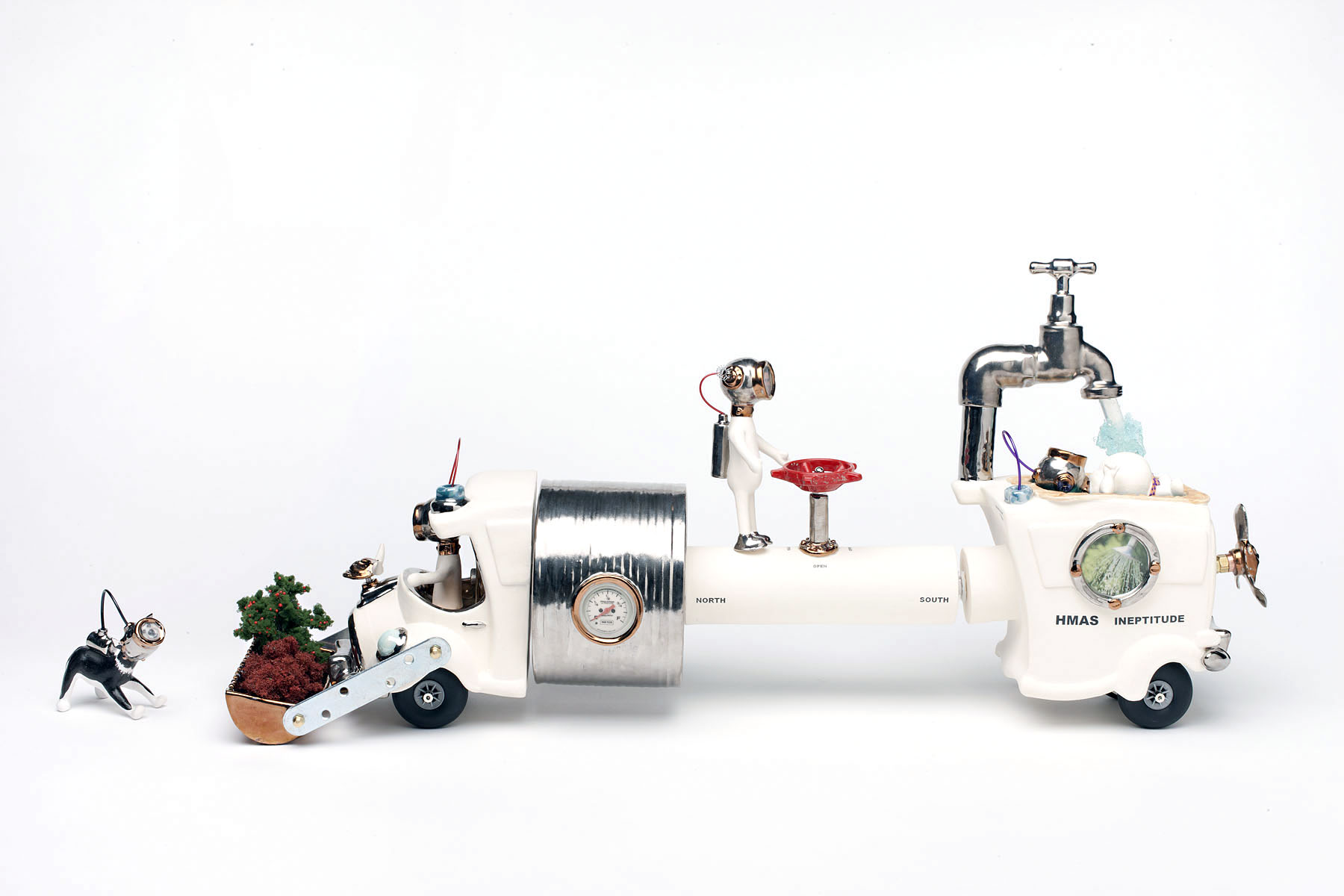
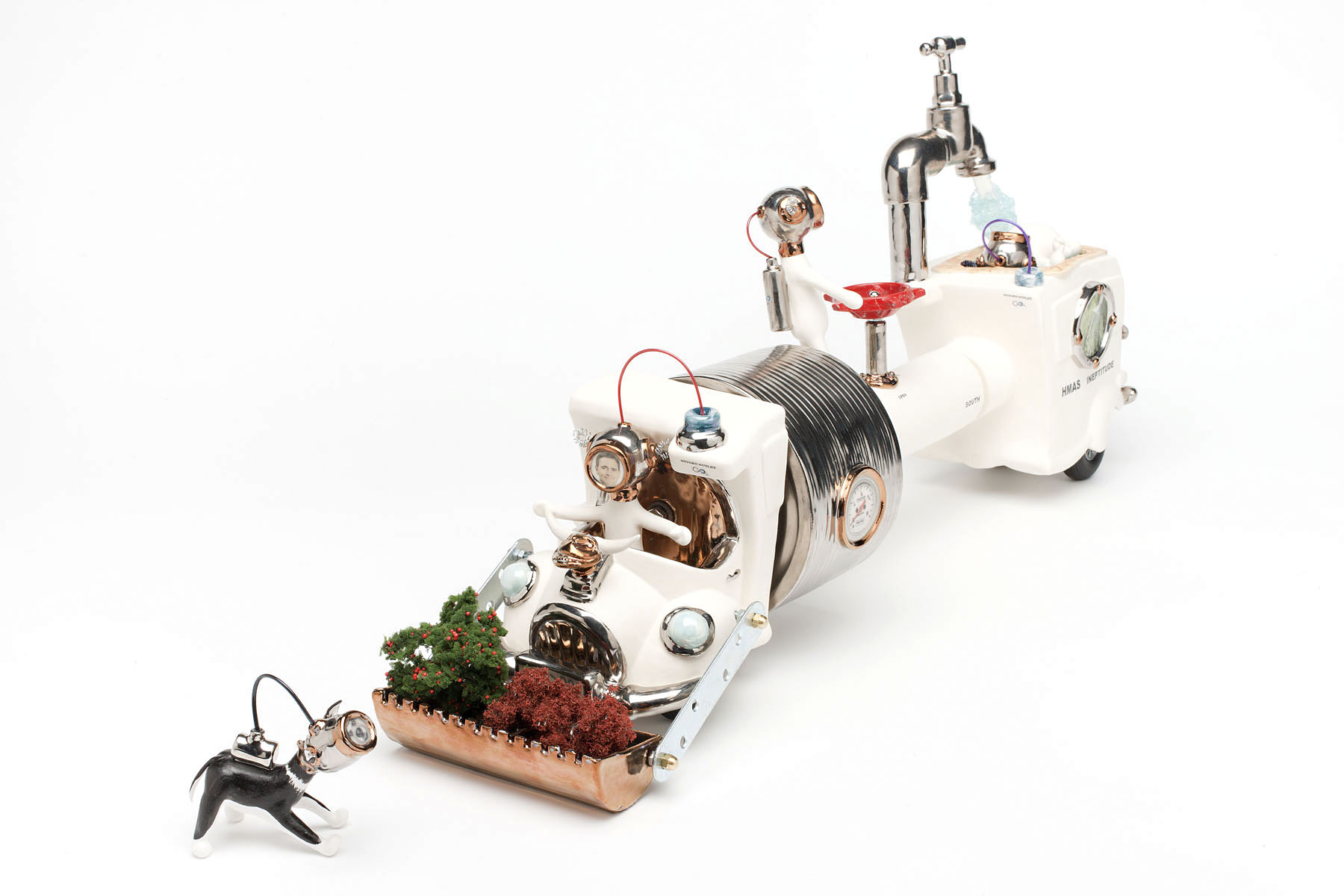
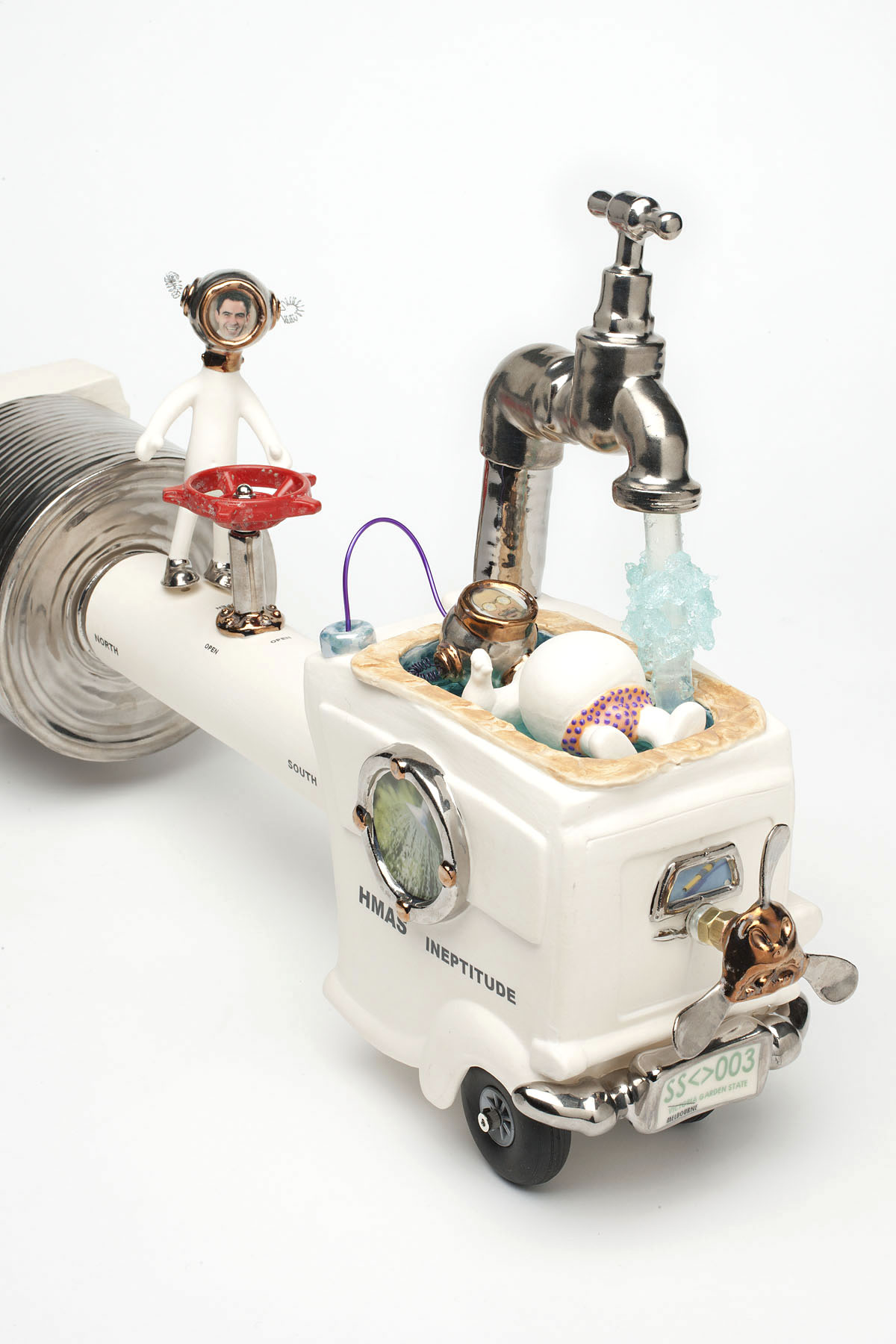
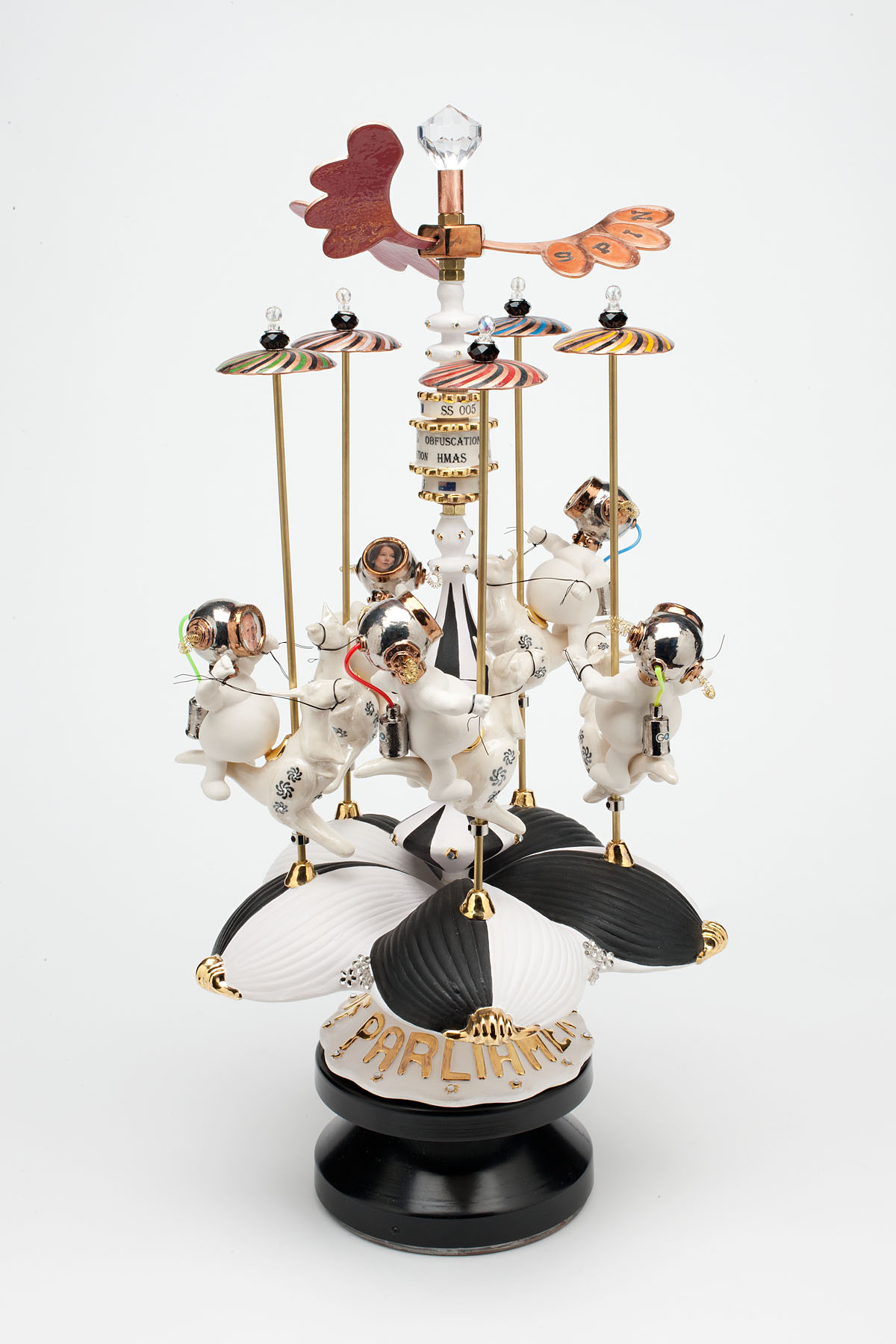
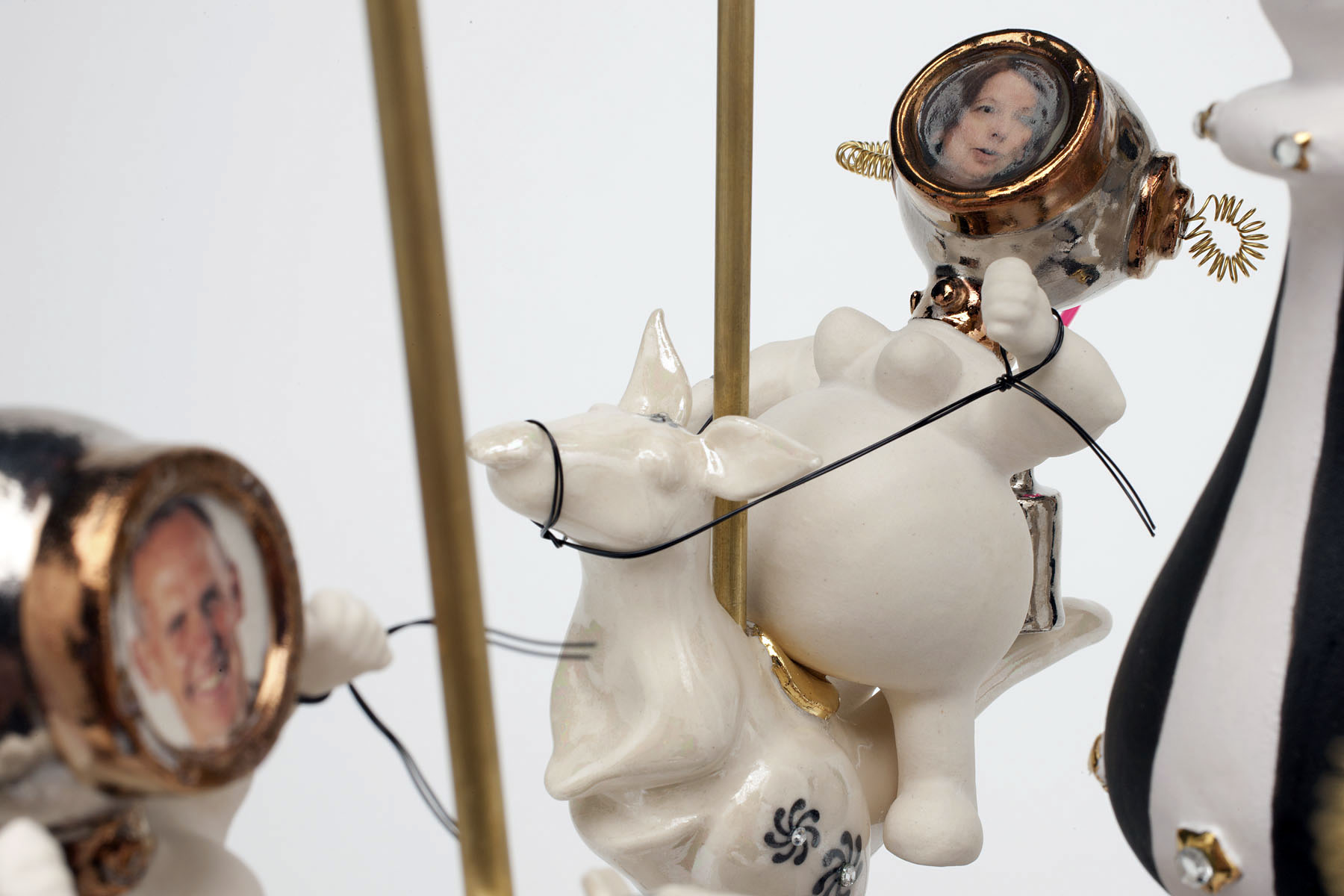
HMAS Ineptitude (2011) assiduously comments on the white elephant that is the North South pipeline while the slowly revolving HMAS Obfuscation (2011) – how I love that word: the hiding of intended meaning in communication, making communication confusing, wilfully ambiguous – spins the SPIN, spelt out on the wing-like form at the top of the sculpture, on the machinations of our politicians who are mounted on rearing ceramic kangaroos with the large, gold lettered word PARLIAMENT on the base. Profound, amusing and beautifully made.
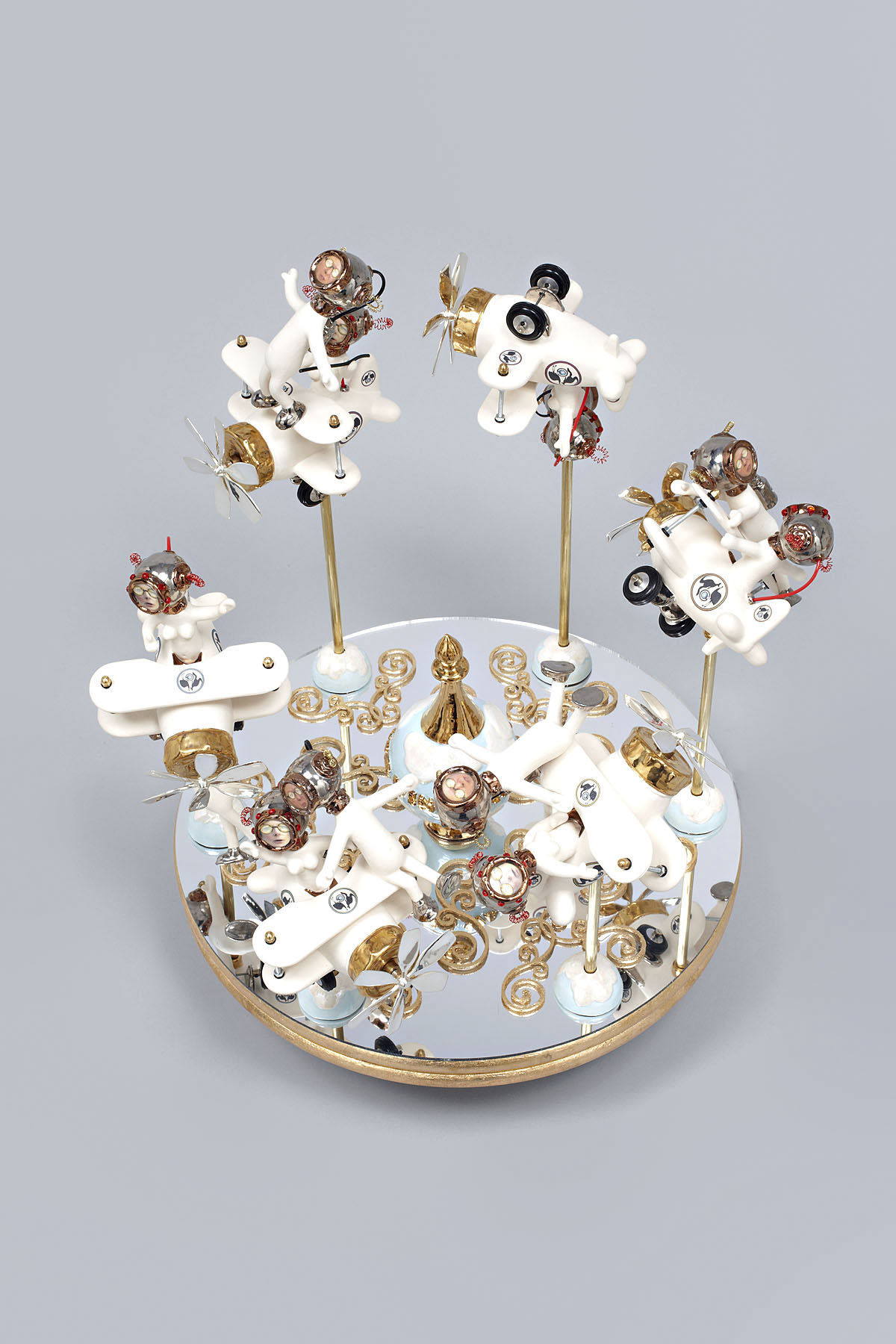
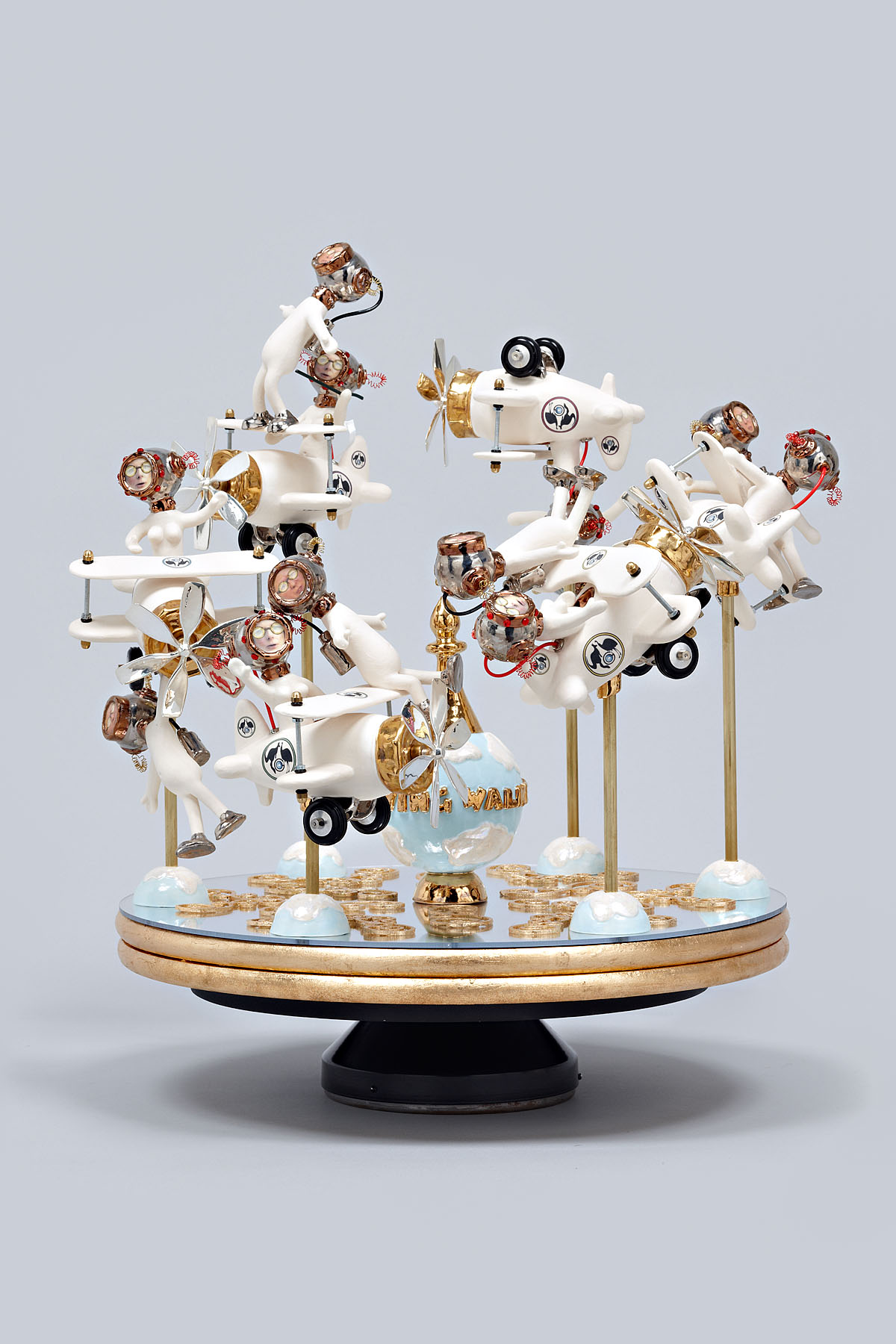
My favourite has to be The Wing Walker (2011) as an irate Julia Gillard tries to get rid of Kevin Rudd once and for all, even poking him with a stick to push him off the edge of the biplane. Balanced on a slowly revolving turntable with the world at its centre, this political merry-go round is panacea for the soul for people sick of politicians. This is brilliant political satire. The planes are all ends up and even when Julia thinks she has got rid of Kevin there he is, hanging on for dear life from the undercarriage of one of the planes. Priceless…
Reminding me of the fantasy creatures of Tom Moore, these whimsical manifestations deal with serious, life changing and challenging issues with purpose, feeling and a wicked sense of humour. I really enjoyed this art (and joy is the correct word) because it takes real world issues, melds fantasy and pointed observation and reflects it back, as the artist observes, in a funfair’s distorted mirror. Magic!
Dr Marcus Bunyan
Many thankx to Anita for allowing me to publish the photographs in the posting. Please click on the photographs for a larger version of the image.
Robyn Hosking (Australian, b. 1948) Dodgem Discourse (detail)
2011
Mixed media
Robyn Hosking (Australian, b. 1948) The Wing Walker
2011
Mixed media
Robyn Hosking (Australian, b. 1948) The Wing Walker (detail)
2011
Mixed media
Robyn Hosking Artist Statement
My work launches a humorous, freewheeling attack on our desensitisation to the white noise and emptiness surrounding us. Looking like a hybrid between art, machine and toy, my sculptures maintain a circus-like sense of amusement and curiosity for the viewer, all the while sending up societal norms and politics.
I like to celebrate the lavishly eccentric design of past eras and the sense of possibility it embodied. As hackneyed as it sounds, a Brave New World is upon us, stranger perhaps than our imaginations can conceive of. While my work casts a disparaging eye at the use of technology for inane and selfish reasons – from Botox to weaponry – it retains a playful, humorous edge. I am not interested in producing depressingly macabre images. Every work becomes a caricature or parody, as though the world is being viewed in a funfair’s distorted mirror.
Robyn Hosking (Australian, b. 1948) HMAS Ineptitude
2011
Mixed media
Robyn Hosking (Australian, b. 1948) HMAS Ineptitude (detail)
2011
Mixed media
Robyn Hosking (Australian, b. 1948) HMAS Obfuscation
2011
Mixed media
Robyn Hosking (Australian, b. 1948) HMAS Obfuscation (detail)
2011
Mixed media
Exhibition dates: 15th November 2011 – 15th April 2012
Many thankx to The Victorian Archives Centre for allowing me to publish the photographs in the posting. Please click on the photographs for a larger version of the image.
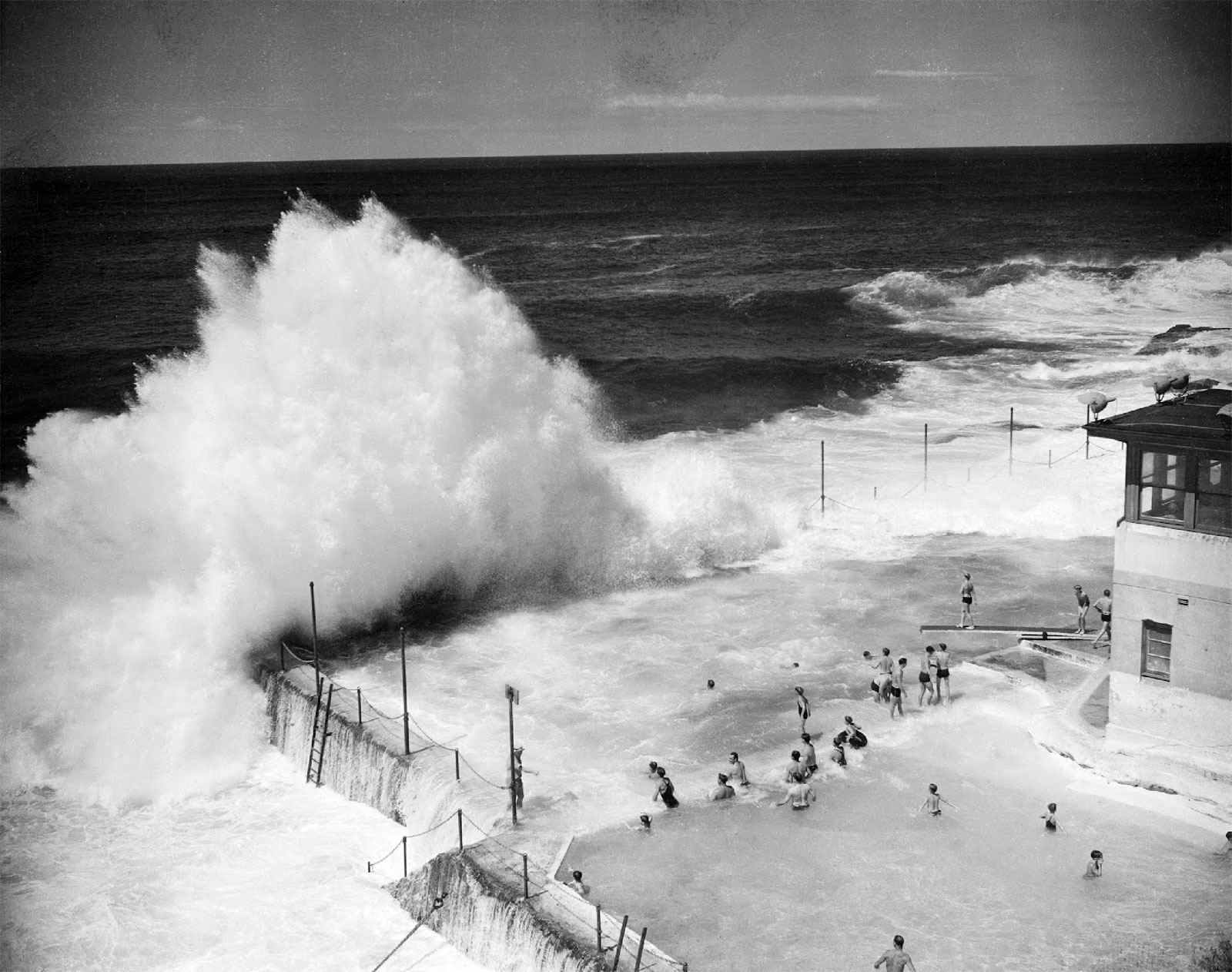
Unknown photographer (Australian) Waves breaking into the pool
1945
Australian News and Information Bureau collection
National Archives of Australia
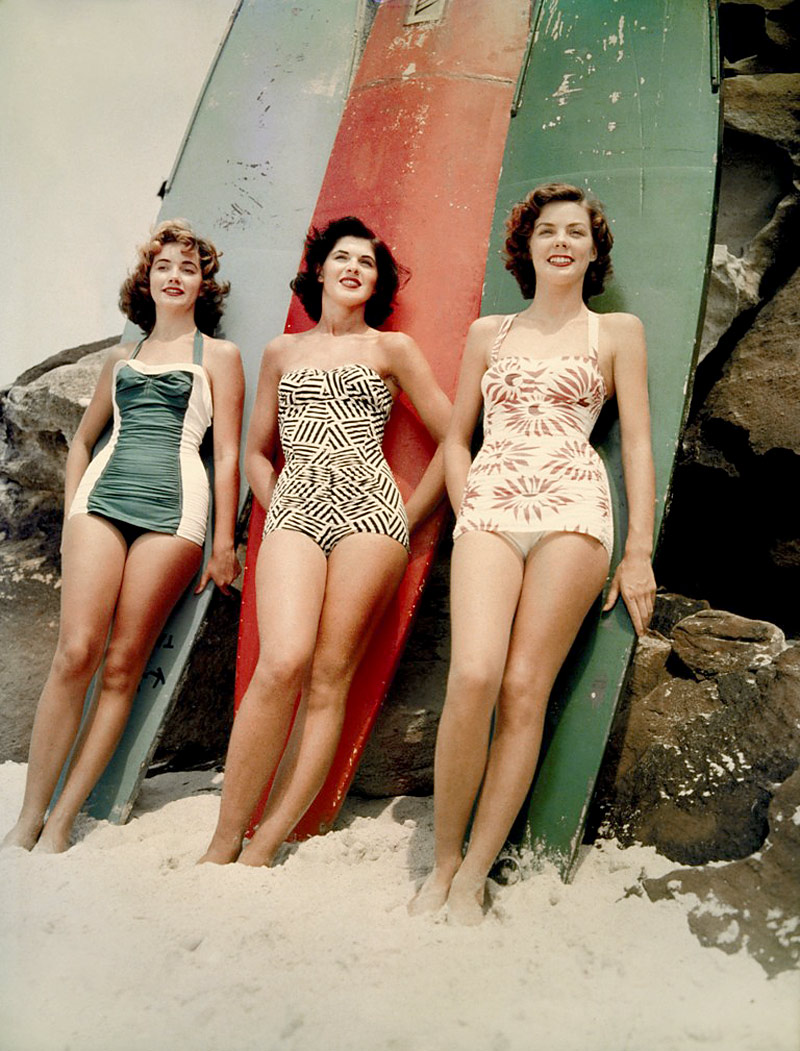
Anonymous photographer (Australian) 1952 Miss Pacific finalists Mary Clifton, Pamela Jansen and Judy Worrad, stand in front of surfboards on Bondi Beach, Sydney
1952
National Archives of Australia
Anonymous photographer (Australian) Sunbathing, Sydney Beach, NSW
c. 1955
National Archives of Australia
Cossies, togs and bathers
Until the 1940s, Australian women wore decidedly modest, albeit colourful, one-piece swimsuits. But the bikini was already in vogue overseas and by the early 1950s Australian women were daring to wear it. Discover the many fashion statements that could be made by wearing a favourite pair of cossies, togs or bathers!
Anonymous photographer (Australian) Christmas party on Bondi Beach, Sydney
1959
National Archives of Australia
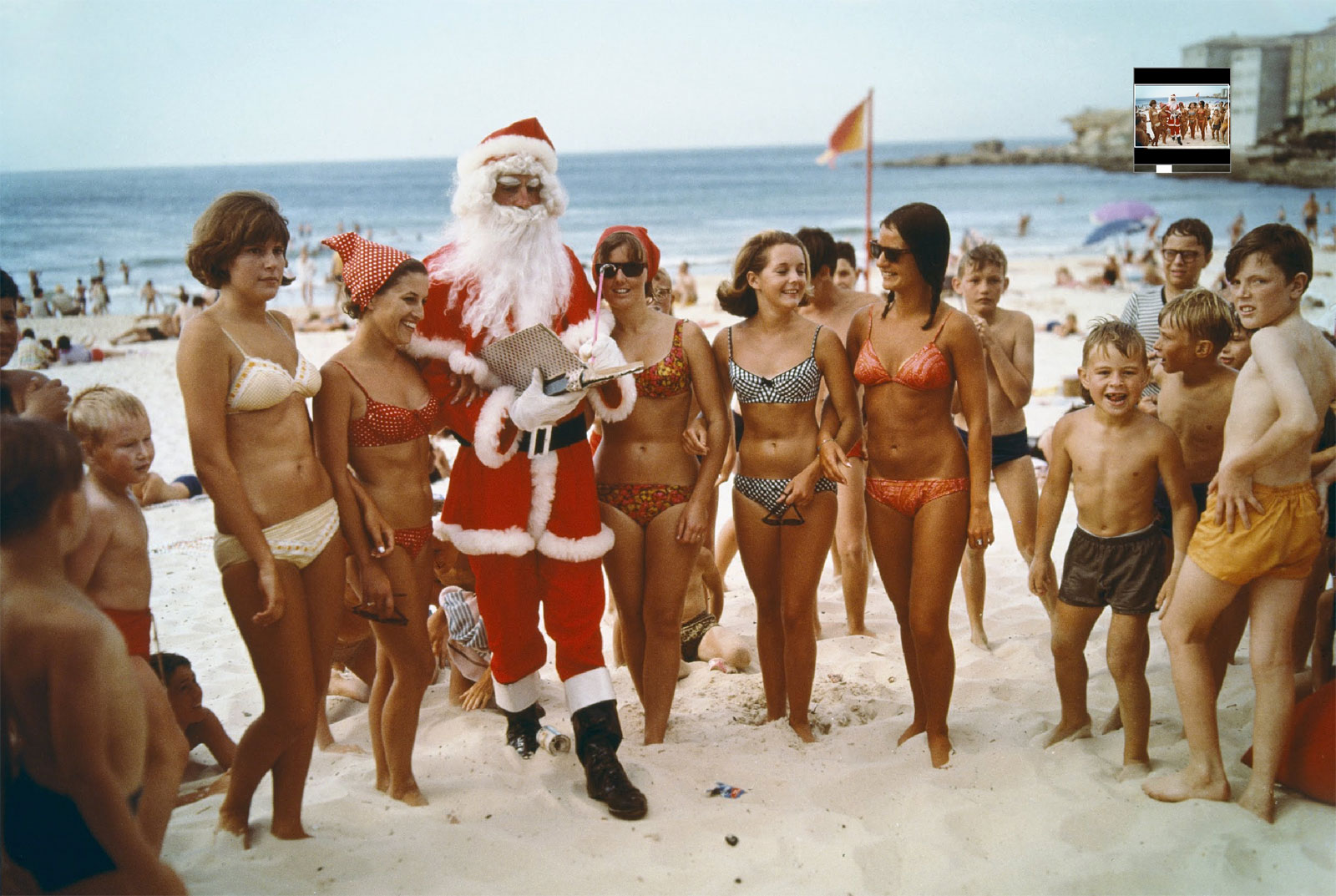
Anonymous photographer (Australian) Santa Claus visits a Sydney beach
1969
Australian News and Information Bureau collection
National Archives of Australia
At the beach
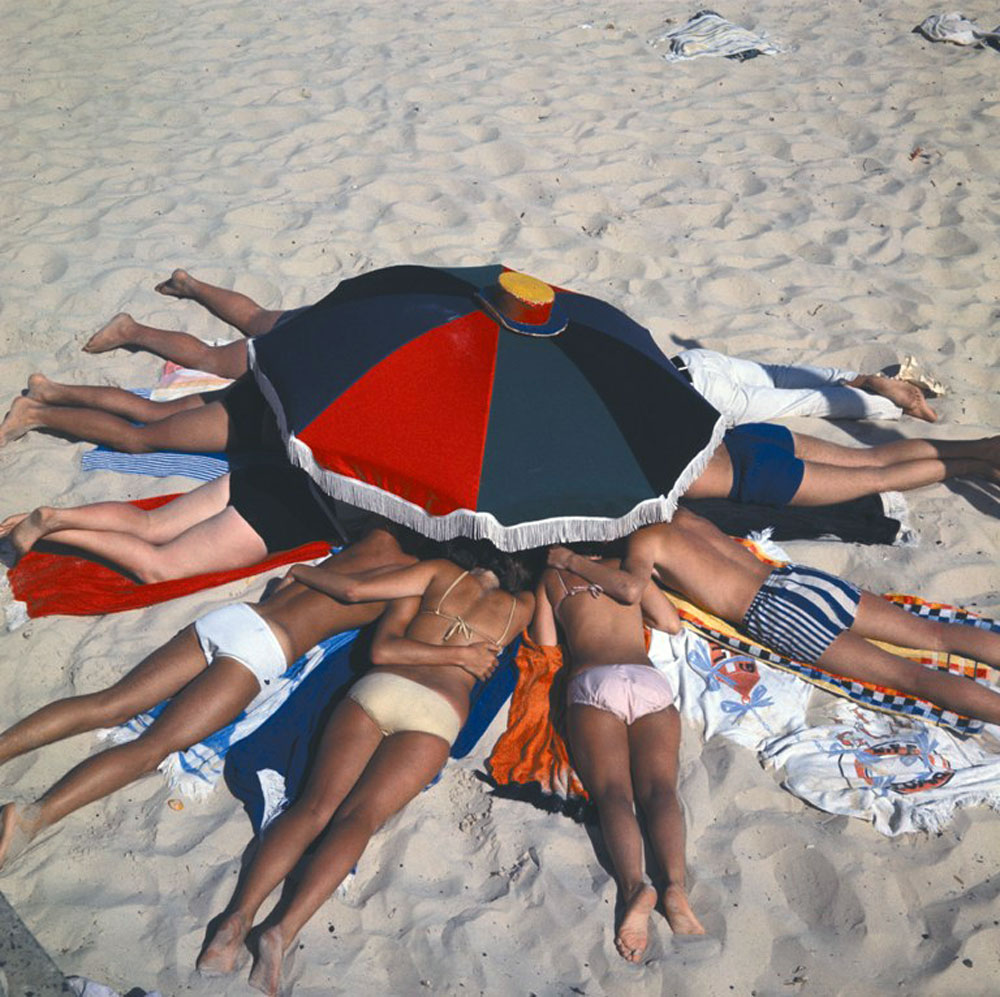
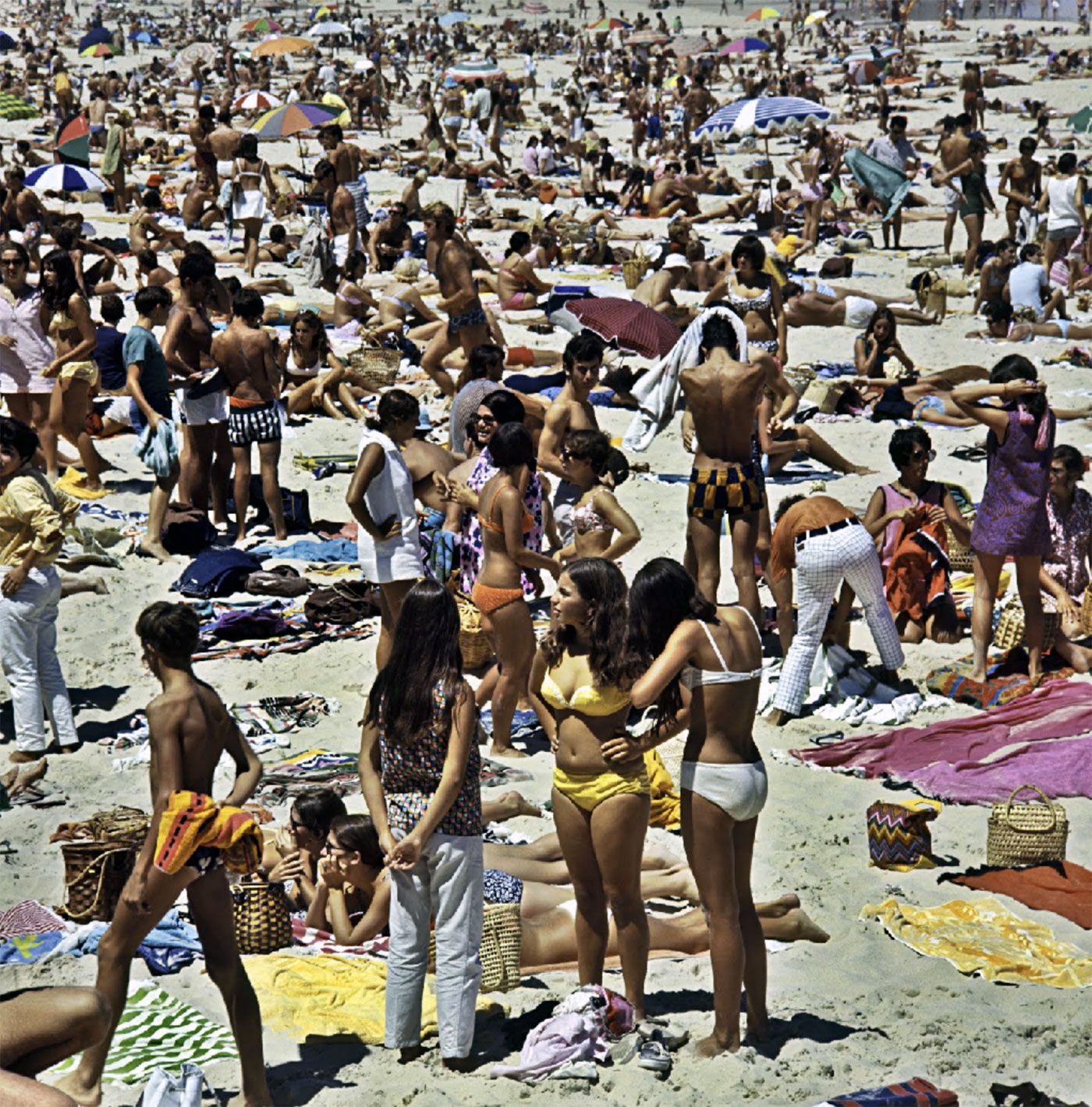
In the 1950s and 1960s, Christmas heralded the start of annual summer holidays for many Australian families. Those who didn’t already live near the coast usually headed towards it, mostly in Holdens and sometimes hauling a caravan. They made tracks to seaside places such as the Gold Coast, Manly, Byron Bay and Sorrento, plonking their bodies on the warm sand, transistors to their ears, to bake in the summer sun. Back then most people seemed unconcerned about sunburn and, as the images show, even beach umbrellas were in short supply.
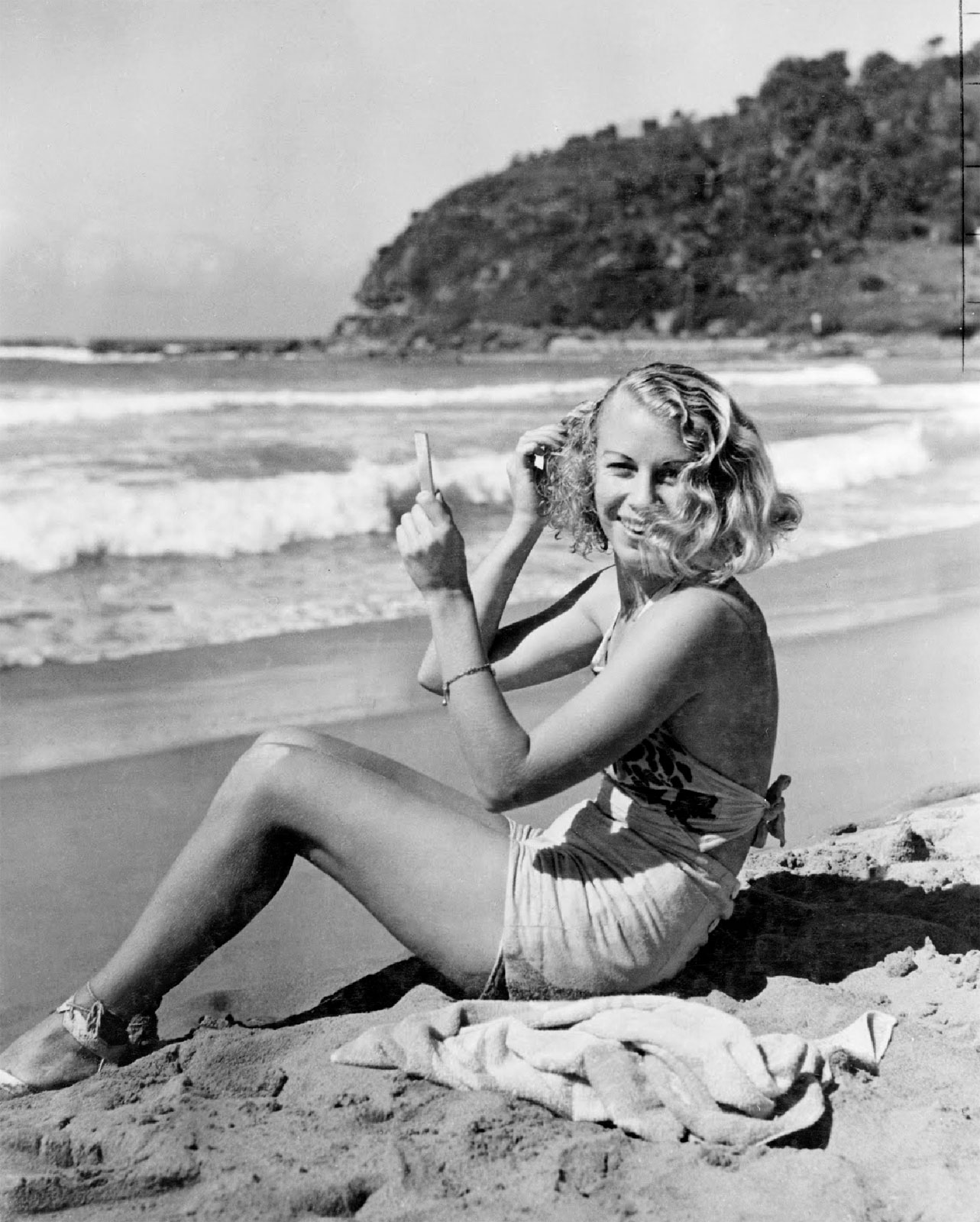
Anonymous photographer (Australian) Bathing beauty
1955
Australian Travel Industry Association collection
National Archives of Australia
This image comes from the Australian Travel Industry Association collection, now held in the National Archives. This series consists of black and white prints and negatives of photographs used in publications, notably Walkabout magazine, produced by the Australian National Travel Association (ANTA).
The Victorian Archives Centre plays host to regular displays of original records from our collection as well as touring exhibitions about Victorian stories. Over Summer, the Victorian Archives Centre will present Summers Past: Golden Days in the Sun 1950-1970, a fascinating photographic exhibition highlighting Australia’s fascination with the sun and sea.
Summers Past will explore our enduring love affair of all things summer, invoking memories of carefree sunny days at the beach in the 1950s, 1960s and 1970s. This is your last chance to view this exhibition before it returns to the National Archives of Australian in April 2012.
So slip on your cossie, slop on the sunscreen and head down to the Victorian Archives Centre this summer!
Summers Past: Golden Days in the Sun 1950-1970 will be on display until April 2012. Entry is free.
Anonymous photographer (Australian) Sunbathers relax under a low umbrella at Bondi, NSW
1956
National Archives of Australia
Anonymous photographer (Australian) Sydney beach scene
1969
Australian News and Information Bureau collection
National Archives of Australia
Anonymous photographer (Australian) Surfer and bikini girl on the sand
1969
National Archives of Australia
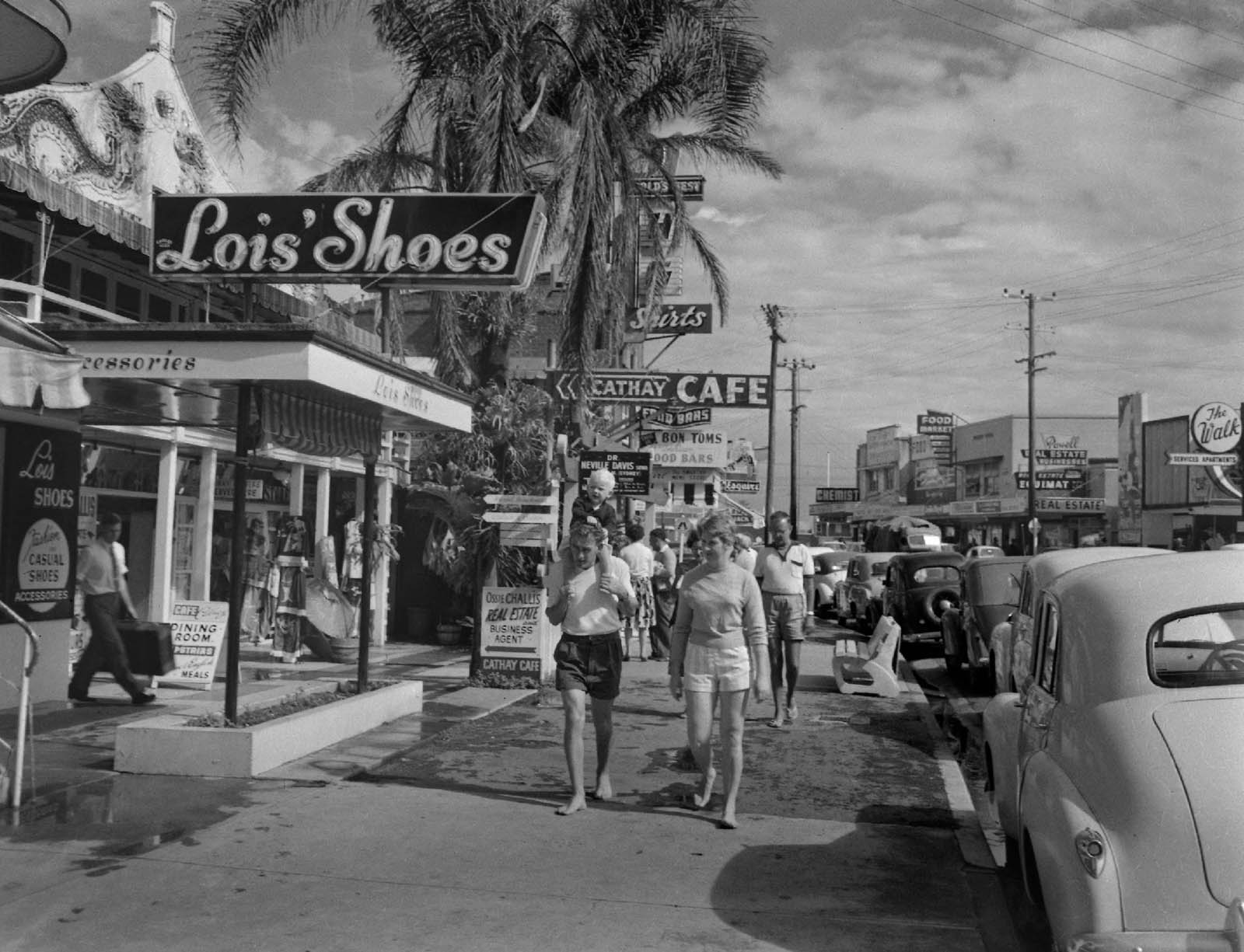
Anonymous photographer (Australian) Holiday makers at Surfers Paradise
1959
Australian News and Information Bureau collection
National Archives of Australia
Anonymous photographer (Australian) Snack bar, Surfers Paradise, QLD
1971
National Archives of Australia
Out and about
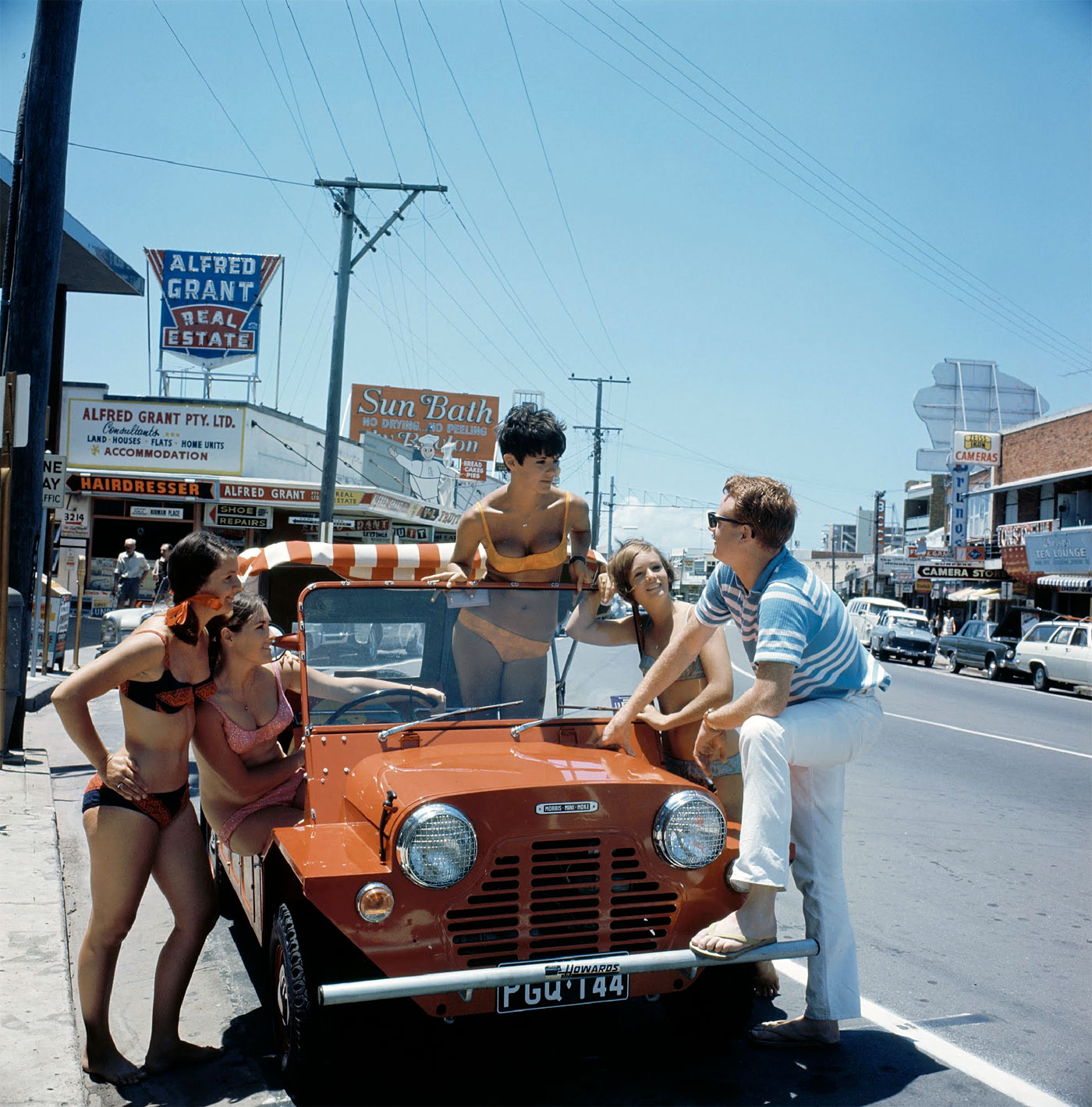
Australians have always been fairly laid back and never more so than in summer. Looking at these images from the 1950s and 1960s, it’s plain that sophistication was seldom a consideration when choosing what to wear. On holidays, most people preferred to be comfortable rather than trendy, and bare feet were common on coastal streets, as were unbuttoned shirts and even swimwear.
Anonymous photographer (Australian) Holiday makers gather around a car on a hot summer’s day
1964
Australian News and Information Bureau collection
National Archives of Australia
Anonymous photographer (Australian) Surf lifesaving, Bondi Beach
1960
National Archives of Australia
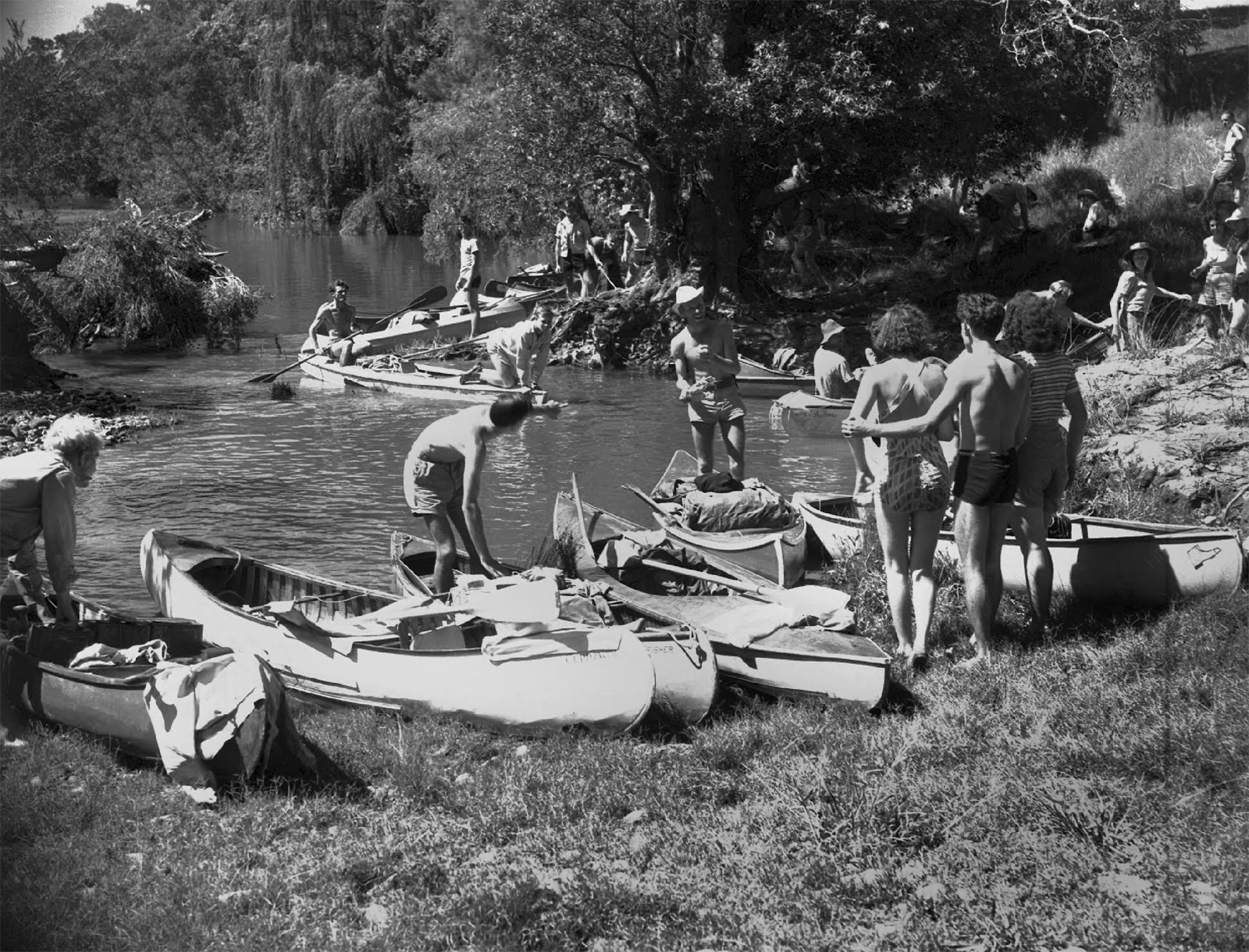
Cliff Bottomley (Australian, c. 1907-1981) Preparing canoes
1948
Australian News and Information Bureau collection
National Archives of Australia
This image comes from the Australian News and Information Bureau collection, now held in the National Archives. This vast archival resource is the legacy of nearly half a century’s work by Bureau photographers who captured hundreds of thousands of photographs of Australians at work and play.
Cooling off
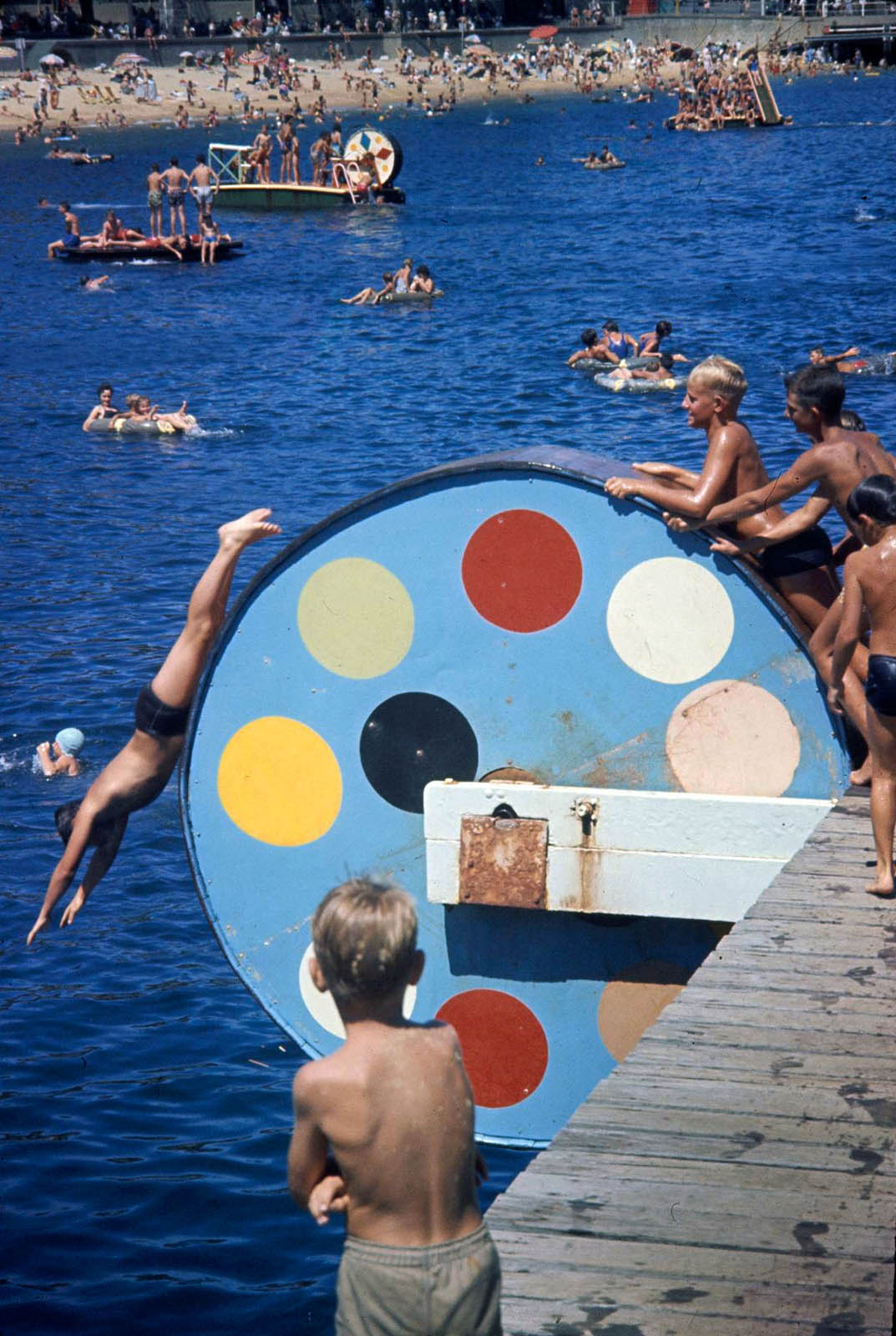
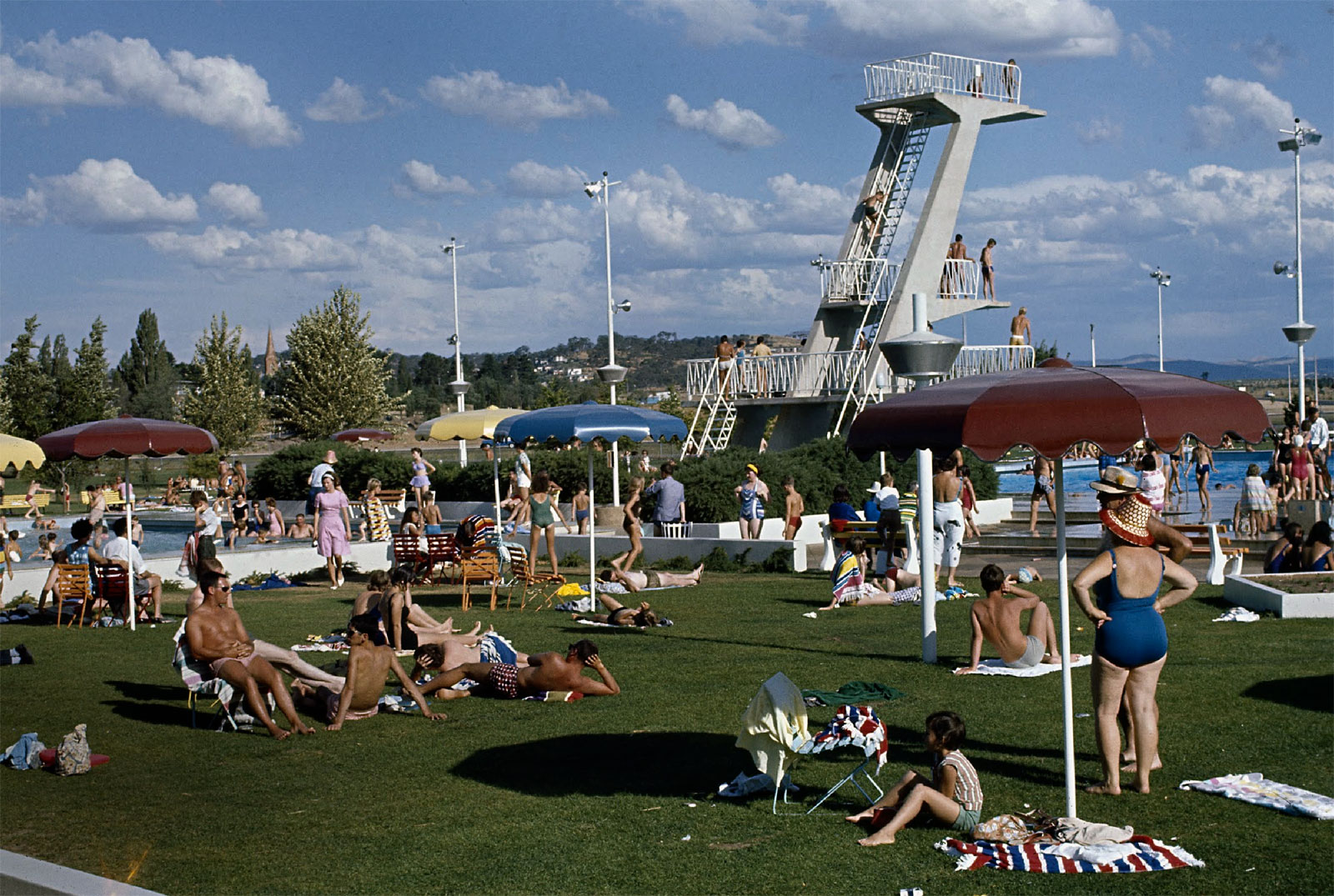
It’s no secret that Australia can be very hot, especially in summer. As the song says, we are girt by sea, and for 85 per cent of Australians a blissful dip in the ocean has always been less that two hours’ drive away. For those living further inland, sanctuary was found in a nearby river or lake, or the town’s public swimming pool.
Anonymous photographer (Australian) Harbour swimming pool, Manly, New South Wales
1960
Australian News and Information Bureau collection
National Archives of Australia
This image comes from the Australian News and Information Bureau collection, now held in the National Archives. This vast archival resource is the legacy of nearly half a century’s work by Bureau photographers who captured hundreds of thousands of photographs of Australians at work and play.
Anonymous photographer (Australian) Sunbathers relax on the lawn at the Olympic Pool, Canberra, Australian Capital Territory
1966
Australian News and Information Bureau collection
National Archives of Australia
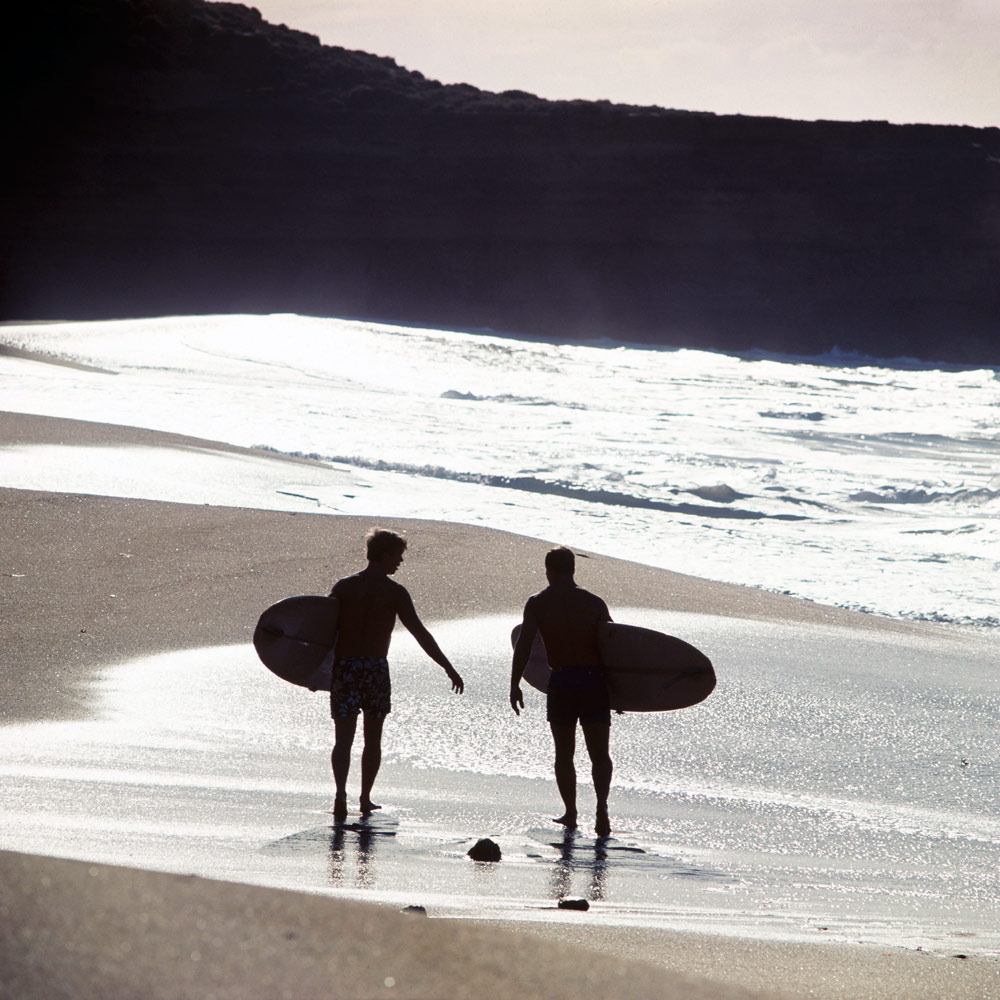
Anonymous photographer (Australian) Surf board riders, Torquay, VIC 1967
National Archives of Australia
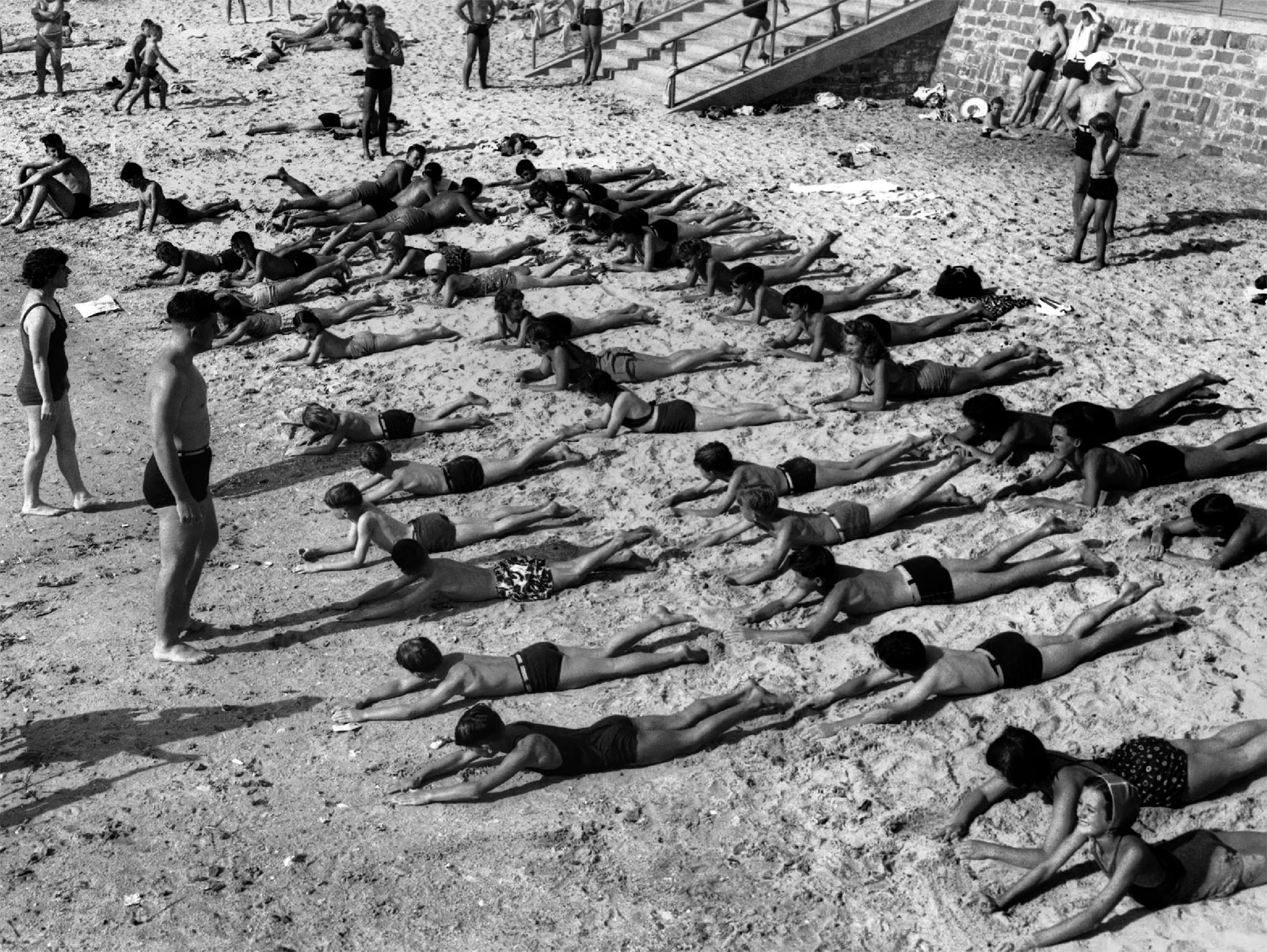
Anonymous photographer (Australian) Children learning to swim
1945
Australian News and Information Bureau collection
National Archives of Australia
Nice one, sport!
Between 1950 and 1970, Australia was triumphant in all the sports we loved. We dominated in the pool, won the Davis Cup a remarkable 15 times, and boasted an impressive record against every Test cricket nation. As these images show, Australian youngsters were keen to play the game, and on most summer Saturdays all around the country, boys and girls would play tennis or cricket, or swim like champions.
Anonymous photographer (Australian) Boys with kites
1965
Australian News and Information Bureau collection
National Archives of Australia
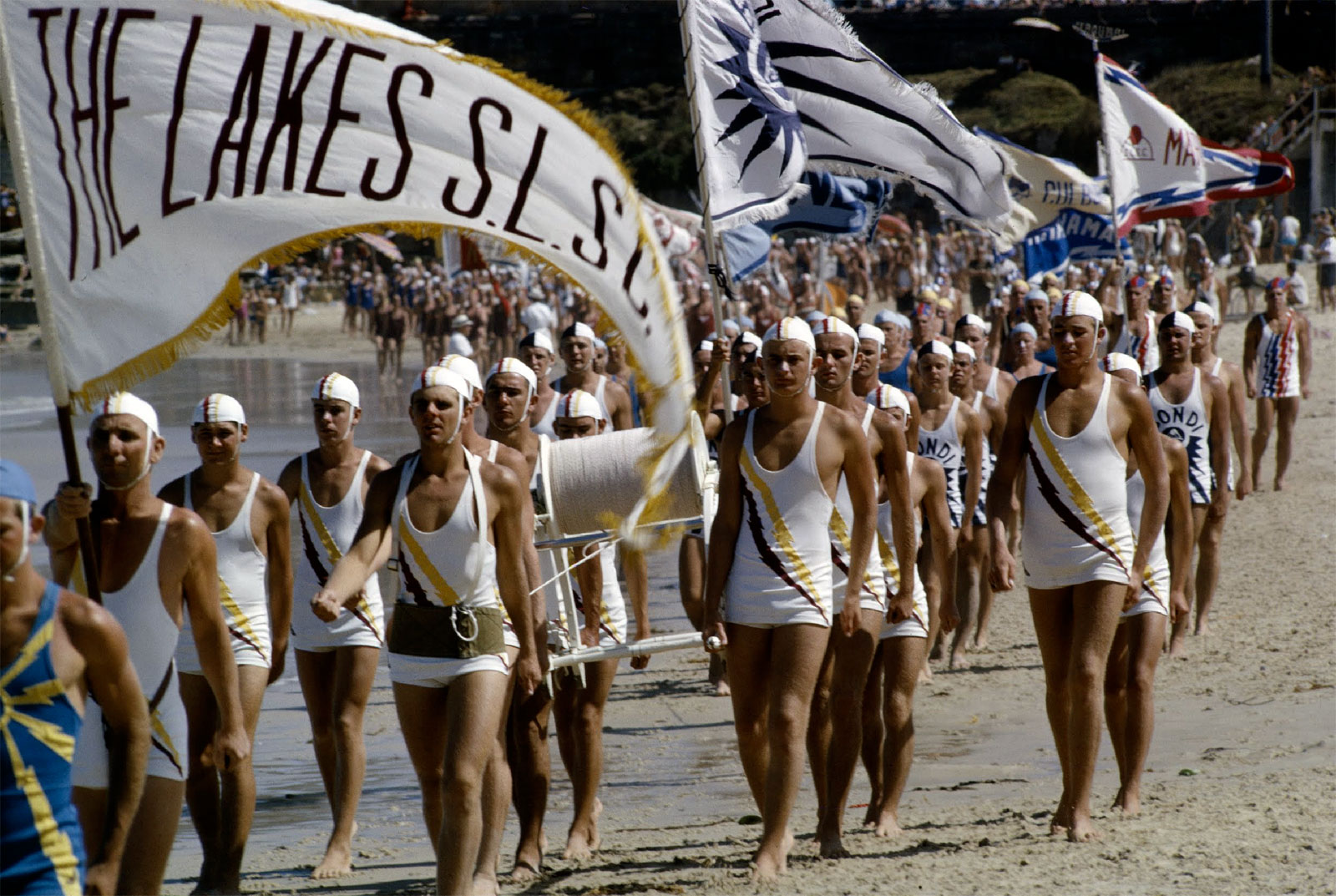
Anonymous photographer (Australian) Surf carnival
1966
Australian News and Information Bureau collection
National Archives of Australia
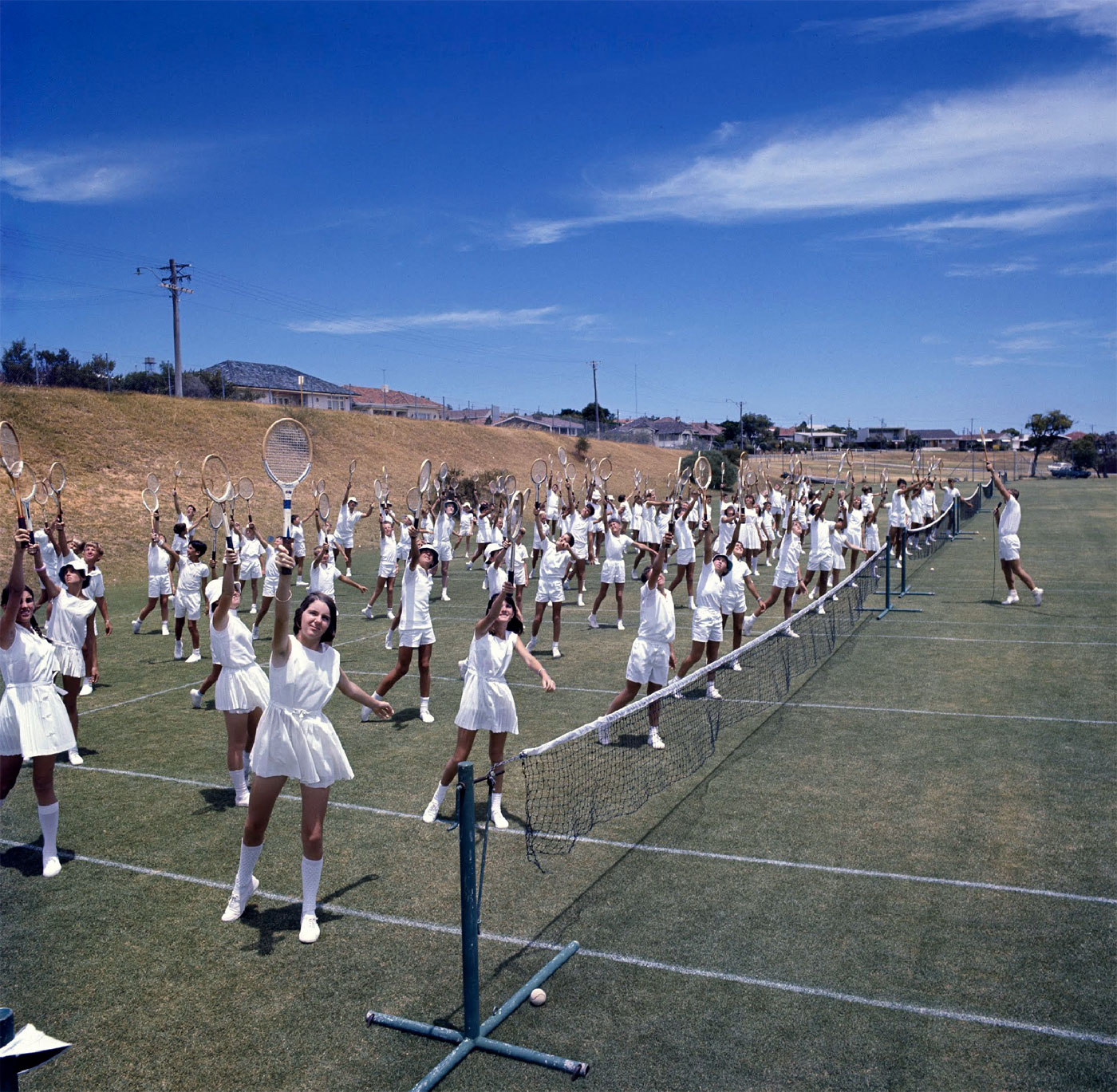
Anonymous photographer (Australian) Mass tennis class
1967
Australian News and Information Bureau collection
National Archives of Australia
The Victorian Archives Centre
99 Shiel Street
North Melbourne, Victoria 3051
Australia
Many thankx to Arianne Martin for her help and to The Museum of Sydney for allowing me to publish the photographs in the posting. Please click on the photographs for a larger version of the image.
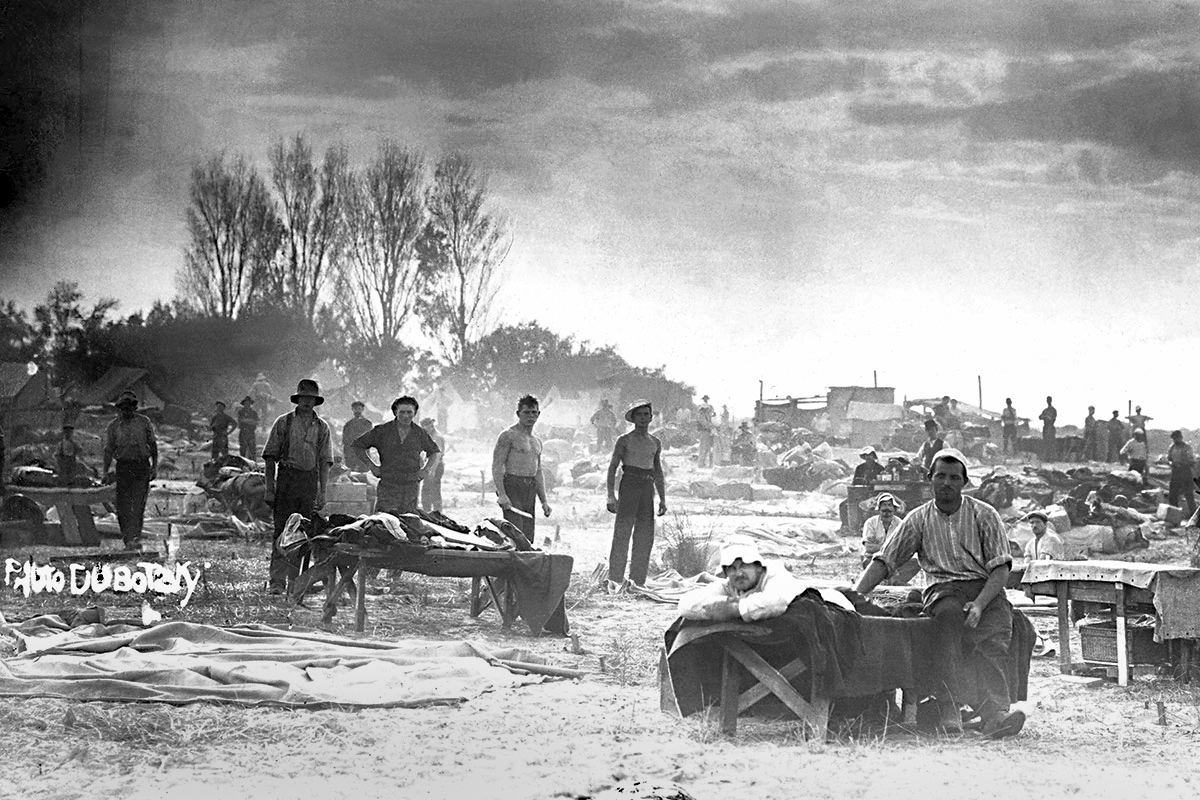
The Torrens Island Internment Camp was a World War I concentration camp, located on Torrens Island which is near Adelaide in South Australia, and is a sad facet of South Australia’s history.
The camp opened on 9 October 1914 and held up to 400 men of German or Austro-Hungarian background, or crew members of enemy ships who had been caught in Australian ports at the beginning of the war. And they were held without trial under the provisions of the “War Precautions Act 1914”.
The South Australian population which included a reasonable number of German descent, saw a wave of anti-German feeling at the outbreak of the First World War. At official level, the War Precautions Act permitted sweeping powers of search, seizure of property and arrest. Lutheran churches and schools were closed and German language newspapers were banned.
In August 1914, soldiers were sent out under the authority of the Act to round up about 300 of what were called “Germans”. The internees included some German and Austro-Hungarian citizens and some Australian born, a mixture of farmers, intellectuals, and Lutheran pastors. They were only a small fraction of the people of German descent in South Australia, and with them the army had rounded up some citizens of Sweden, the Netherlands, and one from the USA – all neutral countries.
The camp was quietly closed in August 1915, after an American who was interned, wrote to the US consulate about the camp and the conditions which saw many of the internees released, while others were transferred to a more humanely-run camp at Holsworthy in New South Wales.
The official records of the Torrens Island camp were destroyed, and today virtually all that is known about the incident comes from the only wartime records that survive, principally the typescript and evidence from the Court of Enquiry.
Extract from Alona Tester. “Torrens Island: South Australia’s World War 1 Internment Camp,” on the Gould Genealogy & History website Feb 23, 2017 [Online] Cited 01/03/2020
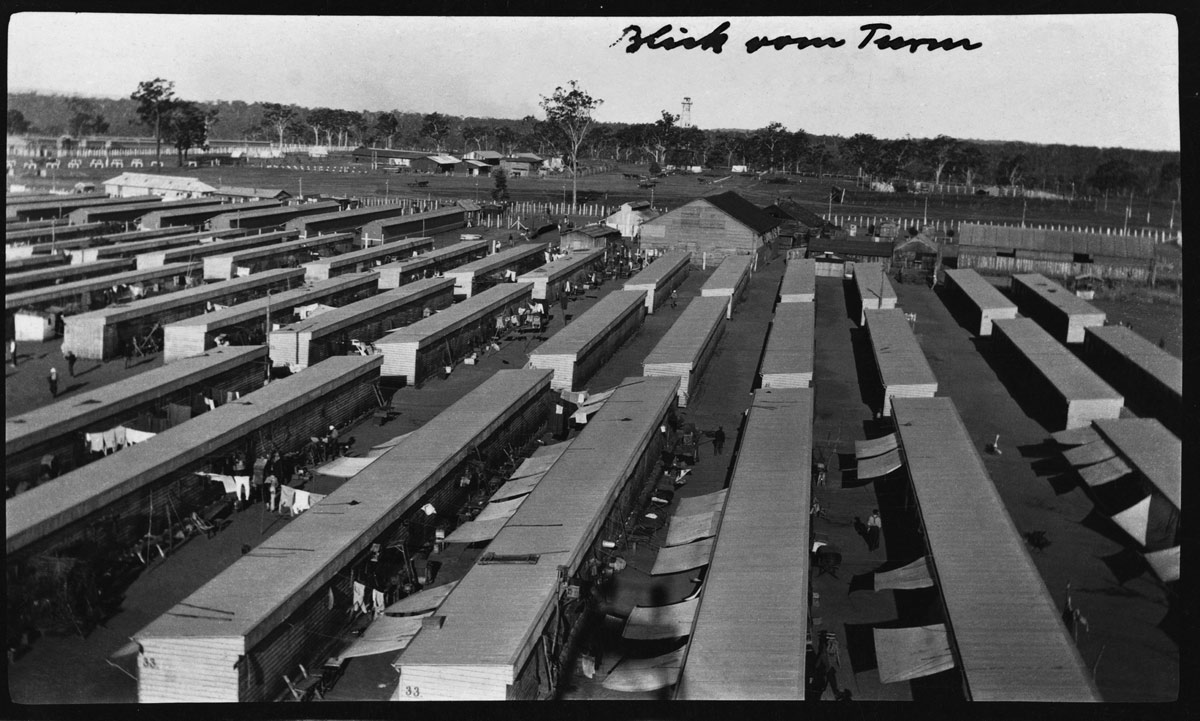
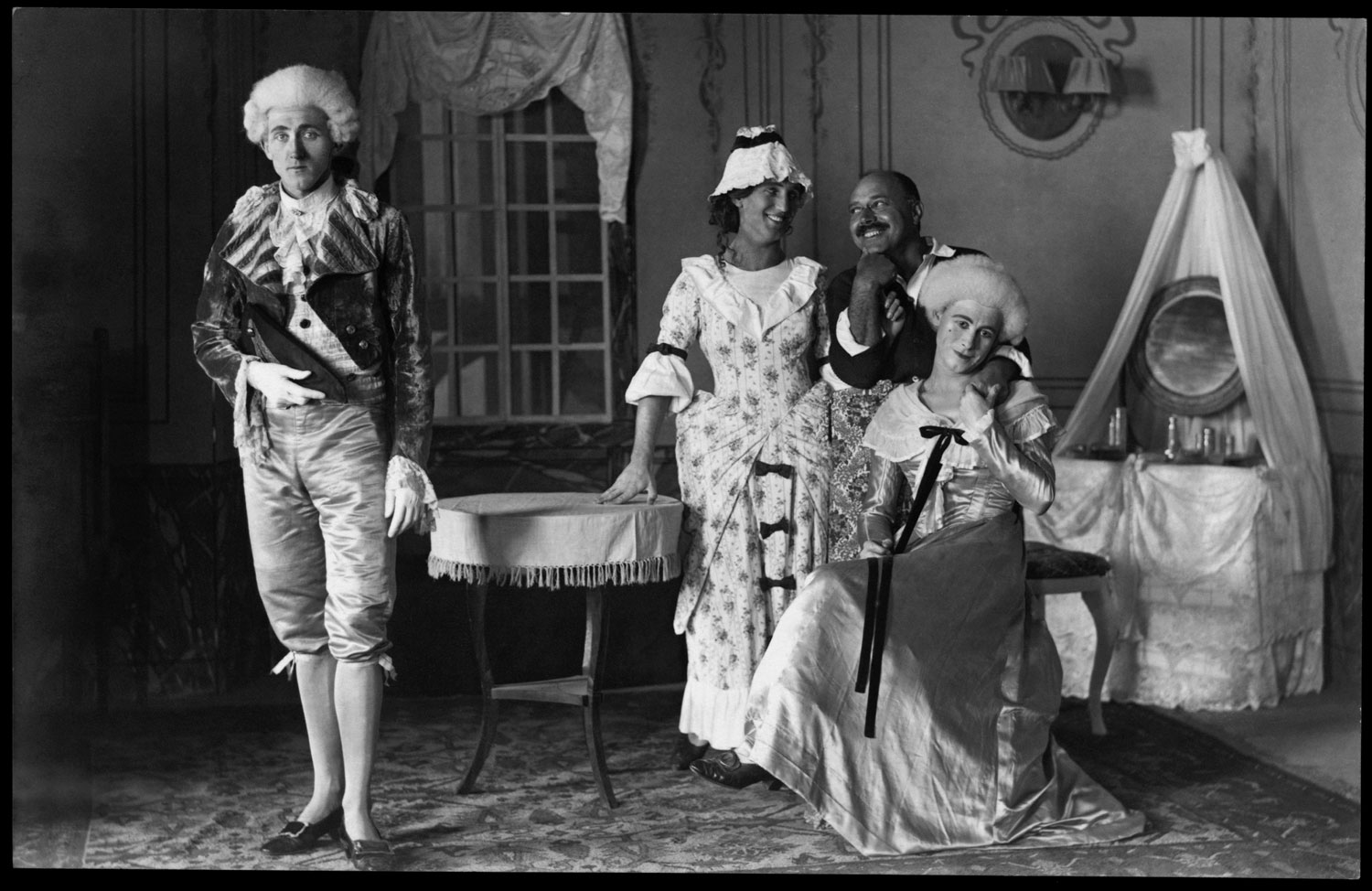
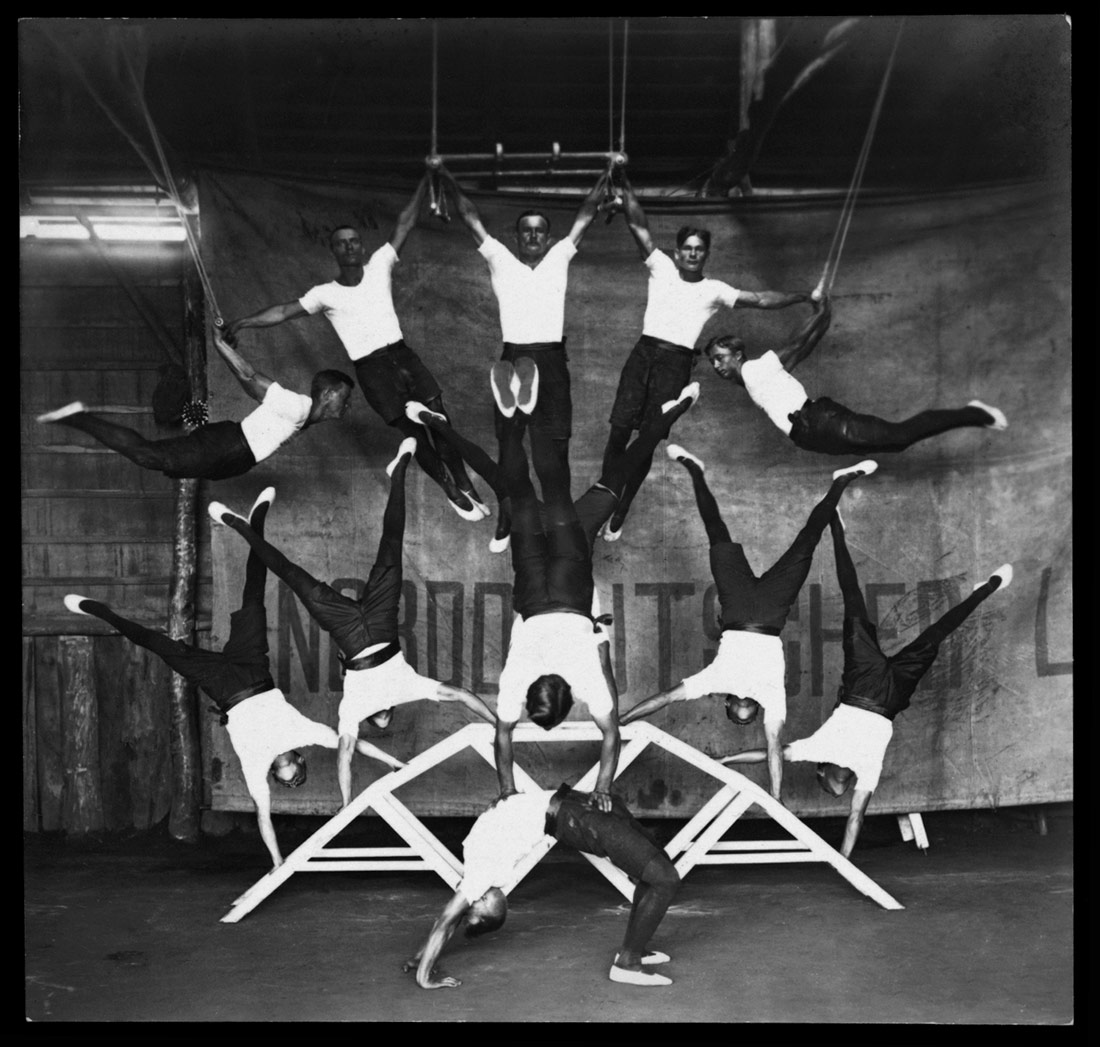
Recently discovered photographs of Australia’s little known internment camps operating during WWI, reveal how the internees created an extraordinary life behind the barbed wire. The photographs, of remarkable artistic quality, show groups of civilian detainees whose only crime was to be of German or Austrian descent.
Taken by interned photographer Paul Dubotzki between 1915 and 1919, the photographs reveal how the 7,000 internees built for themselves a thriving working economy and cultural life that included all sorts of businesses and trades including newspapers, cafes, clubs, sporting events and elaborate theatre productions.
Dubotzki’s stunning photographs feature in a new book and an exhibition opening 7 May at the Museum of Sydney, shedding new light on this fascinating era in Australia’s war time history. The Enemy at Home explores life inside the three internment camps at Holsworthy in Sydney’s south west, Berrima in the Southern Highlands and Trial Bay on the NSW mid-north coast.
These so-called “German concentration camps” led to the destruction of the German Australian community, the largest non-British ethnic community in Australia before the war. The unlikely prisoners of war came from all walks of life and many had lived in Australia for decades, including beer baron Edmund Resch and acclaimed orthopaedic surgeon Dr Max Herz. Many were transformed by internment, such as businessman Kurt Wiese who developed his passion for drawing and later became famous in the USA as book illustrator including the original Bambi book and the children’s classic The Story About Ping.
Nadine Helmi has pieced together Dubotzki’s story after a chance discovery led her to Germany and the discovery of his entire photography collection. Helmi has collaborated with the Migration Heritage Centre and Gerhard Fischer, UNSW Associate Professor of German Studies who has published widely on Australian migration history.
The Enemy at Home is a timely reminder of an almost forgotten chapter in Australia’s history, raising questions about the past and about how we view and portray multicultural Australia today.”
Bavarian internee Paul Dubotski was arrested in Adelaide in 1915 as an “enemy alien”. A skilled photographer by trade, he was permitted to produce photographs and run his own studio inside the camp.
Paul Dubotzki was born in 1891 in Ingolstadt, Bavaria. He grew up in an expanding German Empire as an apprentice photographer in Passau and Seeshaupt. At 22 he joined an expedition to China and Sumatra as official photographer.
Dubotzki travelled through Malaysia, Burma and Singapore documenting the places as expedition artists had done a century before. As fate dictates he was in German New Guinea at the outbreak of the World War One. His photographs show indigenous policemen gathering with German reservists in the jungle of New Guinea to repulse the anticipated Australian invasion.
Dubotzki was not among the prisoners transported to Australia after the surrender of German New Guinea. But he did manage to make his way to Adelaide where in 1915 he was arrested as an ‘enemy alien’ and interned in the South Australian internment camp at Torrens Island.
After his arrest Dubotzki recorded his life in internment. His photographs show in beautiful detail the diverse camp community and culture that developed around him. With his equipment he was able to earn a basic income from photography making postcards and mementos.
Dubotzki’s first pictures of Torrens Island camp captured the camp’s appalling conditions and the abuse committed by Australian guards. His photographs were submitted as evidence in official protests and a Defence Department inquiry.
Dubotzki was transferred to the main German Concentration Camp at Holsworthy near Liverpool in New South Wales on 19 August 1915 and a few months later transferred to the Trial Bay camp, the privileged camp on the New South Wales north coast. His time at Trial Bay was one of intense creativity where he not only worked at his photography, but also discovered a talent and interest for art and acting.
Dubotzki left Trial Bay when it was closed in 1918 and spent the remainder of the war at Holsworthy. He was repatriated to Germany in 1919.
When Dubotzki returned home he found a Germany broken by its imperialistic ambitions with record unemployment, inflation, social unrest and poverty. In the six years that he had been away, the Germany that he knew had ceased to exist with millions of lives lost; the Kaiser overthrown, its proud naval fleet destroyed and its extensive colonial territories confiscated.
Despite this Dubotzki, like many, succeeded in building a new life for himself. Back in Dorfen he opened a photographic business, got married, fathered three children and started a second career as a painter. He combined commercial photography with more artistic work. His images of the Bavarian landscape and Bavarian villagers survive as postcards.
World War One disrupted Dubotzki’s life with an adventurous segue, but World War Two devastated his family taking his only son. Again after another world war he resumed his work as a photographer and painter, now selling his Bavarian landscape paintings to American soldiers occupying the Southwest of Germany.
He died in 1962, a well-known member of the local business community and respected as a photographer and painter. His old studio in Dorfen next to his surviving daughter’s house, still contains the hundreds of photos and many oil paintings that are his artistic legacy, while his grandchildren care for his cameras that testify to a life devoted to photography.
In total, 6890 persons were interned in Australia during the war, including 67 women and 84 children. Despite the official designation “prisoners of war” given to them by the Commonwealth authorities, the internees were mostly civilian Australian residents. They included approximately 700 “naturalised British subjects” and some 70 “native-born British subjects” who were Australian by birth, sometimes second- or even third-generation Australians of German ancestry.
At the end of the war, a total of 6150 persons were “repatriated” – that is, summarily shipped to Germany: a mass deportation unparalleled in Australian history. Of these, 5414 had been interned, the others were family members or non-interned “ex-enemy aliens” who either accepted the government’s offer to be repatriated or were ordered to leave the country.
Six hundred and ninety-nine people were compulsorily deported. The internees who had been brought to Australia from British dominions overseas were not allowed to return to their previous places of residence. They were all summarily deported.
Most of the internees consented to leave Australia voluntarily. They were convinced that there was no future for them in a country that had robbed them of their rights and freedom. A few protested and appealed to stay, only to be rejected by the Aliens Tribunal that had been set up by the Department of Defence.
The tribunal, consisting of a single magistrate, rubber-stamped the applications according to the guidelines issued by the government. As a rule, businessmen and importers were to be deported, while farmers – who were said to “have shown themselves of less potential danger than the German businessman” – were allowed to stay, unless there were unspecified “special reasons”.
Extract from Gerhard Fischer. “German experience in Australia during WW1 damaged road to multiculturalism,” on The Conversation website April 22, 2015 [Online] Cited 01/03/2020
“This is me: this is mine. The whole lot is me. I been walking all around, I know him proper way, he is always with me…”
Weaver Jack
Someone keyed my car the other day and it sent me into a bit of a downward spiral. Who knows why people do these things – stupidity, boredom, sheer bloody mindedness. This exhibition brought me back from that space to a rejoicing in human creativity and connection. It helped me leave my troubles behind. The stories in these paintings ground you, bring you back to earth through the experience and feeling of colour, movement and stillness.
I, we, cannot understand this ancient culture for it is foreign to us. We are not of it. But we can feel the stories in our own way. While we can’t understand every nuance of symbology and traditional narrative that the paintings contain they can speak to us all as human; we all come from this earth and must return to it. I felt the place from which they emanate, an intimacy with earth, self and soul.
I might not know much about anything, about understanding the vagaries of human beings, but I do know what is honest and truthful, has feeling for the piquancy of life. These paintings let my troubles and vicissitudes drop away and uplifted my spirit. Surrounded by love, by colour, by belonging to earth, sky, water, spirit. A wonderful gift to any human being and a wonderful gift from the Felton Bequest to the National Gallery of Victoria and to all the people of Australia. Go and experience their embrace.
Dr Marcus Bunyan
Many thankx to the National Gallery of Victoria for allowing me to publish the photographs in the posting. Please click on the photographs for a larger version of the image.
Yikartu Bumba (Australian / Manyjilyjarra, b. 1940s) Jakayu Biljabu (Australian / Manyjilyjarra, 1937-2022) Nyanjilpayi Nancy Chapman (Australian / Manyjilyjarra, born c. 1941) May Chapman (Australian / Manyjilyjarra, b. 1940s) Doreen Chapman (Australian / Manyjilyjarra, b. 1970s) Linda James (Australian / Manyjilyjarra, b. 1984) Mulyatingki Marney (Australian / Manyjilyjarra, b. 1941) Reena Roger (Australian / Manyjilyjarra, b. 1950s) Beatrice Simpson (Australian / Manyjilyjarra, born c. 1966) Ronelle Simpson (Australian / Manyjilyjarra, b. 1988) Muntararr Rosie Williams (Australian / Manyjilyjarra, born c. 1943) Ngayarta Kujarra 2009
Synthetic polymer paint on canvas
300 x 500cm
Felton Bequest, 2011
Ngayartu Kujarra
The artists who collaborated on this work (above) live at Punmu community, on the shore of a vast salt lake, (Lake Dora), which is surrounded by a scattered array of water sources.
The artists from this region are profoundly affectionate and respectful towards the salt lake and the fresh waters hat have sustained htem and their families for as long as memory can stretch.
The women have reproduced the feeling of the salt lake viscerally: their work conveys its immense scale, fine texture, extreme whiteness and shimmering light.
Ronnie Tjampitjinpa (Australian / Pintupi, b. 1943) Water Dreaming at Malparingya
2006
Synthetic polymer paint on canvas
152.2 x 182.5cm
National Gallery of Victoria
Felton bequest
Today, 24 May 2011, the National Gallery of Victoria celebrates its 150th birthday.
To honour this tremendous milestone, the NGV today unveiled an exceptional gift of 173 important Indigenous works of art including three by contemporary artists Vernon Ah Kee, Brook Andrew and Jonathan Jones who were commissioned to create works that pay homage to the highly celebrated Wurundjeri artist, William Barak. These pieces have been gifted by the Felton Bequest, established in 1904 by the NGV’s greatest benefactor, Alfred Felton.
The Honourable Alex Chernov, AO, QC, Governor of Victoria and Mrs Elizabeth Chernov were present at the NGV’s unveiling ceremony.
Dr Gerard Vaughan, Director, NGV said: “This is the most significant gift of Indigenous art to the NGV since the Gallery opened its doors for the first time on this date 150 years ago in country of the Kulin nation. It is appropriate on this date both to honour the memory of Alfred Felton and also celebrate the Indigenous art of our country, the world’s oldest continuous visual tradition.”
The gift of 173 works encompasses two exceptional collections: the first comprises 63 nineteenth and early twentieth century shields on display as part of the Australian Art collection, and the second 107 twenty-first century paintings from the Far Western Desert, forming the new exhibition Living Water.
Dr Vaughan said: “This outstanding gift adds tremendous strength to the NGV’s collection of Indigenous Art. Since the NGV first collected Indigenous art, the collection has grown to hold over 3,000 works representing cultures across Australia.
These exciting and dynamic acquisitions will enable the NGV to continue to educate visitors of all ages about the visual art of Indigenous Australians. This gift is a highlight of the NGV’s 150th anniversary year, reminding us of the crucial and continuing role the NGV has played in collecting and displaying the finest art works that can be acquired.
The Barak Commissions pay tribute to one of the most important figures of nineteenth century Australian Indigenous art, acknowledging Barak’s central place in the history of Victoria and the NGV,” said Dr Vaughan.
William Barak was born in country of the Wurundjeri people and became a leading Indigenous artist and figure in Melbourne during the 19th century. He is said to have witnessed John Batman ‘purchase’ Melbourne in 1835.
The multi-media installation by Vernon Ah Kee presents conversations between prominent Indigenous people as they reflect on how Barak has inspired them. Brook Andrew, renowned for his multi-disciplinary works, has created a powerful installation which adorns the entrance atrium at The Ian Potter Centre: NGV Australia. Jonathan Jones, who works with fluid and dancing light as a metaphor of living culture, has created five light boxes that map important cultural designs belonging to Barak as a way of honouring Barak’s life.
The collection of 63 rare and stunningly beautiful 19th and early 20th century shields is largely contemporary with Barak’s life. The shields serve to remind us of the time when the plains of Southeast Australia contained carved trees bearing elegant inscriptions, with people dressed in possum-skin cloaks and carrying elaborate shields living extraordinary living in harmony with country and ancient beliefs.
The Living Water exhibition unveils the Felton Bequest gift paintings: 107 adventurous works by male and female artists from newly established art centres in the Far Western Desert, an area stretching across far flung parts of Western Australia and South Australia.
This exhibition of 21st century art highlights today’s momentous art movement which originated at Papunya in 1971 when senior men decoded their archival narratives and laws, forging a new form shared by many Indigenous peoples across the Western Desert.
Press release from the National Gallery of Victoria website
The country of the Spinifex people, who speak a southern dialect of Pitjantjatjara language, consists of vast plains of deep red sand, salt lakes and Spinifex.
In 1998 the community produced a series of ten large paintings that were bequeathed to the people of Western Australia in a symbolic reciprocal exchange of paintings for land. Most Spinifex works, subsequently produced on infrequent painting trips back to country operate as complex maps as well as religious landscapes that detail sources of spiritual power in country belonging to individual artists.
Living Water, an exhibition showcasing 107 contemporary Indigenous paintings by 94 artists from the Felton Bequest Gift, displays works by male and female artists from the Far Western Desert, an area stretching across parts of Western Australia, South Australia and the Northern Territory.
A modern art movement originated at Papunya in 1971, which has since transformed the way we see the land and the history of art in Australia. Almost forty years after the genesis of the Western Desert art movement, its epicentre has dramatically shifted from Papunya in the Northern Territory to the Pintupi homelands of Kintore and Kiwirrkura in the Gibson Desert, and to communities that lie hundreds of kilometres to the south and west in far-flung reaches of South Australia and Western Australia (the Far Western Desert).
During the first decade of the 21st century, Pintupi, Spinifex, Anangu, Yulparija and Martu artists have developed a dynamic and fresh expression of Western Desert Art. The male and female artists not only share close kinship, social, linguistic and ritual interconnections and lived experience of desert country built up during pujiman (nomadic, bush) days but also have parallel experiences of making art with introduced materials for the commercial market. Their paintings – bearers of sanctity – resonate with the shock of the ancient made new and tell tjukurrpa (stories) associated with special places in their ngurra (country).This dramatic new wave of acrylic painting is the focus of Living Water, comprising the NGV’s 150th anniversary gift from the Felton Bequest of 107 paintings.
Aboriginal people from across the Western Desert use the term ‘living water’ to describe water sources, including rock holes and soakage waters that are fed by underground springs. The path of these springs was created by the ancestral beings of the Tjukurrpa (Dreaming) as they themselves journeyed underground, their entry into the earth often marking the site of current day water sources. ‘Living water’ is revered also because it does not seem to be affected by the harsh conditions above the ground that the people themselves have to endure.
This exhibition has been curated by Judith Ryan, Indigenous Art Curator, NGV. The following groups of people are represented in this spectacular exhibition.
Pintupi people
Pintupi is the name of a Western Desert language spoken by Aboriginal people who belong to a large stretch of country in the Gibson Desert of Western Australia and the western edge of the Northern Territory. When the Pintupi arrived in the government settlements east of their traditional lands between the 1930s and the 1950s, they adopted the term ‘Pintupi’ to distinguish themselves amongst the surrounding Aboriginal inhabitants as the ‘people from the west’.
The Pintupi’s complex relationship to the land of their ancestors is expressed through stories, songs and ritual practice that are also depicted in the acrylic paintings of the artists from the Pintupi communities of Walungurru and Kiwirrkura.
Ngaanyatjarra, Pitjantjatjara and Yankunytjara People
The Ngaanyatjarra, Pitjantjatjara and Yankunytjara people of the tri-state region of the Western Desert constantly interact and are related by kinship, language and genealogy.
Here they specialised in making walka (drawings), batik, punu (wood carvings) and tjanpi weavings, avoiding painting on canvas for the art market until the 21st century because of their suspicion of earlier forms of Western Desert art and their reluctance to disclose sacred elements of men’s and women’s law.
Yulparija People
The Yulparija people originally come from the Great Sandy Desert of Western Australia, which runs from Telfer in the south to Walungurru in the east and close to Fitzroy Crossing in the north.
Their work contains deep threads of cultural memory and is daring in its vigour of application and iridescent palette. The Yulparija have forged a painting style that combines their cultural memory of desert birth country with the rich blues and greens of saltwater terrain.
Martu People
Martu means ‘one of us’, or ‘person’ and is the word chosen to represent a number of different language groups from country across the Great Sandy, Little Sandy and Gibson Deserts of the Pilbara region of Western Australia.
Martu are interconnected to other surrounding peoples from the Great Sandy Desert through their shared country of birth and associated Dreaming stories.
Text from the National Gallery of Victoria website
Many thankx to the Anne & Gordon Samstag Museum of Art for allowing me to publish the photographs in the posting. Please click on the photographs for a larger version of the image.
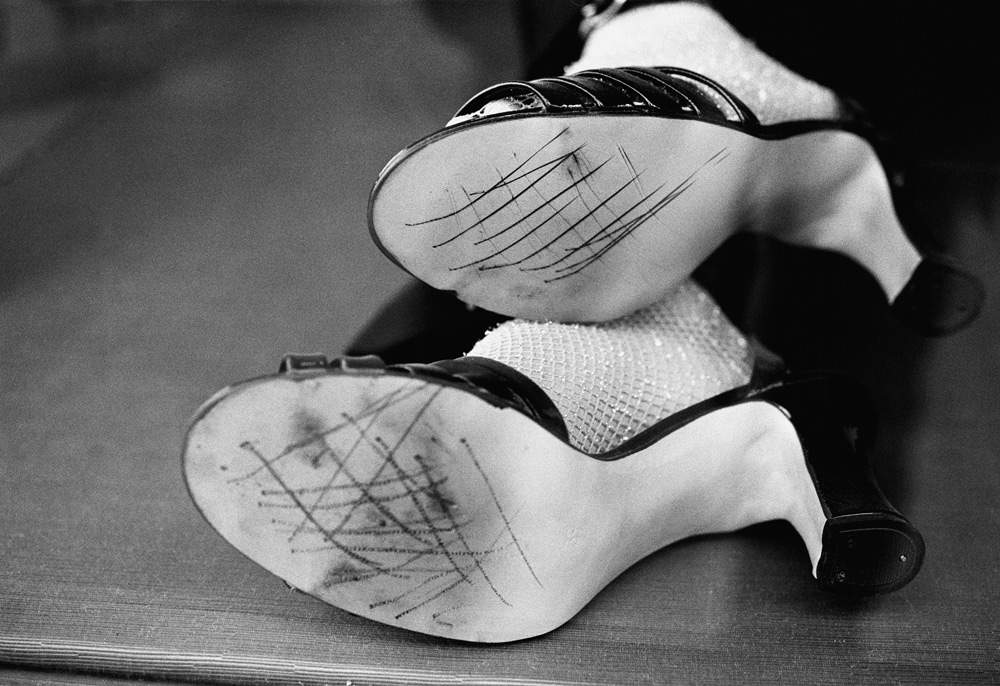
Olaf Unverzart (German, b. 1972) Untitled (from the series Fallen Kann Ich Auch Alleine)
1999
Pigment print
56 x 38cm/125 x 85cm
Courtesy of Oechsner Galerie
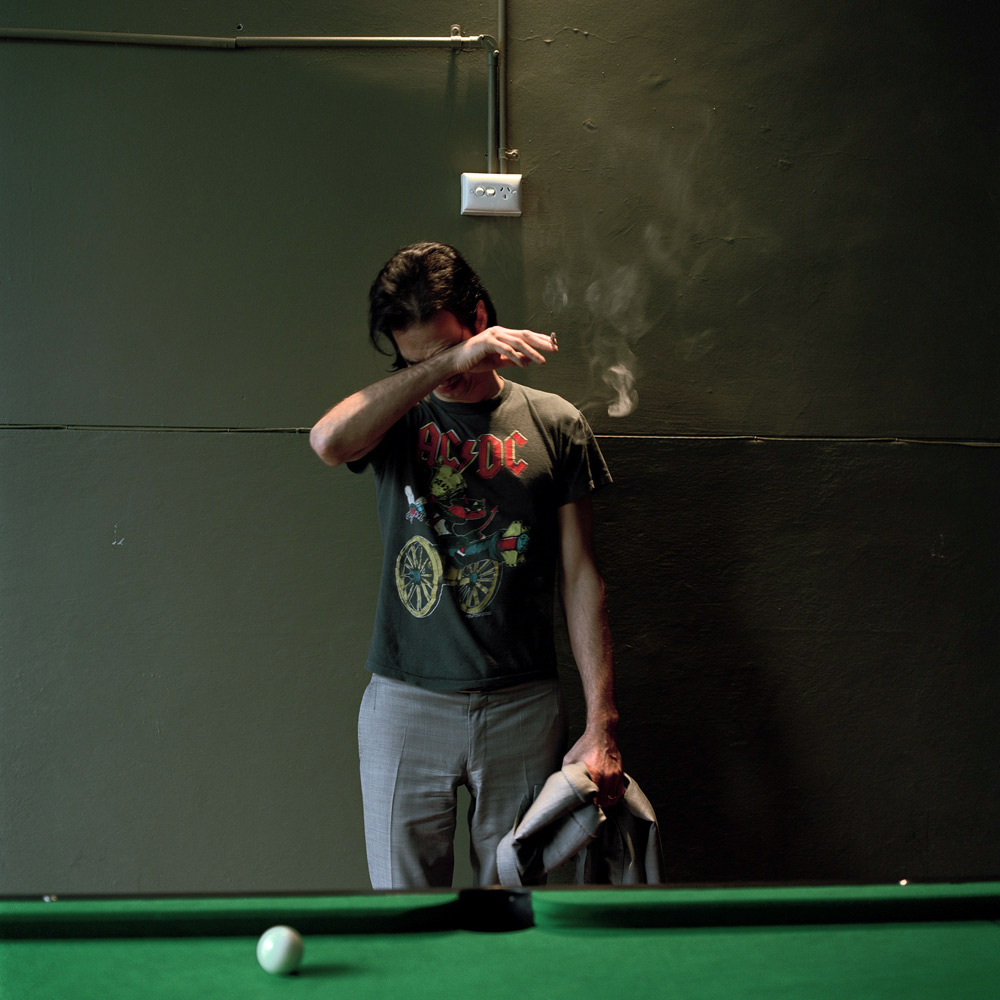
Ingvar Kenne (Australian born Sweden, b. 1965) Nick Cave 2001
From the series Citizen 1997-2012
C-type print
100 x 100cm
Courtesy of the artist
Narelle Autio (Australian, b. 1969) Untitled 8 (from the series Not of This Earth) 2001
Courtesy of the artist
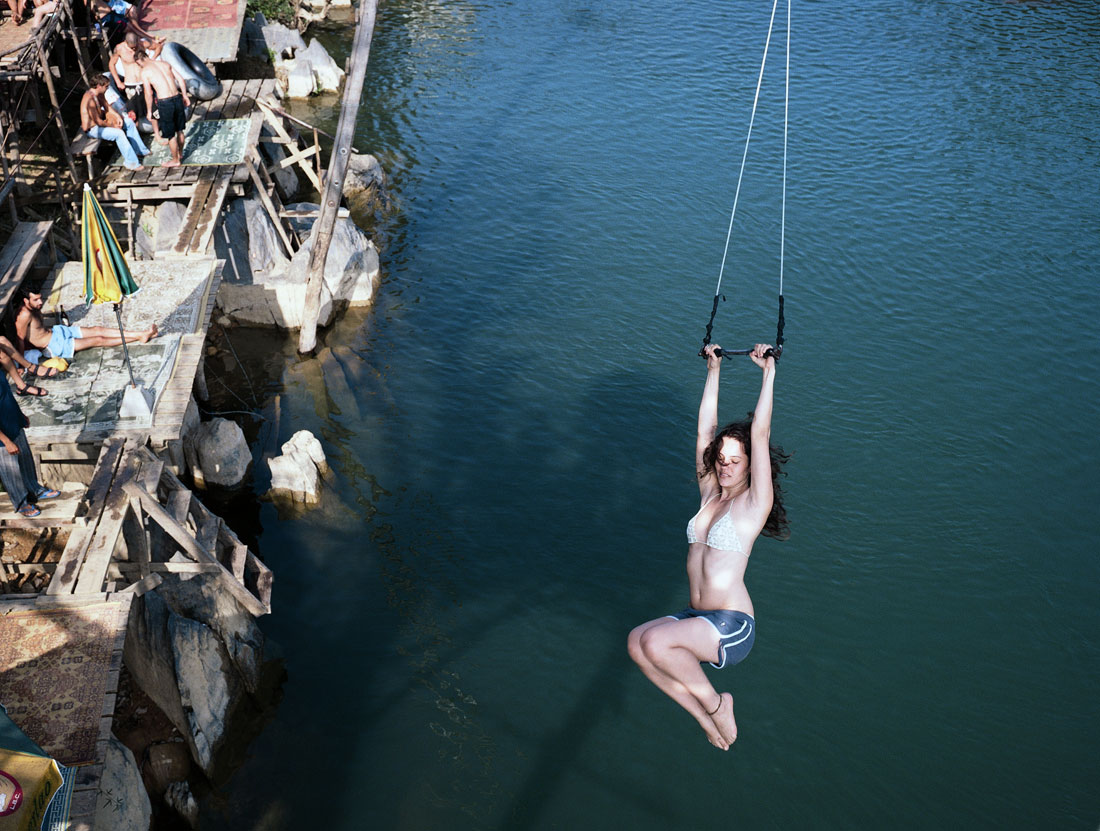
Jörg Brüggemann (German, b. 1979) Nam Song River, Vang Vieng, Laos, December 2007 2007
C-type print
69 x 57cm
Courtesy of the artist and Ostkreuz
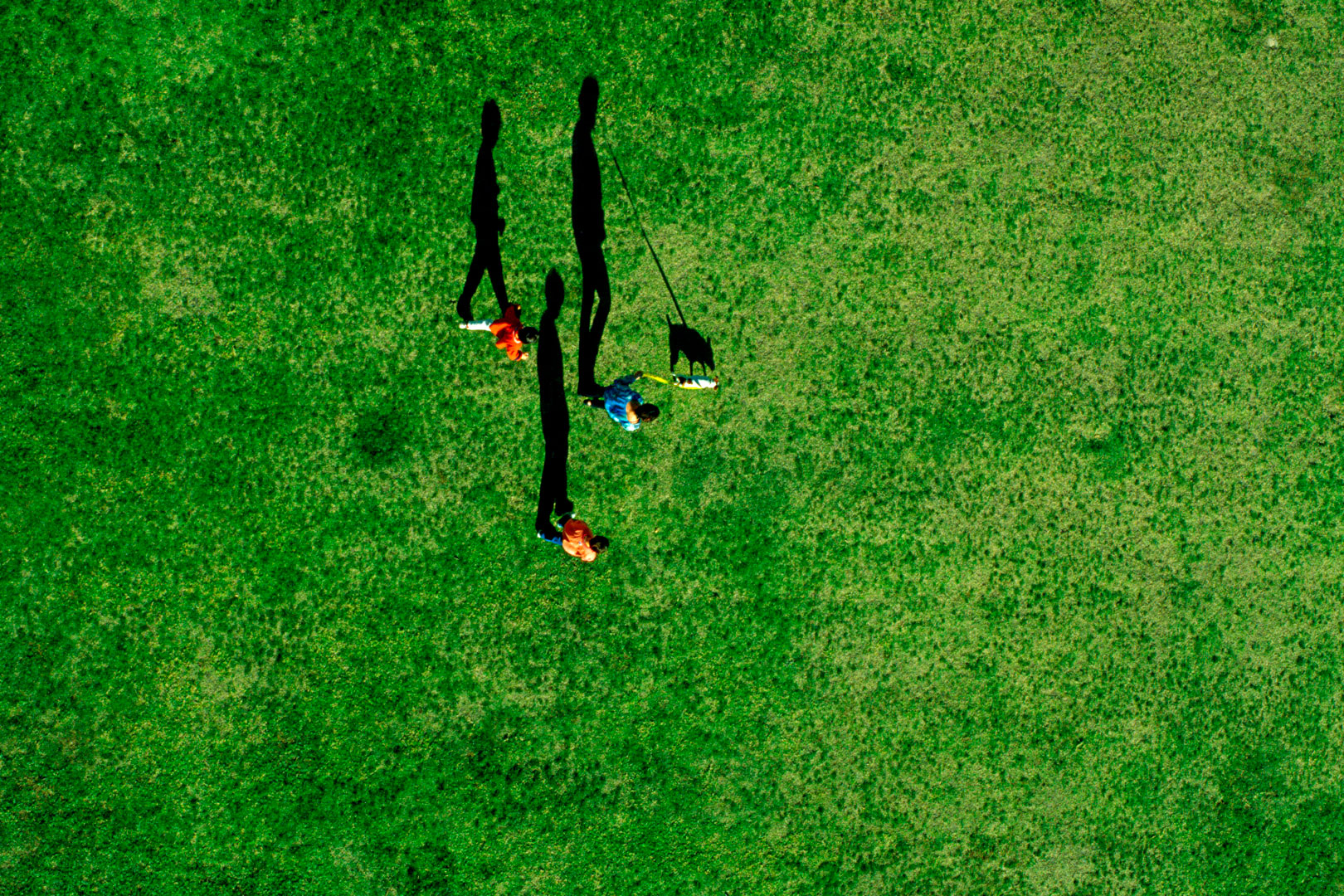
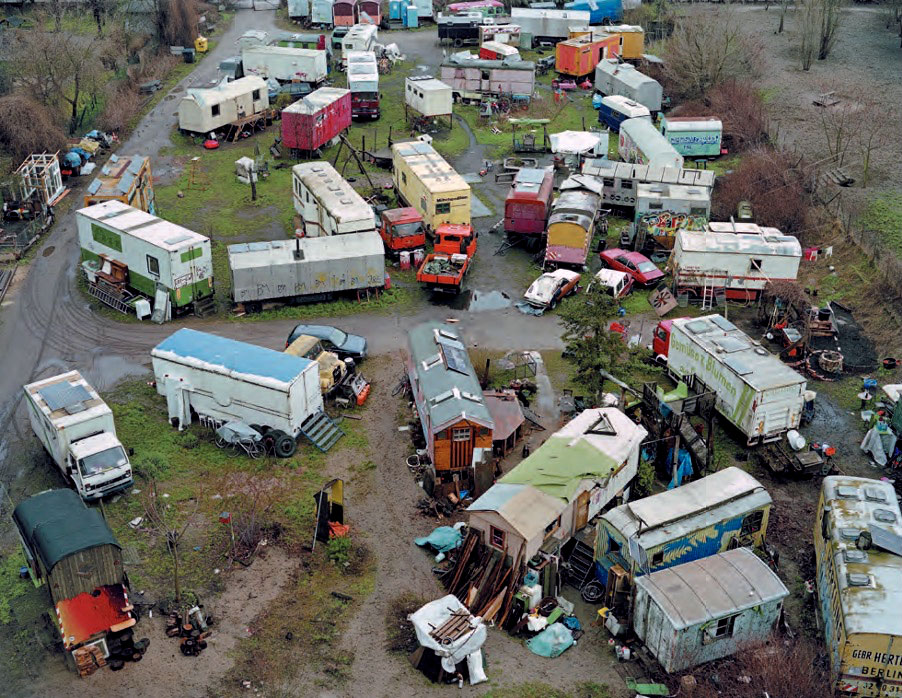
Johanna Ahlert (German, b. 1980) Truck and Trailer Castle, Berlin
2008
From the series CONVOI 2008
C-type print
100 x 127cm
Courtesy of the artist
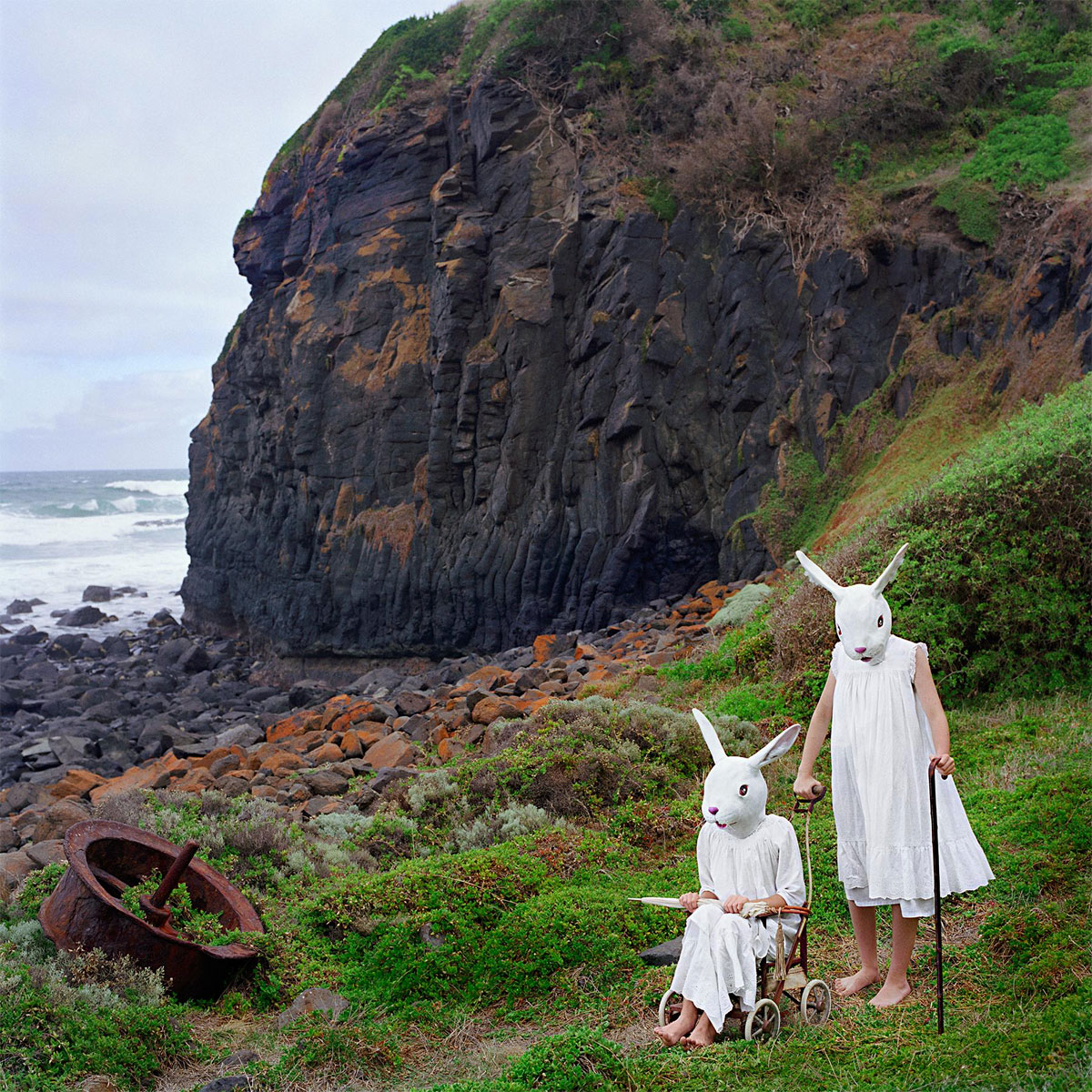
Polixeni Papapetrou (Australian, 1960-2018) The loners
2009
From the series Between worlds
Pigment ink-jet print
105 x 105cm
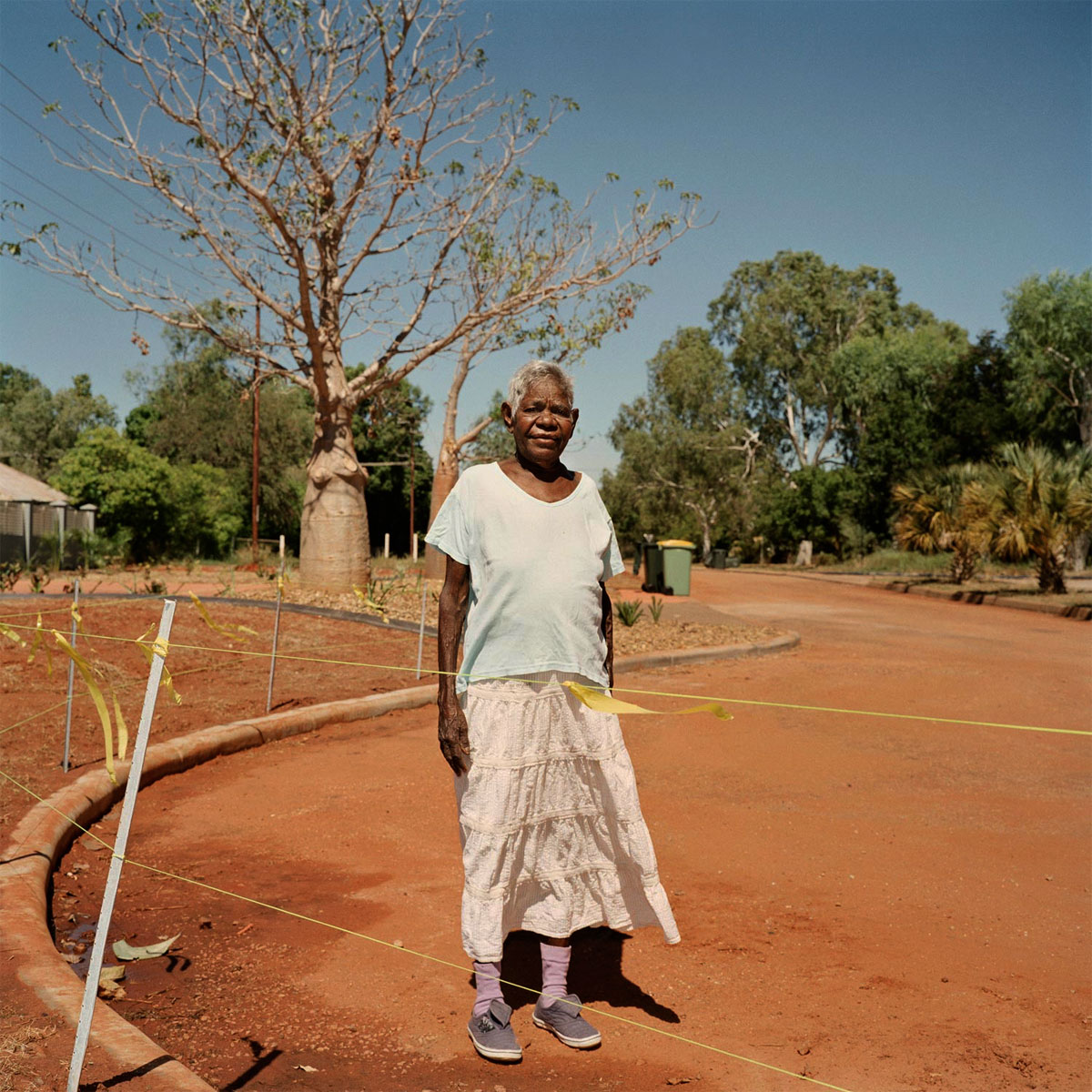
Ingvar Kenne (Australian born Sweden, b. 1965) Mona Chuguna, Author, Broome, Australia
2009
From the series Citizen 1997-2012 C-type print
100 x 100cm
Courtesy of the artist
Hijacked 2: Australia/Germany builds on the very considerable success of the inaugural exhibition, Hijacked 1 – Australia and America, and its internationally celebrated and hugely successful book. This new exhibition effectively considers two socially disparate nations, Germany and Australia, through an expansive photographic anthology of fascinating works, juxtaposed to suggest connections.
Hijacked 2 has been curated by Mark McPherson and Ute Noll and showcases the diverse talents and perspectives of thirty contemporary German and Australian photographers. With a focus on the depiction of the young, the boundary-riding, and the fringe-dwelling, Hijacked 2 is evocative, confronting, dreamlike and rousing.
Featured artists from Australia are: Narelle Autio, James Brickwood, Michael Corridore, Andrew Cowen, Tamara Dean, Suzie Fox, Lee Grant, Derek Henderson, Rebecca Ann Hobbs, Ingvar Kenne, Bronek Kózka, Georgia Metaxas, Polixeni Papapetrou and Louis Porter.
From Germany the artists are: Johanna Ahlert, Natalie Bothur, Jörg Brüggemann, Thekla Ehling, Albrecht Fuchs, Jan von Holleben, Karsten Kronas, Anne Lass, Jens Liebchen, Myriam Lutz, Julian Röder, Josef Schulz, Oliver Sieber, Ivonne Thein, Olaf Unverzart and Sascha Weidner.
Hijacked 2: Australia/Germany is toured by the Australian Centre for Photography. A substantial 412-page publication accompanies the exhibition with texts by Uta Daur, Bec Dean, Alasdair Foster, Bill Kouwenhoven, Katja Melzer, Daniel Palmer and Katrina Schwarz.
Text from the Anne & Gordon Samstag Museum of Art website
Ivon Thein (German, b. 1979) Untitled 07 (from the series Thirty-Two Kilos) 2006
C-type print
55 x 80cm
Courtesy of Galerie Voss
Oliver Sieber (German, b. 1966) Reita, Köln, 2007
2007
Pigment print
34 x 27cm
Courtesy Galerie Priska Pasquer, Germany
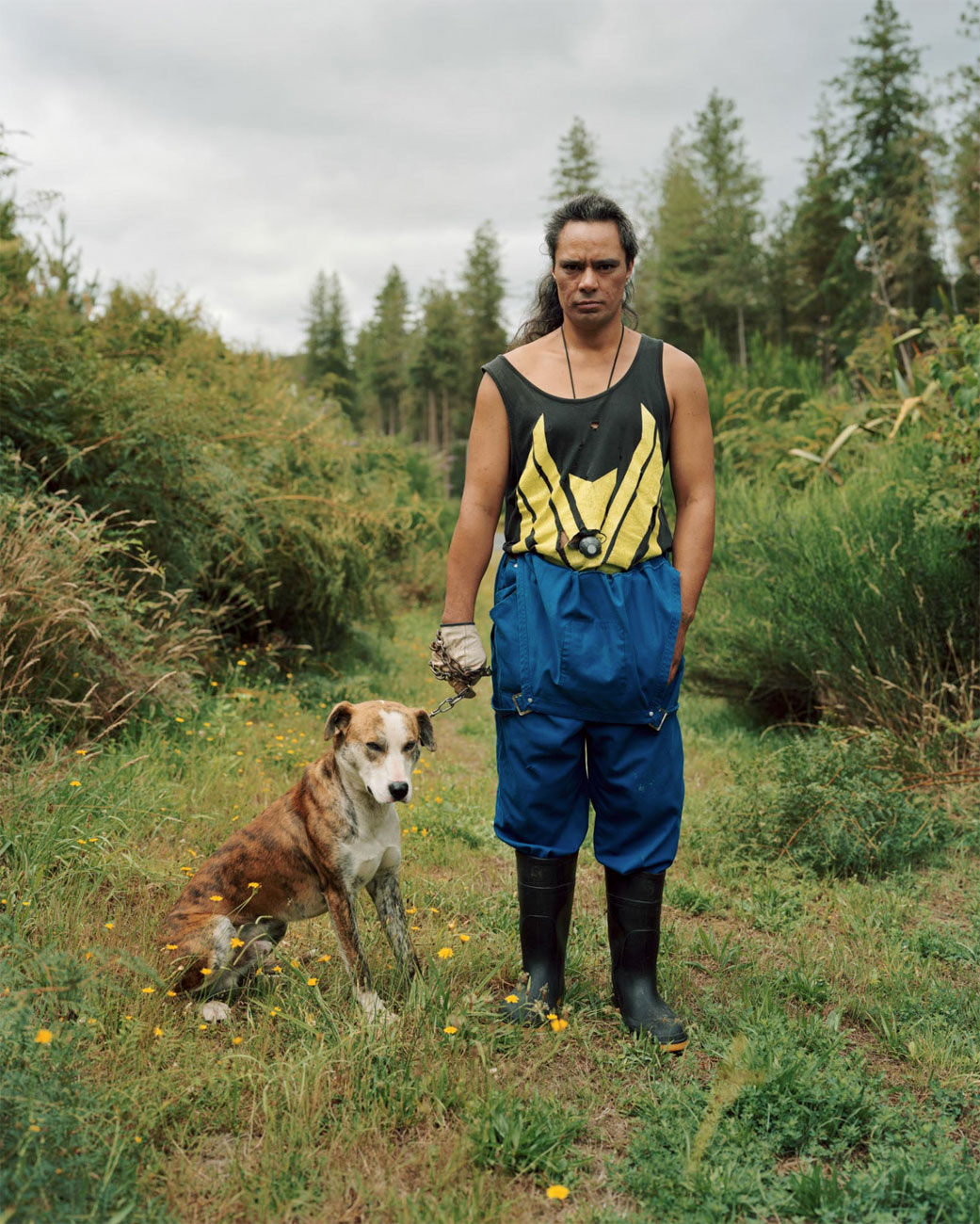
David Henderson (New Zealand, b. 1963) Dave Omeka Kidwell and Feather, Ātiamuri
2008
From the series Mercy Mercer
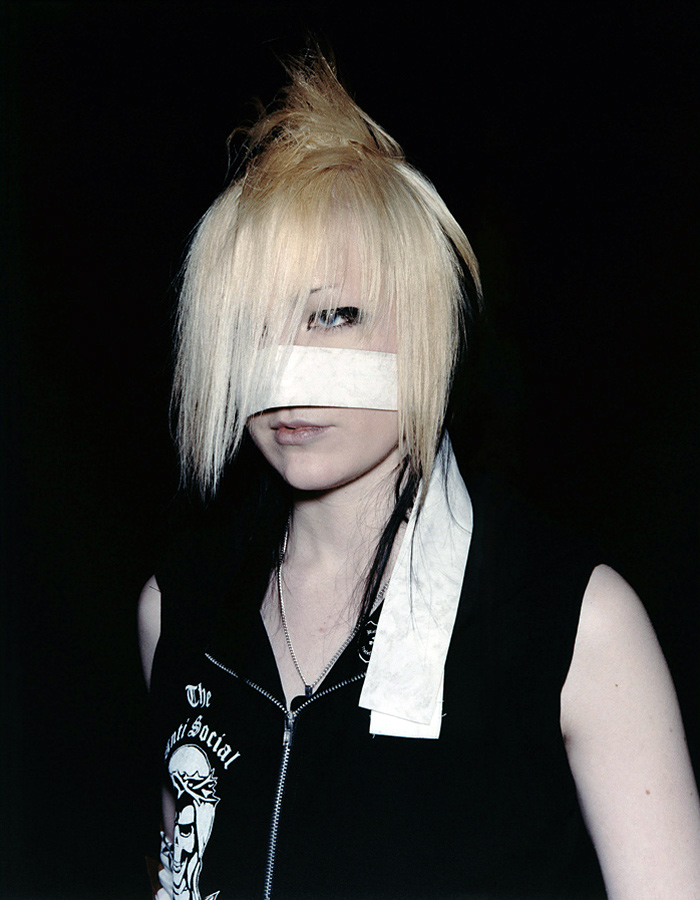
Thekla Ehling (German, b. 1968) Untitled
2011
From the series Vergiszmeinnicht (forget-me-not)
Anne & Gordon Samstag Museum of Art Hawke Building, City West campus
University of South Australia
55 North Terrace, Adelaide Phone: (08) 8302 0870
Hot on the heels of my reviews of Stormy Weather: Contemporary Landscape Photography at NGV Australia and Sidney Nolan: Drought Photographs at Australian Galleries, Melbourne comes the exhibition Photography & place: Australian landscape photography, 1970s until now at the Art Gallery of New South Wales. An insightful, eloquent text by Vigen Galstyan (Assistant curator, photographs, AGNSW) accompanies the posting.
Dr Marcus Bunyan
Many thankx to Susanne Briggs for her help and to the Art Gallery of New South Wales for allowing me to publish the photographs and the text in the posting. Please click on the photographs for a larger version of the image.
Australian born and American based photographer Douglas Holleley has experimented with many aberrant photographic techniques over the course of his career. Holleley received a Bachelor of Arts in Psychology in 1971 at Macquarie University before relocating to America to undertake a Master of Fine Arts, studying at the Visual Studies Workshop in Rochester, New York between 1974 and 1976. Founded by Nathan Lyons in 1969 and affiliated with important photographers including Minor White and Frederick Sommers, the Visual Studies Workshop was a bedrock institution that fostered innovative photographic practice from the 1970s onwards. It was here that Holleley received tutelage from Ansel Adams in 1975. His early photographic output includes hand coloured black and white photographs as well as photograms and gridded arrangements of Polaroids. He later began experimenting with digital photography, applying the same principles of the photogram to his experiments with a flatbed scanner.
During the time spent studying photography in America in the 1970s Holleley became interested in Polaroid technology. When he returned to Australia in 1979, before later relocating permanently to America, Holleley commenced an extensive photographic project of documenting the Australian bush with a Polaroid SX-70 camera, effectively becoming one of the first professional practitioners of the medium in the country. The resulting images were presented as a series and published as a book – Visions of Australia – in 1980. Employing a refined formalist vocabulary, Holleley produced photographic mosaics by arranging his Polaroids into gridded compositions.
Dissected, disassembled and then collated within the pictorial frame, the landscape in Holleley’s works becomes slightly unnatural and detached. These works negate linear single point perspective by focusing on the ground and reducing the scene to a formal composite. Here, the expanse of the view and the horizon does not dominate the space of the image. The tessellating images produce a ‘whole’ that is slightly misaligned and unsettled. In some works, the photographer’s shadow is visible. It asserts itself as an ambivalent presence that is not tethered to the scene. This spectral form heightens the sense of disquiet that pervades the images.
Text from the Art Gallery of New South Wales website [Online] Cited 16/01/2020
Ian North is an Adjunct Professor of Visual Arts at both the University of Adelaide and the University of South Australia. He is a photographer, painter and writer, and was the founding curator of photography at the National Gallery of Australia 1980-1984. Throughout his career, he has been concerned with the legacy of Australian landscape, the impact of colonial narratives and their established visual conventions and, as a consequence, the politics of representing the subject. …
North’s methodology is concerned with the processes of vision and interaction as they have shaped the landscape. In Canberra Suite North presents an encyclopaedic record of Walter Burley Griffin’s intricately designed city, exploring the spatial interface between nature and humanity. The works are absent of human life – reminiscent of Ed Ruscha’s Twenty-six Gasoline Stations. The emotional ambivalence of the images is reflected in their use of colour, like that of postcards. As one of the first instances of larger format colour art photography in Australia, the images topographically map space as a depersonalised, banal subject. Yet their colour, like that of landscape painting, highlights flora, revealing the number of non-native plants included in Canberra’s design. As such, these artefacts of North’s private wanderings and systemic mode of looking are able to subtly critique colonialism.
Text from the Art Gallery of New South Wales website [Online] Cited 16/01/2020
EARTH SCANS AND BUSH RELEVANCES: Photography & place in Australia, 1970s till now
For many of us, landscape is a noun. A view from the window or the balcony, a strange immaterial ‘thing’ that makes people exclaim in awe, point to in pride, recall nostalgically, pose in front of or be used to bump up real estate prices. If one is an urban dweller, which most Australians are, then the landscape exists essentially as a mirage, something to create in the backyard, occasionally look at on holidays or hang on the walls. However, noted American cultural theorist and art historian W. J. T. Mitchell has proposed that we should think of landscape as a verb: an act of creation on our part that engenders cultural constructs, national identities and shared mythologies.
Photography & place is an exhibition that investigates this process of ‘landscaping’ through the work of 18 Australian photographers between the 1970s and now. Their significant contribution to representation of landscape broke new ground in what has always been a confounding topic. Indeed, as Judy Annear has pointed out in a 2008 essay in Broadsheet magazine, the practice of documenting and interpreting the notion of ‘place’ in Australian photography has been fragmentary in comparison to traditions in America, Europe or New Zealand. This reluctance to focus on the natural environment is perhaps a residue of the ‘terra nullius’ polemic, which shifted the attention of many photographers on the building of colonial Australia. Photography from the mid 19th to the early 20th century by photographers such as Charles Bayliss and Nicholas Caire actively documented the conquest of nature by white settlers, or presented views of untouched wilderness as epitomes of the picturesque: endless waterfalls, lakes, forests in twilights, enigmatic caves and an occasional nymph like creature prancing. Despite Bayliss’ efforts to show the indigenous people on their land, they are, as Helen Ennis observed in her 2007 book Photography and Australia, conspicuous by their absence: the land that we see surrounding them in early Australian photography by the likes of J.W. Lindt is often a mass-produced painted studio backdrop.
The advent of modernism in the 1930s only served to entrench the photographers deeper into the urban space. ‘Place’ is the city and it is here that industry, progress and culture shapes the Australian identity. It is still difficult to dislodge the iconic images of Max Dupain and David Moore as epitomes of Australianness, promulgated as they were through countless renditions in mass media and consumer culture. But as post-modern anxiety started to seep through the patchwork of the Australian dream, it was landscape that many critically informed photographers turned to as a tool for analysis and revision.
A number of factors conflated in the mid 1970s, engendering a radical shift in perspectives. One of the primary forces that began to reshape the approaches to landscape in Australian photography was the awareness of new artistic movements taking place in USA and Europe. The enormously influential exhibition New Topographics: Photographs of a Man-Altered Landscape held in 1975 at the George Eastman House, Rochester, consolidated the spread of minimalist and conceptually informed photography which was avidly embraced by a younger generation of Australian photographers. One can also cite the rise of the Australian greens movement in Tasmania, the increasing awareness of Indigenous cultures and rights and not the least, the phenomenon of university-educated photographers as key milestones during this decade.
Lynn Silverman, Douglas Holleley, Jon Rhodes, Wes Stacey and Marion Marrison were among the practitioners who pointed their lenses out of the city, often exploring the fringes of human settlement and sometimes as in the case of Silverman, Stacey and Holleley, venturing into the desert. The element that collectively stamps their work is the ostensible fragmentation of the landscape. Instead of the holistic, positivist postcard views of Australia, we get something resembling a lunar vista. The palpable sense of alienation in American expatriate Lynn Silverman’s striking Horizons series from 1979 echoes in the disorienting grid-based Polaroid assemblages by Holleley conjuring up a space that appears hostile and to a degree indifferent to our presence. The foreignness of these landscapes is not necessarily a malevolent force as was customary to show in a slate of Australian New Wave films of the 70s and 80s. Rather a much more meditative stance is taken in regards to our relationship to a place which has been claimed without being understood or in many ways respected. Ingeborg Tyssen’s photographs hint at existing presences, forms and phenomena which are full of life and meaning that remain perpetually unresolved to an outsider. The imported paradigms of Western culture can not take root in this environment. One could easily define the landscape photography of this period in Lynn Silverman’s words as “an orienting experience” and a belated attempt at a proper reconnaissance of the land.
The coolly detached outlook that underlines the investigative drive of most of these photographers is magnified by their adoption of serial or multi-panel formats. It was certainly a way to expand and collapse the accepted faculties of the pictorial field, challenging and questioning the accepted notions of photographic ‘truth’. Jon Rhodes demonstrates the inherent power of this simple device in his cinematically sequential Gurkawey, Trial Bay, NT 1974, which transforms a seemingly wild and uninhabitable swamp into a joyful playground of an Aboriginal child.
In some instances the photographic approach is more concerned with elucidating the nature of the photographic image itself and the way it can influence and control our perception. As Arnold Hauser has lucidly described in his groundbreaking Social History of Art, images have always been used to secure and infer political power. As such, the metamorphosis of a visual representation into an iconographic one carries within it an element of danger as images begin to seduce the viewer away from objectivity. Indeed, images of Australia have been the most relentlessly and carefully used signifiers in promoting a (colonial) national consciousness by political, commercial and cultural institutions. In this light, it is not difficult to see the works of Wes Stacey and Ian North as acts of iconoclasm. Stacey’s droll and gently parodic series The road 1973-1975, charts a snapshot journey that goes nowhere. Seemingly random, half-glimpsed shots of empty dirt roads, sunburnt grass mounds and endless highways emanate a sense of rootlessness and displacement, negating any possibility of objectification or identification with the landscape. Instead of epic grandeur and jingoism we get something that is confronting, uncomfortably real and in no way ‘advertisable’.
‘The Real’ is even more startling in Ian North’s subversive Canberra suite 1980-81, where the utopian dream capital has been reduced to banal ‘documents’ of depopulated, custom-made suburbia. The hyperreal concreteness of North’s Canberra gives the city an aura of a De Chiricoesque waking nightmare. In line with the set practices of conceptual photography of the period, North has distilled his images from any sign of formal mediation, forcing the viewer to focus on the raw content. It is through this forensic directness that the strange incongruity of human intervention within the landscape becomes ostensible.
Daniel Palmer has noted that North’s images “are highly prescient of much photography produced by artists in Australia today”. Certainly by the 1980s photographers became more actively engaged in analysing the nature / culture median. Strongly influenced by feminist and post-colonial theory, a number of practitioners used photography as a medium to document ideas rather than objective reality. Anne Ferran and Simryn Gill are particularly notable in this regard. Both artists are concerned with the historical and political dimensions of the locations they chose to photograph, resulting in multi-layered and complex strategies that require more involved intellectual interaction from the audience. Gill’s ‘staged’ photographs relate to us the agency of nature and time upon the cultural environment. Synthesis and amalgamation of outwardly irreconcilable elements – imported plants, Australian bush, cotton shirts – slowly, but surely melt into new, as yet unknown entities in Rampant 1999. The force of inevitable decay is absolute yet imbued with generative power as well. Exploring the constantly shifting certainties of what constitutes a ‘place’ the artist draws the audience into questioning its own role in this transformative process.
Ferran takes a more archaeological position in relation to her subject matter. Her eerie surveys of rather ordinary grass mounds in the series Lost to worlds 2008 become evocative paeans to obliterated lives, once we learn that the mounds are all that remain of the factories where convict women were sent to work. Looking at these shimmering ghost worlds one is reminded of Walter Benjamin’s essay The Ruin where the writer analyses the capacity of ruins to reveal the “philosophical truth content”. It is through this allegorical device that Ferran achieves a degree of rehabilitation for the absent histories she photographs.
History, in its manifold and troubling guises, is directly ‘exposed’ in the landscapes of Ricky Maynard, Michael Riley and Rosemary Laing. As Indigenous photographers, Maynard and Riley have played an important role in translating the cultural and political status of Aboriginal peoples into a ‘language’ that is universally understood. Their work remains firmly rooted in the traditions of contemporary art, yet the heavily symbolical slant shows a more ardent and personal engagement with the Australian landscape. Riley’s expressionistic series flyblown 1998 sums up in a few strategically juxtaposed metaphors the spiritual dimension of the landscape, while simultaneously revealing the diverging connotations of Australia’s fundamentally divided identity. The colonial legacy is shown as one of conquest and domination that clashes with the artist’s engagement with country. Maynard’s Portrait of a distant land 2005, explores the same dichotomy in more site specific terms. After permanently settling in Flinders Island, Maynard decided to return to the portrayal of Tasmanian Aborigines, taking a more collaborative approach. He sees this as a way of bypassing the propensity of the photographic image “to subjugate its subjects”. The resulting series is a profoundly poetic treatment that rises above social documentation to suggest the wider implications of historical change and disclose the ability of people to overcome what the artist has described as victimisation through a deeply compassionate relationship with the land. Ultimately Maynard gives us an edifying testimony to the affirmative power of the landscape as collective memory.
Interest in the political aspects of landscape photography has continued unabated into the 21st century. Yet a more philosophically inclined thread has become evident in the last two decades. No longer is it enough to deconstruct and pull apart ideas about landscape’s relationship to identity and nationhood. What photographers like Bill Henson, David Stephenson, Simone Douglas and Rosemary Laing question is the very possibility (or impossibility) of seeing itself. If positioning oneself in relation to nature seems like a distinct, albeit problematic proposition in the 1970s and 80s, the later works in the exhibition are resolutely ambivalent on the subject.
What can one grab onto when faced with the endless expanses of white in Stephenson’s The ice 1992, the terrifying darkness of Henson’s night scenes or the infuriating haze of Douglas’s twilight worlds? Perhaps the only recourse is to dissolve into the beckoning ‘forever’ of the vanishing point in Laing’s To walk on a sea of salt 2004. This void is not a boundary point between nature and culture – it is where culture ends and an entirely new state of consciousness begins: the realm of the sublime and the imagination. As history seems no longer to be trustworthy, ‘place’ can only be constructed as a metaphysical entity. It is a curious turnabout in some ways that echoes some of the early, turn-of-the-century encounters with the Australian landscape by photographers such as John Paine and Norman C. Deck. The sense of fear and awe towards the unfamiliar environment permeates their images, transcending the merely investigative / didactic motives of most colonial photography. What has eventuated from walking into this environment? Subjugation? Destruction? Incomprehension? Indifference? By going back to the point zero of the void and the sublime, contemporary photography negotiates a second attempt at engagement with nature through a renewed and deeper understanding of humanity’s symbiotic relationship with this life-giving force.
Vigen Galstyan Assistant curator, photographs1
1/ Galstyan, Vigen. “EARTH SCANS AND BUSH RELEVANCES: Photography & place in Australia, 1970s till now,” in Look gallery magazine. Sydney: Art Gallery Society of New South Wales, 2011, pp. 25-29.
Michael Riley received his first introduction to photography through a workshop at the Tin Sheds Gallery in Sydney, 1982. A Wiradjuri / Kamilaroi man, the artist moved to Sydney from Dubbo in his late teens. He became part of a circle of young Indigenous artists drawn together in the city at that time. A founding member of the Boomalli Aboriginal Artists Co-operative Riley was also a key participant in the first exhibition of Indigenous photographers at the Aboriginal Artists Gallery, Sydney in 1986 (curator Ace Bourke). In 2003 Riley’s work was selected for the Istanbul Biennial, and in 2006 his work was permanently installed at Musée de quai Branly, Paris. A major retrospective toured nationally in 2006-2008.
Riley’s fine art photography began in black and white but he quickly progressed to large-scale colour, a format that also expanded the cinematic qualities of his images, no doubt reflecting the influence film and video were having upon the artist as he worked simultaneously with these media. He produced, for example, the documentaries Blacktracker and Tent boxers for ABC television in the late nineties.
The photographic series flyblown bears a close relationship to the film Empire which Riley created in 1997. Like the film, these photographs give expression to the artist’s concern with the impact of European culture upon that of Australia’s Indigenous population, specifically, as he described it, the ‘sacrifices Aboriginal people made to be Christian’ (Avril Quaill, ‘Marking our times: selected works of art from the Aboriginal and Torres Straight Islander Collection at the National Gallery of Australia’, National Gallery of Australia, Canberra 1996 p. 66).
Christian iconography looms large in the series, as it has across much of Riley’s work. In flyblown, an imposing reflective cross is raised in the sky. Repeated in red, gold and blue its presence is inescapable. A symbol capable of inspiring awe, fear, devotion, Riley also engages with its elegiac qualities so that it functions as memorial marker. Another image depicting a bible floating face down in water conceptualises the missionary deluge, perhaps; submersion and loss through baptism, definitely.
flyblown reverberates with a subtle ominous hum – the quiet tension that precedes a storm. The parched earth beneath a dead galah seems to ache for the rain and water promised in the other images of clouds and dark skies. The nourishment Christianity offered and the inadvertent drowning of traditional culture that often followed is implied.
Visually linking the natural environment with religious symbolism Riley articulates Indigenous spirituality’s connections to country and widens his examination beyond to examine the sustained environmental damage. The negative side effects of pastoralist Australia are indicated by contrasting images of the long grass of cattle pastures with that of drought and wildlife death.
Riley’s success in articulating these issues and complexities, incorporating religious iconography so laden by history and meaning is a testament to his sensitivity and subtlety. Allowing room for ambiguity, Riley provides space for the mixed emotions of the subject and its history.
Text from the Art Gallery of New South Wales website [Online] Cited 16/01/2020
In Rampant, Simryn Gill turned her eye once more on Australia ‘… to see if I could find friends among the local flora’. This series of photographs was shot in sub-tropical northern New South Wales and shows unnerving images of trees and plants dressed up in clothes. In the photographs these ghostly forms are seen lingering in groves of introduced plants such as bamboo, bananas, sugar cane and camphor laurels. The plants are dressed in lungis and sarongs, generic clothing from South and South- East Asia, where many of these plants originate. Rampant is a form of memento mori, a record of the aspirations that saw plants only too successfully introduced into a pristine terrain which was unable to offer any resistance to their feral ways.
French philosopher Gaston Bachelard condenses his complex thinking on creativity and the human imagination into the metaphor of a tree, with its living, evolving growth and the simultaneity of being earth bound and heaven reaching, symbolising both the real and ideal.1 However, what happens when that tree is a camphor laurel, an admirable thing in its native land but out of place and wrecking havoc along the creeks of rural New South Wales?
Many once-useful species are now noxious weeds and over-successful colonisers, despised for their commonness, their success, their over-familiarity, and for being where we feel they should not be. They disrupt the order we would like to impose and remind us of our fallibility when attempting to play god and create our own earthly Edens. The language of natural purity that we use to protect our landscape also resonates with the nationalist rhetoric used to police our borders and to decide who are acceptable new arrivals and who are illegal aliens, often determined through scales of economic and social usefulness.
Text from the Art Gallery of New South Wales website [Online] Cited 16/01/2020
1/ Gaston Bachelard, ‘The totality of the root image’, On poetic imagination and reverie, editor and translator Colette Graudin, Spring Publications, Quebec, 1987, p. 85.
Everything that I have felt about Tucker’s work Images of Modern Evil was eloquently spelt out by Robert Nelson in The Age newspaper on April 13th 2011 in a piece titled ‘Portrait of the artist as a hateful man’. Unfortunately, having searched The Age website, I cannot locate the online version of the writing.
Some of the best quotes from the piece are below:
“History is full of moralists who insulted people for their lack of virtue. A millennium, a century, a decade later, we read their invectives and cringe. The main cause of their distemper now seems little more than misanthropic jealousy, where the reasons for moral disapproval boil down to a hatred of other people having fun.”
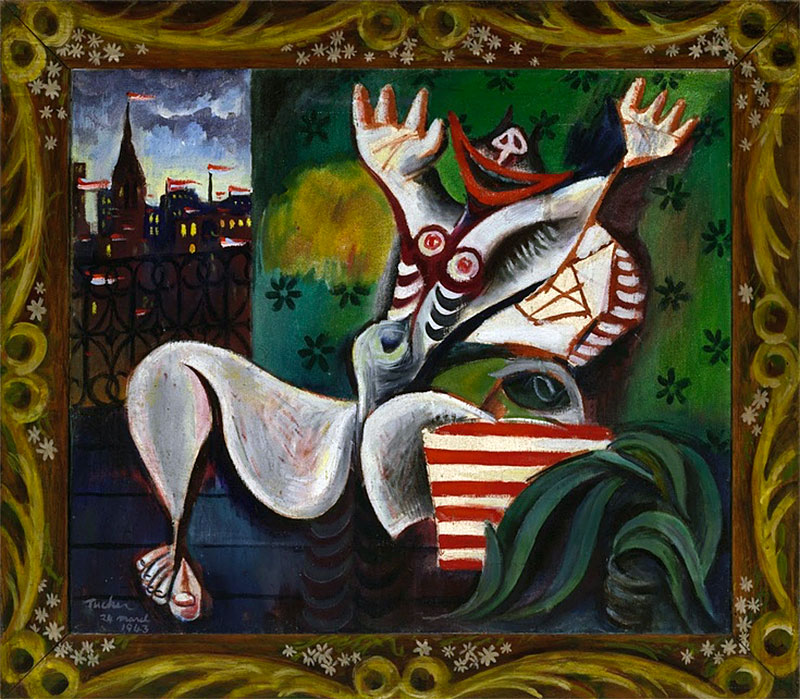
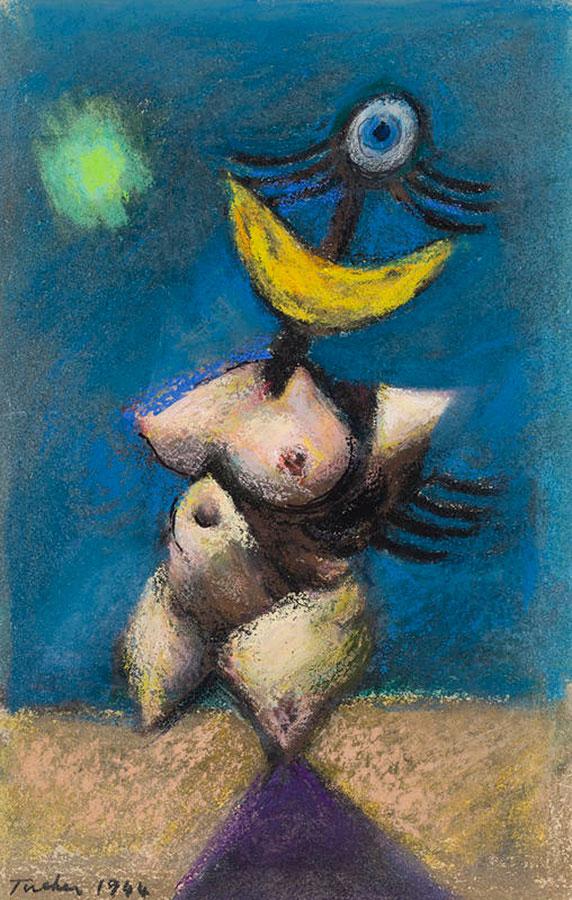
“Women for Tucker are disembodied monsters. Their limbs are abbreviated so as to focus attention on their fleshy core. The implication of these aesthetic amputees is grim: through their moral destitution, the women have transformed themselves into pure carnality, promoting their organs to men as mere flesh and with nothing in the head but an imbecilic smile.”
“Critics at the time were disgusted, recognising that the images are hateful and rancorous. But because Australia was determined to have modernism, it felt for 50 years that it had to swallow Tucker’s bile and consider it exquisite – like poison in Baudelaire – and make up political justifications for an odious sentiment.”
“Strip Tucker of his metaphoric filibustering, and you’re left with less weight than the shrivelled skulls of his strumpets. If Tucker’s women are happy lasses seeking fun with men, then why is their alacrity demeaned and condemned as sinister and vile? And if they’re prostitutes, why pick on the most vulnerable in society and stigmatise them for functional signs of joy?”
“Though accepted as heroically avant-garde, Tucker’s genre is pictorial slander. Just as an unproven allegation is destined to reflect on the plaintiff, so the man who accuses women of rotten morals – when no substance backs it up – stands accused of depraved motives.”
And best of all…
“None of the wartime circumstances that writers adduce can explain Tucker’s misogyny. His ferocity comes from a declamatory soul, impatient to score points and assert superiority. The exhibition reveals talent for painting but none of the humility to apply it to people.”
Nelson, Robert. “Portrait of the artist as a hateful man,” in The Age newspaper. Wednesday, April 13th 2011
Talent for painting but none of the humility to apply it to people. Very well said Robert Nelson.
Thank you for having the courage to enunciate what I, for one, have felt for a long time.
Go and visit the exhibition if you must, but if critics at the time found the work disgusting, hateful and rancorous viewing them from an historical perspective should not make them less so. These are works that lack the capacity to empathise with vulnerabilities of the human spirit and do not deserve the energy of an attentive audience to be spent upon them.
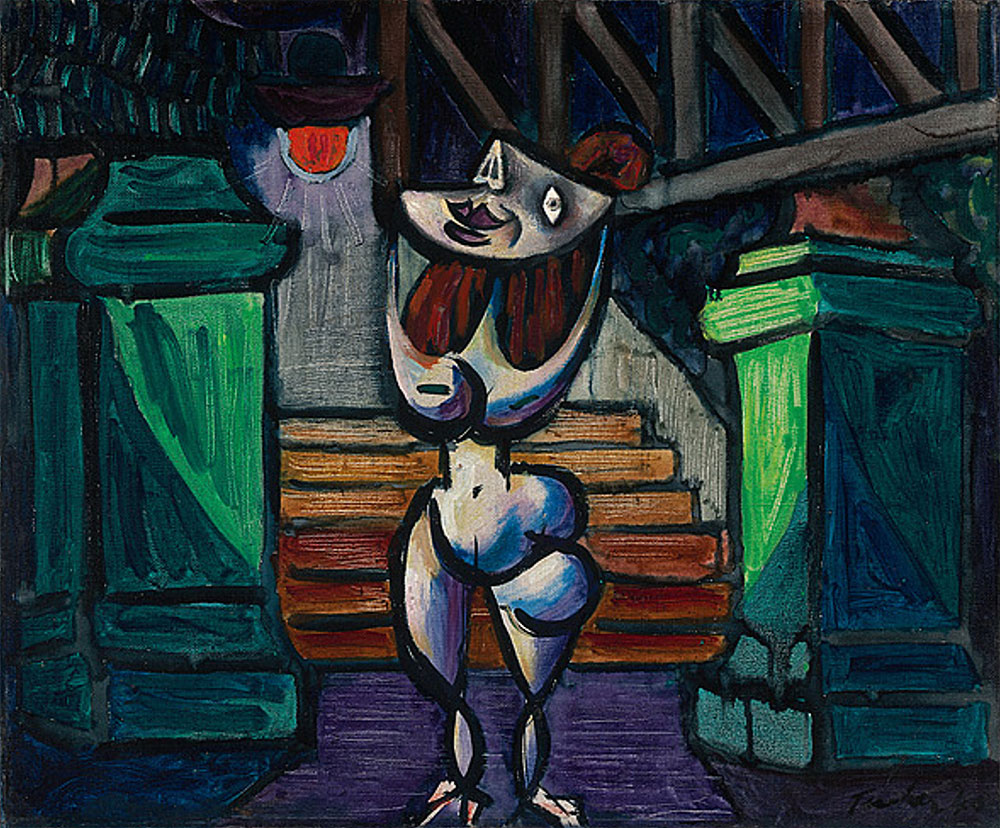
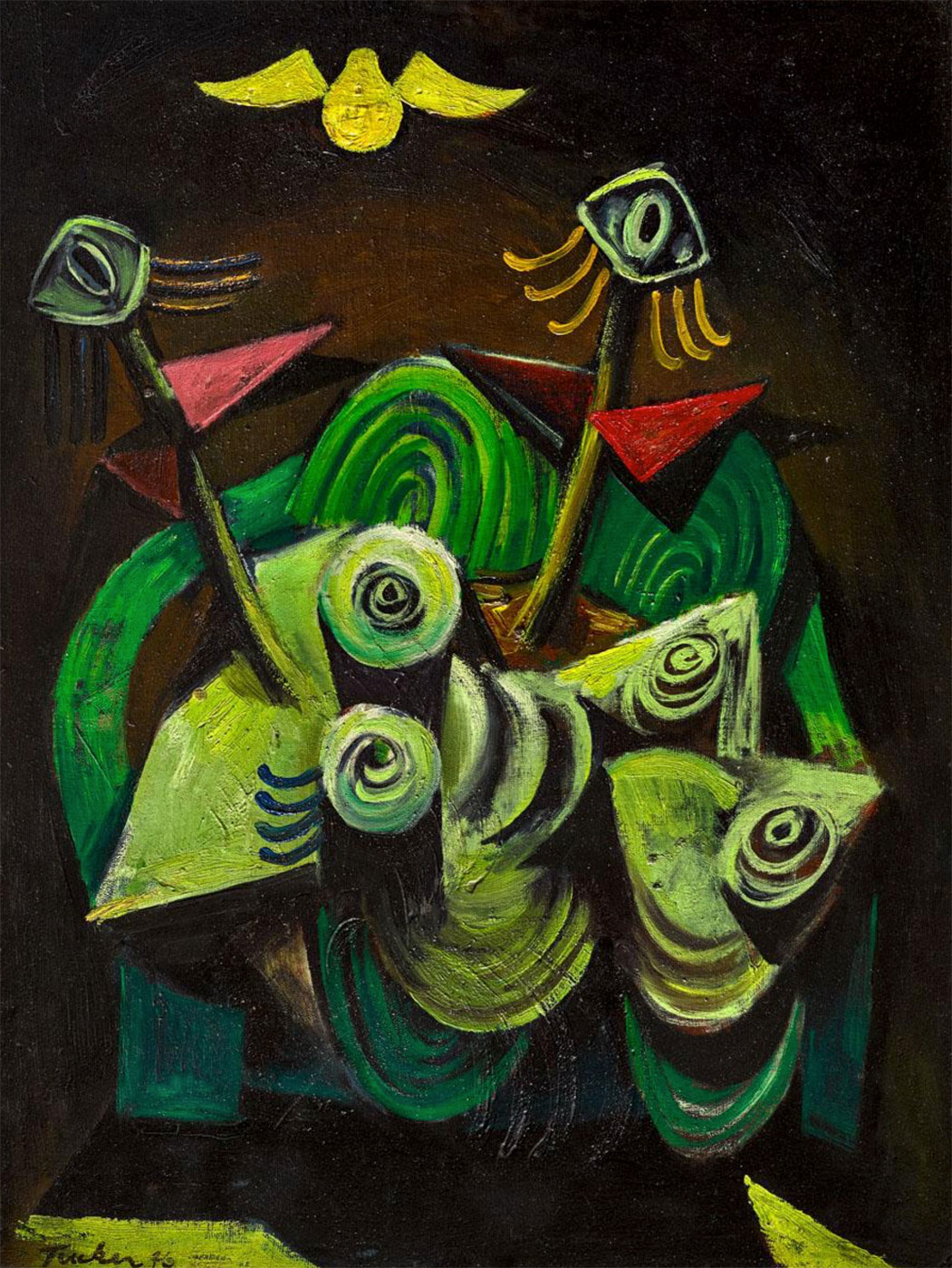
Albert Tucker (Australian, 1914-1999) Image of modern evil: Woman and clown 1943 Oil on canvas on composition board 20 2/5 × 28 1/2 in (51.8 × 72.5cm) National Gallery of Victoria, Melbourne
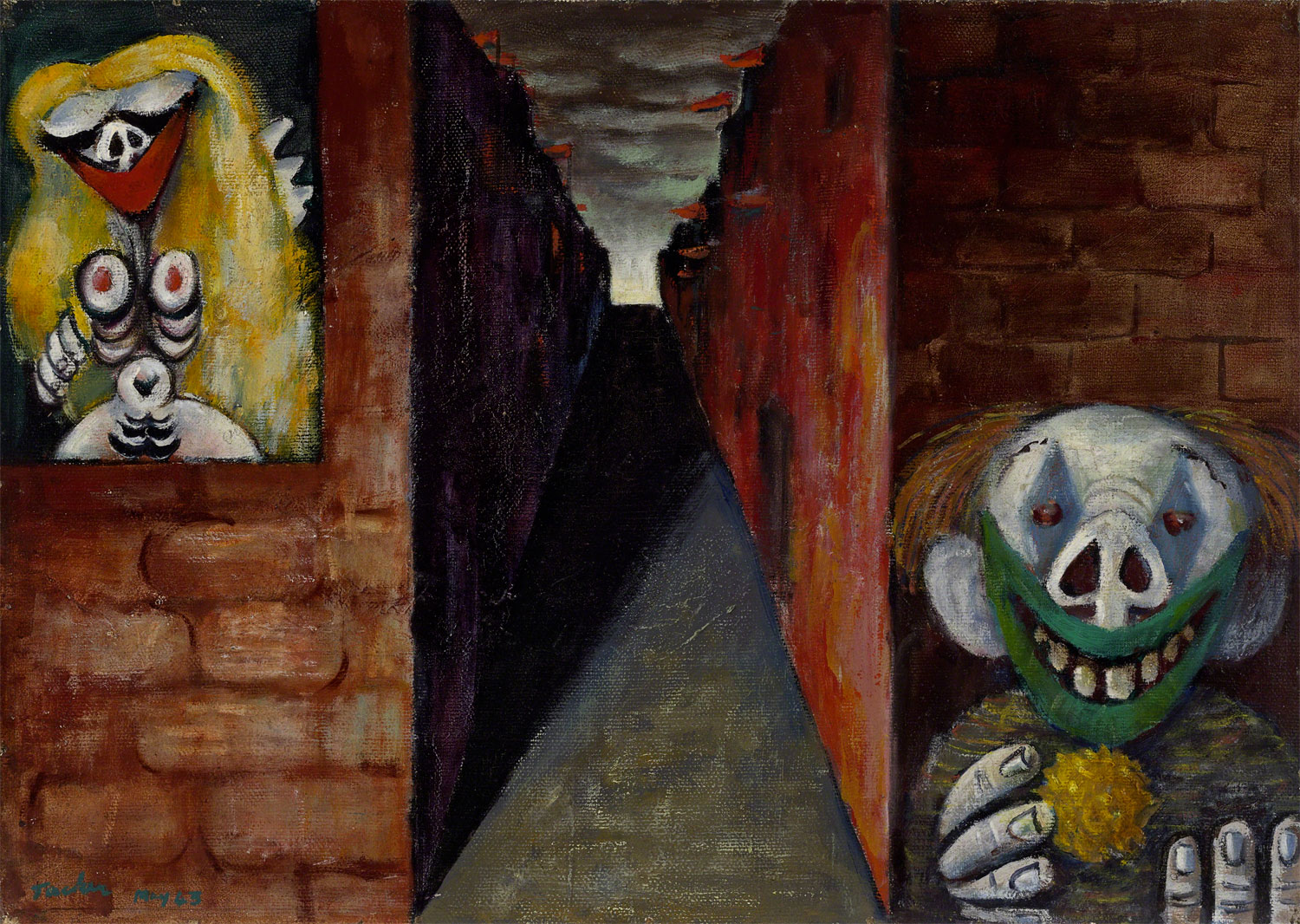
In 1943 Albert Tucker began a new phase in his art. Recently discharged from the army and primed with a fresh vocabulary of imagery that drew upon his wartime experiences, he commenced a suite of paintings which is now seen as a turning point in the advancement of modernism within twentieth-century Australian culture. The Images of Modern Evil series, painted between 1943 and 1948, offers a probing and powerful insight into the schismatic socio-political climate of World War II and its aftermath. Though neither critically nor popularly successful at the time, the series proved formative in Tucker’s practice as a distillation of humanist, psychological and mythological ideas and as a vehicle for specific motifs and narratives that have endured within his art.
The series starts with pictures of predatory and lascivious behaviour in Melbourne’s streets at night that have a gritty, elemental edge. As it progresses there is a greater sense of story-telling, and by the series’ end the influence of the avant-garde art of Pablo Picasso – in both style and subject – is clearly in evidence. Picasso was, however, but one of a variety of literary and artistic sources that Tucker drew on to help shape the Images: others included the poetry of T.S. Eliot; the imaginative creativity of the surrealists; the roughened political sentiments and social commentary of the German expressionists; and, pervasively, Carl Jung’s psychological treatises on irrationality, myths and archetypes, and on the personal and collective unconscious.
Tucker kept the Images of Modern Evil together and in his possession for more than thirty years, before 28 of the 39 constituent works were acquired for the collection of the National Gallery of Australia in Canberra. Accompanied by studies, related works on paper and archival material, this is the first time that all locatable works in the series have been displayed together.
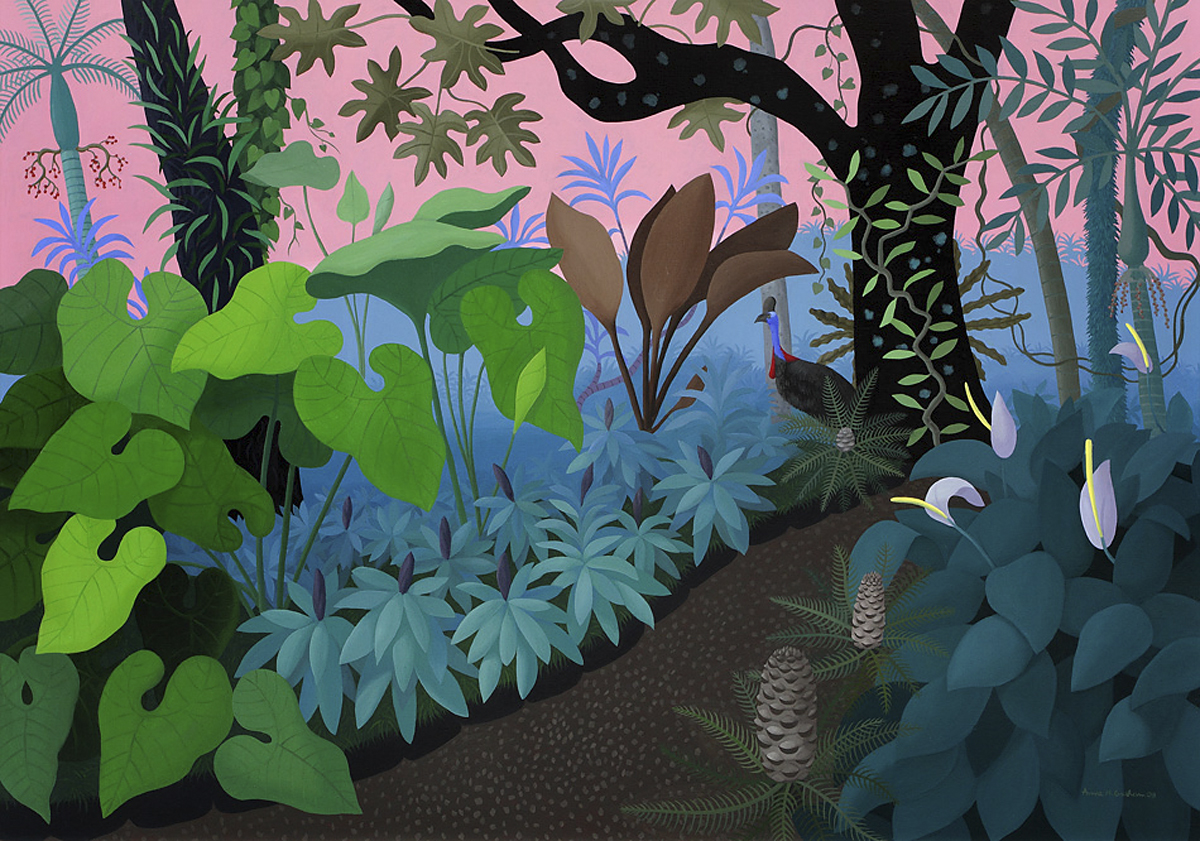
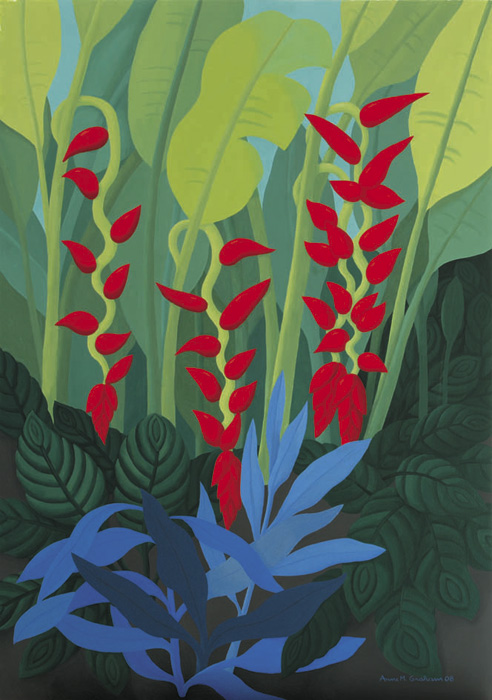
Anne Marie Graham (Australian born Austria, b. 1925) Jungle with Cassowary 2008 Oil on Linen 106 x 150cm National Museum for Women in Arts, Washington
I was walking around Anne Marie Graham’s new exhibition of painting at Gallery 101, Melbourne having read a review of her work on the gallery wall where the reviewer compared the structure of the work to the essentialness of the paintings of Giotto. A lady approached me and said, “You don’t want to believe everything that you read.”
And I said, “I don’t. I make up my own mind.”
This was the artist Anne Marie Graham.
We had a wonderful conversation about her work talking about space, colour and form. This is what Graham’s work is about. No conceptual arguments are needed. The work addresses the landscape in a magical way, drawing the viewer into the compositions like a piece of music. The viewer finds entrances and passageways, spaces through the images which open up a dialogue with the landscape.
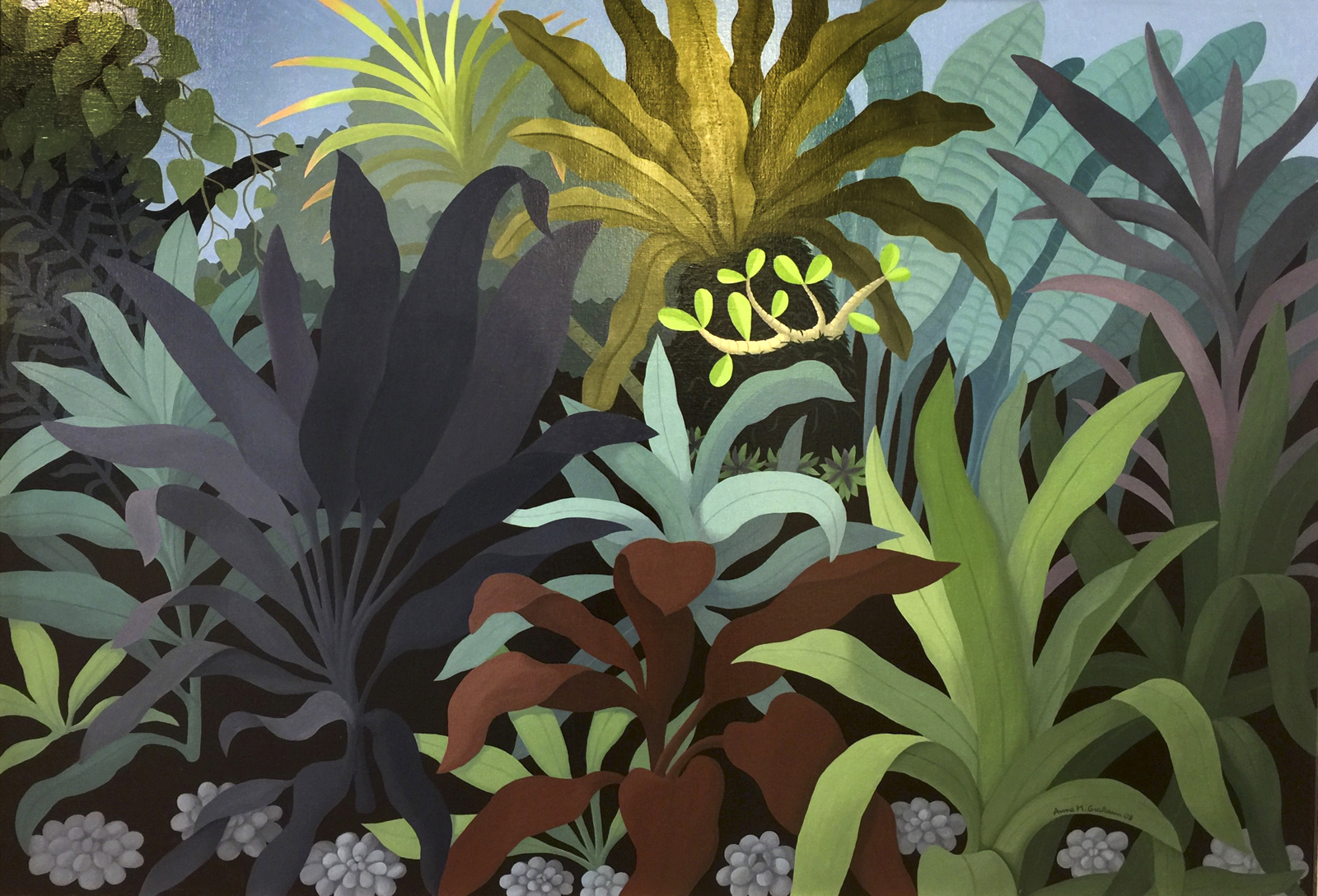
Using repeated patterns and layered construction, from bottom to top, from front to back, the images subtly push and pull the viewer: space quietly recedes and comes towards the viewer. Complimentary bands of colours are muted except for stunning highlight colours – the red of flowers, the blue of leaves or the unexpected pink or yellow of a background. The forms and textures delight. Dr Sheridan Palmer is correct, these paintings have an almost hypnotic effect, meditative and peaceful. They make you feel good!
Their presence is undeniable. For such complex paintings, which on the surface seem very simple (a difficult task to accomplish); for such essential representations that address the heart of the matter… their affect is powerful.
Graham’s refined aesthetic allows the viewer to engage with the poetic spaces she creates, allowing them to appreciate the colour fields, plants and landscapes she orchestrates and to be subsumed into their fold. Here we come to understand the diverse empathy of an artist who lays it all ‘on the line’ and knows how to do so in a brilliant way.
A talented artist and a nice lady as well – what more can you ask for!
Dr Marcus Bunyan
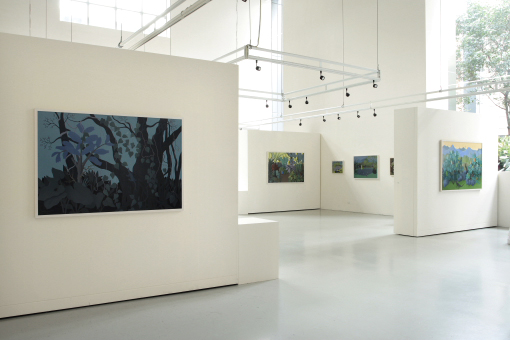
Exotic Queensland: Recent Painting installation views at Gallery 101, Melbourne
These landscapes are inspired by the areas around Noosa, the Glasshouse Mountains and the Botanic Gardens in Cairns. Look at the bromeliads, those cousins of the pineapple that store pools of water in their depths. And the helliconias – they’re also called lobster-claw plants and you can see why! Look at the massive scarlet tassels set against tropical green – and not just the one green but the subtlest of shades and tones in combination.
‘If there’s a God, it must be there’, says Anne of the Cairns Botanical Gardens. ‘The inventiveness and colours, the lushness and tropical exuberance and shapes. I still can’t overcome this enthusiasm’. There is an analogy with Eugene von Guérard here. Like Ann, he was born in Vienna and was also a precisely scientific observer of nature, ever mindful that the world is a thing far greater than us: that the hand of God (for want of a better word) can be found in very leaf and every grain of sand.
How much further in both place and mood could Anne possibly have travelled from the order and long humanist traditions of her childhood home in Austria? In these Queensland paintings you’ll discover cockatoos, a water dragon, a fat goanna, ibises in the lotus pond, and the shy endangered cassowary almost hidden in the jungle. And look at the sky in that painting – the rosiest pink of a twilight had tells us tomorrow will be a perfect day.
Jane Clark Senior Research Curator, Museum of Old and New Art, Hobart
Extract from speech given at the opening of the exhibition Exotic Queensland, Gallery 101 Melbourne May 2009
Anne Marie Graham (Australian born Austria, b. 1925) Water Dragon with Banksias 2008
Anne Marie Graham (Australian born Austria, b. 1925) Heliconia No. 1 2008 Oil on Linen 106 x 150cm
Anne Marie Graham (Australian born Austria, b. 1925) Variations in Green and Mauve 2008 Oil on linen 106 x 150cm
“Anne Marie Graham’s painting career now spans more than six decades. Observed with a penetrating and affectionate gaze, her images are beautiful records of Australia’s vast landscape. Each work is an engagingly optimistic view, evoking the mystery and fragility of Australia’s rich environment. This survey of recent paintings concentrates on the tropical Queensland landscapes around Noosa and the Cairns Botanic Gardens.
As she casts he vision over mountains, rain forests and panoramic vistas or as she leads us into an intimate world of gardens, winding pathways and potted plants, we find ourselves amongst large succulents, variegated foliage, ferns and brilliant flowers, visually engaging at a Lilliputian level in her richly orchestrated fields and forests. In these locations she constructs marvellous labyrinthine worlds that reveal layers of muted colours, folding forms and textures that induce a most extraordinary hypnotic spell.”
Dr Sheridan Palmer, Art Curator, from the catalogue essay
Anne Marie Graham (Australian born Austria, b. 1925) Heliconia No. 2 2008
A wonderful, long overdue documentary series on SBS television about the history of ‘Terra Nullius’, the white occupation of lands through the persecutions, massacres and genocide enacted upon the Aboriginal population.
Although some of the ‘academic’ comment lacks balance this can hardly be blamed.
As an Englishman who is now an Australian I feel deep shame over the actions of my predecessors and empathy towards those whose civilisation was uprooted. And so it continues …
In episode 3 the nobleness of the Aboriginal leader Barak broke my heart:
“And may the Lord bless you sir, and give you good knowledge.”
he wrote to his persecutors.
After his son had died After the promises had been broken.
There is a moment in Greek tragedy when the hero realises all he knows is untrue: peripateum.
Barak must have had such a moment and he returned to his people and his cultural roots, in the last years of his life painting his memories: alive, wonderful, moving.

























 Art Blart _ art and cultural memory archive
You must be logged in to post a comment.