Exhibition: ‘Power & Light: Russell Lee’s Coal Survey’ at the National Archives Museum, Washington

Exhibition dates: 16th March, 2024 – 6th July, 2025


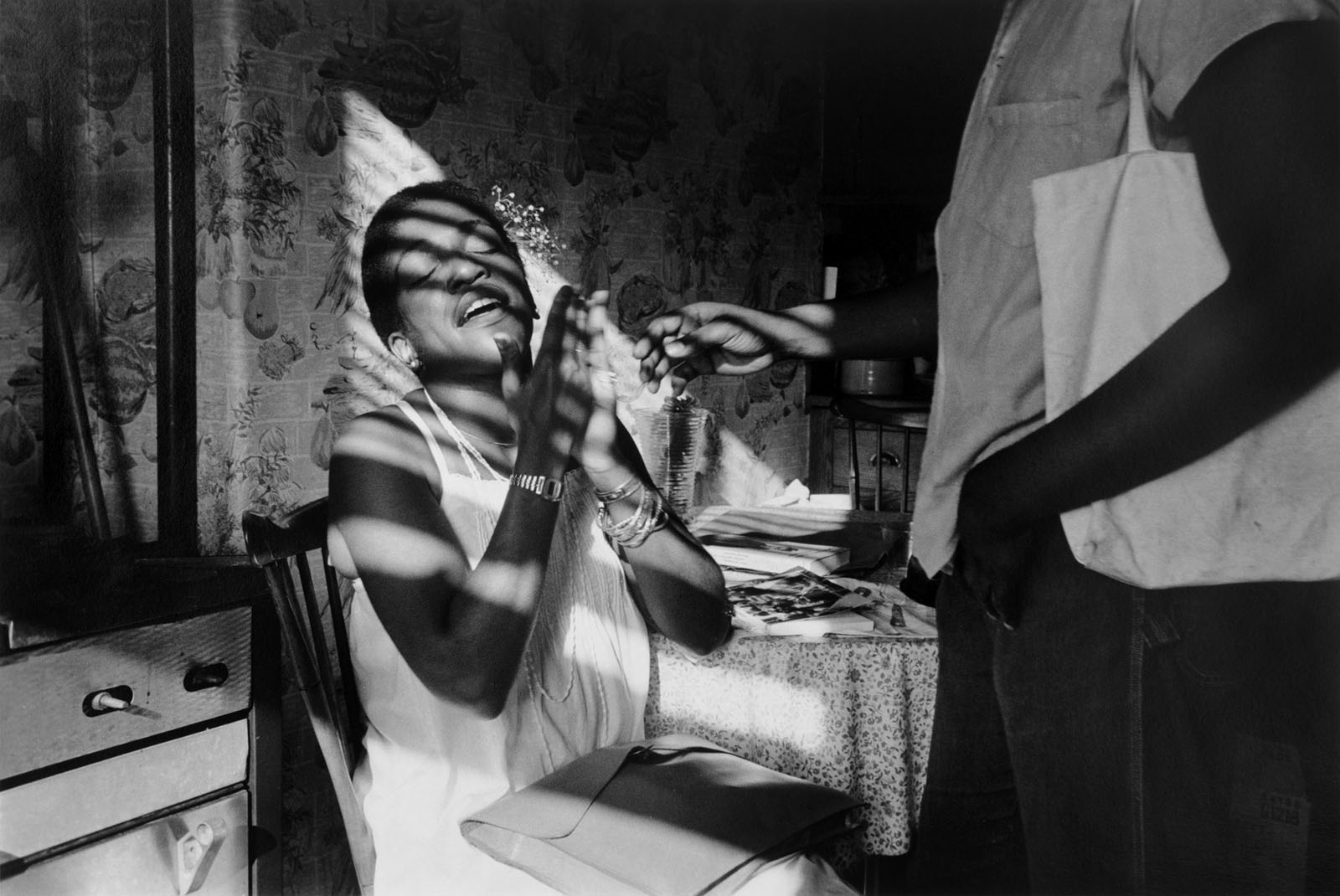
Russell Lee (American, 1903-1986) 'Mrs. Manuel Alcala and son in corner of their kitchen. The family lives in company housing project for miners. National Fuel Company, Monarch Mine, Broomfield, Boulder County, Colorado' July 2, 1946 from the exhibition 'Power & Light: Russell Lee's Coal Survey' at the National Archives Museum, Washington


Russell Lee (American, 1903-1986)
Mrs. Manuel Alcala and son in corner of their kitchen. The family lives in company housing project for miners. National Fuel Company, Monarch Mine, Broomfield, Boulder County, Colorado
July 2, 1946
National Archives
Public domain


The history of today and every day

Continuing Art Blart’s support of photographers with a social conscience, this latest posting complements recent postings on the exhibitions Miners’ Strike 1984-85, and Roger Mayne: Youth. In America this type of attuned social documentary photography has a long history, both prior to and after Russell Lee’s photographs were taken.

From Danish-American social reformer Jacob Riis’ who used his “photographic and journalistic talents to help the impoverished in New York City” to the famous American sociologist and photographer Lewis Hine whose images “were instrumental in bringing about the passage of the first child labor laws in the United States”, onward to the work of the photographers employed by the Farm Security Administration / Office of War Information (FSA / OWI) between 1935-1944,* (notably Dorothea Lange, Walker Evans, Jack Delano, Russell Lee, Marion Post Wolcott) which “form an extensive pictorial record of American life” … and thus to these photographs taken by Russell Lee just after the end of the Second World War. Lee’s photographs were then followed by Gordon Parks‘ photographs of racial intolerance, Marion Palfi‘s photographs of American injustice, Milton Rogovin‘s photographs of “the forgotten ones” and, more recently, James Nachtwey‘s photographs of drug use in America. Of course, there are many other photographers who could be mentioned.


It has been a fascinating journey to engage with over 1000 of Russell Lee’s Coal Survey photographs that are available in the National Archives Catalog to try to fully understand the vision of this artist during the 1946 project picturing miners in their homes, mines, and communities. “Lee provided the photographs for the study which included 90 communities in 22 states… Over the course of the survey, Lee took over 4000 photographs, more than 200 of which are included in the exhibit.”

As with any large of body of work the quality of the photographs varies incredibly – some poor, others prosaic, some insightful, others powerful portraits, some dynamic, others occasionally revelatory. This is only to be expected. In the selection in this posting I have chosen what I think are the best photographs from the 1000 photographs available online. Please note, these photographs are not necessarily in the exhibition.

In looking through the body of work I feel what is envisioned by the photographer in his images is a wonderful empathy for the miners and their families in the situation of their becoming. What Lee pictures are communities that support each other but which are under stress.

Having worked through the Second World War to aid the American war effort, men and women were hard at work in a dangerous job, the families were living in run down houses owned by the coal mining companies, were buying food at the company store, were borrowing money on their earnings from the company to survive and living a subsistence life – having the minimal resources necessary for survival, having just enough food or money to stay alive. Rickety wooden houses with no running water [The only houses with running water inside in this camp are those in which their tennants [sic] have made the installations at no expense to the company], dead animals in streams where water is gathered, roofs lined with newspaper, children with no shoes, men holding serpents praying to an unseen god.

I believe that Lee’s most powerful photographs in the project are the images of the miners at work. There is an intimate directness to these photographs of working men and women. Nothing extraneous, nothing superfluous, just an honest directness picturing their everyday lives, in tiredness, laughter, and desperation.

In these photographs of miners we can see that Lee loved his diagonals, horizontals and verticals in the construction of the image plane. Right to left diagonals in J. M. Hawkins (left) former pharmacists mate in the U.S. Navy and Wm. Smith, former Marine, read notice on the bulletin board at the mine (July 9, 1946, below) and Women pick foreign matter out of coal (July 9, 1946, below); left to right diagonals in Miners boarding buses which will take them to washhouse from lamp house where they have checked out (August 20, 1946, below) and Miners checking in at the lamp house at completion of morning shift (August 22, 1946, below); and verticals in James Robert Howard has gotten his safety lamp at lamp house (August 13, 1946, below).

My two favourite photographs in the posting are both crackers. Firstly, Miners waiting at drift mouth for the afternoon man trip. Koppers Coal Divison, Kopperston Mines, Kopperston, Wyoming County, West Virginia (August 22, 1946, below) in which the languid easiness of the men’s postures are perfectly assimilated within the structure of the buildings and rocks to form an almost Renaissance tableaux of figures. And secondly, Miners bring in their checks and see the sign that there is no Saturday work. P V & K Coal Company, Clover Gap Mine, Lejunior, Harlan County, Kentucky (September 13, 1946, below) in which the languorous flow of bodies moves as in the stillness of a quietly flowing river, revealing a reversed “N” and misspelt “to-morrow” as if the morrow will bring more heartache.

What clarity of vision, what panache in the execution of that vision. You could only wish to be such an accomplished artist taking pictures of the history of yesterday that still have relevance today and every day.

Dr Marcus Bunyan


View Russell Lee’s Coal Survey photographs on the National Archives website.

* FSA photographers: Arthur Rothstein (1935), Theodor Jung (1935), Ben Shahn (1935), Walker Evans (1935), Dorothea Lange (1935), Carl Mydans (1935), Russell Lee (1936), Marion Post Wolcott (1936), John Vachon (1936, photo assignments began in 1938), Jack Delano (1940), John Collier (1941), Marjory Collins (1941), Louise Rosskam (1941), Gordon Parks (1942) and Esther Bubley (1942)
* OWI photographers: David Bransby (1942), John Collier (1943), Marjory Collins (1943), Jack Delano (1942-1943), Howard Hollem (1941-1943), Fenno Jacobs (1942), Alfred Palmer (1941-1943), William M. Rittase (1942), John Rous (1941), Mark Sherwood (1942), Arthur Siegel (1942), John Vachon (1942-1943), Miscellaneous photographers (Jack Downey, Andreas Feininger, unidentified)


Many thankx to the National Archives for allowing me to publish the photographs in the posting. Please click on the photographs for a larger version of the image. All photographs have been digitally cleaned and balanced by Marcus Bunyan. Please note the photographs in this posting are not necessarily in the exhibition.


“I’m taking pictures of the history of today.”


Russell Lee


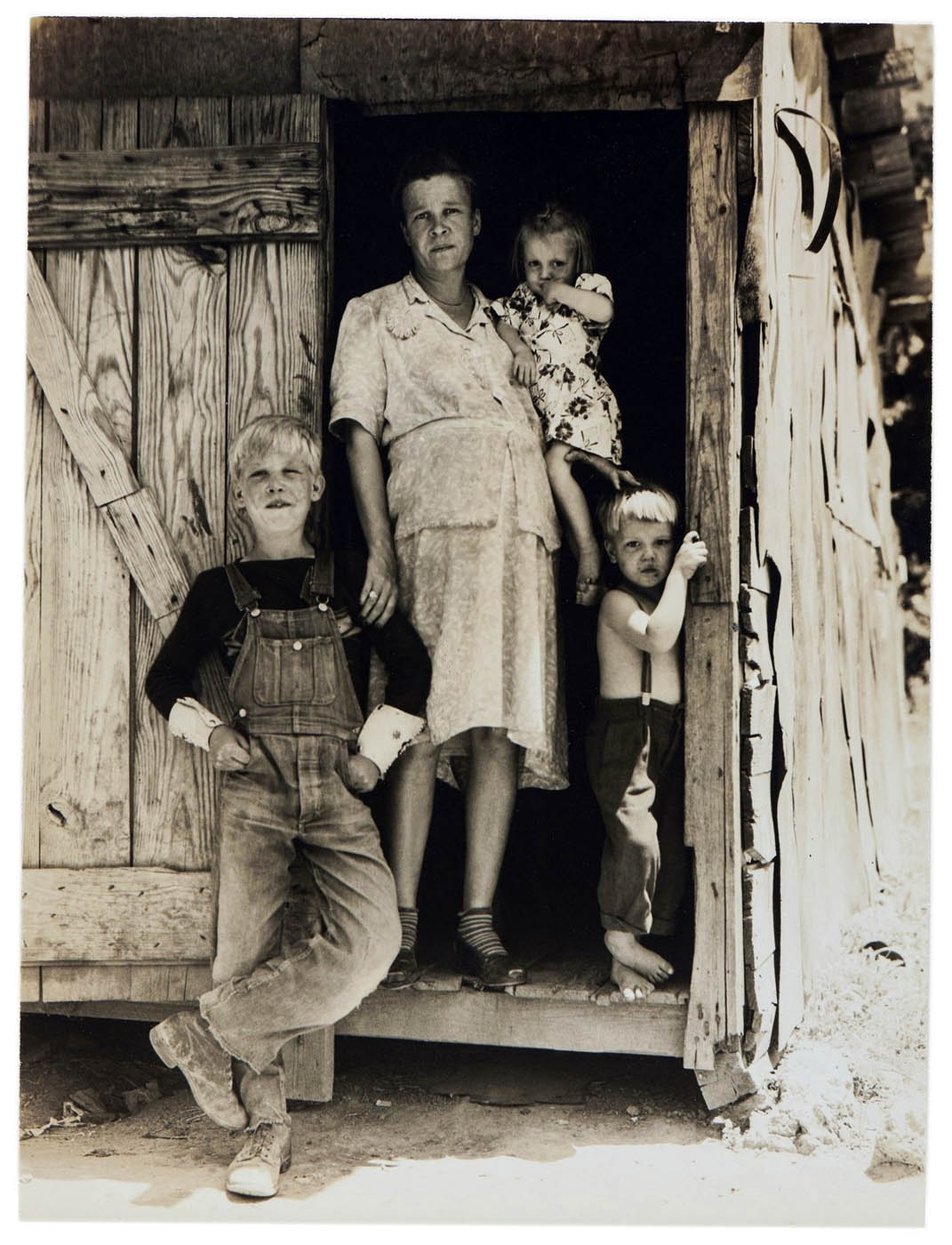
Russell Lee (American, 1903-1986) 'The Sergent Family on their front porch. Reading from L. to R., Franklin D., Louis, Lucy, Mr. Blaine Sergent, Bobbie Jean, Mrs. Sergent, Wanda Lee and Donald. Mr. and Mrs. Sergent have two married sons living nearby, Rufus, who lives next door and is a coal cutter in the same mine and Junior who lives and works at Verda Mine several miles away. P V & K Coal Company, Clover Gap Mine, Lejunior, Harlan County, Kentucky' September 15, 1946


Russell Lee (American, 1903-1986)
The Sergent Family on their front porch. Reading from L. to R., Franklin D., Louis, Lucy, Mr. Blaine Sergent, Bobbie Jean, Mrs. Sergent, Wanda Lee and Donald. Mr. and Mrs. Sergent have two married sons living nearby, Rufus, who lives next door and is a coal cutter in the same mine and Junior who lives and works at Verda Mine several miles away. P V & K Coal Company, Clover Gap Mine, Lejunior, Harlan County, Kentucky
September 15, 1946
National Archives
Public domain
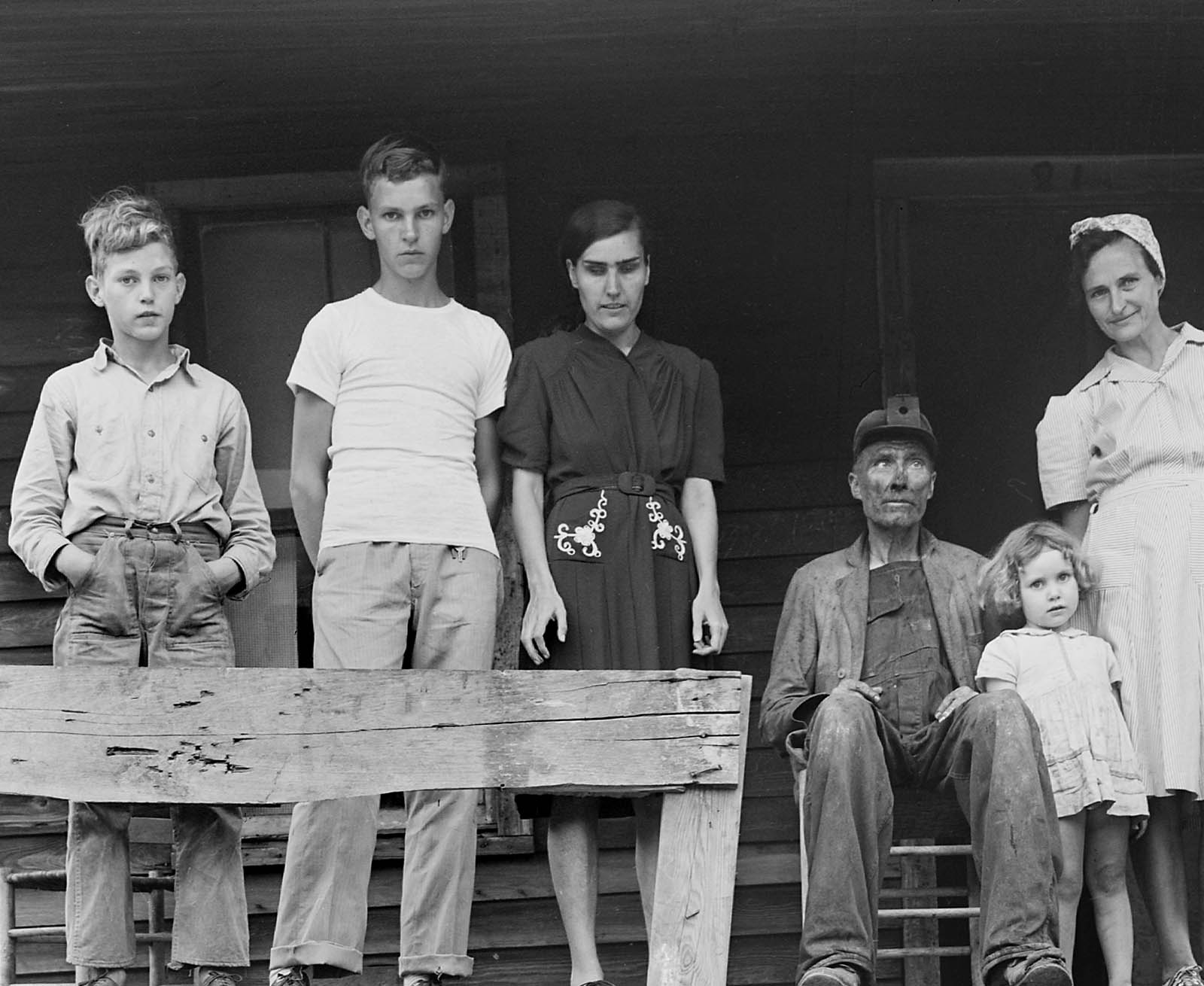
 

Russell Lee (American, 1903-1986) 'The Sergent Family on their front porch. Reading from L. to R., Franklin D., Louis, Lucy, Mr. Blaine Sergent, Bobbie Jean, Mrs. Sergent, Wanda Lee and Donald. Mr. and Mrs. Sergent have two married sons living nearby, Rufus, who lives next door and is a coal cutter in the same mine and Junior who lives and works at Verda Mine several miles away. P V & K Coal Company, Clover Gap Mine, Lejunior, Harlan County, Kentucky' September 15, 1946 (detail)


Russell Lee (American, 1903-1986)
The Sergent Family on their front porch. Reading from L. to R., Franklin D., Louis, Lucy, Mr. Blaine Sergent, Bobbie Jean, Mrs. Sergent, Wanda Lee and Donald. Mr. and Mrs. Sergent have two married sons living nearby, Rufus, who lives next door and is a coal cutter in the same mine and Junior who lives and works at Verda Mine several miles away. P V & K Coal Company, Clover Gap Mine, Lejunior, Harlan County, Kentucky (detail)
September 15, 1946
National Archives
Public domain
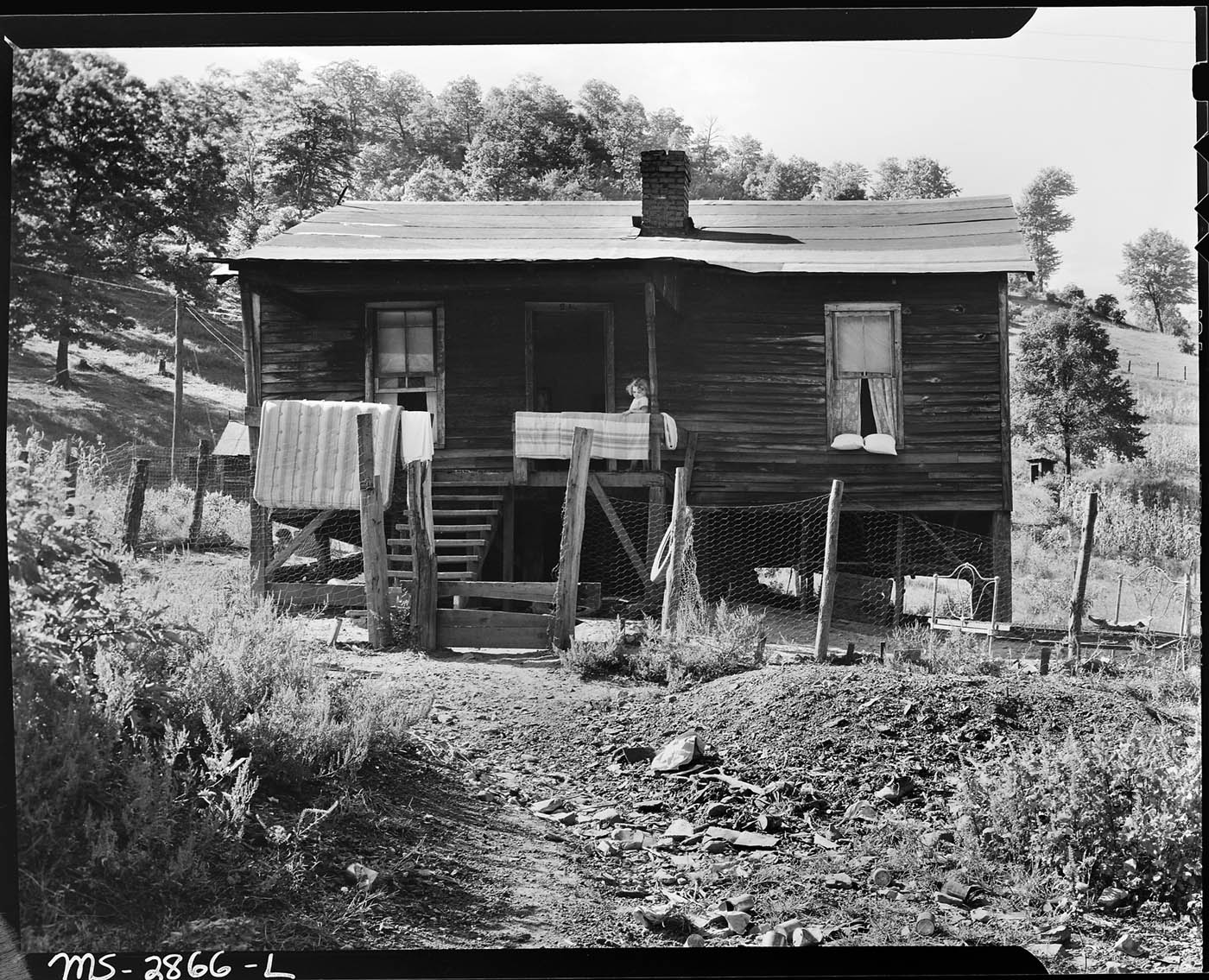
 

Russell Lee (American, 1903-1986) 'The Blaine Sergent family's house. P V & K Coal Company, Clover Gap Mine, Lejunior, Harlan County, Kentucky' September 15, 1946


Russell Lee (American, 1903-1986)
The Blaine Sergent family’s house. P V & K Coal Company, Clover Gap Mine, Lejunior, Harlan County, Kentucky
September 15, 1946
National Archives
Public domain


Power & Light: Russell Lee’s Coal Survey is an exhibition of photographs of coal communities by American documentary photographer Russell Lee. These images tell the story of labourers who helped build the nation, of a moment when the government took stock of their health and safety, and of a photographer who recognised their humanity.

About the Exhibit

Power & Light is free and open to the public. The exhibition features more than 200 of Russell Lee’s photographs of coal miners and their families in the form of large-scale prints, projections, and digital interactives from a nationwide survey of housing and medical and community facilities of bituminous coal mining communities. The survey was conducted by Navy personnel in 1946 as part of a strike-ending agreement negotiated between the Department of the Interior and the United Mine Workers of America. The full series of photographs, which numbers in the thousands, can only be found in the holdings of the National Archives. These images document inhumane living and working conditions but also depict the joy, strength, and resilience of the miners’ families and communities.

Note: All photograph captions are original, as provided by the photographer. Unless otherwise noted, the images are in the holdings of the National Archives, Records of the Solid Fuels Administration for War.

Power & Light features Russell Lee’s 1946 coal survey photographs of miners in their homes, mines, and communities.

About Russell Lee

Russell Werner Lee (1903-1986) was born in Ottawa, Illinois. Originally trained as an engineer, he was methodical in his work, but approached his subjects with warmth and respect. The quiet Midwesterner put people at ease, enabling him to capture scenes of surprising intimacy. Many of his photographs reveal worlds through small details – keepsakes on the mantel, lined and calloused hands. What may be most distinctive about these images is their reflection of the photographer’s compassion for his subjects. Despite their plight, it is their strength, dignity, and humanity that strike the viewer.

If you recognise Lee’s photos – but not his name – you’re not alone.

Although the coal survey photos represent some of Lee’s finest work, his best-known photographs are from an earlier project. Lee was one of several photographers hired by the federal government in the 1930s to document the toll of the Great Depression and drought on rural Americans. While he worked alongside famous colleagues including Walker Evans and Dorothea Lange, Lee eschewed celebrity. His aim was to inspire social change, believing visual evidence of struggle and hardship could generate support for reforms.

Text from the National Archives Museum website


Russell Lee (American, 1903-1986) 'Miners' wives and children on the front porch of a typical, fifty year old house. Kentucky Straight Creek Coal Company, Belva Mine, abandoned after explosion [in] Dec. 1945, Four Mile, Bell County, Kentucky' (Original Caption) September 4, 1946


Russell Lee (American, 1903-1986)
Miners’ wives and children on the front porch of a typical, fifty year old house. Kentucky Straight Creek Coal Company, Belva Mine, abandoned after explosion [in] Dec. 1945, Four Mile, Bell County, Kentucky (Original Caption)
September 4, 1946
National Archives
Public domain


Russell Lee: Home

Lee’s photographs of miners at home reflect his respect for their individuality and resourcefulness, his fascination with families, and his meticulous attention to the details of everyday life.
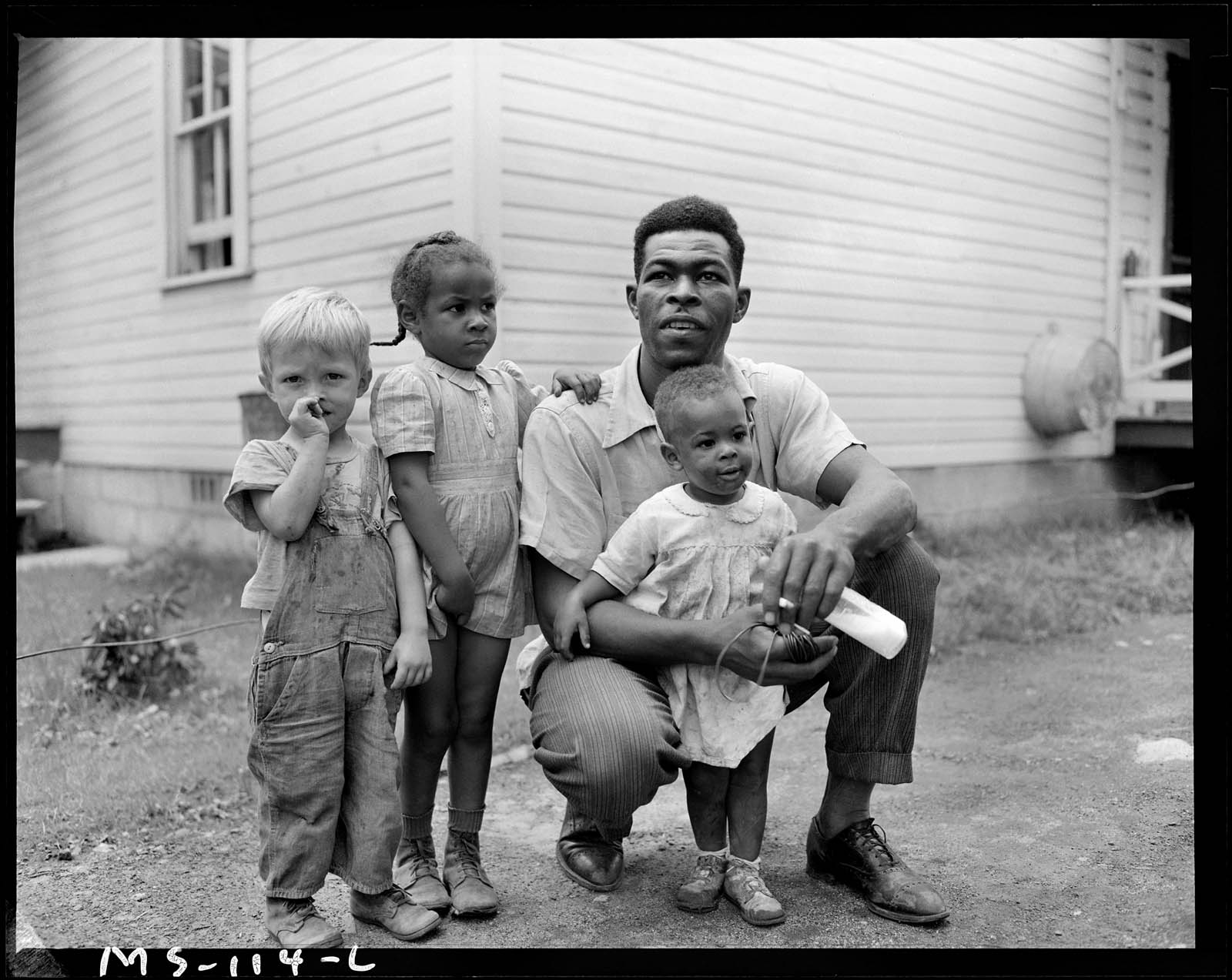
 

Russell Lee (American, 1903-1986) 'Gonzalla Sullivan, miner, with his two children and another child who lives in the neighborhood. Koppers Coal Division, Federal #1 Mine, Grant Town, Marion County, West Virginia' June 13, 1946 from the exhibition 'Power & Light: Russell Lee's Coal Survey' at the National Archives Museum, Washington


Russell Lee (American, 1903-1986)
Gonzalla Sullivan, miner, with his two children and another child who lives in the neighborhood. Koppers Coal Division, Federal #1 Mine, Grant Town, Marion County, West Virginia
June 13, 1946
National Archives
Public domain
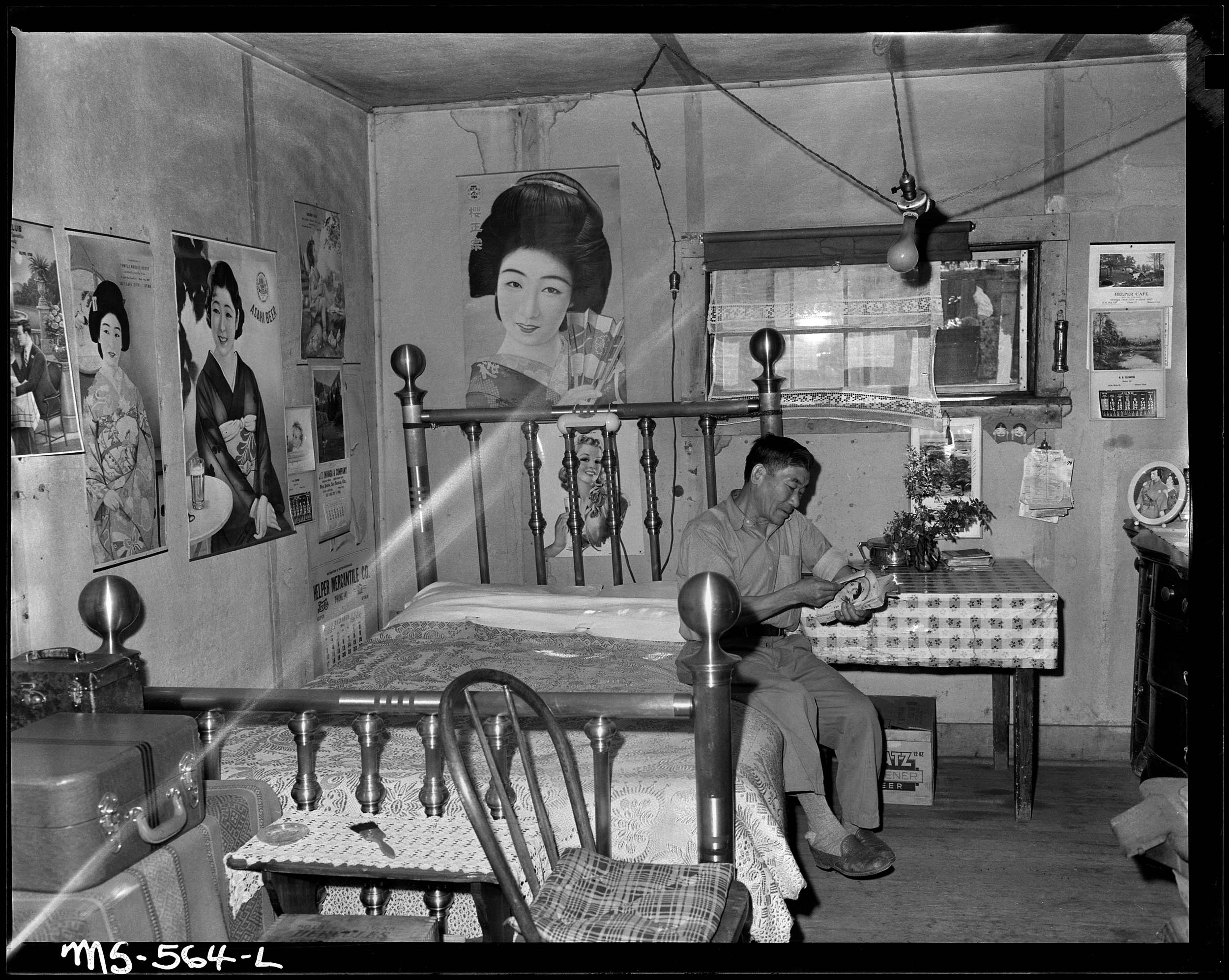
 

Russell Lee (American, 1903-1986) 'Quarters of Japanese miner who lives in company housing project. Hudson Coal Company, Hudson Mine, Sweet Mine, Carbon County, Utah' July 4, 1946 from the exhibition 'Power & Light: Russell Lee's Coal Survey' at the National Archives Museum, Washington


Russell Lee (American, 1903-1986)
Quarters of Japanese miner who lives in company housing project. Hudson Coal Company, Hudson Mine, Sweet Mine, Carbon County, Utah
July 4, 1946
National Archives
Public domain


Russell Lee (American, 1903-1986) 'The only houses with running water inside in this camp are those in which their tennants [sic] have made the installations at no expense to the company. Gilliam Coal and Coke Company, Gilliam Mine, Gilliam, McDowell County, West Virginia' (Original Caption) August 13, 1946


Russell Lee (American, 1903-1986)
The only houses with running water inside in this camp are those in which their tennants [sic] have made the installations at no expense to the company. Gilliam Coal and Coke Company, Gilliam Mine, Gilliam, McDowell County, West Virginia (Original Caption)
August 13, 1946
National Archives
Public domain
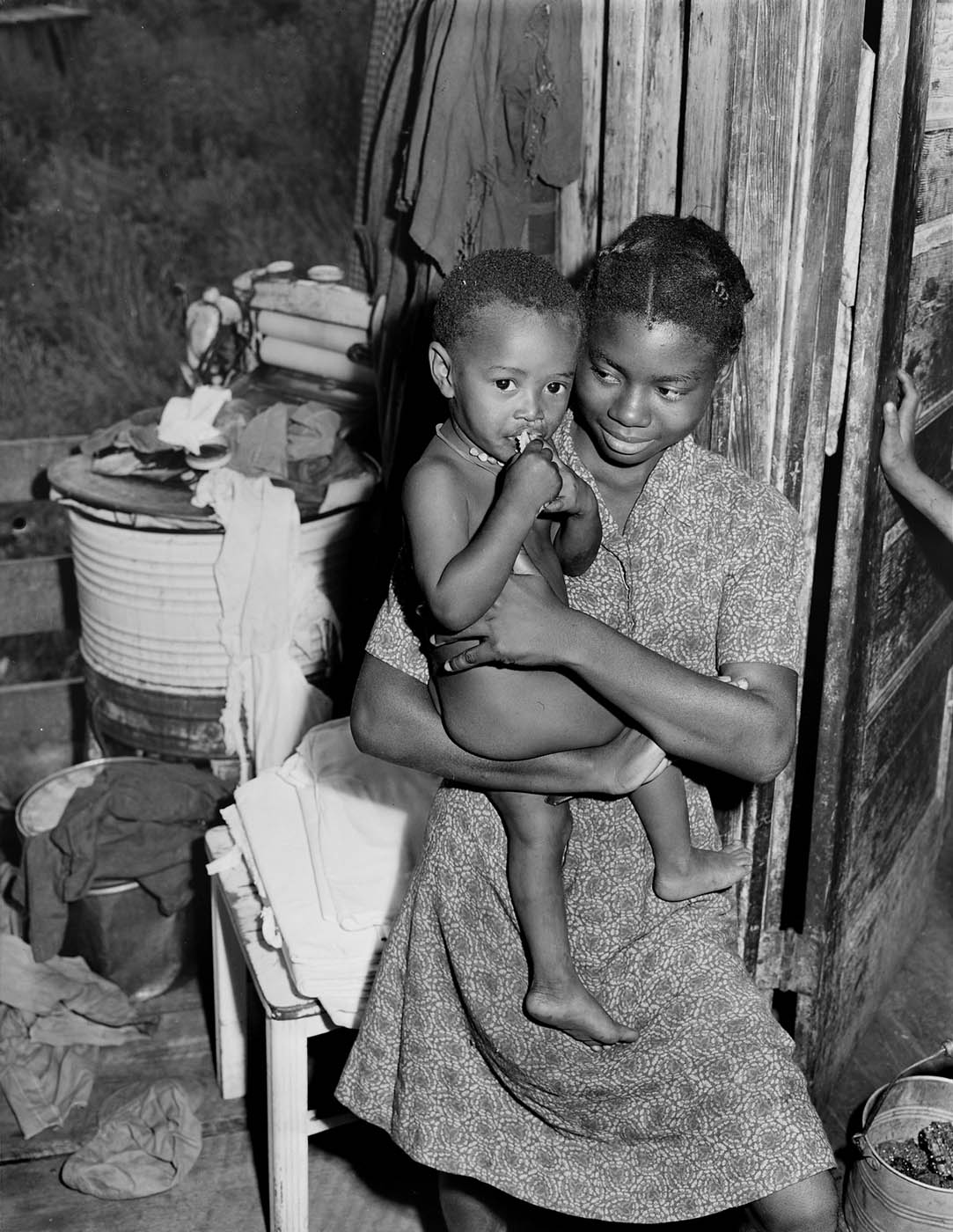
 

Russell Lee (American, 1903-1986) 'There are ten children in the Lawson Mayo family, the older taking care of the youngest ones. Three of the daughters are now attending high school in Mullens and have part time jobs during summer months. Mullens Smokeless Coal Company, Mullens Mine, Harmco, Wyoming County, West Virginia' (Original Caption) August 23, 1946


Russell Lee (American, 1903-1986)
There are ten children in the Lawson Mayo family, the older taking care of the youngest ones. Three of the daughters are now attending high school in Mullens and have part time jobs during summer months. Mullens Smokeless Coal Company, Mullens Mine, Harmco, Wyoming County, West Virginia (Original Caption)
August 23, 1946
National Archives
Public domain


Russell Lee (American, 1903-1986) 'Mrs. John Whitehead, wife of miner, and two of her children (or grandchildren) in the kitchen of her three room house. Mr. and Mrs. John Whitehead, their six children and six grandchildren live here. This house, built on company owned land was built by Mr. Whitehead's half brother at no expense for materials or labor to the company; the builder (half brother) was to receive the use of the house rent-free for three years and at the end of this period the ownership of the house would revert to the company. The brother moved away at the end of one year, receiving no cash settlement from the company. The house now rents for $6 monthly. It has no running water, no electricity, access is over a mountain trail; there are three rooms. Coleman Fuel Company, Red Bird Mine, Field, Bell County, Kentucky' (Original Caption) August 31, 1946


Russell Lee (American, 1903-1986)
Mrs. John Whitehead, wife of miner, and two of her children (or grandchildren) in the kitchen of her three room house. Mr. and Mrs. John Whitehead, their six children and six grandchildren live here. This house, built on company owned land was built by Mr. Whitehead’s half brother at no expense for materials or labor to the company; the builder (half brother) was to receive the use of the house rent-free for three years and at the end of this period the ownership of the house would revert to the company. The brother moved away at the end of one year, receiving no cash settlement from the company. The house now rents for $6 monthly. It has no running water, no electricity, access is over a mountain trail; there are three rooms. Coleman Fuel Company, Red Bird Mine, Field, Bell County, Kentucky (Original Caption)
August 31, 1946
National Archives
Public domain
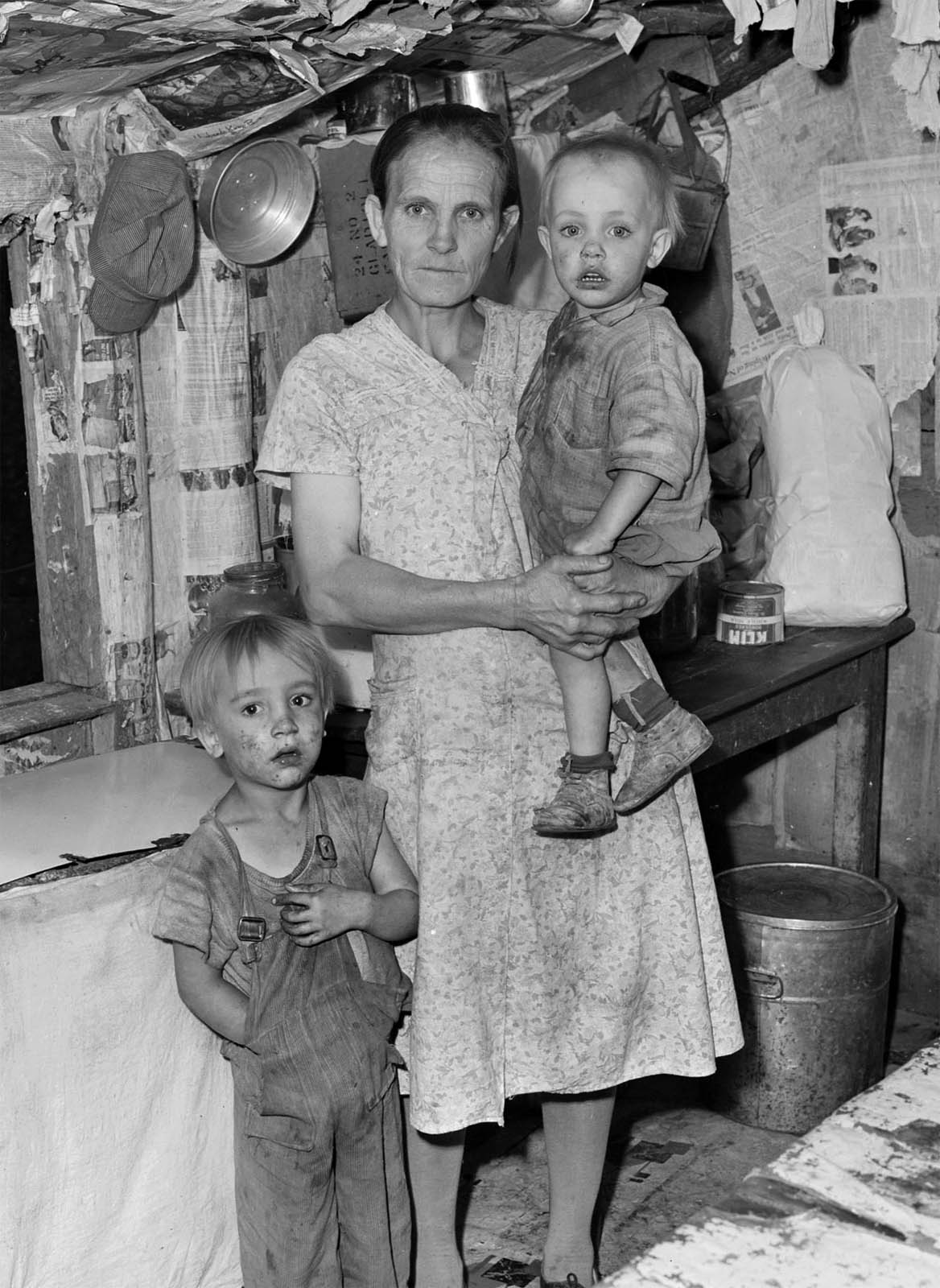
 

Russell Lee (American, 1903-1986) 'Mrs. John Whitehead, wife of miner, and two of her children (or grandchildren) in the kitchen of her three room house. Mr. and Mrs. John Whitehead, their six children and six grandchildren live here. This house, built on company owned land was built by Mr. Whitehead's half brother at no expense for materials or labor to the company; the builder (half brother) was to receive the use of the house rent-free for three years and at the end of this period the ownership of the house would revert to the company. The brother moved away at the end of one year, receiving no cash settlement from the company. The house now rents for $6 monthly. It has no running water, no electricity, access is over a mountain trail; there are three rooms. Coleman Fuel Company, Red Bird Mine, Field, Bell County, Kentucky' (Original Caption) August 31, 1946 (detail)


Russell Lee (American, 1903-1986)
Mrs. John Whitehead, wife of miner, and two of her children (or grandchildren) in the kitchen of her three room house. Mr. and Mrs. John Whitehead, their six children and six grandchildren live here. This house, built on company owned land was built by Mr. Whitehead’s half brother at no expense for materials or labor to the company; the builder (half brother) was to receive the use of the house rent-free for three years and at the end of this period the ownership of the house would revert to the company. The brother moved away at the end of one year, receiving no cash settlement from the company. The house now rents for $6 monthly. It has no running water, no electricity, access is over a mountain trail; there are three rooms. Coleman Fuel Company, Red Bird Mine, Field, Bell County, Kentucky (Original Caption) (detail)
August 31, 1946
National Archives
Public domain
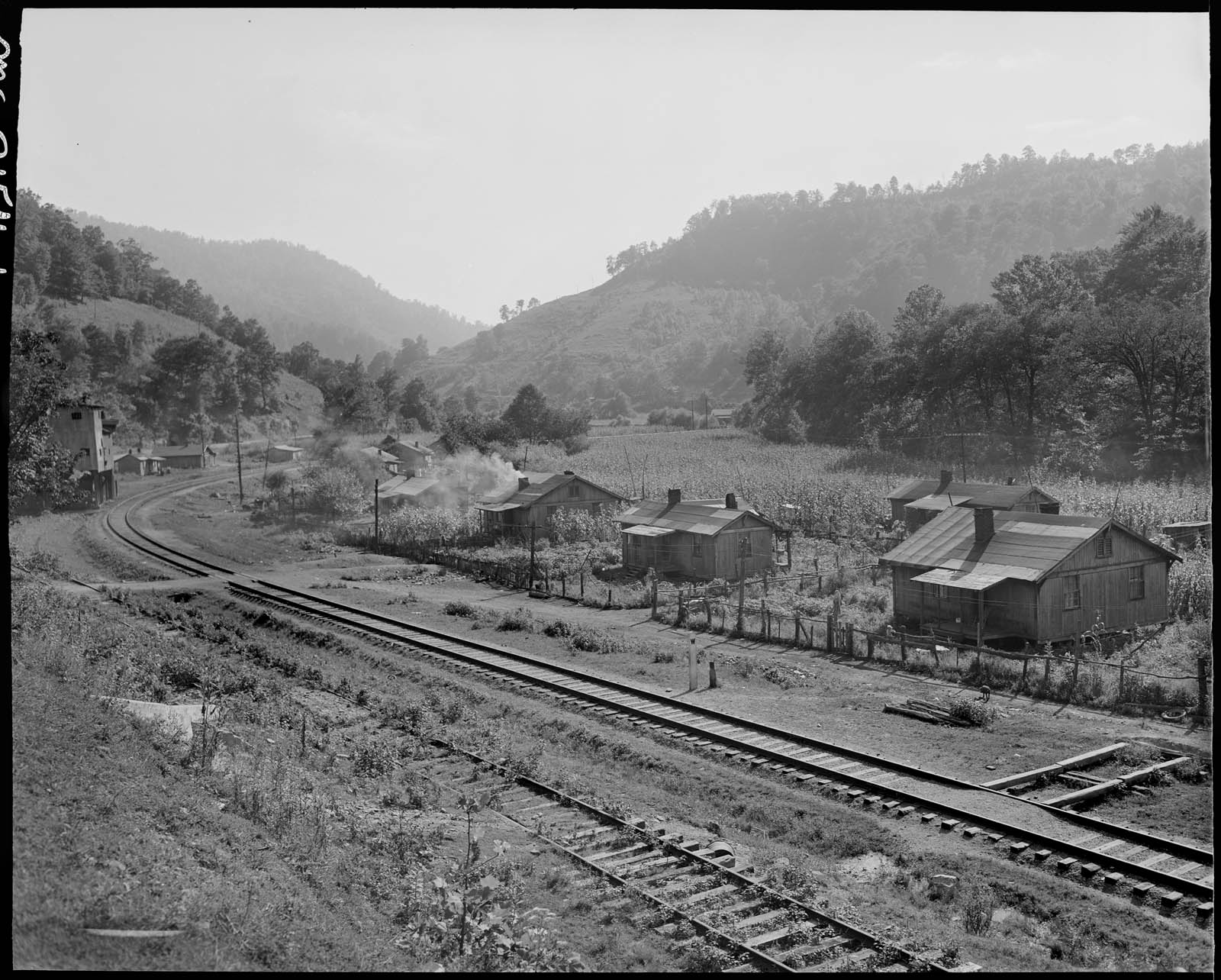
 

Russell Lee (American, 1903-1986) 'Houses along the railroad tracks. Fox Ridge Mining Company, Inc., Hanby Mine, Arjay, Bell County, Kentucky' August 31, 1946 from the exhibition 'Power & Light: Russell Lee's Coal Survey' at the National Archives Museum, Washington


Russell Lee (American, 1903-1986)
Houses along the railroad tracks. Fox Ridge Mining Company, Inc., Hanby Mine, Arjay, Bell County, Kentucky
August 31, 1946
National Archives
Public domain
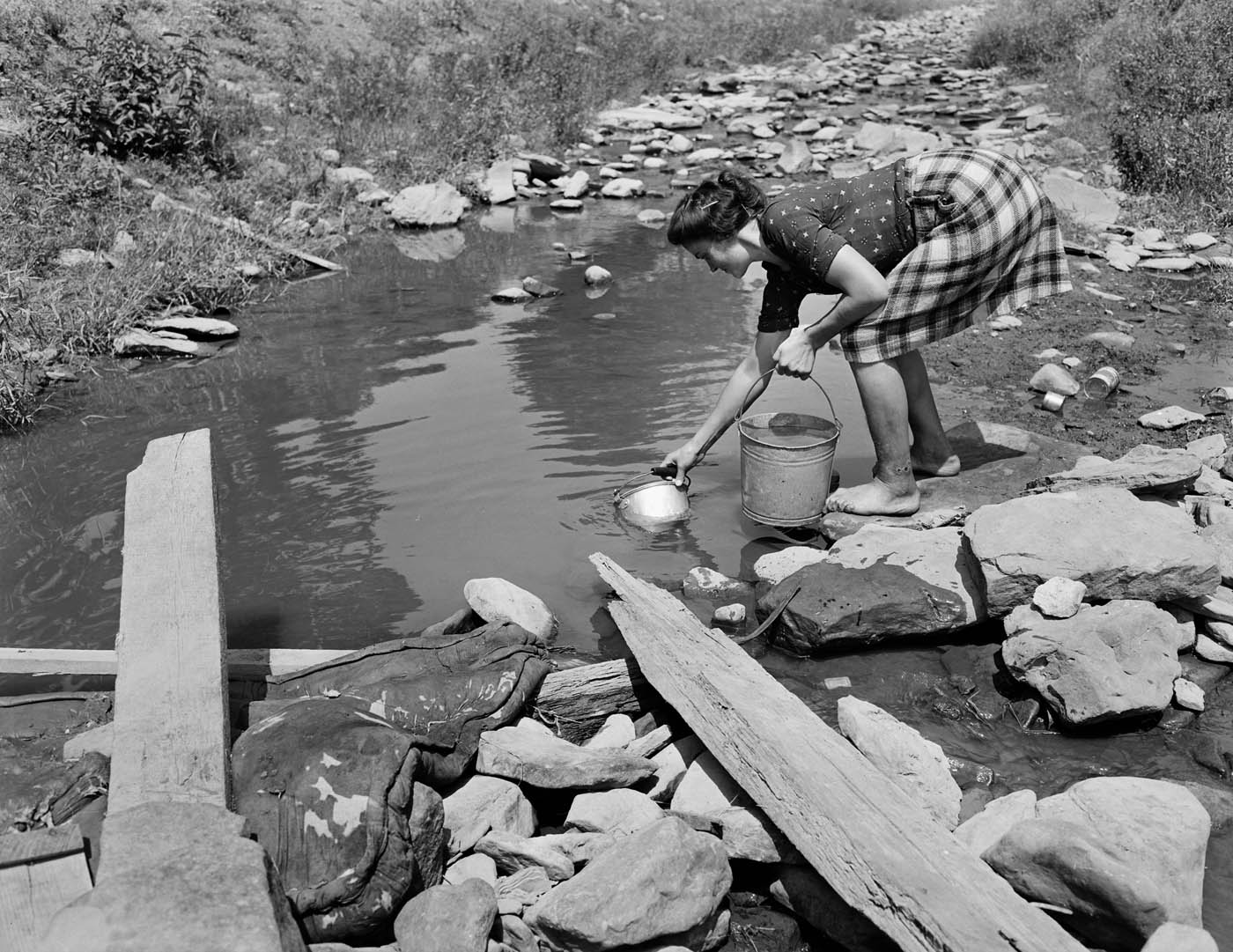
 

Russell Lee (American, 1903-1986) 'Mrs. Edna Lingar getting wash water from dirty stream; stock wade this stream, privies drain into it, garbage decay in it, a dead animal was in the stream about fifteen feet above where she was getting water. Kentucky Straight Creek Coal Company, Belva, Mine, abandoned after explosion, Four Mile, Bell County, Kentucky' (Original Caption) September 4, 1946


Russell Lee (American, 1903-1986)
Mrs. Edna Lingar getting wash water from dirty stream; stock wade this stream, privies drain into it, garbage decay in it, a dead animal was in the stream about fifteen feet above where she was getting water. Kentucky Straight Creek Coal Company, Belva, Mine, abandoned after explosion, Four Mile, Bell County, Kentucky (Original Caption)
September 4, 1946
National Archives
Public domain


Russell Lee: Mines

Russell Lee was attentive to miners’ issues, documenting deductions to their pay, lost work days, perilous conditions, and the union meetings where they fought for a better deal.
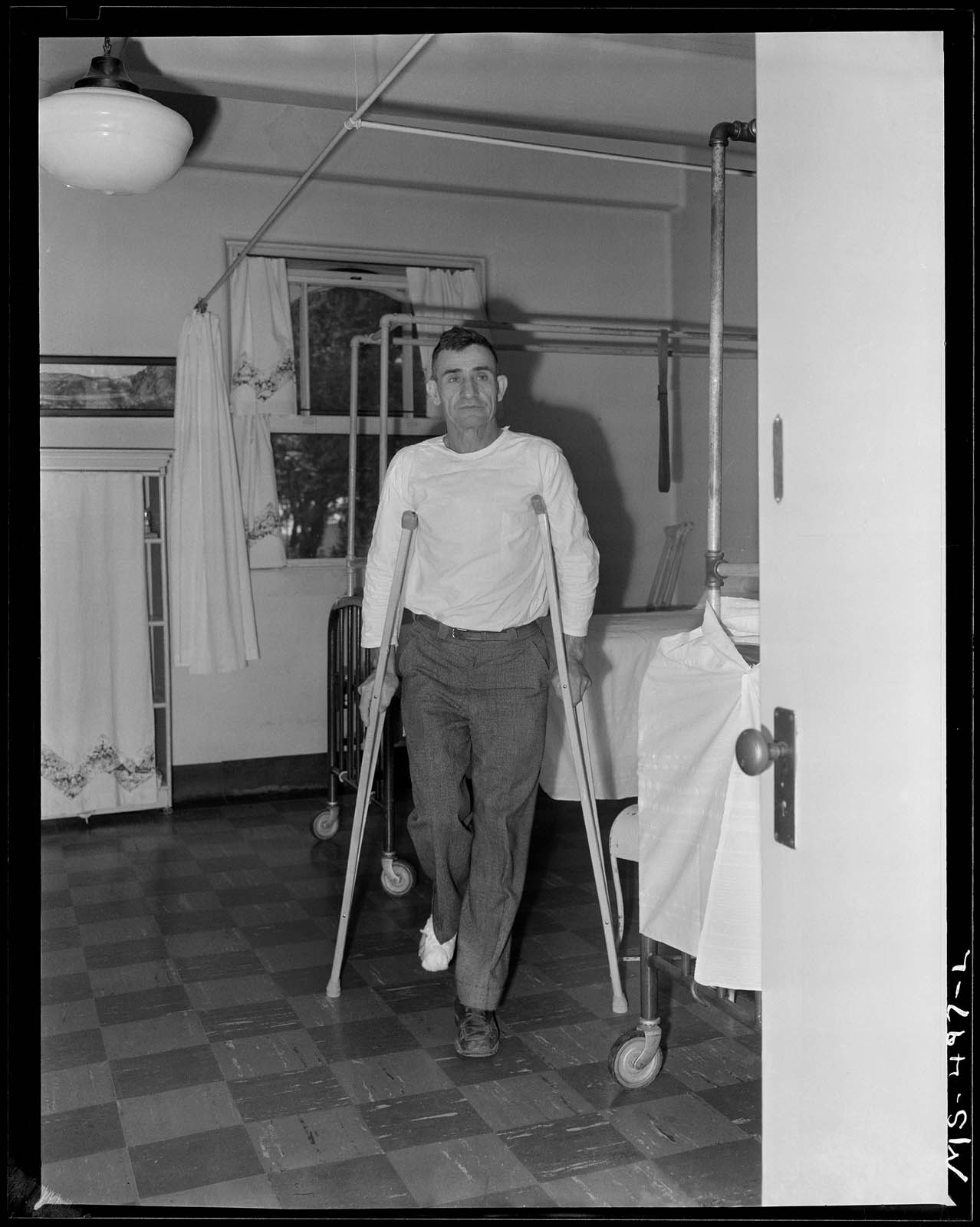
 

Russell Lee (American, 1903-1986) 'Telesfro Deluna, miner, walking on crutches. He is recovering from a foot injury in mine a accident. He has received medical care at this company owned hospital. Colorado Fuel & Iron Company, Pueblo, Colorado' July 1, 1946


Russell Lee (American, 1903-1986)
Telesfro Deluna, miner, walking on crutches. He is recovering from a foot injury in mine a accident. He has received medical care at this company owned hospital. Colorado Fuel & Iron Company, Pueblo, Colorado
July 1, 1946
National Archives
Public domain


Russell Lee (American, 1903-1986) 'J. M. Hawkins (left) former pharmacists mate in the U.S. Navy and Wm. Smith, former Marine, read notice on the bulletin board at the mine. Union Pacific Coal Company, Reliance Mine, Reliance, Sweetwater County, Wyoming' July 9, 1946


Russell Lee (American, 1903-1986)
J. M. Hawkins (left) former pharmacists mate in the U.S. Navy and Wm. Smith, former Marine, read notice on the bulletin board at the mine. Union Pacific Coal Company, Reliance Mine, Reliance, Sweetwater County, Wyoming
July 9, 1946
National Archives
Public domain
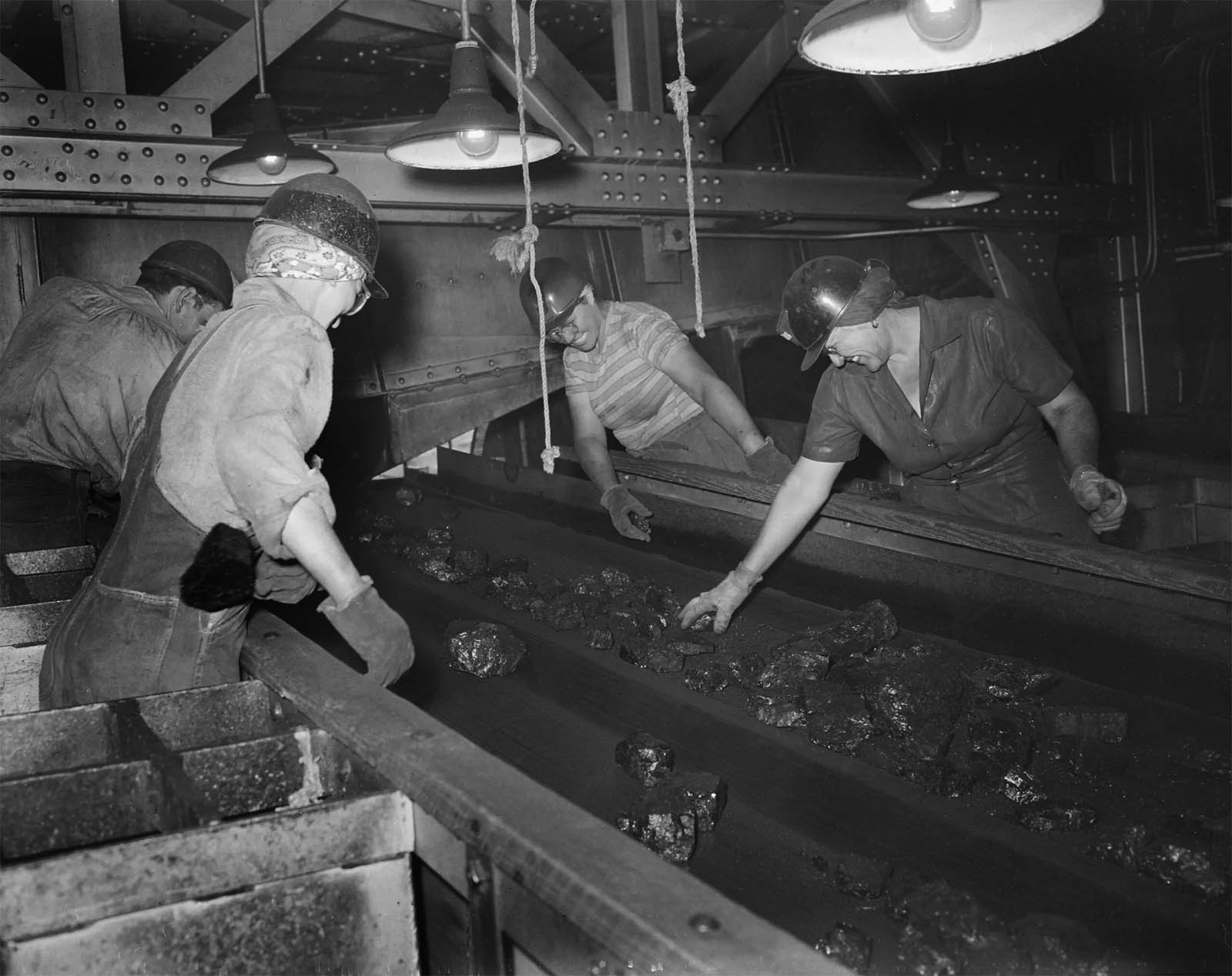
 

Russell Lee (American, 1903-1986) 'Women pick foreign matter out of coal as it is carried on conveyor thru tipple. Union Pacific Coal Company, Stansbury Mine, Rock Springs, Sweetwater County, Wyoming' (Original Caption) July 10, 1946


Russell Lee (American, 1903-1986)
Women pick foreign matter out of coal as it is carried on conveyor thru tipple. Union Pacific Coal Company, Stansbury Mine, Rock Springs, Sweetwater County, Wyoming (Original Caption)
July 10, 1946
National Archives
Public domain
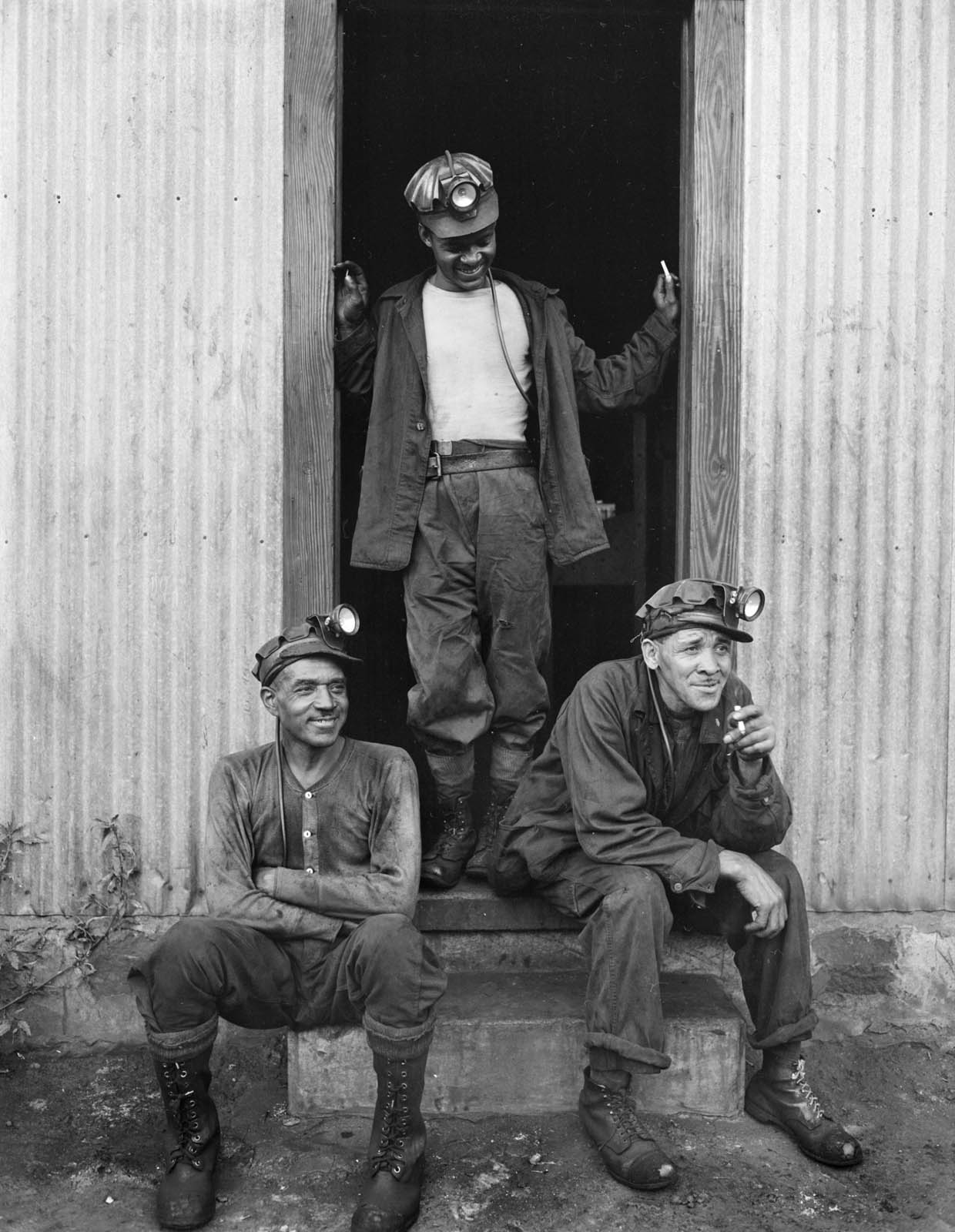
 

Russell Lee (American, 1903-1986) 'James Robert Howard has gotten his safety lamp at lamp house. Of the 232 employees at this mine, 60% are Negroes. Gilliam Coal and Coke Company, Gilliam Mine, Gilliam, McDowell County, West Virginia' (Original Caption) August 13, 1946


Russell Lee (American, 1903-1986)
James Robert Howard has gotten his safety lamp at lamp house. Of the 232 employees at this mine, 60% are Negroes. Gilliam Coal and Coke Company, Gilliam Mine, Gilliam, McDowell County, West Virginia (Original Caption)
August 13, 1946
National Archives
Public domain
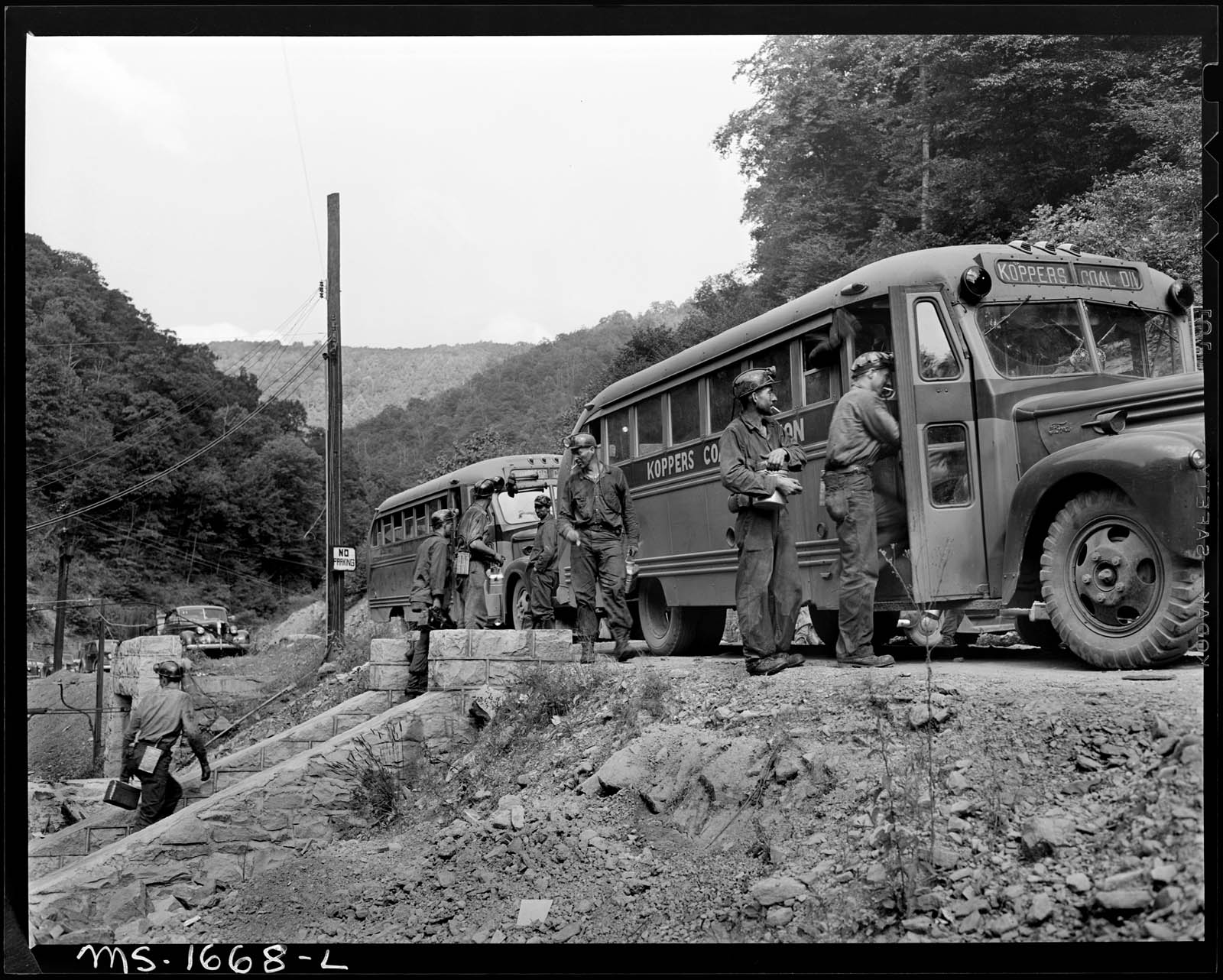
 

Russell Lee (American, 1903-1986) 'Miners boarding buses which will take them to washhouse from lamp house where they have checked out. Koppers Coal Divison, Kopperston Mine, Kopperston, Wyoming County, West Virginia' August 20, 1946


Russell Lee (American, 1903-1986)
Miners boarding buses which will take them to washhouse from lamp house where they have checked out. Koppers Coal Divison, Kopperston Mine, Kopperston, Wyoming County, West Virginia
August 20, 1946
National Archives
Public domain
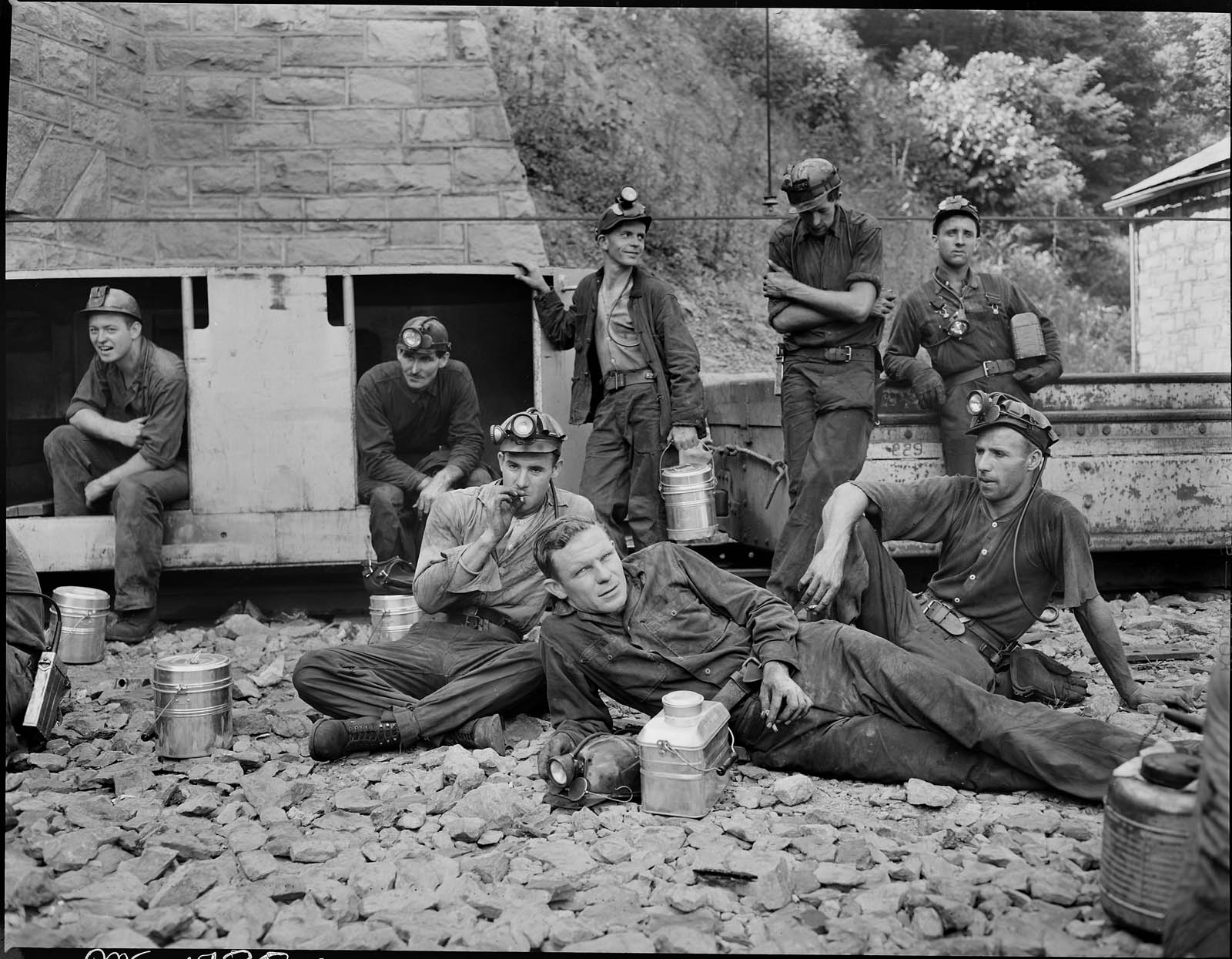
 

Russell Lee (American, 1903-1986) 'Miners waiting at drift mouth for the afternoon man trip. Koppers Coal Divison, Kopperston Mines, Kopperston, Wyoming County, West Virginia' August 22, 1946


Russell Lee (American, 1903-1986)
Miners waiting at drift mouth for the afternoon man trip. Koppers Coal Divison, Kopperston Mines, Kopperston, Wyoming County, West Virginia
August 22, 1946
National Archives
Public domain
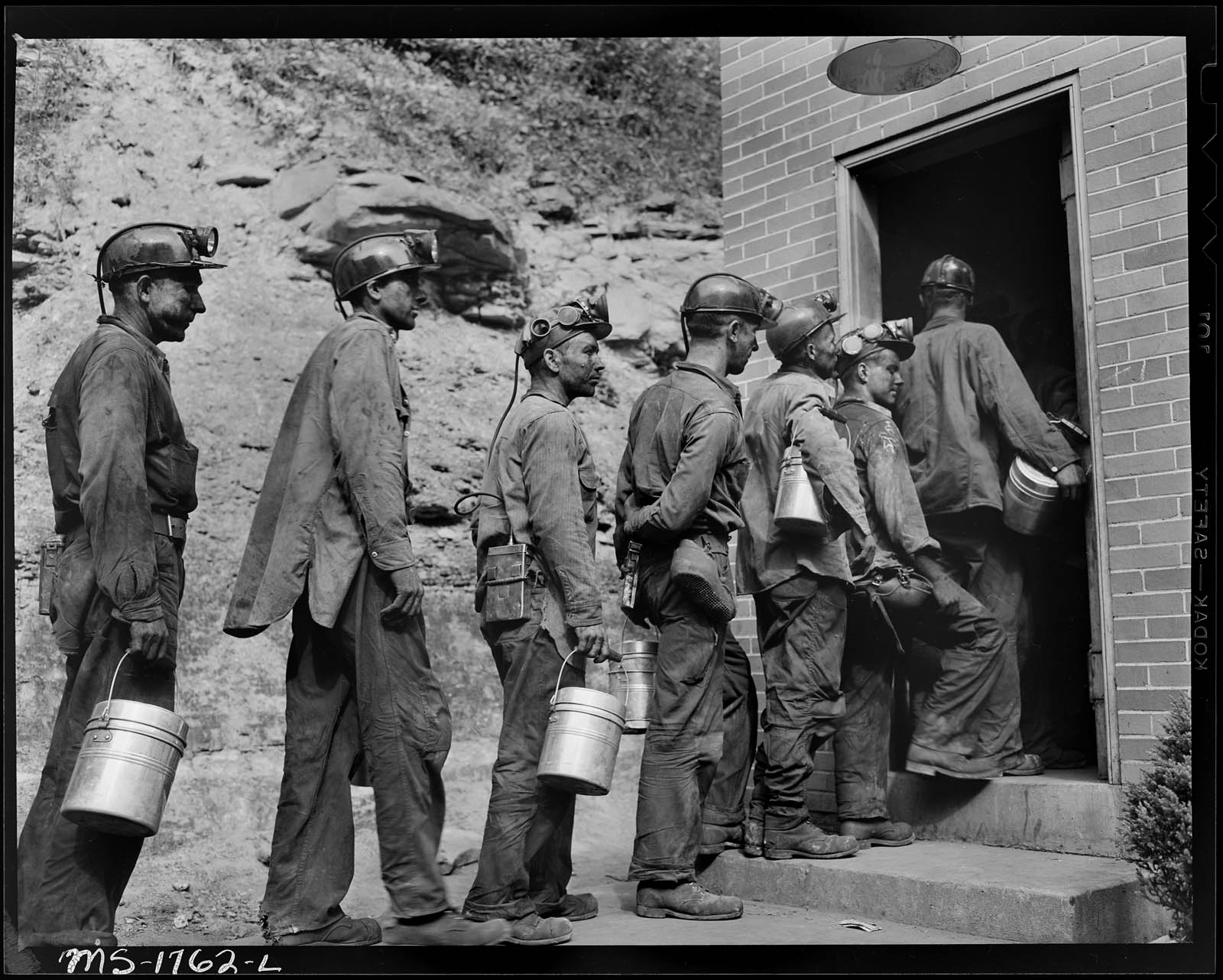
 

Russell Lee (American, 1903-1986) 'Miners checking in at the lamp house at completion of morning shift. Koppers Coal Division, Kopperston Mines, Kopperston, Wyoming County, West Virginia' August 22, 1946


Russell Lee (American, 1903-1986)
Miners checking in at the lamp house at completion of morning shift. Koppers Coal Division, Kopperston Mines, Kopperston, Wyoming County, West Virginia
August 22, 1946
National Archives
Public domain
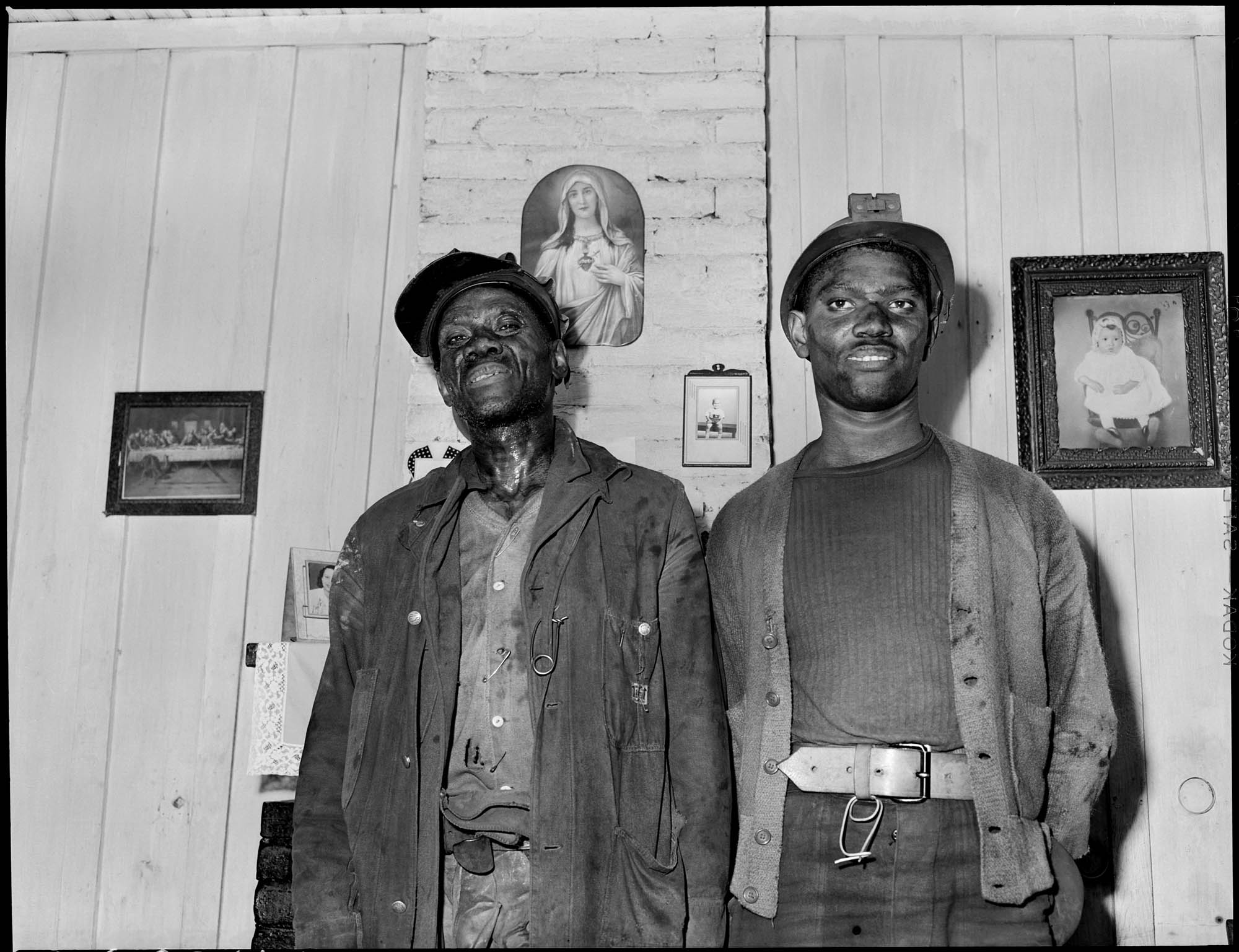
 

Russell Lee (American, 1903-1986) 'Furman Currington and his son, miners. Black Mountain Corporation, 30-31 Mines, Kenvir, Harlan County, Kentucky' September 6, 1946


Russell Lee (American, 1903-1986)
Furman Currington and his son, miners. Black Mountain Corporation, 30-31 Mines, Kenvir, Harlan County, Kentucky
September 6, 1946
National Archives
Public domain
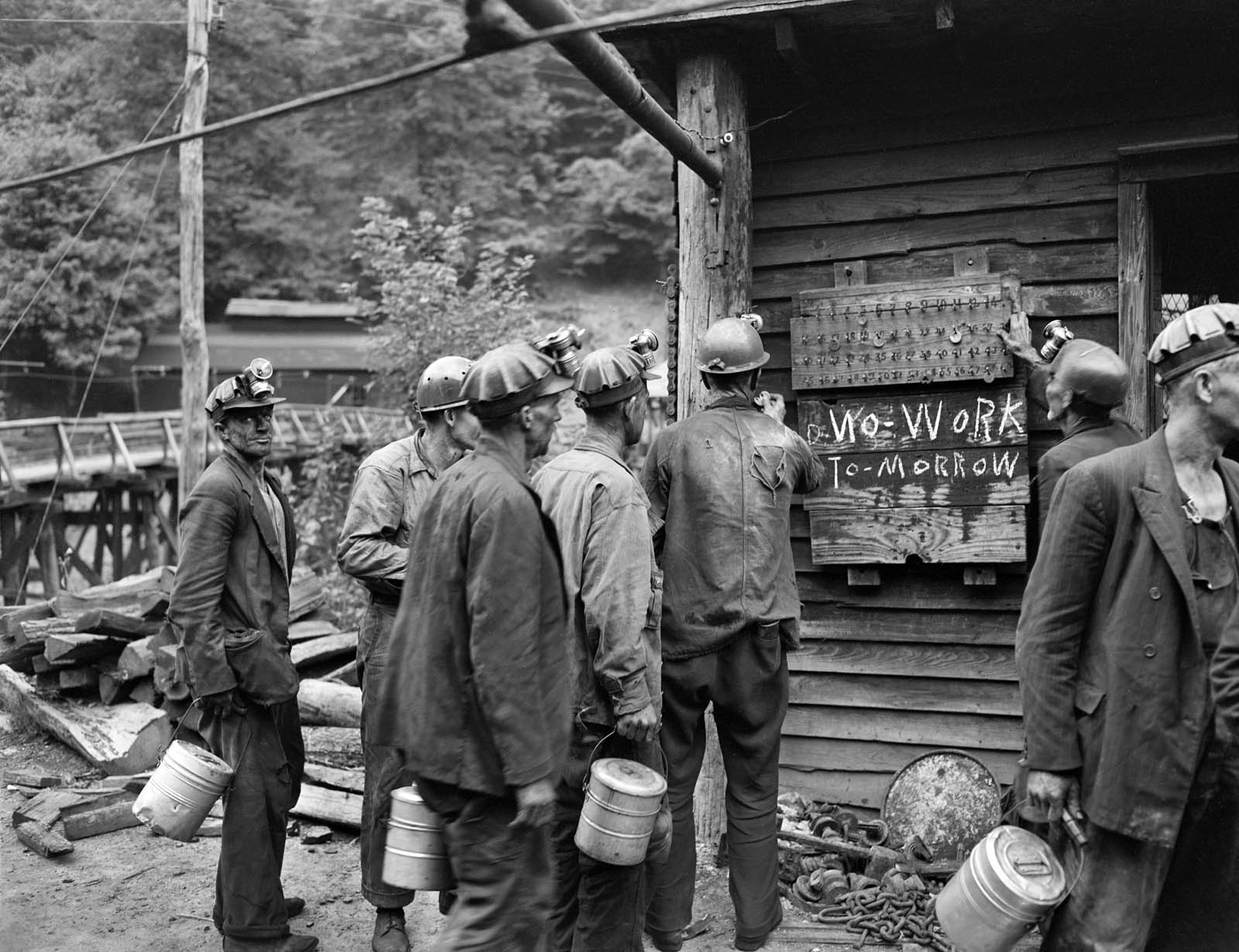
 

Russell Lee (American, 1903-1986) 'Miners bring in their checks and see the sign that there is no Saturday work. P V & K Coal Company, Clover Gap Mine, Lejunior, Harlan County, Kentucky' (Original Caption) September 13, 1946


Russell Lee (American, 1903-1986)
Miners bring in their checks and see the sign that there is no Saturday work. P V & K Coal Company, Clover Gap Mine, Lejunior, Harlan County, Kentucky (Original Caption)
September 13, 1946
National Archives
Public domain
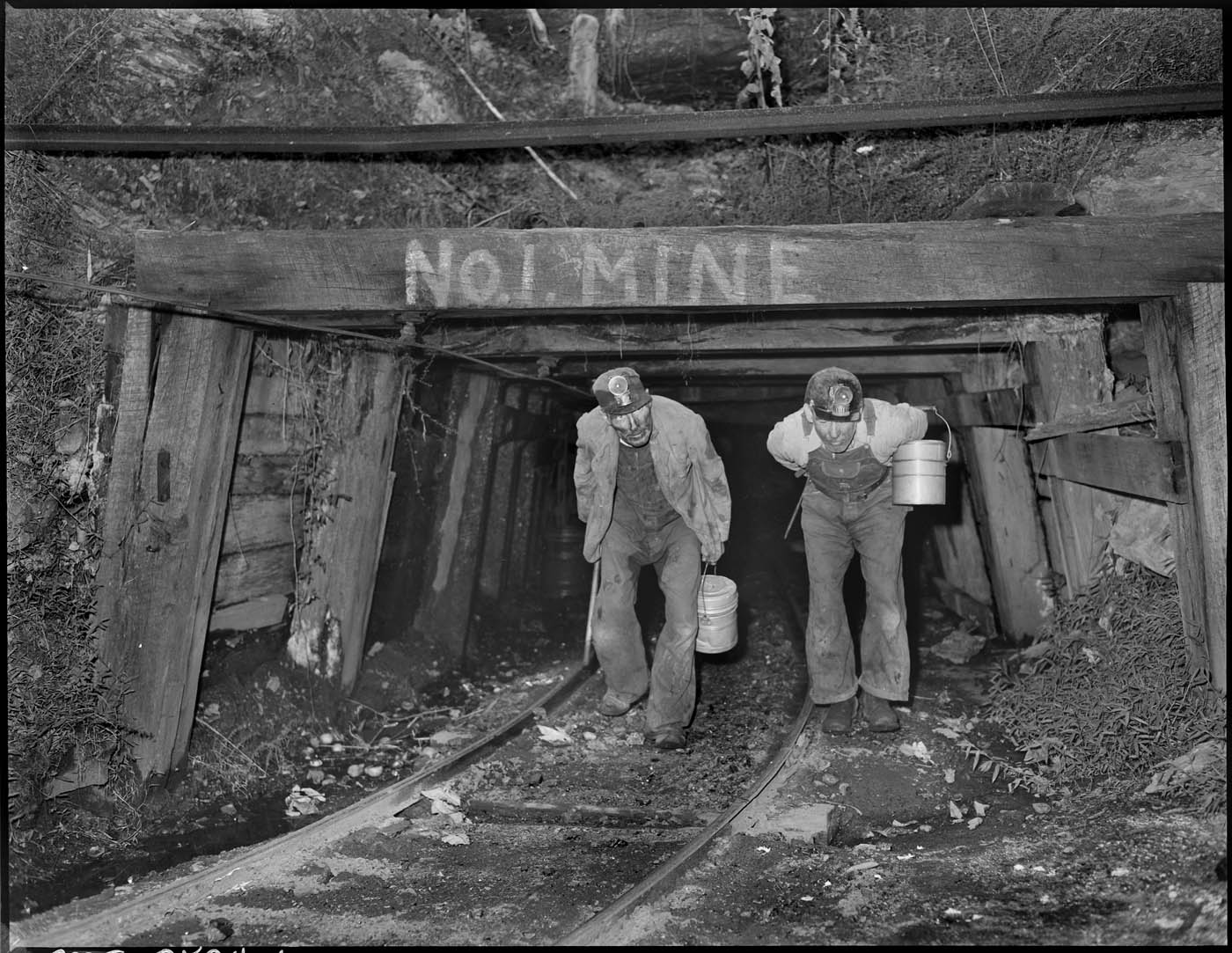
 

Russell Lee (American, 1903-1986) 'Blaine Sergent, left, comes out of the mine at the end of the day's work. P V & K Coal Company, Clover Gap Mine, Lejunior, Harlan County, Kentucky' September 13, 1946


Russell Lee (American, 1903-1986)
Blaine Sergent, left, comes out of the mine at the end of the day’s work. P V & K Coal Company, Clover Gap Mine, Lejunior, Harlan County, Kentucky
September 13, 1946
National Archives
Public domain
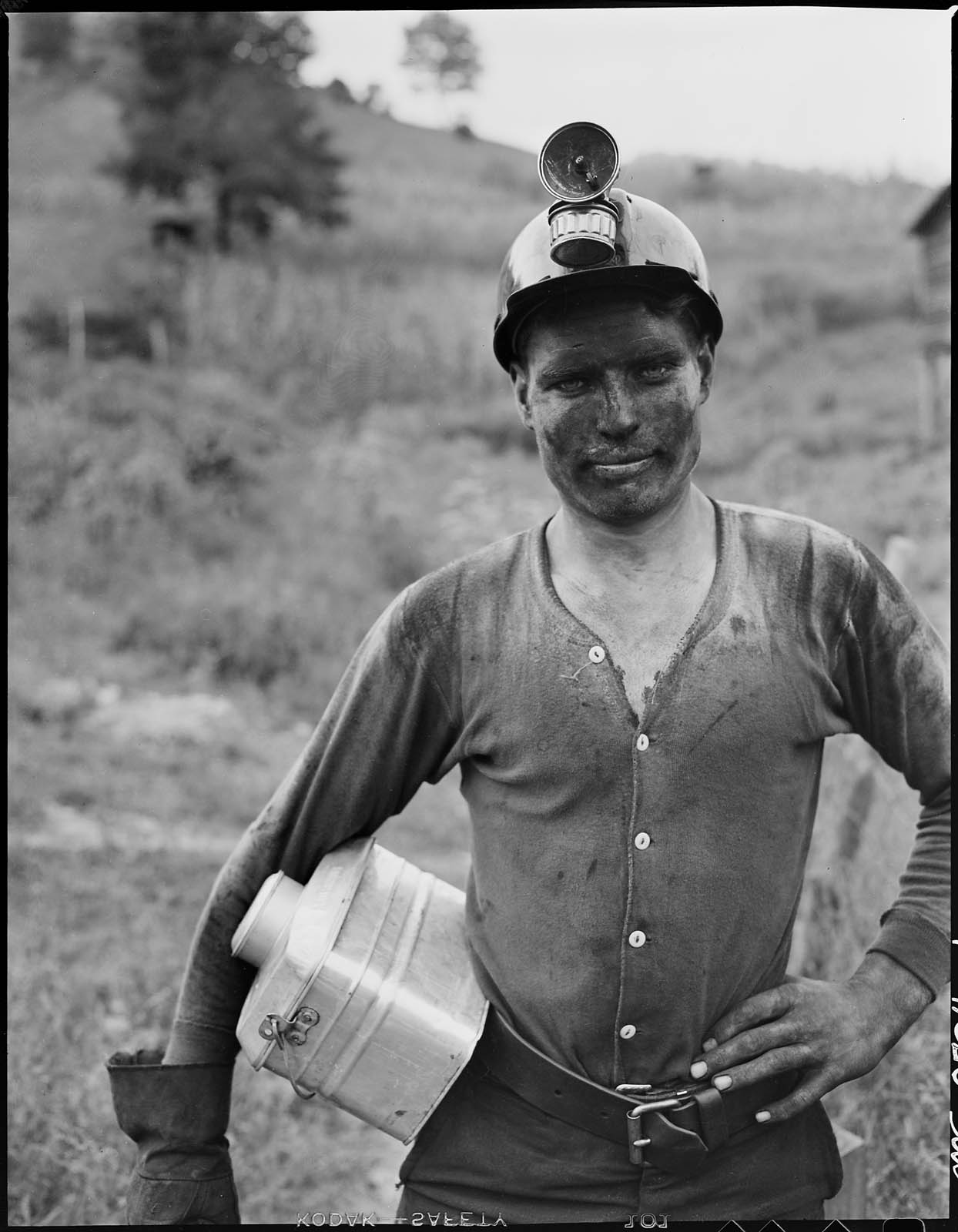
 

Russell Lee (American, 1903-1986) 'Rufus Sergent, married son, who is now coal cutter and general all around miner. Rufus did not like school and quit before finishing grade school. He went to work in the mines ten years ago when he was thirteen years old. P V & K Coal Company, Clover Gap Mine, Lejunior, Harlan County, Kentucky' September 15, 1946


Russell Lee (American, 1903-1986)
Rufus Sergent, married son, who is now coal cutter and general all around miner. Rufus did not like school and quit before finishing grade school. He went to work in the mines ten years ago when he was thirteen years old. P V & K Coal Company, Clover Gap Mine, Lejunior, Harlan County, Kentucky
September 15, 1946
National Archives
Public domain
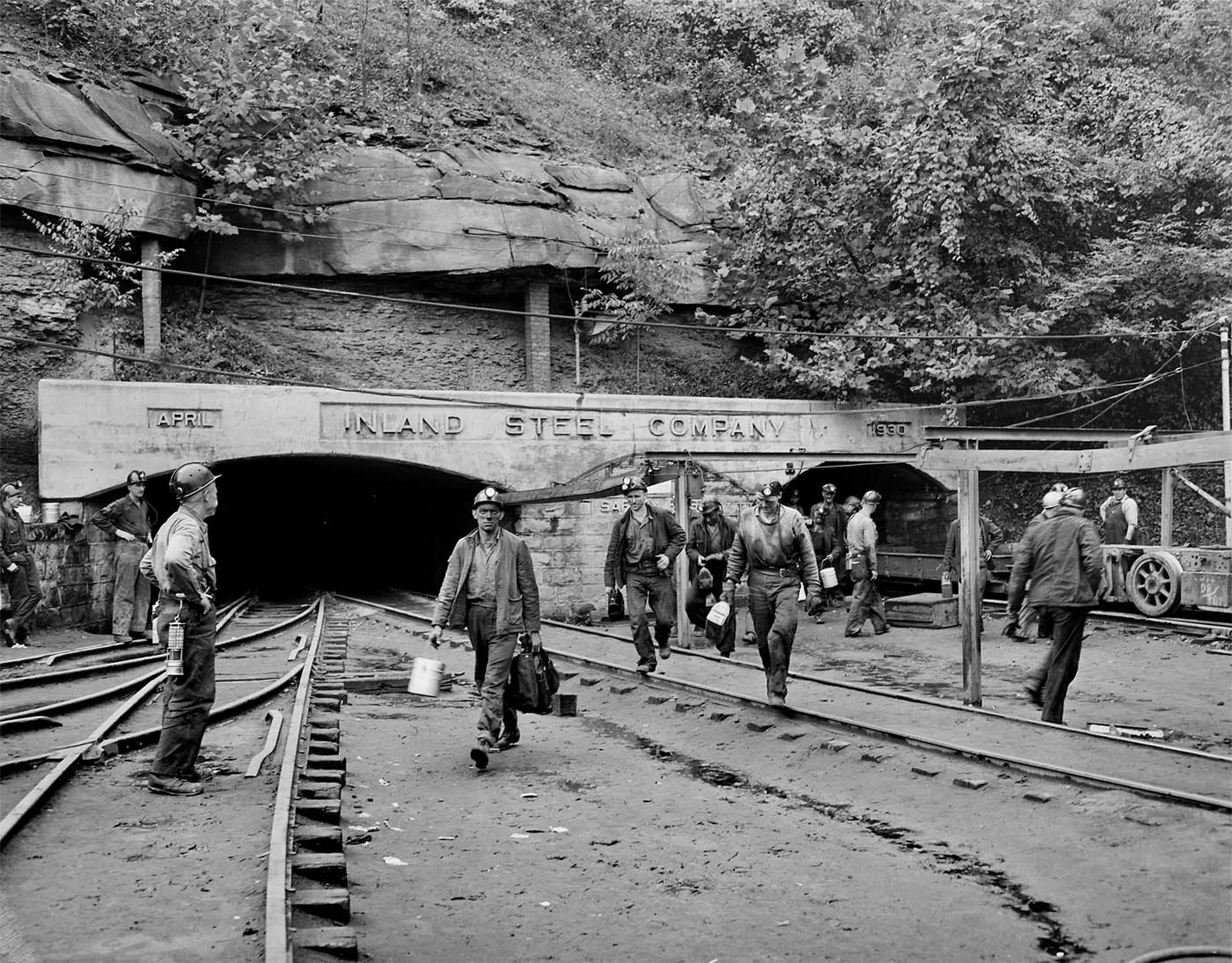
 

Russell Lee (American, 1903-1986) 'Changing shifts at the mine portal in the afternoon. Inland Steel Company, Wheelwright #1 & 2 Mines, Wheelwright, Floyd County, Kentucky' (Original Caption) September 23, 1946


Russell Lee (American, 1903-1986)
Changing shifts at the mine portal in the afternoon. Inland Steel Company, Wheelwright #1 & 2 Mines, Wheelwright, Floyd County, Kentucky (Original Caption)
September 23, 1946
National Archives
Public domain


Russell Lee (American, 1903-1986) 'Harry Fain, coal loader. Inland Steel Company, Wheelwright #1 & 2 Mines, Wheelwright, Floyd County, Kentucky' September 23, 1946


Russell Lee (American, 1903-1986)
Harry Fain, coal loader. Inland Steel Company, Wheelwright #1 & 2 Mines, Wheelwright, Floyd County, Kentucky
September 23, 1946
National Archives
Public domain
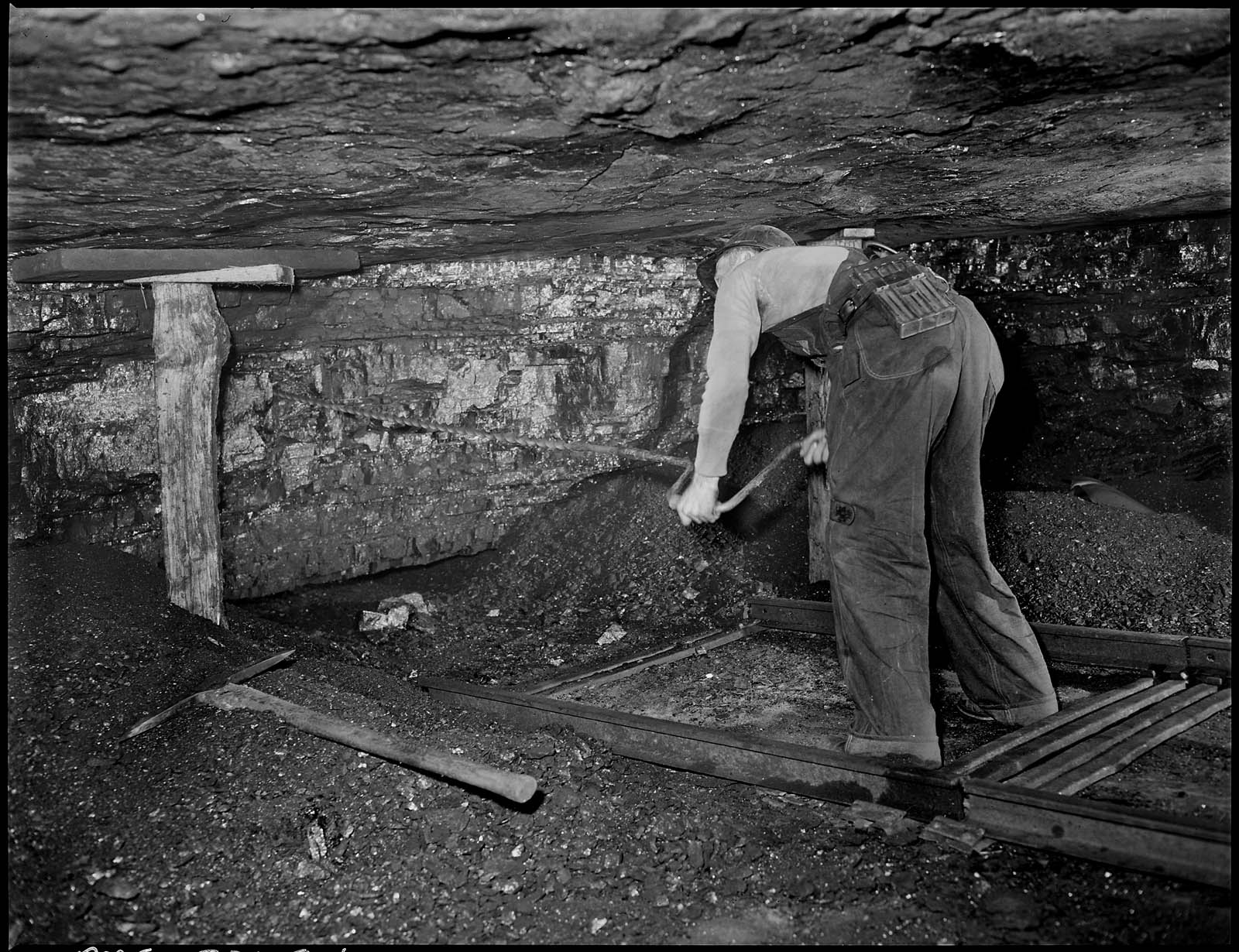
 

Russell Lee (American, 1903-1986) 'Harry Fain, coal loader, drills coal with hand auger. Powder charges are then placed and ignited. Inland Steel Company, Wheelwright #1 & 2 Mines, Wheelwright, Floyd County, Kentucky' September 24, 1946


Russell Lee (American, 1903-1986)
Harry Fain, coal loader, drills coal with hand auger. Powder charges are then placed and ignited. Inland Steel Company, Wheelwright #1 & 2 Mines, Wheelwright, Floyd County, Kentucky
September 24, 1946
National Archives
Public domain


Mining the Catalog – Exploring records from the Exhibit Power & Light

In March, a new exhibit opened at the National Archives building in Washington, D.C. titled “Power & Light: Russell Lee’s Coal Survey.” The exhibit features over 200 photographs of miners and mining communities in the 1940’s from Record Group 245: Records of the Solid Fuels Administration for War.

Russell Lee began his work for the federal government during the Great Depression when he was one of the photographers hired by the Farm Security Administration to document rural poverty. He later photographed the forced relocation of Japanese Americans to detention camps.

The photographs that are the subject of our exhibit come from Lee’s final project for the federal government. In 1946, he was sent to document the lives of coal miners and their communities by the Truman administration. The United Mine Workers’ 400,000 members had gone on strike demanding safer working conditions, improved health benefits, and better pay. As part of the agreement that ended the strike, the federal government agreed to survey the miners’ living conditions.

The photographs, which are part of the series “Photographs of the Medical Survey of the Bituminous Coal Industry,” show homes with backyard outhouses that were often owned by the mining companies themselves and rented to the miners. We also see miners and their families going about their everyday tasks, having fun in recreation halls, and playing outside.

Lee provided the photographs for the study which included 90 communities in 22 states. The program led to improvements in the mining communities, including the building of 13 new hospitals. Over the course of the survey, Lee took over 4000 photographs, more than 200 of which are included in the exhibit. Over 1000 of the photographs are available in the Catalog. Lee focused on three major themes for the project: home, mines, and community, capturing a moment of mid-century American life. His photographs show not just miners but their families, their homes, and their churches.

Text from the National Archives Catalog email


Russell Lee: Community

To fulfil the mandate of the survey, Lee photographed sanitary, medical, and recreational facilities and services. But he also captured moments of joy and connection that characterised the strong community bonds forged by the miners.
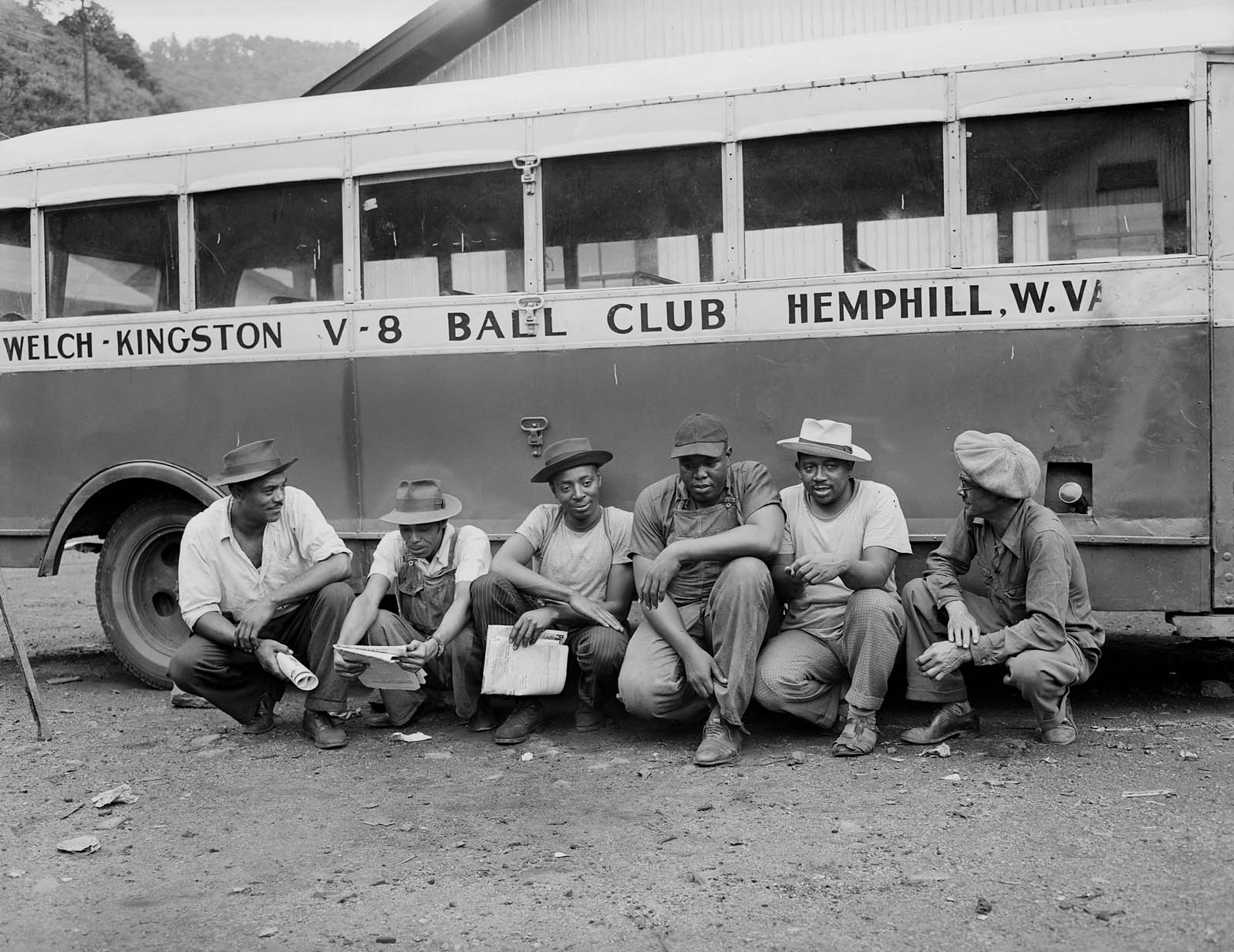
 

Russell Lee (American, 1903-1986) 'Some of the members of the baseball team of Exeter-Warwick Mines. Kingston Pocahontas Coal Company, Exeter Mine, Welch, McDowell County, West Virginia' (Original Caption) August 10, 1946


Russell Lee (American, 1903-1986)
Some of the members of the baseball team of Exeter-Warwick Mines. Kingston Pocahontas Coal Company, Exeter Mine, Welch, McDowell County, West Virginia (Original Caption)
August 10, 1946
National Archives
Public domain
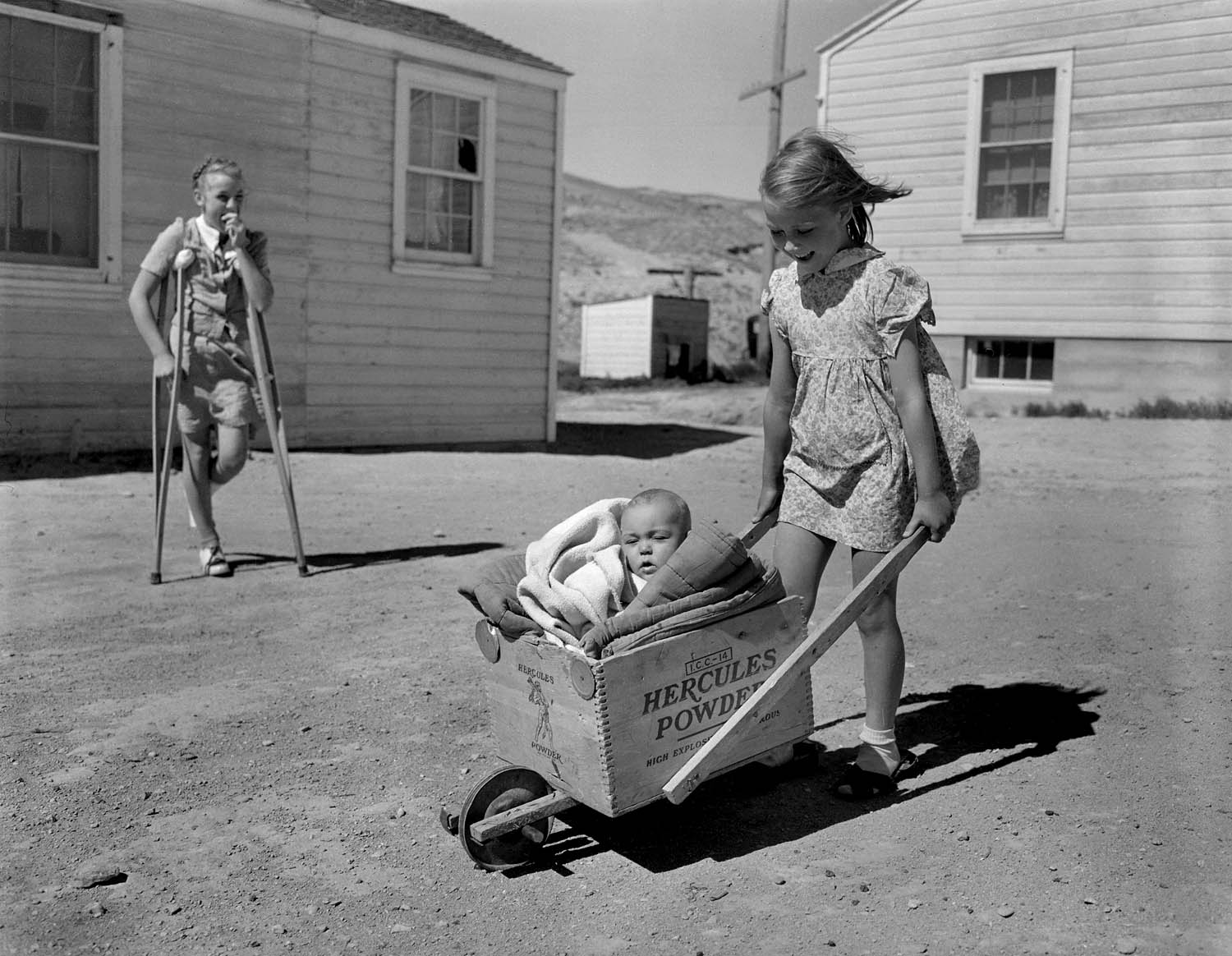
 

Russell Lee (American, 1903-1986) 'Children of miner living in company housing project. Note the homemade baby buggy made of a powder box. Union Pacific Coal Company, Reliance Mine, Reliance, Sweetwater County, Wyoming' (Original Caption) August 10, 1946


Russell Lee (American, 1903-1986)
Children of miner living in company housing project. Note the homemade baby buggy made of a powder box. Union Pacific Coal Company, Reliance Mine, Reliance, Sweetwater County, Wyoming (Original Caption)
August 10, 1946
National Archives
Public domain


Russell Lee (American, 1903-1986) 'Children of miners on the fence in front of the Howard house. Gilliam Coal and Coke Company, Gilliam Mine, Gilliam, McDowell County, West Virginia' (Original Caption) August 13, 1946


Russell Lee (American, 1903-1986)
Children of miners on the fence in front of the Howard house. Gilliam Coal and Coke Company, Gilliam Mine, Gilliam, McDowell County, West Virginia (Original Caption)
August 13, 1946
National Archives
Public domain


Russell Lee (American, 1903-1986) 'The meat and vegetable and fruit department in the company store. Raven Red Ash Coal Company, No. 2 Mine, Raven, Tazewell County, Virginia' August 29, 1946


Russell Lee (American, 1903-1986)
The meat and vegetable and fruit department in the company store. Raven Red Ash Coal Company, No. 2 Mine, Raven, Tazewell County, Virginia
August 29, 1946
National Archives
Public domain


Russell Lee (American, 1903-1986) 'Handling serpents at the Pentecostal Church of God. Company funds have not been used in this church and it is not on company property. Most of the members are coal miners and their families. Lejunior, Harlan County, Kentucky' September 15, 1946


Russell Lee (American, 1903-1986)
Handling serpents at the Pentecostal Church of God. Company funds have not been used in this church and it is not on company property. Most of the members are coal miners and their families. Lejunior, Harlan County, Kentucky
September 15, 1946
National Archives
Public domain
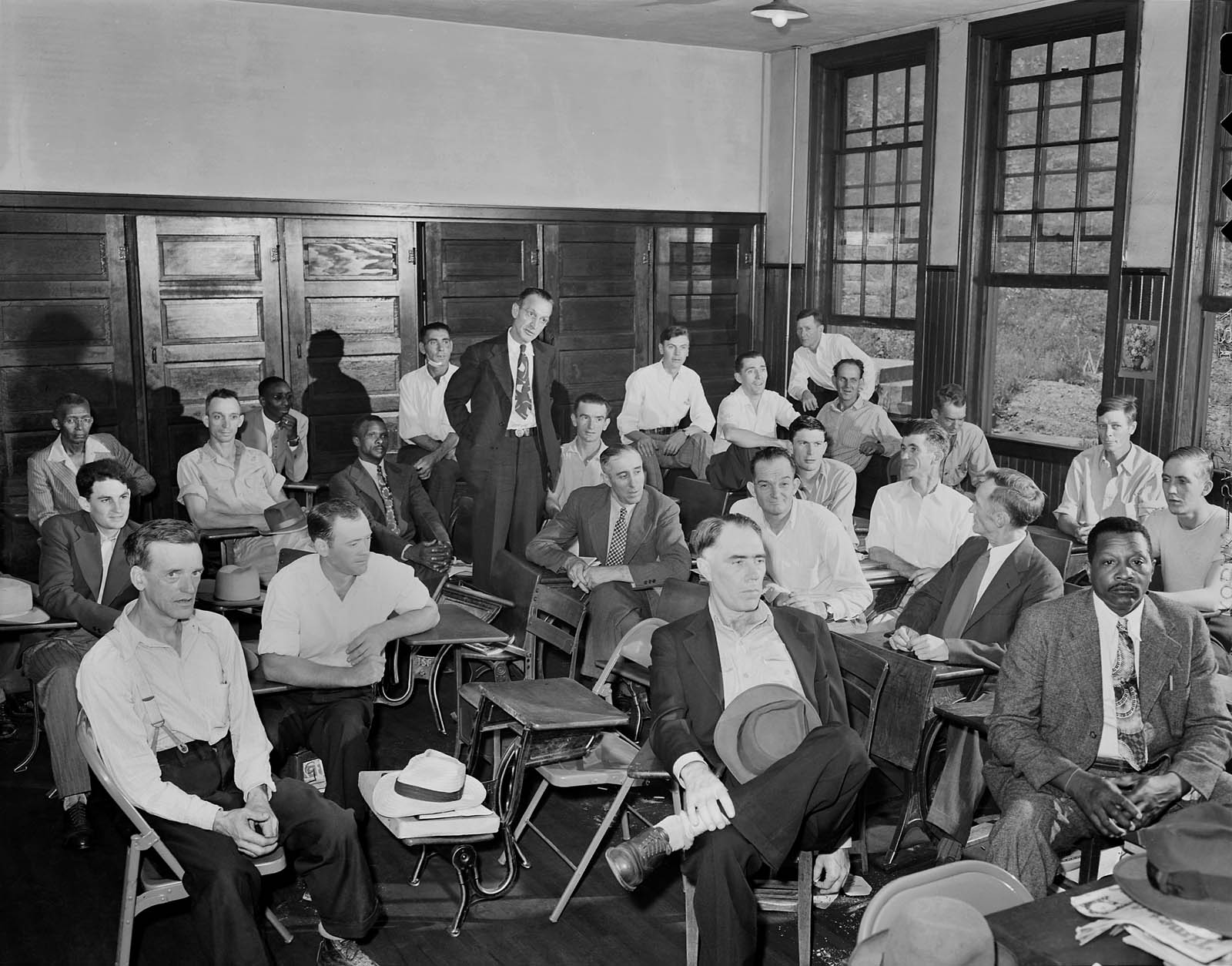
 

Russell Lee (American, 1903-1986) 'Local UMWA union meeting is held on Sunday morning in schoolhouse. Inland Steel Company, Wheelwright #1 & 2 Mines, Wheelwright, Floyd County, Kentucky' (Original Caption) September 22, 1946


Russell Lee (American, 1903-1986)
Local UMWA union meeting is held on Sunday morning in schoolhouse. Inland Steel Company, Wheelwright #1 & 2 Mines, Wheelwright, Floyd County, Kentucky (Original Caption)
September 22, 1946
National Archives
Public domain


Lee’s next big project, and the topic of the National Archives Power & Light exhibit, came after the war. It was Lee’s last, large federally funded photo documentation project. In 1946 the Truman administration made a promise to striking coal miners that if they resumed work, the federal government would sponsor a nationwide survey of health and labor conditions in mining camps. Lee became an instrumental member of the survey.

Lee’s survey photos give an unprecedented accounting of medical, health, and housing conditions in coal-mining communities. Located in remote areas, these communities were not normally accessible to outsiders. Lee’s photographs demonstrate the difficult circumstances in which miners and their families lived but also show us the strength and resilience of these mining communities.

The National Archives has the complete series of more than 4,000 images, the bulk of which were taken by Russell Lee. They feature mining communities in several states, including Utah, West Virginia, Colorado, Kentucky, Pennsylvania, and Wyoming.

His photographs cover a complete range of activities in mining communities including: interior and exterior shots of both company-owned and private dispensaries; miners at work; mining grounds, equipment, and wash houses; women in the home; children at play; recreation facilities, churches, schools, and clubs; scenes of mining townspeople in and around company stores and town streets; family portraits; members of the medical survey group inspecting grounds and speaking to mine company administrators; and local mine operators and union officials.

The images are great primary sources, particularly because of the way Lee documented his photographs. In his extensive cataloging, he recorded the elements and details of home, workplace, and community, giving us an even greater glimpse into the daily life of miners and their families.

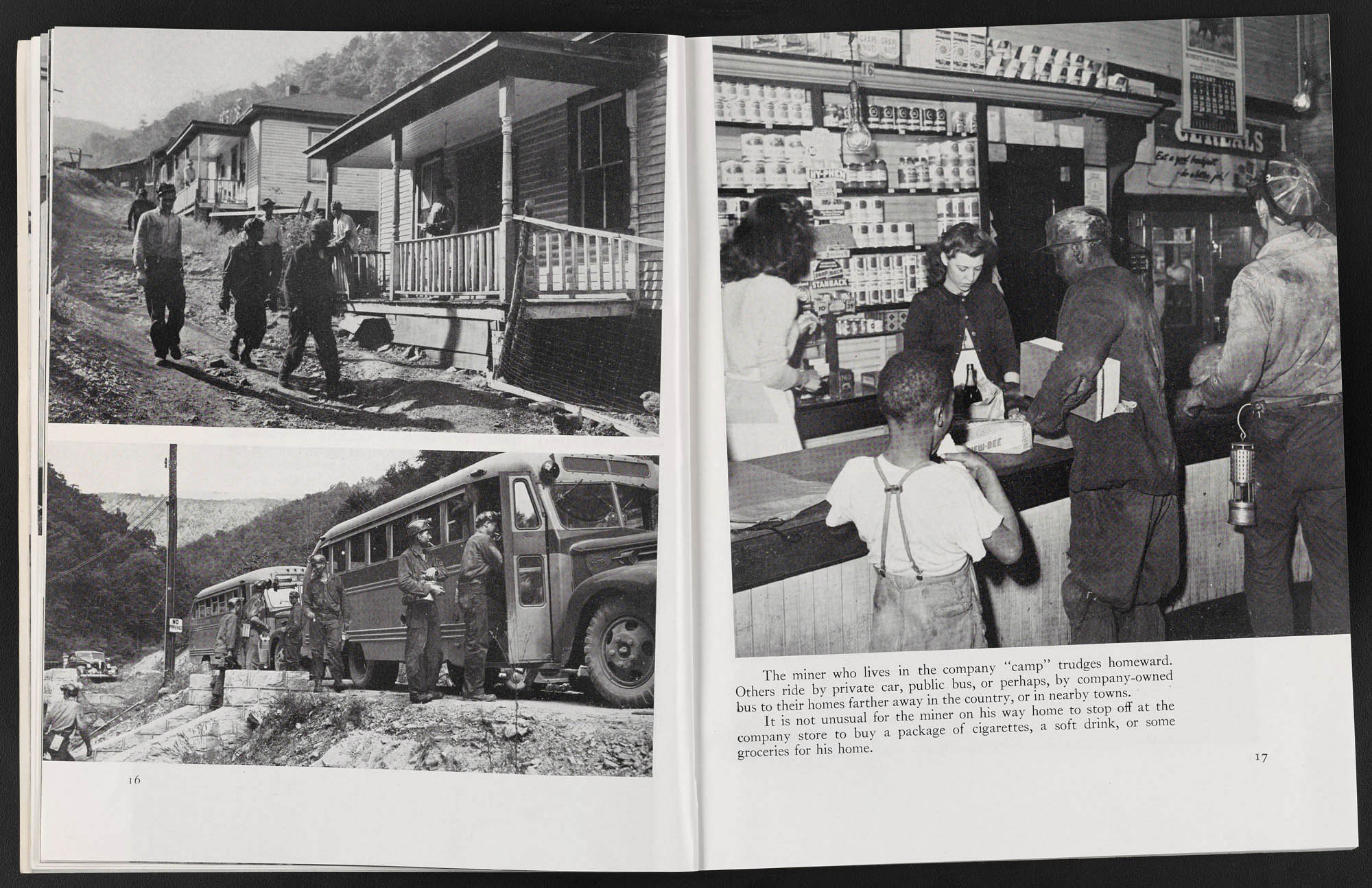
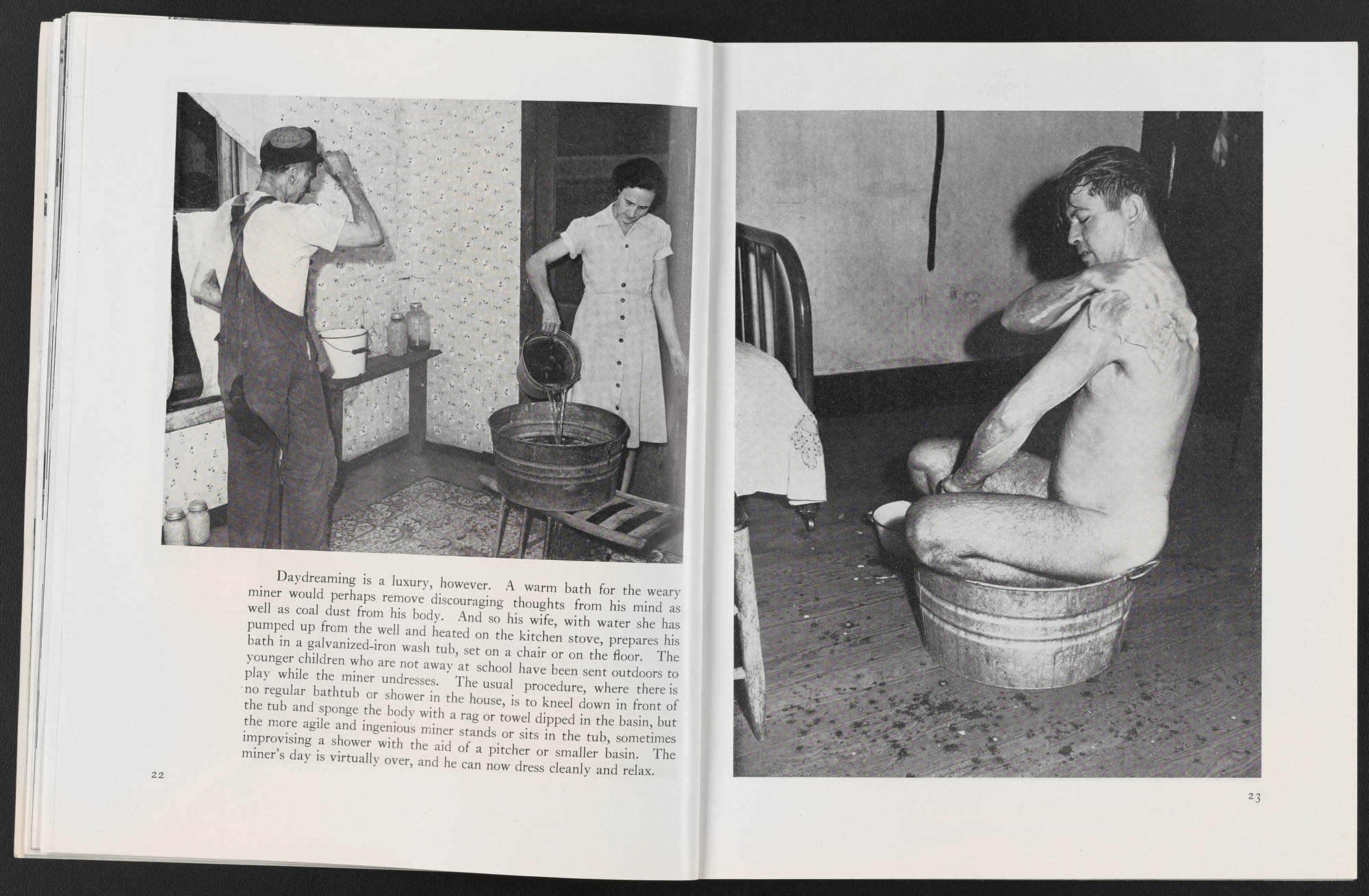
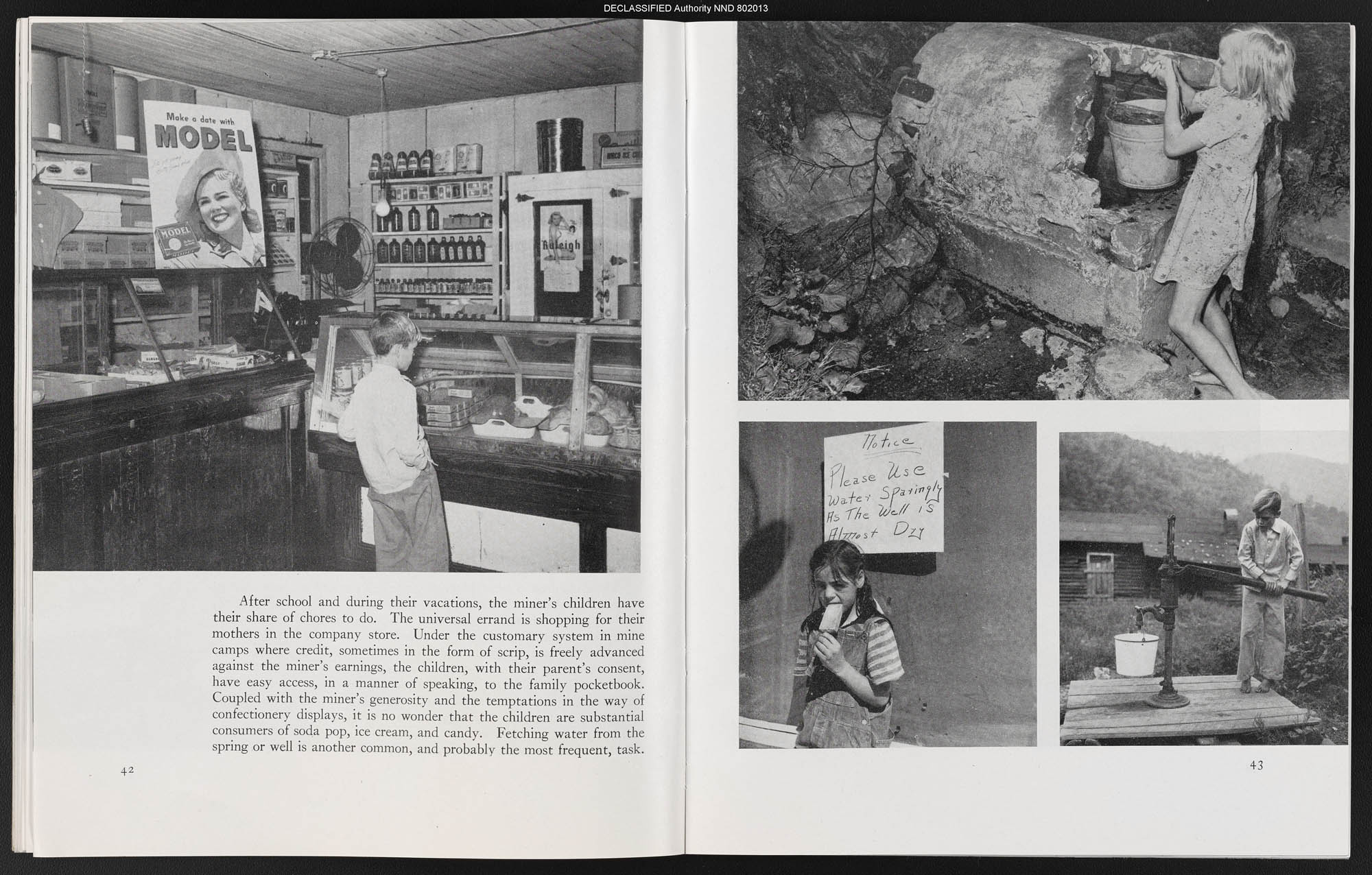
The Department of the Interior used many of Lee’s photographs when it published the final report in 1947, “A Medical Survey of the Bituminous Coal Industry,” and its supplemental report titled “The Coal Miner and His Family.”

Jessie Kratz. “Russell Lee’s Coal Survey Exhibit,” on the National Archives ‘Piece of History’ website March 18, 2024 [Online] Cited 20/03/2024
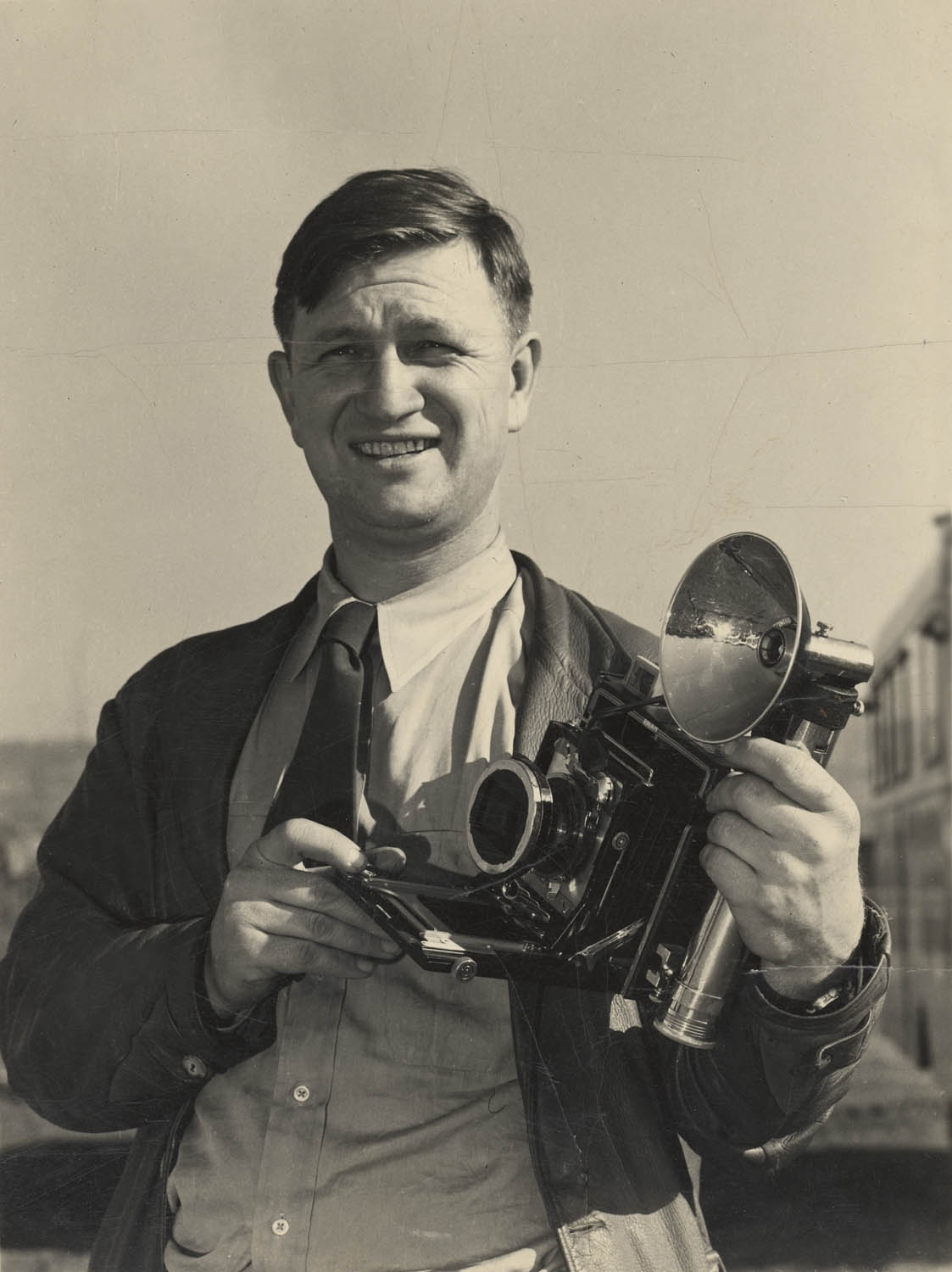
 

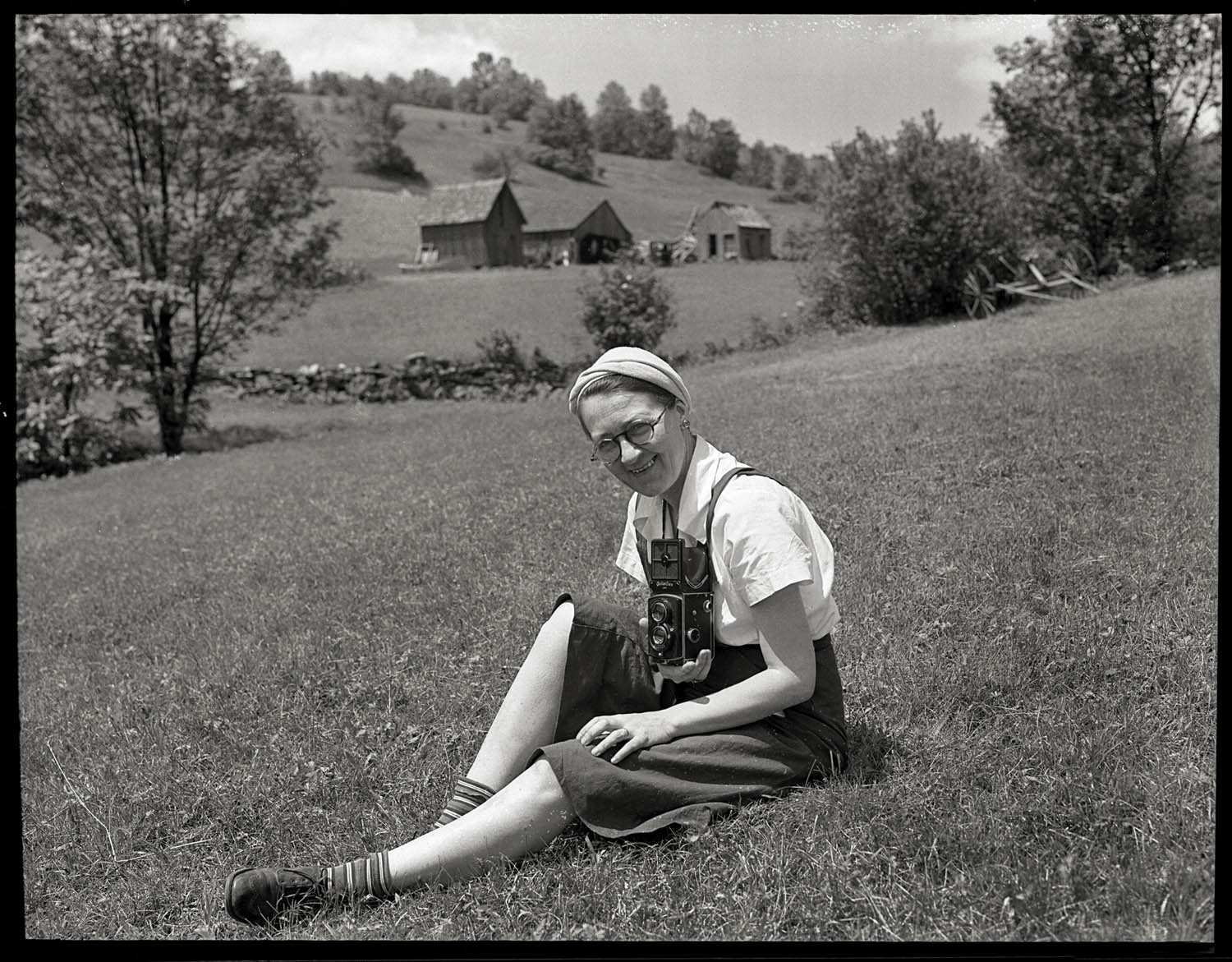
Unknown photographer (American) 'Russell W. Lee (with camera in hand)' c. 1942-1945


Unknown photographer (American)
Russell W. Lee (with camera in hand)
c. 1942-1945
Image courtesy of The Wittliff Collections / Texas State University
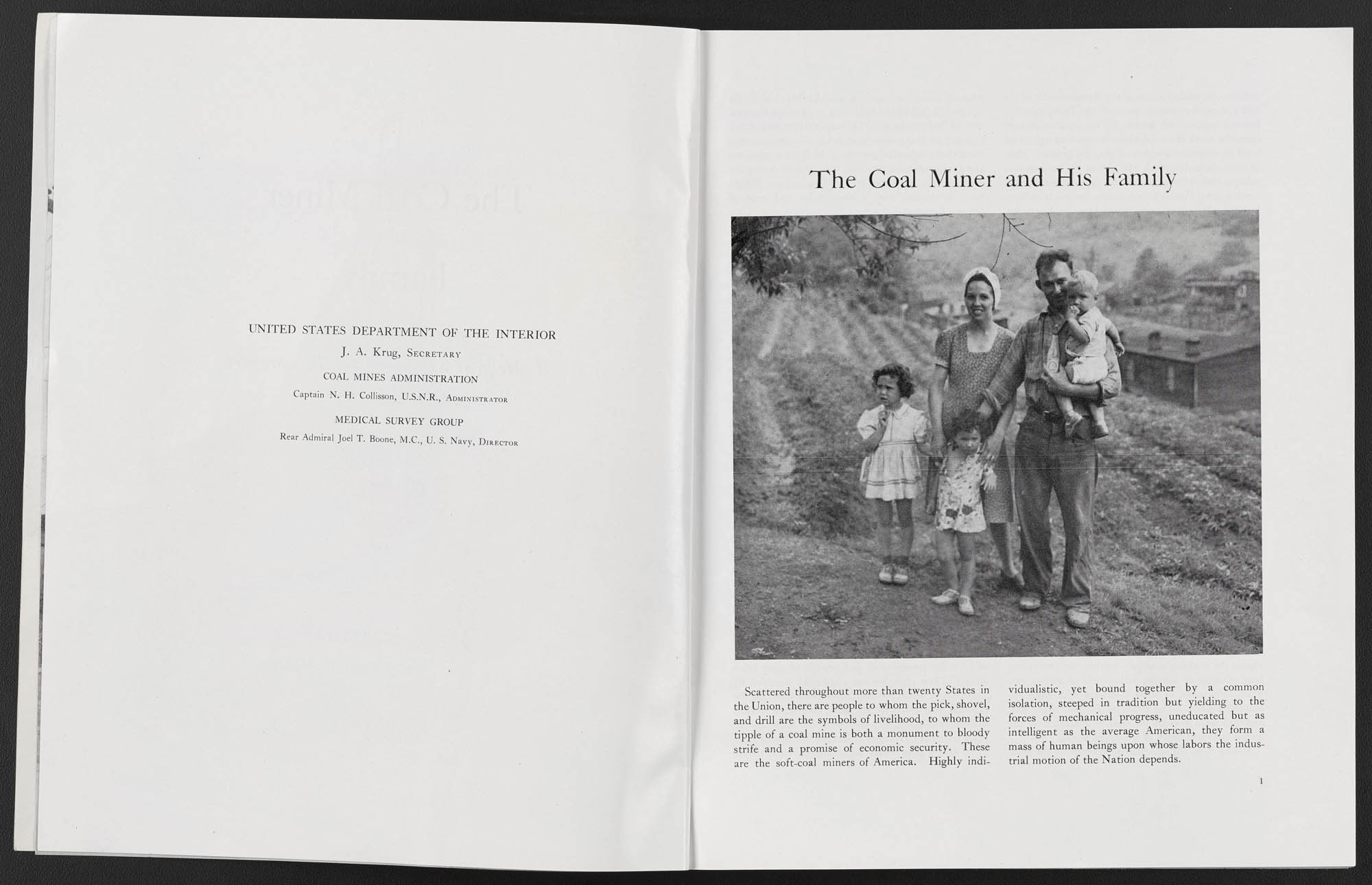
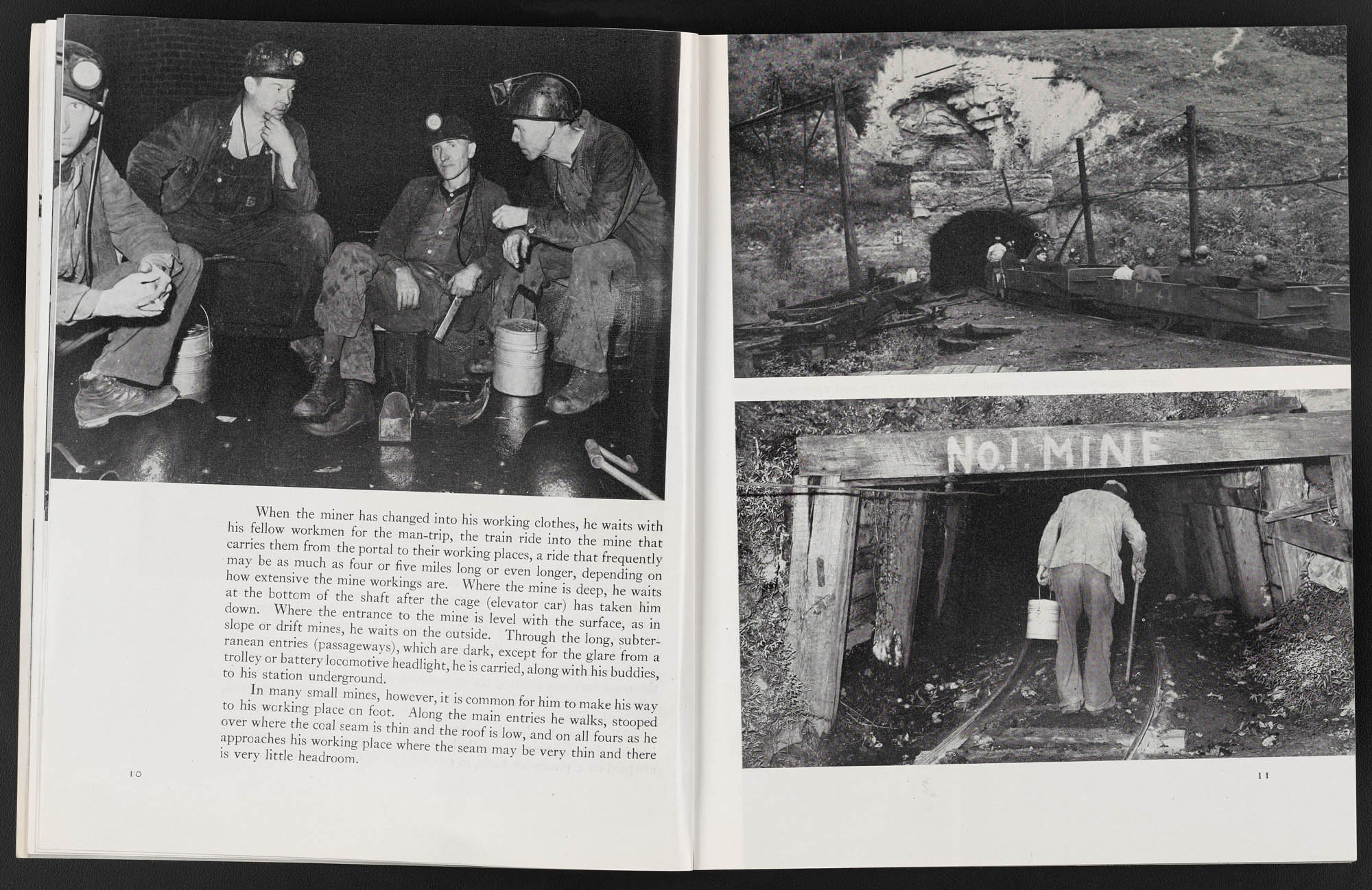
 

'The Coal Miner & His Family' Washington 1947

'The Coal Miner & His Family' Washington 1947

'The Coal Miner & His Family' Washington 1947

'The Coal Miner & His Family' Washington 1947

'The Coal Miner & His Family' Washington 1947

'The Coal Miner & His Family' Washington 1947


The Coal Miner and His Family
Washington 1947
A Supplement To A Medical Survey of the Bituminous-Coal Industry
Report of the Coal Mines Administration


National Archives Museum
701 Constitution Avenue, NW
[between 7th & 9th Streets]
Washington, DC 20408

Opening hours:
Daily 10am – 5.30pm

National Archives Museum website

LIKE ART BLART ON FACEBOOK

Back to top

Exhibition: ‘Consuelo Kanaga. Catch the Spirit’ at the KBr Photography Center KBr Fundación MAPFRE, Barcelona

Exhibition dates: 15th February – 12th May, 2024

Curator: Drew Sawyer


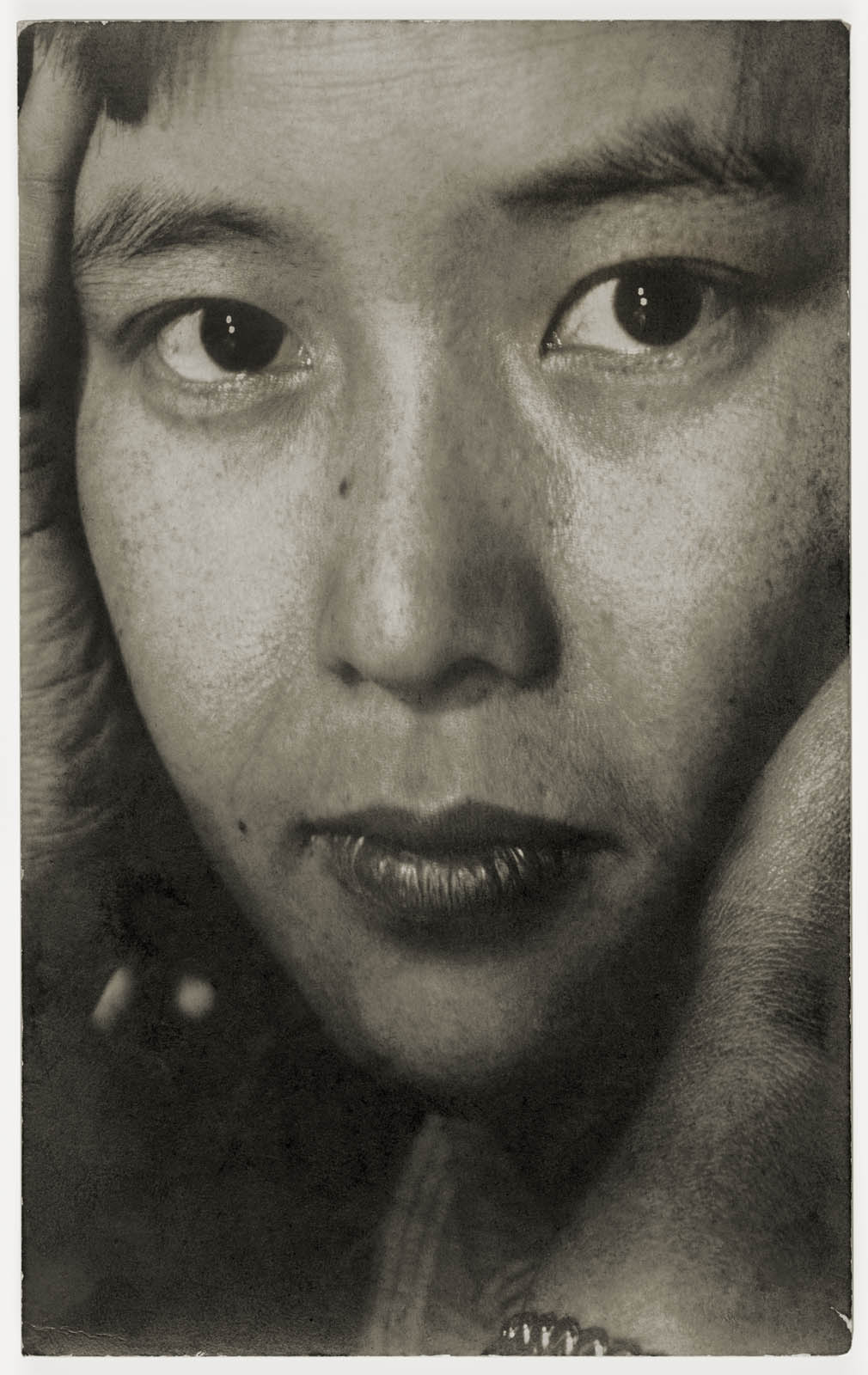
Consuelo Kanaga (American, 1894-1978) 'Self-portrait' Nd
 

Consuelo Kanaga (American, 1894-1978)
Self-portrait
Nd
Gelatin silver print
20 1/16 × 15 1/16 × 1 1/2 in. (51 × 38.3 × 3.8cm) framed
Brooklyn Museum, Gift of Wallace B. Putnam from the Estate of Consuelo Kanaga
© Brooklyn Museum
Photo: Brooklyn Museum


What have you got to say?

We must acknowledge the importance of the Consuelo Kanaga, a strong, compassionate human being, an under recognised photographer. What a trailblazer for future female and male photographers such as Dorothea Lange, Imogen Cunningham, Berenice Abbott and Milton Rogovin.

Kanaga is a story teller. Her photographs are strongly modernist, realist compositions. The portraits are direct and revealing, no external flourishes necessary in capturing the essence of the person; her landscapes, dark and brooding atmospheric iterations of land and spirit.

Consuelo Kanaga:

~ one of the pioneers of modern American photography

~ one of the first women photojournalists on staff at a newspaper (1918)

~ a great supporter and a confidant for Imogen Cunningham, Louise Dahl-Wolfe, Dorothea Lange, Alma Lavenson, Tina Modotti, and Eiko Yamazawa, among many others

~ passionate about social justice … social marginalisation, poverty, racial harassment, inequality… especially in relation to the African-American population in the United States.

~ maintained a close relationship with avant-garde circles, in San Francisco with the f.64 Group and in New York with the Photo League

~ focused on marginal day to day and political motifs, including workers, African Americans, objects, and buildings that were often in a state of disrepair

~ interested in worker’s rights and the worker movement

~ became very active in civil rights and took part in and photographed many demonstrations and marches in the 1960s


Whatever type of photograph Kanaga took (and there are many) her photographs are always perceptive = having or showing sensitive insight.

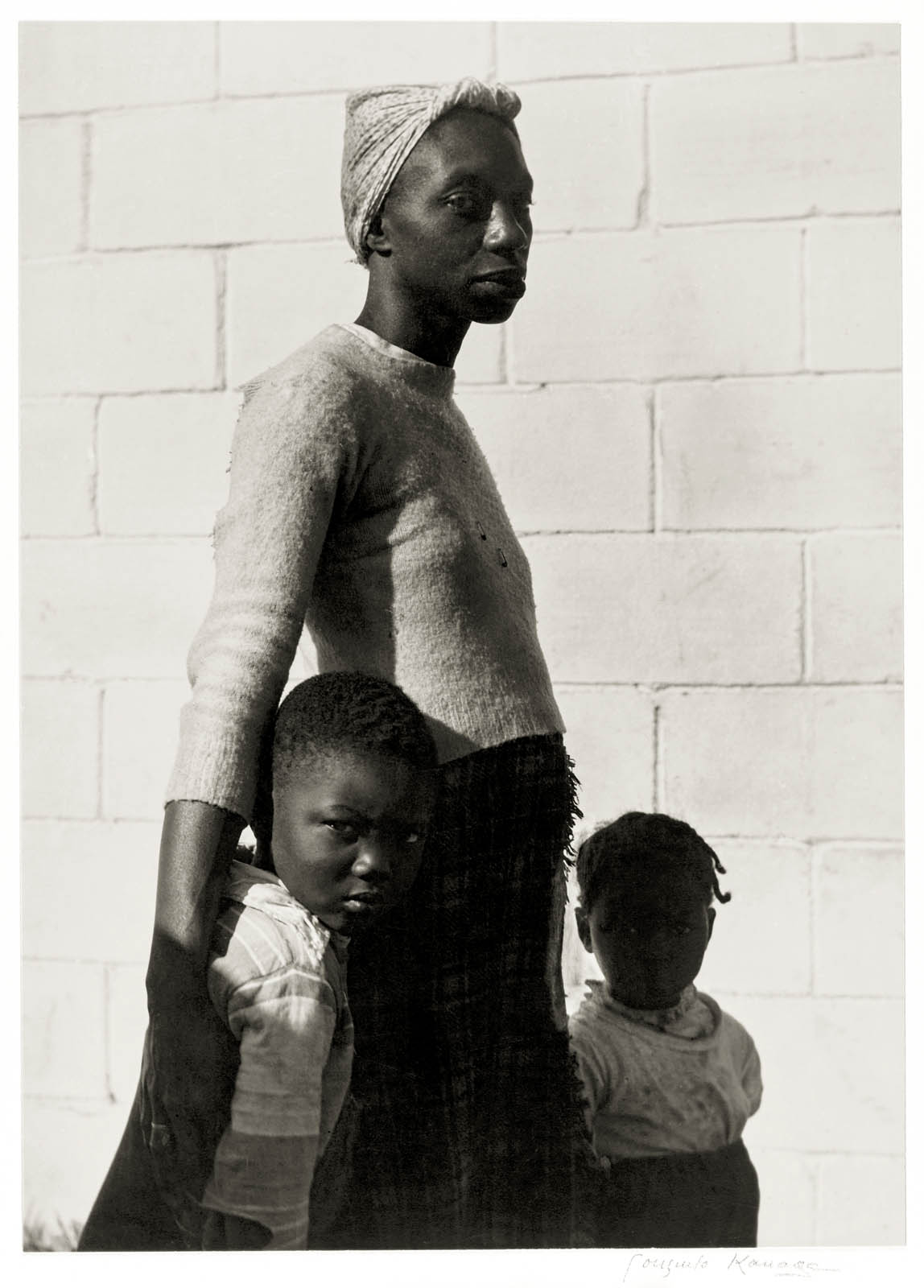
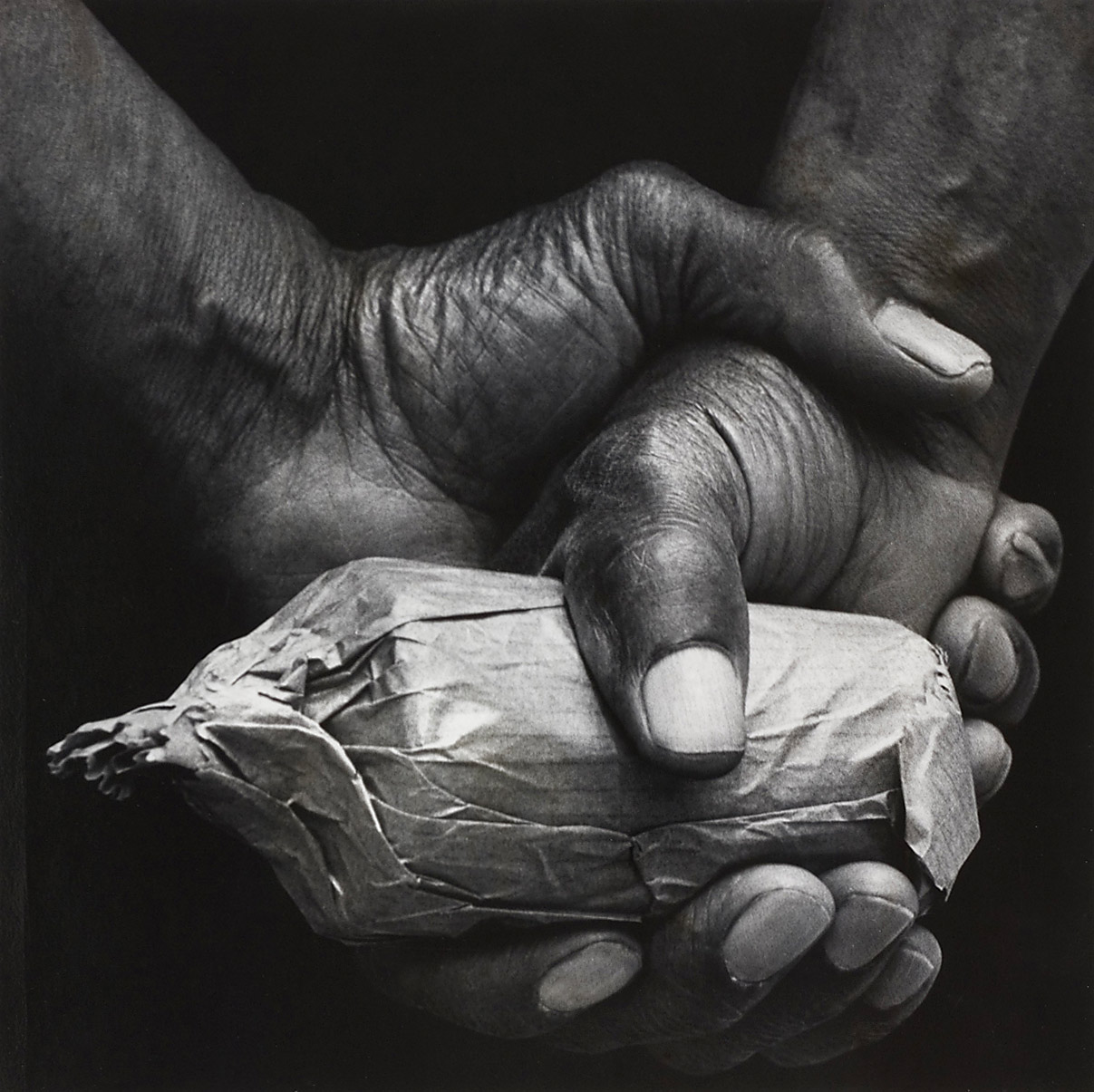
The sensitivity of Hands (1930, below); the tired eyes and clasped hands of the Widow Watson (1922-1924 below) contrasting with the mannerist hands of the boy staring off camera; the stoicism of the mother in Tree of Life (1950, below) with her children’s faces in deep shadow coupled with the subconscious symbology of the unyielding, white brick wall behind; and the dark mesa of Landscape Near Taos, New Mexico (Nd, below) hello Georgia O’Keeffe … all reflect Kanaga’s superb handling of shadow and light, of energy and spirit.

“Her body of work, though comparatively small, is consistently exceptional.”1

Dr Marcus Bunyan

1/ Barbara Head Millstein. “A Pioneer of Realism,” in The New York Times October 9, 1993 on the New York Times website [Online] Cited 04/05/2024


Many thankx to the Fundación MAPFRE for allowing me to publish the photographs in the posting. Please click on the photographs for a larger version of the image.


“One of America’s most transcendent yet, surprisingly, least-known photographers.”


Barbara Head Millstein and Sarah M. Lowe (1992). Consuelo Kanaga, An American Photographer. Seattle: University of Washington Press. pp. 21-40.


“I could have done lots more, put in much more work and developed more pictures, but I had also a desire to say what I felt about life. Simple things like a little picture in the window or the corner of the studio or an old stove in the kitchen have always been fascinating to me. They are very much alive, these flowers and grasses with the dew on them. Stieglitz always said, “What have you got to say?” I think in a few small cases I’ve said a few things, expressed how I felt, trying to show the horror of poverty or the beauty of black people. I think that in photography what you’ve done is what you’ve had to say. In everything this has been the message of my life. A simple supper, being with someone you love, seeing a deer come around to eat or drink at the barn – I like things like that. If I could make one true, quiet photograph, I would much prefer it to having a lot of answers.”


Margaretta K. Mitchell (1979). Recollections: Ten Women of Photography. NY: Viking Press. pp. 158–160.


Consuelo Kanaga: Catch the Spirit is the first exhibition in Europe to present a comprehensive retrospective of the entire career of the American Consuelo Kanaga (Astoria, Oregon, 1894 – Yorktown Heights, New York, 1978). The exhibition covers six decades of her professional dedication to photography.

Passionate about social justice, Kanaga was more interested in people and their problems than in photography: social marginalisation, poverty, racial harassment, inequality…, especially in relation to the African-American population in the United States.

Consuelo Kanaga was one of the few women who became a professional photojournalist, and as early as the 1910s in the United States. She was also one of the few who maintained a close relationship with avant-garde circles, both in San Francisco and in New York, and whose friendship and professional support opened the way for important women photographers such as Imogen Cunningham and Dorothea Lange, among others.

Despite the fame she achieved during her lifetime, her work is still surprisingly little known. This exhibition aims to make a conclusive contribution to the recognition that Kanaga’s work undoubtedly deserves.

Exhibition organised by the Brooklyn Museum in New York in collaboration with Fundación MAPFRE and the San Francisco Museum of Modern Art.

Text from the Fundación MAPFRE website


Consuelo Kanaga (American, 1894-1978) 'Fire, New York' 1922


Consuelo Kanaga (American, 1894-1978)
Fire, New York
1922
Gelatin silver print
20 1/16 × 15 1/16 × 1 1/2 in. (51 × 38.3 × 3.8cm) framed
Brooklyn Museum, Gift of Wallace B. Putnam from the Estate of Consuelo Kanaga
© Brooklyn Museum
Photo: Brooklyn Museum


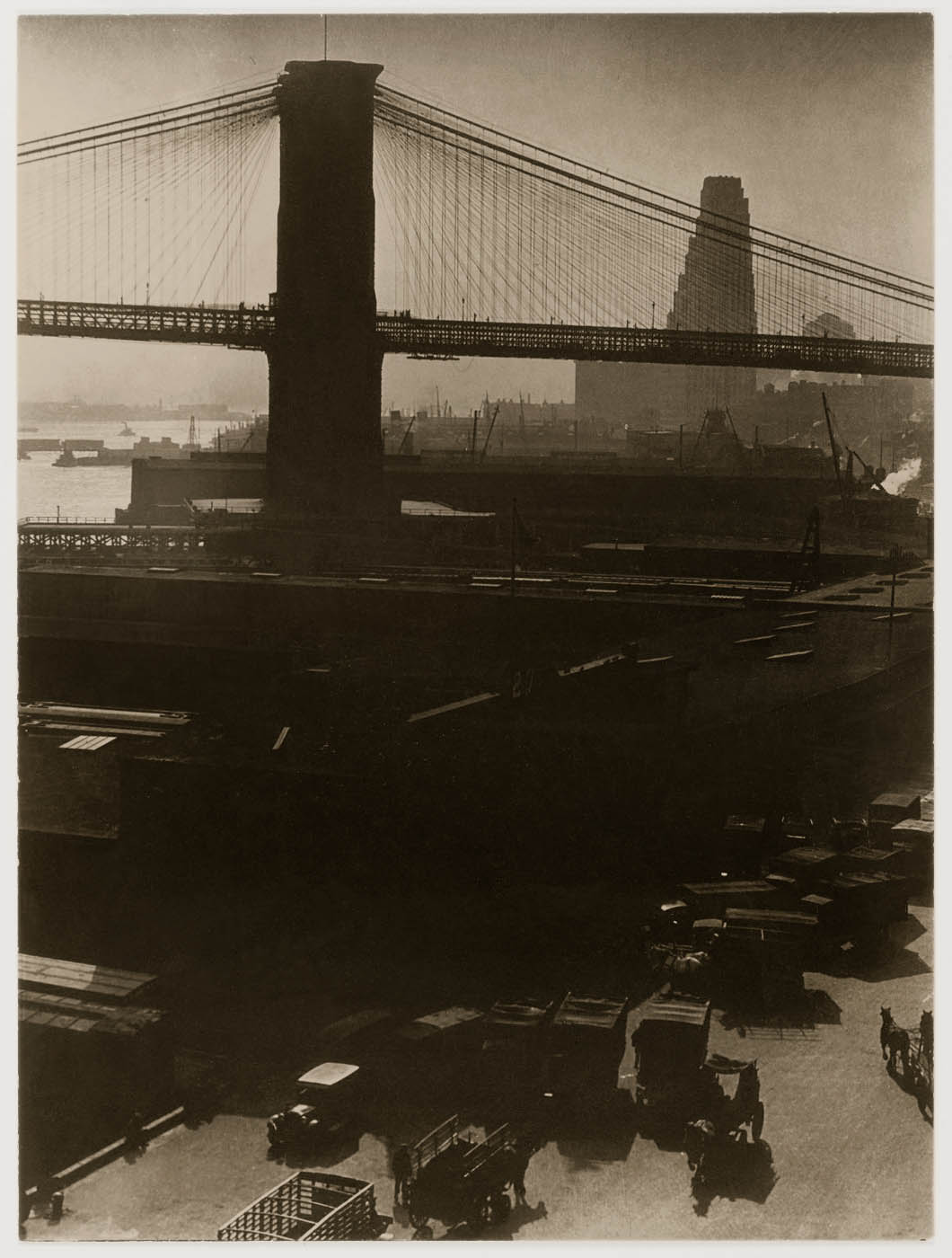
Consuelo Kanaga (American, 1894-1978) 'Untitled (Downtown New York)' 1922-1924


Consuelo Kanaga (American, 1894-1978)
Untitled (Downtown New York)
1922-1924
Gelatin silver print
20 1/16 × 15 1/16 × 1 1/2 in. (51 × 38.3 × 3.8cm) framed
Brooklyn Museum, Gift of Wallace B. Putnam from the Estate of Consuelo Kanaga
© Brooklyn Museum
Photo: Brooklyn Museum


Consuelo Kanaga (American, 1894-1978) 'Untitled' 1920s


Consuelo Kanaga (American, 1894-1978)
Untitled
1920s
Gelatin silver print
20 1/16 × 15 1/16 × 1 1/2 in. (51 × 38.3 × 3.8cm) framed
Brooklyn Museum, Gift of Wallace B. Putnam from the Estate of Consuelo Kanaga
© Brooklyn Museum
Photo: Brooklyn Museum


Consuelo Kanaga (American, 1894-1978) 'Untitled' c. 1925


Consuelo Kanaga (American, 1894-1978)
Untitled
c. 1925
Toned gelatin silver print with graphite
20 1/16 × 15 1/16 × 1 1/2 in. (51 × 38.3 × 3.8cm) framed
Brooklyn Museum, Gift of Wallace B. Putnam from the Estate of Consuelo Kanaga
© Brooklyn Museum
Photo: Brooklyn Museum


Consuelo Kanaga (American, 1894-1978) 'Louise Dahl-Wolfe' c. 1928


Consuelo Kanaga (American, 1894-1978)
Louise Dahl-Wolfe
c. 1928
Gelatin silver print, printed 2023
4 × 5 in. (10.2 × 12.7cm)
Brooklyn Museum, Gift of Wallace B. Putnam from the Estate of Consuelo Kanaga
© Brooklyn Museum
Photo: Brooklyn Museum


Louise Emma Augusta Dahl-Wolfe (November 19, 1895 – December 11, 1989) was an American photographer. She is known primarily for her work for Harper’s Bazaar, in association with fashion editor Diana Vreeland. At Harper’s Bazaar she pioneered a new standard in colour photography. …

Among the celebrated fashion photographers of the 20th century, Louise Dahl-Wolfe was an innovator and influencer who significantly contributed to the fashion world. She was most widely known for her work with Harper’s Bazaar. Dahl-Wolfe was considered a pioneer of the ‘female gaze’ in the fashion industry and credited for creating a new image of strong, independent American women during World War II.

From 1943, Dahl-Wolfe introduced the “New American Look” to fashion photography, which Vicki Goldberg describes as “all clean hair, glowing skin and a figure both lithe and strong”. Dahl-Wolfe was known for taking photographs outdoors, with natural light in distant locations from South America to Africa in what became known as “environmental” fashion photography. The outdoor settings helped to evoke “a mood of freedom and optimism” associated with women’s liberation. Her photographs brought a new naturalism to fashion photography which had previously been dominated by a stiff and haughty “European” or “Germanic” studio style. Dahl-Wolfe described it as “that heavy, heavy look, with everybody looking very clumsy”. Her methodology in using natural sunlight and shooting outdoors became the industry standard even now.

Her models appear to pose candidly, almost as if Dahl-Wolfe had just walked in on them. In fact the poses are highly, constructed with an “almost abstract formal perfection” which she credited partly to the influence of Diaghilev’s Ballets Russes. Dahl-Wolfe innovatively used colour in photography and mainly concerned with the qualities of natural lighting, composition, and balance. Compared to other photographers at the time who were using red undertones, Dahl-Wolfe opted for cooler hues and also corrected her own proofs, with one example of her pulling proofs repeatedly to change a sofa’s colour from green to a dark magenta.

Text from the Wikipedia website


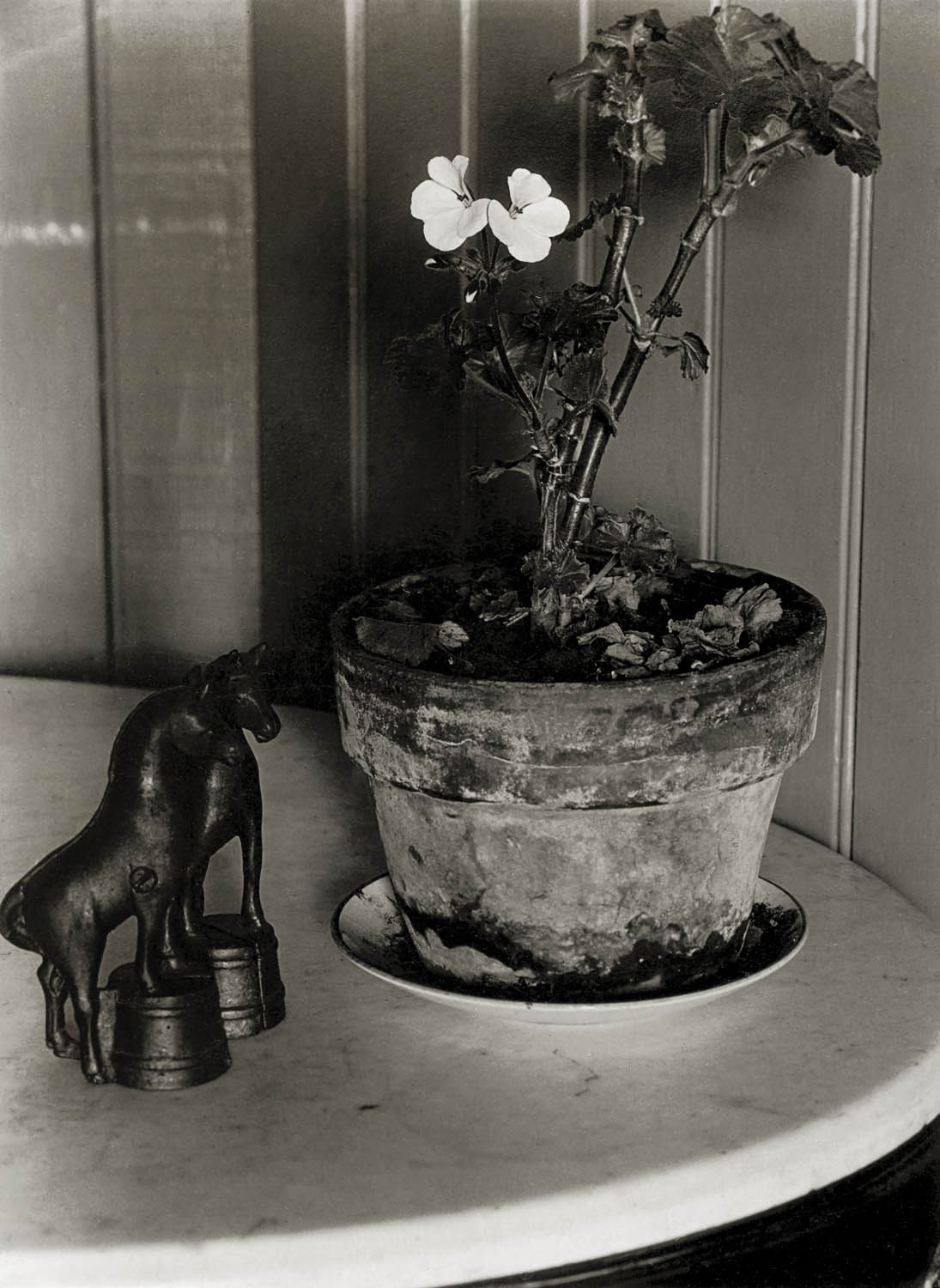
Consuelo Kanaga (American, 1894-1978) 'House Plant' 1930


Consuelo Kanaga (American, 1894-1978)
House Plant
1930
Bromide print
20 1/16 × 15 1/16 × 1 1/2 in. (51 × 38.3 × 3.8cm) framed
Brooklyn Museum, Gift of Wallace B. Putnam from the Estate of Consuelo Kanaga
© Brooklyn Museum
Photo: Brooklyn Museum


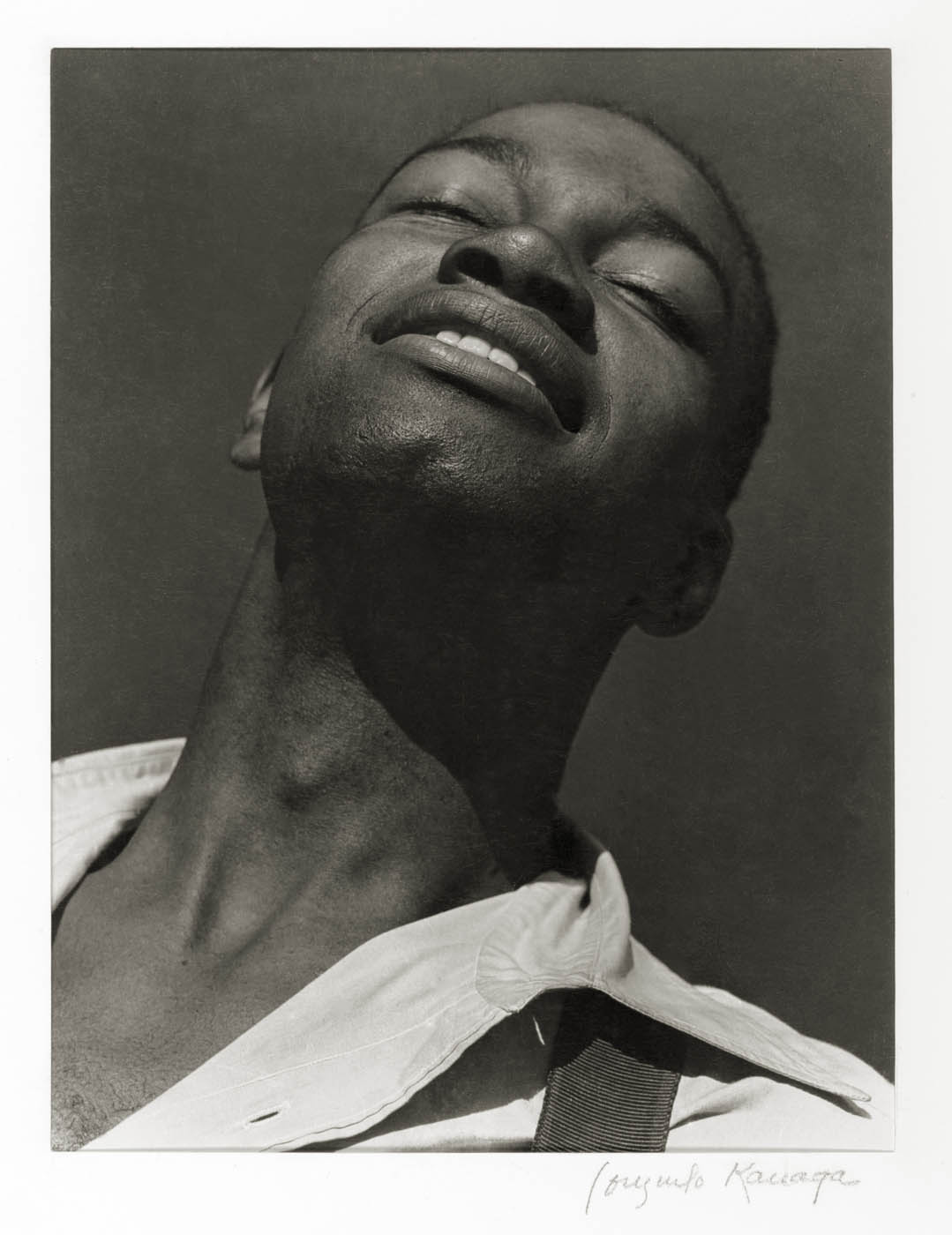
Consuelo Kanaga (American, 1894-1978) 'Kenneth Spencer' 1933


Consuelo Kanaga (American, 1894-1978)
Kenneth Spencer
1933
Gelatin silver print
20 1/16 × 15 1/16 × 1 1/2 in. (51 × 38.3 × 3.8cm) framed
Brooklyn Museum, Gift of Wallace B. Putnam from the Estate of Consuelo Kanaga
© Brooklyn Museum
Photo: Brooklyn Museum


Kenneth Spencer (25 April 1913 – 25 February 1964), was an American operatic singer and actor. Spencer starred in a few Broadway musicals and musical films in the United States during the 1940s. Frustrated with the racial prejudice he experienced in the United States as a black man, Spencer moved to West Germany in 1950 where he had a successful singing career. He also appeared in a number of German films. His career was cut short when he died in the crash of Eastern Air Lines Flight 304.

Text from the Wikipedia website


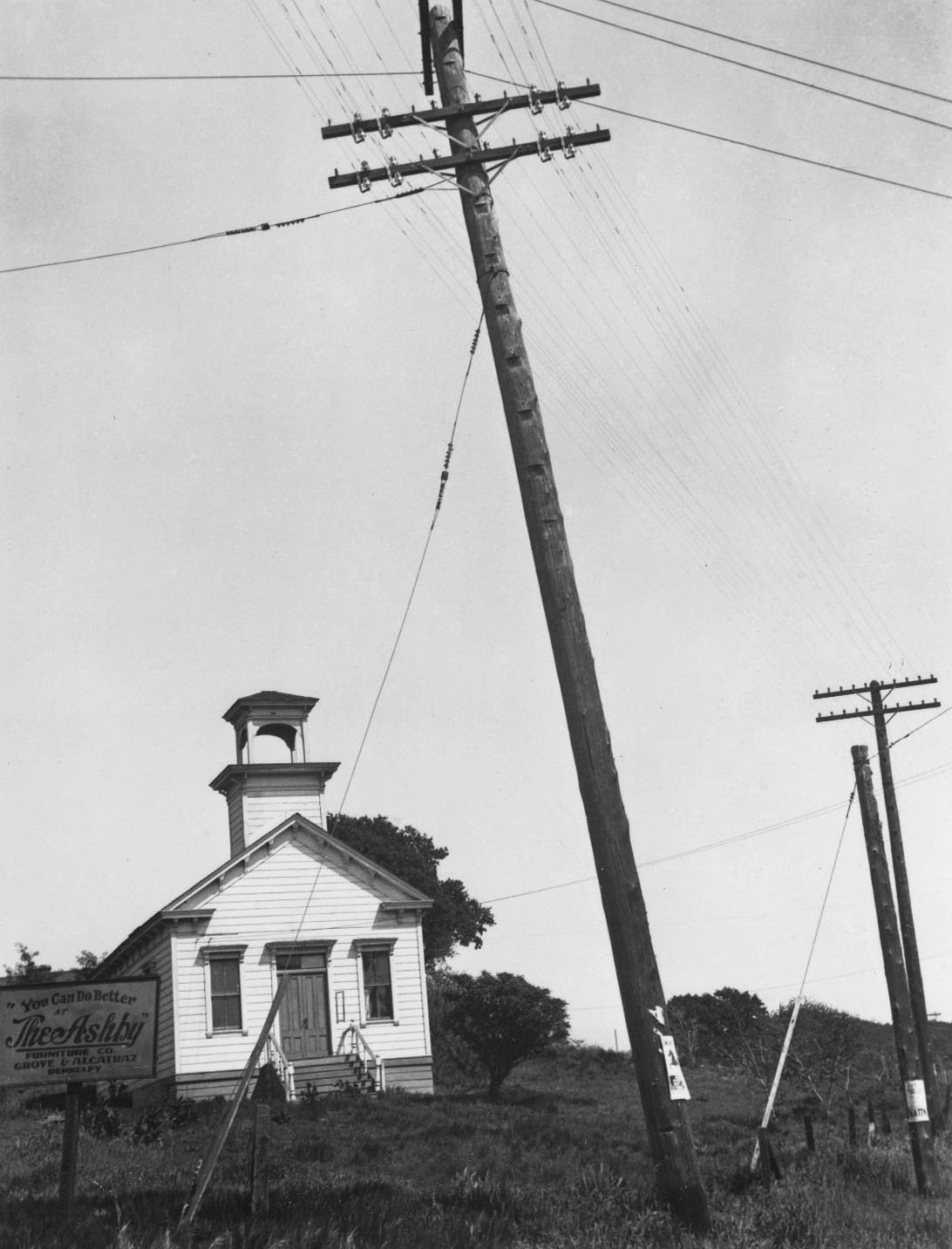
Consuelo Kanaga (American, 1894-1978) 'Clapboard Schoolhouse' 1930s


Consuelo Kanaga (American, 1894-1978)
Clapboard Schoolhouse
1930s
Gelatin silver print
20 1/16 × 15 1/16 × 1 1/2 in. (51 × 38.3 × 3.8cm) framed
Brooklyn Museum, Gift of Wallace B. Putnam from the Estate of Consuelo Kanaga
© Brooklyn Museum
Photo: Brooklyn Museum


A Pioneer of Realism

Consuelo Kanaga (1894-1978) was one of America’s most important photographers. Yet largely because she disdained wealth, fame and self-promotion, her transcendent images have never received the acclaim they deserve. The photographs on this page appear in the first major retrospective of her work, “Consuelo Kanaga: An American Photographer,” which will open Friday at the Brooklyn Museum.

Born in Astoria, Ore., Kanaga was hired in 1915 as a reporter at The San Francisco Chronicle but quickly became more interested in the work of the paper’s photographers. She took a job in the darkroom and was eventually named a staff photographer.

Inspired by the images in Alfred Stieglitz’s magazine, Camera Work, she left the newspaper and moved to New York in 1922. She soon became closely associated with such photographers as Edward Weston, Imogen Cunningham, Dorothea Lange and Louise Dahl. In 1932, Miss Kanaga was represented in the landmark “f.64” exhibition in San Francisco, the first major photography show that stressed realism over romanticism.

Her talent was rooted in an almost mystical belief that photography was a sacred trust — she felt obligated to capture the true essence of her subject. Her drive to fulfill this trust helped Kanaga, who was white, to understand the lives of blacks and to produce some of the most moving works ever done in African-American portraiture. She was equally talented in still-life and landscape photography, and her feeling for urban architecture was stimulated by her involvement with the socially committed New York Photo League during the 1930’s.

She continued to work into her 70’s, despite suffering from emphysema and cancer, which were probably caused by the chemicals used in creating her prints. Her body of work, though comparatively small, is consistently exceptional. Consuelo Kanaga died virtually unknown in 1978, but her talent endures.

Barbara Head Millstein. “A Pioneer of Realism,” in The New York Times October 9, 1993 on the New York Times website [Online] Cited 04/05/2024


Consuelo Kanaga (American, 1894-1978) 'Sargent Johnson' 1934


Consuelo Kanaga (American, 1894-1978)
Sargent Johnson
1934
Gelatin silver print
20 1/16 × 15 1/16 × 1 1/2 in. (51 × 38.3 × 3.8cm) framed
Brooklyn Museum, Gift of Wallace B. Putnam from the Estate of Consuelo Kanaga
© Brooklyn Museum
Photo: Brooklyn Museum


Sargent Claude Johnson (November 7, 1888 – October 10, 1967) was one of the first African-American artists working in California to achieve a national reputation. He was known for Abstract Figurative and Early Modern styles. He was a painter, potter, ceramicist, printmaker, graphic artist, sculptor, and carver. He worked with a variety of media, including ceramics, clay, oil, stone, terra-cotta, watercolour, and wood.

Text from the Wikipedia website


Consuelo Kanaga (American, 1894-1978) 'Untitled' 1930s


Consuelo Kanaga (American, 1894-1978)
Untitled
1930s
Toned gelatin silver print
20 1/16 × 15 1/16 × 1 1/2 in. (51 × 38.3 × 3.8cm) framed
Brooklyn Museum, Gift of Wallace B. Putnam from the Estate of Consuelo Kanaga
© Brooklyn Museum
Photo: Brooklyn Museum


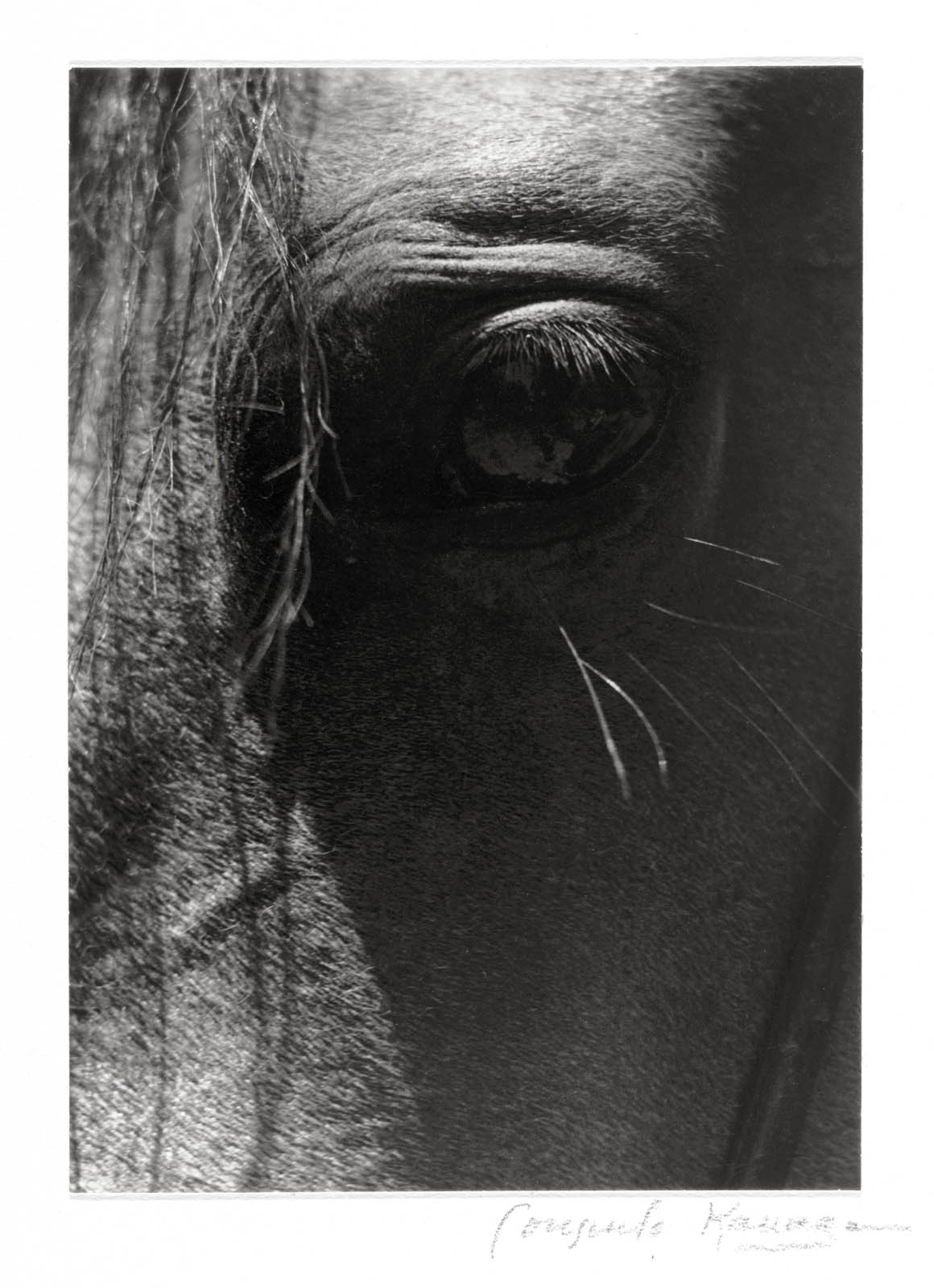
Consuelo Kanaga (American, 1894-1978) 'Horse's Eye' 1930s


Consuelo Kanaga (American, 1894-1978)
Horse’s Eye
1930s
Gelatin silver print
4 × 3 1/2 in. (10.2 × 8.9cm)
Brooklyn Museum, Gift of Wallace B. Putnam from the Estate of Consuelo Kanaga
© Brooklyn Museum
Photo: Brooklyn Museum


Consuelo Kanaga (American, 1894-1978) 'The Bowery' 1935


Consuelo Kanaga (American, 1894-1978)
The Bowery
1935
Toned gelatin silver print
22 13/16 × 16 13/16 × 1 1/2 in. (57.9 × 42.7 × 3.8cm) framed
Brooklyn Museum, Gift of Wallace B. Putnam from the Estate of Consuelo Kanaga
© Brooklyn Museum
Photo: Brooklyn Museum


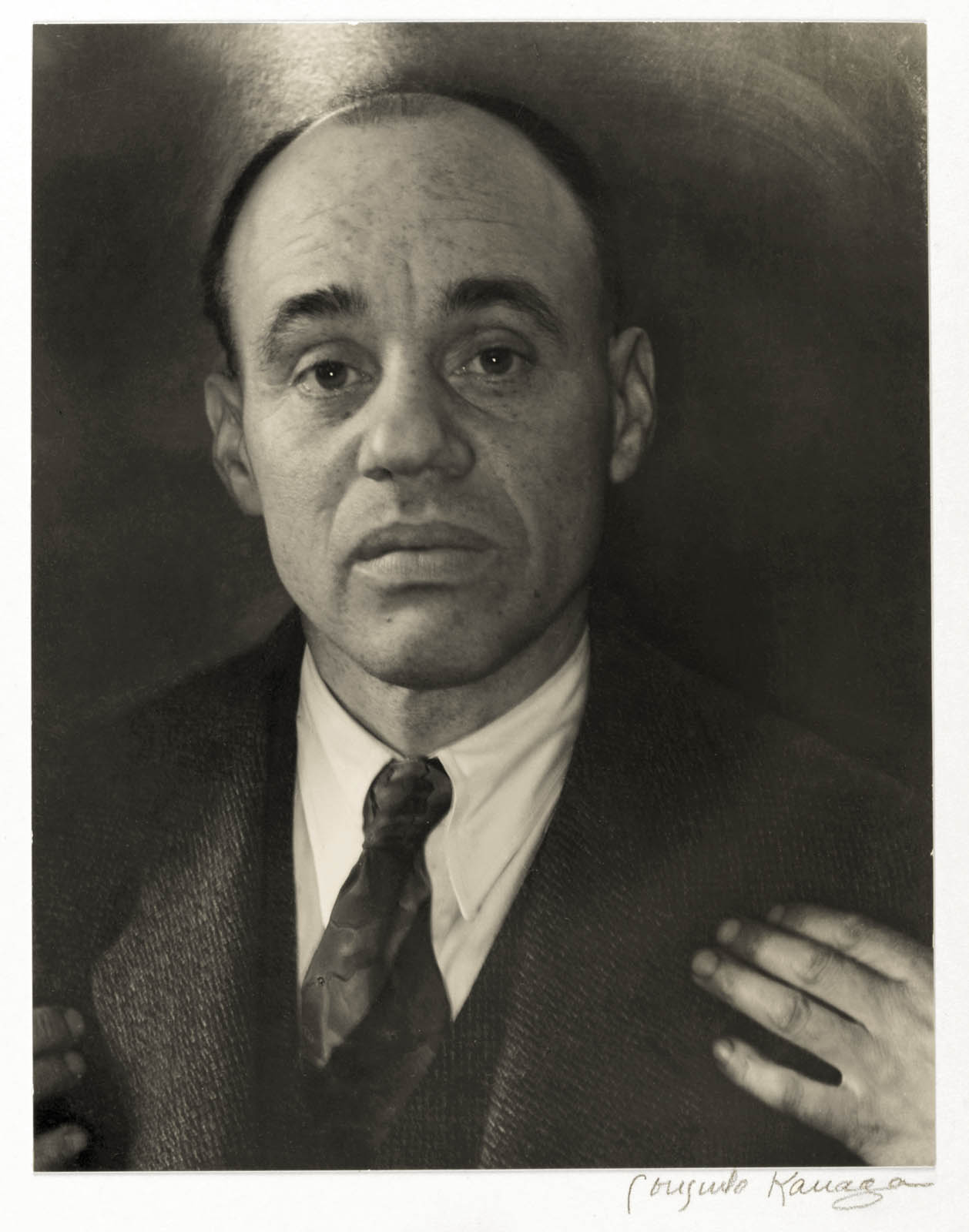
Consuelo Kanaga (American, 1894-1978) 'Angelo Herndon' 1936


Consuelo Kanaga (American, 1894-1978)
Angelo Herndon
1936
Gelatin silver print
20 1/16 × 15 1/16 × 1 1/2 in. (51 × 38.3 × 3.8cm) framed
Brooklyn Museum, Gift of Wallace B. Putnam from the Estate of Consuelo Kanaga
© Brooklyn Museum
Photo: Brooklyn Museum


Angelo Braxton Herndon (May 6, 1913 – December 9, 1997) was an African-American labor organiser arrested and convicted of insurrection after attempting to organise black and white industrial workers in 1932 in Atlanta, Georgia. The prosecution case rested heavily on Herndon’s possession of “communist literature”, which police found in his hotel room.

Herndon was defended by the International Labor Defense, the legal arm of the Communist Party of America, which hired two young local attorneys, Benjamin J. Davis Jr. and John H. Geer, and provided guidance. Davis later became prominent in leftist circles. Over a five-year period, Herndon’s case twice reached the United States Supreme Court, which ruled that Georgia’s insurrection law was unconstitutional, as it violated First Amendment rights of free speech and assembly. Herndon became nationally prominent because of his case, and Southern justice was under review. By the end of the 1940s he left the Communist Party, moved to the Midwest, and lived there quietly.

Text from the Wikipedia website


Consuelo Kanaga (American, 1894-1978) 'Untitled' 1936


Consuelo Kanaga (American, 1894-1978)
Untitled
1936
Gelatin silver print, printed 2023
4 × 5 in. (10.2 × 12.7cm)
Brooklyn Museum, Gift of Wallace B. Putnam from the Estate of Consuelo Kanaga
© Brooklyn Museum
Photo: Brooklyn Museum


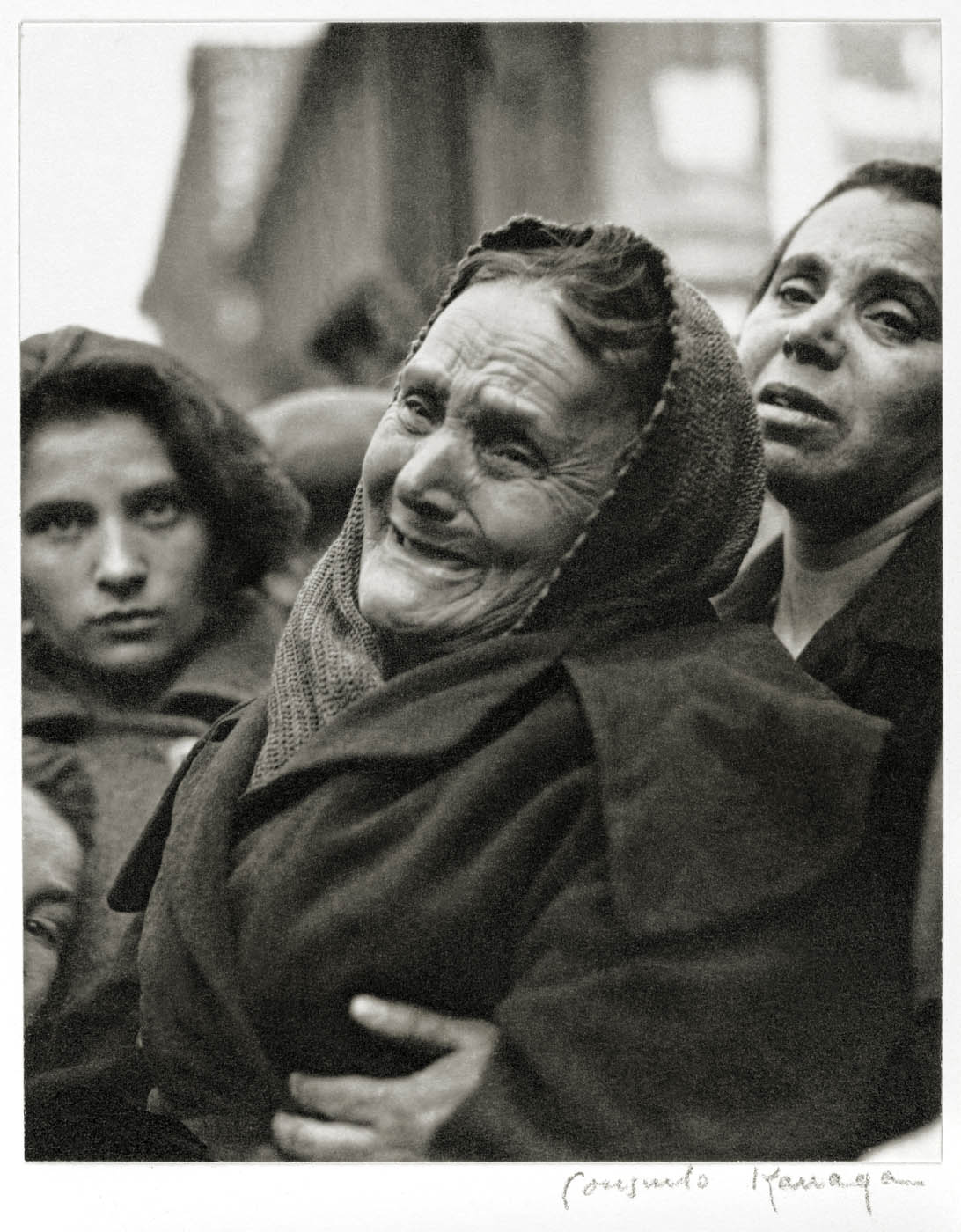
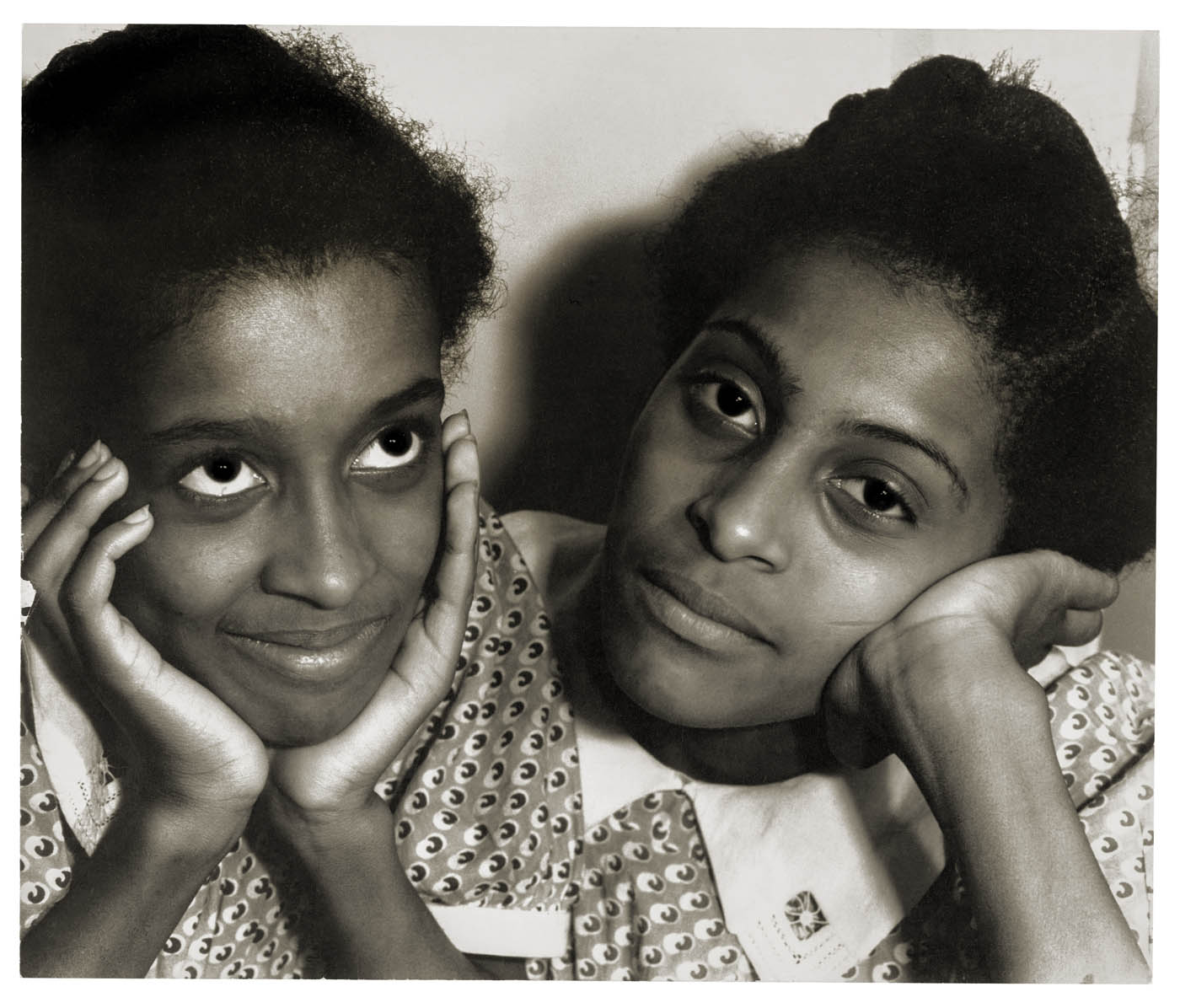
Consuelo Kanaga (American, 1894-1978) 'Two Women, Harlem' c. 1938


Consuelo Kanaga (American, 1894-1978)
Two Women, Harlem
c. 1938
Toned gelatin silver print
22 13/16 × 16 13/16 × 1 1/2 in. (57.9 × 42.7 × 3.8cm) framed
Brooklyn Museum, Gift of Wallace B. Putnam from the Estate of Consuelo Kanaga
© Brooklyn Museum
Photo: Brooklyn Museum


Consuelo Kanaga (American, 1894-1978) 'Untitled (New York)' c. 1940


Consuelo Kanaga (American, 1894-1978)
Untitled (New York)
c. 1940
Gelatin silver print
20 1/16 × 15 1/16 × 1 1/2 in. (51 × 38.3 × 3.8cm) framed
Brooklyn Museum, Gift of Wallace B. Putnam from the Estate of Consuelo Kanaga
© Brooklyn Museum
Photo: Brooklyn Museum


For the first time in Spain and Europe, Consuelo Kanaga. Catch the Spirit features the work of this North American photographer spanning her entire career. Kanaga (1894-1978) is considered today a key figure in the history of contemporary photography, both for her contribution toward the recognition of women in this field and for the intensity with which her images confront the spectator with the great social issues of our time, particularly the conditions of African Americans in the United States.

The exhibition

Consuelo Kanaga. Catch the Spirit features six decades of work by this key figure in the history of modern Photography. With this new project, Fundación MAPFRE renews its commitment to promote the work of women photographers. On this occasion, despite having garnered much notoriety in life, the artist’s work is today surprisingly little known. This exhibition aims to contribute conclusively toward the recognition that Kanaga’s oeuvre undoubtedly deserves.

Consuelo Kanaga (Astoria, Oregon, 1894 – Yorktown Heights, New York, 1978) was truly passionate about social justice. She was most interested in people and issues such as marginalisation, poverty, racial harassment, and inequality, particularly in relation to African Americans in the United States. These were some of the fundamental matters she addressed through her work. Likewise, she also defended the formal and poetic possibilities of photography as an art form.

An unconventional figure, Kanaga was able to become a professional photojournalist in the United States as early as the 1910s. She was also one of the few women involved in the avant-garde circles both in San Francisco with the f.64 Group and in New York with the Photo League, whose friendship and professional support paved the way for other important women photographers. However, gender inequalities and social conventions limited her ability to dedicate herself completely to her artistic work. Kanaga worked full time jobs during many years and was only able to practice her art on weekends. She repeatedly put her career on hold for her partners; these are but a few reasons why her work is not more recognised today.

Organised around the Brooklyn Museum’s collection – the institution that has preserved the artist’s archive – the exhibition features nearly 180 photographs and a wide range of documentary material; contextualising Consuelo Kanaga’s work while focusing on some of her most iconic images and her portrayal of African American life in the 1930s through her photography.

Exhibition organised by the Brooklyn Museum in New York in collaboration with Fundación MAPFRE and the San Francisco Museum of Modern Art. Curated by Drew Sawyer, former Phillip Leonian and Edith Rosenbaum Curator of Photography, Brooklyn Museum.

Keys

New Negro Movement: From the late 19th century, magazines and novels published by black men and women began to emerge as a response to the prevailing racism in cities such as San Francisco, Washington, and New York. This literary explosion was the precedent of what became known as the New Negro Movement, which developed in Harlem, New York, between 1920 and 1930; a movement that also lent its name to the most comprehensive anthology dedicated to said cultural renaissance, written by Alain Locke and considered at the time as “the fundaments of the black canon”. Not only did black artists flourish during this time, white artists were also encouraged to join this movement in defence of the freedom, rights, and equality of African Americans through culture.

Kanaga Photojournalist: In 1915, when she was only 21 years old, Consuelo Kanaga began to write for the San Francisco Chronicle, where she learned photography in order to illustrate her assignments: “For my articles requiring photographs, I went with the photographer to help make the pictures more interesting,” she later recalled. “The editor liked the results and encouraged me to learn photography, ‘from scratch’.” In 1918 she began to work as a photographer for the newspaper and was also hired by the Daily News the following year. Kanaga was undoubtedly one of the first women photojournalists on staff at a newspaper; as her friend Dorothea Lange remarked: “she was the first newspaper photographer I’d ever met. She was a person way ahead of her time.”

Kanaga and Women Photographers: Kanaga’s career was interwoven with a solid and broad circle of women photographers who she cultivated special relationships with over the course of five decades. She was a great supporter and a confidant for Imogen Cunningham, Louise Dahl-Wolfe, Dorothea Lange, Alma Lavenson, Tina Modotti, and Eiko Yamazawa, among many others, who she advised and shared her company and connections in the art world with. These women inspired her and likewise she was an inspiration for them. Despite the fact her accomplishments were as relevant as those of her colleagues, her oeuvre received much less attention. Kanaga spent little time self-promoting since she was always more interested in cultivating the affective bonds with the people closest to her.

Biography

Consuelo Delesseps Kanaga was born on May 15th, 1894, in Astoria, Oregon. The daughter of a lawyer who was interested in agriculture and of the writer Mathilda Carolina Hartwing, she helped her parents with tasks related to editing from a very young age, eventually leading her to study journalism. In 1915 she began writing for the San Francisco Chronicle. Three years later, she became staff photographer. Kanaga met Imogen Cunningham, Edward Weston, and Dorothea Lange at the California Camera Club and became interested in artistic photography thanks to Alfred Stieglitz’s Camera Work. Between 1927 and 1928 she travelled through Europe and northern Africa. Throughout her adult life, she lived both in San Francisco and New York, was married three times, and established her first portrait studio in San Francisco in 1932. She also participated in the f.64 Group and her images were exhibited for the first time at the M.H. de Young Memorial Museum in San Francisco in 1932. Kanaga participated in West Coast liberal politics. After returning from New York in 1935, she became associated with the Photo League in 1938. Edward Steichen defended her photography and included her work in the renowned exhibition The Family of Man in 1955. In 1974 Kanaga held a solo exhibition at the Lerner-Heller gallery in New York and in 1976 she produced a small yet relevant retrospective at the Brooklyn Museum. In 1977 she exhibited her work at Wave Hill in Riverdale, New York. She passed away at her Yorktown Heights (New York) home in 1978. One year later, Kanaga’s work was included in the exhibition Recollections: Ten Women of Photography at the ICP and was the subject of a retrospective at the Brooklyn Museum of Art in 1992, where most of her work is currently preserved.

Press release from the Fundación MAPFRE


Consuelo Kanaga (American, 1894-1978) 'After Years of Hard Work (Tennessee)' 1948


Consuelo Kanaga (American, 1894-1978)
After Years of Hard Work (Tennessee)
1948
Toned gelatin silver print
20 1/16 × 15 1/16 × 1 1/2 in. (51 × 38.3 × 3.8cm) framed
Brooklyn Museum, Gift of Wallace B. Putnam from the Estate of Consuelo Kanaga
© Brooklyn Museum
Photo: Brooklyn Museum


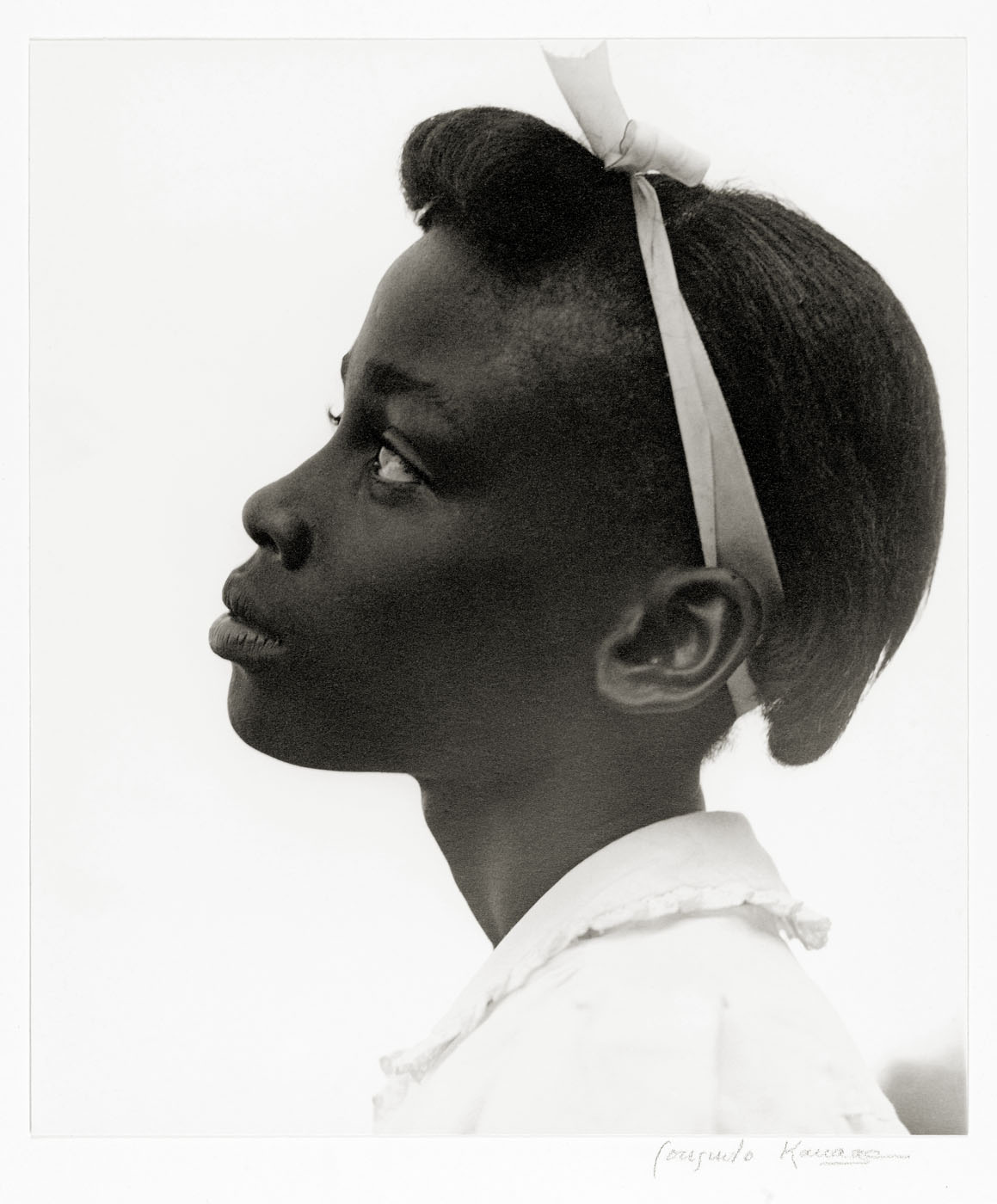
Consuelo Kanaga (American, 1894-1978) 'Young Girl in Profile' 1948


Consuelo Kanaga (American, 1894-1978)
Young Girl in Profile
1948
Toned gelatin silver print
22 13/16 × 16 13/16 × 1 1/2 in. (57.9 × 42.7 × 3.8cm) framed
Brooklyn Museum, Gift of Wallace B. Putnam from the Estate of Consuelo Kanaga
© Brooklyn Museum
Photo: Brooklyn Museum


Consuelo Kanaga (American, 1894-1978) 'Tennessee' 1950


Consuelo Kanaga (American, 1894-1978)
Tennessee
1950
Gelatin silver print
20 1/16 × 15 1/16 × 1 1/2 in. (51 × 38.3 × 3.8cm) framed
Brooklyn Museum, Gift of Wallace B. Putnam from the Estate of Consuelo Kanaga
© Brooklyn Museum
Photo: Brooklyn Museum


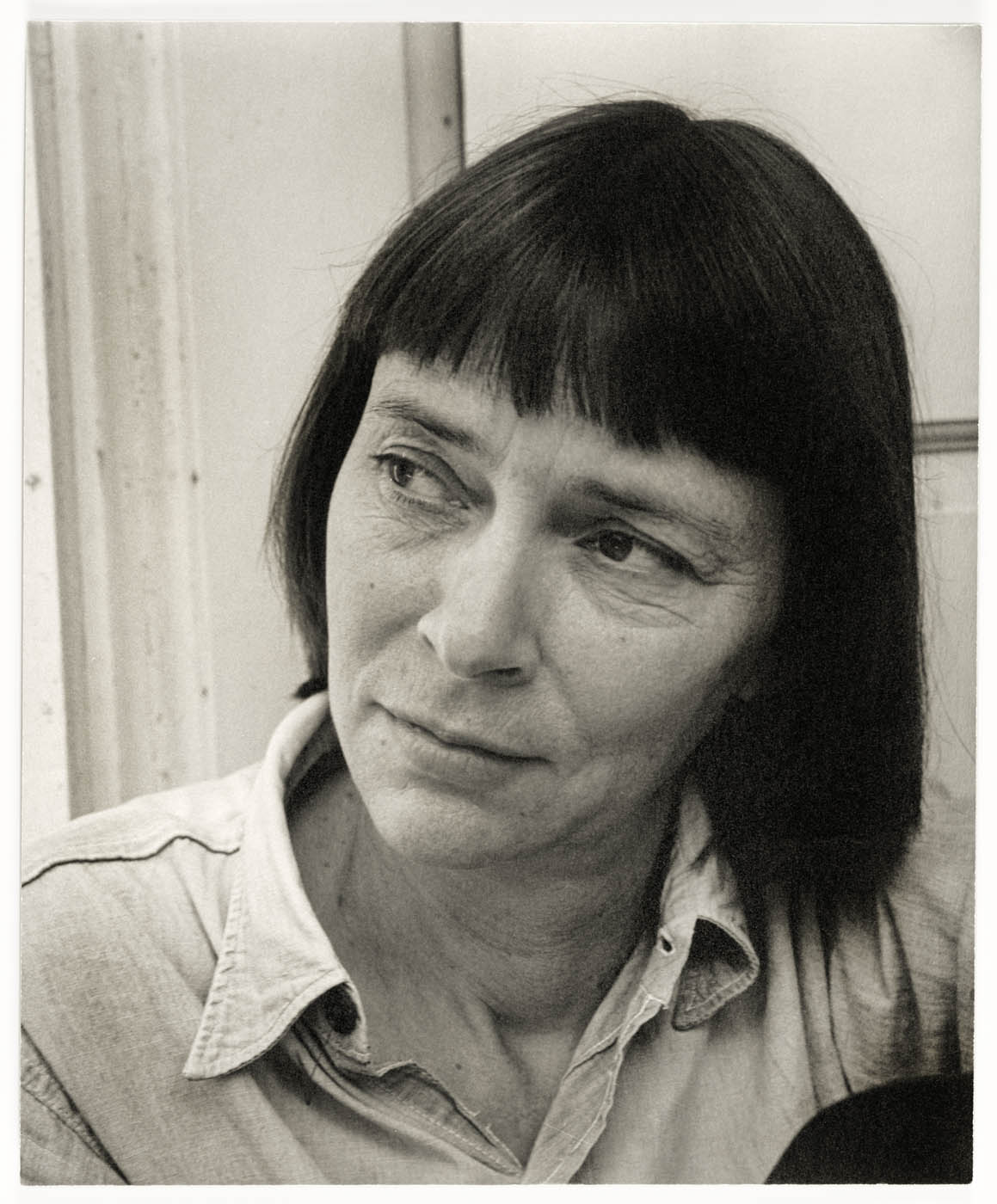
Consuelo Kanaga (American, 1894-1978) 'Barbara Deming' c. 1964


Consuelo Kanaga (American, 1894-1978)
Barbara Deming
c. 1964
Gelatin silver print
20 1/16 × 15 1/16 × 1 1/2 in. (51 × 38.3 × 3.8cm) framed
Brooklyn Museum, Gift of Wallace B. Putnam from the Estate of Consuelo Kanaga
© Brooklyn Museum
Photo: Brooklyn Museum


Barbara Deming (1917-1984) was one of the most dearly loved civil rights and feminist activists of her time. Born in New York City in 1917 and educated there at the Friends Meeting House Quaker School, she later studied literature and drama at Bennington College and earned a master’s degree in drama from Case Western Reserve University in 1941.

Deming began her career as a poet, professional writer, and film critic, and turned to political writing and human rights activism in the middle of her life. …

In the 1960s Deming joined demonstrations against Polaris submarines, took part in the 1962 San Francisco-to-Moscow walk for peace, and attended the International Peace Brigade in Europe. Protesting nuclear-weapons testing at the Atomic Energy Commission led to her first experience with being jailed for civil disobedience, this time at the Women’s House of Detention in New York City.

Acting on her belief that the struggles for racial equality and for peace were one effort, Deming marched in the bi-racial Nashville-to-DC walk for peace alongside SNCC members. In 1963 she joined black activists protesting segregation in Alabama and Georgia as well as attended the House Un-American Activities Committee hearings. In 1964 she participated in the 2800-mile Quebec-Guantanamo walk for peace and freedom, a racially integrated protest over US actions in Cuba. During this march, she was arrested and jailed in Albany, Georgia, an experience she describes in her book Prison Notes.

Deming participated in political actions whenever and wherever individual rights and human dignity were being threatened. In 1965-1967 Deming traveled to North and South Vietnam to protest the war. In the 1970s she demonstrated for gay rights and feminist causes. In 1983 she was arrested on the march through Seneca Falls, organised by the Women’s Peace Encampment to protest the deployment of cruise missiles in Europe. Despite failing health, she was once again jailed.

Anonymous. “Barbara Deming,” on the Barbara Deming Memorial Fund website Nd [Online] Cited 03/04/2024


Photojournalism and the City

After having opted for journalism, influenced perhaps by her parents, Kanaga began to write for the San Francisco Chronicle in 1915, where she learned to produce photographs for her articles encouraged by the newspaper editor. In 1918 she became staff photographer, and the following year was hired by the Daily News, another San Francisco newspaper.

Between 1920 and 1950 she worked for newspapers and magazines in Denver and New York, capturing scenes of urban life and images of economic and racial inequality; as in The Widow Watson (1922-1924 below), which was taken while she was working for the newspaper New York American and depicts a woman suffering from tuberculosis next to her son.

Photojournalism led Kanaga to become aware of photography’s potential as an art form. Around 1918 she joined the California Camera Club in San Francisco. Not only did she gain access to a dark room and photographic equipment, but also books and magazines on the medium. The publication Camera Work by Alfred Stieglitz and the works of New York and San Francisco photographers, such as Arnold Genthe, who portrayed street scenes and urban architecture in their images, influenced her greatly.


Consuelo Kanaga (American, 1894-1978) 'The Widow Watson' 1922-1924


Consuelo Kanaga (American, 1894-1978)
The Widow Watson
1922-1924
Gelatin silver print
20 1/16 × 15 1/16 × 1 1/2 in. (51 × 38.3 × 3.8cm) framed
Brooklyn Museum, Gift of Wallace B. Putnam from the Estate of Consuelo Kanaga
© Brooklyn Museum
Photo: Brooklyn Museum


Portrait Gallery

Kanaga began to produce portraits for additional income as a complement to her journalistic work, initially in San Francisco and later in New York. She opened her first studio in the early 1920s and was able to support herself and her partners financially for the rest of her life by taking photographs of wealthy clients and friends who were part of the avant-garde movements in San Francisco and New York. Thus, the portrait became the main focus of Kanaga’s creative production. It is also important to note that while most of her work as a photojournalist was lost, her portraits remain well represented among the negatives and prints that have been preserved.

Influenced by Stieglitz, in her portraits Kanaga experimented with poses, cropping, lighting, and printing in order to highlight the expressive capabilities of her images. Aside from flash, she used dark room techniques such as over-and underexposure, manipulating exposure times in specific parts of a photographic print to accentuate the contrast between light and shade, which generated a theatrical effect. The artist also frequently toned her prints with metals such as gold, adding pencil or graphite to highlight certain features.


Consuelo Kanaga (American, 1894-1978) 'Portrait of a Woman' c. 1925


Consuelo Kanaga (American, 1894-1978)
Portrait of a Woman
c. 1925
Gelatin silver print
20 1/16 × 15 1/16 × 1 1/2 in. (51 × 38.3 × 3.8cm)
Brooklyn Museum, Gift of Wallace B. Putnam from the Estate of Consuelo Kanaga
© Brooklyn Museum
Photo: Brooklyn Museum


North Americans Abroad

One of the fundamental experiences in Kanaga’s formative development was her time in Europe and northern Africa between 1927 and 1928, made possible through the financial support of the patron Albert M. Bender. Kanaga spent close to a year travelling through France, Germany, Italy, Hungary, and Tunisia, taking photographs and visiting museums, monuments, and churches. The artist also sought opportunities to learn modern photographic techniques. In Kairouan (Tunisia) she came into contact with a community of ex-pat artists and produced three photo albums portraying the city and its people, consolidating her interest in portraiture.

Consuelo Kanaga began to express her opinions on racism in the United States during these trips. A subject she would explore in more depth through photography during the 1930s. “I am sick of seeing colored men and women abused by stupid white people.”

Photography and the American Scene

Beyond portraiture, Kanaga practiced numerous genres and styles throughout her career. Like other North American artists, she was attracted to what she encountered in the “American Scene”; naturalist and descriptive representations of national and regional heritage and everyday life. Kanaga mostly focused on marginal day to day and political motifs, including workers, African Americans, objects, and buildings that were often in a state of disrepair.

Her first portraits of African Americans were aligned with the New Negro Movement that arose in the 1920s and 30s. Black intellectuals and artists tried to redefine and celebrate African American identities through cultural self-expression, economic independence, and progressive policies. Likewise, they advocated for the creation of inspiring images of their community and of negritude at a time when lynchings and racial terror were some of the most pressing legal and ethical issues. Within this context, Kanaga’s photographs can be considered a true statement of intent: Hands (1930 below) is the first preserved photograph that captures her anti-racist ideals. She also portrayed the singer Kenneth Spencer, the poet Langston Hughes, and the painter and ceramist Sargent Johnson, among others.

Along with her interest in African American communities, Kanaga became interested in worker’s rights and the worker movement that emerged in the Soviet Union and Germany during the 1920s. After moving to New York in 1935, she took photographs for leftist publications and became involved with the Photo League. At a time marked by the will to promote solidarity among workers beyond race and gender, Kanaga focused on the experiences of African Americans and Workers in particular.


Consuelo Kanaga (American, 1894-1978) 'Hands' 1930


Consuelo Kanaga (American, 1894-1978)
Hands
1930
Gelatin silver print
23 1/16 × 29 1/16 × 1 1/2 in. (58.6 × 73.8 × 3.8cm) framed
Brooklyn Museum, Gift of Wallace B. Putnam from the Estate of Consuelo Kanaga
© Brooklyn Museum
Photo: Brooklyn Museum


Portraits of Artists

Throughout the 1930s and 40s, Kanaga produced portraits of artists, writers, actors, and musicians. She met many of them thanks to her relationship with several photography clubs and collectives, as well as during her trips through the United States and Europe. Her images include portraits of the photographers Alfred Stieglitz and W. Eugene Smith, the painters Milton Avery and Mark Rothko, and of designers such as Wharton Esherick.

Conversely, Kanaga’s career was especially linked to a solid and broad circle of women photographers whose relationships she cultivated throughout her time as an artist. She was a great supporter and confidant for a series of photographers who often photographed each other, such as Berenice Abbott, Imogen Cunningham, Louse Dahl-Wolfe, Dorothea Lange, Alma Lavenson, Tina Modotti, and Eiko Yamazawa.


Consuelo Kanaga (American, 1894-1978) 'Wharton Esherick' 1940


Consuelo Kanaga (American, 1894-1978)
Wharton Esherick
1940
Bromide print
20 1/16 × 15 1/16 × 1 1/2 in. (51 × 38.3 × 3.8cm) framed
Brooklyn Museum, Gift of Wallace B. Putnam from the Estate of Consuelo Kanaga
© Brooklyn Museum
Photo: Brooklyn Museum


Wharton Esherick (July 15, 1887 – May 6, 1970) was an American sculptor who worked primarily in wood, especially applying the principles of sculpture to common utilitarian objects. Consequently, he is best known for his sculptural furniture and furnishings. Esherick was recognised in his lifetime by his peers as the “dean of American craftsmen” for his leadership in developing nontraditional designs and for encouraging and inspiring artists and artisans by example. Esherick’s influence is evident in the work of contemporary artisans, particularly in the Studio Craft Movement. His home and studio in Malvern, Pennsylvania, are part of the Wharton Esherick Museum, which has been listed as a National Historic Landmark since 1993.

Text from the Wikipedia website


Trips to the Southern United States

Between the late 1940s and early 60s, Kanaga went on numerous trips through the southern United States where she continued to photograph black children and workers. While in Florida, she produced a series of photographs dedicated to black families and farmhands working in recovered swamp lands known as mucklands. During those trips, she took one of her most renowned photographs titled She is a Tree of Life (1950 below), which depicts a stoic mother with her son and daughter on either side. In 1950 she also photographed self-taught black artist William Edmondson next to his carved stone sculptures.

In 1964, amidst the struggle for freedom of Black Americans in the United States, the activist and writer Barbara Deming invited Kanaga to photograph the Quebec-Washington-Guantanamo Walk for Peace in protest of United States actions against Cuba. During the march, Deming and other activists were arrested for demanding that all demonstrators be allowed to walk together on a “white only” sidewalk. The book Prison Notes, published by Deming in 1966, includes photographs by Kanaga.


Consuelo Kanaga (American, 1894-1978) 'She is a Tree of Life' 1950


Consuelo Kanaga (American, 1894-1978)
She is a Tree of Life
1950
Gelatin silver print
22 13/16 × 16 13/16 × 1 1/2 in. (57.9 × 42.7 × 3.8cm) framed
Brooklyn Museum, Gift of Wallace B. Putnam from the Estate of Consuelo Kanaga
© Brooklyn Museum
Photo: Brooklyn Museum


Studies of Nature

In 1940 Kanaga and her husband, the painter Wallace Putnam, purchased a house outside the city, in Yorktown Heights, seventy kilometres north of Manhattan. They moved there permanently in 1950. Meanwhile, Kanaga continued taking photographs for household magazines in order to support herself and her husband financially. Perhaps this is one of the reasons why, after having her work exhibited in important exhibitions during the 1940s, Kanaga’s artistic output decreased during the following two decades. Nevertheless, she photographed the natural environment surrounding her house and in 1948 one of the pictures she took of the pond in their back yard was included in the exhibition In and Out of Focus: A Survey of Today’s Photography, held at the Museum of Modern Art in New York.

Catalogue

The catalogue that accompanies this exhibition has been published in English, Spanish, and Catalan by Fundación MAPFRE and the Brooklyn Museum. It features an essay by the show’s curator Drew Sawyer and texts by Shalon Parker, Ellen Macfarlane, and Shana Lopes. The publication includes a complete overview of the artist’s life and work.

Press release from the Fundación MAPFRE


Consuelo Kanaga (American, 1894-1978) '[Untitled] (Landscape Near Taos, New Mexico)' Nd


Consuelo Kanaga (American, 1894-1978)
[Untitled] (Landscape Near Taos, New Mexico)
Nd
Gelatin silver print
4 3/4 x 7 3/4 in. (12.1 x 19.7cm)
Brooklyn Museum, Gift of Wallace B. Putnam from the Estate of Consuelo Kanaga
© Brooklyn Museum
Photo: Brooklyn Museum


Consuelo Kanaga (American, 1894-1978) '[Untitled] (Landscape with Farmhouse)' Nd


Consuelo Kanaga (American, 1894-1978)
[Untitled] (Landscape with Farmhouse)
Nd
Gelatin silver print
3 5/8 x 4 3/4 in. (9.2 x 12.1cm)
Brooklyn Museum, Gift of Wallace B. Putnam from the Estate of Consuelo Kanaga
© Brooklyn Museum
Photo: Brooklyn Museum


KBr Photography Center
Avenida Litoral, 30 – 08005 Barcelona
Phone: +34 93 272 31 80

(Attention only during the opening hours of the exhibition hall)

Opening hours:
Mondays (except holidays): Closed
Tuesday to Sundays (and holidays): 11am – 8pm

Fundación MAPFRE website

LIKE ART BLART ON FACEBOOK

Back to top

Exhibition: ‘Dawoud Bey & Carrie Mae Weems: In Dialogue’ at the J. Paul Getty Museum, Los Angeles

Exhibition dates: 4th April – 9th July, 2023


Dawoud Bey (American, b. 1953) 'Two Women at a Parade' 1978 from the exhibition 'Dawoud Bey & Carrie Mae Weems: In Dialogue' at the J. Paul Getty Museum, Los Angeles, April-  July, 2023


Dawoud Bey (American, b. 1953)
Two Women at a Parade
1978
Gelatin silver print
Grand Rapids Art Museum, Michigan Museum purchase
© Dawoud Bey
Courtesy of Stephen Daiter Gallery


Engaging each other in light

Dialogue: Old English dialogas (plural), from Latin from Greek dialogos, from dia ‘through’ + logos ‘word’

“As we define it, dialogue is “a communicative process in which people with different perspectives seek understanding.” To be in dialogue means that participants are not only engaging each other in light of their different views, but they are also striving to achieve a degree of mutual understanding.”

Jason Combs. “What is Dialogue?” on the University of Dayton website Monday October 28, 2019 [Online] Cited 01/07/2023


Short and sweet because I’m not feeling well.

What an inspired pairing for an exhibition. “Each [artist] addresses race, class, representation, and systems of power in their work, creating photographic series grounded in Black history and realities that speak to the human condition.”

From street-based photographs of everyday life to conceptual excavations of Black Histories, they produce incisive thought provoking works “that intermingle past and present, referenc[ing] African Americans whose lives and stories have been co-opted or lost.”

I love them both for their commitment to and passion for life in all its different forms. Bringing people together. Expressing a degree of mutual understanding.

#BlackLivesMatter #AllLivesMatter

Dr Marcus Bunyan


Many thankx to the J. Paul Getty Museum for allowing me to publish the photographs in the posting. Please click on the photographs for a larger version of the image.


Dawoud Bey and Carrie Mae Weems have been friends and colleagues for more than 40 years. Each addresses race, class, representation, and systems of power in their work, creating photographic series grounded in Black history and realities that speak to the human condition. This exhibition sheds light on their unique trajectories and modes of presentation, and their shared consciousness and principles. Organised by the Grand Rapids Art Museum.


Dawoud Bey (American, b. 1953) 'The Woman in the Light, Harlem, NY' 1980 from the exhibition 'Dawoud Bey & Carrie Mae Weems: In Dialogue' at the J. Paul Getty Museum, Los Angeles, April-  July, 2023


Dawoud Bey (American, b. 1953)
The Woman in the Light, Harlem, NY
1980
Gelatin silver print
© Dawoud Bey
Courtesy of Stephen Daiter Gallery


Dawoud Bey (American, b. 1953) 'Self and Shadow, New York, NY' 1980 from the exhibition 'Dawoud Bey & Carrie Mae Weems: In Dialogue' at the J. Paul Getty Museum, Los Angeles, April-  July, 2023


Dawoud Bey (American, b. 1953)
Self and Shadow, New York, NY
1980
Gelatin silver print
© Dawoud Bey
Courtesy of Stephen Daiter Gallery


Dawoud Bey (American, b. 1953) 'A Young Man Resting on an Exercise Bike, Amityville, NY' 1988


Dawoud Bey (American, b. 1953)
A Young Man Resting on an Exercise Bike, Amityville, NY
1988
Gelatin silver print
© Dawoud Bey
Courtesy of Stephen Daiter Gallery


Dawoud Bey (American, b. 1953) 'Couple in Prospect Park, Brooklyn, NY' 1990


Dawoud Bey (American, b. 1953)
Couple in Prospect Park, Brooklyn, NY
1990
Gelatin silver print Getty Museum
© Dawoud Bey


In 1976 I had been making photographs for a couple of years. I had certainly been looking at a lot more photographs than I had actually made. From looking at photographs in books and magazines and going to exhibitions of pictures by Mike Disfarmer at MoMA, Richard Avedon at Marlborough, and haunting whatever other places there were to see photographs in New York in the early 1970s, I had begun to educate myself, with the intent of adding something to the conversation through my own pictures.

The artist Janet Henry, who was from the same Jamaica, Queens neighborhood that I lived in, had gotten a job in the Education Department at the Studio Museum in Harlem, then located above a Kentucky Fried Chicken on 125th Street and Fifth Avenue in a large second floor loft space. When Frank Stewart, the museum’s staff photographer and photo teacher, left to do a commissioned project in Cuba, Janet called me and asked if I would take over the class. On the first day of class a few students straggled in. One of them, a seemingly shy woman with big expressive eyes, introduced herself, “Hi, my name is Carrie. Do you think I could be a photographer?” she asked, holding her Leica camera in her hand. That began what has now been 33 years of friendship and camaraderie with one of the most brilliant people I know.

From the very beginning, Carrie Mae Weems has had a sharp intelligence that was looking for a way into the world. From her early documentary photographs to the more expansive and materially varied recent works, she has consistently set out to visually define the world on her own terms and to redefine for all of us the nature of the world that we are in. After all these years I still anticipate her work with a fresh sense of wonderment, knowing that her restless search for the deeper meaning of things will yield a continuing rich trove of objects and images. On a Sunday morning in May I called from my home in Chicago to reconnect with my dear friend while she was traveling in Seville, Spain.

Dawoud Bey quoted in “Carrie Mae Weems by Dawoud Bey,” on the BOMB Magazine website July 1, 2009 [Online] Cited 18/06/2023


Dawoud Bey (American, b. 1953) 'Taneesha' 1999


Dawoud Bey (American, b. 1953)
Taneesha
1999
Dye diffusion prints
Collection of Jack and Sandra Guthman
© Dawoud Bey
Courtesy of Stephen Daiter Gallery


Dawoud Bey (American, b. 1953) 'The Birmingham Project: Wallace Simmons and Eric Allums' 2012


Dawoud Bey (American, b. 1953)
The Birmingham Project: Wallace Simmons and Eric Allums
2012
Inkjet prints
Rennie Collection, Vancouver
© Dawoud Bey
Courtesy of Stephen Daiter Gallery


Dawoud Bey (American, b. 1953) 'The Birmingham Project: Taylor Falls and Deborah Hackworth' 2012


Dawoud Bey (American, b. 1953)
The Birmingham Project: Taylor Falls and Deborah Hackworth
2012
Inkjet prints
Rennie Collection, Vancouver
© Dawoud Bey
Courtesy of Stephen Daiter Gallery


Dawoud Bey (American, b. 1953) 'Braxton McKinney and Lavone Thomas, Birmingham, AL' 2012


Dawoud Bey (American, b. 1953)
The Birmingham Project: Braxton McKinney and Lavone Thomas
2012
Inkjet prints
Rennie Collection, Vancouver
© Dawoud Bey
Courtesy of Stephen Daiter Gallery


Dawoud Bey (American, b. 1953) 'Betty Selvage and Faith Speights, Birmingham, AL' 2012


Dawoud Bey (American, b. 1953)
The Birmingham Project: Betty Selvage and Faith Speights
2012
Inkjet prints
Rennie Collection, Vancouver
© Dawoud Bey
Courtesy of Stephen Daiter Gallery


Dawoud Bey (American, b. 1953) 'Boy on Skateboard, Harlem, NY' 2014


Dawoud Bey (American, b. 1953)
Boy on Skateboard, Harlem, NY
2014
Inkjet print
© Dawoud Bey
Courtesy of Stephen Daiter Gallery


Dawoud Bey (American, b. 1953) 'Former Renaissance Ballroom Site, Harlem, NY' 2015


Dawoud Bey (American, b. 1953)
Former Renaissance Ballroom Site, Harlem, NY
2015
Inkjet print
© Dawoud Bey
Courtesy of Stephen Daiter Gallery


Dawoud Bey (American, b. 1953) 'Untitled #15 (Forest with Small Trees)' 2017


Dawoud Bey (American, b. 1953)
Untitled #15 (Forest with Small Trees)
2017
Gelatin silver print
Getty Museum, purchased with funds provided by the Photographs Council
© Dawoud Bey


Since meeting at the Studio Museum in Harlem in 1977, Dawoud Bey and Carrie Mae Weems have been intellectual colleagues and companions.

From the outset of their careers, both have operated from a deep social commitment to participate in, describe, and define culture. In seeking to express themselves fully, each has expanded possibilities within photography and video to address their chosen subjects.

Dawoud Bey & Carrie Mae Weems: In Dialogue, on view April 4 through July 9, 2023, brings together for the first time a focused selection of work from a period of over 40 years by two of today’s most important and influential photo-based artists. Each grapples with issues of race, class, and representation in their work, making art grounded in the experiences and realities of Black Americans while also speaking to the broader human condition.

“The Museum’s Department of Photographs has made great strides in recent years in building an exhibitions program that highlights more expansive narratives of photographic history,” says Timothy Potts, Maria Hummer-Tuttle and Robert Tuttle Director of the J. Paul Getty Museum. “Dawoud Bey and Carrie Mae Weems are two artists who reframe American traumas that have been ignored or simplified in the national historical record. We are proud to showcase their work in dialogue with one another.”

Jim Ganz, senior curator of photographs, adds, “These artists are two of the most dynamic and insightful of our time. As presented in this extraordinary exhibition, their eloquent dialogue gives unique perspective on their shared concerns as image makers.”

Dawoud Bey (American, born 1953) creates photographs that focus on individuals, communities, and important but often overlooked American histories. His carefully composed images convey the dignity and rich inner lives of his subjects. Carrie Mae Weems (American, born 1953) first gained recognition in the 1980s for exploring identity, race, power, and history, themes that still fuel her art. Over her career, Weems has turned increasingly to staged photography and the use of text to heighten the emotional intensity of her work.

This exhibition is divided into five sections, starting with early pictures that both artists made in the photodocumentary tradition and followed by ambitious, groundbreaking explorations of the medium as it developed technologically and artistically. The exhibition then focuses on how both artists moved beyond candid pictures of everyday life and began making larger scale work that is more planned than spontaneous. Bey’s portraiture evolved from street-based glimpses of the world made with a handheld camera to portraits that are formal but intimate, in which his subjects appear at ease and engage directly with the lens. With her Kitchen Table Series, Weems transitioned from representing real people in their natural environments to creating staged photo essays. For each artist, the techniques developed in this period became the foundation for future projects.

In Resurrecting Black Histories, each artist addresses the 19th century and its legacies in distinctive ways. Bey’s carefully composed landscapes evoke the experience of fleeing along the Underground Railroad, the clandestine network that helped enslaved people escape the South. Weems, by incorporating texts that intermingle past and present, references African Americans whose lives and stories have been co-opted or lost.

In Memorial & Requiem, Bey and Weems reference traumatic 20th-century events. They worked with community partners to stage scenes meant to reinvigorate discussion of the American legacy of racial violence. Each photographer also created a related video, bringing their own sensibility – Bey’s searching, intimate gaze; Weems’ choreographed social commentary – to the moving image, using sequencing and sound to deepen engagement with American history.

The exhibition ends with Revelation in the Landscape, where both Bey and Weems contemplate the built environments in which we live and how those spaces affect our perceptions of the world and ourselves. Bey returns to the Harlem neighbourhoods he photographed in the late 1970s, tracking the changes wrought by gentrification. Weems photographs imposing sites in Rome, inserting herself into historical places imbued with power and legacy. Both series reveal the economic and institutional forces that shape daily life.

In conjunction with the exhibition Getty has created a community program inspired by the exhibition, L.A.: In Dialogue. This program brings Dawoud Bey & Carrie Mae Weems: In Dialogue to a wider Los Angeles community, furthering the influence of the two artists and introducing their work to a new generation of artists and viewers. The artist-led program will host educational workshops for local teens and young adult photographers, and will teach participants techniques in black-and-white photography and the artistic practice of capturing portraiture and place. They will explore themes from the exhibition, collaborate with peers, and explore their local communities: Culver City (Black Image Center), South L.A. (LA Commons), Downtown L.A. (Inner-City Arts), and Venice Beach (Venice Arts). This program will result in a satellite exhibition that will open in June 2023.

Related programming includes Dawoud Bey and Carrie Mae Weems in Conversation on Tuesday, April 4 at 4pm. That evening at 7pm, the Museum presents master saxophonist David Murray in concert with his newly formed quartet as part of the exhibition programming.

Press release from the J. Paul Getty Museum


Carrie Mae Weems (American, b. 1953) 'First Self Portrait' 1975 from the exhibition 'Dawoud Bey & Carrie Mae Weems: In Dialogue' at the J. Paul Getty Museum, Los Angeles, April-  July, 2023


Carrie Mae Weems (American, b. 1953)
First Self Portrait
1975
Gelatin silver print
© Carrie Mae Weems
Courtesy of the artist and Jack Shainman Gallery, New York


Carrie Mae Weems (American, b. 1953) 'Harlem Street' 1976-1977 from the exhibition 'Dawoud Bey & Carrie Mae Weems: In Dialogue' at the J. Paul Getty Museum, Los Angeles, April-  July, 2023


Carrie Mae Weems (American, b. 1953)
Harlem Street
1976-1977
Gelatin silver print
© Carrie Mae Weems
Courtesy of the artist and Jack Shainman Gallery, New York


Carrie Mae Weems (American, b. 1953) 'Woman in Shorts, Boardwalk, Santa Monica' 1980-1982


Carrie Mae Weems (American, b. 1953)
Woman in Shorts, Boardwalk, Santa Monica
1980-1982
Gelatin silver print
© Carrie Mae Weems
Courtesy of the artist and Jack Shainman Gallery, New York


Carrie Mae Weems (American, b. 1953) 'Reclining Girl, Fiji' 1982-1983


Carrie Mae Weems (American, b. 1953)
Reclining Girl, Fiji
1982-1983
Gelatin silver print
© Carrie Mae Weems
Courtesy of the artist and Jack Shainman Gallery, New York


Carrie Mae Weems (American, b. 1953) 'Untitled (Woman and daughter with children)' 1990


Carrie Mae Weems (American, b. 1953)
Untitled (Woman and daughter with children)
1990
Gelatin silver print
© Carrie Mae Weems
Courtesy of the artist and Jack Shainman Gallery, New York


Carrie Mae Weems (American, b. 1953) 'Untitled (Woman standing alone)' 1990


Carrie Mae Weems (American, b. 1953)
Untitled (Woman standing alone)
1990
Gelatin silver print
© Carrie Mae Weems
Courtesy of the artist and Jack Shainman Gallery, New York


Carrie Mae Weems (American, b. 1953) 'Untitled (Woman and Daughter with Makeup)' 1990


Carrie Mae Weems (American, b. 1953)
Untitled (Woman and Daughter with Makeup)
1990
Gelatin silver print
© Carrie Mae Weems
Courtesy of the artist and Jack Shainman Gallery, New York


Carrie Mae Weems (American, b. 1953) 'See No Evil' 1991


Carrie Mae Weems (American, b. 1953)
See No Evil
1991
Dye diffusion print (Polaroid Polacolor)
61 × 50.5cm (24 × 19 7/8 in.)
The J. Paul Getty Museum, Los Angeles, Gift of Daniel Greenberg and Susan Steinhauser
© Carrie Mae Weems


Carrie Mae Weems (American, b. 1953) 'Road Sign' 1991-1992


Carrie Mae Weems (American, b. 1953)
Road Sign
1991-1992
Gelatin silver print
© Carrie Mae Weems
Courtesy of the artist and Jack Shainman Gallery, New York


Carrie Mae Weems (American, b. 1953) 'Untitled (Ebo Landing)' 1992


Carrie Mae Weems (American, b. 1953)
Untitled (Ebo Landing)
1992
Two gelatin silver prints and one screenprinted text panel
© Carrie Mae Weems
Courtesy of the artist and Jack Shainman Gallery, New York


Carrie Mae Weems (American, b. 1953) 'You Became a Scientific Profile / An Anthropological Debate / A Negroid Type / A Photographic Subject' 1995-1996


Carrie Mae Weems (American, b. 1953)
You Became a Scientific Profile / An Anthropological Debate / A Negroid Type / A Photographic Subject
1995-1996
From From Here I Saw What Happened and I Cried
© Carrie Mae Weems
Courtesy of the artist and Jack Shainman Gallery, New York


Carrie Mae Weems (American, b. 1953) 'The Edge of Time – Ancient Rome' 2006


Carrie Mae Weems (American, b. 1953)
The Edge of Time – Ancient Rome
2006
Chromogenic print
© Carrie Mae Weems


Carrie Mae Weems (American, b. 1953) 'The Tragedy of Hiroshima' 2008


Carrie Mae Weems (American, b. 1953)
The Tragedy of Hiroshima
2008
Inkjet print
© Carrie Mae Weems
Courtesy of the artist and Jack Shainman Gallery, New York


The pose of the figures, other than the obvious reference to the Pieta, reminds me of that famous and most moving Eugene W. Smith photograph Tomoko and Mother in the Bath (1971)


The J. Paul Getty Museum
1200 Getty Center Drive
Los Angeles, California 90049

Opening hours:
Daily 10am – 5pm

The J. Paul Getty Museum website

LIKE ART BLACK ON FACEBOOK

Back to top

Exhibition: ‘Dave Heath: Dialogues with Solitudes’ at The Photographers’ Gallery, London

Exhibition dates: 8th March – 2nd June, 2019

Curator: Diane Dufour, Director of LE BAL


Dave Heath (Canadian born United States, 1931-2016) 'California' 1964 from the exhibition 'Dave Heath: Dialogues with Solitudes' at The Photographers' Gallery, London, March - June, 2019


Dave Heath (Canadian born United States, 1931-2016)
California
1964
Gelatin silver print
© Dave Heath / Courtesy of Howard Greenberg Gallery, New York, and Stephen Bulger Gallery, Toronto


The master of what we see / visions of the self

In which the visions (ghosts?) in these haunting photographs live, breathe, and barely exist in a strange closed world. Where the subjects seem so vulnerable.

In which there is little sentimentality. The portraits emit a deep sense of melancholy in their re/pose, in the subjects temporal existence separated out from time. Heath photographs people as they are. He projects himself, not his ego, into this vision of vulnerable humanity.

In which this vision of truth illuminates the complex relationship between human nature and reality through emotional energy.

Dr Marcus Bunyan


Many thankx to The Photographers’ Gallery for allowing me to publish the photographs in the posting. Please click on the photographs for a larger version of the image.


“… the conundrum of the title is a reference about how to navigate the terrain of solitude one wishes to experience (to be alone), but also how to make that extend into a conversation with the subjects in front of you that will eventually become a single body of work for many to view (to be of more than one). This is of course conditional to your position within the world at large and how you view your presence within the greater universal ether. You must carry your solipsism like a rusty bucket of dirty brown well water. In Heath’s case, the solitary monologue and the ramble of the flaneur become something of a mantra – an incessant need to repeat, to be part of the cacophony of the worship of modern life in which the self and the crowd / city are forced to adjust to one another, but at safe distance with impassioned and yearning eyes.”


Extract from Brad Feuerhelm. “David Heath: “Dialogues With Solitudes”,” on the ASX website November 23, 2018 [Online] Cited 26/05/2019


“”A Dialogue with Solitude” is a self-portrait in which the artist himself never really appears, but is revealed and interpreted by every detail. Its revolt is alive with sympathy and acceptance of man’s modern placement in the world, mated with contradictory realization and resistance which deny and combat the absurdities of existence. This is expressed with a sincere poetry which is never shocked out of countenance by reality.”


Edwards, exh. label for A Dialogue of Solitude, 1963, on file in the Photography Department, Art Institute of Chicago quoted in Hugh Edwards. “Dave Heath,” on the Art Institute of Chicago website [Online] Cited 26/05/2019


The first major UK exhibition dedicated to the work of this hugely influential American photographer.

Heath’s psychologically charged images both reflect and respond to the alienation particularly prevalent in post war North American society. He was one of the first of a new generation of artists seeking new ways to try and make sense of the increasing sense of isolation and vulnerability that typified the age.

Predominantly self-taught, Heath was nonetheless extremely informed and versed in the craft, theory and history of photography and taught extensively throughout his life. Although greatly influenced by W. Eugene Smith and the photographers of the Chicago School, including Aaron Siskind and Harry Callahan, Heath cannot be neatly pigeonholed as either a documentary or experimental photographer. His work feels more at home within a narrative or poetic tradition, where an interior reality takes precedence.

Taking his masterwork and first publication, A Dialogue With Solitude, as a point of departure, this exhibition highlights Heath’s preoccupations with solitude and contemplation and further makes explicit the importance of sequencing in his practice. Heath was clear that “the central issue of my work is sequence” and held the belief that the relativity and rhythm of images offered a truer way of conveying a universal psychological state than a single image. He perfected a form of montage, often blending text and image to create visual poems, which captured the mood of the decade in a manner akin to a photographic protest song.

Heath’s photographs are shown in dialogue with cult American films from the 1960s similarly focused on themes of solitude and alienation. These include: Portrait of Jason by Shirley Clarke (1966); Salesman by Albert and David Maysles and Charlotte Mitchell Zwerin (1968); and The Savage Eye by Ben Maddow, Sidney Meyers and Joseph Strick (1960).

“The fact that I never had a family, a place or a story that defined me, inspired a need in me to join the community of mankind. I did so by inventing a poetic form linking this community, at least symbolically, in my imagination, through this form.” ~ Dave Heath


Curated by Diane Dufour, Director of LE BAL. Exhibition conceived by LE BAL with the support of Stephen Bulger Gallery (Toronto), Howard Greenberg Gallery (New York), Archive of Modern Conflict (London) and Les Films du Camélia (Paris).

Text from the Photographers’ Gallery website [Online] Cited 25/05/2019


Dave Heath (Canadian born United States, 1931-2016) 'Sesco Corée' 1953-1954 from the exhibition 'Dave Heath: Dialogues with Solitudes' at The Photographers' Gallery, London, March - June, 2019


Dave Heath (Canadian born United States, 1931-2016)
Sesco, Corée
1953-1954
Gelatin silver print
© Dave Heath / Courtesy of Howard Greenberg Gallery, New York, and Stephen Bulger Gallery, Toronto


Dave Heath (Canadian born United States, 1931-2016) 'Carl Dean Kipper, Korea' 1953-1954


Dave Heath (Canadian born United States, 1931-2016)
Carl Dean Kipper, Korea
1953-1954
Gelatin silver print
© Dave Heath / Courtesy of Howard Greenberg Gallery, New York, and Stephen Bulger Gallery, Toronto


Dave Heath (Canadian born United States, 1931-2016) 'New York City, 1958-1959


Dave Heath (Canadian born United States, 1931-2016)
New York City
1958-1959
Gelatin silver print
© Dave Heath / Courtesy of Howard Greenberg Gallery, New York, and Stephen Bulger Gallery, Toronto


Dave Heath (Canadian born United States, 1931-2016) 'Janine Pommy Vega, Seven Arts Coffee Gallery, New York' 1959


Dave Heath (Canadian born United States, 1931-2016)
Janine Pommy Vega, Seven Arts Coffee Gallery, New York
1959
Gelatin silver print
© Dave Heath / Courtesy of Howard Greenberg Gallery, New York, and Stephen Bulger Gallery, Toronto


Dave Heath (Canadian born United States, 1931-2016) 'Washington Square, New York City' 1960


Dave Heath (Canadian born United States, 1931-2016)
Washington Square, New York City
1960
Gelatin silver print
© Dave Heath / Courtesy of Howard Greenberg Gallery, New York, and Stephen Bulger Gallery, Toronto


Dave Heath (Canadian born United States, 1931-2016) 'Washington Square, New York City' 1960


Dave Heath (Canadian born United States, 1931-2016)
Washington Square, New York City
1960
Gelatin silver print
© Dave Heath / Courtesy of Howard Greenberg Gallery, New York, and Stephen Bulger Gallery, Toronto


Dave Heath (Canadian born United States, 1931-2016) 'Washington Square, New York City' 1960


Dave Heath (Canadian born United States, 1931-2016)
Washington Square, New York City
1960
Gelatin silver print
© Dave Heath / Courtesy of Howard Greenberg Gallery, New York, and Stephen Bulger Gallery, Toronto


Dave Heath (Canadian born United States, 1931-2016) 'Washington Square, New York City' 1960


Dave Heath (Canadian born United States, 1931-2016)
Washington Square, New York City
1960
Gelatin silver print
© Dave Heath / Courtesy of Howard Greenberg Gallery, New York, and Stephen Bulger Gallery, Toronto


Dave Heath (Canadian born United States, 1931-2016) 'Erin Freed, New York City' 1963


Dave Heath (Canadian born United States, 1931-2016)
Erin Freed, New York City
1963
Gelatin silver print
© Dave Heath / Courtesy of Howard Greenberg Gallery, New York, and Stephen Bulger Gallery, Toronto


Dave Heath (Canadian born United States, 1931-2016) 'New York City (Young Couple Kissing)' 1962


Dave Heath (Canadian born United States, 1931-2016)
New York City (Young Couple Kissing)
1962
Gelatin silver print
© Dave Heath / Courtesy of Howard Greenberg Gallery, New York, and Stephen Bulger Gallery, Toronto


Dave Heath (Canadian born United States, 1931-2016) 'New York City' 1960


Dave Heath (Canadian born United States, 1931-2016)
New York City
1960
Gelatin silver print
© Dave Heath / Courtesy of Howard Greenberg Gallery, New York, and Stephen Bulger Gallery, Toronto


The Photographers’ Gallery, in collaboration with LE BAL Paris, presents Dave Heath: Dialogues with Solitudes; the first major UK exhibition dedicated to the work of this hugely influential American photographer (b. 1931 USA, d. 2016 Canada).

Heath’s psychologically charged images both reflect and respond to the alienation particularly prevalent in post war North American society. He was one of the first of a new generation of artists seeking new ways to try and make sense of the increasing sense of isolation and vulnerability that typified the age. Predominantly self-taught, Heath was nonetheless extremely informed and versed in the craft, theory and history of photography and taught extensively throughout his life. Although greatly influenced by W. Eugene Smith and the photographers of the Chicago School, including Aaron Siskind and Harry Callahan, Heath cannot be neatly pigeonholed as either a documentary or experimental photographer. His work feels more at home within a narrative or poetic tradition, where an interior reality takes precedence.

Heath was born in Philadelphia in 1931 and had a turbulent childhood, abandoned by his parents at the age of four and consigned to a series of foster homes before being placed in an orphanage. He first became interested in photography as a teenager, and joined an amateur camera club. He was fascinated by the photo essays in Life Magazine and cites one in particular as having a decisive impact on his future. Bad Boy’s Story by Ralph Crane, charted the emotional landscape of a young orphan. Not only did Heath identify with the protagonist, he immediately recognised the power of photography as a means of self expression and as a way of connecting to others. In the following years he trained himself in the craft, taking courses in commercial art, working in a photo processing lab, and studying paintings at the Philadelphia Museum of Art. While stationed in Korea with the US Army, he began to photograph his fellow soldiers, eschewing the drama of the battlefield for quiet and private moments of subdued reflection.

On his return, Heath dedicated himself to photography, continuing his interest with capturing an “inner landscape” and training his lens on anonymous strangers whom he identified as similarly lost or fragile. Although he photographed in mostly public spaces, on the streets of Chicago and New York (where he moved to in 1957), his subjects seem detached from their physical context, shot in close-up, articulated by their isolation. His frames possess an intensity of concentration, showing single figures or close-knit couples entirely wrapped up in their own world. An occasional sidelong glance conveys a momentary awareness of being photographed, but for the most part Heath is an unobserved, unobtrusive witness. By concentrating on the fragility of human connection, focusing on the personal over the political, Heath gave ‘voice’ to those largely unheard and joined a growing community of artists searching for alternative forms of expression. His work was pivotal in depicting the fractured feeling of societal unease just prior to the rise of the civil rights movement and opposition to the Vietnam War and his ground-breaking approaches to narrative and image sequence, his exquisite printing techniques, handmade book maquettes, multimedia slide presentations culminated in his poetic masterwork, A Dialogue with Solitude, 1965. This sensitive exploration of loss, pain, love and hope reveals Heath as one the most original photographers of those decades.

After 1970, Dave Heath devoted much of his time to teaching (in particular at Ryerson University, Toronto) in Canada, where he later became a citizen. He died in 2016.

Press release from The Photographers’ Gallery website [Online] Cited 25/05/2019


Dave Heath (Canadian born United States, 1931-2016) 'Philadelphia, 1952'


Dave Heath (Canadian born United States, 1931-2016)
Philadelphia
1952
Gelatin silver print
© Dave Heath / Courtesy of Howard Greenberg Gallery, New York, and Stephen Bulger Gallery, Toronto


Dave Heath (Canadian born United States, 1931-2016) 'Washington Square, New York City' 1960


Dave Heath (Canadian born United States, 1931-2016)
Washington Square, New York City
1960
Gelatin silver print
© Dave Heath / Courtesy of Howard Greenberg Gallery, New York, and Stephen Bulger Gallery, Toronto


Dave Heath (Canadian born United States, 1931-2016) 'Washington Square, New York City' 1960


Dave Heath (Canadian born United States, 1931-2016)
Washington Square, New York City
1960
Gelatin silver print
© Dave Heath / Courtesy of Howard Greenberg Gallery, New York, and Stephen Bulger Gallery, Toronto


Dave Heath (Canadian born United States, 1931-2016) 'Untitled' c. 1960


Dave Heath (Canadian born United States, 1931-2016)
Untitled
c. 1960
Gelatin silver print
© Dave Heath / Courtesy of Howard Greenberg Gallery, New York, and Stephen Bulger Gallery, Toronto


Dave Heath (Canadian born United States, 1931-2016) 'Elevated in Brooklyn, New York City' 1963


Dave Heath (Canadian born United States, 1931-2016)
Elevated in Brooklyn, New York City
1963
Gelatin silver print
© Dave Heath / Courtesy of Howard Greenberg Gallery, New York, and Stephen Bulger Gallery, Toronto


The Photographers’ Gallery
16-18 Ramillies Street
London
W1F 7LW

Opening hours:
Mon – Wed: 10.00 – 18.00
Thursday – Friday: 10.00 – 20.00
Saturday: 10.00 – 18.00
Sunday: 11.00 – 18.00

The Photographers’ Gallery website

LIKE ART BLART ON FACEBOOK

Back to top