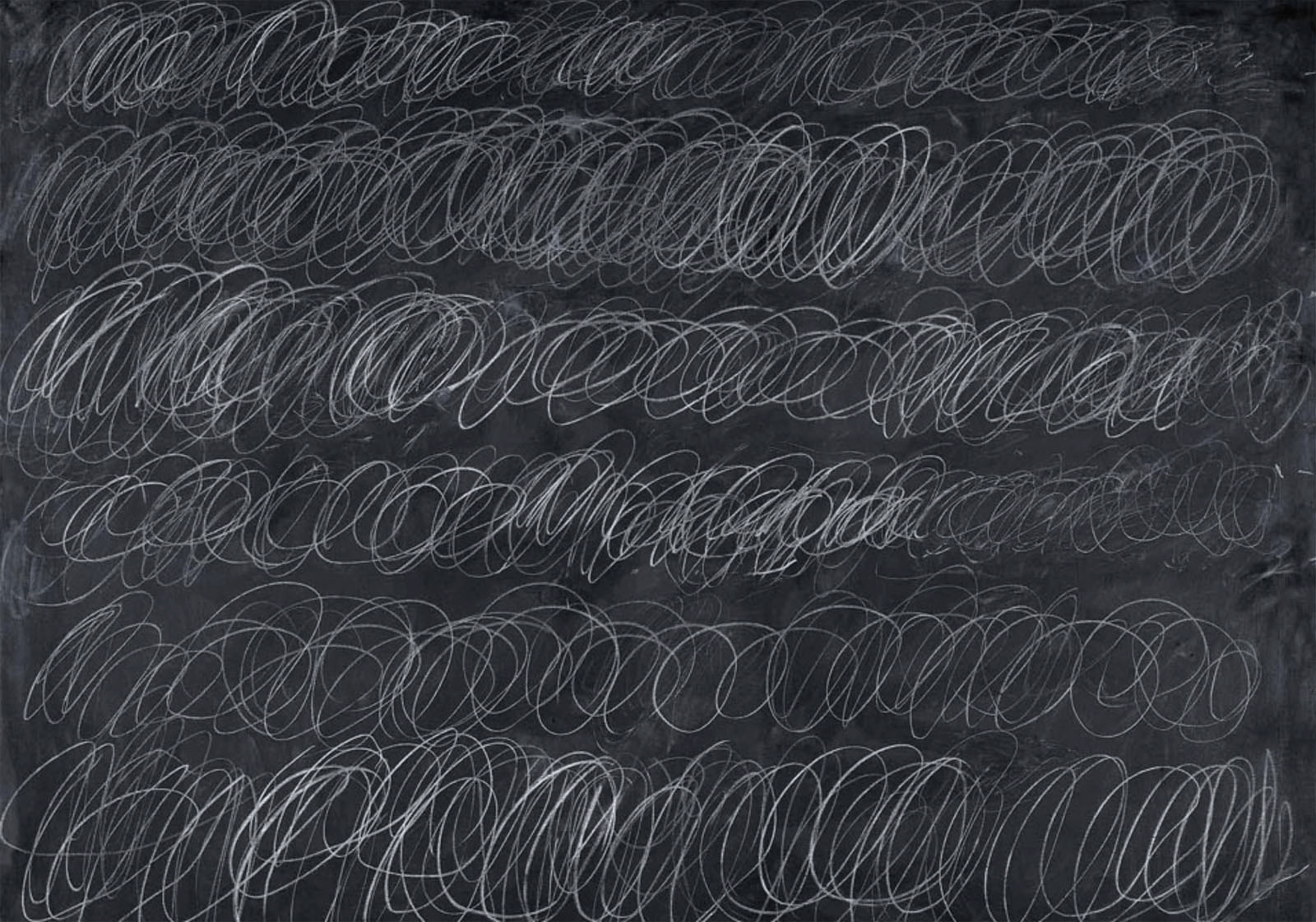
“One can almost see the maelstrom of the splitting of the atom in Twombly’s repeating performance threatening to destroy himself and the world around him.” Dr Marcus Bunyan
November 2008
Cy Twombly (American, 1928-2011) Cold Stream 1966 White wax pencil on canvas
This painting reminds me of the drawings of Rudolf Steiner (see the exhibition Joseph Beuys & Rudolf Steiner: Imagination, Inspiration, Intuition at The National Gallery of Victoria, Melbourne earlier this year) but here the performance of marking is pushed beyond the bounds of the spiritual by the ferocious attack of the artist – repeating the form but transgressing the boundaries of that form, disintegrating the ritual into the physical release of energy through the hand.
One can almost see the maelstrom of the splitting of the atom in Twombly’s repeating performance threatening to destroy himself and the world around him.
Edward S Curtis (American, 1868-1952) Nuhlihahla-Qagyuhl Nd
Following my thoughts on the series The First Australians on SBS we have this wonderful coffee table book of photographs: Edward S. Curtis: Visions of the First Americans with images taken from his seminal 20 volume work The North American Indian.
Curtis worked on the project from 1906 to 1927 hauling his large format glass plate camera across the United States much as Eugene Atget did at roughly the same time in Paris, taking photographs of the old city and its hotels, shops, parks and gardens. Atget died in 1927 with his art recognised by few whilst Curtis lived on into the 1950s, dying in obscurity and poverty after the fame of his groundbreaking work had disappeared.
Atget’s photographs of people half seen through shop doors and windows, like shadows of the night. Curtis’s photographs of masked Yeibichei dancers wearing elaborate attire. Both photographed a vanishing world capturing it for prosperity on fragile glass plates. Both brought to their projects a unique vision and a belief in what they were doing.
Curtis thought he was photographing the dying races of the American Indians. Atget knew he was photographing the collapsing spaces of old Paris. Both use the space of the photograph to signify their intentions: an understanding of their subject matter, an empathy with a disappearing way of life, a need to record their vision of this world – and an intensity of insight into that condition.
No other photograph has the space and timelessness of an Atget. No other image evokes the presence of the plains that Curtis summoned.
His masked dancers remind me of the last photographs of the great American photographer Diane Arbus in their candour and beauty, posthumously called Untitled. Finally Arbus had found a subject matter that she could return to over and over again. As did Atget and Curtis.
As Doon Arbus has commented,
“These images – created out of the courage to see things as they are, the grace to permit them simply to be, and a deceptive simplicity that permits itself neither fancy nor artifice … The photographs appear to be documents of a world we’ve never seen or imagined before – one with its own rituals and icons, its own games and fashions and codes of conduct – which, for all its strangeness, is at the same time hauntingly familiar and, in the end, no more or less unfathomable than our own.”1
Dr Marcus Bunyan
1/ Arbus, Doon. “Afterword,” in Diane Arbus: Untitled. London: Thames and Hudson, 1995.



You must be logged in to post a comment.