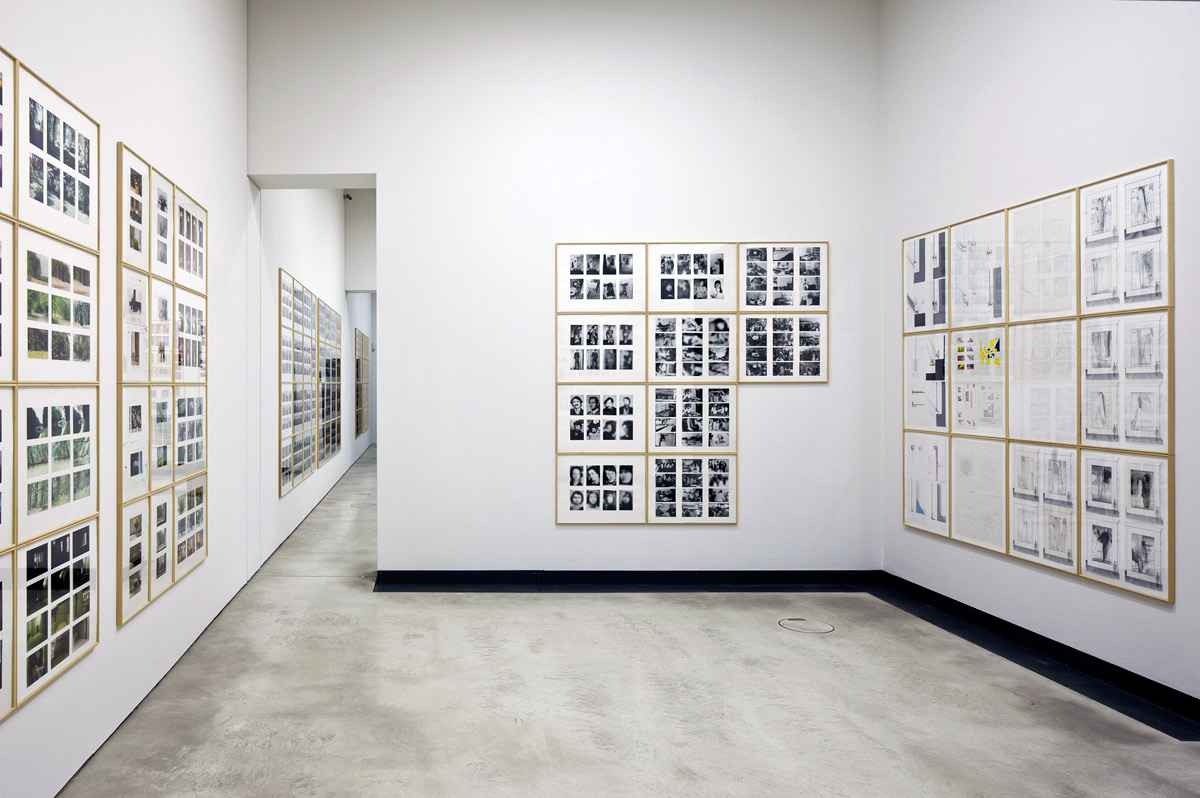
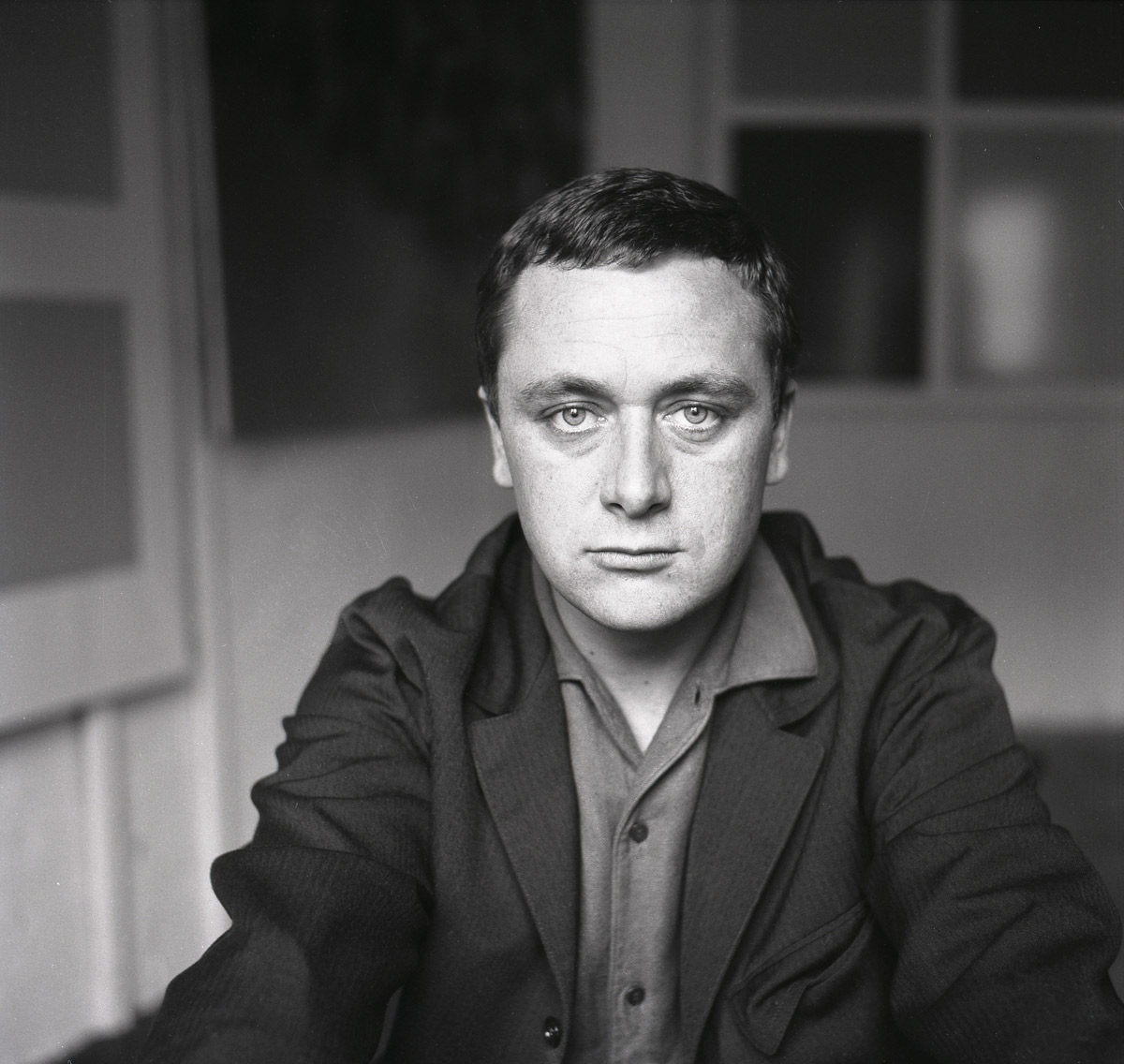
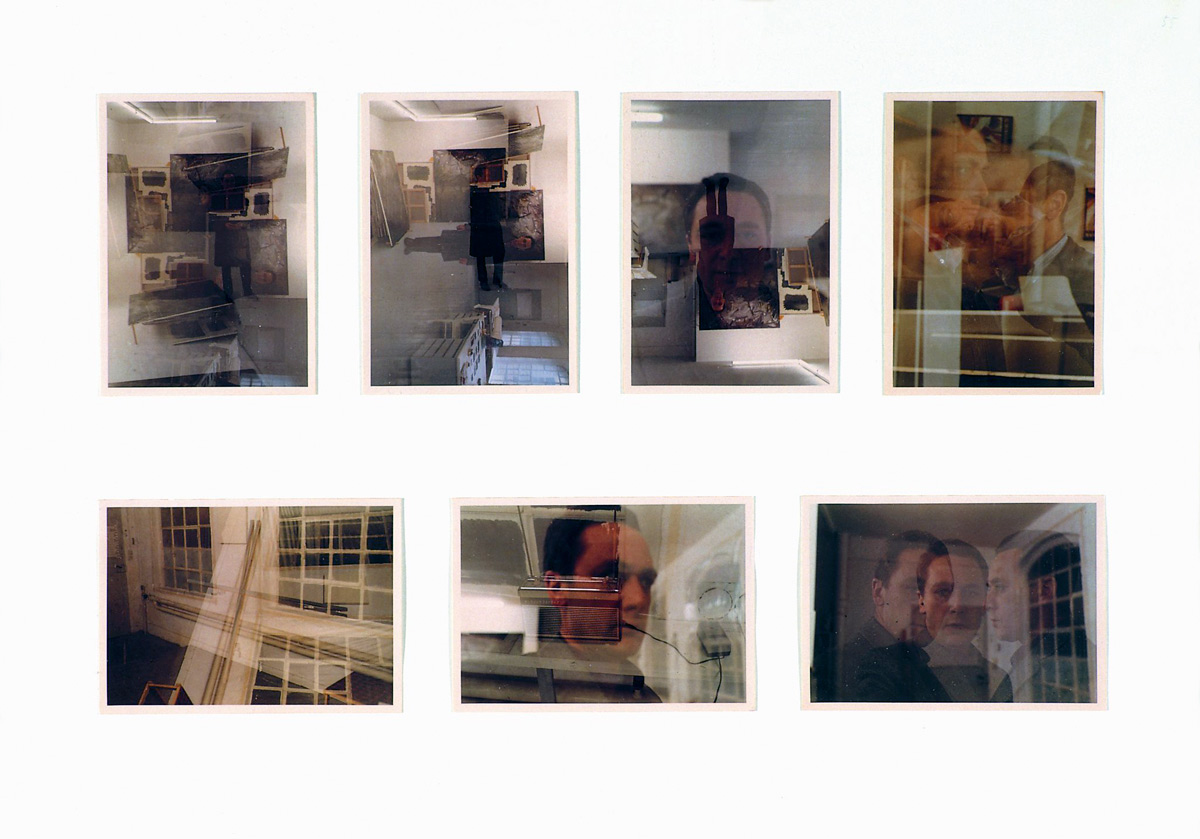
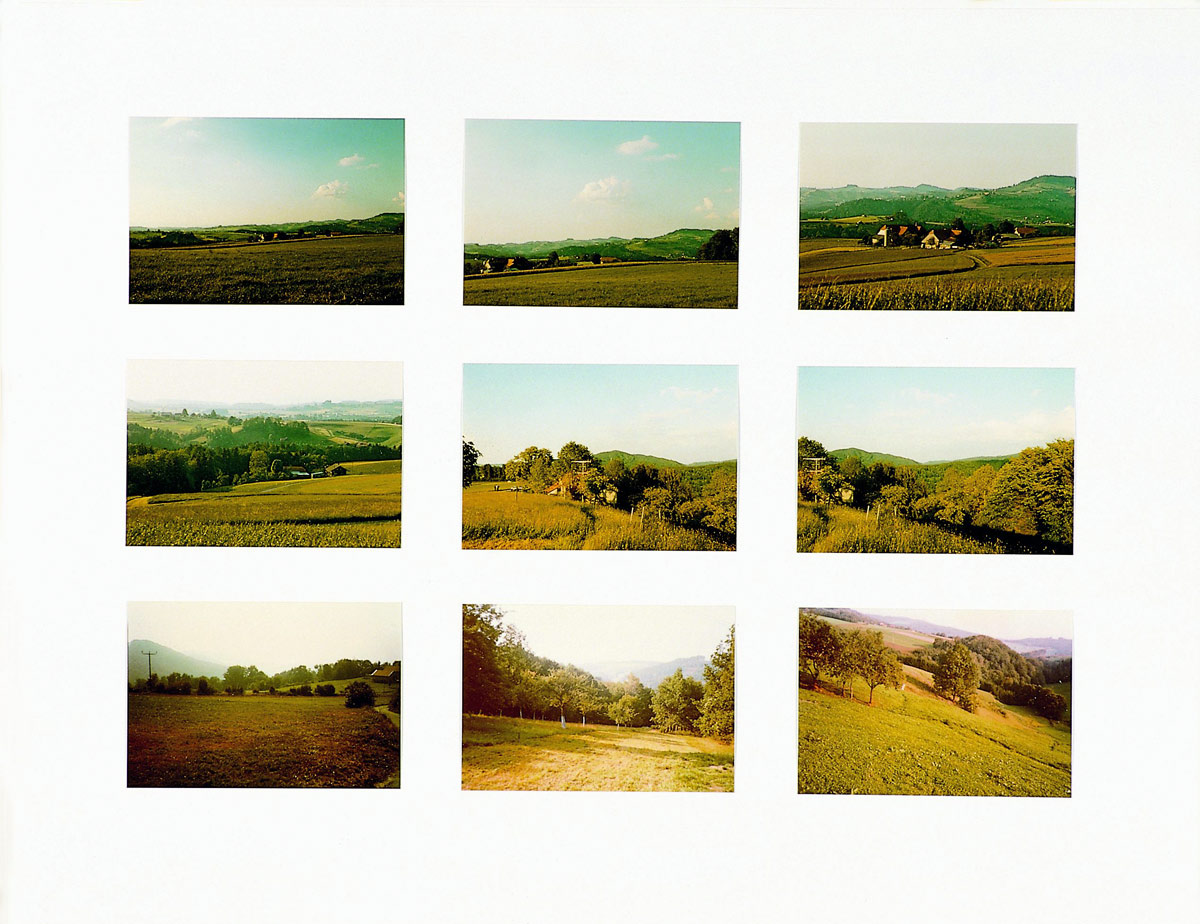
Exhibition: ‘Ladies and Gentlemen: The Camera as a Mirror’ at the Moderna Museet, Malmö, Sweden

Exhibition dates: 18th February 2012 – 22nd April 2012

Curator: Magnus af Petersens

Many thankx to the Moderna Museet for allowing me to publish the photographs in the posting. Please click on the photographs for a larger version of the image.
 

Cindy Sherman (American, b. 1954) 'Untitled Film Still #56' 1980


Cindy Sherman (American, b. 1954)
Untitled Film Still #56
1980
© Cindy Sherman. Courtesy of the Artist and Metro Pictures


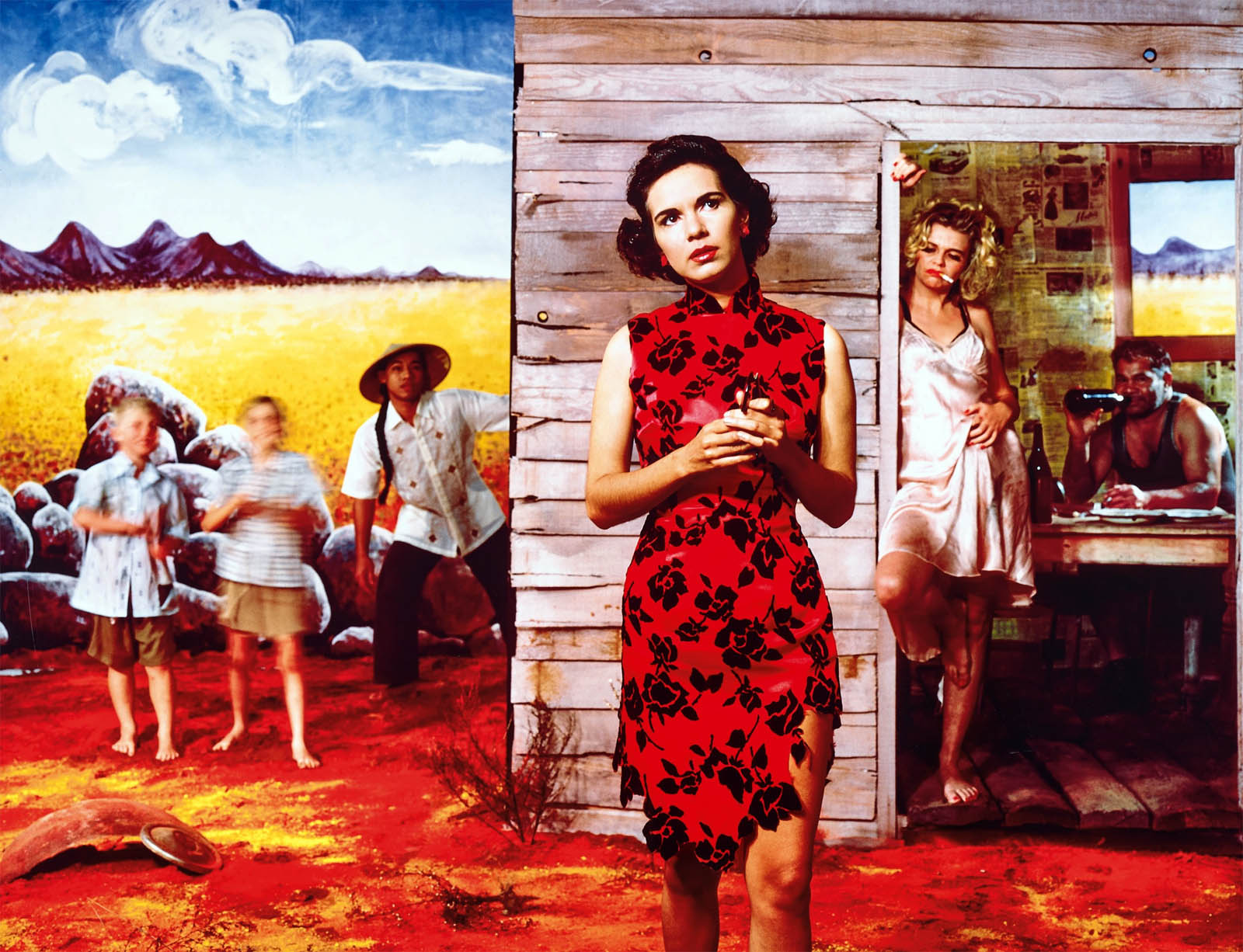
Tracey Moffatt (Australian, b. 1960) 'Something More #1' 1997


Tracey Moffatt (Australian, b. 1960)
Something More #1
1997
Cibachrome print
© Tracey Moffatt/BUS 2012


Samuel Fosso (Cameroon, b. 1962) 'Sans titre. De la série Années 70' 1970-1980


Samuel Fosso (Cameroon, b. 1962)
Sans titre. De la série Années 70
1970-1980
Gelatin silver print
© Samuel Fosso, Courtesy JM Patras/Paris


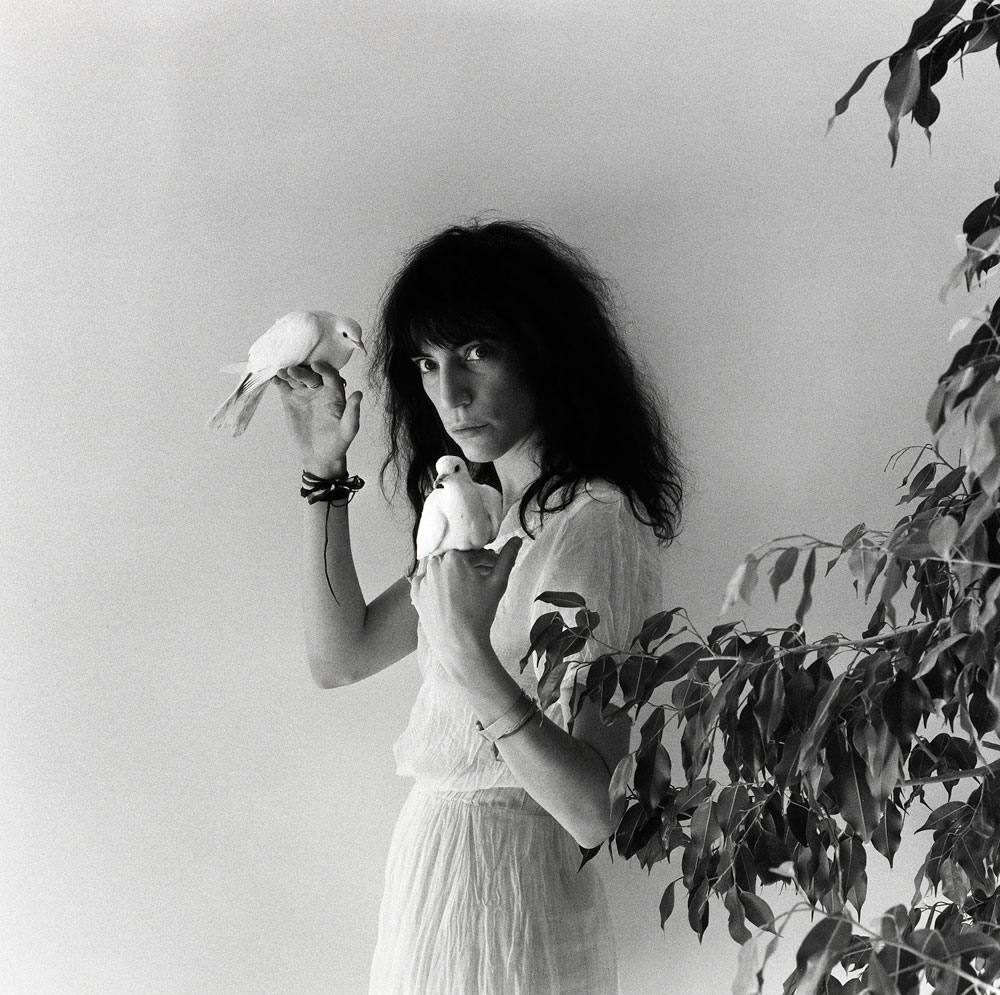
Robert Mapplethorpe (American, 1946-1989) 'Patti Smith' 1979


Robert Mapplethorpe (American, 1946-1989)
Patti Smith
1979
Gelatin silver print
© Robert Mapplethorpe Foundation


Robert Mapplethorpe (American, 1946-1989) 'Self Portrait' 1980


Robert Mapplethorpe (American, 1946-1989)
Self Portrait
1980
Gelatin silver print
© Robert Mapplethorpe Foundation


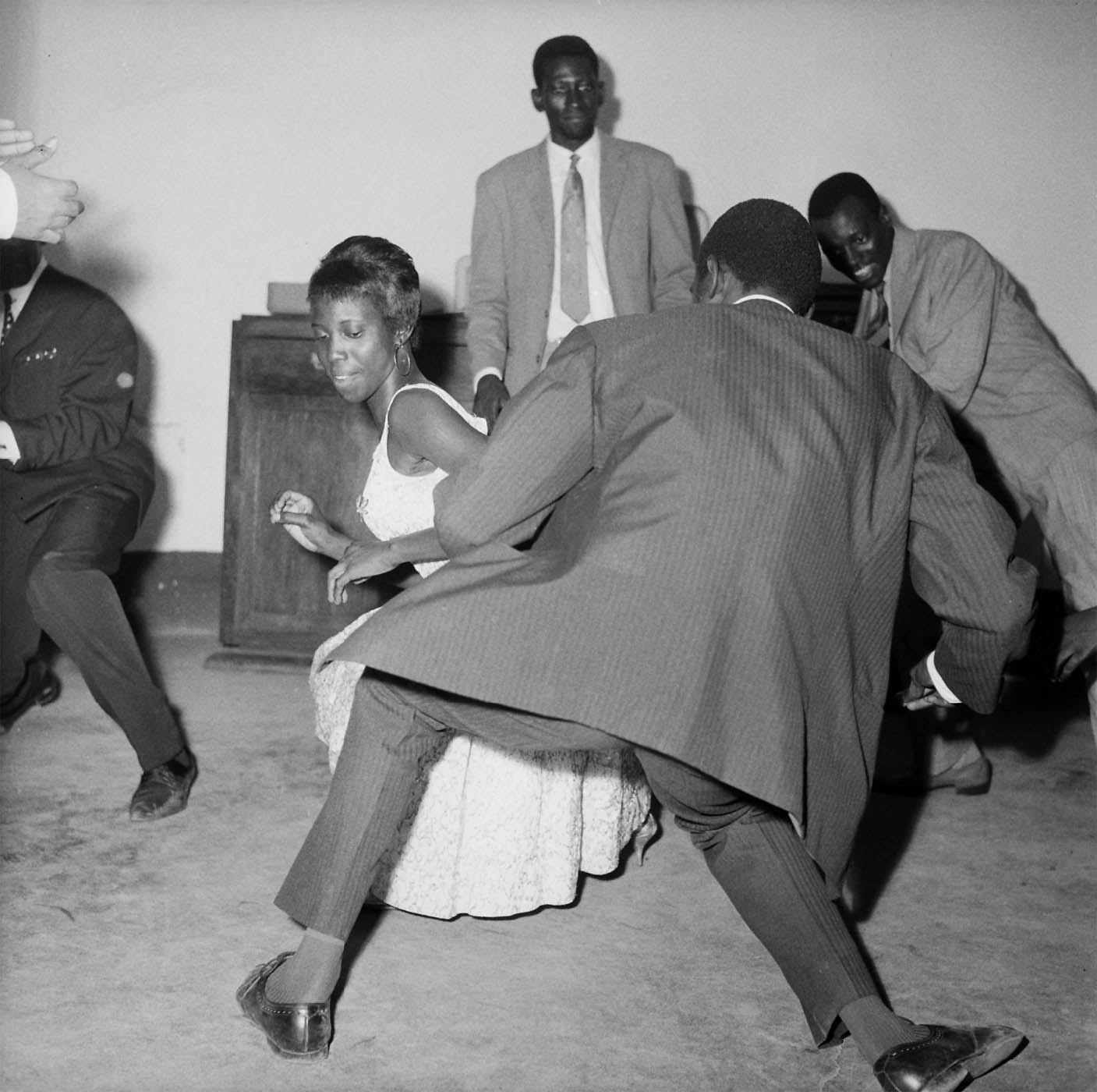
Malick Sidibé (Malian, 1936-2016) 'Danser le Twist' (Dance the Twist) 1965 


Malick Sidibé (Malian, 1936-2016)
Danser le Twist (Dance the Twist)
1965
Gelatin silver print


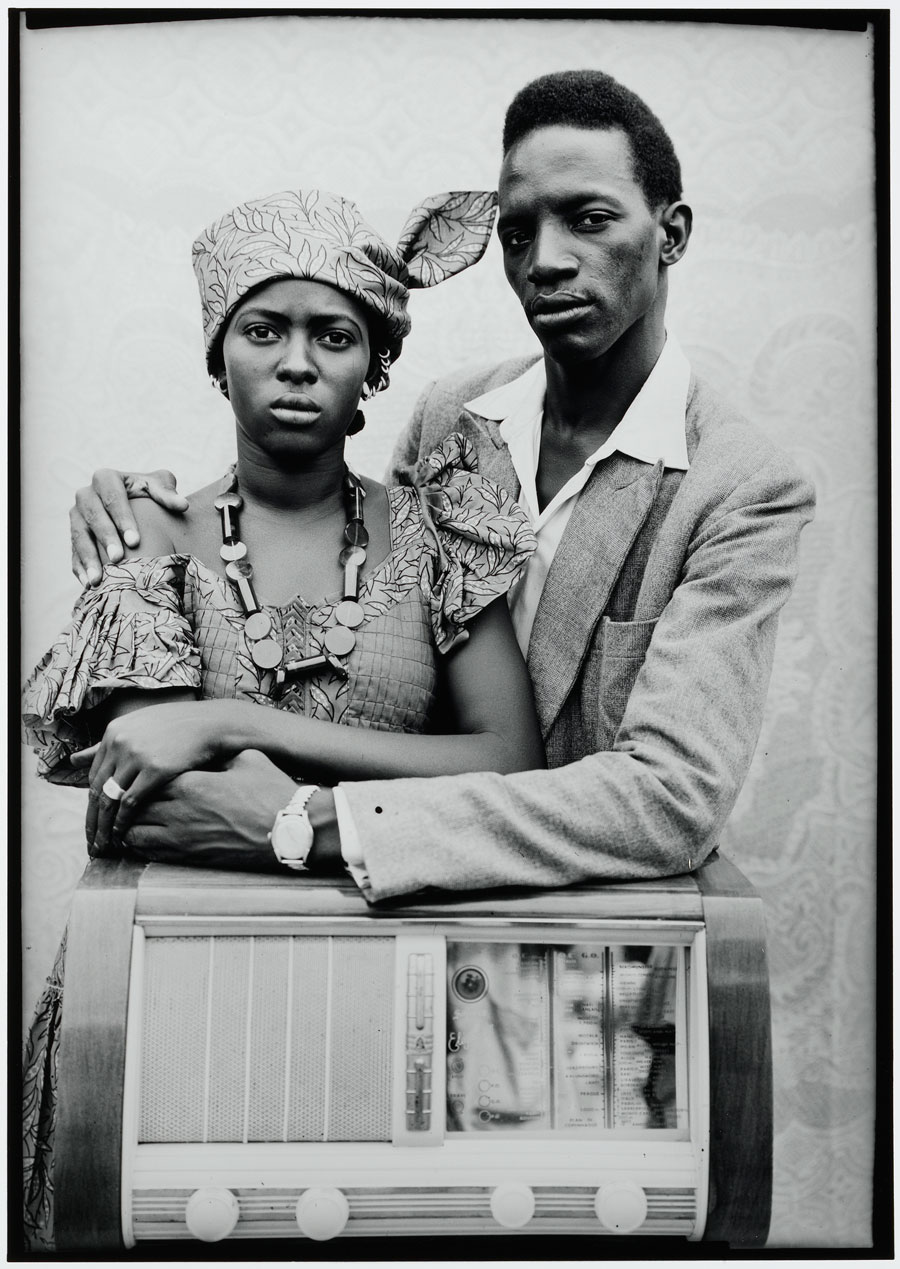
Seydou Keïta (Mali, 1921-2001) 'Untitled #419' 1950-1952


Seydou Keïta (Mali, 1921-2001)
Untitled #419
1950-1952
Gelatin silver print
© Seydou Keïta / SKPEAC


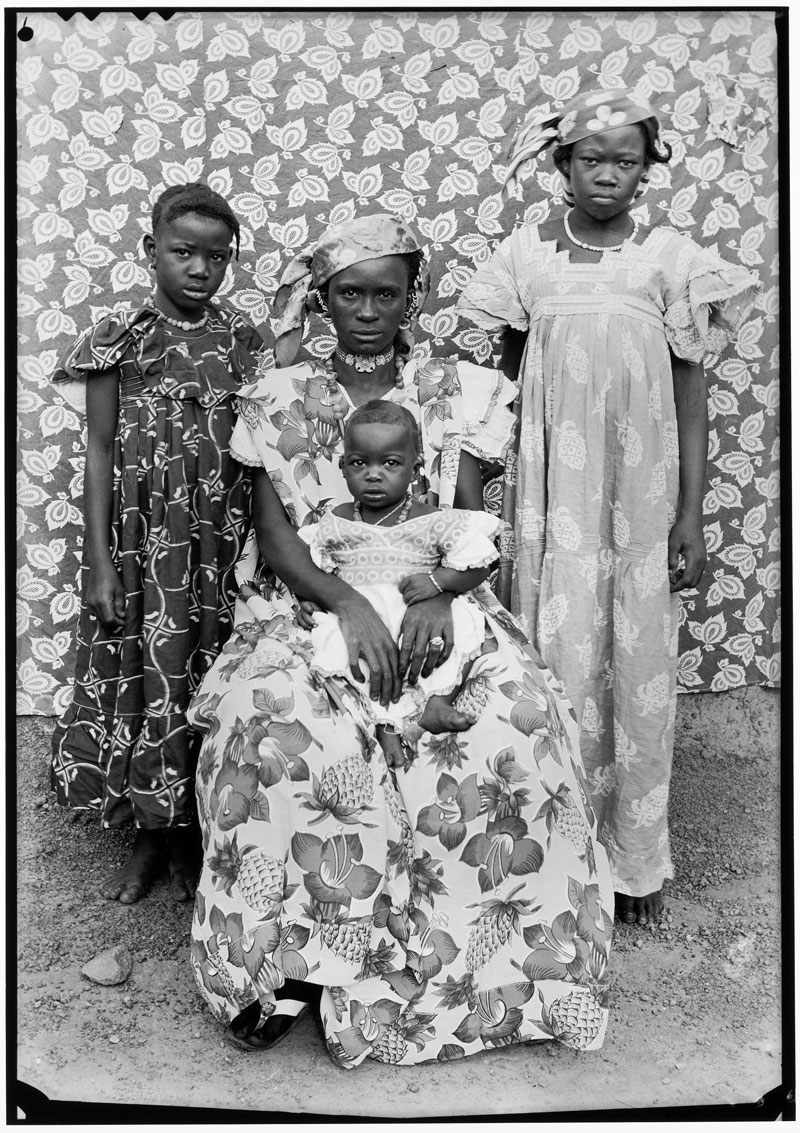
Seydou Keïta (Mali, 1921-2001) 'Untitled #420' 1950-1952


Seydou Keïta (Mali, 1921-2001)
Untitled #420
1950-1952
© Seydou Keïta / SKPEAC


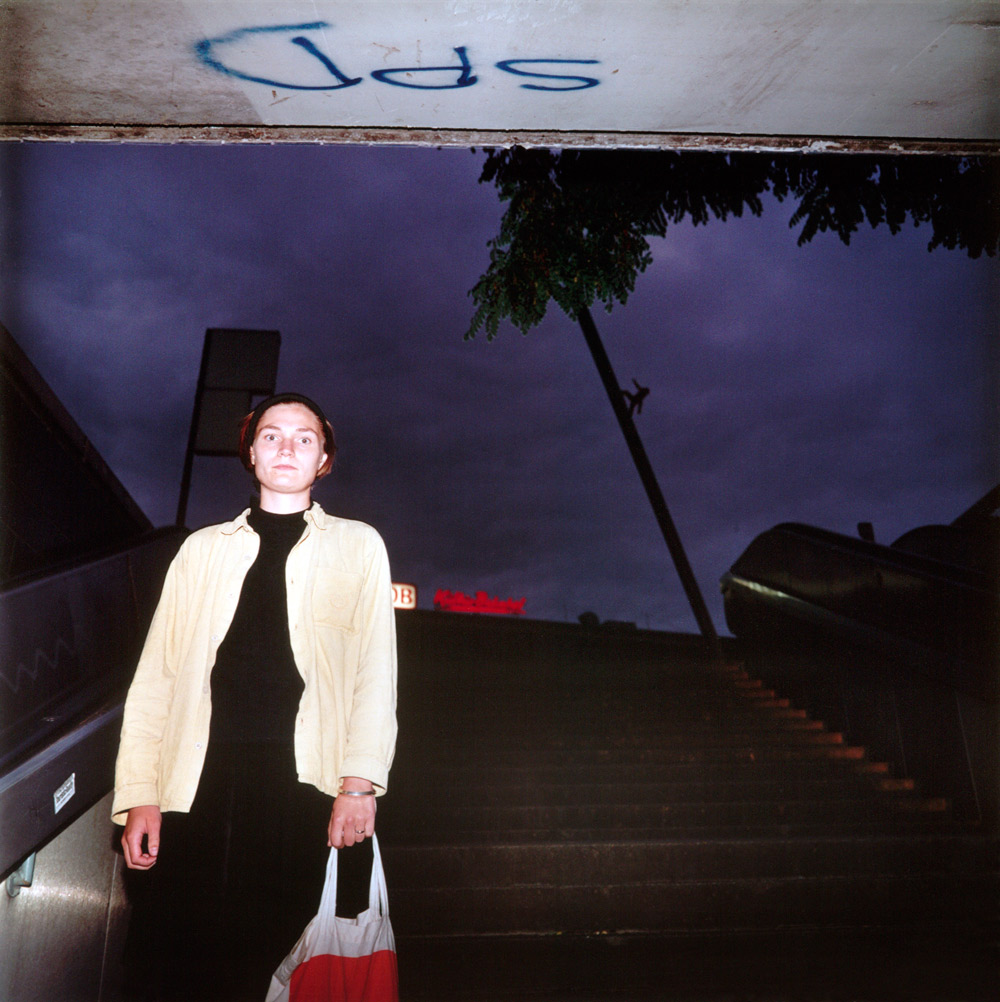
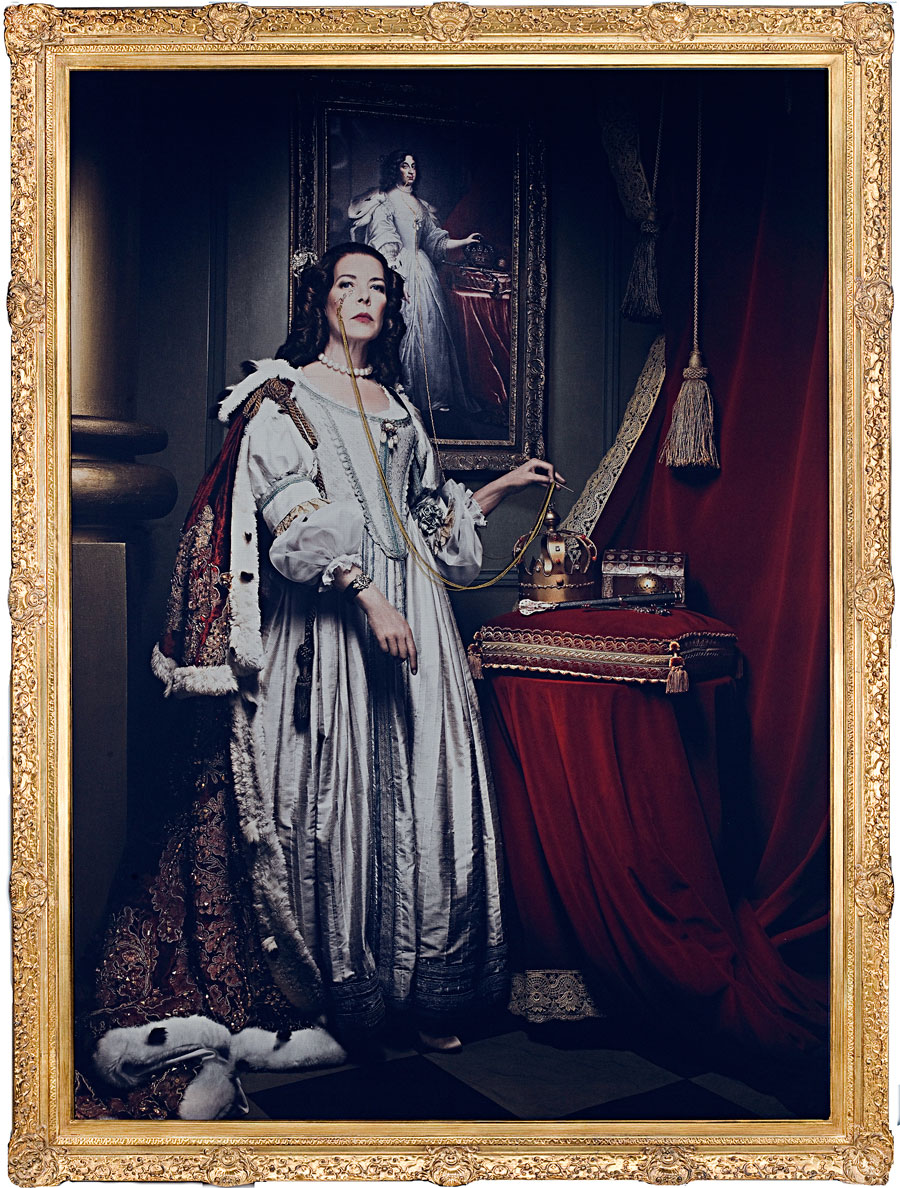
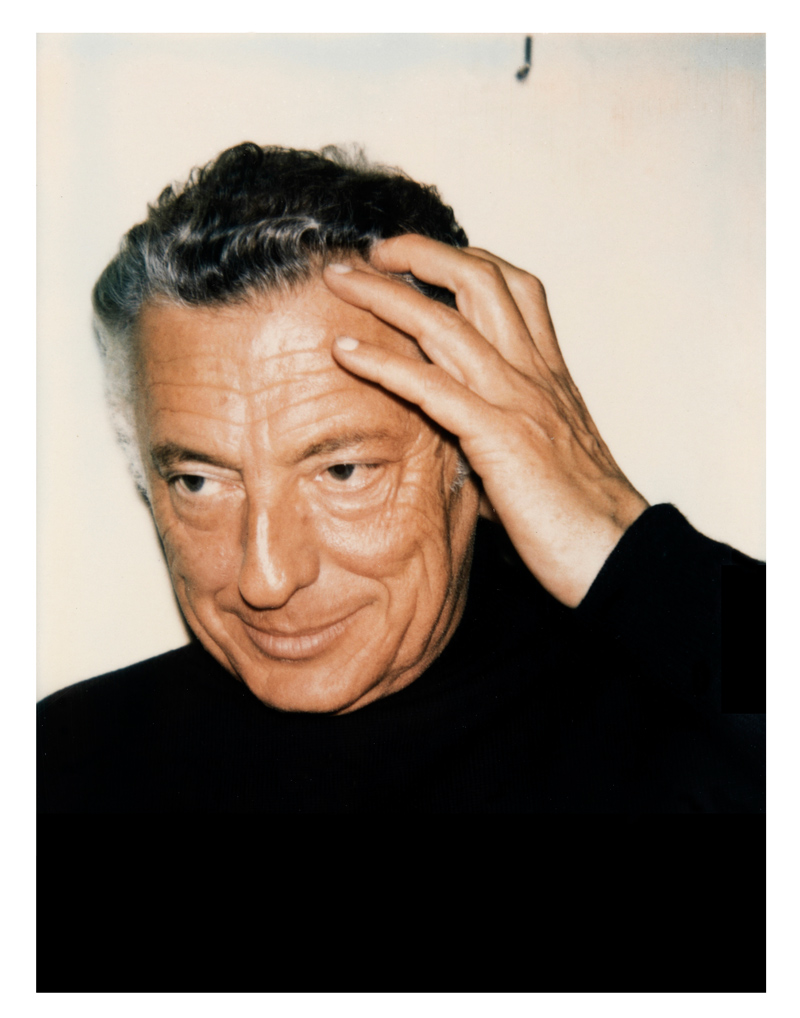
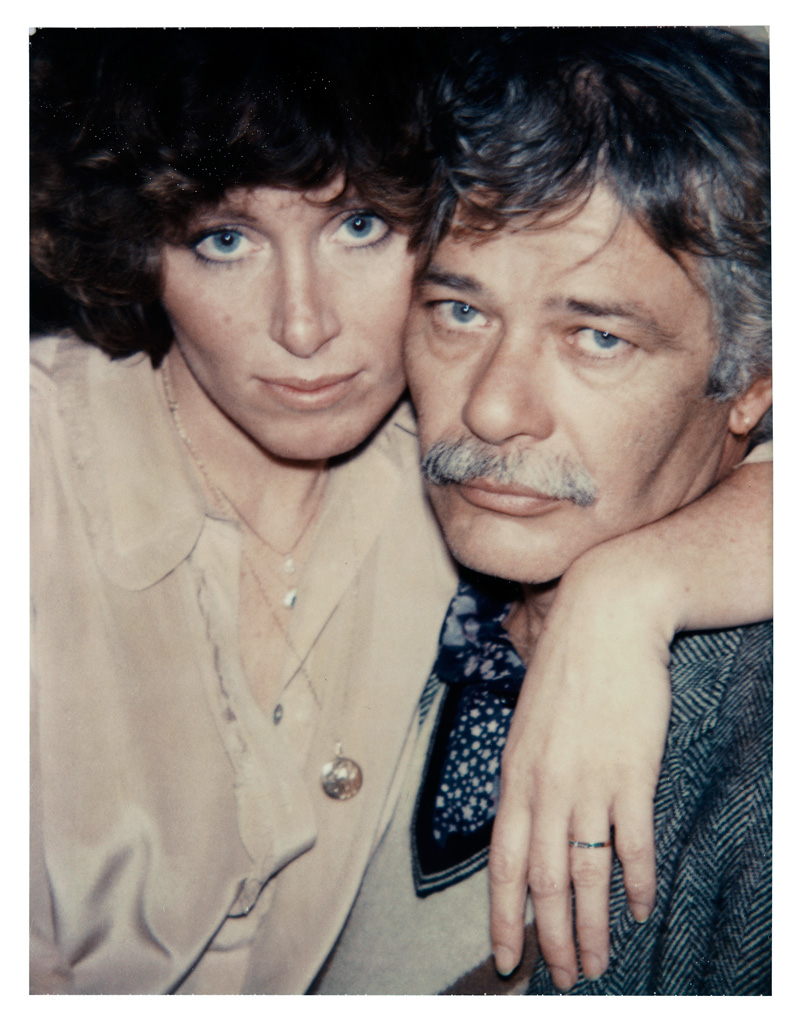
This spring we will be showing more than forty photographs from the period 1950-90 taken by leading artists such as Andy Warhol, Cindy Sherman, Robert Mapplethorpe, Samuel Fosso, Tracey Moffatt, and Elina Brotherus. The exhibition focuses on the art of portrait photography and how the artist in his or her studio creates images that depict people not just as they actually are, but also as they would like to appear.

Moderna Museet’s collection of photography is among the foremost in Europe, it includes some of the most prominent figures in the history of photography. Andy Warhol, Cindy Sherman, and Robert Mapplethorpe are all big names in photography, artists whose work often revolves around concepts of identity, sexuality, and performativity. The photography studio is a place for masquerades and manipulations, a stage where various identities and roles can be tested. It therefore problematises the idea that a portrait is meant to convey some truth about the subject’s inner life. How do we distinguish a staged scene from reality? Is it even possible to make such a distinction? How free are we to form our own identity? If it’s a matter of choosing a role, what roles are available to us?

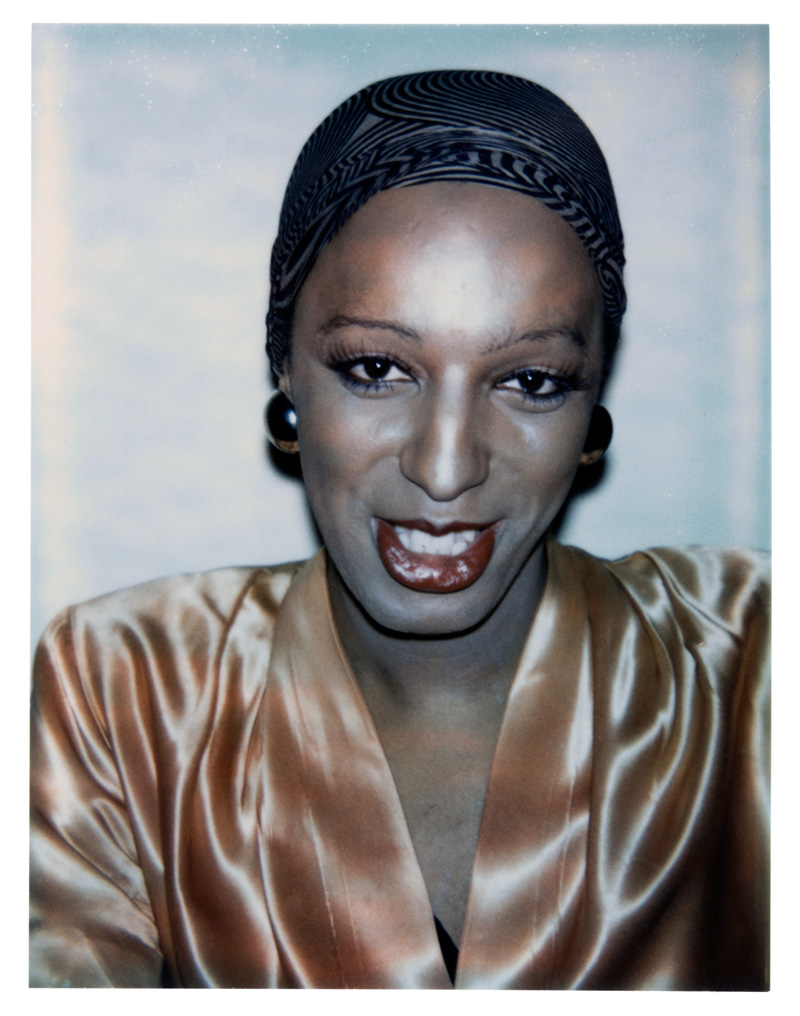
Andy Warhol’s Polaroid pictures, whose title, Ladies and Gentlemen, has also provided the name for the exhibition, are examples of his interest in – or rather his obsession with – celebrities. From industrial magnates to movie stars, from rock musicians to the “superstar” friends who hung out around the Factory, his fabled studio. In the world of pop art and popular culture, surface is everything. Robert Mapplethorpe’s photographs are instead classically composed – stylised and aesthetically formed. In the controlled environment and lighting of the photo studio, he strives not for realism but for beauty. Here role-play becomes a part of the picture’s constructed character.

In Cindy Sherman’s suite of images called Untitled Film Stills (1977-1980), she plays with film clichés. The scenes and characters in her photographs seem familiar, but in fact it’s always Sherman herself we see in the leading role. Using the camera as a mirror, she takes on and explores various roles. It’s a game of trying on identities that is familiar to teenagers in particular the world over, a game we play in an attempt to find ourselves, or rather to construct an individual identity. One of the many ways in which Sherman’s pictures have been interpreted is as a feminist critique of the limited number of roles available to women.

This exhibition also presents several works by Seydou Keïta, Malick Sidibé, and Samuel Fosso, studio photographers who work primarily with portrait photography. Keïta’s studio was next-door to a movie theater in Bamako, the capitol city of Mali. Sidibé takes pictures not just in his studio but also at weddings and other parties. His photographs from Bamako in the 1960s reflect the great hope that came with liberation from French colonial power. Fosso opened his studio in Bangui, in the Central African Republic, when he was still a teenager. He is best known for a series of self-portraits in which he dons a variety of outfits to assume different roles.

Press release from the Moderna Museet website


Elina Brotherus (Finnish, b. 1972) 'Honeymoon' 1997 (detail)


Elina Brotherus (Finnish, b. 1972)
Honeymoon (detail)
1997
© Elina Brotherus


Francesco Vezzoli (Italian, b. 1971) 'Portrait of H.R.H The Princess of Hanover (Before & After Salvador Dalí)' 2009


Francesco Vezzoli (Italian, b. 1971)
Portrait of H.R.H The Princess of Hanover (Before & After Salvador Dalí)
2009
© Francesco Vezzoli/BUS 2012


Andy Warhol (American, 1928-1987) 'Gianni Agnelli' 1972


Andy Warhol (American, 1928-1987)
Gianni Agnelli
1972
© Andy Warhol/BUS 2012


Andy Warhol (American, 1928-1987) 'John Chamberlain and Lorraine' 1978


Andy Warhol (American, 1928-1987)
John Chamberlain and Lorraine
1978
© Andy Warhol/BUS2012


Andy Warhol (American, 1928-1987) 'Ladies and Gentlemen (Wilhelmina Ross)' 1974


Andy Warhol (American, 1928-1987)
Ladies and Gentlemen (Wilhelmina Ross)
1974
© Andy Warhol/BUS 2012


Cindy Sherman. 'Untitled' 2008


Cindy Sherman (American, b. 1954)
Untitled
2008
© Cindy Sherman. Courtesy the Artist and Metro Pictures


Moderna Museet Malmö
Gasverksgatan 22 in Malmö

Moderna Museet Malmö is located in the city centre of Malmö. Ten minutes walk from the Central station, five minutes walk from Gustav Adolfs torg and Stortorget.

Opening hours:
Tuesday – Sunday 11 – 17
Mondays closed

Moderna Museet Malmö website

LIKE ART BLART ON FACEBOOK

Back to top

Exhibition: ‘The Heart of the Great Alone: Scott, Shackleton and Antarctic Photography’ at The Queen’s Gallery, Buckingham Palace, London

Exhibition dates: 21st October 2011 – 15th April 2012


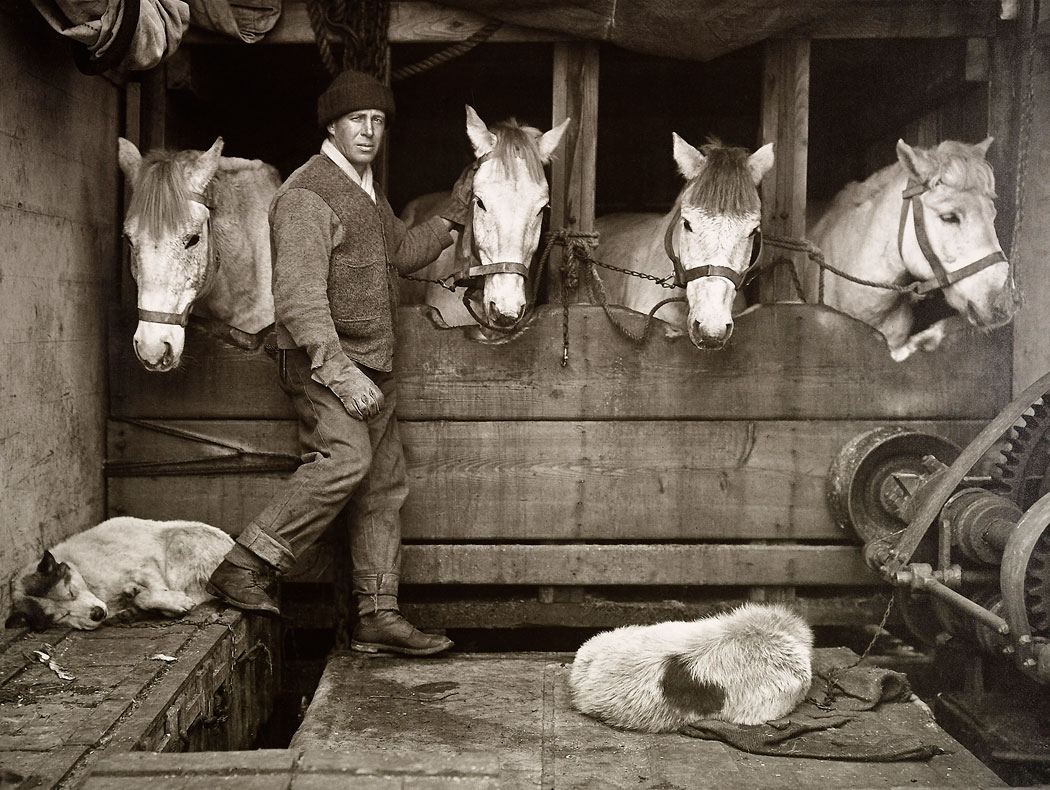
Herbert Ponting (British, 1870-1935) 'Captain Lawrence Oates and Siberian ponies on board 'Terra Nova'' 1910


Herbert Ponting (British, 1870-1935)
Captain Lawrence Oates and Siberian ponies on board ‘Terra Nova’
1910
Presented to King George V, 1914
© 2011 Her Majesty Queen Elizabeth II


Continuing my fascination with all things Antarctic, here are more photographs from the Scott and Shackleton expeditions. The photograph Captain Lawrence Oates and Siberian ponies on board ‘Terra Nova’ by Herbert Ponting (1910, above) is simply breathtaking.

Dr Marcus Bunyan


Many thankx to The Royal Collection for allowing me to publish the photographs in the posting. Please click on the photographs for a larger version of the image.


This exhibition of remarkable Antarctic photography by George Herbert Ponting and Frank Hurley marks the 100th anniversary of Captain Scott’s ill-fated journey to the South Pole. Ponting’s dramatic images record Scott’s Terra Nova expedition of 1910-1912, which led to the tragic death of five of the team on their return from the South Pole. Hurley’s extraordinary icescapes were taken during Ernest Shackleton’s polar expedition on Endurance in 1914-1917, which ended with the heroic sea journey from Elephant Island to South Georgia. Both collections of photographs were presented to King George V and are today part of the Royal Photograph Collection.

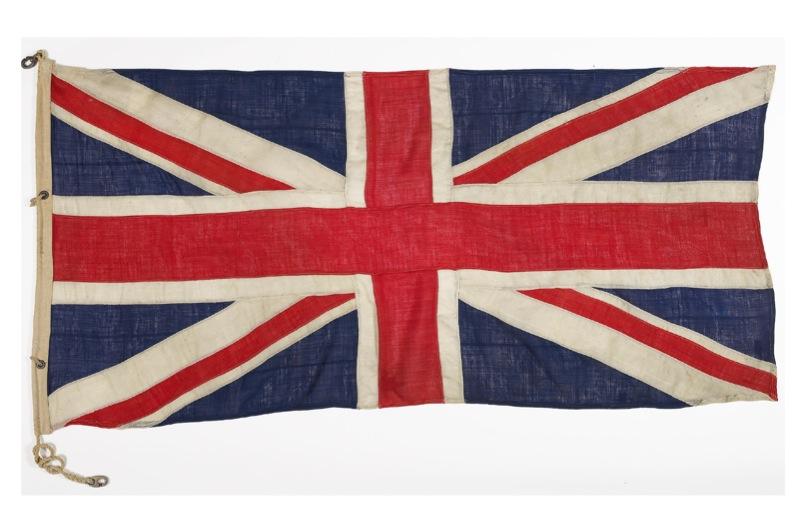
Union Jack taken by Scott to the South Pole 1911-1912


Union Jack taken by Scott to the South Pole
1911-1912
Presented to King George V, 1914
© 2011 Her Majesty Queen Elizabeth II


This Union Jack was given to Scott by the recently widowed Queen Alexandra on 25 June 1910 for him to plant at the South Pole. The flag was recovered with Scott’s body and returned to the queen by his wife, Kathleen, on 12 July 1913.


The photographs of Herbert Ponting and Frank Hurley may be stencilled into the collective memory after nearly a century of over-exposure. But it’s not often you get to see them away from the printed page, and they certainly bring out fresh depths and new perspectives…

It turns out to be highly instructive seeing Hurley and Ponting hung in neighbouring rooms. I’ve always taken Ponting to be somehow the lesser snapper. Hurley had the greatest photostory ever captured land in his lap when Shackleton’s ship the Endurance was trapped in ice floes and held fast for months before pressure ridges eventually crushed it like a dry autumn leaf. Like a good journalist Hurley recorded these traumas and more while also taking the chance to experiment with the strange light and baroque shapes supplied by his surroundings.

Ponting’s story was different. Four or so years earlier, and on the other side of the Antarctic land mass, he didn’t stray far from the expedition base, and indeed was left on the Terra Nova while Scott’s polar party were still out on the ice, trudging balefully towards immortality. There’s something about Ponting’s floridly unmodern moustache which sets him apart from the clean-shaven younger men in either expedition, as if he never quite left the studio behind.

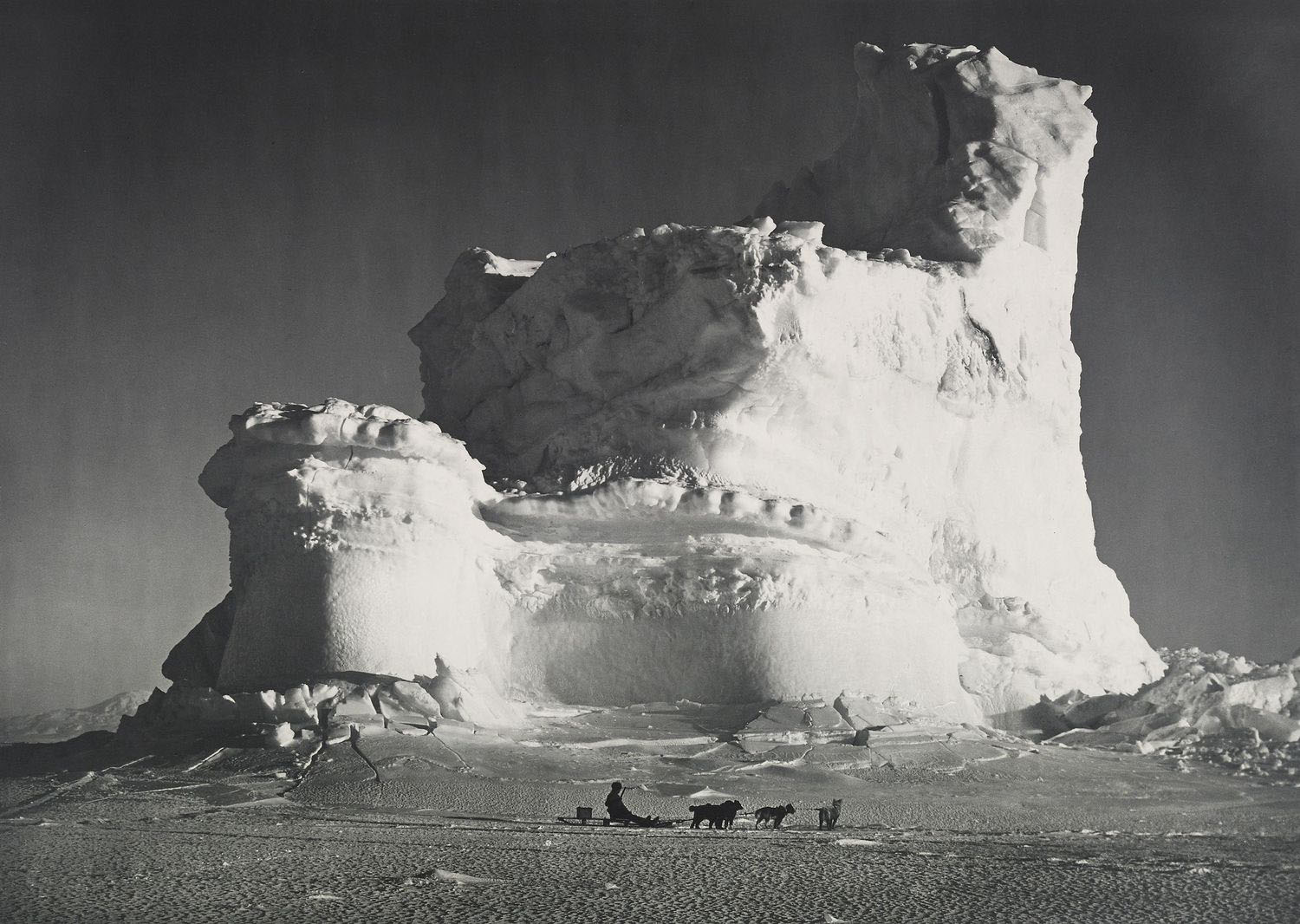
But the photographs are astonishing… The story here is the unequal battle between man and ice, the castellations and ramparts of bergs dwarfing explorers with dogs and sledges placed at their foot to give a sense of scale. Ponting also has a beautiful eye for filigree detail, never more than in one picture of long spindly icicles echoing the adjacent rigging of the Terra Nova.

One of the revelations is that the originals play up the drama of Ponting’s work much more than Hurley’s, which are printed at half the size. For all the astonishing pictures – a field of ice flowers, the masts of the Endurance all but shrouded by Brobdingnagian ice clumps – the final impact of Hurley’s collection lies in the fact that they exist at all… That is partly why Ponting trumps Hurley in this show. His pictures of Scott’s men have never felt more immediate.

Rees, Jasper. Review of “The Heart of the Great Alone: Scott, Shackleton and Antarctic Photography, Queen’s Gallery” on the Arts Desk website. Thursday, 27 October 2011 [Online] Cited 06/04/2012


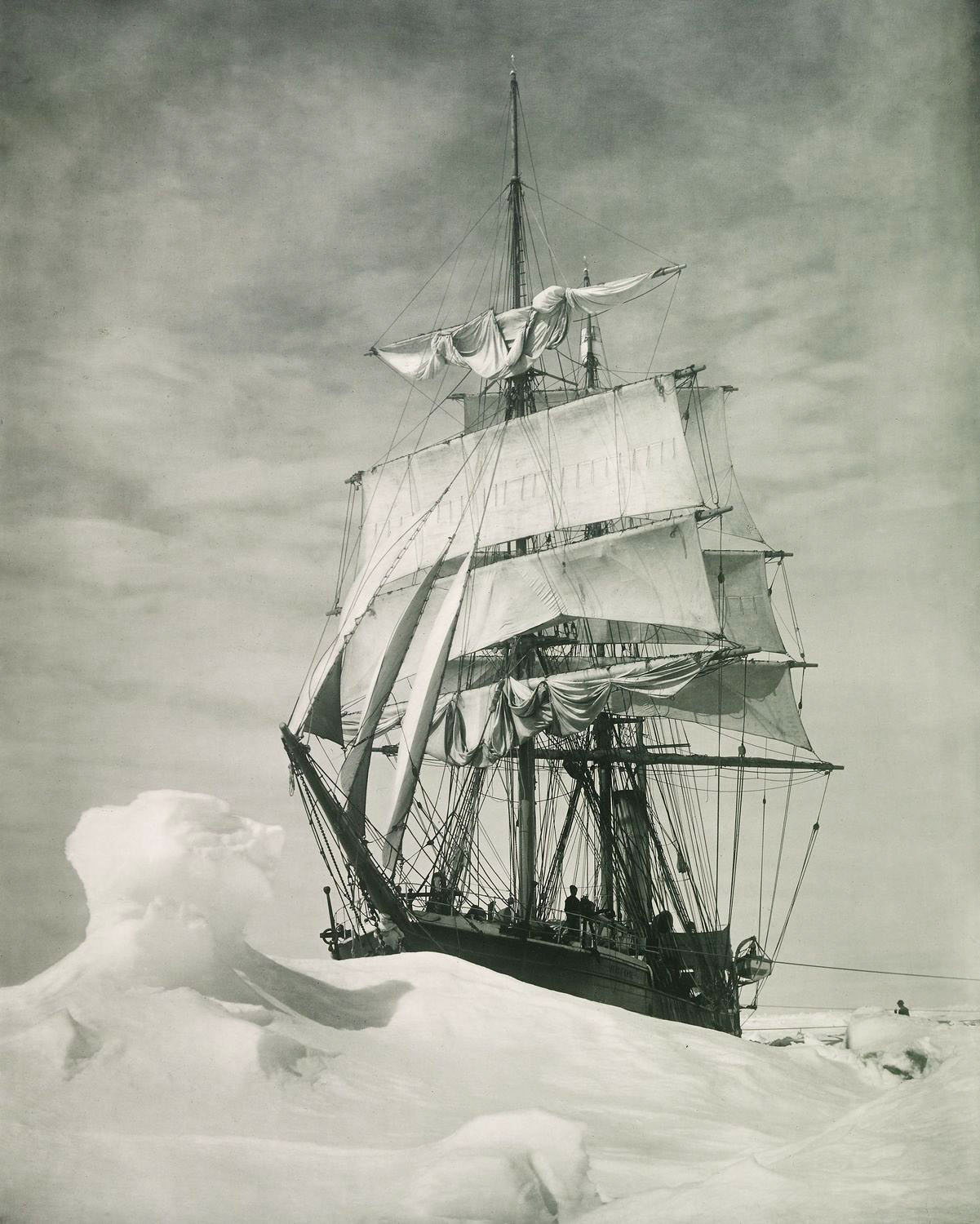
Herbert Ponting (British, 1870-1935) 'The Terra Nova icebound in the pack' 13 Dec 1910


Herbert Ponting (British, 1870-1935)
The Terra Nova icebound in the pack
13 Dec 1910
Carbon print
73.5 x 58.2cm
Presented to King George V, 1914
© 2011 Her Majesty Queen Elizabeth II


Photograph of the Terra Nova in sail, passing through ice and snow. Scott’s ship is seen here held up by the ice pack, with a curiously shaped ‘ice bollard’ in the foreground. The Terra Nova was launched in 1884 as a whaling ship. She had sailed to both the Arctic and Antarctic before serving as Scott’s ship in 1910. She survived until 1943 when she was damaged by ice and sank off the coast of Greenland.


British Antarctic Expedition

Scott and his men reached Antarctica on board the Terra Nova on 31 December 1910. The expedition had several aims that were scientific in nature, but the principal goal for Scott was to lead the first team to the South Pole.

Following his earlier polar experience on the Discovery expedition of 1901-1904, Scott realised the importance of good photographic images for fund-raising and publicising the achievements of the expedition. Scott employed the photographer Herbert Ponting to accompany him. This was the first time a professional photographer had been included in an Antarctic expedition.

Ponting had previously worked in the United States and Asia. He had a great deal of experience, and during his time in Antarctica, he produced around 2,000 glass plate negatives as well as making films. Ponting also taught photography to Scott and other members of the team so that they could record their assault on the Pole.

In March 1912 Ponting left the Antarctic, according to previously-laid plans. After his return to Britain, Ponting exhibited his work and lectured widely about Scott, thus ensuring that his photographs became inextricably linked with Scott and the heroic age of Antarctic exploration.

Text from the Royal Collection Trust website


Herbert Ponting (British, 1870-1935) 'The Castle Berg with dog Sledge' 17 Sep 1911


Herbert Ponting (British, 1870-1935)
The Castle Berg with dog Sledge
17 Sep 1911
Carbon print
53.2 x 75.0cm
Presented to King George V, 1914
© 2011 Her Majesty Queen Elizabeth II


This iceberg, which resembles a medieval castle, was greatly admired by members of the expedition. Ponting returned several times during 1911 to photograph it, including once in June, the middle of the Antarctic winter, when he set up flashlights to make an image. At its highest point the berg is around 100 feet high (30.5 m).


Herbert Ponting (British, 1870-1935) 'The ramparts of Mount Erebus' 1911


Herbert Ponting (British, 1870-1935)
The ramparts of Mount Erebus
1911
Presented to King George V, 1914
© 2011 Her Majesty Queen Elizabeth II


Mount Erebus, an active volcano on Ross Island which last erupted in 2008, was first climbed in 1908 by members of Shackleton’s Nimrod expedition. Ponting has contrasted the overwhelming size of the natural world against the tiny human figure pulling a sledge, in the lower left corner of the photograph.


It is a story of heroism and bravery, and ultimately of tragedy, that has mesmerised generations. One hundred years on from their epic voyages to the very limits of the Earth, and of man’s endurance, the legends of Scott and Shackleton live on.

To mark the centenary of Captain Robert Falcon Scott’s expedition to the South Pole, the Royal Collection brings together, for the first time, a collection of the photographs presented to King George V by the official photographers from Scott’s Terra Nova expedition of 1910-1913 and Shackleton’s expedition on Endurance in 1914-1916, and unique artefacts, such as the flag given to Scott by Queen Alexandra (widow of King Edward VII) and taken to the Pole.

The exhibition documents the dramatic landscapes and harsh conditions the men experienced, through the work of expedition photographers Herbert Ponting and Frank Hurley. These sets of photographs are among the finest examples of the artists’ work in existence – and the men who took them play a vital part in the explorers’ stories. Highlights from Scott’s voyage include Ponting’s The ramparts of Mount Erebus, which presents the vast scale of the icescape, and the ethereal The freezing of the sea. Among the most arresting images from Hurley’s work on Shackleton’s expedition are those of the ship Endurance listing in the frozen depths and then crushed between floes.

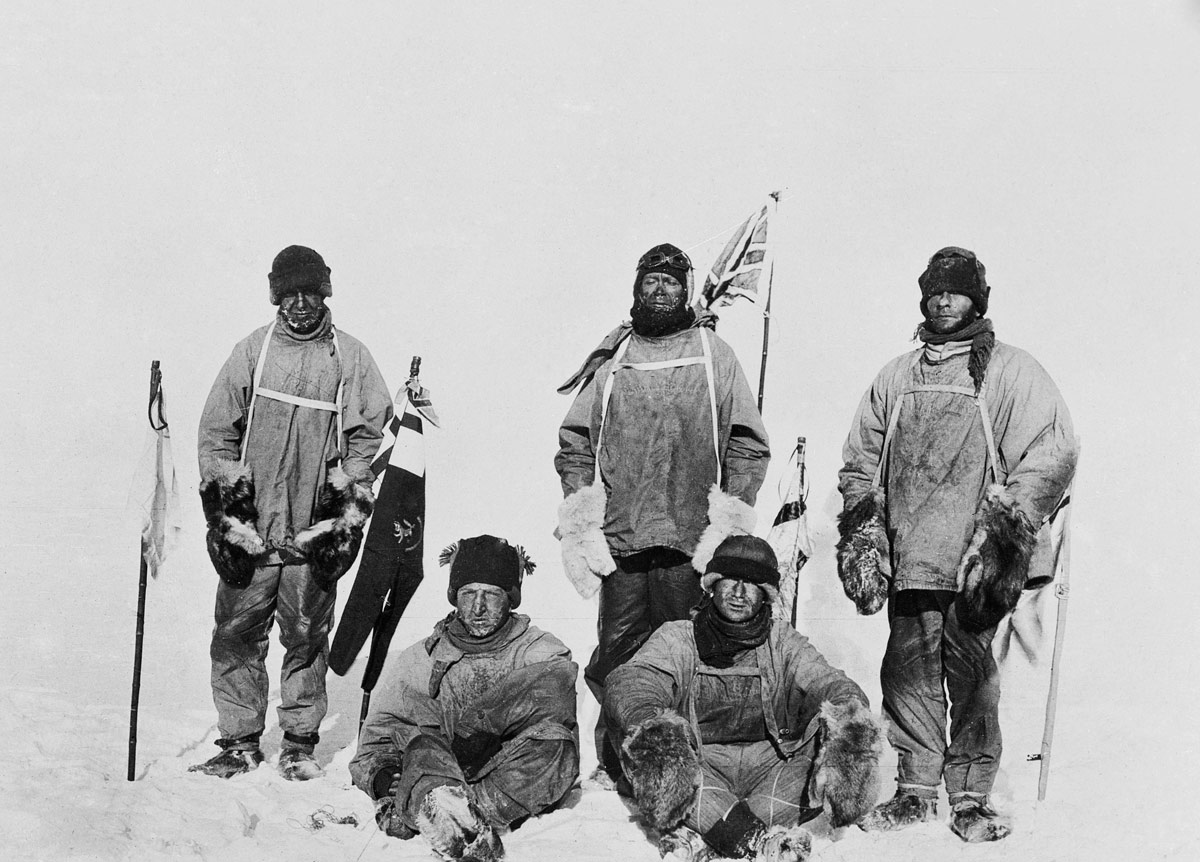
The photographs also give insights into the men themselves. For instance, at the start of the journey Scott appears confident and relaxed, with his goggles off for the camera. In contrast, a photograph taken at the Pole shows him and his team devastated and unsmiling, knowing they had been beaten. The exhibition also records the lighter moments of expedition life, essential for teams cut off from the outside world for years at a time. On Shackleton’s expedition, a derby for the dogs was organised – with bets laid in cigarettes and chocolate. A menu for Midwinter’s Day, on 22 June 1911, shown in the accompanying exhibition publication, includes roast beef and Yorkshire pudding, ‘caviare Antarctic’ and crystallised fruits.

Antarctic adventurer David Hempleman ­Adams has been closely involved in the exhibition and has written an introduction to the catalogue. First given the taste for adventure by The Duke of Edinburgh’s Award scheme, he was inspired, like generations of school children, by the tales of discovery. As a South Pole veteran, the first Briton to reach the Pole solo and unsupported, he is still in awe of Scott and Shackleton’s achievements – and will return with his daughter this year to mark the centenary. David Hempleman­ Adams said: “We have a big psychological advantage today: We know it is possible to reach the South Pole. Nowadays you can go on Google Earth and see what’s there. Back then, it was just a big white piece of paper. Scott and Shackleton had no TVs, radios or satellite phones – they were cut off from the outside world – and in terms of equipment, the tents, skis and sledges, today, we carry about one tenth of what they carried, over the same mileage. What they achieved, with what they had, is really magnificent. This is the 100th anniversary and the legend has stood the test of time. Even in this modern world, there’s still just as much interest.”

As the photographs show, animals played an important part in the expeditions. There are portraits of the ponies and of individual sledge dogs. In his diaries, Scott describes the relationship he struck up with the bad­ tempered husky Vida: “He became a bad wreck with his poor coat… and… I used to massage him; at first the operation was mistrusted and only continued to the accompaniment of much growling, but later he evidently grew to like the warming effect and sidled up to me whenever I came out of the hut… He is a strange beast – I imagine so unused to kindness that it took him time to appreciate it.”

Ponting also photographed wildlife, including seals, gulls and penguins. Scott writes of the moment Ponting tried to photograph killer whales and how the creatures crashed through the ice to catch him. Scott, watching but unable to help, observes, “It was possible to see their tawny head markings, their small glistening eyes, and their terrible array of teeth – by far the largest and most terrifying in the world.”

The inspirational qualities of the explorers were recognised by King George V. In his book, The Great White South, Ponting records what the Monarch said to him when he went to Buckingham Palace to show his Antarctic film: “His Majesty King George expressed to me the hope that it might be possible for every British boy to see the pictures – as the story of the Scott Expedition could not be known too widely among the youth of the nation, for it would help to promote the spirit of adventure that had made the Empire.”

Royal interest in polar exploration began with Queen Victoria and Prince Albert, who followed the fortunes of the early adventurers, such as Sir John Franklin and William Bradford, and it continues to this day. The Duke of Edinburgh, who has written a foreword to the exhibition catalogue, has been the patron of many of David Hempleman­ Adams’s expeditions and has himself crossed the Antarctic Circle. HRH The Princess Royal is Patron of the UK Antarctic Heritage Trust.

Press release from The Royal Collection website


Herbert Ponting (British, 1870-1935) 'Grotto in an iceberg' 5 January 1911


Herbert Ponting (British, 1870-1935)
Grotto in an iceberg
5 January 1911
Presented to King George V, 1914
© 2011 Her Majesty Queen Elizabeth II


Photograph of the Terra Nova seen from inside a grotto that was formed by an iceberg as it turned over, carrying a large floe which froze onto it. Both Ponting and Scott were struck by the colours of the ice inside this ice grotto; they were a rich mix of blues, purples and greens. Ponting thought that this photograph, framing the Terra Nova, was one of his best.


Both Captain Scott and Herbert Ponting – the photographer accompanying him on the Terra Nova expedition – wrote about the intense colours that they encountered in the landscape of Antarctica. In this series of three short talks by Royal Collection curator Sophie Gordon, we examine how Ponting attempted to capture these magical blues, greens and oranges in his photographs beginning here with the blues of this grotto within an iceberg, taken in January, 1911.

Royal Collection: ‘A Lovely Symphony of Blue and Green’ – Grotto in an Iceberg

Both Captain Scott and Herbert Ponting – the photographer accompanying him on the Terra Nova expedition – wrote about the intense colours that they encountered in the landscape of Antarctica. In this series of three short talks by Royal Collection curator Sophie Gordon, we examine how Ponting attempted to capture these magical blues, greens and oranges in his photographs beginning here with the blues of this grotto within an iceberg, taken in January, 1911.


Herbert Ponting (British, 1870-1935) 'The Freezing of the Sea' 1911


Herbert Ponting (British, 1870-1935)
The Freezing of the Sea
1911, printed 1913-1914
Carbon print, tinted
74.6 x 58.1cm
Presented to King George V, 1914
© 2011 Her Majesty Queen Elizabeth II


Photograph of a thin film of new ice covering the sea with ice blocks in the foreground. The Barne Glacier can be seen in the distance. This view, looking from Cape Evans towards Cape Barne on Ross Island, shows the moment when the sea began to freeze. The men would have realised that they could no longer leave Antarctica. Once winter began, no ships would be able to reach them to bring in supplies or to take anyone out.


Royal Collection: ‘A Lovely Symphony of Blue and Green’ – The Freezing of the Sea

In the second of these three short talks, Royal Collection curator Sophie Gordon, briefly considers this atmospheric photograph which captured the moment the sea began to freeze, cutting the men off in Antarctica for the winter.


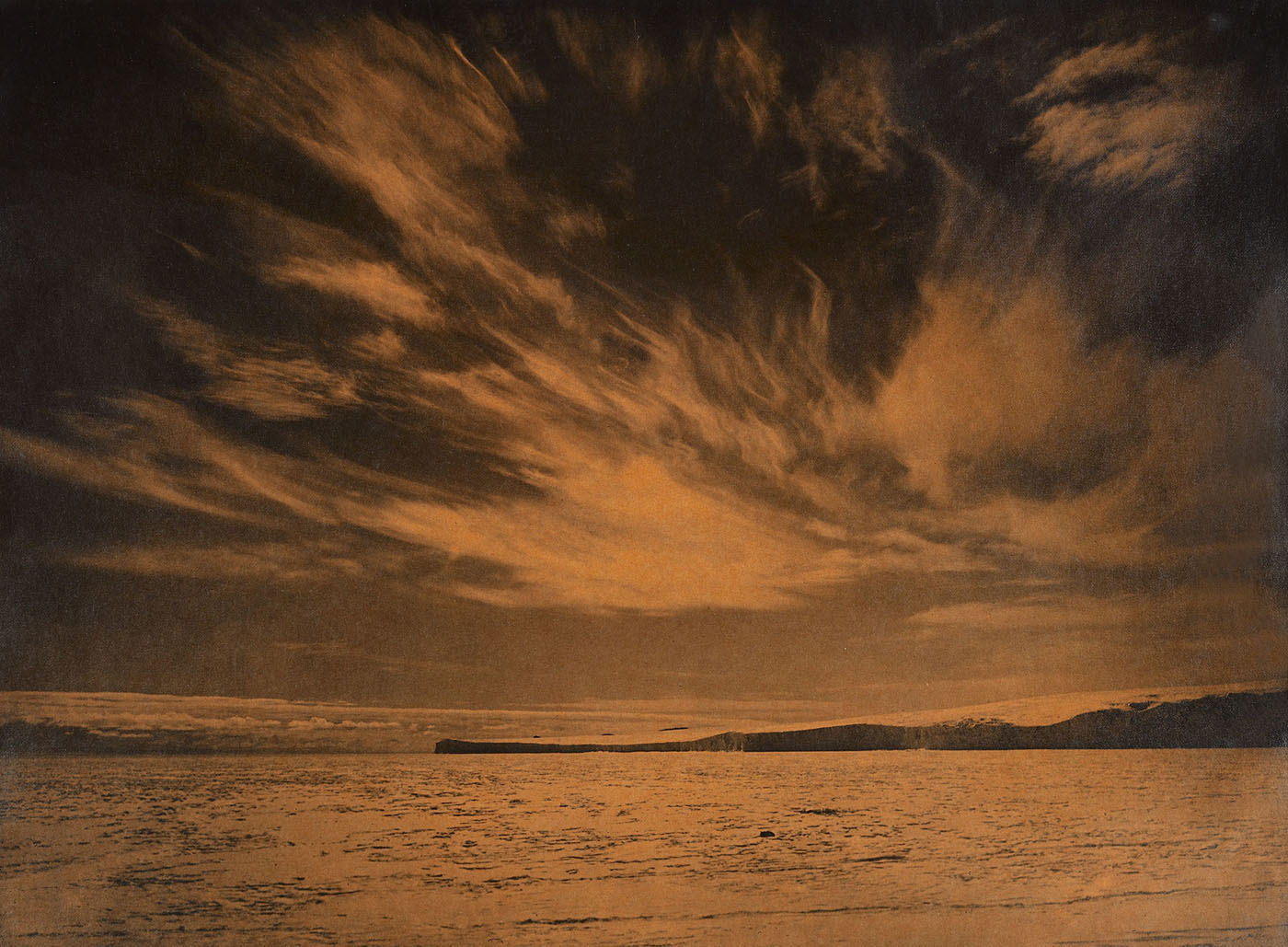
Herbert Ponting (British, 1870-1935) 'Cirrus clouds over the Barne Glacier' April 1911


Herbert Ponting (British, 1870-1935)
Cirrus clouds over the Barne Glacier
April 1911
Carbon print on dyed paper
43.4 x 58.8cm
Presented to King George V, 1914
© 2011 Her Majesty Queen Elizabeth II


Royal Collection: ‘A Lovely Symphony of Blue and Green’ – Cirrus Clouds over the Barne Glacier

In this, the third in her series of talks, Royal Collection curator Sophie Gordon examines how Ponting captured the dramatic reds and oranges and the beauty of the natural landscape that he experienced during his time in the Antarctic.


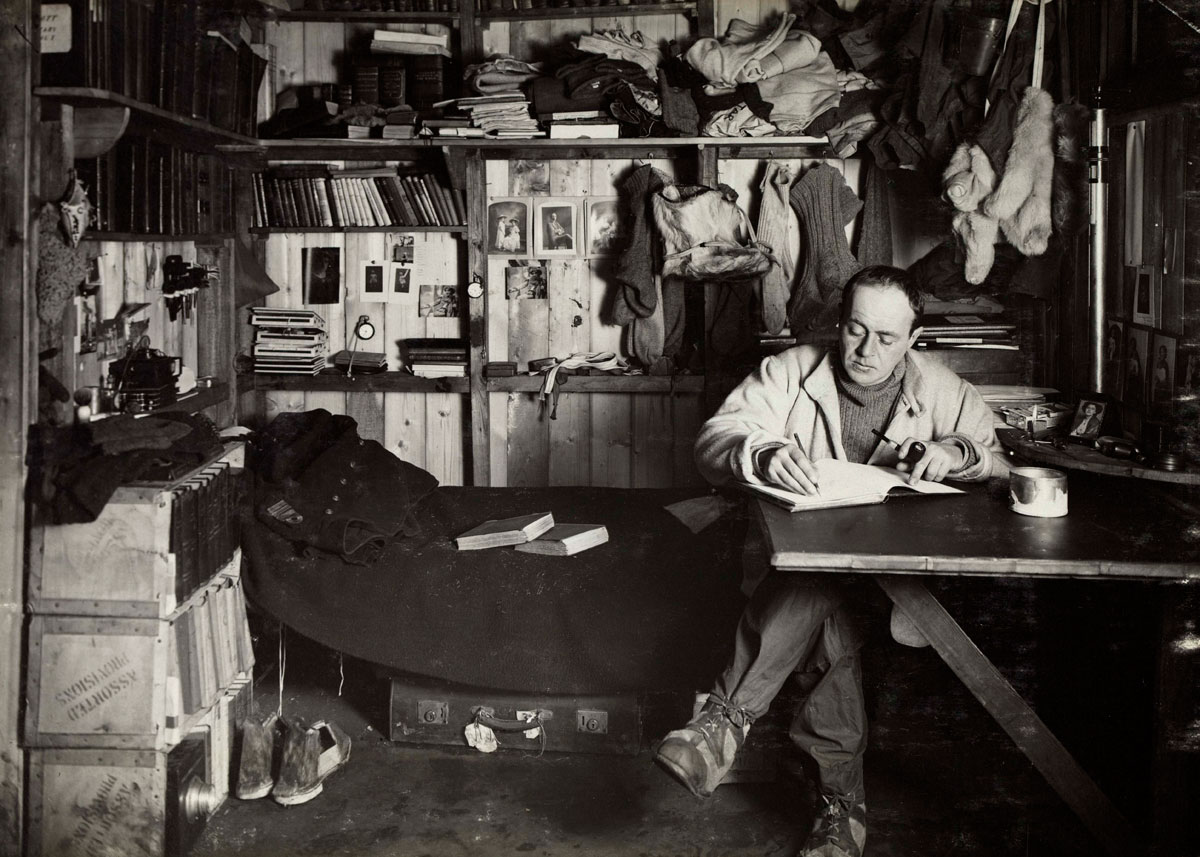
Herbert Ponting (British, 1870-1935) 'Scott writing in his area of the expedition hut, Scott's cubicle' 7 October 1911


Herbert Ponting (British, 1870-1935)
Scott writing in his area of the expedition hut, Scott’s cubicle
7 October 1911
Presented to King George V, 1914
© 2011 Her Majesty Queen Elizabeth II


Captain Robert F. Scott, sitting at a table in his quarters, writing in his diary, during the British Antarctic Expedition.


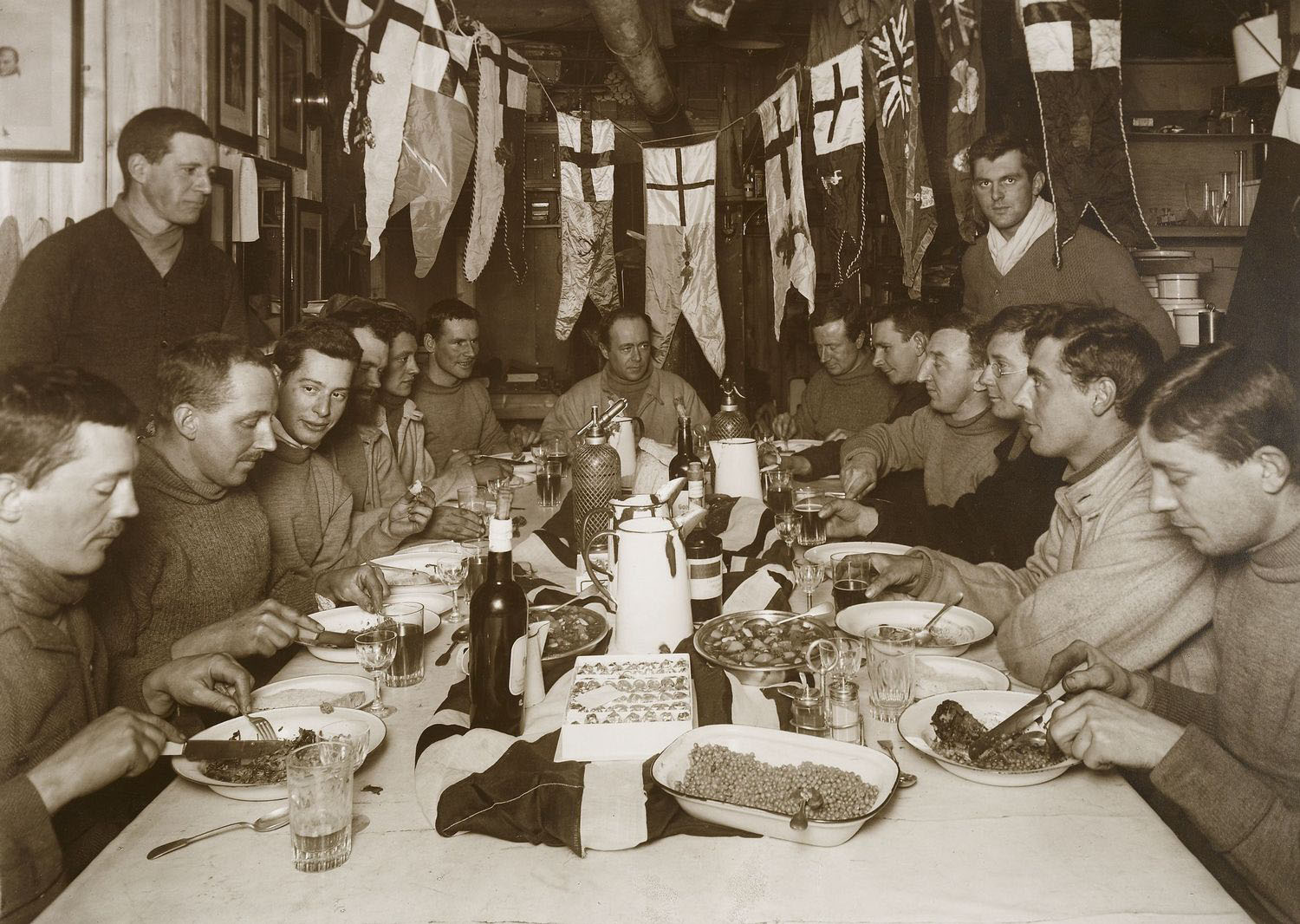
Herbert Ponting (British, 1870-1935) 'Scott's birthday dinner' June 1911


Herbert Ponting (British, 1870-1935)
Scott’s birthday dinner
June 1911
Toned silver bromide print
43.6 x 61cm
Presented to King George V, 1914
© 2011 Her Majesty Queen Elizabeth II


Photograph of the Officer’s table for Captain Scott’s birthday dinner with a variety of food and drink laid out on the table. The men are celebrating Scott’s 43rd birthday – his last – on 6 June 1911. He sits at the head of the table, and is surrounded by the officers and senior members of the team. The only man looking at the camera is the Norwegian naval officer Tryggve Gran (1889-1980). The atmosphere is both festive and patriotic.


Herbert Ponting (British, 1870-1935) 'Vida' 1911


Herbert Ponting (British, 1870-1935)
Vida
1911
Toned silver bromide print
38.0 x 27.5cm
Presented to King George V, 1914
© 2011 Her Majesty Queen Elizabeth II


Photograph of Vida. One of Scott’s favourite dogs, Vida suffered from a bad coat and would creep up to Scott for attention. Scott noted in his diary that initially the dog would growl at him but eventually his suspicion grew less: ‘He is a strange beast – I imagine so unused to kindness that it took him time to appreciate it’.


Herbert Ponting (British, 1870-1935) 'The winter journey to Cape Crozier' June 1911


Herbert Ponting (British, 1870-1935)
The winter journey to Cape Crozier
June 1911
Silver bromide print
43.7 x 61cm
Presented to King George V, 1914
© 2011 Her Majesty Queen Elizabeth II


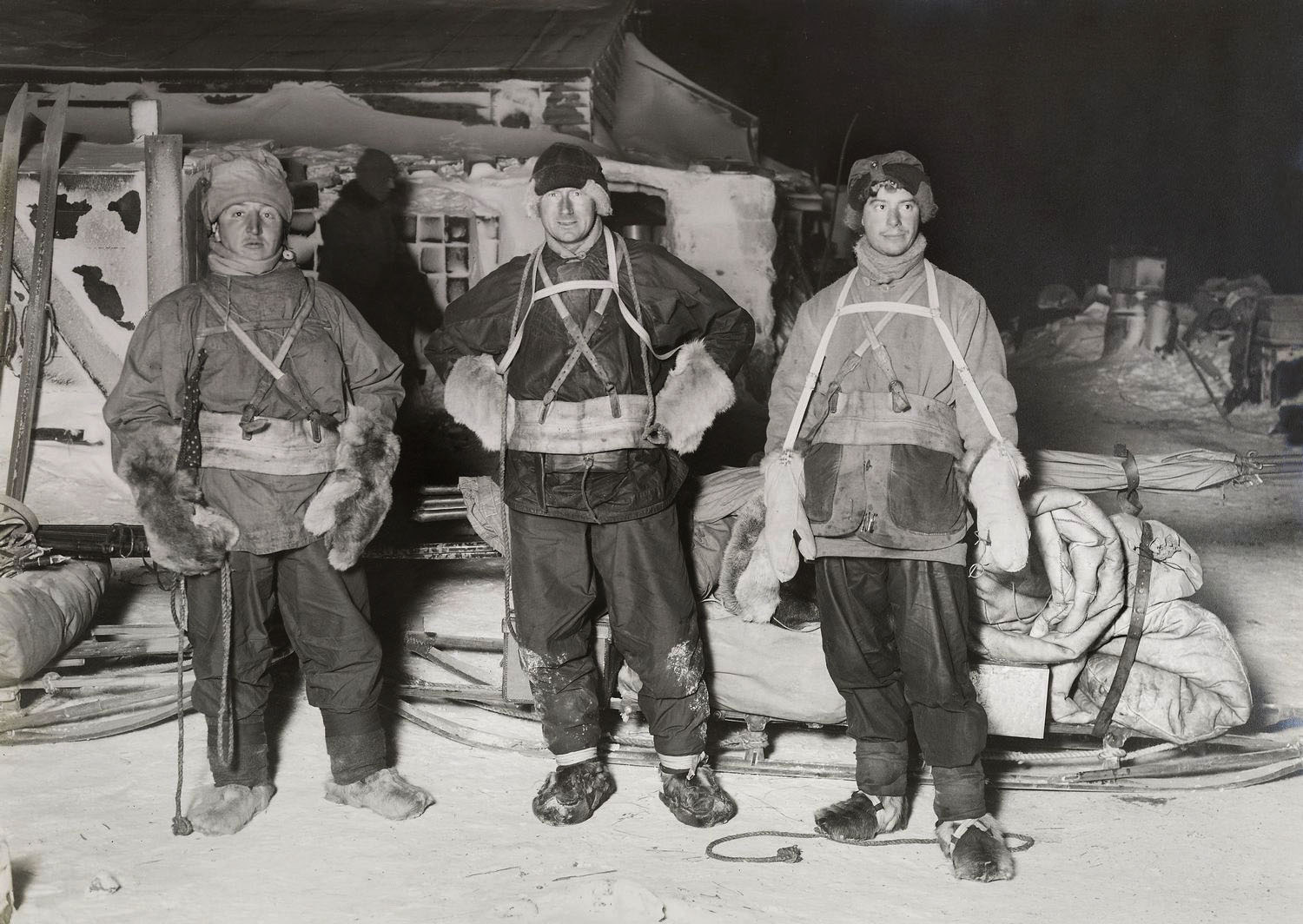
Henry Bowers (1883-1912), Edward Wilson (1872-1912) and Apsley Cherry-Garrard (1886-1959) are shown shortly before departing for Cape Crozier in search of Emperor penguin eggs. Between 27 June and 1 August, the trio endured extreme weather conditions and winter darkness as they crossed Ross Island and then returned, having collected three eggs. Cherry-Garrard famously described it as ‘the worst journey in the world’.


Royal Collection: ‘The weirdest bird’s-nesting expedition that has ever been’ – Part Two

In the second in this series of talks, Royal Collection curator Emma Stuart takes us on a journey with three intrepid explorers as they faced the hostile conditions of the Antarctic to recover an Emperor Penguin’s egg.


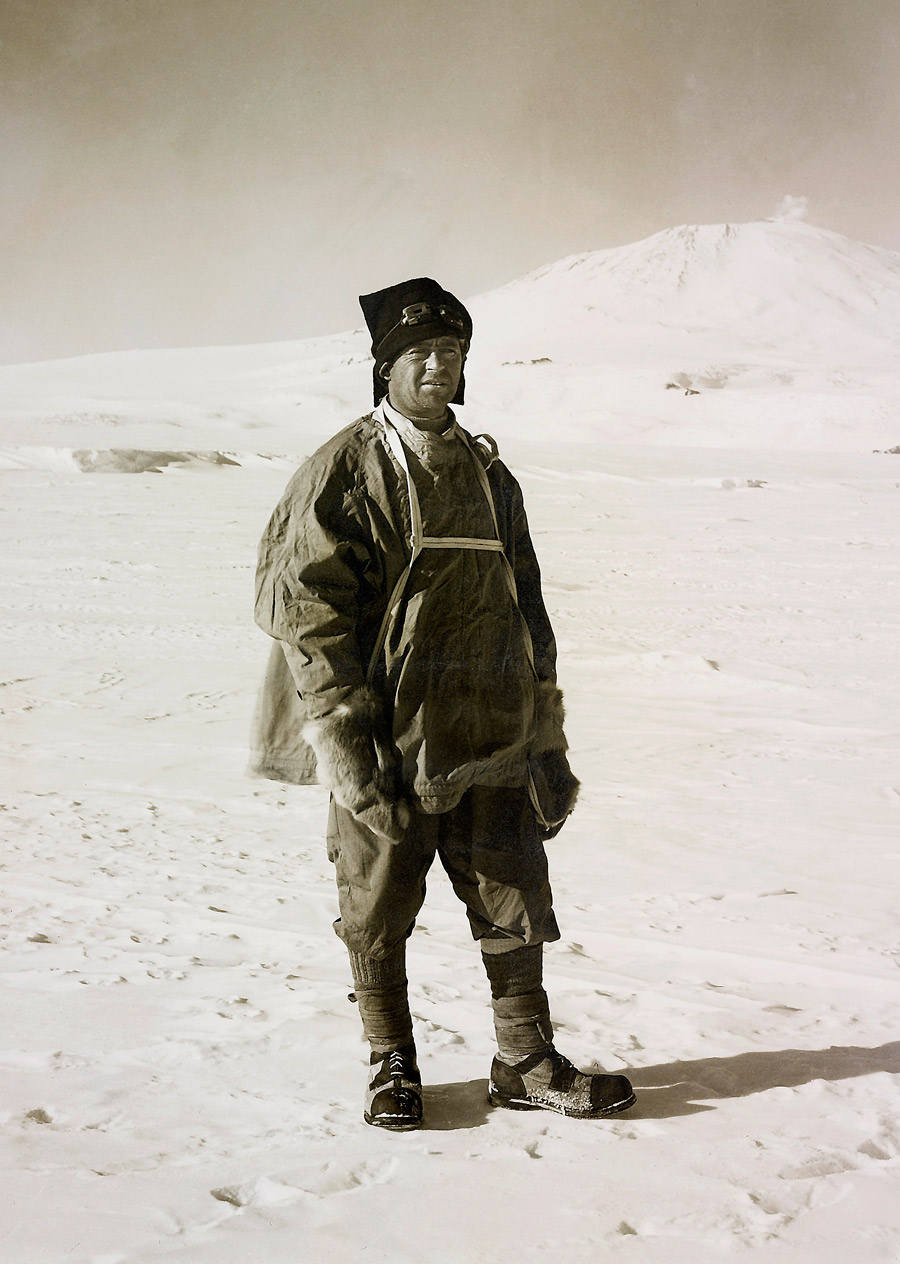
Herbert Ponting (British, 1870-1935) 'Captain Scott' February 1911


Herbert Ponting (British, 1870-1935)
Captain Scott
February 1911
Presented to King George V, 1914
© 2011 Her Majesty Queen Elizabeth II


This photograph of Scott, with Mount Erebus in the background, was taken at the start of the expedition. He is wearing fur gloves with an attached cord, leather boots, gaiters and thick socks.


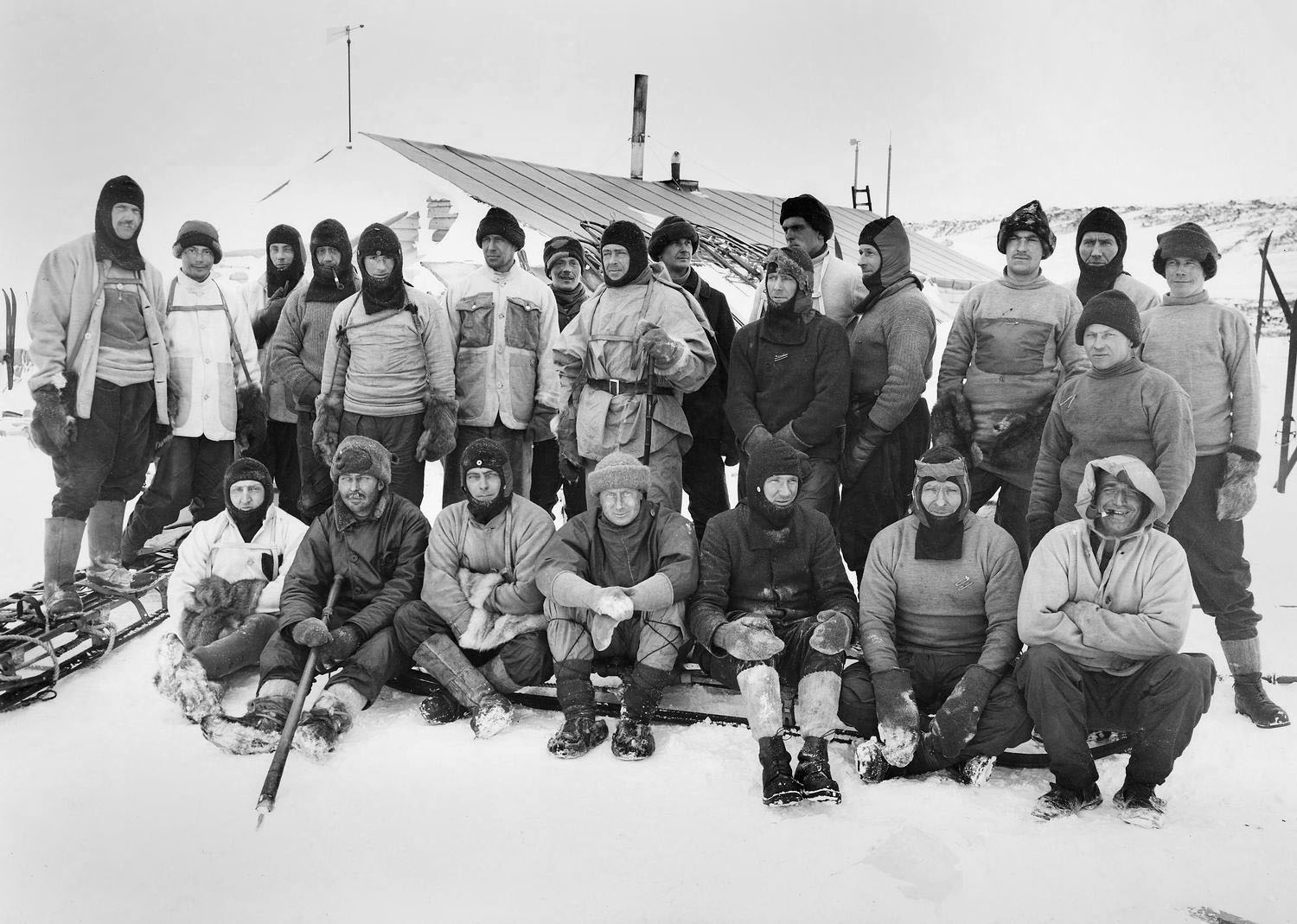
Herbert Ponting (British, 1870-1935) 'The Shore Party' Jan 1911


Herbert Ponting (British, 1870-1935)
The Shore Party
Jan 1911
Silver bromide print
43.6 x 61.9cm
Presented to King George V, 1914
© 2011 Her Majesty Queen Elizabeth II


Photograph of the Shore party. On the back row are (from left to right): T. Griffith Taylor; Apsley Cherry-Garrard; Bernard Day; Edward Nelson; Edward Evans; Lawrence Oates; Edward Atkinson; Robert Falcon Scott; Charles Wright; Patrick Keohane; Tryggve Gran; William Lashly; Frederick Hooper; Robert Forde; Anton Omelchenko; Dimitri Gerov. On the front row are (from left to right): Henry Bowers; Cecil Meares; Frank Debenham; Edward Wilson; George Simpson; Edgar Evans and Tom Crean. This group is the Shore Party – the men who remained in Antarctica throughout the winter of 1911, preparing for Scott’s final departure for the Pole. They pose in front of the expedition hut at Cape Evans. The only people not visible are Clissold, the cook, and Ponting, the photographer. Scott is at the centre of the group and all the men look relaxed. This was taken at the very beginning of the expedition, when they would have been optimistic and excited about the future.


Henry Bowers (British, 1883-1912) 'Forestalled. Amundsen's tent at the South Pole' 18 Jan 1912


Henry Bowers (British, 1883-1912)
Forestalled. Amundsen’s tent at the South Pole
18 Jan 1912
Silver bromide print
27.5 x 38cm
Presented to King George V, 1914
© 2011 Her Majesty Queen Elizabeth II


Photograph of Scott’s party at Amundsen’s tent at the South Pole. (from left to right are): Robert Falcon Scott (1868-1912); Lawrence Oates (1880-1912); Edward Wilson (1872-1912) and Edgar Evans (1876-1912). This photograph shows the dejection of the team as they explore the tent left by Roald Amundsen, who reached the South Pole on 14 December 1911, thirty-five days before Scott. There is a Norwegian flag at the top of the tent; inside, Scott found a letter recording their achievement, left by Amundsen in case he did not return safely.


Henry Bowers (British, 1883-1912) 'Scott and the Polar Party at the South Pole' 17 January 1912


Henry Bowers (British, 1883-1912)
Scott and the Polar Party at the South Pole
17 January 1912
Presented to King George V, 1914
© 2011 Her Majesty Queen Elizabeth II


Imperial Transantarctic Expedition 1914-1916

Shackleton set out in October 1914 on the Endurance with the intention of making the first crossing of the Antarctic continent via the South Pole. While he and his men planned to reach Antarctica through the Weddell Sea, another party aboard the Aurora sailed to the other side of the continent to lay food depots for the expected party.

The intention was that only six men would complete the crossing; the photographer Frank Hurley was to be one of the team. Hurley had been to the Antarctic before, as part of the Australasian Expedition of 1911-1914. He was intrepid in his search for dramatic images. The role of photographer was important not just to document the achievements of the expedition, but also to create a source of income. The rights to publish the images would be sold for a great deal of money after the return to Britain.

The expedition ran into difficulties almost immediately. By mid-January 1915, Endurance became trapped in ice and had to become a floating scientific station. The men waited out the harsh Antarctic winter in the hope that their situation would improve.

Text from the Royal Collection Trust website


Frank Hurley (Australian, 1885-1962) 'Entering the pack ice. Weddell Sea, lat. 57° 59' S. long. 22° 39' W' 9 Dec 1914


Frank Hurley (Australian, 1885-1962)
Entering the pack ice. Weddell Sea, lat. 57° 59′ S. long. 22° 39′ W
9 Dec 1914
Silver bromide print
15.3 x 20.5cm
Presented to King George V, 1914
© 2011 Her Majesty Queen Elizabeth II


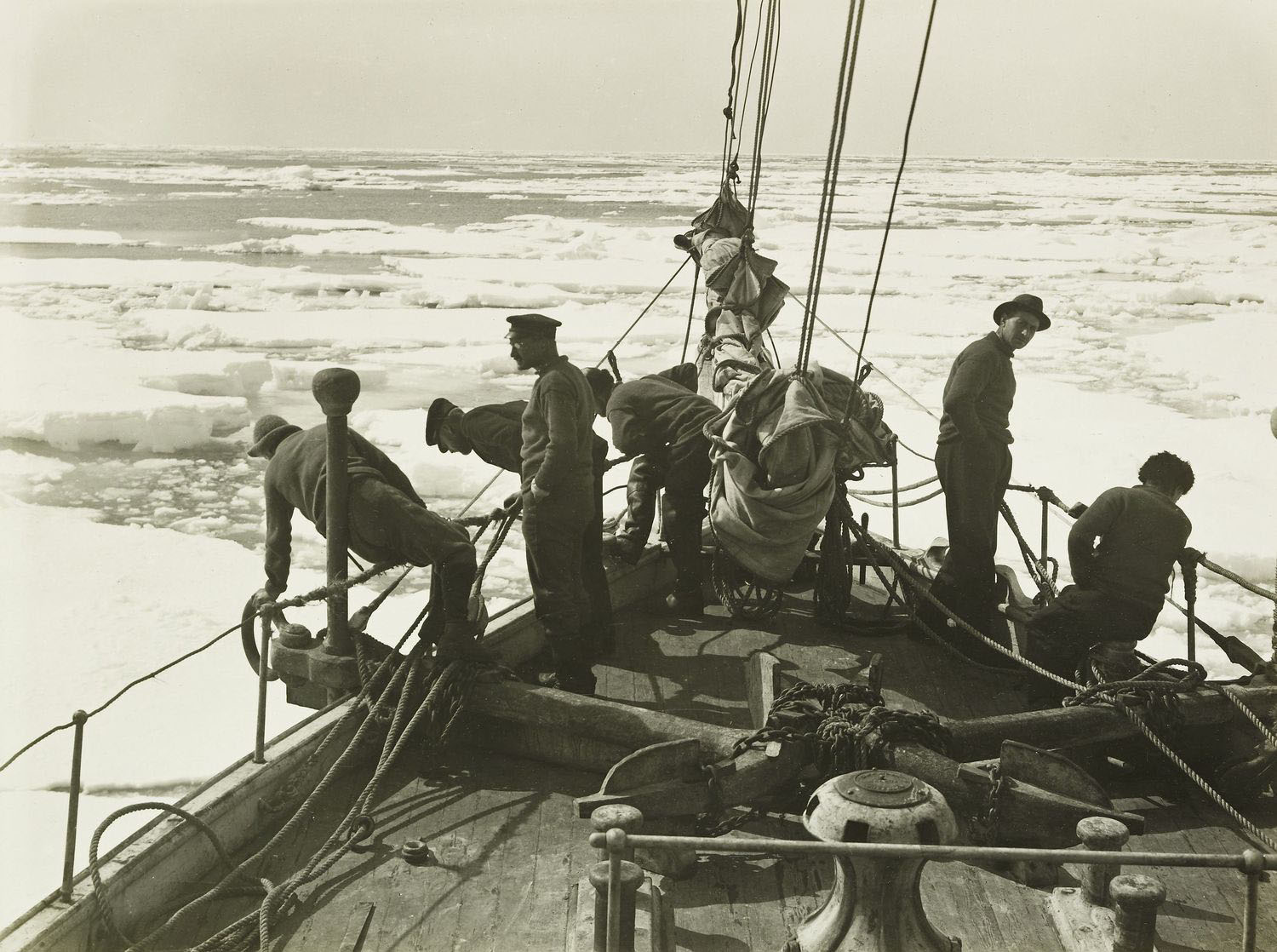
Photograph of six members of Shackleton’s crew standing on the deck of Endurance. This was the men’s first view of the pack ice through which they had to navigate in order to reach the coast of Antarctica. The Endurance met the ice far further north than they had hoped. The whalers on South Georgia had warned them of the poor ice conditions before they set out. This was a warning of things to come.


Frank Hurley (Australian, 1885-1962) 'Self-portrait with cinematograph next to the Endurance' 1915


Frank Hurley (Australian, 1885-1962)
Under the bow of the Endurance
Self-portrait with cinematograph next to the Endurance

1915
Presented to King George V, 1914
© 2011 Her Majesty Queen Elizabeth II


Hurley poses with his cinematograph, which was used to shoot moving film footage. The footage was later turned into a film released after his return under the name of In the Grip of the Polar Pack Ice.


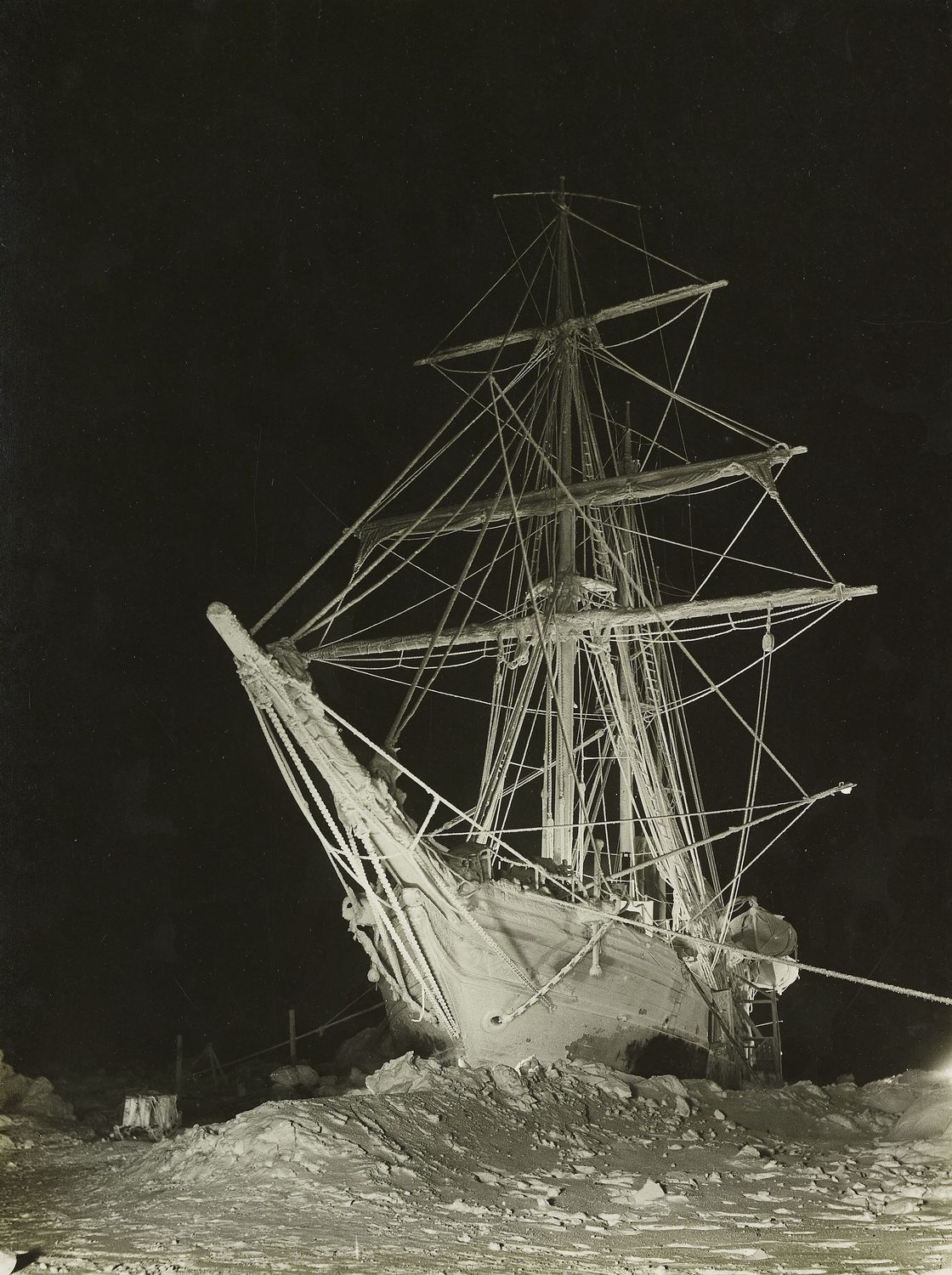
Frank Hurley (Australian, 1885-1962) 'The Endurance in the garb of winter' June 1915


Frank Hurley (Australian, 1885-1962)
The Endurance in the garb of winter
June 1915
Silver bromide print
20.2 x 15.2cm
Presented to King George V, 1914
© 2011 Her Majesty Queen Elizabeth II


Endurance sits benignly at rest in the midst of the ice field. A recent blizzard has coated the hummocks in a layer of snow, softening the contours. All looks peaceful, but within a few months these same hummocks will have crushed the ship.

Photograph of the bow and part of the left side of Endurance, lit by flashlight in the darkness of the night. This is probably Hurley’s best-known photograph, which he took with flashlights at -38 °F/-39 °C. It was later used on the front cover of Shackleton’s account of the expedition, South. Hurley described the scene in his autobiography: Never did the ship look quite so beautiful as when the bright moonlight etched her in inky silhouette, or transformed her into a vessel from fairy-land.


Frank Hurley (Australian, 1885-1962) 'The night watchman spins a yarn' 1915


Frank Hurley (Australian, 1885-1962)
The night watchman spins a yarn
1915
Gelatin silver print
Presented to King George V, 1914
© 2011 Her Majesty Queen Elizabeth II


After Endurance became a winter station in February 1915, Shackleton abandoned the usual system of watches. The single nightwatchman had little to do, apart from tending the dogs and observing ice movements. It was private leisure time, to read, or do some washing, but often became a social occasion as shown here, as the men gather companionably round the fire.


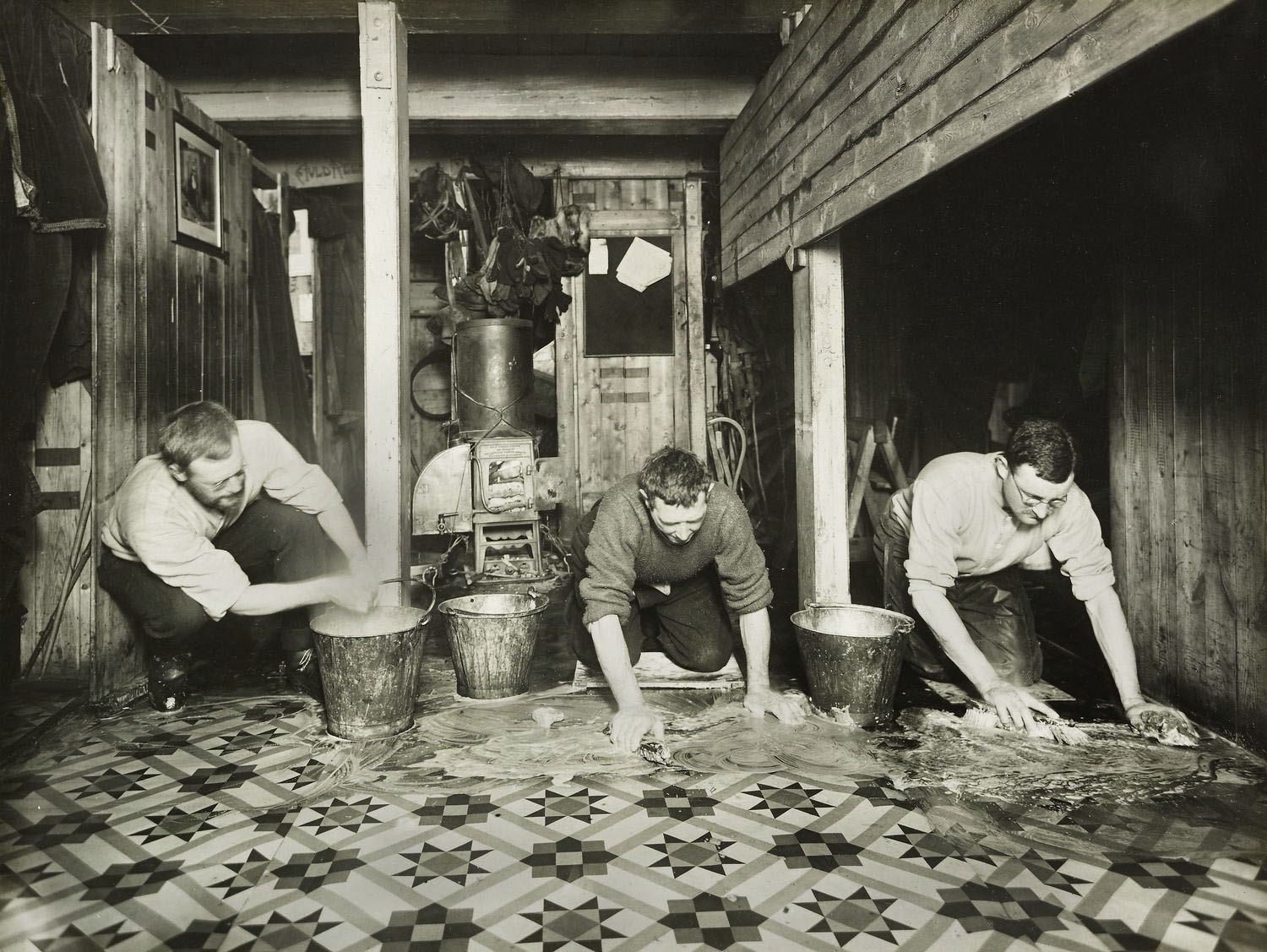
Frank Hurley (Australian, 1885-1962) 'The bi-weekly ablutions of the 'Ritz'' 1915


Frank Hurley (Australian, 1885-1962)
The bi-weekly ablutions of the ‘Ritz’
The Scientists washing down the “Ritz” (living quarters in the hold)

James Wordie, Alfred Cheetham and Alexander Macklin, washing down the ‘Ritz’ living quarters in the hold of the Endurance
1915
Gelatin silver print
© 2011 Her Majesty Queen Elizabeth II


Following the onset of winter and the transformation of Endurance into a scientific station, the main cargo hold was emptied and turned into a communal living space for the men, nicknamed the ‘Ritz’. The traditional Antarctic Christmas on Midwinter’s Day (22 June) saw the ‘Ritz’ transformed for a cabaret, featuring satirical speeches, songs, poems and even a drag act. From left to right are Wordie (1889-1962), Cheetham (1867-1918) and Macklin (1889-1967).


Frank Hurley (Australian, 1885-1962) 'Sir Ernest Shackleton arrives at Elephant Island to take off marooned men' 30 August 1916


Herbert Ponting (British, 1870-1935)
Sir Ernest Shackleton arrives at Elephant Island to take off marooned men
30 August 1916
Presented to King George V, 1914
© 2011 Her Majesty Queen Elizabeth II


This photograph was actually taken at the time of the ‘James Caird’s’ departure on 24 April. Hurley has altered it to represent the moment of rescue, with the arrival of Shackleton on the ‘Yelcho’. The actual rescue was not photographed.


The Royal Collection
The Queen’s Gallery, Buckingham Palace
London SW1A 1AA

Opening hours:
Thursday – Monday 10.00 – 17.30

The Queen’s Gallery website

LIKE ART BLART ON FACEBOOK

Back to top

Exhibition: ‘Eugène Atget: “Documents pour artistes”‘ at the Museum of Modern Art (MoMA), New York

Exhibition dates: 6th February – 9th April 2012


Eugène Atget (French, 1857-1927) 'Coin, Boulevard de la Chapelle et rue Fleury 76,18e' June 1921


Eugène Atget (French, 1857-1927)
Coin, Boulevard de la Chapelle et rue Fleury 76,18e
June 1921
Matte albumen silver print
6 13/16 x 9 inches (17.3 x 22.9cm)
The Museum of Modern Art, New York
Abbott-Levy Collection. Partial gift of Shirley C. Burden


“These are simply documents I make.”


Eugène Atget


“One might think of Atget’s work at Sceaux as… a summation and as the consummate achievement of his work as a photographer – a coherent, uncompromising statement of what he had learned of his craft, and of how he had amplified and elaborated the sensibility with which he had begun. Or perhaps one might see the work at Sceaux as a portrait of Atget himself, not excluding petty flaws, but showing most clearly the boldness and certainty – what his old friend Calmettes called the intransigence – of his taste, his method, his vision.


John Szarkowski


The first of two postings about the work of Eugène Atget, this exhibition at MoMA the first in twenty-five years to focus on his “Documents for artists.” Atget was my first hero in photography and the greatest influence on my early black and white photography before I departed and found my own voice as an artist. Through his photographs, his vision he remains a life-long friend. He taught me so much about where to place the camera and how to see the world. He made me aware. For that I am eternally grateful.

Dr Marcus Bunyan


Many thankx to MOMA for allowing me to publish the photographs in the posting. Please click on the photographs for a larger version of the image.


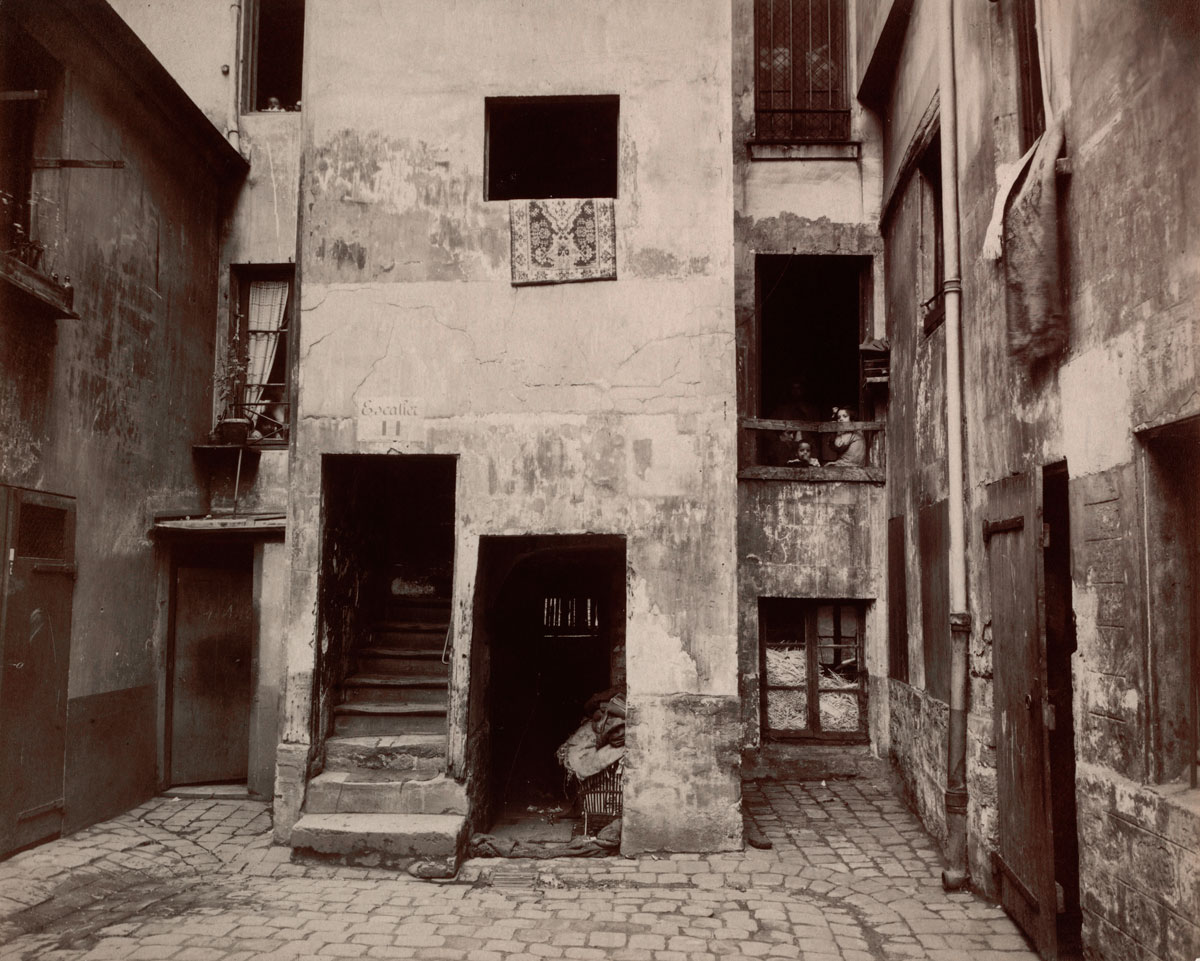
Eugène Atget (French, 1857-1927) 'Cour, 7 rue de Valence' June 1922


Eugène Atget (French, 1857-1927)
Cour, 7 rue de Valence
June 1922
Matte albumen silver print
7 x 8 15/16 inches (17.8 x 22.7cm)
The Museum of Modern Art, New York
Abbott-Levy Collection. Partial gift of Shirley C. Burden


Eugène Atget (French, 1857-1927) 'Cour, 41 rue Broca' 1912


Eugène Atget (French, 1857-1927)
Cour, 41 rue Broca
1912
Albumen silver print
6 5/8 x 8 1/4 inches (16.9 x 21cm)
The Museum of Modern Art, New York
Abbott-Levy Collection. Partial gift of Shirley C. Burden


The sign above the entrance to Eugène Atget’s studio in Paris read Documents pour artistes (Documents for artists), declaring his modest ambition to create photographs for others to use as source material in their work. Atget (French, 1857-1927) made more than 8,500 pictures of Paris and its environs in a career that spanned over thirty years, from the late nineteenth century until his death. To facilitate access to this vast body of work for himself and his clients, he organised his photographs into discrete series, a model that guides the organisation of this exhibition. The works are presented here in six groups, demonstrating Atget’s sustained attention to certain motifs or locations and his consistently inventive and elegant methods of rendering the complexity of the three-dimensional world on a flat, rectangular plate.

In 1925 the American artist Man Ray purchased forty-two photographs from Atget, who lived down the street from him in Montparnasse. Man Ray believed he detected a kindred Surrealist sensibility in the work, to which suggestion Atget replied, “These are simply documents I make.” This humility belies the extraordinary pictorial sophistication and beauty that is characteristic of much of Atget’s oeuvre and his role as touchstone and inspiration for subsequent generations of photographers, from Walker Evans to Lee Friedlander. This exhibition bears witness to his success, no matter the unassuming description he gave of his life’s work.

A Note on the Prints

Atget made photographs with a view camera resting on a tripod. An example of his 24-by-18-centimeter glass plate negatives is on display here. Each print was made by exposing light-sensitive paper to the sun in direct contact with one of these negatives, which Atget numbered sequentially within each series. He frequently scratched the number into the emulsion on the negative, and thus it appears in reverse at the bottom of most prints. He also inscribed the number, along with the work’s title, in pencil on the verso of each print. These titles appear (with English translations where necessary) on the individual wall labels, preserving Atget’s occasionally idiosyncratic titling practices. The Abbott-Levy Collection at The Museum of Modern Art, to which the prints in this exhibition belong (except where noted), is composed of close to 5,000 distinct photographs and 1,200 glass plate negatives that were in Atget’s studio at the time of his death. The Museum purchased this collection in 1968 from photographer Berenice Abbott and art dealer Julien Levy, thanks to the unflagging efforts of John Szarkowski, then director of the Department of Photography, and in part to the generosity of Shirley C. Burden.

Fifth arrondissement

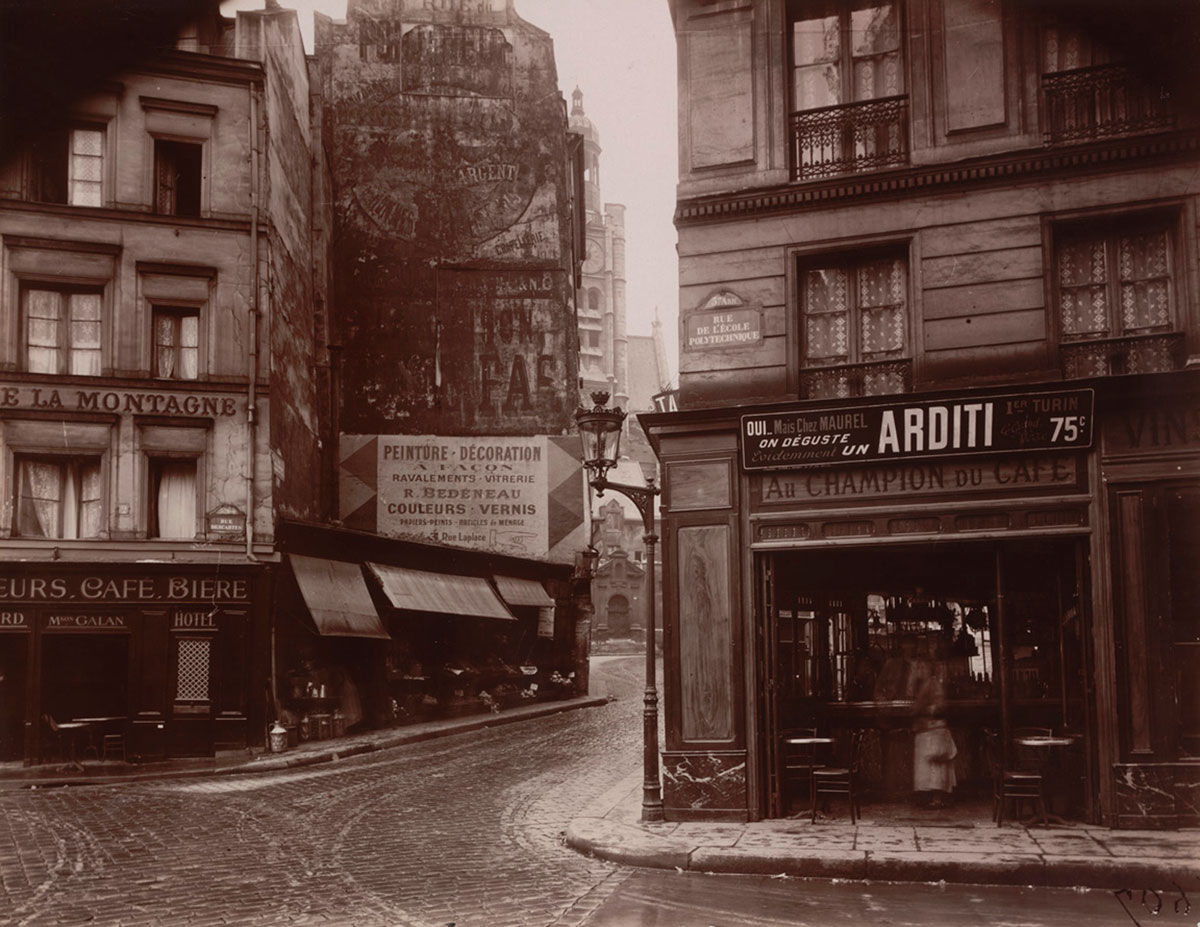
For more than thirty years, Atget photographed in and around Paris. Curiously, given the depth of this investigation, he never photographed the Eiffel Tower, generally avoided the grand boulevards, and eschewed picture postcard views. Instead Atget focused on the fabric of the city: facades of individual buildings (both notable and anonymous), meandering streetscapes, details of stonework and ironwork, churches, shops, and the occasional monument. Even a selective cross section of the photographs he made in the fifth arrondissement over the course of his career suggests that his approach, while far from systematic, might yet be termed comprehensive.

Courtyards

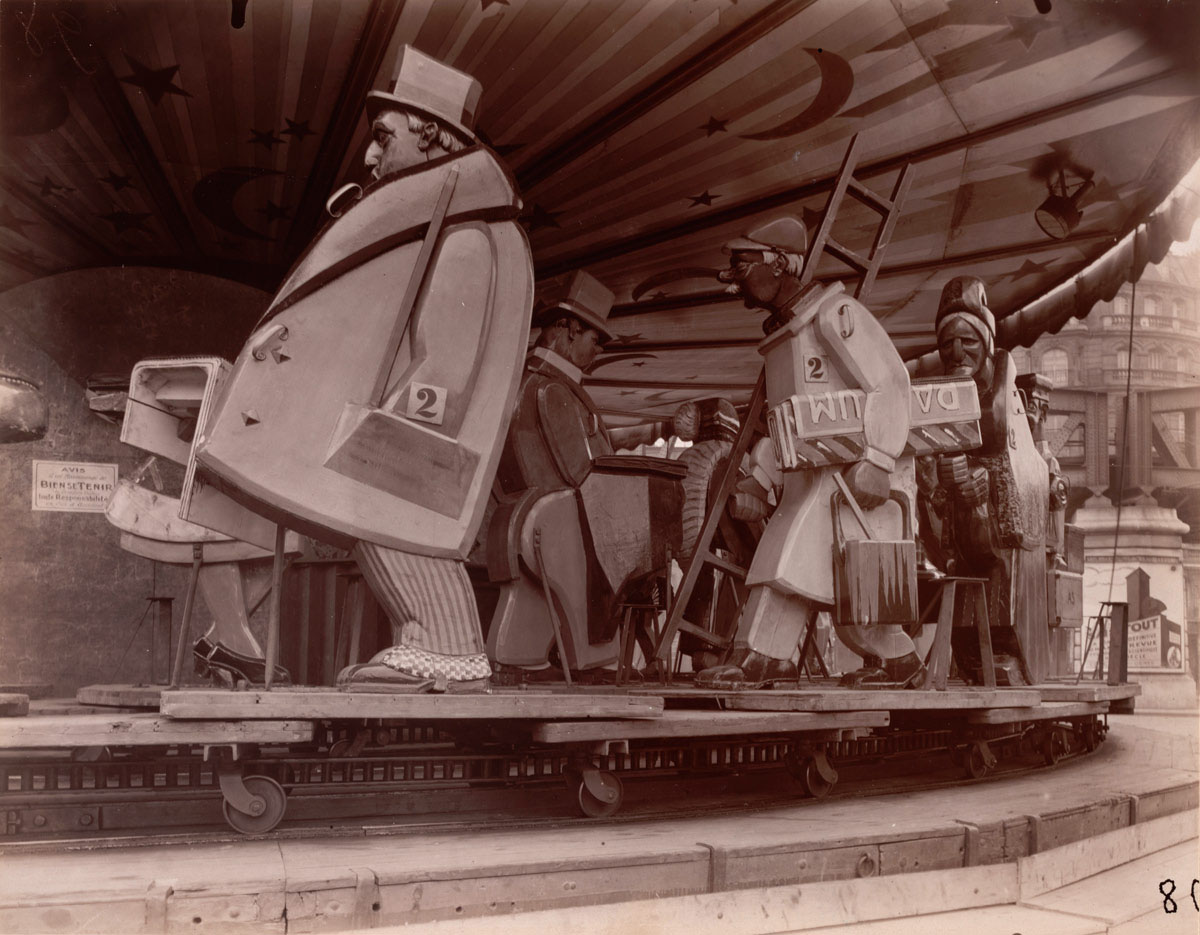
Atget clearly relished the metaphorical and physical aspects of the courtyard – a space that hovers between public and private, interior and exterior – and he photographed scores of them, both rural and urban. The motif was chosen as the backdrop for what was likely Atget’s first photograph of an automobile (Cour, 7 rue de Valence), and it was versatile enough to transform itself depending on where Atget placed his camera (see the two views of the courtyard at 27 quai d’Anjou). The dark areas that appear in the upper corners of some prints are the result of vignetting: a technique in which the light coming through the camera’s lens does not fully cover the glass plate negative, allowing Atget to create an arched pictorial space that echoed the physical one before his camera.

Wall text from the exhibition


Eugène Atget (French, 1857-1927) 'Rue de la Montagne-Sainte-Geneviève' June 1925


Eugène Atget (French, 1857-1927)
Rue de la Montagne-Sainte-Geneviève
June 1925
Gelatin silver printing-out-paper print
6 11/16 x 8 3/4 inches (17 x 22.2cm)
The Museum of Modern Art, New York
Abbott-Levy Collection. Partial gift of Shirley C. Burden


Eugène Atget (French, 1857-1927) 'Maison où Mourut Voltaire en 1778, 1 rue de Beaune' 1909


Eugène Atget (French, 1857-1927)
Maison où Mourut Voltaire en 1778, 1 rue de Beaune
1909
Albumen silver print
8 9/16 x 7 inches (21.8 x 17.8cm)
The Museum of Modern Art, New York
Abbott-Levy Collection. Partial gift of Shirley C. Burden


Eugène Atget (French, 1857-1927) 'Balcon, 17 rue du Petit-Pont' 1913


Eugène Atget (French, 1857-1927)
Balcon, 17 rue du Petit-Pont
1913
Albumen silver print
8 5/8 x 6 15/16 inches (21.9 x 17.7cm)
The Museum of Modern Art, New York
Abbott-Levy Collection. Partial gift of Shirley C. Burden


Eugène Atget: “Documents pour artistes presents six fresh and highly focused cross sections of the career of master photographer Eugène Atget (French, 1857-1927), drawn exclusively from The Museum of Modern Art’s unparalleled holdings of his work. The exhibition, on view at MoMA from February 6 through April 9, 2012, gets its name from the sign outside Atget’s studio door, which declared his modest ambition to create documents for other artists to use as source material in their own work. Whether exploring Paris’s fifth arrondissement across several decades, or the decayed grandeur of parks at Sceaux in a remarkable creative outburst at the twilight of his career, Atget’s lens captured the essence of his chosen subject with increasing complexity and sensitivity. Also featured are Atget’s photographs made in the Luxembourg gardens; his urban and rural courtyards; his pictures of select Parisian types; and his photographs of mannequins, store windows, and street fairs, which deeply appealed to Surrealist artists living in Paris after the First World War. The exhibition is organised by Sarah Hermanson Meister, Curator, Department of Photography, The Museum of Modern Art.

Atget made more than 8,500 pictures of Paris and its environs in a career that spanned over 30 years, from the late-19th century until his death. To facilitate access to this vast body of work for himself and his clients, he organised his photographs into discrete series, a model that guides the organisation of this exhibition. More than 100 photographs are presented in six groups, demonstrating Atget’s sustained attention to certain motifs or locations and his consistently inventive and elegant methods of rendering the complexity of the three-dimensional world on a flat, rectangular plate.

With seemingly inexhaustible curiosity, Atget photographed the streets of Paris. Eschewing picture-postcard views, and, remarkably, never once photographing the Eiffel Tower, he instead focused on the fabric of the city, taking pictures along the Seine, in every arrondissement, and in the “zone” outside the fortified wall that encompassed Paris at the time. His photographs of the fifth arrondissement are typical of this approach, and include facades of individual buildings (both notable and anonymous), meandering streetscapes, details of stonework and ironwork, churches, and the occasional monument.

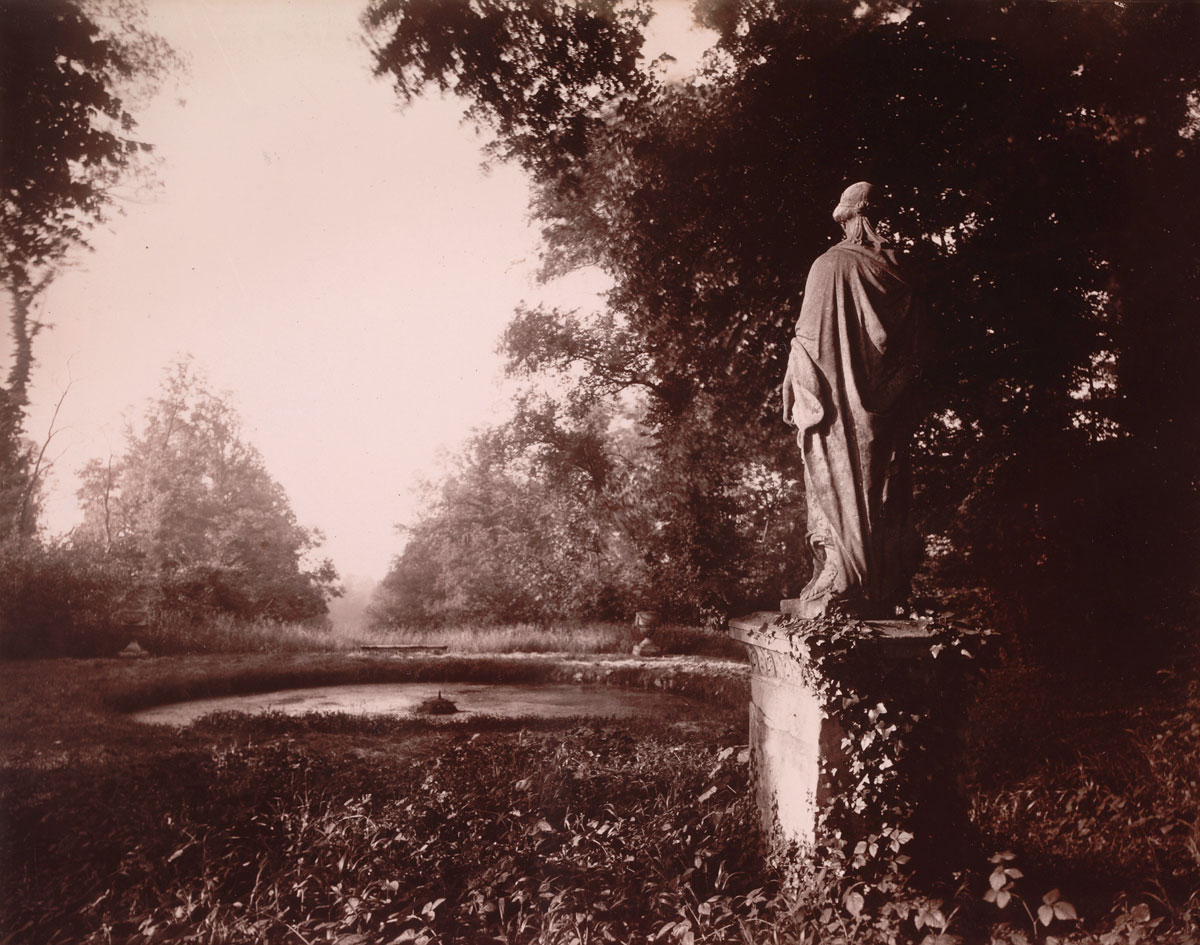
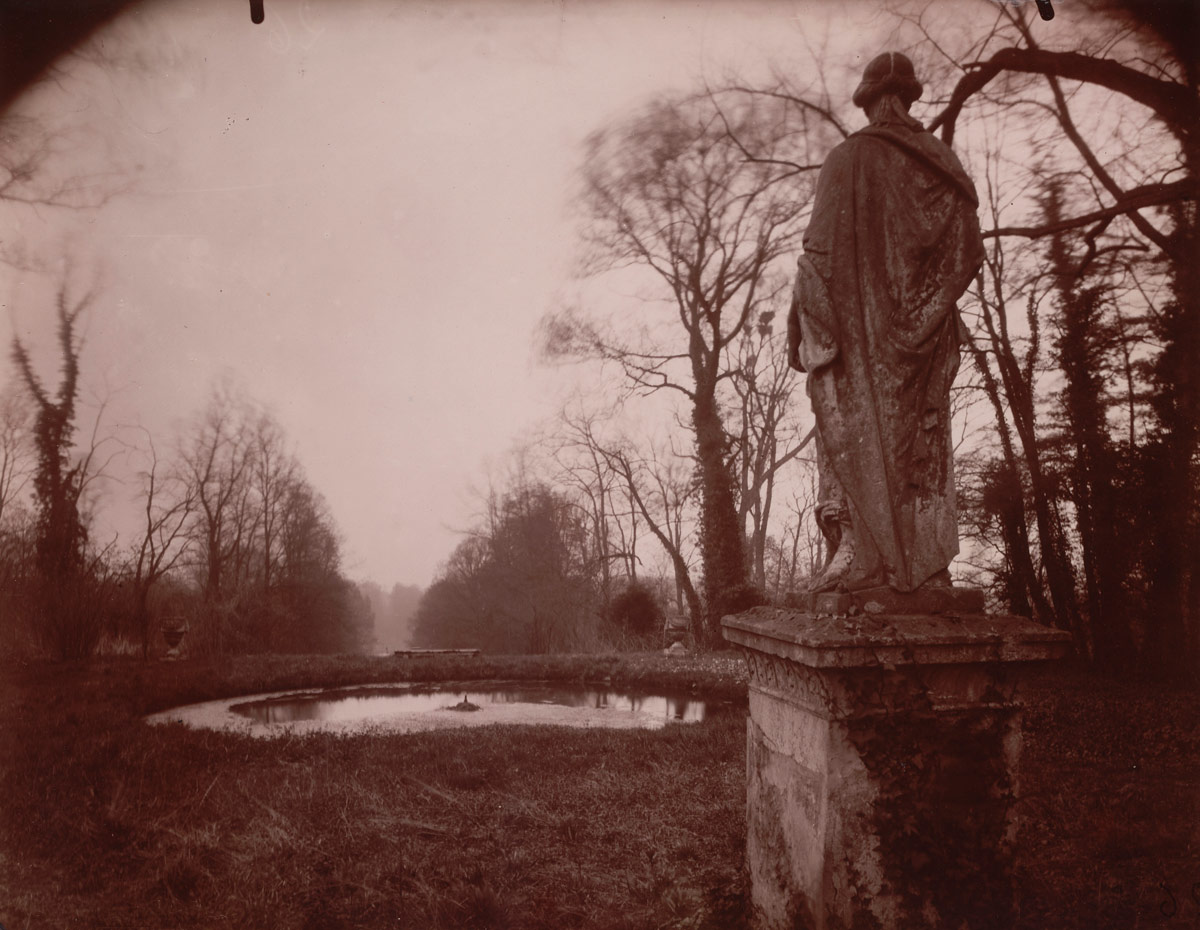
Between March and June 1925, Atget made 66 photographs in the abandoned Parc de Sceaux, on the outskirts of Paris, almost half of which are on view in this exhibition. His approach was confident and personal, even quixotic, and his notations of the time of day for certain exposures read almost like diary entries. These photographs have long been recognised as among Atget’s finest, and this is the first opportunity for audiences outside of France to appreciate the full diversity and richness of this accomplishment.

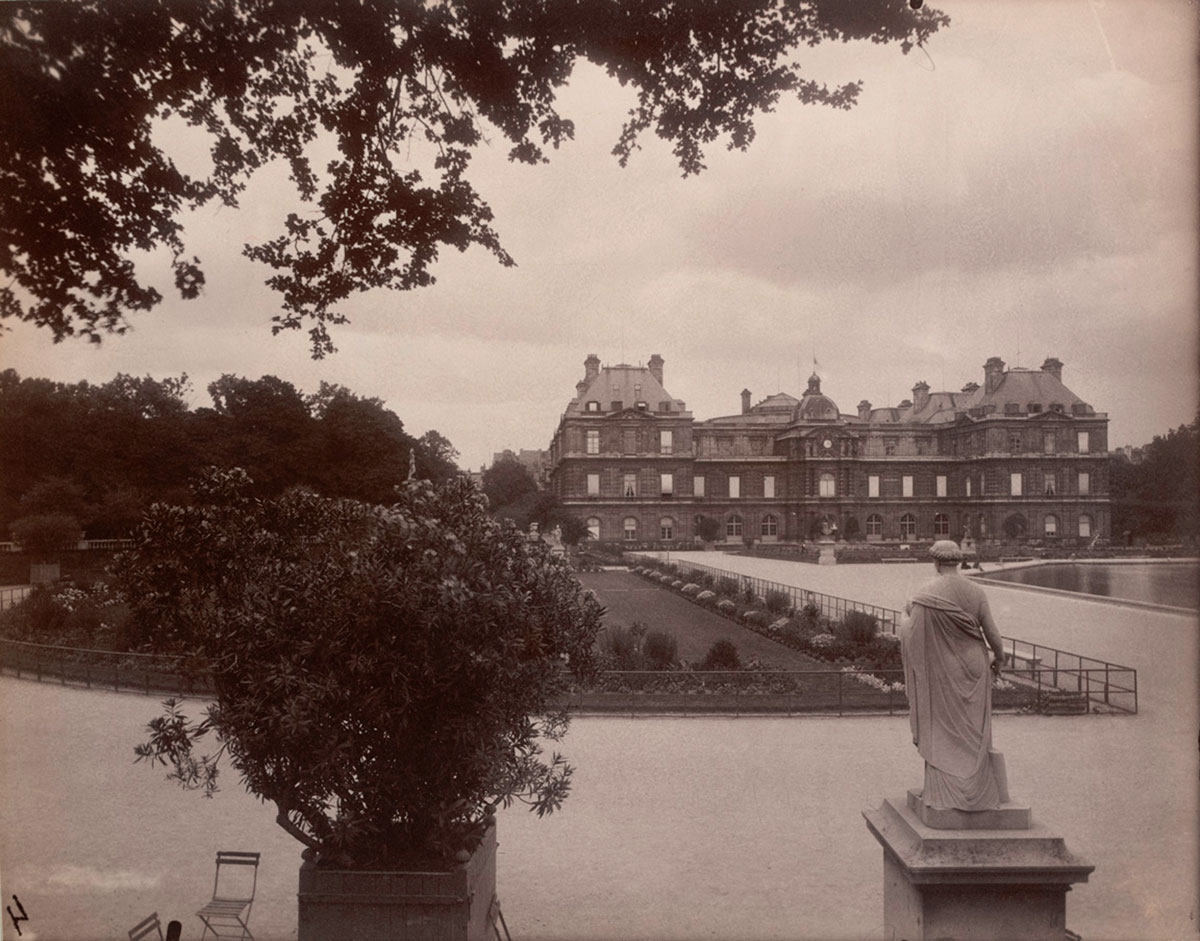
Atget photographed the Jardin de Luxembourg more than any other Parisian park, likely reflecting his preference for its character and its proximity to his home and studio on rue Campagne-Première in Montparnasse. His early photographs there tend to capture human activity – children with their governesses or men conversing in the shade – but this gave way to a more focused exploration of the garden’s botanical and sculptural components following the First World War, and culminated in studies that delicately balance masses of light and shadow, as is typical of Atget’s late work.

Atget firmly resisted public association with the Surrealists, yet his work – in particular his photographs of shop windows, mannequins, and the street fairs around Paris – captured the eye of artists with decidedly avant-garde inclinations, such as Man Ray and Tristan Tzara. Man Ray lived down the street from Atget, and the young American photographer Berenice Abbott, while working as Man Ray’s studio assistant, made Atget’s acquaintance in the mid-1920s – a relationship that ultimately brought the contents of Atget’s studio at the time of his death to MoMA, almost 40 years later.

Atget clearly relished the metaphorical and physical aspects of the courtyard – a space that hovers between public and private, interior and exterior – and he photographed scores of them, both rural and urban. This exhibition marks the first time these pictures have been grouped together, allowing the public to appreciate previously unexplored aspects of the Abbott-Levy Collection, which includes prints of nearly 5,000 different images.

Only a tiny fraction of the negatives Atget exposed during his lifetime are photographs of people, yet they have attracted attention disproportionate to their number. With few exceptions, this segment of his creative output can be divided into three types: street merchants (petits métiers); ragpickers (chiffonniers) or Romanies (romanichels, or Gypsies), who lived in impermanent structures just outside the fortified wall surrounding Paris; and prostitutes. As with each section of this exhibition, Atget’s career is represented by the finest prints drawn from critically distinct and essential aspects of his practice, allowing a fresh appreciation of photography’s first modern master.

Press release from the MoMA website


Eugène Atget (French, 1857-1927) 'Luxembourg' 1923-25


Eugène Atget (French, 1857-1927)
Luxembourg
1923-1925
Matte albumen silver print
6 7/8 x 9 inches (17.5 x 22.8cm)
The Museum of Modern Art, New York
Abbott-Levy Collection. Partial gift of Shirley C. Burden


Eugène Atget (French, 1857-1927) 'Luxembourg' 1923-25


Eugène Atget (French, 1857-1927)
Luxembourg
1923-1925
Matte albumen silver print
7 x 8 13/16 inches (17.8 x 22.4cm)
The Museum of Modern Art, New York
Abbott-Levy Collection. Partial gift of Shirley C. Burden


Eugène Atget (French, 1857-1927) 'Luxembourg' 1902-1903


Eugène Atget (French, 1857-1927)
Luxembourg
1902-1903
Albumen silver print
6 5/8 x 8 3/8 inches (16.8 x 21.3cm)
The Museum of Modern Art, New York
Abbott-Levy Collection. Partial gift of Shirley C. Burden


Jardin de Luxembourg

Atget photographed the Jardin de Luxembourg more than any other Parisian park, likely reflecting his preference for its character as well as its proximity to his home and studio on rue Campagne-Première in Montparnasse (about a ten-minute walk away). His photographs of the gardens made around 1900 tend to capture human activity (children with their governesses, men conversing in the shade), but this gave way to a more focused exploration of the garden’s botanical and sculptural components following the First World War and culminated in studies that delicately balance masses of light and shadow, typical of Atget’s late work.

Parc de Sceaux

Between March and June 1925, Atget made sixty-six photographs in the abandoned Parc de Sceaux, on the outskirts of Paris. His approach was confident and personal, even quixotic, and his notations of the time of day for certain exposures read almost like diary entries. John Szarkowski wrote of this body of work: “One might think of Atget’s work at Sceaux as… a summation and as the consummate achievement of his work as a photographer – a coherent, uncompromising statement of what he had learned of his craft, and of how he had amplified and elaborated the sensibility with which he had begun. Or perhaps one might see the work at Sceaux as a portrait of Atget himself, not excluding petty flaws, but showing most clearly the boldness and certainty – what his old friend Calmettes called the intransigence – of his taste, his method, his vision. Atget made his last photograph at Sceaux after its restoration had begun. He perceived that the effort to tidy the grounds in anticipation of their conversion to a public park would fundamentally alter the untended, decayed grandeur that had been his muse.”

Wall text from the exhibition


Eugène Atget (French, 1857-1927) 'Parc de Sceaux' June 1925


Eugène Atget (French, 1857-1927)
Parc de Sceaux
June 1925
Gelatin silver printing-out-paper print
7 x 8 7/8 inches (17.8 x 22.5cm)
The Museum of Modern Art, New York
Abbott-Levy Collection. Partial gift of Shirley C. Burden


Eugène Atget (French, 1857-1927) 'Parc de Sceaux, mars, 8 h. matin' 1925


Eugène Atget (French, 1857-1927)
Parc de Sceaux, mars, 8 h. matin
1925
Gelatin silver printing-out-paper print
7 1/16 x 8 13/16 inches (17.9 x 22.4cm)
The Museum of Modern Art, New York
Abbott-Levy Collection. Partial gift of Shirley C. Burden


Eugène Atget (French, 1857-1927) 'Parc de Sceaux, 7 h. matin' March 1925


Eugène Atget (French, 1857-1927)
Parc de Sceaux, 7 h. matin
March 1925
Matte albumen silver print
6 15/16 x 9 1/16 inches (17.6 x 23cm)
The Museum of Modern Art, New York
Abbott-Levy Collection. Partial gift of Shirley C. Burden


People of Paris

Only a tiny fraction of the negatives Atget exposed during his lifetime feature the human figure as a central element. With few exceptions, this segment of his creative output can be divided into three types: street merchants (petits métiers); zoniers – ragpickers (chiffonniers) and Romanies (romanichels, or Gypsies) – who lived in impermanent structures in the zone just outside the fortified wall surrounding Paris; and prostitutes. The painter André Dignimont commissioned Atget to pursue this third subject in the spring of 1921, but the decidedly untawdry resulting images of brothels and prostitutes are only obliquely suggestive of the nature of their trade, so it is not difficult to imagine why the commission was concluded after only about a dozen negatives.

Surrogates and the Surreal 

Atget’s photograph Pendant l’éclipse (During the eclipse) was featured on the cover of the seventh issue of the Parisian Surrealists’ publication La Révolution surréaliste, with the caption Les Dernières Conversions (The last converts), in June 1926. The picture was uncredited, as were the two additional photographs reproduced inside. Although Atget firmly resisted the association, his work – in particular his photographs of shop windows, mannequins, and the street fairs around Paris – had captured the attention of artists with decidedly avant-garde inclinations, such as Man Ray and Tristan Tzara. Man Ray lived on the same street as Atget, and the young American photographer Berenice Abbott (working as Man Ray’s studio assistant) learned of the French photographer and made his acquaintance in the mid-1920s – a relationship that ultimately brought the contents of Atget’s studio at the time of his death (in 1927) to The Museum of Modern Art almost forty years later.

Wall text from the exhibition


Eugène Atget (French, 1857-1927) 'Fête du Trône' 1925


Eugène Atget (French, 1857-1927)
Fête du Trône
1925
Gelatin silver printing-out-paper print
6 7/16 x 8 7/16 inches (16.4 x 21.5cm)
The Museum of Modern Art, New York
Abbott-Levy Collection. Partial gift of Shirley C. Burden


Eugène Atget (French, 1857-1927) 'Fête de Vaugirard' 1926


Eugène Atget (French, 1857-1927)
Fête de Vaugirard
1926
Gelatin silver printing-out-paper print
6 13/16 x 8 3/4 inches (17.3 x 22.2cm)
The Museum of Modern Art, New York
Abbott-Levy Collection. Partial gift of Shirley C. Burden


Eugène Atget (French, 1857-1927) 'Avenue des Gobelins' 1925


Eugène Atget (French, 1857-1927)
Avenue des Gobelins
1925
Gelatin silver printing-out-paper print
8 1/4 x 6 1/2inches (21 x 16.7cm)
The Museum of Modern Art, New York
Abbott-Levy Collection. Partial gift of Shirley C. Burden


Eugène Atget (French, 1857-1927) 'Romanichels, groupe' 1912


Eugène Atget (French, 1857-1927)
Romanichels, groupe
1912
Gelatin silver printing-out-paper print
8 3/8 x 6 11/16 inches (21.2 x 17cm)
The Museum of Modern Art, New York
Abbott-Levy Collection. Partial gift of Shirley C. Burden


The Museum of Modern Art
11 West 53 Street
New York, NY 10019
Phone: (212) 708-9400

Opening hours:
10.30am – 5.30pm
Open seven days a week

MoMA website

LIKE ART BLART ON FACEBOOK

Back to top

Exhibition: ‘Teenie Harris, Photographer: An American Story’ at Carnegie Museum of Art, Pittsburgh, Pennsylvania

Exhibition dates:  29th October 2011 – 7th April 2012


Teenie Harris (American, 1908-1998) 'Construction site with bulldozer, two men, including one in front holding child, large tank with hose, and car on right, possibly in construction site of Belmar Gardens' c. 1954


Teenie Harris (American, 1908-1998)
Construction site with bulldozer, two men, including one in front holding child, large tank with hose, and car on right, possibly in construction site of Belmar Gardens
c. 1954
Gelatin silver print
© Carnegie Museum of Art


What an astonishing photographer this man was. These photographs are a revelation. African American artist Charles “Teenie” Harris, captured “the essence of daily African-American life in the 20th century. For more than 40 years, Harris – as lead photographer of the influential Pittsburgh Courier newspaper – took almost 80,000 pictures of people from all walks: presidents, housewives, sports stars, babies, civil rights leaders and even cross-dressing drag queens.”

While Harris is most famous for depicting an innovative and thriving black urban community – daily life in Pittsburgh’s Hill District – it is the less figurative, more abstract urban landscape work that I am interested in here. Hence I have put four outstanding photographs that I picked out from the Archive at the top of the posting.

Earlier photographs of the city from the 1940s, such as Large two story home with attic, porch, double entryway, and yard, with young child on steps alone, next to smaller two story home with porches on both stories (c. 1940-45, below) have a touch of Walker Evans about them. Note how in this photograph the eve of the large two story home roof touches the top of the negative (allowing an exit for the eye at the top of the image), beautifully balanced on the left-hand side by the intrusion of the roof of another out of frame building and its shadow cast on the ground. The spatial separation between this roof and the porch of the smaller two story home is critical, as is the punctum of the child standing on the stoop. There are beautiful spaces in this photograph, as the eye plays across its surface, taking in form and detail, light and shade, eventually escaping down the right hand side of the building to the sky beyond.

It is only when we get to the 1950s that Harris really seems to hit his straps in these photographs of the urban landscape. Personally, I can’t remember any other photographs like them. By this time he has developed his own signature, his own voice. And what a voice it is!

In the three remaining photographs at the top of the posting there is a conciseness to his vision of the world, a spatial spareness, even sparseness that is very eloquent. In Construction site with bulldozer (c. 1954, below), possibly a photograph of the site of Belmar Gardens, Pittsburgh’s first black-owned housing cooperative, the landscape is shot from below up a slight incline, bookended with raised bank at left and car at right framing the image plane and holding it together. But it is the space around the central figures as they look off into the distance that is so magical – the blackened, textural ground playing off the cloudless sky with single tree at left. That space in the foreground, between the bottom of the image and the figures is tensioned so well with the distance between the figures and the top edge of the negative: Harris has an intimate understanding of what he wants to achieve in this image – spatially and narratively. The hope of the future.

The same can be said for Three story brick row houses with mansard roofs (c. 1958, below). Again, there is a spareness to his rendition of space and a complexity to his imaging of tone. It is almost like there is a dividing line between night and day, between the city in snow and the city in darkness, the ying yang of existence. Observe the light car is in darkness and the dark car in light; the dark trees, the light telegraph post; the space between the cars which no car could ever fit through; and the smallness of the child walking down the street. Incredible. Again, there is a openness to Harris’ rendition of space in Young men playing sandlot baseball with steel mill in background (c. 1955, below). Let your eyes soak in the open sky; the verticals of dark chimneys, left and light chimneys, right; the building at left perched atop the embankment; the composition of the figures across the middle of the image, reminiscent of a piece of music; the open space of the baseball sandlot at the bottom of the photograph with faint white line delineation and figure at right holding up the edge of the image. This is a master at work.

In this mature style, Harris has no need to fill space with an urban mass or congeries. These are spaces that matter, spaces of matter but these spaces are not empty, negative spaces, but active, fluid spaces, the space of possibilities. He understands what he wants to say so well, he is so confident of his previsualisation of the urban spaces of the city they become uniquely his own – open, engaging, optimistic. This is his voice, his gift, his legacy to the world – for me, not so much the portraits of Afro-American culture, but the spaces of the city as a metaphor for change within that culture. His reading of the landscape is his unique field of vision: in the stillness of these photographs time no longer passes, for the author and for the viewer. His images transcend place and, as such, like Atget before him, he deserves to be recognised as an artist who captured a changing world. Further research on this aspect of his art would seem appropriate.

Dr Marcus Bunyan


I am most grateful to Tey Stiteler for allowing me to pick the photographs I wanted for this posting. This help was crucial as I wanted to talk about the less figurative work in the Teenie Harris Archive. Many thankx to the Carnegie Museum of Art and the Teenie Harris Archive for allowing me to publish the photographs and book pdf in the posting. Please click on the photographs for a larger version of the image.


Teenie Harris (American, 1908-1998) 'Large two story home with attic, porch, double entryway, and yard, with young child on steps alone, next to smaller two story home with porches on both stories' c. 1940-1945


Teenie Harris (American, 1908-1998)
Large two story home with attic, porch, double entryway, and yard, with young child on steps alone, next to smaller two story home with porches on both stories
c. 1940-1945
Gelatin silver print
© Carnegie Museum of Art


Teenie Harris (American, 1908-1998) 'Young men playing sandlot baseball with steel mill in background' c. 1955


Teenie Harris (American, 1908-1998)
Young men playing sandlot baseball with steel mill in background
c. 1955
Gelatin silver print
© Carnegie Museum of Art


Carnegie Museum of Art presents a groundbreaking retrospective of African American photographer Charles “Teenie” Harris (1908-1998), featuring nearly a thousand of Harris’s most beautiful, appealing, and historically significant images. Harris’s photographs – made in his studio and for the Pittsburgh Courier, the leading Black newspaper of the time – chronicle a vibrant Black urban community during the Jim Crow and Civil Rights eras. He captured the poetry of everyday common experience, as well as the extraordinary people who shaped the 20th century: entertainer Lena Horne, baseball star Jackie Robinson, and leaders such as John F. Kennedy and Martin Luther King, Jr. Carnegie Museum of Art was entrusted with the archive of nearly 80,000 Teenie Harris negatives in 2001. Drawing on 10 years of research into archive, Teenie Harris, Photographer: An American Story features immersive life-size projections combined with a newly commissioned jazz soundtrack. A large-scale chronology and a web-based interactive introduce visitors to the rich visual resources of the archive and offer access to firsthand accounts by Harris’s contemporaries. The final section of the exhibition is dedicated to an in-depth evaluation of Harris as an artist.

Text from the Carnegie Museum of Art website


Teenie Harris (American, 1908-1998) 'Three story brick row houses with mansard roofs, and small child on sidewalk of tree lined street with automobiles' c. 1958


Teenie Harris (American, 1908-1998)
Three story brick row houses with mansard roofs, and small child on sidewalk of tree lined street with automobiles
c. 1958
Gelatin silver print
© Carnegie Museum of Art


Teenie Harris, Photographer: An American Story, the first major retrospective exhibition of the work and legacy of African American artist Charles “Teenie” Harris, will be on view at Carnegie Museum of Art from October 29, 2011, to April 7, 2012.

The groundbreaking exhibition will celebrate the artist/photographer whose work is considered one of the most complete portraits anywhere of 20th-century African American experience. Large-scale, themed photographic projections of nearly 1,000 of Teenie Harris’s greatest images accompanied by an original jazz soundtrack will generate an immersive experience in the exhibition’s opening gallery. Subsequent galleries will present a chronological display of these photographs at a conventional scale, and give visitor access to the more than 73,000 catalogued and digitised images in the museum’s Teenie Harris Archive. The exhibition will offer an examination of Harris’s working process and artistry, and audio commentary on the man and his work by the people who knew him. In addition, the photographs and many of these materials will be accessible on Carnegie Museum of Art’s website.

“Since 2001, our museum has been the repository of the Teenie Harris Archive. This exhibition marks the culmination of a long effort to preserve and document an extensive collection of historically and artistically important images,” says Lynn Zelevansky, The Henry J. Heinz II Director of Carnegie Museum of Art. “We are honoured to present this retrospective of a photographer whose body of work gives so much to us.”

During his 40-year career as freelance and staff photographer for the Pittsburgh Courier, one of the nation’s most influential black newspapers, Teenie Harris (1908-1998) produced more than 80,000 images of Pittsburgh’s African American community. The photographs, taken from the 1930s to the 1970s, capture a period of momentous change for black Americans. His subjects ranged from the everyday lives of ordinary people to visits by powerful and glamorous national figures to Pittsburgh, the nation’s industrial centre. From birthday celebrations to civil rights boycotts, the distinctive vision of Harris’s photographs folds into the larger narrative of American history, art, and culture.

Charles “Teenie” Harris

Teenie Harris grew up in Pittsburgh’s Hill District, a neighbourhood once called “the crossroads of the world.” A serious photographer from the age of 18, he started his professional photographic career in 1937 when he opened a studio and began to take on freelance assignments. In 1941, Harris was appointed staff photographer for the Pittsburgh Courier, the nation’s preeminent black newsweekly. His images were disseminated nationally through the Courier, and played a key role in how African Americans visualised themselves.

Like the Scurlock Studio in Washington, DC, James Van Der Zee in New York, and P. H. Polk in Alabama, Harris depicted an innovative and thriving black urban community, in spite of the segregationist policies and attitudes of mid-century America. His images captured daily life in the Hill – weddings, funerals, family portraits, parades, church events, street scenes, graduations – as well as of the great men and women who visited the neighbourhood, including Martin Luther King Jr., Paul Robeson, John F. Kennedy, Eleanor Roosevelt, Lena Horne, and Muhammad Ali. Some of the country’s finest jazz musicians – Louis Armstrong, Dizzy Gillespie, Ahmad Jamal, Sarah Vaughan, and Duke Ellington – were photographed by Harris alongside bartenders, waitresses, and dancing crowds.

The longevity of Harris’s career offers an outlook on historic shifts that took place in the lives of African Americans everywhere. In the era of segregated baseball, for example, Harris photographed two legendary Negro League baseball teams, the Pittsburgh Crawfords (which Harris cofounded in the mid-1920s) and Homestead Grays. Later, when baseball’s color barrier was broken, he photographed African American major league baseball players like Jackie Robinson and Roberto Clemente along with their teammates. The pride and optimism evident in Harris’s photos of the Double V campaign from the World War II era (victory abroad, victory for racial equality at home), turned to growing moods of frustration and anger evident in images of militant protests in the late 1950s and 1960s. These photographs provide important insights to issues that are still pertinent today.

“Teenie Harris had great empathy with his subjects and a talent for storytelling,” says Lippincott. “His images transcend place. Powerful and personal, they connect today’s viewers with a proud past and a vibrant artistic and cultural heritage. We hope that through this retrospective and traveling exhibition, Harris will be established in the canons of art, history, and photography.”

About the Exhibition

Nearly 1,000 of Harris’s most striking and iconic photographs will be digitally projected as life-sized images in the opening gallery. The images, organised into seven sections – “Crossroads,” “Gatherings,” “Urban Landscapes,” “Style,” “At Home,” “The Rise and Fall of the Crawford Grill,” and “Words and Signs” – will be synchronised with an original jazz score produced by MCG Jazz, one of the nation’s top organisations dedicated to the preservation, presentation, and promotion of jazz music. A second gallery will feature a chronological installation of small prints of the projected images that will include a referencing system for in-depth exploration of each photograph through a bank of computers and books also located in the gallery. In addition, the computers will provide access to the interactive website that has been created for the show.

At the entrance to the third gallery, a mini exhibition of 12 fine-art-quality 16 x 20″ prints selected by 12 experts will be accompanied by their personal analyses of the meaning, significance, and beauty of the chosen images. This gallery will also feature a large-scale map showing the places Harris lived, worked, and photographed and a multimedia presentation called “Artist at Work” that demonstrates Harris’s technical skill and artistic vision, and shows how newspapers and publishers cropped and edited his work in order to tell a particular story. “Artist at Work” marries audio recordings of the stories and memories of Teenie Harris, as told by his family, friends, colleagues, and models, with a montage of projected images relating to their tales.

In addition to an exhibition-specific website, the museum is collaborating with the University of Pittsburgh Press on an illustrated book offering new and unpublished scholarship about Harris, his work, and his times that will impact the fields of American and African American art, culture, and history.

About the Teenie Harris Archive

In 2001, Carnegie Museum of Art acquired the Teenie Harris archive from the Harris family and began a multiyear project to preserve, catalogue, digitise, and make the images available on the museum’s website for public view. Few of Harris’s negatives were titled and dated; since the acquisition of the archive, the museum has invited the public to help in the identification of the people, places, and activities in the photographs through a series of museum-based displays of his work, outreach presentations, meetings with oral historians, and online response forms that accompany the continually growing display of images on the museum’s website.

The Teenie Harris Archive Project is supported by the National Endowment for the Humanities, which designated the archive a “We the People” project in the spring of 2007. “We the People” is an initiative to encourage and strengthen the teaching, study, and understanding of American history and culture. Initial support for the Teenie Harris Archive Project was provided by the Heinz Endowments.

Press release from the Carnegie Museum of Art website

Teenie Harris Archive website


Teenie Harris (American, 1908-1998) 'Man lying with arms crossed and ferns on his lap, in cabin of truck' c. 1940-1945


Teenie Harris (American, 1908-1998)
Man lying with arms crossed and ferns on his lap, in cabin of truck
c. 1940-1945
Gelatin silver print
© Carnegie Museum of Art


Teenie Harris (American, 1908-1998) 'Wooden roller coaster, possibly at Rock Springs Park, Chester, West Virginia' c. 1941


Teenie Harris (American, 1908-1998)
Wooden roller coaster, possibly at Rock Springs Park, Chester, West Virginia
c. 1941
Gelatin silver print
© Carnegie Museum of Art


Teenie Harris (American, 1908-1998) 'Lena Horne reflected in mirror in dressing room at Stanley Theatre' c. 1944


Teenie Harris (American, 1908-1998)
Lena Horne reflected in mirror in dressing room at Stanley Theatre
c. 1944
Gelatin silver print
Heinz Family Fund
© Carnegie Museum of Art


Teenie Harris (American, 1908-1998) 'Deserted Alley' 1946-1970


Teenie Harris (American, 1908-1998)
Deserted Alley
1946-1970
Gelatin silver print
© Carnegie Museum of Art


Charles “Teenie” Harris had a photographic mission: going beyond the obvious or sensational to capture the essence of daily African-American life in the 20th century. For more than 40 years, Harris – as lead photographer of the influential Pittsburgh Courier newspaper – took almost 80,000 pictures of people from all walks: presidents, housewives, sports stars, babies, civil rights leaders and even cross-dressing drag queens. Now, a new exhibit and online catalog is showing the depth of Harris’ work, an archive showing a major artistic achievement that influenced people around the country.

“His shots of everyday people are amazing. People seem to kind of jump off the page,” said Stanley Nelson, an Emmy Award-winning documentary filmmaker and MacArthur genius grant winner who has made a number of acclaimed films on African-American artists, business people, and workers. “They don’t have the sense of somebody kind of looking in and spying on the community. For me his pictures are very unique,” Nelson said.

Harris was a gifted basketball player as a young man, and helped start a Negro League baseball team, too. His brother was Pittsburgh’s biggest bookie, and that gave him access to people throughout the city. But he found his mission at the Pittsburgh Courier, which was distributed all over the country via a network of Pullman train porters. Through the paper Harris had endless opportunities to chronicle daily life and to meet the rich, famous, and powerful. Harris photographed Richard Nixon, Jackie Robinson, Martin Luther King Jr., John F. Kennedy and many musical greats, such as Nat King Cole and Duke Ellington. “That was the black national paper of record at the time,” said Laurence Glasco, a professor of history at the University of Pittsburgh.

Many people stopped by the Courier offices because of its clout with African-Americans, Glasco said. Yet Harris neither pandered to nor looked down on celebrities, he added. “He really didn’t have a cult of celebrity. He wouldn’t cross a street to shake a celebrity’s hand. He was interested in them, but he really saw them as just people. And that really comes out in his photographs,” Glasco said. A young Muhammad Ali, for example, is shown picking up his mother and holding her in his arms. “He had an equal opportunity lens,” recalled Teenie’s son, Charles Harris. “He just liked people.”

The partnership with the Courier was a perfect match, since its reporters and editors were also pushing for equal rights. And true to Pittsburgh traditions, Teenie Harris was a hard worker, on call virtually 24-hours a day. “No matter what time it was, they could call. A lot of times he didn’t sleep,” his son said.

Louise Lippincott, the Carnegie Museum of Art Curator, worked closely with Harris in the last years of his life. “He had a very strong personal desire to complete a positive view of African-Americans and counter the negative stereotypes in the white press. On the other hand, there’s nothing sugarcoated,” said Lippincott. Glasco adds that Harris took pictures of very poor people without exaggerating their situation. “You can look at them and say, ‘These are real people; they happen to be very poor.’ They’re more than those clothes they’re wearing. They were first and foremost a person.” One picture shows a little girl with a big smile sitting on the floor of a newsstand, reading a comic book with a small dog on her lap. A key piece of history that Harris and the Courier covered heavily was African-Americans who served in World War II and returned home demanding that they be accorded rights equal to white soldiers, sailors, and airmen.

“The drive for civil rights really began in World War II,” Lippincott said, far earlier than many imagine. Yet the photographs are more than just a rich trove of mid-century American history. They emerge as art because Harris became a master of composition and for decades took each picture with a large-format camera that had to be hand-loaded with a single piece of film for each shot. “I remember being just shocked and amazed at what an incredible photographer he was. He just had this incredible eye,” said Nelson, who noted that Harris earned the nickname “One Shot” for his ability to deliver an assignment with one photograph.

Many of the pictures show a successful – and happy – black middle class. One young woman is depicted posing on the hood of a 1950s car, with steel mills in the background, while another simply kneels while playing with two small dogs. And even before the civil rights movement, there are many pictures showing black and white children and adults together. Glasco notes that even some controversial pictures seem to defy current expectations of what the past was like. In one, a man in a car has a cross-dressing male companion on each side.

“They’re happy, they’re proud, they’re smiling. It’s a joyful thing,” Glasco said of the men openly dressing as women. At an annual parade in Pittsburgh’s Hill district, one car was often filled with cross-dressers who waved at crowds, he added. Glasco once saw a Harris picture of cross-dressers next to contemporary pictures with the same subject, and was struck by the anger and hostility of the people in the new pictures, and the openness of the people in the older ones.

The Carnegie Museum of Art purchased Harris’ entire collection in 2001, through the Heinz Family Fund. The exhibit at the museum includes almost 1000 photographs, slide shows, and a jazz soundtrack commissioned especially for the show, which is up until next April. It’s also scheduled to travel to Chicago, Birmingham, Alabama, and Atlanta in the future. People who can’t get to one of those museums can view almost 60,000 Harris images that have been scanned and put online along with audio interviews of people who knew him.”

Kevin Begos. “Pa. exhibit showcases legendary black photographer,” Associated Press on the Boston.com website November 27, 2011 [Online] Cited 21/03/2012


Teenie Harris (American, 1908-1998) 'Group portrait of women wearing church choir robes, posed outside in yard, with other houses, garage, and woman in background, seen from above' c. 1938-1945


Teenie Harris (American, 1908-1998)
Group portrait of women wearing church choir robes, posed outside in yard, with other houses, garage, and woman in background, seen from above
c. 1938-1945
Gelatin silver print
© Carnegie Museum of Art


Teenie Harris (American, 1908-1998) 'Woman wearing one-piece skirted bathing suit reclining on swimming pool diving board' c. 1940-1945


Teenie Harris (American, 1908-1998)
Woman wearing one-piece skirted bathing suit reclining on swimming pool diving board
c. 1940-1945
Gelatin silver print
© Carnegie Museum of Art


Teenie Harris (American, 1908-1998) 'Charles "Teenie" Harris self-portrait in Harris Studio' c. 1940


Teenie Harris (American, 1908-1998)
Charles “Teenie” Harris self-portrait in Harris Studio
c. 1940
Gelatin silver print
Heinz Family Fund
© Carnegie Museum of Art


Teenie Harris (American, 1908-1998) 'Doris Clark (Moody) seated on Buick car with steel mill in background, Clairton' c. 1940


Teenie Harris (American, 1908-1998)
Doris Clark (Moody) seated on Buick car with steel mill in background, Clairton
c. 1940
Gelatin silver print
Heinz Family Fund
© Carnegie Museum of Art


Teenie Harris (American, 1908-1998) 'Group portrait of two women and two men, woman on right wearing dark dress with wide brimmed hat, in interior with wainscoting and pictures on wall' c. 1940-1945


Teenie Harris (American, 1908-1998)
Group portrait of two women and two men, woman on right wearing dark dress with wide brimmed hat, in interior with wainscoting and pictures on wall
c. 1940-1945
Gelatin silver print
© Carnegie Museum of Art


Teenie Harris (American, 1908-1998) 'Herron Avenue at intersection of Milwaukee Street, Hill District' c. 1945-1949


Teenie Harris (American, 1908-1998)
Herron Avenue at intersection of Milwaukee Street, Hill District
c. 1945-1949
Gelatin silver print
Heinz Family Fund
© Carnegie Museum of Art


Teenie Harris (American, 1908-1998) 'Group portrait of eight male boxers, possibly Golden Gloves contenders, lined up in boxing ring' c. 1955

Teenie Harris (American, 1908-1998) 'Boxers, possibly Golden Gloves contenders, possibly including Robert "Bobby" Matthews second from left, lined up in boxing ring' c. 1955


Teenie Harris (American, 1908-1998)
Boxers, possibly Golden Gloves contenders, possibly including Robert “Bobby” Matthews second from left, lined up in boxing ring
c. 1955
Gelatin silver print
© Carnegie Museum of Art


Teenie Harris (American, 1908-1998) 'Workers demolishing roof of Crawford Grill No. 1, 1401 Wylie Avenue at Townsend Street, Hill District' 1956


Teenie Harris (American, 1908-1998)
Workers demolishing roof of Crawford Grill No. 1, 1401 Wylie Avenue at Townsend Street, Hill District
1956
Gelatin silver print
Heinz Family Fund
© Carnegie Museum of Art


Teenie Harris (American, 1908-1998) 'Protesters, including Ronald A. Crawley on left, with UNPC signs outside United Mine Safety Appliance Company, North Braddock Avenue and Meade Street, Homewood' October 1963


Teenie Harris (American, 1908-1998)
Protesters, including Ronald A. Crawley on left, with UNPC signs outside United Mine Safety Appliance Company, North Braddock Avenue and Meade Street, Homewood
October 1963
Gelatin silver print
© Carnegie Museum of Art


Anonymous photographer. 'Charles "Teenie" Harris holding camera and standing in front of Flash Circulation office, 2132 Centre Avenue, Hill District' c. 1937


Anonymous photographer
Charles “Teenie” Harris holding camera and standing in front of Flash Circulation office, 2132 Centre Avenue, Hill District
c. 1937
Gelatin silver print
© Carnegie Museum of Art


Carnegie Museum of Art
4400 Forbes Avenue
Pittsburgh, PA 15213-4080
Phone: 412.622.3131

Opening hours:
Tuesday – Saturday: 10am – 5pm
Thursday: 10am – 8pm
Sunday: noon – 5pm

Carnegie Museum of Art website

Teenie Harris Archive website

LIKE ART BLART ON FACEBOOK

Back to top

Review: ‘Martin Parr: In Focus’ at Niagara Galleries, Richmond, Melbourne

Exhibition dates: 6th March – 31st March, 2012


Martin Parr (British, 1952-2025) 'New Brighton, England' from the series 'The Last Resort' 1983-1985


Martin Parr (British, 1952-2025)
New Brighton, England
From the series Last Resort
1983-1985
Pigment print
Edition of 5
102 x 127cm
Image courtesy of the artist and Niagara Galleries, Melbourne


This is a fine exhibition of the work of celebrated English photographer Martin Parr at Niagara Galleries, Richmond, albeit with one proviso. The mainly large colour prints are handsomely displayed in plain white frames within the gallery space and are taken from his well known series: Last Resort, Luxury, New British and British Food. Parr’s work is at its best when he concentrates on the volume of space within the image plane and the details that emerge from such a concentrated visualisation – whether it be the tension points within the image, assemblage of colour, incongruity of dress, messiness of childhood or philistine nature of luxury.

The best photographs have a wonderful frisson about them, a genuine love of and resonance with the things he is imaging. This frisson can be seen in all of the photographs in this posting but most notably in :

~ The incursion of the surreal red colour to left in England. New Brighton (above) and Parr’s masterful use of vertical and horizontal lines within the image. Note the verticality: of the child’s toy, the two children themselves, the pillars of the pavilion and the lighthouse holding the whole image together at right. If this lighthouse were not there the eye would fall out of the image. As it is it is contained, forcing the viewer to look closely at the absurdity of the melting ice cream and the splashes that have fallen on the ground.

~ The complexity of the photograph England. New Brighton (below) where the eye does not know what to rest upon, constantly jumping from object to object. Do you look at the women on the ground, the shoes to right, the piece of fabric to left, the screaming baby, the sunlit pink umbrella, the women in blue bikini up the ramp, the long elongated shadowed wall with peek-a-boo heads leading to the outlined figures at the vanishing point of image – the top of the ramp. The understanding of light (with the use of flash) and the construction of the image is superlative. Wow!

~ The incongruity evidenced in the photograph England, Ascot. 2003: the over tight pink sateen dress with unfortunate stain (which the eye is irrevocably drawn to), applique bow linked through to hideous flower embossed handbag which then contrasts with the seated women behind in hat and purple floral dress. In the large print in the gallery the background is more out of focus than in the small reproduction here, allowing the viewer’s eye an avenue of escape via the grass and deck chair beyond.

~ The delicious, choreographed mise-en-scène of Australia, The Melbourne Cup. 2008 – the suits, ties and glasses, the teezed hair, the alcohol – where none of the participants is looking at the camera, where only the ladies hand clutches at the back of the man’s shoulder. They look down, they look left, they look right, they look away, they never engage with each other or the viewer. The critical space in this assemblage is the distance between the man and the woman’s noses, that vitally small space of separation that is a synonym for the interactions occurring in the rest of the image. The blindness of Lux’ry, its crassness, its stain.


And so it goes. The dirt under the fingernails of the child eating a doughnut, the lurid colours of the popsicle and jacket of the kid with dribble on his face, all fantastic. There are moments of stasis, for example in the contemplative photograph Australia. South Hedland. Blackrock Tourist Park. 2011 (below) taken from Parr’s new series Australia, where Parr has photographed Australian life in three Western Australian port cities, Fremantle, Broome and Port Hedland. See the video at the bottom of the posting and listen to Parr talk about his work.

This is all fine and dandy, dressed up in polka dots and a lurid bow tie, but when the photographs become too reductive, as in the large photograph in the exhibition England. Dorset. West Bay. 1997 (see first column, fourth down) there is really not enough to hang your hat on. This feeling of over simplification, as though the photographer has said to himself “here’s something I have seen that you haven’t recognised, and I think it is important for you to recognise it” – the perceived essentialness of the object – can become a bit strained. I know that these type of images are part of the series about British or Scottish food or about objects from a specific place but do they really have this grand an importance in the scheme of things? This feeling is reinforced in the exhibition, and this is my proviso to show, when the images such as Scotland. Glasgow. Fairy cakes. 1999, England. Blackpool. 1995 (bread and butter on a plate on red check cloth) are presented at A4 size surrounded by heavy white frames. These photographs have to be large to have any chance of working at all and at the small size they fall flat.

The size of a photograph raises interesting questions about the display of contemporary photography. The giant light boxes of Jeff Wall, the huge group portraits of Thomas Struth, the huge portraits of Thomas Ruff, the huge environments of Candida Hofer and the huge panoramas of Andreas Gursky (to name but a few) are all points in case. Would they work at a smaller size? No. They rely on scale and detail, visual impact for their effect: the same with Martin Parr. What is really ‘In Focus’ is the visualisation of the artist, his ability to envisage the final print at this large size. The A4 prints in this exhibition simply do not work at that size, for these photographs.

Think of Ansel Adams’ famous Monolith, The Face of Half Dome, Yosemite National Park, Calif., (circa 1926). Originally printed as a contact 8″ x 10″ from the negative, Adams gradually increased the size of this image till it became a huge print as tall as a man in his later life. The image works at multiple sizes, it spoke to him (and the viewer) at all these sizes: the small contact is intense and gem-like, the larger imitating the monolithic structure of the Face itself. I feel that some large contemporary photographs are quite vacuous at this large size, that there is no reason for them to be at this size. In other words it is not appropriate for the image. Conversely it would seem that artists previsualise for this size in the end print, which is fine, but that the print cannot exist, cannot breathe in the world at a smaller size. Is this a problem? Does this matter? I believe it does, especially when a photograph is displayed at a size that simply doesn’t work. I was always taught to print a photograph at an appropriate size for the image, whatever size(s) that may be (and there can be multiples), as long as it has resonance for that particular image.

As evidenced in this exhibition, if the photograph cannot “work” at the size that it is to be exhibited then it should not be displayed at all – it is a diminution not just of the artists vision but of the resonance of the photograph, in this case going from large to small. In an upcoming posting about the retrospective of the work of American photographer Fransceca Woodman, there is an installation photograph of the exhibition at The Guggenheim, New York (see above). Her vintage prints (seen in the background) – small, intense visions – have been printed at a huge scale (with her permission) and they simply do not work at this floor to ceiling height. They have lost all of their intimacy, which is one of the strengths of her photography. Again, I believe it is a diminution of the artists vision and the integrity of the photograph, this time from small to large. Artists are not always right. The same can be said of the retrospective of Cartier-Bresson that I saw at the National Galleries of Scotland in Edinburgh in 2005. One room out of four had very small, intense vintage prints in brown hues and the other three galleries had large 20″ x 24″ grainy prints with strong contrast that really ruined any response I had to the work as evidenced by the vintage prints. They were almost reproductions, a simulacra of the real thing. I had a feeling that they weren’t even by the artist himself. The same could be said here.

To conclude I would say this is a fine exhibition of large photographs by Martin Parr that would have been even more focused without the small A4 prints. They are joyous paeans to the quirky, incongruous worlds in which we live and circulate. They evidence life itself in all its orthogonal absurdity. I love ’em!

Dr Marcus Bunyan


Many thankx to the artist and Niagara Galleries for allowing me to publish the photographs in the posting. Please click on the photographs for a larger version of the image.


Francesca Woodman installation photograph at The Guggenheim Museum, New York


Francesca Woodman installation photograph at The Guggenheim Museum, New York. Note the small, vintage prints on the far wall.


Martin Parr (British, 1952-2025) 'New Brighton, England' from the series 'The Last Resort' 1983-1985


Martin Parr (British, 1952-2025)
New Brighton, England
From the series The Last Resort
1983-1985
Pigment print
Edition of 5
102 x 127cm
Image courtesy of the artist and Niagara Galleries, Melbourne


Martin Parr (British, 1952-2025) 'Blackrock Tourist Park, South Hedland, Australia, 2011' from the series 'Australia' 2011


Martin Parr (British, 1952-2025)
Blackrock Tourist Park
, South Hedland, Australia, 2011
From the series Australia
2011
Pigment print
Edition of 5
101.6 x 152.4cm
Image courtesy of the artist and Niagara Galleries, Melbourne


Martin Parr (British, 1952-2025) 'Ascot, England, 2003' from the series 'Luxury' 1995-2009


Martin Parr (British, 1952-2025)
Ascot, England, 2003
From the series Luxury
1995-2009
Traditional C-type print
Edition of 5
101.6 x 152.4cm
Image courtesy of the artist and Niagara Galleries, Melbourne


Martin Parr (British, 1952-2025) 'The Melbourne Cup, Australia, 2008' from the series 'Luxury' 1995-2009


Martin Parr (British, 1952-2025)
The Melbourne Cup
, Australia, 2008
From the series Luxury
1995-2009
Pigment print
Edition of 5
101.6 x 152.4cm
Image courtesy of the artist and Niagara Galleries, Melbourne


Martin Parr (British, 1952-2025) 'Ramsgate, England, 1996' from the series 'New British' 1994-1996


Martin Parr (British, 1952-2025)
Ramsgate
, England, 1996
From the series New British
1994-1996
Traditional C-type print
Edition of 5
105.5 x 157.5cm
Image courtesy of the artist and Niagara Galleries, Melbourne


Martin Parr (British, 1952-2025) 'Car boot sale, Bristol, England, 1995' from the series 'British Food' 1994-1995


Martin Parr (British, 1952-2025)
Car boot sale, Bristol, England, 1995
From the series British Food
1994-1995
Traditional C-type print
Edition of 33
18 x 25.5cm
Image courtesy of the artist and Niagara Galleries, Melbourne


No Worries: Martin Parr – FotoFreo 2012

Magnum photographer Martin Parr was asked by FotoFreo Festival Director Bob Hewitt to photograph three Western Australian port cities, Fremantle, Broome and Port Hedland. Photographer David Dare Parker was assigned to document the project, the work titled No Worries.

© David Dare Parker


Niagara Galleries
245 Punt Road
Richmond, Melbourne
Victoria, 3121
Australia
Phone: +61 3 9429 3666

Opening hours:
Wednesday – Saturday 12pm – 5pm

Niagara Galleries website

LIKE ART BLART ON FACEBOOK

Back to top

Exhibition: ‘The Photographs of Brett Weston’ at the The Nelson-Atkins Museum of Art, Kansas City

Exhibition dates: 23rd November 2011 – 25th March 25 2012


Brett Weston (American, 1911-1993) 'Botanical' c. 1975


Brett Weston (American, 1911-1993)
Botanical
c. 1975
Gelatin silver print
Unframed: 11 x 14 inches (27.94 x 35.56cm)
The Nelson-Atkins Museum of Art
Gift from the Christian K. Keesee Collection
© The Brett Weston Archive


Brett Weston’s pictures are ageing well – the decorative aesthetic seems to have more currency today than previously when the values of his father were predominant. Perhaps this has to do with the continuing influence of the Bechers and the exhibition New Topographics: Photographs of a Man Altered Landscape (1975). Although Weston photographs nature there is a beautiful, reductive minimalism to his photographs, an enticing simplicity of light and form that could be seen as decorative but today has taken on more symbolic weight; man and nature under threat, with hints of Atget and Wynn Bullock in the mix as well. Under that seeming simplicity are sophisticated photographs that take a good eye to capture and bring to life – what seems simple isn’t by any means. The light is beautiful, the sensitivity to subject present beyond doubt. His photographs will only gain greater currency in the future.

Dr Marcus Bunyan


Many thankx to The Nelson-Atkins Museum of Art for allowing me to publish the photographs in the posting. Please click on the photographs for a larger version of the image.


Brett Weston (American, 1911-1993) 'Snow' c. 1970


Brett Weston (American, 1911-1993)
Snow
c. 1970
Gelatin silver print
Unframed: 11 x 14 inches (27.94 x 35.56 cm)
The Nelson-Atkins Museum of Art
Gift from the Christian K. Keesee Collection
© The Brett Weston Archive


Brett Weston (American, 1911-1993) 'Water' 1970


Brett Weston (American, 1911-1993)
Water
1970
Gelatin silver print
Unframed: 11 x 14 inches (27.94 x 35.56cm)
The Nelson-Atkins Museum of Art
Gift from the Christian K. Keesee Collection
© The Brett Weston Archive


Brett Weston (American, 1911-1993) 'Water Reflection, Logging, Alaska' 1973


Brett Weston (American, 1911-1993)
Water Reflection, Logging, Alaska
1973
Gelatin silver print
Unframed: 11 x 14 inches (27.94 x 35.56cm)
The Nelson-Atkins Museum of Art
Gift from the Christian K. Keesee Collection
© The Brett Weston Archive


Brett Weston (American, 1911-1993) 'Lava, Hawaii' c. 1985


Brett Weston (American, 1911-1993)
Lava, Hawaii
c. 1985
Gelatin silver print
Unframed: 16 x 20 inches (40.64 x 50.8cm)
The Nelson-Atkins Museum of Art
Gift from the Christian K. Keesee Collection
© The Brett Weston Archive


Over his long and prolific career, photographer Brett Weston (1911-1993) exemplified the modernist aesthetic. The son of famed photographer Edward Weston (1886-1958), Brett Weston was a “natural” with the camera: he was still a teenager when he first received high-level, international recognition as a creative artist.

The Photographs of Brett Weston, Nov. 23, 2011, through April 1, 2012, at The Nelson-Atkins Museum of Art in Kansas City, presents a condensed 40-print survey of his long and prolific career. While rare works from the Museum’s Hallmark Photographic Collection are also included, this exhibition celebrates a gift of 260 Weston prints from Christian K. Keesee, owner of the Brett Weston Archive in Oklahoma City.

“This generous gift from Mr. Keesee exemplifies the deep interest in our program on the part of leading collectors and estates across the nation,” said Keith F. Davis, senior curator of photography. “There is also a wonderful symmetry here: this gift of Brett Weston’s work compliments one of the earliest photography gifts to the Museum, when Mr. and Mrs. Milton McGreevy donated 60 Edward Weston prints in 1958.”

Brett Weston was one of photography’s greatest prodigies. After serving as his father’s apprentice, he achieved international recognition at the age of 17 through inclusion in a landmark exhibition in Stuttgart, Germany in 1929.

“Weston’s images are beautifully modulated, unmanipulated black-and-white prints,” said Davis. “He loved sharp lenses and precision cameras, and he applied this “purist” approach to a sustained exploration of the idea of abstraction.”

Weston always sought an energising balance between fact and form, the objective reality of the world and the purely graphic logic of pictorial shape and structure. In exploring the graphic language of form, Weston aimed to suggest the deeper possibilities, and mysteries, of familiar things.

Press release from The Nelson-Atkins Museum of Art website


Brett Weston (American, 1911-1993) 'Magnolia Bud' 1927


Brett Weston (American, 1911-1993)
Magnolia Bud
1927
Gelatin silver print
The Nelson-Atkins Museum of Art
Gift of Hallmark Cards, Inc.
© The Brett Weston Archive


Brett Weston (American, 1911-1993) 'Los Angeles' 1927


Brett Weston (American, 1911-1993)
Los Angeles
1927
Gelatin silver print
Image: 9 5/8 x 6 7/8 inches (24.45 x 17.46cm)
Framed: 21 1/4 x 17 1/4 inches (53.98 x 43.82cm)
The Nelson-Atkins Museum of Art
Gift of Hallmark Cards, Inc.
© The Brett Weston Archive


Brett Weston (American, 1911-1993) 'Building, Ivy, Tree, Sutton Place, New York' 1945


Brett Weston (American, 1911-1993)
Building, Ivy, Tree, Sutton Place, New York
1945
Gelatin silver print
Unframed: 10 x 8 inches (25.4 x 20.32cm)
The Nelson-Atkins Museum of Art
Gift from the Christian K. Keesee Collection
© The Brett Weston Archive


Brett Weston (American, 1911-1993) 'Reflections through Window' 1955


Brett Weston (American, 1911-1993)
Reflections through Window
1955
Gelatin silver print
Image and sheet: 9 9/16 × 7 3/16 inches (24.29 × 18.26 cm)
The Nelson-Atkins Museum of Art
Gift of Hallmark Cards, Inc.
© The Brett Weston Archive


Brett Weston (American, 1911-1993) 'Broken Window' c. 1970


Brett Weston (American, 1911-1993)
Broken Window
c. 1970
Gelatin silver print
Unframed: 11 x 14 inches (27.94 x 35.56cm)
The Nelson-Atkins Museum of Art
Gift from the Christian K. Keesee Collection
© The Brett Weston Archive


Brett Weston (American, 1911-1993) 'Tree Root' c. 1980


Brett Weston (American, 1911-1993)
Tree Root
c. 1980
Gelatin silver print
Unframed: 14 x 11 inches (35.56 x 27.94cm)
The Nelson-Atkins Museum of Art
Gift from the Christian K. Keesee Collection
© The Brett Weston Archive


Brett Weston (American, 1911-1993) 'Leaf' 1982


Brett Weston (American, 1911-1993)
Leaf
1982
Gelatin silver print
Unframed: 20 x 16 inches (50.8 x 40.64cm)
The Nelson-Atkins Museum of Art
Gift from the Christian K. Keesee Collection
© The Brett Weston Archive


Brett Weston (American, 1911-1993) 'Rock Wall' c. 1985


Brett Weston (American, 1911-1993)
Rock Wall
c. 1985
Gelatin silver print
Unframed: 14 x 11 inches (35.56 x 27.94cm)
The Nelson-Atkins Museum of Art
Gift from the Christian K. Keesee Collection
© The Brett Weston Archive


Brett Weston (American, 1911-1993) 'Botanical' c. 1985


Brett Weston (American, 1911-1993)
Botanical
c. 1985
Gelatin silver print
Unframed: 14 x 11 inches (35.56 x 27.94cm)
The Nelson-Atkins Museum of Art
Gift from the Christian K. Keesee Collection
© The Brett Weston Archive


Brett Weston (American, 1911-1993) 'Botanical' c. 1985


Brett Weston (American, 1911-1993)
Botanical
c. 1985
Gelatin silver print
Unframed: 14 x 11 inches (35.56 x 27.94cm)
The Nelson-Atkins Museum of Art
Gift from the Christian K. Keesee Collection
© The Brett Weston Archive


The Nelson-Atkins Museum of Art
4525 Oak Street
Kansas City, MO 64111

Opening hours:
Thursday – Monday 10am – 5pm
Closed Tuesdays and Wednesdays
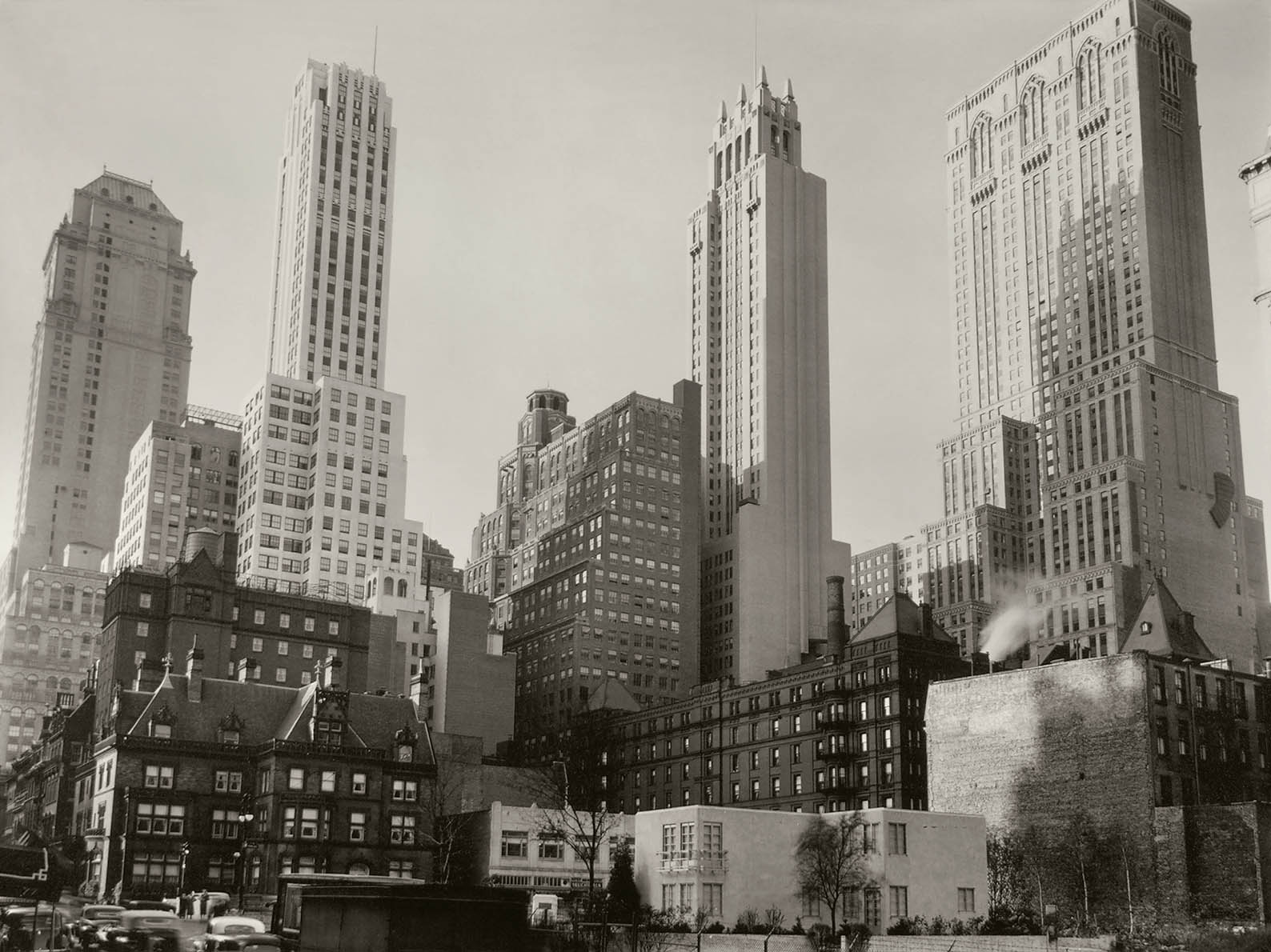
The Nelson-Atkins Museum of Art website

LIKE ART BLART ON FACEBOOK

Back to top

Opening: ‘Traverse’ by Kim Percy at Stockroom, Kyneton

Exhibition dates: 10th March – 8th April 2012


Installation of 'Traverse' by Kim Percy at Stockroom, Kyneton


Installation of Traverse by Kim Percy at Stockroom, Kyneton
Installation photograph by Marcus Bunyan
© Kim Percy and Marcus Bunyan


Many thanx to Jason, Magali and Kent for inviting me to the gallery, and Kim for asking me to open the exhibition – it was fun!

I have known Kim since the early 1990s when we both did our Bachelor of Arts in photography at RMIT University so it was wonderful to have opened her show yesterday. Reprinted below is the speech I gave at the opening with its musings on the (in)visibility of asylum seekers arriving by boat in Australia. I hope you enjoy reading the text. Marcus.


Opening speech by Dr Marcus Bunyan, 10th March 2012

Out of Sight, Out of Mind __________________

“What I am about to say, my musings if you like, are inspired by Kim’s wonderful installation. The work before you is the basis of my inquiry. The issues involved are difficult and not to be dealt with lightly but I hope you will follow my drift, my traverse if you like.

I would like to take you on a journey – physical, metaphorical and maybe even philosophical. I want to ask questions of the world, questions about the journey we all take as human beings. These questions are prompted by my personal response to two elements of Kim’s work – water and the journey, specifically the image of asylum seekers arriving here in Australia. Imagine being an asylum seeker making that journey.

Imagine living in an (in)between space, living in a refugee camp over there. Marc Augé coined the phrase “non-place” to refer to places of transience that do not hold enough significance to be regarded as “places.”1 These camps are such places. Put yourself in that predicament, seeking a better life, seeking to escape persecution, war (of which we as a nation are often part), prejudice and death, deliberately placing yourself and your family in a fragile boat, like a seed pod floating upon the waters, taking the dangerous journey to reach Australia. Imagine the emotional and intellectual turmoil that must surround such a decision, the decision to place your life in the hands of the ocean. Important decisions affecting the entire course of one’s life are rarely made without some form of mental distress.

Nurtured in water, some baptised in it, water is the life-blood of the world and the asylum seeker must trust to its benevolence. Marc Augé “argues that we are in transit through non-place for more and more of our time, as if between immense parentheses.”2 This is the journey that the asylum seeker takes over water, a journey through an interstitial space that has no beginning and no end caught between a set of parentheses [insert life here / or not].

Now let us move our line of sight. What about a visual parentheses?


Asylum seekers are almost invisible from Australia living over there. They are over the horizon, out of sight and out of mind. When they journey across the sea – an open ended journey passing through a liminal space, a forgotten space – they suddenly appear as if by magic washed up on the shore, unseen despite surveillance planes, ships and other forms of tracking and reconnaissance. Think, for example, of the sudden and surprising arrival of the boat SIEV-221 when it was washed onto the rocks of Christmas Island in December 2010. The invisible made visible caught in a non-place.

This (in)visibility can be evidenced in other ways. The specks of humanity waving from the deck of the Tampa, the asylum seekers being escorted from arriving boats, seen for a few brief seconds on the evening news and then disappearing from view, almost like being sucked into the depths of the sea. Here and not here; here and there. Halfway between nothingness and being: they walk between one state and another, forward and backward, backward and forward.


Displacement
Diaspora
Disruption


The spectacle of the asylum seekers is despectacularised by and for the viewer. We remove ourselves from the emotion of these people, the presence of these images. They become ordinary as if seen from far away – glimpsed every so often as though viewing the world of another. They become Other.

The movement of the ship, the movement of the sky, the movement of vision is a constant decentering through a push / pull with something else – some other order of the world. Their journey into the unknown is a journey to submit to the ordering of another: the socially constructed system of classification: “refugee,” “asylum seeker.” The axis of visibility3 that operates in relation to subject, object, and space is not interrogated as to the representations that are constructed. This is what I am interested in here. These vital, alive human beings come from one taxonomic system (of ordered death, persecution, injustice), become visible from a brief instance, and are then fed into another taxonomic system of order – that of the detention centre.

Taking the metaphor of the horizon line further, I would argue that detention centres are like an inverted Panopticon. The Panopticon “is a type of institutional building, a prison, designed by English philosopher and social theorist Jeremy Bentham in the late eighteenth century. The concept of the design is to allow an observer to observe all inmates of an institution without them being able to tell whether or not they are being watched.”4 The guard sits in a central tower and can observe and inspect all prisoners on the outer 360 degree circle, while the prisoners cannot see the guard and can only presume he is there (an omnipresent God) and hence they behave.

Let us invert this concept.

Now the asylum seekers sit in the tower looking outwards, seeing the promised land but unable to touch it and the guards (prison officers, government, the Australian people) are all around but most are blind. They look inwards but cannot see / they look outwards and most go about their daily business. The perimeter fence of the detention centre becomes the horizon line of the sea. As in Kim’s red lined horizons, over the horizon is out of sight, out of mind _________________


What Kim’s eloquent, minimal, brooding installation does is hold our attention and ask certain questions of us as human beings. If photography is a mode of visually addressing a certain order in the world – be it horror, war, peace, human tragedy, public, private – and then destabilising it, then Kim destabilises the binary sea / sky through fragmentation and isolation. She redlines our experience and asks us to inhabit the non-space, the non-place of the gallery, allowing us to hover between boat and image, between sea and sky, between seeing and feeling. Through her work she asks us to become more aware. She asks us to see things more clearly. Above all she asks us to have faith in the compassion of human beings.

The asylum seekers have faith: faith to get into a fragile boat to venture upon the sea in search of a better life. If we had more faith in ourselves then we would have less need to rely on the images of the past, a white colonial past.

I will finish with a quote from Jeff Brown.

“Sometimes we have to surrender to the not knowing. At other times, it is helpful to adventure outward and explore new possibilities. Like swashbucklers of the spirit, we bravely seek out any experience that might inform our path. When we are afraid of something, we live it fully and see what floats to the surface in the doing. We participate in our own revealing. We have faith in the shaping of what we cannot see.”5


The seekers surrender to the not knowing and have faith in the shaping of what they cannot see. These risk takers are the strong ones that are going to make a difference in a new society by the very fact of their strength and determination to survive and live in a free society, for the very fact of the risks undertaken. This exhibition informs their path as it informs our path. Be aware of the doing, be bold and forthright in the being. Enjoy.

Thank you

Dr Marcus Bunyan


Footnotes

1/ Augé, Marc (trans. John Howe). Non-Places: Introduction to an Anthropology of Supermodernity. London: Verso, 1995

2/ Ibid.,

3/ Hooper-Grenhill, Eilean. Museums and the Shaping of Knowledge. London: Routledge, 2000, p. 7

4/ Anon. “Panopticon,” on Wikipedia [Online] Cited 09/03/2012

5/ Brown, Jeff. Soulshaping. Berkeley, CA: North Atlantic Books, 2009, np quoted on Stroud, Jeff. The reluctant blogger website. [Online] Cited 09/03/2012


Installation of 'Traverse' by Kim Percy at Stockroom, Kyneton

Installation of 'Traverse' by Kim Percy at Stockroom, Kyneton


Installation of Traverse by Kim Percy at Stockroom, Kyneton
Installation photographs by Marcus Bunyan © Kim Percy and Marcus Bunyan


Kim Percy (Australian) 'Pale Sea' 2012


Kim Percy (Australian)
Pale Sea
2012
Digital photograph


Kim Percy (Australian) 'Where' 2012


Kim Percy (Australian)
Where
2012
Digital photograph


Kim Percy (Australian) 'Rough Water' 2012


Kim Percy (Australian)
Rough Water
2012
Digital photograph


Kim Percy (Australian) 'Traverse' 2012


Kim Percy (Australian)
Traverse
2012
Digital photograph


Kim Percy (Australian) 'Red Horizon No.1' 2012


Kim Percy (Australian)
Red Horizon No.1
2012
Digital photograph


Kim Percy (Australian) 'Red Horizon No.2' 2012


Kim Percy (Australian)
Red Horizon No.2
2012
Digital photograph


Stockroom
98 Piper street, Kyneton
Phone: 03 5422 3215

Opening hours:
Thursday – Saturday 10am – 5pm
Sunday 11am – 3pm
Closed Monday and Tuesday
Wednesday by appointment

Stockroom website

LIKE ART BLART ON FACEBOOK

Back to top

Notes from the lecture ‘Anti-Entropy: A natural History of the Studio’ by William Kentridge at the Australian Centre for the Moving Image (ACMI), Melbourne

Date: 8th March 2012


Edward Francis Burney (English, 1760-1848) 'A view of Philip James de Loutherbourg's Eidophusikon' c. 1782


Edward Francis Burney (English, 1760-1848)
A view of Philip James de Loutherbourg’s Eidophusikon
c. 1782
At left a man bowing to a woman, to right figures seated on a bench in the foreground, watching a scene titled ‘Satan Arraying his Troops on the Banks of a Fiery Lake, with the Raising of the Palace of Pandemonium’ during a performance of Milton’s “Paradise Lost” on a stage labelled EIDOPHUSIKON in a cartouche above
Pen and grey ink and grey wash, with watercolour
© The Trustees of the British Museum


A munificence of Minor White and the revelation of the object through contemplation could be found in the lecture by William Kentridge. As an artist you must keep repeating and constructively playing and something else, some new idea, some new way of looking at the world may emerge. As a glimpse into the working methodology of one of the worlds great artists the lecture was fascinating stuff!

Images in this posting are used under fair use for commentary and illustration of the lecture notes. No copyright breach is intended. © All rights remain with the copyright holder. My additions to the text can be found in [ ] brackets.


On self-doubt as an artist

“At four in the morning there are no lack of branches for the crow of doubt to land upon.”


On Memory

“Memory – both memory and the forgetting of memory. For example, the building of monuments [monuments to the Holocaust, to wars] takes the responsibility of remembering away.”


On Play

“We absolutely want to make sense of the world in that way. That’s one of the principles of play – that however much you distort and break things apart, in the end we will try to reconstruct them in some way to make sense of the world. I think that every child does it. It’s fundamental.”


On Looking

“It’s the capacity for recognition that makes a difference between order and disorder in looking at visual images. And it’s the vocabulary of recognisable images that we have inside us, which is completely vital to what it is to see. I don’t really buy the idea that order and disorder are the same.”


William Kentridge


First History of the Cinema

Performances of Transformation

~ Cinema
~ Shadow dancing
~ Eidophusikon (The Eidophusikon was a piece of art, no longer extant, created by 18th century English painter Philip James de Loutherbourg. It opened in Leicester Square in February 1781.Described by the media of his day as “Moving Pictures, representing Phenomena of Nature,” the Eidophusikon can be considered an early form of movie making. The effect was achieved by mirrors and pulleys.
~ Quick change artist
~ Stage magicians


All work against the time of the audience e.g. the quick change artist may take 3 seconds, the sunset in a Georges Méliès film may take 2 minutes instead of 2 hours. The technology / scrims / screens happen at different speeds but the different times become one in the finished film. There is an elision of time: appearances / disappearances. Stopping time [changing a scene, changing clothing etc…], starting time again.


Méliès starring in 'The Living Playing Cards' 1904


George Méliès starring in The Living Playing Cards (1904)


Second History of the Cinema

The sedimented gaze of the early camera. The slow chemicals meant that the object had to wait under the camera’s gaze for minutes. People were held in place by stiff neck braces to capture the trace of their likeness. Congealed time.

On the other hand, in cinema, a tear forward becomes a repair in reverse.

By rolling the film in reverse there is a REVERSAL of time, a REMAKING of the world – the power to be more than you are – by reversing to perfection. You throw a book or smash a plate: in reverse they become perfect again, a utopian world.

YOU MUST GIVE YOURSELF OVER TO PLAY!

Giving yourself over to what the medium suggests, you follow the metaphor back to the surface. Following the activity [of play] back to its root. Projecting forwards, projecting backwards. There is endless rehearsal, constant repetition, then discovering the nature of the final shot or drawing to be made. New ideas get thrown around: leaning into the experience, the experiment, the repetition, the rehearsal.

Four elements

1/ something to be seen

2/ the utopian perfection: perfectibility

3/ the grammar of learning that action

4/ Greater ideas, further ideas and thoughts; potentiality and its LOSS
Further meanings arise


How is this achieved?
Rehearsal, repetition

New thoughts will arise being led by the body in the studio NOT in the mind. Not conceptual but the feeling of the body walking in the studio.

The physical action as the starting point not the concept.

Six different degrees of tension

1/ Least tension in the body possible: slumped

2/ Relaxed

3/ Neutral

4/ Purpose: an impulse to make things happen – desire

5/ Insistence: listen to me, this is very important

6/ Manic: Noh theatre with its rictus of the body


What the body suggests is the construction of an image.

There are different degrees of tension in these performances. What do they suggest? This reverse osmosis from one state to another?


Third History of Cinema

Technologies of Looking

Pre-cinematic devices – a process of seeing in the world, of looking. Produces a reconfigured seeing, the invisible made [moving] visible.

Stereoscope

3D world made into a 2D image put back into 3D by our brains. The nature of binocularity, of depth perception. We see an illusion of depth, a construction by the eyes. Our brain is a muscle combining the two images. Depth of Field (DOF): focusing at different distances, we are inside the field of the image. Peripheral vision is blanked off; we look through a magnifying glass. A machine for demonstrating seeing.

Text from the Wikipedia website


William Kentridge (South African, b. 1955) Drawing for the film 'Stereoscope' 1998-1999


William Kentridge (South African, b. 1955)
Drawing for the film Stereoscope
1998-1999
Charcoal, pastel, and coloured pencil on paper
The Museum of Modern Art, New York
© 2008 William Kentridge


Zoetrope by William George Horner, 1834


Zoetrope by William George Horner, 1834


Zoetrope

An illusion of movement not depth. Double revelation:

A/ the brain constructed illusion of movement
B/ Caught in time [as the action goes around and around] and wanting to get out of it!

THIS IS CRITICAL – THE ACTION OF REPETITION IS IMPORTANT!

In the reordering, in the crack, something else may emerge, some new idea may eventuate. The tearing of time. 

[Marcus: the cleft in time]

Text from the Wikipedia website

The Etching Press

There are erotics built into the language of the etching, but there is also a logic built into the machine used for etching. The Proof print, arriving at the first state. Going on the journey from artist as maker to artist as viewer through the mechanism of the etching press.


Artist/Maker unknown. 'Claude Glass' manufactured in England, 18th century


Artist / Maker unknown
Claude Glass, manufactured in England
18th century
V & A


Claude Glass

“A Claude glass (or black mirror) is a small mirror, slightly convex in shape, with its surface tinted a dark colour. Bound up like a pocket-book or in a carrying case, black mirrors were used by artists, travellers and connoisseurs of landscape and landscape painting. Black Mirrors have the effect of abstracting the subject reflected in it from its surroundings, reducing and simplifying the colour and tonal range of scenes and scenery to give them a painterly quality).”

Text from the Wikipedia website


“The Claude glass was standard equipment for Picturesque tourists, producing instant tonal images that supposedly resembled works by Claude. “The person using it ought always to turn his back to the object that he views,” Thomas West explained in his Guide to the Lakes. “It should be suspended by the upper part of the case… holding it a little to the right or the left (as the position of the parts to be viewed require) and the face screened from the sun.”

Object Type

A Claude Glass – essentially a small, treated mirror contained in a box – is a portable drawing and painting aid that was widely used in the later 18th century by amateur artists on sketching tours. The reflections in it of surrounding scenery were supposed to resemble some of the characteristics of Italian landscapes by the famous 17th-century painter and sketcher Claude Lorrain, hence the name.

Materials & Use

The ‘glass’ consists of a slightly convex blackened mirror, which was carried in the hand and held up to the eye. The image thus seen was the scenery behind – rather than in front of – the user. The mirror’s convexity reduced extensive views to the dimensions of a small drawing. The use of a blackened rather than an ordinary silvered mirror resulted in a somewhat weakened reflection, which stressed the prominent features in the landscape at the expense of detail. It also lowered the colour key. A larger version of this device is said on occasion to have been fixed to the windows of horse-drawn carriages in order to reflect the passing scenery.”

From the V & A website


Artist/Maker unknown. 'Claude Glass' manufactured in England, 18th century


Artist / Maker unknown
Claude Glass, manufactured in England
18th century
V & A


Anamorphic Mirror

A counter intuitive way of drawing; turning 2D into 3D. The landscape has no edge, like a carrousel.

A LINK TO THE ENDLESS CIRCLING AND WALKING AROUND THE STUDIO!


Anamorphic drawing and cone shaped mirror


Anamorphic drawing and cone shaped mirror


William Kentridge studio


William Kentridge studio
Photo by John Hodgkiss
Art Tatler


The Studio

In the studio you gather the pieces together like a kind of Zoetrope. You may arrive at a new idea, a new starting point. Repetition, going around and around your head (at four in the morning!). There must be a truce between the artist as maker and the artist as viewer. As in earlier times, you walk the cloisters, you promenade.

You find the walk that is the prehistory of the drawing, that is the prehistory to the work.

A multiple, fragmented, layered performance of walking. You are trying to find the grammar of the studio – the necessary stupidity. Making a space for uncertainty. The conscious suppression of rationality. At some point, emerging, escaping the Zoetrope, from the physical making, something will be revealed. The spaces open up by the stupidities. Something new emerges.

THIS IS THE SPACE OF THE STUDIO.


Australian Centre for the Moving Image (ACMI)
Federation Square, Melbourne, Australia

William Kentridge: Five Themes

Thursday 8 March – Sunday 27 May 2012
Exhibition open daily 10am – 6pm

ACMI website

LIKE ART BLART ON FACEBOOK

Back to top

Exhibition: ‘Light Years: Conceptual Art and the Photograph, 1964-1977’ at the Art Institute of Chicago

Exhibition dates: 13th December 2011 – 11th March 2012


Many thankx to the Art Institute of Chicago for allowing me to publish the photographs in the posting. Please click on the photographs for a larger version of the image.


Marcel Broodthaers (Belgian, 1924-1976) 'Portrait of Maria Gilissen with Tripod' 1967


Marcel Broodthaers (Belgian, 1924-1976)
Portrait of Maria Gilissen with Tripod
1967
Gelatin silver emulsion on canvas with tripod
Approx. 66 x 43 x 24 inches


Mel Bochner (American, b. 1940) 'Surface Dis/Tension' 1968


Mel Bochner (American, b. 1940)
Surface Dis/Tension
1968
Gelatin silver print on aluminum mount
48 x 46″


John Baldessari (American, born 1931). 'The California Map Project Part I: California', 1969, exhibition copy 2011


John Baldessari (American, 1931-2020)
The California Map Project Part I: California
1969, exhibition copy 2011
Twelve inkjet prints of images and a typewritten sheet
Each image, 20.3 x 25.4cm (8 x 10 in); sheet, 21.6 x 27.9cm (8 1/2 x 11 in)
Courtesy of the artist and Marian Goodman Gallery, New York and Paris
© John Baldessari


Lothar Baumgarten (German, 1944-2018) 'The Origin of Table Manners' 1971


Lothar Baumgarten (German, 1944-2018)
The Origin of Table Manners
1971
Chromogenic print
45 x 57.5cm
Collection Sanders, Amsterdam


One of Baumgarten’s early works, The Origin of Table Manners is a wry illustration of the way in which colonial conquerors conflated Western notions of civility with notions of the civilised as part of their alibi for domination. Inspired by a text of the same name by the structuralist anthropologist Claude Levi-Strauss, the work consists of a table draped in a crisp, white tablecloth and set with fine china, with porcupine quills and the feathers of large birds standing in for silverware. When it was first shown, it was installed in a tony French restaurant near Baumgarten’s Paris gallery.

Chris Wiley. “Exhibition Review – Lothar Baumgarten at Marian Goodman Gallery” Nd on the Daylight Books website [Online] Cited 07/11/2024


Eleanor Antin (American, born 1935) '100 Boots' 1971-73


Eleanor Antin (American, b. 1935)
100 Boots
1971-1973
Fifty-one photolithographic postcards
Each 11.1 x 17.8cm (4 3/8 x 7 in)
The Art Institute of Chicago, Margaret Fisher Endowment
Courtesy Ronald Fedlman Fine Arts, New York, NY
© Eleanore Antin


Eleanor Antin (American, born 1935) '100 Boots' 1971-1973


Eleanor Antin (American, b. 1935)
100 Boots
1971-1973
Fifty-one photolithographic postcards
Each 11.1 x 17.8cm (4 3/8 x 7 in)
The Art Institute of Chicago, Margaret Fisher Endowment
Courtesy Ronald Fedlman Fine Arts, New York, NY
© Eleanore Antin


Ger van Elk (Dutch, b. 1941) 'The Rose more Beautiful than Art, but Difficult, therefore Art is Splendid' 1972


Ger van Elk (Dutch, b. 1941)
The Rose more Beautiful than Art, but Difficult, therefore Art is Splendid
1972
Slide projection, elven chromogenic slides projected onto watercolour in wooden frame
9 4/5 × 12 2/5 in | 25 × 31.5cm
Courtesy of the artist


John Baldessari (American, b. 1931) 'Throwing Three Balls in the Air to Get a Straight Line (Best of Thirty-Six Attempts)' 1973


John Baldessari (American, 1931-2020)
Throwing Three Balls in the Air to Get a Straight Line (Best of Thirty-Six Attempts)
1973
Portfolio of fourteen photolithographs
Each 24.7 x 32.7cm (9 11/16 x 12 7/8 in)
Museum of Contemporary Photography at Columbia College Chicago
© John Baldessari


Anselm Kiefer (German, b. 1945) 'Ausbrennen des Landkreises Buchen' (The Burning of the Rural District of Buchen) 1974


Anselm Kiefer (German, b. 1945)
Ausbrennen des Landkreises Buchen (The Burning of the Rural District of Buchen)
1974
Bound gelatin silver prints with ferric oxide and oil on woodchip paper
62 x 45cm
Hall colleciton


The 1960s and 1970s are recognised as the defining era of the Conceptual Art movement, a period in which centuries held assumptions about the nature of art itself were questioned and dissolved. Until now, the pivotal role that photography played in this movement has never been fully examined. The Art Institute of Chicago has organised the first major survey of influential artists of this period who used photography in ways that went far beyond its traditional definitions as a medium – and succeeded thereby in breaking down the boundaries of all mediums in contemporary art. Light Years: Conceptual Art and the Photograph, 1964-1977 – on view December 13, 2011 through March 11, 2012 – is the first exhibition to explore how artists of this era used photography as a hybrid image field that navigated among painting and sculpture, film, and book arts as well as between fine art and the mass media. More than 140 works by 57 artists will fill the Art Institute’s Regenstein Hall in this major exhibition that will be seen only in Chicago.

Bringing to the fore work from the Italian group Arte Povera as well as artists from Eastern Europe who are rarely shown in the United States, Light Years also includes many pieces that have not been on public display in decades by such major artists as Mel Bochner, Tony Conrad, Michael Heizer, Gordon Matta-Clark, and Emilio Prini. To open the exhibition, the Art Institute has arranged a special outdoor screening of Andy Warhol’s Empire, an eight-hour film of the Empire State Building. In a first for the United States, Warhol’s Empire will be projected from the Modern Wing’s third floor to be seen on the exterior of the Aon Center on Friday, December 9.

The acceptance of photography as fine art was an evolutionary process. Early 20th-century avant-garde movements such as Dada, Surrealism, and Constructivism articulated a new set of standards for art in which photography played a major role. By the 1930s, modernist photography found a small but influential niche in museum exhibitions and the art market, and vernacular forms such as photojournalism and amateur snapshots became a source of artistic inspiration. Engagement with mass media, exemplified in Pop Art, became prominent in the 1950s. Yet only with the advent of Conceptual Art did artists with training in painting, sculpture, and the graphic arts begin to make and exhibit their own photographs or photographic works as fine art.

Some Conceptual artists, such as Bruce Nauman, Ed Ruscha, and Valie Export took up photography seriously only for a few key months or years; others, like Eleanor Antin, John Baldessari, Jan Dibbets, and Annette Messager have worked in photography their entire careers. Photography showed the way forward from Minimal Art, Pop Art, and other movements in painting and sculpture. But it came with its own set of questions that these artists addressed with tremendous innovation. Questions of perspective, sequence, scale, and captioning which have a rich history in photography, were answered in entirely new ways and made into central concerns for art in general.

Photography in these artists’ hands was the antithesis of a separate and definable “medium.” It became instead “unfixed”: photobooks, photolithographs, photo canvases, photo grids, slide and film pieces, and even single prints all counted as valid creative forms. The variety of work showcased in Light Years is crucial to conveying the greatest contribution of the Conceptual era: to turn contemporary art into a field without a medium.

Light Years showcases a great number of works that have not been seen together – or at all – since the years around 1970. Victor Burgin’s Photopath, a life-size print of a 60-foot stretch of flooring placed directly on top of the floor that it records, has not been shown in more than 20 years and never in the United States. Likewise being shown for the first time in the U.S. are pieces by Italian artists Gilberto Zorio, Emilio Prini, Giulio Paolini, and others associated with the classic postwar movement Arte Povera. Paolini’s early photo-canvas Young Man Looking At Lorenzo Lotto (1967), an icon of European conceptualism, has only rarely been shown at all after entering a private collection in the early 1970s. Mel Bochner’s Surface Dis/Tension: Blowup (1969) has not been seen since its presentation at Marian Goodman Gallery in the now legendary 1970 exhibition Artists and Photographs, from which no visual documentation survives. Equally rare and important early works by Laurie Anderson, Marcel Broodthaers, Francesco Clemente, Tony Conrad, Gilbert & George, Dan Graham, Michael Heizer, and many others make the show a revelation for those interested in key figures of new art in the 1960s and ’70s. A special emphasis is placed on artists from Hungary, a centre for photoconceptual activity that has long been overlooked in Western Europe and the United States.

Press release from the Art Institute of Chicago


Alighiero Boetti (Italian, 1940-1994) 'AW:AB =L:MD (Andy Warhol: Alighiero Boetti = Leonardo: Marcel Duchamp)' 1967


Alighiero Boetti (Italian, 1940-1994)
AW:AB =L:MD (Andy Warhol: Alighiero Boetti = Leonardo: Marcel Duchamp)
1967
Silk screen print with graphite on paper
58.8 x 58.8cm (23 5/16 x 23 5/16 in)
Colombo Collection, Milan
© Artists Rights Society (ARS)


Alighiero Boetti (Italian, 1940-1994) 'Twins (Gemelli)' September 1968


Alighiero Boetti (Italian, 1940-1994)
Twins (Gemelli)
September 1968
Gelatin silver postcard
15.2 x 11.2cm (6 x 4 3/8 in)
Private Collection
© Artists Rights Society (ARS)


Bruce Nauman (American, b. 1941) 'Light Trap for Henry Moore No. 1' 1967


Bruce Nauman (American, b. 1941)
Light Trap for Henry Moore No. 1
1967
Gelatin silver print
157.5 x 105.7cm (62 x 41 5/8 in)
Glenstone
© Artists Rights Society (ARS).


Dennis Oppenheim (American, 1938-2011) 'Stage 1 and 2. Reading Position for 2nd Degree Burn Long Island. N.Y. Material... Solar Energy. Skin Exposure Time. 5 Hours June 1970' 1970


Dennis Oppenheim (American, 1938-2011)
Stage 1 and 2. Reading Position for 2nd Degree Burn Long Island. N.Y. Material… Solar Energy.  Skin Exposure Time. 5 Hours June 1970
1970
Two chromogenic photographic prints, plastic labelling tape, mounted together on green board with graphite annotations
Overall: 81 x 66cm (31 7/8 x 26 in)
Top photo: 20.1 x 25.8cm
Bottom photo: 20.2 x 25.5cm
Image/text area: 41.8 x 25.8cm
Dorothy and Herbert Vogel Collection
© Dennis Oppenheim Estate


The Art Institute of Chicago
111 South Michigan Avenue
Chicago, Illinois 60603-6404
Phone: (312) 443-3600

Opening hours:
Thursday – Monday 11am – 5pm
Closed Tuesdays and Wednesdays

The Art Institute of Chicago website

LIKE ART BLART ON FACEBOOK

Back to top

Exhibition: ‘Lyonel Feininger: Photographs, 1928-1939’ at the J. Paul Getty Museum, Getty Center, Los Angeles

Exhibition dates: 25th October 2011 – 11th March 2012


Lyonel Feininger (American, 1871-1956) 'Untitled [Street Scene, Double Exposure, Halle]' 1929-1930


Lyonel Feininger (American, 1871-1956)
Untitled [Street Scene, Double Exposure, Halle]
1929-1930
Gelatin silver print
Image: 17.8 x 23.7cm (7 x 9 5/16 in)
Gift of T. Lux Feininger, Houghton Library, Harvard University
© Artists Rights Society (ARS), New York / VG Bild-Kunst, Bonn


Another photographer whose work was largely unknown to me. His work can be seen to reference Pictorialism, Eugene Atget, Constructivism and Modernism, the latter in the last three photographs of the Bauhaus buildings at night which are just beautiful! The capture of form, light (emanating from windows) and atmosphere is very pleasing.

Dr Marcus Bunyan

P.S. Don’t be confused when looking at the photographs in the posting. Note the difference in the work of Lynonel and his two sons Andreas and Theodore (nicknamed Lux).


Many thankx to the J. Paul Getty Museum for allowing me to publish the photographs in the posting. Please click on the photographs for a larger version of the image.


Lucia Moholy (British born Czechoslovakia, 1894-1989) 'Untitled [Southern View of Newly Completed Bauhaus, Dessau]' 1926


Lucia Moholy (British born Czechoslovakia, 1894-1989)
Untitled [Southern View of Newly Completed Bauhaus, Dessau]
1926
Gelatin silver print
Sheet: 5.7 x 8.1cm (2 1/4 x 3 3/16 in)
The J. Paul Getty Museum, Los Angeles
© Artists Rights Society (ARS), New York / VG Bild-Kunst, Bonn


Lyonel Feininger (American, 1871-1956) 'Untitled [Train Station, Dessau]' 1928-1929


Lyonel Feininger (American, 1871-1956)
Untitled [Train Station, Dessau]
1928-1929
Gelatin silver print
Image: 17.7 x 23.7 cm (6 15/16 x 9 5/16 in.)
Gift of T. Lux Feininger, Houghton Library, Harvard University
© Artists Rights Society (ARS), New York / VG Bild-Kunst, Bonn


Werner Zimmermann (German, 1906-1975) 'In Der Werkstatt' about 1929


Werner Zimmermann (German, 1906-1975)
In Der Werkstatt [In The Workshop]
About 1929
Gelatin silver print
7.9 × 11cm (3 1/8 × 4 5/16 in.)
The J. Paul Getty Museum, Los Angeles


T. Lux Feininger (American born Germany, 1910-2011) 'Metalltanz' 1929


T. Lux Feininger (American born Germany, 1910-2011)
Metalltanz
1929
Gelatin silver print
Image: 10.8 x 14.4cm (4 1/4 x 5 5/8 in.)
The J. Paul Getty Museum, Los Angeles
© Estate of T. Lux Feininger


Widely recognised as a painter, printmaker, and draftsman who taught at the Bauhaus, Lyonel Feininger (American, 1871-1956) turned to photography later in his career as a tool for visual exploration. Drawn mostly from the collections at Harvard University in Cambridge, Massachusetts, Lyonel Feininger: Photographs, 1928-1939 at the J. Paul Getty Museum, Getty Center, October 25, 2011 – March 11, 2012, presents for the first time Feininger’s unknown body of photographic work. The exhibition is accompanied by a selection of photographs by other Bauhaus masters and students from the Getty Museum’s permanent collection. The Getty is the first U.S. venue to present the exhibition, which will have been on view at the Kupferstichkabinett, Staatliche Museen zu Berlin from February 26 – May 15, 2011 and the Staatliche Graphische Sammlung, Pinakothek der Moderne in Munich from June 2 – July 17, 2011. Following the Getty installation, the exhibition will be shown at the Harvard Art Museums from March 30 – June 2, 2012. At the Getty, the exhibition will run concurrently with Narrative Interventions in Photography.

“We are delighted to be the first U.S. venue to present this important exhibition organised by the Harvard Art Museums / Busch-Reisinger Museum,” says Virginia Heckert, curator of photographs at the J. Paul Getty Museum and curator of the Getty’s installation. “The presentation at the Getty provides a unique opportunity to consider Lyonel Feininger’s achievement in photography, juxtaposed with experimental works in photography at the Bauhaus from our collection.”

Lyonel Feininger Photographs

When Lyonel Feininger (1871-1956) took up the camera in 1928, the American painter was among the most prominent artists in Germany and had been on the faculty of the Bauhaus school of art, architecture, and design since it was established by Walter Gropius in 1919. For the next decade, he used the camera to explore transparency, reflection, night imagery, and the effects of light and shadow. Despite his early skepticism about this “mechanical” medium, Feininger was inspired by the enthusiasm of his sons Andreas and Theodore (nicknamed Lux), who had installed a darkroom in the basement of their house, as well as by the innovative work of fellow Bauhaus master, László Moholy-Nagy.

Although Lyonel Feininger would eventually explore many of the experimental techniques promoted by Moholy-Nagy and practiced by others at the school, he remained isolated and out of step with the rest of the Bauhaus. Working alone and often at night, he created expressive, introspective, otherworldly images that have little in common with the playful student photography more typically associated with the school. Using a Voigtländer Bergheil camera (on display in the exhibition), frequently with a tripod, he photographed the neighbourhood around the Bauhaus campus and masters’ houses, and the Dessau railway station, occasionally reversing the tonalities to create negative images.

Lyonel Feininger: Photographs, 1928-1939 also includes the artist’s photographs from his travels in 1929-1931 to Halle, Paris, and Brittany, where he investigated architectural form and urban decay in photographs and works in other media. In Halle, while working on a painting commission for the city, Feininger recorded architectural sites in works such as Halle Market with the Church of St. Mary and the Red Tower (1929-1930), and experimented with multiple exposures in photographs such as Untitled (Street Scene, Double Exposure, Halle) (1929-1930), a hallucinatory image that merges two views of pedestrians and moving vehicles.

Since 1892 Feininger had spent parts of the summer on the Baltic coast, where the sea and dunes, along with the harbours, rustic farmhouses, and medieval towns, became some of his most powerful sources of inspiration. During the summers Feininger also took time off from painting, focusing instead on producing sketches outdoors or making charcoal drawings and watercolours on the veranda of the house he rented. Included in the exhibition are photographs Feininger created in Deep an der Rega (in present-day Poland) between 1929 and 1935 which record the unique character of the locale, the people, and the artistic and leisure activities he pursued.

In the months after the Nazis closed the Bauhaus, and prior to Feininger’s departure from Dessau in March 1933, he made a series of unsettling photographs featuring mannequins in shop windows such as Drunk with Beauty (1932). Feininger’s images emphasise not only the eerily lifelike and strangely seductive quality of the mannequins, but also the disorienting, dreamlike effect created by reflections on the glass.

In 1937 Feininger permanently settled in New York City after a nearly 50-year absence, and photography served as an important means of reacquainting himself with the city in which he had lived until the age of sixteen. The off-kilter bird’s eye view he made from his eleventh-floor apartment of the Second Avenue elevated train tracks, Untitled (Second Avenue El from Window of 235 East 22nd Street, New York) (1939), is a dizzying photograph of an American subject in the style of European avant-garde photography, and mirrors the artist’s own precarious and disorienting position between two worlds, and between past and present.

The Bauhaus

Walter Gropius, director of the Bauhaus from 1919 to 1928, changed the face of art education with his philosophy of integrating art, craft, and technology with everyday life at the Bauhaus. When Gropius’s newly designed building in Dessau was completed in December 1926, its innovative structure did more than house the various components of the school; it became an integral aspect of life at the Bauhaus and a stage for its myriad activities, from studies and leisurely pursuits to theatrical performances. From the beginning, the camera recorded the architecture as the most convincing statement of Gropius’ philosophy as well as the fervour with which the students embraced it. The photographs in this complementary section of the exhibition also examine the various ways photography played a role at the Bauhaus, even before it became part of the curriculum.

In addition to the collaborative environment encouraged in workshops, students found opportunities to bond during their leisure time, whether in a band that played improvisational music or on excursions to nearby beaches, parks, and country fairs. One of the most active recorders of life at the Bauhaus was Lyonel Feininger’s youngest son, T. Lux, who was also a member of the jazz band.

Masters and students alike at the Bauhaus took up the camera as a tool with which to record not only the architecture and daily life of the Bauhaus, but also one another. Although photography was not part of the original curriculum, it found active advocates in the figures of László Moholy-Nagy and his wife Lucia Moholy. With his innovative approach and her technical expertise, the Moholy-Nagys provided inspiration for others to use the camera as a means of both documentation and creative expression. The resulting photographs, which included techniques such as camera-less photographs (photograms), multiple exposures, photomontage and collages (“photo-plastics”), and the combination of text and image (“typo-photo”), contributed to Neues Sehen, or the “new vision,” that characterised photography in Germany between the two world wars.

It was not until 1929 that photography was added to the Bauhaus curriculum by Hannes Meyer, the new director following Gropius’s departure. A part of the advertising department, the newly established workshop was led by Walter Peterhans, who included technical exercises as well as assignments in the genres of portraiture, still life, advertisement, and photojournalism in the three-year course of study.”

Press release from the J.Paul Getty Museum website


Lyonel Feininger (American, 1871-1956) 'Untitled [Night View of Trees and Street Lamp, Burgkühnauer Allee, Dessau]' 1928


Lyonel Feininger (American, 1871-1956)
Untitled [Night View of Trees and Street Lamp, Burgkühnauer Allee, Dessau]
1928
Gelatin silver print
Image: 17.7 x 23.7cm (6 15/16 x 9 5/16 in)
Gift of T. Lux Feininger, Houghton Library, Harvard University
© Artists Rights Society (ARS), New York / VG Bild-Kunst, Bonn


Andreas Feininger (American, 1906-1999) 'Stockholm (Shell sign at night)' 1935


Andreas Feininger (American, 1906-1999)
Stockholm (Shell sign at night)
1935
Gelatin silver print
17.4 x 24.2cm
The J. Paul Getty Museum, Los Angeles, Gift of the Estate of Gertrud E. Feininger
© Estate of Gertrud E. Feininger


Lyonel Feininger (American, 1871-1956) 'Drunk with Beauty' 1932


Lyonel Feininger (American, 1871-1956)
Drunk with Beauty
1932
Gelatin silver print
Image: 17.9 x 23.9cm (7 1/16 x 9 7/16 in)
Gift of T. Lux Feininger, Houghton Library, Harvard University
© Artists Rights Society (ARS), New York / VG Bild-Kunst, Bonn


Lyonel Feininger (American, 1871-1956) 'Bauhaus' March 22, 1929


Lyonel Feininger (American, 1871-1956)
Bauhaus
March 22, 1929
Gelatin silver print
Image: 17.8 x 23.9cm (7 x 9 7/16 in)
Harvard Art Museums/Busch-Reisinger Museum, Gift of Mr. and Mrs. Lyonel Feininger
© Artists Rights Society (ARS), New York / VG Bild-Kunst, Bonn


T. Lux Feininger (American born Germany, 1910-2011) 'Untitled (Georg Hartmann and Werner Siedhoff with Other Students)' 1929


T. Lux Feininger (American born Germany, 1910-2011)
Untitled (Georg Hartmann and Werner Siedhoff with Other Students)
1929
Gelatin silver print
© Estate of T. Lux Feininger


Lyonel Feininger and Photography

Lyonel Feininger took up the camera at the age of 58 in fall 1928. Despite his early skepticism about this “mechanical” medium, the painter was inspired by the enthusiasm of his sons Andreas and Theodore (nicknamed Lux), as well as by the innovative work of László Moholy-Nagy, a fellow master at the Bauhaus in Dessau, Germany.

Photography remained a private endeavour for Feininger. He never exhibited his prints, publishing just a handful during his lifetime and sharing them only with family and a few friends.

Bauhaus Experiments in Photography

Although Feininger explored many of the experimental photographic techniques being practiced at the Bauhaus, he remained isolated and out of step with the rest of the school. Working alone and often at night, he created expressive, introspective, otherworldly images that have little in common with the playful student photography more typically associated with the school.

Using a Voigtländer Bergheil camera (on display in the exhibition), frequently with a tripod, he photographed the neighbourhood around the masters’ houses, the Bauhaus campus, and the Dessau railway station, experimenting with night imagery, reversed tonalities, and severe weather conditions.

Halle, 1929-1931

In 1929 Feininger created numerous photographic sketches to prepare for a series of paintings he was commissioned to make of the city of Halle, Germany.

A photograph of Halle included in the exhibition, Untitled (Bölbergasse, Halle), was the basis for one of these paintings, which is now lost. It was perhaps the most inventive and photographic of the Halle series, transforming a view of an unremarkable street into a dramatic, almost abstract composition through tight framing and an unusual perspective. The painting is visible in a 1931 photograph of the artist’s studio also included in the exhibition

Feininger also made many photographs of his Halle studio and the paintings he produced there. While many are purely documentary, others are sophisticated compositions that explore formal relationships between a particular painting and the space in which it was created, such as the one shown at right.

Feininger would never again use photography so extensively in connection with his paintings as he did in conjunction with the Halle series.

France, 1931

After completing his painting commission in Halle, Feininger spent several weeks in June and July of 1931 in France. In Paris and in the village of Bourron, he created images with his Voigtländer Bergheil camera as well as with his newly acquired Leica (also on display in the exhibition), in which he used 35 mm film for the first time. He also sketched and photographed Brittany on a bicycle tour with his son Lux, capturing views of the architecture and seaside.

In Paris, primed by his recent experience of photographing historic buildings in the streets of Halle, Feininger was drawn to architectural views and urban scenes. On returning from a day trip, he wrote to his wife Julia: “I wandered on foot through the city, flâné! Armed with both cameras, I made photographs… From ‘Boul-Miche’ I crisscrossed through the Quartier Mouffetard… through all possible old narrow and fabulous lanes and I hope that I snapped some very, very good things. Luckily the ‘Leica’ functioned flawlessly” (June 16, 1931, Feininger Papers, Houghton Library).

The Baltic Coast, 1929-1935

Beginning in 1892 Lyonel Feininger spent parts of his summers on the Baltic coast, where the sea and dunes, along with the harbours, rustic farmhouses, and medieval towns, became some of his most powerful sources of inspiration.

Every summer between 1929 and 1935, he used the camera to document family trips to Deep an der Rega (in present-day Poland), where the beach became a playground for his three athletic sons, Andreas, Laurence, and Lux. Feininger looked forward to his time in Deep and the restorative, transformative effect it always had on him.

Shop Windows, 1932-1933

From September 1932, when the National Socialist majority of the Dessau city council voted to close the Bauhaus, through March 1933, when he and his family left for Berlin, Feininger made a series of unsettling photographs that feature mannequins in shop windows. Feininger’s images emphasise not only the eerily lifelike and strangely seductive quality of the mannequins but also the disorienting, dreamlike effect created by reflections on the glass.
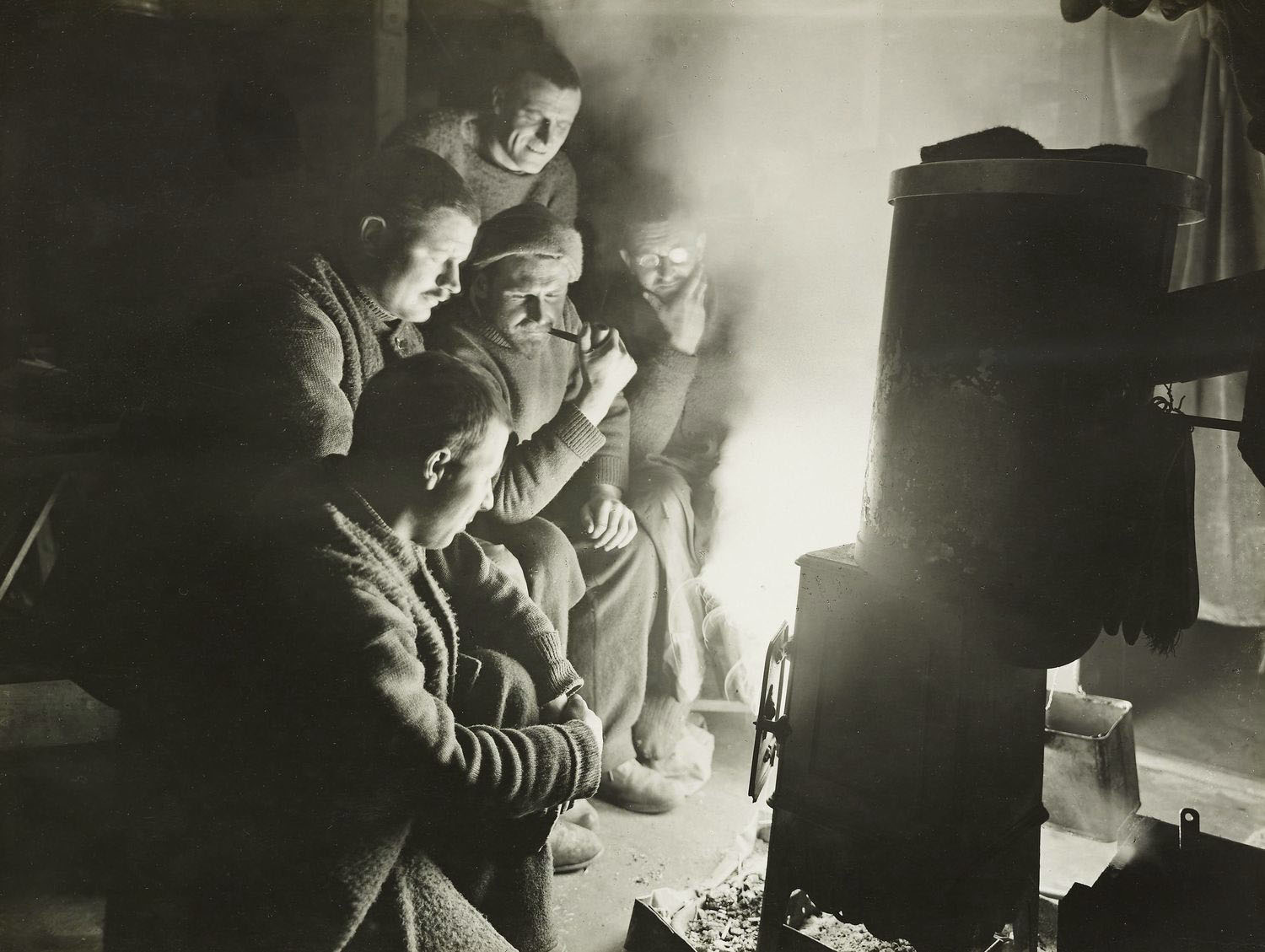
In the work shown here, the reflection seems to transport the languid central figure – “drunk with beauty” and oblivious to the camera – beyond the confines of the glass.

Germany to America, 1933 to 1939

Feininger came under increasing scrutiny by the National Socialists, who had stepped up their campaign against the avant-garde after rising to power in January 1933. He produced few paintings during this oppressive period, but continued to photograph regularly in spite of having little access to darkroom facilities. In 1937 he and his wife moved to the United States, renting an apartment in Manhattan – marking his permanent return to New York after an absence of nearly 50 years.

In the years that followed, photography remained an important part of Feininger’s life, though few prints exist from his time in America.

Text from the J. Paul Getty Museum website


T. Lux Feininger (American born Germany, 1910-2011) 'Untitled (Bauhaus Band)' About 1928


T. Lux Feininger (American born Germany, 1910-2011)
Untitled (Bauhaus Band)
About 1928
Gelatin silver print
3 1/4 x 4 1/2 in.
The J. Paul Getty Museum
© Estate of T. Lux Feininger


Photography at the Bauhaus

The exhibition Lyonel Feininger: Photographs, 1928-1939 features a complementary selection of over 90 photographs from the Getty Museum’s permanent collection made at the Bauhaus.

The Bauhaus was founded in 1919 in Weimar, Germany, by the architect Walter Gropius. Students entered specialised workshops after completing a preliminary course that introduced them to materials, form, space, colour, and composition. Lyonel Feininger was one of the first masters appointed by Gropius.

The school moved to Dessau in 1925 and to Berlin in 1932, closing under pressure from the National Socialists in 1933.

The Bauhaus Building as Stage

Walter Gropius’s building in Dessau became an integral aspect of life at the Bauhaus. The camera recorded the architecture as the most convincing statement of Gropius’s philosophy of uniting art, design, and technology with everyday life, and captured the fervor with which the students embraced this philosophy.

Tight framing, dramatic use of light and shadow, and unusual angles from above and below underscored the dynamism generated by the program. The campus’s architecture was often incorporated into rehearsals and performances by the school’s theater workshop.

Masters and Students

Bauhaus masters and students alike took up the camera as a tool for documentation and creative expression.

Photography served as a medium to record student life at the Bauhaus. In addition to the collaborative environment encouraged in classes and workshops, students found opportunities to bond during their leisure time, whether in a band that played improvisational music, in excursions to nearby beaches, parks, and fairs, or at Saturday-night costume parties.

One of the most active recorders of life at the Bauhaus was Lyonel Feininger’s youngest son Theodore, nicknamed Lux, a student who also became a member of the jazz band.

László Moholy-Nagy

At the Bauhaus, photography found active advocates in the figures of László Moholy-Nagy and his wife Lucia Moholy. Hired in 1923 to head the metal workshop and teach the preliminary course, Moholy-Nagy promoted photography as a form of visual literacy and encouraged experimental techniques of what he called a “new vision,” which included dramatic camera angles, multiple exposures, negative printing, collage and photomontage (fotoplastik), the combination of text and image (typofoto), and cameraless photography (the photogram, made by placing objects on photosensitised paper).

Moholy-Nagy did not differentiate between commercial assignments and personally motivated projects; he used the same strategies in both sectors of his practice.

Walter Peterhans

A photography workshop was established at the Bauhaus in 1929, led by Walter Peterhans, a professional photographer and the son of the director of camera lens manufacturer Zeiss Ikon A.G. The three-year course of study included technical exercises as well as assignments in portraiture, still life, advertisement, and photojournalism.

In his own work, Peterhans created haunting still lifes and portraits that are at once straightforward and evocative. Titles such as Portrait of the Beloved, Good Friday Magic, and Dead Hare lend surrealistic overtones to the meticulous arrangements of richly textured, disparate objects that he photographed from above, resulting in ambiguous spatial relationships.

Text from the J. Paul Getty Museum website


Walter Peterhans (German, 1897-1960) 'Untitled (Composition with Nine Glasses and a Decanter)' 1929-1933


Walter Peterhans (German, 1897-1960)
Untitled (Composition with Nine Glasses and a Decanter)
1929-1933
Gelatin silver print
© Estate Walter Peterhans, Museum Folkwang, Essen


Lyonel Feininger (American, 1871-1956) 'Bauhaus' March 26, 1929


Lyonel Feininger (American, 1871-1956)
Bauhaus
March 26, 1929
Gelatin silver print
Image: 17.9 x 14.3cm (7 1/16 x 5 5/8 in)
Bauhaus-Archiv Berlin
© Artists Rights Society (ARS), New York / VG Bild-Kunst, Bonn


Lyonel Feininger (American, 1871-1956) '"Moholy’s Studio Window" around 10 p.m.' 1928


Lyonel Feininger (American, 1871-1956)
“Moholy’s Studio Window” around 10 p.m.
1928
Gelatin silver print
Image: 17.8 x 12.8 cm (7 x 5 1/16 in.)
Bauhaus-Archiv Berlin
© Artists Rights Society (ARS), New York / VG Bild-Kunst, Bonn


Lyonel Feininger (American, 1871-1956) 'On the Lookout, Deep an der Rega' 1932


Lyonel Feininger (American, 1871-1956)
On the Lookout, Deep an der Rega
1932
Gelatin silver print
Image: 17.7 x 12.7cm (6 15/16 x 5 in)
Gift of T. Lux Feininger, Houghton Library, Harvard University
© Artists Rights Society (ARS), New York / VG Bild-Kunst, Bonn


Irene Bayer-Hecht (American, 1898-1991) 'Untitled [Students on the Shore of the Elbe River, near Dessau]' 1925


Irene Bayer-Hecht (American, 1898-1991)
Untitled [Students on the Shore of the Elbe River, near Dessau (Georg Muche, Hinnerk Scheper, Herbert Bayer, Unknown, Unknown, Marcel Breuer, László Moholy Nagy, Unknown, Xanti Schawinsky)]
1925
Gelatin silver print
Image: 7.5 x 5.4cm (2 15/16 x 2 1/8 in)
The J. Paul Getty Museum, Los Angeles


The J. Paul Getty Museum
1200 Getty Center Drive
Los Angeles, California 90049

Opening hours:
Daily 10am – 5pm

The J. Paul Getty Museum website

LIKE ART BLART ON FACEBOOK

Back to top