Review: ‘Heavenly Vaults’ by David Stephenson at John Buckley Gallery, Richmond

Exhibition dates: 7th – 28th November, 2009


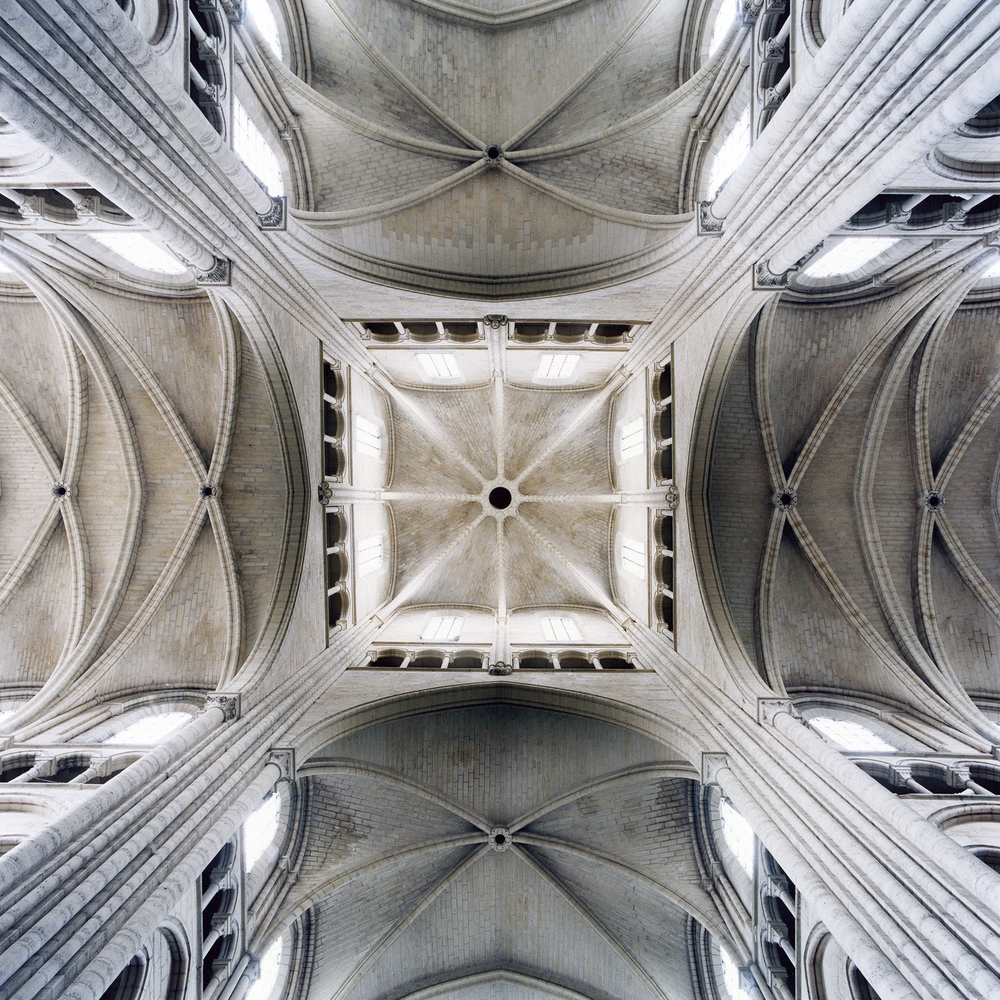
David Stephenson (Australian born America, b. 1955) 'Nave, Laon Cathedral, Laon, France' 2006/07 from the exhibition 'Heavenly Vaults' by David Stephenson at John Buckley Gallery, Richmond, Nov 2009
 

David Stephenson (Australian born America, b. 1955)
Nave, Laon Cathedral, Laon, France
2006/2007


I remember many years ago, in the mid-1990’s, seeing the wonderful Domes of David Stephenson displayed in Flinders Lane in what is now fortfivedownstairs gallery. They were a revelation in this light filled space, row upon row of luminous domes seemingly lit from within, filled with the sense of the presence of divinity. On the opposite wall of the gallery were row upon row of photographs of Italian graves depicting the ceramic photographic markers of Italian dead – markers of the impermanence of life. The doubled death (the representation of identity on the grave, the momento mori of the photograph) slipped quietly into the earth while opposite the domes ascended into heaven through their numinous elevation. The contrast was sublime.

Unfortunately the same cannot be said of the latest exhibition Heavenly Vaults by David Stephenson at John Buckley Gallery, Richmond.

The problems start with the installation of the exhibition. As you walk into the gallery the 26 Cibachrome photographs are divided symmetrically down the axis of the gallery so that the prints reflect each other at both ends and each side of the gallery. It is like walking down the nave of a cathedral and observing the architectural restraint of the stained glass windows without their illumination. Instead of the punctum of light flooding through the stained glass windows, the varying of intensities, the equanimity of the square prints all exactly the same size, all reflecting the position of the other makes for a pedestrian installation. Some varying of the print size and placement would have added much life and movement to a static ensemble.

Another element that needed work were the prints themselves which, with a few notable exceptions, seemed remarkably dull and lifeless (unlike their digital reproductions which, paradoxically, seem to have more life!). They fail to adequately represent the aspirations of the vaults as they soar effortlessly overhead transposing the earth bound into the heaven sent. In the earlier work on the domes (which can be found in the book Visions of Heaven: The Dome in European Architecture) the symmetry of the mandala-like domes with their light-filled inner illumination worked well with the square format of the images making the photographs stand as equivalents for something else, other ineffable states of being.

“The power of the equivalent, so far as the expressive-creative photographer is concerned, lies in the fact that he can convey and evoke feelings about things and situations and events which for some reason or other are not or can not be photographed. The secret, the catch and the power lies in being able to use the forms and shapes of objects in front of the camera for their expressive-evocative qualities. Or to say this in another way, in practice Equivalency is the ability to use the visual world as the plastic material for the photographer’s expressive purposes. He may wish to employ the recording power of the medium, it is strong in photography, and document. Or he may wish to emphasize its transforming power, which is equally strong, and cause the subject to stand for something else too.”1

As Minor White further observes,

“When the image mirrors the man
And the man mirrors the subject
Something might take over”2


When the distance between object and image and image and viewer collapses then something else may be revealed: Spirit.

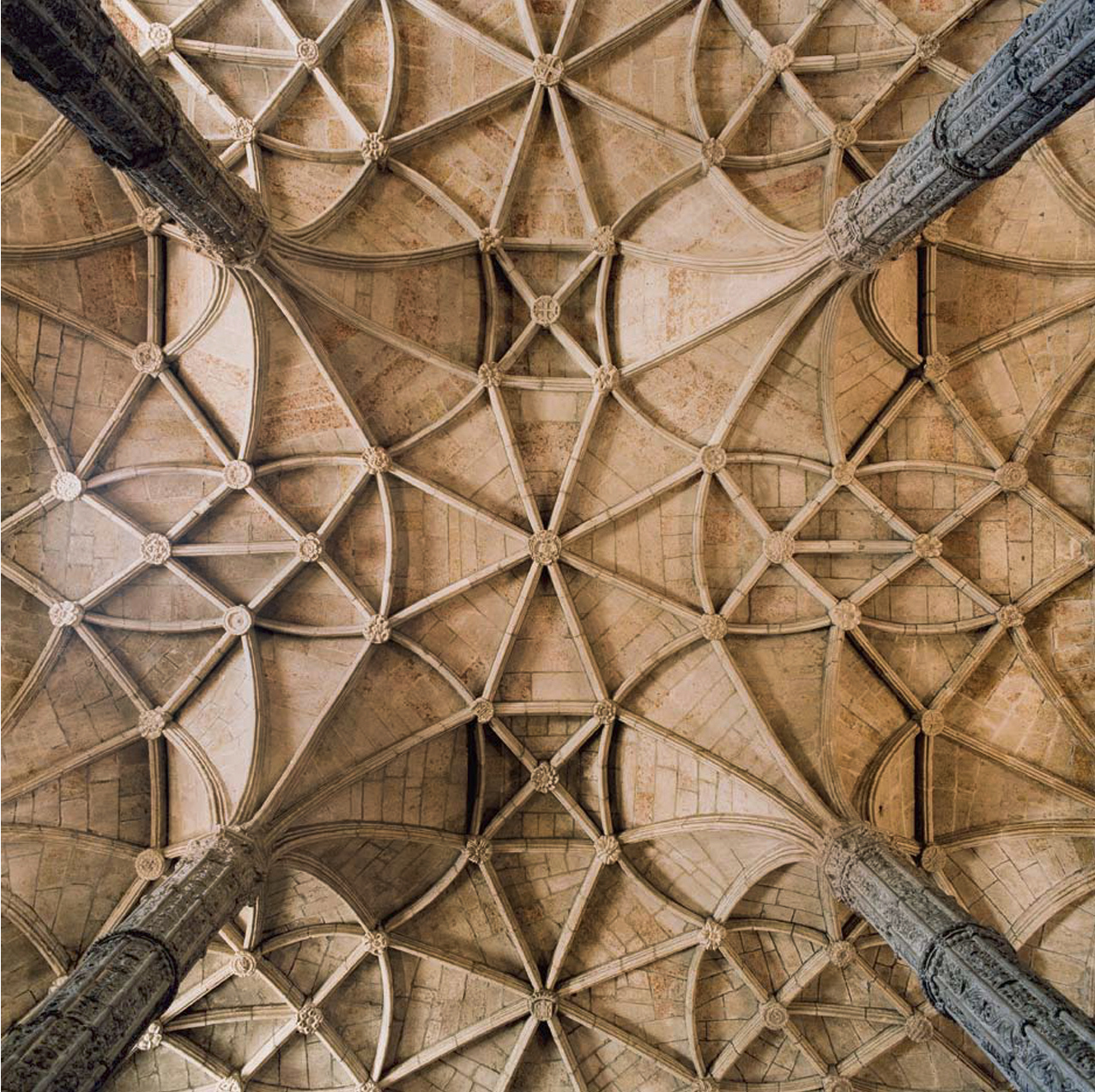
In this exhibition some of the singular images such as the Crossings, Choirs and Nave of the Church of Santa Maria, Hieronymite Monastery, Belém, Portugal (see photograph below) work best to achieve this revelation. They transcend the groundedness of the earthly plane through their inner ethereal light using a reductive colour palette and strong highlight/shadow detail. Conversely the diptychs and triptychs of Nave and Choir (see photographs below and above) fail to impress. The singular prints pinned to the gallery wall are joined together to form pairs and trios but in this process the ‘space between’ the prints (mainly white photographic paper), the breathing space between two or more photographs that balances their disparate elements, the distance that Minor White calls ‘ice / fire’, does not work. There is no tension, no crackle, no visual crossover of the arches and vaults, spandrels and flutes. Here it is dead space that drags all down with it.

I found myself observing without engagement, looking without wonder or feeling – never a good sign!

The photographs of Domes and Vaults have served David Stephenson well for numerous years but the concept has become tired, the inspiration in need of refreshment through other avenues of exploration – both physical and spiritual.

Dr Marcus Bunyan


1/ White, Minor. “Equivalence: The Perennial Trend,” in PSA Journal, Vol. 29, No. 7, pp. 17-21, 1963 [Online] Cited 08/05/2019

2/ White, Minor. “Three Canons,” from Mirrors, Messages, Manifestations. Viking Press, 1969


Many thankx to Daniel and John Buckley Gallery for allowing me to reproduce the photographs from the exhibition. Please click on the photographs for a larger version of the image.


David Stephenson (Australian born America, b. 1955) 'Choir, Laon Cathedral, Laon, France' 2006/07 from the exhibition 'Heavenly Vaults' by David Stephenson at John Buckley Gallery, Richmond, Nov 2009


David Stephenson (Australian born America, b. 1955)
Choir, Laon Cathedral, Laon, France
2006/2007


David Stephenson (Australian born America, b. 1955) 'St. Hugh’s Choir, Lincoln Cathedral, Lincoln, England' 2006/07 from the exhibition 'Heavenly Vaults' by David Stephenson at John Buckley Gallery, Richmond, Nov 2009


David Stephenson (Australian born America, b. 1955)
St. Hugh’s Choir, Lincoln Cathedral, Lincoln, England
2006/2007


Installation view of 'Heavenly Vaults' by David Stephenson at John Buckley Gallery, Richmond


Installation view of Heavenly Vaults by David Stephenson at John Buckley Gallery, Richmond
Photo: Marcus Bunyan


David Stephenson (Australian born America, b. 1955) 'Nave, Cathedral of St. Barbara, Kutná Hora, Czech Republic' 2008/09


David Stephenson (Australian born America 1955)
Nave, Cathedral of St. Barbara, Kutná Hora, Czech Republic
2008/2009


David Stephenson (Australian born America, b. 1955) 'Choir, Cathedral of St. Barbara, Kutná Hora, Czech Republic' 2008/09


David Stephenson (Australian born America 1955)
Choir, Cathedral of St. Barbara, Kutná Hora, Czech Republic
2008/2009


“While the subject of my photographs has shifted… my art has remained essentially spiritual – furthermore than two decades I have been exploring a contemporary expression of the sublime – a transcendental experience of awe with the vast space and time of existence.”


David Stephenson


Internationally renowned photographer David Stephenson has dedicated his practice to capturing the sublime in nature and architecture. Fresh from a successful exhibition at Julie Saul Gallery in New York, Stephenson returns to John Buckley Gallery for his third highly anticipated exhibition Heavenly Vaults. The exhibition will feature 26 selected prints from his latest monograph published by Princeton Architectural Press; Heavenly Vaults: From Romanesque to Gothic in European Architecture. Shaun Lakin, Director of the Monash Gallery of Art, will launch the book and exhibition at the opening, November 7th.

Stephenson began to photograph Gothic vaults in Spain and Portugal in 2003, while completing the work for his Domes project, and his first monograph Visions of Heaven: the Dome in European Architecture. He began to focus on the Vaults project in 2006, photographing Gothic churches and cathedrals in England, Belgium and France. With the assistance of an Australia Council Artist Fellowship in 2008-2009, Stephenson completed extensive fieldwork for the Vaults project, intensively photographing Romanesque and Gothic architecture in Italy, France, Spain, Portugal, Austria, the Czech Republic, Poland, and Germany. The exhibition at John Buckley Gallery coincides with the launch of his second monograph, Heavenly Vaults: from Romanesque to Gothic in European Architecture, published by Princeton Architectural Press, New York.

Even though the traditional systems the underpinned church architecture have lost their unequivocal power, David Stephenson’s photographs capture the resonance of those times. More importantly his work also suggest that the feelings of aspiration, transcendence, and infinity these buildings evoke in the viewer have an ongoing relevance beyond the religious setting and help us understand who and what we are.

Excerpt from Foreword, Heavenly Vaults, by Dr Isobel Crombie 2009


David Stephenson’s new book of photography is a love letter to the intricate, seemingly sui generis vaults of Europe’s Romanesque and Gothic cathedrals and churches.

Press release from the John Buckley website [Online] Cited 11/11/2009 no longer available online


David Stephenson (Australian born America, b. 1955) 'Nave, Church of Santa Maria, Hieronymite Monastery, Belém, Portugal' 2008/09


David Stephenson (Australian born America, b. 1955)
Nave, Church of Santa Maria, Hieronymite Monastery, Belém, Portugal
2008/2009


‘While the subject of my photographs has shifted from the landscapes of the American Southwest and Tasmania, and the minimal horizons of the Southern Ocean, and the icy wastes of Antarctica, to sacred architecture and the sky at both day and night, my art has remained essentially spiritual – for more than two decades I have been exploring a contemporary expression of the sublime – a transcendental experience of awe with the vast space and time of existence.’

David Stephenson 1998.1


With poetic symmetry the Domes series considers analogous ideas. It is a body of work which has been ongoing since 1993 and now numbers several hundred images of domes in countries including Italy, Spain, Portugal, Turkey, England, Germany and Russia. The typological character of the series reveals the shifting history in architectural design, geometry and space across cultures and time, demonstrating how humankind has continually sought meaning by building ornate structures which reference a sacred realm.2 Stephenson photographs the oculus – the eye in the centre of each cupola. Regardless of religion, time or place, this entry to the heavens – each with unique architectural and decorative surround – is presented as an immaculate and enduring image. Placed together, the photographs impart the infinite variations of a single obsession, while also charting the passage of history, and time immemorial.

1. Van Wyk, S. 1998. “Sublime space: photographs by David Stephenson 1989-1998,” National Gallery of Victoria, Melbourne np
2. Hammond, V. 2005. “The dome in European architecture,” in Stephenson, D. 2005, Visions of heaven: the dome in European architecture, Princeton Architectural Press, New York p. 190

© Art Gallery of New South Wales Photography Collection Handbook, 2007


David Stephenson (Australian born America, b. 1955) 'Choir, King's College Chapel, Cambridge, England' 2006/07


David Stephenson (Australian born America, b. 1955)
Choir, King’s College Chapel, Cambridge, England
2006/2007


David Stephenson (Australian born America, b. 1955) 'Crossing, York Minster, York, England' 2006/07


David Stephenson (Australian born America, b. 1955)
Crossing, York Minster, York, England
2006/2007


John Buckley Gallery

This gallery is now closed.

LIKE ART BLART ON FACEBOOK

Back to top

Review: ‘Unforced Intimacies’ by Patricia Piccinini at Tolarno Galleries, Melbourne

Exhibition dates: 22nd October – 21st November 2009


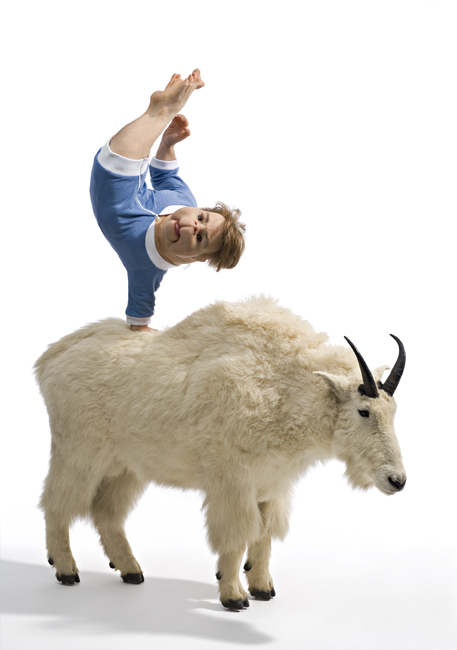
Patricia Piccinini (Australian, b. 1965) 'The Strength of one Hand (With Canadian Mountain Goat)' 2009 from the exhibition 'Unforced Intimacies' by Patricia Piccinini at Tolarno Galleries, Melbourne, Oct - Nov, 2009


Patricia Piccinini (Australian, b. 1965)
The Strength of one Hand (With Canadian Mountain Goat)
2009
Silicone, fibreglass, human hair, clothing, Canadian Mountain Goat


We are the clouds that veil the midnight moon;
How restlessly they speed, and gleam, and quiver,
Streaking the darkness radiantly! – yet soon
Night closes round, and they are lost forever:

Or like forgotten lyres, whose dissonant strings
Give various response to each varying blast,
To whose frail frame no second motion brings
One mood or modulation like the last.

We rest. – A dream has power to poison sleep;
We rise. – One wandering thought pollutes the day;
We feel, conceive or reason, laugh or weep;
Embrace fond foe, or cast our cares away:

It is the same! – For, be it joy or sorrow,
The path of its departure still is free:
Man’s yesterday may ne’er be like his morrow;
Nought may endure but Mutability.

Mutability by Percy Bysshe Shelley


When human imagination takes flight, as it does in this exhibition, the results are superlative. Piccinini is at the height of her powers as an artist, in full control of the conceptual ideas, their presentation and the effect that they have on the viewer. Witty, funny, thought-provoking and at times a little scary Piccinini’s exhibition (paradoxically entitled Unforced Intimacies) is an act of revelatio: the pulling aside of the genetic curtain to see what lies beneath.

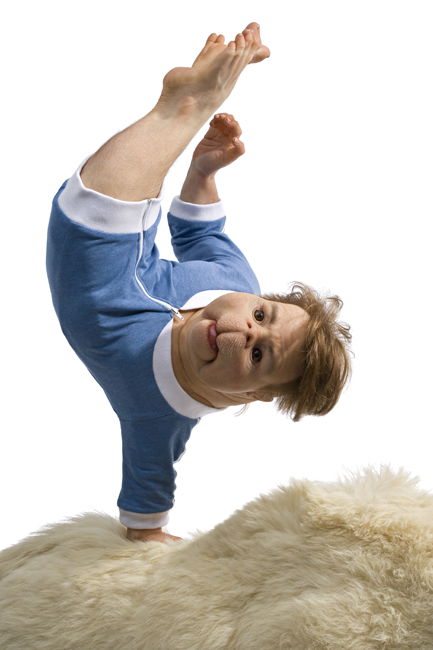
Featuring hyperrealist genetically modified creatures and human child figures Piccinini’s sculptures, drawings and video seem passionately alive in their verisimilitude (unlike Ricky Swallow’s resplendently dead relics at the NGV). In The Strength of one Hand (With Canadian Mountain Goat), the title perhaps a play on the traditional Zen koan The Sound of One Hand Clapping, a meditation on the nature of inner compassion, a walrus-child balances on one hand on the back of a Canadian Mountain Goat. The walrus-child has extended eyes, a voluminous lower lip with whiskers under the nose; the hyperreality of the hand on the back of the goat makes it seem like the hand will come alive! A mane of hair flows down the walrus-child’s back to feet that are conjoined – like an articulated merman – ending not in flippers but in toes complete with dirty, cracked and broken nails. Here the natural athleticism of the mountain goat, now dead and stuffed, is surmounted by the mutated walrus-child’s natural athleticism, poignantly suspended like an exclamation mark above the in-animate pommel horse.

In Balasana (The Child’s Pose) a child reposes in the yoga position on a tribal rug. Balanced on top of the child is a stuffed Red-necked Wallaby that perfectly inverts the concave of the child’s back, it’s front feet curled over while it’s rear feet are splayed. The luminosity of the skin of the child is incredible – such a technical feat to achieve this realism – that you are drawn to intimately examine the child’s face and hands. The purpose of The Child’s Pose in yoga is that it literally reminds us of our time as an infant and revives in us rather vivid memories of lying in this position. It also reminds us to cultivate our inner innocence so that we in turn may see the world without judgement or criticism. The paradoxes of the ‘unforced’ intimacy between the child and the wallaby can be read with this conceptualisation ‘in mind’.

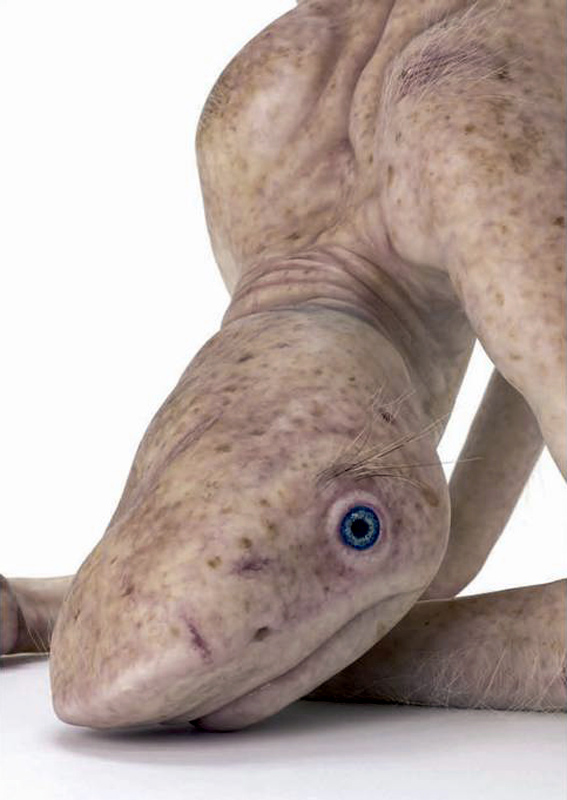
With The Bottom Feeder (2009) Piccinini’s imagination soars to new heights. With the shoulders of a human, the legs and forearms of what seems like a marsupial, the lowered head of a newt with intense staring blue eye (see photograph above), luminescent freckled skin covered in hair and a rear end that consists of both male and female genitalia that forms a ‘face’, the hermaphroditic bottom feeder is a frighteningly surreal visage. Inevitably the viewer is drawn to the exposed rump through a seemingly unforced interactivity, examining the folds and flaps of the labia and the hanging scrotum of this succulent feeder. Here Piccinini draws on psychoanalysis and Lacan’s theory of the mirror stage in a child’s development – where the child wants to merge with the mother to erase the self / other split by fulfilling the mother’s desire by having sex with her – thus erasing the mother’s lack, the idea of lack represented by the lack of a penis.1

As Jean Baudrillard notes of the mass of bodies on Brazil’s Copacabana beach, “Thousands of bodies everywhere. In fact, just one body, a single immense ramified mass of flesh, all sexes merged. A single, shameless expanded human polyp, a single organism, in which all collude like the sperm in seminal fluid … The sexual act is permanent, but not in the sense of Nordic eroticism: it is the epidermal promiscuity, the confusion of bodies, lips, buttocks, hips – a single fractal entity disseminated beneath the membrane of the sun.”2

An so it is here, all sexes merged within the anthropomorphised body of The Bottom Feeder, a body that challenges and subverts human perceptions of the form and sexuality of animals (including ourselves) that inhabit the world.

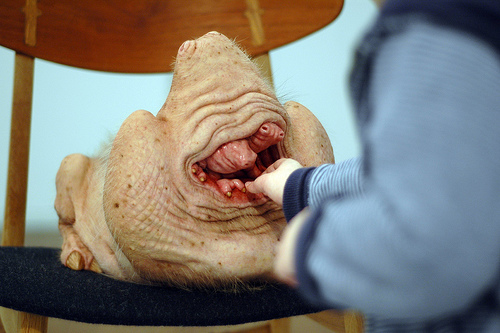
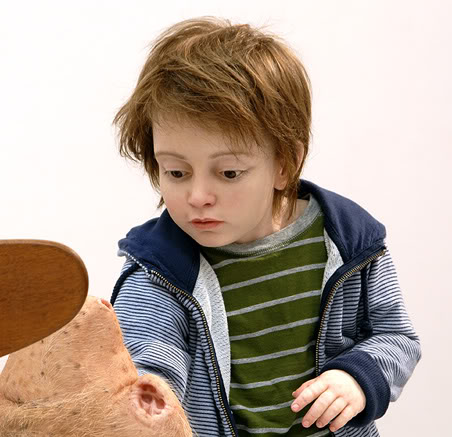
In Doubting Thomas (2008), my favourite piece in the exhibition, a skeptical child with pale and luminous skin is about to put his hand inside the mouth of a genetically modified mole like creature that has reared it’s hairy snout to reveal a luscious, fluid-filled mouth replete with suckers and teeth. You want to shout ‘No, don’t go there!’ as the child’s absent mother has probably already warned him – to no avail. Children only learn through experience, I suspect in this case a nasty one.


The terrains the Piccinini interrogates (nature and artifice, biogenetics, cloning, stem cell research, consumer culture) are a rematerialisation of the actual world through morphological ‘mapping’ onto the genomes of the future. Morphogenetic fields3 seem to surround the work with an intense aura; surrounded by this aura the animals and children become more spiritual in their silence. Experiencing this new world promotes an evolution in the way in which we conceive the future possibilities of life on this earth, this brave but mutably surreal new world.

This is truly one of the best exhibitions of the year in Melbourne.

Dr Marcus Bunyan


1/ Klages, M. Jacques Lacan. Boulder: University of Colorado, 2001 [Online] Cited 09/10/2009 no longer available online

2/ Baudrillard, Jean. Fragments: Cool Memories III, 1990-1995. London: Verso, 1997, p. 74

3/ “A morphogenetic field is a group of cells able to respond to discrete, localised biochemical signals leading to the development of specific morphological structures or organs.” Morphogenetic field definition on Wikipedia [Online] Cited 05/05/2019


    Patricia Piccinini (Australian, b. 1965) 'The Strength of one Hand (With Canadian Mountain Goat)' 2009 from the exhibition 'Unforced Intimacies' by Patricia Piccinini at Tolarno Galleries, Melbourne, Oct - Nov, 2009


    Patricia Piccinini (Australian, b. 1965)
    The Strength of one Hand (With Canadian Mountain Goat)
    2009
    Silicone, fibreglass, human hair, clothing, Canadian Mountain Goat


    Patricia Piccinini (Australian, b. 1965) 'The Strength of one Hand (With Canadian Mountain Goat)' 2009 (detail) from the exhibition 'Unforced Intimacies' by Patricia Piccinini at Tolarno Galleries, Melbourne, Oct - Nov, 2009


    Patricia Piccinini (Australian, b. 1965)
    The Strength of one Hand (With Canadian Mountain Goat) (detail)
    2009
    Silicone, fibreglass, human hair, clothing, Canadian Mountain Goat


    Patricia Piccinini (Australian, b. 1965) 'The Bottom Feeder' 2009

    Patricia Piccinini (Australian, b. 1965) 'The Bottom Feeder' 2009


    Patricia Piccinini (Australian, b. 1965)
    The Bottom Feeder
    2009
    Silicone, fibreglass, steel, fox fur


    Patricia Piccinini (Australian, b. 1965) 'The Bottom Feeder' 2009 (detail)


    Patricia Piccinini (Australian, b. 1965)
    The Bottom Feeder (detail)
    2009
    Silicone, fibreglass, steel, fox fur


    Exploring concepts of what is “natural” in the digital age, Patricia Piccinini brings a deeply personal perspective to her work.

    Rachel Kent notes: “Since the early 1990s, Piccinini has pursued an interest in the human form and its potential for manipulation and enhancement through bio-technical intervention. From the mapping of the human genome to the growth of human tissue and organs from stem cells, Piccinini’s art charts a terrain in which scientific progress and ethical questions are intertwined.”

    Text from the Tolarno Galleries website [Online] Cited 05/05/2019 no longer available online


    Patricia Piccinini (Australian, b. 1965) 'Doubting Thomas' 2008


    Patricia Piccinini (Australian, b. 1965)
    Doubting Thomas
    2008
    Silicone, fibreglass, human hair, clothing, chair


    Patricia Piccinini (Australian, b. 1965) 'Doubting Thomas' 2008 (detail)


    Patricia Piccinini (Australian, b. 1965)
    Doubting Thomas (detail)
    2008


    Patricia Piccinini (Australian, b. 1965) 'Doubting Thomas' 2008 (detail)

    Patricia Piccinini (Australian, b. 1965) 'Doubting Thomas' 2008 (detail)


    Patricia Piccinini (Australian, b. 1965)
    Doubting Thomas (detail)
    2008


    “Time and again my work returns to children, and their ambiguous relationships with the (only just) imaginary animals that I create. Children embody a number of the key issues in my work. Obviously they directly express the idea of genetics – both natural and artificial – but beyond that they also imply the responsibilities that a creator has to their creations. The innocence and vulnerability of children is powerfully emotive and evokes empathy – their presence softens the hardness of some of the more difficult ideas, but it can also elevate the anxiety level.”


    Patricia Piccinini quoted on the Kaldor Public Art Projects website [Online] Cited 05/11/2009 no longer available online


    “I am interested in the way that contemporary biotechnology and even philosophy erode the traditional boundaries between the artificial and the natural, as well as between species and even the basic distinctions between animal and human.”


    Patricia Piccinini quoted in Sarah Hetherington. “Patricia Piccinini: Related Individuals,” on the Artlink website [Online] Cited 05/05/2019. No longer available online


    Patricia Piccinini (Australian, b. 1965) 'Balasana' 2009 (detail)


    Patricia Piccinini (Australian, b. 1965)
    Balasana
    Silicone, fibreglass, human hair, clothing, Red-necked Wallaby, rug
    2009


    Tolarno Galleries
    Level 4, 104 Exhibition Street,
    Melbourne, Vic, 3000
    Phone: +61 3 9654 6000

    Opening hours:
    Tuesday – Friday 10am – 5pm
    Saturday 1 – 5pm

    Tolarno Galleries website

    LIKE ART BLART ON FACEBOOK

    Back to top

    Review: ‘Long Distance Vision: Three Australian Photographers’ at The Ian Potter Centre NGV Australia, Federation Square, Melbourne

    Exhibition dates: 28th August, 2009 – 21st February, 2010


    Max Pam (born Australia 1949, lived in Brunei 1980-1983) 'Road from Bamiyan' 1971 from the exhibition 'Long Distance Vision: Three Australian Photographers' at The Ian Potter Centre NGV Australia, Federation Square, Melbourne, Aug 2009 - Feb 2010


    Max Pam (born Australia 1949, lived in Brunei 1980-1983)
    Road from Bamiyan
    1971
    Gelatin silver photograph
    20.1 x 20.1cm
    National Gallery of Victoria, Melbourne
    Purchased, 1979


    Long Distance Vision is a disappointingly wane exploration of travel photography at NGV Australia. With the exception of the work of Max Pam the exhibition lacks insight into the phenomena that the curators want the work to philosophically investigate: namely how photographs shape our expectations of a place (even before we arrive) and how photographs also serve to confirm our experience – the picture as powerful mnemonic tool.

    Firstly a quick story: when travelling in America to study at the Kinsey Institute I boarded a train from Chicago to what I thought was Bloomington, Indiana only to arrive many hours later at Bloomington, Illinois. Unbeknownst to me this Bloomington also had a motel of the same name as I was staying at in Indiana! After much confusion I ended up at the local airport trying to catch a single seater aircraft to Bloomington, Indiana with no luck – at the end of my tether, fearful in a foreign country, in tears because I just had to be at this appointment the next morning. Riding to my rescue was a nineteen year old kid with no shoes, driving an ex-cop car, who drove me across the Mid-West states stopping at petrol stops in the dead of night. It was a surreal experience, one that I will never forget for the rest of my life … fear, apprehension, alienation, happiness, joy and the sublime all rolled into one.

    I tell this story to illustrate a point about travel – that you never know what is going to happen, what experiences you will have, even your final destination. To me, photographs of these adventures not only document this dislocation but step beyond pure representation to become art that re-presents the nature of our existence.

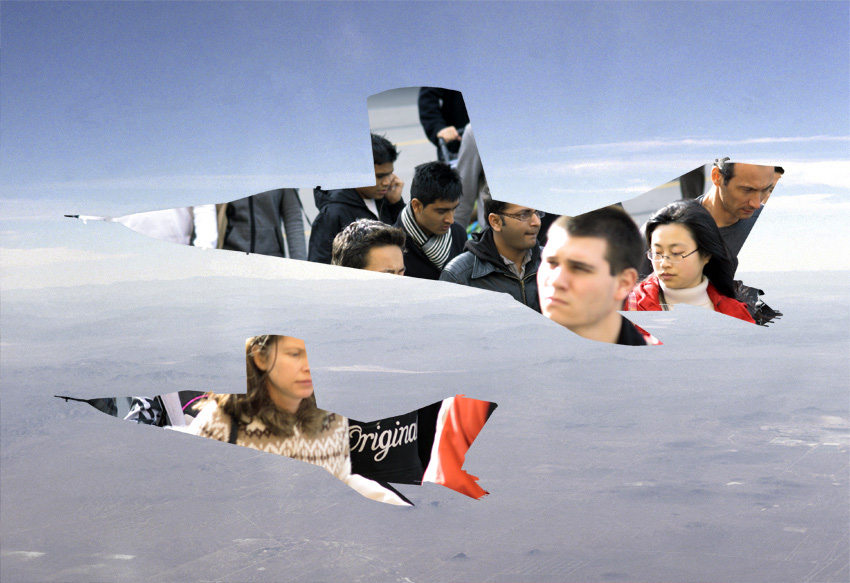
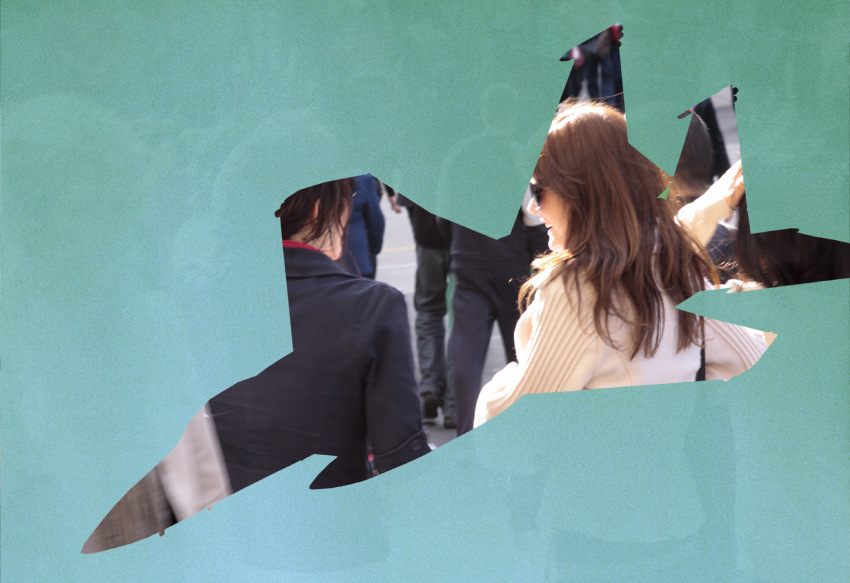
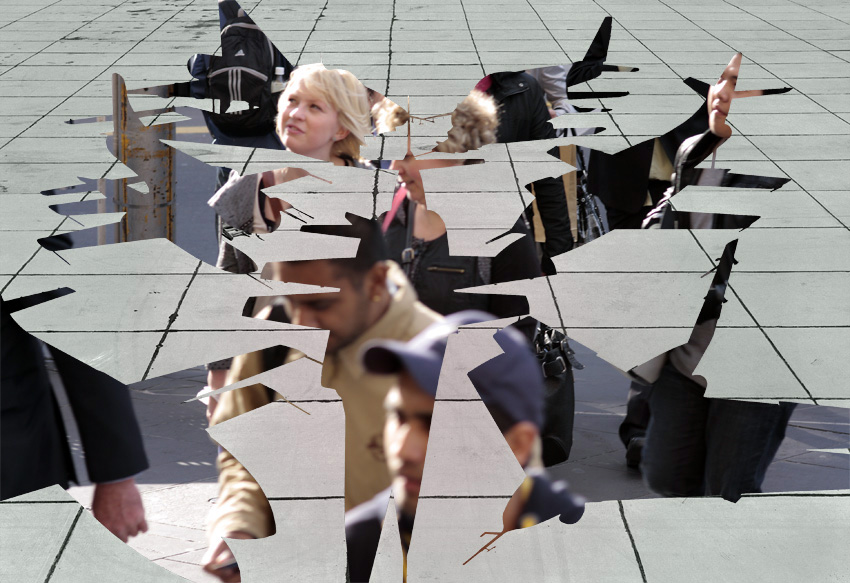
    Matthew Sleeth‘s street photographs could be taken almost anywhere in the world (if it were not for a building with German writing on it). His snapshot aesthetic of caught moments, blinded people and dissected bodies in the observed landscape are evinced (to show in a clear manner; to prove beyond any reasonable doubt; to manifest; to make evident; to bring to light; to evidence – yes to bring to light, to evidence as photography does!) in mundane, dull, almost lifeless prints – ‘heavy’ photographs with a lack of shadow detail combined with a shallow depth of field. His remains, the people walking down the street and their shadow, are odd but as as The Age art critic Robert Nelson succinctly notes in his review of this exhibition, To become art, the odd cannot remain merely quaint but has to signify an existential anomaly by implication.”1

    If we look at the seminal photographs from the book The Americans by Robert Frank we see in their dislocated view of America a foreigners view of the country the artist was travelling across – a subjective view of America that reveals as much about the state of mind of the artist as the country he was exposing. No such exposition happens in the works of Matthew Sleeth.

    Christine Godden‘s photographs of family and friends have little to do with travel photography and I struggle to understand their inclusion in this exhibition. Though they are reasonable enough photographs in their own right – small black and white photographs of small intimacies (at the beach, in the garden, at the kitchen table, on the phone, on the porch, on the float, etc…) Godden’s anthropomorphist bodies have nothing to do with a vision of a new land as she had been living in San Francisco, New York and Rochester for six years over the period that these photographs were taken. Enough said.

    The highlight of the exhibition is the work of Max Pam. I remember going the National Gallery of Victoria in the late 1980s to view this series of work in the collection – and what a revelation they were then and remain so today. The square formatted, dark sepia toned silver gelatin prints of the people and landscapes of Tibet are both monumental and personal at one and the same time. You are drawn into their intimacies: the punctum of a boys feet; the gathering of families; camels running before a windstorm; human beings as specks in a vast landscape.

    “If the world is unfair or beyond our understanding, sublime places suggest it is not surprising things should be thus. We are the playthings of the forces that laid out the oceans and chiselled the mountains. Sublime places acknowledge limitations that we might otherwise encounter with anxiety or anger in the ordinary flow of events. It is not just nature that defies us. Human life is as overwhelming, but it is the vast spaces of nature that perhaps provide us with the finest, the most respectful reminder of all that exceeds us. If we spend time with them, they may help us to accept more graciously the great unfathomable events that molest our lives and will inevitably return us to dust.”2

    The meditation on place and space that the artist has undertaken gives true insight into the connection of man and earth, coming closest to Alain de Botton’s understanding of the significance of sublime places. Through a vision of a distant land the photographs transport us in an emotional journey that furthers our understanding of the fragility of life both of the planet and of ourselves.

    While the National Gallery of Victoria holds some excellent photography exhibitions (such as Andreas Gursky and Rennie Ellis for example) this was a missed opportunity. The interesting concept of the exhibition required a more rigorous investigation instead of such a cursory analysis (which can be evidenced by the catalogue ‘essay’: one page the size of a quarter of an A4 piece of paper that glosses over the whole history of travel photography in a few blithe sentences).

    Inspiration could have easily been found in Alain de Botton’s excellent book The Art of Travel. Here we find chapters titled “On Anticipation”, “On Travelling Places”, “On the Exotic”, “On Curiosity”, “On the Country and the City” and “On the Sublime” to name but a few, with places and art work to illustrate the journey: what more is needed to excite the mind!

    Take Charles Baudelaire for example. He travelled outside his native France only once and never ventured abroad again. Baudelaire still dreamt of going to Lisbon, or Java or to the Netherlands but “the destination was not really the point. The true desire was to get away, to go, as he concluded, ‘Anywhere! Anywhere! So long as it is out of the world!'”3

    Heavens, we don’t even have to leave home to create travel photography that is out of the world! Our far-sighted vision (like that of photographer Gregory Crewdson) can create psychological narratives of imaginative journeys played out for the camera.

    Perhaps what was needed was a longer gestation period, further research into the theoretical nuances of travel photography (one a little death, a remembrance; both a dislocation in the non-linearity of time and space), a gathering of photographs from collections around Australia to better evidence the conceptual basis for the exhibition and a greater understanding of the irregular possibilities of travel photography – so that the work and words could truly reflect the title of the exhibition Long Distance Vision.

    Dr Marcus Bunyan


    1/ Nelson, Robert. “In blurred focus: le freak c’est chic,” in The Age newspaper. Friday, October 23rd 2009, p. 18

    2/ de Botton, Alain. The Art of Travel. London: Penguin, 2002, p. 178-179

    3/ Ibid., p. 34


    Max Pam (born Australia 1949, lived in Brunei 1980-83) 'My donkey, our valley, Sarchu' 1977 from the exhibition 'Long Distance Vision: Three Australian Photographers' at The Ian Potter Centre NGV Australia, Federation Square, Melbourne, Aug 2009 - Feb 2010


    Max Pam (born Australia 1949, lived in Brunei 1980-1983)
    My donkey, our valley, Sarchu
    1977
    Gelatin silver photograph
    20.1 x 20.1cm
    National Gallery of Victoria, Melbourne
    Purchased, 1979
    © Max Pam


    Max Pam (Australian, b. 1949) 'Sisters' 1977 from the exhibition 'Long Distance Vision: Three Australian Photographers' at The Ian Potter Centre NGV Australia, Federation Square, Melbourne, Aug 2009 - Feb 2010


    Max Pam (born Australia 1949, lived in Brunei 1980-1983)
    Sisters
    1977
    Gelatin silver photograph
    20.1 x 20.1cm
    National Gallery of Victoria, Melbourne
    Purchased, 1979
    © Max Pam


    Max Pam (Australian, b. 1949) 'Tibetan nomads' 1977


    Max Pam (born Australia 1949, lived in Brunei 1980-1983)
    Tibetan nomads
    1977
    Gelatin silver photograph
    20.1 x 20.2cm
    National Gallery of Victoria, Melbourne
    Purchased, 1979
    © Max Pam


    Christine Godden (Australian, b. 1947) 'Bobbie and Amitabha at the beach' c. 1972


    Christine Godden (Australian, b. 1947)
    Bobbie and Amitabha at the beach
    c. 1972
    Gelatin silver photograph
    13.2 x 20.1cm
    National Gallery of Victoria, Melbourne
    Purchased from Admission Funds, 1991
    © Christine Godden


    Christine Godden (Australian, b. 1947) 'Elliot holding a ring' 1973


    Christine Godden (Australian, b. 1947)
    Elliot holding a ring
    1973
    Gelatin silver photograph
    15.0 x 22.8cm
    National Gallery of Victoria, Melbourne
    Purchased from Admission Funds, 1991
    © Christine Godden


    Christine Godden.Christine Godden (Australian, b. 1947)kitchen table' 1973


    Christine Godden (Australian, b. 1947)
    Joanie at the kitchen table
    1973, printed 1986
    Gelatin silver photograph
    20.1 x 30.6cm
    National Gallery of Victoria, Melbourne
    Purchased from Admission Funds, 1991
    © Christine Godden


    Christine Godden (Australian, b. 1947) 'With Leigh on the porch' 1972


    Christine Godden (Australian, b. 1947)
    With Leigh on the porch
    1972, printed 1986
    Gelatin silver photograph
    20.2 x 30.5cm
    National Gallery of Victoria, Melbourne
    Purchased from Admission Funds, 1991
    © Christine Godden


    “The National Gallery of Victoria will celebrate the work of Christine Godden, Max Pam and Matthew Sleeth in a new exhibition, Long Distance Vision: Three Australian Photographers opening 28 August.

    Long Distance Vision will include over 60 photographs from the NGV Collection exploring the concept of the ‘tourist gaze’ and its relationship with the three artists.

    Susan van Wyk, Curator Photography, NGV said the exhibition provides a fascinating insight into the unusual perspective brought by the three photographers to their varied world travel destinations.

    “There’s a sense in the works in the exhibition that the photographers are not from the places they choose to photograph, and that each is a visitor delighting in the scenes they encounter.

    “What is notable about the photographs in Long Distance Vision is that rather than focussing on the well known scenes that each artist encountered, they have turned their attention to the ‘little things’, the details of the everyday,” said Ms van Wyk.

    From the nineteenth century, photography has been a means by which people could discover the world, initially through personal collection and albums, and later via postcards, magazines, books and the internet.

    Dr Gerard Vaughan, Director, NGV said that both contemporary photographers and tourists use the camera as a means to explore and capture the world.

    “Through their photographs, the three artists featured in Long Distance Vision show us highly individual ways of seeing the world. This exhibition will surprise and delight visitors as our attention is drawn to not only what is different but what remains the same as we travel the world,” said Dr Vaughan.

    Born in Melbourne in 1949, Max Pam began his career in various commercial photography studios in the 1960s. After responding to a university notice for assistance to drive a Volkswagen from Calcutta to London in 1969, Pam got his first taste of being a traveller. The body of Pam’s work in this exhibition is from the series The Himalayas, which was photographed over a number of early visits to India.

    Christine Godden also travelled the popular overland route between Europe and India in the early 1970s, returning to Sydney in 1978. In 1972, after a period of travelling, Godden found her home in the US where she remained for six years. Godden’s photographs in this exhibition were taken between 1972 and 1974 during her stay in the US.

    Born in Melbourne in 1972, Matthew Sleeth is another seasoned traveller. During the late 1990s, Sleeth settled in Opfikon, an outer suburb of Zurich, Switzerland. The series of photographs in Long Distance Vision were taken during this time, showing Sleeth’s interest not only in street photography, but also in the narrative possibilities in everyday scenes. Dotted with garishly coloured playhouses, naive sculptures and whimsical arrangements of garden gnomes Sleeth’s photographs go beyond the ‘picture-perfect’ scenes of typical tourist photography.

    Long Distance Vision: Three Australian Photographers is on display at The Ian Potter Centre: NGV Australia, Federation Square from 28 August 2009 to 21 February 2010.”

    Text from the National Gallery of Victoria press release


    Matthew Sleeth (Australian, b. 1972) From the series 'Opfikon' 1997

    Matthew Sleeth (Australian, b. 1972) From the series 'Opfikon' 1997

    Matthew Sleeth (Australian, b. 1972) From the series 'Opfikon' 1997

    Matthew Sleeth (Australian, b. 1972) From the series 'Opfikon' 1997

    Matthew Sleeth (Australian, b. 1972) From the series 'Opfikon' 1997


    Matthew Sleeth (Australian, b. 1972)
    Photographs from the series Opfikon
    1997, printed 2004
    Type C photograph
    43.2 x 43.0cm
    National Gallery of Victoria, Melbourne
    Presented through the NGV Foundation by Patrick Corrigan, Governor, 2005
    © Matthew Sleeth courtesy of Sophie Gannon Gallery, Melbourne


    The Ian Potter Centre: NGV Australia Federation Square
    Corner of Russell and 
Flinders Streets, Melbourne

    Opening hours:
    Every day 10am – 5pm

    National Gallery of Victoria website

    LIKE ART BLART ON FACEBOOK

    Back to top

    Exhibition: ‘William Christenberry: Photographs, 1961-2005’ at the Morris Museum of Art, Augusta, Georgia

    Exhibition dates: 12th September – 8th November, 2009


    Many thankx to the Morris Museum of Art for allowing me to publish the photographs in the posting. Please click on the photographs for a larger version of the image.


    William Christenberry (American, 1936-2016) 'Green Warehouse, Newbern, Alabama' 1997 from the exhibition 'William Christenberry: Photographs, 1961-2005' at the Morris Museum of Art, Augusta, Georgia, Sept - Nov, 2009


    William Christenberry (American, 1936-2016)
    Green Warehouse, Newbern, Alabama
    1997
    Dye coupler print


    Widely recognised as a pioneer in the field of colour photography, William Christenberry has used this expressive medium to explore the American South for forty years. While pursuing this artistic quest he has drawn inspiration from Walker Evans, and influenced a generation of emerging photographers. William Christenberry: Photographs, 1961-2005 surveys his poetic documentation of southern vernacular architecture, signage, and landscape using a wide range of cameras, from his earliest Brownie photographs of the early 1960s to his later work with a large-format camera. Combining never-before-seen photographs, both old and new, with images that are now iconic, this exhibition comprises fifty vintage photographic works and one sculpture. Together, they convey the breadth of his singular photographic vision. Discuss the artistic objectives of his long-term interpretation of the Southern landscape with Michelle Norris of National Public Radio, Christenberry explained: “What I really feel very strongly about, and I hope reflects in all aspects of my work, is the human touch, the humanness of things, the positive and sometimes the negative and sometimes the sad.”

    Text from the Morris Museum of Art website [Online] Cited 15/10/2009. No longer available online


    William Christenberry (American, 1936-2016) 'House and Car, near Akron, Alabama' 1981 from the exhibition 'William Christenberry: Photographs, 1961-2005' at the Morris Museum of Art, Augusta, Georgia, Sept - Nov, 2009


    William Christenberry (American, 1936-2016)
    House and Car, near Akron, Alabama
    1981


    William Christenberry (American, 1936-2016) 'Kudzu with Storm Cloud, near Akron, Alabama' 1981


    William Christenberry (American, 1936-2016)
    Kudzu with Storm Cloud, near Akron, Alabama
    1981


    “William Christenberry Photographs, 1961-2005, a phenomenal retrospective exhibition of Christenberry’s photographs, opens to the public at the Morris Museum of Art on September 16, 2009. The Morris Museum is the only Georgia venue hosting this exhibition.

    “‘William Christenberry Photographs, 1961-2005’ is an overview of the career of one of the South’s most important living artists,” said Kevin Grogan, director of the Morris Museum of Art. “Organised by the Aperture Foundation, this exhibition brings to Augusta a body of work like no other. No one has so scrupulously and attentively captured a sense of place and time in quite the way that Bill Christenberry has. He is a remarkable artist, as is proven by this extraordinary body of work. He is America’s Proust.”

    Since the early 1960s, William Christenberry has plumbed the regional identity of the American South, focusing his attention primarily on his childhood home, Hale County, Alabama. Widely recognised as a pioneer in the field of colour photography, Christenberry draws inspiration from the work of Walker Evans, while paralleling the work of such international practitioners as Bernd and Hilla Becher. Ranging from his earliest Brownie photographs to his later work with a large-format camera, William Christenberry Photographs, 1961-2005 is a survey of the artist’s poetic documentation of the Southern landscape and vernacular architecture that surrounded him as he grew up. The exhibition, coupling never-before-seen photographs with images that are now iconic, reveals how the history, the very story of place, is at the heart of Christenberry’s ongoing project. While the focus of his work is the American South, it touches on universal themes related to family, culture, nature, spirituality, memory, and ageing. Christenberry photographs real things in the real world – ramshackle buildings, weathered commercial signs, lonely back roads, rusted-out cars, whitewashed churches, decorated graves. Dutifully returning to photograph the same locations annually – the green barn, the palmist building, the Bar-B-Q Inn, among others – he has fulfilled a personal ritual and documented the physical changes wrought by every single year. Straddling past and present, Christenberry’s art suggests the gravity and power of the passage of time.

    The exhibition is accompanied by a stunning monograph entitled William Christenberry, published by Aperture in cooperation with the Smithsonian American Art Museum. The book, a comprehensive survey, presents all aspects of the artist’s oeuvre as he intended it to be viewed and considered. More than half the work reproduced has not been previously published.”

    Text from the press release on the Morris Museum of Art website [Online] Cited 15/10/2009. No longer available online


    William Christenberry (American, 1936-2016) 'Sprott Church in Alabama' 1971


    William Christenberry (American, 1936-2016)
    Sprott Church in Alabama
    1971


    William Christenberry (American, 1936-2016) 'T.B. Hick's Store, Newbern, Alabama' 1976 from the exhibition 'William Christenberry: Photographs, 1961-2005' at the Morris Museum of Art, Augusta, Georgia, Sept - Nov, 2009


    William Christenberry (American, 1936-2016)
    T.B. Hick’s Store, Newbern, Alabama
    1976


    William Christenberry (American, 1936-2016) 'Farmhouse, Hale County, Alabama' 1977


    William Christenberry (American, 1936-2016)
    Farmhouse, Hale County, Alabama
    1977


    William Christenberry (American, 1936-2016) 'House and Car, near Akron, Alabama' 1978


    William Christenberry (American, 1936-2016)
    House and Car, near Akron, Alabama
    1978


    William Christenberry (American, 1936-2016) 'Palmist Building, Havanna, Alabama' 1980


    William Christenberry (American, 1936-2016)
    Palmist Building, Havanna, Alabama
    1980


    The Palmist Building is one of the most iconic structures in Christenberry’s extensive body of work. When he was a child, the clapboard building was a general store operated by his great uncle, but it was later home to a palm reader. The inverted hand-painted sign that covers a broken window initially enticed him to photograph the building in 1961. His earliest photographs pinpoint the sign itself and the peeling whitewash around it. As he became more engrossed in the project, Christenberry carefully examined the relationship of the building to its surroundings, particularly the chinaberry tree that eventually engulfed it.

    Text from the High Museum of Art website


    William Christenberry (American, 1936-2016) 'Rabbit Pen, near Moundville, Alabama' 1998


    William Christenberry (American, 1936-2016)
    Rabbit Pen, near Moundville, Alabama
    1998


    William Christenberry (American, 1936-2016) 'Old House, near Akron, Alabama' 1964


    William Christenberry (American, 1936-2016)
    Old House, near Akron, Alabama
    1964


    Morris Museum of Art
    1 Tenth Street
    Augusta, Georgia 30901
    Phone: 706-724-7501

    Opening Hours:
    Tuesday – Saturday: 10.00am – 5.00pm
    Sunday: 12 – 5.00pm
    Closed Mondays and major holidays

    Morris Museum of Art website

    LIKE ART BLART ON FACEBOOK

    Back to top

    Exhibition: ‘The Abstracted Landscape’ at the Laurence Miller Gallery, New York

    Exhibition dates: 24th September – 14th November, 2009

    Exhibition artists: Peter Bialobrzeski, Stephane Couturier, DoDo Jin Ming, Toshio Shibata


    Many thankx to Laurence Miller Gallery for allowing me to publish the photographs in the posting. Please click on the photographs for a larger version of the image.


    DoDo Jin Ming (Chinese, b. 1955) 'Behind My Eyes 2nd Movement, Plate I' 2002 from the exhibition 'The Abstracted Landscape' at the Laurence Miller Gallery, New York, Sept - Nov, 2009


    DoDo Jin Ming (Chinese, b. 1955)
    Behind My Eyes 2nd Movement, Plate I
    2002


    DoDo Jin Ming (Chinese, b. 1955) 'Behind My Eyes 2nd Movement, Plate VIII' 2003 from the exhibition 'The Abstracted Landscape' at the Laurence Miller Gallery, New York, Sept - Nov, 2009


    DoDo Jin Ming (Chinese, b. 1955)
    Behind My Eyes 2nd Movement, Plate VIII
    2003


    DoDo Jin Ming (Chinese, b. 1955) 'Free Element, Plate XXX' 2002


    DoDo Jin Ming (Chinese, b. 1955)
    Free Element, Plate XXX
    2002


    Stéphane Couturier (French, b. 1957) 'Olympic Parkway No. 1' 2001 from the exhibition 'The Abstracted Landscape' at the Laurence Miller Gallery, New York, Sept - Nov, 2009


    Stéphane Couturier (French, b. 1957)
    Olympic Parkway No. 1
    2001


    Stéphane Couturier (French, b. 1957) 'Proctor Valley No. 1' 2004


    Stéphane Couturier (French, b. 1957)
    Proctor Valley No. 1
    2004


    Laurence Miller is pleased to present, as its opening show for the fall, The Abstracted Landscape, featuring the work of four midcareer international artists: Peter Bialobrzeski, from Hamburg; Stephane Couturier, from Paris; DoDo Jin Ming from Beijing and New York; and Toshio Shibata, from Tokyo.

    These four photographers each translate the landscape into a poetic and abstract vision, utilising techniques and processes unique to photography to create scenes that remain sufficiently recognisable yet unobtainable through the naked eye. Peter Bialobrzeski, in his series Lost in Transition, photographs rapid urbanisation and industrialisation by taking very long exposures, which create other-worldly colours and lighting not visible to the naked eye. Stéphane Couturier embraces the camera’s monocularity in his series from Havana to flatten our normal reading of space and render totally ambiguous the walls of a decaying interior. DoDo Jin Ming, in her series Behind My Eyes, applies the technique of negative printing to render mysterious and foreboding fields of sunflowers. And Toshio Shibata wields his large view camera, with multiple tilts and swings, to look straight down the side of a dam, creating a vertigo-inducing viewpoint we would be unable (and perhaps unwilling) to see directly with our own eyes.

    Abstraction in the landscape has a rich tradition within the history of photography. Felix Teynard’s Egyptian views from the mid-1850’s are wonderfully abstract, as are those of J.B. Greene and August Salzmann. Timothy O’Sullivan, Carlton Watkins and William Henry Jackson each made views of the American west from the 1806’s through the 1880’s, that were equally rich in detail and minimal in composition. In the 20th century there are many examples, from George Seeley to Paul Strand, through Moholy Nagy and the Bauhaus to Edward Weston’s glorious sand dunes.

    Text from the Laurence Miller Gallery website [Online] Cited 12/10/2009. No longer available online


    Toshio Shibata (Japanese, b. 1949) 'Kashima Town, Fukushima Prefecture' 1990


    Toshio Shibata (Japanese, b. 1949)
    Kashima Town, Fukushima Prefecture
    1990


    Toshio Shibata (Japanese, b. 1949) 'Grand Coulee Dam, Douglas County, WA' 1996


    Toshio Shibata (Japanese, b. 1949)
    Grand Coulee Dam, Douglas County, WA
    1996


    Peter Bialobrzeski (German, b. 1961) 'Transition # 33' 2005


    Peter Bialobrzeski (German, b. 1961)
    Transition #33 from the series Lost in Transition
    2005


    Peter Bialobrzeski (German, b. 1961) 'Transition # 20' 2005


    Peter Bialobrzeski (German, b. 1961)
    Transition #20 from the series Lost in Transition
    2005


    Peter Bialobrzeski (German, b. 1961) 'Transition #23' 2005


    Peter Bialobrzeski (German, b. 1961)
    Transition #23 from the series Lost in Transition
    2005


    Laurence Miller Gallery

    Laurence Miller Gallery is now operating as a private dealer and consultant.

    Laurence Millery Gallery website

    LIKE ART BLART ON FACEBOOK

    Back to top

    Review: ‘Between Lines’ by Kim Lawler at fortyfive downstairs, Flinders Lane, Melbourne

    Exhibition dates: 29th September – 10th October, 2009

    Curator: Amy Barclay


    Kim Lawler (Australian) 'Between Lines' #4 2009 from the exhibition 'Between Lines' by Kim Lawler at fortyfive downstairs, Flinders Lane, Melbourne, Sept - Oct, 2022


    Kim Lawler (Australian)
    Between Lines #4
    Aerial Photograph, Great Sandy Desert, Western Australia
    2009


    I finally made it to Kim Lawler’s exhibition Between Lines at fortyfive downstairs, Flinders Lane, Melbourne and, in many ways, the trip was well worth it. Lawler presents 12 prints from her eponymous series, aerial photographs taken over Western Australia.

    Eschewing the essentially topographic state promoted in the “New Topographics: Photographs of a Man-Altered Landscape” of 1975 that have influenced so many photographers in recent decades (including the hyper-real photographs of the West Australian landscape by Edward Burtynsky where there is an emotional distance between the photograph and the viewer), Lawler instead mines the depths of abstraction in landscape photography.

    These are visceral photographs – in #4 the river and surrounds almost become vascular and cellular; in #13 the synapses and electrons infiltrate the highway reminding me of bomb craters from a Second World War landscape. In #7 the shrubs, unlike the precision of the New Topographics, become feckless dots, the landing strip a scar on the body; in #12 the toxic unsutured wound bleeds across the surface of the skin, white scar tissue surrounding it.

    In these atypical mappings Lawler employs a taxonomy of disorder. The photographs are very soft in focus, soft in printing, big in the grain of the film and there is very little depth of field employed – in other words there is really nothing in focus at all, nothing that the eye and the mind can fix on. These are interstitial spaces (i.e. gaps between spaces full of structure or matter) and the title Between Lines is entirely appropriate for the work. The photographs contain beautiful textures, colours, surfaces.

    This is their strength but also their weakness. The eye and the mind longs for something to hold onto, perhaps just a small fraction of the image to be in focus, so that the disorder plays off the order (for one cannot exist without the other!). Mutation only exists if their is something to mutate against. The other two small problems I had with the work were a matter of semantics and others may disagree – personally I found the size of the prints neither here nor there and they could have done with being about 2-3 inches larger and the white frames were too heavy. That is a funny thing to say about contemporary white frames, that they are too heavy for the work, but this is entirely possible: the moulding was too thick and the depth of the box frames to deep for my liking, detracting from the print itself and making the works darker than they needed to be.

    Overall then an excellent exhibition that offers a positive variation on the cliched narrative of aerial photography of the Australian outback, one that questions the munificence of human habitation of the body and of the earth.

    Dr Marcus Bunyan


    Many thankx to fortyfive downstairs for allowing me to publish the photographs in the posting. Please click on the photographs for a larger version of the image.


    Kim Lawler (Australian) 'Between Lines #7 (Landing Strip)' 2009 from the exhibition 'Between Lines' by Kim Lawler at fortyfive downstairs, Flinders Lane, Melbourne, Sept - Oct, 2022


    Kim Lawler (Australian)
    Between Lines #7 (Landing Strip)
    Aerial Photograph, Great Sandy Desert, Western Australia
    2009


    Kim Lawler (Australian) 'Between Lines #8' 2009


    Kim Lawler (Australian)
    Between Lines #8 (Jones Soak, position approximate)
    Aerial Photograph, Great Sandy Desert, Western Australia
    2009


    “Beyond romance or nostalgia, Lawler’s lucid visual studies reveal the aesthetic beauty of the stories being written and rewritten onto this responsive and at times fragile environment.”

    ~ Amy Barclay, curator


    Between Lines comprises a series of aerial photographs taken in the Kimberley, far north Western Australia. This remote area is embedded with stories of Indigenous and non-Indigenous inhabitants, transitory visitors and scarred by multinational companies resource development. The artist, Kim Lawler, is concerned with markings, both natural and constructed, that tell stories of places, transitions and interruptions that occur within the landscape.

    Between Lines is informed by Lawler’s experience of living in these regions and local perspectives on the displacement of people and their consequential relationship to the land that has taken place. It is also informed by the opposing qualities of abandon and connection that occur as the stories within these landscapes continue to unfold.

    Competing demands for natural resources, and the resulting impact upon transitional landscapes, resonate with the stories of many generations of people that continue to flow through or inhabit each region. Attuned to the markings on these landscapes, it is these residual narratives ‘Between Lines’ seeks to record.

    The imagery seen in Between Lines extends from Lawler’s previous artwork that interrogated additional Kimberley locations including: the remote Buccaneer Archipelago; the isolated far northern reaches of the Kimberley Coastline; Cockatoo Island iron ore mine and resort and; inland regions such as Warmun Aboriginal Community on the periphery of the Great Sandy Desert.

    “Lawler’s eye is arrested by markings, natural and constructed, that trace and recount places, transitions and interruptions; the signifiers of change in a landscape millions of years old.”

    Amy Barclay, curator

    Text from the fortyfive downstairs website


    Kim Lawler (Australian) 'Between Lines #12' 2009


    Kim Lawler (Australian)
    Between Lines #12
    Joseph Bonaparte Gulf, Northern Kimberley, Western Australia
    2009


    Kim Lawler (Australian) 'Between Lines #13' 2009


    Kim Lawler (Australian)
    Between Lines #13
    Great Northern Highway, Kimberley, Western Australia
    2009


    Kim Lawler (Australian) 'Between Lines #16' 2009


    Kim Lawler (Australian)
    Between Lines #16
    Cockatoo Island Cyanide Settling Pool, Yampi Sound, Western Australia
    2009


    fortyfive downstairs
    45, Flinders Lane
    Melbourne 3000

    Opening hours:
    Tuesday – Friday 12 – 6pm
    Saturday 12 – 4pm

    fortyfive downstairs website

    Kim Lawler website

    LIKE ART BLART ON FACEBOOK

    Back to top

    Review: ‘Scenes’ by David Noonan at the Australian Centre for Contemporary Art (ACCA), Melbourne

    Exhibition dates: 15th August – 27th September, 2009

    Commissioning Curator: Juliana Engberg
    Coordinating Curator: Charlotte Day


    Installation view of 'Scenes' by David Noonan at ACCA


    Installation view of Scenes by David Noonan at ACCA
    Photo: Marcus Bunyan


    Thoughts

    Limited colour palette of ochres, whites, browns and blacks.

    Rough texture of floor covered in Jute under the feet.

    Layered, collaged print media figures roughly printed on canvas – elements of abstraction, elements of figuration.

    The ‘paintings’ are magnificent; stripped and striped collages. Faces missing, dark eyes. There is something almost Rembrandt-esque about the constructed images, their layering, like Rembrandt’s Night Watch (1642) – but then the performance element kicks in – the makeup, the lipstick, the tragic / comedic faces.

    Mannequin, doll-like cut-out figures, flat but with some volume inhabiting the tableaux vivant.

    Twelve standing figures in different attitudes – a feeling of dancing figures frozen on stage, very Japanese Noh theater. Spatially the grouping and use of space within the gallery is excellent – like frozen mime.

    The figures move in waves, rising and falling both in the standing figures and within the images on the wall.

    Looking into the gallery is like looking through a picture window onto a stage set (see above image).

    “The fracturing of identity, the distortion of the binaries of light and dark, absence/presence in spatio-temporal environments.

    The performance as ritual challenging a regularized and constrained repetition of norms.” (Judith Butler).

    Excellent, thought provoking exhibition.

    Dr Marcus Bunyan


    Many thankx to ACCA for allowing me to publish the photographs in the posting. Please click on the photographs for a larger version of the image.


    Photograph from 'Scenes' by David Noonan (installation view)


    Installation view of 'Scenes' by David Noonan at ACCA


    Installation views of Scenes by David Noonan at ACCA
    Photos: Marcus Bunyan


    Noonan often works with found photographic imagery taken from performance manuals, textile patterns and archive photographs to make densely layered montages. These works at once suggest specific moments in time and invoke disorientating a-temporal spaces in which myriad possible narratives emerge. The large-scale canvases framing this exhibition depict scenes of role-playing, gesturing characters, and masked figures set within stage-like spaces. Printed on coarsely woven jute, collaged fabric elements applied to the surface of the canvases further signal the cutting and splicing of images.

    Noonan’s new suite of figurative sculptures, comprise life size wooden silhouettes faced with printed images of characters performing choreographed movements. While the figurative image suggests a body in space, the works’ two dimensional cut-out supports insist on an overriding flatness which lends them an architectural quality – as stand-ins for actual performers and as a means by which to physically navigate the exhibition space.

    Press release from the Chisenhale Gallery website [Online] Cited 20/09/2009. No longer available online


    For the Helen Macpherson Smith Commission, he will bring the characters depicted in his signature collage works off the wall and onto an imagined ‘stage’. Several life-size, wooden cut-out figures will inhabit the ACCA exhibition gallery, frozen in choreographed movements.

    Noonan’s dancing figures will be framed by several large-scale canvas works, printed photographic and film imagery gleaned from performance manuals, textile patterns and interior books. Printed on coarse woven jute, he cuts, slices and montages images together constructing compositions that hover between two and three dimensionality, positive and negative space, past and present, stasis and action.

    “‘Scenes’ recalls the experimental workshops and youth-focused exuberance of a more optimistic era, coinciding with the artists own childhood in the 1970s” says curator Charlotte Day. “With these new works, Noonan re-introduces the idea of ritual, of creating a temporal space beyond reason that is filled with both danger and hope.”

    David Noonan (Australian, b. 1969) is the fifth recipient of the Helen Macpherson Smith Commission, one of the most significant and generous commissions in Australia. The partnership between ACCA and the Helen Macpherson Smith Trust offers Victorian artists the opportunity to create an ambitious new work of art, accompanied by an exhibition in ACCA’s exhibition hall.

    Press release from the ACCA website [Online] Cited 20/09/2009. No longer available online


    David Noonan returned to Melbourne with this significant project which extended his abiding interest in time and space. Using ACCA’s large room as a field of encounter, he created an ensemble of works in 2 and 3 dimensions that make purposeful use of the audience’s own navigation through the gallery. Visitors walking between David’s free-standing figures performed like time travellers in a landscape that had been paused. His enigmatic wall based works appeared to trap momentary scenes in a layered time warp.

    This major commission allowed for an ambitious project by a Victorian artist who had reached a significant platform in their own practice. Elements of the commission were gifted to a Victorian regional gallery. In this case the recipient was Bendigo Art Gallery.

    Text from the ACCA website [Online] Cited 24/04/2019


    Photograph from 'Scenes' by David Noonan at ACCA (installation view)


    Installation view of 'Scenes' by David Noonan at ACCA


    Installation views of Scenes by David Noonan at ACCA
    Photos: Marcus Bunyan


    Australia Centre for Contemporary Art (ACCA)
    111 Sturt Street, Southbank, Victoria 3006, Australia
    Phone: 03 9697 9999

    Opening Hours:
    Tuesday to Friday 10am – 5pm
    Weekends & Public Holidays 11am – 5pm
    Open all public holidays except Christmas Day and Good Friday

    ACCA website

    LIKE ART BLART ON FACEBOOK

    Back to top

    Review: ‘Climbing the Walls and Other Actions’ by Clare Rae at the Centre for Contemporary Photography, Fitzroy, Melbourne

    Exhibition dates: 7th August – 27th September, 2009


    Clare Rae (Australian, b. 1981) 'Untitled' from the series 'Climbing the Walls and Other Actions' 2009 from the exhibition 'Climbing the Walls and Other Actions' by Clare Rae at the Centre for Contemporary Photography, Fitzroy, Melbourne, August - Sept, 2009


    Clare Rae (Australian, b. 1981)
    Untitled
    2009
    From the series Climbing the Walls and Other Actions
    Pigment print on Museo Crane Silver Rag
    50 x 50cm


    “To withdraw into one’s corner is undoubtedly a meager expression. But despite its meagerness, it has numerous images, some, perhaps, of great antiquity, images that are psychologically primitive. At times, the simpler the image, the vaster the dreams.”


    Gaston Bachelard.1


    Usually I am not a great fan of ‘faceless’ photography as I call it but this series of work, Climbing the Walls and Other Actions (2009) by the artist Clare Rae is even better than the series by Tracey Moffatt in the previous review.

    Exploring activities of the female body in closed domestic spaces these psychologically intense photographs push the physical boundaries of play through the navigation of space. As a child has little awareness about the inherent dangers of a seemingly benign environment so Rae’s self-portraits turn the lens on her conceptualisation of the inner child at play and the activating of the body in and through space. As the artist herself says, “the way children negotiate their surroundings and respond with an unharnessed spatial awareness, which I find really interesting when applied to the adult body.”2

    Continuing the themes from the last review, that of spaces of intimacy and reverberation, these photographs offer us fragmentary dialectics that subvert the unity of the archetype, the unity of the body in space. Here the (in)action of the photographic freeze balances the tenuous positions of the body: a re-balancing of both interior and exterior space.

    As Noel Arnaud writes, “Je suis l’espace ou je suis” (I am the space where I am). Further, Bachelard notes “… by changing space, by leaving the space of one’s usual sensibilities, one enters into communication with a space that is psychically innovating.”3

    In these photographs action is opposed with stillness, danger opposed with suspension; the boundaries of space, both of the body and the environment, the interior and the exterior, memory and dream, are changed.

    Space seems to open up and grow with these actions to become poetic space – and the simplicity of the images aids and abets the vastness of our dreams. This change of concrete space does not change our place, but our nature. Here the mapping of self in space, our existence, our exist-stance (to have being in a specified place whether material or spiritual), is challenged in the most beautiful way by these walls and actions, by these creatures, ambiguities, photographs.

    Henri Lefebvre insightfully observes, “… each living body is space and has space: it produces itself in space and it also produces that space.”4

    I am the (sublime) space where I am, that surrounds me with countless presences.

    Dr Marcus Bunyan


    1/ Bachelard, Gaston. The Poetics of Space. Boston: Beacon Press, 1969, p. 137

    2/ Email from the artist 7th September, 2009

    3/ Bachelard, Gaston. The Poetics of Space. Boston: Beacon Press, 1969, p. 206

    4/ Lefebvre, Henri. The Production of Space. Oxford: Basil Blackwell, 1974, p. 170


      All images by Clare Rae from the series Climbing the Walls and Other Actions 2009. Many thankx to Clare for allowing me to publish them.


      Clare Rae (Australian, b. 1981) 'Untitled' from the series 'Climbing the Walls and Other Actions' 2009 from the exhibition 'Climbing the Walls and Other Actions' by Clare Rae at the Centre for Contemporary Photography, Fitzroy, Melbourne, August - Sept, 2009


      Clare Rae (Australian, b. 1981)
      Untitled
      2009
      From the series Climbing the Walls and Other Actions
      Pigment print on Museo Crane Silver Rag
      50 x 50cm


      Clare Rae (Australian, b. 1981) 'Untitled' from the series 'Climbing the Walls and Other Actions' 2009 from the exhibition 'Climbing the Walls and Other Actions' by Clare Rae at the Centre for Contemporary Photography, Fitzroy, Melbourne, August - Sept, 2009


      Clare Rae (Australian, b. 1981)
      Untitled
      2009
      From the series Climbing the Walls and Other Actions
      Pigment print on Museo Crane Silver Rag
      50 x 50cm


      Clare Rae (Australian, b. 1981) 'Untitled' from the series 'Climbing the Walls and Other Actions' 2009


      Clare Rae (Australian, b. 1981)
      Untitled
      2009
      From the series Climbing the Walls and Other Actions
      Pigment print on Museo Crane Silver Rag
      50 x 50cm


      Climbing the Walls and Other Actions is primarily concerned with visually representing my experience of femininity, whilst also exploring aspects of representation that relate to feminism. The project considers the relationship between the body and space by including formal elements within each frame such as windows and corners. Through a sequence of precarious poses I explore my relationship with femininity, an approach born of frustration. I use the body to promote ideas of discomfort and awkwardness, resisting the passivity inherent in traditional representations of femininity. The images attempt to de-stabilise the figure, drawing tension from the potential dangers the body faces in these positions. Whilst the actions taking place are not in themselves particularly dangerous, the work demonstrates a gentle testing of physical boundaries and limitations via a child-like exploration of the physical environment.

      Text from the Centre for Contemporary Photography website [Online] Cited 15/09/2009. No longer available online


      Clare Rae (Australian, b. 1981) 'Untitled' from the series 'Climbing the Walls and Other Actions' 2009


      Clare Rae (Australian, b. 1981)
      Untitled
      2009
      From the series Climbing the Walls and Other Actions
      Pigment print on Museo Crane Silver Rag
      50 x 50cm


      Clare Rae (Australian, b. 1981) 'Untitled' from the series 'Climbing the Walls and Other Actions' 2009


      Clare Rae (Australian, b. 1981)
      Untitled
      2009
      From the series Climbing the Walls and Other Actions
      Pigment print on Museo Crane Silver Rag
      50 x 50cm


      Centre for Contemporary Photography
      Level 2, Perry St Building
      Collingwood Yards, Collingwood
      Victoria 3066

      Opening hours:
      Wednesday – Saturday 11am – 5pm

      Clare Rae website

      Centre for Contemporary Photography website

      LIKE ART BLART ON FACEBOOK

      Back to top