Review: ‘reENLIGHTENMENT’ exhibition by Peter James Smith at Gallery 101, Melbourne

Exhibition dates: 18th March – 4th April, 2009


Peter James Smith. 'reENLIGHTENMENT' installation view 2009

Peter James Smith. 'reENLIGHTENMENT' installation view 2009


Peter James Smith (New Zealand, b. 1954)
reENLIGHTENMENT installation views
2009


“Every passion borders on the chaotic, but the collector’s passion borders on the chaos of memories. More than that: the chance, the fate, that suffuse the past before my eyes are conspicuously present in the accustomed confusion of these books. For what else is this collection but a disorder to which habit has accommodated itself to such an extent that it can appear as order?”1


“Thus the claim is that texts themselves can actually be intrinsically ‘genuine’, but that authenticity is a ‘social construct’. In other words, a certain kind of authenticity is created through the interaction of the users, situations and the texts.”2


Peter James Smith links the culture of science and of human experience, bringing together mathematics and the power of nature in realist imagery that is balanced by strong mark making and text. Redolent still life and landscape images juxtapose with astronomical, poetic and historical observations in the painted images. Handwritten citations, notes, jottings, diagrams and erasures float on the loosely painted surfaces of stretched linen, paper collage and found pieces which bring a Beuysian sense of the charismatic object. A sunset, a violin, a book of verse, an installation of old bells or delicate Jasperware porcelain provide a resonant foil for the artist and viewer – and create a space for the imagination, for mathematical wonder and contemplation.

“Beyond painting, in the current work there is a sense of history allowing us to privilege its objects, their collecting and their housing on walls, in vitrines, on shelves and on plinths. Like any true collector I am keen to bring them to an audience, to show them in a revelatory way. If they are inflected by hand markings it is to personalise the revelation. There are no plastic imitations: the Jasperware vases are authentic collected Wedgwood; the small Greek Pelike is indeed a c 300 BC vase; the Roman glass is a c 300 AD; the collected Wollemi pine needles are indeed from this prehistoric plant. These and other antiquities have a long museological tradition. The narratives of Wedgwood blue and white Jasperware designs are of Greek antiquity – the firing of the white clay over a cobalt blue base (in around) 1772 was a triumph of chemistry over alchemy. With these objects, it is not a postmodernist kitsch that is revealed, but rather the resuscitated fabric of authenticity. I am re-enlightened by their tactile physical presence that has a timeless beauty. To render such things as a painted image is to engage in a different act, with different rules referring to different histories.”

Peter James Smith, 2009. Notes from the exhibition catalogue.

 
Enlightenment, Romanticism, reason, authenticity, revelation.

I am a collector like Peter James Smith. I display my collection of early 20th century English vases. I have a collection of 300 ties that span from the 1930s to the 1970s. I have eight rare 1940s suits, those suits that Humphrey Bogart used to wear with the wide wide lapels that nearly reach the seam of the sleeve.

Rare, fragile, beautiful, genuine.

In this exhibition Smith appeals not to the genuineness of the objects but to the authenticity of the objects he displays: “There are no plastic imitations … With these objects, it is not a postmodernist kitsch that is revealed, but rather the resuscitated fabric of authenticity.” He wants to show these objects in a revelatory way, for us to once more appreciate their authenticity. To make order out of disorder. But then Smith wants to personalise this revelation and overlays the objects with texts that re-order the taxonomy through a reinscription that is both a de-territorialization and re-territorialization of meaning, a loss of original meaning and the production of new meanings. This is the faint silver flicker of re-enlightenment the artist seeks. It is above all authentication as individual spectacle, as social construct.

“Authenticity is an issue for us today because of a widespread sense that there is something inauthentic in the way we experience the modern world.”3

In some of the works this process is effective and in other works it falls flat on it’s proverbial, intertextual backside. The process works well in the less cerebral works. The use of black paint in Paradise Lost IV (below) is particularly effective as the re-inscription of paint invades and threatens the motifs of the classical figures with the text and cross reinforcing the idea of a lost paradise. Cathedral (2009, below) is also a stunning installation of different bells hung at various heights within a locked cabinet, complicit in their silence as they would not be inside a cathedral. For me this was probably the best piece in the show for its simplicity of thought, eloquence of execution and understanding of how the installation re-enlightens the viewers socially constructed authenticity in a revelatory way. No double marking is needed – a zen balance is proposed and achieved in the quietness of the viewers mind.

Other pieces are less successful. Amphora in grey teracotta Han Dynasty c 100BC (2008), the amphora inscribed with text sitting on a painted black video recorder is particularly unengaging and unappealing – there is no revelatory experience to be had here. The Greek Pileke (see below) inscribed with lines from John Keats Ode on a Grecian Urn seems an appropriate intervention but sometimes in this exhibition one just longs to appreciate the sanctity of the object, it’s presence, in silence without the personalising of the revelation by the hand of the artist. To see the object clearly for what it is.

The large installation reELIGHTENMENT (2009 below, and installation photo at top) falls into darkness. The use of the doors as metaphor is clumsy, book covers have been more successfully used by other artists and the black paint is heavy and oppressive. More interesting are some of the paintings, for example The slow dance of an astronomical twighlight (2009, below) where the poem of William Wordsworth

… a sense sublime
Of something far more deeply interfused,
Whose dwelling is the light of setting suns

illuminates the poetry of the painting, adding an insightful double meaning to the universal revelation. A vibration of spirit is present both in the landscape and the markings upon the landscape. Unfortunately all too often in this exhibition access to the sublime is denied. Appeals to neo-authenticity fall on deaf ears. The motifs of this exhibition are universal, archetypal but the elements that go to make up this exhibition are too many and lack focus. Sometimes in art less in more and this exhibition is a classic example of this fact. There are some interesting elements but overall the whole is not the sum of its parts.

As John Donne observed

“All mankind is of one author, and is one volume; when one man dies, one chapter is not torn out of the book, but translated into a better language; and every chapter must be so translated … No man is an island, entire of itself; every man is a piece of the continent, a part of the main.”4

Our authentic place in the world, our spiritual space, our re-enlightenment needed to be better defined, more lucidly enunciated in this exhibition NOT IN CAPITAL LETTERS but in the quietness of our hearts.

Dr Marcus Bunyan


1/ Benjamin, Walter. “Unpacking my Library: A Talk about Book Collecting,” in Illuminations. English translation. London: Fontana, 1982, pp. 59-60

2/ Lee, W. “Authenticity revisited: text authenticity and learner authenticity,” in ELT Journal, 49(4). 1995, pp. 323-328 cited in Shomoossi, Nematullah and Ketabi, Saeed. “A Critical Look at the Concept of Authenticity,” in Electronic Journal of Foreign Language Teaching, 2007, Vol. 4, No. 1, pp. 149-155 [Online] cited on 29th March, 2009 at http://e-flt.nus.edu.sg/v4n12007/shomoossi.pdf

3/ McClure, Christoper. The Concept of Authenticity in Charles Taylor and Martin Heidegger. [Online] cited on March 29th, 2009 (no longer available online)

4/ Donne, John. Devotions Upon Emergent Occasions, Meditation XVII: Nunc Lento Sonitu Dicunt, Morieris. 1624.


Variously

Wedgwood Jasperware, Roman glass, Greek Pileke, books, doors, texts, paintings, bells, video, video machine, wooden boxes, black paint, crosses, albatross, Wollemi Pine needles, Paradise Lost, astronomy, linen, stars, photography, Chinese porcelain, collage, mathematical equations, mirrors, Amphora from the Han Dynasty, a violin, a sunset, a book of verse, notes, shelves, jottings, citations.

Notes to myself

~ Golden ratio
~ The archive
~ Topographical markings, inscriptions and decodings
~ The ‘nature’ of authenticity
~ The ‘voice’ of revelation
~ Re-possession of clarity and logic
~ Re-production of mystery, tenderness and love
~ Reverence for the object itself
~ Referentiality between image and text
~ The colour black: transcendent, the depths of the night sky but also the closing in of darkness at the end of days
~ Never one truth but many truths
~ Less is more


Many thankx to Gallery 101 for allowing me to publish the photographs in the posting. Please click on the photographs for a larger version of the image.


Peter James Smith (New Zealand, b. 1954) 'The slow dance of an astronomical twighlight' 2009 from the exhibition 'reENLIGHTENMENT' exhibition by Peter James Smith at Gallery 101, Melbourne, March - April, 2009


Peter James Smith (New Zealand, b. 1954)
The slow dance of an astronomical twighlight
2009


Peter James Smith (New Zealand, b. 1954) 'Paradise Lost IV' 2008 from the exhibition 'reENLIGHTENMENT' exhibition by Peter James Smith at Gallery 101, Melbourne, March - April, 2009


Peter James Smith (New Zealand, b. 1954)
Paradise Lost IV
2008


Peter James Smith (New Zealand, b. 1954) 'Ode on a Grecian Urn' 2008


Peter James Smith (New Zealand, b. 1954)
Ode on a Grecian Urn
2008


Peter James Smith (New Zealand, b. 1954) 'Cathedral' 2009


Peter James Smith (New Zealand, b. 1954)
Cathedral
2009


Peter James Smith (New Zealand, b. 1954) 'reENLIGHTENMENT' 2009


Peter James Smith (New Zealand, b. 1954)
reENLIGHTENMENT
2009


Gallery 101

This gallery is now closed.

LIKE ART BLART ON FACEBOOK

Back to top

Opening 2: ‘New work’ by Richard Grigg at Block Projects, Melbourne

Exhibition dates: 5th March – 28th March, 2009

Opening: Thursday 5th March, 2009


Richard Grigg. 'New work' opening night crowd at Block Projects, Melbourne


Richard Grigg (Australian)
New Work exhibition
Opening night crowd at Block Projects, Melbourne


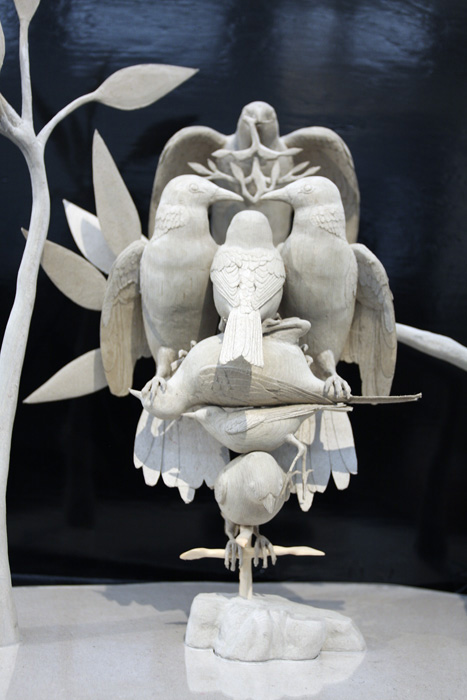
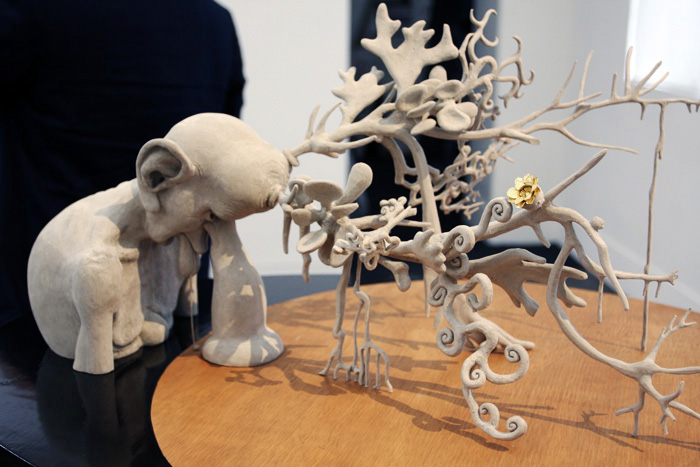
Moving down Flinders Lane we ascended to the fourth floor and entered the beautiful light filled gallery space at Block Projects to view the ‘new work’ of Richard Grigg. An eclectic mix of sculpture, painting, drawing, and collage was presented. Preparatory drawings for one of the sculptures, a pencil drawing of two old men debating, a canvas of a camera in tempera, gold leaf and gesso vie for attention with the two standout pieces of the show: No more songs at funerals/hero today gone tomorrow (2007) and He can’t read well because of his horns (2009), surrealist sculptures both made of compressed cardboard (below).

These two sculptures are fantastic: the first forming a skull made out of birds perched on a cross surmounted by a bird holding an olive branch, the title deliciously ironic; the second a stooped gargoyle like creature with a massive extrusion for a nose, hanging tongue dripping saliva and phantasmagorical protrusions emerging from it’s head making it impossible for the creature to ‘read well’ in both the metaphorical and literal sense. This is a beautiful but grotesque primordial fantasy with the horns putting roots down in the soil like the roots of a mangrove tree, a gold leaf flower blooming at their outer reaches, the creature exhausted by the effort of trying to keep his head up.

Unfortunately the rest of the exhibition lacked core strength: conceptually the show is not strong. Evidence of beauty in decay and concerns about the process of ageing vie with environmental contexts; slippages in time (The Moment Between) contrast with cameras and their sight lines; Pinocchio lies under a shroud with a camera trapped in the back of a horse drawn cart (Dream of Rest). Apparently, the cameras do not signify the capturing of the frozen moment of beauty but they are there because the artist’s father collected cameras. To me they seemed to be defining the nature of our interaction with the world, the surface of the image controlling the interface between technology and earth.

One of the problems with undertaking an exhibition titled New Work is the assumption that the new work being produced hangs together holistically and tells a not necessarily linear narrative story but one that the viewer can investigate, question, and tease the pertinent concepts from – something the viewer can hang their hat on (perhaps the horns of a dilemma!) This was not the case here. The bits n bobs approach of this exhibition falls slightly flat but go see the show for the two sculptures – they alone are worth the effort!

Dr Marcus Bunyan


Many thankx to Block Projects for allowing me to publish the photographs in the posting. Please click on the photographs for a larger version of the image.


Richard Grigg (Australian) 'No more songs at funerals/hero today gone tomorrow' 2007-2009


Richard Grigg (Australian)
No more songs at funerals/hero today gone tomorrow
2007-2009
Layered boxboard, wood dowel, glue, pine, black gloss enamel, Perspex


Richard Grigg (Australian) 'He can't read well because of his horns' 2009


Richard Grigg (Australian)
He can’t read well because of his horns
2009
Layered boxboard, gold leaf, wood dowel, glue, pine, black gloss enamel, wood stain


Richard Grigg (Australian) 'Dream of Rest' 2007


Richard Grigg (Australian)
A Late Night Story
2007
pencil on paper


Richard Grigg (Australian) 'Older than the value of beauty' 2009


Richard Grigg (Australian)
Older than the value of beauty (detail)
2009
Tempera, gold leaf and gesso on board


Richard Grigg (Australian) 'Cloak' 2008


Richard Grigg (Australian)
Cloak
2008
Tempera, gold leaf and gesso on board


Block Projects
Level 1 / 252 Church Street
Richmond Victoria 3121 Australia
Phone: +61 3 9429 0660

Opening hours:
Wednesday – Saturday: 12pm – 5pm

formerly at

Level 4, 289 Flinders Lane,
Melbourne 3000

Block Projects website

LIKE ART BLART ON FACEBOOK

Back to top

Review: ‘all about … blooming’ exhibition by JUNKO GO at Gallery 101, Melbourne

Exhibition dates: 25th February – 14th March, 2009


Junko Go (Australian born Japan, b. 1955) 'Opium Poppy' 2008


Junko Go (Australian born Japan, b. 1955)
Opium Poppy
2008


“One person’s heaven is another’s nightmare. Seeing both sides to every story can be a blessing and a curse. Good and bad, right and wrong, purity and impurity are inextricably linked.”


A delicate, refined but strong presence is felt in the work of Junko Go in the her new exhibition ‘all about … blooming’ at Gallery 101, Melbourne. Nominally landscape painting about flowers but featuring thoughts and ideas about the seed, the shoot, pollen and the breath of life the work addresses the essence of what it is to be human and live compassionately on this earth in an intelligent and profound way.

Denying the nihilism of abstract expressionism each mark is fully considered by being attentive to the connection between brush, hand and meaning. Almost childlike in their use of charcoal and acrylic her dogs, crosses and flowers, jottings and dashes, rain and rivers, seeds and people show a Zen like contemplation in the marks she makes on the canvas – just so. A releasement towards things is proffered, a letting go of the ego to create an awareness of just being. There is genuine warmth and humility to this work.

In Opium Poppy (2008, above) the darkness of the nightmare is represented by the black marks, ascending like Jacob’s ladder balanced by the mandala like poppies whose petals seem like feathers of a bird’s wing – a flight of fancy both good and bad. In Pollen (2009) bees swarm around a sunflower leaving traces of their presence, a bird flies close to a tiny blue cloud, the sun burst forth in a tiny patch of aqua colour, and people hug arm in arm. As Go says, “Bees in a flower bear pollen unawares and play a crucial roll for the plant to survive. Our love, kindness, warmth and wisdom affect one another unawares and play a crucial roll for our planet to survive.” In New Shoot (2008, below) the puzzle of our existence, the nature of our existential being is laid bare for all to see.
In Seeds (2008) Go reminds us that rather than being focused on what we hoped for, we must make the most of whatever opportunities we are blessed with. This means being aware of the gifts one possesses, not the distance between ‘I’ and want, need and desire – now! The seed of our experience – the calm before the force that propelled us into existence – is already present within us.

Go’s musings on the existential nature of our being are both full and empty at one and the same time and help us contemplate the link to the breath of the sublime. In the end Go’s paintings are about endings and beginnings, about being strong or not, about the infinity of the seed and about our responses to living in harmony on this planet. Through the seed, the shoot, the flower and the earth access may be granted to the sublime and this perfectly sums up the work of this artist, a reflection of her energy and radiance transferred to the canvas. I loved it.

Dr Marcus Bunyan


Many thankx to Gallery 101 for allowing me to publish the art work in the posting. Please click on the art work for a larger version of the image.


Junko Go (Australian born Japan, b. 1955) 'New Shoot' 2008


Junko Go (Australian born Japan, b. 1955)
New Shoot
2008


“Each of us is born to fill a special place in this world. In the process, we sometimes have trouble finding our niche. Life is like a jigsaw puzzle in which we make every effort to find our own place that makes a right connection with others, with the world and even with the whole universe.”


Junko Go (Australian born Japan, b. 1955) 'Red Hot Poker' 2009


Junko Go (Australian born Japan, b. 1955)
Red Hot Poker
2009


“Push and pull our inner strength. Sometimes, we need courage to take risks in confronting pain and loss in order to gain a deep and profound experience.”


“We live in a world where high achievers are congratulated, yet true achievements are not related to what we can get done, but to how deeply we aware of how wonderful it is to be alive. In this exhibition, flowers are not only a predominant source of visual inspiration, looking at them also engenders a kind of appreciation and wonder. The fragile and ephemeral flower provokes in me an awareness of the human condition that reveals the true nature of our existence.

My goal is to create images which are strong and soft, bold and precise, beautiful and ugly, figurative and abstract, all at once. My greatest challenge is to make art about what it is to be human … What really matters in art making to me is a kind of awareness – a being able to say, ‘I am as I am’.”

Text from the artist statement


Gallery 101

Gallery 101 is no longer open.

LIKE ART BLART ON FACEBOOK

Back to top

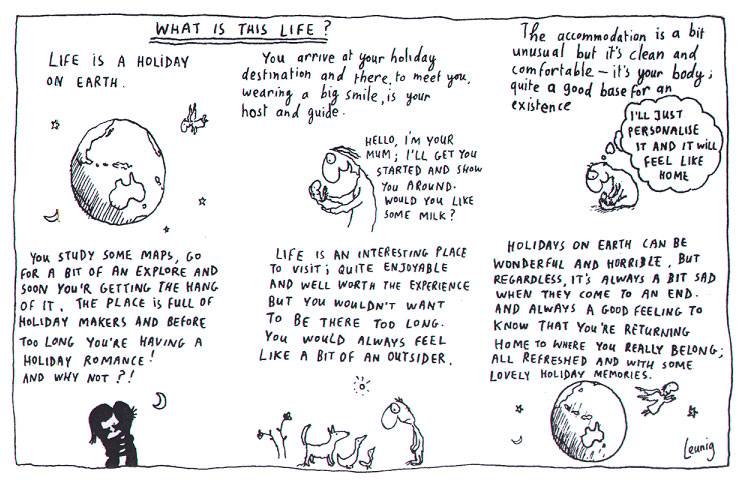
Cartoon: Michael Leunig. ‘What is This Life?’ 2009

February 2009


What a wonderful invocation of life, to life!

Marcus


Please click on the image for a larger version of the cartoon.


Michael Leunig (Australian, 1945-2024) 'What is This Life?' 2009


Michael Leunig (Australian, 1945-2024)
What is This Life?
2009


Michael Leunig on Wikipedia

LIKE ART BLART ON FACEBOOK

Back to top

Review: ‘Bowerhouse Blues’ exhibition by Mary Newsome, Gallery 101, Melbourne

Exhibition dates: 3rd February – 21st February, 2009


Mary Newsome (Australian, b. 1936) 'Bowerhouse Blues' installation photograph with 'The Bowerhouse' centre


Mary Newsome (Australian, b. 1936)
Bowerhouse Blues installation photograph with The Bowerhouse centre
2009


This is a slight bouffant of an exhibition by Mary Newsome at Gallery 101, Collins St., Melbourne.

“The exhibition consists of separate collections to do with blue, centring on the Bowerhouse with its beckoning light. The ideas came from several different directions.” And what directions they are.

Firstly, the idea of the lonely male bowerbird at the Museum of Victoria, given blue biros as solace after killing his last mate. Secondly, Oscar Wilde trying to live with his blue china toying with Yves Klein and his uber-dimensionality, the invisible blue becoming visible. Then we have finger painting as a child upgraded to paste painting “which is finger painting under a more adult name”; and more – poetry, yes! by famous poets, sandwiched with shells and cans and bits of glass and plastic and pottery and pegs all offered up to the god of the azure.

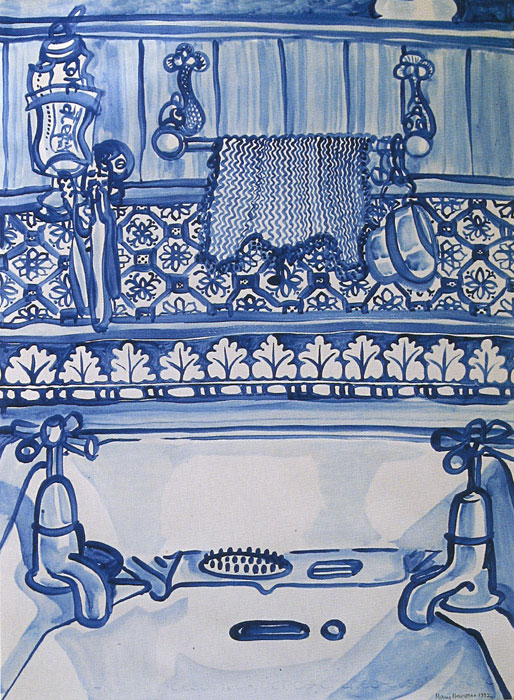
Artefacts litter the floor around the edge of the gallery, media wash across the walls. A silkscreen here and a painting of blue and white china there, watercolours of a view out of a blue curtained Cornish cottage, a blue seascape, the “royal-ness” of a blue tampons collage, three-dimensional objects, acrylics, crayon, pencil, oils and stencils. The Bowerhouse itself, like a blue ‘red light’ house with flashing blue light inside and heart on top. And so it goes.

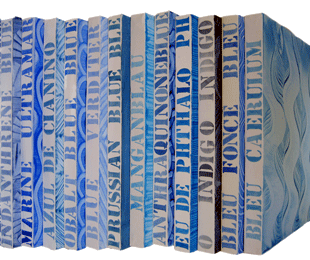
There are some interesting small single-pigment blue acrylics that have geometric and anamorphic shapes painted upon them with stencilled names of the colour along the spine of the canvases. There are also a couple of competent oils and silkscreens of tea sets in a dresser with cups hanging from hooks.

The works date from 1980 to the present day – and “without fully realising it” the artist has looked through her work over the past 30 years and come across lots and lots of blue. Any artist worth their salt knows their oevure indelibly from front to back. It seems inconceivable to me that this epiphany has occurred without the artist not fully understanding the importance of the colour blue to their art practice before now.

Recently I have been reading a book called Distraction (Damon Young. Distraction: A Philosopher’s Guide to Being Free. Melbourne: Melbourne University Publishing, 2008). The book surmises that distraction is often a matter of what one values in the world. The book demonstrates that the opposite of a life of distraction is one of grateful appreciation, based on patient, sensitive, and thoughtful attention to the world. In this exhibition we have a perfect example of distraction: the noise of the collective work has subsumed its individual charms. The work seems forced into a conceptualisation not of it’s making. Everything seems laboured to the point where all the fun has been squeezed from it and, in the end, it just left me feeling the blues.

Dr Marcus Bunyan


Photographs by Tim Gresham
Images courtesy of Gallery 101


Mary Newsome (Australian, b. 1936) 'Blue Colours' 2008


Mary Newsome (Australian, b. 1936)
Blue Colours
2008


Mary Newsome (Australian, b. 1936) 'Bowerhouse Blues' installation photograph 2009


Mary Newsome (Australian, b. 1936)
Bowerhouse Blues
2009
Installation photograph


Mary Newsome (Australian, b. 1936) 'Bathroom Sink' 1992


Mary Newsome (Australian, b. 1936)
Bathroom Sink
1992


Mary Newsome (Australian, b. 1936) 'What Bliss There is in Blueness' 2009


Mary Newsome (Australian, b. 1936)
What Bliss There is in Blueness
Extract from Laughter in the Dark, 1989 by Vladimir Nabokov
2009


Mary Newsome (Australian, b. 1936) 'Royal Tampons' collage


Mary Newsome (Australian, b. 1936)
Royal Tampons
2009
Collage


Gallery 101

This gallery is no longer open.

LIKE ART BLART ON FACEBOOK

Back to top

Review: ‘The Water Hole’ exhibition by Gerda Steiner and Jorg Lenzlinger at ACCA (Australian Centre for Contemporary Art), Melbourne

Exhibition dates: 23rd December, 2008 – 1st March, 2009


“Warning. Watch your step while gazing at distant view.”

Sign at entrance to the exhibition


Gerda Steiner and Jorg Lenzlinger. Entrance to 'The Waterhole' exhibition at ACCA, Melbourne, 2009


Gerda Steiner (Swiss, b. 1967) and Jorg Lenzlinger (Swiss, b. 1964)
Entrance to The Water Hole exhibition at ACCA, Melbourne
2009
Photo: Marcus Bunyan


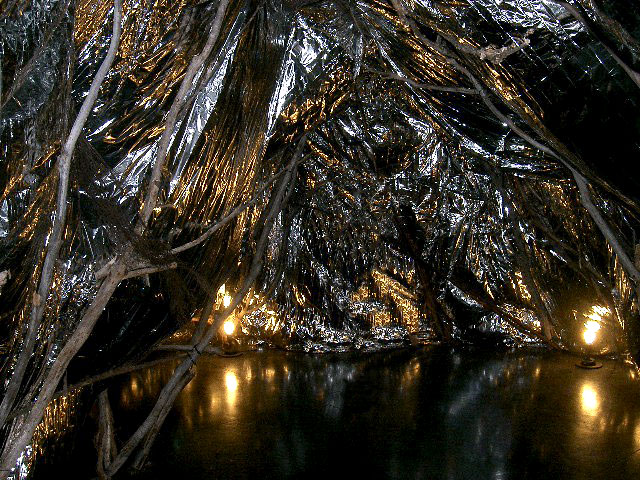
A cave like entrance presents itself to the visitor as they enter the exhibition leading to a long winding tunnel that is lined with silver insulation foil and tree branches, lit by floor mounted electric light bulbs. The foil moves with the natural movement of air causing not a rustling of leaves but of artificial surfaces.

At the end of the tunnel the viewer enters a large installation space, confronted with a effusive pop art Garden of Eden, a Magic Forest.

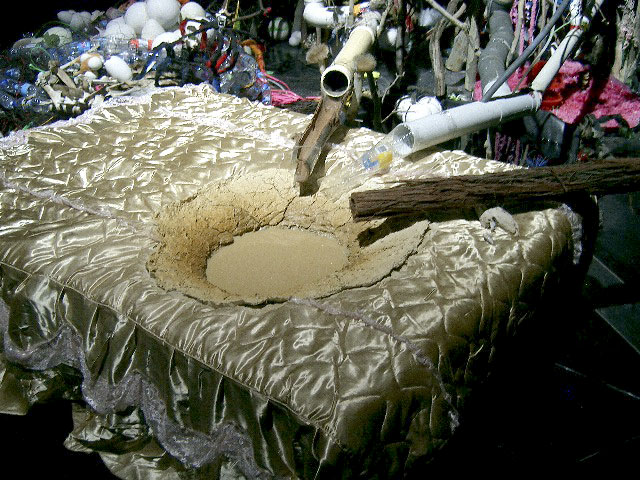
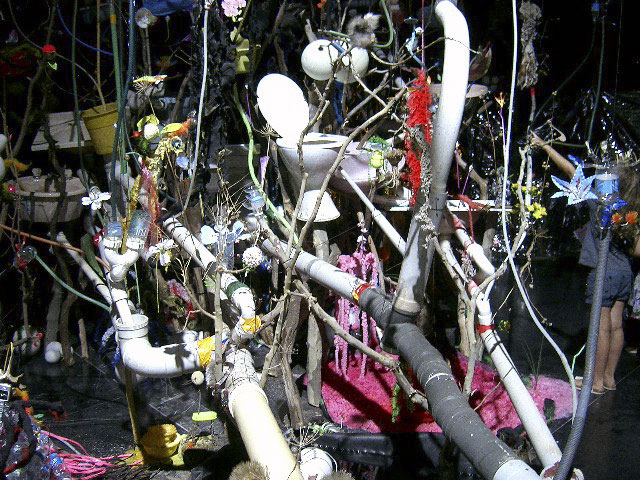
It takes a while to work out what is going on, there are so many elements to the sculptural piece. The main elements are buckets, toilets, basins and drainage pipes, plumbing fittings that all lead to a bed with a drying dam in the centre of a satin bedspread: the ‘waterhole’ of the exhibition title. The waterhole is fed by water dripping from a medical bag suspended high in the air above the dam, a nice touch. The rest of the forest and pipes are dry. The installation comments on our water supplies and the ‘technologies of production’ (Foucault) that permit us to produce, transform or manipulate things. We might install rainwater tanks to catch water but if there is no water to catch in the first place then we are in trouble: we make our bed and have to lie in it, the empty basins like our catchment areas, dry and bleak.

Other elements of the forest have an environmental theme, the installation developed by the artists in response to the extensive drought most of Australia (and it particular Melbourne) is experiencing. Here are spiders with hairy legs and mobile phones for bodies infesting the installation, plumbing fittings with natural seeds sprouting from their ends, brightly coloured crystal forms fed each day with water by gallery staff so that they grow. An upside down umbrella with Polar bear images printed on it’s material has imaginary water draining down a bamboo pipe into a bucket; empty water bottles form a large nest with broken eggs inside; artificial plants, bones, crabs, seaweed and flying stuffed owls are form some of the other elements in the installation.

Climbing a few steps we enter a ‘bird’ watching gallery replete with binoculars to observe the humans in the forest as much as the forest itself. A water cooler sits incongruously in this watching space, silent and somehow complicit in its ironical presence.

The viewer then moves to another room. 4 video projectors display another water themed installation on the gallery walls, the videos meeting in the middle of the walls and reflecting each other. Ambient music accompanies images of rain!, spurting water, owls and plastic pipes, plastic flowers and plastic horses as the viewer relaxes on a waterbed in the middle of the space. The effect of the music and images is quite meditative when combined with the gentle rocking of the waterbed, the projections of the video forming kaleidoscopic ‘Northern lights’ on the ceiling of the gallery. This room is an extension of the themes of the large installation.

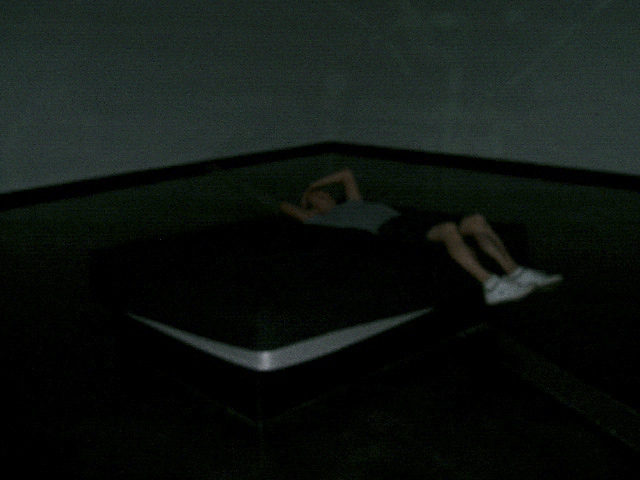
Moving forward the viewer enters another room – the meditation room. This room is most effective in encouraging contemplation of the different planes of our existence and our orientation in (environmental) space. Three beds are present, one suspended from the ceiling by four metal rods. Climbing onto this bed the movement from side to side caused by your weight makes you feel seasick and slightly disorientated. Above the second table is a wonderful mobile made of twigs, branches, dried leaves, plastic flowers, beads, plastic bags, baby dummies and jewellery moving gently in the breeze. Lying on the table with the mobile about a foot above your head things drift in and out of view as you change the focus of your eyes – close, mid, far and then onto the moving shadows on the ceiling.

The most effective bed has a small meteorite suspended in a net bag above it. The viewer slides underneath the ‘rock’ placing the meteorite about a foot or so above your face. The meteorite is brown, dark and heavy, swinging slightly above your ‘third eye’. You feel its weight pressing down on your energy, on your life force and you feel how old this object is, how far it has traveled, how fragile and mortal you are. It is a sobering and enlightening experience but what an experience it is!

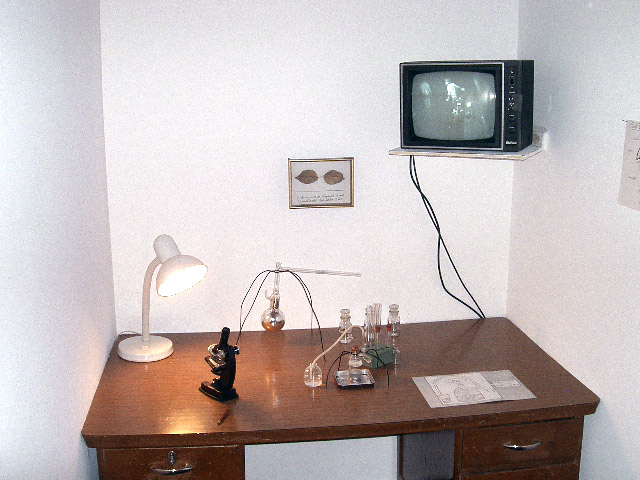
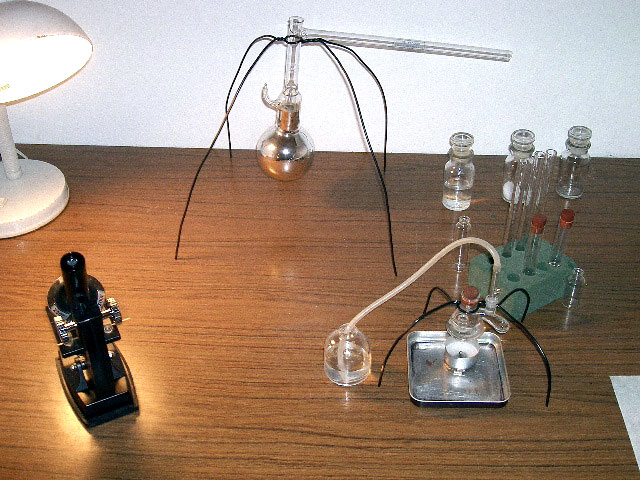
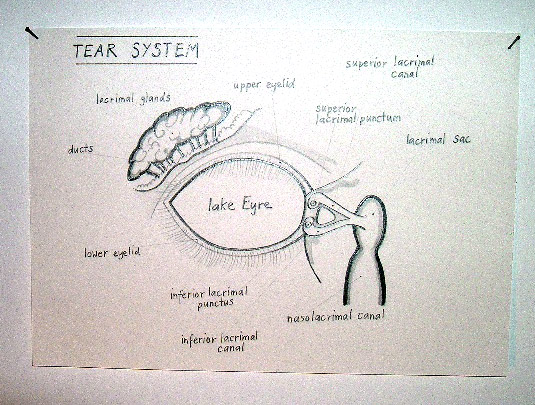
Entering the final room small colour photos of people being hugged from behind and lifted into the air, laughing, line the gallery walls. These are the weakest elements of the exhibition and seem to bear no relation to all that has passed before. Running off of this gallery is an alcove that is a dead end, a full stop to the exhibition with an installation Desalination plant for tears. A cheap Formica desk sits at the end of the space. Perched above the desk is a tv showing live black and white images of the earlier bird watching gallery – the watcher now the watched. On the desk itself is a microscope (with slide of human tears), pencil, a candle for heat under a glass flask of water (looking like a spider from the large installation!) and various glass test tubes and vials. A diagram explains the working of a Desalination plant for tears, an analogous reference to the desalination plant earmarked for Wonthaggi, south-east of Melbourne. Irony is present (again) in the 2 leaves grown at Singapore Airport by desalinated water (2008), two framed, brown dead leaves, and in the Tear system diagram where glands have turned into forests and the eye into a lake (see below).

This is a magical and poignant exhibition that is a joy for children and adults alike. Children love it running around exploring the environments. Adults love it for it’s magical, witty and intelligent response to the problems facing our planet and our lives. Go and enjoy this interplanetary collision. Highly recommended!

Dr Marcus Bunyan


Many thankx to the Australian Centre for Contemporary Art for allowing me to publish the photographs and text in the posting. All photographs © Marcus Bunyan


Gerda Steiner (Swiss, b. 1967) and Jorg Lenzlinger (Swiss, b. 1964) 'The Waterhole' 2009 (detail)


Gerda Steiner (Swiss, b. 1967) and Jorg Lenzlinger (Swiss, b. 1964)
The Water Hole (detail)
2009
Photo: Marcus Bunyan


Gerda Steiner (Swiss, b. 1967) and Jorg Lenzlinger (Swiss, b. 1964) 'The Waterhole' 2009 (detail)


Gerda Steiner (Swiss, b. 1967) and Jorg Lenzlinger (Swiss, b. 1964)
The Water Hole (detail)
2009
Photo: Marcus Bunyan


Gerda Steiner (Swiss, b. 1967) and Jorg Lenzlinger (Swiss, b. 1964) 'The Waterhole' 2009 (detail)


Gerda Steiner (Swiss, b. 1967) and Jorg Lenzlinger (Swiss, b. 1964)
The Water Hole (detail)
2009
Photo: Marcus Bunyan


Gerda Steiner and Jorg Lenzlinger. Installation view of waterbed at 'The Waterhole' exhibition at ACCA, 2009


Gerda Steiner (Swiss, b. 1967) and Jorg Lenzlinger (Swiss, b. 1964)
Installation view of waterbed at The Water Hole exhibition at ACCA, Melbourne
2009
Photo: Marcus Bunyan


Gerda Steiner and Jorg Lenzlinger. Installation view of 'Desalination plant for tears' (detail) from 'The Water Hole' exhibition at ACCA, Melbourne, 2009

Gerda Steiner and Jorg Lenzlinger. Installation view of 'Desalination plant for tears' (detail) from 'The Water Hole' exhibition at ACCA, Melbourne, 2009


Gerda Steiner (Swiss, b. 1967) and Jorg Lenzlinger (Swiss, b. 1964)
Installation view details of Desalination plant for tears from The Water Hole exhibition at ACCA, Melbourne
2009
Photos: Marcus Bunyan


The end of 2008 saw the launch of The Water Hole, a major installation by renowned Swiss artists Steiner and Lenzlinger. The artists created a fantasia of ecology in ACCA’s large hall. In the side galleries a flow out of projects including meteors suspended over beds, a crystal room and a desalination laboratory. The Water Hole, devised specifically for ACCA, referenced Australia’s acute climate challenges as well as the pressure of global waste. The project created a story of place, a fable if you like. And in the tradition of the fable, the artists employed animals, plants and inanimate objects to tell a story that has a moral and ethical dimensions. 

The Water Hole was a big story – filled with pleasurable things but also with the message of peril.  The artists created environments that enabled the visitor to consider and sense our place in history, and our attention to striking a balance between our consumptive desiring and nature.

Text from the ACCA website


Gerda Steiner (Swiss, b. 1967) and Jorg Lenzlinger (Swiss, b. 1964) Diagram from 'Desalination plant for tears' (detail) from the exhibition 'The Water Hole' at ACCA, Melbourne, 2009


Gerda Steiner (Swiss, b. 1967) and Jorg Lenzlinger (Swiss, b. 1964)
Diagram from Desalination plant for tears from the exhibition The Water Hole at ACCA, Melbourne
2009
Photo: Marcus Bunyan


Australian Centre for Contemporary Art (ACCA)
111 Sturt Street
Southbank
Victoria 3006
Australia

Opening hours:
Tuesday to Friday 10am – 5pm
Weekends and Public Holidays 11am – 5pm
Monday by appointment
Open all public holidays except Christmas Day and Good Friday

ACCA website

Gerda Steiner and Jorg Lenzlinger website

LIKE ART BLART ON FACEBOOK

Back to top

Exhibition: ‘Delacroix and Photography’ at Musée National Eugène Delacroix, Paris

Exhibition dates: 28th November, 2008 – 2nd March, 2009


Many thankx to the Musée national Eugène Delacroix for allowing me to publish the artwork in the posting. Please click on the photographs for a larger version of the image.


Eugène Delacroix (French, 1798-1863) 'Etude de jambes d'homme assis et étude d'une tête' Nd from the exhibition 'Delacroix and Photography' at Musée National Eugène Delacroix, Paris, Nov 2008 - March 2009


Eugène Delacroix (French, 1798-1863)
Etude de jambes d’homme assis et étude d’une tête
Nd
Lead pencil
20.3 x 15.2cm
Museum of Fine Arts and Archeology of Besançon
© Museum of Fine Arts and Archeology of Besançon


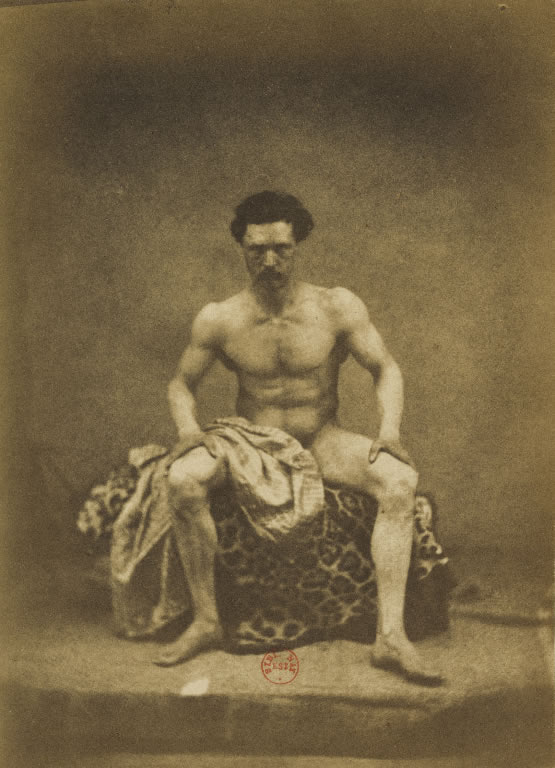
Eugène Durieu (French, 1800-1874) 'Nu masculin assis de face, les jambes écartées' 1854 from the exhibition 'Delacroix and Photography' at Musée National Eugène Delacroix, Paris, Nov 2008 - March 2009


Eugène Durieu (French, 1800-1874)
Nu masculin assis de face, les jambes écartées
1854
Plate XV of the Durieu Album
Salted paper from negative paper
17.8 x 12.8cm
BnF, Department of Prints and photography
© BnF


Jean Louis Marie Eugène Durieu (1800-1874) was an early French amateur nude photographer, primarily known for his early nude photographs of men and women. A number of his male and female models were also painted by Eugène Delacroix, with whom he was friends.

Durieu was born in Nîmes, and became known for making studies of nudes for Delacroix. During his career Durieu was a lawyer. His last job was inspector for education and culture. In 1849 he went into early retirement and devoted himself to the newly developing technology of photography. In 1853, Durieu worked with Delacroix on a series of photographs of different male and female nude models.

Text from the Wikipedia website


In the early 1850s, Durieu, like many of his photographic peers, gravitated from the daguerreotype to the calotype. None of the works from his daguerreotypical oeuvre can be attributed to him with any certainty. Apart from the Delacroix album held at the Bibliothèque Nationale de Paris, another work on paper does exist, however, a more personal album preserved at the George Eastman House in Rochester, which was once part of the Gabriel Cromer collection. Its repertoire is more varied and includes female nudes in fairly elaborate settings, as well as portraits and reproductions of paintings and engravings. …

In 1851, along with Delacroix, Durieu became one of the founder members of the Société Heliographique, the first French institution to be created specifically for photographers. Above all, its brief was to encourage the development of photography on paper and in particular the calotype as opposed to the daguerreotype.

It was at precisely this time in the early 1850s that Delacroix’s interest in photography was at its height, coinciding with that of Durieu. In February 1850, he wrote in his journal: “ask Boissard for some daguerreotypes on paper,” and later, in September 1850: “Laurens tells me that Ziegler is producing a sizeable number of daguerreotypes, including portrayals of nude men. I intend to go and see him to ask if he can lend me a few.” In May 1853, he showed Pierret and his cousin Léon Riesener the prints given to him by Durieu. In November 1853, he discussed the topic of photography with Riesener, who in the 1840s had not only been a painter but an ‘author’ of daguerreotypes. Delacroix maintained that the term author was a misnomer for what he regarded as a mechanical recording process, a machine-led art: “He referred to the solemn account the good Durieu and his friend, who assists him in these operations, give of their time and trouble, whilst taking much of the credit for the success of the aforementioned operations, or more precisely their results.” He made fun of Riesener, who had asked them with great trepidation if he could use their pictures as models for his paintings without being accused of plagiarism. Finally, on two successive Sundays, 18 and 25 June 1854, he visited Durieu on the seventh floor of his home at 40 rue de Bourgogne to ask him to make a series of photographs of models under his guidance…

Extract from Sylvie Aubenas. “Eugène Durieu, senior civil servant, photographer and forger,” in No 32 Printemps 2015 (translation Caroline Bouché) on the Etudes photographiques website [Online] Cited 04/10/2018


Eugène Durieu (French, 1800-1874) 'Nude couple: female nude standing in the background, male nude sitting in profile on a leopard skin' 1854


Eugène Durieu (French, 1800-1874)
Nude couple: female nude standing in the background, male nude sitting in profile on a leopard skin
1854
Plate 3 of an album containing 32 studies of models
Salted paper print
16.2 x 11.5cm
BnF coll., Paris
© BnF


Eugène Durieu (French, 1800-1874) 'Model of male nude sitting in profile on a leopard skin' 1854


Eugène Durieu (French, 1800-1874)
Model of male nude sitting in profile on a leopard skin
1854
Plate 11 of an album containing 32 studies of models
Salted paper print
17 x 13.5cm
BnF coll., Paris
© BnF


“I look with passion and without fatigue at these photographs of naked men, this admirable poem, this human body on which I learn to read and whose sight tells me more than the inventions of scribblers.”


Delacroix, ‘Journal’, October 5, 1855


Delacroix was confronted, like his entire generation, with the emergence of photography. An intriguing tool fascinating for the painter, this medium occupies a place apart in all of his work. He is at the source of a deep reflection on artistic truth in the face of photographic realism.

Far from seeing photography as a potential rival to painting, Delacroix took a keen interest in the development of this new medium, following its technical progress with sufficient curiosity to become a founding member of the Heliographic Society in 1851. He amassed a considerable photographic collection-of frescoes by Raphael, paintings by Rubens, and cathedral sculptures. Moreover, although he did not use a camera himself, a series of male and female nude models were photographed at his request by Eugène Durieu, in 1854. We know from his diary and letters that he sometimes used these photographs to practice drawing when no live models were available. These shots, which he sometimes carries with him, are a valuable tool for practicing drawing during his stays in the province. They meet very personal criteria; Delacroix wanted to use images voluntarily a little blurry and mostly stripped of all the quaint accessories conveyed by commercial photographs to the attention of artists.

However, despite a deep fascination for photography, Delacroix keeps a critical eye on this new medium. He adopts an attitude sometimes skeptical about his proper use and mastery of the technique, refusing to award benefits beyond its instrumental value. His reluctance is particularly keen with regard to one’s own photographed image: he even goes so far as to demand the destruction of some negatives, fortunately in vain.

Almost all the photographs and the drawings done from them (together with a number of paintings) have been assembled for the first time at the Musée Delacroix, with the generous support of the Bibliothèque Nationale de France and other collections. The exhibition also features a surprising series of photographic portraits of Delacroix himself, ranging from the precious intimate daguerreotypes of the 1840s to the more posed and strikingly dignified pictures taken by Carjat or Nadar toward the end of his life-many of which images the great man himself would rather have had destroyed.

Press release from the Musée National Eugène Delacroix


The Durieu Album

The album of thirty-two photographs preserved in the department Prints and Photography of the National Library de France and commonly known as “Durieu Album”, by the name of the author of the photographs contains mainly photographs of two nude models, a man and a woman, taken by Eugene Durieu in the presence and on the indications of Delacroix during two sessions of successive poses, on Sunday 18 and 25 June 1854. The album was probably in lot 1532 of the sale after the painter’s death, bought by the critic Philippe Burty, who said on the front page: “All this sequence of photographs was bought by me at the posthumous sale of Eugène Delacroix’s workshop. He used it often and his cartons contained a considerable number of pencil studies from these photographs some of which were made expressly for him by one of his friends, and the models posed by him.” This album went on to the bibliographer and historian of the art Maurice Tourneux, who offered it in 1899 to the Cabinet des Prints.

The examination of the album, whose pages are all presented here in the order of the pages, shows that divides into four distinct sequences. Plate I represents a seated male nude model. His black beard and its abundant hair absolutely distinguishes him from the model with the better drawn musculature having posed in the following photographs. This test is undoubtedly part of a different set provided by Durieu to Delacroix.

The twenty-six photographs that follow in the album are, like the first, calotypes, that is to say prints from negative on paper. The calotype is characterised by a slight blur that Delacroix’s eyes found useful and tolerable photography, the grain of the negative paper producing, in the prints, less precise contours than in the daguerreotype or prints based on collodion glass. These twenty-six photographs of June 1854 form a very homogeneous series, with two models. The man that Delacroix calls “the Bohemian” appears by the development of his musculature and his ease to pose, as a professional model. He is present alone on seventeen views, and on the other nine in the company of a female model, probably an Italian, also a professional model, who posed again in 1855 for two other photographers.

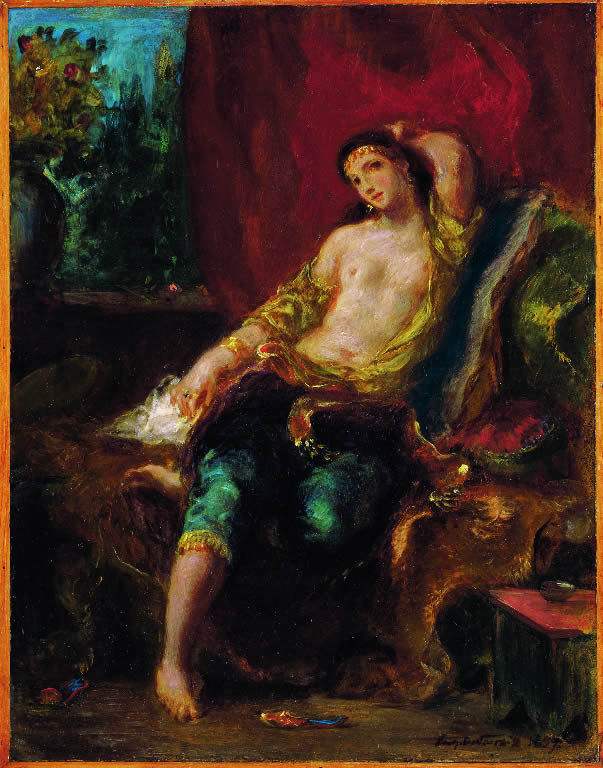
After this series, the album contains two studies (plates XXVIII and XXIX) of the same young woman, of which one served as the model for Odalisque of 1857 (private collection). The model is Miss Hamély, a small actress who appeared in tableaux vivants and pantomimes at the Porte-Saint-Martin theater (1853) but who also posed for photographers. The freedom that Delacroix takes in the painting in relation to the photography confirms that, he only uses it as a support for the imagination, unlike a painter like Gérôme for whom the cliche really replaces the model. So photography is amalgamated, among other ingredients, in a personal universe, not to mention the colours of the painting.

The album ends with three prints, based on a glass negative, of the same model draped to the waist, sitting in front of a plain canvas background. The sharpness, due to the negative on glass, the rigorous composition and images, their “professional” aspect make them totally different from the previous ones, to such that we can hesitate to attribute them to Durieu. While the calotypes posed by Delacroix are very rare, these last three images are seen in more than one collection; they have been broadcast to a wider audience.

Text from the Delacroix et la photographie exhibition pdf (translated from the French by Google translate)


Eugène Delacroix (French, 1798-1863) 'Two studies of naked men one standing, the other sitting' Nd


Eugène Delacroix (French, 1798-1863)
Two studies of naked men one standing, the other sitting
Nd
Graphite
Musée Eugène-Delacroix
© RMN / Michèle Bellot


Eugène Durieu (French, 1800-1874) 'Nu féminin assis sur un divan, la tête soutenue par un bras' 1854


Eugène Durieu (French, 1800-1874)
Nu féminin assis sur un divan, la 
tête soutenue par un bras
1854
Plate XXIX of the Durieu Album
Salted paper varnished from negative paper
14 x 9.5cm
BnF, Department of Prints and Photography
© BnF


Eugène Delacroix (French, 1798-1863) 'Odalisque' 1857


Eugène Delacroix (French, 1798-1863)
Odalisque
1857
Oil on wood
39.5 x 31cm
Private Collection


Eugène Durieu (French, 1800-1874) 'Model Study' 1854


Eugène Durieu (French, 1800-1874)
Model Study
1854
Calotype
BnF, Department of Prints and photography, Paris
© BnF


Louis Camille d'Olivier (French, 1827-1870) 'Female nude' 1855


Louis Camille d’Olivier (French, 1827-1870)
Female nude
1855
Salted paper print
21 x 16cm
BnF, Department of Prints and Photography
© BnF


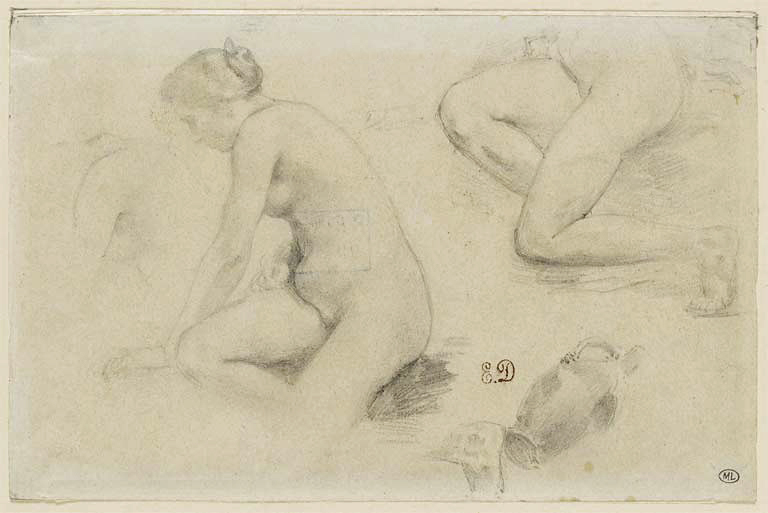
Eugène Delacroix (French, 1798-1863) 'Study of naked woman in profile on the left' Nd


Eugène Delacroix (French, 1798-1863)
Study of naked woman in profile on the left
Nd
Lead pencil
13.6 x 20.9cm
Louvre Museum, Department of the Arts graphics
© RMN Photo / Thierry Le Mage


Eugène Delacroix (French, 1798-1863) 'Three studies of men' Nd


Eugène Delacroix (French, 1798-1863)
Three studies of men
Nd
Lead pencil
19.2 x 25.3cm
Museum of Fine Arts and Archeology from Besançon
© Museum of Fine Arts and Archeology from Besançon


Eugène Durieu (French, 1800-1874) 'Naked man standing, back, holding a vertical stick' Nd


Eugène Durieu (French, 1800-1874)
Naked man standing, back, holding a vertical stick
Nd
Albumine paper
9.9 x 5.8cm
Gérard Lévy Collection
© 2008 Louvre Museum / Pierre Ballif


Eugène Durieu (French, 1800-1874) 'Naked man sitting on a chair' Nd


Eugène Durieu (French, 1800-1874)
Naked man sitting on a chair
Nd
Albumen paper
9.7 x 5.8cm
Gérard Lévy Collection
© 2008 Louvre Museum / Pierre Ballif


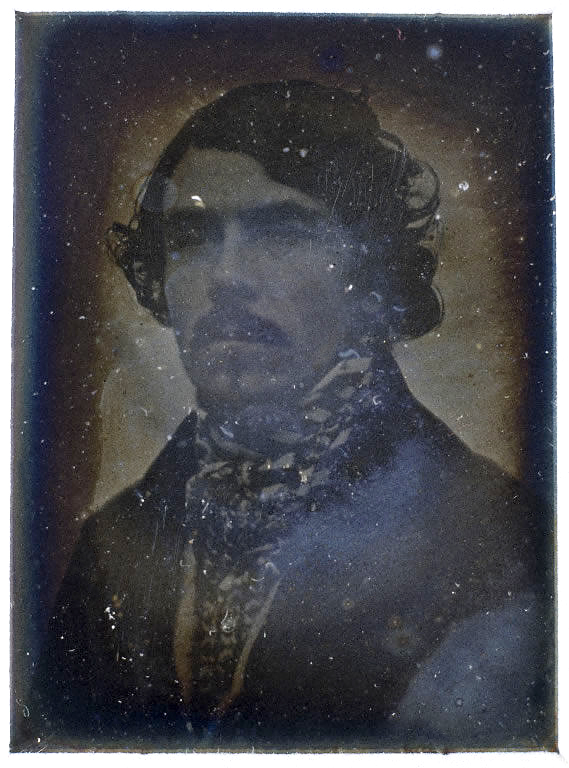
Léon Riesener (French, 1808-1878) 'Portrait of Eugène Delacroix (1798-1863)' 1842


Léon Riesener (French, 1808-1878)
Portrait of Eugène Delacroix (1798-1863)
1842
Daguerreotype
© Musée d’Orsay, Dist RMN / Patrice Schmidt


Louis Antoine Léon Riesener (21 January 1808 in Paris – 25 May 1878 in Paris) was a French Romantic painter.

Enchanted by the play of light and reflections which transformed the appearance of matter, Riesener began a new aesthetic that made him one of the precursors of impressionism. A passionate colourist, he researched all the nuances of colour and studied the techniques of ancient Greece and the Renaissance, including Titian, Veronese and Corregio. Impressed by his research into colour, he turned towards Rubens, which for him was the Shakespeare of painting. Very early in his career Riesener studied tonal divisions, well before the physician Chevreul discovered their scientific basis. His tactile taste led him to look for the most perfect expression of matter and particularly of skin. He put poetry into his painting by the play of shadow and he passionately admired nature, life and all the beauties they produced.

He researched the subject of life in the countryside and, liking to paint reality, said he wanted to express “the heat of the day, the melancholy of the evening, meadows, flowers as they are in nature”. His study of the elements caused him to paint a series of skies which varied according to the light and time of day – the subjects were ahead of their time and Riesener had to fight hard against the Salon juries and the Institut. Using pure colours, he excluded the blacks and whites which had been used for shadows and light before him. His material science of colour was the opposition which gave birth to contrasts from juxtaposed pigments. He did not portray faces by contours, but by shadows and modelling.

Relations with Delacroix

After his father’s return from Russia in 1823 Léon got to know Eugène Delacroix better. Ten years older than Riesener, Delacroix was his first-cousin – they shared a grandmother, Marguerite-Françoise Vandercruse, whose daughter by her first marriage was Delacroix’s mother and whose second husband Jean-Henri Riesener was Riesener’s grandfather. Delacroix quickly recognised Riesener’s talent and originality and he supported his early career by recommending him to civil servants he knew. On trips to the countryside they met at Valmont, near Fécamp, the home of their cousin Bataille, owner of the abbaye from 1822 onwards. Riesener devotedly attended Pierret’s salon (Pierret was a school friend of Delacroix), where he met Mérimée, Viel-Castel, Sauvageot, Feuillet de Conches, Viollet-le-Duc, Lasus and Guillemardet. Later, Riesener became friends with Fantin-Latour, Ernest Chausson and the Morisots (the Morisot family was very friendly with the Riesener family, with Rosalie Riesener’s friend Berthe Morisot researching Léon’s opinions, listening to his advice and copying out about 135 pages of his writings) – his friends were artists and he preferred a quiet life rather than the high life favoured by Delacroix.

From childhood, Riesener and Delacroix were friends and confidants. So different in life and character and so independent, they were preoccupied by the same artistic problems and enjoyed exchanging ideas, both having been formed by the 18th century and its neo-classical culture. They discussed their study of the classical world and they were both colourist painters searching for new techniques in tonal division. The difference in their temperaments expressed itself in their ways of looking at nature – Delacroix thought of drama, Riesener thought of sensuality. Delacroix bought Riesener’s painting Angélique as an exemplar for all painters and put it in his studio. On his death in 1863, Delacroix left Riesener his country house at Champrosay.

Text from the Wikipedia website


Nadar (Gaspard-Félix Tournachon) (French, 1820-1910) 'Eugène Delacroix seated three-quarter facing, his hand in the waistcoat' 1858


Nadar (Gaspard-Félix Tournachon) (French, 1820-1910)
Eugène Delacroix seated three-quarter facing, his hand in the waistcoat
1858
Salted paper
24.5 x 18cm
BnF, Department of Prints and Photography
© BnF


Musée National Eugène Delacroix
6 rue de Furstenberg
75 006 Paris
Phone: +33 (0)1 44 41 86 50

Opening hours:
The museum is open daily except Tuesday, 9.30am – 5pm (tickets sold until 4.30pm)

Musée national Eugène Delacroix website

LIKE ART BLART ON FACEBOOK

Back to top

Cartoon: Michael Leunig ‘The 3 A.M. WAKE UP’ 2008

November 2008


Michael Leunig. 'The 3 A.M. WAKE UP' 2008


The 3 A.M. WAKE UP by Australian artist and cartoonist Michael Leunig 2008

My favourite cartoon in the world!


More Leunig images

LIKE ART BLART ON FACEBOOK

Back to top