Review: ‘Sistagirls’ by Bindi Cole at Nellie Castan Gallery, Melbourne

Exhibition dates: 8th July – 31st July, 2010


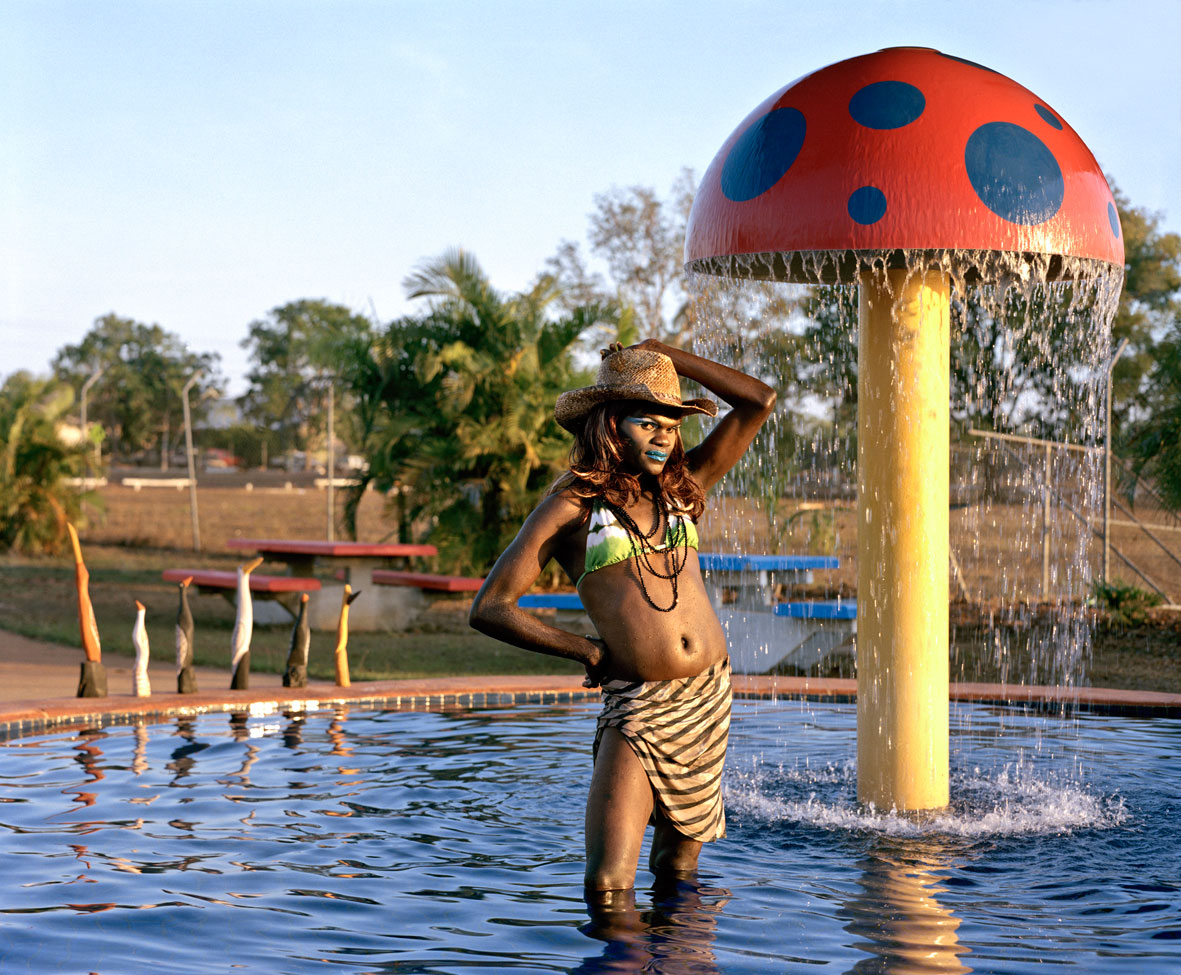
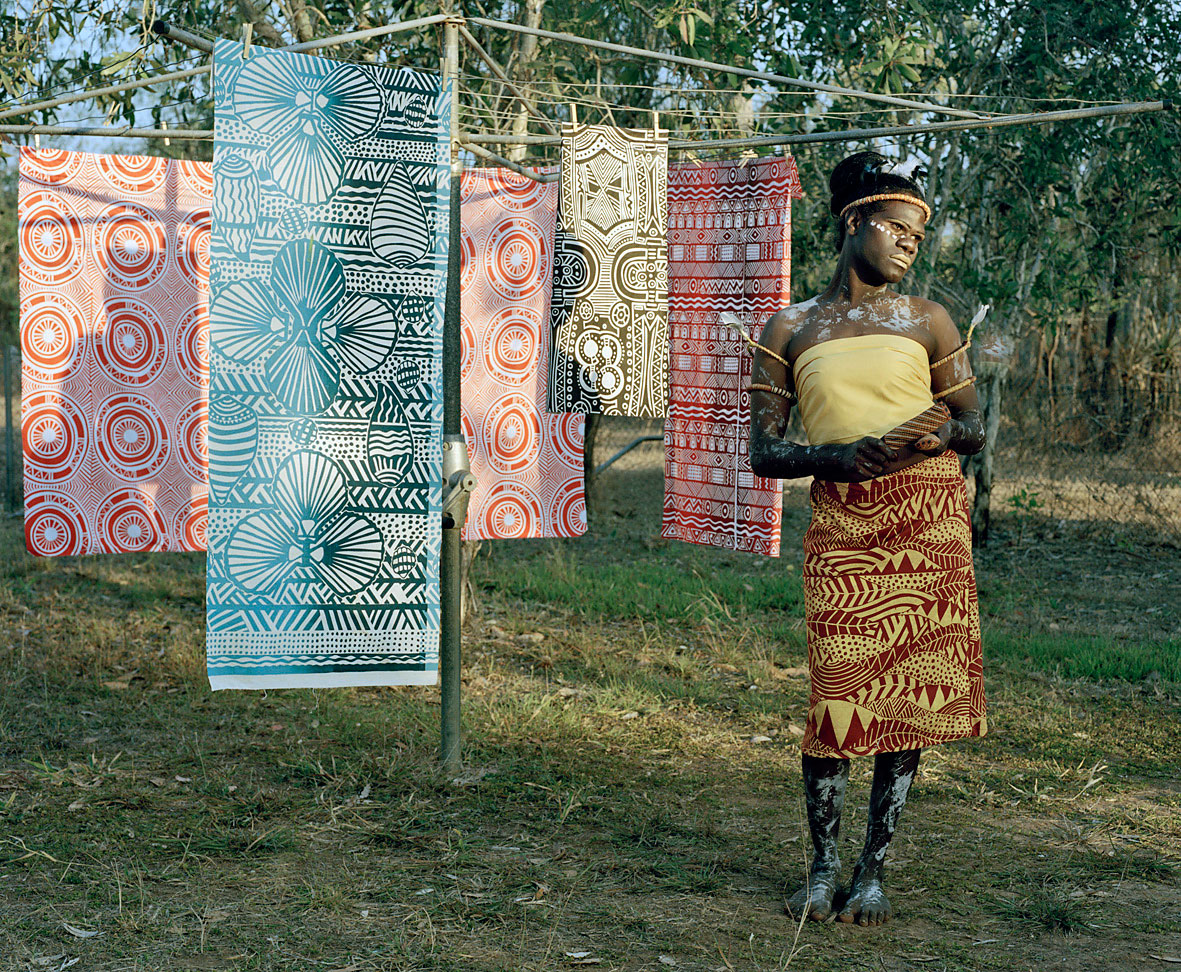
Bindi Cole Chocka (Australian, b. 1975) 'Bimbo' 2009 from the exhibition 'Sistagirls' by Bindi Cole at Nellie Castan Gallery, Melbourne, July 2010


Bindi Cole Chocka (Australian, b. 1975)
Bimbo
2009


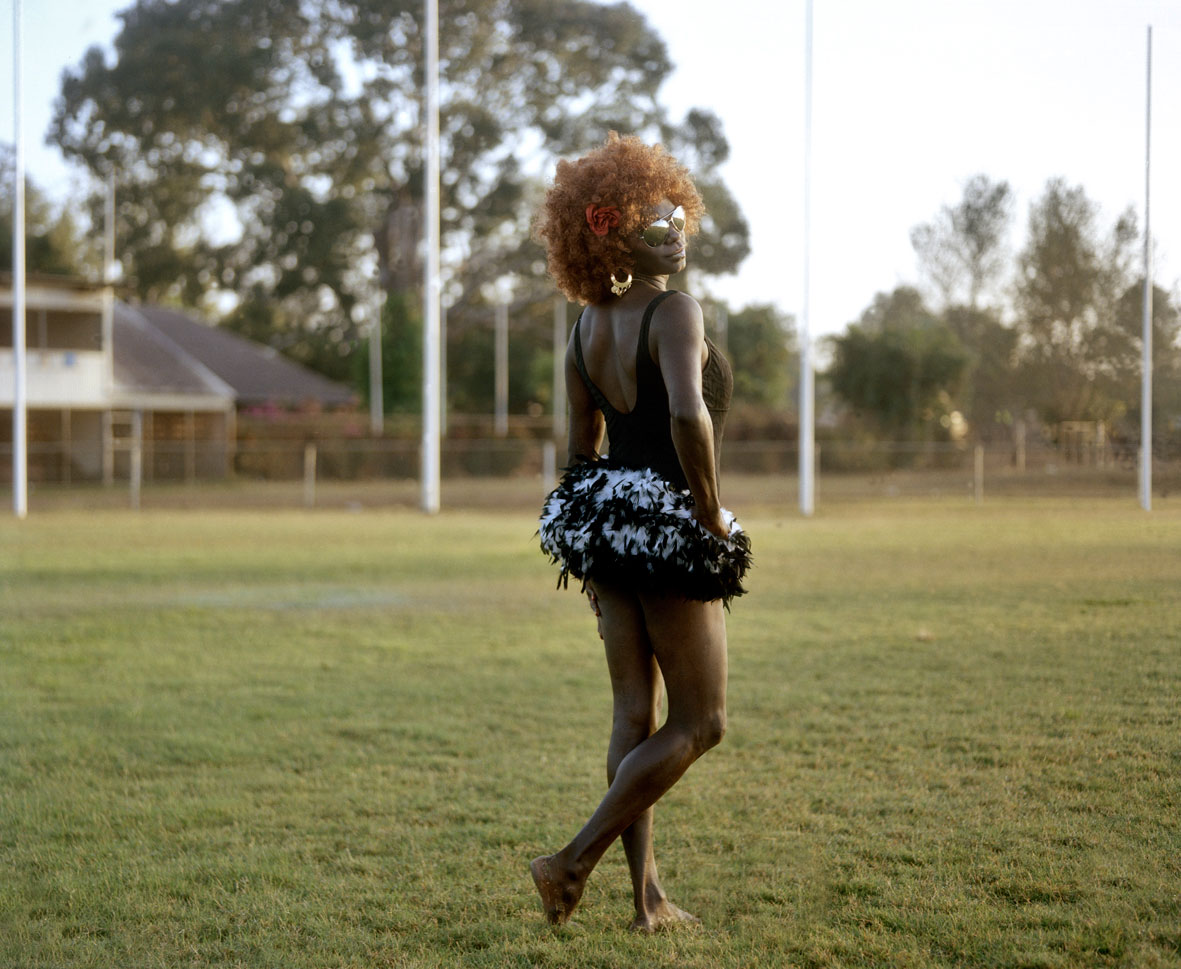
The exhibition Sistagirls by Bind Cole at Nellie Castan Gallery contains some beautiful photographs and others that are less successful. The successful portraits the ones that depict the Sistagirls in a more natural, less stylised way – they are the more interesting photographs. The subjects seem to speak for themselves without restriction, to be not so beholden to the pose that photographer wishes them to assume and/or the pose they wish to impose on themselves.

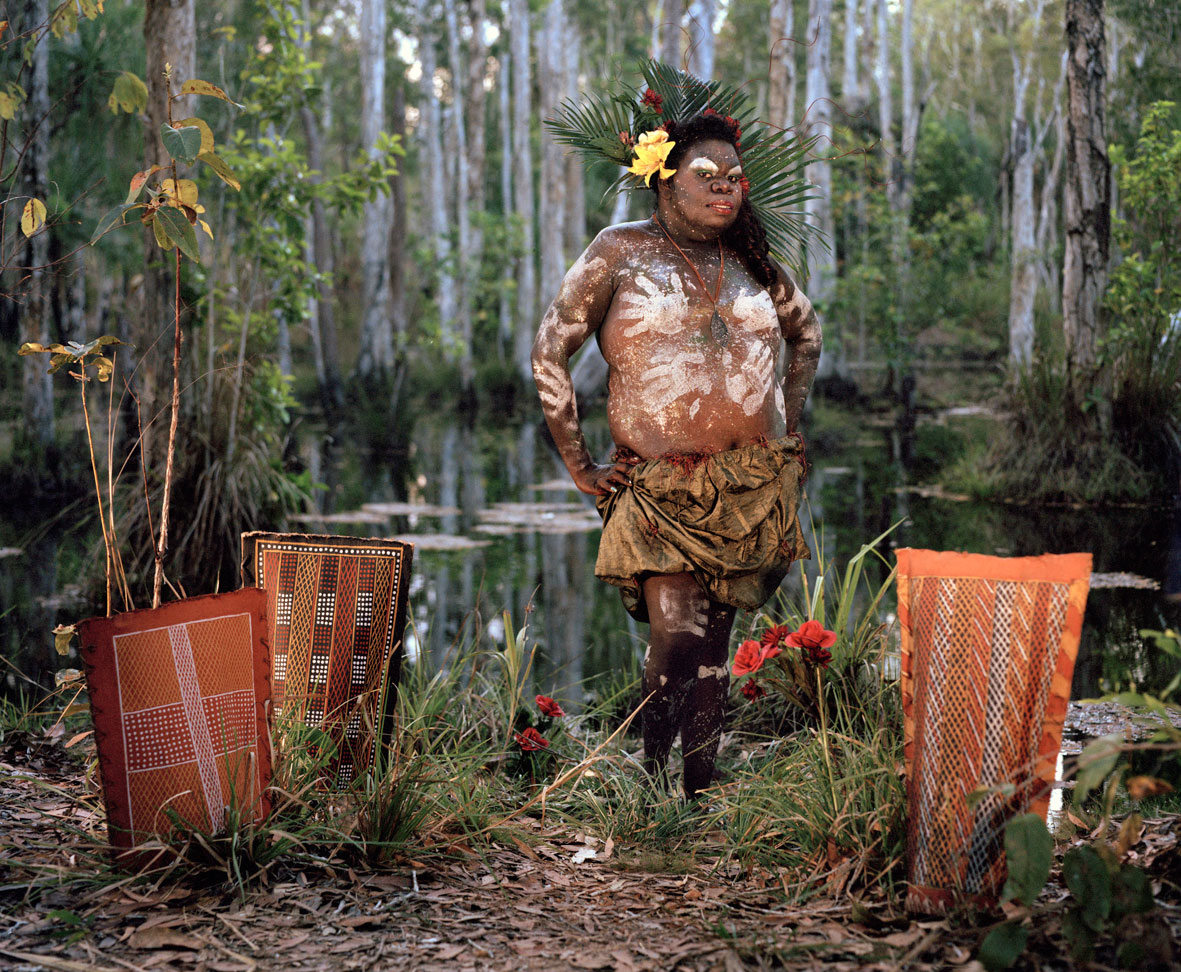
For example, the photograph of Jemima (see below) is just stunning in it’s naturalness and beauty. The two photographs of Crystal and Patricia, where the transgendered person asked to be photographed in traditional body paint with traditional objects, are highly successful in their form, composition and in the ability of the photographs to challenge stereotypical notions of Aboriginal culture.

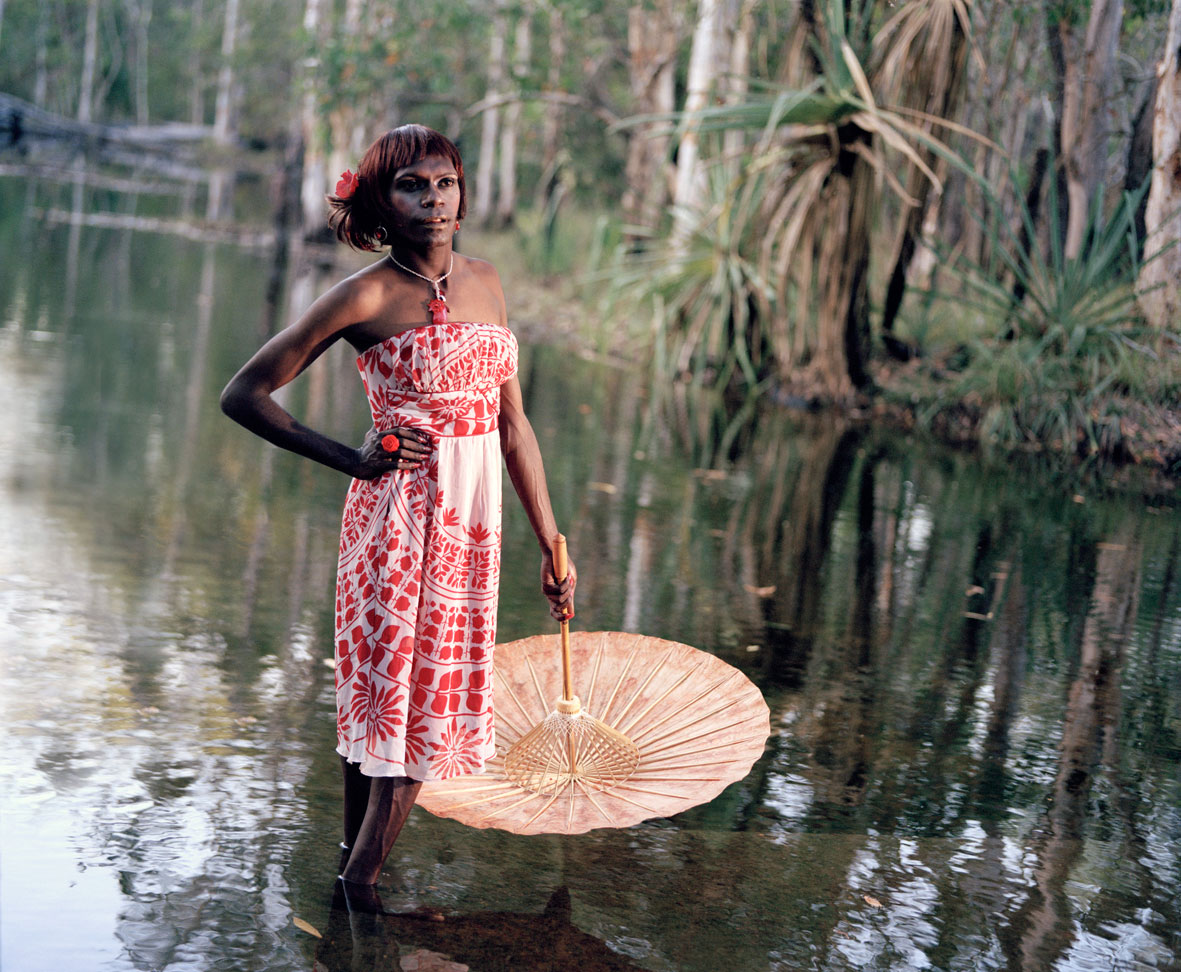
Other portraits are anachronistic and a little try hard, with the misplacing of persons and objects in regard to each other. The portrait of Bimbo (very top photograph) did not need the two objects placed on the beach next to the person to make it a successful photograph; the portrait of Frederina (below) had enough going on in the photograph without the seemingly gratuitous placement of traditional objects in the background. We get the point and there was really no need to labour it.

One of the problems, of course, of a ‘stylised’ portrait (Bind Cole’s word in her artist statement) is that the portrait can become a double forgery, that of the pose of the person and that of the photographer imposing the style …

” … in a sense, the posed photograph is a kind of forgery, an imposition of an artificial composition before the recording instrument. On the other hand, the photo of a posing subject captures the authenticity of the practice of posing. A version of a person’s image is still an image of that person …

We are confronted with the pose, the conscious composition of the image to be photographed, the inherent constructedness of the posed photograph. Our heretofore implicit faith in the photograph as an evidentiary document is shaken. This is not to imply an outright rejection of photography … the effect is more properly an inducement to engage the document directly, personally, and on its own terms.”1


As noted at the end of the quotation, we, the viewer, must cut through this com-pose-ition to address the document directly. We must cut away the appendages of style and view the person and the photograph on its own terms. This is why the simpler portraits in the exhibition have so much more power than the overly constructed ones – they reach for an intangible essence that Cole is seeking by dropping away style and surrendering to the ineffable, a recognition of the lightness and joy in just being.

Dr Marcus Bunyan


1/ Feiereisen, Florence and Pope, Daniel. “True Fiction and Fictional Truths: The Enigmatic in Sebald’s Use of Images in The Emigrants,” in Patt, Lise (ed.,). Searching for Sebald: Photography after W.G. Sebald. Los Angeles: The Institute of Cultural Inquiry, 2007, p. 175.


Many thankx to Olivia Poloni and Nellie Castan Gallery for allowing me to publish the photographs in the posting. The permission is most appreciated. Please click on the photographs for a larger version of the image. All photographs © Bind Cole, courtesy of the artist and Nellie Castan Gallery.


Bindi Cole Chocka (Australian, b. 1975) 'Buffy' 2009 from the exhibition 'Sistagirls' by Bindi Cole at Nellie Castan Gallery, Melbourne, July 2010


Bindi Cole Chocka (Australian, b. 1975)
Buffy
2009


Bindi Cole Chocka (Australian, b. 1975) 'Crystal' 2009 from the exhibition 'Sistagirls' by Bindi Cole at Nellie Castan Gallery, Melbourne, July 2010


Bindi Cole Chocka (Australian, b. 1975)
Crystal
2009


Bindi Cole Chocka (Australian, b. 1975) 'Frederina' 2009


Bindi Cole Chocka (Australian, b. 1975)
Frederina
2009


The term ‘Sistagirl’ is used to describe a transgender person in Tiwi Island culture. Traditionally, the term was ‘Yimpininni’. The very existence of the word provides some indication of the inclusive attitudes historically extended towards Aboriginal sexual minorities. Colonisation not only wiped out many indigenous people, it also had an impact on Aboriginal culture and understanding of sexual and gender expression. As Catholicism took hold and many traditions were lost, this term became a thing of the past. Yimpininni were once held in high regard as the nurturers within the family unit and tribe much like the Faafafine from Samoa. As the usage of the term vanished, tribes’ attitudes toward queer indigenous people began to resemble that of the western world and religious right. Even today many Sistergirls are excluded from their own tribes and suffer at the hands of others.

Within a population of around 2500, there are approximately 50 ‘Sistagirls’ living on the Tiwi Islands. This community contains a complex range of dynamics including a hierarchy (a queen Sistergirl), politics, and a significant history of pride and shame. The Sistagirls are isolated yet thriving, unexplored territory with a beauty, strength and diversity to inspire and challenge.

During August and September of 2009, I was fortunate enough to have the opportunity to spend a month living with the ‘Sistagirls’ on the Tiwi Islands creating a series of highly stylised portraits of them. I loaded a barge with a four wheel drive, lights, a generator, cameras and enough film to fill a suitcase. Each day brought an emotional roller coaster from moments of elation around what was being achieved with the images to complete anxiety from the many dramas that occurred. This time has affected me in a profound way. The ‘Sistagirls’ have touched my heart. I only hope that in some way I have captured the essence of who they are and the spirit of their community. I know that they will always be a part of me and that I will be a regular visitor to Tiwi to visit the ‘Sistagirl’ community for the rest of my life.

Artist statement from the Nellie Castan website [Online] Cited 22/07/2010 no longer available online


Bindi Cole Chocka (Australian, b. 1975) 'Jemima' 2009


Bindi Cole Chocka (Australian, b. 1975)
Jemima
2009


Bindi Cole Chocka (Australian, b. 1975) 'Patricia' 2009


Bindi Cole Chocka (Australian, b. 1975)
Patricia
2009


Nellie Castan Gallery

This gallery is no longer open.

LIKE ART BLART ON FACEBOOK

Back to top

Exhibition: ‘Candid Camera: Australian Photography 1950s-1970s’ at the Art Gallery of South Australia, Adelaide

Exhibition dates: 28th May – 1st August, 2010


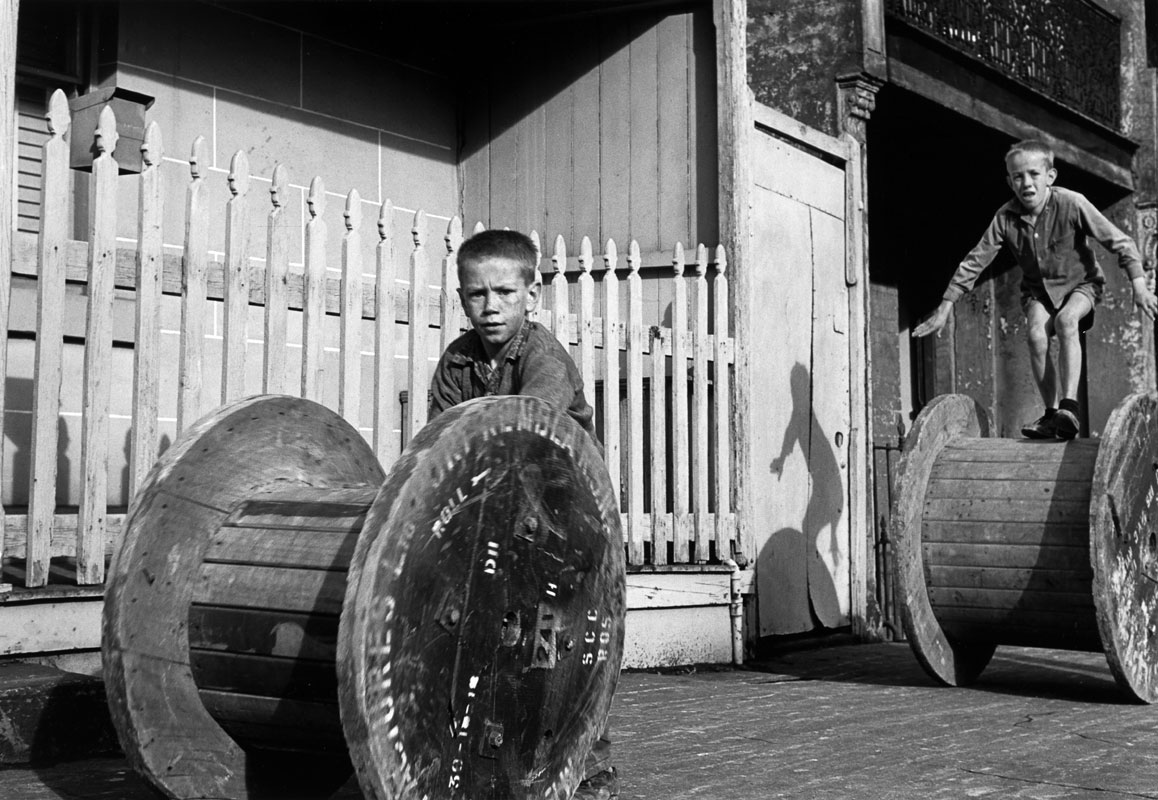
Robert McFarlane (Australia, b. 1942) 'Charles Perkins going home from University' c. 1963 from the exhibition 'Candid Camera: Australian Photography 1950s-1970s' at the Art Gallery of South Australia, Adelaide, May - August, 2010


Robert McFarlane (Australia, b. 1942)
Charles Perkins going home from University
c. 1963, Sydney
Pigment print on paper
Image: 23 x 15cm
South Australian Government Grant 2009
Art Gallery of South Australia, Adelaide
© Robert McFarlane, Courtesy of Josef Lebovic Gallery, Sydney


There are some great photographs below, including one of my favourite photographs by an Australian artist of all time – At Newport (1952) by Max Dupain. There is something about this photograph that to me, makes it even more iconic than Sunbaker (1934). Perhaps it is the modernist rendering of space, the tensional placement of the figures: the curve of the boys back, the slope of the young man’s torso and attendant shadow on the wall, the girl at bottom right caught looking at the poised figure about to dive in – coupled with the receding pylons floating into the distance and the dark cliff face at right.

To have the previsualisation in the mind’s eye, that understanding of what was about to happen placed before the camera and then to capture it takes a truly great photographer. Being a naturalised Australian this is, to me, is one of the most iconic of all Australian photographs. What a beautiful photograph.

Dr Marcus Bunyan


Many thankx to Miranda Young and the Art Gallery of South Australia for allowing me to publish the photographs in the posting. Please click on the photographs for a larger version of the image.


Rennie Ellis (Australia, 1940-2003) 'Auntie Mame, Kings Cross, Sydney' 1970-1971 from the exhibition 'Candid Camera: Australian Photography 1950s-1970s' at the Art Gallery of South Australia, Adelaide, May - August, 2010


Rennie Ellis (Australia, 1940-2003)
Auntie Mame, Kings Cross, Sydney
1970-1971, Sydney
Gelatin silver photograph
Image: 37 x 24cm
South Australian Government Grant 2009
Art Gallery of South Australia, Adelaide
© Rennie Ellis Photographic Archive


Jeff Carter (Australia, 1928-2010) 'Tobacco Road' 1956 from the exhibition 'Candid Camera: Australian Photography 1950s-1970s' at the Art Gallery of South Australia, Adelaide, May - August, 2010


Jeff Carter (Australia, 1928-2010)
Tobacco Road
1956, Ovens Valley, Victoria
Gelatin silver photograph
Image: 28.8 x 27.1cm
South Australian Government Grant 2003
Art Gallery of South Australia, Adelaide
© Jeff Carter


Candid moments of Australian life from the 1950s, 60s and 70s, captured by some of Australia’s most renowned photographers, go on display in Candid Camera – a fascinating new photographic exhibition at the Art Gallery of South Australia.

Curated by Julie Robinson, the Art Gallery’s Senior Curator of Prints, Drawings & Photographs, Candid Camera: Australian Photography 1950s-1970s includes more than 80 documentary images by photographers including Max Dupain, David Moore, Jeff Carter, Robert McFarlane, Mervyn Bishop, Rennie Ellis, Carol Jerrems and Roger Scott.

These photographers have been great observers, capturing memorable images in Australia and abroad of people at leisure or engaged in everyday activities – images which appear unposed, spontaneous, or with their subjects captured unaware.

The photographs on display encompass social rituals, beach culture, protest movements, Indigenous issues, migration, youth subcultures, work, leisure, music, people, travel and humour. They range from images of the famous – such as Prime Ministers, boxing champion Lionel Rose, musicians Bon Scott and Daddy Cool – to those of ordinary people.

Says Julie Robinson, “The photographs in Candid Camera epitomise life during the 50s, 60s and 70s and resonate with spontaneity, humour and humanity.”

Robinson explains, “Even the anonymous people seem familiar to us as a result of these photographs, like David Moore’s European migrants arriving in Sydney, Rennie Ellis’s Cosmetics salesgirl, Toorak Rd, the two youths exiting ghost train ride in Roger Scott’s photograph or the unidentified women waiting at an Adelaide bus stop, in Robert McFarlane’s photograph.”

Many of these photographs have only been recently acquired by the Art Gallery of South Australia and this exhibition will provide the first opportunity for audiences to view them displayed together.

Press release from the Art Gallery of South Australia website [Online] Cited 20/10/2010 no longer available online


Jeff Carter (Australia, 1928-2010) 'Saturday arvo, Chippendale' 1960


Jeff Carter (Australia, 1928-2010)
Saturday arvo, Chippendale
1960, Chippendale, New South Wales
Gelatin silver photograph
Image: 30.5 x 36.1cm
South Australian Government Grant 2003
Art Gallery of South Australia, Adelaide
© Jeff Carter


Max Dupain (Australia, 1911-1992) 'At Newport' 1952


Max Dupain (Australia, 1911-1992)
At Newport
1952, Sydney
Gelatin silver photograph
Image: 31.5 x 34.0cm
D’Auvergne Boxall Bequest Fund 2009
Art Gallery of South Australia, Adelaide


Rennie Ellis (Australia, 1940-2003) 'Cosmetics salesgirl, Toorak Road' c. 1970


Rennie Ellis (Australia, 1940-2003)
Cosmetics salesgirl, Toorak Road
c. 1970, Melbourne
Gelatin silver photograph
Image: 29.0 x 43.5cm
South Australian Government Grant 2009
Art Gallery of South Australia, Adelaide
© Rennie Ellis Photographic Archive


Rennie Ellis (Australia, 1940-2003) 'Union Jack, Lorne' c. 1968


Rennie Ellis (Australia, 1940-2003)
Union Jack, Lorne
c. 1968, Victoria
Gelatin silver photograph
Image: 29.4 x 44.0cm
South Australian Government Grant 2009
Art Gallery of South Australia, Adelaide
© Rennie Ellis Photographic Archive


Roger Scott (Australia, b. 1944) 'Ghost train' 1972


Roger Scott (Australia, b. 1944)
Ghost train
1972, Sydney
Gelatin silver photograph
Image: 27.0 x 40.0cm
South Australian Government Grant 2009
Art Gallery of South Australia, Adelaide
© Roger Scott, Courtesy of Josef Lebovic Gallery, Sydney


Art Gallery of South Australia
North Terrace
Adelaide SA 5000
Phone: 61 8 8207 7000

Opening hours:
Daily 10am – 5pm

Art Gallery of South Australia website

LIKE ART BLART ON FACEBOOK

Back to top

Review: ‘The Way Things Appear’ by Anne Zahalka at Arc One Gallery, Melbourne

Exhibition dates: 29th June – 24th July, 2010


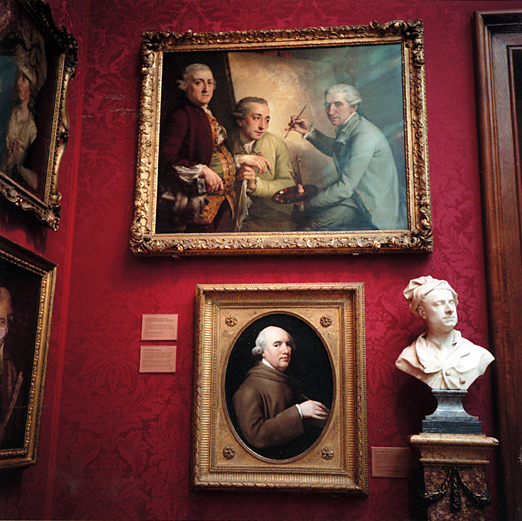
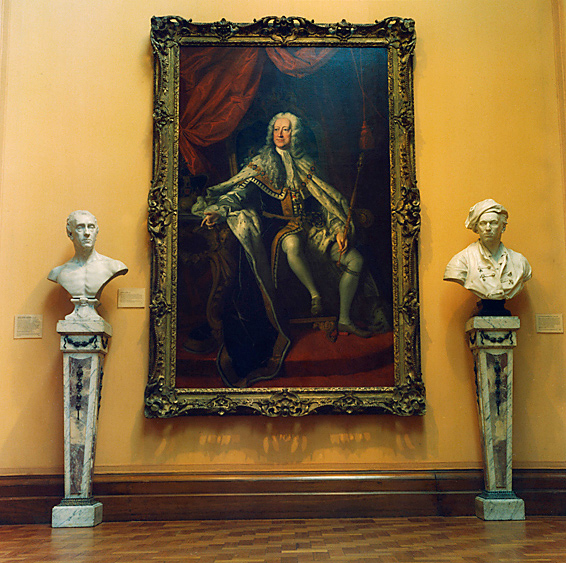
Anne Zahalka (Australian, b. 1957) 'National Portrait Gallery #1' 1992/2010 from the exhibition 'The Way Things Appear' by Anne Zahalka at Arc One Gallery, Melbourne, June-  July, 2010


Anne Zahalka (Australian, b. 1957)
National Portrait Gallery #1
1992/2010


A patchy exhibition by Anne Zahalka at Arc One Gallery, Melbourne. I can’t help feeling that we have seen this before, and done better, in the work of Candida Hofer and Thomas Struth.

Although the square photographs are taken by a medium format film camera (a Hasselblad I suspect) and printed as C-type prints (hence the lush colours) because the camera was handheld this means that, in some of the photographs, little is actually in focus. While this may add to the immediacy of the images, like a quick snapshot as Zahalka prowls the galleries, it detracts from the clarity of the previsualisation of the artist whilst also detracting from the visual depth of field that the subject matter needed.

On the positive side there are some lovely spatial relationships between the figures in the paintings and the busts on the pedestals: in one particular photograph (National Portrait Gallery #2, 2010) there is an almost symbiotic relationship between the man in the painting at left, the bust of the man on the pedestal and the man at the very left in the right hand painting. This arrangement is like a triple portrait of the same person. A similar understanding of the spatial relationships within the image frame can be seen in National Portrait Gallery #1 (see photograph above), one of the more successful photographs in the series, with it’s wonderful red flocked wallpaper and gilt frames.

On the right hand side of the gallery there are numerous vertical colour photographs taken on a 35mm camera that feature the back of people looking at a work of art (see National Gallery of Australia, Masters of Paris #5, 2010). These are basic photographs that seek to conceptualise the act of looking at art as a tourist industry to no great affect or insight into the condition being examined.

Dr Marcus Bunyan


Many thankx to Angela Connor and Arc One Gallery for allowing me to publish the photographs in the posting. Please click on the photograph for a larger version of the image.


Anne Zahalka (Australian, b. 1957) 'National Portrait Gallery #5' 2010 from the exhibition 'The Way Things Appear' by Anne Zahalka at Arc One Gallery, Melbourne, June - July, 2010


Anne Zahalka (Australian, b. 1957)
National Portrait Gallery #5
2010


Anne Zahalka (Australian, b. 1957) 'National Portrait Gallery #3' 1992/2010 from the exhibition 'The Way Things Appear' by Anne Zahalka at Arc One Gallery, Melbourne, June - July, 2010


Anne Zahalka (Australian, b. 1957)
National Portrait Gallery #3
1992/2010


Anne Zahalka (Australian, b. 1957) 'Prado Museum, Madrid' 1992/2010


Anne Zahalka (Australian, b. 1957)
Prado Museum, Madrid
1992/2010


Arc One Gallery
45 Flinders Lane
Melbourne, 3000
Phone: +61 3 9650 0589

Opening hours:
Wednesday – Saturday, 11am – 5pm

Arc One Gallery website

LIKE ART BLACK ON FACEBOOK

Back to top

Exhibition: ‘Icon & archive: photography & the World Wars’ at the Monash Gallery of Art, Melbourne

Exhibition dates: 16th April – 11th July, 2010


Many thankx to Mark Hislop and the Monash Gallery of Art for allowing me to reproduce the photographs in the posting. Please click on the photos for a larger version of the image.


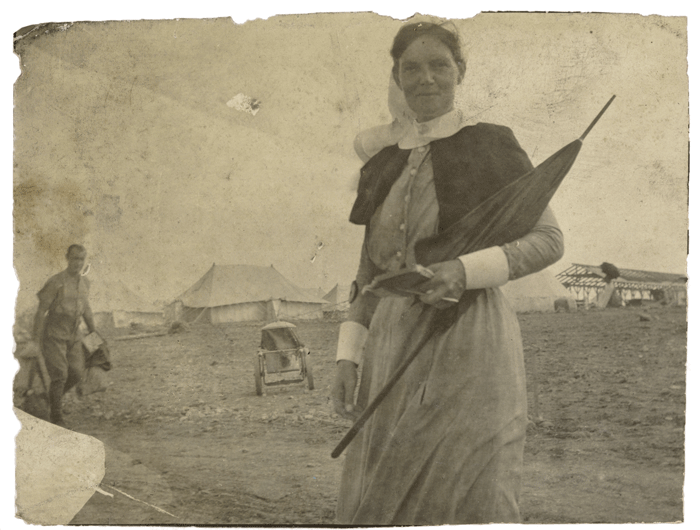
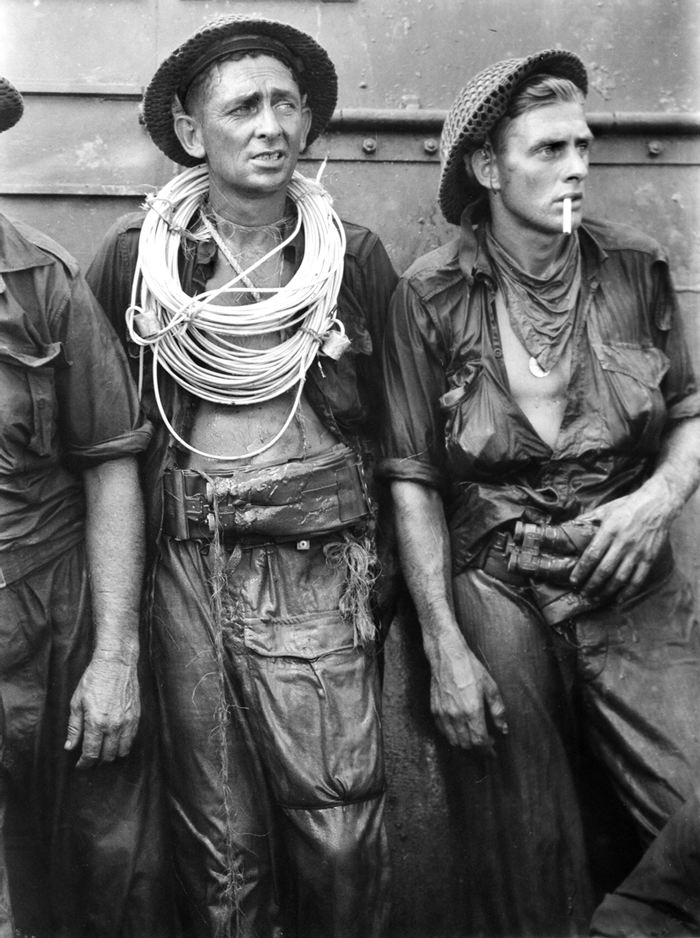
Photographer unknown. 'Matron Grace Wilson doing a round, Mudros' 1915 from the exhibition 'Icon & archive: photography & the World Wars' at the Monash Gallery of Art, Melbourne, April - July, 2010


Photographer unknown
Matron Grace Wilson doing a round, Mudros
1915
Gelatin silver print
Australian War Memorial


NOTHING could have prepared Grace Wilson for her first day at Turks Head Point on the drought-stricken island of Lemnos, where she was to run a field hospital for injured soldiers being shipped out from Gallipoli, 65km away.

“Things are just too awful for words… we found only a bare piece of ground with wounded men in pain, still in filthy, bloodstained clothes, lying amid stones and thistles,” she wrote in her diary.

Matron Wilson and her 40 nurses had arrived in the island’s Mudros harbour aboard the Dunluce Castle on August 2, 1915, to discover to their dismay there was no sign of the supply ship Ascot, which had been due there a week earlier with the tents, medical equipment, crates of tinned food and other essentials.

In a bizarre display of military pomp, a regimental piper led the women – wearing heavy, ankle-length dresses and petticoats – on a long march in searing summer heat to what would be their home for the most harrowing five months of their lives…”

Read the full article: Daryl Passmore. “Brisbane snubs unsung war heroine Matron Grace Wilson,” on The Sunday Mail (Qld) on The Courier Mail website April 21, 2013 [Online] Cited 15/10/2019


Norman Stuckey (Australian, 1914-1983) 'The Pimple, Shaggy Ridge, New Guinea' 1943 from the exhibition 'Icon & archive: photography & the World Wars' at the Monash Gallery of Art, Melbourne, April - July, 2010


Norman Bradford Stuckey (Australian, 1914-1983)
The Pimple, Shaggy Ridge, New Guinea
1943
Toned silver gelatin print
Australian War Memorial


The Battle of the Shaggy Ridge was part of the Markham and Ramu Valley – Finisterre Range campaign, consisting of a number of actions fought by Australian and Japanese troops in Papua New Guinea in World War II. Following the Allied capture of Lae and Nadzab, the Australian 9th Division had been committed to a quick follow up action on the Huon Peninsula in an effort to cut off the withdrawing Japanese. Once the situation on the Huon Peninsula stabilised in late 1943, the 7th Division had pushed into the Markham and Ramu Valleys towards the Finisterre Range with a view to pushing north towards the coast around Bogadjim, where they would meet up with Allied forces advancing around the coast from the Huon Peninsula, before advancing towards Madang.

A series of minor engagements followed in the foothills of the Finisterre Range before the Australians came up against strong resistance centred around the Kankiryo Saddle and Shaggy Ridge, which consisted of several steep features, dotted with heavily defended rocky outcrops. After a preliminary assault on a forward position dubbed The Pimple in late December 1943, the Australians renewed their assault in mid-January 1944 and over the course of a fortnight eventually captured the Japanese positions on Shaggy Ridge and the Kankiryo Saddle, after launching a brigade-sized attack up three avenues of advance. In the aftermath, the Australians pursued the Japanese to the coast and subsequently took Madang, linking up with US and Australian forces.

Text from the Wikipedia website [Online] Cited 25/10/2019


Barbara Joan Isaacson (Australian, 1923-2017) 'Journalist Iris Dexter standing under the starboard engine of a Douglas C-47 aircraft' February - March 1943 from the exhibition 'Icon & archive: photography & the World Wars' at the Monash Gallery of Art, Melbourne, April - July, 2010


Barbara Joan Isaacson (Australian, 1923-2017)
Journalist Iris Dexter standing under the starboard engine of a Douglas C-47 aircraft
February-March 1943
Gelatin silver print 2008
Image courtesy of the AMW


Joan Barbara Isaacson was born into a dynamic and family. Her mother, Lynka Isaacson (also known as Caroline Isaacson), was the first female journalist to be employed by a metropolitan newspaper in Australia, and was a strong role model for her daughter. After the war Isaacson’s mother and brother set up the Southern Cross publishing business.

Isaacson attended the Melbourne Technical College, where she studied photography. When she was 18 years old she joined the Australian Women’s Army Service (AWAS). Working in the Army Public Relations section, she travelled the east coast taking documentary and recruitment propaganda photographs and meeting press journalists and photographers.

In 1943 Isaacson married Richard L. Beck, a graphic designer and photographer. During the period from 1946-1948 they set up their own photographic business in Melbourne, specialising in child portraiture. Isaacson took over the business c.1950 when her husband went back to working as a graphic designer, and continued to manage the studio until the birth of her third baby. After her departure from the photography business Isaacson was involved in a variety of other ventures and gave up her photography.

Text from the Australian Women’s Register website [Online] Cited 24/10/2019


Max Dupain (Australian, 1911-1992) 'The dozing soldier' 1943


Max Dupain (Australian, 1911-1992)
The dozing soldier (Tired Soldier in Train North Queensland)
1943
Gelatin silver print
Australian War Memorial


Photographs are an inseparable part of our memory of the First and Second World Wars. They help us remember events which many of us have no direct experience.

Monash Gallery of Art’s new special exhibition Icon & archive: photography and the World Wars draws on the Australian War Memorial’s vast photographic collection to consider the relationship of photography and war. This extraordinary exhibition opens to the public on Friday 16 April.

Direct from the Australian War Memorial, Icon & archive demonstrates the powerful role played by photography in the efforts of Australians to make sense of and remember the terrible events of the First and the Second World Wars.

“Visitors to MGA will see many ‘iconic’ photographs that have become lodged in our national memory,” said MGA Director and curator of the exhibition, Dr Shaune Lakin.

Icon & archive also presents previously unseen photographs to showcase the experiences of both service personnel and the families left behind during the wars. These photographs provide contemporary audiences with a remarkable picture of the effects of the World Wars on private, family and social life in Australia. In doing this, the exhibition will help members of our community better understand that experience and its relevance to contemporary Australia,” said Dr Lakin.

Icon & archive will play a significant role in the City of Monash’s Anzac Day commemorations, in this the 95th anniversary of the landing at Gallipoli. Icon & archive includes some of the most historically significant pictures from Gallipoli, as well as other important sites involving Australians during both the First and the Second World Wars.”

Press release from the Monash Gallery of Art website [Online] Cited 09/07/2022. No longer available online


Algemon Darge (Australian, 1878-1941) 'Private George Beamish Swanton with his wife Nellie and their young baby Joan' 1915


Algemon Darge (Australian, 1878-1941)
Private George Beamish Swanton with his wife Nellie and their young baby Joan
1915
Gelatin silver print
Australian War Memorial


Studio portrait of 1159 Private (Pte) George Beamish Swanton, Australian 24th Battalion, of Werribee, Victoria, with his wife Nellie and young baby, Joan Helen. Pte Swanton enlisted on 28 April 1915 and embarked on board HMAT Euripides on 8 May 1915. He died of wounds on 28 July 1916 at Pozieres, France. Pte Swanton had two brothers who were also killed in action; 222 Pte John (Jack) Swanton, 2nd Battalion, enlisted on 27 August 1914 and was killed in action at Gallipoli Peninsula on 2 May 1915; and 2760 Pte Henry Swanton, 29th Battalion, enlisted on 5 March 1916 and was killed in action at Pozieres, France on 2 November 1916.

This is one of a series of photographs taken by the Darge Photographic Company which had the concession to take photographs at the Broadmeadows and Seymour army camps during the First World War. In the 1930’s, the Australian War Memorial purchased the original glass negatives from Algernon Darge, along with the photographers’ notebooks. The notebooks contain brief details, usually a surname or unit name, for each negative. The names are transcribed as they appear in the notebooks.

Text from the Australian War Memorial website [Online] Cited 25/10/2019


Norman Bradford Stuckey (Australian, 1914-1983) 'Engineers exhausted after destroying obstacles, Tarakan' 1945


Norman Bradford Stuckey (Australian, 1914-1983)
Engineers exhausted after destroying obstacles, Tarakan
1945
Gelatin silver print
Australian War Memorial


The Battle of Tarakan was the first stage in the Borneo campaign of 1945. It began with an amphibious landing by Allied forces on 1 May, code-named Operation Oboe One; the Allied ground forces were drawn mainly from the Australian 26th Brigade, but included a small element of Netherlands East Indies personnel. The main objective of the landing was capture of the island’s airfield. While the battle ended with success for the Allied forces over the Japanese defenders, this victory is generally regarded as having not justified its costs. The airfield was so heavily damaged that it ultimately could not be repaired in time to make it operational for other phases of the Allied campaign in Borneo.

Text from the Wikipedia website [Online] Cited 25/10/2019


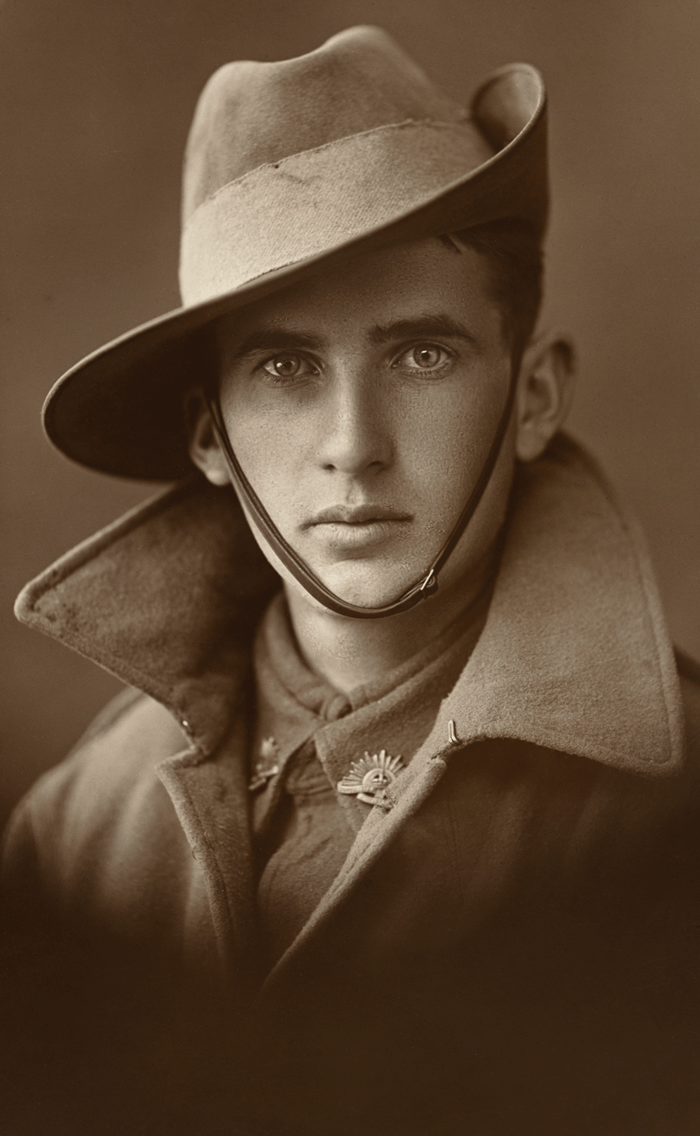
Asti Studios. 'Studio portrait of an unidentified First World War soldier in Australian service uniform' 1914-1918


Asti Studios
Studio portrait of an unidentified First World War soldier in Australian service uniform, including greatcoat and slouch hat
c. 1914-1918
New South Wales, Sydney
Toned silver gelatin print
Australian War Memorial


Monash Gallery of Art
860 Ferntree Gully Road, Wheelers Hill
Victoria 3150 Australia
Phone: + 61 3 8544 0500

Opening hours:
Tue – Fri: 10am – 5pm
Sat – Sun: 10am – 4pm
Mon/public holidays: closed

Monash Gallery of Art website

LIKE ART BLART ON FACEBOOK

Back to top

Review: ‘Jill Orr: Vision’ at Jenny Port Gallery, Richmond, Melbourne

Exhibition dates: 2nd June – 3rd July, 2010


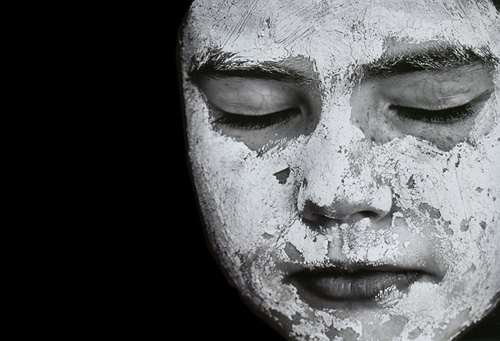
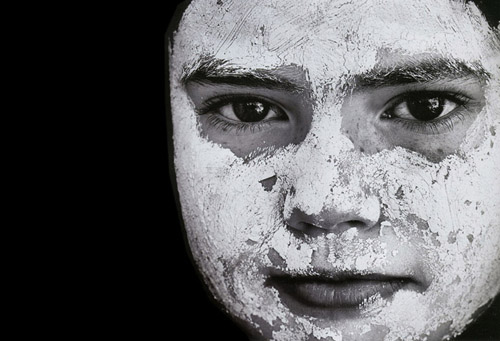
Jill Orr (Australian, b. 1952) 'Megan' 2009 from the exhibition Review: 'Jill Orr: Vision' at Jenny Port Gallery, Richmond, Melbourne, June - July, 2010


Jill Orr (Australian, b. 1952)
Megan
2009


A huge gallery crawl on Wednesday last saw me take in exhibitions at Nellie Castan Gallery (Malleus Melficarum: strong sculptural work by James and Eleanor Avery; Broken Canon: vibrant mixed media collages by Marc Freeman); Anita Traverso Gallery (Peristereonas: sculptures, photographs and mixed media by Barry Thompson); John Buckley Gallery (Perpetua by Emma can Leest, beautiful cut paper works; rather mundane paintings by Christian Lock); Karen Woodbury Gallery (Every breath you take: wonderful galaxy-like paintings, perhaps as seen by the Hubble telescope, with a geometric / cellular base by Lara Merrett); The Centre for Contemporary Photography (Event horizon: a group exhibition that “engages the horizon as a means to establish a physical locality with relation to the Earth’s surface and more broadly to the universe of which it is a miniscule component.” An exhibition that left me rather cold); and ACCA (Towards an elegant solution by Peter Cripps, again a singularly unemotional engagement with the precise, contained work: interesting for how the work explores spatial environments but in an abstract, intellectual way).

The stand out work from this mammoth day was Jill Orr: Vision at Jenny Port Gallery. Simply put, it was the strongest, most direct, most emotionally powerful work that I saw all day.

Dr Marcus Bunyan


Many thankx to Amelia Douglas and Jenny Port Gallery for allowing me to publish the photographs in this posting.


Jill Orr (Australian, b. 1952) 'Megan' 2009 from the exhibition Review: 'Jill Orr: Vision' at Jenny Port Gallery, Richmond, Melbourne, June - July, 2010


Jill Orr (Australian, b. 1952)
Megan
2009


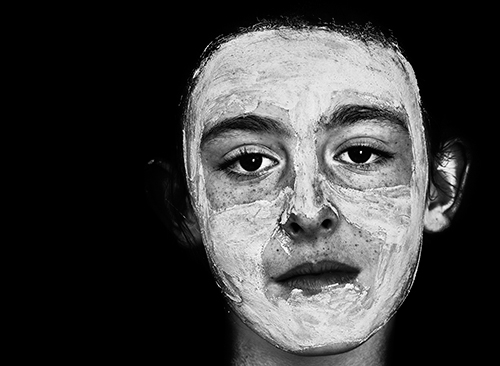
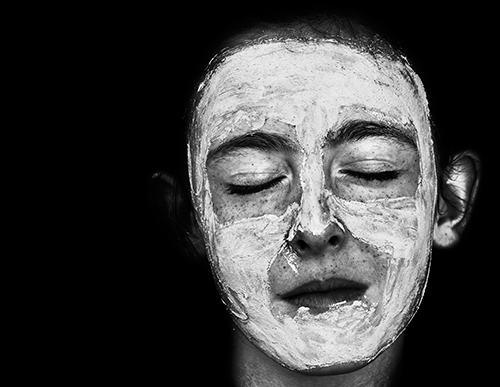
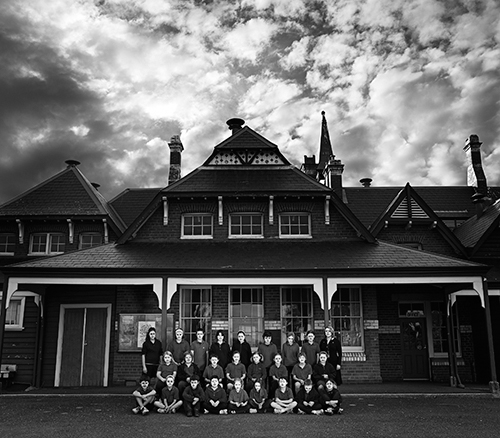
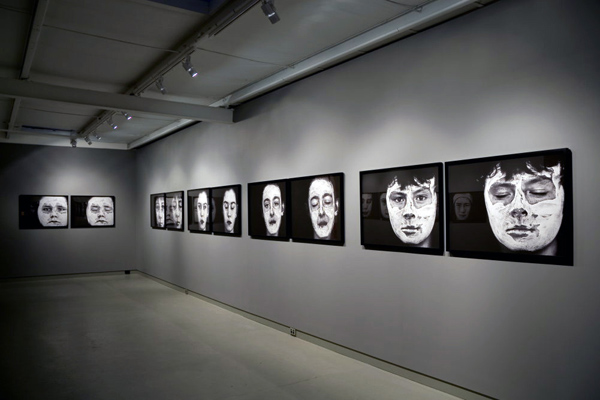
Jill Orr’s new participatory performances are photographs of children from Avoca Primary School painted with white clay from the area, displayed in pairs. The children are photographed once with eyes open, once with eyes closed. Orr asked the children to imagine their future life when they had their eyes closed. The key to the work is a group photograph of the ghostly children outside the primary school where everyone is isolated from each other (see photograph below).

“White faces loom up out of a dark ground, described by Orr as a void. On the surface these portraits are finely crafted, the skin of masked face becomes one with the digital file to create a facial landscape. The materiality of the face and the photographic file are exposed for the viewer. Titling the series ‘vision’ Orr ventures into a ‘haptic visuality’ where “vision itself can be tactile, as though one were touching a film with one’s eyes.”


From the catalogue essay by Professor Anne Marsh, Monash University


In the performance, the ritual of being photographed, Orr instructs the children who are placed under the surveillance of the camera. “We are confronted with the pose, the conscious composition of the image to be photographed, the inherent constructedness of the posed photograph.”1 The child assumes the pose by which they wish to be memorialised. The gaze (of the camera, of the viewer) is returned / or not in this spectacle.

Something happens when we look at these photographs. The text of the photographs becomes intertextual, producing as Barthes understands a “plurality of meanings and signifying / interpretive gestures that escape the reduction of knowledge to fixed, monological re-presentations, or presences.”2 This is because, as Foucault observes, texts “are caught up in a system of references to … other texts, other sentences: it is a node within a network …  Its unity is variable and relative.”3

The photographs invite us to share not only the mapping of the surface of the skin and the mapping of place (the history of white people living on the land in country Australia) and identity but the sharing of inner light, the light of the imaginary as well – and in this observation the images become unstable, open to reinterpretation. The distance between viewer and subject is transcended through an innate understanding of inner and outer light. The photographs seduce, meaning, literally, to be led astray.

As American photographer Minor White, who photographed in meditation hoping for a revelation in spirit though connection between person > subject > camera > negative > print, observes in one of his Three Canons

When the image mirrors the man
And the man mirrors the subject
Something might take over
4


Here the power of the photographer acting in isolation, the modernist tenet of authorship, is overthrown. In it’s place, “White supposes a relationship with subject that is a two way street: by granting the world some role in its own representation we create a photograph that is not so much a product solely of individual actions as it is the result of a negotiation in which the world and all its subjects might participate.”5 The autobiography of a soul born in the age of mechanical reproduction. This is the power of these photographs for something intangible within the viewer does take over. I found myself looking at the photographs again and again for small nuances, the detail of hairs on the head, the imagining of what the person was thinking about with their eyes closed: their future, their fears, their hopes, the ‘active imagination as a means to visualise sustainable futures’ (Orr, 2010).

These photographs seem to lengthen or protract time through this haptic touching of inner light. As Pablo Helguera observes in his excellent essay How To Understand the Light on a Landscape that examines different types of light (including experiental light, somber light, home light, ghost light, the light of the deathbed, protective light, artificial light, working light, Sunday light, used light, narrated light, the last light of day, hotel light, transparent light, after light, the light of the truly blind and the light of adolescence but not, strangely, inner light)

“Experience is triggered by light, but not exclusively by the visible light of the electro-magnetic spectrum. What the human eye is incapable to perceive is absorbed by other sensory parts of the body, which contribute to the perception that light causes an effect that goes beyond the merely visual …

There is the LIGHT OF ADOLESCENCE, a blinding light that is similar to the one we feel when we are asleep facing the sun and we feel its warmth but don’t see it directly. Sometimes it marks the unplace, perhaps the commonality of all places or perhaps, for those who are pessimists, the unplaceness of every location …

We may choose to openly embrace the darkness of light, and thus let ourselves through the great gates of placehood, where we can finally accept the unexplainable concreteness of our moments for what they are.”6


In the imagination of the darkness that lies behind these children’s closed eyes is the commonality of all places, a shared humanity of memory, of dreams. These photographs testify to our presence and ask us to decide how we feel about our life, our place and the relation to that (un)placeness where we must all, eventually, return.

Dr Marcus Bunyan


1/ Feiereisen, Florence and Pope, Daniel. “True Fiction and Fictional Truths: The Enigmatic in Sebald’s Use of Images in The Emigrants” in Patt, Lise (ed.,). Searching for Sebald: Photography after W.G. Sebald. Los Angeles: The Institute of Cultural Inquiry, 2007, p. 175.

2/ Barthes, Roland. “From Work to Text” in Image, Music, Text. trans. S. Heath. New York: Hill and Wang, 1977 quoted in Thumlert, Kurt. Intervisuality, Visual Culture, and Education. [Online] Cited 10/08/2006. www.forkbeds.com/visual-pedagogy.htm (link no longer active)

3/ Foucault, Michel. The Order of Things: An Archeology of the Human Sciences. New York: Vintage, 1973 quoted in Thumlert, Kurt. Intervisuality, Visual Culture, and Education. [Online] Cited 10/08/2006. www.forkbeds.com/visual-pedagogy.htm (link no longer active)

4/ White, Minor. Mirrors, Messages and Manifestations. Aperture, 1969

5/ Leo, Vince. Review of Mirrors, Messages and Manifestations on the Amazon website [Online] Cited 26/06/2010

6/ Helguera, Pablo. “How to Understand the Light on a Landscape,” in Patt, Lise (ed.,). Searching for Sebald: Photography after W.G. Sebald. Los Angeles: The Institute of Cultural Inquiry, 2007, pp. 110-119


    Jill Orr (Australian, b. 1952) 'Jacinta' 2009 from the exhibition Review: 'Jill Orr: Vision' at Jenny Port Gallery, Richmond, Melbourne, June - July, 2010

    Jill Orr (Australian, b. 1952) 'Jacinta' 2009 from the exhibition Review: 'Jill Orr: Vision' at Jenny Port Gallery, Richmond, Melbourne, June - July, 2010


    Jill Orr (Australian, b. 1952)
    Jacinta
    2009


    Jill Orr (Australian, b. 1952) 'Avoca Primary School' 2009


    Jill Orr (Australian, b. 1952)
    Avoca Primary School
    2009


    Jill Orr’s work centres on issues of the psycho-social and environmental where she draws on land and identities. Grappling with the balance and discord that exists between the human spirit, art and nature, Orr has, since the 1970s, delighted, shocked and moved audiences through her performance installations.

    This current body of work involved children from the Avoca Primary School as active participants in Orr’s performance for the camera. The result is a series of high contrast black and white photographic portraits, which are shown as diptychs portraying the different states of seeing both outwardly and inwardly. One of each pair frames the child looking directly at the camera. The gaze meets the viewer. Who is looking at whom? The second captures the child whose eyes are closed. An inner world is intimated, but not accessible to the viewer.

    In terms of the ‘gaze’, these works turn to the child as conveyer of the imaginary engaging both within and without. “I have found that creative acts require the visionary sensibilities of both the inner and outer world to operate simultaneously, consciously and unconsciously as dual aspects of the one action. In this instance the action is that of active imagination as a means to visualise sustainable futures.” (Jill Orr, 2010). The portraits also reflect the present relationship to place that is etched into the faces of youth as already kissed by the harsh Australian sun.

    Avoca is one of many townships that has been socially, economically and environmentally affected by drought and climate change. The portraits are created against this background.

    Text from the Jenny Port Gallery website [Online] Cited 26/06/2010 no longer available online


    Jill Orr (Australian, b. 1952) 'Vision' installation photograph at Jenny Port Gallery

    Jill Orr (Australian, b. 1952) 'Vision' installation photograph at Jenny Port Gallery


    Jill Orr (Australian, b. 1952)
    Vision installation photographs at Jenny Port Gallery
    June 2010
    Photos: Marcus Bunyan


    Jenny Port Gallery

    This gallery has now closed.

    Jill Orr website

    LIKE ART BLACK ON FACEBOOK

    Back to top

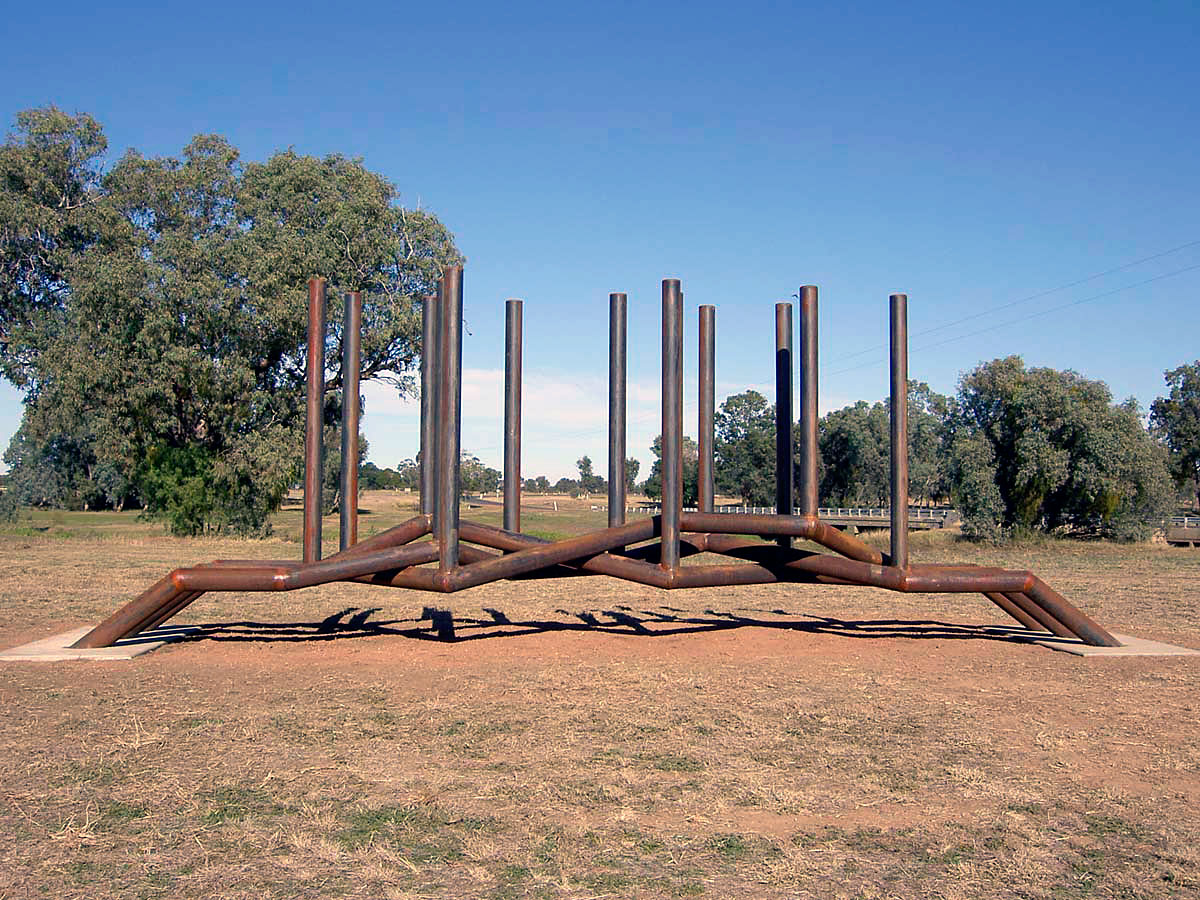
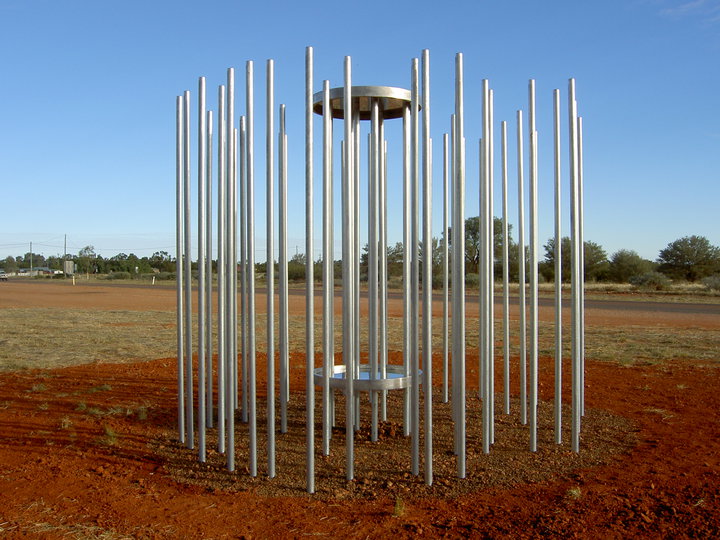
    Sculpture: ‘Drawing Water’ (2010) by Fredrick White

    June 2010


    Unknown photographer. ''Drawing Water' by Frederick White' 2010


    Unknown photographer
    Drawing Water by Frederick White
    2010


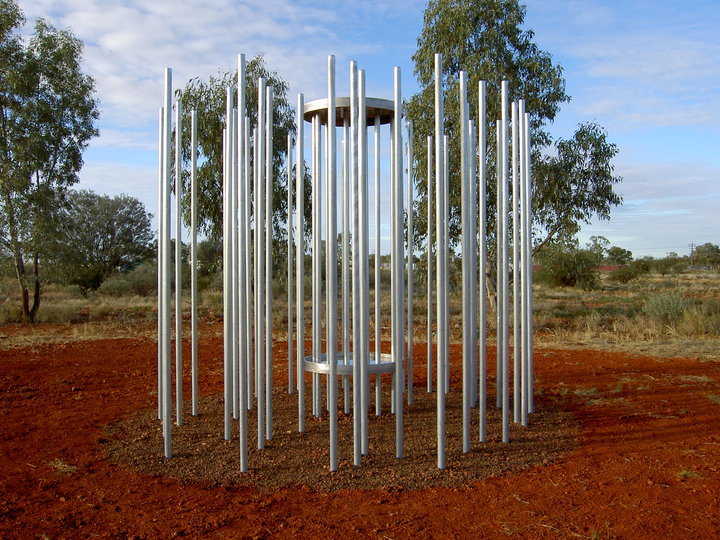
    Australian sculptor Fredrick White, has been commissioned to create two public sculptures in Western Queensland. The first has been completed at Thargomindah (see Google map), a town located 1014 km west of Brisbane and was commissioned by artplusplace and Thargomindah Regional Council. In a small town of 250 people this is the town’s first public sculpture.

    “The town’s one claim to fame is its artesian bore. The bore, which lies 2 km out of town on the Noccundra road, was drilled in 1891 and by 1893, having drilled to a depth of 795 metres, the water came to the surface. It was then that the town successfully attempted a unique experiment. The pressure of the bore water was used drive a generator which supplied the town’s electricity. Enthusiasts have described this as Australia’s first hydro-electricity scheme. The system operated until 1951. Today the bore still provides the town’s water supply. The water reaches the surface at 84°C.”1


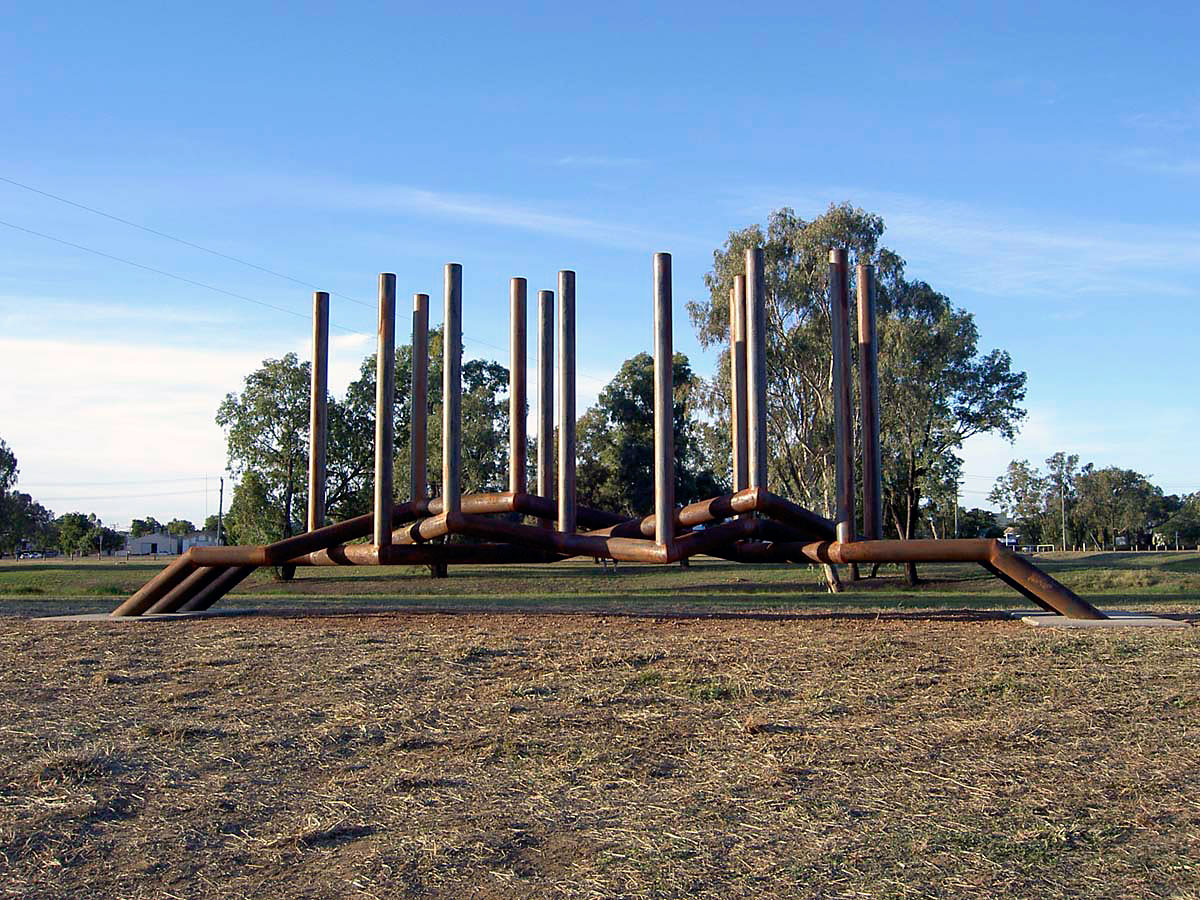
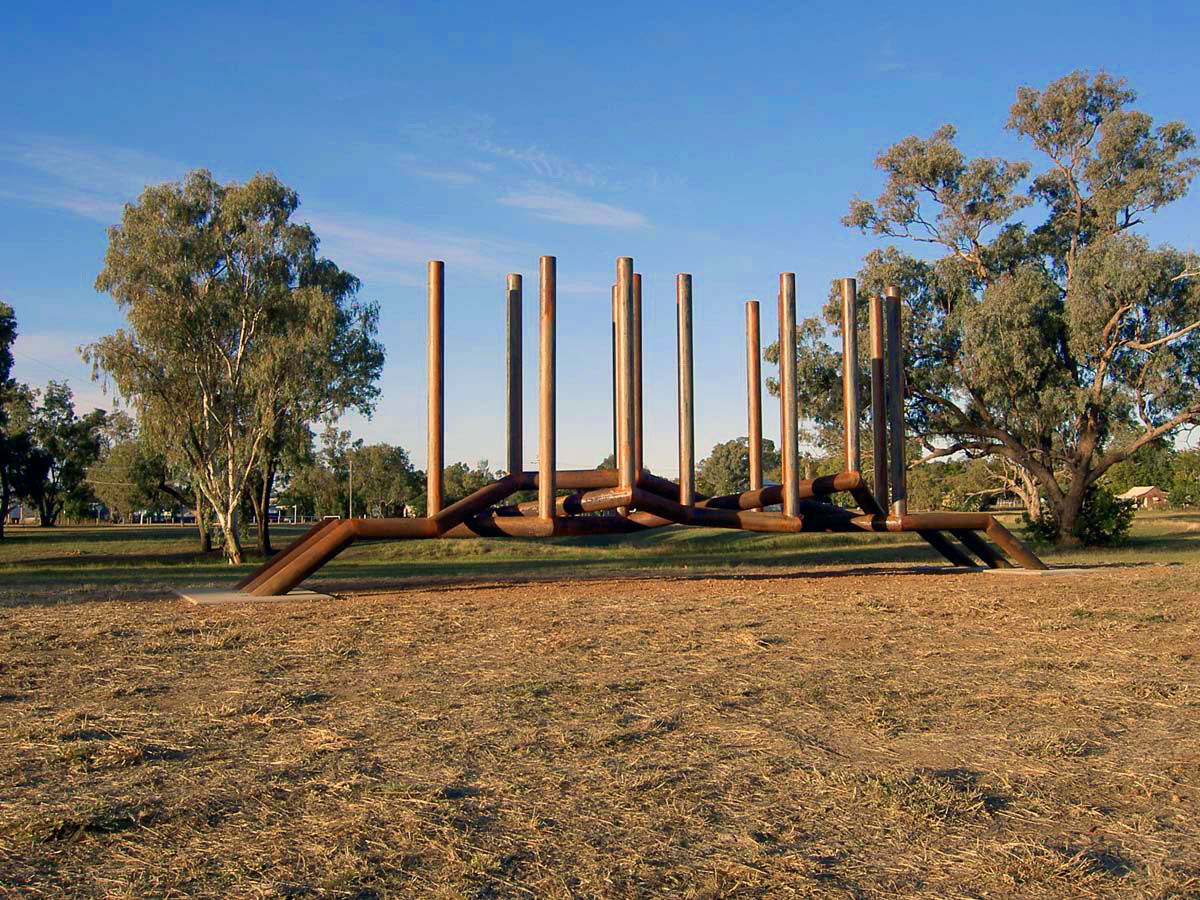
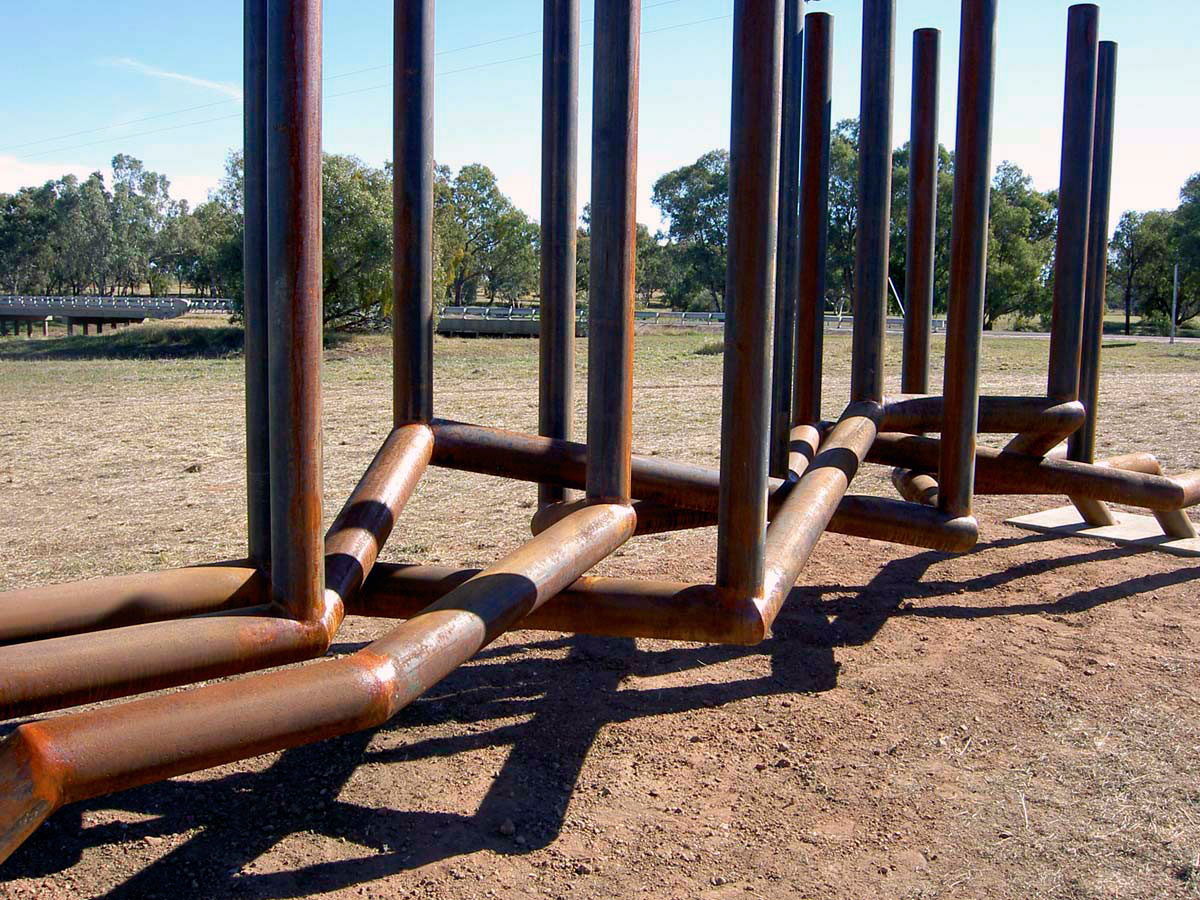
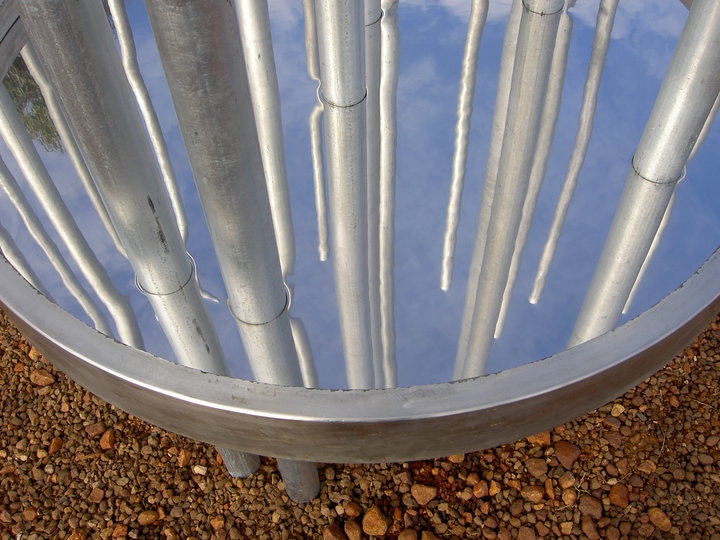
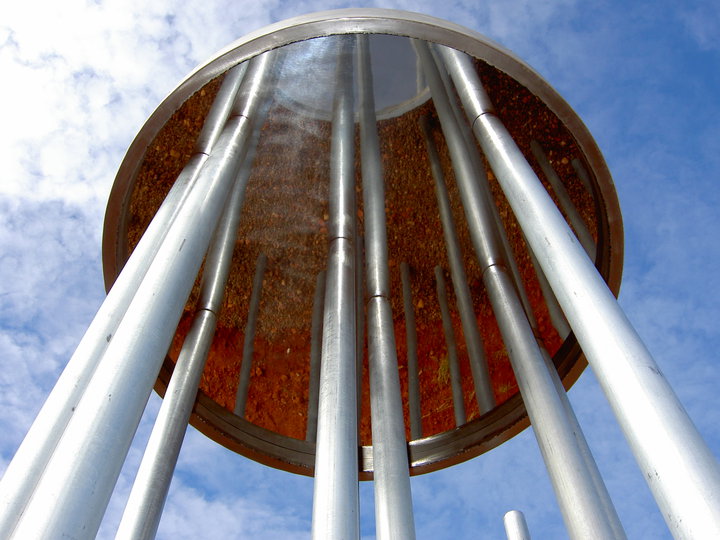
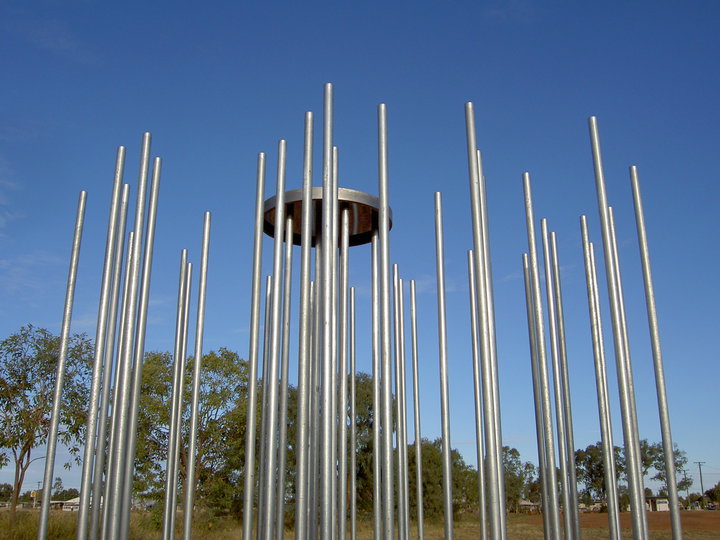
    The work Drawing Water (2010) addresses the need for water in such an arid location and the numerous bores that are sunk around the town to draw water to the surface. The earth is reflected in the sky and the sky in the earth in the central polished stainless steel disks (as friend Perry observes, like a tunnel connecting earth and heaven). A forest of bore pipes surround the central platform. Of the work Fred says:

    Drawing Water speaks of our connection to the Earth, specifically the Great Artesian Basin and the bores that provide the only continuous source of water throughout much of inland Australia. The 52 galvanised poles symbolise not only our year round need for water but are also as a reminder of how extensively taped the artesian water is.”

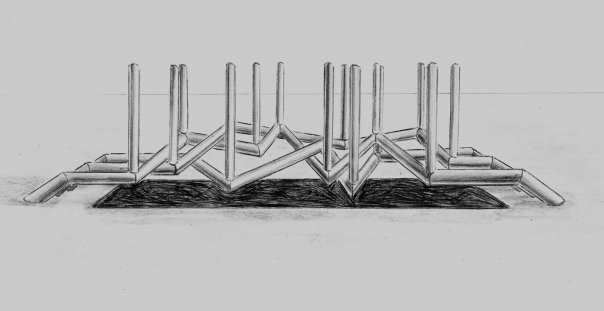
    The next commission is at Blackall in Western Queensland (see Google map). A drawing of the work Lifespan (2010), which is 8 metres long, is at the bottom of the posting. Blackall already contains public sculptures by William Eicholtz (Towners Call – Edgar Towner V.C. Memorial (2009)) and Robert Bridgewater (Wool, Water and Wood (2008)).

    Dr Marcus Bunyan


    1/ Text from the Sydney Morning Herald travel website February 8, 2004 [Online] Cited 17/08/2019


    Unknown photographer. ''Drawing Water' by Frederick White' 2010


    Unknown photographer
    Drawing Water by Frederick White
    2010


    Unknown photographer. ''Drawing Water' by Frederick White' 2010 (detail)

    Unknown photographer. ''Drawing Water' by Frederick White' 2010 (detail)

    Unknown photographer. ''Drawing Water' by Frederick White' 2010 (detail)


    Unknown photographer
    Drawing Water by Frederick White (details)
    2010


    Fredrick White (Australian) 'Lifespan' (2010), drawing for commission at Blackall, Queensland


    Fredrick White (Australian)
    Lifespan
    2010
    Drawing for commission at Blackall, Queensland


    LIKE ART BLART ON FACEBOOK

    Back to top

    Text: Marcus Bunyan. ‘Missing in Action (dark kenosis)’ 2010

    June 2010
     

    Marcus Bunyan (Australian, b. 1958) 'Missing in Action (dark kenosis) No.16' 2010
     

    Marcus Bunyan (Australian, b. 1958)
    Missing in Action (dark kenosis) No.16
    2010
    Digital photograph


    Missing in Action (dark kenosis)

    Several people have asked me for some text to help describe the themes that my work investigates.

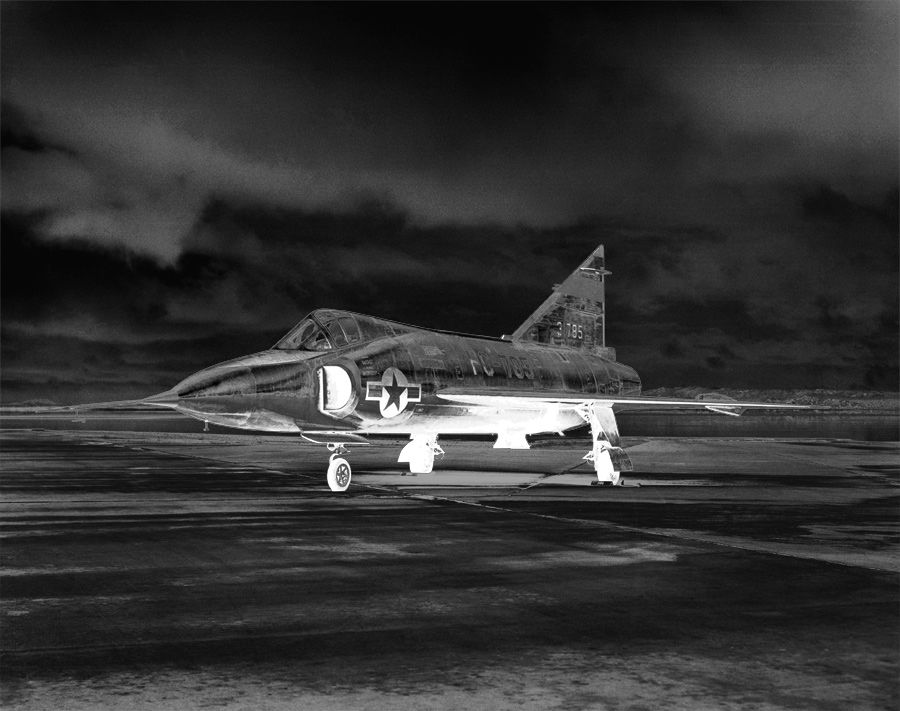
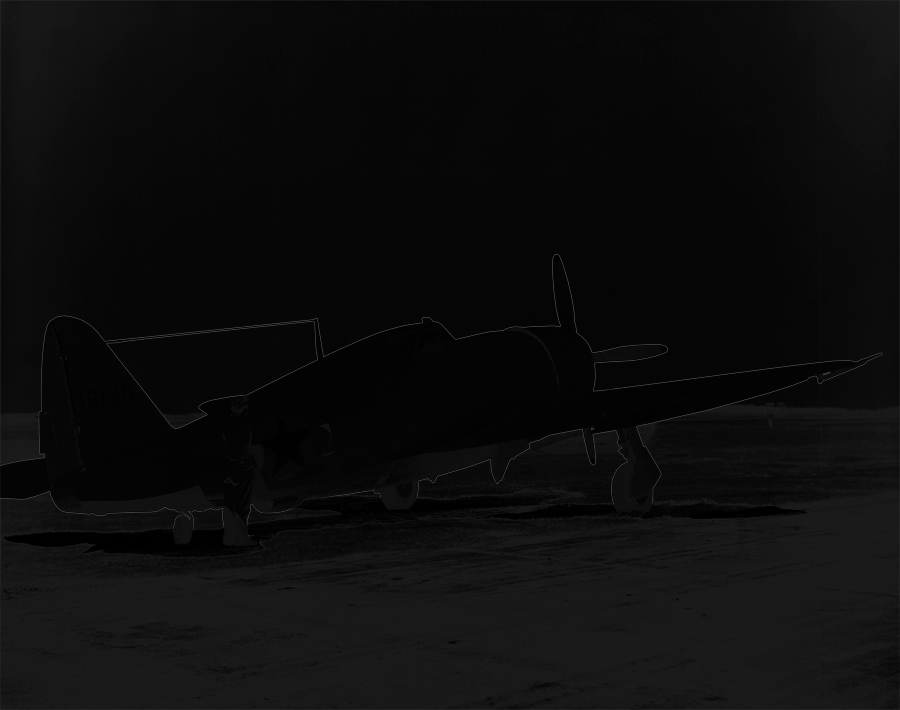
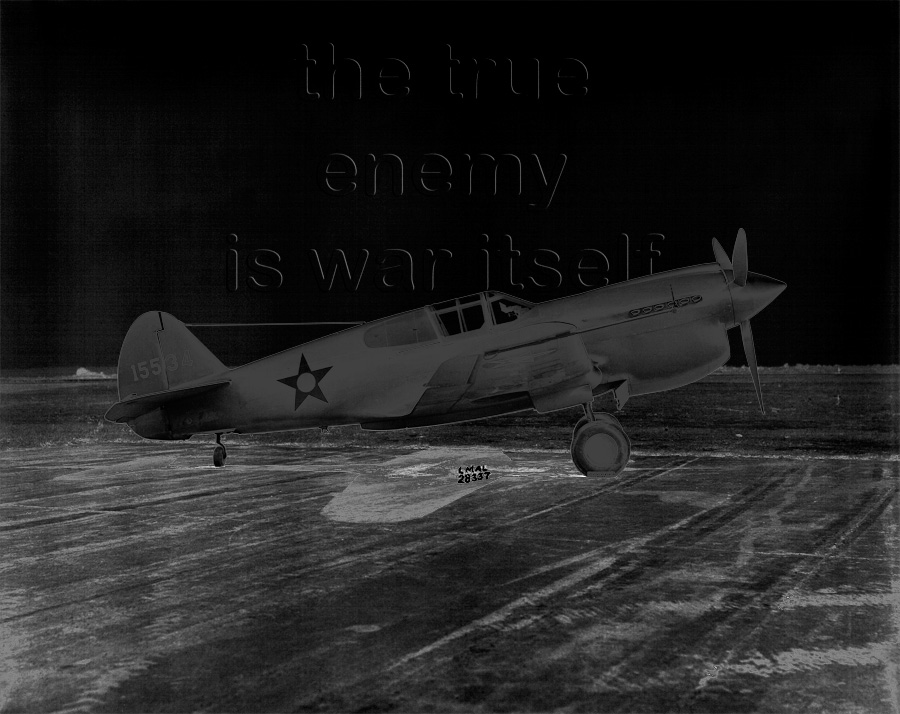
    My work has always investigated the spaces and environments that people inhabit. Over the last few years the work has come to focus on fighter aircraft and the people (usually men) who fly them – the reason to fly such war machines, to fight for freedom, democracy, to bomb, to kill – the moral and ethical choices that human beings make, to undertake one action over another.

    I have returned to childhood influences: I remember as a kid making toy models by Airfix and Tamiya of tanks and fighter planes and flying the planes from my bedroom ceiling. The work is strongly anti-war. Most of the work features shifts in texture, of light and dark and the occasional use of text to illuminate personal feelings. Text that is hidden among this particular body of work includes:

    ~ “The true enemy is war itself” from the anti-war movie Crimson Tide (1995)
    ~ “The destiny of man is in his own soul” Herodotus (484-420BC)
    ~ “We are all of us children of earth” Franklin D. Roosevelt: Flag Day Address June 13, 1942


    Conceptually the work is based upon an investigation into Foucault’s ‘technologies of the self’ and the paradoxes of such (self) determination:

    Technologies of the self (also called care of the self or practices of the self) are what Michel Foucault calls the methods and techniques (“tools”) through which human beings constitute themselves. Foucault argued that we as subjects are perpetually engaged in processes whereby we define and produce our own ethical self-understanding. According to Foucault, technologies of the self are the forms of knowledge and strategies that “permit individuals to effect by their own means or with the help of others a certain number of operations on their own bodies and souls, thoughts, conduct, and way of being, so as to transform themselves in order to attain a certain state of happiness, purity, wisdom, perfection, or immortality.””1


    The next series are the same planes with a red colour (red kenosis) and after that I have some silhouette aircraft recognition cards – just the black shapes of the jet fighters – with colours behind, should be a good series!

    Dr Marcus Bunyan


    1/ Foucault, M. (1988) “Technologies of the self,” in L. H. Martin, H. Gutman and P. H. Hutton (eds.,). Technologies of the self. Amherst: University of Massachusetts Press, page 18 quoted on Wikipedia. “Technologies of the Self.” [Online] Cited 23/06/2010.


      SEE THE FULL SERIES ON MY WEBSITE

      Photographs are available from this series for purchase. As a guide, a digital colour 16″ x 20″ costs $1000 plus tracked and insured shipping. For more information please see my Store web page.


      Marcus Bunyan website

      LIKE ART BLART ON FACEBOOK

      Back to top

      Review: ‘Cloud’ by Guan Wei at Arc One Gallery, Melbourne

      Exhibition dates: 1st June – 29th June, 2010
       

      Guan Wei (China, b. 1957) 'Buddha's hand' 2010 from the exhibition 'Cloud' by Guan Wei at Arc One Gallery, Melbourne, June 2010
       

      Guan Wei (China, b. 1957)
      Buddha’s hand
      2010


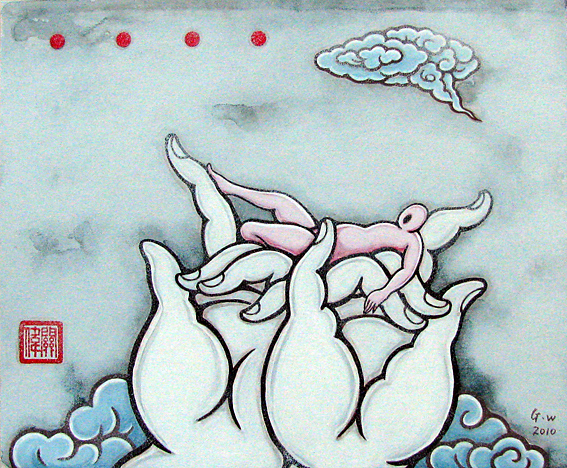
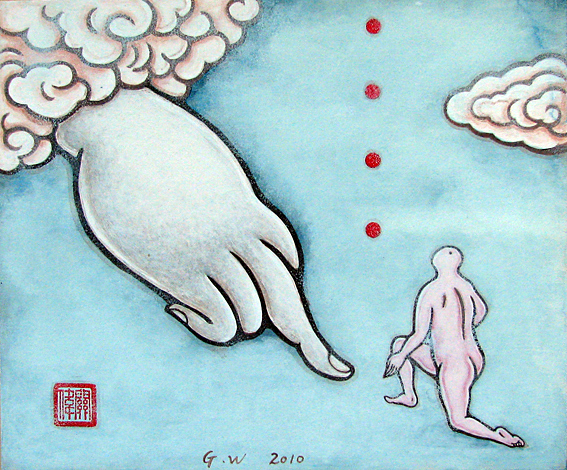
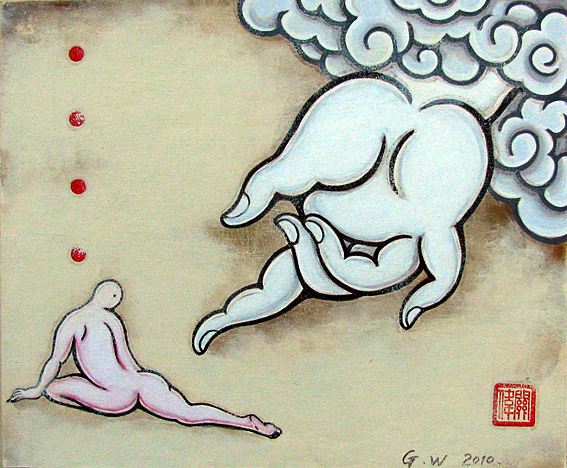
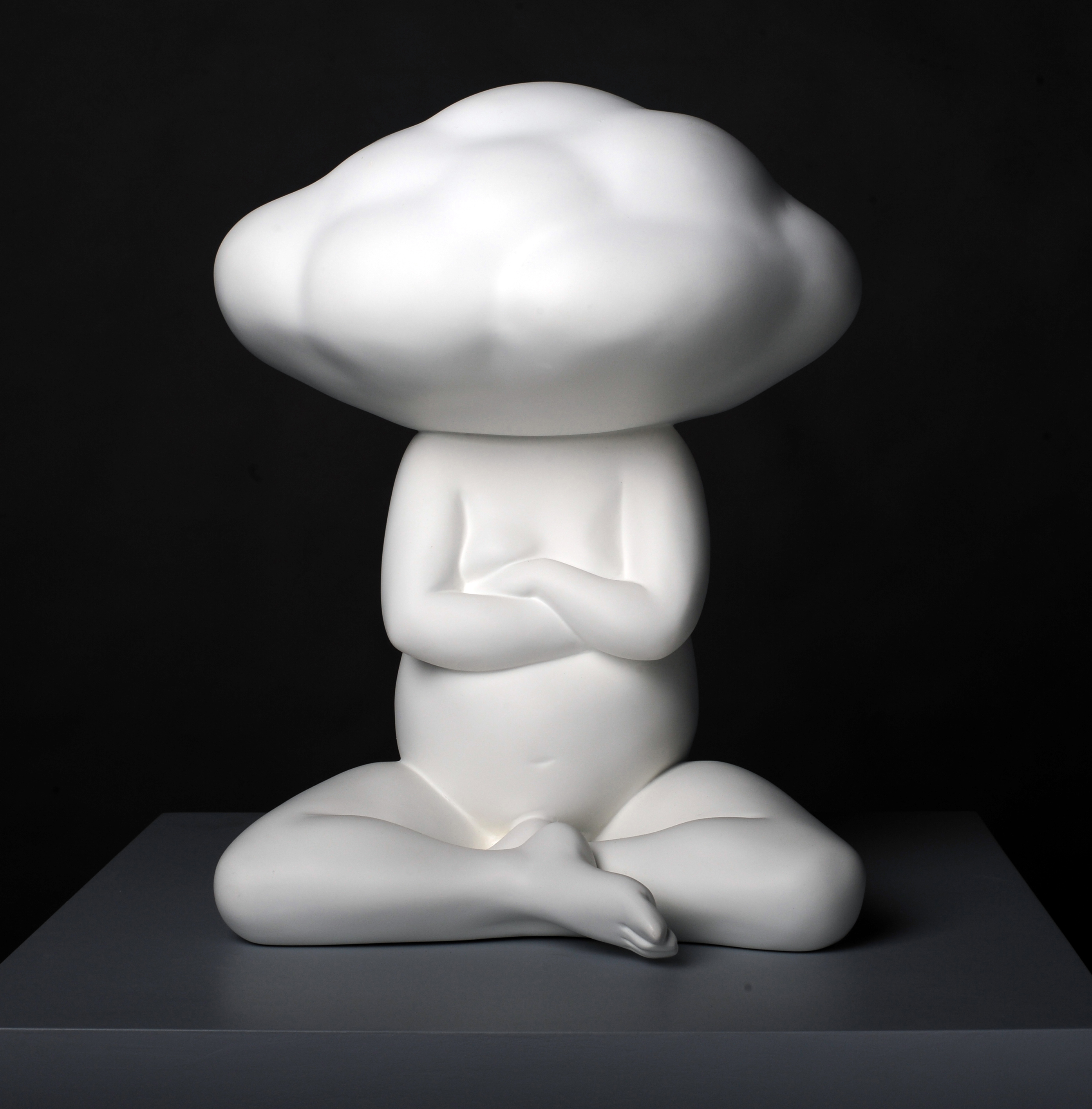
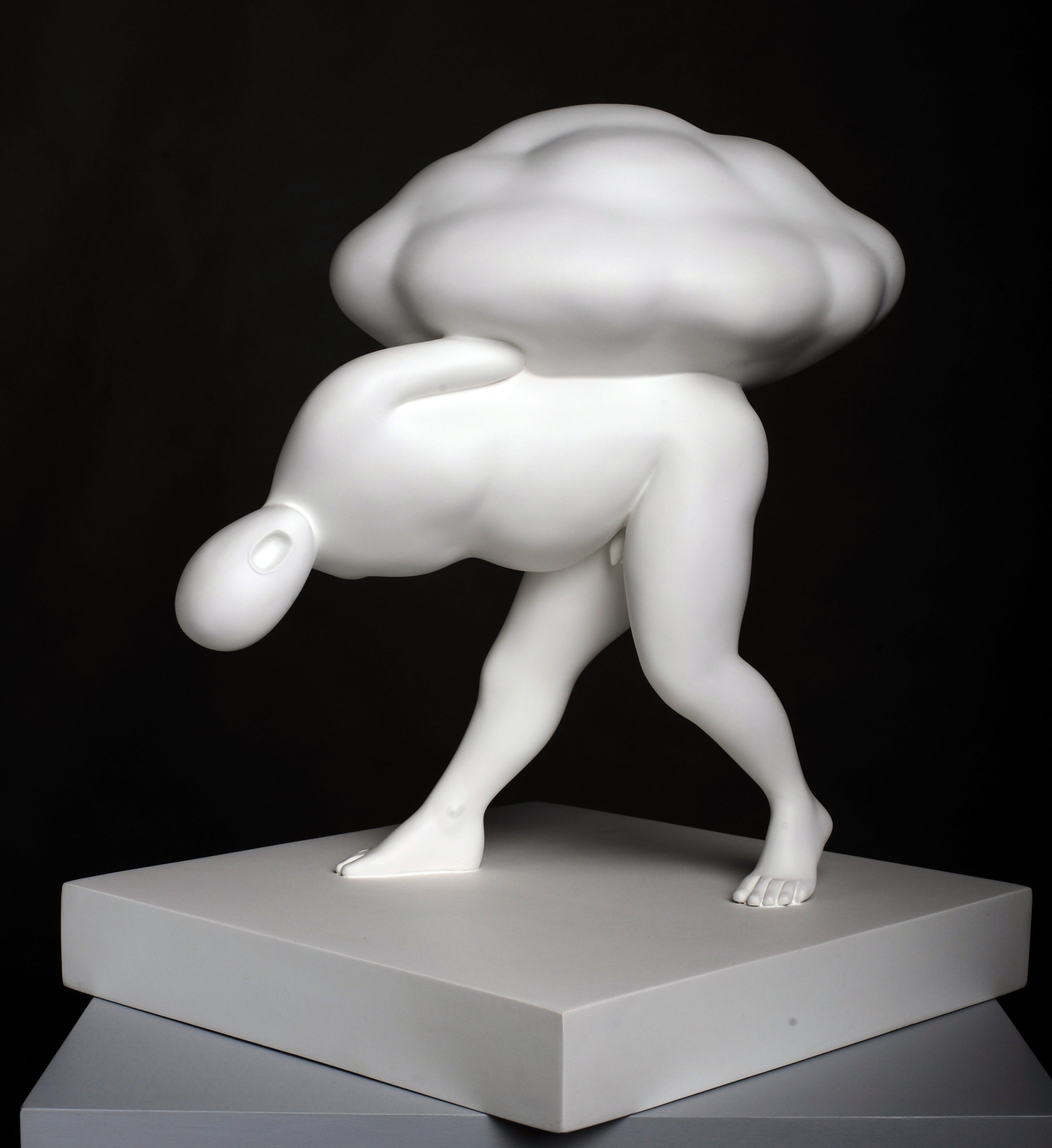
      The exhibition Cloud by Australian artist Guan Wei at Arc One Gallery in Melbourne contains two bodies of work that are outstanding: the series of paintings on paper titled Buddha’s Hand and the series of five figurative sculptures titled Cloud. Each body of work compliments and informs the other.

      The small Buddha’s Hand paintings (see below) are the most delicate of creatures – sensual, poetic almost fetishistic in their composition and utterly beguiling in their beauty. Referencing the history of cave paintings of the Buddha, Wei updates the ancient allegories expressing his message of harmony and leisure, identity and place through visual symbolic representation. These works are profoundly moving, the figurative compositions balanced masterfully through colour, shape and form, studded with the punctum of red bindi-like energy centres arising from the faceless yogic figures.

      Sitting on white pedestals and positioned close to the Buddha’s Hand paintings in the gallery are the series of five Cloud figures (see below). Made of bronze that has been spray painted white these are wonderful sculptures, full of delicious humour and vibrancy. There is a sensuality and delicacy about the figures that is emphasised by their snowy whiteness, a whiteness that subverts the tactility, colour and weight that one usually associates with the metal bronze. Here the figure has, variously, it’s head in the clouds while pensively crossing arms; bearing the weight of the world on the back while the vacant mouth is open; preparing to throw the cloud as Zeus would a thunderbolt; reclining while balancing the cloud on one foot and with one foot stuck in the earth that is cloud. The cloud becomes a metaphor for thought and action in the world, acting on the world. In these sculptures there is no creed nor race, no ideology or nation and I believe that Wei attains his stated aim to redefine our relationship with one another and nature by transcending both. I am not alone in liking these sculptures – they have proved very popular and all five sculptures in editions of five have already sold out!

      Other work in the exhibition is more prosaic – a multi-panelled screen, the On Cloud and Zodiac series never seem to breathe the same rarefied air as the above two bodies of work. They are disappointments that only serve to illuminate how brilliant holding the Buddha’s hand and living your life with your head in the clouds can be.

      Dr Marcus Bunyan


      Many thankx to Angela Connor and Arc One Gallery for allowing me to reproduce the photographs in the posting. Please click on the photographs for a larger version of the image.


      Guan Wei (China, b. 1957) 'Buddha's hand' 2010 from the exhibition 'Cloud' by Guan Wei at Arc One Gallery, Melbourne, June 2010


      Guan Wei (China, b. 1957)
      Buddha’s hand
      2010


      Guan Wei (China, b. 1957) 'Buddha's hand' 2010


      Guan Wei (China, b. 1957)
      Buddha’s hand
      2010


      “I hope that we will be able to transcend the restrictions imposed on us by such notions as nation, ethnicity, ideology, cultural and history, and redefine our relationship with one another and nature.”


      Guan Wei


      Guan Wei is an adept storyteller who masterfully engages his audiences. Retaining the humour, wisdom and cross-cultural knowledge that have become characteristics of his ongoing oeuvre, his work breathes an awareness of our current social and environmental dilemmas exploring ideas of immigration, colonisation, identity politics and cultural tolerance.

      Flirtatious and aesthetically whimsical, Guan Wei’s works are instantly recognisable. In this latest exhibition, Cloud, Guan Wei fuses sculpture, drawings and paintings to form what is part of his most beguiling trademark – ‘the art of idleness’. For the first time since returning to China, he will present new sculptures that employ his ongoing preoccupation with the figure and the figure in relation to the natural form. These sculptures are Guan Wei’s personal visual symbols of harmony and leisure. They form the thread for the four series of works in this exhibition.

      During the past fifteen years, Guan Wei has help change the identity of Australian Art. He draws on his own experience as a Chinese national who migrated to Australia from China in the period following the Tiananmen Square massacre (1989). Guan Wei has spent twenty years living and working as an artist raising the awareness of Australia being a multicultural country. He has had over 40 solo exhibitions, been the recipient of numerous awards and included in every major collection. In 2009, Guan Wei was selected for the prestigious Clemenger Contemporary Art Award at the National Gallery of Victoria.

      Press release from the Arc One Gallery website [Online] Cited 10/06/2010 no longer available online


      Guan Wei (China, b. 1957) 'Cloud No.4' 2009 from the exhibition 'Cloud' by Guan Wei at Arc One Gallery, Melbourne, June 2010


      Guan Wei (China, b. 1957)
      Cloud No.4
      2009
      Bronze statue
      edition of 5
      39 x 30 x 25cm


      Guan Wei (China, b. 1957) 'Cloud No.5' 2009


      Guan Wei (China, b. 1957)
      Cloud No.5
      2009
      Bronze statue
      edition of 5
      47 x 35 x 35cm


      Arc One Gallery
      45 Flinders Lane
      Melbourne, 3000
      Phone: +61 3 9650 0589

      Opening hours:
      Tuesday – Saturday 11am – 5pm

      Arc One Gallery website

      LIKE ART BLART ON FACEBOOK

      Back to top

      Photographs: Marcus Bunyan. ‘Missing in action (dark kenosis)’ 2010

      May 2010


      Marcus Bunyan (Australian, b. 1958) 'Missing in Action (dark kenosis) No.11' 2010


      Marcus Bunyan (Australian, b. 1958)
      Missing in Action (dark kenosis) No.11
      2010
      Digital photograph


      Missing in action (dark kenosis)

      A new body of work Missing in Action (dark kenosis) 2010 is now online on my website.

      There are eighty-two images in the series which are like a series of variations in music with small shifts in tone and colour. Below are a selection of images from the series. Please click on the photographs for a larger version of the image.

      Many thankx to the people who have emailed me saying how much they like the new series of work.

      Dr Marcus Bunyan


      Photographs are available from this series for purchase. As a guide, a digital colour 16″ x 20″ costs $1000 plus tracked and insured shipping. For more information please see my Store web page.


      Kenosis

      “In Christian theology, Kenosis is the concept of the ‘self-emptying’ of one’s own will and becoming entirely receptive to God and his perfect will.”


      Marcus Bunyan (Australian, b. 1958) 'Missing in Action (dark kenosis) No.19' 2010


      Marcus Bunyan (Australian, b. 1958)
      Missing in Action (dark kenosis) No.19
      2010
      Digital photograph


      Marcus Bunyan (Australian, b. 1958) 'Missing in Action (dark kenosis) No.35' 2010


      Marcus Bunyan (Australian, b. 1958)
      Missing in Action (dark kenosis) No.35
      2010
      Digital photograph


      Marcus Bunyan (Australian, b. 1958) 'Missing in Action (dark kenosis) No.46' 2010


      Marcus Bunyan (Australian, b. 1958)
      Missing in Action (dark kenosis) No.46
      2010
      Digital photograph


      Marcus Bunyan (Australian, b. 1958) 'Missing in Action (dark kenosis) No.49' 2010


      Marcus Bunyan (Australian, b. 1958)
      Missing in Action (dark kenosis) No.49
      2010
      Digital photograph


      Marcus Bunyan (Australian, b. 1958) 'Missing in Action (dark kenosis) No.67' 2010


      Marcus Bunyan (Australian, b. 1958)
      Missing in Action (dark kenosis) No.67
      2010
      Digital photograph


      Marcus Bunyan (Australian, b. 1958) 'Missing in Action (dark kenosis) No.71' 2010


      Marcus Bunyan (Australian, b. 1958)
      Missing in Action (dark kenosis) No.71
      2010
      Digital photograph


      Marcus Bunyan (Australian, b. 1958) 'Missing in Action (dark kenosis) No.76' 2010


      Marcus Bunyan (Australian, b. 1958)
      Missing in Action (dark kenosis) No.76
      2010
      Digital photograph


      Detail of images


      Marcus Bunyan (Australian, b. 1958) 'Missing in Action (dark kenosis) No.76' 2010 (detail)

      Marcus Bunyan (Australian, b. 1958) 'Missing in Action (dark kenosis) No.78' 2010 (detail)

      Marcus Bunyan (Australian, b. 1958) 'Missing in Action (dark kenosis) No.6' 2010 (detail)

      Marcus Bunyan (Australian, b. 1958) 'Missing in Action (dark kenosis) No.9' 2010 (detail)


      Detail of images 76, 78, 6 and 9


      Marcus Bunyan website

      LIKE ART BLART ON FACEBOOK

      Back to top

      Exhibition: ‘Birthmark’ by Owen Leong at Anna Pappas Gallery, Prahran

      Exhibition dates: 13th May – 5th June, 2010


      Owen Leong (Australian, b. 1979) 'Chi' 2009-2010 from the exhibition 'Birthmark' by Owen Leong at Anna Pappas Gallery, Prahran, May - June, 2010


      Owen Leong (Australian, b. 1979)
      Chi
      2009-2010
      Pigment print on archival paper
      73 x 73cm, edition of 5
      Courtesy of the artist and Anna Pappas Gallery


      Apologies for the late posting on this exhibition but I only received the images for the posting today.

      A strong body of work by Owen Leong, twelve portraits of Asian-Australians, their faces digitally overlaid with the unique wing patterns of the Bogong moth, an insect often seen as a pest in Australia. Uniformly lit, of consistent size and presented in modern white frames the series hangs quietly but impressively in the upstairs space of the Anna Pappas Gallery. Here the uniqueness of human physiognomy (and attendant modifications such as scars, piercings and tattoos) is symbiotically paired with that of the moth – it is almost as though one breathes the other – with the eyes of the humans occluded, becoming blackened pits.

      The slightly amateurish digital blacking out of some of the eyes is my only point of contention: perhaps this was intentional (?) but sharp shape selections in Photoshop do not make for a good blend between layers of information. Be that as it may, Leong’s practice of selective breeding applied to humans has produced some beautiful, eloquent photographs that promote difference and diversity through a palpable intimacy with the subject matter.

      Dr Marcus Bunyan


      Many thankx to Anna Pappas, Leah Crossman and the Anna Pappas Gallery for allowing me to use the photographs in the posting. Please click on the photographs for a larger version of the image.


      Owen Leong (Australian, b. 1979) 'Jac' 2009-2010 from the exhibition 'Birthmark' by Owen Leong at Anna Pappas Gallery, Prahran, May - June, 2010


      Owen Leong (Australian, b. 1979)
      Jac
      2009-2010
      Pigment print on archival paper
      73 x 73cm, edition of 5
      Courtesy of the artist and Anna Pappas Gallery


      Owen Leong (Australian, b. 1979) 'Justin' 2009-2010 from the exhibition 'Birthmark' by Owen Leong at Anna Pappas Gallery, Prahran, May - June, 2010


      Owen Leong (Australian, b. 1979)
      Justin
      2009-2010
      Pigment print on archival paper
      73 x 73cm, edition of 5
      Courtesy of the artist and Anna Pappas Gallery


      Owen Leong (Australian, b. 1979) 'Raina' 2009-2010


      Owen Leong (Australian, b. 1979)
      Raina
      2009-2010
      Pigment print on archival paper
      73 x 73cm, edition of 5
      Courtesy of the artist and Anna Pappas Gallery


      Anna Pappas Gallery

      Open by appointment only
      Phone: +613 9521 7300

      Anna Pappas Gallery website

      LIKE ART BLART ON FACEBOOK

      Back to top