Review: ‘Ivy’ photographs by Jane Burton at Karen Woodbury Gallery, Richmond, Melbourne

Exhibition dates: 2nd September – 26th September, 2009
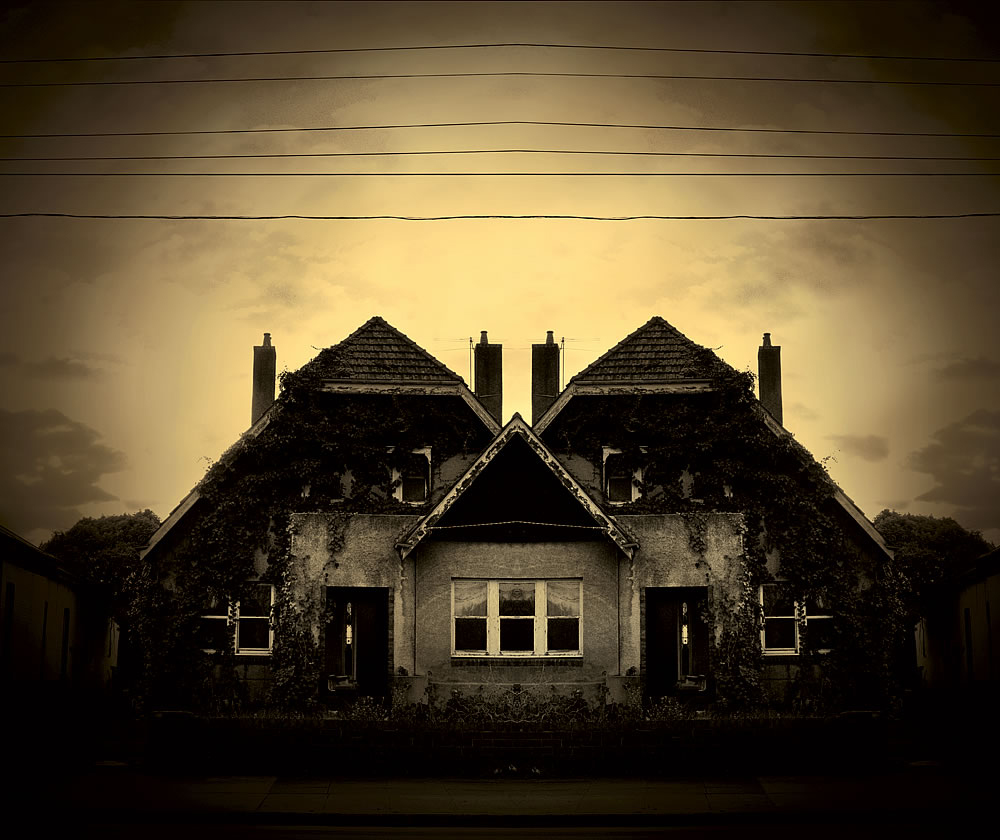
 

Jane Burton (Australian, b. 1966) 'Ivy #1' 2009 from the exhibition 'Ivy' photographs by Jane Burton at Karen Woodbury Gallery, Richmond, Melbourne, Sept, 2009


Jane Burton (Australian, b. 1966)
Ivy #1
2009
Pigment print
89 x 75cm


This is another outstanding body of photographic work on display in Melbourne. Featuring 10 large and 2 small sepia toned, vignetted pigment prints Burton’s work creates dark enchanted worlds of faceless female figures placed in the built environment that balance (meta)physical light and shade creating ambiguous narratives of innocence tinged with a darker edge.

The eponymous photograph Ivy #1 (above) is the seminal image of the series: a dark brooding house, hunched down positioned low in the photographic space, covered in ivy with black windows and dark eves has an ominous almost impenetrable presence and sets the tone for the rest of the work.

There are wonderful references to the history of photography if one cares to look (not simply generic references to Victorian daguerreotypes, postcards and family photographs). Ivy #2 (below) is a powerful photograph where the female figure is blindfolded, unable to see the encroaching tumescence of vegetation that surrounds and is about to engulf her. The placement of the hands is exquisite – unsure, reaching out, doubting her surroundings – with the 3-bladed fan hovering behind ready to devour the unwary. This photograph has resonances of the magical photographs of the garden by the Czech photographer Josef Sudek.

Ivy #3 (below) has echoes of the work of the American photographer Ralph Eugene Meatyard and his placement of masked people within built environments. In Burton’s photograph the broken umbrella becomes like insect wings, the faceless whiteness of the three-legged and three-armed creature cocooned among the overhanging predatory ivy, the luminescent sky offering the possibility of redemption. Other photographs such as Ivy #6 (below) and Ivy #7 with their wonderful colours, depth of field, heavy shadows and elegiac romantic feel have references to Eugene Atget and his photographs of the parks of Versailles (see photograph below).

Still further references to the history of photography can be found in the photographs Ivy #9 and Ivy #10 (below). In Ivy #9 the intersection of the two female bodies through double exposure forms a slippage in (photographic) reality and the disappearance of original identity in the layering of the photographs and into the empty non-reflection of the mirror. This non-reflection is confirmed in Ivy #10 where the faceless nude woman holds a mirror with no reflection. These photographs remind me of the photographs of New Orleans prostitutes in the early years of the 20th century by the photographer Bellocq with their masked faces and the ornamentation of the wallpaper behind the figures (see below).

I feel that in these photographs with their facelessness and the non-reflection of the mirror investigate notions of ‘Theoria’ – a Greek emphasis on the vision or contemplation of God where theoria is the lifting up of the individual out of time and space and created being and through contemplative prayer into the presence of God.1 In fact the whole series of photographs can be understood through this conceptualisation – not just remembrances of past time, not a blind contemplation on existence but a lifting up out of time and space into the an’other’ dark but enlightening presence.

The greatest wonder of this series is that the photographs magically reveal themselves again and again over time. Despite (or because of) the references to other artists, the beauty of Burton’s work is that she has made it her own. The photographs have her signature, her voice as an artist and it is an informed voice; this just makes the resonances, the vibrations of energy within the work all the more potent and absorbing. I loved them.

Dr Marcus Bunyan


Many thankx to Karen Woodbury Gallery for allowing me to publish the photographs in the posting. Please click on the photographs for a larger version of the image.
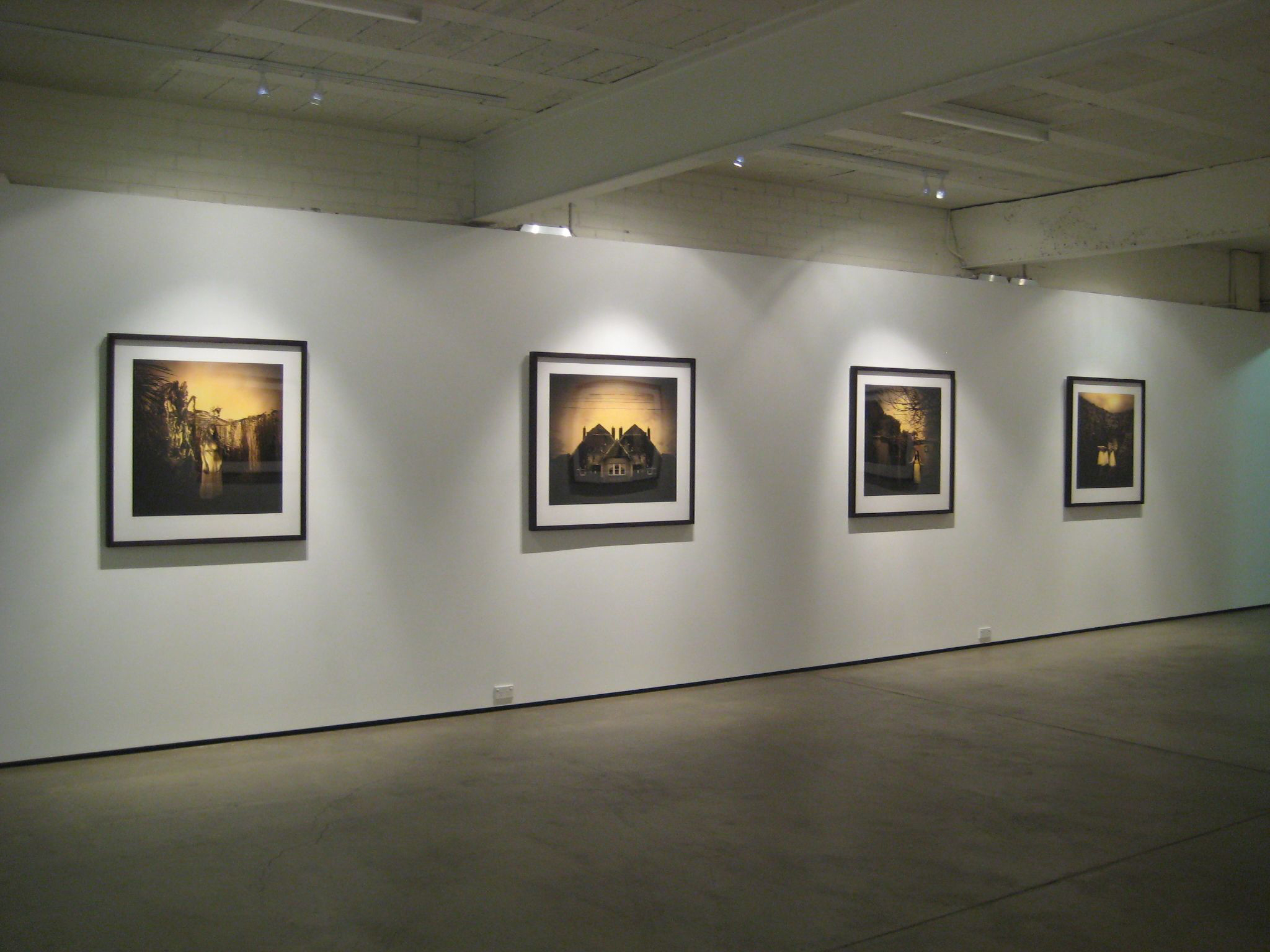
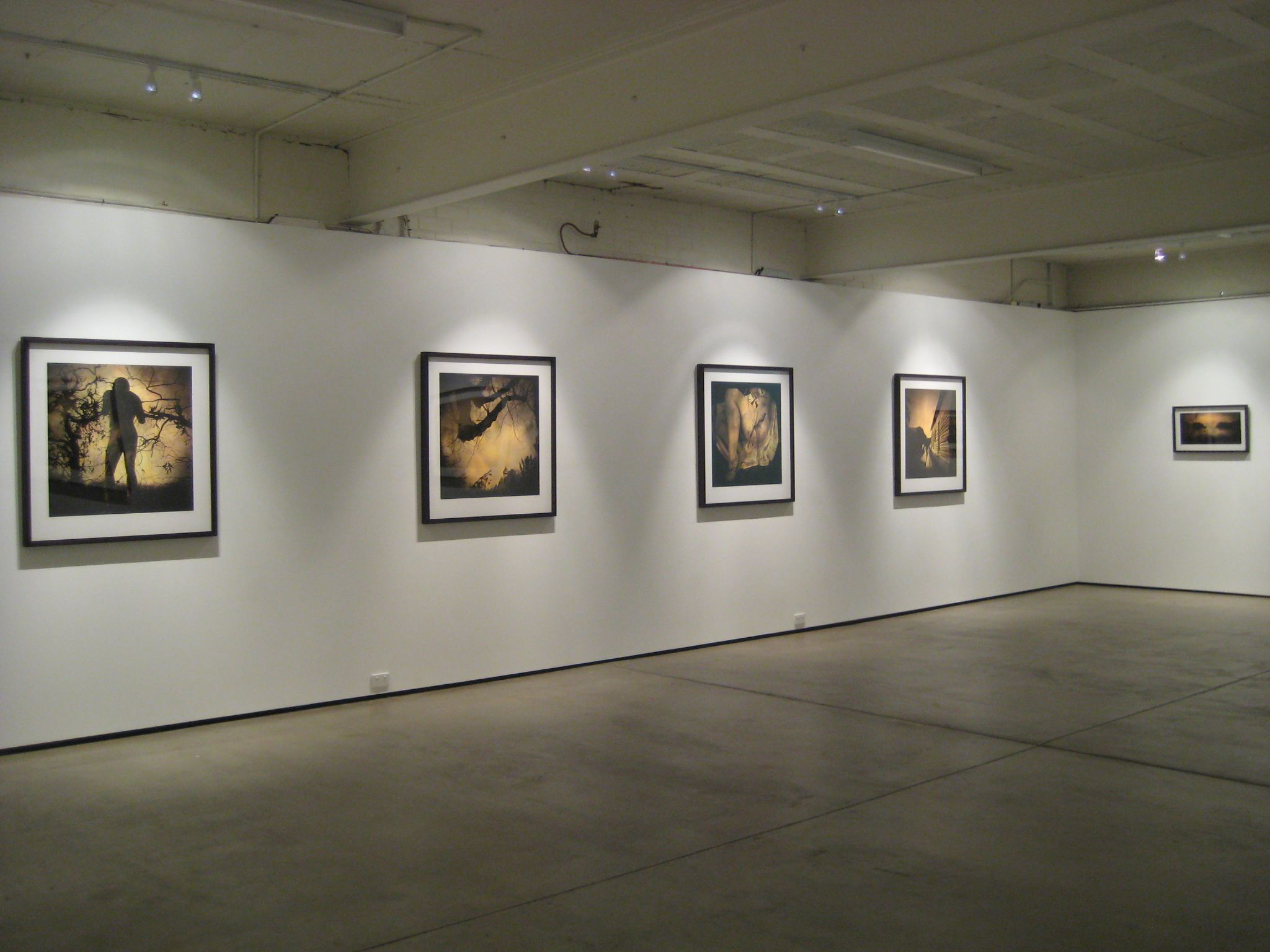


Installation view of 'Ivy' by Jane Burton at Karen Woodbury Gallery, Melbourne

Installation view of 'Ivy' by Jane Burton at Karen Woodbury Gallery, Melbourne


Installation views of Ivy by Jane Burton at Karen Woodbury Gallery, Melbourne
Photos: Marcus Bunyan
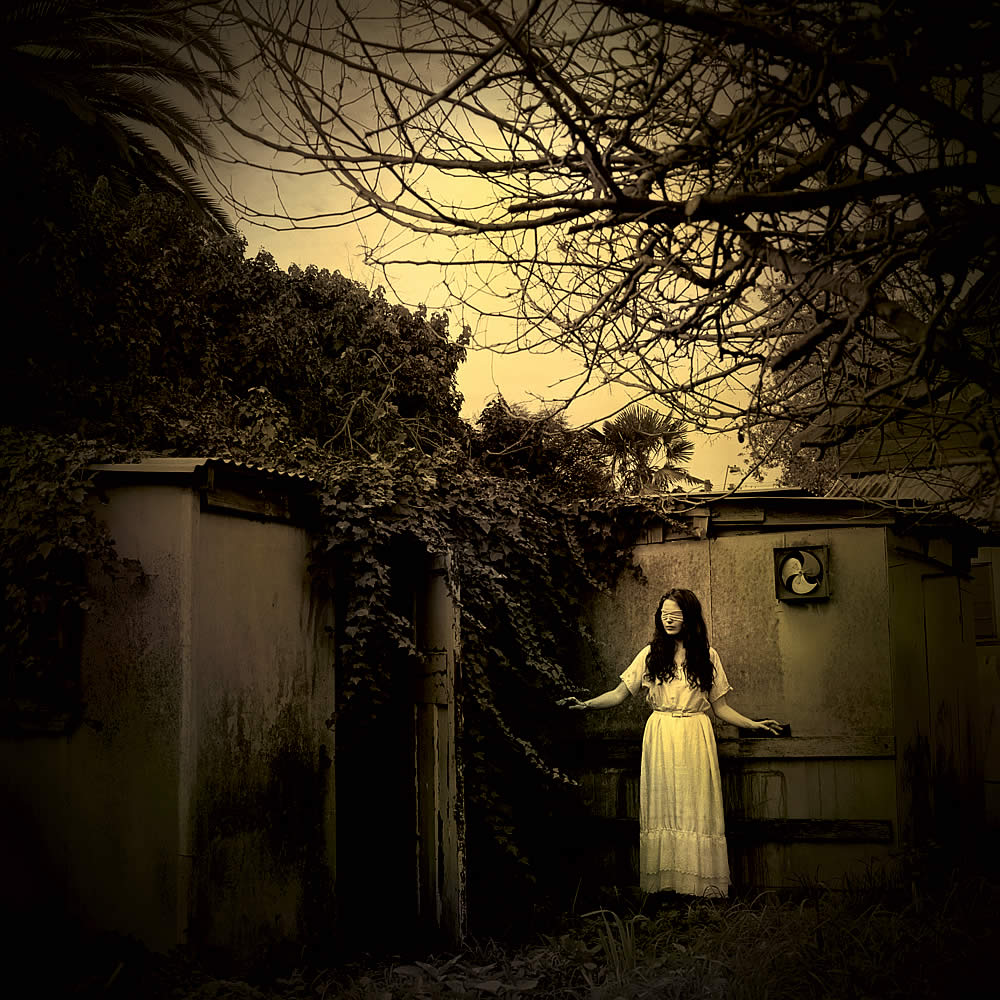
 

Jane Burton (Australian, b. 1966) 'Ivy #2' 2009 from the exhibition 'Ivy' photographs by Jane Burton at Karen Woodbury Gallery, Richmond, Melbourne, Sept, 2009


Jane Burton (Australian, b. 1966)
Ivy #2
2009
Pigment print
75 x 75cm
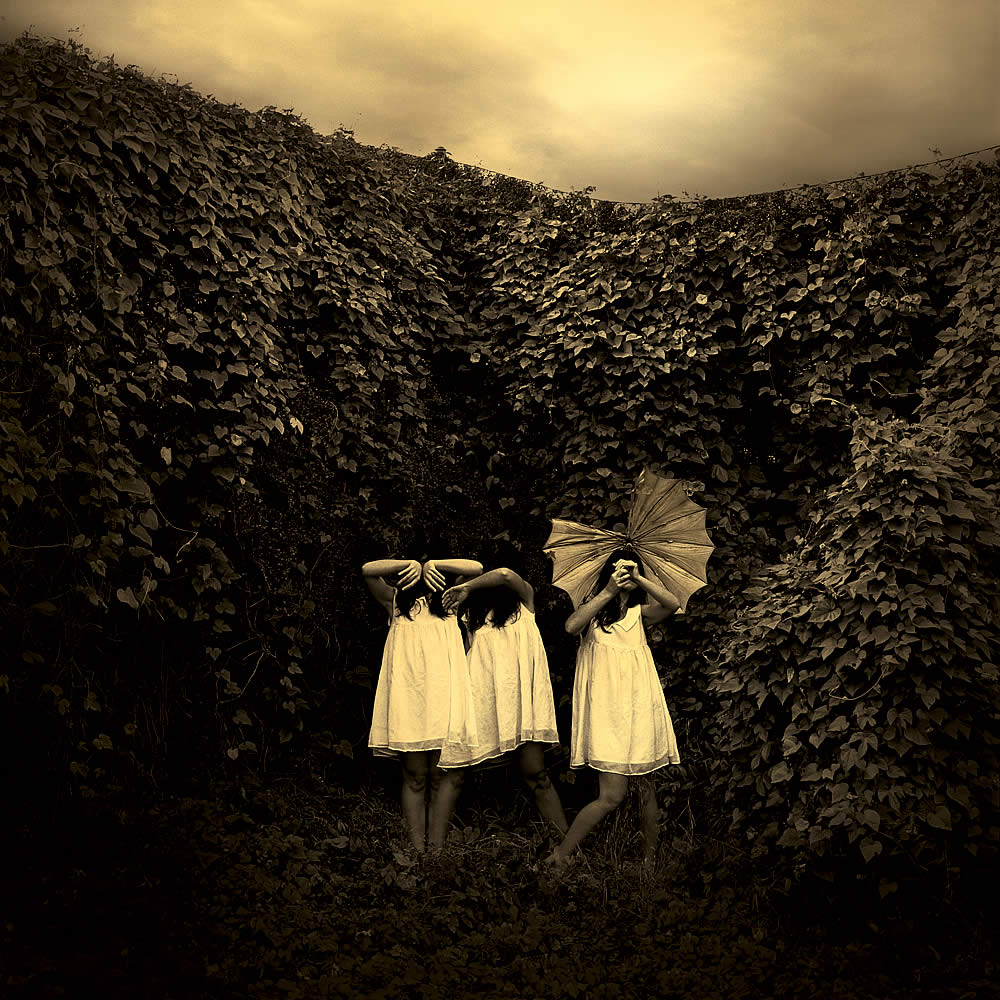
 

Jane Burton (Australian, b. 1966) 'Ivy #3' 2009 from the exhibition 'Ivy' photographs by Jane Burton at Karen Woodbury Gallery, Richmond, Melbourne, Sept, 2009


Jane Burton (Australian, b. 1966)
Ivy #3
2009
Pigment print
75 x 75cm
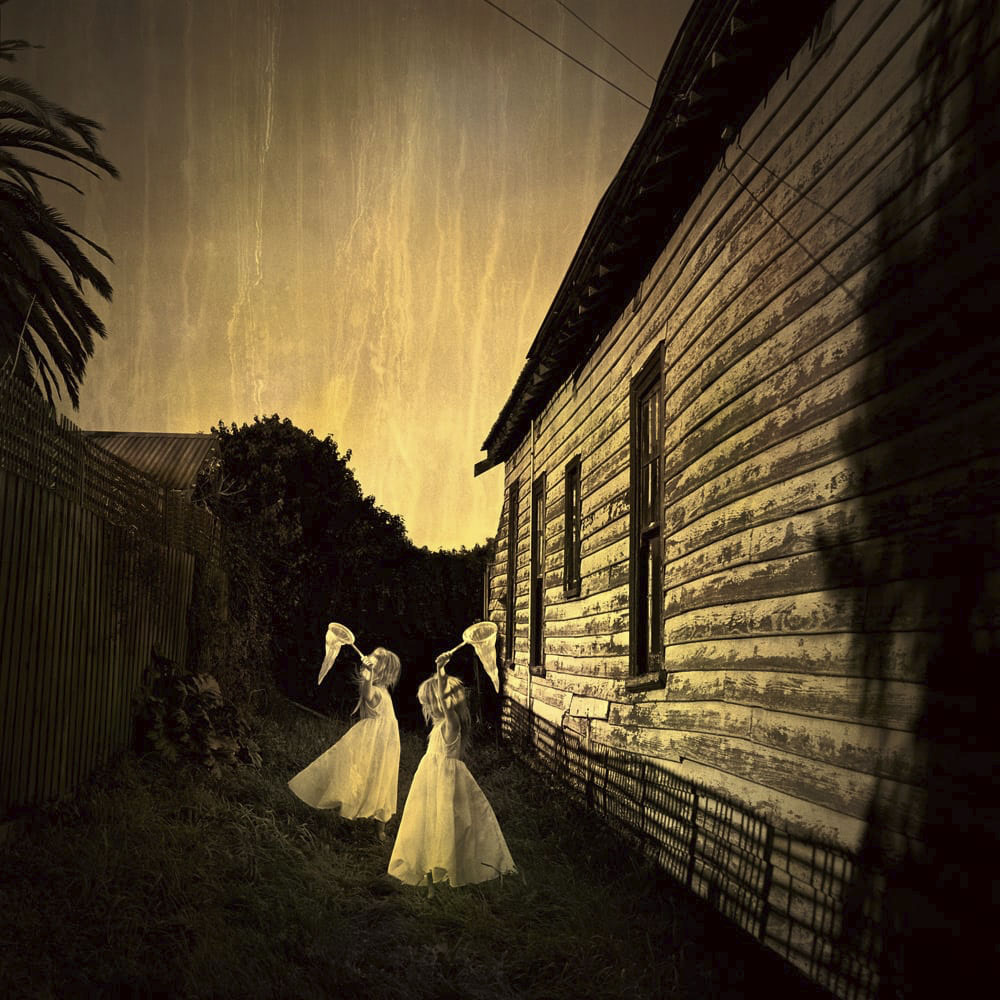
 

Jane Burton (Australian, b. 1966) 'Ivy #5' 2009


Jane Burton (Australian, b. 1966)
Ivy #5
2009
Pigment print
75 x 75cm
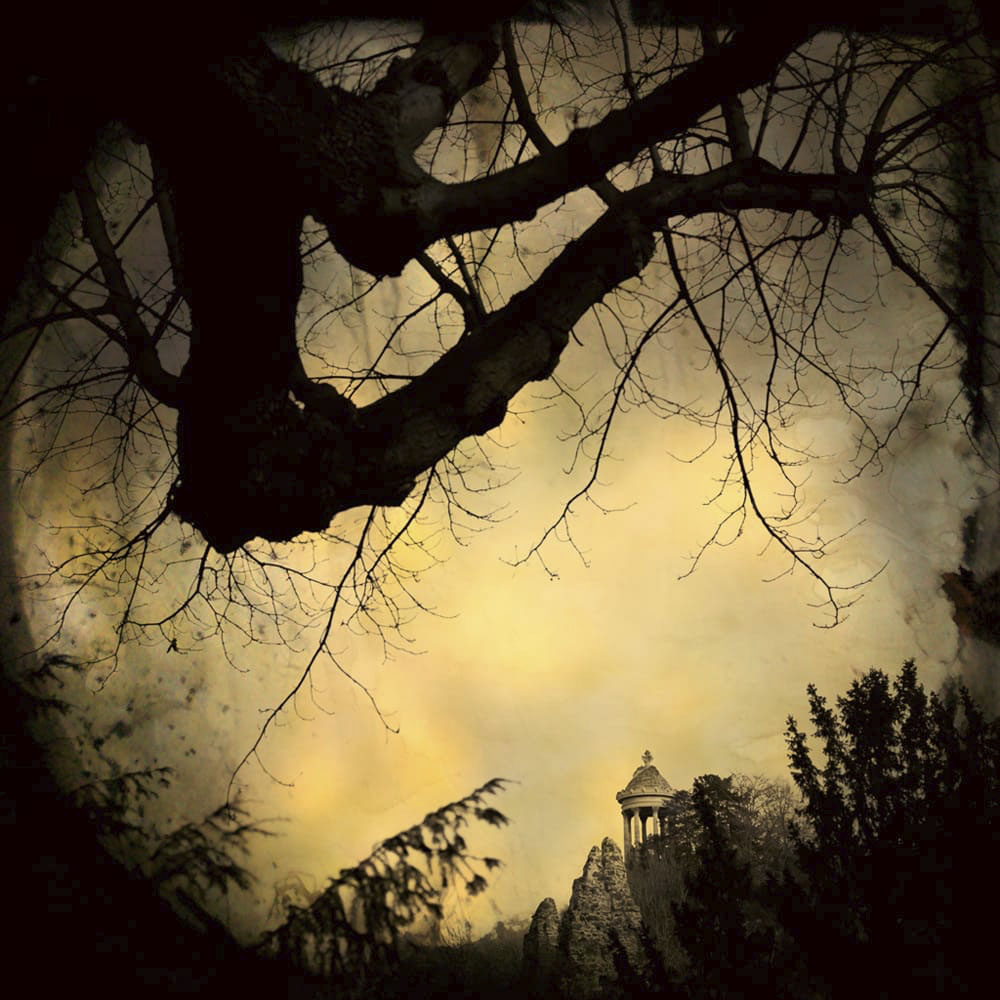
 

Jane Burton (Australian, b. 1966) 'Ivy #7' 2009


Jane Burton (Australian, b. 1966)
Ivy #7
2009
Pigment print
75 x 75cm


Jane Burton’s exhibition, Ivy comprises a series of photographs captured in black and white. The final prints are rendered with a sepia, peach-champagne tone, with many displaying a mottled hand-coloured effect in faded pastels of pink and green. These works hope to suggest an era past, perhaps Victorian. The imagery is evocative of old picture postcards from Europe and old photographs from the pages of family albums.

Central to the series is an image of a house covered with ivy. Depicted as dark and malevolent, the house is ‘haunted’ by the traces and stains of family history, habitation, and the buried secrets of all that occurred within.

Anonymous female figures are seen in garden settings where the foliage is rampant and encroaching and the shadows deep. There is an air of enchantment perceived with unspecified darker edge. The figures are innocent and playful. The viewer is asked to question if the and girls aware of the camera capturing their activity? Are the poses staged or caught spontaneously. In another photograph, a dilapidated male statue stands broken and armless, the texture of stone worn, and bruised with dark lichen and moss.

In the interior photographs, several nudes are depicted in the style of 19th century French daguerreotype photographs. These vignetted images display women against wall-papered backdrops with theatrical props reminiscent of earlier works by Burton such as the series ‘The other side’ (2003). Posed suggestively for the camera and the viewer’s gaze, the subjects themselves are faceless, their own gaze and features hidden behind dark hair. The surface and texture of these particular works suggests the patina of decay and the damage and wear of time.

Text from the Karen Woodbury Gallery website [Online] Cited 20/09/2009. No longer available online


E. J. Bellocq (American, 1873-1949) 'Untitled [prostitute of Storyville, New Orleans]' 1912


E. J. Bellocq (American, 1873-1949)
Untitled [prostitute of Storyville, New Orleans]
1912
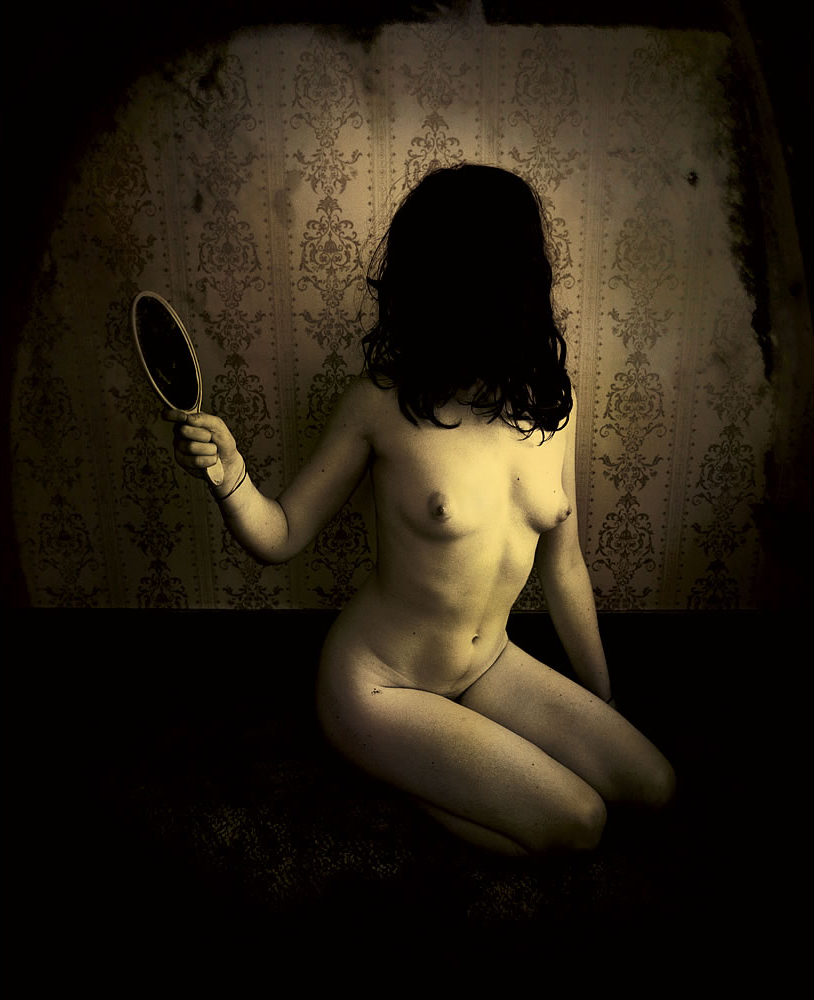
 

Jane Burton (Australian, b. 1966) 'Ivy #10' 2009


Jane Burton (Australian, b. 1966)
Ivy #10
2009
Pigment print
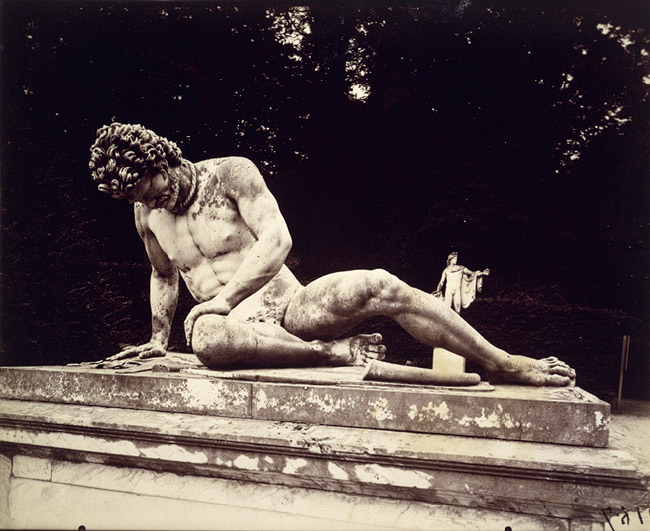
 

Eugene Atget (French, 1857-1927) 'Versailles, France' 1923


Eugene Atget (French, 1857-1927)
Versailles, France
1923
Albumen print
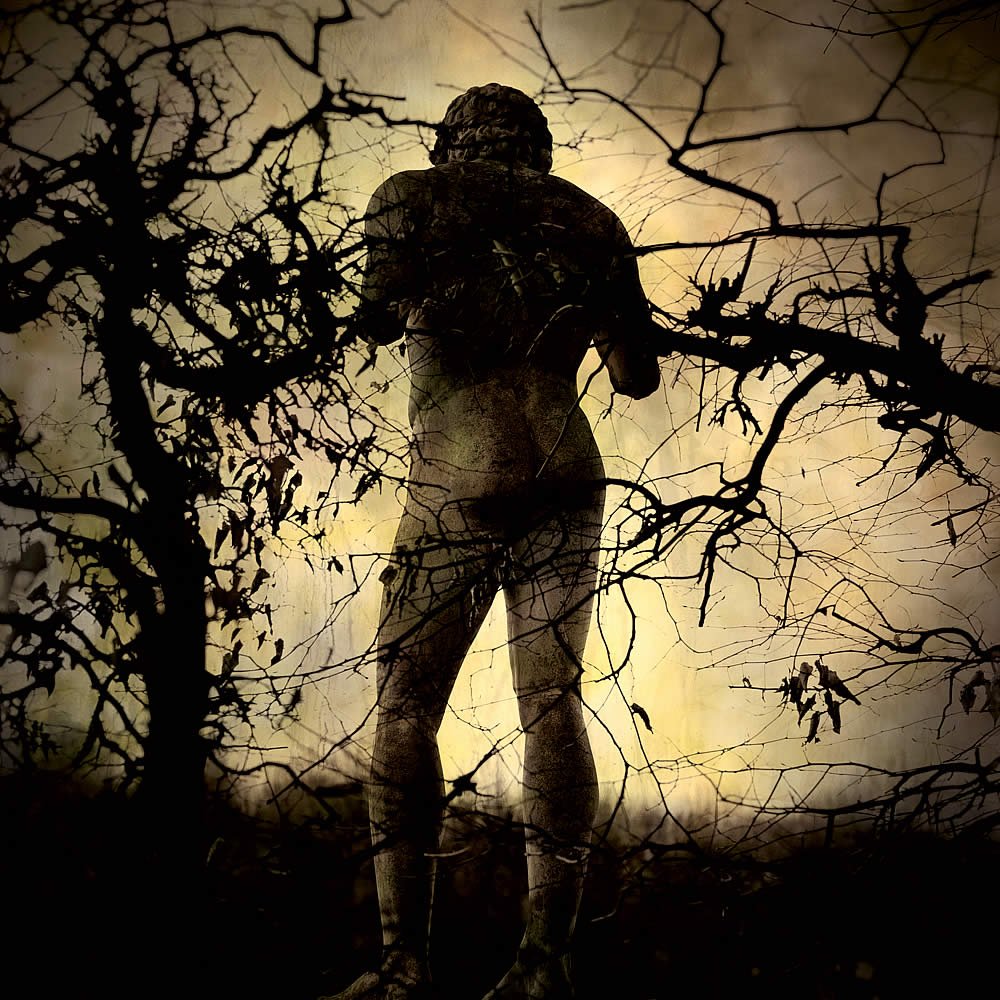
 

Jane Burton (Australian, b. 1966) 'Ivy #6' 2009


Jane Burton (Australian, b. 1966)
Ivy #6
2009
Pigment print
75 x 75cm


Karen Woodbury Gallery

This gallery has now closed.

Jane Burton website

LIKE ART BLART ON FACEBOOK

Back to top

Review: ‘All the Little Pieces’ by Lyndal Hargrave at Anita Traverso Gallery, Richmond, Melbourne

Exhibition dates: 3rd September – 3rd October, 2009


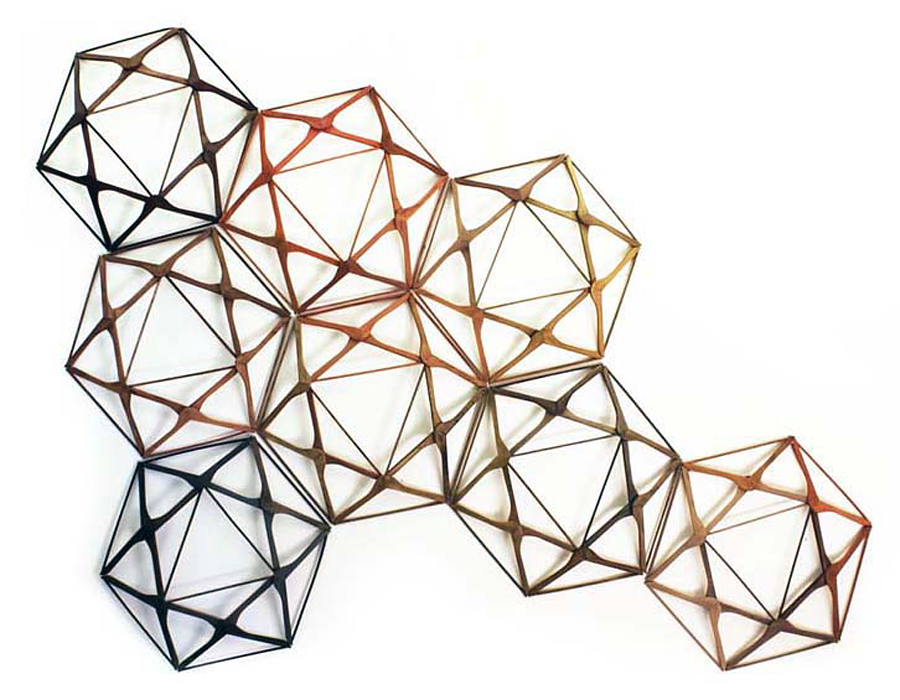
Lyndal Hargrave (Australia, b. 1959) 'Sacred Geometry' 2009 from the exhibition 'All the Little Pieces' by Lyndal Hargrave at Anita Traverso Gallery, Richmond, Melbourne, Sept - Oct, 2009


Lyndal Hargrave (Australia, b. 1959)
Sacred Geometry
2009
Acrylic painted timber coat hangers, screws, staples
180 x 170cm
Photo: Marcus Bunyan


This is a mixed bag of an exhibition by Lyndal Hargrave at Anita Traverso Gallery in Richmond, Melbourne.

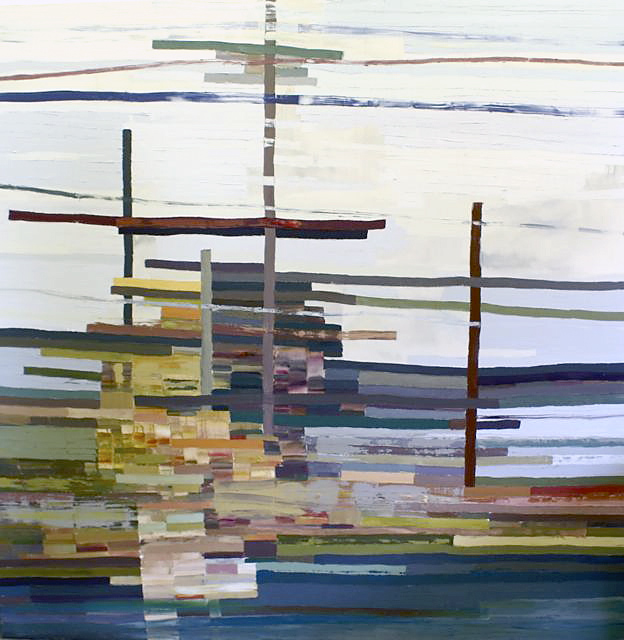
Despite one outstanding painting Breathing Space (2009, see below), the view from the back of the artist’s house onto a jetty with attendant wooden posts and sky, the other paintings are the weakest elements of the exhibition, lacking the strength and resonance of the sculptural work.

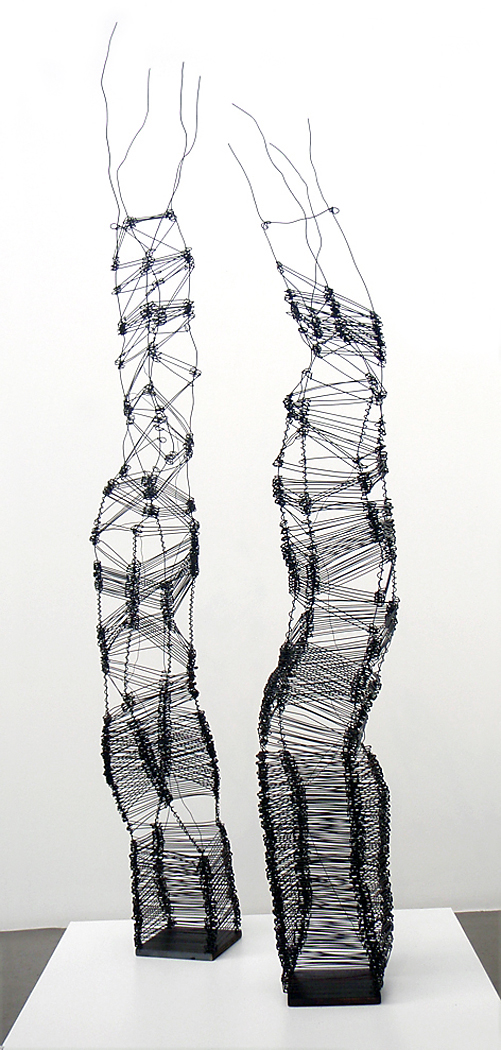
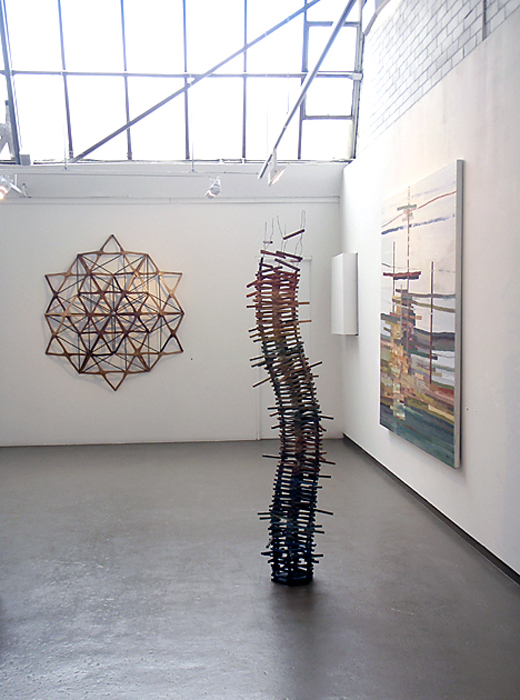
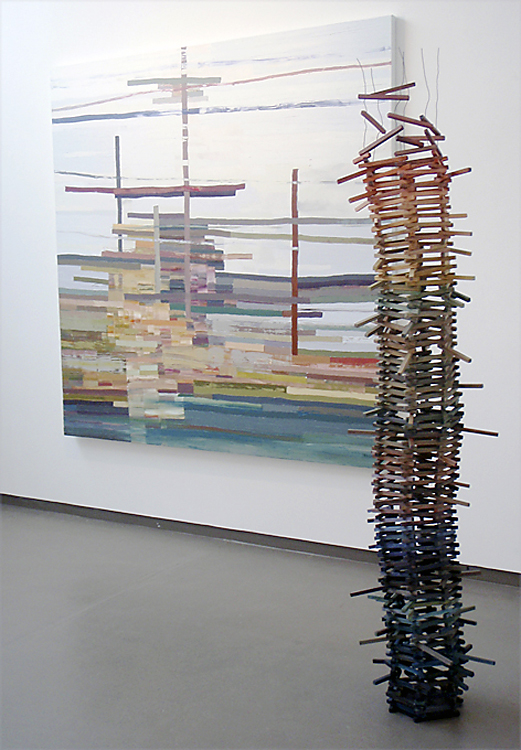
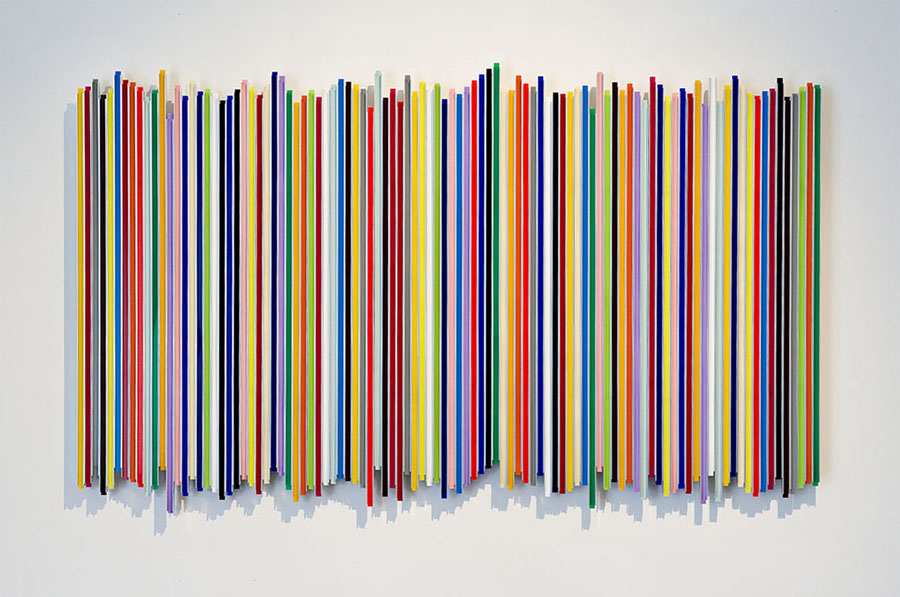
The two standing towers, Hairpin Dragons I & II and Jacob’s Ladder (both 2009, see below) are stronger work, Jacobs Ladder imitating the form of the painting Breathing Space in three-dimensional Cuisenaire-type coloured rods (see the installation photograph of the two pieces below).

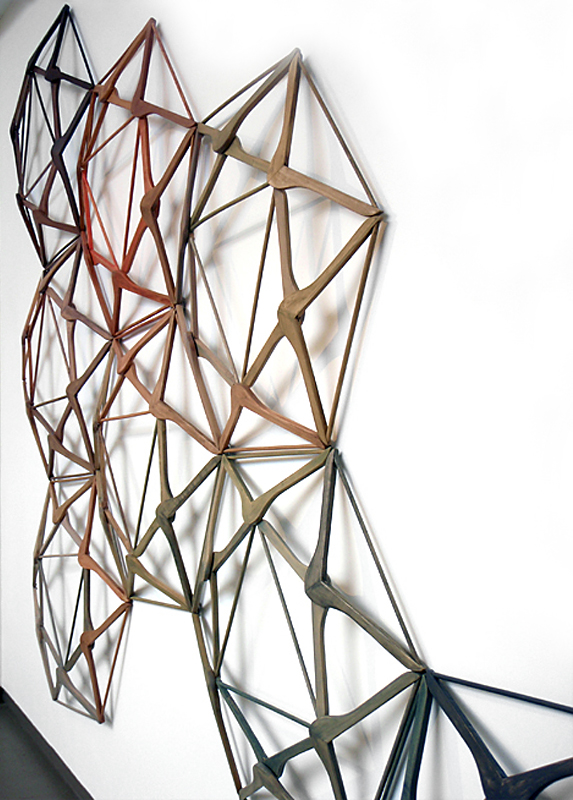
The best pieces in the exhibition are the wall mounted geometric, mandala-like sculptures made of wooden coat hangers. Delicately shifting patterns take the micro cellular form and make it macro, their patterns of construction offering a pleasing visual balance that is both complex, layered and innovative at one and the same time. As explorations of the notion of the universal structure, the golden ratio, they reward repeated viewing.

As the exhibition stands there are too many little pieces to make a holistic whole. Perhaps an exhibition solely of the towers or geometric pieces would have been stronger. I look forward to seeing how the geometric pieces (d)evolve in future work. Will the structures break down and reassemble in other marvellous incantations? I hope so!

Dr Marcus Bunyan


Many thankx to Anita Traverso Gallery for allowing me to publish the art work in the posting. Please click on some of the photographs for a larger version of the image.


Lyndal Hargrave (Australia, b. 1959) 'Arabesque' 2009 from the exhibition 'All the Little Pieces' by Lyndal Hargrave at Anita Traverso Gallery, Richmond, Melbourne, Sept - Oct, 2009


Lyndal Hargrave (Australia, b. 1959)
Arabesque
2009
Acrylic painted timber coat hangers, screws, staples
200 x 360cm
Photo: Marcus Bunyan


Lyndal Hargrave (Australia, b. 1959) 'Arabesque' 2009 (detail)


Lyndal Hargrave (Australia, b. 1959)
Arabesque (detail)
2009
Acrylic painted timber coat hangers, screws, staples
200 x 360cm
Photo: Marcus Bunyan


Lyndal Hargrave (Australia, b. 1959) 'Hairpin Dragons I & II' 2009


Lyndal Hargrave (Australia, b. 1959)
Hairpin Dragons I & II
2009
Wire, formply
170 x 15cm (varying)
Photo: Marcus Bunyan


“It is a constant idea of mine that behind the cotton wool (of daily reality) is hidden a pattern, that we – I mean all human beings – are connected with this: that the whole world is a work of art; that we are parts of the work of art.”

~ Virginia Woolf


For as long as I can remember, my art practice has served as a filter between the outside world and my inside world. I realise now that the act of making the artwork informs my ideas rather than the other way round. Working intuitively results in a continuous stream of surprises that in retrospect mirror the pressing issues surrounding me at that time.

In All the Little Pieces my fascination with patterns of construction from micro to macro and natural to man-made continues. My work explores the gap between order and chaos and helps me to understand the meaning of balance.

Using mundane found objects, my sculptures probe the possibility of re-invention through the way the componentry of human habitation can be re-configured to offer us a new way of seeing and experiencing our world.

It is this process of metamorphosis that is at the centre of my investigation: how life forms make the transition from one state to another – tree to timber to tower or talisman; why some systems remain strong and others crumble.

Overarching my work is the notion of universal structure and the geometry that has informed our evolution from molecule to macro-system.”

Lyndal Hargrave 2009

Text from the Anita Traverso Gallery website


Lyndal Hargrave (Australia, b. 1959) 'Whirlpool Galaxy' (2009) and 'The Samarian Star' (2009)


Lyndal Hargrave (Australia, b. 1959)
Whirlpool Galaxy and The Samarian Star
2009
Acrylic painted timber coat hangers, screws, staples
Photo: Marcus Bunyan


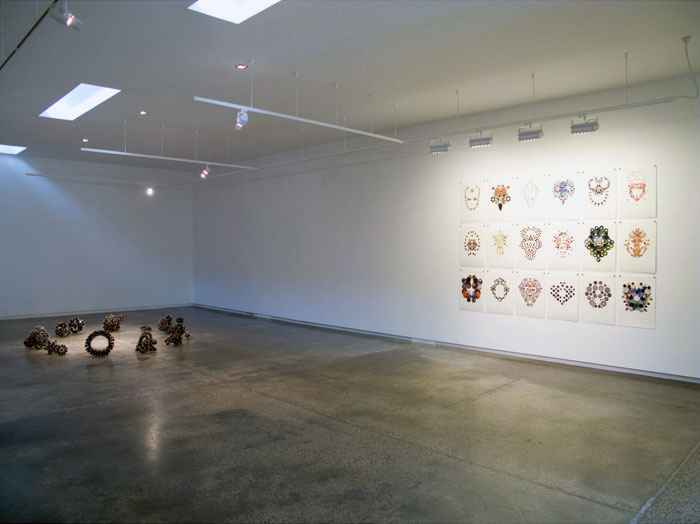
Installation view of Lyndal Hargrave exhibition at Anita Traverso Gallery, Melbourne


Installation view of the Lyndal Hargrave exhibition at Anita Traverso Gallery
Photo: Marcus Bunyan


Photograph showing the relationship of form between the work 'Jacob’s Ladder' (2009) and the painting 'Breathing Space' (2009)


Photograph showing the relationship of form and colour between the work Jacob’s Ladder (2009) and the painting Breathing Space (2009)
Photo: Marcus Bunyan


Lyndal Hargrave (Australia, b. 1959) 'Breathing Space' 2009


Lyndal Hargrave (Australia, b. 1959)
Breathing Space
2009
Oil on canvas
200 x 200cm


Anita Traverso Gallery

The physical gallery has now closed.
PO Box 7001, Hawthorn North 3122
Phone: 0408 534 034
Email: art@anitatraversogallery.com.au

Anita Traverso Gallery website

LIKE ART BLART ON FACEBOOK

Back to top

Review: ‘Connection is Solid’ by John Nicholson at Sophie Gannon Gallery, Richmond, Melbourne

Exhibition dates: 25th August – 19th September, 2009


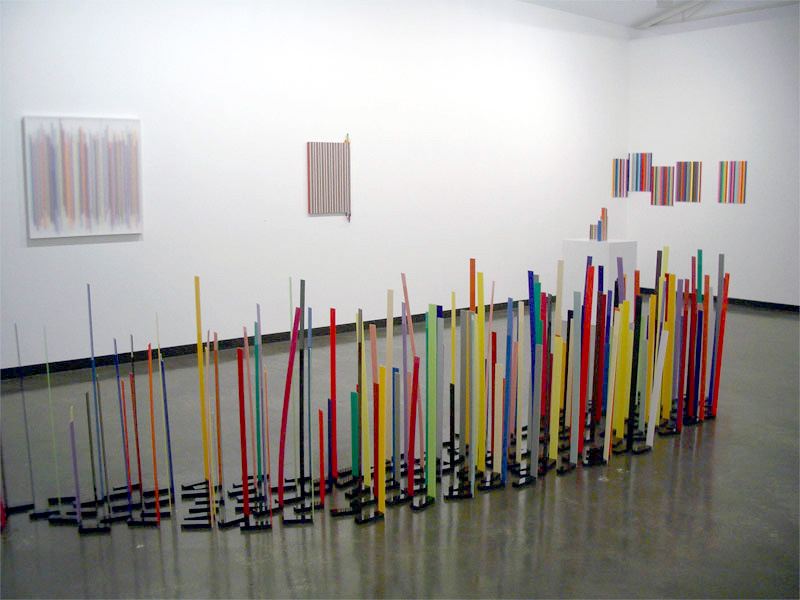
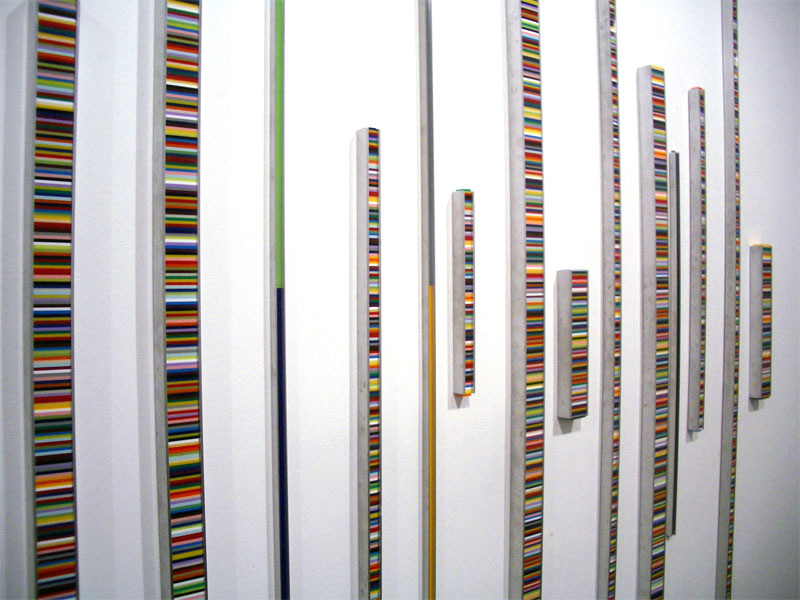
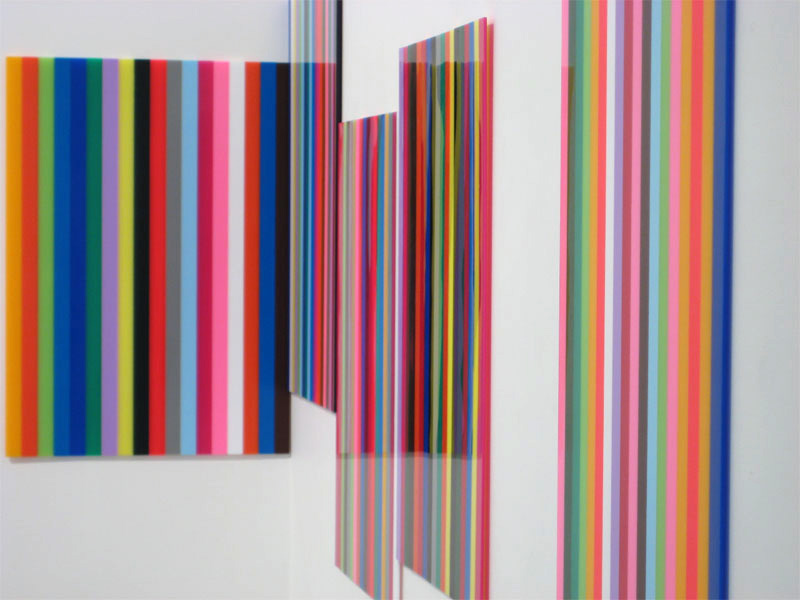
John Nicholson (Australian, b. 1970) 'Untitled' 2009 from the exhibition 'Connection is Solid' by John Nicholson at Sophie Gannon Gallery, Richmond, Melbourne, Aug - Sept, 2009


John Nicholson (Australian, b. 1970)
Aerial Navigation
2009


You could say that the essence of the cosmos is not matter, it is consciousness.

It is not the external world that is real – it is “maya”, an illusion, for the real world lies within.

These works, with their striations, strata and suspension are emanations of that spirit – projections of the inner reality.

In terms of the ancient Chinese philosophy Lao Tzu we dream the butterfly and the butterfly is us. If you don’t ‘get’ these works, let go all pretensions and feel their colour as sound, as vibrations of energy.

Submerge yourself in their shape and form. Like DNA structure, a heart beat or the record of a seismic shock these works are music as art, the length of harmony quivering and slipping in our minds, before our eyes.

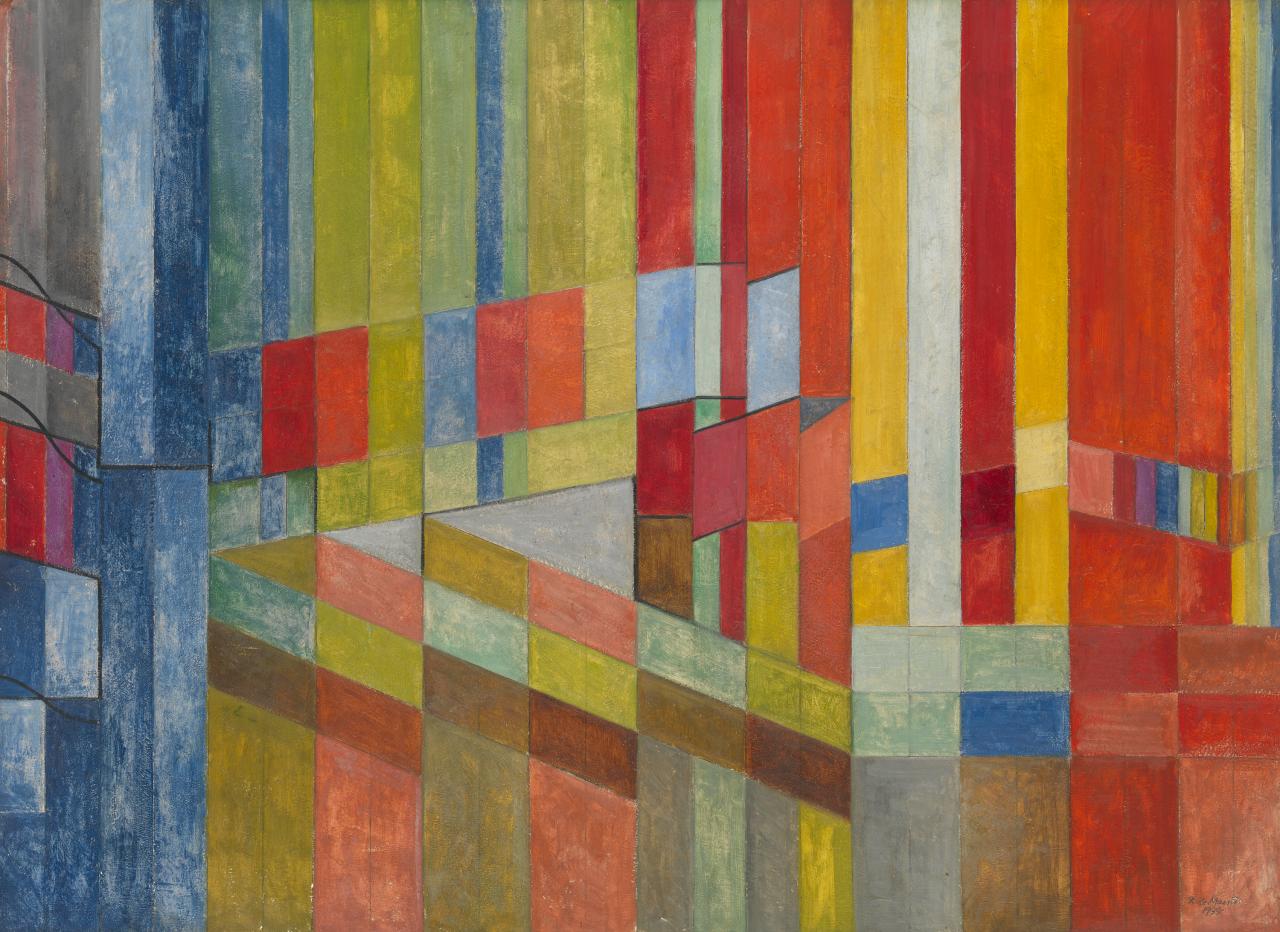
This is the colour music of Roy De Maistre’s paintings of the 1930’s updated to the 21st century. They are fugues of sound made physical entities, intertwining, coming and going. Here lines, tones and colours are organised in a parallel way – tone after tone, line after line. They are wavelengths of the interior made visible. The connection is solid and fluid at one and the same time; there are many connections to be discovered, many journeys to be made.

I hear them, I like them.

Dr Marcus Bunyan


Many thankx to Sophie Gannon Gallery for allowing me to publish the photographs in the posting. Please click on the photographs for a larger version of the image.


John Nicholson (Australian, b. 1970) 'Under the radar' 2009 from the exhibition 'Connection is Solid' by John Nicholson at Sophie Gannon Gallery, Richmond, Melbourne, Aug - Sept, 2009


John Nicholson (Australian, b. 1970)
Under the radar
2009
Photo: Marcus Bunyan


Installation view of 'Connection is Solid' by John Nicholson at Sophie Gannon Gallery, Melbourne

Installation view of 'Connection is Solid' by John Nicholson at Sophie Gannon Gallery, Melbourne


Installation views of Connection is Solid by John Nicholson at Sophie Gannon Gallery
Photos: Marcus Bunyan


John Nicholson (Australian, b. 1970) 'Thrill seeker' 2009 (detail)


John Nicholson (Australian, b. 1970)
Thrill seeker (detail)
2009
Photo: Marcus Bunyan


Roy de Maistre (Australian, 1894-1968) 'Arrested Movement from a Trio' 1934


Roy de Maistre (Australian, 1894-1968)
Arrested Movement from a Trio
1934
Oil and pencil on composition board
72.3 × 98.8cm


John Nicholson (Australian, b. 1970) 'Slip' 2009


John Nicholson (Australian, b. 1970)
Slip
2009


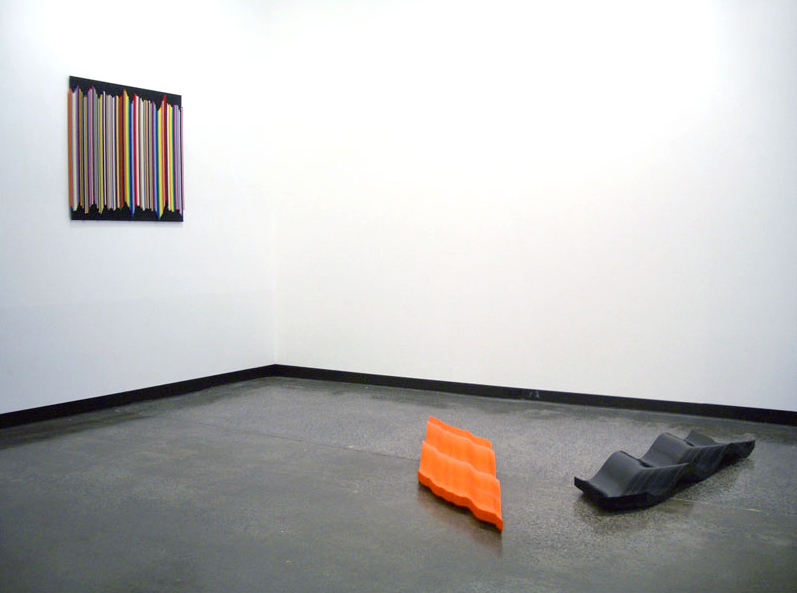
John Nicholson (Australian, b. 1970) 'The wire might sense' 2009


John Nicholson (Australian, b. 1970)
The wire might sense
2009


John Nicholson (Australian, b. 1970) 'Swoop' 2009


John Nicholson (Australian, b. 1970)
Swoop
2009
Photo: Marcus Bunyan


Installation view of 'Connection is Solid' by John Nicholson with on the wall 'Satellite Graffitti' (2009) and on the floor 'Cascade' (2009) and 'Swoop' (2009)


Installation view of Connection is Solid by John Nicholson with on the wall Satellite Graffitti (2009) and on the floor Cascade (2009) and Swoop (2009)
Photo: Marcus Bunyan


Sophie Gannon Gallery
2, Albert Street, Richmond, Melbourne

Opening hours:
Tuesday – Saturday 11am – 5pm

Sophie Gannon Gallery website

LIKE ART BLART ON FACEBOOK

Back to top

Review: ‘Symmetrical Spirit Guides and Fractal Alchemy’ by Carl Scrase at John Buckley Gallery, Richmond, Melbourne

Exhibition dates: 19th August – 5th September, 2009


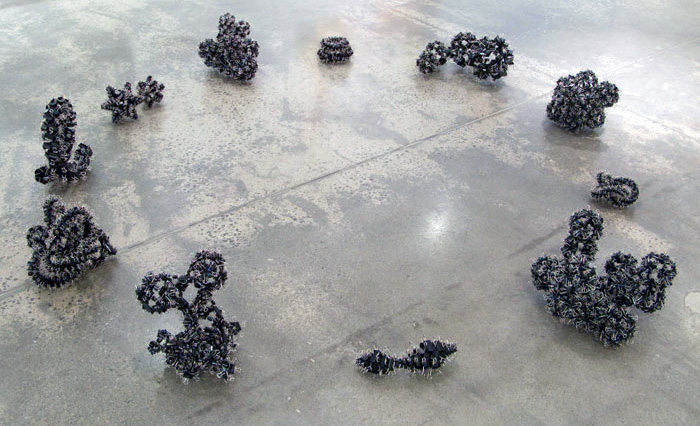
Carl Scrase 'Fractal Alchemy' installation view 2009


Carl Scrase (Australian, b. 1983)
Fractal Alchemy installation view
2009


This is a slight exhibition of collages and constructions by Carl Scrase at John Buckley Gallery, Melbourne. Ironically, given the nature of the catalogue essay by Tai Snaith (see below) that waxes lyrical about the mystery and magic of symmetry, synchronicity and spirit, this exhibition lacks the depth of purpose needed to address spiritual elements that are the very basis of human existence.

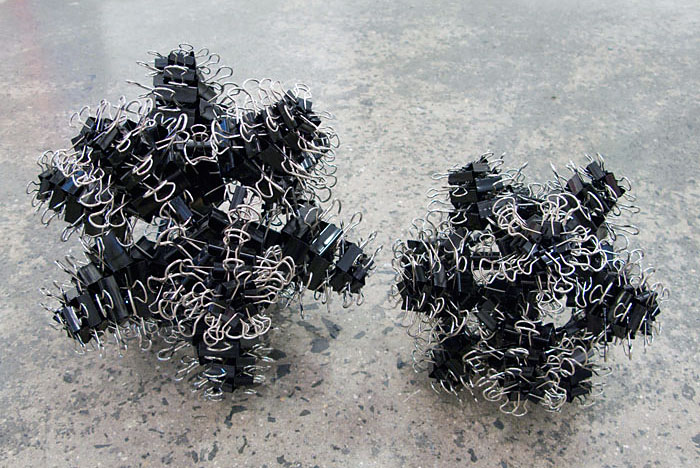
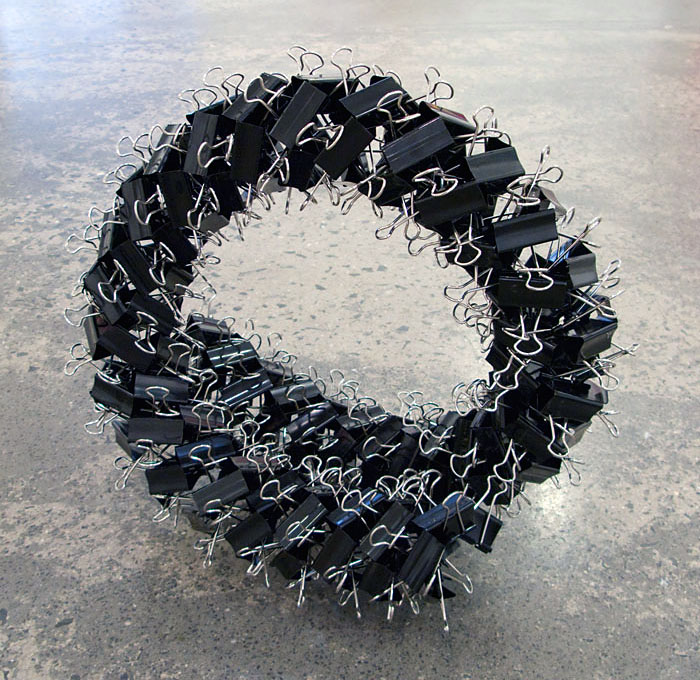
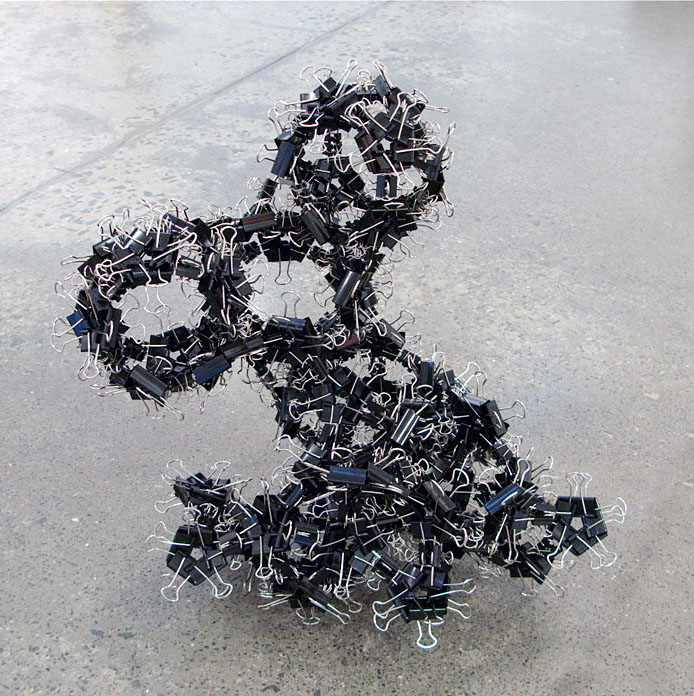
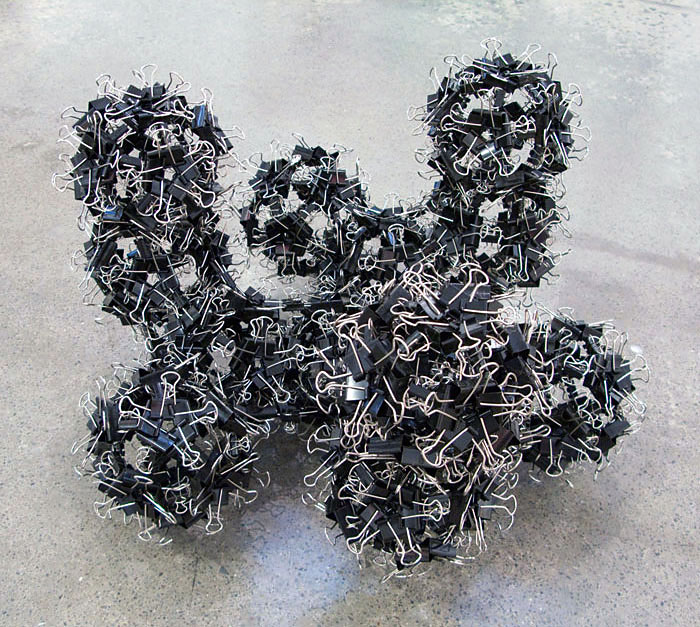
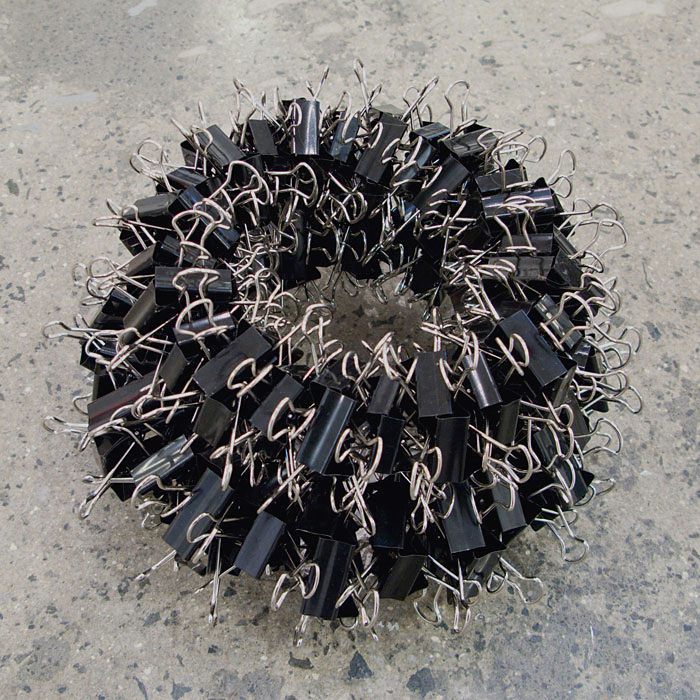
The biomorphic forms that go to make up the work Fractal Alchemy (2009) fair better in this regard, the various size bull dog clips offering non-representational patterns that resemble living organisms and genetic structures in shape and appearance. At their best these elemental shapes start to transcend form and function to become something else: an instinctive and intuitive connection to the inherent fold in the universe, like the embedded pattern, the DNA template in a blank piece of paper before the folding of the origami model. Unfortunately the wonder of this piece is short-lived. Unlike the ever magical repetition of fractal geometry with its inherent iteration of forms that constantly a/maze, here the shapes are not stretched far enough, the exposition not grounded in broken or fractured forms that invite alchemical awareness in the viewer.

The collages are less successful in this mystery project. Made from cut-up images from magazines these symmetrical constructions lack spiritual presence. Like the aspired to symmetrical beauty of a human face it is, paradoxically, the irregularities of the human face that are their most attractive feature – our individuality. In the photographic stereoscopes of Victorian landscapes it is the difference between the left and right image that adds three-dimensional depth in the eye of the viewer, that transports them to other places, other worlds. In the collages of  Picasso it is the irregularities that also transport the viewer into a hypertextural, hypertextual world of wonder. Scrase’s collages on the other hand, are flat, rigidly symmetrical life-less things that belie their stated aim – to be kaleidoscopic spirit guides in search of a pattern for inner peace. Although some of their forms are attractive their is no wonder, no my-story to be gleaned here.

Overall the work lacks the gravitas and sense of fun in and through the act of creation that the concepts require: to see things clearly and to ground this visualisation in objects that transcend ‘now’ and extend spirit into the eternal. These constructions do not stand as ‘equivalents’ for other states of consciousness, of being-in-the-world, nor do they offer a re-velatio where they open up ‘poetic spaces’ in which the alienation and opposition of inside and outside, of objectivity and subjectivity are seen to be disconnected. The Japanese ‘ma’, the interval which gives substance to the whole, is missing.

To express deep inner emotions and connection to spirit requires utmost focus on their expression-in-the-world, a releasement from ego and a layering of materials and form that transport the object and viewer into an’other’ plane of existence. Unfortunately this work falls short of this state of no-desire.

Dr Marcus Bunyan


Many thankx to John Buckley Gallery for allowing me to publish the photographs in the posting.


Carl Scrase (Australian, b. 1983) 'Fractal Alchemy' 2009 from the exhibition Review: 'Symmetrical Spirit Guides and Fractal Alchemy' by Carl Scrase at John Buckley Gallery, Richmond, Melbourne, Aug - Sept, 2009


Carl Scrase (Australian, b. 1983)
Fractal Alchemy installation view
2009


Carl Scrase (Australian, b. 1983) 'Fractal Alchemy' 2009 (detail)


Carl Scrase (Australian, b. 1983)
Fractal Alchemy (detail)
2009


Carl Scrase (Australian, b. 1983) 'Fractal Alchemy' 2009 (detail)


Carl Scrase (Australian, b. 1983)
Fractal Alchemy (detail)
2009


Carl Scrase (Australian, b. 1983) 'Fractal Alchemy' 2009 (detail)


Carl Scrase (Australian, b. 1983)
Fractal Alchemy (detail)
2009


Carl Scrase (Australian, b. 1983) 'Fractal Alchemy' 2009 (detail)


Carl Scrase (Australian, b. 1983)
Fractal Alchemy (detail)
2009


Carl Scrase (Australian, b. 1983) 'Fractal Alchemy' 2009 (detail)


Carl Scrase (Australian, b. 1983)
Fractal Alchemy (detail)
2009


Carl Scrase is a perfect example of an artist marking the turn of a tide. At this distinct ebb of the ravenous, rampant seas of consumption and production we’ve been surfing for the past couple of hundred years and with the onset of the new flow, towards the riptide of Mayan prophesies of fast approaching 2012, Carl is on it, or should I say in it. And he’s splashing around.

This new generation of creative humans (to which Carl belongs) are not really concerned with how much money, time or status something is worth, or what kind of flashy object the human next to them owns. They seem to be more interested in what kind of wisdom can be procured, how many friends can be found and how a thing can be recycled or was born from something else. It is all about a search for the spirit, the feeling. Moreover, what it means. We are getting sick of the bland smog of consumerism, the stench of blatant big business and seem to be looking for escape pointers, for enlightenment, for answers and for CHANGE.

Carl’s work suggests his role as an artist is almost akin to a kind of medium slash alchemist – a self-proclaimed, new-age, anonymous shaman of sorts. Big boots to fill indeed, but don’t worry, its not like Carl is about to declare himself a Secret Chief and start welcoming in the new Golden Dawn or reading your tarot at openings. Nor is he concerned with the alchemical properties and behaviour of inorganic compounds or scientific explanations or measurements of the planets. His interest lies in noticing the sparkling mist of questions surrounding these things. The mystery and magic of how these marvels, such as symmetry and synchronicity occur in nature and how we can possibly learn from them and experience them in our day-to-day lives.

A true spiritualist in an atheist age, Carl uses his work as a kind of cipher for sorting his beliefs via a material creative process. His collages begin with found images from magazines, chosen relatively arbitrarily. His sculptures begin in a similar fashion with found objects, usually of the mundane or mass produced variety. It may be that they are all parts of images of human faces or just a complete add for a pair of Crocs or a hundred boxes of bull dog clips. Starting with the colour and then cutting the shape, or with the objects and then finding their natural function- almost as if listening to an instinctive, visual Ouija board somewhere in his subconscious. Carl then arranges the pieces through play. Similar to the way that you need to relax your eyes to receive the effects of a Magic Eye picture (remember them?), Carl relaxes his mind in order to let his collages find their final composition. This allows a kind of subconscious code to come forward, thus acting as both a reflection of his thoughts but also a kind of guide or suggestion for other’s thoughts, and perhaps something deeper that we don’t understand just yet.

I remember as a child I found an empty plastic tubular casing of a biro pen whilst walking along the beach one day. It had been washed and scratched by the ocean and gave the pale blue, semi-translucent plastic a soft almost sparkly effect. I picked it up and instinctively looked through the tiny tunnel at the sun. The way the sunlight refracted through the plastic before reaching my retina made me think of a magical kaleidoscope and I immediately classified it as having ‘special powers’, granting it prime position in my pocket for months. It became a type of personal talisman or spirit guide.

Traditionally, in animist belief systems (such as Shinto and certain parts of Hinduism) sprits need either an object or a medium (ie, thunder, lightening, wind, animals, plants, etc) to be experienced or seen by humans. They need something else to exist in order to communicate with us. Carl’s images and objects seem to suggest or demonstrate this kind of medium as well as subtly questioning the message. In the same way that a child finds wonder in the changing symmetry of a Kaleidoscope before they even understand the science of the mirror involved, there is a wonder in these images and objects as soon as we encounter them. A wonder in creation, in ritual, in synchronicity and light. A wonder in life.

For Carl, the practice of Alchemy (and in this instance one might just as comfortably read Alchemy as Art) is ‘not the search for some magic potion’ but rather the ‘awareness that all life is eternal and the inner peace that comes from that realisation’. Just as we recognise similar patterns within nature, like the spiral formation of a shell or the layering of petals on a flower or the direction of the hair growing on a man’s scalp, we can notice these patterns on a spiritual and philosophical plane also. It doesn’t take a genius to recognise a similar search for meaning and self-realisation being revisited amongst some of the most interesting artists of our time, but let’s just hope that the search continues to prove that the process of making art itself is both the question and the answer.

Tai Snaith
 2009

Text from the John Buckley website [Online] Cited 20/08/2009 no longer available online


Carl Scrase (Australian, b. 1983) 'Spiritguide 090501' 2009 from the exhibition Review: 'Symmetrical Spirit Guides and Fractal Alchemy' by Carl Scrase at John Buckley Gallery, Richmond, Melbourne, Aug - Sept, 2009


Carl Scrase (Australian, b. 1983)
Spiritguide 090501
2009


Carl Scrase (Australian, b. 1983) 'Spiritguide 090624' 2009 from the exhibition Review: 'Symmetrical Spirit Guides and Fractal Alchemy' by Carl Scrase at John Buckley Gallery, Richmond, Melbourne, Aug - Sept, 2009


Carl Scrase (Australian, b. 1983)
Spiritguide 090624
2009


Carl Scrase (Australian, b. 1983) 'Spiritguide 090504' 2009


Carl Scrase (Australian, b. 1983)
Spiritguide 090504
2009


Carl Scrase (Australian, b. 1983) 'Spiritguide 090509' 2009


Carl Scrase (Australian, b. 1983)
Spiritguide 090509
2009


Carl Scrase (Australian, b. 1983) 'Spiritguide 090520' 2009


Carl Scrase (Australian, b. 1983)
Spiritguide 090520
2009


Carl Scrase (Australian, b. 1983) 'Spiritguide 090601' 2009


Carl Scrase (Australian, b. 1983)
Spiritguide 090601
2009


Carl Scrase (Australian, b. 1983) 'Spiritguide 090617' 2009


Carl Scrase (Australian, b. 1983)
Spiritguide 090617
2009


John Buckley Gallery

This gallery is now closed.
LIKE ART BLART ON FACEBOOK

Back to top

Review: ‘Cineraria’ by Julia deVille at Sophie Gannon Gallery, Richmond, Melbourne

Exhibition dates: 28th July – 22nd August, 2009


Julia deVille (New Zealand, b. 1982) 'Ruby Heart Starling' 2008 from the exhibition 'Cineraria' by Julia deVille at Sophie Gannon Gallery, Richmond, Melbourne, July - Aug, 2009


Julia deVille (New Zealand, b. 1982)
Ruby Heart Starling
2008
Starling, sterling silver, black rhodium & gold plate, rubies, antique frame
30 x 35 x 18cm


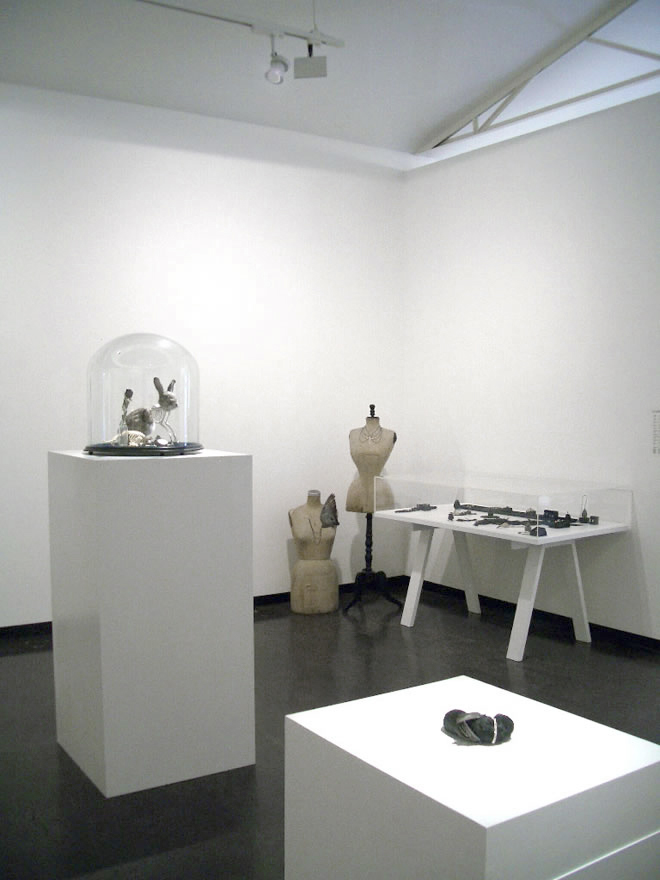
This is an itsy-bitsy show by Julia deVille at Sophie Gannon Gallery in Richmond, Melbourne. Offering a menagerie of macabre stuffed animals and conceptual ideas the exhibition fails to coalesce into a satisfying vision. It features many ideas that are not fully investigated and incorporated into the corporeal body of the work.

We have, variously, The Funerary Urn/Cinerarium, The Ossuary, Skeletons, Black, Victorian Funerary Customs, Feathers, Taxidermy, Time, Eggs and Religion. We also have stuffed animals, cigar boxes, lace and silver, pelts and columns, jet necklaces and Victorian glass domes, glass eyes and ruby hearts to name but a few. The viewer is overwhelmed by ideas and materials.

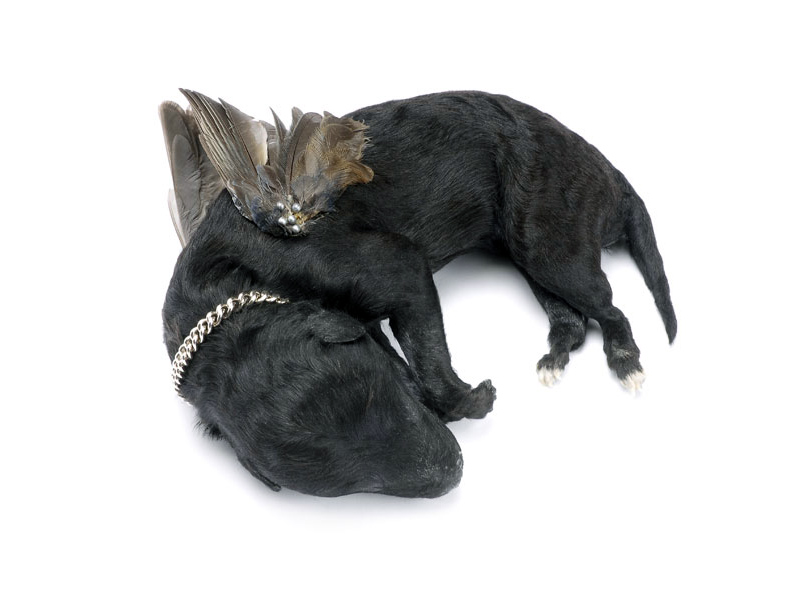
When individual pieces excel the work is magical: the delicate and disturbing Stillborn Angel (2009, below) curled in a foetal position with appended sparrows wings is a knockout. The large suspended raven of Night’s Plutonian Shore (2009, above) effectively evinces the feeling of the shores of the underworld that the title, taken from an Edgar Allan Poe poem, reflects on.

Other pieces only half succeed. Piglet (2009, below) is a nice idea with its lace snout and beaded wings sitting on a bed of feathers awaiting judgement but somehow the elements don’t click into place. Further work are just one shot ideas that really lead nowhere. For example Cat Rug (2008, below) features black crystals in the mouth of a taxidermied cat that lies splayed on a plinth on the gallery floor. And, so … Silver Rook (2008, below) is a rook whose bones have been cast in silver, with another ruby heart, suspended in mid-air in the gallery space. Again an interesting idea that really doesn’t translate into any dialogue that is substantial or interesting.

Another problem with the work is the technical proficiency of some of the pieces. The cast silver front legs and ribs of The Anatomy of a Rabbit (2008, below) are of poor quality and detract from what should have been the delicacy of the skeletal bones of the work. The bronze lion cartouche on the egg shaped Lion Urn (2009) fails to fit the curved shape of the egg – it is just attached at the top most point and sits proud of the egg shape beneath. Surely someone with an eye for detail and a sense of context, perfection and pride in the work they make would know that the cartouche should have been made to fit the shape underneath.

Despite its fashionable position hovering between craft, jewellery and installation this is ‘art’ in need of a good reappraisal. My suggestion would be to take one idea, only one, and investigate it fully in a range of work that is thematically linked and beautifully made. Instead of multiplying the ideas and materials that are used, simplify the conceptual theme and at the same time layer the work so it has more complexity, so that it reveals itself over time. You only have to look at the work of Mari Funaki in the previous post or the simple but conceptually complex photographs of Matthias Koch in the German photography review to understand that LESS IS MORE!

There are positive signs here and I look forward to seeing the development of the artist over the next few years.

Dr Marcus Bunyan


Many thankx to Sophie Gannon Gallery for allowing me to publish the photographs in the posting. Please click on the photographs for a larger version of the image.


Julia deVille (New Zealand, b. 1982) 'Night's Plutonian Shore' 2009 from the exhibition 'Cineraria' by Julia deVille at Sophie Gannon Gallery, Richmond, Melbourne, July - Aug, 2009


Julia deVille (New Zealand, b. 1982)
Night’s Plutonian Shore
2009
Tasmanian Forest Raven, black garnets, cotton, sterling silver, amethyst


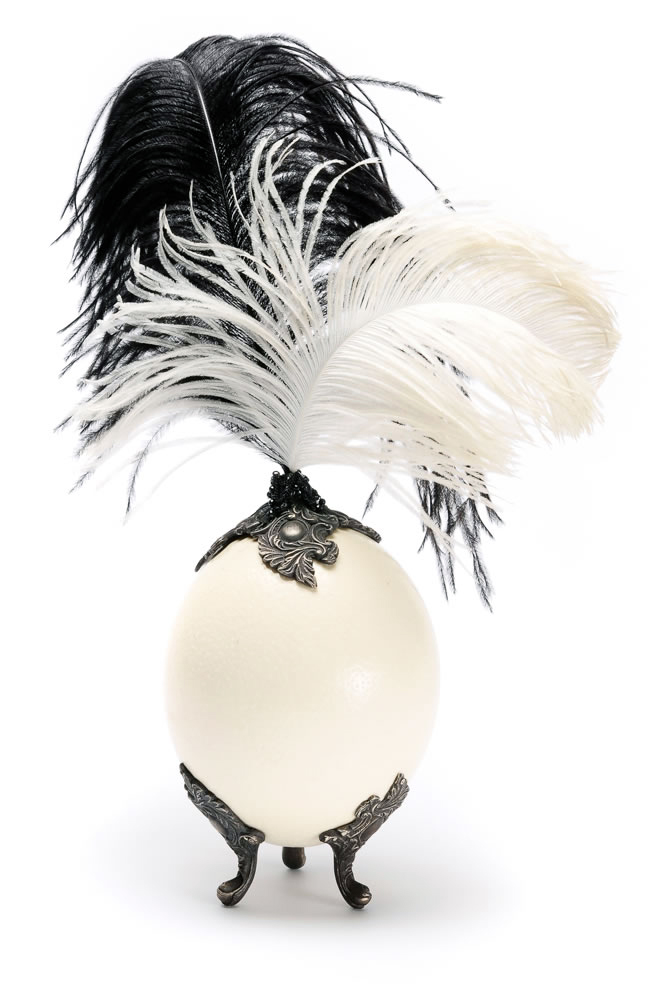
Julia deVille (New Zealand, b. 1982) 'L'enfant (Infant Funerary Urn)' 2009 from the exhibition 'Cineraria' by Julia deVille at Sophie Gannon Gallery, Richmond, Melbourne, July - Aug, 2009


Julia deVille (New Zealand, b. 1982)
L’enfant (Infant Funerary Urn)
2009
Ostrich egg, sterling silver, ostrich plumes and black garnet
35 x 12 x 12cm


Julia de Ville 'Cineraria' installation view at Sophie Gannon Gallery, Melbourne

Julia de Ville 'Cineraria' installation view at Sophie Gannon Gallery, Melbourne


Julia deVille Cineraria installation views at Sophie Gannon Gallery, Melbourne
Photos: Marcus Bunyan


Julia deVille (New Zealand, b. 1982) 'Piglet' 2009


Julia deVille (New Zealand, b. 1982)
Piglet
2009
Piglet, antique lace, pins and feathers
25 x 23 x 13cm


Julia deVille (New Zealand, b. 1982) 'Cat Rug' 2008


Julia deVille (New Zealand, b. 1982)
Cat Rug
2008
Cat, glitter and fibreglass
100 x 60 x 8cm


Julia deVille (New Zealand, b. 1982) 'Sympathy' 2008


Julia deVille (New Zealand, b. 1982)
Sympathy
2008


Julia deVille (New Zealand, b. 1982) 'Silver Rook' 2008


Julia deVille (New Zealand, b. 1982)
Silver Rook
2008
Sterling silver, rubies
30 x 25 x 35cm


Cinerarium

n. pl. Cineraria
A place for keeping the ashes of a cremated body.

Cineraria
n. any of several horticultural varieties of a composite plant, Senecio hybridus, of the Canary Islands, having clusters of flowers with
white, blue, purple, red, or variegated rays.

Origin: 1590-1600; < NL, fem. of cinerarius ashen, equiv. to L ciner- (s. of cinis ashes) + -rius -ary; so named from ash-coloured down on leaves.

CINERARIA is a study of the ritual and sentiment behind funerary customs from various cultures and eras.


Notes on inspirations

The Funerary Urn/Cinerarium: Funerary Urns have been used since the times of the ancient Greeks and are still used today. After death, the body is cremated and the ashes are collected in the urn.

The Ossuary: An ossuary is a chest, building, well, or site made to serve as the final resting place of human skeletal remains. They are frequently used where burial space is scarce. A body is first buried in a temporary grave, then after some years the skeletal remains are removed and placed in an ossuary. The greatly reduced space taken up by an ossuary means that it is possible to store the remains of many more people in a single tomb than if the original coffins were left as is. This was a common practice in post plague Europe in the 14th-16th Centuries.

Skeletons: Human skeletons and sometimes non-human animal skeletons and skulls are often used as blunt images of death. The skull and crossbones (Death’s Head) motif has been used among Europeans as a symbol of piracy, poison and most commonly, human mortality.

Black: In the West, the colour used for death and mourning is black. Black is associated with the underworld and evil. Kali, the Hindu god of destruction, is depicted as black.

Victorian Funerary Customs:

~ A wreath of laurel, yew or boxwood tied with crape or black ribbons would be hung on the front door to alert passers by that a death had occurred

~ The use of flowers and candles helped to mask unpleasant odours in the room before embalming became common

~ White was a popular colour for the funeral of a child. White gloves, ostrich plumes and a white coffin were the standard

Feathers: In Egyptian culture a recently deceased persons soul had to be as light as a feather to pass the judgment of Ma’at. Ma’at (Maet, Mayet) is the Egyptian goddess of truth, justice and the underworld. She is often portrayed as wearing a feather, a symbol of truth, on her head. She passed judgment over the souls of the dead in the Judgment Hall of Osiris. She also weighted up the soul against a feather. The “Law of Ma’at” was the basis of civil laws in ancient Egypt. If it failed, the soul was sent into the underworld. Ma’at’s symbol, an ostrich feather, stands for order and truth.

Taxidermy: Taxidermy to me is a modern form of preservation, a way for life to continue on after death, in a symbolic visual form.

The Raven: In many cultures for thousands of years, the Raven has been seen symbol of death. This is largely due to the Raven feeding on carrion. Edgar Allan Poe has used this symbolism in his poem, “The Raven”.

Time: Less blunt symbols of death frequently allude to the passage of time and the fragility of life. Clocks, hourglasses, sundials, and other timepieces call to mind that time is passing. Similarly, a candle both marks the passage of time, and bears witness that it will eventually burn itself out. These sorts of symbols were often incorporated into vanitas paintings, a variety of early still life.

Eggs: The egg has been a symbol of the start of new life for over 2,500 years, dating back to the ancient Persians. I have chosen egg shapes and even one Ostrich egg to represent the cycle of life, the beginning and the end.

Religion: Religion has played a large part in many funerary customs and beliefs. I am particularly interested in the Memento Mori period of the 16th-18th centuries. In a Calvinistic Europe, when the plague was a not too distant memory, a constant preoccupation with death became a fashionable devotional trend.

Julia deVille


Julia deVille (New Zealand, b. 1982) 'Stillborn Angel' 2009


Julia deVille (New Zealand, b. 1982)
Stillborn Angel
2009
Stillborn puppy, sparrow wings and sterling silver
13 x 10 x 5cm


Julia deVille (New Zealand, b. 1982) 'The Anatomy of a Rabbit' 2008


Julia deVille (New Zealand, b. 1982)
The Anatomy of a Rabbit
2008
Rabbit, sterling silver, rubies, glitter and mahogany
30 x 30 x 30cm


Julia de Ville 'Cineraria' installation views at Sophie Gannon Gallery, Melbourne


Julia deVille Cineraria installation view at Sophie Gannon Gallery, Melbourne
Photo: Marcus Bunyan


Sophie Gannon Gallery
2, Albert Street, Richmond, Melbourne

Opening hours:
Tuesday – Saturday 11am – 5pm

Sophie Gannon Gallery website

LIKE ART BLART ON FACEBOOK

Back to top

Review: ‘Apocrypha’ photographs by Julie Davis and Alex Rizkalla at Place Gallery, Richmond

Exhibition dates: 17th June – 11th July 2009


Apocrypha (from the Greek word ἀπόκρυφα, meaning “those having been hidden away”) are texts of uncertain authenticity, or writings where the authorship is questioned.

Definition from the Wikipedia website


Julie Davis (Australian, b. 1959) and Alex Rizkalla (Australian, b. 1950) 'Apocrypha #1' (left) and 'Apocrypha #4' (right) 2008


Julie Davis (Australian, b. 1959) and Alex Rizkalla (Australian, b. 1950)
Apocrypha #1 (left) and Apocrypha #4 (right)
2008


“Intuitively we know the definition of the output from this process lies hidden within each object, seemingly carved into the underside of their skin, although we cannot see it. But actually it is not carved, it is the three-dimensional tracing of the original. The original becomes a throw-away. It is obsolete. The point of origin lies no longer within an object but at the heart of the creative impulse.”


Vanessa Mooney


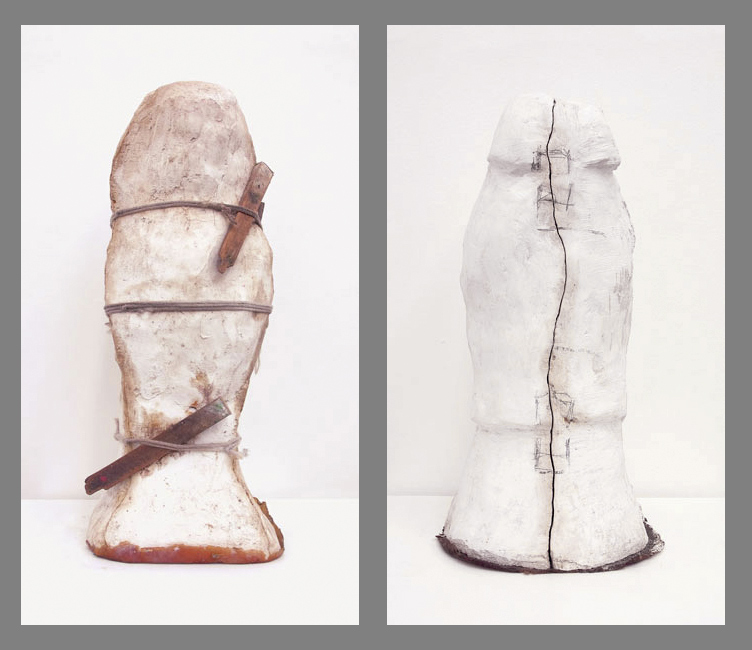
Apocrypha is an interesting, if slight, exhibition of eleven photographs by Julie Davis and Alex Rizkalla at Place Gallery in Richmond. Conceptually the work is resolved if not pushed to any great depth, the small photographs of sarcophagi like casements and moulds addressing issues surrounding the absence / presence of the original object and the subsequent loss of identity. In their masking, the objects photographed hide an inner identity that has gone missing; the headless figures, like faceless mummies, protect something that has existed since early man – the inner spiritual machinations of belief – that are embedded within the existential nature of our being. Identity has been rubbed out and spirit is splitting apart the moulds trying to escape the confines of mortality, only held in check by the wooden pegs and ropes.

Like the sutures of the human skull, the marks on the casements (see below right image) try to align form across space and time but these objects are grounded in a contextless backgrounds, seemingly floating free of earthly constraints. Here we have a double tracing – that of the tracing of the original object that has been thrown away (see Vanessa Mooney quotation above) and the tracing of the indexicality of the object by the photograph – the re-presentation of an original that no longer exists. There is a double loss through this re-retracing that fits perfectly with the title Apocrypha – as the photographs become texts of uncertain authenticity.

Where the exhibition is less successful is in the physical presence of the photographs and their aesthetic qualities. While Vanessa Mooney asserts that the photographs are “meticulous in their detail and exact in their depth and texture” this assertion is untrue. From a technical point of view the photographs are soft in focus and lack depth of field. The ropes are fuzzy and the lack of depth of field in the focus plane from front to back adds to a lack of presence that the photographs needed to counterbalance the conceptual idea of apocrypha. I am also unsure about the scale of the photographs – there seems something in-between about the size of the images, neither here nor there. Aesthetically they needed either more presence (through being bigger), or more intensity through a jewel like nature in being smaller, again to counterbalance the conceptual themes. Finally, being surrounded by these eleven photographs in the gallery gives you the feeling of a ‘one shot’ idea that needed further investigation and refinement, an idea that needed to be pushed further. While the actual ideas themselves are interesting the work itself is too simple, too slight to hold the attention and reveal layers of meaning over time.

Dr Marcus Bunyan


Many thankx to Place Gallery for allowing me to publish the photographs in the posting.


Julie Davis (Australian, b. 1959) and Alex Rizkalla (Australian, b. 1950) 'Apocrypha #5' (left) and 'Apocrypha #7' (right) 2008


Julie Davis (Australian, b. 1959) and Alex Rizkalla (Australian, b. 1950)
Apocrypha #5 (left) and Apocrypha #7 (right)
2008


The Father, The Son And Apocrypha

We all have faith that we must lodge somewhere: you; the microscope, me; the earth, and the artist? There are two stories present. The first is Apocrypha, a series of works by Davies and Rizkalla and the second is something you cannot see but will soon know.

Davies and Rizkalla present to us Apocrypha; a series of photographs that are meticulous in their detail and exact in their depth and texture. It is an evocative title and encapsulates the resonance of the objects. What we can see is clear – plaster moulds used by someone, somewhere for casting objects. The clarity of the details of rope, wedges of wood and the depth of the seam tell us of the real working nature of them. The inversion here from background process to foreground subject matter is not for irony’s sake but to evoke the simultaneous banality and sacredness of the transformative creative process. It is documented honestly before the viewer, and yet, the mystery remains. Intuitively we know the definition of the output from this process lies hidden within each object, seemingly carved into the underside of their skin, although we cannot see it. But actually it is not carved, it is the three-dimensional tracing of the original. The original becomes a throw-away. It is obsolete. The point of origin lies no longer within an object but at the heart of the creative impulse.

Tony Scalzo, my father-in-law, was drawn to this process. While the creation of a religious icon amused his communist leanings the irresistible pull of the transformation from dust and water to artefact must have, I feel, fulfilled a greater need to live through making. Countless times he would present to us his recent army of saints or holy persons (Padre Pio was a boom time) to be sold through his community, and would scoff and laugh at how he could make an object that to others was an icon. He would point to the shed, the latex, the plaster dust as if to dispel the mystery, and yet the mystery remained.

Perhaps the final mystery is the process, the collaboration that has come about since Tony passed away and his son Stefano came into possession of the simple and unusual collection. Stefano like his father is drawn to the creative process. So innately aware of the artist, his father, he approached Julie and Alex with these as gifts that are, in a way, not his to give. As a custodian might he passed on the objects and communicated his intuitive knowledge of their meaning. One plus one equals three. The result, Apocrypha, is like a window that was obscured and now has been opened. We can see with clarity what was unseen, but known, before. Apocrypha silently demonstrates the entwining of faith and mystery in the creative life of all.”

Vanessa Mooney

Text from the Place Gallery website [Online] Cited 09/03/2019. No longer available online


Julie Davis (Australian, b 1959) and Alex Rizkalla (Australian, b. 1950) 'Apocrypha #8' (left) and 'Apocrypha #9' (right) 2008


Julie Davis (Australian, b 1959) and Alex Rizkalla (Australian, b. 1950)
Apocrypha #8 (left) and Apocrypha #9 (right)
2008


Place Gallery
20, Tennyson Street, Richmond

Openng hours:
Wednesday – Saturday 11.00am – 5.00pm
Closed Sundays

Place Gallery website

LIKE ART BLART ON FACEBOOK

Back to top

Opening 2: ‘In-Sight’ by Lisa Roet at Karen Woodbury Gallery, Melbourne

Exhibition dates: 17th June – 11th July, 2009

Opening 17th June, 2009


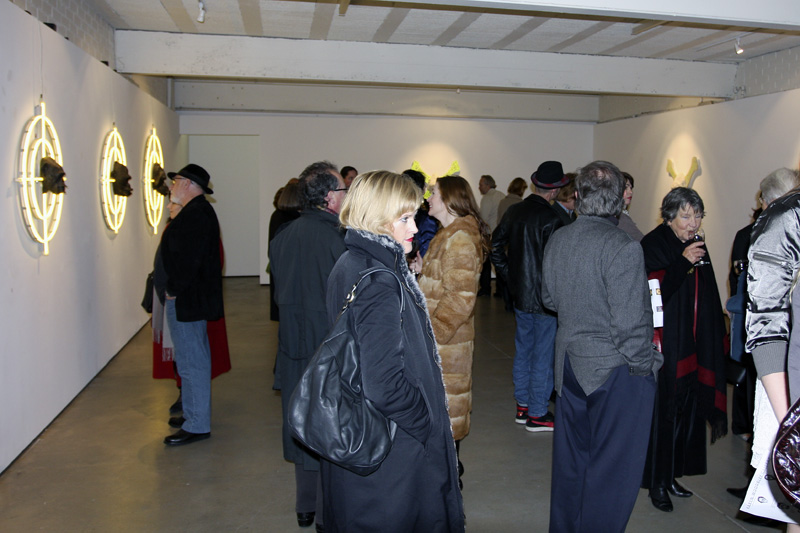
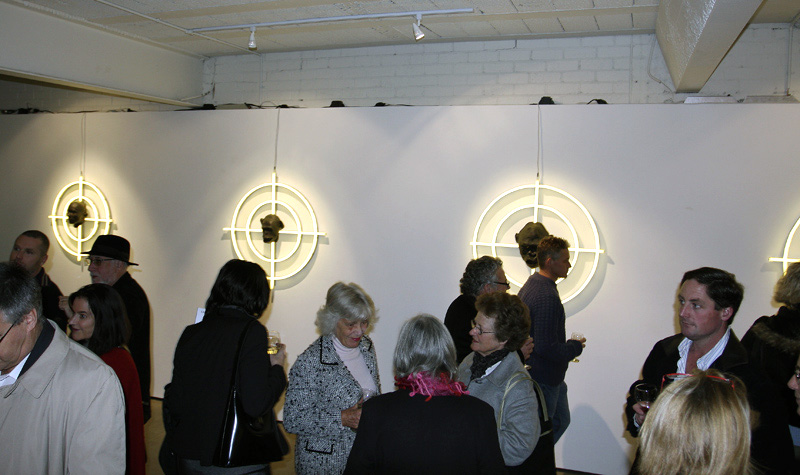
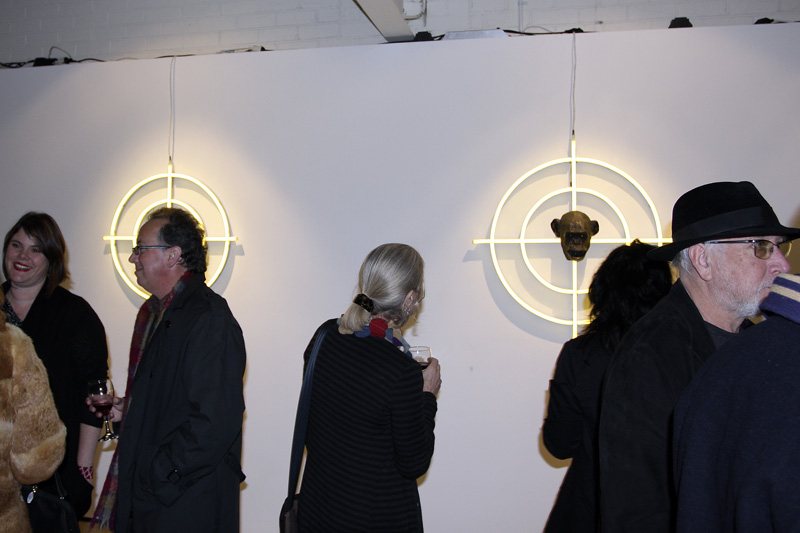
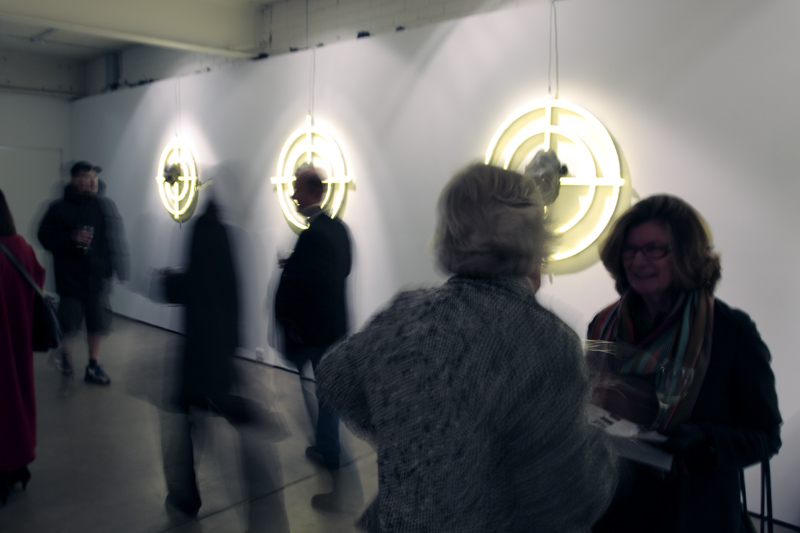
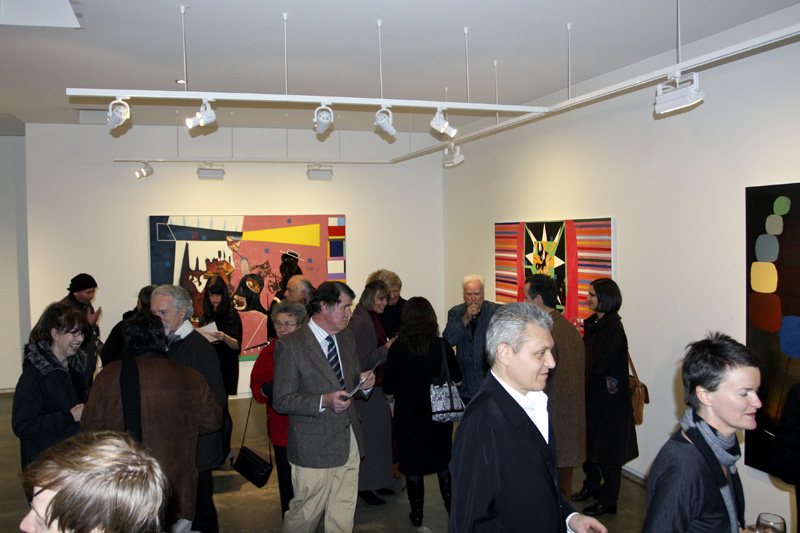
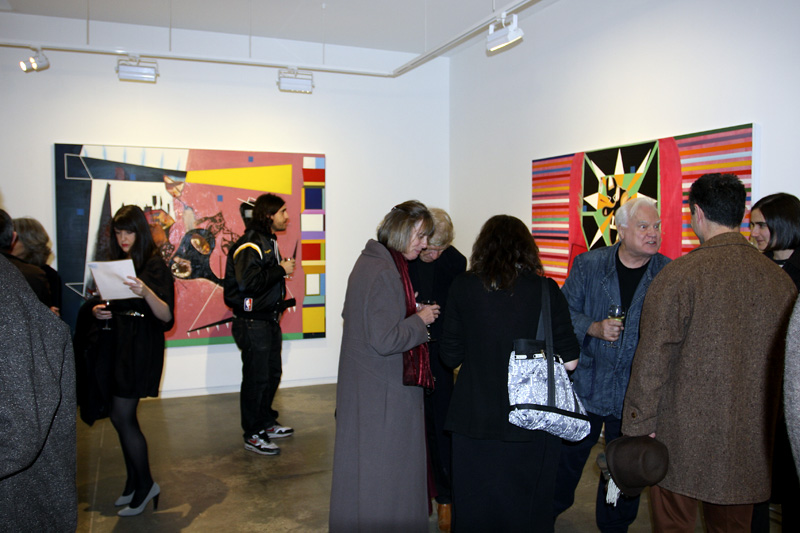
'In-Sight' by Lisa Roet opening at Karen Woodbury Gallery, Melbourne

'In-Sight' by Lisa Roet opening at Karen Woodbury Gallery, Melbourne

'In-Sight' by Lisa Roet opening at Karen Woodbury Gallery, Melbourne


Opening night crowd in front of the work In-Sight (2009) by Lisa Roet at Karen Woodbury Gallery, Melbourne


Another excellent opening this time of the work of the delightful Lisa Roet. If you visit the gallery don’t forget the upstairs exhibition space with further work by the artist including a marvellous large bronze Orangutan Foot.

Dr Marcus Bunyan


Many thankx to Karen Woodbury Gallery for allowing me to publish the photographs in the posting. Please click on the photographs for a larger version of the image. All photographs © Marcus Bunyan


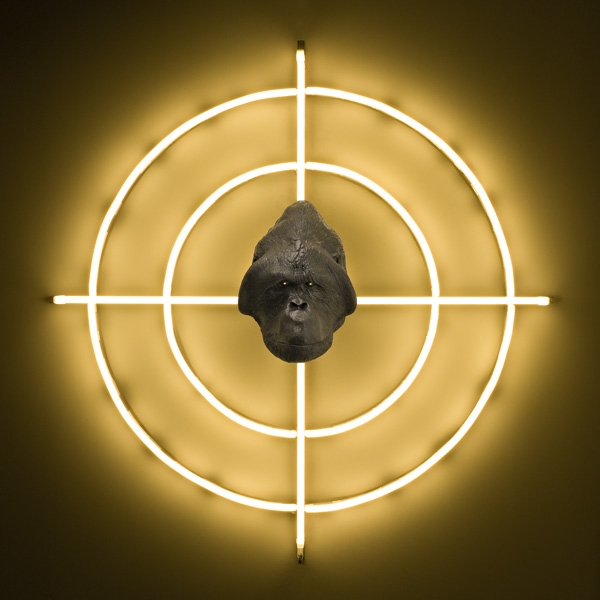
Lisa Roet (Australian, b. 1967) 'In-Sight 1' 2009


Lisa Roet (Australian, b. 1967)
In-Sight 1
2009
Polyurethane & Neon/LED
60.0 x 60.0cm
Edition: 3


Lisa Roet (Australian, b. 1967) 'In-Sight 4' 2009


Lisa Roet (Australian, b. 1967)
In-Sight 4
2009
Polyurethane & Neon/LED
120.0 x 120.0cm
Edition: 3


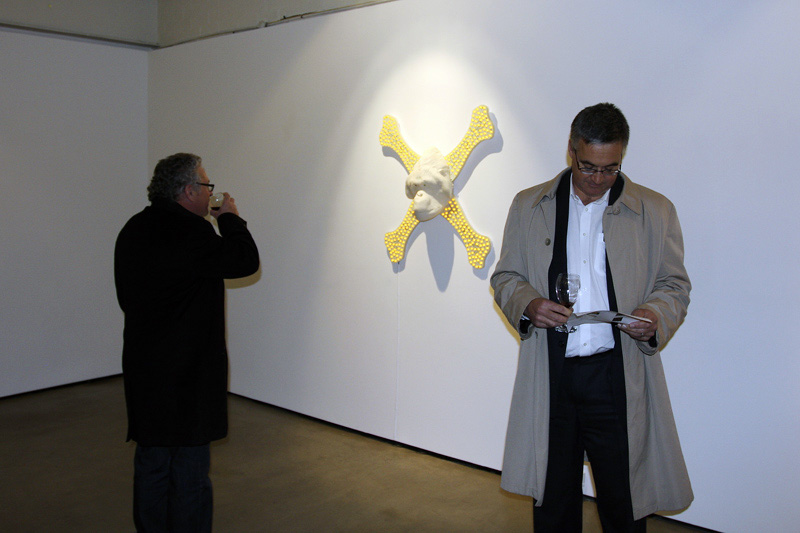
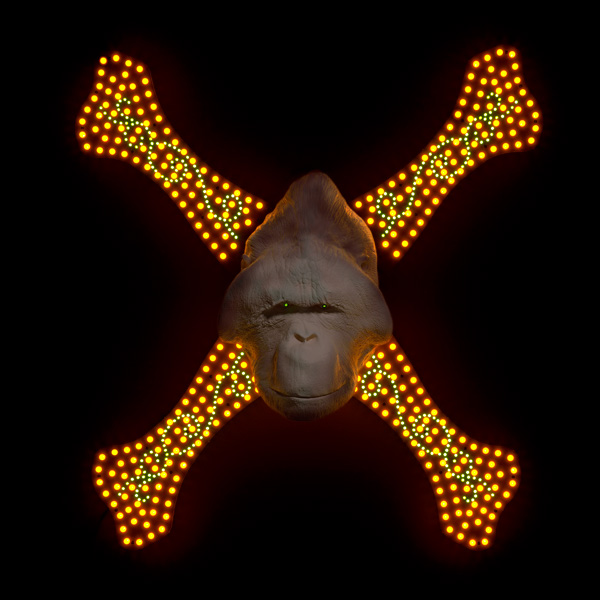
Installation view of Lisa Roet's work 'Cross Bones' (2009)

Installation view of Lisa Roet's work 'Cross Bones' (2009)


Installation view of Lisa Roet's work 'Cross Bones' (2009)

The artist Lisa Roet in front of one of her works 'Cross Bones' (2009)


The artist Lisa Roet in front of one of her works Cross Bones (2009)


Lisa Roet (Australian, b. 1967) 'Cross Bones' 2009


Lisa Roet (Australian, b. 1967)
Cross Bones
2009
Led, Perspex, Polyurethane
95 x 70 x 30cm


'Orangutan Foot' (2007/08) by Lisa Roet at the opening of 'In-Sight' exhibition at Karen Woodbury Gallery, Melbourne


Installation view of the work Orangutan Foot (2007/08) by Lisa Roet at the opening of In-Sight exhibition at Karen Woodbury Gallery, Melbourne


Opening night crowd in front of the work In-Sight (2009) by Lisa Roet at Karen Woodbury Gallery, Melbourne


Karen Woodbury Gallery

This gallery is now closed.
LIKE ART BLART ON FACEBOOK

Back to top

Opening 1: ‘Gareth Sansom’ at John Buckley Gallery, Melbourne

Exhibition dates: 17th June – 4th July, 2009

Opening 17th June, 2009


Gareth Sansom opening at John Buckley Gallery, Melbourne

Gareth Sansom opening at John Buckley Gallery, Melbourne


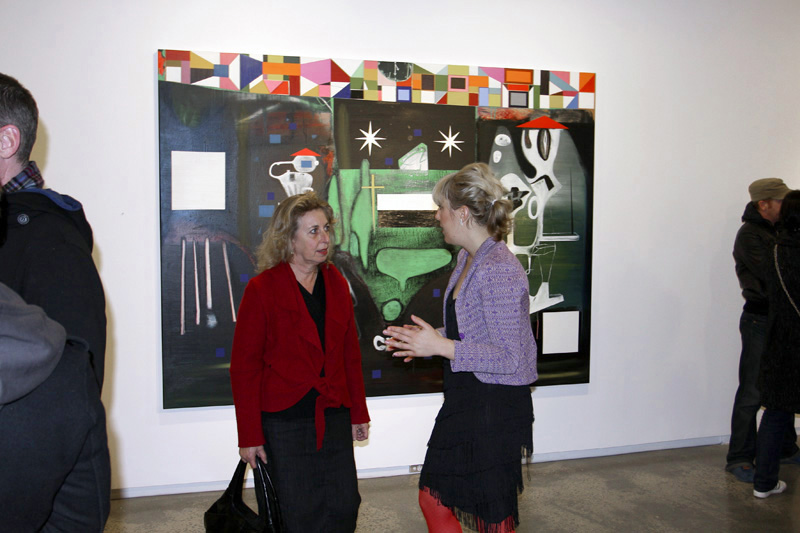
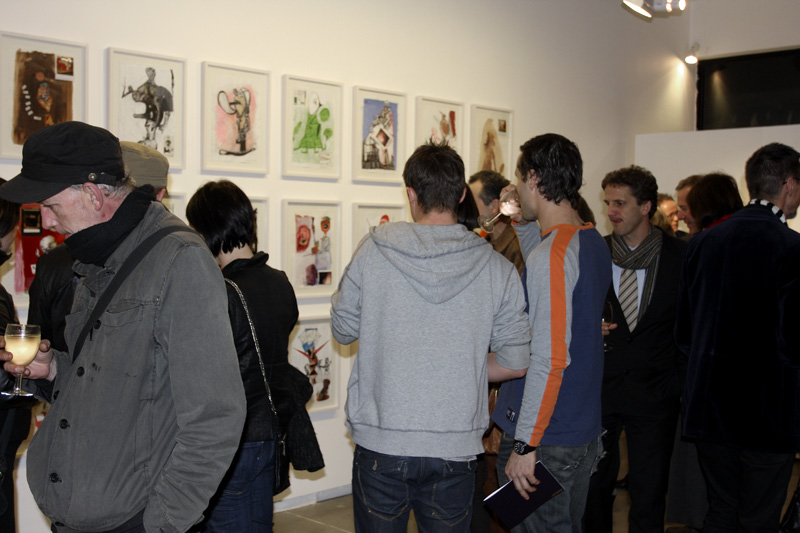
Opening night crowd with the artist Gareth Sansom third from right


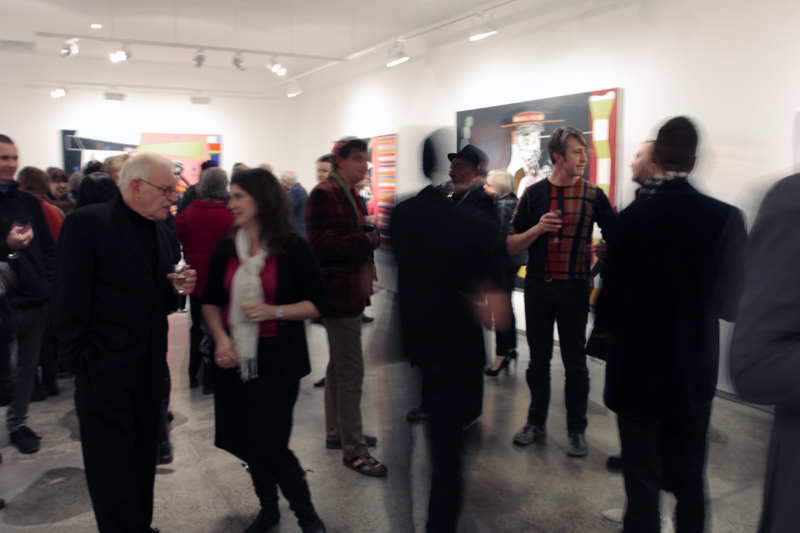
A very busy opening at John Buckley Gallery in Richmond for the paintings of Gareth Sansom. Nice to meet the artist and catch up with artist Gavin Brown and manager of Abbotsford Convent Brenton Geyer. A big thank you to Daniel for allowing me to take the photographs!

Dr Marcus Bunyan


Please click on the photographs for a larger version of the image. All photographs © Marcus Bunyan


Opening night crowd in front of Gareth Sansom's painting 'Alchemy' 2008/09


Opening night crowd in front of Gareth Sansom’s painting Alchemy 2008/09


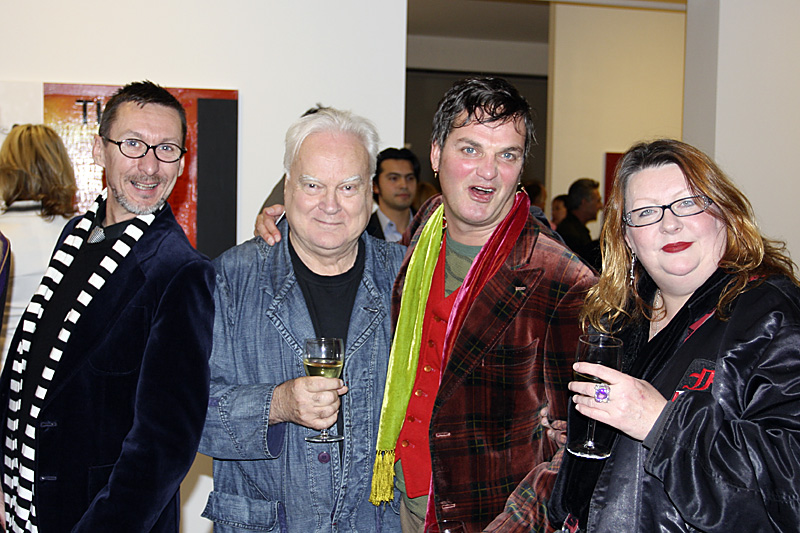
From left to right Brenton Geyer, the artist of the night Gareth Sansom, artist Gavin Brown and Jenny Rees


From left to right Brenton Geyer, the artist of the night Gareth Sansom, artist Gavin Brown and Jenny Rees


Gareth Sansom opening at John Buckley Gallery, Melbourne

Gareth Sansom opening at John Buckley Gallery, Melbourne


John Buckley Gallery

This gallery is now closed

LIKE ART BLART ON FACEBOOK

Back to top

Review: ‘John Beard: After Image’ paintings at John Buckley Gallery, Melbourne

Exhibition dates: 20th May – 6th June, 2009


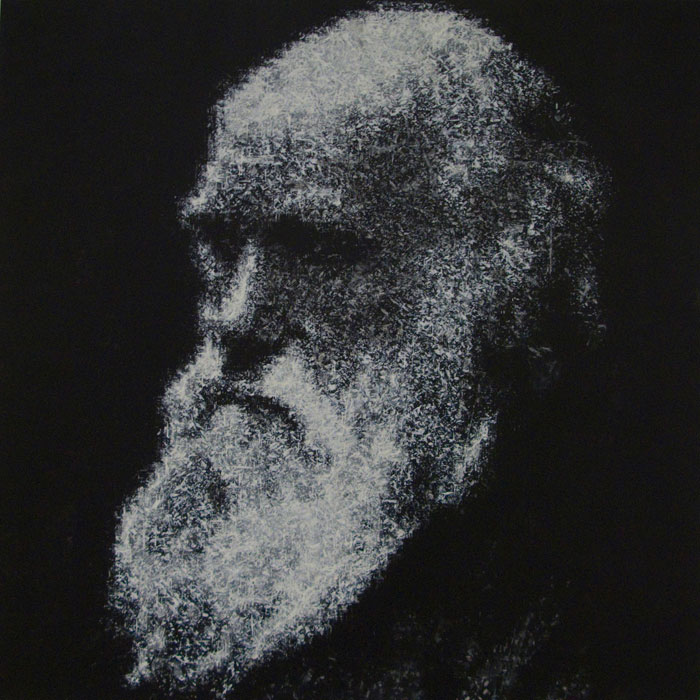
John Beard (Australian born Wales, b. 1943) 'Darwin' 2009 from the exhibition 'John Beard: After Image' paintings at John Buckley Gallery, Melbourne, May - June, 2009


John Beard (Australian born Wales, b. 1943)
Darwin
2009


The final exhibition of the afternoon were the ephemeral images of John Beard at John Buckley Gallery, Melbourne. This was an enthralling show that I enjoyed tremendously. Beard draws in a multitude of cultural sources for his paintings often referencing painters, scientists, animals and evolution. His work has an intimate sense of knowing, a meditative mediation on the essence of the object being painted, the very presence of the thing itself. The marks on the canvas may be intuitive but it is an informed intuition that results in works that hover at the edge of consciousness. As much as the works are after images, or ghost images, they are also about the persistence of vision, the persistence of the artists vision in addressing issues of collective memory and cultural history that draw emotive responses from the viewer.

These images may be ‘on the verge of disappearance’ as an after-image but they are also pre-images as well, conjured from the mind of the artist and layered with complexity, presence and holistic wholeness. Their seduction, if I may use that word, is that they draw from the viewer peripheral memories and emotions that flit at the edges of consciousness. As Portugese curator Isabel Carlos has noted, “… Beard recreates a ‘figural’ space where the essence of the thing represented lies beyond its singular physical evidence.”1

Beard’s fragmented surfaces form a rhizomic web of dissolved pixellation, their structure almost fractal like in their linked hyper-real intimacies. These in between spaces open up the possibility of subversive commentaries that, on one level, bring a sense of disquiet to the holistic presence of the work. As Mark Poster has noted of the work of Deleuze and Guittari and which can be aptly applied to the work of John Beard,

“Deleuze and Guittari configure the social as a complex of bodily intensities in a state of continuous nonlinear movement. The logic they present is multidimensional, shifting, discontinuous. They speak of strata, assemblages, territorializations, lines of flight, abstract machines, a congerie of terms that disrupts the function of concepts to control a field through discursive articulations. Their categories cut through the normal lines of comprehension, the binary logic that governs modern social theory to present a picture of reality from the perspective of a sort of primitive life force. It is as if the earth itself were to describe the changes on its surface in the course of human history, a vantage point quite remote from the ego of the individual or from the disciplined consciousness of the social scientist.”2


Nonlinear, logical, shifting territorializations in multidimensional environments that hover below the edge of consciousness, investigations into the binary of presence / absence in the dreams of the imaginary. Powerful and poetic these works irradiate the viewer with their visceral presence.

Dr Marcus Bunyan


1/ Isabel Carlos quoted in Wright, William. HEADLANDS: John Beard works 1993-2008. Catalogue essay

2/ Poster, Mark. The Mode of Information: Poststructuralism and Social Context. Cambridge: Polity Press, 1990, pp. 135-137


Many thankx to John Buckley Gallery for allowing me to publish the art work in the posting. Please click on the photographs for a larger version of the image.


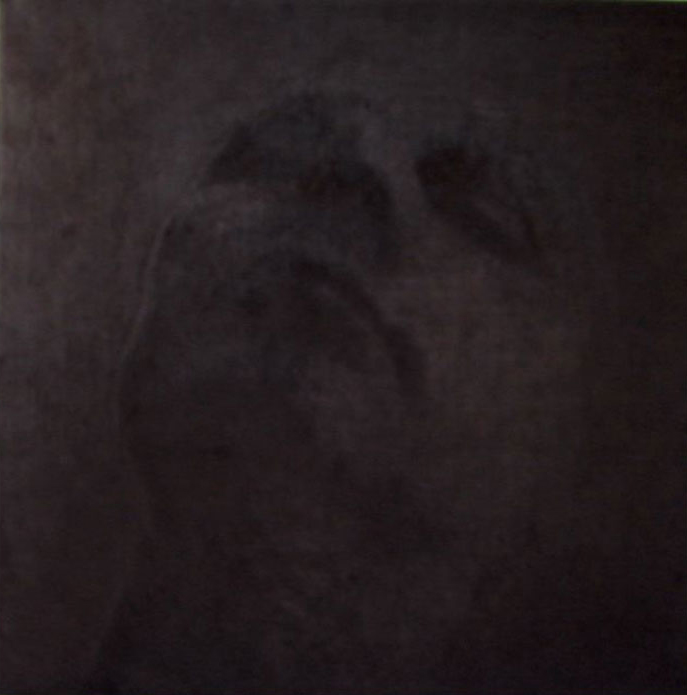
John Beard (Australian born Wales, b. 1943) 'Gorilla' 2007 from the exhibition 'John Beard: After Image' paintings at John Buckley Gallery, Melbourne, May - June, 2009


John Beard (Australian born Wales, b. 1943)
Gorilla
2007


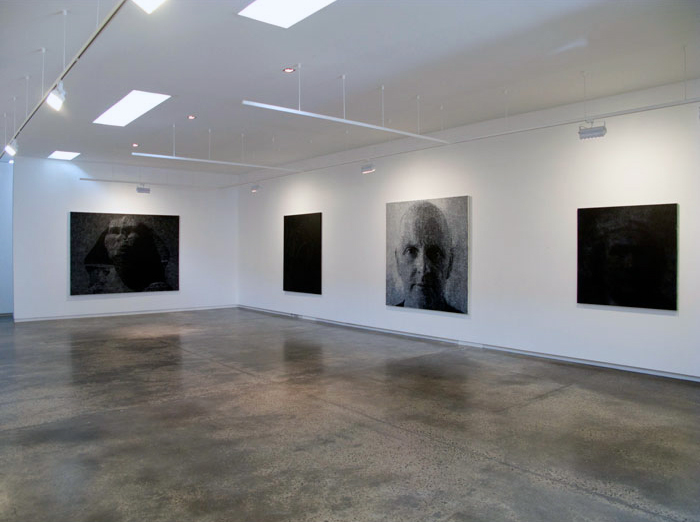
Installation view of John Beard's exhibition 'After image' at John Buckley Gallery, Melbourne


Installation view of John Beard’s exhibition After image at John Buckley Gallery, Melbourne


John Beard (Australian born Wales, b. 1943) 'Hand 6' 2009


John Beard (Australian born Wales, b. 1943)
Hand 6
2009


John Beard (Australian born Wales, b. 1943) 'Head SP3' 2004


John Beard (Australian born Wales, b. 1943)
Head SP3
2004


“Beard’s paintings often convey an overpowering sense of brooding stillness, but equally this volatile effervescence of light-reverberant phenomena, where head, headland, the Adraga rock, are no longer object so much as apparition, a painted parallel existence, a material presence invoking nature’s own organic processes …

There is a distinctive sense when encountering a body of John Beard’s works of entering into a site of composure, withheld, of images silently bespeaking truths both personal and historical; hovering presences each conveying some species quality of time-less recognition.”

William Wright 
from the catalogue essay HEADLANDS: John Beard works 1993-2008 [Online] Cited 29/05/2009. No longer available online


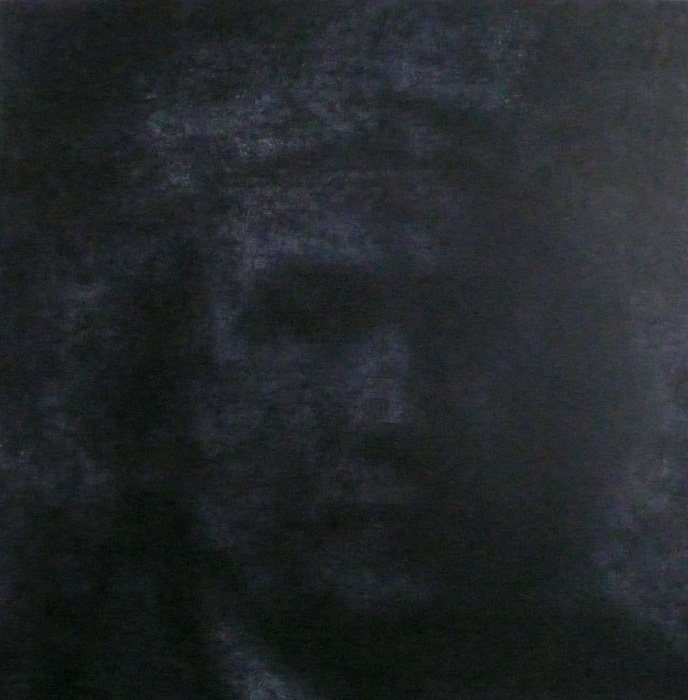
John Beard (Australian born Wales, b. 1943) 'Rose' 2007


John Beard (Australian born Wales, b. 1943)
Rose
2007


John Beard (Australian born Wales, b. 1943) 'Einstein 2' 2009


John Beard (Australian born Wales, b. 1943)
Einstein 2
2009


John Beard (Australian born Wales, b. 1943) 'Rembrandt' 2009


John Beard (Australian born Wales, b. 1943)
Rembrandt
2009


John Buckley Gallery

This gallery is now closed.
LIKE ART BLART ON FACEBOOK

Back to top

Review: ‘McLean Edwards: Songs from the Ghost Ship’ at Karen Woodury Gallery, Melbourne

Exhibition dates: 20th May – 13th June, 2009


McLean Edwards (Australian, b. 1972) 'Fifty-Fifty' 2009 from the exhibition 'McLean Edwards: Songs from the Ghost Ship' at Karen Woodury Gallery, Melbourne, May - June, 2009


McLean Edwards (Australian, b. 1972)
Fifty-Fifty
2009


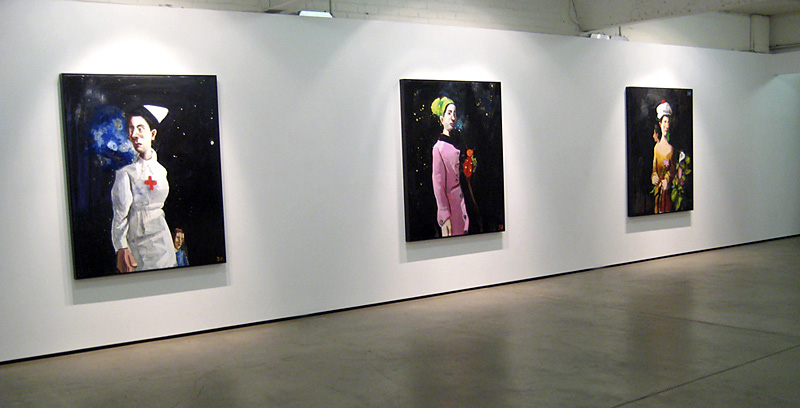
The next show on our marvellous walkabout were the eclectic paintings of McLean Edwards at Karen Wodbury Gallery, Melbourne. Continuing the carnivalesque theme from the previous review these heterogeneous paintings are a knockout with their wonderful, layered presence – they really command the viewer to look at them and celebrate the characters within them. Whimsical, ironic and full of humour these phantasmagorical images of creatures cast adrift with the night sky as background are fabulous assemblages of colour, form and storytelling.

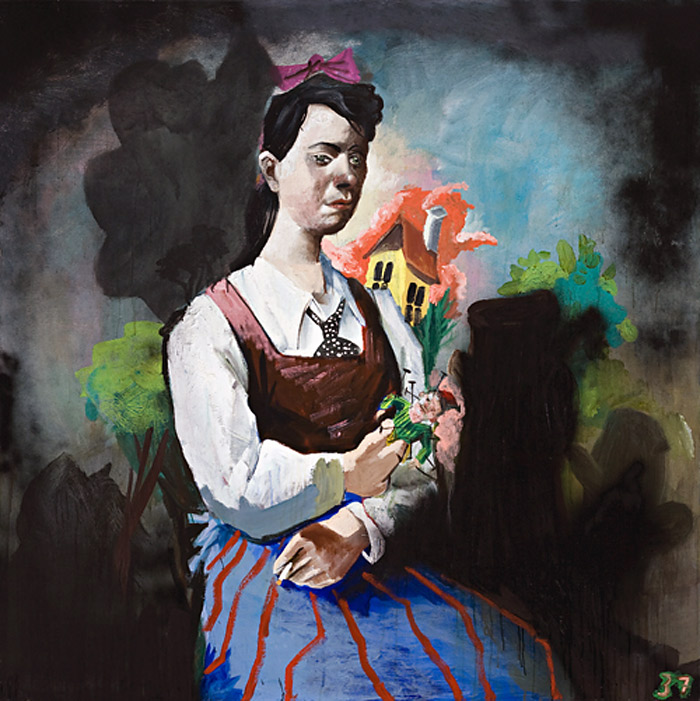
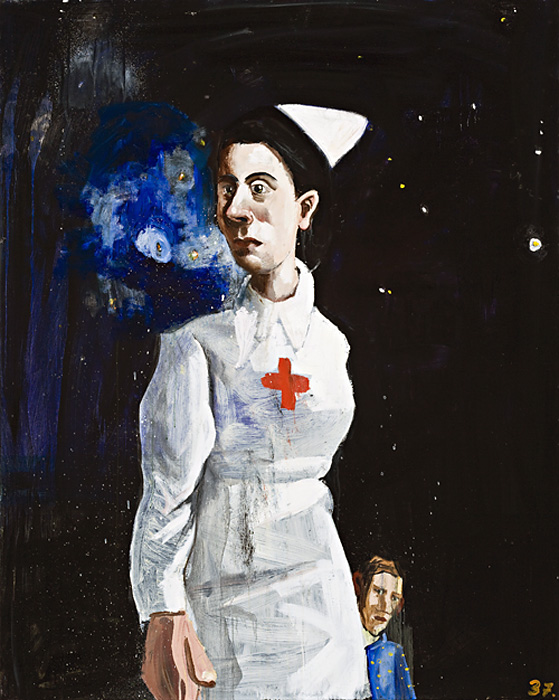
Further to the evidences noted in the text on the website (the coils, the curling smoke, the starry night sky) one can also say other things about the paintings. There is an effervescence of colour within the blocking of clothing areas. There is the disproportionate size of the hands and bulbous noses of the characters, the shortening of the feet so that the figures almost become caricatures – but hold back from this through the mastery of the painting, through the intent of the artist. There is the symbology of other elements within the pictures: a doll with pins stuck in it’s body being clasped in a clumpy hand, a small house protruding over the protagonists shoulder (Fifty-Fifty); beetles on tree stumps with human faces (Hey, Bastard, Hey); and flowers, teapots and small humans appearing from around the edges of the larger characters in several of the works (Julia 1 and Night Nurse #2 for example). The numbers in the paintings were also puzzling but it turns out that they represent the age of the artist when he painted the works.

Finally one must acknowledge the carnivalesque in the paintings – their fun at playing dress-ups, the almost Alice in Wonderland fantasy and humour of the characterisations. There is an almost androgynous feeling to these characters as some of the female faces seem almost male. Personally I had a feeling that the artist is investigating the subconscious of Carl Jung’s ‘anima’ and ‘animus’ – the feminine inner personality of the male (anima) and the masculine inner personality of the female (animus). These states are manifested by appearing as figures in dreams and so they seem here: the anima or animus vies for attention by projecting itself onto others, here projecting itself outwards onto the painted surface.

My friend and I really enjoyed this exhibition. We were captivated by these songs, going back to the work again and again to tease out the details, to feel connection to the work. These are not lonely isolated figures but sublime emanations of inner states of being expertly rendered in glorious colour. And they made us laugh – what more could you ask for!

Dr Marcus Bunyan


Many thankx to Karen Woodbury Gallery for allowing me to publish the art work in the posting. Please click on the photographs for a larger version of the image.


Installation view of the exhibition  'McLean Edwards: Songs from the Ghost Ship' at Karen Woodbury Gallery, Melbourne

Installation view of the exhibition  'McLean Edwards: Songs from the Ghost Ship' at Karen Woodbury Gallery, Melbourne


Installation views of McLean Edwards: Songs from the Ghost Ship at Karen Woodbury Gallery, Melbourne


McLean Edwards (Australian, b. 1972) 'Venus' 2009 from the exhibition 'McLean Edwards: Songs from the Ghost Ship' at Karen Woodury Gallery, Melbourne, May - June, 2009


McLean Edwards (Australian, b. 1972)
Venus
2009


McLean Edwards (Australian, b. 1972) 'Hey, Bastard, Hey' 2009


McLean Edwards (Australian, b. 1972)
Hey, Bastard, Hey
2009


McLean Edwards (Australian, b. 1972) 'Restoration' 2009


McLean Edwards (Australian, b. 1972)
Restoration
2009


“McLean’s works are theatrical, comical, eccentric and often political with the employment of symbolic imagery. His painting technique involves a painterly layering to create a defined and textured surface.

In this most recent series, Songs from the Ghost Ship, semi-fictional characters are set against the dark starry night sky. The exhibition includes nine oil paintings in addition to four works on paper. One of the works on paper shares its name with the exhibition, depicting a jumpered man with a white ghost looking over his shoulder.

The ink on paper work introduces a theme prominent throughout the exhibition, that of wafting smoke. Emanating either from a clasped cigarette or an iconic green curled mosquito coil, the smoke, in elegant strokes of white, grey, tan or black, draw the eye to the face of the central figures. The figures, often with the light of the moon or stars behind them only partially illuminating their faces, stare into the distance or coyly at the viewer, almost unaware of their solitary state against the night sky. The coil appears elsewhere, surreptitiously working its way into the dark pink weave of Twiggy’s jacket, or the blue and red dress of Venus, in the tyre marks of the Arctic Traveller or the grassy landscape in Hey, Bastard, Hey. The soft curl and filigree detail of both the smoke and the mosquito coil are similarly echoed by elements in other works, through the organic features of flowers, leaves and bugs.

Adrift at night, these haunting figures are about to embark on a journey, either from the wharf at the edge of an ocean, as in Venus, or across the vast ice of the Arctic, through the mist and smoke.”

Text from the Karen Woodbury website [Online] Cited 28/05/2009. No longer available online


McLean Edwards (Australian, b. 1972) 'For Elsa (Twiggy)' 2009


McLean Edwards (Australian, b. 1972)
For Elsa (Twiggy)
2009


McLean Edwards (Australian, b. 1972) 'Night Nurse #2' 2009


McLean Edwards (Australian, b. 1972)
Night Nurse #2
2009


Karen Woodbury Gallery

This gallery is now closed.
LIKE ART BLART ON FACEBOOK

Back to top