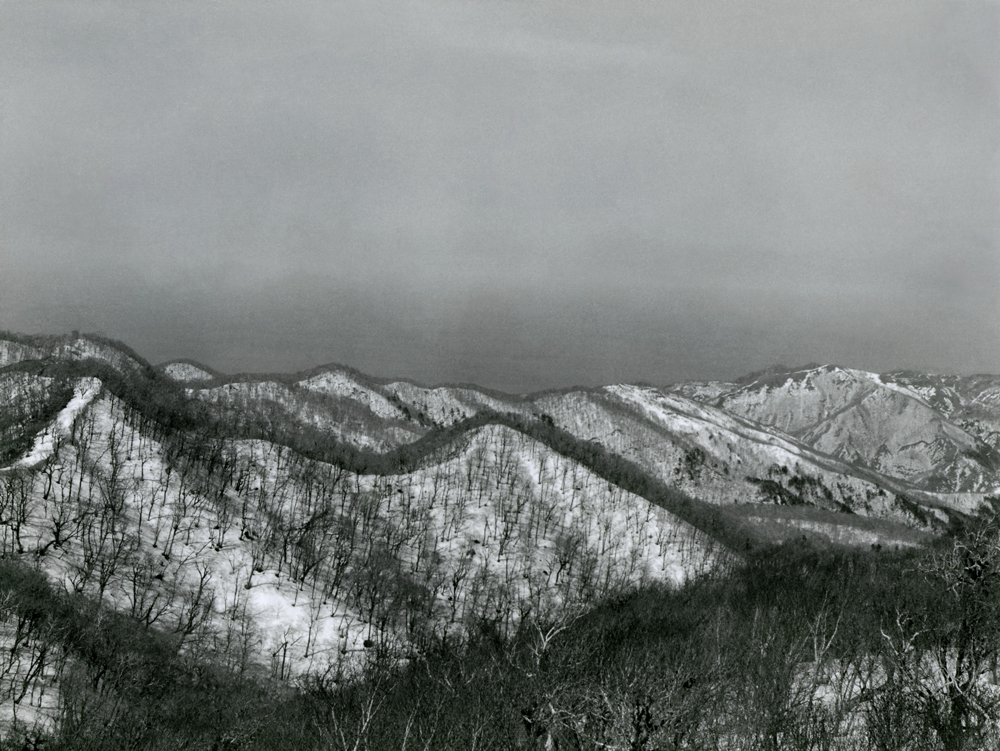
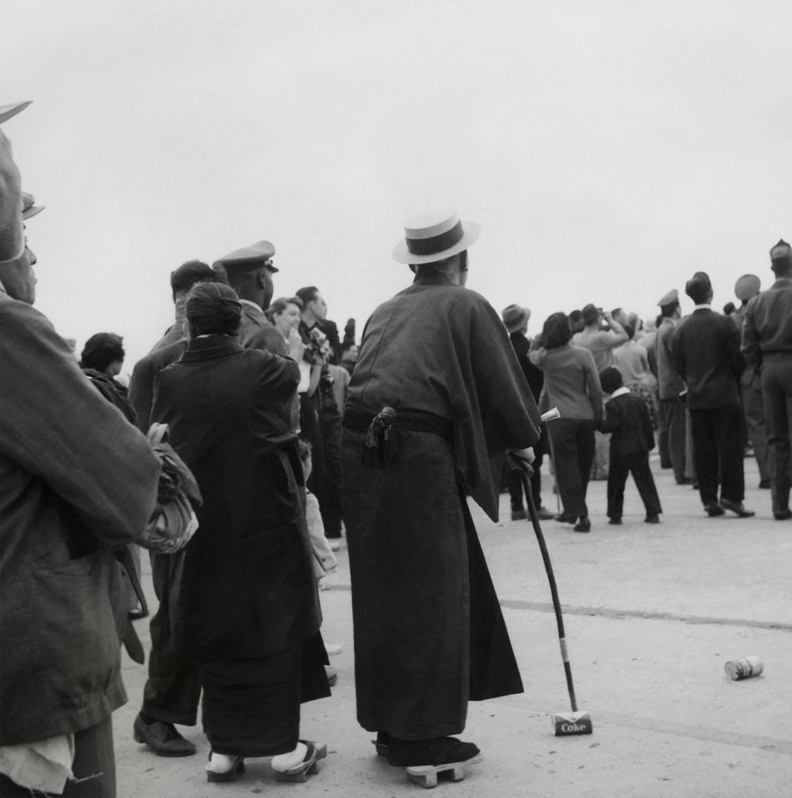
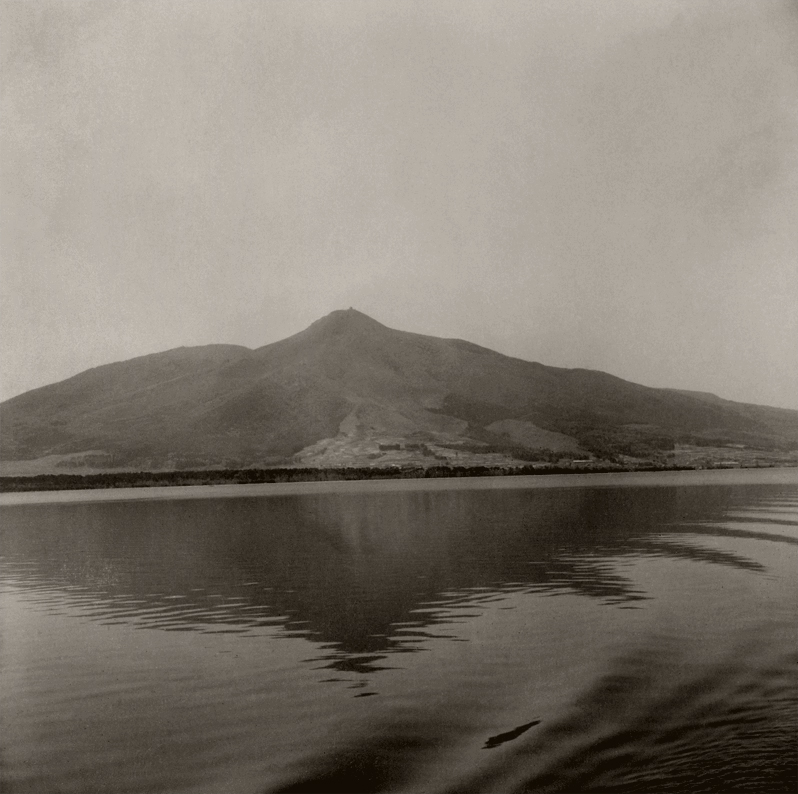
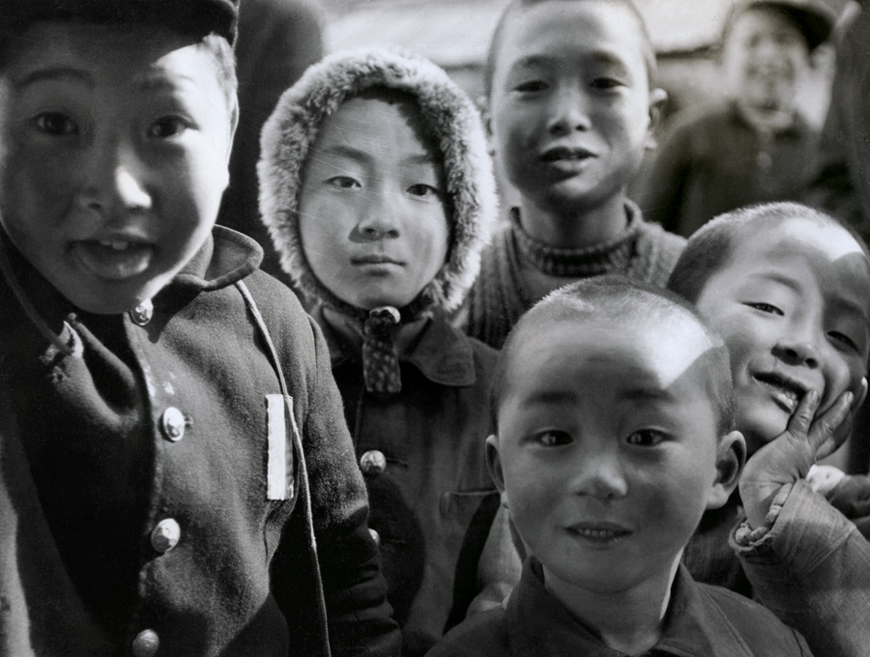
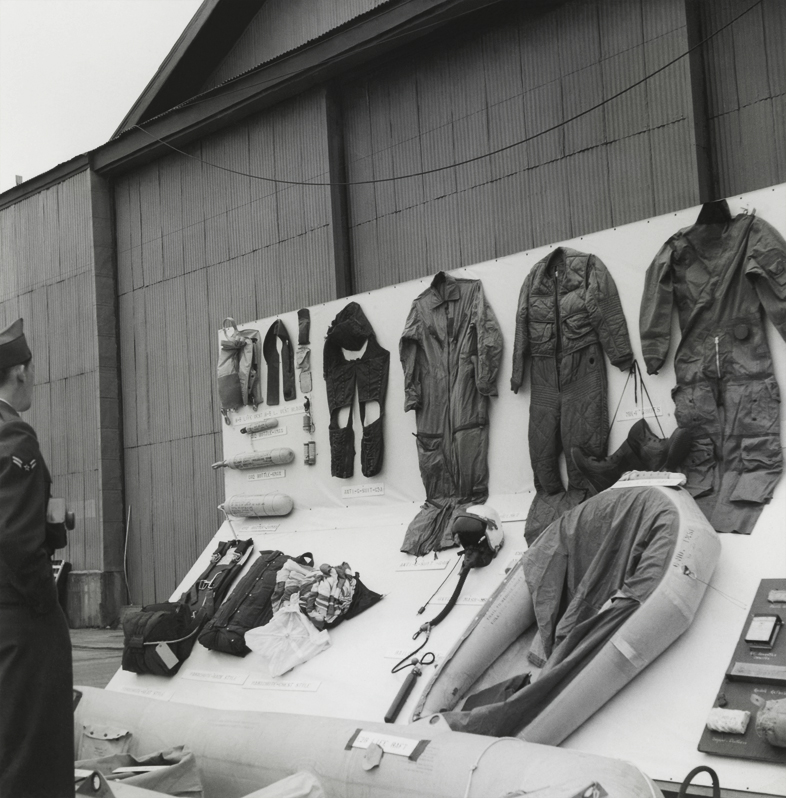
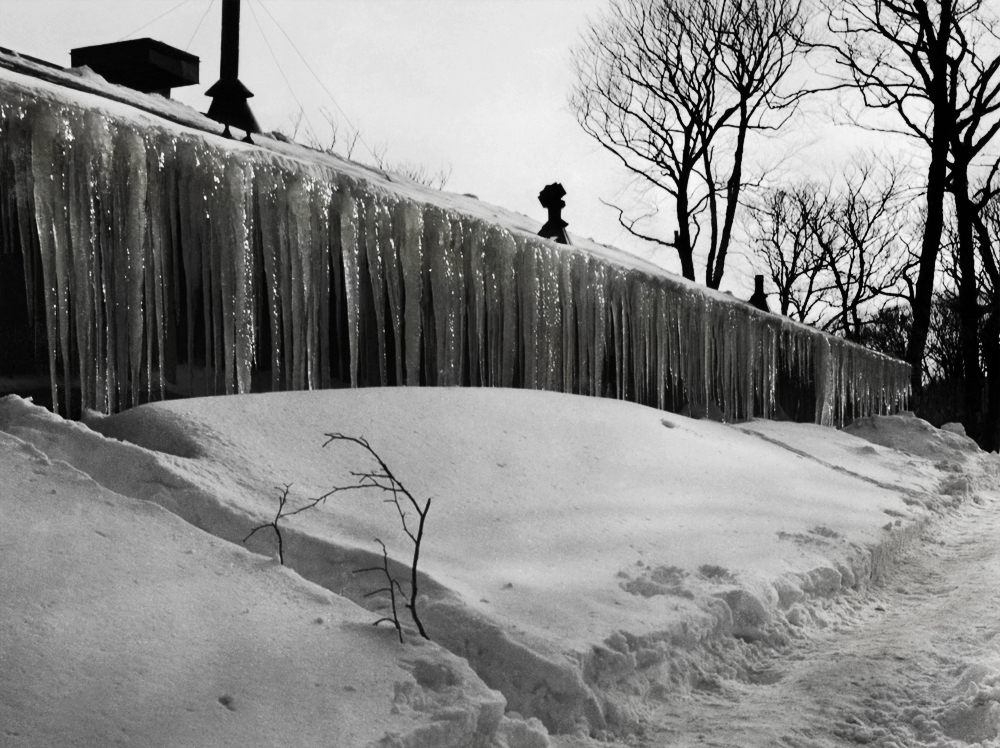
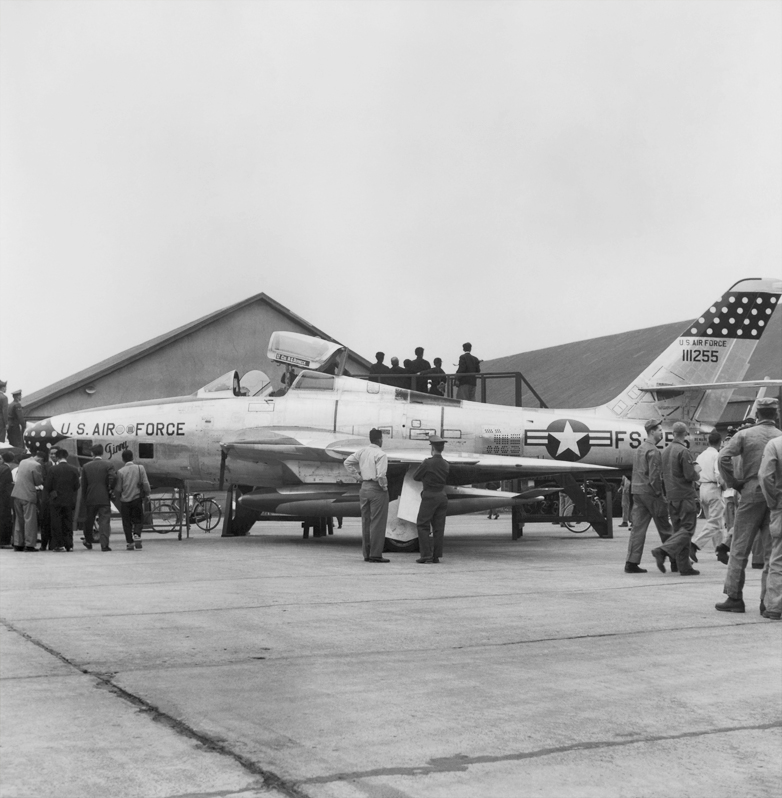
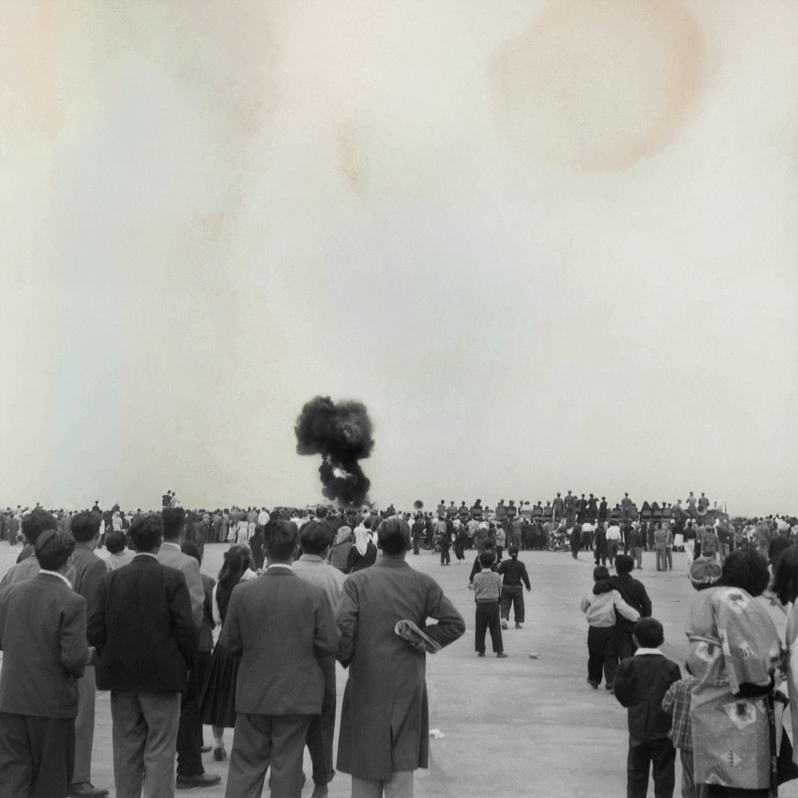
A Christmas present to myself… my most complex and enigmatic sequence to date.
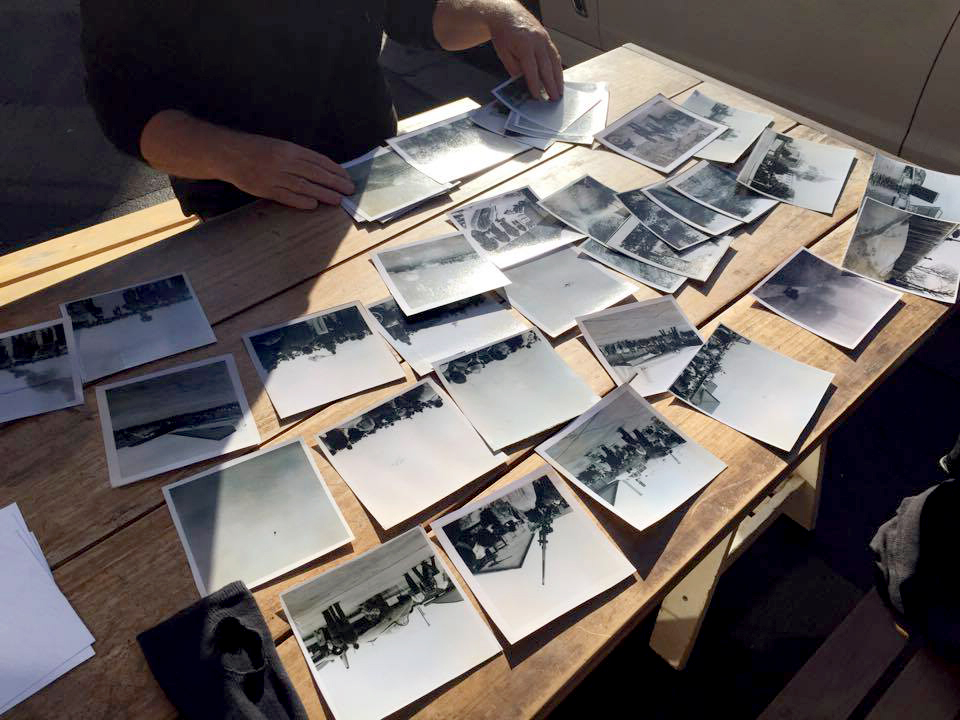
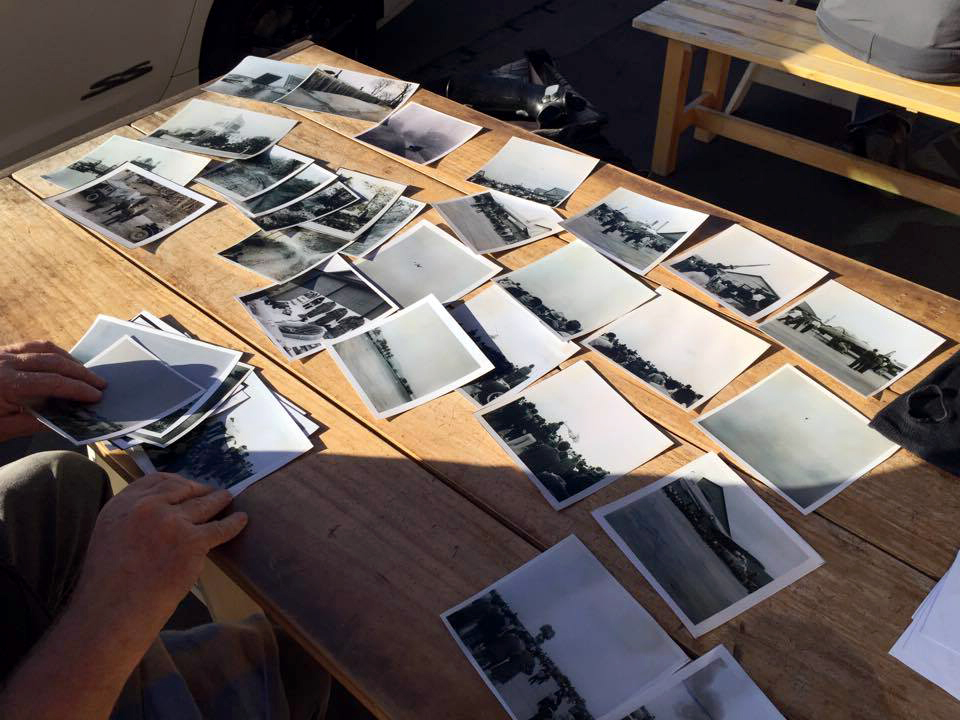
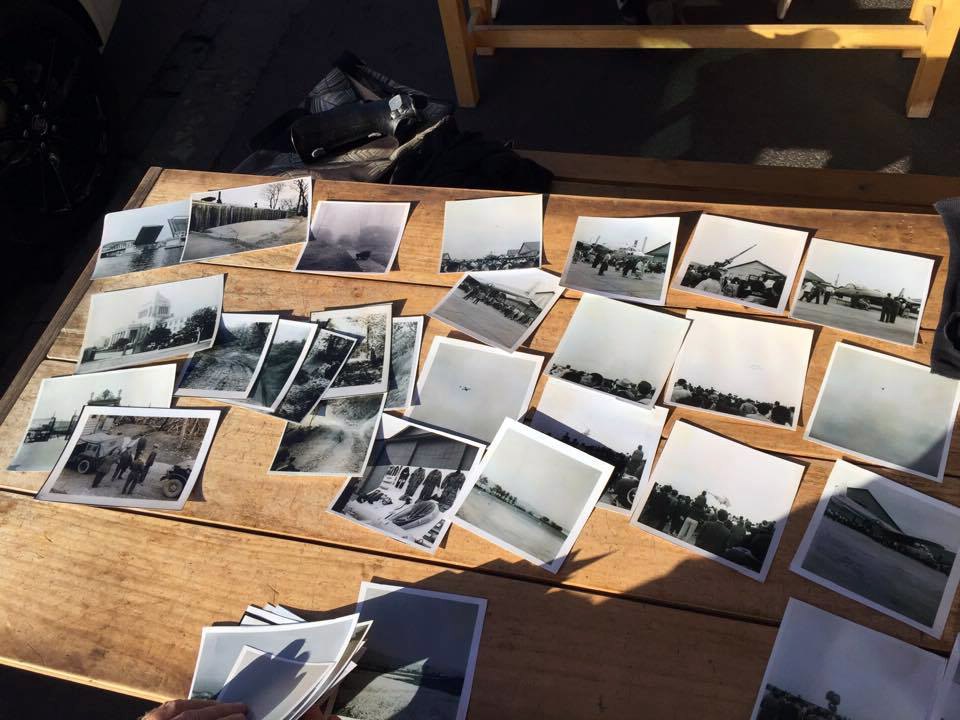
Shot in Japan, all of the images come from two 1950s photography albums, one of which has a large drawing of a USAF bomber on it’s cover. The images were almost lost they were so dirty, scratched and deteriorated. It has taken me four long years to scan, digitally clean and restore the images, heightening the colour already present in the original photographs.
Sometimes the work flowed, sometimes it was like pulling teeth. Many times I nearly gave up, asking myself why I was spending my life cleaning dirt and scratches from these images. The only answer is… that I wanted to use these images so that they told a different story.
Then to sequence the work in such a way that there is an enigmatic quality, a mystery in that narrative journey. Part auteur, part cinema – a poem to the uncertainty of human dreams.
Photographs are available from this series for purchase. As a guide, a digital colour 16″ x 20″ costs $1000 plus tracked and insured shipping. For more information please see my Store web page.
A selection of individual images from the sequence
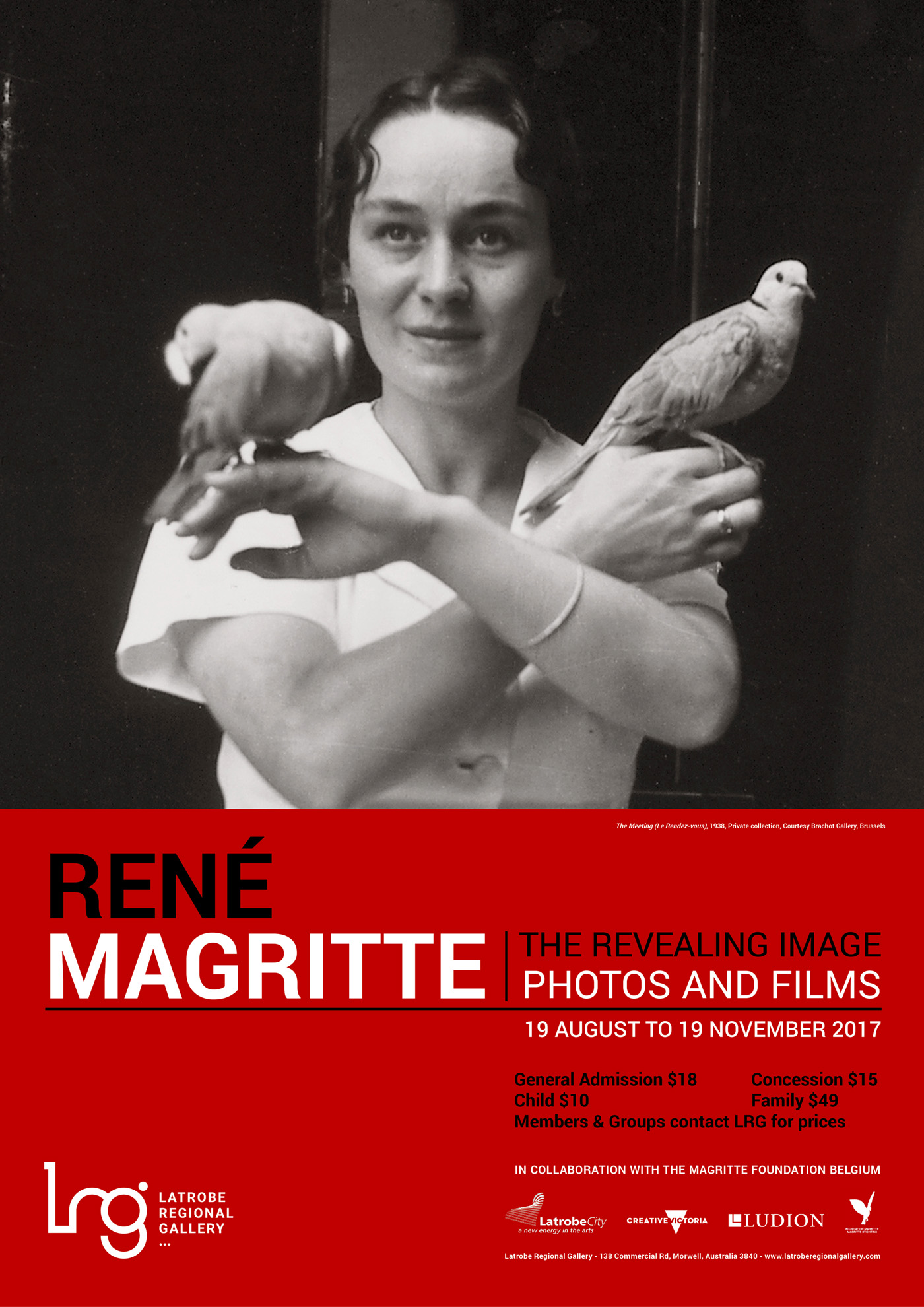
Exhibition dates: 19th August – 19th November 2017
Chief Curator: Xavier Canonne
René Magritte (Belgian, 1898-1967) Flirtatiousness (La coquetterie), René Magritte at the Jardin des Plantes, photo-booth photo 1929 Original photograph 43.2 x 33.2cm (framed) Private collection, Courtesy Brachot Gallery, Brussels
Extending the possibilities of the universe
When the chicken is not an egg (and vice versa)
They sent me 10 media images… and I could not get a handle on this exhibition. They sent me the superlative catalogue… and still I could not visualise this exhibition in my mind. Only by going and actually seeing this impressive exhibition in the beautifully refurbished spaces of Latrobe Regional Gallery do you really begin to understand its sangfroid – that Magritte’s photographs are a hyper-reality take on the mystery of the everyday, accomplished by the artist altering the very conception of what a photograph is.
Please note, I have included several juxtapositions in this posting which illuminate the pairing of photograph and small reproductions of Magritte’s painting in various sections of the exhibition for which I did not have the media images. This is because the reader can not get a good idea of the exhibition otherwise, and so I use these images under “fair use” conditions for the purposes of academic review, and to ensure that someone who cannot actually see the exhibition can begin to understand its import.
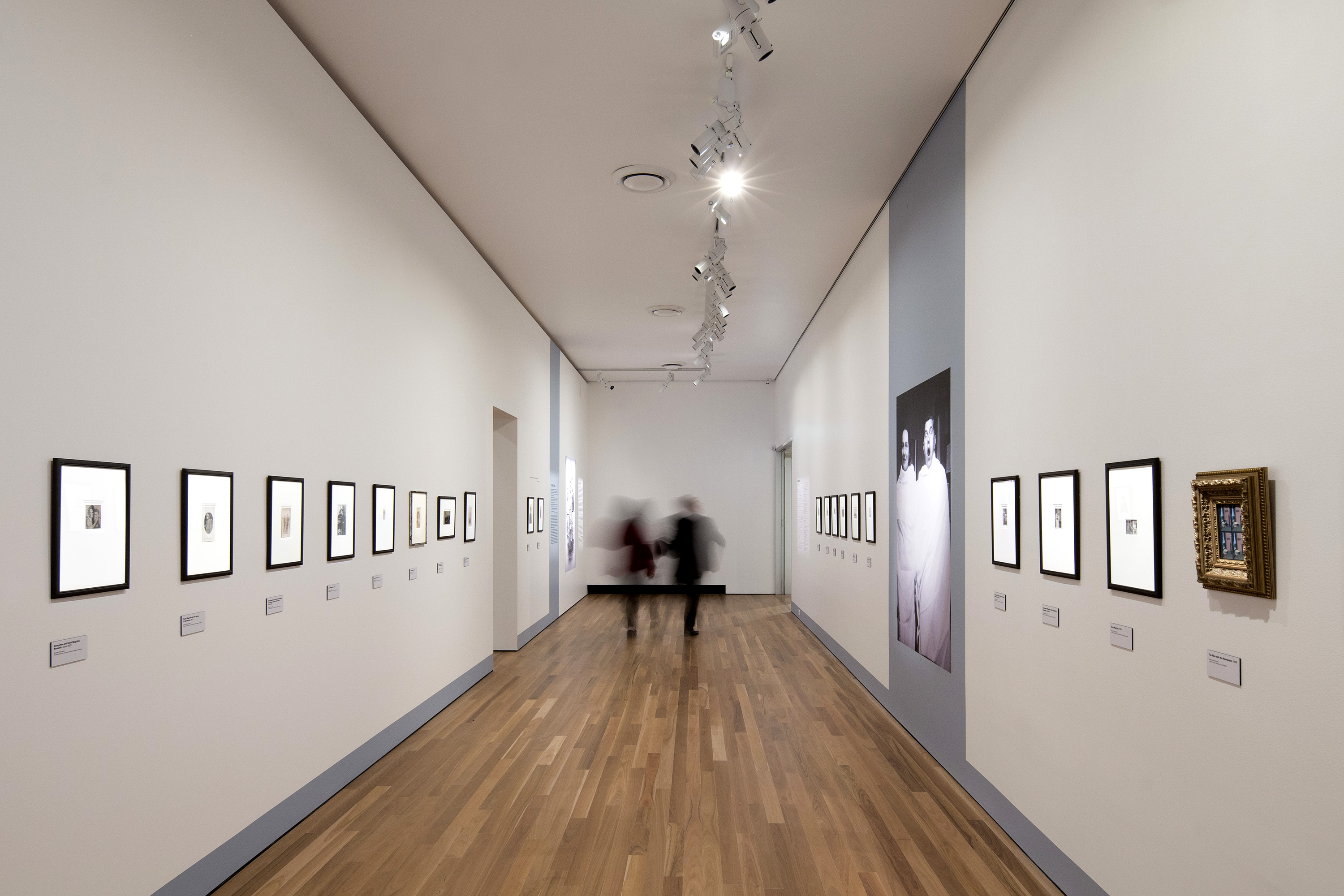
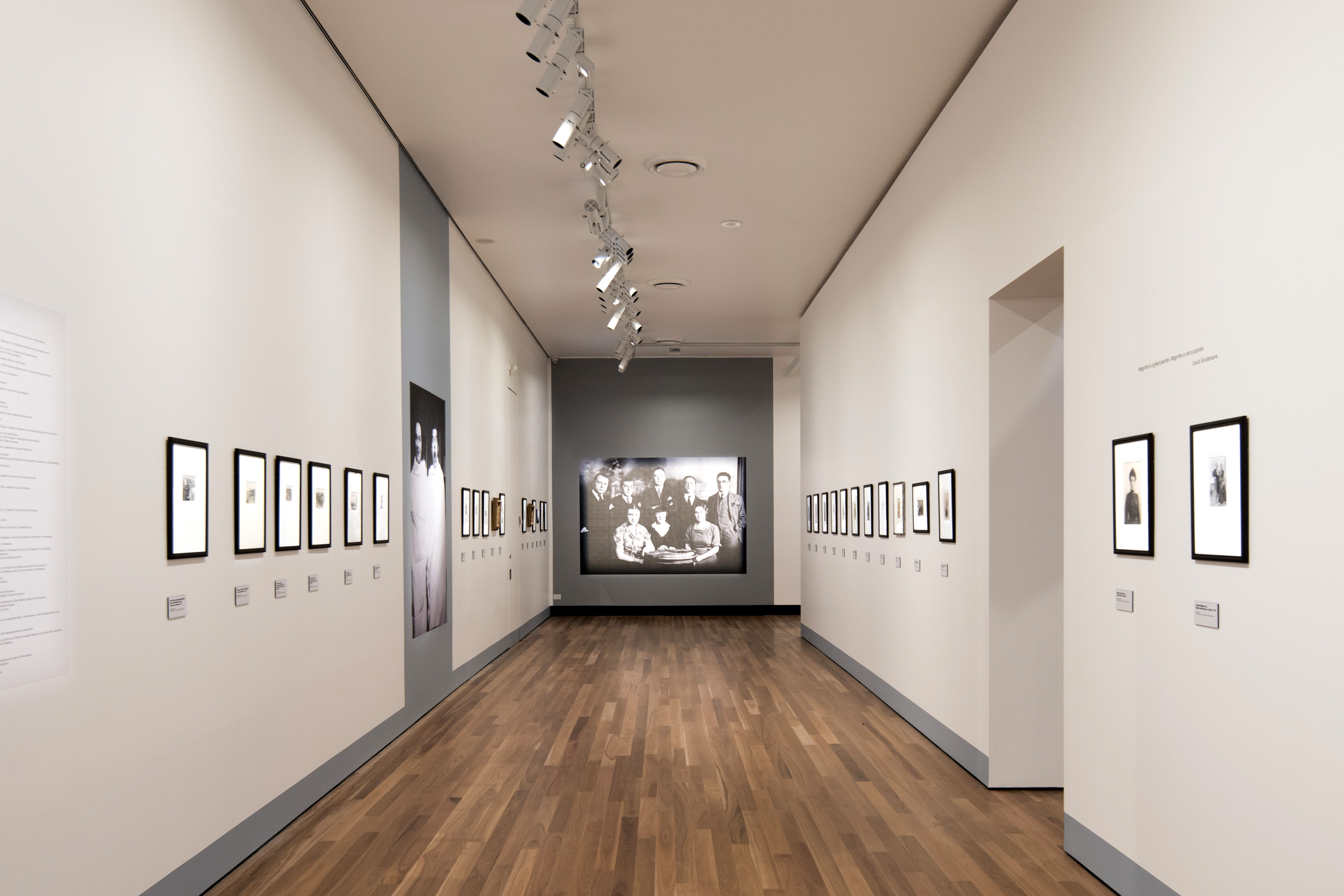
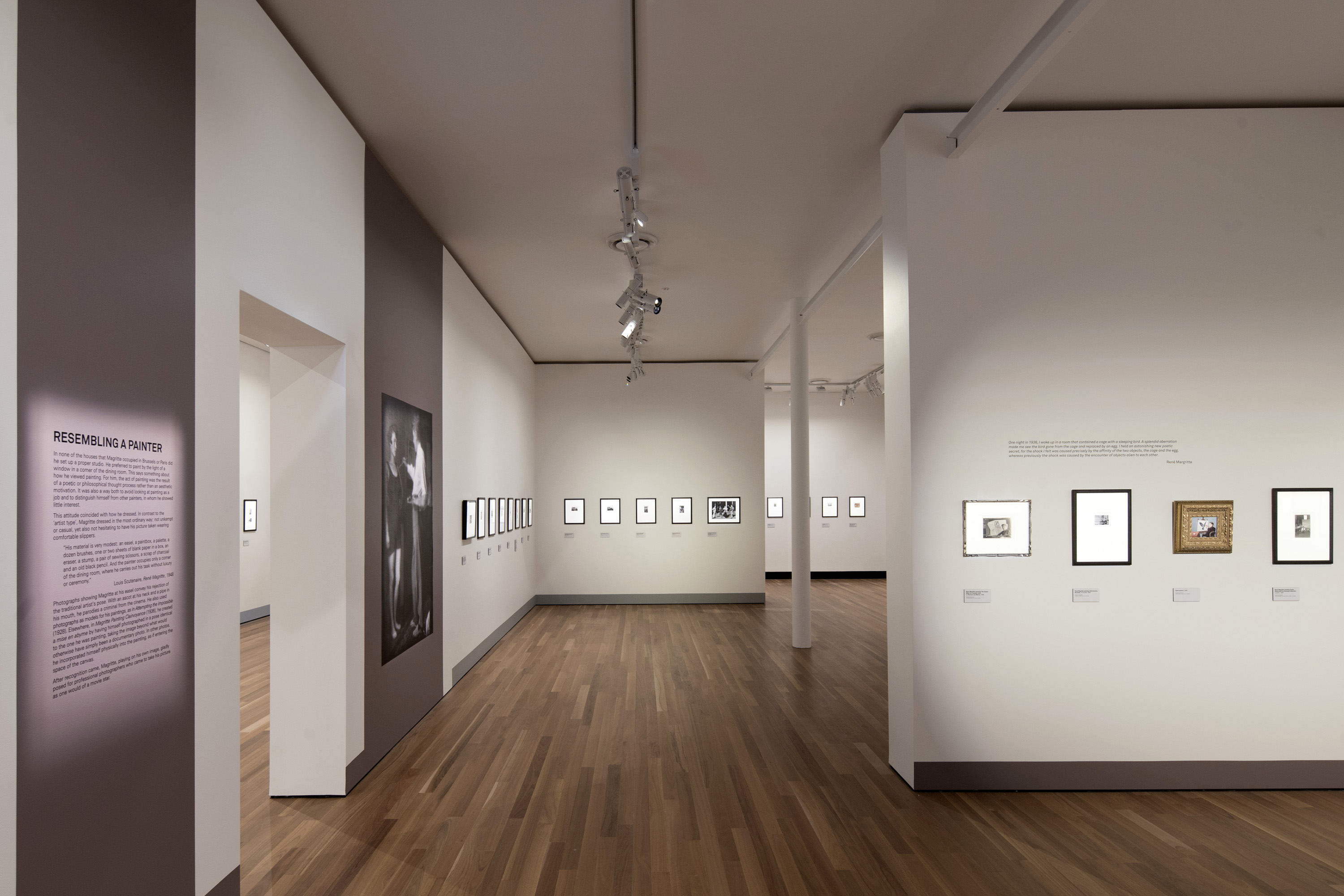
Small, often tiny photographs, usually no more than 2.5″ x 4″, are double mounted (which adds to the concentrated focus on the image) in black frames. Collectively, these images possess a certain aura and intensity while individually they exude a wonderful presence. Some photographs are toned, some not; some have irregular edges (as though cut from something else, some other fabric of time), others have deckled, wavy edges. Some photographs are cabinet cards, others carte-de-visite, or gelatin silver. Some of the photographs are so small, for example one titled The Earthquake (1942), and Dissuasion (1937) that you can hardly make out what is going on in the image. But then between these two small images is a slightly larger photograph titled The Feast of Stones (1942) where René Magritte, Paul Magritte and Marcel Mariën are eating bricks! There are portraits of friends and wives, there are serendipitous photographs or, more often, elaborately staged performances for the camera. They form an impressive body (which isn’t a body) in the gallery space.
Throughout the gallery some of the small photographs are printed large on canvas and these add a vital counterpoint for the eye, amongst the ocean of small images. Further, the exhibition then “…assists the viewer in connecting the images with Magritte’s art by hanging alongside small reproductions of key paintings framed in gilt baroque frames.” Small reproductions of some of Magritte’s paintings are housed in elaborate, wide, heavy gold frames hung between some of the small photographs, but the reproductions are poor and the elaborateness of the frames quite overrides the reproductions themselves. This is a jarring note in an otherwise excellent exhibition. The scale of the reproductions sets up a correlation between the physicality of the small photographs and that of the paintings which in reality does not exist. The paintings are much bigger and their surface texture – their flattened almost non-existent brushstrokes – are totally lacking in the reproductions. While there are only two Magritte paintings in institutional collections in Australia (The Lovers (1928) at the National Gallery of Australia and In praise of dialectics (1937) at the National Gallery of Victoria), this exhibition cried out for at least a couple of “real” Magritte paintings amongst the photographs, so that the difference and similarities of aura and physicality could be compared between the two. Whether a loan of both paintings was too expensive in terms of insurance and security I am unsure, but they needed to be there.
One of the first juxtapositions in the exhibition is a reproduction of Magritte’s painting The Lovers (1928) which is sequenced with his photograph, The Bouquet (1937) and a still from Sergei Eisenstein’s film Battleship Potemkin (1925) in which sailors, comrades all, are covered in a tarpaulin and just about to be shot. While most juxtapositions of photograph and painting in the exhibition illuminate the symbiotic relationship that existed between both (did the photograph influence the painting or was it the other way round? when the photograph exists as an art work in its own right but challenges through a twisting of reality the very notion of a documentary photography, are the chicken and the egg, the painting and the photograph, existentially linked?), this initial juxtaposition seems a little forced. Indeed, in the excellent beautifully produced catalogue the principal curator (Xavier Canonne), notes that the juxtapositions, “… are suppositions based on an interplay of analogies. If Magritte was aware of them, he would no doubt have rejected them, preferring to see them as fortuitous coincidences. It nonetheless remains that the universe of the mind is full of borrowings whose origin often remains unsuspected; exemplars buried in memory crop back up and recompose themselves through association.” Perhaps this was not the best example to begin the exhibition, with a painting of two people attempting to kiss each other through their grey cloth linked to comrades about to get shot.
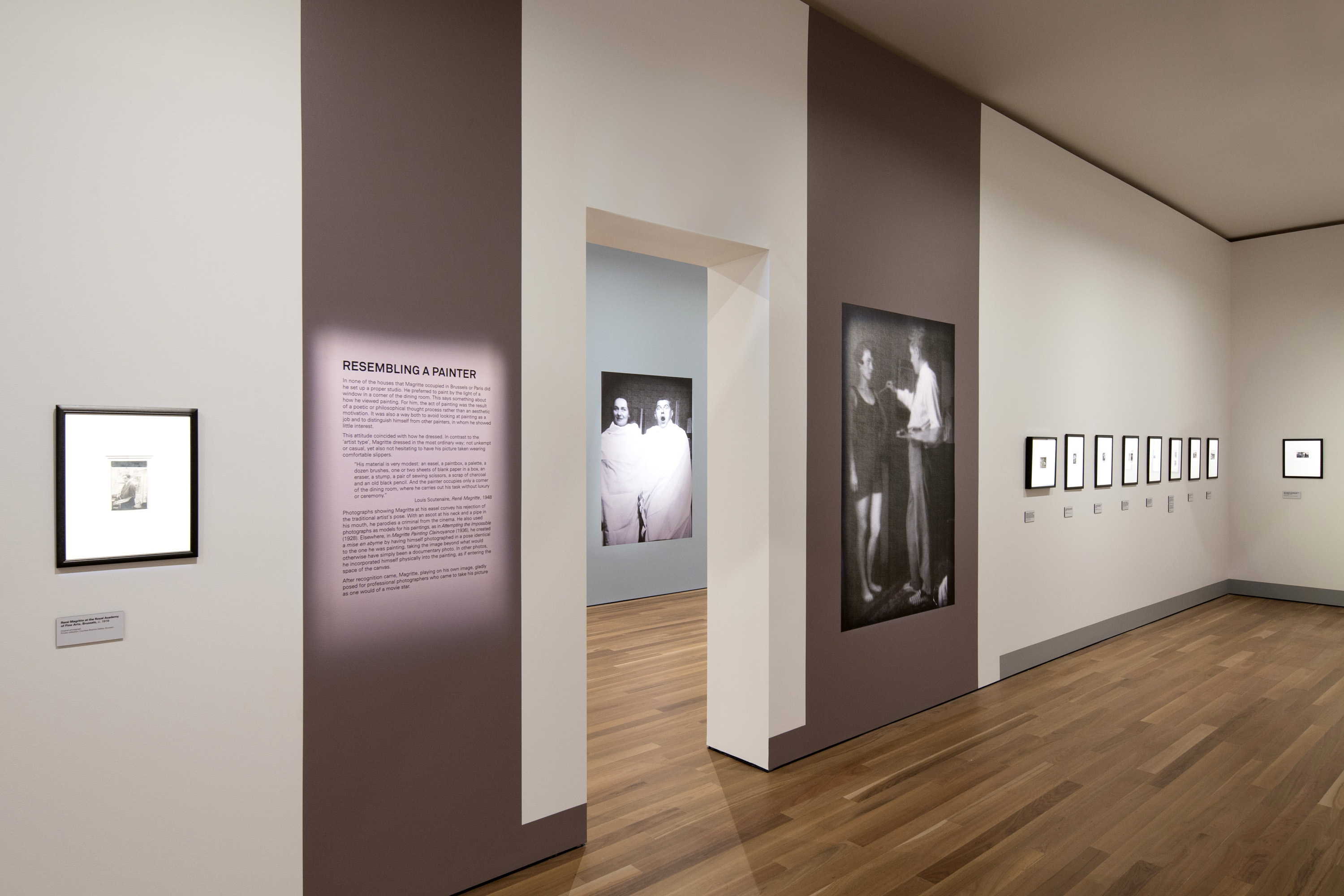
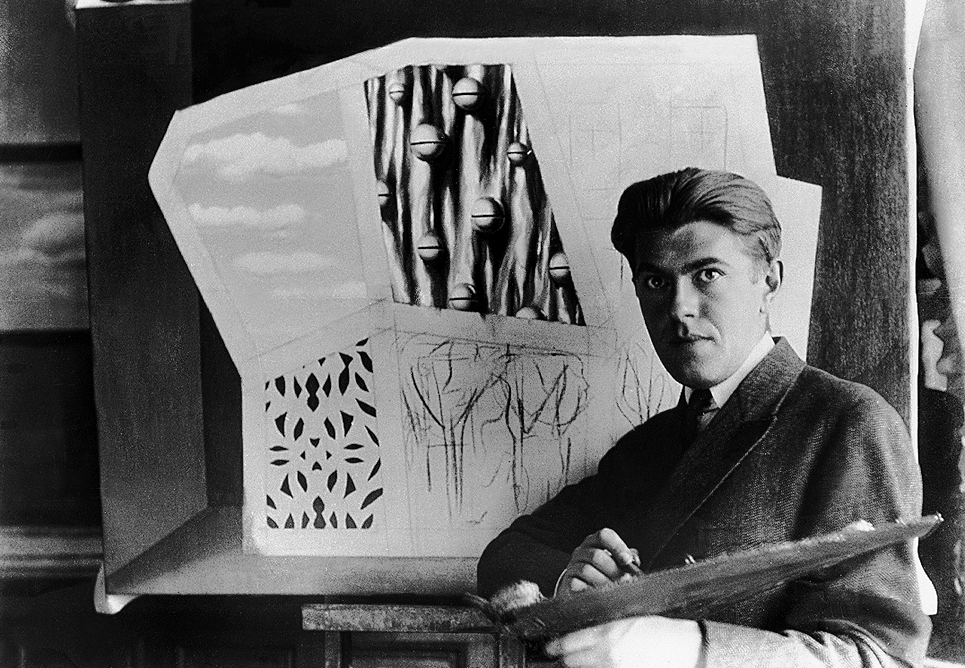
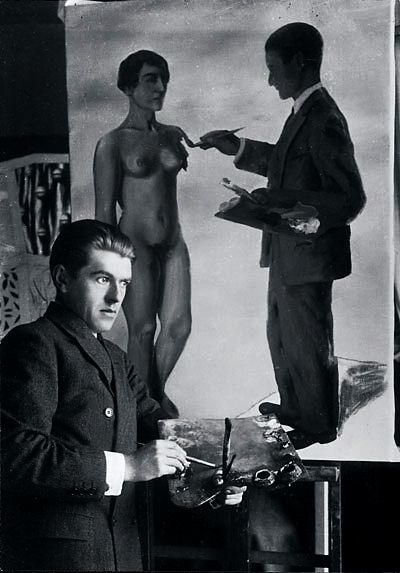
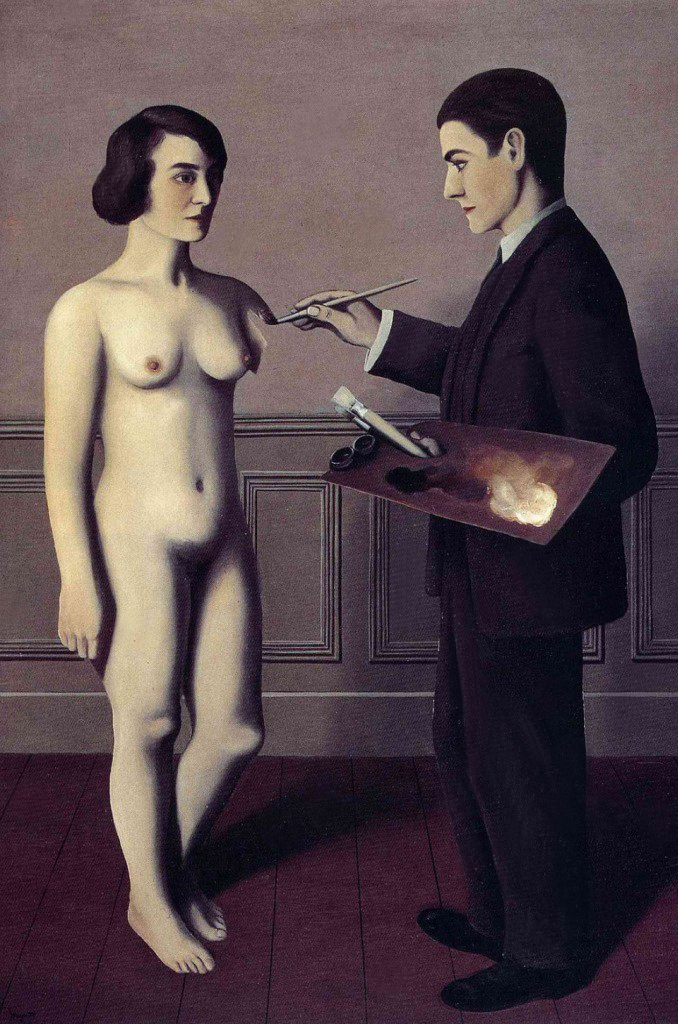
After the grounding of the first two tranches of photographs, ‘A family album’ and ‘A family resemblance’, the exhibition takes flight with the remaining sections of the exhibition, beginning with the section ‘Resembling a painter’ in which the staged photographs “show how Magritte often tended to parody his work as a painter.” Here Magritte’s painting Attempting the Impossible (1928) is sequenced with a photograph of Magritte painting Attempting the Impossible (1928) and the photograph Love (1928) in which the artist pretends to paint his wife “in the flesh”, only this time she is clothed. As Xavier Canonne observes, “The painter permanently questioned reality, playing on its possibilities…” and the photographs do just that, resulting in “a different way of conceiving of photography, without trick shots or manipulation, of offering… a multiplying effect, an extension of what would otherwise have been merely a documentary image. Beyond the mise-en-abyme implemented by the interplay of the painting and its ‘model’, this photograph goes beyond the notion of document to lay claim to that of an intrinsic work.”
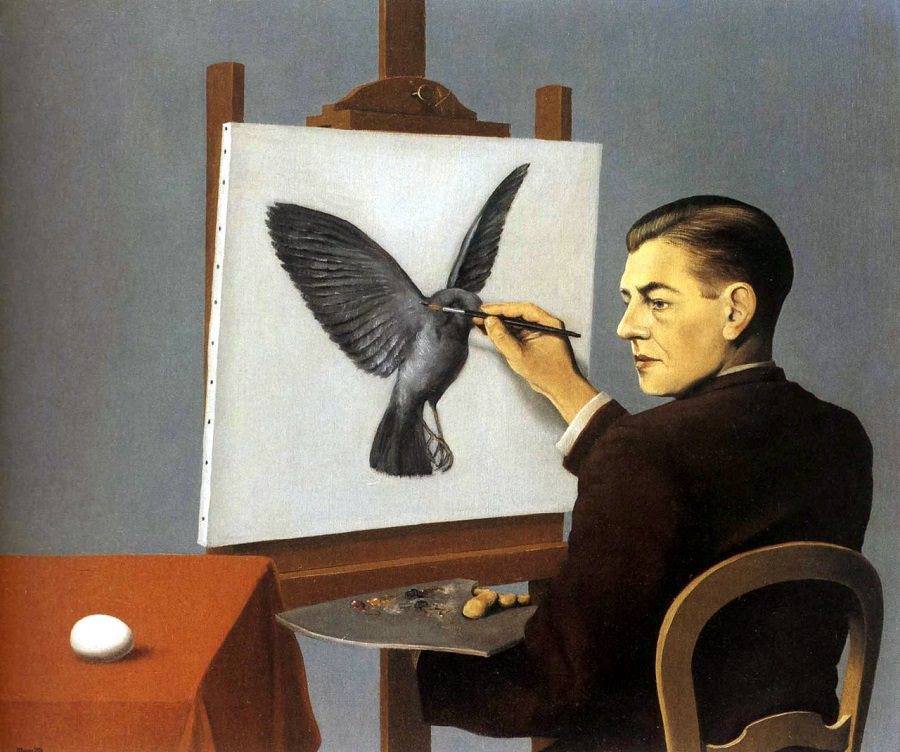
An example of this is Jacqueline Nonkels supervised, staged, photograph Rene Magritte painting Clairvoyance 4th October 1936 depicts Magritte painting Clairvoyance only for the painting to repeat the gesture of him painting in the photograph. Go figure – literally! Next to the small photograph is a reproduction of the painting Clairvoyance (1936) and Canonne observes that the self-portrait has become as much mise-en-abyme (placed into abyss: the visual experience of standing between two mirrors, then seeing as a result an infinite reproduction of one’s image; or the Droste effect, in which a picture appears within itself, in a place where a similar picture would realistically be expected to appear) as anything else. By subverting the documentary reality of photography it becomes something else and in so doing, becomes an intrinsic work in its own right. This transformative representation can happen within one image, or in a sequence of images, such as the pairing of the three forms of Love: the photograph Love; René Magritte painting ‘Attempting the Impossible’; and the painting Attempting the Impossible (all 1928, below). Other examples in different sections throughout the exhibition include The Oblivion Seller (1936), a small photograph from 1937 which is sequenced next to a reproduction of Magritte’s painting of his wife, Georgette (1937); or the photograph Rene Magritte and The Barbarian (1938) which is sequenced with The Flame Rekindled (1943) and a still from Ernst Moerman’s surrealist film Monsieur Fantômas (1937).
I feel that these tiny, tiny portraits are about extending the possibilities of the image through the joy of living. To play, to have fun with friends, to travel to places, to talk about ideas, about art and love and life, to debate the titles of images and paintings with comrades. In this regard, the interwar period and the avant-garde was immensely creative in terms of an investigation into the multiplicities of the world. The photographs are a reality take on the mystery of the everyday, a counterpoise to the severity and austerity of Magritte’s paintings. Paraphrasing Alfred Gell, who was recently quoted by Zara Stanhope in an essay on the cultural agency of photographs, I believe that not only do works of art “have the power to act and to influence others”1 they also have the power to act and influence each other through human agency. The production and titling of Magritte’s paintings and photographs was a collective and transformative process (undertaken with his group of friends), part of a reflective process that articulated the material conditions of a given situation (in this case, the Belgian Surrealist movement), in which the paintings and the photographs extend the possibility of being through an engagement with each other. For example, in The Death of Ghosts (1928) you really really have to look to try and understand what is going on within the picture frame. Even then, you wonder what is going on… the movement of the image, the darkness, the person lying in the background which is then linked to the painting The Apparition (1928) which uses the same silhouette of the figure, a trope that Magritte often uses when switching from photograph to canvas.
Throughout this wonderful exhibition you begin to formulate ideas as to how, firstly, the photograph is used as source material for Magritte’s art, as in the photograph for the painting Universal Gravitation (1943) where a man puts his hand through a wall (or is it the other way around, where the painting informs the photograph?) and, secondly, how the photograph is not used as a source material, but renegotiates the spatio-temporal dimensionality of the paintings. And becomes a new art work that stands by itself. And then you have to factor in the moving image: the sensibility of film, that movable feast of magic and masks, smoke and mirrors. By placing models, friends and paintings in the same photograph, Magritte’s images conflate time and space and ultimately challenge the concept of photography as a memory aid.
Finally, there is so much mystery pres(t)aged within these photographs (the titles further compounding the dissolution of reality), that the already fragile grasp of the referentiality of the image is shattered. Go travel and see this exhibition, for it was a true pleasure to spend a variable amount of time in their intimate, visceral, and intellectual, embrace.
Dr Marcus Bunyan
Word count: 1,715
Footnotes
1/ Alfred Gell cited in Stanhope, Zara. “Photography in Focus,” in McColm, Donna (ed.,). “Love from Paris,” National Gallery of Victoria magazine. Melbourne: September / October 2017, p. 50.
Many thankx to Latrobe Regional Art Gallery for allowing me to publish the photographs in the posting. Please click on the photographs for a larger version of the image.
“My paintings are … visible images which conceal nothing; they evoke mystery and, indeed, when one sees one of my pictures, one asks oneself this simple question, ‘What does that mean?’. It does not mean anything, because mystery means nothing either, it is unknowable.”
René Magritte
“For me, art is the means of evoking mystery… the mystery is the supreme thing. It’s reassuring to know that there’s mystery – to know that there is more than what one knows.”
René Magritte
“This triumphant poetry replaced the stereotyped effect of traditional painting. It is a complete rupture with the mental habits of artists imprisoned by talent, virtuosity and all the little aesthetic specialities. It is a new vision where viewers find their isolation and the silence of the world.”
“One rarely looks at images with the naked eye; a psychology, an aesthetic, a philosophy interpose themselves all in one; everything goes up in smoke. We question images before listening to them, we question them indiscriminately. Then we are surprised if the expected answer does not come.” (1944)
Paul Nougé
“Magritte’s art used images as a poet might use words; that is, in ways that new meanings, unnoticed harmonies, curious insights, subtle inflections and penetrating observations might be made. As with good poetry, they are not must made as ‘interesting’ asides, but create to feature as instances of heightened states of mind. Furthermore, like good poetry, Magritte’s images in painting, drawings, prints, films and photography have uplift. They promote thought and have an aesthetic punch that dislodges the all-too-common anaesthesia of incurious everyday life.”
Associate Professor Ken Wach. “René Magritte: Art as a Mental Act” in René Magritte: A Guide to René Magritte, Latrobe Regional Gallery, 2017, p. 13
The Surrealists made abundant use of photography, and some even devoted themselves to it entirely. But Magritte never considered himself a ‘photographer’ – he reserved this practice for special moments and specific uses: family photos; models for paintings and advertising work; photos of paintings in progress; and scenes improvised with friends, similar to the skits he later filmed with a home movie camera. Nevertheless, Magritte’s photographs and films are closely related to his paintings and demonstrate a similar method in their grasp on reality. Far from being merely entertaining occasional images, they shed a familiar light on the painter’s thought and evidence the same investigation of the mysteries of the world.
Installation views of the exhibition René Magritte: The Revealing Image at the Latrobe Regional Art Gallery Installation photography by Benjamin Hosking
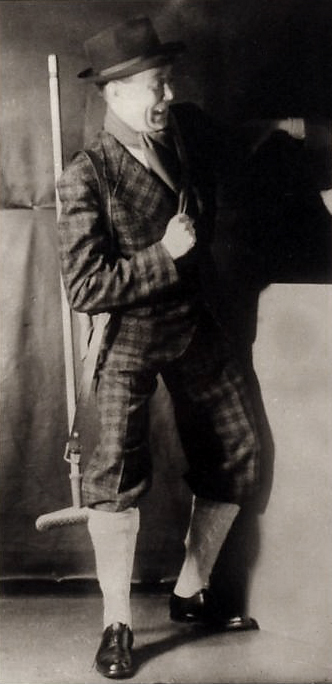
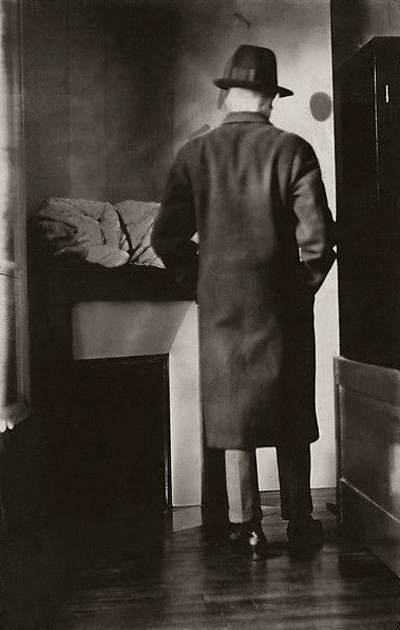
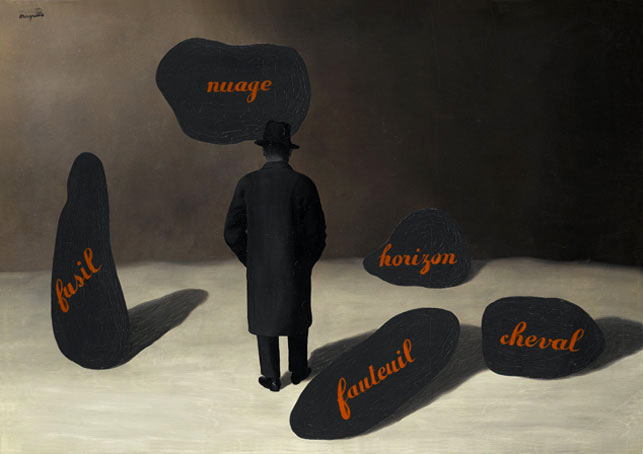
“And although it may not refer to a specific painting, Virtue Rewarded, a photograph taken in Brussels in 1934, preserves Magritte’s iconography for all time with a silhouette – the painter himself – in a hat and long coat in front of a suburban landscape, the recurring image of the anonymous man in Magritte’s world.”
~ Xavier Canonne
Unknown photographer Virtue Rewarded 1934, Brussels Original photograph
Introduction from the book
“The discovery of the photographs and films of René Magritte in the mid-1970s, more than 10 years after the painter’s death, and their subsequent appraisal and study have given us a look into a family album that reveals an intimate side of Magritte, independent of the biographical documents unearthed from his archives and those of people he was close to. This discovery has also led to an investigation of Magritte’s relationship with these ‘other images’, for which he served as creator, director and model, and of his relationship with the mediums of photography and cinema, to which, in his experience as a painter, he assigned a role of both recreation and creation.” ~ Xavier Canonne.
Description of the exhibition
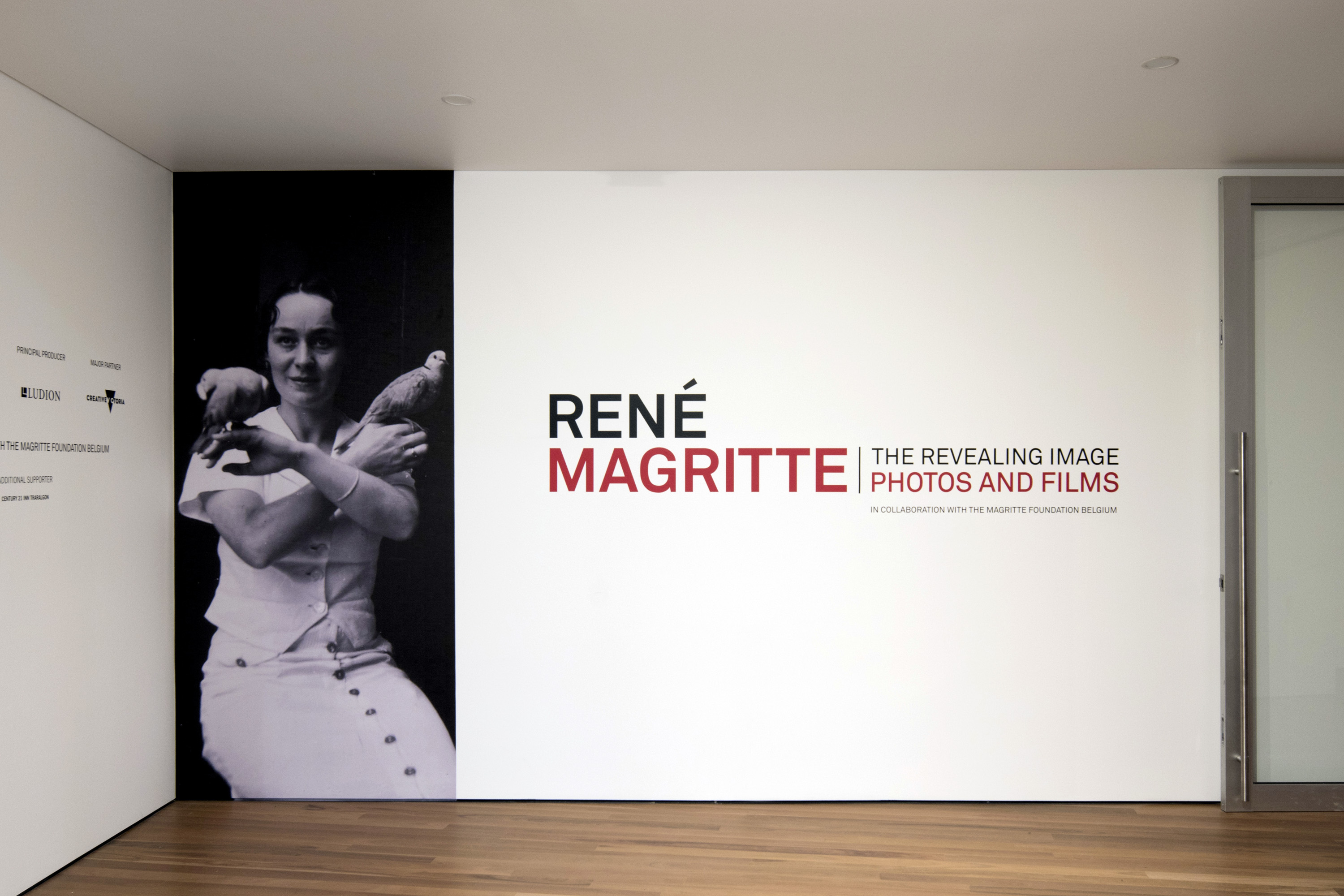
The exhibition René Magritte: The Revealing Image, Photos and Films consists of 132 original photographs from the archives of the painter and those closest to him, presented in six sections, and eight self-made films. The photographs are organised thematically, eschewing strict chronology, each section introduced by a text, the individual photographs including a caption and a comment. They are accompanied by enlargements in the form of posters and, depending on the section, by reproductions of Magritte’s paintings or films, or by films which made an impression on him.
A Family Album
The photographs in this section, arranged chronologically, are devoted to Magritte’s family life. Snaps taken with his parents and brothers, his military service, the early years of his marriage to Georgette, their period of residence at Perreux-sur-Marne near Paris, their life in Brussels – all revealing the daily life of René Magritte.
A Family Resemblance
Organised chronologically, this section brings together photographs representing René Magritte’s other “family”, the Brussels Surrealist group with which the painter threw in his lot in 1926. Paul Nougé, Marcel Lecomte, Louis Scutenaire, Irène Hamoir, Paul Colinet, Marcel Mariën, Camille Goemans and Marthe Beauvoisin are some of the characters who feature in these compositions, in many cases improvised “photographic tableaux” bearing witness to the intimate relationship between René Magritte and his immediate circle.
The Resemblance of Painting
This third section of the exhibition consists of photographs of René Magritte at his easel, covering the years from 1917 to 1965. They show the painter with works from different periods, taken impromptu or posing, generally in a suit, in the succession of houses where he never established a workshop, preferring to paint in his living-room. Working documents or “staged” photographs, they show how Magritte often tended to parody his work as a painter.
Reproduction Permitted or Photography Enhanced
This section of the exhibition comprises paintings by Magritte placed on his easel or forming the background of portraits of him and his wife. Essential paintings, some of which have been lost, provide the painter with a stage set into which he projects himself with his wife, going beyond documentary photography.
This section also includes a series of photographs which served as models for his paintings, featuring Georgette and René Magritte, Louis Scutenaire and various close friends – photographs directly connected with his works, which are presented in the form of reproductions. Magritte used the same procedure in the short films he made between 1940 and 1960, and extracts in television format or reproductions are shown alongside the original photographs.
The Imitation of Photography. Magritte and the Cinema[tograph]
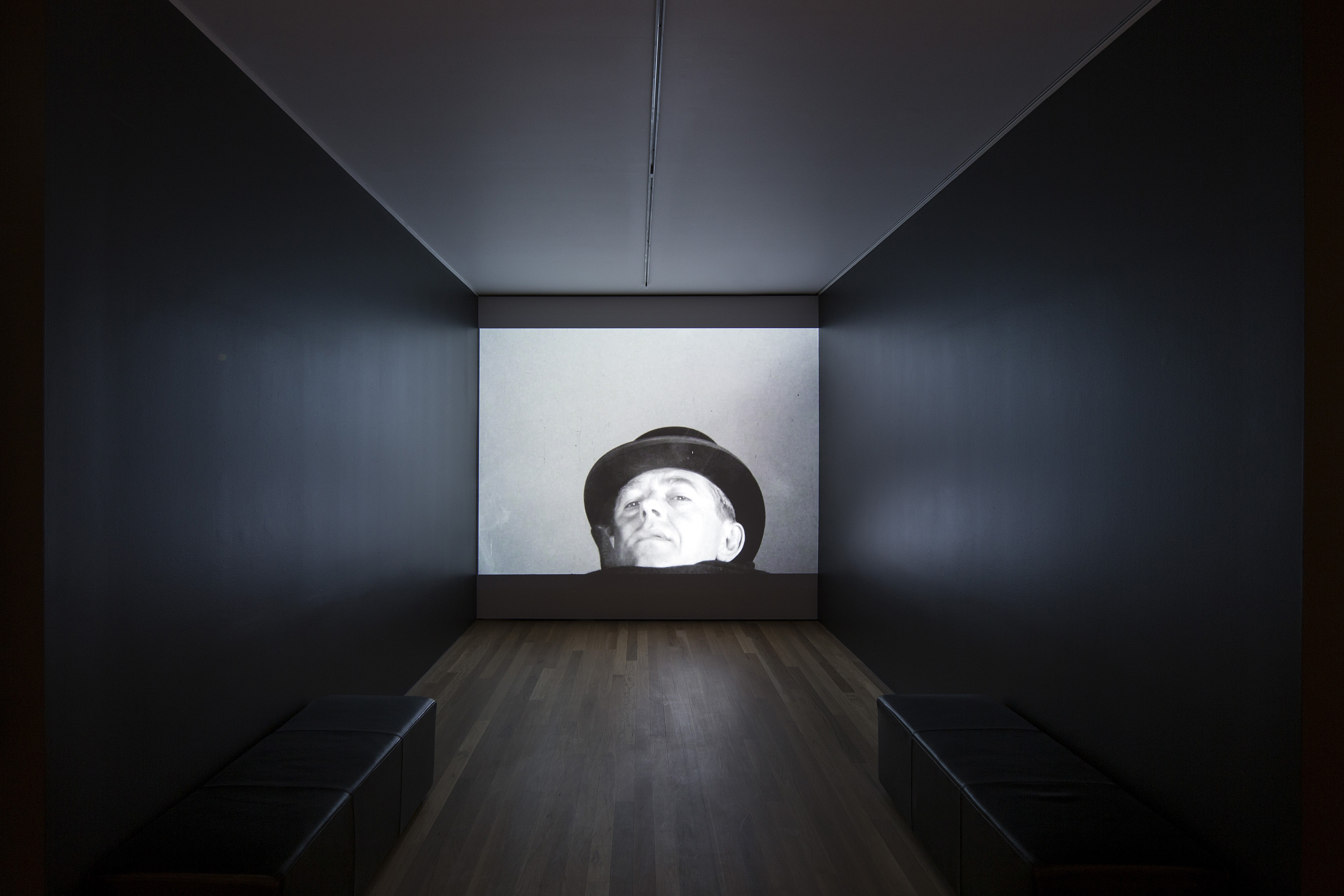
The cinema, more even than painting and to the same extent as literature, was a seminal influence of the work of René Magritte. As a child, he had been exposed to the first silent films and he tried to recreate their freshness and spontaneity in the short films he made, featuring his close friends. Magritte may still be posing in this section, but the emphasis is on entertainment.
This section of the exhibition is accompanied by extracts from his own films, presented on the TV screens, and by images from films by directors he admired, such as Louis Feuillade with his celebrated Fantômas.
The False Mirror
This title of a celebrated painting by René Magritte opens the final section of the exhibition. Consisting essentially of portraits of Magritte at different stages of his life, they sometimes depict him in dreamy mood, sometimes expressing amusement, generally with his eyes closed, focused inwards. The section also includes photographs in which the painter and his friends mask their faces or turn away from the camera lens, prolonging in photographic mode his painterly research on the caché-visible (things hidden in plain sight).
Section 1: A Family Album
The photographs in this section, arranged chronologically, are devoted to Magritte’s family life. Snaps taken with his parents and brothers, his military service, the early years of his marriage to Georgette, their period of residence at Perreux-sur-Marne near Paris, their life in Brussels – all revealing the daily life of René Magritte.
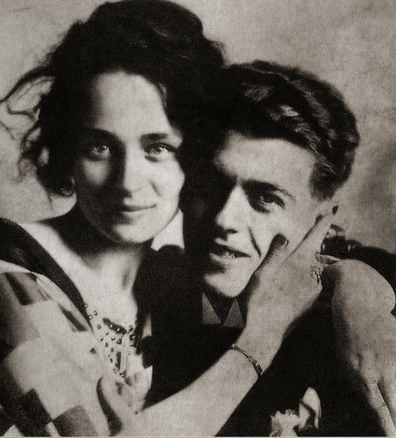
Unknown photographer Georgette and René Magritte, Brussels, June 1922 [on their wedding day] 1922 Original photograph 43.2 x 33.2cm (framed) Private collection, Courtesy Brachot Gallery, Brussels
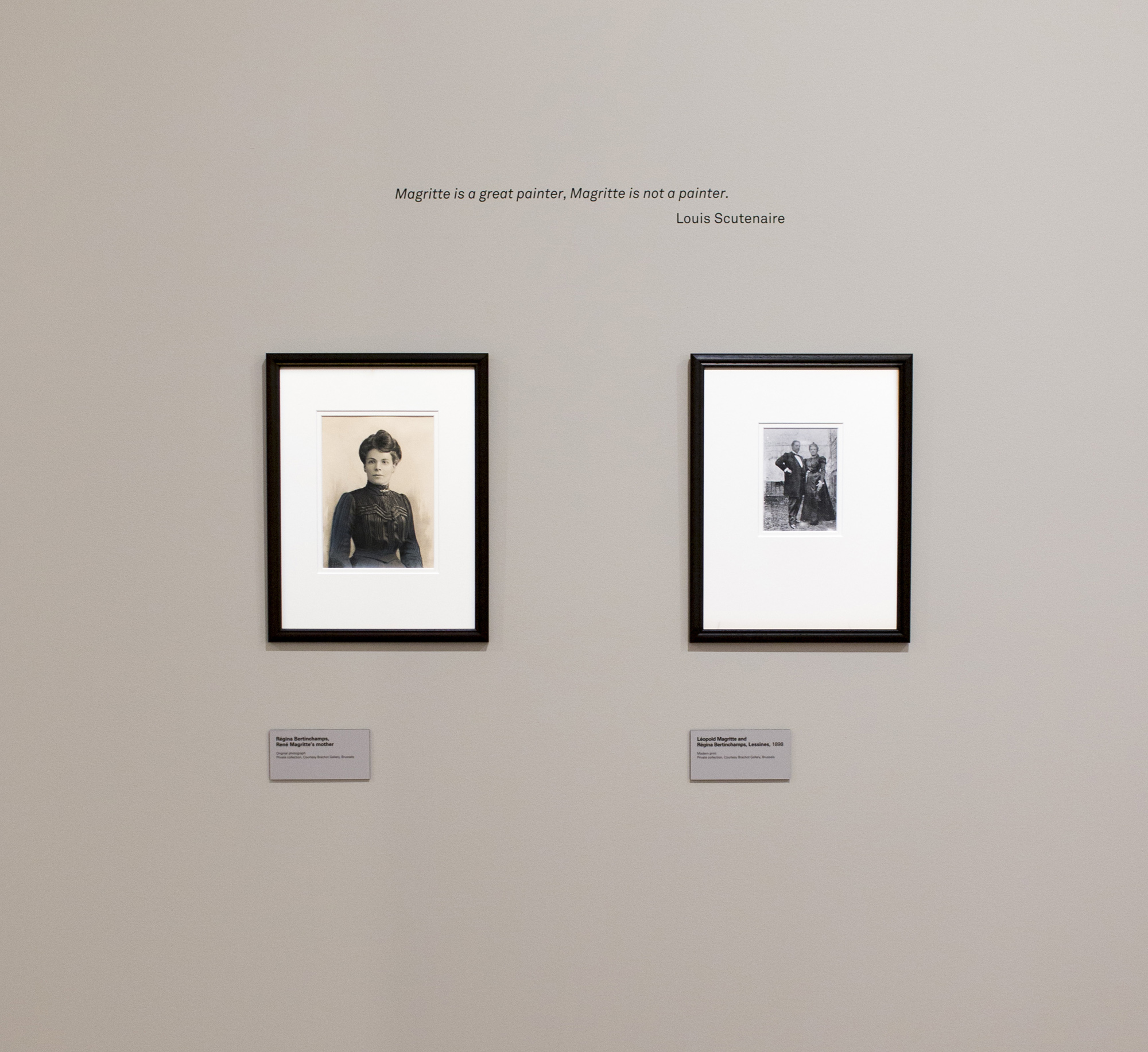
Installation view of the exhibition René Magritte: The Revealing Image at the Latrobe Regional Art Gallery with at left, Régina Bertinchamps, René Magritte’s mother by an unknown photograper, Nd; and at right, Léopold Magritte and Régina Bertinchamps, Lessines, 1898 also by an unknown photographer.
René Magritte (Belgium, 1898-1967) Les Amants [The lovers] 1928 Oil on canvas Collection of Richard S. Zeisler, New York
Reproduction in the exhibition Published under “fair use” for the purposes of academic review
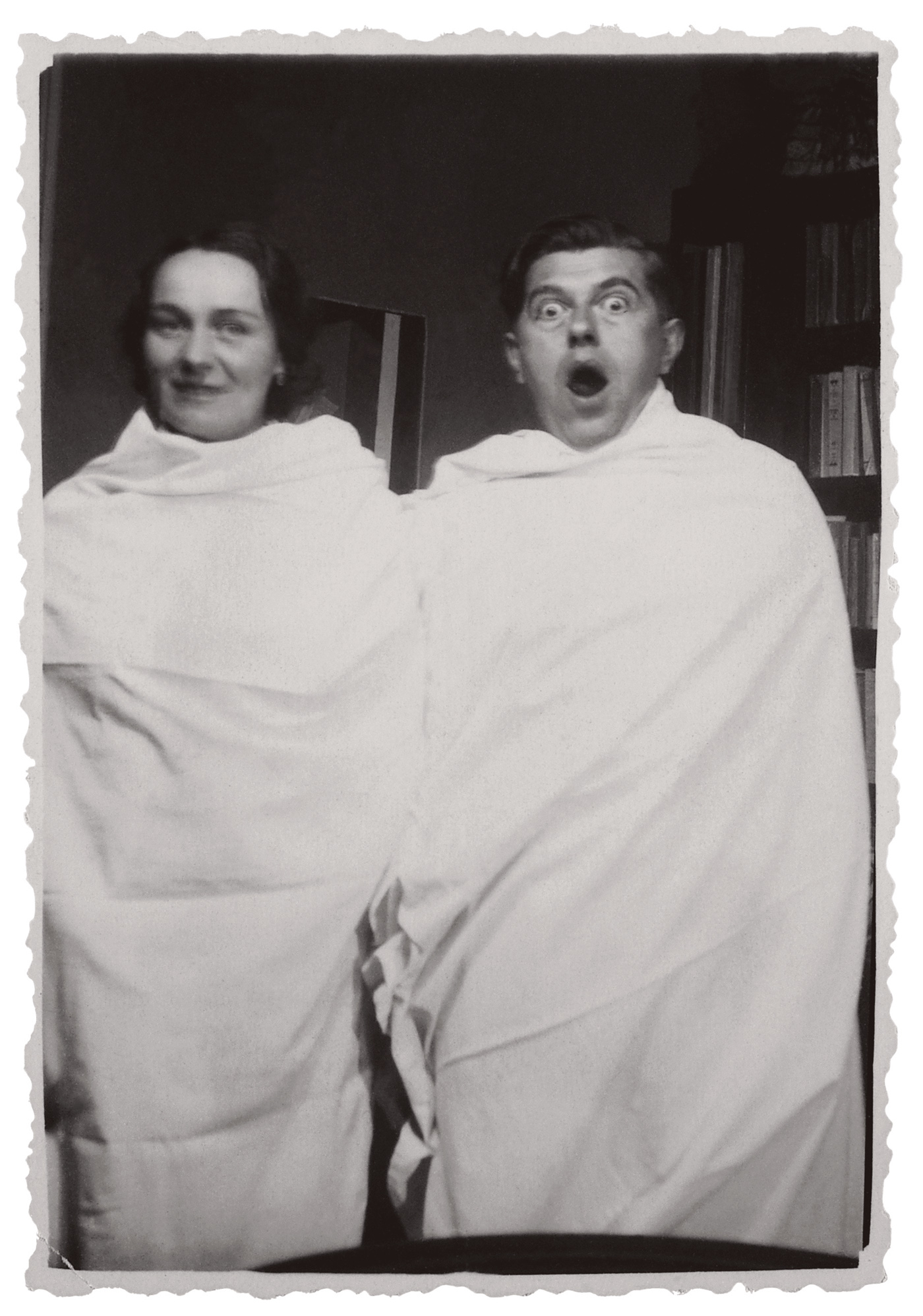
This is one of a small group of pictures painted by Magritte in Paris in 1927-28, in which the identity of the figures is mysteriously shrouded in white cloth. The group of paintings includes L’histoire centrale (The central story) 1927 (collection Isy Brachot, Brussels); L’invention de la vie (The invention of life) 1927-28 (private collection, Brussels); The lovers 1928 in the Australian National Gallery; and the similarly titled, similarly dated and similarly sized painting in the collection of Richard S. Zeisler, New York, in which the same shrouded heads of a man and a woman that appear in the Gallery’s painting attempt to kiss each other through their grey cloth integuments.
The origin of this disturbing image has been attributed to various sources in Magritte’s imagination. Like many of his Surrealist associates, Magritte was fascinated by ‘Fantômas’, the shadowy hero of the thriller series which first appeared in novel form in 1913, and shortly after in films made by Louis Feuillade. The identity of ‘Fantômas’ is never revealed; he appears in the films disguised with a cloth or stocking over his head. Another source for the shrouded heads in Magritte’s paintings has been suggested in the memory of his mother’s apparent suicide. In 1912, when Magritte was only thirteen years of age, his mother was found drowned in the river Sambre; when her body was recovered from the river, her nightdress was supposedly wrapped around her head.
Michael Lloyd & Michael Desmond. European and American Paintings and Sculptures 1870-1970 in the Australian National Gallery 1992 p.173.
Unknown photographer The Bouquet (Le Bouquet), Georgette and René Magritte, Rue Esseghem, Brussels 1937 Original Photograph 43.2 x 33.2cm (framed) Private collection, Courtesy Brachot Gallery, Brussels
Section 2: A Family Resemblance
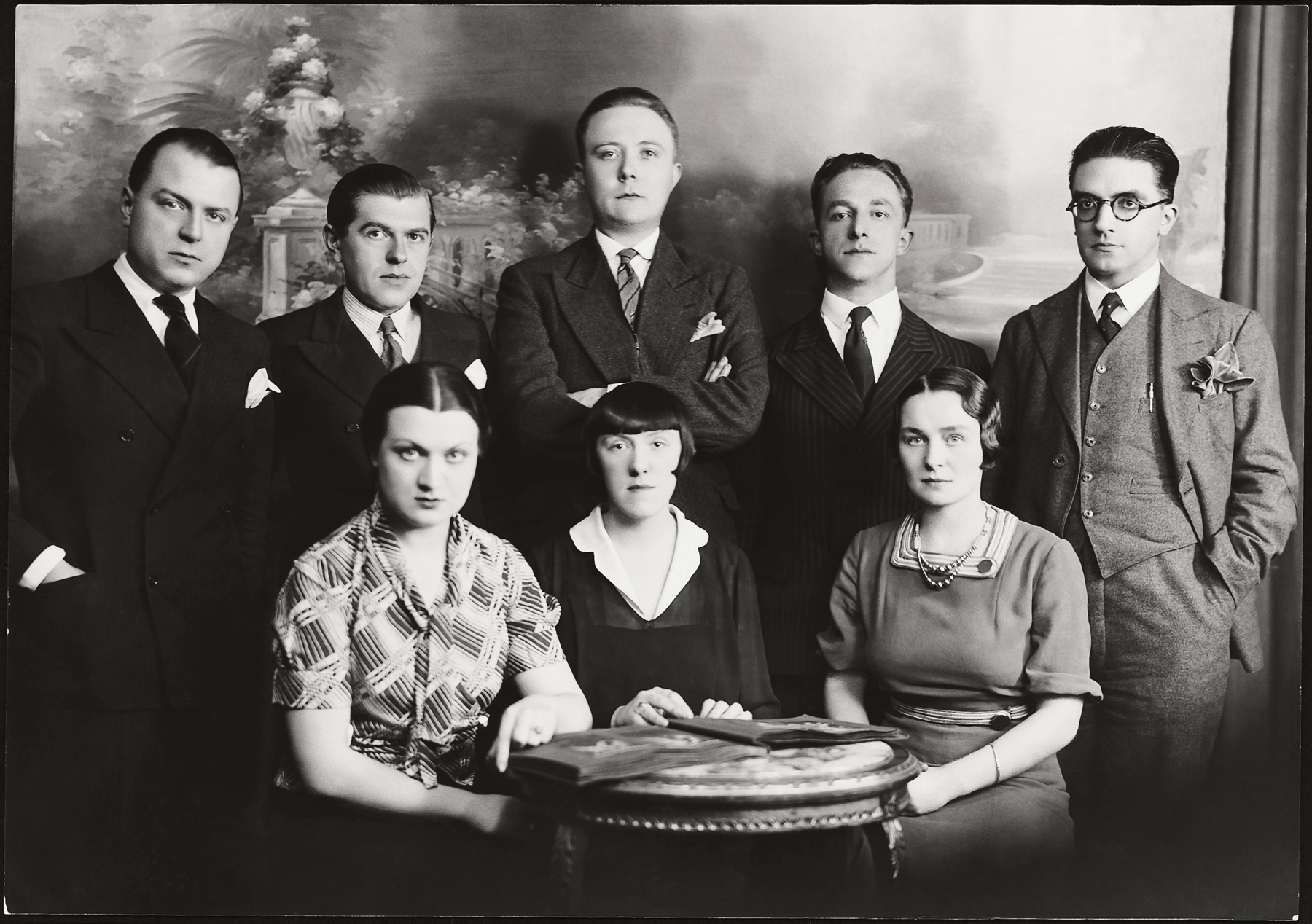
Organised chronologically, this section brings together photographs representing René Magritte’s other “family”, the Brussels Surrealist group with which the painter threw in his lot in 1926. Paul Nougé, Marcel Lecomte, Louis Scutenaire, Irène Hamoir, Paul Colinet, Marcel Mariën, Camille Goemans and Marthe Beauvoisin are some of the characters who feature in these compositions, in many cases improvised “photographic tableaux” bearing witness to the intimate relationship between René Magritte and his immediate circle.
Unknown photographer The Hunters’ Gathering (La rendez-vous de chase) 1934 Original photograph 27 x 33cm (framed) Collection Charly Herscovici, Europe
Left to right: E.L.T Mesens, René Magritte, Louis Scutenaier, André Souris and Paul Nougé Seated: Iréne Hamoir, Marthe Beauvoisin and Georgette Magritte. Studio Joe Rentmeesters
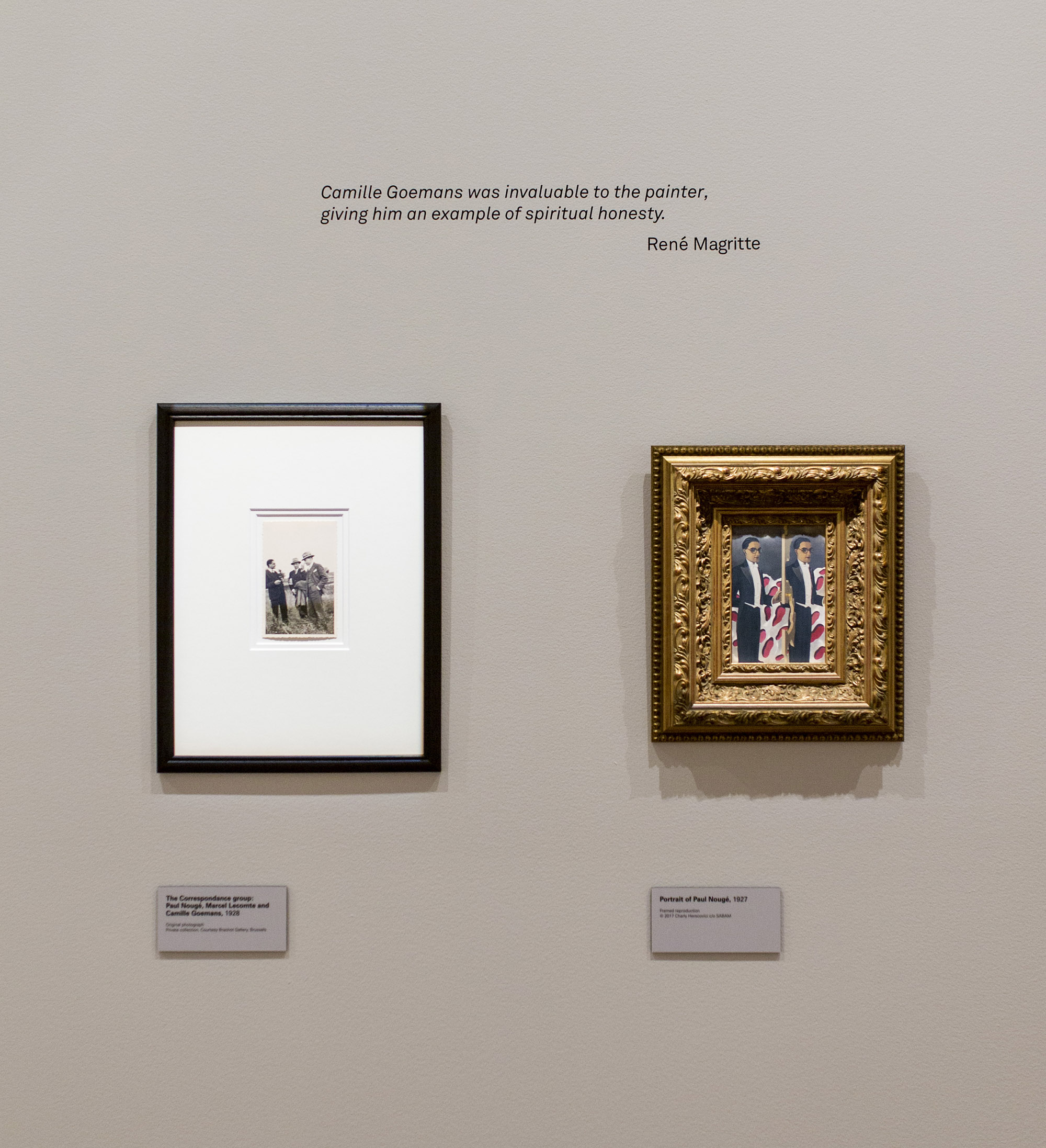
Installation view of the exhibition René Magritte: The Revealing Image at the Latrobe Regional Art Gallery with at left, René Magritte’s The Correspondance Group, 1928 (Paul Nougé, Marcel Lecomte and Camille Goemans), paired with René Magritte’s Portrait of Paul Nougé, 1927 at right.
René Magritte (Belgium, 1898-1967) Portrait of Paul Nougé 1927 Oil on canvas
Reproduction in the exhibition Published under “fair use” for the purposes of academic review
Unknown photographer The Extraterresterials V (detail) 1935, Brussels, Rue Esseghem
Left to right: Paul Colinet, Marcel Lecomte, Georgette and René Magritte
Published under “fair use” for the purposes of academic review
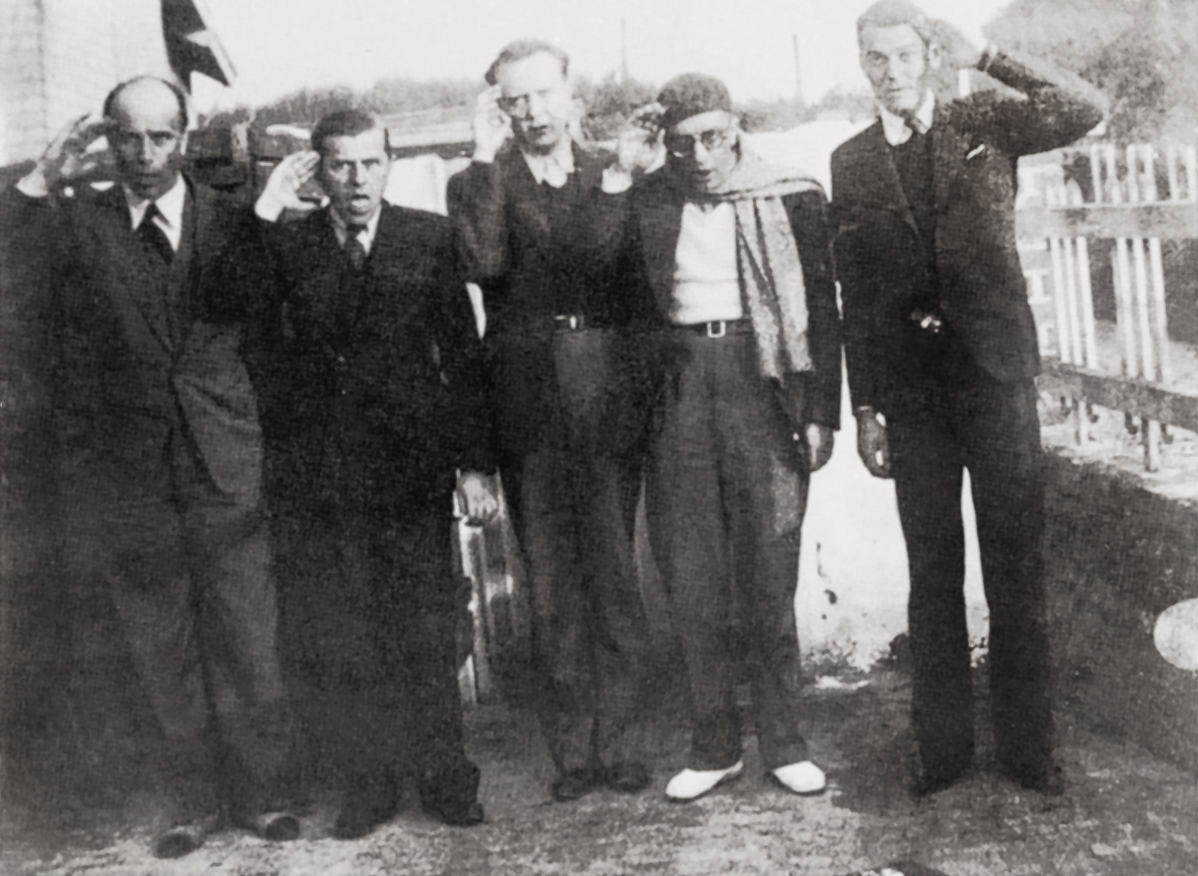
Unknown photographer Saluting the Flag 1935, Koksijde Original photograph
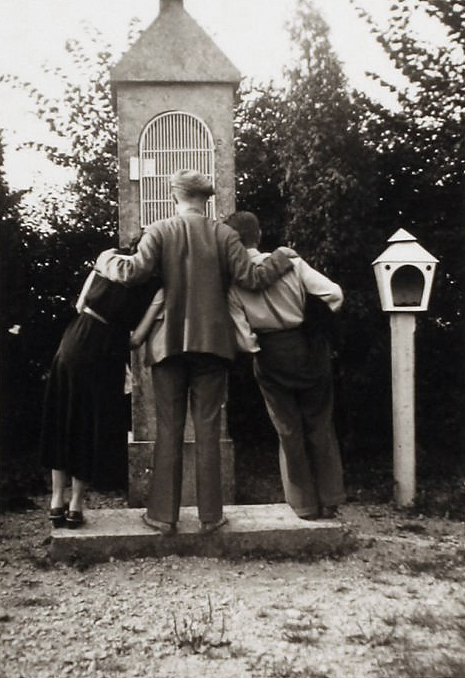
Left to right: Paul Colinet, René Magritte, Louis Scutenaire, Paul Nougé, and Paul Magritte
Section 3: The Resemblance of Painting
This third section of the exhibition consists of photographs of René Magritte at his easel, covering the years from 1917 to 1965. They show the painter with works from different periods, taken impromptu or posing, generally in a suit, in the succession of houses where he never established a workshop, preferring to paint in his living-room. Working documents or “staged” photographs, they show how Magritte often tended to parody his work as a painter.
Unknown photographer René Magritte painting The Empty Mask (Le masque vide), Le Perreux-sur-Marne 1928 Original photograph 32 x 38cm (framed) Collection Charly Herscovici, Europe
Unknown photographer Love 1928, Le Perreux-sur-Marne Study for Attempting the Impossible Original photograph
Published under “fair use” for the purposes of academic review
Unknown photographer René Magritte painting ‘Attempting the Impossible’ 1928, Le Perreux-sur-Marne Original photograph
Published under “fair use” for the purposes of academic review
René Magritte (Belgium, 1898-1967) Attempting the Impossible 1928 Oil on canvas
Reproduction in the exhibition Published under “fair use” for the purposes of academic review
Jacqueline Nonkels René Magritte painting ‘Clairvoyance’ Brussels, 4 October 1936 Original photograph
Published under “fair use” for the purposes of academic review
René Magritte (Belgium, 1898-1967) Clairvoyance 1936 Oil on canvas
Reproduction in the exhibition Published under “fair use” for the purposes of academic review
Magritte has set up his easel in the small courtyard leading to the garden on Rue Essenghem. On it sits a completed painting, Clairvoyance, which represents Magritte seated in front of a canvas, brush in hand, his face turned towards an egg resting on a table covered with a tablecloth to his left. But the painted image in this photographic model is a bird with spread wings. Magritte, in a perfect imitation – suit, palette, haircut and chair – is in turn seated in front of he painting, pretending to paint. The photograph, taken on 4 October 1936 by young Jacqueline Nonkels according to instructions and staging established by Magritte, seems as much self-portrait as mise-en-abyme. It is the result of a different way of conceiving of photography, without trick shots or manipulation, of offering… a multiplying effect, an extension of what would otherwise have been merely a documentary image. Beyond the mise-en-abyme implemented by the interplay of the painting and its ‘model’, this photograph goes beyond the notion of document to lay claim to that of an intrinsic work.
Xavier Canonne. “The Resemblance of Painting,” in René Magritte: The Revealing Image, Photos and Films. LaTrobe Regional Gallery, 2017, p. 72.
Section 4: Reproduction Permitted or Photography Enhanced
This section of the exhibition comprises paintings by Magritte placed on his easel or forming the background of portraits of him and his wife. Essential paintings, some of which have been lost, provide the painter with a stage set into which he projects himself with his wife, going beyond documentary photography.
This section also includes a series of photographs which served as models for his paintings, featuring Georgette and René Magritte, Louis Scutenaire and various close friends – photographs directly connected with his works, which are presented in the form of reproductions. Magritte used the same procedure in the short films he made between 1940 and 1960, and extracts in television format or reproductions are shown alongside the original photographs.
Unknown photographer The Holy Family 1928, Le Perreux-sur-Marne Original photograph
Published under “fair use” for the purposes of academic review
“Magritte’s photographs attest to a form of improvisation, offering a compromise between a portrait of those around him and the reproduction of his own painting by somehow effecting their merger: The Holy Family shows the painter and his wife sitting on either side of the painting The Windows of Dawn (1928), with The Obsession (1928) placed on the easel above them.”
Xavier Canonne. “Reproduction permitted or photography enhanced,” in René Magritte: The Revealing Image, Photos and Films. LaTrobe Regional Gallery, 2017, p. 98.
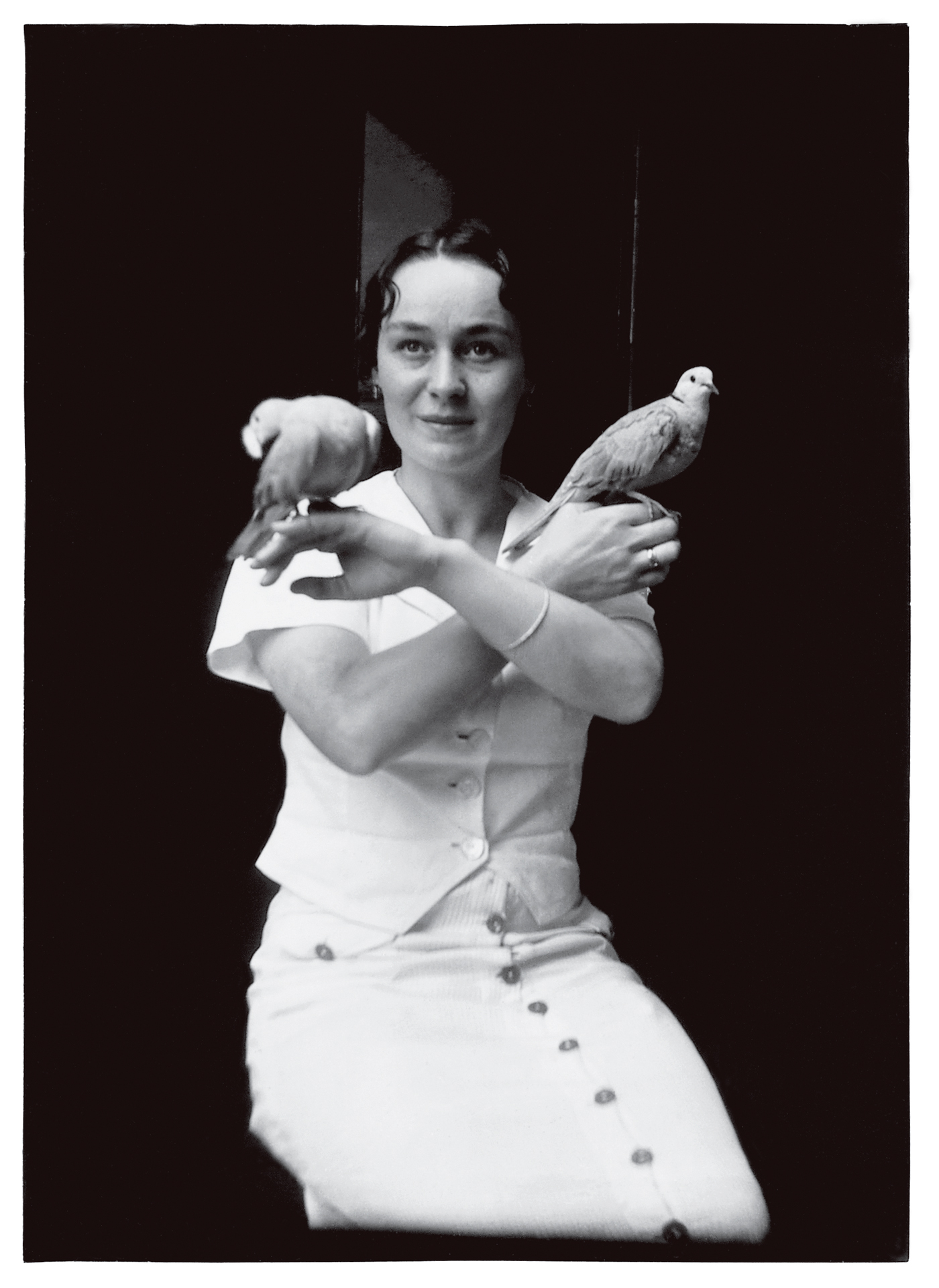
Paul Nougé (Belgian, 1895-1967) The Seers c. 1930 Marthe Beauvoisin and Georgette Magritte
Published under “fair use” for the purposes of academic review
Paul Nougé attributed (Belgian, 1895-1967) The Shadow and Its Shadow (L’ombre et son ombre) 1932, Brussels Georgette and René Magritte Original photograph 41.2 x 33.2cm (framed) Private collection, Courtesy Brachot Gallery, Brussels
“The Shadow and Its Shadow is indeed a photographic painting, an autonomous work that Magritte could also have transferred to canvas in treating the theme of the ‘hidden-invisible’.”
~ Xavier Canonne
René Magritte (Belgian, 1898-1967) Faraway looks c. 1927 Oil on canvas
Reproduction in the exhibition Published under “fair use” for the purposes of academic review
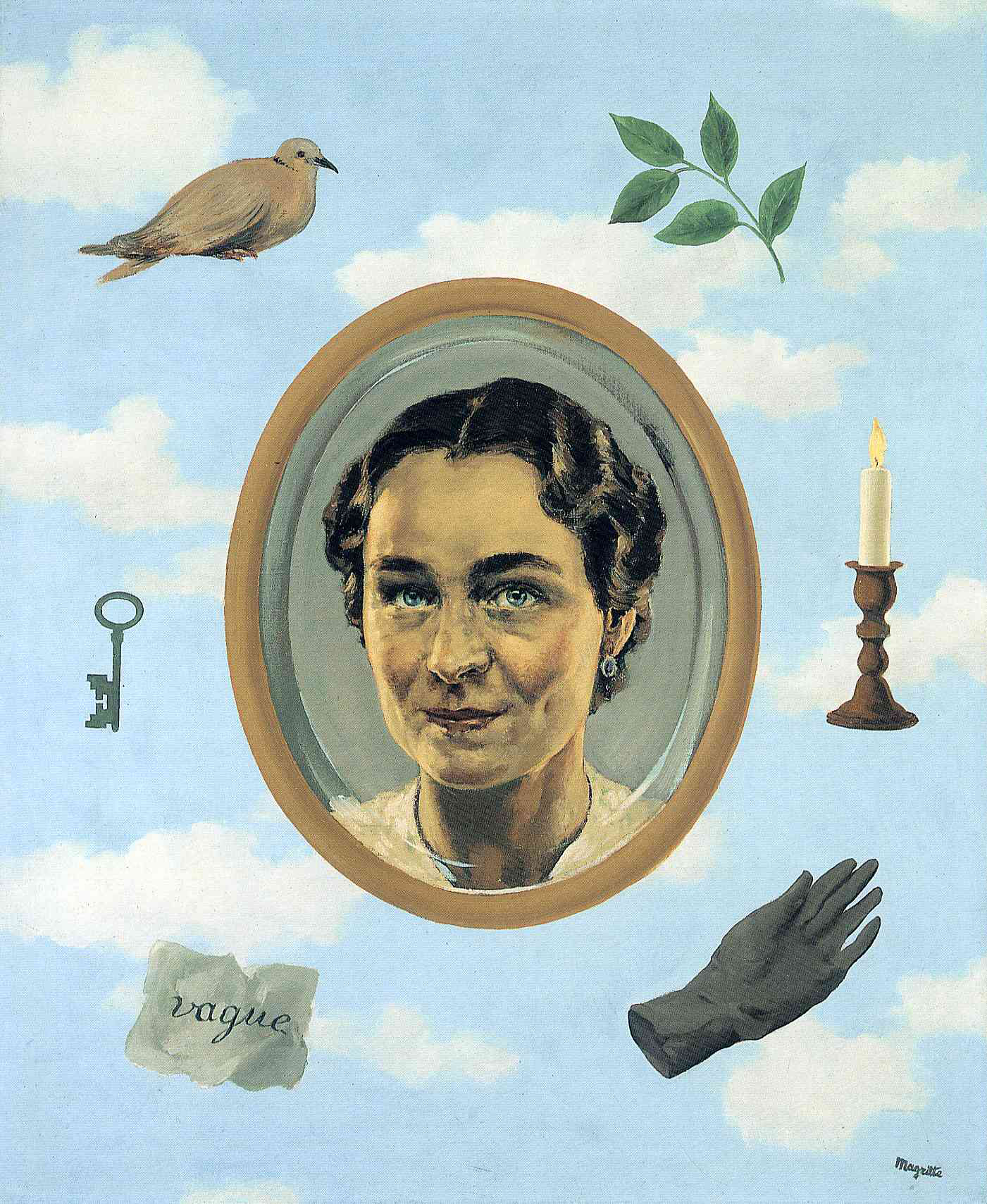
René Magritte (Belgian, 1898-1967) The Oblivion Seller (detail) 1936 Georgette Magritte Original photograph Cover image for the catalogue to the exhibition
Published under “fair use” for the purposes of academic review
René Magritte (Belgian, 1898-1967) Georgette 1937 Oil on canvas Museé Magritte, Brussels
Painting not in exhibition but reproduced in catalogue Published under “fair use” for the purposes of academic review
“Taken on the Belgian Coast in 1936, The Oblivion Seller (as Scutenaire aptly named it) shows a spontaneity and opportuneness completed in the mind of the painter, who often represented himself with his eyes closed, as if lost in thought. The ‘deflection’ of his snapshot of a happy moment – woman one loves at the beach on holiday – seems to prefigure certain later paintings, the nearest of which chronologically is Georgette (1937), an oval portrait that she kept her whole life… The painter permanently questioned reality, playing on its possibilities, assigning objects and beings a similar presence on film or canvas, the ‘default scene’ never quite satisfying him.”
Xavier Canonne. “Reproduction permitted or photography enhanced,” in René Magritte: The Revealing Image, Photos and Films. LaTrobe Regional Gallery, 2017, p. 106.
René Magritte (Belgian, 1898-1967) Universal Gravitation 1943 Oil on canvas Private collection
Painting reproduced in exhibition Published under “fair use” for the purposes of academic review
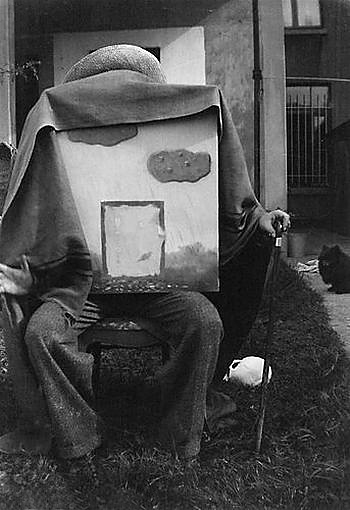
René Magritte (Belgian, 1898-1967) The Destroyer 1943 Louis Scutenaire Original photograph
Published under “fair use” for the purposes of academic review
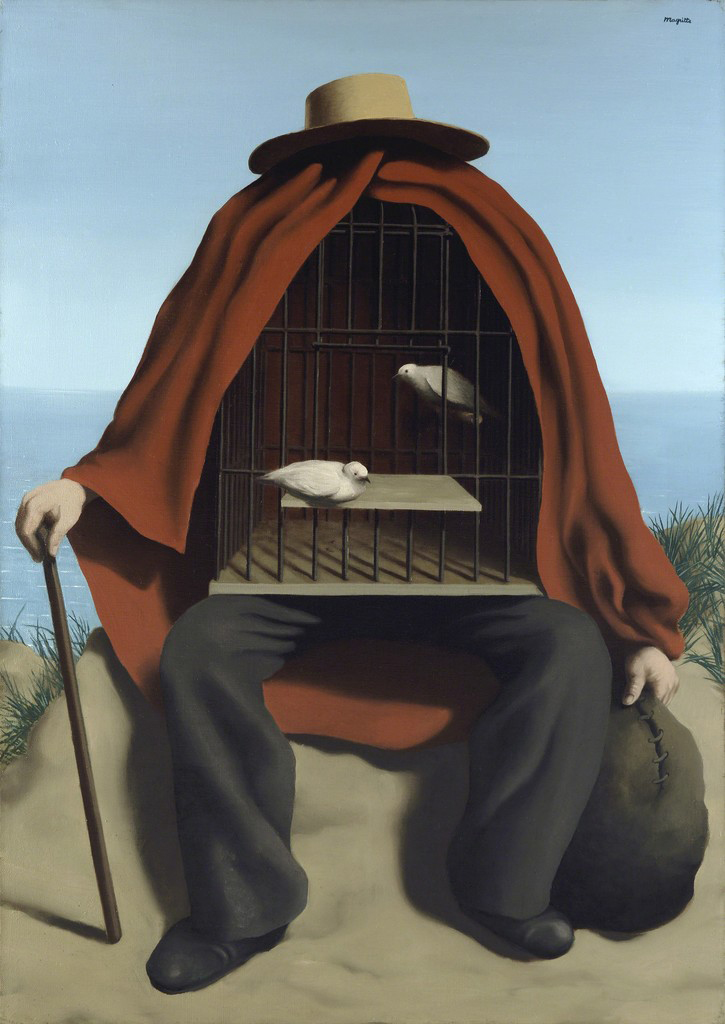
René Magritte (Belgian, 1898-1967) The Healer 1937 Oil on canvas René Magritte/ Charly Herscovici c/o SABAM
Painting not in exhibition but reproduced in catalogue Published under “fair use” for the purposes of academic review
René Magritte (Belgian, 1898-1967) God, The Eighth Day 1937 Brussels, Rue Essenghem Original photograph René Magritte/ Courtesy Brachot Gallery, Brussels
Published under “fair use” for the purposes of academic review
René Magritte (Belgian, 1898-1967) The Death of Ghosts 1928, Le Perreux-sur-Marne Jacqueline Celcourt-Nonkels and René Magritte René Magritte/ Courtesy Brachot Gallery, Brussels
Published under “fair use” for the purposes of academic review
“Although the silhouette of a man (probably Magritte) in The Death of Ghosts (1928) appears in the painting The Apparition (1928), other photos differ from the final painting, or were in turn inspired by it, the exact chronological sequence in these cases being less certain.”
~ Xavier Canonne
René Magritte (Belgian, 1898-1967) The Apparition 1928 Oil on canvas Staatsgalerie, Stutgart René Magritte/ Charly Herscovici c/o SABAM
Painting reproduced in exhibition Published under “fair use” for the purposes of academic review
René Magritte (Belgian, 1898-1967) Queen Semiramis (La reine Sémiramis) 1947, Brussels Original photograph 41.2 x 33.2cm (framed) Private collection, Courtesy Brachot Gallery, Brussels
René Magritte (Belgian, 1898-1967) Perfect Harmony 1947 Oil on canvas René Magritte/ Charly Herscovici c/o SABAM
Painting not in exhibition but reproduced in catalogue Published under “fair use” for the purposes of academic review
René Magritte (Belgian, 1898-1967) The Meeting (Le Rendez-vous) 1938, Brussels Original photograph 43.2 x 33.2cm (framed) Private collection, Courtesy Brachot Gallery, Brussels
René Magritte: The Revealing Image, Photos and Films is a world-first exhibition which provides stunning insight into the life, work and thinking of René Magritte, one of the world’s most important 20th Century artists. The exhibition, to be held at Latrobe Regional Galley in Morwell, Victoria, Australia from 19 August to 19 November 2017, features 130 original photographs by and of Magritte, his family, friends and fellow artists. It also includes eight self-made films which give a behind-the-scenes view of Magritte’s world. This exhibition, staged in collaboration with the Magritte Foundation Belgium. René Magritte: The Revealing Image, Photos and Films, marks the 50th anniversary of the Belgian Surrealist’s death. After its world-premiere in Morwell, René Magritte: The Revealing Image, Photos and Films will travel to Hong Kong, North and South America, and back to Europe.
Latrobe Regional Galley director Dr Mark Themann said René Magritte: The Revealing Image, Photos and Films was an opportunity to experience an amazing assembly of intimate and insightful photographs and films, many of which have never been exhibited previously. “Magritte had a unique creative ability to enchant. He used the ordinary and the everyday to evoke the mysterious and to question our perceptions of reality,” Dr Themann said. “He is an iconic artist, whose influence on fellow artists, designers, film directors and visual culture continues to this day. It’s a magnificent opportunity to present this major international exhibition in our newly-renovated Latrobe Regional Galley in Morwell. We’re looking forward to welcoming visitors from the local region, around Australia, and the world.”
Exhibition Chief Curator Xavier Canonne said the discovery of the photographs and films of René Magritte in the mid-1970s, 10 years after the painter’s death, and their subsequent appraisal and study, had given us an even greater appreciation of Magritte as an artist. “There are a lot of connections between Magritte’s photos and films, and his famous paintings,” Mr Canonne said. “Magritte was deeply interested by the possibilities of the image. The photos and films were used as models or documents for his paintings, and as experimental fields for his research, in order to find something more – to extend the possibilities of his universe. Through this exhibition we gain a greater sense and understanding of who Magritte was, how this informed his work, and why his art is so important.”
In conjunction with the opening of René Magritte: The Revealing Image, Photos and Films a book on the exhibition by Mr Canonne has been published by Ludion, distributed globally by Thames & Hudson.
Press release from the Latrobe Regional Art Gallery
Section 5: The Imitation of Photography. Magritte and the Cinema[tograph]
The cinema, more even than painting and to the same extent as literature, was a seminal influence of the work of René Magritte. As a child, he had been exposed to the first silent films and he tried to recreate their freshness and spontaneity in the short films he made, featuring his close friends. Magritte may still be posing in this section, but the emphasis is on entertainment.
This section of the exhibition is accompanied by extracts from his own films, presented on the TV screens, and by images from films by directors he admired, such as Louis Feuillade with his celebrated Fantômas.
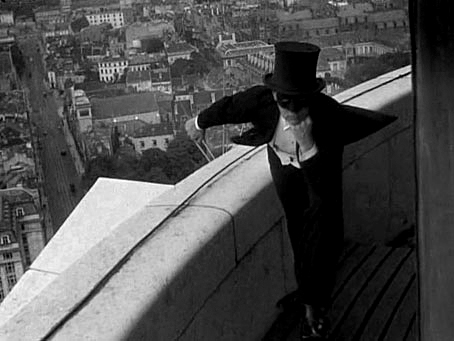
Unknown photographer René Magritte and The Barbarian (Le Barbare), London Gallery, London 1938 Original photograph 43.2 x 33.2cm (framed) Private collection, Courtesy Brachot Gallery, Brussels
René Magritte (Belgian, 1898-1967) The Flame Rekindled 1943 Oil on canvas Private collection
Reproduction in the exhibition Published under “fair use” for the purposes of academic review
Ernst Moerman (Belgian, 1897-1944) Monsieur Fantômas 1937 Film still
Published under “fair use” for the purposes of academic review
“These examples are suppositions based on an interplay of analogies. If Magritte was aware of them, he would no doubt have rejected them, preferring to see them as fortuitous coincidences. It nonetheless remains that the universe of the mind is full of borrowings whose origin often remains unsuspected; exemplars buried in memory crop back up and recompose themselves through association. It is more an atmosphere that is evoked here, in particular that of the silent movies, with a power of images that impressed the painter move than photographs, at a time when the silver screen, this mysterious wellspring, was as much a source of this power as the mirror.”
Xavier Canonne. “The imitation of photography. Magritte and the cinema[tograph],” in René Magritte: The Revealing Image, Photos and Films. LaTrobe Regional Gallery, 2017, p. 126.
Unknown photographer On the Road to Texas 1942, Brussels
Left to right: Agui Ubac, Irène Hamoir, Louis Scutenaire, Jacqueline Nonkels, Georgette and René Magritte
René Magritte – surrealistic home movie Nd
Not in the exhibition
Louis Feuillade (French, 1873-1925) Fantômas 1913
Not in the exhibition
Louis Feuillade (French, 1873-1925) was a prolific and prominent French film director from the silent era. Between 1906 and 1924 he directed over 630 films. He is primarily known for the serials Fantômas, Les Vampires and Judex.
The Fantômas serial in 1913 was his first masterpiece, the result of a long apprenticeship – during which the series with realistic ambitions, Life as it is, played a major role. It is also the first masterpiece in what the modern critic, from both a literary and a cinematographic point of view, would later call “the fantastic realism” or the “social fantastic”. He is credited with developing many of the thriller techniques used famously by Fritz Lang, Alfred Hitchcock, and others.
The series consists of five episodes, each an hour to an hour and a half in length, which end in cliffhangers, i.e., episodes one and three end with Fantômas making a last-minute escape, the end of the second entry has Fantômas blowing up Lady Beltham’s manor house with Juve and Fandor, the two heroes, still inside. The subsequent episodes begin with a recap of the story that has gone before. Each film is further divided into three or more chapters that do not end in cliffhangers.
This title of a celebrated painting by René Magritte opens the final section of the exhibition. Consisting essentially of portraits of Magritte at different stages of his life, they sometimes depict him in dreamy mood, sometimes expressing amusement, generally with his eyes closed, focused inwards. The section also includes photographs in which the painter and his friends mask their faces or turn away from the camera lens, prolonging in photographic mode his painterly research on the caché-visible (things hidden in plain sight).
Unknown photographer René Magritte 1930 Original photograph
Published under “fair use” for the purposes of academic review
Unknown photographer The Eminence Grise 1938 René Magritte on the Belgian coast Original photograph
Published under “fair use” for the purposes of academic review
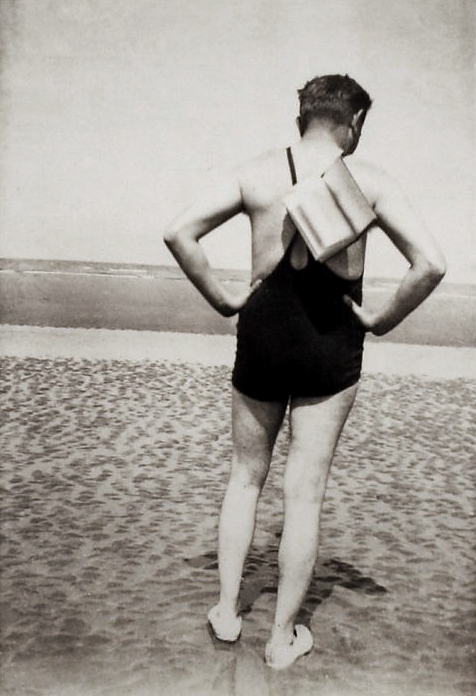
“Again at the Belgian Coast in 1938, by now in keeping with an established ritual, Magritte, having hooked an open book to the straps of his bathing suit, turns aways from the camera (The Eminence Grise).”
~ Xavier Canonne
Éminence grise: a person who exercises power or influence in a certain sphere without holding an official position.
Unknown photographer The Gladness of the Day August 1935, Lessines Original photograph Georgette Magritte, Louis Scutenaire, René Magritte
Published under “fair use” for the purposes of academic review
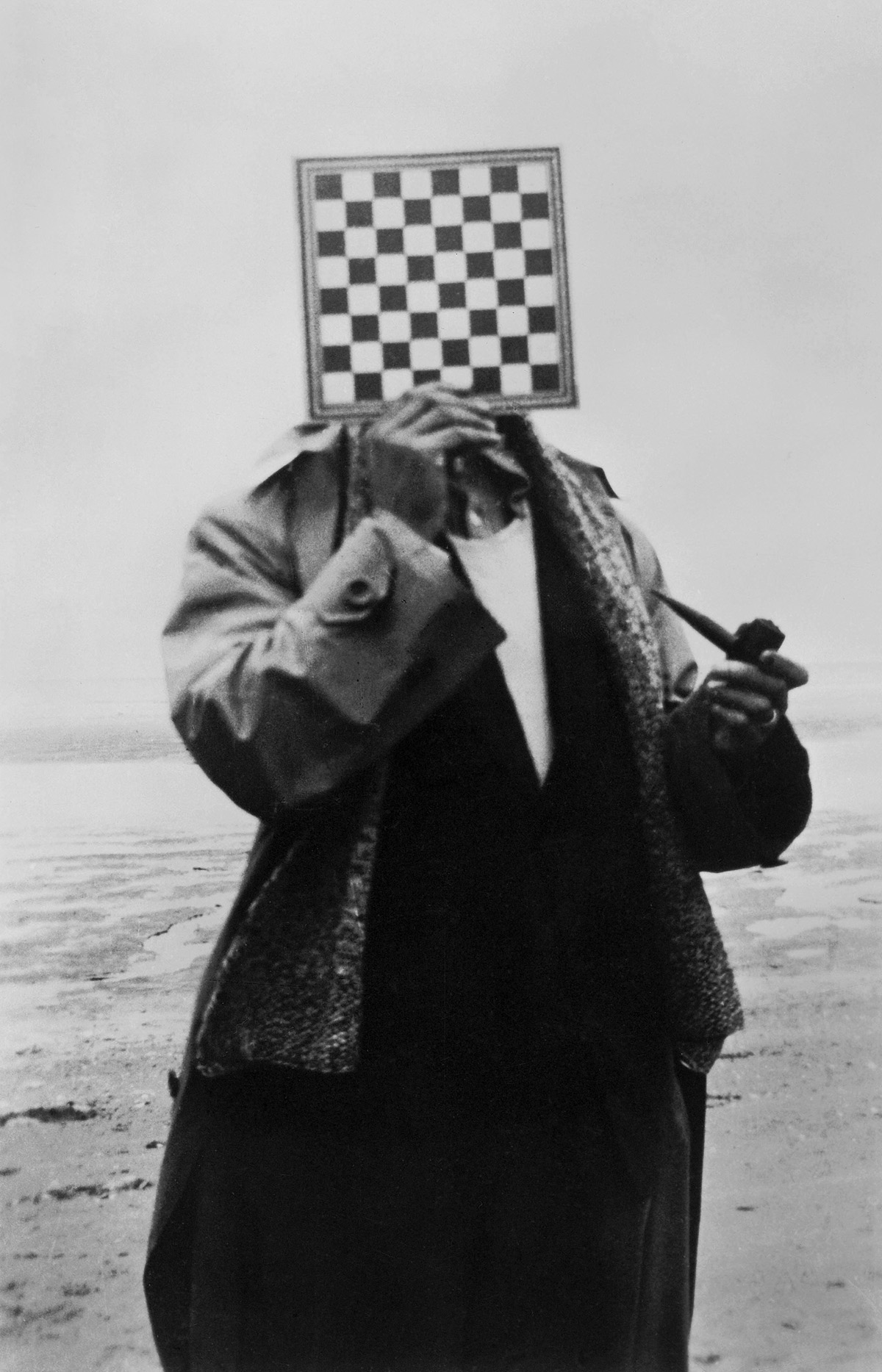
René Magritte (Belgium, 1898-1967) The Giant (Le Géant), Paul Nougé on the Belgian Coast 1937 Private collection, Courtesy Brachot Gallery, Brussels Original photograph 41.2 x 33.2cm (framed)
“Paul Nougé shields his face behind a chessboard, forcing the viewer to concentrate on the details of his clothing and the pipe he holds in his hand. Scutenaire entitled this photo The Giant, an apt title for the anti-portrait of the man who was the soul of the Brussels Surrealist group and never stopped calling for a self-effacement that favoured maximum freedom.”
~ Xavier Canonne
Paul Nougé (1895-1967), was a Belgian poet, founder and theoretician of surrealism in Belgium, sometimes known as the “Belgian Breton”. …
In November 1924 he created the journal “Correspondance”, which published 26 pamphlets up to September 1925, in collaboration with Camille Goemans and Marcel Lecomte. In July 1925 he was expelled from the party. That same year Nougé met the French surrealists, Louis Aragon, André Breton and Paul Éluard, and together they signed the tract “La Révolution d’abord et toujours” (The Revolution First and Forever), and made the acquaintance of Louis Scutenaire in 1926. September of that same year marked the drafting of the constitution of the Belgian Surrealist Group that comprised Nougé, Goemans, René Magritte, E. L. T. Mesens and André Souris.
In 1927 Nougé composed plagiarised examples of a grammar book of Clarisse Juranville, illustrated with 5 drawings by Magritte. In 1928 he founded the magazine “Distances” and wrote the poem catalogue of a fur trader that was illustrated by Magritte entitled “Le catalogue Samuel” (re-edited by Didier Devillez, Brussels, 1996). He also wrote the preface of a Magritte exhibition at the gallery “L’époque” (signed by his ‘accomplices’ Goemans, Mesens, Lecomte, Scutenaire and Souris) and delivered in January 1929 to Charleroi – a conference on the accompanying music to a concert conducted by Souris and an exhibition of Magritte (“La conférence de Charleroi”, published in 1946). Between December 1929 and February 1930 Nougé created 19 photographs, unpublished until 1968, under the title “Subversion des images”. These photographs have been displayed notably, and most recently, at the Edinburgh Art Festival 2009. In 1931 he wrote the preface to an exhibition which followed the return of Magritte to Brussels. Extracts from “Images défendues” were published in 1933 in issue number 5 of “Surréalisme au service de la Révolution”. In 1934 Nougé co-signed “L’action immédiate” in “Documents 34”, edited by Mesens. In 1935 “Le Couteau dans la plaie” (‘The Knife in the Wound’) was published and in 1936, René Magritte ou la révélation objective was published in “Les Beaux-Arts” in Brussels. In that same year, Nougé, along with Mesens, organised the exclusion of Souris from the group.
Nougé was mobilised in 1939 in Mérignac then Biarritz, during World War II, as a military nurse. In 1941 Nougé prefaced an exhibition, quickly closed by the occupying forces, of photographs by Raoul Ubac in Brussels L’expérience souveraine (The Sovereign Experience). In 1943 he published the complete text of René Magritte ou Les images défendues. In January 1944, under the pseudonym of Paul Lecharantais, he prefaced a new exhibition of Magritte that was criticised by the collaborators of nazism. In 1945 Nougé participated in the exhibition “Surréalisme” organised by the Editions La Boétie de Bruxelles gallery. In 1946 he published La Conférence de Charleroi and, under the title Élémentaires a preface for the exhibition of Magritte “Le Surréalisme en Plein Soleil” (Surrealism in Full Sunlight) at the Dietrich gallery.
Shunk Kender (Harry Shunk and Janos Kender) René Magritte and The Likeness (La Resemblance) (from The Eternally Obvious) about 1962 Private collection, Courtesy Brachot Gallery, Brussels Original photograph 41.2 x 33.2cm
“And in the living room on Rue des Mimosas, for the photographer Skunk Kender, Magritte traded his face for a panel from The Eternally Obvious (1954), replacing his features with those of a woman’s face, here again accomplishing the transmutation of a painting by a photograph: the painter substitutes his silhouette in a three-piece suit for the fragmented woman’s body in the original painting and disappears behind his work.”
~ Xavier Canonne
Shunk-Kender
The photographers Harry Shunk (German, 1924-2006) and János Kender (Hungarian, 1937-2009) worked together under the name Shunk-Kender from the late 1950s to the early 1970s, based first in Paris and then in New York. Shunk-Kender photographed artworks, events, and landmark exhibitions of avant-garde movements of the era, from Nouveau réalisme to Earth art. They were connected with a vibrant art scene that they captured through portraits of artists and participated in through collaborative projects.
The roles played by the duo varied from one project to the next. In some cases, Shunk-Kender worked as documentarians, photographing Happenings and performances; in other instances, they were collaborators, acting alongside other artists to realise works of art through photography.
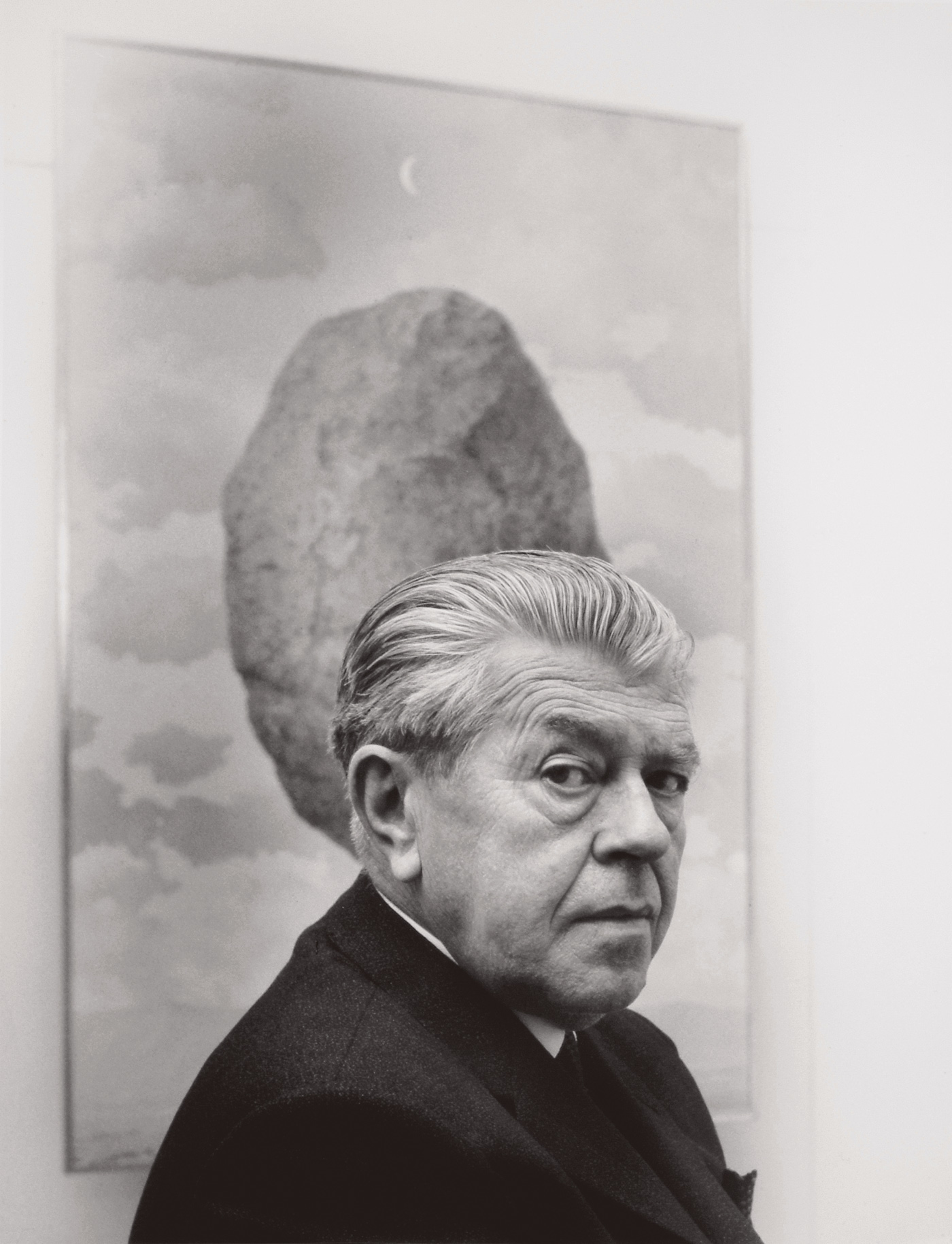
Shunk Kender (Harry Shunk and Janos Kender) René Magritte in front of ‘Le sens de réalité’ 1960 Private collection, Courtesy Brachot Gallery, Brussels Original photograph 43.2 x 33.2cm
Latrobe Regional Art Gallery 138 Commercial Road Morwell, Victoria 3840 Australia
Exhibition dates: 4th August – 21st September, 2014
Curators: Charles Silver, Curator, and Dave Kehr, Adjunct Curator, both from the Department of Film at MoMA
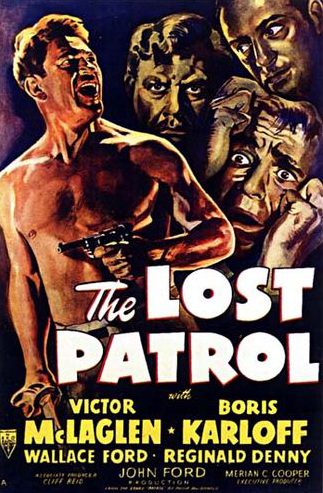
The Lost Patrol original theatrical poster
Art Blart is running hot at the moment, with lots of exhibitions finishing up around the 5th October 2014. I shall then scale things back for a while to start making a new body of my own art work. To get the ball rolling the next three postings on consecutive days feature photography and the First World War.
In this posting I have included text about each film, theatrical film posters and video to supplement the media images.
Dr Marcus Bunyan
Many thankx to the MoMA for allowing me to publish the photographs in the posting. Please click on the photographs for a larger version of the image.
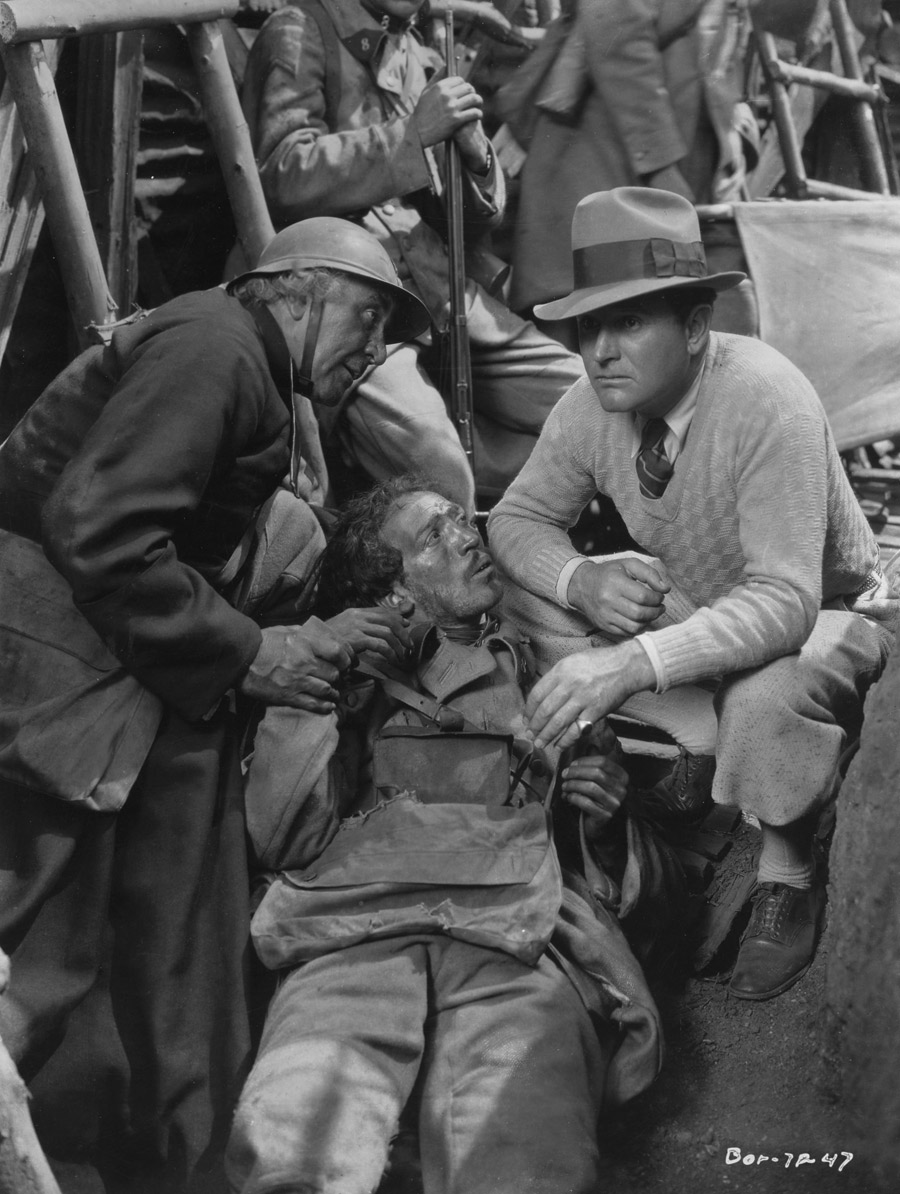
The Lost Patrol. 1934. USA. Directed by John Ford
The Lost Patrol
The Lost Patrol is a 1934 war film made by RKO. It was directed and produced by John Ford. During World War I, the commanding officer of a small British patrol in the Mesopotamian desert is shot and killed by an unseen Arab sniper, leaving the Sergeant (Victor McLaglen) at a loss, since he had not been told what their mission is. He decides to try to rejoin the brigade, though he does not know where they are or where he is.
Eventually, the eleven men reach an oasis. During the night, one of the sentries is killed, the other seriously wounded, and all their horses are stolen, leaving them stranded. One by one, the remaining men are picked off by the unseen enemy. In desperation, the Sergeant sends two men chosen by lot on foot for help, but they are caught and tortured to death, before their bodies are sent back. The pilot of a British biplane spots the survivors, but nonchalantly lands nearby and is killed before he can be warned. The men take the machine gun from the airplane and set the plane on fire in a desperate bid to signal British troops. Sanders (Boris Karloff), a religious fanatic, goes mad.
In the end, only the Sergeant is left. When the Arabs finally show themselves, he manages to kill them all with the machine gun. Moments later, another British patrol arrives, attracted by the smoke from the burning plane.
Seventh Heaven. 1927. USA. Directed by Frank Borzage
7th Heaven (1927) is a silent film and one of the first films to be nominated for the Academy Award for Best Picture (then called “Outstanding Picture”). The film was written by H.H. Caldwell (titles), Benjamin Glazer, Katherine Hilliker (titles) and Austin Strong (play), and directed by Frank Borzage.
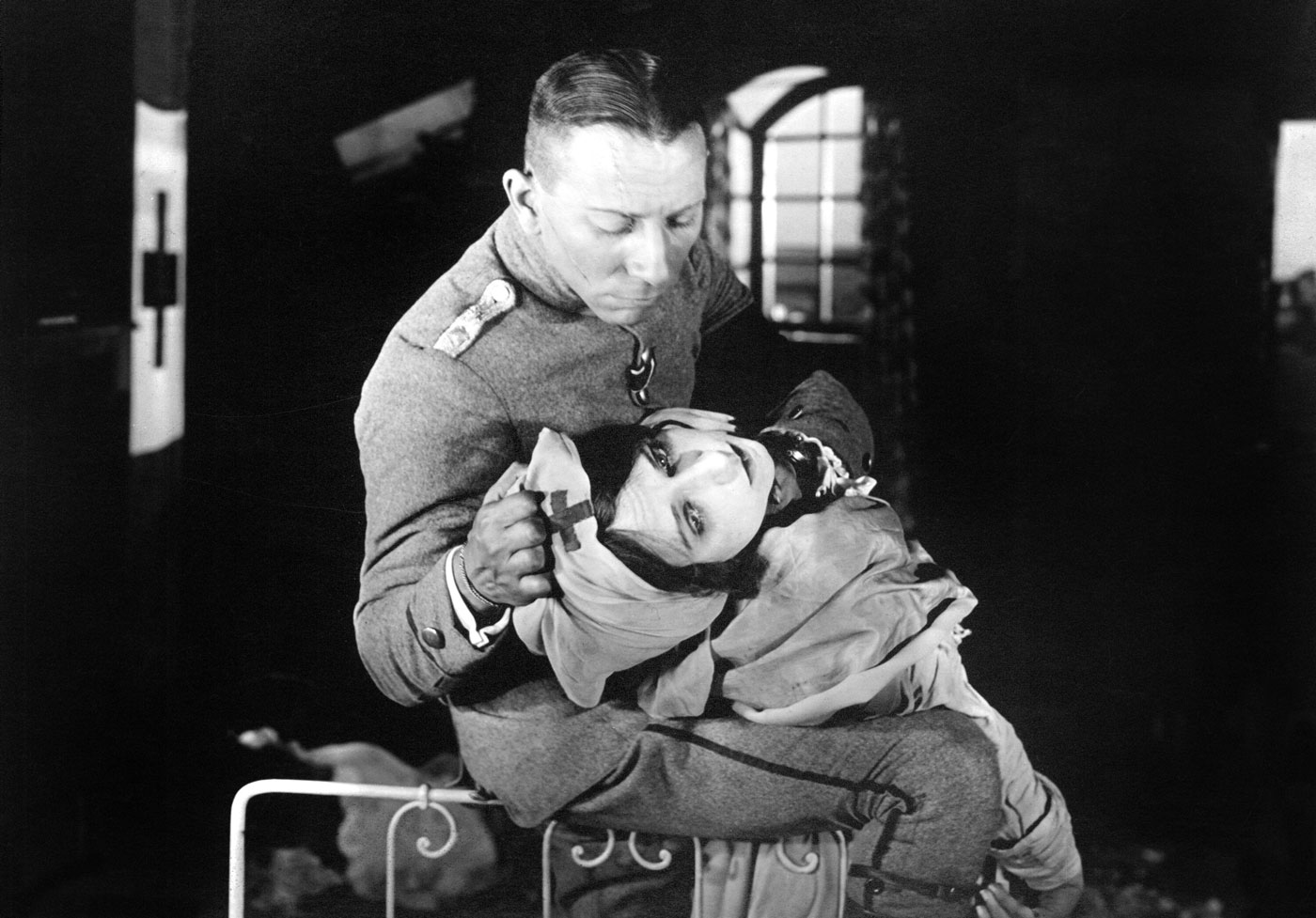
Hearts of the World. 1918. USA. Directed by D.W. Griffith
Hearts of the World. 1918. USA. Directed by D.W. Griffith
Hearts of the World
Hearts of the World (1918) is a silent film directed by D. W. Griffith, a wartime propaganda classic that was filmed on location in Britain and near the Western Front, made at the request of the British Government to change the neutral mindset of the American public.
Two families live next to one another in a French village on the eve of World War I. The Boy in one of the families falls for the only daughter in the other family. As they make preparations for marriage, World War I breaks out, and, although the Boy is American, he feels he should fight for the country in which he lives.
When the French retreat, the village is shelled. The Boy’s father and the Girl’s mother and grandfather are killed. The Girl, deranged, wanders aimlessly through the battlefield and comes upon the Boy badly wounded and unconscious. She finds her way back to the village where she is nursed back to health by The Little Disturber who had previously been a rival for the Boy’s affections. The Boy is carried off by the Red Cross. Von Strohm, a German officer, lusts after the Girl and attempts to rape her, but she narrowly escapes when he is called away by his commanding officer.
Upon his recovery, the Boy, disguised as a German officer, infiltrates the enemy-occupied village, finds the Girl. The two of them are forced to kill a German sergeant who discovers them. Von Strohm finds the dead sergeant and locates the Boy and Girl who are locked in an upper room at the inn. It’s a race against time with the Germans trying to break the door down as the French return to retake the village.
“I don’t believe that Mr. Griffith every forgave himself for making ‘Hearts of the World.’ ‘War is the villain,’ he repeated, ‘not any particular people'” said Lillian Gish, actress playing ‘The Girl’.
The Mysterious Lady. 1928. USA. Directed by Fred Niblo
The Mysterious Lady
The Mysterious Lady (1928) is an MGM silent film starring Greta Garbo, Conrad Nagel, and Gustav von Seyffertitz, directed by Fred Niblo, and based on the novel War in the Dark by Ludwig Wolff.
In Vienna, Captain Karl von Raden (Conrad Nagel) purchases a returned ticket to a sold-out opera and finds himself sharing a loge with a lovely woman (Greta Garbo). Though she repulses his first advance, she does spend an idyllic day with him in the countryside. Karl is called away to duty, however. Colonel Eric von Raden (Edward Connelly), his uncle and the chief of the secret police, gives him secret plans to deliver to Berlin. He also warns his nephew that the woman is Tania Fedorova, a Russian spy. Tania comes to him aboard the train, professing to love him, but he tells her he knows who she is. Dejected, she leaves. The next morning, when Karl wakes up, he finds the plans have been stolen. As a result, he is sentenced to military degradation and imprisonment for treason. However, Colonel von Raden visits him in prison and arranges for his release. He sends his nephew to Warsaw, posing as a Serbian pianist, to seek out the identity of the real traitor and thus exonerate himself.
In Warsaw, by chance, Karl is asked to play at a private party where he once again crosses paths with Tania. She is being escorted by General Boris Alexandroff (Gustav von Seyffertitz), the infatuated head of the Russian Military Intelligence Department. Foolhardily, Karl plays a tune from the opera they attended together. She recognises it, but does not betray him. As the party goers are leaving, she slips away for a few stolen moments with her love. The jealous Alexandroff suspects their feelings for each other. He hires Karl to play the next day at a ball he is giving at his mansion for Tania’s birthday.
While Alexandroff and Tania are alone in his home office, he receives a parcel containing the latest secrets stolen by the traitor, whom he casually identifies as Max Heinrich. Later, Tania steals the documents, gives them to Karl, and sends him out via a secret passage. However, it is all a trap. Alexandroff comes in and tells Tania that what she stole was mere blank paper; he shows her the real documents. He pulls out a gun and announces that he intends to use it on Karl, who has been captured outside. She struggles with Alexandroff and manages to fatally shoot him; the sound goes unheard amidst the merriment of the party. When the guards bring the prisoner, she pretends the general is still alive and wants to see him alone. She and Karl escape with the incriminating documents and get married.
What Price Glory. 1952. USA. Directed by John Ford
What Price Glory
What Price Glory is a 1952 American Technicolor war film based on a 1924 play by Maxwell Anderson and Laurence Stallings, though it used virtually none of Anderson’s dialogue. Originally intended as a musical, it was filmed as a straight comedy-drama, directed by John Ford and released by 20th Century Fox on 22 August 1952 in the U.S.
Broken Lullaby (The Man I Killed). 1932. USA. Directed by Ernst Lubitsch
Broken Lullaby
Broken Lullaby (1932) is an American drama film directed by Ernst Lubitsch and released by Paramount Pictures. The screenplay by Samson Raphaelson and Ernest Vajda is based on the 1930 play L’homme que j’ai tué by Maurice Rostand and its 1931 English-language adaptation, The Man I Killed, by Reginald Berkeley.
Haunted by the memory of Walter Holderlin, a soldier he killed during World War I, French musician Paul Renard (Holmes) confesses to a priest, who grants him absolution. Using the address on a letter he found on the dead man’s body, Paul then travels to Germany to find his family.
Because anti-French sentiment continues to permeate Germany, Dr. Holderlin (Barrymore) initially refuses to welcome Paul into his home, but changes his mind when his son’s fiancée Elsa identifies him as the man who has been leaving flowers on Walter’s grave. Rather than reveal the real connection between them, Paul tells the Holderlin family he was a friend of their son, who attended the same musical conservatory he did.
Although the hostile townspeople and local gossips disapprove, the Holderlins befriend Paul, who finds himself falling in love with Elsa (Carroll). When she shows Paul her former fiancé’s bedroom, he becomes distraught and tells her the truth. She convinces him not to confess to Walter’s parents, who have embraced him as their second son, and Paul agrees to forego easing his conscience and stays with his adopted family. Dr. Holderlin presents Walter’s violin to Paul, who plays it while Elsa accompanies him on the piano.
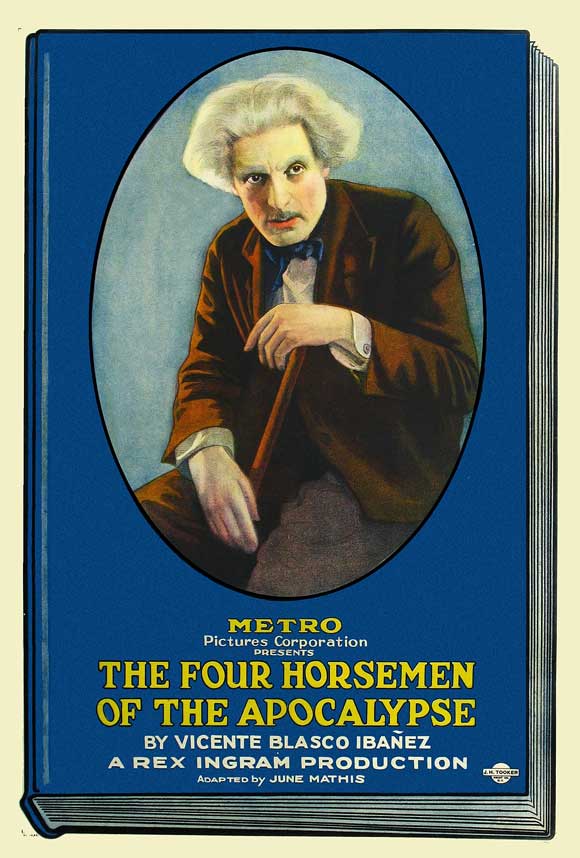
The Four Horsemen of the Apocalypse. 1921. USA. Directed by Rex Ingram
The Four Horsemen of the Apocalypse
The Four Horsemen of the Apocalypse (1921) is an American silent epic war film produced by Metro Pictures Corporation and directed by Rex Ingram. Based on the Spanish novel The Four Horsemen of the Apocalypse by Vicente Blasco Ibáñez, it was adapted for the screen by June Mathis. The film stars Pomeroy Cannon, Josef Swickard, Bridgetta Clark, Rudolph Valentino, Wallace Beery, and Alice Terry.
The film had a huge cultural impact, becoming the top-grossing film of 1921, beating out Charlie Chaplin’s The Kid, and going on to become the sixth-best-grossing silent film of all time. The film turned then-little-known actor Rudolph Valentino into a superstar and associated him with the image of the Latin Lover. The film also inspired a tango craze and such fashion fads as gauchopants. The film was masterminded by June Mathis, who, with its success, became one of the most powerful women in Hollywood at the time.
The film premiered in New York to great critical acclaim. Many critics hailed it as a new Birth of a Nation. However, the German press was less enthused with the portrayal of Germans in the film. With its extended scenes of the devastated French countryside and personalised story of loss, The Four Horsemen of the Apocalypse is often considered to be one of the first anti-war films made.
Four Horsemen of the Apocalypse Metro Pictures poster for the film (1921)
Opening on the 100th anniversary of the day World War I began, The Museum of Modern Art’s The Great War: A Cinematic Legacy runs from August 4 through September 21, 2014, highlighting 60 feature-length films and thematic programs that attempt to provide a comprehensive view of the war as portrayed in film. The various films focus on prewar activities; espionage; the battlefields in the trenches, in the air, and on and beneath the sea; actualités; and the various homefronts before, during, and after the war. Familiar films, such as A Farewell to Arms (1932) and Lawrence of Arabia (1962), along with several lesser-known works from as far away as New Zealand – including Chunuk Bair (1992) – reflect the universality of a war that reshaped the prevailing values of what passed for civilisation. In August, the program is predominately drawn from the early years, either during the war or in the succeeding decades, and includes several silent films. The program in September will concentrate mainly on later, more contemporary films up to, and including, Steven Spielberg’s War Horse (2011). The Great War is organised by Charles Silver, Curator, with Dave Kehr, Adjunct Curator, Department of Film, The Museum of Modern Art.
Many of the films in the series deal with the entrenched stalemate in France, including Verdun, Vision d’Histoire (Verdun, Vision of History) (1928) directed by Leon Poirier. The film, largely pacifist in nature, is based on the great 1916 battle and integrates actual footage with realistic restaged material using many actors who had been soldiers in the war. Similarly, Les Croix de bois (Wooden Crosses) (1932), directed by Raymond Bernard, forms something of a pacifist trench-based trio with Lewis Milestone’s All Quiet on the Western Front (1930) and G. W. Pabst’s Westfront 1918 (1930). The Oscar-winning All Quiet on the Western Front, adapted from the novel by Erich Maria Remarque, depicts the disillusionment of German youth after experiencing the realities of war.
Another series of films highlights the importance of aviation in the war. William Wellman’s Wings (1927) was the first film to win the Oscar for Best Picture. The romantic action-war film, which effectively launched Gary Cooper’s career, features the story of a pair of American pilots fighting over Europe. The film was praised for its spectacular aerial sequences, which have an added air of authenticity because Wellman was himself an ace pilot with the Lafayette Escadrille and winner of the Croix de Guerre. Hell’s Angels (1930), directed by Howard Hughes, includes lavishly produced scenes of aerial warfare and Zeppelin bombing. Howard Hawks’s Dawn Patrol (1930) emphasises the tension of a commander sending men on suicidal aerial missions in flying crates. Lilac Time(1928), from George Fitzmaurice, stars Cooper as a British aviator in a squadron based in France, who falls in love with a farmer’s daughter.
Several of the newer films in the exhibition exemplify how the horrors of the war have had a lasting effect on civilisation. Steven Spielberg’s War Horse (2011), an adaptation of Michael Morpurgo’s children’s novel about a thoroughbred in France, reminds us that war, and particularly World War I, is also a horror for non-human creatures. In My Boy Jack (2007), directed by Brian Kirk, Rudyard Kipling pulls strings to get his son John sent to France early in the war. Based on a play by David Haig, the film ends tragically at the Battle of Loos. Joyeux Noel (Merry Christmas) (2005), directed by Christian Carion, is a moving re-creation of a Christmas truce on the 1914 battlefield in France, as German, British, and French soldiers fraternise and exchange gifts.
Special thanks to Pacific Film Archive, Janus Films, Universal Pictures, Turner Classic Movies, Pathe.
Press release from the MoMA website
Friendly Enemies. 1942. USA. Directed by Allan Dwan
The Great Dictator. 1940. USA. Directed by Charles Chaplin
The Great Dictator
The Great Dictator is a 1940 American satirical political comedy-drama film starring, written, produced, scored, and directed by Charlie Chaplin, following the tradition of many of his other films. Having been the only Hollywood filmmaker to continue to make silent films well into the period of sound films, this was Chaplin’s first true talking picture as well as his most commercially successful film.
At the time of its first release, the United States was still formally at peace with Nazi Germany. Chaplin’s film advanced a stirring, controversial condemnation of Adolf Hitler, Benito Mussolini’s fascism, antisemitism, and the Nazis. Chaplin’s film followed only nine months after Hollywood’s first parody of Hitler, the short subject You Nazty Spy! by the Three Stooges which itself premiered in January 1940, although Chaplin had been planning it for years before. Hitler had been previously allegorically pilloried in the German film by Fritz Lang, The Testament of Dr. Mabuse. In his 1964 autobiography, Chaplin stated that he would not have made the film had he known about the actual horrors of the Nazi concentration camps at the time.
The Heart of Humanity. 1919. USA. Directed by Allen Holubar
The Heart of Humanity
The Heart of Humanity is a 1918 American silent war propaganda film produced by Universal Pictures and directed by Allen Holubar. The film stars Dorothy Phillips, William Stowell and Eric von Stroheim. A copy of the film is preserved at the EmGee Film Library and in private collections.
The film “follows the general theme and construction of [D. W. Griffiths’s film] Hearts of the World and, in places, parallels [its] plot”. The film was made toward the end of World War I and is known for showcasing von Stroheim as a lecherous ‘Hun’. The most notorious scene from this movie is the depiction of a near-rape prior to the defenestration of a crying baby.
Kameradschaft (Comradeship). 1931. Germany. Directed by G. W. Pabst
Kameradschaft – Georg Wilhelm Pabst, 1931
Coal – camaraderie, in the literal translation of the original title – is based on a reconstruction of a mine disaster that occurred in Courrières near the French-German border in 1906. Fire has broken out on the French side. The necessary equipment to combat it is lacking. All facilities are available on the adjacent German side which has been separated by an underground fence since 1919.
Comradeship
Comradeship (German: Kameradschaft, known in France as La Tragédie de la mine) is a 1931 dramatic directed by Austrian director G. W. Pabst. The French-German co-production drama is noted for combining expressionism and realism.
The picture concerns a mine disaster where German miners rescue French miners from an underground fire and explosion. The story takes place in the Lorraine / Saar region, along the border between France and Germany. It is based on an actual historical event, one of the worst industrial accidents in history, the Courrières mine disaster in 1906 in Courrières, France, where rescue efforts after a coal dust explosion were hampered by the lack of trained mine rescuers. Expert teams from Paris and Germany – miners from the Westphalia region – came to the assistance of the French miners. There were 1,099 fatalities, including children.
Kameradschaft in German means a bond between soldiers or those who have similar opinions and are in friendship. The word is similar to comradeship, camaraderie or fellowship.
In 1919, at the end of World War I the border between France and Germany changes, and an underground mine is split in two, with a gate dividing the two sections. An economic downturn and rising unemployment adds to tension between the two countries, as German workers seek employment in France but are turned away, since there are hardly enough jobs for French workers. In the French part of the mine fires break out, which they try to contain by building many brick walls, with the bricklayers wearing breathing apparatus. The Germans continue to work on their side, but start to feel the heat from the French fires.
Three German miners visit a French dance hall and one of them almost provokes a fight when Francoise (Andree Ducret), a young French woman, refuses to dance with him. The rejected miner thinks it’s because he’s German, but it’s actually because she’s tired. She and her boyfriend, Emile (Georges Charlia), a miner, leave, and she expresses her distress over the stories about fires and explosions in the mine. The next morning, he stops in to say goodbye to her before she leaves for Paris, then he and her brother, Jean (Daniel Mendaille), another miner, leave for work.
The fire gets out of control, causing an explosion that traps many French miners. In response, Wittkopp (Ernst Busch) appeals to his bosses to send a rescue team. As they ride out of town to help, the leader of the German rescue effort explains to his wife that the French are men with women and children and he would hope that they would come to his aid in similar circumstances. The trio of German miners breaks through the gate that marks the 1919 border. On the French side, an old retired miner (Alex Bernard) sneaks into the shaft hoping to rescue his young grandson (Pierre-Louis).
The Germans successfully rescue the French miners, not without difficulties. After all the survivors are rescued, there’s a big party with speeches about friendship between the French and Germans. French officials then rebuild the mining gate, and things return to the way they were before the disaster and rescue.
When the film was released in the United States in 1932, Mordaunt Hall, film critic for the New York Times, praised the realism and the screenplay, writing “[Kameradschaft is] one of the finest examples of realism that has come to the screen … [the] scenes in the mine are so real that one never thinks of them as being staged … [and] [t]hroughout the length of this tale of horror one feels as though one were permitted through some uncanny force to look into all parts of the mine … All the noises and sounds are wonderfully natural.”
The Road Back is a 1937 drama film made by Universal Pictures, directed by James Whale. The screenplay is by Charles Kenyon and R. C. Sherriff from the eponymous novel by Erich Maria Remarque. Combining a strong anti-war message with prescient warnings about the dangers of the rising Nazi regime, it was intended to be a powerful and controversial picture, and Universal entrusted it to their finest director, James Whale.
The novel on which the film is based was banned during Nazi rule. When the film was made, Universal Pictures was threatened with a boycott of all their films by the German government unless the anti-Nazi sentiments in the script were watered down. Carl Laemmle and his son, Carl Laemmle, Jr., the former heads of Universal, had recently been ousted by a corporate takeover. The new studio heads, fearing financial loss, caved in to German pressure and the film was partially reshot with another director, and the remainder extensively re-edited, leaving it a pale shadow of Whale’s original intentions. To the director’s further displeasure, writer Charles Kenyon was ordered to interject the script with comedy scenes between Andy Devine and Slim Summerville, which Whale found unsuitable. Disgusted with the studio’s cowardice under its new management, Whale left Universal after completing Wives Under Suspicion, an unsuccessful remake of his own The Kiss Before the Mirror. He returned two years later to direct Green Hell, but never made another film for Universal after that.
The Secret Agent. 1936. Great Britain. Directed by Alfred Hitchcock
Secret Agent
Secret Agent (1936) is a British film directed by Alfred Hitchcock, loosely based on two stories in Ashenden: Or the British Agent by W. Somerset Maugham. The film starred John Gielgud, Peter Lorre, Madeleine Carroll, and Robert Young. Future star Michael Redgrave made a brief, uncredited appearance; he would play the male lead in Hitchcock’s The Lady Vanishes two years later. This was also Michael Rennie’s film debut (uncredited).
Gielgud plays a British officer, a famous writer whose death is faked during World War I, and who is sent by the mysterious “R”, head of British intelligence, to Switzerland on a secret mission. Carroll plays a female agent who poses as his wife. Lorre appears as a British agent working with them, a killer known variously as “the Hairless Mexican” and “the General”. Typical Hitchcockian themes used here include mistaken identity and murder.
Tell England (The Battle of Gallipoli). 1931. Great Britain. Directed by Anthony Asquith, Geoffrey Barkas
Tell England
Tell England is a 1931 British drama film directed by Anthony Asquith and Geoffrey Barkas and starring Fay Compton, Tony Bruce and Carl Harbord. It is based on the novel Tell England by Ernest Raymond which featured two young men joining the army, and taking part in the fighting at Gallipoli. Both directors had close memories of Gallipoli, as did Fay Compton’s brother, Compton Mackenzie. Asquith’s father Herbert Asquith had been Prime Minister at the time of the Gallipoli Landings, a fact which drew press attention to the film, while Barkas had personally fought at Suvla Bay in the Gallipoli campaign. In the United States it was released under the alternative title The Battle of Gallipoli.








![René Magritte (Belgium 1898-1967) 'Les Amants [The lovers]' 1928](https://artblart.com/wp-content/uploads/2017/10/magritte-the-lovers-web.jpg "René Magritte (Belgium 1898-1967) 'Les Amants [The lovers]' 1928")




















 Art Blart _ art and cultural memory archive
You must be logged in to post a comment.