Exhibition: ‘Francesca Woodman and Julia Margaret Cameron: Portraits to Dream In’ at the National Portrait Gallery, London

Exhibition dates: 21st March – 16th June 2024

Curator: Magdalene Keaney


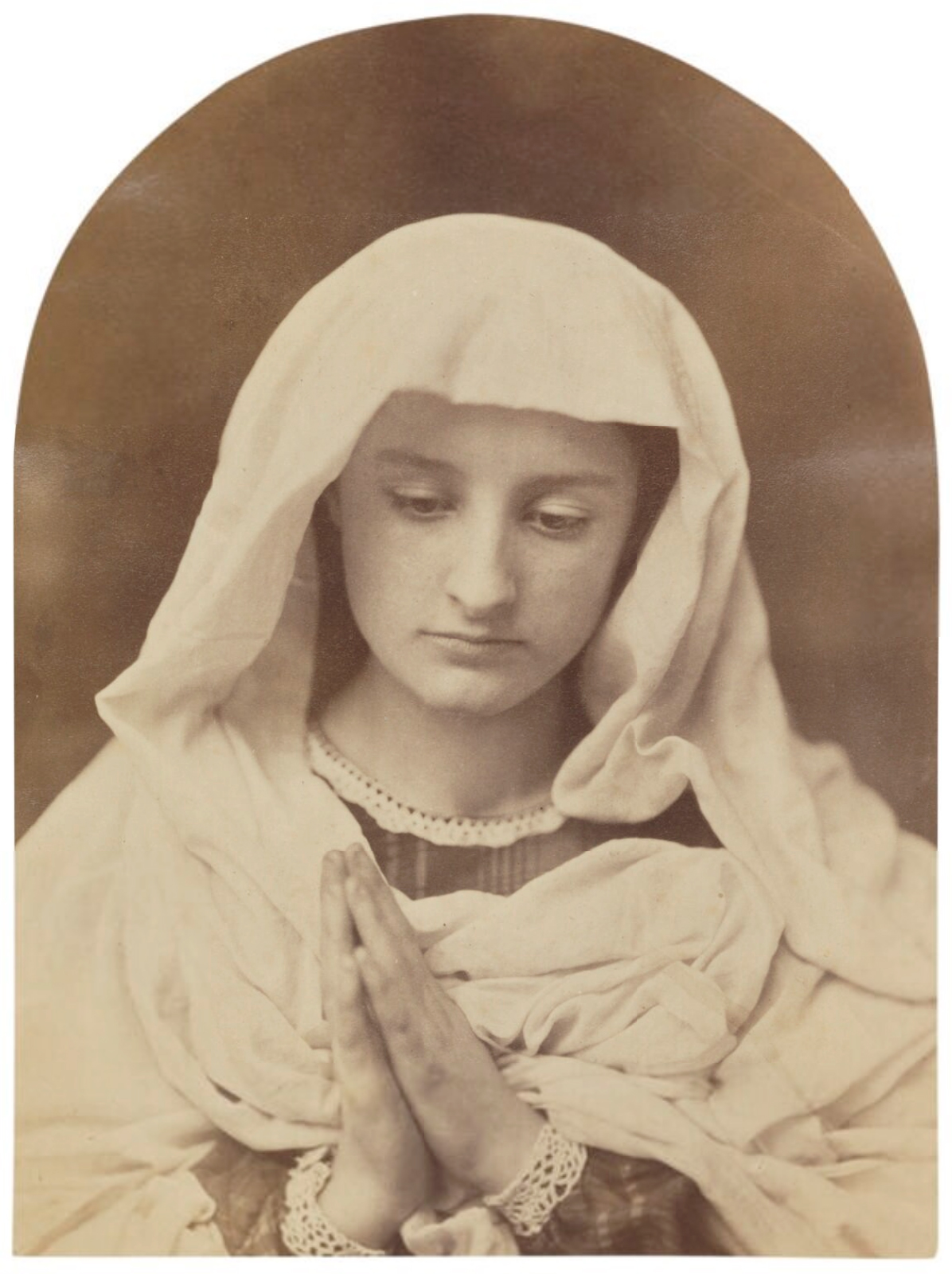
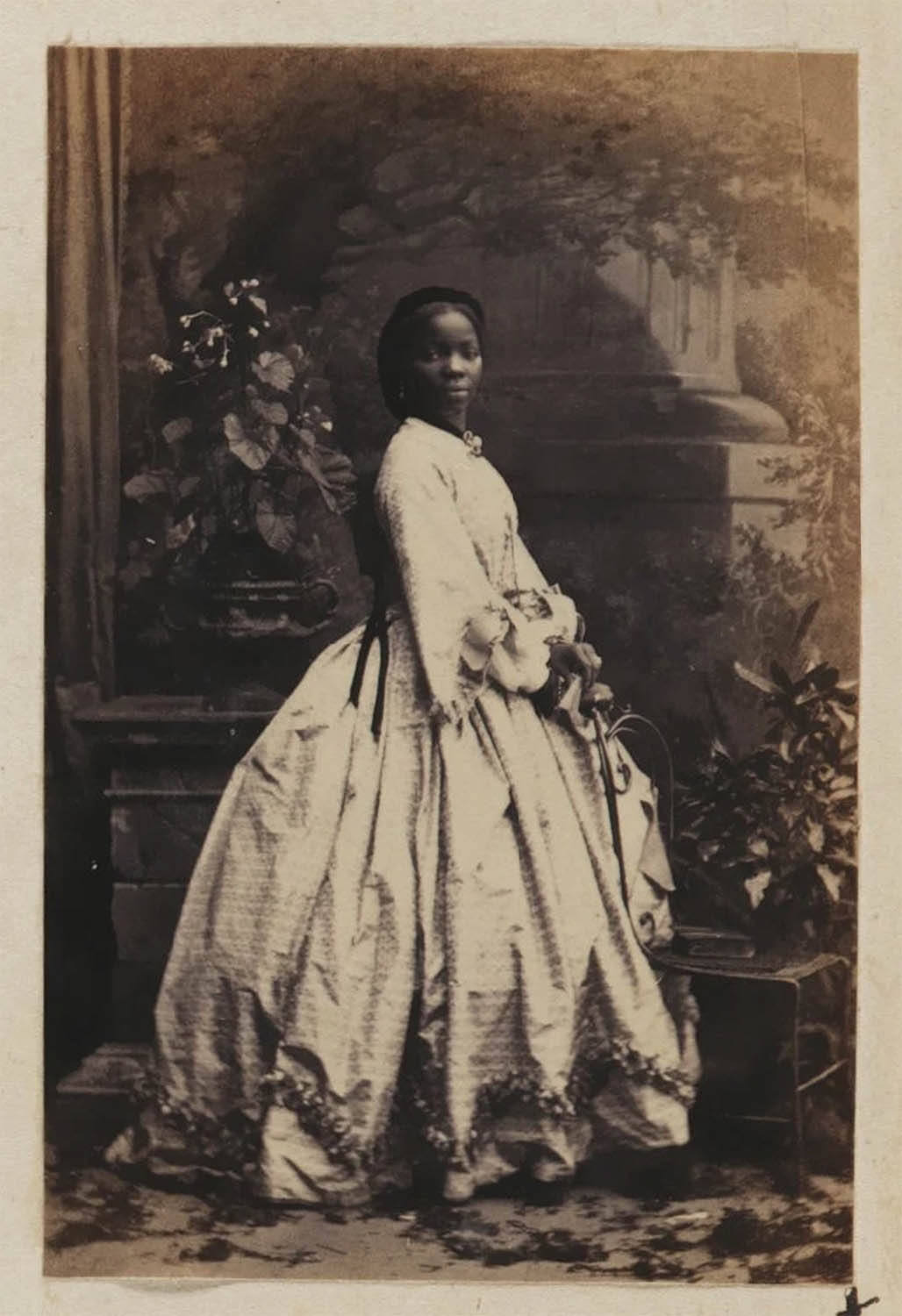
Julia Margaret Cameron (British born India, 1815-1879) 'The Dream (Mary Hillier)' 1869


Julia Margaret Cameron (British born India, 1815-1879)
The Dream (Mary Hillier)
1869
Albumen silver print
Wilson Centre for Photography


Mary Ann Hilliar was born on the Isle of Wight, and as well as being Julia Margaret Cameron’s favourite model was employed by her as a house maid. She often poised in religious themed photos looking noble and melancholy. As well as modelling for Mrs Cameron she was painted by G F Watts.

She married Thomas Gilbert and had 8 children, descendants of whom still live on the Isle of Wight. Mary Ann lived to the age of 88, although in her later years she suffered badly from rheumatism and was almost blind due to cataracts. She is buried just a few feet away from the Tennyson grave.

Text from the National Portrait Gallery website


Otherworldy beings: the materialisations and transformations of Francesca Woodman and Julia Margaret Cameron

To pair these two artists together is curatorial inspiration from the gods!

In both artist’s work the notion of materialisation (the process of coming into being) and transformation is a powerful creative tool.

Cameron‘s photographs are exterior to the artist, outward facing creations which capture in the sitter an emanation of spirit. These ethereal creatures mainly based on biblical, mythological, or literary figures … these beautiful apparitions who seem to hover before us were, at the time, seen as radical photographs. Their striking presences and emotive sensibility create a psychological connection with the viewer, photographs imaged / imagined as if they were seen in a dream.

“Cameron’s portraits are famously a pictorialist stagecraft: a pantomime of Christian archetypes, Pre-Raphaelite aesthetics, and the influence of contemporary poets such as Shelley, Keats and Tennyson. What would be considered as potential subject matter for this nascent thirty-year-old medium was formative and cautious, and the conventions of beauty and gender, static” opines Stephen Frailey in an article commenting on the exhibition on the Aperture website (see below). Nothing could be further from the truth.

The artist envisions CHIMERICAL CREATURES. At the time of their production, Cameron’s shimmering portraits were seen as anything but cautious, they were seen as radical and ephemeral: a unique vision, different from everyone else: “directed light, soft focus, and long exposures that allowed the sitters’ slight movement to register in her pictures, instilling them with a sense of breath and life.”1 And, despite their soft focus, I believe that they are never “Pictorialist” photographs – they are “modern” photographs of a radical nature which may have later influenced the Pictorialist aesthetic. As I have commented before,

“She has, of course, been seen as a precursor to Pictorialism, but personally I do not get that feeling from her photographs, even though the artists are using many of the same techniques. Her work is based on the reality of seeing beauty, whereas the Pictorialists were trying to make photography into art by emulating the techniques of etching and painting. While the form of her images owes a lot to the history of classical sculpture and painting, to Romanticism and the Pre-Raphaelites, she thought her’s was already art of the highest order. She did not have to mask its content in order to imitate another medium. Others, such as the curator of the exhibition Marta Weiss, see her as a proto-modernist, precursor to the photographs of Stieglitz and Sander and I would agree. There is certainly a fundamental presence to JMC’s photographs, so that when you are looking at them, they tend to touch your soul, the eyes of some of the portraits burning right through you; while others, others have this ambiguity of meaning, of feeling, as if removed from the everyday life.”2

Contemporary commentators condemned Cameron’s photographs for sloppy craftsmanship (they were out of focus, the plates contained fingerprints, dust, debris, streak marks and swirls of collodion on her negatives). Others mocked her for claiming to have photographed a historical figure ‘from the life’. The kinds of images being made at the time did not interest Cameron. The artist would focus her lens until she thought the subject was beautiful “instead of screwing on the lens to the more definite focus which all other photographers insist upon.” (JMC) “Her photographic vision was a rejection of ‘mere conventional topographic photography – map-making and skeleton rendering of feature and form’ in favour of a less precise but more emotionally penetrating form of portraiture.”3

Woodman‘s photographs are interior to the artist, inward facing creations which capture her/self and the female form in space as a flux or metamorphosis of spirit.

“Francesca Woodman’s photographs explore issues of gender and self, looking at the representation of the body in relation to its surroundings. She puts herself in the frame most often, although these are not conventional self-portraits as she is either partially hidden, or concealed by slow exposures that blur her moving figure into a ghostly presence.”4

They promote in the attentive viewer a ghostly insistence that you could be her – in vulnerability, in presence, in fear of suffering, for our death. Who are we that is represented, what is our place in this lonely world, how do we interact with our shadow? They offer glimpses of another, dream-like world, the microcosm of a life focusing a lens on (her) infinite spirit.

“The artist is a CHIMERICAL CREATURE. Imaginary, visionary. Woodman’s transformations, her interior elements, become part of the wall or the house. She vanishes “from the room, out of the picture, at any given second.”5 A preoccupation with the body / her own body, and the dichotomy of subject-object, also adds multiple meanings and complexity to Woodman’s work. Her many angel images (and also images of umbrellas – Mary Poppins was released in 1964 when Woodman was growing up) suggest movement and the ability to fly, a fascination that found its ultimate expression when she jumped off a building in lower Manhattan at the age of 22.”6

Both Cameron, a woman taking photographs for just fifteen years within the first twenty five years of the birth of commercial photography, using rudimentary technology and chemicals – and Woodman, a woman taking photographs for just eight years, whose practice of staging her body and her face in interior spaces so influenced a later generation of female artists – have left an indelible mark on the history of photography and identity formation.

Working “at times when women were marginal in the history of art and photography” both women are now regarded as important artists, in the upper echelons of photographers who have ever lived. The unique quality of their work shines through, each materialising a distinctive handwriting  which could only ever be a Cameron or  a Woodman (the atmospheric radiance of the one and a sense of vulnerability in the other). In their photographs I feel the transformative potential of that vision (it rumbles through my body, it impinges on my consciousness). Their ability to see things not as others see them, away from the too-rough fingers of the world.

Oh how I would like to see this exhibition in the flesh, to observe the synergies and differences between both artist’s works, to listen to the conversations across time and space through centuries of art practice. I will just have to buy the catalogue instead, but that is no substitute  for physically standing in front of their “beautiful, subtle, intricate, and beguiling” prints.

To feel the vibrations of energy from these otherworldy beings…

Dr Marcus Bunyan


1/ Press release from the exhibition Julia Margaret Cameron at The Metropolitan Museum of Art, New York, August 2013 – January 2014

2/ Marcus Bunyan. “The road less travelled,” on the exhibition ‘Julia Margaret Cameron: from the Victoria and Albert Museum, London’ at the Art Gallery of New South Wales (AGNSW), Sydney on the Art Blart website 24th October 2015 [Online] Cited 11/06/2024

3/ Anonymous. “A Study of the Cenci,” on the V&A website Nd [Online] Cited 11/06/2024

4/ Text from the Scottish National Gallery of Modern Art website [Online] Cited 25/06/2009. No longer available online

5/ Anna Tellgren. Francesca Woodman: On Being an Angel (50kb pdf). 2015, p. 11

6/ Marcus Bunyan. “The artist as chimerical creature,” on the exhibition ‘Francesca Woodman. On Being an Angel’ at Moderna Museet, Stockholm on the Art Blart website 4th December 2015 [Online] Cited 11/06/2024

Other exhibitions on Julia Margaret Cameron and Francesca Woodman on Art Blart


Many thankx to the National Portrait Gallery for allowing me to publish the photographs in the posting. Please click on the photographs for a larger version of the image.


The Dream Keeper

Bring me all of your dreams,
You dreamers,
Bring me all of your
Heart melodies
That I may wrap them
In a blue cloud-cloth
Away from the too-rough fingers
Of the world


Langston Hughes


Major exhibition at the National Portrait Gallery to showcase rare vintage prints by two of art history’s most influential photographers – Francesca Woodman and Julia Margaret Cameron

More than 160 rare vintage prints will be exhibited as part of Francesca Woodman and Julia Margaret Cameron: Portraits to Dream In, as the two photographers – who worked 100 years apart – are presented in parallel for the first time.

The exhibition will present a thematic exploration of the photographic work produced throughout both artists’ entire careers, including their best known and less familiar work. Artist’s books by Francesca Woodman, which have never been exhibited in the UK, will be on display.
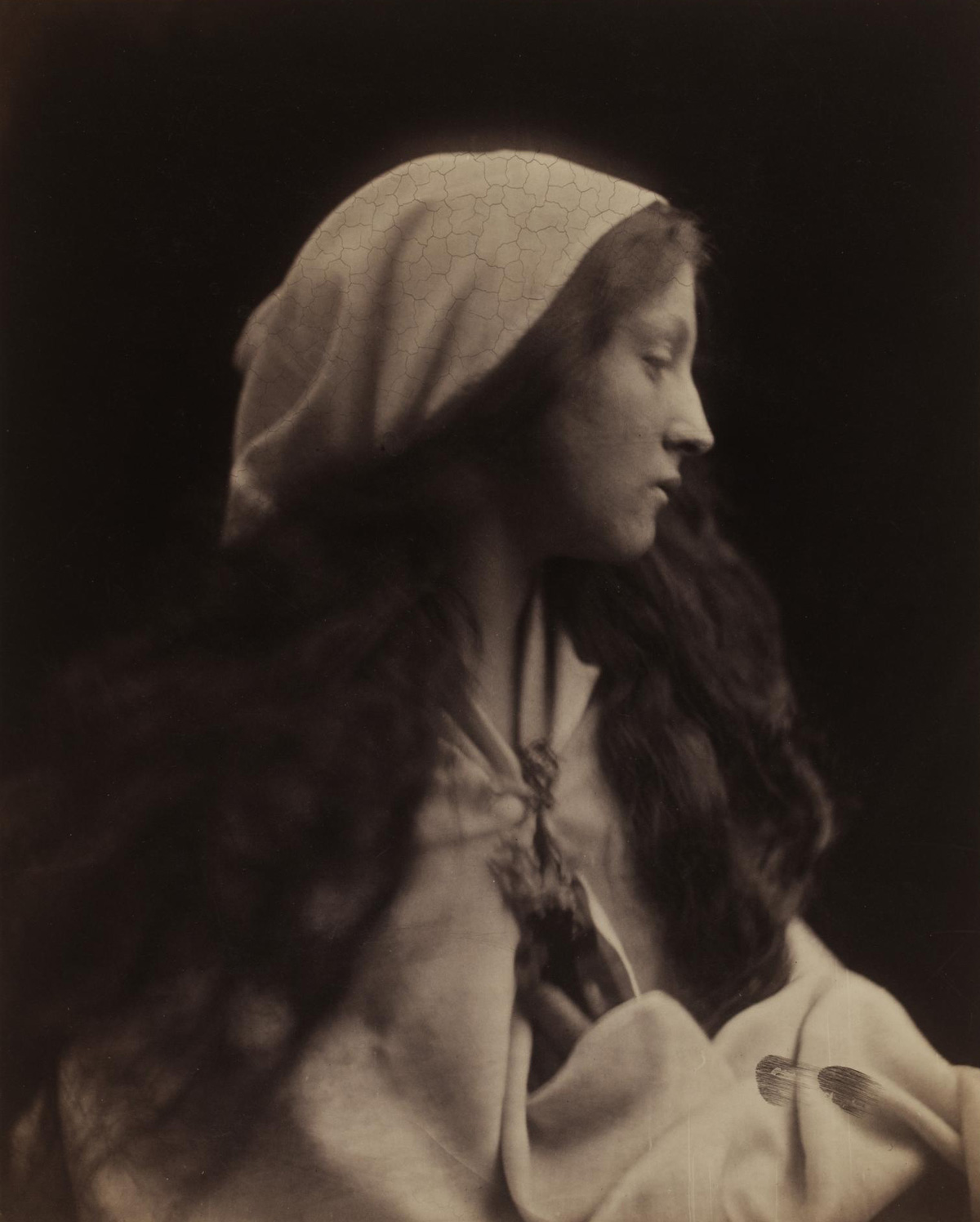
 

Julia Margaret Cameron. 'The Dream' 1869


Julia Margaret Cameron (British born India, 1815-1879)
The Dream
1869
Albumen print from wet collodion glass negative
Given by Alan S. Cole, 19 April 1913
© Victoria and Albert Museum, London


John Milton’s poem On his deceased Wife (about 1658) tells of a fleeting vision of his beloved returning to life in a dream.


L-R: 'The Dream (Mary Hillier)' by Julia Margaret Cameron, 1869; 'Untitled', 1979 by Francesca Woodman; 'Annie (My very first success in Photography)', by Julia Margaret Cameron, 1864; 'Self Portrait' at Thirteen by Francesca Woodman, 1972


L-R: The Dream (Mary Hillier) by Julia Margaret Cameron, 1869. Wilson Centre for Photography; Untitled, 1979 by Francesca Woodman. Courtesy Woodman Family Foundation © Woodman Family Foundation / DACS, London; Annie (My very first success in Photography), by Julia Margaret Cameron, 1864. The J. Paul Getty Museum, Los Angeles; Self Portrait at Thirteen by Francesca Woodman, 1972. Courtesy Woodman Family Foundation © Woodman Family Foundation / DACS, London


This spring, the National Portrait Gallery in London has staged an unexpected pairing of Francesca Woodman and Julia Margaret Cameron, whose bodies of photographic work were made a hundred years apart. The lushly titled Portraits to Dream In, the result of a thoughtful and imaginative curatorial inquiry, provides a compelling guide to their posthumous resemblances and describes a cultural arc of Romanticism from the mid-nineteenth-century to the turn of the twentieth, from luminous and pastoral to haunted and opaque. Both artists were engaged with the past, and the exhibition places them in a shared classicism of figuration and myth – a revelatory insight for Woodman. Both practiced photography for less than fifteen years. Both of their biographies often eclipse their critical reception. At times their congruence feels magnetic; at times their differences are as illuminating as their similarities.

The exhibition is organised by curator Magda Keaney in tidy themes that support affinities between the two women, among them “Angels and Otherworldly Beings,” “Mythology,” “Doubling,” and “Nature and Femininity.” Much of this is informative and, indeed, suggests a universal lexicon beyond this survey of dual sensibilities. Some of the rhymes are less plausible: a section entitled “Men” fails to persuade that Cameron’s depictions of eminent male political and cultural figures mirror Woodman’s male portraits. Unclothed men make rare appearances in Woodman’s photographs, where they do little to diminish the images as self-portraits. Festooned with a seashell, egg, pomegranate, or dead bird, the men serve as playful surrogates for the photographer herself.

Portraits to Dream In is an occasion to revel in the sumptuous texture of the photographic print, born from technologies decades apart. For both photographers, darkroom manipulation and tactility contribute to the pictures’ emotional mood, however diametric. For Cameron, the shallow depth of field and long shutter speed of the glass plate negative and wet collodion process renders a picture that flutters as if provisional, a vision subject to light glinting off an immaterial surface. They are as ethereal and transparent as Woodman’s are submersed in shadow; a moth bounding away from flame. One body of work, despite its soft patina, feels rooted in a sense of presence, the other by absence: fraught and confessional without evident disclosure.

Extract from Stephen Frailey. “An Unexpected Pairing of Francesca Woodman and Julia Margaret Cameron,” on the Aperture website May 16, 2024 [Online] Cited 03/06/2024


L-R: 'The Dream (Mary Hillier)' by Julia Margaret Cameron, 1869; 'Untitled', 1979 by Francesca Woodman


L-R: The Dream (Mary Hillier) by Julia Margaret Cameron, 1869. Wilson Centre for Photography; Untitled, 1979 by Francesca Woodman. Courtesy Woodman Family Foundation © Woodman Family Foundation / DACS, London


L-R: 'Annie (My very first success in Photography)', by Julia Margaret Cameron, 1864; 'Self Portrait at Thirteen' by Francesca Woodman, 1972


L-R: Annie (My very first success in Photography), by Julia Margaret Cameron, 1864. The J. Paul Getty Museum, Los Angeles; Self Portrait at Thirteen by Francesca Woodman, 1972. Courtesy Woodman Family Foundation © Woodman Family Foundation / DACS, London


Francesca Woodman (American, 1958-1981) 'Untitled' 1979


Francesca Woodman (American, 1958-1981)
Untitled
1979
Courtesy Woodman Family Foundation
© Woodman Family Foundation/DACS London


Julia Margaret Cameron (British born India, 1815-1879) 'Annie (My very first success in Photography)' 1864


Julia Margaret Cameron (British born India, 1815-1879)
Annie (My very first success in Photography)
1864
Albumen silver print
A photographic portrait of Annie Wilhemina Philpot (1857-1936)
The J. Paul Getty Museum, Los Angeles


A photographic portrait of Annie Wilhemina Philpot (1857-1936), taken by Julia Margaret Cameron (1815-1879) in 1864. This albumen print forms part of the Herschel Album, created by Cameron for her friend Sir John Herschel (1792-1871). Annie was the daughter of Rev. William Benamin Philpot, a poet and friend of Alfred Tennyson (1809-1892).

Julia Margaret Cameron is one of the most significant figures in nineteenth century photography. Born in Calcutta, she moved to Britain where she lived at Freshwater on the Isle of Wight. In 1863, aged forty-eight, she was given a camera by her daughter as a gift. From then on she took portraits of her family, friends and servants, as well as many eminent Victorians. Cameron was strongly influenced by classical art and many of her portraits are pictorial allegories based on religious or literary themes. In 1875 Cameron moved to Sri Lanka (Ceylon), where she died.

Text from the V&A website


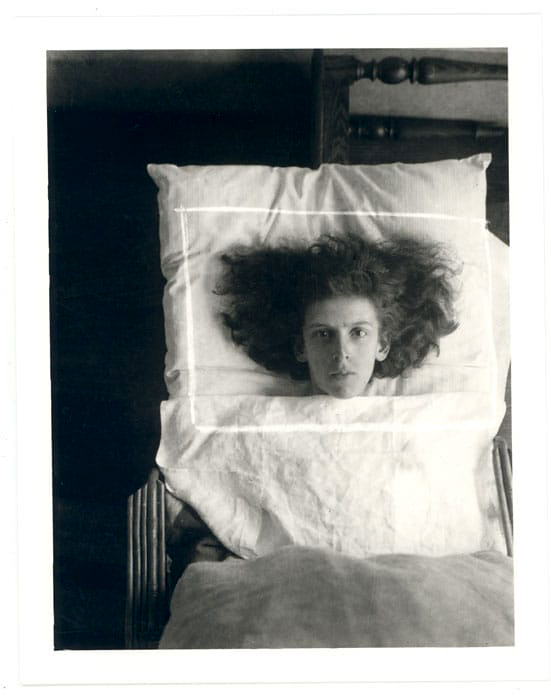
Francesca Woodman (American, 1958-1981) 'Self Portrait at Thirteen' 1972


Francesca Woodman (American, 1958-1981)
Self Portrait at Thirteen
1972
Courtesy Woodman Family Foundation
© Woodman Family Foundation / DACS, London


L-R: 'Untitled', from the 'Caryatid' series by Francesca Woodman, 1980; 'House #3' by Francesca Woodman, 1976; 'Untitled' by Francesca Woodman, 1977-1978


L-R: Untitled, from the Caryatid series by Francesca Woodman, 1980. Courtesy Woodman Family Foundation © Woodman Family Foundation / DACS, London; House #3 by Francesca Woodman, 1976. Courtesy Woodman Family Foundation © Woodman Family Foundation / DACS, London; Untitled by Francesca Woodman, 1977-1978 Courtesy Woodman Family Foundation © Woodman Family Foundation / DACS, London


Francesca Woodman (American, 1958-1981) 'Untitled' 1980 From the 'Caryatid' series


Francesca Woodman (American, 1958-1981)
Untitled
1980
From the Caryatid series
Courtesy Woodman Family Foundation
© Woodman Family Foundation / DACS, London
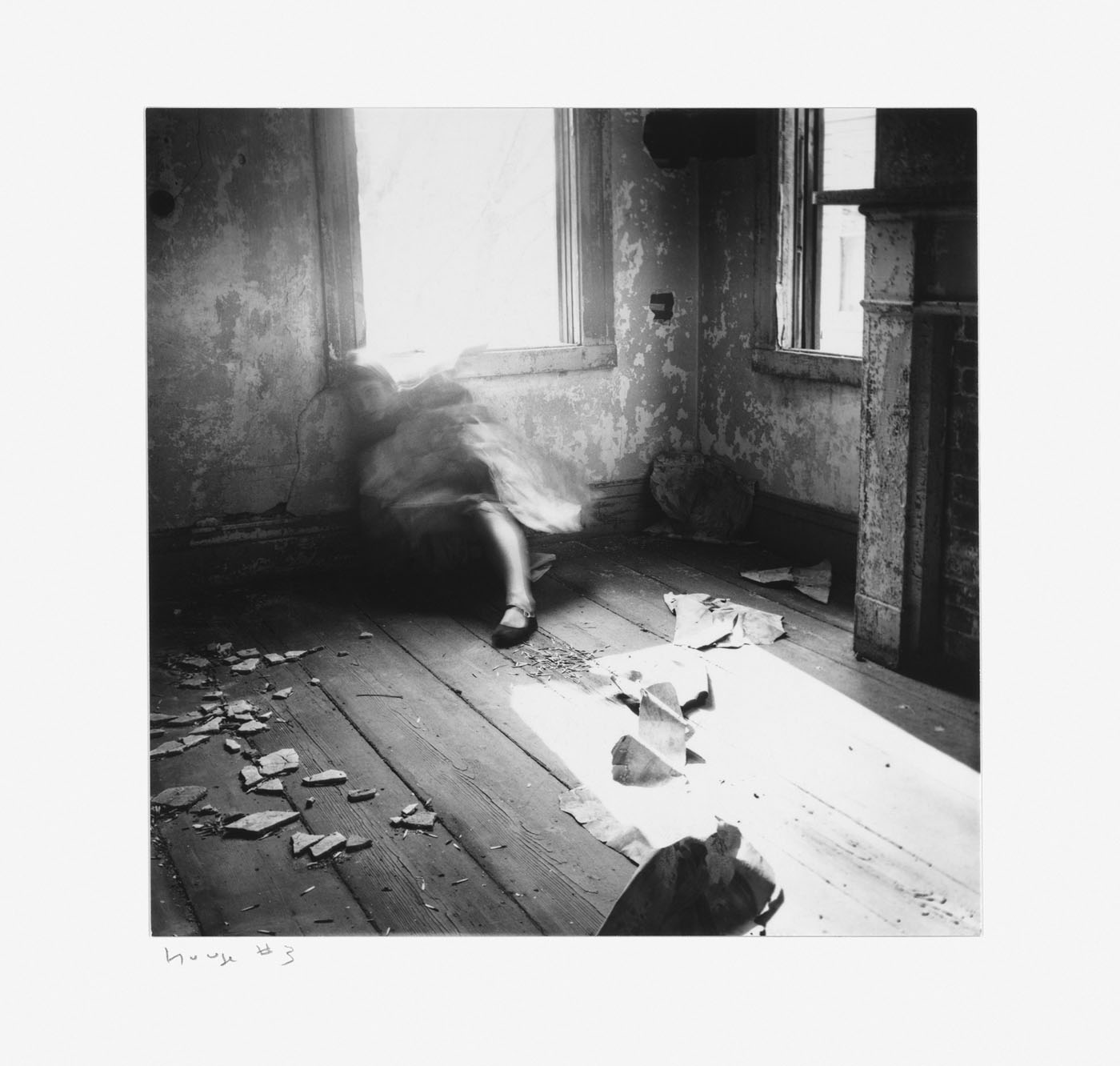
 

Francesca Woodman (American, 1958-1981) 'House #3' 1976


Francesca Woodman (American, 1958-1981)
House #3
1976
Courtesy Woodman Family Foundation
© Woodman Family Foundation / DACS, London


Francesca Woodman (American, 1958-1981) 'Untitled' 1977-1978


Francesca Woodman (American, 1958-1981)
Untitled
1977-1978
Courtesy Woodman Family Foundation
© Woodman Family Foundation / DACS, London


From 21 March to 16 June 2024, the National Portrait Gallery will display a major retrospective exhibition of work by two of the most significant photographers in the history of the medium – Julia Margaret Cameron (1815-1879) and Francesca Woodman (1958-1981). Bringing their work together for the first time in an exhibition of this scale, it will showcase more than 160 rare vintage prints from galleries, museums and private collections, including 96 works by Woodman and 71 by Cameron, spanning the entire careers of both photographers – who worked 100 years apart.

Francesca Woodman and Julia Margaret Cameron: Portraits to Dream In will offer a new way to consider these two artists, by moving away from the biographical emphasis that has often been the focus of how their work is understood. The exhibition challenges this approach in its insistence on experiencing the physical print, taking the picture making of Woodman and Cameron as a starting point for consideration of their work. While neither artist aimed for technical perfection in their printing, for each it was a dynamic and essential aspect of their creative process used to explore and extend the possibilities of photographic image making.

After an extensive curatorial research period, works by Julia Margaret Cameron have been selected for loan from major museums internationally including the Getty, Los Angeles; the Metropolitan Museum, New York City; the Victoria and Albert Museum, London; the National Science and Media Museum, Bradford; the Ashmolean Museum, Oxford; and the National Portrait Gallery’s own Collection. Prints made by Francesca Woodman in her lifetime, nearly 20 of which have not been previously published or exhibited, have been loaned primarily from the Woodman Family Foundation in New York, who have collaborated closely on the making of the exhibition and accompanying publication, with further loans from Tate and the Rhode Island School of Design

The exhibition’s title, Portraits to Dream In, suggests that when seen side by side, both artists conjure a dream state within their work as part of their shared exploration of appearance, identity, the muse, gender and archetypes. The title of the exhibition comes from an observation made by Woodman that photographs could be ‘places for the viewer to dream in’. Both Woodman and Cameron produced work that was deeply rooted in mythology and storytelling and each made portraits of those close to them to represent these narratives. Further, both women explored portraiture beyond its ability to record appearance.

Following a thematic approach, visitors will experience the work of Woodman and Cameron moving forward and back in time between the nineteenth and twentieth century; and also within the relatively short span of years that each artist was active – neither worked for more than fifteen years. Themes on display will comprise: Declaring intentions & claiming space; Angels & Otherworldly Beings; Mythology; Doubling; Nature & femininity; Caryatids & the classical form; Men and Models & Muses.

Key works on display will include the first forays both artists made into the medium of photography, as they began to portray their unique perspectives and carve out distinctive styles. These include Cameron’s self-declared ‘first success’, a portrait of Annie Wilhemina Philpot in 1864, accompanied by Woodman’s ‘Self-portrait at thirteen’, taken during a summer holiday in Antella, Italy in 1972. Photographs depicting angelic and otherworldly figures will be presented in a dense constellation with pieces from Woodman’s evocative and often abstracted Angels series contrasted against Cameron’s more direct representations of cherubic beings and winged cupids. Not to be missed images by Francesca Woodman will include Polka Dots #5 and House #3 both made in 1976, seen alongside ethereal portraits of the British actress Ellen Terry made by Julia Margaret Cameron in 1864.

Other defining works by Woodman include Caryatid pieces from a major photographic project developed in the last year of her life in which she experimented with large scale diazotype prints, including depictions of herself and other models as caryatids – carved female figures which take the place of columns in ancient Greek temples. The exhibition will be the first to draw significant attention to Woodman’s portraits of men as well as exploring the importance of her ongoing photographs of friends. Providing additional insight into her practice, contact sheets and examples of Woodman’s artist’s books will be on display, exhibited in the UK for the first time.

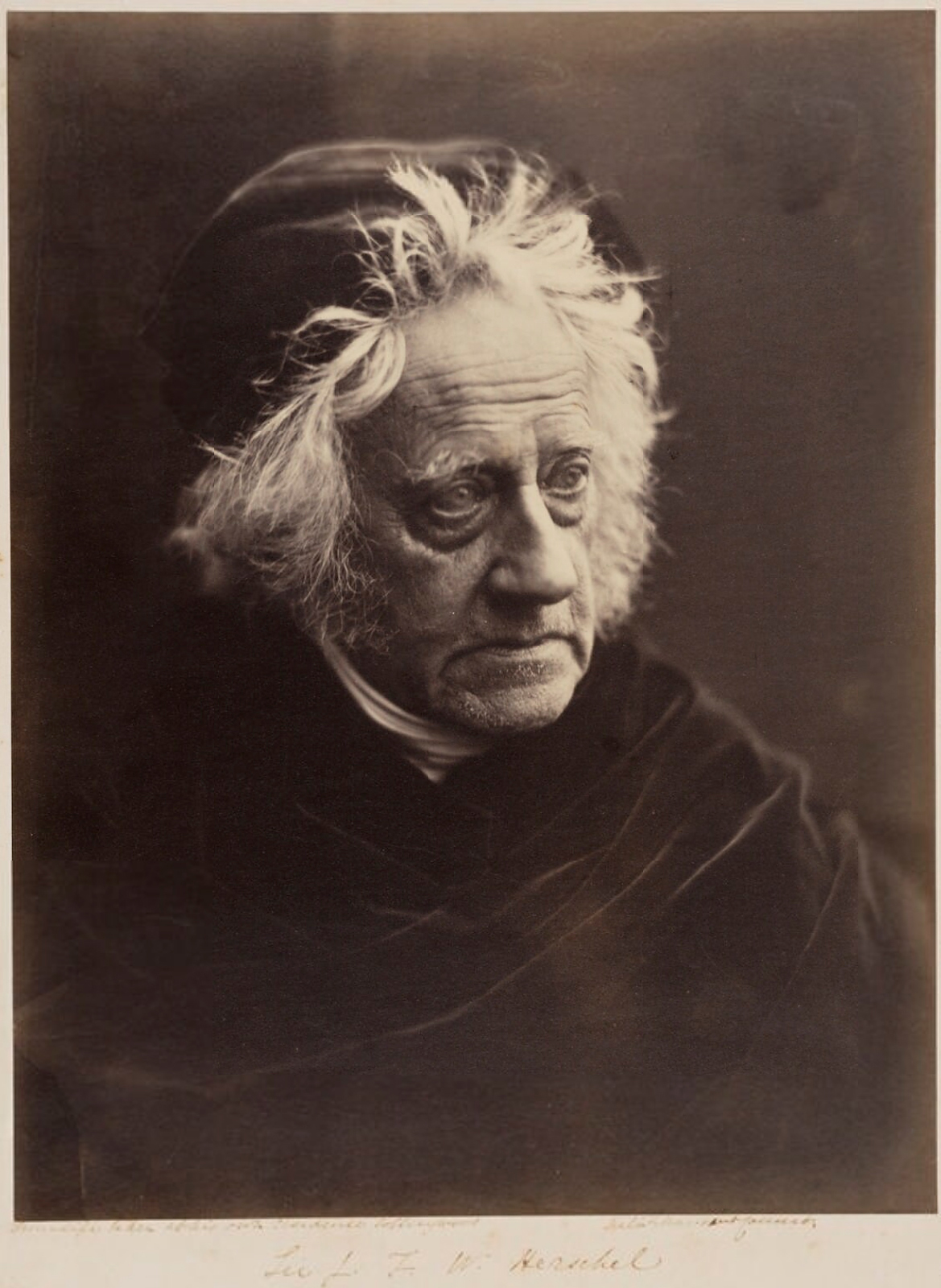
The exhibition will include many of Julia Margaret Cameron’s most famous and much loved portraits, including those of her niece and favourite model, Julia Jackson, who would later be the mother to Bloomsbury artists Virginia Wolf and Vanessa Bell; her striking depiction of Alice Liddell as the goddess Pomona; her portraits of prominent Victorian men including John Frederick William Herschel who she captured as he posed dramatically in The Astronomer (1867); and her frequent muses, May Prinsep and Mary Ann Hillier.

“It is a great pleasure to bring together the work of Francesca Woodman and Julia Margaret Cameron for the first time in this innovative and imaginative exhibition at the National Portrait Gallery. Though, of course, Cameron could not have known Woodman, and Woodman did not explicitly reference Cameron, they shared thematic and formal interests uncovered through the exhibition. Paired in this way, we see their work – individually and together – in a new light; one that feels contemporary and timeless. We are immensely grateful to our lead curator Magdalene Keaney for conceptualising this exhibition with great expertise and for the team at the Woodman Family Foundation in New York who have been wonderfully collaborative partners.”

Dr. Nicholas Cullinan OBE
Director, National Portrait Gallery

“Both Francesca Woodman and Julia Margaret Cameron were utterly committed to the practice of photography and to their practice as artists without reservation. They both worked incredibly hard at times when women were marginal in the history of art and photography. I hope that visitors relish the physical experience of seeing such a large collection of prints that each artist made. They are beautiful, subtle, intricate, and beguiling. Then of course to come away knowing more about these two women artists who have defined the history of photography. I hope it poses questions about how we might think in new ways about relationships between 19th and 20th century photographic practice and what a portrait is and can be.”

Magdalene Keaney
Curator, Francesca Woodman and Julia Margaret Cameron: Portraits to Dream In

The exhibition will be accompanied by the publication, Francesca Woodman and Julia Margaret Cameron: Portraits to Dream In by curator Magdalene Keaney, which will include essays and contributions from the collections curator of the Woodman Family Foundation, Katarina Jerinic, and leading photography historian, Helen Ennis.

Press release from the National Portrait Gallery

All images National Portrait Gallery, London and © National Portrait Gallery, London unless otherwise stated


Julia Margaret Cameron (British born India, 1815-1879) 'I Wait (Rachel Gurney)' 1872


Julia Margaret Cameron (British born India, 1815-1879)
I Wait (Rachel Gurney)
1872
Albumen silver print
32.7 × 25.4cm (12 7/8 × 10 in.)
The J. Paul Getty Museum, Los Angeles


Francesca Woodman (American, 1958-1981) 'Untitled' 1977 From the 'Angels' series


Francesca Woodman (American, 1958-1981)
Untitled
1977
From the Angels series
Courtesy Woodman Family Foundation
© Woodman Family Foundation / DACS, London


Throughout her career, the young American photographer Francesca
Woodman revisited the theme of angels. In On Being an Angel (1976), she is
seen bending backward as light falls on her white body. A black umbrella is
in the distance. The following year she made a new version – an image with
a darker mood in which she shows her face. Woodman developed the angel
motif during a visit to Rome, where she photographed herself in a large,
abandoned building. In these images, she is wearing a white petticoat, but
her chest is bare. White pieces of cloth in the background are like wings. She
called these photographs From Angel series (1977) and From a series on
Angels (1977). There are also a number of pictures simply called Angels
(1977-1978), and among them is one where again she is bending backward, but this time in front of a graffitied wall. These angels are but a few examples of Francesca Woodman’s practice of staging her body and her face.

Anna Tellgren. Francesca Woodman: On Being an Angel (50kb pdf). 2015, p. 9
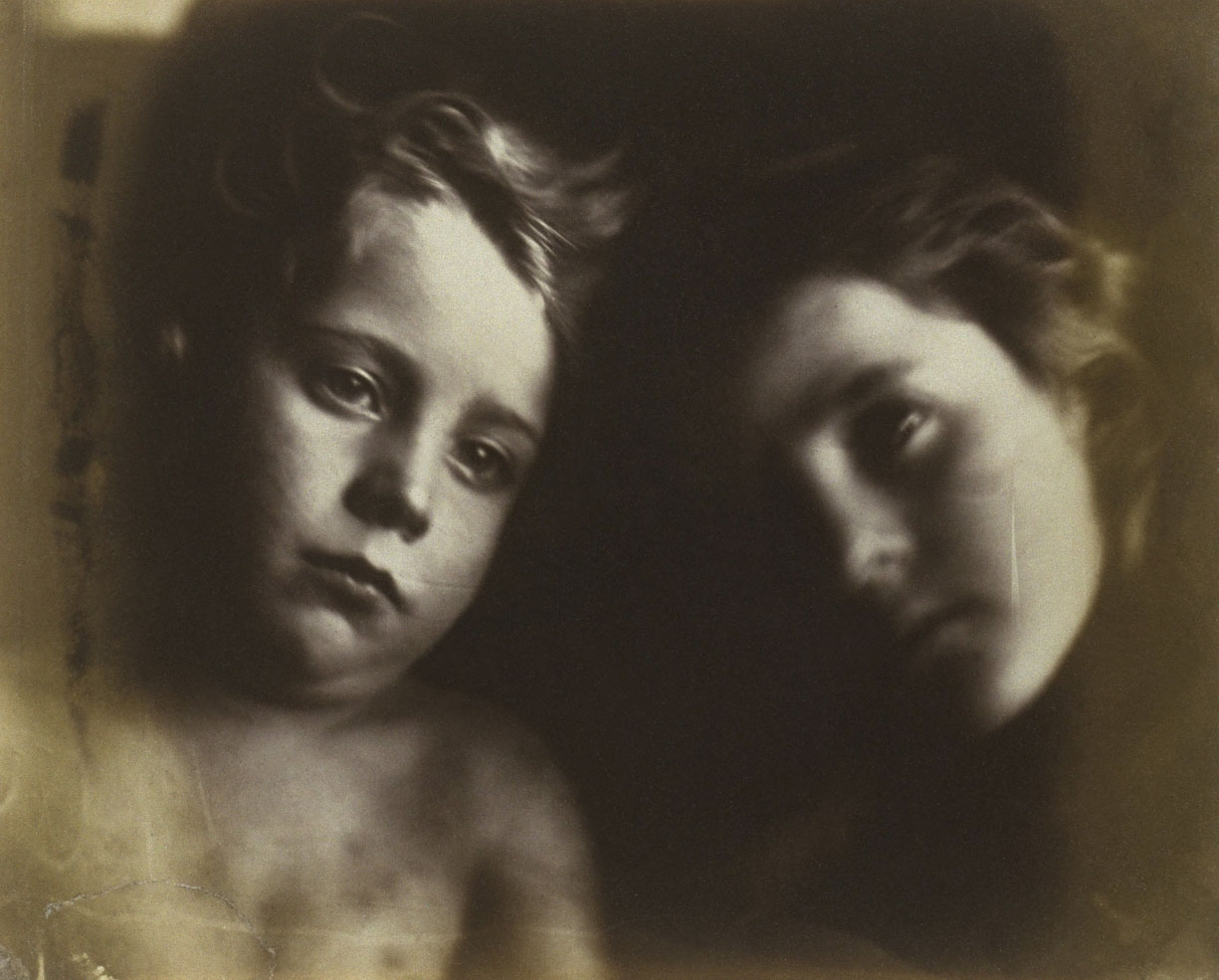
 

Julia Margaret Cameron (British born India, 1815-1879) 'Cherub and Seraph' 1866


Julia Margaret Cameron (British born India, 1815-1879)
Cherub and Seraph
1866
Albumen silver print
A photographic study of William Frederick ‘Freddy’ Gould (born 1861) and Elizabeth ‘Topsy’ Keown (born 1859)
National Science and Media Museum


A photographic study of William Frederick ‘Freddy’ Gould (born 1861) and Elizabeth ‘Topsy’ Keown (born 1859), taken by Julia Margaret Cameron (1815-1879) in 1866. This albumen print forms part of the Herschel Album, created by Cameron for her friend Sir John Herschel (1792-1871).
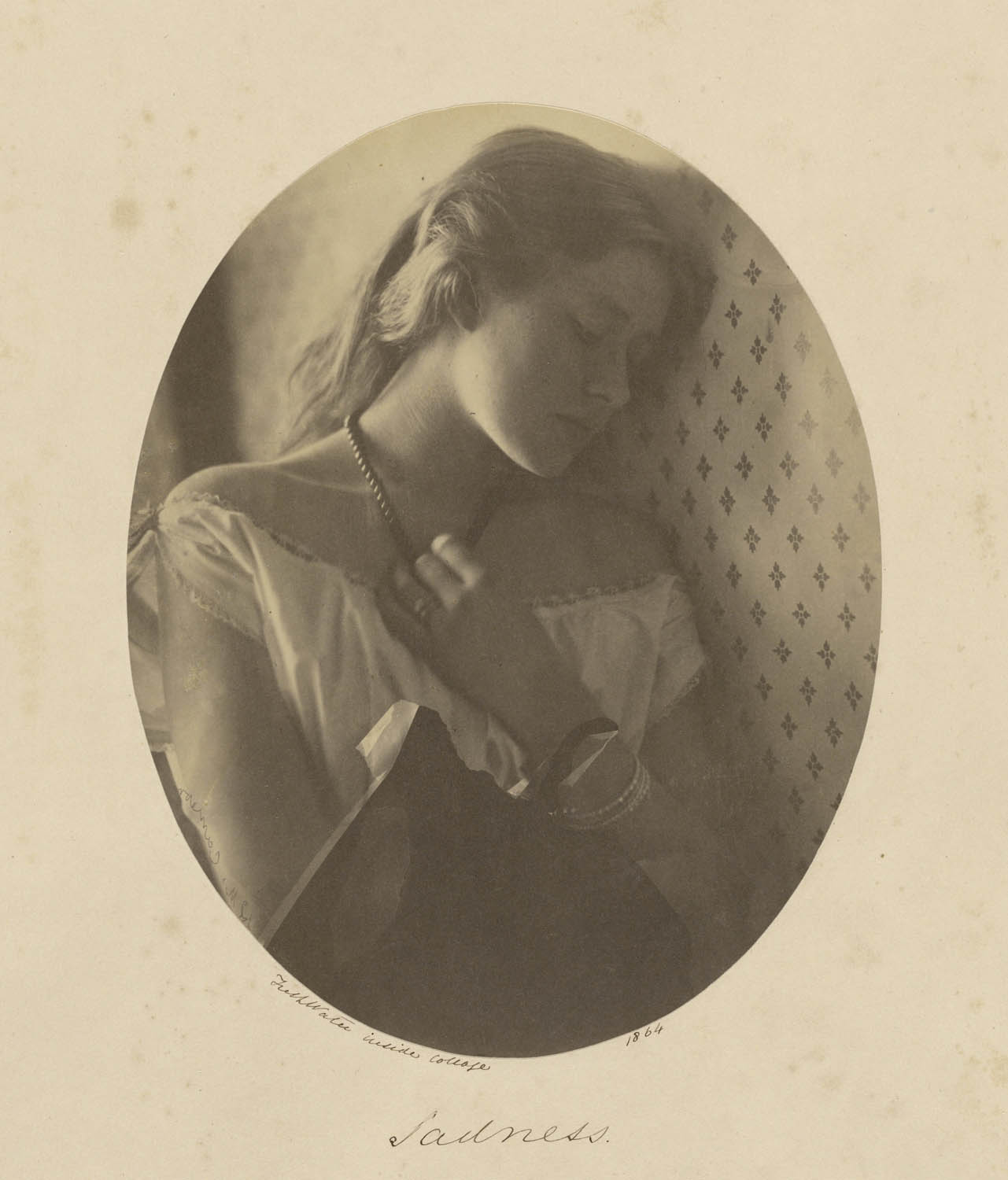
 

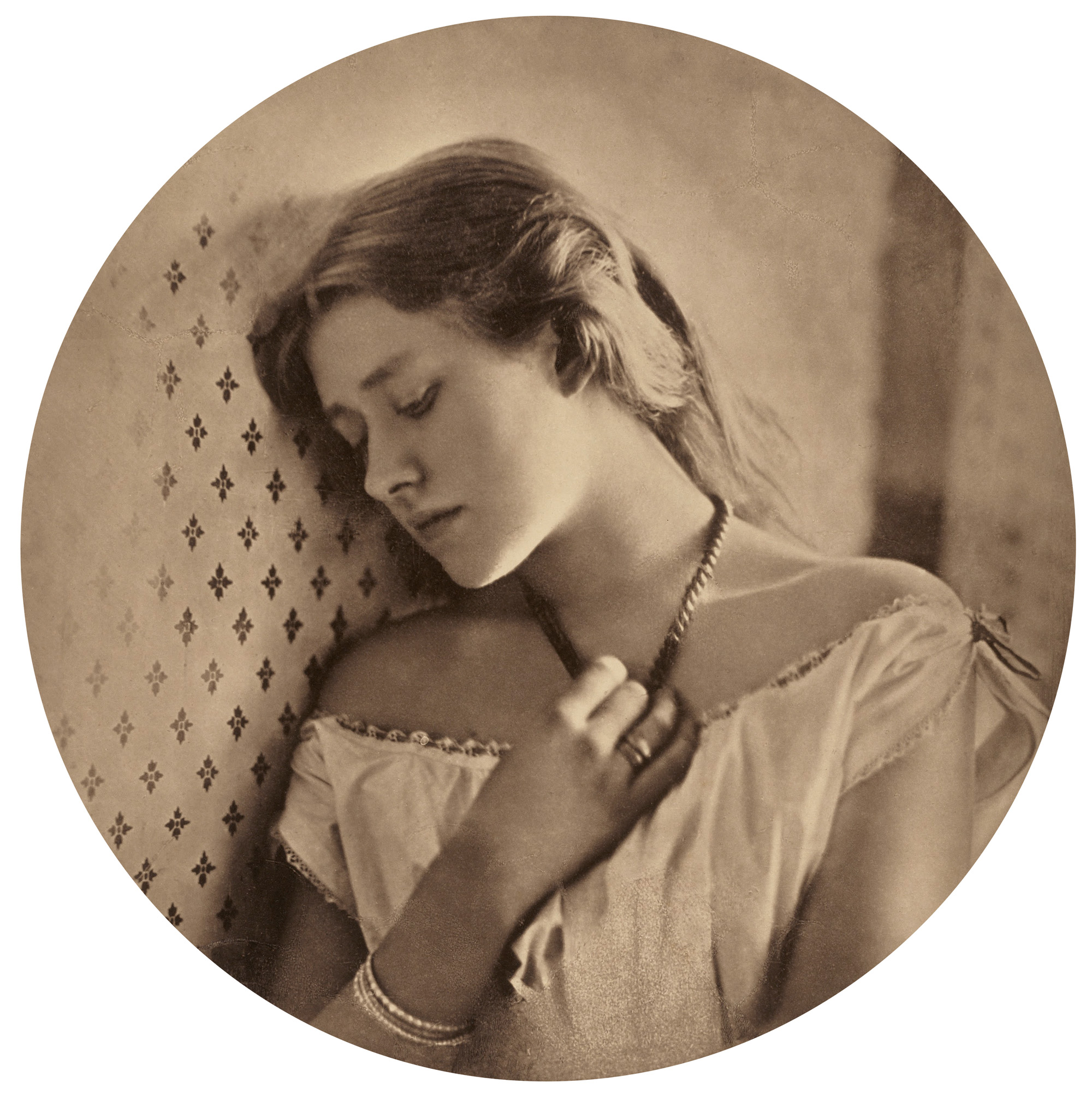
Julia Margaret Cameron (British born India, 1815-1879) 'Sadness (Ellen Terry)' 1864


Julia Margaret Cameron (British born India, 1815-1879)
Sadness (Ellen Terry)
1864
Albumen silver print
22.2 x 17.6cm (8 3/4 x 6 15/16 in.)
Albumen silver print
The J. Paul Getty Museum, Los Angeles


Dame Alice Ellen Terry GBE (27 February 1847 – 21 July 1928) was a leading English actress of the late 19th and early 20th centuries.

Born into a family of actors, Terry began performing as a child, acting in Shakespeare plays in London, and toured throughout the British provinces in her teens. At 16, she married the 46-year-old artist George Frederic Watts, but they separated within a year. She soon returned to the stage but began a relationship with the architect Edward William Godwin and retired from the stage for six years. She resumed acting in 1874 and was immediately acclaimed for her portrayal of roles in Shakespeare and other classics.

In 1878 she joined Henry Irving’s company as his leading lady, and for more than the next two decades she was considered the leading Shakespearean and comic actress in Britain. Two of her most famous roles were Portia in The Merchant of Venice and Beatrice in Much Ado About Nothing. She and Irving also toured with great success in America and Britain.

In 1903 Terry took over management of London’s Imperial Theatre, focusing on the plays of George Bernard Shaw and Henrik Ibsen. The venture was a financial failure, and Terry turned to touring and lecturing. She continued to find success on stage until 1920, while also appearing in films from 1916 to 1922. Her career lasted nearly seven decades.

Text from the Wikipedia website


Francesca Woodman (American, 1958-1981) 'Polka Dots #5' 1976


Francesca Woodman (American, 1958-1981)
Polka Dots #5
1976
Courtesy Woodman Family Foundation
© Woodman Family Foundation / DACS, London


Julia Margaret Cameron (British born India, 1815-1879) 'Julia Prinsep Stephen (née Jackson, formerly Mrs Duckworth)' 1867


Julia Margaret Cameron (British born India, 1815-1879)
Julia Prinsep Stephen (née Jackson, formerly Mrs Duckworth)
1867
Albumen silver print
National Portrait Gallery, London


Julia Prinsep Stephen (née Jackson; formerly Duckworth; 7 February 1846 – 5 May 1895) was an English Pre-Raphaelite model and philanthropist. She was the wife of the biographer Leslie Stephen and mother of Virginia Woolf and Vanessa Bell, members of the Bloomsbury Group.

Julia Prinsep Jackson was born in Calcutta to an Anglo-Indian family, and when she was two her mother and her two sisters moved back to England. She became the favourite model of her aunt, the celebrated photographer Julia Margaret Cameron, who made more than 50 portraits of her. Through another maternal aunt, she became a frequent visitor at Little Holland House, then home to an important literary and artistic circle, and came to the attention of a number of Pre-Raphaelite painters who portrayed her in their work.

Married to Herbert Duckworth, a barrister, in 1867 she was soon widowed with three infant children. Devastated, she turned to nursing, philanthropy and agnosticism, and found herself attracted to the writing and life of Leslie Stephen, with whom she shared a friend in Anny Thackeray, his sister-in-law.

After Leslie Stephen’s wife died in 1875 he became close friends with Julia and they married in 1878. Julia and Leslie Stephen had four further children, living at 22 Hyde Park Gate, South Kensington, together with his seven-year-old mentally disabled daughter, Laura Makepeace Stephen. Many of her seven children and their descendants became notable. In addition to her family duties and modelling, she wrote a book based on her nursing experiences, Notes from Sick Rooms, in 1883.

She also wrote children’s stories for her family, eventually published posthumously as Stories for Children and became involved in social justice advocacy. Julia Stephen had firm views on the role of women, namely that their work was of equal value to that of men, but in different spheres, and she opposed the suffrage movement for votes for women. The Stephens entertained many visitors at their London home and their summer residence at St Ives, Cornwall. Eventually the demands on her both at home and outside the home started to take their toll. Julia Stephen died at her home following an episode of rheumatic fever in 1895, at the age of 49, when her youngest child was only 11. The writer Virginia Woolf provides a number of insights into the domestic life of the Stephens in both her autobiographical and fictional work.

Text from the Wikipedia website
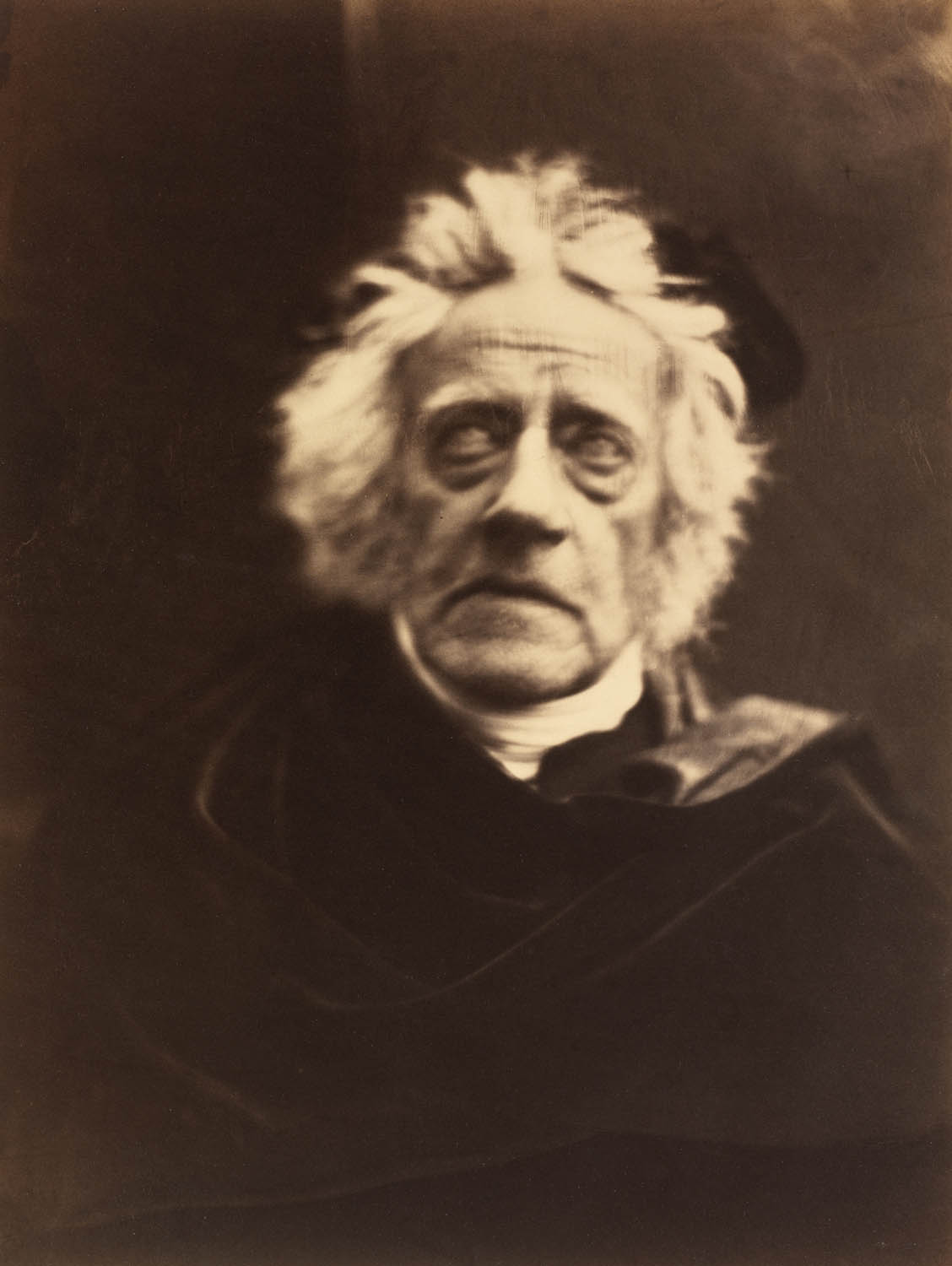
 

Julia Margaret Cameron (British born India, 1815-1879) 'The Astronomer (Sir John Frederick William Herschel)' 1867


Julia Margaret Cameron (British born India, 1815-1879)
The Astronomer (Sir John Frederick William Herschel)
1867
Albumen silver print
Courtesy of the RISD Museum, Providence, RI


Sir John Frederick William Herschel, 1st Baronet KH FRS (7 March 1792 – 11 May 1871) was an English polymath active as a mathematician, astronomer, chemist, inventor, and experimental photographer who invented the blueprint and did botanical work.

Herschel originated the use of the Julian day system in astronomy. He named seven moons of Saturn and four moons of Uranus – the seventh planet, discovered by his father Sir William Herschel. He made many contributions to the science of photography, and investigated colour blindness and the chemical power of ultraviolet rays. His Preliminary Discourse (1831), which advocated an inductive approach to scientific experiment and theory-building, was an important contribution to the philosophy of science. …

Photography

Herschel made numerous important contributions to photography. He made improvements in photographic processes, particularly in inventing the cyanotype process, which became known as blueprints, and variations, such as the chrysotype. In 1839, he made a photograph on glass, which still exists, and experimented with some colour reproduction, noting that rays of different parts of the spectrum tended to impart their own colour to a photographic paper. Herschel made experiments using photosensitive emulsions of vegetable juices, called phytotypes, also known as anthotypes, and published his discoveries in the Philosophical Transactions of the Royal Society of London in 1842. He collaborated in the early 1840s with Henry Collen, portrait painter to Queen Victoria. Herschel originally discovered the platinum process on the basis of the light sensitivity of platinum salts, later developed by William Willis.

Herschel coined the term photography in 1839. Herschel was also the first to apply the terms negative and positive to photography.

Herschel discovered sodium thiosulfate to be a solvent of silver halides in 1819, and informed Talbot and Daguerre of his discovery that this “hyposulphite of soda” (“hypo”) could be used as a photographic fixer, to “fix” pictures and make them permanent, after experimentally applying it thus in early 1839.

Herschel’s ground-breaking research on the subject was read at the Royal Society in London in March 1839 and January 1840.

Text from the Wikipedia website


Julia Margaret Cameron (British born India, 1815-1879) 'Pomona (Alice Liddell)' 1872


Julia Margaret Cameron (British born India, 1815-1879)
Pomona (Alice Liddell)
1872
Albumen silver print
The Metropolitan Museum of Art., New York
David Hunter McAlpin Fund, 1963


Pomona was the goddess of fruit trees, gardens, and orchards. Unlike many other Roman goddesses and gods, she does not have a Greek counterpart, though she is commonly associated with Demeter. She watches over and protects fruit trees and cares for their cultivation.

Symbolically, Pomona and her fruit garden represent abundance, nurture and the simple pleasure derived from nature. She is often depicted in a garden full of life, colour and opulence, with her milky soft flesh on display and a cornucopia of fruit and flowers on her lap.


Julia Margaret Cameron (British born India, 1815-1879) 'The Gardener's Daughter' 1867


Julia Margaret Cameron (British born India, 1815-1879)
The Gardener’s Daughter
1867
Albumen silver print
A photographic study of Mary Ryan (1848-1914)
National Science and Media Museum


A photographic study of Mary Ryan (1848-1914), taken by Julia Margaret Cameron (1815-1879) in 1867. This albumen print forms part of the Herschel Album, created by Cameron for her friend Sir John Herschel (1792-1871).

‘The Gardener’s Daughter’ was the title of a poem by Alfred Tennyson (1809-1892). Cameron’s photograph was inspired by the lines: ‘Gown’d in pure white, that fitted to the shape, Holding the bush, to fix it back, she stood.’
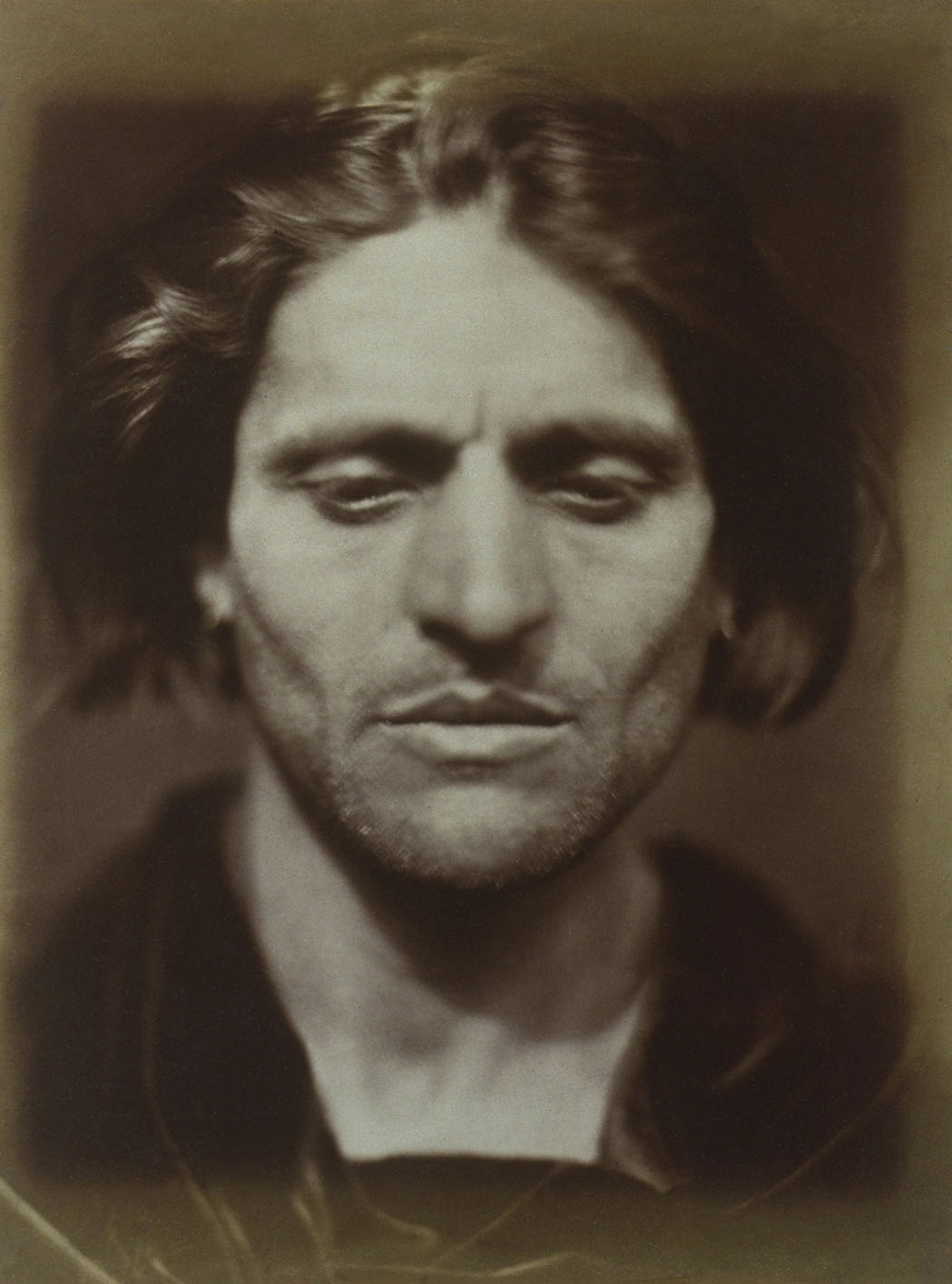
 

Julia Margaret Cameron (British born India, 1815-1879) 'Iago – study from an Italian' 1867


Julia Margaret Cameron (British born India, 1815-1879)
Iago – study from an Italian
1867
Albumen silver print
A photographic portrait of the artist’s model, Angelo Colarossi (born about 1839)
National Science and Media Museum


A photographic portrait of the artist’s model, Angelo Colarossi (born about 1839), taken by Julia Margaret Cameron (1815-1879) in 1867. The print forms part of the Herschel Album, created by Cameron for her friend Sir John Herschel (1792-1871).

This is the only existing print known of ‘Iago’. The negative may have been destroyed intentionally by Cameron, and it is believed that the print was taken for George Frederic Watts (1817-1904) to work from for a painting.

Iago was the villain of Shakespeare’s play ‘Othello’.


'Francesca Woodman and Julia Margaret Cameron: Portraits to Dream In' book front cover


Francesca Woodman and Julia Margaret Cameron: Portraits to Dream In book front cover
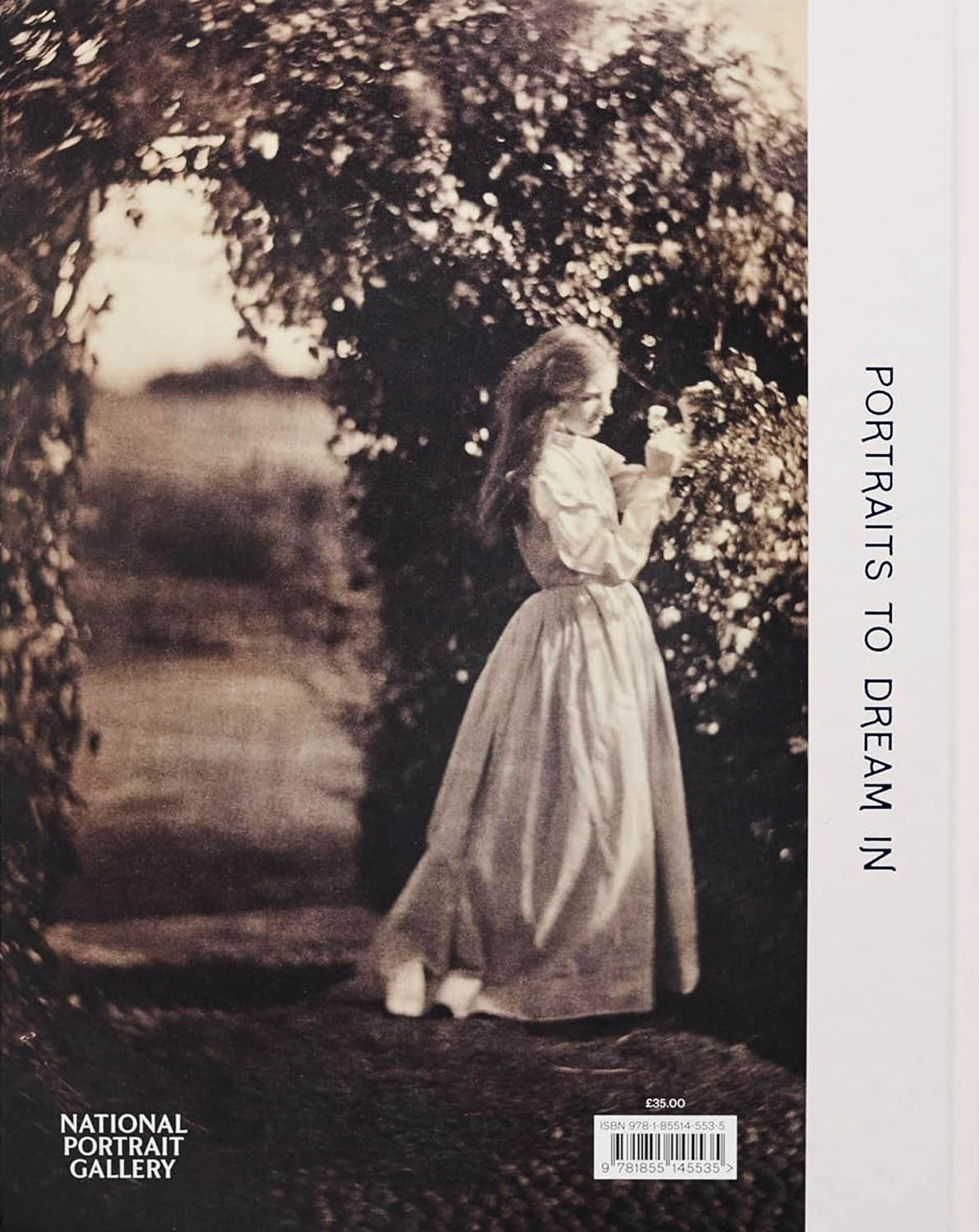
 

'Francesca Woodman and Julia Margaret Cameron: Portraits to Dream In' book back cover


Francesca Woodman and Julia Margaret Cameron: Portraits to Dream In book back cover
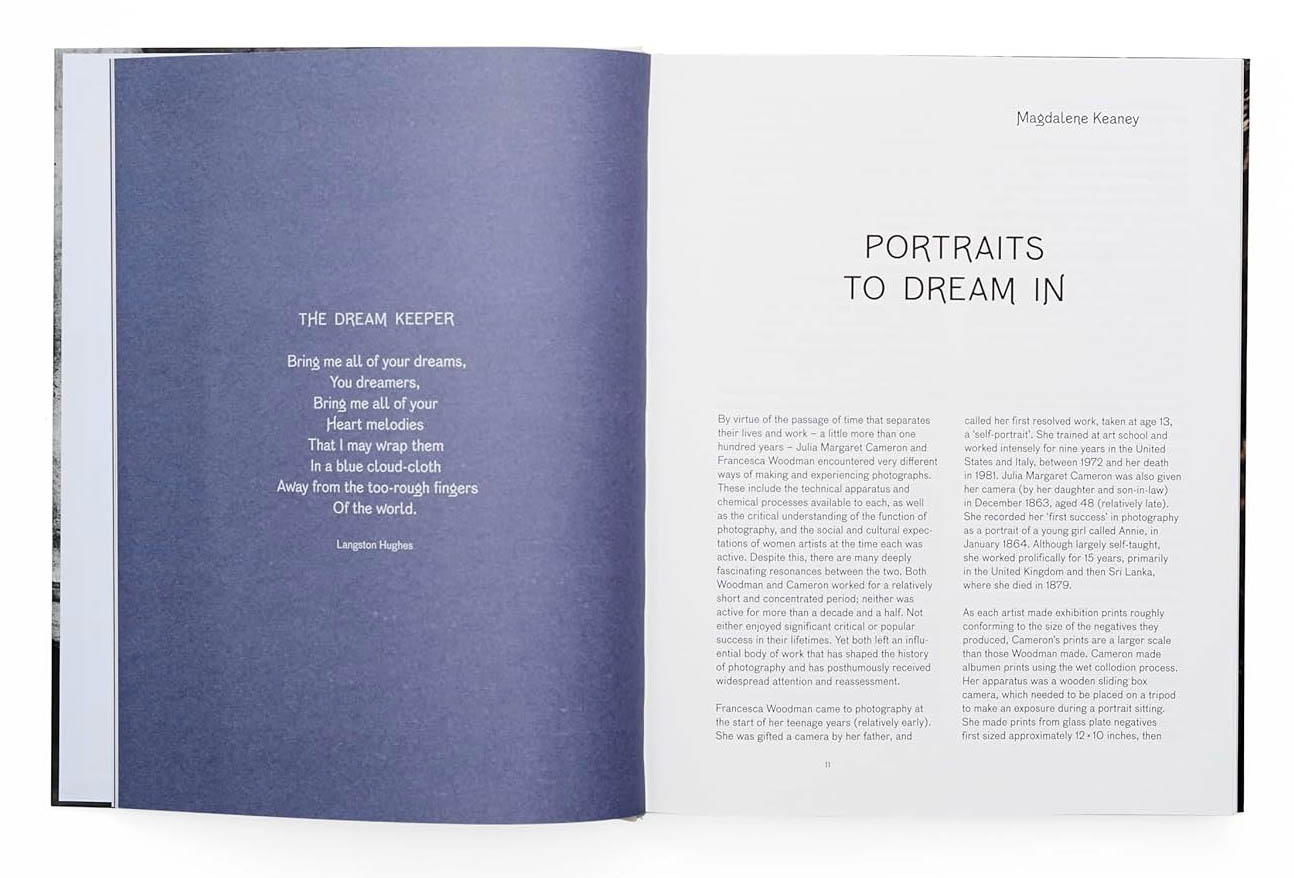
 

'Francesca Woodman and Julia Margaret Cameron: Portraits to Dream In' book


Francesca Woodman and Julia Margaret Cameron: Portraits to Dream In book p. 11


'Francesca Woodman and Julia Margaret Cameron: Portraits to Dream In' book


Francesca Woodman and Julia Margaret Cameron: Portraits to Dream In book back cover pp. 70-71


Francesca Woodman and Julia Margaret Cameron: Portraits to Dream In

Magdalene Keaney (Editor), Katarina Jerinic (Contributor), Helen Ennis (Contributor)

Hardcover – 26 June 2024


Francesca Woodman and Julia Margaret Cameron: Portraits to Dream In draws parallels between two of the most significant practitioners in the history of photography, presenting fresh research, rare vintage prints, and previously unseen archival works.

‘I feel that photographs can either document and record reality or they can offer images as an alternative to everyday life: places for the viewer to dream in.’
~ Francesca Woodman, 1980

Living and working over a century apart, Julia Margaret Cameron (1815-1879) and Francesca Woodman (1958-1981) experienced very different ways of making and understanding photographs. Francesca Woodman and Julia Margaret Cameron: Portraits to Dream In accompanies the exhibition of the same name opening at the National Portrait Gallery, London, in March 2024. Spanning the careers of both artists, the beautifully illustrated catalogue includes their best-known photographs as well as less familiar images. The exhibition works are arranged into eight thematic sections with feature essays, offering an accessible, engaging opportunity to consider both artists in a new light.

This publication presents the artists’ exploration of portraiture as a ‘dream space’. It makes new connections between their work, which pushed the boundaries of the photographic medium and experimented with ideas of beauty, symbolism, transformation and storytelling to produce some of art history’s most compelling and admired photographs.

National Portrait Gallery Publications
208 pages

Text from the Amazon Australia website


National Portrait Gallery
St Martin’s Place
London, WC2H 0HE

Opening hours:
Open daily: 10.30 – 18.00
Friday and Saturday: 10.30 – 21.00
National Portrait Gallery website

LIKE ART BLART ON FACEBOOK

Back to top

Exhibition: ‘Victorian Giants: The Birth of Art Photography’ at the National Portrait Gallery, London Part 2

Exhibition dates: 1st March – 20th May, 2018

Victorian Giants: The Birth of Art Photography is curated by Phillip Prodger PhD, Head of Photographs at the National Portrait Gallery, London


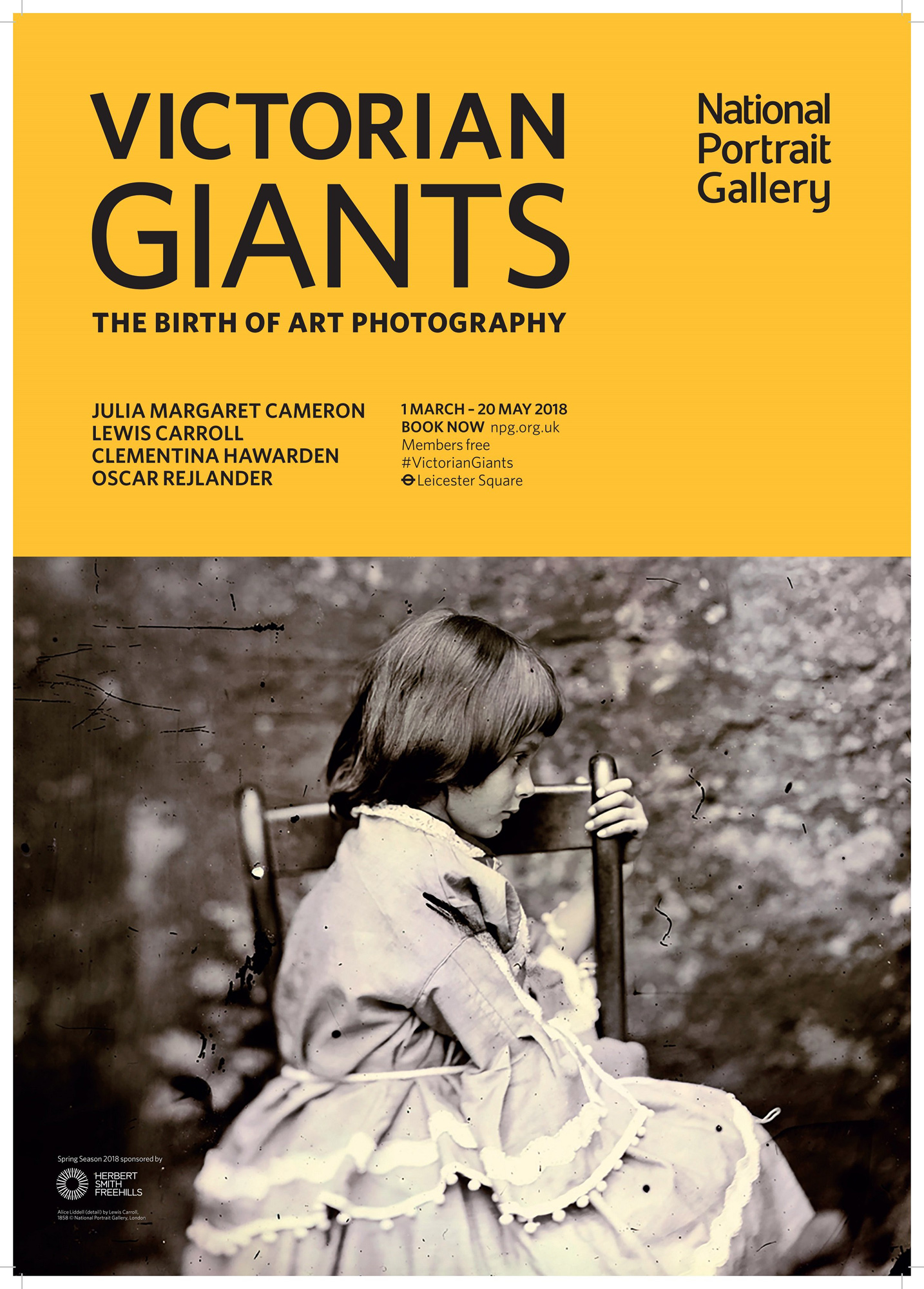
Poster for the exhibition 'Victorian Giants: The Birth of Art Photography' at the National Portrait Gallery, London


Poster for the catalogue for the exhibition Victorian Giants: The Birth of Art Photography at the National Portrait Gallery, London


Oh Clementina! the light, the stars!

There is enough text in the posting for me not to really have to say anything. It’s all there…

Art, influence, technology;
Classical, formal, diaristic;
Intimacy, mystery, atmospheric;
Motherhood, sexuality, feminist identity, nascent womanhood;
‘Profil perdu’ (French, ‘lost profile’, which refers to a portrait in which the profile cannot be seen), mirror, loss, duplication and replication, illusion, and fetish

… all woven into a performative, psychological, expressive and creative (self) portraiture.

The real stars of the show are most definitely the women… the avant-garde artists of their era.

Dr Marcus Bunyan

View part 1 of the posting


Many thankx to the National Portrait Gallery, London for allowing me to publish the photographs in the posting. Please click on the photographs for a larger version of the image.


“The women are the real stars of this exhibition. Their pictures are bolder and bigger, more imaginative and more daring. They portray people with a raw reality that is not just the result of the collodion method but a powerful, visionary insight.

Hawarden’s pictures of Victorian women have an intimacy that transcends time and a mystery that asserts the autonomy of her subjects. They are feminist, and gothic too, in their eerie atmosphere. In an 1863-4 picture called ‘Photographic Study’, she poses a young woman by a mirror so that we see her twice. The “real” woman is in brooding profile while her reflection is a shadowy full-face image. The effect is spookily absorbing as we become witnesses to her melancholic introspection.

Hawarden’s ultra-sharp yet shadow-rich prints create unresolved stories featuring women free to show who they really are. None of them look happy. All are curiously defiant – these pictures anticipate those of the 1970s US artist Francesca Woodman. As portraits of women created by women, these Victorian photographers’ subversive creations have almost no precedents.

Not that Cameron looked to the handful of earlier women artists as models. She was trying to be a new Rembrandt: her portraits consciously compete with the masterpieces of the baroque age. While the painted portraits of male Victorian artists such as John Everett Millais and George Frederic Watts are period pieces at best, her great 1866 photograph Mountain Nymph, Sweet Liberty (Mrs Keene) with its subtle mix of resolution and suggestiveness brings us face to face with someone whose eyes hold ours and whose mind is as real to us as her tangled hair. There is a sensitivity to the magic of being human in Cameron’s portraits that makes her the greatest British artist of her time. This exhibition puts her in a brilliantly delineated context of experiment and imagination, the first avant-garde artist of the camera.”


Extract from Jonathan Jones. “Victorian Giants: the Birth of Art Photography review – the triumph of the female gaze,” on The Guardian website Friday 2 March 2018 [Online] Cited 14/02/2022


This major exhibition is the first to examine the relationship between four ground-breaking Victorian artists: Julia Margaret Cameron (1815-1879), Lewis Carroll (1832-1898), Lady Clementina Hawarden (1822-1865) and Oscar Rejlander (1813-1875). Drawn from public and private collections internationally, the exhibition features some of the most breath-taking images in photographic history. Influenced by historical painting and frequently associated with the Pre-Raphaelite Brotherhood, the four artists formed a bridge between the art of the past and the art of the future, standing as true giants in Victorian photography.


Clementina Hawarden (British, 1822-1865)

Her life cruelly cut short by pneumonia at the age of forty-two, Clementina Maude, Viscountess Hawarden produced some 800 photographs in her lifetime, nearly all are of her eight children posed in poignant tableaux. She began to photograph on her family’s estate, outside Tipperary, around 1857, later moving to Princes Gardens, London, near Hyde Park. Frequently compared to Cameron, she was much admired by Carroll, and on her death, Rejlander wrote her obituary.

Wall text from the exhibition


“In that vein, the greatest discovery in the exhibition is a thrillingly strange image by Hawarden, to my mind always the most intriguing photographer of the four. Hawarden was a Scottish countess who had ten children. She photographed all of her daughters repeatedly, and there were so many of them it’s hard to keep track. Her photographs, which are often classical in their formal qualities, nevertheless anticipate the diaristic work of the 20th century photographers Sally Mann and Nan Goldin. They often contain more than one girl, and often feature mirrors, so that everything is about multiplication or reflection – an effect that might also be seen as a form of self-portraiture in the mother of so many.”

Gaby Wood. “A jewel-like show of photographs Victorian Giants, National Portrait Gallery, review,” on The Telegraph website 27th February 2018 [Online] Cited 14/02/2022


Her photographic years were brief but prolific. Hawarden produced over eight hundred photographs between 1857 and her sudden death in 1864. During this time she gave birth to three of her eight children. Lady Hawarden’s photographic focus remained on her children. There is only one photograph believed to feature the Viscountess Hawarden, yet it could also be a portrait of her sister Anne Bontine.

A collection of 775 portraits were donated to the Victoria and Albert Museum, London in 1939 by Hawarden’s granddaughter, Clementina Tottenham. The photographs were torn, or cut, from family albums for reasons that are still unclear. This accounts for the torn or trimmed corners which are now considered a hallmark of Hawarden’s work.

Carol Mavor writes extensively about the place of Hawarden’s work in the history of Victorian photography as well as contemporary interpretations of the work. She states, “Hawarden’s pictures raise significant issues of gender, motherhood, and sexuality as they relate to photography’s inherent attachments to loss, duplication and replication, illusion, fetish.” (Mavor, Carol (1999). Becoming: the photographs of Clementina, Viscountess Hawarden (1st ed.). Durham, NC: Duke University Press.)

Text from the Wikipedia website


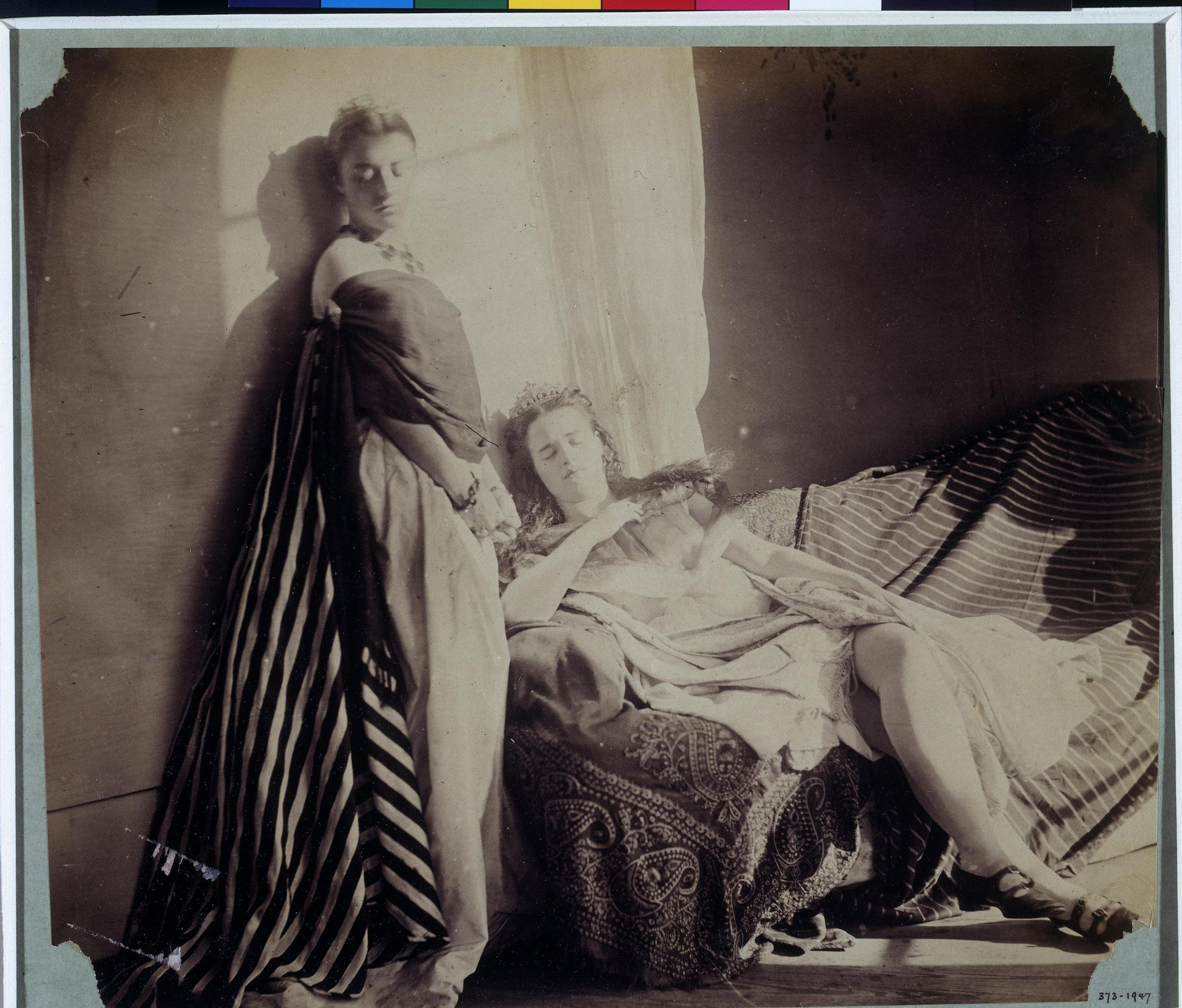
Clementina Hawarden (British, 1822-1865) 'Photographic Study, 5 Princes Gardens (Clementina Maude)' 1863-1864 from the exhibition 'Victorian Giants: The Birth of Art Photography' at the National Portrait Gallery, London , March - May, 2018


Clementina Hawarden (British, 1822-1865)
Photographic Study, 5 Princes Gardens (Clementina Maude)
1863-1864
from The Photographic Study Series by Clementina, Lady Hawarden
Albumen silver print from glass negative
Given by Lady Clementina Tottenham
© Victoria and Albert Museum, London


“Although her work has often been linked to that of Julia Margaret Cameron, the best known woman photographer of the Victorian epoch, Clementina Hawarden struck out into areas and depicted moods unknown to the art photographers of her age.”

~ Graham Ovenden 1974


This remarkable photograph shows a woman gazing into a mirror, but not at her own reflection. Instead, the picture was carefully arranged so that the woman’s face is seen in profile, while only her reflection looks back out of the mirror. Hawarden excelled at producing ambiguous narrative photographs such as this one, suggesting the rich inner life of the subject, without telling a clear story. The heroes of her pictures are nearly always women, who seem all but trapped in domestic interiors.

Wall text from the exhibition


Clementina Hawarden (British, 1822-1865) 'Photographic Study (Clementina Maude)' early 1860s from the exhibition 'Victorian Giants: The Birth of Art Photography' at the National Portrait Gallery, London , March - May, 2018


Clementina Hawarden (British, 1822-1865)
Photographic Study (Clementina Maude)
early 1860s
Albumen print from wet collodion negative
20.1 x 14.4cm (7 15/16 x 5 11/16 in.)
Gilman Collection, Purchase, Harriette and Noel Levine Gift, 2005
© Metropolitan Museum of Art


Clementina, Lady Hawarden, is a poetic, if elusive, presence among nineteenth-century photographers. As a devoted mother, her life revolved around her eight children. She took up photography in 1857; using her daughters as models, she created a body of work remarkable for its technical brilliance and its original depiction of nascent womanhood. Lady Hawarden showed her work in the 1863 and 1864 exhibitions of the Photographic Society. With the exception of a few rare examples, her photographs remained in the possession of her family until 1939, when the more than eight hundred images were donated to the Victoria and Albert Museum. Only recently have they been the objects of research, publication, and exhibition.

Clementina Maude, her mother’s preferred model, is seen here in a reflective pose against a star-studded wall. The casual placement of the shawl on the table and the girl’s loose hair contribute to the feeling of intimacy. In the airy room time seems to be suspended. The sensuous curves of the table legs, the soft weight of the crushed velvet, and the crispness of the starry wallpaper are enhanced by the skilful handling of the collodion technique. The composition, devoid of Victorian clutter, brings together light, shadow, and compositional elements in a spare and appealing interplay. In contrast to the prevailing fashion of giving literary or sentimental titles to portraits of young women, Lady Hawarden titled her works simply “Photographic Study.”

Text from the Metropolitan Museum of Art website


Clementina Hawarden (British, 1822-1865) 'Photographic Study (Clementina and Isabella Grace Maude)' 1863-1864


Clementina Hawarden (British, 1822-1865)
Photographic Study (Clementina and Isabella Grace Maude)
1863-1864
Albumen print from wet collodion negative
© Victoria and Albert Museum, London


Hawarden frequently dressed up her sitters and arranged them in enigmatic narratives like this one. Although not derived from any known painting, the manner of dress, including the cloak and tricorn hat of the male figure (actually one of Hawarden’s daughters dressed up), suggest an eighteenth century reference.

Wall text from the exhibition


Clementina Hawarden (British, 1822-1865) 'Photographic Study (Florence Elizabeth and Clementina Maude)' 1863-1864


Clementina Hawarden (British, 1822-1865)
Photographic Study (Florence Elizabeth and Clementina Maude)
1863-1864
Albumen print from wet collodion negative
© Victoria and Albert Museum, London


Working from upstairs rooms at 5 Princes Gardens, near to the South Kensington Museum (where both she and Julia Margaret Cameron were frequent visitors), Hawarden used light streaming from large floor to ceiling windows to illuminate her pictures. Her subjects were usually her children, especially her daughters Clementina, Florence, and Isabella Grace, whom she posed in domestic tableaux.

Both Carroll and Rejlander knew and admired Hawarden. On at least one occasion, Rejlander photographed her daughter Isabella Grace; after Hawarden’s death, he also photographed her youngest daughter, Antonia.

Wall text from the exhibition


Clementina Hawarden (British, 1822-1865) Hawarden. 'Isabella Grace and Clementina Maude, 5 Princes Gardens' c. 1863-1864


Clementina Hawarden (British, 1822-1865)
Hawarden Isabella Grace and Clementina Maude, 5 Princes Gardens
c. 1863-1864
Albumen print from wet collodion negative
Given by Lady Clementina Tottenham
© Victoria and Albert Museum, London


Virginia Dodier thinks that this photograph belongs to an ‘Orientalist’ series. Here, Lady Hawarden gives her drawing room a tent-like atmosphere. Such scenes were popularised by the painter J. F. Lewis, and Roger Fenton exhibited his photographic ‘Nubian Series’ in 1859. Dodier writes that the idea of Orientalism allowed European artists to ‘evoke sensuality on the premise of presenting quasi-ethnographical information about the customs of the East’. The idea of the fancy dress or allegorical portrait stems from an earlier tradition in English art. They are found, for example, in the work of the painter Sir Joshua Reynolds (1723-1792).

Text from the Victoria and Albert Museum website


Lady Clementina Hawarden: Themes & Style (extract)

With careful choice of props, clothing, mirrors, balcony, and posture, Hawarden produced exquisite studies of her adolescent daughters. The figures and dress are the main subject, carefully framed in the room, and often in front of the balcony. The city beyond often provides a blurred background.

The writer Carol Mavor in Becoming: The Photographs of Clementina, Viscountess Hawarden suggests that the often provocative poses of Hawarden’s daughters are significant. The Victorians were bothered by the idea of sexuality and adolescence, and in 1861 the Offences Against the Person Act raised the age of consent from 10 to 12. This was also the year in which Hawarden began to make this kind of photograph, though there is no evidence that she was deliberately exploring this controversial topic.

Hawarden liked to use natural light in her studio at her South Kensington home, in a way that was seen at the time as ‘daring’. She placed mirrors to reflect light and used them to explore the idea of ‘the double’, just as other photographers (and occasionally Hawarden herself) used a stereoscopic camera to produce twin prints.

From around 1862 Hawarden concentrated on photographing her daughters in costume tableaux, a popular subject at the time. Costumes from the dressing up box are combined with dresses at the height of fashion to produce beautiful and detailed studies that confound the contemporary with the make-believe.

Text from the Victoria and Albert Museum website [Online] Cited 16/05/2018. No longer available online


Clementina Hawarden (British, 1822-1865) 'Photographic Study (Clementina and Florence Elizabeth Maude)' 1859-1861


Clementina Hawarden (British, 1822-1865)
Photographic Study (Clementina and Florence Elizabeth Maude)
1859-1861
Uncut stereo albumen print


Figure 60 and 61 of the catalogue for the exhibition 'Victorian Giants: The Birth of Art Photography' at the National Portrait Gallery, London


Figure 60 and 61 of the catalogue for the exhibition Victorian Giants: The Birth of Art Photography at the National Portrait Gallery, London


Figure 112 and 113 of the catalogue for the exhibition 'Victorian Giants: The Birth of Art Photography' at the National Portrait Gallery, London


Figure 112 and 113 of the catalogue for the exhibition Victorian Giants: The Birth of Art Photography at the National Portrait Gallery, London


Oscar Rejlander (British born Sweden, 1813-1875)

According to his naturalisation papers, Rejlander was born in Stockholm on October 19, 1813. He was the son of Carl Gustaf Rejlander, a stonemason and Swedish Army Officer. During his youth, his family moved to the Swedish-speaking community in Rauma, Finland (then Russia). In the 1830s, he relocated to England, initially settling in Lincoln, England. In the 1850s he abandoned his original profession as a painter and portrait miniaturist, apparently after seeing how well a photograph captured the fold of a sleeve.

He set up as a portraitist in the industrial Midlands town of Wolverhampton, probably around 1846. In the early 1850s he learned the wet-collodion and waxed-paper processes at great speed with Nicholas Henneman in London, and then changed his business to that of a photography studio. He undertook genre work and portraiture. Rejlander also produced nude studies, mainly for use as studies by painters. There are no known erotic photographs of children by Rejlander. His so-called ‘Charlotte Baker’ photograph is a well-known forgery, produced by convicted child sex offender Graham Ovenden by Ovenden’s friend Howard Grey in the 1970s, rephotographed and printed to look antique by Ovenden. No person by the name Charlotte Baker ever seems to have posed for Rejlander.

Rejlander undertook many experiments to perfect his photography, including combination printing, which he did not invent; however, he created more elaborate and convincing composite photographs than any prior photographer. He had articles feature in the Wolverhampton Chronicle, on 15 November 1854 an article called “Improvement in Calotypes, by Mr. O.G. Rejlander, of Wolverhampton” it suggests that by 1854 he was experimenting with combination printing from several negatives. He was a friend of photographer Charles Lutwidge Dodgson (better known by the nom de plume Lewis Carroll), who collected Rejlander’s work and corresponded with him on technical matters. Rejlander later created one of the best known and most revealing portraits of Dodgson.

Rejlander participated in the Paris Exhibition of 1855. In 1856 he made his best-known allegorical work, The Two Ways of Life. This was a seamlessly montaged combination print made of thirty-two images (akin to the use of Photoshop today, but then far more difficult to achieve) in about six weeks. First exhibited at the Manchester Art Treasures Exhibition of 1857, the work shows a man being lured to paths of vice or virtue by good and bad angels. The image’s partial nudity, which showed real women as they actually appeared and not the idealised forms then common in Victorian art, was deemed ‘indecent’ by some. Rejlander was also accused of using prostitutes as models, although Rejlander categorically denied this and no proof was ever offered. Reservations about the work subsided when Queen Victoria ordered a 10-guinea copy to give to Prince Albert. Victoria and Albert would go on to purchase three copies of the work, all of which are now lost. …

Rejlander moved his studio to Malden Road, London around 1862 and largely abandoned her early experiments with double exposure, photomontage, photographic manipulation and retouching. Instead, he became one of Britain’s leading portraitists, creating pictures with psychological charge. He became a leading expert in photographic techniques, lecturing and publishing widely, and sold work through bookshops and art dealers. He also found subject-matter in London, photographing homeless London street children to produce popular ‘social-protest’ pictures such as “Poor Joe,” also known as “Homeless”. …

Rejlander’s ideas and techniques were taken up by other photographers and this, to some extent, justifies labelling him as the father of art photography.

Text from the Wikipedia website


Oscar Rejlander (British born Sweden, 1813-1875) 'Charles Darwin' 1871


Oscar Rejlander (British born Sweden, 1813-1875)
Charles Darwin
1871
Albumen print
© Moderna Museet, Stockholm


Starting in the late 1860s, Charles Darwin began collecting photographs for use in the research that would eventually become his book The Expression of the Emotions in Man and Animals (1872). Hoping to find authentic photographs, that captured emotional expressions as they actually occurred, he visited print shops and studios in London, and contacted several photographers hoping to commission new pictures. Few, if any, of the photographs he acquired met his ambitious expectations.

In April, 1871, Darwin wrote, ‘I am now rich in photographs, for I have found in London Rejlander, who for years has had a passion for photographing all sorts of chance expressions, exhibited on various occasions … instantaneously.’ Rejlander would go on to become the main contributor of photographs to Darwin’s book.

Wall text from the exhibition


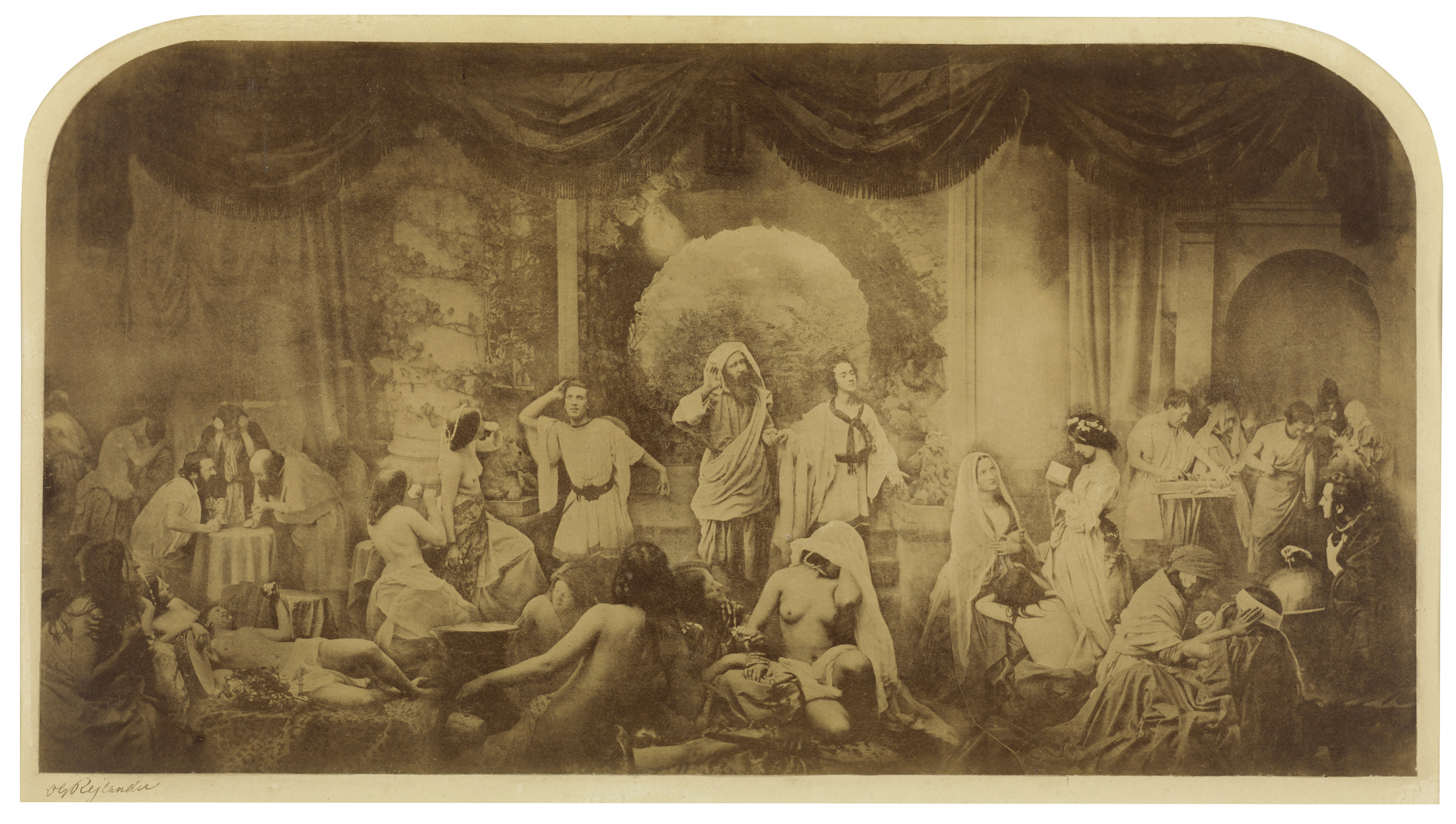
Oscar Rejlander (British born Sweden, 1813-1875) 'The Two Ways of Life' 1856-1857


Oscar Rejlander (British born Sweden, 1813-1875)
The Two Ways of Life
1856-1957
Albumen print, made from approximately 32 separate negatives
Moderna Museet, Stockholm


One of the most famous pictures in photographic history, Rejlander’s Two Ways of Life caused a sensation when it was exhibited at the Manchester Art Treasures exhibition in 1857. To make it, Rejlander combined some thirty-two separate negatives (there were variations between printings, and it is not always clear where negatives begin and end). Some viewers were offended by the nudes, whose bodies appear frank and realistic compared to the ideal fantasies painters were expected to produce. Others objected to its ambition, since Rejlander seemed to be saying that photography could be used to produce pictures just as meaningful, and as artistically composed, as any painting.

To make Two Ways of Life, Rejlander had to arrange the various subjects within it at the right size to maintain visual perspective. This was a challenge, since enlargement and reduction of negatives was not yet possible in the darkroom. The only way he could change the size of something in the negative was to rephotograph it.

This is the finest known print of the photograph, which is also known in a reduced form. The photograph is a parable featuring Rejlander himself, who stands in the middle, listening to ‘good’ and ‘bad’ angels luring him to paths of vice and virtue. Queen Victoria and Prince Albert loved the picture and bought three copies, none of which survive.

Wall text from the exhibition


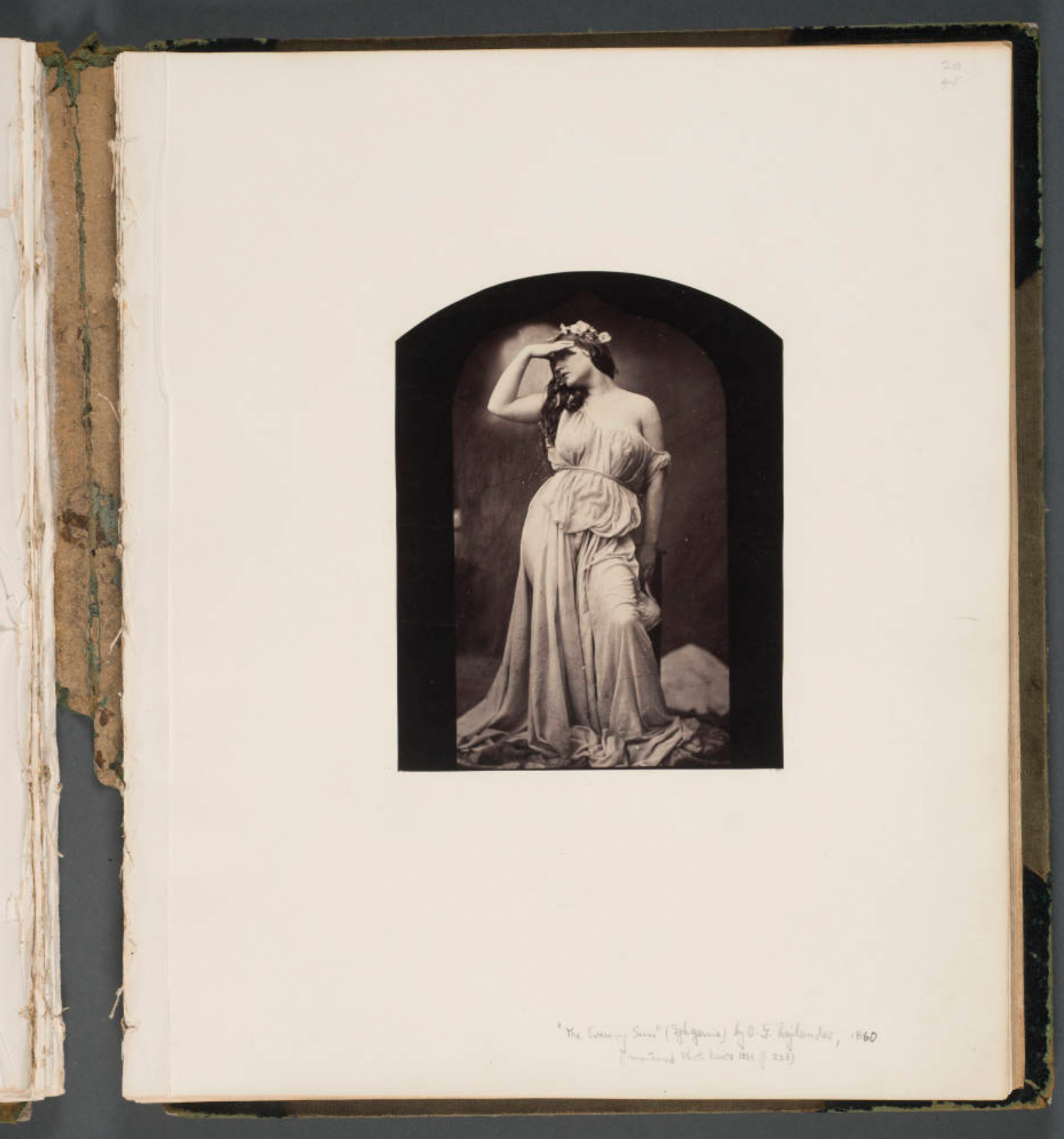
Oscar Rejlander (British born Sweden, 1813-1875) 'The Evening Sun (Iphigenia)' c. 1860


Oscar Rejlander (British born Sweden, 1813-1875)
The Evening Sun (Iphigenia)
c. 1860
© Gernsheim Collection, Harry Ransom Centre, The University of Texas at Austin


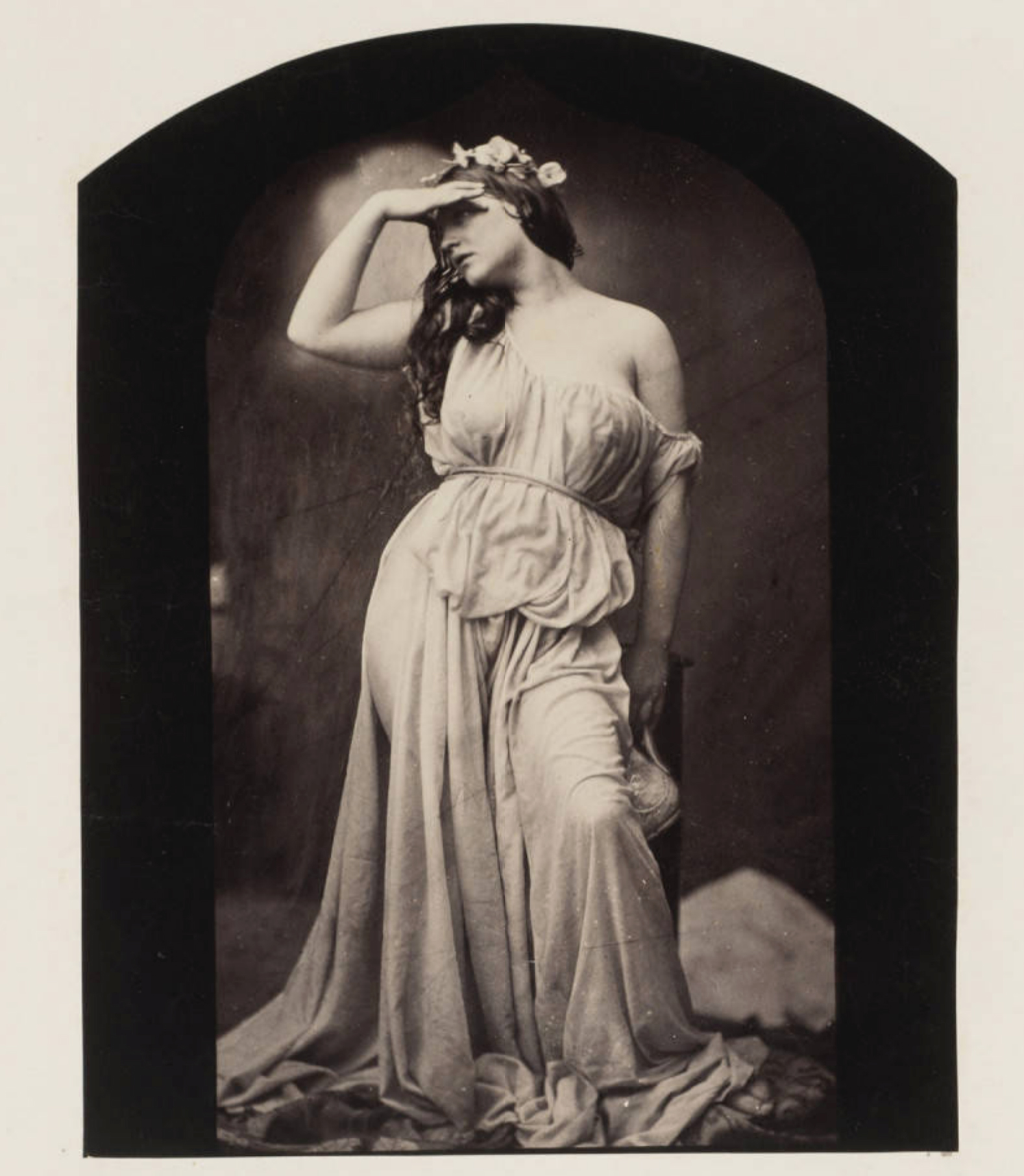
Oscar Rejlander (British born Sweden, 1813-1875) 'The Evening Sun (Iphigenia)' c. 1860


Oscar Rejlander (British born Sweden, 1813-1875)
The Evening Sun (Iphigenia)
c. 1860
© Gernsheim Collection, Harry Ransom Centre, The University of Texas at Austin


Oscar Rejlander (British born Sweden, 1813-1875) 'The Evening Sun (Iphigenia)' c. 1860 (detail)


Oscar Rejlander (British born Sweden, 1813-1875)
The Evening Sun (Iphigenia) (detail)
c. 1860
© Gernsheim Collection, Harry Ransom Centre, The University of Texas at Austin


Iphigenia was a daughter of King Agamemnon who appears in legends about the Trojan War. When her father accidentally offended the goddess Artemis, he was forced to sacrifice Iphigenia to appease the goddess so that she would allow his ships to sail to Troy. She was tricked into going to the town of Aulis under the pretence that she would marry the heroic warrior Achilles. In some versions she was killed, while in others she was rescued by Artemis.

Wall text from the exhibition


Oscar Rejlander (British born Sweden, 1813-1875) 'Ariadne' 1857


Oscar Rejlander (British born Sweden, 1813-1875)
Ariadne
1857
Albumen print from a wet collodion negative


Oscar Rejlander (British born Sweden, 1813-1875) 'Nude female study' c. 1867


Oscar Rejlander (British born Sweden, 1813-1875)
Nude female study
c. 1867
Albumen print
7 3/4 x 5 3/8 in. (196 x 138mm) overall
Given by Stephan Loewentheil, 2017
© National Portrait Gallery, London


Rejlander produced a number of nude studies which he sold to painters for use as studies. He considered these pictures significant because they pointed up errors historically made by painters when depicting human anatomy. Although he was happy for painters to use photographs to improve their paintings, he also saw accuracy of depiction as one of the things that made photography special when compared to other art forms.

Wall text from the exhibition


Oscar Rejlander (British born Sweden, 1813-1875) 'The Virgin in prayer' c. 1857


Oscar Rejlander (British born Sweden, 1813-1875)
The Virgin in prayer (after Sassoferrato)
c. 1857
albumen print
6 7/8 x 5 7/8 in. (174 x 150mm) overall
Purchased with help from the Art Fund, Jane and Michael Wilson and Stephen Barry, 2015
© National Portrait Gallery, London


This photograph is a based on the famous painting The Virgin in Prayer painted by the Italian Baroque painter Sassoferrato 1640-1650, now in the collection of the National Gallery, London. The rise of public art spaces in Britain in the nineteenth century, including the National Gallery (1824), and the National Portrait Gallery (1856), provided inspiration for countless photographers. Rejlander was particularly enthusiastic about restaging famous paintings, often in order to demonstrate mistakes that painters had made in scale and perspective. The process was fun, and the results fuelled the debate about photography’s role among the arts.

Wall text from the exhibition


Oscar Rejlander (British born Sweden, 1813-1875) 'The Virgin in prayer (after Sassoferrato)' c. 1857


Oscar Rejlander (British born Sweden, 1813-1875)
The Virgin in prayer (after Sassoferrato)
c. 1857
Albumen print
7 3/4 x 5 3/4 in. (196 x 146mm) overall
Given by Stephan Loewentheil, 2017
© National Portrait Gallery, London


Oscar Rejlander (British born Sweden, 1813-1875) 'Unknown young woman' 1860-1866


Oscar Rejlander (British born Sweden, 1813-1875)
Unknown young woman
1860-1866
Albumen print
7 3/8 x 5 1/4 in. (188 x 134mm) overall
Purchased with help from the Art Fund, Jane and Michael Wilson and Stephen Barry, 2015
© National Portrait Gallery, London


Oscar Rejlander (British born Sweden, 1813-1875) 'Untitled (unknown sitter, possibly Rejlander's wife, Mary)' c. 1863


Oscar Rejlander (British born Sweden, 1813-1875)
Untitled (unknown sitter, possibly Rejlander’s wife, Mary)
c. 1863
Printed by Julia Margaret Cameron
Albumen print from wet collodion glass negative
Given by Mrs Margaret Southam, 1941
© Victoria and Albert Museum, London


Cameron invited Rejlander to the Isle of Wight in 1863. Before the visit, Rejlander provided her with some of his own negatives, so that she could practise printing. She experimented with some, decorating them with ferns. This picture, which descended through Cameron’s family, was once believed to have been made by her. However, it is now recognised as one of the pictures Cameron printed from a Rejlander negative. The subject is one who frequently appears in Rejlander’s work, and may even have been his wife, Mary.

Wall text from the exhibition


Oscar Rejlander (British born Sweden, 1813-1875) 'Unknown young woman' 1863-1866


Oscar Rejlander (British born Sweden, 1813-1875)
Unknown young woman
1863-1866
Albumen print
8 1/8 x 5 7/8 in. (205 x 149mm) overall
Purchased with help from the Art Fund, Jane and Michael Wilson and Stephen Barry, 2015
© National Portrait Gallery, London


Oscar Rejlander (British born Sweden, 1813-1875) ''Sleep' (Mary Rejlander (née Bull))' c. 1855


Oscar Rejlander (British born Sweden, 1813-1875)
‘Sleep’ (Mary Rejlander (née Bull))
c. 1855
Albumen print
6 1/8 x 6 5/8 in. (156 x 167mm) overall
Purchased with help from the Art Fund, Jane and Michael Wilson and Stephen Barry, 2015
© National Portrait Gallery, London


Oscar Rejlander (British born Sweden, 1813-1875) 'Minnie Constable' 1860-1866


Oscar Rejlander (British born Sweden, 1813-1875)
Minnie Constable
1860-1866
Albumen print
7 1/2 x 5 3/4 in. (192 x 146mm) overall
Purchased with help from the Art Fund, Jane and Michael Wilson and Stephen Barry, 2015
© National Portrait Gallery, London


Oscar Rejlander (British born Sweden, 1813-1875) ''Art must assist Photography' (Putto as Allegory of Painting)' 1856


Oscar Rejlander (British born Sweden, 1813-1875)
‘Art must assist Photography’ (Putto as Allegory of Painting)
1856
Albumen print
4 3/4 x 3 5/8 in. (120 x 93mm) overall
Purchased with help from the Art Fund, Jane and Michael Wilson and Stephen Barry, 2015
© National Portrait Gallery, London


Oscar Rejlander (British born Sweden, 1813-1875) 'Oscar Gustav Rejlander; Mary Rejlander (née Bull)' 1860-1866


Oscar Rejlander (British born Sweden, 1813-1875)
Oscar Gustav Rejlander; Mary Rejlander (née Bull)
1860-1866
Albumen print
8 5/8 x 6 1/4 in. (219 x 158mm) overall
Purchased with help from the Art Fund, Jane and Michael Wilson and Stephen Barry, 2015
© National Portrait Gallery, London


Oscar Rejlander (British born Sweden, 1813-1875) 'Unknown woman' 1860-1866


Oscar Rejlander (British born Sweden, 1813-1875)
Unknown woman
1860-1866
Albumen print
8 x 5 3/4 in. (202 x 147mm) overall
Purchased with help from the Art Fund, Jane and Michael Wilson and Stephen Barry, 2015
© National Portrait Gallery, London


Oscar Rejlander (British born Sweden, 1813-1875) ''A devotee' (Unknown woman)' 1860-1866


Oscar Rejlander (British born Sweden, 1813-1875)
‘A devotee’ (Unknown woman)
1860-1866
Albumen print
8 5/8 x 6 1/4 in. (219 x 158mm) overall
Purchased with help from the Art Fund, Jane and Michael Wilson and Stephen Barry, 2015
© National Portrait Gallery, London


Oscar Rejlander (British born Sweden, 1813-1875) 'Purify my heart' also known as 'The Little Sisters' c. 1862


Oscar Rejlander (British born Sweden, 1813-1875)
Purify my heart also known as The Little Sisters
c. 1862
Albumen print
5 x 4 1/8 in. (127 x 105mm) overall
Given by Stephan Loewentheil, 2017
© National Portrait Gallery, London


This photograph shows two sisters side by side in profile, their hands clasped in prayer. One girl seems almost to be a mirror reflection of the other. Rejlander exhibited versions of this photograph with two different titles. Purify My Heart is a reference to the biblical passage James 4:8: ‘Draw nigh to God, and he will draw nigh to you. Cleanse your hands, ye sinners; and purify your hearts, ye double minded.’ Lewis Carroll admired this photograph and purchased a copy for his personal collection.

Wall text from the exhibition


Oscar Rejlander (British born Sweden, 1813-1875) 'Unknown young woman' 1863-1866


Oscar Rejlander (British born Sweden, 1813-1875)
Unknown young woman
1863-1866
Albumen print
8 1/8 x 5 7/8 in. (205 x 149 mm) overall
Purchased with help from the Art Fund, Jane and Michael Wilson and Stephen Barry, 2015
© National Portrait Gallery, London


National Portrait Gallery
St Martin’s Place
London, WC2H 0HE

Opening hours:
Open daily: 10.30 – 18.00
Friday and Saturday: 10.30 – 21.00

National Portrait Gallery website

LIKE ART BLART ON FACEBOOK

Back to top

Exhibition: ‘Victorian Giants: The Birth of Art Photography’ at the National Portrait Gallery, London Part 1

Exhibition dates: 1st March – 20th May, 2018

Victorian Giants: The Birth of Art Photography is curated by Phillip Prodger PhD, Head of Photographs at the National Portrait Gallery, London


Cover of the catalogue for the exhibition 'Victorian Giants: The Birth of Art Photography' at the National Portrait Gallery, London


Cover of the catalogue for the exhibition Victorian Giants: The Birth of Art Photography at the National Portrait Gallery, London


A two-part bumper posting on this exhibition, Part 1 featuring the work of Lewis Carroll and our Julia… JMC, Julia Margaret Cameron, the most inventive, audacious and talented photographer of the era. In a photographic career spanning eleven years of her life (1864-1875) what Julia achieved in such a short time is incredible.

“Her style was not widely appreciated in her own day: her choice to use a soft focus and to treat photography as an art as well as a science, by manipulating the wet collodion process, caused her works to be viewed as “slovenly”, marred by “mistakes” and bad photography. She found more acceptance among pre-Raphaelite artists than among photographers.” (Wikipedia)

As with any genius (a person who possesses exceptional intellectual or creative power) who goes against the grain, full recognition did not come until later. But when it does arrive, it is undeniable. As soon as you see a JMC photograph… you know it is by her, it could be by no one else. Her “signature” – closely framed portraits and illustrative allegories based on religious and literary works; far-away looks, soft focus and lighting, low depth of field; strong men (“great thro’ genius”) and beautiful, sensual, heroic women (“great thro’ love”) – is her genius.

There is something so magical about how JMC can frame a face, emerging from darkness, side profile, filling the frame, top lit. Soft out of focus hair with one point of focus in the image. Beautiful light. Just the most sensitive capturing of a human being, I don’t know what it is… a glimpse into another world, a ghostly world of the spirit, the soul of the living seen before they are dead.

Love and emotion. Beauty, beautiful, beatified.

Dr Marcus Bunyan

View part 2 of the posting


Many thankx to the National Portrait Gallery, London for allowing me to publish the photographs in the posting. Please click on the photographs for a larger version of the image.


“My aspirations are to ennoble Photography and to secure for it the character and uses of High Art by combining the real & Ideal & sacrificing nothing of Truth by all possible devotion to poetry and beauty.”


Julia Margaret Cameron to Sir John Herschel, 31 December 1864


This major exhibition is the first to examine the relationship between four ground-breaking Victorian artists: Julia Margaret Cameron (1815-1879), Lewis Carroll (1832-1898), Lady Clementina Hawarden (1822-1865) and Oscar Rejlander (1813-1875). Drawn from public and private collections internationally, the exhibition features some of the most breath-taking images in photographic history. Influenced by historical painting and frequently associated with the Pre-Raphaelite Brotherhood, the four artists formed a bridge between the art of the past and the art of the future, standing as true giants in Victorian photography.


Figure 94 and 95 of the catalogue for the exhibition 'Victorian Giants: The Birth of Art Photography' at the National Portrait Gallery, London


Figure 94 and 95 from the catalogue for the exhibition Victorian Giants: The Birth of Art Photography at the National Portrait Gallery, London


Lewis Carroll (English, 1832-1898)

In 1856, Charles Lutwidge Dodgson (Lewis Carroll) took up the new art form of photography under the influence first of his uncle Skeffington Lutwidge, and later of his Oxford friend Reginald Southey. He soon excelled at the art and became a well-known gentleman-photographer, and he seems even to have toyed with the idea of making a living out of it in his very early years.

A study by Roger Taylor and Edward Wakeling exhaustively lists every surviving print, and Taylor calculates that just over half of his surviving work depicts young girls, though about 60% of his original photographic portfolio is now missing. Dodgson also made many studies of men, women, boys, and landscapes; his subjects also include skeletons, dolls, dogs, statues, paintings, and trees. His pictures of children were taken with a parent in attendance and many of the pictures were taken in the Liddell garden because natural sunlight was required for good exposures.

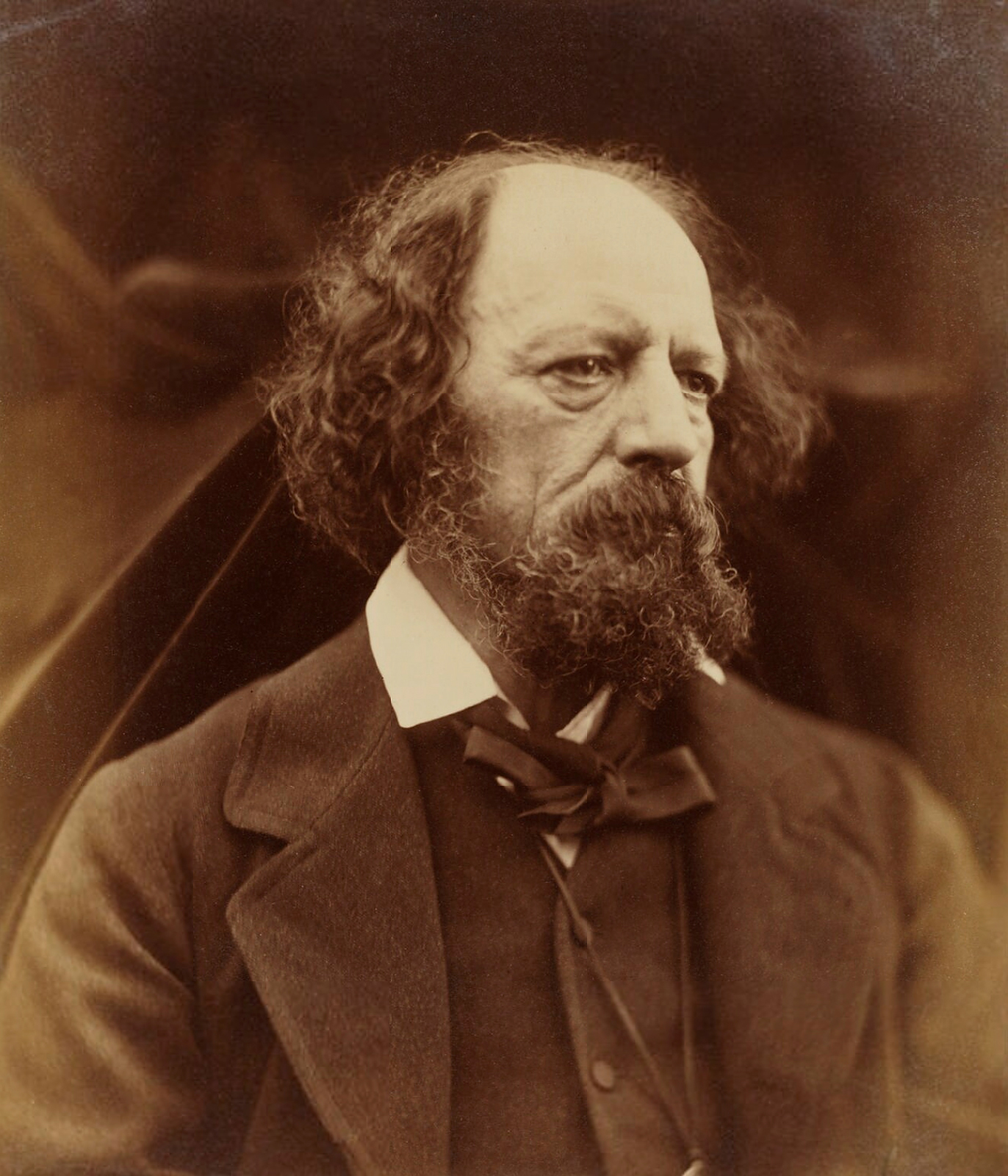
He also found photography to be a useful entrée into higher social circles. During the most productive part of his career, he made portraits of notable sitters such as John Everett MillaisEllen TerryDante Gabriel RossettiJulia Margaret CameronMichael FaradayLord Salisbury, and Alfred, Lord Tennyson.

By the time that Dodgson abruptly ceased photography (1880, over 24 years), he had established his own studio on the roof of Tom Quad, created around 3,000 images, and was an amateur master of the medium, though fewer than 1,000 images have survived time and deliberate destruction. He stopped taking photographs because keeping his studio working was too time-consuming. He used the wet collodion process; commercial photographers who started using the dry-plate process in the 1870s took pictures more quickly.

Text from the Wikipedia website


Lewis Carroll (English, 1832-1898) 'Alice Liddell as 'The Beggar Maid'' Summer 1858 from the exhibition 'Victorian Giants: The Birth of Art Photography' at the National Portrait Gallery, London , March - May, 2018


Lewis Carroll (English, 1832-1898)
Alice Liddell as ‘The Beggar Maid’
also known as King Cophetua’s Bride
Summer 1858
Albumen silver print from glass negative
16.3 x 10.9cm (6 7/16 x 4 5/16in.)
Gilman Collection, Gift of The Howard Gilman Foundation, 2005
© Metropolitan Museum of Art


Known primarily as the author of children’s books, Lewis Carroll was also a lecturer in mathematics at Oxford University and an ordained deacon. He took his first photograph in 1856 and pursued photography obsessively for the next twenty-five years, exhibiting and selling his prints. He stopped taking pictures abruptly in 1880, leaving over three thousand negatives, for the most part portraits of friends, family, clergy, artists, and celebrities. Ill at ease among adults, Carroll preferred the company of children, especially young girls. He had the uncanny ability to inhabit the universe of children as a friendly accomplice, allowing for an extraordinarily trusting rapport with his young sitters and enabling him to charm them into immobility for as long as forty seconds, the minimum time he deemed necessary for a successful exposure. The intensity of the sitters’ gazes brings to Carroll’s photographs a sense of the inner life of children and the seriousness with which they view the world.

Carroll’s famous literary works, “Alice’s Adventures in Wonderland” (1865) and “Through the Looking Glass and What Alice Found There” (1872), were both written for Alice Liddell, the daughter of the dean of Christ Church, Oxford. For Carroll, Alice was more than a favourite model; she was his “ideal child-friend,” and a photograph of her, aged seven, adorned the last page of the manuscript he gave her of “Alice’s Adventures Underground.” The present image of Alice was most likely inspired by “The Beggar Maid,” a poem written by Carroll’s favourite living poet, Alfred, Lord Tennyson, in 1842. If Carroll’s images define childhood as a fragile state of innocent grace threatened by the experience of growing up and the demands of adults, they also reveal to the contemporary viewer the photographer’s erotic imagination. In this provocative portrait of Alice at age seven or eight, posed as a beggar against a neglected garden wall, Carroll arranged the tattered dress to the limits of the permissible, showing as much as possible of her bare chest and limbs, and elicited from her a self-confident, even challenging stance. This outcast beggar will arouse in the passer-by as much lust as pity. Indeed, Alice looks at us with faint suspicion, as if aware that she is being used as an actor in an incomprehensible play. A few years later, a grown-up Alice would pose, with womanly assurance, for Julia Margaret Cameron.

Text from the Metropolitan Museum of Art website


Lewis Carroll (English, 1832-1898) 'Alice Liddell' Summer 1858 from the exhibition 'Victorian Giants: The Birth of Art Photography' at the National Portrait Gallery, London , March - May, 2018


Lewis Carroll (English, 1832-1898)
Alice Liddell
Summer 1858
Wet collodion glass-plate negative
6 x 5 in. (152 x 127mm)
Purchased jointly with the National Science and Media Museum, Bradford, with help from the Art Fund and the National Heritage Memorial Fund, 2002
© National Portrait Gallery, London and the National Media Museum (part of the Science Museum Group, London)


The fourth of ten children and later the inspiration for Alice’s Adventures in Wonderland and its sequel, Through the Looking Glass, Alice Liddell is the most famous of Carroll’s child sitters. Contrary to popular belief, Carroll did not photograph her particularly often, and never photographed her in the nude. Of the 2,600 photographs recorded by Carroll, only twelve solo portraits of Alice are known. By comparison, he made six individual portraits of Alice’s sister, Ina, and forty-five of another favoured sitter, Xie Kitchin (see preceding room).

Wall text from the exhibition


Lewis Carroll (English, 1832-1898) 'Ina Liddell' Summer 1858


Lewis Carroll (English, 1832-1898)
Ina Liddell
Summer 1858
Albumen print
5 7/8 x 5 in. (150 x 126mm) uneven
Purchased jointly with the National Science and Media Museum, Bradford, with help from the Art Fund and the National Heritage Memorial Fund, 2002
© National Portrait Gallery, London and the National Media Museum (part of the Science Museum Group, London)


Lewis Carroll (English, 1832-1898) 'Edith Mary Liddell; Ina Liddell; Alice Liddell Summer' 1858


Lewis Carroll (English, 1832-1898)
Edith Mary Liddell; Ina Liddell; Alice Liddell
Summer 1858
Wet collodion glass plate negative
6 x 7 1/8 in. (154 x 181mm)
Purchased jointly with the National Science and Media Museum, Bradford, with help from the Art Fund and the National Heritage Memorial Fund, 2002
© National Portrait Gallery, London


Lewis Carroll (English, 1832-1898) 'Edith Mary Liddell; Ina Liddell; Alice Liddell Summer' 1858


Lewis Carroll (English, 1832-1898)
Edith Mary Liddell; Ina Liddell; Alice Liddell
Summer 1858
Albumen print
6 1/8 x 6 7/8 in. (156 x 176mm)
Purchased jointly with the National Science and Media Museum, Bradford, with help from the Art Fund and the National Heritage Memorial Fund, 2002
© National Portrait Gallery, London


Lewis Carroll (English, 1832-1898) 'Edith Mary Liddell' Summer 1858


Lewis Carroll (English, 1832-1898)
Edith Mary Liddell
Summer 1858
Albumen print
5 7/8 x 7 in. (148 x 177mm) uneven
Purchased jointly with the National Science and Media Museum, Bradford, with help from the Art Fund and the National Heritage Memorial Fund, 2002
© National Portrait Gallery, London


Lewis Carroll (English, 1832-1898) 'Hallam Tennyson, 2nd Baron Tennyson' 28 September 1857


Lewis Carroll (English, 1832-1898)
Hallam Tennyson, 2nd Baron Tennyson
28 September 1857
Albumen print
5 1/8 x 3 7/8 in. (130 x 99 mm)
Purchased, 1977
© National Portrait Gallery, London


Hallam Tennyson (British, 1852-1928), Alfred Tennyson’s eldest son, was five years old when Carroll photographed him at Monk Coniston Park in the Lake District. Taken while the poet and his family were visiting friends, the portrait shows Hallam standing on a chair, holding what may be a hoop rolling stick. Carroll posed him with his legs crossed – a tricky stance for such a young child to maintain. As an adult, Hallam would marry May Prinsep, Julia Margaret Cameron’s niece. Carroll did make one portrait of Alfred Tennyson during his Lake District trip, but he was determined to make more. In 1864, he visited the Isle of Wight to try to photograph him again, armed with a ‘carpet bag full’ of his photographs to show Cameron and others. He was unable to photograph Tennyson, but Cameron and Carroll staged a ‘mutual exhibition’ in Cameron’s living room. (Wall text)

Hallam Tennyson, 2nd Baron Tennyson, GCMG, PC (11 August 1852 – 2 December 1928) was a British aristocrat who served as the second Governor-General of Australia, in office from 1903 to 1904. He was previously Governor of South Australia from 1899 to 1902.

Tennyson was born in Twickenham, Surrey, and educated at Marlborough College and Trinity College, Cambridge. He was the oldest son of the poet Alfred, Lord Tennyson, and served as his personal secretary and biographer; he succeeded to his father’s title in 1892. Tennyson was made Governor of South Australia in 1899. When Lord Hopetoun resigned the governor-generalship in mid-1902, he was the longest-serving state governor and thus became Administrator of the Government. Tennyson was eventually chosen to be Hopetoun’s permanent replacement, but accepted only a one-year term. He was more popular than his predecessor among the general public, but had a tense relationship with Prime Minister Alfred Deakin and was not offered an extension to his term. Tennyson retired to the Isle of Wight, and spent the rest of his life upholding his father’s legacy.


Lewis Carroll (English, 1832-1898) ''Open your mouth, and shut your eyes' (Edith Mary Liddell; Ina Liddell; Alice Liddell)' July 1860


Lewis Carroll (English, 1832-1898)
‘Open your mouth, and shut your eyes’ (Edith Mary Liddell; Ina Liddell; Alice Liddell)
July 1860
Wet collodion glass plate negative
10 x 8 in. (254 x 203mm)
Purchased jointly with the National Science and Media Museum, Bradford, with help from the Art Fund and the National Heritage Memorial Fund, 2002
© National Portrait Gallery, London


The Liddell family arrived at Christ Church, Oxford in 1856, just as Carroll was beginning to take up photography. He and the family became close friends. Henry Liddell served as Dean of the College throughout Carroll’s career, and initially supported his photographic efforts. In 1863, Carroll and the family broke off relations for unknown reasons. Speculation has included disappointment that Carroll went against the family’s wishes by refusing to court their governess or one of the older Liddell children – Ina has been mentioned as a candidate. Carroll was enormously charmed by the Liddell children, all of whom he photographed, and nearly all of whom made their way into Alice’s Adventures in Wonderland and other, related writings.

Wall text from the exhibition


Lewis Carroll (English, 1832-1898) 'The Rossetti Family' 7 October 1863


Lewis Carroll (English, 1832-1898)
The Rossetti Family
7 October 1863
Albumen print
6 7/8 x 8 3/4 in. (175 x 222mm)
Given by Helen Macgregor, 1978
© National Portrait Gallery, London


Carroll spent months trying to arrange an introduction to Rossetti (1828-1882) so that he could photograph the famous Pre-Raphaelite painter and poet, and his family. This is one of several photographs he made in the garden of Tudor House, 16 Cheyne Walk, Chelsea, during a four-day session in which he photographed the family and some of Rossetti’s artwork, including drawings of his late wife, Elizabeth Siddal.

The relationship between Carroll, Cameron, Hawarden, Rejlander and the Pre-Raphaelites was complex. They had many common friends and associates, and it is believed that several Pre-Raphaelite painters used photographs as studies for their paintings and sculpture. However, all four photographers were attracted to later styles of painting, especially the Spanish and Italian National Portrait Gallery, London Baroque, and the Dutch Golden Age. Led by the cantankerous critic John Ruskin, an associate of Henry Liddell’s at Oxford (Alice Liddell’s father), the Pre-Raphaelites were opposed to such painting, which they considered too literal and mundane.

Wall text from the exhibition


Lewis Carroll (English, 1832-1898) 'Dante Gabriel Rossetti' 7 October 1863


Lewis Carroll (English, 1832-1898)
Dante Gabriel Rossetti
7 October 1863
Albumen print
5 3/4 x 4 3/4 in. (146 x 121mm)
Purchased, 1977
© National Portrait Gallery, London


Gabriel Charles Dante Rossetti (12 May 1828 – 9 April 1882), generally known as Dante Gabriel Rossetti was a British poet, illustrator, painter and translator. He founded the Pre-Raphaelite Brotherhood in 1848 with William Holman Hunt and John Everett Millais. Rossetti was later to be the main inspiration for a second generation of artists and writers influenced by the movement, most notably William Morris and Edward Burne-Jones. His work also influenced the European Symbolists and was a major precursor of the Aesthetic movement.

Rossetti’s art was characterised by its sensuality and its medieval revivalism. His early poetry was influenced by John Keats. His later poetry was characterised by the complex interlinking of thought and feeling, especially in his sonnet sequence, The House of Life. Poetry and image are closely entwined in Rossetti’s work. He frequently wrote sonnets to accompany his pictures, spanning from The Girlhood of Mary Virgin (1849) and Astarte Syriaca (1877), while also creating art to illustrate poems such as Goblin Market by the celebrated poet Christina Rossetti, his sister. Rossetti’s personal life was closely linked to his work, especially his relationships with his models and muses Elizabeth Siddal, Fanny Cornforth and Jane Morris.

Text from the Wikipedia website


Lewis Carroll (English, 1832-1898) 'Benjamin Woodward' Late 1850s


Lewis Carroll (English, 1832-1898)
Benjamin Woodward
Late 1850s
Albumen print
8 x 6 in. (203 x 152mm)
Purchased, 1986
© National Portrait Gallery, London


Irish-born architect Benjamin Woodward (1815-1861) is best known for having designed a number of buildings in Cork, Dublin and Oxford in partnership with Sir Thomas Deane and his son Sir Thomas Newenham Deane. Inspired by the writings of critic John Ruskin, his most important buildings include the museum at Trinity College, Dublin (1853-1857). Through Ruskin, Woodward met Dante Gabriel Rossetti and other Pre-Raphaelite artists, whom Woodward employed in 1857 to decorate his recently completed Oxford Union building.

Wall text from the exhibition


Lewis Carroll (English, 1832-1898) 'John Ruskin' 6 March 1875


Lewis Carroll (English, 1832-1898)
John Ruskin
6 March 1875
Albumen print
3 1/2 x 2 1/4 in. (90 x 58mm) overall
Given by an anonymous donor, 1973
© National Portrait Gallery, London


John Ruskin (8 February 1819 – 20 January 1900) was the leading English art critic of the Victorian era, as well as an art patron, draughtsman, water colourist, a prominent social thinker and philanthropist. He wrote on subjects as varied as geology, architecture, myth, ornithology, literature, education, botany and political economy.

His writing styles and literary forms were equally varied. He penned essays and treatises, poetry and lectures, travel guides and manuals, letters and even a fairy tale. He also made detailed sketches and paintings of rocks, plants, birds, landscapes, and architectural structures and ornamentation. The elaborate style that characterised his earliest writing on art gave way in time to plainer language designed to communicate his ideas more effectively. In all of his writing, he emphasised the connections between nature, art and society.

He was hugely influential in the latter half of the 19th century and up to the First World War. After a period of relative decline, his reputation has steadily improved since the 1960s with the publication of numerous academic studies of his work. Today, his ideas and concerns are widely recognised as having anticipated interest in environmentalism, sustainability and craft.

Text from the Wikipedia website


Lewis Carroll (English, 1832-1898) 'Lewis Carroll' c. 1857


Lewis Carroll (English, 1832-1898)
Lewis Carroll
c. 1857
Albumen print
5 1/2 x 4 5/8 in. (140 x 117mm)
Purchased with help from Kodak Ltd, 1973
© National Portrait Gallery, London


Lewis Carroll took this photograph of himself with the assistance of Ina Liddell, Alice’s older sister. His diary records: ‘Bought some Collodion at Telfer’s […] and spent the morning at the Deanery … Harry was away, but the two dear little girls, Ina and Alice, were with me all the morning. To try the lens, I took a picture of myself, for which Ina took off the cap, and of course considered it all her doing!’

Wall text from the exhibition


Lewis Carroll (English, 1832-1898) 'Alice Liddell' 25 June 1870


Lewis Carroll (English, 1832-1898)
Alice Liddell
25 June 1870
Albumen carte-de-visite
3 1/2 x 2 1/4 in. (91 x 58mm)
Purchased jointly with the National Science and Media Museum, Bradford, with help from the Art Fund and the National Heritage Memorial Fund, 2002
© National Portrait Gallery, London


This is the only portrait of Alice that Carroll is known to have made after the publication of Alice in Wonderland, some seven years earlier. Showing Alice at age eighteen, the innocence of her earlier portraits has now completely drained away, replaced by a severe, inscrutable expression. The moment captured is unusually intimate, with Alice’s head lowered slightly and cocked to one side, looking up at the viewer, and her body slumped in a padded armchair. It is unclear whether Carroll orchestrated this pose, or whether Alice assumed it naturally.

Wall text from the exhibition


The National Portrait Gallery is to stage an exhibition of photographs by four of the most celebrated figures in art photography, including previously unseen works and a notorious photomontage, it was announced today, Tuesday 22 August 2017.

Victorian Giants: The Birth of Art Photography (1 March – 20 May 2018), will combine for the first time ever portraits by Lewis Carroll (1832-1898), Julia Margaret Cameron (1815-1879), Oscar Rejlander (1813-1875) and Lady Clementina Hawarden (1822-1865). The exhibition will be the first to examine the relationship between the four ground-breaking artists. Drawn from public and private collections internationally, it will feature some of the most breath-taking images in photographic history, including many which have not been seen in Britain since they were made.

Victorian Giants: The Birth of Art Photography will be the first exhibition in London to feature the work of Swedish born ‘Father of Photoshop’ Oscar Rejlander since the artist’s death. it will include the finest surviving print of his famous picture Two Ways of Life of 1856-1857, which used his pioneering technique combining several different negatives to create a single final image. Constructed from over 30 separate negatives, Two Ways of Life was so large it had to be printed on two sheets of paper joined together. Seldom-seen original negatives by Lewis Carroll and Rejlander will both be shown, allowing visitors to see ‘behind the scenes’ as they made their pictures.

An album of photographs by Rejlander purchased by the National Portrait Gallery following an export bar in 2015 will also go on display together with other treasures from the Gallery’s world-famous holdings of Rejlander, Cameron and Carroll, which for conservation reasons are rarely on view. The exhibition will also include works by cult hero Clementina Hawarden, a closely associated photographer. This will be the first major showing of her work since the exhibition Lady Hawarden at the V&A in London and the J. Paul Getty Museum in Los Angeles in 1990.

Lewis Carroll’s photographs of Alice Liddell, his muse for Alice in Wonderland, are among the most beloved photographs of the National Portrait Gallery’s Collection. Less well known are the photographs made of Alice years later, showing her a fully grown woman. The exhibition will bring together these works for the first time, as well as Alice Liddell as Beggar Maid on loan from The Metropolitan Museum of Art, New York.

Visitors will be able to see how each photographer approached the same subject, as when Cameron and Rejlander both photographed the poet Alfred, Lord Tennyson and the scientist Charles Darwin, or when Carroll and Cameron both photographed the actress, Ellen Terry. The exhibition will also include the legendary studies of human emotion Rejlander made for Darwin, on loan from the Darwin Archive at Cambridge University.

Victorian Giants: The Birth of Art Photography celebrates four key nineteenth-century figures, exploring their experimental approach to picture-making. Their radical attitudes towards photography have informed artistic practice ever since.

The four created an unlikely alliance. Rejlander was a Swedish émigré with a mysterious past; Cameron was a middle-aged expatriate from colonial Ceylon (now Sri Lanka); Carroll was an Oxford academic and writer of fantasy literature; and Hawarden was landed gentry, the child of a Scottish naval hero and a Spanish beauty, 26 years younger. Yet, Carroll, Cameron and Hawarden all studied under Rejlander briefly, and maintained lasting associations, exchanging ideas about portraiture and narrative. Influenced by historical painting and frequently associated with the Pre-Raphaelite brotherhood, they formed a bridge between the art of the past and the art of the future, standing as true giants in Victorian photography.

Lenders to the exhibition include The Royal Collection, Metropolitan Museum of Art, New York; Ashmolean Museum, Oxford; Moderna Museet, Stockholm; Harry Ransom Center, University of Texas at Austin; Munich Stadtsmuseum; Tate and V & A. Victorian Giants: The Birth of Art Photography will include portraits of sitters such as Charles Darwin, Alice Liddell, Dante Gabriel Rossetti, Thomas Carlyle, George Frederick Watts, Ellen Terry and Alfred, Lord Tennyson.

Dr Nicholas Cullinan, Director, National Portrait Gallery, London, says: ‘The National Portrait Gallery has one of the finest holdings of Victorian photographs in the world. As well as some of the Gallery’s rarely seen treasures, such as the original negative of Lewis Carroll’s portrait of Alice Liddell and images of Alice and her siblings being displayed for the first time, this exhibition will be a rare opportunity to see the works of all four of these highly innovative and influential artists.’

Phillip Prodger, Head of Photographs, National Portrait Gallery, London, and Curator of Victorian Giants: The Birth of Art Photography, says: ‘When people think of Victorian photography, they sometimes think of stiff, fusty portraits of women in crinoline dresses, and men in bowler hats. Victorian Giants is anything but. Here visitors can see the birth of an idea – raw, edgy, experimental – the Victorian avant-garde, not just in photography, but in art writ large. The works of Cameron, Carroll, Hawarden and Rejlander forever changed thinking about photography and its expressive power. These are pictures that inspire and delight. And this is a show that lays bare the unrivalled creative energy, and optimism, that came with the birth of new ways of seeing.’

Press release from the National Portrait Gallery


Figure 25 and 26 of the catalogue for the exhibition 'Victorian Giants: The Birth of Art Photography' at the National Portrait Gallery, London


Figure 25 and 26 from the catalogue for the exhibition Victorian Giants: The Birth of Art Photography at the National Portrait Gallery, London


Julia Margaret Cameron (British, 1815-1879)

In 1863, when Cameron was 48 years old, her daughter gave her a camera as a present, thereby starting her career as a photographer. Within a year, Cameron became a member of the Photographic Societies of London (1864) and Scotland. She remained a member of the Photographic Society, London, until her death. In her photography, Cameron strove to capture beauty. She wrote, “I longed to arrest all the beauty that came before me and at length the longing has been satisfied.” In 1869 she collated and gave what is now known as The Norman Album to her daughter and son-in-law in gratitude for having introduced her to photography. The album was later deemed by the Reviewing Committee on the Export of Works of Art to be of “outstanding aesthetic importance and significance to the study of the history of photography and, in particular, the work of Julia Margaret Cameron – one of the most significant photographers of the 19th century.”

The basic techniques of soft-focus “fancy portraits”, which she later developed, were taught to her by David Wilkie Wynfield. She later wrote that “to my feeling about his beautiful photography I owed all my attempts and indeed consequently all my success”.

Lord Tennyson, her neighbour on the Isle of Wight, often brought friends to see the photographer and her works. At the time, photography was a labour-intensive art that also was highly dependent upon crucial timing. Sometimes Cameron was obsessive about her new occupation, with subjects sitting for countless exposures as she laboriously coated, exposed, and processed each wet plate. The results were unconventional in their intimacy and their use of created blur both through long exposures and leaving the lens intentionally out of focus. This led some of her contemporaries to complain and even ridicule the work, but her friends and family were supportive, and she was one of the most prolific and advanced amateurs of her time. Her enthusiasm for her craft meant that her children and others sometimes tired of her endless photographing, but it also left us with some of the best of records of her children and of the many notable figures of the time who visited her.

During her career, Cameron registered each of her photographs with the copyright office and kept detailed records. Her shrewd business sense is one reason that so many of her works survive today. Another reason that many of Cameron’s portraits are significant is because they are often the only existing photograph of historical figures, becoming an invaluable resource. Many paintings and drawings exist, but, at the time, photography was still a new and challenging medium for someone outside a typical portrait studio.

Text from the Wikipedia website


Julia Margaret Cameron (British, 1815-1879) 'Mary Fisher (Mrs Herbert Fisher)' 1866-1867


Julia Margaret Cameron (British, 1815-1879)
Mary Fisher (Mrs Herbert Fisher)
1866-1867
Albumen print


Julia Margaret Cameron (British, 1815-1879) 'Julia Jackson' 1864


Julia Margaret Cameron (British, 1815-1879)
Julia Jackson
1864
Albumen print


Born in Calcutta, Julia Prinsep Jackson (1846-1895) was the youngest of three daughters of Maria Pattle and the physician John Jackson. Greatly admired by the leading artists of the day, both Edward Burne-Jones and G.F. Watts painted her and she was extensively photographed by her aunt and godmother Julia Margaret Cameron. Julia Jackson’s first husband, Herbert Duckworth, died in 1870 after only three years of marriage. She later married Leslie Stephen, editor of The Dictionary of National Biography. Together they had four children, including the painter Vanessa Bell and the writer Virginia Woolf.

Wall text from the exhibition


Julia Margaret Cameron (British, 1815-1879) 'Mountain Nymph, Sweet Liberty' 1866


Julia Margaret Cameron (British, 1815-1879)
Mountain Nymph, Sweet Liberty
1866
Albumen print
©  Wilson Centre for Photography


Positioned high in the frame against a dark neutral backdrop, with piercing eyes and determined expression, the Mountain Nymph reveals the psychological charge of Cameron’s best portraits. The title derives from John Milton’s poem L’Allegro (published 1645): ‘Come, and trip it as ye go / On the light fantastick toe, / And in thy right hand lead with thee, / The Mountain Nymph, sweet Liberty’. Little is known about the sitter, Mrs Keene. She may have been a professional model as she also sat for the Pre-Raphaelite painter Edward Burne-Jones.

Wall text from the exhibition


Julia Margaret Cameron (British, 1815-1879) 'Virginia Dalrymple' 1868-1870


Julia Margaret Cameron (British, 1815-1879)
Virginia Dalrymple
1868-1870
Gernsheim Collection, Harry Ransom Center, The University of Texas at Austin


Julia Margaret Cameron (British, 1815-1879) 'Marie Stillman (née Spartali)' 1868


Julia Margaret Cameron (British, 1815-1879)
Marie Stillman (née Spartali)
1868
Albumen cabinet card
5 1/4 x 3 7/8 in. (133 x 99mm)
Given by Cordelia Curle (née Fisher), 1959
© National Portrait Gallery, London


Marie Euphrosyne Spartali (Greek: Μαρία Ευφροσύνη Σπαρτάλη), later Stillman (10 March 1844 – 6 March 1927), was a British Pre-Raphaelite painter of Greek descent, arguably the greatest female artist of that movement. During a sixty-year career, she produced over one hundred and fifty works, contributing regularly to exhibitions in Great Britain and the United States.


Julia Margaret Cameron (British, 1815-1879) ''La Madonna Aspettante' (William Frederick Gould; Mary Ann Hillier)' 1865


Julia Margaret Cameron (British, 1815-1879)
‘La Madonna Aspettante’ (William Frederick Gould; Mary Ann Hillier)
1865
Albumen carte-de-visite on gold-edged mount
2 3/4 x 2 1/4 in. (70 x 56mm)
Given by Cordelia Curle (née Fisher), 1959
© National Portrait Gallery, London


Julia Margaret Cameron (British, 1815-1879) ''The Kiss of Peace' (Elizabeth ('Topsy') Keown; Mary Ann Hillier)' 1869


Julia Margaret Cameron (British, 1815-1879)
‘The Kiss of Peace’ (Elizabeth (‘Topsy’) Keown; Mary Ann Hillier)
1869
Albumen print on gold-edged cabinet
5 1/8 x 3 7/8 in. (131 x 99mm) image size
Given by Cordelia Curle (née Fisher), 1959
© National Portrait Gallery, London


Julia Margaret Cameron (British, 1815-1879) 'Daisy Taylor' 1872


Julia Margaret Cameron (British, 1815-1879)
Daisy Taylor
1872
Albumen print
14 3/8 x 9 3/4 in. (364 x 247 mm) image size
Given by Cordelia Curle (née Fisher), 1959
© National Portrait Gallery, London


Julia Margaret Cameron (British, 1815-1879) ''Alethea' (Alice Liddell)' 1872


Julia Margaret Cameron (British, 1815-1879)
‘Alethea’ (Alice Liddell)
1872
Albumen print
12 3/4 x 9 3/8 in. (324 x 237mm) oval
Given by Cordelia Curle (née Fisher), 1959
© National Portrait Gallery, London


Lewis Carroll’s photographs of Alice Liddell are well-known; less familiar are the portraits Julia Margaret Cameron made of her years later, several of which respond directly to Carroll’s pictures. In this photograph, the twenty-year-old Alice is posed in full profile, much as Carroll depicted her in his famous seated portrait of 1858, shown nearby. However, Cameron shows Alice’s long wavy hair cascading in front of and behind her, merging with a background of blooming hydrangeas, the flowering of the plant echoing her coming of age. Cameron named the portrait after the Greek Aletheia, meaning ‘true’ or ‘faithful’.

Wall text from the exhibition


Julia Margaret Cameron (British, 1815-1879) 'Ellen Terry at Age Sixteen' 1864


Julia Margaret Cameron (British, 1815-1879)
Ellen Terry at Age Sixteen
1864
Albumen print


With a stage career that began at the age of nine and spanned sixty-nine years, Ellen Alice Terry (1847-1928) is regarded as one of the greatest actresses of her time. She was particularly celebrated for her naturalistic portrayals. Already an established professional, she married the artist G.F. Watts, thirty years her senior, a week before her seventeenth birthday, the year this photograph was made. Although they separated after less than a year, Watts painted Ellen on several occasions. One such portrait is currently on view in Room 26, on the Gallery’s first floor. Cameron’s idea to use a photograph of a particular subject at a specific time to embody a broad, abstract concept was particularly bold. Many believed that photography was better suited to recording minute detail than communicating universal themes.

Wall text from the exhibition


Dame Alice Ellen Terry, GBE (27 February 1847 – 21 July 1928), known professionally as Ellen Terry, was an English actress who became the leading Shakespearean actress in Britain. Born into a family of actors, Terry began performing as a child, acting in Shakespeare plays in London, and toured throughout the British provinces in her teens. At 16 she married the 46-year-old artist George Frederic Watts, but they separated within a year. She soon returned to the stage but began a relationship with the architect Edward William Godwin and retired from the stage for six years. She resumed acting in 1874 and was immediately acclaimed for her portrayal of roles in Shakespeare and other classics.

In 1878 she joined Henry Irving’s company as his leading lady, and for more than the next two decades she was considered the leading Shakespearean and comic actress in Britain. Two of her most famous roles were Portia in The Merchant of Venice and Beatrice in Much Ado About Nothing. She and Irving also toured with great success in America and Britain.

In 1903 Terry took over management of London’s Imperial Theatre, focusing on the plays of George Bernard Shaw and Henrik Ibsen. The venture was a financial failure, and Terry turned to touring and lecturing. She continued to find success on stage until 1920, while also appearing in films from 1916 to 1922. Her career lasted nearly seven decades.

Text from the Wikipedia website


Julia Margaret Cameron (British, 1815-1879) 'Julia Prinsep Stephen (née Jackson, formerly Mrs Duckworth)' 1867


Julia Margaret Cameron (British, 1815-1879)
Julia Prinsep Stephen (née Jackson, formerly Mrs Duckworth)
1867
Albumen print, oval
13 1/2 x 10 3/8 in. (344 x 263mm)
Given by Cordelia Curle (née Fisher), 1959
© National Portrait Gallery, London


Julia Prinsep Stephen, née Jackson (7 February 1846 – 5 May 1895) was a celebrated English beauty, philanthropist and Pre-Raphaelite model. She was the wife of the agnostic biographer Leslie Stephen and mother of Virginia Woolf and Vanessa Bell, members of the Bloomsbury Group.

Born in India, the family returned to England when Julia Stephen was two years old. She became the favourite model of her aunt, the celebrated photographer, Julia Margaret Cameron, who made over 50 portraits of her. Through another maternal aunt, she became a frequent visitor at Little Holland House, then home to an important literary and artistic circle, and came to the attention of a number of Pre-Raphaelite painters who portrayed her in their work. Married to Herbert Duckworth, a barrister, in 1867 she was soon widowed with three infant children. Devastated, she turned to nursing, philanthropy and agnosticism, and found herself attracted to the writing and life of Leslie Stephen, with whom she shared a mutual friend in Anny Thackeray, his sister-in-law.

After Leslie Stephen’s wife died in 1875 he became close friends with Julia and they married in 1878. Julia and Leslie Stephen had four further children, living at 22 Hyde Park Gate, South Kensington, together with his seven year old handicapped daughter. Many of her seven children and their descendants became notable. In addition to her family duties and modelling, she wrote a book based on her nursing experiences, Notes from Sick Rooms, in 1883. She also wrote children’s stories for her family, eventually published posthumously as Stories for Children and became involved in social justice advocacy. Julia Stephens had firm views on the role of women, namely that their work was of equal value to that of men, but in different spheres, and she opposed the suffrage movement for votes for women. The Stephens entertained many visitors at their London home and their summer residence at St Ives, Cornwall. Eventually the demands on her both at home and outside the home started to take their toll. Julia Stephen died at her home following an episode of influenza in 1895, at the age of 49, when her youngest child was only 11. The writer, Virginia Woolf, provides a number of insights into the domestic life of the Stephens in both her autobiographical and fictional work.

Text from the Wikipedia website


Julia Margaret Cameron (British, 1815-1879) 'Julia Prinsep Stephen (née Jackson, formerly Mrs Duckworth); Gerald Duckworth' August 1872


Julia Margaret Cameron (British, 1815-1879)
Julia Prinsep Stephen (née Jackson, formerly Mrs Duckworth); Gerald Duckworth
August 1872
Albumen print
8 1/2 in. x 12 1/8 in. (216 x 309mm)
Given by Cordelia Curle (née Fisher), 1959
© National Portrait Gallery, London


Julia Margaret Cameron (British, 1815-1879) 'Robert Browning' 1865


Julia Margaret Cameron (British, 1815-1879)
Robert Browning
1865
Albumen print
© Wellcome Collection, London


Cameron had a genius for recognising the expressive potential of chance events in her work. In this incomparable portrait, she allowed the many speck marks that cover this picture, caused by dust or debris settling on the plate after sensitising, to remain as part of the image. As a result, the poet Browning (1812-1889) becomes a transcendent figure, seemingly emerging from a field of stars. Browning developed an early interest in literature and the arts, encouraged by his father who was a clerk for the Bank of England. He refused to pursue a formal career and from 1833, he dedicated himself to writing poems and plays. In 1846 he married the poet Elizabeth Barrett. The couple lived in Italy until Elizabeth’s death in 1861, five years before this picture was taken.

Wall text from the exhibition


Robert Browning (7 May 1812 – 12 December 1889) was an English poet and playwright whose mastery of the dramatic monologue made him one of the foremost Victorian poets. His poems are known for their irony, characterisation, dark humour, social commentary, historical settings, and challenging vocabulary and syntax.

Browning’s early career began promisingly, but was not a success. The long poem Pauline brought him to the attention of Dante Gabriel Rossetti, and was followed by Paracelsus, which was praised by William Wordsworth and Charles Dickens, but in 1840 the difficult Sordello, which was seen as wilfully obscure, brought his poetry into disrepute. His reputation took more than a decade to recover, during which time he moved away from the Shelleyan forms of his early period and developed a more personal style.

In 1846 Browning married the older poet Elizabeth Barrett, who at the time was considerably better known than himself, thus starting one of the most famous literary marriages. They went to live in Italy, a country he called “my university”, and which features frequently in his work. By the time of her death in 1861, he had published the crucial collection Men and Women. The collection Dramatis Personae and the book-length epic poem The Ring and the Book followed, and made him a leading British poet. He continued to write prolifically, but his reputation today rests largely on the poetry he wrote in this middle period.

When Browning died in 1889, he was regarded as a sage and philosopher-poet who through his writing had made contributions to Victorian social and political discourse – as in the poem Caliban upon Setebos, which some critics have seen as a comment on the theory of evolution, which had recently been put forward by Darwin and others. Unusually for a poet, societies for the study of his work were founded while he was still alive. Such Browning Societies remained common in Britain and the United States until the early 20th century.

Text from the Wikipedia website


Julia Margaret Cameron (British, 1815-1879) 'Thomas Carlyle' 1865


Julia Margaret Cameron (British, 1815-1879)
Thomas Carlyle
1865
Albumen print
Lent by Her Majesty The Queen


Cameron portrayed the eminent historian and essayist Thomas Carlyle (1795-1881) completely out of focus – a disembodied, ethereal being, with light playing across his head, face, and beard.

Born in Scotland, Carlyle is considered one of the most important social commentators of his time. His ideas about the role of ‘great men’ in shaping history informed his lecture series and book On Heroes, Hero-Worship and The Heroic in History (1841). Instrumental in the founding of the National Portrait Gallery, he became one of its first Trustees. Carlyle was lifelong friends with Henry Taylor (shown in the next room), to whom Cameron was also close.

Wall text from the exhibition


Julia Margaret Cameron (British, 1815-1879) 'Sir John Frederick William Herschel, 1st Bt' 1867


Julia Margaret Cameron (British, 1815-1879)
Sir John Frederick William Herschel, 1st Bt
1867
Albumen print
13 3/8 x 10 3/8 in. (340 x 264mm)
Purchased, 1982
© Wilson Centre for Photography


Cameron portrayed astronomer and physicist John Frederick William Herschel (1792-1871) as a romantic hero, his wild white hair and shining eyes emerging from darkness. Cameron and Herschel were lifelong friends. They had met in South Africa in 1836, where he was mapping the sky of the southern hemisphere, and where she was recovering from illness. A pioneer in the invention of photography, Herschel was responsible for numerous advancements and is credited with coining the terms ‘negative’, ‘positive’, and ‘photograph’. He introduced Cameron to photography in 1839 and shared the results of his early experiments with her. Rejlander also photographed Herschel, several years previously.

Wall text from the exhibition


Sir John Frederick William Herschel, 1st Baronet KH FRS (7 March 1792 – 11 May 1871) was an English polymath, mathematician, astronomer, chemist, inventor, and experimental photographer, who also did valuable botanical work. He was the son of Mary Baldwin and astronomer William Herschel, nephew of astronomer Caroline Herschel and the father of twelve children.

Herschel originated the use of the Julian day system in astronomy. He named seven moons of Saturn and four moons of Uranus. He made many contributions to the science of photography, and investigated colour blindness and the chemical power of ultraviolet rays; his Preliminary Discourse (1831), which advocated an inductive approach to scientific experiment and theory building, was an important contribution to the philosophy of science.

Text from the Wikipedia website


Julia Margaret Cameron (British, 1815-1879) 'Alfred, Lord Tennyson' 3 June 1869


Julia Margaret Cameron (British, 1815-1879)
Alfred, Lord Tennyson
3 June 1869
Albumen print
11 3/8 x 9 3/4 in. (289 x 248mm)
Purchased, 1974
© National Portrait Gallery, London


Here, Cameron shows the poet emerging out of inky darkness, crowned by wild locks of hair on either side of his head, sporting an abundant beard, and framed by two points of his lapel. She positioned him on high, god-like and looking down, the viewer’s eye fixed at the height of his top button.

Wall text from the exhibition


Julia Margaret Cameron (British, 1815-1879) 'Charles Darwin' 1868-1869


Julia Margaret Cameron (British, 1815-1879)
Charles Darwin
1868-1869
Albumen print
13 x 10 1/8 in. (330 x 256mm)
Purchased, 1974
© National Portrait Gallery, London


In the summer of 1868, Darwin and his family rented a holiday cottage on the Isle of Wight from Cameron’s family. The visit gave Cameron the opportunity to make this famous photograph. Publically, Darwin wrote of this portrait: ‘I like this photograph very much better than any other which has been taken of me.’ Privately, he was less positive, describing it as ‘heavy and unclear’. This particular print once belonged to Virginia Woolf, who was Julia Margaret Cameron’s great niece.

Wall text from the exhibition


National Portrait Gallery
St Martin’s Place
London, WC2H 0HE

Opening hours:
Open daily: 10.30 – 18.00
Friday and Saturday: 10.30 – 21.00

National Portrait Gallery website

LIKE ART BLART ON FACEBOOK

Back to top

Exhibition: ‘Gillian Wearing and Claude Cahun: Behind the mask, another mask’ at the National Portrait Gallery, London

Exhibition dates: 9th March – 29th May, 2017

Curator: Sarah Howgate, Senior Curator of Contemporary Portraits at the National Portrait Gallery, London


Claude Cahun (French, 1894-1954) 'Autoportrait' 1929 from the exhibition 'Gillian Wearing and Claude Cahun: Behind the mask, another mask' at the National Portrait Gallery, London, March - May, 2017


Claude Cahun (French, 1894-1954)
Self-portrait (reflected image in mirror with chequered jacket)
1927
Silver gelatin print


“… the life of spirit is not the life that shrinks from death and keeps itself untouched by devastation, but rather the life that endures it and maintains itself in it. It wins its truth only when, in utter dismemberment, it finds itself. It is this power, not as something positive, which closes its eyes to the negative as when we say of something that it is nothing or is false, and then having done with it, turn away and pass on to something else; on the contrary, spirit is this power only by looking the negative in the face, and tarrying with it. This tarrying with the negative is the magical power that converts it into being.”


George Wilhelm Frederich Hegel, 1807. Phenomenology of Spirit, Preface (trans. A. V. Miller 1977), Oxford: Oxford University Press, p. 10


This is an interesting pairing for an exhibition but the connection between the artists is unconvincing. This is because Wearing and Cahun are talking to different aspects of the self.

Wearing’s self-portraits, her mask-querades, her shielded multiple personalities, talk to a “postmodern meditation on the slipperiness of the self” in which there is little evidence of the existence of any “real” person. Wearing wears her identities in a series of dress-ups, performances where only the eyes of the original protagonist are visible. These identities evidence Jung’s shadow aspect, “an unconscious aspect of the personality which the conscious ego does not identify in itself.” Rather than an assimilation of the shadow aspect into the self followed by an ascent (enantiodromia), Wearing’s images seem to be mired in a state of melancholia, a “confrontation with the shadow which produces at first a dead balance, a stand-still that hampers moral decisions and makes convictions ineffective… tenebrositas, chaos, melancholia.” This is not a confrontation that leads anywhere interesting, by looking the negative in the face and tarrying with it. These split personalities rise little above caricature, an imitation of a person in which certain striking characteristics are over emphasised, such as in Wearing’s portraits of her as Andy Warhol or Robert Mapplethorpe. To me, the photograph of Wearing as Mapplethorpe is a travesty of the pain that artist was feeling as he neared the end of his life, dying from HIV/AIDS.

Cahun’s self-portraits contain all the depth of feeling and emotion that Wearing’s can never contain. Here, identity and gender is played out through performance and masquerade in a constructive way, a deep, probing interrogation of the self in front of the camera. While Cahun engages with Surrealist ideas – wearing masks and costumes and changing her appearance, often challenging traditional notions of gender representation – she does so in a direct and powerful way. As Laura Cumming observes, “She is not trying to become someone else, not trying to escape [as Wearing is]. Cahun is always and emphatically herself. Dressed as a man, she never appears masculine, nor like a woman in drag. Dressed as a woman, she never looks feminine. She is what we refer to as non-binary* these days, though Cahun called it something else: “Neuter is the only gender that always suits me.””

*Those with nonbinary genders can feel that they: Have an androgynous (both masculine and feminine) gender identity, such as androgyne. Have an identity between male and female, such as intergender. Have a neutral or unrecognised gender identity, such as agender, neutrois, or most xenogenders.*

Cahun had a gift for the indelible image but more than that, she possesses the propensity for humility and openness in these portraits, as though she is opening her soul for interrogation, even as she explores what it is to be Cahun, what it is to be human. This is a human being in full control of the balance between the ego and the self, of dream-state and reality. The photographs, little shown in Cahun’s lifetime, are her process of coming to terms with the external world, on the one hand, and with one’s own unique psychological characteristics on the other. They are her adaption** to the world.

**“The constant flow of life again and again demands fresh adaptation. Adaptation is never achieved once and for all.” (Carl Jung. “The Transcendent Function,” CW 8, par. 143.)**


Claude Cahun is person I would have really liked to have met. Affiliated with the French Surrealist movement, living with her partner the artist and stage designer Marcel Moore, the two women left Paris for the Isles of Scilly and were then imprisoned in Nazi-occupied Jersey during the Second World War as a result of their roles in the French Resistance.

“Fervently against war, the two worked extensively in producing anti-German fliers. Many were snippets from English-to-German translations of BBC reports on the Nazis’ crimes and insolence, which were pasted together to create rhythmic poems and harsh criticism. The couple then dressed up and attended many German military events in Jersey, strategically placing them in soldier’s pockets, on their chairs, etc. Also, they inconspicuously crumpled up and threw their fliers into cars and windows. In many ways, Cahun and Malherbe’s [Marcel Moore] resistance efforts were not only political but artistic actions, using their creative talents to manipulate and undermine the authority which they despised. In many ways, Cahun’s life’s work was focused on undermining a certain authority, however her specific resistance fighting targeted a physically dangerous threat. In 1944 she was arrested and sentenced to death, but the sentence was never carried out. However, Cahun’s health never recovered from her treatment in jail, and she died in 1954.” (Wikipedia)

Undermining a certain authority … while ennobling her own identity and being. Love and respect.

Dr Marcus Bunyan


Many thankx to the National Portrait Gallery, London for allowing me to publish the photographs in the posting. Please click on the photographs for a larger version of the image. For more information please see the blog entry by  Louise Downie. “Claude Cahun: Freedom Fighter” on the National Portrait Gallery Blog 09 May 2017.


“Under this mask, another mask. I will never finish removing all these faces.”


Claude Cahun, 1930


This exhibition brings together for the first time the work of French artist Claude Cahun and British contemporary artist Gillian Wearing. Although they were born almost seventy years apart and came from different backgrounds, remarkable parallels can be drawn between the two artists. Both of them share a fascination with the self-portrait and use the self-image, through the medium of photography, to explore themes around identity and gender, which is often played out through masquerade and performance.


Claude Cahun (French, 1894-1954) 'Autoportrait' 1928 from the exhibition 'Gillian Wearing and Claude Cahun: Behind the mask, another mask' at the National Portrait Gallery, London, March - May, 2017


Claude Cahun (French, 1894-1954)
Autoportrait
1928
Gelatin silver print
13.9 x 9cm
Jersey Heritage Collection
© Jersey Heritage


“Once seen, never forgotten: Cahun had a gift for the indelible image. Even when the signals are jammed, and the meaning deliberately baffled, her vision always holds strong. This is partly convenienced by the artist’s exceptional looks. Her long, thin face, with its shaved eyebrows, large eyes and linear nose, takes paint like a canvas. She converts herself into a harpy, a lunatic or a doll with equal ease. In one self-portrait, she even holds her own bare face like a mask…

Peering into these monochrome images, so delicate and small, the viewer might inevitably wonder which is the real Cahun: the woman in the aviator goggles, the pensive Buddhist, the young man in a white silk scarf? But this is not the right question. She is not trying to become someone else, not trying to escape. Cahun is always and emphatically herself.

Dressed as a man, she never appears masculine, nor like a woman in drag. Dressed as a woman, she never looks feminine. She is what we refer to as non-binary these days, though Cahun called it something else: “Neuter is the only gender that always suits me.” …

There is little evidence that she ever displayed these photographs, which were forgotten for decades after her death. It seems that her partner was generally behind the lens, but we know almost nothing about how they were made. Of her lifelong project, Cahun wrote: “Under this mask, another mask. I will never finish removing all these faces.”

Commentators have taken this to mean that she thought of herself as a series of multiple personalities, and the double exposures, shadows and reflections in her work all seem to undermine the idea of a singular self. Yet Cahun is formidably and unmistakably Cahun, her force of personality registering every time in that utterly penetrating look. Far from some postmodern meditation on the slipperiness of the self, her images are completely direct. They acknowledge the sufferings of a double life and are deepened by them every time; and yet they rejoice in that life too.”

Laura Cumming. “Gillian Wearing and Claude Cahun: Behind the Mask, Another Mask – review,” on The Observer website Sunday 12 March 2017 [Online] Cited 17/12/2021


Gillian Wearing and Claude Cahun: Behind the mask, another mask

This exhibition brings together for the first time the work of French artist Claude Cahun and British contemporary artist Gillian Wearing. Although they were born almost seventy years apart and came from different backgrounds, remarkable parallels can be drawn between the two artists. Both of them share a fascination with the self-portrait and use the self-image, through the medium of photography, to explore themes around identity and gender, which is often played out through masquerade and performance.


Claude Cahun (French, 1894-1954) in collaboration with Marcel Moore (French, 1892-1972) 'Aveux non avenus frontispiece' 1929-1930


Claude Cahun (French, 1894-1954) in collaboration with Marcel Moore (French, 1892-1972)
Aveux non avenus frontispiece
1929-1930
Photomontage
Silver gelatin print
Jersey Heritage Collections
© Jersey Heritage


“Cahun appears in enigmatic guises, playing out different personas using masks and mirrors, and featuring androgynous shaven or close-cropped hair – as can be seen in the multiple views of her in the lower left-hand side of this collage. The image also includes symbols made up by the women to represent themselves – the eye for Moore, the artist, and the mouth for Cahun, the writer and actor. Whereas the majority of Surrealists were men, in whose images women appear as eroticised objects, Cahun’s androgynous self-portraits explore female identity as constructed, multifaceted, and ultimately as having a nihilistic absence at the core.”

Ron Radford (ed), Collection highlights: National Gallery of Australia, National Gallery of Australia, Canberra, 2008


Claude Cahun (French, 1894-1954) 'Self-portrait (as a dandy, head and shoulders)' 1921-1922


Claude Cahun (French, 1894-1954)
Self-portrait (as a dandy, head and shoulders)
1921-1922
Silver gelatin print
The Museum of Modern Art, New York
Thomas Walther Collection
Digital image, The Museum of Modern Art, New York / Scala, Florence


Claude Cahun (French, 1894-1954) 'Studies for a keepsake' c. 1925


Claude Cahun (French, 1894-1954)
Studies for a keepsake
c. 1925
Silver gelatin prints
Musée d’Art moderne de la Ville de Paris
© Musée d’Art moderne / Roger-Viollet


Claude Cahun (French, 1894-1954) 'Study for a keepsake' c. 1925


Claude Cahun (French, 1894-1954)
Study for a keepsake
c. 1925
Silver gelatin print
Musée d’Art moderne de la Ville de Paris
© Musée d’Art moderne / Roger-Viollet


Claude Cahun (French, 1894-1954) 'I am in training don't kiss me' c. 1927


Claude Cahun (French, 1894-1954)
I am in training don’t kiss me
c. 1927
Silver gelatin print
117mm x 89mm (whole)
Jersey Heritage Collections
© Jersey Heritage


Totor (progenitor of Tintin) and Popol are two comic characters by the Belgian cartoonist Hergé. Castor and Pollux are the twin stars; Pollux and Helen were the children of Zeus and Leda, while Castor and Clytemnestra were the children of Leda and Tyndareus.


Claude Cahun (French, 1894-1954) 'Self-portrait (kneeling, naked, with mask)' c. 1928


Claude Cahun (French, 1894-1954)
Self-portrait (kneeling, naked, with mask)
c. 1928
Silver gelatin print
116mm x  83mm
Jersey Heritage Collections
© Jersey Heritage


Claude Cahun (French, 1894-1954) 'Self-portrait (full length masked figure in cloak with masks)' 1928


Claude Cahun (French, 1894-1954)
Self-portrait (full length masked figure in cloak with masks)
1928
Silver gelatin print
109 x 82mm
Jersey Heritage Collections
© Jersey Heritage


Claude Cahun (French, 1894-1954) 'Self-portrait' 1929


Claude Cahun (French, 1894-1954)
Self-portrait
1929
Silver gelatin print


Claude Cahun (French, 1894-1954) 'Je tends les bras (I extend my arms)' c. 1932


Claude Cahun (French, 1894-1954)
Je tends les bras (I extend my arms)
c. 1932
Silver gelatin print
Jersey Heritage Collections
© Jersey Heritage


Claude Cahun (French, 1894-1954) 'Self-portrait (in cupboard)' c. 1932


Claude Cahun (French, 1894-1954)
Self-portrait (in cupboard)
c. 1932
Silver gelatin print
Jersey Heritage Collections
© Jersey Heritage


Gillian Wearing and Claude Cahun: Behind the mask, another mask (9 March – 29 May 2017) draws together over 100 works by French artist Claude Cahun (1894-1954) and British contemporary artist Gillian Wearing (b.1963). While they were born 70 years apart, they share similar themes of gender, identity, masquerade and performance.

Cahun, along with her contemporaries André Breton and Man Ray, was affiliated with the French Surrealist movement although her work was rarely exhibited during her lifetime. Together with her partner, the artist and stage designer Marcel Moore, the two women left Paris and were then imprisoned in Nazi-occupied Jersey during the Second World War as a result of their roles in the French Resistance. In her photographs she is depicted wearing masks and costumes and engaging with Surrealist ideas. She also changes her appearance by shaving her hair and wearing wigs, often challenging traditional notions of gender representation.

Gillian Wearing studied at Goldsmiths University, winning the Turner Prize in 1997. She has exhibited extensively in the United Kingdom and internationally, including solo exhibitions at the Whitechapel Gallery and Serpentine Gallery, whilst overseas, recent retrospectives include IVAM Valencia and K20 Dusseldorf. Wearing’s photographic self-portraits incorporate painstaking recreations of her as others in an intriguing and sometimes unsettling range of guises such as where she becomes her immediate family members using prosthetic masks.

Despite their different backgrounds, obvious and remarkable parallels can be drawn between the artists whose fascination with identity and gender is played out through performance and masquerade. Wearing has referenced Cahun overtly in the past: Me as Cahun holding a mask of my face is a reconstruction of Cahun’s self-portrait Don’t kiss me I’m in training of 1927, and forms the starting point of this exhibition, the title of which (Behind the mask, another mask) adapts a quotation from Claude Cahun’s Surrealist writings.

Dr Nicholas Cullinan, Director, National Portrait Gallery, London, says: ‘This inspired, timely and poignant exhibition pairs the works of Gillian Wearing and Claude Cahun. These pioneering artists, although separated by several decades, address similarly compelling themes around gender, identity, masquerade, performance and the idea of the self, issues that are ever more relevant to the present day.’

Sarah Howgate, Curator, Gillian Wearing and Claude Cahun: Behind the mask, another mask, says: ‘It seems particularly fitting that at the National Portrait Gallery on International Women’s Day we are bringing together for the first time Claude Cahun’s intriguing and complex explorations of identity with the equally challenging and provocative self-images of Gillian Wearing.’

Gillian Wearing and Claude Cahun: Behind the mask, another mask is curated by Sarah Howgate, Senior Curator of Contemporary Portraits at the National Portrait Gallery, London.


Claude Cahun (French, 1894-1954) 'Self-portrait as a young girl' 1914


Claude Cahun (French, 1894-1954)
Self-portrait as a young girl
1914
Silver gelatin print
Jersey Heritage Collections
© Jersey Heritage


Claude Cahun (French, 1894-1954) 'Self-portrait as a young girl' 1914


Claude Cahun (French, 1894-1954)
Self-portrait as a young girl
1914
Silver gelatin print
Jersey Heritage Collections
© Jersey Heritage


Claude Cahun (French, 1894-1954) 'Self-portrait (shaved head, material draped across body)' 1920


Claude Cahun (French, 1894-1954)
Self-portrait (shaved head, material draped across body)
1920
Silver gelatin print
115 x 89mm


Claude Cahun (French, 1894-1954) 'Autoportrait' 1927


Claude Cahun (French, 1894-1954)
Autoportrait
1927
Silver gelatin print


Claude Cahun (French, 1894-1954) 'Self-Portrait' 1927


Claude Cahun (French, 1894-1954)
Self-Portrait
1927
Silver gelatin print


Claude Cahun (French, 1894-1954) 'Que me veux tu?' 1929


Claude Cahun (French, 1894-1954)
Que me veux tu? (What do you want from me?)
1929
Gelatin silver print
18 x 23cm (7 1/16 x 9 1/16 ins)
Musée d’Art Moderne de la Ville de Paris


Claude Cahun (French, 1894-1954) 'Self-portrait' 1929


Claude Cahun (French, 1894-1954)
Self-portrait
1929
Gelatin silver print


Claude Cahun (French, 1894-1954) 'Autoportrait' 1939


Claude Cahun (French, 1894-1954)
Autoportrait
1939
Gelatin silver print
10 x 8cm
Jersey Heritage Collection
© Jersey Heritage


Claude Cahun (French, 1894-1954) 'Self-portrait (with Nazi badge between her teeth)' 1945


Claude Cahun (French, 1894-1954)
Self-portrait (with Nazi badge between her teeth)
1945
Photograph – Courtesy of the artist


Ten things you need to know about this extraordinary artist

1. Her real name was Lucy Schwob.
She was born 25 October 1894 in Nantes, daughter of newspaper owner Maurice Schwob and Victorine Marie Courbebaisse; her uncle was the Symbolist writer Marcel Schwob. Subjected to anti-Semitic acts following the Dreyfus Affair, she was removed to a boarding school in Surrey, where she studied for two years.

2. Cahun’s lover was also her stepsister.
In 1909, she met her lifelong partner and collaborator Suzanne Malherbe while studying in Nantes, in what she described as a ‘thunderbolt encounter’. Eight years later, Cahun’s father married Suzanne’s widowed mother.

3. The couple adopted gender-neutral names.
Schwob first used the name Claude Cahun in the semi-biographical text ‘Les Jeux uraniens’, Cahun being a surname from her father’s side. Malherbe changed her name to Marcel Moore and the pair moved to Paris in 1914, where they began their artistic collaborations and Cahun studied literature and philosophy at the Sorbonne.

4. Cahun was one of the few female Surrealists.
In 1932 she was introduced to André Breton, who called her ‘one of the most curious spirits of our time’. Four years later, Cahun participated in the Surrealist exhibition at the Galerie Charles Ratton, Paris, and visited the International Surrealist Exhibition at the New Burlington Galleries, London. Whereas in the works of male Surrealists women often appear as eroticised objects, Cahun’s self-portraits explore female identity as constructed and multifaceted.

5. She was first and foremost a writer.
Now best known for her striking self-portraits, Cahun saw herself primarily as a writer. In 1930 she published Aveux non avenus (translated into English as Disavowals or Cancelled Confessions), an ‘anti-memoir’ including ten photomontages created in collaboration with Moore.

6. In 1937 the couple swapped Paris for Jersey.
Cahun and Moore moved to La Rocquaise, a house in St Brelade’s Bay, Jersey, where they led a secluded life. The couple reverted to their given names, Lucy Schwob and Suzanne Malherbe, and were known by the islanders as ‘les mesdames’.

7. They were actively involved in the resistance against Nazi Occupation.
When the Germans invaded Jersey in 1940 they decided to stay and produced counter-propaganda tracts. In July 1944 they were found out, arrested, stood trial, and were, briefly, sentenced to death (though these sentences were commuted). The couple were imprisoned in separate cells for almost a year before Liberation in May 1945.

8. In 1951 Cahun received the Medal of French Gratitude for her acts of resistance during the Second World War. Suffering increasingly from ill health, she died in 1954 at the age of sixty. Moore died eighteen years later, in 1972.

9. She remained forgotten for half a century
Following her move to Jersey, Cahun slipped from critical attention. After the death of Marcel Moore, much of Cahun’s work was put up for auction and acquired by collector John Wakeham, who then sold it to the Jersey Heritage Trust in 1995. The publication in 1992 of the definitive biography by Francois Leperlier, Claude Cahun: l’ecart et la metamorphose, and subsequent exhibition, Claude Cahun: Photographe, at the Musee d’Art Moderne de la Ville de Paris in 1995 encouraged a growing interest in the artist’s work. It was during this time that Gillian Wearing discovered Claude Cahun.

10. She was an artist ahead of her time
Wearing speaks of a ‘camaraderie’ between her and Cahun but she is not the only contemporary artist to have been influenced by her work. Cahun has a dedicated following among artists and art historians working from postmodern, feminist and queer theoretical perspectives; the American art critic Hal Foster described Cahun as ‘a Cindy Sherman avant la lettre’.


Gillian Wearing (English, b. 1963) 'Self-portrait as my brother Richard Wearing' 2003 from the exhibition 'Gillian Wearing and Claude Cahun: Behind the mask, another mask' at the National Portrait Gallery, London, March - May, 2017


Gillian Wearing (English, b. 1963)
Self-portrait as my brother Richard Wearing
2003
Heather Podesta Collection
Courtesy Maureen Paley, London; Regen Projects, Los Angeles; Tanya Bonakdar Gallery, New York
© Gillian Wearing


Gillian Wearing (English, b. 1963) 'Me as Mapplethorpe' 2009


Gillian Wearing (English, b. 1963)
Me as Mapplethorpe
2009
Courtesy Maureen Paley, London, Regen Projects, Los Angeles and Tanya Bonakdar Gallery, New York
© Gillian Wearing


Gillian Wearing (English, b. 1963) 'Me as Warhol in Drag with Scar' 2010


Gillian Wearing (English, b. 1963)
Me as Warhol in Drag with Scar
2010
Courtesy Maureen Paley, London, Regen Projects, Los Angeles and Tanya Bonakdar Gallery, New York
© Gillian Wearing


Gillian Wearing (English, b. 1963) 'Me as Diane Arbus' 2008-2010


Gillian Wearing (English, b. 1963)
Me as Diane Arbus
2008-2010
Courtesy Maureen Paley, London, Regen Projects, Los Angeles and Tanya Bonakdar Gallery, New York
© Gillian Wearing


Gillian Wearing (English, b. 1963) 'Me as Cahun holding a mask of my face' 2012


Gillian Wearing (English, b. 1963)
Me as Cahun holding a mask of my face
2012
Courtesy Maureen Paley, London; Regen Projects, Los Angeles; Tanya Bonakdar Gallery, New York
© Gillian Wearing


Gillian Wearing (English, b. 1963) 'Self-portrait of me now in a mask' 2011


Gillian Wearing (English, b. 1963)
Self-portrait of me now in a mask
2011
Collection of Mario Testino
Courtesy Maureen Paley, London; Regen Projects, Los Angeles; Tanya Bonakdar Gallery, New York
© Gillian Wearing


Gillian Wearing (English, b. 1963) 'Me as mask' 2013


Gillian Wearing (English, b. 1963)
Me as mask
2013
Private collection, courtesy Cecilia Dan Fine Art
Courtesy Maureen Paley, London; Regen Projects, Los Angeles; Tanya Bonakdar Gallery, New York
© Gillian Wearing


Gillian Wearing (English, b. 1963) 'At Claude Cahun's grave' 2015


Gillian Wearing (English, b. 1963)
At Claude Cahun’s grave
2015
Courtesy Maureen Paley, London
© Gillian Wearing


National Portrait Gallery
St Martin’s Place
London, WC2H 0HE

Opening hours:
Open daily: 10.30 – 18.00​
Friday and Saturday: 10.30 – 21.00

National Portrait Gallery website

LIKE ART BLART ON FACEBOOK

Back to top

Exhibition: ‘William Eggleston Portraits’ at the National Portrait Gallery, London

Exhibition dates: 21st July – 23rd October, 2016

Curator: Phillip Prodger, Head of Photographs at the National Portrait Gallery


William Eggleston (American, b. 1939) 'Untitled, 1974' (Biloxi, Mississippi) from the exhibition 'William Eggleston Portraits' at the National Portrait Gallery, London, July - Oct, 2016


William Eggleston (American, b. 1939)
Untitled, 1974 (Biloxi, Mississippi)
1974
Dye transfer print
Wilson Centre for Photography
© Eggleston Artistic Trust


Just look. Really look. And then think about that looking.

Minute, democratic observations produce images which nestle, and take hold, and grow in the imagination.

No words are necessary. This is a looking that comes from the soul.

Dr Marcus Bunyan


Many thankx to the National Portrait Gallery, London for allowing me to publish the photographs in the posting. Please click on the photographs for a larger version of the image.


“A lot of these pictures I take are of very ordinary, unremarkable things. Can one learn to see? I don’t know. I think probably one is born with the ability to compose an image, in the way one is born with the ability to compose music. It is vastly more important to think about the looking, though, rather than to try to talk about a picture and what it means. The graphic image and words, well, they are two very different animals.”


William Eggleston


“Eggleston is someone who has always tried to maintain emotional detachment in his work, photographing landscapes and inanimate objects with the same attention he would apply to people. He does not believe a photograph is a ‘window on the soul’ as we so often have it, nor does he think a viewer can ever truly understand a photographer’s thoughts and feelings from the pictures they make. Instead, he photographs ‘democratically’, which is to say, he gives even the smallest observations equal weight. His usual method is to capture people going about their business unawares, often performing ordinary tasks like eating in a restaurant or pumping petrol at a filling station. He photographs everyone the same, whether they are a celebrity, a member of his family, or a stranger.”


Curator Phillip Prodger


William Eggleston is a pioneering American photographer renowned for his vivid, poetic and mysterious images. This exhibition of 100 works surveys Eggleston’s full career from the 1960s to the present day and is the most comprehensive display of his portrait photography ever. Eggleston is celebrated for his experimental use of colour and his solo show at the Museum of Modern Art, New York, in 1976 is considered a pivotal moment in the recognition of colour photography as a contemporary art form. Highlights of the exhibition will include monumental prints of two legendary photographs first seen forty years ago: the artist’s uncle Adyn Schuyler Senior with his assistant Jasper Staples in Cassidy Bayou, Mississippi, and Devoe Money in Jackson, Mississippi.

Also on display will be a selection of never-before seen vintage black and white prints from the 1960s. Featuring people in diners, petrol stations and markets in and around the artist’s home in Memphis, Tennessee, they help illustrate Eggleston’s unique view of the world.

Text from the NPG website


William Eggleston (American, b. 1939) 'Untitled' (the artist's uncle, Adyn Schuyler Senior, with assistant Jasper Staples, in Cassidy Bayou, Sumner, Mississippi) 1969-1970 from the exhibition 'William Eggleston Portraits' at the National Portrait Gallery, London, July - Oct, 2016


William Eggleston (American, b. 1939)
Untitled, 1969-70 (the artist’s uncle, Adyn Schuyler Senior, with assistant Jasper Staples, in Cassidy Bayou, Sumner, Mississippi)
1969-1970
Dye transfer print
© Eggleston Artistic Trust


For Eggleston this photo is highly personal. Jasper Staples, the figure on the right, had been around him for his whole life as his family’s “house man”. Here he is next to his employer, Eggleston’s uncle, at a funeral. His exact mimicking of his boss’s posture and their shared focus on an event happening off-camera gives them a moment of unity. Yet the composition of the shot, with their balance and the open car door suggesting some ongoing action, is highly theatrical and might even put us in mind of a TV detective show.

Fred Maynard. “William Eggleston, the reluctant portraitist,” on the 1843 Magazine / The Economist website July 26th, 2016 [Online] Cited 01/10/2016. No longer available online


William Eggleston (American, b. 1939) 'Untitled, 1974' (Karen Chatham, left, with the artist's cousin Lesa Aldridge, in Memphis, Tennessee)


William Eggleston (American, b. 1939)
Untitled, 1974 (Karen Chatham, left, with the artist’s cousin Lesa Aldridge, in Memphis, Tennessee)
1974
Dye transfer print
Wilson Centre for Photography
© Eggleston Artistic Trust


William Eggleston (American, b. 1939) 'Untitled, 1970-1974' (Dennis Hopper)


William Eggleston (American, b. 1939)
Untitled, 1970-74 (Dennis Hopper)
1970-1974
Dye transfer print
© Eggleston Artistic Trust


William Eggleston (American, b. 1939) 'Untitled' 1970-1973


William Eggleston (American, b. 1939)
Untitled
1970-1973
Dye transfer print
© Eggleston Artistic Trust


William Eggleston (American, b. 1939) 'Untitled, c. 1975' (Marcia Hare in Memphis Tennessee) c. 1975


William Eggleston (American, b. 1939)
Untitled, c. 1975 (Marcia Hare in Memphis Tennessee)
c. 1975
Dye transfer print
© Eggleston Artistic Trust


One of Eggleston’s most famous images, this pictures shows why he is known as the man who brought colour photography into the artistic mainstream. The subject, Marcia Hare, floats on a cloud-like bed of soft-focus grass, the red buttons on her dress popping out like confectionary on a cake. The dye-transfer technique which Eggleston borrowed from commercial advertising and turned into his trademark gives such richness to the colour that we are brought out of the Seventies and into the realm of Pre-Raphaelite painting. The ghost of Millais’s “Ophelia” sits just out of reach, a connection which the inscrutable artist is happy, as ever, to neither confirm nor deny.

Fred Maynard. “William Eggleston, the reluctant portraitist,” on the 1843 Magazine / The Economist website July 26th, 2016 [Online] Cited 01/10/2016. No longer available online


William Eggleston (American, b. 1939) 'Untitled, c. 1970' (Devoe Money in Jackson, Mississippi)


William Eggleston (American, b. 1939)
Untitled, c. 1970 (Devoe Money in Jackson, Mississippi)
c. 1970
Dye transfer print
© Eggleston Artistic Trust


“This is Devoe, a distant relative of mine (although I can’t remember exactly how), but also a friend. She is dead now, but we were very close. She was a very sweet and charming lady. I took this picture in the yard at the side of her house. I would often visit her there in Jackson. I remember I found the colour of her dress and the chair very exciting, and everything worked out instantly. I think this is the only picture I ever took of her, but I would say it sums her up. I didn’t pose her at all – I never do, usually because it all happens so quickly, but I don’t think I would have moved her in any way. I’m still very pleased with the photograph.”

~ William Eggleston


William Eggleston (American, b. 1939) 'Untitled' c. 1965-1969


William Eggleston (American, b. 1939)
Untitled
c. 1965-1969
Dye transfer print
© Eggleston Artistic Trust


“These two are strangers. I happened to be walking past and there it was, the picture. As usual I took it very rapidly and we didn’t speak. I think I was fortunate to catch that expression on the woman’s face. A lot of these pictures I take are of very ordinary, unremarkable things. Can one learn to see? I don’t know. I think probably one is born with the ability to compose an image, in the way one is born with the ability to compose music. It is vastly more important to think about the looking, though, rather than to try to talk about a picture and what it means. The graphic image and words, well, they are two very different animals.”

~ William Eggleston


William Eggleston (American, b. 1939) 'Untitled, 1970' (Self-portrait)


William Eggleston (American, b. 1939)
Untitled, 1970 (Self-portrait)
1970
Dye transfer print
© Eggleston Artistic Trust


A previously unseen image of The Clash frontman Joe Strummer and a never-before exhibited portrait of the actor and photographer Dennis Hopper will be displayed for the first time in the National Portrait Gallery this summer.  They will be included in the first museum exhibition devoted to the portraits of pioneering American photographer, William Eggleston it was announced today, Thursday 10 March 2016.

William Eggleston Portraits (21 July to 23 October) will bring together over 100 works by the American photographer, renowned for his vivid, poetic and mysterious images of people in diners, petrol stations, phone booths and supermarkets. Widely credited with increasing recognition for colour photography, following his own experimental use of dye-transfer technique, Eggleston will be celebrated by a retrospective of his full career, including a selection of never-before seen vintage black and white photographs from the 1960s taken in and around the artist’s home in Memphis, Tennessee.

The first major exhibition of Eggleston’s photographs in London since 2002 and the most comprehensive of his portraits, William Eggleston Portraits will feature family, friends, musicians and actors including rarely seen images of Eggleston’s own close relations. It will provide a unique window on the artist’s home life, allowing visitors to see how public and private portraiture came together in Eggleston’s work. It will also reveal, for the first time, the identities of many sitters who have until now remained anonymous. Other highlights include monumental, five foot wide prints of the legendary photographs of the artist’s uncle, Adyn Schuyler Senior, with his assistant Jasper Staples in Cassidy Bayou, Mississippi and Devoe Money in Jackson, Mississippi from the landmark book Eggleston’s Guide (1976).

Since first picking up a camera in 1957, Eggleston’s images have captured the ordinary world around him and his work is said to find ‘beauty in the everyday’. His portrayal of the people he encountered in towns across the American South, and in Memphis in particular, is shown in the context of semi-public spaces. Between 1960 and 1965, Eggleston worked exclusively in black and white and people were Eggleston’s primary subject, caught unawares while going about ordinary tasks. In the 1970s, Eggleston increasingly frequented the Memphis night club scene, developing friendships and getting to know musicians and artists. His fascination with club culture resulted in the experimental video ‘Stranded in Canton’, a selection of which will also be on view at the exhibition. ‘Stranded in Canton’ chronicles visits to bars in Memphis, Mississippi and New Orleans.

Eggleston’s 1976 show at the Museum of Modern Art, New York, is considered a pivotal moment in the recognition of colour photography as a contemporary art form. His work has inspired many present day photographers, artists and filmmakers, including Martin Parr, Sofia Coppola, David Lynch and Juergen Teller.

Dr Nicholas Cullinan, Director of the National Portrait Gallery, London, says: William Eggleston makes memorable photographic portraits of individuals – including friends and family, musicians and artists – that are utterly unique and highly influential. More than this, Eggleston has an uncanny ability to find something extraordinary in the seemingly everyday. Combining well-known works with others previously unseen, this exhibition looks at one of photography’s most compelling practitioners from a new perspective.”

Curator Phillip Prodger, Head of Photographs at the National Portrait Gallery says, “Few photographers alive today have had such a profound influence on the way photographs are made and seen as William Eggleston. His pictures are as fresh and exciting as they were when they first grabbed the public’s attention in the 1970s. There is nothing quite like the colour in an Eggleston photograph – radiant in their beauty, that get deep under the skin and linger in the imagination.

Press release from the National Portrait Gallery, London


William Eggleston (American, b. 1939) 'Untitled, 1965' (Memphis Tennessee)


William Eggleston (American, b. 1939)
Untitled, 1965 (Memphis Tennessee)
Nd
Dye transfer print
Wilson Centre for Photography
© Eggleston Artistic Trust


William Eggleston: Democratic Camera, Photographs and Video, 1961-2008

This candid interview with photographer William Eggleston was conducted by film director Michael Almereyda on the occasion of the opening of Eggleston’s retrospective William Eggleston: Democratic Camera, Photographs and Video, 1961-2008 at the Whitney Museum of American Art. A key figure in American photography, Eggleston is credited with helping to usher in the era of colour photography. Eggleston discusses his shift from black and white to colour photography in this video as, “it never was a conscious thing. I had wanted to see a lot of things in colour because the world is in colour”. Also included in this video are Eggleston’s remarks about his personal relationships with the subjects of many of his photographs.

Text from the YouTube website


According to Eggleston talking on the above video, this was his first successful colour negative.

The photo that made Eggleston’s name, this image of a grocery-store boy lining up shopping carts is a prime example of his ability to capture the humdrum reality of life in mid-century America. Yet it is also something more: the delicacy of his motion, the tension in his posture, the concentration on his brow evoke a master craftsman at work. Despite Eggleston’s presence, he seems entirely unselfconscious: caught in perfect profile and sun-dappled like a prime specimen of American youth. Eggleston, hovering between documentarian and sentimentalist, creates a semi-ironic paean to America.

Fred Maynard. “William Eggleston, the reluctant portraitist,” on the 1843 Magazine / The Economist website July 26th, 2016 [Online] Cited 01/10/2016. No longer available online


William Eggleston (American, b. 1939) 'Untitled' (Memphis) c. 1969-1971


William Eggleston (American, b. 1939)
Untitled (Memphis)
c. 1969-1971
Dye transfer print
© Eggleston Artistic Trust


“I took this picture in front of the music school of the university in Memphis. She was waiting on an automobile to come pick her up. I remember she was studying the sheaves of music on her lap. Not one word was exchanged – I was gone before she had the chance to say anything to me and it happened so fast that she wasn’t even sure I had taken a picture. I didn’t make a point of carrying a camera, but I usually had one with me.”

~ William Eggleston


William Eggleston (American, b. 1939) 'Untitled, c. 1980' (Joe Strummer)


William Eggleston (American, b. 1939)
Untitled, c. 1980 (Joe Strummer)
c. 1980
Dye transfer print
© Eggleston Artistic Trust


William Eggleston (American, b. 1939) 'Untitled' 1973-1974


William Eggleston (American, b. 1939)
Untitled, 1973-74
1973-1974
Dye transfer print
© Eggleston Artistic Trust


The closest Eggleston came to taking traditional portraits was in a series he shot in bars in his native Memphis and the Mississippi Delta in 1973-4. The sitters in his Nightclub Portraits – anonymous figures plucked, slightly flushed, from their nights out – are not posing but instead are photographed mid-conversation, Eggleston capturing them at their most unguarded. What is remarkable about this example is the strange composure of the subject, the slightly ethereal sheen as the flash from the camera is reflected by her make-up. Eggleston’s precise focus picks out the individual threads of her cardigan. Something hyper-real and statuesque emerges from an ordinary night out.

Fred Maynard. “William Eggleston, the reluctant portraitist,” on the 1843 Magazine / The Economist website July 26th, 2016 [Online] Cited 01/10/2016. No longer available online


William Eggleston (American, b. 1939) 'Untitled, 1973-1974'


William Eggleston (American, b. 1939)
Untitled, 1973-74
1973-1974
Dye transfer print
© Eggleston Artistic Trust


Another one of the sitters in his Nightclub Portraits


William Eggleston (American, b. 1939) 'Untitled, 1973-74' (Dane Layton)


William Eggleston (American, b. 1939)
Untitled, 1973-74 (Dane Layton)
1973
Dye transfer print
© Eggleston Artistic Trust


William Eggleston (American, b. 1939) 'Untitled' 1970-1973


William Eggleston (American, b. 1939)
Untitled
1970-1973
Dye transfer print
© Eggleston Artistic Trust


“I don’t know who this woman is, I simply saw her on the street. I never know what I am looking for until I see it. The images just seem to happen, wherever I happen to be. Was I attracted by the movement? I think I was attracted to the bright orange of her dress. She wasn’t raising her hand as a result of anything I did, but I think I must have been aware of the repeat made by her shadow in the frame – subconsciously at least – it needed to be in the picture.”

~ William Eggleston


William Eggleston (American, b. 1939) 'Untitled' 1971-1974


William Eggleston (American, b. 1939)
Untitled
1971-1974
Dye transfer print
© Eggleston Artistic Trust


“Refusing to be pinned down to any viewpoint or agenda, Eggleston’s greatest strength is his almost enraging ambiguity. He is neither a sentimentalist nor a documentarian, neither subjective nor objective: he somehow captures that ephemeral moment we experience when we’re not quite sure why a memory sticks with us, why an otherwise mundane glance from a stranger seems to take on a greater significance.

His refusal to think of himself as a portraitist is what gives this exhibition such wry power. Here is a photographer who makes no distinctions, viewing every subject from cousins to coke cans with the same inscrutable gaze. When approached about the idea of a portrait show, the NPG’s Philip Prodger recalls, Eggleston expressed surprise because he didn’t “do” portraits. Prodger reframed the exhibition as a series of photos that just happened to have people in them. “That makes sense”, Eggleston deadpanned.

The unvarnished Americana for which he is so famous – brash logos and a hint of rust – can contain something uneasy, even threatening, precisely because Eggleston maintains a blithe poker-face about his feelings on his subjects. Walking through this exhibition is to meet more placards marked “Untitled” than you can handle. The names of previously anonymous sitters, revealed specially for this exhibition, are hardly likely to make things much more concrete for the viewer. Rather we are let in on an extraordinary experience, moving between the mysterious faces of a transitional moment in American history, not quite sure whether some greater revelation is bubbling under the surface.”

Extract from Fred Maynard. “William Eggleston, the reluctant portraitist,” on the 1843 Magazine / The Economist website July 26th, 2016 [Online] Cited 01/10/2016. No longer available online


William Eggleston (American, b. 1939) 'Untitled, 1960s'


William Eggleston (American, b. 1939)
Untitled, 1960s
1960s
Silver gelatin print
© Eggleston Artistic Trust


William Eggleston (American, b. 1939) 'Untitled, 1960s'


William Eggleston (American, b. 1939)
Untitled, 1960s
1960s
Silver gelatin print
© Eggleston Artistic Trust


National Portrait Gallery
St Martin’s Place
London, WC2H 0HE

Opening hours:
Daily 10.30am – 6pm

National Portrait Gallery website

LIKE ART BLART ON FACEBOOK

Back to top

Exhibition: ‘Camille Silvy, Photographer of Modern Life, 1834-1910’ at the National Portrait Gallery, London

Exhibition dates: 15th July – 24th October 2010


Many thankx to the National Portrait Gallery, London for allowing me to publish the photographs in the posting. Please click on the photographs for a larger version of the image.


Camille Silvy (French, 1834-1910) '[River Scene, France]' Negative 1858; print 1860s from the exhibition 'Camille Silvy, Photographer of Modern Life, 1834-1910' at the National Portrait Gallery, London, July - Oct 2010


Camille Silvy (French, 1834-1910)
[River Scene, France]
Negative 1858; print 1860s
Albumen silver print
25.7 × 35.6cm (10 1/8 × 14 in.)


When Camille Silvy originally exhibited this photograph in 1859 (with the title Vallée de l’Huisne), a reviewer wrote: “It is impossible to compose with more artistry and taste than M. Silvy has done. The Vallée de l’Huisne… [is a] true picture in which one does not know whether to admire more the profound sentiment of the composition or the perfection of the details.”

Early collodion-on-glass negatives, such as those Silvy used to render this scene, were particularly sensitive to blue light, making them unsuitable for simultaneously capturing definition in land and sky. Silvy achieved this combination of richly defined clouds and terrain by skilfully wedding two exposures and disguising any evidence of his intervention with delicate drawing and brushwork on the combination negative. The print exemplifies the tension between reality and artifice that is an integral part of the art of photography.

The Huisne River provided power for flour and tanning mills and was significant in the history of Nogent-le-Rotrou, the town where Silvy was born. This photograph was taken from the Pont de Bois, a bridge over the river, looking toward the south and downstream. It was only a few minutes’ walk from Silvy’s birthplace. As the reviewer suggested, it is a sentimental image, an idyllic landscape full of reverence for and memory of a timeless place that was significant in the artist’s development.

Text from the J. Paul Getty Museum website


Camille Silvy (French, 1834-1910)
'Lecture du Premier Ordre du Jour de l'armée d'Italie dans Les Faubourgs de Paris' (Reading of the First Agenda of the army of Italy in the suburbs of Paris) 1859 from the exhibition 'Camille Silvy, Photographer of Modern Life, 1834-1910' at the National Portrait Gallery, London, July - Oct 2010


Camille Silvy (French, 1834-1910)
Lecture du Premier Ordre du Jour de l’armée d’Italie dans Les Faubourgs de Paris
(Reading of the First Agenda of the army of Italy in the suburbs of Paris)
1859
Albumen print
10 x 7 1/4 inches (25.4 x 18.42cm)
© Private Collection, Paris


Camille Silvy (French, 1834-1910) 'James Pinson Labulo Davies and Sarah Forbes Bonetta (Sarah Davies)' 1862 from the exhibition 'Camille Silvy, Photographer of Modern Life, 1834-1910' at the National Portrait Gallery, London, July - Oct 2010


Camille Silvy (French, 1834-1910)
James Pinson Labulo Davies and Sarah Forbes Bonetta (Sarah Davies)
1862
© National Portrait Gallery, London


James Pinson Labulo Davies was a 19th-century African merchant-sailor, naval officer, influential businessman, farmer, pioneer industrialist, statesman, and philanthropist who married Sarah Forbes Bonetta in colonial Lagos.

Sara Forbes Bonetta, otherwise spelled Sarah, was a West African Egbado princess of the Yoruba people who was orphaned in intertribal warfare, sold into slavery and, in a remarkable twist of events, was liberated from enslavement and became a goddaughter to Queen Victoria. She was married to Captain James Pinson Labulo Davies, a wealthy Victorian Lagos philanthropist.


Camille Silvy (French, 1834-1910) 'Aina (Sarah Forbes Bonetta (later Davies))' 15 September 1862 from the exhibition 'Camille Silvy, Photographer of Modern Life, 1834-1910' at the National Portrait Gallery, London, July - Oct 2010


Camille Silvy (French, 1834-1910)
Aina (Sarah Forbes Bonetta (later Davies))
15 September 1862
From Album 9 (Daybook Volume 9)
Albumen print
3 1/4 in. x 2 1/4 in. (83 mm x 56 mm) image size
National Portrait Gallery, London
Purchased, 1904
© National Portrait Gallery, London


Now best known as Sarah Forbes Bonetta, Aina lived a life of extraordinary contrasts. Her story is one of displacement and reveals how she was fetishized in both Africa and England. Born in modern-day south-west Nigeria, Aina was about five years old when she was captured by soldiers of King Ghezo of Dahomey, a central figure in the transatlantic slave trade. She was discharged by the King to Captain Frederick Forbes, who was sent to west Africa to persuade the King to abandon slavery. He bargained to save the child, convincing the King to send her as a ‘gift’ to Queen Victoria. Before setting sail for England on board HMS Bonetta, Forbes had Aina baptised Sarah Forbes Bonetta. This stripped her of her original name ‘Aina’ and symbolically, of her west-African identity. The Queen, impressed by the young girl’s intelligence and dignity, became her protector, funding her education and providing for her welfare. She became one of the Queen’s favourites and by her late teens, had entered elite society. She was highly regarded in the royal household, appearing at many social events including the wedding of Princess Victoria, the Queen’s eldest daughter. It was at one such event that a Sierra Leonian merchant, prominent in missionary circles, first saw her and declared his interest in marrying her. The match was considered a suitable one and Aina was encouraged to accept the proposal from widower James Pinson Labulo Davies. In 1862, the couple married in a lavish wedding featuring ten carriages. They settled in colonial Lagos, naming their first child Victoria with the Queen’s blessing. When Aina died of tuberculosis in Madeira, aged just 37, the Queen wrote: “Saw poor Victoria Davies, my black godchild, who learnt this morning of the death of her dear mother.” Caught up in Britain’s imperial ambitions and plunged into Victorian high society, Aina had crossed immense boundaries between places, cultures and identities – often without a choice.

Text from the National Portrait Gallery, London website


Camille Silvy (French, 1834-1910) 'Silvy in his Studio with his Family' 1866


Camille Silvy (French, 1834-1910)
Silvy in his Studio with his Family
1866
© Private Collection, Paris


Camille Silvy (French, 1834-1910) 'Proof sheet of Madame Silvy' c. 1865


Camille Silvy (French, 1834-1910)
Proof sheet of Madame Silvy
c. 1865
© Private Collection, Paris


This is the first retrospective exhibition devoted to Camille Silvy, pioneer of street photography, early image manipulation and photographic mass production. The exhibition includes photographs not seen for over 150 years.

The first retrospective exhibition of work by Camille Silvy, one of the greatest French photographers of the nineteenth century, will open at the National Portrait Gallery this summer. Marking the centenary of Silvy’s death, Camille Silvy, Photographer of Modern Life, 1834-1910, includes over a hundred objects, many of which have not been exhibited since 1860. The portraits on display offer a unique glimpse into nineteenth-century Paris and Victorian London through the eyes of one of photography’s greatest innovators.

Focusing on Silvy’s ten-year creative burst from 1857-67 when he was working in Algiers, rural France, Paris and London, the exhibition will show how Silvy pioneered many branches of the photographic medium including theatre, fashion, military and street photography. Working under the patronage of Queen Victoria, Silvy photographed royalty, statesmen, aristocrats, celebrities, the professional classes, businessmen and the households of the country gentry. Silvy’s London studio was a model factory producing portraits in the new carte de visite format – small, economically priced, and collectable. Silvy played an important role in the popularity of the carte de visite format in London and these portraits show how the modern and fashionably dressed looked. Silvy’s Bayswater studio, with a staff of forty, produced over 17,000 portraits.

Works on display will include River Scene, France (1858), considered Silvy’s masterpiece, alongside his London series on twilight, sunlight and fog. Anticipating our own era of digital manipulation, Silvy created photographic illusions in these works by using darkroom tricks. Mark Haworth-Booth, the curator of this exhibition, claims that Camille Silvy came closest in photography to embodying the vision of ‘the painter of modern life’ sketched out by Charles Baudelaire in a famous essay.

The exhibition draws on works from public and private collections including that belonging to Silvy’s descendants, seen for the first time, along with a cache of letters in which Silvy describes to his parents how he set up and ran his London studio. A selection of Daybooks, providing a unique record of the day to day workings of Silvy’s studio will also be on display. The Daybooks were bought by the National Portrait Gallery in 1904 and are among the rarely seen treasures of the Gallery’s photography collection. Albums, documents, a dress worn by Silvy’s wife for a portrait session in 1865 and other items which build up a picture of Silvy’s working practice will also be included in the exhibition. The exhibition will illustrate the transformation of photographic art into industry, the beginnings of the democratisation of portraiture and the life of this photographic genius who fell into obscurity.

Born 1834 in Nogent-le-Rotrou, France, Silvy graduated in arts and law and took up a diplomatic post in the French foreign office in 1853 and was first sent to London the following year. In 1857, he joined a six month mission to Algeria to draw buildings and scenes but he soon realised the inadequacy of his talents and turned to photography. Returning to London, he exhibited River Scene, France to immense success in the 3rd annual exhibition of the Photographic Society in Edinburgh and at the first ever Salon of photography as a fine art in Paris. In 1859 he took over the photographic studio of Caldesi and Montecchi at 38 Porchester Terrace in Bayswater, London. After ten years of creative productivity, in 1869, at the age of thirty-five, Silvy retired from photography. He went on to fight with distinction in the Franco-Prussian War of 1870 before being diagnosed with folie raisonnante (manic-depression) in 1875. Camille Silvy spent the remaining thirty-one years of his life in psychiatric asylums before dying from bronchopneumonia in the Hôpital de St Maurice, France in 1910.

Press release from the National Portrait Gallery website [Online] Cited 13/10/2010 no longer available online


Camille Silvy (French, 1834-1910) 'The Misses Booth' 1861


Camille Silvy (French, 1834-1910)
The Misses Booth
1861
Albumen print
© K and J Jacobson Collection, United Kingdom


Camille Silvy (French, 1834-1910) 'Adelina Patti as Harriet in Martha' 1861


Camille Silvy (French, 1834-1910)
Adelina Patti as Harriet in Martha
1861
© Private Collection


Adelina Patti (10 February 1843 – 27 September 1919) was an Italian 19th-century opera singer, earning huge fees at the height of her career in the music capitals of Europe and America. She first sang in public as a child in 1851, and gave her last performance before an audience in 1914. Along with her near contemporaries Jenny Lind and Thérèse Tietjens, Patti remains one of the most famous sopranos in history, owing to the purity and beauty of her lyrical voice and the unmatched quality of her bel canto technique.

The composer Giuseppe Verdi, writing in 1877, described her as being perhaps the finest singer who had ever lived and a “stupendous artist”. Verdi’s admiration for Patti’s talent was shared by numerous music critics and social commentators of her era.

Text from the Wikipedia website


Camille Silvy (French, 1834-1910) 'Studies on Light: Twilight' 1859


Camille Silvy (French, 1834-1910)
Studies on Light: Twilight
1859
© Private Collection, Paris


Camille Silvy (French, 1834-1910)
'Hunting Still Life with The Times'
After 1859


Camille Silvy (French, 1834-1910)
Hunting Still Life with The Times
After 1859
Albumen print
Dietmar Siegert Collection, Munich


Camille Silvy (French, 1834-1910)
'Rosa Csillag as Orfeo' 1860


Camille Silvy (French, 1834-1910)
Rosa Csillag as Orfeo
1860
© Private Collection, Paris


Camille Silvy (French, 1834-1910) 'Mrs Holford's daughter' Nd


Camille Silvy (French, 1834-1910)
Mrs Holford’s daughter
Nd
Albumen print
© K and J Jacobson Collection, United Kingdom


Camille Silvy (French, 1834-1910) 'Children at play' Nd


Camille Silvy (French, 1834-1910)
Children at play
Nd
Albumen print
© Private Collection, Paris


Camille Silvy was a pioneer of early photography and one of the greatest French photographers of the nineteenth century. This exhibition includes many remarkable images which have not been exhibited since the 1860s.

Over 100 images, including a large number of carte de visites, focus on a ten-year creative burst from 1857-1867 working in Algiers, rural France, Paris and London, and illustrate how Silvy pioneered many now familiar branches of the medium including theatre, fashion and street photography.

Working under the patronage of Queen Victoria, Silvy photographed royalty, aristocrats and celebrities. He also portrayed uncelebrated people, the professional classes and country gentry, their wives, children and servants. The results offer a unique glimpse into nineteenth-century society through the eyes of one of photography’s outstanding innovators.

Exhibition organised by the Jeu de Paume, Paris, in collaboration with the National Portrait Gallery, London

Introducing Camille Silvy

Camille Silvy was one of the photographic pioneers who burst on the scene in the 1850s.

The great photographer Nadar described him as one of photography’s ‘primitives’ and a ‘zélateur’ or enthusiast. Silvy was born in 1834 in Nogentle-Rotrou, about forty miles west of Chartres, trained in law and became a diplomat.

Silvy took up photography as an amateur in 1857 and his work was first exhibited in 1858. He gave up his career in the French diplomatic service, moved from Paris to London, and set up a portrait studio in fashionable Bayswater, just north of Hyde Park. Silvy met and married Alice Monnier in 1863.

Portraits of Silvy capture his passionate horsemanship and dashing presence. He portrayed his wife on many occasions, dressed in the most elegant fashions. Silvy’s self-portraits show him posing in his studio or in impressive fancy-dress. The most characteristic self-portrait presents him four times over: Silvy – like Andy Warhol a century later – made his studio a factory.

Early Photographs: Algeria and Rural France

While still a diplomat, Silvy visited Algeria in 1857 on a commission from the Minister of Public Instruction to draw buildings and scenes. He later confessed that ‘when I realised the inadequacy of my talent in obtaining exact views of the places we travelled through, I dedicated myself to photography and … concentrated especially on reproducing everything interesting – archaeologically or historically – that presented itself to me’.

Two of the photographs are shown here. On returning to France, Silvy studied with an innovative amateur, Count Olympe Aguado. Silvy photographed the countryside around Nogent-le-Rotrou. His rural subjects included a self-portrait with a local priest. These rural photographs were shown in the first exhibition devoted to photography as a fine art, held in Paris in spring 1859.

River Scene, France and ‘The Emperor’s Order of the Day’

The climax of Silvy’s photography of his native countryside was ‘River Scene, France’ or ‘La Vallée de l’Huisne’, from the summer of 1858. The river Huisne runs through Silvy’s birthplace, Nogent-le-Rotrou.

Silvy’s subject, modern leisure at the edge of town, became popular with Impressionist painters a decade later. Silvy’s next tableau presented an important moment in French military history. Napoleon III led his army to Italy to drive out the Austrians.

After arriving in Genoa, the Emperor wrote out an Order of the Day for his army. The text was telegraphed to Paris, printed up overnight and posted in the streets of Paris the next morning. The proclamations showed that although the Emperor was away he was still in control of the volatile capital.

The Streets of London

In summer 1859 Silvy established his London studio in Bayswater on the north side of Hyde Park. He chose this location because he was a keen and knowledgeable horseman and wanted to make equestrian portraits. The poet Baudelaire, in his famous essay ‘The Painter of Modern Life’ (1863), recommended sleek carriages and smart grooms as a subject for modern artists.

Silvy also responded to what the novelist Henry James called ‘the thick detail of London life’. He became entranced by the light effects in the capital’s streets. In this section, three tableaux – ‘Sun’, ‘Twilight’ and ‘Fog’ – comprise his highly original series Studies on Light from autumn 1859. All sorts of special effects and manipulations were required to create the illusion of fog and twilight. It is likely, for example, that four separate negatives were combined to produce Twilight. This picture includes perhaps the first ever deliberate use of blur in a photograph to suggest movement.

London Portrait Studio

Silvy’s studio occupied a house at 38 Porchester Terrace, Bayswater, which is still standing, and the yard behind it (now built over). The yard was used to print out the photographs by sunlight. The reception rooms were grandly appointed, with tapestries, choice furniture, sculptures and Old Master paintings. There was a dressing room in which to prepare for a sitting and the ‘Queen’s Room’ was created to welcome the monarch if she were ever to come to sit for Silvy. She did not but sent her family and friends.

Generally, two poses were recorded, three times each, on one glass negative. When the sitter had chosen which they preferred, the portraits would be printed, gold-toned, trimmed, mounted on card and dispatched by post. Over 17,000 portraits were made here between 1859 and 1868, and over a million prints produced for sale.

Theatre

Portraits of actors and actresses became popular in the 1850s. When Silvy opened his London studio, he sought out stage performers. They needed portraits to sell to fans and Silvy needed sitters. The tactic worked, launching Silvy’s studio and spreading his fame.

Silvy began working with London’s resident theatricals but soon he photographed one of the greatest international operatic stars – Adelina Patti. He portrayed Patti in many of the roles she performed at Covent Garden and she brought the best out of his talent.

Although Patti sometimes seems to be caught by Silvy’s camera in mid-aria, all of his theatre portraits were made in the studio. Given the cumbersome cameras and relatively slow exposures of the period, only studio lighting – natural light, controlled by a system of blinds – provided Silvy with the conditions he required.

Photographing Art

Silvy set up a Librairie photographique in 1860. This was envisaged as a series of photographic facsimiles of illuminated manuscripts. The Manuscrit Sforza was published in two volumes in 1860. Silvy wrote an introduction and set out a typically bold claim for photographic reproduction. He argued that the medium of photography could not merely reproduce manuscripts but also appear to restore them. This was because the standard photographic medium of the time, the wet collodion process, recorded yellow as black.

Another early commercial venture was the reproduction of paintings by Sir Peter Lely at Windsor Castle. These were published as an instalment of Silvy’s magazine, the London Photographic Review – another of his publishing ventures – in 1860.

1867 and after

Silvy wound up his London studio in 1868 but may have taken his last portraits in 1867. There were several reasons for selling up. He was often unwell in London’s coal-smoke-laden atmosphere; he had expended huge amounts of energy on photography and become wealthy; the craze for carte-de-visites had waned and perhaps he wanted to resume his diplomatic career.

In spring 1867 Silvy demonstrated a new photographic system he had designed to record battlefields. From the middle of the Champs Elysées, in the heart of Paris, Silvy produced a panoramic photograph which made the French capital look – prophetically – like a battlefield.

In 1874 he succumbed to what would later be termed manic-depression and spent most of the rest of his life in psychiatric hospitals until his death in 1910. His friend Nadar remembered Silvy in a memoir published in 1889: ‘This photographer and his studio … had no equals’.

Text from the National Portrait Gallery, London website


Camille Silvy (French, 1834-1910)
'Camille Silvy with a boy' August 1859
Screenshot


Camille Silvy (French, 1834-1910)
Camille Silvy with a boy
August 1859
Albumen print
3 1/4 in. x 2 1/4 in. (82 mm x 57 mm)
National Portrait Gallery, London
Purchased, 1904
© National Portrait Gallery, London


Camille Silvy (French, 1834-1910)
'Self-portrait' 20 August 1861


Camille Silvy (French, 1834-1910)
Self-portrait
20 August 1861
National Portrait Gallery, London
Purchased, 1904
© National Portrait Gallery, London


Camille Silvy (French, 1834-1910) 'Self-portrait' 1863


Camille Silvy (French, 1834-1910)
Self-portrait
1863
© Private Collection, Paris


National Portrait Gallery
St Martin’s Place
London WC2H 0HE

Opening hours:
Open daily 10.00 – 18.00
Friday until 21.00
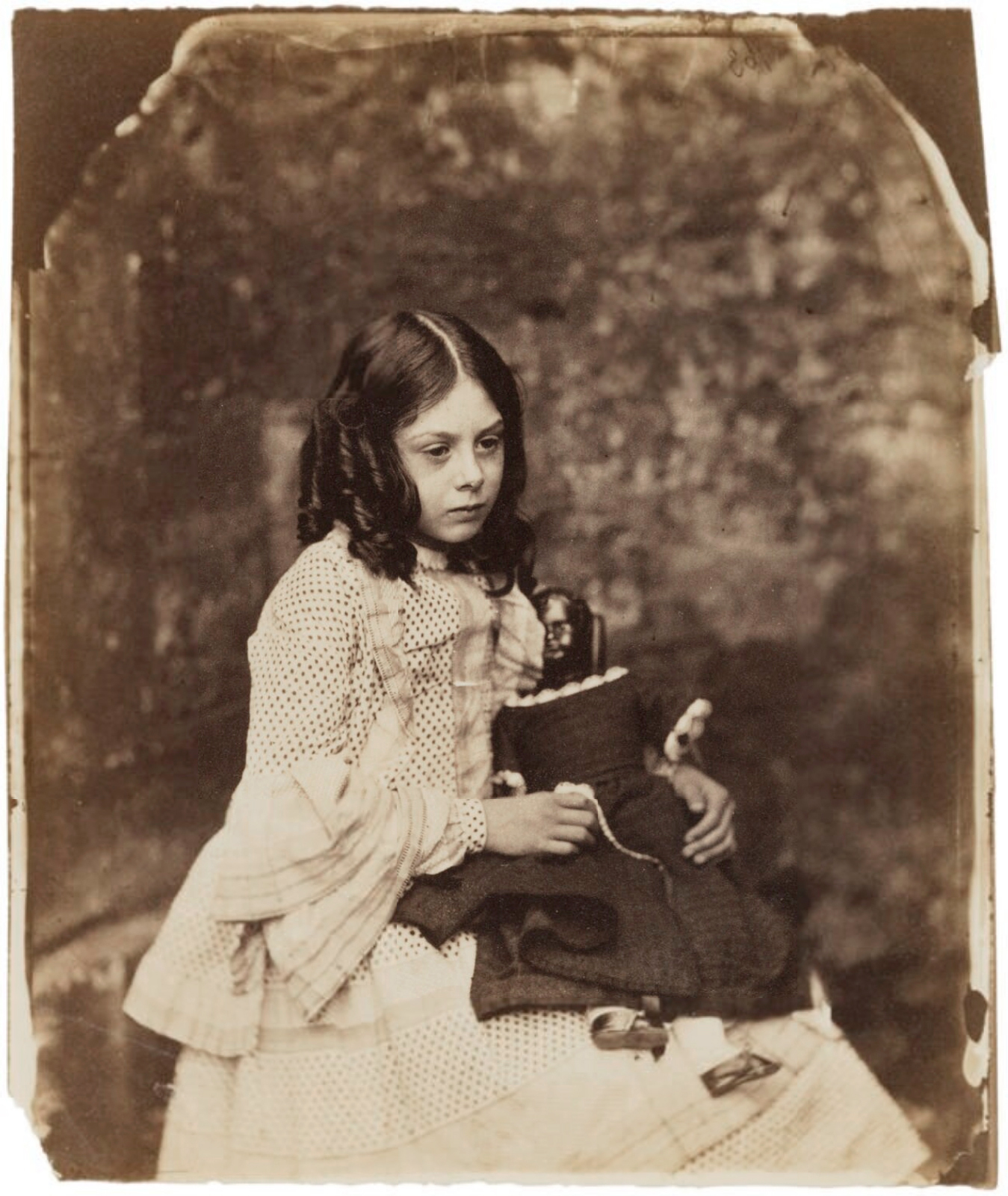
National Portrait Gallery website

LIKE ART BLART ON FACEBOOK

Back to top