Exhibition: ‘Patricia Piccinini: The Fitzroy Series’ at the Centre for Contemporary Photography (CCP), Fitzroy, Melbourne

Exhibition dates: 12th August – 4th September 2011
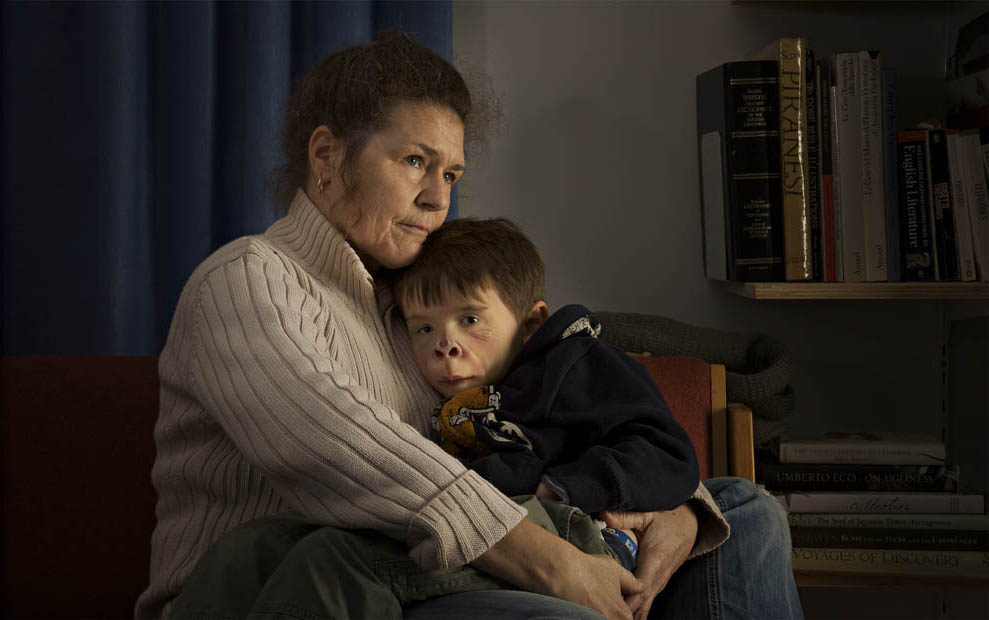
 

Patricia Piccinini (Australian, b. 1965) 'Library, 8.45pm' 2011


Patricia Piccinini (Australian, b. 1965)
Library, 8.45pm
2011
Type C photograph
100 x 160cm
Courtesy the artist; Tolarno Galleries, Melbourne; Roslyn Oxley9 Gallery, Sydney; and Haunch of Venison, New York


A wonderful suite of photographs by Patricia Piccinini. When you see them “in the flesh” so to speak, five out of the six works (except for the last image below, Sitting Room, 2.30pm) are suffused with a beautiful, rich, dark honey-coloured light, even more so than the reproductions. This tonality adds to the romantic notion of the imaginary animals Piccinini creates – genetically modified, mutant child creatures and “Bottom Feeder” (for that is their name) rubbish scouring pets. The ordinariness of the environs that surround the mise-en-scènes supplements this feeling: books and bedrooms, workshops and sitting rooms allaying our fears, increasing our empathy. The humour is also delicious. Note the squirrel light in Bedroom, 10.30pm : inspired!

Of as much interest was Piccinini’s source material shown in the front gallery. I wrote most of the books, magazines and subjects of the photographs down because I was fascinated to see the inspiration for this artist:

~ Motorised chairs
~ Knots
~ Nests
~ American Native Indian hair (Edward S. Curtis)
~ Claws
~ Walruses
~ Skulls
~ Skeletons
~ Pupae
~ Scientific specimens
~ Birds covered in oil
~ Mammals of Australia
~ Darwin
~ Voyages of Discovery by Dr Tony Rice
~ Hiroshima Mon Amour by Marguerite Duras
~ Mag wheels
~ Big rigs (trucks)
~ Vespas
~ Custom cars and trucks
~ Morphed racing helmets
~ Photograph from Hitchcock’s The Birds
~ Braindead movie
~ Frankenstein by Mary Shelley
~ Newsweek: The Meaning of Michael (Jackson) July 13th, 2009
~ Rare breeds (sheep)
~ Simians, Cyborgs, and Women: The Reinvention of Nature by Donna ~ Haraway
~ Louise Bourgeois
~ Macro/Hall by Erwin Wurm
~ Le Cere del Museo dell Instituto Fiorentino di Anatonia Patalogia deformatives


Great work and a wonderful gesture by artist and galleries to support the Centre for Contemporary Photography.

Dr Marcus Bunyan


Many thankx to Karra Rees for her help and to the CCP for allowing me to publish the photographs in the posting. Please click on the photographs for a larger version of the image.
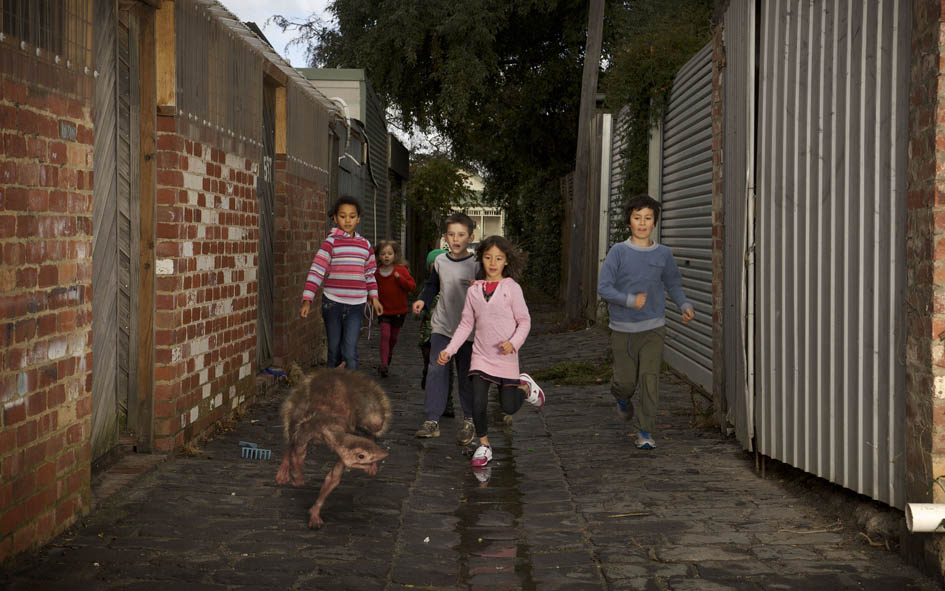


Patricia Piccinini (Australian, b. 1965) 'Alley, 11.15am' 2011


Patricia Piccinini (Australian, b. 1965)
Alley, 11.15am
2011
Type C photograph
100 x 160cm
Courtesy the artist; Tolarno Galleries, Melbourne; Roslyn Oxley9 Gallery, Sydney; and Haunch of Venison, New York.
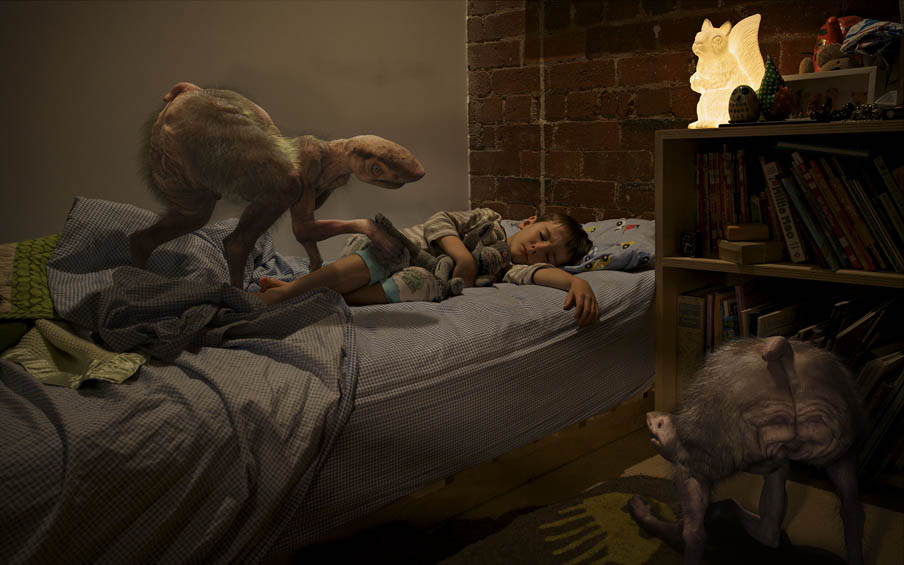
 

Patricia Piccinini (Australian, b. 1965) 'Bedroom, 10.30pm' 2011


Patricia Piccinini (Australian, b. 1965)
Bedroom, 10.30pm
2011
Type C photograph
100 x 160cm
Courtesy the artist; Tolarno Galleries, Melbourne; Roslyn Oxley9 Gallery, Sydney; and Haunch of Venison, New York.
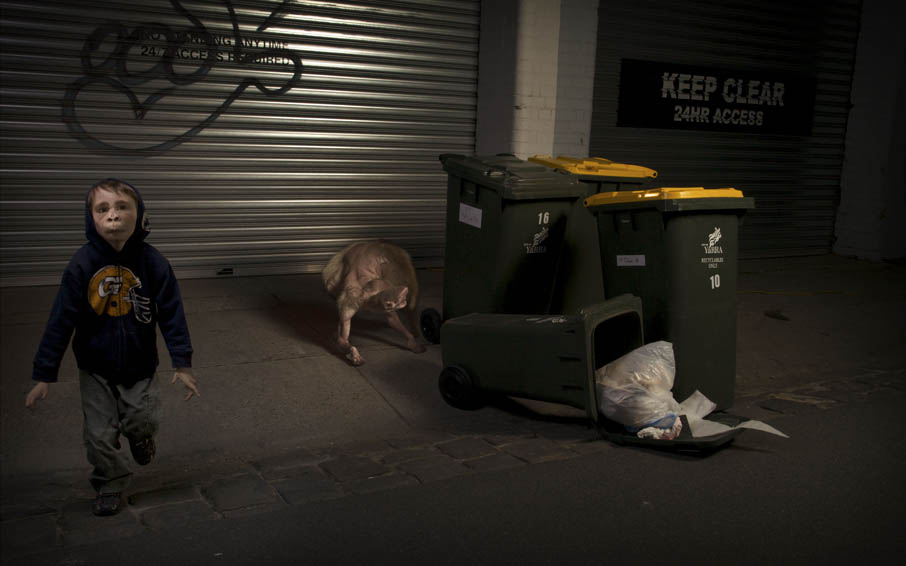
 

Patricia Piccinini (Australian, b. 1965) 'Street, 3.10am' 2011


Patricia Piccinini (Australian, b. 1965)
Street, 3.10am
2011
Type C photograph
100 x 160cm
Courtesy the artist; Tolarno Galleries, Melbourne; Roslyn Oxley9 Gallery, Sydney; and Haunch of Venison, New York.
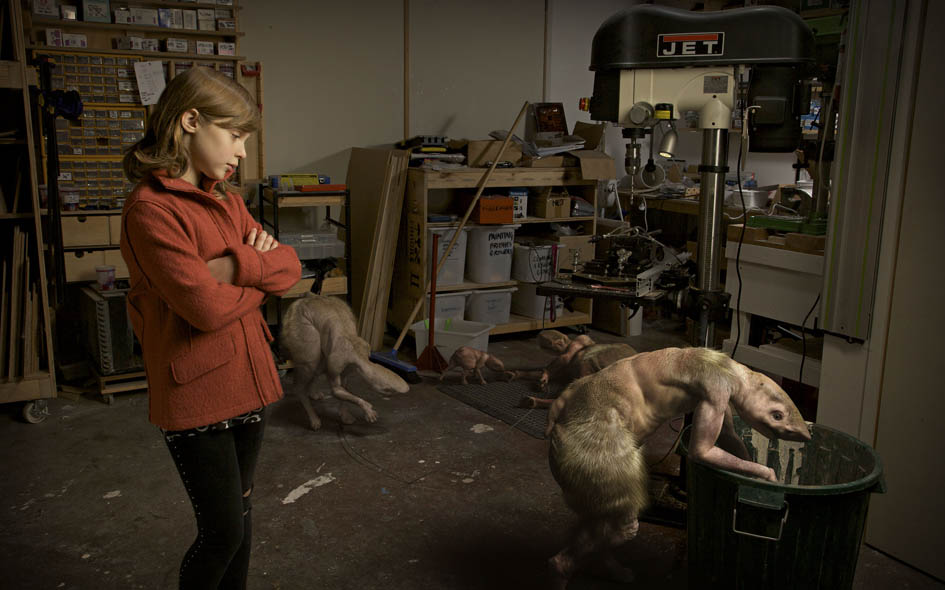
 

Patricia Piccinini (Australian, b. 1965) 'Workshop, 7.00pm' 2011


Patricia Piccinini (Australian, b. 1965)
Workshop, 7.00pm
2011
Type C photograph
100 x 160cm
Courtesy the artist; Tolarno Galleries, Melbourne; Roslyn Oxley9 Gallery, Sydney; and Haunch of Venison, New York


To mark Centre for Contemporary Photography’s 25th Anniversary Patricia Piccinini has made a new series of work, never seen before. Entitled The Fitzroy Series, the exhibition of Piccinini’s new body of work, accompanied by video work and a display of her source material, is the major event in the celebrations of CCP’s 25th Anniversary in 2011.

CCP is delighted to be offering this exciting new series for the CCP 25th Anniversary Limited Edition Print fundraiser, each image in the series is generously provided in a limited edition of 4 + 1AP.

Eighty percent of funds raised through Limited Edition Prints enable CCP to support the practice and presentation of contemporary photography through provision of exhibitions, publications, education and public programs, with the artist retaining twenty percent.

What: CCP 25th Anniversary Limited Edition Print
Price: $9,320 each framed by Neo Frames (inc. gst on frame)
The first 12 prints are available at the CCP fundraiser price of $9,320 each framed by Neo Frames (inc. GST on frame)
NB. Credit card purchases attract a 1.5% merchant fee.
Prints are accompanied by a signed, numbered certificate and are provided courtesy of the artist; Tolarno Galleries, Melbourne; Roslyn Oxley9 Gallery, Sydney; and Haunch of Venison, New York.
Free Artist Floortalk: midday 27 August 2011
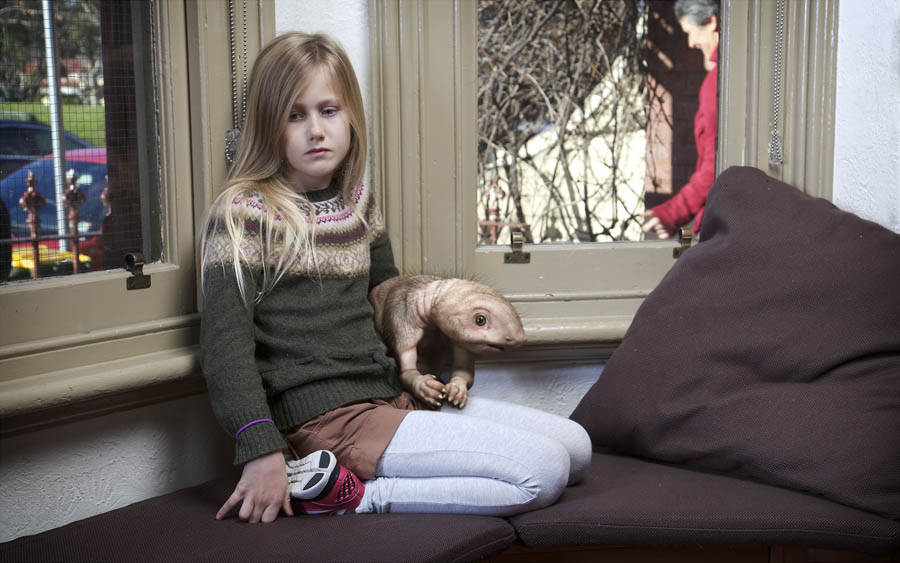
 

Patricia Piccinini (Australian, b. 1965) 'Sitting Room, 2.30pm' 2011


Patricia Piccinini (Australian, b. 1965)
Sitting Room, 2.30pm
2011
Type C photograph
100 x 160cm
Courtesy the artist; Tolarno Galleries, Melbourne; Roslyn Oxley9 Gallery, Sydney; and Haunch of Venison, New York.


Centre for Contemporary Photography

No permanent exhibition space at the moment
Centre for Contemporary Photography website

LIKE ART BLACK ON FACEBOOK

Back to top

Review: ‘Guo Jian paintings’ at Arc One Gallery, Melbourne

Exhibition dates: 30th June – 25th July, 2009


Guo Jian (Chinese-Australian, b. 1962) 'No.c' 2009


Guo Jian (Chinese-Australian, b. 1962)
No.c
2009
Acrylic on canvas
152 x 213cm


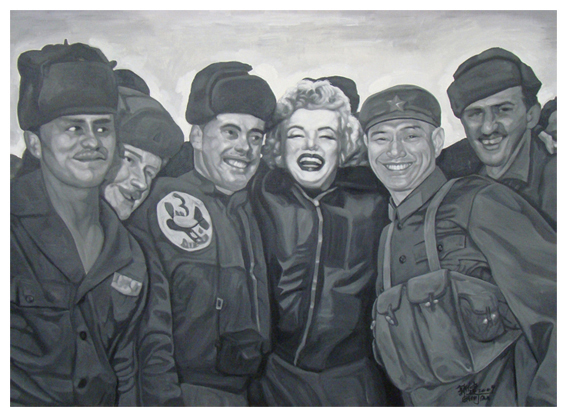
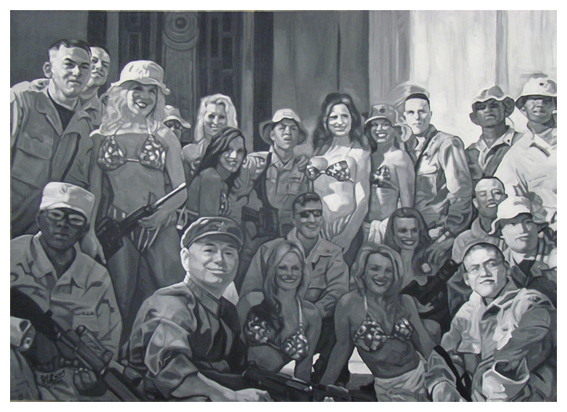
This exhibition of eight new paintings and one older work by Chinese artist Guo Jian presented at Arc One Gallery in Melbourne is, with the exception of one outstanding painting, a disappointment. The new work addresses, variously, themes of consumerism, stardom, sex appeal, the military and Chinese culture. Using old photographs as reference and inserting the body and face of the artist into the canvases, Jian examines the paradoxes that exist between Western / American and Chinese culture to limited effect.

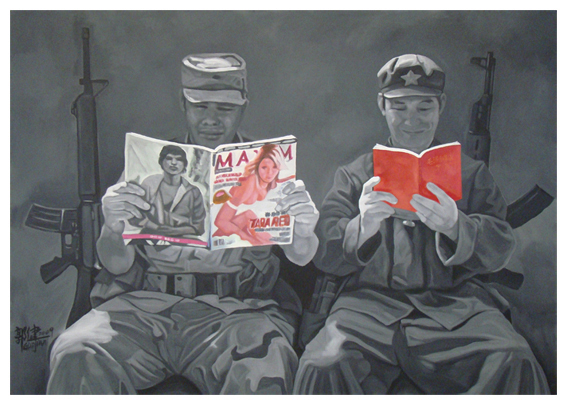
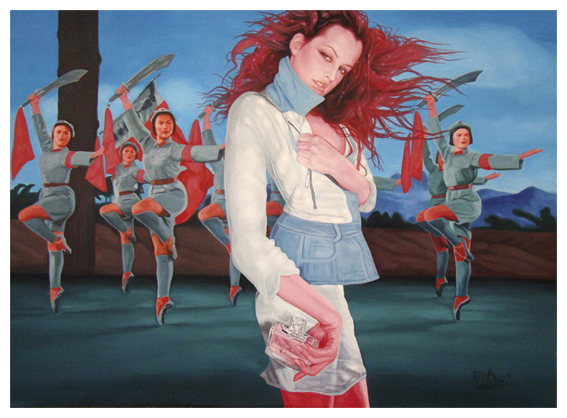
Using a restricted colour palette in each painting Jian’s ‘mise en scène’ places American soldiers and babes wearing bikinis of distorted American flags with the artist as lone Chinese soldier – his face pulled into focus while the other figures almost become cut-outs with the overlay of a “blur filter” softening their features. In another set piece Untitled 3 (2009) a seductive woman with flaming red hair and half open jacket holds a bottle of Chloe perfume in her hand while behind Chinese female military dancers brandish swords and red flags. In No.g (2009) two soldiers with guns propped behind them read contrasting books – one the ‘Little Red Book’ and the other ‘A Big Naughty Girly Magazine’. Marilyn and Madonna feature heavily, pastiches in a built environment – all pink and fleshy with a silver heart (perhaps it should have been a Purple Heart).

The iconography in these staged ‘tableaux vivants’ is a one shot idea repeated in all eight paintings. The themes seem hackneyed, their language a bricolage of ironic archetypes that don’t have anything new to say about the subject matter but repeat things we know already: vis a vis that Chinese society is struggling to cope with the burden of becoming a consumer culture. On reflection, the new paintings have not impinged on my consciousness – always a sign whether the work really has made a connection. However, the single work from 2003 is a different beast.

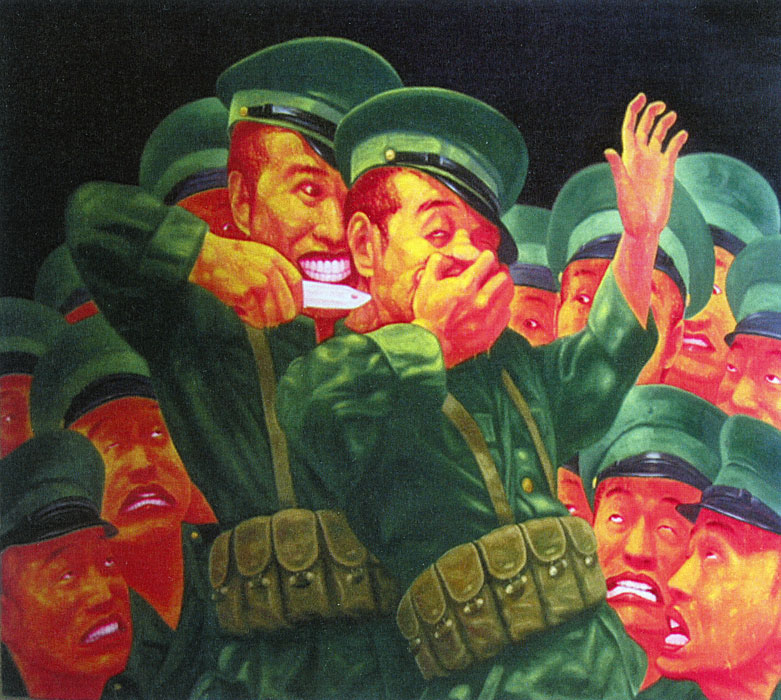
The Training from the series The Day Before I Went Away (2003) is a hypnotic, mesmerising and powerful work, lurid even, with it’s hyper-real colours and maniacal faces, eyes rolling in the back of heads, barring of teeth, the hand over the mouth, the upraised hand, the glistening white of the blade – oh the lust for blood!

This painting is so evocative it shames the new work by comparison – you think about this work, you remember it!

Here is the passion and insightfulness of the artist. Danger and terror grab you and shake you and force you to think about the human condition. This is what I want art to do in whatever way it can – subtly, quietly, psychologically, forcefully. Great art challenges us to look, feel and think. Unfortunately the new work, while clever on a superficial level, fails to deliver.

Dr Marcus Bunyan


Many thankx to the Arc One Gallery for allowing me to publish the art work in the posting.


Guo Jian (Chinese-Australian, b. 1962) 'No.d' 2009


Guo Jian (Chinese-Australian, b. 1962)
No.d
2009
Acrylic on canvas
152 x 213cm


“This series is about looking at the persuasion or morale boosting efforts for soldiers from another perspective. I considered how starlets and celebrities are deployed in the West – often not dissimilarly to the way Chinese Entertainment Soldiers are used to influence and motivate in my part of the world.” ~ Guo Jian


Guo Jian (Chinese-Australian, b. 1962) 'No.f' 2009


Guo Jian (Chinese-Australian, b. 1962)
No.f
2009
Acrylic on canvas
152 x 213cm


Guo Jian (Chinese-Australian, b. 1962) 'No.g' 2009


Guo Jian (Chinese-Australian, b. 1962)
No.g
2009
Acrylic on canvas
152 x 213cm


Guo Jian (Chinese-Australian, b. 1962) 'Untitled 3' 2009


Guo Jian (Chinese-Australian, b. 1962)
Untitled 3
2009
Acrylic on canvas
152 x 213cm


Born in China in 1963, Jian was raised in a controlled political environment. He served over three years in the Peoples Liberation Army and bore witness to the horrific Tiananmen Square massacre in 1989, where he assisted carrying the wounded to the hospital.

Jian’s personal atlas of history continues to feed his visual commentary. His voice is both satirical and erotic, challenging and confronting. He plays with irony and foreplay to exploit and raise potent questions surrounding propaganda and manipulation.

“As I have grown older, I have realised that all of the education I have received is rarely practical in real life. Reality and education are conflicting. The way in which you inherently view the world is influenced by education which is the perspectives of others. Our surrounding environment defines our perception of ‘right’ and ‘wrong’, ‘enemy’ and ‘friend’, ‘them’ and ‘us’. But, if you dare to open your eyes and liberate your mind, you will find that the world is not exactly the way you have been told. Put your feet into someone else’s shoes to think about the world and your own life differently. For me, if the surroundings change, are combined, are old or new, it doesn’t matter. My life is defined relative to my self-experience and the things I have heard or seen. From this perspective, I have discovered the freedom to reopen my eyes to a new world and to new possibilities.”

Guo Jian

Text from the press release on the Arc One Gallery website [Online] Cited 10/07/2009. No longer available online


Guo Jian (Chinese-Australian, b. 1962) 'The Training' from the series 'Te Day Before I Went Away' 2003


Guo Jian (Chinese-Australian, b. 1962)
The Training from the series The Day Before I Went Away
2003


Arc One Gallery
45 Flindes Lane
Melbourne, Victoria 3000

Opening hours:
Wednesday – Saturday 11am – 5pm

Arc One Gallery website

LIKE ART BLART ON FACEBOOK

Back to top

Review: ‘En Plein Air’ photographs by Siri Hayes at Gallerysmith, Melbourne

Exhibition dates: 12th March – 18th April, 2009


Siri Hayes (Australian, b. 1977) 'Gunnai man land' 2008 from the exhibition 'En Plein Air' photographs by Siri Hayes at Gallerysmith, Melbourne, March - April, 2009


Siri Hayes (Australian, b. 1977)
Gunnai man land
2008


A handsome group of large photographs in crisp white frames is displayed in the large space of Gallerysmith, Melbourne. Undoubtably they are well taken and printed photographs but conceptually their thematic development is confused. The photographs purport to investigate how industrialisation has changed the Gippsland landscape since colonisation whilst referencing human interactions that ‘are sometimes’ associated with Western art.

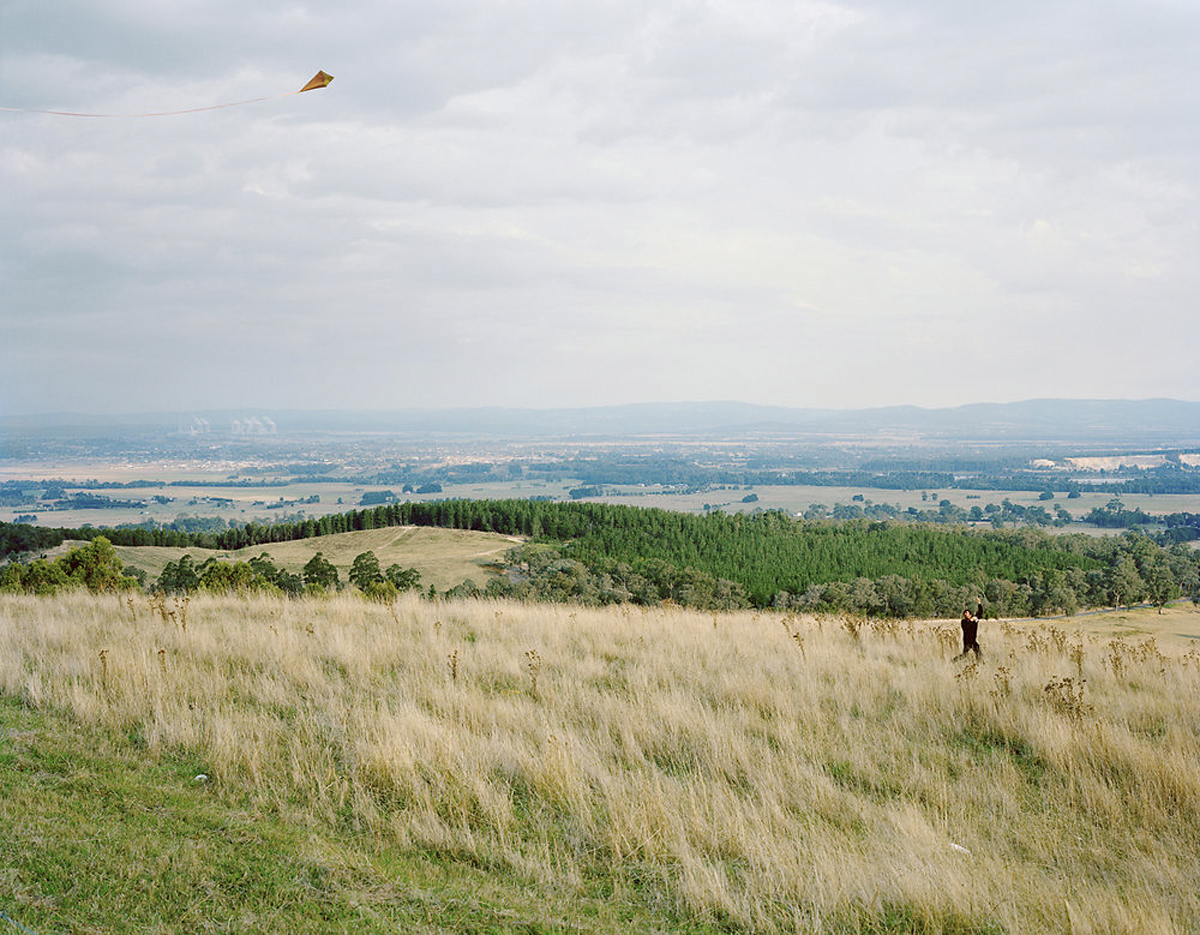
Gunnai land man (above) is very effective in this quest juxtaposing as it does an Indigenous Australian and fallen tree on a bare track with a smoke billowing power station (symbolic of the industrialisation of the area) looming in the background. Other photographs are less successful. What a man flying a kite has to do with the pre-colonial Gippsland landscape is beyond me and the juxtapositional incongruity sought by the artist simply does not work, despite the presence of the power station on the plains in the distance. The symbology has more to do with Japanese art than it has to do with Western art.

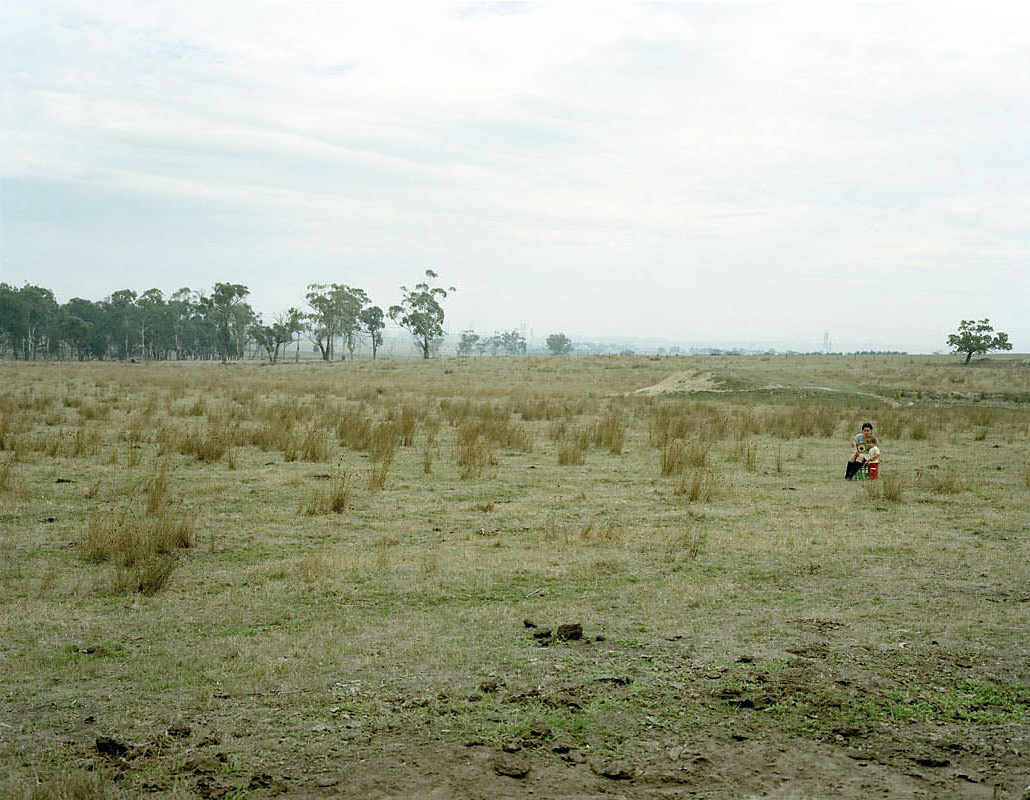
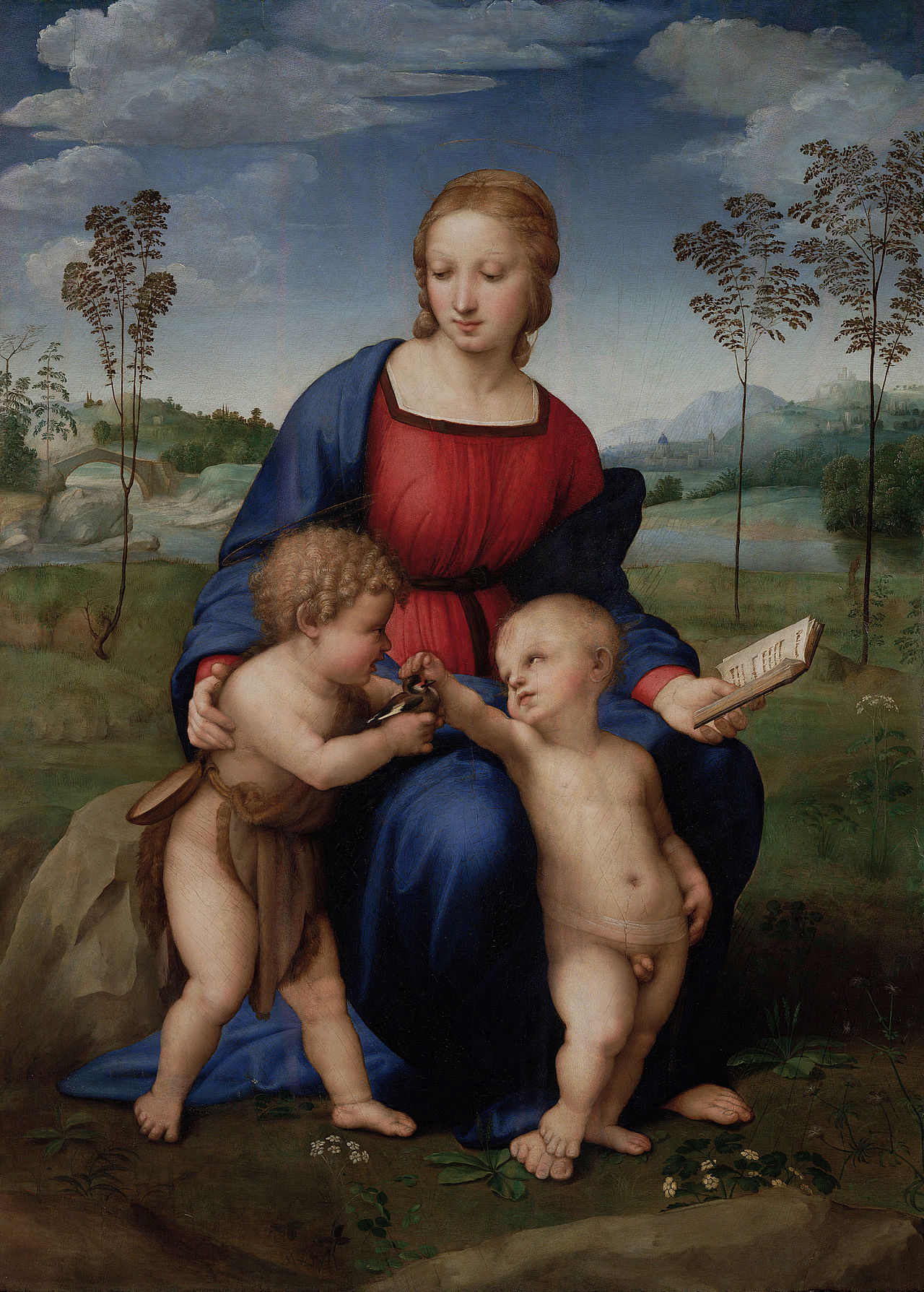
The conceptual narrative of the photograph Moe Madonna (below) works only partially as well. The destruction of the landscape has been caused by pastoralisation not industrialisation. In the image that Hayes is referencing the Madonna is front and centre set in an idyllic landscape. In the work by Hayes the incongruity has to be explained, has to be verbalised in text for the association to be didactically made. The interpretation leaves no room for personal reflection and when I looked at this image, the mother and child were so small in the landscape, the placement so obviously constructed that there incongruity turned to disbelief: namely that I simply did not believe the mise en scène being created.

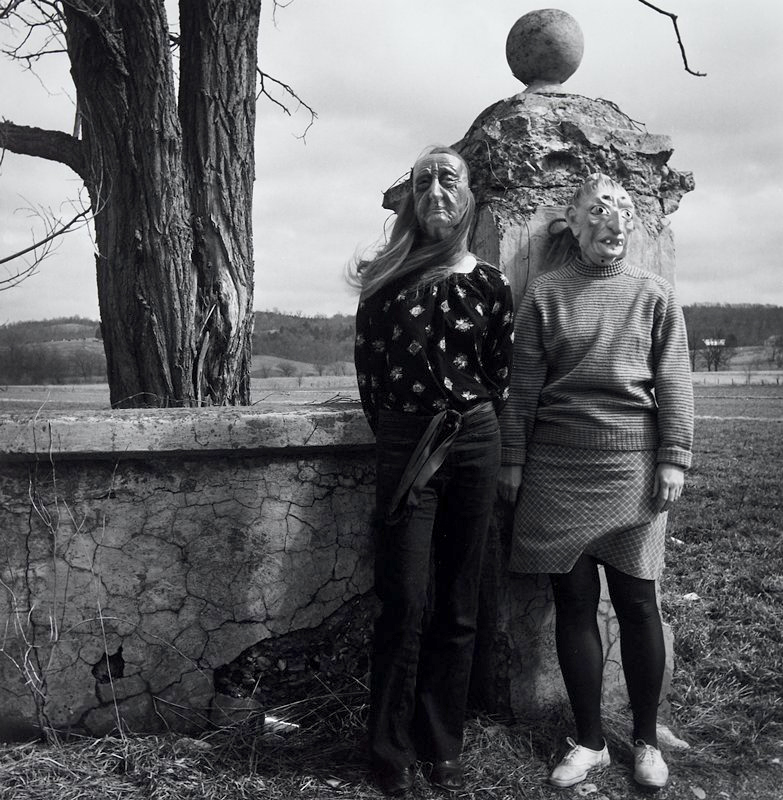
Other narratives are equally confusing. In Paper bag lovers (below) I had to ask the gallery director what was going on in the photograph because the bodies where so small in the landscape (in fact it looks like one body) and you can’t really see the paper bags on their heads because the bodies are just an amorphous mass containing no detail at all (you can just see the body in the photograph below in the mid distance just below the large central tree). Why paper bags anyway? If something intentionally odd and incongruous is sought to be portrayed in the landscape perhaps Hayes should look at the work of Eugene Meatyard (see below) to see a real subversion of the body/landscape dichotomy.

The one standout photograph of the exhibition is Plein air explorers (below). This is confirmed in the sales of the show as all six prints of this photograph have been sold. One can see why!

The title is perfect, the construction of the image faultless. The naked white man stands proudly surveying his conquered domain, the land, whilst around him artists (reminding me of the dilettantes of the Victorian age going on day trips), hunker down into the ground with their easels oblivious to the desiccated trees around them. Here the photographer just observes, doesn’t construct, the incongruity of it all. The artists draw the white man based on direct observation of him and not on their conceptions or conventional images or memories of him while ignoring their surroundings. Here is the paradox, the ironic perfect storm that the artist was conceptually seeking: the representation of landscape based upon direct observation “in the open air” ignored for a perfect white arse while on the horizon smoke stacks of a power station stand in silent witness to the present and imminent destruction of the world. What a photograph! Can I have one now please?

Dr Marcus Bunyan


Many thankx to Gallerysmith for allowing me to publish the photographs in the posting. Please click on the photographs for a larger version of the image.


Siri Hayes (Australian, b. 1977) 'Moe Madonna' 2008 from the exhibition 'En Plein Air' photographs by Siri Hayes at Gallerysmith, Melbourne, March - April, 2009


Siri Hayes (Australian, b. 1977)
Moe Madonna
2008


Siri Hayes (Australian, b. 1977) 'Kite' 2008


Siri Hayes (Australian, b. 1977)
Kite
2008


Raphael (Italian, 1483-1520) 'Madonna of the Goldfinch' 1505-1506


Raphael (Italian, 1483-1520)
Madonna of the Goldfinch
1505-1506
Oil on panel
107 x 77cm
Galleria degli Uffizi


Siri Hayes (Australian, b. 1977) 'Paper Bag Lovers' 2008


Siri Hayes (Australian, b. 1977)
Paper Bag Lovers
2008


Eugene Meatyard (American, 1925-1972) 'Lucybelle Crater & her 15-year-old son's friend, Lucybelle Crater' 1970-1971


Eugene Meatyard (American, 1925-1972)
Lucybelle Crater & her 15-year-old son’s friend, Lucybelle Crater
1970-1971


I have predominantly focused on the parts of the Gippsland landscape that have been impacted by white settlement. I have composed various human interactions that are sometimes associated with Western art and its construction. For example, Moe Madonna references Raphael’s Goldfinch Madonna. The narratives are intentionally odd and incongruous with the surrounding location. My son and I seem out-of-place in a barren paddock while the autumn mist shrouds distant gum trees and electricity pylons. The soil here has been compacted beyond repair by cattle hooves – an inappropriate animal in Australia’s delicate ecosystems. As we sit on this barren plain, I read to Oliver from a European pre-schooler book titled Autumn, creating an interesting juxtaposition with the antipodean equivalent season.

The work in this exhibition considers the pre-colonial Gippsland landscape and how industrial ‘progress’ has altered it. Hopefully it provides pause for thought.

Siri Hayes exhibition notes. March 2009


Siri Hayes (Australian, b. 1977) 'Plein air explorers' 2008


Siri Hayes (Australian, b. 1977)
Plein air explorers
2008


Gallerysmith
170-174 Abbotsford St,
North Melbourne,
Victoria, 3051 Australia

Opening hours:
Tuesday to Saturday, 11am – 5pm

Gallerysmith website

Siri Hayes website

LIKE ART BLART ON FACEBOOK

Back to top

Exhibition: ‘Hyper’ by Denis Darzacq at Australian Centre for Photography (ACP), Sydney

Exhibition dates: 13th March – 12th April, 2009


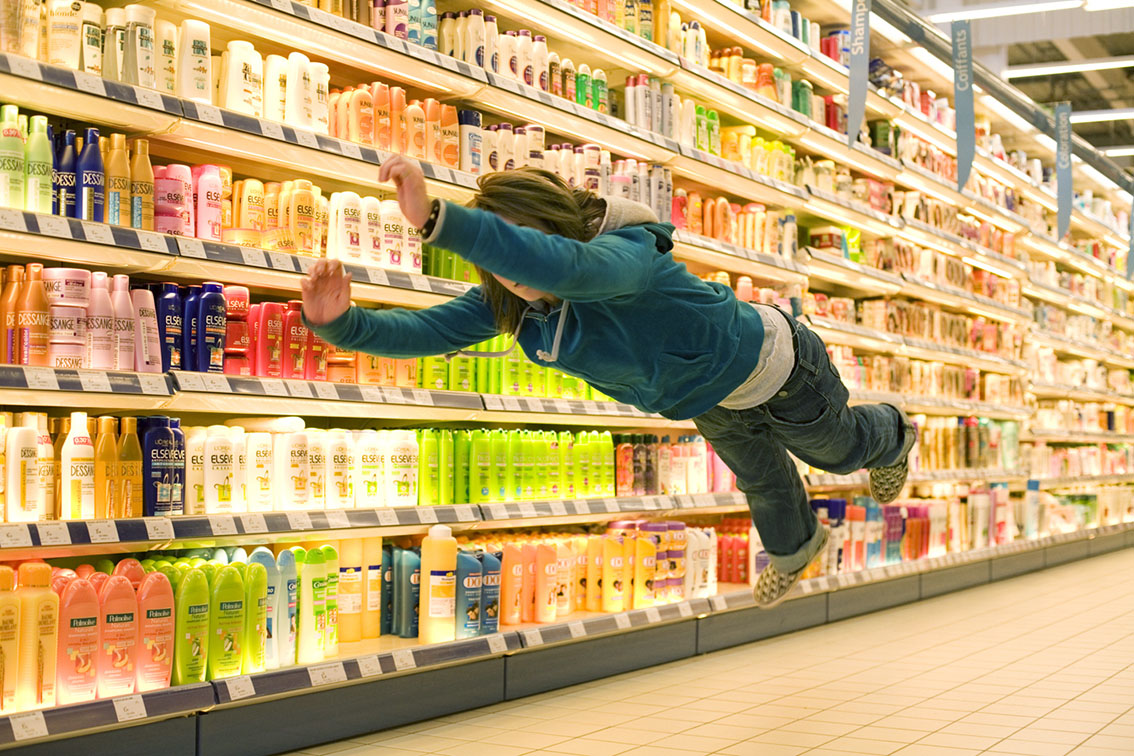
Denis Darzacq (French, b. 1961) 'Hyper #4' 2007 from the exhibition 'Hyper' by Denis Darzacq at Australian Centre for Photography (ACP), Sydney, March - April, 2009


Denis Darzacq (French, b. 1961)
Hyper #4
2007


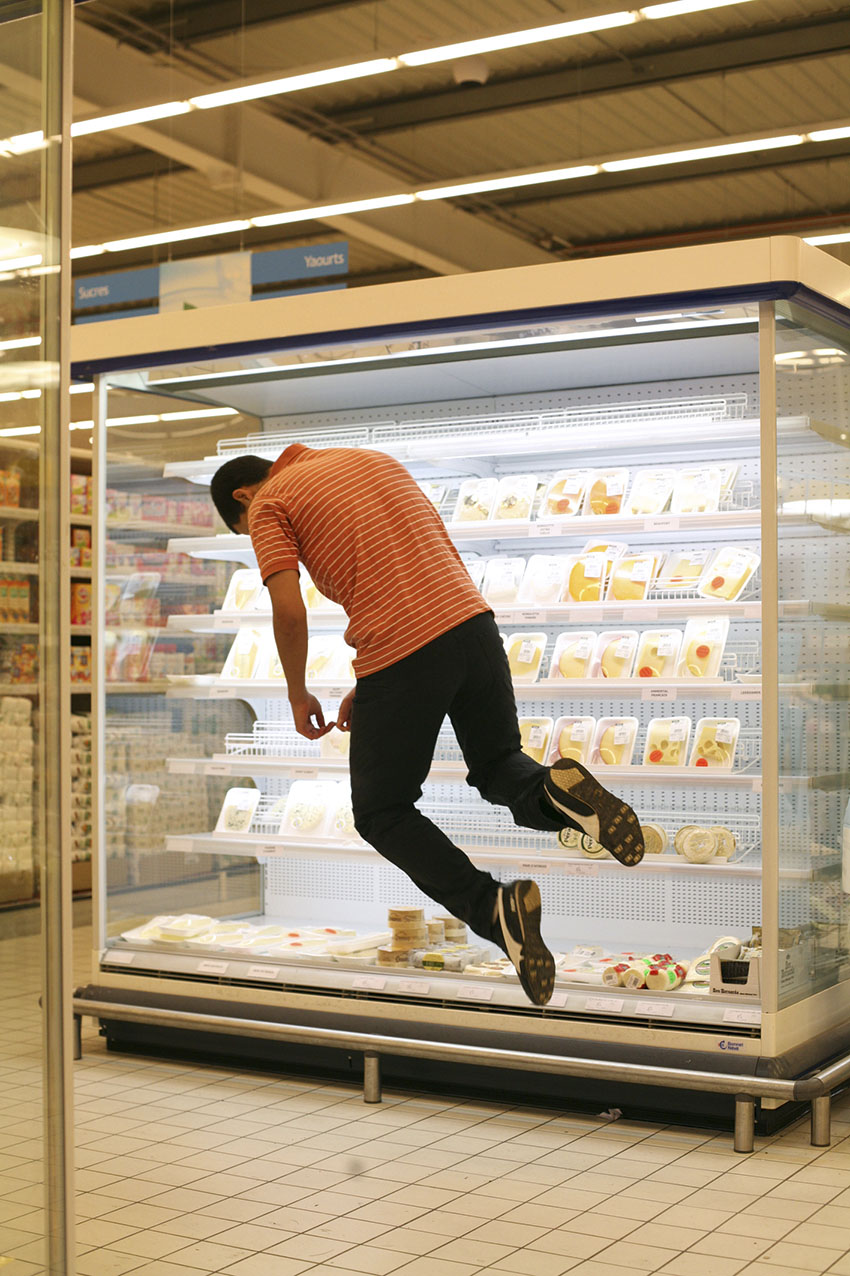
These images form an interesting body of work: levitating bodies suspended between heaven and earth, neither here nor there, form a hyper-real image grounded in the context of the fluorescent isles of French supermarkets. The mainly anonymous humans look like mannequins in their inertness, frozen at the moment of throwing themselves/being thrown into the consumer environment. After his brilliant series La Chute (The Fall) Darzacq has taken people gathered in a casting call from around the town of Rouen and made their frozen bodies complicit in the mass production of the supermarket and the mass consumption of the image as tableaux vivant: the mise en scène directed by the photographer to limited effect. There is something unsettling about these images but ultimately they are unrewarding, as surface as the environment the bodies are suspended in, and perhaps this is the point.

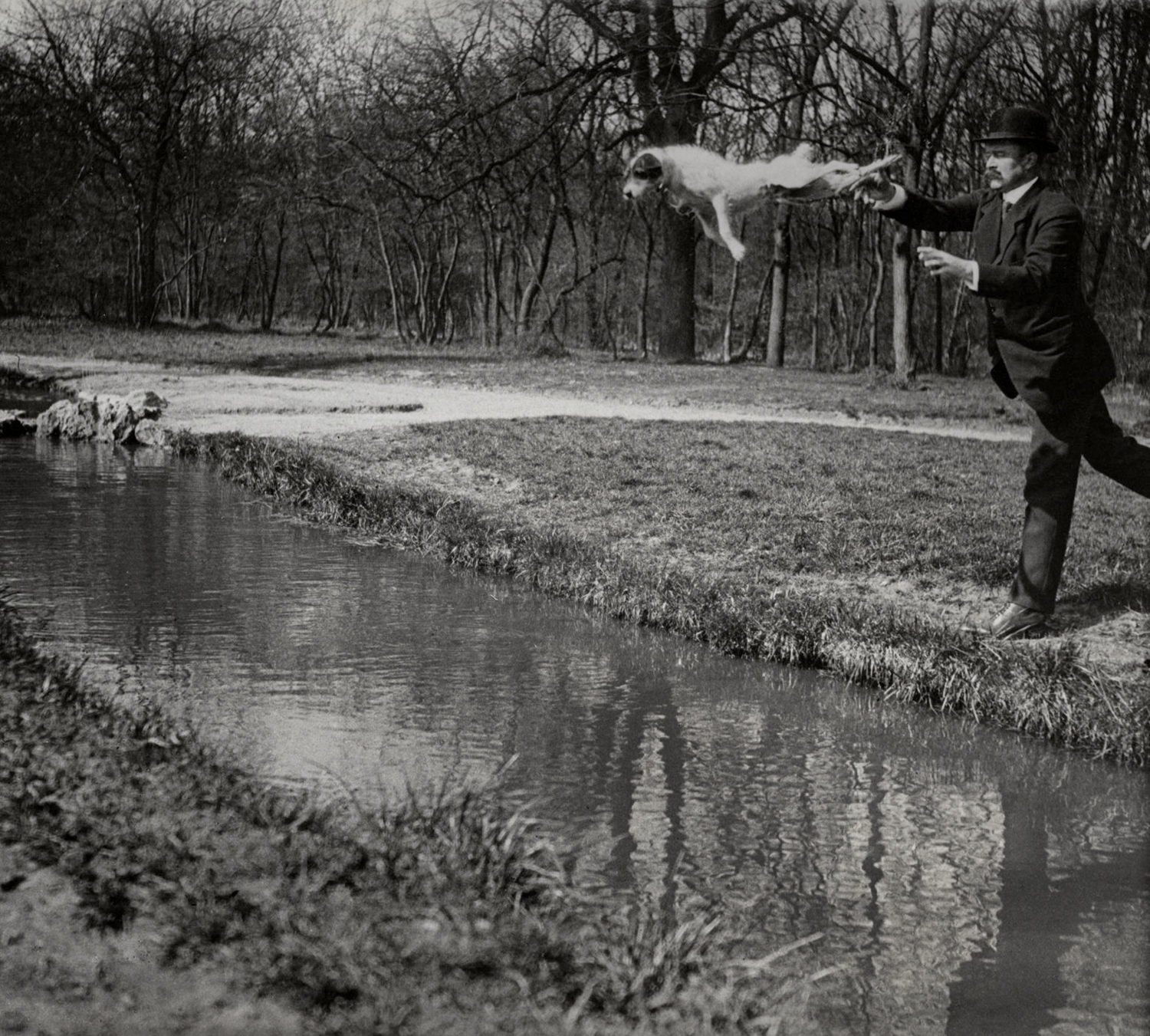
Suspension of bodies is not a new idea in photography. Jacques Henri Lartigue used the freeze frame to good effect long before Henri Cartier-Bresson came up with his ‘decisive moment’: playing with the effect of speed and gravity in an era of Futurism, Lartigue used the arrested movement of instant photography then afforded by smaller cameras and faster film to capture the spirit of liberation in the ‘Belle Epoque’ period before the First World War.

“All the jumping and flying in Lartigue’s photographs, it looks like the whole world at the turn of the century is on springs or something. There’s a kind of spirit of liberation that’s happening at the time and Lartigue matches that up with what stop action photography can do at the time, so you get these really dynamic pictures. And for Lartigue part of the joke, most of the time, is that these people look elegant but they are doing these crazy stunts.”1


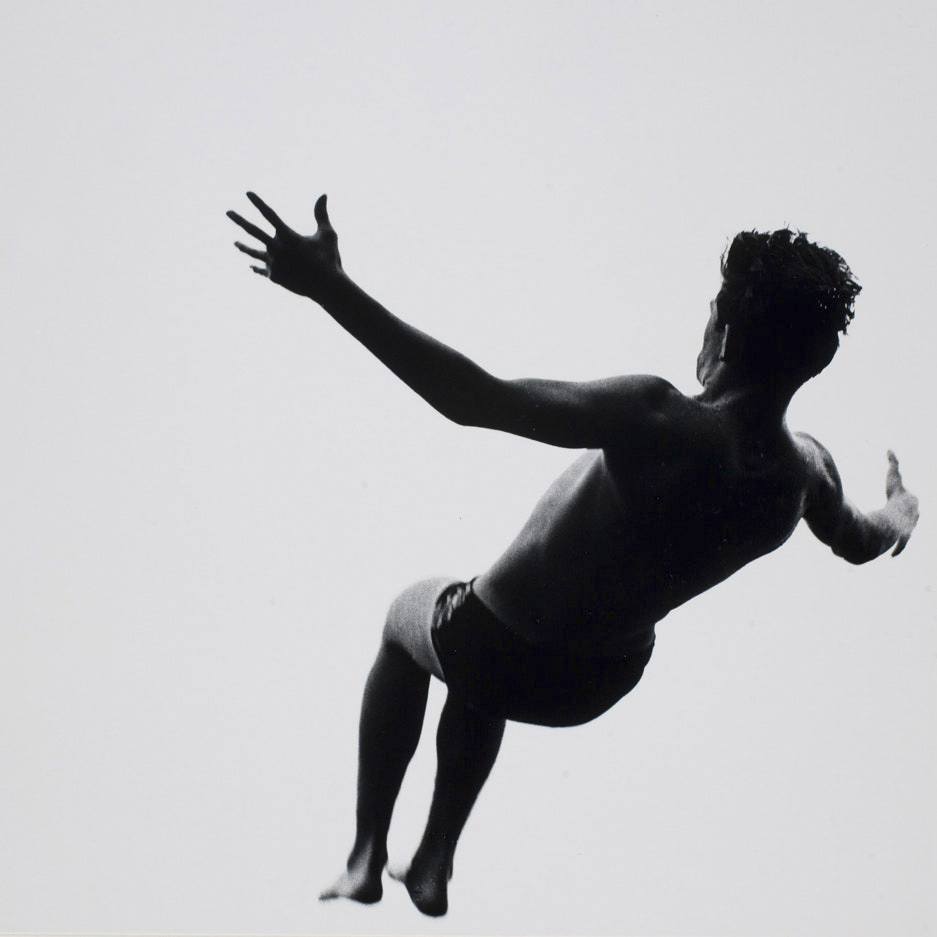
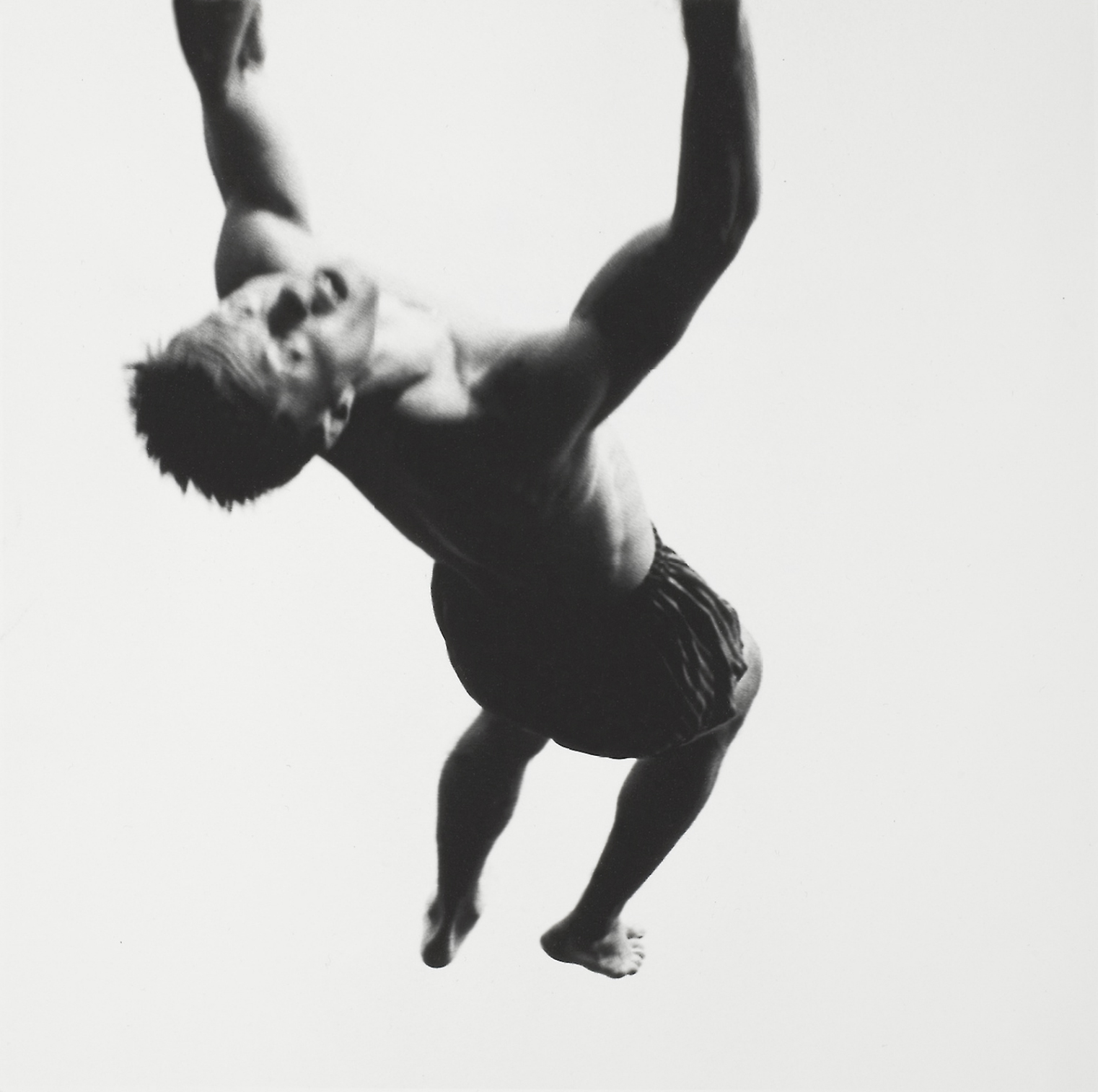
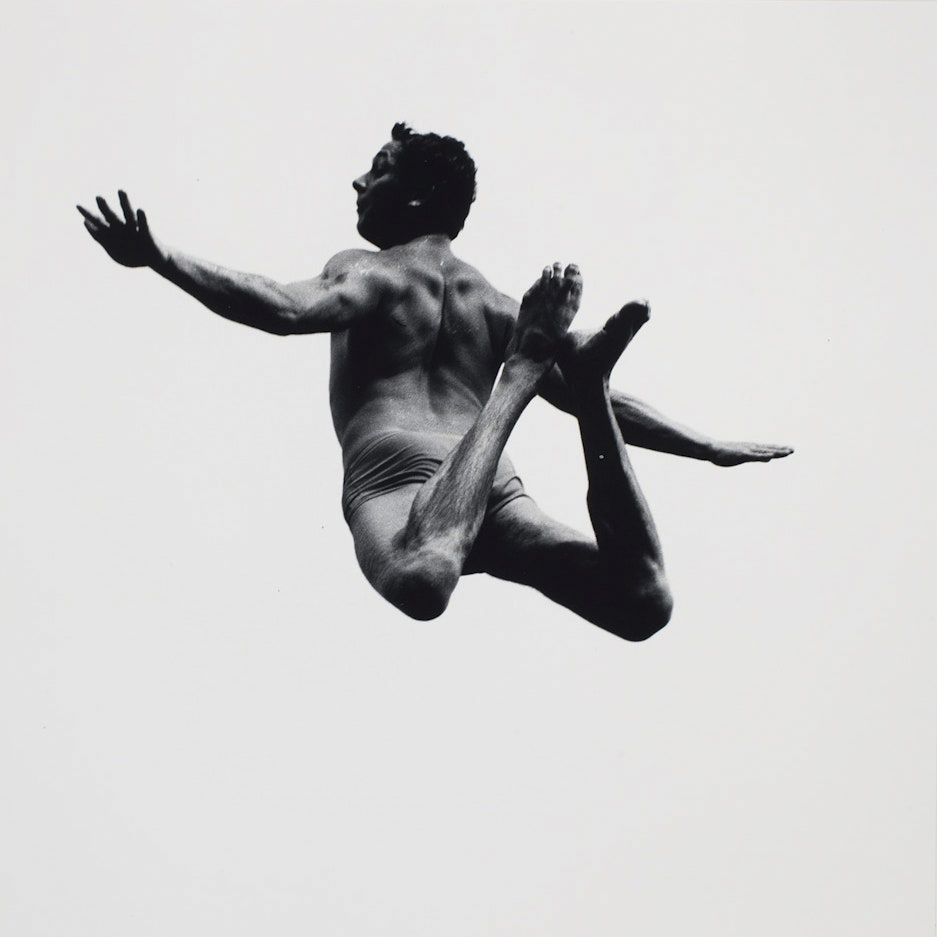
One of the greatest, if not the greatest ever, series of photographs of levitating bodies is that by American photographer Aaron Siskind. Called Pleasures and Terrors of Levitation (sometimes reversed as Terrors and Pleasures of Levitation as on the George Eastman House website) the images feature divers suspended in mid-air with the sky as their blank, background canvas. The images formal construction makes the viewer concentrate on the state of the body, its positioning in the air, and the look on the face of some of the divers caught between joy and fear.

“Highly formal, yet concerned with their subject as well as the idea they communicate, the ‘Pleasures and Terrors of Levitation’ photographs depict the dark shapes of divers suspended mid-leap against a blank white sky. Shot with a hand-held twin-lens reflex camera at the edge of Lake Michigan in Chicago, the balance and conflict suggested by the series’ title is evident in the divers’ sublime contortions.”2


Perhaps because of their air of balance and conflict we can return to these vibrant images again and again and they never loose their freshness, intensity and wonder. The same cannot be said of Denis Darzacq’s Hyper photographs. Slick and surface like the consumer society on which they comment the somnambulistic bodies are more like floating helium balloons, perhaps even tortured souls leaving the earth. Reminiscent of the magicians trick where the girl is suspended and a hoop passed around her body to prove the suspension is real these photographs really are more smoke and mirrors than any comment on the binary between being and having as some commentators (such as Amy Barrett-Lennard, Director Perth Institute of Contemporary Arts) have suggested. There is no spirit of liberation here, no sublime revelation as the seemingly lifeless bodies are trapped between the supermarket shelves, as oblivious to and as anonymous as the products that surround them. The well shot images perhaps possess a sense of fun, if I am being generous, as Darzacq plays with our understanding of reality… but are they more than that or is the Emperor just wearing very thin consumer clothing?

Dr Marcus Bunyan


1/ Kevin Moore (Lartigue biographer) quoted in “Genius of Photography,” on the BBC website [Online] Cited 15/03/2009

2/ Text from the Museum of Contemporary Photography website [Online] Cited 15/03/2009 (no longer available)


Many thankx to the Australian Centre for Photography for allowing me to publish the Darzacq photographs in the posting. Please click on the photographs for a larger version of the image. All other images are used under “fair use” for the purpose of education, research and critical discourse.


    Denis Darzacq (French, b. 1961) 'Hyper #8' 2007 from the exhibition 'Hyper' by Denis Darzacq at Australian Centre for Photography (ACP), Sydney, March - April, 2009


    Denis Darzacq (French, b. 1961)
    Hyper #8
    2007


    “The astonishing photographs that make up Hyper involve no digital manipulation, just close collaboration between young dancers and sportspeople as they jump for the camera to form strange, exaggerated poses and body gestures. Denis Darzacq was drawn to the trashy, consumerist nature of the French Hypermarkets (the equivalent of our supermarkets) and the hyper coloured backgrounds they provided. These supermarkets offered a sharp juxtaposition to the sublime, almost-spiritual bodies that appear to float in their aisles.

    Hyper is the latest series of works by French photographer Denis Darzacq, who continues to explore the place of the individual in society, a theme which has been crucial to his work in the last few years.”

    Text from the ACP website [Online] Cited 15/03/2009. No longer available online


    Jacques Henri Lartigue (French, 1894-1986) 'L'envol de Bichonnade' 1905


    Jacques Henri Lartigue (French, 1894-1986)
    Bichonnade, 40, Rue Cortambert, Paris
    1905
    Gelatin silver print


    Jacques Henri Lartigue (French, 1894-1986) 'Mr Folletete (Plitt) et Tupy, Paris, March 1912' 1912


    Jacques Henri Lartigue (French, 1894-1986)
    Mr Folletete (Plitt) et Tupy, Paris, March 1912
    1912
    Gelatin silver print


    Jacques Henri Lartigue (French, 1894-1986) 'Fuborg' 1929


    Jacques Henri Lartigue (French, 1894-1986)
    Fuborg
    1929
    Gelatin silver print


    Herni Cartier-Bresson (French, 1908-2004) 'Behind Saint Lazare Station, Paris, France' 1932


    Herni Cartier-Bresson (French, 1908-2004)
    Behind Saint Lazare Station, Paris, France
    1932
    Gelatin silver print


    Aaron Siskind (American, 1903-1991) 'Pleasures and Terrors of Levitation #37' 1954


    Aaron Siskind (American, 1903-1991)
    Pleasures and Terrors of Levitation #37
    1956
    Gelatin silver print


    Aaron Siskind (American, 1903-1991) 'Pleasures and Terrors of Levitation #47' 1954


    Aaron Siskind (American, 1903-1991)
    Pleasures and Terrors of Levitation #47
    1954
    Gelatin silver print


    Aaron Siskind (American, 1903-1991) 'Pleasures and Terrors of Levitation #93' 1961


    Aaron Siskind (American, 1903-1991)
    Pleasures and Terrors of Levitation #93
    1961
    Gelatin silver print


    Aaron Siskind (American, 1903-1991) 'Pleasures and Terrors of Levitation #99' 1953


    Aaron Siskind (American, 1903-1991)
    Pleasures and Terrors of Levitation #99
    1956
    Gelatin silver print


    Aaron Siskind (American, 1903-1991) 'Pleasures and Terrors of Levitation #491' 1954


    Aaron Siskind (American, 1903-1991)
    Pleasures and Terrors of Levitation #491
    1956
    Gelatin silver print


    Denis Darzacq (French, b. 1961) 'Hyper #3' 2007


    Denis Darzacq (French, b. 1961)
    Hyper #3
    2007


    Hyper picks up on La Chute while explicitly focusing the artist’s message on the consumerism which hovered in the background of several previous series. In Casques de Thouars Darzacq explored the connecting power and the limits of a consumer product; here the critique is more biting. Hyper opposes bodies in movement and the saturated, standardised space of mass distribution outlets. In this totally commercial setting, the body’s leap expresses the freedom and unhampered choice of its movement. It is a clear challenge to the marketing strategies which seek to control our behaviour. Some of the figures, glowing with an aura, impose glory and give off a sense of spirituality in total contrast with the temples of consumption in which they are found.

    “Hyper 1, 2007-2010,” on the Denis Darzacq website Nd [Online] Cited 13/06/2022


    Denis Darzacq (French, b. 1961) 'Hyper #14' 2007


    Denis Darzacq (French, b. 1961)
    Hyper #14
    2007


    Australian Centre for Photography

    This gallery has now closed

    Denis Darzacq website

    Denis Darzacq Hyper images

    LIKE ART BLART ON FACEBOOK

    Back to top