Many thankx to MKM Küppersmühle Museum of Modern Art for allowing me to publish the photographs in the posting. Please click on the photographs for a larger version of the image.
The best present of my life was most probably the simple role-film camera I received for my seventh birthday”, recalls Hans-Christian Schink, one of Germany’s leading contemporary photographers. The works by the Erfurt-born photographer, who today lives in Leipzig and who regularly travels the globe to create his photo-series, are represented in public and private collections worldwide. His photographs are also on view in the MKM’s presentation of the Ströher Collection since many years.
The MKM is now showing the most comprehensive exhibition to date of works by Hans-Christian Schink whose oeuvre has wielded a crucial impact on German photography. Approximately 100 large-format works afford an illuminating insight into his output until the present day, and impressively chart the development of his own distinct artistic signature.
Schink began his study of photography at the renowned Academy of Visual Arts in Leipzig where he was a master-class student from 1991 to 1993. From the very outset Schink worked with series. A key thrust of his oeuvre is his exploration of the transition between the urban and the rural, nature and culture and architectural intervention in the landscape. He finds his motifs both in his immediate environs, initially in eastern Germany, and also on his carefully planned journeys across the world, from North Korea, via the USA to the Antarctic. A further pre-occupation is the photographic rendering of light phenomena and moods.
For the first time, the MKM is exhibiting a selection of small-format black-white photos from the early1980s, together with the first colour photographs from the artist’s student days. Schink initially focused both on daily scenes in the cities of Leipzig, Erfurt and Halle, and on the abstract visual quality of architectural detail. During his studies he discovered colour photography and began working with a large-format camera, initially in the series Leipziger Bäder (Leipzig Baths, 1988), whose empty, dilapidated interiors bear poignant witness to a by-gone age. Since this time, people in his pictures exist merely as traces of their intervention in the environment.
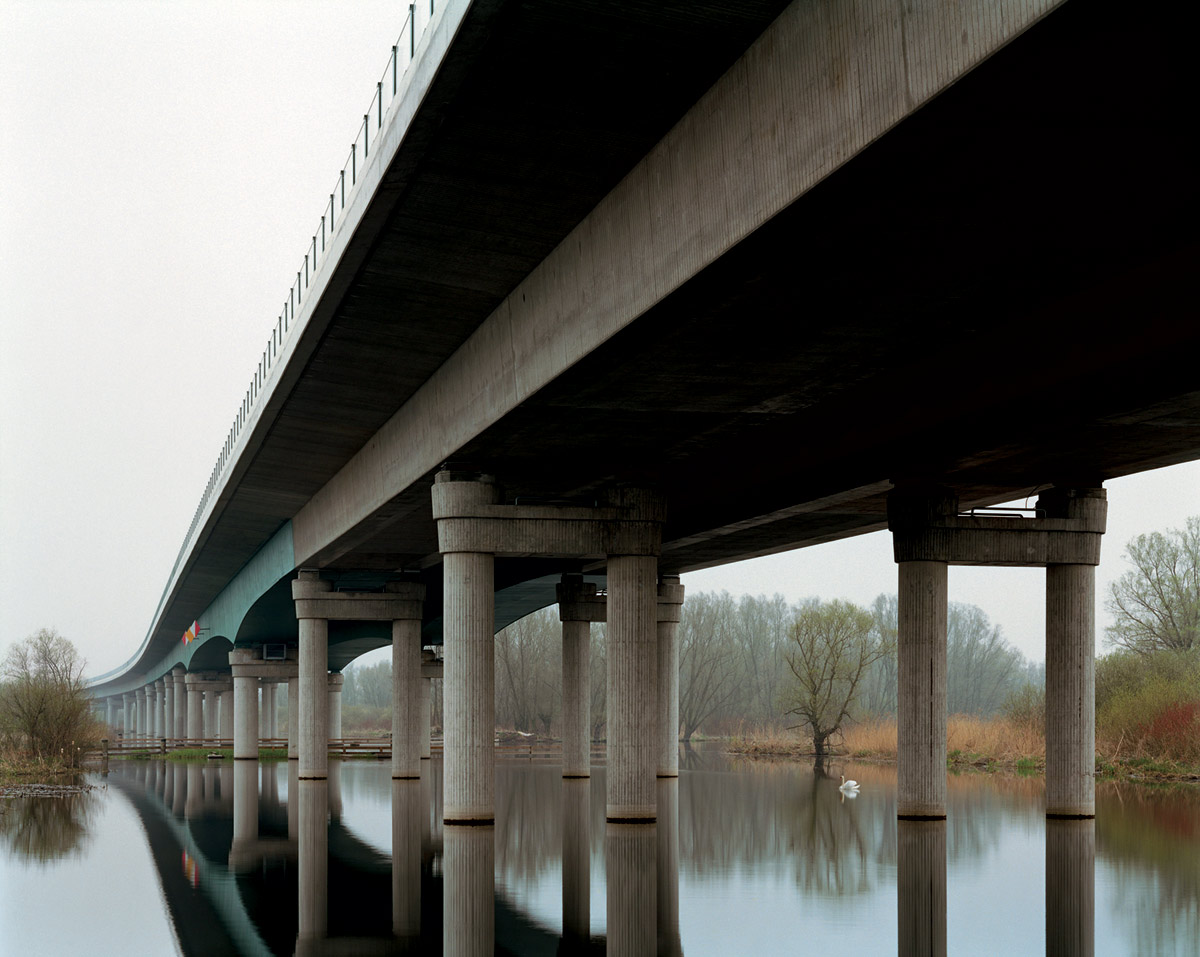
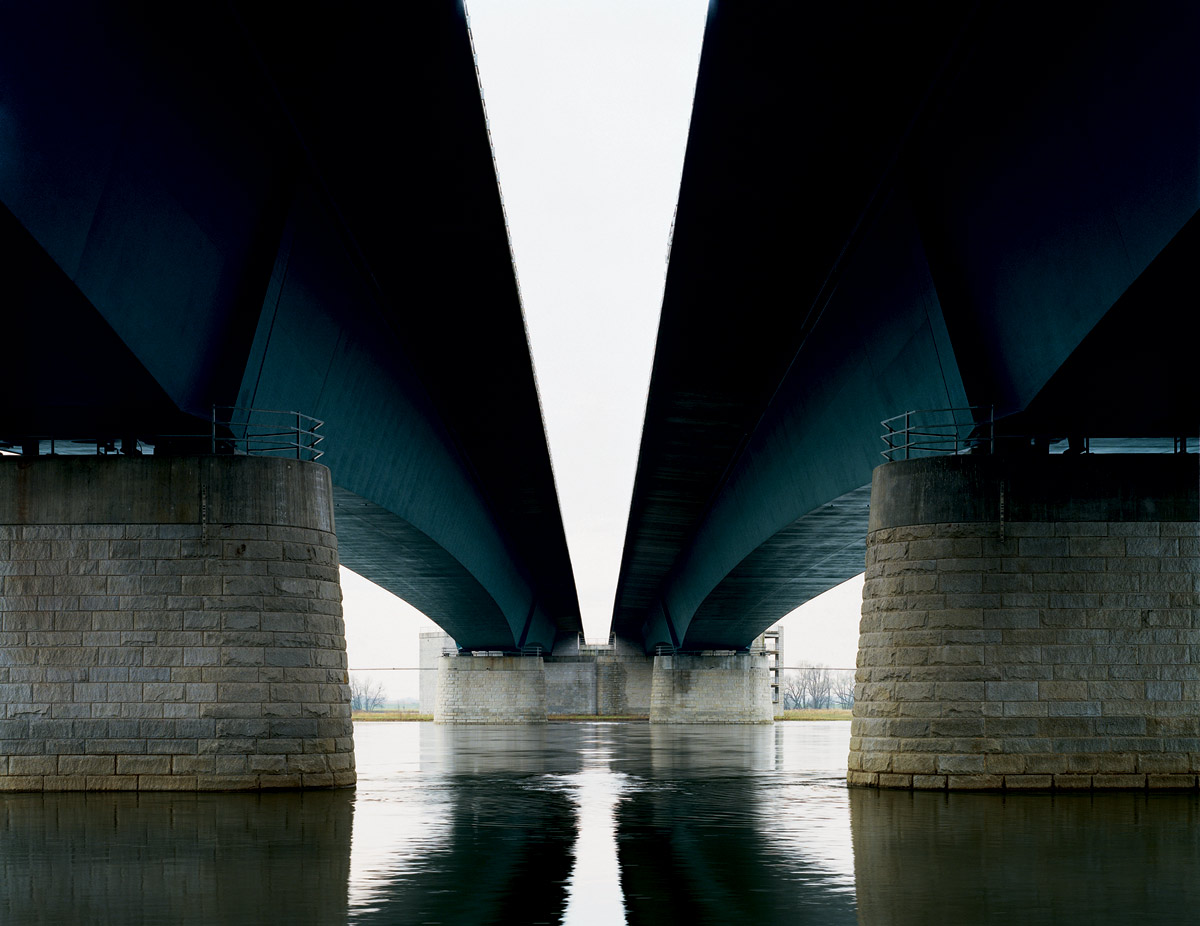
The artist first commanded worldwide attention with the series Verkehrsprojekte Deutsche Einheit (Traffic Projects German Unity, 1995-2003). Here he addressed the radical transformation of the landscape through the expansion of the motorway and rail network in eastern Germany.
The series Wände (Walls, 1995-2003) explored the question of how authentic the representation of reality is. Schink took frontal shots of the prefabricated architecture of unpretentious commercial buildings and melded them into almost abstract colour-fields. Merely the narrow borders adumbrate what we are seeing. To find his motifs, the artist embarks on journeys beyond the confines of Europe, taking him to countries such as Brazil, Japan, Cambodia, North Korea, Peru, the USA or Vietnam. His main objective is not the representation of exotic motifs, but the portrayal of the interface and the dialogue between anthropogenic structures and the natural landscape.
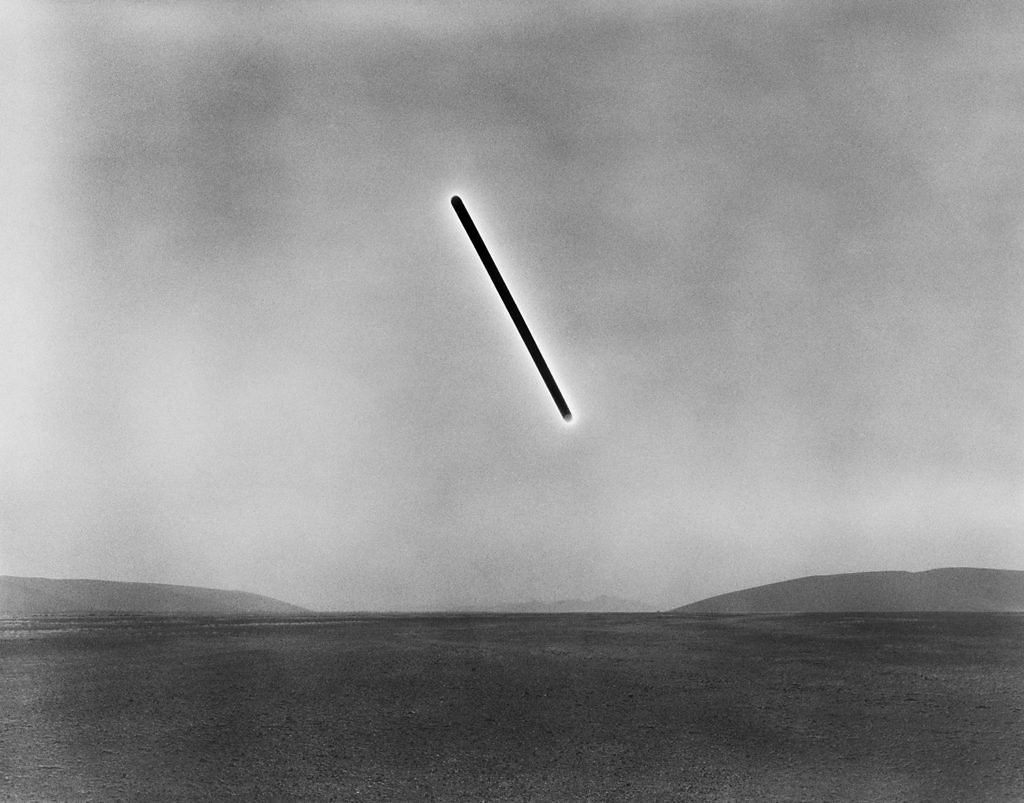
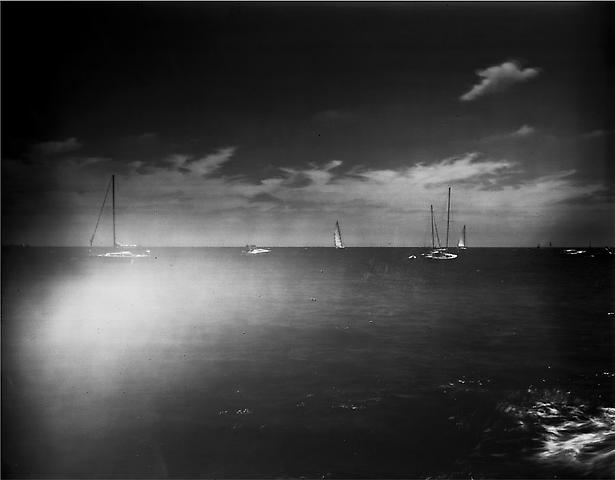
The award-winning series 1h (2002-2010) unites diverse aspects of his oeuvre: the interest in natural phenomena and light situations and his reflection on the possibilities of depicting reality through the medium of photography. Schink photographs the sun at various locations throughout the world, using exposure times of one hour. Together, the over-exposure and light intensity conjure a spectre which cannot be perceived by the human eye and which only becomes visible as a solarisation when captured by analogue photography: a black sunbeam, surrounded by a glowing corona. The resulting images render visible an unreal depiction of reality and confront the viewer with a Nature suspended between imagination and representation.
Press release from the MKM Küppersmühle Museum of Modern Art website
Many thankx to the Anne & Gordon Samstag Museum of Art for allowing me to publish the photographs in the posting. Please click on the photographs for a larger version of the image.
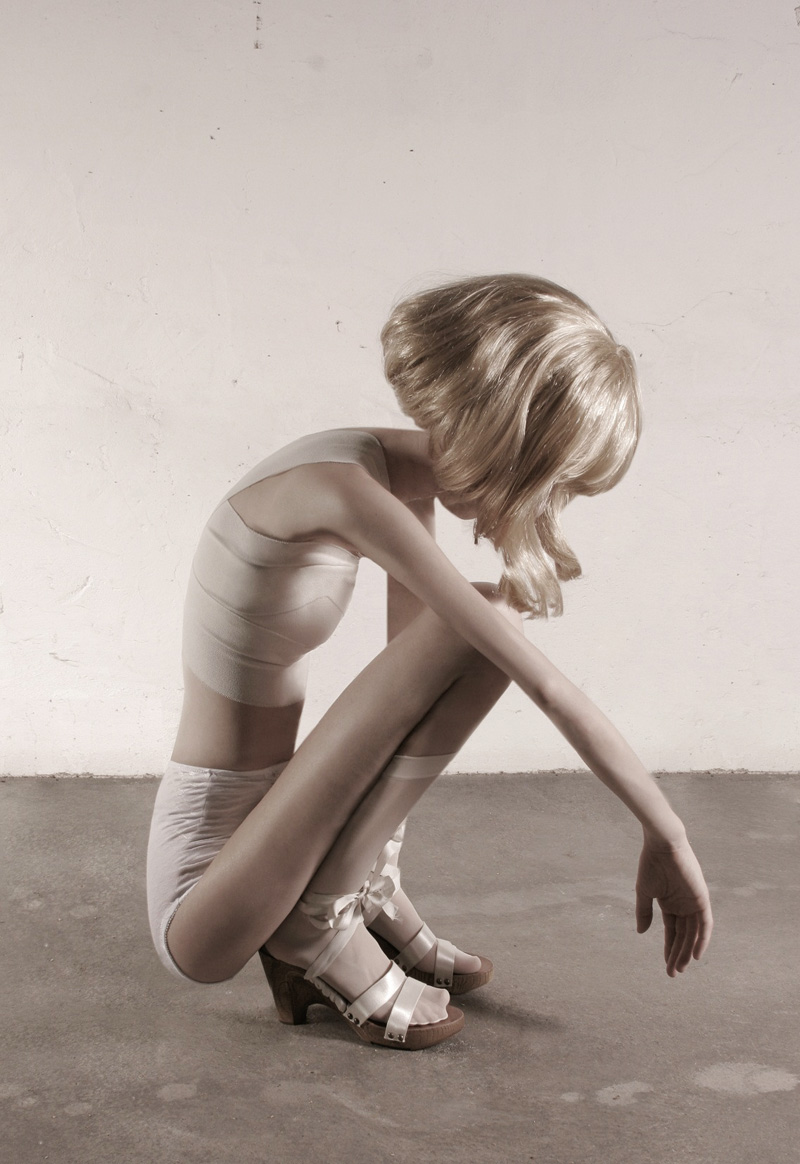
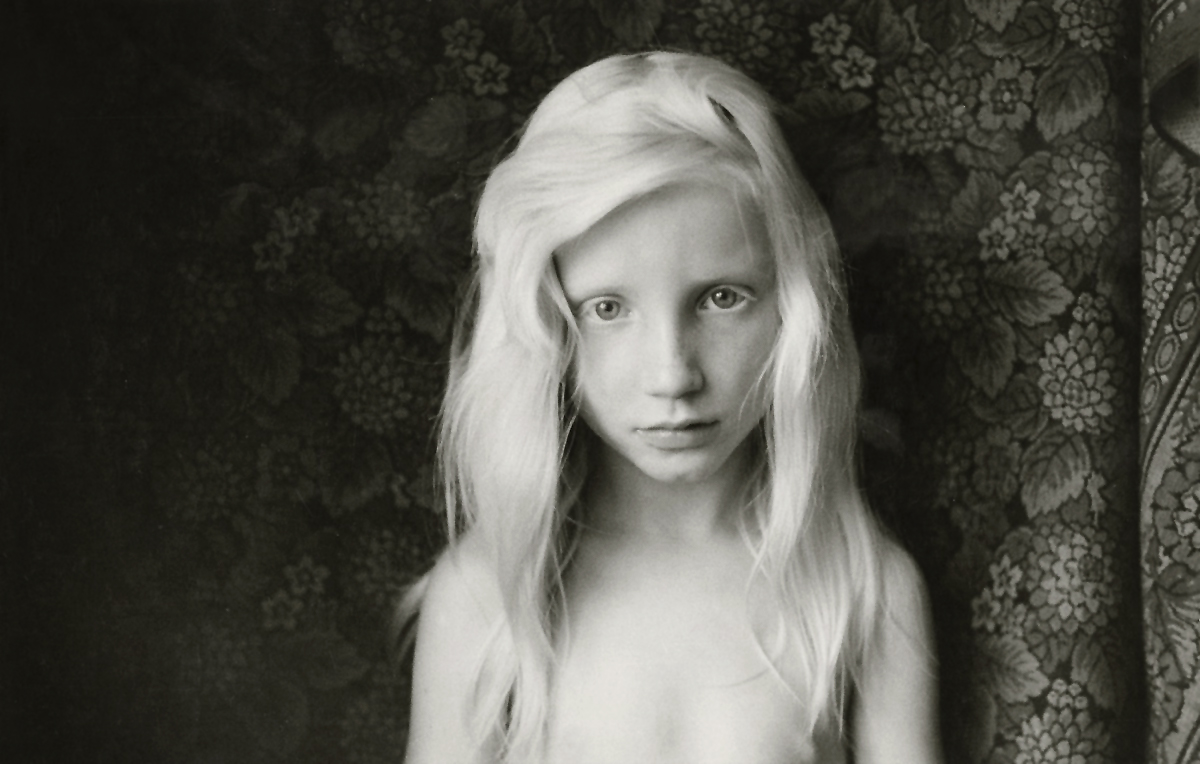
Olaf Unverzart (German, b. 1972) Untitled (from the series Fallen Kann Ich Auch Alleine)
1999
Pigment print
56 x 38cm/125 x 85cm
Courtesy of Oechsner Galerie
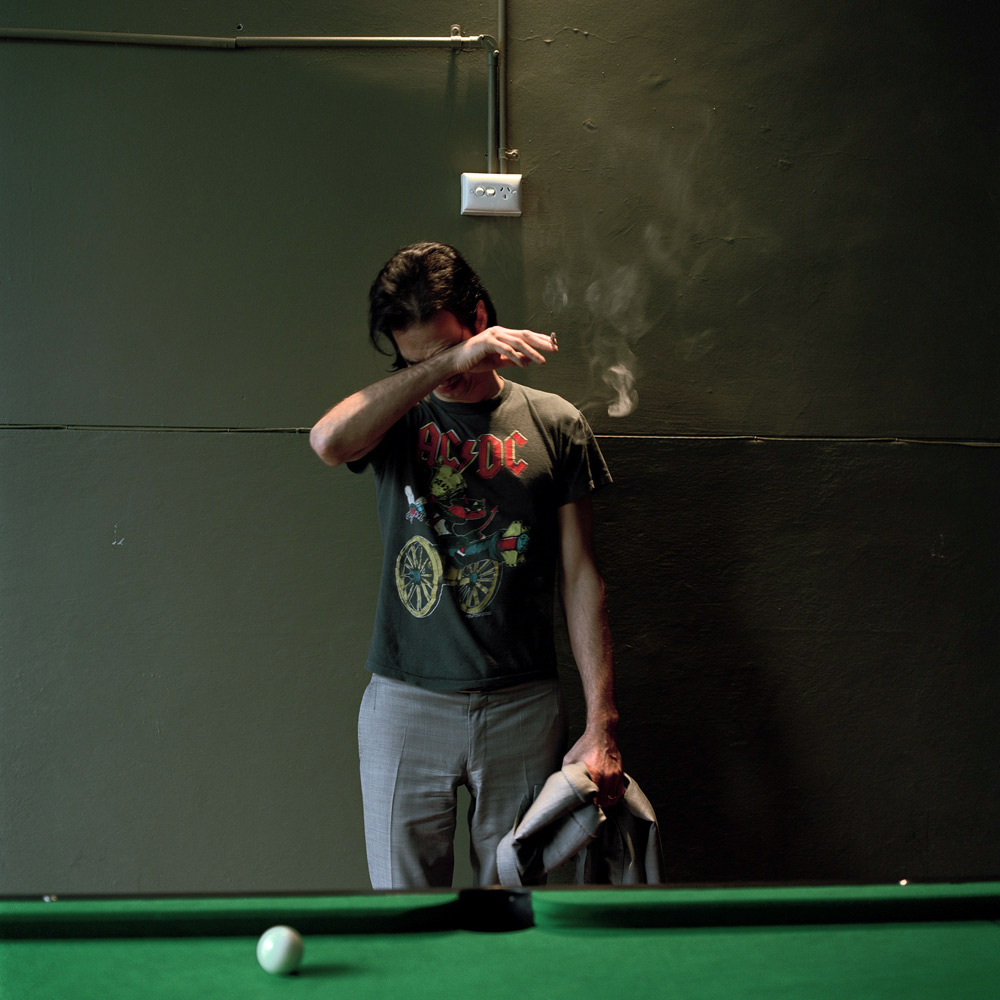
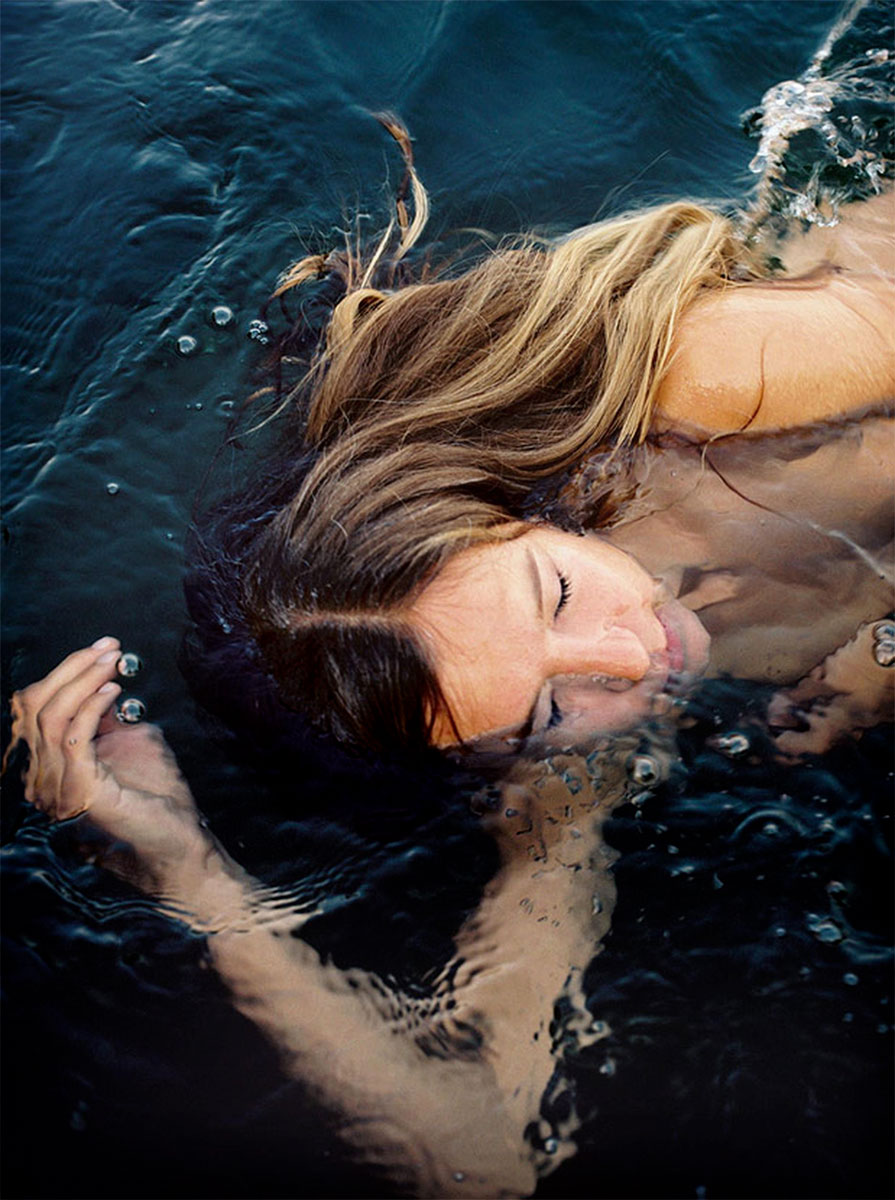
Ingvar Kenne (Australian born Sweden, b. 1965) Nick Cave 2001
From the series Citizen 1997-2012
C-type print
100 x 100cm
Courtesy of the artist
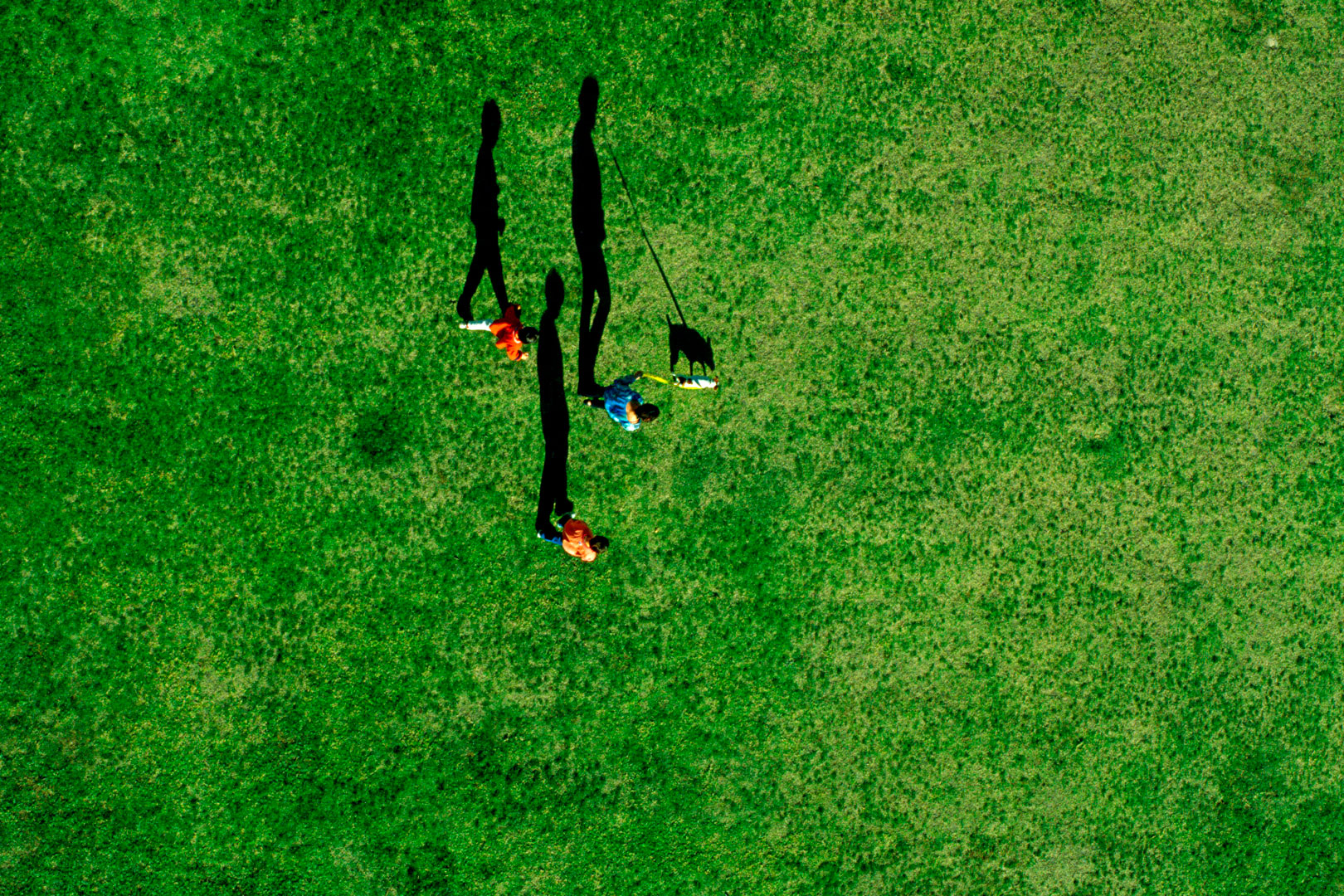
Narelle Autio (Australian, b. 1969) Untitled 8 (from the series Not of This Earth) 2001
Courtesy of the artist
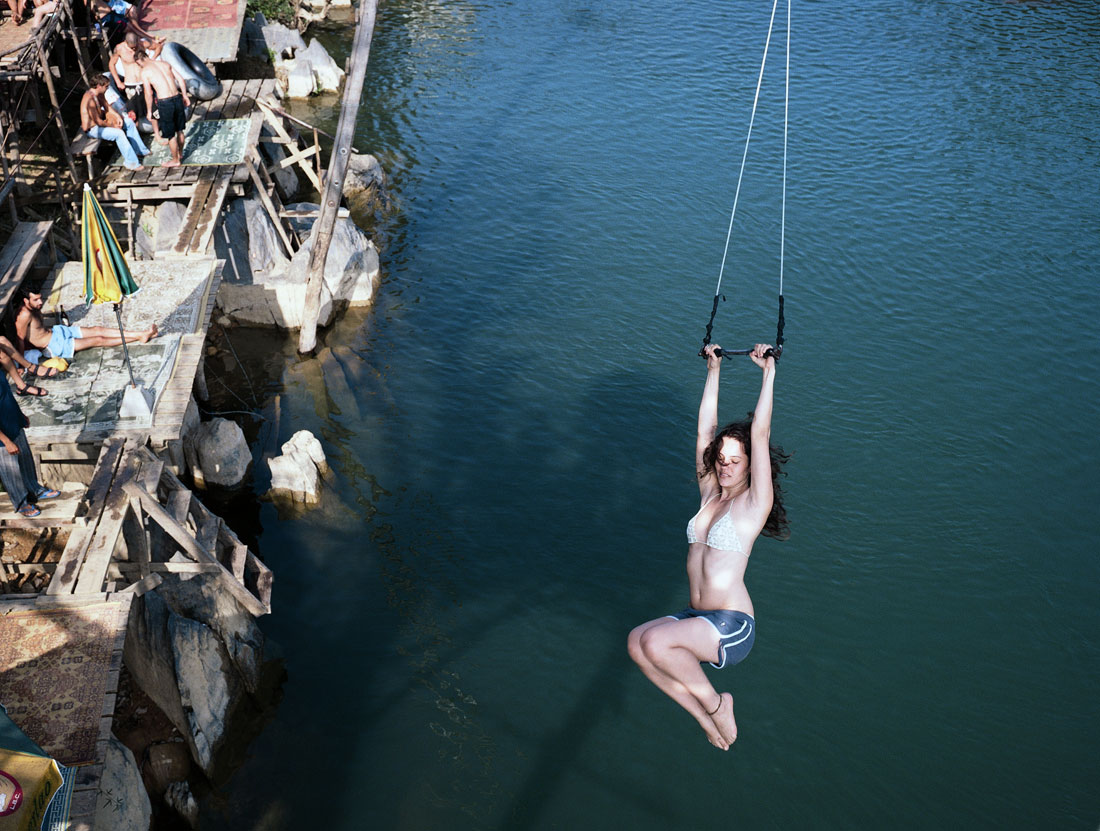
Jörg Brüggemann (German, b. 1979) Nam Song River, Vang Vieng, Laos, December 2007 2007
C-type print
69 x 57cm
Courtesy of the artist and Ostkreuz
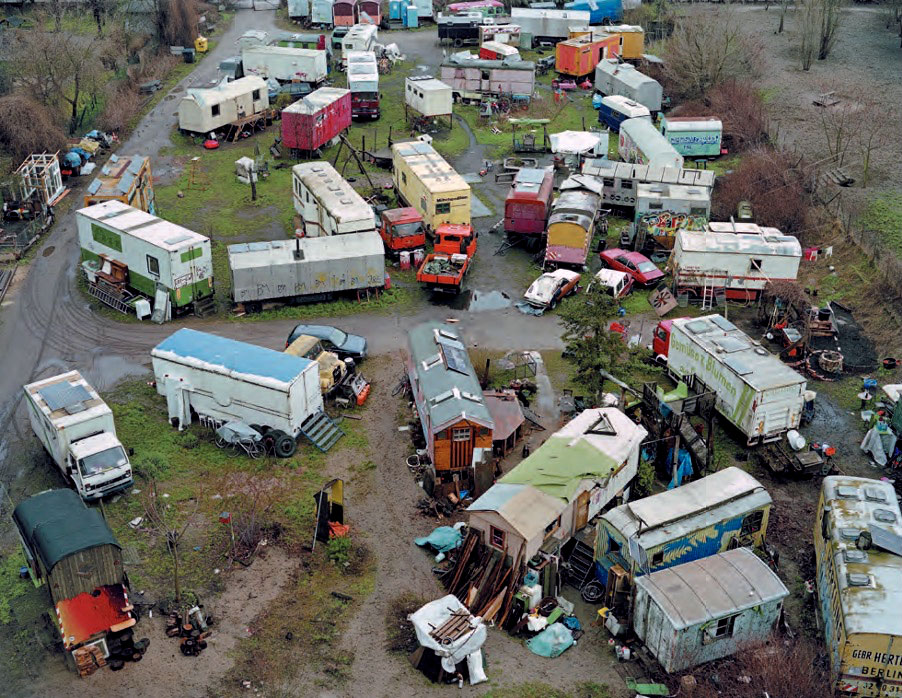
Johanna Ahlert (German, b. 1980) Truck and Trailer Castle, Berlin
2008
From the series CONVOI 2008
C-type print
100 x 127cm
Courtesy of the artist
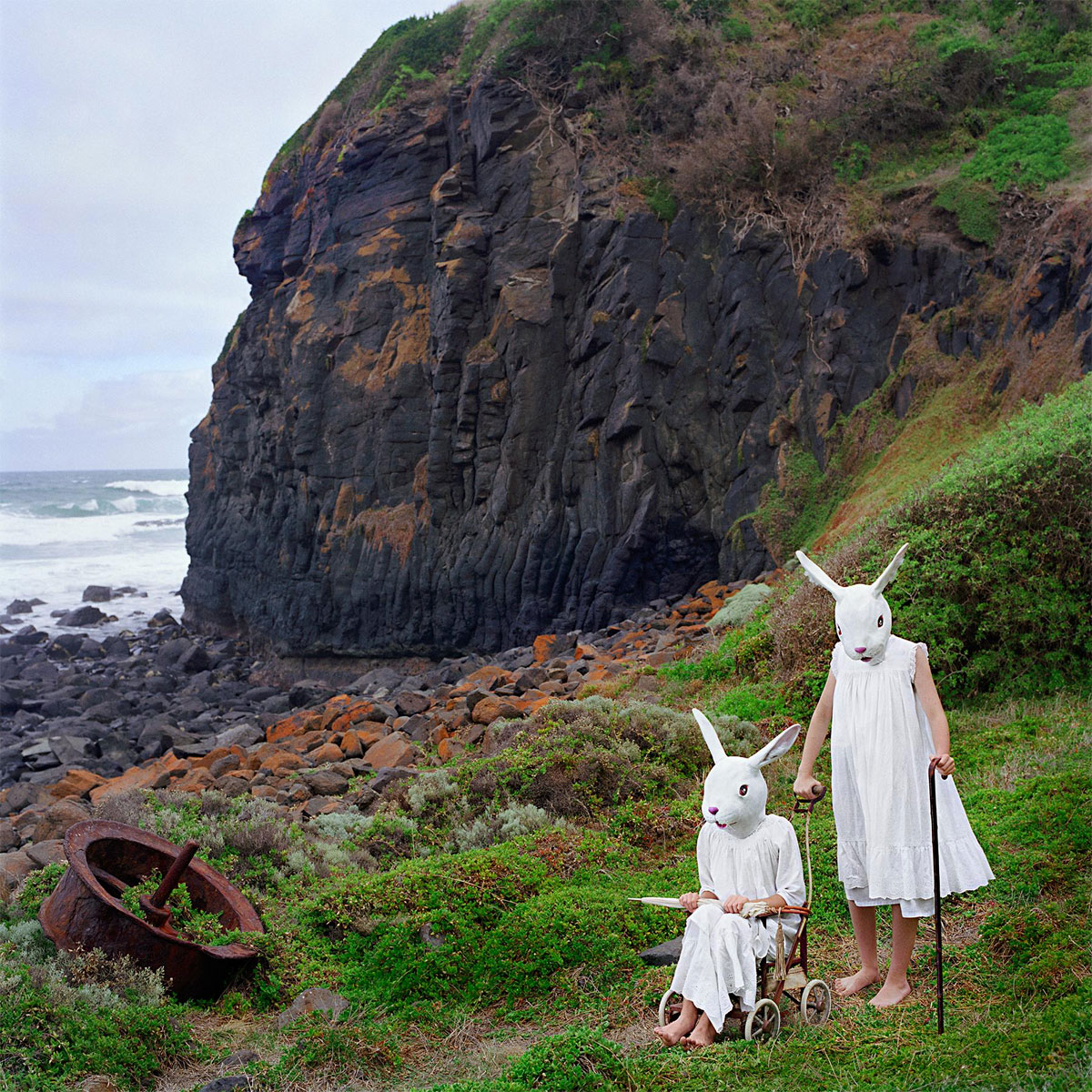
Polixeni Papapetrou (Australian, 1960-2018) The loners
2009
From the series Between worlds
Pigment ink-jet print
105 x 105cm
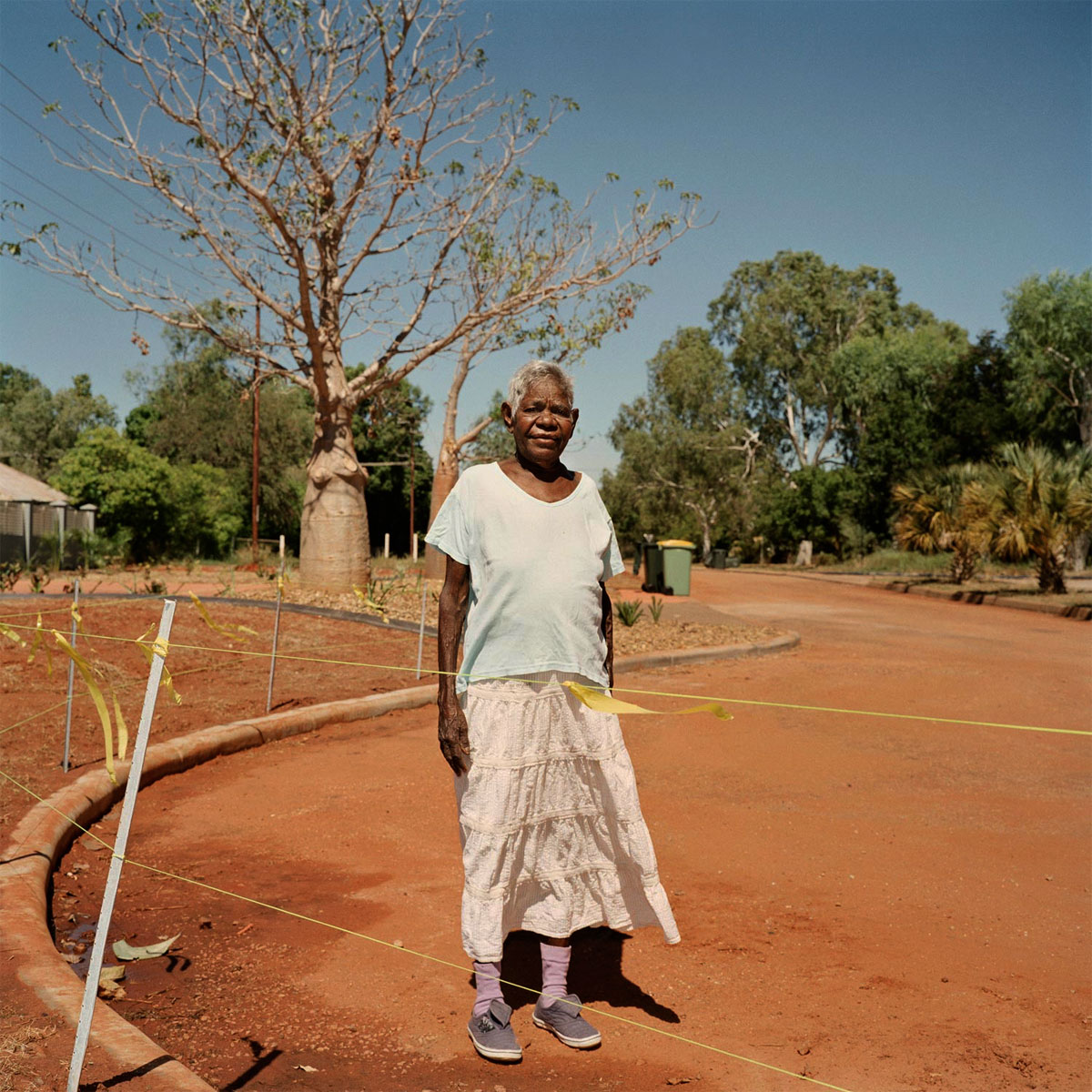
Ingvar Kenne (Australian born Sweden, b. 1965) Mona Chuguna, Author, Broome, Australia
2009
From the series Citizen 1997-2012 C-type print
100 x 100cm
Courtesy of the artist
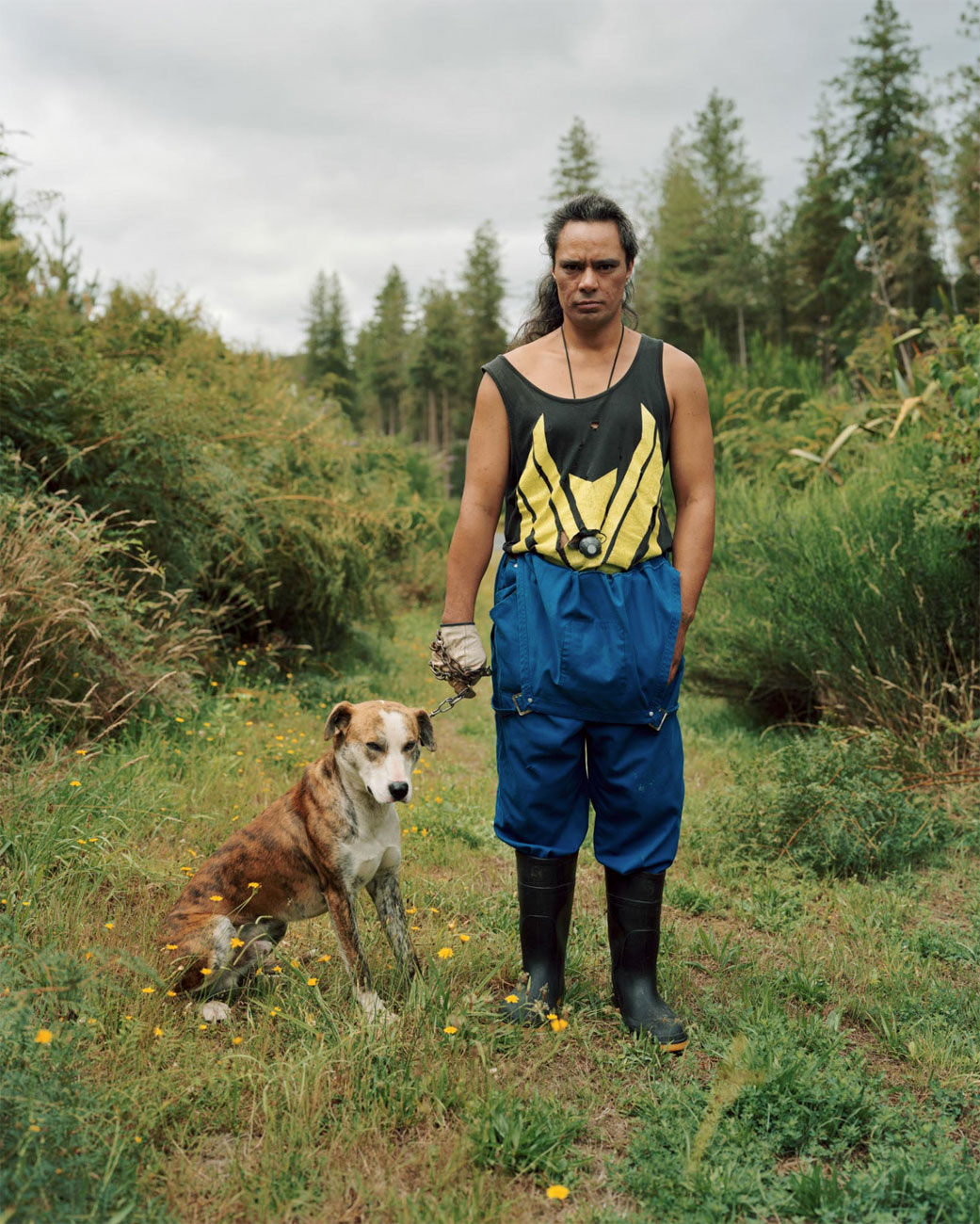
Hijacked 2: Australia/Germany builds on the very considerable success of the inaugural exhibition, Hijacked 1 – Australia and America, and its internationally celebrated and hugely successful book. This new exhibition effectively considers two socially disparate nations, Germany and Australia, through an expansive photographic anthology of fascinating works, juxtaposed to suggest connections.
Hijacked 2 has been curated by Mark McPherson and Ute Noll and showcases the diverse talents and perspectives of thirty contemporary German and Australian photographers. With a focus on the depiction of the young, the boundary-riding, and the fringe-dwelling, Hijacked 2 is evocative, confronting, dreamlike and rousing.
Featured artists from Australia are: Narelle Autio, James Brickwood, Michael Corridore, Andrew Cowen, Tamara Dean, Suzie Fox, Lee Grant, Derek Henderson, Rebecca Ann Hobbs, Ingvar Kenne, Bronek Kózka, Georgia Metaxas, Polixeni Papapetrou and Louis Porter.
From Germany the artists are: Johanna Ahlert, Natalie Bothur, Jörg Brüggemann, Thekla Ehling, Albrecht Fuchs, Jan von Holleben, Karsten Kronas, Anne Lass, Jens Liebchen, Myriam Lutz, Julian Röder, Josef Schulz, Oliver Sieber, Ivonne Thein, Olaf Unverzart and Sascha Weidner.
Hijacked 2: Australia/Germany is toured by the Australian Centre for Photography. A substantial 412-page publication accompanies the exhibition with texts by Uta Daur, Bec Dean, Alasdair Foster, Bill Kouwenhoven, Katja Melzer, Daniel Palmer and Katrina Schwarz.
Text from the Anne & Gordon Samstag Museum of Art website
Ivon Thein (German, b. 1979) Untitled 07 (from the series Thirty-Two Kilos) 2006
C-type print
55 x 80cm
Courtesy of Galerie Voss
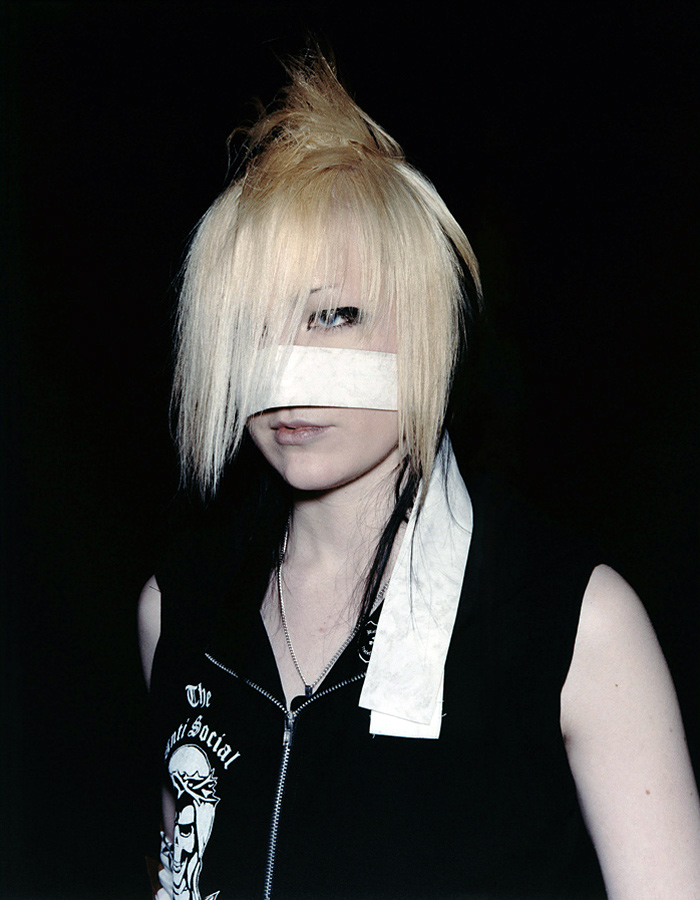
Oliver Sieber (German, b. 1966) Reita, Köln, 2007
2007
Pigment print
34 x 27cm
Courtesy Galerie Priska Pasquer, Germany
David Henderson (New Zealand, b. 1963) Dave Omeka Kidwell and Feather, Ātiamuri
2008
From the series Mercy Mercer
Thekla Ehling (German, b. 1968) Untitled
2011
From the series Vergiszmeinnicht (forget-me-not)
Anne & Gordon Samstag Museum of Art Hawke Building, City West campus
University of South Australia
55 North Terrace, Adelaide Phone: (08) 8302 0870
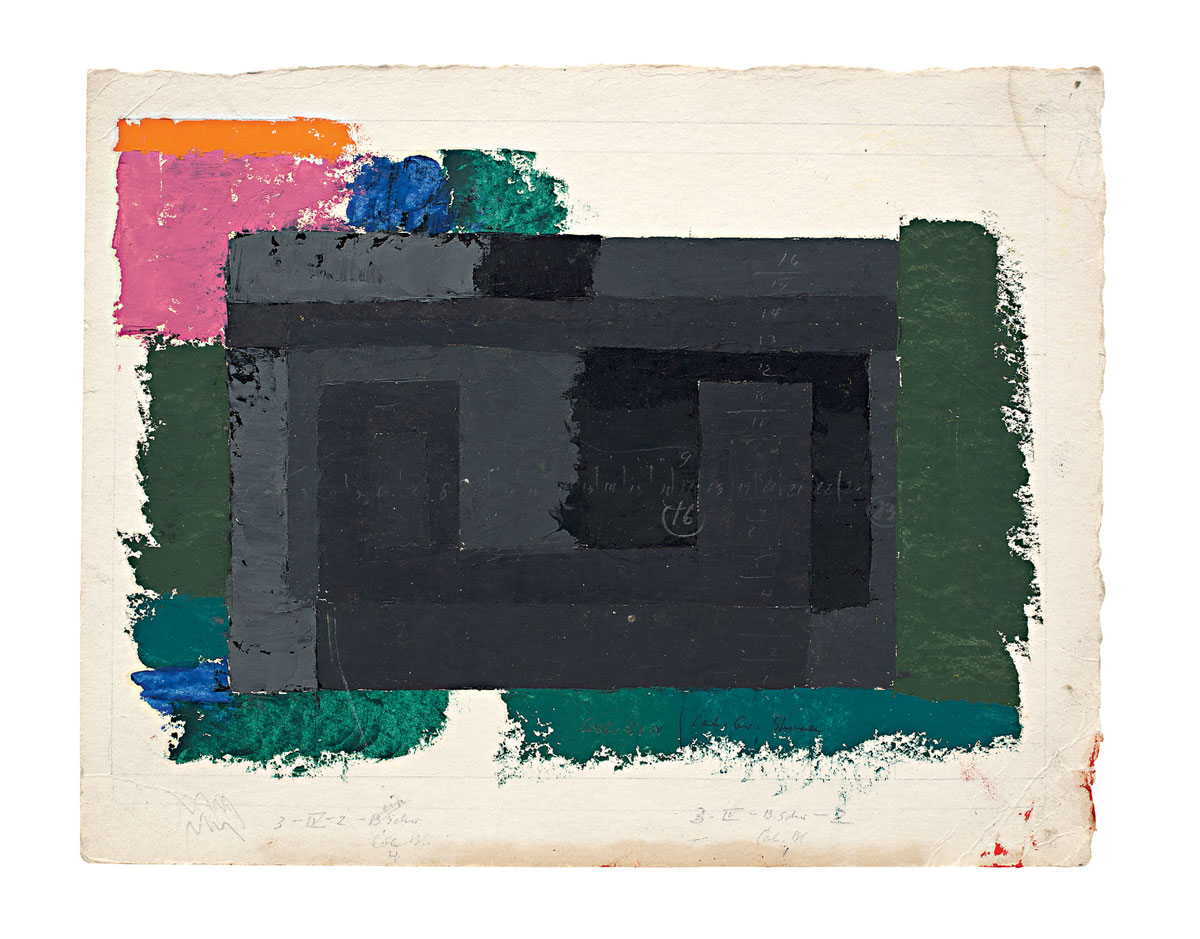
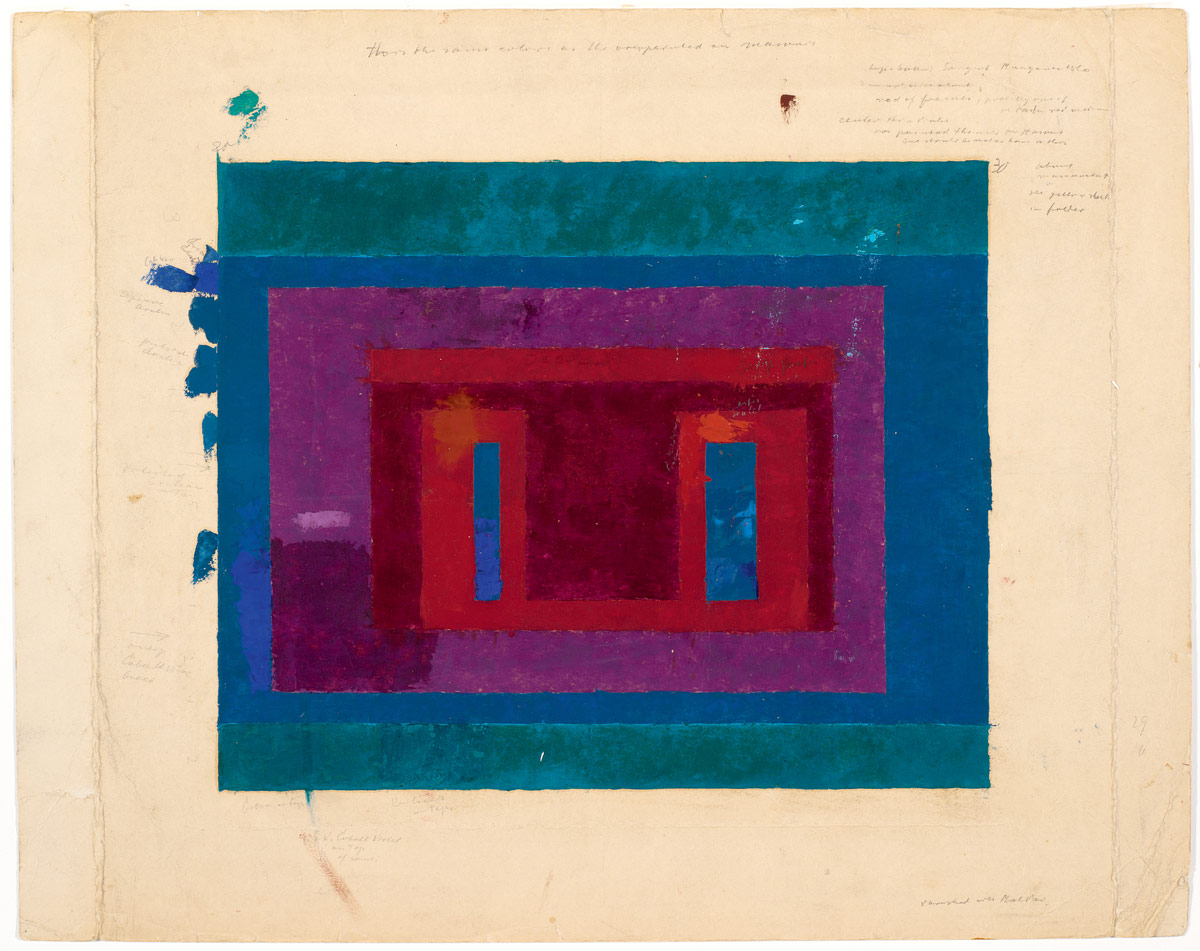
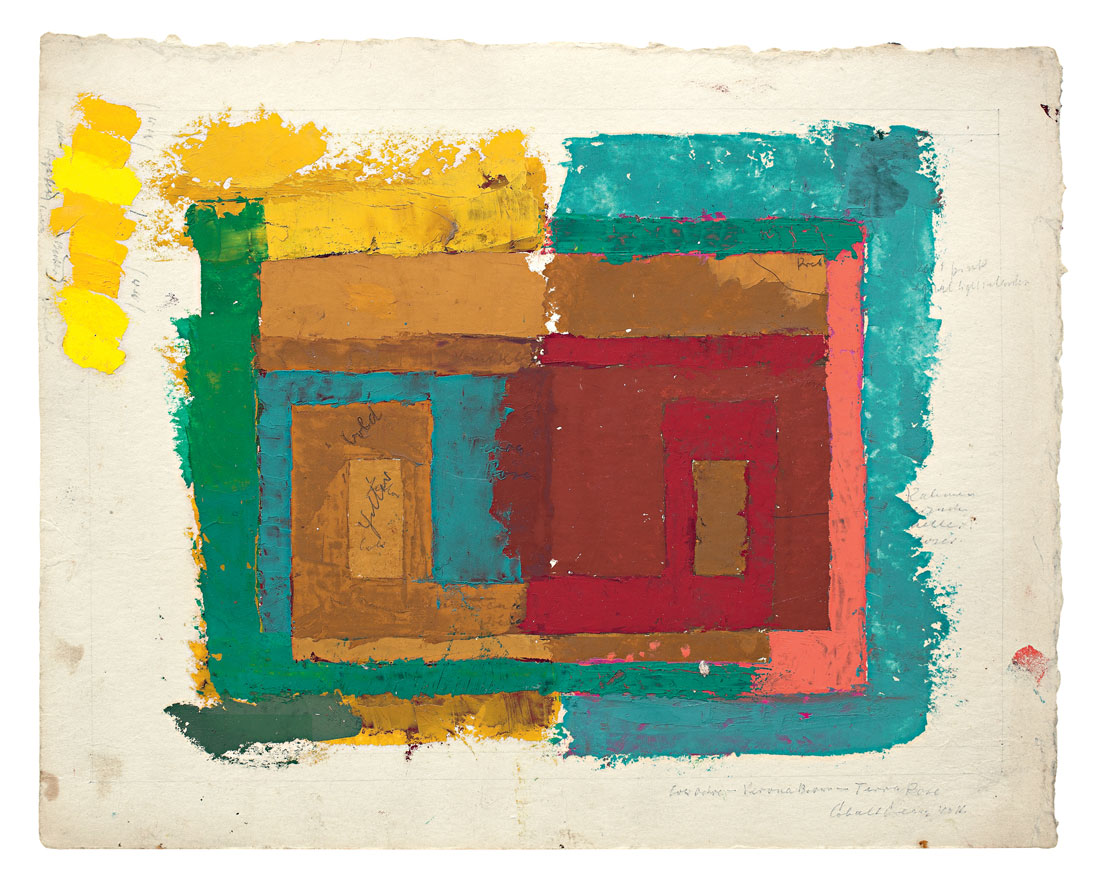
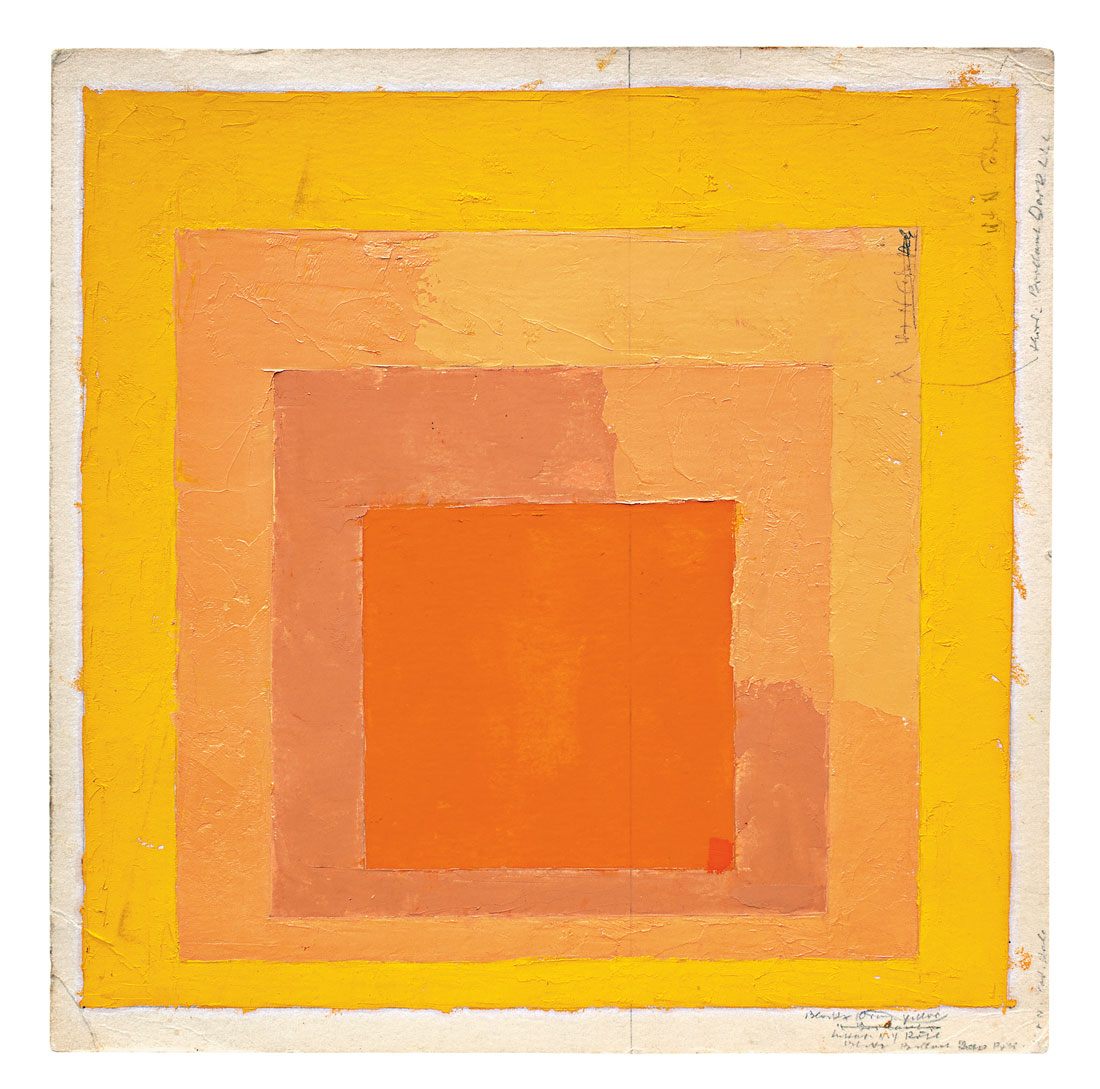
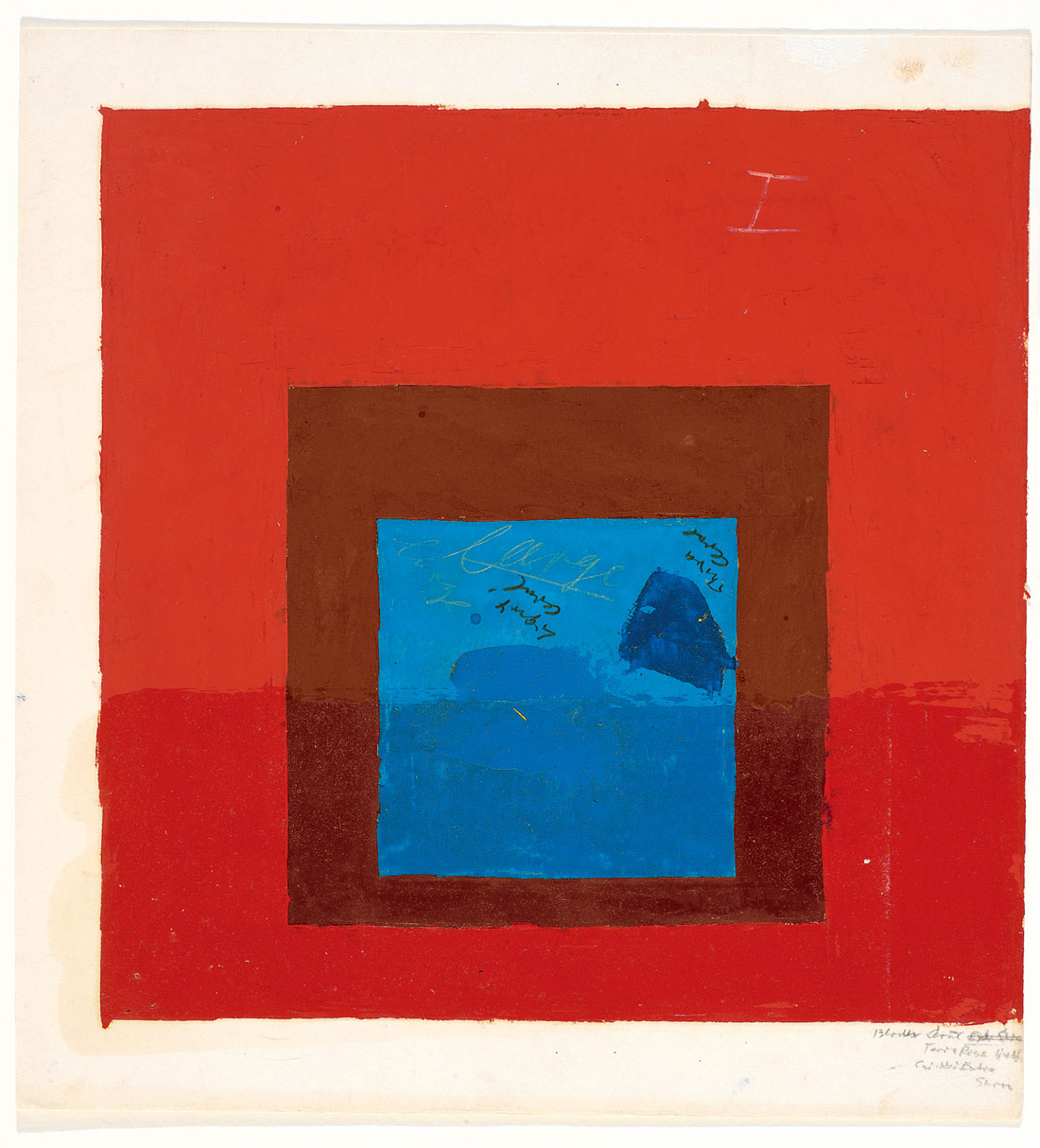
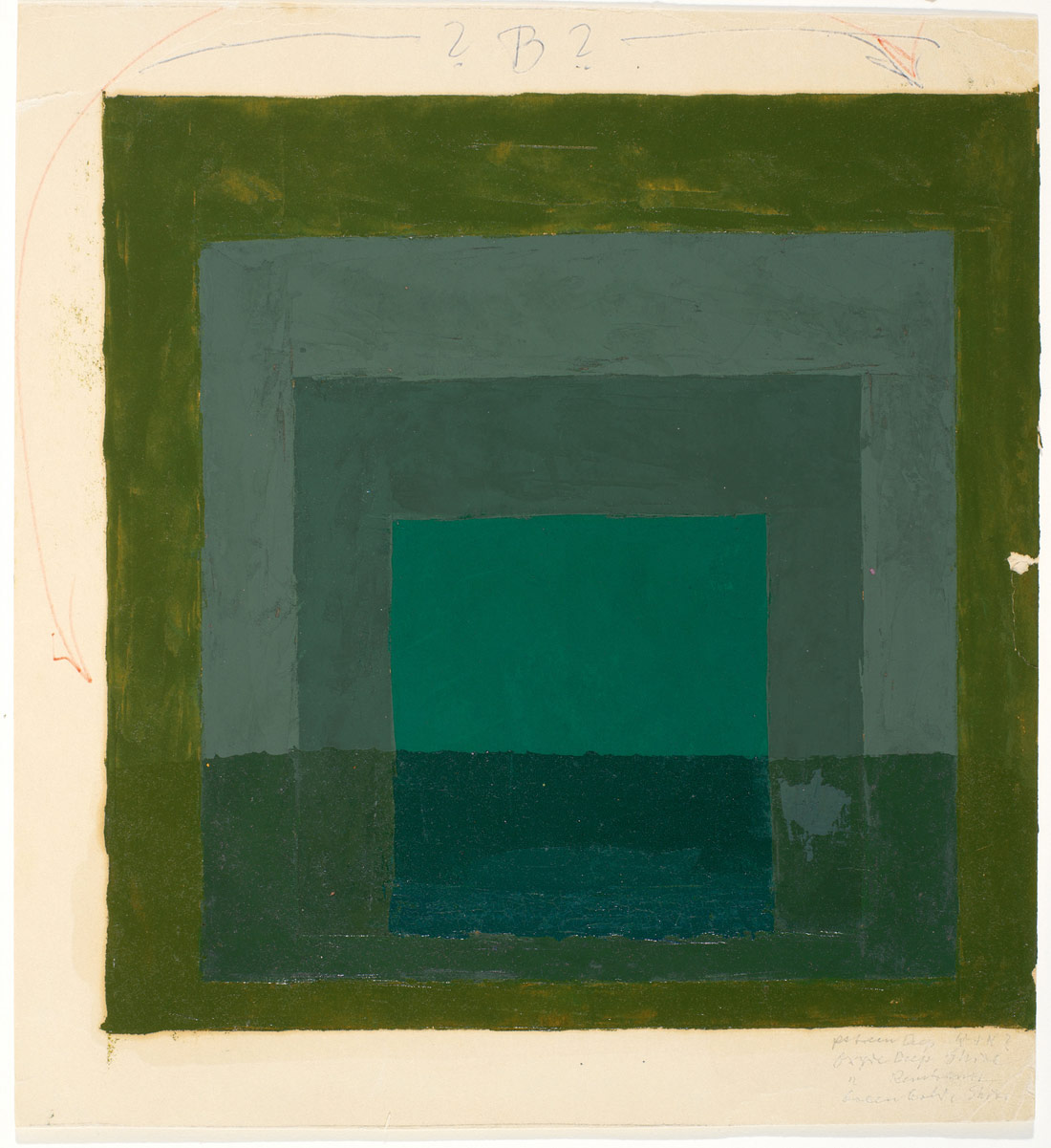
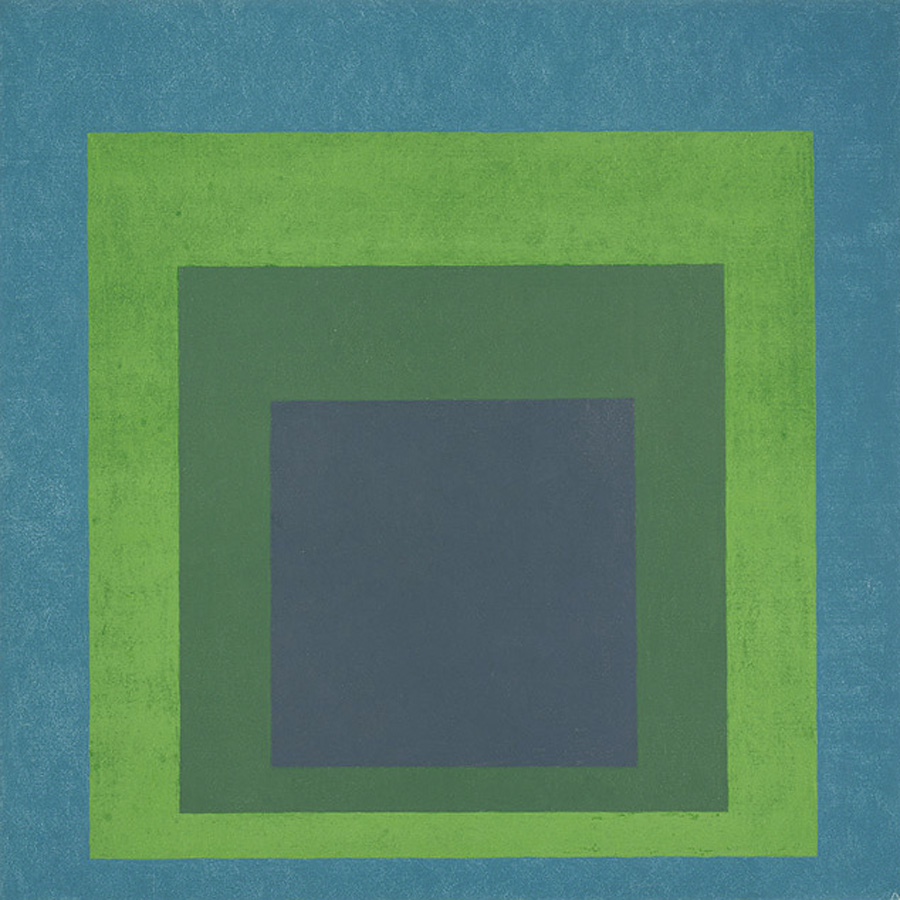
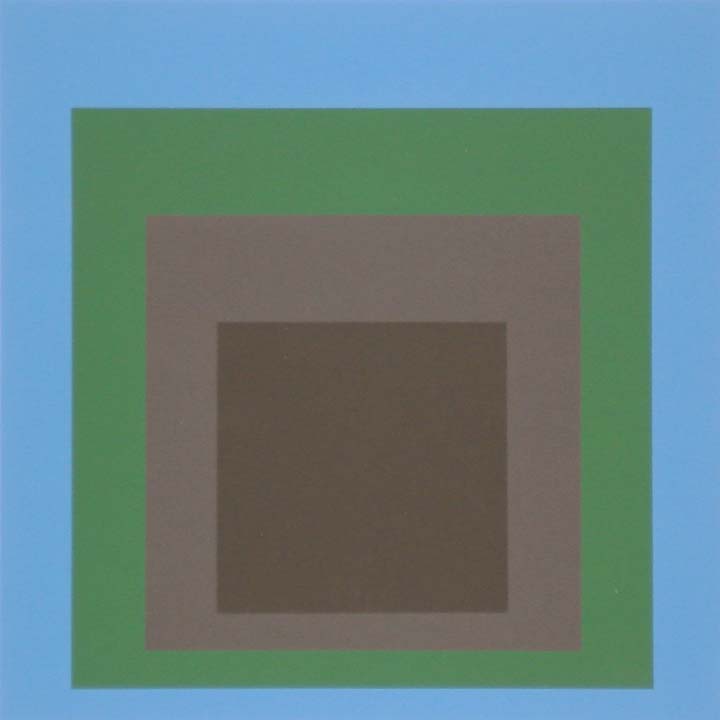
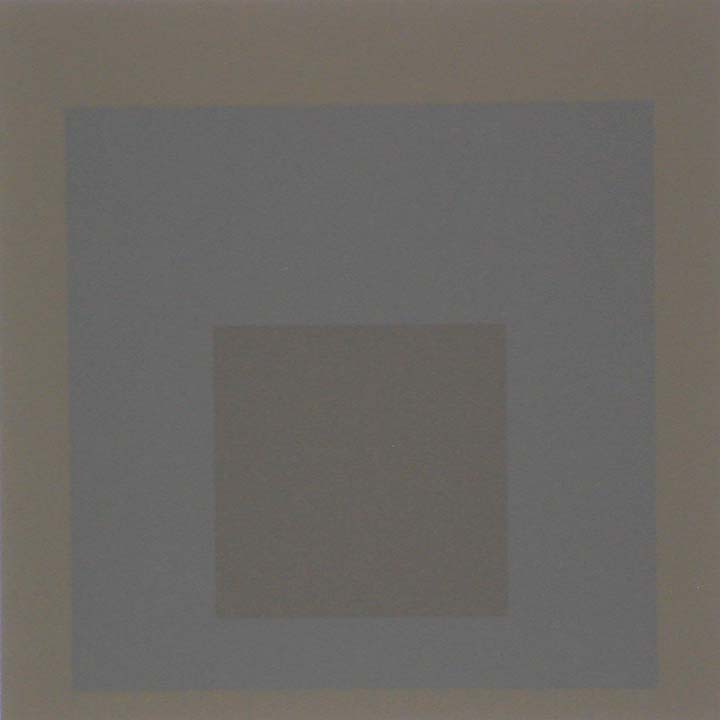
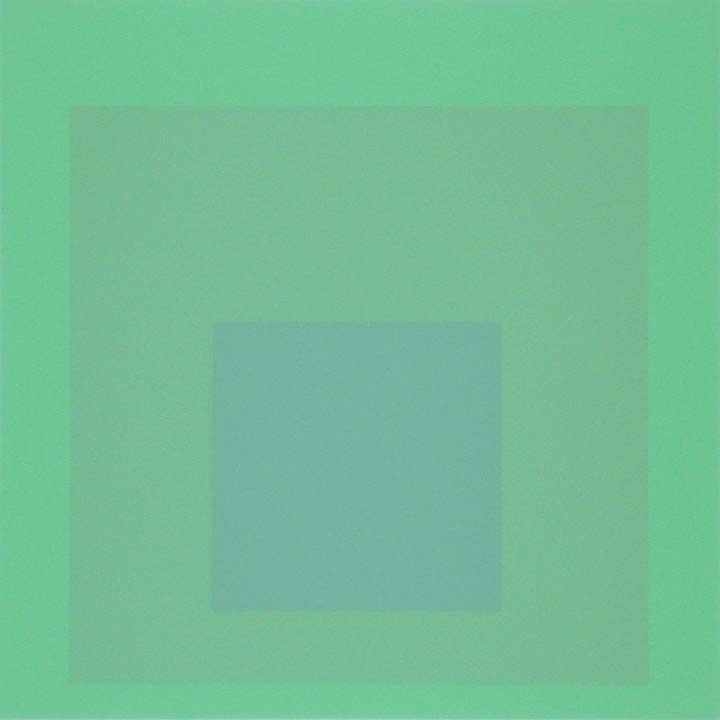
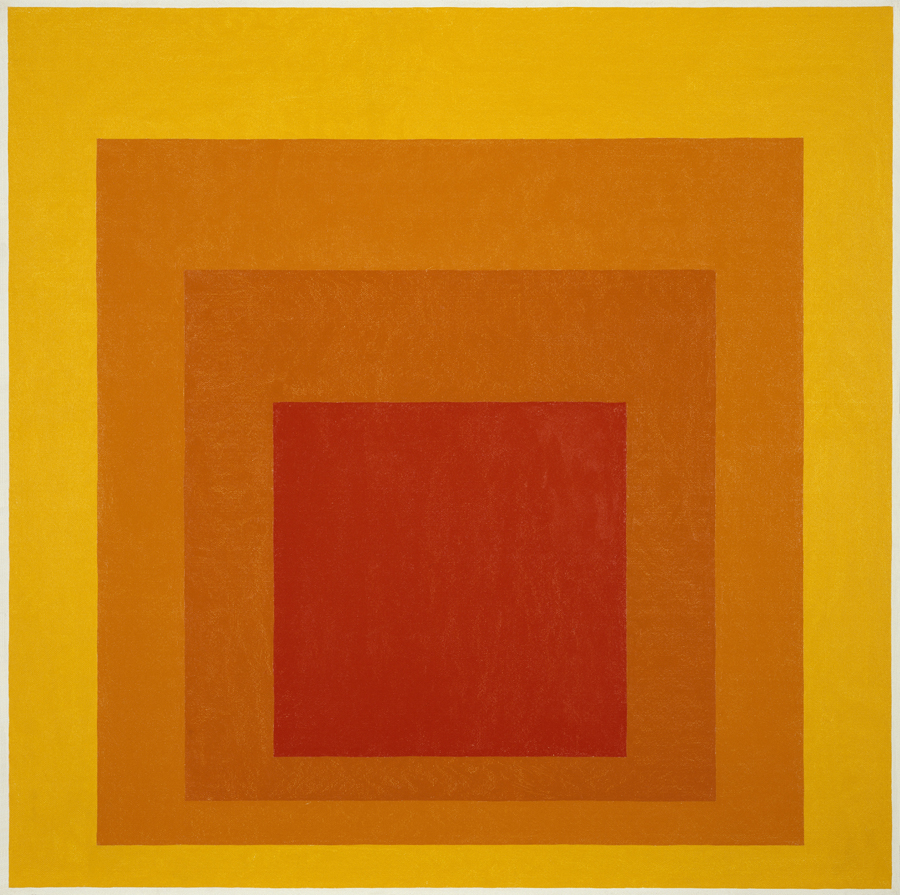
I really like the work of Josef Albers and these paintings on paper, studies for later work, give insight into that rare quality of Albers – his ability to mould, no that’s not the right word – his ability to accrete colours and spaces together, to build tectonic plates of colour that collide and burst against each other forming an “osmosis of plane and space.” These harmonic oscillations of vibrant colour form a pleasing equilibrium in the mind, freeing the viewer from conceptual thought and allowing us to enter a different state of being. It is fascinating to me that he painted these studies on blotting paper as the paper seems to soak up the colours, intensifying their existence.
Dr Marcus Bunyan
Many thankx to Pinakothek der Moderne for allowing me to publish the photographs of the art in the posting. Please click on the photographs for a larger version of the image.
The exhibition is the first to show such a concentration of paintings on paper by Josef Albers, some of which will be completely unknown to the general public. Works in oil on paper, painted by the artist since the 1940s in preparation for the Adobe and Variant series in particular, are presented together with a large group related to his principal work “Homage to the Square” from the artist’s late period, that he focused on from 1950 until his death in 1976.
Josef Albers was only able to fully develop into an important artist and influential teacher after emigrating to the USA. From around 1940 onwards, Albers was inspired by Mexico’s pre-Columbian architecture, sculpture and textile art that boosted his sense for the aesthetic and led to idiosyncratic, radiant colour compositions, the likes of which had never been seen at that time in European modern art. Around 1950, Albers discovered what was for him the ideal formal shape of colour – the square.
The works exhibited surprise the viewer with their spontaneity, their search for immediacy and the extraordinary delicacy of their colours. Albers studied the interaction of colours like virtually no other. Through his works on paper in particular it can be seen in detail how the artist achieved such a thorough osmosis of plane and space through increasing the density of the colours used.
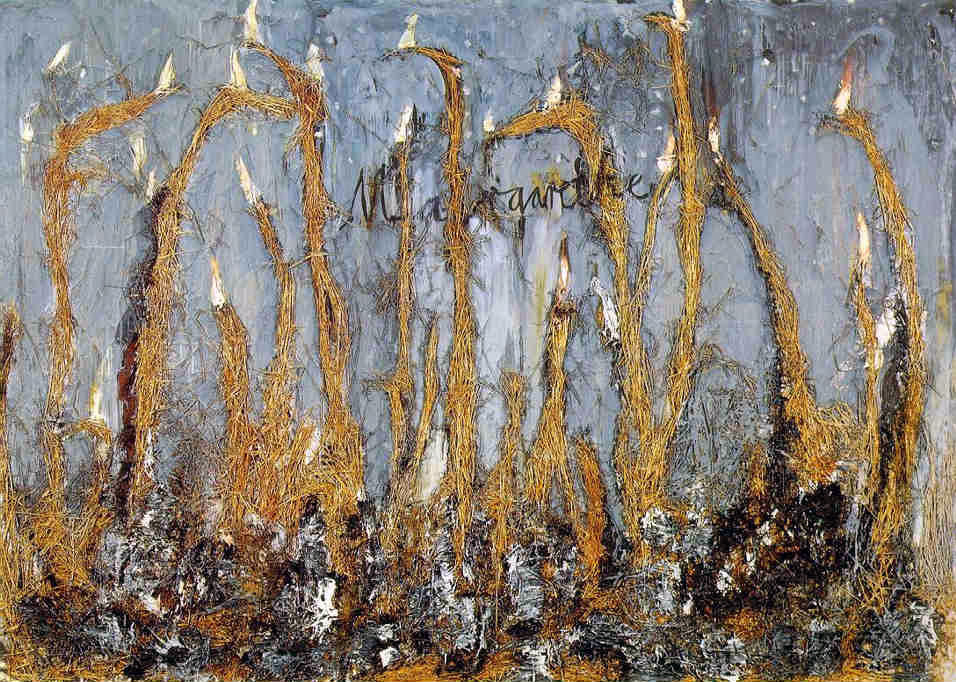
Anselm Kiefer (German, b. 1945) Margarette 1981 Oil and straw on canvas 280 cm x 380cm
Anselm Kiefer (German, b. 1945) Man under a Pyramid 1996 Emulsion, acrylic, shellac and ash on burlap 2810 x 5020 x 50 mm ARTIST ROOMS: Tate and National Galleries of Scotland. Acquired jointly through The d’Offay Donation with assistance from the National Heritage Memorial Fund and the Art Fund 2008
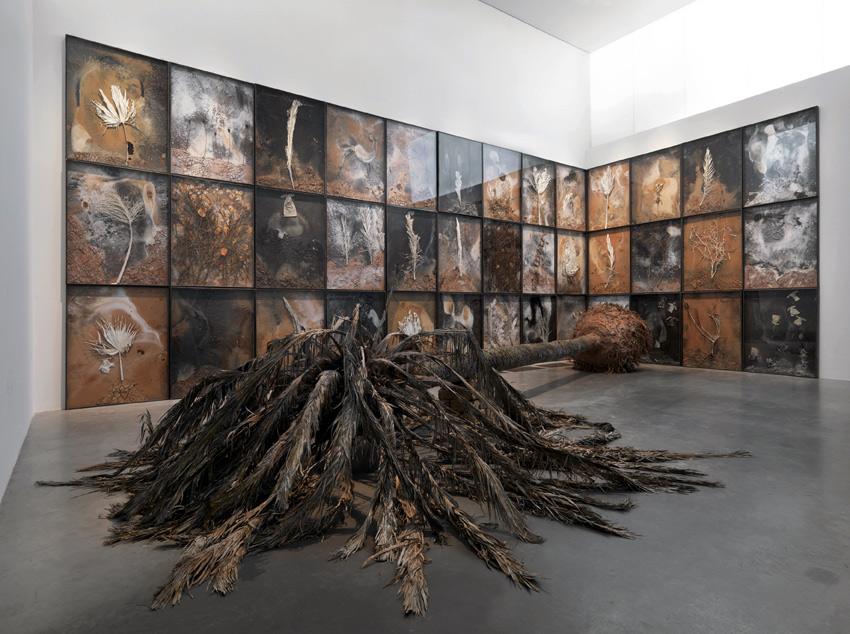
Anselm Kiefer (German, b. 1945) Palm Sunday 2006 Mixed media installation Overall display dimensions variable ARTIST ROOMS: Tate and National Galleries of Scotland. Acquired jointly through The d’Offay Donation with assistance from the National Heritage Memorial Fund and the Art Fund 2008
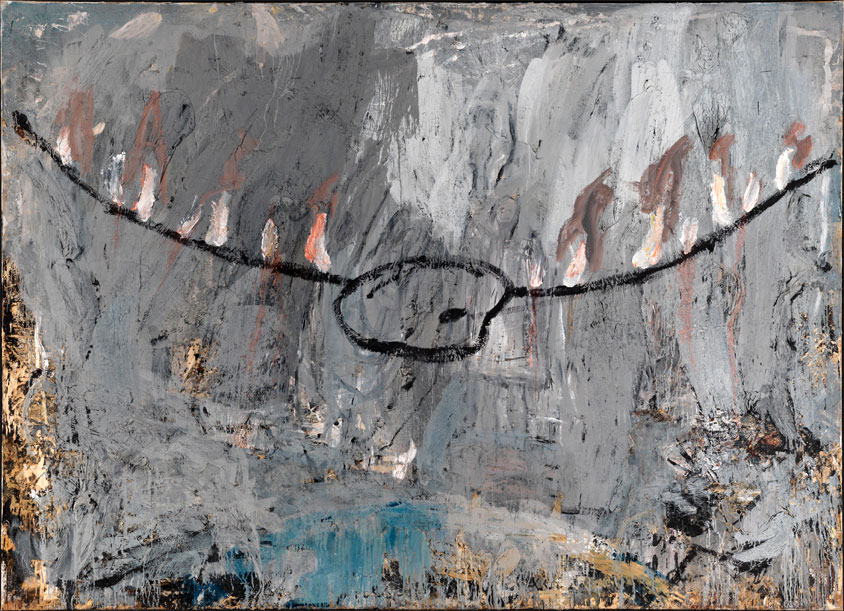
Installation view of the exhibition Anselm Kiefer at the BALTIC Centre for Contemporary Art, Gateshead showing at left, Keifer’s work Palette (1981, below)
Anselm Kiefer (German, b. 1945) Palette 1981 Oil, shellac and emulsion on canvas 2917 x 4000 x 35 mm ARTIST ROOMS: Tate and National Galleries of Scotland. Acquired jointly through The d’Offay Donation with assistance from the National Heritage Memorial Fund and the Art Fund 2008
BALTIC Centre for Contemporary Art proudly announces a major exhibition of the work of Anselm Kiefer, one of the foremost figures of European post-war painting. The exhibition includes a diverse body of work, offering a selection that spans four decades and ranges from early paintings to monumental installations. Presented over two floors of BALTIC’s galleries, the exhibition is Kiefer’s largest in the UK for many years and has been made possible by ARTIST ROOMS On Tour with the Art Fund.
Following the success of 2009, 21 museums and galleries across the UK in 2010 will be showing 25 ARTIST ROOMS exhibitions and displays from the collection created by the curator and collector, Anthony d’Offay, and acquired by the nation in February 2008. ARTIST ROOMS On Tour with the Art Fund has been devised to enable this collection held by Tate and the National Galleries of Scotland, to reach and inspire new audiences across the country, particularly young people.
Anselm Kiefer at BALTIC includes painting, sculpture and installation, some of which has been rarely seen before. The starting point for Kiefer’s work is his fascination with myth, history, theology, philosophy and literature. For many years his painting was a vehicle to come to terms with his country’s past, and subsequently became ever concerned with religious traditions and the symbolism of different cultures. Kiefer’s weighty subject matters are reflected in the monumental scale of many of his works, while his keen exploration and visceral layering of materials such as lead, ash, rope and human hair bring an emotional potency.
Among the paintings to be included in the exhibition are three works from the artist’s early Parsifal series (1973), drawn from Richard Wagner’s last opera and its 13th century source, a romance by Wolfram von Eschenbach based upon the legend of the Holy Grail. With Palette 1981, Kiefer revealed the problematic legacy inherited by artists in post-war Germany: the artist’s palette hangs from a single burning thread evoking shame, loss and the apparent impossibility of artistic creation. The expansive Man under a Pyramid 1996, which measures more than five meters long, continues the artist’s interest in meditation and the linking of body and mind.
Also included is Palmsonntag 2006 which comprises a vast sequence of 36 paintings arranged around a full-size palm tree. While avoiding explicit religious statement, the work draws upon the Christian narrative of Palm Sunday to explore death and resurrection, decay, re-creation and rejuvenation; human themes that are central to Kiefer’s practice and that will be identified throughout this presentation.
Anselm Kiefer biography
Anselm Kiefer was born 1945 in Donauschingen, Germany, at the close of World War II. He studied art formally under Joseph Beuys at the Düsseldorf Academy in the early 1970s where history and myth became central themes in his work.
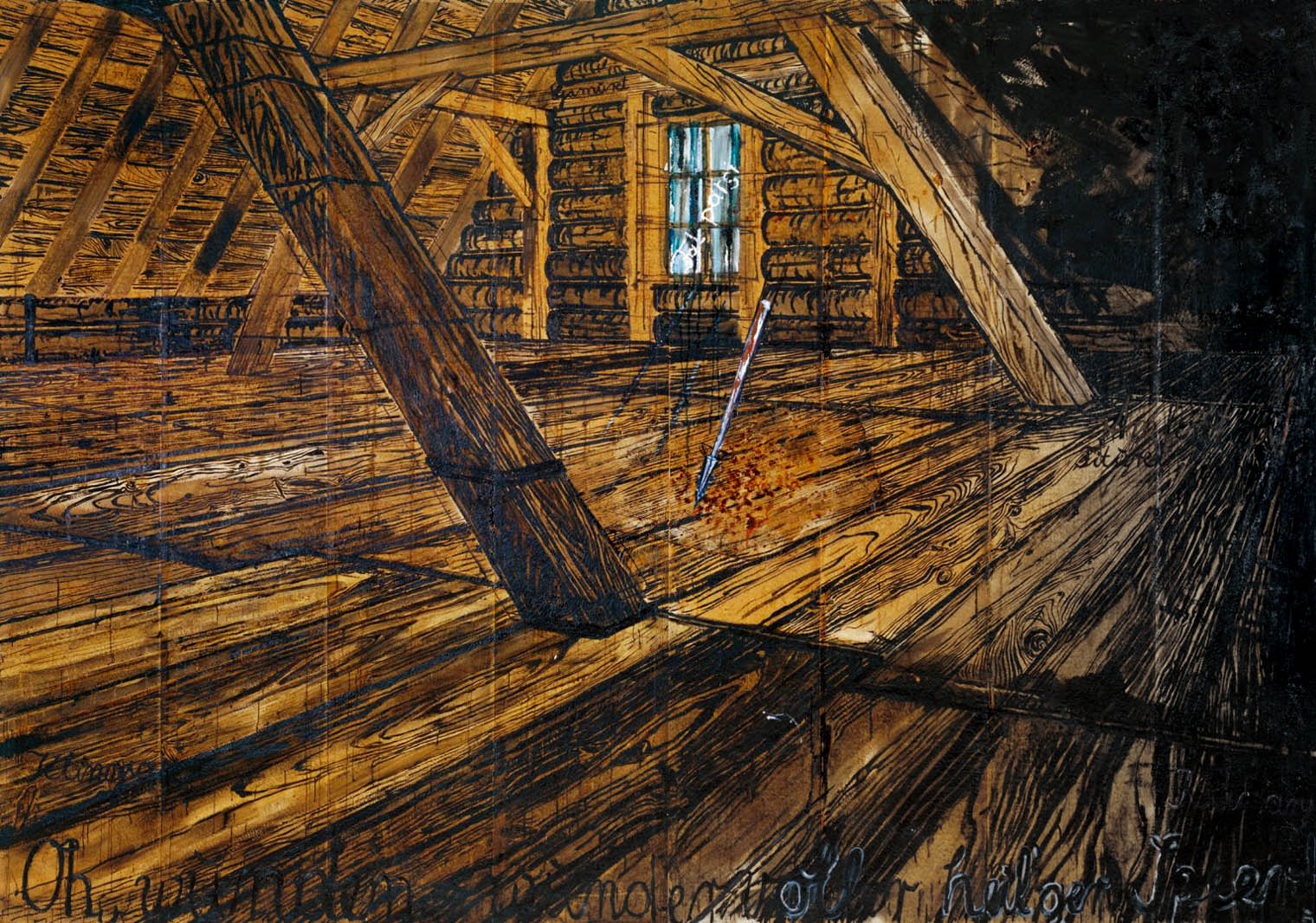
In 1971 Kiefer produced his first large-scale landscape paintings and from 1973 he began to experiment with wooden interiors on a monumental scale. His preoccupation with recent German history is seen throughout his work and his use of recurring motifs, such as an artist’s palette symbolises his emotional journey relating to this period. Kiefer has made increasing use of materials such as sand, straw, wood, dirt and photographs, as well as sewn materials and lead model soldiers. By adding found materials to the painted surface Kiefer invented a compelling third space between painting and sculpture. Recent work has broadened his range yet further: in 2006 he showed a series of paintings based around the little-known work of the modernist Russian poet Velimir Chlebnikov (1885-1922).
Kiefer has had extensive exhibitions internationally including the Museum of Modern Art, New York (1987), Neue Nationalgalerie, Berlin (1991), The Metropolitan Museum, New York (1998), Royal Academy, London (2001), Fort Worth Museum of Art, Fort Worth (2005) and the San Francisco Museum of Modern Art (2006).
Press release from the BALTIC Centre for Contemporary Art website
Anselm Kiefer (German, b. 1945) Urd Werdande Skuld (The Norns) 1983 Oil, shellac, emulsion and fibre on canvas 4205 x 2805 x 60 mm ARTIST ROOMS: Tate and National Galleries of Scotland. Acquired jointly through The d’Offay Donation with assistance from the National Heritage Memorial Fund and the Art Fund 2008
Installation view of the exhibition Anselm Kiefer at the BALTIC Centre for Contemporary Art, Gateshead showing from left to right, Parsifal I (1973, below); Parsifal II (1973, below); and Parsifal III (1973, below)
Anselm Kiefer (German, b. 1945) Parsifal I 1973 Oil on paper laid on canvas 3247 x 2198 mm
Anselm Kiefer (German, b. 1945) Parsifal II 1973 Oil and blood on paper laid on canvas 3247 x 2188 mm
Anselm Kiefer (German, b. 1945) Parsifal III 1973 Oil and blood on paper on canvas 3007 x 4345 mm
BALTIC Centre for Contemporary Art Gateshead Quays, South Shore Road, Gateshead NE8 3BA, UK Phone: +44 (0) 191 478 1810
Exhibition dates: 26th June – 19th September, 2010
Installation view of the exhibition Wolfgang Tillmans at the Serpentine Gallery, London, June- September, 2010 Photograph: Gautier de Blonde
“In the constellations of pictures, I try to approximate the way I see the world, not in a linear order but as a multitude of parallel experiences… Multiple singularities, simultaneously accessible as they share the same space or room.”
Wolfgang Tillmans
Since I haven’t been to the exhibition I have tried to sequence the photographs of this wonderful artist in a small intimation of how he might have visualised them – I hope you get the idea. The installation photographs at the bottom give clues to the actual moments of what Minor White calls ‘ice/fire’ – the space between disparate images, the space that is just as important as the images themselves for the frisson that is evokes, the creation of that metaphorical leap into the void of meaning where malleable thoughts emerge; never linear, both singular and multiple at one and the same time.
Dr Marcus Bunyan
Many thankx to the Serpentine Gallery for allowing me to publish the photographs in the posting. Please click on the photographs for a larger version of the image.
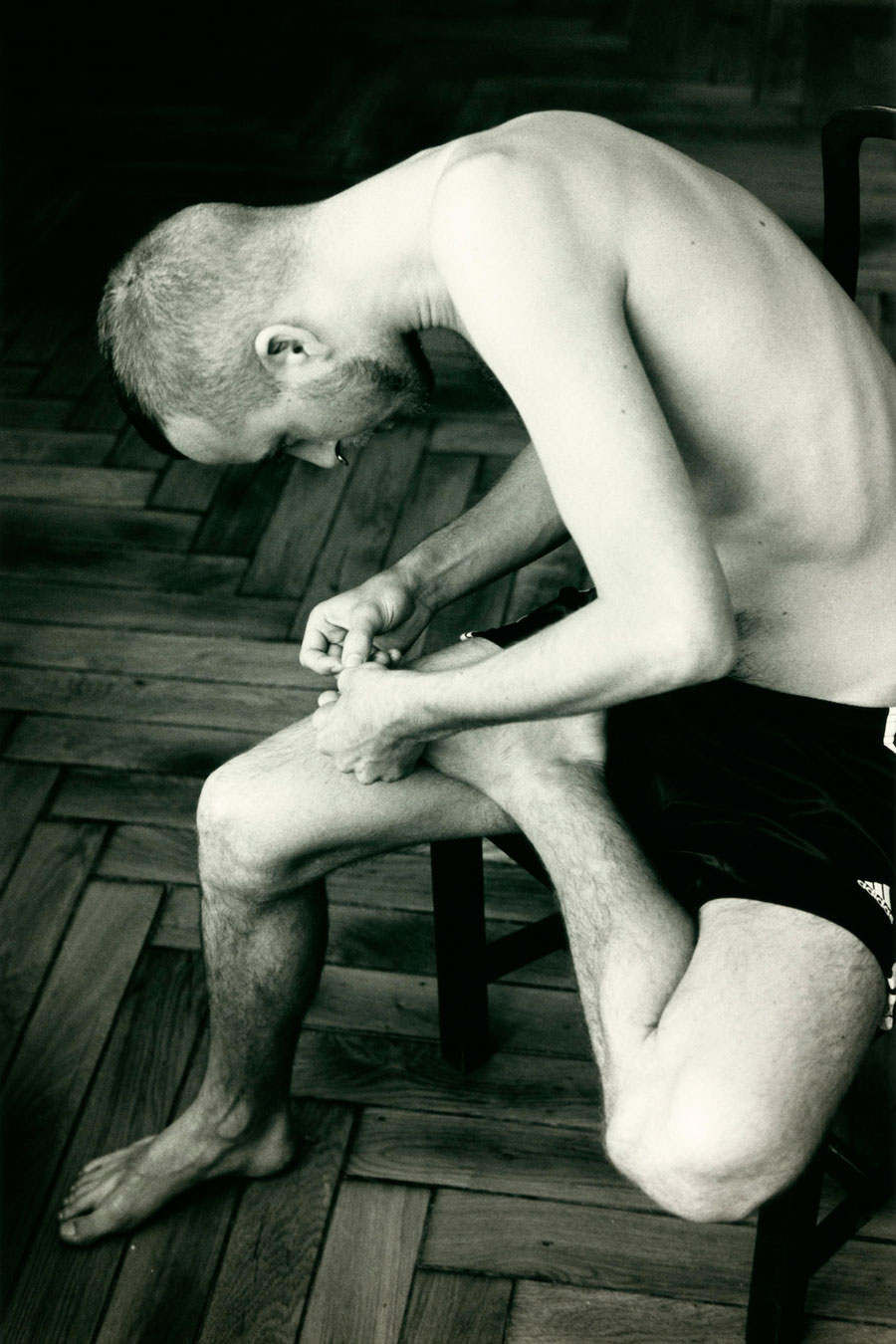
Wolfgang Tillmans (German, b. 1968) Anders pulling splinter from his foot 2004 C-type print 61 × 50.8cm Courtesy the artist and Maureen Paley, London
Wolfgang Tillmans (German, b. 1968) Nanbei Hu 2009 Inkjet print 207 x 138cm Courtesy the artist and Maureen Paley, London
Wolfgang Tillmans (German, b. 1968) Roy 2009 C-type print 40.6 x 30.5cm Courtesy the artist and Maureen Paley, London
Wolfgang Tillmans (German, b. 1968) Venus, transit 2004 C-type print 40.6 × 30.5cm Courtesy the artist and Maureen Paley, London
Wolfgang Tillmans (German, b. 1968) Dan 2008 C-type print 61 × 50.8cm Courtesy the artist and Maureen Paley, London
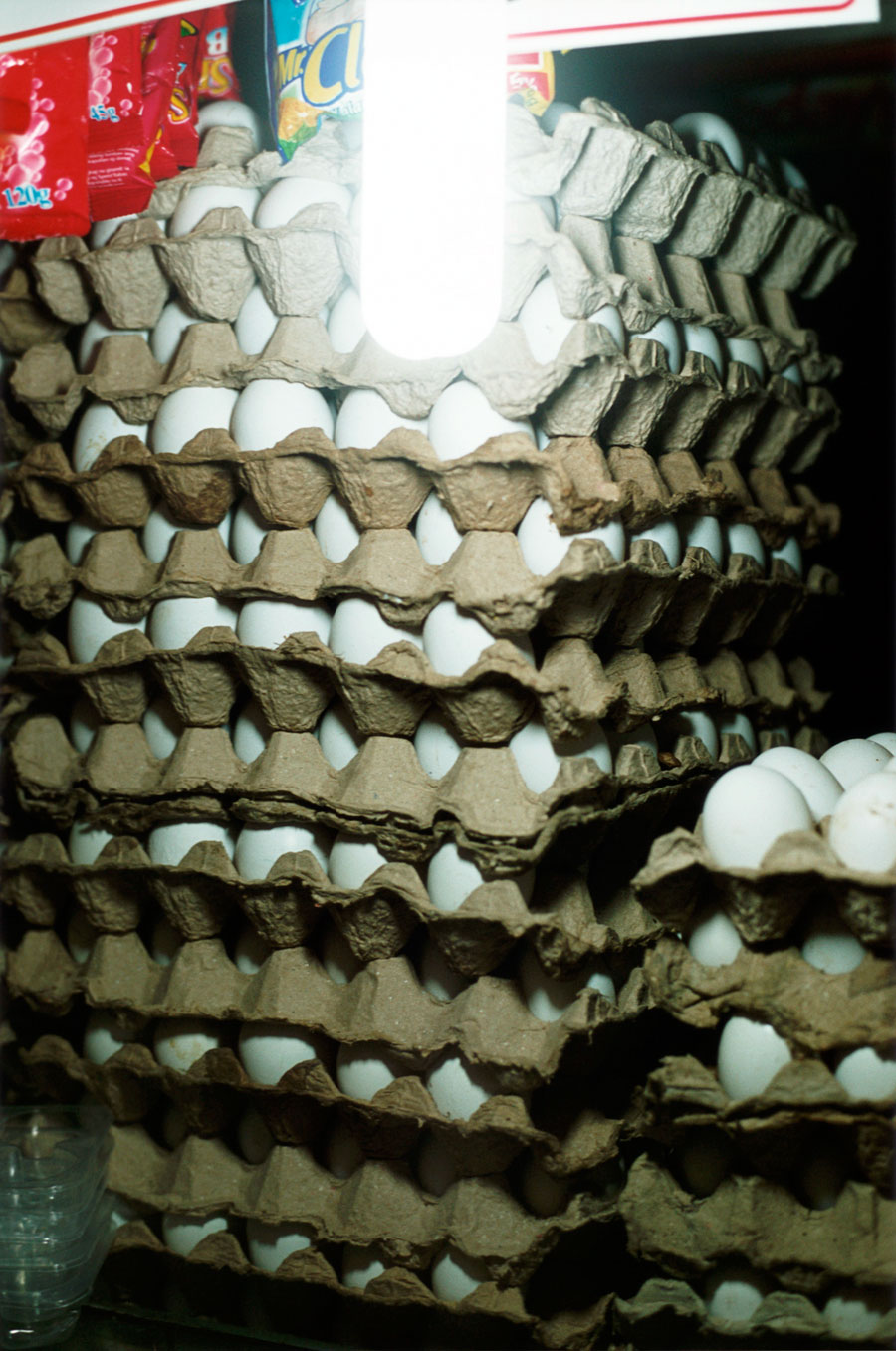
Wolfgang Tillmans (German, b. 1968) Eierstapel 2009 C-type print 61 x 50.8cm Courtesy the artist and Maureen Paley, London
Wolfgang Tillmans (German, b. 1968) Muqarnas 2006 Framed C-type print 214 × 145cm Courtesy the artist and Maureen Paley, London
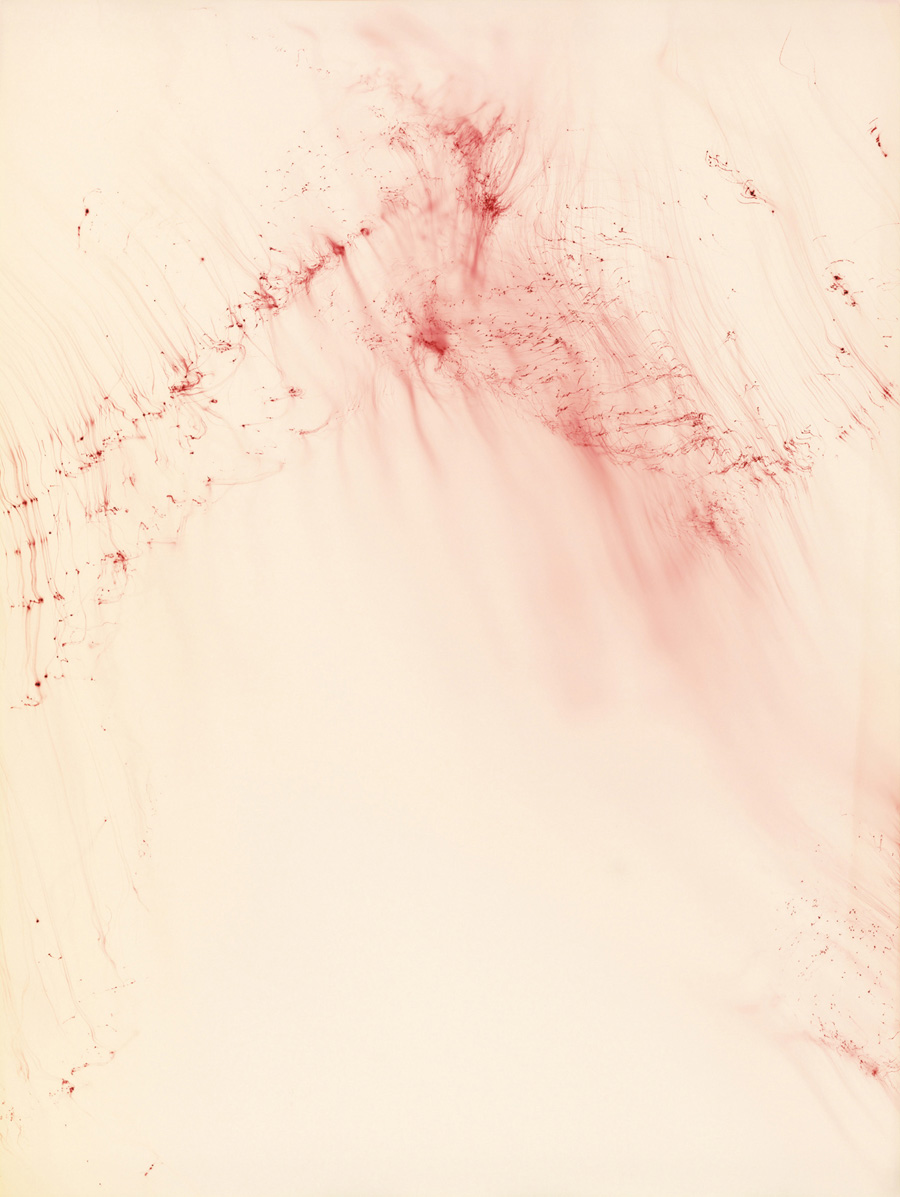
Wolfgang Tillmans (German, b. 1968) Urgency XXII 2006 Framed C-type print 238 × 181cm Courtesy the artist and Maureen Paley, London
Wolfgang Tillmans (German, b. 1968) Zimmerlinde (Michel) 2006 Framed C-type print 211 × 145cm Courtesy the artist and Maureen Paley, London
The Serpentine Gallery presents Wolfgang Tillmans’ first major exhibition in London since 2003. Conceived by the artist for the Serpentine Gallery, the exhibition will present both abstract and figurative work.
Over the past 20 years, Tillmans has redefined photography and the way it is shown. Known by the early 90s for the seemingly casual images of the world he inhabited, his work reassessed photographic conventions and reflected the identity politics of the time, capturing the fragility of human life and focusing on everyday objects. This early work then expanded to engage with portraiture, landscape, the still-life and, more recently, abstraction. Tillmans’ abstract work, greatly celebrated in the last decade, continues to push the boundaries and definitions of the photographic form, and will be a particular focus of this exhibition.
The wide-ranging themes in Tillmans’ photographs are combined in his reconfiguration of accumulated images, created in response to a given space. In this new exhibition, the explorations into abstraction sit alongside a new focus on the figurative – a focus that is increasingly informed by recent colour field works and experiments with process. Referring to his approach to installation making Tillmans said: “In the constellations of pictures, I try to approximate the way I see the world, not in a linear order but as a multitude of parallel experiences… Multiple singularities, simultaneously accessible as they share the same space or room.”
The Serpentine Gallery exhibition reflects the artist’s acute sensitivity to the politics of contemporary society, his ongoing fascination with colour, and his conceptual engagement with the technical processes of photography. These delicate yet challenging images capture the distinctive energetic balance between beauty and subversion that Tillmans has long embraced.
Tillmans was born in 1968 in Remscheid, Germany. He studied in Great Britain at the Bournemouth & Poole College of Art & Design, graduating in 1992. In the 1990s, his work was shown at the Museum of Modern Art, New York; the Kunsthalle Zurich; and Portikus, Frankfurt, amongst others. In 2000 he won the Tate’s Turner Prize. A large survey exhibition in 2001-2003 toured to Deichtorhallen, Hamburg; Castello di Rivoli, Turin; Palais de Tokyo, Paris; and Louisiana Museum of Modern Art in Humlebaek, Denmark. His show called Freedom from the Known at P.S.1, New York (2006) was followed by a major tour of North American museums. In 2008, Tillmans had an extensive solo exhibition at the Hamburger Bahnhof, Berlin entitled Lighter, and in 2009 was included in Making Worlds at the 53rd Venice Biennale. More than twenty monographic books on his work have been published to date and an exhibition catalogue will accompany the Serpentine Gallery exhibition.
The exhibition will run concurrently with the Serpentine Gallery Pavilion 2010, designed by Jean Nouvel and opening on 10 July. Housed in the Pavilion will be artist Christian Boltanski’s Les Archives du Coeur installation.
Press release from the Serpentine Gallery website [Online] Cited 11/09/2010 no longer available online
Wolfgang Tillmans (German, b. 1968) Silver Installation VII (installation view) 2009 Unique C-type prints Installation view Photograph: Gautier de Blonde
Installation views of the exhibition Wolfgang Tillmans at the Serpentine Gallery, London, June- September, 2010 Photograph: Gautier de Blonde
Many thankx to Kicken Berlin for allowing me to publish the photographs in this post. Please click on the photographs for a larger version of the image.
Mahler was born in 1949 in Bad Berka, Thuringia. She studied at the School for Graphic and Book Arts in Leipzig and has been a professor at the University of Applied Sciences in Hamburg since 2000. She lives in Hamburg and Lehnitz, near Berlin
Kicken Berlin will devote its first exhibition of 2010 to a selection of East German photographers. Represented in East Side Stories: German Photographs 1950s-1980s are Ursula Arnold, Sibylle Bergemann, Arno Fischer, Ute und Werner Mahler, Roger Melis, Helga Paris, Evelyn Richter as well as Gundula Schulze Eldowy – committed art photographers who achieved their own modes of expression outside the official aesthetic. F.C. Gundlach’s fashion photography from 1950s and 1960s West Berlin will be on view in the exhibition space Kicken II.
Up until the early 1970s, the cultural officers of the German Democratic Republic viewed photography not as an art medium but rather as a means of providing affirmative and idealised images of life. Personal viewpoints were not welcome. Photography that forcefully “grew out of the self-assigned task of documenting what (one) felt was worth capturing,” as Evelyn Richter put it, had to remain secret.
Arno Fischer (1927-2011) and Evelyn Richter (1930-2021) belong to those who pointed the way toward a subjective-narrative, human-centered photography in the 1950s. Key figures in the East German art photography scene, opinion shapers, and teachers at Leipzig’s Hochschule für Grafik und Buchkunst / Academy of Visual Arts, they influenced a form of art photography oriented toward the social-documentary “human interest” tradition. Their stance combined social participation with a commitment to critical observation from a personal point of view – as in Fischer’s series Situation Berlin (1953-1960), with its symbolically dense snapshots of the divided city.
Important influences on the development of independent photography in East Germany included the work of the Magnum agency (from 1947 on), Edward Steichen’s exhibition The Family of Man (1955) as well as Robert Frank’s radically subjective street photography.
Pictures of people and portraits are at the exhibition’s core. Ursula Arnold (1929-2012) observed her sometimes melancholy, sometimes odd contemporaries on the streets of Berlin and Leipzig, and on Berlin’s S-Bahn. She gave up working as a photojournalist early in order to avoid having to make concessions to the dictates for enthusiasm imposed from above. Helga Paris (b. 1938) took portraits of rebellious Berliner Jugendliche / Berlin Youths (1981-1982), approaching her subjects with seriousness and thoughtfulness, and concentrating fully on them as individuals. She, too, had the self-professed goal of depicting people authentically in their everyday contexts.
Sibylle Bergemann (1941-2010) made a name for herself as a sensitive portraitist, fashion photographer, and observer of the urban landscape. Das Denkmal / The Monument (1977-1986), her long-term study of the assembly of the Marx-Engels sculpture, appears, with its hovering, headless sculptural fragments to emblematically anticipate the collapse of communism.
In the Berlin of the late 1970s and early 1980s Gundula Schulze Eldowy (b. 1954) found the setting for scenes that are as drastic as they are quotidian in the series Berlin. In einer Hundenacht / Berlin: in a Dog’s Night (1977-1989) and Aktportraits / Nude Portraits (1983-1986), as no other East German photographer before her, she shows with unsparing frankness the loneliness and vulnerability of her subjects but also their dignity and self confidence. Her early photographs reveal an aesthetic and thematic debt to the work of Diane Arbus.
Independent of each other, Ute and Werner Mahler turned their unpretentious gazes on the East German way of life. Ute Mahler (b. 1949) thematised family arrangements and group dynamics in her series Zusammen Leben / Living Together (1972-1986). Werner Mahler (b. 1950) documented a year in the Thuringian village Berka (1977) – and repeated his studies in the late 1990s after reunification. An additional focus of both photographers was fashion photography (published for the most part in the magazine for fashion and culture Sibylle) that offered opportunities for “productively expanding the genre” (Bernd Lindner).
In the 1950s and 1960s in Berlin and Hamburg, F.C. Gundlach achieved a modern way to stage fashion in pictures. A small selection from the great fashion photographer’s oeuvre, F.C. Gundlach, will be on view in the exhibition space Kicken II and coincides with the comprehensive retrospective at the Martin Gropius Bau.
Press release from the Kicken Berlin website [Online] Cited 04/04/2010 no longer available online
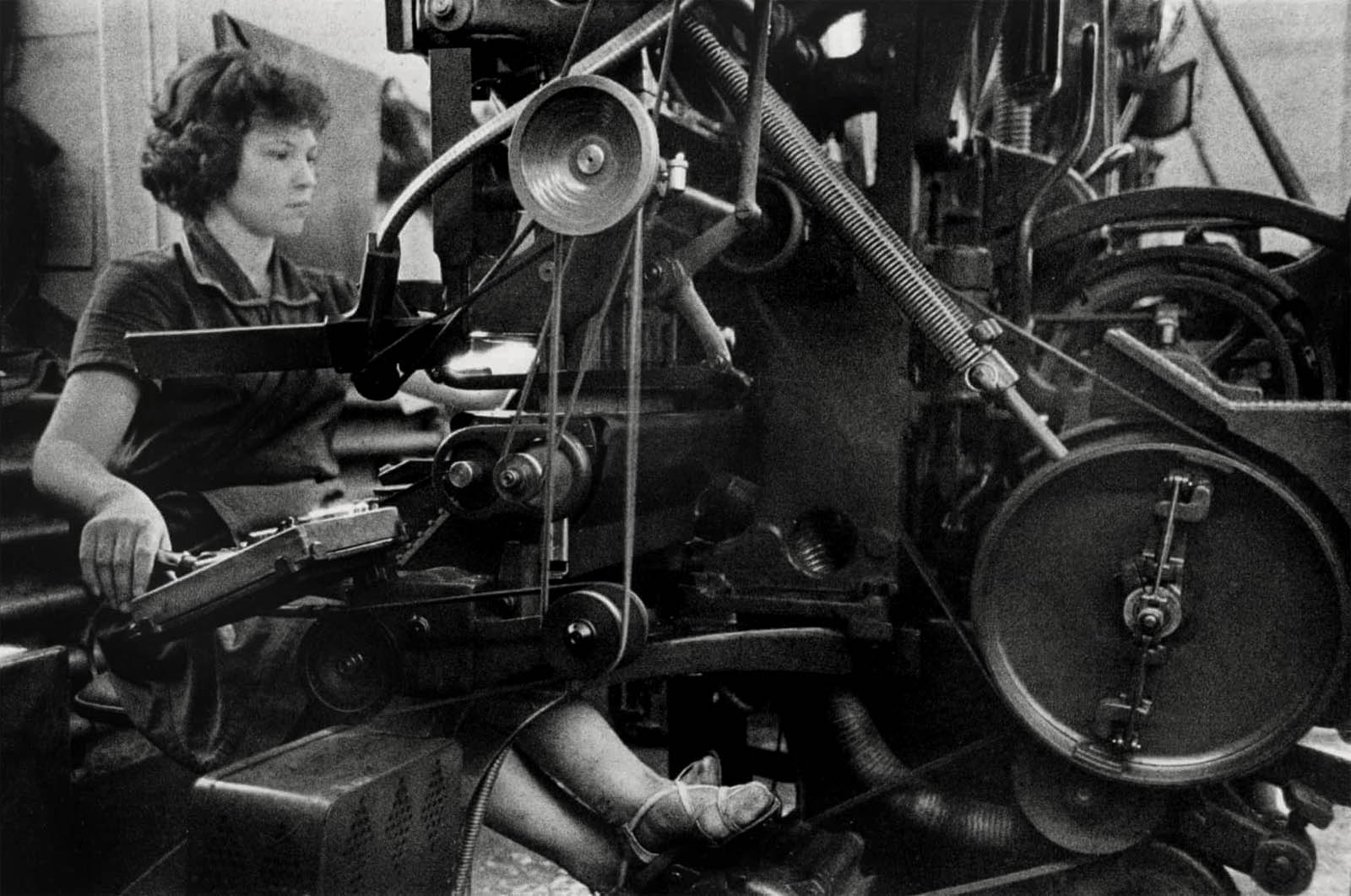
Evelyn Richter (German, 1930-2021) ND (Neues Deutschland) print shop c. 1960-1962 Gelatin silver print Evelyn Richter Archiv der Ostdeutschen
Ursula Arnold (German, 1929-2012) Berlin, S-Bahn 1965 Gelatin silver print
Sibylle Bergemann (German, 1941-2010) Alexanderplatz, Berlin 1967 Gelatin silver print
Sibylle Bergemann (German, 1941-2010) Schöneweide, Berlin 1972 Gelatin silver print, printed c. 1972 22.8 x 34cm
Mahler started her project Zusammenleben (‘living together’) to move away from set photography. She said: ‘I carried out this work freely, at liberty; it was very personal in nature and not commissioned’.
Zusammenleben was started more than 45 years ago. Through it, Mahler intended to depict the unsaid in a subtle way. Zusammenleben subtly depicted the reality of everyday life in the communist state of East Germany.
Evelyn Richter (German, 1930-2021) Pförtnerin im Rathaus, Leipzig (Receptionist in the Town Hall, Leipzig) c. 1975 Gelatin silver print
Sibylle Bergemann (German, 1941-2010) Berlin, Palast der Republik 1978 Gelatin silver print
Gundula Schulze Eldowy (German, b. 1954) Berlin 1989 Gelatin silver print
Exhibition dates: 13th February – 11th April, 2010
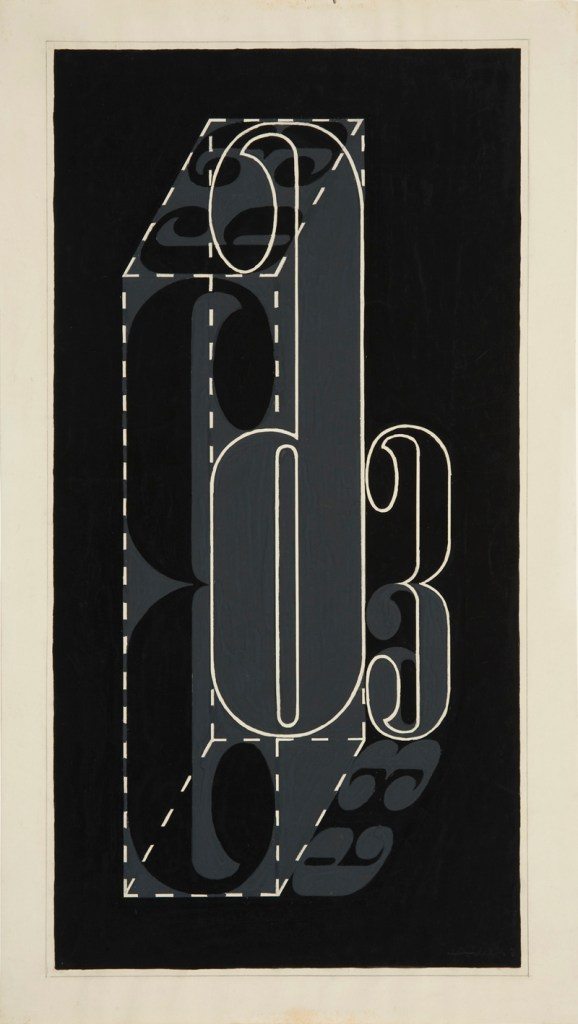
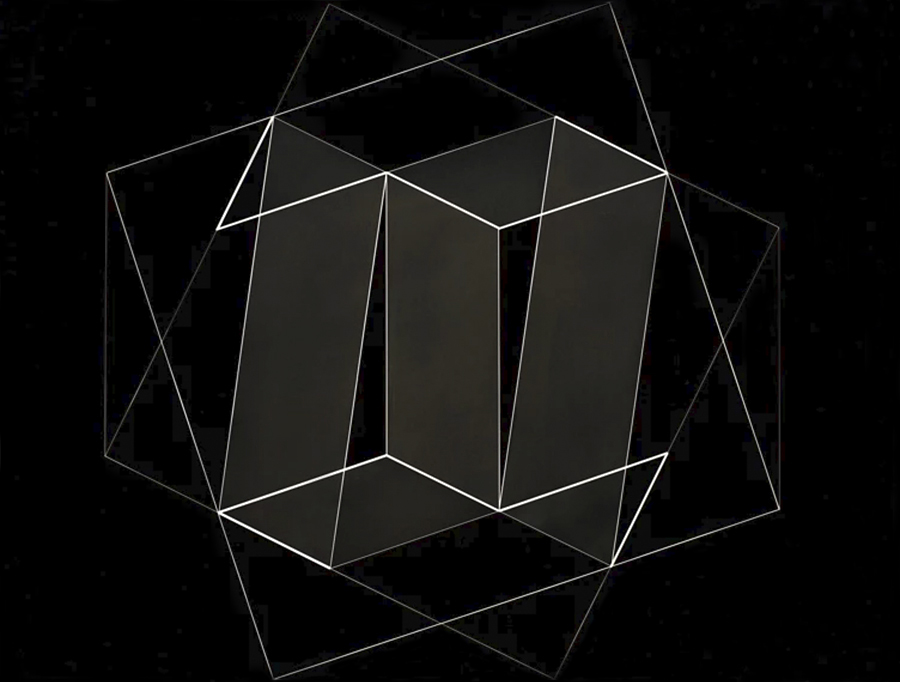
Josef Albers (German, 1888-1976) 6 and 3 1931
One of my favourite artists – what a genius!
His exploration of colour and form is exquisite, sensitive and very moving – despite his belief that colours have no inherent emotional associations.
Marcus
Many thankx to the Hirshhorn Museum for allowing me to publish the images in the posting. Please click on the photographs for a larger version of the image.
Josef Albers (German, 1888-1976) Rolling After 1925-28
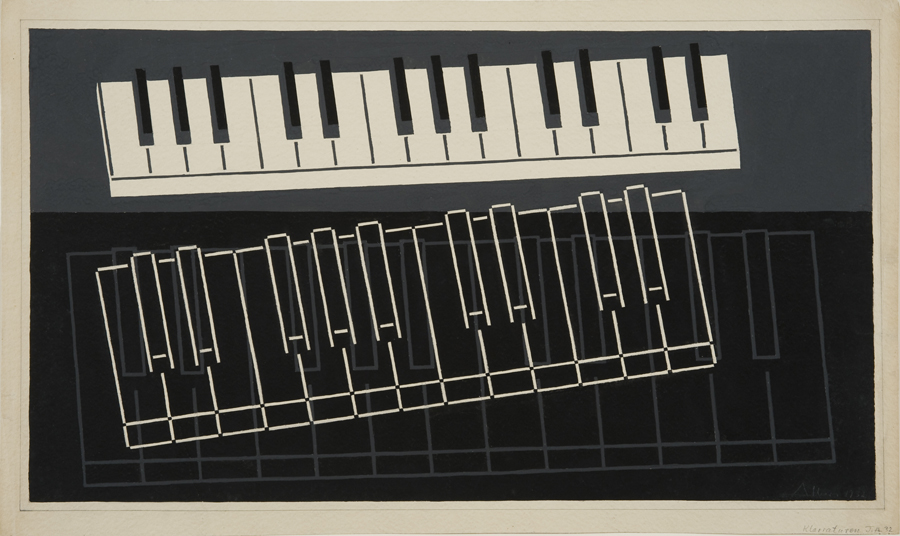
Josef Albers (German, 1888-1976) Piano Keys 1932
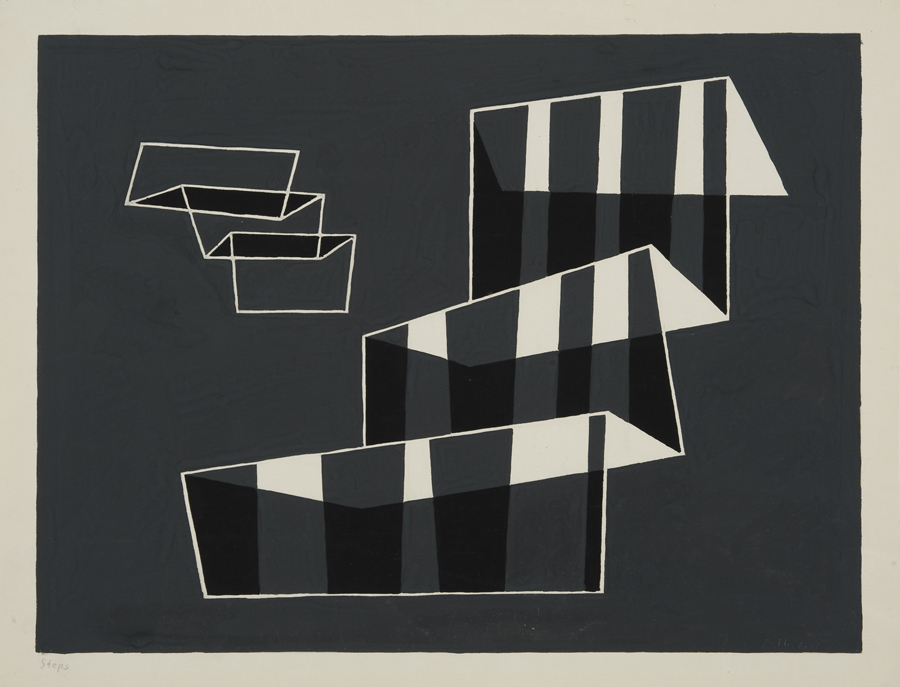
Josef Albers (German, 1888-1976) Steps 1932
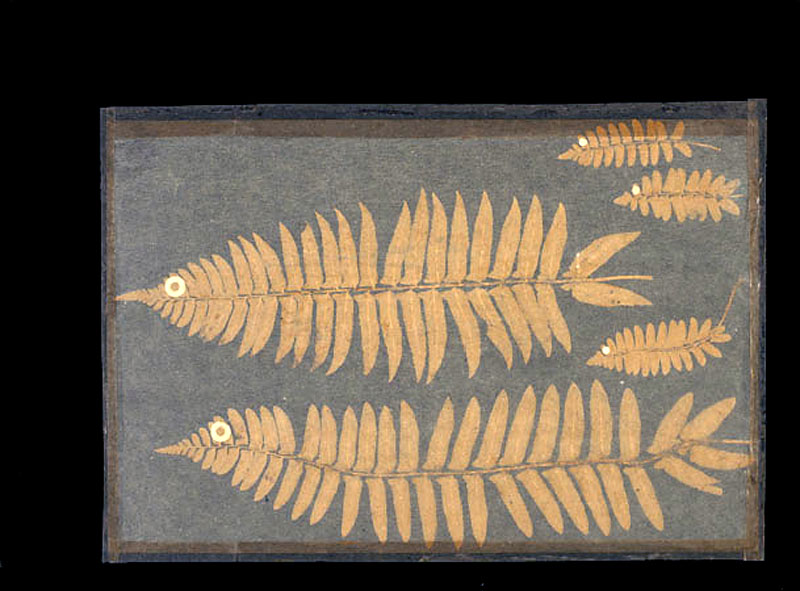
Josef Albers (German, 1888-1976) Untitled (Leaf Study) c. 1940
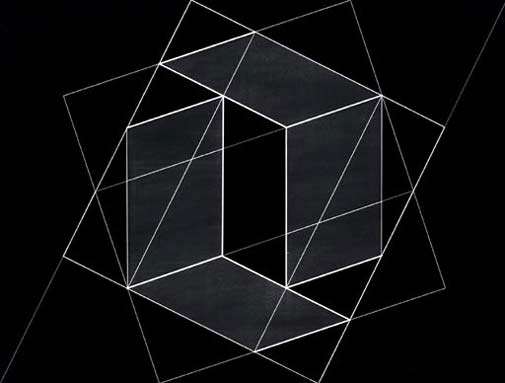
Josef Albers (German, 1888-1976) Structural Constellation, Transformation of a Scheme No.12 1950 Machine engraving on black vinylite mounted on board
Josef Albers (German, 1888-1976) Structural Constellation, Transformation of a Scheme No.23 1951 Machine engraving on black vinylite mounted on board
Josef Albers (German, 1888-1976) Structural Constellation, Transformation of a Scheme No.10 1950-51 Machine engraving on black vinylite mounted on board
Exhibition Illustrates Albers’ Sphere of Influence
The Hirshhorn possesses one of the world’s largest and most comprehensive collections of work by Josef Albers (b. Bottrop, Germany, 1888; d. New Haven, Connecticut, 1976). “Josef Albers: Innovation and Inspiration” presents nearly 70 works spanning the artist’s 55-year career, many on view for the first time. Supplementing pieces from the museum’s holdings are key objects on loan from the Josef and Anni Albers Foundation. Organised by senior curator Valerie Fletcher, the exhibition also includes documentary photographs and examples of Albers’ teaching aids, and concludes with a display of works by artists who knew, worked with, studied under or openly admired Albers. The exhibition opens on February 11 and runs through April 11, 2010.
Josef Albers: Innovation and Inspiration encompasses the artist’s distinguished career from 1917 to 1973. The exhibition begins with four early self-portrait prints dating from the years of World War I, followed by a group of boldly abstract compositions from Albers’ tenure at Germany’s revolutionary Bauhaus, where he taught alongside such remarkable modernists as Wassily Kandinsky, Paul Klee, László Moholy-Nagy, Walter Gropius and Mies van der Rohe. Albers participated in the school’s utopian aspiration to improve modern life through manufacturing and design-ideas that resonated throughout Albers’ career. The Hirshhorn’s show includes a series of black-and-white designs intended for mass production in glass, such as “6 and 3” (1931, see above), and an illuminated display of eight glass panels, in which the artist modernised and transformed the medieval tradition of stained-glass windows, best characterised by “Fugue (B)” (1925-1928).
Following the Nazi party’s rise to power, the Bauhaus was forced to close in 1933. Albers fled to the United States, where he was recruited to head the art program at the new Black Mountain College in North Carolina. There, Albers introduced a modified Bauhaus curriculum and hired vanguard modernists as teachers. He enthusiastically taught his students how art could be made from virtually any material, which he demonstrated in some of his own works, such as three “Leaf Study” collages (c. 1940, see above). Albers continued to advocate the clear structures of geometric abstraction, still mostly in black, white and primary colours, but was open to different stylistic approaches. He also briefly adopted the biomorphic forms associated with surrealism, as seen in the work “Proto-Form (B)” (1938).
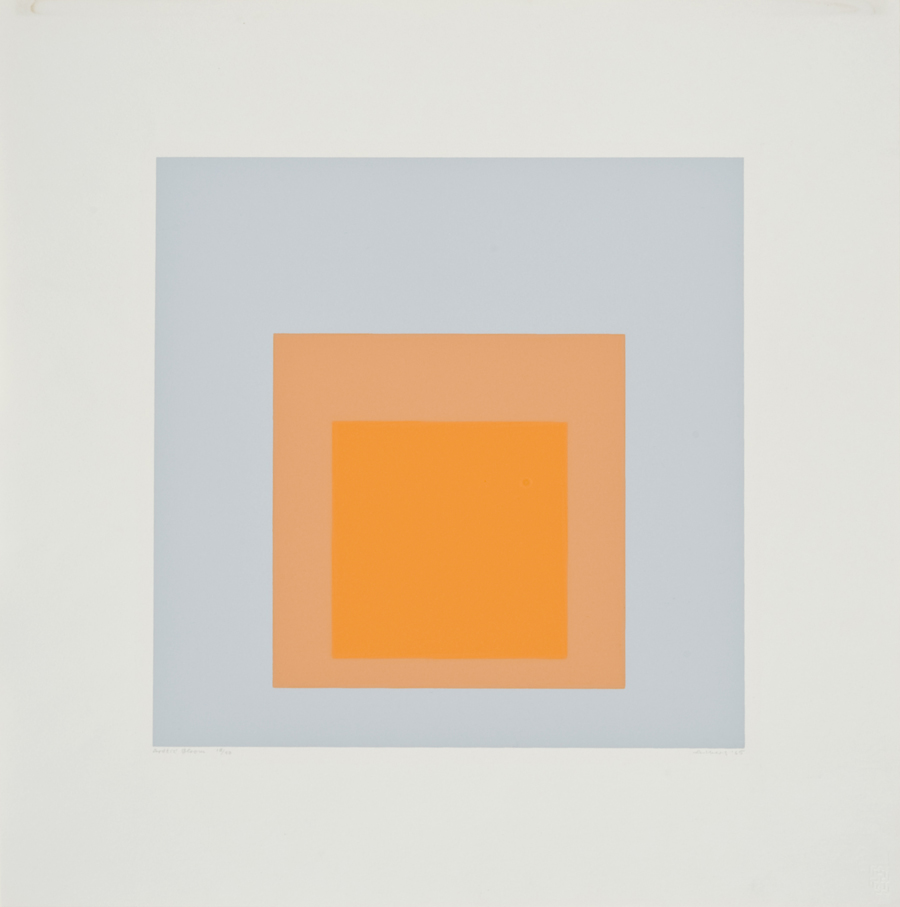
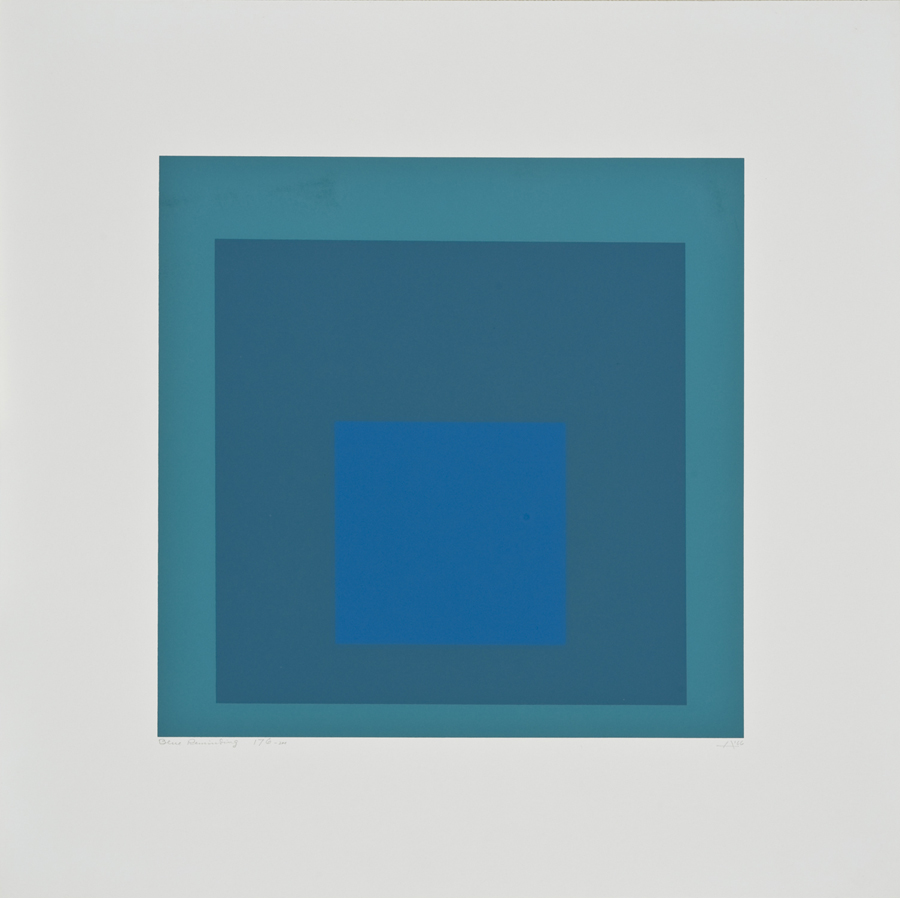
In 1949, at the age of 62, Albers became chairman of the art school at Yale University, with a mandate to transform it from a conservative academic program to a proponent of modern concepts and applications. Believing firmly that colours have no inherent emotional associations, he meticulously explored their nuances and combinations in his work. He eventually limited the shape and number of his forms, which resulted in a standardised format that he called “Homage to the Square,” for which he is best known. Two dozen “Homage to the Square” compositions fill the central gallery in the exhibition, inviting viewers to examine the subtle complexities of their perceptions. The vivid yellow-orange-reds of “Glow” (1966, see below) startle the eye, while the pale grays of “Nacre” (1965, see below) suggest cool neutrality. These images create optical illusions, challenging viewers’ visual acuity. This series concludes with the artist’s vivid red-print duo, “In Honor of the Hirshhorn Museum,” on view for the first time since the museum opened in 1974.
In addition, this exhibition includes examples from Albers’ “Structural Constellation” series of reliefs (1954-1964, see above), which anticipated op art with their linear patterns. The reliefs’ commonplace material-laminated plastic-also fulfils the utopian goal of making art affordable to everyone. The two largest paintings on view, both titled “Variant” (1973), were donated by the artist’s wife and foundation in 1979.
Albers remained active and influential until his death in 1976, and many of his pedagogical innovations have become standard methodology in art schools across the country. His explorations of abstract form and colour also inspired and stimulated generations of artists and designers. Shortly after his arrival in America, he became a co-founder of the American Abstract Artists group and participated in exhibitions across the country, from New York to Michigan and beyond. The Hirshhorn’s exhibition ends with an array of works by colleagues, students and admirers, among them: weavings by the artist’s wife, Anni Albers; abstract constructions by Burgoyne Diller; streamlined images of labor by Jacob Lawrence; a large op art painting by Richard Anuskiewicz; textured creations by Eva Hesse and Robert Rauschenberg; and a minimalist stacked wall sculpture by Donald Judd.”
Exhibition dates: November 20th 2009 – March 14th, 2010
Many thankx to Marie Skov and Martin-Gropius-Bau for allowing me to reproduce the photographs in this posting. Please click on the photographs for a larger version of the image.
Marcus
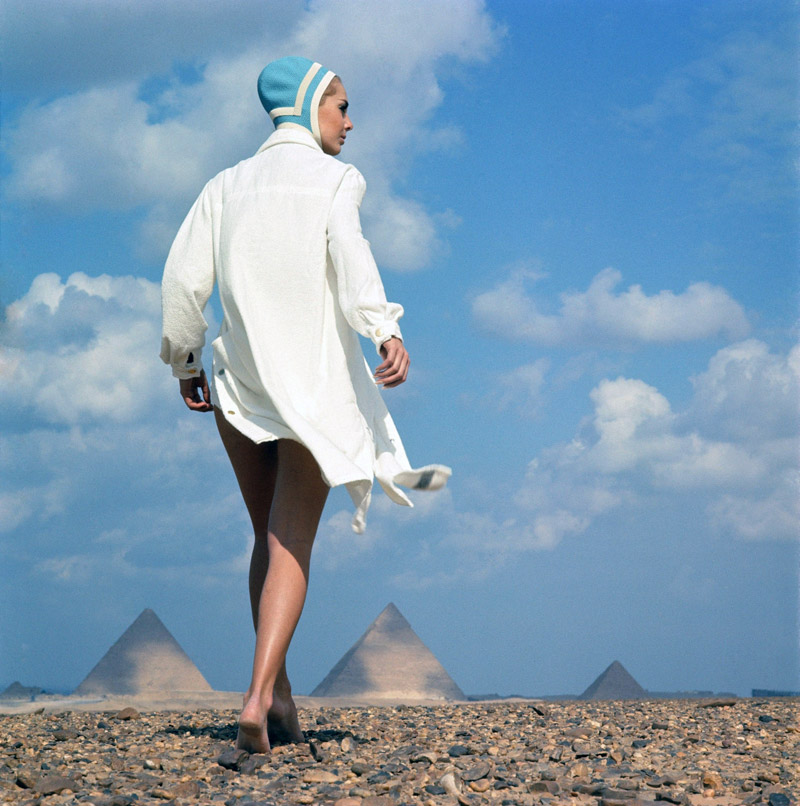
F.C. Gundlach (German, 1926-2021) The Whole Day on the Beach Gizeh/Egypt 1966 in Brigitte, Issue 8/1966
F. C. Gundlach
F. C. Gundlach (Franz Christian Gundlach; 16 July 1926 – 23 July 2021) was a German photographer, gallery owner, collector, curator und founder. In 2000 he created the F.C. Gundlach Foundation, since 2003 he has been founding director of the House of Photography – Deichtorhallen Hamburg.
His fashion photographs of the 1950s, 1960s and 1970s, which in many cases integrated social phenomena and current trends in the visual arts, have left their context of origin behind and found their way into museums and collections. Since 1975 he also curated many internationally renowned photographic exhibitions. On the occasion of the reopening of the House of Photography in April 2005, he curated the retrospective of the Hungarian photographer Martin Munkácsi. Here, the exhibitions A Clear Vision, The Heartbeat of Fashion and Maloney, Meyerowitz, Shore, Sternfeld. New Color Photography of the 1970s from his collection were presented since 2003. Most recently he curated the exhibitions More Than Fashion for the Moscow House of Photography and Vanity for the Kunsthalle Wien 2011.
F.C. Gundlach (German, 1926-2021) Erich von Stroheim during the shooting of “Alraune”, Munich 1952 Gelatin silver print
The Bloody Pit of Horror: Alraune (1952) film poster
Erich von Stroheim
Erich Oswald Hans Carl Maria von Stroheim (born Erich Oswald Stroheim; September 22, 1885 – May 12, 1957) was an Austrian-American director, actor and producer, most noted as a film star and avant garde, visionary director of the silent era. His masterpiece adaptation of Frank Norris’s McTeague titled Greed is considered one of the finest and most important films ever made. After clashes with Hollywood studio bosses over budget and workers’ rights issues, von Stroheim was banned for life as a director and subsequently became a well-respected character actor, particularly in French cinema. For his early innovations as a director, von Stroheim is still celebrated as one of the first of the auteur directors. He helped introduce more sophisticated plots and noirish sexual and psychological undercurrents into cinema. He died in 1957 in France of prostate cancer at the age of 71. Beloved by Parisian neo-Surrealists known as Letterists, he was honoured by Letterist Maurice Lemaitre with a 70-minute 1979 film entitled “Erich von Stroheim.”
Alraune is a 1952 West German science fiction directed by Arthur Maria Rabenalt and starring Hildegard Knef and Erich von Stroheim. The film involves a scientist (von Stroheim), who creates a woman who is beautiful and yet soulless, lacking any sense of morality.
F.C. Gundlach (German, 1926-2021) Cary Grant. A Star goes to the Ball Berlin 1960 in Film und Frau, Issue 16/1960 Gelatin silver print
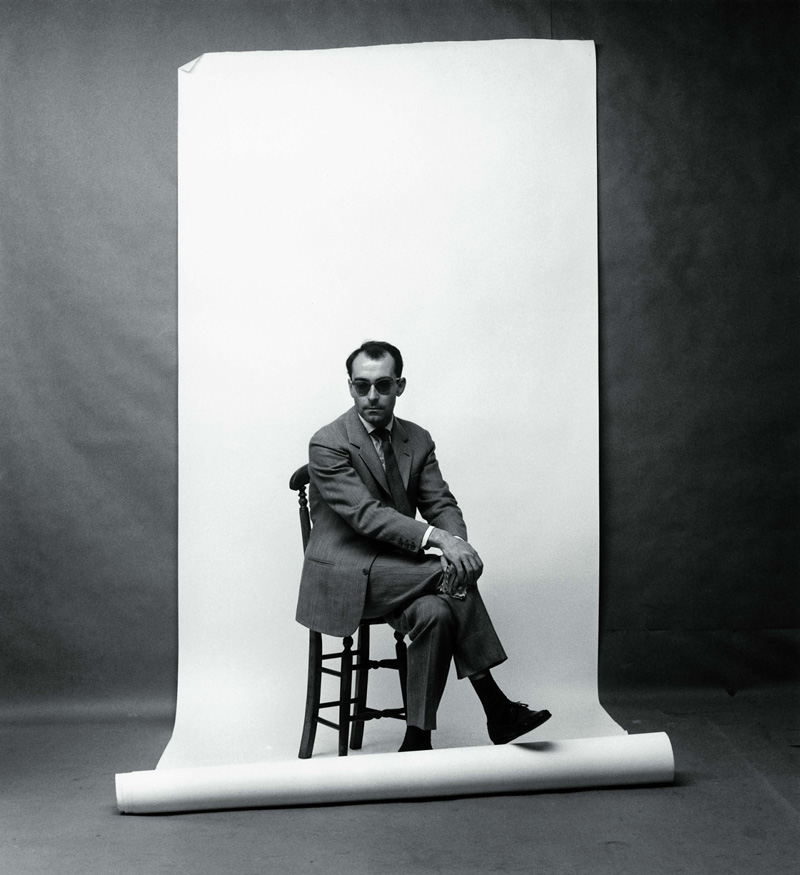
Jean-Luc Godard (born 3 December 1930) is a French-Swiss film director, screenwriter and film critic. He rose to prominence as a pioneer of the 1960s French New Wave film movement.
Like his New Wave contemporaries, Godard criticised mainstream French cinema’s “Tradition of Quality”, which “emphasised craft over innovation, privileged established directors over new directors, and preferred the great works of the past to experimentation.” As a result of such argument, he and like-minded critics started to make their own films. Many of Godard’s films challenge the conventions of traditional Hollywood in addition to French cinema. In 1964, Godard described his and his colleagues’ impact: “We barged into the cinema like cavemen into the Versailles of Louis XV.” He is often considered the most radical French filmmaker of the 1960s and 1970s; his approach in film conventions, politics and philosophies made him arguably the most influential director of the French New Wave. Along with showing knowledge of film history through homages and references, several of his films expressed his political views; he was an avid reader of existential and Marxist philosophy. Since the New Wave, his politics have been much less radical and his recent films are about representation and human conflict from a humanist, and a Marxist perspective.
In a 2002 Sight & Sound poll, Godard ranked third in the critics’ top-ten directors of all time (which was put together by assembling the directors of the individual films for which the critics voted). He is said to have “created one of the largest bodies of critical analysis of any filmmaker since the mid-twentieth century.” He and his work have been central to narrative theory and have “challenged both commercial narrative cinema norms and film criticism’s vocabulary.” In 2010, Godard was awarded an Academy Honorary Award, but did not attend the award ceremony. Godard’s films have inspired many directors including Martin Scorsese, Quentin Tarantino, Brian De Palma, Steven Soderbergh, D. A. Pennebaker, Robert Altman, Jim Jarmusch, Wong Kar-wai, Wim Wenders, Bernardo Bertolucci, and Pier Paolo Pasolini.
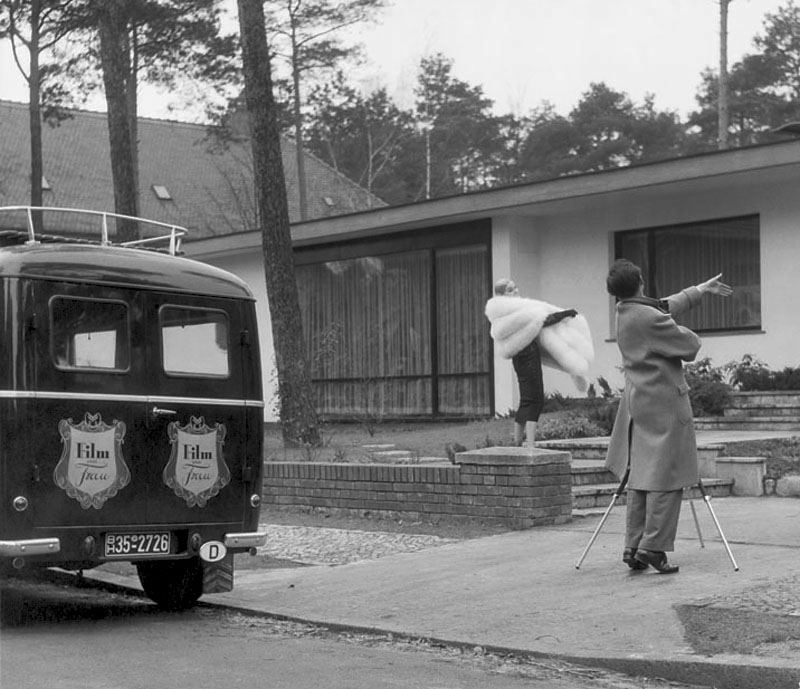
Charlotte Rohrbach (German, 1902-1981) F. C. Gundlach photographing for German magazine Film und Frau (Film and Woman) in Berlin 1955, model Grit Hübscher, stole by Staebe-Seger 1955 Gelatin silver print
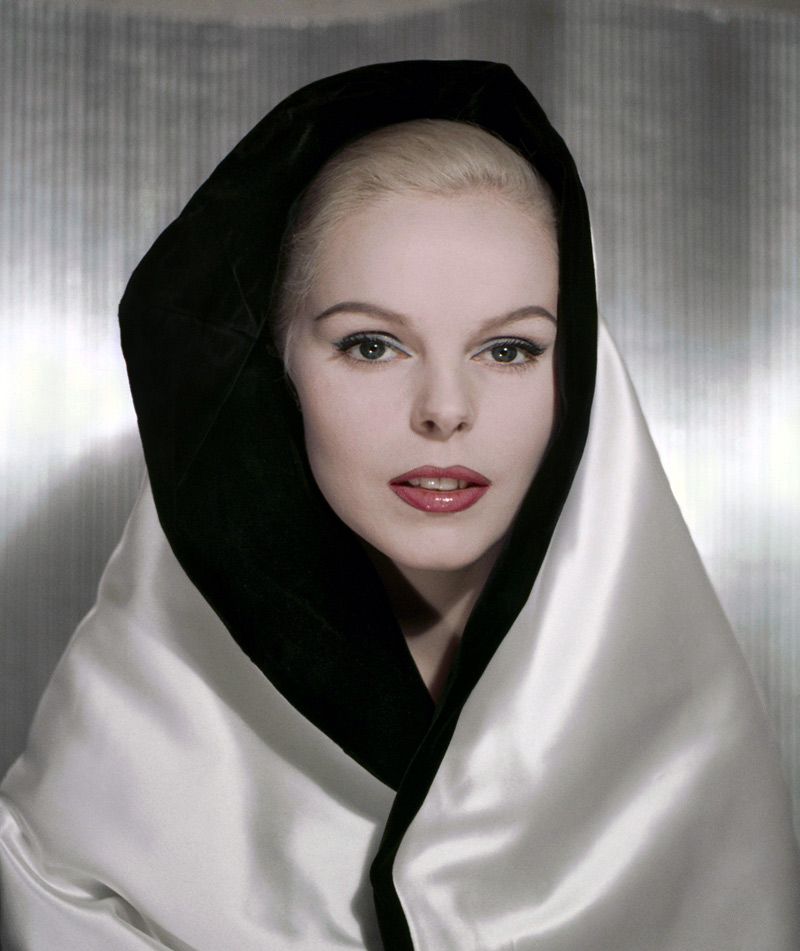
F.C. Gundlach (German, 1926-2021) Grit Hübscher. White atlas coat by Sinaida Rudow Berlin 1954
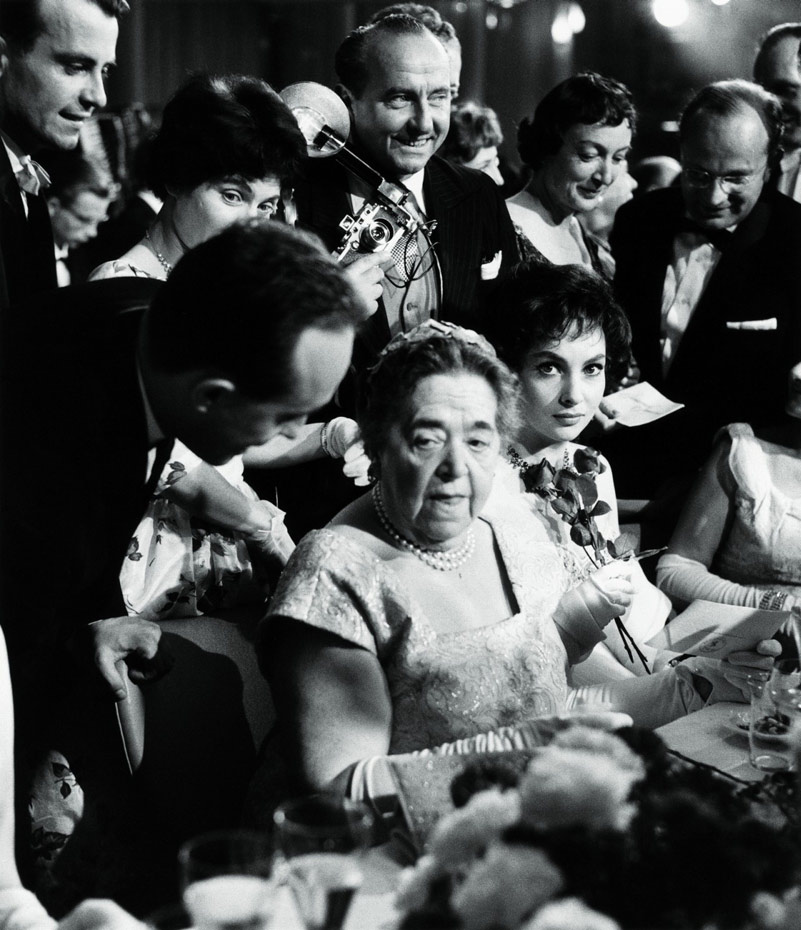
F.C. Gundlach (German, 1926-2021) Berlinale. Elsa Maxwell and Gina Lollobrigida, film ball in the Palais am Funkturm, X Berlinale 1960 in Film und Frau, Issue 16/1960 Gelatin silver print
Elsa Maxwell
Elsa Maxwell (May 24, 1883 – November 1, 1963) was an American gossip columnist and author, songwriter, and professional hostess renowned for her parties for royalty and high society figures of her day.
Maxwell is credited with the introduction of the scavenger hunt and treasure hunt for use as party games in the modern era. Her radio program, Elsa Maxwell’s Party Line, began in 1942; she also wrote a syndicated gossip column. She appeared as herself in the films Stage Door Canteen (1943) and Rhapsody in Blue (1945), as well as co-starring in the film Hotel for Women (1939), for which she wrote the screenplay and a song.
Gina Lollobrigida
Luigina “Gina” Lollobrigida (born 4 July 1927) is an Italian actress, photojournalist and sculptor. She was one of the highest profile European actresses of the 1950s and early 1960s, a period in which she was an international sex symbol. As her film career slowed, she established second careers as a photojournalist and sculptor. In the 1970s, she achieved a scoop by gaining access to Fidel Castro for an exclusive interview.
She has continued as an active supporter of Italian and Italian American causes, particularly the National Italian American Foundation (NIAF). In 2008, she received the NIAF Lifetime Achievement Award at the Foundation’s Anniversary Gala. In 2013, she sold her jewellery collection, and donated the nearly $5 million from the sale to benefit stem cell therapy research.
Texts from the Wikipedia website
F.C. Gundlach (German, 1926-2021) Op Art Silhouette. Jersey coat by Lend Paris 1966 in Brigitte, Issue 4/1966 Gelatin silver print
From November 2009 the Martin-Gropius-Bau presents the definitive retrospective of F.C. Gundlach’s extensive photographic work with the exhibition F.C. Gundlach – Photographic Work. F.C. Gundlach is one of the most famous fashion photographers worked for the most important magazines and publications from the middle of the 1950’s to 1990. Among other many famous pictures the most comprehensive presentation of F.C. Gundlach’s work shows many fameless facets of F.C. Gundlach’s work to date. After years of research, the curators Klaus Honnef, Hans-Michael Koetzle, Sebastian Lux and Ulrich Rüter present for the first time numerous unknown images as vintage prints alongside F.C. Gundlach’s famous photo icons.
The intention of the exhibition is to present the unique aesthetics of F.C. Gundlach’s photography, his roots in photojournalism, his focus on series and sequences, his narrative approach. Furthermore, the exhibition alludes to social and cultural issues over several decades.
The exhibition includes the experimental photography of his early years, especially those from Paris during the 1950’s, his remarkable portraits of German and international movie stars and film-directors as well as F.C. Gundlach’s early photo reportages and photographs of children.
For the first time, F.C. Gundlach’s work for magazines is presented on a larger scale. Magazine covers and a comprehensive collection of double-page spreads show his photographs within the magazines’ context, especially in Film und Frau (1951-1965) and Brigitte (1963-1986). Among photographs, title pages and a comprehensive selection of double pages of his pictures will be shown in context of the magazines. The exhibition illustrates that Gundlach has always been open to technical innovations in photography (35mm cameras, flash or colour photography).
His fashion productions took him both to Paris and New York and to Egypt and Morocco. This multiple printed photographs were been to special motifs in his work. F.C. Gundlach’s impressive travel reportages occurred amongst others in Argentina, Brazil, Peru, Japan, Cambodia, Thailand, Vietnam and will be present in Berlin the first time. Original documents of his vita illustrate the life of the photographer. Moreover, the show illustrates the internationalisation of his work due to extensive traveling. Documents and archival material give a brief outline of the artist’s life and work.
F.C. Gundlach himself has commented his functioning in a 60 min. interview-film, which was exclusively produced for the exhibition by filmmaker Reiner Holzemer. The exhibition presents: a life’s work of photography between documentary representation and staged artificiality, between practical and experimental photography.
F.C. Gundlach, born in 1926 in Heinebach (Hesse), is considered the most significant fashion photographer of the young Federal Republic of Germany. For more than four decades of fashion photography, he wrote fashion history with his work and shaped the perception of fashion in Germany decisively. He set the stage for the ever-changing vogues, defined postures and gestures of models, chose props and locations and thus reflected the ideals of beauty and the history of fashion against a changing social background. F.C. Gundlach worked on assignment for various magazines. His first publications were reportages, theatre- and movie reports. Through his work for the magazine Film und Frau he became a fashion photographer. His photographs have been published in many distinguished magazines such as: Deutsche Illustrierte, Stern, Revue, Quick, Elegante Welt, Film und Frau, Annabelle, Brigitte, Twen and Deutsch. For Brigitte alone F.C. Gundlach photographed more than 5500 pages as well as about 180 magazine covers.
Press release from the Martin-Gropius-Bau website [Online] Cited 05/03/2010. No longer available online
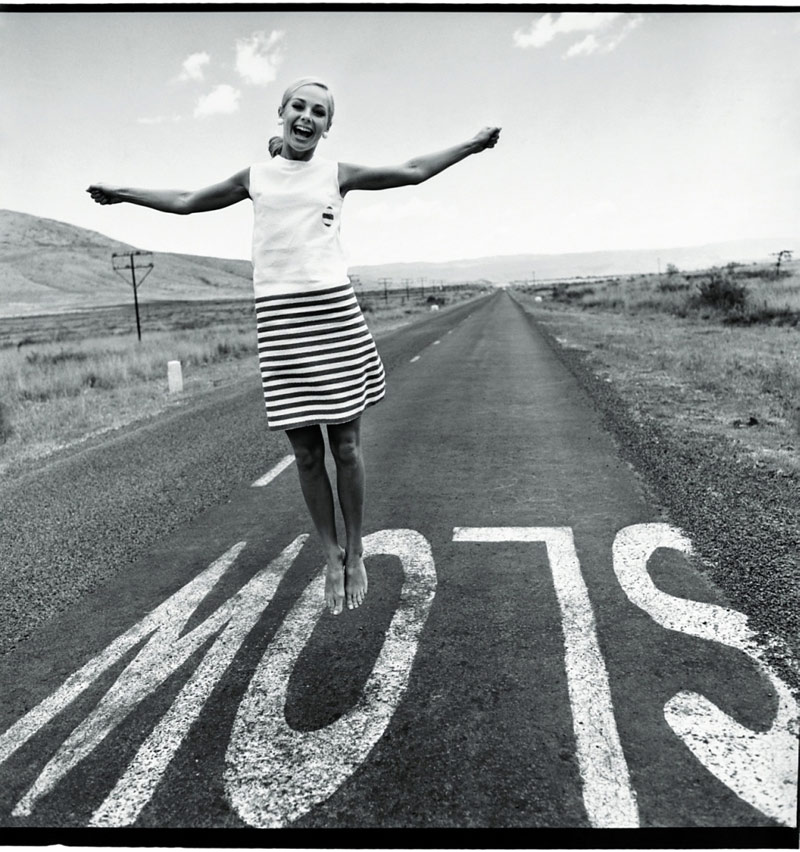
F.C. Gundlach (German, 1926-2021) Slow. Karin Mossberg Nairobi/Kenia 1966 in Brigitte, Issue 9/1966 Gelatin silver print
Karin Mossberg was born on January 1, 1947 in Linkoping, Ostergotland, Sweden as Agneta Anna Karin Mossberg. She is an actress, known for The Big Cube (1969), La vida nueva de Pedrito de Andía (1965) and Les pianos mécaniques (1965).
F.C. Gundlach (German, 1926-2021) Simone d’Aillencourt. Sheath dress by Horn Berlin 1957 in Film und Frau, Issue Spring/Summer 1957 Gelatin silver print
Simone D’Aillencourt
Simone D’Aillencourt or d’Aillencourt (née Daillencourt, born 22 September 1930) is a retired French model. Her career in modelling, during which she achieved significant success, took place from the mid-1950s to the late 1960s. She is best known as the subject of Melvin Sokolsky’s “Bubble” photographic series taken in Paris for Harper’s Bazaar in 1963. She had two daughters during her marriage to José Bénazéraf.
Simone D’Aillencourt was born on 22 September 1930 in Vizille, the daughter of Leon and Anna Daillencourt.
Her activities in the modeling profession began in England. D’Aillencourt began her successful career in Edinburgh in 1954 after a visit by Lucie Clayton. She posed for the British magazine Vogue and then went back and forth between Britain and France. She worked regularly for Pierre Cardin, sometimes for Jacques Heim, and posed for various magazines such as Elle, L’Officiel, Vogue Paris or also Le Jardin des Modes. Due to her job, she traveled many times, posing for William Klein for whom she would become one of his favourites, Irving Penn, John French, Richard Avedon, or also French photographer Georges Dambier or Jeanloup Sieff, who “often photographed” according to him. Independent while the agencies are then little developed, she was contacted by Eileen Ford and invited to New York. She then met the influential Diana Vreeland, which further propelled her career.
In early 1963, D’Aillencourt was selected by Melvin Sokolsky for his “Bubble” series for Harper’s Bazaar. She had her test shot in colour taken in New York, which the staff of Harper’s Bazaar approved. She flew to Paris on 20 January 1963 to have her photos taken by Sokolsky. During the shoot, the Bubble that D’Aillencourt was in was lowered too far into the Seine, which damaged the designer shoes that she was wearing.
D’Aillencourt made her final series of photographs in India, with photographer Henry Clarke, in 1969 after a successful career of 15 years. Throughout her career, she always kept with the trends over time, from the sophistication of the 1950s to the greatest freedom of clothing the following decade. Some time after she stopped modelling, she founded a modelling agency in Paris, Model International, which quickly grew, and then a second agency of a more modest size, Image. She was married to José Bénazéraf, their second daughter Béatrice also having integrated modeling as a booker. In 2008, D’Aillencourt attended the festival at Hyères to celebrate the exhibitions of Sokolsky’s work.
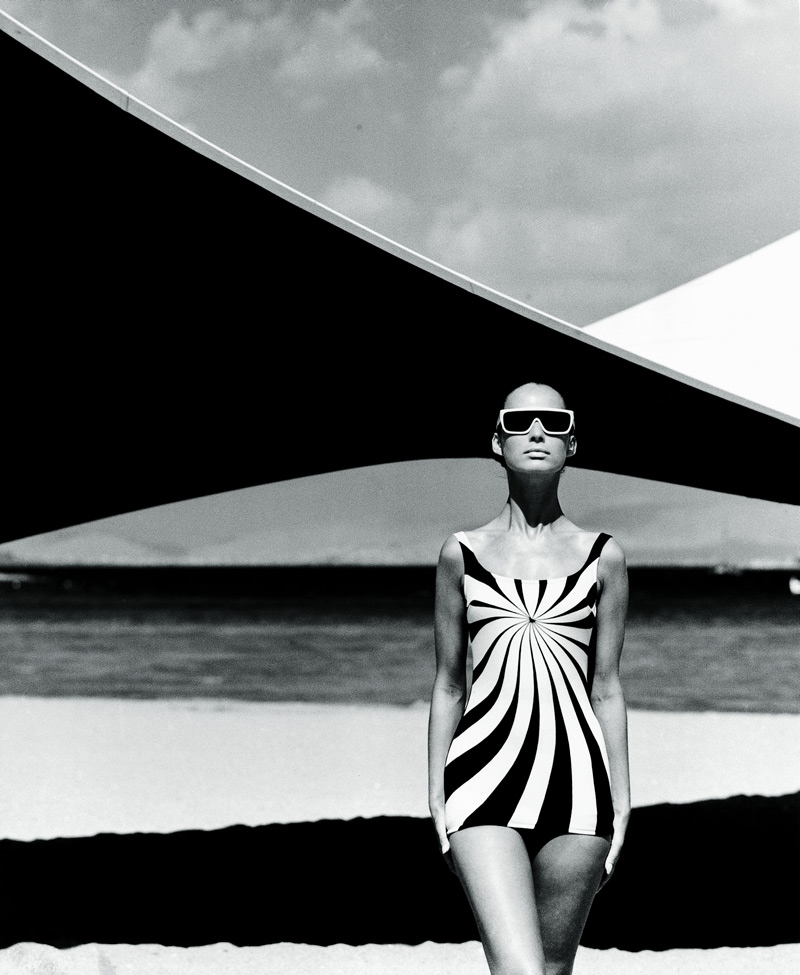
F.C. Gundlach (German, 1926-2021) Op Art Swimsuit. Brigitte Bauer, Op Art swimsuit by Sinz Vouliagmeni Greece 1966 Gelatin silver print
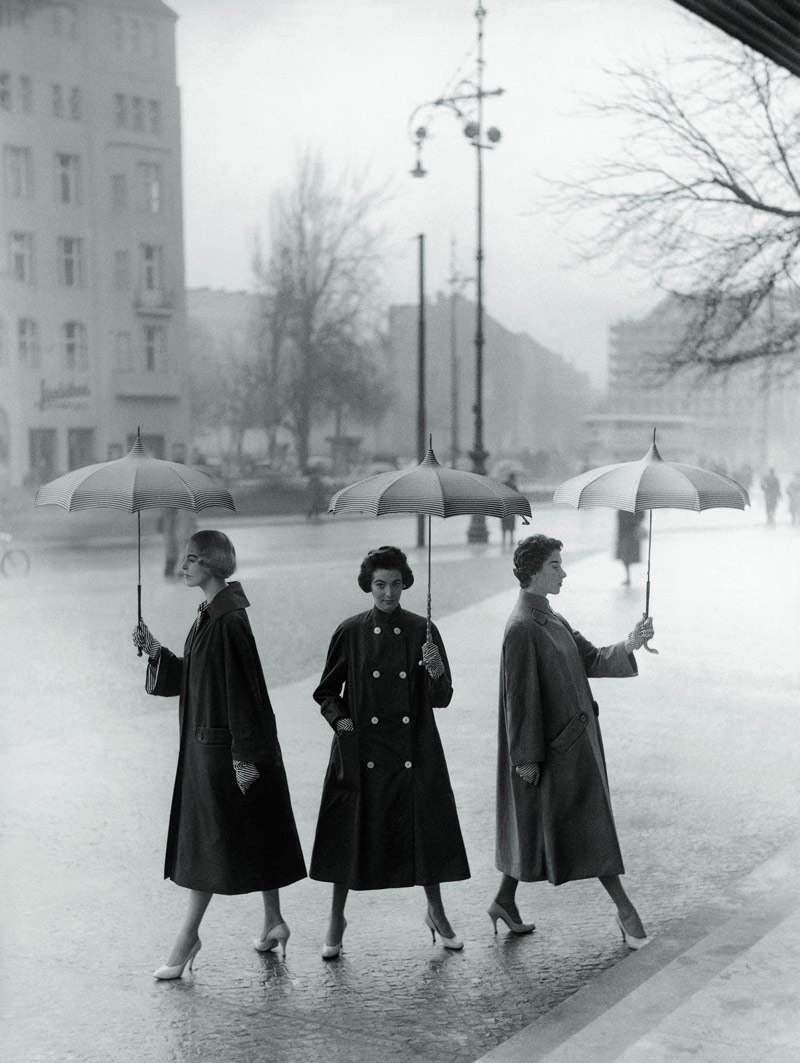
F.C. Gundlach (German, 1926-2021) Rainweather, party sunshiny. Three poplin coats by Staebe-Seger Berlin 1955 Gelatin silver print
F.C. Gundlach (German, 1926-2021) Romy Schneider Hamburg 1961 in Film und Frau, Issue 11/1962 Gelatin silver print
Romy Schneider
Romy Schneider (23 September 1938 – 29 May 1982) was a film actress and voice actress born in Vienna and raised in Germany who held German and French citizenship. She started her career in the German Heimatfilm genre in the early 1950s when she was 15. From 1955 to 1957, she played the central character of Empress Elisabeth of Austria in the Austrian Sissi trilogy, and later reprised the role in a more mature version in Visconti’s Ludwig. Schneider moved to France, where she made successful and critically acclaimed films with some of the most notable film directors of that era.
Exhibition dates: 3rd September – 3rd October, 2009
Many thankx to the Gagosian Gallery for allowing me to publish the photographs in the posting.
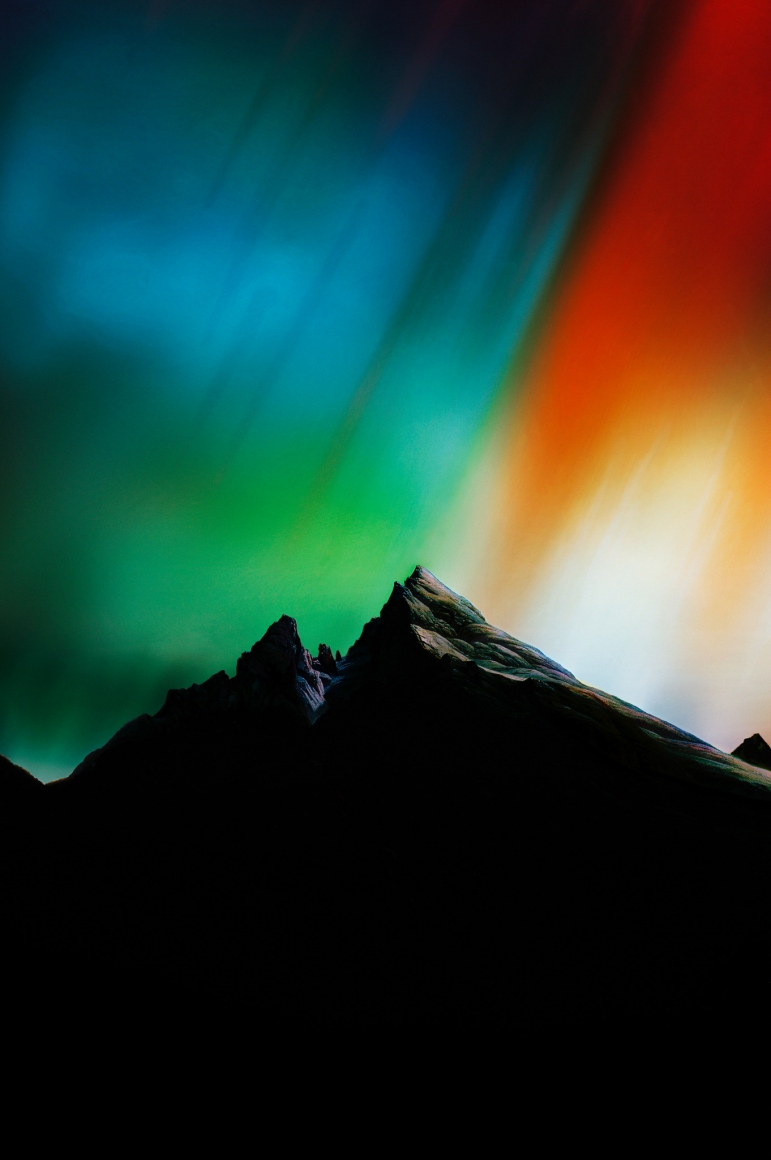
Florian Maier-Aichen (German, b. 1973) Der Watzmann 2009
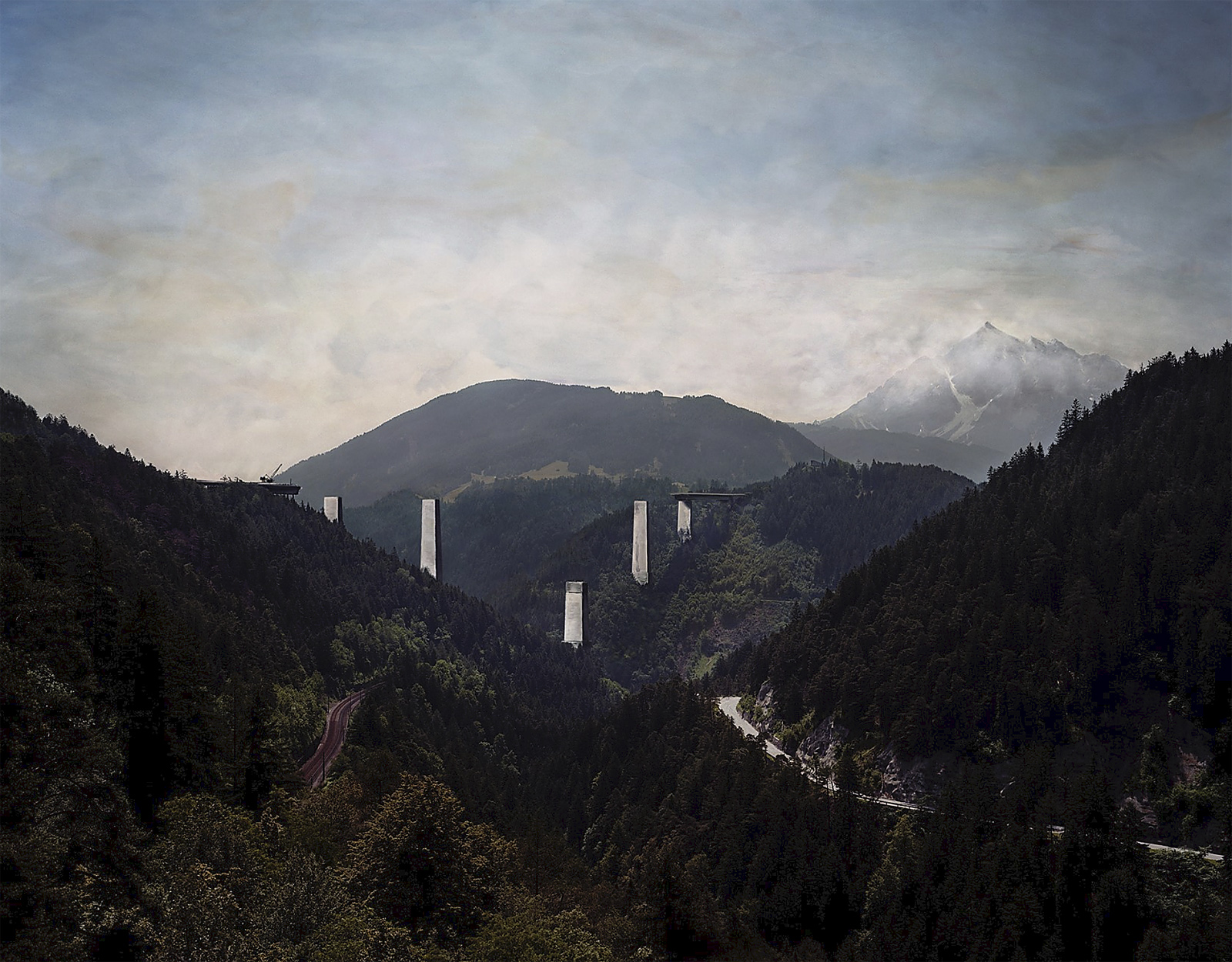
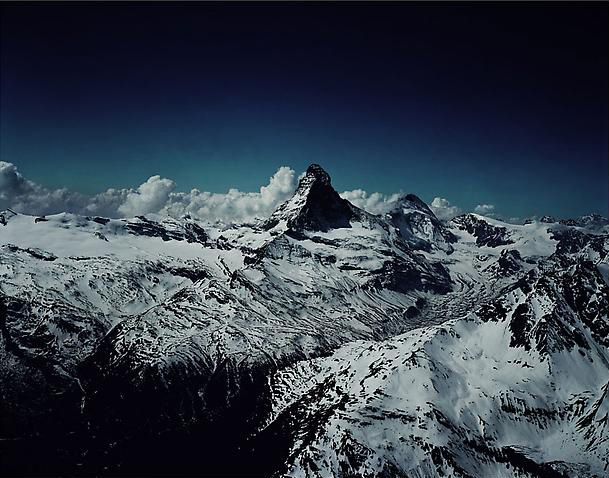
Florian Maier-Aichen brings a contemporary sensibility to bear on a range of historical references, from German Romantic painting to 19th-century photographs of the American West. The German-born photographer shoots images with a large-format camera then alters them digitally by combining negatives, adding computer-drawn elements or otherwise changing the originals. The effects are painterly and the works large-scale (the biggest one in this show, all but one of them C-prints, was around 8 by 71⁄3 feet). In one untitled print (2009), a digitally created brushstroke cuts diagonally across a snowy mountainside. Alluding to the trails ploughed across mountains to prevent avalanches, the photograph also suggests the black-and-white paintings of Abstract Expressionist Franz Kline. The sky above a dark mountainous outcropping in Der Watzmann (2009) references the Caspar David Friedrich painting of the same name (Maier-Aichen appropriated the image of the peak from the painting itself), while the sky suggests an airbrush version of the aurora borealis in red-orange and blue-green.
Der Watzmann may be the most direct reference to 19th-century German Romanticism and the sublime, but these are themes that Maier-Aichen frequently evokes, only to upend them.
Jean Dykstra. “Florian Maier-Aichen,” on the Art in America website May 4, 2009 [Online] Cited 24/09/2019
Florian Maier-Aichen (German, b. 1973) Untitled 2008
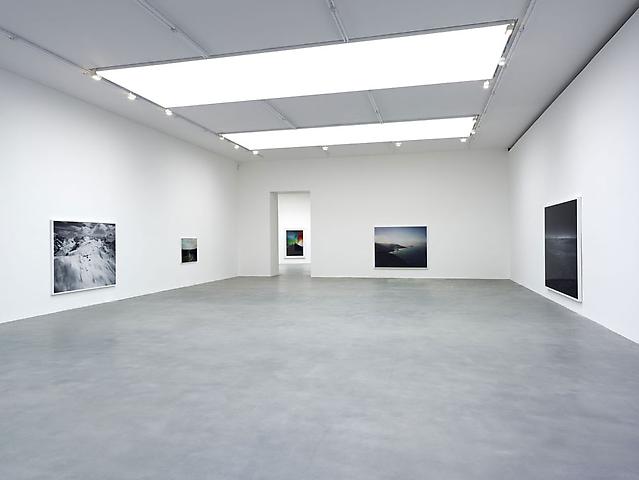
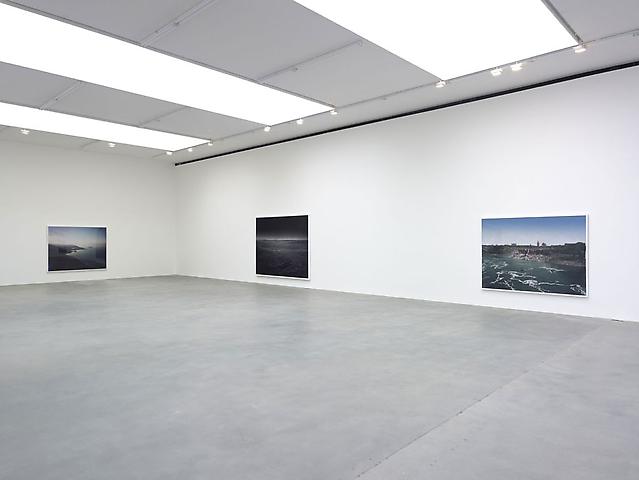
Snow Machine by Florian Maier-Aichen installation views at Gagosian Gallery, Britannia Street, London
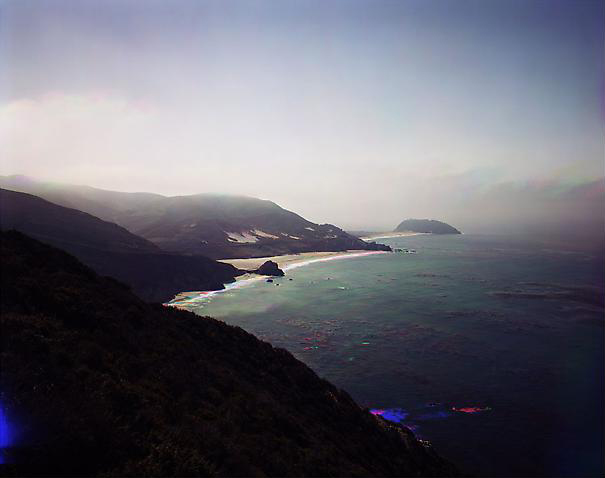
“Florian Maier-Aichen’s images reinterpret landscape photography for the 21st century. Often shot at obscure angles or from aerial views, his estranged vantage points are both alien and familiar; a sensation enhanced by his subtle manipulation of the images. Conceiving the representation of sites with a sense of dislocation, Maier-Aichen’s work addresses issues of globalisation and virtual perception. In Untitled, Maier-Aichen’s coastline is far from postcard perfect: a virgin beach lined with superhighway and luxury homes expanding into the misty distance. Tinting the surrounding forest in an unnatural shade of red, he casts an apocalyptic glow over the seascape, framing wilderness and human intervention as a scene of science fiction portent.”
Florian Maier-Aichen (German, b. 1973) Untitled 2009
“I have always been interested in the making of things. Most products and materials conceal their process of manufacture. It’s the same with photography, which turned from a discipline that was subject to the mastery of the few (alchemists) into a readily available industrial mass product, too transparent and too technical.”
Florian Maier-Aichen
Gagosian Gallery is pleased to present an exhibition of recent photographs by Florian Maier-Aichen. This is the artist’s first solo exhibition in London.
A photographer schooled on both sides of the Atlantic, Maier-Aichen’s work reflects on the dual influences of the history of photography and the history of painting, whether drawing on such dichotomies as German Romantic painting and the pioneers of German “objective” photography, or applying his post-factum experience of American frontier art – from the Hudson River School and Abstract Expressionism to Land Art and West Coast conceptualism – to his own topographical depictions of landscape subjects. He focuses on the camera’s consummate power to establish typologies of thought, perception, and feeling, producing images that, in mining the past, come to embody a matrix of issues salient to recent photographic practice.
Approaching the photographic field like a painter approaches a canvas, Maier-Aichen does for the contemporary image-world what pictorial photographers attempted in the nineteenth and early twentieth centuries, using the strategies and motifs of Romantic and Luminist painting. Unnaturally high-keyed or delicately tinted images of soaring mountain ranges, moody seas, and the industrial architecture of bridges, waterways, and dams carving through the natural landscape are all emanations of a rich and diverse imagination where a keen and critical grasp of art history coexists with more pronounced literary and cinematic conceits.
In a creative process that is as intensive as it is subtle and opaque, Maier-Aichen combines an exhaustive range of staged effects and traditional photographic techniques – albumen, silver-gelatin, and c-printing – with drawing and current computer-imaging processes. Weaving together often disparate elements from distinct sources, he applies myriad creative adjustments to each in order to produce seamless photographs that do not betray their intricate and layered compositions. Multiple negatives, digital manipulation, and elaborate studio techniques are employed to produce seemingly straightforward photographic landscape subjects while other images that engage the most conventional photographic techniques may themselves be subjects of pure fabrication.”
Text from the Gagosian Gallery website [Online] Cited 20/09/2009. No longer available online
Florian Maier-Aichen (German, b. 1973) Untitled 2009
Florian Maier-Aichen (German, b. 1973) Untitled 2009
Florian Maier-Aichen (German, b. 1973) Untitled (St. Francis Dam) 2009
Gagosian Gallery 6-24 Britannia Street London WC1X 9JD Phone: 44.207.841.9960
Artists: Laurenz Berges, Albrecht Fuchs, Karin Geiger, Claus Goedicke, Uschi Huber, Matthias Koch, Wiebke Loeper, Nicola Meitzner, Peter Piller, Heidi Specker.
An exhibition of the Institut für Auslandsbeziehungen e. V. (ifa/Institute for Foreign Cultural Relations), Stuttgart, Germany and presented in cooperation with the Goethe-Institut Australien.
I was looking forward to this exhibition and so on a cold and very windy winter’s day I ventured out on the drive to the Monash Gallery of Art in Wheelers Hill expecting to be challenged by a new generation of German photographers. I was to be sorely disappointed. This show, with the exception of excellent work by Andreas Koch and good work by Laurenz Berges, epitomises all that I find woeful about contemporary photography.
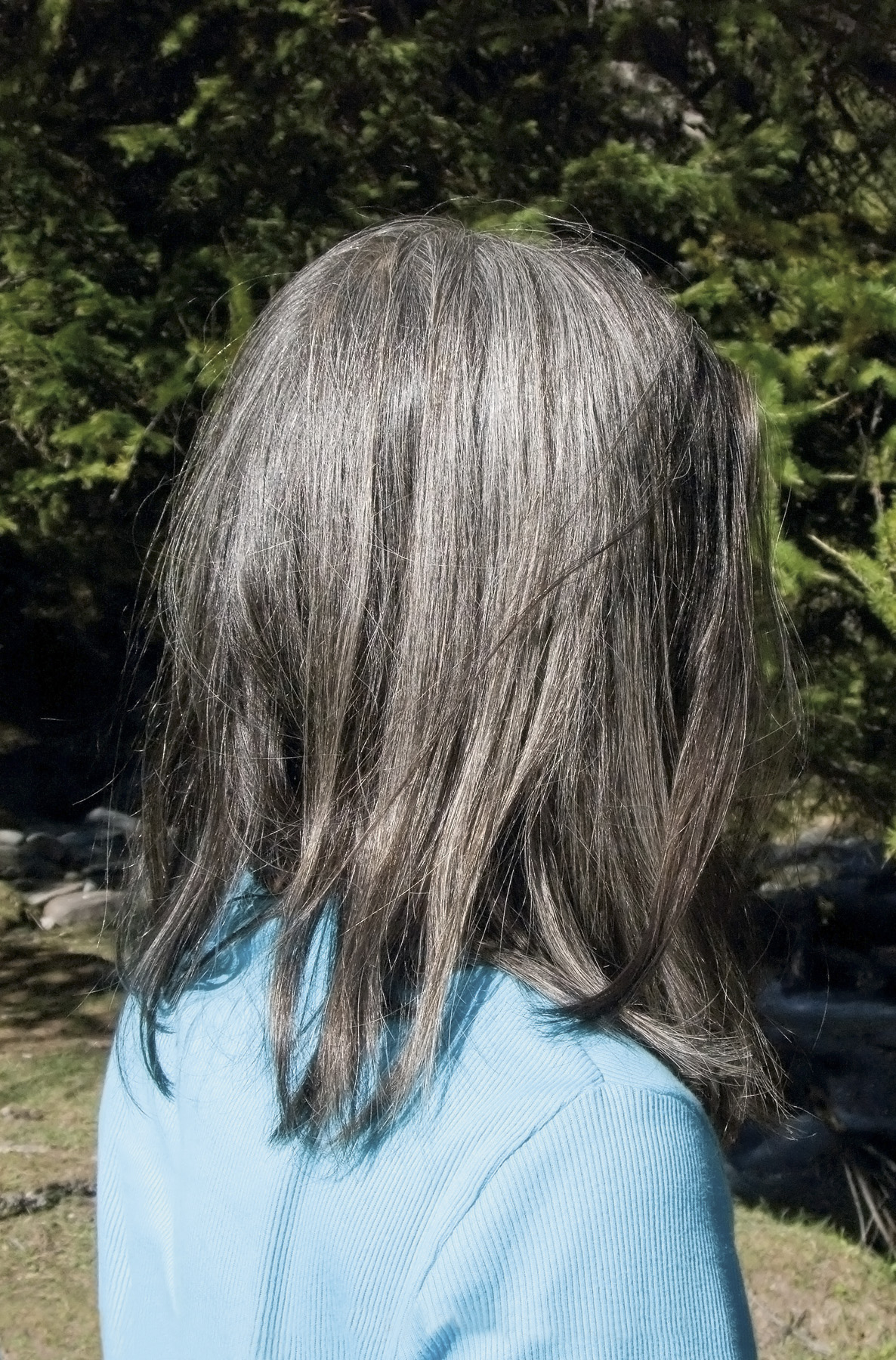
There is a lack of life and vigour to the work, no sense of enjoyment in taking photographs of the world. The narratives are shallow and vacuous inducing a deep somnambulism in the viewer that is compounded by the silent, deeply carpeted gallery making the experience one of entering a mausoleum (this is a great space that needs to be a contemporary space!). How many times have I seen photographs of empty spaces that supposedly impart some deep inner meaning? See how a great artist like Tacita Dean achieves the same end to startling effect with her film Darmstädter Werkblock (2007). How many times do I need to see ‘dead pan’ portrait photographs that are again supposed to impart rich psychological meaning? I have seen too many already.
Conceptually the work is barren. Technically the proficiency of some of the work is almost non-existent. If this standard of work was put up for assessment in a university course it would fail miserably. For example in Nicola Meitzner’s work Forward Motion (2006), vertical portraits (of the same person in different poses) and streetscapes of Tokyo are poor quality prints mounted in unattractive silver aluminium frames. They are forgettable. If an artist were to study the work of, say, Manuel Alvarez Bravo, then one might gain some insight into how to photograph the city and the people that live in it in a way that elicits a response from the viewer to the photo-poetry that is placed before them.
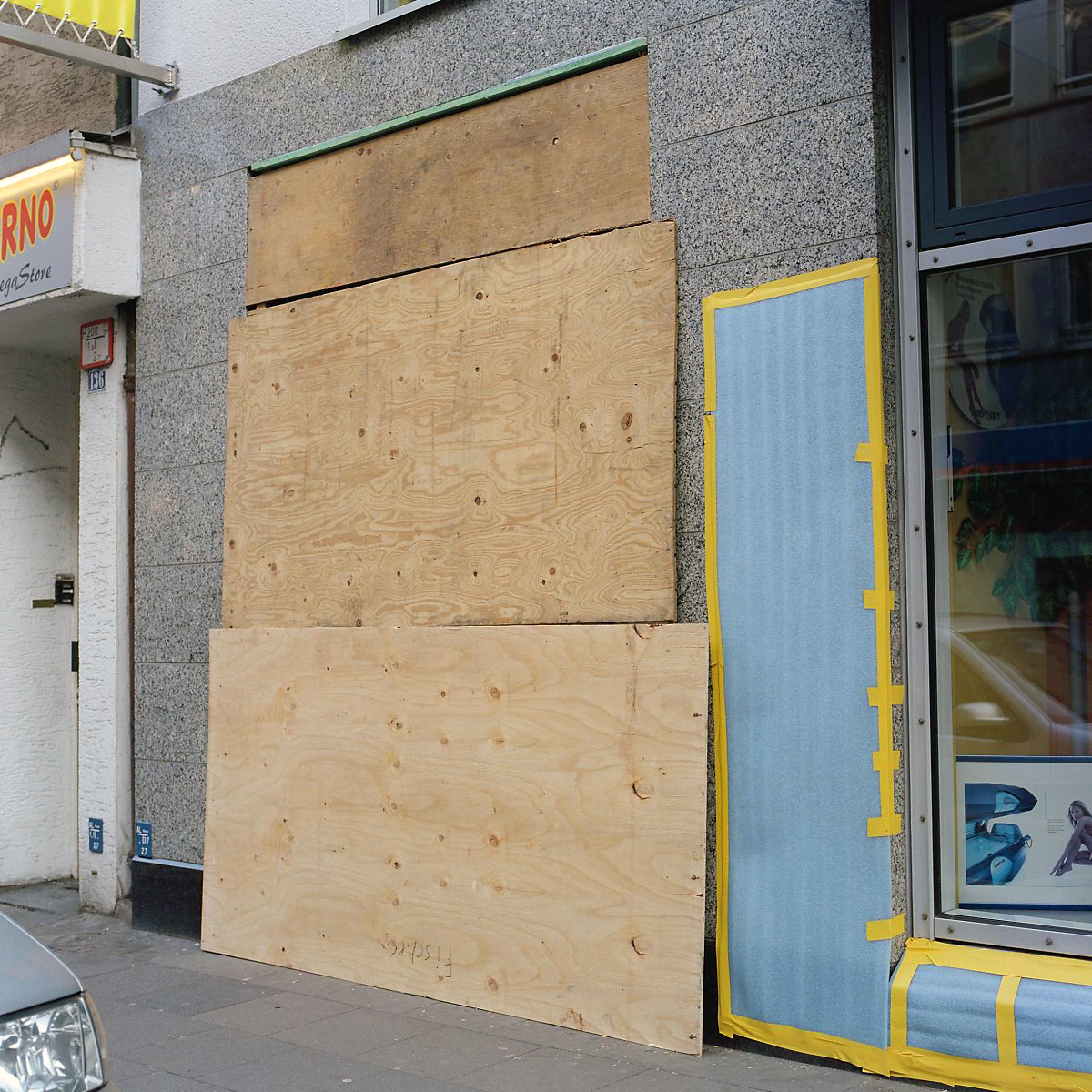
Uschi Huber’s photographs of boarded up shop fronts, while a nice conceptual idea, are again lacking in technical proficiency and are nothing we haven’t seen many times before while Peter Piller’s ten print-media type pigment prints of girls at a shooting range with rifles do not bare comment on both a conceptual and technical level. Similarly, Wiebke Loeper’s colour photographs of the city of Wismar – houses, roads, water, oat fields, people peering into shop windows – sent to friends living in Melbourne to show them the desolation and rebuilding of the city are seriously year 12 work.
The two redeeming artists are Laurenz Berges and Andreas Koch.
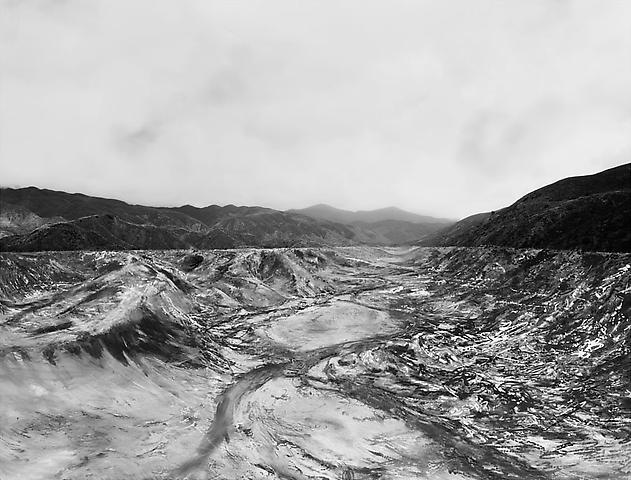
Berges four large type C colour photographs of an empty house and the surrounds as seen through a window are intimately detailed visions of human absence from the built environment: the huts, piles of wood chips, barren trees, the feathers on the floor of one print, the cigarette butts on the floor of another, the marks on the wall in blue and red add to a sense of abandonment and alienation from the environment – traces of human experience, identity and memory etched into the photographic medium.
As the text on the Institut für Auslandsbeziehungen (IFA) website observes,
“Laurenz Berges is a chronicler of absence. His minimalist photographs point to the earlier use of spaces, only fragments of which are shown, whose inhabitants have put them to other, new uses. Berges depicts the traces of this change in austere images that, due to their reduction, tell their stories indirectly and almost involuntarily. These are stories about the existential significance certain spaces have for our identity, and also about their transitoriness and their loss.”1
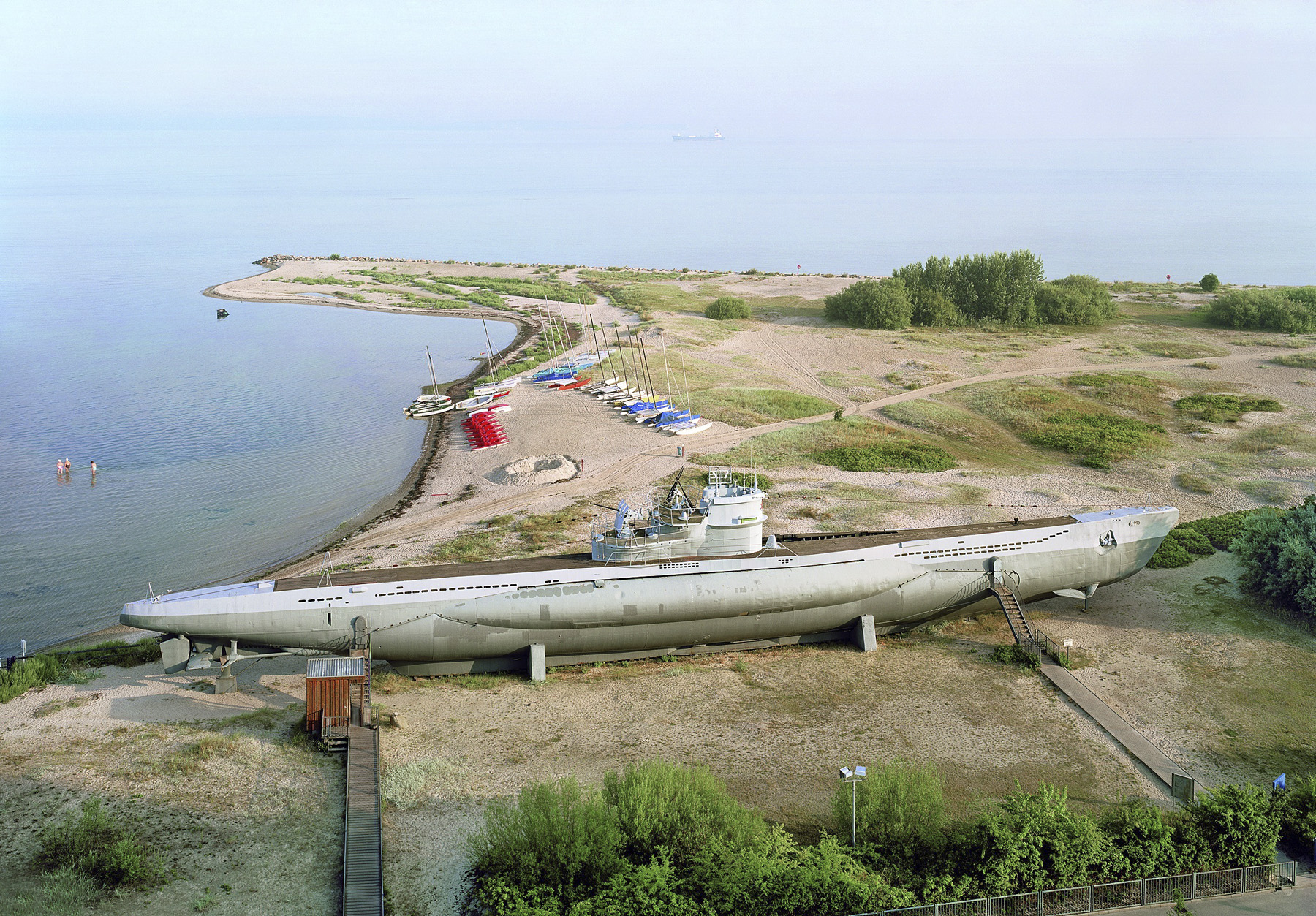
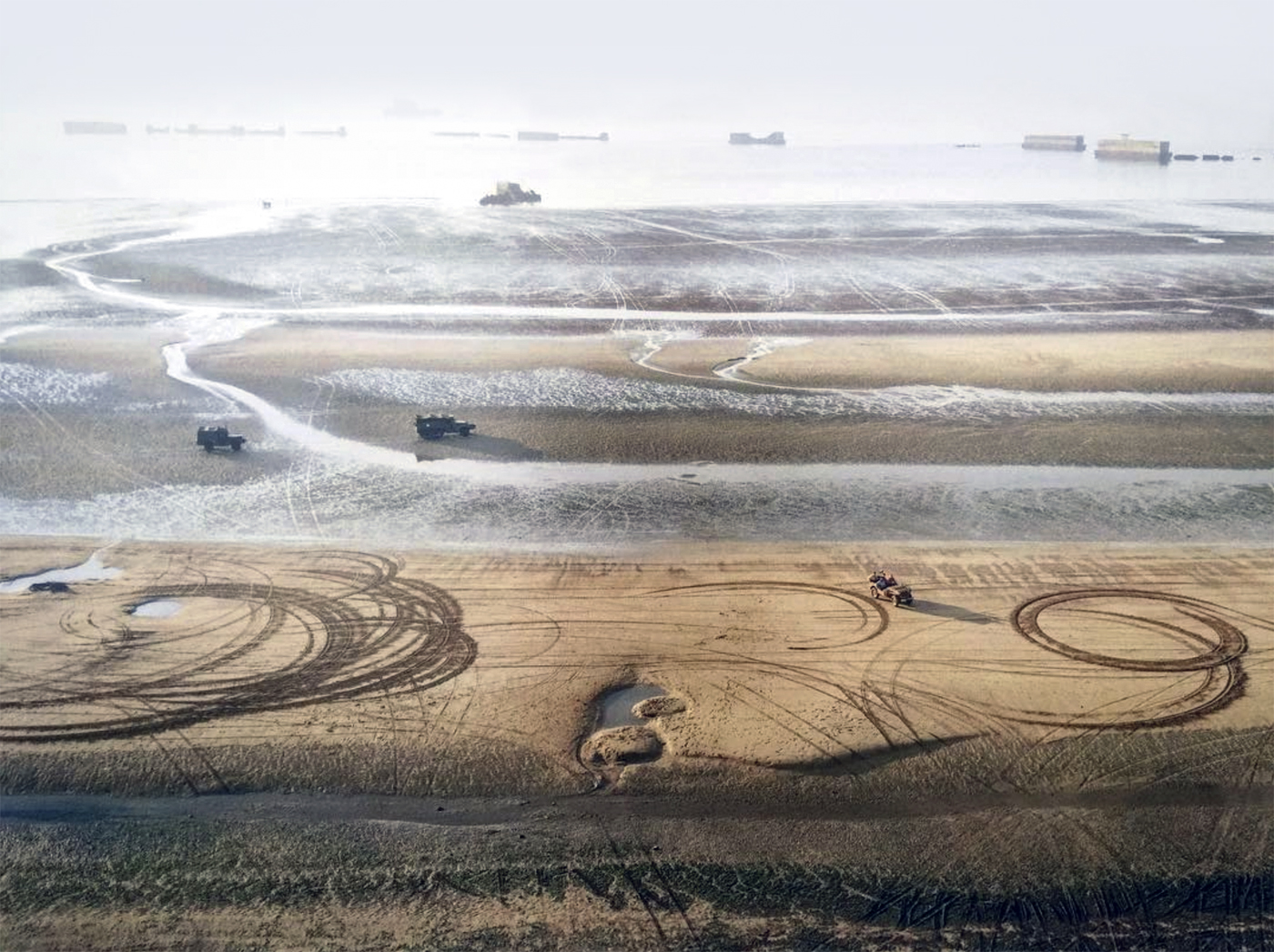
The star of the show was the work of Matthias Koch. His five large aqua-mounted type C prints from the series Sites of German History (2006) are both technically and conceptually superb, full of delicious ironies and humour. Using an aerial aesthetic (apparently by climbing the ladder of a fire engine that he owns) Koch looks down on the landscape and through his images formulates new ways of seeing national symbols (even though many of them are not in Germany). His re-presentation of spatial inter-relations and objects embedded in their rural and urban surroundings are both simple yet layered and complex.
Unfortunately I have only two photographs (above and below) to show you of his work. None other was available but the images gives you an idea of his raison d’être. The specimen of U-995, built in Kiel in 1944, is presented as a trapped and mounted animal, preserved for our delectation and inspection with gangways and stairs to view the innards. Little hobby craft lie on a beach behind while people paddle in the shallows, a ship barely seen in the distance out at sea. The fact that this U-boat was once used to destroy such a ship, the irony of the proposition, is not lost on the viewer.
Other images in the series include a photograph of the derelict runway of the Heinkel factory as seen from above, the overgrown concrete slabs cracked and lifting, the edges filled with grass, the distant view dissolving into mist and nothingness. The photograph Harbour, Allied landing near Normandy, 1944 (2006, below) shows an American jeep and half-track of the period on the beach of the Allied landing in Normandy, tyre tracks swirling in the sand while in the distance the concrete block remains of the Mulberry harbour used in 1944 still litter the coastline. How many men, both German and American, died on this beach all those years ago? In another tour de force Atlantic Defence Wall near Cherbourg. Bunker construction built 1940 (2006) concrete bunkers dot the landscape with the beach and sea beyond as people sunbathe on the grass amongst the ruined bunkers, probably oblivious to the context of their surroundings. Koch is a master of the re-presentation of the context of memory, history and place.
Overall this exhibition is a great disappointment. I find it hard to believe that the exhibition has been curated by the same man who curated the recent Andreas Gursky exhibition at the National Gallery of Victoria. The choice of work and the presentation of technically poor prints is not up to standard. I also find it difficult to reconcile some of the reviews I have read of this exhibition with the actual work itself. Thank goodness for the photographs of Matthias Koch for he alone made the journey into outer Melbourne a worthwhile journey into the memory of the soul.
Dr Marcus Bunyan
1/ Anonymous. “Presentation/representation: Laurenz Berges,” on the Institut für Auslandsbeziehungen (IFA) website [Online] Cited 08/08/2009 no longer available online
Many thankx to Monash Gallery of Art for allowing me to publish the photographs in the posting. Please click on the photographs for a larger version of the image.
This international touring exhibition was developed by the Institut für Auslandsbeziehungen (ifa) in Germany and is presented in cooperation with the Goethe-Institut Australien.
MGA is hosting the important international exhibition ‘presentation / representation: photography from Germany’, which brings to Melbourne the work of ten of Germany’s best contemporary photographers.
presentation/representation is curated by Thomas Weski (curator of Andreas Gursky recently seen at the National Gallery of Victoria), and covers the work of the generation of German photographers that has followed the now-legendary Kunstakademie Düsseldorf generation of Gursky, Thomas Ruff, Thomas Struth and Candida Höfer. For the artists in presentation/representation, including Matthias Koch, Laurenz Berges and Heidi Specker, photography is a medium that has its own language and characteristics, and their work collectively explores the limits of the medium.
Shaune Lakin, Director of the MGA states “MGA is thrilled to present ‘presentation / representation’ and to bring to the people of Melbourne such an important survey of contemporary German photography. As well as providing a comprehensive survey of German practice, the exhibition will complement the experience of those who saw Weski’s wonderful Gursky exhibition at NGV. We are also delighted to host participating artist Matthias Koch.”
Koch will be presenting a series of public programs including an artist talk, student tutorial and a field trip exploring the industrial suburban sites close to the gallery. “With his critical interest in landscape, architecture and history, Koch will provide some wonderful insights into our local landscape for participants in these programs,” notes Dr Lakin.
MGA’s Education and public programs coordinator Stephanie Richter says: “This is a great opportunity for students and Melbourne audiences to meet one of Germany’s most celebrated contemporary photographers and to participate in the busy schedule of talks, tutorials and field trips with Matthias.”
Press release from Monash Gallery of Art website [Online] Cited 05/08/2019 no longer available online



















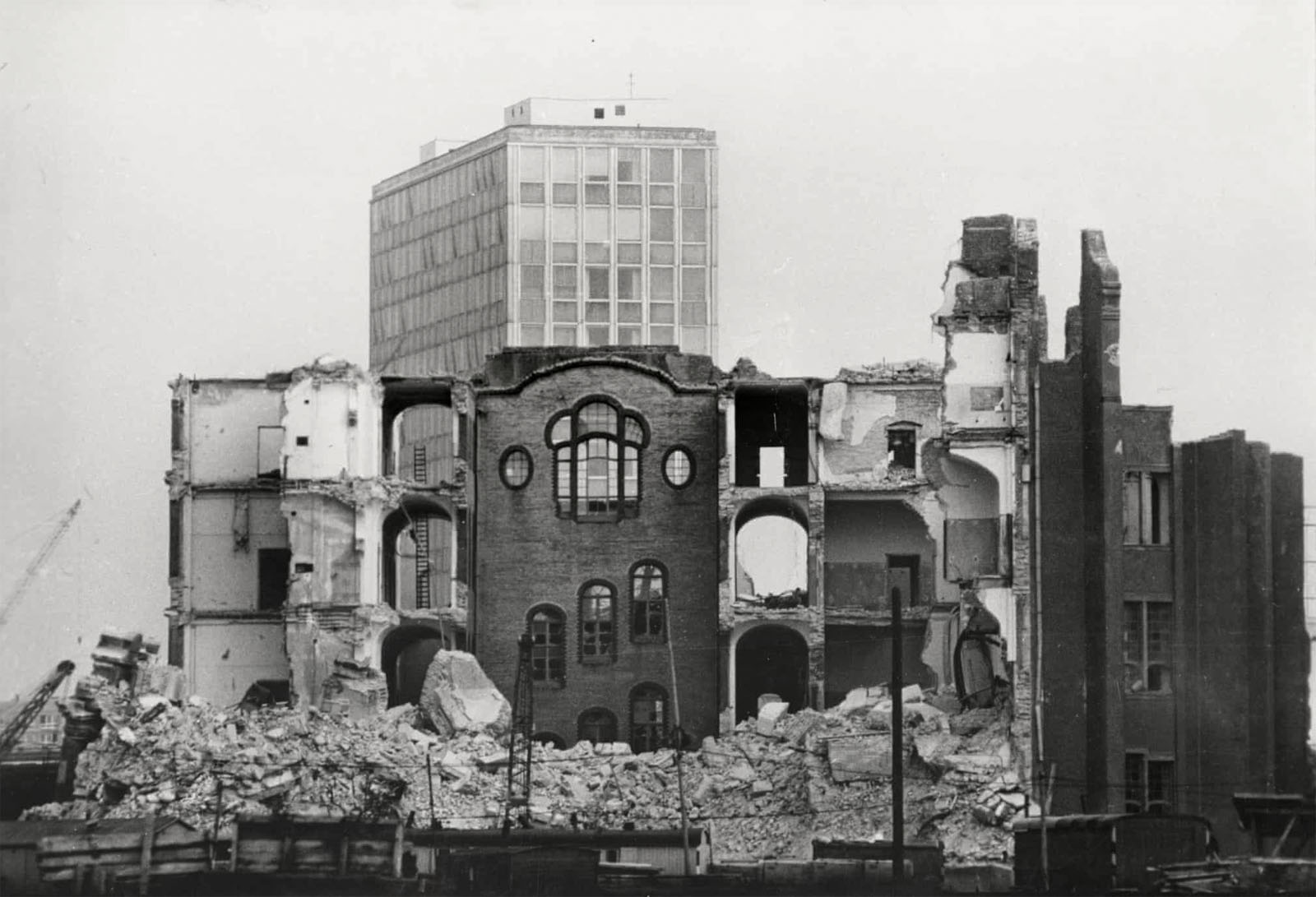
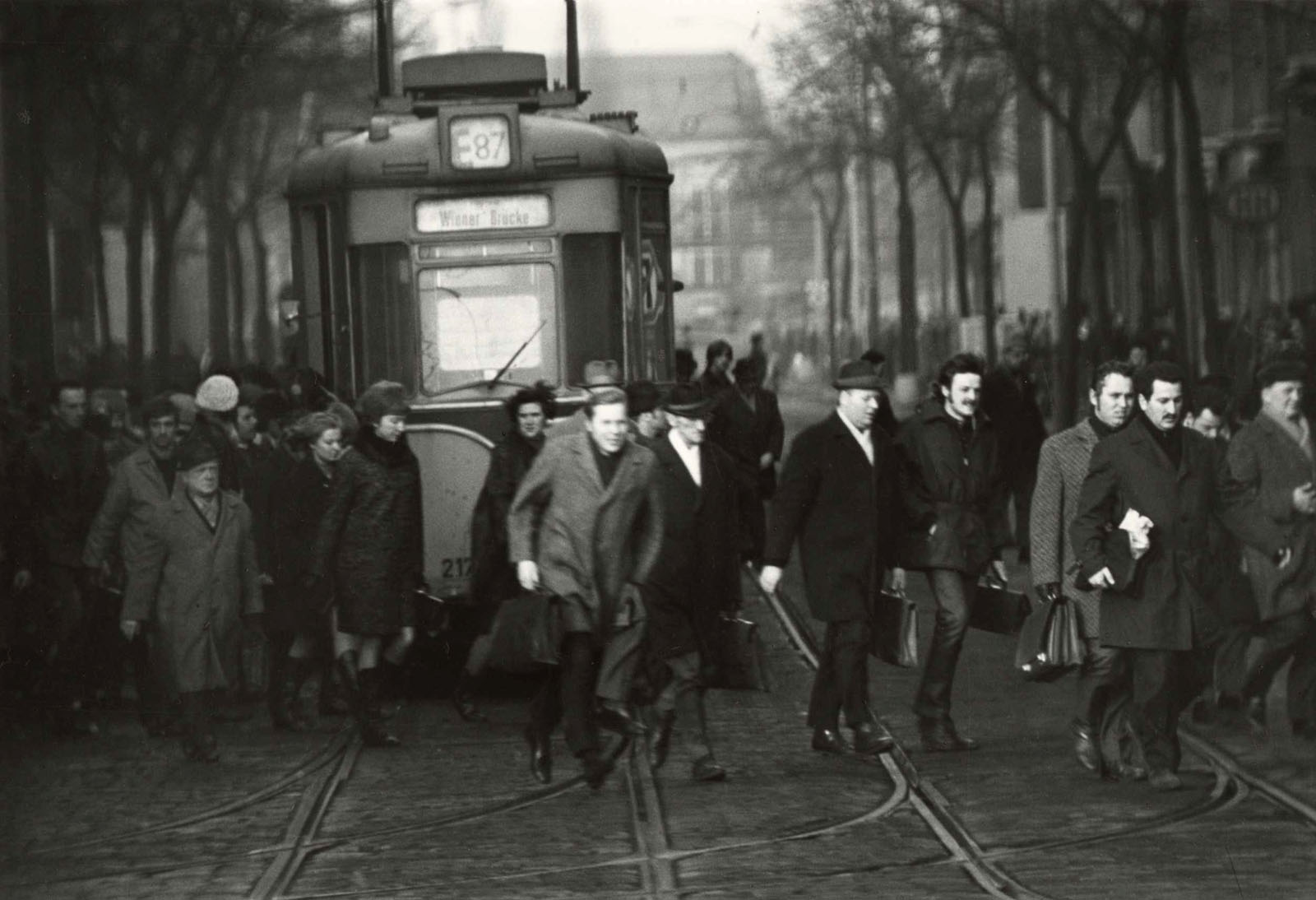
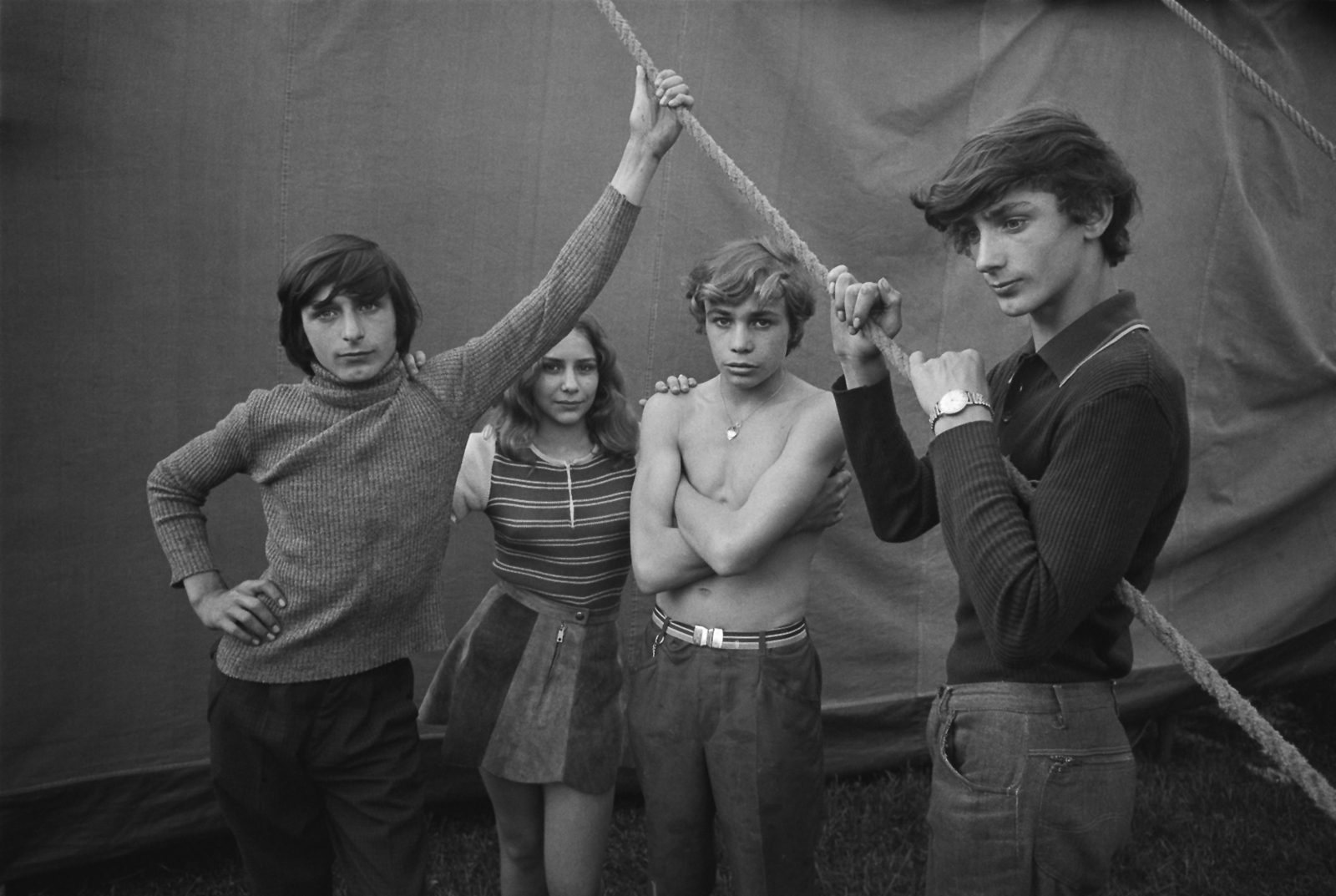

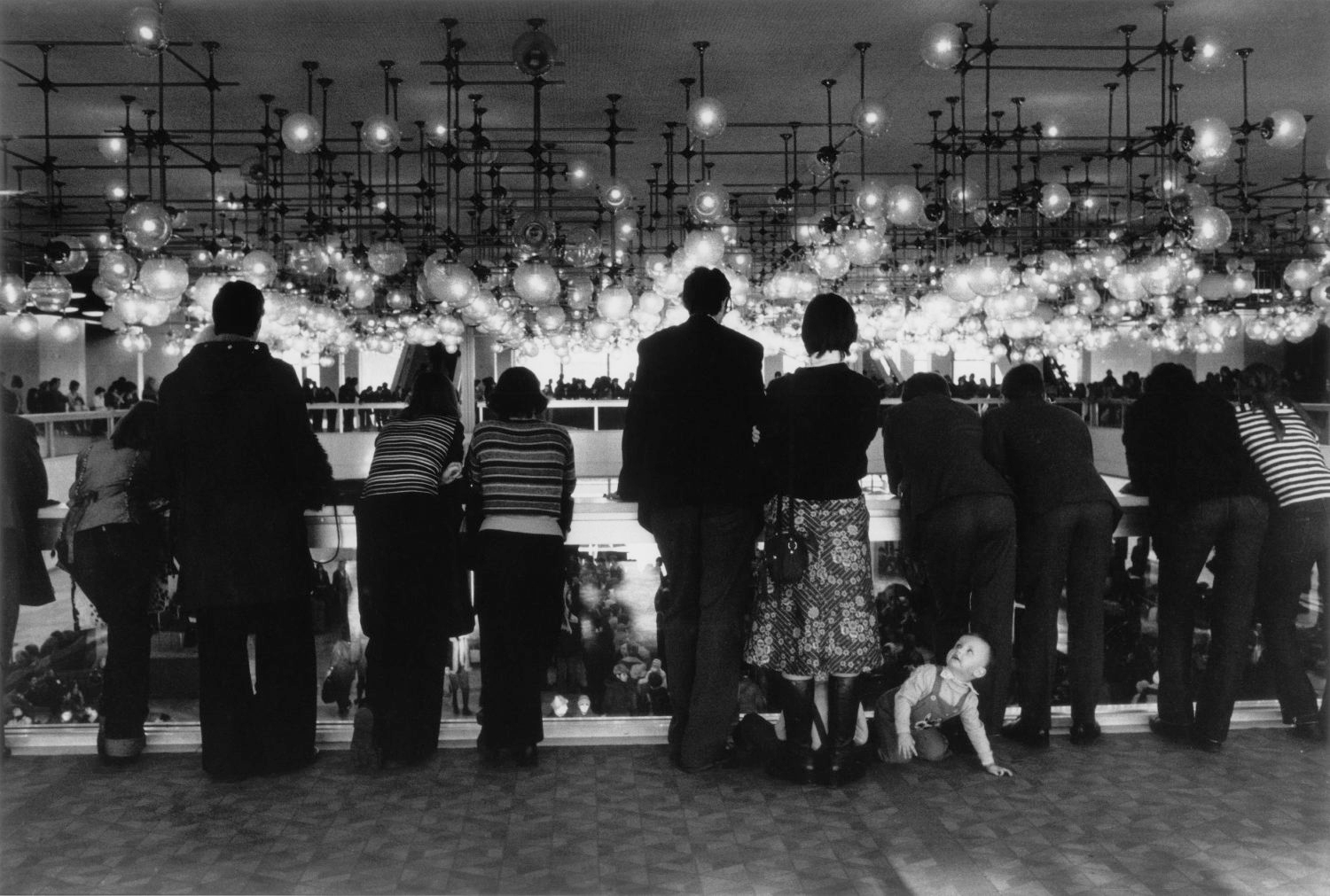







![Laurenz Berges (German, b. 1966) 'Garzweiler' [surface mine] 2003 from the exhibition 'presentation/representation: photography from Germany' at the Monash Gallery of Art, Melbourne, July - August, 2009](https://artblart.com/wp-content/uploads/2009/08/laurenz-berges-garzweiler-web-1.jpg "Laurenz Berges (German, b. 1966) 'Garzweiler' [surface mine] 2003 from the exhibition 'presentation/representation: photography from Germany' at the Monash Gallery of Art, Melbourne, July - August, 2009")
 Art Blart _ art and cultural memory archive
You must be logged in to post a comment.