Exhibition: ‘The Underground Camera’ at Foam, Amsterdam

Exhibition dates: 2nd May – 1st September, 2025

Co-curators: Hripsimé Visser, former curator at Stedelijk Museum, Foam curator Claartje van Dijk, and exhibition designer Jeroen de Vries, in collaboration with NIOD Institute


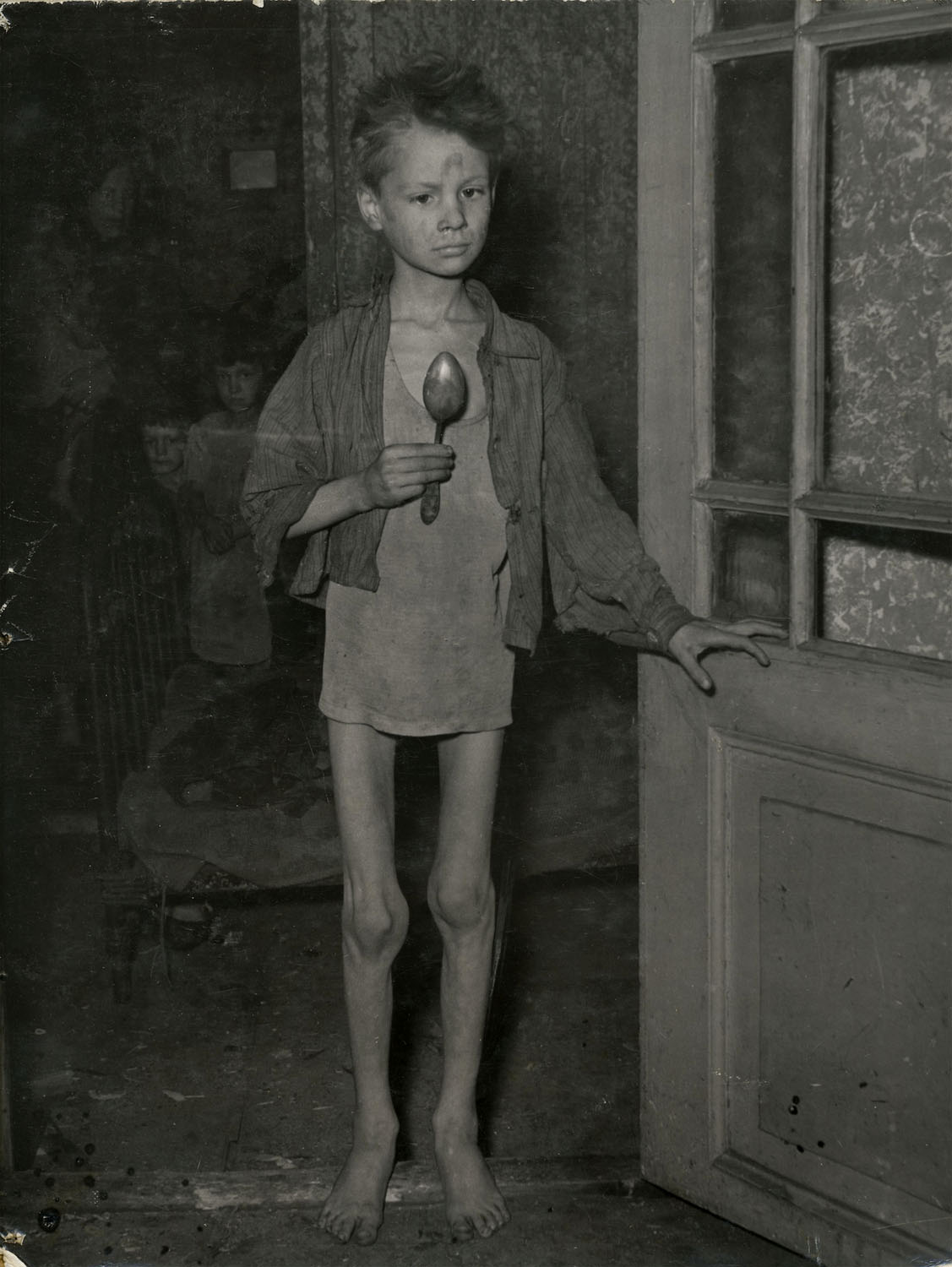
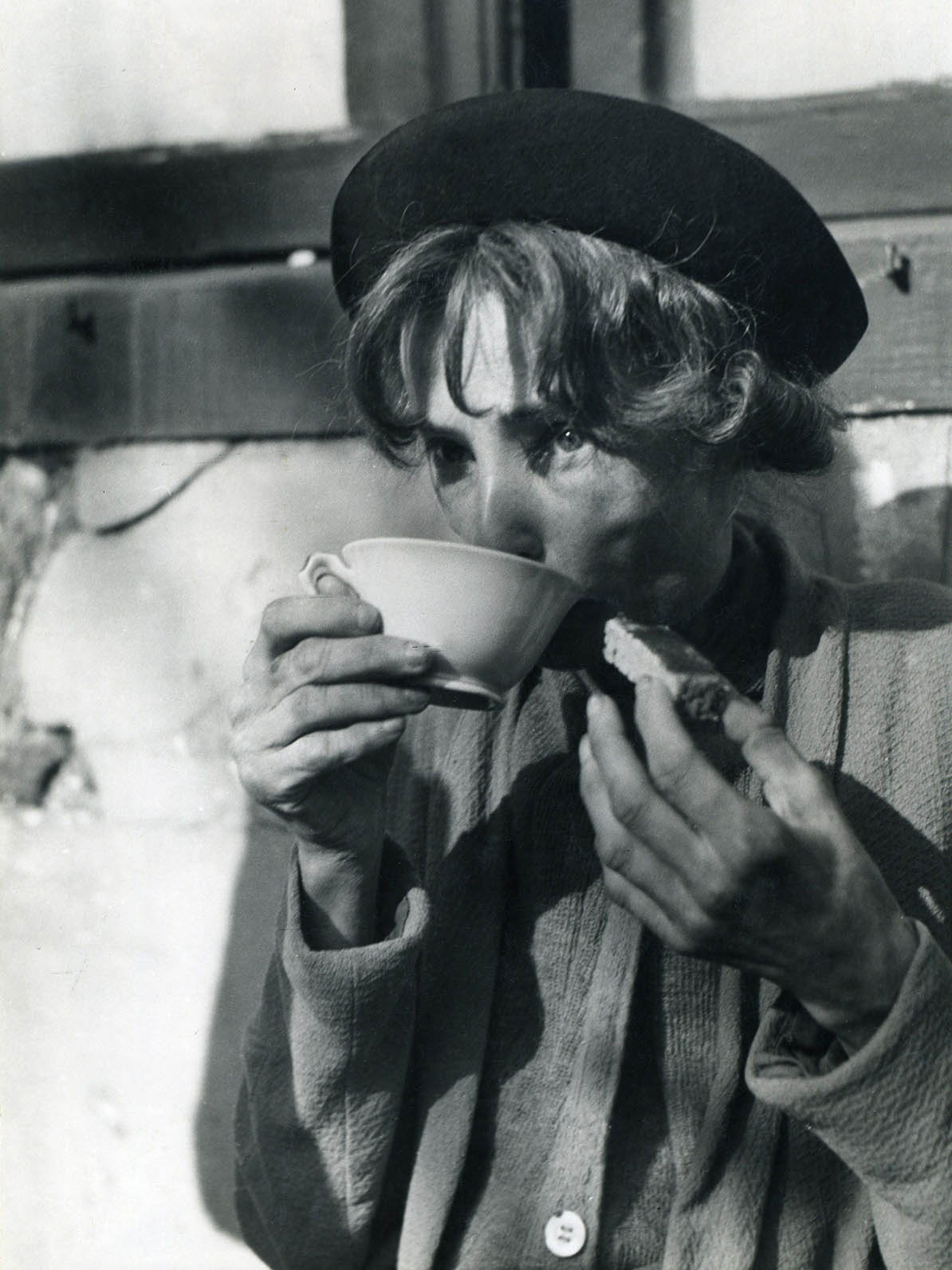
Marius Meijboom (Dutch, 1911-1998) 'Hunger Winter' February 1945


Marius Meijboom (Dutch, 1911-1998)
Hunger Winter
February 1945
Marius Meijboom / Niod


Iconic photo of Henkie Holvast from the Jordaan, 9 years old


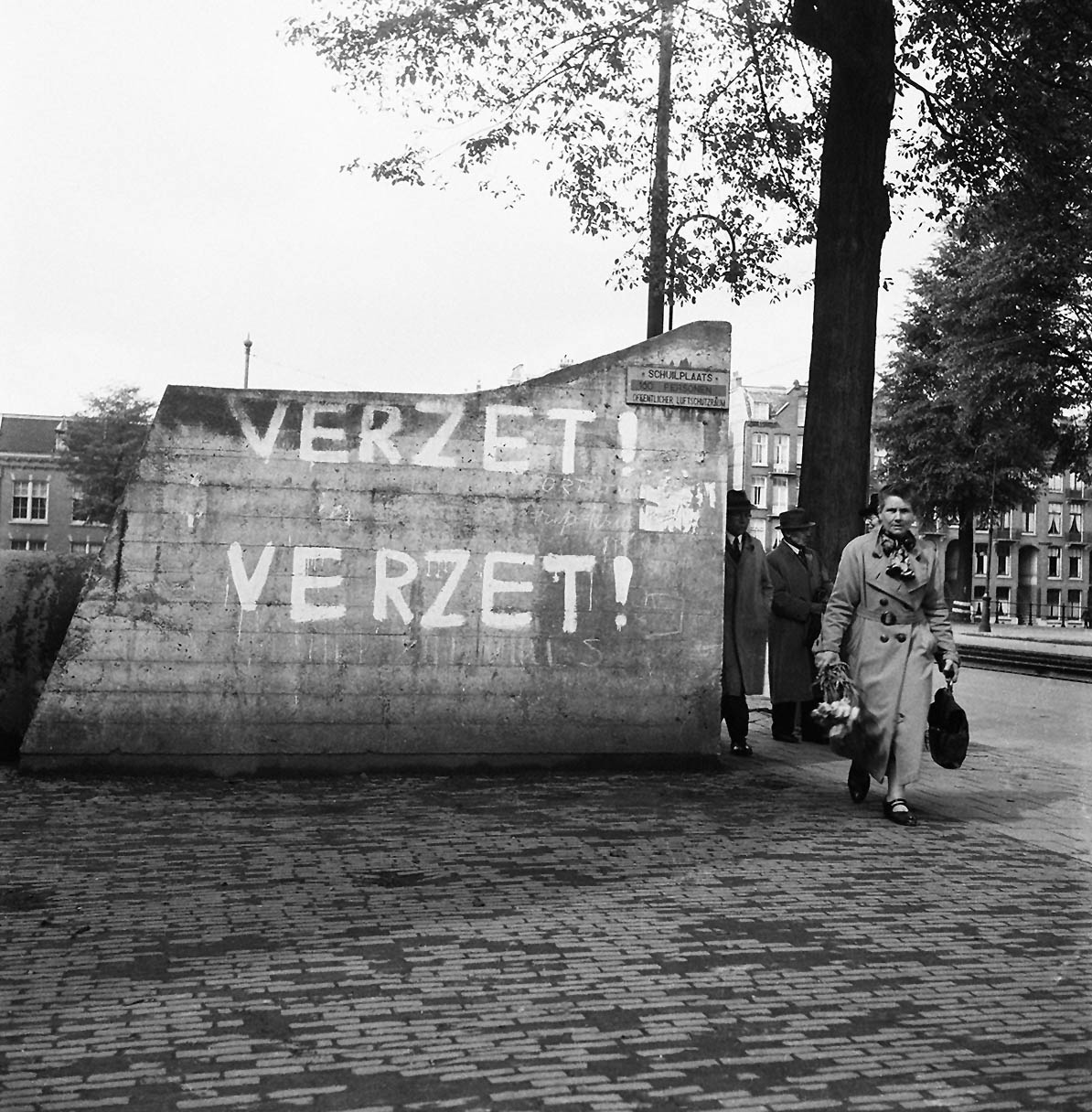
Resist!

The photograph of Henkie Holvast (February 1945, above) is an example of the famine the Nazis inflicted on the general population of the Netherlands during the last year of the Second World War.

I’ll leave you to make the correlation between these historical events and what is happening in Gaza today … and to understand the hypocrisy and evil of contemporary acts.

Like the photojournalists that are being targeted and killed for reporting the truth of the situation in Gaza, so these photographers would have been killed by the Nazis for photographing the occupation of the Netherlands if they had been caught.

“Verzet! Verzet!” (Resist! Resist!)

Dr Marcus Bunyan


Many thankx to Foam, Amsterdam for allowing me to publish the photographs in the posting. Please click on the photographs for a larger version of the image.


“The exhibition The Underground Camera captures the hunger and hardship in Amsterdam during the final year of World War II, but also sheds light on the untold stories behind the images, offering fresh perspectives.”


De Volkskrant


Cas Oorthuys (Dutch, 1908-1975) 'Resistance slogans on a bomb shelter at Kwakersplein, Amsterdam' 1944-1945 from the exhibition 'The Underground Camera' at Foam, Amsterdam, May - Sept, 2025


Cas Oorthuys (Dutch, 1908-1975)
Resistance slogans on a bomb shelter at Kwakersplein, Amsterdam
1944-1945
© Cas Oorthuys / Netherlands Photo Museum


“Verzet! Verzet!” (Resist! Resist!) is spray painted boldly on a public wall, confronting the public in Cas Oorthuys’s Verzetsleuzen op een schuilbunker Kwakersplein (Resistance slogans on a bunker at Kwakersplein), taken in Amsterdam between 1944-1945. In many ways this image serves as a visual manifesto for The Underground Camera, the new exhibition at Foam Amsterdam, articulating the collective’s commitment to resistance, subversion, and the political potential of the photographic image.

The Underground Camera, a group of Amsterdam based photographers, made the life-threatening and courageous decision to photograph the Nazi occupation of Holland, specifically the famine of 1944-45 in Amsterdam as a result of the Nazis blocking food transport. The photographers, recruited by members of the Dutch resistance, were tasked with making the unseen visible. The intention was to inform the Dutch government working in exile in London to advocate for food drops on their behalf while also documenting the conditions of the occupation, creating evidence in the event the Nazis would be held accountable. A general ban on photography was implemented in 1944 by the occupation, so The Underground Camera followed through with illegal acts carried out discreetly, often hiding the cameras under their garments.

Not only was participating in illegal acts under the Nazi occupation dangerous, but being associated with the resistance otten carried dire consequences. By highlighting the potential fatality of the mission, its dangerous conditions, and the equipment that was difficult to obtain at the time and often poor quality, Foam’s exhibit allows the audience to witness a quiet rebellion. A rebellion that is often overlooked not only in the history of photography, but in history as a whole.

With this exhibit, the courageous and inspiring group finally gets their time of recognition.

The Underground Camera, initially known as the more unassuming ‘Nederland Archief’ (Netherlands Archive), significantly contributed to the retelling of history regarding Germany’s occupation during the war, viewing the camera as both a witness and a weapon. The idea of the camera as a weapon is underscored by many academic discourses surrounding documentary war photography. A camera has the potential to become a tool of war whose target is completely dependent on the intention of the one shooting, but in this case of the camera has actively deconstructed propaganda while also holding the occupiers accountable.

There are many unknowns when it comes to this group. Who were the participating photographers, were any were caught, how were they organised, how did they operate, etc. This exhibition is giving them deserved institutional and academic recognition and advocates for their story to be told. The Underground Camera is an incredible show not only because it offers rare glimpses into the realities of war, but because the photographs are a product of courageous resilience.

Georgina Laube. “Apr 24: The Underground Camera | Foam,” on the Musee magazine website, April 2th, 2025 [Online] Cited 09/05/2025


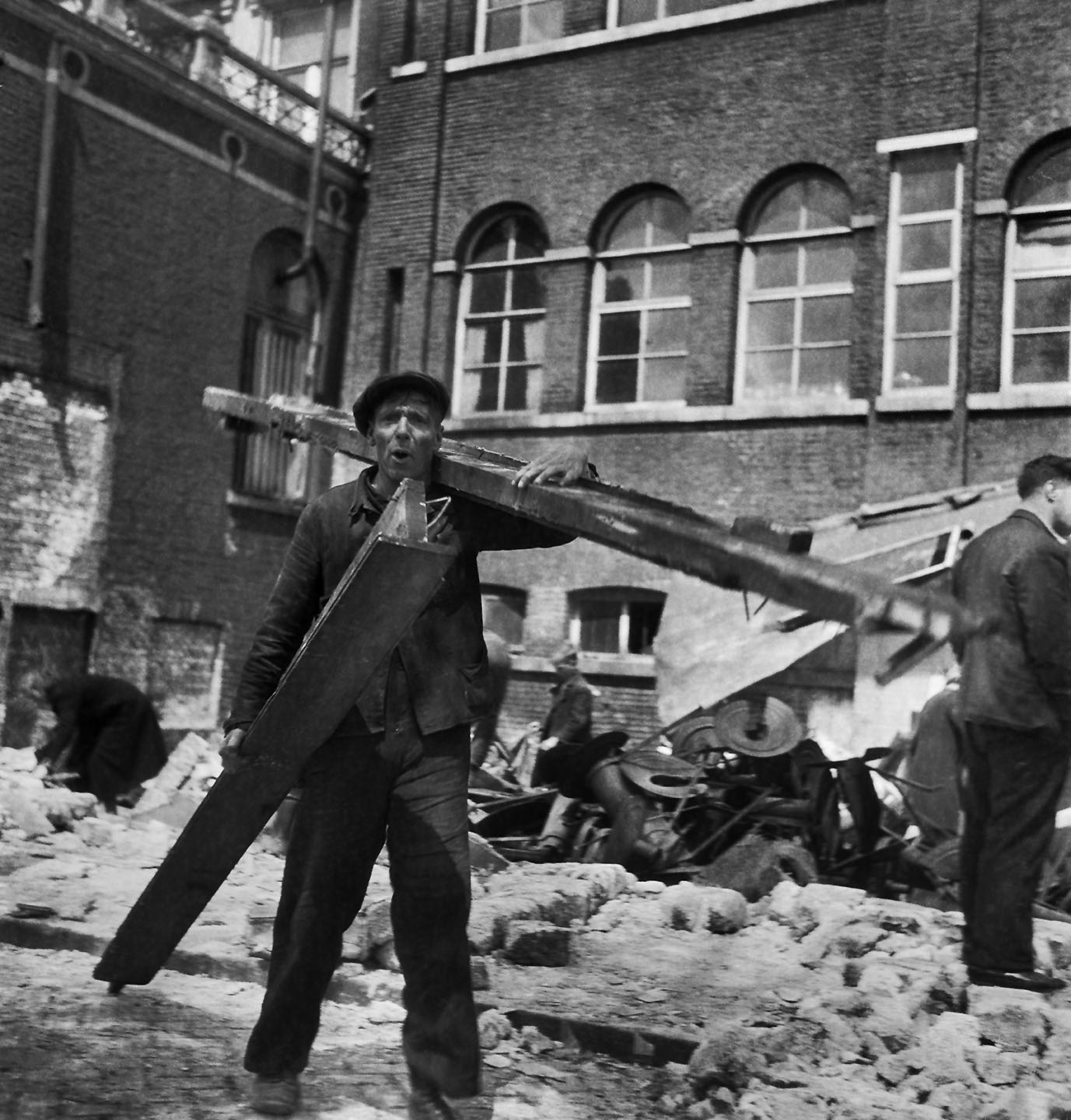
Cas Oorthuys (Dutch, 1908-1975) 'A man collects materials from a demolished building, Zwanenburgstraat' 1944 from the exhibition 'The Underground Camera' at Foam, Amsterdam, May - Sept, 2025


Cas Oorthuys (Dutch, 1908-1975)
A man collects materials from a demolished building, Zwanenburgstraat
1944
© Cas Oorthuys/Nederlands Fotomuseum


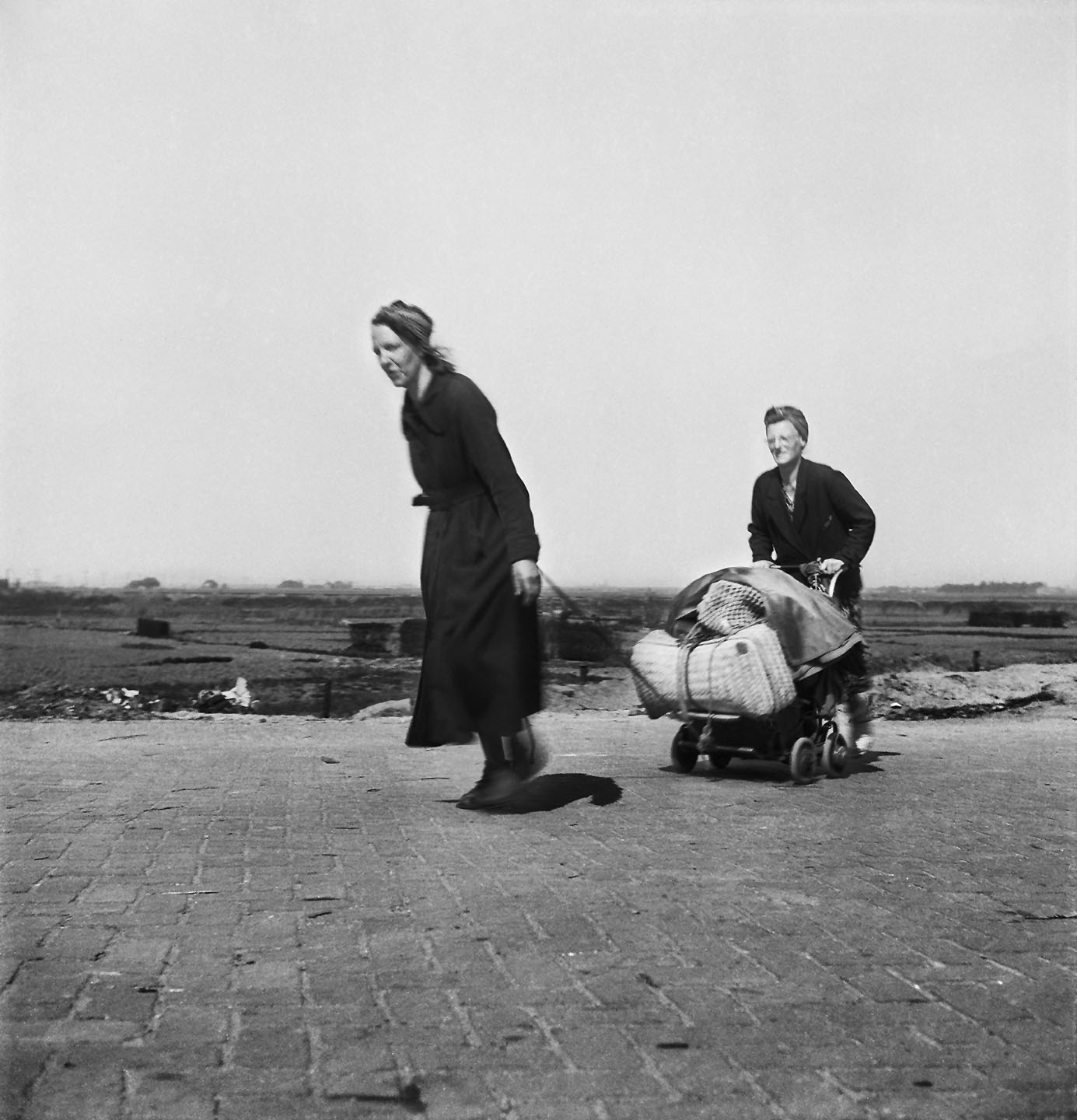
Cas Oorthuys (Dutch, 1908-1975) 'Two women returning from a hunger march' Early 1945


Cas Oorthuys (Dutch, 1908-1975)
Two women returning from a hunger march
Early 1945
Courtesy of Foam
© Cas Oorthuys / Nederlands Fotomuseum


Foam presents The Underground Camera, an exhibition that features work from Dutch photographers who captured the consequences of the German occupation during the 1944-45 ‘famine winter’ in Amsterdam.

The exhibition The Underground Camera is inspired by the celebrations of Amsterdam’s 750th anniversary and 80 years of liberation.

With their photographs, The Underground Camera group made a significant contribution to the image of the Second World War. The photographers were recruited by members of the resistance, with the aim of informing the Dutch government in London. They worked independently and under the dangerous conditions of an occupied city, with hard-to-obtain, often poor-quality equipment. The exhibition provides an impressive picture of the consequences of hunger and cold in the dismantled Amsterdam at the end of the war.

The group of photographers included Cas Oorthuys, Emmy Andriesse, Charles Breijer, Kryn Taconis, and Ad Windig, among others.

Text from the Foam website


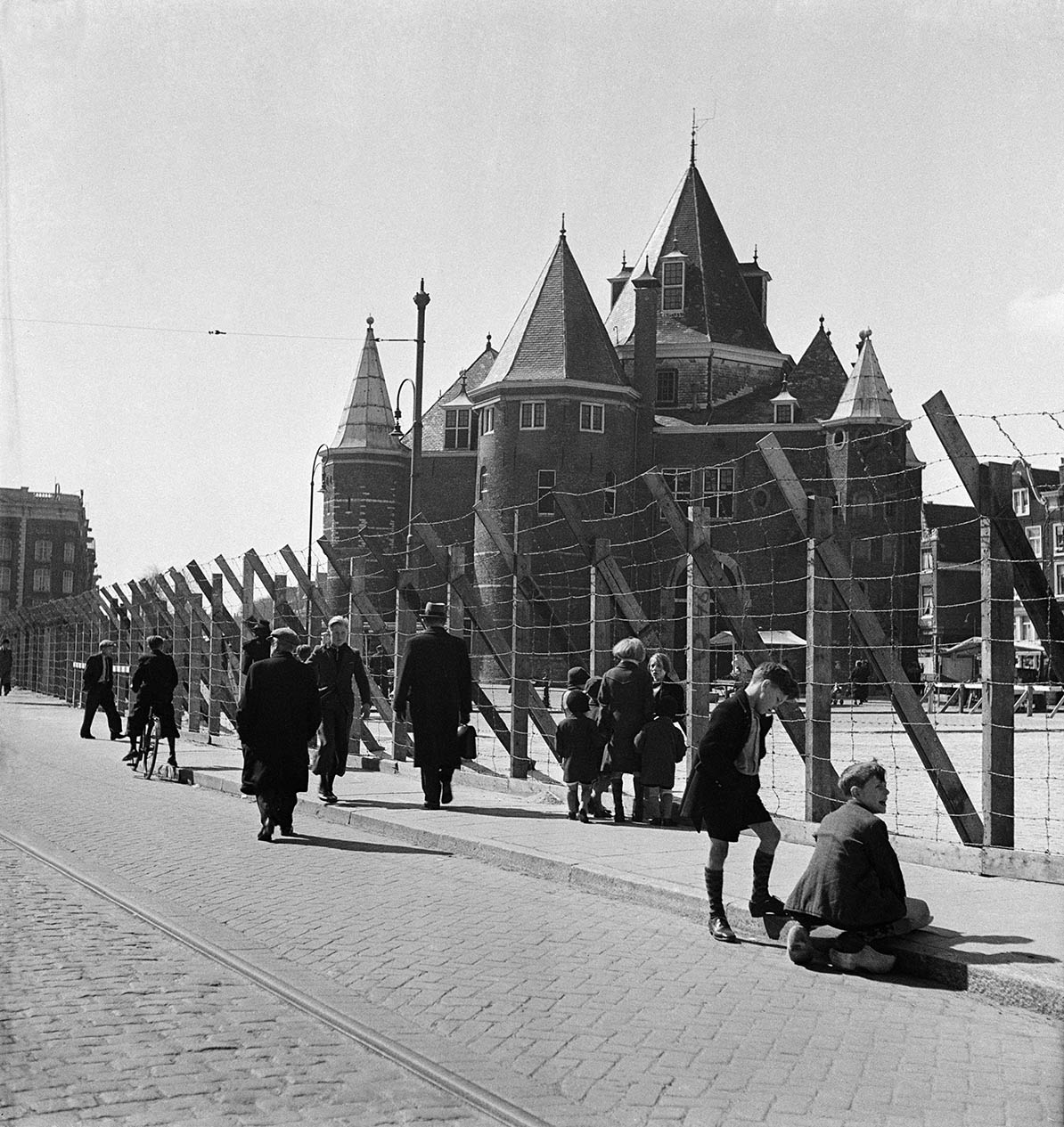
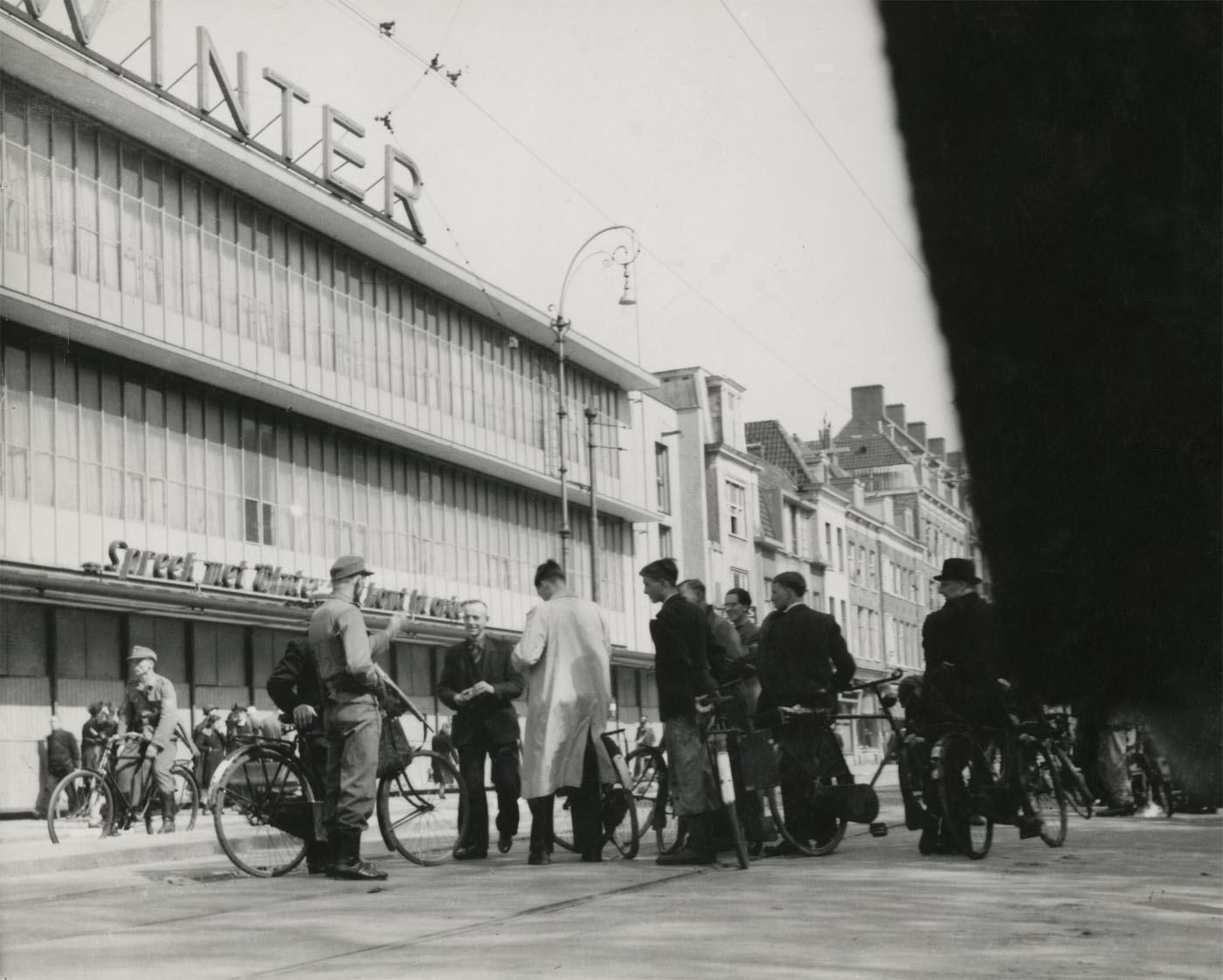
Charles Breijer (Dutch, 1914-2011) 'Closure of the Jewish Quarter near the Waag, Nieuwmarkt, Amsterdam' 1941


Charles Breijer (Dutch, 1914-2011)
Closure of the Jewish Quarter near the Waag, Nieuwmarkt, Amsterdam
1941
© Charles Breijer / Netherlands Photo Museum


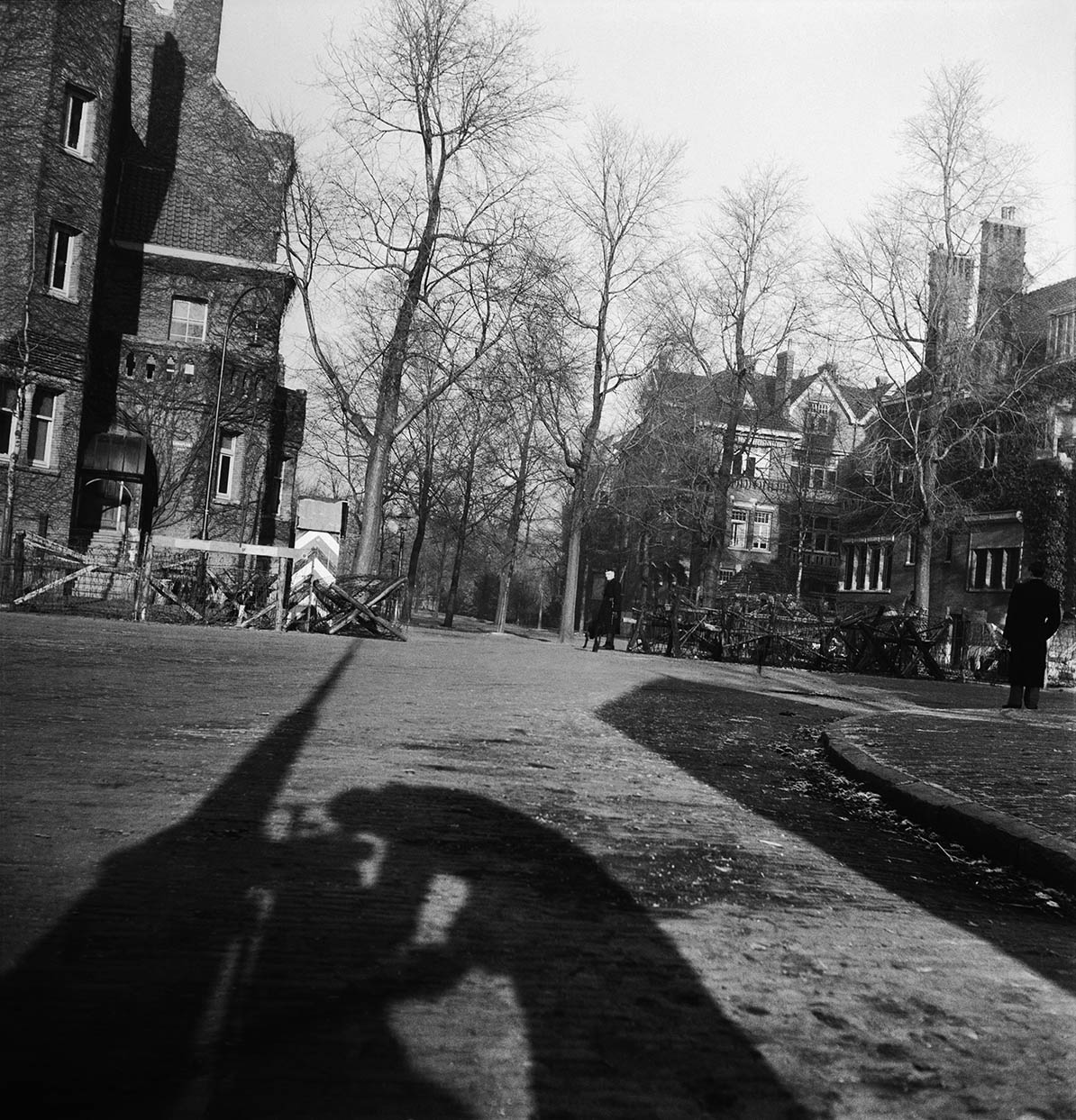
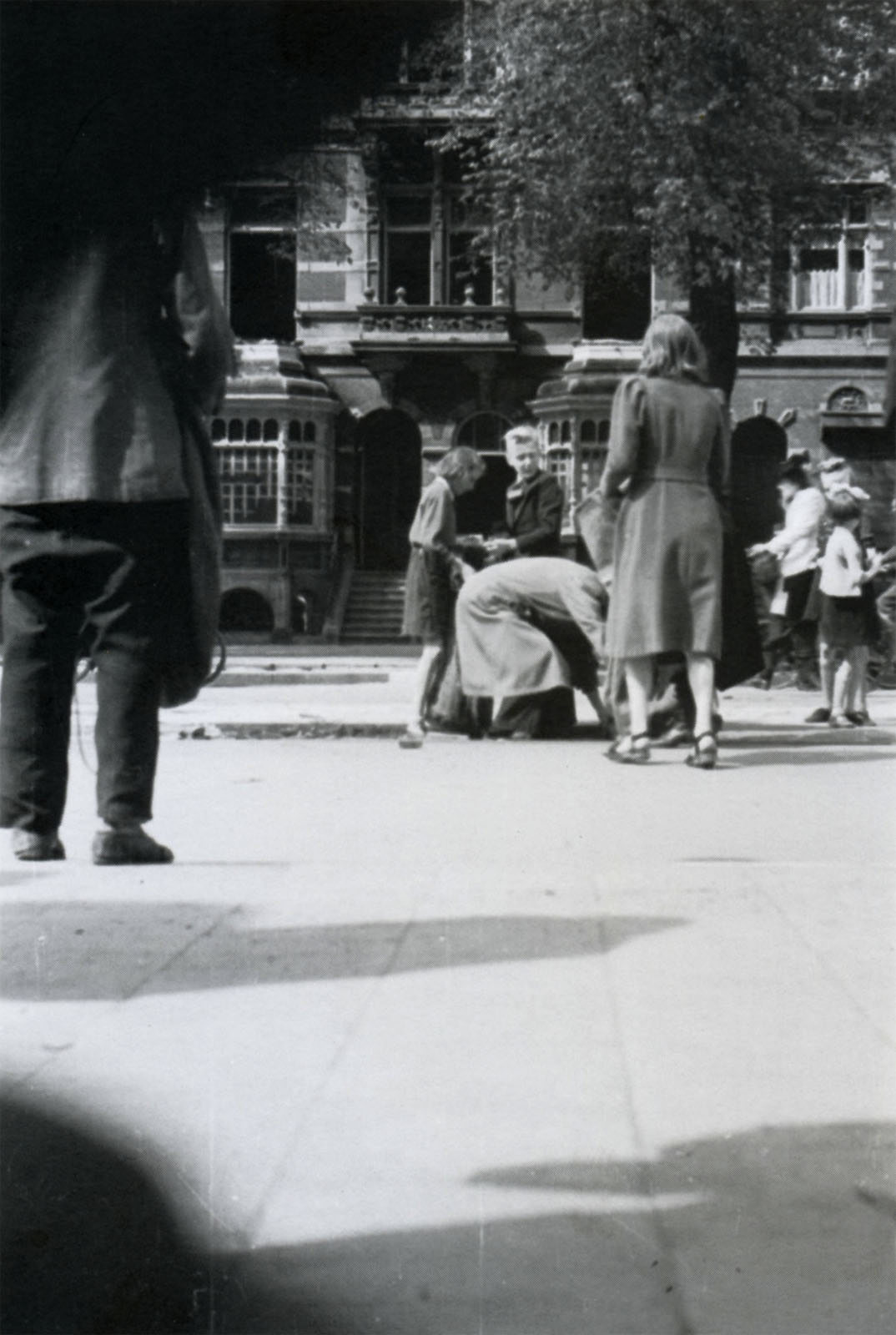
Charles Breijer (Dutch, 1914-2011) 'Charles Breijer photographs a German-requisitioned building near Vondelpark from his bicycle bag. He inadvertently captures his own shadow' Spring 1945


Charles Breijer (Dutch, 1914-2011)
Charles Breijer photographs a German-requisitioned building near Vondelpark from his bicycle bag. He inadvertently captures his own shadow
Spring 1945
Charles Breijer / Netherlands Photo Museum (NFM)


German guard post in front of the Kriegsmarine building at Emmaplein in Amsterdam. Visible in the foreground is the shadow of photographer Charles Breijer, operating his Rolleiflex camera from his pannier.


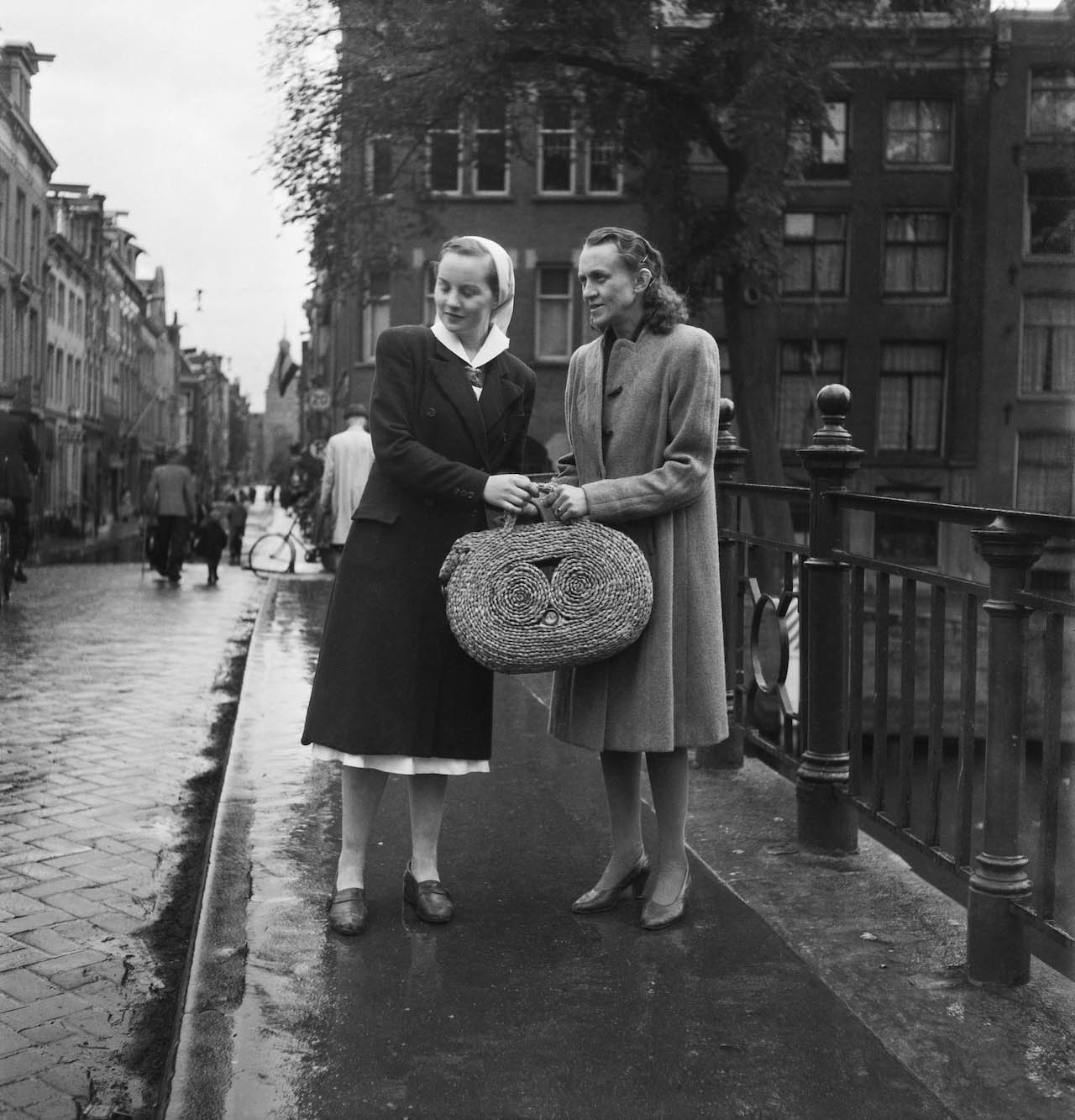
Charles Breijer (Dutch, 1914-2011) 'Andrea Domburg distracts bystanders while Margreet Meijboom-Van Konijnenburg takes the photo from her bag' Nd


Charles Breijer (Dutch, 1914-2011)
Andrea Domburg distracts bystanders while Margreet Meijboom-Van Konijnenburg takes the photo from her bag
Nd
Charles Breijer / Netherlands Photo Museum


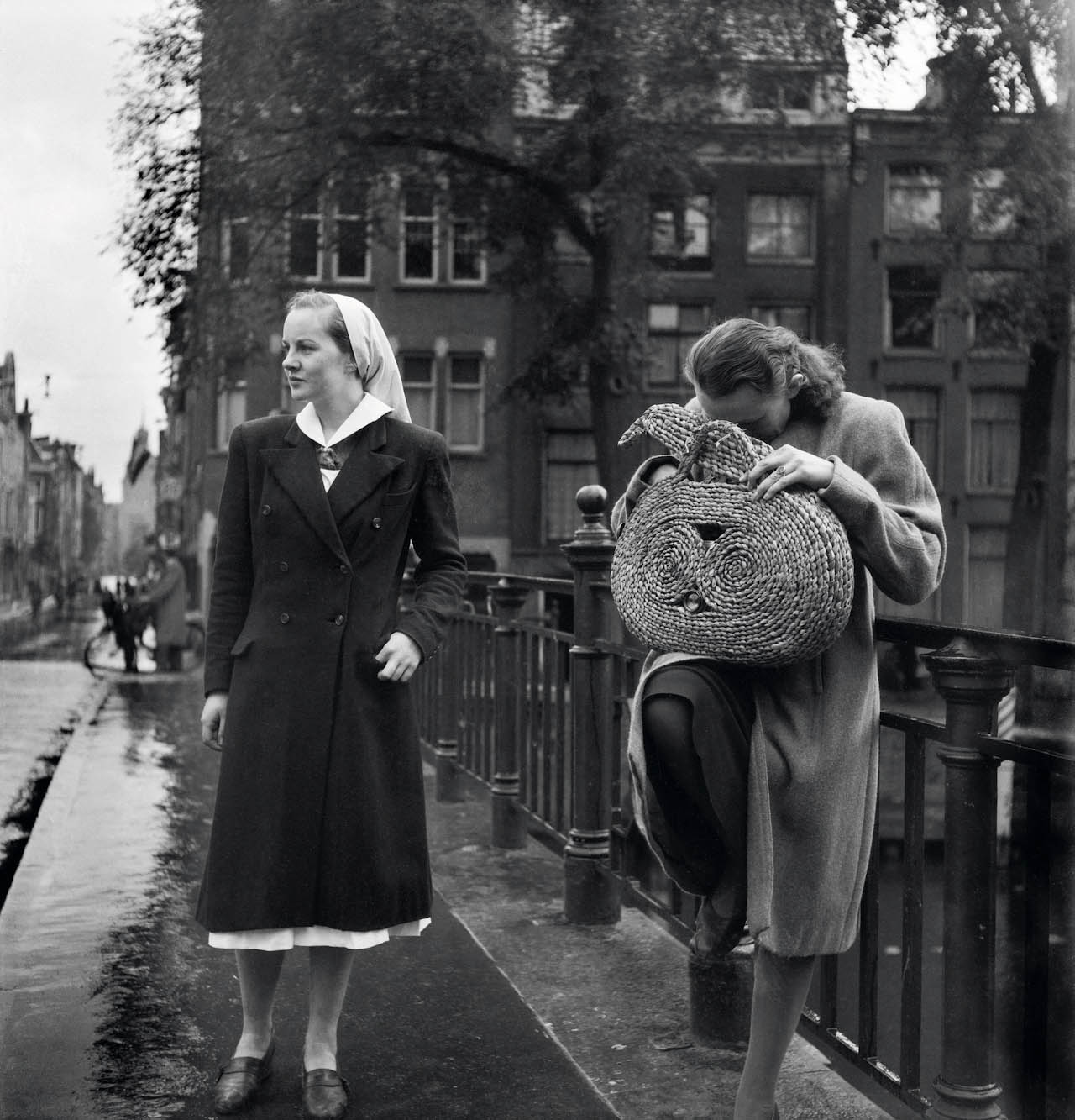
Charles Breijer (Dutch, 1914-2011) 'Margreet Meijboom-van Konijnenbrug (right) demonstrates photographing from a shopping bag. Andrea Domburg, in a nurse's uniform, accompanies her to keep an eye on the surroundings' Nd


Charles Breijer (Dutch, 1914-2011)
Margreet Meijboom-van Konijnenbrug (right) demonstrates photographing from a shopping bag. Andrea Domburg, in a nurse’s uniform, accompanies her to keep an eye on the surroundings
Nd
Charles Breijer / Netherlands Photo Museum


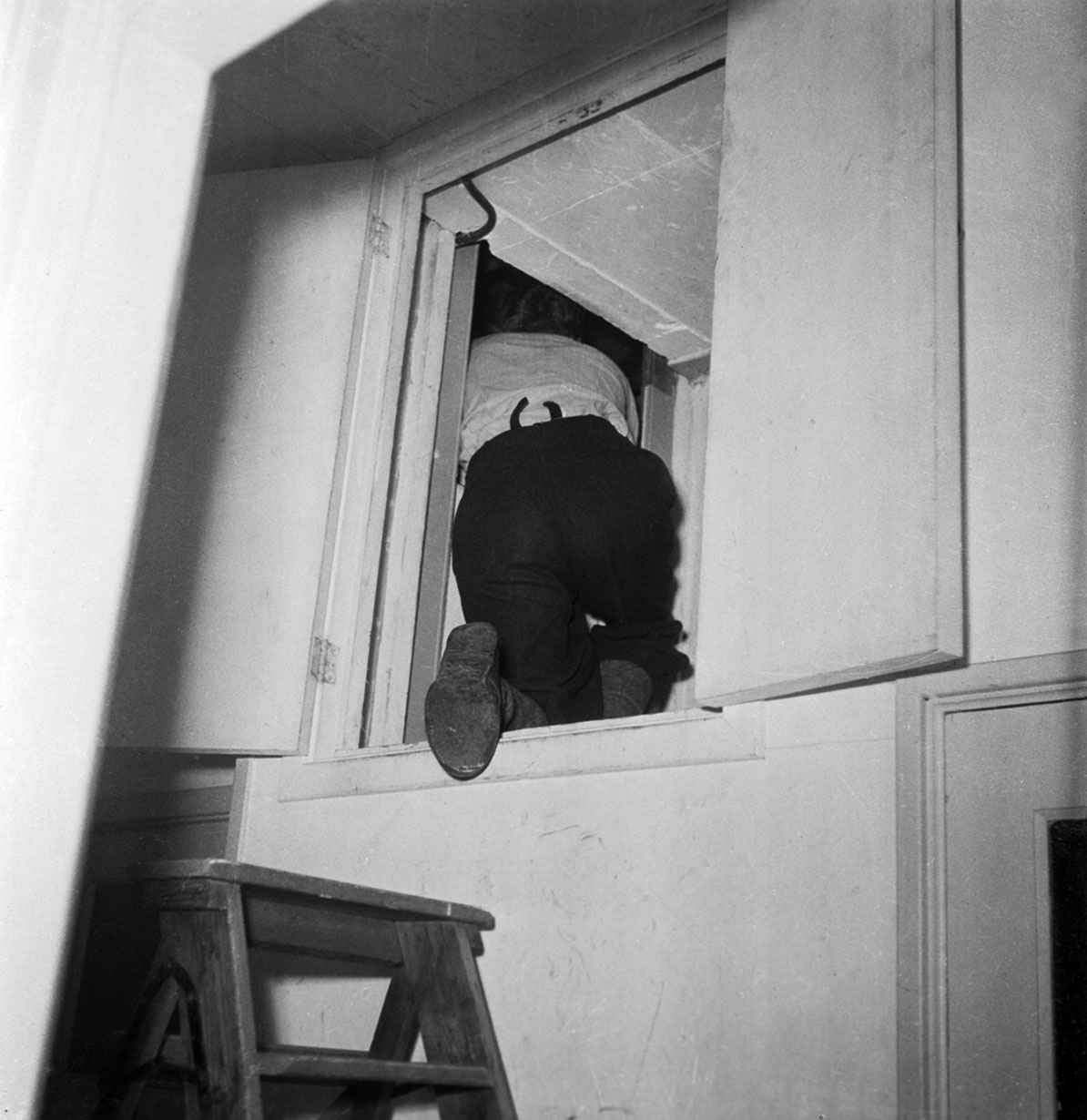
Charles Breijer (Dutch, 1914-2011) 'Joop Kuijt, a refugee, crawls into a hiding place at Oranje Nassaulaan 15, Amsterdam' 1945


Charles Breijer (Dutch, 1914-2011)
Joop Kuijt, a refugee, crawls into a hiding place at Oranje Nassaulaan 15, Amsterdam
1945
© Charles Breijer/Netherlands Photo Museum


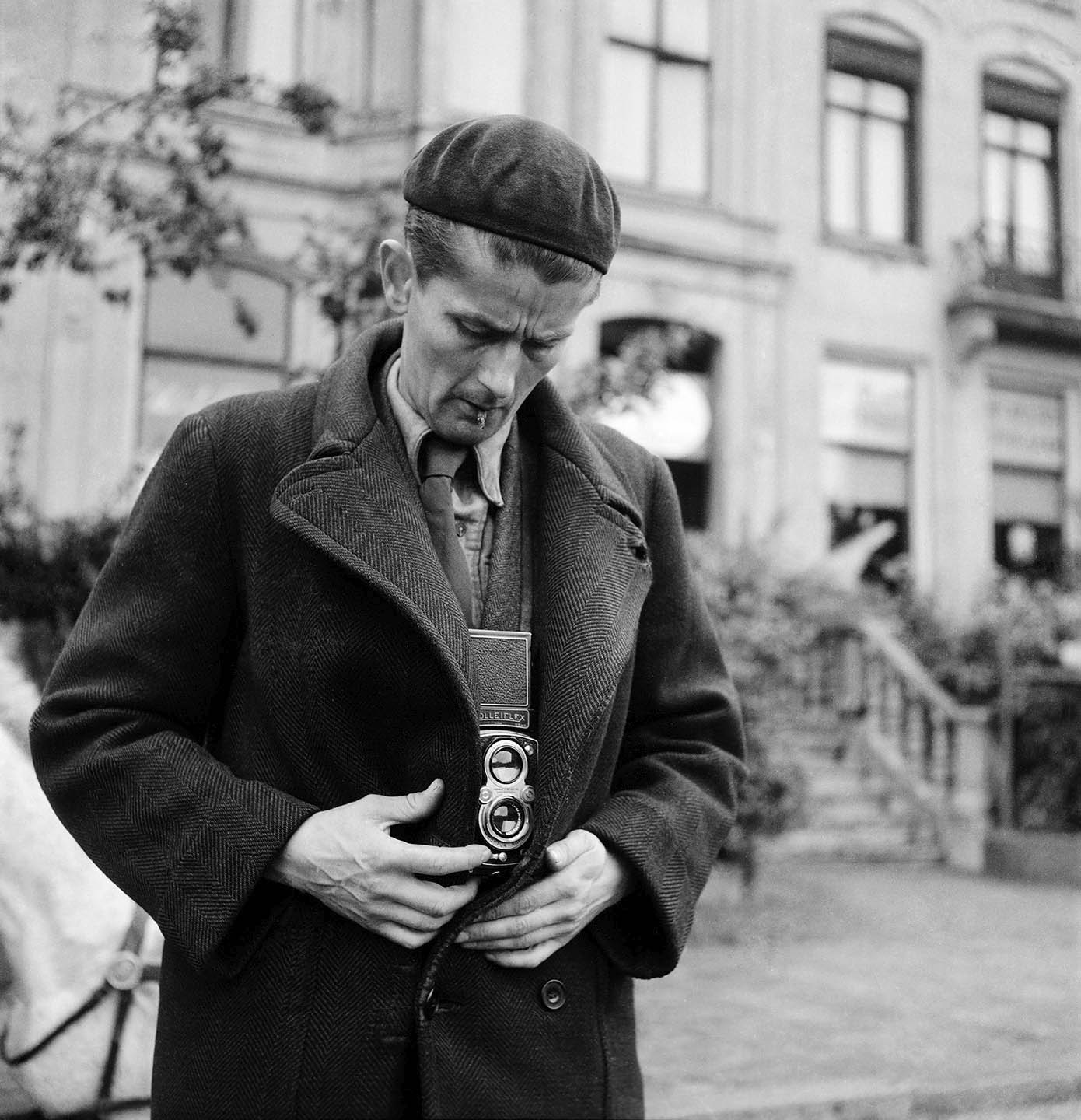
Charles Breijer (Dutch, 1914-2011) 'Shortly after the liberation, Cas Oorthuys demonstrates how he took illegal photographs during the occupation' 1945


Charles Breijer (Dutch, 1914-2011)
Shortly after the liberation, Cas Oorthuys demonstrates how he took illegal photographs during the occupation
1945
© Charles Breijer / Nederlands Fotomuseum


In honour of Amsterdam’s 750th jubilee and the 80th remembrance of the Netherlands’ liberation, Foam presents The Underground Camera (De Ondergedoken Camera). The exhibition showcases images captured by the group of photographers who came to be known by the same name. They photographed the harsh realities of Amsterdam during the ‘Hunger Winter’ of 1944-1945, offering a rare glimpse into the courageous missions of the resistance group and their role in documenting the Nazi occupation. The exhibition features work by renowned Dutch photographers such as Cas Oorthuys, Charles Breijer and Emmy Andriesse.

The resistance group was led by Fritz Kahlenberg and Tonny van Renterghem. In November 1944, when the German administration banned public photography, they – alongside a network of fourteen photographers – worked in secrecy to document the occupation and the resistance. Their efforts, carried out at great personal risk, preserved a crucial visual record of this era. Kahlenberg, a German Jewish filmmaker who had migrated to Amsterdam in 1933, was involved in the forgery of identity cards for the resistance. Van Renterghem had a military background and was also actively involved in resistance work. Although he was not a photographer himself, he played a crucial role in the coordination between The Underground Camera and other resistance groups. The images taken by the photographers of The Underground Camera were intended to be smuggled to London to convince the Dutch government in exile of the need for Allied food droppings in the Netherlands. Today, the photos provide a realistic perspective of daily life in Amsterdam during the last months of the German occupation.

The historical material of the group was stored in various Dutch collections in the form of negatives, original photo prints, albums and picture books. The exhibition sheds light on topics such as the Hunger Winter, the resistance, the illegal press, instances of sabotage, the transport of weapons and the liberation by the Allied Forces.

The Underground Camera is the result of a close collaboration with the NIOD Institute for War, Holocaust and Genocide Studies. A publication by the same name, written by NIOD-researchers René Kok and Erik Somers, will be released in March 2025. The exhibition has been co-curated by Hripsimé Visser, former curator of photography at Stedelijk Museum Amsterdam, in collaboration with exhibition designer Jeroen de Vries.

The Mayor of Amsterdam, Femke Halsema, will open the exhibition at Foam.

The exhibition The Underground Camera is part of a research trajectory within Foam’s artistic programme, launched in early 2024 under the title The Camera as a Weapon, which included a pop-up exhibition of the same name and a symposium. In a time marked by conflict, Foam poses the question: what can photography do? Through this research line – which also includes the exhibition Sakir Khader – Yawm al-Firak – the museum responds to current events by presenting artistic practices in which the camera is used as a weapon.
In light of the national observance of Remembrance Day on 4 May and the national celebration of Liberation Day on 5 May, het Amsterdams 4 en 5 mei comité, in collaboration with Foam en NIOD, will also present an exhibition. This public exhibition will be shown from 29th of April until the 6th of May on the Museumplein.

About The Underground Camera

Kahlenberg and Van Renterghem, the driving forces behind the operation, instructed a group of photographers from their main location at the Michelangelostraat 36 in Amsterdam South from where they oversaw their resistance activities. Many of the The Underground Camera photographers would later become internationally renowned. They concealed their cameras in handbags and jackets in order for them to take the pictures unnoticed. Many used Rolleiflex cameras which had a viewfinder on top, making it easier to take pictures from hip height. Given the danger of being involved in organised resistance, the photographers did not know who else was part of the collective and worked under neutral names such as ‘Netherlands Archive’ (‘Nederlands Archief’) and ‘Central Imagery Archive’ (‘Centraal Beeldarchief’). Just a few weeks after the liberation, in early June 1945, a selection of work was showcased in the exhibition The Underground Camera located in the studio of the photographer Marius Meijboom at the Keizersgracht in Amsterdam. The exhibition brought national recognition for The Underground Camera’s work, leading the group to officially adopt this name. Now, 80 years later, their legacy returns in a new exhibition along the same canal.

UNESCO included The Underground Camera in its Dutch Memory of the World Register, making it the first photographic legacy ever to receive this prestigious distinction.

The Underground Camera consisted of Tonny van Renterghem (1919-2009), Fritz Kahlenberg (1916-1996), Emmy Andriesse (1914-1953), Carel Blazer (1911-1980), Charles Breijer (1914-2011), Cornelis Holtzapffel (1916-1984), Ingeborg Kahlenberg-Wallheimer (1920-1996), Boris Kowadlo (1912-1959), Frits Lemaire (1921-2005), Marius Meijboom (1911-1998), Margreet Meijboom-van Konijnenburg (1910-onbekend), Cas Oorthuys (1908-1975), Hans Sibbelee (1915-2003), Ben Steenkamp (1917-1967), Ad Windig (1912-1996) and Krijn Taconis (1918-1979). Taconis was the first Dutch person to become a member of renowned international photography collective Magnum.

Press release from Foam


Margaretha van Konijnenburg (1910 - d.) 'Bicycle raid on the Weteringplantsoen in Amsterdam' Autumn 1944


Margaretha van Konijnenburg (1910 – d.)
Bicycle raid on the Weteringplantsoen in Amsterdam
Autumn 1944


Photographed from a shopping bag


Marius Meijboom (Dutch, 1911-1998) 'Hungry' Nd


Marius Meijboom (Dutch, 1911-1998)
Hungry
Nd
© Marius Meijboom, NIOD


Hans Sibbelee (Dutch, 1915-2003) 'Children on Sarphatistraat remove the impregnated wooden blocks from between the tram rails, for the stove' March 1945


Hans Sibbelee (Dutch, 1915-2003)
Children on Sarphatistraat remove the impregnated wooden blocks from between the tram rails, for the stove
March 1945


The photographer took the photo from under his jacket


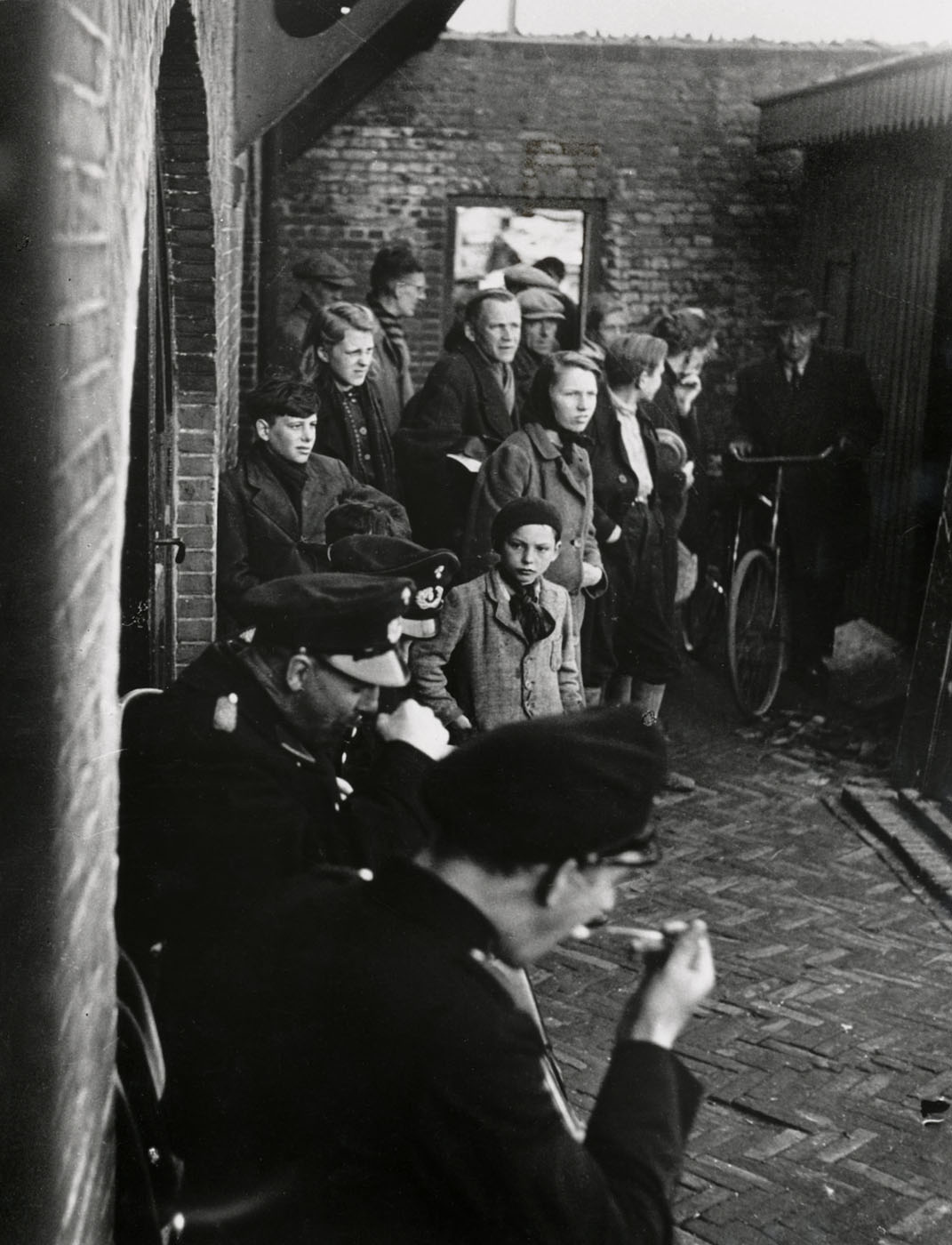
Krijn Taconis (Dutch, 1918-1979) 'Police officers guarding food supplies in the Amsterdam harbour to prevent looting will receive an extra meal' Nd


Krijn Taconis (Dutch, 1918-1979)
Police officers guarding food supplies in the Amsterdam harbour to prevent looting will receive an extra meal
Nd
Krijn Taconis / Niod


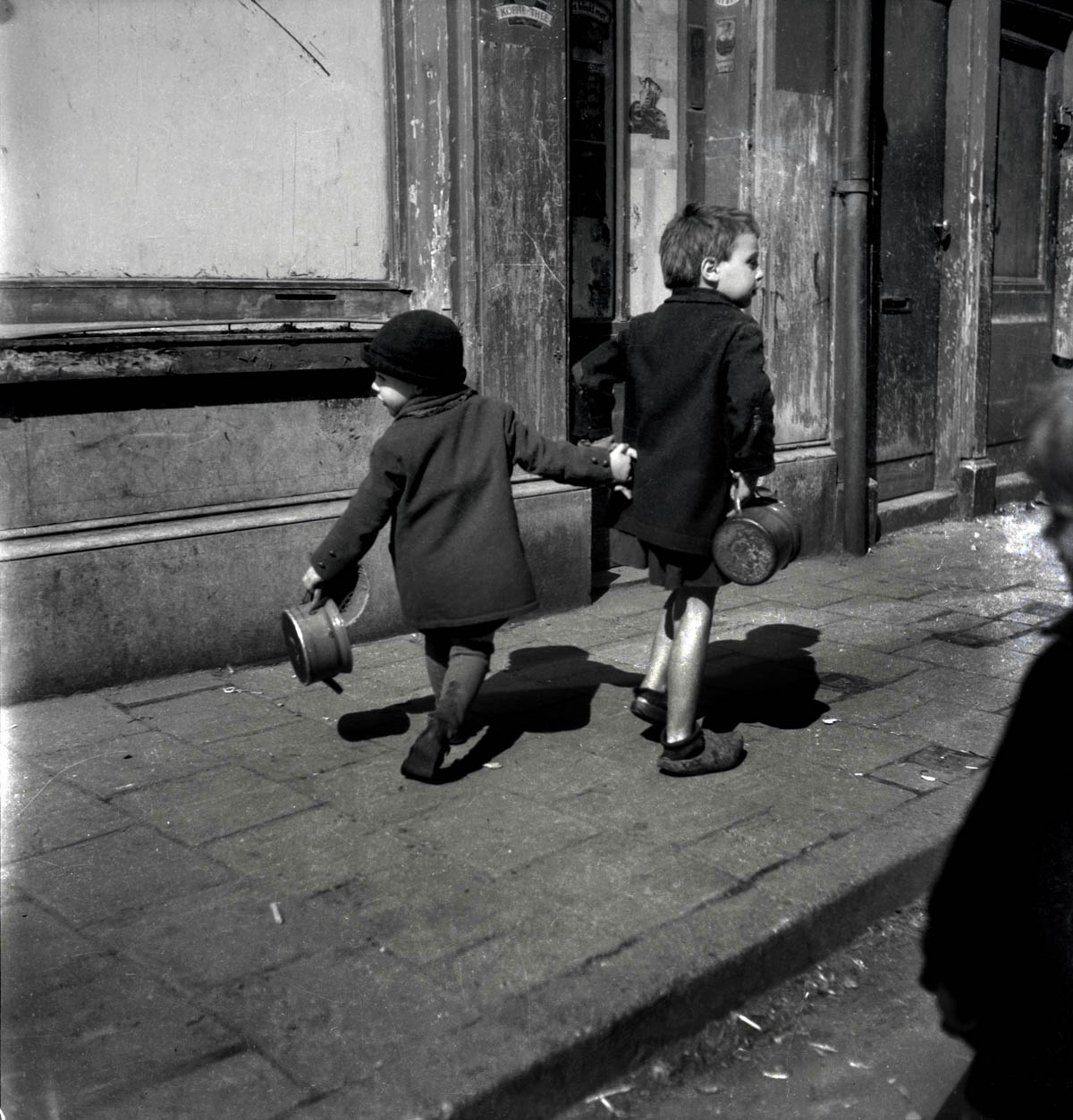
Emmy Andriesse (Dutch, 1914-1953) 'On the way to the soup kitchen' Nd


Emmy Andriesse (Dutch, 1914-1953)
On the way to the soup kitchen
Nd
BBWO2 / Leiden University Library


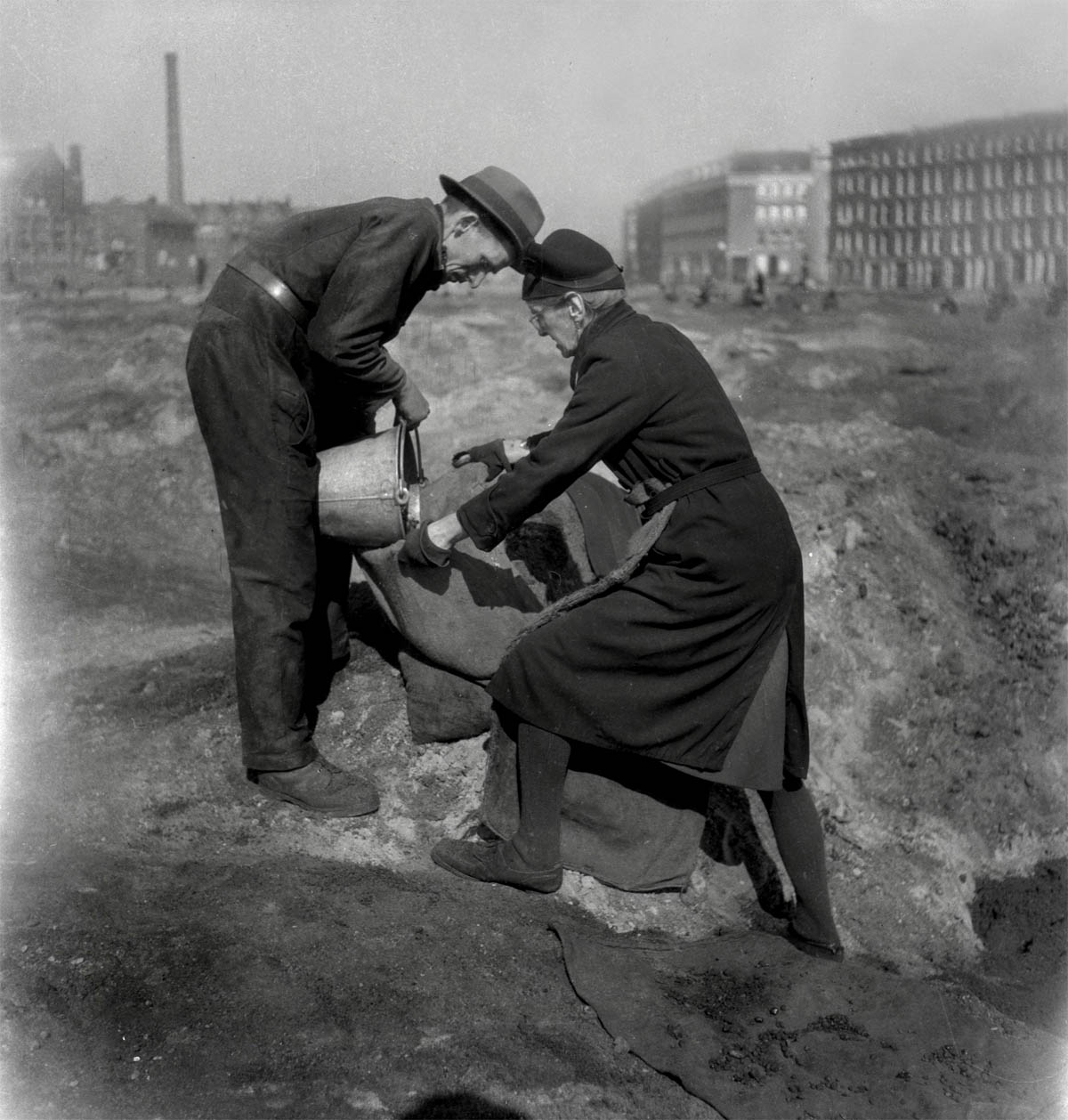
Emmy Andriesse (Dutch, 1914-1953) 'A man and a woman find some coal remains at the Weesperpoort station in Amsterdam' Spring 1945


Emmy Andriesse (Dutch, 1914-1953)
A man and a woman find some coal remains at the Weesperpoort station in Amsterdam
Spring 1945


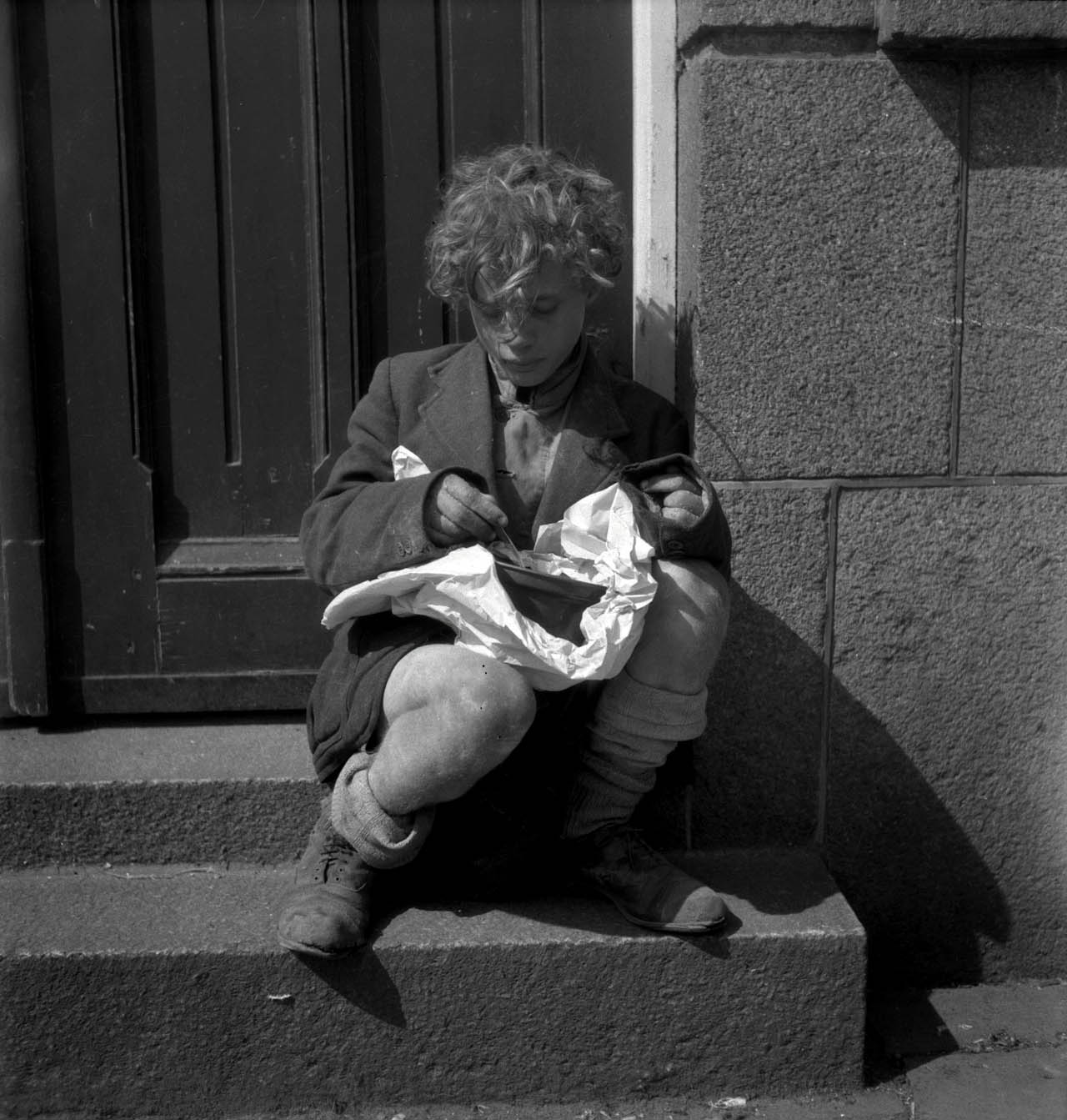
Emmy Andriesse (Dutch, 1914-1953) 'A boy eats a meal from a soup kitchen' Nd


Emmy Andriesse (Dutch, 1914-1953)
A boy eats a meal from a soup kitchen
Nd


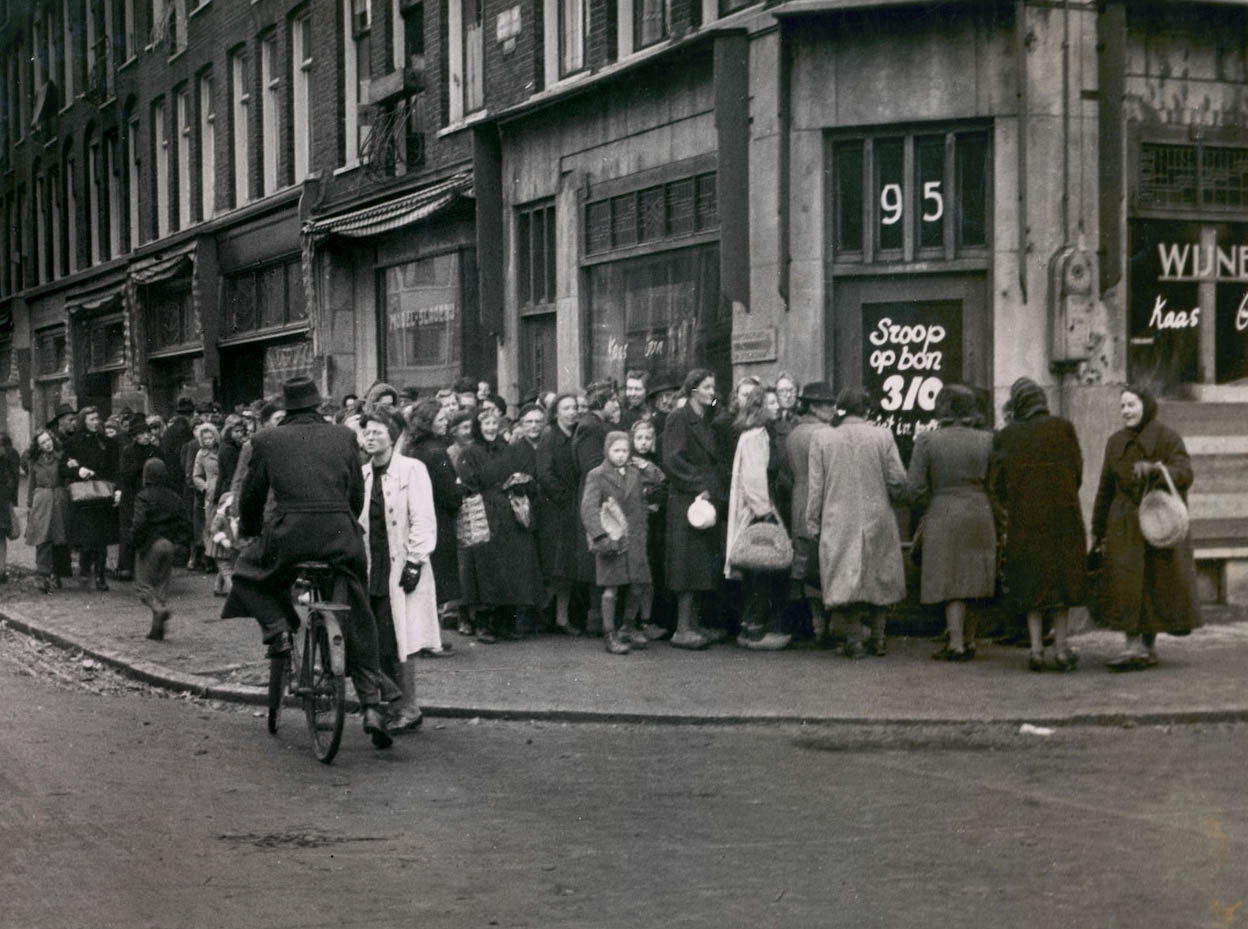
H.R. Kettner (Dutch, 1916 - d.) 'The distribution of groceries became increasingly difficult, resulting in long lines in front of, among other places, the Wijnbergh & Co. store on Middenweg' Nd


H.R. Kettner (Dutch, 1916 – d.)
The distribution of groceries became increasingly difficult, resulting in long lines in front of, among other places, the Wijnbergh & Co. store on Middenweg
Nd


Other photographs by The Underground Camera photographers


Emmy Andriesse (Dutch, 1914-1953) 'Amsterdam tijdens de hongerwinter' (Amsterdam during the hunger winter) [1944-1945] book published 1947


Emmy Andriesse (Dutch, 1914-1953)
Amsterdam tijdens de hongerwinter (Amsterdam during the hunger winter) [1944-1945]
Published 1947
Bound volume
Closed:
29.21 x 22.86cm (11 1/2 x 9 in.)
Open: 29.21 x 44.45cm (11 1/2 x 17 1/2 in.)
National Gallery of Art Library, David K.E. Bruce Fund


Emmy Andriesse (Dutch, 1914-1953)

Emmy Eugenie Andriesse (Dutch, 1914-1953) was a Dutch photographer best known for her work with the Underground Camera group (De Ondergedoken Camera [nl]) during World War II. …

War years and the ‘Underground Camera’

In June 1941 Andriesse married graphic designer and visual artist Dick Elffers (a gentile with whom she had two sons, one who died young), but as a Jew during the Nazi occupation Andriesse was no longer able to publish and she was forced into hiding. At the end of 1944, with the assistance of the anthropologist Arie de Froe [nl] she forged an identity card and re-engaged in everyday life, joining a group of photographers, including Cas Oorthuys and Charles Breijer, working clandestinely as De Ondergedoken Camera. The photos that Andriesse made under very difficult conditions of famine in Amsterdam, include Boy with pan, The Gravedigger and Kattenburg Children are documents of hunger, poverty and misery during the occupation in the “winter of hunger” of 1944-1945.

Post-war

After the war, she became a fashion photographer and was an associate and mentor of Ed van der Elsken. She participated in the group show Photo ’48 and in 1952, together with Carel Blazer [nl], Eva Besnyö and Cas Oorthuys, the exhibition Photographie, both in Amsterdam’s Stedelijk Museum. Edward Steichen chose her 1947 portrait of a staid and elderly Dutch couple for the section ‘we two form a multitude’ in the Museum of Modern Art world-touring The Family of Man that was seen by an audience of 9 million. More recently (October 2006 – January 2007) she was included in a display of Twentieth Century European photography at the Barbican Art Gallery, London.

Andriesse’s last commission, the book The World of Van Gogh – published posthumously in 1953 – was not yet complete when she became ill and after a long battle with cancer, died at the age of 39.

Text from the Wikipedia website


Emmy Andriesse (Dutch, 1914-1953) 'Amsterdam tijdens de hongerwinter' (Amsterdam during the hunger winter) [1944-1945] book published 1947 (detail)


Emmy Andriesse (Dutch, 1914-1953)
Amsterdam tijdens de hongerwinter (Amsterdam during the hunger winter) (detail)
1947
Bound volume
Closed:
29.21 x 22.86cm (11 1/2 x 9 in.)
Open: 29.21 x 44.45cm (11 1/2 x 17 1/2 in.)
National Gallery of Art Library, David K.E. Bruce Fund


Steeds grauwer werd het beeld de steden. Schoeisel en kleding raakten totaal versleten.

The image of the cities became increasingly grey. Footwear and clothing became totally worn out.


Emmy Andriesse (Dutch, 1914-1953) 'Amsterdam tijdens de hongerwinter' (Amsterdam during the hunger winter) [1944-1945] book published 1947 (detail)


Emmy Andriesse (Dutch, 1914-1953)
Amsterdam tijdens de hongerwinter (Amsterdam during the hunger winter) (detail)
1947
Bound volume
Closed:
29.21 x 22.86cm (11 1/2 x 9 in.)
Open: 29.21 x 44.45cm (11 1/2 x 17 1/2 in.)
National Gallery of Art Library, David K.E. Bruce Fund


De etalages waren leeg of toonden alleen vervangingsmiddelen.

The shop windows were empty or only showed substitutes.


Foam
Keizersgracht 609
1017 DS Amsterdam
The Netherlands
Phone: 31 (0)20 5516500

Opening hours:
Monday – Wednesday 10am – 6pm
Thursday – Friday 10am – 9pm
Sat – Sun 10am – 6pm

Foam website

LIKE ART BLART ON FACEBOOK

Back to top

Exhibition: ‘Saul Leiter – An Unfinished World’ at Foam, Amsterdam

Exhibition dates: 24th January – 23rd April, 2025


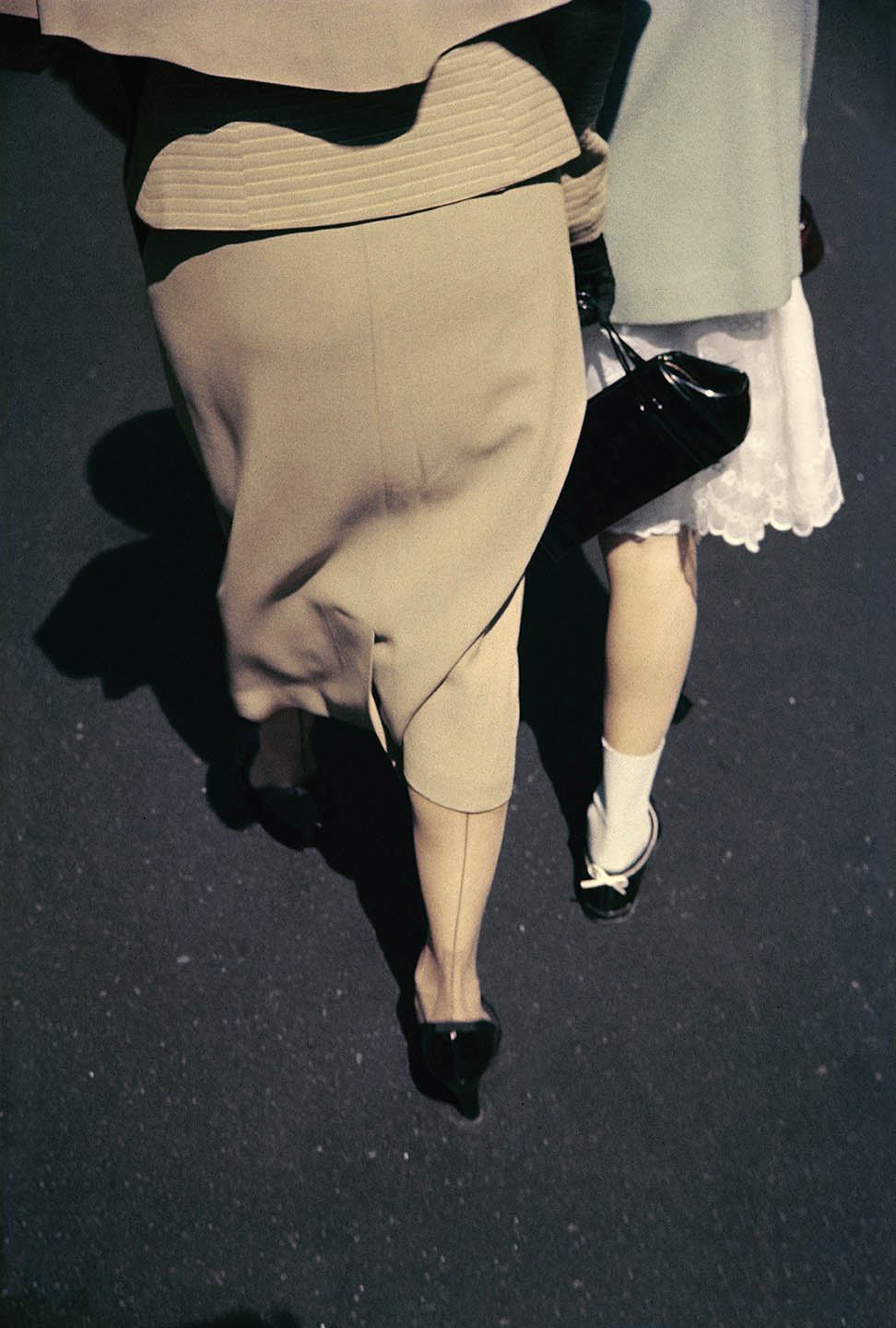
Saul Leiter (American, 1923-2013) 'Jean Pearson' c. 1948 from the exhibition 'Saul Leiter - An Unfinished World' at Foam, Amsterdam, Jan - April 2025


Saul Leiter (American, 1923-2013)
Jean Pearson
c. 1948
From the series In My Room
Gelatin silver print
© Saul Leiter Foundation


Words, words, words, words, words, words, words, words, words, words, words, words, words, words, words, words, words, words, words, words, words, words, words, words, words, words, words, words, words, words.

So many words, so much verbiage about the work of American artist Saul Leiter (1923-2013).

I’d rather not add to that noise.

It is well to reinforce the meaning of an image with text but it is not necessary.

Just be aware …. of the beauty of the image and your feelings towards it.

Lucidly, appreciate the integrity of the image.

Nothing more but certainly nothing less.

Dr Marcus Bunyan

PS. It’s wonderful to see the earlier black and white work, breadcrumb trail of the colour work to come.


Many thankx to Foam for allowing me to publish the photographs in the posting. Please click on the photographs for a larger version of the image.


“Photographs are often treated as important moments, but really they are fragments and souvenirs of an unfinished world.”


Saul Leiter


“I may be old-fashioned. But I believe there is such a thing as a search for beauty – a delight in the nice things in the world. And I don’t think one should have to apologise for it.”


Saul Leiter, In No Great Hurry, 2013


“His photos feel – as Akiko Atake puts it – like “quiet stolen glimpses”; moments plucked from the everyday and preserved in the eye of Leiter’s camera.”


Sophie Mulgrew. “Feb 9 Book Review: Forever Saul Leiter,” on the Musee Magazine website Nd [Online] Cited 18/03/2025


“I’ve always felt a closeness to Japan in Leiter’s work; the photographs in the snow; the women under their umbrellas; the improbable perspectives and revolutionary compositions reminiscent of Japanese woodblocks, ukiyo-e; the presence of the seasons and the verticality of the compositions evoking Japanese scroll paintings, kakajiku; the beauty he found in cracks and broken surfaces, in the unfinished, the worn out, the imperfect – the endurance of the elements and the effects of time. There is a “mono no aware”* beauty to his photographs, in the color work especially – an acute awareness of the beauty of the transient, of the ephemeral, which might explain, in part, their magical and poetic essence.”


Paul Vermare. “Saul Leiter, the New York Nabi,” on the Blind Magazine website, July 3, 2023 [Online] Cited 08/04/2025


“Leiter was destined to become a rabbi like his father, but moved to New York to be a painter, then choosing photography – which appalled his father. Beginning in 1948, Leiter using an Argus C3 camera, then a Leica and a Rolleiflex

In the 2012 documentary, In No Great Hurry, Saul Leiter said: “There are the things that are out in the open, and there are the things that are hidden, and life has more to do, the real world has more to do with what is hidden.” These tender and graceful depictions of “the things that are hidden” – images that Leiter rarely showed – retain their essential mystery, defying interpretation.”


Anonymous. “Saul Leiter’s nude friends and lovers – in pictures,” on The Guardian website 15th August 2018 [Online] Cited 18/03/2025


* mono no aware = a Japanese concept that describes a poignant awareness of the transient nature of existence, a sensitivity to the beauty of things that are fleeting, and a gentle sadness at their passing


Leiter’s love of beauty, Bonnard, Japan, Buddhism, Ukiyo-e prints, Japanese scroll paintings, “ma” (space), kyūdō, haiku.

“The unorthodox and seemingly disproportionate compositions… the emphasis on shapes; the presence of calligraphy; unusual viewpoints and perspectives, everyday subject matter; the ubiquity of women; and a fondness for the ordinary and the ephemeral”

Paul Vermare. “Saul Leiter, the New York Nabi,” on the Blind Magazine website, July 3, 2023 [Online] Cited 08/04/2025


~ Leiter’s complex and impressionistic photographs are as much about evoking an atmosphere as nailing the decisive moment.

~ Leiter was a keen observer as life unfolded before him, somehow finding a way to reliably pluck a sublime split-second out of a mundane moment. ‘I like to take things that are very common and to find something in them,’ he once said.

~ Photographs are often considered important moments, but according to Leiter they are tiny fragments of an unfinished world. Such is his own world: little fragments of images juxtaposed and conjoined, amassing and forming vast, ever-expanding fields.

~ He photographed that which obstructs, hides, encloses, and thus reveals new depths of reality.

~ Everything is a matter of balance, exactitude and humility in the works of this man, who nonetheless accorded great importance to imperfection.

Anonymous. “‘There’s nothing quite like them’: Saul Leiter’s photos and paintings – in pictures,” on The Guardian website Wed 9 Aug 2023 [Online] Cited 08/04/2025


Saul Leiter (American, 1923-2013) 'Exacta' 1948


Saul Leiter (American, 1923-2013)
Exacta
1948
Gelatin silver print
© Saul Leiter Foundation


He photographed that which obstructs, hides, encloses, and thus reveals new depths of reality.


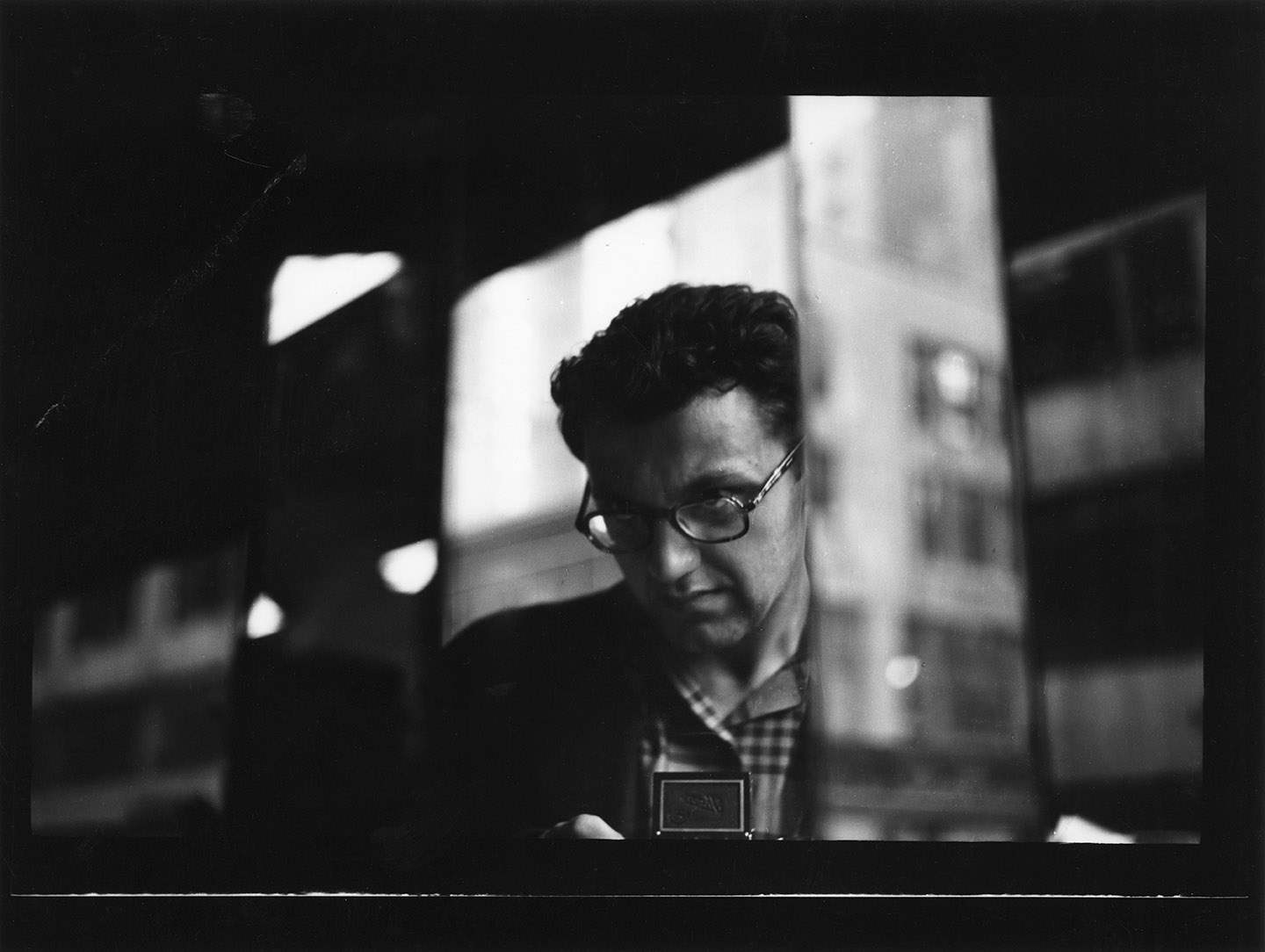
Saul Leiter (American, 1923-2013) 'Selfportrait' 1950s from the exhibition 'Saul Leiter - An Unfinished World' at Foam, Amsterdam, Jan - April 2025


Saul Leiter (American, 1923-2013)
Selfportrait
1950s
Gelatin silver print
© Saul Leiter Foundation


Saul Leiter (American, 1923-2013) 'Ana' 1950s


Saul Leiter (American, 1923-2013)
Ana
1950s
Gelatin silver print
© Saul Leiter Foundation


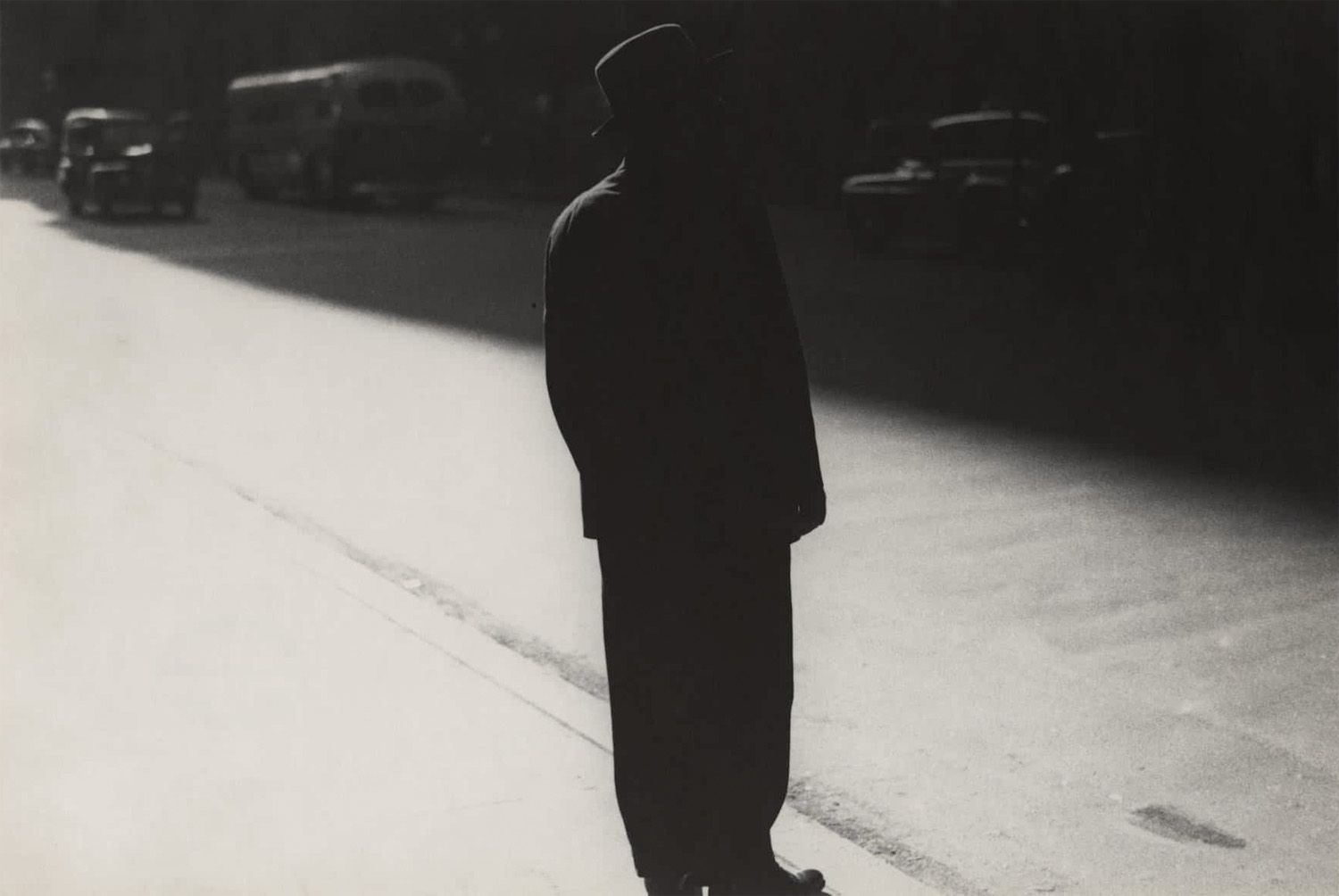
Saul Leiter (American, 1923-2013) 'Sidewalk' 1954


Saul Leiter (American, 1923-2013)
Sidewalk
1954
Gelatin silver print
© Saul Leiter Foundation


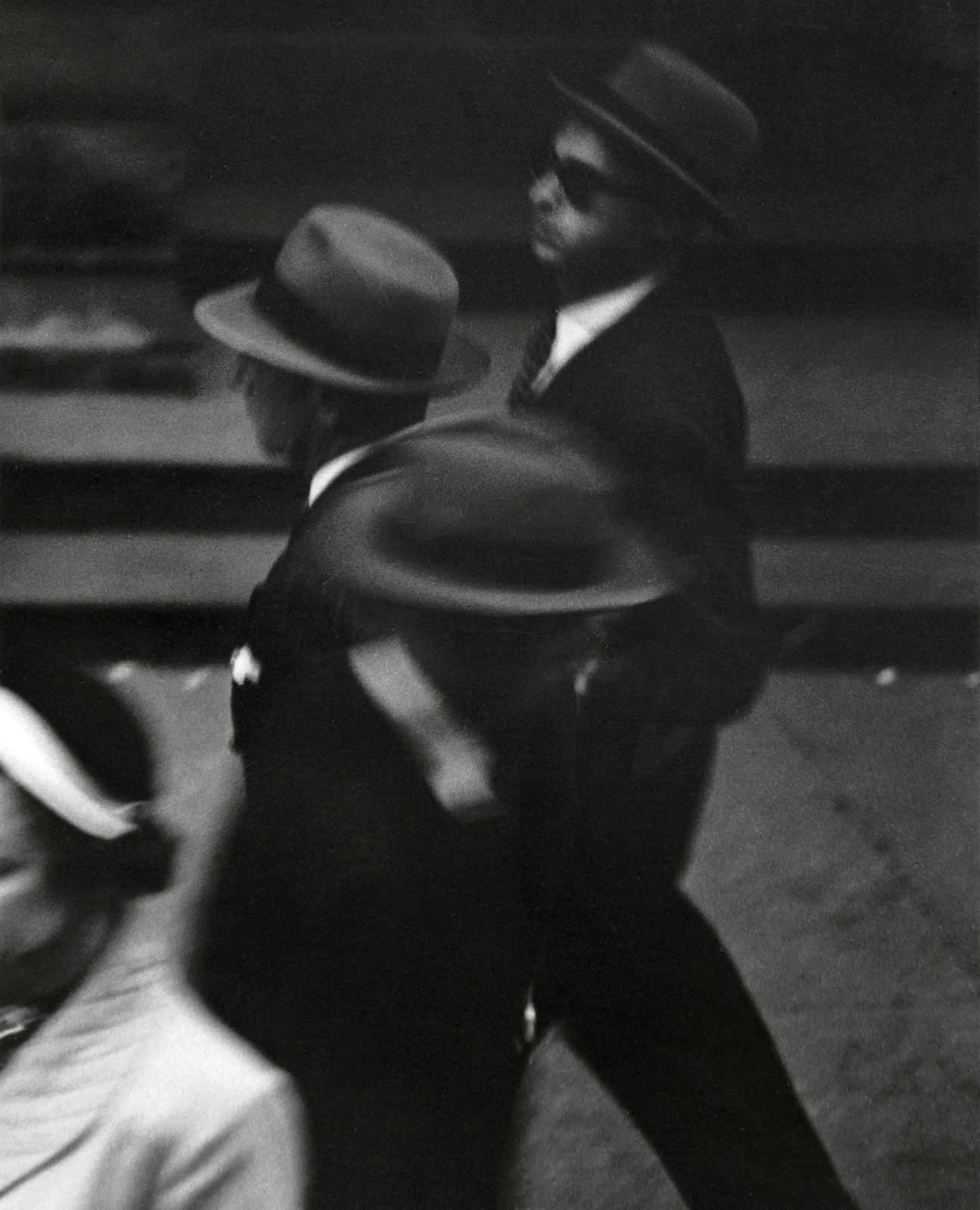
Saul Leiter (American, 1923-2013) 'Hats' c. 1948 from the exhibition 'Saul Leiter - An Unfinished World' at Foam, Amsterdam, Jan - April 2025


Saul Leiter (American, 1923-2013)
Hats
c. 1948
Gelatin silver print
© Saul Leiter Foundation


Installation view of the exhibition 'Saul Leiter - An Unfinished World' at Foam, Amsterdam


Installation view of the exhibition Saul Leiter – An Unfinished World at Foam, Amsterdam


Saul Leiter (American, 1923-2013) 'Untitled' Nd


Saul Leiter (American, 1923-2013)
Untitled
Nd
Gelatin silver print
© Saul Leiter Foundation


Foam is proud to present a major retrospective exhibition of the celebrated American artist Saul Leiter (1923-2013). Leiter is seen as one of the most important photographers of the 1950’s in the United States and a pioneer of colour photography. This exhibition brings together over 200 works, consisting of photography, both black-and-white and colour, as well as his abstract paintings. His eclectic oeuvre reveals a practice using shadow, light, and reflections to craft layered compositions.

About the artist

Saul Leiter (1923-2013) began painting and photographing in his teenage years, gaining an early recognition for his paintings. After moving to New York in 1946, he turned to photography as a profession while continuing to paint. His abstract forms and groundbreaking compositions possess a painterly quality that distinguishes them from the works of other photographers of that era. His work significantly contributed to the emergence of what is now known as the New York School of photography.

In 1957, he began working for major publications like Esquire and Harper’s Bazaar, balancing his commercial success with his personal passion for street photography in his Manhattan neighbourhood. Leiter’s groundbreaking work in colour photography gained widespread acclaim with the release of his first book, Early Colour (2006). By the time of his death in 2013, Leiter had achieved international recognition, with his work featured in numerous museum exhibitions and publications worldwide.

Text from the Foam website


Installation view of the exhibition 'Saul Leiter - An Unfinished World' at Foam, Amsterdam


Installation views of the exhibition Saul Leiter – An Unfinished World at Foam, Amsterdam


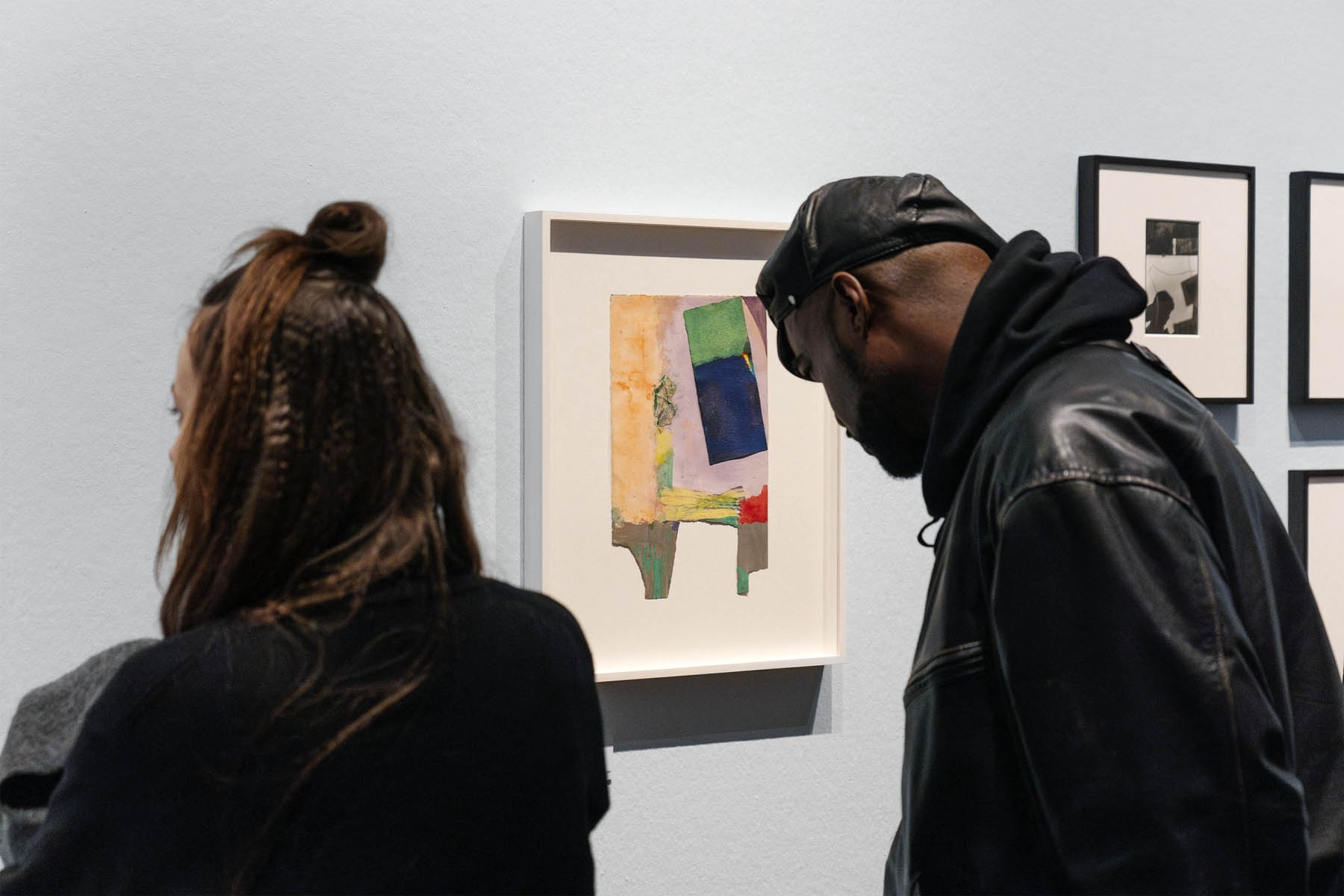
Saul Leiter remained dedicated to painting throughout his career, producing many gouaches (opaque watercolours), which were essential to his artistic expression. While most of his works are abstract, with large areas of colour, some feature playful lines that suggest landscapes or figures. His expressive use of colour is distinctive, often favouring muted tones like soft violets, mauves, and faded ochres or yellows. Although Leiter is best known for his photography, his paintings reflect a similarly poetic and intimate vision of the world.⁠

Text from the Foam Facebook page


Installation view of the exhibition 'Saul Leiter - An Unfinished World' at Foam, Amsterdam


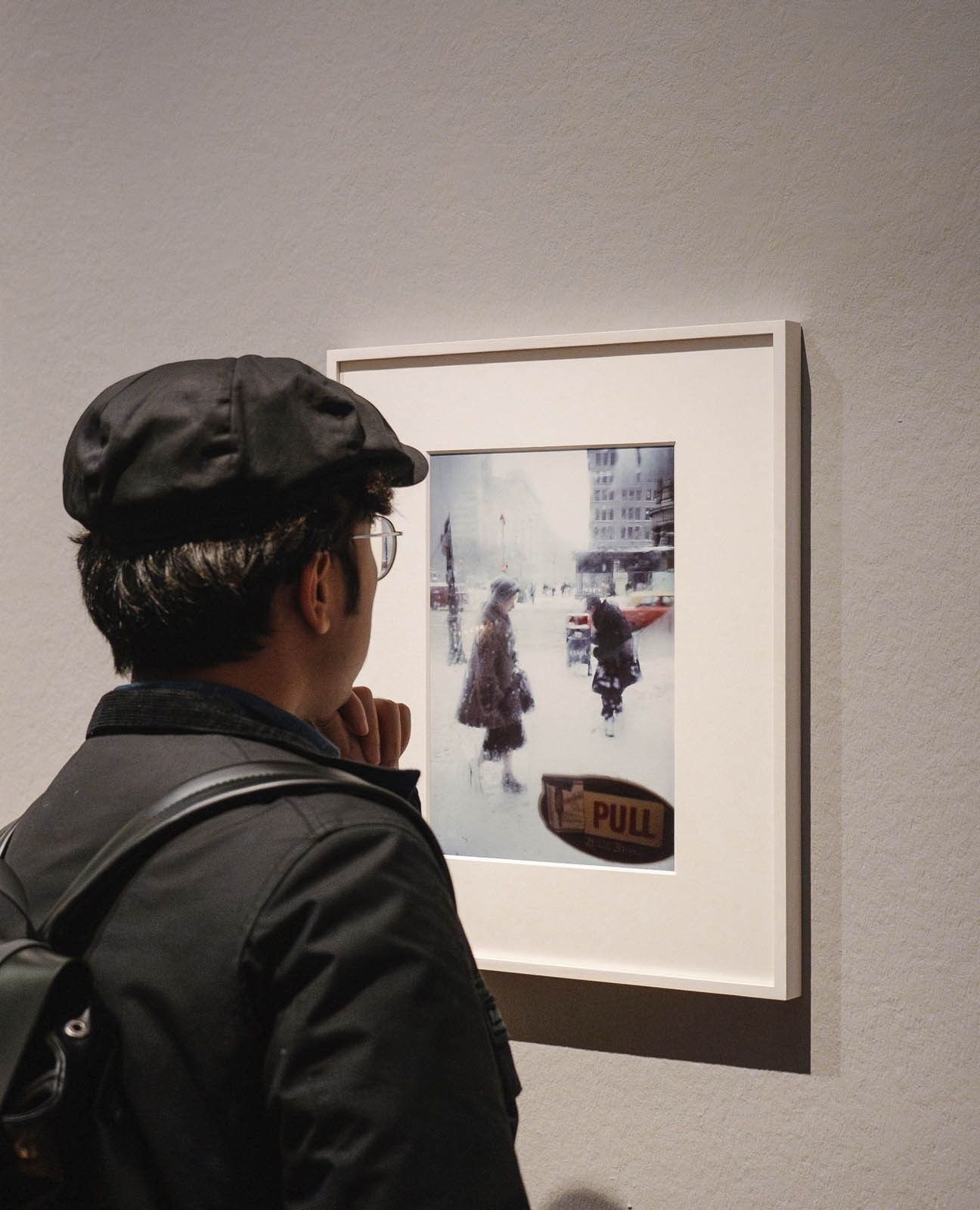
Installation view of the exhibition Saul Leiter – An Unfinished World at Foam, Amsterdam showing Leiter’s photograph The Pull (c. 1960, below)


Saul Leiter (American, 1923-2013) 'Pull' c. 1960


Saul Leiter (American, 1923-2013)
Pull
c. 1960
Chromogenic print
© Saul Leiter Foundation


Leiter was a keen observer as life unfolded before him, somehow finding a way to reliably pluck a sublime split-second out of a mundane moment. ‘I like to take things that are very common and to find something in them,’ he once said.


Installation view of the exhibition 'Saul Leiter - An Unfinished World' at Foam, Amsterdam


Installation view of the exhibition Saul Leiter – An Unfinished World at Foam, Amsterdam showing Leiter’s photograph


Saul Leiter (American, 1923-2013) 'Harlem' 1960 from the exhibition 'Saul Leiter - An Unfinished World' at Foam, Amsterdam, Jan - April 2025


Saul Leiter (American, 1923-2013)
Harlem
1960
Chromogenic print
© Saul Leiter Foundation


Foam is proud to present a major retrospective exhibition of the celebrated American artist Saul Leiter (1923-2013). Leiter is seen as one of the most important photographers of the 1950’s in the United States, and a pioneer of colour photography. This exhibition brings together over 200 works, consisting of photography, both black-and-white and colour, as well as his abstract paintings. His eclectic oeuvre reveals a practice using shadow, light, and reflections to craft layered compositions.

For nearly sixty years, Leiter photographed daily, capturing everyday moments of New York City life. With various techniques and mediums, and the use of telephoto lenses, Leiter would enhance the painterly quality of his images and transform seemingly mundane street scenes into visual poetry. New York, a symbol of modernity in the 1950s, became the backdrop for Leiter’s aesthetic discoveries.

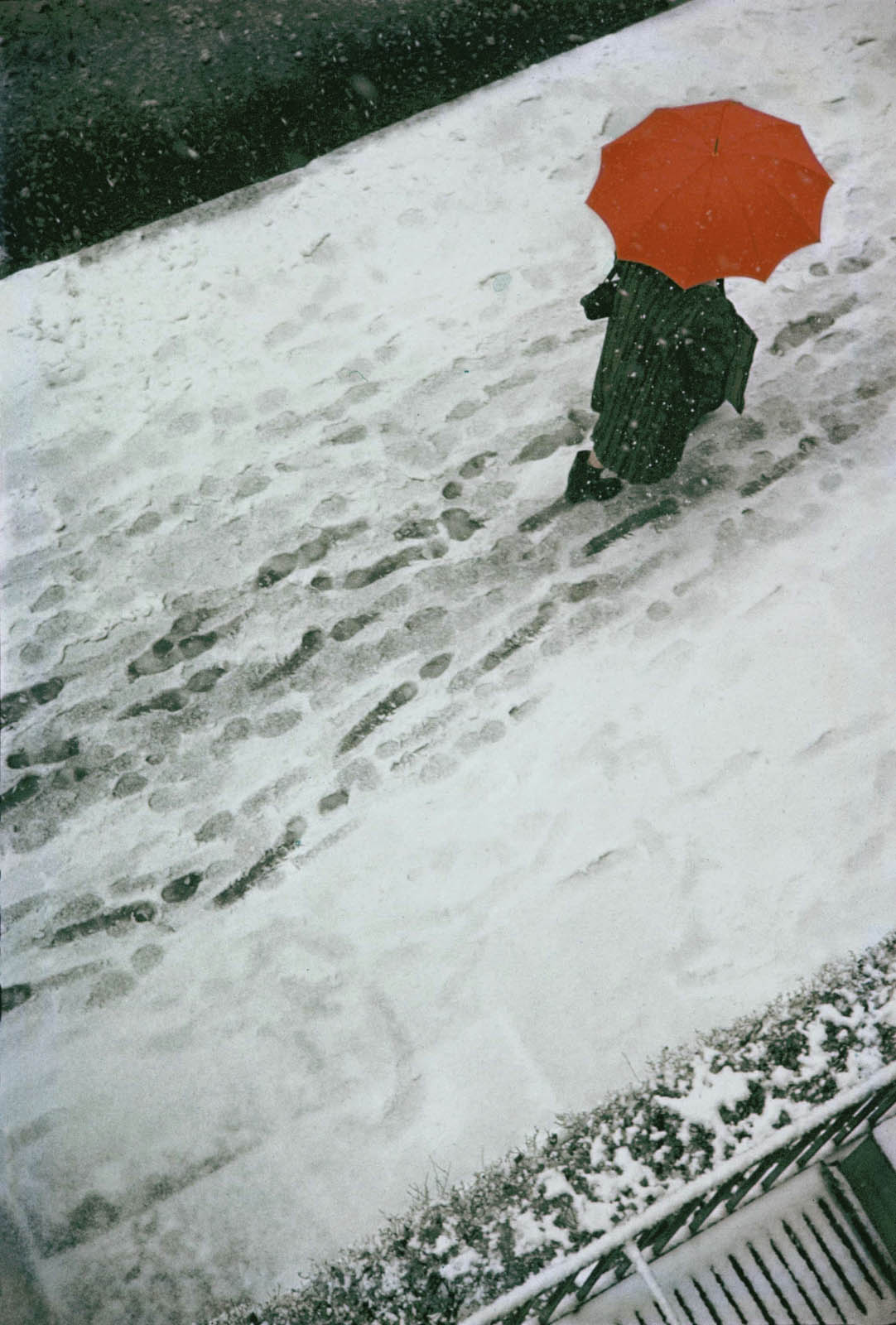
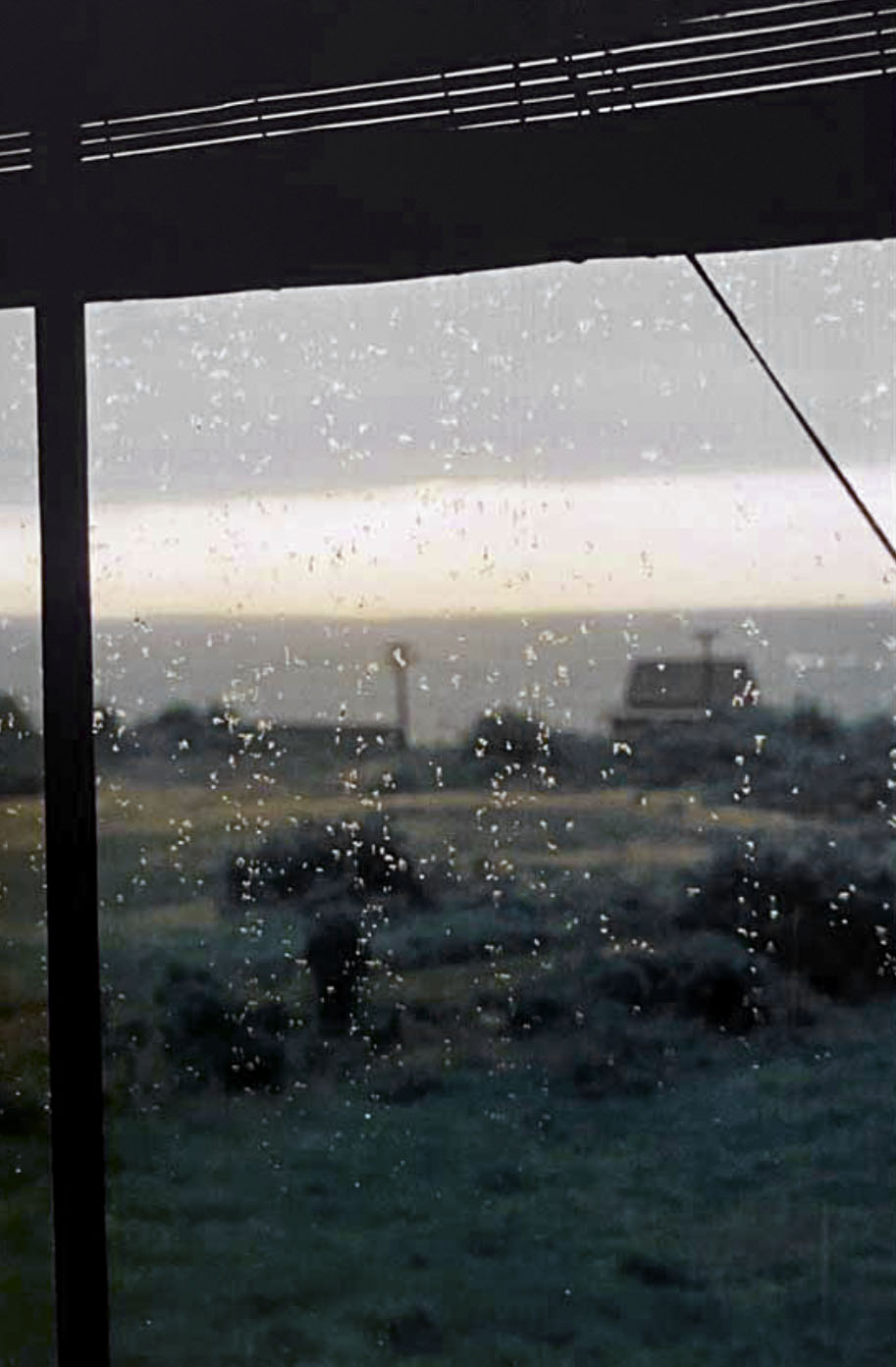
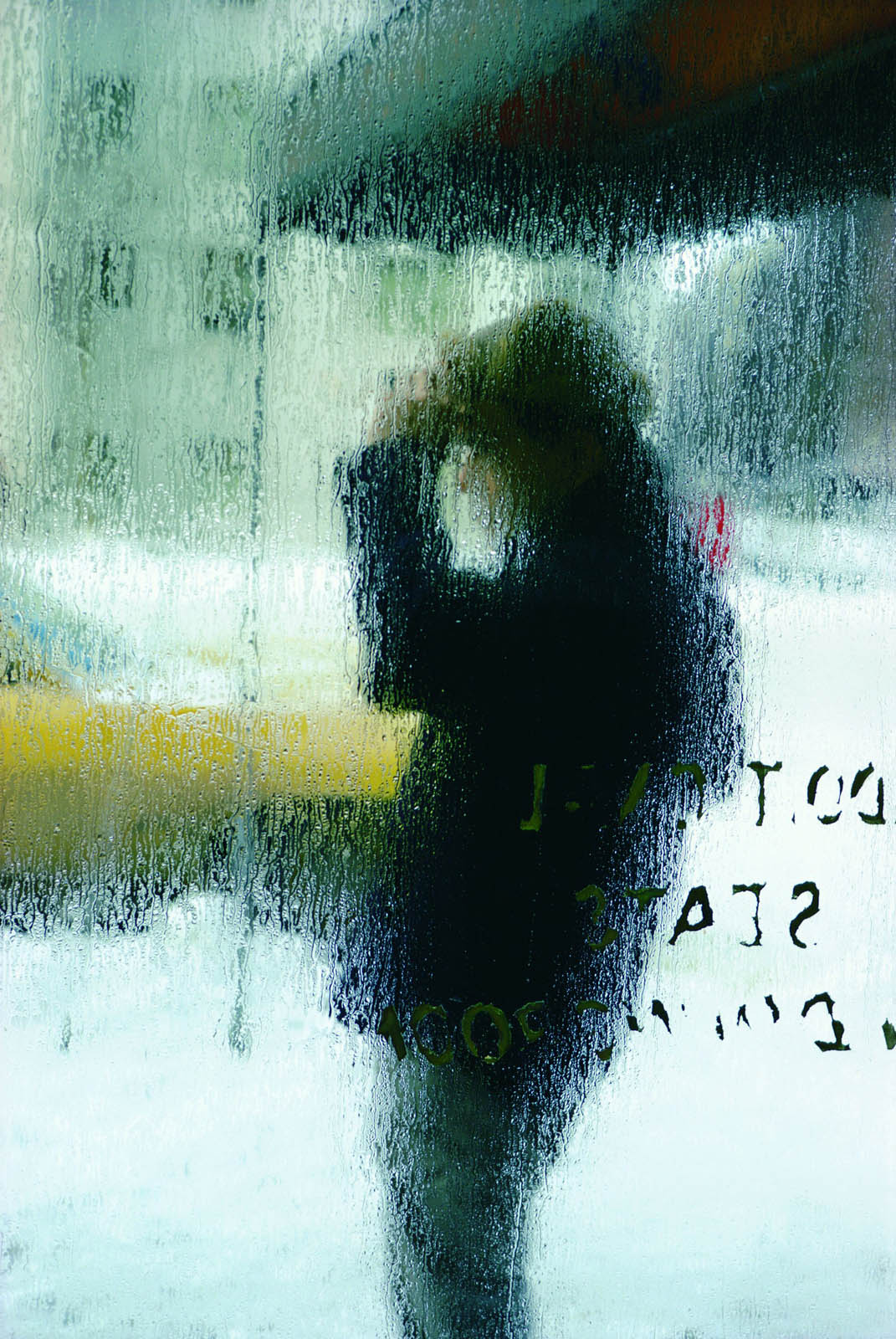
By shooting in the rain and snow, and using windows and other reflective surfaces, he created abstract images. A red umbrella, a green traffic light, or the yellow flash of a passing taxi add an unexpected play of colour to his photographs. In the 1940s and 1950s, Leiter was virtually the only non-commercial photographer to work in colour. The use of aged or damaged film allowed him to include surprising compositions with shifts in light and colour. Once lost to obscurity, his work was rediscovered in the mid 2010s for its ground-breaking role in the emergence of colour photography.

By shooting in the rain and snow, and using windows and other reflective surfaces, he created abstract images. A red umbrella, a green traffic light, or the yellow flash of a passing taxi add an unexpected play of colour to his photographs. In the 1940s and 1950s, Leiter was virtually the only non-commercial photographer to work in colour. The use of aged or damaged film allowed him to include surprising compositions with shifts in light and colour. Once lost to obscurity, his work was rediscovered in the mid 2010s for its ground-breaking role in the emergence of colour photography.

Leiter was a self-taught photographer whose strong sense of curiosity made him a lifelong student. He maintained his experimental and spontaneous approach throughout his career, which is evident in both his street photography and fashion work.

Upon his death in 2013, Leiter left behind a remarkable collection of approximately 15,000 black-and-white prints, at least 40,000 colour slides, a similar number of black-and-white negatives and over 4000 paintings, only a handful of which have been seen publicly. The exhibition An Unfinished World offers visitors the chance to admire the endless poetry of Saul Leiter’s artistic practice through his paintings, photography and unique view on the world around him.

Press release from Foam


Saul Leiter (American, 1923-2013) 'Footprints' c. 1950 from the exhibition 'Saul Leiter - An Unfinished World' at Foam, Amsterdam, Jan - April 2025


Saul Leiter (American, 1923-2013)
Footprints
c. 1950
Chromogenic print
© Saul Leiter Foundation


Saul Leiter (American, 1923-2013) 'Untitled' Nd from the exhibition 'Saul Leiter - An Unfinished World' at Foam, Amsterdam, Jan - April 2025


Saul Leiter (American, 1923-2013)
Untitled
Nd
Chromogenic print
© Saul Leiter Foundation


Saul Leiter (American, 1923-2013) 'Untitled' Nd


Saul Leiter (American, 1923-2013)
Untitled
Nd
Chromogenic print
© Saul Leiter Foundation


Saul Leiter (American, 1923-2013) 'Untitled' Nd


Saul Leiter (American, 1923-2013)
Untitled
Nd
Chromogenic print
© Saul Leiter Foundation


Saul Leiter (American, 1923-2013) 'Untitled' Nd


Saul Leiter (American, 1923-2013)
Untitled
Nd
Chromogenic print
© Saul Leiter Foundation


Everything is a matter of balance, exactitude and humility in the works of this man, who nonetheless accorded great importance to imperfection.


Saul Leiter (American, 1923-2013) 'Untitled' Nd


Saul Leiter (American, 1923-2013)
Untitled
Nd
Chromogenic print
© Saul Leiter Foundation


“This ambidextrous painter and photographer recognised no limits. If, in the silence of his studio, his movement inscribed on paper imperceptible little rhythmic abbreviations, like an everyday exercise, his gaze penetrated the tumult of the city, challenging what draws the eye and scrutinising what is not seen.”

“If only we give them just a little more attention, these voices also tell us that the images are fragments containing enigmas, and that they journey through time and endure, intact, despite the darkness that may prevail in the world.”


Anne Morin


Saul Leiter (American, 1923-2013) 'Taxi' 1957


Saul Leiter (American, 1923-2013)
Taxi
1957
Chromogenic print
© Saul Leiter Foundation


Leiter’s complex and impressionistic photographs are as much about evoking an atmosphere as nailing the decisive moment.


Saul Leiter (American, 1923-2013) 'Untitled' Nd


Saul Leiter (American, 1923-2013)
Untitled
Nd
Chromogenic print
© Saul Leiter Foundation


Saul Leiter (American, 1923-2013) 'Red Curtain' 1956


Saul Leiter (American, 1923-2013)
Red Curtain
1956
Chromogenic print
© Saul Leiter Foundation


“For nearly sixty years, Leiter photographed daily, capturing everyday moments of New York City life. With various techniques and mediums, and the use of telephoto lenses, Leiter would enhance the painterly quality of his images and transform seemingly mundane street scenes into visual poetry. New York, a symbol of modernity in the 1950s, became the backdrop for Leiter’s aesthetic discoveries. By shooting in the rain and snow, and using windows and other reflective surfaces, he created abstract images. A red umbrella, a green traffic light, or the yellow flash of a passing taxi add an unexpected play of color to his photographs. In the 1940s and 1950s, Leiter was virtually the only non-commercial photographer to work in color. The use of aged or damaged film allowed him to include surprising compositions with shifts in light and color.”

Dimitris Lempesis. “PHOTO: Saul Leiter – An Unfinished World,” on the Dream Idea Machine website Nd [Online] Cited 15/03/2025


Saul Leiter (American, 1923-2013) 'Lanesville' 1958


Saul Leiter (American, 1923-2013)
Lanesville
1958
Chromogenic print
© Saul Leiter Foundation


Saul Leiter (American, 1923-2013) 'Cap' c. 1960


Saul Leiter (American, 1923-2013)
Cap
c. 1960
Chromogenic print
© Saul Leiter Foundation


Foam
Keizersgracht 609
1017 DS Amsterdam
The Netherlands
Phone: + 31 20 5516500

Opening hours:
Monday – Wednesday 10am – 6pm
Thursday – Friday 10am – 9pm
Sat – Sun 10am – 6pm

Foam website

LIKE ART BLART ON FACEBOOK

Back to top

Exhibition: ‘Primrose – Russian Colour Photography’ at Foam, Amsterdam

Exhibition dates: 25th January – 3rd April 2013

Curator: Olga Sviblova


Varvara Stepanova (Russian, 1894-1958) 'Red Army Men' 1930


Varvara Stepanova (Russian, 1894-1958)
Red Army Men
1930
Photomontage for Abroad magazine


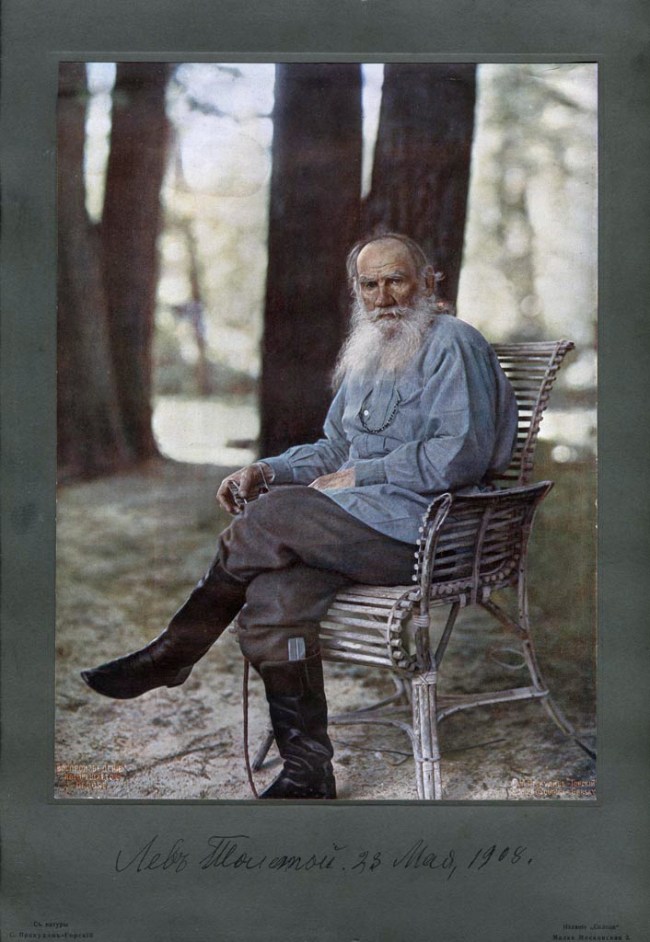
A bumper posting on a fascinating subject. The portrait of Tolstoy is incredible; more poignant are the photographs pre-World War I (the last days of the Tsarist dynasty), and pre-World War 2 (Portrait of Yury Rypalov, below). People stare into the camera with no idea of the maelstrom about to descend…

Dr Marcus Bunyan


Many thankx to Foam for allowing me to publish the text and photographs in the posting. Please click on the photographs for a larger version of the image.


Boris Mikhailov (Ukranian, b. 1938) 'Untitled' 1971-1985


Boris Mikhailov (Ukranian, b. 1938)
Untitled
1971-1985
From the series Luriki
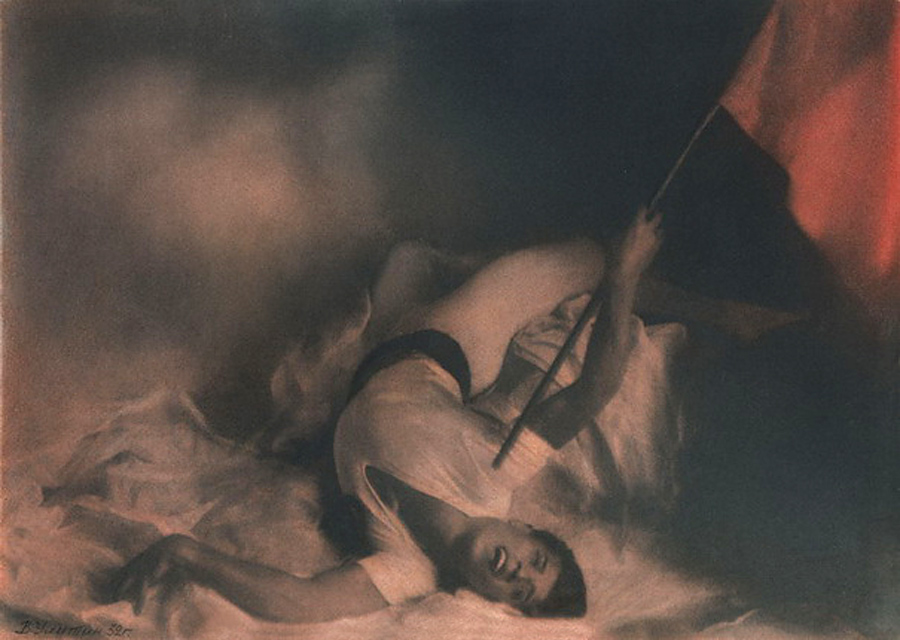
 

Vasily Ulitin (Russian, 1888-1976) 'Flame of Paris' 1932


Vasily Ulitin (Russian, 1888-1976)
Flame of Paris
1932
Bromoil
Moscow House of Photography Museum
© Multimedia Art Museum, Moscow / Moscow House of Photography Museum


Dmitry Baltermants (Russian, 1912-1990) 'Men's talk' 1950s


Dmitry Baltermants (Russian, 1912-1990)
Men’s talk
1950s
Colour print
Moscow House of Photography Museum
© Dmitry Baltermants Archive
© Multimedia Art Museum, Moscow / Moscow House of Photography Museum


Dmitry Baltermants (Russian, 1912-1990) 'Rain' 1960s


Dmitry Baltermants (Russian, 1912-1990)
Rain
1960s
Colour print
Moscow House of Photography Museum
© Dmitry Baltermants Archive
© Multimedia Art Museum, Moscow / Moscow House of Photography Museum


Yakov Khalip (Russian, 1908-1980) 'Sea cadets' End of 1940s


Yakov Khalip (Russian, 1908-1980)
Sea cadets
End of 1940s
Artist’s colour print
On the reverse side text of congratulation to Alexander Rodchenko
Collection of Moscow House of Photography Museum
© Multimedia Art Museum, Moscow/ Moscow House of Photography Museum


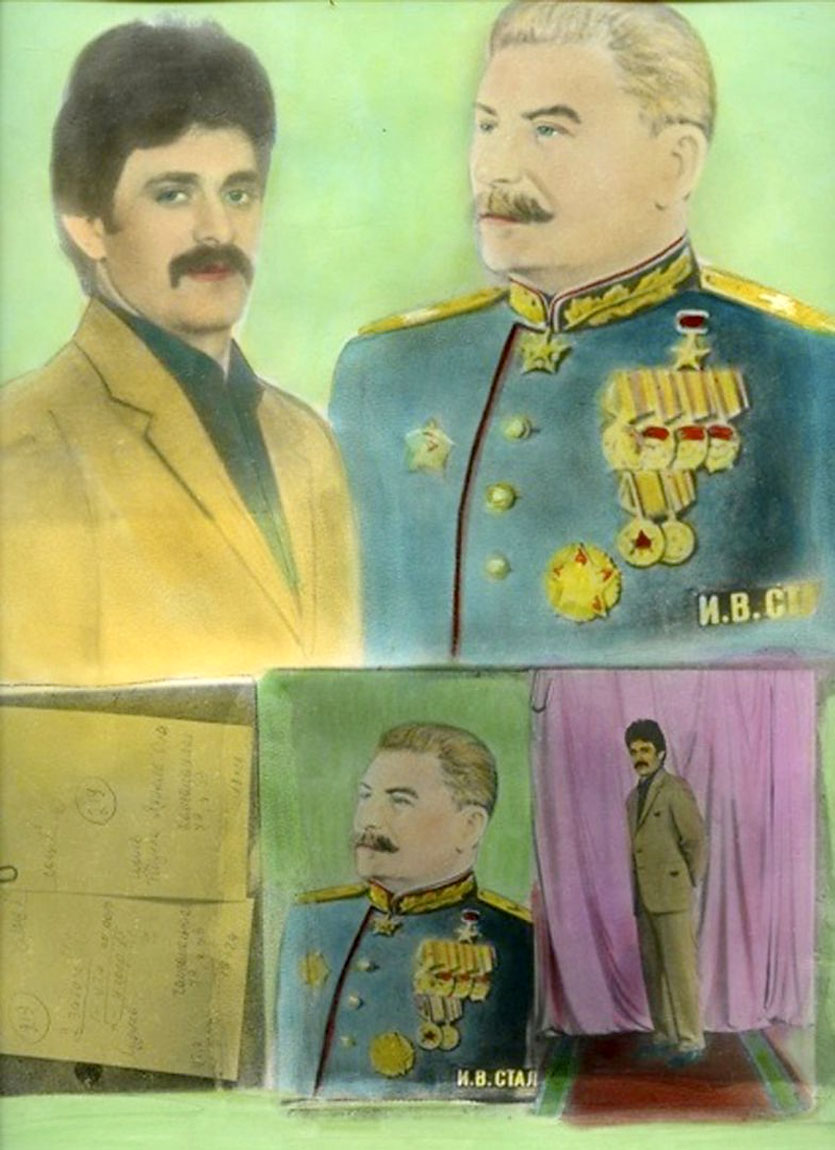
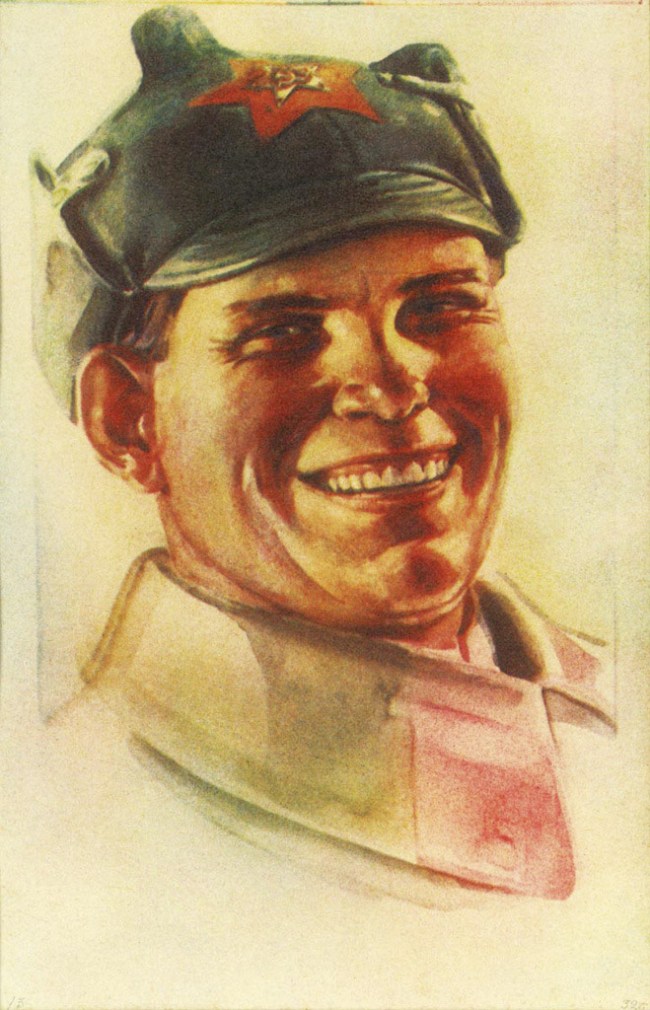
The exhibition Primrose – Russian Colour Photography takes place as part of Netherlands-Russia 2013. The title refers to the primrose flower, used metaphorically here to represent the many colours in which it appears during early spring. Primrose – Russian Colour Photography presents a retrospective of the various attempts in Russia to produce coloured photographic images. This process began in the early 1850s, almost simultaneously with the discovery of the new medium itself. The colouring technique, based on the traditional methods of craftsmen who added colour into a certain contour design, has determined a whole independent trend in the history of photography in Russia, from ‘postcard’ landscapes and portraits to Soviet propaganda and reportage photography.

The use of colour in Russia stems from the early 1850s and practically coincides with the invention of the medium itself. The term colour photography is slightly disingenuous, since at first it referred to a toning technique in which black and white photographs were painted by hand. Traditionally this technique was used by specialised tradesmen who added colour to the photographs according to certain methods and within the contours of the image. This technique became so popular that it started a trend in and of itself and to a large extent determined the appearance and aesthetics of colour photography in Russia. Initially used especially for portraits, Pictorialist landscapes and nudes, it later also found favour with avant-garde artists. Interestingly enough these aesthetics also formed the starting point for Soviet propaganda and for portraits, political leaders and reportage.

Primrose – Russian Colour Photography can be viewed as a journey through various techniques and genres, meanings and messages, mass practices and individual experiments. The exhibition contains works by renowned photographers and artists such as Sergey Produkin-Gorsky, Ivan Shagin, Dmitry Baltermants and Robert Diament. But is also shows unique photos of Alexander Rodchenko and Varvara Stephanova, and recent works from the famous Luriki series by Boris Mikhailov, in which he mocked the visual culture of the Soviet propaganda.

Press release from the Foam website [Online] Cited 24/03/2020 no longer available online
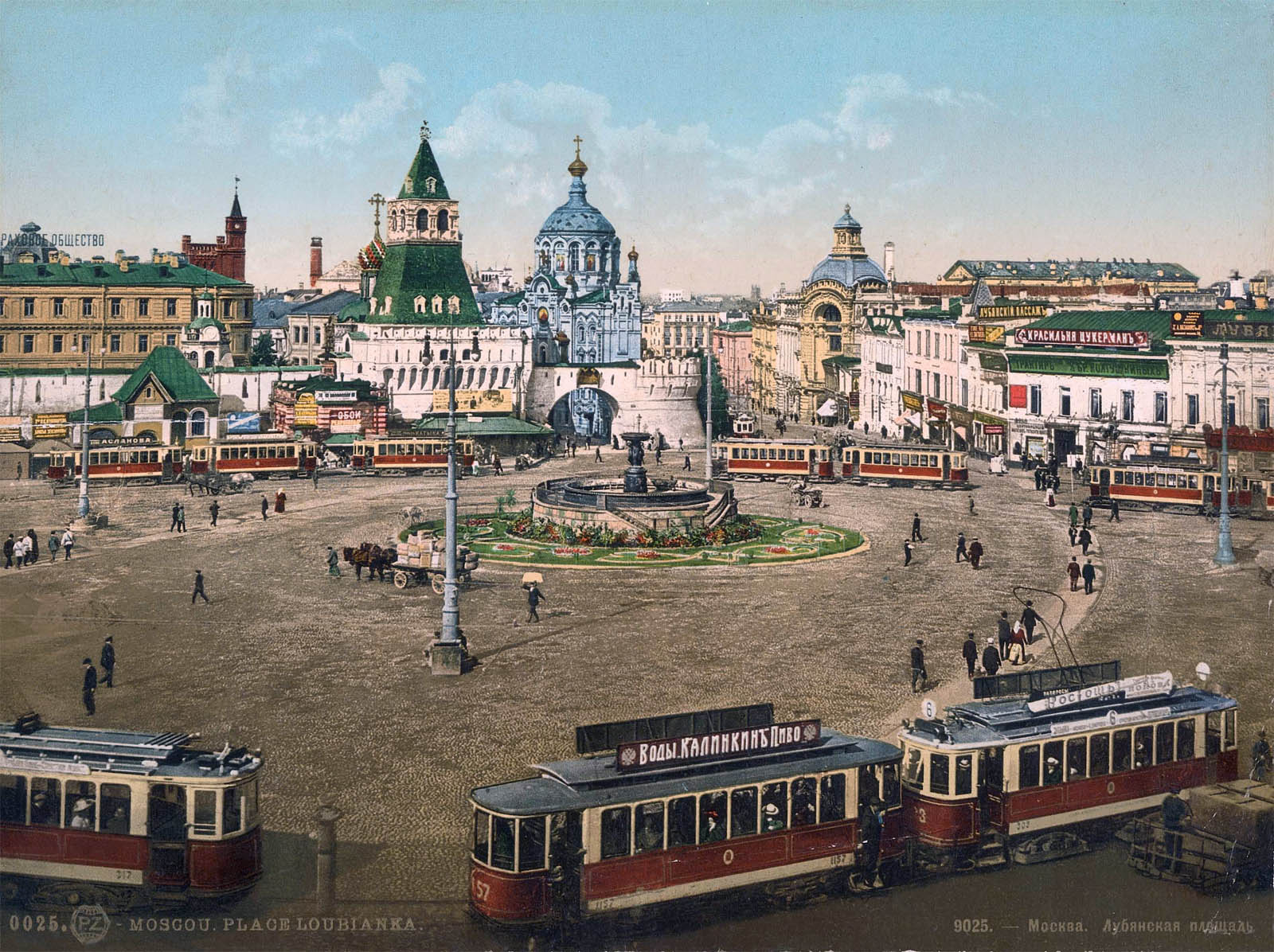
 

Pyotr Pavlov (Russian, 1860-1924) 'Moscow. Lubianka' 1910s


Pyotr Pavlov (Russian, 1860-1924)
Moscow. Lubianka
1910s
Offprint
Collection of Moscow House of Photography Museum
© Multimedia Art Museum, Moscow / Moscow House of Photography Museum
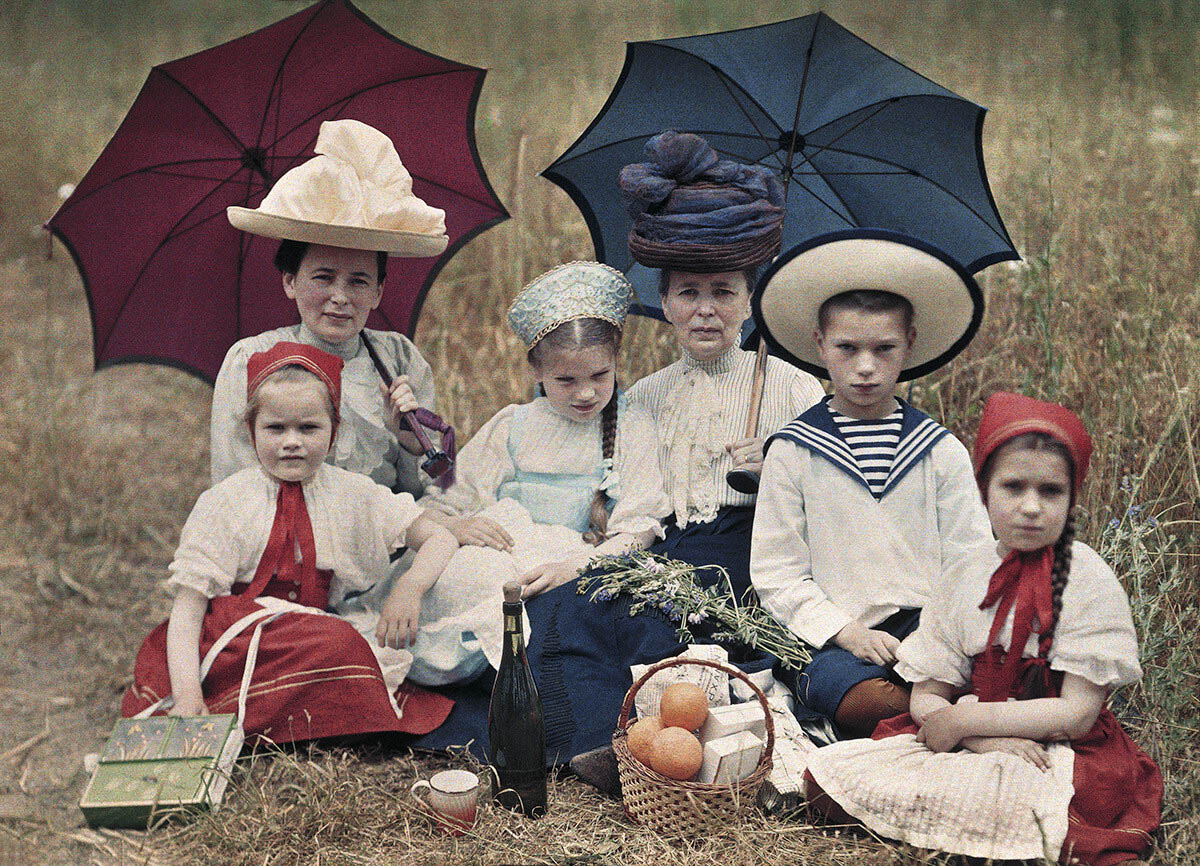
 

Piotr Vedenisov (Russian, 1866-1937) 'Tania, Natasha, Kolia and Liza Kozakov, Vera Nikolayevna Vedenisov and Elena Frantsevna Bazilev. Yalta' 1910-1911


Piotr Vedenisov (Russian, 1866-1937)
Tania, Natasha, Kolia and Liza Kozakov, Vera Nikolayevna Vedenisov and Elena Frantsevna Bazilev. Yalta
1910-1911
Copy; original – autochrome
Moscow House of Photography Museum
© Multimedia Art Museum, Moscow / Moscow House of Photography Museum


Piotr Vedenisov (Russian, 1866-1937) 'Nikolskoye Simbirsk province' 1910


Piotr Vedenisov (Russian, 1866-1937)
Nikolskoye Simbirsk province
1910


Alexander Rodchenko (Russian, 1891-1956) 'Race. "Dynamo" Stadium' 1935


Alexander Rodchenko (Russian, 1891-1956)
Race. “Dynamo” Stadium
1935
Artist’s gelatine silver print, gouache
Collection of Moscow House of Photography Museum
© A. Rodchenko – V. Stepanova Archive
© Multimedia Art Museum, Moscow / Moscow House of Photography Museum


Dmitry Baltermants (Russian, 1912-1990) 'Meeting in the tundra' 1972


Dmitry Baltermants (Russian, 1912-1990)
Meeting in the tundra
1972
From the Meetings with Chukotka series
Colour print Collection of Moscow House of Photography Museum
© Dmitry Baltermants Archive
© Moscow House of Photography Museum


Installation photograph of the exhibition 'Primrose - Russian Colour Photography' at Foam, Amsterdam

Installation photograph of the exhibition 'Primrose - Russian Colour Photography' at Foam, Amsterdam showing at second left, Dmitry Baltermants's 'Men's talk' (1950); and at second right, Dmitry Baltermants's 'Rain' (1960s)

Showing at second left, Dmitry Baltermants’s Men’s talk (1950, above); and at second right, Dmitry Baltermants’s Rain (1960s, above)

Installation photograph of the exhibition 'Primrose - Russian Colour Photography' at Foam, Amsterdam showing at left, Elena Mrozovskaya's 'Portrait of girl in Little Russia costume. Saint Petersburg' (1900s)


Installation photographs of the exhibition Primrose – Russian Colour Photography at Foam, Amsterdam showing in the bottom image at left, Elena Mrozovskaya’s Portrait of girl in Little Russia costume. Saint Petersburg (1900s, below)


Primrose

This exhibition with the metaphorical title Primrose demonstrates the appearance and development of colour in Russian photography from the 1860s to 1970s, and at the same time reveals the history of Russia in photography. With examples of works from classics of Russian photography such as P. Pavlov, K. Bergamasko, A. Eikhenvald, A. Rodchenko, V. Mikoshi, G. Petrusov, D. Baltermants and B. Mikhailov, as well as unknown photographers, we can see how life in Russia changed in the course of a century as it endured historical and socio-political catastrophes, also the diverse roles that photography played during this period.

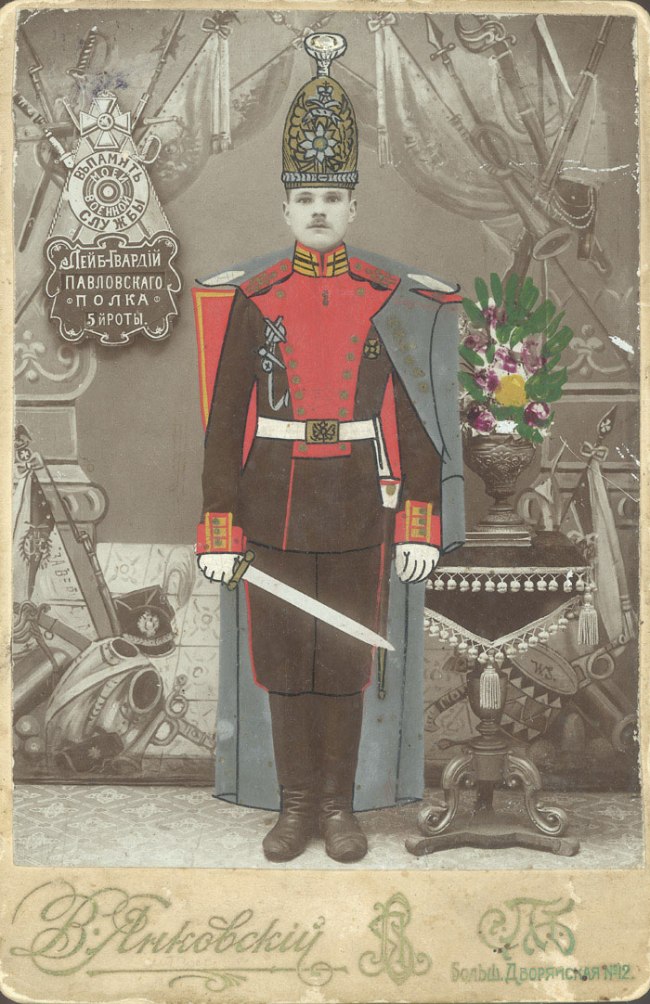
Colour became widespread in Russian photography at approximately the same time as in Europe – in the 1860s. This was dependent on the manual tinting of photographic prints with watercolour and oil paints, either by the photographers themselves or by artists working with them. Above all this applies to solo or family portraits commissioned as a keepsake. The photographic studios of Nechayev, Ushakov & Eriks and Eikhenvald produced thousands of tinted portraits that became an important part of the domestic interior.

People were eager to see their own image in colour, and moreover in a picturesque form. The colouring of early photographic shots could also hide imperfections in the prints, including those introduced on albumenised paper. With time this paper turned yellow. To conceal this, the paper was tinted green, pink and other colours and coloured with watercolours, gouache, oils, or later aniline dyes. Sometimes the photograph was partially redrawn during the process of tinting, and foliate embellishments or different items of interior decoration appeared in the background.

By the end of the 19th century, by the 1880s and 1890s, colour photography was extended to architectural, landscape and industrial subject matter. For instance, the photographic studio of the Trinity and St. Sergius Monastery (photographic studios attached to Russian monasteries became a very common phenomenon) produced numerous coloured architectural images of Orthodox churches.

In the late 19th and early 20th centuries Russia was on the one hand undergoing active europeanisation, as reflected in the style of architectural structures, interiors, costume and way of life, but meanwhile there was also a search for national identity, and new interest in the national particularities of inhabitants in the Russian Empire. Entire series of tinted photographs appeared, depicting people in national costumes – Russian, Tatar, Caucasian, Ukrainian, and so on.

With the industrial boom of the late 19th and early 20th centuries people began to decorate their walls not only with tinted landscapes, but also photographs of industrial structures (eg Dmitri Yezuchevsky’s photograph Building the Bridge). In the early 20th century, in the 1910s, coloured photographs of Russian military officers, an important social class before the outbreak of the First World War, were particularly popular.

The photographic documentation of life in the Russian Empire in the early 20th century acquired the status of a State objective, largely because Tsar Nicholas II and his family were enthusiastic amateur photographers. In May 1909 Emperor Nicholas II gave an audience to the photographer Sergei Prokudin-Gorsky. In 1902 Prokudin-Gorsky had first announced a technique for creating colour photographs, and in 1903 he published a brochure entitled ‘Isochromatic Photography with Manual Cameras’. Prokudin-Gorsky used black-and-white plates sensitised according to his own formulae, and a camera of his own construction. Three rapid shots were taken successively through light filters coloured blue, green and red (the photographer managed to reduce the exposure time to an absolute minimum). From this triple negative a triple positive was prepared. A projector with three lenses in front of three frames on the photographic plate was used to view the shots. Each frame was projected through a colour filter of the same colour as that through which it had been photographed. A full-colour image appeared on the screen as the three images combined. Prokudin-Gorsky succeeded in making polygraphic reproductions of his shots, printed in the form of photo cards, and also as inserts for illustrated magazines.

Delighted with this invention, Emperor Nicholas II asked the photographer to take colour photographs of every aspect of life in the various regions that then constituted the Russian Empire. For this the photographer was issued with a specially equipped railway car. The government provided him with a small manned steamship able to traverse the shallows for his work on waterways, and a motorboat for the River Chusova. A Ford automobile was dispatched to Yekaterinburg for his shots of the Urals and the Ural mountain range. Prokudin-Gorsky was presented with official imperial documents that gave him access to all parts of the Empire, and government officials were ordered to assist Prokudin-Gorsky on his travels.

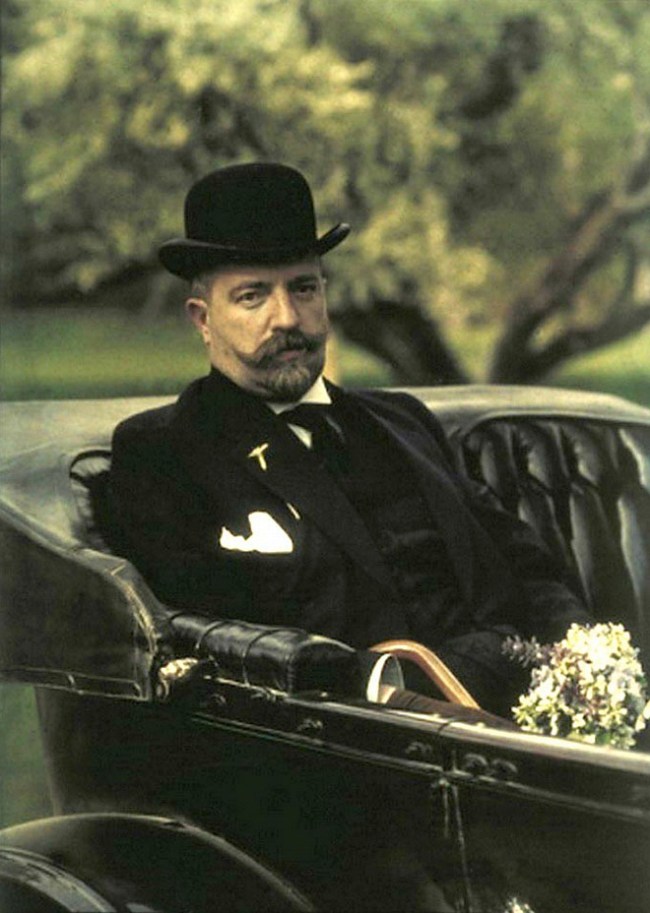
Meanwhile autochrome pictures by the Lumière brothers, with whom Prokudin-Gorsky worked after emigrating from Soviet Russia, became very popular in early 20th-century Russia. Autochromes, colour transparencies on a glass backing, were first produced on an industrial scale in 1907. Granules of potato starch tinted red, yellow and blue were applied to a glass plate. The granules worked as colour filters. Addition of a second layer of granules provided orange, violet and green hues. After that a light-sensitive emulsion was applied. The plate was exposed and developed. Autochromes could be viewed against the light, or projected with the aid of special apparatus, which at that time was manufactured by the Lumière brothers’ own company (diascopes, chromodiascopes, mirrored stereoscopes, etc.). The Lumière brothers’ autochromes were used, for example, by Pyotr Vedenisov, a prosperous nobleman and graduate of the Moscow Conservatoire, who settled in Yalta, in the Crimea, in the late 1880s. As was the case with the Lumière brothers’ autochromes, Vedenisov’s favoured subject matter was the photographer’s own family life. However, what was at first sight very private and personal photography later provided an excellent description of the typical lifestyle enjoyed by educated Russian noblemen in the early 20th century.

The onset of the First World War in 1914 and October Revolution in 1917 annihilated the Russia whose memory is preserved in the tinted photographs and autochromes of the second half of the 19th to early 20th centuries.

Vladimir Lenin and the new Soviet government actively supported photography in the early post-revolutionary years, seeing it as an important propaganda weapon for a country where 70% of the population were unable to read or write. At first there was emphasis on photo reportage, but very soon it became clear real change in a country where hunger and devastation ruled after the Revolution and Civil War was as insubstantial as the utopian dreams of ardent revolutionaries. From the mid-1920s photomontage was widespread in the Soviet Union, enthusiastically encouraged by the Bolsheviks. Photomontage allowed for a combination of documentary veracity and the new Soviet myths. In the 1920s it was practised by such highly talented modernists as A. Rodchenko, G. Klutsis, El Lissitzky, V. Stepanova and others. Photomontage embraced colour and became an ideological ‘visual weapon’.

From the mid-1920s A. Rodchenko regenerated the forgotten technique of hand colouring his own photographs. His use of tinting profited from his experience with photomontage (Mosselprom House Advertising Wall, Dynamo Running Stadium, etc.), and he also applied it to develop experiments with positive-negative printing (scenes from the film Albidum) and for very personal and even intimate portraits of his muse Regina Lemberg – Girl with Watering Can. In 1937, at the height of Stalin’s repression, A. Rodchenko began photographing classical ballet and opera, using the arsenal of his aesthetic opponents, the Russian Pictorialists, who by that time were subject to even harsher repression in the Soviet Union than modernist photographers. For Alexander Rodchenko soft focus, classical subject matter and toning typical of pictorial photography were a mediated way of expressing his internal escapism and tragic disillusionment with the Soviet utopia.

In 1932 general rules for socialist realism were published in the USSR, as the only creative method for all forms of art, including photographic. Soviet art had to reflect Soviet myths about the happiest people in the happiest country, not real life and real people. On this Procrustean bed it was hard not only for modernism with its constructivist aesthetics, but even Pictorialism, to fit into the aesthetics of Socialist realism.

Pictorialism was one of the most important tendencies of early 20th-century Russian photography, and Russian Pictorialist photographers were awarded gold and silver medals at international exhibitions. Pictorial photography differed not only by the method of shooting and complex printing techniques intended to bring photography closer to painting, but also by the selection of traditional themes. Romantic landscapes and architectural ruins or nude studies were from the point of view of socialist realism dangerous remnants from the past. Some of the Pictorialist photographers ended up in Stalin’s prison camps, and were forbidden from practising their profession or settling in the capital or other large cities. Those who remained at liberty – for example, Vasily Ulitin, a participant in major international photo exhibitions and recipient of medals and diplomas in Paris, London, Berlin, Los Angeles, Toronto, Tokyo and Rome – tried with difficulty to adapt to the new reality and attempted to depict revolutionary subjects (Flames of Paris, Red Army Soldier), thereby gaining indulgence and the right to work from the Bolsheviks.

Almost simultaneously, in 1936 the German company Agfa and American company Kodak introduced colour film. Broad distribution and introduction to the amateur photography market were delayed by the outbreak of the Second World War. In the USSR colour photography only appeared at the end of the war. Production of Soviet-made colour film in the USSR was facilitated by German trophy equipment in 1946. From that year onwards Ivan Shagin and several other photographers began to relay their colour news chronicle to the country.

Before 1946 colour photographs of Soviet Russia were made only in isolated cases, on German or American film. Until the mid-1970s, in the USSR negative film for printing colour photographs was a luxury only available to a few official photographers who worked for major Soviet publications. It was used by such classics of Soviet photography as V. Mikosha, G. Petrusov, D. Baltermants, V. Tarasevich, and others. All of them were in one way or another obliged to follow the canons of socialist realism and practise staged reportage. In those days even still life studies of fruit bore an ideological message, being photographed for cookery books in which the Soviet people could see produce that remained absent in a hungry postwar country, where the ration-card system of food distribution was still functioning (Ivan Shagin, Lemons and Fruit, 1949).

From the late 1950s, in the Khrushchev Thaw after the debunking of Stalin’s cult of personality, the canons of socialist realism softened and permitted a certain freedom in aesthetics, allowing photography to move closer to reality (Dmitri Baltermants’ series Arbat Square). In the postwar period, during the 1950s to 1960s life gradually improved and coloured souvenir photo portraits again appeared on the mass market. They were usually produced by unknown and ‘unofficial’ photographers, since private photo studios that had carried out such commissions since the mid-19th century were now forbidden, and the State exercised a total monopoly on photography by the 1930s. Boris Mikhailov copied and enlarged such kitsch colour photographs as souvenirs to supplement his income at his photo laboratory in Kharkov in the early 1970s. He began collecting them. They form the basis for a new aesthetics he developed in the Lyrics series from the early 1980s. By tinting these naïve photographs he revealed and deconstructed the nature of Soviet myths.

Colour transparency film appeared on the Soviet mass market in the 1960s and 1970s. As opposed to colour negative film that requires a complicated and expensive development process for subsequent printing, colour slide film could be developed even in domestic surroundings. Above all it was widely used by amateurs, who created transparencies that could be viewed at home with a slide projector. An unofficial art form emerging in the USSR at this time developed the aesthetics and means for a new artistic conceptualisation of reality, quite different from the socialist realism that still prevailed, although somewhat modified. Photography took a significant role in this unofficial art. It was in the late 1960s and early 1970s that Boris Mikhailov began photographing his series Suzi Et Cetera on colour slide film.

More than half a century of Soviet power after the 1917 Revolution radically altered Russia. The surrounding reality has fallen into decline, and people brought up on Soviet slogans never thought to pay attention. But this was the only reality offered by our perception, and Boris Mikhailov tries to develop its colour, humanise it with his attention and give it the right of existence. Photography textbooks of that period were made up of one-third technical formulae and two-thirds description of what to photograph, and how. The photographer was certainly not required or even allowed to take nude studies. Corporeality and sexuality are inherent signs of an independent individual, of selfhood. The Soviet system specifically tried to level out any sense of selfhood, smothering it and challenging such ideas with the collective community and the impersonal ‘we’ of the Soviet nation. In photographing Suzi Et Cetera Boris Mikhailov disrupts the norms and reveals characters, his own and that of his subjects. It was impossible to show these shots in public, but slides could be projected at home, in the workshops of his artist friends or the small, often semi-underground clubs of the scientific and technical intelligentsia, who began to revive during Khrushchev’s Thaw after the Stalinist repression. Boris Mikhailov’s slide projections are now analogous to the apartment exhibitions of unofficial art. By means of colour he displayed the dismal standardisation and squalor of surrounding life, and his slide performances helped to unite people whose consciousness and life in those years began to escape from the dogmatic network of Soviet ideology, which permitted only one colour – red.

Curator Olga Sviblova
Director, Multimedia Art Museum, Moscow


Boris Mikhailov (Ukranian, b. 1938) 'Untitled' 1971-1985 From the series 'Luriki'


Boris Mikhailov (Ukranian, b. 1938)
Untitled
1971-1985
From the series Luriki


Vladislav Mikosha (Russian, 1909-2004) 'Portrait of Yury Rypalov' 1938-1939


Vladislav Mikosha (Russian, 1909-2004)
Portrait of Yury Rypalov
1938-1939


V. Yankovsky. '"In memory of my military service". Saint Petersburg' Beginning of 1910s


V. Yankovsky
“In memory of my military service”. Saint Petersburg
Beginning of 1910s
Collodion, painting
Collection of Moscow House of Photography Museum
© Moscow House of Photography Museum


Elena Mrozovskaya (Russian, 1892 – c.  1941) 'Portrait of girl in Little Russia costume. Saint Petersburg' 1900s


Elena Mrozovskaya (Russian, 1892 – c.  1941)
Portrait of girl in Little Russia costume. Saint Petersburg
1900s
Gelatine silver print, painting
Collection of Moscow House of Photography Museum
© Moscow House of Photography Museum


A. Nechayev. 'Portrait of girl' 1860s


A. Nechayev
Portrait of girl
1860s
Salted paper, covered by albumen, painting
Collection of Moscow House of Photography Museum
© Multimedia Art Museum, Moscow / Moscow House of Photography Museum
 

Sergey Prokudin-Gorsky (Russian, 1863-1944) 'Portrait of Lev Tolstoy' 23rd of May 1908


Sergey Prokudin-Gorsky (Russian, 1863-1944)
Portrait of Lev Tolstoy
23rd of May 1908
Offprint
Collection Multimedia Art Museum, Moscow


Piotr Vedenisov (Russian, 1866-1937) 'Uknown woman, the Crimea, Yalta' 1914


Piotr Vedenisov (Russian, 1866-1937)
Uknown woman, the Crimea, Yalta
1914


Piotr Vedenisov (Russian, 1866-1937) 'Andrei Aleksandrovich Kozakov. Yalta' 1911-1912


Piotr Vedenisov (Russian, 1866-1937)
Andrei Aleksandrovich Kozakov. Yalta
1911-1912
Copy; original – autochrome
Moscow House of Photography Museum
© Multimedia Art Museum, Moscow / Moscow House of Photography Museum


Piotr Vedenisov (Russian, 1866-1937) 'Vera Kozakov in Folk Dress' 1914


Piotr Vedenisov (Russian, 1866-1937)
Vera Kozakov in Folk Dress
1914
Collection of Moscow House of Photography Museum
© Multimedia Art Museum, Moscow / Moscow House of Photography Museum
 

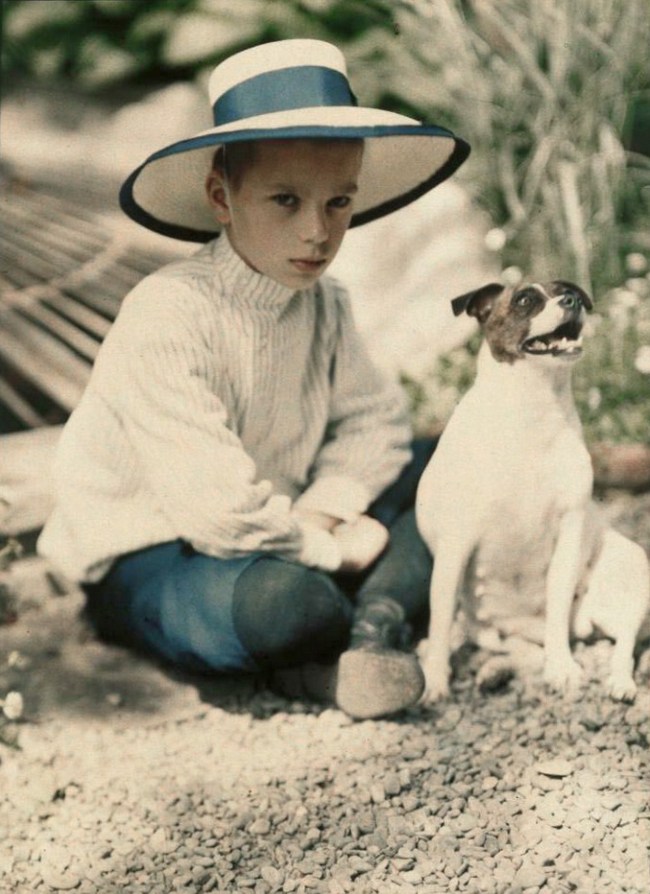
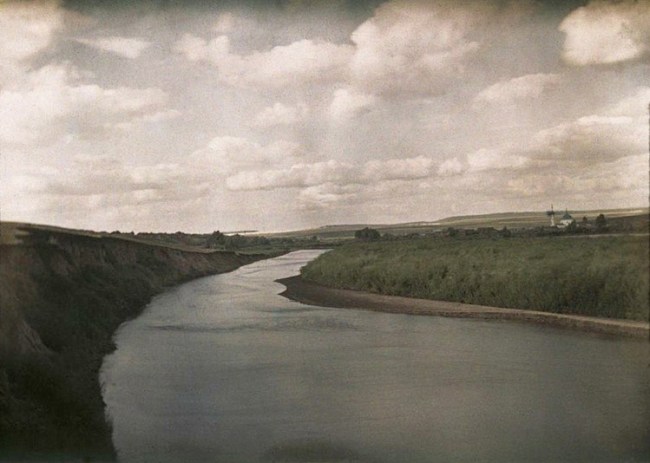
The scenes in Vedenisov’s autochromes take place in Yalta or in the Simbirsk Government, where the Kozakov family, the photographer’s relations, resided. Piotr Vedenisov chooses his models among the members of this single large family. Vedenisov’s photos are mostly staged portraits. Other subjects include everyday life and travelling, feasts, pets, interiors and landscapes. Vedenisov’s autochromes are shot over a relatively short period of time, roughly from 1909 to 1914.

About the photographer

Piotr Ivanovich Vedenisov (1866-1937) was a Russian nobleman living in Yalta, who graduated at the Moscow Conservatorium in 1888. Beside his ultimate passion for music, he was enthusiastic about the history of Crimea and photography. In the early 20th century, Vedenisov masters a technical innovation: he could make colour autochromes on glass. It was a technique of creating works in colour, based on three stages of consecutive shooting through colour filters. It was further developed by the Lumière brothers who succeeded in placing all the filters on a single plate.

Text from the Foam website Nd [Online] Cited 19/09/2022


Piotr Vedenisov (Russian, 1866-1937) 'Kolya Kozakov and the Dog Gipsy. Yalta' 1910-1911


Piotr Vedenisov (Russian, 1866-1937)
Kolya Kozakov and the Dog Gipsy. Yalta
1910-1911
Collection of Moscow House of Photography Museum
© Multimedia Art Museum, Moscow / Moscow House of Photography Museum


Vasily Ulitin (Russian, 1888-1976) 'Red Army man' 1932


Vasily Ulitin (Russian, 1888-1976)
Red Army man
1932


Dmitry Baltermants (Russian, 1912-1990) 'Show window' Beginning of 1960s


Dmitry Baltermants (Russian, 1912-1990)
Show window
Beginning of 1960s
Colour print
Collection of Moscow House of Photography Museum
© Dmitry Baltermants Archive
© Multimedia Art Museum, Moscow / Moscow House of Photography Museum


Ivan Shagin (Russian, 1904-1982) 'Fruits' 1949


Ivan Shagin (Russian, 1904-1982)
Fruits
1949
Colour print
Collection of Moscow House of Photography Museum
© Multimedia Art Museum, Moscow / Moscow House of Photography Museum
 

Robert Diament (Russian, 1907-1987) 'He has turned her head' Beginning of 1960s


Robert Diament (Russian, 1907-1987)
He has turned her head
Beginning of 1960s
Colour print
Collection Moscow House of Photography Museum
© Multimedia Art Museum, Moscow / Moscow House of Photography Museum


Foam
Keizersgracht 609
1017 DS Amsterdam
The Netherlands
Phone: + 31 20 5516500

Opening hours:
Mon – Wed 10am – 6pm
Thu – Fri 10am – 9pm
Sat – Sun 10am – 6pm

Foam website

LIKE ART BLART ON FACEBOOK

Back to top

Exhibition: ‘Joel Sternfeld – Color Photographs since 1970’ at Foam, Amsterdam

Exhibition dates: 16th December 2011 – 14th March 2012


Foam Curator Colette Olof on Joel Sternfeld


In mid-December Foam will present the first major retrospective exhibition in the Netherlands of the work of Joel Sternfeld (1944, New York), one of the pioneers of colour photography. Foam will be showing more than one hundred photos from ten different series in an exhibition spanning two floors. A highlight is Sternfeld’s early work from the 1970s, which has never been previously exhibited. A large selection from famed series such as American Prospects, the result of his legendary journey through the United States, and Stranger Passing will also be on show. A constant factor in his work is his native land America, its inhabitants and the traces left by people on the landscape. With a subtle feeling for irony and an exceptional feeling for colour, Sternfeld offers us an image of daily life in America over the last three decades.

New Color Photography

Along with William Eggleston and Stephen Shore, Sternfeld saw to it that colour photography became a respected artistic medium in the 1970s. Until that time, colour was used widely in advertising and amateur photography, but was rarely seen in museums and galleries. Sternfeld was influenced by the colour theory of the Bauhaus and by the work of William Eggleston, whose exhibition in MoMA in 1976 marked the official acceptance of colour photography in the art world.

Early Work

A typical ‘street photographer’ style can be recognised in Sternfeld’s early and as yet unknown work, using a 35mm camera, to record everyday life in America. This work already contained the characteristics that made his later work so successful. In 1978, Joel Sternfeld began a long journey through the United States. For eight years he crisscrossed his homeland and recorded everything he encountered with his large-format camera. His investigation into the landscape and people moving within it resulted in the American Prospects series (1979-1983). In Stranger Passing (1987-2000) Sternfeld concentrated on people. He photographed them in an unambiguous way: from the same distance and looking directly into the camera. This series is a portrait of a society, comparable to the magnum opus of August Sander in the early twentieth century. Just as in American Prospect, there is evidence of a light absurdism as well as sympathy for those being portrayed.

The American Landscape

For the On This Site series (1993-1996), Sternfeld photographed urban and rural locations which were at first glance unremarkable. In the accompanying text, however, it becomes clear that these were the locations of ‘crime passionnels’, racial violence and stabbings. The photos thus acquire an entirely different connotation. In Sweet Earth (1993-2005) Sternfeld shows alternative lifestyles and communities which have arisen in America over the past two centuries. He travelled to the homes and communities of people that do not fit into conventional lifestyles and instead pursue another way of life. In Oxbow Archive (2005-2007) Sternfeld depicts the effects of the changing seasons on the landscape and how human behaviour influences nature.”

Press release from Foam website


Foam
Keizersgracht 609
1017 DS Amsterdam
The Netherlands
Phone: + 31 20 5516500

Opening hours:
Mon – Wed 10.00 – 18.00 hrs
Thu – Fri 10.00 – 21.00 hrs
Sat – Sun 10.00 – 18.00 hrs

Foam website

LIKE ART BLART ON FACEBOOK

Back to top