Exhibition: ‘Building the Revolution: 
Soviet Art and Architecture 1915-1935 with photographs by Richard Pare
’ at Martin-Gropius-Bau, Berlin

Exhibition dates: 5th April – 9th July 2012
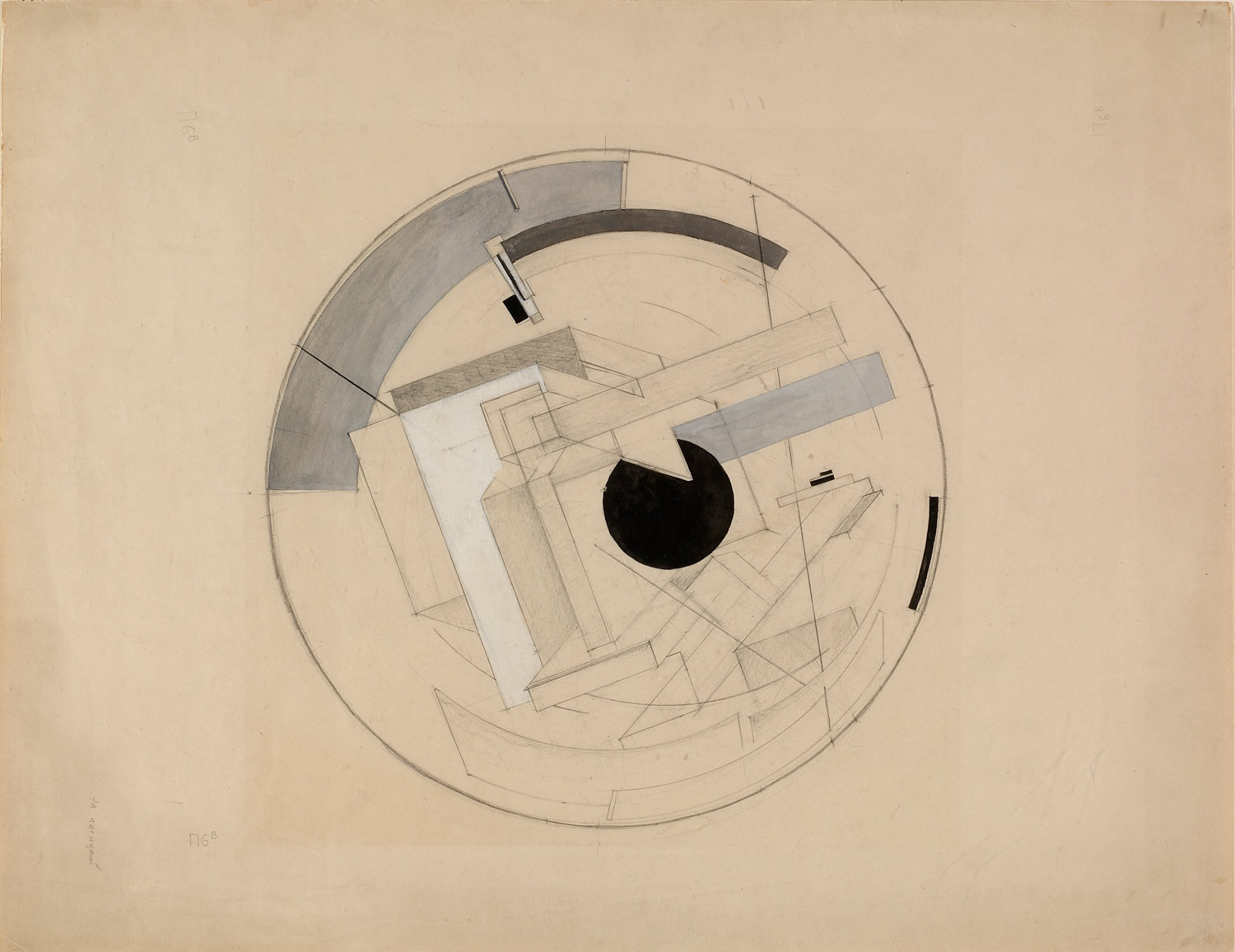
 

El Lissitzky (Russian, 1890-1941) 'Sketch for Proun 6B' 1919-1921


El Lissitzky (Russian, 1890-1941)
Sketch for Proun 6B
1919-1921
Pencil and gouache on paper
34.6 x 44.7cm
© Courtesy the State Museum of Contemporary Art
Costakis Collection, Thessaloniki


Ooh, ooh, ooh, I’m in love with the design and the photograph of the Gosplan Garage! The garage survived the Second World War but, like the Cathedral Sagrada Familia in Barcelona, it is now hemmed in and surrounded by cars and apartments (see the YouTube video GosPlan Garage (1934-1936) by Konstantin Melnikov). Looking at early photographs of both buildings – in the basement of the Sagrada Familia if you go, the Cathedral surrounded by green fields and cows – you realise what wonderful space they had to breathe, to exist in the world. Unfortunately, no more!

Dr Marcus Bunyan


Many thankx to Martin-Gropius-Bau for allowing me to publish the photographs in the posting. Please click on the photographs for a larger version of the image.
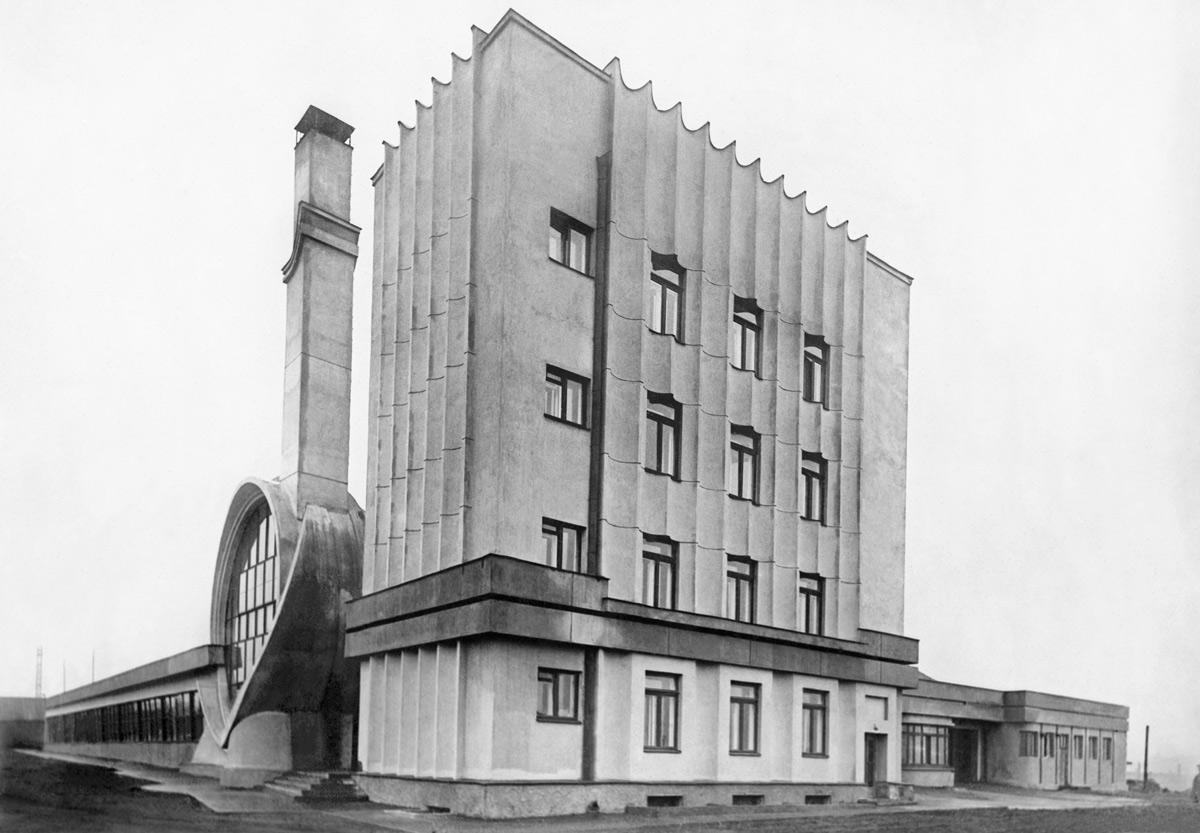


Photographer unknown. 'Gosplan Garage: general view' c. 1936


Photographer unknown
Gosplan Garage: general view
c. 1936
Archival Index Card and photographs(s)
13.6 x 20cm
Architects: Konstantin Melnikov with V. I. Kurochkin, 1936
© Courtesy the Department of Photographs, Schusev
State Museum of Architecture, Moscow


Melnikov, Konstantin Stepanovich (1890-1974)

Born on the outskirts of Moscow into a poor family of peasant origin, Melnikov served a short apprenticeship as an icon painter and was then apprenticed to an engineering firm, one of whose owners noticed his talent for drawing and sent him to the Moscow Institute for Painting, Sculpture and Architecture. He graduated initially in painting and then in 1917 in architecture. From 1918 he worked in a Mossovet architectural studio under Aleksei Schusev and Ivan Zholtovskii but his early projects for housing schemes show him abandoning the Classicism of his teachers. In his pavilion for the Makhorka tobacco firm at the 1923 All-Union Agricultural Exhibition Melnikov developed this exuberant angularity by giving different parts of the pavilion different heights and setting the sloping roofs at right angles to each other. Irregular fenestration and an external staircase – crowded with visitors in some photographs – add to the sense of animation. The construction is entirely of timber, the first evidence of Melnikov’s abiding interest in combining traditional materials with avant-garde design. His Soviet Pavilion for the 1925 Exposition Internationale des Arts Décoratifs et Industriels Modernes in Paris would also feature timber construction, an animated roofscape and an external staircase. However, it achieved a more logical design by simplifying the plan into a rectangle bisected by stairs rising and descending across its centre. During the second half of the 1920s Melnikov completed five workers’ clubs in the Moscow region for the Rusakov (1927), Frunze, Kauchuk, Pravda and Burevestnik trades unions. He favoured interiors with large flexible spaces, sometimes using movable panels, and opposed the Functionalist tendency to create a large number of highly specialised areas. This gave him the freedom to mould bold internal volumes and create dramatic exteriors. His own house, consisting of two interlocking cylinders, was designed on the same principles (1927-1931). His garages – Bahkmetevskaia, Novo Ryanskaia and Gosplan (1936) – on the other hand, though still characterised by dramatic exteriors, are based on a careful analysis of vehicular movement. Despite being briefly associated with ASNOVA, Melnikov appears a rather solitary figure, his beliefs about the design process differing from the main groupings of 1920s architects. Heavily criticised in the 1930s for his ‘Formalism’, he was largely excluded from employment and teaching and no significant buildings were constructed to his design during the last 40 years of his life.
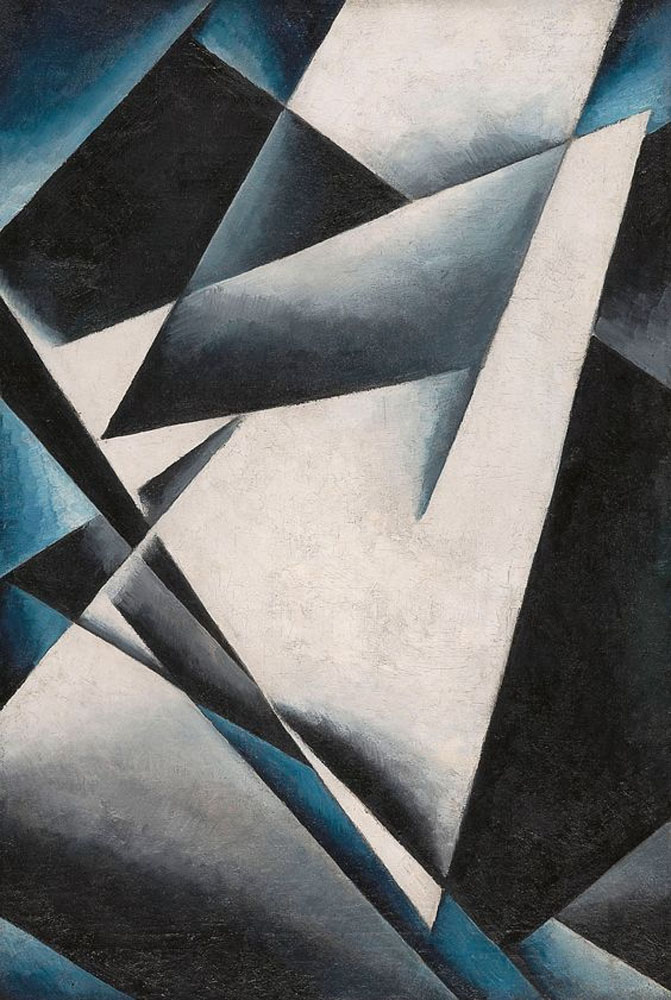
 

Liubov Popova (Russian-Soviet, 1889-1924) 'Painterly Architectonics' 1918-1919


Liubov Popova (Russian-Soviet, 1889-1924)
Painterly Architectonics
1918-1919
Oil on canvas
73.1 x 48.1cm
State Museum of Contemporary Art – G. Costakis Collection, Thessaloniki, Greece
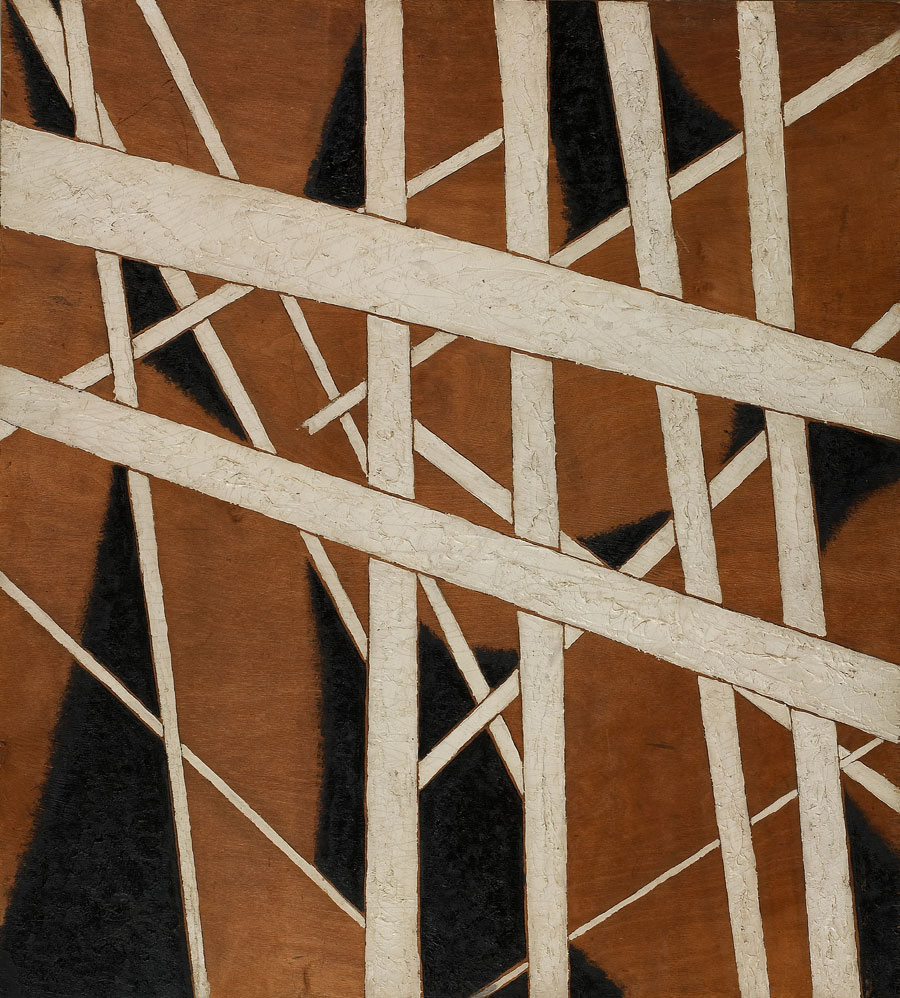
 

Liubov Popova (Russian, 1889-1924) 'Spatial Force Construction' 1921


Liubov Popova (Russian, 1889-1924)
Spatial Force Construction
1921
Oil and marble dust on plywood
71 x 63.9cm
© Courtesy the State Museum of Contemporary Art
Costakis Collection, Thessaloniki


Photographer unknown.
Liubov Popova (Russian, 1889-1924) 'Maquette for City of the Future' 1921


Photographer unknown
Liubov Popova (Russian, 1889-1924)
Maquette for City of the Future
1921
© Studio International
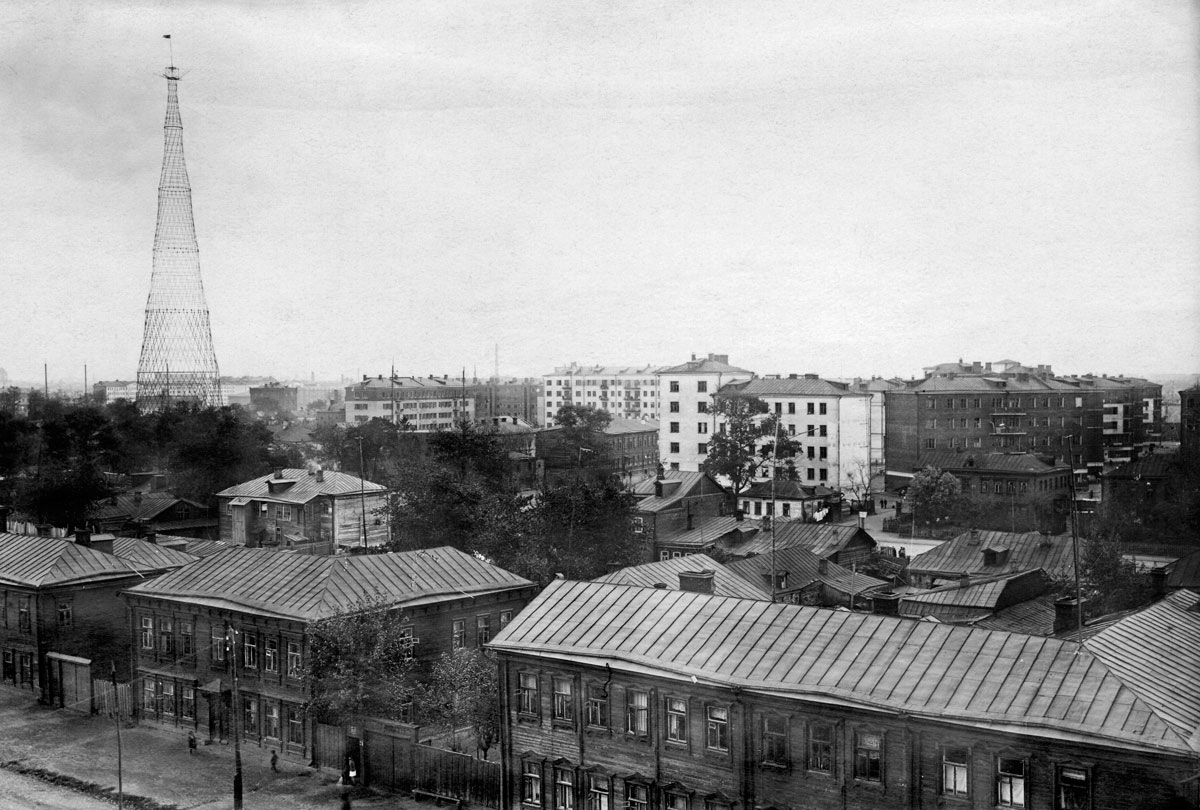
 

Photographer unknown. 'Havsko-Shabolovskii residential block and Shabolovska Radio tower viewed from the walls of the Donskoy Monastery' 1929


Photographer unknown
Havsko-Shabolovskii residential block and Shabolovska Radio tower viewed from the walls of the Donskoy Monastery
1929
Archival Index Card and photographs(s)
11.5 x 16.9cm
© Courtesy the Department of Photographs, Schusev
State Museum of Architecture, Moscow
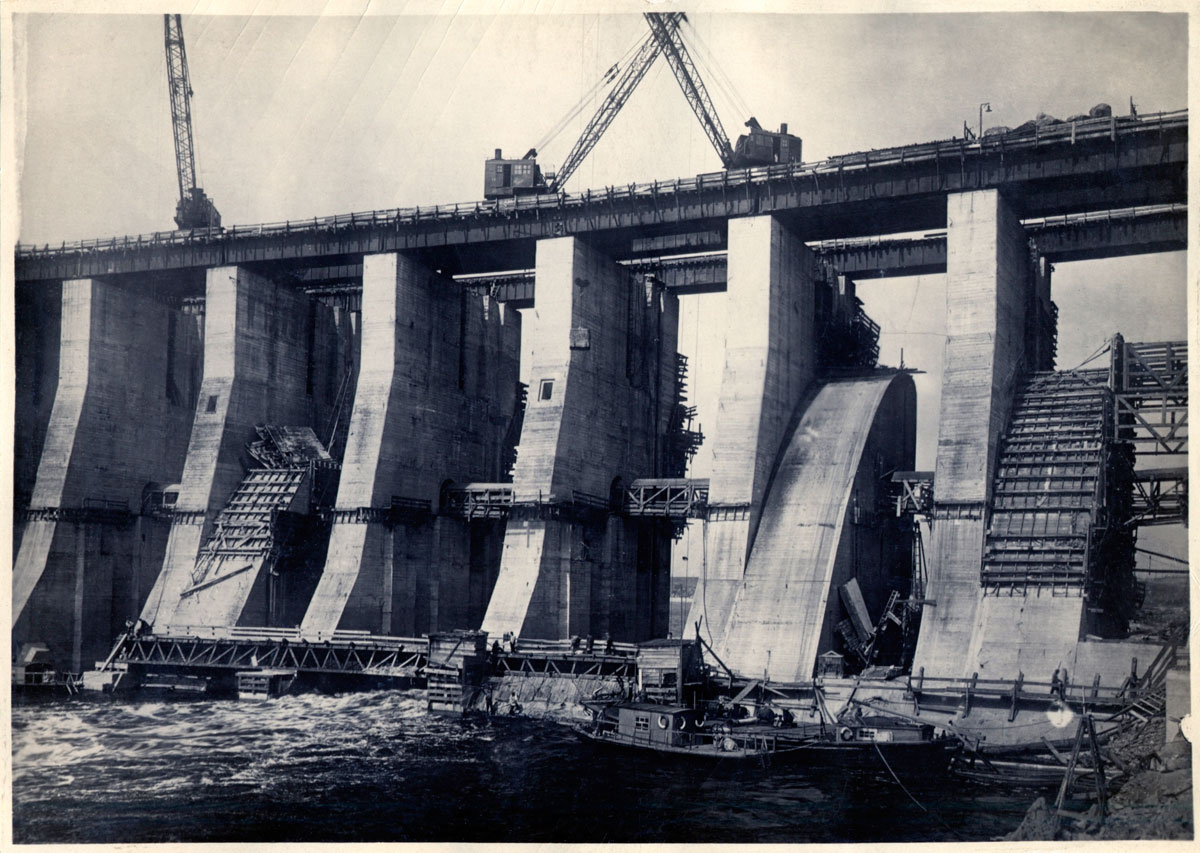
 

Photographer unknown. 'DneproGES: dam under construction' 1931


Photographer unknown
DneproGES: dam under construction
1931
Archival Index Card and photographs(s)
12.3 x 17.3cm
Aleksandr Vesnin, Nikolai Kolli, Georgii Orlov, Sergei Andrievskii, 1927-32
© Courtesy the Department of Photographs, Schusev
State Museum of Architecture, Moscow


The DneproGES Dam and Hydroelectric Power Station (designed with Nikolai Kolli, Georgii Orlov and Sergei Andrievskii, 1927-32) represents not only Vesnin’s first important industrial project but also a major achievement of Stalin’s First Five Year Plan.
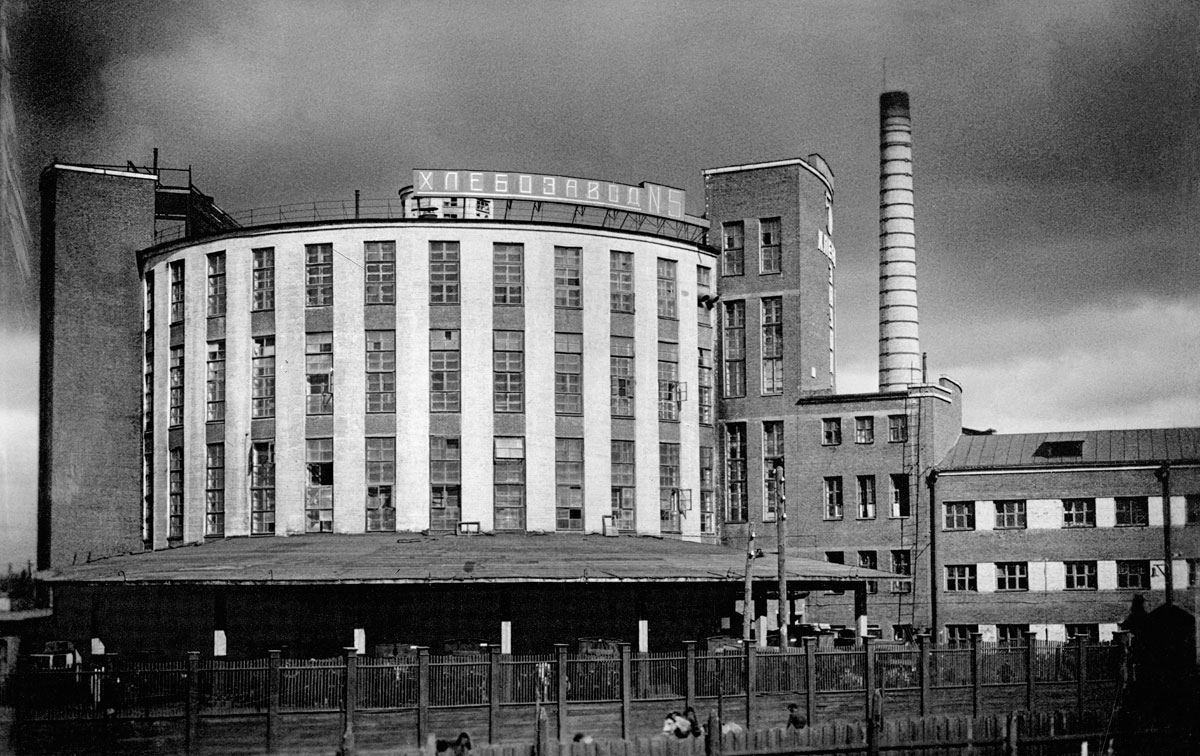
 

Photographer unkown. 'Bakery: exterior showing the four production levels' 1938


Photographer unkown
Bakery: exterior showing the four production levels
1938
Archival Index Card and photographs(s)
9.3 x 14.6cm
Engineer: Georgii Marsakov, 1931
© Courtesy the Department of Photographs, Schusev
State Museum of Architecture, Moscow


In 1931 the engineer Georgii Marsakov designed a mass-production bakery in Moscow and the Narvskii Factory Kitchen opened in St Petersburg to provide communal eating facilities for local residents. Rapid expansion of motorised transport called for a significant reappraisal of the garage, for which Konstantin Melnikov produced four highly innovative designs in Moscow.


The exhibition Building the Revolution sheds light on an area of the Soviet avant-garde that has remained relatively unknown in Europe and beyond: architecture. Even in Russia and the other successor states of the former Soviet Union the names of most of the architects have been largely forgotten. Their structures have not become part of the collective cultural memory to the extent that the “New Building” movement in the West has.

The exhibition presents this impressive chapter in the history of the avant-garde in an unusual way in that it binds together three thematic strands. Selected works of the early avant-garde, such as those of El Lissitzky, Gustav Klutsis, Liubov Popova, Alexander Rodchenko or Vladimir Tatlin, show the artists’ intense preoccupation from 1915 onwards with questions of form, space and texture. After the Revolution they were active in the various bodies concerned with the implementation of these ideals, such as the Commission for the Synthesis of Painting, Sculpture and Architecture (1919-1920). It was there that the architects Nikolai Ladovskii, Vladimir Krinsky and the painter Rodchenko created the first designs for town planning and communal housing. In 1919 Tatlin produced his famous design for a “Monument to the Third International” – a complex engineering structure with moving spaces. Although never built, its visionary potential, and dynamic formal language influenced the later architecture of Constructivism. Whereas the impressive pictures and drawings of the Costakis Collection in Thessaloniki make clear what a role was played by architectural themes in the early artistic designs, vintage prints from the Shchusev State Museum of Architecture in Moscow give an idea of the unleashing of architectural energies which took place a few years later. The historical photographs show that the new structures embodied a new age, not only in a typological sense, but in terms of scale. They towered above the old urban buildings and acted as a torch signalling the coming industrialisation and transformation of the country. The photographs of the renowned British architectural photographer, Richard Pare, on the other hand, lead the viewer back to the present. Pare had begun to rediscover this lost avant-garde in 1993. In the course of several trips to Moscow and St. Petersburg, as well as to the former Soviet republics, he documented what remained of the buildings. His shots bring out their beauty and the inventiveness of their creators while at the same time tracing the course of their decay. In that sense they draw a picture of a post-Soviet society that is unaware of its extraordinary heritage.

What was new about this architecture was not only the formal idiom, but also the tasks it was supposed to perform. With the building of the new society workers’ clubs, trade union houses, communal apartments, sanatoria for the workers, state-owned department stores, party and administrative buildings, as well as power stations and industrial plants to modernise the country.

The first important structure to be erected after the Revolution was Vladimir Shukhov’s Shabolovka Radio Tower, built in the years 1919-1922 and consisting of six hyperboloids mounted on top of one another. At 150 metres it was the tallest tower in the world of its kind at the time. Its elegant filigree structure became a symbol of how all that was old and ponderous could be surmounted. Rodchenko’s well-known photos of the radio tower – today seen as icons of avant-garde photography – stress the dynamics from above and below. Pare’s shots of the tower focus more on details, thus emphasising the construction techniques of the time.

The achievements of Russian engineers like Shukhov, with their novel technical designs, influenced the development of an architecture that used clear, geometrical forms that were in keeping with its functions. In the course of the 1920s there arose two clearly defined tendencies in architecture: Rationalism and Constructivism. In 1923 representatives of the first founded the Association of New Architects (ASNOVA), whose leading light was Ladovskii. Among the Constructivists Alexander Vesnin and Moisei Ginzburg played major roles. In 1925 the Constructivist architects of Moscow joined together to form the Society of Contemporary Architects (OSA). There were also other tendencies as well as outstanding individualists, such as Konstantin Melnikov. Despite polemical squabbles among the tendencies a modern style of building had consolidated itself by the end of the 1920s.

In the course of the industrialisation of the country under the first Five-Year Plan (1928-1932) the building of new towns proceeded apace. This gave rise to questions concerning the concept of the city, for which various solutions were proposed, such as the “horizontal skyscrapers” for Moscow or Ladovskii’s “parabola” as the basic pattern of urban development. Quite a few of the buildings photographed by Pare were developed for communal living. The Narkomfin (People’s Commissariat for Finance) residential block built in Moscow in 1930 by Ginzburg and Ignati Milinis was one of the most experimental projects of that era. In addition to two floors of apartments it contained a communal canteen, a crèche, a gymnasium and a scullery. Other types of construction designed to promote the collectivist way of life were canteen kitchens, three of which were built in what was then Leningrad by a group associated with Iosif Meerzon and representing Rationalism. Workers’ clubs and palaces of culture offered numerous educational opportunities, symbolising with their dynamic forms the role of the new class in the urban environment.

When in the mid-1930s the political climate in the Soviet Union underwent a fundamental change, and a monumental style of architecture based on Classical models found favour with the powers that be, this exciting chapter of avant-gardism came to an end and sank into oblivion.
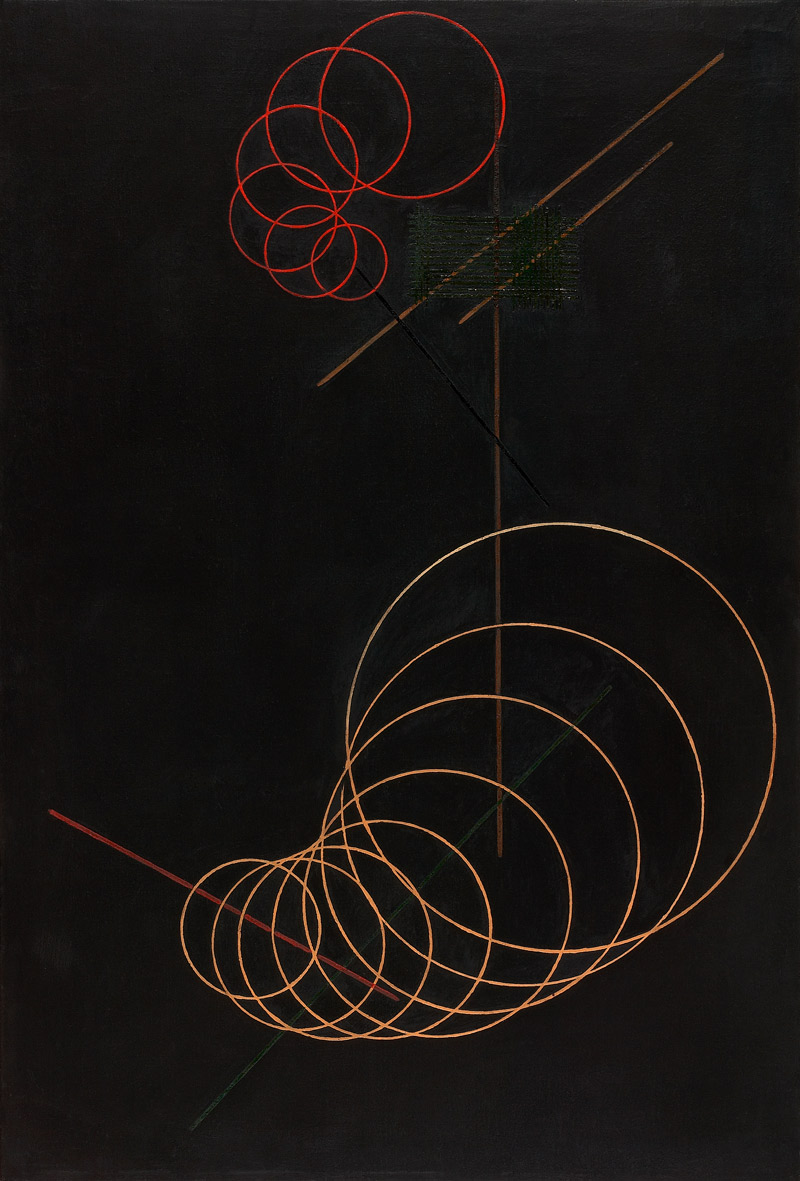
 

Alexander Rodchenko (Russian, 1891-1956) 'Linearism' 1920


Alexander Rodchenko (Russian, 1891-1956)
Linearism
1920
Oil on canvas
110.5 x 78cm
© Courtesy the State Museum of Contemporary Art
Costakis Collection, Thessaloniki
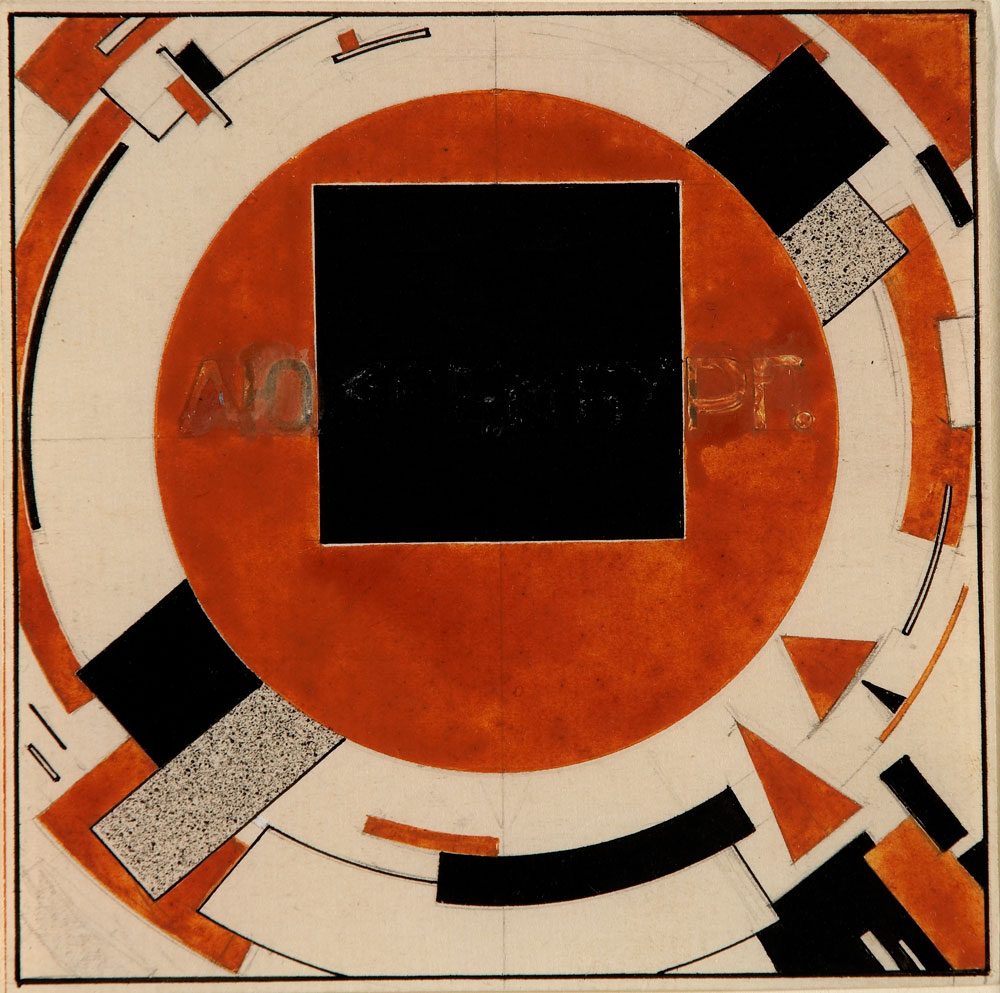
 

El Lissitzky (Russian, 1890-1941) 'Monument to Rosa Luxemburg' 1919-1921


El Lissitzky (Russian, 1890-1941)
Monument to Rosa Luxemburg
1919-1921
Pencil, ink and gouache on paper
9.7 x 9.7cm
© Courtesy the State Museum of Contemporary Art
Costakis Collection, Thessaloniki
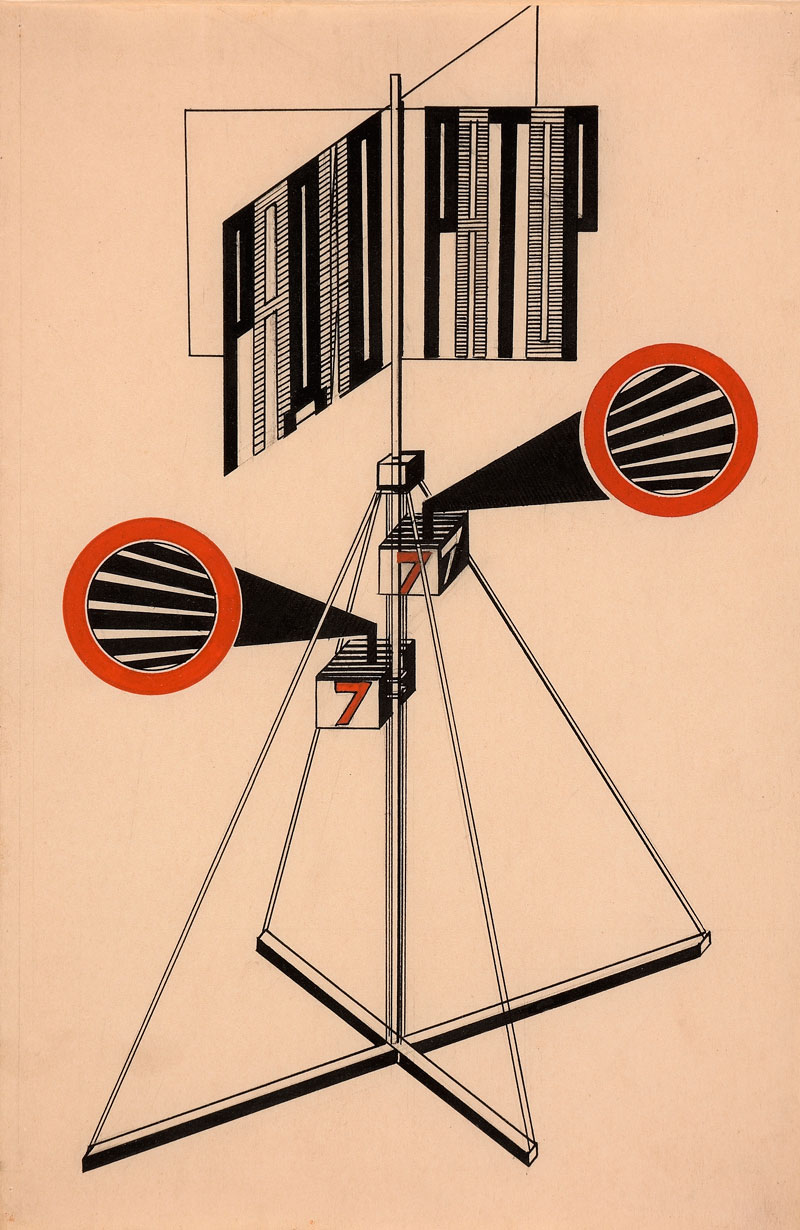
 

Gustav Klutsis (Latvian, 1895-1938) 'Design for Loudspeaker No.7' 1922


Gustav Klutsis (Latvian, 1895-1938)
Design for Loudspeaker No.7
1922
Pencil, ink and gouache on paper
26.9 x 17.7cm
© Courtesy the State Museum of Contemporary Art
Costakis Collection, Thessaloniki
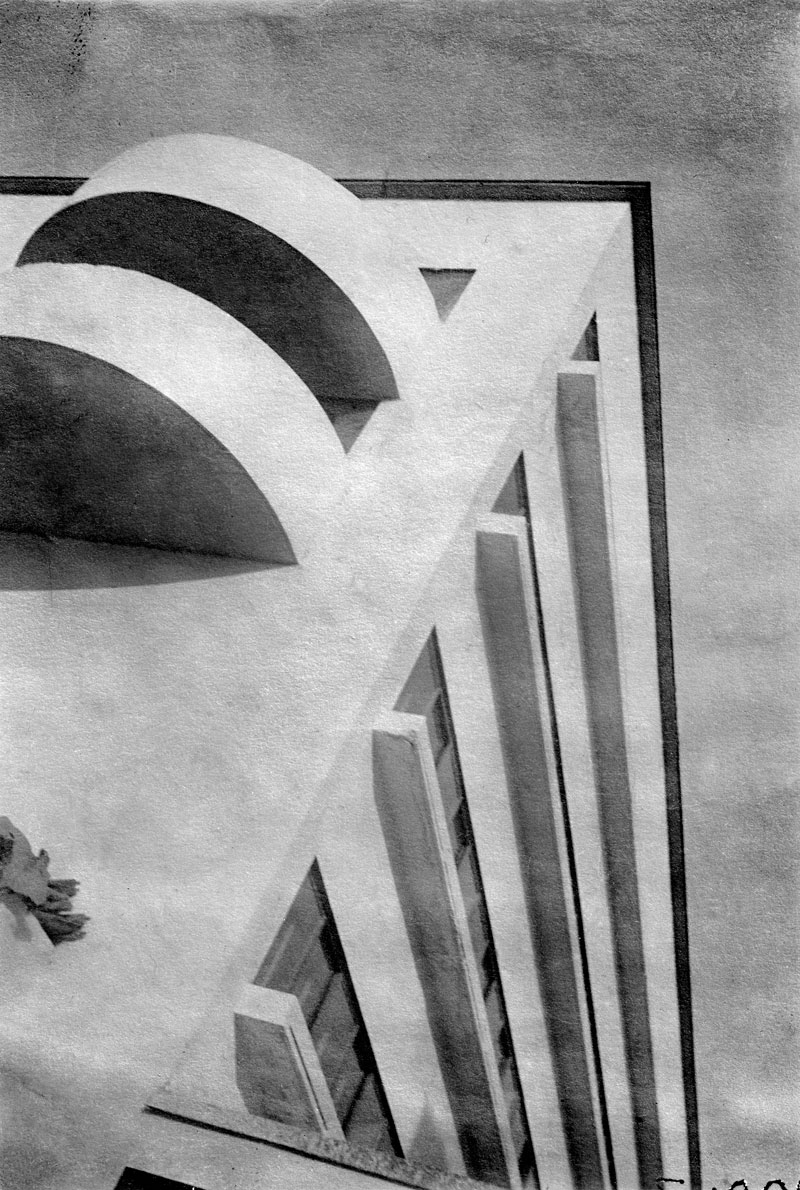
 

M.A. Ilyin (Russian) 'Narkomfin Communal House: corner detail of residential block' 1931


M.A. Ilyin (Russian)
Narkomfin Communal House: corner detail of residential block
1931
Archival Index Card and photographs(s)
11.6 x 8cm
Architects: Moisei Ginzburg, Ignatii Milinis, 1930
© Courtesy the Department of Photographs, Schusev
State Museum of Architecture, Moscow


Moisei Ginzburg

There was also the exchange with the Europeans. Le Corbusier came to Moscow and met and shared ideas with a number of architects including Moisei Ginzburg, the founder of the Constructivist movement and its chief theoretician. His 1924 treatise Style and Epoch was the most influential document of the Constructivist movement. Because he was Jewish, he was prevented from undertaking his architectural training in Russia and went to the École des Beaux-Arts in Paris and the Accademia di Belle Arti in Milan. Aleksandr Rodchenko travelled to Paris with Melnikov, who built the Soviet Pavilion at the 1925 Exposition Internationale des Arts Décoratifs et Industriels Modernes in Paris. They were all very well versed in European culture of the time. Ginzburg’s Style and Epoch responds to Le Corbusier’s Vers une architecture of the previous year, but Ginzburg takes the warship and the communal house rather than the luxury liner and the private villa as his examples.
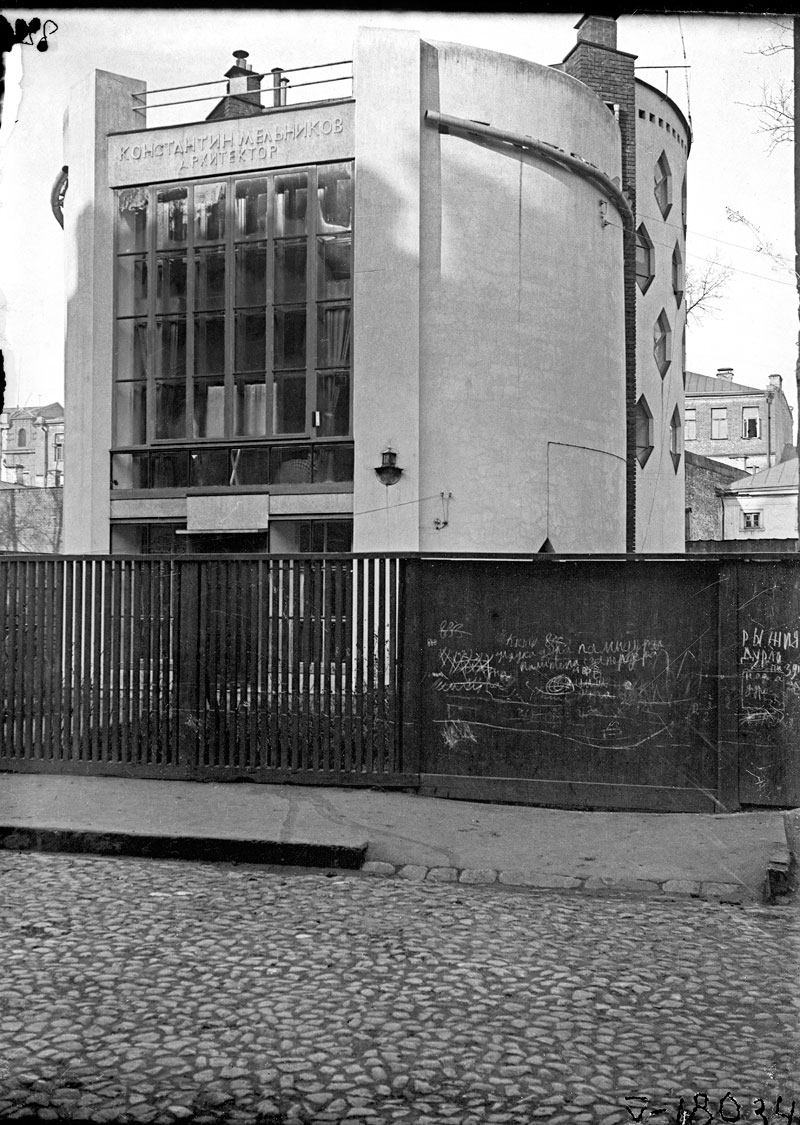
 

M.A. Ilyin (Russian) 'Melnikov House: entrance façade' 1931


M.A. Ilyin (Russian)
Melnikov House: entrance façade
1931
Archival Index Card and photographs(s)
11.7 x 9cm
Konstantin Melnikov, 1927-31
© Courtesy the Department of Photographs, Schusev
State Museum of Architecture, Moscow
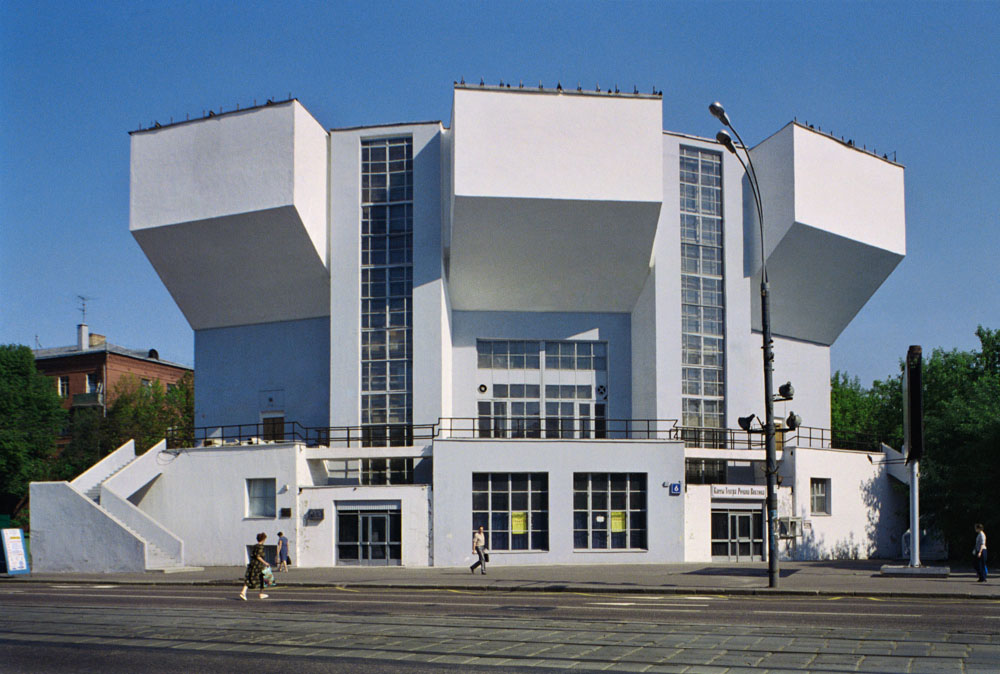
 

Richard Pare (English, b. 1948) 'Rusakov Workers' Club: general view showing the three auditorium segments' 1995


Richard Pare (English, b. 1948)
Rusakov Workers’ Club: general view showing the three auditorium segments
1995
Gelatin silver print
50.8 x 61cm
Courtesy Kicken Berlin
© Richard Pare


The Rusakov Workers’ Club (Russian: Дом культуры имени И.В.Русакова (рабочий клуб)) in Moscow is a notable example of constructivist architecture. Designed by Konstantin Melnikov, it was constructed in 1927–28. The club is built on a fan-shaped plan, with three cantilevered concrete seating areas rising above the base. Each of these volumes can be used as a separate auditorium, and combined they result in a capacity of over 1,000 people. At the rear of the building are more conventional offices. The only visible materials used in its construction are concrete, brick and glass. The function of the building is to some extent expressed in the exterior, which Melnikov described as a “tensed muscle”.

Text from the Wikipedia website
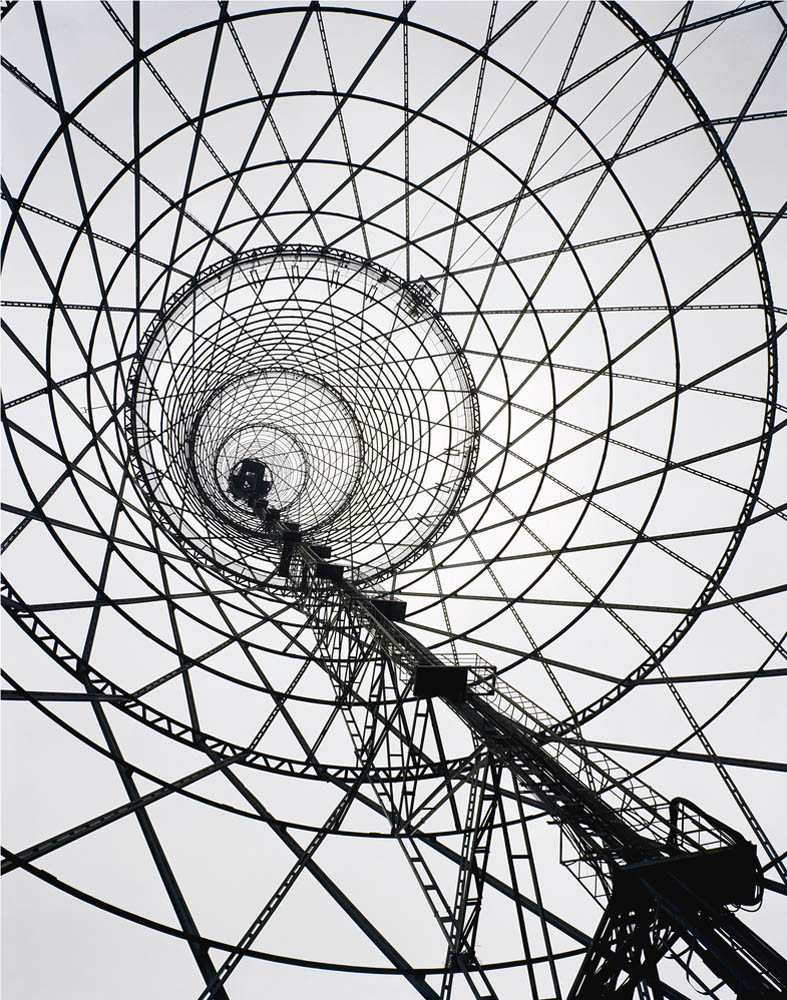
 

Richard Pare (English, b. 1948) 'Shabolovka Radio Tower' 1998


Richard Pare (English, b. 1948)
Shabolovka Radio Tower
1998
Gelatin silver print
154.8 x 121.9cm
Richard Pare, courtesy Kicken Berlin
© Richard Pare


The Shukhov Radio Tower (Russian: Шуховская башня), also known as the Shabolovka Tower (Шаболовская башня), is a broadcasting tower deriving from the Russian avant-garde in Moscow designed by Vladimir Shukhov. The 160-metre-high (520 ft) free-standing steel diagrid structure was built between 1920 and 1922, during the Russian Civil War.

Text from the Wikipedia website


Martin-Gropius-Bau Berlin
Niederkirchnerstraße 7
Corner Stresemannstr. 110
10963 Berlin
Phone: +49 (0)30 254 86-0

Opening hours:
Wednesday to Monday 10 – 19 hrs
Tuesday closed

Martin-Gropius-Bau website

LIKE ART BLART ON FACEBOOK

Back to top

Review: ‘The mad square: Modernity in German Art 1910-37’ at The National Gallery of Victoria, Melbourne

Exhibition dates: 25th November 2011 – 4th March 2012


Irene Bayer (American, 1898-1991) 'No title (Man on stage)' c. 1927


Irene Bayer (American, 1898-1991)
No title (Man on stage)
c. 1927
Gelatin silver photograph
Printed image 10.6 h x 7.6 w cm
Purchased 1983
National Gallery of Australia, Canberra


This is one of the best exhibitions this year in Melbourne bar none. Edgy and eclectic the work resonates with the viewer in these days of uncertainty: THIS should have been the Winter Masterpieces exhibition!

The title of the exhibition, The mad square (Der tolle Platz) is taken from Felix Nussbaum’s 1931 painting of the same name where “the ‘mad square’ is both a physical place – the city, represented in so many works in the exhibition, and a reference to the state of turbulence and tension that characterises the period.” The exhibition showcases how artists responded to modern life in Germany in the interwar years, years that were full of murder and mayhem, putsch, revolution, rampant inflation, starvation, the Great Depression and the rise of National Socialism. Portrayed is the dystopian, dark side of modernity (where people are the victims of a morally bankrupt society) as opposed to the utopian avant-garde (the prosperous, the wealthy), where new alliances emerge between art and politics, technology and the mass media. Featuring furniture, decorative arts, painting, sculpture, collage and photography in the sections World War 1 and the Revolution, Dada, Bauhaus, Constructivism and the Machine Aesthetic, Metropolis, New Objectivity and Power and Degenerate Art, it is the collages and photographs that are the strongest elements of the exhibition, particularly the photographs. What a joy they are to see.

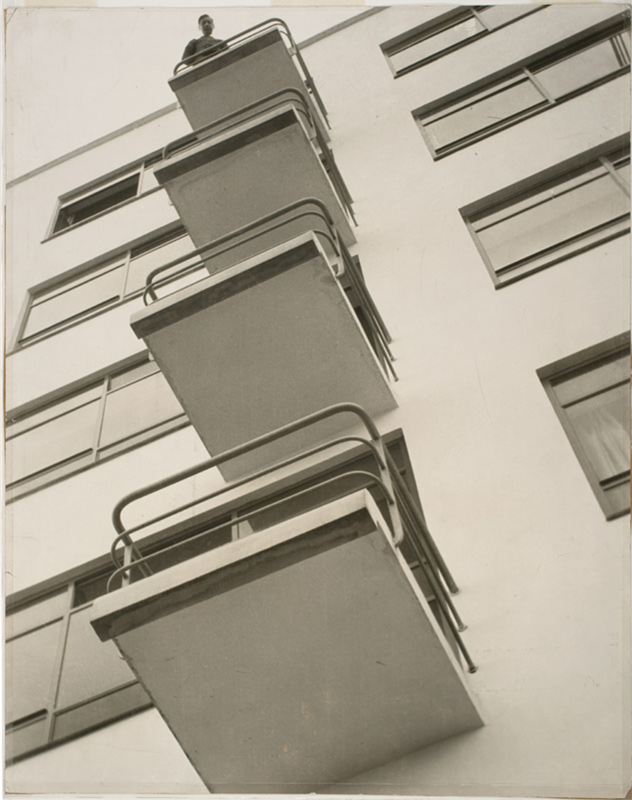
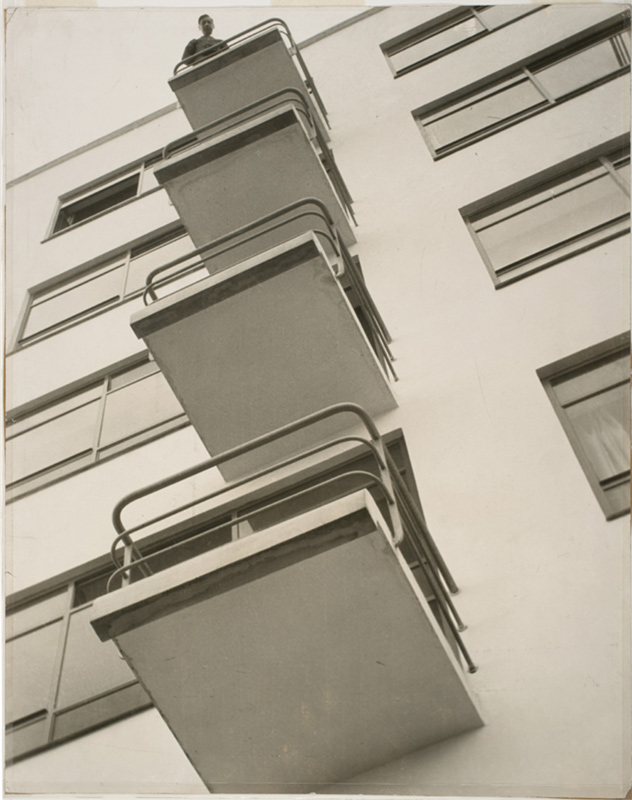
There is a small 2″ x 3″ contact print portrait of Hanna Höch by Richard Kauffmann, Penetrate yourself or: I embrace myself (1922) that is an absolute knockout. Höch is portrayed as the ‘new women’ with short bobbed hair and loose modern dress, her self-image emphasised through a double exposure that fragments her face and multiplies her hands, set against a contextless background. The ‘new women’ fragmented and broken apart (still unsure of herself?). The photograph is so small and intense it takes your breath away. Similarly, there is the small, intimate photograph No title (Man on Stage) (c. 1927) by Irene Bayer (see above) that captures performance as ‘total art’, a combination of visual arts, dance, music, architecture and costume design. In contrast is a large 16 x 20″ photograph of the Bauhaus balconies (1926) by László Moholy-Nagy (see below) where the whites are so creamy, the perspective so magnificent.

No title (Metalltanz) (c. 1928-1929) by T. Lux Feinenger, a photographer that I do not know well, is an exceptional photograph and print. Again small, this time dark and intense, the image features man as dancer performing gymnastics in front of reflective, metal sculptures. The metal becomes an active participant in the Metalltanz or ‘Dance in metal’ because of its reflective qualities. The print, from the J. Paul Getty Museum in Los Angeles is luminous. In fact all the prints from the Getty in this exhibition are of the most outstanding quality, a highlight of the exhibition for me. Another print from the Getty that features metal and performance is Untitled (Spiral Costume, from the Triadic Ballet) by T Grill c. 1926-1927 (see below) where the spiral costume becomes an extension of the body, highlighting its form. Also highlighting form, objectivity and detachment is a wonderful 3 x 5″ photograph of the New Bauhaus Building, Dessau (1926) by Lucia Moholy from the Getty collection, the first I have ever seen in the flesh by this artist. Outstanding.

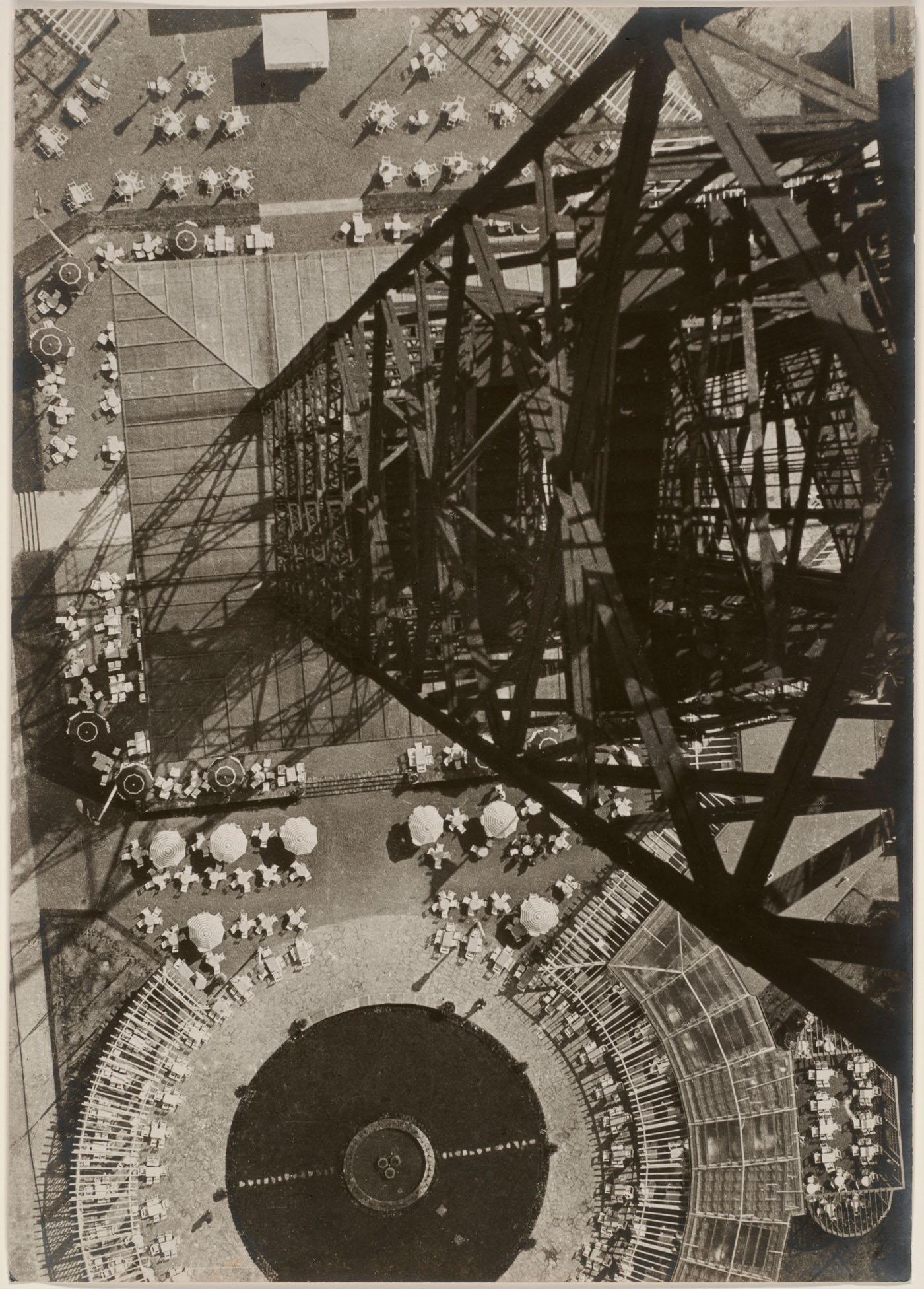
Following, we have 4 photograms by Lucia’s husband, László Moholy-Nagy which display formalist experimentation “inspired by machine aesthetic, exploring a utopian belief that Constructivism and abstract art could play a role in the process of social reform.” Complimenting these photograms is a row of six, yes six! Moholy-Nagy including Dolls (Puppen) 1926-1927 (Getty), The law of the series 1925 (Getty), Lucia at the breakfast table 1926 (Getty), Spring, Berlin 1928 (George Eastman House), Berlin Radio Tower 1928 (Art Institute of Chicago) and Light space modulator 1930 (Getty). All six photographs explore the fascinating relationship between avant-garde art and photography, between they eye and perspective, all the while declaiming what Moholy-Nagy called the “new vision”; angles, shadows and geometric patterns that defy traditional perspective “removing the space from associations with the real world creating a surreal, disjointed image.” This topographic mapping flattens perspective in the case of the Berlin radio tower allowing the viewer to see the world in a new way.

Finally two groups of photographs that are simply magnificent.

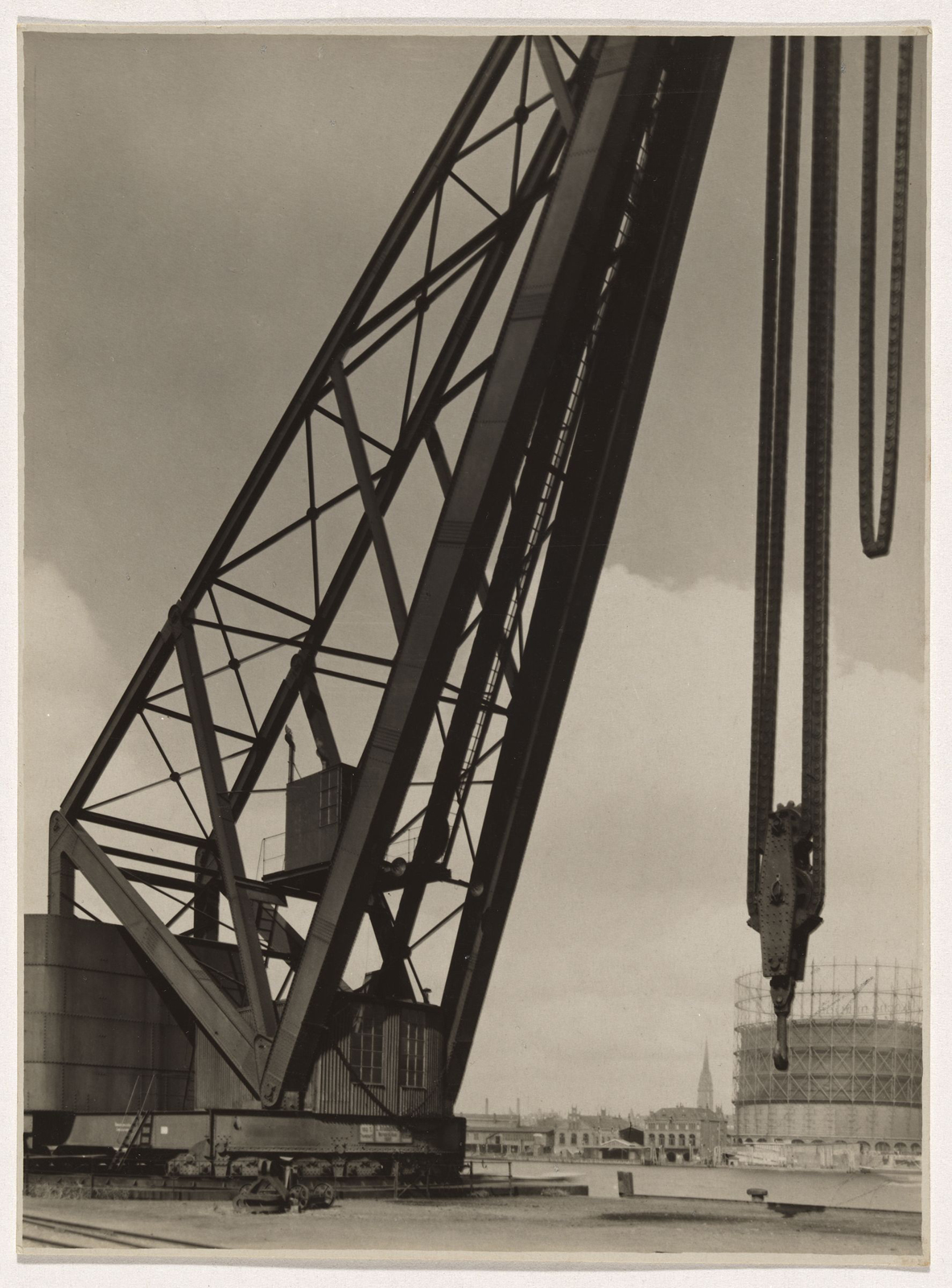
First 8 photographs in a row that focus on the order and progressive nature of the modern world, the inherent beauty of technology captured in formalist studies of geometric forms. The prints range from soft pictorialist renditions to sharp clarity. The quality of the prints is amazing. Artists include the wonderful E. O. Hoppé, Albert Renger-Patzsch (an outstandingly beautiful photograph, Harbour with cranes 1927 that is my favourite photograph in the exhibition, see below), Two Towers 1937-1938 by Werner Mantz and some early Wolfgang Sievers before he left Germany for Australia in 1938 (Blast furnace in the Ruhr, Germany 1933, see below). These early Sievers are particularly interesting, especially when we think of his later works produced in Australia. Lucky were many artists who survived in Germany or fled from Nazi persecution at the last moment, including John Heartfield who relocated to Czechoslovakia in 1933 and then fled to London in 1938 and August Sander whose life and work were severely curtailed under the Nazi regime and whose son died in prison in 1944 near the end of his ten year sentence (Wikipedia).

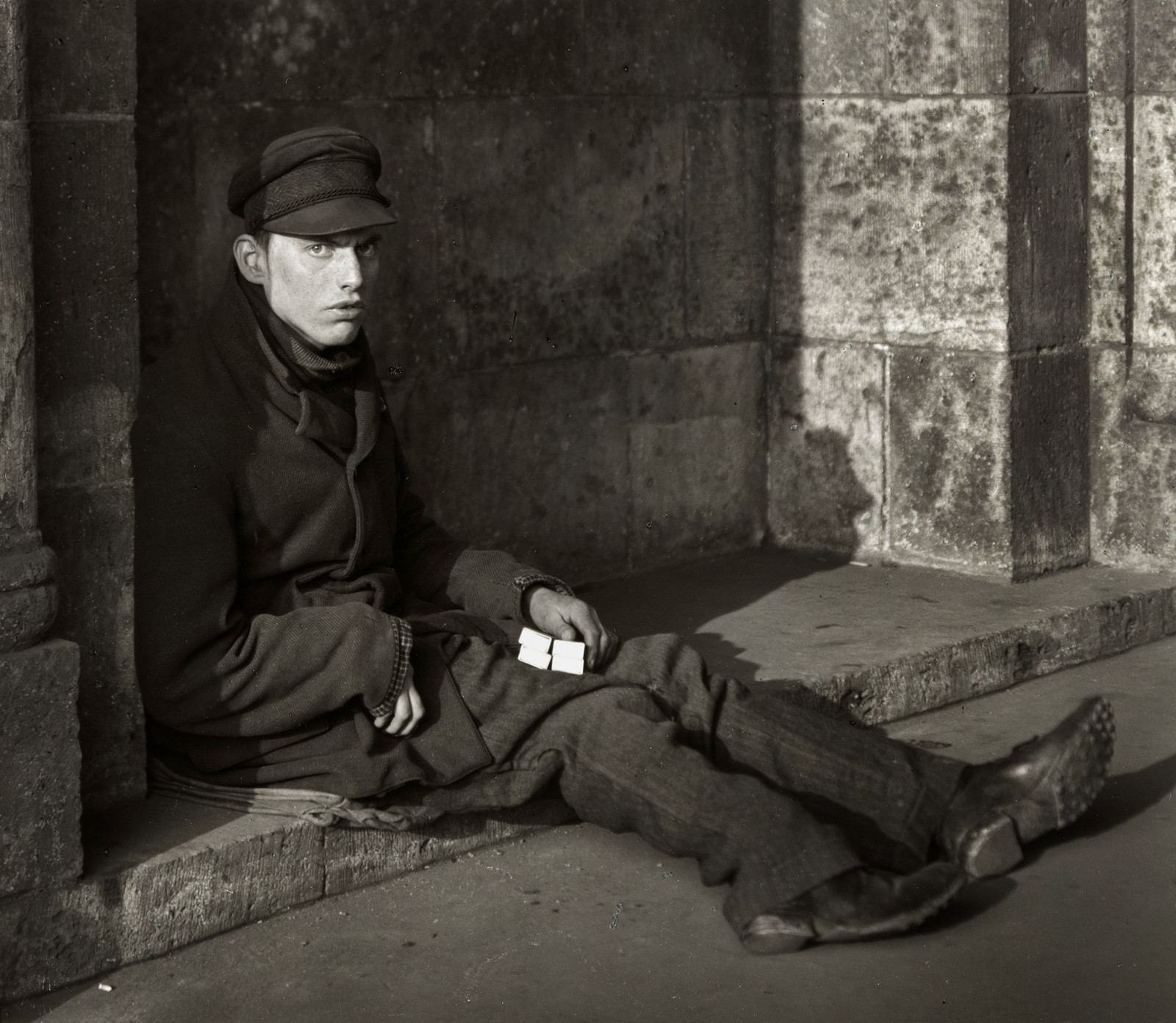
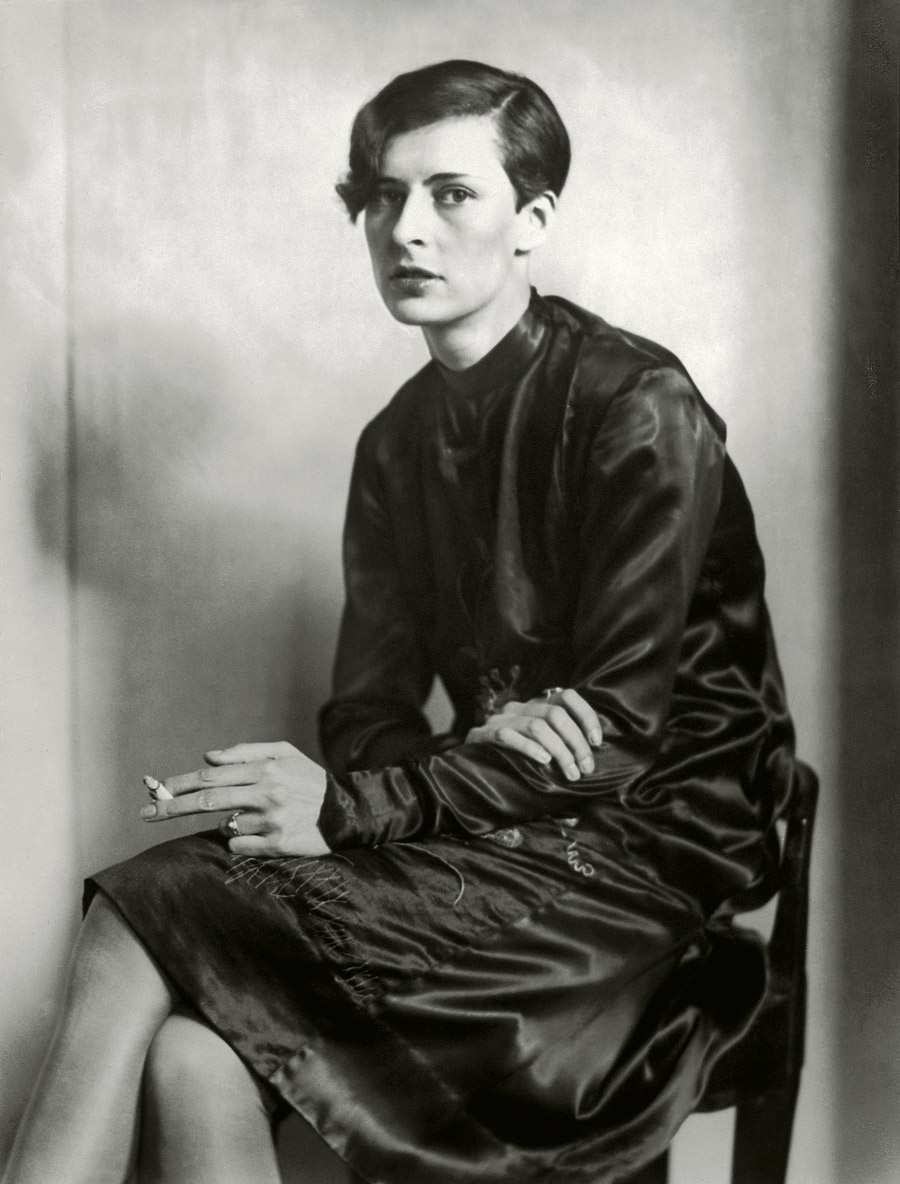
August Sander. Now there is a name to conjure with. The second magnificent group are 7 photographs that are taken from Sander’s seminal work People of the 20th Century. All the photographs have soft, muted tones of greys with no strong highlights and, usually, contextless backgrounds. The emphasis is on archetypes, views of people who exist on the margins of society – circus performers, bohemians, artists, the unemployed and blind people. In all the photographs there is a certain frontality (not necessarily physical) to the portraits, a self consciousness in the sitter, a wariness of the camera and of life. This self consciousness can be seen in the two photographs that are the strongest in the group – Secretary at West German radio in Cologne, 1931 and Match seller 1927 (see below).

There is magic here. Her face wears a somewhat quizzical air – questioning, unsure, vulnerable – despite the trappings of affluence and fashionability (the smoking of the cigarette, the bobbed hair). He is wary of the camera, his face and hands isolated by Sander while the rest of his body falls into shadow. His right hand is curled under, almost deformed, his shadow falling on the stone at right, the only true brightness in this beautiful image the four boxes of matches he clutches in his left hand: as Sander titles him ironically, The Businessman.

Working as I do these days with lots of found images from the 1940s-1960s that I digitally restore to life, I wonder what happened to these people during the dark days of World War 2. Did they survive the cataclysm, the drop into the abyss? I want to know, I want to reach out to these people to send them good energy. I hope that they did but their wariness in front of the camera, so intimately ‘taken’ by Sander, makes me feel the portent of things to come. How differently we see images armed with the hindsight of history!

In conclusion, this is a fantastic exhibition that will undoubtedly be in my top ten of the year for Melbourne in 2011.

Dr Marcus Bunyan


Many thankx to Michael Thorneycroft for his help and The National Gallery of Victoria for allowing me to publish the accredited photographs in the posting. Please click on the photographs for a larger version of the image.


Felix Nussbaum (German, 1904 - after September 1944) 'The mad square' (Der tolle Platz) 1931


Felix Nussbaum (German, 1904 – after September 1944)
The mad square (Der tolle Platz)
1931
Oil on canvas
97 x 195.5cm
Berlinische Galerie
Public domain


László Moholy-Nagy (American born Hungary, 1895-1946) 'Photograph (Berlin Radio Tower)' 1928/1929


László Moholy-Nagy (American born Hungary, 1895-1946)
Berlin Radio Tower
1928
Gelatin silver print
36 × 25.5cm
Julien Levy Collection, Special Photography Acquisition Fund
© 2018 Artists Rights Society (ARS), New York / VG Bild-Kunst, Bonn


Over the winter and spring of 1927-1928, Bauhaus professor László Moholy-Nagy took a series of perhaps nine views looking down from the Berlin Radio Tower, one of the most exciting new constructions in the German capital. Moholy had already photographed the Eiffel Tower in Paris from below, looking up through the tower’s soaring girders. In Berlin, however, Moholy turned his camera around and pointed it straight down at the ground. This plunging perspective showed off the spectacular narrowness of the Radio Tower, finished in 1926, which rose vertiginously to a height of 450 feet from a base seven times smaller than that of its Parisian predecessor (which opened in 1889). Moholy attached exceptional importance to this, his boldest image: he hung it just above his name in a room devoted to his work at the Berlin showing of Film und Foto, a mammoth traveling exhibition that he had helped to prepare. Moholy also chose this view and one other to offer Julien Levy, the pioneering art dealer, when Levy visited him in Berlin in 1930. The following year the pictures went on view at the Levy Gallery in New York, in Moholy’s first solo exhibition of photographs.

Text from the Art Institute of Chicago website


László Moholy-Nagy (American born Hungary, 1895-1946) 'Photograph (Light Prop)' 1930


László Moholy-Nagy (American born Hungary, 1895-1946)
Das Lichtrequisit (The light prop)
1930
Gelatin silver print
24 × 18.1cm (9 7/16 × 7 1/8 in.)
J. Paul Getty Museum, Los Angeles
© 2014 Estate of László Moholy-Nagy / Artists Rights Society (ARS), New York


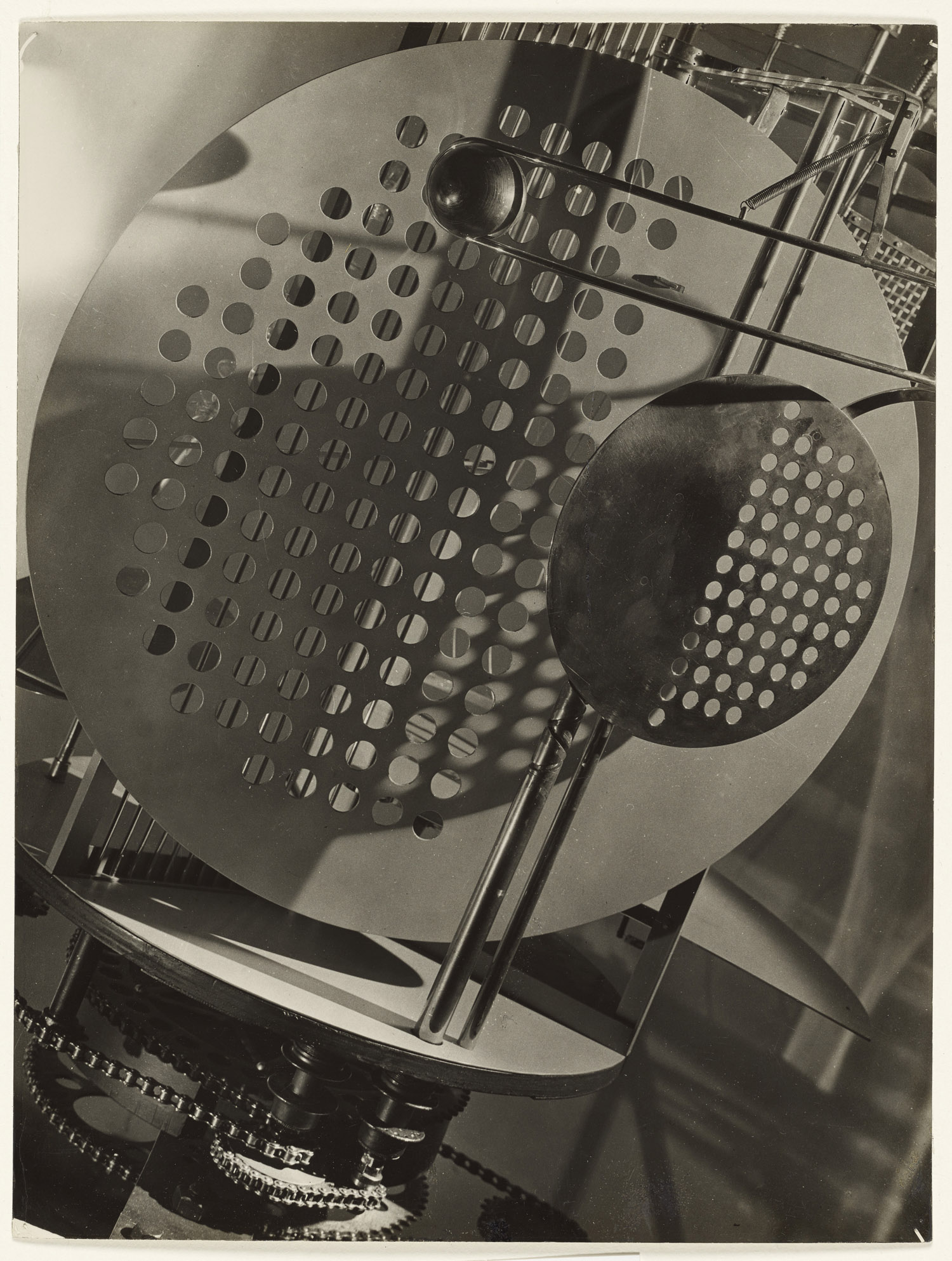
The Light-Space Modulator is the most spectacular and complete realisation of László Moholy-Nagy’s artistic philosophy. Machine parts and mechanical structures began to appear in his paintings after his emigration from Hungary, and they are also seen in the illustrations he selected for the 1922 Buch neuer Künstler (Book of new artists), which includes pictures of motorcars and bridges as well as painting and sculpture. Many contemporary artists incorporated references to machines and technology in their work, and some, like the Russian Constructivist Vladimir Tatlin, even designed plans for fantastic structures, such as the ambitious Monument to the Third International, a proposed architectural spiral of glass and steel with moving tiers and audiovisual broadcasts. (See Tatlin’s Tower.)

In the Light-Space Modulator, Moholy-Nagy was able to create an actual working mechanism. Although he censured capitalism’s inhumane use of technology, he believed it could be harnessed to benefit mankind and that the artist had an important role in accomplishing this. Moholy had made preliminary sketches for kinetic sculptures as early as 1922 and referred to the idea for a light machine in his writings, but it was not until production was financed by an electric company in Berlin in 1930 that this device was built, with the assistance of an engineer and a metalsmith. It was featured at the Werkbund exhibition in Paris the same year, along with the short film Light Display Black-White-Gray, made by Moholy-Nagy to demonstrate and celebrate his new machine.

The Light-Space Modulator is a Moholy-Nagy painting come to life: mobile perforated disks, a rotating glass spiral, and a sliding ball create the effect of photograms in motion. With its gleaming glass and metal surfaces, this piece (now in the collection of the Busch-Reisinger Museum at Harvard University) is not only a machine for creating light displays but also a sculptural object of beauty, photographed admiringly by its creator.

Katherine Ware, László Moholy-Nagy, In Focus: Photographs from the J. Paul Getty Museum (Los Angeles: J. Paul Getty Museum, 1995), 80 © 1995 The J. Paul Getty Museum


Albert Renger-Patzsch (American born Hungary, 1895-1946) 'Harbour with crane' c. 1927


Albert Renger-Patzsch (American born Hungary, 1895-1946)
Harbour with crane
c. 1927
Gelatin silver photograph
Printed image 22.7 h x 16.8 w cm
Purchased 1983
National Gallery of Australia, Canberra


Wolfgang Sievers (Germany 1913 - Australia 2007) 'Blast furnace in the Ruhr, Germany' 1933


Wolfgang Sievers (Germany 1913 – Australia 2007)
Blast furnace in the Ruhr, Germany
1933
Gelatin silver photograph
27.5 h x 23 w cm
Purchased 1988
National Gallery of Australia, Canberra


The Ruhr region was at the centre of the German acceleration of industry in pre-war Germany, with rapid economic growth creating a heavy demand for coal and steel. In keeping with Modernist trends in photography, Sievers shot this blast furnace – the mechanism that transforms ore into metal – from an unusual, dynamic angle. It dominates the frame, appearing menacing and strange. Despite being imprisoned and beaten by the Gestapo, Sievers studied and taught at a progressive private art school until graduation in 1938. In that year he escaped Germany after being called up for military service, ending up in Australia.

Text © National Gallery of Australia, Canberra


August Sander (German, 1876-1964) 'Match seller' 1927


August Sander (German, 1876-1964)
Match seller
1927
From the portfolio People of the 20th century, IV Classes and Professions, 17 The Businessman


Robert Wiene, Director (German 1873-1938) Still from the 'Cabinet of Dr Caligari' 1919


Robert Wiene, Director (German 1873-1938)
Still from from the Cabinet of Dr Caligari
1919
5 min excerpt, 35mm transferred to DVD, Black and White, silent, German subtitles
Courtesy Transit Film GmbH
Production still courtesy of the British Film Institute and Transit Film GmbH


Felix H Man (German, 1893-1985) 'Luna Park' 1929


Felix H Man (German, 1893-1985)
Luna Park
1929
Gelatin silver photograph
18.1 x 24cm
National Gallery of Australia, Canberra
Purchased, 1987
© Felix H Man Estate


Hannah Höch (German, 1889-1978) 'Love' 1931


Hannah Höch (German, 1889-1978)
Love
1931
From the series Love
Photomontage
21.8 x 21cm
National Gallery of Australia, Canberra
Purchased, 1983


Hannah Höch made some of the most interesting Dada collages and photomontages, including Love, an image of two strange composite female. Höch’s technique of pasting images together from magazine clippings and advertisements was a response to the modern era of mass media, and a way of criticising the bourgeois taste for ‘high art’. In many of her works, Höch explores the identity and changing roles of women in modern society.


The Mad Square takes its name from Felix Nussbaum’s 1931 painting which depicts Berlin’s famous Pariser Platz as a mad and fantastic place. The ‘mad square’ is both a physical place – the city, represented in so many works in the exhibition, and a reference to the state of turbulence and tension that characterises the period. The ‘square’ can also be a modernist construct that saw artists moving away from figurative representations towards increasingly abstract forms.

The exhibition features works by Max Beckman, Otto Dix, George Grosz, Christian Schad, Kurt Schwitters and August Sander. This group represents Germany’s leading generation of interwar artists. Major works by lesser known artists including Karl Hubbuch, Rudolf Schlichter and Hannah Höch are also presented in the exhibition in addition to works by international artists who contributed to German modernism.

The Mad Square brings together a diverse and extensive range of art, created during one of the most important and turbulent periods in European history, offering new insights into the understanding of key German avant‐garde movements including – Expressionism, Dada, Bauhaus, Constructivism, and New Objectivity were linked by radical experimentation and innovation, made possible by an unprecedented freedom of expression.

World War 1 and the Revolution

The outbreak of war in 1914 was met with enthusiasm by many German artists and intellectuals who volunteered for service optimistically hoping that it would bring cultural renewal and rapid victory for Germany. The works in this section are by the generation of artists who experienced war first hand. Depictions of fear, anxiety and violence show the devastating effects of war – the disturbing subjects provide insight into tough economic conditions and social dysfunction experienced by many during the tumultuous early years of the Weimar Republic following the abdication of the Kaiser

Dada

The philosophical and political despair experienced by poets and artists during World War 1 fuelled the Dada movement, a protest against the bourgeois conception of art. Violent, infantile and chaotic, Dada took its name from the French word for a child’s hobbyhorse or possibly from the sound of a baby’s babble. Its activities included poetry readings and avant‐garde performances, as well as creating new forms of abstract art that subverted all existing conditions in western art. Though short‐lived, in Germany the Dada movement has profoundly influenced subsequent developments in avant-garde art and culture. The impact of the Dada movement was felt throughout Europe – and most powerfully in Germany from 1917-21.

Bauhaus

The Bauhaus (1919‐1933) is widely considered as the most important school of art and design of the 20th century, very quickly establishing a reputation as the leading and most progressive centre of the international avant‐garde. German architect Walter Gropius founded the school to do away with traditional distinctions between the fine arts and craft, and to forge an entirely new kind of creative designer skilled in both the conceptual aesthetics of art and the technical skills of handicrafts. The Bauhaus was considered to be both politically and artistically radical from its inception and was closed down by the National Socialists in 1933

Constructivism and the Machine Aesthetic

Having emerged in Russia after World War I, Constructivism developed in Germany as a set of ideas and practices that experimented with abstract or non-representational forms and in opposition to Expressionism and Dada. Constructivists developed works and theories that fused art and with technology. They shared a utopian belief in social reform, and saw abstract art as playing a central role in this process.

Metropolis

By the 1920s Berlin has become the cultural and entertainment capital of the world and mass culture played an important role in distracting a society traumatised by World War 1, the sophisticated metropolis provided a rich source of imagery for artists, it also come to represent unprecedented sexual and personal freedom. In photography modernity was emphasised by unusual views of the metropolis or through the representation of city types. The diverse group of works in this section portray the uninhibited sense of freedom and innovation experienced by artists throughout Germany during the 1920s

New Objectivity

By the mid 1920s, a new style emerged that came to be known as Neue Sachlichkeit or New Objectivity. After experiencing the atrocities of World War 1 and the harsh conditions of life in postwar Germany, many artists felt the need to return to the traditional modes of representation with portraiture becoming a major vehicle of this expression, with its emphasis on the realistic representation of the human figure

Power and Degenerate Art

After the seizure of power by the National Socialists in 1933 modern artists were forbidden from working and exhibiting in Germany, with their works confiscated from leading museums and then destroyed or sold on the international art market. Many avant‐garde artists were either forced to leave Germany or retreat into a state of ‘inner immigration’.

The Degenerate art exhibition, held in Munich in 1937, represented the culmination of the National Socialists’ assault on modernism. Hundreds of works were selected for the show which aimed to illustrate the mental deficiency and moral decay that had supposedly infiltrated modern German art. The haphazard and derogatory design of the exhibition sought to ridicule and further discredit modern art. Over two million people visited the exhibition while in contrast far fewer attended the Great German art exhibition which sought to promote what the Nazis considered as ‘healthy’ art.


Karl Grill (German active Donaueschingen, Germany 1920s) 'Untitled [Spiral Costume, from the Triadic Ballet]' c. 1926-1927


Karl Grill (German active Donaueschingen, Germany 1920s)
Untitled (Spiral Costume, from the Triadic Ballet)
c. 1926-1927
Gelatin silver print
22.5 x 16.2cm
J. Paul Getty Museum, Los Angeles


In 1922, Oskar Schlemmer premiered his “Triadic Ballet” in Germany. He named the piece “Triadic” because it was literally composed of multiples of three: three acts, colours, dancers, and shapes. Concentrating on its form and movement, Schlemmer explored the body’s spatial relationship to its architectural surroundings. Although an abstract design, the spiral costume derived from the tutus of classical ballet.

Text from the J. Paul Getty Museum website


August Sander (German, 1876-1964) 'Secretary at West German radio in Cologne' 1931, printed by August Sander in the 1950s


August Sander (German, 1876-1964)
Secretary at West German radio in Cologne
1931, printed by August Sander in the 1950s
From the portfolio People of the 20th century, III The woman, 17 The woman in intellectual and practical occupation
Gelatin silver photograph
29 x 22cm
Die Photographische Sammlung /SK Stiftung Kultur, August Sander Archiv, Cologne (DGPH1016)
© Die Photographische Sammlung /SK  Stiftung Kultur – August Sander Archiv, Cologne. Licensed by Viscopy, Sydney


Timeline

1910

~ Berlin’s population doubles to two million people

1911

~ Expressionists move from Dresden to Berlin

1912

~ Social Democratic Party (SPD) the largest party in the Reichstag

1913

~ Expressionists attain great success with their city scenes

1914

~ World War I begins
~ George Grosz, Oskar Schlemmer, Otto Dix, Ludwig Hirschfeld Mack, Ernst Ludwig Kirchner, Max Beckmann and Franz Marc enlist in the army

1915

~ Grosz declared unfit for service, Beckmann suffers a breakdown and Schlemmer wounded

1916

~ Marc dies in combat
~ Dada begins at Cabaret Voltaire in Zurich

1917

~ Lenin and Trotsky form the Soviet Republic after the Tzar is overthrown

1918

~ Richard Huelsenbeck writes a Dada manifesto in Berlin
~ Kurt Schwitters creates Merz assemblages in Hanover
~ Revolutionary uprisings in Berlin and Munich
~ Kaiser Wilhelm II abdicates and flees to Holland
~ Social Democratic Party proclaims the Weimar Republic
~ World War I ends

1919

~ Freikorps assassinates the Spartacist leaders, Karl Leibknecht and Rosa Luxemburg
~ Bauhaus established in Weimer by Walter Gropius
~ Cologne Dada group formed
~ Treaty of Versailles signed

1920

~ Berlin is the world’s third largest city after New York and London
~ Inflation begins in Germany
~ National Socialist German Workers Party (NSDAP) founded
~ Kapp Putsch fails after right‐wing forces try to gain control over government
~ First International Dada fair opens in Berlin

1921

~ Hitler made chairman of the NSDAP

1922

~ Schlemmer’s Triadic ballet premiers in Stuttgart
~ Hyperinflation continues

1923

~ Hitler sentenced to five years imprisonment for leading the Beer Hall Putsch
~ Inflation decreases and a period of financial stability begins

1924

~ Hitler writes Mein Kampf while in prison
~ Reduction of reparations under the Dawes Plan

1925

~ New Objectivity exhibition opens at the Mannheim Kunsthalle
~ The Bauhaus relocates to Dessau

1926

~ Germany joins the League of Nations

1927

~ Fritz Lang’s film Metropolis released
~ Unemployment crisis worsens
~ Nazis hold their first Nuremburg party rally

1928

~ Bertolt Brecht and Kurt Weill’s The threepenny opera premieres in Berlin
~ Hannes Meyer becomes the second director of the Bauhaus

1929

~ Street confrontations between the Nazis and communists in Berlin
~ Young Plan accepted, drastically reducing reparations
~ Stock market crashes on Wall Street, New York
~ Thomas Mann awarded the Nobel Prize for literature

1930

~ Resignation of Chancellor Hermann Müller’s cabinet ending parliamentary rule
~ Minority government formed by Heinrich Brüning, leader of the Centre Party
~ Nazis win 18% of the vote and gain 95 seats in the National elections
~ Ludwig Miles van der Rohe becomes the third director of the Bauhaus
~ John Heartfield creates photomontages for the Arbeiter‐Illustrierte Zeitung (AIZ)

1931

~ Unemployment reaches five million and a state of emergency is declared in Germany

1932

~ Nazis increase their representation in the Reichstag to 230 seats but are unable to form a majority coalition
~ Miles van der Rohe moves the Bauhaus to Berlin
~ Grosz relocates to New York as an exile

1933

~ Hindenberg names Hitler as Chancellor
~ Hitler creates a dictatorship under the Nazi regime
~ The first Degenerate art exhibition denouncing modern art is held in Dresden
~ Miles van der Rohe announces the closure of the Bauhaus
~ Nazis organise book burnings in Berlin
~ Many artists including Gropius, Kandinski and Klee flee Germany
~ Beckmann, Dix and Schlemmer lose their teaching positions

1934

~ Fifteen concentration camps exist in Germany

1935

~ The swastika becomes the flag of the Reich

1936

~ Spanish civil war begins
~ Germany violates the Treaty of Versailles
~ Olympic Games held in Garmisch‐Partenkirchen and Berlin
~ Thomas Mann deprived of his citizenship and emigrates to the United States

1937

~ German bombing raids over Guernica in Spain in support of Franco
~ The Nazi’s Degenerate art exhibition opens in Munich and attracts two million visitors
~ Beckmann, Kirchner and Schwitters leave Germany
~ Purging of ‘degenerate art’ from German museums continues 1


1/ Timeline credit: Chronology compiled by Jacqueline Strecker and Victoria Tokarowski from the following sources:

~ Catherine Heroy ‘Chronology’ in Sabine Rewald, Glitter and Doom: German portraits from the 1920s, Metropolitan Museum of Art, New York, exh cat, 2006, pp. 39‐46
~ Anton Kaes, Martin Jay and Edward Dimendberg, eds, ‘Political chronology’, The Weimar Republic sourcebook, Berkely 1994, pp. 765‐71
~ Jonathan Petropoulos and Dagmar Lott‐Reschke ‘Chronology’ in Stephanie Barron, ‘Degenerate Art’: the fate of the avant‐garde in Nazi Germany, Los Angeles County Museum of Art, exh cat, 1991, pp. 391‐401


László Moholy-Nagy (American born Hungary, 1895-1946) ‘Bauhaus Balconies’ 1926


László Moholy-Nagy (American born Hungary, 1895-1946)
Bauhaus Balconies
1926
Silver gelatin photograph


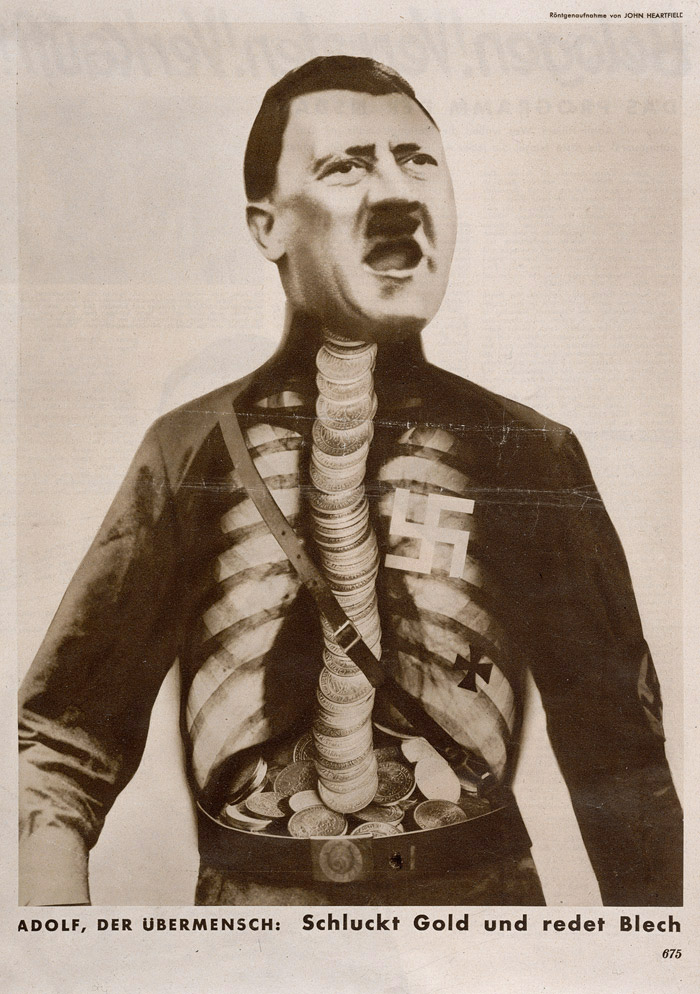
John Heartfield (German, 1891-1968) 'Adolf, the superman: swallows gold and spouts rubbish' from the 'Workers Illustrated Paper', vol 11, no 29, 17 July 1932, p. 675


John Heartfield (German, 1891-1968)
Adolf, the superman: swallows gold and spouts rubbish
1932
From the Workers Illustrated Paper, vol 11, no 29, 17 July 1932, p. 675
Photolithograph
38 x 27cm
John Heartfield Archiv, Akademie der Künste zu Berlin
Photo: Akademie der Künste, Berlin, Kunstsammlung, Heartfield 2261/ Roman März
© The Heartfield Community of Heirs /VG Bild-Kunst, Bonn. Licensed by Viscopy, Sydney


John Heartfield’s photomontages expose hidden agendas in German politics and economics of the 1920s and 30s. This image was published six months before the National Socialist Party came to power, and shows Hitler with a spine made of coins and his stomach filled with gold. The caption says that he ‘swallows gold’, alluding to generous funding by right-wing industrialists, and ‘spouts rubbish’.


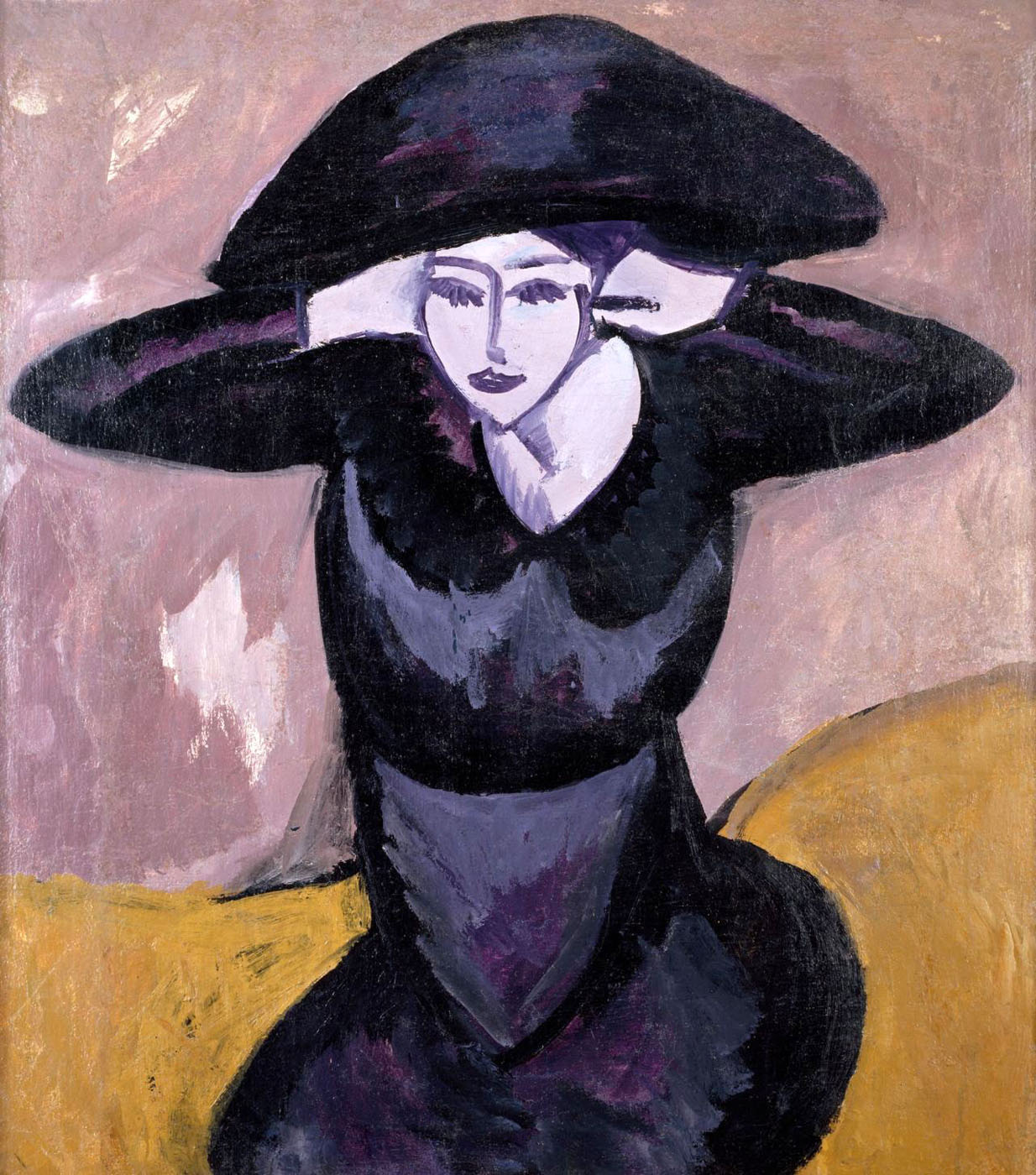
Ernst Ludwig Kirchner (German, 1880-1938) 'Woman in hat' 1911


Ernst Ludwig Kirchner (German, 1880-1938)
Woman in hat
1911
Oil on canvas
Art gallery of Western Australia, Perth


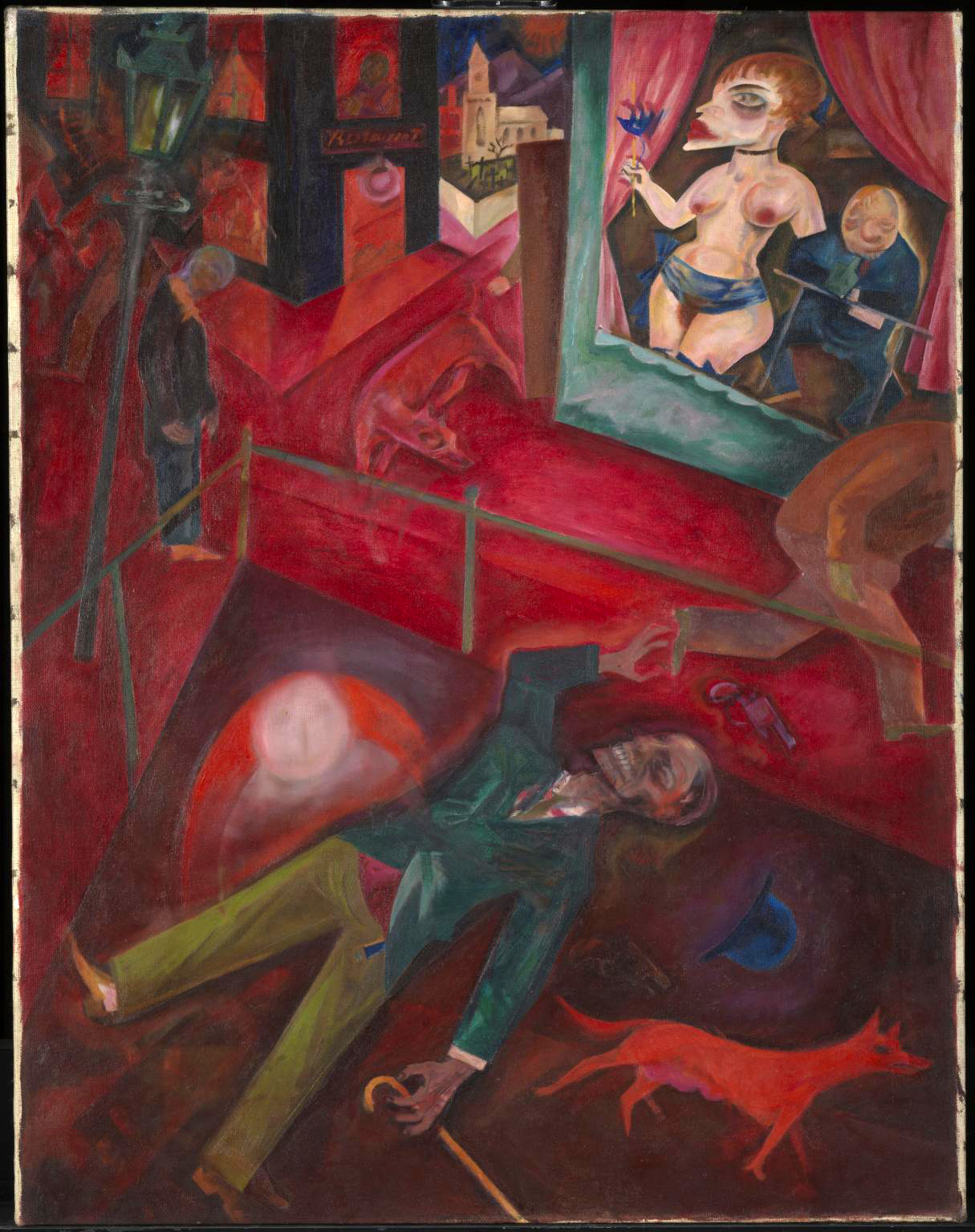
George Grosz (German, 1893-1959) 'Suicide' (Selbstmörder) 1916


George Grosz (German, 1893-1959)
Suicide (Selbstmörder)
1916
Oil on canvas
100 × 77.5cm
Tate Modern
Public domain


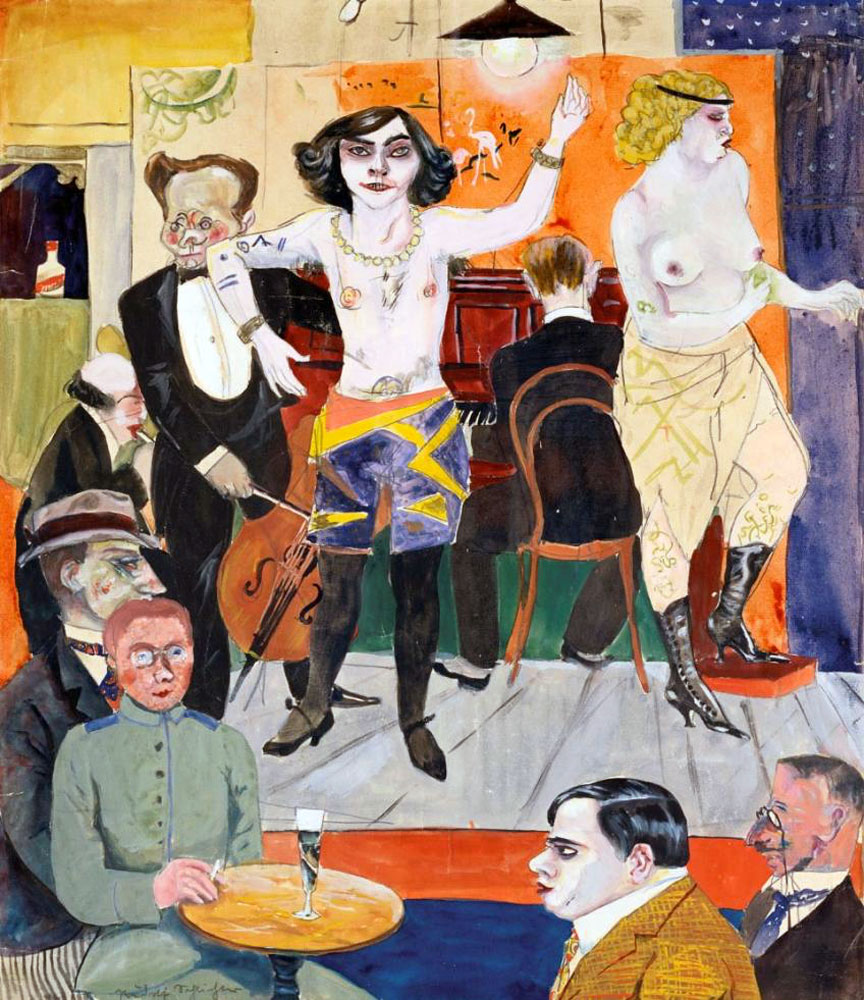
Rudolf Schlichter (German, 1890-1955) 'Tingle tangel' 1919-1920


Rudolf Schlichter (German, 1890-1955)
Tingle tangel
1919-1920
Oil on canvas


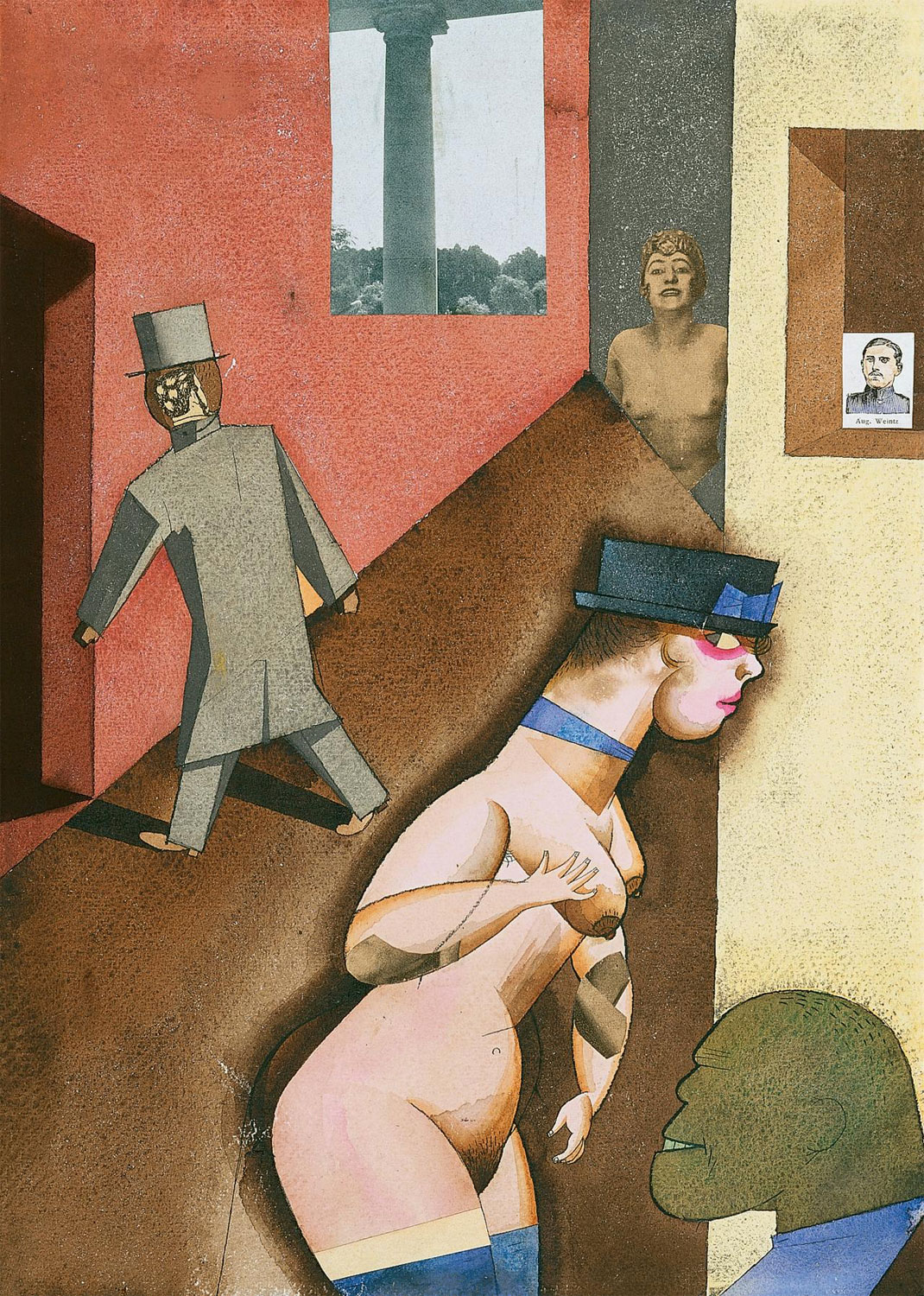
George Grosz (German, 1890-1945) 'Tatlinesque Diagram' 1920


George Grosz (German, 1890-1945)
Tatlinesque Diagram
1920
Watercolour, collage and ink on paper
41 x 29.2cm
Museo Nacional Thyssen-Bornemisza, Madrid


Otto Dix (German, 1891-1969) 'Dr Paul Ferdinand Schmidt' 1921


Otto Dix (German, 1891-1969)
Dr Paul Ferdinand Schmidt
1921
Oil on canvas
63 x 82cm
Staatsgalerie, Stuttgart, Germany


El Lissitzky (Russian, 1890-1941) 'New Man (Neuer)' 1923


El Lissitzky (Russian, 1890-1941)
New Man (Neuer)
1923
Color lithograph on wove paper
12 × 12 1/2 in. (30.5 × 31.8cm)


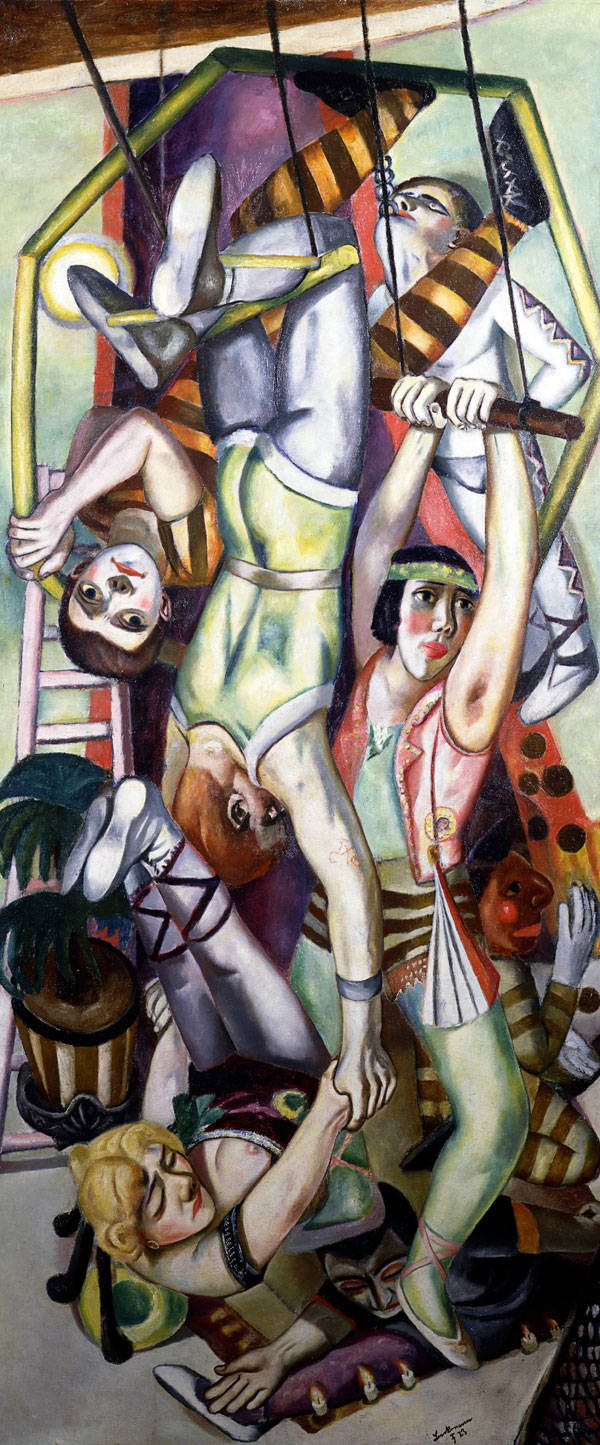
Max Beckmann (German, 1884-1950) 'The trapeze' 1923


Max Beckmann (German, 1884-1950)
The trapeze
1923
Oil on canvas
196.5 x 84cm
Toledo Museum of Art
Purchased with funds from the Libbey Endowment, Gift of Edward Drummond Libbey
Photo: Photography Incorporated, Toledo


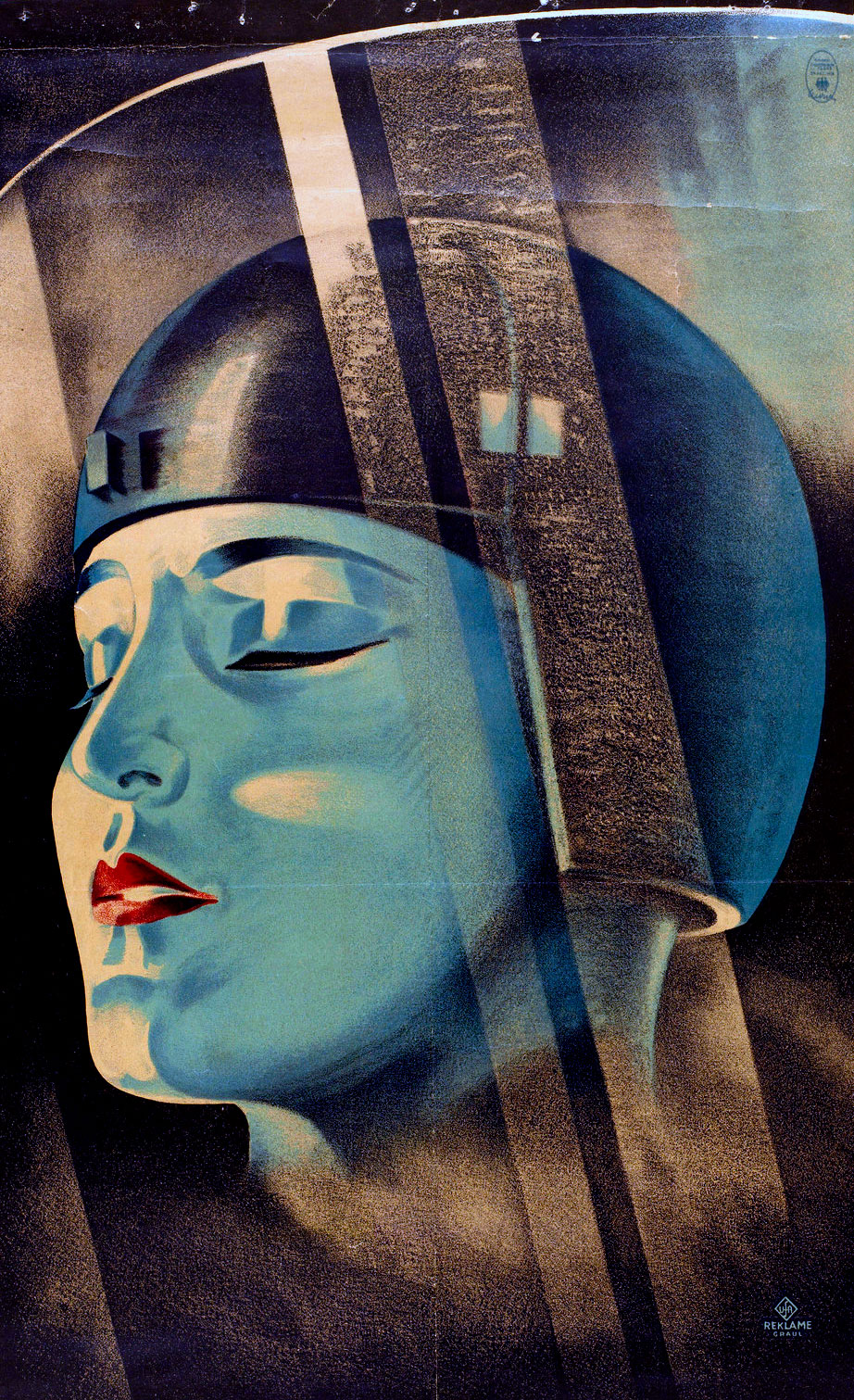
Werner Graul (German, 1905-1984) 'Metropolis'
1926


Werner Graul (German, 1905-1984)
UFA (Universum-Film-Aktiengesellschaft) (publisher)
Metropolis
1926
Lithographic poster


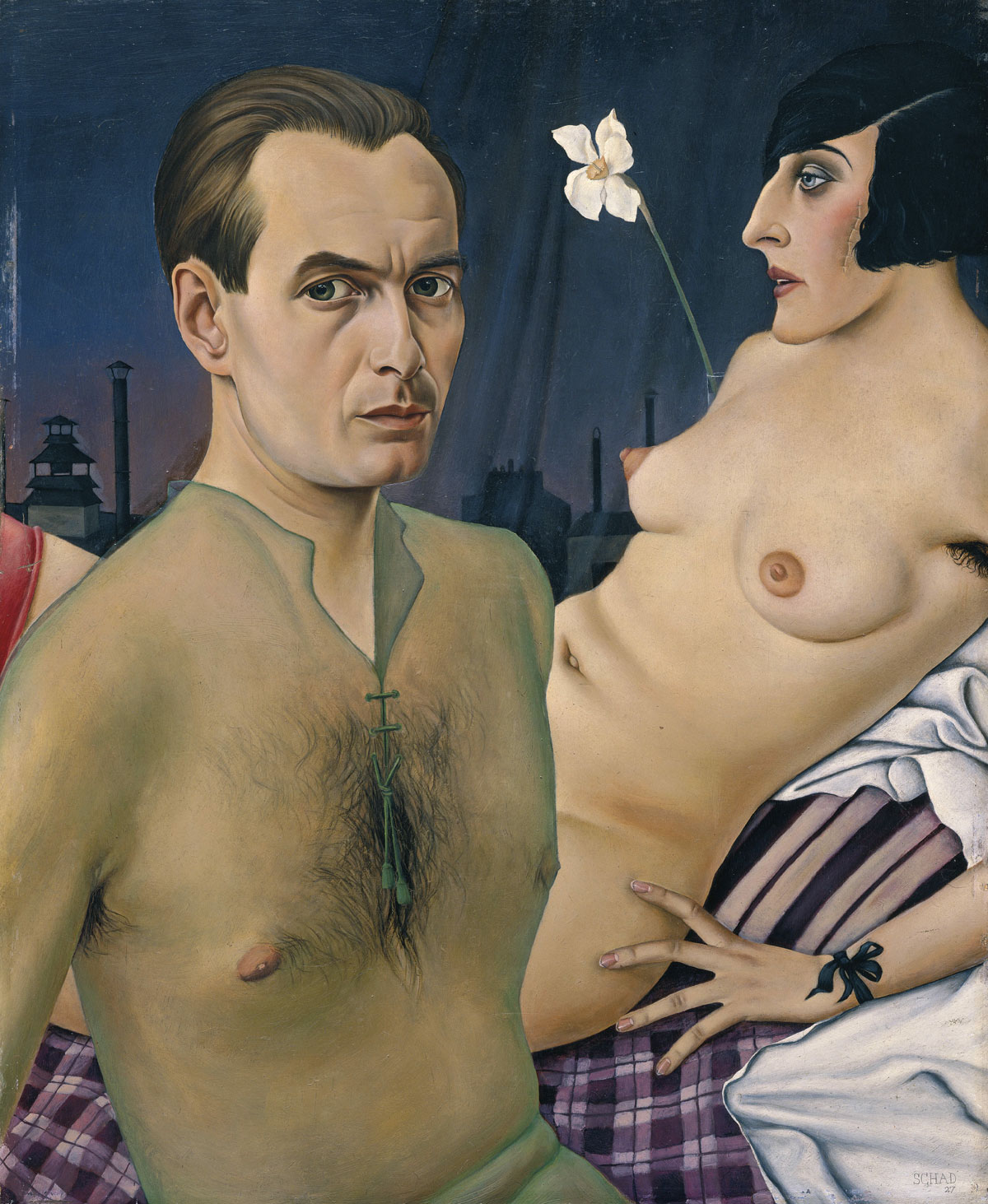
Christian Schad (German, 1894-1982) 'Self-Portrait' (Selbstbildnis mit Modell), 1927


Christian Schad (German, 1894-1982)
Self-Portrait with Model (Selbstbildnis mit Modell)
1927
Oil on wood
29 15/16 x 24 3/16 in. (76 x 61.5cm)
Private collection, courtesy of Tate
© 2015 Christian Schad Stiftung Aschaffenburg/Artists Rights Society (ARS), New York/VG Bild-Kunst, Bonn


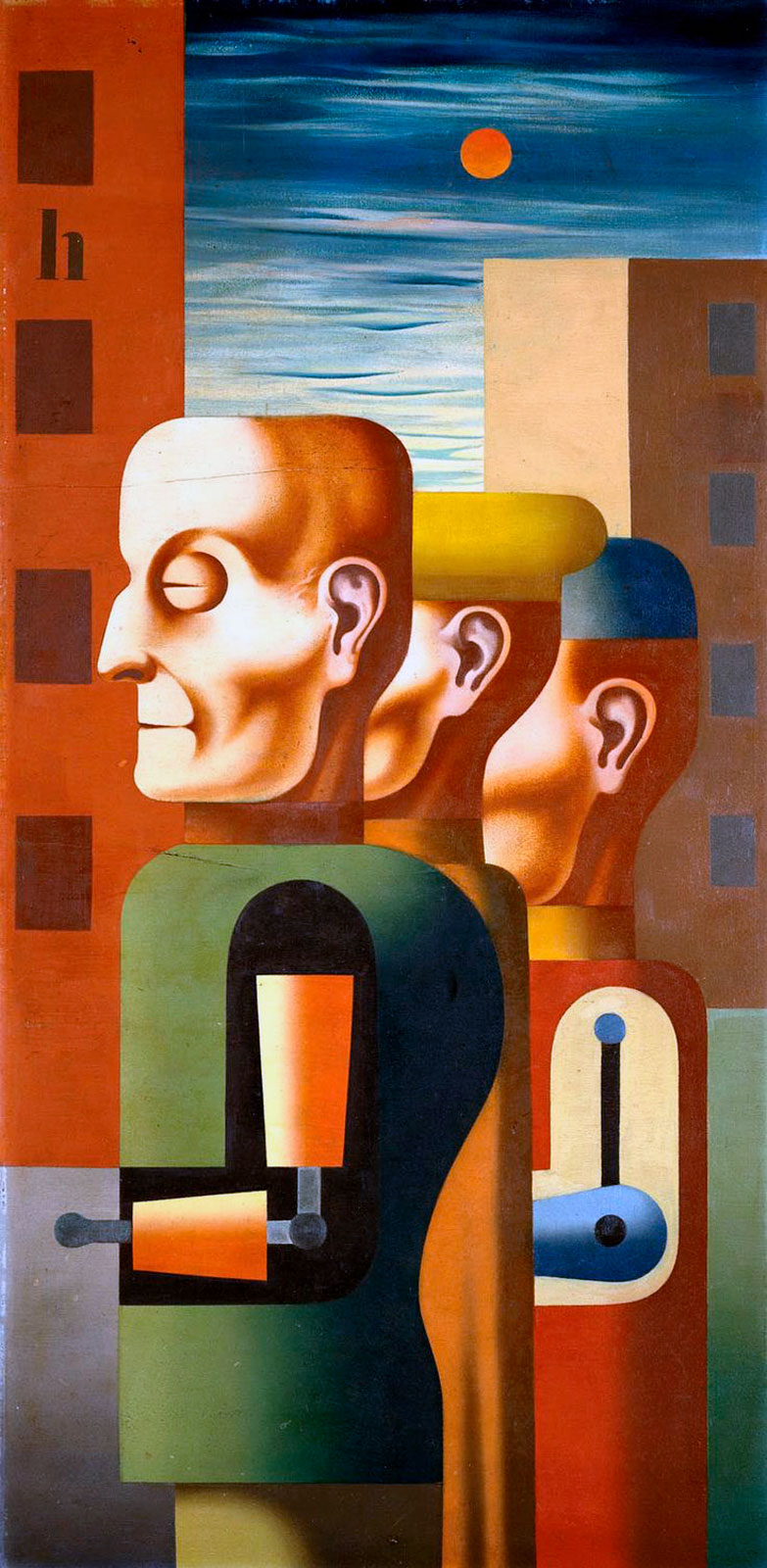
Heinrich Hoerle (German, 1895-1936) 'Three invalids' c. 1930


Heinrich Hoerle (German, 1895-1936)
Three invalids
c. 1930
Oil on canvas


NGV International
180 St Kilda Road

Opening hours:
Daily 10am – 5pm

National Gallery of Victoria website

LIKE ART BLART ON FACEBOOK

Back to top

Exhibition: ‘László Moholy-Nagy 
Retrospective’ at Schirn Kunsthalle, Frankfurt

Exhibition dates: 8th October, 2009 – 7th February, 2010


All images are featured in the exhibition. Many thankx to the Schirn Kunsthalle for allowing me to publish the photographs in the posting. Please click on the photographs for a larger version of the image.

Marcus


László Moholy-Nagy (Hungarian, 1895-1946) 'LIS' 1922 from the exhibition 'László Moholy-Nagy 
Retrospective' at Schirn Kunsthalle, Frankfurt, October 2009 - February 2010


László Moholy-Nagy (Hungarian, 1895-1946)
LIS
1922
Oil on canvas
131 x 100cm
Courtesy Kunsthaus Zürich
© VG Bild-Kunst, Bonn 2009


László Moholy-Nagy (Hungarian, 1895-1946) 'K XVII' 1923 from the exhibition 'László Moholy-Nagy 
Retrospective' at Schirn Kunsthalle, Frankfurt, October 2009 - February 2010


László Moholy-Nagy (Hungarian, 1895-1946)
K XVII
1923
Oil on canvas
95 x 75cm
Courtesy Kunsthalle Bielefeld
Photo: Axel Struwe, Fotodesign BFF, Bielefeld
© VG Bild-Kunst, Bonn 2009


László Moholy-Nagy (Hungarian, 1895-1946) 'COMPOSITION A XXI' 1925


László Moholy-Nagy (Hungarian, 1895-1946)
COMPOSITION A XXI
1925
Oil on canvas
96 x 77cm
Courtesy LWL-Landesmuseum für Kunst und Kulturgeschichte, Münster
Photo: LWL-Landesmuseum für Kunst und Kulturgeschichte, Münster/Rudolf Wakonigg
© VG Bild-Kunst, Bonn 2009


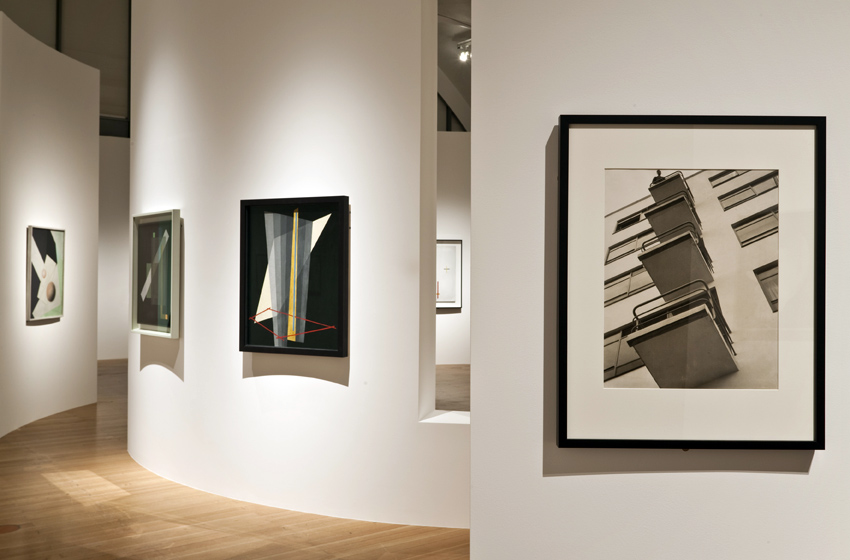
László Moholy-Nagy (Hungarian, 1895-1946) 'Bauhaus Balconies' 1926 from the exhibition 'László Moholy-Nagy 
Retrospective' at Schirn Kunsthalle, Frankfurt, October 2009 - February 2010


László Moholy-Nagy (Hungarian, 1895-1946)
Bauhaus Balconies
1926
Silver gelatin photograph
49.5 x 39.3cm
Courtesy Collection of George Eastman House


'László Moholy-Nagy Retrospective' exhibition view, Schirn Kunsthalle Frankfurt 2009 showing at right 'Bauhaus Balconies' (1926) and second right 'K XVII' (1923)


László Moholy-Nagy Retrospective exhibition view, Schirn Kunsthalle Frankfurt 2009 showing at right Bauhaus Balconies (1926) and second right K XVII (1923)
© Photograph: Norbert Miguletz
© VG Bild-Kunst, Bonn 2009


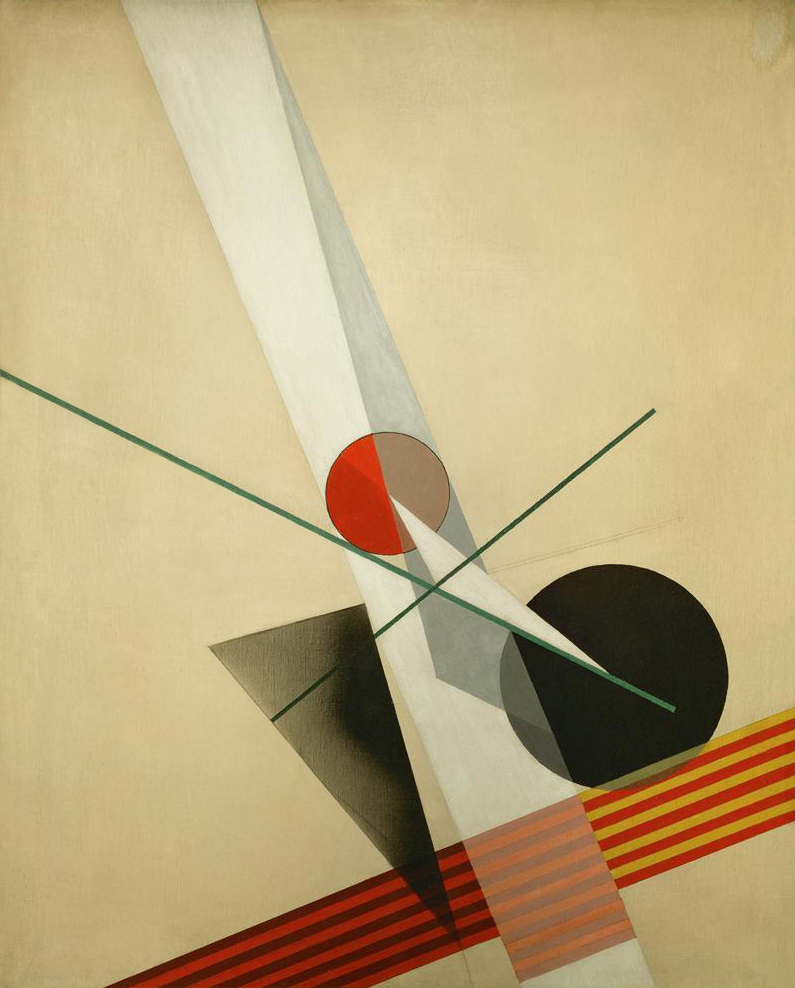
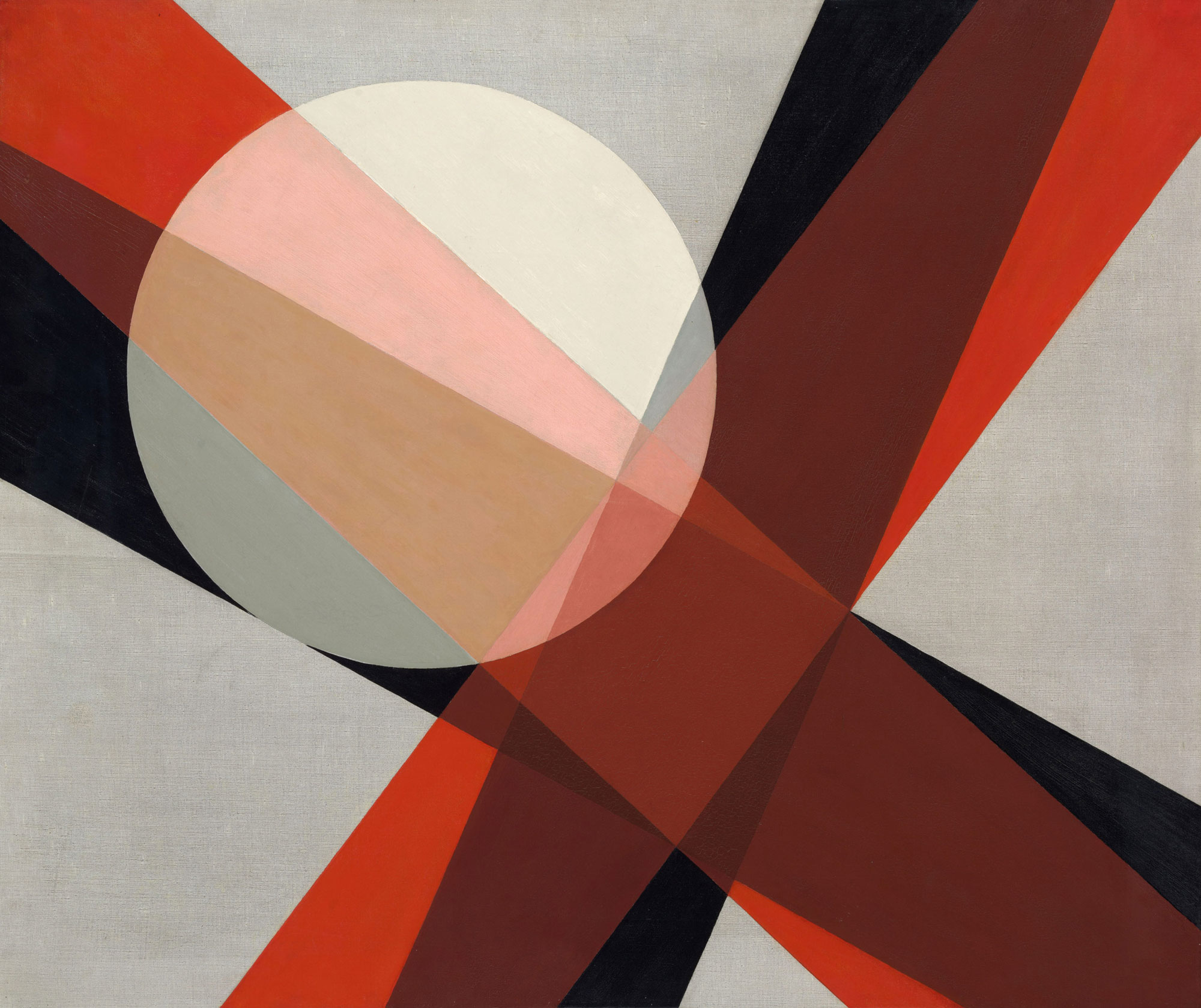
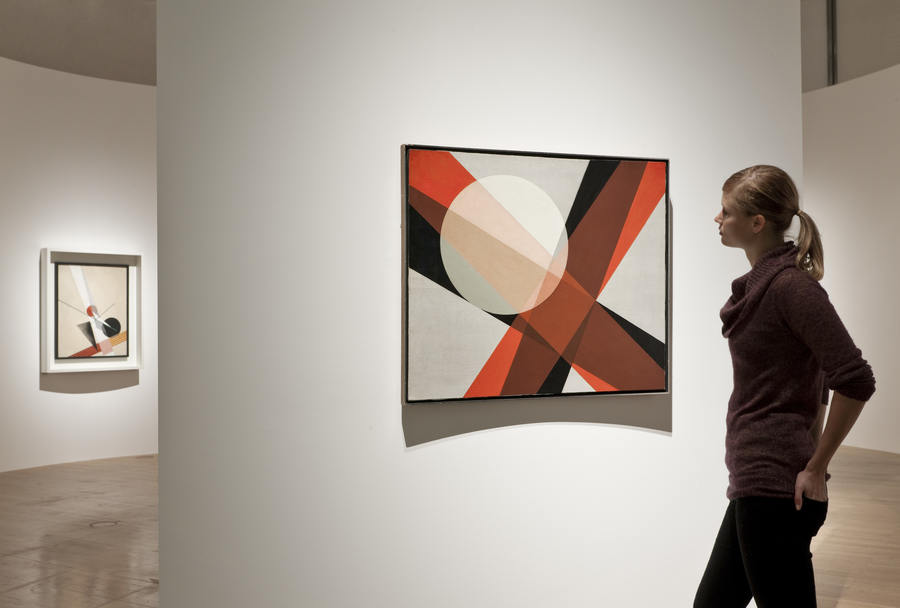
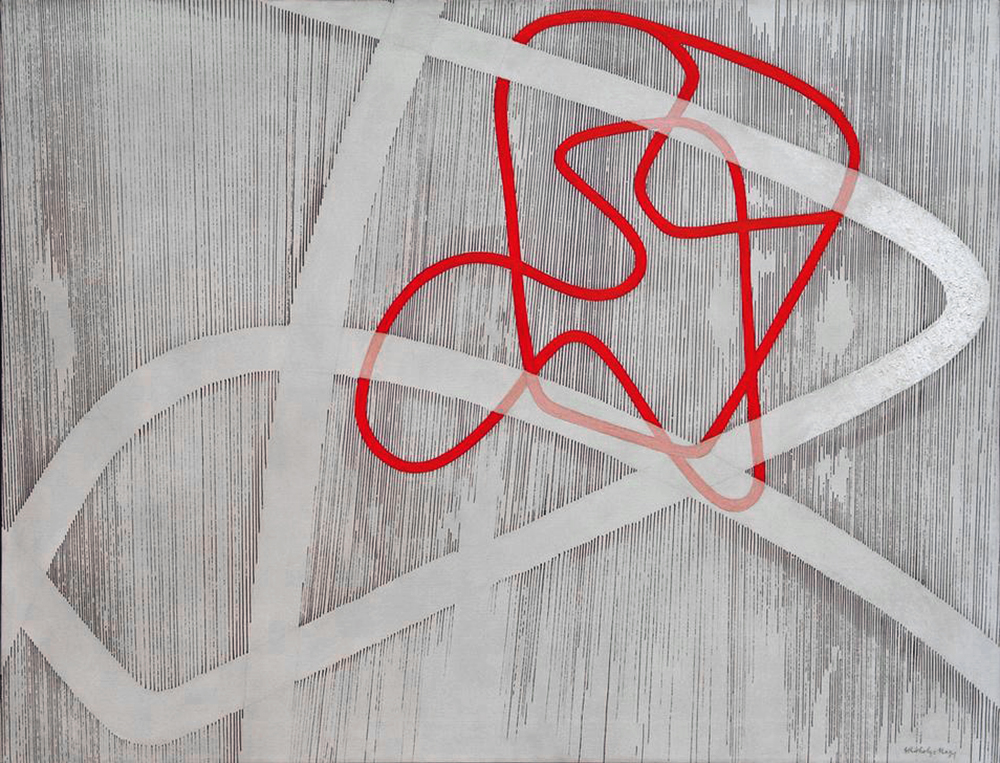
László Moholy-Nagy (Hungarian, 1895-1946) 'A 19' 1927


László Moholy-Nagy (Hungarian, 1895-1946)
A 19
1927
Oil on canvas
80 x 96cm
Courtesy Hattula Moholy-Nagy
© VG Bild-Kunst, Bonn 2009


'László Moholy-Nagy Retrospective' exhibition view, Schirn Kunsthalle Frankfurt 2009 showing at centre, 'A 19' (1927)


László Moholy-Nagy Retrospective exhibition view, Schirn Kunsthalle Frankfurt 2009 showing at centre, A 19 (1927)
Schirn Kunsthalle Frankfurt
© Photograph: Norbert Miguletz
© VG Bild-Kunst, Bonn 2009


The Hungarian artist László Moholy-Nagy (1895-1946) became known in Germany through his seminal work as a teacher at the Staatliches Bauhaus in Weimar and Dessau (1923-1928). His pioneering theories on art as a testing ground for new forms of expression and their application to all spheres of modern life are still of influence today. Presenting about 170 works – paintings, photographs and photograms, sculptures and films, as well as stage set designs and typographical projects – the retrospective encompasses all phases of his oeuvre. On the occasion of the ninetieth anniversary of the foundation of the Bauhaus, it offers a survey of the enormous range of Moholy-Nagy’s creative output to the public for the first time since the last major exhibition of his work in Kassel in 1991. Never having been built before 2009, the artist’s spatial design Raum der Gegenwart (Room of Today), which brings together many of his theories, will be realised in the context of the exhibition.

No other teacher at the Bauhaus in Weimar and Dessau, nor nearly any other artist of the 1920s in Germany, an epoch rich in utopian designs, developed such a wide range of ideas and activities as László Moholy-Nagy, who was born in Bácsborsód in Southern Hungary in 1895. His oeuvre bears evidence to the fact that he considered painting and film, photography and sculpture, stage set design, drawing, and the photogram to be of equal importance. He continually fell back upon these means of expression, using them alternately, varying them, and taking them up again as parts of a universal concept whose pivot was the alert, curious, and unrestrained experimental mind of the “multimedia” artist himself. Long before people began to talk about “media design” and professional “marketing,” Moholy-Nagy worked in these fields, too – as a guiding intellectual force in terms of new technical, design and educational instruments. “All design areas of life are closely interlinked,” he wrote about 1925 and was, despite his motto insisting on “the unity of art and technology,” no uncritical admirer of the machine age, but rather a humanist who was open-minded about technology. His basic attitude as an artist, which exemplifies the idealistic and utopian thinking of an entire era, may be summed up as aimed at improving the quality of life, avoiding specialisation, and employing science and technology for the enrichment and heightening of human experience.

After having graduated from high school, Moholy-Nagy began to study law in Budapest in 1913, but was drafted in 1915. During the war, he made his first drawings on forces mail cards and began dedicating himself exclusively to art after having been discharged from the army in 1918. Moholy-Nagy moved to Vienna in 1919 and to Berlin the following year, kept in close contact with Kurt Schwitters, Raul Hausmann, Theo van Doesburg, and El Lissitzky, and immersed himself in Merzkunst, De Stijl, and Constructivism. He achieved successes as an artist with his solo presentation in the Berlin gallery “Der Sturm” (1922), for example. In spring 1923, he was offered the post of a Bauhaus master in Weimar by Walter Gropius. Taking responsibility for the preliminary course and the metal workshop, he decisively informed the Constructivist and social reorientation of the Bauhaus. Interlinking art, life, and technology and underscoring the visual and the material aspects in design were key issues of his work and resulted in a modern, technology-oriented language of forms. His didactic approaches as a Bauhaus teacher still present themselves as up-to-date as his work as an artist. For him, education had to be primarily aimed at bringing up people to become artistically political and creative beings: “Every healthy person has a deep capacity for bringing to development the creative energies found in his/her nature … and can give form to his/her emotions in any material (which is not synonymous with ‘art’),” he wrote in 1929.

In spite of his manifold activities and inventions in the sphere of so-called applied art, Moholy-Nagy by no means advocated abolishing free art. Before, during, and long after his years at the Bauhaus, he produced numerous paintings, drawings, collages, woodcuts, and linocuts, as well as photographs and films as autonomous works of art. Like his design solutions, his works in the classical arts, in painting and sculpture, also reveal his aesthetically and conceptually radical approach. His Telephone Pictures, whose execution he controlled by telephone, exemplify this dimension: using a special graph paper and a colour chart, he worked out the composition and colours of the pictures and had them realised according to his telephonic instructions by technical assistants. He also pursued new paths with his famous Light-Space Modulator of 1930, conceiving his gesamtkunstwerk [“total work of art”] composed of colour, light, and movement as an “apparatus for the demonstration of the effects of light and movement.” It was equally new territory he conquered in the fields of photography and film: considering his cameraless photography, his photograms, and his abstract films such as Light Play Black, White, Gray (1930), Moholy-Nagy must still be regarded as one of the most important twentieth-century photographers and key figures for today’s media theories.

Thanks to his experiments with photography and the photogram, László Moholy Nagy was one of the first typographers of the 1920s to recognise the new possibilities offered by the combination of typeface, surface design, and pictorial signs with recent photographic techniques. As a Bauhaus teacher for typography, he designed almost all of the 14 Bauhaus books published between 1925 and 1929 and – besides co-editing them with Walter Gropius – took care of the entire presentation of the books’ contents and the organisation of their production. With its dynamic cycles and bars and concentration on a few, clear colours, their design resembled the Constructivist artists’ paintings and drawings. While Moholy-Nagy’s early typographic works are frequently still characterised by hand-drawn typefaces, he later strove for a “mechanized graphic design” also suited for commercial advertising through their systematisation and standardisation. After he had left the Bauhaus in 1928, he founded his own office in Berlin, where he, among other things, developed advertising solutions for Wilhelm Wagenfeld’s designs for the Jena Glassworks. Faced with the Nazis’ seizure of power, Moholy-Nagy emigrated to the United States via Amsterdam and Great Britain and founded the New Bauhaus in Chicago in 1937 and, after it had been closed, the Chicago School (and later Institute) of Design in 1939, where he continued to champion an integration of art, science, and technology. László Moholy-Nagy died of leukaemia in Chicago on 24 November 1946.

The exhibition at the Schirn also presents the Raum der Gegenwart (Room of Today), which offers a concise summary of Moholy-Nagy’s work. The sketches for this environment, which assembles many of his theories, date back as far as 1930. Not having been built before 2009, the Raum der Gegenwart (Room of Today) is now realised in the Schirn on the occasion of the Bauhaus anniversary 2009.

Press release from the Schirn Kunsthalle website [Online] Cited 20/01/2010. No longer available online


László Moholy-Nagy (Hungarian, 1895-1946)
Light Play Black, White, Gray
1930


The sculpture Light-Space Modulator is a key work in the history of kinetic art and even the art of new media and, therefore, one of the most important works of art of its time. Conceived initially by Moholy-Nagy at the beginning of the twenties of the last century and built between 1928 and 1930…

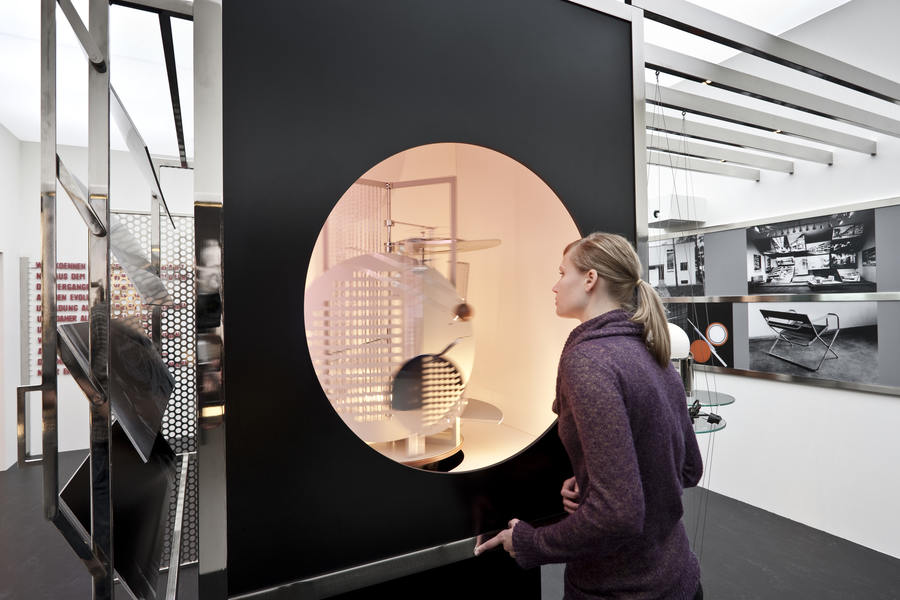
Light-Space Modulator was exhibited in 1930 in a show organised in Paris on the work of the German Werkbund. From the point of view of the object, it forms a complex as well as beautiful set of elements of metal, plastic and glass, many of them mobile by the action of an electric motor, surrounded by a series of coloured lights.

Moholy-Nagy used it to produce light shows that he photographed or filmed, as in the case of the film shown here. Although in black and white, the film manages to capture the kinetic brightness of the sculpture.


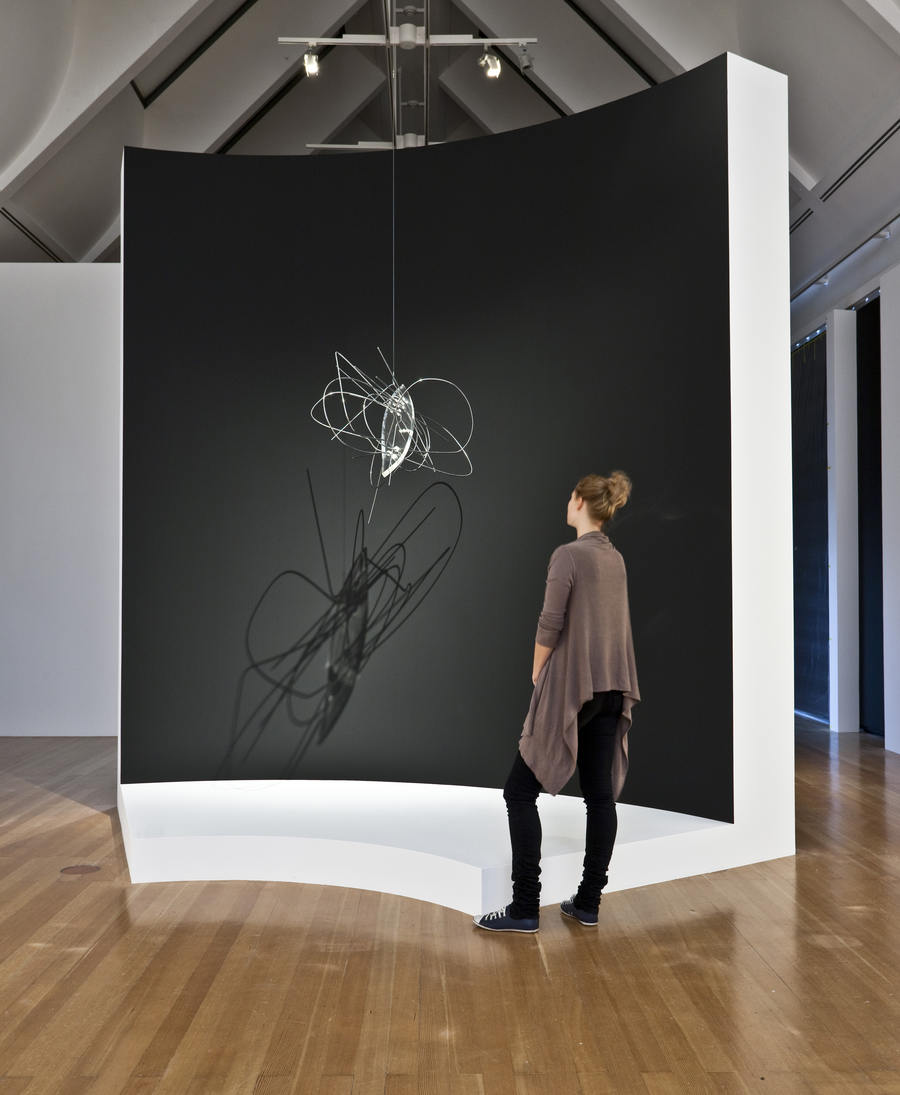
'László Moholy-Nagy Retrospective' exhibition view, Schirn Kunsthalle Frankfurt showing 'Room of Today' (reconstruction 2009) with at centre, 'Light-Space Modulator' 1930 (replica)


László Moholy-Nagy Retrospective exhibition view, Schirn Kunsthalle Frankfurt showing Room of Today (reconstruction 2009) with at centre, Light-Space Modulator 1930 (replica)
© Photograph: Norbert Miguletz
© VG Bild-Kunst, Bonn 2009


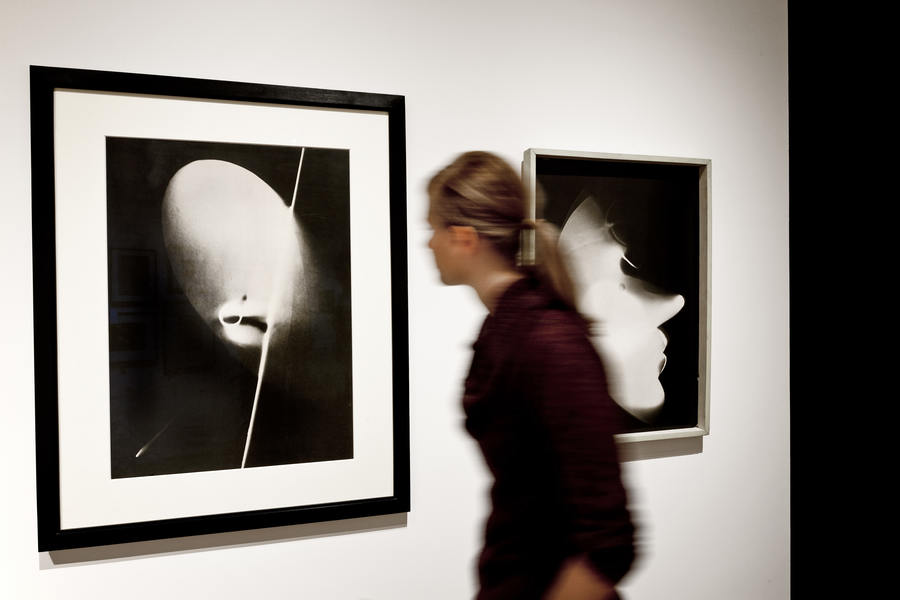
László Moholy-Nagy (Hungarian, 1895-1946) 'Fotogram with Eiffel Tower and Peg Top' c. 1928


László Moholy-Nagy (Hungarian, 1895-1946)
Fotogram with Eiffel Tower and Peg Top
c. 1928
Silver gelatin photograph
38.7 x 29.9cm
Courtesy Galerie Berinson, Berlin
Photo: Friedhelm Hoffmann, Berlin
© VG Bild-Kunst, Bonn 2009


'László Moholy-Nagy Retrospective' exhibition view, Schirn Kunsthalle Frankfurt showing at left, 'Photogramm No.II' (1929)


László Moholy-Nagy Retrospective exhibition view, Schirn Kunsthalle Frankfurt showing at left, Photogramm No.II (1929)
© Photograph: Norbert Miguletz
© VG Bild-Kunst, Bonn 2009


László Moholy-Nagy (Hungarian, 1895-1946) 'Photogramm No.11' Enlargement before 1929


László Moholy-Nagy (Hungarian, 1895-1946)
Photogramm No.II
1929
Silver gelatin photograph
95.5 x 68.5cm
Courtesy Galerie Berinson, Berlin
Photo: Friedhelm Hoffmann, Berlin


László Moholy-Nagy (Hungarian, 1895-1946) 'Marseille, Port View' 1929


László Moholy-Nagy (Hungarian, 1895-1946)
Marseille, Port View
1929
Silver gelatin photograph
48.7 x 37.9cm
Courtesy Collection of George Eastman House


László Moholy-Nagy (Hungarian, 1895-1946) 'SPACE CH 4' 1938


László Moholy-Nagy (Hungarian, 1895-1946)
SPACE CH 4
1938
Oil on canvas
68.5 x 89 cm
Courtesy Hattula Moholy-Nagy
© VG Bild-Kunst, Bonn 2009


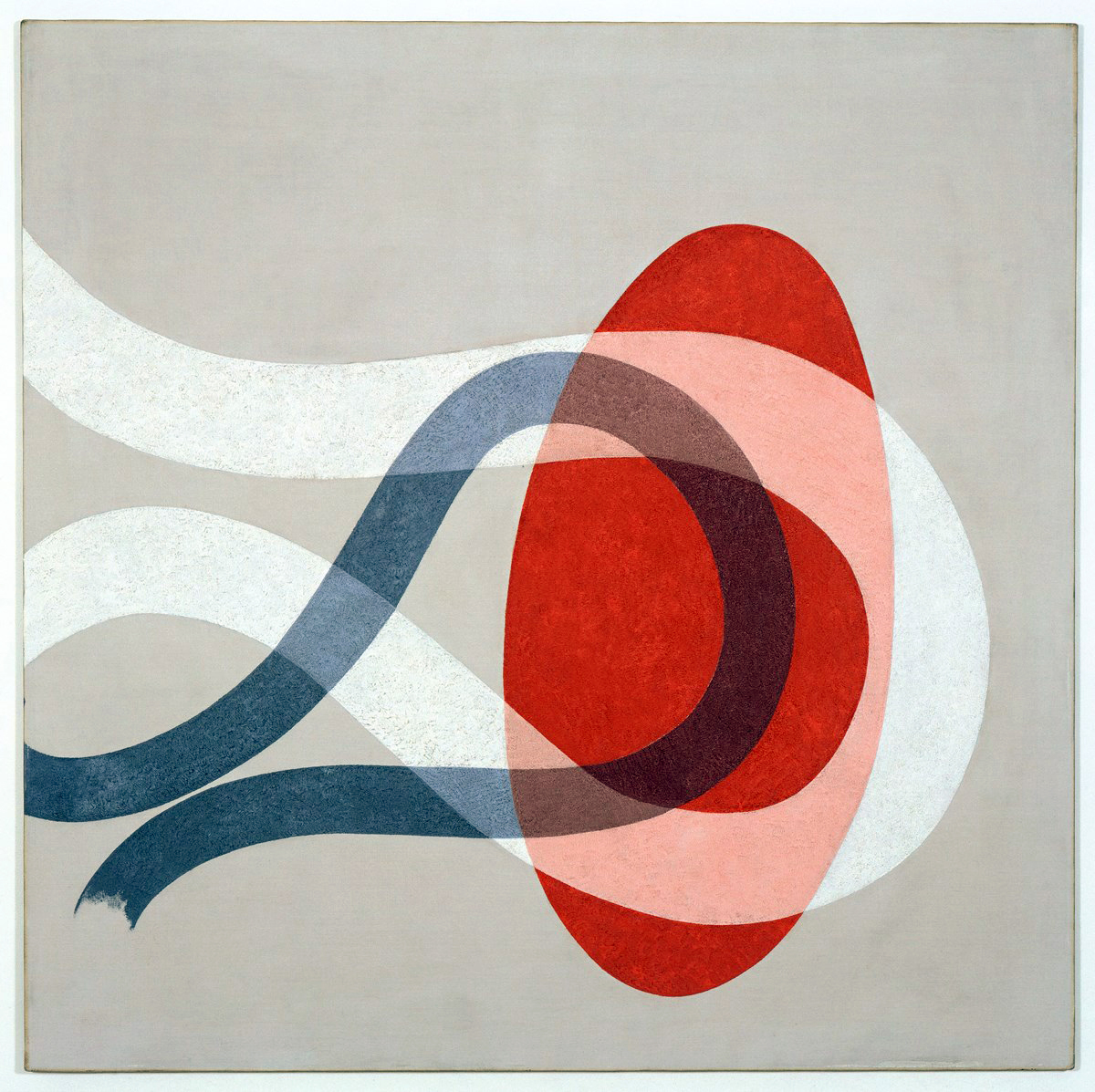
László Moholy-Nagy (Hungarian, 1895-1946) 'CH BEATA I' 1939


László Moholy-Nagy (Hungarian, 1895-1946)
CH BEATA I
1939
Oil on canvas
119 x 120cm
Solomon R. Guggenheim Museum, New York
Solomon R. Guggenheim Founding Collection
Photograph by David Heald
© The Solomon R. Guggenheim Foundation, New York


László Moholy-Nagy (Hungarian, 1895-1946) 'CH XIV' 1939


László Moholy-Nagy (Hungarian, 1895-1946)
CH XIV
1939
Oil on canvas
118 x 119.5cm
Courtesy of Museu Colecção Berardo
Photo: Museu Colecção Berardo/Paulo Raimundo
© VG Bild-Kunst, Bonn 2009


László Moholy-Nagy (Hungarian, 1895-1946) 'CH SPACE 6' 1941


László Moholy-Nagy (Hungarian, 1895-1946)
CH SPACE 6
1941
Oil on canvas
119 x 119cm
Courtesy Hattula Moholy-Nagy
© VG Bild-Kunst, Bonn 2009


László Moholy-Nagy (Hungarian, 1895-1946) 'Dual forms with Chromium Rods' 1946


László Moholy-Nagy (Hungarian, 1895-1946)
Dual forms with Chromium Rods
1946
Plexiglas and chrome-plated brass rods
93 x 121 x 56cm
Exhibition View, Schirn Kunsthalle 2009
© Photograph: Norbert Miguletz
Courtesy The Solomon R. Guggenheim Foundation, New York


László Moholy-Nagy (Hungarian, 1895-1946) 'Untitled' 1936-1946


László Moholy-Nagy (Hungarian, 1895-1946)
Untitled
1936-46
Fujicolor Crystal Archive print
27.9 x 35.6 cm
Courtesy Andrea Rosen Gallery, New York
© Hattula Moholy-Nagy for the Estate of László Moholy-Nagy
© VG Bild-Kunst, Bonn 2009


László Moholy-Nagy (Hungarian, 1895-1946) 'Untitled' 1937-1946


László Moholy-Nagy (Hungarian, 1895-1946)
Untitled
1937-1946
Fujicolor Crystal Archive print
27.9 x 35.6cm
Courtesy Andrea Rosen Gallery, New York
© Hattula Moholy-Nagy for the Estate of László Moholy-Nagy
© VG Bild-Kunst, Bonn 2009


László Moholy-Nagy (Hungarian, 1895-1946) 'Untitled' 1939


László Moholy-Nagy (Hungarian, 1895-1946)
Untitled
1939
Fujicolor Crystal Archive print
27.9 x 35.6cm
Courtesy Andrea Rosen Gallery, New York
© Hattula Moholy-Nagy for the Estate of László Moholy-Nagy
© VG Bild-Kunst, Bonn 2009


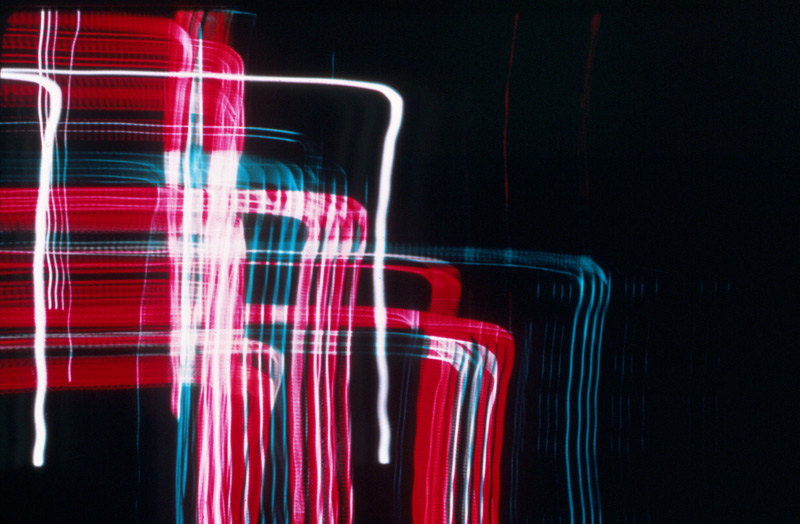
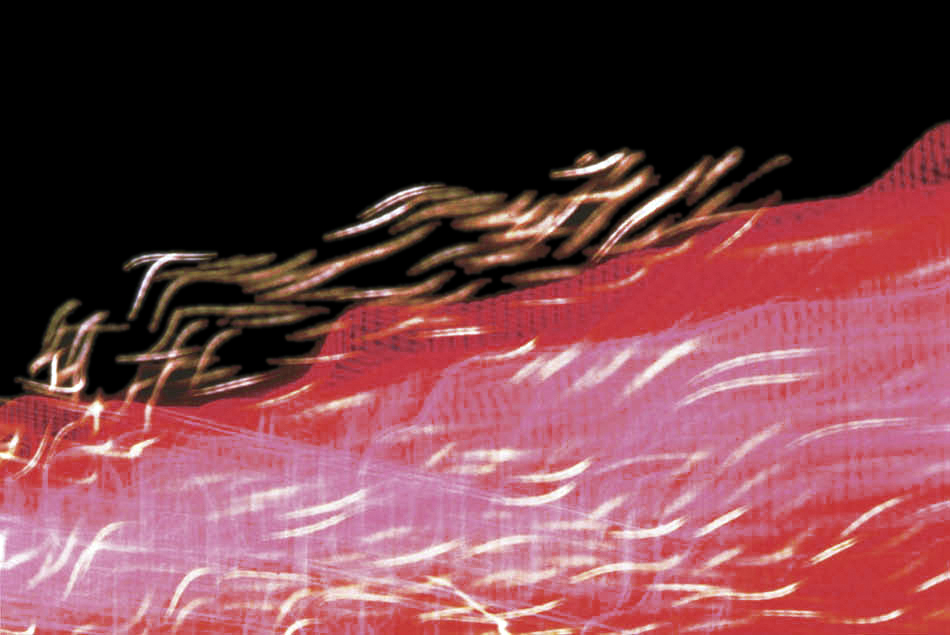
László Moholy-Nagy (Hungarian, 1895-1946) 'Untitled/Night-Time Traffic (Pink and Red Traffic Stream with White Sparks)' 1937-1946


László Moholy-Nagy (Hungarian, 1895-1946)
Untitled/Night-Time Traffic (Pink and Red Traffic Stream with White Sparks)
1937-1946
Fujicolor Crystal Archive print
27.9 x 35.6cm
Courtesy Andrea Rosen Gallery, New York
© Hattula Moholy-Nagy for the Estate of László Moholy-Nagy
© VG Bild-Kunst, Bonn 2009


László Moholy-Nagy (1895-1946) 'Photograph (Self-Portrait with Hand)' 1925/29, printed 1940/49


László Moholy-Nagy (Hungarian, 1895-1946)
Self-portrait
c. 1926
Gelatin silver photograph
Courtesy Hattula Moholy-Nagy
© VG Bild-Kunst, Bonn 2009


Schirn Kunsthalle Frankfurt
Römerberg
D-60311 Frankfurt
Phone: +49.69.29 98 82-0

Opening hours:
Tuesday, Friday – Sunday 10am – 7pm
Wednesday – Thursday 10am – 10pm

Schirn Kunsthalle website

LIKE ART BLART ON FACEBOOK

Back to top