Vale Martin Parr (English, 1952-2025)

December 2025


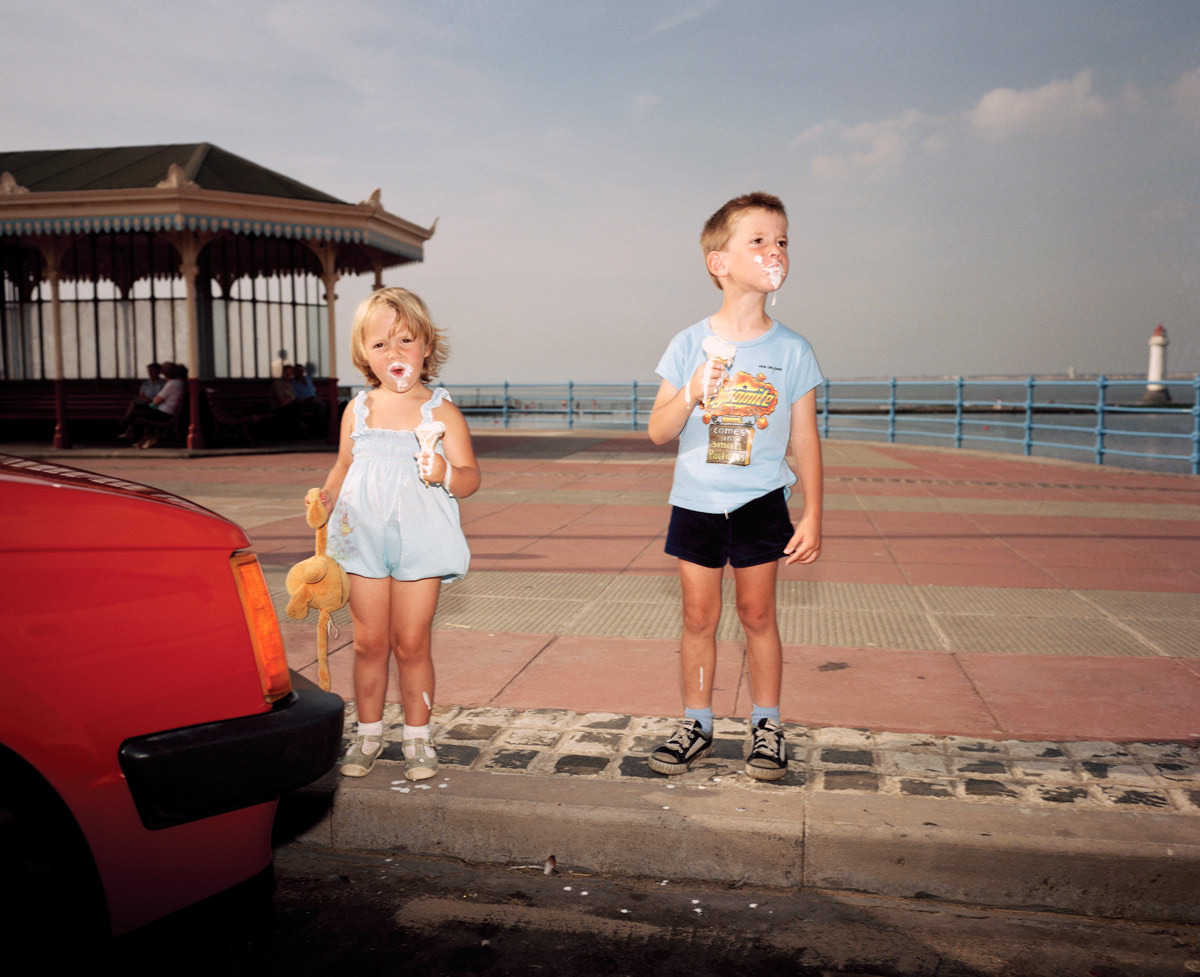
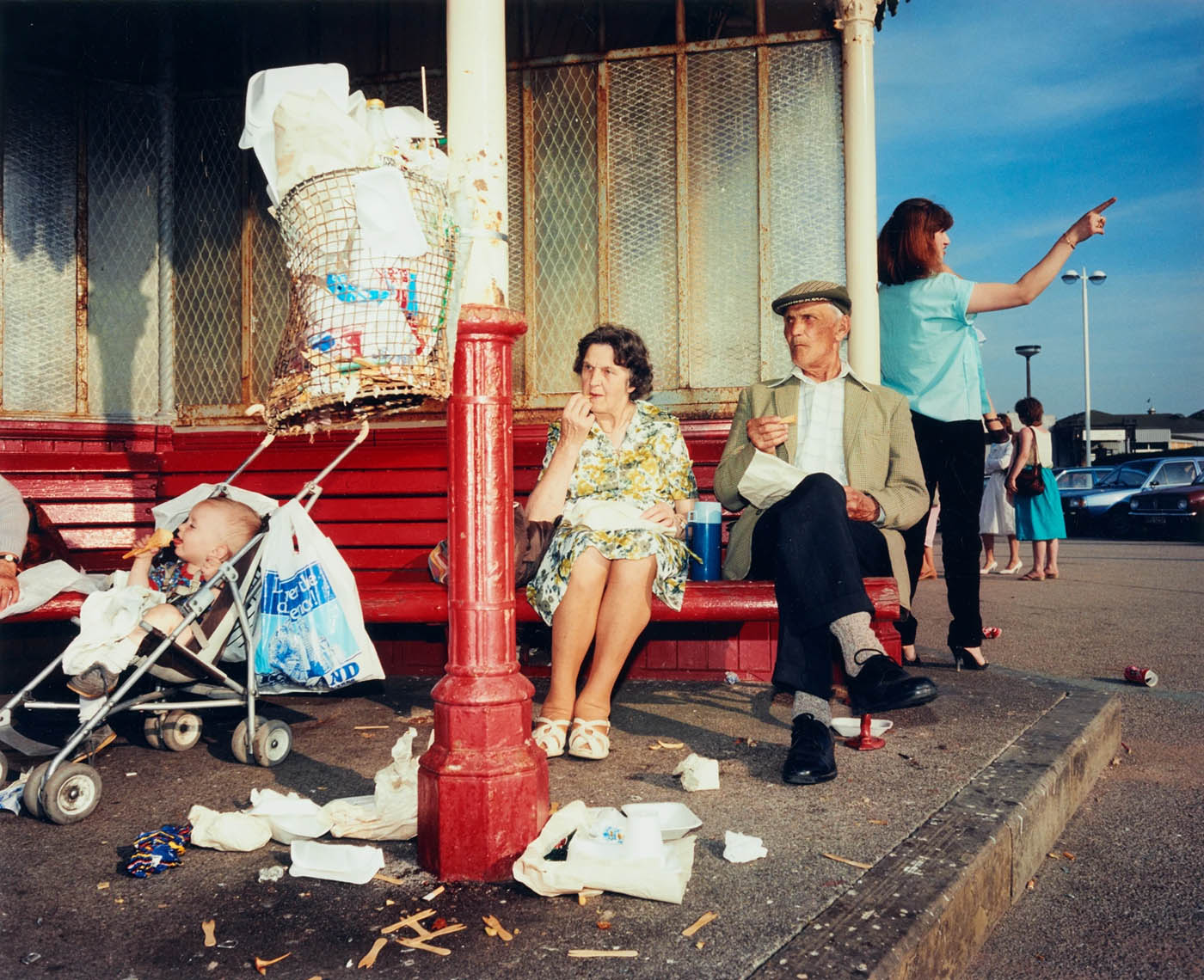
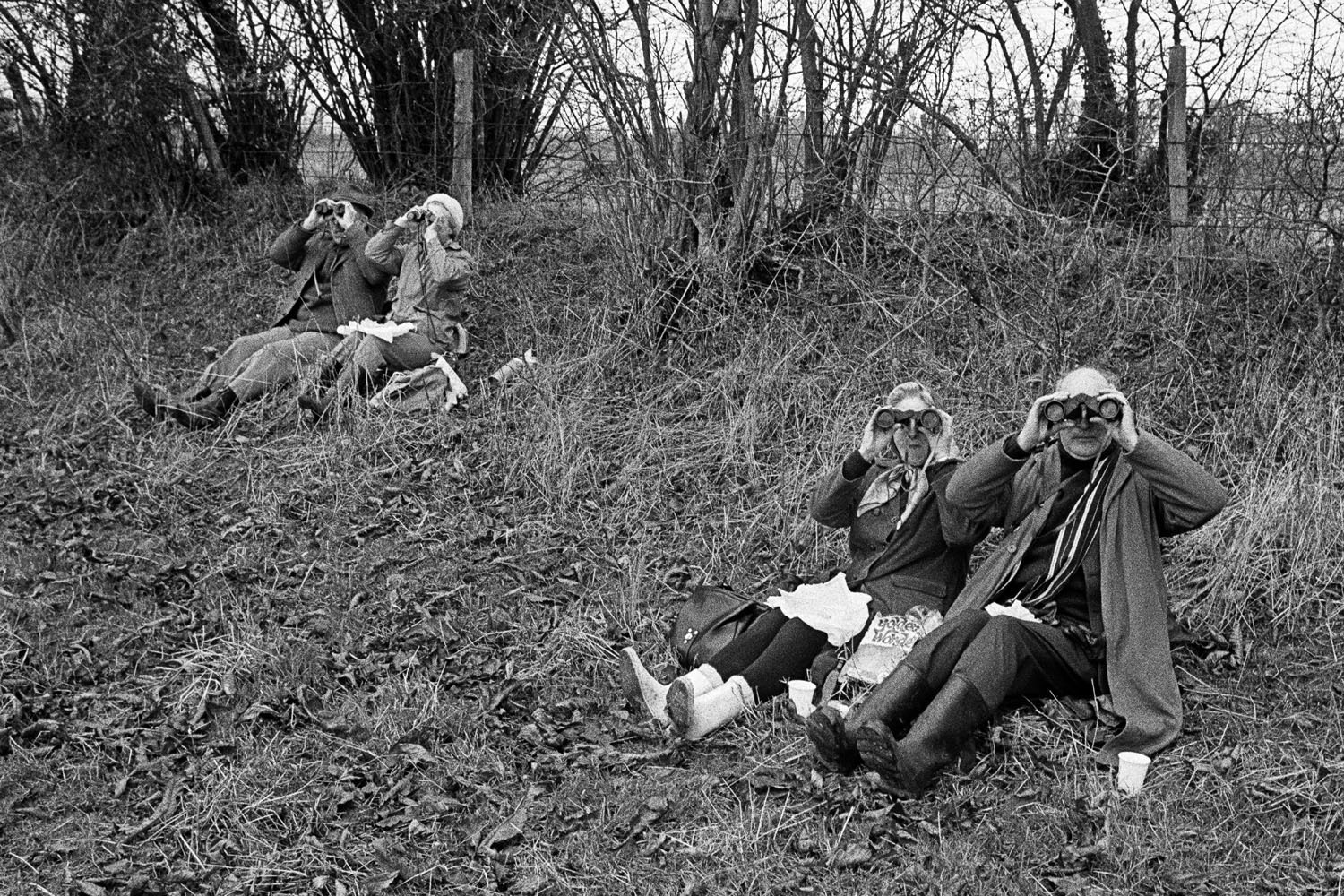
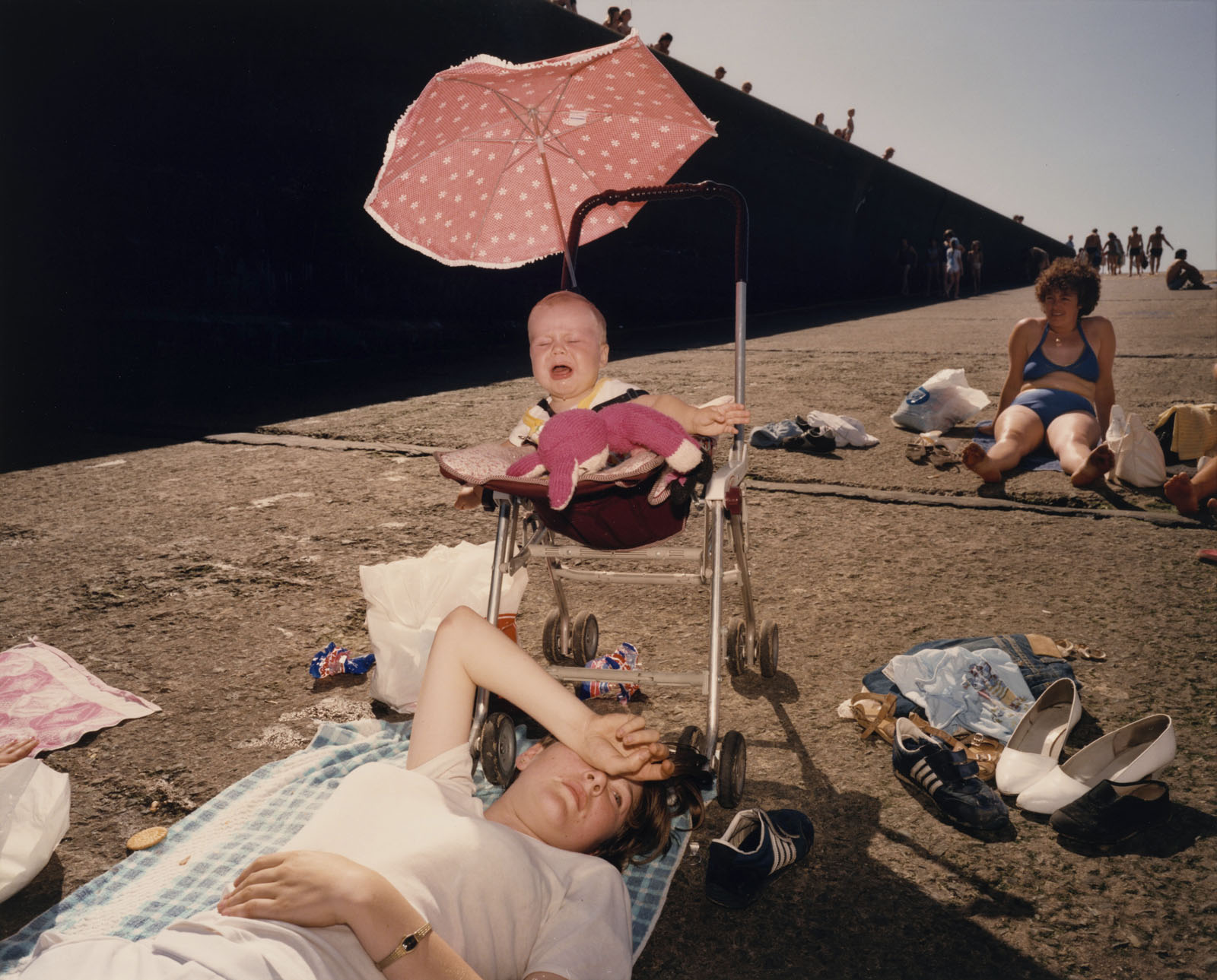
Martin Parr (British, 1952-2025) 'New Brighton, England' 1983-1985 from the series 'The Last Resort'


Martin Parr (British, 1952-2025)
New Brighton, England
From the series The Last Resort
1983-1985
Pigment print


From life, the absurd, the (un)familiar

The death of the English photographer Martin Parr is very sad news 😦

I feel like I have known his intimate photographs from life for a very long time. Through his beautifully observed and humorous photographs Martin Parr became a national treasure.

Incisive and insightful, his best photographs shone a light on the British class system, British rituals and everyday conversations – “candid and often humorous depictions of everyday life” – captured with visual deftness and containing a wry sense of humour mirroring the British character.

“Parr’s work was at its best when he concentrated on the volume of space within the image plane and the details that emerge from such a concentrated visualisation – whether it be the tension points within the image, assemblage of colour, incongruity of dress, messiness of childhood or philistine nature of luxury.” (MB, 2102)

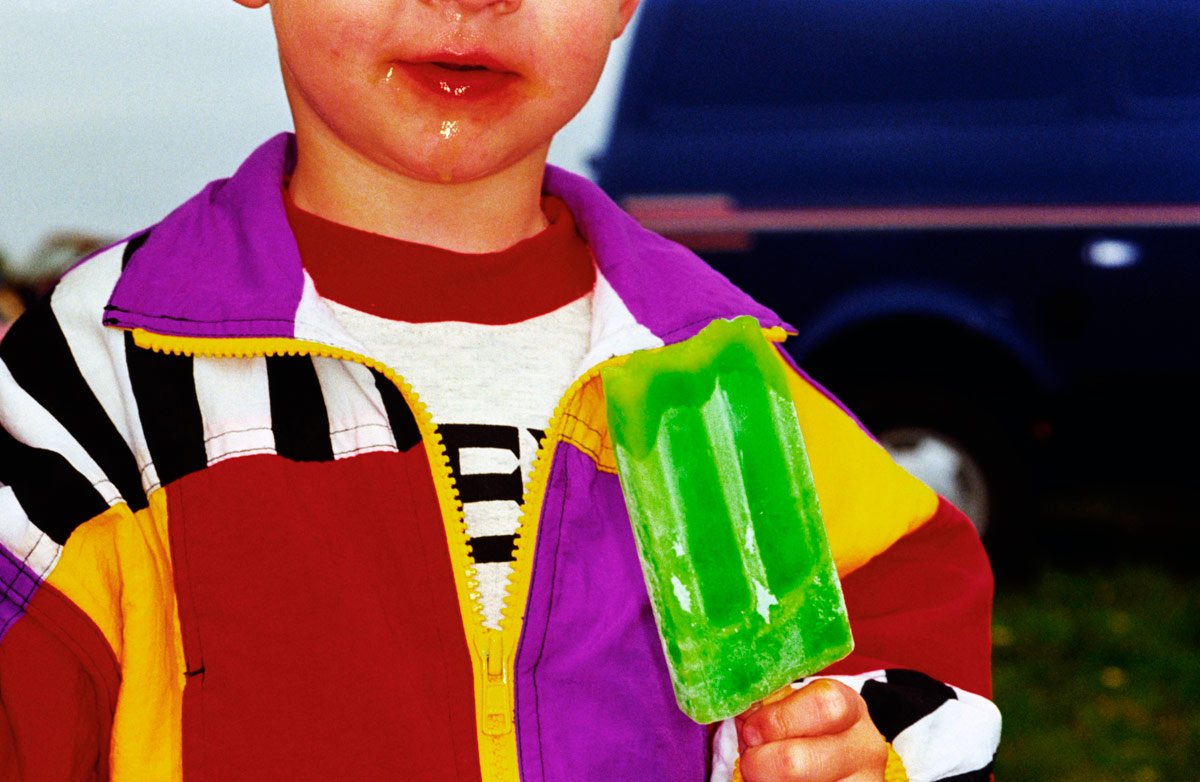
His photographs have a wonderful frisson about them, a genuine love of and resonance with the things he was imaging. The dirt under the fingernails of the child eating a doughnut, the lurid colours of the popsicle and jacket of the kid with dribble on his face, all fantastic. Images full of incongruity, humour, and pathos. The absurd and the (un)familiar.

And so it goes… we loose another great photographer.

Vale Martin Parr and thank you!

Dr Marcus Bunyan


Please click on the photographs for a larger version of the image.

Read my text “Out in the midday sun” on the exhibition Martin Parr. Early Works at Fotografie Forum Frankfurt (FFF), September 2024 – February 2025


“Photography is the simplest thing in the world, but it is incredibly complicated to make it really work.”


“I think the mindset you require is stamina, discipline, and just sheer hard work. There are basically very few shortcuts. You’ve either got that ability to apply yourself to a given situation or a given idea and explore it and resolve it, or you haven’t. Most people are just lazy. The danger with photography is that it looks very easy but in fact, it’s a very difficult medium to really excel well in because basically, people don’t work hard enough – they’re lazy. Don’t be lazy!”


Martin Parr


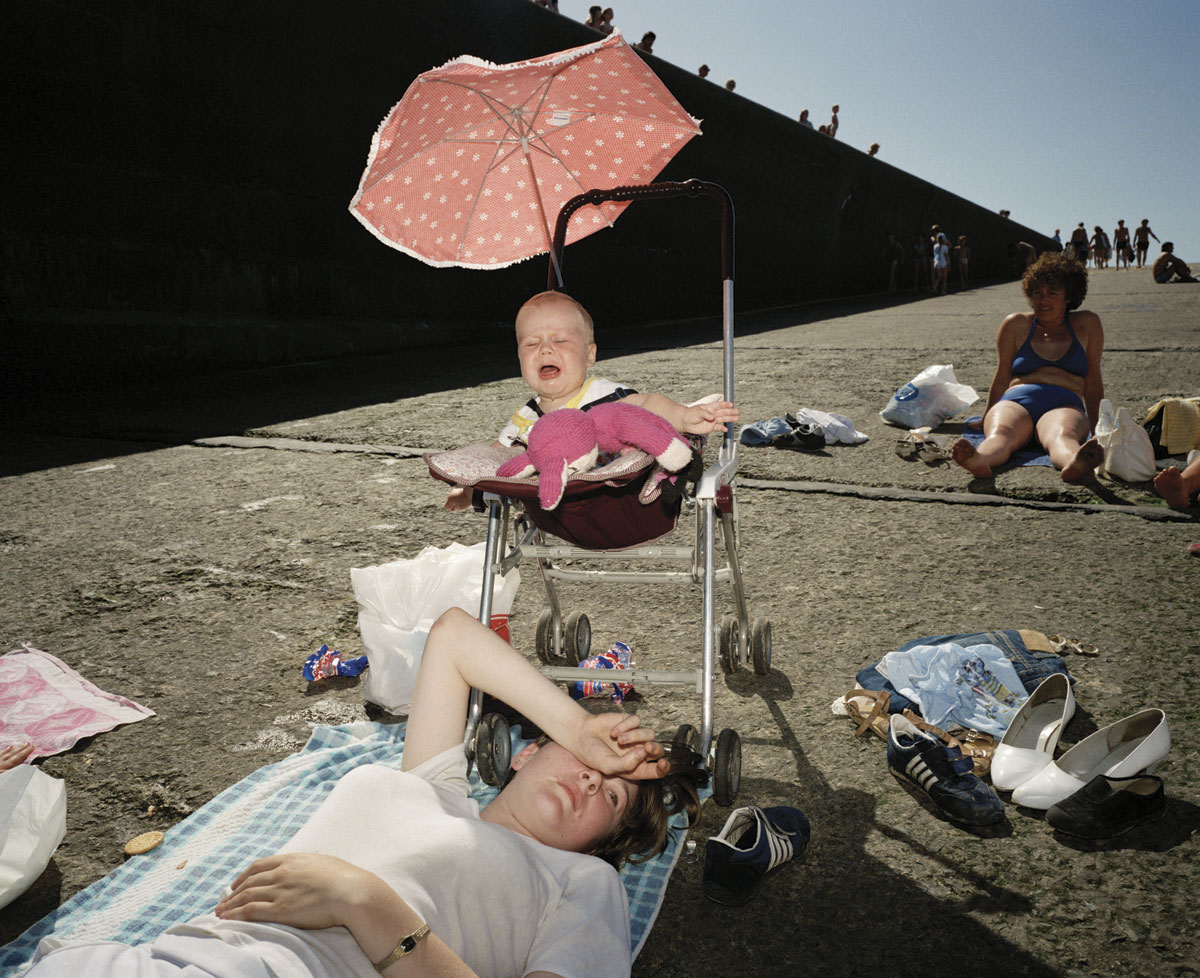
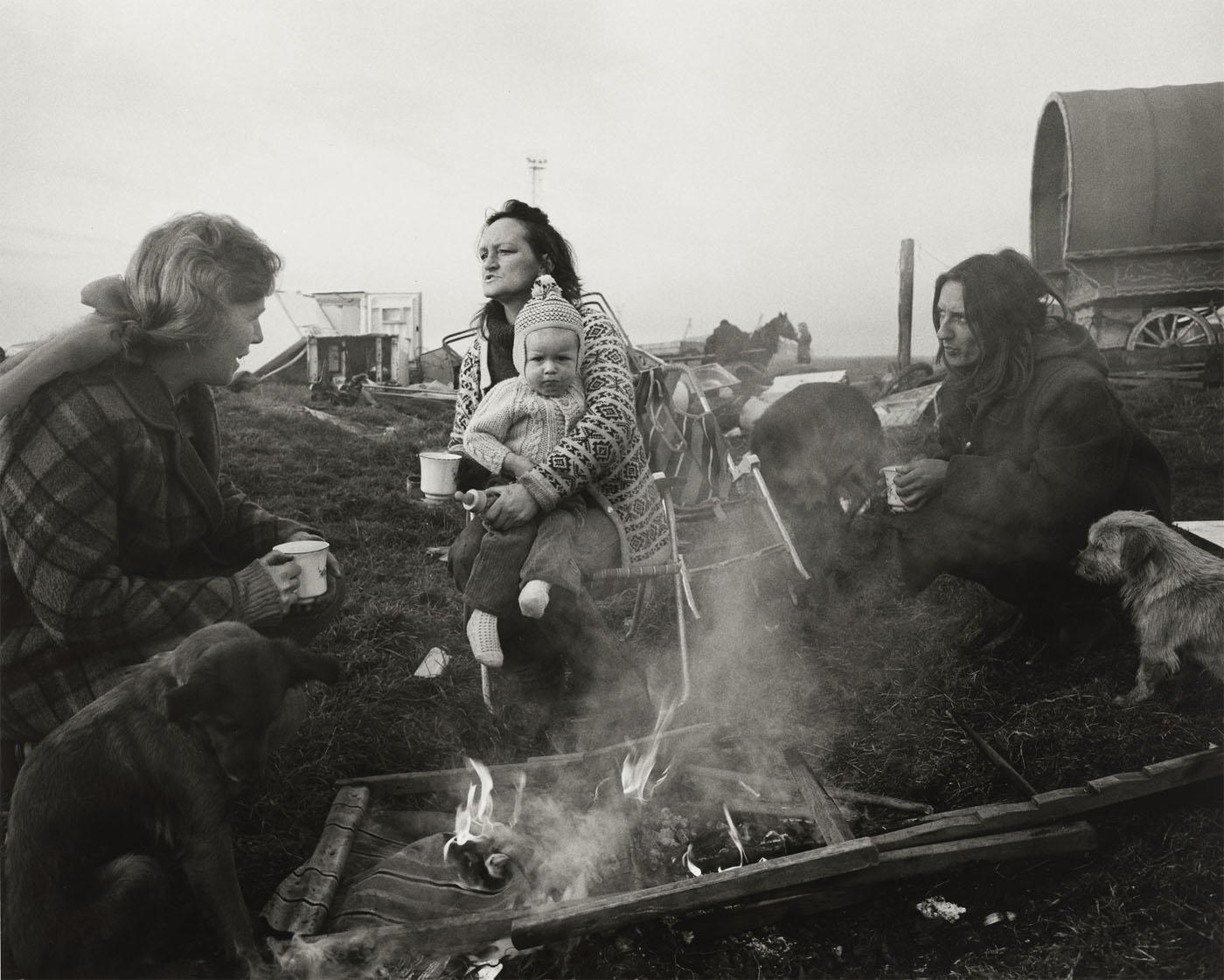
Martin Parr (British, 1952-2025) 'New Brighton, England' 1983-1985 From the series 'The Last Resort'


Martin Parr (British, 1952-2025)
New Brighton, England
From the series Last Resort
1983-1985
Pigment print


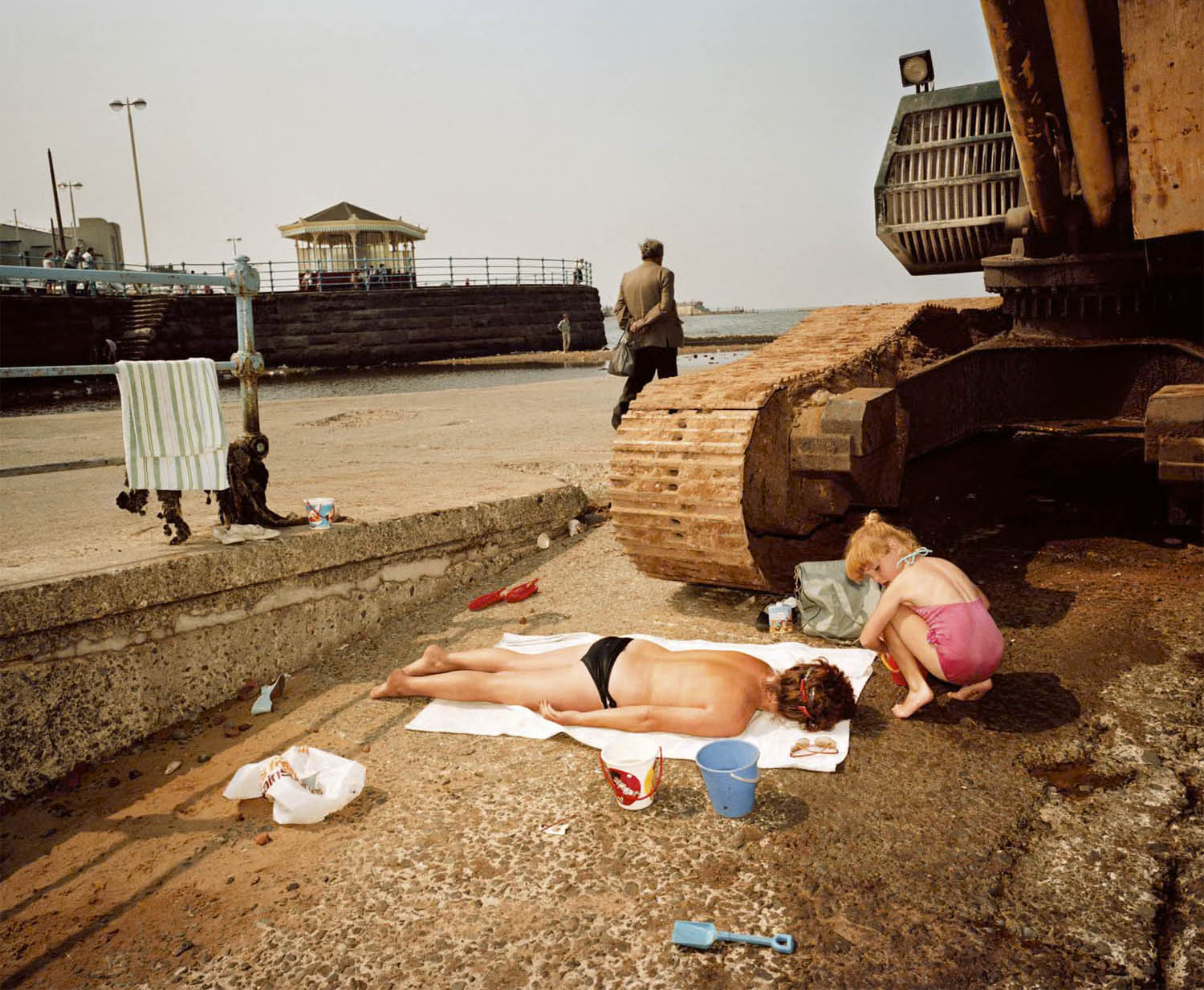
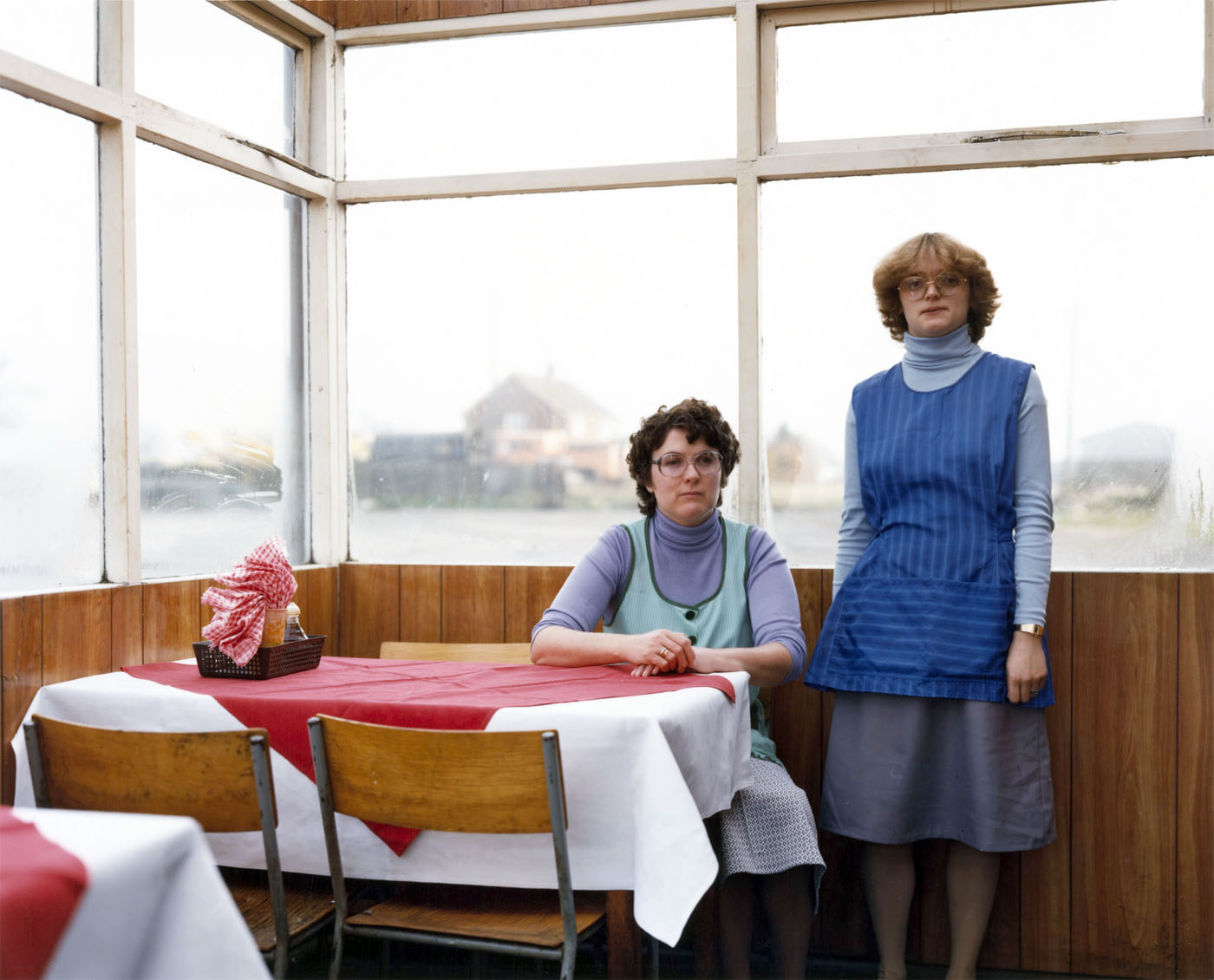
Martin Parr (British, 1952-2025) 'New Brighton, England' 1983-1985 from the series 'The Last Resort'


Martin Parr (British, 1952-2025)
New Brighton, England
From the series The Last Resort
1983-1985
Pigment print


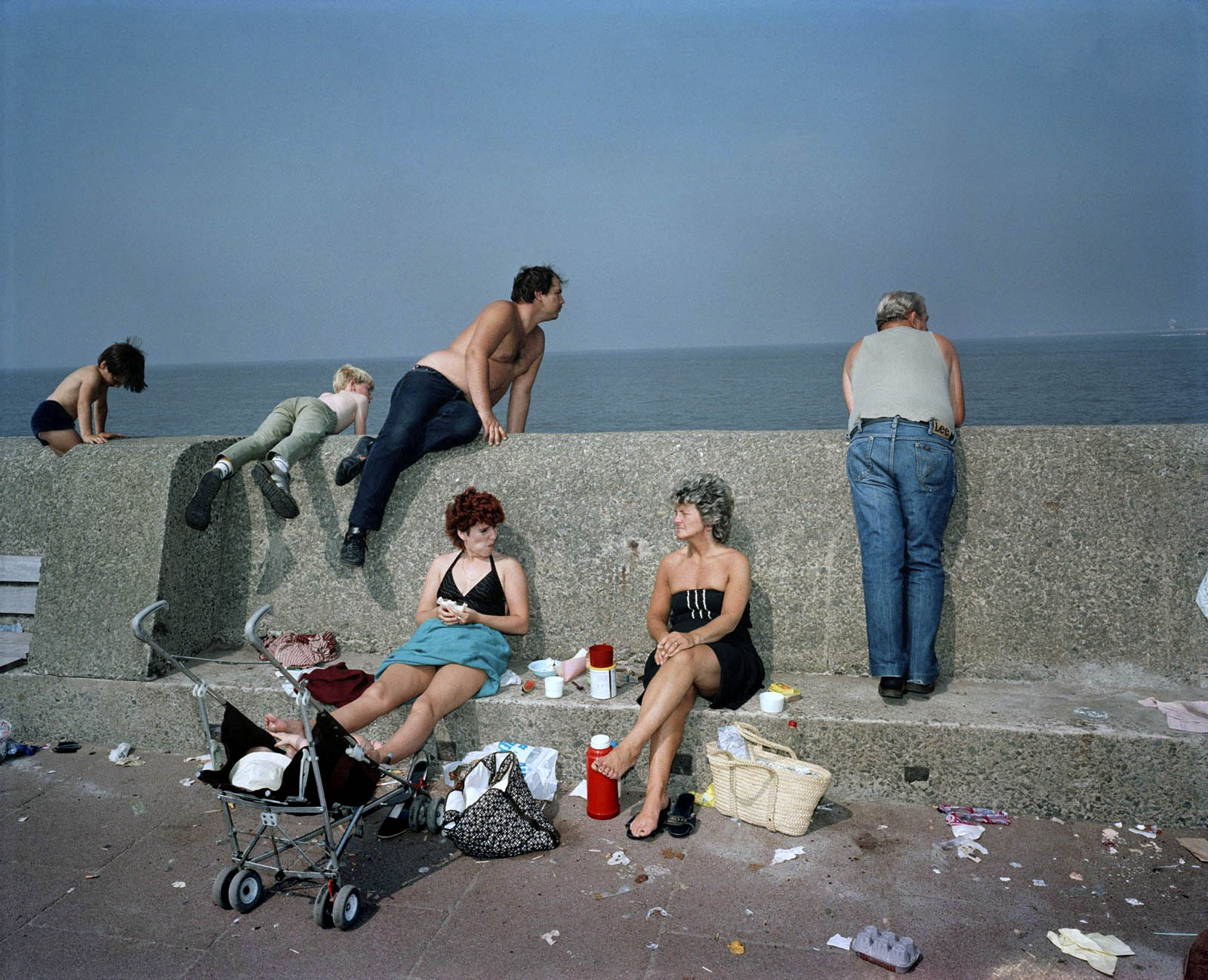
Martin Parr (British, 1952-2025) 'New Brighton, England' 1983-1985 from the series 'The Last Resort'


Martin Parr (British, 1952-2025)
New Brighton, England
From the series The Last Resort
1983-1985
Pigment print


Martin Parr (British, 1952-2025)
New Brighton, England
From the series The Last Resort
1983-1985
Pigment print


Martin Parr (British, 1952-2025) 'New Brighton, Merseyside' 1984


Martin Parr (British, 1952-2025)
New Brighton, Merseyside, England
1984
From the series The Last Resort
Pigment print


Martin Parr (British, 1952-2025) 'England. Bristol. Car boot sale. 1995' 1994-1995 from the series 'British Food'


Martin Parr (British, b. 1952)
England. Bristol. Car boot sale. 1995
From the series British Food
1994-1995
Traditional C-type print


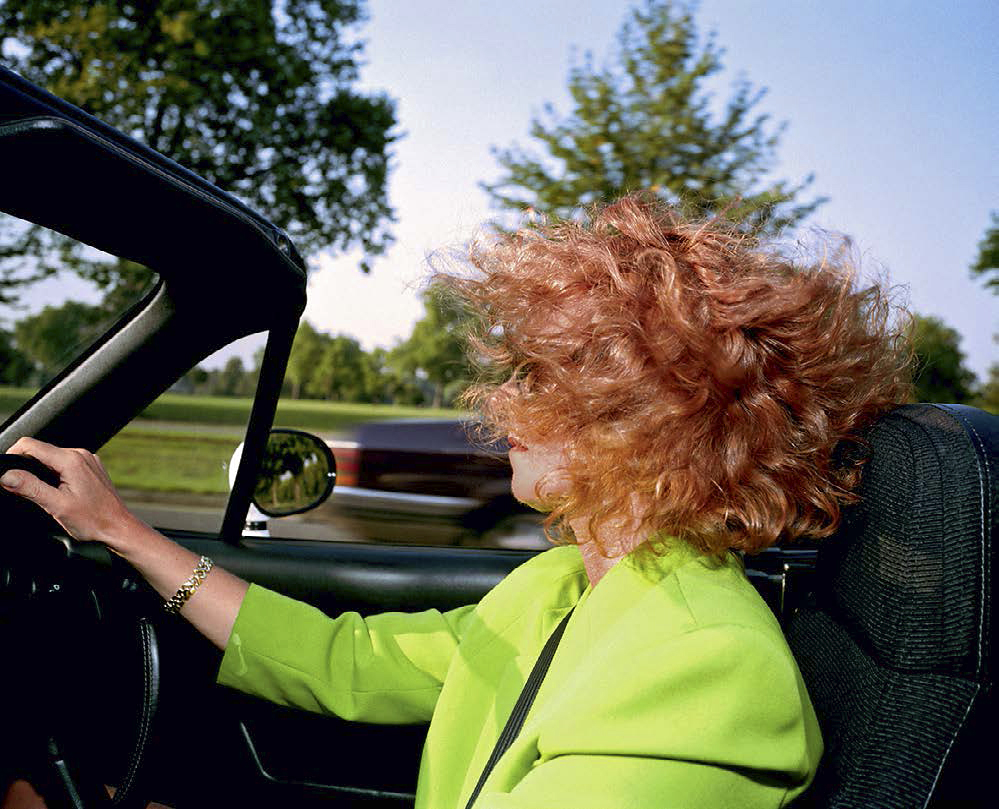
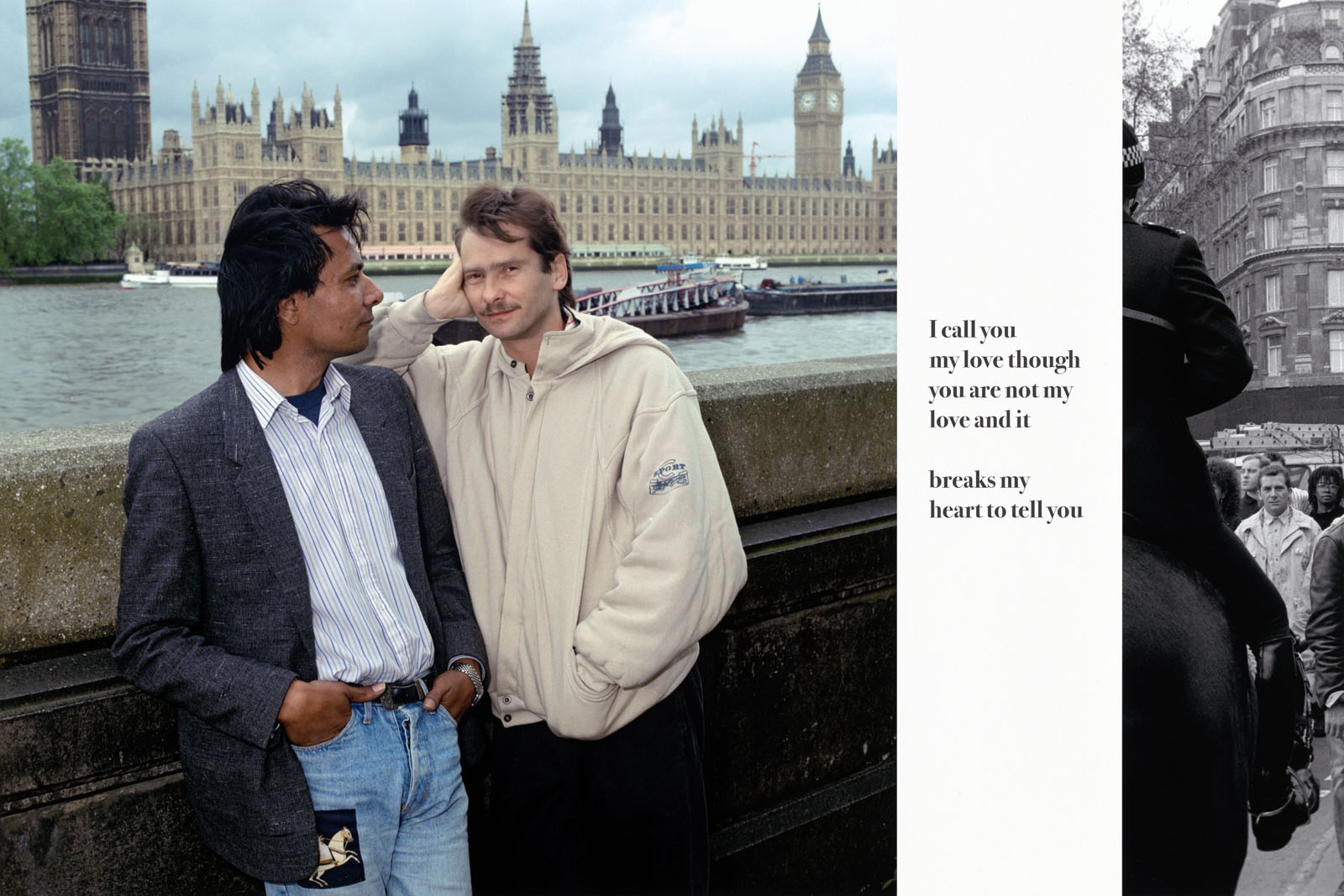
Martin Parr (British, b. 1952) From 'A to B. Tales of Modern Motoring' series 1994


Martin Parr (British, b. 1952)
From A to B. Tales of Modern Motoring series
1994
Pigment print


LIKE ART BLART ON FACEBOOK

Back to top

Exhibition: ‘A World Apart: Photographing Change in London’s East End 1970-76’ at Four Corners, London

Exhibition dates: 24th October – 6th December, 2025


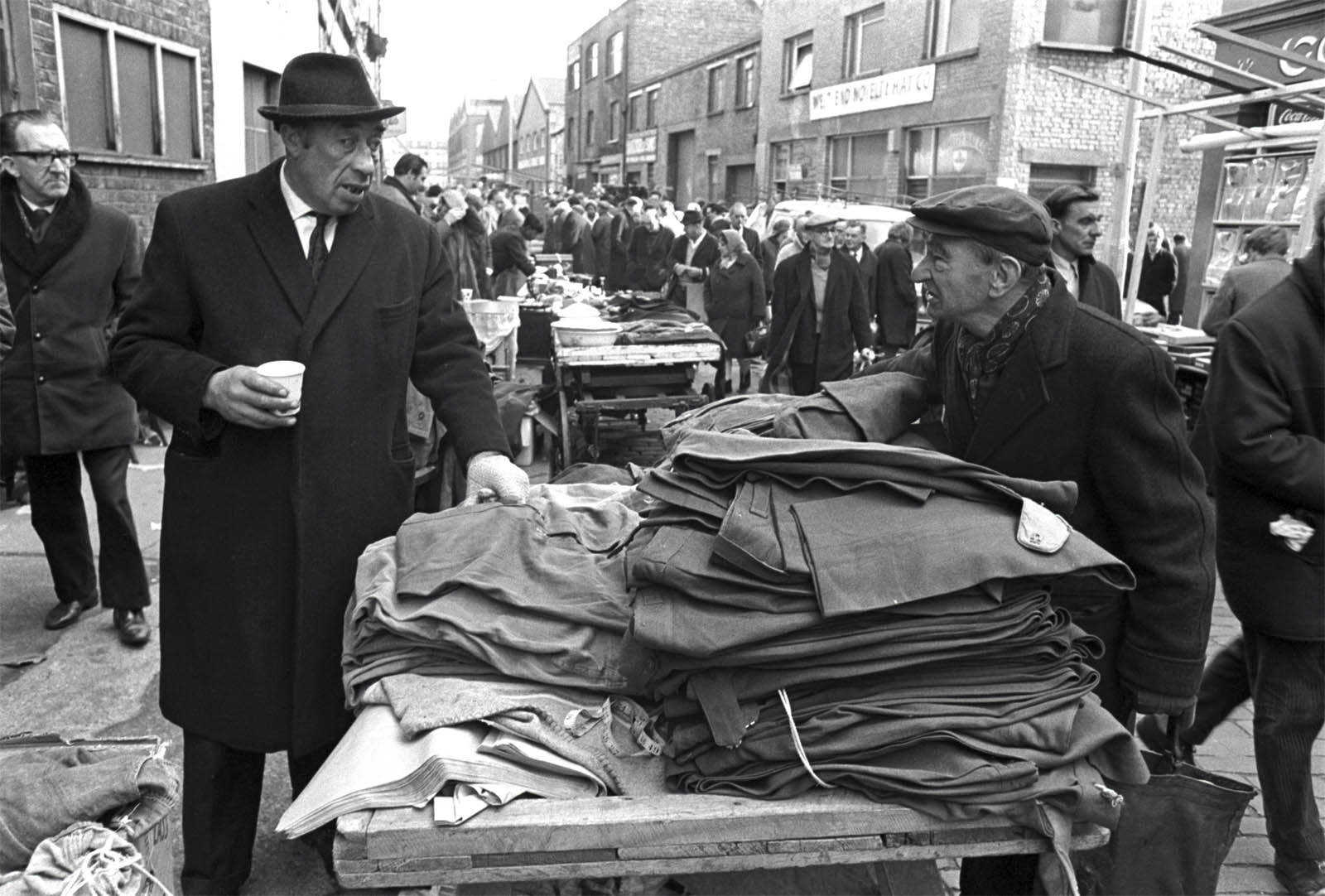
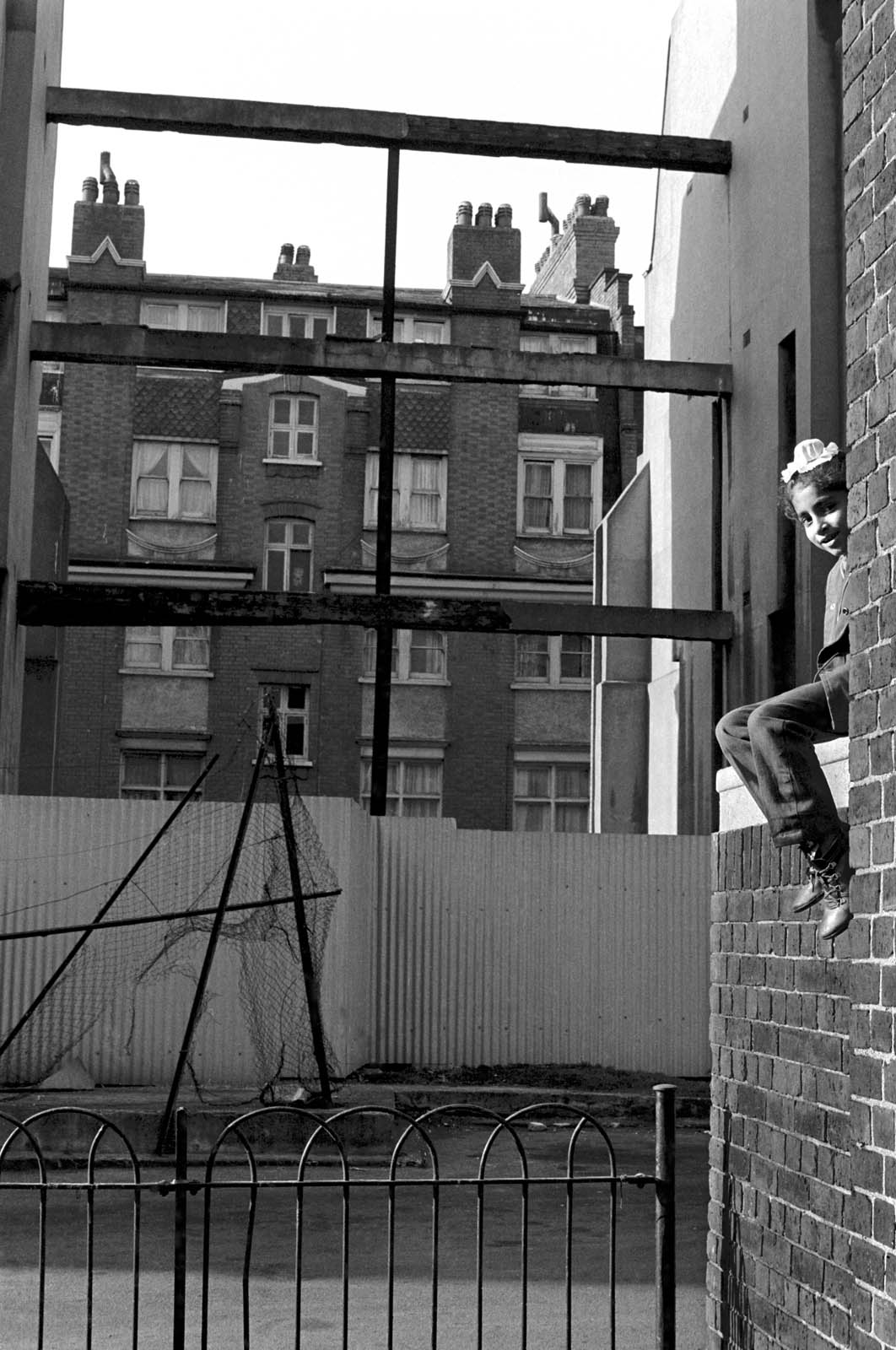
Val Perrin (English) 'Brick Lane market' 1970 or 1972 from the exhibition 'A World Apart: Photographing change in London's East End 1970-76' at Four Corners, Oct - Dec, 2025


Val Perrin (English)
Brick Lane market
1970 or 1972
Gelatin silver print
© Val Perrin


The heroes of this posting (I don’t know about the exhibition for I haven’t seen it!) are the photographs of Ron McCormick (English, b. 1947) which are deeply rooted in the traditions of photography and the community from which they emanate.

They picture an era of change in the East End of London in the 1970s with all the working class grittiness that area was renowned for. I remember going to Brick Lane market in the mid-1970s and it was a rough area. At that time, the East Enders seemed to be a throw back to a vanishing race born out of the Second World War: flat hats, heavy overcoats and a toughness to just carry on regardless. But things were changing.

“As the docks closed, and wholesale slum clearance replaced old neighbourhoods, many communities were being transformed beyond recognition… Yet a different East End was also coming into being, as new migrant communities created a space for themselves,” one that has become equally as British as previous white iterations. The narrow definition of an “East Ender” was gradually replaced with something more multicultural.

McCormick’s photographs picture such a transformation: Jewish, White, Muslim, Indian, Black, etc., all mixing together in a potpourri of ethnicities, “a vibrant cultural landscape with a variety of traditions, languages, and backgrounds existing together,” while his photographs are rooted in strong social documentary traditions.

In his work I can feel (the critical observation) the influence of Lewis Hine and Walker Evans, more recently that of Lisette Model and the interior photographs of Diane Arbus, Roman Vishniac’s photographs of Jewish life in Eastern Europe between the two World Wars, possibly even the contemporaneous portraits by Milton Rogovin.

Undoubtedly this blending of influences in his photographs ultimately reveals McCormick’s insightful eye and generous spirit: his love for the people he is photographing and his embeddedness in local social networks, deeply influenced by the social and cultural environment from which they emerge – a community in a time of rapid transition and social change.

Dr Marcus Bunyan


Many thankx to Four Corners for allowing me to publish the photographs in the posting. Please click on the photographs for a larger version of the image.


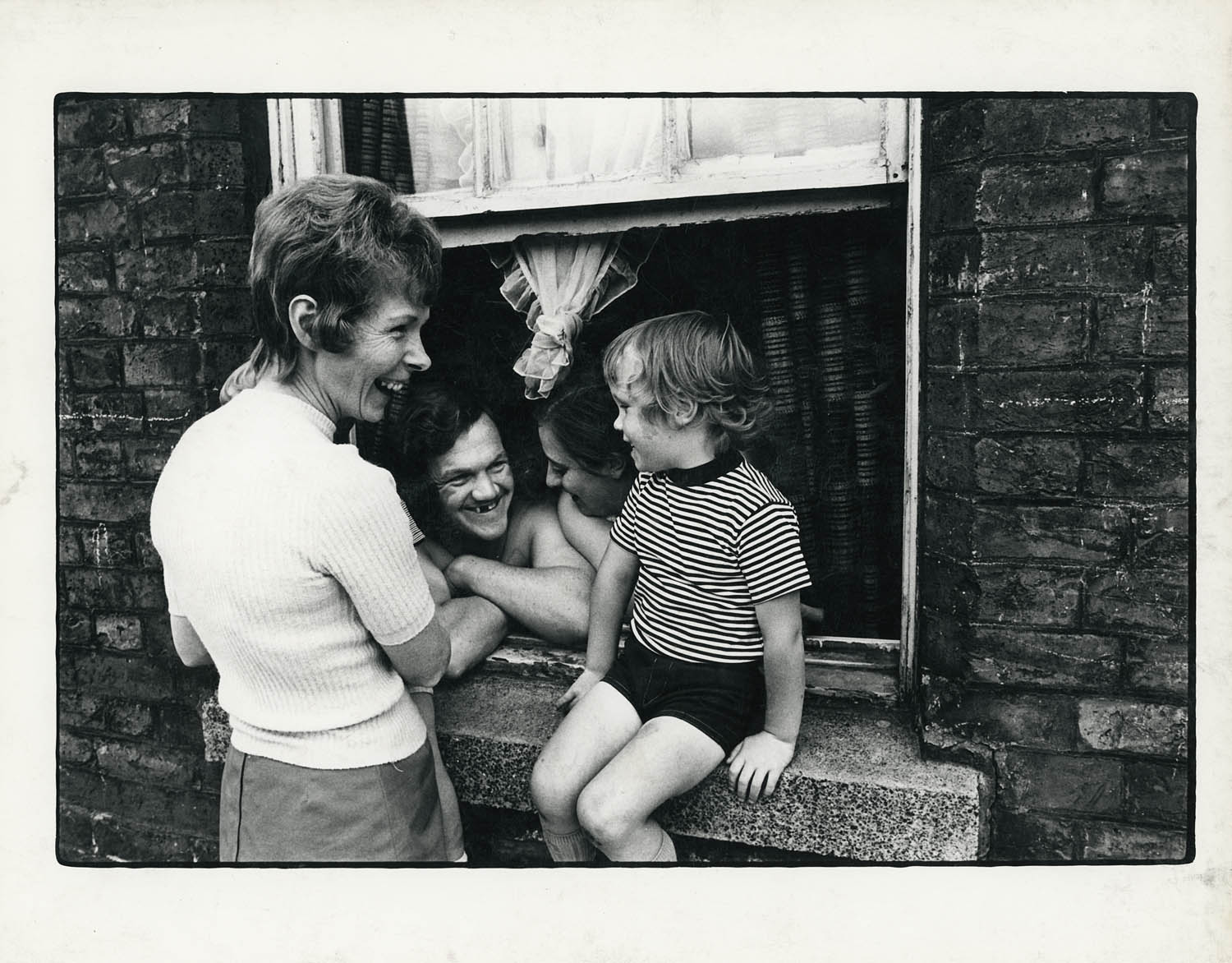
Paul Trevor (English, b. 1947) 'Wapping family at window' 1973 from the exhibition 'A World Apart: Photographing change in London's East End 1970-76' at Four Corners, Oct - Dec, 2025


Paul Trevor (English, b. 1947)
Wapping family at window
1973
Gelatin silver print
© Paul Trevor


Paul Trevor (English, b. 1947) 'Mr and Mrs Kelleher in members pub' 1973


Paul Trevor (English, b. 1947)
Mr and Mrs Kelleher in members pub
1973
Gelatin silver print
© Paul Trevor


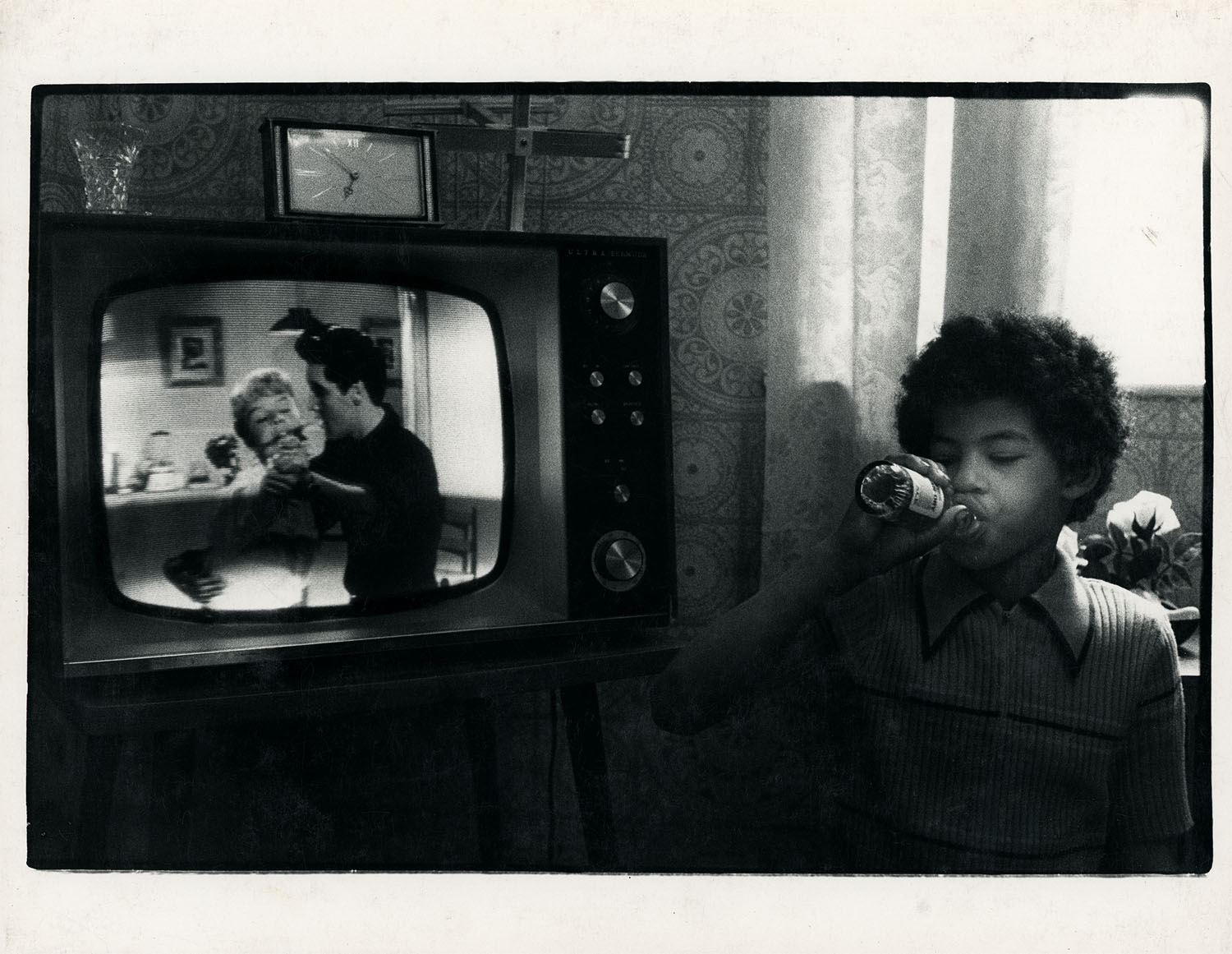
Nicholas Battye (British, 1950-2004) / Exit Photography. 'Floyd Wilson' 1973


Nicholas Battye (British, 1950-2004) / Exit Photography
Floyd Wilson
1973
Gelatin silver print
© Nicholas Battye/Exit Photography


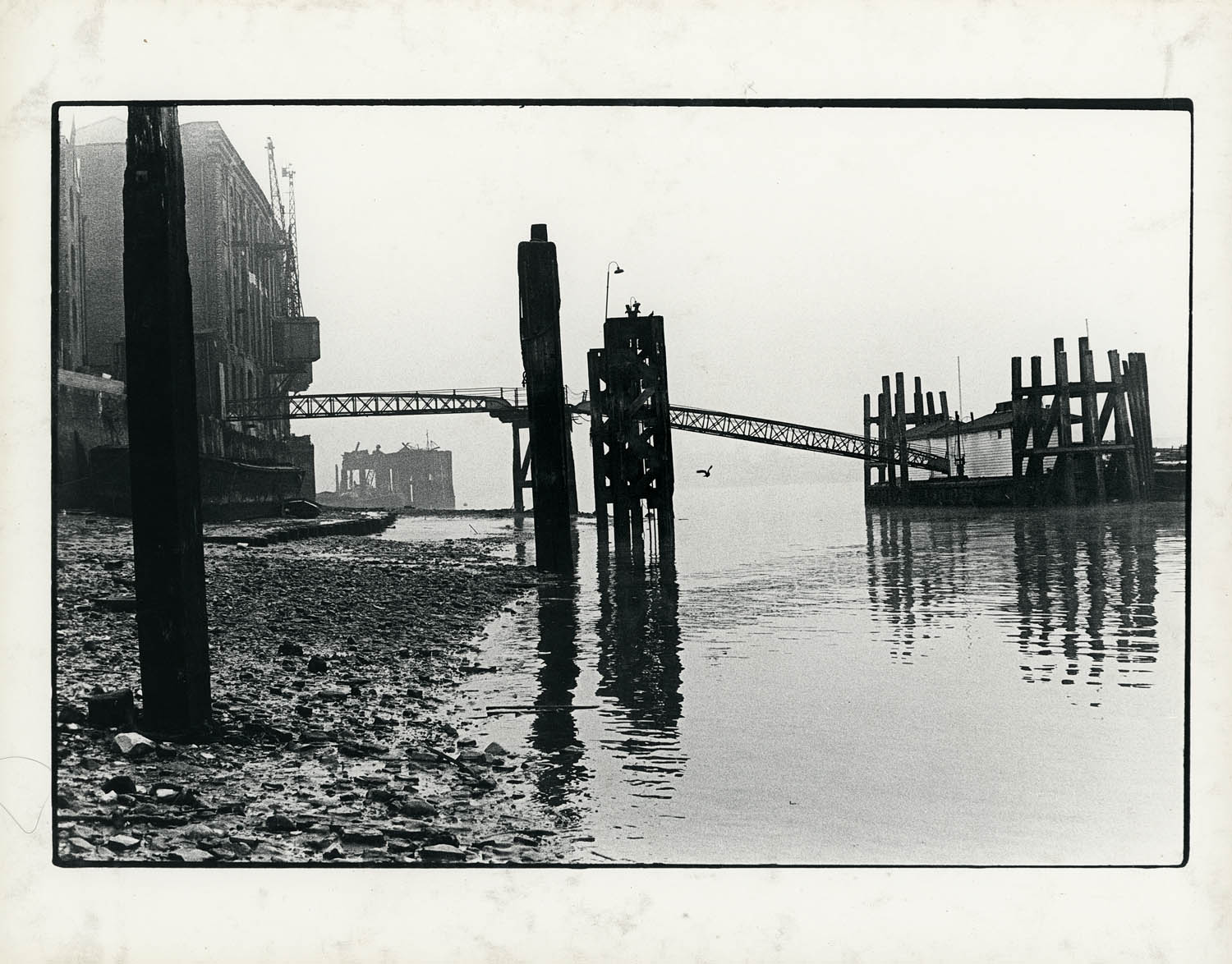
Exit Photography. 'Wapping pier' 1973


Exit Photography
Wapping pier
1973
Gelatin silver print
© Exit Photography


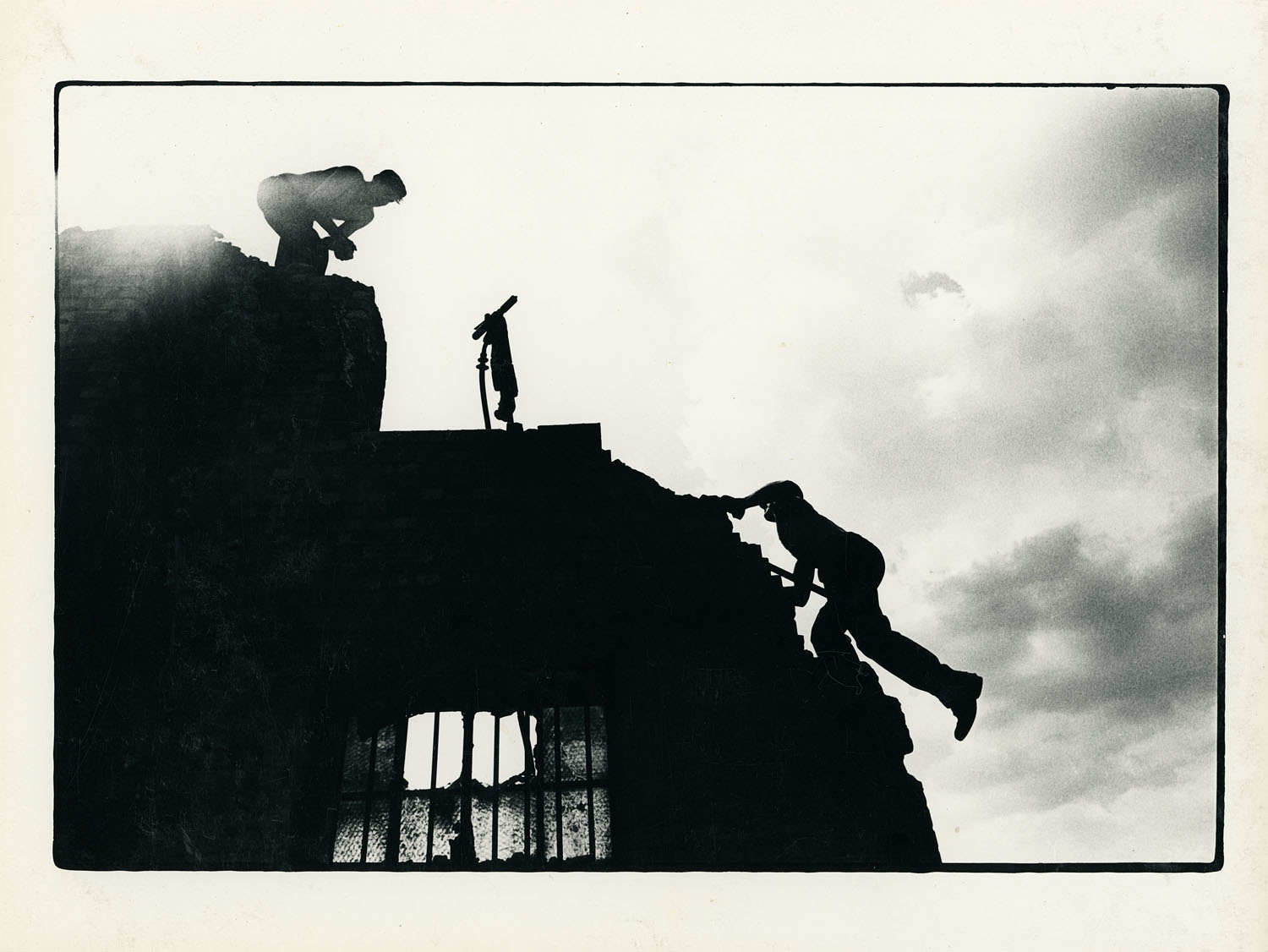
Exit Photography. 'Demolition at Colonial Wharf' 1973


Exit Photography
Demolition at Colonial Wharf
1973
Gelatin silver print
© Exit Photography


Four Corners’ autumn exhibition captures a unique moment of change in London’s East End.

As the docks closed, and wholesale slum clearance replaced old neighbourhoods, many communities were being transformed beyond recognition. Yet a different East End was also coming into being, as new migrant communities created a space for themselves.

­­A new generation of photographers were drawn to document ordinary people’s lives and give visibility to working-class experiences. They showed their photographs in everyday spaces where local people could view images of themselves and their own communities.

The exhibition features remarkable photographs by Ron McCormick and the Exit Photography collective of Nicholas Battye, Diane Bush, Alex Slotzkin, and Paul Trevor, alongside work by Ian Berry, John Donat, David Hoffman, Jessie Ann Matthews, Dennis Morris, Val Perrin, and Ray Rising.

With many thanks to Tower Hamlets Local History Library and Archives, Hackney Museum, the Royal Institute of British Architects, and Spectrum Photographic.

Text from the Four Corners website


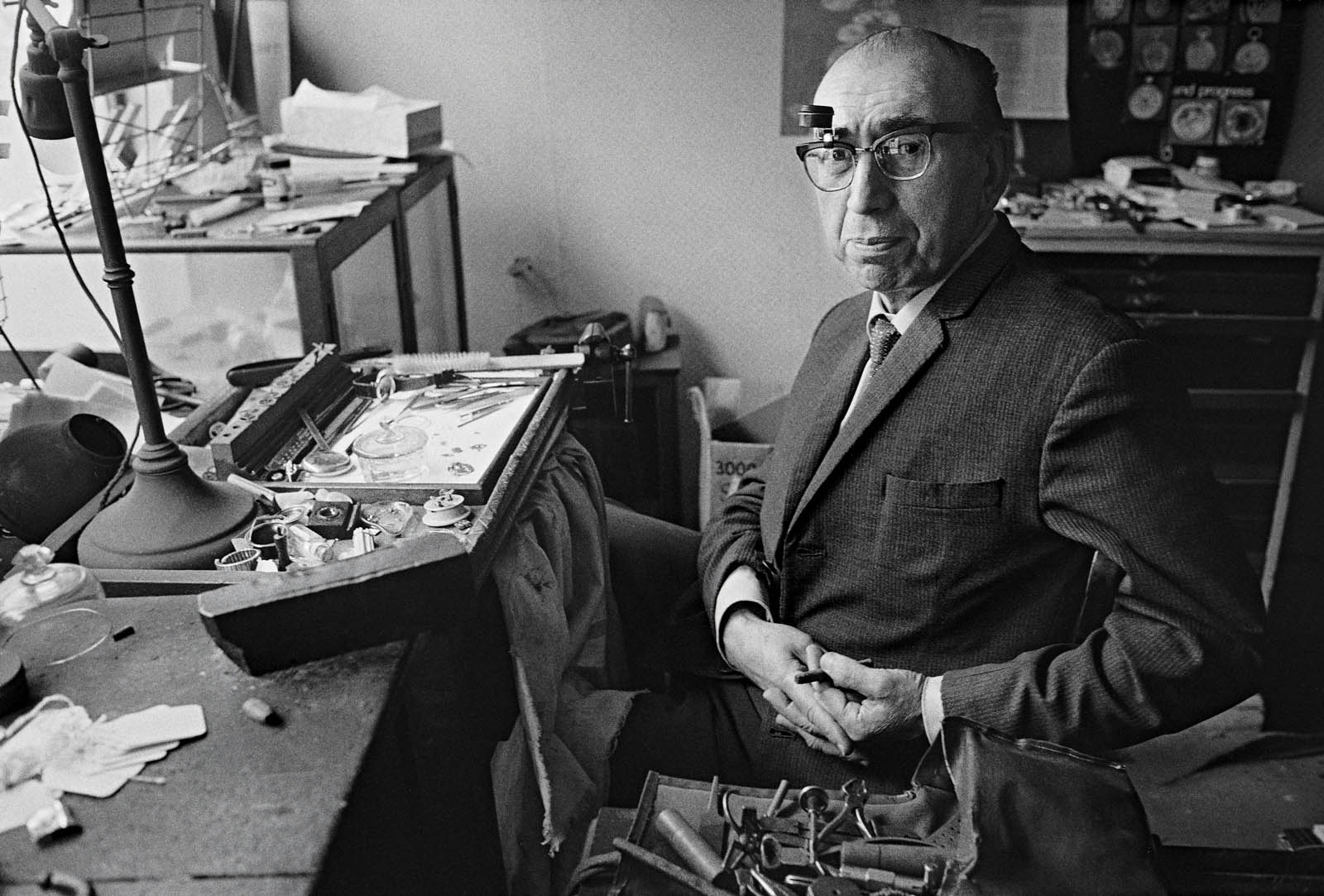
Ron McCormick (English, b. 1947) 'Watch repairer, Black Lion Yard, Whitechapel' 1973 from the exhibition 'A World Apart: Photographing change in London's East End 1970-76' at Four Corners, Oct - Dec, 2025


Ron McCormick (English, b. 1947)
Watch repairer, Black Lion Yard, Whitechapel
1973
Gelatin silver print
© Ron McCormick


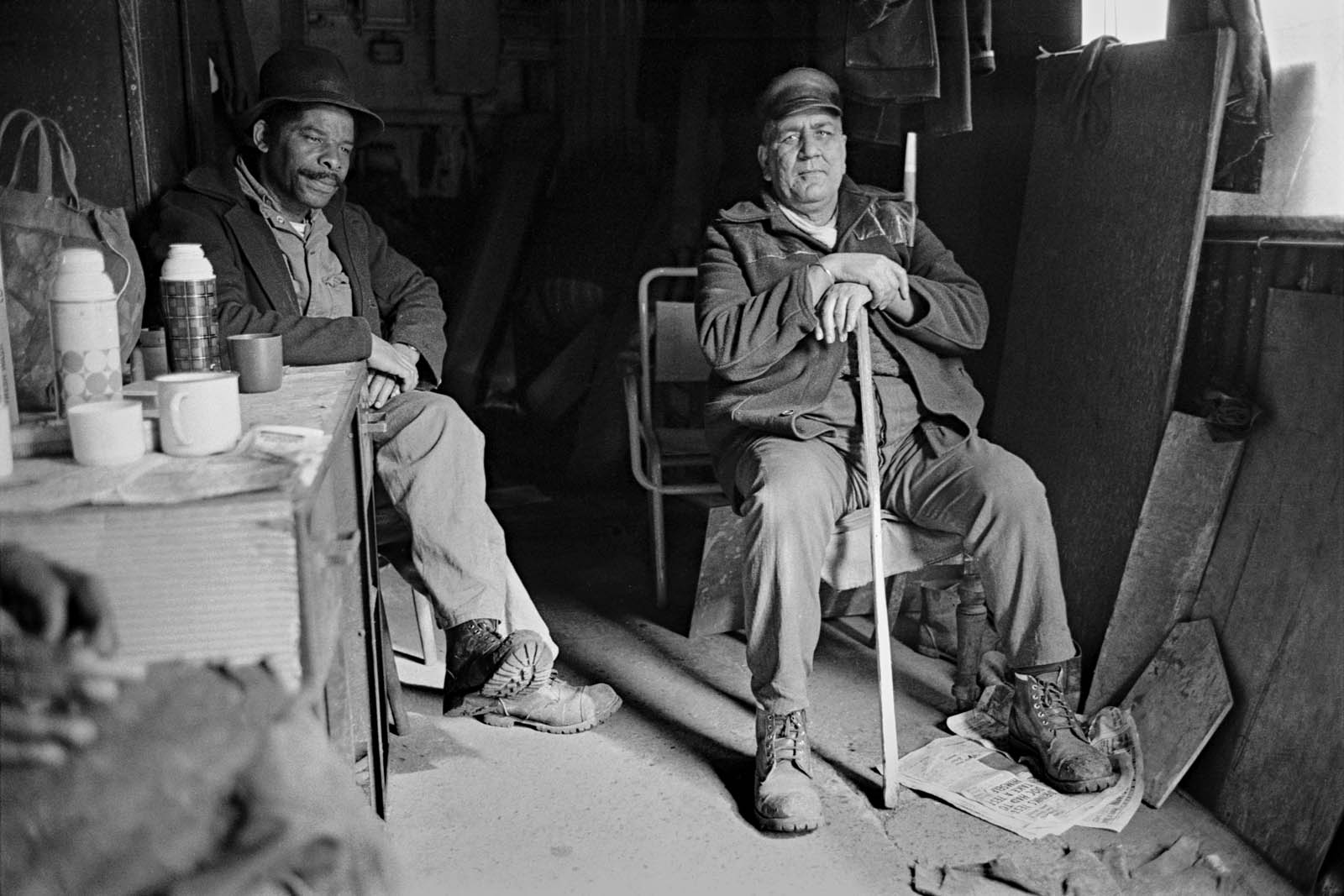
Ron McCormick (English, b. 1947) 'Tea break, P & L Engineering, Heneage Street, East London' 1973


Ron McCormick (English, b. 1947)
Tea break, P & L Engineering, Heneage Street, East London
1973
Gelatin silver print
© Ron McCormick


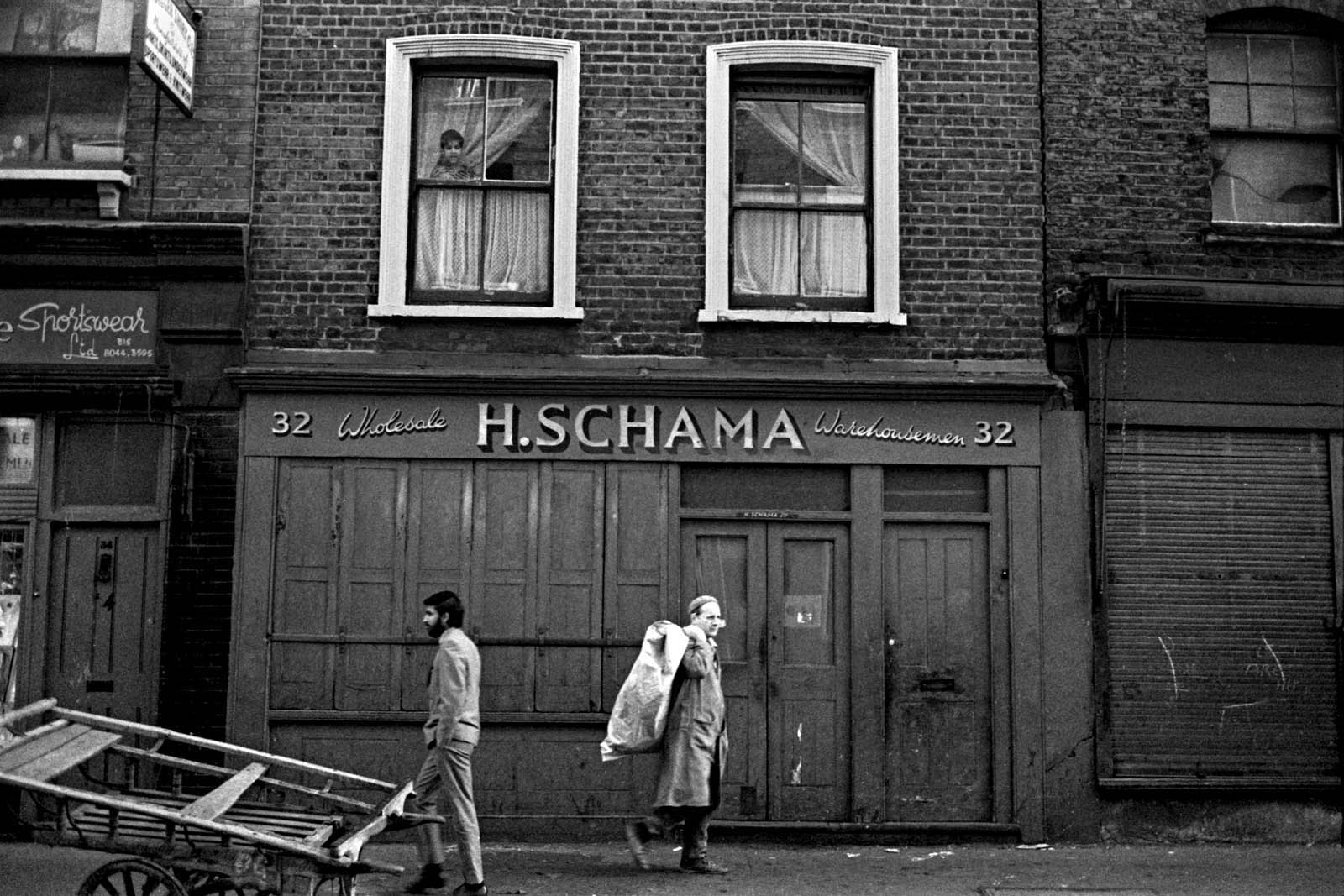
Ron McCormick (English, b. 1947) 'Street scene Spitalfields' 1971


Ron McCormick (English, b. 1947)
Street scene Spitalfields
1971
Gelatin silver print
© Ron McCormick


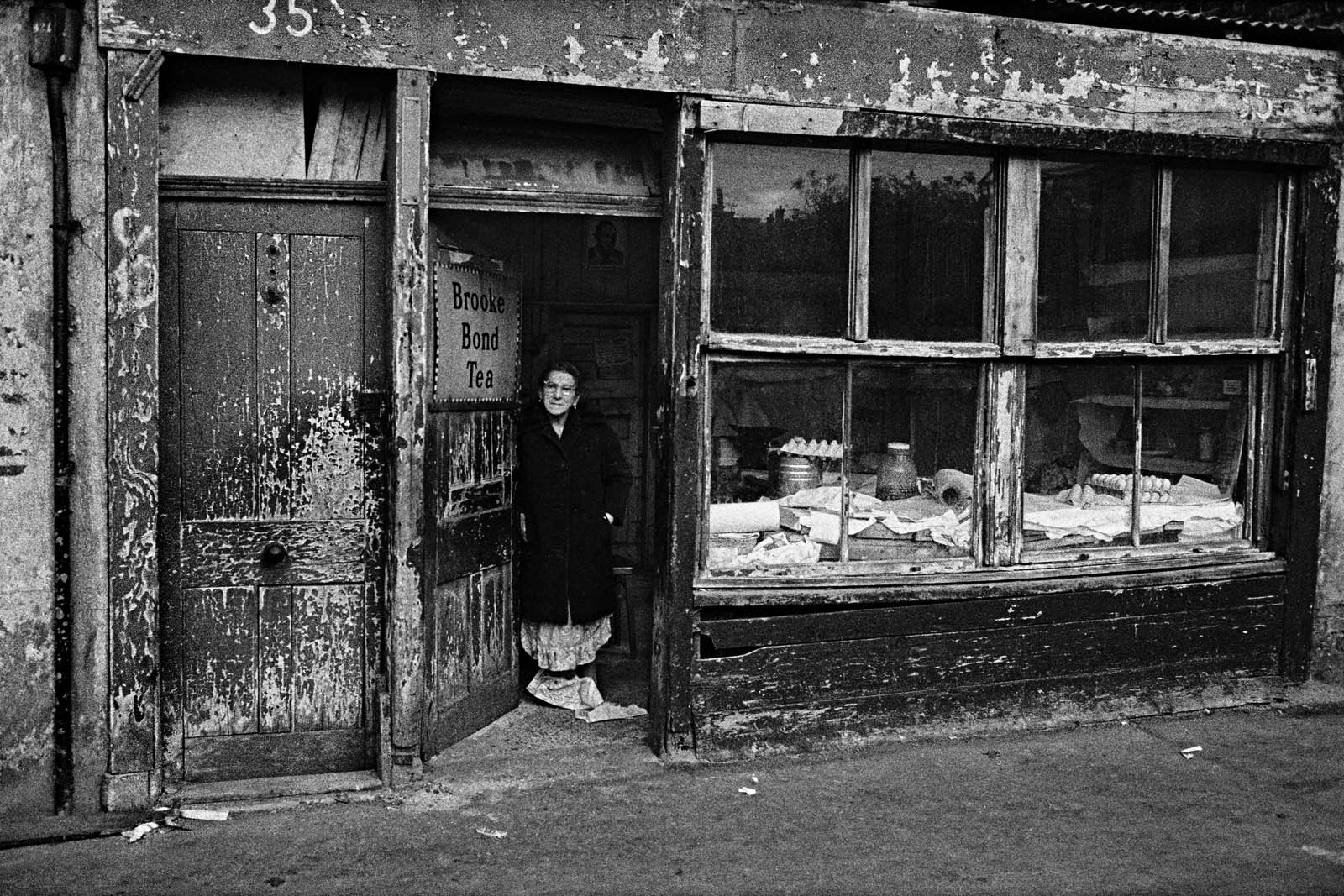
Ron McCormick (English, b. 1947) 'Schmaltz herring shop, 35 Old Montague Street' 1971


Ron McCormick (English, b. 1947)
Schmaltz herring shop, 35 Old Montague Street
1971
Gelatin silver print
© Ron McCormick


Ron McCormick (English, b. 1947) 'Mr and Mrs Ali, Brick Lane' 1973


Ron McCormick (English, b. 1947)
Mr and Mrs Ali, Brick Lane
1973
Gelatin silver print
© Ron McCormick


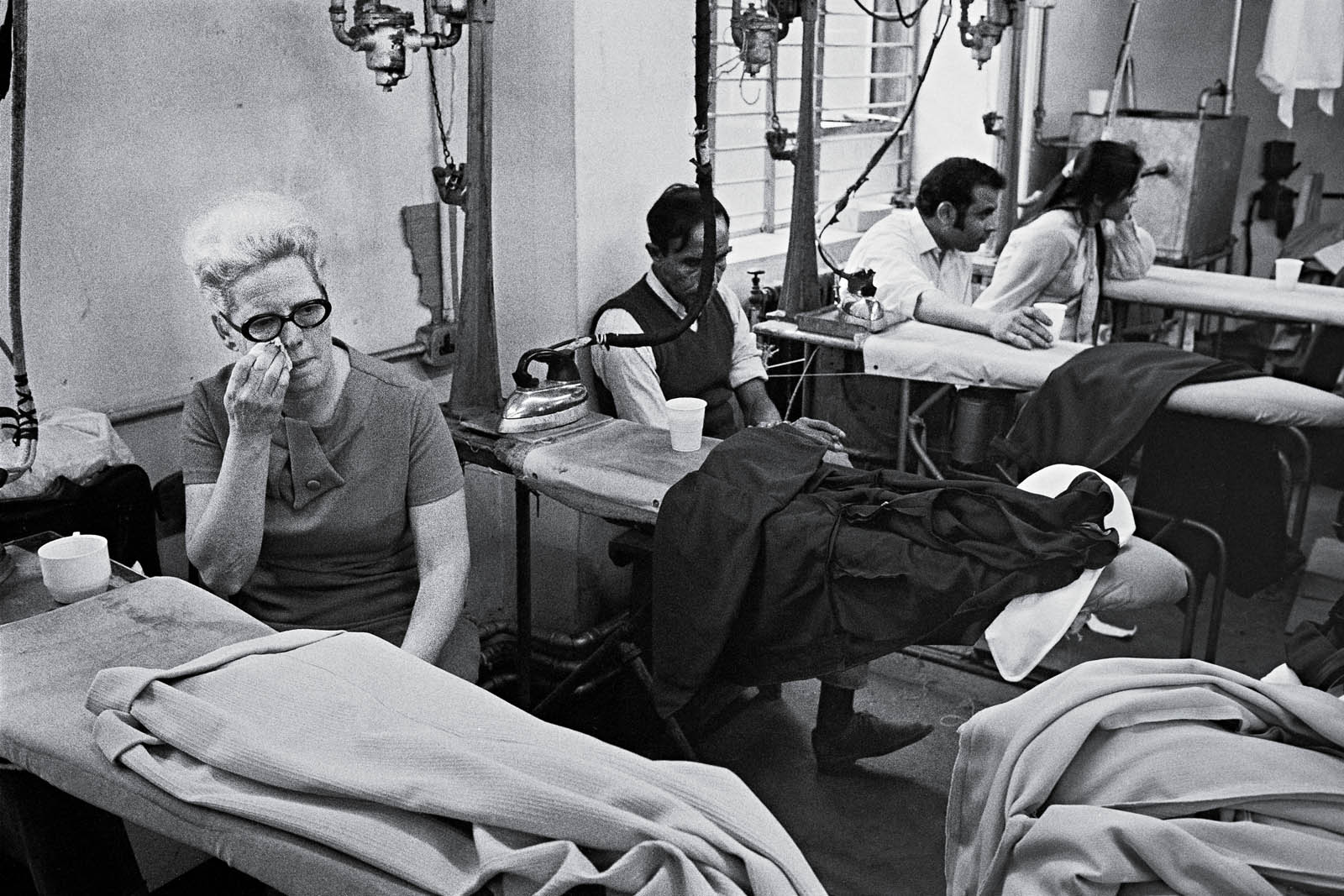
Ron McCormick (English, b. 1947) 'Clothing sweatshop in Whitechapel' 1973


Ron McCormick (English, b. 1947)
Clothing sweatshop in Whitechapel
1973
Gelatin silver print
© Ron McCormick


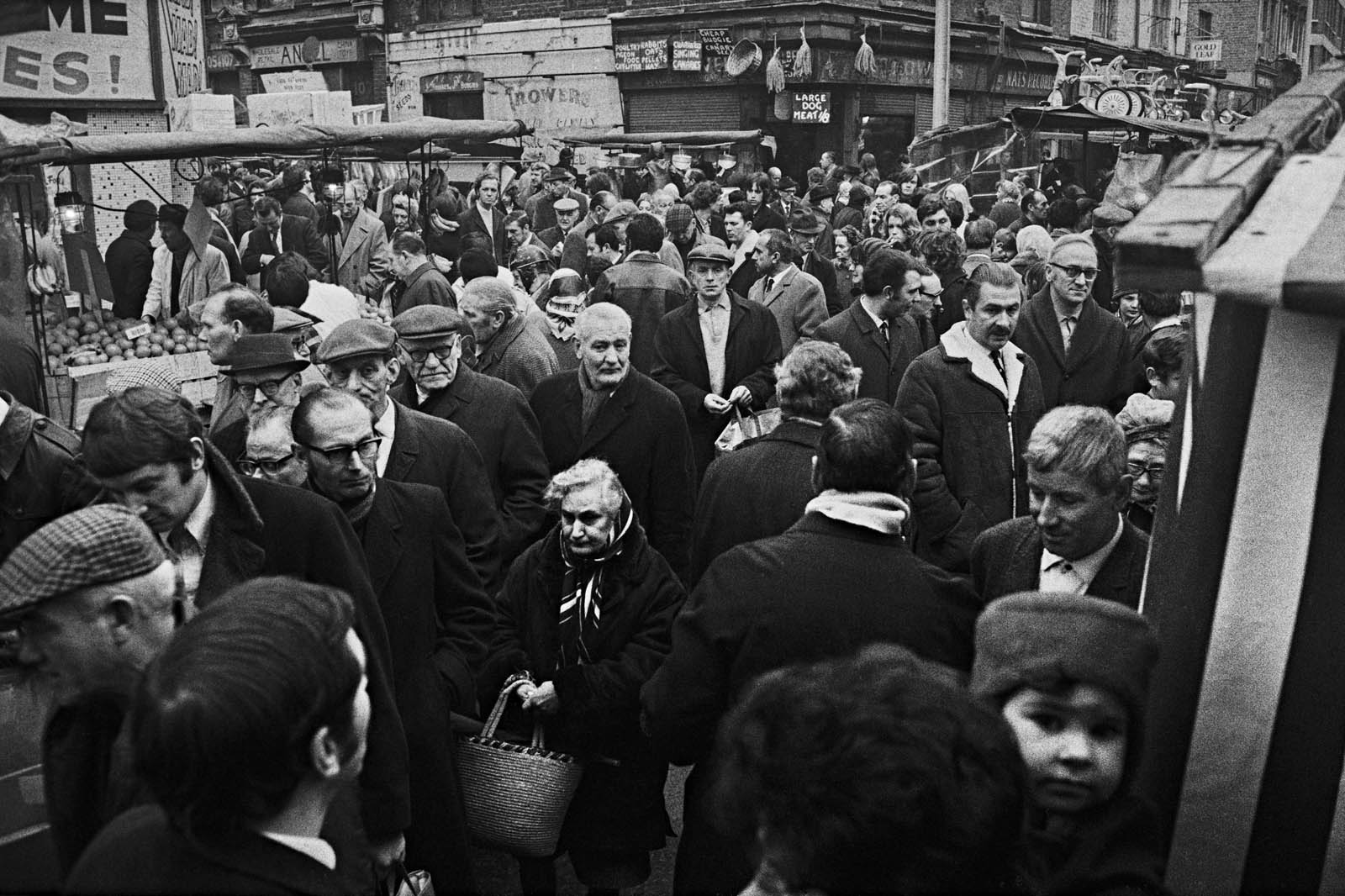
Ron McCormick (English, b. 1947) 'Brick Lane Sunday market' 1971


Ron McCormick (English, b. 1947)
Brick Lane Sunday market
1971
Gelatin silver print
© Ron McCormick


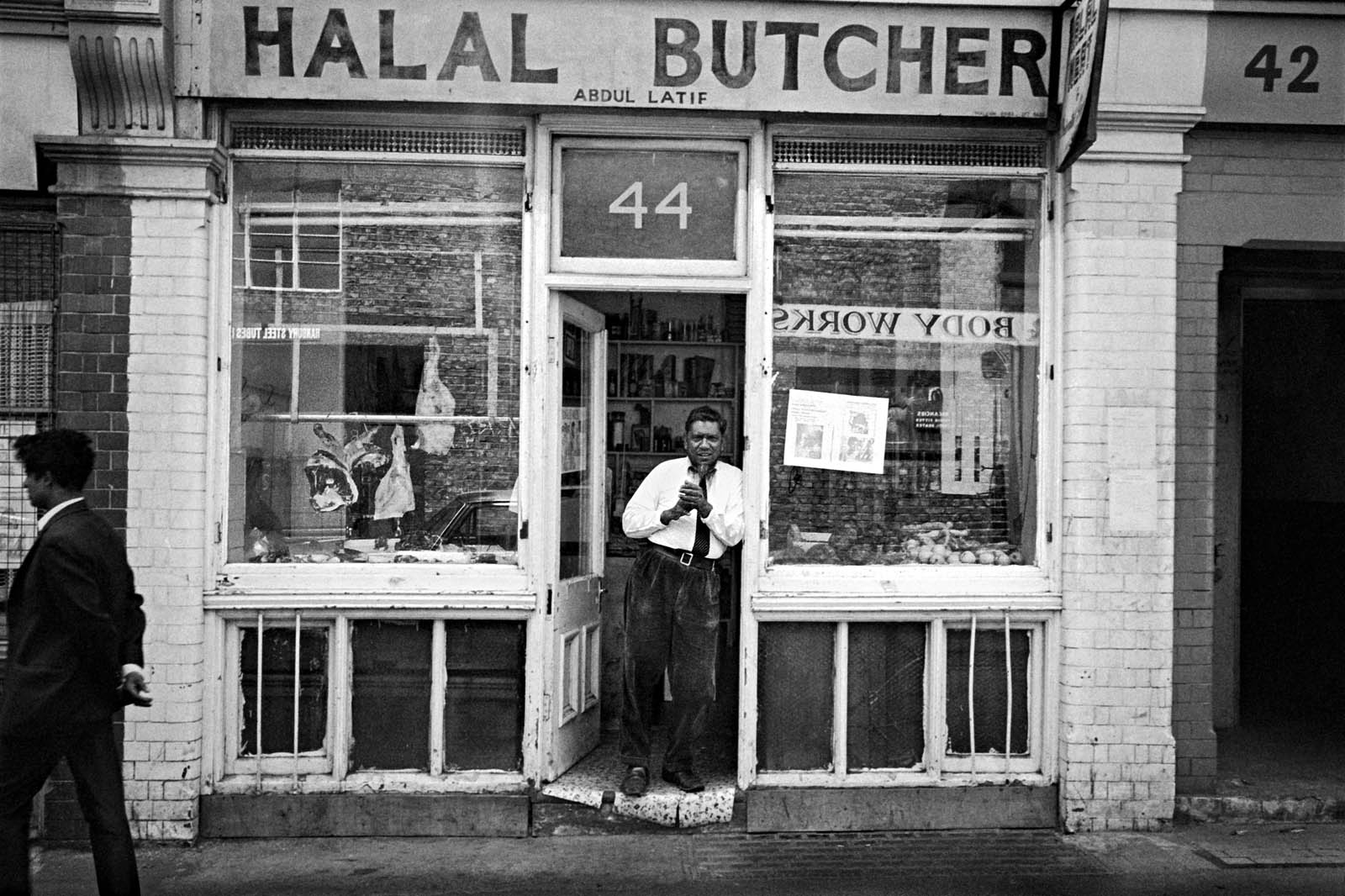
Ron McCormick (English, b. 1947) 'Abdul Latif, Halal butcher, 44 Brick Lane' 1973


Ron McCormick (English, b. 1947)
Abdul Latif, Halal butcher, 44 Brick Lane
1973
Gelatin silver print
© Ron McCormick


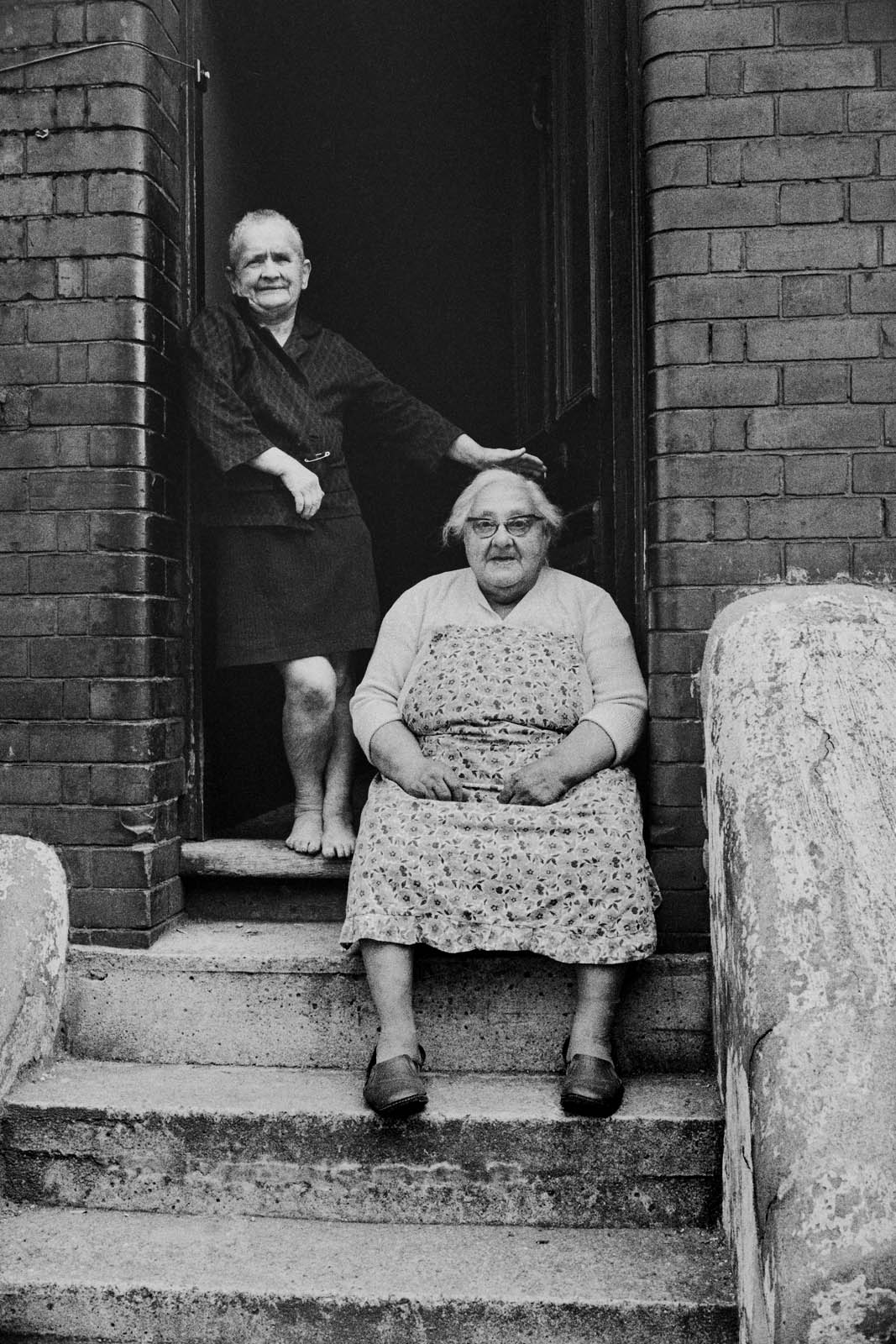
Ron McCormick (English, b. 1947) 'Mother and daughter, Fieldgate Street, Whitechapel' 1971


Ron McCormick (English, b. 1947)
Mother and daughter, Fieldgate Street, Whitechapel
1971
Gelatin silver print
© Ron McCormick


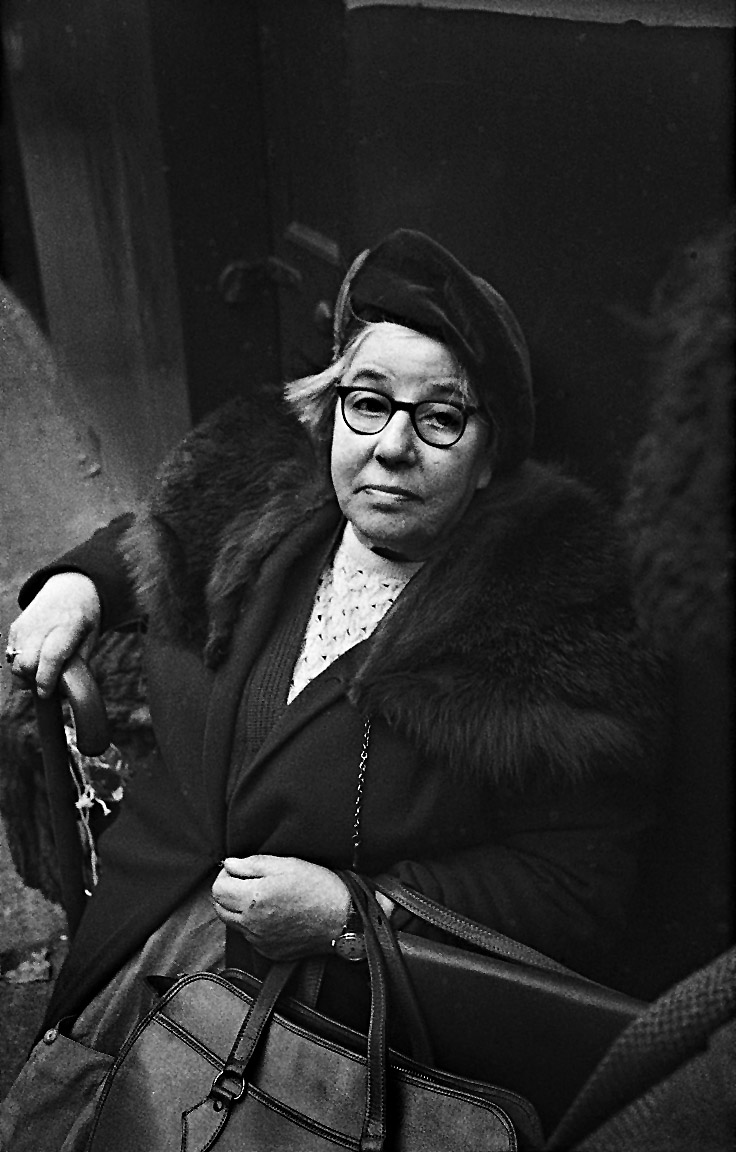
Ron McCormick (English, b. 1947) 'Lady in Sunday best Brick Lane market' 1970


Ron McCormick (English, b. 1947)
Lady in Sunday best Brick Lane market
1970
Gelatin silver print
© Ron McCormick


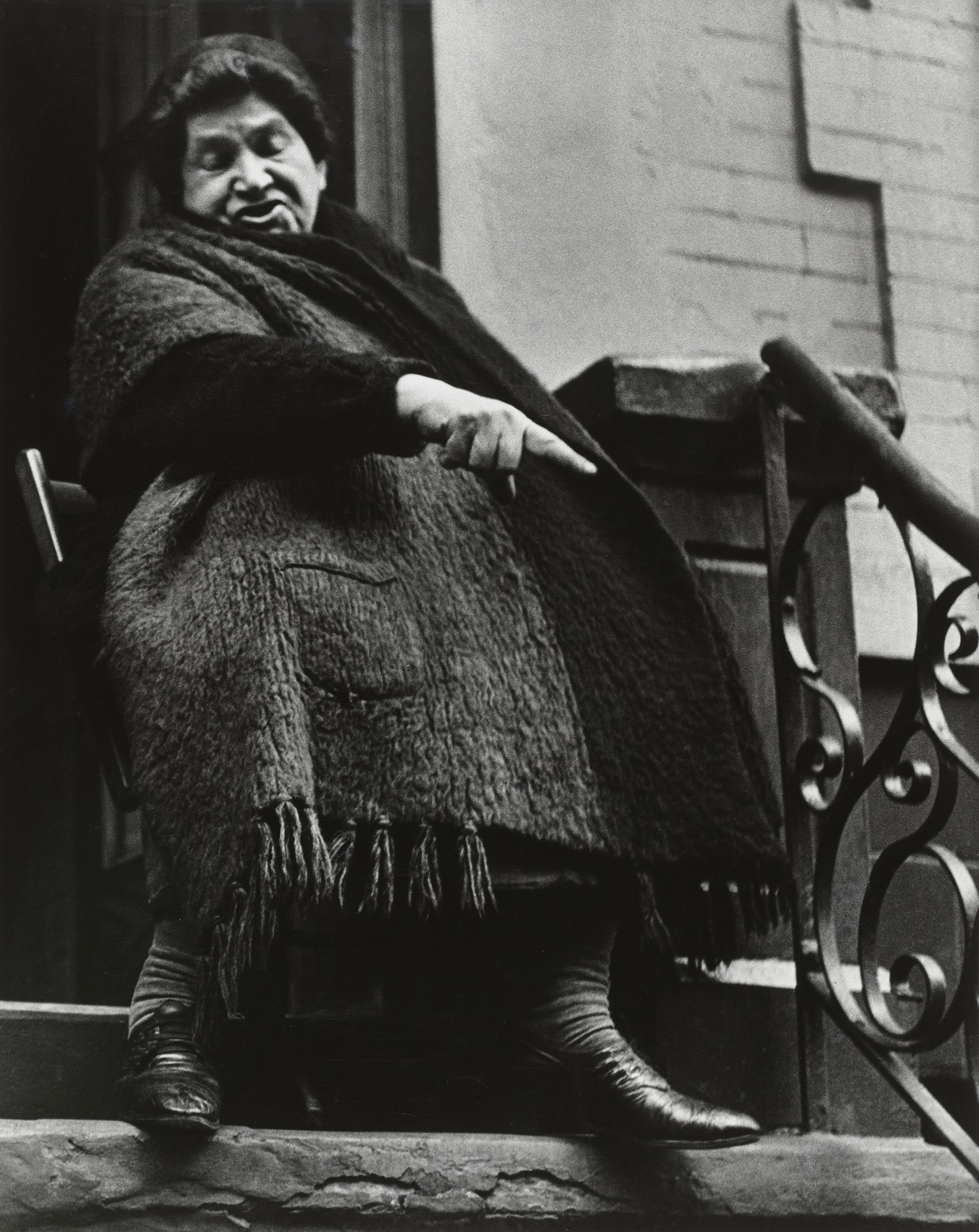
Lisette Model (American, born Austria 1901-1983) 'Lower East Side' c. 1942


Lisette Model (American, born Austria 1901-1983)
Lower East Side
c. 1942
Gelatin silver print


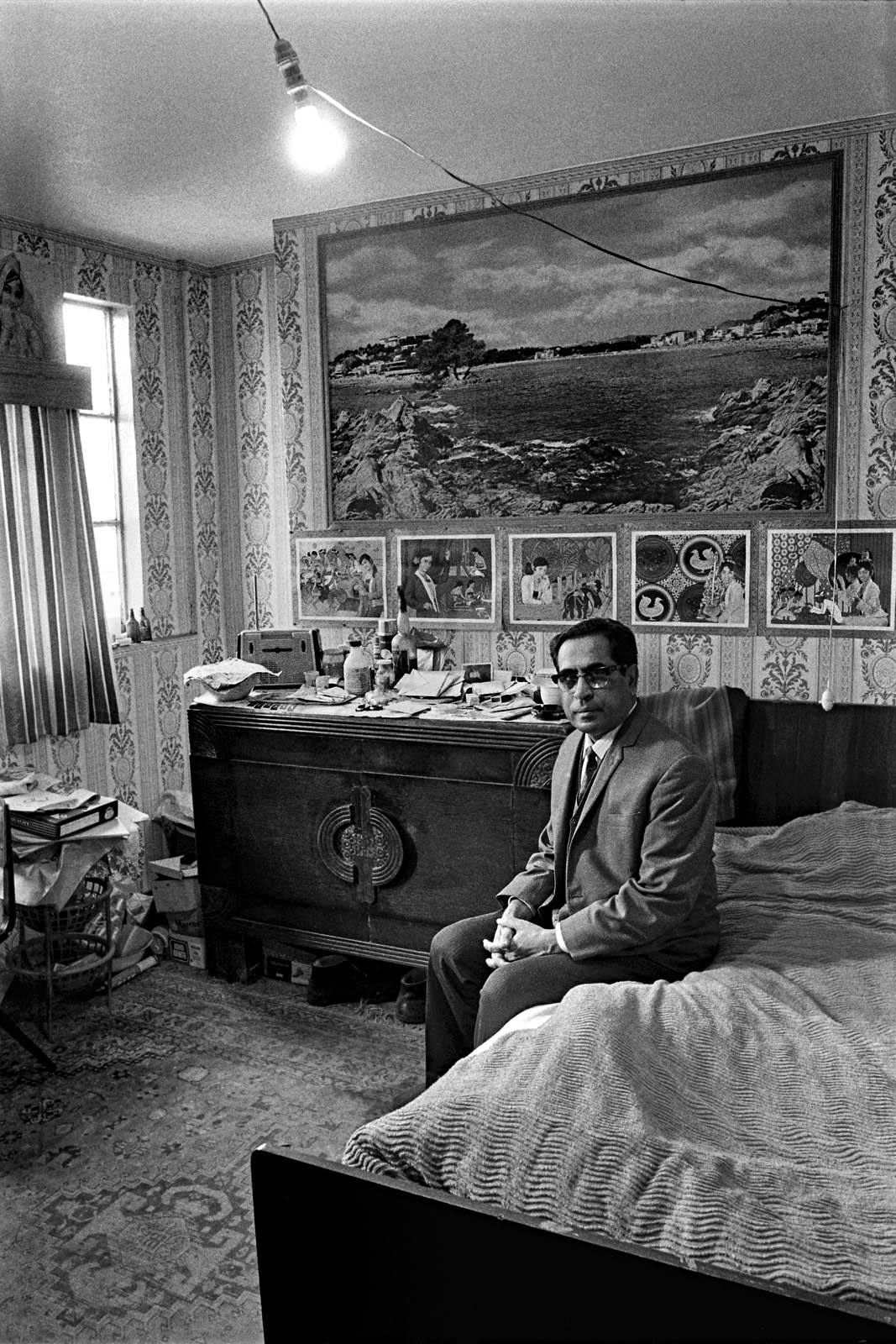
Ron McCormick (English, b. 1947) 'Mohamhed Truffant in his bedsit, Hanbury Street, Spitalfields' 1973


Ron McCormick (English, b. 1947)
Mohamhed Truffant in his bedsit, Hanbury Street, Spitalfields
1973
Gelatin silver print
© Ron McCormick


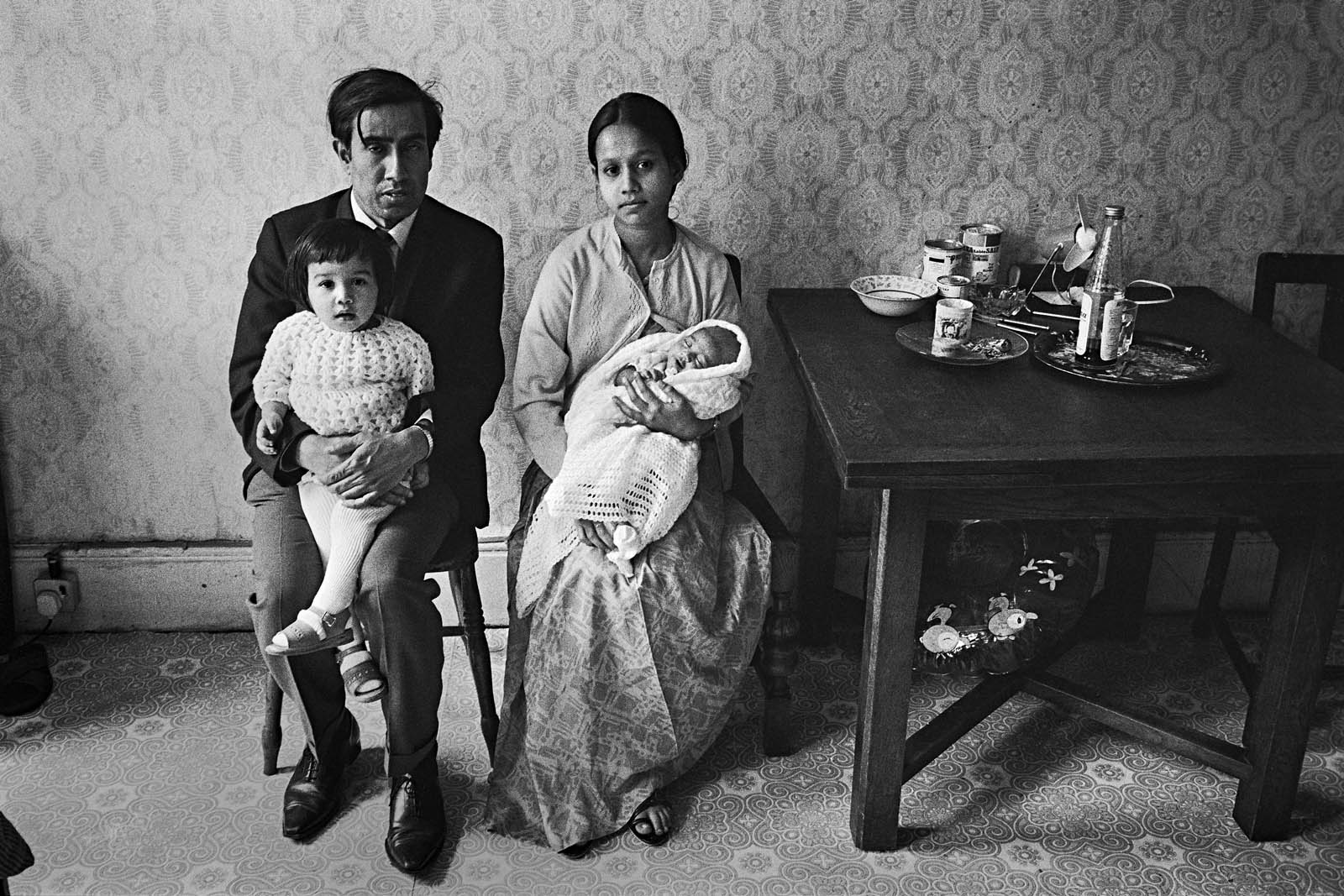
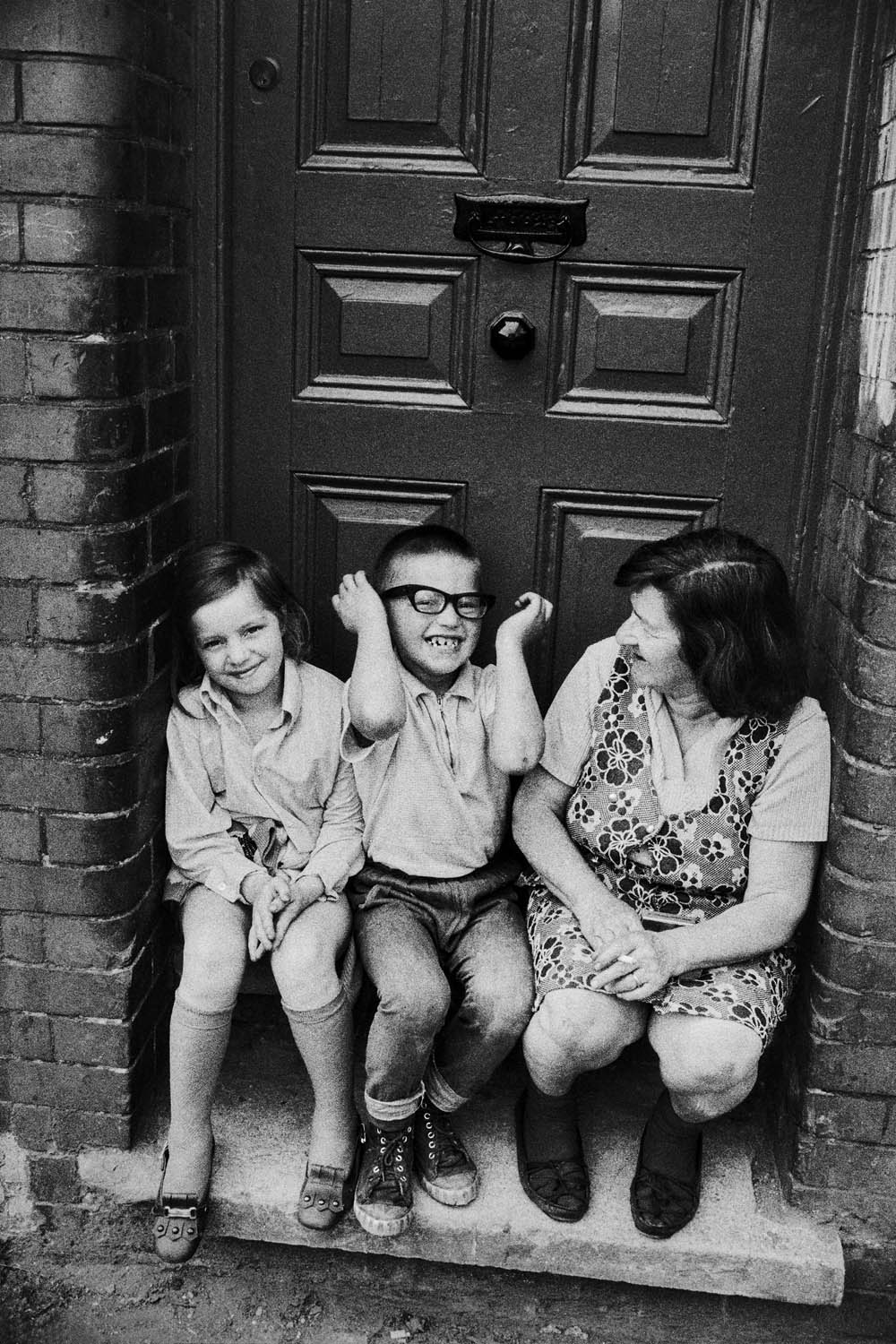
Ron McCormick (English, b. 1947) 'Family group, Settle Street, Whitechapel' 1971


Ron McCormick (English, b. 1947)
Family group, Settle Street, Whitechapel
1971
Gelatin silver print
© Ron McCormick


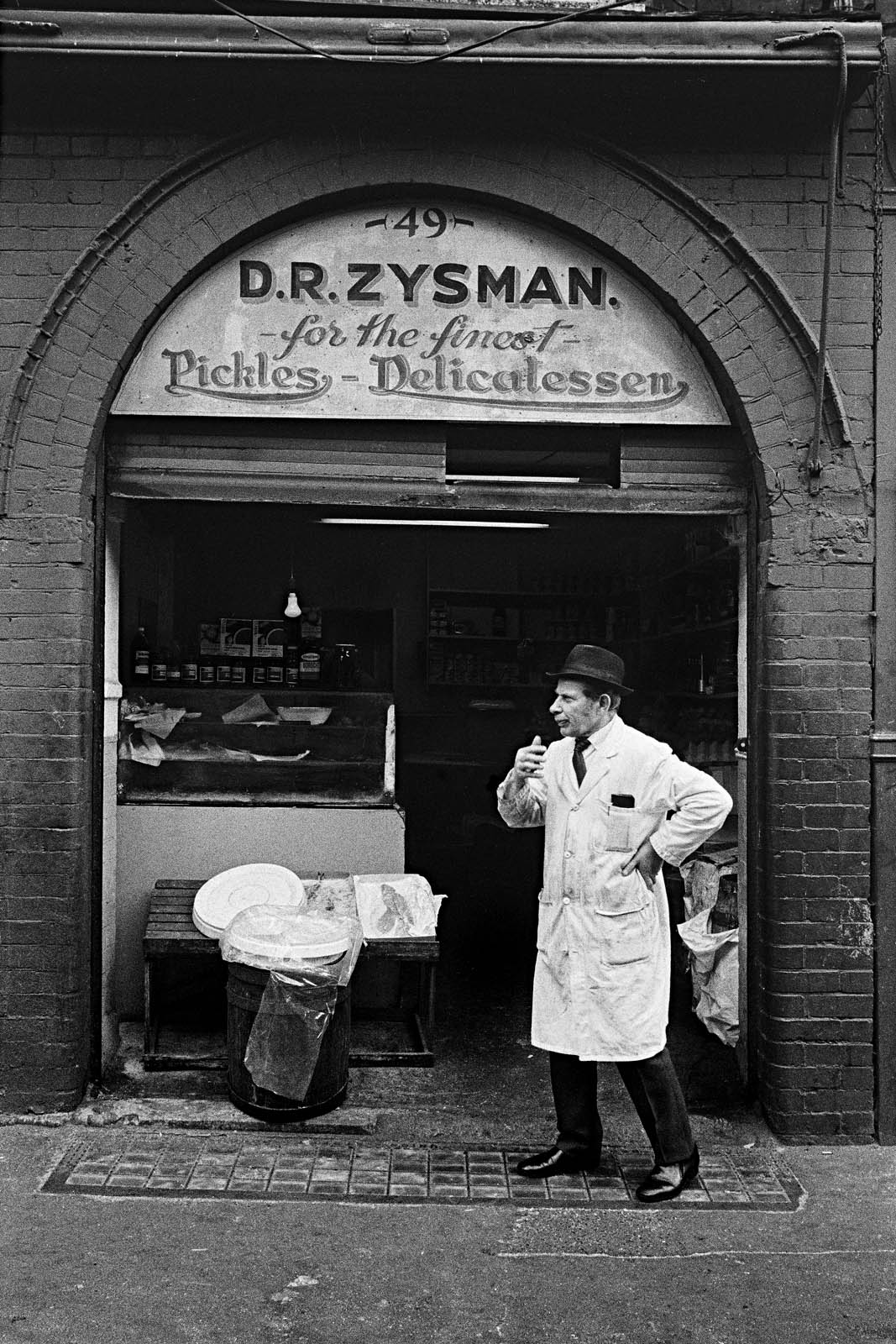
Ron McCormick (English, b. 1947) 'Zysman's delicatessan and pickle shop, 49 Hessel Street' 1973


Ron McCormick (English, b. 1947)
Zysman’s delicatessan and pickle shop, 49 Hessel Street
1973
Gelatin silver print
© Ron McCormick


Brought together for the first time, these rarely seen photographs document a now-disappeared world. Bengali migrants live side-by-side with elderly Jewish shopkeepers and artisans, dockers socialise in Wapping’s clubs and pubs, neighbours and children celebrate at a raucous, multicultural Stepney festival. 

But the images reveal streetscapes and communities in upheaval. Desolation hangs over the soon-to-be demolished streets, dock cranes stand lifeless over empty quays awaiting speculative redevelopment. Amid this apparent wasteland a different East End was coming into being. New migrant communities were creating a space for themselves as economic decline displaced earlier neighbourhoods. 

A young generation of photographers were drawn to record ordinary people’s lives at this moment of rapid transition and to advocate for social change. Their exhibitions at the Half Moon Gallery attracted people to view images of themselves and their neighbours. At a time when photography was largely unrecognised by the art world, these photographers mounted ‘guerrilla’ exhibitions in launderettes, on estate walls, and even on portable sandwich boards. They were part of a flourishing community arts scene that gave a voice to local people, including at pioneering shows at the Whitechapel Art Gallery. 

A World Apart features photographs by Ron McCormick and Exit Photograph – Nicholas Battye, Diane Bush, Alex Slotzkin, and Paul Trevor – alongside work by Ian Berry, John Donat, David Hoffman, Jessie Ann Matthews, Dennis Morris, Val Perrin, and Ray Rising. 

These remarkable photographs celebrate the people of the East End, an area whose identity has been defined by centuries of migration. In an age of increasing social division and intolerance, its strong community history is ever more important today. 

A World Apart is made possible through a National Lottery Heritage Fund project, which is helping build Four Corners’ archive collection and opening up its history to new audiences. The exhibition celebrates the early history of the Half Moon Gallery, Britain’s second independent photography gallery, as part of Four Corners 50th anniversary programme in 2025. 

Photographers 

Ron McCormick is a self-taught photographer who has exhibited and published for fifty years. His early photographs of Whitechapel were first shown alongside the poetry of east London schoolchildren in the controversial book Stepney Words produced by school teacher Chris Searle. He taught at the renowned School of Documentary Photography in Newport, where he ran the NEWPORT SURVEY, an annual record of the community life. A dynamic contributor to the revitalisation of British photography of the 1970s and 1980s, he was the second director the Half Moon Gallery, and the founding director of Side Gallery, Newcastle on Tyne. He runs Communimedia, a community design and production enterprise in South Wales. He has exhibited widely at the Institute of Contemporary Art, Whitechapel Art Gallery, Serpentine Gallery, Photographers Gallery, Barbican, MIT Cambridge USA; La Photo Galeria, Madrid, among others. 

Exit was a collective of four photographers, Nicholas Battye, Diane Bush, Alex Slotzkin, and Paul Trevor. Their first project, Down Wapping, focused on Wapping’s working class community that was threatened by the closure of the docks and imminent redevelopment. It was shown at the E1 Festival in Stepney in 1973, and at the Photographers Gallery later that year. A booklet of the photographs was designed by Exit and published by the East End Docklands Action Group in 1974. After some changes, Paul Trevor, Nicholas Battye and Chris Steele-Perkins went on to create Survival Programmes from 1974-79, a significant study of social and economic poverty in Britain’s inner-cities. A with. Side Gallery in Newcastle toured the exhibition around the country, and a book of the work was published by Open University Press in 1982. Find out more 

Ian Berry is a Magnum photojournalist who worked for Drum magazine in South Africa, where he was the only photographer to document the Sharpeville massacre in 1960. In 1972 he was commissioned by the Whitechapel Art Gallery to photograph the changing local community, creating work which contributed to his book The English (1978). He has worked internationally, covering the invasion of Czechoslovakia, the Irish Troubles, famine in Ethiopia, and conflicts in Israel, Vietnam, and the Democratic Republic of Congo. His work is represented in Black and Whites: L’Afrique du Sud (1988) and Living Apart (1996). His project Water focused on the disaster of climate change, and was published by GOST in 2023. 

John Donat (1933-2004) was one of Britain’s foremost architectural photographers of his generation. After studying architecture, he took up photography full-time. His early images can be seen in Crete 1960 (Crete University Press, 1999). Donat captured the built environment with a social documentary, almost photojournalistic approach. He was commissioned by the Whitechapel Art Gallery to capture change taking place in the area for the exhibition This is Whitechapel in 1972, although the focus of the show became the work of another important photographer, Ian Berry. 

David Hoffman is a documentary photographer of protest and social issues. Living in a squat in Fieldgate Mansions, east London in the 1970s, he recorded homelessness, anti-racism and protest. In particular, he documented homeless people at St Botolph’s refuge in Aldgate. He has covered many of the key moments in contemporary British protest – from Brixton in 1981 and Broadwater Farm in 1985, to the poll tax riots and the Occupy movement. Recent books are A Place to Live, Endurance and Joy in Whitechapel, published by Spitalfields Life Books and accompanied by a exhibition at The Museum of the Home in 2024; and Protest!, published by Image and Reality, 2025.

Jessie Ann Matthew was born in 1952 and educated at the Central School of Art and Design, London. She worked as a portrait photographer for the Scottish National Portrait Gallery, including The Seven Poets (1981) with paintings by Alexander Moffat. She participated in Men Photographed by Women at Half Moon Gallery in 1975, and Gaining Momentum: 8 women photograph women, a Half Moon touring show in 1981. More recently, Matthew has been making with texiles, in particular wall-hangings and paintings. 

British-Jamaican photographer Dennis Morris is world-renowned for his images of music icons such as Bob Marley and Marianne Faithfull. Growing up in Dalston, east London, he started his career aged just eleven. His early documentary photographs include powerful work such as Growing Up Black, Southall and This Happy Breed, images that show everyday life and Black British culture which capturing the pride and resilience of London’s communities. While still a teenager, he showed his early work, Dalston Photographs at the Half Moon Gallery in 1973.

Ray Rising is an ex-docker and self-taught photographer, whose exhibition Redundant River was shown at the Half Moon Gallery in 1973. He went on to be a reportage photographer for Report Digital, covering issues such as the 1984 miners’ strike, the death of Colin Roach in police custody in 1983, anti-racist protests, CND campaigns, among others. 

Press release from Four Corners


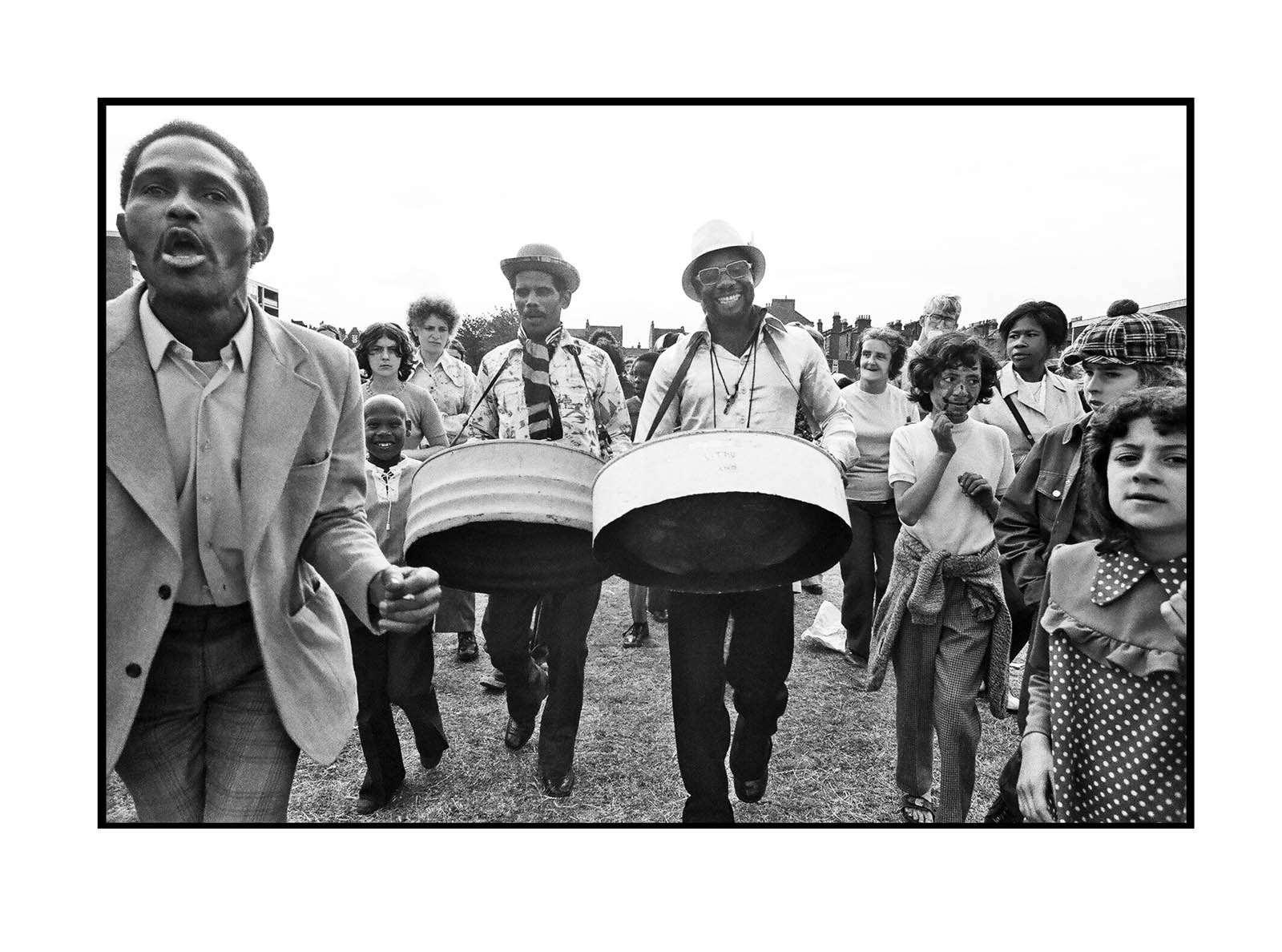
Diane Bush (British born America, b. 1947) 'E1 Festival steel band performers' Early 1970s


Diane Bush (British born America, b. 1947)
E1 Festival steel band performers
Early 1970s
Gelatin silver print
© Diane Bush


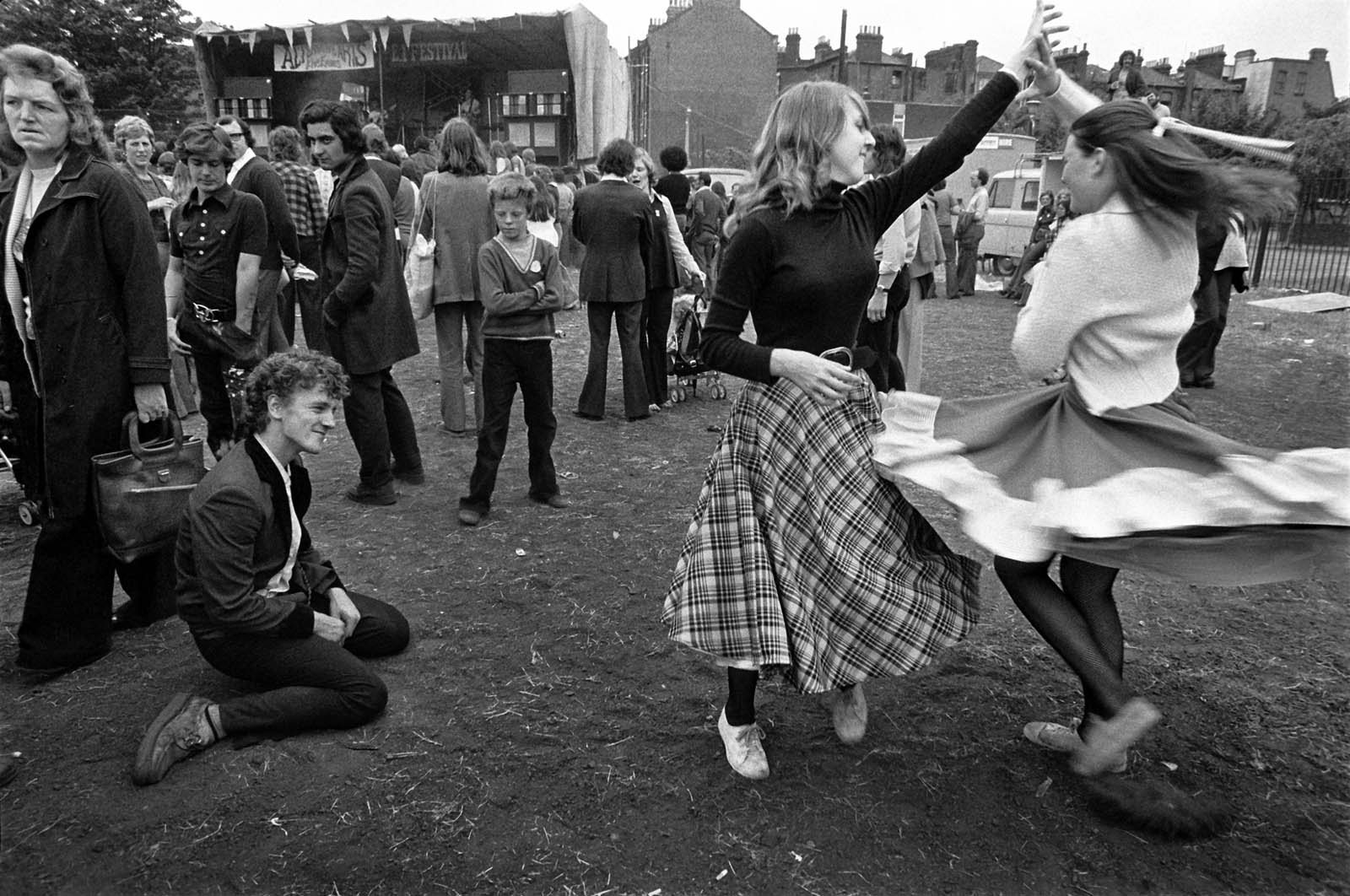
David Hoffman (British, b. 1946) 'Dancing at E1 Festival' 1975


David Hoffman (British, b. 1946)
Dancing at E1 Festival
1975
Gelatin silver print
© David Hoffman


David Hoffman (British, b. 1946) 'One of the last remaining shops in Hessel Street, Whitechapel' c. 1972


David Hoffman (British, b. 1946)
One of the last remaining shops in Hessel Street, Whitechapel
c. 1972
Gelatin silver print
© David Hoffman


David Hoffman (British, b. 1946) 'Child playing in tenement block, Whitechapel or Wapping' 1972


David Hoffman (British, b. 1946)
Child playing in tenement block, Whitechapel or Wapping
1972
Gelatin silver print
© David Hoffman


Four Corners
121 Roman Road, Bethnal Green
London E2 0QN
Phone: 020 8981 6111

Opening hours:
Wednesday – Saturday 11am – 6pm

Four Corners website

LIKE ART BLART ON FACEBOOK

Back to top

Exhibition: ‘Peter Mitchell: Nothing Lasts Forever’ at The Photographers’ Gallery, London

Exhibition dates: 7th March – 15th June, 2025


Peter Mitchell (British, b. 1943) 'Opticians, London, 1975' 1975 from the exhibition 'Peter Mitchell: Nothing Lasts Forever' at the Photographers' Gallery, London, March - June, 2025


Peter Mitchell (British, b. 1943)
Opticians, London, 1975
1975
C-print
© Peter Mitchell


I absolutely adore these Peter Mitchell 1970s colour photographs made from Hasselblad two and a quarter square negatives.

There is something so …. well, British about them.

The wit, the humour (pigeons sitting outside the racing pigeon shop), the stiff upper lip, the carry on regardless, the working class pantomime of life and death – the public commission flats where people formed caring communities that were destroyed through redevelopment – the integrity of an existence that has largely come and gone pictured with warmth and empathy.

The people, growing up during the Second World War the privations of which lasted well into the 1950s, now during a period of change in the 1970s standing behind the fish ‘n chip counter wondering where their lives had gone and how they had got there, but still with that British sense of spirit and grit.

Peter Mitchell, “a chaser of a disappearing world” pictures these “goners” – buildings, people (and a way of life) near the end of existence soon to be demolished – in an almost painterly manner.

His use of colour, perspective and form is very fine. Witness, the flow of the photograph ‘Edna, George & Pat, H.E. Greenwood Butcher, Waterloo Road, Leeds, 1977’ (below) as, in the shot, the camera allows the eye to pan from one vanishing point at left to the other at right, with the patchwork of colours and panels of the building creating an almost Mondrian-like texture – blue to black to beige to white sign to pale blue to yellow to green to pale green, surmounted by the dark blue of the threatening sky highlighting the jagged form of the building. Superb.

My favourite photograph in the posting is The Chair, Priestly House Interior, Quarry Hill Flats, Leeds, 1978 (below). This photograph is from what I believe to be Mitchell’s strongest body of work on the demolition of the Quarry Hill Flats in Leeds. ‘One of those doomed deserts was Quarry Hill flats, irresistible both as a symbol of the fate of all architecture and of the great clock in the heavens signalling everybody’s life span’ (Peter Mitchell quoted on The Guardian website)

A drab, beige, wallpapered room with double aspect window, an art deco chair with mirror reflecting nothing, an electrical socket, a ceiling light sprouting malignant plant and trapped in the window panes, little birds fluttering against their capture, trapped forever inside an abandoned flat, this abandoned life.

Yes, there’s a sense of nostalgia and melancholy in these photographs but their restrained, formal, representation of life does much to ennoble the people and buildings contained within them which, through osmosis, ennobles the mind of the viewer.

As I myself sense the great clock in the heavens signalling my life span, the pleasure and comfort I get from feeling the spirit of Peter Mitchell’s photographs is immeasurable.

Dr Marcus Bunyan


Many thankx to the Photographers’ Gallery for allowing me to publish the photographs in the posting. Please click on the photographs for a larger version of the image.


Peter Mitchell (British, b. 1943) 'Mrs Clayton and Mrs Collins, summer 1974' 1974 from the exhibition 'Peter Mitchell: Nothing Lasts Forever' at the Photographers' Gallery, London, March - June, 2025


Peter Mitchell (British, b. 1943)
Mrs Clayton and Mrs Collins, summer 1974
1974
C-print
© Peter Mitchell


Peter Mitchell (British, b. 1943) 'Mr and Mrs Hudson, Newsagents, Seacroft, Leeds, 1974' 1974 from the exhibition 'Peter Mitchell: Nothing Lasts Forever' at the Photographers' Gallery, London, March - June, 2025


Peter Mitchell (British, b. 1943)
Mr and Mrs Hudson, Newsagents, Seacroft, Leeds, 1974
1974
C-print
© Peter Mitchell


‘Mr and Mrs Hudson in Seacroft Green, Leeds. I took this photograph on the 14 August 1974 at about 11am. I like the way the ladder is propping up the shop. They had just moved into a new shop on the same spot, with the church getting a facelift to match’

Peter Mitchell quoted on The Guardian website


Peter Mitchell (British, b. 1943) 'Mrs. McArthy & her daughter, Sangley Road, Catford, London, 1975' 1975


Peter Mitchell (British, b. 1943)
Mrs. McArthy & her daughter, Sangley Road, Catford, London, 1975
1975
C-print
© Peter Mitchell


Peter Mitchell (British, b. 1943) 'Kingston Racing Motors, Olinda Terrace, Leeds 1975' 1975


Peter Mitchell (British, b. 1943)
Kingston Racing Motors, Olinda Terrace, Leeds 1975
1975
C-print
© Peter Mitchell


Is the man with the wrench a mechanic? Why is the woman with the clapped-out Porsche looking so naughty? Will James C Gallagher, whose business it is, always have his back to the camera? And after painting the wall, why did Barry have to leave Leeds? The council demolished the lot shortly after this snap.

Text from The Guardian website


Peter Mitchell (British, b. 1943) 'Two anonymous ladies, Tivoli Cinema, Acre Road from Sisson’s Lane, Leeds, 1976' 1976


Peter Mitchell (British, b. 1943)
Two anonymous ladies, Tivoli Cinema, Acre Road from Sisson’s Lane, Leeds, 1976
1976
C-print
© Peter Mitchell


Peter Mitchell (British, b. 1943) 'Sir Yank's Records (& Heavy Disco), Gathorne Street, Leeds 1976' 1976


Peter Mitchell (British, b. 1943)
Sir Yank’s Records (& Heavy Disco), Gathorne Street, Leeds 1976
1976
C-print
© Peter Mitchell


Peter Mitchell (British, b. 1943) 'Concorde Wallpaper, Devon Road, 1970s' 1970s


Peter Mitchell (British, b. 1943)
Concorde Wallpaper, Devon Road, 1970s
1970s
C-print
© Peter Mitchell


Peter Mitchell (British, b. 1943) 'Alea Stony Rock, Westlock Grove, 1970s' 1970s


Peter Mitchell (British, b. 1943)
Alea Stony Rock, Westlock Grove, 1970s
1970s
C-print
© Peter Mitchell


Peter Mitchell (British, b. 1943) 'Beetham's, Church Street, Leeds, 1970s' 1970s


Peter Mitchell (British, b. 1943)
Beetham’s, Church Street, Leeds, 1970s
1970s
C-print
© Peter Mitchell


A retrospective of work by one of the leading early colour photographers of the 20th century opens this March at The Photographers’ Gallery.

Peter Mitchell (b. 1943, UK) is widely regarded as one of the most important early colour photographers of the 1970s and 1980s. A powerful storyteller and social historian, Mitchell’s photography unfolds a longstanding and poetic connection with Leeds. He has chronicled the people and fortunes of the city with warmth and familiarity for over 40 years.

Described as ‘a narrator of who we were, a chaser of a disappearing world’ (Val Williams), his work reveals his love, and at times quirky, off-beat vision, of the people and changing face of Leeds.

The retrospective explores the breadth of Mitchell’s photographic practice. It brings together his famous series ‘A New Refutation of the Viking 4 Space Mission’, which imagines England as seen through the eyes of an alien from Mars, demolished flats, shopkeepers and their shops, and boarded-up and disused buildings, as well as his portraits of scarecrows. The exhibition marks a return to The Photographers’ Gallery for Mitchell – he first exhibited at the Gallery in 1984.

A chronicler of a changing city, he said of his work photographing the demise of the iconic Quarry Hills Estate in Leeds, ‘I know there was no point in keeping Quarry Hill flats. But what it stood for might have been worth keeping.’

Calling himself ‘a man of the pavement’, Mitchell continues to regularly walk the streets of Leeds to photograph his beloved hometown today.

Peter Mitchell: Nothing Lasts Forever will include rarely seen works from Mitchell’s own collection, personal ephemera and found objects.

Peter Mitchell: Nothing Lasts Forever is in collaboration with Leeds Art Gallery. Nothing Lasts Forever, published by RRB Photobooks, is available now.

Peter Mitchell

Peter Mitchell was born in Manchester in 1943. He studied at Hornsey College of Art in London, then moved north to look for work and never left. Living and working in Leeds for much of his life, Mitchell treats his surrounding with a unique sense of care. An essential part of the colour documentary scene in the 1970s and 80s, Mitchell’s landmark show A New Refutation of the Space Viking 4 Mission at Impressions Gallery in York in 1979 was the first colour photography show in the UK.

Press release from The Photographers’ Gallery


Peter Mitchell (British, b. 1943) 'Ready mixed Concrete Ltd., Elland Road, Leeds, 1977' 1977


Peter Mitchell (British, b. 1943)
Ready mixed Concrete Ltd., Elland Road, Leeds, 1977
1977
C-print
© Peter Mitchell


Peter Mitchell (British, b. 1943) 'Edna, George & Pat, H.E. Greenwood Butcher, Waterloo Road, Leeds, 1977' 1977


Peter Mitchell (British, b. 1943)
Edna, George & Pat, H.E. Greenwood Butcher, Waterloo Road, Leeds, 1977
1977
C-print
© Peter Mitchell


Peter Mitchell (British, b. 1943) ''How many Aunties?', Back Hares Mount, Leeds, 1978' 1978


Peter Mitchell (British, b. 1943)
‘How many Aunties?’, Back Hares Mount, Leeds, 1978
1978
C-print
© Peter Mitchell


Peter Mitchell (British, b. 1943) 'The Sir Yank’s Heavy Disco, Harehills Avenue, Leeds, 1978' 1978


Peter Mitchell (British, b. 1943)
The Sir Yank’s Heavy Disco, Harehills Avenue, Leeds, 1978
1978
C-print
© Peter Mitchell


Peter Mitchell (British, b. 1943) 'Priestly House, Quarry Hill Flats, 1978' 1978


Peter Mitchell (British, b. 1943)
Priestly House, Quarry Hill Flats, 1978
1978
C-print
© Peter Mitchell


Peter Mitchell (British, b. 1943) 'The Kitson House telephone, Quarry Hill Flats, 1978' 1978


Peter Mitchell (British, b. 1943)
The Kitson House telephone, Quarry Hill Flats, 1978
1978
C-print
© Peter Mitchell


‘It was obvious to me that they were something special. York House was one side of the football pitch, Thoresby House opposite’

Peter Mitchell quoted on The Guardian website


Peter Mitchell (British, b. 1943) 'The Garden of Rest, Quarry Hill Flats, Leeds, 1978' 1978


Peter Mitchell (British, b. 1943)
The Garden of Rest, Quarry Hill Flats, Leeds, 1978
1978
C-print
© Peter Mitchell


Peter Mitchell (British, b. 1943) 'Thoresby House, Quarry Hill Flats, Leeds, 1978' 1978


Peter Mitchell (British, b. 1943)
Thoresby House, Quarry Hill Flats, Leeds, 1978
1978
C-print
© Peter Mitchell


‘I photograph dying buildings and Quarry Hill was terminal by the time I got to it. Times change and I know there was no point in keeping Quarry Hill flats. But what it stood for might have been worth keeping’

Peter Mitchell quoted on The Guardian website


Peter Mitchell (British, b. 1943) 'Nielson House interior, Quarry Hill Flats, Leeds, 1978' 1978


Peter Mitchell (British, b. 1943)
Nielson House interior, Quarry Hill Flats, Leeds, 1978
1978
C-print
© Peter Mitchell


Peter Mitchell (British, b. 1943) 'The Chair, Priestly House Interior, Quarry Hill Flats, Leeds, 1978' 1978


Peter Mitchell (British, b. 1943)
The Chair, Priestly House Interior, Quarry Hill Flats, Leeds, 1978
1978
C-print
© Peter Mitchell


‘One of those doomed deserts was Quarry Hill flats, irresistible both as a symbol of the fate of all architecture and of the great clock in the heavens signalling everybody’s life span’

Peter Mitchell quoted on The Guardian website


Peter Mitchell (British, b. 1943) 'Abandoned car, Wright House, Quarry Hill Flats, Leeds, 1978' 1978


Peter Mitchell (British, b. 1943)
Abandoned car, Wright House, Quarry Hill Flats, Leeds, 1978
1978
C-print
© Peter Mitchell


Peter Mitchell (British, b. 1943) 'Frances Gaven. Leeds, 1979' 1979


Peter Mitchell (British, b. 1943)
Frances Gaven. Leeds, 1979
1979
From A New Refutation of the Viking 4 Space Mission
C-print
© Peter Mitchell


Francis Craven on Woodhouse Moor, Leeds in April 1979. He’d built this apparition himself but was having trouble with its arms – the pulleys had given out

Text from the Guardian website


Peter Mitchell’s A New Refutation of the Viking 4 Space Mission features photos and portraits, taken in Leeds in the 1970s. The pictures show the traditional urban landscape presented on a background of space charts, the concept being that an alien has landed from Mars and is wandering around Leeds with a degree of surprise and puzzlement.

In the Earthly vernacular these photographs are of Nowheresville. Yet, for some people, they are the centre of the universe. Usually they call it Home.

Text from the Martin Parr Foundation website [Online] Cited 25/05/2025


Mitchell’s series documents backstreets, corner shops, factories, churches and cemeteries in Leeds and Sheffield, as well as other locations in Cumbria and London, building a compelling picture of these cities during the late 1970s. Many of the portraits show the city inhabitants standing outside their homes or places of work. Equal attention is paid to the entirety of the setting, the figures often appearing dwarfed in the composition by their surroundings. The majority of the subjects gaze directly at the camera adopting stiff, frontal poses giving the images a formal impression and sense of stillness. Describing the distinctive style and subject matter of the photographs, historian David Mellor has commented, ‘it is as if Alan Bennett had met Diane Arbus in an urban picaresque’ (Mellor 2005, accessed 12 June 2017).

Ruins, crumbling facades, abandoned shops and cemeteries punctuate the series, pointing to themes of life, death, memory and loss. For example, Mitchell’s pictures includes shots of Mrs Lee’s dress shop – which burnt down the day after closure – a decayed synagogue and a defunct station in Sheffield, where the trains pass through but never stop. The 1970s were a time of great change in Britain as it struggled with widespread social unrest as well as the collapse of heavy industries. Commenting on this aspect of the series, Mellor noted, ‘NASA’s 1976 Viking Landers were a triumph of robotics, of remote sensing and imaging – that very culture of digitised information which was to supplant the manual world of industrial era Leeds.’ (Ibid.)

Text is a crucial element in Mitchell’s work, and each image in this series is accompanied by a caption to be displayed alongside. These idiosyncratic snippets of text are excerpted from Mitchell’s diary, and range from deadpan descriptions of place, to short anecdotes and humorous musings. Historian Val Williams has likened the artist’s distinctive combination of photography and text across his different bodies of work to the Situationist writing of the French theorist Guy Debord. …

Mitchell’s work occupies an important position within the history of colour photography specifically. He was photographing in colour at a time when black and white was the predominate medium for documentary photography in Britain, and before colour photography was fully embraced by museum collections. His work thus evidences an alternate history of colour photography distinct from the predominant narrative of the emergence of colour photography in the United States in the work of photographers such as William Eggleston (born 1939) and Stephen Shore (born 1947).

Sarah Allen
June 2016

Collection text on the Tate website [Online] Cited 24/05/2025


Peter Mitchell (British, b. 1943) 'Max Babbin, Vulcan Street, Leeds, 1979' 1979


Peter Mitchell (British, b. 1943)
Max Babbin, Vulcan Street, Leeds, 1979
1979
C-print
© Peter Mitchell


Peter Mitchell (British, b. 1943) 'ABC (Aerated Bread Company offices), Camden Road, London, 1979' 1979


Peter Mitchell (British, b. 1943)
ABC (Aerated Bread Company offices), Camden Road, London, 1979
1979
C-print
© Peter Mitchell


Peter Mitchell (British, b. 1943) 'Old Kent Road, London, 1979' 1979


Peter Mitchell (British, b. 1943)
Old Kent Road, London, 1979
1979
C-print
© Peter Mitchell


His early photographs were made in the 1970s and 80s, when he was working as a truck driver. His vantage point removed him from the immediacy of the street, and he developed his distinctive graphic framing of the buildings and landscapes, which reveal the layers of urban and social history

Text from The Guardian website


Peter Mitchell (British, b. 1943) 'Mr Costas, Stroud Green Road, London, 1979' 1979


Peter Mitchell (British, b. 1943)
Mr Costas, Stroud Green Road, London, 1979
1979
C-print
© Peter Mitchell


Mr Costas on Stroud Green Road, London in May 1979. He was thinking to himself: ‘If only this was Athens instead of Finsbury Park’

Text from The Guardian website


Peter Mitchell (British, b. 1943) 'Nosey 'Twat, Sackville Street, Leeds, 1980s' 1980s


Peter Mitchell (British, b. 1943)
Nosey ‘Twat, Sackville Street, Leeds, 1980s
1980s
C-print
© Peter Mitchell


Peter Mitchell (British, b. 1943) 'Kirkstall Road, Leeds, 1980s' 1980s


Peter Mitchell (British, b. 1943)
Kirkstall Road, Leeds, 1980s
1980s
C-print
© Peter Mitchell


Peter Mitchell (British, b. 1943) 'Francis Gavan, Ghost Train Ride, Woodhouse Moor, Leeds, Spring 1986' 1986


Peter Mitchell (British, b. 1943)
Francis Gavan, Ghost Train Ride, Woodhouse Moor, Leeds, Spring 1986
1986
C-print
© Peter Mitchell


Peter Mitchell (British, b. 1943) 'Racing Pigeon Shop (ii), Blake Grove, Leeds, Summer 2009' 2009


Peter Mitchell (British, b. 1943)
Racing Pigeon Shop (ii), Blake Grove, Leeds, Summer 2009
2009
C-print
© Peter Mitchell


John Murray owned the Racing Pigeon Shop and remembers “great times” on Blake Grove.


The Photographers’ Gallery
16-18 Ramillies Street
London
W1F 7LW

Opening hours:
Mon – Wed: 10.00 – 18.00
Thursday – Friday: 10.00 – 20.00
Saturday: 10.00 – 18.00
Sunday: 11.00 – 18.00

The Photographers’ Gallery website

LIKE ART BLART ON FACEBOOK

Back to top

Exhibition: ‘Martin Parr. Early Works’ at Fotografie Forum Frankfurt (FFF)

Exhibition dates: 13th September, 2024 – 16th February, 2025


Martin Parr (British, 1952-2025) 'Elland, West Yorkshire, England, 1978' 1978 from the series 'Bad Weather' from the exhibition 'Martin Parr. Early Works' at Fotografie Forum Frankfurt (FFF)


Martin Parr (British, 1952-2025)
Elland, West Yorkshire, England, 1978
1978
From Bad Weather
Gelatin silver print
© Martin Parr | Magnum Photos


Out in the midday sun

I watch a lot of the TV program Antiques Roadshow and in the early episodes you see British people of a certain age, people who lived through the Second World War and their children, salt of the earth people who inherited objects from their mother-in-law or father-in-law because they couldn’t dust them anymore. These are British people who have a down-to-earthness and ordinariness about them… people who went to church on Sunday, went to working-class seaside resort Butlins with their family for a holiday (as I did as a child) and loved the royal family. These people project a certain consciousness, a wonderful quirky character, sense of humour and regional dialect that is uniquely British.

People such as these have always been pictured in British photography, historically through the lineage of artists such John Thomson (1837-1921) and Richard Jenkins (1890-1964) through Christina Broom (1862-1939) in the 1920s and on to Edith Tudor-Hart (1908-1973) and Bill Brandt (1904-1983) in the 1930s-1940s. These photographers were followed in the 1950s-1990s by a pantheon of strong, gritty and revelatory social documentary photographers. Indeed, this aspect of British photography has been particularly blessed by talented artists whose work focuses on “ordinary people and their surroundings – often in suburban or working-class environments.”

Artists I can mention include, but are not limited to, photographers such as Chris Killip (1946-2020), Brenda Prince (b. 1950), Roger Mayne (1929-2014), Anna Fox (b. 1961), Tony Ray-Jones (1941-1972), Colin Jones (1936-2021), Graham Smith (b. 1947), Paul Graham (b. 1956), Paul Trevor (b. 1947), James Barnor (b. 1929), Colin Jones (1936-2021), Syd Shelton (b. 1947), John Bulmer (b. 1938), Peter Mitchell (b. 1943), Don McCullin (b. 1935), Daniel Meadows (b. 1952), Neil Kenlock (b. 1950), Bandele Ajetunmobi (1921-1994), Dennis Morris (b. 1960) to name but a few: apologies if I have missed anybody for I am still learning about the many and various photographers in this field.

Into this heady mix can be added the name of that legendary British photographer Martin Parr (b. 1952). Better known for his later colour photographs of British rituals and everyday conversations – “candid and often humorous depictions of everyday life” captured with visual deftness and containing a wry sense of humour mirroring the British character – these early black and white photographs proffer the path of development for this artist.

“Shot between 1970 and 1985, the images document the subtleties and eccentricities of everyday British life from that era, spanning local traditions, holiday resorts and of course the weather, among many other things.”1 As Val Williams has insightfully observed, “Martin Parr’s early black and white photographs of the North of England are a remarkable record of an all-but disappeared society.”2

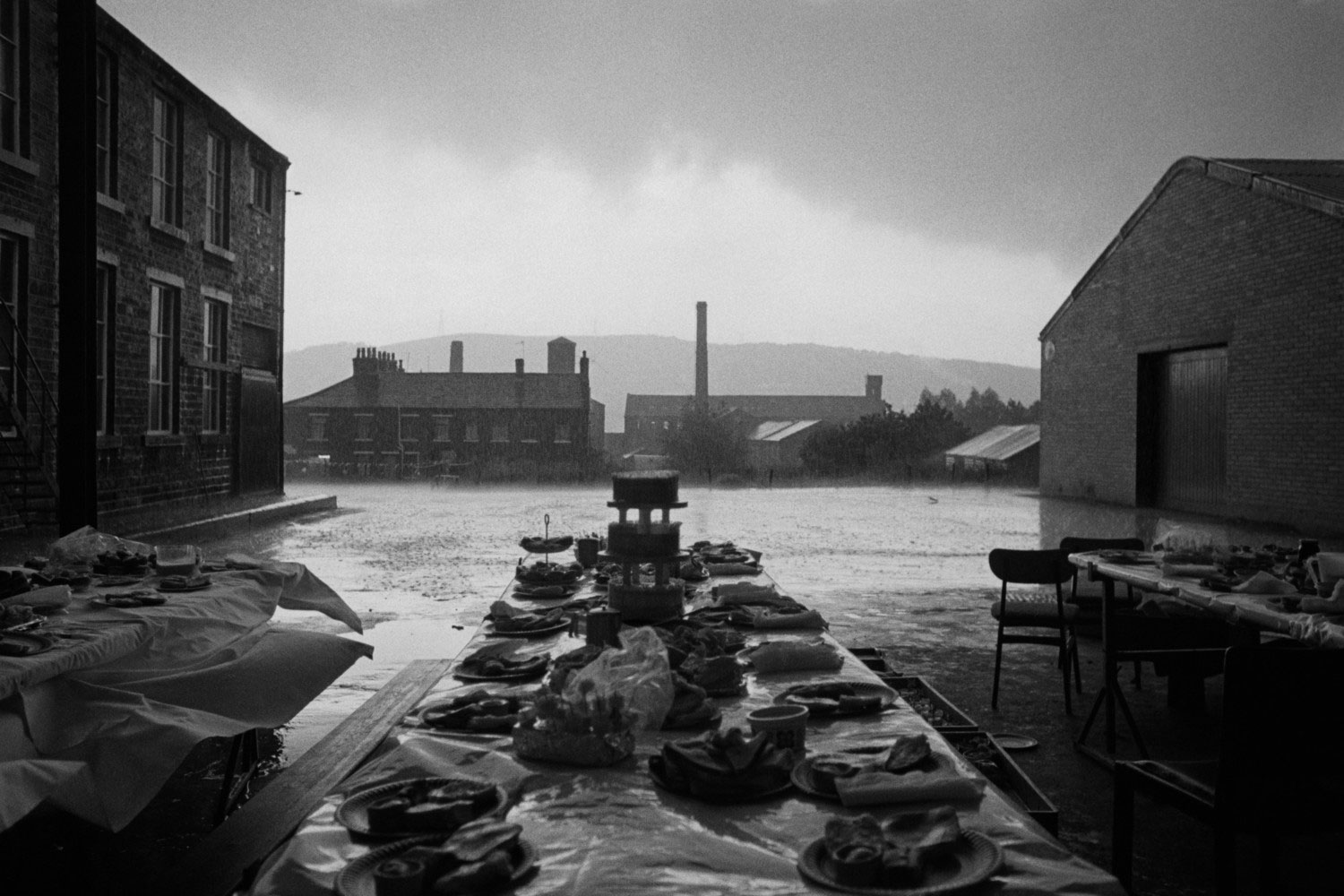
I am always fascinated with the early work of an artist. In essence, the photographs tell you what are the primary concerns for the artist and these themes usually remain with them for the rest of their career. These early black and white photographs provide a window into that ongoing investigation, that golden path. They are more subtle in their modulation of British life than in the later colour work – it’s as though the artist had to change gears with the use of colour developing a more ironic way of seeing British life through a different spatial relationship to his subjects – but in these photographs there is still that deprecating humour that is often missing in the work of his contemporaries: the barren tree emerging from the seemingly abandoned, frost covered, three-wheeler “bubble car” parked on the pavement; the seemingly abandoned Jubilee street party destroyed by rain in a desolate mining town; the contortions and consequences of grasping for food at the mayor’s inaugural banquet; the incongruity of man balancing at the top of a ladder to reach around to clean the outside of his front door window; or the implied racism as a coloured British family observes the “whites” of a different generation from afar, the space between them as wide as an ocean.

Through his beautifully observed and humorous photographs Martin Parr has become a national treasure.

My only wish… why I didn’t have more media images to show you!?

Dr Marcus Bunyan


1/ Text from the Martin Parr Studio Instagram page

2/ Val Williams. “The Ordinary Made Extraordinary: Martin Parr in Black and White,” on the Magnum website Oct 14, 2019 [Online] Cited 30/12/2024


Many thankx to Fotografie Forum Frankfurt for allowing me to publish the photographs in the posting. Please click on the photograph for a larger version of the image.


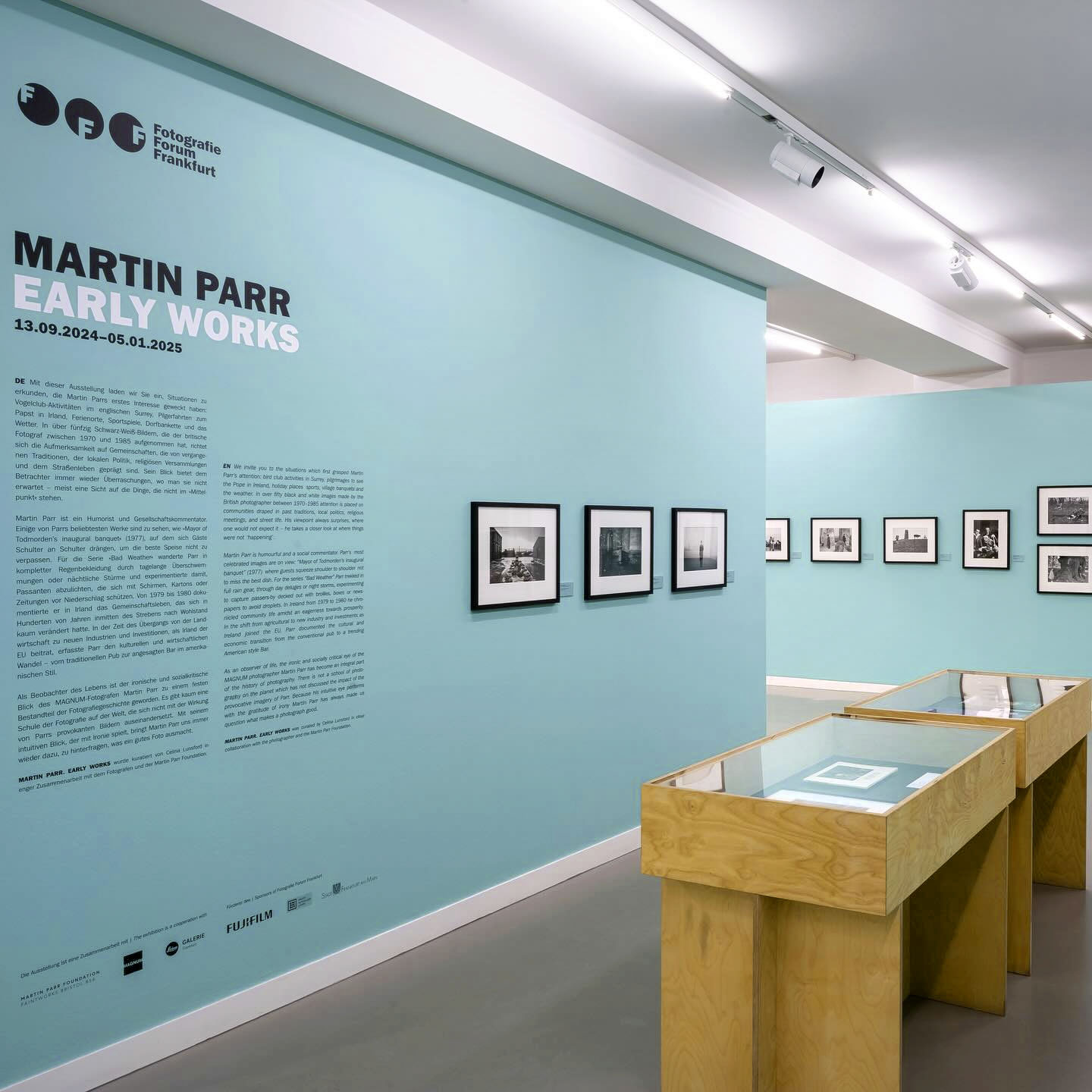
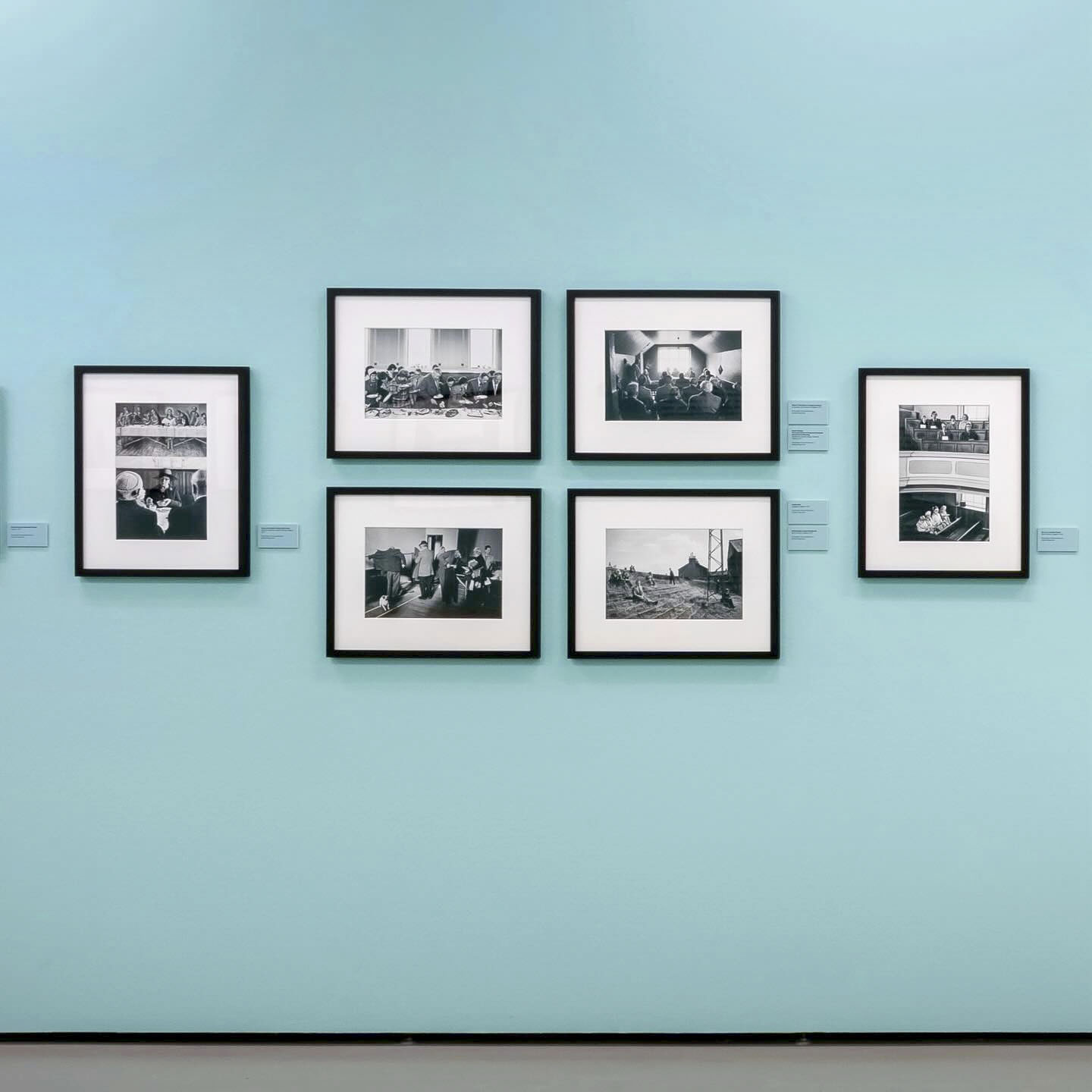
Installation view of the exhibition 'Martin Parr. Early Works' at Fotografie Forum Frankfurt (FFF)

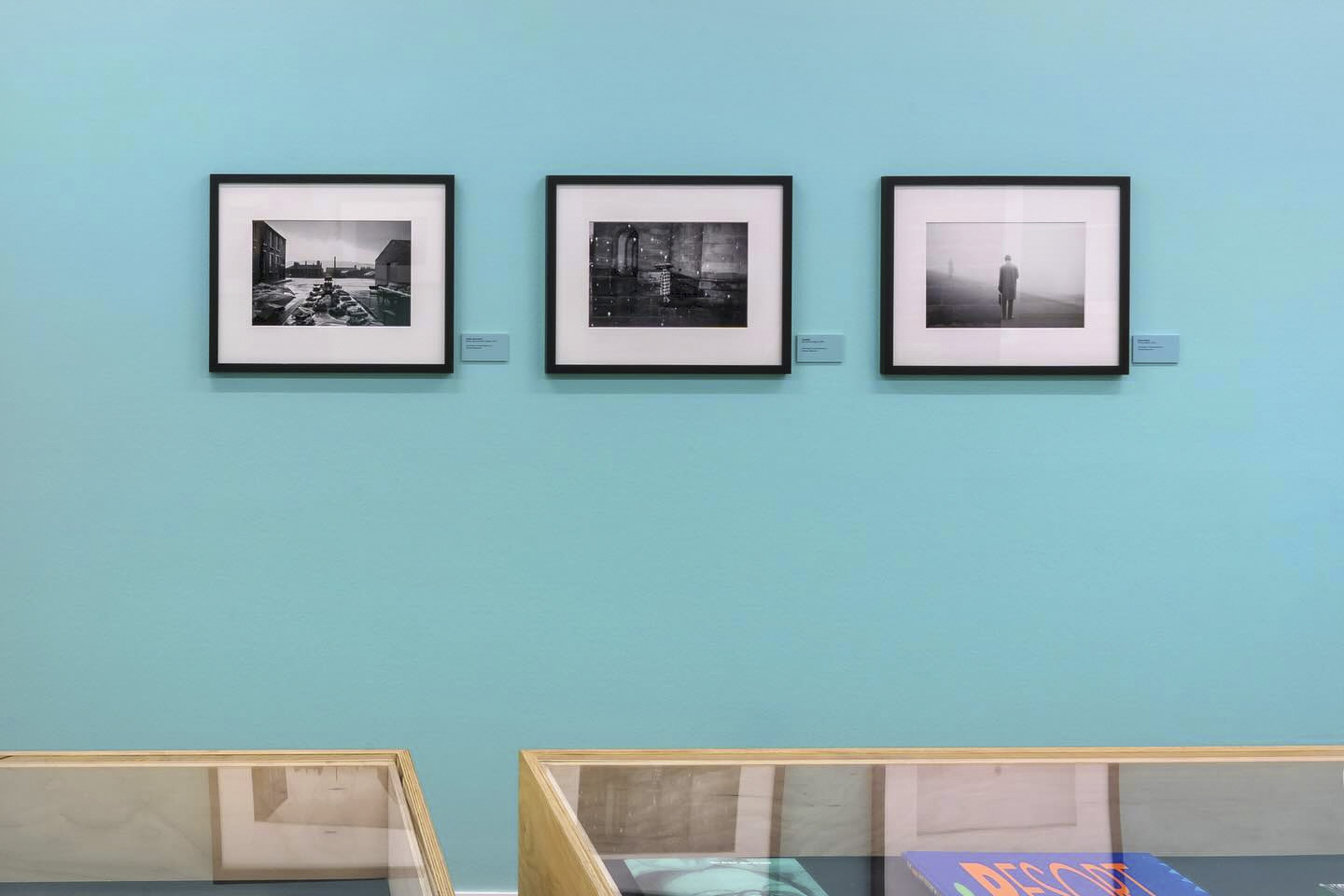
Installation view of the exhibition 'Martin Parr. Early Works' at Fotografie Forum Frankfurt (FFF) showing at left Parr's photograph 'Jubilee street party, Elland, West Yorkshire, England, GB, July 1977'


Installation views of the exhibition Martin Parr. Early Works at Fotografie Forum Frankfurt (FFF) showing at left in the bottom image, Parr’s photograph Jubilee street party, Elland, West Yorkshire, England, GB, July 1977


Martin Parr (British, 1952-2025) 'Jubilee street party, Elland, West Yorkshire, England, GB, July 1977' 1977 from the exhibition 'Martin Parr. Early Works' at Fotografie Forum Frankfurt (FFF)


Martin Parr (British, 1952-2025)
Jubilee street party, Elland, West Yorkshire, England, GB, July 1977
1977
From Bad Weather
Gelatin silver print
© Martin Parr | Magnum Photos


Installation view of the exhibition 'Martin Parr. Early Works' at Fotografie Forum Frankfurt (FFF)


Installation view of the exhibition Martin Parr. Early Works at Fotografie Forum Frankfurt (FFF) showing works from West Yorkshire including at left, Steep Lane Baptist Chapel buffet lunch. Doris Wilson (centre). Sowerby. Calderdale. West Yorkshire. England. GB. 1977;  at second left top, Mayor of Todmorden’s inaugural banquet, Todmorden, West Yorkshire, England, 1977; and at right, Steep Lane Baptist Chapel. West Yorkshire. England. GB. 1977


Martin Parr (British, 1952-2025) 'Steep Lane Baptist Chapel buffet lunch, Sowerby, Calderdale, West Yorkshire, England, 1977' 1977 from the exhibition 'Martin Parr. Early Works' at Fotografie Forum Frankfurt (FFF)


Martin Parr (British, 1952-2025)
Steep Lane Baptist Chapel buffet lunch, Sowerby, Calderdale, West Yorkshire, England, 1977
1977
Gelatin silver print
© Martin Parr | Magnum Photos


Installation view of the exhibition 'Martin Parr. Early Works' at Fotografie Forum Frankfurt (FFF) showing an enlargement of Parr's photograph 'Mayor of Todmorden's inaugural banquet, Todmorden, West Yorkshire, England, 1977' (detail)


Installation view of the exhibition Martin Parr. Early Works at Fotografie Forum Frankfurt (FFF) showing an enlargement of Parr’s photograph Mayor of Todmorden’s inaugural banquet, Todmorden, West Yorkshire, England, 1977 (detail)


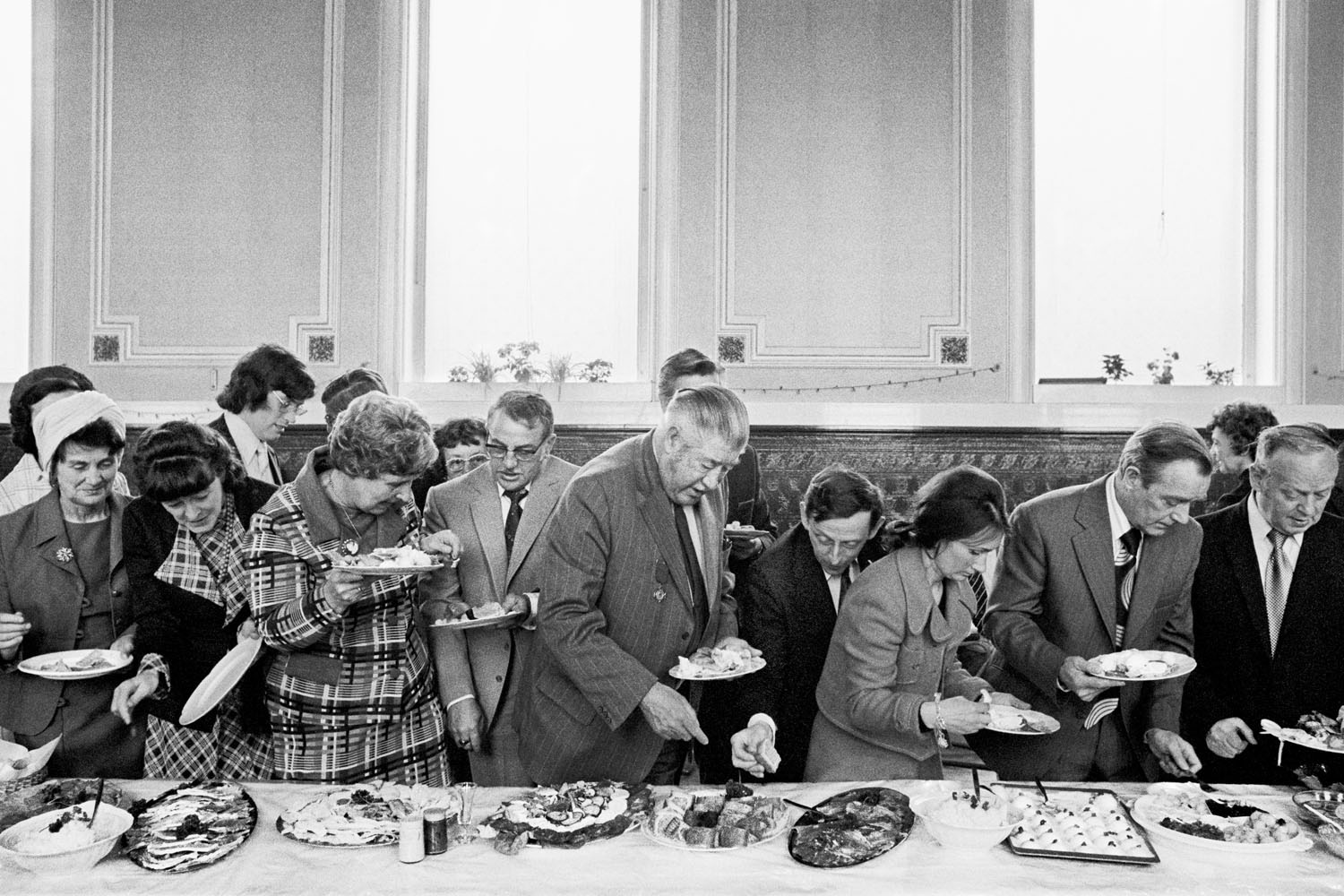
Martin Parr (British, 1952-2025) 'Mayor of Todmorden's inaugural banquet, Todmorden, West Yorkshire, England, 1977' 1977 from the exhibition 'Martin Parr. Early Works' at Fotografie Forum Frankfurt (FFF)


Martin Parr (British, 1952-2025)
Mayor of Todmorden’s inaugural banquet, Todmorden, West Yorkshire, England, 1977
1977
Gelatin silver print
© Martin Parr | Magnum Photos


Installation view of the exhibition 'Martin Parr. Early Works' at Fotografie Forum Frankfurt (FFF) showing at left, Parr's photograph 'Hebden Bridge', England, 1979; and at top right, the cover of Parr's book 'Bad Weather' (Zwemmer, 1982)


Installation view of the exhibition Martin Parr. Early Works at Fotografie Forum Frankfurt (FFF) showing at left, Parr’s photograph Hebden Bridge, England, 1979; and at top right, the cover of Parr’s book Bad Weather (Zwemmer, 1982)


In 1972, he settled to the north east of Manchester, in the west Yorkshire mill town of Hebden Bridge. Though the mills were rapidly closing, the back-to-back houses and the social fabric of the smaller mill towns remained.

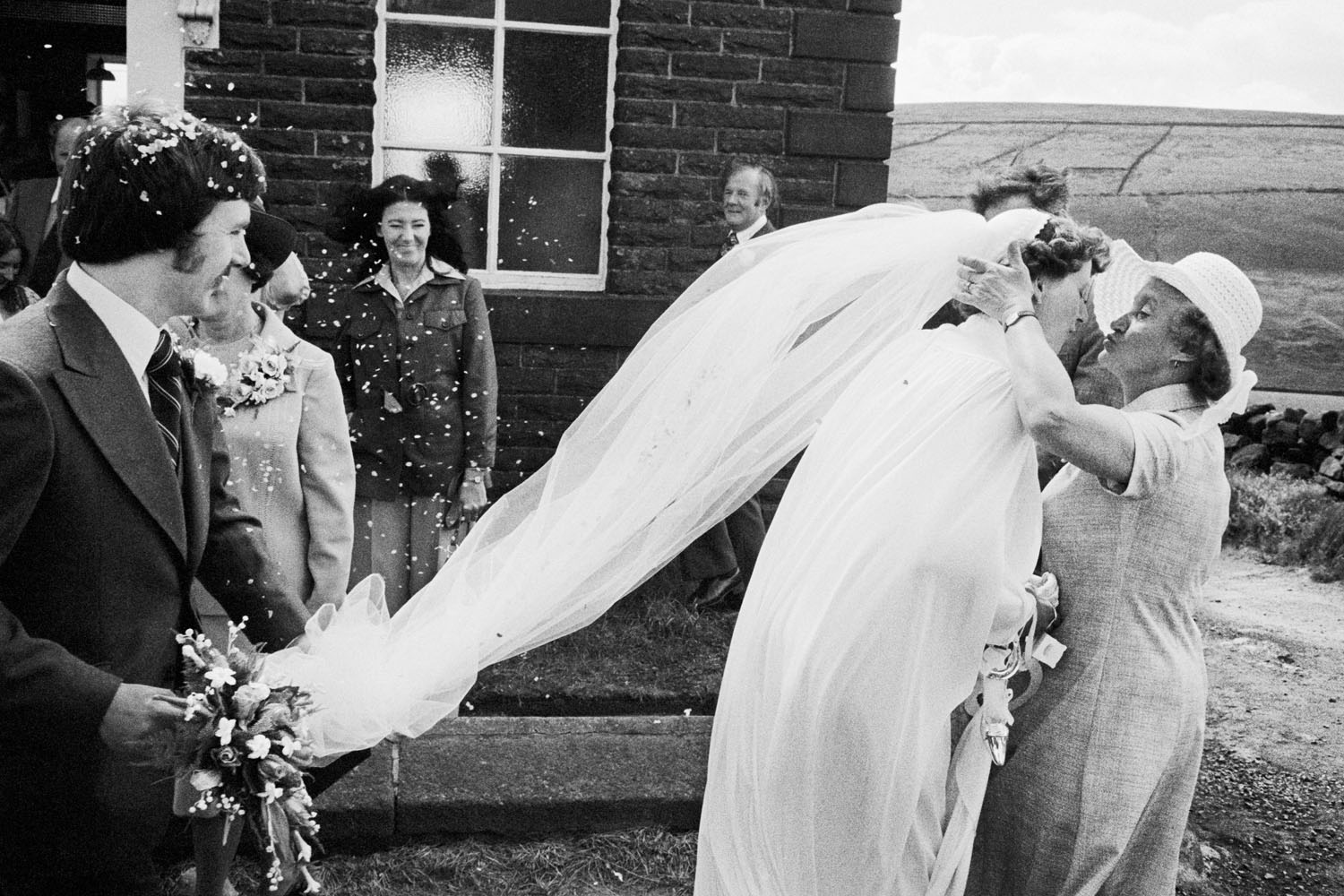
Hebden Bridge was an intricate fabric of social organisation, and Parr was fascinated by the many clubs and societies which flourished there. With some fellow ex-students, he rented a small shop and set up the Albert Street Workshop, which showed photographs, paintings and ceramics. Though he photographed Hebden Bridge life with great enthusiasm (one of his favorite subjects was the Ancient Order of Henpecked Husbands) and produced many memorable images in the town, the great achievement of his Hebden Bridge years was his documentation of Crimsworth Dean Methodist Chapel, high up on the moors above the town. Together with his future partner Susie Mitchell, Parr immersed himself in the life of the chapel, photographing, interviewing and taking part in events there. For him, the chapel was ‘the icon of Hebden Bridge’s dark and gloomy, rather miserable past’ and the photographs he made at Crimsworth Dene and other Methodist chapels were an elegy to a passing way of life, somber and poetic, with an occasional whisper of humour.

Val Williams. “The Ordinary Made Extraordinary: Martin Parr in Black and White,” on the Magnum website Oct 14, 2019 [Online] Cited 30/12/2024


Martin Parr (British, 1952-2025) 'Rugby League Club ground, West Yorkshire, England, 1977' 1977 from the exhibition 'Martin Parr. Early Works' at Fotografie Forum Frankfurt (FFF)


Martin Parr (British, 1952-2025)
Rugby League Club ground, West Yorkshire, England, 1977
1977
Gelatin silver print
© Martin Parr | Magnum Photos


With the exhibition Martin Parr. Early Works on view from September 13, 2024 to February 16, 2025 the Fotografie Forum Frankfurt (FFF) shows another highlight in its 40th anniversary year. As an observer of life, the ironic and socially critical eye of Magnum photographer Martin Parr has become an integral part of the history of photography. This exhibition of rarely seen black and white images made by the British photographer between 1970 and 1985 is on view for the first time in Germany.

Bird clubs in Surrey, pilgrimages to see the Pope in Ireland, holiday resorts, sports and village banquets are only a few of the places and social activities which first grasped Martin Parr’s attention. In a special selection of fifty-eight black and white images, this show focuses on the subtleties of the unnoticed episodes found in the everyday: be it in communities draped in local traditions, street life and in the unforgettable fluctuating island weather, Parr makes us always look twice, to cherish the funny sides of life.

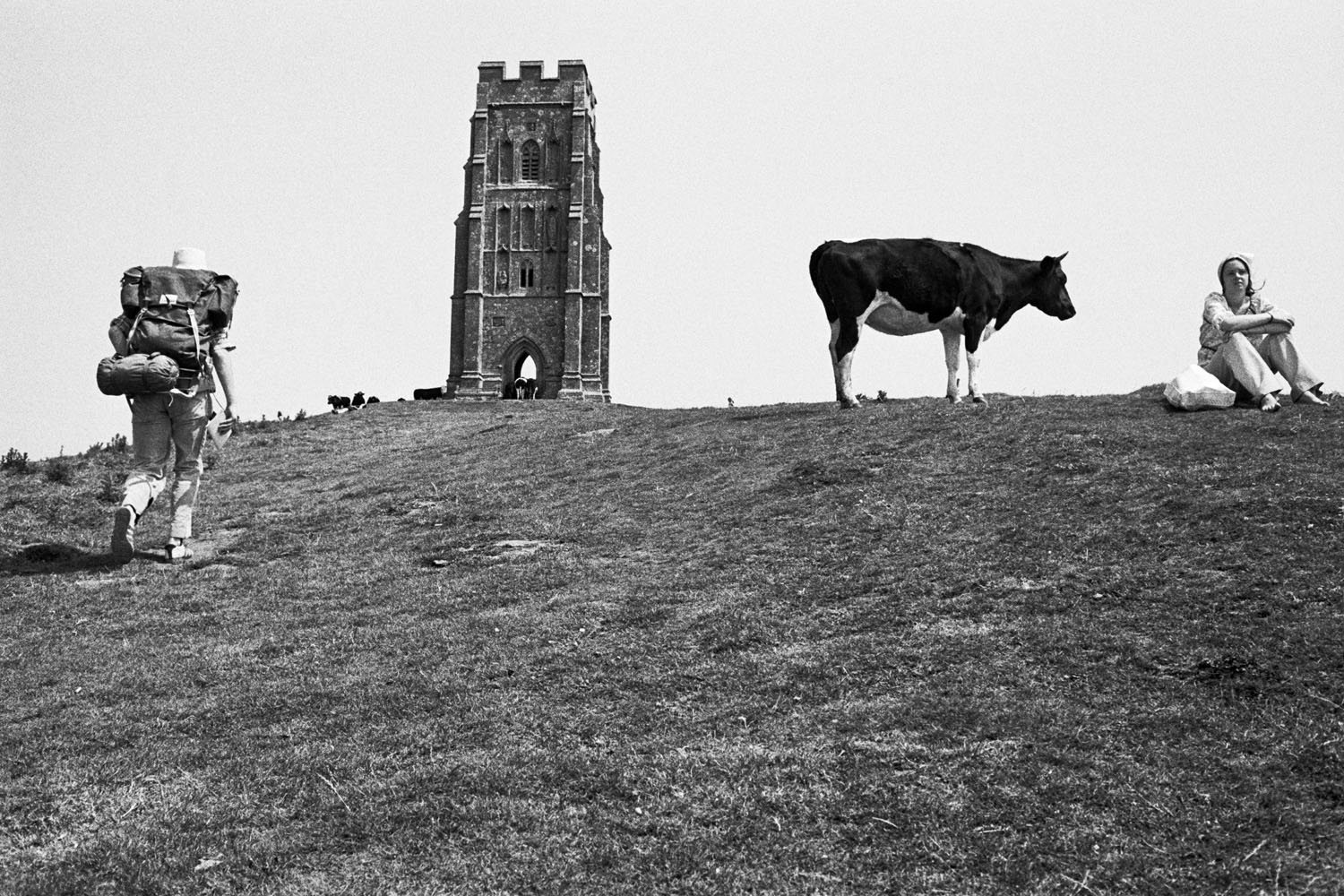
Included are some of Parr’s encompassing views such as The Mayor of Todmorden’s inaugural Banquette, from 1977, where hungry guests squeeze shoulder to shoulder, not to miss the best dish; or two devout Catholics anxiously awaiting a glimpse of Pope John Paul II, Dublin, 1979 a-top their kitchen ladder; as well as the animal protagonists, such as a cow posed like a day-tripper on the hillside of Glastonbury Tor.

Martin Parr. Early Works was curated by Celina Lunsford in close collaboration with the photographer and the Martin Parr Foundation. Simultaneously, the Leica Galerie Frankfurt is showing with Martin Parr in Colour (14.09.2024 – 05.01.2025), a selection of photographs in colour made by the British documentary photographer.

Known for his bold colours and everyday scenes, Parr’s famous classics are included such as the image of a woman with her face obscured by an English flag, and the view of a postcard of a crowded beach with a price tag. Equally iconic is the image of the swan looking directly into the camera, as if posing for the photograph.

Martin Parr’s colour photographs also show excerpts from everyday life in an exaggerated and sometimes absurd way. At first glance, nostalgia or romanticism seem to be at the forefront, but his works have a questioning character. As documentations of society, they contribute to its reflection, revealing the complexity and absurdity of modern life in a comical and critical way.

Together, these two exhibitions provide a complementary overview of the wide range of Martin Parr’s work. Exaggeration and hyperbole – his key elements – run like a thread through his early and late photographs, encouraging the viewer to reflect on social and cultural issues and to enjoy more than just the aesthetic aspects of photography.

Martin Parr (b. 1952 in Epsom, Surrey, GB) is a British photographer known for his perceptive and often ironic documentation of everyday life. Parr studied photography at Manchester Polytechnic and began his career in the 1970s. His work is characterised by its humorous depiction of social issues. Initially working in black and white, he switched to colour photography in the mid-1980s. He has been a member of the renowned Magnum photo agency since 1994. Parr has published numerous books and his work is exhibited and collected worldwide. In addition to his work as a photographer, he is active as a curator and a collector. The Martin Parr Foundation was established in 2014 and is based in Bristol since 2017.

Press release from Fotografie Forum Frankfurt


Martin Parr (British, 1952-2025) 'Surrey Bird Club, Surrey, England, 1972' 1972 from the exhibition 'Martin Parr. Early Works' at Fotografie Forum Frankfurt (FFF)


Martin Parr (British, 1952-2025)
Surrey Bird Club, Surrey, England, 1972
1972
Gelatin silver print
© Martin Parr | Magnum Photos


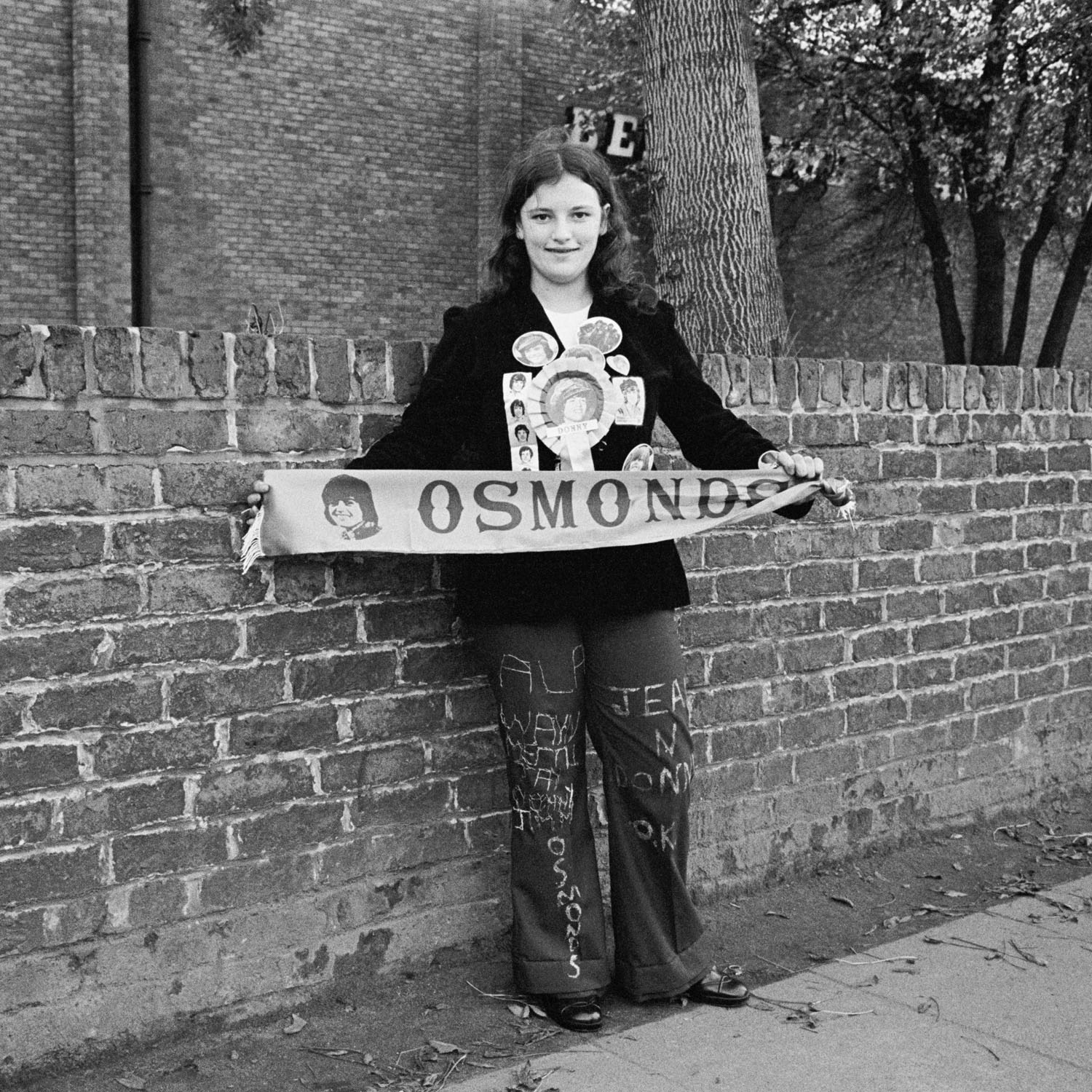
Martin Parr (British, 1952-2025) 'Osmond Fan, Manchester, England, 1973' 1973


Martin Parr (British, 1952-2025)
Osmond Fan, Manchester, England
1973
Gelatin silver print
© Martin Parr | Magnum Photos


Martin Parr (British, 1952-2025) 'Tom Greenwood, Hangingroyd Road, Hebden Bridge, Yorkshire, England, 1975' 1975


Martin Parr (British, 1952-2025)
Tom Greenwood, Hangingroyd Road, Hebden Bridge, Yorkshire, England, 1975
1975
Gelatin silver print
© Martin Parr / Magnum Photos


Martin Parr (British, 1952-2025) 'Wedding at Crimsworth Dean Methodist Chapel, Hebden Bridge, Calderdale, West Yorkshire, England, 1977' 1977


Martin Parr (British, 1952-2025)
Wedding at Crimsworth Dean Methodist Chapel, Hebden Bridge, Calderdale, West Yorkshire, England, 1977
1977
Gelatin silver print
© Martin Parr / Magnum Photos


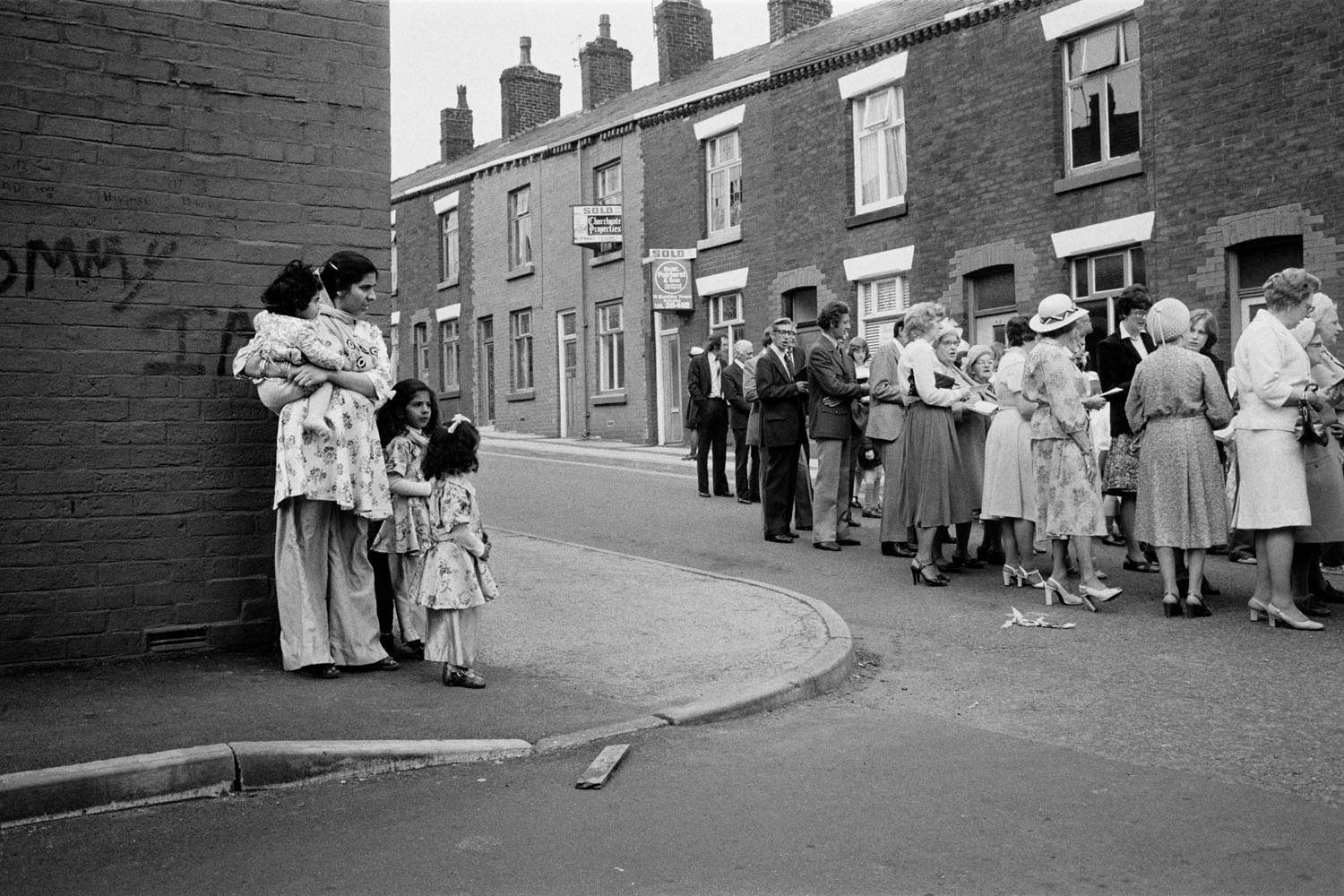
Martin Parr (British, 1952-2025) 'St Peter's Walks, Bolton, Greater Manchester, England, 1979' 1979


Martin Parr (British, 1952-2025)
St Peter’s Walks, Bolton, Greater Manchester, England, 1979
1979
Gelatin silver print
© Martin Parr / Magnum Photos


Martin Parr (British, 1952-2025) 'Glastonbury Tor, Somerset, England, 1975' 1975


Martin Parr (British, 1952-2025)
Glastonbury Tor, Somerset, England, 1975
1975
From Beauty Spots
Gelatin silver print
©
Martin Parr | Magnum Photos


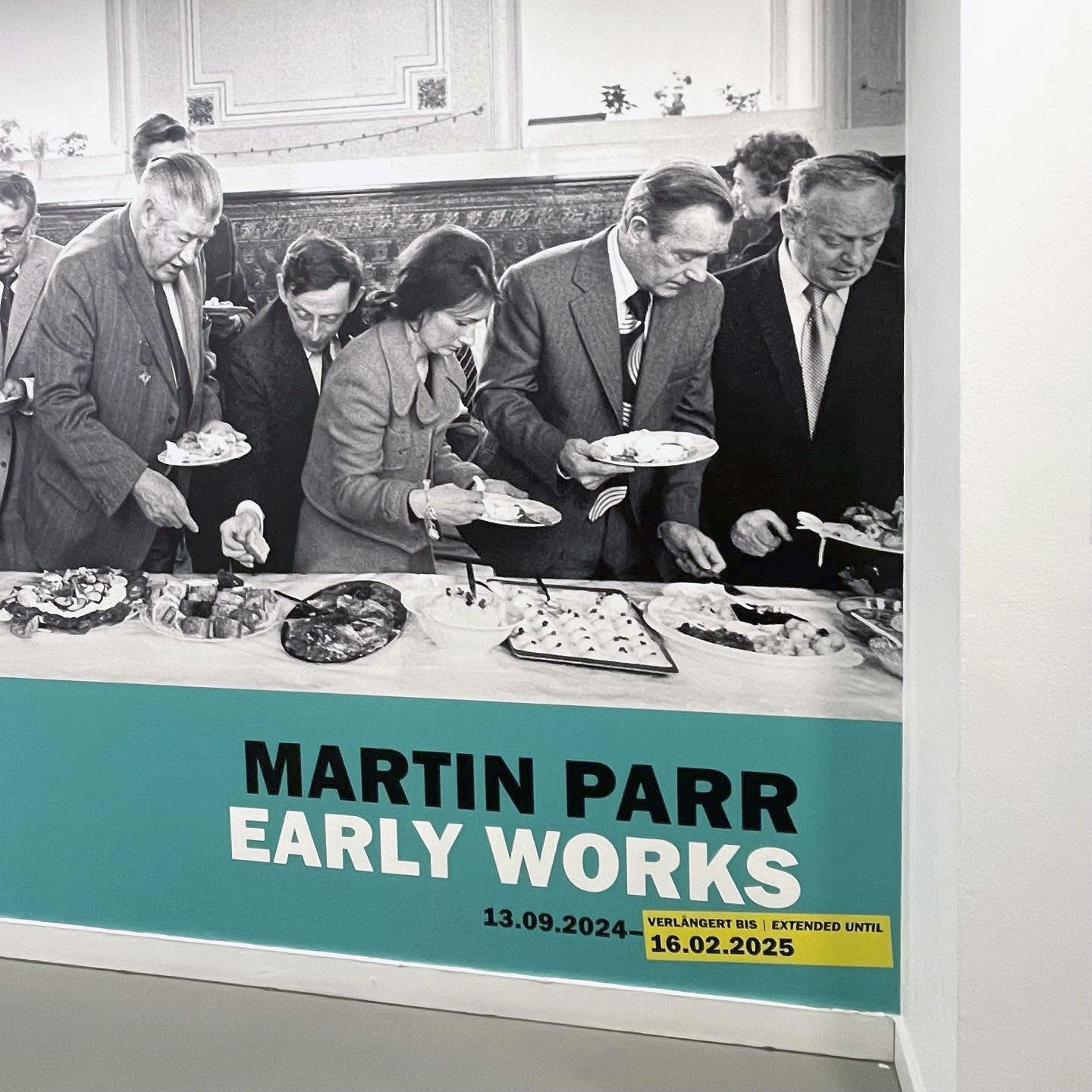
'Martin Parr. Early Works' poster for the exhibition at Fotografie Forum Frankfurt (FFF)


Martin Parr. Early Works poster for the exhibition at Fotografie Forum Frankfurt (FFF)


Fotografie Forum Frankfurt
e.V. Braubachstraße 30-32,
60311 Frankfurt am Main
Phone: +49 (0) 69 29 17 26

Fotografie Forum Frankfurt website

LIKE ART BLART ON FACEBOOK

Back to top

Exhibition: ‘Now You See Us: Women Artists in Britain 1520-1920’ at Tate Britain, London

Exhibition dates: 16th May – 13th October 2024

Curator: Tabitha Barber


Attributed to Levina Teerlinc (Flemish, 1510-1576) 'Portrait of a Lady holding a Monkey' 1560s


Attributed to Levina Teerlinc (Flemish, 1510-1576)
Portrait of a Lady holding a Monkey
1560s
Watercolour and bodycolour heightened with gold and silver
Image: 46 × 46 mm
Frame, circular: 62 × 62 mm
Victor Reynolds and Richard Chadwick


There have been some mixed reviews of this exhibition – “tremendous show… an archaeological dig into the nation’s cultural past” (Jonathan Jones in The Guardian); “niggardly photography section… Only rarely do women’s art and women’s history spark together in this show… For even the best of the artists here are occasionally represented by the least of their works, quite apart from the mystifying omissions.” (Laura Cumming in The Guardian).

Indeed, Laura Cumming poses an interesting question: “Here is a dilemma straight away: which should take precedence, the painting or the fact? Should the show present art on its own terms, or as instance, evidence, expression of social history? It is an extremely complex remit…”

Having not been to London to see the exhibition I can only make generalised comment, but in my opinion the presentation should be a combination of both – art and social history – recognising that one does not exist, emerge, without the other. Art does not live in a bubble isolated from society and society itself is influenced by new ideas, new concepts of art. It’s not the chicken and the egg, it’s the scramble to make sense of living in this world using art as an expression, a (real, surreal, revolutionary, dream, abstract etc…) vision of the world that surrounds us.

Just from compiling this posting I have been enlightened as to the lives of many artists that I had never heard of before. I have admired their work and learnt about their lives and the conditions under which they worked. The exhibition has brought into my consciousness (and the consciousness of others) artists that I would have never have known about. It tells their stories in however fragmented a way … but at least it tells them. And that is a very good thing.

My particular favourites in the posting are three portraits where the sitter stares directly at you: Joan Carlile’s perceptive Portrait of a Lady Wearing an Oyster Satin Dress (1650s, below) so captivating of gaze, so incisive in its simplicity; Maria Cosway’s beautifully rendered Self Portrait (Nd, below) such a luminous and engaging presence; and Gwen John’s powerful Self-Portrait (1902, below) vibrant of colour, full of self-assurance. Wonderful evocations of humanity.

Scottish artist Dame Ethel Walker observes,

“There is no such thing as a woman artist. There are only two kinds of artist – bad and good.”


And that is what his exhibition gives you the obligation to do: to educate yourself, to make yourself a little more informed, to use your brain, eyes, and heart …and make up your own mind about the merit of the work.

I for one are very grateful for that opportunity.

Dr Marcus Bunyan

PS. I have added relevant text from the large print guide and other bibliographic information from accredited sources to illuminate the works presented.


Many thankx to the Tate for allowing me to publish the art work and photographs in the posting. Please click on the photographs for a larger version of the image.


Installation view of the exhibition 'Now You See Us Women Artists in Britain 1520-1920' at Tate Britain showing at right, Lucy Kemp-Welch's 'Colt Hunting in the New Forest' 1897


Installation view of the exhibition Now You See Us Women Artists in Britain 1520-1920 at Tate Britain showing at right, Lucy Kemp-Welch’s Colt Hunting in the New Forest 1897


Spanning 400 years, this exhibition follows women on their journeys to becoming professional artists. From Tudor times to the First World War, artists such as Mary Beale, Angelica Kauffman, Elizabeth Butler and Laura Knight paved a new artistic path for generations of women. They challenged what it meant to be a working woman of the time by going against society’s expectations – having commercial careers as artists and taking part in public exhibitions.

Including over 150 works, the show dismantles stereotypes surrounding women artists in history, who were often thought of as amateurs. Determined to succeed and refusing to be boxed in, they daringly painted what were usually thought to be subjects for male artists: history pieces, battle scenes and the nude.

The exhibition sheds light on how these artists championed equal access to art training and academy membership, breaking boundaries and overcoming many obstacles to establish what it meant to be a woman in the art world.

Text from the Tate Britain website


Installation view of the exhibition 'Now You See Us Women Artists in Britain 1520-1920' at Tate Britain showing Artemisia Gentileschi's 'Self-Portrait as the Allegory of Painting (La Pittura)' c. 1638-1639


Installation view of the exhibition Now You See Us Women Artists in Britain 1520-1920 at Tate Britain showing Artemisia Gentileschi’s Self-Portrait as the Allegory of Painting (La Pittura) c. 1638-1639 (below)


Artemisia Gentileschi (Italian, 1593-1653) 'Self-Portrait as the Allegory of Painting (La Pittura)' c. 1638-1639 (installation view)


Artemisia Gentileschi (Italian, 1593-1653)
Self-Portrait as the Allegory of Painting (La Pittura)
c. 1638-1639
Oil on canvas
98.6 x 75.2cm (support, canvas/panel/stretcher external)
Royal Collection Trust
© His Majesty King Charles III 2024


Artemisia Gentileschi (Italian, 1593-1653) 'Self-Portrait as the Allegory of Painting (La Pittura)' c. 1638-1639


Artemisia Gentileschi (Italian, 1593-1653)
Self-Portrait as the Allegory of Painting (La Pittura)
c. 1638-1639
Oil on canvas
98.6 x 75.2cm (support, canvas/panel/stretcher external)
Royal Collection Trust
© His Majesty King Charles III 2024


Gentileschi claimed that ‘all the … Princes’ displayed her self-portrait in their galleries. In addition to this work, Charles I owned another self-portrait, which is now lost. Here, Gentileschi uses her own image to portray the allegorical figure of Pittura (also the Italian feminine noun for painting), who she depicts in a working apron before an easel absorbed in the act of creation.

Text from the exhibition large print guide


As a self-portrait the painting is particularly sophisticated and accomplished. The position in which Artemisia has portrayed herself would have been extremely difficult for the artist to capture, yet the work is economically painted, with very few pentiments. In order to view her own image she may have arranged two mirrors on either side of herself, facing each other. Depicting herself in the act of painting in this challenging pose, the angle and position of her head would have been the hardest to accurately render, requiring skilful visualisation.

Text from the Royal Collection Trust website


Installation view of the exhibition 'Now You See Us Women Artists in Britain 1520-1920' at Tate Britain showing Artemisia Gentileschi's 'Susanna and the Elders' c. 1638-1640


Installation view of the exhibition ‘Now You See Us Women Artists in Britain 1520-1920’ at Tate Britain showing Artemisia Gentileschi’s Susanna and the Elders c. 1638-1640 (below)
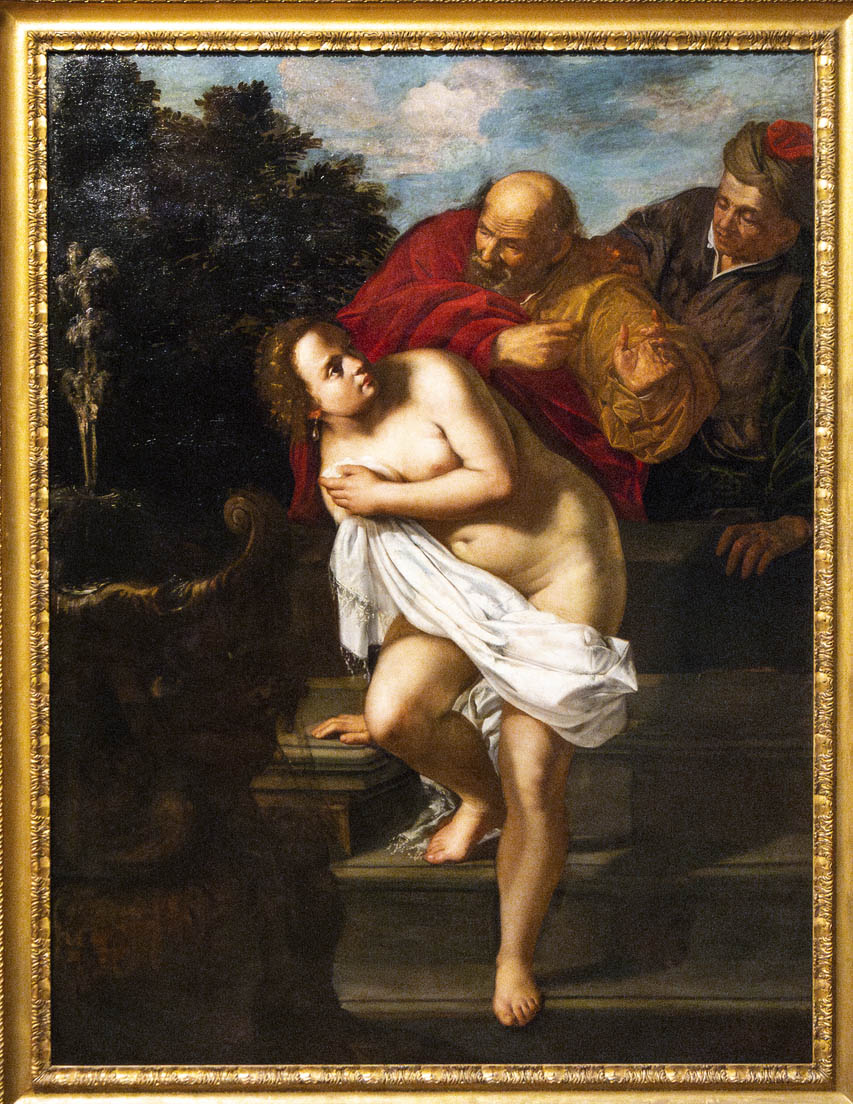
 

Artemisia Gentileschi (Italian, 1593-1653) 'Susanna and the Elders' c. 1638-1640 (installation view)


Artemisia Gentileschi (Italian, 1593-1653)
Susanna and the Elders
c. 1638-1640
Oil on canvas
189.0 x 143.2cm (support, canvas/panel/stretcher external)
Royal Collection Trust / © His Majesty King Charles III 2024


Artemisia Gentileschi (Italian, 1593-1653) 'Susanna and the Elders' c. 1638-1640


Artemisia Gentileschi (Italian, 1593-1653)
Susanna and the Elders
c. 1638-1640
Oil on canvas
189.0 x 143.2cm (support, canvas/panel/stretcher external)
Royal Collection Trust / © His Majesty King Charles III 2024


Likely commissioned by Queen Henrietta Maria, this work was displayed in her Withdrawing Chamber in Whitehall Palace. The subject is an Old Testament narrative on virtue and faith. Susanna, bathing in privacy, is spied on by two elders who attempt to sexually assault her. When she resists them, the men accuse her of adultery. Susanna is arrested and about to be put to death until the men are questioned, and her innocence is revealed. Here, Gentileschi depicts Susanna as vulnerable and fearful, shielding her nakedness. She returned to the subject throughout her career.

Text from the exhibition large print guide


This spring, Tate Britain will present Now You See Us: Women Artists in Britain 1520-1920. This ambitious group show will chart women’s road to being recognised as professional artists, a 400-year journey which paved the way for future generations and established what it meant to be a woman in the British art world. The exhibition covers the period in which women were visibly working as professional artists, but went against societal expectations to do so.

Featuring over 100 artists, the exhibition will celebrate well-known names such as Artemisia GentileschiAngelica Kauffman, Julia Margaret Cameron and Gwen John, alongside many others who are only now being rediscovered. Their careers were as varied as the works they produced: some prevailed over genres deemed suitable for women like watercolour landscapes and domestic scenes. Others dared to take on subjects dominated by men like battle scenes and the nude, or campaigned for equal access to training and membership of professional institutions. Tate Britain will showcase over 200 works, including oil painting, watercolour, pastel, sculpture, photography and ‘needlepainting’ to tell the story of these trailblazing artists.

Now You See Us will begin at the Tudor court with Levina Teerlinc, many of whose miniatures will be brought together for the first time in four decades, and Esther Inglis, whose manuscripts contain Britain’s earliest known self-portraits by a woman artist. The exhibition will then look to the 17th century. Focus will be given to one of art history’s most celebrated women artists, Artemisia Gentileschi, who created major works in London at the court of Charles I, including the recently rediscovered Susanna and the Elders 1638-40, on loan from the Royal Collection for the very first time. The exhibition will also look to women such as Mary BealeJoan Carlile and Maria Verelst who broke new ground as professional portrait painters in oil.

In the 18th century, women artists took part in Britain’s first public art exhibitions, including overlooked figures such as Katherine Read and Mary Black; the sculptor Anne Seymour Damer; and Margaret Sarah Carpenter, a leading figure in her day but little heard of now. The show will look at Angelica Kauffman and Mary Moser, the only women included among the Founder Members of the Royal Academy of Arts; it took 160 years for membership to be granted to another woman. Women artists of this era are often dismissed as amateurs pursuing ‘feminine’ occupations like watercolour and flower painting, but many worked in these genres professionally: needlewoman Mary Linwood, whose gallery was a major tourist attraction; miniaturist Sarah Biffin, who painted with her mouth, having been born without arms and legs; and Augusta Withers, a botanical illustrator employed by the Horticultural Society.

The Victorian period saw a vast expansion in public exhibition venues. Now You See Us will showcase major works by critically appraised artists of this period, including Elizabeth Butler (née Thompson)‘s monumental The Roll Call 1874 (Butler’s work prompted critic John Ruskin to retract his statement that “no women could paint”), and nudes by Henrietta Rae and Annie Swynnerton, which sparked both debate and celebration. The exhibition will also look at women’s connection to activism, including Florence Claxton‘s satirical ‘Woman’s Work’: A Medley 1861 which will be on public display for the first time since it was painted; and an exploration of the life of Barbara Leigh Smith Bodichon, an early member of the Society of Female Artists who is credited with the campaign for women to be admitted to the Royal Academy Schools. On show will be the student work of women finally admitted to art schools, as well as their petitions for equal access to life drawing classes.

The exhibition will end in the early 20th century with women’s suffrage and the First World War. Women artists like Gwen John, Vanessa Bell and Helen Saunders played an important role in the emergence of modernism, abstraction and vorticism, but others, such as Anna Airy, who also worked as a war artist, continued to excel in conventional traditions. The final artists in the show, Laura Knight and Ethel Walker, offer powerful examples of ambitious, independent, confident professionals who achieved critical acclaim and – finally – membership of the Royal Academy.

Press release from Tate Britain
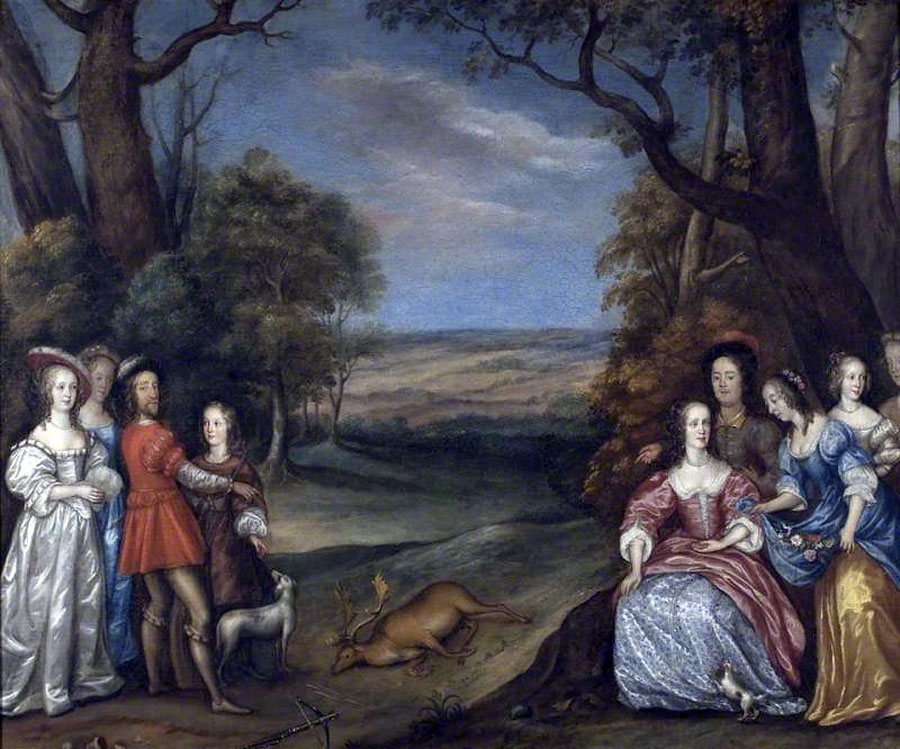
 

Joan Carlile (English, 1606-1679) 'The Carlile Family with Sir Justinian Isham in Richmond Park' 1650s


Joan Carlile (English, 1606-1679)
The Carlile Family with Sir Justinian Isham in Richmond Park
1650s
Oil on canvas
Lamport Hall
CC BY-NC-ND
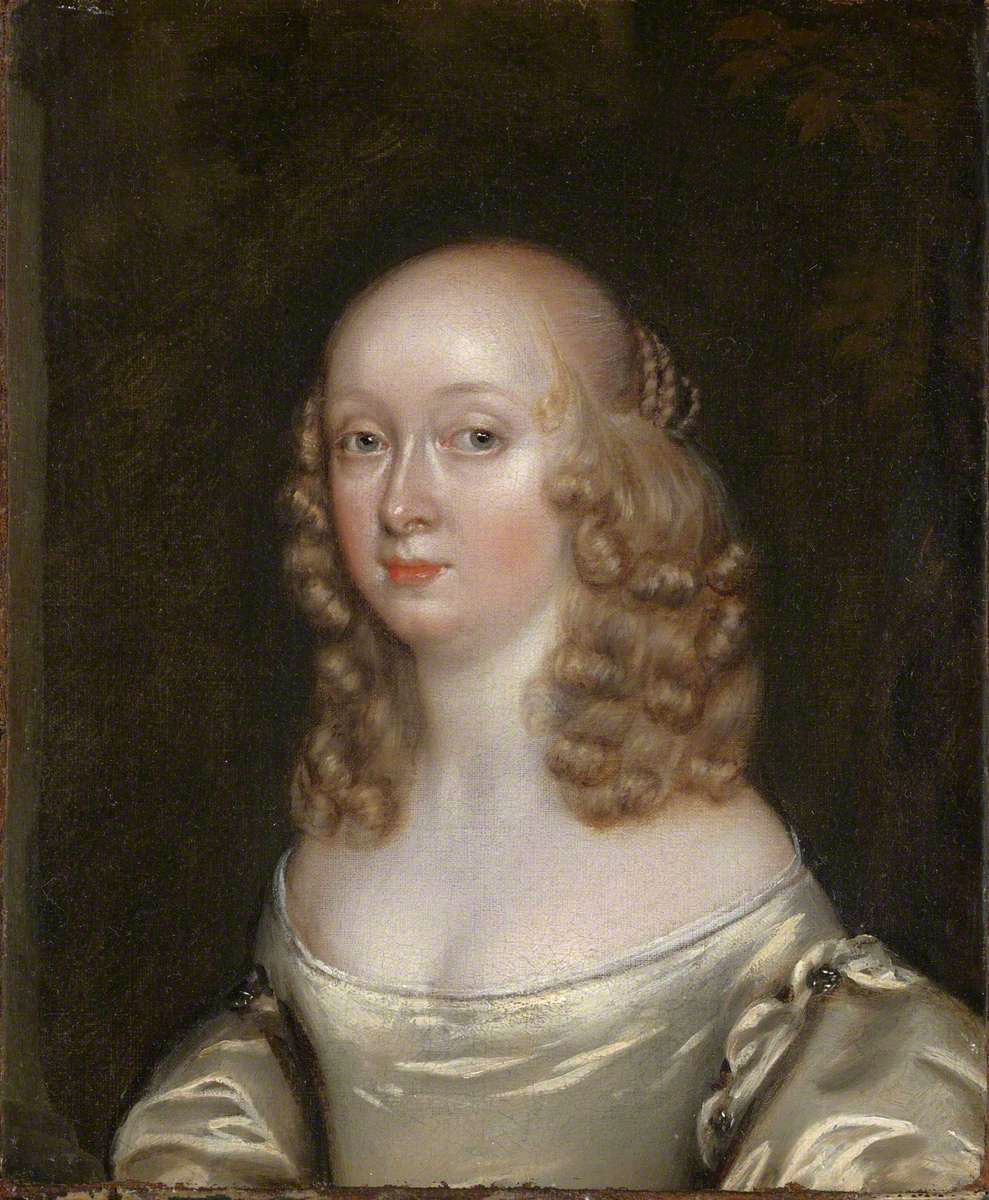
 

Joan Carlile (English, 1600-1679) 'Portrait of a Lady Wearing an Oyster Satin Dress' 1650s


Joan Carlile (English, 1600-1679)
Portrait of a Lady Wearing an Oyster Satin Dress
1650s
Oil on canvas
30.8 x 25.5cm
National Portrait Gallery, London
Government Art Collection
Purchased from Philip Mould Ltd, 2018


Joan Carlile or Carlell or Carliell (c. 1606-1679), was an English portrait painter. She was one of the first British women known to practise painting professionally. Before Carlile, known professional female painters working in Britain were born elsewhere in Europe, principally the Low Countries.


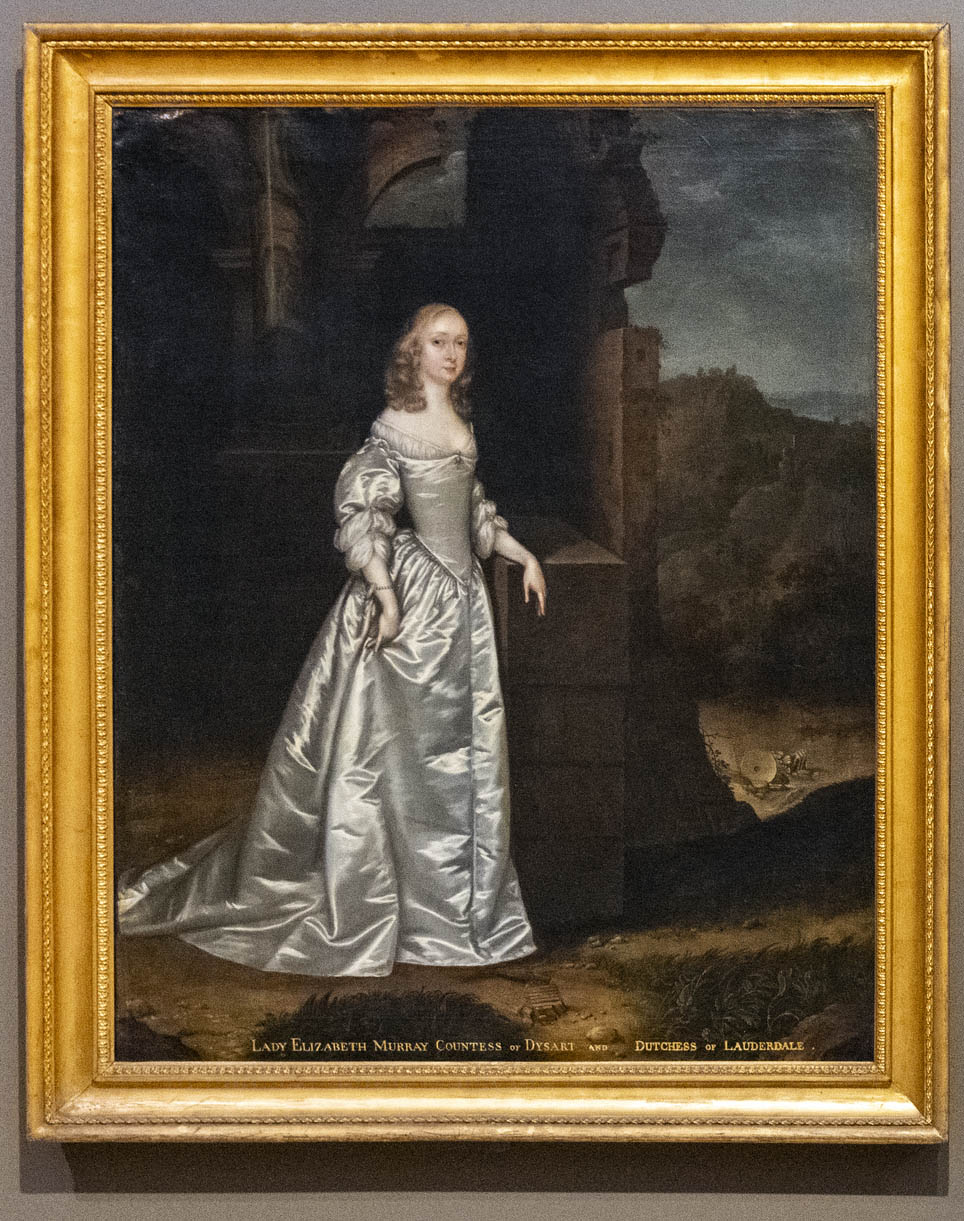
Installation view of the exhibition 'Now You See Us Women Artists in Britain 1520-1920' at Tate Britain showing at left, Joan Carlile's 'Portrait of an Unknown Lady known as Elizabeth Murray, Countess of Dysart and Duchess of Lauderdale' 1650s; and at right, 'Portrait of an Unknown Lady' 1650-1655


Installation view of the exhibition Now You See Us Women Artists in Britain 1520-1920 at Tate Britain showing at left, Joan Carlile’s Portrait of an Unknown Lady known as Elizabeth Murray, Countess of Dysart and Duchess of Lauderdale 1650s (below); and at right, Portrait of an Unknown Lady 1650-1655 (below)
 

Joan Carlile (English, 1606-1679) 'Portrait of an Unknown Lady' 1650-1655 (installation view)


Joan Carlile (English, 1606-1679)
Portrait of an Unknown Lady (installation view)
1650-1655
Oil on canvas
Support: 1107 × 900 mm
Frame: 1205 × 1012 × 73 mm
Photo: Tate
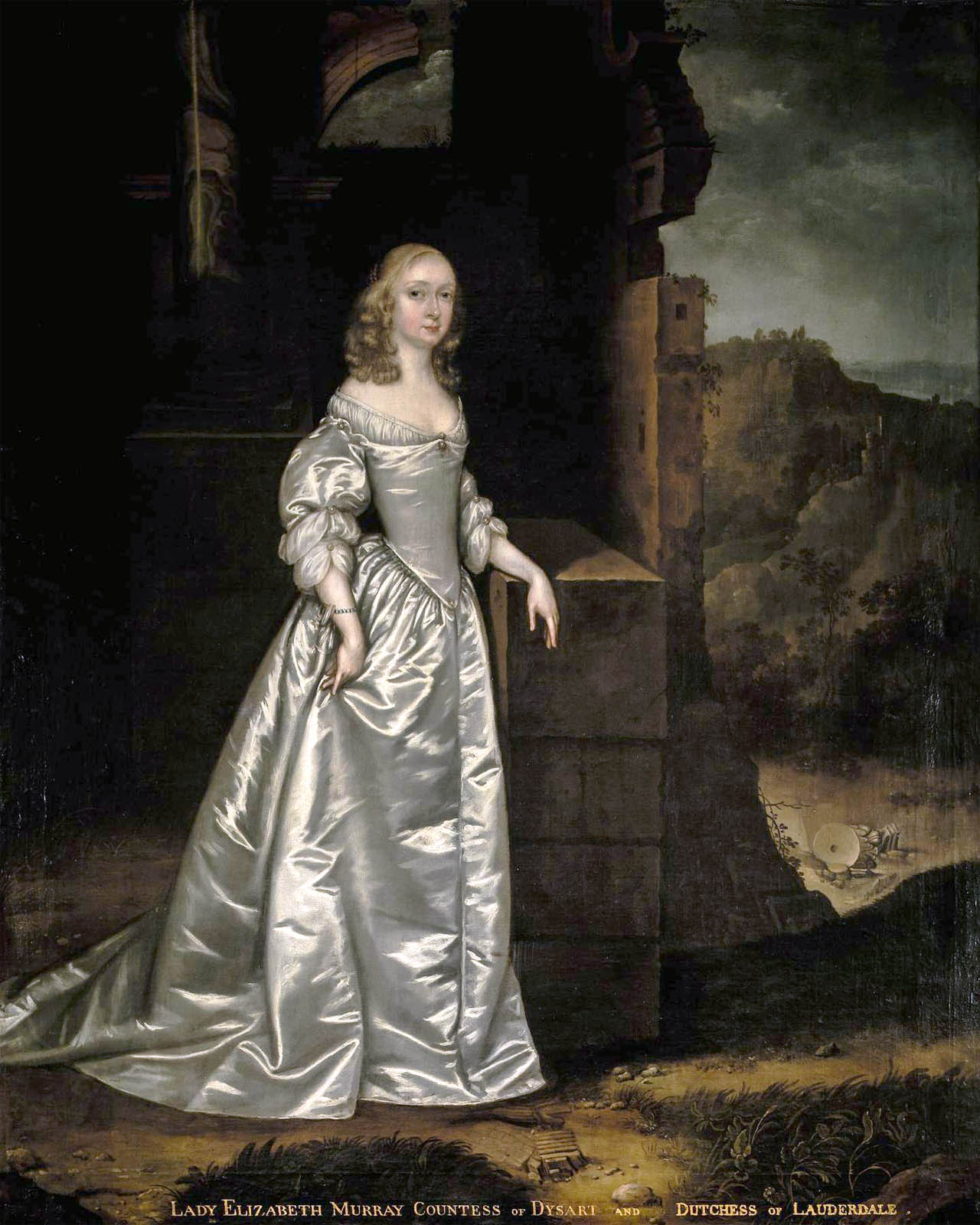
 

Joan Carlile (English, 1606-1679) 'Portrait of an Unknown Lady known as Elizabeth Murray, Countess of Dysart and Duchess of Lauderdale' 1650s


Joan Carlile (English, 1606-1679)
Portrait of an Unknown Lady known as Elizabeth Murray, Countess of Dysart and Duchess of Lauderdale
1650s
Oil on canvas
The Bute Collection at Mount Stuart


Here, Carlile uses the same white satin dress seen in a nearby painting. The pose, with the sitter elegantly gathering a handful of fabric, is taken from works by Charles I’s portrait painter, Flemish artist Anthony van Dyck (1599-1641). The sitter is sometimes identified as Elizabeth Murray, Countess of Dysart and Duchess of Lauderdale. She was Carlile’s near neighbour in Petersham, at Ham House. The broken columns in the background are often used to symbolise loss.

Text from the exhibition large print guide


Joan Carlile (English, 1606-1679) 'Portrait of an Unknown Lady' 1650-1655


Joan Carlile (English, 1606-1679)
Portrait of an Unknown Lady
1650-1655
Oil on canvas
Support: 1107 × 900 mm
Frame: 1205 × 1012 × 73 mm
Photo: Tate


Portraits by Joan Carlile are rare and this is one of only approximately ten that can be identified. Of these, two are in public collections (Ham House, Surrey, and National Portrait Gallery, London), while others are held in historic house collections and family trusts in the United Kingdom, for example Lamport Hall, Burghley House and Berkeley Castle. Carlile seems to have specialised in small-scale full length portraits of figures, usually female, set in large landscape or garden settings. The composition employed here, in which the figure holds the skirt of her dress with one hand and shawl with another, was most likely a template arrangement. It appears in two other portraits, one showing the figure facing the same way as here, the other in reverse, but with both figures wearing the same white satin dress. This repeated composition adds weight to the proposition that Carlile was a professional artist. The wife of Lodowick Carlile (or Carlell), a minor poet and dramatist who also held the office of Gentleman of the Bows to Charles I, Joan Carlile lived with her husband in Petersham, a suburb of London. However, in 1653 their neighbour, Brian Duppa, recorded that ‘the Mistress of the Family intends for London, where she meanes to make use of her skill to som more Advantage then hitherto she hath don’ (quoted in Toynbee and Isham 1954, p.275). In 1654 Carlile is recorded as living in London’s Covent Garden, then the heart of the artistic community (see Burnett 2004/2010, accessed 2 October 2015).

Text from the Tate website


Joan Carlile challenged societal expectations by becoming one of Britain’s first professional women artists in the 1600s, earning her living as an oil painter. Initially employed in King Charles I’s household, Carlile liked to paint in her spare time. With the outbreak of the Civil War, she began painting to support herself.

Carlile moved to Covent Garden in the 1650s – then the centre of the art world – and set up a successful commercial portrait business. Her template of carefully posed figures in silk gowns against landscape backgrounds, seen here in Portrait of an Unknown Lady (1650-5), proved extremely popular. Admired as a professional artist in her lifetime, only a small number of her portraits still exist, some which have never been seen in public.

Text from the Tate website


In her Portrait of an Unknown Lady (1650-1655) the astonishing nacreous lustre of the sitter’s white silk gown, shown full length, shines against the foil of the dull brown foliage behind her. At this point, the Civil War had ended but the restoration of the monarchy was still in the future, and Carlile’s painting, with its overt celebration of luxury and leisure (the spotless pale fabric speaks of both) seems provocative.

It is possible that Carlile taught Anne Killigrew (1660-1685), an accomplished painter and poet whose family encouraged her creative pursuits, although it’s not clear if she ever painted professionally. Only a handful of Killigrew’s works survive today, including Venus Attired by the Three Graces, which reveals her interest in mythological scenes.

Although she died of smallpox aged just 25, Killigrew stands alongside Beale and Carlile as one of Britain’s first female artists.

Alicia Foster. “Blazing a trail: Britain’s first women artists deserve to be better known,” on the Art UK website 13 May 2024 [Online] Cited 03/09/2024
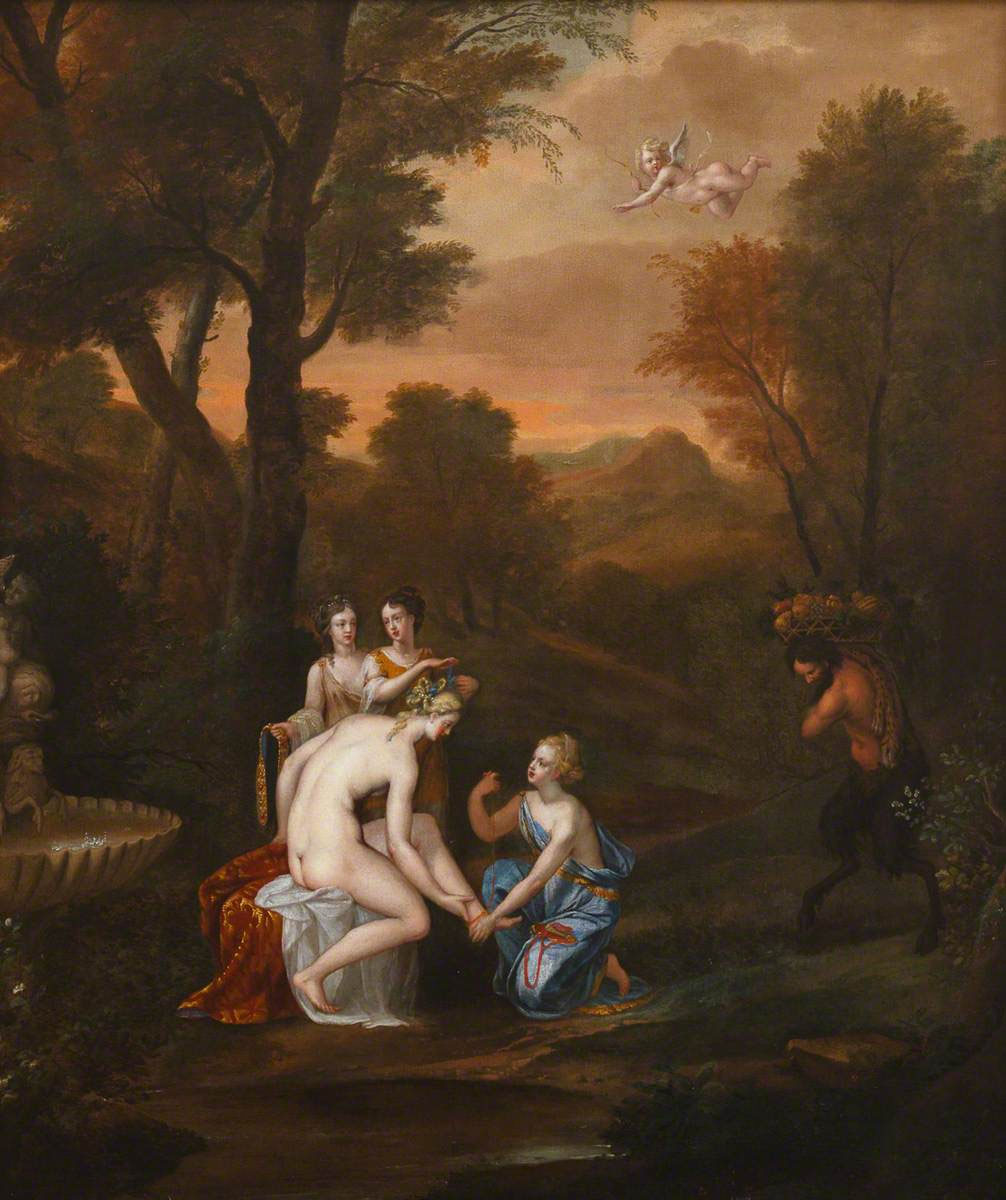
 

Anne Killigrew (English, 1660-1685) 'Venus Attired by the Three Graces' c. 1680


Anne Killigrew (English, 1660-1685)
Venus Attired by the Three Graces
c. 1680
Oil on canvas
Support: 1120 × 950 mm
Frame: 1282 × 1102 × 63 mm
Falmouth Art Gallery
Purchased with the assistance of the Victoria and Albert Museum Purchase Grant Fund, Heritage Lottery Fund, the Art Fund, the Beecroft Bequest, Falmouth Decorative and Fine Arts Society, the Estate of Barry Hughes in memory of Grace and Thomas Hughes and generous donations from local supporters
Public domain


Anne Killigrew has been described as the most celebrated female English prodigy of the Seventeeth Century. A poet and artist of great beauty and repute, Killigrew died of smallpox at the age of just 25. Anne’s exceptional qualities as an artist and a poet were highly praised in her short lifetime. The poet John Dryden dedicated a poem to her in which he refers directly to this picture: ‘Where nymphs of brightest form appear, and shaggy satyrs standing near’ (from ‘To the Pious Memory of the Accomplished Young Lady Mrs Anne Killigrew Excellent In The Two Sister-Arts of Poesy And Painting: An Ode’). Anne Killigrew worked at the Royal Court of King James II as Lady-in-Waiting to the Queen. Anne’s grandfather, Sir William Killigrew, was the Governor of Pendennis Castle, and his son, Dr Henry Killigrew moved to London to work as chaplain to King Charles I. He later became master of the Savoy Hospital.

Text from the Falmouth Art Gallery website
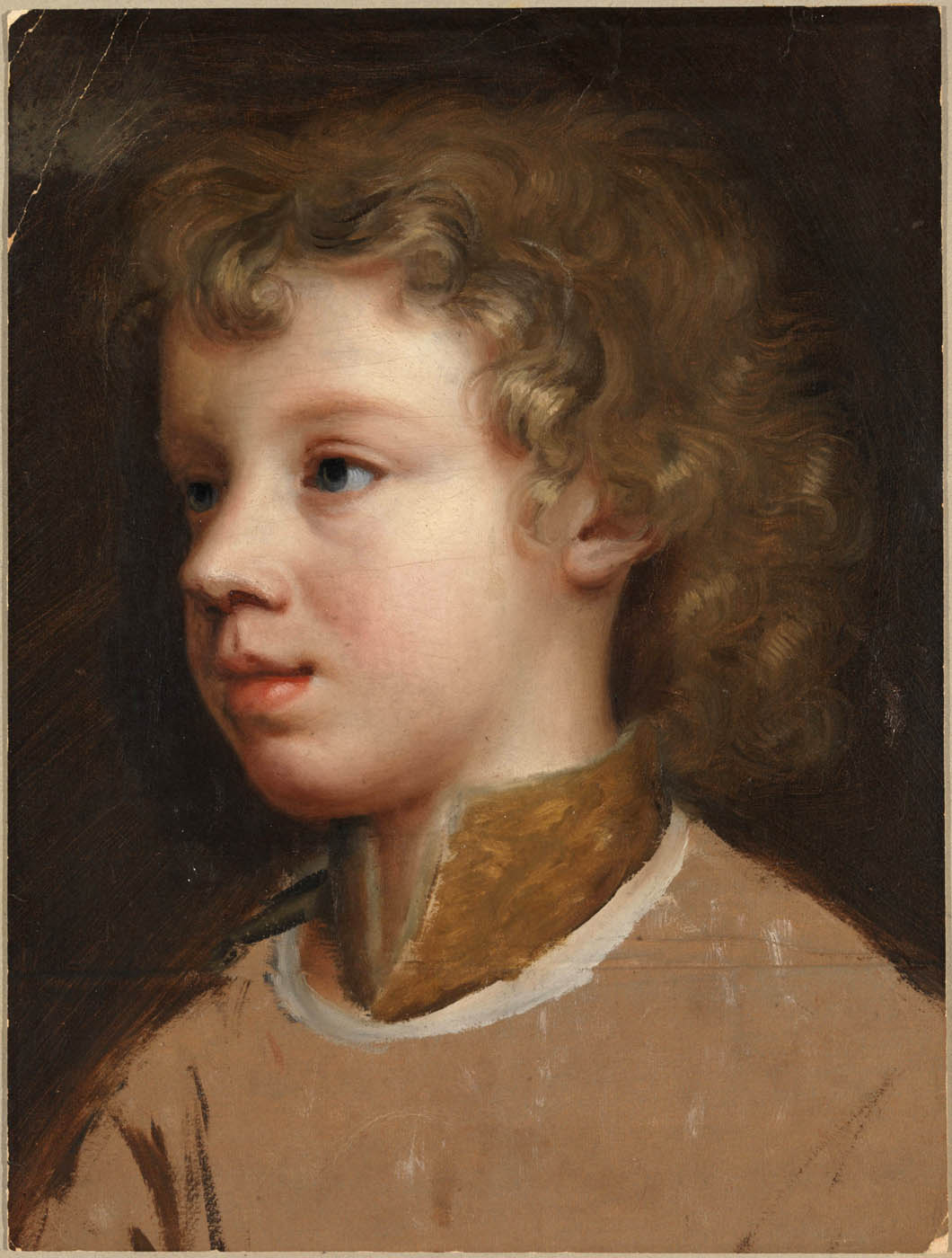
 

Mary Beale (English, 1633-1699) 'Sketch of the Artist's Son, Bartholomew Beale, Facing Left' c. 1660


Mary Beale (English, 1633-1699)
Sketch of the Artist’s Son, Bartholomew Beale, Facing Left
c. 1660
Oil on paper
Support: 325 × 245 mm
Frame: 421 × 340 × 32 mm
Tate
Purchased 2010
Photo: Tate


In the late 1650s and early 1660s Beale and her family were living on Hind Court, off Fleet Street in London. She painted privately and had a painting room in her home. Her husband had a civil service position as Deputy Clerk of the Patents. Portrait sittings of family and friends were often social occasions, with conversation and dinner afterwards. It is in this period that Beale produced small oil sketches on paper of family members, particularly her two young sons. Whether they relate to larger oil on canvas portraits is unclear.

This oil sketch of a young boy, shown in three-quarter profile, is of Mary Beale’s eldest son Bartholomew, baptised in 1656. His appearance, both in age and costume, is very similar to that in Mary Beale’s Self-portrait with her family (Geffrye Museum, London), painted c. 1659-60, before the birth of her youngest son Charles. It relates closely to another sketch of Bartholomew in oil on paper painted at the same time, Sketch of the Artist’s Son, Bartholomew Beale, in Profile c. 1660 (Tate T13245). Whether these sketches are connected to the production of the Geffrye Museum portrait, or were simply executed at around the same time, is not known. They are painted in oil on paper, which seems to have been a feature of Beale’s working method in the early 1660s but is not known in her later career, when she made preparatory sketches in chalk on paper or in oil on canvas (see, for example, Portrait of a Young Girl c. 1679-81, Tate T06612). When this sketch was made, the Beale family was living in Hind Court, off Fleet Street in London, where Mary Beale’s husband, Charles, was employed as Deputy Clerk of the Patents Office. It is difficult to determine whether Beale had much of a commercial portrait practice at this date, but documents certainly record the production of portraits of family and friends. In her ‘painting room’, Beale had ‘pencills [sic.], brushes, goose & swan fitches’, as well as ‘quantities of primed paper to paint on’ (George Vertue, transcription of Charles Beale’s 1661 notebook, now lost, quoted in Barber 1999, p. 16).

Text from the Tate website


Installation view of the exhibition 'Now You See Us Women Artists in Britain 1520-1920' at Tate Britain showing Mary Beale’s 'Anne Sotheby' (1676-1677)


Installation view of the exhibition Now You See Us Women Artists in Britain 1520-1920 at Tate Britain showing Mary Beale’s Anne Sotheby 1676-1677 


Mary Beale (English, 1633-1699) 'Anne Sotheby' 1676-1677


Mary Beale (English, 1633-1699)
Anne Sotheby
1676-1677
Oil on canvas
Tate
Purchased with funds provided by the Nicholas Themans Trust 2024


Beale’s husband kept a daily record of her activities in the studio. Two of his over 30 notebooks and a few partial transcripts are still known. They record Beale’s sitters, her painting stages, her painting materials and her prices. For her commissioned works, she borrowed poses from the portraits of the court artist Peter Lely (1618-1680). Anne Sotheby’s pose is taken from his portrait of Lady Essex Finch. Beale charged £10 for paintings of this size. Her sons acted as studio assistants; her youngest, Charles, was paid to paint the drapery in this portrait.

Text from the exhibition large print guide


Mary Beale (née Cradock) (1633-1699) was an English portrait painter. She was part of a small band of female professional artists working in London. Beale became the main financial provider for her family through her professional work – a career she maintained from 1670/71 to the 1690s. Beale was also a writer, whose prose Discourse on Friendship of 1666 presents a scholarly, uniquely female take on the subject. Her 1663 manuscript Observations, on the materials and techniques employed “in her painting of Apricots”, though not printed, is the earliest known instructional text in English written by a female painter. Praised first as a “virtuous” practitioner in “Oyl Colours” by Sir William Sanderson in his 1658 book Graphice: Or The use of the Pen and Pensil; In the Excellent Art of PAINTING, Beale’s work was later commended by court painter Sir Peter Lely and, soon after her death, by the author of “An Essay towards an English-School”, his account of the most noteworthy artists of her generation.

Text from the Wikipedia website
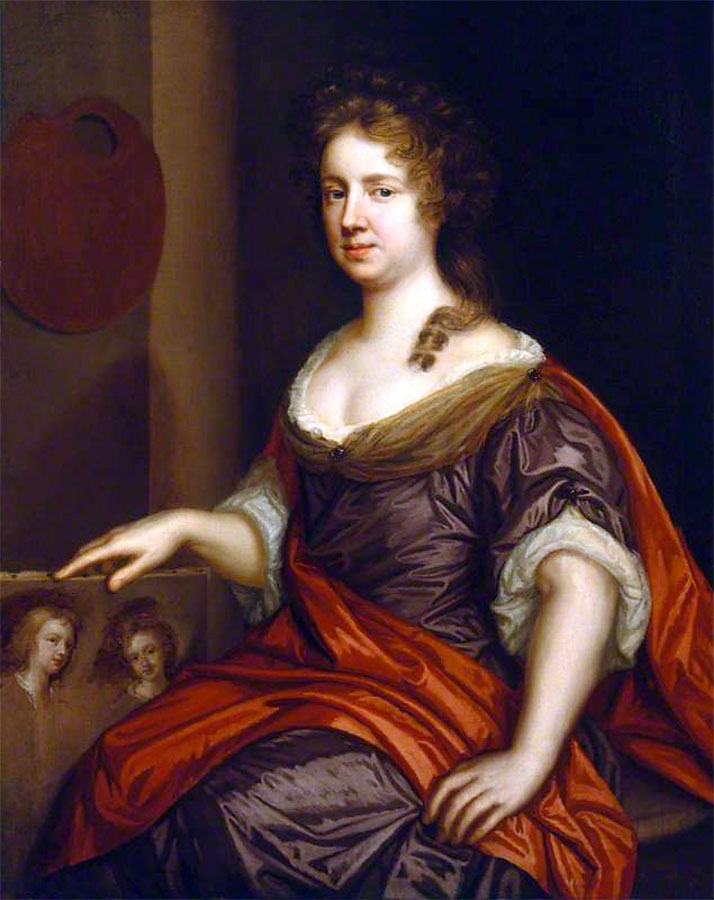
 

Mary Beale (English, 1633-1699) 'Mary Beale' c. 1666


Mary Beale (English, 1633-1699)
Mary Beale
c. 1666
Oil on canvas
109.2 x 87.6cm
National Portrait Gallery, London
Purchased, 1912
CC BY-NC-ND


Beale is shown holding an unframed canvas on which are sketch portraits of her two sons, Bartholomew (1656-1709) and Charles (1660-1714?)


Mary Beale (English, 1633-1699) 'Self Portrait' c. 1675


Mary Beale (English, 1633-1699)
Self Portrait
c. 1675
Oil on sacking
89 x 73cm
West Suffolk Heritage Service
Purchased
CC BY-NC-ND


The early English portrait painter Mary Beale (1622/1623-1699) had a father who was an amateur artist, miniature painter and a collector of paintings (her family owned work by Peter Paul Rubens and Anthony van Dyck) and her husband, Charles, was also an amateur painter and ran her studio in London’s fashionable Pall Mall.

Unusually, in her case, her talent was matched by her spouse’s high regard of it, and she was allowed to supersede him and establish a professional career. She took on female apprentices, though no records of their subsequent careers survive.

Alicia Foster. “Blazing a trail: Britain’s first women artists deserve to be better known,” on the Art UK website 13 May 2024 [Online] Cited 03/09/2024


Exhibition guide

Now You See Us: Women Artists in Britain 1520-1920 celebrates over 100 women who forged public careers as artists. The exhibition begins with the earliest recorded women artists working in Britain. It ends with women’s place in society fundamentally changed by the First World War and the first women gaining the right to vote. Across these 400 years, women were a constant presence in the art world. Now You See Us explores these artists’ careers and asks why so many have been erased from mainstream art histories.

Organised chronologically, the exhibition follows women who practised art as a livelihood rather than an accomplishment. The chosen works were often exhibited at public exhibitions, where these artists sold their art and made their reputations. Most of the women featured belonged to a social class that gave them the time and opportunity to develop their talents. Many were the daughters, sisters or wives of artists. Yet even these women were regarded differently. Now You See Us charts their fight to be accepted as professional artists on equal terms with men.

Many of the exhibited works reflect prejudiced notions of the most appropriate art forms and subjects for women. Others challenge the commonly held belief that women were best suited to ‘imitation’, proving they have always been capable of creative invention. From painting epic battle scenes to campaigning for access to art academies, these women defied society’s limited expectations of them and forged their own paths. Yet so many of their careers have been forgotten and artworks lost. Drawing on the artists’ own writings, art criticism, and new and established research, this exhibition attempts to restore these women to their rightful place in art history. Now You See Us aims to ensure these artists are not only seen but remembered.

Women at the Tudor Courts

There are significant gaps in our knowledge of women’s artistic lives in the sixteenth century. As is the case for many artists in this exhibition, their lives are poorly documented and often hidden behind those of their husbands and fathers. The problems this presents are evident in this room.

Susanna Horenbout (1503-1554) and Levina Teerlinc (c. 1510s-1576) are among the earliest women in Britain to be named as artists. Their reputations are clearly recorded. In 1521, Horenbout’s skill was admired by the German painter and printmaker Albrecht Dürer (1471-1528), and in 1567, both artists were praised by the Italian historian Lodovico Guicciardini (1521-1589). Yet no works by Horenbout have been identified, and those attributed to Teerlinc are not certain.

Horenbout and Teerlinc were both daughters of Flemish manuscript illuminators and were likely trained in their family workshops. Both arrived in England to work at the court of Henry VIII. But as women, they were not employed as artists. While Horenbout’s brother Lucas Horenbout (1490-1544) was Henry VIII’s painter, she served Anne of Cleves as one of her Gentlewomen of the Privy Chamber. Teerlinc served Elizabeth I likewise. This does not mean that they did not paint – at court, their artistic talents would have been a distinguishing skill – but, as is a common feature of this exhibition, written histories have failed to record their activities.

Working in a different context – as a scribe and calligrapher – the works of Esther Inglis (1571-1624) can be identified. Inglis authored more than 60 manuscript books and included her name and self-portrait in many. Raised in Scotland, she may have learnt the art of calligraphy from her mother, Marie Presot (active 1569-1574).

Artemisia Gentileschi

Italian artist Artemisia Gentileschi arrived in London in c. 1638-9 by invitation of Charles I. Like other European rulers, Charles I employed artists of international reputation to signal the cultural sophistication of his court. Gentileschi had prestigious patrons across Europe, including the Grand Duke of Tuscany and Philip IV of Spain. She was the first woman to be a member of the Academy of the Arts of Drawing in Florence, and in Rome, her house had been ‘full of cardinals and princes’. Gentileschi’s fame as an artist was augmented by her status as a woman.

In London, Gentileschi worked for Charles I and Queen Henrietta Maria. Records suggest she produced seven works for the royal collection. These included self-portraits and large history paintings, with subject matter drawn from classical history, mythology, and the Bible. Only the two displayed here are still known. Gentileschi often placed women at the centre of her works, depicting narratives that celebrate their strength and virtue. Susanna and the Elders is an example of the kind of work for which Gentileschi was celebrated.

Gentileschi achieved in her lifetime what many women who came after her had to fight to attain: she was a professional artist who ran her own studio, was a member of an art academy, worked from life models and was ranked as a serious artist alongside men. Despite this, Gentileschi’s status has fluctuated over time, and the artist has faded in and out of art history.

Early accounts of Gentileschi’s work focus on her personal life as much as her painting. Like many of the women artists who came after her, the details of her biography continue to dictate interpretations of her work.

The First Professionals

In 1658, historian William Sanderson (c. 1586-1676) published Graphice. The use of the pen and pensil. Or, The most excellent art of painting. The publication lists contemporary artists practising in England. He includes four women working in oil paint: ‘Mrs Carlile’ (Joan Carlile), ‘Mrs Beale’ (Mary Beale), ‘Mrs Brooman’ (probably Sarah Broman) and ‘Mrs Weimes’ (Anne Wemyss). Carlile and Beale are believed to be two of the earliest British women to have worked as professional artists. Very little is known about Broman or Wemyss beyond snatches of information in archives.

This short list highlights how unusual it was for British women to pursue art as a profession in the seventeenth century. Women had little agency over their own lives and were subject first to their fathers and then their husbands. Limited to the domestic sphere, they were not expected to conduct public lives. Many women painted privately with no thought of turning it into a career. While young men began as apprentices or assistants in the studios of professionals, this route was not open to most women.

In the seventeenth century women writers, poets, playwrights and artists began to give voice to those questioning their secondary status and petitioning for women’s rights. They argued that it was lack of education, not ‘weak minds’ that limited their opportunities. This fight for equality and access to education runs throughout the exhibition.

The First Exhibitors

The first public art exhibition in Britain took place in London in 1760, and art shows soon became an important part of the city’s social calendar. Founded in 1768, the Royal Academy quickly emerged as a driving force in cultural life, with its Summer Exhibition attracting tens of thousands of visitors every year. Other venues, including the Society of Artists and the British Institution also hosted exhibitions.

Women artists played an active part in this competitive world. An estimated 900 women exhibited their work between 1760 and 1830. Angelica Kauffman and Mary Moser were both founding members of the Royal Academy (although, as women, they weren’t awarded full membership and were excluded from the Academy’s council meetings and governance). Despite this precedent, it would take more than 150 years for the next woman to be elected to membership.

Kauffman is one of the few women artists of the eighteenth century whose profile has been sustained. Many others made names for themselves, but their careers are not well documented. Even Moser is less well known, perhaps because she painted flowers while Kauffman pursued the ‘high genre’ of history painting, depicting historical, mythological and biblical narratives.

Art critics of the time often criticised women for their ‘weak’ figurative work, yet they were denied access to life-drawing classes. Women artists also had to battle social expectations. Publishing a private or studio address in an exhibition catalogue was a signal of commercial practice, but painting for money was considered improper. Women artists of higher social rank were listed as ‘honorary’ exhibitors; some exhibited simply as ‘a Lady’, and after marriage, many switched their status from ‘commercial’ to ‘amateur’.

‘Just What Ladies Do For Amusement’

In 1770, the Royal Academy banned ‘Needle-work, artificial Flowers, cut Paper, Shell-work, or any such baubles’ from its exhibitions. They also banned works that were copies. Other categories of art that the Academy considered ‘lower’, such as miniature painting, pastel and watercolour were also treated dismissively. Joshua Reynolds (1723-1792), the Academy’s President, said that working in pastel was unworthy of real artists and was ‘just what ladies do when they paint for their own amusement’.

These ‘lower arts’ were ones that women practised the most. Small in scale and considered less technically challenging than oil painting, they demanded less equipment and could be pursued at home. They were taught to middle and upper-class girls and were the realm of women who pursued art as amateur accomplishment.

Despite this, these art forms offered opportunities for women to earn a living. Many turned miniature painting, needlework and pastel into lucrative professional careers, supplementing their income through tutoring. Their patrons were often women, and some boasted large, fashionable clienteles and even galleries which became tourist attractions.

Founded in 1754, the Society for the Encouragement of Arts, Manufactures and Commerce (the Society of Arts) offered cash prizes and medals in many categories, including the ‘polite arts’. Awards were given for patterns for embroidery, copies of prints, drawings of statues and of ‘beasts, birds, fruit or flowers’, as well as landscapes. Some prizes were specifically intended for young women. The Society was a stepping stone to a career and many of the artists in this exhibition won medals. Yet most of the women recorded as submitting work for competition can no longer be identified beyond their names.

Flowers

In the eighteenth and nineteenth centuries, painting flowers was considered a suitably delicate pursuit for women. Imitating nature (rather than demonstrating creative or imaginative flair) was thought to be an appropriate outlet for women’s artistic skills. Flowers were also at the heart of respectable hobbies like embroidery, botany and gardening. In the 1850s, the women’s periodical the Ladies’ Treasury called flower painting ‘a ladylike and truly feminine accomplishment’. When Mary Moser exhibited Cymon and Iphigenia (based on a poem by John Dryden, 1631-1700) at the Royal Academy in 1789, a reviewer urged her to stick to flowers. She painted flowers ‘transcendently’, he noted, and should do ‘nothing else’.

Many women were employed as professional illustrators, recording plant species for horticulturists and botanical publishers. Some conducted hybrid careers, working as illustrators and drawing tutors while exhibiting flower paintings for a wider market. In the Victorian era, critics applauded several women artists as leaders of the genre. Yet the idea that flower painting, especially in watercolour, was an exclusively amateur pastime has damaged the legacies of many accomplished artists who successfully worked within this genre.

Victorian Spectacle

Grand exhibitions were a defining part of the Victorian art world. The Royal Academy, the leading art institution since 1768, was still Britain’s most prestigious exhibition venue, but was later criticised for its traditional conservatism. New venues, such as London’s Grosvenor Gallery, which opened in 1877, became rival spaces, and exhibitions in Liverpool and Manchester offered fresh opportunities for exhibiting artists. The Victorian era was also the age of World Fairs. Major exhibitions were held in London and Paris, and in 1893, the World’s Exposition in Chicago was visited by over 25 million people.

This room explores the successes of women artists on this public stage. Many of the works on display were shown in these exhibitions. They won international medals, praise from art critics and public recognition. Yet women tackling ‘male’ subjects, such as battle scenes, caused surprise. Opinion was also divided on women painting the nude: some thought it immoral, others brave.

Exhibitions gave women a public platform to build substantial reputations, and some became popular names. Despite this, membership of the Royal Academy, which was a mark of professional recognition, remained out of reach. As a result, women had no automatic exhibiting rights and were reliant on committees of men selecting their works for exhibition. Without institutional support, they had to navigate the commercial art market on their own.

Women artists’ campaigns for access to the Academy joined calls for greater equality in society. From the 1850s, women petitioned for equal rights to education and work, as well as women’s suffrage. These causes are reflected in the works in this room.

Watercolour

Watercolour was considered one of the ‘polite arts’ best suited to women. However, there were few opportunities to practice professionally. The principal watercolour societies – the Old (founded in 1804) and the rival New (founded in 1807 and reconstituted in 1831) – restricted the membership of women. Membership of the Old was limited to six women (in practice, usually four), while the New admitted around ten.

In both societies, women were confined to the category of ‘Lady Members’ until the end of the nineteenth century. They had no say in governance and were denied access to the financial premiums awarded to full members. Since the annual exhibitions of both societies were closed to non-members, most women had limited opportunities to exhibit their work.

Against these odds, many women water colourists achieved significant commercial and critical success. They enjoyed solo shows and developed commercial relationships with dealers, taking control of their careers.

In 1857, a group of women founded the Society of Female Artists (later, the Society of Lady Artists in c. 1869, then the Society of Women Artists in 1899) to promote the work of women artists in Britain.

Photography

The announcement of photography in 1839 marked a major shift in the art world. In its first decades, photography was a laborious practice that required an understanding of chemistry and optics, as well as expensive equipment. It needed more money, specialist instruction and time than most other art forms. For women who had access to these privileges, the medium provided new opportunities.

From its foundation in 1853, the Photographic Society of London welcomed women members. However, they rarely attended meetings, which were scheduled in the evenings when women required a chaperone to leave the house. The atmosphere of the meetings was described as a ‘men’s club’ and it wasn’t until 1898 that the Society belatedly banned smoking ‘in respect of ladies’ attendance’. Meetings often included papers on new techniques and equipment, providing significant benefits to those who were able to join.

Women participated in London’s first public photographic exhibitions at the Royal Society of Arts in 1852-3 and at the Photographic Society in 1854. The Amateur Photographic Association, established in 1861, also welcomed women from its outset. In the 1890s and early 1900s, London’s Photographic Salon became a key venue. Founded by the Linked Ring Brotherhood, who promoted photography as a fine art, Salon exhibitors included women from across Europe and the US. A photograph of British photographer Carine Cadby in silhouette, examining one of her glass plate negatives, featured on the cover of the 1896 Salon catalogue. Despite this, women were not elected as members of the Linked Ring until 1900. By 1909, they numbered just 8 among 63 men.

Art School

Women were excluded from enrolment at the Royal Academy Schools, Britain’s principal art academy, until 1860. Laura Herford (1831-1870) was the first woman admitted. She had submitted her work for consideration using only her initials and was assumed to be a man. Once women gained entry, they were determined to achieve equal access to training.

Women were barred from the Academy’s life-drawing classes until 1893. Their exclusion from this vital component of art education was justified on many grounds. Chiefly, it was to ‘protect’ women’s supposed modesty, but also because they were considered amateurs who lacked the intellectual capacity to practice art at the highest level. Women students marshalled critical support for their cause and submitted petitions. Life drawing was considered essential to the training of men pursuing careers as artists. Why, they argued, was it not also essential for women?

The Female School of Art, founded in 1842, provided another route into art education. Like several regional schools, such as that in Manchester, it encouraged women into vocational careers in design. Women also had access to private academies, including Sass’s and Leigh’s (later Heatherleys) in London, which prepared students for admission to the Royal Academy Schools. And some women artists, such as Louise Jopling, established their own art school.

In 1871, the founding of the Slade School of Fine Art at University College London signalled a fundamental change of attitudes. From the outset, the Slade offered women an education on equal terms with men. Studying from life models was a central focus of teaching and by the turn of the century, women students outnumbered men by three to one. Access to life drawing had been regarded as the last barrier to equal opportunity. Now they could study from life, some critics argued it was up to women to prove they could be successful artists.

Being Modern

The first two decades of the twentieth century saw rapid change for women, with their rights, roles and opportunities evolving at an unprecedented pace. The First World War signalled a decisive change for women’s place in society and in 1918, after decades of campaigning, some women finally gained the right to vote.

At the same time, the art world was also changing. New art groups and exhibiting societies rejected tradition and promoted modernist aesthetics. Instead of figurative realism, they privileged form, colour and experimentation. Many saw modernism as an opportunity for greater artistic freedom. However, despite growing liberalism in art and society, women artists still faced challenges. The New English Art Club became a rival exhibiting venue to the Royal Academy but was slow to admit women. The Camden Town Group labelled itself ‘progressive’ but openly excluded women.

While modernism is often presented as the dominant movement of the early twentieth century, it doesn’t account for all artistic production of the period. Membership of the Royal Academy, an exhibiting venue many now regarded as too traditional, remained a symbolic goal for many women. When Annie Swynnerton was elected an Associate Member in 1922, Laura Knight said she had broken down the ‘barriers of prejudice’. In 1936, Knight was elected a Royal Academician, becoming the first woman to achieve full membership since the eighteenth century.

The artworks in the final room of the exhibition explore this complex period. Their variety reveals women forging their own paths and pursuing professional careers with purpose and confidence. While many chose not to challenge traditional artistic values, they pushed the boundaries of what was expected of them, paving the way for generations of women artists who came after them.

Text from the Tate exhibition guide
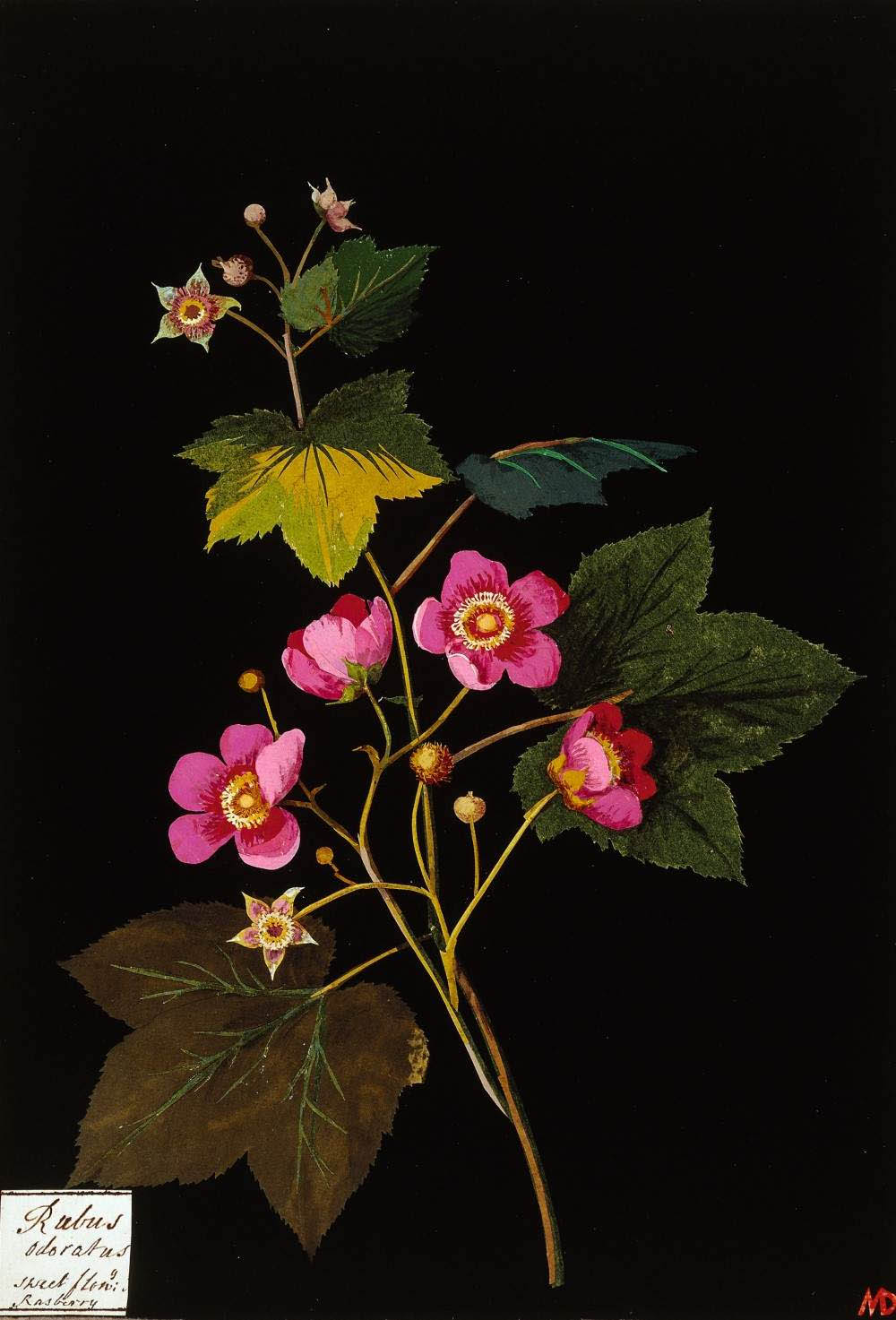
 

Mary Delany (English, 1700-1788) 'Rubus Odoratus' 1772-1782


Mary Delany (English, 1700-1788)
Rubus Odoratus
1772-1782
The British Museum
Bequeathed by Augusta Hall, Baroness Llanover in 1897


Delany was not a professional artist. However, she pursued art with a seriousness of purpose, working in a range of artistic and decorative mediums. She was in her early seventies when she turned to botanical collage, which stemmed from the Dutch art known as knipkunst or schaarkunst. Over the course of a decade, Delany created nearly one thousand botanically accurate collages of plants made from intricately cut pieces of coloured paper. In this collage, Delany shows a flowering raspberry, which was introduced to Britain from North America in 1770.

Text from the exhibition large print guide
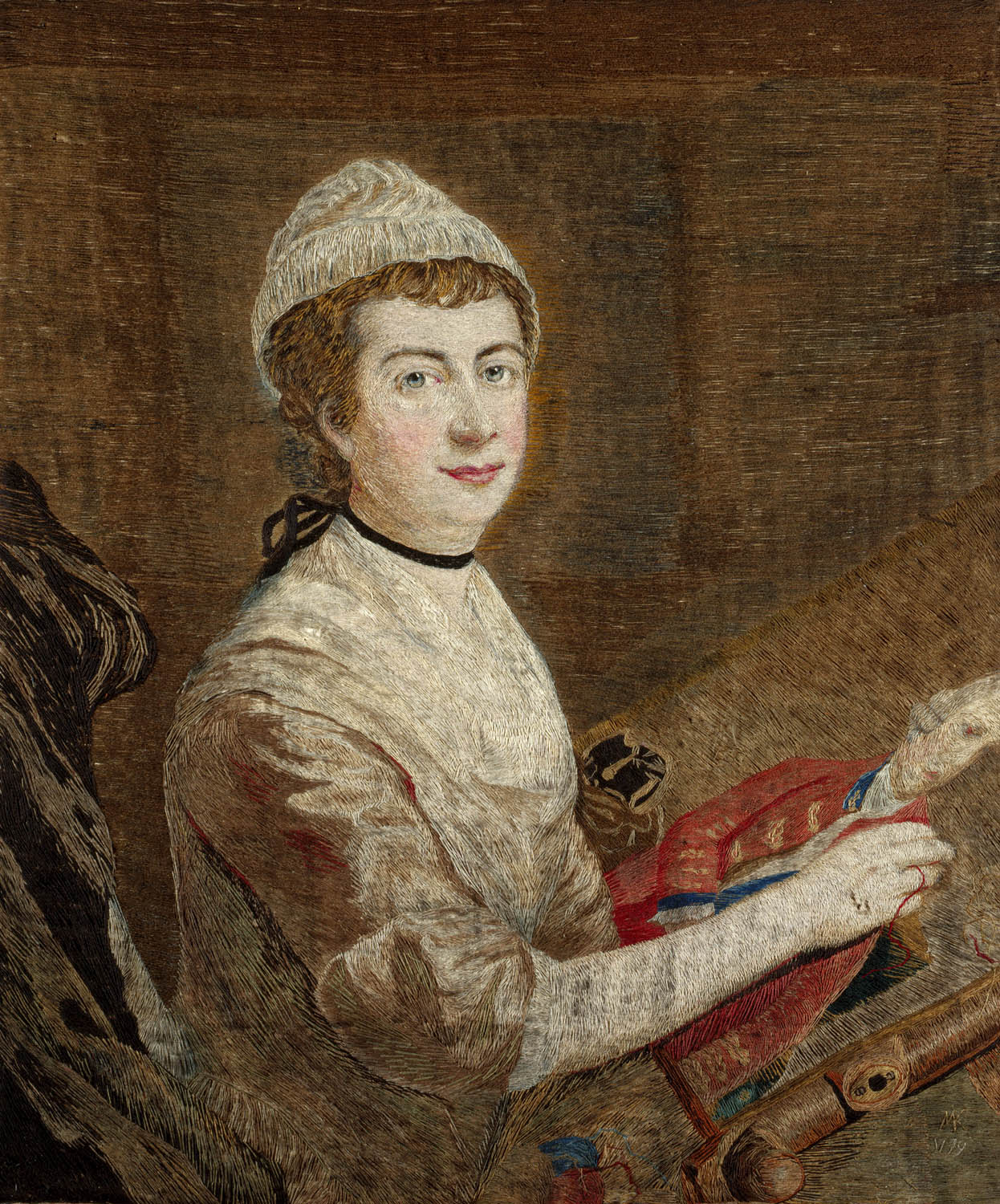
 

Mary Knowles (English, 1733-1807) 'Needlework Picture' 1779


Mary Knowles (English, 1733-1807)
Needlework Picture
1779
Silk (textile), wool, giltwood, glass (material) embroidered, dyeing
89.2 x 84.5cm (frame, external)
Royal Collection Trust / © His Majesty King Charles III 2024


Mary Morris Knowles, born of a Quaker family in Rugeley, Staffordshire, was celebrated as much for her intellect, religious conviction and unusual powers of conversation as for her skill with the needle. A friend of the poetess Anna Seward (‘The Swan of Lichfield’) and of Dr Johnson, she is now regarded as an important early protagonist of the feminist viewpoint in English cultural life. Her support for the abolition of slavery, her investigation into mystical science and her knowledge of garden design, in addition to her accomplishment as a needlewoman, suggest the breadth of her interests. In 1771 she was introduced by her fellow Quaker Benjamin West to Queen Charlotte, who remained on terms of friendship with her over the next thirty years and whose interest in female accomplishments, notably needlework, was well known. Mrs Knowles’s visits to Buckingham House included an occasion in 1778 on which she presented her 5-year-old son George to the King and Queen.

Following the first visit in 1771, the Queen commissioned Mrs Knowles to make a copy of Zoffany’s portrait of George III in needlework or ‘needle painting’ as it was also known. This technique ‘so highly finished, that it has all the softness and Effect of painting’ was achieved with a combination of irregular satin-stitch and long-and-short stitch, worked on hand-woven tammy in an arbitrary pattern and at speed, using fine wool dyed in a wide range of colours under her own supervision. Eight years later Mrs Knowles embroidered the self portrait showing her at work on the Zoffany which, like the earlier piece, she signed with initials and dated. This appears always to have been in the Royal Collection and was presumably also commissioned by Queen Charlotte.

Text from the Royal Collection Trust website
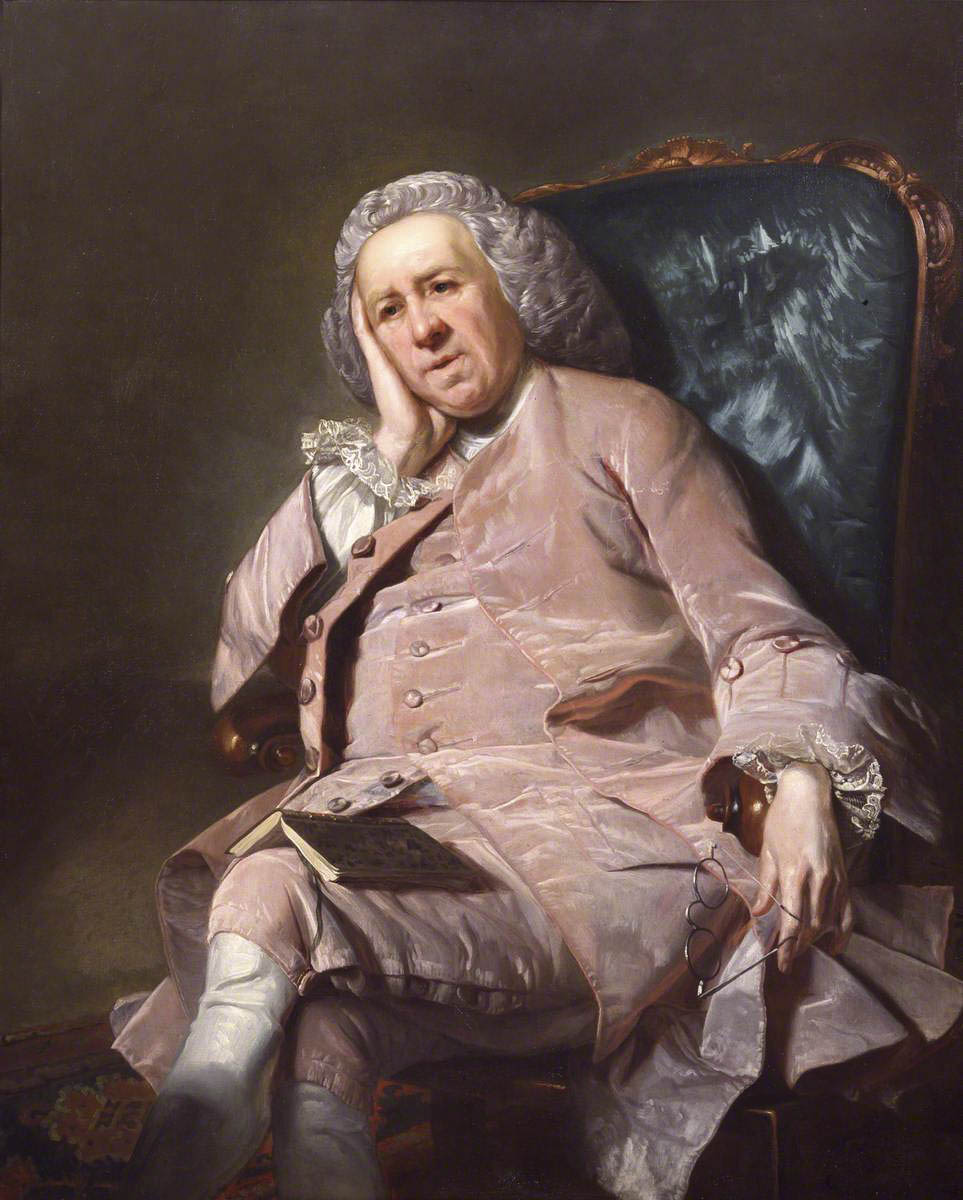
 

Mary Black (English, c. 1737-1814) 'Messenger Monsey (1693-1788)' 1764


Mary Black (English, c. 1737-1814)
Messenger Monsey (1693-1788)
1764
Oil on canvas
127 x 101.6cm
Gift from Frederick Walford, 1877
Royal College of Physicians, London
CC BY-NC-ND


This portrait of the physician Messenger Monsey (1694-1788) is Black’s only known oil painting. Black likely hoped it was a step towards establishing herself as a professional artist, but the issue of payment caused friction. Black hope to charge her client £25, half the amount charged by leading portraitist Joshua Reynolds, but after Monsey’s complaint offered to drop it to a quarter. Monsey considered Black’s expectation of a fee improper. He claimed it would damage her reputation if word got out, and even referred to her as a ‘slut’ in a letter to his cousin.

Wall text from the exhibition


Little is known of the father-and-daughter artists Thomas and Mary Black. Thomas was mainly employed painting draperies for more successful painters, and Mary usually painted copies of old masters. In a letter from Monsey to Mary Black, the doctor wrote: ‘I was bedevilled to let you make your first attempt upon my gracefull person… drawn like a Hog in armour’.

Text from the Art UK website


Black was clearly unfazed by awkward sitters. She built a flourishing artistic practice, painting and teaching the aristocracy, earning enough to live independently (she never married) and keep servants and a horse and carriage at her London home. She died there in old age just as the nineteenth century began.

Alicia Foster. “Blazing a trail: Britain’s first women artists deserve to be better known,” on the Art UK website 13 May 2024 [Online] Cited 03/09/2024


Mary Moser RA (English, 1744-1819) 'Standing Female Nude' Nd


Mary Moser RA (English, 1744-1819)
Standing Female Nude
Nd
Black and white chalk on grey-green paper
49 x W 30.2cm
The Fitzwilliam Museum, Cambridge


As women were excluded from life drawing classes, many took their own steps to improve their anatomical knowledge. They sketched from casts and statues and copied from other artists’ drawings and anatomy books. These rare works show that some artists found ways around these restrictions, although little is known about how Moser and Stone accessed life models.

Text from the exhibition large print guide


Mary Moser RA (English, 1744-1819) 'Flowers in a vase, which stands on a ledge' 1765


Mary Moser RA (English, 1744-1819)
Flowers in a vase, which stands on a ledge
1765
Watercolour and bodycolour on paper
The Syndics of the Fitzwilliam Museum, University of Cambridge


From the same series as the work nearby, this watercolour represents Sagittarius. The vase is filled with a cascade of late flowering plants: asters, chrysanthemums and rare pale nerines, captured in the cold light of winter. In addition to her professional profile as a Royal Academician, Moser acted as a royal tutor. She was part of Queen Charlotte’s circle and taught the princesses botany, embroidery and flower painting. She worked alongside other artists, including Meen and Delany, whose work is also displayed in this room.

Text from the exhibition large print guide


Admired for her striking paintings of flowers, Mary Moser was recognised for her talent from a very young age. She trained with her father, an acclaimed artist and goldsmith, winning her first medal for flower drawing at 14. At just 24, she became one of only two female founders of the Royal Academy, alongside Angelica Kauffman.

Moser painted portraits and historical scenes, but her skilled floral still life works, like Flowers in a vase, which stands on a ledge (1765), were praised by critics. Though still life was traditionally seen as a ‘lesser subject’, her floral works were so widely appreciated she received royal commissions, including one from Queen Charlotte. Despite recognition and the exhibition of many paintings, few of Moser’s works survive today.

Text from the Tate website
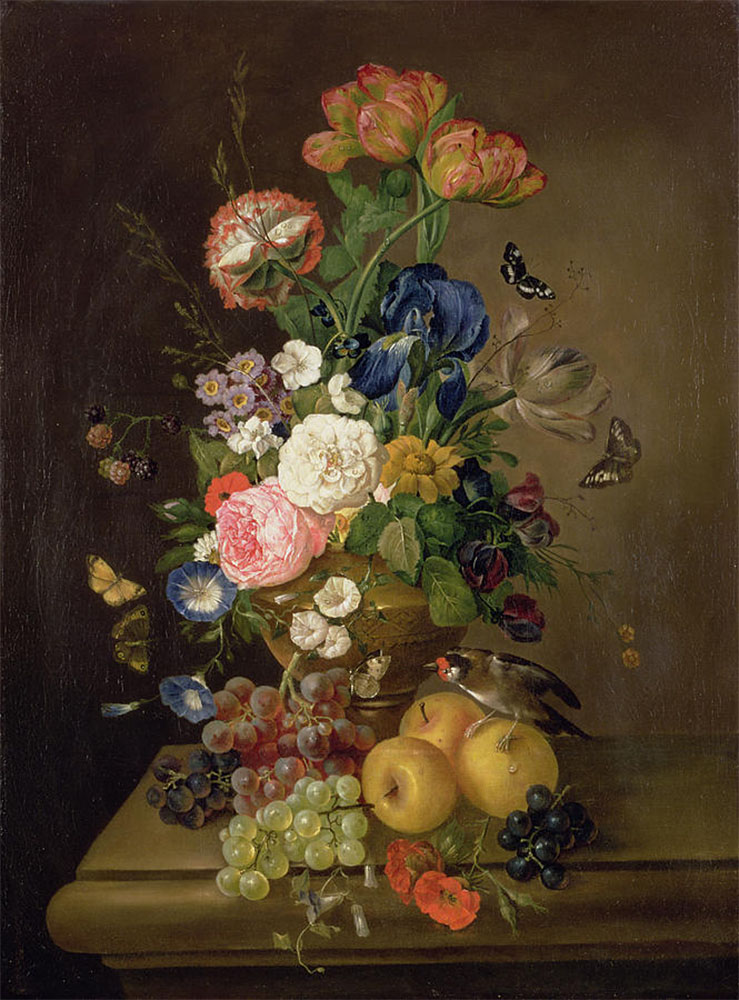
 

Mary Moser RA (English, 1744-1819) 'Vase of Flowers' Between 1758 and 1819


Mary Moser RA (English, 1744-1819)
Vase of Flowers
Between 1758 and 1819
Oil on canvas
72.1 x W 53.6cm
The Fitzwilliam Museum
Gift from Major the Hon. Henry Rogers Broughton, 1966


The exquisite attention to detail in her painting, with its beads of dew and butterflies on the wing, was perhaps nurtured by seeing her father’s work; as a goldsmith and medallion maker, this was also his talent. But the gorgeous sensuality – seen also in her approach to the nude figure – was entirely her own. She married, aged 53, but also had an affair with the estranged husband of another artist: Maria Hadfield Cosway (1759-1839).

Alicia Foster. “Blazing a trail: Britain’s first women artists deserve to be better known,” on the Art UK website 13 May 2024 [Online] Cited 03/09/2024


Installation view of the exhibition 'Now You See Us Women Artists in Britain 1520-1920' at Tate Britain showing Angelica Kauffman's 'Colouring' 1778-1780


Installation view of the exhibition Now You See Us Women Artists in Britain 1520-1920 at Tate Britain showing Angelica Kauffman’s Colouring 1778-1780 (below)
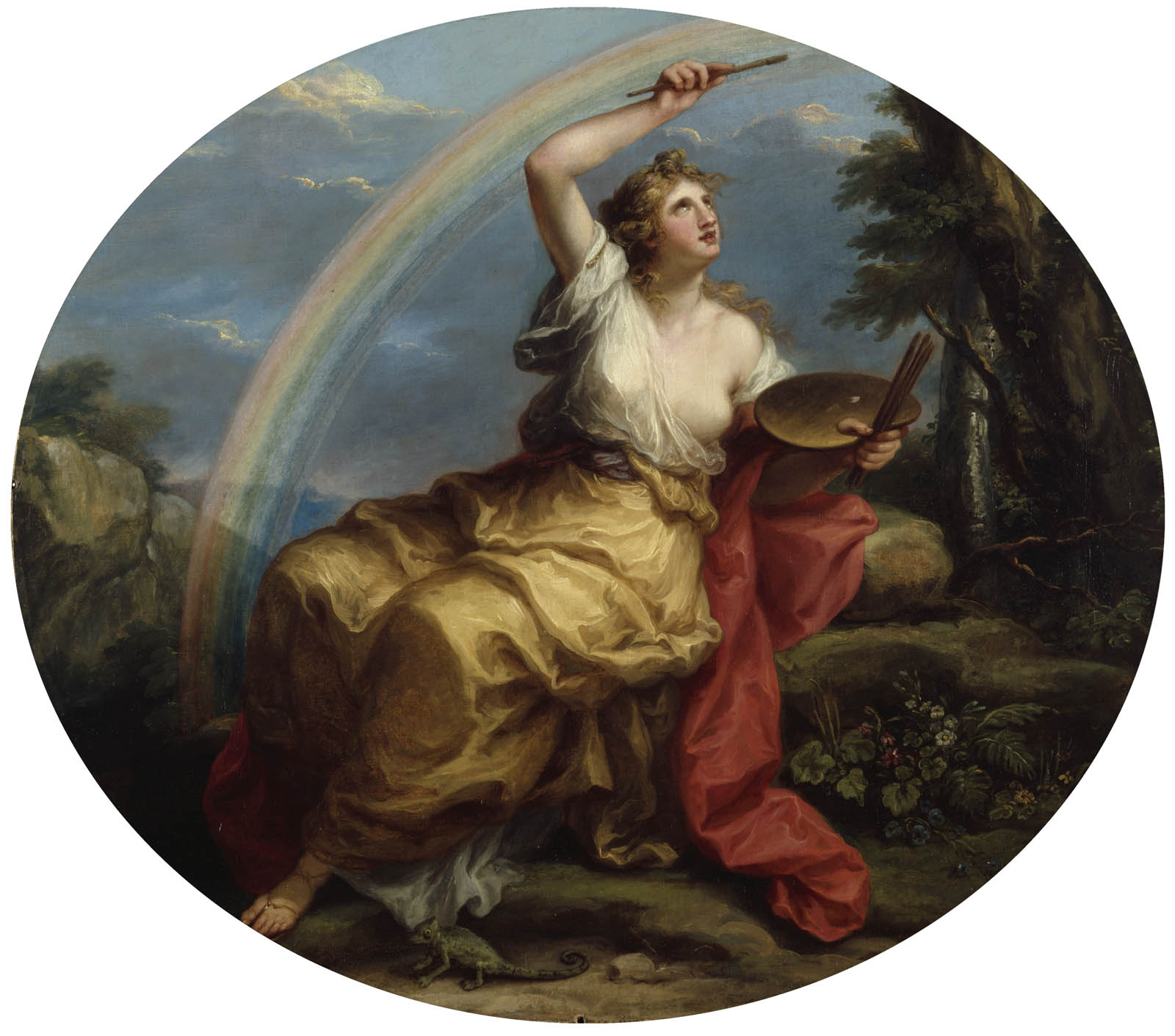
 

Angelica Kauffman RA (Swiss, 1741-1807) 'Colouring' 1778-1780


Angelica Kauffman RA (Swiss, 1741-1807)
Colouring
1778-1780
Oil on canvas
1260 x 1485 x 25 mm
© Royal Academy of Arts, London
Photo: John Hammond


This painting is part of a set of the four [titled ‘Elements of Art’] commissioned from Kauffman by the Royal Academy to decorate the ceiling of the Royal Academy’s new Council Room in Somerset House which opened in 1780. …

Kauffman represented each of her four Elements of Art as women. Female personifications of abstract concepts and values were commonplace in European art but depicting all four as women was unusual. Design (or Disegno), in particular, was known as ‘the father of all the arts’ and was traditionally depicted as a man, often in contrast to Colour or Painting personified as a woman (see Baumgartel). In Design and Colouring, the women are physically engaged in the act of creating whereas in Composition and Invention they are shown in contemplation. In Invention the figure looks to the sky for inspiration and in Composition she is deep in thought with her head resting on her hand in the traditional gesture of melancholy or reverie.

Text from the Royal Academy website


Installation view of the exhibition 'Now You See Us Women Artists in Britain 1520-1920' at Tate Britain showing at centre, Maria Cosway's 'Georgiana as Cynthia from Spenser's 'Faerie Queene'' 1781-1882; and at right, Cosway's 'A Persian Lady Worshipping the Rising Sun' 1784


Installation view of the exhibition Now You See Us Women Artists in Britain 1520-1920 at Tate Britain showing at centre, Maria Cosway’s Georgiana as Cynthia from Spenser’s ‘Faerie Queene’ 1781-1782 (below); and at right, Cosway’s A Persian Lady Worshipping the Rising Sun 1784 (below)
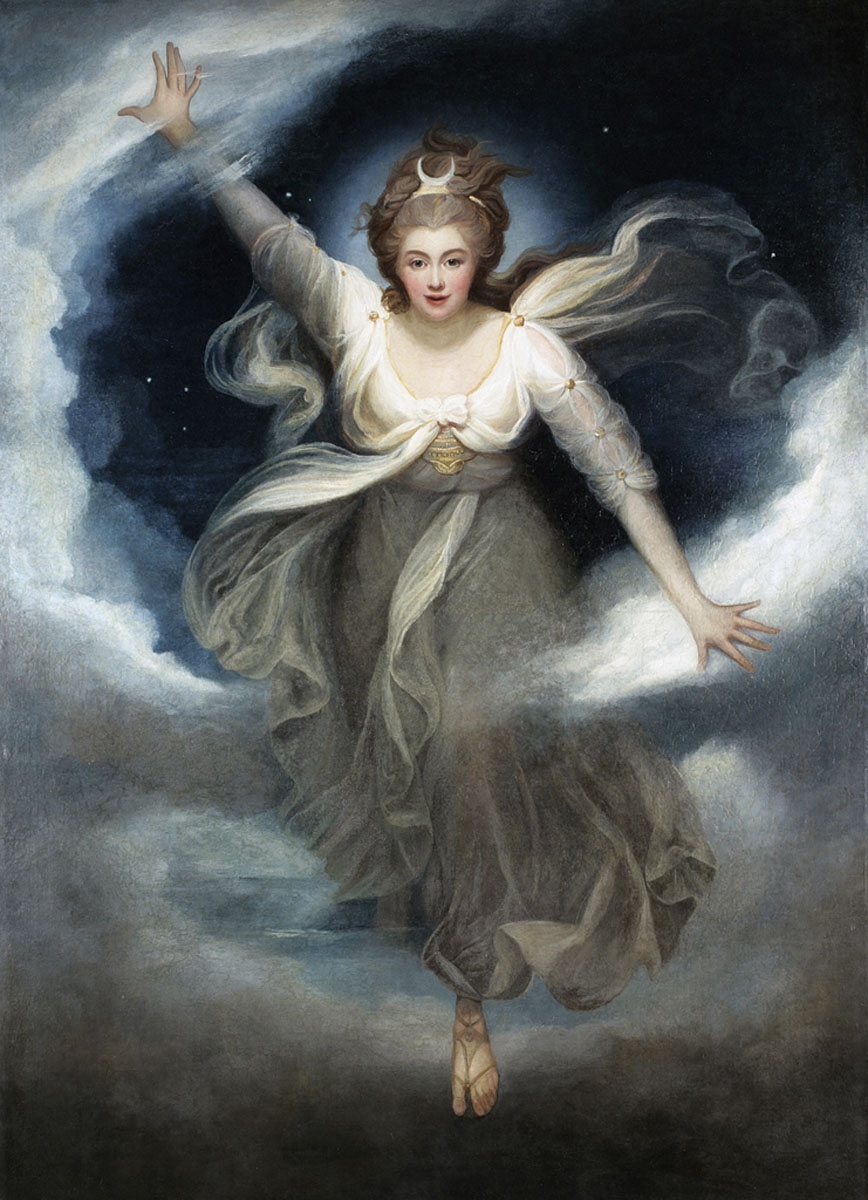
 

Maria Cosway (Italian-English 1760-1838) 'Georgiana as Cynthia from Spenser's 'Faerie Queene'' 1781-1782


Maria Cosway (Italian-English 1760-1838)
Georgiana as Cynthia from Spenser’s ‘Faerie Queene’
1781-1782
Oil on canvas
Chatsworth House
Reproduced by permission of Chatsworth Settlement Trustees / Bridgeman Images
Public domain
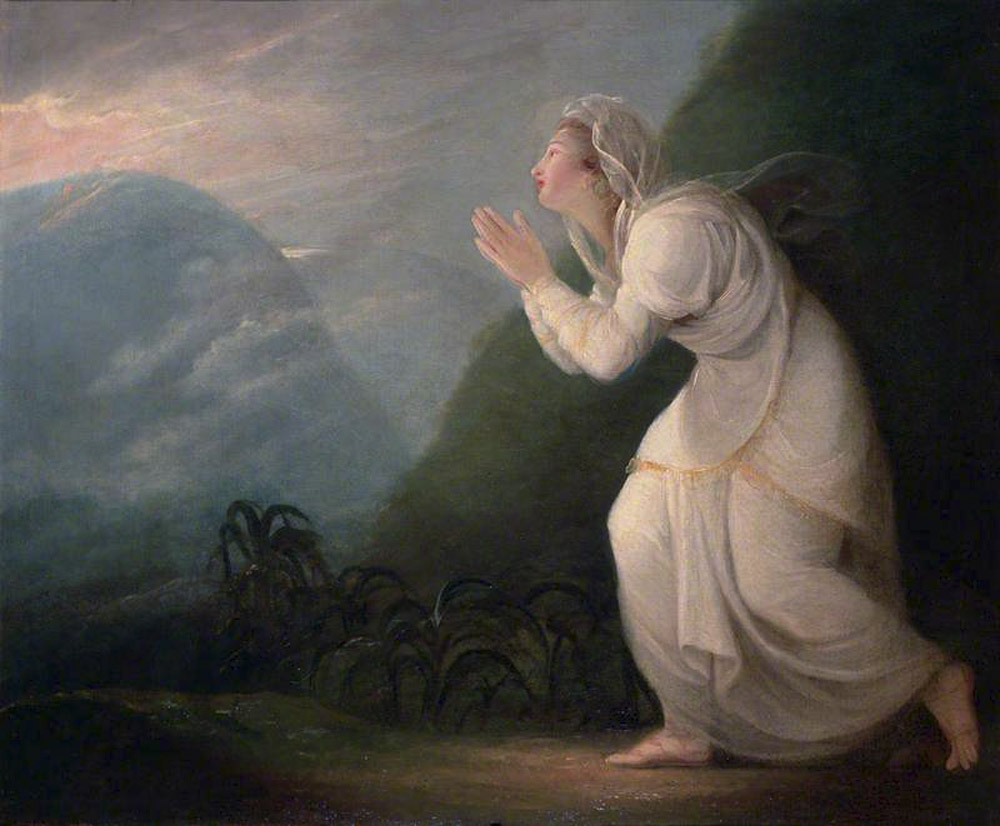
 

Maria Cosway (Italian-English 1760-1838) 'A Persian Lady Worshipping the Rising Sun' 1784


Maria Cosway (Italian-English 1760-1838)
A Persian Lady Worshipping the Rising Sun
1784
Oil on canvas
61 x 73.7cm
Sir John Soane’s Museum
Gift from the artist, 1822
By courtesy of the Trustees of Sir John Soane’s Museum, London
CC BY-NC-ND


As well as portraits, Cosway exhibited history paintings. This work was shown at the Royal Academy in 1784. Although only a few of Cosway’s history pictures can be located now, paintings such as this one were well known through reproductions made by leading engravers and print publishers. Cosway’s success was hindered by her husband, who did not like her to paint professionally. She reflected later that had he permitted it, she would have ‘made a better painter, but left to myself by degrees, instead of improving, I lost what I brought from Italy of my early studies.’

Text from the exhibition large print guide
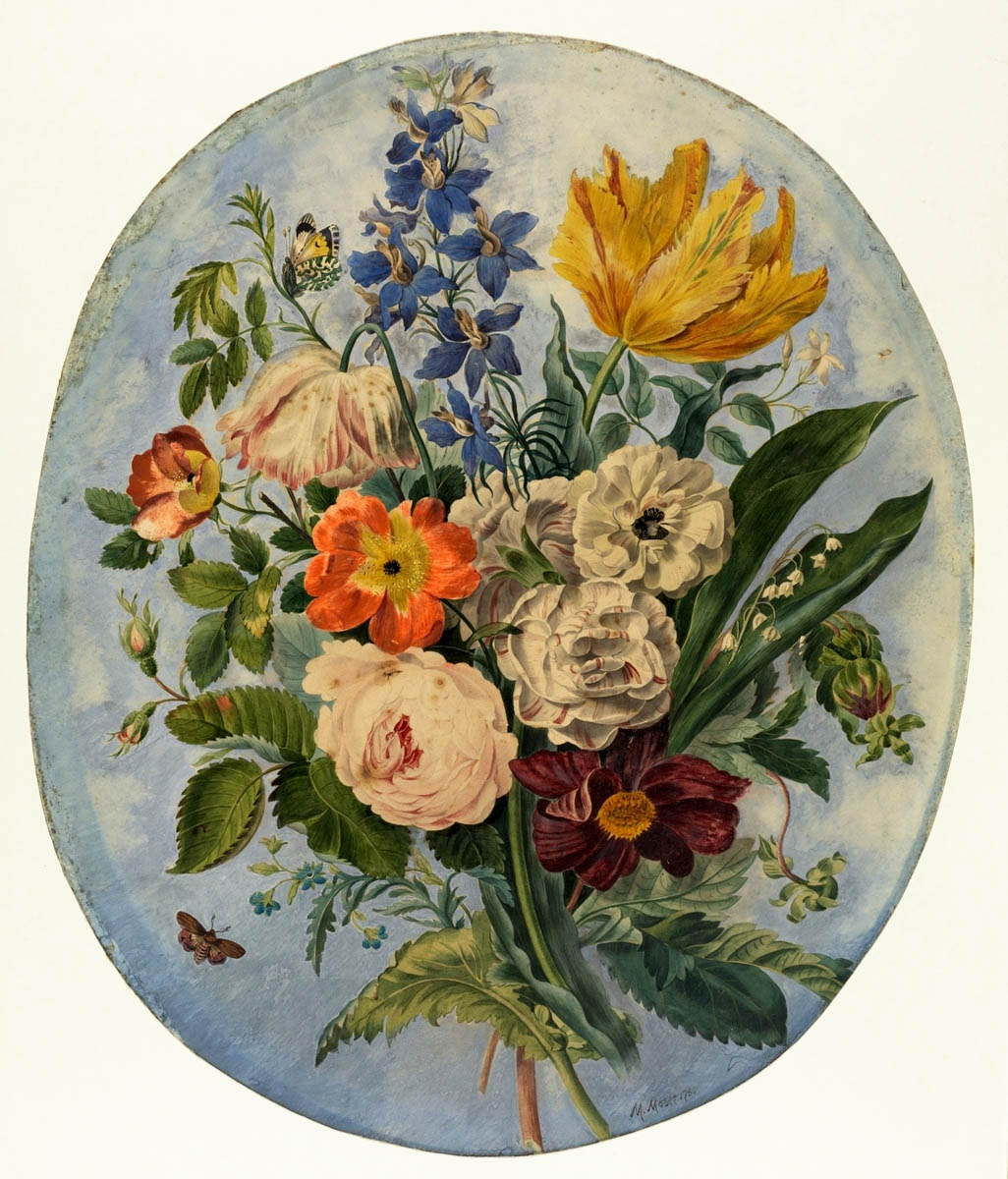
 

Maria Cosway (Italian-English 1760-1838) 'Bouquet of Flowers' 1780


Maria Cosway (Italian-English 1760-1838)
Bouquet of Flowers
1780
Watercolour on paper
The Courtauld, London (Samuel Courtauld Trust)
Bequeathed by Sir Robert Clermont Witt, 1952
CC BY-NC-ND
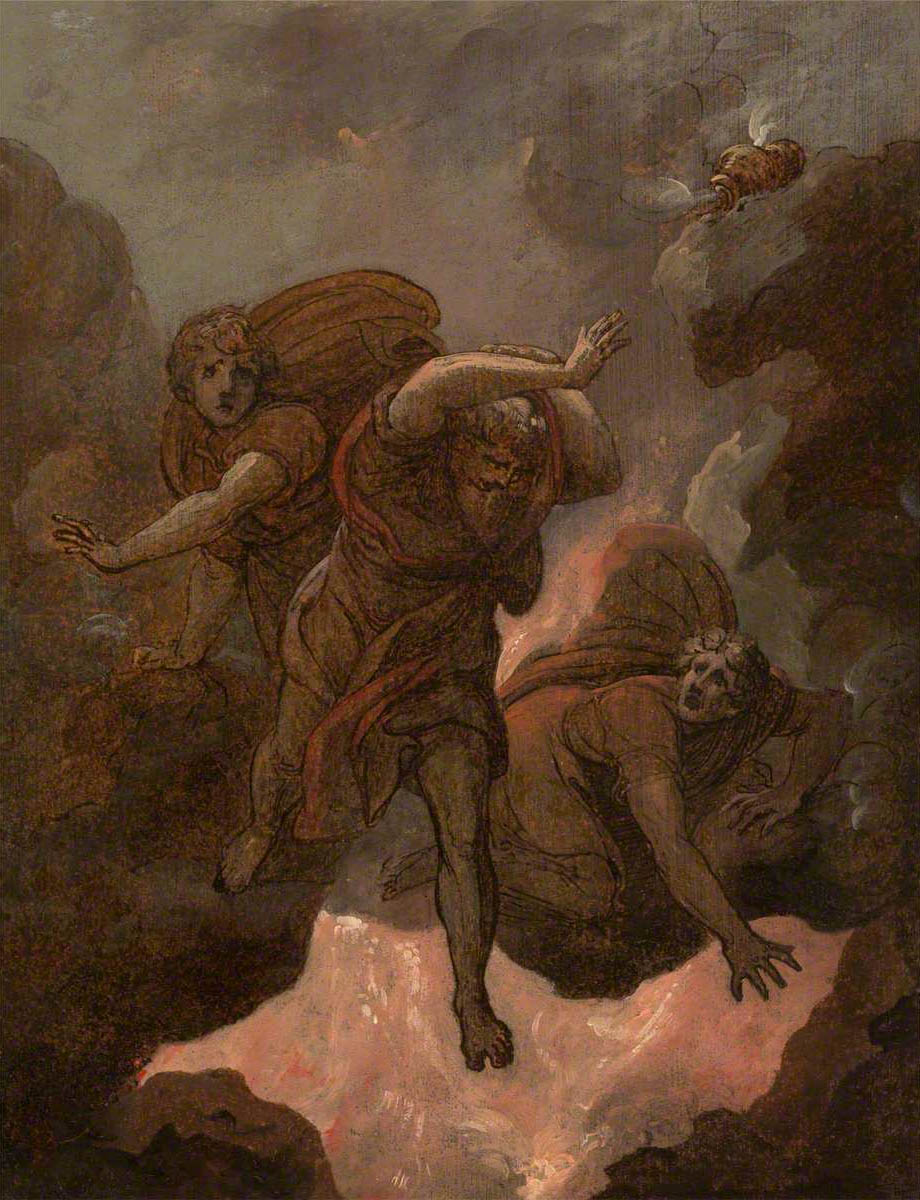
 

Maria Cosway (Italian-English 1760-1838) 'The Judgement of Korah, Dathan and Abiram' c. 1801


Maria Cosway (Italian-English 1760-1838)
The Judgement of Korah, Dathan and Abiram
c. 1801
Pen, ink and oil on canvas
37.5 x 29.2cm
Yale Center for British Art
Paul Mellon Collection
CC BY-NC-ND
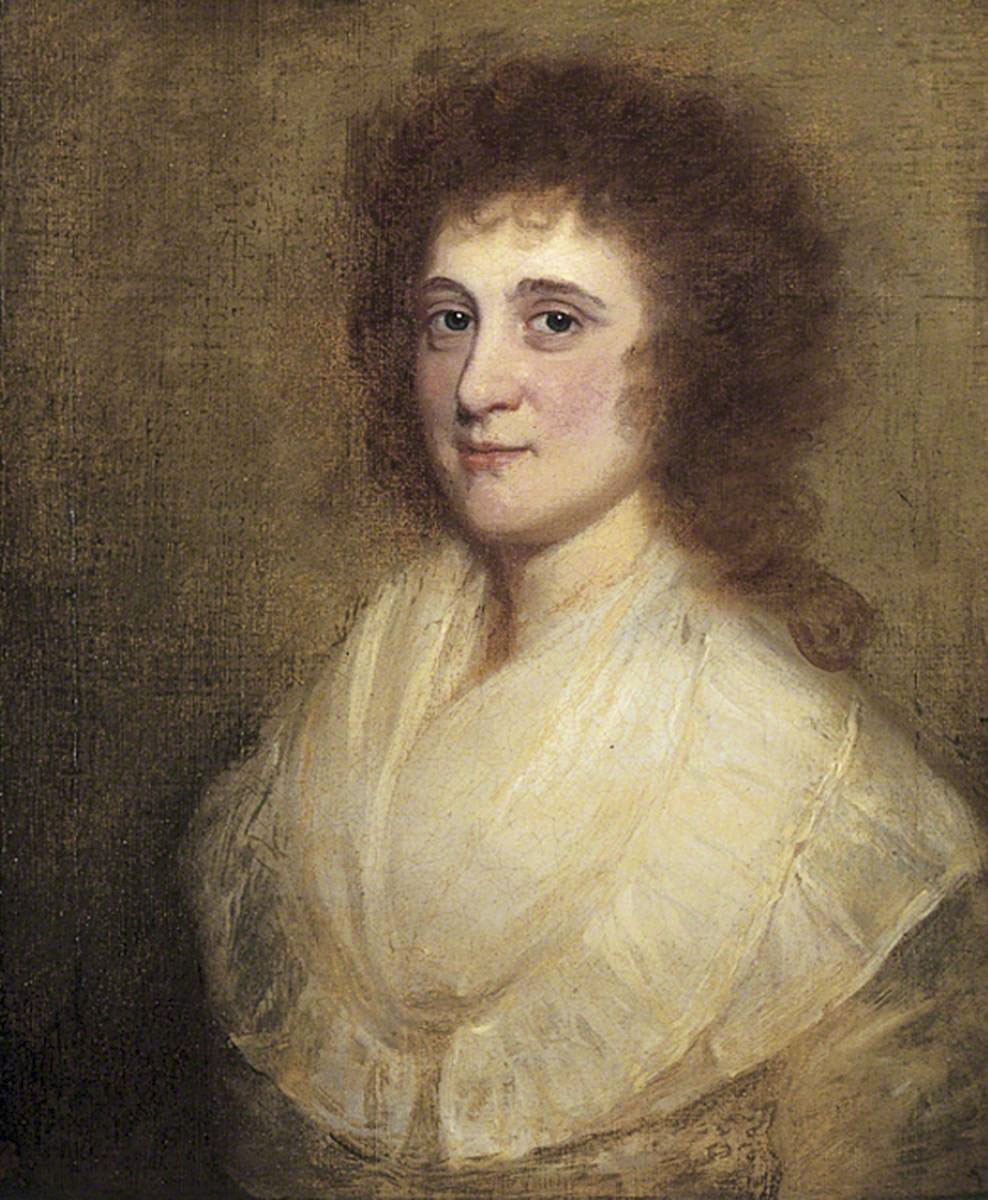
 

Maria Cosway (1759-1838) (after) 'Self Portrait' Nd


Maria Cosway (1759-1838) (after)
Self Portrait
Nd
Oil on canvas
61 x W 50.8cm
Temple Newsam House, Leeds Museums and Galleries
Bequeathed by Sam Wilson, 1925
CC BY-NC-ND
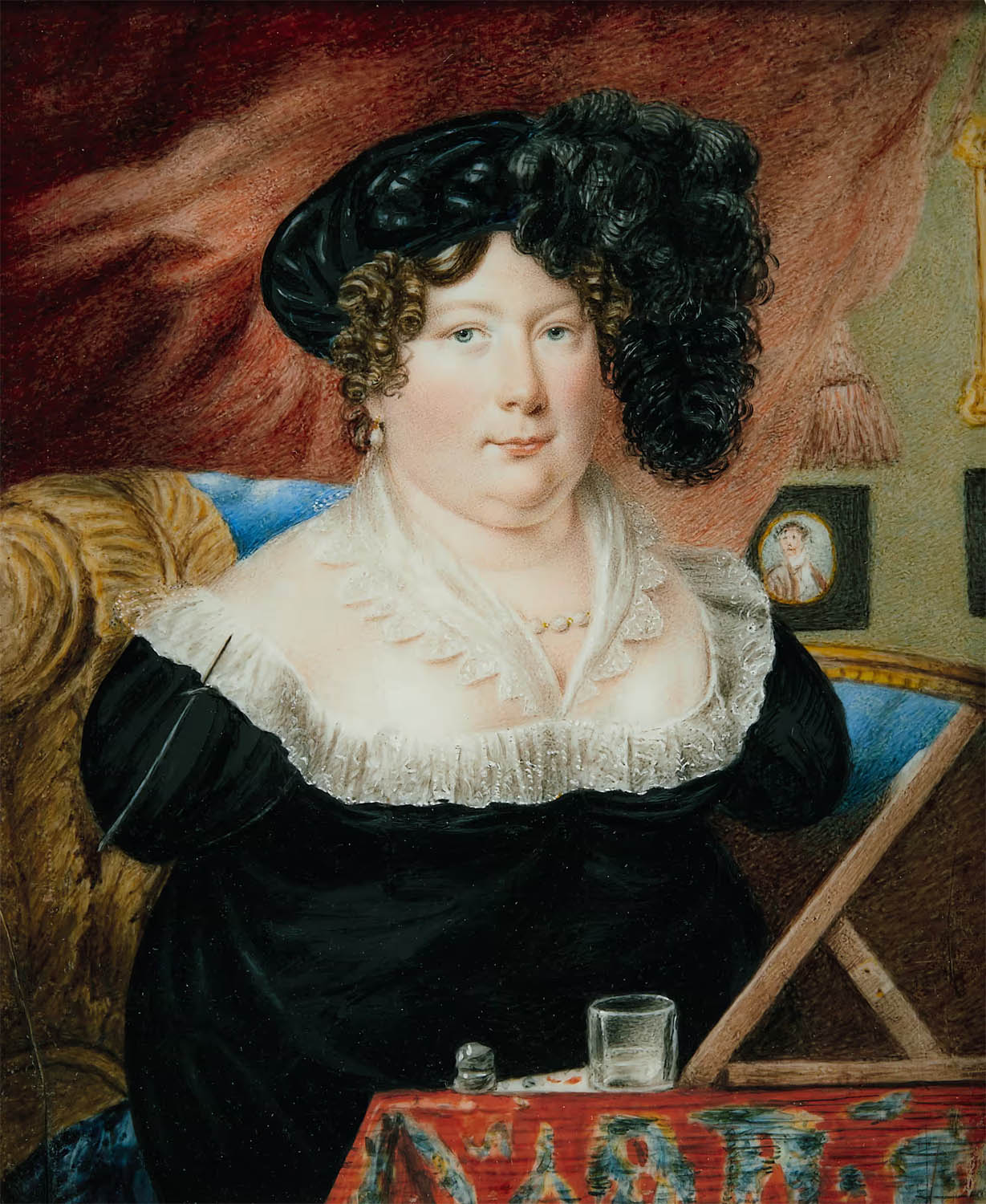
 

Sarah Biffin (English, 1784-1850) 'Self-portrait' c. 1821


Sarah Biffin (English, 1784-1850)
Self-portrait
c. 1821
Watercolour and bodycolour on ivory
Private collection


Biffin, whose baptism record notes that she was born ‘without arms or legs’, taught herself to sew, write and paint using her mouth and shoulder. She wrote that, as a child, ‘I was continually practising every invention; till at length I could, with my mouth – thread a needle – tie a knot – do fancy work – cut out and make my own dresses’.

Text from the exhibition large print guide
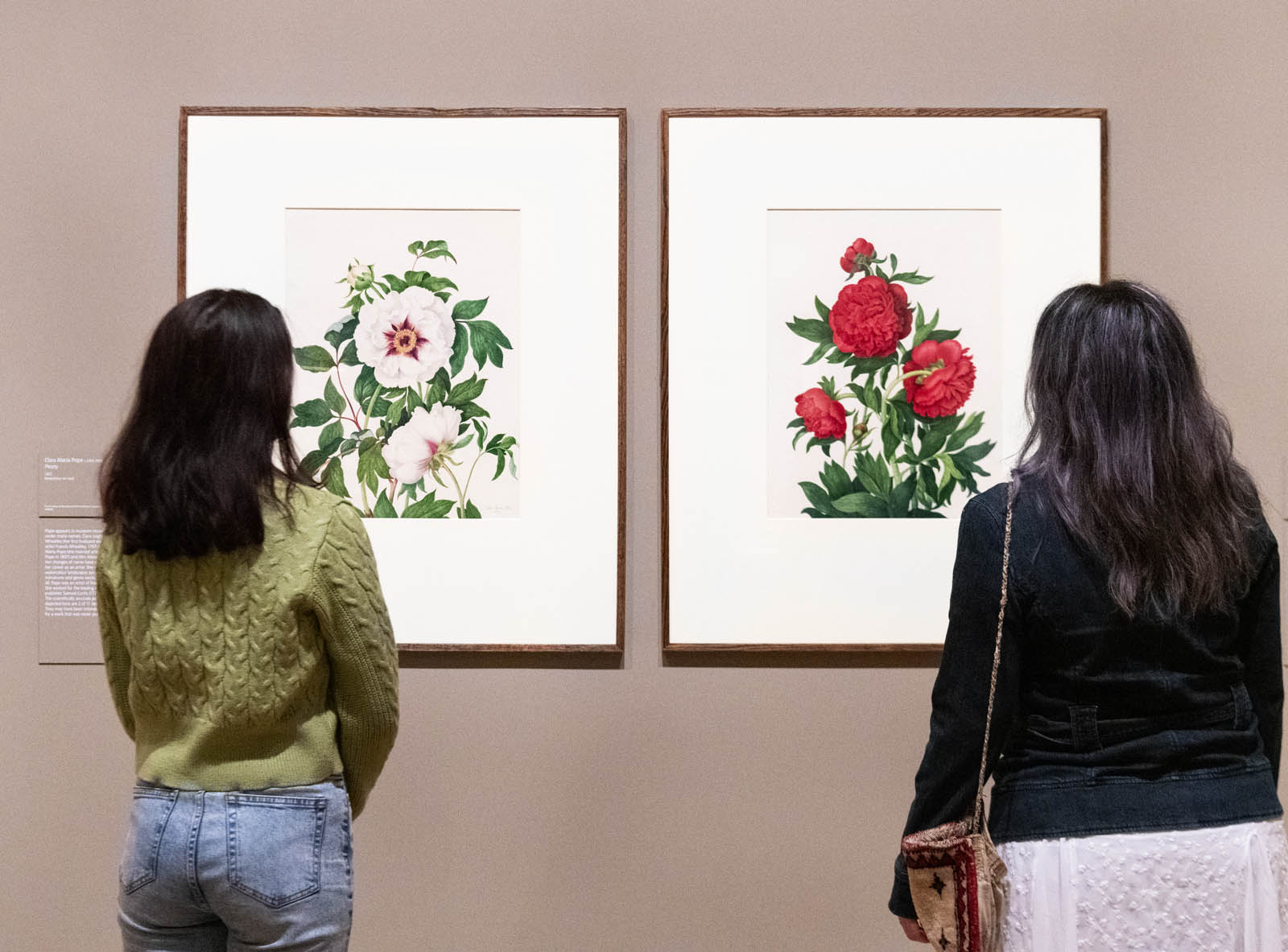
 

Installation view of the exhibition 'Now You See Us Women Artists in Britain 1520-1920' at Tate Britain showing at left, Clara Maria Pope's 'Peony' 1822; and at right, Pope's 'Peony' 1821


Installation view of the exhibition Now You See Us Women Artists in Britain 1520-1920 at Tate Britain showing at left, Clara Maria Pope’s Peony 1822 (below); and at right, Pope’s Peony 1821 (below)
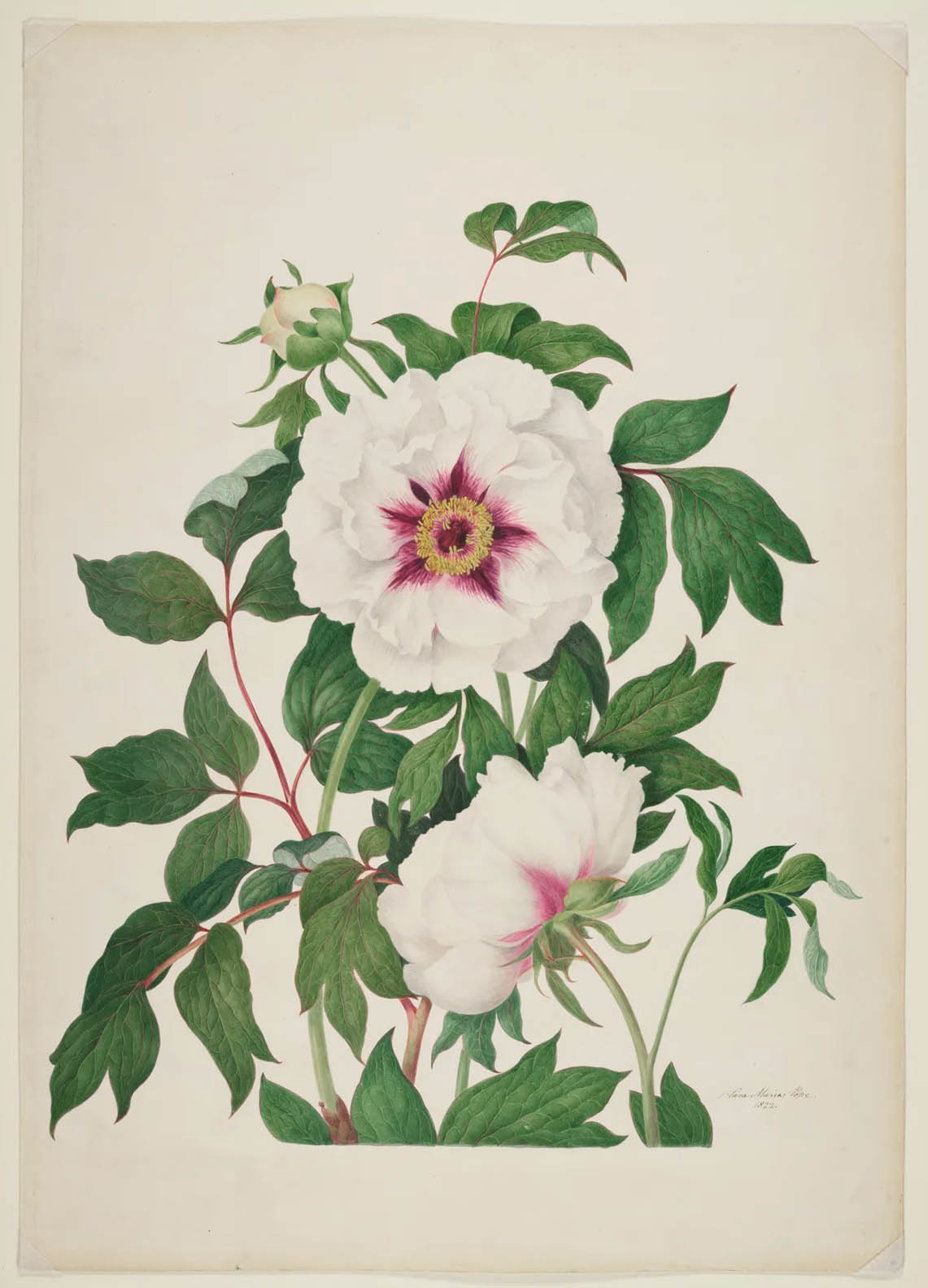
 

Clara Maria Pope (British, 1767-1831) 'Peony' 1822


Clara Maria Pope (British, 1767-1831)
Peony
1822
Bodycolour on card
The Trustees of the Natural History Museum, London
Courtesy the Natural History Museum
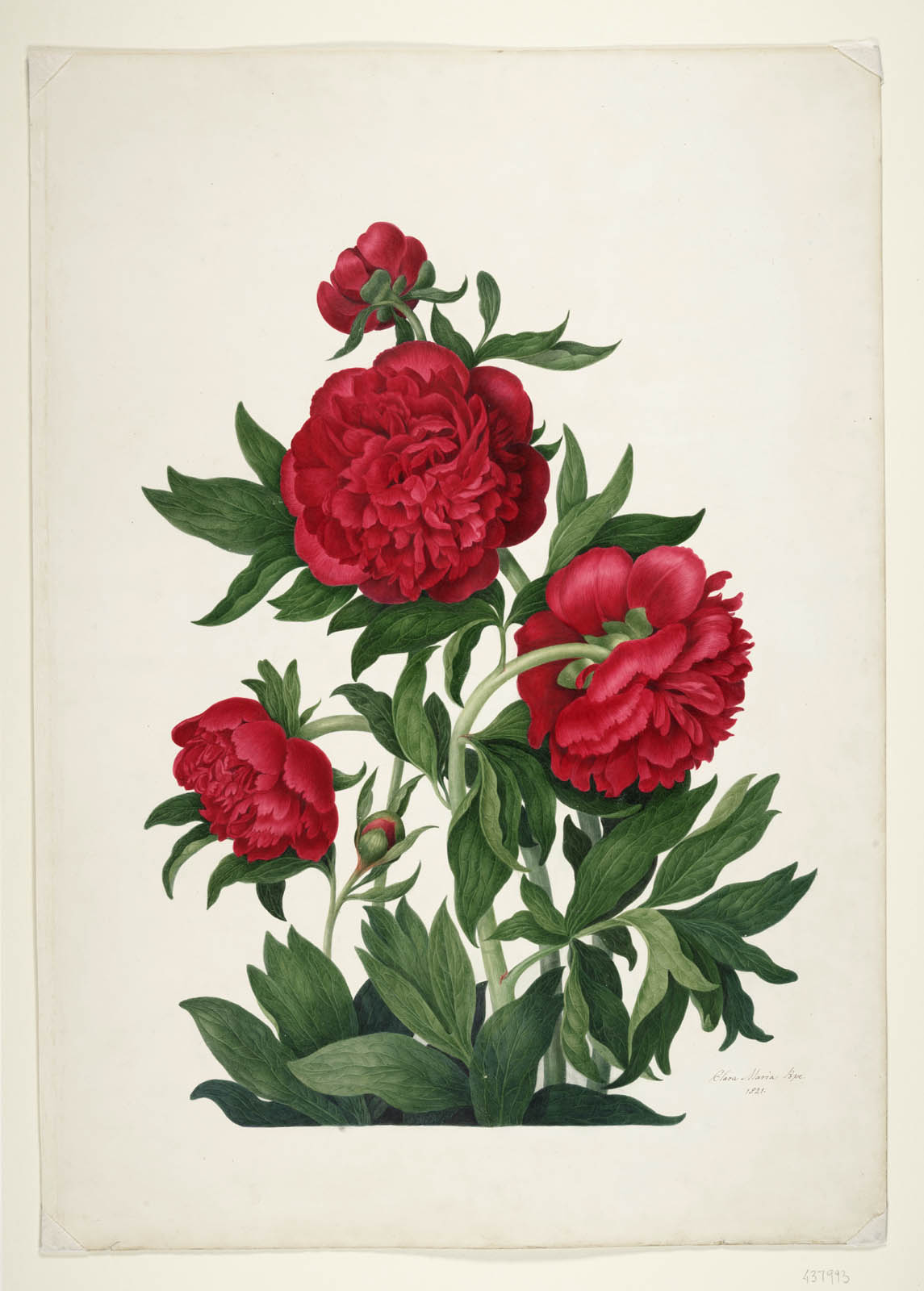
 

Clara Maria Pope (British, 1767-1831) 'Peony' 1821


Clara Maria Pope (British, 1767-1831)
Peony
1821
Bodycolour on card
The Trustees of the Natural History Museum, London
Courtesy the Natural History Museum


Pope appears in museum records under many names: Clara Leigh, Clara Wheatley (her first husband was the artist Francis Wheatley, 1747-1801), Clara Maria Pope (she married actor Alexander Pope in 1807) and Mrs Alexander Pope. Her changes of name have obscured her career as an artist. She exhibited watercolour landscapes and portraits, miniatures and genre works, but above all, Pope was an artist of flowers. She worked for the leading botanical publisher Samuel Curtis (1779-1860). The scientifically accurate peonies depicted here are 2 of 11 designs. They may have been intended as plates for a work that was never published.

Text from the exhibition large print guide
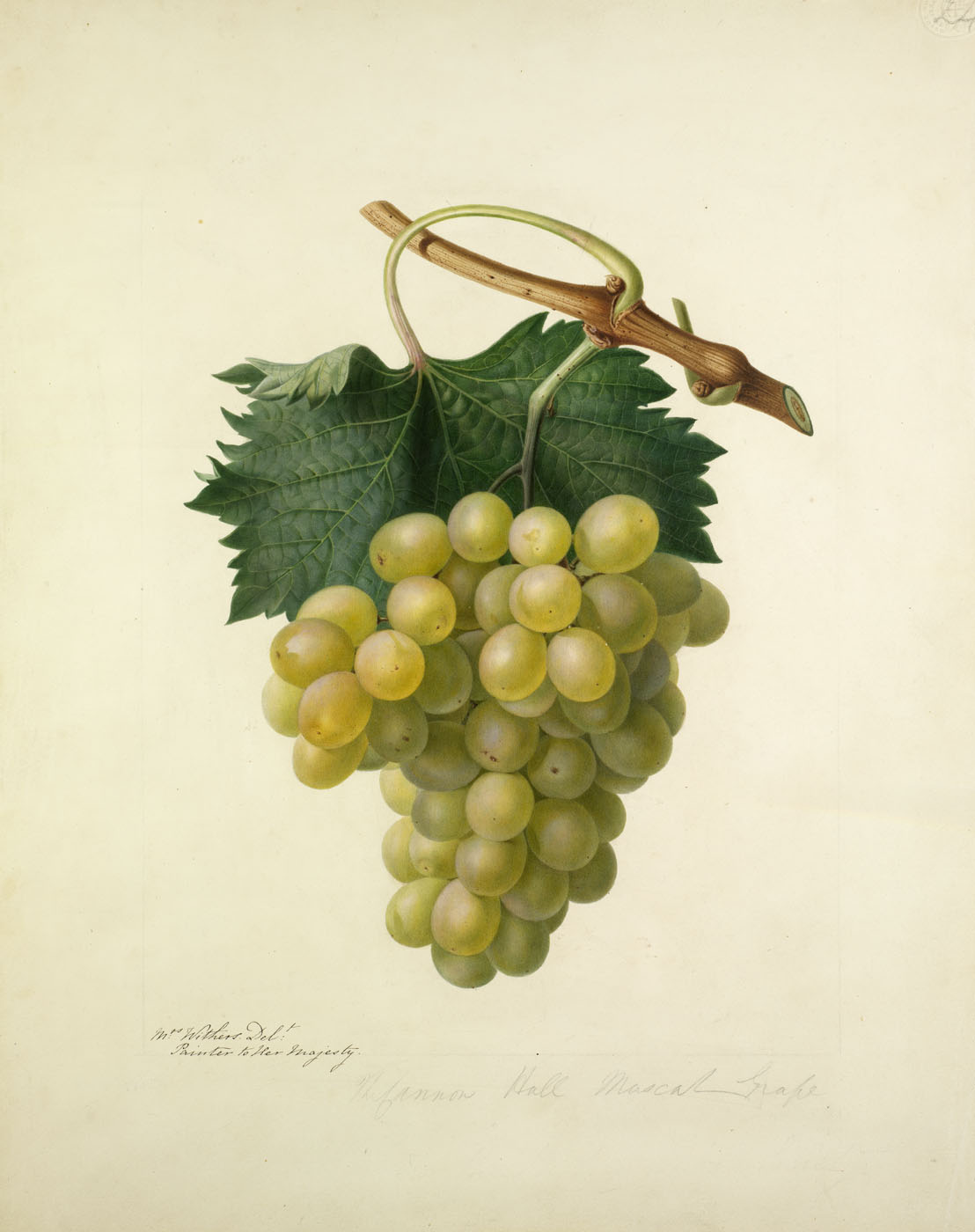
 

Augusta Innes Withers (English, 1792-1877) 'The Canon Hall Muscat Grape' c. 1825


Augusta Innes Withers (English, 1792-1877)
The Canon Hall Muscat Grape
c. 1825
Watercolour on paper
444 × 352 mm
RHS Lindley Collections
Courtesy the Royal Horticultural Society, Lindley Library


Withers was employed by the Horticultural Society to make official ‘portraits’ of varieties of fruit growing in their orchards. The quality of Withers’s work meant her high fees were not questioned. Here, she paints sunlight glowing through grapes and the translucency of the skin of gooseberries in great detail. Withers drew and handcoloured engraved illustrations in the Horticultural Society’s Transactions and made illustrations of fruit for John Lindley’s Pomological Magazine in 1828 (Lindley was Secretary of the Society). Withers was also regarded as one of the best teachers of botanical illustration.

Text from the exhibition large print guide
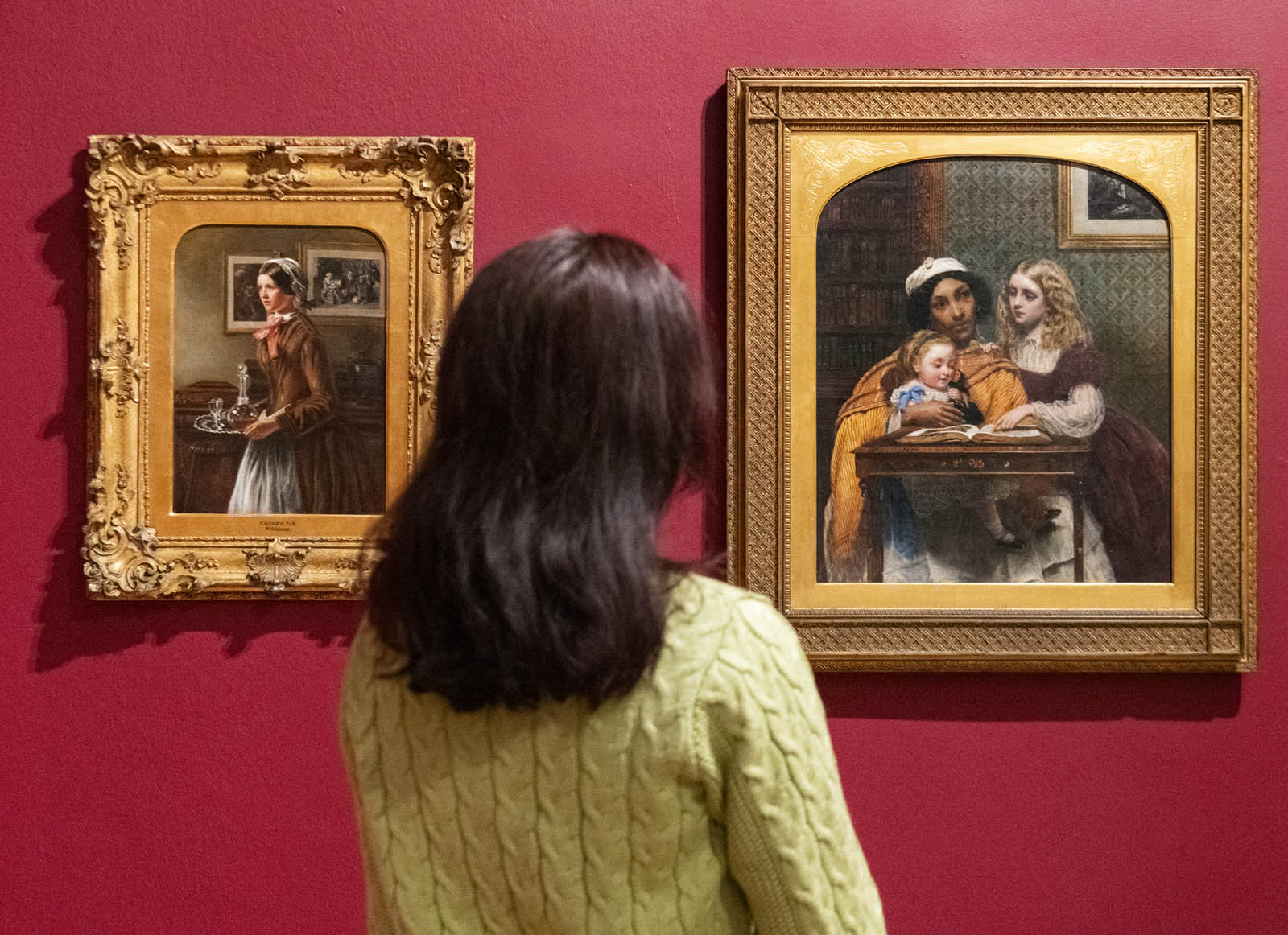
 

Installation view of the exhibition 'Now You See Us Women Artists in Britain 1520-1920' at Tate Britain showing at left, Rebecca Solomon's 'Sherry, Sir?' c. 1858-1862; and at right, Solomon's 'A Young Teacher' 1861


Installation view of the exhibition Now You See Us Women Artists in Britain 1520-1920 at Tate Britain showing at left, Rebecca Solomon’s Sherry, Sir?
c. 1858-1862 (below); and at right, Solomon’s A Young Teacher 1861 (below)
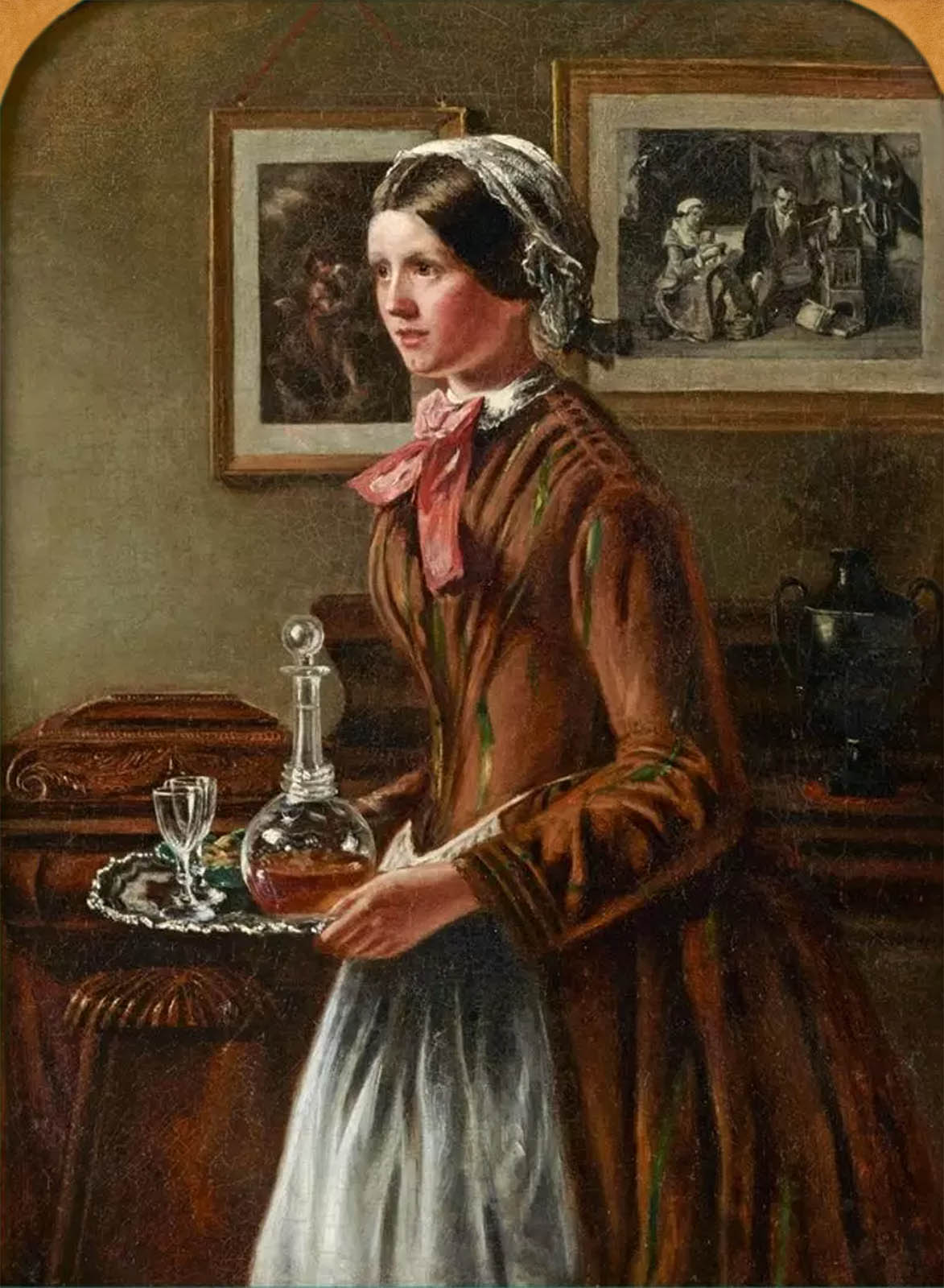
 

Rebecca Solomon (English, 1832-1886) 'Sherry, Sir?' c. 1858-1862


Rebecca Solomon (English, 1832-1886)
Sherry, Sir?
c. 1858-1862
Oil on canvas
Private collection


Solomon often painted scenes of domestic life and interiors, which were considered more suitable subjects for women artists than history painting. Solomon’s domestic scenes include subtle commentary on social hierarchies. Sherry, Sir? depicts a maid with a silver tray. It reprises a well-known painting of the same title, painted by William Powell Frith (1819-1909) in 1851, but unlike Frith’s painting, Solomon draws attention to domestic labour and the hierarchies of a middle-class home. Solomon was the sister of artists Abraham Solomon (1823-1862) and Simeon Solomon (1840-1905).

Text from the exhibition large print guide


Rebecca Solomon (London 26 September 1832 – 20 November 1886 London) was a 19th-century English Pre-Raphaelite draftsman, illustrator, engraver, and painter of social injustices. She is the second of three children who all became artists, in a prominent Jewish family. …

Solomon’s artistic style was typical of popular 19th-century painting at the time and falls under the category of genre painting. She used her visual images to critique ethnic, gender and class prejudice in Victorian England. When Solomon started painting genre scenes, her work demonstrated an observant eye for class, ethnic and gender discrimination. Solomon’s paintings reflect a combination of interest in the theatre and commitment to social consciousness that is not exist in other artist’s painting in the nineteenth century.

Text from the Wikipedia website


Solomon painted in a more equivocal manner… She [the subject of the painting] is equally attractive and demure, but, by being painted from the side and against the background of a middle-class interior, the viewer is invited to reflect on her social status.

This is framed in a genre painting and by no means a piece with pretensions to social realism, but Solomon seems to be underlining the definite restrictions on this young woman’s position in society.

The pictures hanging behind her may contribute to that interpretation of the artist. They are not yet identified, but it seems that on the left we are shown an allegorical subject later than Gainsborough or Reynolds, depicting a young peasant boy or young peasant girl holding a dog in a landscape. On the right, a more specific engraving of a genre painting from Solomon’s own time showing what appears to be an itinerant family of street vendors. By placing his servant girl between these two paintings, Solomon seems to be asking us to compare.

José Luis Jiménez García. “La otra versión de la ‘Sherry Girl’,” on the Diario de Jerez website 07 June 2023 [Online] Cited 28/08/2024 Translated from the Spanish by Google Translate
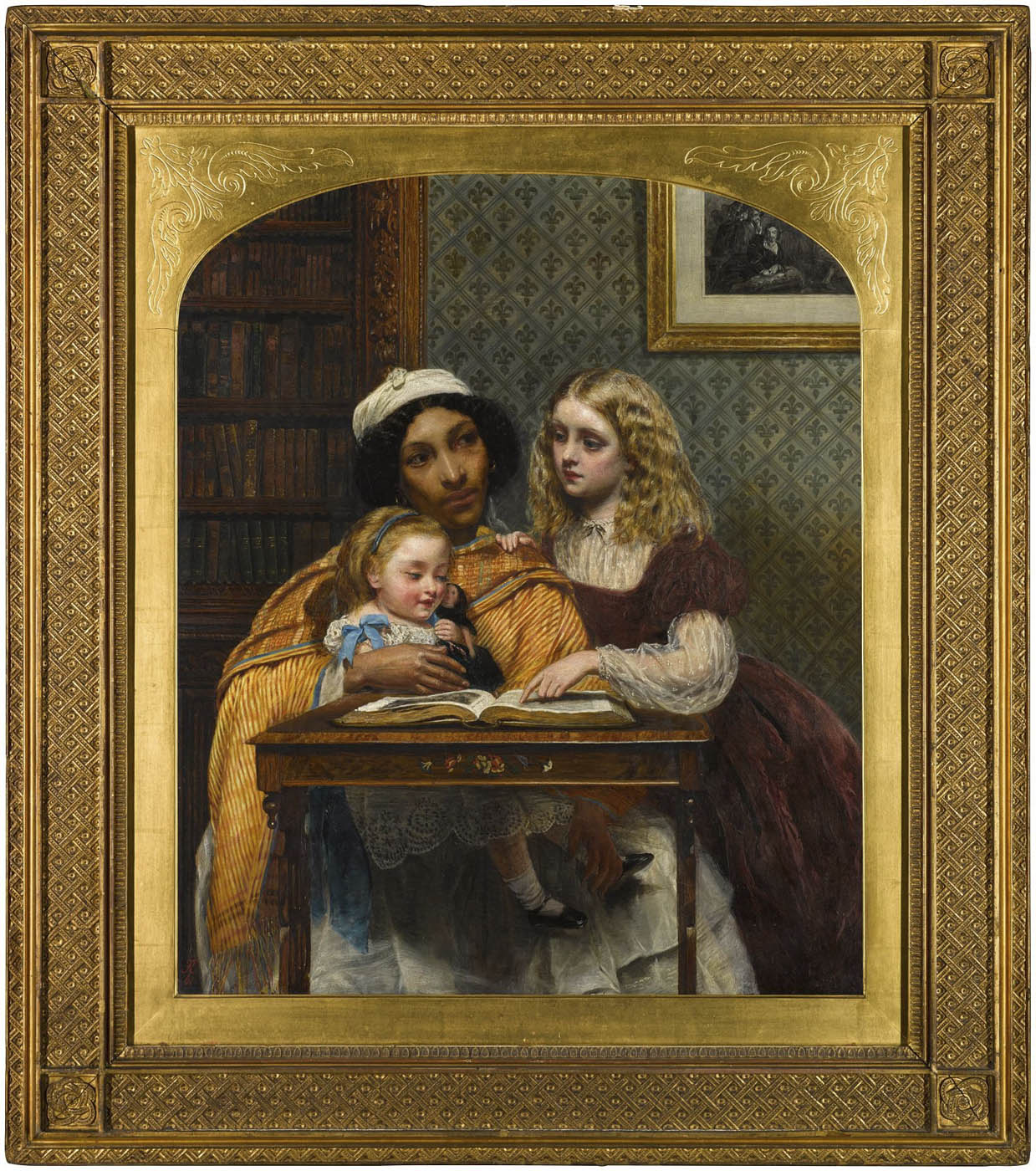
 

Rebecca Solomon (English, 1832-1886) 'A Young Teacher' 1861


Rebecca Solomon (English, 1832-1886)
A Young Teacher
1861
Oil on canvas
61 by 51cm
Tate and the Museum of the Home


Rebecca Solomon’s painting is a complex reflection on gender, race, religion and education in mid-nineteenth century London. As with many of her works, it considers women who worked in better-off households as professional carers. In A Young Teacher, Solomon modifies a traditional domestic scene between mother and child, with the surrounding books stressing the theme of learning. The woman at the centre of the image was modelled by Jamaican-born Fanny Eaton, who became a prominent muse for many Victorian artists and featured in some of the most iconic paintings of the Pre-Raphaelite period. …

Believed to be the first Jewish woman to become a professional artist in England, Rebecca Solomon’s work shone a light on inequality and prejudice at a time when these subjects were far from mainstream. She was active in social reform movements, including as part of a group of 38 artists who petitioned the Royal Academy of Arts to open its schools to women.

Text from the Tate website
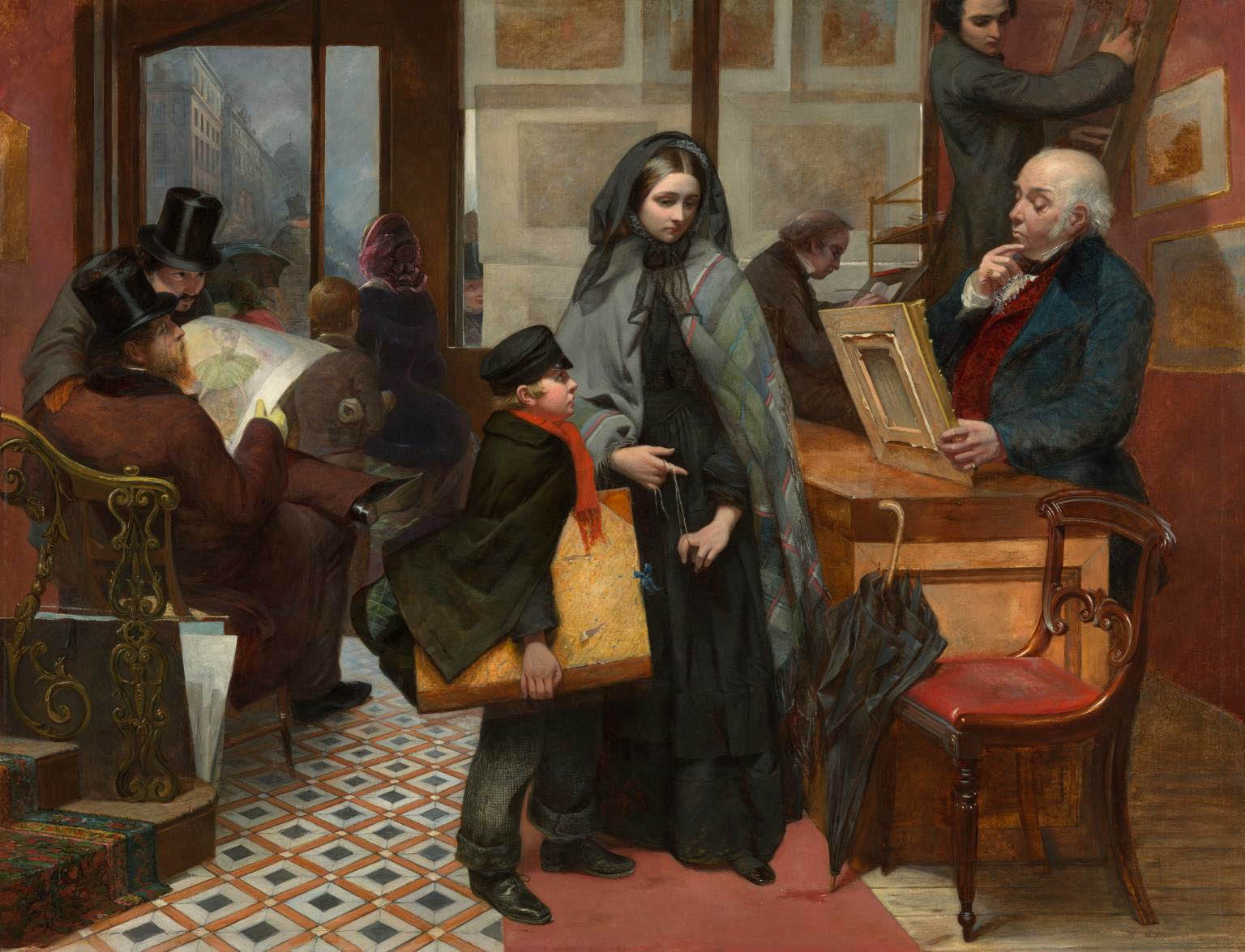
 

Emily Osborn (English, 1828-1925) 'Nameless and Friendless. "The rich man's wealth is his strong city: the destruction of the poor is their poverty (Proverbs: 10:15)' 1857


Emily Osborn (English, 1828-1925)
Nameless and Friendless.
“The rich man’s wealth is his strong city: the destruction of the poor is their poverty” (Proverbs: 10:15)
1857
Oil on canvas
Support: 825 × 1038 mm
Frame: 1042 × 1258 × 75 mm
Tate
Purchased with assistance from Tate Members, the Millwood Legacy and a private donor 2009
Creative Commons CC BY-NC-ND 4.0 DEED


Osborn exhibited widely and was supported by wealthy patrons. She was also part of the ‘rights of woman’ debate, campaigning for more public roles for women. Nameless and Friendless, exhibited at the Royal Academy in 1857, dramatises the difficulties faced by women artists. Osborn shows a young woman offering a painting to a sceptical dealer. With no reputation (‘Nameless’) and no connections (‘Friendless’), she has little chance of a sale. Behind her, two leering men emphasise the impression of her isolation and vulnerability.

Text from the exhibition large print guide


Installation view of the exhibition 'Now You See Us Women Artists in Britain 1520-1920' at Tate Britain showing Emily Mary Osborn's 'Barbara Bodichon (1827-1891)' Nd (below)


Installation view of the exhibition Now You See Us Women Artists in Britain 1520-1920 at Tate Britain showing Emily Mary Osborn’s Barbara Bodichon (1827-1891) Nd (below)
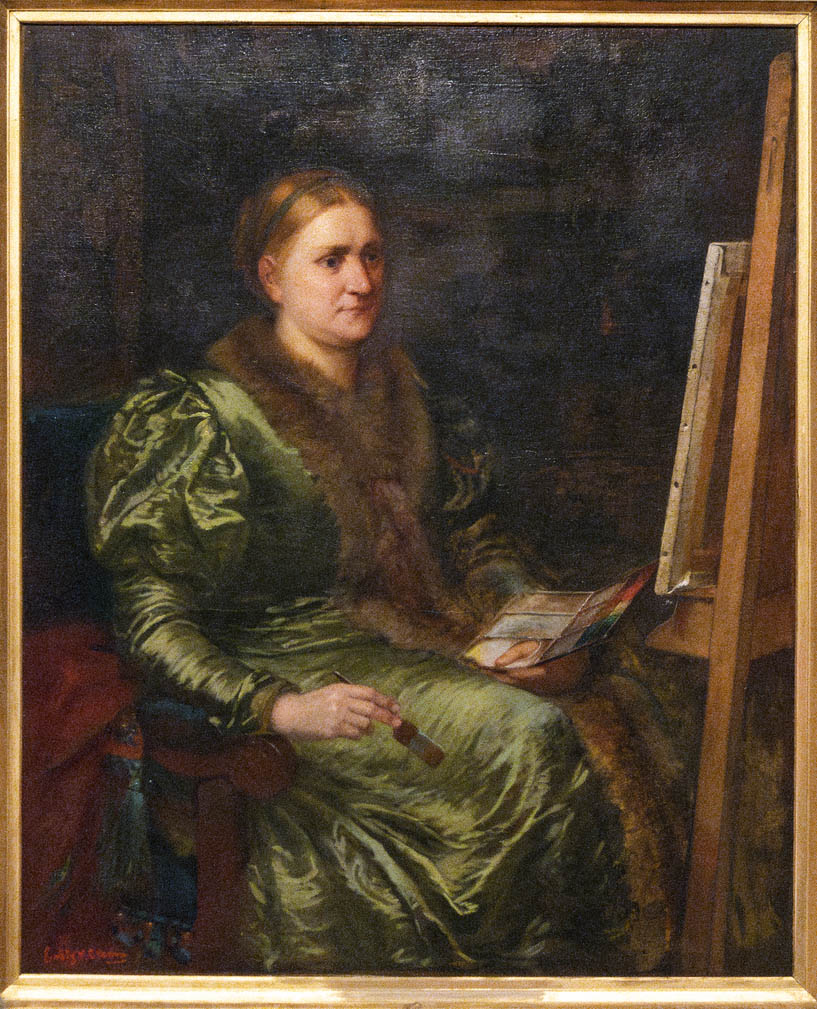
 

Emily Mary Osborn (1828-1925) 'Barbara Bodichon (1827-1891)' Nd (installation view)


Emily Mary Osborn (1828-1925)
Barbara Bodichon (1827-1891) (installation view)
Nd
Oil on canvas
120 x 97cm
Girton College, University of Cambridge


Martha Darley Mutrie (British, 1824-1885) 'Wild Flowers at the Corner of a Cornfield' 1855-1860


Martha Darley Mutrie (British, 1824-1885)
Wild Flowers at the Corner of a Cornfield
1855-1860
Oil on canvas
Support: 821 × 632 mm
Frame: 958 × 781 × 65 mm
Photo: Tate (Seraphina Neville)


Martha Darley Mutrie is considered one of the leading painters of flowers active in Britain in the nineteenth century. She was born in Ardwick, near Manchester. She trained together with her sister, the painter Annie Feray Mutrie (1826-1893), under George Wallis (1811-1891) at the Manchester School of Design from 1844 to 1846, and also undertook private lessons with him. The sisters began exhibiting at the Royal Manchester Institution from 1845 and at the Royal Academy, London, showing there consistently from the early 1850s. Their work was regularly well received by the critics. Mutrie and her sister moved to London in 1854, where they painted flowers in interior settings, carefully arranged, and also outdoors in mock natural settings.

Despite the prominence of women artists painting still lifes and flowers, the men practitioners of the genre, such as George Lance (1802-1864) and William Henry ‘Birds Nest’ Hunt (1790-1864), received greater critical and institutional attention. Martha and Annie Mutrie achieved success that was otherwise rare for women working as artists at the time.

The art critic John Ruskin admired both artists’ work and wrote about one of Annie’s pictures in his review of the 1855 Royal Academy exhibition. In his review Ruskin suggested that she abandon artificial compositions and paint instead ‘some banks of flowers in wild country, just as they grow’ (John Ruskin, Notes on Some of the Principal Pictures Exhibited at the Royal Academy, London, 1855). This painting might be seen as a response to Ruskin’s insight and the advances in science that in the 1850s brought a new focus to the study of nature, with arguments over beauty and truth.

Text from the Tate website
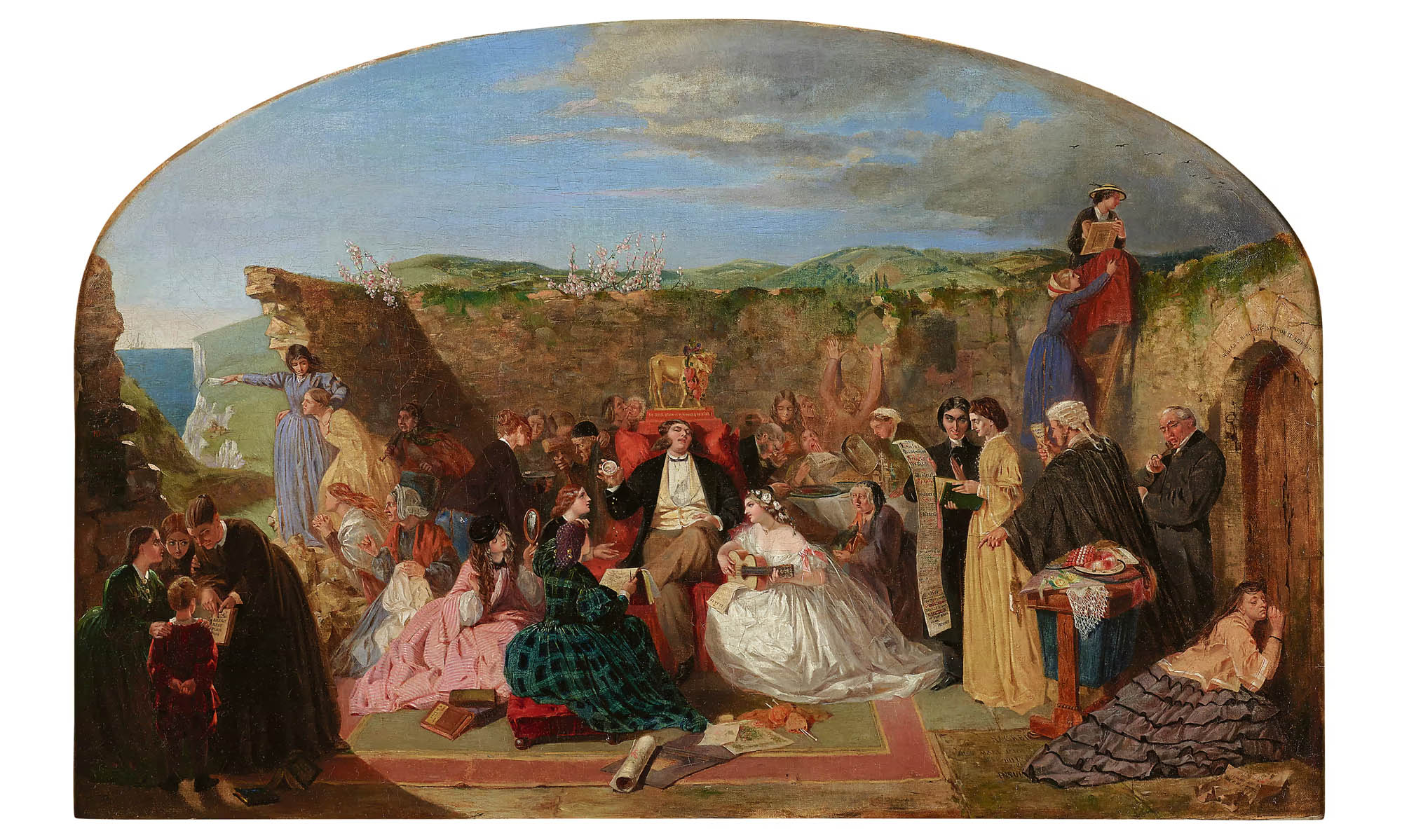
 

Florence Claxton (British, 1838-1920) ''Woman's Work': A Medley' 1861


Florence Claxton (British, 1838-1920)
‘Woman’s Work’: A Medley
1861
Oil on canvas
Martin Beisly Fine Art, London


In the 1850s, Claxton became part of the UK’s first organised movement for women’s rights. Woman’s Work satirises women’s opportunities for professional employment. At its centre a group of women fawn at the feet of a man seated below a statue of the Golden Calf – a false idol. Confined by
a surrounding wall, doors to professions such as medicine are shut to the women. Only the artist Rosa Bonheur has managed to scale the wall’s heights. The painting was exhibited at London’s National Institution for Fine Arts in 1861 and received mixed reviews. Some praised its comic strength but others described it as ‘vulgar’.

Text from the exhibition large print guide
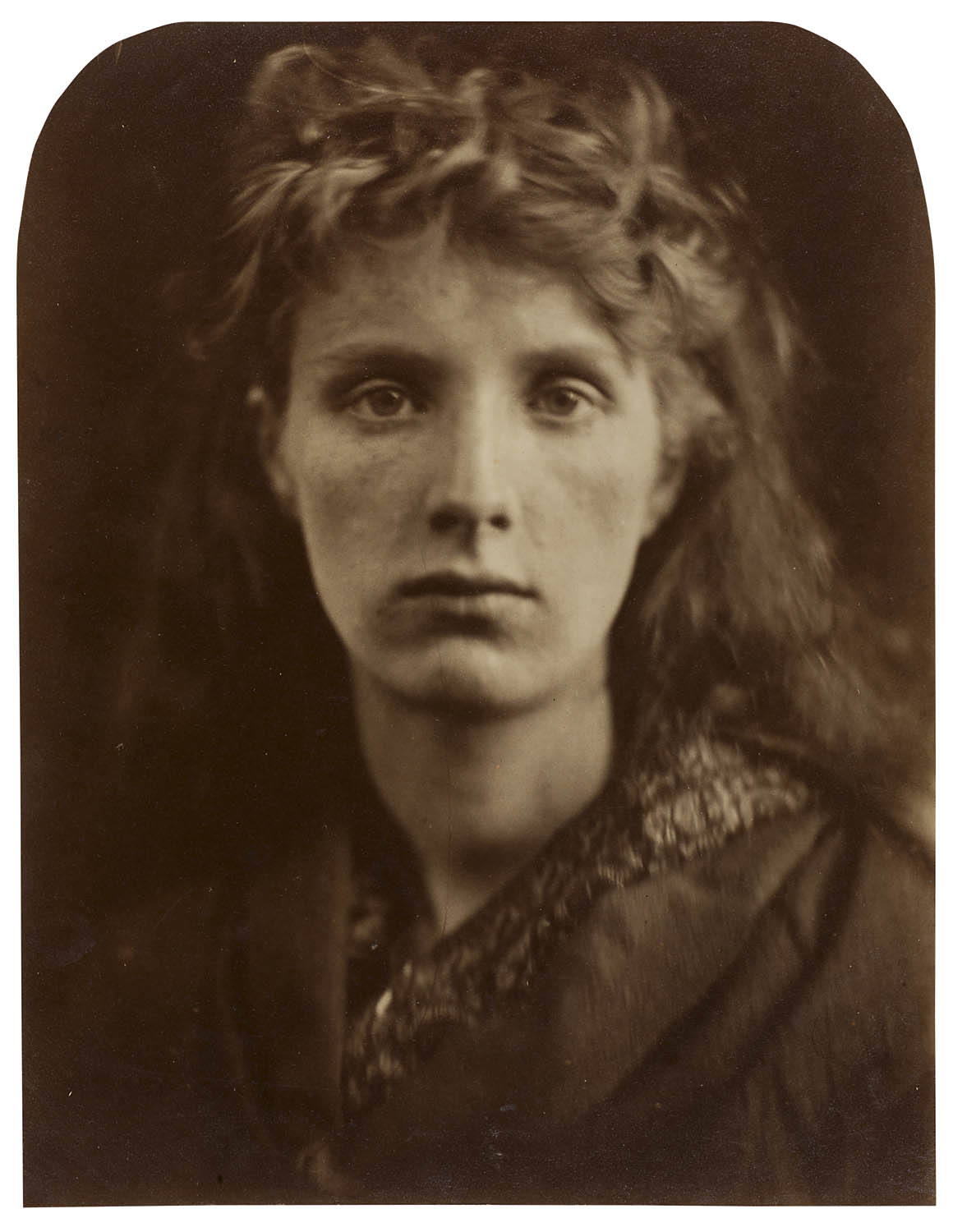
 

Julia Margaret Cameron (British born India, 1815-1879) 'Mountain Nymph, Sweet Liberty' 1865


Julia Margaret Cameron (British born India, 1815-1879)
Mountain Nymph, Sweet Liberty
1865
Albumen print
Wilson Centre of Photography


Annie Keene (1842/3-1901) was an artist’s model at the Royal Academy Schools. Cameron showed Keene’s portrait at the 1866 Hampshire and Isle of Wight Loan Exhibition, and it was for sale at her 1868 exhibition at London’s German Gallery. In this photograph, Cameron’s shallow depth-of-field gives a bold effect. Her friend, the scientist and photographic innovator John Herschel (1792-1871), praised the portrait as ‘a most astonishing piece of high relief – She is absolutely alive and thrusting out her head from the paper into the air’.

Text from the exhibition large print guide
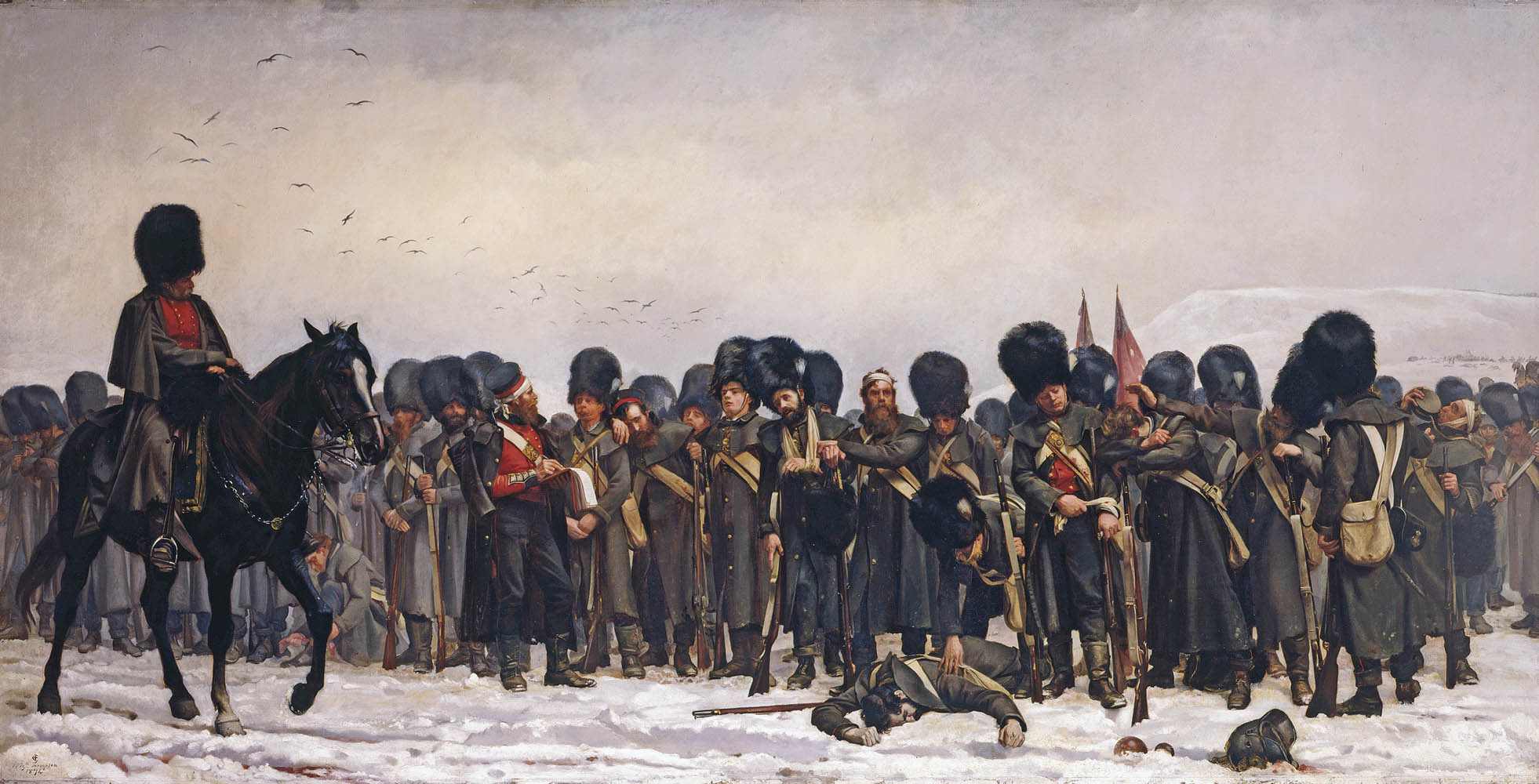
 

Elizabeth Butler (British, 1846-1933) 'The Roll Call' 1874


Elizabeth Butler (British, 1846-1933)
The Roll Call
1874
Oil on canvas
93.3 x 183.5cm (support, canvas/panel/stretcher external)
Royal Collection Trust
© Royal Collection Trust / His Majesty King Charles III 2024


Butler specialised in battle paintings, challenging society’s expectations of women artists. The exhibition of The Roll Call at the Royal Academy in 1874 was one of the greatest art sensations of the nineteenth century. It was praised by Academicians and hung ‘on the line’ (the most prestigious, eye-level position). The painting proved so popular with the public that a policeman had to be stationed nearby to protect the adjacent paintings. Queen Victoria summoned the work to Buckingham Palace for a private viewing, and the copyright sold for the enormous sum of £1,200.

Text from the exhibition large print guide


The Roll Call captured the imagination of the country when exhibited at the Royal Academy in 1874, turning the artist into a national celebrity. So popular was the painting that a policeman had to be stationed before it to hold back the crowds and it went on to tour the country in triumph. The painting’s focus on the endurance and bravery of ordinary soldiers without reference to the commanders of the army accorded with the mood of the times and the increasing awareness of the need for social and military reforms.

Though the public had been exposed to other images of the Crimean War, primarily prints, photographs and newspaper illustrations, never before had the plight of ordinary soldiers been portrayed with such realism. Butler researched her subject by studying A. W. Kinglake’s seminal history of the Crimean War, as well as by consulting veterans of the Crimea, several of whom served as models for the painting. She also painstakingly sought out uniforms and equipment from the Crimean period in order to be correct in the smallest military details. The sombre mood and simple yet dramatic composition Butler achieved in The Roll Call vividly epitomised the grimness not only of the Crimean War but of all wars.

Text from the Royal Collection Trust website


Installation view of the exhibition 'Now You See Us Women Artists in Britain 1520-1920' at Tate Britain showing at left, Louise Jopling's 'Through the Looking-Glass' 1875; and at right, Jopling's 'A Modern Cinderella' 1875


Installation view of the exhibition Now You See Us Women Artists in Britain 1520-1920 at Tate Britain showing at left, Louise Jopling’s Through the Looking-Glass 1875 (below); and at right, Jopling’s A Modern Cinderella 1875 (below)


Louise Jopling (English, 1843-1933) 'Through the Looking-Glass' 1875


Louise Jopling (English, 1843-1933)
Through the Looking-Glass
1875
Oil paint on canvas
Support: 539 × 437 mm
Tate
Purchased with funds provided by the Nicholas Themans Trust and Tate Patrons 2024
Photo: Tate (Sonal Bakrania)


This is a self-portrait Jopling made while pregnant with her son, Lindsay, in 1875.

Jopling was one of the most successful and best-known women artists of the late nineteenth century. She exhibited regularly and, from the 1880s, ran her own art school for women. Jopling hosted receptions and established connections with many artists and art dealers. She carefully planned the exhibition of her work by choosing venues appropriate to each painting’s scale and ambition. Jopling sent this self-portrait to the Society of Lady Artists in 1875. In the same year, A Modern Cinderella, hanging nearby, was shown at the Royal Academy. Both works were purchased by the dealer Agnew: this work for £26, but Cinderella for £262.

Text from the exhibition large print guide


Tabitha Barber, curator of the exhibition, said: “What’s happened to Jopling’s legacy is the story of what’s happened to most women artists … They have been regarded, studied and judged differently.”

Jopling, who in 1901 became one of the first women admitted to the Royal Society of British Artists, was a celebrated artist in her day, Barber said. Her patrons included the de Rothschild family, and the Grosvenor Gallery founders Sir Coutts and Lady Lindsay. “At a time when women weren’t allowed to be members of the Royal Academy, her works were exhibited there almost every year and spoken about in the press. She was reviewed by male art critics, and reviewed well.”

Jopling’s paintings were also commercially successful, selling for some of the highest prices that British female artists could command – albeit far less than their male contemporaries.

“She is among a handful of female artists who were society figures and household names – and it just seems so astonishing that they’re so little known now,” said Barber.

Donna Ferguson. “Tate Britain acquires first painting by pioneering English female artist overlooked for a century,” on The Guardian website 12 May 2024 [Online] Cited 02/09/2024


Louise Jopling (English, 1843-1933) 'A Modern Cinderella' 1875 (installation view)


Louise Jopling (English, 1843-1933)
A Modern Cinderella
1875
Oil on canvas
Support: 910 × 700 mm
Private collection


Louise Jopling (English, 1843-1933) 'A Modern Cinderella' 1875


Louise Jopling (English, 1843-1933)
A Modern Cinderella
1875
Oil on canvas
Support: 910 × 700 mm
Private collection


A Modern Cinderella shows a model removing her fine clothes at the end of a painting session. A glimpse of Jopling’s easel can be seen in the mirror’s reflection. In 1875, Jopling exhibited this work at the Royal Academy. There, the model’s naked shoulder was cause for criticism. Although one reviewer thought it was ‘quite harmless’, a picture dealer’s wife reportedly said that ‘she could never hang such a thing in her house’. Jopling also showed the painting at the 1878 Exposition Universelle in Paris, where she had also trained.

Text from the exhibition large print guide


If this is, indeed, a self-portrait, Jopling has painted herself as somewhere in the liminal space between the social groups she simultaneously belonged to and was excluded from. Despite Jopling’s notoriety and prominence among high-class Pre-Raphaelite artist circles, she experienced a high degree of discrimination. In 1883, she was commissioned to paint a portrait for 150 guineas but lost her employment in favour of Sir John Everett Millais, who requested 1000 guineas for the same project (Clement). In the traditional circles of high society, Jopling was looked down upon for pursuing a career in the fine arts, which was inherently a masculine task. The woman in the image is either taking the dress off or putting it on, but either way, has turned her back to her easel, which could be interpreted as forfeiting a part of her true identity to fit either end of the accepted spectrum of femininity. The underclothing she portrays herself in fit the Pre-Raphaelite aesthetic style of dress, which fit natural waists and emphasised a woman’s beauty through medieval and Greek-inspired silhouettes (Shrimpton, Jayne. Victorian Fashion. Shire Publications, 2016). The inclusion of this white aesthetic dress, as well as the scandalous drop of the strap is a signal of societal rebellion against traditional beauty norms. The woman in the image could also be read as shedding the skin of the two dresses before her to reveal her true, natural, artistic self below.

Emily Goldstein. “‘A modern Cinderella, 1875. Oil on Canvas’ by Louise Jopling,” on the COVE Studio website 23/10/2020 [Online] Cited 02/09/2024


Marianne Stokes (Austrian, 1855-1927) 'The Passing Train' 1890


Marianne Stokes (Austrian, 1855-1927)
The Passing Train
1890
Oil on canvas
Support: 600 × 760 mm
Frame: 885 × 955 mm
Private collection


Marianne Stokes (née Preindlsberger; 1855-1927) was an Austrian painter. She settled in England after her marriage to Adrian Scott Stokes (1854-1935), the landscape painter, whom she had met in Pont-Aven. Stokes was considered one of the leading women artists in Victorian England.


Annie Louisa Swynnerton ARA (British, 1844-1933) 'Mater Triumphalis' 1892


Annie Louisa Swynnerton ARA (British, 1844-1933)
Mater Triumphalis
1892
Paris, musée d’Orsay
Donated by Edmund Davis, 1915


Swynnerton campaigned for women’s suffrage, access to professional training, and equal opportunities. She rebelled against the belief that ‘women could not paint’. Exhibited at the New Gallery in 1892, Mater Triumphalis was regarded as a bold work. It brought Swynnerton international recognition, winning a medal at the 1893 World Exposition in Chicago. Despite this, Swynnerton received mixed reviews from British critics. They were impressed by the artist’s skill and the painting’s ‘quivering life’ but found the ‘frank realism’ of the woman’s naked body disconcerting.

Text from the exhibition large print guide
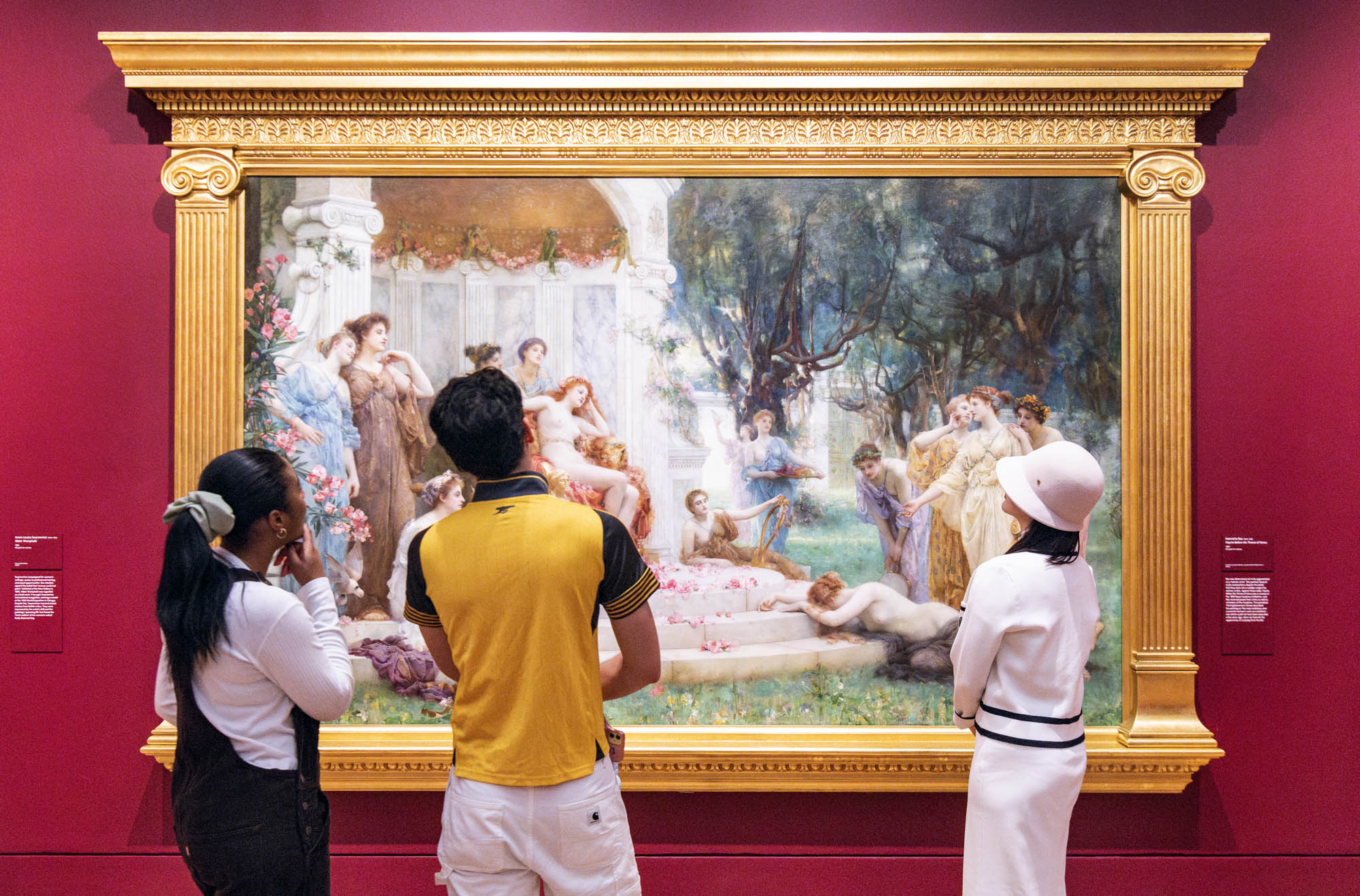
 

Installation view of the exhibition 'Now You See Us Women Artists in Britain 1520-1920' at Tate Britain showing Henrietta Rae's 'Psyche before the throne of Venus' 1894


Installation view of the exhibition Now You See Us Women Artists in Britain 1520-1920 at Tate Britain showing Henrietta Rae’s Psyche before the throne of Venus 1894 (below)
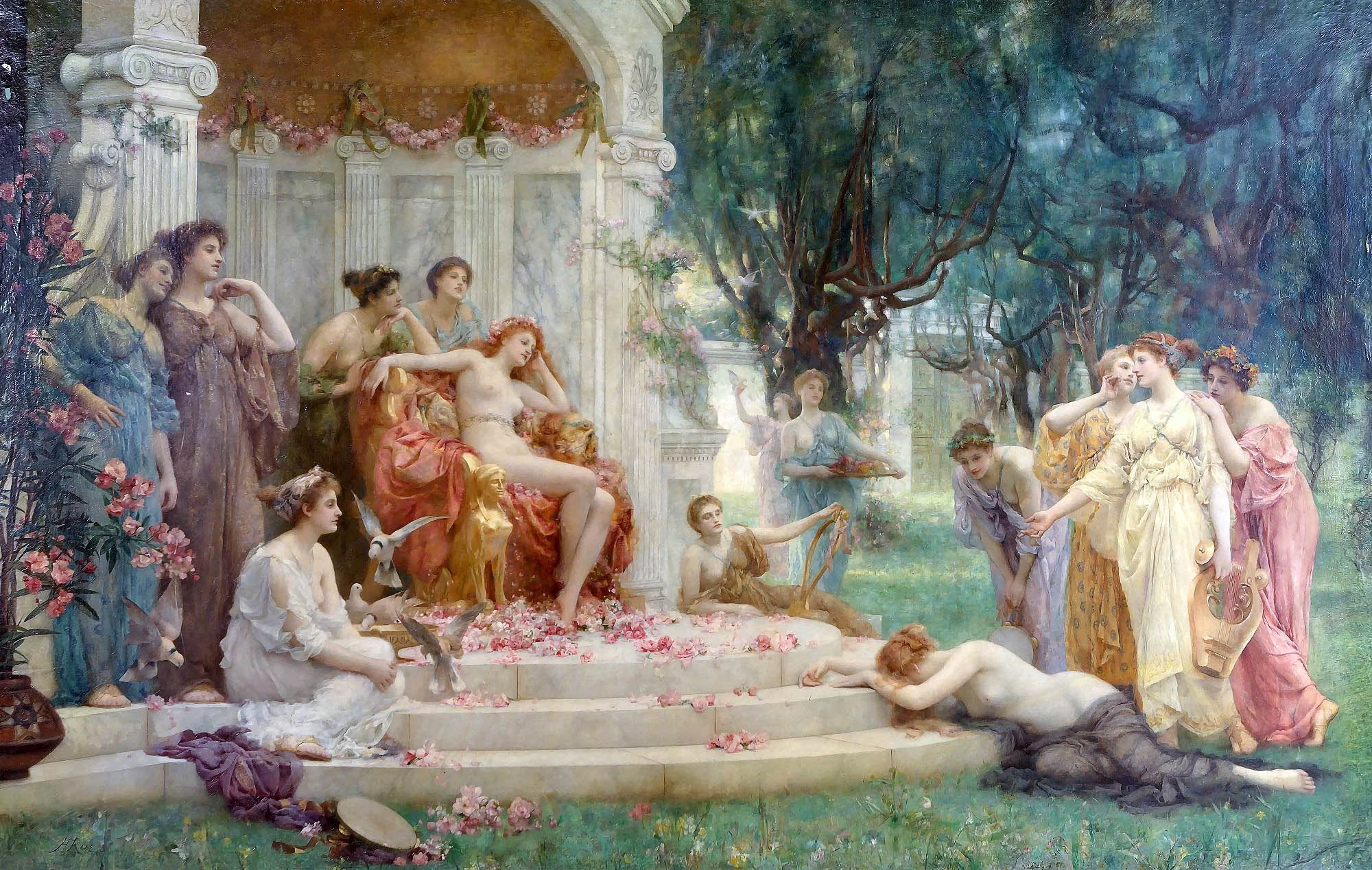
 

Henrietta Rae (British, 1859-1928) 'Psyche before the throne of Venus' 1894


Henrietta Rae (British, 1859-1928)
Psyche before the throne of Venus
1894
Oil paint on canvas
Support: 1941 × 3058 × 31 mm
Frame: 2525 × 3826 × 270 mm
Lent from a private collection, courtesy of Martin Beisly Fine Art


Rae was determined not to be pigeonholed as a ‘woman artist’. She painted classical nude compositions despite the belief that they were not a suitable subject for women artists. Against these odds, Psyche Before the Throne of Venus was a success at the 1894 Royal Academy Exhibition, and Rae received praise from critics as well as members of the Academy. The periodical The Englishwoman’s Review described the painting as ‘the most ambitious and successful woman’s work yet exhibited – one which could not have been executed a few years ago, when we had not the opportunity of studying from the life’.

Text from the exhibition large print guide


Installation view of the exhibition 'Now You See Us Women Artists in Britain 1520-1920' at Tate Britain showing Lucy Kemp-Welch's 'Colt Hunting in the New Forest' 1897


Installation view of the exhibition Now You See Us Women Artists in Britain 1520-1920 at Tate Britain showing Lucy Kemp-Welch’s Colt Hunting in the New Forest 1897


One of the most important pieces of art ever inspired by the New Forest was a painting by Lucy Kemp-Welch (1869-1958), entitled ‘Colt Hunting in the New Forest’. This painting was exhibited at the Royal Academy in 1897, when she was only 26 years old. It was an impressive canvas measuring 1537 x 3060 mm (approximately 5ft x 10ft) and was described as depicting ‘a wide glade in the forest, along which race a number of colts unwilling to relinquish their liberty and to fall into the hands of the four mounted lads who try to catch them’.[1] Lucy Kemp-Welch was born in Bournemouth, in 1869, and spent much of her time wandering in the New Forest, where she ‘personally studied the wild ponies in this pleasant part of England’.[2] Her love of horses and wild ponies remained with her all her life. In order to capture the energy and excitement of the pony drifts for ‘Colt Hunting’ she actually had the full-sized canvas transported to the Forest, where she sketched from life, as the commoners galloped their ponies past her. When the painting was exhibited at the Royal Academy it caused a sensation and was promptly purchased for £525.00.[3] The buyers were trustees of the Chantrey Bequest, who administered a large sum of money left in the will of Sir F. L. Chantrey to obtain works of art by British artists, in order to create a national collection. It was only the third time, since its creation in 1875, that the Chantrey Bequest had purchased artwork by a woman. Lucy Kemp-Welch became a celebrity overnight.[4]

In the same year that Lucy Kemp-Welch exhibited ‘Colt Hunting in the New Forest’, the Tate Galley was built and her painting was transferred to this new, public collection. However, ‘Colt Hunting’ was immediately archived and has never been publicly exhibited. Indeed, there are rumours that the Tate Gallery loaned the painting to the Royal Academy during the Blitz ‘in the hope that the Luftwaffe’s friendly bombs might rid them of this monstrous woman’s work for good’.[5] It is difficult to conceive of the prejudice against women in the late Victorian period and early 20th century, particularly women such as Lucy Kemp-Welch, who stepped out of the roles proscribed to them by a patriarchal society.[6] Her sympathies for the suffragette movement certainly didn’t endear her to the male-establishment figures that controlled the art world. She nevertheless continued to paint and made a successful, and award winning (Paris Salon) career as an artist.

newforestcommoner. “Lucy Kemp-Welch: Colt Hunting in the New Forest,” on the New Forest Commoner website November 27, 2016 [Online] Cited 28/08/2024
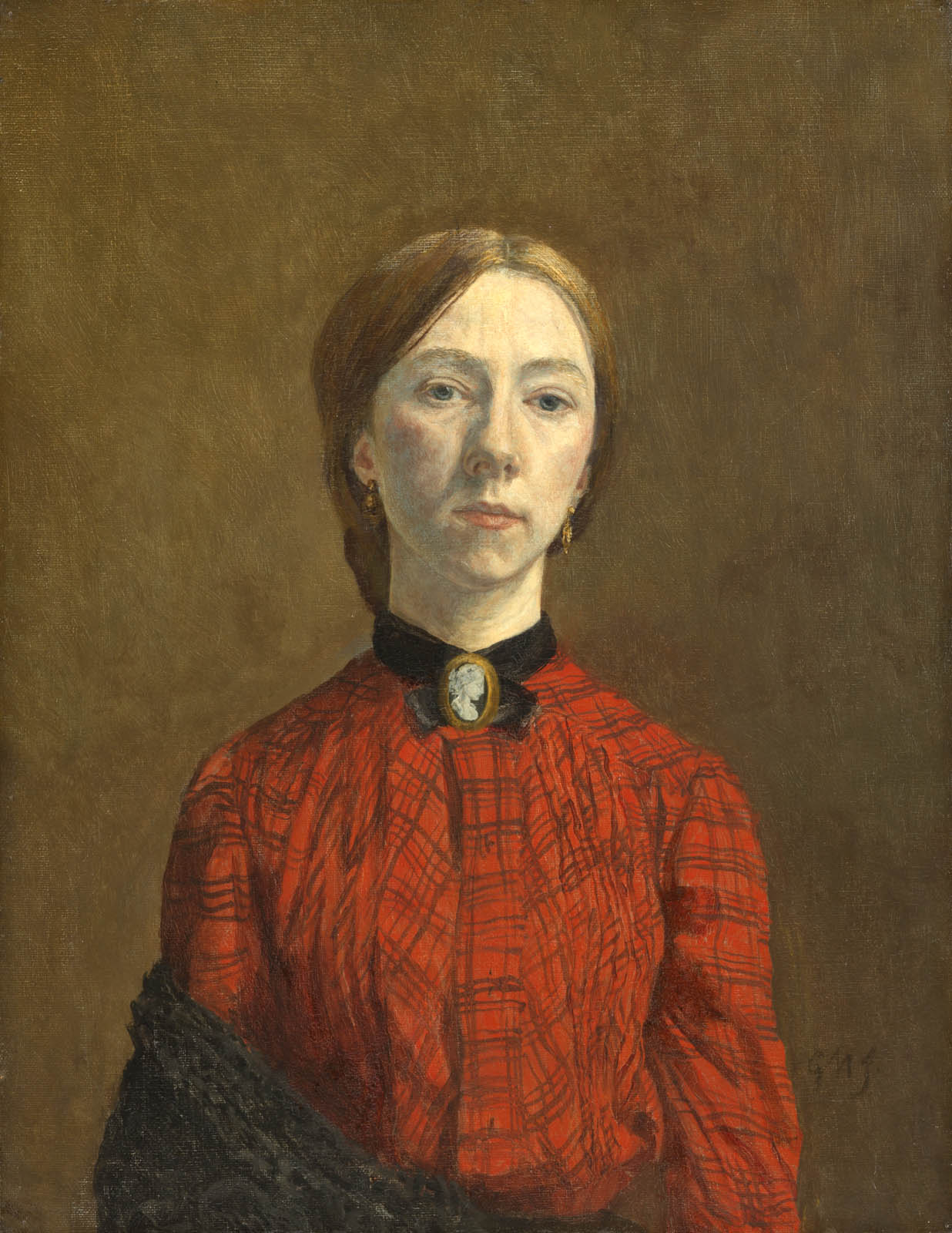
 

Gwen John (Welsh, 1876-1939) 'Self-Portrait' 1902


Gwen John (Welsh, 1876-1939)
Self-Portrait
1902
Oil on canvas
Tate
Purchased 1942
Photo: Tate (Mark Heathcote and Samuel Cole)


John exhibited this self-portrait at the New English Art Club (NEAC) in 1900. It was her debut as an exhibitor. The NEAC had been founded as a forward-thinking artists’ group, created out of dissatisfaction with the art establishment, exemplified by the conservative Royal Academy. Tutors from the Slade, where John had trained, were on the NEAC committee. Despite its progressive stance, in 1900 John was one of only 16 women exhibitors among 75 men. John’s choice to show a self-portrait was perhaps a deliberate assertion of her presence.

Text from the exhibition large print guide


Here is a dilemma straight away: which should take precedence, the painting or the fact? Should the show present art on its own terms, or as instance, evidence, expression of social history? It is an extremely complex remit…

[Laura] Knight is strongly represented with a sequence of cliff-edge paintings; but what about her near-namesake, Winifred Knights? The Deluge is a shattering masterpiece of British modernism, painted in 1920 and thus eligible, yet not here. And why are the ethereal and supremely original blue cyanotypes of Anna Atkins (1799-1871) missing from the niggardly photography section, along with Christina Broom (1862-1939), pioneering photojournalist, whose stirring portraits of suffragettes would have been so apt?

The show is thick with flowers, descending from Delany right down to Helen Allingham’s twee cottage gardens, all ready for their postcard reproductions. And if Allingham, then why not the visionary genius of Beatrix Potter? Weak pre-Raphaelite schlock fills the largest gallery, along with Victorian pieties such as Emily Osborn’s distressed gentlewoman, eyes downcast, awaiting the verdict of a dealer on her latest canvas, while two male artists leer in the background. Nameless and Friendless is terminally mawkish.

Only rarely do women’s art and women’s history spark together in this show. You see it in Ethel Wright’s fabulous 1912 portrait of the suffragette Una Dugdale Duval, in an arsenical green dress beneath a wallpaper of ludicrous fighting cocks, where Wright’s modern bravado exactly meets that of her sitter. And you see it in Gwen John’s immortal 1902 self-portrait, small and distanced, light catching her eyelashes in an atmosphere of hushed stillness, so direct and yet so self-contained: the momentous assertion of reticence.

That epochal image appears on the exhibition posters, perhaps promising too much. For even the best of the artists here are occasionally represented by the least of their works, quite apart from the mystifying omissions. The theme of Now You See Us is undoubtedly riveting. The captions (and the excellent catalogue) are superbly written. But art is trumped by social history too often in this show, words overshadowing images.

Laura Cumming. “Now You See Us: Women Artists in Britain 1520-1920 review – revelations and mystifying omissions,” on The Guardian website 19 May 2024 [Online] Cited 02/09/2024


Gwen John (Welsh, 1876-1939) 'Chloë Boughton-Leigh (1868-1947)' 1904-1908


Gwen John (Welsh, 1876-1939)
Chloë Boughton-Leigh (1868-1947)
1904-1908
Oil on canvas
58.4 x 38.1cm
Tate
Purchased 1925


Gwendolen Mary John (22 June 1876 – 18 September 1939) was a Welsh artist who worked in France for most of her career. Her paintings, mainly portraits of anonymous female sitters, are rendered in a range of closely related tones. Although in her lifetime, John’s work was overshadowed by that of her brother Augustus and her mentor and lover Auguste Rodin, awareness and esteem for John’s artistic contributions has grown considerably since her death.

Gwen John trained at the Slade School of Art in London, where her brother Augustus was also a student. She settled in Paris in 1904, working as a model, becoming Rodin’s mistress and immersing herself in the artistic world of the metropolis. She lived in France for the rest of her life, exhibiting on both sides of the Channel. The portrait shown here is of a Paris friend, Chloë Boughton-Leigh. The subdued colouring, short foreground and self-absorption of the sitter create a deeply intense atmosphere. John showed it in London, at the New English Art Club.

Text from the WikiArt website


Minna Keene (née Bergmann, Canadian born Germany, 1861-1943) 'Decorative Study No. 1, Pomegranates' c. 1906


Minna Keene (née Bergmann, Canadian born Germany, 1861-1943)
Decorative Study No. 1, Pomegranates
c. 1906
Carbon print


The subject of this photograph is believed to be of Violet Keene, Minna Keene’s daughter.
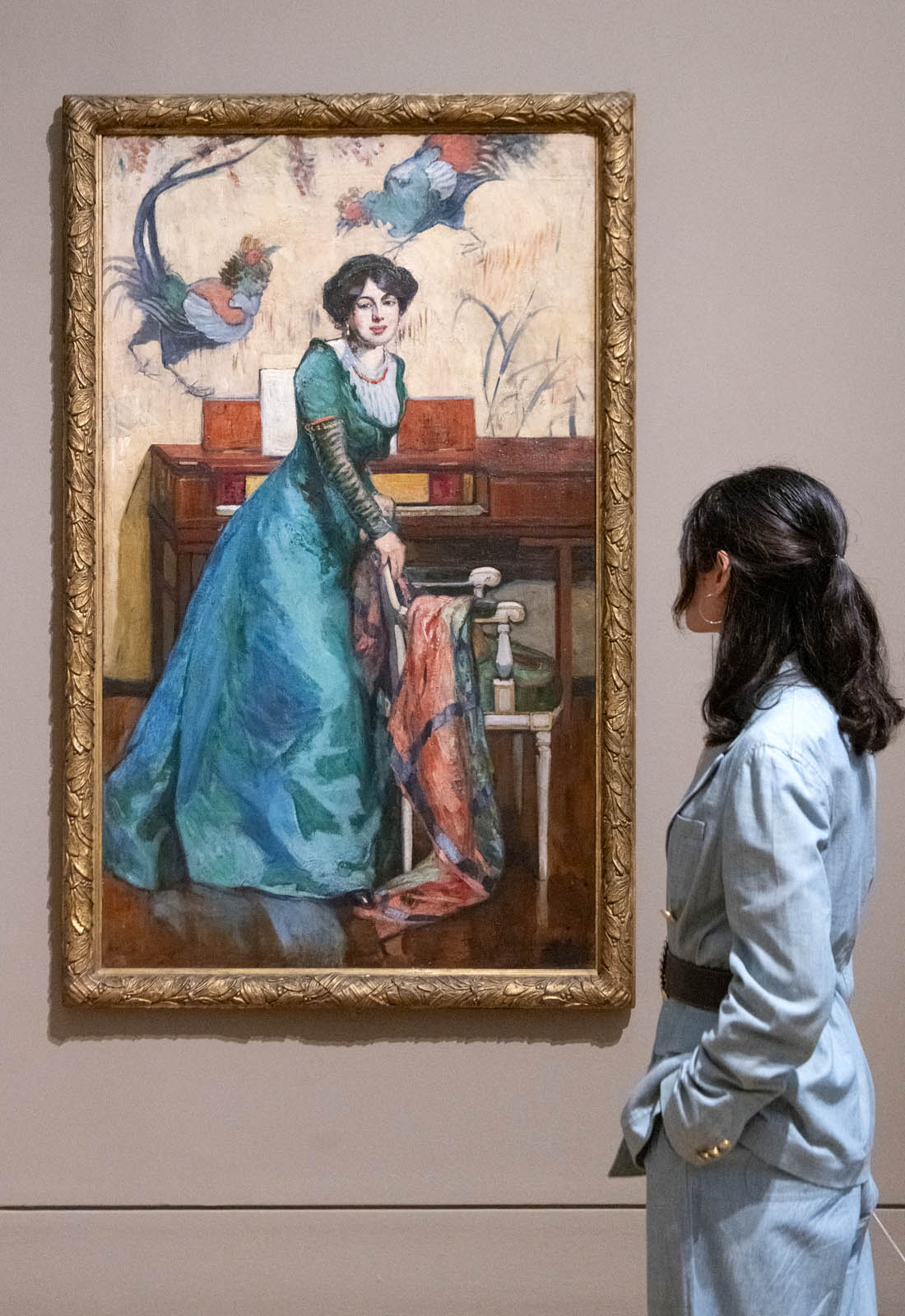
 

Installation view of the exhibition 'Now You See Us Women Artists in Britain 1520-1920' at Tate Britain showing Ethel Wright's 'The Music Room, Portrait of Una Dugdale' 1912


Installation view of the exhibition Now You See Us Women Artists in Britain 1520-1920 at Tate Britain showing Ethel Wright’s The Music Room, Portrait of Una Dugdale 1912 (below)


Ethel Wright (British, 1866-1939) 'The Music Room, Portrait of Una Dugdale' 1912 (installation view)


Ethel Wright (British, 1866-1939)
The Music Room, Portrait of Una Dugdale (installation view)
1912
Oil on canvas
Private collection


This portrait of suffragette and women’s rights activist Una Dugdale Duval (1879-1975) was exhibited at the Stafford Gallery in October 1912. Its flat areas of colour and bold outlines represent a stylistic shift for Wright, who had exhibited at the Royal Academy since the 1880s. Wright shows Duval as cultured and sophisticated, dressed in green, a suffrage colour. Wright made the work the same year Duval made national news for her refusal to promise to obey her husband during their marriage vows. In 1913, Duval published a pamphlet, Love and Honour but Not Obey.

Text from the exhibition large print guide
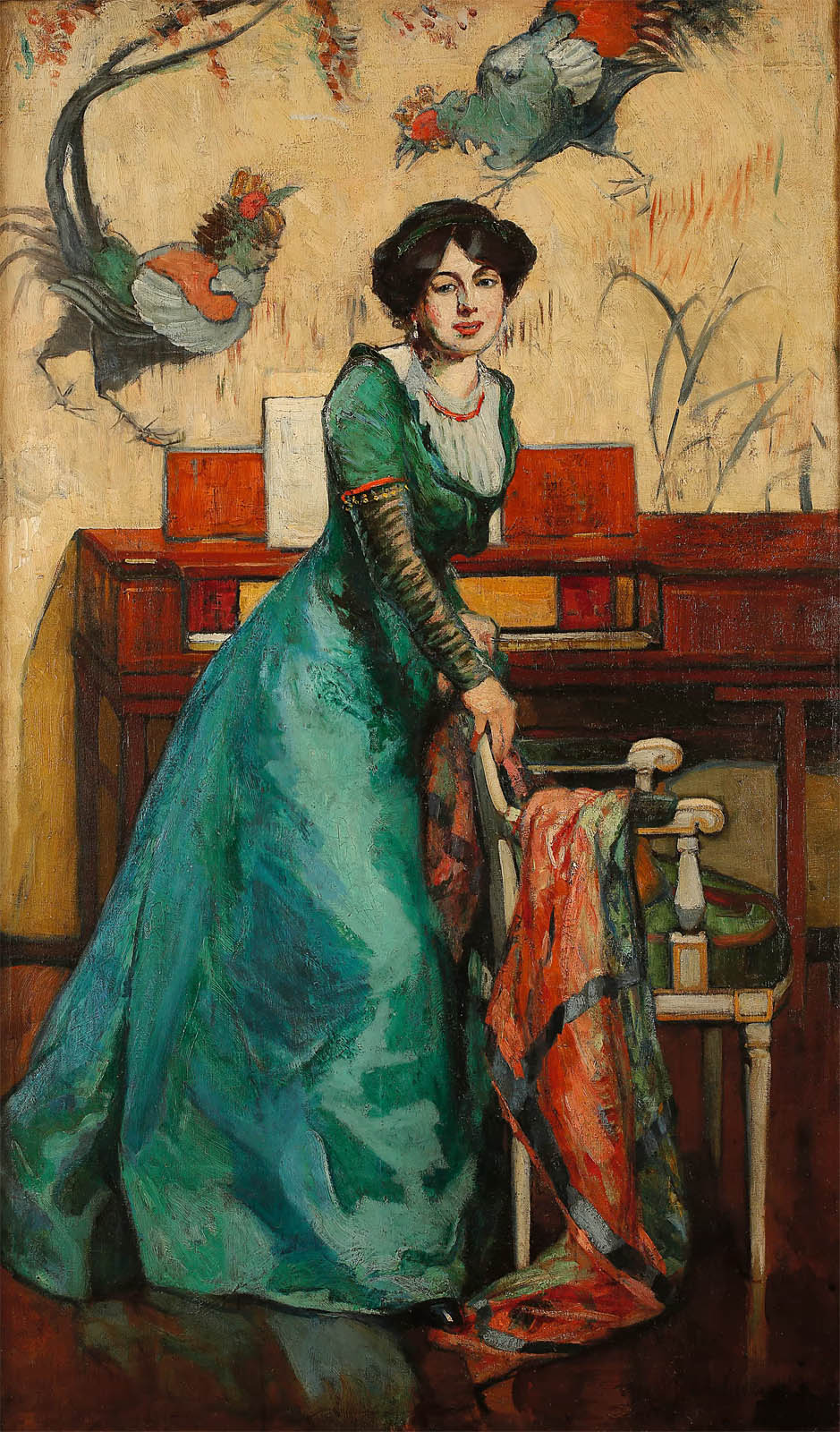
 

Ethel Wright (British, 1866-1939) 'The Music Room, Portrait of Una Dugdale' 1912


Ethel Wright (British, 1866-1939)
The Music Room, Portrait of Una Dugdale
1912
Oil on canvas
Private collection


Vanessa Bell (English, 1879-1961) 'Still Life on Corner of a Mantelpiece' 1914


Vanessa Bell (English, 1879-1961)
Still Life on Corner of a Mantelpiece
1914
Oil on canvas
Support: 559 × 457 mm
Frame: 614 × 512 × 49 mm
Tate
Purchased 1969
© Estate of Vanessa Bell


In 1913, Bell left the Friday Club for the short-lived exhibiting society, the Grafton Group. It included artists who were experimenting with post-impressionism. She was also a founding member of the Omega Workshops. Based in Bloomsbury’s Fitzroy Square, the Workshops aimed to remove the false divisions between fine and decorative arts. The mantelpiece in this painting was in Bell’s house at 46 Gordon Square in London. The objects on it include handmade paper flowers from the Omega Workshops. Bell’s use of an unconventional low viewpoint, fractured, abstracted forms and bright colours show her exploring different techniques associated with twentieth-century art movements.

Text from the exhibition large print guide


Dame Laura Knight DBE RA RWS (English, 1877-1970) 'A Dark Pool' 1917


Dame Laura Knight DBE RA RWS (English, 1877-1970)
A Dark Pool
1917
Oil on canvas
460 × 458 mm
Tyne & Wear Archives & Museums, Laing Art Gallery, Newcastle upon Tyne
© Estate of Dame Laura Knight. All rights reserved 2024 / Bridgeman Images
Image credit: Laing Art Gallery


Anna Airy (English, 1882-1964) 'Shop for Machining 15-inch Shells: Singer Manufacturing Company, Clydebank, Glasgow' 1918


Anna Airy (English, 1882-1964)
Shop for Machining 15-inch Shells: Singer Manufacturing Company, Clydebank, Glasgow
1918
Oil on canvas
Support: Height 1828 mm., Width 2133 mm
© Imperial War Museum


In 1918, Airy received a commission from the Imperial War Museum, thereby becoming Britain’s first official woman war artist. Her 1.7 by 1.8-metre canvases depict munitions production and war-related heavy industry. She later recalled the hot and dangerous conditions in which she worked. A former Slade student, Airy enjoyed a high public profile, won through exhibition and good reviews at the Royal Academy. In 1915, an art critic hailed her as ‘the most accomplished artist of her sex’. Airy was aware, however, of the prejudice women artists still faced. Galleries and buyers, she said, felt ‘safer with a man’.

Text from the exhibition large print guide
 

Anna Airy (English, 1882-1964) 'Study for 'The L Press: Forging the Jacket of an 18-inch Gun, Armstrong-Whitworth Works, Openshaw'' 1918


Anna Airy (English, 1882-1964)
Study for ‘The L Press: Forging the Jacket of an 18-inch Gun, Armstrong-Whitworth Works, Openshaw’
1918
Oil on canvas
Private collection
 

Olive Edis (British, 1876-1955) 'War' 1919


Olive Edis (British, 1876-1955)
War
1919
Carbon print on paper
Wilson Centre for Photography


Edis was Britain’s first woman war photographer. She was commissioned by the Imperial War Museum to photograph the activities of servicewomen on duty in France and Flanders. This bleak, blasted landscape captures the impact of the First World War.

Text from the exhibition large print guide


Installation view of the exhibition 'Now You See Us Women Artists in Britain 1520-1920' at Tate Britain


Installation view of the exhibition Now You See Us Women Artists in Britain 1520-1920 at Tate Britain showing Dame Ethel Walker’s Decoration The Excursion of Nausicaa 1920 (below)
 

Dame Ethel Walker DBE ARA (Scottish, 1861-1951) 'Decoration: The Excursion of Nausicaa' 1920


Dame Ethel Walker DBE ARA (Scottish, 1861-1951)
Decoration: The Excursion of Nausicaa
1920
Oil on canvas
1835 × 3670 mm
Tate
Purchased 1924
Photo: Tate


Writing to J. B. Manson (Monday, 2 June, no year given, but almost certainly 1924), the artist described her work thus:’… Nausicaa early one lovely summer’s morning goes to her father and mother – the King and Queen – to ask permission to have a waggon and mules given to her to take her and her attendants and to fill it with the clothes of the palace that require washing, also with dainties and wine and good food for a forthcoming picnic – and go down to the river adjoining the sea to wash them – which he gives her. On arriving at the river they unharness the mules and are unpacking or unloading the waggons of the clothes and the food for the picnic, and are beginning to wash them in the river. A little wood divides the sea from the river where the goat girl – kneeling by the tree near her goats – hears the strange voices that are sounding in her usually silent little wood. To show it is the sea a girl, nude, has stepped up on to the bank after bathing….’ The story is based on Book VI of the Odyssey: ‘… they spread/The raiment orderly along the beach/Where dashing tides …/… leaving the garments, stretch’d/ In noon-day fervour of the sun, to dry.’

Text from the Tate website


In her lifetime Scottish artist Ethel Walker was celebrated for her trailblazing paintings of the female form. A teacher before she painted fulltime, she developed her own unique style – large, mural-like paintings, which she called her ‘decorations.’ Walker often painted male and female nudes confidently placing female sensuality at the centre of her work, as seen in Decoration: The Excursion of Nausicaa (1920). Its dream-like vision of a feminist utopia was ahead of its time.

Working steadily for decades, she achieved many professional milestones, exhibiting around the world and representing Britain at the Venice Biennale four times. In 1943, Walker was made a Dame of the British Empire, and after her death The Times called her ‘the most important woman artist of her time.’ Despite this, it is only now that her artistic legacy is finally being recognised.

Text from the Tate website


‘There is no such thing as a woman artist. There are only two kinds of artist – bad and good.’

– Ethel Walker


Tate Britain
Millbank, London SW1P 4RG
United Kingdom
Phone: +44 20 7887 8888

Opening hours:
10.00am – 18.00pm daily

Tate Britain website

LIKE ART BLART ON FACEBOOK

Back to top

Exhibition: ‘Arresting Beauty: Julia Margaret Cameron’ at the Milwaukee Art Museum

Exhibition dates: 3rd May – 28th July, 2024


Julia Margaret Cameron (British born India, 1815-1879) 'Annie' 1864


Julia Margaret Cameron (British born India, 1815-1879)
Annie
1864
Albumen print
25.5cm x 21.3cm
© The Royal Photographic Society Collection at the V&A, acquired with the generous assistance of the National Lottery Heritage Fund and Art Fund


Julia Margaret Cameron made this portrait of Annie Philpot, the daughter of a family staying on the Isle of Wight, within a month of receiving her first camera. She inscribed some prints of it ‘My first success’. She later recounted, ‘I was in a transport of delight. I ran all over the house to search for gifts for the child. I felt as if she entirely had made the picture.’

Text from the V&A website


“Nothing is scared but beauty.”1


Since the establishment of Art Blart in November 2008, Julia Margaret Cameron appears in a select and esteemed group of photographic artists who each have over 6 postings in the archive: Eugène Atget, William Eggleston, Walker Evans, Robert Frank, Dorothea Lange, Robert Mapplethorpe, László Moholy-Nagy and August Sander.

I am always ecstatic when I see Cameron’s work. Nobody has ever taken portraits like JMC before or since.

As I have written on JMC in earlier exhibitions:

“When you think about it, here is one the world’s top ten photographers of all time – a woman, taking photographs within the first twenty five years of the birth of commercial photography, using rudimentary technology and chemicals – whose photographs are still up there with the greatest ever taken. Still recognisable as her own and no one else’s after all these years. That is a staggering achievement – and tells you something about the talent, tenacity and perspicacity of the women… that she possessed and illuminated such a penetrating discernment – a clarity of vision and intellect which provides a deep understanding and insight into the human condition.”2

“As with any genius (a person who possesses exceptional intellectual or creative power) who goes against the grain, full recognition did not come until later. But when it does arrive, it is undeniable. As soon as you see a JMC photograph… you know it is by her, it could be by no one else. Her “signature” – closely framed portraits and illustrative allegories based on religious and literary works; far-away looks, soft focus and lighting, low depth of field; strong men (“great thro’ genius”) and beautiful, sensual, heroic women (“great thro’ love”) – is her genius.

There is something so magical about how JMC can frame a face, emerging from darkness, side profile, filling the frame, top lit. Soft out of focus hair with one point of focus in the image. Beautiful light. Just the most sensitive capturing of a human being, I don’t know what it is… a glimpse into another world, a ghostly world of the spirit, the soul of the living seen before they are dead.

Love and emotion. Beauty, beautiful, beatified.”3

Dr Marcus Bunyan


1/ “The line runs from Winckelmann’s Thoughts on the Imitation of Greek Works of Art in Painting and Sculpture, first published in 1755, to the end of the 19th century and beyond; see Walter Pater’s “Winckelmann,” written in 1867 and published in The Renaissance.
Margaret Walters. “The Classical Nude,” in Margaret Walters. The Nude Male: A New Perspective. New York & London: Paddington Press, 1978, p. 34. Footnote 2.

2/ Marcus Bunyan on the exhibition Julia Margaret Cameron: from the Victoria and Albert Museum, London at the Art Gallery of New South Wales (AGNSW), Sydney on Art Blart 24th October 2015

3/ Marcus Bunyan on the exhibition Victorian Giants: The Birth of Art Photography at the National Portrait Gallery, London on Art Blart 13th May 2018

Julia Margaret Cameron exhibitions on Art Blart

~ Exhibition: ‘Francesca Woodman and Julia Margaret Cameron: Portraits to Dream In’ at the National Portrait Gallery, London, March – June 2024
~ Exhibition: ‘Victorian Giants: The Birth of Art Photography’ at the National Portrait Gallery, London Part 1, March – May 2018
~ Exhibition: ‘Julia Margaret Cameron’ at the Victoria and Albert Museum, London, November 2015 – February 2016
~ Exhibition: ‘Julia Margaret Cameron: from the Victoria and Albert Museum, London’ at the Art Gallery of New South Wales (AGNSW), Sydney Part 2, August – October 2015
~ Exhibition: ‘Julia Margaret Cameron: from the Victoria and Albert Museum, London’ at the Art Gallery of New South Wales (AGNSW), Sydney Part 1, August – October 2015
~ Exhibition: ‘Julia Margaret Cameron’ at The Metropolitan Museum of Art, New York, August 2013 – January 2014


Many thankx to the Milwaukee Art Museum for allowing me to publish the photographs in the posting. Please click on the photographs for a larger version of the image.


“I longed to arrest all beauty that came before me, and at length the longing has been satisfied.”


Julia Margaret Cameron


One of the most influential photographers in the medium’s history, Julia Margaret Cameron made portraits of transcendent beauty in close-up, soft-focus photographs. Arresting Beauty: Julia Margaret Cameron – a major traveling exhibition the Milwaukee Art Museum partnered with the Victoria and Albert Museum, London, to bring to the Midwest – highlights the renowned photographer’s pioneering style.

Cameron (English b. India, 1815-1879) received her first camera at the age of 48, making her career even more impressive for its brevity. Her portraits depict family and friends; contemporary scientists, scholars, and artists; and scenes staging allegorical, biblical, historical, and literary stories. For over a decade, she produced thousands of photographs and built a career, selling and exhibiting her work internationally. Her distinct style set her apart, and her legacy positions her as an artist who broke ground for future photographers.

The Museum’s unique presentation of this celebratory exhibition features more than 90 objects and includes works of art from its collection to provide historical context for the art that influenced, and was influenced by, Cameron.

A V&A Exhibition – Touring the World

Text from the Milwaukee Art Museum website


Julia Margaret Cameron (British born India, 1815-1879) 'A Sibyl after the manner of Michelangelo' 1864


Julia Margaret Cameron (British born India, 1815-1879)
A Sibyl after the manner of Michelangelo
1864
Albumen print
28.5cm x 22.5cm
© The Royal Photographic Society Collection at the V&A, acquired with the generous assistance of the National Lottery Heritage Fund and Art Fund


Just as she modelled her Madonna photographs on Renaissance art, Julia Margaret Cameron looked to painting and sculpture as inspiration for her allegorical and narrative subjects. Some works are photographic interpretations of specific paintings by artists such as Raphael and Michelangelo. Others aspired more generally to create ‘Pictorial Effect’.

This depiction of a sibyl, a prophetess from classical mythology, is based on Michelangelo’s fresco of the Erythraean Sibyl on the ceiling of the Sistine Chapel in Rome (1508-1510). The model’s braided hair, bare arms and profile pose with a large book are all copied from Michelangelo’s version. Cameron’s good friend and neighbour Tennyson had prints of the Sistine Chapel frescoes decorating his home.

Cameron’s friend and mentor, the painter G.F. Watts, wrote to Cameron, ‘Please do not send me valuable mounted copies … send me any … defective unmounted impressions, I shall be able to judge just as well & shall be just as much charmed with success & shall not feel that I am taking money from you.’ This photograph is one of approximately 67 in the V&A’s collection that was recently discovered to have belonged to him. Many are unique, which suggests that Cameron was not fully satisfied with them. Some may seem ‘defective’ but others are enhanced by their flaws. All of them contribute to our understanding of Cameron’s working process and the photographs that did meet her standards.

Text from the V&A website


Julia Margaret Cameron (British born India, 1815-1879) 'The Whisper of the Muse' 1865


Julia Margaret Cameron (British born India, 1815-1879)
The Whisper of the Muse
1865
Albumen print
25.5cm x 21.3cm
© The Royal Photographic Society Collection at the V&A, acquired with the generous assistance of the National Lottery Heritage Fund and Art Fund


Julia Margaret Cameron looked to painting and sculpture as inspiration for her allegorical and narrative subjects. Some works are photographic interpretations of specific paintings by artists such as Raphael and Michelangelo. Others aspired more generally to create ‘Pictorial Effect’.

Cameron’s harshest critics attacked her for using the supposedly truthful medium of photography to depict imaginary subject matter. Some suggested that at best her photographs could serve as studies for painters. The South Kensington Museum mainly acquired ‘Madonnas’ and ‘Fancy Subjects’, and exhibited them as pictures in their own right.

Cameron considered her close friend, the painter and sculptor G. F. Watts, to be her chief artistic advisor. She wrote of this period, ‘Mr. Watts gave me such encouragement that I felt as if I had wings to fly with.’ Here she transforms him into a musician, perhaps to symbolise the arts in general, rather than showing him specifically as a painter. Kate Keown, the girl on the right, whispers inspiration.

Text from the V&A website


Julia Margaret Cameron (British born India, 1815-1879) 'La Madonna Aspettante' 1865


Julia Margaret Cameron (British born India, 1815-1879)
La Madonna Aspettante
1865
Albumen print from wet collodion negative
25.5 x 21.3cm
© The Royal Photographic Society Collection at the V&A, acquired with the generous assistance of the National Lottery Heritage Fund and Art Fund


Many of the photographs purchased by the South Kensington Museum (now the Victoria and Albert Museum) from Julia Margaret Cameron were ‘Madonna Groups’ depicting the Virgin Mary and the infant Christ. Her housemaid Mary Hillier posed as the Virgin Mary so often she became known locally as ‘Mary Madonna’.

Like many of her contemporaries, Cameron was a devout Christian. As a mother of six, the motif of the Madonna and child held particular significance for her. In aspiring to make ‘High Art’, Cameron aimed to make photographs that could be uplifting and morally instructive.

Text from the V&A website


Julia Margaret Cameron (British, 1815-1879) 'My grand child aged 2 years & three months' 1865


Julia Margaret Cameron (British, 1815-1879)
My grand child aged 2 years & three months
1865
Albumen print from wet collodion negative
25.5 x 21.3cm
© The Royal Photographic Society Collection at the V&A, acquired with the generous assistance of the National Lottery Heritage Fund and Art Fund


Julia Margaret Cameron’s earliest photographic subjects were family and friends, many of whom were eminent literary figures. These early portraits reveal how she experimented with dramatic lighting and close-up compositions, features that would become her signature style.

Cameron made numerous studies of her grandson, both as himself and in the guise of the Christ child. He features in eight of the photographs the South Kensington Museum acquired in 1865.

Text from the V&A website


Julia Margaret Cameron (British, 1815-1879) 'The Mountain Nymph, Sweet Liberty' June 1866


Julia Margaret Cameron (British born India, 1815-1879)
The Mountain Nymph Sweet Liberty
1866
Albumen print
25.5cm x 21.3cm
© The Royal Photographic Society Collection at the V&A, acquired with the generous assistance of the National Lottery Heritage Fund and Art Fund


Julia Margaret Cameron (British born India, 1815-1879) 'Christabel' 1866


Julia Margaret Cameron (British born India, 1815-1879)
Christabel
1866
Albumen print from wet collodion negative
25.5 x 21.3cm
© The Royal Photographic Society Collection at the V&A, acquired with the generous assistance of the National Lottery Heritage Fund and Art Fund


In the poem by Samuel Taylor Coleridge, Christabel is a virtuous maiden who is put under a spell by an evil sorceress. Cameron wrote of photographs such as this, ‘When coming to something which, to my eye, was very beautiful, I stopped there instead of screwing on the lens to the more definite focus which all other photographers insist upon’.

Text from the V&A website


Julia Margaret Cameron (British born India, 1815-1879) 'Beatrice' March 1866


Julia Margaret Cameron (British born India, 1815-1879)
Beatrice
March 1866
Albumen print from wet collodion negative
35.3 x 28.1cm
© The Royal Photographic Society Collection at the V&A, acquired with the generous assistance of the National Lottery Heritage Fund and Art Fund


In late 1865, Julia Margaret Cameron began using a larger camera. It held a 15 x 12 inch glass negative, rather than the 12 x 10 inch negative of her first camera. Early the next year she wrote to Henry Cole with great enthusiasm – but little modesty – about the new turn she had taken in her work.

Cameron initiated a series of large-scale, closeup heads that fulfilled her photographic vision. She saw them as a rejection of ‘mere conventional topographic photography – map-making and skeleton rendering of feature and form’ in favour of a less precise but more emotionally penetrating form of portraiture. Cameron also continued to make narrative and allegorical tableaux, which were larger and bolder than her previous efforts.

Cameron based the model’s pose, drapery and sad expression on a painting attributed to Guido Reni that was famous at the time. The subject is the 16th-century Italian noblewoman Beatrice Cenci, executed for arranging the murder of her abusive father. One review admired Cameron’s soft rendering of ‘the pensive sweetness of the expression of the original picture’ while another mocked her for claiming to have photographed a historical figure ‘from the life’.

Text from the V&A website


Julia Margaret Cameron (British born India, 1815-1879) 'Call I Follow, I Follow, Let Me Die' 1867


Julia Margaret Cameron (British born India, 1815-1879)
Call I Follow, I Follow, Let Me Die
1867
Carbon print
35.1cm x 26.7cm
© The Royal Photographic Society Collection at the V&A, acquired with the generous assistance of the National Lottery Heritage Fund and Art Fund


In late 1865, Julia Margaret Cameron began using a larger camera. It held a 15 x 12 inch glass negative, rather than the 12 x 10 inch negative of her first camera. Early the next year she wrote to Henry Cole with great enthusiasm – but little modesty – about the new turn she had taken in her work.

Cameron initiated a series of large-scale, closeup heads that fulfilled her photographic vision. She saw them as a rejection of ‘mere conventional topographic photography – map-making and skeleton rendering of feature and form’ in favour of a less precise but more emotionally penetrating form of portraiture. Cameron also continued to make narrative and allegorical tableaux, which were larger and bolder than her previous efforts.

In this image, Cameron concentrates upon the head of her maid Mary Hillier by using a darkened background and draping her in simple dark cloth. The lack of surrounding detail or context obscures references to narrative, identity or historical context. The flowing hair, lightly parted lips and exposed neck suggest sensuality. The title, taken from a line in the poem ‘Lancelot and Elaine’ from Alfred Tennyson’s ‘Idylls of the King’, transforms the subject into a tragic heroine.

Text from the V&A website


Julia Margaret Cameron (British born India, 1815-1879) 'Sir John Herschel' 1867


Julia Margaret Cameron (British born India, 1815-1879)
Sir John Herschel
1867
Albumen print
25.5cm x 21.3cm
© The Royal Photographic Society Collection at the V&A, acquired with the generous assistance of the National Lottery Heritage Fund and Art Fund


When Julia Margaret Cameron photographed her intellectual heroes, such as Tennyson, her aim was to record ‘the greatness of the inner as well as the features of the outer man’. Another motive was to earn money from prints, since her family’s finances were precarious. Within her first year as a photographer she began exhibiting and selling through the London gallery Colnaghi’s. She used autographs to increase the value of some portraits.

In March 1868 Cameron used two rooms at the South Kensington Museum as a portrait studio. Her letter of thanks makes clear her commercial aspirations, mentioning photographs she had sold and asking for help securing more sitters, including, she wrote hopefully, any ‘Royal sitters you may obtain for me’.

Sir John Herschel was an eminent scientist who made important contributions to astronomy and photography. Cameron wrote of this sitting, ‘When I have such men before my camera my whole soul has endeavoured to do its duty towards them in recording faithfully the greatness of the inner as well as the features of the outer man. The photograph thus taken has been almost the embodiment of a prayer.’

Text from the V&A website


Milwaukee Art Museum Presents Major Exhibition of Renowned Photographer Julia Margaret Cameron’s Pioneering Portraits

The only Midwestern presentation of the internationally touring exhibition Arresting Beauty: Julia Margaret Cameron showcases the 19th-century artist’s explorations of transcendent beauty through portraiture.

The Milwaukee Art Museum partners with the Victoria and Albert Museum, London, to present Arresting Beauty: Julia Margaret Cameron, an exhibition illuminating the transcendent beauty of the renowned photographer’s pioneering style. Featuring more than 90 works, including photographs, paintings, and archival objects, the exhibition will be on view May 3 – July 28, 2024, in the Museum’s Herzfeld Center for Photography and Media Arts.

“We are honoured to bring this significant selection of Julia Margaret Cameron’s photographs from the V&A’s collection to the Milwaukee Art Museum,” said Marcelle Polednik, PhD, Donna and Donald Baumgartner Director. “As the only Midwest venue for Arresting Beauty, our visitors will have a unique opportunity to view these rare and groundbreaking prints that will likely not be brought back together again in our generation.”

Julia Margaret Cameron (English born India, 1815-1879) is distinguished as one of the most innovative and influential photographers in the medium’s history. In 1863, at 48 years old, she received her first camera as a gift from one of her children. Cameron refined her artistic practice, creating a distinct style that set her apart from other photographers: close-up, soft-focus portraits often with scratches and smudges she thought enhanced the images’ beauty. Though her style was criticised and considered aesthetically radical for her time, Cameron’s legacy positions her as an artist who broke ground for future photographers. For over a decade, she made photographs from her home in Freshwater on the Isle of Wight and her studio at the South Kensington Museum (now the V&A) in London. She is best known for sensitive, spiritual portraits of her contemporaries and scenes staging allegorical, biblical, historical, and literary stories. Sitters for Cameron’s photographs include Charles Darwin and Alfred Tennyson, as well as her family members, friends, neighbours, and domestic workers.

“Julia Margaret Cameron found beauty in the everyday – both in the people around her and in the photographic ‘mistakes’ she made,” said Kristen Gaylord, Herzfeld Curator of Photography and Media Arts at the Milwaukee Art Museum. “Her artistic pursuit of such beauty left an enduring impact on the field, and I’m thrilled we can bring this major internationally touring exhibition to our community.”

Arresting Beauty travels from Jeu de Paume, Paris, to the Milwaukee Art Museum and comprises three sections: Cameron’s early photography experiments, her portraits of her contemporaries, and her allegorical compositions and artistic tableaux.

Exhibition highlights include:

~ Annie, 1864, a portrait of Cameron’s neighbour, deemed by the artist as her “first success”;
~ The Whisper of the Muse, 1865, an early allegorical photograph featuring artist George Watts as a musician with two local girls as muses;
~ John Frederick William Herschel, 1867, a striking portrait of the prominent scientist and photographic inventor who was a friend of Cameron’s;
~ The Rosebud Garden of Girls, 1868, a composition featuring five women surrounded by flowers, its title inspired by a line from one of Alfred Tennyson’s poems.

Accompanying Cameron’s prints are archival treasures, such as rarely exhibited, handwritten pages from her influential memoir Annals of My Glass House; her camera lens; and a photograph of Cameron taken by her son, Henry Herschel Hay Cameron. To provide historical context for the art that influenced, and was influenced by, Cameron, the Milwaukee Art Museum will present pieces from its collection alongside those from the V&A, including its own photograph by Julia Margaret Cameron, three paintings from its European collection, and three prints never before exhibited.

Arresting Beauty: Julia Margaret Cameron was organised by Lisa Springer, Curator of Photography Touring Exhibitions, and Marta Weiss, Senior Curator of Photography, Victoria and Albert Museum, London. The Milwaukee Art Museum presentation was organised by Kristen Gaylord, Herzfeld Curator of Photography and Media Arts.

Press release from the Milwaukee Art Museum


Julia Margaret Cameron (British born India, 1815-1879) 'The Rosebud Garden of Girls' 1868


Julia Margaret Cameron (British born India, 1815-1879)
The Rosebud Garden of Girls
1868
Albumen print
25.5cm x 21.3cm
© The Royal Photographic Society Collection at the V&A, acquired with the generous assistance of the National Lottery Heritage Fund and Art Fund


Julia Margaret Cameron (British born India, 1815-1879) 'Charles Darwin' 1868 (photographed), 1875 (printed)


Julia Margaret Cameron (British born India, 1815-1879)
Charles Darwin
1868 (photographed), 1875 (printed)
Albumen print from wet collodion negative
25.5 x 21.3cm
© The Royal Photographic Society Collection at the V&A, acquired with the generous assistance of the National Lottery Heritage Fund and Art Fund


When Julia Margaret Cameron photographed her intellectual heroes such as Alfred Tennyson, Sir John Herschel and Henry Taylor, her aim was to record ‘the greatness of the inner as well as the features of the outer man.’ Another motive was to earn money from prints of the photographs, since her family’s finances were precarious. Within her first year as a photographer she began exhibiting and selling through the London gallery Colnaghi’s. She used autographs to increase the value of some portraits.

The naturalist Charles Darwin and his family rented a cottage on the Isle of Wight from the Camerons in the summer of 1868. By 27 July, Colnaghi’s was advertising, ‘We are glad to observe her gallery of great men enriched by a very fine portrait of Charles Darwin’. Due to the sitter’s celebrity, Cameron later had this portrait reprinted as a more stable carbon print.

Text from the V&A website


Julia Margaret Cameron (British born India, 1815-1879) 'Charles Hay Cameron' May 1868


Julia Margaret Cameron (British born India, 1815-1879)
Charles Hay Cameron
May 1868
Albumen print from wet collodion negative
25.5 x 21.3cm
© The Royal Photographic Society Collection at the V&A, acquired with the generous assistance of the National Lottery Heritage Fund and Art Fund


Her husband, Charles Hay Cameron, a retired reformer of Indian law and education, frequently posed for Cameron. Cameron’s husband, Charles, was two decades older than Julia.

Text from the V&A website


Julia Margaret Cameron (British born India, 1815-1879) 'I Wait' 1872


Julia Margaret Cameron (British born India, 1815-1879)
I Wait
1872
Albumen print
25.5cm x 21.3cm
© The Royal Photographic Society Collection at the V&A, acquired with the generous assistance of the National Lottery Heritage Fund and Art Fund


Julia Margaret Cameron (British born India, 1815-1879) 'St. Agnes' 1872


Julia Margaret Cameron (British born India, 1815-1879)
St. Agnes
1872
Albumen print
© The Royal Photographic Society Collection at the V&A, acquired with the generous assistance of the National Lottery Heritage Fund and Art Fund


Julia Margaret Cameron (British born India, 1815-1879) 'Mary Hillier' 1873


Julia Margaret Cameron (British born India, 1815-1879)
Mary Hillier
1873
Albumen print
25.5cm x 21.3cm
© The Royal Photographic Society Collection at the V&A, acquired with the generous assistance of the National Lottery Heritage Fund and Art Fund


In this image, Cameron concentrates upon the head of her maid Mary Hillier by using a darkened background and draping her in simple dark cloth. The lack of surrounding detail or context obscures references to narrative, identity or historical context. The flowing hair, lightly parted lips and exposed neck suggest sensuality.

Text from the V&A website


Julia Margaret Cameron (British born India, 1815-1879) 'A Group of Kalutara Peasants' 1878


Julia Margaret Cameron (British born India, 1815-1879)
A Group of Kalutara Peasants
1878
Albumen print
25.5cm x 21.3cm
© The Royal Photographic Society Collection at the V&A, acquired with the generous assistance of the National Lottery Heritage Fund and Art Fund


Milwaukee Art Museum
700 N Art Museum Dr, Milwaukee,
WI 53202, United States

Opening hours:
Monday – Tuesday: Closed
Wednesday: 10am – 5pm
Thursday: 10am – 8pm
Friday – Sunday: 10am – 5pm

Milwaukee Art Museum website

LIKE ART BLART ON FACEBOOK

Back to top
Exhibition: ‘Golden Valley Faces: The photographs of Richard Jenkins’ at the Café Gallery, Hay Castle, Hay-on-Wye

Exhibition dates: until September 2023

Curator: Hilary Engel


Richard Jenkins (British, 1890-1964) 'Untitled [Husband and wife]' Nd from the exhibition 'Golden Valley Faces: The photographs of Richard Jenkins' at the Café Gallery, Hay Castle, Hay-on-Wye


Richard Jenkins (British, 1890-1964)
Untitled [Husband and wife]
Nd
Digital scan from a glass plate negative


Salt of the Earth

Little is known of the life of photographer Richard Jenkins but that matters little for the images the artist left behind captured on glass-plate negatives give clear insight into the nature of the man. His images are sensitive, full of feeling for the people he is photographing, direct and enigmatic at the same time.

An association can be made between Jenkins’ work and that of German photographer August Sander (1876-1964) as can be seen in the examples I have assembled in this posting. Both artists came from farming stock. Both artists took up photography to escape their proletarian roots. Both artists used an old-fashioned large-format camera with glass negatives. Shooting from a single (face-to-face) perspective both artists work possesses a frontality which places the subject front and centre in the pictorial plane with the background thrown out of focus by the use of low depth of field. Both artists planned compositions pictured their subjects within familiar surroundings and “considered the relationship between location and sitter to be the most essential ingredient for communicating both the status and essence of his or her personality.”1

But while Sander’s portraits tell of an uncertain cultural landscape during the Weimar Republic and the rise of the Nazis during the interwar years through a set of typologies – ‘The Farmer’, ‘The Skilled Tradesman’, ‘The Woman’, ‘Classes and Professions’, ‘The Artists’, ‘The City’ and ‘The Last People’ – based on the tenants of the Neue Sachlichkeit (New Objectivity) movement “which advocated a return to realism and social commentary in art with a respectful and unadorned neutrality, and always within their familiar surroundings”2 rejecting all forms of expressionism and romanticism, Jenkins’ portraits picture the stable cultural landscape of Britain’s farming working class, a class of people that had existed since feudal times in the Britain: in sure and certain hope that hard work will be their salvation.

I grew up belonging to this working class. We were very poor. My mother had to boil a large kettle on the stove and then bathe us boys in a cowper on the floor of the kitchen for we had no hot running water when I was a child, and we only existed on what my father could shoot on the farm… pheasant, pigeon, rabbit, hare, partridge. But what we lacked for in creature comforts we made up in spirit. The energy of the land and its people. The connection to nature, the trees and birds, the crops and earth. In some ways it was a magical childhood amongst the forest, cowslips, fields, granaries – in others, not good at all. This spirit is what you can feel in Jenkins’ photographs. The essentialness of being of the people he photographed. As curator Hilary Engel insightfully observes, “He took photographs of them working, and the beautiful, useful things they made. Although Richard was not interested in farm work himself, he admired the skills that it entailed… You can sense their strength, their resilience – the spirit that has enabled them to survive the hard work and challenges of life in this remote farming community. Richard simply presents them, honestly, as they are: and you sense that they trust him.”

Jenkins’ photographs are not mere facades. They reveal in intimate detail, through every hard earned line on a human face, the triumphs and travails of that person’s existence. Observe if you will Jenkins’ photograph Untitled [Family group] (Nd, below) and note the intimacy of the scene with the two children balanced on the knee of their parents, the daughter held by the mother and the son clasped firmly by one of the stocky, dirty, hardened hands of the father who stares straight at the camera with a slight smile and a twinkle in his eye. Notice his patterned waistcoat peeking out from beneath his thick woollen jacket, thick workman’s trousers surmounting his WWI era puttees and likely army boots with studs. Did he serve during the First World War and survive? Observe also Jenkins’ photograph Untitled [Family group probably at a wedding] (Nd, below) where the family group are all in their Sunday best. What fascinates here is the sitters attitude towards the camera: the aloofness and stiff upper lip of the old gentleman (for that is what he would have been called) at top left, the quizzical look of the man at top right, the contemptuous defiance of the girl at lower left, the inscrutability on the man’s face at bottom right and, dominating them all, the openness and straight forward stare towards the camera of the woman at centre, she clutching a bouquet of flowers, wearing a prominent cross and surmounted by an enormous hat bedecked with blooms. High collars, bowlers hats, stiff upper lips, flowers and finery. It would have been a grand day…

“Sander once said ‘The portrait is your mirror. It’s you’. He believed that, through photography, he could reveal the characteristic traits of people. He used these images to tell each person’s story…”3 Jenkins’ photographs also tell each person’s story but my feeling is that he does it with a more humanist approach than those qualities Sander brought to photographic portraiture. There is a warm and empathy in photographs such as Untitled [Group of men with Romford & Evershed Ltd Pershorf 1885 steam engine] (Nd, below), Untitled [Man and dog] (Nd, below) and Untitled [Three women, sheep and dog] (Nd, below replete with sheep and dog) which Sander’s more Germanic portraits (with their rejection of all forms of expressionism and romanticism) shy away from. If as Sander believed, the portrait is your mirror, it’s you… it’s also a reflection of the soul of the photographer evinced through the portraits of his subjects.

Richard Jenkins must have been one hell of a human being to capture such revealing, intimate, celestial portraits of the people he loved.

Dr Marcus Bunyan


1/ Anonymous. “August Sander,” on The Art Story website Nd [Online] Cited 18/09/2023

2/ Ibid.,

3/ Anonymous. “Five things to know: August Sander,” on the Tate website Nd [Online] Cited 21/09/2023


Many thankx to Hay Castle for allowing me to publish the photographs in the posting. Please click on the photographs for a larger version of the image. © Copyright in Richard Jenkins’ photographs: the Jenkins family 2023. © Copyright in the text: Hilary Engel 2023.


Richard Jenkins (British, 1890-1964) Untitled [Family group] Nd from the exhibition 'Golden Valley Faces: The photographs of Richard Jenkins' at the Café Gallery, Hay Castle, Hay-on-Wye


Richard Jenkins (British, 1890-1964)
Untitled [Family group]
Nd
Digital scan from a glass plate negative


Richard Jenkins was born in 1890 on a farm ten miles from Hay and he became a brilliant pioneering photographer. He longed to escape the drudgery of farming – to go away and study. Instead he had to console himself by learning to wield a cumbersome camera, taking and developing spontaneous and moving portraits of his friends and neighbours going about their everyday lives. He had a gift for capturing his subjects’ personalities, paying tribute to their fortitude and skills. Miraculously, nearly a thousand of his glass-plate images survived decades of neglect and since the publication of Golden Valley Faces in 2020, his work has begun to be recognised as a remarkable record of life in rural Herefordshire at the start of the twentieth century.


August Sander (German, 1876-1964) 'Bauernpaar – Zucht und Harmonie [Peasant couple – breeding and harmony]' 1912


August Sander (German, 1876-1964)
Bauernpaar – Zucht und Harmonie [Peasant couple – breeding and harmony]
1912
Gelatin silver print


August Sander (German, 1876-1964) 'Working-class Mother' 1927


August Sander (German, 1876-1964)
Working-class Mother
1927
Gelatin silver print


Richard Jenkins (British, 1890-1964) 'Untitled' Nd from the exhibition 'Golden Valley Faces: The photographs of Richard Jenkins' at the Café Gallery, Hay Castle, Hay-on-Wye


Richard Jenkins (British, 1890-1964)
Untitled
Nd
Digital scan from a glass plate negative


Richard Jenkins was born in 1890 in south west Herefordshire, close to the Black Mountains of Wales. He grew up to be a bright, curious young man: he longed to go to college to study engineering, to be part of the technological revolution that was going on in the outside world. But because he was the only son of a farmer it was not allowed: he had to stay on the farm. Even in this remote valley, new machinery was beginning to take over tasks that had always been done by hand, or with horses – like the mobile steam engine which travelled from farm to farm. Travel was being transformed, with the opening of railways. And country people were beginning to discover a new freedom with bicycles – or even motorbikes.

Communication was revolutionised during Richard’s childhood, with the invention of wireless and telephones. Electricity was reaching across the country. Any one of these burgeoning industries offered enticing prospects for a would-be engineer in the first decade of the twentieth century. But for Richard, it was not to be. As he grew up, Richard found a way to escape the prison of farming. He acquired a camera, and somehow mastered the art of composing telling images, as well as the science of developing and printing. It was his way of celebrating the world that he saw around him. He photographed every stage in the lives of his Golden Valley neighbours: their weddings, their babies, their graves.

He portrayed their children growing up, at school concerts and at chapel anniversaries. He took photographs of them working, and the beautiful, useful things they made. Although Richard was not interested in farm work himself, he admired the skills that it entailed. Richard’s subjects were not used to being photographed. Some of them look uncomfortable, apprehensive. But Richard was evidently charming, and had a knack for getting people to relax. They have various props to put them at their ease – dogs, cats, even sheep or horses. Or a favourite bicycle or motorbike. Richard saw that these additions helped to express his subjects’ personalities. Many of them stare resolutely into the camera. You can sense their strength, their resilience – the spirit that has enabled them to survive the hard work and challenges of life in this remote farming community. Richard simply presents them, honestly, as they are: and you sense that they trust him.

Richard’s portraits differ markedly from the conventional style of the time. A professional photographer might place his subjects in a studio against an elegant setting, and get them to take up a certain pose, gazing into the distance. Or they would be portrayed with objects representative of their status – splendid horses, or impressive houses. Instead, Richard’s subjects appear in their natural, often very modest, habitat. Richard adored his beautiful sister, Eva, and photographed her repeatedly. Her form lights up many of the pictures. She poses, elegantly composed, amongst the bracken at Quarrelly Farm.

Richard Jenkins died in 1964, having lived at Quarrelly Farm all his life. For decades his glass plate negatives were stored in shoeboxes and cupboards in the farmhouse – never catalogued or published. But in 2010 the Jenkins family generously decided to place the collection in the care of the Herefordshire Archive and Records Centre, where it has since been digitised. Since the publication of Golden Valley Faces in 2020, Richard Jenkins has begun to be recognised as a remarkable photographer. Many of his subjects remain unknown: but their faces speak with all the freshness and vigour they had a hundred years ago. His images of the life around him form a unique portrait of rural Herefordshire at the start of the twentieth century.

Text by Hilary Engel on the Golden Valley Faces website Nd [Online] Cited 02/08/2023


Richard Jenkins (British, 1890-1964) 'Untitled [Child and bull]' Nd from the exhibition 'Golden Valley Faces: The photographs of Richard Jenkins' at the Café Gallery, Hay Castle, Hay-on-Wye


Richard Jenkins (British, 1890-1964)
Untitled [Child and bull]
Nd
Digital scan from a glass plate negative


Richard Jenkins (British, 1890-1964) 'Untitled [Family group probably at a wedding]' Nd


Richard Jenkins (British, 1890-1964)
Untitled [Family group probably at a wedding]
Nd
Digital scan from a glass plate negative


Richard Jenkins (British, 1890-1964) 'Untitled [Family group probably at a wedding]' Nd (detail)


Richard Jenkins (British, 1890-1964)
Untitled [Family group probably at a wedding] (detail)
Nd
Digital scan from a glass plate negative


Richard Jenkins (British, 1890-1964) 'Untitled [Woman lying among the ferns]' Nd


Richard Jenkins (British, 1890-1964)
Untitled [Woman lying among the ferns]
Nd
Digital scan from a glass plate negative


Richard Jenkins (British, 1890-1964) 'Untitled [Woman lying in the grass]' Nd (detail)


Richard Jenkins (British, 1890-1964)
Untitled [Woman lying among the ferns] (detail)
Nd
Digital scan from a glass plate negative


Richard Jenkins (British, 1890-1964) 'Untitled [Loading the hay]' Nd


Richard Jenkins (British, 1890-1964)
Untitled [Loading the hay]
Nd
Digital scan from a glass plate negative


Richard Jenkins (British, 1890-1964) 'Untitled [Group of men with Romford & Evershed Ltd Pershorf 1885 steam engine]' Nd


Richard Jenkins (British, 1890-1964)
Untitled [Group of men with Romford & Evershed Ltd Pershorf 1885 steam engine]
Nd
Digital scan from a glass plate negative


Richard Jenkins (British, 1890-1964) 'Untitled [Three men and a press]' Nd


Richard Jenkins (British, 1890-1964)
Untitled [Three men and a press]
Nd
Digital scan from a glass plate negative


Richard Jenkins (British, 1890-1964) 'Untitled [Man with buttonhole posy]' Nd


Richard Jenkins (British, 1890-1964)
Untitled [Man with buttonhole posy]
Nd
Digital scan from a glass plate negative


August Sander (German, 1876-1964) [Farmer, Westerwald (Bauer, Westerwald)] 1910


August Sander (German, 1876-1964)
[Farmer, Westerwald (Bauer, Westerwald)]
1910
Gelatin silver print


Richard Jenkins (British, 1890-1964) 'Untitled [Couple]' Nd


Richard Jenkins (British, 1890-1964)
Untitled [Couple]
Nd
Digital scan from a glass plate negative


August Sander (German, 1876-1964) 'Mother and Daughter' 1912


August Sander (German, 1876-1964)
Mother and Daughter
1912
Gelatin silver print


Richard Jenkins (British, 1890-1964) 'Untitled [Nurse, group of children and candles]' Nd


Richard Jenkins (British, 1890-1964)
Untitled [Nurse, group of children and candles]
Nd
Digital scan from a glass plate negative


Richard Jenkins (British, 1890-1964) 'Untitled [Man and dog]' Nd


Richard Jenkins (British, 1890-1964)
Untitled [Man and dog]
Nd
Digital scan from a glass plate negative


Richard Jenkins (British, 1890-1964) 'Untitled [Three women, sheep and dog]' Nd


Richard Jenkins (British, 1890-1964)
Untitled [Three women, sheep and dog]
Nd
Digital scan from a glass plate negative


Richard Jenkins (British, 1890-1964) 'Untitled [Two heavy horses, two men and a plough]' Nd


Richard Jenkins (British, 1890-1964)
Untitled [Two heavy horses, two men and a plough]
Nd
Digital scan from a glass plate negative


Richard Jenkins (British, 1890-1964) 'Untitled [Two men with pipes, bicycles and dog]' Nd


Richard Jenkins (British, 1890-1964)
Untitled [Two men with pipes, bicycles and dog]
Nd
Digital scan from a glass plate negative


The first published selection of Richard Jenkins’ work, telling the story of his life and his photography

Author: Hilary Engel
112 pages, 240 x 200 mm
140 black and white photographs
ISBN 978-1-5272-6998-9
Available in bookshops, or order online
Retail price £12
Postage and packing within the UK: £5

Profits from sales of the book will go to the Laurie Engel Fund for Teenage Cancer Trust


Hay Castle
Oxford Road
Hay-on-Wye
HR3 5DG
Phone: 01497 820079

Opening hours:
Daily 10am – 5pm

Hay Castle website

LIKE ART BLACK ON FACEBOOK

Back to top

Exhibition: ‘Conditions of Living: Home and Homelessness in London’s East End’ at Four Corners, London

Exhibition dates: 30th June – 2nd September 2023

Photographers: the exhibition features work by Katalin Arkell, Peter Arkell, Cyril Arapoff, Chris Bethell, A.R. Coster, Firmin, John Galt, David Granick, Bert Hardy, Brian Harris, Hawkins, Nick Hedges, David Hoffman, Tom Learmonth, Steve Lewis, Jack London, Marketa Luskacova, Anthony Luvera, MacGregor, Monty Meth, Douglas Miller, Moyra Peralta, Ray Rising, Reg Sayers, Andrew Scott, Alex Slotzkin, Norah Smyth, Humphrey Spender, Andrew Testa, Paul Trevor, Edith Tudor-Hart, as well as several unknown photographers.


Jack London Collection (American, 1876-1916) 'People of the Abyss' 1902


Jack London Collection (American, 1876-1916)
People of the Abyss
1902
© Huntington Library, San Marino, California


1902: a policeman disturbs a rough-sleeping youth in Whitechapel, one of many photographs by the American author Jack London that illustrated his book The People of the Abyss.


Another insightful, socially-minded (ie. actively interested in social welfare or the well-being of society as a whole) exhibition from Four Corners who champion creative expression, education and empowerment and build upon almost 50 years of radical, socially-engaged approaches to photography and film.

“This timely exhibition draws shocking comparisons with today’s housing precarity, high rents and homelessness. From Victorian slums and the first model estates, to the mass postwar council house construction and the subsequent demolition of many tower blocks, it ends with post-Thatcherite gentrification and its impact on affordable housing.” (Press release)

I have included bibliographic information on the artists in the posting where possible.

Dr Marcus Bunyan

PS. For more information on slum photography and urban poverty please see the essay by Sadie Levy Gale. “Exposed,” on the AEON website 21 August 2023 [Online] Cited 31/08/2023


Many thankx to Four Corners for allowing me to publish the photographs in the posting. Please click on the photographs for a larger version of the image.


Jack London (American, 1876-1916) 'Homeless people in Itchy Park, Spitalfields' 1902


Jack London (American, 1876-1916)
Homeless people in Itchy Park, Spitalfields
1902
From People of the Abyss

NOTE: Photograph not in the exhibition


Images of housing, homelessness and resistance in London’s East End

Our summer exhibition explores how photographers have represented conditions of housing and homelessness for over a century. From workhouses to slums, damp council flats to Thatcherite gentrification, images reveal the systemic poverty that East Londoners have endured and how the medium of photography has been used to campaign for change. We are delighted to feature new artwork by Anthony Luvera, which addresses economic segregation in Tower Hamlets’ housing developments, a phenomenon known as ‘poor doors’. Created with a forum of local residents, this examines the rise of market-driven ‘affordable’ housing and the state of social housing today.

This exhibition is supported using public funding by the National Lottery through Arts Council England and the National Lottery Heritage Fund. We particularly thank Getty Images Hulton Archive and Tower Hamlets Local History Library and Archives for their generous contributions which made this exhibition possible. We are grateful for the kind support of Report Digital.

Text from the Four Corners website


Jack London (American, 1876-1916) 'View in Hoxton' 1902


Jack London (American, 1876-1916)
View in Hoxton
1902
From People of the Abyss

NOTE: Photograph not in the exhibition


Jack London (American, 1876-1916) 'Homeless women in Spitalfields Garden' 1902


Jack London (American, 1876-1916)
Homeless women in Spitalfields Garden
1902
From People of the Abyss

NOTE: Photograph not in the exhibition


Not many people know that the famous American author Jack London was also a skilled documentary photographer and photojournalist. He took thousands of pictures over the years from the slums of London’s East End to the islands of the South Pacific.

In 1902 Jack London visited his namesake city London where he took pictures of its people and their everyday life. In the book “The People of the Abyss”, London describes this first-hand account by living in the East End (including the Whitechapel District) for several months, sometimes staying in workhouses or sleeping on the streets. The conditions he experienced and wrote about were the same as those endured by an estimated 500,000 of the contemporary London poor.

Even before, Jack London had talked about a book on the London slums with George Brett, one of his publishers. Thus, the writer knew what he was ought to expect ‘down there’: “He meant to expose the underside of imperialism, the degradation of the workers…”. The “evolutionary Socialist” wanted to find “the Black Hole of capitalism”.

With this preconceived vision in his mind, he disguised himself as an American sailor who had lost his ship and went into the East End taking pictures and experiencing their life. To be more precise, he wandered about Whitechapel, Hoxton, Spitalfields, Bethnal Green, and Wapping to the East India Docks. Jack London disguised as one of the working-class poor and pretended to be one of them, which made it easier for him to get to know the conditions of their everyday life. …

In his 1903 “The People of the Abyss”, the American gives this description of the poor Londoners: “the air he breathes, and from which he never escapes, is sufficient to weaken him mentally and physically, so that he becomes unable to compete with the fresh virile life from the country hastening on to London Town… It is incontrovertible that the children grow up into rotten adults, without virility or stamina, a weak-kneed, narrow-chested, listless breed, that crumples up and goes down in the brute struggle for life with the invading hordes from the country.”

Anonymous. “London’s East End life through the lens of Jack London, 1902,” on the Rare Historical Photos website Nd [Online] Cited 04/08/2023


Jack London (American, 1876-1916) 'Whitechapel on a bank holiday' 1902


Jack London (American, 1876-1916)
Whitechapel on a bank holiday
1902
From People of the Abyss

NOTE: Photograph not in the exhibition


Jack London (American, 1876-1916) 'Frying Pan alley, Spitalfields' 1902


Jack London (American, 1876-1916)
Frying Pan alley, Spitalfields 
1902
From People of the Abyss

NOTE: Photograph not in the exhibition


Norah Smyth (British, 1874-1963) 'A Street in Bow' 1914


Norah Smyth (British, 1874-1963)
A Street in Bow
1914
© Paul Isolani-Smyth


1914: residents of a street in Bow, photographed by the activist and suffragette Norah Smyth. A street in Bow in 1914 where the East London Federation of the Suffragettes (ELFS) took care of children during the first world war. Smyth documented children in Bow through a series of intimate street photographs.


Norah Smyth

Smyth, a suffragette, socialist and pioneering female photographer was a founding member of the East London Federation of Suffragettes (ELFS) and right-hand woman to Sylvia Pankhurst, who set up the federation in 1914.

Her years of activism included a spell as a prominent member of the Communist Workers’ Party (CWP) during the 1920’s. Her active participation in the international socialist movement came to an end with the dissolution of the CWP. After twelve years in the East End of London, it was time to move on. Smyth decided to join brother Maxwell in Florence, where she took up a post at the British Institute.

Jane McChrystal. “The adventures of Norah Smyth: her life as a suffragette, philanthropist and artist,” on the Roman Road LDN website 22 March 2023 [Online] Cited 04/08/2023


Anonymous photographer. 'Shadwell Family' 1920


Anonymous photographer
Shadwell Family
1920
© Topical Press Agency, Hulton Archive, Getty Images


1920: a poverty-stricken family make a meal from a loaf of bread in Shadwell, traditionally an area of slum housing where the population lived in closely packed tenements.


Exhibition reveals East End’s history of poor housing and homelessness

Opening at Four Corners Gallery this month, Conditions of Living: Home and Homelessness in London’s East End takes a visual journey from workhouses to slums, damp tower blocks to homeless shelters, exploring how photographers have represented these conditions for over a century. It sheds light on little-known histories: the tenants’ rent strikes of the 1930s, post-war squatting, and ‘bonfire corner’, a meeting place for homeless people at Spitalfields Market for more than twenty years.

This timely exhibition draws shocking comparisons with today’s housing precarity, high rents and homelessness. From Victorian slums and the first model estates, to the mass postwar council house construction and the subsequent demolition of many tower blocks, it ends with post-Thatcherite gentrification and its impact on affordable housing.

The exhibition features new work by the artist Anthony Luvera, which addresses the rise of economic segregation in recent housing developments across Tower Hamlets, a phenomenon commonly known as ‘poor doors’. Also titled Conditions of Living, this socially  engaged artwork by Luvera is built upon extensive research into the social, political, and economic contexts behind the rise of market-driven ‘affordable’ housing provision and the state of social housing today, and is created in collaboration with a community forum of local residents who live in the buildings themselves. This new work builds upon Luvera’s twenty-year career dedicated to working collaboratively with people who have experienced homelessness, and addressing issues of housing precarity and housing justice.

Anthony Luvera says: ‘London is one of the world’s last major cities still to ban the practice of allowing property developers to build ‘poor doors’, despite proclamations by successive governments and mayors about stopping the appalling practice. My work with people experiencing homelessness began twenty years ago in Spitalfields. To be back in Tower Hamlets creating this new work about economic segregation in housing developments and the broken social housing system feels urgent, especially at a time when the costs of living crisis has sunk its claws into the lives of ordinary working people.’

Carla Mitchell, Artistic Director at Four Corners says: ‘this is a highly relevant exhibition, given the extortionate London rents which create forms of social cleansing for long established local communities. We were inspired by Four Corners’ own building, which was a Salvation Army working men’s hostel.’

Four Corners

We are a cultural centre for film and photography, based in East London for fifty years. Our exhibitions explore unknown social histories that might not otherwise be told.

Tower Hamlets Local History Library and Archives

THLHLA holds outstanding resources for the study of the history of London’s East End. Run by the London Borough of Tower Hamlets, collections cover the areas of Bethnal Green, Poplar and Stepney. Explore the changing landscape and lived experiences of individuals and communities in Tower Hamlets through original documents, images and reference books.

Press release from Four Corners


Edith Tudor-Hart (British born Austria, 1908-1973) 'Stepney family' 1932


Edith Tudor-Hart (British born Austria, 1908-1973)
Stepney family
1932
© The Estate of W. Suschitzky


1932: portrait of an impoverished family in Stepney. Edith Tudor-Hart was one of the most significant documentary photographers of the period. Closely affiliated with the Communist party, she recorded the conditions of the working class.


Edith Tudor-Hart

Edith Tudor-Hart, née Suschitzky, was one of the most significant documentary photographers working in Britain in the 1930s and 1940s. Born in Vienna, she grew up in radical Jewish circles. Edith married Alex Tudor-Hart, a British doctor, and the pair moved to England. There she worked as a documentary photographer, closely associated with the Communist Party, compiling a remarkable archive of images of working people in London and later, the south of Wales. Although still active in the 1950s, the difficulties of finding work as a woman photographer led eventually to Tudor-Hart abandoning photography altogether.


Bert Hardy (British, 1913-1995) 'Bombed East End' 1940


Bert Hardy (British, 1913-1995)
Bombed East End
1940
© Bert Hardy, Picture Post, Getty Images


1940: a couple carry their salvaged belongings after bomb damage to their home, photographed by photojournalist Bert Hardy, best known for his work for Picture Post


Bert Hardy

If one photographer sums up the spirit and sheer brilliance of the seminal British newsweekly Picture Post, it is Bert Hardy (1913-1995). Alongside Bill Brandt and Don McCullin, former Victoria & Albert curator Mark Haworth-Booth regarded Hardy as one of the three greatest British photojournalists from the genre’s Golden Age. Indeed, Hardy stands alongside Cartier-Bresson, Robert Capa and Werner Bischoff as the giants of 20th-century photography.

London born and entirely self-taught, Hardy was one of the UK’s first professionals to embrace the 35mm Leica in favour of a traditional large-format press camera. The smaller camera and faster film suited his instinctual shooting style and allowed him to consistently create something unique even in high-pressure situations. His confidence and courage enabled him to produce some of the most memorable images of the Blitz and postwar England and Europe. An inspiration to a generation of photojournalists, Hardy was often greeted as warmly by his subjects as he was by his peers – so much so one dubbed him the ‘professional Cockney’.

Anonymous. “Bert Hardy,” on the Getty Images Gallery website Nd [Online] Cited 04/08/2023


Monty Meth (British, 1926-2021) 'New Houses' 1951


Monty Meth (British, 1926-2021)
New Houses
1951
© Monty Meth, Topical Press Agency, Hulton Archive, Getty Images


1951: workers stand on the ruins of Trinity church in Poplar, which was destroyed during the Blitz, and overlook new housing built in the wake of slum clearances.


Monty Meth

Monty was born above a barber’s shop in Bethnal Green, east London, the youngest of three sons of Millie Epstein, a domestic servant, and Max Meth, a Czech Jewish immigrant who found intermittent work as a bread roundsman and tailor.

Educated at the local Mansford St Central school, Monty learned photography at the Cambridge and Bethnal Green boys’ club, which he credited with rescuing him from teenage pilfering, and at 14 went to work as a messenger for the Fleet Street picture agency Photopress, then on to the Topical Press agency. He returned after second world war service in the Navy to become a prize-winning photographer and photojournalist.

Martin Adeney. “Monty Meth obituary,” on The Guardian website Sun 28 Mar 2021 [Online] Cited 03/08/2023


David Granick (British, 1912-1980) 'Stifford Estate' 1961


David Granick (British, 1912-1980)
Stifford Estate
1961
Retouched by Chris Dorley-Brown
© Tower Hamlets Local History Library and Archives


1961: the now demolished Stifford Estate in Tower Hamlets, built in the late 1950s to replace slum housing, and comprised of three 17-storey tower blocks. Photographed by lifelong Stepney resident David Granick, who recorded the East End pre-gentrification.


David Granick

David Granick (1912-1980) was a photographer who lived in the East End his whole life. His colour slides laid untouched until 2017 when a local photographer, Chris Dorley-Brown, examined them at Tower Hamlets Local History Library & Archives. These images capture the post-war streets of Stepney, Whitechapel, Spitalfields and beyond in the warm hues of Kodachrome film at a time when black and white photography was the norm.

David Granick was born in 1912 and lived his whole life in Stepney. A Jew, a keen photographer and a long-serving member of the East London History Society, he gave lectures on various local history themes illustrated with colour slides taken by himself or his fellow members of the Stepney Camera Club. Bequeathed to Tower Hamlets Local History Library & Archives after his death in 1980, where they have been preserved ever since, these photographs show the East End on the cusp of social change.


The London East End In Colour 1960-1980 David Granick 2019 Hoxton Mini Press


David Granick (British, 1912-1980) 'Spitalfields Market' 1973


David Granick (British, 1912-1980)
Spitalfields Market
1973
Photo restoration by Chris Dorley-Brown
© Tower Hamlets Local History Library and Archives


David Hoffman (British, b. 1946) 'Houses Stand Empty' 1973


David Hoffman (British, b. 1946)
Houses Stand Empty
1973
© David Hoffman


Photojournalist David Hoffman has spent more than 40 years photographing the happenings on the streets of London, with a particular focus on his East End hometown, and with his lens predominantly focused on those less fortunate than most.

His subjects have included the homeless, the addicted, and the enraged, and spanned slums, shelters, and the streets, in good spirits and bad.

‘Really, my work is about oppression,’ he explains, ‘It’s not about class, but how people’s lives are constrained and shaped by society. And that’s most visible at the bottom of society. You and I are constrained, too, but in far less, and far less damaging, ways.’ Besides, he adds, ‘No one’s going to get a feature published on how the middle class is having a tough time.’

What defines his work, Hoffman says, is that ‘I’m always looking for extremes.’

Hoffman’s first photographic training came from a course at the University of York, where, with Chris Steele-Perkins, he set up a Student Union-sponsored darkroom. Steele-Perkins went on to work for Magnum Photos and become their president. In contrast, after two years Hoffman ‘slung the course in at the same time that they slung me’.

He moved back to London in 1969, to the East End in 1970, and worked ‘rubbish jobs’ to support his photography.

‘I did van driving and jobs like that. I would work to save up money, and then take time off to do photography (until my money ran out).’ A polytechnic course helped: ‘It was a poor course and taught me nothing but I had three years being supported on grants so I could really put some effort into my photography’, and squatting ‘meant that I didn’t have to spend my time working to raise the rent and could build my photography into a survivable income.’

Amy Freeborn. “David Hoffman: chaos, riots, slums and the East End,” on the Roman Road LDN website 27 November 2014 [Online] Cited 04/08/2023


Marketa Luskacova (Czech, b. 1944) 'Homeless men, Spitalfields' 1975


Marketa Luskacova (Czech, b. 1944)
Homeless men, Spitalfields
1975
© Markéta Luskačová


1975: homeless men in Spitalfields, photographed by the Czech documentarist Markéta Luskačová.


Marketa Luskacova

Marketa Luskacova’s work is marked by her own lived experiences. Themes like cultural identity and social behaviour are at the core of her candid photographs. Born in Prague in 1944 during the communist regime, Luskacova graduated from Charles University with a degree in Sociology in 1967 and studied Photography at FAMU (1967-1969). Around this time, she began to take photographs as a means to document local traditions in some of the poorest communities of Slovakia.

She moved to London in 1975, where she continued her career as a photographer. She began to document her surroundings, producing captivating portraits of everyday life in some of the least privileged areas of the city. She felt particularly drawn towards the cultural atmosphere of Brick Lane and Spitalfields street markets, where she used to buy her own groceries.

‘I was poor and I needed to do my shopping there as it was the cheapest place to buy things. I could identify with the people in Brick Lane because they were immigrants and they were in need of cheap goods. Once I had done my shopping, I would leave my bag with a stall holder while I took my photographs.’

In her series London Street Markets, Luskacova documents daily life in the city, capturing powerful and emphatic portraits of its people and their traditions and offering a glimpse into the diverse cultural fabric of London East End’s society in the seventies.

‘I don’t go to Brick Lane regularly anymore, sometimes six months pass between one visit and another … I photographed what I saw there and what I thought it was good to record, be it a face or a smile, an animal or a shoe. I believe in the evidential quality of photography, and I know that unless things are done in a visually interesting way they are not remembered.’

Anonymous. “Artist Profile: Marketa Luskacova,” on the Arts Council Collection website Nd [Online] Cited 04/08/2023


Tom Tom Learmonth (British, b. 1955) 'Usher Rd Bow, Tower Hamlets' 1976, Usher Rd Bow, Tower Hamlets, 1976 © Tom Learmonth


Tom Learmonth (British, b. 1955)
Usher Rd Bow, Tower Hamlets
1976
© Tom Learmonth


1976: children play on rubble on waste ground on Usher Road, Tower Hamlets.


Tom Learmonth

Born in Liverpool but brought up in England, Wales, India and Australia, he studied on the first BA degree in photographic arts in the UK, at the Polytechnic of Central London. “There I developed a social and political view of what photography could and should do,” he says. “My work concentrated on the community in the East End of London. After graduating I worked in community photography projects in the East End and freelanced as a photojournalist in the wide sense of the word; I wrote as well as photographed.”


Tom Learmonth (British, b. 1955) 'Mrs Baldwin, Mansford Street Estate, Bethnal Green' 1978


Tom Learmonth (British, b. 1955)
Mrs Baldwin, Mansford Street Estate, Bethnal Green
1978
© Tom Learmonth


1978: Mrs Baldwin on the balcony of her flat on the Mansford Street Estate, Bethnal Green. The estate of more than 700 homes was built over 20 years from 1957.


Andrew Testa (English, b. 1965) 'Bailiffs move along rooftops towards protesters as they evict Claremont Road on the route of the M11 motorway' 1994


Andrew Testa (English, b. 1965)
Bailiffs move along rooftops towards protesters as they evict Claremont Road on the route of the M11 motorway
1994
© Andrew Testa


1994: bailiffs move along rooftops towards protesters as they evict occupants of Claremont Road on the route of the M11 motorway, prior to the demolition of the houses.


Anthony Luvera (Australian, b. 1974) 'Assisted Self-Portrait of Ruben Torosyan' 2004


Anthony Luvera (Australian, b. 1974)
Assisted Self-Portrait of Ruben Torosyan
2004
© Anthony Luvera


2004: assisted self-portrait of Ruben Torosyan by Anthony Luvera. Luvera started the project in 2001, helping homeless people to document their lives and experiences.


Anthony Luvera

Anthony Luvera (born 1974) is an Australian artist, writer and educator, living in London. He is a socially engaged artist who works with photography on collaborative projects, which have included working with those who have experienced homelessness and LGBT+ people. Luvera is an Associate Professor of Photography at Coventry University… Luvera has worked extensively with people who have experienced homelessness. Many of these projects use his “assisted self-portrait” methodology, where the subject of the photograph, assisted by Luvera, makes and selects the pictures.

Text from the Wikipedia website


Photographs and Assisted Self-Portraits

Photographs

I had never wanted to photograph homeless people before. I’d read the (de)constructive writings by photo critics on ‘others’, poverty and representation. I knew about the complexities of the find-a-bum school of photography trounced by Martha Rosler. So in December 2001, when it was put to me by a friend to get involved as a photographer at Crisis Open Christmas, the annual event for homeless people in London, the invitation threw me. “I’d much prefer to see what the people I met would photograph.”

Over the following months, the conversation with my friend about photography and homelessness bounced louder in the back of my head. I became extremely interested in how homeless people have been represented and in questions about the process of representation itself. To what degree could the apparently fixed proximities between photographer, subject and camera be dismantled and reconfigured? How could a ‘subject’ become actively involved in the creation of a representation? What use, if any, would all this serve in the meanings offered in the final presentation?

I sourced 1,000 cameras and processing vouchers, and spent every day and many late nights at the following Crisis Open Christmas…

Between 25 and 40 people dropped in to each following weekly session. Around a big communal table, we gathered to look at the photos, to show and tell the stories held in the images, and to drink endless cups of tea. The sessions were high-energy, swarming with vibrant personalities. The youngest participant was 19 and the oldest was nearing 90. Different people got involved for different reasons. Some wanted to make snapshots of their special times, favourite places, friends and family. While others had ideas about art and concepts to explore with photography. I explained how to use the cameras and listened to each participant’s ambitions, encouraging everyone to simply go and do it. I never brought along photography books or showed my own photographs, nor did I tell any of the participants how or what to photograph. When looking at the photographs I asked each participant to pull out their favourites, or the images that best represented what they wanted to show. With permission I took scans of these photographs and held the negatives in a file. Release forms and licenses were provided, written especially for the project by specialist intellectual property copyright lawyers. Permission was not always given, which was always completely respected.

I never asked why anybody was homeless. Though over time stories came out with the photographs. In the four years the sessions have taken place I have worked with over 250 people. Every person I’ve met has a very different and particular story to tell. Some are entirely abject, while others are remarkable for their ordinariness. All are compelling in their own way. And while there may be commonalities between the experiences of particular individuals, not one situation of any participant could be seen as being broadly representative of the cause or experience of homelessness.

Ruben Torosyan

Ruben Torosyan left Georgia in the late 1980’s when the country was still under harsh Soviet rule. Not issued a birth certificate and unable to get a passport, Ruben was determined to get to the capitalist West to create a better life for himself. He spent over five years traveling across Europe attempting to obtain political asylum in over 15 different countries. In every place he was unsuccessful, largely for the same bureaucratic reasons, boiling down to the incredible fact that Ruben has absolutely no official way of proving who he is or where he comes from. In Spain Ruben smuggled himself on to a shipping freight container. Squished in with bottles and bags for his excrement, and packets of biscuits to eat, he travelled for 35 nights in complete darkness to get to New York. After failing to get legal rights to remain there, and escaping detainment, he struggled on the streets of Brooklyn in conditions worse than back home in Georgia. After two years, determined not to go back to Georgia, Ruben did the same shipping container trip to Ireland to get to London, where shortly after we met.

Ruben came to the sessions with a very clear idea about what he wanted to use the cameras to photograph in making his contribution to the archive; the discrepancy between what he expected London to be and what, in his experience, it actually was. Ruben’s depictions of dirty, litter strewn streets (serendipitously replete with the newspaper headline, “I Feel Used”), a naked man with mental health issues running down the road, people begging and a poor woman walking by without shoes, are for him, depictions of the filthy, hostile, brutal and ugly place that is London. Where there is “no mercy and the food is rubbish”.

Anthony Luvera. “Photographs and Assisted Self-Portraits,” in Source, Issue 47 2006 published on the Anthony Luvera website [Online] Cited 03/08/2023 (with permission of the author)


Four Corners
121 Roman Road, Bethnal Green,
London E2 0QN
Nearest tube: Bethnal Green, Central Line

Opening hours:
Tuesday to Saturday 11am – 6pm
Thursday 11am – 8pm (July and on 31 Aug)

Four Corners website

LIKE ART BLART ON FACEBOOK

Back to top
Exhibition: ‘This Is Britain: Photographs from the 1970s and 1980s’ at the National Gallery of Art, Washington

Exhibition dates: 29th January – 11th June 2023

Curator: The exhibition is curated by Kara Felt, assistant curator of art at the Denver Botanic Gardens and a former Andrew W. Mellon Postdoctoral Curatorial Fellow in the department of photographs at the National Gallery of Art, with the organisational assistance of Diane Waggoner, Curator of Photographs, National Gallery of Art.


Gilles Peress (French, b. 1946) 'NORTHERN IRELAND. Belfast. Summer evening' 1989


Gilles Peress (French, b. 1946)
NORTHERN IRELAND. Belfast. Summer evening
1989
Gelatin silver print
Corcoran Collection
Museum Purchase with funds donated by the Marlin Miller, Jr. Family Foundation and by exchange: John Bryant and Patricia Bauman


I lived through these years in Britain.

Strikes, unemployment, high inflation and economic failure
New Right, monetarist ideas and the free market economy
The Troubles
The Winter of Discontent
The queens silver jubilee
Glam Rock, punk and then New Romantics; disco and then HiNRG
Aston Martin, Triumph TR7, two door Capri and MGB GT
Falklands War
Charles and Diana
1984-1985 miners’ strike
Recession
North-South divide
Gay Liberation, women’s liberation
Clause 28
HIV/AIDS
Brixton Riots (September 1985)
Racism and the National Front
Victorian values and moral behaviour vs the permissive society

and Margaret Thatcher

That one name still sends shivers down my spine.

The photographs in this posting capture the grittiness of those years… and the surreality of the lived experience. From my perspective, I worked really hard and partied even harder at clubs such as Scandals, Adams, Bang and Heaven. I spent as much as I earnt and careered around London in my beloved Mini 1275 GT as fast as I could, listening to David Bowie, Barry White and the Love Unlimited Orchestra, Pink Floyd, and the inimitable Grace Jones.

In black and white, Graham Smith’s Bennetts Corner (Giro Corner), the Erimus Club and Commercial Pub, South Bank, Middlesbrough (1982, below) perfectly encapsulates the depressive, dank mood of the country during these years. The meaning of “Giro corner” in the title references a place where people would go, in this case two pubs, to spend their Giro cheque: an unemployment or income support payment by giro cheque, posted fortnightly.

In colour, Martin Parr’s two photographs of New Brighton, Merseyside (1984, below) reference the absurdity of the British at play: leisure time in “new” Brighton on Mersyside in North West England (many miles from the affluent Brighton on the south coast of England) – eating surrounded by rubbish and relaxing on a hard concrete ramp with crying baby, while other artists capture the isolation of individuals, their working class lives and middle class pretensions.

Dr Marcus Bunyan


Many thankx to the National Gallery of Art for allowing me to publish the photographs in the posting. Please click on the photographs for a larger version of the image.


Profound changes in British society in the 1970s and 1980s inspired a revolution in British photography. This Is Britain highlights the socially conscious photographers who captured this moment in time, among them Vanley Burke, Pogus Caesar, Anna Fox, Paul Graham, Sunil Gupta, Chris Killip, Sirkka-Liisa Konttinen, and Martin Parr. The exhibition features some 45 newly acquired prints in the National Gallery of Art’s collection. It brings together works by photographers who explored the national identity as Britain grappled with deindustrialisation, uprisings in inner cities, the Troubles in Northern Ireland, and the controversial policies of Prime Minister Margaret Thatcher. The exhibition also includes Handsworth Songs (1986, below), a 59-minute film on the uprisings that rocked London and Birmingham in 1985. It was produced by the Black Audio Film Collective and directed by John Akomfrah. The exhibition is organised by the National Gallery of Art.

Text from the National Gallery of Art website


Anna Fox (British, b. 1961) 'Advertising Agency, Docklands Enterprise Zone' 1988


Anna Fox (British, b. 1961)
Advertising Agency, Docklands Enterprise Zone
1988
From the series Work Stations
Chromogenic print
Image (visible): 44.5 x 54.8 cm (17 1/2 x 21 9/16 in.)
Framed: 68.5 x 83.8 cm (26 15/16 x 33 in.)
National Gallery of Art, Washington, Alfred H. Moses and Fern M. Schad Fund


Anna Fox (British, b. 1961) 'Conference and Exhibitions Organiser, Euston. Personal Assistant to the Director' 1988, printed later


Anna Fox (British, b. 1961)
Conference and Exhibitions Organiser, Euston. Personal Assistant to the Director
1988, printed later
From the series Work Stations
Chromogenic print
Image (visible): 44.5 x 54.8cm (17 1/2 x 21 9/16 in.)
Framed: 68.5 x 83.8cm (26 15/16 x 33 in.)
National Gallery of Art, Washington, Alfred H. Moses and Fern M. Schad Fund


Anna Fox (British, b. 1961) 'Cafe, the City. Salesperson' 1988 from the series 'Work Stations'


Anna Fox (British, b. 1961)
Cafe, the City. Salesperson
1988
From the series Work Stations
Chromogenic print
Image (visible): 44.5 x 54.8cm (17 1/2 x 21 9/16 in.)
Framed: 68.5 x 83.8cm (26 15/16 x 33 in.)
National Gallery of Art, Washington, Alfred H. Moses and Fern M. Schad Fund


Britain experienced profound changes in the 1970s and 1980s, when it was racked by deindustrialization, urban uprisings, the controversial policies of Prime Minister Margaret Thatcher, and the Troubles in Northern Ireland. Photography became a central form of creative expression during this period, supported and disseminated through new schools, galleries, artists’ collectives, magazines, and government funding.

This Is Britain brings together the work of a generation of photographers who were commenting on the deep unrest of these pivotal decades. Vanley Burke, Pogus Caesar, Anna Fox, Paul Graham, Sunil Gupta, Chris Killip, Sirkka-Liisa Konttinen, Martin Parr, and others pictured communities, traditions, and landscapes affected by Britain’s shifting social and economic realities. Together, they photographed a nation redefining what it meant to be British and, ultimately, modern.

Text from the National Gallery of Art website


Profound changes in British society in the 1970s and 1980s inspired a revolution in British photography. This Is Britain: Photographs from the 1970s and 1980s highlights the work of socially conscious photographers who captured this period of unrest. The exhibition features some 45 newly acquired prints by Vanley Burke, Pogus Caesar, Anna Fox, Paul Graham, Sunil Gupta, Chris Killip, Sirkka-Liisa Konttinen, Martin Parr, and others. It brings together photographers who examined national identity as Britain grappled with deindustrialisation, uprisings in inner cities, the Troubles in Northern Ireland, and the sometimes controversial policies of Prime Minister Margaret Thatcher. On view on the Ground Floor of the National Gallery’s West Building from January 29 through June 11, 2023, the exhibition also features the film Handsworth Songs (1986). The 59-minute film, produced by the Black Audio Film Collective and directed by John Akomfrah, explores uprisings in London and Birmingham in 1985. Reece Auguiste, a member of the Black Audio Film Collective, is the guest curator for an accompanying film program.

Beginning in the 1970s, photography gained its contemporary prominence in Britain, with a rapidly expanding network of galleries, artists’ collectives, schools, and magazines dedicated to promoting the medium. Immigrants and artists of colour, reflecting Britain’s growing multiculturalism, introduced fresh perspectives, as did the many women who entered the field. A generation of young photographers moved from largely black-and-white, documentary styles to more conceptual and often humorous projects in colour in the 1980s. As photographers forged new directions, they pictured a country redefining what it meant to be British and, ultimately, modern.

This Is Britain tells history on an intimate scale, highlighting stories we may have otherwise missed. The addition of these photographs to the National Gallery’s collection allows us to reflect on two decades of artistic innovation and celebrate the talented, diverse group of creators who captured them. We hope that this exhibition inspires visitors, as they contemplate some of the highs and lows experienced by British citizens in the ’70s and ’80s,” said Kaywin Feldman, director of the National Gallery of Art.

Exhibition overview

This Is Britain: Photographs from the 1970s and 1980s focuses on the work of photographers who recorded ways of life that were under threat or disappearing in those tumultuous decades. John Davies’s expansive view of Agecroft Power Station, Salford (1983​) emphasises the displacement of industrial structures. Paul Graham’s​ elegiac series A1: The Great North Road (1982​) examines the shift away from the A1 – a major thoroughfare from London to Edinburgh – to the newer, more direct M1 motorway, resulting in businesses along the former highway to suffer. With their forlorn colours and barren spaces, his pictures challenged the expectation that photography on social themes should be in black and white. Reflecting Britain’s growing immigration and multiculturalism during this period of modernisation, Vanley Burke’s Boy with Flag, Winford in Handsworth Park (1970) pictures a Black youth proudly displaying the Union Jack from his bike.

Many artists in the 1980s continued exploring colour photography, using intense hues inspired by advertising to poke fun at the rise of leisure activities, consumerism, and corporate greed. The series The Last Resort (1983-1986) by Martin Parr, arguably Britain’s most influential living photographer, surveys seaside tourists in New Brighton with acerbic wit. Chris Steele-Perkins​’s decade-long project The Pleasure Principle (1980-1989) captures Margaret Thatcher’s England through surreal images, such as Hypnosis Demonstration, Cambridge University Ball. Six photographs from Anna Fox’s Work Stations (1987-1988​) signal the competition and stress of London office life in the late 1980s. Sunil Gupta strikes a more polemical tone in his series “Pretended” Family Relationships (1988) by responding to Thatcher’s policy prohibiting the promotion of gay and lesbian lifestyles.

The final room presents Handsworth Songs (1986, 59 minutes), a landmark nonfiction film that connects the civil unrest in London and the Handsworth section of Birmingham in 1985 with Britain’s colonial past, weaving contemporary reports and interviews with historical footage and photographs. The film, produced by the Black Audio Film Collective and directed by the acclaimed filmmaker John Akomfrah, features a soundtrack that mixes reggae and post-punk with industrial noises and voiceovers.

Press release from the National Gallery of Art, Washington


Martin Parr (British, 1952-2025) 'New Brighton, Merseyside' 1984 from the series 'The Last Resort'


Martin Parr (British, 1952-2025)
New Brighton, Merseyside
1984
From the series The Last Resort
Chromogenic print
Image: 26.67 x 33.02cm (10 1/2 x 13 in.)
Sheet: 30.48 x 40.64cm (12 x 16 in.)
National Gallery of Art, Washington, Alfred H. Moses and Fern M. Schad Fund
© Martin Parr, Courtesy Rocket Gallery


Martin Parr (British, 1952-2025) 'New Brighton, Merseyside' 1984 from the series 'The Last Resort'


Martin Parr (British, 1952-2025)
New Brighton, Merseyside
1984
From the series The Last Resort
Chromogenic print
Image: 26.67 × 33.02cm (10 1/2 × 13 in.)
Sheet: 30.48 × 40.64cm (12 × 16 in.)
National Gallery of Art, Washington, Alfred H. Moses and Fern M. Schad Fund
© Martin Parr, Courtesy Rocket Gallery


Punk Rock, record unemployment, urban uprisings, Margaret Thatcher, the Troubles in Northern Ireland: profound changes shook British society and inspired a revolution in photography in the 1970s and 1980s. A generation of young photographers used their cameras to comment on the deep unrest of these pivotal decades. With a keen eye for social critique and a spirit of rebellion, they photographed a country redefining what it meant to be British and, ultimately, modern.

Photography during this period became a central form of creative expression, fuelled by a rapidly expanding network of galleries, museum departments, artists’ collectives, schools, and magazines dedicated to the medium. Immigrants and artists of colour, reflecting the nation’s growing multiculturalism, introduced new perspectives, as did the many women who entered the field.

Moving from largely black-and-white, documentary styles toward more conceptual projects in colour, photographers adopted new strategies to examine national identity. In the face of severe economic dislocation, widespread civil disorder, and Prime Minister Thatcher’s controversial policies, these artists declared: This is Britain.

Documenting the Deindustrial Revolution

The decline of British heavy industry in the 1970s led to labor disputes and high unemployment in the early 1980s. As the country prioritised modern technologies and greater efficiency, photographers recorded the communities, structures, and ways of life that were under threat or disappearing. Graham Smith and Vanley Burke portrayed people they had known for decades, while Chris Killip, Sirkka-Liisa Konttinen, and Gilles Peress undertook long-term projects to create intimate yet often bleak photographs of life on the margins of society. Paul Graham and John Davies explored England’s uneasy embrace of the future by showing the people and places being left behind. While these photographers held no real hope of inspiring change, they shared an earnest concern for who and what was being lost as the nation modernised.

Picturing Absurdity in the Thatcher Years

As the leader of the Conservative Party from 1975 and as prime minister from 1979 to 1990, Margaret Thatcher was a polarising figure in Britain. She oversaw the development of an American-style free market economy, the resurgence of British nationalism, and major cutbacks to public spending (famously declaring that “there is no such thing” as society). During the Thatcher years, photographers Martin Parr and Anna Fox used the brash colours of advertising to poke fun at the rise of leisure activities, consumerism, and corporate greed. Combining text and image, Karen Knorr and Sunil Gupta considered how traditional English institutions sidelined women, people of colour, and gay and lesbian communities. Their works openly satirise long-held traditions and question emerging values in British society.

Wall text from the exhibition


Tony Ray-Jones (English, 1941-1972) 'Butlin's Holiday Camp, Scarborough' 1968


Tony Ray-Jones (English, 1941-1972)
Butlin’s Holiday Camp, Scarborough
1968
Gelatin silver print
Image: 15.8 x 24.8cm (6 1/4 x 9 3/4 in.)
Sheet: 35.8 x 28cm (14 1/8 x 11 in.)
National Gallery of Art, Washington, Alfred H. Moses and Fern M. Schad Fund


Karen Knorr (American born Germany, b. 1954) 'A mood of Highly Coloured Naturalism' 1983 from the series 'Country Life'


Karen Knorr (American born Germany, b. 1954)
A mood of Highly Coloured Naturalism
1983
From the series Country Life
Gelatin silver print mounted on board
Image: 40.2 x 40.9cm (15 13/16 x 16 1/8 in.)
Sheet: 60.7 x 51cm (23 7/8 x 20 1/16 in.)
National Gallery of Art, Washington, Alfred H. Moses and Fern M. Schad Fund


Karen Knorr (American born Germany, b. 1954) 'Newspapers are no longer ironed, Coins no longer boiled So far have Standards Fallen' 1981-1983, printed 2015 from the series 'Gentlemen'


Karen Knorr (American born Germany, b. 1954)
Newspapers are no longer ironed, Coins no longer boiled So far have Standards Fallen
1981-1983, printed 2015
From the series Gentlemen
Gelatin silver print
Image: 40.6 × 40.5cm (16 × 15 15/16 in.)
Sheet: 61.5 × 50.7cm (24 3/16 × 19 15/16 in.)
Mat: 71 × 55.8cm (27 15/16 × 21 15/16 in.)
National Gallery of Art, Washington, Alfred H. Moses and Fern M. Schad Fund


Karen Knorr (American born Germany, b. 1954) 'We owe it to the Free world not to Allow Brutal Forces to succeed. When the Rule of law Breaks down, the World takes a further Step towards Chaos' 1981-1983, printed 2015 from the series 'Gentlemen'


Karen Knorr (American born Germany, b. 1954)
We owe it to the Free world not to Allow Brutal Forces to succeed. When the Rule of law Breaks down, the World takes a further Step towards Chaos
1981-1983, printed 2015
From the series Gentlemen
Gelatin silver print
Image: 40.5 x 40.7cm (15 15/16 x 16 in.)
Sheet: 60.8 x 50.5cm (23 15/16 x 19 7/8 in.)
National Gallery of Art, Washington, Alfred H. Moses and Fern M. Schad Fund


Chris Killip (Isle of Man, 1946-2020) 'Margaret, Rosie, and Val, Seacoal Camp, Lynemouth, Northumberland' 1983


Chris Killip (Isle of Man, 1946-2020)
Margaret, Rosie, and Val, Seacoal Camp, Lynemouth, Northumberland
1983
Gelatin silver print
Image: 40.5 x 50.5cm (15 15/16 x 19 7/8 in.)
Sheet: 47.8 x 57.6cm (18 13/16 x 22 11/16 in.)
National Gallery of Art, Washington, Alfred H. Moses and Fern M. Schad Fund


Chris Killip (Isle of Man, 1946-2020) 'Crabs and People, Skinningrove, North Yorkshire, UK' 1981


Chris Killip (Isle of Man, 1946-2020)
Crabs and People, Skinningrove, North Yorkshire, UK
1981
Gelatin silver print
Image: 39.9 × 48.9cm (15 11/16 × 19 1/4 in.)
Sheet: 50.7 × 59.7cm (19 15/16 × 23 1/2 in.)
Mat: 56 × 71.2cm (22 1/16 × 28 1/16 in.)
National Gallery of Art, Washington, Alfred H. Moses and Fern M. Schad Fund
© Chris Killip Photography Trust / Magnum Photos, Courtesy Augusta Edwards Fine Art


Colin Jones (English, 1936-2021) 'The Black House, London' 1973-1976


Colin Jones (English, 1936-2021)
The Black House, London
1973-1976
Gelatin silver print
Image: 33.8 x 49.1cm (13 5/16 x 19 5/16 in.)
Sheet: 41 x 50.8cm (16 1/8 x 20 in.)
National Gallery of Art, Washington, Alfred H. Moses and Fern M. Schad Fund


Vanley Burke (British born Jamaica, b. 1951) 'Young Men on See-Saw, Handsworth Park, Birmingham' 1984, printed 2021


Vanley Burke (British born Jamaica, b. 1951)
Young Men on See-Saw, Handsworth Park, Birmingham
1984, printed 2021
Gelatin silver print
Image: 30.1 x 45.4cm (11 7/8 x 17 7/8 in.)
Sheet: 40.4 x 50.5cm (15 7/8 x 19 7/8 in.)
National Gallery of Art, Washington, Alfred H. Moses and Fern M. Schad Fund


Vanley Burke (British born Jamaica, b. 1951) 'Boy with Flag, Winford in Handsworth Park' 1970, printed 2022


Vanley Burke (British born Jamaica, b. 1951)
Boy with Flag, Winford in Handsworth Park
1970, printed 2022
Gelatin silver print
National Gallery of Art, Washington, Alfred H. Moses and Fern M. Schad Fund


Sirkka-Liisa Konttinen (Finland, b. 1948) 'Young Couple in a Backyard on a Summer's Day' 1975, printed 2012


Sirkka-Liisa Konttinen (Finland, b. 1948)
Young Couple in a Backyard on a Summer’s Day
1975, printed 2012
Gelatin silver print
Image: 36.1 × 39.3cm (14 3/16 × 15 1/2 in.)
Sheet: 40.4 × 50.5cm (15 7/8 × 19 7/8 in.)
National Gallery of Art, Washington, Alfred H. Moses and Fern M. Schad Fund Courtesy L. Parker Stephenson Photographs


John Davies (British, b. 1949) 'Agecroft Power Station, Salford' 1983


John Davies (British, b. 1949)
Agecroft Power Station, Salford
1983
Gelatin silver print
Image: 37.6 × 56.1cm (14 13/16 × 22 1/16 in.)
Sheet: 50.5 × 60.4cm (19 7/8 × 23 3/4 in.)
National Gallery of Art, Washington, Alfred H. Moses and Fern M. Schad Fund Courtesy L. Parker Stephenson Photographs


Graham Smith (British, b. 1947) 'The Queen's Pub, Southbank, Middlesbrough' 1981


Graham Smith (British, b. 1947)
The Queen’s Pub, Southbank, Middlesbrough
1981
Gelatin silver print
Image: 17.8 × 22.8cm (7 × 9 in.)
Sheet: 21.8 × 26.8cm (8 9/16 × 10 9/16 in.)
Mat: 28 × 35.6cm (11 × 14 in.)
National Gallery of Art, Washington, Alfred H. Moses and Fern M. Schad Fund
© Graham Smith, Courtesy Augusta Edwards Fine Art


Graham Smith (British, b. 1947) 'Bennetts Corner (Giro Corner), the Erimus Club and Commercial Pub, South Bank, Middlesbrough' 1982, printed 2008


Graham Smith (British, b. 1947)
Bennetts Corner (Giro Corner), the Erimus Club and Commercial Pub, South Bank, Middlesbrough
1982, printed 2008
Gelatin silver print
Image: 37.4 x 47cm (14 3/4 x 18 1/2 in.)
Sheet: 47.7 x 57.4cm (18 3/4 x 22 5/8 in.)
National Gallery of Art, Washington, Alfred H. Moses and Fern M. Schad Fund


Paul Graham (British, b. 1956) 'Café Assistants, Compass Café, Colsterworth, Lincolnshire' November 1982


Paul Graham (British, b. 1956)
Café Assistants, Compass Café, Colsterworth, Lincolnshire
November 1982
Chromogenic print
Image: 19.4 x 24cm (7 5/8 x 9 7/16 in.)
Sheet: 27.4 x 35cm (10 13/16 x 13 3/4 in.)
National Gallery of Art, Washington, Alfred H. Moses and Fern M. Schad Fund


Paul Graham (British, b. 1956) 'Little Chef in Rain, St. Neots, Cambridgeshire' May 1982


Paul Graham (British, b. 1956)
Little Chef in Rain, St. Neots, Cambridgeshire
May 1982
Chromogenic print
Image: 24.2 x 30.6cm (9 1/2 x 12 1/16 in.)
Sheet: 27.9 x 35.7cm (11 x 14 1/16 in.)
Mat: 35.5 x 45.8cm (14 x 18 1/16 in.)
National Gallery of Art, Washington, Alfred H. Moses and Fern M. Schad Fund
© Paul Graham, courtesy Pace Gallery


Tom Wood (Irish, b. 1951) 'Between Chester and Birkenhead' 1989


Tom Wood (Irish, b. 1951)
Between Chester and Birkenhead
1989
Vintage gelatin silver print
Image: 17.2 x 26.1cm (6 3/4 x 10 1/4 in.)
Sheet: 27.9 x 35.2cm (11 x 13 7/8 in.)
National Gallery of Art, Washington, Alfred H. Moses and Fern M. Schad Fund


Tom Wood (Irish, b. 1951) 'Lime Street' 1995


Tom Wood (Irish, b. 1951)
Lime Street
1995, printed 1997
Analogue hand print
Image: 19 x 25.6 cm (7 1/2 x 10 1/16 in.)
Sheet: 19.8 x 27.2cm (7 13/16 x 10 11/16 in.)
National Gallery of Art, Washington, Alfred H. Moses and Fern M. Schad Fund


Sunil Gupta on Community and Activism

Sunil Gupta, photographer, curator, writer, and activist has maintained a visionary approach to photography, producing bodies of work with keen social and political commentary. Gupta’s diasporic experience of multiple cultures informs a practice dedicated to themes of race, migration, and queer identity. His photographic projects – born from a desire to see himself and others like him represented in art history – draw upon his own life as a point of departure.

The Arnold Newman Lecture Series on Photography provides a forum for leading photographers, primarily known for portraits, to discuss contemporary issues in the medium. Arnold Newman (1918-2006) is acknowledged as one of the great masters of the twentieth and twenty-first centuries whose work changed portraiture. The Arnold and Augusta Newman Foundation generously supported this series to make such conversations available to the public.

Text from the YouTube website


Sunil Gupta (Canadian born India, b. 1953) 'Untitled #1' 1988, printed 2020


Sunil Gupta (Canadian born India, b. 1953)
Untitled #1
1988, printed 2020
From the series “Pretended” Family Relationships
Inkjet print
Image: 61 x 91.4cm (24 x 36 in.)
Sheet: 63.5 x 94cm (25 x 37 in.)
National Gallery of Art, Washington, Alfred H. Moses and Fern M. Schad Fund
© Sunil Gupta


Pogus Caesar (British born St. Kitts, b. 1953) 'Handsworth Riots: Birmingham, United Kingdom September' 1985, printed 2022


Pogus Caesar (British born St. Kitts, b. 1953)
Handsworth Riots: Birmingham, United Kingdom
September 1985, printed 2022
Gelatin silver print
Image: 50.8 × 60.96cm (20 × 24 in.)
Sheet: 41.6 × 57.4cm (16 3/8 × 22 5/8 in.)
National Gallery of Art, Washington, Alfred H. Moses and Fern M. Schad Fund
© Pogus Caesar/OOM Gallery Archive, ARS, New York, DACS, London


Handsworth Songs (1986)

A landmark in nonfiction filmmaking, Handsworth Songs was the first film directed by the Ghanaian-born artist John Akomfrah. It was produced by the Black Audio Film Collective (1982-1998), a group of experimental Black artists who examined the diasporic African and Asian experience in Britain. The film weaves archival footage with scenes, interviews, and pictures from contemporary events, including photographs by Vanley Burke, with a haunting soundtrack that mixes reggae and post-punk music with industrial noises and voiceovers. This layered structure connects Britain’s colonial past with unrest in London’s Tottenham and Brixton neighbourhoods and Birmingham’s Handsworth area in 1985. Today, Handsworth Songs reveals the solidarity shared by Britons of African and Asian descent in the face of inequality as it brings historical perspective to civil disturbances in the 1980s.

This film includes depictions of police violence and the use of racial slurs. Viewer discretion is advised.

Wall text from the exhibition


Chris Steele-Perkins (British, b. 1947) 'Hypnosis Demonstration, Cambridge University Ball' 1980-1989


Chris Steele-Perkins (British, b. 1947)
Hypnosis Demonstration, Cambridge University Ball
1980-1989
Silver dye bleach print
Image: 25.4 × 38.1cm (10 × 15 in.)
Sheet: 30.2 × 40.4cm (11 7/8 × 15 7/8 in.)
National Gallery of Art, Washington, Alfred H. Moses and Fern M. Schad Fund


Paul Reas (British, b. 1955) 'Constable County, Flatford Mill, Suffolk' c. 1992


Paul Reas (British, b. 1955)
Constable County, Flatford Mill, Suffolk
c. 1992
From the series Flogging a Dead Horse
Inkjet print image: 41 x 50.5cm (16 1/8 x 19 7/8 in.)
Sheet: 50.5 x 61cm (19 7/8 x 24 in.)
National Gallery of Art, Washington, Alfred H. Moses and Fern M. Schad Fund


National Gallery of Art
National Mall between 3rd and 7th Streets
Constitution Avenue NW, Washington

Opening hours:
Daily 10am – 5pm

National Gallery of Art website

LIKE ART BLART ON FACEBOOK

Back to top
Exhibition: ‘The Stillness of Things: Photographs from the Lane Collection’ at the Museum of Fine Arts, Boston

Exhibition dates: 27th August, 2022 – 27th February, 2023


William Henry Fox Talbot (English, 1800-1877) 'Articles of China' before 1844 from the exhibition 'The Stillness of Things: Photographs from the Lane Collection' at the Museum of Fine Arts, Boston, August 2022 - February 2023


William Henry Fox Talbot (English, 1800-1877)
Articles of China
Before 1844
Salt print from a paper negative
The Lane Collection


The world is a reality,
not because of the way it is,
but because
of the possibilities it presents.


Frederick Sommer


A small but vibrant posting. Beautiful still life photographs my favourite being those by Mather, Sommer, Weston, Cunningham, Sudek and Morrell.

Dr Marcus Bunyan


Many thankx to the Museum of Fine Arts, Boston for allowing me to publish the photographs in the posting. Please click on the photographs for a larger version of the image.


Margrethe Mather (American, 1886-1952) 'Water Lily' 1922 from the exhibition 'The Stillness of Things: Photographs from the Lane Collection' at the Museum of Fine Arts, Boston, August 2022 - February 2023


Margrethe Mather (American, 1886-1952)
Water Lily
1922
Palladium print
The Lane Collection


This exhibition presents nearly 60 innovative photographs – all departures from the traditional still life – drawn from the MFA’s Lane Collection. Grouped thematically, the works on view span the entire history of photography, from its first introduction in England during the 1840s by William Henry Fox Talbot to the work of contemporary artists such as Adam Fuss, David Hilliard, Kenro Izu, Abelardo Morell, and Olivia Parker. Works by American modernists are prominently featured, with unexpected takes on the still life by Ansel Adams, Imogen Cunningham, Charles Sheeler, and Edward Weston – photographers better known for capturing vast landscapes and portraits of people.

One of the largest gifts in the MFA’s history, the Lane Collection was promised to the Museum in 2012. This exhibition is the latest in a series that has celebrated the single most important donation to the Museum’s photography holdings.

Text from the Museum of Fine Arts, Boston website


Charles Sheeler (American, 1883-1965) 'Still Life' Early 1920s from the exhibition 'The Stillness of Things: Photographs from the Lane Collection' at the Museum of Fine Arts, Boston, August 2022 - February 2023


Charles Sheeler (American, 1883-1965)
Still Life
Early 1920s
Gelatin silver print
The Lane Collection


Loosely organised by subject from messy desktops, kitchen utensils, and flora to empty chairs or found objects, the exhibit revels the mid-twentieth century strengths of the collection with works by modernists such as Ansel Adams, Edward Weston and especially Charles Sheeler. Sheeler pays homage to the painter Morandi with two still lifes featuring a simple ewer and ceramic vase and to Cezanne in a composition of apples. Often overlooked among the modernist masters are women such as Margaret Mather and Imogen Cunningham. Mather’s wispy pine needles and delicate water lily classically weave light, form and abstraction while Cunningham brings a geometric edge to the aloe plant she photographed on her window sill.

Suzanne Révy. “The Stillness of Things,” on the What Will You Remember website September 14, 2022 [Online] Cited 31/01/2023


Imogen Cunningham (American, 1883-1976) 'Aloe Variagata' Early 1930's


Imogen Cunningham (American, 1883-1976)
Aloe Variagata
Early 1930’s
Gelatin silver print
The Lane Collection


Charles Sheeler (American, 1883-1965) 'Cactus and Photographer's Lamp' 1931


Charles Sheeler (American, 1883-1965)
Cactus and Photographer’s Lamp
1931
Gelatin silver print
The Lane Collection


Ansel Adams (American, 1902-1984) 'Still Life, San Francisco' about 1932


Ansel Adams (American, 1902-1984)
Still Life, San Francisco
about 1932
Gelatin silver print
The Lane Collection
© The Ansel Adams Publishing Rights Trust


Frederick Sommer (American, 1905-1999) 'Chicken Entrails' 1939


Frederick Sommer (American, 1905-1999)
Chicken Entrails
1939
Gelatin silver print
The Lane Collection


Edward Weston (American, 1886-1958) 'Junk' 1939


Edward Weston (American, 1886-1958)
Junk
1939
Gelatin silver print
The Lane Collection


Imogen Cunningham (American, 1883-1976) 'The Unmade Bed' 1957


Imogen Cunningham (American, 1883-1976)
The Unmade Bed
1957
Gelatin silver print
The Lane Collection
© 2022 Imogen Cunningham Trust


Josef Sudek (Czech, 1896-1976) 'From the Window of my Atelier' 1965


Josef Sudek (Czech, 1896-1976)
From the Window of my Atelier
1965
Gelatin silver print
The Lane Collection
© I & G Fárová Heirs


Robert Heinecken (American, 1931-2006) 'TV Dinner' 1971


Robert Heinecken (American, 1931-2006)
TV Dinner
1971
Gelatin silver print on canvas with pastel, chalk, and resin
The Lane Collection
© The Robert Heinecken Trust


Irving Penn (American, 1917-2009) 'Gingko Leaves' 1990


Irving Penn (American, 1917-2009)
Gingko Leaves
1990
Dye-transfer print
The Lane Collection


Abelardo Morell (Cuban, b. 1948) 'Wavy Book' 2001


Abelardo Morell (Cuban, b. 1948)
Wavy Book
2001
Gelatin silver print
The Lane Collection
© Abelardo Morell/Courtesy Edwynn Houk Gallery, NYC


Adam Fuss (British, b. 1961) 'Butterfly' 2002


Adam Fuss (British, b. 1961)
Butterfly
2002
From the series My Ghost
Daguerrotype
The Lane Collection
© Adam Fuss


David Hilliard (American, b. 1964) 'Perennial' 2006


David Hilliard (American, b. 1964)
Perennial
2006
Archival pigment print
The Lane Collection
Museum purchase with funds donated by Saundra B. Lane
© David Hilliard


Olivia Parker’s green and purple artichoke dangling from a string is a nod to the Spanish painter Juan Sánchez Cotán whose vegetable paintings depict foodstuffs hung high to keep rodents at bay. Her work is installed near two surrealist pictures by Frederick Sommer. His jarring but beautiful compositions of chicken heads and innards brim with the tension between the life sustaining nourishment the chicken may have provided and the stark reminder of our mortality. And in an ironic twist, David Hilliard’s ebullient polyptych, Perennial, features an aisle of plastic Walmart flowers that were his mother’s favorites, in striking contrast to the ephemeral flowers featured in countless still life paintings in the galleries of the museum.

Suzanne Révy. “The Stillness of Things,” on the What Will You Remember website September 14, 2022 [Online] Cited 31/01/2023


Olivia Parker (American, b. 1941) 'Artichoke' 2010


Olivia Parker (American, b. 1941)
Artichoke
2010
Digital inkjet print
The Lane Collection
© Olivia Parker 2010


Museum of Fine Arts, Boston
Avenue of the Arts
465 Huntington Avenue
Boston, Massachusetts

Opening hours:
Saturday – Monday, Wednesday 10am – 5pm
Thursday and Friday 10am – 10pm
Tuesday closed

Museum of Fine Arts, Boston website

LIKE ART BLART ON FACEBOOK

Back to top