Exhibition dates: 20th October – 26th November 2011
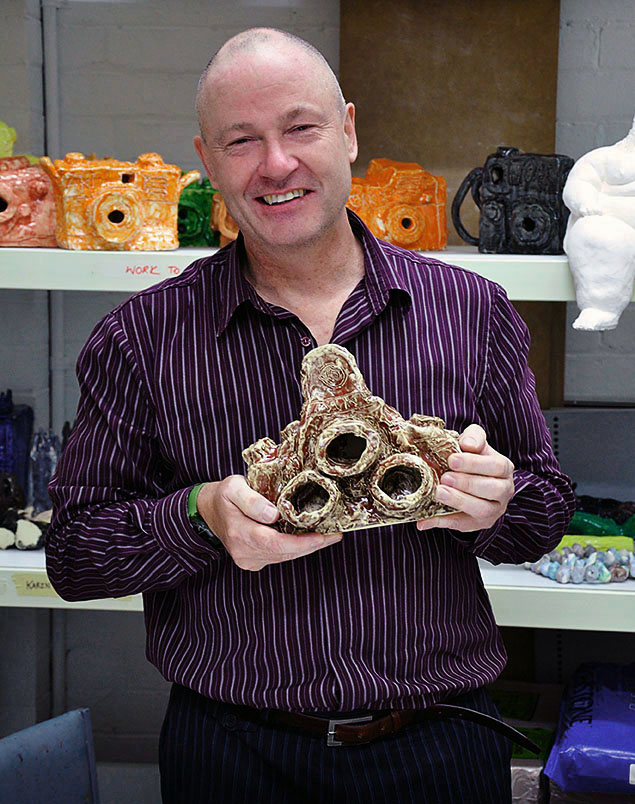
Dr Marcus Bunyan holding his new Alan Constable camera at the opening of Movement and Emotion 2011.
More of Alan’s cameras can be seen behind.
I have added a new Alan Constable camera to my collection. Yah!
The one I have chosen is very unusual. The camera has a third eye and a stunning glaze. The exhibition features the work of three Arts Project Australia artists: Alan Constable, Chris O’Brien and Terry Williams. All three artists explore machine aesthetics within their practice.
I really do hope that the National Gallery of Victoria purchases some of these cameras. They are the most unusual and beautiful sculptural pieces I have seen in a long time.
Dr Marcus Bunyan
Many thankx to Art Project Australia for allowing me to publish the photographs in the posting. Please click on the photographs for a larger version of the image. See more images from the Movement and Emotion exhibition.
Alan Constable (Australian, b. 1956) Not titled (three lens red camera)
2011
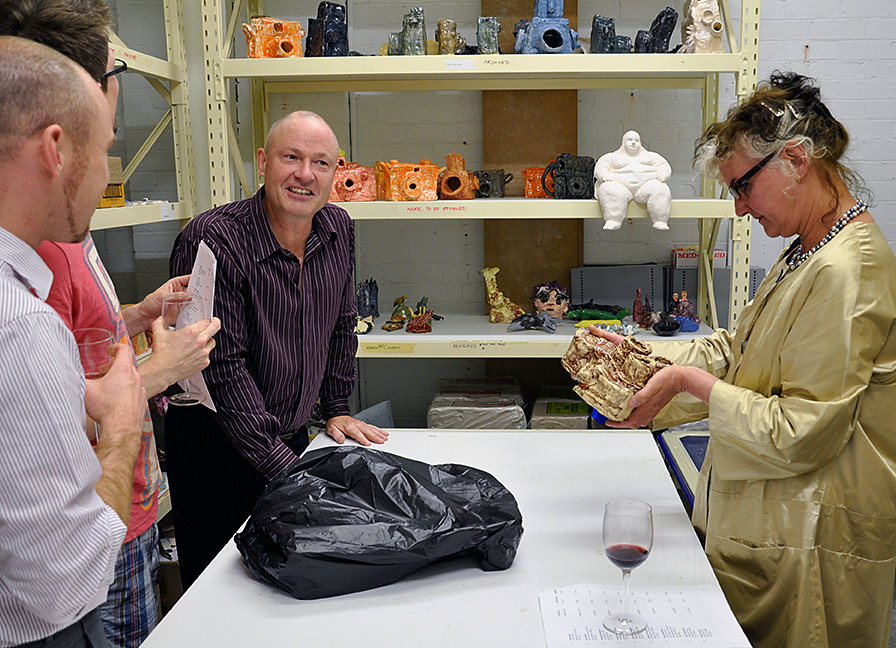
Marcus with jeweller Marianne Cseh at right looking at the Alan Constable camera
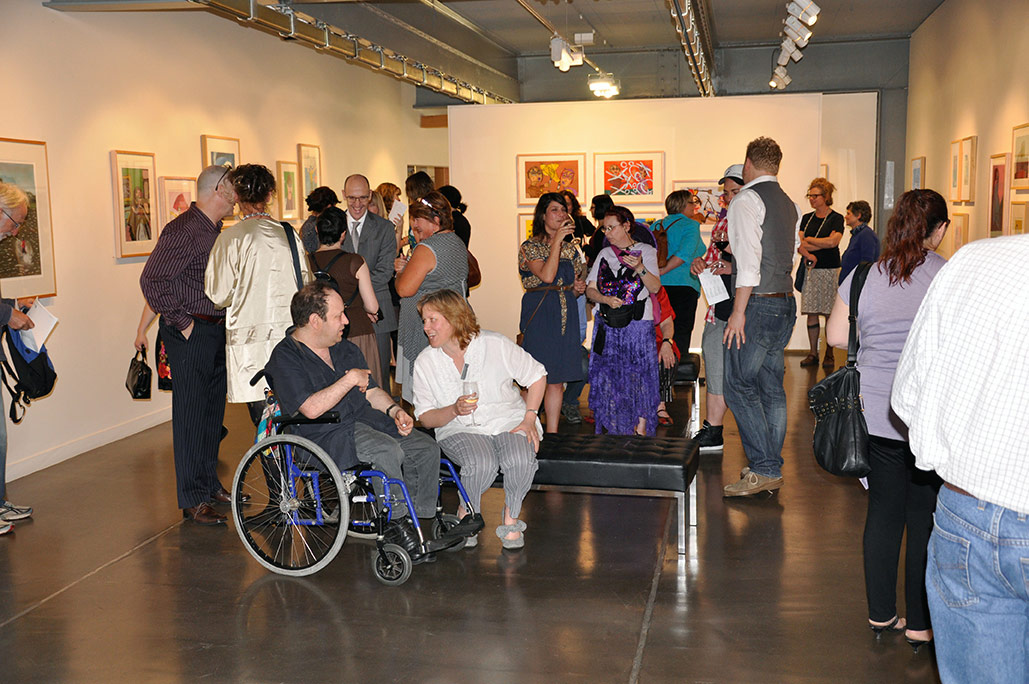
Opening night crowd at Movement and Emotion, Arts Project Australia
Opening night, with at left curator and artist Paul Hodges, artist Jodie Noble (seated), myself and, at right, Jonah Jones, President of the board of Arts Project Australia
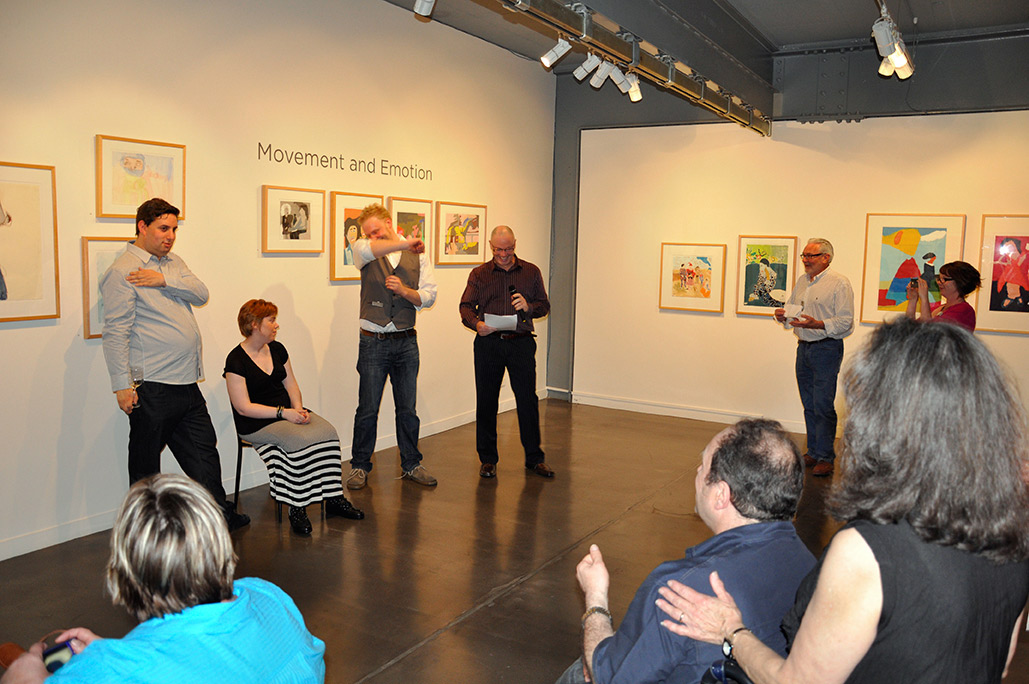
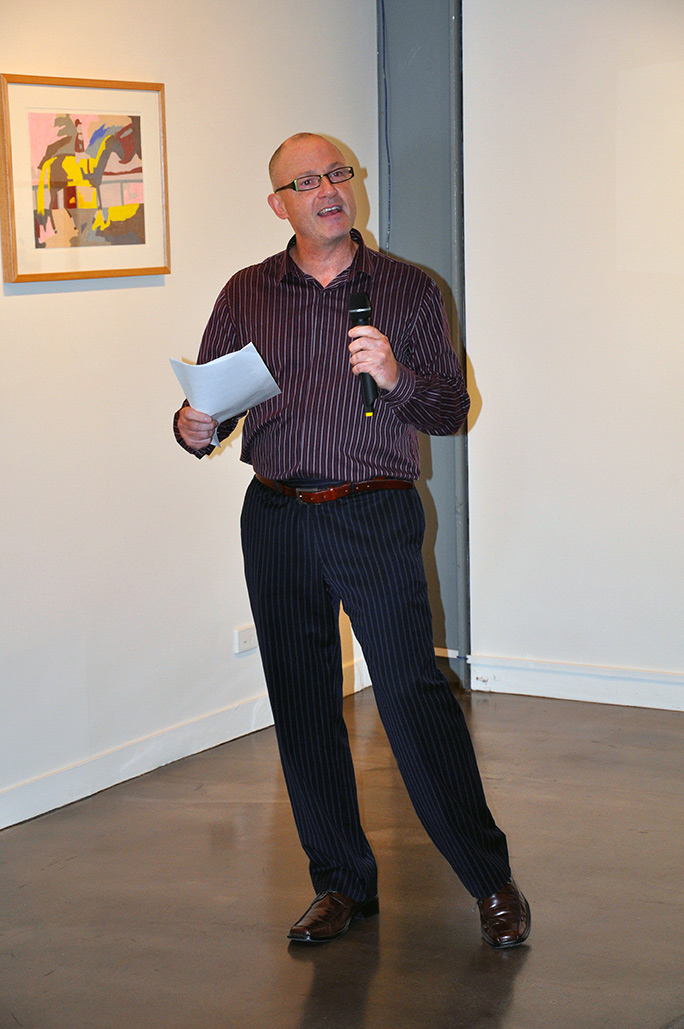
Dr Marcus Bunyan giving the opening night speech for the exhibition Movement and Emotion. Read the opening night speech. I was so nervous my jeweller friend Marianne said she could see my hands shaking from where she was standing in the crowd!!
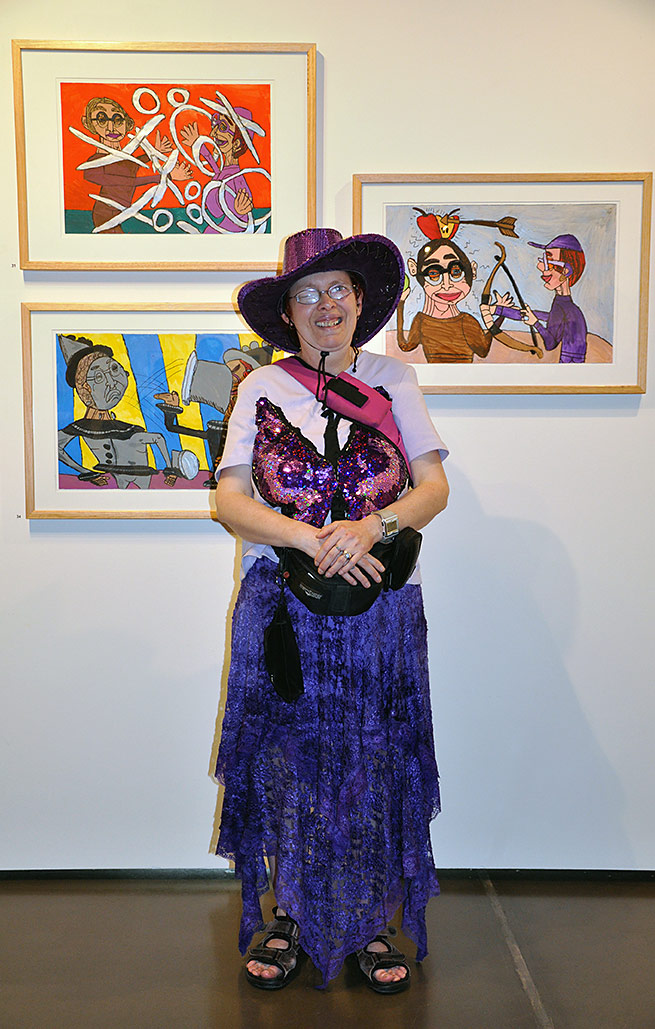
Artist Catherine Staughton standing in front of her work
Arts Project Australia
Studio
24 High Street
Northcote Victoria 3070 Phone: + 61 3 9482 4484
Gallery
Level 1 Perry Street building
Collingwood Yards
Enter via 35 Johnson Street or 30 Perry Street, Collingwood Phone: +61 477 211 699
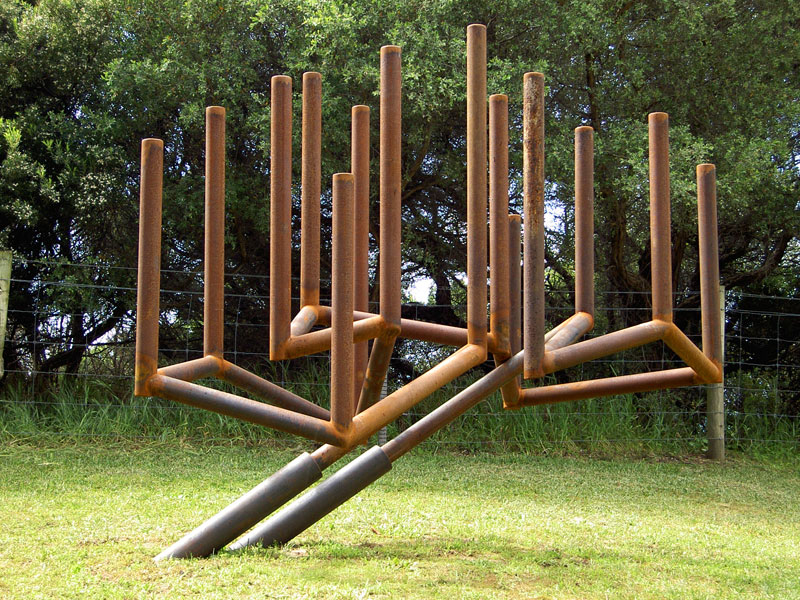
Fredrick White (Australian) Everything
2011
steel
210 x 120 x 250cm
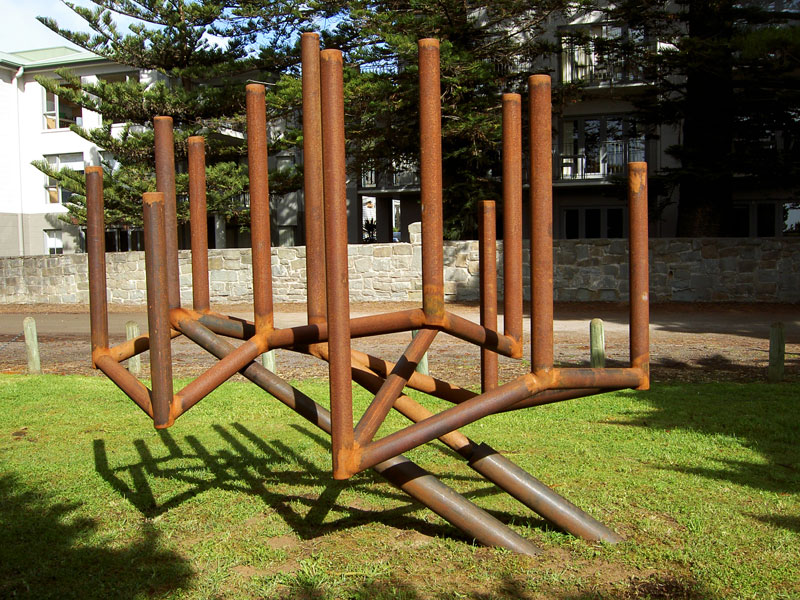
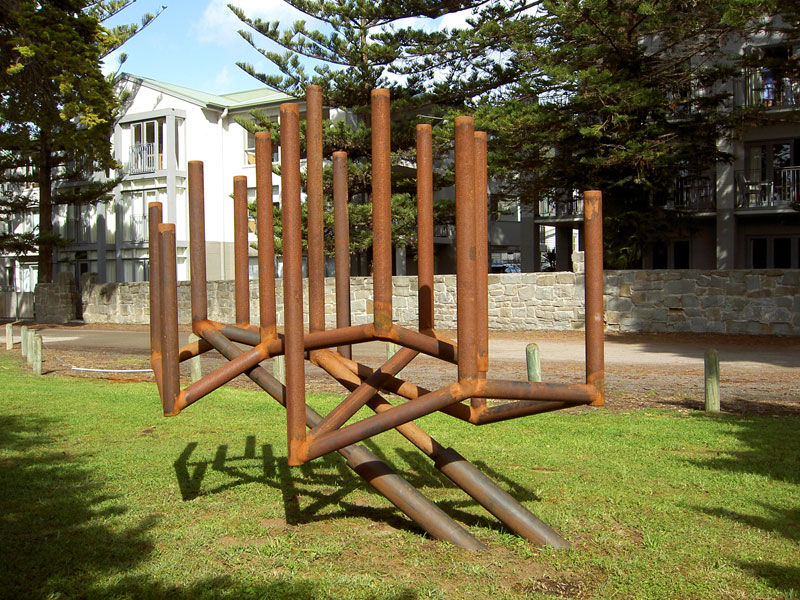
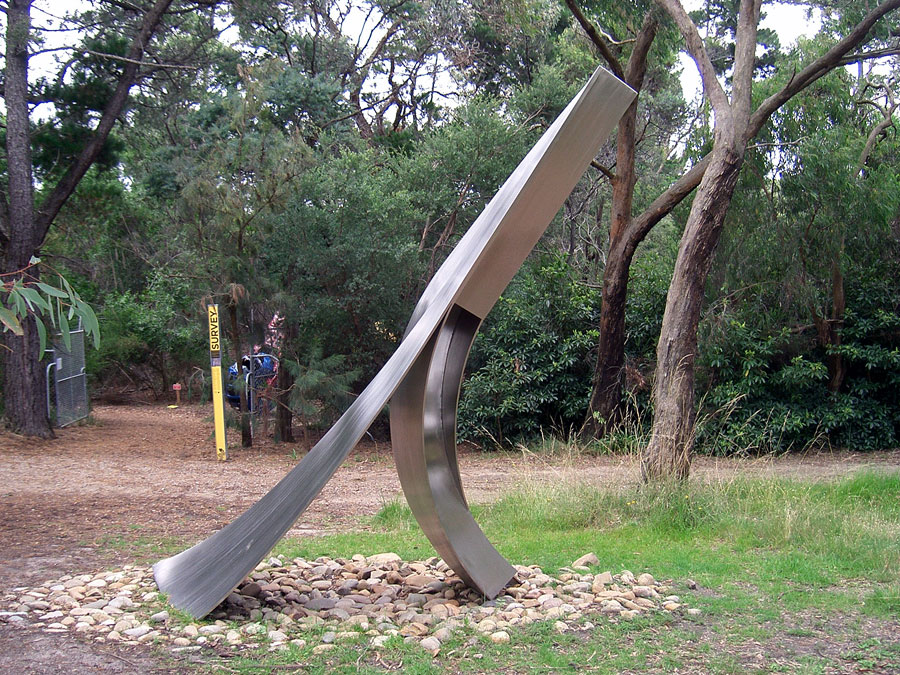
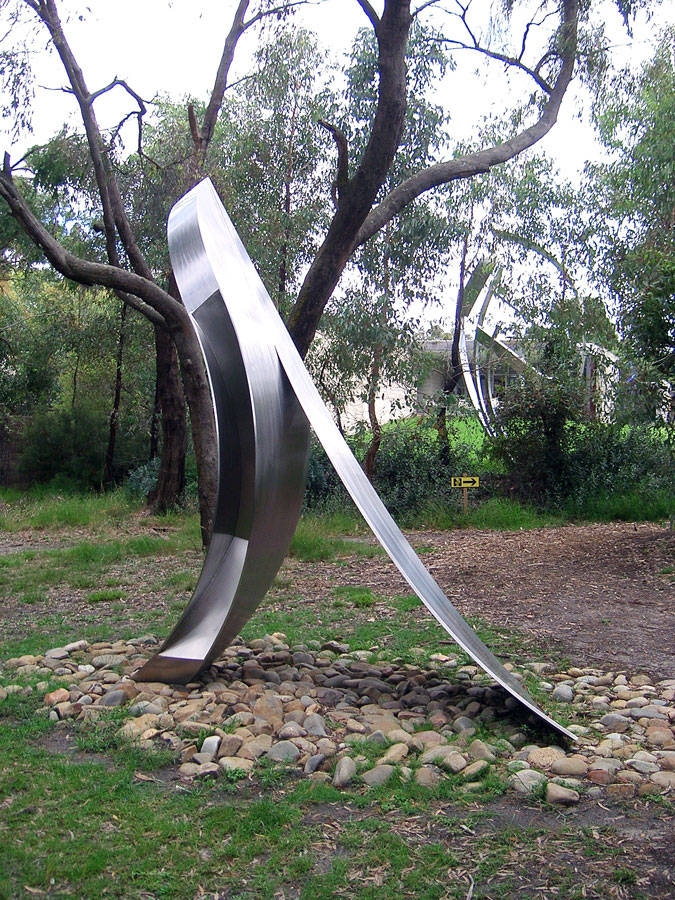
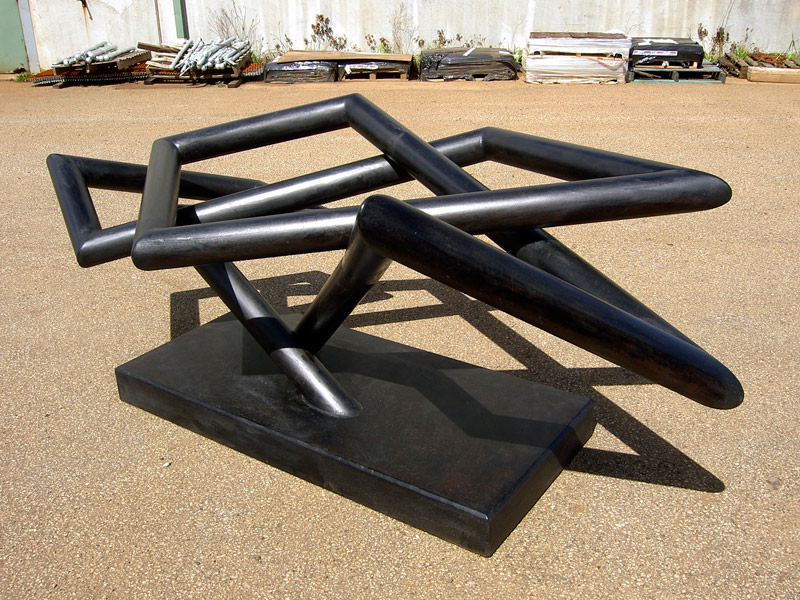
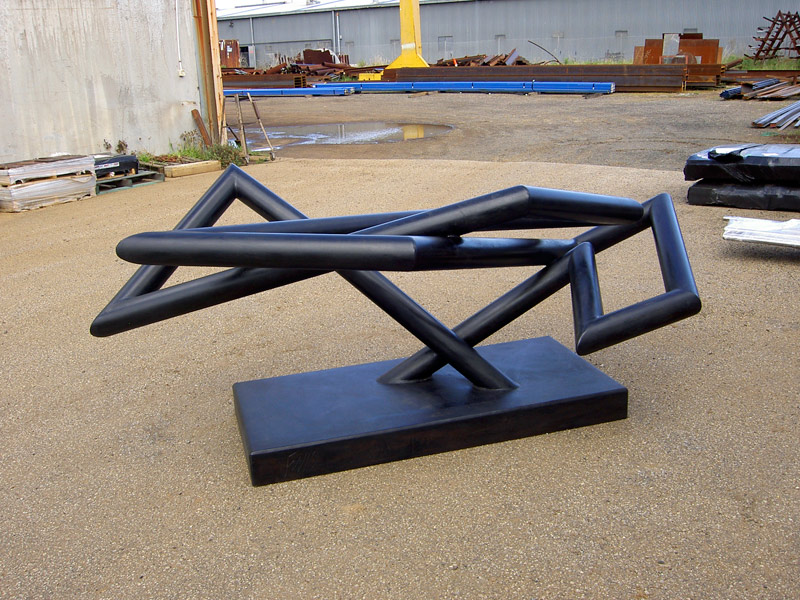
A new sculpture by Fredrick White is appearing in the Lorne Sculpture Prize (now Biennale) which opened on the 16th October and continues until 5th November, 2011. The work continues the artist’s exploration into the matrix of what is seen and not seen, what lies above and below.
Dr Marcus Bunyan
Please click on the photographs for a larger version of the image.
Fredrick White (Australian) Everything
2011
steel
210 x 120 x 250cm
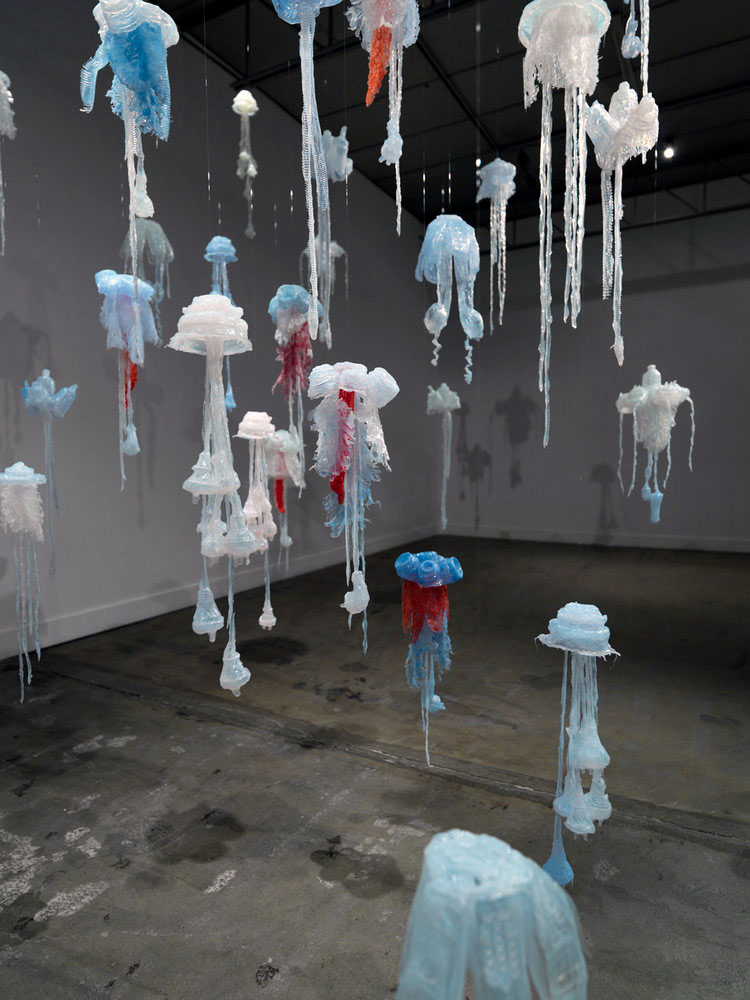
Penelope Davis (Australian, b. 1963) Smack installation 2011 Silicone, nylon thread Dimensions variable
A beautiful, hypnotic installation; one outstanding photograph (out of four); and a distance between elements, installation and photographs that, in the gallery space, seemed almost insurmountable.
The installation is intoxicating, taking the viewer into a world outside of reality – inverted, convoluted creatures “after the things of nature” (me ta physika) – in this case mobile phones, camera lenses and electrical plugs and leads, the skin of these objects flayed, extruded and made in silicone. These filamentary ‘jellies’ are wondrous. As Susan Fereday observes they are like detached skin, which “can become a kind of negative, a reversed memory, a perverse relic of its previously animated form … Detached, distraught, dangling. But there is also something slippery in these forms, something visceral, uterine, umbilical …”. The installation reminded me of the chthonian nature of the womb, our birth and that first gasp of breath – do you remember? was it all that you ever needed?
Water, blood, the detritus of birth and the emergence of life into light. Floating, gliding to the surface.
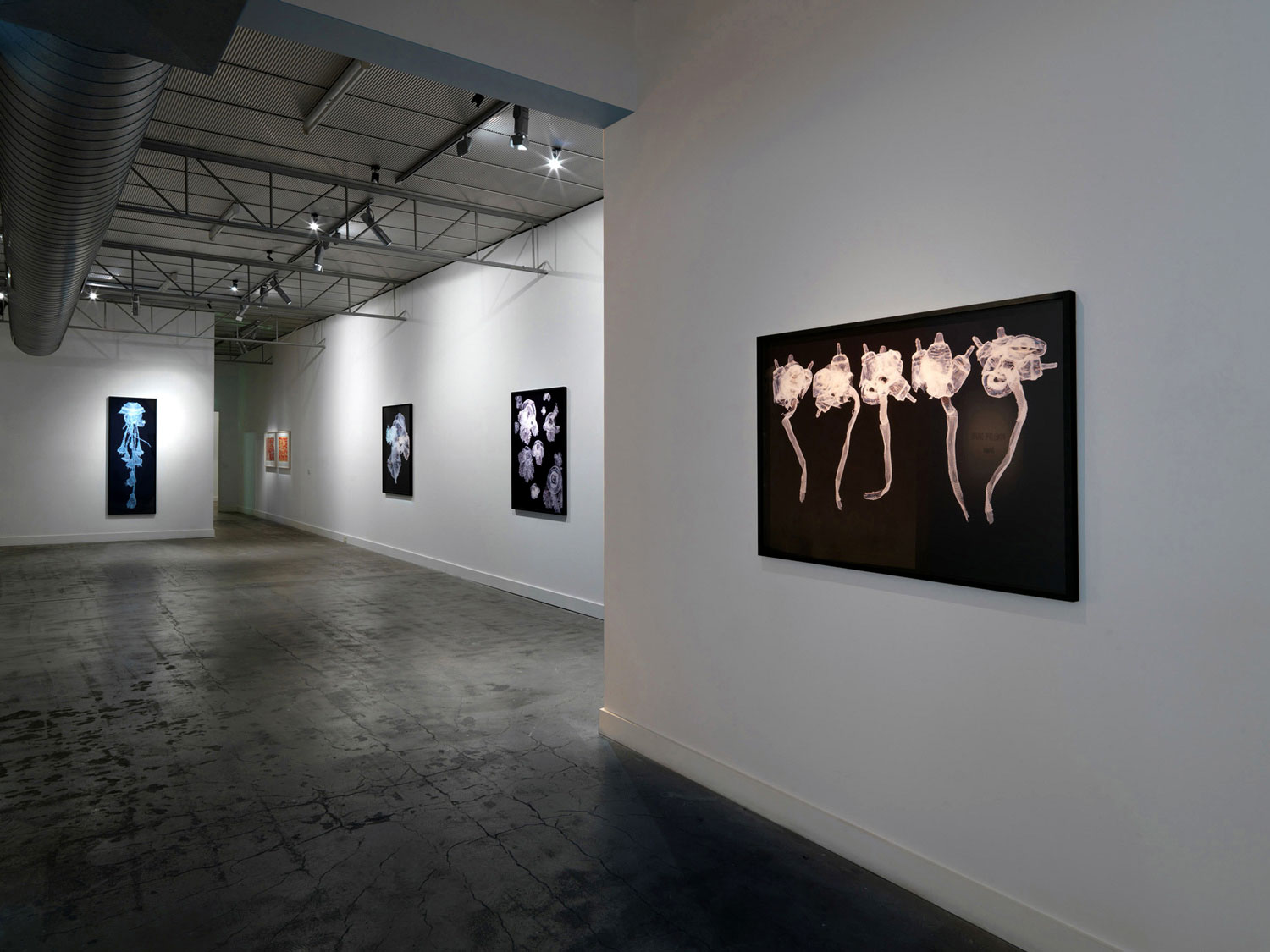
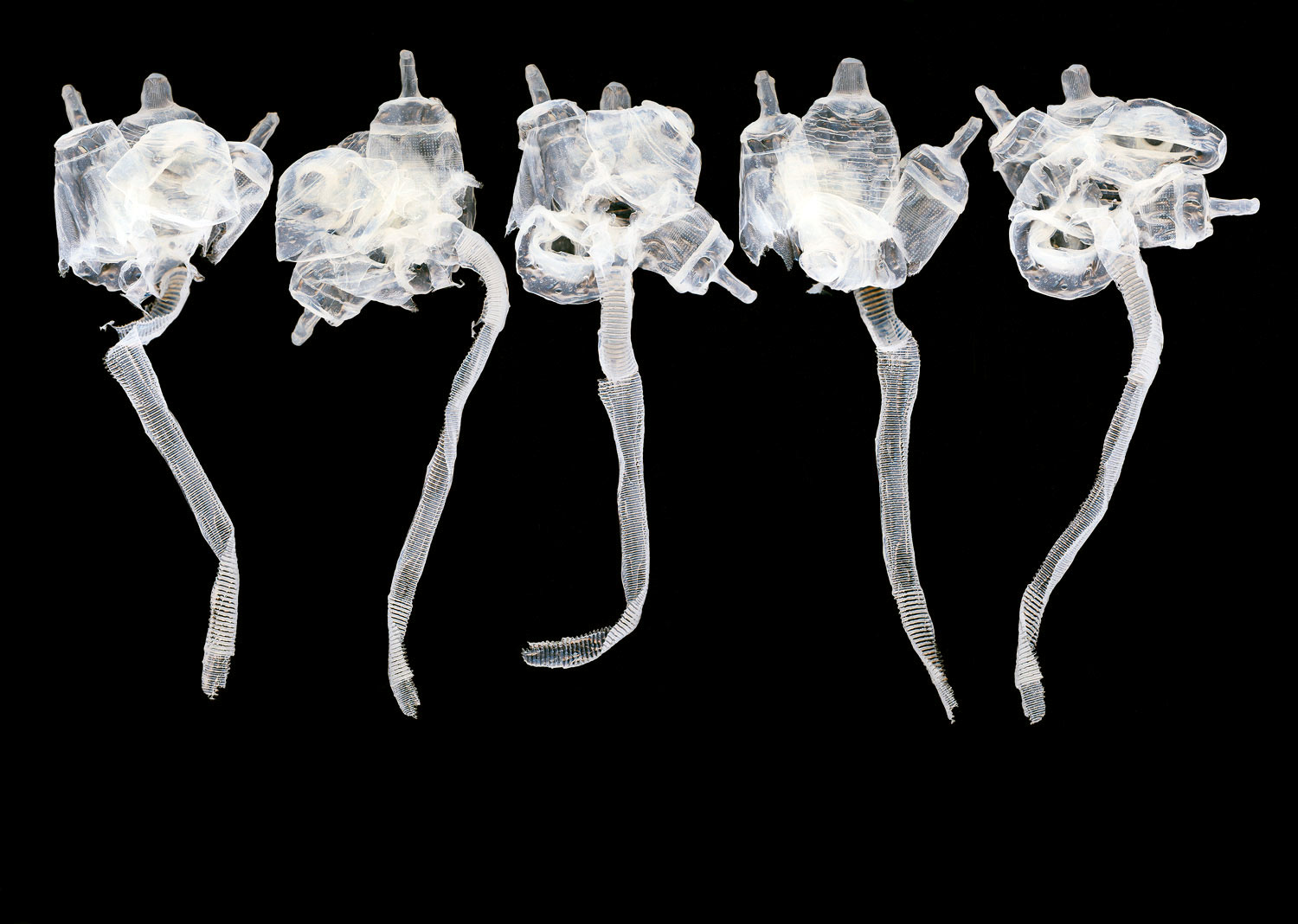
Only one photograph, Fluther (2011, below), approaches this detachment. A beauty it is too. The other three photographs felt more like addendum than adding anything further to the work and failed to achieve a ‘presence’ when compared to the installation. I suspect one of the problems was the scale of the three photographs and the fact that they are so tightly framed. Evidence of this can be seen in the installation shot below, the photograph of the blue ‘jellie’ so tightly prescribed and enclosed so as to not allow any interaction between installation and photograph. Perhaps making the photographs slightly larger and face mounting them behind PlexiGlass would have softened the edges of the photographs allowing a malleable (meta)physical air to breathe across the gallery space.
The highlight is the installation. Go and see, it is well worth the visit.
Penelope Davis (Australian, b. 1963) Smack installation 2011 Silicone, nylon thread Dimensions variable
Stretched Skin
“Where my inside meets the outside, where my body’s surfaces curve or stretch, dimple or fold, they create sensory cavities that are designed to respond to the outside world, at least to some degree. More difficult to resolve is the place that’s made when my inside turns out and there and no pickets to hide the private things – things I don’t want to look at myself, things too fleshy for the world to see, too soft, raw and pink to be exposed. Bringing the inside out, I am turned outside in and where does that leave me? In the edgeless space of the everyday saturated by grief.
Penelope Davis’ ‘jellies’ make me think about how a person’s skin can record their body’s history through marks – scars, distentions, swellings, bruises and wrinkles – just as a photograph can record a body’s outward appearance through light. We could say that skin is an index to its experiences, but it is not iconic. Skin does not reproduce the body’s image the way a photograph does, unless the skin is lifted to make a new shape. Then, just as hot wind can suck the life out of a fallen leaf and turn its veins into a street map, or sun and sea can batter a plastic bottle into a miraculous Marian figurine, detached skin can become a kind of negative, a reversed memory, a perverse relic of its previously animated form.
That’s what the ‘jellies’ look like: skin, turned inside out, photographic skin turned outside in. Detached, distraught, dangling. But there is also something slippery in these forms, something visceral, uterine, umbilical …”
Except from pamphlet text by artist and writer Susan Fereday, March 2011
Penelope Davis (Australian, b. 1963) Fluther 2011 Type C photograph 120 x 100cm
In Smack, Penelope Davis’ latest body of work, jellyfish-like forms have been assembled from a collage of components. These elements include the detritus of contemporary technologies. Among these are cameras, computer parts, mobile phones, wiring and electrical parts. Organic source materials such as leaves and seaweed (many sourced from the community garden plots surrounding Davis’ studio) are cast and intermixed with these forms. After being cast in silicone, the works are sewn together to create forms that resemble jellyfish. The resulting swarm – or smack, as the collective noun is properly known – is displayed as an installation of semi transparent, suspended forms.
A selection of these ‘jellies’ have also been placed in the digital scanner and ‘photographed’. Some digital post-production work is also employed to create large scale photographic images.
The materials and techniques used allow Penelope Davis to play with some of the procedures and assumptions central to photographic practice. The central motif of the jellyfish is a vehicle to examine critical contemporary issues of consumption and environmental degradation.
Text from the Nellie Castan website [Online] Cited 28/05/2011 no longer available online
Installation view of the exhibition Penelope Davis: Smack at Nellie Castan Gallery, Melbourne showing at right the photograph Bloom (2011, below)
Penelope Davis (Australian, b. 1963) Bloom 2011 Type C photograph 120 x 100cm
Penelope Davis (Australian, b. 1963) Smack installation (detail) 2011 Silicone, nylon thread Dimensions variable
Adrian Mauriks (Australian, 1942-2020) Strange fruit 2010 Epoxy resin, steel, paint
“[Massumi] posits ‘a physiology of perception’ in which he analyses sensory forms of knowledge as being driven by affect. Massumi understands affect as a moment of confrontation in which there are many possibilities, a moment embedded with potential responses, reactions and directions which is characterised by a sense of openness … narratives produced through affect are the result of the tensions and interplays between form and content or space and objects and the viewer.”
Kate Gregory and Andrea Witcomb1
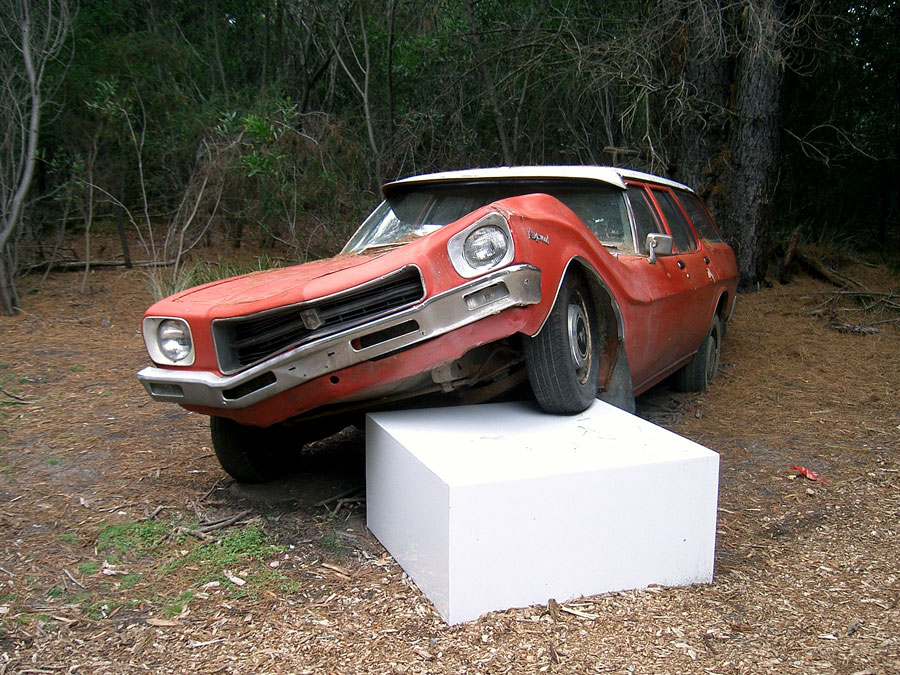
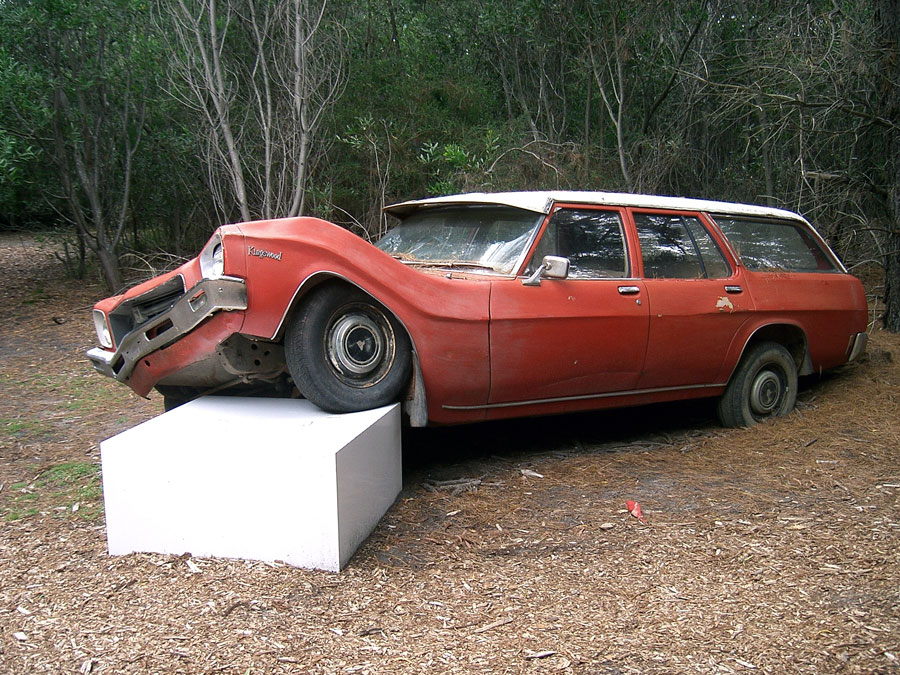
Meandering around the trails of the McClelland Sculpture Park is a wonderful experience; the meandering provides the suspense and excitement of a treasure hunt. Unfortunately, viewing most of the sculptures of the McCelland Sculpture Survey Award 2010 that are the prize of such a treasure hunt left me a little disappointed. I had little feeling for most of the sculptures dotted around the landscape. As conceptual ideas I understood their rationale but most left me cold and emotionally unengaged – they had little affect upon me.
Embodied forms of knowledge production apprehended by the senses, such as affect, produce new forms of understanding. Emotional responses open up possibilities for interpretation. In this sense, affect is important for the maintenance and production of memory as well as social and cultural understanding. For the historian Dipesh Chakrabarty, it is the subjective, felt response that is the most relevant for contemporary forms of political, social and cultural engagement – how emotional responses open up possibilities for interpretation.2
“Narratives produced through affect are the result of the tensions and interplays between form and content or space and objects and the viewer.” I felt little of that tension and interplay when viewing most of these works.
While understanding that, for an award of this nature, the work has to be self-contained, has to sit in a particular environment that the artist has only a general idea of (not a particular position) when proposing the work – on the evidence of this survey it would seem that contemporary Australian sculpture tends towards one shot statements that lack nuance and layering in composition and meaning. An understanding of how the work inhabits space and the aura that the work projects is notably absent from most of the works. Most are exercises in design rather than aesthetically pleasing artworks, the design aspect of making art works for these competitions having taken over from making work that has an emotional connection to the viewer and relevance to the world in which we live. As evidence see the photographs below and note how many are seemingly masculine, square / oblong / totemic / monolithic structures, compositions that assume the viewer cannot decipher sensual, layered narratives that are revealed over time, through space. There is little music and pleasure to be had here!
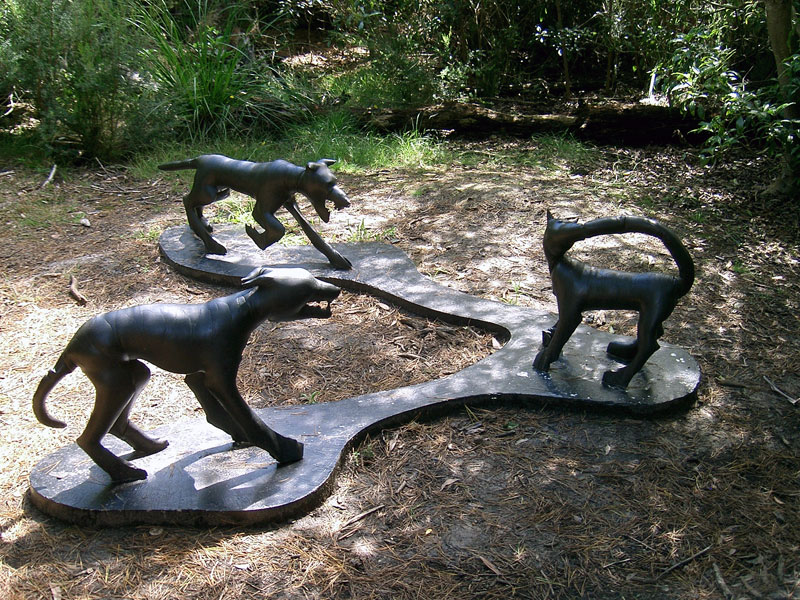
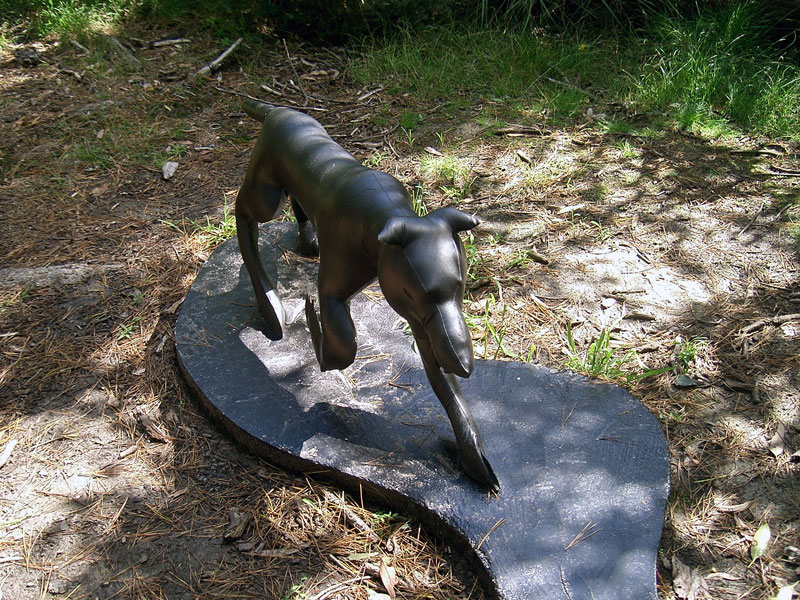
Notable exceptions include the primordial, reflective eggs of Matthew Harding (Primordial, 2010, below); the wonderfully tactile, sensual, stitched bronze dogs of Caroline Rothwell (Tygers I, II, III, 2010, below); and the incongruously placed, limpid, distorted, rusting Holden HQ Kingswood Station Wagon by Jason Waterhouse (Glory Days, 2010, below) covered in pine needles that delighted, surprised and made me feel something (about the work, myself and the world we inhabit). This was my winner, hands down. The most unedifying experience of the afternoon was walking under the black table of the winner, Louise Paramor’s Top shelf (2010). While the “brilliant assemblage” looks acceptable from a distance, “the oversized table acts as an altar upon which the saccharine paraphernalia of a modern, disposable age sit as objects that have been elevated for aesthetic contemplation,”3 the underside through which the viewer walks was the most emotionally dead space I have had to endure when viewing contemporary art over the past few years.
Gregory and Witcomb observe, “sculpture gives shape to emptiness, to space, as much as to material form.” The space to produce new forms of understanding that offer the viewer fresh perspectives, that allow the viewer to have a openness and receptiveness to the sensuality of the work and it’s placement in and relationship to, the world. The space to breathe, to touch, to explore, to be excited, to create and bring forth memory, to bear witness to the engagement with our senses. We are the product of numerous interactions with our environment; this survey, rather than leaving me feeling uplifted and informed through these interactions, left me feeling rather dead and deflated.
In this sense I loved the landscape but I didn’t feel most of the art.
Dr Marcus Bunyan
1/ Gregory, K. and Witcomb, A. “Beyond Nostalgia: the Role of Affect in Generating Historical Understanding at Heritage Sites,” in, Knell, S.J., Macleod, S. and Watson, S. (eds.,). Museum Revolutions: How Museums Change and are Changed. New York: Routledge, 2007, pp. 264-265
2/ Ibid., p. 263
3/ Lindsay, Robert. Art and Nature/Nature and Art. [Online] Cited 15/05/2011. No longer available online
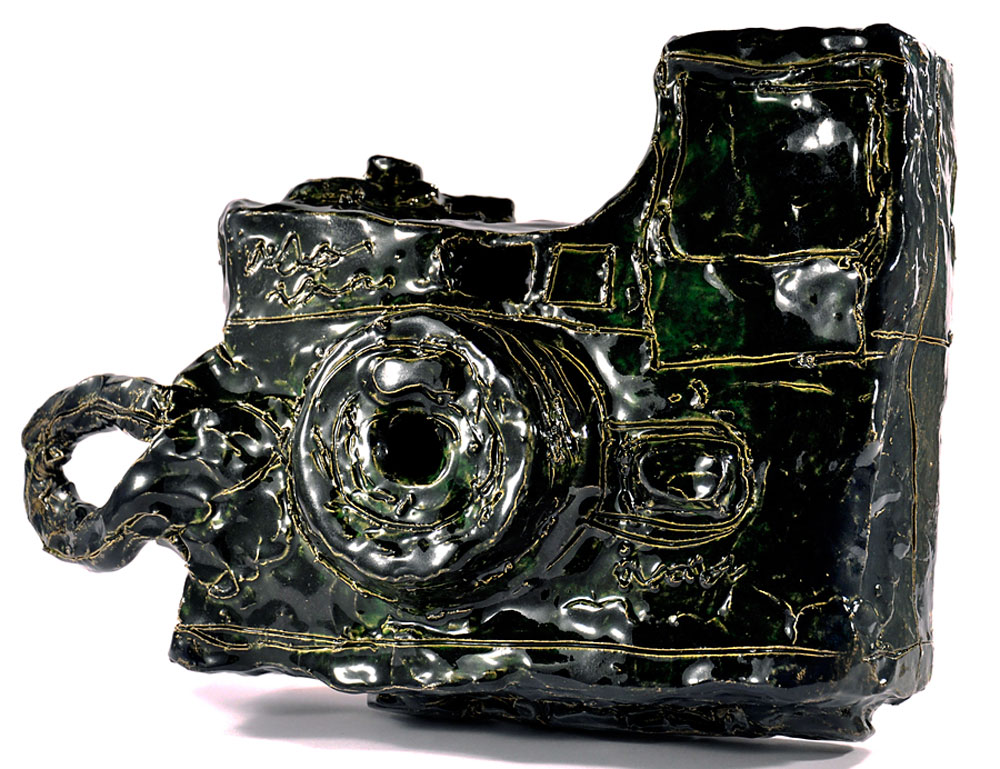
Alan Constable (Australian, b. 1956) Konica Pop 2009 Ceramic 21 x 32 x 10cm
“For me, art is what is most animal in us … It is the most noble thing because it’s a celebration precisely of the forces of the body and the forces of life.”
Elizabeth Grosz
This Saturday, after a journey around the galleries of Albert Street, Richmond (underwhelming) and a visit to Sutton Gallery to see Simon Terrill’s photographic exhibition Phantom (an exhibition that I was going to review but when I saw it I changed my mind: two excellent photographs, Balfron Tower 2010-2011 and Rivoli #2 2010-2011, let down by three “empty” long exposure photographs allegedly showing traces of humanity, residues of presence) had left me a little deflated, I ventured to the opening of Alan Constable’s twenty-year retrospective Viewfinder curated by Dr Cheryl Daye at Arts Project Australia.
What a breath of fresh air this exhibition is!
The exhibition shows beautifully in the gallery space. Hung chronologically, the more tightly controlled early series feature luminous pastels that investigate themes: landscapes, birds (rarely figures) – the rubbed and layered medium building up an almost translucent surface that reminded me of the pastel work of Odilon Redon. Later work, such as the two paintings Not titled (person with binoculars) 2009 and Not titled (figure with camera) 2006 (both below) show a greater engagement with the world and a freeing up of technique – running figures, Barak Obama, Dr. Who, suited men with headdresses, football players: happenings – with exaggerated form (hands for example), wonderful spontaneity and an essential simplicity that engages the viewer directly. All the paintings evidence a spatial flatness that brings everything onto the same plane, gives everything equal importance within the image (denying Renaissance perspective; as Cliff Burtt notes in the catalogue the converging lines and horizons act as elements of design, forming the scaffolding of composition). This technique is one of the most powerful elements of Constable’s work. A wonderful understanding of light and use of colour are other essential elements. The transformational, rough hewn, playful clay cameras (such as Konica Pop, 2009, below) are a particular favourite of mine. The glazes on the cameras, their tactility, the colours – are luscious. To hold them, to pick them up and feel them in your hands is a very special experience for me. Outstanding.
Constable has a unique way of seeing and imaging the world; his working method is unique. After carefully selecting source images from journals, magazines (for example National Geographic) and newspapers, Constable visually scans the photograph from a few inches, holding it up to his eyes and carefully manoeuvring his way across the surface of the image, then making what he sees – a direct pointing to reality. Without a concept to worry about, through an enabled fluidity and freedom of expression, the artist cuts to the essential form of what he wants to make and because of this directness his work contains absolute kernels of wisdom. His observation is fantastic.
These are exuberant works that are a celebration of the body and of life. They have great spontaneity. What Constable sees, he feels and makes: the mark of the maker writ bold. They made me feel so alive. After the disappointment of earlier exhibitions in the day, this work made me laugh and smile!
You really can’t ask for more. It made my day.
Dr Marcus Bunyan
Many thankx to Sue Roff, Melissa Petty, Sim Lutin and everyone at Arts Project Australia for their help and for allowing me to publish the photographs in the posting. Please click on the photographs for a larger version of the image.
Alan Constable (Australian, b. 1956) Untitled (three-lens camera) 2011 Ceramic
Alan Constable (Australian, b. 1956) Not titled (person with binoculars) 2009 acrylic on canvas 71 x 71.5cm
Alan Constable (Australian, b. 1956) Not titled (figure with camera) 2006 gouache on paper 65.5 x 45cm
Alan Constable is both a painter and a ceramicist. Alan Constable: Viewfinder is a major survey exhibition that will include paintings, drawings and ceramics, opening Saturday 30 April until Wednesday 1 June 2011.
Showcasing more than 60 works selected from over a 20 year period, Viewfinder offers new and rich insights into the unique art of Alan Constable. Legally blind, Constable has been able to create a body of work that is highly regarded. He is been a finalist in numerous Australian Art Awards and his ceramic cameras are highly collectable.
‘Often when a painter is faced with a scene, there’s simply so much that’s appealing it’s hard to choose what to focus on’, says Dr Cheryl Daye, founding director, Arts Project Australia. ‘This is where a viewfinder comes in useful; as it helps you focus on particular parts of the scene, enabling you to decide what will make the best composition, both in terms of focus and format’. Daye has worked closely with Constable from the time he joined the Arts Project studio in 1987.
Viewfinder the title of his survey suggests the artist’s process and methodology as well as the composition and subject matter of his work.
In Constable’s two-dimensional works this can be traced from very early self-portraits (1992), through to carefully observed depictions of birds and animals to the series based on silhouettes framed in industrial or stormy landscapes, a fascination with light and energy and, more recently with colourful interpretations of political and cultural figures, all of which are sourced from photographic images carefully and sometimes painstakingly selected by the artist.
Based on imagery from newspapers and magazines, Constables recent paintings are notable for their vibrant kaleidoscopic effects and strong sense colour and patterning. Though Constable’s works are often centred on political events and global figures, his thematic concerns are frequently subjugated by the pure visual experience of colour and form.
His three-dimensional works, most notably the cameras, also sit well within this theme and given the fact that Constable is legally blind is also obliquely referenced. Constable’s ceramic works reflect a life-long fascination with old cameras, which began with his making replicas from cardboard cereal boxes at the age of eight. The sculptures are lyrical interpretations of technical instruments, and the artist’s finger marks can be seen clearly on the clay surface like traces of humanity. In this way, Constable’s cameras can be viewed as extensions of the body, as much as sculptural representations of an object.
Arts Project Australia supports people with disabilities to become practitioners in the visual arts. The studio and gallery nurtures and promotes artists with an intellectual disability as they develop their body of work.
Press release from Arts Project Australia
Arts Project Australia Artist Profile: David Hurlston on Alan Constable
Alan Constable’s ceramic cameras have seen international acclaim for their tactile, poetic resonances. In this video David Hurlston, Senior Curator of Australian Art at the National Gallery of Victoria, talks through Constable’s process, Constable’s highly idiosyncratic practice and why he believes Constable is one of the most important contemporary artists working today.
Alan Constable (Australian, b. 1956) Red NEK SLR 2011 Ceramic 5.5 x 12.25 x 4.75 inches
Alan Constable (Australian, b. 1956) Orange AKI SLR 2011 Ceramic 6 x 10 x 4 inches
Alan Constable (Australian, b. 1956) Not titled (explosion II) 1996 pastel on paper 50 x 66cm
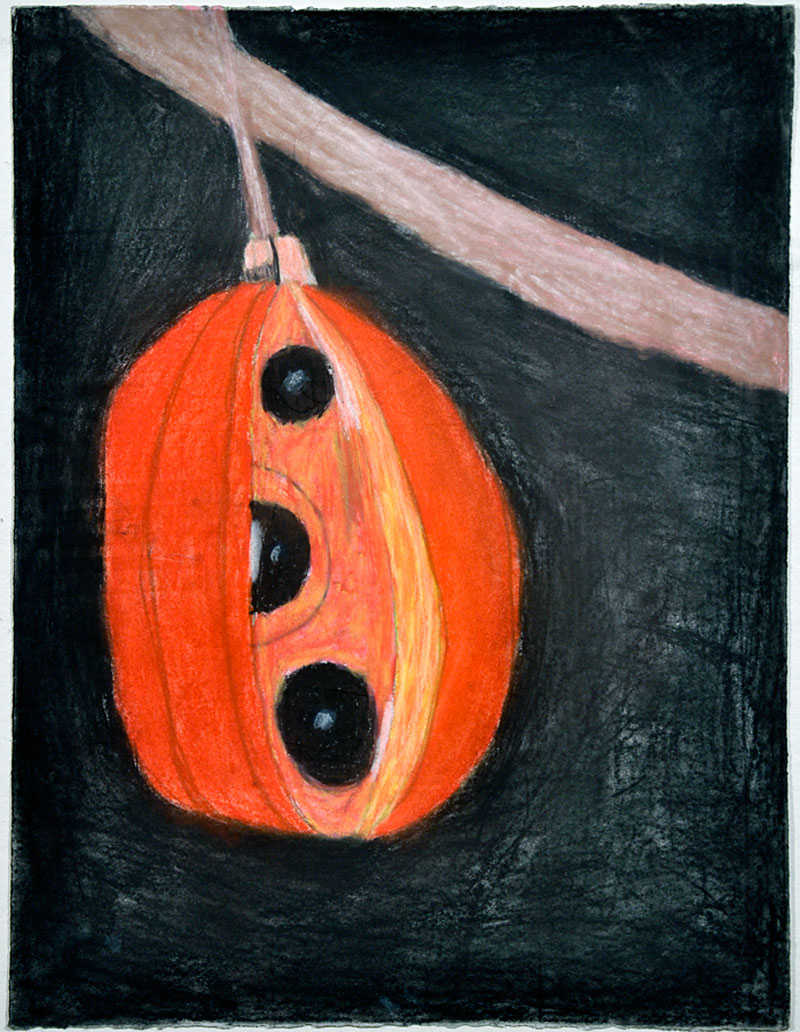
Alan Constable (Australian, b. 1956) Not titled (fruit) 1993 pastel on paper 66 x 50cm Arts Project Australia Permanent Collection
Arts Project Australia
Studio 24 High Street Northcote Victoria 3070 Phone: + 61 3 9482 4484
Gallery Level 1 Perry Street building Collingwood Yards Enter via 35 Johnson Street or 30 Perry Street, Collingwood Phone: +61 477 211 699
Installation photograph of one of the galleries in the exhibition NETWORKS (cells & silos) at the newly opened Monash University Museum of Art (MUMA) with Nick Mangan’s Colony (2005) in the foreground Photo: Marcus Bunyan
This is a vibrant and eclectic exhibition at MUMA, one of the best this year in Melbourne. The curator Geraldine Barlow has gathered together some impressive, engaging works that are set off to good effect in the new gallery spaces. I spent a long and happy time wandering around the exhibition and came away visually satiated and intellectually stimulated.
The exhibition “explores the connections between artistic representation of networks; patterns and structures found in nature; and the rapidly evolving field of network science, communications and human relations.” (text from MUMA)
Networks connect – they describe (abstract) connections between people and things. Networks map simple or complex systems and can be real or an abstract representation of those systems. Networks form a nexus, “a sort of concentrated nodal point among a series of chains of markers” that reveals the centralising structure of networks (such as Facebook and Google). Robert Nelson in his review of this exhibition in The Age notes, “Geert Lovink and Ned Rossiter [in their catalogue essay] describe the way networks paradoxically disorganise you, creating a disempowering messy grid of protocols that colonise your headspace … It’s commonplace to celebrate networks because they stimulate excitement about belonging, about extending your reach and joining in. These hopes are as pervasive as the networks themselves. But in structural terms, networks are also insidiously colonising and hierarchical, built on the principle of the rich becoming richer and the poor becoming more dependent.”1
I believe that networks can also be altruistic and non-heirarchical, offering a horizontal consciousness rather than a vertical one: points of view and perspectives on the world that open up these (virtual) spaces to fluidity, mutation, transgression and subversion. Catherine Lumby observes that,
“The contradictory, constantly shifting nature of contemporary information and image flows tends to erode the moral authority of any social order, patriarchal or otherwise. It is this very collapse which has arguably fuelled social revolutions such as feminism and gay and lesbian rights, but which equally disrupts attempts by some to ground them in identity politics.”2
Critical to understanding the construction of these constantly shifting networks in contemporary society are the concepts of weaving and intertexuality. Intertextuality is the concept that texts do not live in isolation, “caught up as they are in a system of references to other books, other texts, other sentences: it is a node within a network… Its unity is variable and relative (Foucault, 1973)“3. In other words the network is decentred and multiple allowing the possibility of transgressive texts or the construction of a work of art through the techniques of assemblage (Deleuze and Guattari) – a form of fluid, associative networking that is now the general condition of art production.4
Infection of the network (by viruses for example) disrupts the pattern/randomness binary and may lead to mutations, ‘differance’ in Derrida’s terminology, spaces that are both fluid and fixed at one and the same time;neither here nor there.
On to (some of) the work.
Masato Takasaka’s series of fibre-tipped pen and pencil on paper, Information Superhighway (2006-07), are wonderful, kaleidoscopic works – inventive and fun, full of rhizomic, multi-layered dimensionality. Nick Mangan’s mixed media sculpture Colony (2005, see photograph below) is a spiky, totemic, figurative creature made of axe, shovel and hammer handles and riddled with holes like driftwood that looks like a bizarre, Medieval torture instrument.
Bryan Spiers paintings Shadowmath and New descending (both 2010, see photograph below) are excellent, puzzle-like reinterpretations of delicate, Futuristic movements. As he describes them, “I think of my paintings as puzzles or visual toys. They are images to be manipulated by the viewer; reconfigured, recomposed, expanded upon. Trajectories of change are implied by repeated shapes and graded colour transitions. They describe a continuum to be followed to its logical conclusion outside of the picture plane. This leads to the dissolution of the image, proposing new images yet to be made.”
Heath Bunting’s 3 panel work from The Status project (all 2010) features interrelated data sets that reach a “level of absurdity in attempting to relate radically different but inter-related information.” This mind mapping schematic of connections (coloured connections with labels, markers and legends) based around Bristol, England has some unbelievable entries if you look really closely:
~ A1072 Able to provide natural person date of birth 2010 ~ A1073 Able to access the Internet ~ A1003 A terrorist ~ A1047 Providing instruction or training in the use of imaginary firearms such as sticks ~ A1088 Providing training in leopard crawling
Aaron Koblin’s beautiful video Flight patterns (2010) offers a mapping of thousands of plane journeys across the USA over time (based on East Coast time) so that the explosion of their frequency becomes like a fireworks display. Andrew McQualter’s fantastic acrylic paint wall drawings Three propositions, one example (2010-11), painted directly onto the gallery wall show various people, isolated from each other and from the viewer, talking and listening to their iPhones. As Robert Nelson comments, “They’re isolated individuals, all on their own plane, presumably doing social networking or communicating. If you walked past them, they wouldn’t respond because, with heads bowed, they’re absorbed in another reality. Their hands and minds are busy with a reality elsewhere.”
Present but not present, (not) here and there at the same time. This is a critical debate in contemporary culture: do these type of networks lessen our ability to build friendships and connections in the real world or are they just another element in our rhizomic network of associations that help with our interconnectivity: utopian or dystopian or equal measure of both? Does it really matter?
From the UK Kit Wise’s large digital print on aluminium series (including KTM SEA MOW RUH 2010, see below) are effective, offering solarised, negative, brightly coloured collages of seemingly atomised cities (the titles refer to the cities airport abbreviation codes). Mass Ornament (2009) by American artist Natalie Bookchin is one of my favourite works in the exhibition. In a horizontal panel of wall mounted screens play videos of people dancing in their bedroom. Bookchin has gleaned these gems from uploaded personal videos on YouTube – there are handstands, contortions, tap dancing, all manner of performances (some then deleted by the performer) – then collated by the artist and set to a Broadway-type music number. Mesmeric and amazing!
Koji Ryui’s spatial constructions Extended network towards the happy end of the universe (2007-2011, see photograph below) are made of bendy, plastic drinking straws of different colours, encased and moulded into cellular shapes (reminding me of the white of the Melbourne Recital Centre exterior). Trailing off these structures in different colours are airborne-like filaments similar to the plant Old Man’s Beard. “Ryui repeats and arranges these objects in space to create peculiar environments and accidental narratives. In his installations, relationships or spaces between objects are equally as important as the objects themselves.” Wonderful.
Last but not least my favourite work in the exhibition: heart of the air you can hear by Sandra Selig (2011, see photographs below). The photographs do not do the work justice. Made simply from spun polyester, nails and paint this Spirograph-like construction is beautiful in its resonance and colour, captivating in its complexity. Built into a corner of the gallery the work floats at eye level, twists and turns and changes intensity of colour when viewed from different angles. From the front it looks like a spaceship out of Star Wars woven by light!
There are many other excellent works in the exhibition that I have not mentioned. Some of the work disrupts the continual reiteration of norms by weaving a lack of fixity into the network’s existence. Other work visually makes comment on and reinforces the structure of such networks. Whichever it is this is a truly engaging exhibition that no single body, let alone a networked one, should miss.
Dr Marcus Bunyan
1/ Nelson, Robert. “Networks, Cells and Silos” review in The Age newspaper. Melbourne: Fairfax Media, 23/02/2011 [Online] Cited 23/03/2011
2/ Lumby, Catharine. “Nothing Personal: Sex, Gender and Identity in The Media Age,” in Matthews, Jill (ed.,). Sex in Public: Australian Sexual Cultures. St. Leonards: Allen and Unwin, 1997, pp. 14-15
3/ Foucault, Michel cited in Thumlert, Kurt. Intervisuality, Visual Culture, and Education. [Online] Cited 01/04/2011 no longer available online
4/ “To understand the production of art at the end of tradition, which in our lifetime means art at the end of modernism, requires, as the postmodern debate has shown, a careful consideration of the idea of history and the notion of ending. Rather than just thinking ending as the arrival of the finality of a fixed chronological moment, it can also be thought as a slow and indecisive process of internal decomposition that leaves in place numerous deposits of us, in us and with us – all with a considerable and complex afterlife. In this context all figuration is prefigured. This is to say that the design element of the production of a work of art, the compositional, now exists prior to the management of form of, and on, the picture plane. Techniques of assemblage, like montage and collage – which not only juxtaposed different aesthetics but also different historical moments, were the precursors of what is now the general condition of production.” Fry, Tony. “Art Byting the Dust,” in Hayward, Phillip. Culture, Technology and Creativity in the Late Twentieth Century. London: John Libbey and Company, 1990, pp. 169-170
Many thankx to Monash University Museum of Art for allowing me to publish the text and photographs in the posting. Please click on the photographs for a larger version of the image.
Kerrie Poliness (Australian, b. 1962) Blue Wall Drawing #1 2007-2011 Photo: Marcus Bunyan
Hilarie Mais (British/Australian, b. 1952) The waiting – anon 1986 Photo: Marcus Bunyan
An interview with the curator: Geraldine Barlow
Where did your interest in networks come from?
I’ve long been fascinated by network maps of human relationships – the graphical representation of something seemingly so complex and multi-layered. The structure of the brain and how this relates to theories of mind is also an area of personal interest. Our society, bodies and relationships are all made up of different kinds of networks, and artists have long been interested in mapping out these structures. I realised some time ago that the visual representation of networks might make for an interesting exhibition, from this point on I collected and ‘tested’ different ideas of what the exhibition might include.
How is this explored in the exhibition?
Human relationships feature in some of the works in the exhibition, but not all. I hope the exhibition offers a wide variety of links between people’s familiar world and daily experiences on the one hand, and more abstract ideas on the other.
There are a number of works from the Monash University Collection included in the exhibition. Can you tell us about these and why you selected them?
The Monash University Collection is a great source of inspiration, it is a wonderful collection, but also, I think any artwork considered closely and over time opens up in surprising ways and offers unexpected insights, working with the works in the collection over a period of years allows me to think about them in a long and slow way.
Dorothy Braund’s work Christ with the disciples listening 1966 was given to the University in 1974. It is a very beautiful formal painting of a series of shaded circles and ellipses. At first glance it is simple and seems to represent a ring of figures, their heads and bodies gathered together. On closer examination it is not so clear where one figure ends and another begins, as a whole the clustered forms seem to operate more like a cell. Historically this cell of men and the ideas attributed to them has had a profound impact, in their day they might have been seen as a kind of terrorist cell.
Through the sensitive composition and balance of abstract form, the artist has created a complex representation of the relationships between people: the ways in which we are both connected to each other, and yet might also circulate ideas in a tight ‘Chinese whispers’ type circle. This work was painted in 1966, long before our current awareness of social and telecommunications networks, but it can still offer us insights in our contemporary world and the way we relate to each other.
How did the new gallery space affect the installation of the exhibition?
The exhibition was slowly forming in my mind, even as Kerstin Thompson’s wonderful gallery space was being designed and built. The gallery has offered a wonderful armature and character for the exhibition to work with, hopefully in the manner of a conversation. Kerstin was been very interested in understand and reflecting the essential structure of the building, not building over what was pre-existing. The exhibition like-wise has an interest in structural models, geometries and patterns – in finding a balance between the regular and the slightly warped. In the central corridor which runs down the spine of the gallery, Thompson has chosen to leave the mechanical services exposed, to allow the essential structure of the building to be a form of ornament. Many of the artists in the exhibition also have an interest in the relationship between structure and ornament.
Sandra Selig (Australian, b. 1972) heart of the air you can hear 2011 Photo: Marcus Bunyan
Sandra Selig (Australian, b. 1972) heart of the air you can hear (detail) 2011 Photo: Marcus Bunyan
Koji Ryui (Australian/Japanese, b. 1976) Extended network towards the happy end of the universe 2007-2011 Photo: Marcus Bunyan
The connections between artistic representations of networks and the rapidly evolving field of network science are the subject of the latest exhibition at the Monash University Museum of Art (MUMA).
Presenting the work of Australian and international artists, NETWORKS (cells & silos) reflects the organising principles and dynamics of our increasingly networked society, and related patterns found in organic, social and engineered forms.
MUMA’s Senior Curator, Geraldine Barlow conceived and developed the exhibition as a way of continuing the dialogue about the role and effect of different networks in society.
“Art and aesthetics are often treated as very separate enclaves from science, physics and mathematics,” Barlow says. “But art offers us a way to re- contextualise our associations and interactions with the networks around us and look at the effect they have on us. I hope the exhibition will prompt people to think about the networks in their lives and how they mould and shape us.”
A key inspiration for the exhibition was Annamaria Tallas’ documentary, How Kevin Bacon Cured Cancer, which features the work of network scientist Albert-László Barabási.
“The documentary explores the thesis that all networks – both natural and man-made – conform to a similar mathematical formula, with the same patterns emerging over and again,” Barlow said.
The artworks featured in NETWORKS (cells & silos) explore networks as diverse as those found in urban planning and cities, biology, organisations, travel and of course social networks, as well as the dual qualities of hyper-connectedness and isolation that technology has heightened in modern life.
Extending the dialogue about the possibilities of networks is of great interest to MUMA Director, Max Delany, particularly in the university context.
“Within a university we have a vast array of specialist disciplines – science, technology, humanities – all having conversations about how the world is and where we want to be heading,” Delany says. “Often these conversations are held in isolation from each other, but considered together, and from the standpoint of artists, the possibilities of collaborative networks become very exciting.”
This collaboration can be seen in Kerrie Poliness’ work Blue Wall Drawing #1 (2007/2011). Students from Monash University have created the piece, following the formal and conceptual guidelines set out by the artist. Each version of Poliness’ work creates unique patterns and networks as the collaborative team choose how to implement the drawing rules which are structured to allow a different outcome in each space where they are applied.
The exhibition’s accompanying publication contains essays from curator Geraldine Barlow, network and social theorists Geert Lovink and Ned Rossiter, and science documentary filmmaker Annamaria Tallas, all exploring the exhibition’s theme. Digital and hard copies are available on request.
Press release from the Monash University Museum of Art
Bryan Spier (Australian) Shadowmath and New descending (installation view) both 2010 Photo: Marcus Bunyan
Kit Wise (Australian born England, b. 1975) KTM SEA MOW RUH 2010 Digital photograph
Monash University Museum of Art (MUMA) Ground Floor, Building F. Monash University Caulfield campus 900 Dandenong Road Caulfield East, VIC 3145 Phone: +61 3 9905 4217
Kate Knight (Australian) Not titled (blue and green bird) 2009 ceramic 7 x 30 x 7cm Image courtesy the artist and Arts Project Australia
One of the most – no, the most vibrant and exciting place to visit at last year’s Melbourne Art Fair was the Arts Project Australia stand. What a buzz the place had! They have an interesting gallery in Northcote that is well worth a visit. Coming up at the end of April is a retrospective of the work of Alan Constable that spans twenty years – including the wonderful cameras he makes. Posting about this exhibition to follow.
Dr Marcus Bunyan
Many thankx to Arts Project Australia for allowing me to publish the photographs in the posting. Please click on the photographs for a larger version of the image.
Valerio Ciccone (Australian, b. 1970) Fish 2010 ceramic 3.5 x 24 x 15cm Image courtesy the artist and Arts Project Australia
Bold in form and colour to the intricate and subtle, Subterranean is an exhibition that celebrates the possibilities of the ceramic form at Arts Project Australia from Saturday 19 March until Wednesday 27 April 2011.
From domestic and functional forms to work referencing popular culture and narrative fiction, this exhibition showcases the possibilities of ceramics.
The imitative nature of clay has inspired many Arts Project artists. Popular culture, narrative fiction and two-dimensional images from National Geographic magazines provide the foundation for new sculptures by Rebecca Scibilia, Tim Noble and Ruth Howard.
Several of the featured artists are also interested in the functional potential of ceramics, specifically that of domestic ceramic objects such as vases and teapots. Fiona Longhurst and Kaye McDonald are inspired by existing ceramic items to create their own exquisite versions with intricate detailed surface drawings and colourful glaze patterns.
The artistic process is one of technical experimentation, investigation and discovery, seen in the ceramic work of Valerio Ciccone, Alan Constable, Kelvin Heffernan, Paul Hodges, Ruth Howard, Thomas Iacono, Kate Knight, Fiona Longhurst, Chris Mason, Karen McCullough, Kaye McDonald, Cameron Noble, Jodie Noble, Tim Noble, Chris O’Brien, Lisa Reid, Rebecca Scibilia, Malcolm Sturrock and Terry Williams.
Subterranean has been curated by Katie Jacobs.
Arts Project Australia is a not for profit organisation that has been supporting artists with intellectual disabilities since 1974. Our inner city studio and gallery exist to nurture and promote artists as they develop their body of work. We rely on government funds, personal and philanthropic donations and commissions from artwork sales to continue our work.
Text from Arts Project Australia
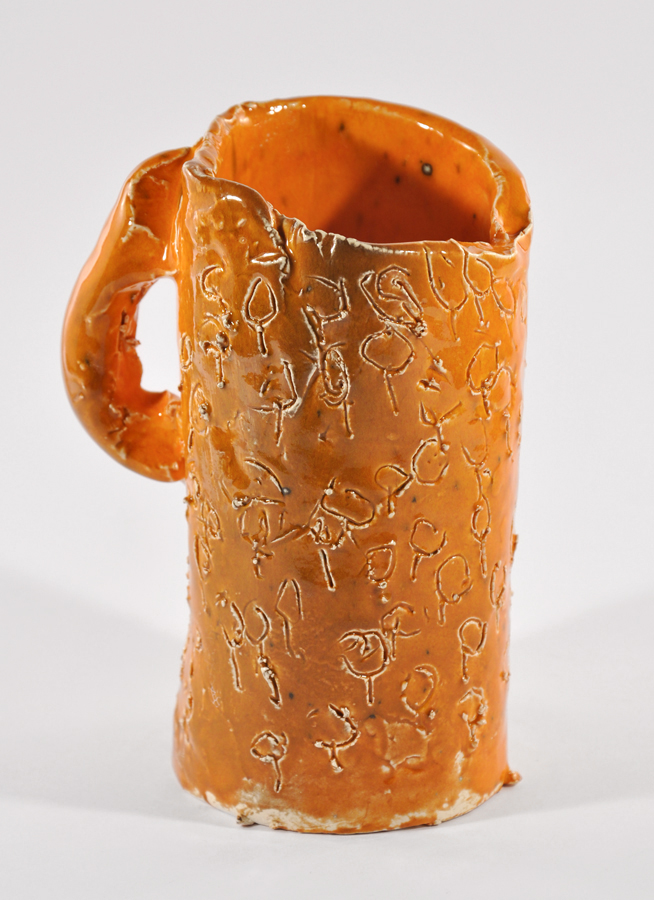
Kaye McDonald (Australian, b. 1946) Not titled (orange mug) 2010 ceramic 16 x 11 x 9cm Image courtesy the artist and Arts Project Australia
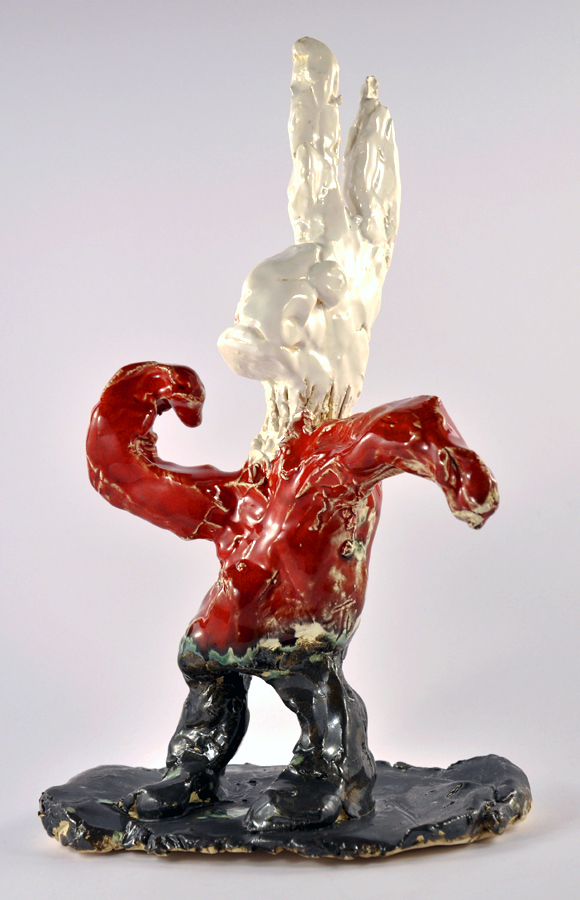
Malcolm Sturrock (Australian, b. 1944) Not titled (rabbit in red jumper) 2010 ceramic 29 x 19 x 12cm Image courtesy the artist and Arts Project Australia
Arts Project Australia
Studio 24 High Street Northcote Victoria 3070 Phone: + 61 3 9482 4484
Gallery Level 1 Perry Street building Collingwood Yards Enter via 35 Johnson Street or 30 Perry Street, Collingwood Phone: +61 477 211 699
Fredrick White (Australian) Before The After 2010 Steel 220 x 105 x 95cm
Another beautiful sculpture by Australian sculptor Fredrick White that will be appearing in the Montalto Sculpture Prize that opens this weekend at 33 Shoreham Road, Red Hill South, Victoria and continues until 1st May, 2011. The work has great presence and continues the artist’s exploration into the matrix of what is seen and not seen, what lies above and below. Please click on the photographs for a larger version of the image.
Dr Marcus Bunyan
Please click on the photographs for a larger version of the image.
Fredrick White (Australian) Before The After 2010 Steel 220 x 105 x 95cm
Exhibition dates: 19/20th October – 13th November 2010
Titania Henderson (Dutch, b. 1945 emigrated Australia 1956) Together II 2010 Images courtesy of the artist and Karen Woodbury Gallery
Two solid exhibitions, ceramics by Titania Henderson at Karen Woodbury Gallery and sculpture by John Nicholson at Sophie Gannon Gallery. Both exhibitions benefit from a straight forward approach to craft – elegant, refined sensibilities that are free from an overly conceptual rendering of ideas; stillness, of form in style, inhabits both bodies of work.
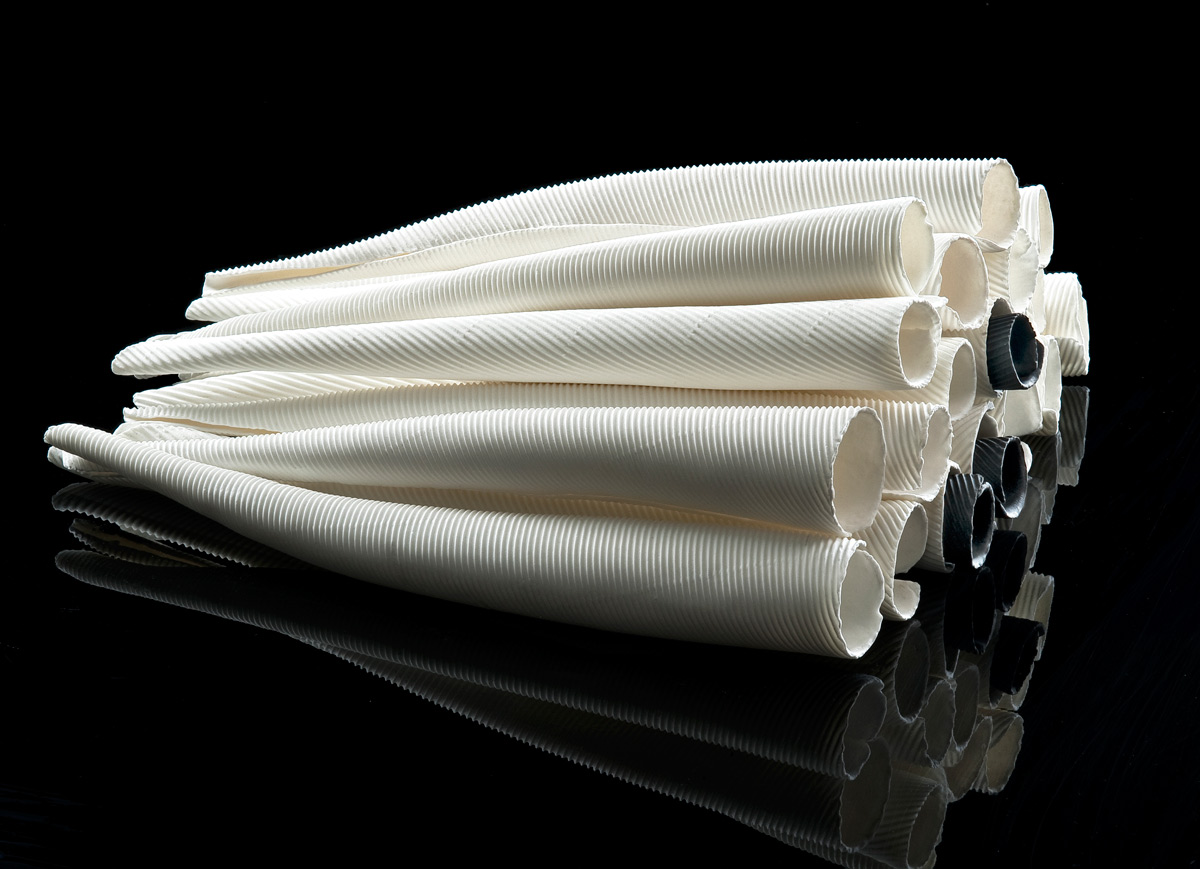
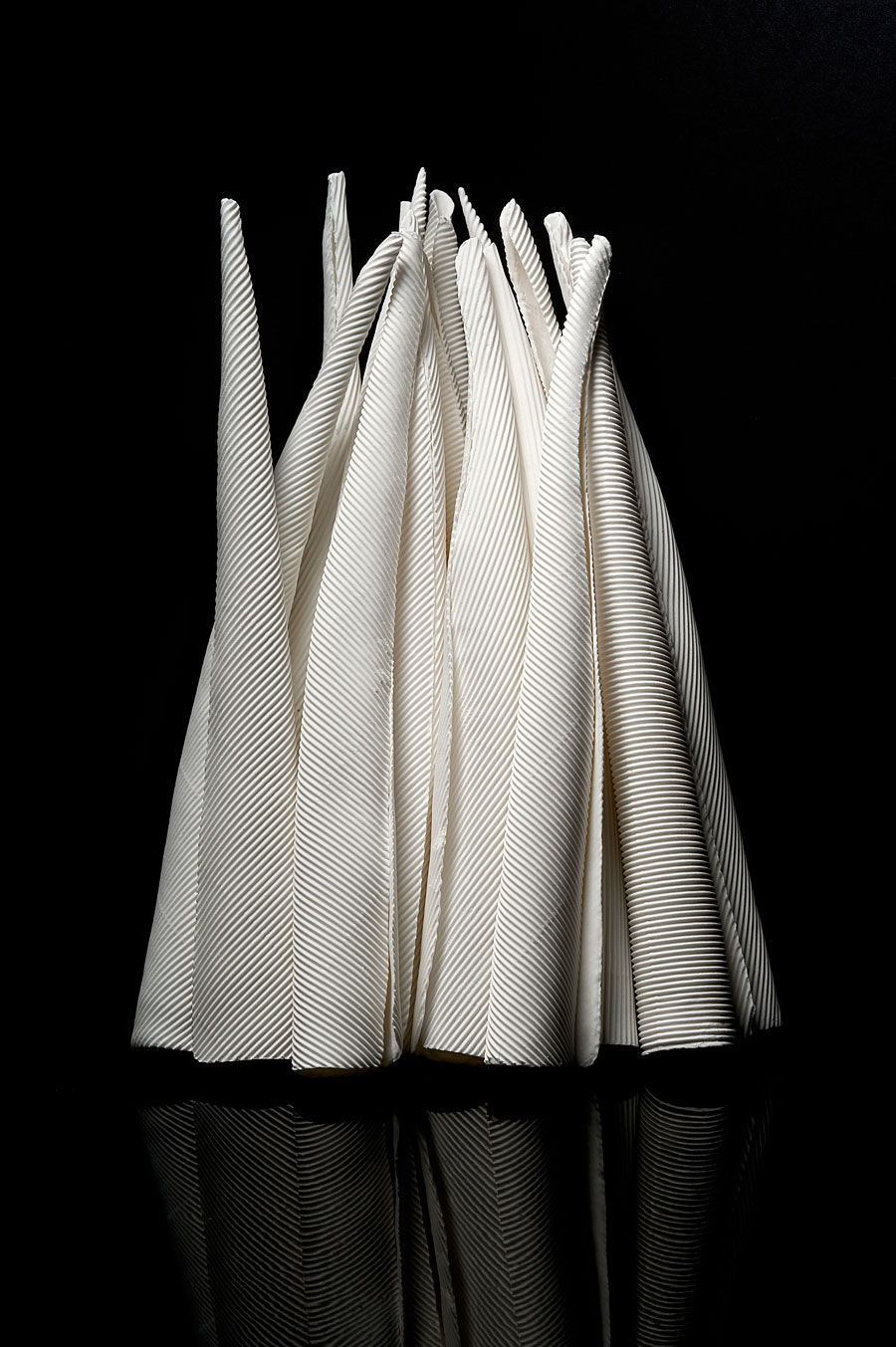
Contemplation is of the essence – in the beautiful, delicate, seemingly fragile shell and tubular mollusc-like bone china structures that, conversely, are physically strong; in the tonal colours of woven amoebic, disc and U-shaped constructions (the Halftone of the exhibition title referring to the loss of colour in digital printing, the longing for sumptuous analogue markings). I liked both exhibitions for the paring down of elements to essentials forming a basis for quiet reflection, a grounding in texture, colour and lightness of form.
Dr Marcus Bunyan
Many thankx to Karen Woodbury Gallery and Sophie Gannon Gallery for allowing me to publish the photographs in the posting. Please click on the photographs for a larger version of the image.
Titania Henderson (Dutch, b. 1945 emigrated Australia 1956) Silence 2010 Images courtesy of the artist and Karen Woodbury Gallery
Titania Henderson (Dutch, b. 1945 emigrated Australia 1956) Remembering 2010 Images courtesy of the artist and Karen Woodbury Gallery
Titania Henderson (Dutch, b. 1945 emigrated Australia 1956) Piled up 1 (yellow) 2009/10 Images courtesy of the artist and Karen Woodbury Gallery
Titania Henderson (Dutch, b. 1945 emigrated Australia 1956) Piled up 2 (yellow) 2009/10 Images courtesy of the artist and Karen Woodbury Gallery
Titania Henderson’s exhibition The Other presents a range of ceramic sculptural installations in pure white Bone China that convey a three-dimensional engagement. A fragility and vulnerability resonate through these poignant paper-thin configurations, bringing a sense of clarity and freedom. These hand built works challenge the conception of Bone China as a material only suited for slip casting while also incorporating the use of French Limoges. Henderson’s method involves perseverance, technical proficiency and precision, as she creates her own language of rhythmic ceramic art. There is an inherent translucent character that appeals to elements of shadow and light within the works. This new body of work is based on ideas of the human conscience and larger philosophical ideas beyond the objects themselves and beyond language.
Text from the Karen Woodbury Gallery website
John Nicholson (Australian, b. 1970) Cloudpopper 2010 Plastic 110 x 38 x 38cm Photo: Marcus Bunyan
John Nicholson (Australian, b. 1970) Scan 2010 Plastic 72 x 128cm Photo: Marcus Bunyan
John Nicholson (Australian, b. 1970) Asymmetric 2010 Plastic 29 x 70 x 29cm Photo: Marcus Bunyan
John Nicholson (Australian, b. 1970) Concept 101 2010 Plastic 35 x 46 x 40cm Photo: Marcus Bunyan
John Nicholson (Australian, b. 1970) Installation view of Halftone 2010 Photo: Marcus Bunyan
Karen Woodbury Gallery
This gallery has now closed.
Sophie Gannon Gallery 2, Albert Street Richmond, Melbourne
“In reality, I make one work over my life, so that when it’s all finished, there are a number of parts or contributions to an overall piece, each linking to another in some way.”
John Davis, 1989
This is a superlative survey exhibition of the work of John Davis at NGV Australia, Melbourne.
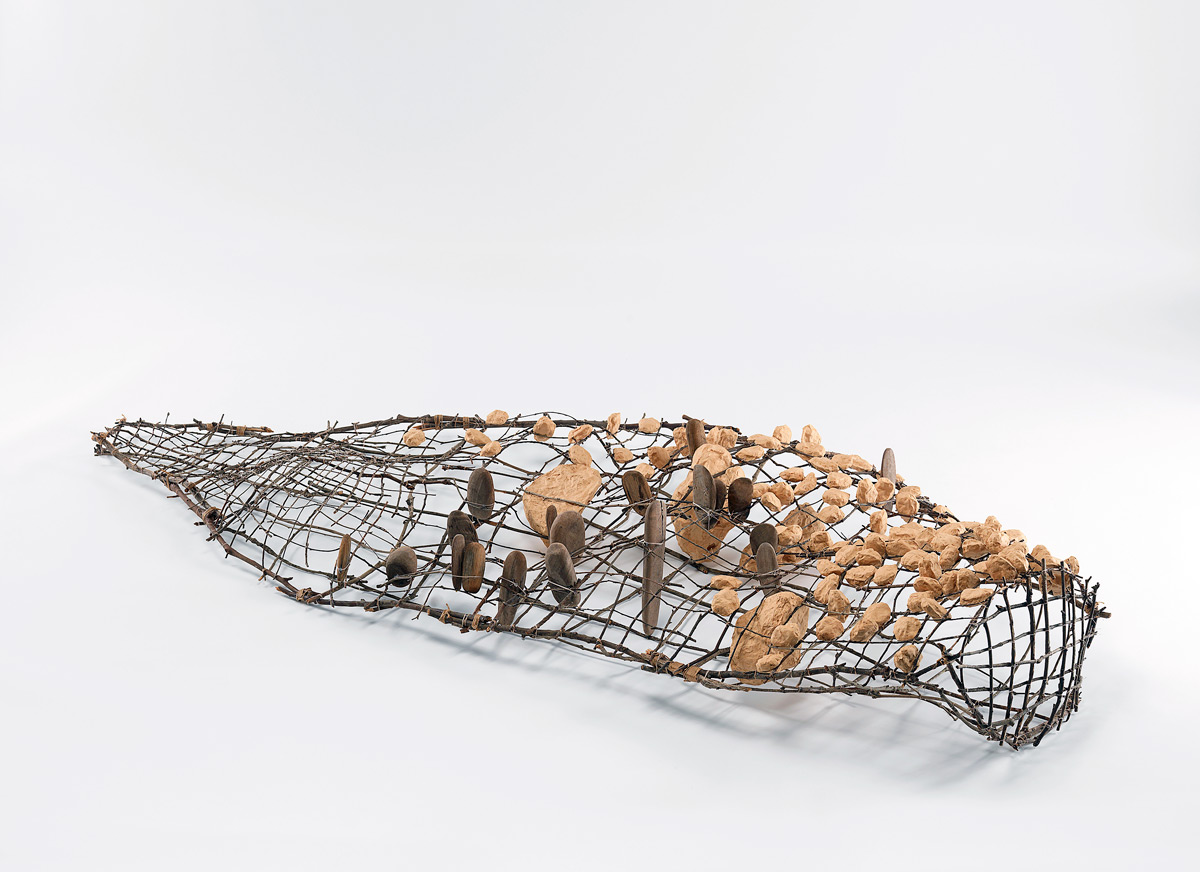
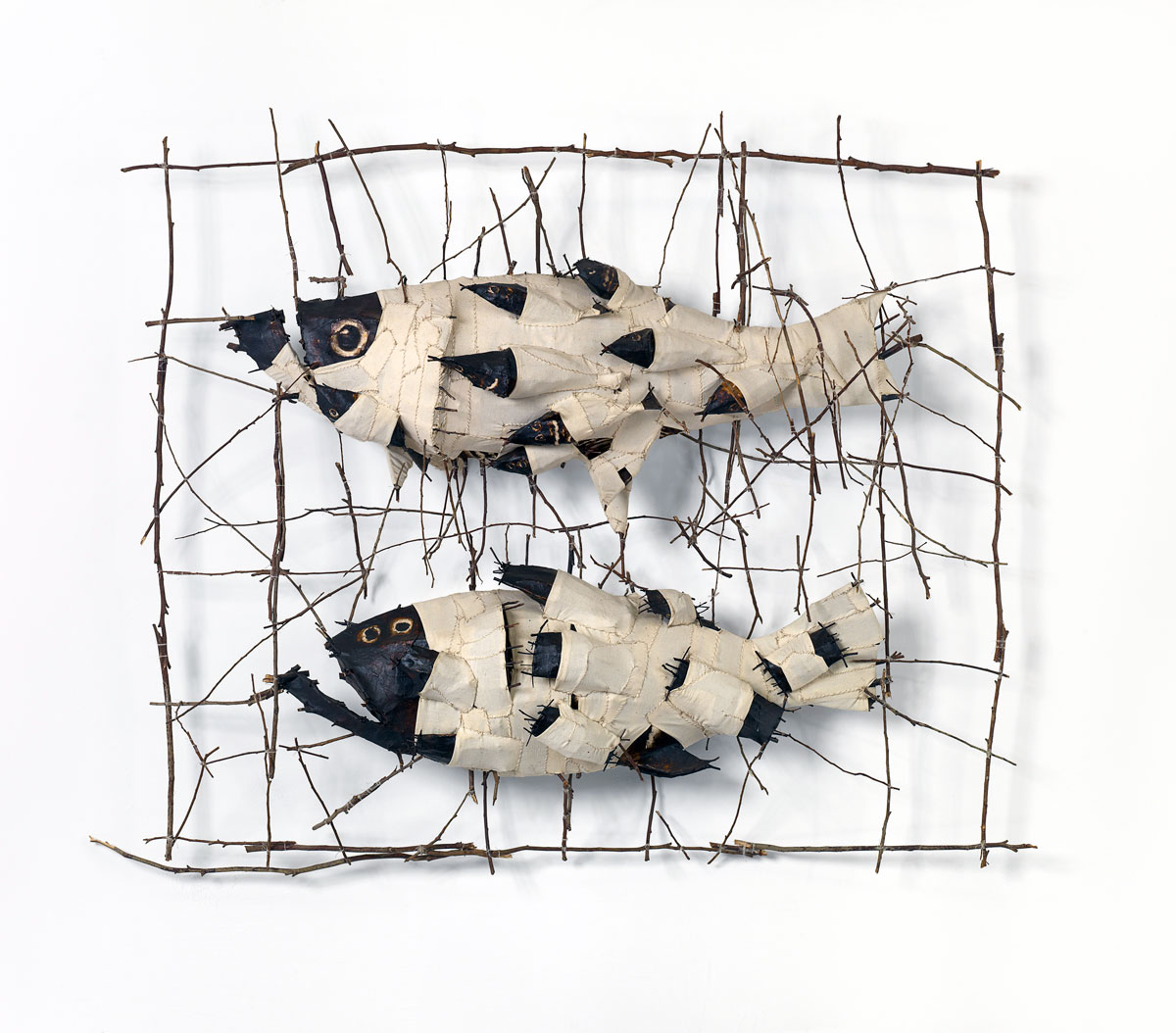
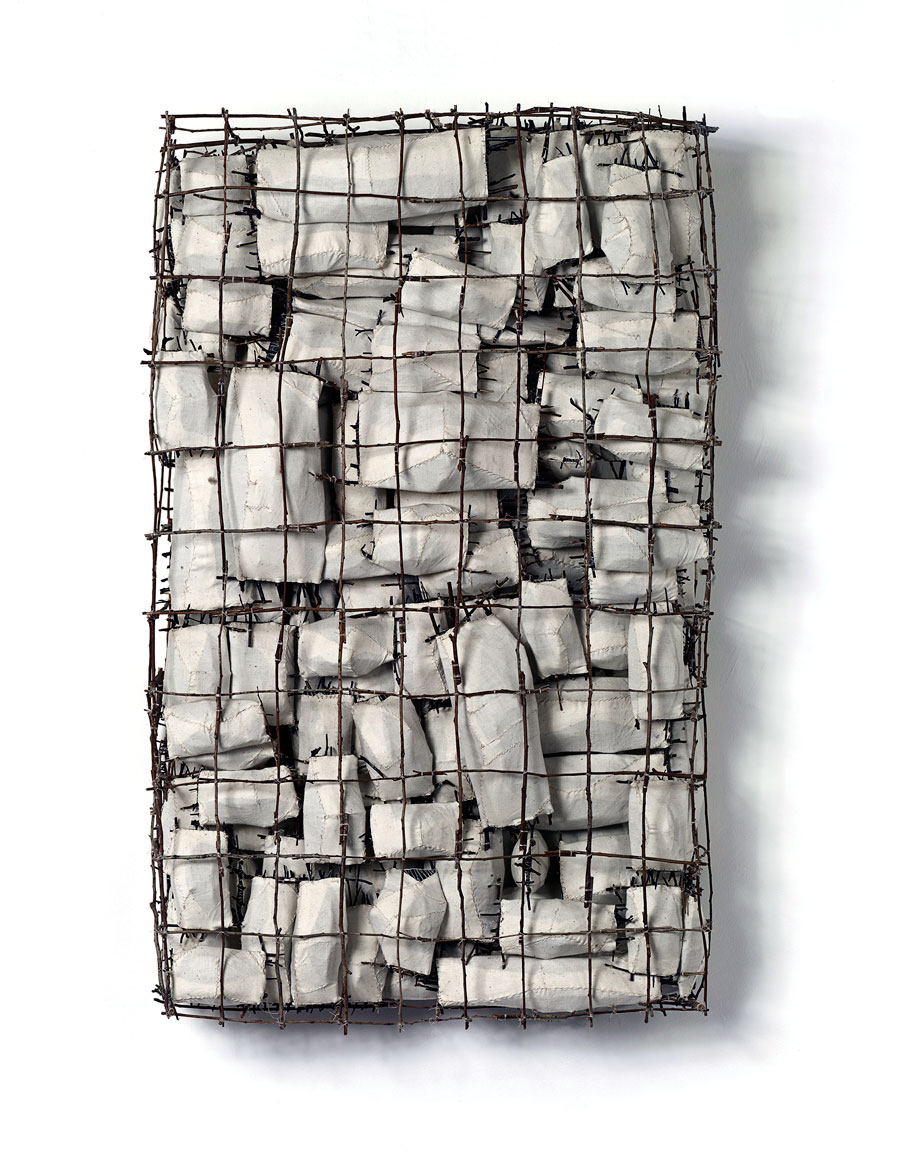
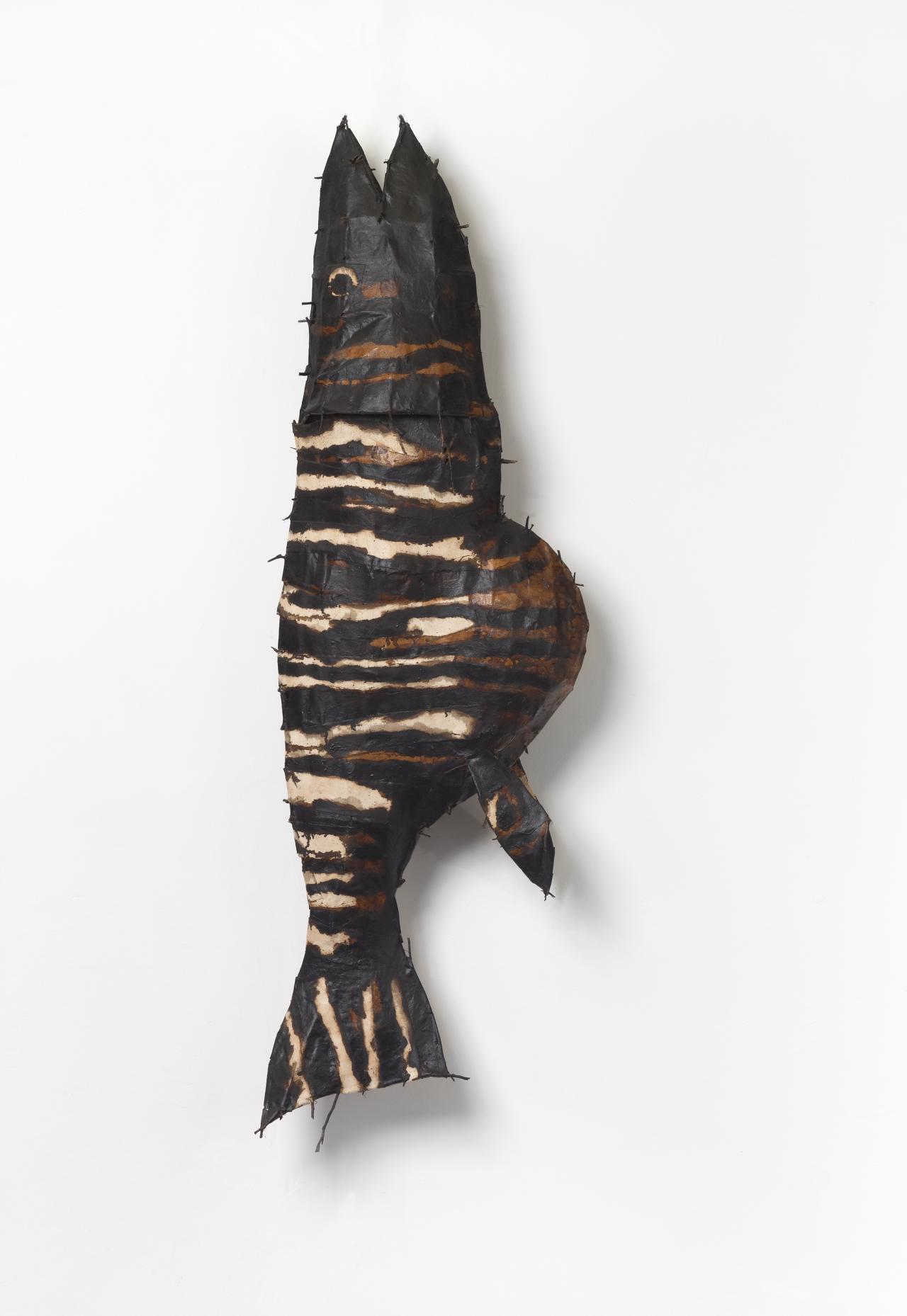
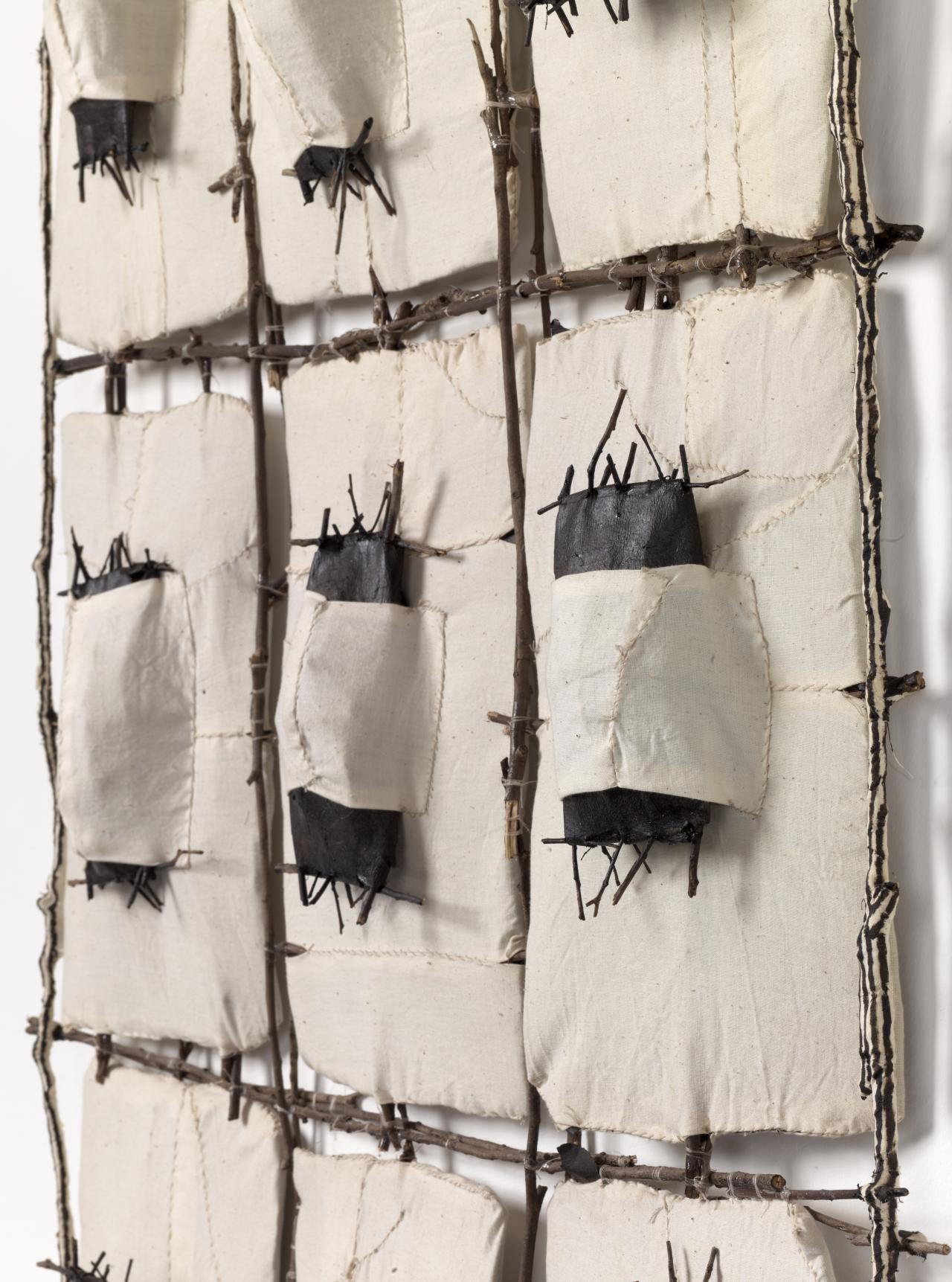
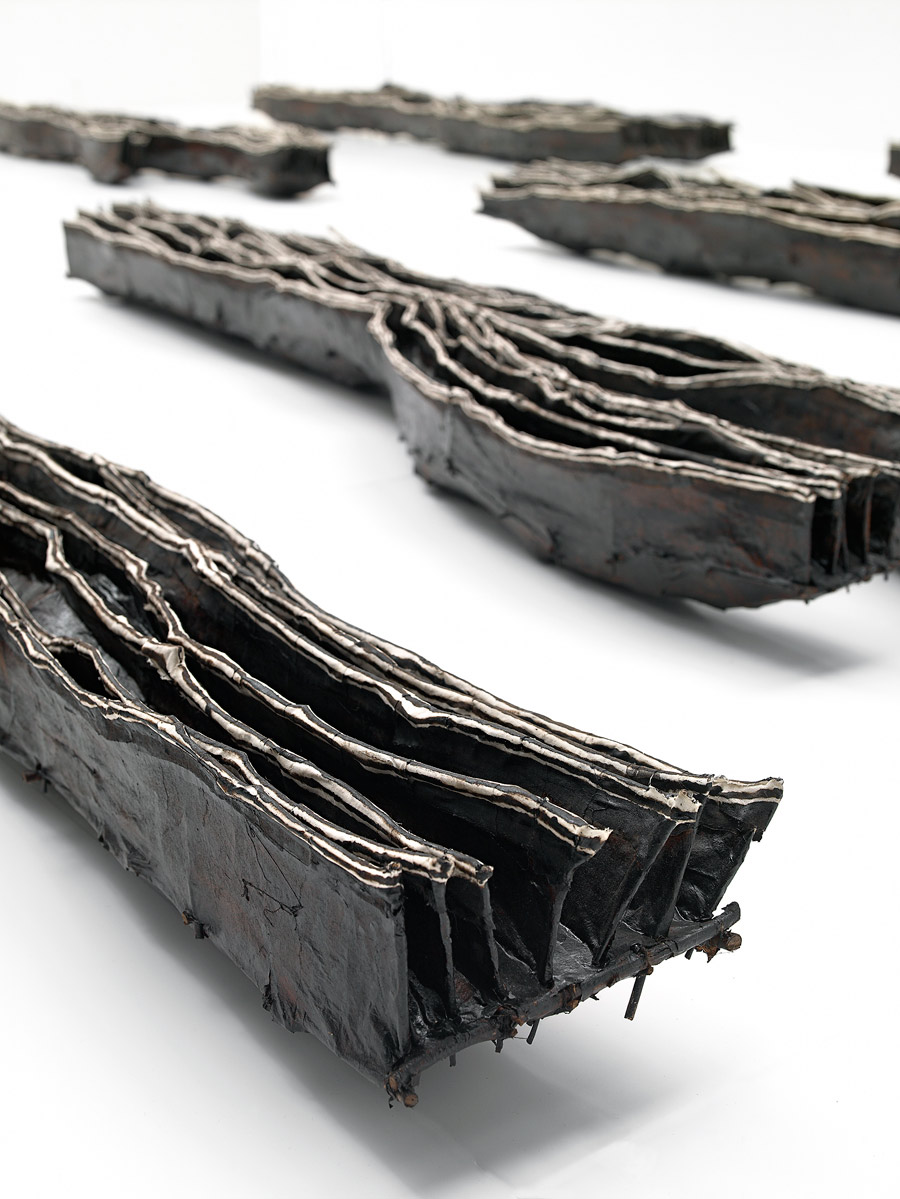
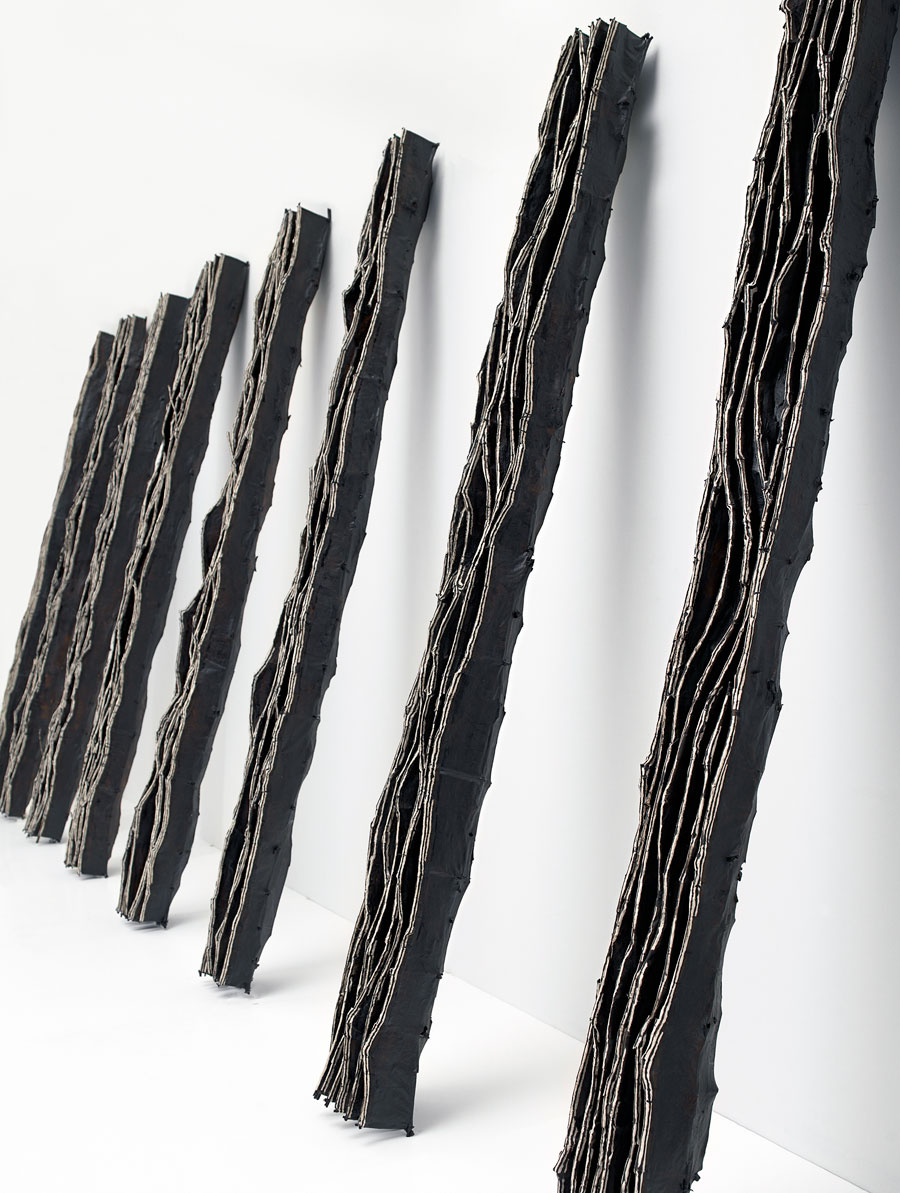
In the mature work you can comment on the fish as ‘travellers’ or ‘nomads’, “a metaphor for people and the way we move around the world.” You can observe the caging, wrapping and bandaging of these fish as a metaphor for the hurt we humans impose on ourselves and the world around us. You can admire the craftsmanship and delicacy of the constructions, the use of found objects, thread, twigs, driftwood and calico and note the ironic use of bituminous paint in relation to the environment, “a sticky tar-like form of petroleum that is so thick and heavy,”1 of dark and brooding colour.
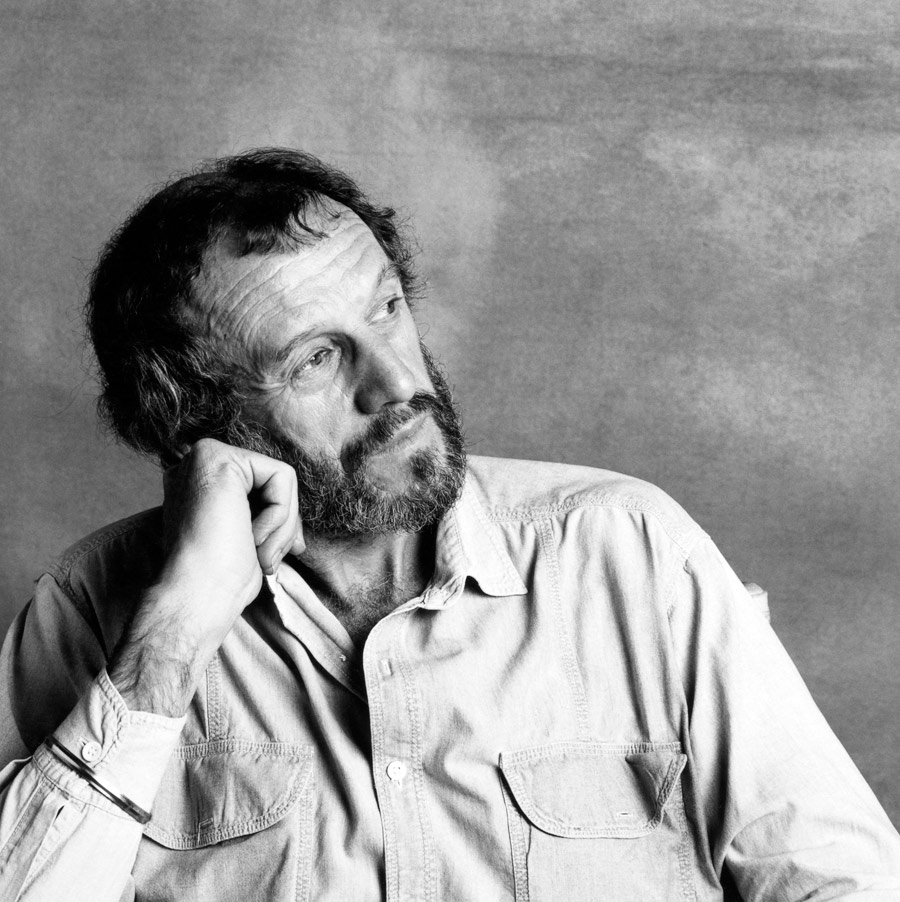
This is all well and true. But I have a feeling when looking at this work that here was a wise and old spirit, one who possessed knowledge and learning.
Since one of his last works was titled ‘Kōan’ (1999, see image below), a story “the meaning of which cannot be understood by rational thinking but may be accessible through intuition,”2 I would like to use a quotation from Carlos Castaneda and The Teachings of Don Juan as an allegorical statement about the work and, more inclusively, about the human journey to knowledge and the attaining of a state of grace in one’s life.
Although I didn’t know John Davis I have a feeling from his work that he attained such a state. Stick with the quotation for it is through this journey that we relate to ourselves and world around us. The stuff of legend.
Dr Marcus Bunyan
Many thanxk to Alison Murray, Jemma Altmeier and The National Gallery of Victoria for allowing me to publish the photographs in the posting. Please click on the photographs for a larger version of the image. There is also another John Davis exhibition in Melbourne at the moment at Arc One Gallery until 16th October 2010.
Fear, clarity, power, death
“‘When a man starts to learn, he is never clear about his objectives. His purpose is faulty; his intent is vague. He hopes for rewards that will never materialize, for he knows nothing of the hardships of learning.
‘He slowly begins to learn – bit by bit at first, then in big chunks. And his thoughts soon clash. What he learns is never what he pictured, or imagined, and so he begins to be afraid. Learning is never what one expects. Every step of learning is a new task, and the fear the man is experiencing begins to mount mercilessly, unyieldingly. His purpose becomes a battlefield.
‘And thus he has stumbled upon the first of his natural enemies : Fear! A terrible enemy – treacherous, and difficult to overcome. It remains concealed at every turn of the way, prowling, waiting. And if the man, terrified in its presence, runs away, his enemy will have put an end to his quest.’
‘What will happen to the man if he runs away in fear?’
‘Nothing happens to him except that he will never learn. He will never become a man of knowledge. He will perhaps be a bully or a harmless, scared man; at any rate, he will be a defeated man. His first enemy will have put an end to his cravings.’
‘And what can he do to overcome fear?’
‘The answer is very simple. He must not run away. He must defy his fear, and in spite of it he must take the next step in learning, and the next, and the next. He must be fully afraid, and yet he must not stop. That is the rule! And a moment will come when his first enemy retreats. The man begins to feel sure of himself. His intent becomes stronger. Learning is no longer a terrifying task.
‘When this joyful moment comes, then he can say without hesitation that he has defeated his first natural enemy.’
‘Does it happen at once, don Juan, or little by little?’
‘It happens little by little, and yet the fear is vanquished suddenly and fast.’
‘But won’t the man be afraid again if something new happens to him?’
‘No. Once a man has vanquished fear, he is free from it for the rest of his life because, instead of fear, he has acquired clarity – a clarity of mind which erases fear. By then a man knows his desires; he knows how to satisfy those desires. He can anticipate the new steps of learning, and a sharp clarity surrounds everything. The man feels that nothing is concealed.
‘And thus he has encountered his second enemy : Clarity! That clarity of mind, which is so hard to obtain, dispels fear, but also blinds.
‘It forces the man never to doubt himself. It gives him the assurance he can do anything he pleases, for he sees clearly into everything. And he is courageous because he is clear, and he stops at nothing because he is clear. But all that is a mistake; it is like something incomplete. If the man yields to this make-believe power, he has succumbed to his second enemy and will fumble with learning. He will rush when he should be patient, or he will be patient when he should rush. And he will fumble with learning until he winds up incapable of learning anything more.’
‘What becomes of a man who is defeated in that way, don Juan? Does he die as a result?’
‘No, he doesn’t die. His second enemy has just stopped him cold from trying to become a man of knowledge; instead, the man may turn into a buoyant warrior, or a clown. Yet the clarity for which he has paid so dearly will never change to darkness and fear again. He will be clear as long as he lives, but he will no longer learn, or yearn for, anything.’
‘But what does he have to do to avoid being defeated?’
‘He must do what he did with fear : he must defy his clarity and use it only to see, and wait patiently and measure carefully before taking new steps; he must think, above all, that his clarity is almost a mistake. And a moment will come when he will understand that his clarity was only a point before his eyes, And thus he will have overcome his second enemy, and will arrive at a position where nothing can harm him any more. This will not be a mistake. It will not be only a point before his eyes. It will be true power.
‘He will know at this point that the power he has been pursuing for so long is finally his. He can do with it whatever he pleases. His ally is at his command. His wish is the rule. He sees all that is around him. But he has also come across his third enemy : Power!
‘Power is the strongest of all enemies. And naturally the easiest thing to do is to give in; after all, the man is truly invincible. He commands; he begins by taking calculated risks, and ends in making rules, because he is a master.
‘A man at this stage hardly notices his third enemy closing in on him. And suddenly, without knowing, he will certainly have lost the battle. His enemy will have turned him into a cruel, capricious man.’
‘Will he lose his power?’
‘No, he will never lose his clarity or his power.’
‘What then will distinguish him from a man of knowledge?’
‘A man who is defeated by power dies without really knowing how to handle it. Power is only a burden upon his fate. Such a man has no command over himself, and cannot tell when or how to use his power.’
‘Is the defeat by any of these enemies a final defeat?’
‘Of course it is final. Once one of these enemies overpowers a man there is nothing he can do.’
‘Is it possible, for instance, that the man who is defeated by power may see his error and mend his ways?’
‘No. Once a man gives in he is through.’
‘But what if he is temporarily blinded by power, and then refuses it?’
‘That means the battle is still on. That means he is still trying to become a man of knowledge. A man is defeated only when he no longer tries, and abandons himself.’
‘But then, don Juan, it is possible that a man may abandon himself to fear for years, but finally conquer it.’
‘No, that is not true. If he gives in to fear he will never conquer it, he will shy away from learning and never try again. But if he tries to learn for years in the midst of his fear, he will eventually conquer it because he will never have really abandoned himself to it.’
‘How can he defeat his third enemy, don Juan?’
‘He has to defy it, deliberately. He has to come to realize the power he has seemingly conquered is in reality never his. He must keep himself in line at all times, handling carefully and faithfully all that he has learned. If he can see that clarity and power, without his control over himself, are worse than mistakes, he will reach a point where everything is held in check. He will know then when and how to use his power. And thus he will have defeated his third enemy.
‘The man will be, by then, at the end of his journey of learning, and almost without warning he will come upon the last of his enemies : Old age! This enemy is the cruelest of all, the one he won’t be able to defeat completely, but only fight away.
‘This is the time when a man has no more fears, no more impatient clarity of mind – a time when all his power is in check, but also the time when he has an unyielding desire to rest. If he gives in totally to his desire to lie down and forget, if he soothes himself in tiredness, he will have lost his last round, and his enemy will cut him down into a feeble old creature. His desire to retreat will overrule all his clarity, his power, and his knowledge.
‘But if the man sloughs off his tiredness, and lives his fate through, he can then be called a man of knowledge, if only for a brief moment when he succeeds in fighting off his last, invincible enemy. That moment of clarity, power, and knowledge is enough.”
Carlos Castaneda. The Teachings of Don Juan: A Yaqui Way of Knowledge3
1/ Anon. “Bitumen,” on Wikipedia [Online] Cited 02/10/2010
2/ Anon. “Kōan,” on Wikipedia [Online] Cited 02/10/2010
3/ Castaneda, Carlos. The Teachings of Don Juan: A Yaqui Way of Knowledge. London: Arkana Books, 1968, pp. 84-87
The National Gallery of Victoria has opened John Davis: Presence, celebrating the work of influential Australian artist, John Davis (1936-1999). The exhibition draws together over 40 works by the artist including sculpture, photography and installations.
David Hurlston, Curator, Australian Art, NGV, said this important survey charts Davis’s development as an artist, from his early works, produced during the 1960s, through to his critically acclaimed sculptures and installation works leading into the nineties.
“At the core of his practice, particularly evident in his late works, was an awareness of ecology and a sensitivity to the elemental forces of nature and the effect of human actions. Now, at a time when issues relating to the environment seem more pertinent than ever, Davis’s sculptures have even greater resonance.
“John Davis was a pioneering Australian artist who during his life achieved a critically acclaimed international reputation as a sculptor and installation artist. This important exhibition has a particular focus on the artist’s interest in found and fragile organic materials, and the powerful evocation of the landscape,” said Mr Hurlston.
A highlight of the exhibition is a series of works featuring fish. From the mid 1980s, Davis used fish in his work as a symbol for human movement and relationships with each other and the environment. Davis commonly referred to his fish as ‘nomads’ or ‘travellers’ and once described his works as ‘a metaphor for people and the way we move around the world; a statement for diversity’.
Frances Lindsay, Deputy Director, NGV said: “Davis’s mature works reflected his sensitivity to the landscapes that surrounded him. Visitors will be excited by the vision of this extraordinary artist as they explore his development from the early sixties through to his death in 1999. This exhibition is a special tribute to one of Australia’s great conceptual and environmentally aware artists.”
Born in Ballarat, Victoria, in 1936, John Davis studied at the Royal Melbourne Institute of Technology. In 1972 Davis travelled to Europe and America before returning to Australia the following year to take up a position at Prahran College of Advanced Education. In subsequent years Davis was a senior faculty member at the Victorian College of the Arts and continued to travel widely and exhibit regularly in America, Japan and Australia.
John Davis was awarded a number of prizes, among them the 1970 Comalco Invitation Award for Sculpture and the Blake Prize for Religious Art in 1993. He participated in the inaugural Mildura Sculpture Triennial, and he represented Australia at the Venice Biennale in 1978. Davis was also the first artist whose work was profiled in the NGV Survey series in 1978.
Text from the National Gallery of Victoria website


























 Art Blart _ art and cultural memory archive
You must be logged in to post a comment.