Artwork: Alan Constable camera. Opening night photographs: ‘Movement and Emotion’ at Arts Project Australia, Melbourne

Exhibition dates: 20th October – 26th November 2011


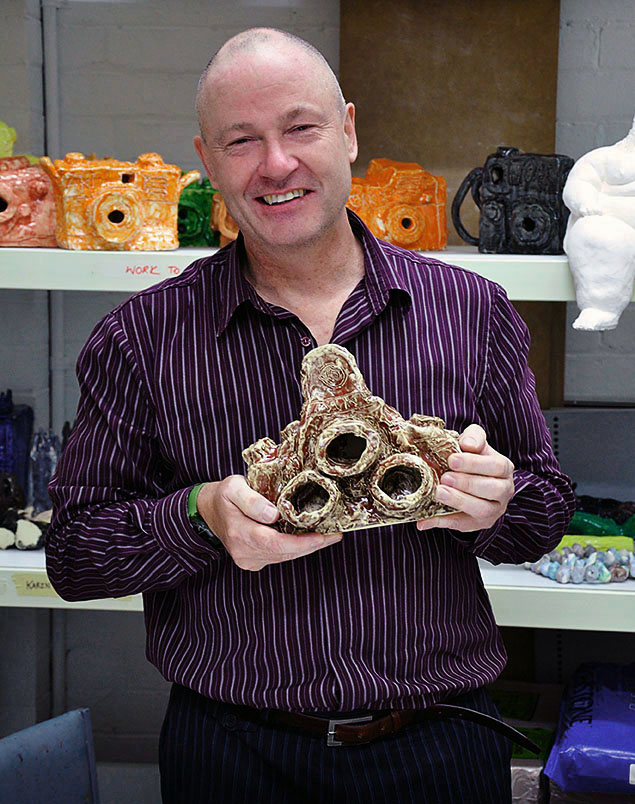
Dr Marcus Bunyan holdling his new Alan Constable camera at the opening of Movement and Emotion 2011. More of Alan's cameras can be seen behind.


Dr Marcus Bunyan holding his new Alan Constable camera at the opening of Movement and Emotion 2011.
More of Alan’s cameras can be seen behind.


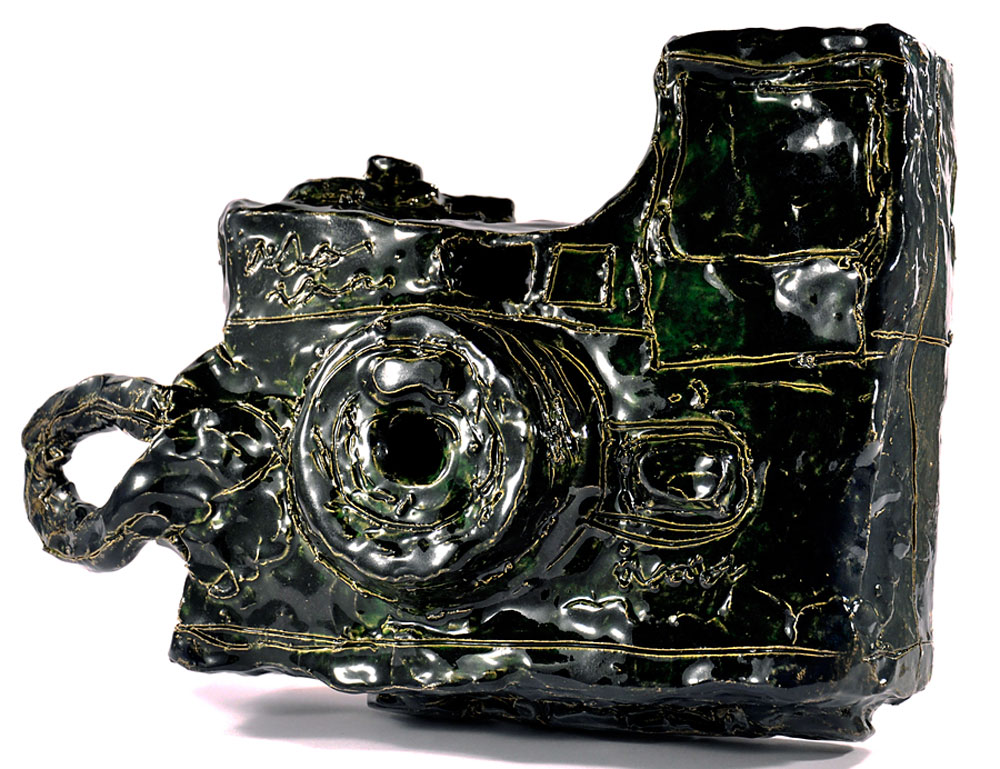
I have added a new Alan Constable camera to my collection. Yah!

The one I have chosen is very unusual. The camera has a third eye and a stunning glaze. The exhibition features the work of three Arts Project Australia artists: Alan Constable, Chris O’Brien and Terry Williams. All three artists explore machine aesthetics within their practice.

I really do hope that the National Gallery of Victoria purchases some of these cameras. They are the most unusual and beautiful sculptural pieces I have seen in a long time.

Dr Marcus Bunyan


Many thankx to Art Project Australia for allowing me to publish the photographs in the posting. Please click on the photographs for a larger version of the image. See more images from the Movement and Emotion exhibition.


Alan Constable (Australian, b. 1956) 'Not titled (three lens red camera)' 2011


Alan Constable (Australian, b. 1956)
Not titled (three lens red camera)
2011


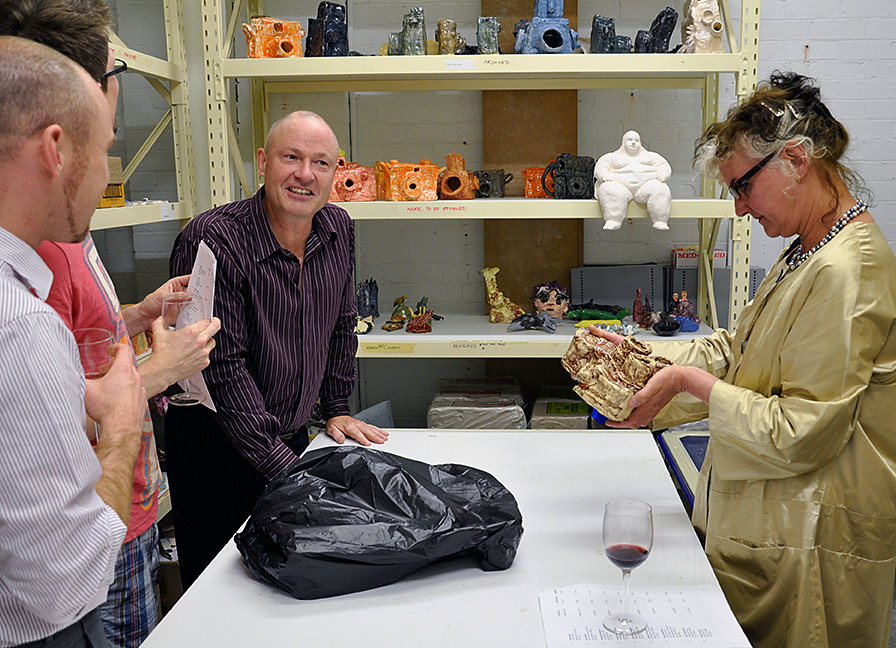
Marcus with jeweller Marianne Cseh at right looking at the Alan Constable camera


Marcus with jeweller Marianne Cseh at right looking at the Alan Constable camera


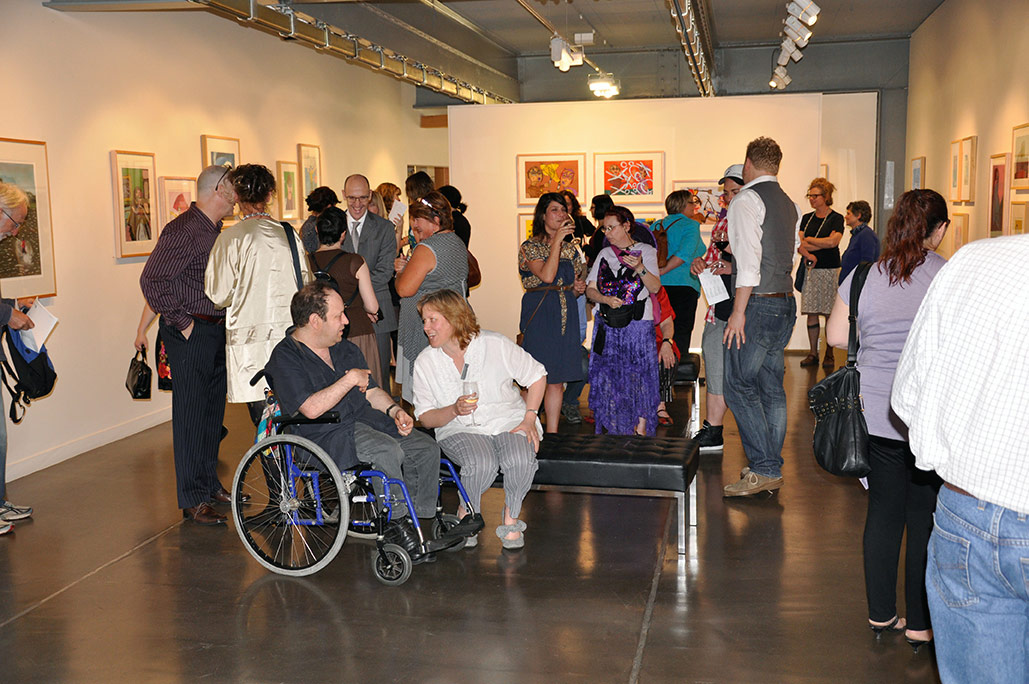
Opening night crowd at 'Movement and Emotion'


Opening night crowd at Movement and Emotion, Arts Project Australia


Opening night, with at left curator Paul Hodges, artist Jodie Noble (seated), myself and at right, Jonah Jones, President of the board of Arts Project Australia


Opening night, with at left curator and artist Paul Hodges, artist Jodie Noble (seated), myself and, at right, Jonah Jones, President of the board of Arts Project Australia


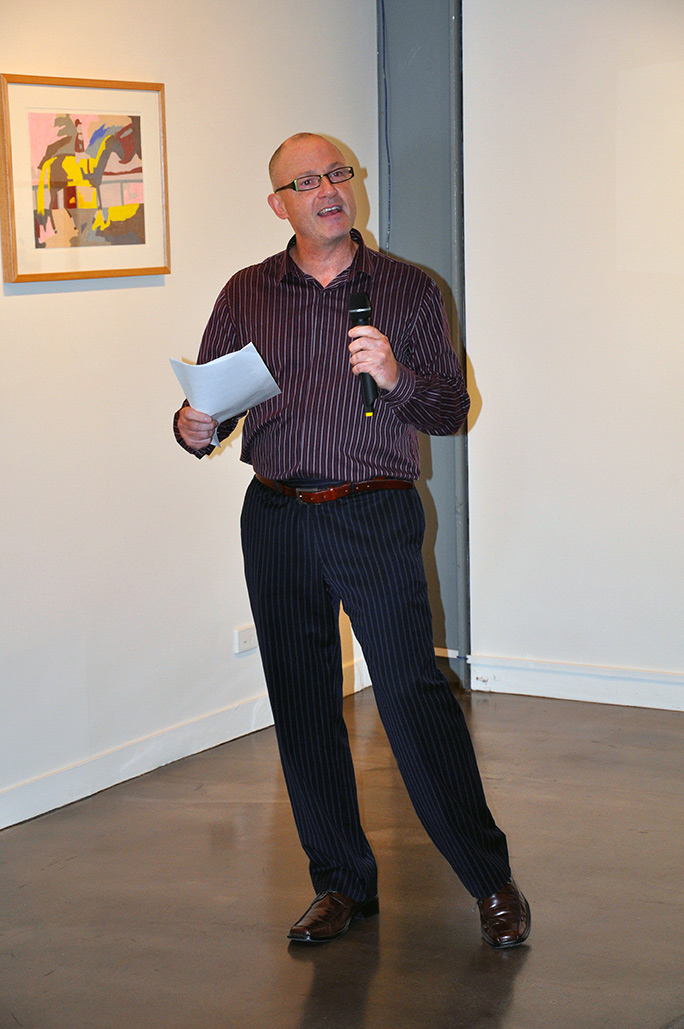
Dr Marcus Bunyan giving the opening night speech at the exhibition 'Movement and Emotion' at Arts Project Australia


Dr Marcus Bunyan giving the opening night speech for the exhibition Movement and Emotion. Read the opening night speech. I was so nervous my jeweller friend Marianne said she could see my hands shaking from where she was standing in the crowd!!


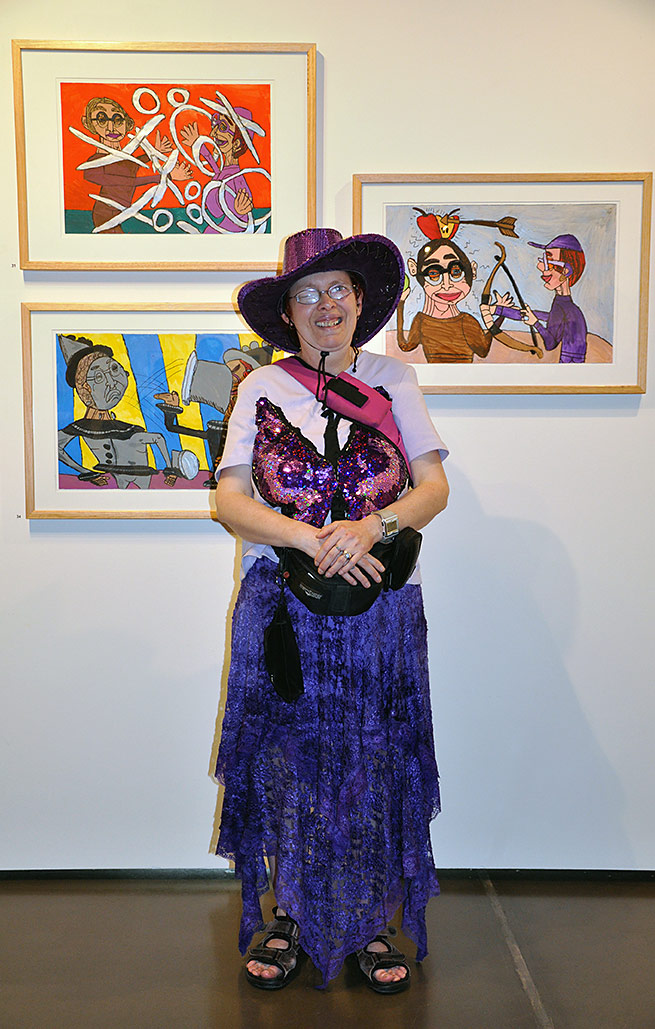
Artist Catherine Staughton standing in front of her work


Artist Catherine Staughton standing in front of her work


Arts Project Australia

Studio
24 High Street
Northcote Victoria 3070
Phone: + 61 3 9482 4484

Gallery
Level 1 Perry Street building
Collingwood Yards
Enter via 35 Johnson Street or 30 Perry Street, Collingwood
Phone: +61 477 211 699

Opening hours:
Wednesday – Friday 11am – 5pm
Saturday & Sunday 12 – 4pm

Arts Project Australia website

LIKE ART BLACK ON FACEBOOK

Back to top

Opening: ‘Movement and Emotion’ and ‘Jodie Noble Solo’ exhibitions at Arts Project Australia, Melbourne

Exhibition dates: 20th October – 26th November 2011

Curator of Movement and Emotion: Paul Hodges

Artists: Steven Ajzenberg, Patrick Francis, Brigid Hanrahan, Paul Hodges, Chris Mason, Cameron Noble, Jodie Noble, Lisa Reid, Anthony Romagnano and Cathy Staughton


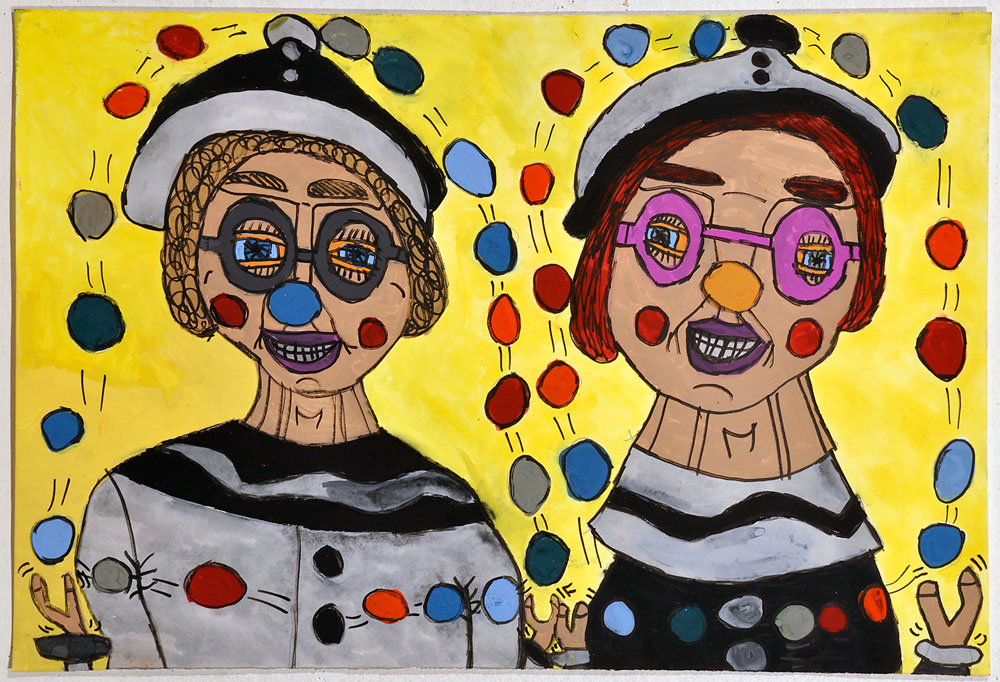
Catherine Staughton (Australian, b. 1968) 'Juggle Ball Hand Jump Roller' 2011


Catherine Staughton (Australian, b. 1968)
Juggle Ball Hand Jump Roller
2011
Gouache and felt pen on paper
38 x 56cm


Opening night speech by Dr Marcus Bunyan

Thank you for your welcome to Arts Project Australia on this auspicious occasion, the first ever exhibition to be curated by an Arts Project artist, Paul Hodges. Together with the Jodie Noble solo exhibition in the front gallery I am sure you will agree that the gallery is full of vibrant work. There are some things that may be said about both bodies of work.

I asked Paul what had been the inspiration behind Movement and Emotion. He said that he often goes to the National Gallery of Victoria and looks at the pictures and imagines the artist painting. He wonders how they were feeling and he visualises the pictures coming to life, especially pictures of dancers in which he has a personal interest. He came back to Arts Project and started thinking about the work in the collection and after much thought made the selection you see here tonight. He used his imagination, his feelings and his understanding of the world to curate the exhibition.

Let’s consider the title Movement and Emotion.

Emotion can be defined as an agitation, a strong feeling, a departure from the normal calm state of an organism. The logos of emotion begins in the experience of ‘being moved’ in some manner. Any emotion holds within its structure some potential for movement, whether it be physical or mental. You can be physically still yet be mentally moved, causing you to have emotion. Some emotions occur over a period of seconds (for example, surprise), whereas others can last years (for example, love). In the word ’emotion’ is the very act of movement, namely motion. Hence e/motion is the root of this wonderful feeling that I get from these artworks. Emotion is movement. Emotion is feeling. Emotion is passion.1

And it is this very act that sustains the work in both exhibitions. The work is personal. It speaks from the heart. It is intimate, transcendent and enigmatic. It moves me like little contemporary art ever does. When I first saw the artwork in the space at the back of the gallery, when they were revealed to me I gasped at their simple, eloquent beauty. Whimsical and playful these works possess an element of the carnivalesque,2 a riot of colour and form that exist on the border of art and life. Mingling depictions of high culture and personal narrative the works have no pretence but a visceral immediacy: a direct connection from the artists imagination of the world, through the eyes to the hand and the paper to depict what is in the world. As Susan Sontag observes, “A work of art is a thing in the world, not just a text or commentary on the world…”3

Some of you may be familiar with the American photographer Walker Evans – his famous US Depression era pictures are a thing in the world, as well as text/commentary on the world. He refers to this working method as ‘transcendent documentary’4: a watchful intelligence that recognises a moment of seeing, a movement of emotion – and then describes it. Yes, a quest for ‘the thing itself’ but more than that, the imagination to describe the substance of our existence, the nature of reality. Objects, people and places are transformed from things seen to things that we known. Intimately. Inherently.

In their unique vision it is the artists relation to self, the nature of what they see and feel around them that creates e/motion. They transcend form while ordering it at the same time. It is both the immediate world, simply described, perceived as it stands with the whole of consciousness coupled with the imagination as always there, between our eyes and the world, for it is the imagination that defines our humanity, declares our consciousness. They imagine, they perceive the simple radiance of what is.

That is what these artists do.

Perceive.

What is.


In Movement and Emotion, and in the portraits of Jodie Noble we see what is and imagine what should be. The photographer Elliott Erwitt in his book Personal Exposures (1988) said, “The work I care about is terribly simple … I observe, I try to entertain, but above all I want pictures that are emotion.”5

Those pictures are here, e/motioning, all around us. I enjoy these pictures tremendously. Congratulations to all the artists for the experience that you have given us.

Dr Marcus Bunyan


Footnotes

1/ See Robbins, Brent Dean. Emotion, Movement & Psychological Space: A Sketching Out of the Emotions in terms of Temporality, Spatiality, Embodiment, Being-with, and Language. Duquesne University, 1999 [Online] Cited 08/10/2011

2/ Bakhtin, Mikhail. Rabelais and His World (trans. Helene Iswolsky). Cambridge: MIT Press, 1968, p. 7

3/ Sontag, Susan. “On Style,” in Against Interpretation and Other Essays. New York: Delta Book, 1966, pp. 21-22

4/ Anon. “”A Revolutionary Project” Brings Cuba to the Getty Museum,” on Cuban Art News [Online] 05/10/2011 Cited 08/10/2011. No longer available online

5/ Erwitt, Elliott. Personal Exposures. W. W. Norton & Company, 1988 quoted on Anon. “Photographer Elliott Erwitt’s Archive to be Housed at Harry Ransom Center,” on Harry Ransom Center: The University of Texas website [Online] 22/09/2011. Cited 08/10/2011. No longer available online


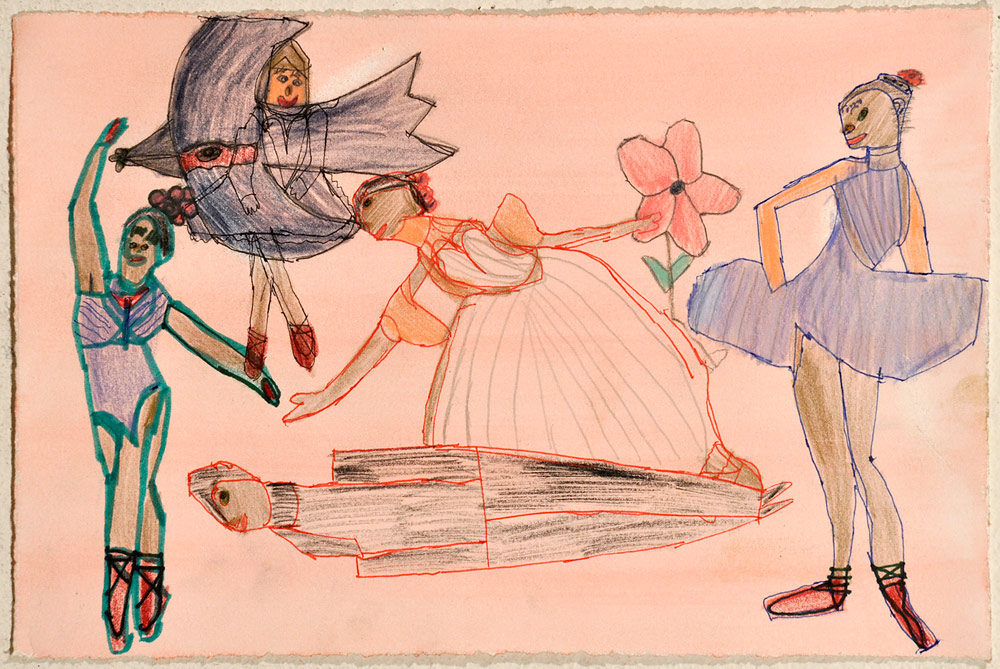
Brigid Hanrahan. 'Not titled (Ballet Dancers)' 2009


Brigid Hanrahan (Australian)
Not titled (Ballet Dancers)
2009
Colour pencil and fineliner on paper
20 x 30cm


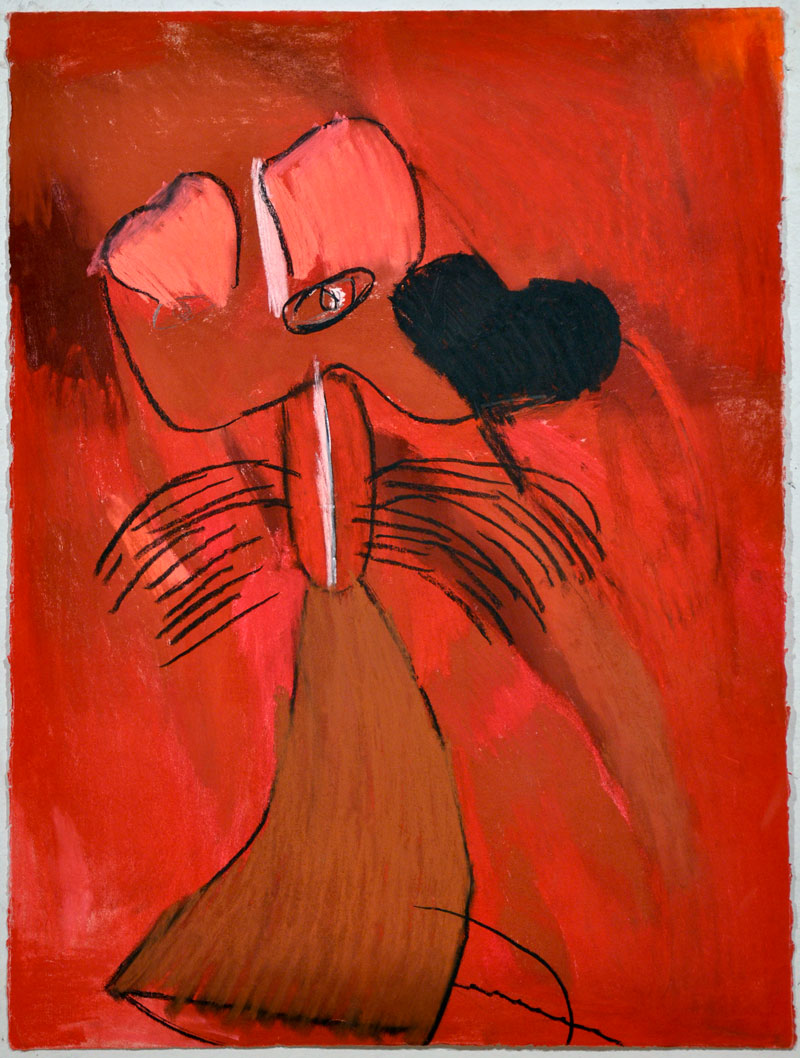
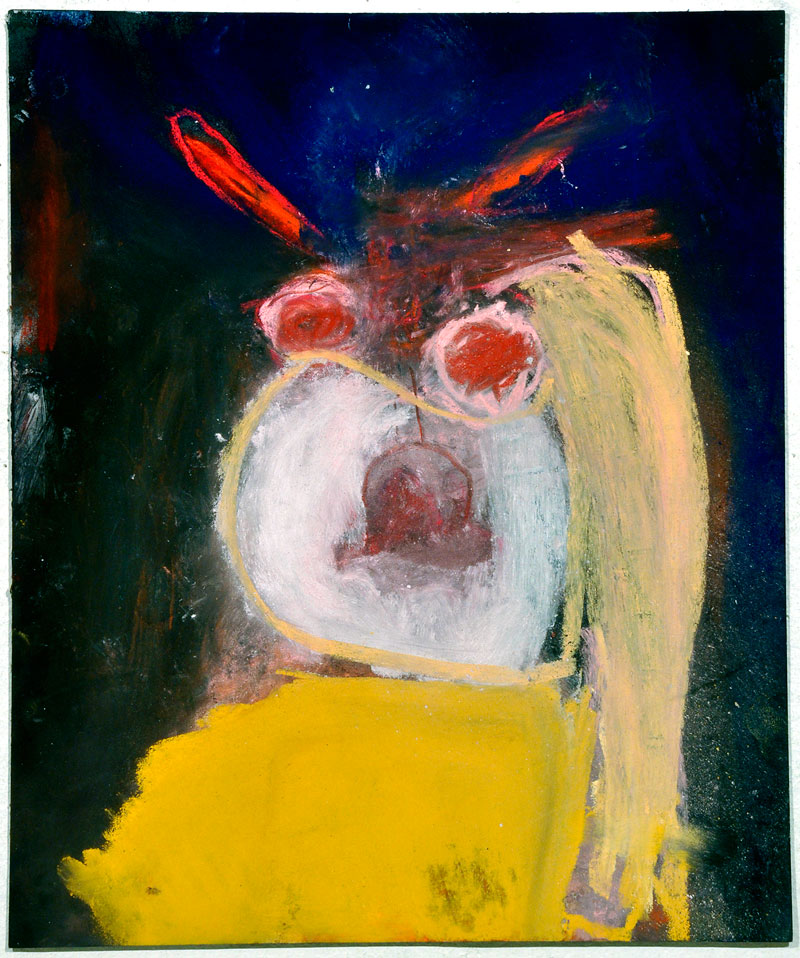
Jodie Noble. 'Not titled (red dog)' 2006


Jodie Noble (Australian)
Not titled (red dog)
2006
Pastel on paper
76 x 57cm


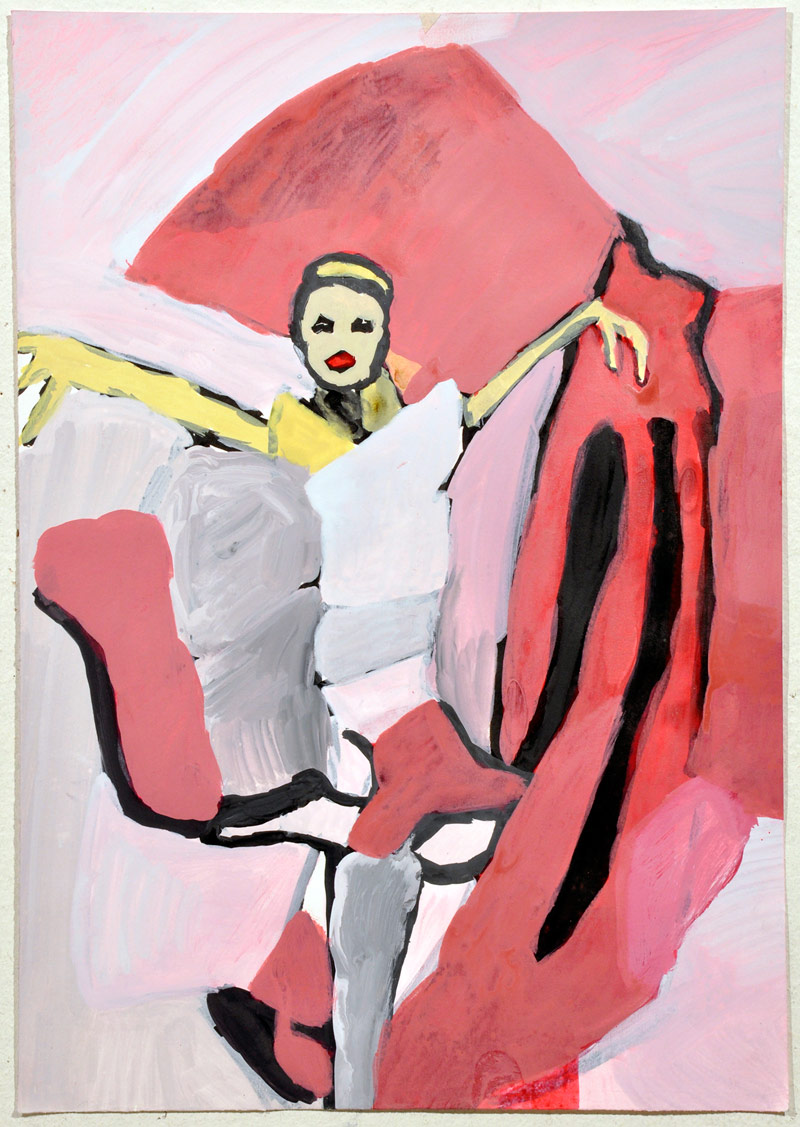
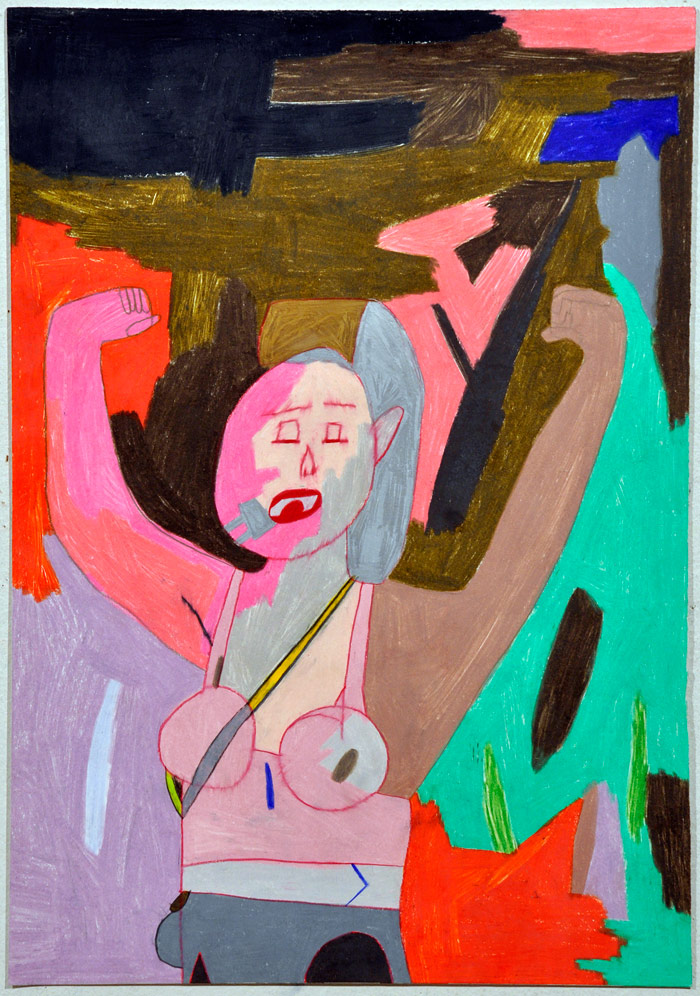
Paul Hodges (Australian, b. 1974) 'Not titled (Pink Dancer)' 2010


Paul Hodges (Australian, b. 1974)
Not titled (Pink Dancer)
2010
Ink on paper
50 x 35cm


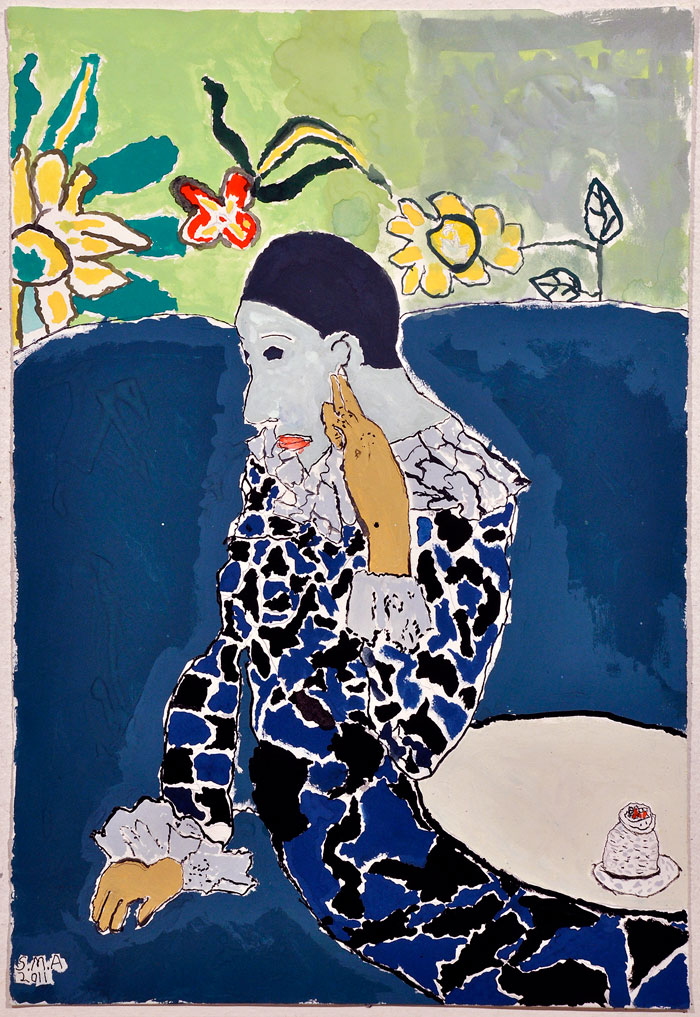
Steven Ajzenberg (Australian, b. 1964) 'Harlequin' 2010


Steven Ajzenberg (Australian, b. 1964)
Harlequin
2010
Gouache on paper
55.5 x 38cm


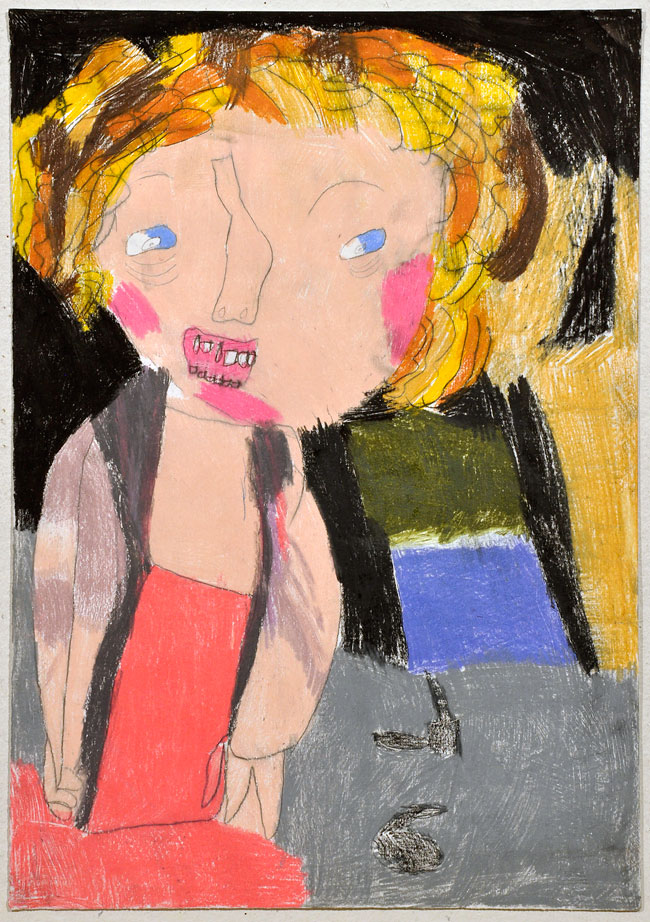
Jodie Noble. 'Not titled (girl wearing pink dress)' 2010


Jodie Noble (Australian)
Not titled (girl wearing pink dress)
2010
Prisma colour pencil on paper
50 x 35cm


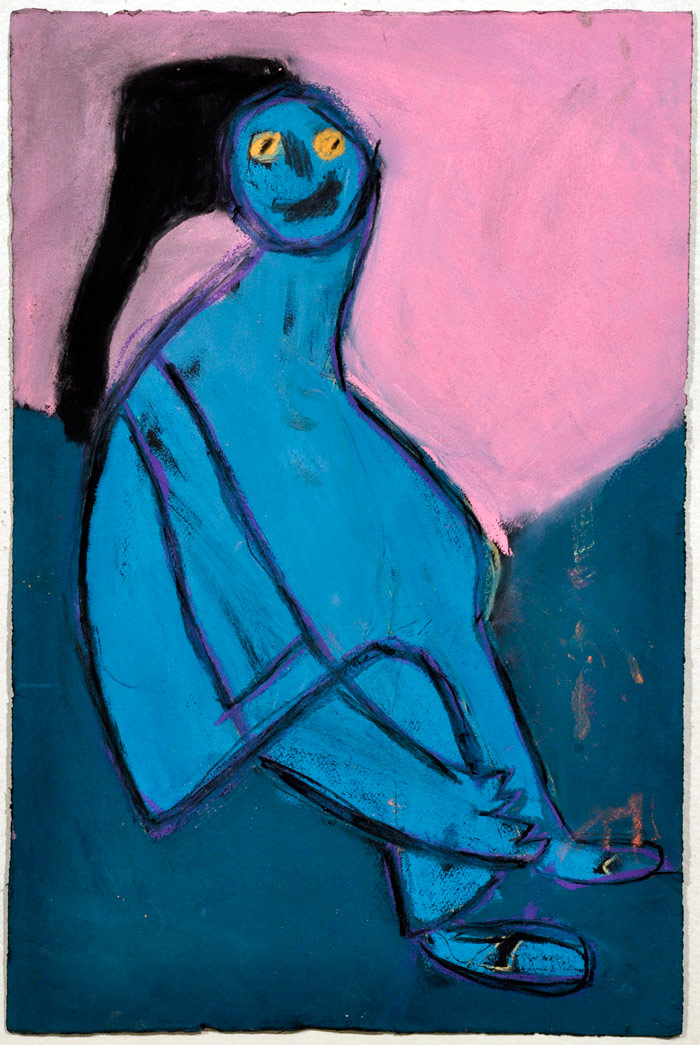
Cameron Noble. 'Not titled (Blue Lady)' 2011


Cameron Noble (Australian)
Not titled (Blue Lady)
2011
Dry pastel on paper
57 x 37.5cm


Jodie Noble. 'Geisha Girl' 2011


Jodie Noble (Australian)
Geisha Girl
2011
Dry pastel on paper
35 x 25cm


Movement and Emotion

This exhibition will explore movement in paintings and the emotions of people in everyday life. These works are vibrant, expressive and each work is unique; they jump out at you. Key themes investigated include carnival, dance and portraits. This is the first exhibition Paul Hodges has curated.

“This is a wonderful show presenting movement and emotion in art by ten artists that I have collected from Arts Project Australia’s studio.”

Paul Hodges, 2011

“When I walk past Jodie Noble’s paintings I can almost feel what she is feeling … Jodie is telling us what she is feeling through her paintings.”

Paul Hodges 2010


Jodie Noble Solo

Jodie Noble’s current work is figurative and often incorporates an autobiographical narrative. While occasionally painting from life, her work also references popular culture. In particular, Noble is inspired by contemporary famous figures, from Frida Kahlo and Francisco Goya to Queen Elizabeth II. Noble’s work is descriptive, expressive and infused with a sense of physicality.

In this exhibition, Noble has selected a series of portraits on paper that are autobiographical and of people she knows in her life. This is Jodie’s second solo exhibition.


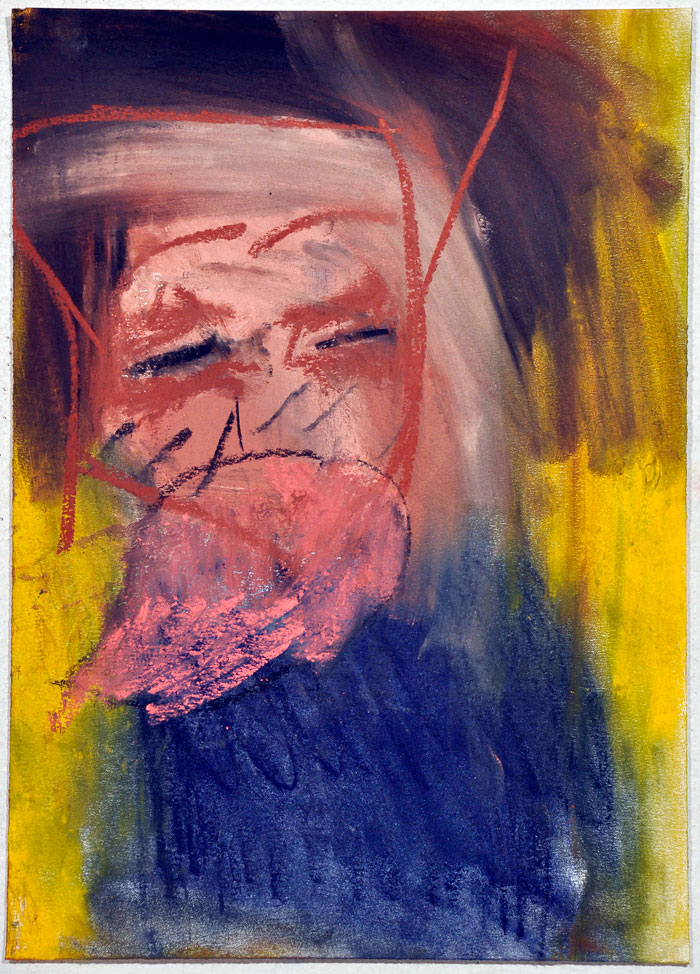
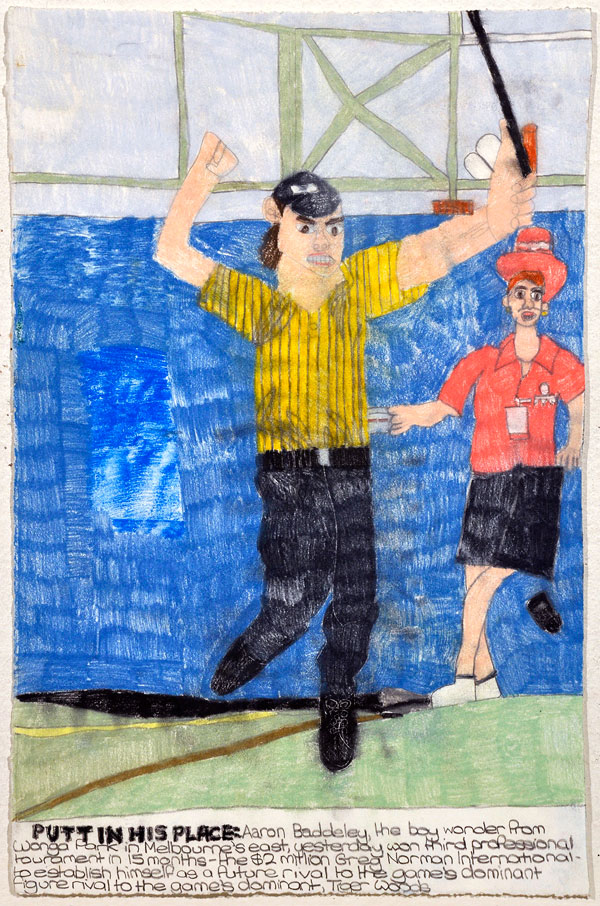
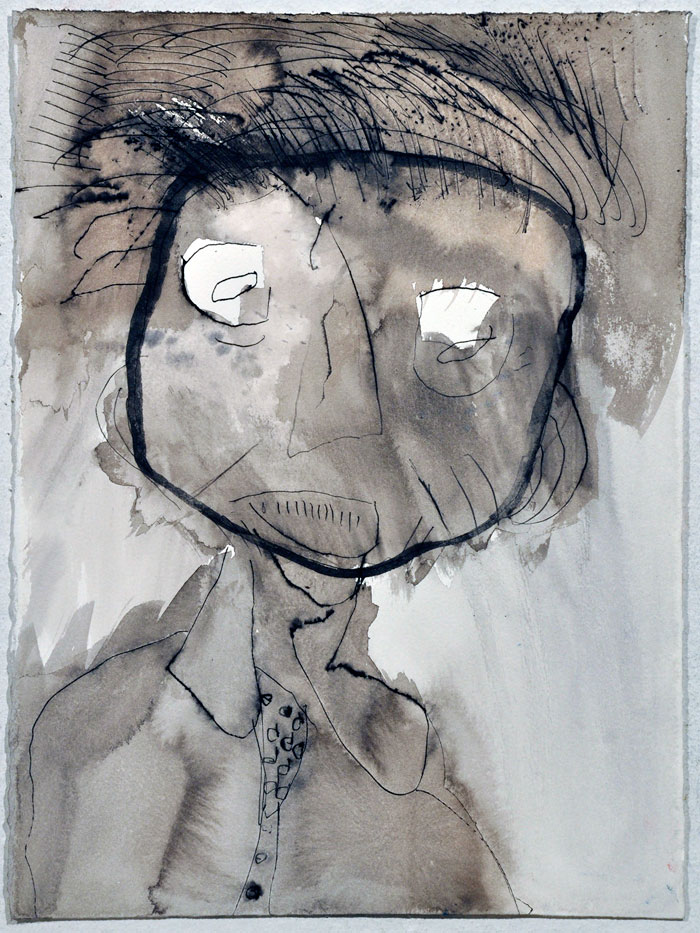
Lisa Reid (Australian, b. 1975) 'Not titled (Adam Baddeley)' 2001


Lisa Reid (Australian, b. 1975)
Not titled (Adam Baddeley)
2001
Pastel and pencil on paper
50 x 33cm


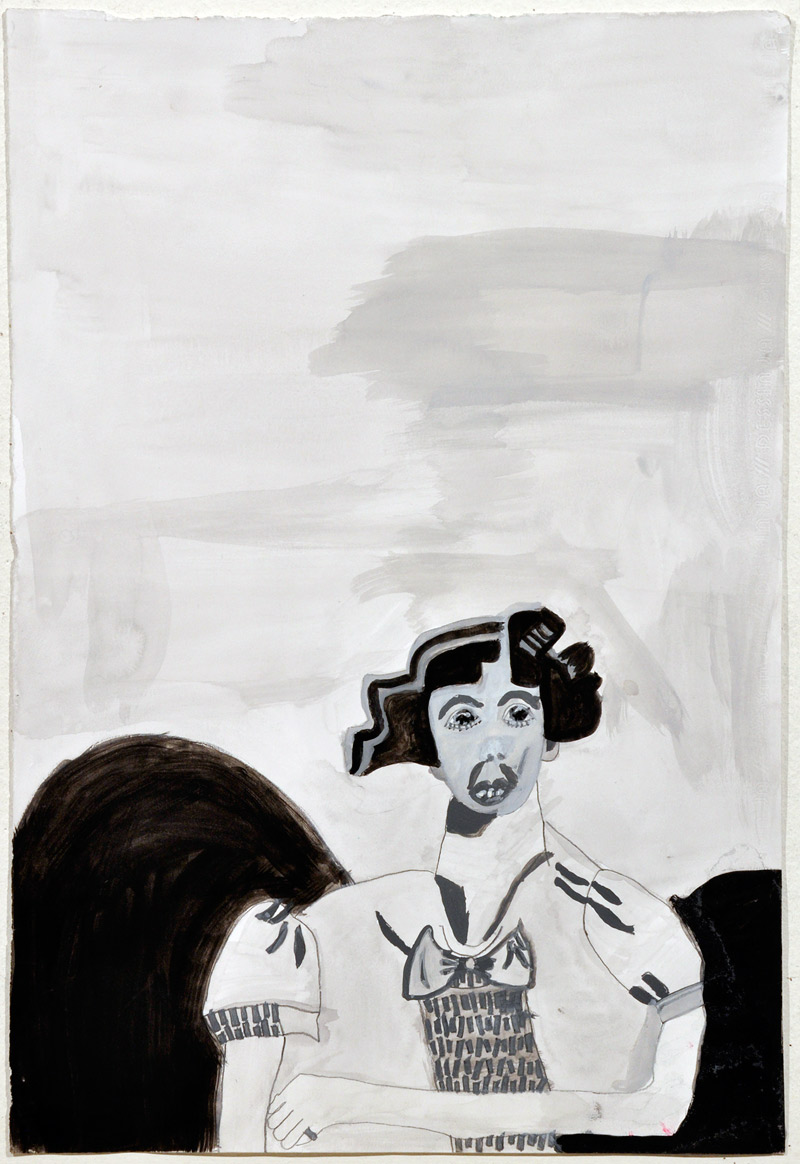
Lisa Reid (Australian, b. 1975) 'Great Aunt Edna' 2003


Lisa Reid (Australian, b. 1975)
Great Aunt Edna
2003
Gouache on paper
55 x 37.5cm


Anthony Romagnano (Australian, b. 1985) 'Madonna' 2010


Anthony Romagnano (Australian, b. 1985)
Madonna
2010
Prisma colour pencil on paper
50 x 35cm


Jodie Noble. 'Not titled' 2010


Jodie Noble (Australian)
Not titled
2010
Ink and fine-liner on paper
38 x 28.5cm


Cameron Noble. 'Not titled' 2011


Cameron Noble (Australian)
Not titled
2011
Dry pastel on paper
38.5 x 32.5cm


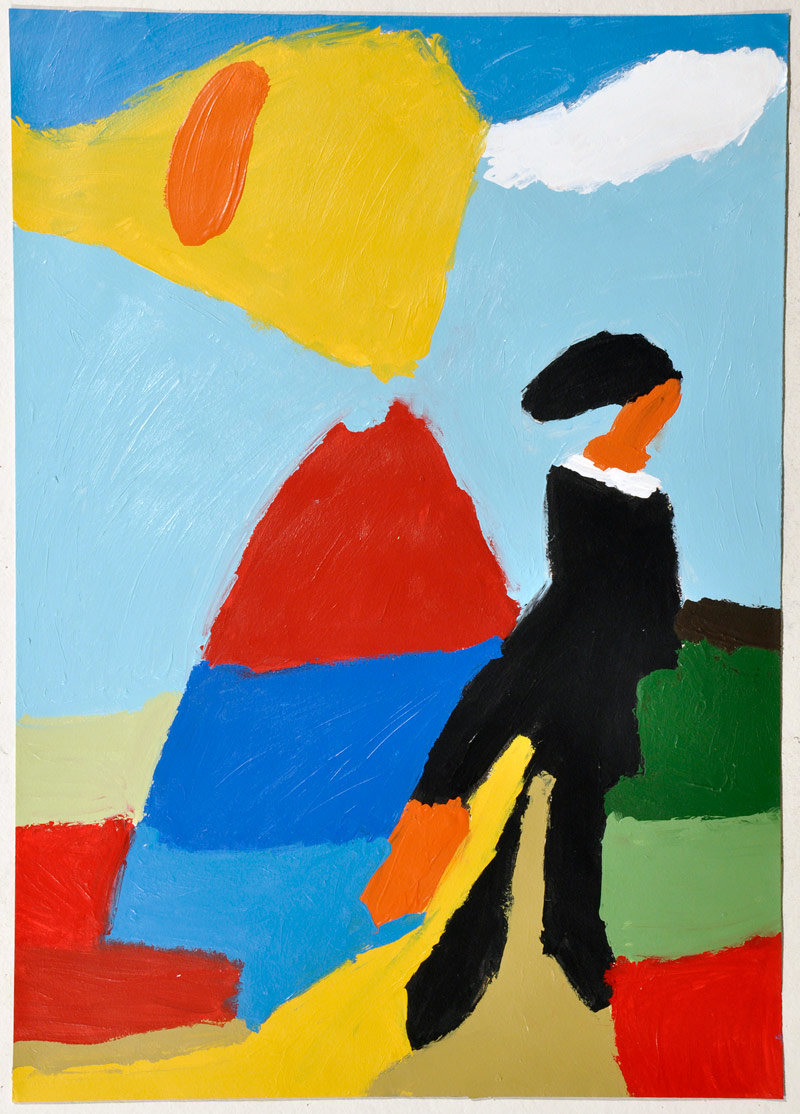
Patrick Francis (Australian, b. 1991) 'Not titled' 2011


Patrick Francis (Australian, b. 1991)
Not titled
2011
Acrylic on paper
70 x 50cm


Arts Project Australia
24 High Street
Northcote Victoria 3070
Phone: + 61 3 9482 4484

Gallery location:
Level 1 Perry Street Building,
Collingwood Yards
Enter via 35 Johnson Street
or 30 Perry Street, Collingwood

Opening hours:
Wed – Fri 11am – 5pm
Sat & Sun 12 – 4pm

Arts Project Australia website

LIKE ART BLACK ON FACEBOOK

Back to top

Exhibition: ‘Juan Davila: The Moral Meaning of Wilderness’ at the Monash University Museum of Art (MUMA), Caulfield

Exhibition dates: 4th August – 1st October 2011


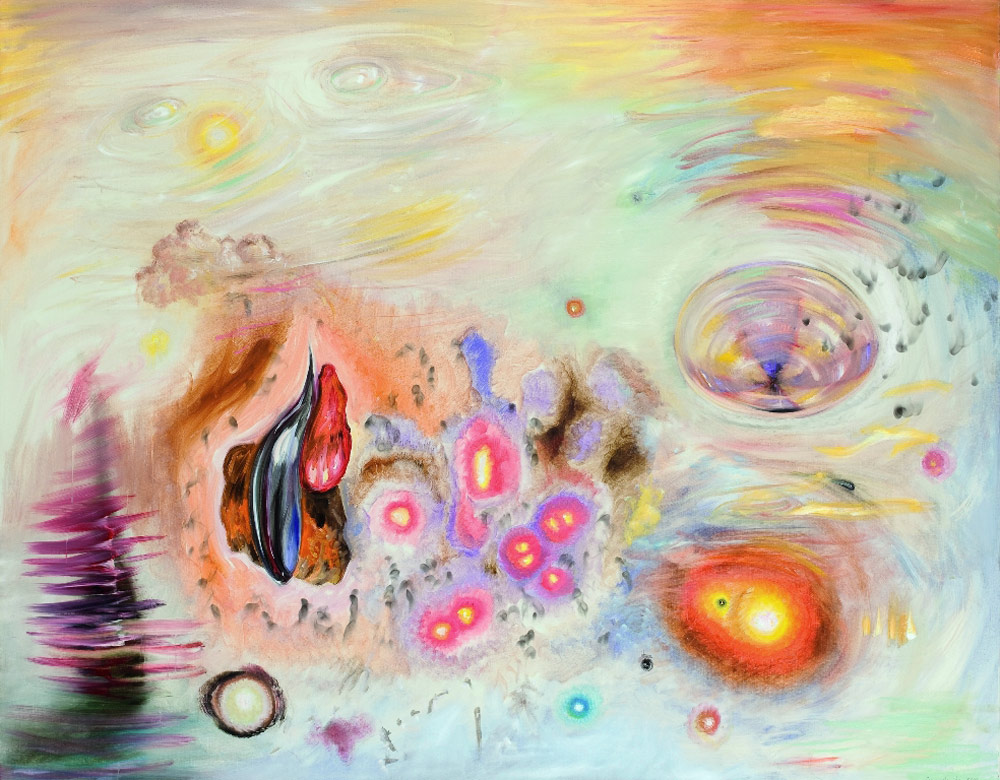
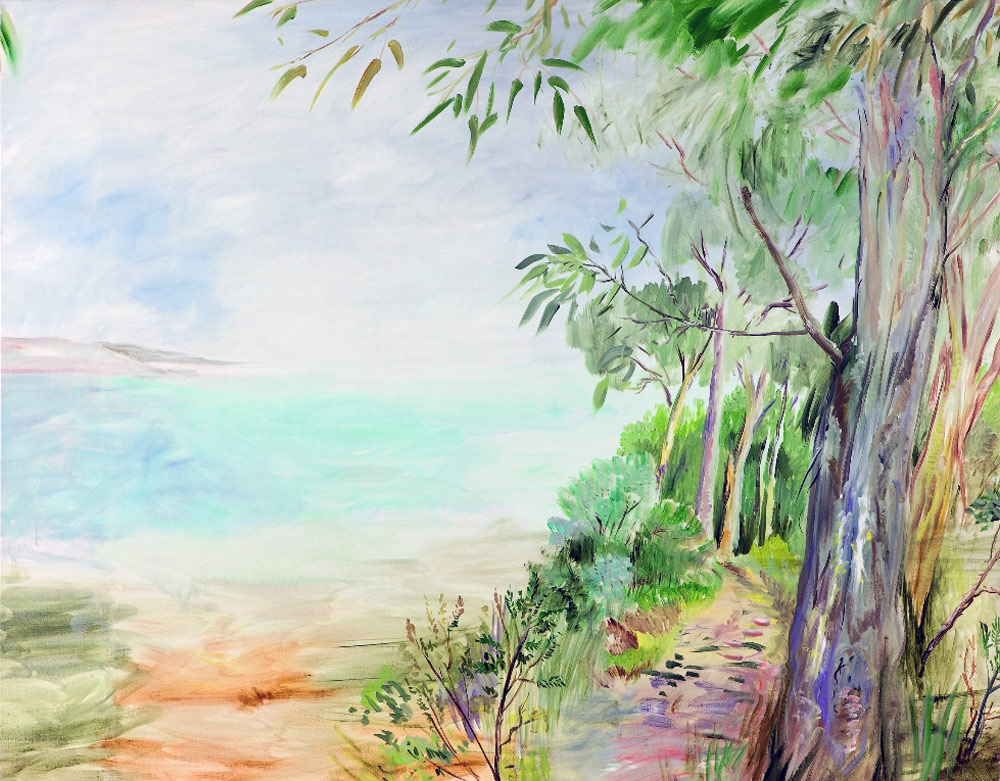
Juan Davila (Chilean b. 1946, emigrated Australia 1974) 'Wilderness' 2010


Juan Davila (Chilean b. 1946, emigrated Australia 1974)
Wilderness
2010
© Juan Davila, Courtesy Kalli Rolfe Contemporary Art


“The ‘Moral Meaning of Wilderness’ exhibition is a tour of the various approaches to the landscape: ‘plein air’ painting, studio landscape work, sublime landscape, historical evocation of landscape, modernity and the landscape, natural disaster, childhood memory of a landscape, woman in the wilderness. The ‘After Image’ works seem to refer to fantasies, inner space, unnameable objects, microcosm and immense space. Within the representation of “the land” one easily forgets that we are dealing with complexity and a field of projections. The political, the sublime, the moral stance, corporate destruction and the future of our environment come to mind.”


Juan Davila 1


“In a state of grace, one sometimes perceives the deep beauty, hitherto unattainable, of another person. And everything acquires a kind of halo which is not imaginary: it comes from the splendour of the almost mathematical light emanating from people and things. One starts to feel that everything in existence – whether people or things – breathes and exhales the subtle light of energy. The world’s truth is impalpable.”


Clarice Lispector 2


Simply put, this is the best exhibition I have seen in Melbourne this year.

Feminine jouissance is critical to an understanding of the work of Juan Davila (see quotation below). It is the jouissance of the Other: ineffable, incapable of being expressed, indescribable, unutterable. Also critical is an understanding of the meaning of ‘wilderness’ and ‘after image’:

Wilderness “is a relative term suggesting the perspective of a visitor or interloper for whom the landscape is wild and Other – for the landscape was neither wild nor foreign to its original inhabitants, at least not until its transformation through colonising, farming and displacement.”3

“An after image … is an optical illusion that refers to an image continuing to appear in one’s vision after the exposure to the original image has ceased.”4


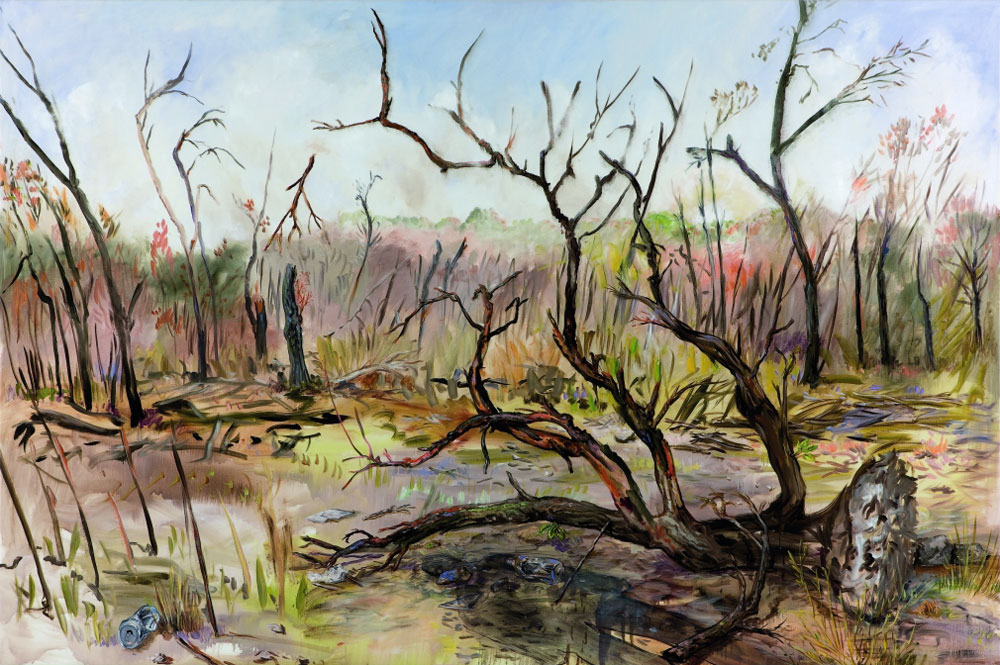
The most powerful works are the Wilderness and After Image paintings. Grouped together in a room at the far end of the gallery, the effect of these paintings is to be physically surrounded by the nebula of the unconscious mind. The feeling is not dissimilar to being consumed by the abstract, elemental quality of Monet’s Nymphéas (Water Lilies) at the Orangerie in Paris. Pair to more earthly landscapes (see images 2 and 3 below) the paintings are the closest experience in approaching the divine that I have felt in a long time. Their visual and noumenal ‘energy’ is superlative.

Robert Nelson observes that, “The after-image is a momentary body-memory – not intellectual but bizarrely willed – perhaps a bit like the recollection of a dream or the instant slip that uncannily reveals the unconscious. In monumentalising this trace, Davila delivers us to another ethereal zone: the breath of libido, buffeted by clouds of repression and misty internalised myths. As portraits of evanescent memory, they are wantonly memorable.”5

Indeed, they are memorable. I had a spiritual experience with this work for the paintings promote in the human a state of grace. The non-material, the unconceptualisable, things which are outside all possibility of time and space are made visible. This happens very rarely but when it does you remember, eternally, the time and space of occurrence. I hope you have the same experience.

Dr Marcus Bunyan


Many thankx to MUMA for allowing me to publish the images in the posting. Please click on the images for a larger version.


“The term jouissance, in French, denotes “pleasure” or “enjoyment.” The term has a sexual connotation (i.e., orgasm) lacking in the English word “enjoyment”, and is therefore left untranslated in English editions of the works of Jacques Lacan. In his Seminar “The Ethics of Psychoanalysis” (1959-1960) Lacan develops his concept of the opposition of jouissance and pleasure. The pleasure principle, according to Lacan, functions as a limit to enjoyment: it is the law that commands the subject to ‘enjoy as little as possible’. At the same time the subject constantly attempts to transgress the prohibitions imposed on his enjoyment, to go beyond the pleasure principle. Yet the result of transgressing the pleasure principle, according to Lacan, is not more pleasure but pain, since there is only a certain amount of pleasure that the subject can bear. Beyond this limit, pleasure becomes pain, and this ‘painful principle’ is what Lacan calls jouissance.

In his Seminar “Encore” (1972-1973) Lacan states that jouissance is essentially phallic. That is, insofar as jouissance is sexual it is phallic, meaning that it does not relate to the Other as such. Lacan admits, however, that there is a specifically feminine jouissance, a supplementary jouissance, which is beyond the phallus, a jouissance of the Other. This feminine jouissance is ineffable, for both women and men may experience it but know nothing about it.”6


Footnotes

1/ Davila, Juan quoted in “After Image: A conversation between Juan Davila and Kate Briggs,” in Juan Davila: The Moral Meaning of Wilderness catalogue. Canberra: ANU Drill Hall Gallery, 2011, p. 53.

2/ Lispector, Clarice. Discovering the World. Manchester: Carcanet Press, 1992, p. 122 quoted in Briggs, Kate. “Painting, an act of faith: Moments in the work of Juan Davila,” in Juan Davila: The Moral Meaning of Wilderness catalogue. Canberra: ANU Drill Hall Gallery, 2011, p. 8.

3/ Delany, Max. Introductory speech for “Contemporary Visions & Critiques of the Landscape.” Video of session. The Festival of Ideas, The Pursuit of Identity: Landscape, History and Genetics. The University of Melbourne [Online] Cited 21/09/2011. No longer available online

4/ Anon. “Afterimage,” on the Wikipedia website [Online] Cited 21/09/2011.

5/ Nelson, Robert. “Exhibition does not take air lightly,” in The Age newspaper. Wednesday, September 21st, 2011, p. 17.

6/ Anon. “Jouissance,” on the Wikipedia website [Online] Cited 21/09/2011.


Juan Davila (Chilean b. 1946, emigrated Australia 1974) 'A Man is Born Without Fear' 2010


Juan Davila (Chilean b. 1946, emigrated Australia 1974)
A Man is Born Without Fear
2010
© Juan Davila, Courtesy Kalli Rolfe Contemporary Art


Juan Davila (Chilean b. 1946, emigrated Australia 1974) 'After Image. A Man is Born Without Fear' 2010


Juan Davila (Chilean b. 1946, emigrated Australia 1974)
After Image. A Man is Born Without Fear
2010
© Juan Davila, Courtesy Kalli Rolfe Contemporary Art


Juan Davila (Chilean b. 1946, emigrated Australia 1974) 'Churchill National Park' 2009


Juan Davila (Chilean b. 1946, emigrated Australia 1974)
Churchill National Park
2009
© Juan Davila, Courtesy Kalli Rolfe Contemporary Art


The Moral Meaning of Wilderness features recent work by Juan Davila, one of Australia’s most distinguished artists. The exhibition sees Davila turn to the genres of landscape and history painting, at a time when the environment is as much a political as a cultural consideration. With technical virtuosity, Davila’s striking representations of nature achieve monumental significance, depicting beauty and emotion while addressing modern society’s ambivalence to nature and increasing consumerism.

The Moral Meaning of Wilderness represents a radical shift in Davila’s practice, whilst continuing to explore art’s relationship to nature, politics, identity and subjectivity in our post-industrial age. Davila pursues his exploration of the role of art as a means of social, cultural and political analysis.

While many contemporary artists turned away from representation of the landscape, due to its perceived allegiance to outmoded forms of national identity and representation, Davila has recently sought to revisit and reconsider our surroundings au natural.

His paintings are, at first view, striking representations of nature. The paintings, created since 2003, are undertaken en plain air, a pre-modern technique based on speed of execution in situ, and the use of large scale canvases characteristic of history painting. He has also employed other techniques such as studio painting and representations of the landscape with reference to the sublime, the historical, memory and modernity.

Text from the MUMA website


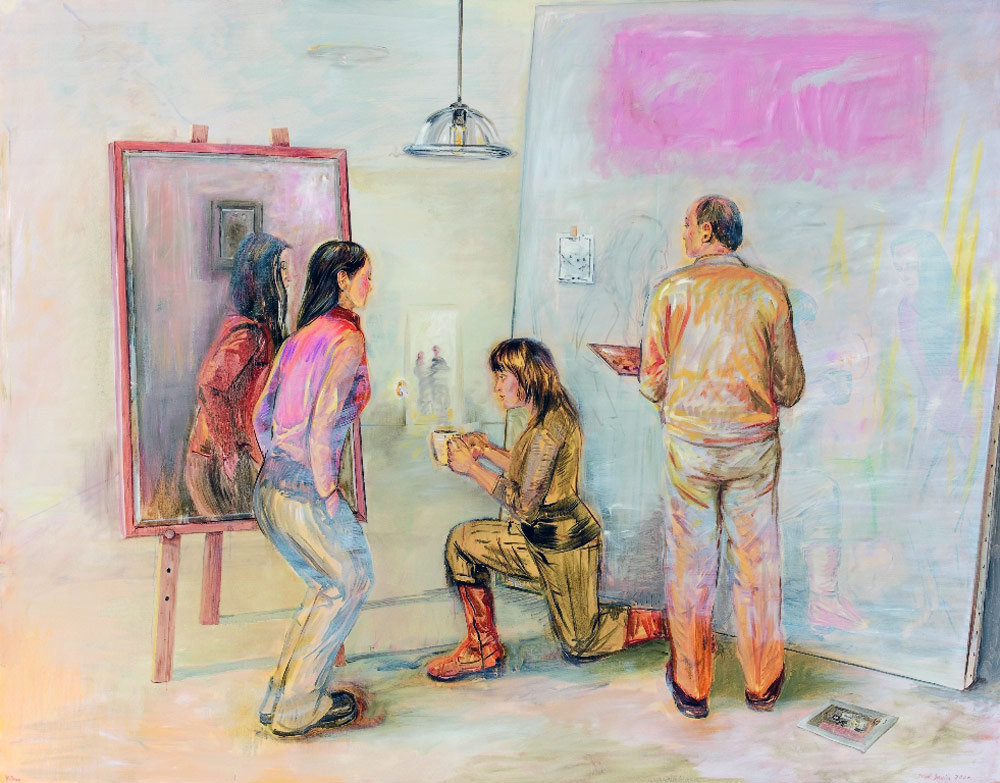
Juan Davila (Chilean b. 1946, emigrated Australia 1974) 'The Painter's Studio' 2006


Juan Davila (Chilean b. 1946, emigrated Australia 1974)
The Painter’s Studio
2006
© Juan Davila, Courtesy Kalli Rolfe Contemporary Art


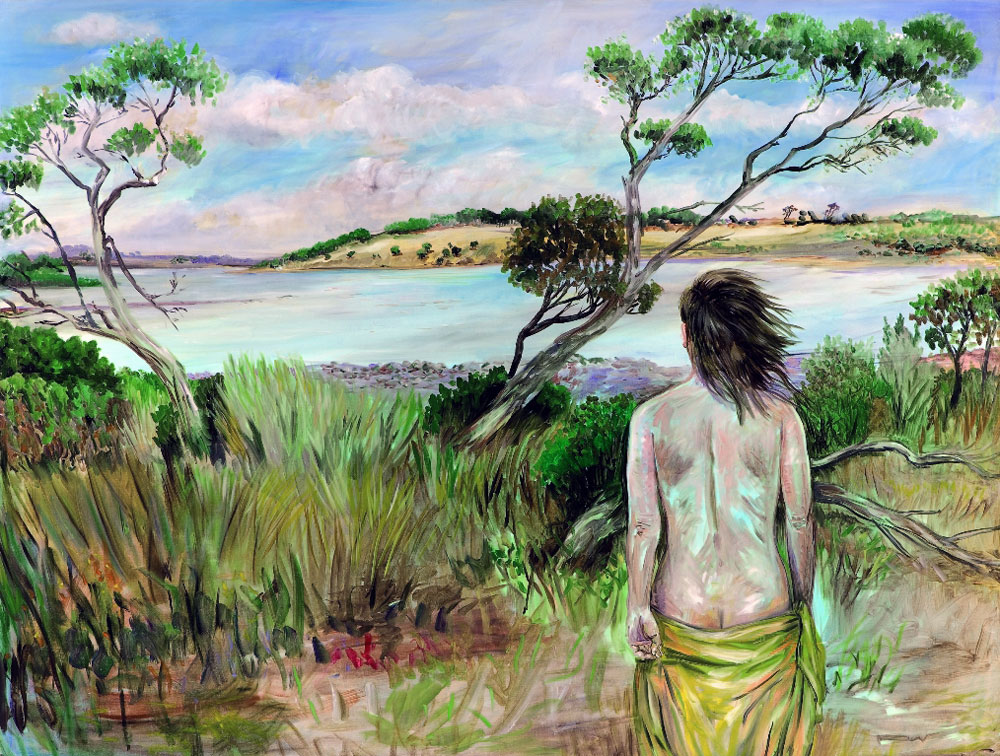
Juan Davila (Chilean b. 1946, emigrated Australia 1974) '761 Wattletree Road' 2008


Juan Davila (Chilean b. 1946, emigrated Australia 1974)
761 Wattletree Road
2008
© Juan Davila, Courtesy Kalli Rolfe Contemporary Art


Juan Davila (Chilean b. 1946, emigrated Australia 1974) 'What About my Desire?' 2009


Juan Davila (Chilean b. 1946, emigrated Australia 1974)
What About my Desire?
2009
© Juan Davila, Courtesy Kalli Rolfe Contemporary Art


Juan Davila (Chilean b. 1946, emigrated Australia 1974) 'Australia: Nuclear Waste Dumping Ground' 2007


Juan Davila (Chilean b. 1946, emigrated Australia 1974)
Australia: Nuclear Waste Dumping Ground
2007
© Juan Davila, Courtesy Kalli Rolfe Contemporary Art


Monash University Museum of Art (MUMA)
Ground Floor, Building F.
Monash University Caulfield campus
900 Dandenong Road
Caulfield East, VIC 3145
Phone: 61 3 9905 4217

Opening hours:
Tuesday – Friday 10am – 5pm
Saturday 12 – 5pm

Monash University Museum of Art (MUMA) website

LIKE ART BLART ON FACEBOOK

Back to top

Exhibition: ‘NGV 150th Felton Bequest Gift – Living Water: Contemporary Art of the Far Western Desert’ at NGV Australia, Melbourne

Exhibition dates: 24th May 2011 – 28th May 2012


Tommy Mitchell (Australian / Ngaanyatjarra, c. 1943-2013) 'Kurlilypurru' 2009


Tommy Mitchell (Australian / Ngaanyatjarra, c. 1943-2013)
Kurlilypurru
2009
Synthetic polymer paint on canvas
152 x 212cm
Felton Bequest, 2011
© Tommy Mitchell, courtesy Warakurna Artists Aboriginal Corporation


“This is me: this is mine. The whole lot is me. I been walking all around, I know him proper way, he is always with me…”


Weaver Jack


Someone keyed my car the other day and it sent me into a bit of a downward spiral. Who knows why people do these things – stupidity, boredom, sheer bloody mindedness. This exhibition brought me back from that space to a rejoicing in human creativity and connection. It helped me leave my troubles behind. The stories in these paintings ground you, bring you back to earth through the experience and feeling of colour, movement and stillness.

I, we, cannot understand this ancient culture for it is foreign to us. We are not of it. But we can feel the stories in our own way. While we can’t understand every nuance of symbology and traditional narrative that the paintings contain they can speak to us all as human; we all come from this earth and must return to it. I felt the place from which they emanate, an intimacy with earth, self and soul.

I might not know much about anything, about understanding the vagaries of human beings, but I do know what is honest and truthful, has feeling for the piquancy of life. These paintings let my troubles and vicissitudes drop away and uplifted my spirit. Surrounded by love, by colour, by belonging to earth, sky, water, spirit. A wonderful gift to any human being and a wonderful gift from the Felton Bequest to the National Gallery of Victoria and to all the people of Australia. Go and experience their embrace.

Dr Marcus Bunyan


Many thankx to the National Gallery of Victoria for allowing me to publish the photographs in the posting. Please click on the photographs for a larger version of the image.


Various artists. 'Ngayarta Kujarra' 2009


Yikartu Bumba (Australian / Manyjilyjarra, b. 1940s)
Jakayu Biljabu (Australian / Manyjilyjarra, 1937-2022)
Nyanjilpayi Nancy Chapman (Australian / Manyjilyjarra, born c. 1941)
May Chapman (Australian / Manyjilyjarra, b. 1940s)
Doreen Chapman (Australian / Manyjilyjarra, b. 1970s)
Linda James (Australian / Manyjilyjarra, b. 1984)
Mulyatingki Marney (Australian / Manyjilyjarra, b. 1941)
Reena Roger (Australian / Manyjilyjarra, b. 1950s)
Beatrice Simpson (Australian / Manyjilyjarra, born c. 1966)
Ronelle Simpson (Australian / Manyjilyjarra, b. 1988)
Muntararr Rosie Williams (Australian / Manyjilyjarra, born c. 1943)
Ngayarta Kujarra
2009
Synthetic polymer paint on canvas
300 x 500cm
Felton Bequest, 2011


Ngayartu Kujarra

The artists who collaborated on this work (above) live at Punmu community, on the shore of a vast salt lake, (Lake Dora), which is surrounded by a scattered array of water sources.

The artists from this region are profoundly affectionate and respectful towards the salt lake and the fresh waters hat have sustained htem and their families for as long as memory can stretch.

The women have reproduced the feeling of the salt lake viscerally: their work conveys its immense scale, fine texture, extreme whiteness and shimmering light.
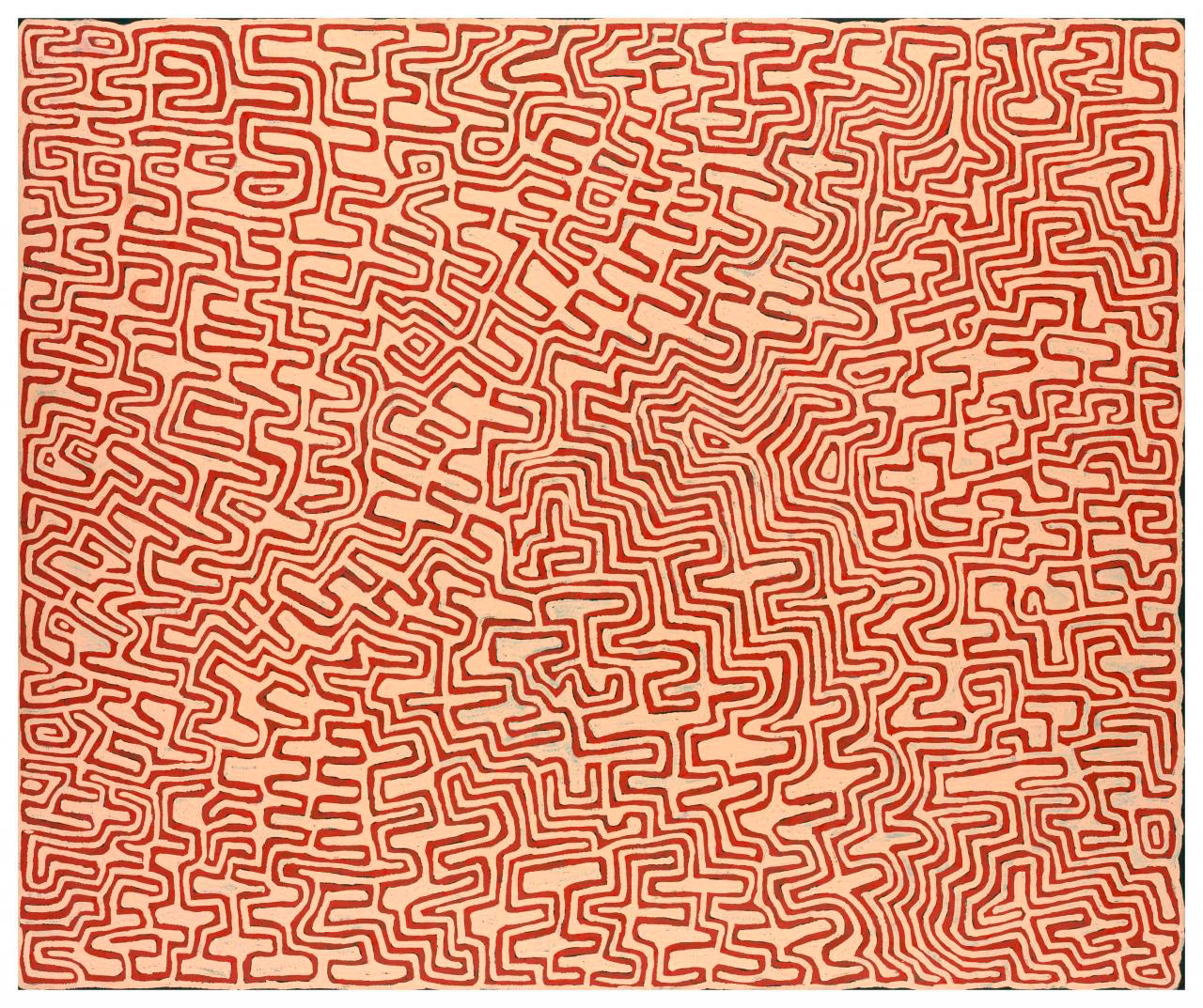
 

Ronnie Tjampitjinpa (Australian / Pintupi, b. 1943) 'Water Dreaming at Malparingya' 2006


Ronnie Tjampitjinpa (Australian / Pintupi, b. 1943)
Water Dreaming at Malparingya
2006
Synthetic polymer paint on canvas
152.2 x 182.5cm
National Gallery of Victoria
Felton bequest


Nyumitja Laidlaw (Ngaanyatjarra born c. 1938) 'Kuriella' 2009


Nyumitja Laidlaw (Australian / Ngaanyatjarra, born c. 1938)
Kuriella
2009
Synthetic polymer paint on canvas
142.3 x 175cm
Felton Bequest, 2011
© Nyumitja Laidlaw/Licensed by VISCOPY, Australia
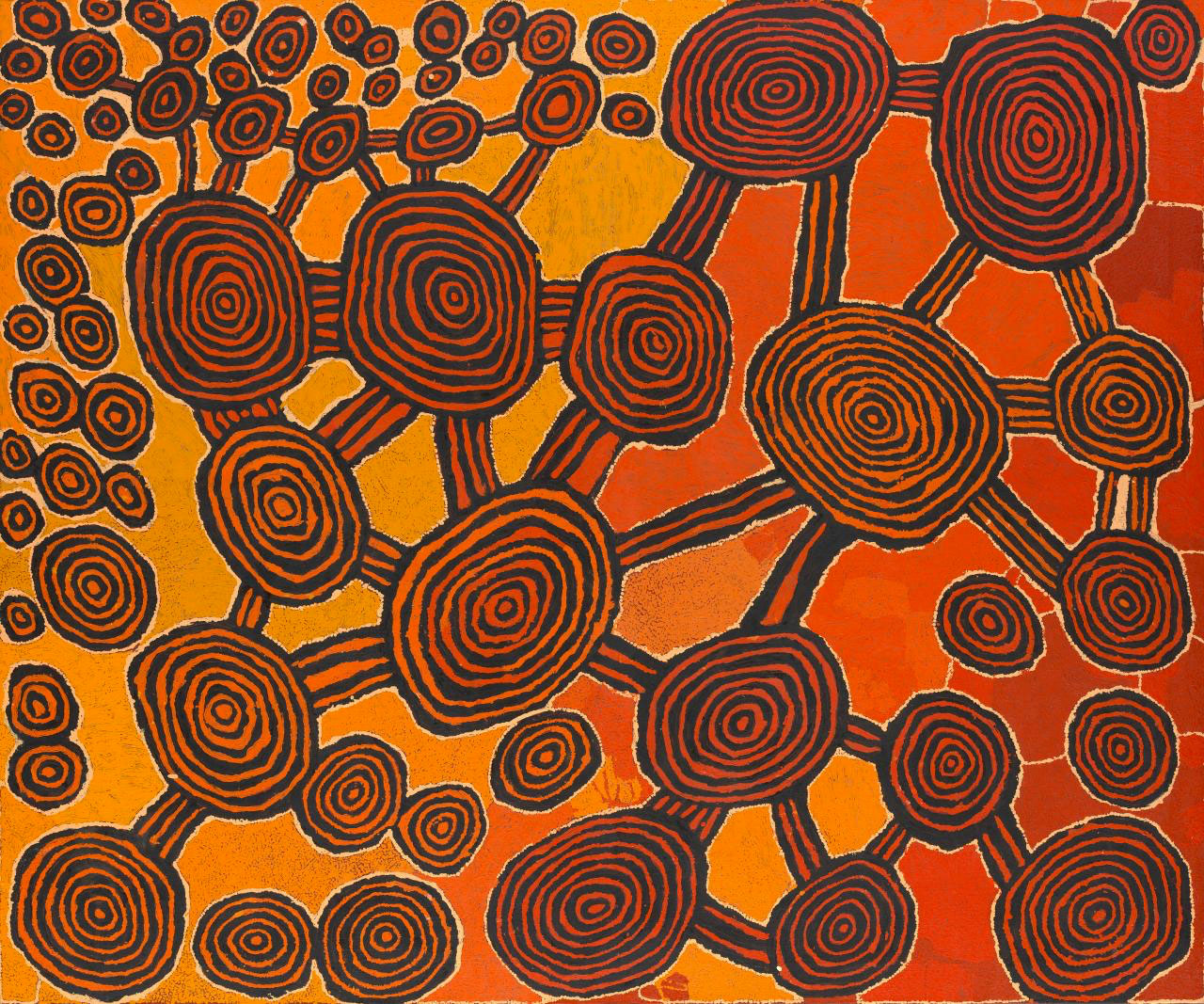
 

Johnny Yungut Tjupurrula (Australian / Tjangimanta, 1930-2016) 'Tingarri Dreaming at Wanaritjarra' 2009


Johnny Yungut Tjupurrula (Australian / Tjangimanta, 1930-2016)
Tingarri Dreaming at Wanaritjarra
2009
Synthetic polymer paint on canvas
152.3 × 182.5cm
National Gallery of Victoria, Melbourne
Felton Bequest, 2011
© Johnny Yungut Tjupurrula, courtesy Aboriginal Artists Agency, Sydney
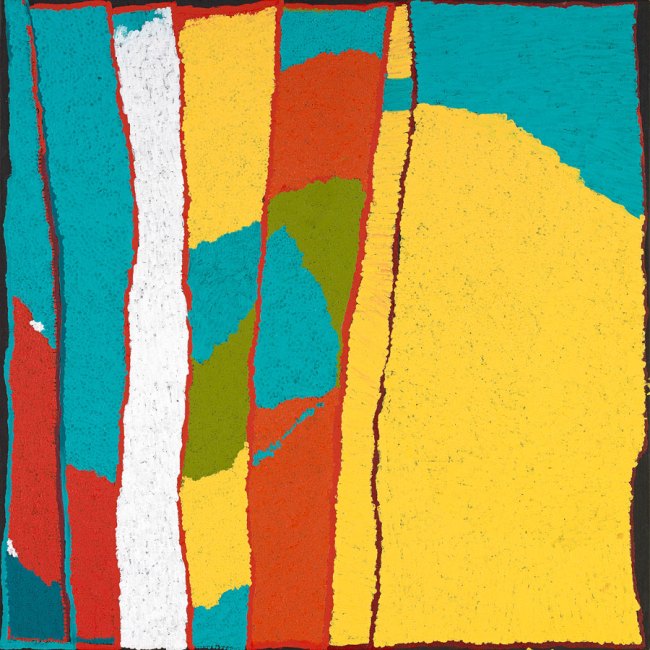
 

Kalaju Alma Webou (Yulparija c. 1920-2009) 'Pinkalarta' 2006


Kalaju Alma Webou (Australian / Yulparija, c. 1920-2009)
Pinkalarta
2006
Synthetic polymer paint on canvas
152 x 152cm
Felton Bequest, 2011
© Kalaju Alma Webou, courtesy Short Street Gallery/Yulparija Artists from Bidyadanga


Today, 24 May 2011, the National Gallery of Victoria celebrates its 150th birthday.

To honour this tremendous milestone, the NGV today unveiled an exceptional gift of 173 important Indigenous works of art including three by contemporary artists Vernon Ah Kee, Brook Andrew and Jonathan Jones who were commissioned to create works that pay homage to the highly celebrated Wurundjeri artist, William Barak. These pieces have been gifted by the Felton Bequest, established in 1904 by the NGV’s greatest benefactor, Alfred Felton.

The Honourable Alex Chernov, AO, QC, Governor of Victoria and Mrs Elizabeth Chernov were present at the NGV’s unveiling ceremony.

Dr Gerard Vaughan, Director, NGV said: “This is the most significant gift of Indigenous art to the NGV since the Gallery opened its doors for the first time on this date 150 years ago in country of the Kulin nation. It is appropriate on this date both to honour the memory of Alfred Felton and also celebrate the Indigenous art of our country, the world’s oldest continuous visual tradition.”

The gift of 173 works encompasses two exceptional collections: the first comprises 63 nineteenth and early twentieth century shields on display as part of the Australian Art collection, and the second 107 twenty-first century paintings from the Far Western Desert, forming the new exhibition Living Water.

Dr Vaughan said: “This outstanding gift adds tremendous strength to the NGV’s collection of Indigenous Art. Since the NGV first collected Indigenous art, the collection has grown to hold over 3,000 works representing cultures across Australia.

These exciting and dynamic acquisitions will enable the NGV to continue to educate visitors of all ages about the visual art of Indigenous Australians. This gift is a highlight of the NGV’s 150th anniversary year, reminding us of the crucial and continuing role the NGV has played in collecting and displaying the finest art works that can be acquired.

The Barak Commissions pay tribute to one of the most important figures of nineteenth century Australian Indigenous art, acknowledging Barak’s central place in the history of Victoria and the NGV,” said Dr Vaughan.

William Barak was born in country of the Wurundjeri people and became a leading Indigenous artist and figure in Melbourne during the 19th century. He is said to have witnessed John Batman ‘purchase’ Melbourne in 1835.

The multi-media installation by Vernon Ah Kee presents conversations between prominent Indigenous people as they reflect on how Barak has inspired them. Brook Andrew, renowned for his multi-disciplinary works, has created a powerful installation which adorns the entrance atrium at The Ian Potter Centre: NGV Australia. Jonathan Jones, who works with fluid and dancing light as a metaphor of living culture, has created five light boxes that map important cultural designs belonging to Barak as a way of honouring Barak’s life.

The collection of 63 rare and stunningly beautiful 19th and early 20th century shields is largely contemporary with Barak’s life. The shields serve to remind us of the time when the plains of Southeast Australia contained carved trees bearing elegant inscriptions, with people dressed in possum-skin cloaks and carrying elaborate shields living extraordinary living in harmony with country and ancient beliefs.

The Living Water exhibition unveils the Felton Bequest gift paintings: 107 adventurous works by male and female artists from newly established art centres in the Far Western Desert, an area stretching across far flung parts of Western Australia and South Australia.

This exhibition of 21st century art highlights today’s momentous art movement which originated at Papunya in 1971 when senior men decoded their archival narratives and laws, forging a new form shared by many Indigenous peoples across the Western Desert.

Press release from the National Gallery of Victoria website


Roy Underwood (Pitjantjatjara born c. 1937) 'Mulaya' 2008


Roy Underwood (Australian / Pitjantjatjara born c. 1937-2018)
Mulaya
2008
Synthetic polymer paint on canvas
197 x 135cm
Felton Bequest, 2011
© Roy Underwood, courtesy Spinifex Arts Project


Simon Hogan (Pitjantjatjara born c. 1930) 'Ilkurlka' 2004


Simon Hogan (Australian / Pitjantjatjara, born c. 1930)
Ilkurlka
2004
Synthetic polymer paint on canvas
134.5 x 176.6cm
Felton Bequest, 2011
© Simon Hogan, courtesy Spinifex Arts Project


Spinifex People

The country of the Spinifex people, who speak a southern dialect of Pitjantjatjara language, consists of vast plains of deep red sand, salt lakes and Spinifex.

In 1998 the community produced a series of ten large paintings that were bequeathed to the people of Western Australia in a symbolic reciprocal exchange of paintings for land. Most Spinifex works, subsequently produced on infrequent painting trips back to country operate as complex maps as well as religious landscapes that detail sources of spiritual power in country belonging to individual artists.
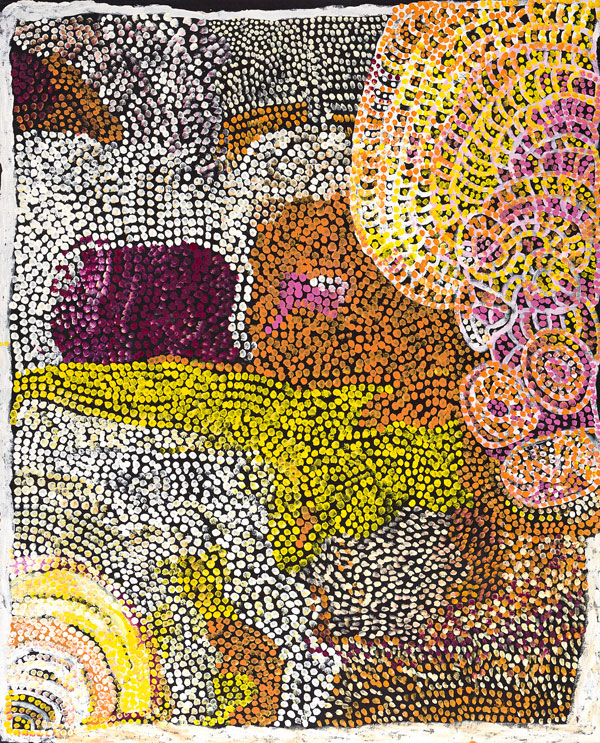
 

Milatjari Pumani (Yankunytjatjara, 1928-2014) 'Ngura Walytja, Antara' 2010


Milatjari Pumani (Australian / Yankunytjatjara, 1928-2014)
Ngura Walytja, Antara
2010
Synthetic polymer paint on canvas
168.6 x 137.4cm
Felton Bequest, 2011
© Milatjari Pumani, courtesy Mimili Maku Arts & Crafts


Living Water: Exhibition Background Information

Living Water, an exhibition showcasing 107 contemporary Indigenous paintings by 94 artists from the Felton Bequest Gift, displays works by male and female artists from the Far Western Desert, an area stretching across parts of Western Australia, South Australia and the Northern Territory.

A modern art movement originated at Papunya in 1971, which has since transformed the way we see the land and the history of art in Australia. Almost forty years after the genesis of the Western Desert art movement, its epicentre has dramatically shifted from Papunya in the Northern Territory to the Pintupi homelands of Kintore and Kiwirrkura in the Gibson Desert, and to communities that lie hundreds of kilometres to the south and west in far-flung reaches of South Australia and Western Australia (the Far Western Desert).

During the first decade of the 21st century, Pintupi, Spinifex, Anangu, Yulparija and Martu artists have developed a dynamic and fresh expression of Western Desert Art. The male and female artists not only share close kinship, social, linguistic and ritual interconnections and lived experience of desert country built up during pujiman (nomadic, bush) days but also have parallel experiences of making art with introduced materials for the commercial market. Their paintings – bearers of sanctity – resonate with the shock of the ancient made new and tell tjukurrpa (stories) associated with special places in their ngurra (country).This dramatic new wave of acrylic painting is the focus of Living Water, comprising the NGV’s 150th anniversary gift from the Felton Bequest of 107 paintings.

Aboriginal people from across the Western Desert use the term ‘living water’ to describe water sources, including rock holes and soakage waters that are fed by underground springs. The path of these springs was created by the ancestral beings of the Tjukurrpa (Dreaming) as they themselves journeyed underground, their entry into the earth often marking the site of current day water sources. ‘Living water’ is revered also because it does not seem to be affected by the harsh conditions above the ground that the people themselves have to endure.

This exhibition has been curated by Judith Ryan, Indigenous Art Curator, NGV. The following groups of people are represented in this spectacular exhibition.

Pintupi people

Pintupi is the name of a Western Desert language spoken by Aboriginal people who belong to a large stretch of country in the Gibson Desert of Western Australia and the western edge of the Northern Territory. When the Pintupi arrived in the government settlements east of their traditional lands between the 1930s and the 1950s, they adopted the term ‘Pintupi’ to distinguish themselves amongst the surrounding Aboriginal inhabitants as the ‘people from the west’.

The Pintupi’s complex relationship to the land of their ancestors is expressed through stories, songs and ritual practice that are also depicted in the acrylic paintings of the artists from the Pintupi communities of Walungurru and Kiwirrkura.

Ngaanyatjarra, Pitjantjatjara and Yankunytjara People

The Ngaanyatjarra, Pitjantjatjara and Yankunytjara people of the tri-state region of the Western Desert constantly interact and are related by kinship, language and genealogy.

Here they specialised in making walka (drawings), batik, punu (wood carvings) and tjanpi weavings, avoiding painting on canvas for the art market until the 21st century because of their suspicion of earlier forms of Western Desert art and their reluctance to disclose sacred elements of men’s and women’s law.

Yulparija People

The Yulparija people originally come from the Great Sandy Desert of Western Australia, which runs from Telfer in the south to Walungurru in the east and close to Fitzroy Crossing in the north.

Their work contains deep threads of cultural memory and is daring in its vigour of application and iridescent palette. The Yulparija have forged a painting style that combines their cultural memory of desert birth country with the rich blues and greens of saltwater terrain.

Martu People

Martu means ‘one of us’, or ‘person’ and is the word chosen to represent a number of different language groups from country across the Great Sandy, Little Sandy and Gibson Deserts of the Pilbara region of Western Australia.

Martu are interconnected to other surrounding peoples from the Great Sandy Desert through their shared country of birth and associated Dreaming stories.

Text from the National Gallery of Victoria website


Dadda Samson (Kartujarra, 1933-2020) 'Puntuwarri' 2009


Dadda Samson (Australian / Kartujarra, 1933-2020)
Puntuwarri
2009
Synthetic polymer paint on canvas
124.5 x 293.4cm
Felton Bequest, 2011
© Dadda Samson, courtesy Martumili Artists


Lawrence Pennington (Pitjantjatjara born c. 1940) 'Kurparu (Magpie)' 2005


Lawrence Pennington (Australian / Pitjantjatjara, born c. 1940)
Kurparu (Magpie)
2005
Synthetic polymer paint on canvas
138.6 x 92.7cm
Felton Bequest, 2011
© Lawrence Pennington, courtesy Spinifex Arts Project


Wingu Tingima (Pitjantjatjara c. 1917–2010) 'Kungkarakalpa (Seven Sisters)' 2007-2009


Wingu Tingima (Australian / Pitjantjatjara, c. 1917-2010)
Kungkarakalpa (Seven Sisters)
2007-2009
Synthetic polymer paint on canvas
140 x 210cm
Felton Bequest, 2011
© Wingu Tingima, courtesy Tjungu Palya


The Ian Potter Centre: NGV Australia
Federation Square
Corner of Russell and 
Flinders Streets, Melbourne

Opening hours:
Daily 10am – 5pm

National Gallery of Victoria website

LIKE ART BLART ON FACEBOOK

Back to top

Exhibition: ‘Monika Tichacek, To all my relations’ at Karen Woodbury Gallery, Richmond

Exhibition dates: 4th May – 28th May 2011


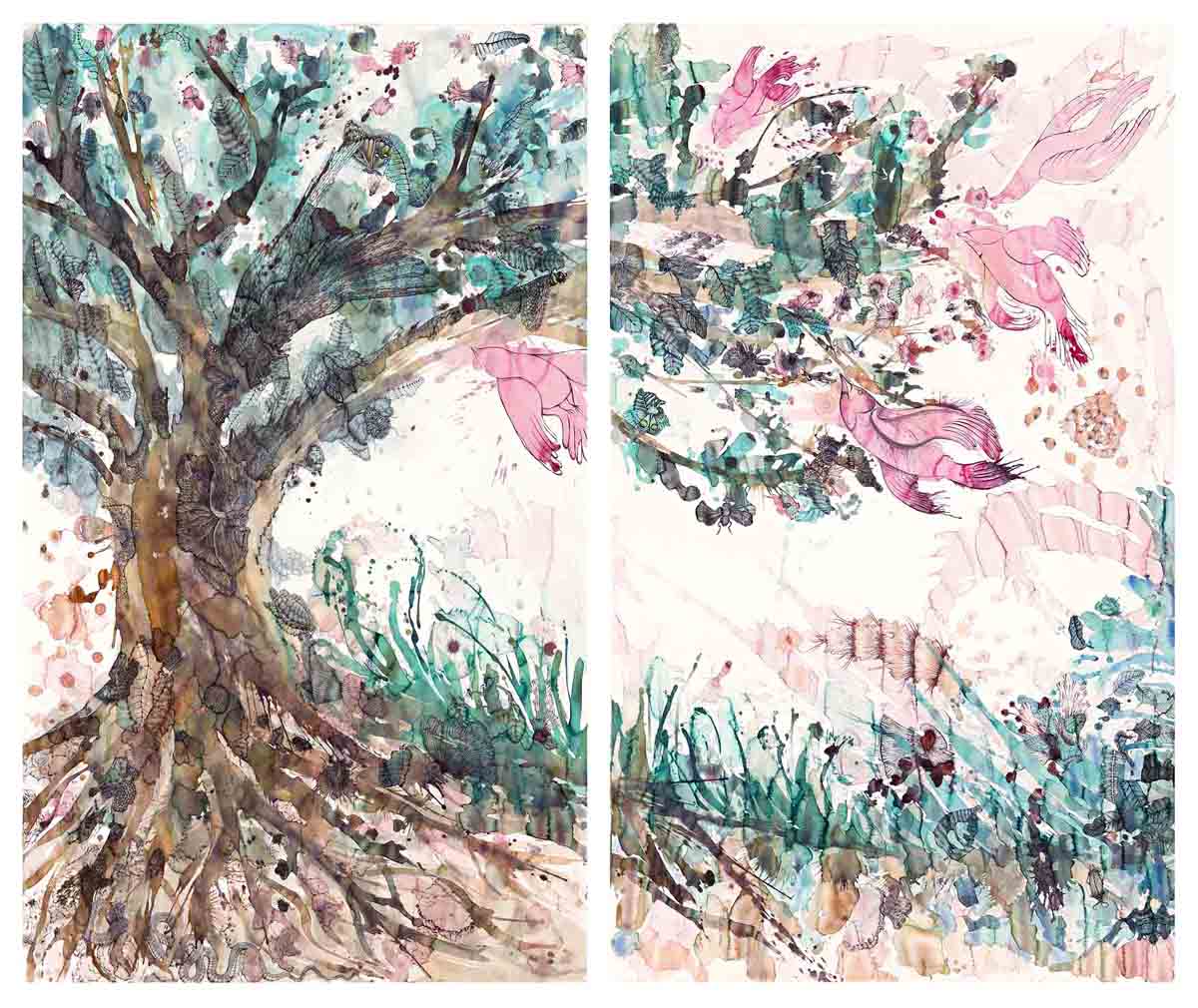
Monika Tichacek (Australian, b. 1975 Switzerland) 'To all my relations' 2011


Monika Tichacek (Australian, b. 1975 Switzerland)
To all my relations
2011
Diptych
Gouache, pencil and watercolour on paper
244 x 300cm overall


This is a stupendous exhibition by Monika Tichacek, at Karen Woodbury Gallery. One of the highlights of the year, this is a definite must see!

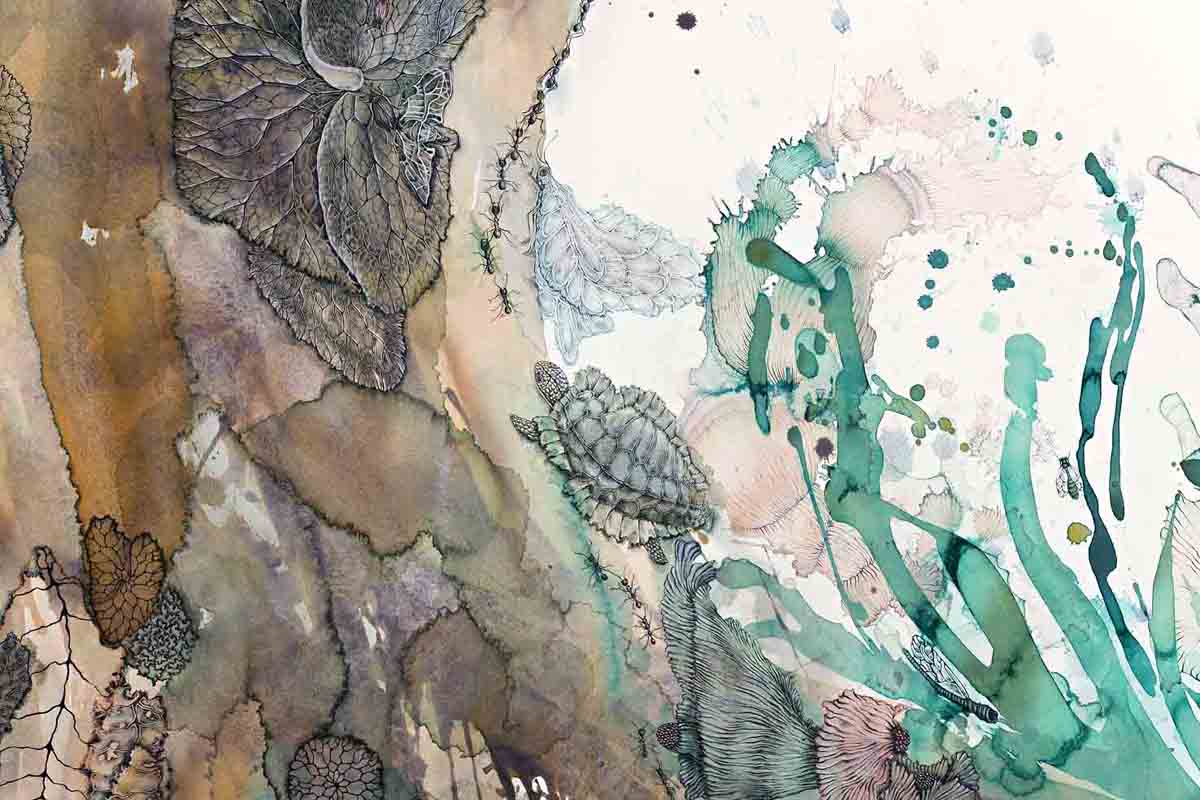
The work is glorious in it’s detail, a sensual and visual delight (make sure you click on the photographs to see the close up of the work!). The riotous, bacchanalian density of the work is balanced by a lyrical intimacy, the work exploring the life cycle and our relationship to the world in gouache, pencil & watercolour. Tichacek’s vibrant pink birds, small bugs, flowers and leaves have absolutely delicious colours. The layered and overlaid compositions show complete control by the artist: mottled, blotted, bark-like wings of butterflies meld into trees in a delicate metamorphosis; insects are blurred becoming one with the structure of flowers in a controlled effusion of life. The title of the exhibition, To all my relations,

“has inspired an understanding that all animist cultures’ peoples have who live in close relationship to the earth. We are all related, we all exist in an interdependent system. The ecosystem is such an unbelievably complex, harmonious system. Every drop of rain, every insect, every micro-organism has its place for the perfect functioning and health of nature… The title is an acknowledgement and honouring of all that is live-giving, every little element that makes up the big picture of life on earth.”1

It was very difficult to pull myself away from the beauty and intimate polyphony of voices contained within the work. I loved it!

Dr Marcus Bunyan


1/ O’Sullivan, Jane. “Artist Interview: Monika Tichacek,” on Australian Art Collector website, 19th May 2011 [Online] Cited 21/05/2010 no longer available online


Many thankx to Karen Woodbury Gallery for allowing me to publish the photographs and Art Guide Australia for allowing me to publish the text in the posting. The text by Dylan Rainforth was commissioned by Art Guide Australia and appears in the May/June 11 issue of Art Guide Australia magazine. Please click on the photographs for a larger version of the image.


Monika Tichacek (Australian, b. 1975 Switzerland) 'To all my relations' 2011 (detail)


Monika Tichacek (Australian, b. 1975 Switzerland)
To all my relations (detail)
2011
Diptych
Gouache, pencil and watercolour on paper
244 x 300cm overall


Monika Tichacek (Australian, b. 1975 Switzerland) 'To all my relations' 2011 (detail)


Monika Tichacek (Australian, b. 1975 Switzerland)
To all my relations (detail)
2011
Diptych
Gouache, pencil and watercolour on paper
244 x 300cm overall


Monika Tichacek (Australian, b. 1975 Switzerland) 'To all my relations' 2011 (detail)


Monika Tichacek (Australian, b. 1975 Switzerland)
To all my relations (detail)
2011
Diptych
Gouache, pencil and watercolour on paper
244 x 300cm overall


The Cycle of Nature – Monika Tichacek’s To All My Relations

Dylan Rainforth

Anyone used to the immaculately controlled, exactingly lit photographic and video mise en scène that Swiss-born artist Monika Tichacek presented in such series as The Shadowers, for which she won the prestigious Anne Landa Award for Video and New Media Arts in 2007, may be surprised by the direction her work has taken in her latest exhibition. To All My Relations consists entirely of works on paper – watercolour and ink drawings that evince a tension between abstract, gestural shapes and bleeds of colour, recalling (just for convenience’s sake) Kandinsky, and intricately rendered natural forms that owe more to the scientific, zoological and botanical narratives of the Endeavour voyages of Captain Cook, Joseph Banks and the artist Sydney Parkinson.

The work has come out of an intensive period over the last few years in which Tichacek spent considerable time in the jungles of South America and the deserts of the United States, as well as time spent in the New South Wales bush and studying nature books. “I’m getting more and more interested in the cellular, microscopic imagery that you get when you enlarge something and peer deeper into the structure of how material elements are composed, and that really coincides with my interest in Eastern philosophies of Buddhism and many other things too. I guess I’m looking as deeply into the nature of something as is possible but I’m trying not to do it so much with my mind – but of course that’s very challenging,” she says, laughing lightly.

“The exploration of feeling is quite important to me – it’s quite a departure from what I used to do, which were certainly works that came from a very inner landscape but then the execution would be very conceptual, obviously – it had to be and this new work is much more intimate.”

That challenge to the rational, objective Western subject is informed by Tichacek’s exposure to indigenous traditions in South America and other places.

“In 2006 I had a research grant and I went to the Amazon because I wanted to look more deeply into animist cultures, meaning cultures that really see the land as living and as alive with energy and with spirit or ‘beingness’. So I went to the Amazon and spent quite a long time there and also in the mountains in Peru and saw a little bit of Central America and also North America in the desert. I spent time there and really learnt a lot about their indigenous ways and got to participate in a lot of things and experience a lot of things. In the Amazon shamanic tradition there is a process – they call it dieting – you spend a few months more or less alone, existing on very limited foods. You get very little, limited food and very little contact and they give you different traditional plants that, through the communion they do, they are ‘told’ to give you. And you are encouraged to connect with this plant for its healing properties to come through. So that was quite an amazing time to get quite still…”

The exhibition title comes from a Native American ceremony. According to Tichacek, “It’s always said when entering the sweat lodge and it’s an acknowledgement of being related to everything in nature, every being, the understanding that without all these other relations one wouldn’t exist. In those cultures it’s much more understood – we’ve lost that understanding because we can just buy things in the supermarket and eat them but if we lived that way we would probably remember a lot more that we are closely related to everything around us.”

From this perspective we can see that this new work is not a complete departure from Tichacek’s earlier work after all, yet its intentions are radically different. Both the natural world and shamanistic knowledge played their part in The Shadowers. Professor Anne Marsh has described Tichacek’s video, played out in a violent scene occurring between three women (one of whom Marsh characterises as a witch doctor or shaman) in a forest environment, as stretch[ing] the boundaries between body art, ritual and sado-masochism by assaulting the senses and transgressing the social realm. In psychoanalytic terms it tears at the screen of the real and immerses the viewer into the abject world of instinctual response where language has no authority.” [i]

Pain, sado-masochism, ritual and endurance certainly have their place in shamanistic traditions – one need only think of any number of initiation rites – but now Tichacek is looking for a less conflicted relationship with nature. “The work has always been very personal and I guess in The Shadowers that nature relationship was starting to come in but it was very tense and very violent and very confused. The continuation of that theme is still there – the exploration of how to understand the experience of the self and what we are doing here and how we come to exist. That’s definitely been there before but this new work is more in the realm of psychology and the previous works are more in the realm of the female body.”

To All My Relations will present several drawings, with one in particular being conceived on a massive scale that Tichacek intends to convey the sense of awe we experience when surrounded by nature. The artist will also stage a performance – something her interdisciplinary practice has always embraced – at the opening. Although she had not completely determined the details when I spoke to her the performance was inspired by a drawing she made a few years ago and will symbolically connect the artist’s body to the roots of a tree.

“I always feel like [performance serves] to bring my body into it. Although I feel like my body’s very much in these drawings there’s something about performance that’s really physically present.”

Dylan Rainforth.


Monika Tichacek (Australian, b. 1975 Switzerland) 'To all my relations' 2011 (detail)


Monika Tichacek (Australian, b. 1975 Switzerland)
To all my relations (detail)
2011
Diptych
Gouache, pencil and watercolour on paper
244 x 300cm overall


Monika Tichacek (Australian, b. 1975 Switzerland) 'To all my relations' 2011 (detail)


Monika Tichacek (Australian, b. 1975 Switzerland)
To all my relations (detail)
2011
Diptych
Gouache, pencil and watercolour on paper
244 x 300cm overall


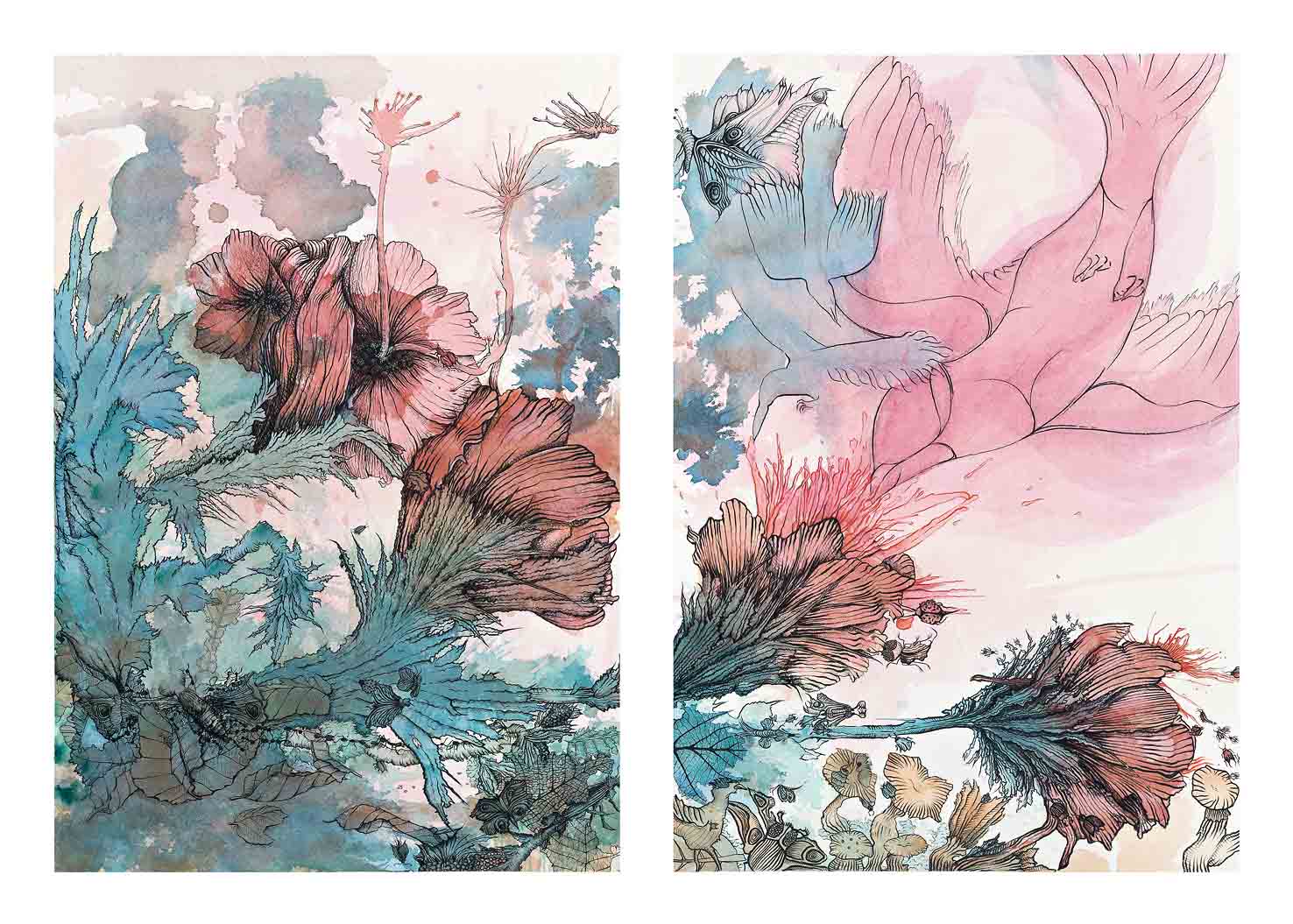
Monika Tichacek (Australian, b. 1975 Switzerland) 'Birth of generosity' 2011


Monika Tichacek (Australian, b. 1975 Switzerland)
Birth of generosity
2011
Diptych
Pencil and watercolour on paper
70 x 114cm overall


Monika Tichacek (Australian, b. 1975 Switzerland) 'Transmission' 2011


Monika Tichacek (Australian, b. 1975 Switzerland)
Transmission
2011
Pencil and watercolour on paper
150 x 125cm


Karen Woodbury Gallery

This gallery has now closed

LIKE ART BLART ON FACEBOOK

Back to top
Review: ‘Alan Constable: Viewfinder’ at Arts Project Australia, Northcote, Melbourne

Exhibition dates: 30th April 2011 – 1st June 2011


Alan Constable (Australian, b. 1956)
'Konica Pop' 2009


Alan Constable (Australian, b. 1956)
Konica Pop
2009
Ceramic
21 x 32 x 10cm


“For me, art is what is most animal in us … It is the most noble thing because it’s a celebration precisely of the forces of the body and the forces of life.”


Elizabeth Grosz


This Saturday, after a journey around the galleries of Albert Street, Richmond (underwhelming) and a visit to Sutton Gallery to see Simon Terrill’s photographic exhibition Phantom (an exhibition that I was going to review but when I saw it I changed my mind: two excellent photographs, Balfron Tower 2010-2011 and Rivoli #2 2010-2011, let down by three “empty” long exposure photographs allegedly showing traces of humanity, residues of presence) had left me a little deflated, I ventured to the opening of Alan Constable’s twenty-year retrospective Viewfinder curated by Dr Cheryl Daye at Arts Project Australia.

What a breath of fresh air this exhibition is!


The exhibition shows beautifully in the gallery space. Hung chronologically, the more tightly controlled early series feature luminous pastels that investigate themes: landscapes, birds (rarely figures) – the rubbed and layered medium building up an almost translucent surface that reminded me of the pastel work of Odilon Redon. Later work, such as the two paintings Not titled (person with binoculars) 2009 and Not titled (figure with camera) 2006 (both below) show a greater engagement with the world and a freeing up of technique – running figures, Barak Obama, Dr. Who, suited men with headdresses, football players: happenings – with exaggerated form (hands for example), wonderful spontaneity and an essential simplicity that engages the viewer directly. All the paintings evidence a spatial flatness that brings everything onto the same plane, gives everything equal importance within the image (denying Renaissance perspective; as Cliff Burtt notes in the catalogue the converging lines and horizons act as elements of design, forming the scaffolding of composition). This technique is one of the most powerful elements of Constable’s work. A wonderful understanding of light and use of colour are other essential elements. The transformational, rough hewn, playful clay cameras (such as Konica Pop, 2009, below) are a particular favourite of mine. The glazes on the cameras, their tactility, the colours – are luscious. To hold them, to pick them up and feel them in your hands is a very special experience for me. Outstanding.

Constable has a unique way of seeing and imaging the world; his working method is unique. After carefully selecting source images from journals, magazines (for example National Geographic) and newspapers, Constable visually scans the photograph from a few inches, holding it up to his eyes and carefully manoeuvring his way across the surface of the image, then making what he sees – a direct pointing to reality. Without a concept to worry about, through an enabled fluidity and freedom of expression, the artist cuts to the essential form of what he wants to make and because of this directness his work contains absolute kernels of wisdom. His observation is fantastic.

These are exuberant works that are a celebration of the body and of life. They have great spontaneity. What Constable sees, he feels and makes: the mark of the maker writ bold. They made me feel so alive. After the disappointment of earlier exhibitions in the day, this work made me laugh and smile!

You really can’t ask for more. It made my day.

Dr Marcus Bunyan


Many thankx to Sue Roff, Melissa Petty, Sim Lutin and everyone at Arts Project Australia for their help and for allowing me to publish the photographs in the posting. Please click on the photographs for a larger version of the image.


Alan Constable (Australian, b. 1956)
'Untitled (three-lens camera)' 2011


Alan Constable (Australian, b. 1956)
Untitled (three-lens camera)
2011
Ceramic


Alan Constable (Australian, b. 1956) 'Not titled (person with binoculars)' 2009


Alan Constable (Australian, b. 1956)
Not titled (person with binoculars)
2009
acrylic on canvas
71 x 71.5cm


Alan Constable (Australian, b. 1956) 'Not titled (figure with camera)' 2006


Alan Constable (Australian, b. 1956)
Not titled (figure with camera)
2006
gouache on paper
65.5 x 45cm


Alan Constable is both a painter and a ceramicist. Alan Constable: Viewfinder is a major survey exhibition that will include paintings, drawings and ceramics, opening Saturday 30 April until Wednesday 1 June 2011.

Showcasing more than 60 works selected from over a 20 year period, Viewfinder offers new and rich insights into the unique art of Alan Constable. Legally blind, Constable has been able to create a body of work that is highly regarded. He is been a  finalist in numerous Australian Art Awards and his ceramic cameras are highly collectable.

‘Often when a painter is faced with a scene, there’s simply so much that’s appealing it’s hard to choose what to focus on’, says Dr Cheryl Daye, founding director, Arts Project Australia. ‘This is where a viewfinder comes in useful; as it helps you focus on particular parts of the scene, enabling you to decide what will make the best composition, both in terms of focus and format’. Daye has worked closely with Constable from the time he joined the Arts Project studio in 1987.

Viewfinder the title of his survey suggests the artist’s process and methodology as well as the composition and subject matter of his work.

In Constable’s two-dimensional works this can be traced from very early self-portraits (1992), through to carefully observed depictions of birds and animals to the series based on silhouettes framed in industrial or stormy landscapes, a fascination with light and energy and, more recently with colourful interpretations of political and cultural figures, all of which are sourced from photographic images carefully and sometimes painstakingly selected by the artist.

Based on imagery from newspapers and magazines, Constables recent paintings are notable for their vibrant kaleidoscopic effects and strong sense colour and patterning. Though Constable’s works are often centred on political events and global figures, his thematic concerns are frequently subjugated by the pure visual experience of colour and form.

His three-dimensional works, most notably the cameras, also sit well within this theme and given the fact that Constable is legally blind is also obliquely referenced. Constable’s ceramic works reflect a life-long fascination with old cameras, which began with his making replicas from cardboard cereal boxes at the age of eight. The sculptures are lyrical interpretations of technical instruments, and the artist’s finger marks can be seen clearly on the clay surface like traces of humanity. In this way, Constable’s cameras can be viewed as extensions of the body, as much as sculptural representations of an object.

Arts Project Australia supports people with disabilities to become practitioners in the visual arts. The studio and gallery nurtures and promotes artists with an intellectual disability as they develop their body of work.

Press release from Arts Project Australia


Arts Project Australia Artist Profile: David Hurlston on Alan Constable

Alan Constable’s ceramic cameras have seen international acclaim for their tactile, poetic resonances. In this video David Hurlston, Senior Curator of Australian Art at the National Gallery of Victoria, talks through Constable’s process, Constable’s highly idiosyncratic practice and why he believes Constable is one of the most important contemporary artists working today.


Alan Constable (Australian, b. 1956) 'Red NEK SLR' 2011


Alan Constable (Australian, b. 1956)
Red NEK SLR
2011
Ceramic
5.5 x 12.25 x 4.75 inches


Alan Constable (Australian, b. 1956) 'Orange AKI SLR' 2011


Alan Constable (Australian, b. 1956)
Orange AKI SLR
2011
Ceramic
6 x 10 x 4 inches


Alan Constable (Australian, b. 1956) 'Not titled (explosion II)' 1996


Alan Constable (Australian, b. 1956)
Not titled (explosion II)
1996
pastel on paper
50 x 66cm


Alan Constable (Australian, b. 1956) 'Not titled (fruit)' 1993


Alan Constable (Australian, b. 1956)
Not titled (fruit)
1993
pastel on paper
66 x 50cm
Arts Project Australia Permanent Collection


Arts Project Australia

Studio
24 High Street
Northcote Victoria 3070
Phone: + 61 3 9482 4484

Gallery
Level 1 Perry Street building
Collingwood Yards
Enter via 35 Johnson Street or 30 Perry Street, Collingwood
Phone: +61 477 211 699

Opening hours:
Wednesday – Friday 11am – 5pm
Saturday & Sunday 12 – 4pm

Arts Project Australia website

LIKE ART BLART ON FACEBOOK

Back to top

Exhibition: ‘Albert Tucker: Images of Modern Evil’ at Heide Museum of Modern Art

Exhibition dates: 19th March – 26th June 2011


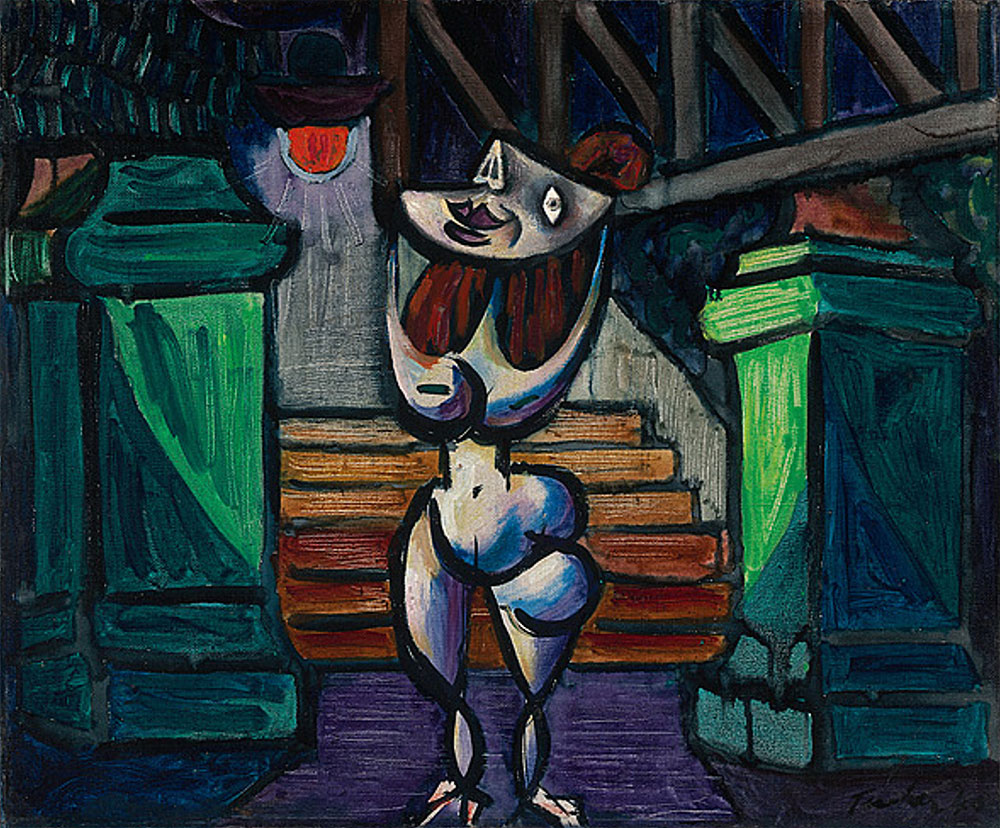
Albert Tucker (Australian, 1914-1999) 'Image of Modern Evil: Paris Night' 1948


Albert Tucker (Australian, 1914-1999)
Image of Modern Evil: Paris Night
1948
Oil on canvas on composition board
38.5 x 46.5cm
National Gallery of Australia, Canberra
Gift of the artist 1985
© Barbara Tucker


Everything that I have felt about Tucker’s work Images of Modern Evil was eloquently spelt out by Robert Nelson in The Age newspaper on April 13th 2011 in a piece titled ‘Portrait of the artist as a hateful man’. Unfortunately, having searched The Age website, I cannot locate the online version of the writing.

Some of the best quotes from the piece are below:


“History is full of moralists who insulted people for their lack of virtue. A millennium, a century, a decade later, we read their invectives and cringe. The main cause of their distemper now seems little more than misanthropic jealousy, where the reasons for moral disapproval boil down to a hatred of other people having fun.”

“Women for Tucker are disembodied monsters. Their limbs are abbreviated so as to focus attention on their fleshy core. The implication of these aesthetic amputees is grim: through their moral destitution, the women have transformed themselves into pure carnality, promoting their organs to men as mere flesh and with nothing in the head but an imbecilic smile.”

“Critics at the time were disgusted, recognising that the images are hateful and rancorous. But because Australia was determined to have modernism, it felt for 50 years that it had to swallow Tucker’s bile and consider it exquisite – like poison in Baudelaire – and make up political justifications for an odious sentiment.”

“Strip Tucker of his metaphoric filibustering, and you’re left with less weight than the shrivelled skulls of his strumpets. If Tucker’s women are happy lasses seeking fun with men, then why is their alacrity demeaned and condemned as sinister and vile? And if they’re prostitutes, why pick on the most vulnerable in society and stigmatise them for functional signs of joy?”

“Though accepted as heroically avant-garde, Tucker’s genre is pictorial slander. Just as an unproven allegation is destined to reflect on the plaintiff, so the man who accuses women of rotten morals – when no substance backs it up – stands accused of depraved motives.”


And best of all…


“None of the wartime circumstances that writers adduce can explain Tucker’s misogyny. His ferocity comes from a declamatory soul, impatient to score points and assert superiority. The exhibition reveals talent for painting but none of the humility to apply it to people.”


Nelson
, Robert. “Portrait of the artist as a hateful man,” in The Age newspaper. Wednesday, April 13th 2011


Talent for painting but none of the humility to apply it to people. Very well said Robert Nelson.

Thank you for having the courage to enunciate what I, for one, have felt for a long time.

Go and visit the exhibition if you must, but if critics at the time found the work disgusting, hateful and rancorous viewing them from an historical perspective should not make them less so. These are works that lack the capacity to empathise with vulnerabilities of the human spirit and do not deserve the energy of an attentive audience to be spent upon them.

Dr Marcus Bunyan


Albert Tucker (Australian, 1914-1999) 'Image of Modern Evil: Demon Dreamer' 1943


Albert Tucker (Australian, 1914-1999)
Image of Modern Evil: Demon Dreamer
1943
Oil on paper on cardboard
40.8 x 50.8cm
National Gallery of Australia, Canberra
Gift of the artist 1982
© Estate of Babara Tucker


Albert Tucker (Australian, 1914-1999) 'Image of Modern Evil: Spring in Fitzroy' 1943


Albert Tucker (Australian, 1914-1999)
Image of Modern Evil: Spring in Fitzroy
1943
Oil on canvas on composition board
© Estate of Babara Tucker


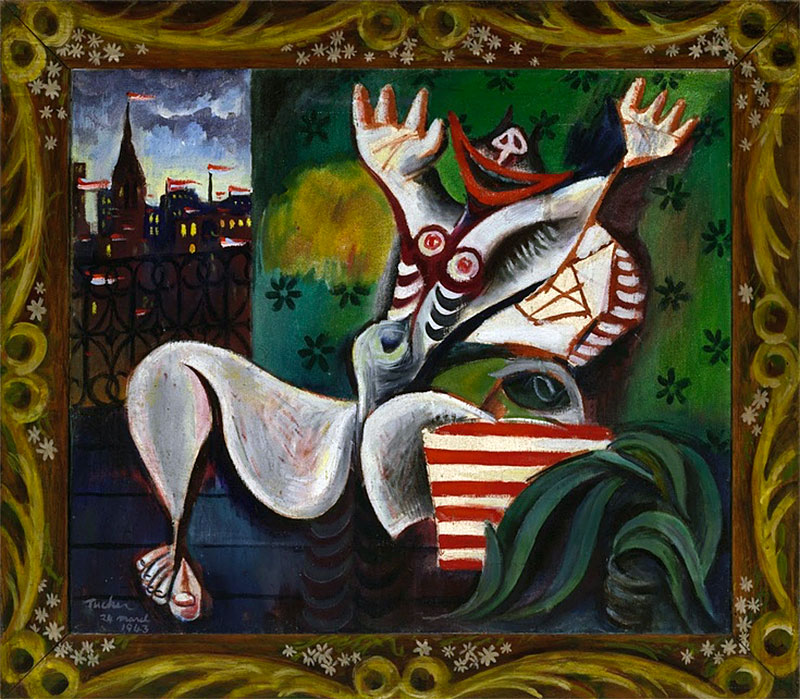
Albert Tucker (Australian, 1914-1999)
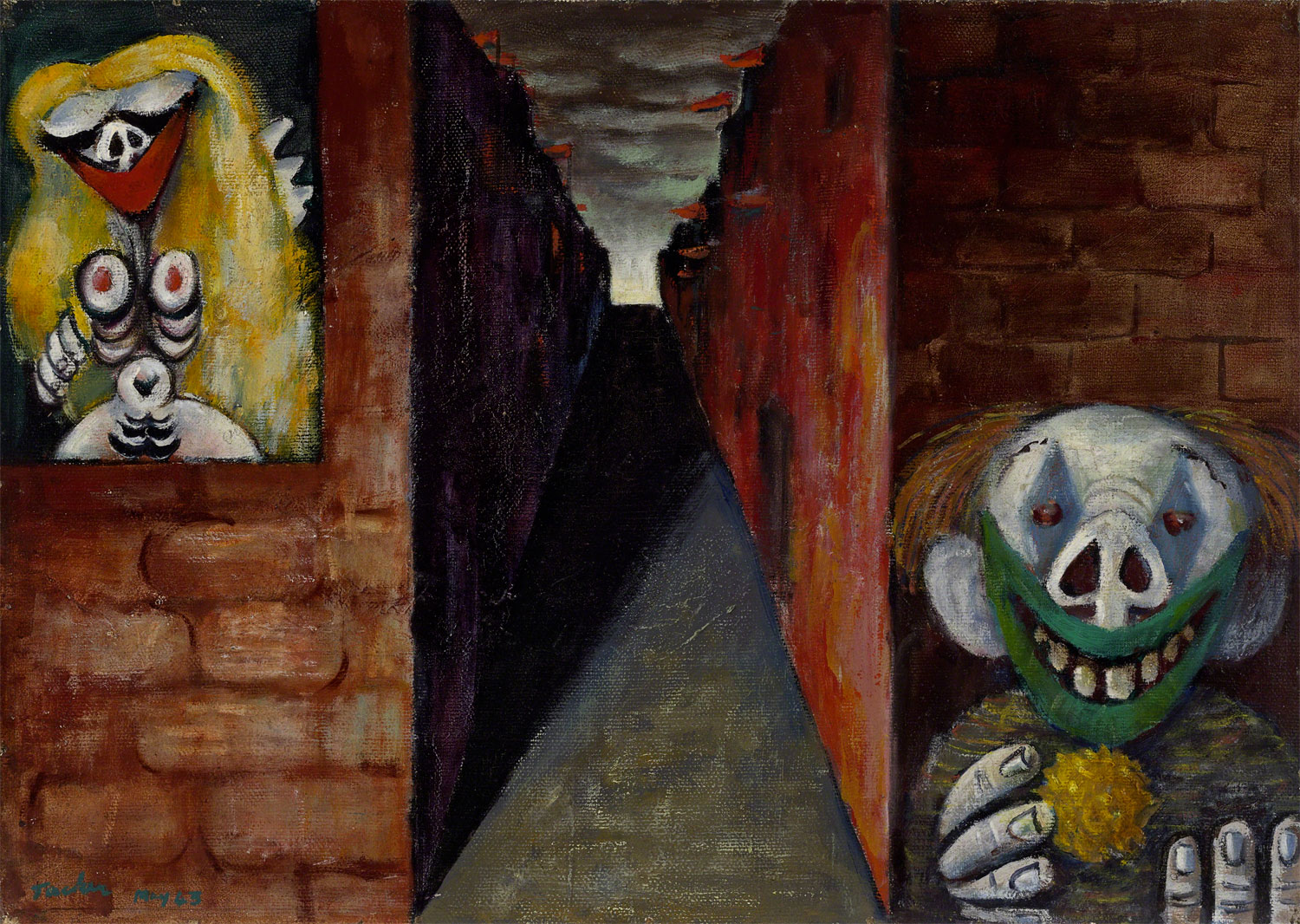
'Image of modern evil: Woman and clown' 1943


Albert Tucker (Australian, 1914-1999)
Image of modern evil: Woman and clown
1943
Oil on canvas on composition board
20 2/5 × 28 1/2 in (51.8 × 72.5cm)
National Gallery of Victoria, Melbourne


In 1943 Albert Tucker began a new phase in his art. Recently discharged from the army and primed with a fresh vocabulary of imagery that drew upon his wartime experiences, he commenced a suite of paintings which is now seen as a turning point in the advancement of modernism within twentieth-century Australian culture. The Images of Modern Evil series, painted between 1943 and 1948, offers a probing and powerful insight into the schismatic socio-political climate of World War II and its aftermath. Though neither critically nor popularly successful at the time, the series proved formative in Tucker’s practice as a distillation of humanist, psychological and mythological ideas and as a vehicle for specific motifs and narratives that have endured within his art.

The series starts with pictures of predatory and lascivious behaviour in Melbourne’s streets at night that have a gritty, elemental edge. As it progresses there is a greater sense of story-telling, and by the series’ end the influence of the avant-garde art of Pablo Picasso – in both style and subject – is clearly in evidence. Picasso was, however, but one of a variety of literary and artistic sources that Tucker drew on to help shape the Images: others included the poetry of T.S. Eliot; the imaginative creativity of the surrealists; the roughened political sentiments and social commentary of the German expressionists; and, pervasively, Carl Jung’s psychological treatises on irrationality, myths and archetypes, and on the personal and collective unconscious.

Tucker kept the Images of Modern Evil together and in his possession for more than thirty years, before 28 of the 39 constituent works were acquired for the collection of the National Gallery of Australia in Canberra. Accompanied by studies, related works on paper and archival material, this is the first time that all locatable works in the series have been displayed together.

Text from the Heide Museum website [Online] Cited 11/01/2020


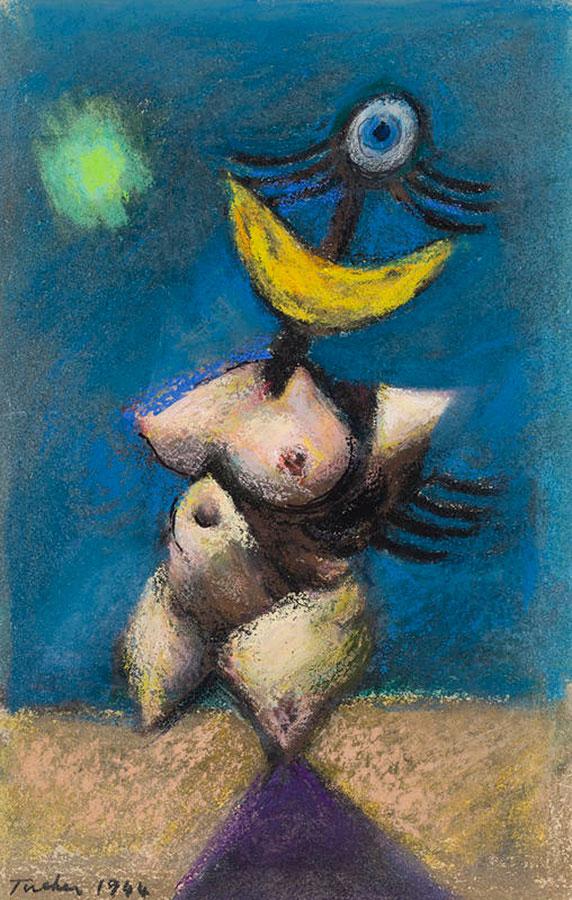
Albert Tucker (Australian, 1914-1999)
'Image of Modern Evil' 1944


Albert Tucker (Australian, 1914-1999)
Image of Modern Evil
1944
Pastel, pen and ink and pencil on paper
23.3 x 15.3cm
Heide Museum of Modern Art
© Estate of Babara Tucker


Albert Tucker (Australian, 1914-1999) 'Image of Modern Evil' 1945


Albert Tucker (Australian, 1914-1999)
Image of Modern Evil
1945
Coloured pastel on brown paper
23.9 × 20.2cm
National Gallery of Victoria, Melbourne
Purchased, 1978
© Estate of Babara Tucker


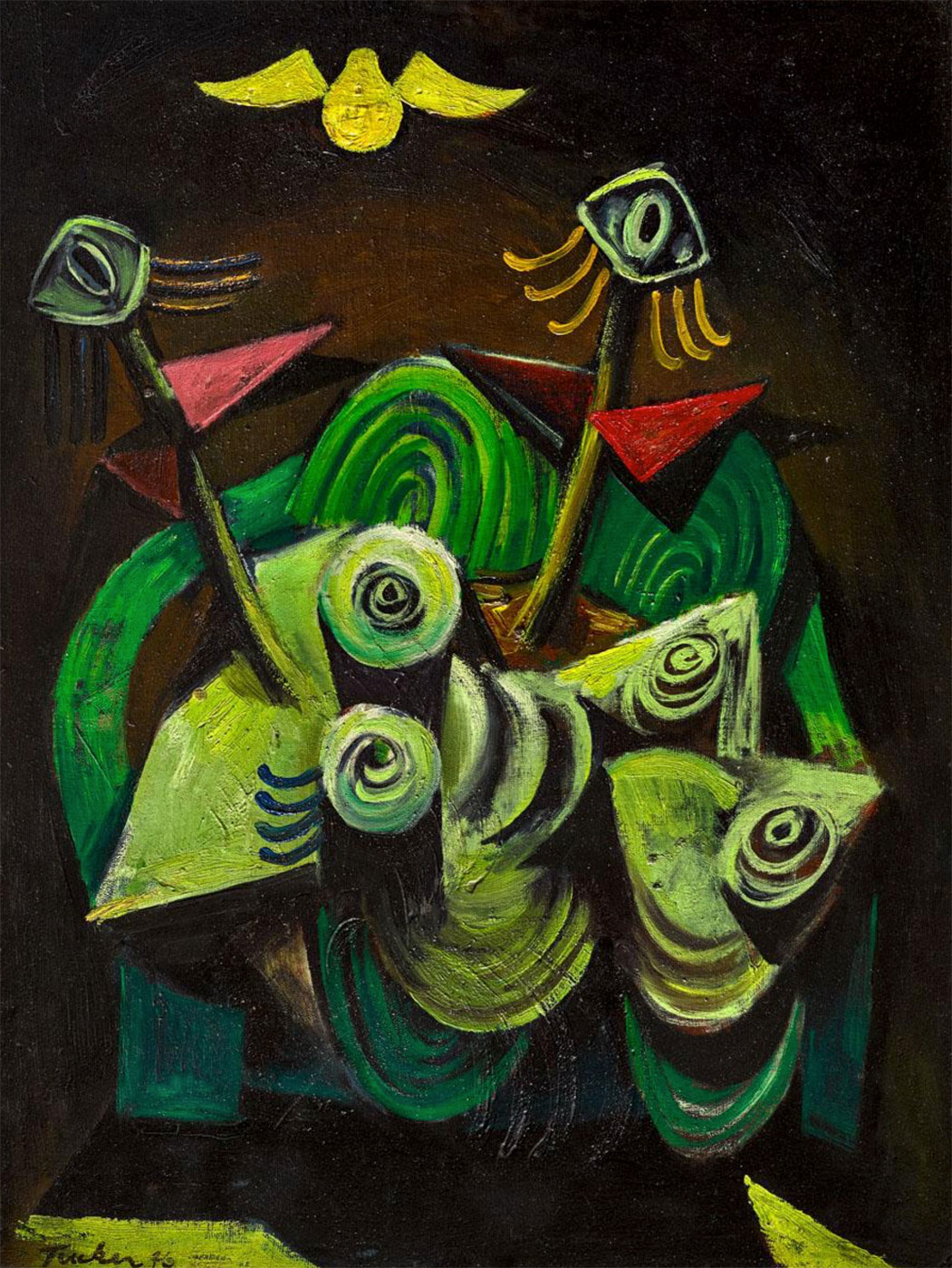
Albert Tucker (Australian, 1914-1999)
'Image of Modern Evil 29' 1946


Albert Tucker (Australian, 1914-1999)
Image of Modern Evil 29
1946
Oil on cotton gauze on cardboard
63.1 x 47.2cm


Heide Museum of Modern Art
7 Templestowe Road, Bulleen, Victoria 3105

Opening hours:
(Heide II & Heide III)
Tuesday – Sunday 10.00am – 5.00pm

Heide Museum of Art website

LIKE ART BLART ON FACEBOOK

Back to top
Review: ‘Cloud’ by Guan Wei at Arc One Gallery, Melbourne

Exhibition dates: 1st June – 29th June, 2010


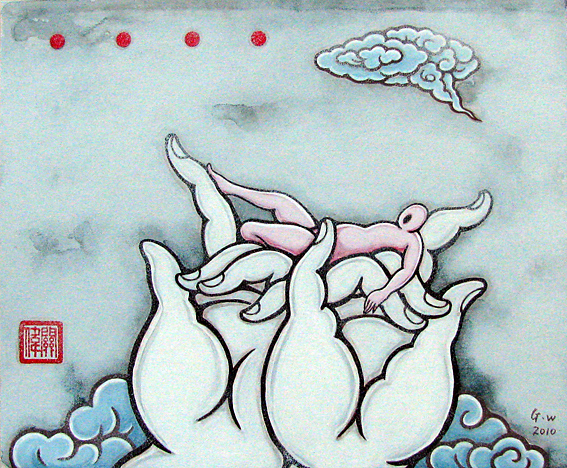
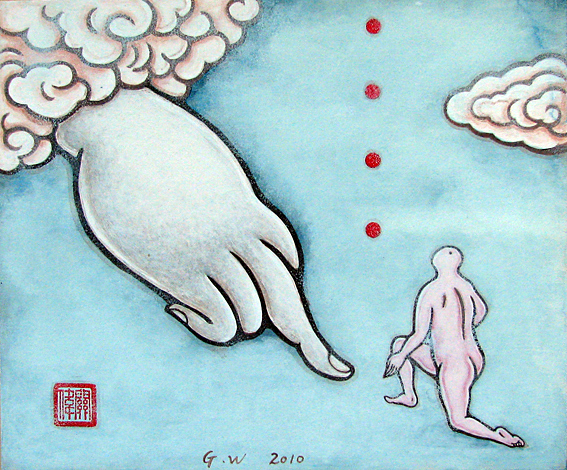
Guan Wei (China, b. 1957) 'Buddha's hand' 2010 from the exhibition 'Cloud' by Guan Wei at Arc One Gallery, Melbourne, June 2010


Guan Wei (China, b. 1957)
Buddha’s hand
2010


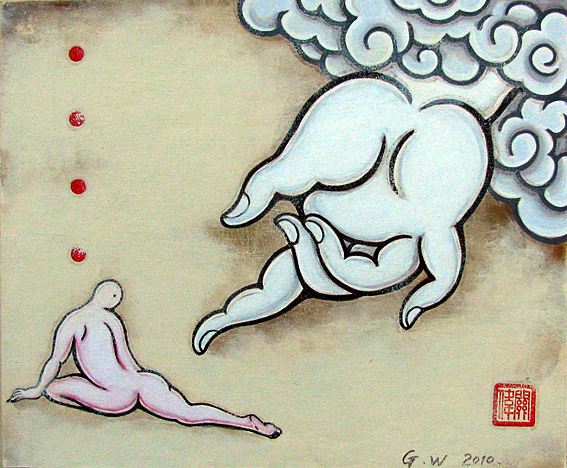
The exhibition Cloud by Australian artist Guan Wei at Arc One Gallery in Melbourne contains two bodies of work that are outstanding: the series of paintings on paper titled Buddha’s Hand and the series of five figurative sculptures titled Cloud. Each body of work compliments and informs the other.

The small Buddha’s Hand paintings (see below) are the most delicate of creatures – sensual, poetic almost fetishistic in their composition and utterly beguiling in their beauty. Referencing the history of cave paintings of the Buddha, Wei updates the ancient allegories expressing his message of harmony and leisure, identity and place through visual symbolic representation. These works are profoundly moving, the figurative compositions balanced masterfully through colour, shape and form, studded with the punctum of red bindi-like energy centres arising from the faceless yogic figures.

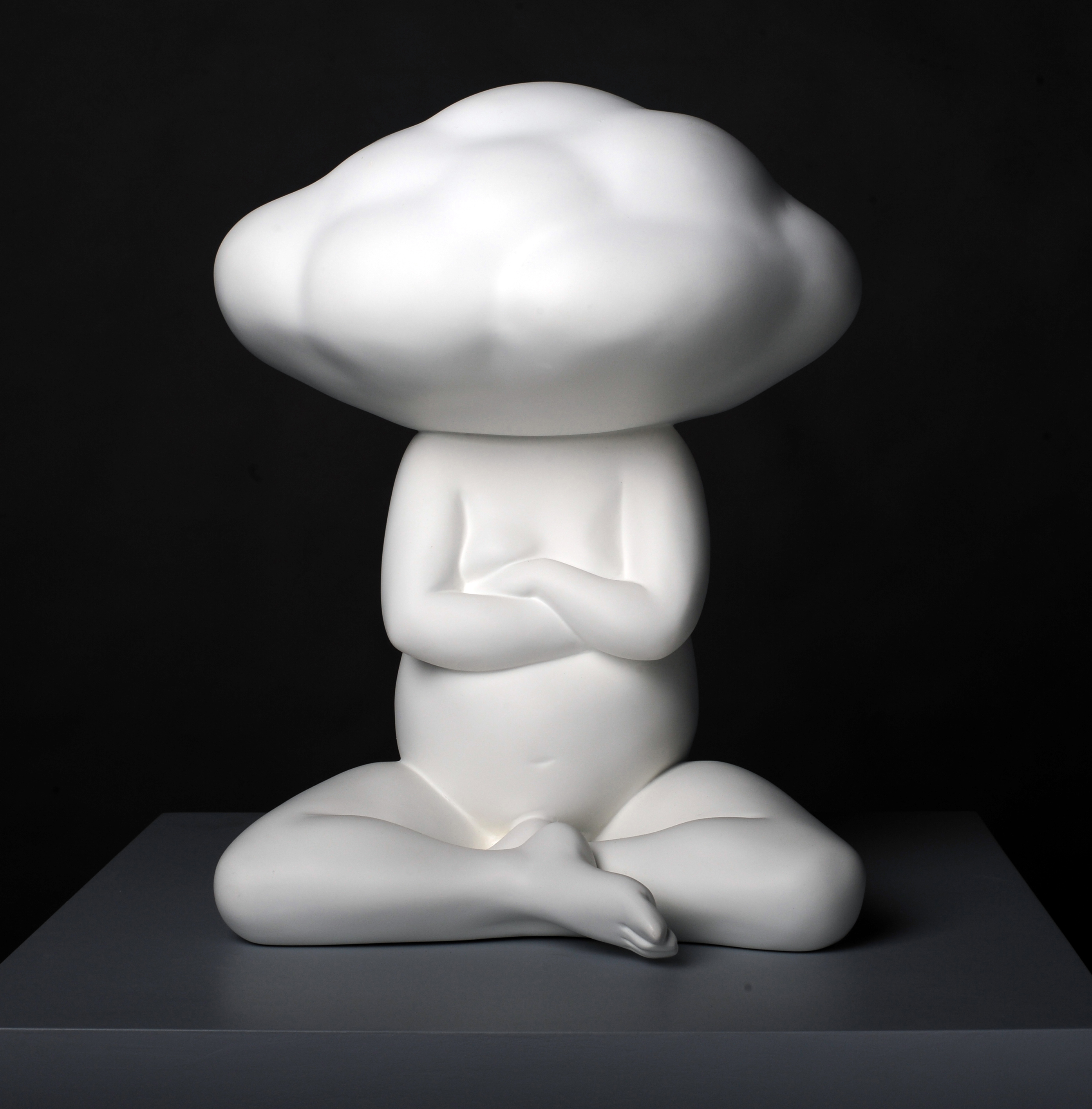
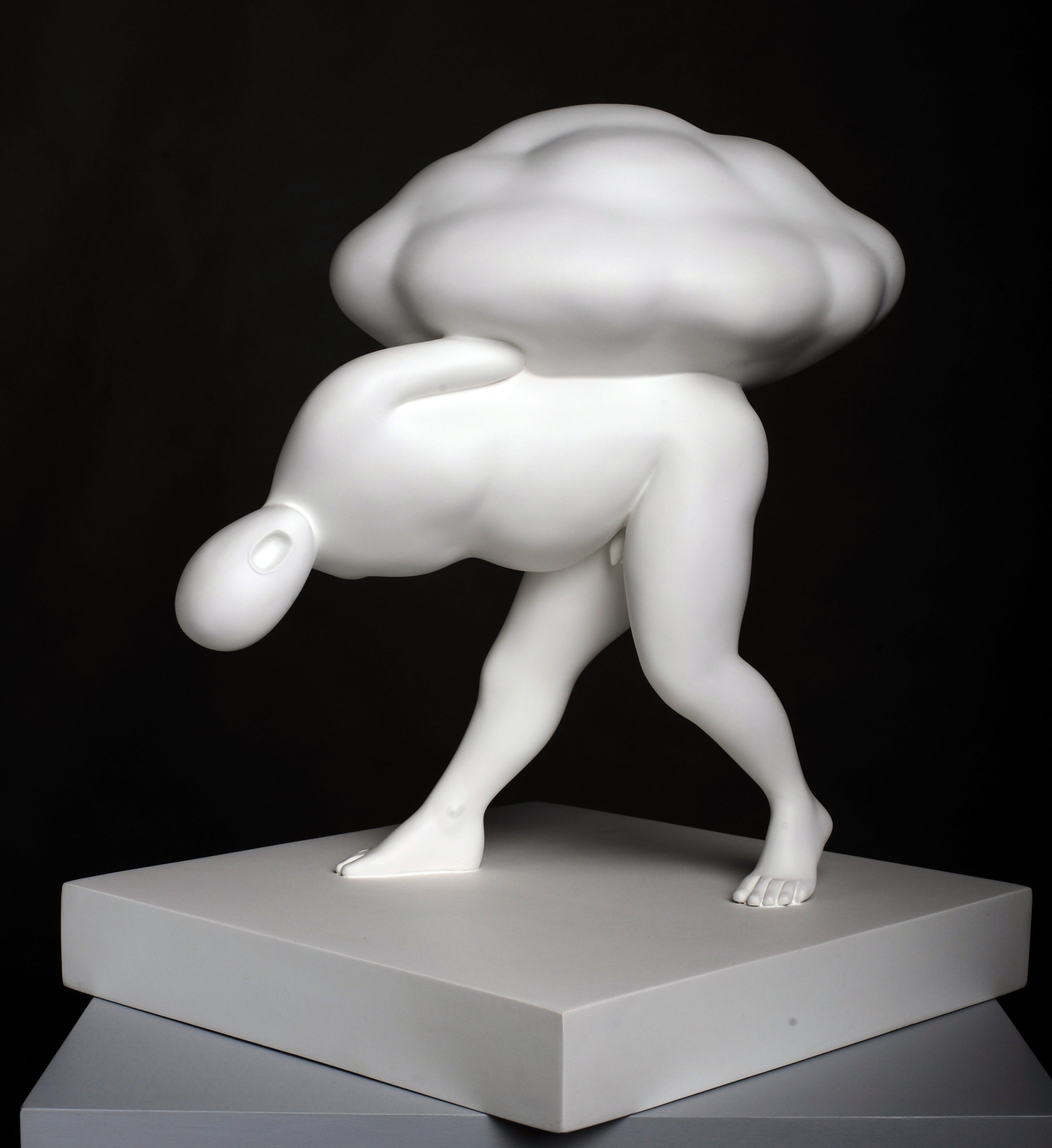
Sitting on white pedestals and positioned close to the Buddha’s Hand paintings in the gallery are the series of five Cloud figures (see below). Made of bronze that has been spray painted white these are wonderful sculptures, full of delicious humour and vibrancy. There is a sensuality and delicacy about the figures that is emphasised by their snowy whiteness, a whiteness that subverts the tactility, colour and weight that one usually associates with the metal bronze. Here the figure has, variously, it’s head in the clouds while pensively crossing arms; bearing the weight of the world on the back while the vacant mouth is open; preparing to throw the cloud as Zeus would a thunderbolt; reclining while balancing the cloud on one foot and with one foot stuck in the earth that is cloud. The cloud becomes a metaphor for thought and action in the world, acting on the world. In these sculptures there is no creed nor race, no ideology or nation and I believe that Wei attains his stated aim to redefine our relationship with one another and nature by transcending both. I am not alone in liking these sculptures – they have proved very popular and all five sculptures in editions of five have already sold out!

Other work in the exhibition is more prosaic – a multi-panelled screen, the On Cloud and Zodiac series never seem to breathe the same rarefied air as the above two bodies of work. They are disappointments that only serve to illuminate how brilliant holding the Buddha’s hand and living your life with your head in the clouds can be.

Dr Marcus Bunyan


Many thankx to Angela Connor and Arc One Gallery for allowing me to reproduce the photographs in the posting. Please click on the photographs for a larger version of the image.


Guan Wei (China, b. 1957) 'Buddha's hand' 2010 from the exhibition 'Cloud' by Guan Wei at Arc One Gallery, Melbourne, June 2010


Guan Wei (China, b. 1957)
Buddha’s hand
2010


Guan Wei (China, b. 1957) 'Buddha's hand' 2010


Guan Wei (China, b. 1957)
Buddha’s hand
2010


“I hope that we will be able to transcend the restrictions imposed on us by such notions as nation, ethnicity, ideology, cultural and history, and redefine our relationship with one another and nature.”


Guan Wei


Guan Wei is an adept storyteller who masterfully engages his audiences. Retaining the humour, wisdom and cross-cultural knowledge that have become characteristics of his ongoing oeuvre, his work breathes an awareness of our current social and environmental dilemmas exploring ideas of immigration, colonisation, identity politics and cultural tolerance.

Flirtatious and aesthetically whimsical, Guan Wei’s works are instantly recognisable. In this latest exhibition, Cloud, Guan Wei fuses sculpture, drawings and paintings to form what is part of his most beguiling trademark – ‘the art of idleness’. For the first time since returning to China, he will present new sculptures that employ his ongoing preoccupation with the figure and the figure in relation to the natural form. These sculptures are Guan Wei’s personal visual symbols of harmony and leisure. They form the thread for the four series of works in this exhibition.

During the past fifteen years, Guan Wei has help change the identity of Australian Art. He draws on his own experience as a Chinese national who migrated to Australia from China in the period following the Tiananmen Square massacre (1989). Guan Wei has spent twenty years living and working as an artist raising the awareness of Australia being a multicultural country. He has had over 40 solo exhibitions, been the recipient of numerous awards and included in every major collection. In 2009, Guan Wei was selected for the prestigious Clemenger Contemporary Art Award at the National Gallery of Victoria.

Press release from the Arc One Gallery website [Online] Cited 10/06/2010 no longer available online


Guan Wei (China, b. 1957) 'Cloud No.4' 2009 from the exhibition 'Cloud' by Guan Wei at Arc One Gallery, Melbourne, June 2010


Guan Wei (China, b. 1957)
Cloud No.4
2009
Bronze statue
edition of 5
39 x 30 x 25cm


Guan Wei (China, b. 1957) 'Cloud No.5' 2009


Guan Wei (China, b. 1957)
Cloud No.5
2009
Bronze statue
edition of 5
47 x 35 x 35cm


Arc One Gallery
45 Flinders Lane
Melbourne, 3000
Phone: +61 3 9650 0589

Opening hours:
Tuesday – Saturday 11am – 5pm

Arc One Gallery website

LIKE ART BLART ON FACEBOOK

Back to top
Review: ‘Safety Zone’ by John Young at Anna Schwartz Gallery, Melbourne

Exhibition dates: 15th April – 22nd May 2010


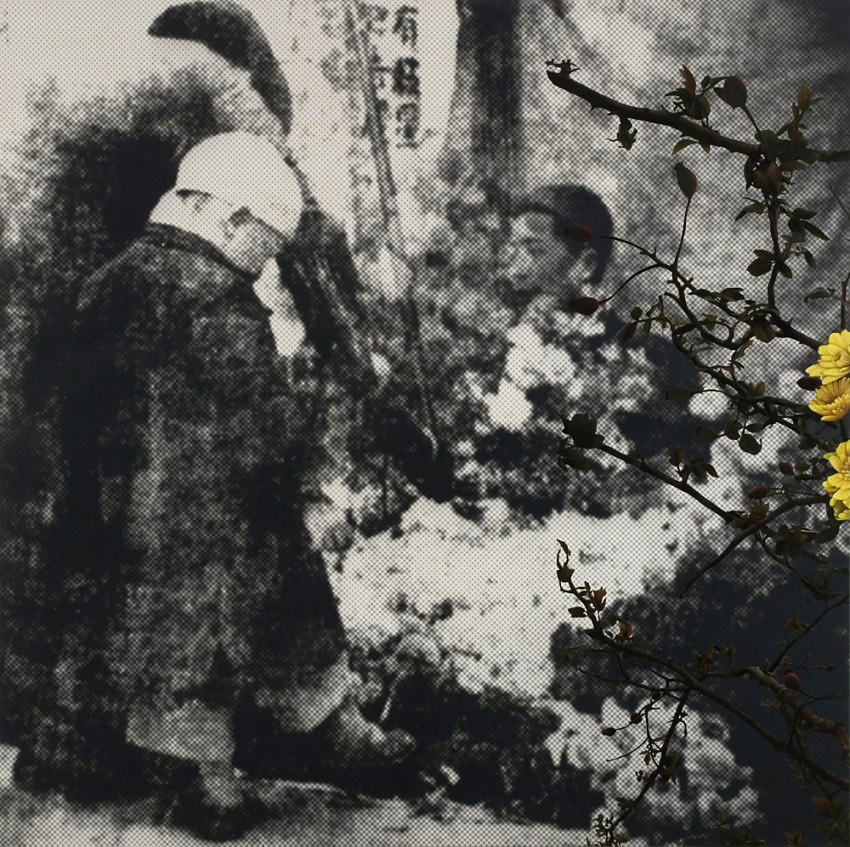
John Young (Australian born Hong Kong, b. 1956) 'Flower Market (Nanjing 1936) #2' 2010 from the exhibition 'Safety Zone' by John Young at Anna Schwartz Gallery, Melbourne, April - May, 2010


John Young (Australian born Hong Kong, b. 1956)
Flower Market (Nanjing 1936) #2
2010
Digital print and oil on Belgian linen
240 x 331cm
image courtesy of the artist and Anna Schwartz Gallery


What can one say about work that is so confronting, poignant and beautiful – except to say that it is almost unbearable to look at this work without being emotionally charged, to wonder at the vicissitudes of human life, of events beyond one’s control.

Simply, this is the best exhibition that I have seen in Melbourne so far this year.

The exhibition tells the story of the massacre of 300,000 people in the city of Nanjing in Jiangsu, China by Japanese troops in December, 1937 in what was to become known as the Nanjing Massacre. It also tells the story of a group of foreigners led by German businessman John Rabe and American missionary Minnie Vautrin who set up a “safety zone” to protect the lives of at least 250,000 Chinese citizens. The work is conceptually and aesthetically well resolved, the layering within the work creating a holistic narrative that engulfs and enfolds the viewer – holding them in the shock of brutality, the poignancy of poetry and the (non)sublimation of the human spirit to the will of others.

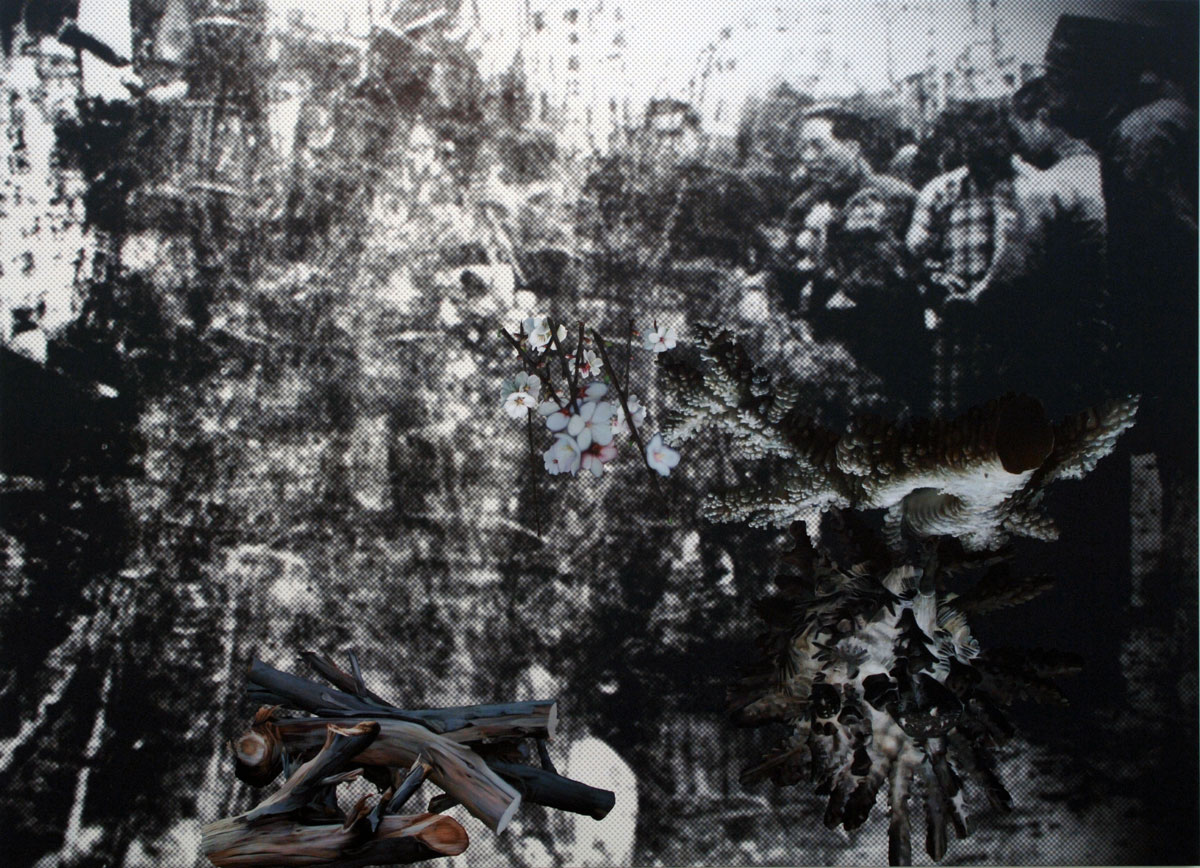
On the left wall of the gallery are three large mixed-media paintings of screen printed photographs of the Nanjing Flower Market taken the year before the massacre (see three images directly below). The printing of the press photographs at such a scale (a la Marco Fusinato) emphasises the dot structure of the photograph, the intensity of a newspaper reality ‘blown up’ to a huge scale. Unfortunately, you cannot see this deconstruction of the image very well in the examples below (clicking on the lower two images to get a larger version will give you a better idea), but believe me it most effective in creating a spatio-temporal distance between the viewer and the image. The dissolution of the image into dots is surmounted by painted cherry blossoms, bleached corals and piles of logs that overlay the photographic text. The reason-ances are sublime. The mind tries to process the distance between the death of the people and the photograph, the knowledge of what is about to happen to them, and the sensuality of the buds and flowers: new life!

To my friend and I the coral in the last painting reminded us both of the emanations of psychic phenomena at a seance, a series of radiations originating in the godhead.

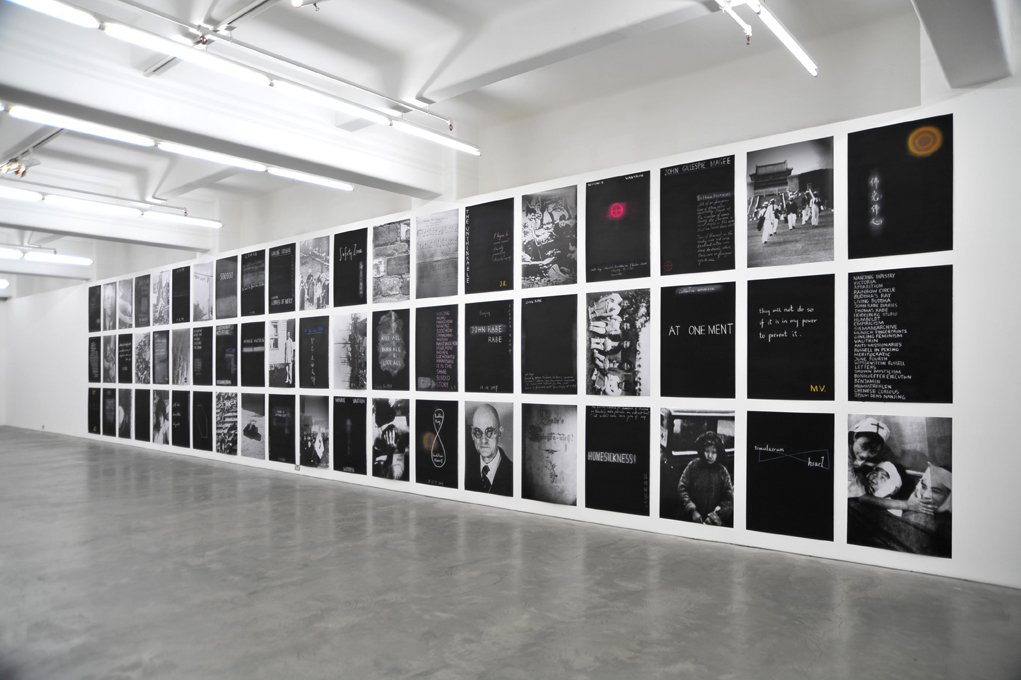
On the right wall of the gallery is a grid of three rows of twenty images that make up the work Safety Zone (2010, see bottom image). Made up of chalk drawings on black paper (a la Rudolf Steiner), writings by the Europeans including Vautrin and Rabe, statistics, gruesome photographs of the massacre and observations by the artist, this is in part both a confronting and benevolent work.

Archival photographs are printed digitally (the dot structure working to less affect here); some vertical photographs are shown horizontally. Text written in chalk is erased with a sweep of the hand. Thoughts of the Buddha, the infinity symbol linked to the Buddha’s Ray and the Buddha’s Heart are a physical presence. Two blue chalk lines intersect and cross over, so poignant and sublime amongst the destruction that surrounds. Golf clubs, beer bottles, bayonets.


‘THERE IS NOTHING LEFT’ 13.12.37 (Robert Wilson)

‘HOME SICKNESS’

‘Simulacrum > Heart’

A simply drawn coffin shape on black ground

‘I began to roam around the city preventing further atrocities myself’

‘They will not do so, if it is in my power to prevent it’ (Minnie Vautrin)

UNSPEAKABLE ACTS OF EVIL … BECOMING BANAL


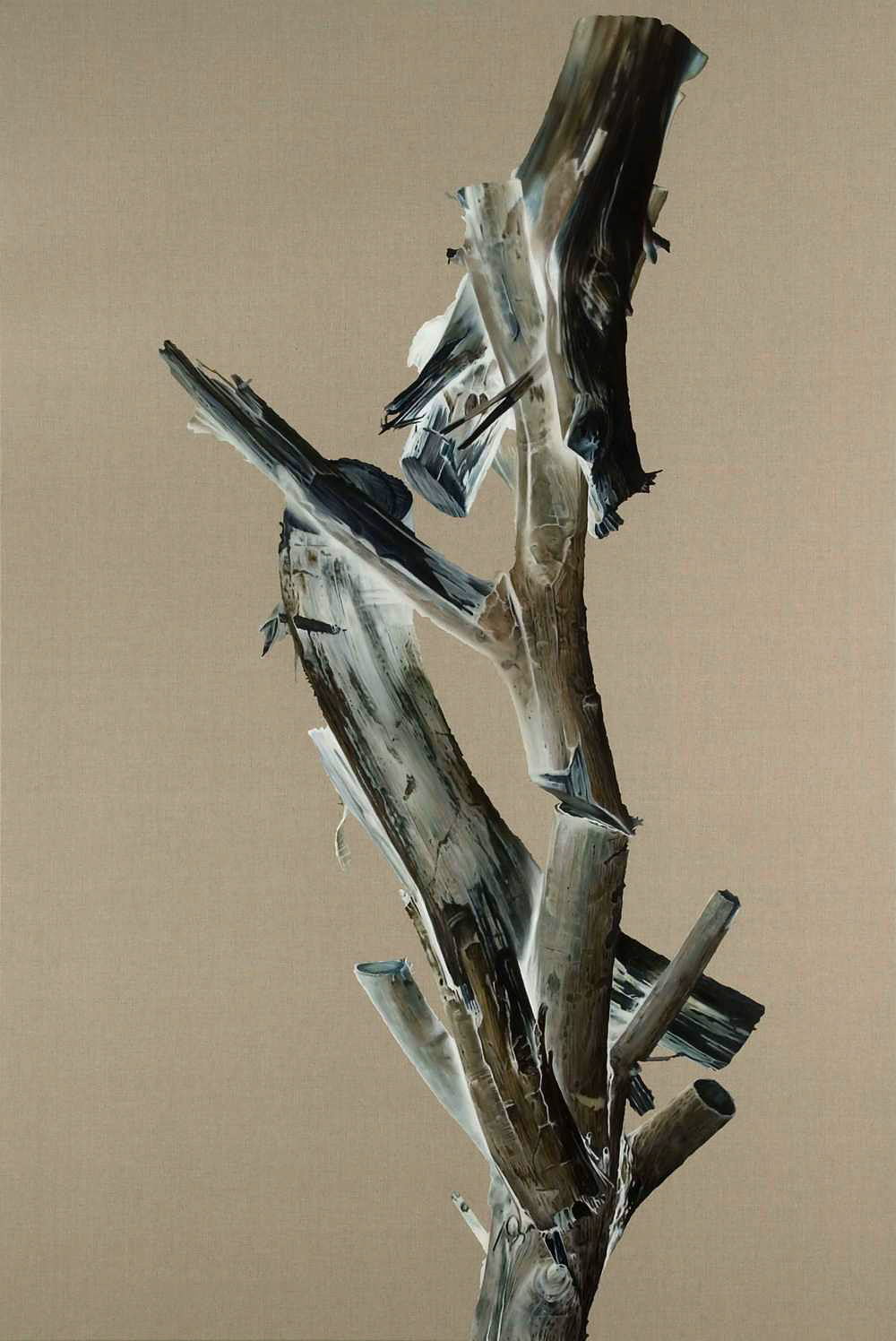
At both ends of the gallery is the last element in this play of hope, mutability and madness. Two large oil-on-linen paintings, titled The Crippled Tree #1 & #2 (see images below) “provide another register to the memory of the event. According to Young, the battered and split logs, painted in the negative, resonate and recollect the violence done to the victims of the massacre.” Unfortunately the two small images below cannot really give you an idea of the metaphorical power of these paintings. Like twisted and broken bodies larger than life size they become the glue that holds the other elements of the exhibition together. Without them there would be no transition from one side of the gallery, one element of the work to another. In their solarisation they emote an energy that flows down the length of the gallery = is this possible? Yes it is!

You feel the cracking of their branches, the amputation of their limbs but their spirit, their efflorescence (which, most appropriately considering the use of the Flower Market photographs, means “to flower out” in French) shines on. Such is the nature of the human spirit. Take the time and see this work. It is well worth the journey.

Dr Marcus Bunyan


Many thankx to the artist, Serena Bentley and Anna Schwartz Gallery for allowing me to reproduce the images in the posting. Please click on the photographs for a larger version of the image.


John Young (Australian born Hong Kong, b. 1956) 'Flower Market (Nanjing 1936) #3' 2010 from the exhibition 'Safety Zone' by John Young at Anna Schwartz Gallery, Melbourne, April - May, 2010


John Young (Australian born Hong Kong, b. 1956)
Flower Market (Nanjing 1936) #3
2010
Digital print and oil on Belgian linen
240 x 331cm
image courtesy of the artist and Anna Schwartz Gallery


John Young (Australian born Hong Kong, b. 1956) 'Flower Market (Nanjing 1936) #1' 2010 from the exhibition 'Safety Zone' by John Young at Anna Schwartz Gallery, Melbourne, April - May, 2010


John Young (Australian born Hong Kong, b. 1956)
Flower Market (Nanjing 1936) #1
2010
digital print and oil on Belgian linen
240 x 331cm
image courtesy of the artist and Anna Schwartz Gallery


Safety Zone, John Young’s latest project presents a series of intricate paintings that reassemble historical reminiscences of human survival by linking experimental contemporary art with investigative visual reports, in historical photographs and documents.

This body of work draws attention to incidents across the city of Nanjing in Jiangsu, China, just moments before the onset of the Nanjing Massacre, which followed the capture of the city by Japanese Imperial Forces on 13 December 1937. In the six weeks following the invasion, a quarter of a million Chinese citizens were killed in what the American historian Iris Chang described as the ‘forgotten holocaust of World War II’.

Through Chang’s book, The Rape of Nanking, the world was introduced to the personal memoirs of foreigners living in Nanjing who had been working on creating a ‘safety zone’ that would protect 250,000 Chinese citizens from the invading Japanese troops. Two of the twenty-one foreigners who stayed in the city to help set up the Nanjing Safety Zone were the American missionary Minnie Vautrin and the German businessman John Rabe. Their experiences have been noted by Young, who travelled to Nanjing, Berlin and Heidelberg, conducting first hand interviews and research for this compelling multi-layered project which exemplifies the transformative function of art.

The installation Safety Zone consists of three series of works which reference acts of resistance by individuals to protect fellow human beings against these atrocities that were underpinned by autocratic regimes and nationalist ideologies.

In the Flower Market (Nanjing 1936) series, carefully painted spring flowers and bleached corals are superimposed over historical photographs taken in Nanjing a year prior to the massacre. The meticulously rendered impressions of logs in The Crippled Tree #1 & #2 provide another register to the memory of the event. According to Young, the battered and split logs, painted in the negative, resonate and recollect the violence done to the victims of the massacre.

The carefully assembled bank of 60 chalk drawings and digital prints that make up the centerpiece of Safety Zone provides an intricate understanding of the humanity that lies beneath this tragic event through the revelation of extraordinary acts of self-sacrifice.

Dr Thomas J. Berghuis
Department of Art History and Film, The University of Sydney

Text from the Anna Schwartz Gallery website


John Young (Australian born Hong Kong, b. 1956) 'The Crippled Tree #1' 2010


John Young (Australian born Hong Kong, b. 1956)
The Crippled Tree #1
2010
Oil on linen
274 x 183cm
image courtesy of the artist and Anna Schwartz Gallery


John Young (Australian born Hong Kong, b. 1956) 'The Crippled Tree #2' 2010


John Young (Australian born Hong Kong, b. 1956)
The Crippled Tree #2
2010
Oil on linen
274 x 183cm
image courtesy of the artist and Anna Schwartz Gallery


John Young (Australian born Hong Kong, b. 1956) 'Safety Zone' 2010 (installation view)


John Young (Australian born Hong Kong, b. 1956)
Safety Zone (installation view)
2010
60 works, digital prints on photographic paper and chalk on blackboard-painted archival cotton paper
Image courtesy of the artist and Anna Schwartz Gallery


Anna Schwartz Gallery
185 Flinders Lane
Melbourne, Victoria 3000

Opening hours:
Tuesday – Friday 12 – 5pm
Saturday 1 – 5pm

Anna Schwartz Gallery website

LIKE ART BLART ON FACEBOOK

Back to top
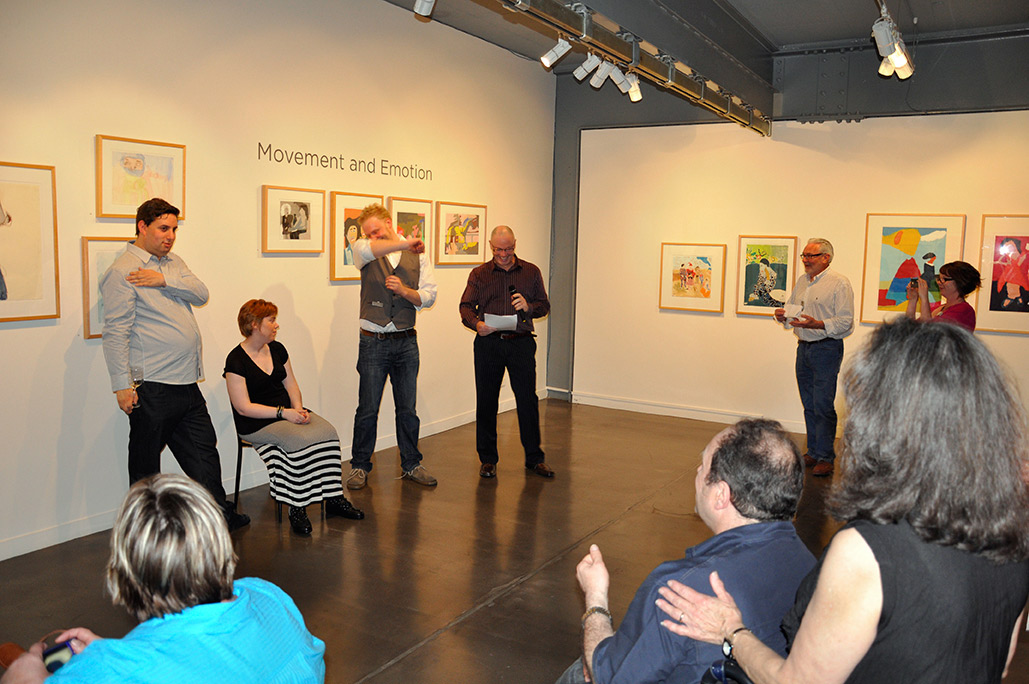
Four exhibitions in Albert Street, Richmond: Pamela Rataj at Anita Traverso Gallery, Claudia Damichi at Sophie Gannon Gallery, Steve Randall at John Buckley Gallery and Robert Boynes at Karen Woodbury Gallery

April 2010


Four interesting exhibitions in Albert Street, Richmond – from the beautiful, formed leather sculptures of Pamela Rataj to the wonderfully vibrant tropical bird, chair and decorative pattern paintings of Claudia Damichi; from the intensely observed canvas environments of Steve Randall to the post-photographic silk-screen textualisations of Robert Boynes. Well worth a visit on a Saturday afternoon!

As always, many thankx to the galleries for allowing me to publish the images in this posting. Please click on the images for a larger version.

~ Pamela Rataj. The Morphology of Forgetting at Anita Traverso Gallery. 7th April – 1st May 2010

~ Claudia Damichi. The Bitter Sweet at Sophie Gannon Gallery. 30th March – 25th April 2010

~ Steve Rendall. Security, Storage and Recreation at John Buckley Gallery. 8th April – 1st May 2010

~ Robert Boynes. Postscript at Karen Woodbury Gallery. 7th April – 1st May 2010


Pamela Rataj. The Morphology of Forgetting at Anita Traverso Gallery

7th April – 1st May 2010


Pamela Rataj. 'Tangent Bundle' 2009


Pamela Rataj (Australian)
Tangent Bundle
2009


Pamela Rataj. 'Ravel' 2009


Pamela Rataj (Australian)
Ravel
2009


Pamela Rataj. 'Kairos' 2009


Pamela Rataj (Australian)
Kairos
2009


How to draw a boundary between self and other, past time and today?

Patterns and forms in nature often resemble one another, connecting life forms in unexpected ways. Tide lines left in the sand resemble the grains found in a piece of wood, and the veins in a leaf or those in a hand.

The age lines in the trunk of a tree form as each outer layer covers the one preceding it and echoes its shape. This makes me think of the way past experience resurfaces as memory, receding or becoming more important at different times in our lives, as each new experience envelopes our previous states of being and yet is shaped by them.

The wrapped and layered forms in The Morphology of Forgetting explore coexistence and connection.

I dedicate this exhibition to my parents, whose recent deaths have helped me appreciate memory as a way to connect through time.

Pamela Rataj 2010

Press release from the Anita Traverso Gallery website [Online] Cited 10/04/2010. No longer available online


Pamela Rataj (Australian) 'Faisceaux 1' 2009


Pamela Rataj (Australian)
Faisceaux 1
2009


Pamela Rataj. 'Faisceaux 4' 2009


Pamela Rataj (Australian)
Faisceaux 4
2009


Claudia Damichi. The Bitter Sweet at Sophie Gannon Gallery

30th March – 25th April 2010


Claudia Damichi (Australian, b. 1972) 'Birds eye' 2010


Claudia Damichi (Australian, b. 1972)
Birds eye
2010
Acrylic on canvas
46 x 41cm


Claudia Damichi (Australian, b. 1972) 'Star Gazer' 2009


Claudia Damichi (Australian, b. 1972)
Star Gazer
2009
Acrylic on canvas
46 x 41cm


Claudia Damichi (Australian, b. 1972) 'Gridlock' 2010


Claudia Damichi (Australian, b. 1972)
Gridlock
2010
Acrylic on canvas
41 x 46cm


Claudia Damichi (Australian, b. 1972) 'Reading between the lines' 2010


Claudia Damichi (Australian, b. 1972)
Reading between the lines
2010
Acrylic on canvas
46 x 41cm


Claudia Damichi’s surrealist still life paintings are characterised by vivid colours, elaborate patterns and distorted spatial proportions. In her paintings of domestic interiors, flowers, birds and furniture, colour is inflated and scale is playfully manipulated – solitary domestic interiors are reconfigured into places of fantasy and illusion. Inspired by the enduring aesthetic of modern industrial design, her surreal and theatrically staged scenarios self-consciously conjure a sense of the absurd. Graphic patterning, high-croma colour and whimsical compositions foster worlds that are at once playful and claustrophobic, satirical and real, tapping into an ambiguous nostalgia that leaves the viewer feeling that anything is possible.

Visit the Sophie Gannon website


Claudia Damichi (Australian, b. 1972) 'Look out' 2010


Claudia Damichi (Australian, b. 1972)
Look out
2010
Acrylic on canvas
46 x 56cm


Steve Rendall. Security, Storage and Recreation at John Buckley Gallery

8th April – 1st May 2010


Steven Rendall (Australian born Britain, b. 1969; Australia from 2000) 'Archive 1' 2010


Steven Rendall (Australian born Britain, b. 1969; Australia from 2000)
Archive 1
2010
Oil on linen


Steven Rendall (Australian born Britain, b. 1969; Australia from 2000) 'Archive 2' 2010


Steven Rendall (Australian born Britain, b. 1969; Australia from 2000)
Archive 2
2010
Oil on linen


Citing the British artist Walter Sickert as an important influence on his painterly style, Rendall’s work displays a form and content that has attracted the attention of both critics and collectors. A key work in the exhibition is a large-scale painting on un-stretched linen titled Fountain (Rosemary’s Baby) that sprawls across 4.5m. Certain fountains, along with other apparently arbitrary images of television monitors, speedboats, clothing racks, shelving units and museum interiors are recurring motifs in Rendall’s paintings.

Rendall aims to ‘collect and synthesise’ images from around his home and en route to and from his Brunswick studio. Passing observations of window displays, charity shops and various light industrial warehouses are registered and recorded in conjunction with the accumulation of promotional flyers spruiking leisure activities and museum experiences. This shambolic collection of images is transcribed into an array of compositions in Rendall’s paintings. Images occasionally materialise in unlikely places, such as the spectral diver’s head that is resting on a warehouse shelf in the appropriately titled Storage.

In the exhibition Security, Storage and Recreation, you are invited to enter the image bank of Steven Rendall; a ‘wake in fright’ experience where one can become immersed and caught up in the maelstrom of the artist’s visual language – a sequence of painterly dreams each similar yet different to the last.”
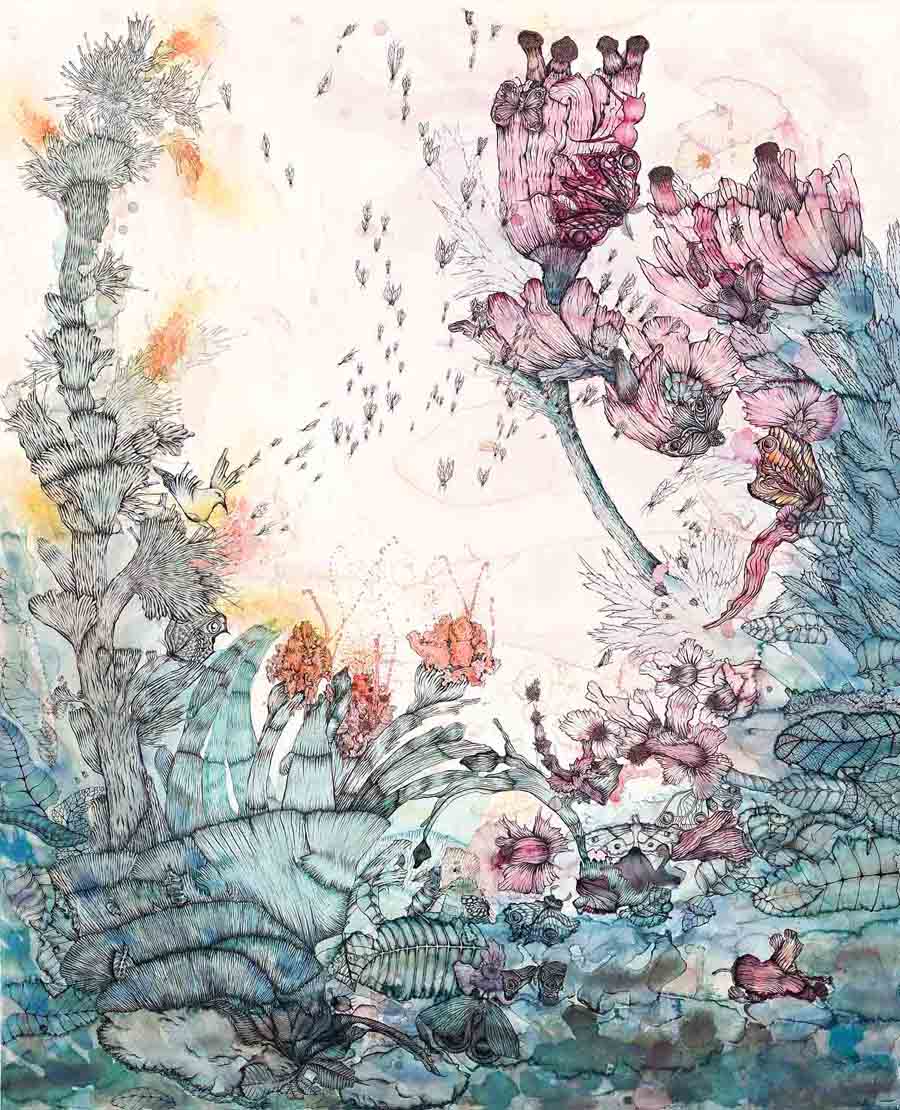
Press release from the John Buckley Gallery website [Online] Cited 10/04/2010 no longer available online


Steven Rendall (Australian born Britain, b. 1969; Australia from 2000) 'Flat Screens (Green)' 2010


Steven Rendall (Australian born Britain, b. 1969; Australia from 2000)
Flat Screens (Green)
2010
Oil on linen


Steven Rendall (Australian born Britain, b. 1969; Australia from 2000) 'Pipes' 2010


Steven Rendall (Australian born Britain, b. 1969; Australia from 2000)
Pipes
2010
Oil on linen


Steven Rendall (Australian born Britain, b. 1969; Australia from 2000) 'Claustrophobia' 2010


Steven Rendall (Australian born Britain, b. 1969; Australia from 2000)
Claustrophobia
2010
Oil on linen


Steven Rendall (Australian born Britain, b. 1969; Australia from 2000) 'Redacted 2' 2010


Steven Rendall (Australian born Britain, b. 1969; Australia from 2000)
Redacted 2
2010
Oil on linen


Robert Boynes. Postscript at Karen Woodbury Gallery

7th April – 1st May 2010


Robert Boynes (Australian, b. 1942) 'Street Runner' 2010


Robert Boynes (Australian, b. 1942)
Street Runner
2010
Acrylic on canvas and velvet
120 x 242cm


Robert Boynes (Australian, b. 1942) 'Days that we forgot' 2010


Robert Boynes (Australian, b. 1942)
Days that we forgot
2010
Acrylic on canvas


Robert Boynes (Australian, b. 1942) 'Signal Driver' 2010


Robert Boynes (Australian, b. 1942)
Signal Driver
2010
Acrylic on canvas and velvet
120 x 190cm


Postscript is Robert Boynes’ second solo exhibition with Karen Woodbury Gallery. This series continues with his exploration of urban themes, contemporary experience and experimentation into ways of using paint. In this most recent body of work Robert has employed the use of text in juxtaposition to various materials such as wood and velvet. The text conveys a feeling of noise and urban clatter, acting as a context and environment for the figures within the work.

His technique involves transferring photographic images to large silk screens and dragging paint through the mesh onto canvas. Robert thus has control in the manipulation of colour, density and translucency of the images. This process results in still moments that magnify and investigate everyday observable reality. The anonymous figures are juxtaposed with text and layering of saturated, contrasting colours, appearing objectified and ghostly.

These works embody a filmic quality, the multi-panelled paintings signify fragmented narratives and enquire into perceptions of time and space.

Text from the Karen Woodbury Gallery website [Online] Cited 10/04/2010 no longer available online


Robert Boynes (Australian, b. 1942) 'Body Type' 2 2010


Robert Boynes (Australian, b. 1942)
Body Type 2
2010
Acrylic on canvas


Robert Boynes (Australian, b. 1942) 'Body Type 3' 2010


Robert Boynes (Australian, b. 1942)
Body Type 3
2010
Acrylic on canvas


Robert Boynes (Australian, b. 1942) 'Things we leave behind' 2009


Robert Boynes (Australian, b. 1942)
Things we leave behind
2009
Acrylic on canvas
120 x 180cm


Robert Boynes (Australian, b. 1942) 'The layered moment' 2009


Robert Boynes (Australian, b. 1942)
The layered moment
2009
Acrylic on canvas


Robert Boynes (Australian, b. 1942) 'Postscript' 2009


Robert Boynes (Australian, b. 1942)
Postscript
2009
Acrylic on canvas
120 x 124cm


All galleries have closed except for Sophie Gannon Gallery, Richmond.

Sophie Gannon Gallery
2 Albert Street Richmond VIC 3121 Australia
Phone: +61 3 9421 0857

Sophie Gannon Gallery website

LIKE ART BLART ON FACEBOOK

Back to top