Four exhibitions in Albert Street, Richmond: Pamela Rataj at Anita Traverso Gallery, Claudia Damichi at Sophie Gannon Gallery, Steve Randall at John Buckley Gallery and Robert Boynes at Karen Woodbury Gallery

April 2010


Four interesting exhibitions in Albert Street, Richmond – from the beautiful, formed leather sculptures of Pamela Rataj to the wonderfully vibrant tropical bird, chair and decorative pattern paintings of Claudia Damichi; from the intensely observed canvas environments of Steve Randall to the post-photographic silk-screen textualisations of Robert Boynes. Well worth a visit on a Saturday afternoon!

As always, many thankx to the galleries for allowing me to publish the images in this posting. Please click on the images for a larger version.

~ Pamela Rataj. The Morphology of Forgetting at Anita Traverso Gallery. 7th April – 1st May 2010

~ Claudia Damichi. The Bitter Sweet at Sophie Gannon Gallery. 30th March – 25th April 2010

~ Steve Rendall. Security, Storage and Recreation at John Buckley Gallery. 8th April – 1st May 2010

~ Robert Boynes. Postscript at Karen Woodbury Gallery. 7th April – 1st May 2010


Pamela Rataj. The Morphology of Forgetting at Anita Traverso Gallery

7th April – 1st May 2010
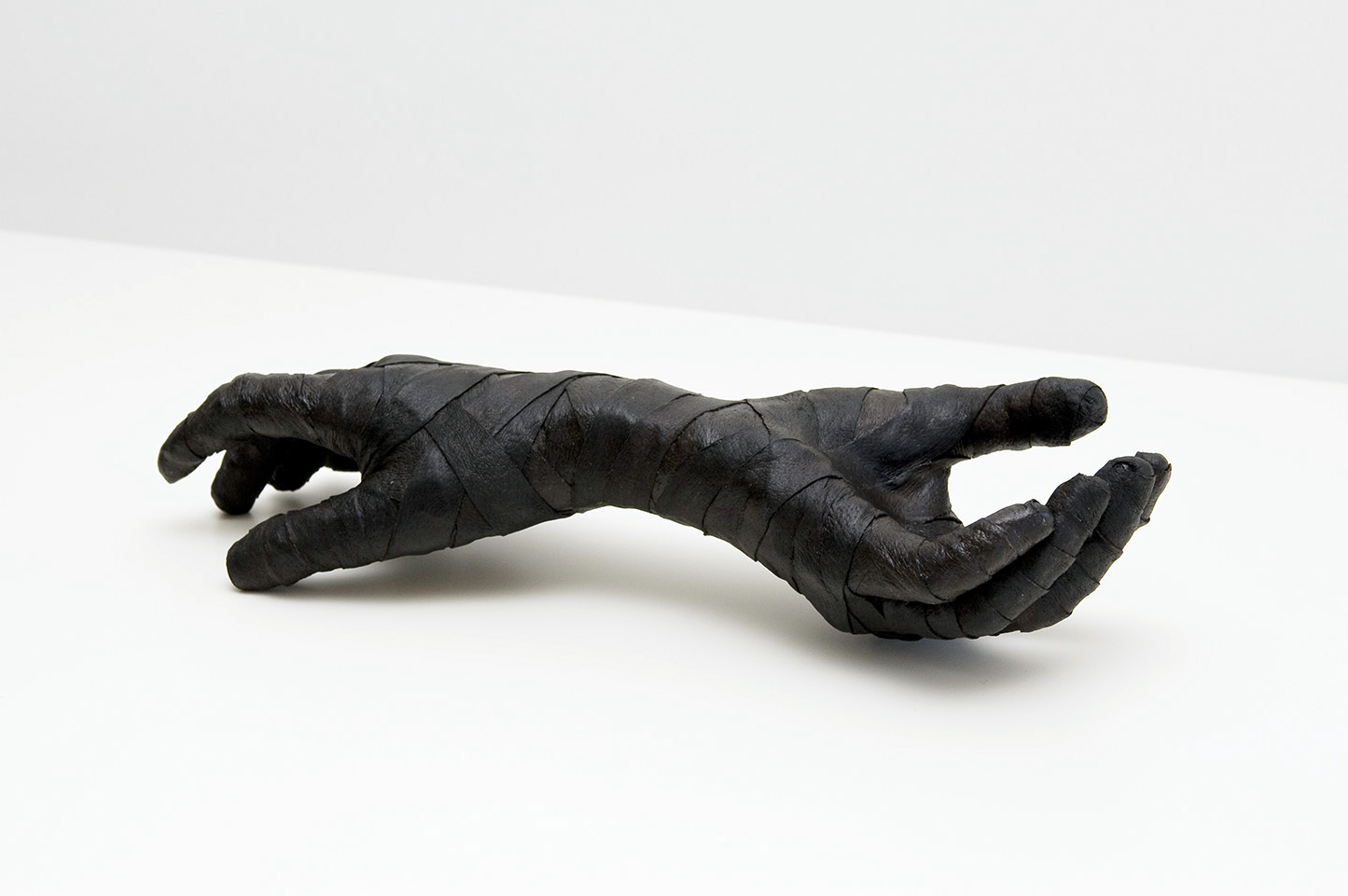
 

Pamela Rataj. 'Tangent Bundle' 2009


Pamela Rataj (Australian)
Tangent Bundle
2009
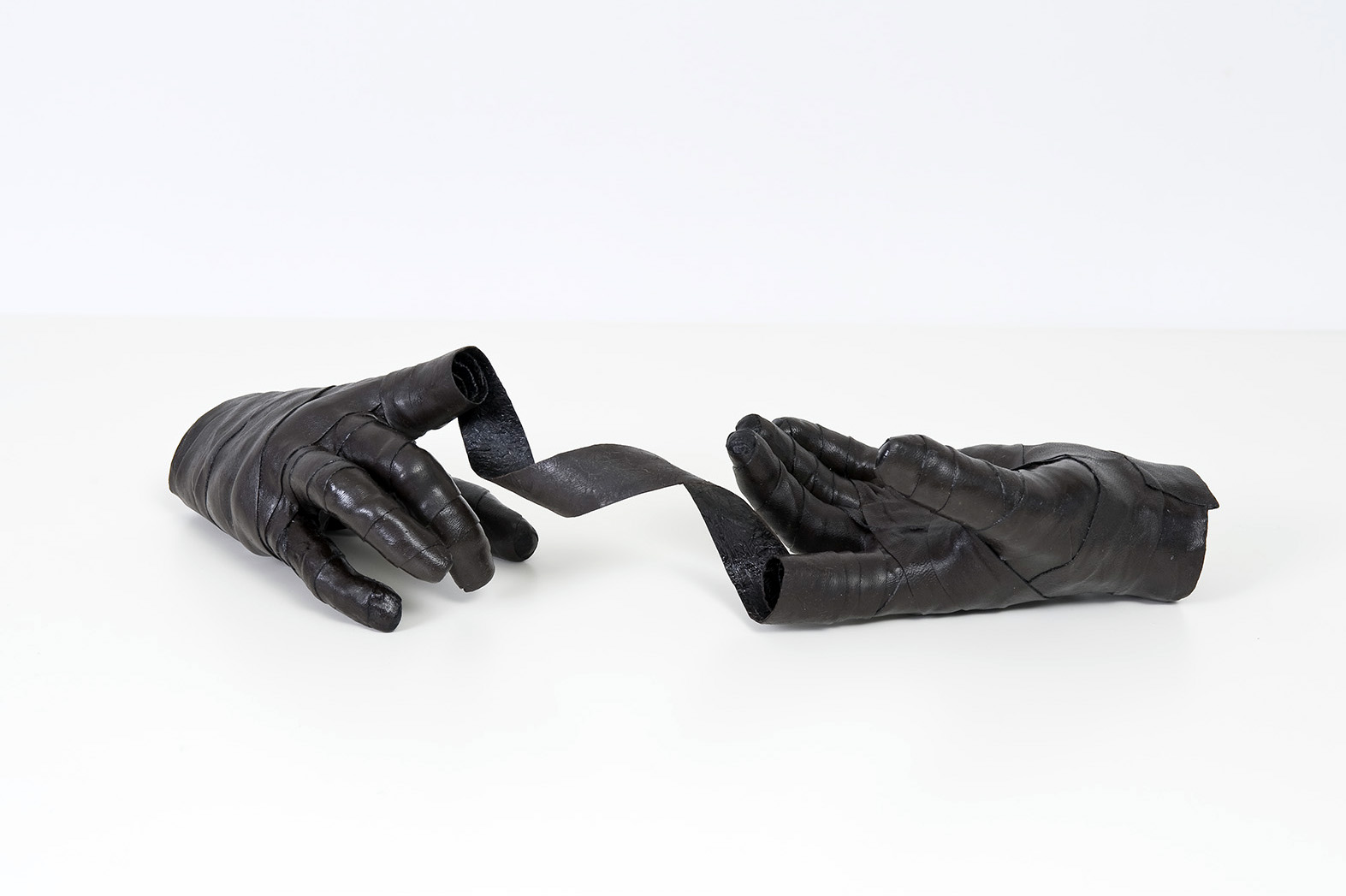
 

Pamela Rataj. 'Ravel' 2009


Pamela Rataj (Australian)
Ravel
2009
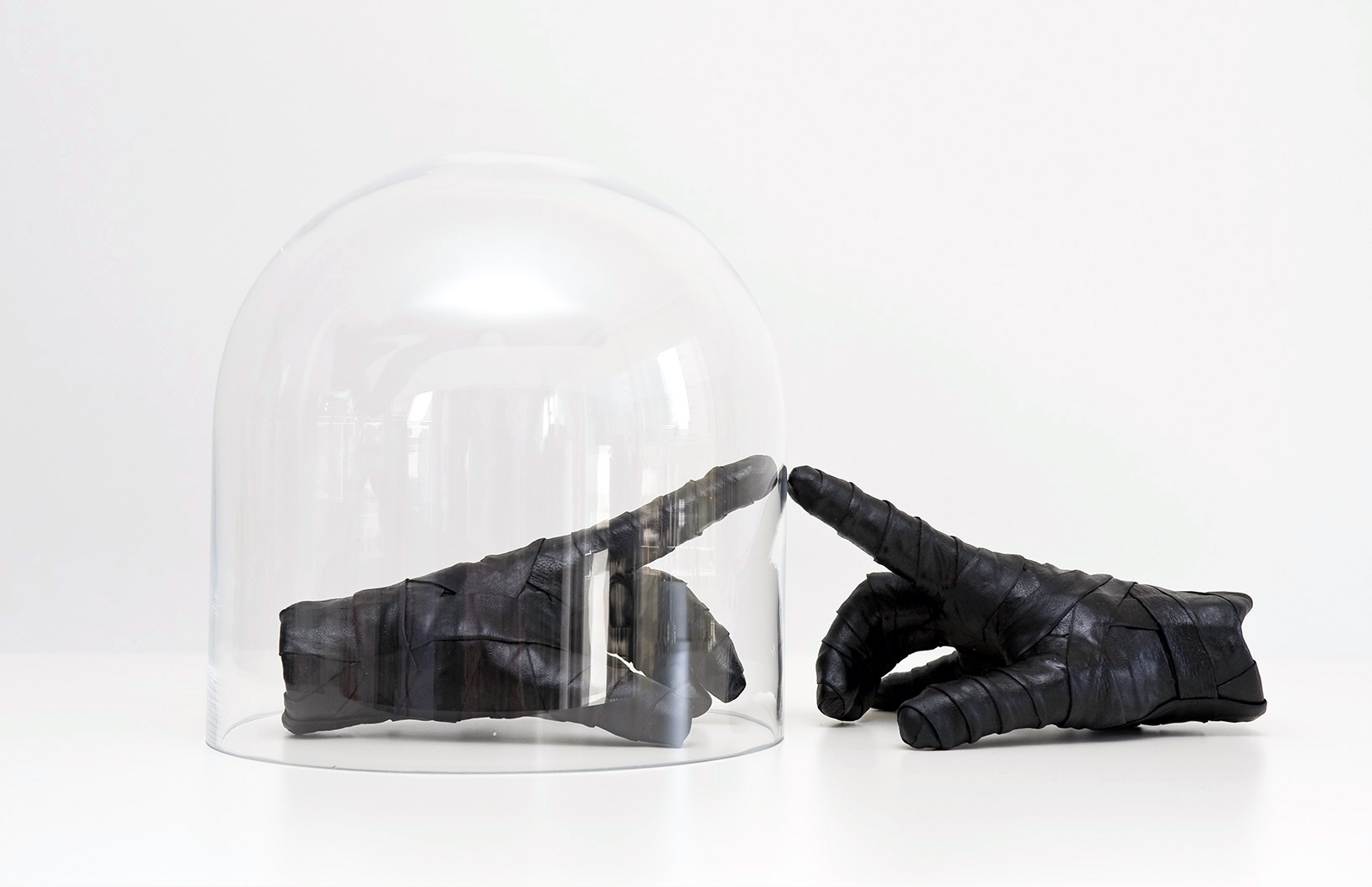
 

Pamela Rataj. 'Kairos' 2009


Pamela Rataj (Australian)
Kairos
2009


How to draw a boundary between self and other, past time and today?

Patterns and forms in nature often resemble one another, connecting life forms in unexpected ways. Tide lines left in the sand resemble the grains found in a piece of wood, and the veins in a leaf or those in a hand.

The age lines in the trunk of a tree form as each outer layer covers the one preceding it and echoes its shape. This makes me think of the way past experience resurfaces as memory, receding or becoming more important at different times in our lives, as each new experience envelopes our previous states of being and yet is shaped by them.

The wrapped and layered forms in The Morphology of Forgetting explore coexistence and connection.

I dedicate this exhibition to my parents, whose recent deaths have helped me appreciate memory as a way to connect through time.

Pamela Rataj 2010

Press release from the Anita Traverso Gallery website [Online] Cited 10/04/2010. No longer available online
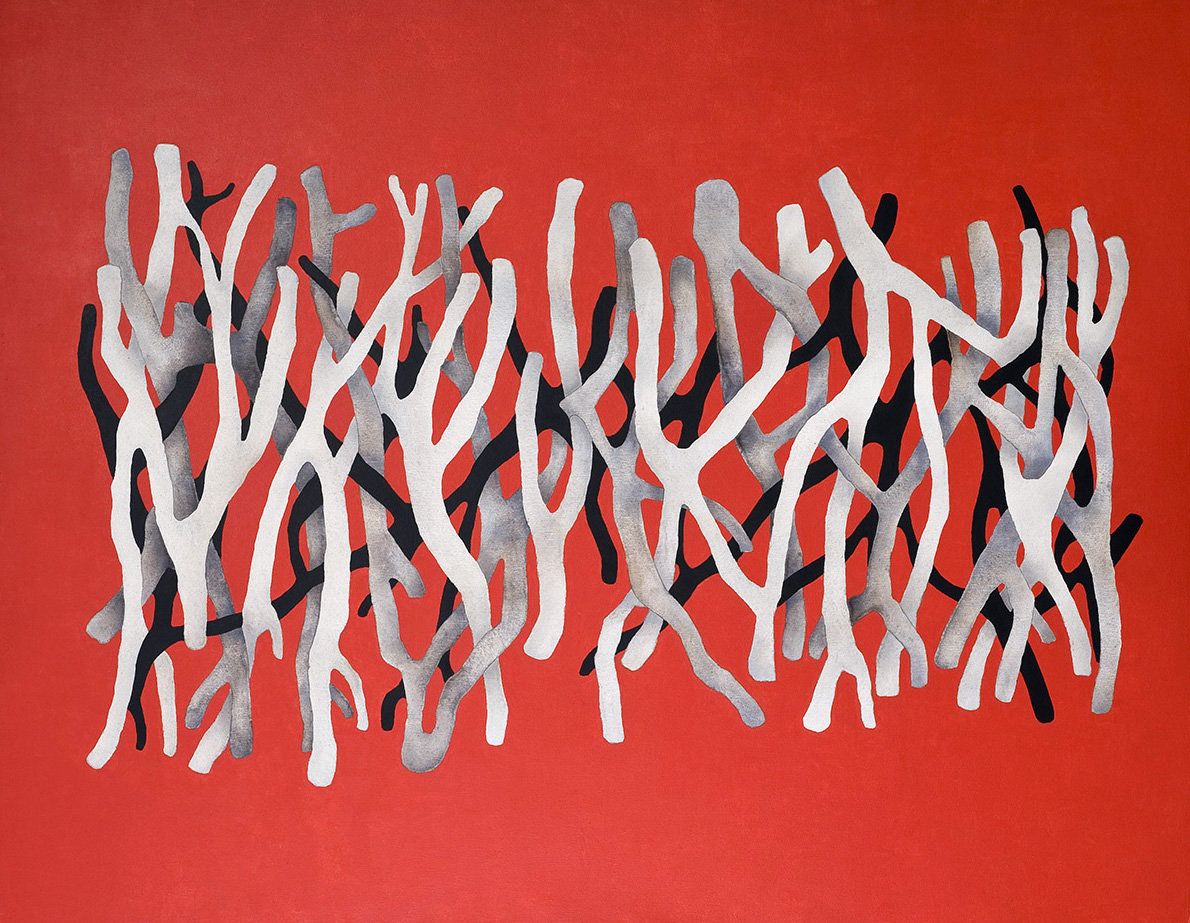
 

Pamela Rataj (Australian) 'Faisceaux 1' 2009


Pamela Rataj (Australian)
Faisceaux 1
2009
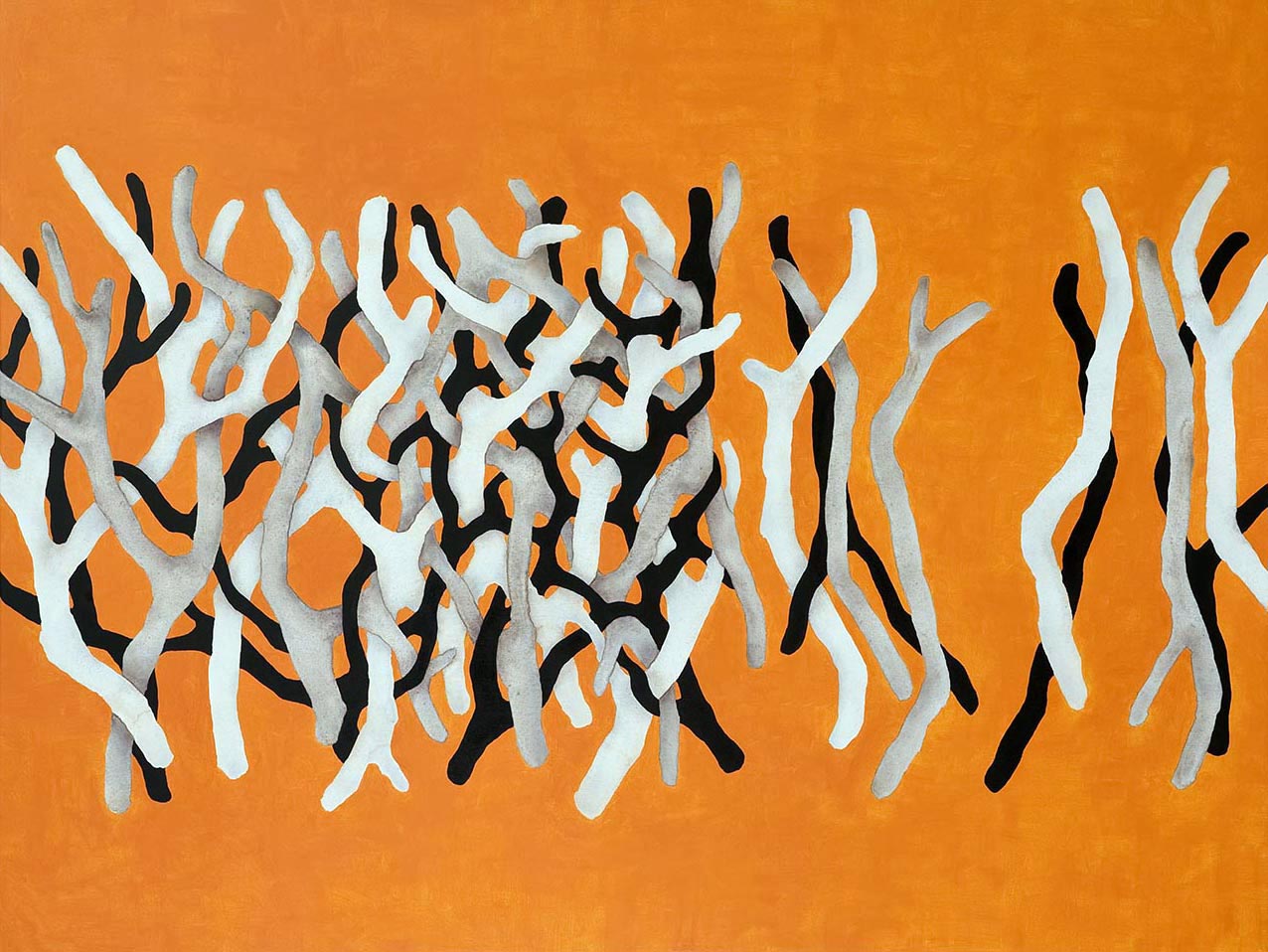
 

Pamela Rataj. 'Faisceaux 4' 2009


Pamela Rataj (Australian)
Faisceaux 4
2009


Claudia Damichi. The Bitter Sweet at Sophie Gannon Gallery

30th March – 25th April 2010
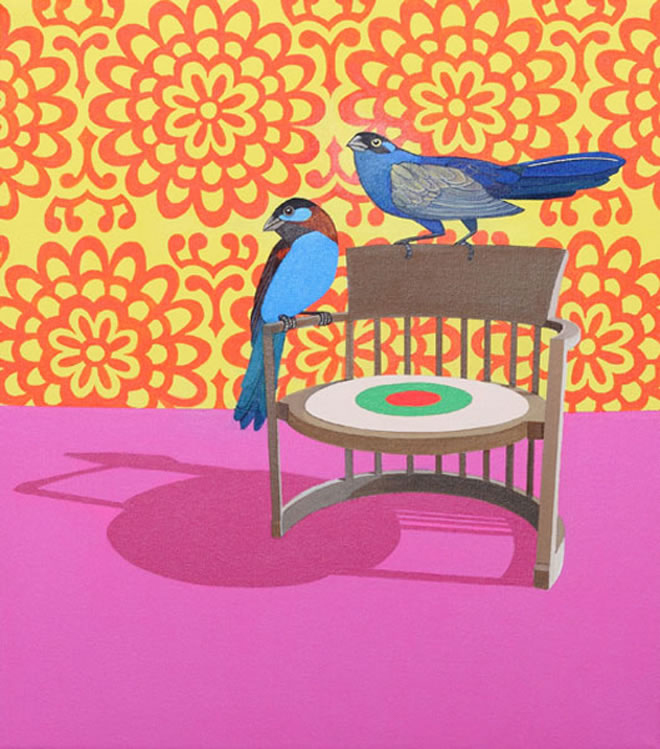
 

Claudia Damichi (Australian, b. 1972) 'Birds eye' 2010


Claudia Damichi (Australian, b. 1972)
Birds eye
2010
Acrylic on canvas
46 x 41cm
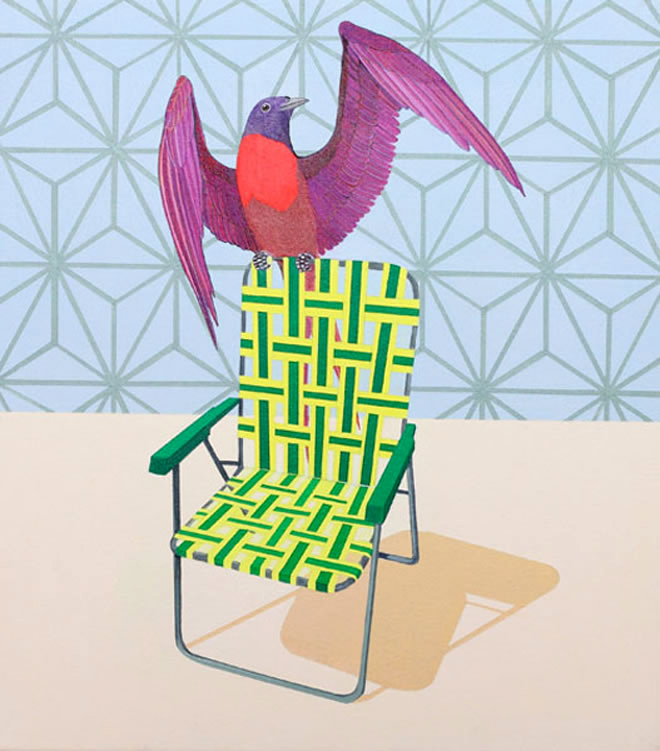
 

Claudia Damichi (Australian, b. 1972) 'Star Gazer' 2009


Claudia Damichi (Australian, b. 1972)
Star Gazer
2009
Acrylic on canvas
46 x 41cm
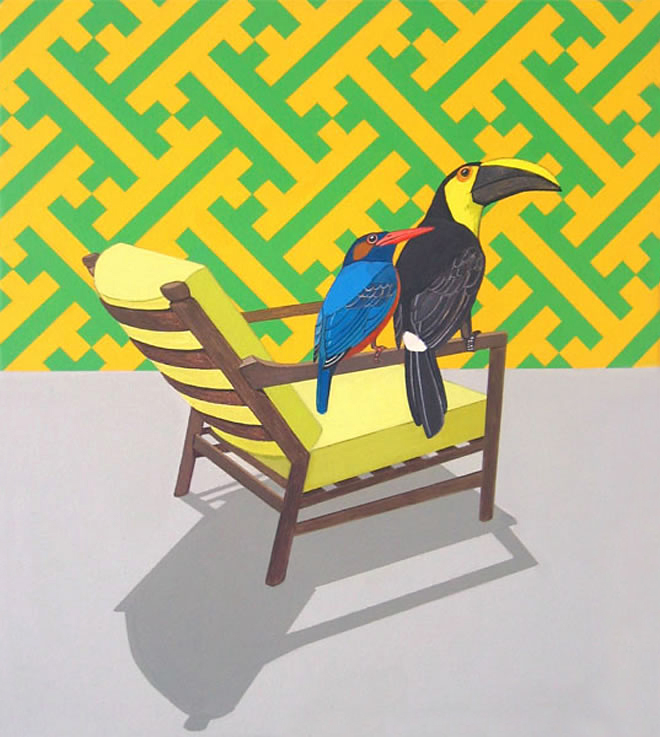
 

Claudia Damichi (Australian, b. 1972) 'Gridlock' 2010


Claudia Damichi (Australian, b. 1972)
Gridlock
2010
Acrylic on canvas
41 x 46cm
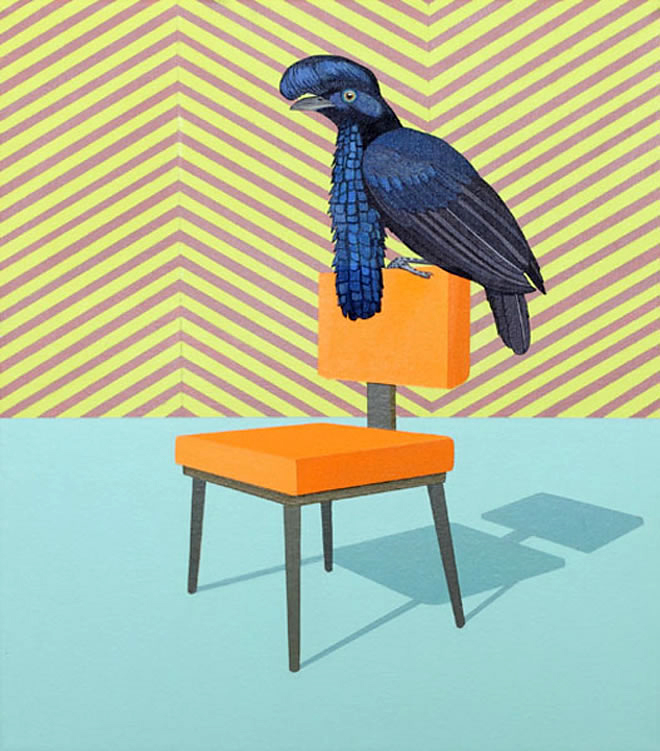
 

Claudia Damichi (Australian, b. 1972) 'Reading between the lines' 2010


Claudia Damichi (Australian, b. 1972)
Reading between the lines
2010
Acrylic on canvas
46 x 41cm


Claudia Damichi’s surrealist still life paintings are characterised by vivid colours, elaborate patterns and distorted spatial proportions. In her paintings of domestic interiors, flowers, birds and furniture, colour is inflated and scale is playfully manipulated – solitary domestic interiors are reconfigured into places of fantasy and illusion. Inspired by the enduring aesthetic of modern industrial design, her surreal and theatrically staged scenarios self-consciously conjure a sense of the absurd. Graphic patterning, high-croma colour and whimsical compositions foster worlds that are at once playful and claustrophobic, satirical and real, tapping into an ambiguous nostalgia that leaves the viewer feeling that anything is possible.

Visit the Sophie Gannon website
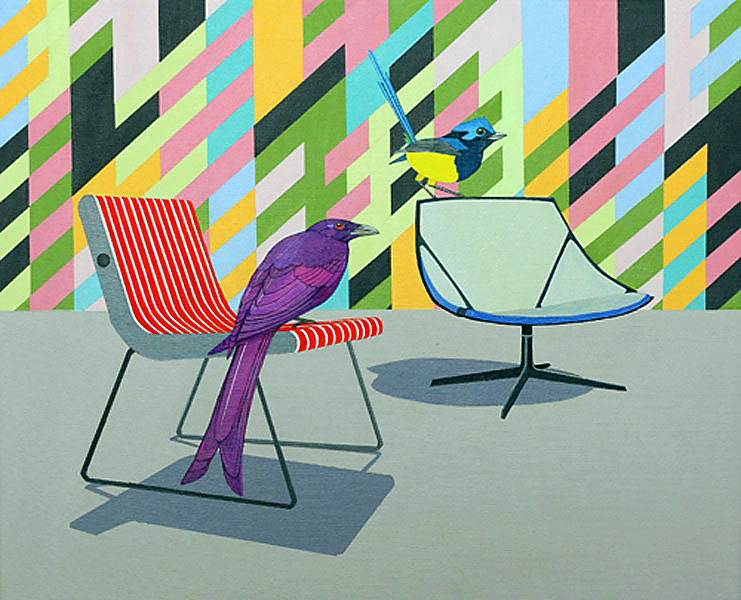
 

Claudia Damichi (Australian, b. 1972) 'Look out' 2010


Claudia Damichi (Australian, b. 1972)
Look out
2010
Acrylic on canvas
46 x 56cm


Steve Rendall. Security, Storage and Recreation at John Buckley Gallery

8th April – 1st May 2010
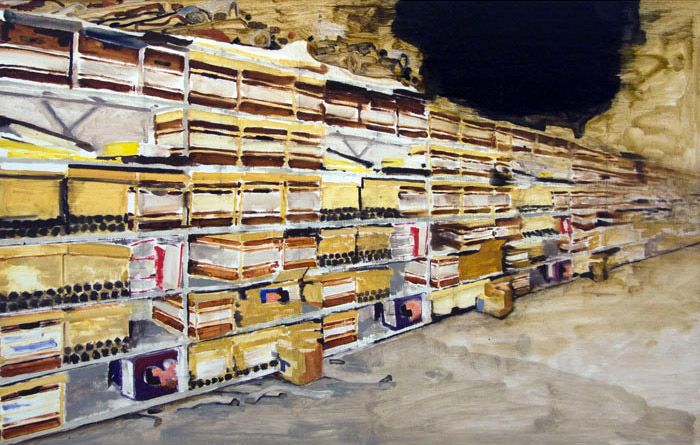
 

Steven Rendall (Australian born Britain, b. 1969; Australia from 2000) 'Archive 1' 2010


Steven Rendall (Australian born Britain, b. 1969; Australia from 2000)
Archive 1
2010
Oil on linen
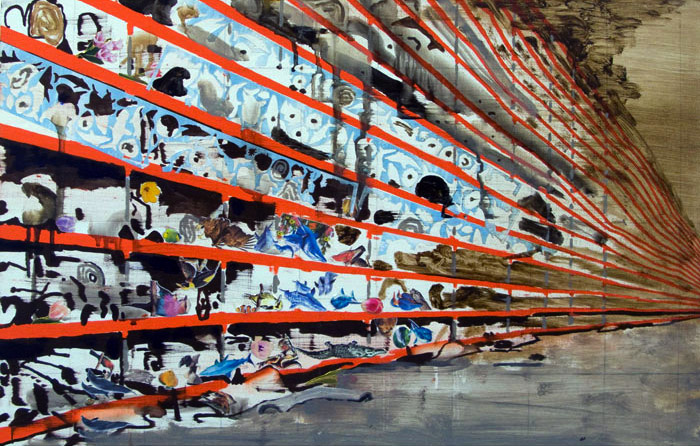
 

Steven Rendall (Australian born Britain, b. 1969; Australia from 2000) 'Archive 2' 2010


Steven Rendall (Australian born Britain, b. 1969; Australia from 2000)
Archive 2
2010
Oil on linen


Citing the British artist Walter Sickert as an important influence on his painterly style, Rendall’s work displays a form and content that has attracted the attention of both critics and collectors. A key work in the exhibition is a large-scale painting on un-stretched linen titled Fountain (Rosemary’s Baby) that sprawls across 4.5m. Certain fountains, along with other apparently arbitrary images of television monitors, speedboats, clothing racks, shelving units and museum interiors are recurring motifs in Rendall’s paintings.

Rendall aims to ‘collect and synthesise’ images from around his home and en route to and from his Brunswick studio. Passing observations of window displays, charity shops and various light industrial warehouses are registered and recorded in conjunction with the accumulation of promotional flyers spruiking leisure activities and museum experiences. This shambolic collection of images is transcribed into an array of compositions in Rendall’s paintings. Images occasionally materialise in unlikely places, such as the spectral diver’s head that is resting on a warehouse shelf in the appropriately titled Storage.

In the exhibition Security, Storage and Recreation, you are invited to enter the image bank of Steven Rendall; a ‘wake in fright’ experience where one can become immersed and caught up in the maelstrom of the artist’s visual language – a sequence of painterly dreams each similar yet different to the last.”

Press release from the John Buckley Gallery website [Online] Cited 10/04/2010 no longer available online
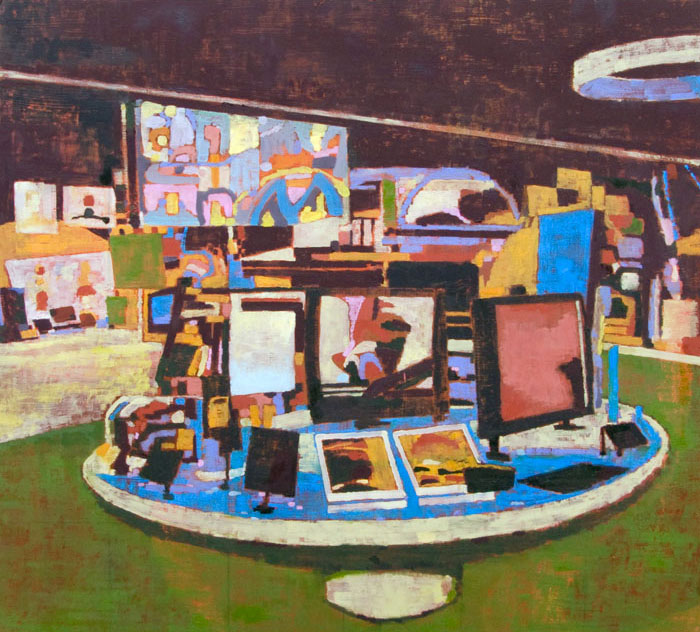
 

Steven Rendall (Australian born Britain, b. 1969; Australia from 2000) 'Flat Screens (Green)' 2010


Steven Rendall (Australian born Britain, b. 1969; Australia from 2000)
Flat Screens (Green)
2010
Oil on linen
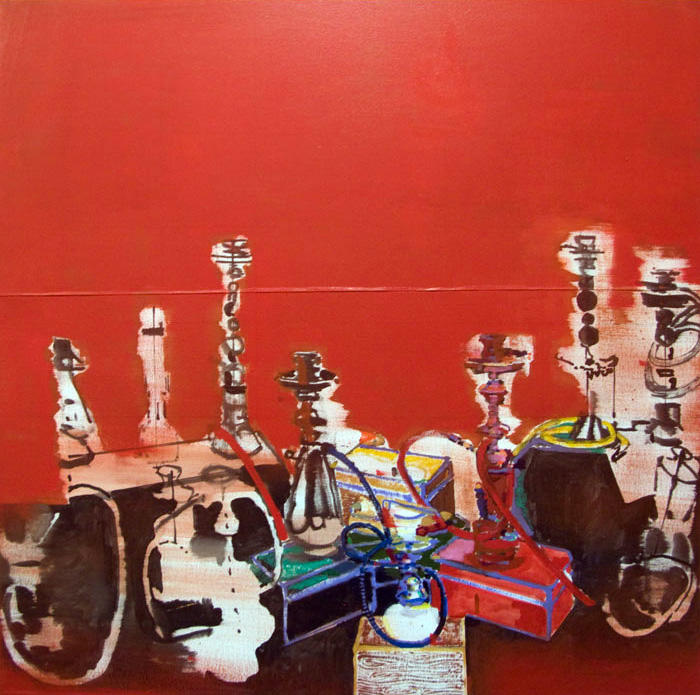
 

Steven Rendall (Australian born Britain, b. 1969; Australia from 2000) 'Pipes' 2010


Steven Rendall (Australian born Britain, b. 1969; Australia from 2000)
Pipes
2010
Oil on linen
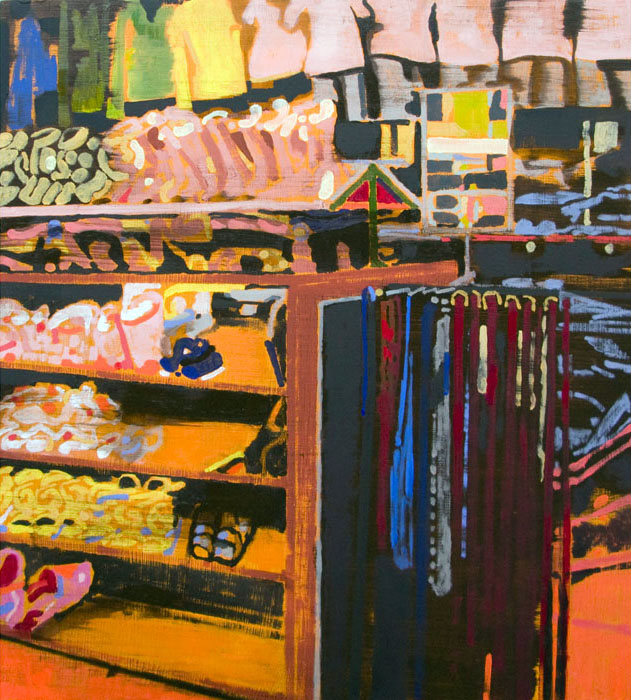
 

Steven Rendall (Australian born Britain, b. 1969; Australia from 2000) 'Claustrophobia' 2010


Steven Rendall (Australian born Britain, b. 1969; Australia from 2000)
Claustrophobia
2010
Oil on linen
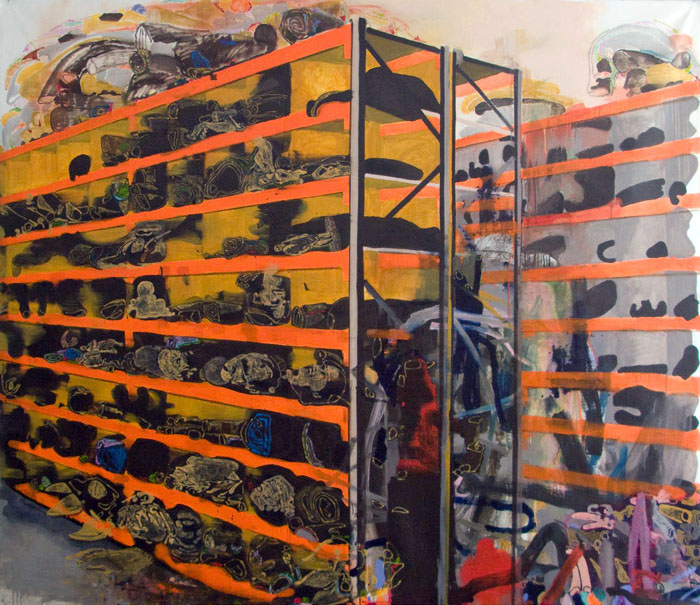
 

Steven Rendall (Australian born Britain, b. 1969; Australia from 2000) 'Redacted 2' 2010


Steven Rendall (Australian born Britain, b. 1969; Australia from 2000)
Redacted 2
2010
Oil on linen


Robert Boynes. Postscript at Karen Woodbury Gallery

7th April – 1st May 2010
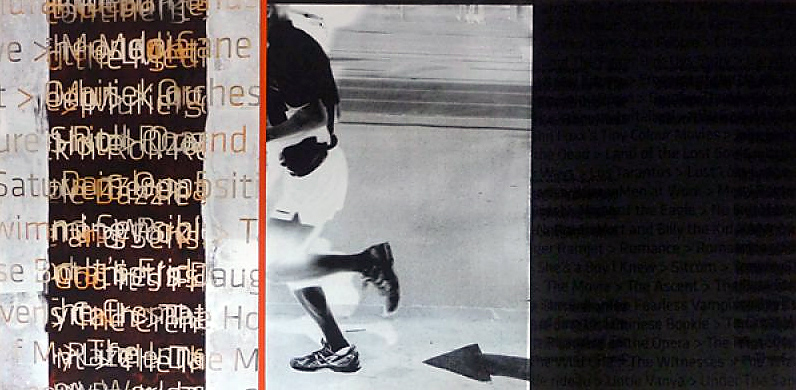
 

Robert Boynes (Australian, b. 1942) 'Street Runner' 2010


Robert Boynes (Australian, b. 1942)
Street Runner
2010
Acrylic on canvas and velvet
120 x 242cm


Robert Boynes (Australian, b. 1942) 'Days that we forgot' 2010


Robert Boynes (Australian, b. 1942)
Days that we forgot
2010
Acrylic on canvas
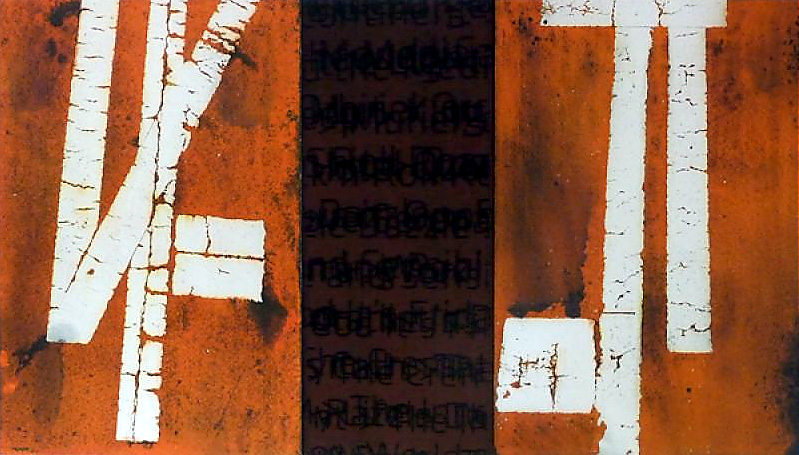
 

Robert Boynes (Australian, b. 1942) 'Signal Driver' 2010


Robert Boynes (Australian, b. 1942)
Signal Driver
2010
Acrylic on canvas and velvet
120 x 190cm


Postscript is Robert Boynes’ second solo exhibition with Karen Woodbury Gallery. This series continues with his exploration of urban themes, contemporary experience and experimentation into ways of using paint. In this most recent body of work Robert has employed the use of text in juxtaposition to various materials such as wood and velvet. The text conveys a feeling of noise and urban clatter, acting as a context and environment for the figures within the work.

His technique involves transferring photographic images to large silk screens and dragging paint through the mesh onto canvas. Robert thus has control in the manipulation of colour, density and translucency of the images. This process results in still moments that magnify and investigate everyday observable reality. The anonymous figures are juxtaposed with text and layering of saturated, contrasting colours, appearing objectified and ghostly.

These works embody a filmic quality, the multi-panelled paintings signify fragmented narratives and enquire into perceptions of time and space.

Text from the Karen Woodbury Gallery website [Online] Cited 10/04/2010 no longer available online
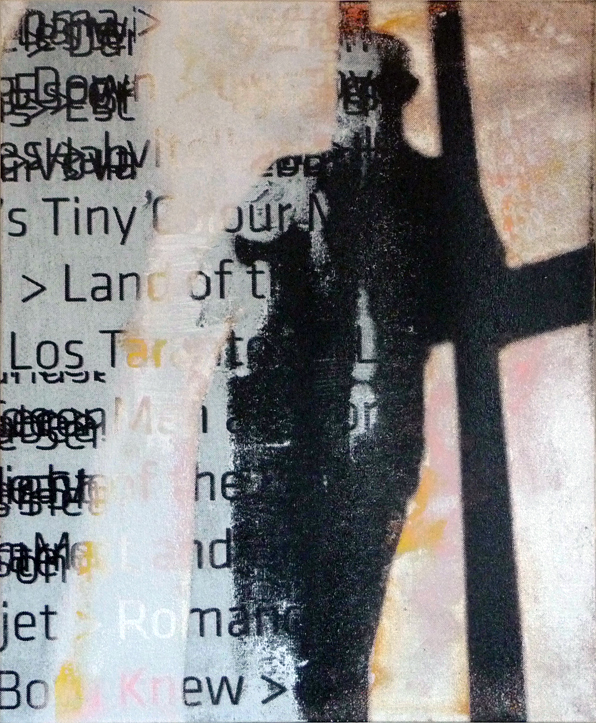
 

Robert Boynes (Australian, b. 1942) 'Body Type' 2 2010


Robert Boynes (Australian, b. 1942)
Body Type 2
2010
Acrylic on canvas
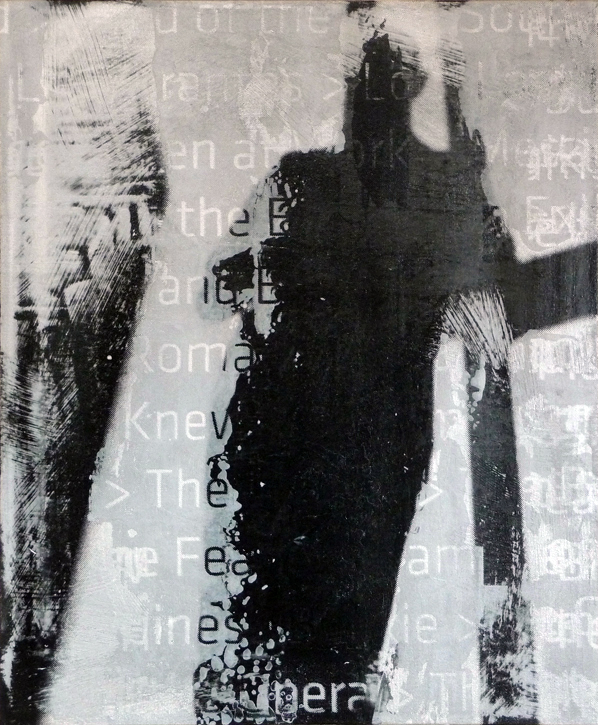
 

Robert Boynes (Australian, b. 1942) 'Body Type 3' 2010


Robert Boynes (Australian, b. 1942)
Body Type 3
2010
Acrylic on canvas


Robert Boynes (Australian, b. 1942) 'Things we leave behind' 2009


Robert Boynes (Australian, b. 1942)
Things we leave behind
2009
Acrylic on canvas
120 x 180cm
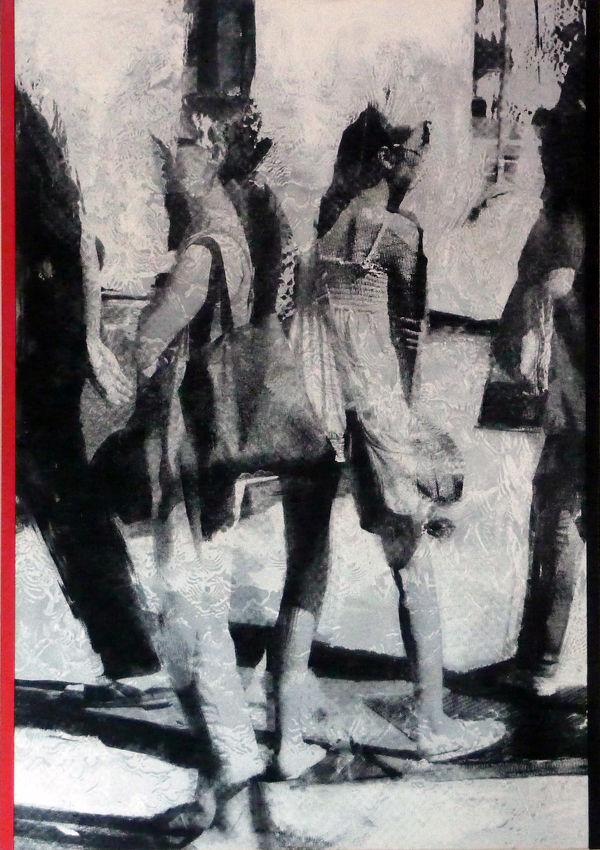
 

Robert Boynes (Australian, b. 1942) 'The layered moment' 2009


Robert Boynes (Australian, b. 1942)
The layered moment
2009
Acrylic on canvas
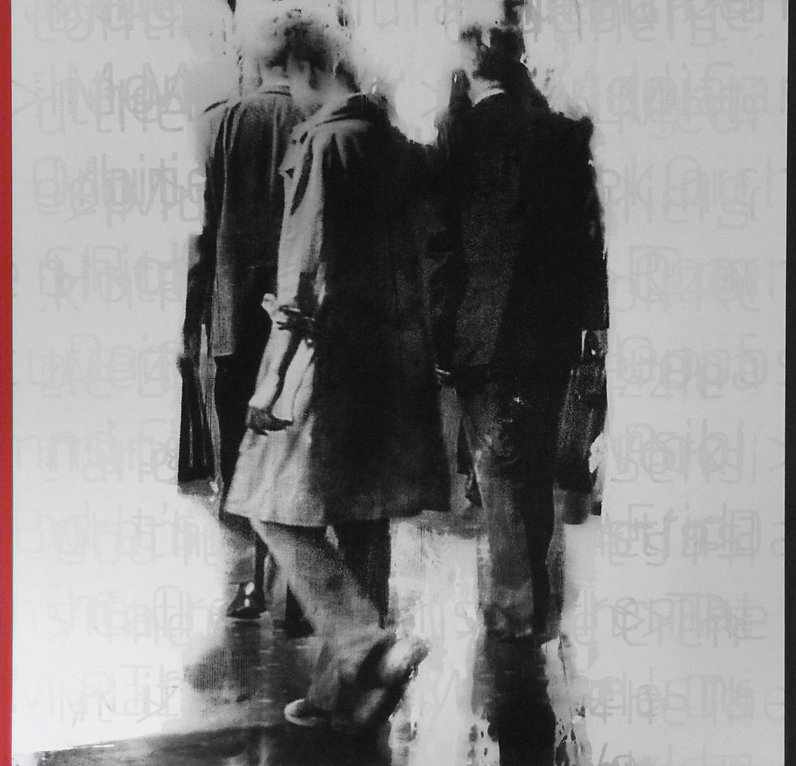
 

Robert Boynes (Australian, b. 1942) 'Postscript' 2009


Robert Boynes (Australian, b. 1942)
Postscript
2009
Acrylic on canvas
120 x 124cm


All galleries have closed except for Sophie Gannon Gallery, Richmond.

Sophie Gannon Gallery
2 Albert Street Richmond VIC 3121 Australia
Phone: +61 3 9421 0857

Sophie Gannon Gallery website

LIKE ART BLART ON FACEBOOK

Back to top

Melbourne’s Magnificent Dozen 2009

January 2010


Here’s my pick of the twelve best exhibitions in Melbourne for 2009 that featured on Art Blart (in no particular order) – and a few honourable mentions that very nearly made the list!


1. The Water Hole by Gerda Steiner and Jorg Lenzlinger at ACCA (Australian Centre for Contemporary Art)


Gerda Steiner (Swiss, b. 1967) and Jorg Lenzlinger (Swiss, b. 1964) 'The Waterhole' 2009


Gerda Steiner (Swiss, b. 1967) and Jorg Lenzlinger (Swiss, b. 1964)
The Water Hole
2009


“The most effective bed has a small meteorite suspended in a net bag above it. The viewer slides underneath the ‘rock’ placing the meteorite about a foot or so above your face. The meteorite is brown, dark and heavy, swinging slightly above your ‘third eye’. You feel its weight pressing down on your energy, on your life force and you feel how old this object is, how far it has traveled, how fragile and mortal you are. It is a sobering and enlightening experience but what an experience it is!”

This was a magical and poignant exhibition that was a joy for children and adults alike. Children love it running around exploring the environments. Adults love it for it’s magical, witty and intelligent response to the problems facing our planet and our lives. A truly enjoyable interplanetary collision.

2. Ocean Without A Shore video installation by Bill Viola at The National Gallery of Victoria


Bill Viola (American, 1951-2024) 'Ocean Without A Shore' 2007 video still


Installation photograph of Ocean Without A Shore at the National Gallery of Victoria, Melbourne


The resurrected are pensive, some wringing the hands, some staring into the light. One offers their hands to the viewer in supplication before the tips of the fingers touch the wall of water – the ends turning bright white as they push through the penumbrae of the interface. As they move forward the hands take on a stricken anguish, stretched out in rigour. Slowly the resurrected turn and return to the other side. We watch them as we watch our own mortality, life slipping away one day after another. Here is not the distraction of a commodified society, here is the fact of every human life: that we all pass.

The effect on the viewer is both sad but paradoxically uplifting. I cried …

These series of encounters at the intersection of life and death are worthy of the best work of this brilliant artist. He continues to astound with his prescience, addressing what is undeniable in the human condition. Long may he continue.

3. Rosalie Gascoigne at The Ian Potter Centre: NGV Australia


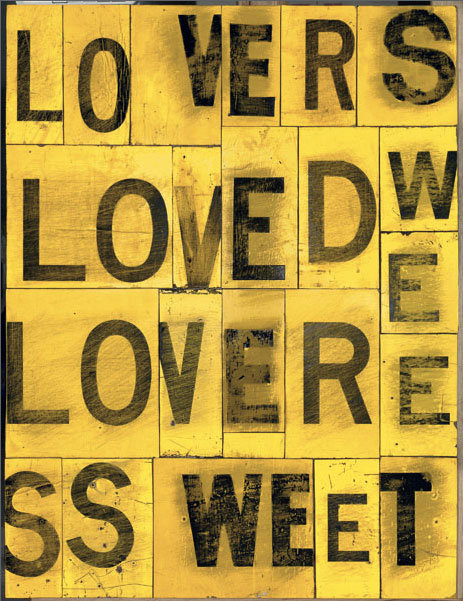
Rosalie Gascoigne (Australian born New Zealand, 1917-1999) 'Sweet lovers' 1990


Rosalie Gascoigne (Australian born New Zealand, 1917-1999)
Sweet lovers
1990


This was a wonderful exhibition. Gascoigne rightly commands a place in the pantheon of Australian stars. She has left us with a legacy of music that evokes the rhythms, the air, the spaces and colours of our country. As she herself said,

“Look at what we have: Space, skies. You can never have too much of nothing.”

Nothing more, nothing less.

4. The Big Black Bubble paintings by Dale Frank at Anna Schwartz Gallery


Dale Frank (Australian, b. 1959) 'Ryan Gosling' (2008/2009)


Dale Frank (Australian, b. 1959)
Ryan Gosling
2008/2009


The artist offered the viewer the ability to generate their own resonances with the painting, to use the imagination of ‘equivalence’ to suggest what these paintings stand for – and also what else they stand for. States of being, of transformation, wonder and joy emerged in the playfulness of these works.

Ryan Gosling was a tour de force. With the poetic structure of an oil spill, the varnish forms intricate slick upon slick contours that are almost topographical in their mapping. The black oozes light, becomes ‘plastic’ black before your eyes, like the black of Rembrandt’s backgrounds, illusive, illuminative and hard to pin down – perpetually hanging there in two dripping rows, fixed but fluid at one and the same time (you can just see the suspensions in the photograph above).

This painting was one of the most overwhelming syntheses of art and nature, of universal forces that I have seen in recent contemporary art. This exhibition was an electric pulsating universe of life, landscape and transformation. Magnificent!

5. So It Goes by Laith McGregor at Helen Gory Galerie


Laith McGregor (Australian, b. 1977) 'The Last Bastion' 2009 (detail)


Laith McGregor (Australian, b. 1977)
The Last Bastion (detail)
2009


Simply spectacular!

I had never seen such art made using a biro before: truly inspiring.
Inventive, funny, poignant and outrageous this was a must see show of 2009.

6. triestement (more-is u thrill-o) by Domenico De Clario at John Buckley Gallery


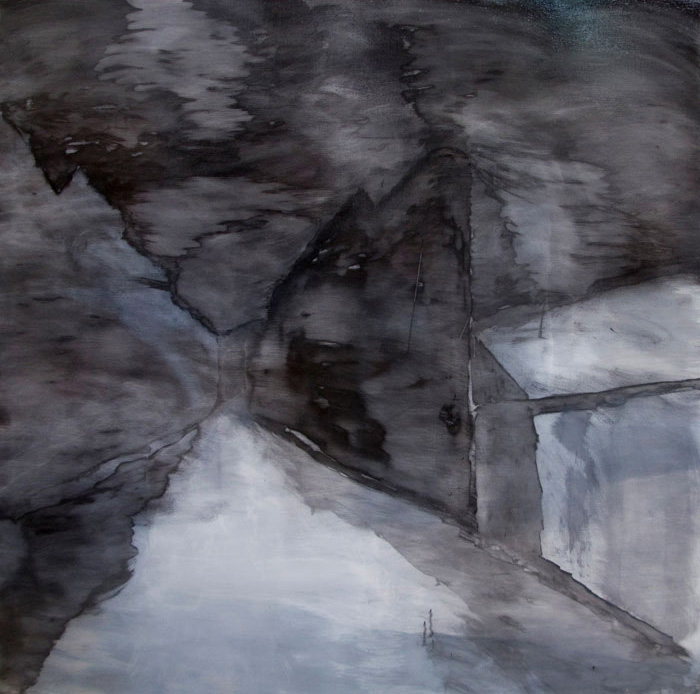
Domenico de Clario (Australian born Italy, b. 1947) 'o (la grande maison blanche – snow clouds massing)' 2008/09


Domenico de Clario (Australian born Italy, b. 1947)
o (la grande maison blanche – snow clouds massing)
2008/09


Painted in a limited colour palette of ochres, greys and blacks the works vibrate with energy. Cezanne like spatial representations are abstracted and the paint bleeds across the canvas forming a maze of buildings. Walls and hedges loom darkly over roadways, emanations of heads and figures float in the picture plane and the highlight white of snow hovers like a spectral figure above buildings. These are elemental paintings where the shadow has become light and the light is shadow, meanderings of the soul in space.

de Clario feels the fluid relationship between substance and appearance; he understands that Utrillo is embedded in the position of each building and stone, in the cadences and rhymes of the paintings of Montmarte. de Clario interprets this knowledge in a Zen like rendition of shadow substance in his paintings. Everything has it’s place without possession of here and there, dark and light.

For my part it was my soul responding to the canvases. I was absorbed into their fabric. As in the dark night of the soul my outer shell gave way to an inner spirituality stripped of the distance between viewer and painting. I felt communion with this man, Utrillo, with this art, de Clario, that brought a sense of revelation in the immersion, like a baptism in the waters of dark light. For art this is a fantastic achievement.

7. McLean Edwards: Songs from the Ghost Ship at Karen Woodury Gallery


McLean Edwards (Australian, b. 1972) 'Venus' 2009


McLean Edwards (Australian, b. 1972)
Venus
2009


These heterogeneous paintings were a knockout with their wonderful, layered presence – they really command the viewer to look at them and celebrate the characters within them. Whimsical, ironic and full of humour these phantasmagorical images of creatures cast adrift with the night sky as background are fabulous assemblages of colour, form and storytelling.

My friend and I really enjoyed this exhibition. We were captivated by these songs, going back to the work again and again to tease out the details, to feel connection to the work. These are not lonely isolated figures but sublime emanations of inner states of being expertly rendered in glorious colour. And they made us laugh – what more could you ask for!

8. Tacita Dean at Australian Centre for Contemporary Art (ACCA)


Tacita Dean (English, b. 1965) 'Michael Hamburger' 2007


Tacita Dean (English, b. 1965)
Michael Hamburger [Still]
16mm colour anamorphic, optical sound
28 minutes
2007


“One can see echoes of Sebald’s work in that of Tacita Dean – the personal narratives accompanied by mythical and historical stories and pictures. The tactility of Hamburger’s voice and hands, his caressing of the apples with the summary justice of the tossing away of rotten apples to stop them ruining the rest of the crop is arresting and holds you transfixed. Old varieties and old hands mixed with the old technology of film make for a nostalgic combination … Dean implicitly understands how objects can be elegies for fleeting lives.”

Tacita Dean is a fantastic artist whose work examines the measure of things, the vibrations of spirit in the FLUX of experience. Her work has a trance-like quality that is heavy with nostalgia and memory and reflects the machine-ations of contemporary life. In her languorous and dense work Dean teases out the significance of insignificant actions/events and imparts meaning and life to them. This is no small achievement!

As an exhibition this was an intense and moving experience.

9. Ivy photographs by Jane Burton at Karen Woodbury Gallery


Jane Burton (Australian, b. 1966) 'Ivy #2' 2009


Jane Burton (Australian, b. 1966)
Ivy #2
2009


I feel that in these photographs with their facelessness and the non-reflection of the mirror investigate notions of ‘Theoria’ – a Greek emphasis on the vision or contemplation of God where theoria is the lifting up of the individual out of time and space and created being and through contemplative prayer into the presence of God. In fact the whole series of photographs can be understood through this conceptualisation – not just remembrances of past time, not a blind contemplation on existence but a lifting up out of time and space into the an’other’ dark but enlightening presence.

The greatest wonder of this series is that the photographs magically reveal themselves again and again over time. Despite (or because of) the references to other artists, the beauty of Burton’s work is that she has made it her own. The photographs have her signature, her voice as an artist and it is an informed voice; this just makes the resonances, the vibrations of energy within the work all the more potent and absorbing. I loved them.

10. Sweet Complicity by eX de Medici at Karen Woodbury Gallery


eX de Medici (Australia, b. 1959) 'Tooth and claw' 2009 (detail)


eX de Medici (Australia, b. 1959)
Tooth and claw (detail)
2009


In other less skilled artist’s hands the subject matter could become cliched and trite but here de Medici balances the disparate elements in her compositions and brings the subject matter alive – sinuously jumping off the paper, entwining the viewer in their delicious ironies, all of us sweetly complicit in the terror war (send more meat, send more meat!), fighting tooth and nail to keep urban realities at arm’s length. The dark desires that these works contain possess an aesthetic beauty that swallows us up so that we, too, become ‘Barbarians All’.

11. Emily Kame Kngwarreye: The Person and her Paintings at DACOU Aboriginal Art


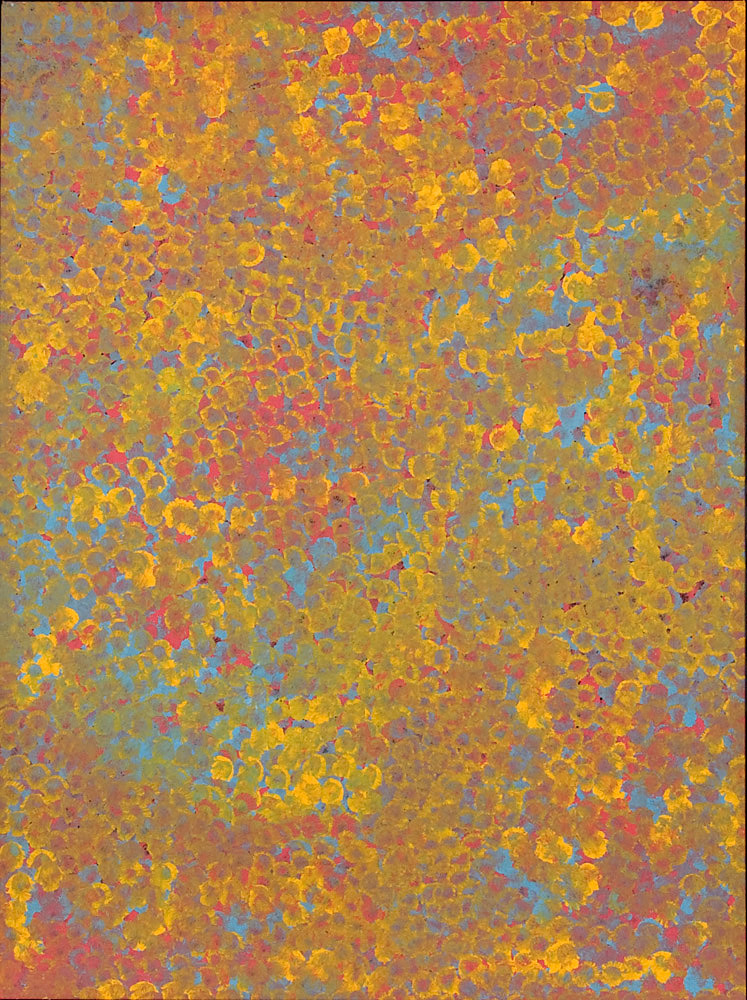
Emily Kame Kngwarreye (Australian, 1910-1996) 'Wildflower' 1994


Emily Kame Kngwarreye (Australian, 1910-1996)
Wildflower
1994


The paintings were painted horizontally (like the painter Jackson Pollock who intuitively accessed the spiritual realm) and evidence a horizontal consciousness not a hierarchical one. Knowledge is not privileged over wisdom. There is a balance between knowledge and wisdom – the knowledge gained through a life well lived and the wisdom of ancient stories that represent the intimacy of living on this world. The patterns and diversities of life compliment each other, are in balance.

Wisdom comes from the Indo-European root verb weid, “to see,” the same root from which words like vision come. In this sense these are “Vedic” paintings in that they are ancient, sacred teachings, Veda meaning literally “I have seen.”

On this day I saw. I felt.

12. Unforced Intimacies by Patricia Piccinini at Tolarno Galleries


Patricia Piccinini (Australian, b. 1965) 'Doubting Thomas' 2008 (detail)


Patricia Piccinini (Australian, b. 1965)
Doubting Thomas (detail)
2008


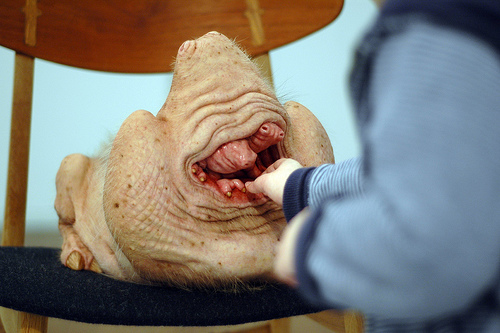
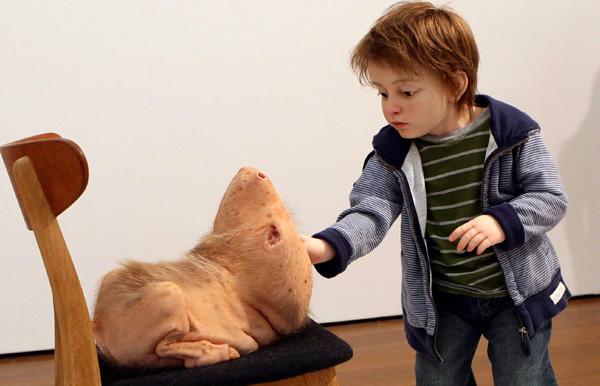
Patricia Piccinini (Australian, b. 1965) 'Doubting Thomas' 2008


Patricia Piccinini (Australian, b. 1965)
Doubting Thomas
Silicone, fibreglass, human hair, clothing, chair
2008


The terrains the Piccinini interrogates (nature and artifice, biogenetics, cloning, stem cell research, consumer culture) are a rematerialisation of the actual world through morphological ‘mapping’ onto the genomes of the future. Morphogenetic fields seem to surround the work with an intense aura; surrounded by this aura the animals and children become more spiritual in their silence. Experiencing this new world promotes an evolution in the way in which we conceive the future possibilities of life on this earth, this brave but mutably surreal new world.

This was truly one of the best exhibitions of the year in Melbourne.


Honorable mentions

~ Climbing the Walls and Other Actions by Clare Rae at the Centre for Contemporary Photography
In these photographs action is opposed with stillness, danger opposed with suspension; the boundaries of space, both of the body and the environment, the interior and the exterior, memory and dream, are changed.

~ Johannes Kuhnen: a survey of innovation at RMIT Gallery
We stood transfixed before this work, peering closely at it and gasping in appreciation of the beauty, technical proficiency and pure poetry of the pieces.

~ Double Infinitives by Marco Fusinato at Anna Schwartz Gallery
The images are literally ripped from the matrix of time and space and become the dot dot dot of the addendum. What Fusinato does so excellently is to make us pause and stare, to recognize the flatness of these figures and the quietness of violence that surrounds us.

~ all about … blooming by JUNKO GO at Gallery 101
Go’s musings on the existential nature of our being are both full and empty at one and the same time and help us contemplate the link to the breath of the sublime.

~ Mood Bomb by Louise Paramor at Nellie Castan Gallery
They are dream states that allow the viewer to create their own narrative with the title of the works offering gentle guides along the way. These are wonderfully evocative paintings.

~ New 09 at Australian Centre for Contemporary Art (ACCA)
Finally you sit on the aluminium benches and contemplate in silence all that has come before and wonder what just hit you in a tidal wave of feelings, immediacies and emotions. The Doing and Undoing of Things.

~ My Jesus Lets Me Rub His Belly by Martin Smith at Sophie Gannon Gallery
At the end of days, when all is said and done, the funny diatribes with their ambiguous photographs are homily and heretic and together form a more inclusive body of bliss: ‘And also with you and you and you and you’.


LIKE ART BLART ON FACEBOOK

Back to top

Review: ‘The Big Black Bubble’ exhibition by Dale Frank at Anna Schwartz Gallery, Melbourne

Exhibition dates: 12th March – 11th April, 2009


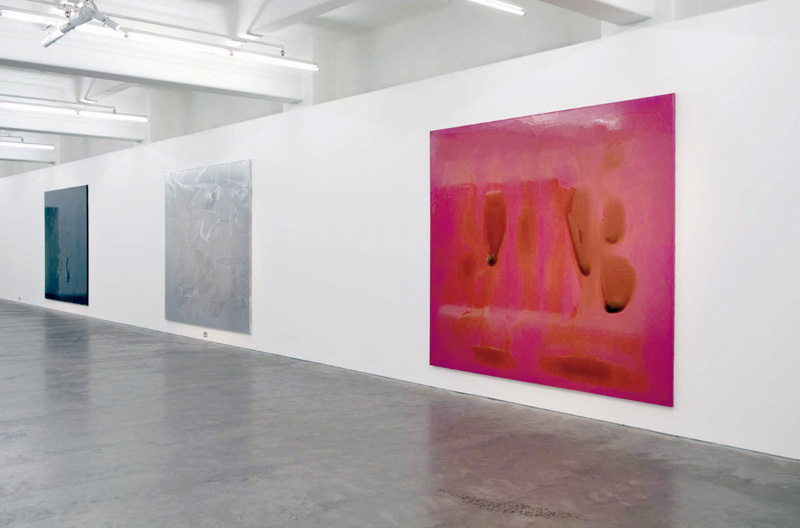
Dale Frank (Australian, b. 1959) 'The Big Black Bubble' installation view at Anna Schwartz Gallery, Melbourne 2009


Dale Frank (Australian, b. 1959)
The Big Black Bubble (installation view)
Left to right: Timothy Oliphant (2008), Ryan Gosling (2008/2009) and Matthew Macfadyen (2008)
2009


This is a brilliant exhibition by Dale Frank, one of my favourites so far this year in Melbourne.

Six large varnish on linen landscape paintings are presented in the beautiful Anna Schwartz gallery space in Melbourne. Photographs really do not do the paintings justice – they can only give an impression of the size and scale of the work but not of their intimacy or smell. The smell of varnish permeates the air. The serendipity of the natural convulsions of the varnish and the facilitations of the hand of the artist, his performance, have been caught like bugs in amber in the final molecular structure of the painting. Here are pendulous, globular goops of varnish, immersive heroic tone poems that form images in the mind of the viewer. Moving close to the paintings you are surrounded by flows and eddies, the macro and the micro; details become more apparent as you study the work.

While disagreeing that these paintings are the viewers to create (the viewer as author) what I can say is that the artist offers the viewer the ability to generate their own resonances with the painting, to use the imagination of ‘equivalence’ to suggest what these paintings stand for – and also what else they stand for. States of being, of transformation, wonder and joy emerge in the playfulness of these works. Perhaps this is where the titles of the paintings come from, referencing film actors in the pop tradition, but this is the only thing that did not ring true with the work, their titles. The use of this trope seems to me a bit facile given the nature of the work.

The hot pink painting Rupert Grint (2008/2009, above) is hotter and lighter than in the photograph below, the varnish more translucent, the effect altogether mesmeric. You are drawn into the work, the intensity of the colour, the thickness of the hanging varnish. Two cosmological galaxies (Timothy Oliphant (2008) and Matthew Macfadyen (2008)) surround the most complex painting in the exhibition, the darkness and light that is Ryan Gosling (2008/2009, below).

This painting is a tour de force. With the poetic structure of an oil spill, the varnish forms intricate slick upon slick contours that are almost topographical in their mapping. The black oozes light, becomes ‘plastic’ black before your eyes, like the black of Rembrandt’s backgrounds, illusive, illuminative and hard to pin down – perpetually hanging there in two dripping rows, fixed but fluid at one and the same time (you can just see the suspensions in the photograph above).

The painting reminds me of the black paintings of Mark Rothko that he undertook for The Rothko Chapel in Houston, Texas (see below). As with the Rothko paintings, this painting is not just black (physically there are swirls of purple as in the Rothko paintings), not about darkness at all. What both artists do is create a contemplative, transformative space – in Frank’s case for a world on the edge of oblivion. This is a post post-modern landscape: process and nature, performance and chance coalescing in the colour : black!

This painting is one of the most overwhelming syntheses of art and nature, of universal forces that I have seen in recent contemporary art. This exhibition is an electric pulsating universe of life, landscape and transformation. Magnificent!

Dr Marcus Bunyan


Many thankx to Anna Schwartz Gallery for allowing me to publish the photographs in the posting. Please click on the photographs for a larger version of the image.


Dale Frank (Australian, b. 1959) 'The Big Black Bubble' installation view at Anna Schwartz Gallery, Melbourne 2009


Dale Frank (Australian, b. 1959)
The Big Black Bubble (installation view)
Left to right: Daniel Radcliffe (2008/2009), Khan Chittenden (2009) and Rupert Grint (2008/2009)
2009


The immersive scale of these new paintings at Anna Schwartz Gallery Melbourne allows us to experience their inner qualities of landscape and of transformation. This is painting at fundamental authenticity. The paint is its own agent; it is allowed to act, to behave. The artist is the facilitator of these phenomena of nature and natural forces, whose residue is a metaphor for nature itself.

Black contains all colours, contours and depths. A pink monochrome is transformed by pure varnish into an expressionistic moment of process and performance. All colour is absent from elemental silver aluminium and form and gesture alone survive. New dynamics are possible through an innovative colouration: the emergence of colour through black, and its equivalent power.

Dale Frank’s painting is one of poetry, performance and nature. It represents both the macro and micro. Huge universal forces pulsate with molecular, atomic activities. Imagination is gifted by the artist to the viewer. These are our paintings to create.

Anonymous text from the exhibition flyer.


Dale Frank (Australian, b. 1959) 'Ryan Gosling' 2008/2009


Dale Frank (Australian, b. 1959)
Ryan Gosling
2008/2009


The Rothko Chapel, Houston, Texas


The Rothko Chapel
Houston, Texas


Anna Schwartz Gallery
185 Flinders Lane
Melbourne 3000
Australia
Phone: +61 3 9654 6131

Opening hours:
Tuesday – Friday 12 – 5pm
Saturday 1 – 5pm

Anna Schwartz Gallery website

LIKE ART BLART ON FACEBOOK

Back to top

Review: ‘all about … blooming’ exhibition by JUNKO GO at Gallery 101, Melbourne

Exhibition dates: 25th February – 14th March, 2009


Junko Go (Australian born Japan, b. 1955) 'Opium Poppy' 2008


Junko Go (Australian born Japan, b. 1955)
Opium Poppy
2008


“One person’s heaven is another’s nightmare. Seeing both sides to every story can be a blessing and a curse. Good and bad, right and wrong, purity and impurity are inextricably linked.”


A delicate, refined but strong presence is felt in the work of Junko Go in the her new exhibition ‘all about … blooming’ at Gallery 101, Melbourne. Nominally landscape painting about flowers but featuring thoughts and ideas about the seed, the shoot, pollen and the breath of life the work addresses the essence of what it is to be human and live compassionately on this earth in an intelligent and profound way.

Denying the nihilism of abstract expressionism each mark is fully considered by being attentive to the connection between brush, hand and meaning. Almost childlike in their use of charcoal and acrylic her dogs, crosses and flowers, jottings and dashes, rain and rivers, seeds and people show a Zen like contemplation in the marks she makes on the canvas – just so. A releasement towards things is proffered, a letting go of the ego to create an awareness of just being. There is genuine warmth and humility to this work.

In Opium Poppy (2008, above) the darkness of the nightmare is represented by the black marks, ascending like Jacob’s ladder balanced by the mandala like poppies whose petals seem like feathers of a bird’s wing – a flight of fancy both good and bad. In Pollen (2009) bees swarm around a sunflower leaving traces of their presence, a bird flies close to a tiny blue cloud, the sun burst forth in a tiny patch of aqua colour, and people hug arm in arm. As Go says, “Bees in a flower bear pollen unawares and play a crucial roll for the plant to survive. Our love, kindness, warmth and wisdom affect one another unawares and play a crucial roll for our planet to survive.” In New Shoot (2008, below) the puzzle of our existence, the nature of our existential being is laid bare for all to see.

In Seeds (2008) Go reminds us that rather than being focused on what we hoped for, we must make the most of whatever opportunities we are blessed with. This means being aware of the gifts one possesses, not the distance between ‘I’ and want, need and desire – now! The seed of our experience – the calm before the force that propelled us into existence – is already present within us.

Go’s musings on the existential nature of our being are both full and empty at one and the same time and help us contemplate the link to the breath of the sublime. In the end Go’s paintings are about endings and beginnings, about being strong or not, about the infinity of the seed and about our responses to living in harmony on this planet. Through the seed, the shoot, the flower and the earth access may be granted to the sublime and this perfectly sums up the work of this artist, a reflection of her energy and radiance transferred to the canvas. I loved it.

Dr Marcus Bunyan


Many thankx to Gallery 101 for allowing me to publish the art work in the posting. Please click on the art work for a larger version of the image.


Junko Go (Australian born Japan, b. 1955) 'New Shoot' 2008


Junko Go (Australian born Japan, b. 1955)
New Shoot
2008


“Each of us is born to fill a special place in this world. In the process, we sometimes have trouble finding our niche. Life is like a jigsaw puzzle in which we make every effort to find our own place that makes a right connection with others, with the world and even with the whole universe.”


Junko Go (Australian born Japan, b. 1955) 'Red Hot Poker' 2009


Junko Go (Australian born Japan, b. 1955)
Red Hot Poker
2009


“Push and pull our inner strength. Sometimes, we need courage to take risks in confronting pain and loss in order to gain a deep and profound experience.”


“We live in a world where high achievers are congratulated, yet true achievements are not related to what we can get done, but to how deeply we aware of how wonderful it is to be alive. In this exhibition, flowers are not only a predominant source of visual inspiration, looking at them also engenders a kind of appreciation and wonder. The fragile and ephemeral flower provokes in me an awareness of the human condition that reveals the true nature of our existence.

My goal is to create images which are strong and soft, bold and precise, beautiful and ugly, figurative and abstract, all at once. My greatest challenge is to make art about what it is to be human … What really matters in art making to me is a kind of awareness – a being able to say, ‘I am as I am’.”

Text from the artist statement


Gallery 101

Gallery 101 is no longer open.

LIKE ART BLART ON FACEBOOK

Back to top

Review: ‘Framing Conflict – Iraq and Afghanistan’ exhibition by Lyndell Brown and Charles Green at The Ian Potter Museum of Art, The University of Melbourne

Exhibition dates: 5th November, 2008 – 1st February, 2009


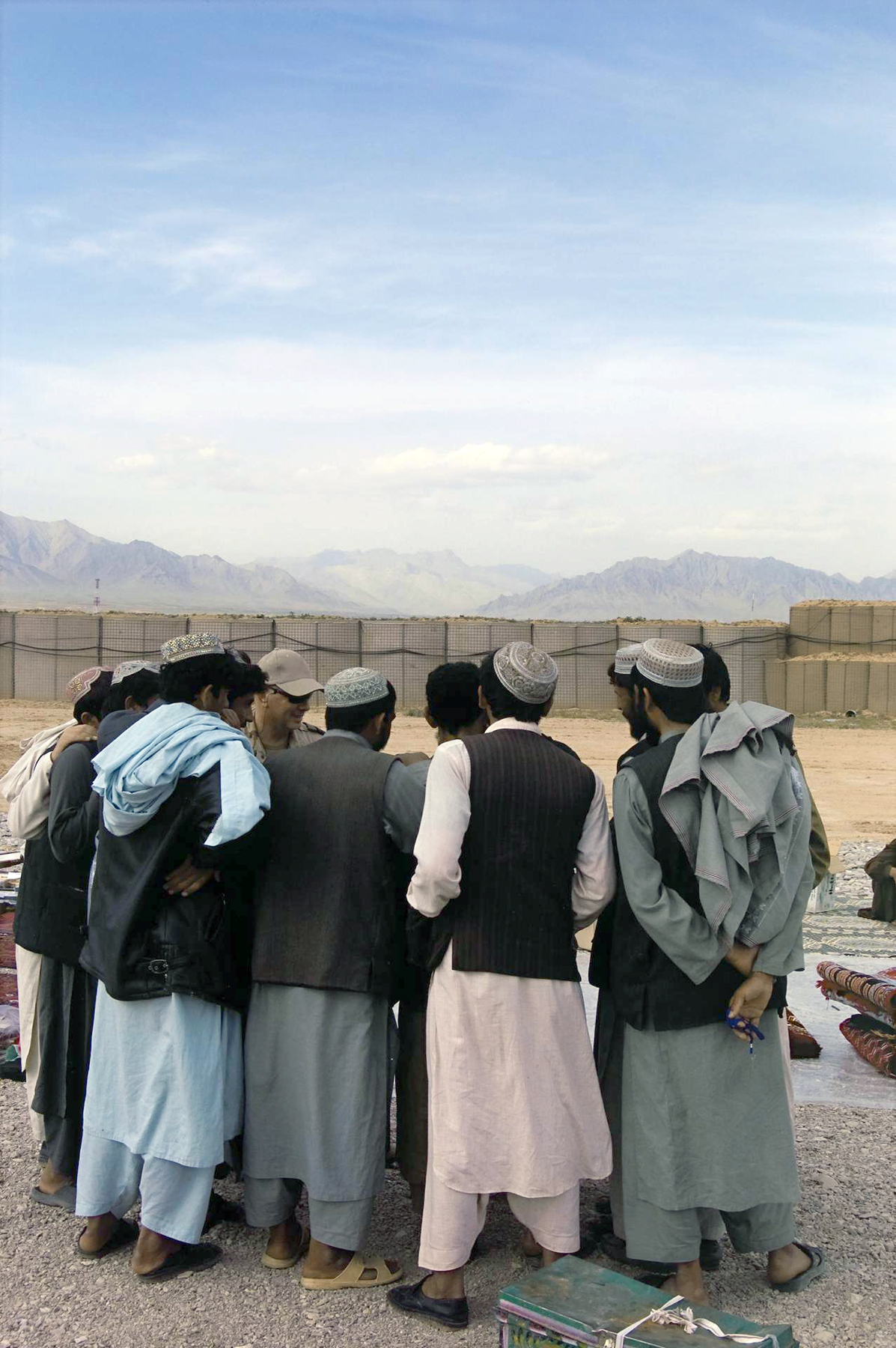
Lyndell Brown (Australian, b. 1961) and Charles Green (Australian, b. 1953) 'Afghan traders with soldiers, market, Tarin Kowt base, Uruzgan province, Afghanistan.' 2007-2008 from the exhibition 'Framing Conflict – Iraq and Afghanistan' exhibition by Lyndell Brown and Charles Green at The Ian Potter Museum of Art, The University of Melbourne, Nov 2008 - Feb 2009


Lyndell Brown (Australian, b. 1961) and Charles Green (Australian, b. 1953)
Afghan traders with soldiers, market, Tarin Kowt base, Uruzgan province, Afghanistan
2007-2008
From The approaching storm series 2007-2009
Digital colour inkjet photograph
155 × 107.5cm


Despite one brilliant photograph and some interesting small painted canvases this exhibition is a disappointment. No use beating around the figurative bush in the landscape so to speak, talking plainly will suffice. Firstly, let’s examine the photographs. Thirteen large format colour photographs are presented in the exhibition out of an archive of “thousands of photographs Brown and Green created on tour”1 from which the paintings are derived.

Most of the photographs are inconsequential and need not have been taken. Relying on the usual trope of painters who take photographs they are shot at night, dusk or dawn when the shadows are long, the colours lush supposedly adding ‘mystique’ to the scene being portrayed. In some cases they are more like paintings than the paintings themselves. Perhaps this was the artist’s plan, the reverse marriage of photography and painting where one becomes the other, but this does little to advance photography as art. There is nothing new or interesting here: sure, some of the photographs are beautiful in the formal representation of a vast and fractured landscape but the pre-visualisation is weak: bland responses to the machines, industry, people and places of the conflict. Go look at the Andreas Gursky photographs at the National Gallery of Victoria to see world-class photography taking reality to the limit, head on.

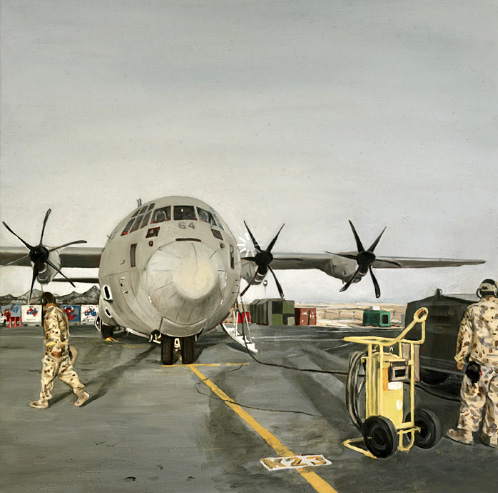
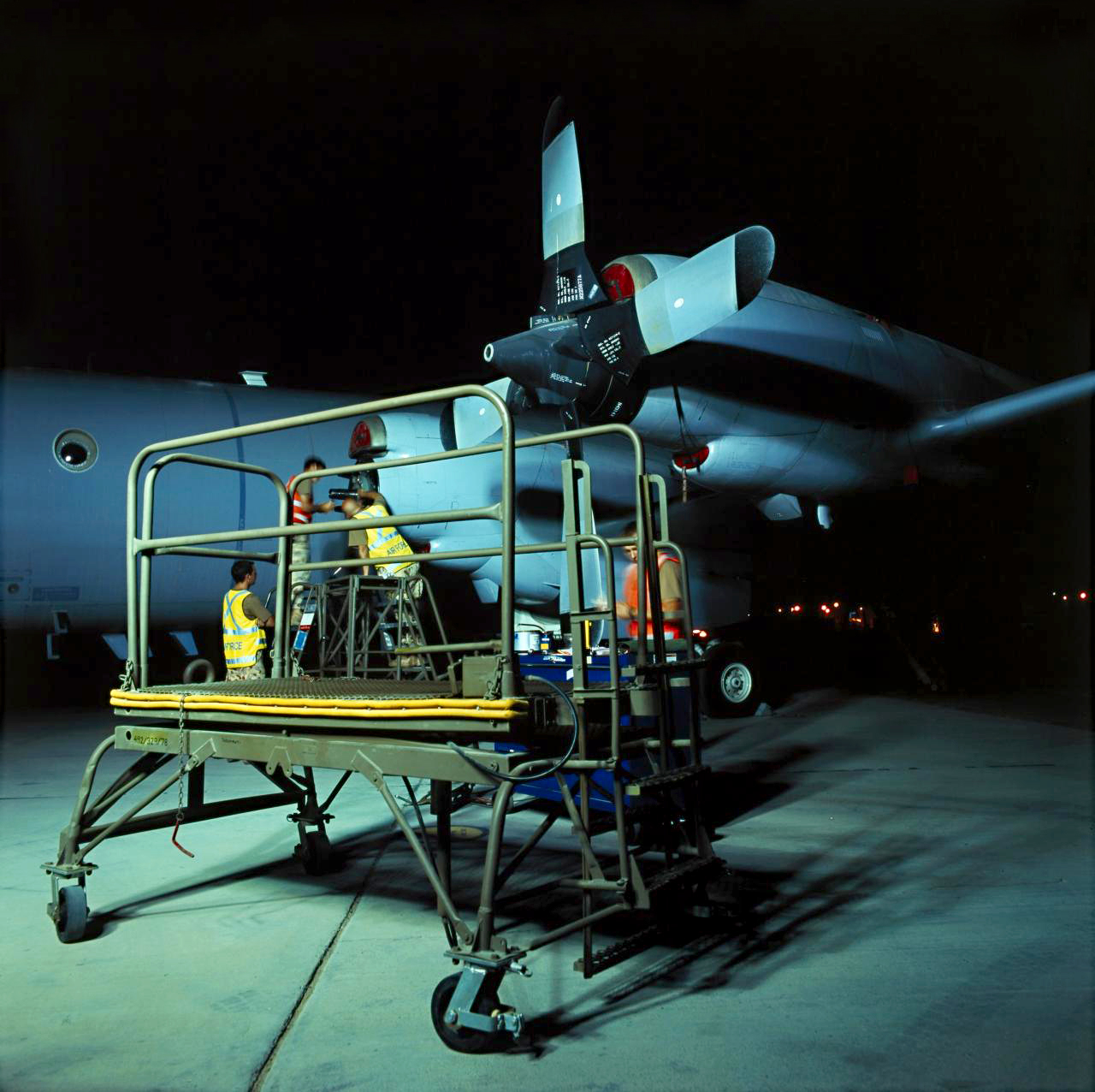
Too often in these thirteen images the same image is repeated with variants – three images of the an aircraft having it’s propeller changed show a lack of ideas or artefacts to photograph – presented out of the thousands taken seems incongruous. The fact that only one photograph is reproduced in the catalogue is also instructive.

Some images are just unsuccessful. For example the photograph Dusk, ship’s bridge with two sailors, northern Gulf is of a formulaic geometry that neither holds the viewers attention nor gives a deeper insight into their lives aboard ship and begs the question why was the photograph taken in the first place? The dark space has little physical or metaphysical illumination and seems purely to be an exercise in formalism. The photograph Dusk, ships’ bridge with sailor, northern Gulf is more successful in the use of light and shade as they play across the form of a sailor, his head resting pensively in his hand, red life vests adding a splash of colour to the bottom right of the photograph.

The brilliant photograph of the group is View from Chinook, Helmand province, Afghanistan. This really is a monstrous photograph. With the large black mass of the helicopter in the foreground of the image containing little detail, the eye is drawn upwards to the windscreen through which a mountain range rises, with spines like the back of a Stegosaurus. To the right a road, guarded by a desolate looking pillbox and yellow barrier, meanders into the distance. Dead flies on the windscreen look like small bullet holes until you realise what they are. This is the image that finally evidences a disquieting beauty present in the vast and ancient landscape.

Turning to the paintings we can say that some of the small 31cm x 31cm paintings work well. From an ‘original’ photograph the artist selects and crops a final image that they work up into a highly detailed oil painting. Distilled (as the artist’s like to put it) from the ‘original’ photographs, the paintings become a “merging of a contemporary sense of composition – borrowed from photography, film and video – with the textures and processes of traditional oil painting.”2

“These works were developed by the artists to be something akin to “Hitchcockian clues” which create the sense of looking out at a scene but being distanced from the action. To some degree the entire suite of small pictures participate in developing this intrigue, by showing an array of ambiguous scenes in which direct action is never present, or is obscured by limited perspectives … The artists noted that the war zones they witnessed were low in action but high in tension”3

To an extent this tension builds in some of the small paintings: the small size lends an intimate, intense quality and forces the viewer to engage with highly detailed renditions of textures of clothing, material, skin and hair and the distorted scale of the ships and aeroplanes portrayed. In these intense visions the painting seems less like a photograph and more like a new way of seeing. However, this occurs only occasionally within the group of small paintings.

If we think of a photograph in the traditional sense as a portrayal of reality, then a distillation of that photograph (the removal of impurities from, an increase in the concentration of) must mean that these paintings are a double truth, a concentrated essence of the ‘original’ photograph that changes that essence into something new. Unfortunately most of these small canvases show limited viewpoints of distilled landscapes that do not lead to ambiguous enigmas, but to the screen of the camera overlaid by a skein of paint, a patina of posing.

This feeling is only amplified in the three large ‘History’ paintings. The three paintings seem static, lifeless, over fussy and lacking insight into the condition of the ‘machine’ that they are attempting to portray. It’s a bit like the ‘Emperors New Clothes’, the lack of substance in the paintings overlaid with the semantics of History painting (“a traditional genre that focused on mythological, biblical, historical and military subjects”) used to confirm their existence and supposed insight into the doubled, framed reality. As Robert Nelson noted in his review of 2008 art in Melbourne in The Age newspaper it would seem that painting is sliding into terminal decline. These paintings only seem to confirm that view.

Here was a golden opportunity to try something fresh in terms of war as conflict – both in photography and painting – to frame the discourse in an eloquent, innovative manner. Most of this work is not interesting because it does not seem to be showing, or being discursive about anything beyond a personal whim. Because an artist can talk about some things, doesn’t mean that he can make comments about other things that have any value. Although the artist was looking to portray landscapes of globalisation and entropy, there are more interesting ways of doing this, rather than the nature of the transcription used here.

“It is very good to copy what one sees: it is much better to draw what you can’t see any more but in your memory. It is a transformation in which imagination and memory work together. You only reproduce what struck you, that is to say, the necessary. That way your memory and your fantasy are freed from the tyranny of nature.”4

No thinking but the putting away of intellect and the reliance on memory and imagination, memory and fantasy to ‘distil’ the essence. This is what needed to happen both in the photographs and paintings – leaving posturing aside (perhaps an ‘unofficial war artist’ would have had more success!) to uncover the transformation of landscape that the theatre of this environment richly deserves.

Dr Marcus Bunyan


Footnotes

1/ Heywood, Warwick. Framing Conflict: Iraq and Afghanistan exhibition catalogue. Canberra: Australian War Memorial, 2008, p. 6
2/ Heywood, Warwick. Framing Conflict: Iraq and Afghanistan exhibition catalogue. Canberra: Australian War Memorial, 2008, p. 6
3/ Heywood, Warwick. Framing Conflict: Iraq and Afghanistan exhibition catalogue. Canberra: Australian War Memorial, 2008, p. 11
4/ Degas, Edgar quoted in Halligan, Marion. “Between the brushstrokes,” in A2 section, The Saturday Age newspaper, January 17th 2008, p. 18


Many thankx to The Ian Potter Museum of Art for allowing me to publish the photographs in the posting. Please click on the photographs for a larger version of the image.


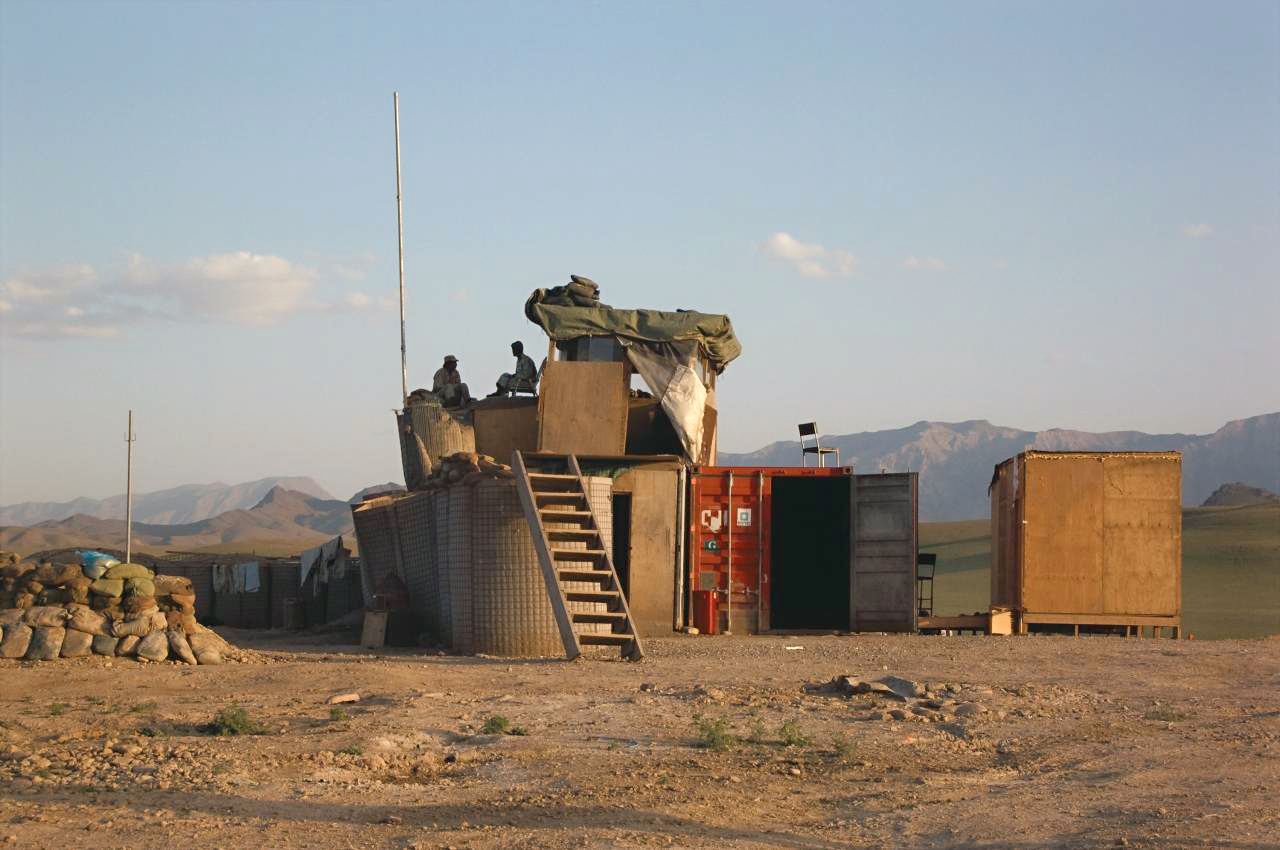
Lyndell Brown (Australian, b. 1961) and Charles Green (Australian, b. 1953) 'Afghan National Army perimeter post with chair, Tarin Kowt base, Uruzgan province, Afghanistan' 2007-2008 from the exhibition 'Framing Conflict – Iraq and Afghanistan' exhibition by Lyndell Brown and Charles Green at The Ian Potter Museum of Art, The University of Melbourne, Nov 2008 - Feb 2009


Lyndell Brown (Australian, b. 1961) and Charles Green (Australian, b. 1953)
Afghan National Army perimeter post with chair, Tarin Kowt base, Uruzgan province, Afghanistan
2007-2008
From The approaching storm series 2007-2009
Digital colour inkjet photograph
111.5 × 151.5cm


Lyndell Brown (Australian, b. 1961) and Charles Green (Australian, b. 1953) 'Dusk, ship's bridge with two sailors, northern Gulf' 2007-2008


Lyndell Brown (Australian, b. 1961) and Charles Green (Australian, b. 1953)
Dusk, ship’s bridge with two sailors, northern Gulf
2007-2008
Digital colour inkjet photograph


Lyndell Brown (Australian, b. 1961) and Charles Green (Australian, b. 1953) 'Late afternoon, flight line, military installation, Middle East' 2007


Lyndell Brown (Australian, b. 1961) and Charles Green (Australian, b. 1953)
Late afternoon, flight line, military installation, Middle East
2007
Oil on linen


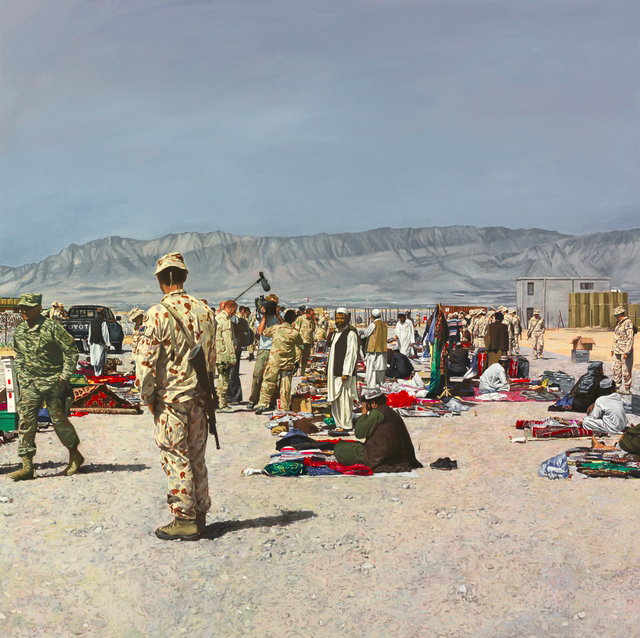
Lyndell Brown (Australian, b. 1961) and Charles Green (Australian, b. 1953) 'Market, Camp Holland, Tarin Kowt, Uruzgan province, Afghanistan' 2007


Lyndell Brown (Australian, b. 1961) and Charles Green (Australian, b. 1953)
Market, Camp Holland, Tarin Kowt, Uruzgan province, Afghanistan
2007
Oil on linen


Lyndell Brown (Australian, b. 1961) and Charles Green (Australian, b. 1953) 'View from Chinook, Helmand province, Afghanistan' 2007-2008


Lyndell Brown (Australian, b. 1961) and Charles Green (Australian, b. 1953)
View from Chinook, Helmand province, Afghanistan
2007-2008
From The approaching storm series 2007-2009
Digital colour inkjet photograph
111.5 × 151.5cm


Lyndell Brown (Australian, b. 1961) and Charles Green (Australian, b. 1953) 'View from Chinook, Helmand province, Afghanistan' 2007


Lyndell Brown (Australian, b. 1961) and Charles Green (Australian, b. 1953)
View from Chinook, Helmand province, Afghanistan
2007
Oil on linen


Lyndell Brown (Australian, b. 1961) and Charles Green (Australian, b. 1953) 'Trolley, propeller change, on flightline at night, military installation, Gulf' 2007-2008


Lyndell Brown (Australian, b. 1961) and Charles Green (Australian, b. 1953)
Trolley, propeller change, on flightline at night, military installation, Gulf
2007-2008
From The approaching storm series 2007-2009
Digital colour inkjet photograph
87.0 × 87.4cm


Lyndell Brown (Australian, b. 1961) and Charles Green (Australian, b. 1953) 'History painting: market, Tarin Kowt, Uruzgan province, Afghanistan' 2007


Lyndell Brown (Australian, b. 1961) and Charles Green (Australian, b. 1953)
History painting: market, Tarin Kowt, Uruzgan province, Afghanistan
2007
Oil on linen


Lyndell Brown and Charles Green. Installation view of photographs from the exhibition 'Framing Conflict' at The Ian Potter Museum of Art, The University of Melbourne


Lyndell Brown and Charles Green
Installation view of photographs from the exhibition Framing Conflict at The Ian Potter Museum of Art, The University of Melbourne
2009


Lyndell Brown and Charles Green. Installation view of paintings from the exhibition 'Framing Conflict' at The Ian Potter Museum of Art, The University of Melbourne 2009


Lyndell Brown (Australian, b. 1961) and Charles Green (Australian, b. 1953)
Installation view of paintings from the exhibition Framing Conflict at The Ian Potter Museum of Art, The University of Melbourne
2009


The Ian Potter Museum of Art
The University of Melbourne,
Corner Swanston Street and Masson Road
Parkville, Victoria 3010

Opening hours:
Tuesday – Saturday 11am – 5pm

The Ian Potter Museum of Art website

LIKE ART BLART ON FACEBOOK

Back to top

Opening: ‘Oleh Witer’ at Space 39 Gallery, Melbourne

Exhibition dates: 11th November – 22nd November, 2008

Opening: Tuesday 11th November, 2008


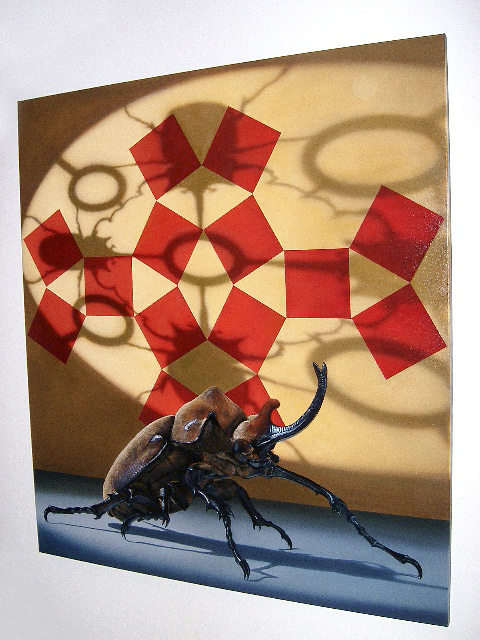
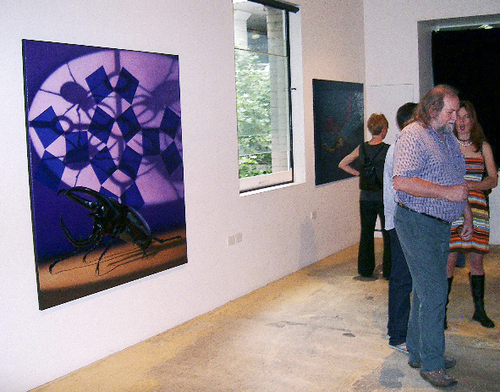
Oleh Witer (Australian) 'The Elephant Beetle' 2008 (installation view) from the exhibition 'Oleh Witer' at Space 39 Gallery, Melbourne, Nov 2008


Oleh Witer (Australian)
The Elephant Beetle (installation view)
2008
Oil in linen


A warm and lively crowd was in attendance for the opening of the latest Oleh Witer exhibition at Space 39 in Little Collins Street, Melbourne. Nine paintings are presented in the open space of the gallery and what magical paintings they are.

Two of the main canvases feature rearing beetles in the foreground, almost photo-realistically painted, lit from above while in the background geometric red and blue squares are overlaid by enigmatic shadows – almost as though the shadows were the interior structures of a fantastical light shade.

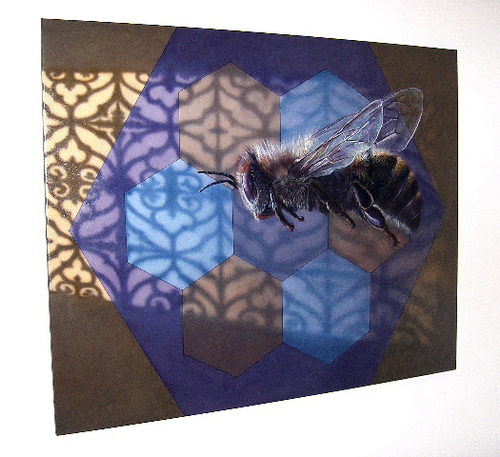
Other canvases feature a bee and a wasp facing each other with cellular geometric patterns and overlaid shadows in the background. Between these two seeming adversaries is a large canvas of a black skull with candle flickering in the it’s lobotomised top sitting on a spiral shape with geometric shapes and the shadows of an almost tarot like ‘ten of swords’ pattern overlaid to the background.

The strongest work features geometric forms with dark surrealist imagery. These are talismanic images with a strong connection to taoist and shamanic principles. A concern with the connection between all things is evident – archetypal pentagrams, spirals and swords are linked to the principles and proportions of the golden mean equation. Contemplation is required to access the inner meanings of the work but they reward extended looking as their magical phosphorescences are revealed over time. Recommended viewing.

Dr Marcus Bunyan


Oleh Witer (Australian) 'The Rhinoceros Beetle' 2008 (installation view)


Oleh Witer (Australian)
Installation view and opening crowd with The Rhinoceros Beetle
2008
Oil on linen


Oleh Witer (Australian) 'The Bee' 2008 (installation view) from the exhibition 'Oleh Witer' at Space 39 Gallery, Melbourne, Nov 2008


Oleh Witer (Australian)
The Bee (installation view)
2008
Oil on linen


Space 39

This gallery is no longer open

LIKE ART BLART ON FACEBOOK

Back to top