Review: ‘Simryn Gill: Inland’ at the Centre for Contemporary Photography, Fitzroy

Exhibition dates: 9th October – 13th December, 2009


Simryn Gill (Australian born Singapore, b. 1959) 'Untitled' 1995 from the exhibition 'Simryn Gill: Inland' at the Centre for Contemporary Photography, Fitzroy, Oct - Dec, 2009


Simryn Gill (Australian born Singapore, 1959)
Untitled
1995
From the series Rampant
7 gelatin silver photographs
28.0 x 26.0cm Courtesy the artist and Breenspace, Sydney
© Simryn Gill


This is a strange survey exhibition of photographs by Malaysian-born Australian artist Simryn Gill at the Centre for Contemporary Photography, Melbourne – photographs that form distinctive bodies of work that support the artist’s other conversations in art but do not form the main backbone to her practice. Perhaps this is part of the problem and part of the beauty of the work. While the work investigates the concepts of presence and absence, space, place and identity and the cultural inhabitation of nature there is a feeling that this is the work of an artist not used to putting images together in a sequence or body of work, not connecting the dots between ideas and image. Intrinsically there is nothing wrong with the conceptual ideas behind the photographs or the individual photographs themselves. The photographs don’t strike one as particularly memorable and they fail to mark the mind of the viewer in their multitudinous framings of reality.

In the series Forest (1996-1998, see photograph above and below) a selective vision of nature is invaded by cultural texts, torn pages of books mimicking natural forms such as roots, flowers and variegated leaves. The ‘natural’ context is inhabited by the cultural con-text to form a double inhabitation – “this strange hybrid nature before the paper rots away, suggestive of how nature is culturally inscribed and the futility of this attempt at containment.”1

This is a nice idea but the photographs fail to hold the attention of the viewer mainly because of the inability of the viewer to read the text that has been grafted onto the natural forms. I literally needed more from the work to hang my hat on and this is how I felt about much of this work presented here. This feeling persists with another series Vegetation (1999, see photographs below). Mundane landscapes are inhabited by faceless human beings, their absence/presence marking the landscape while at the same time nature marks them. A good idea that needed to be pushed much further.

The main body of work in the exhibition is the series Dalam (2001, see photographs below), a 258 strong series of colour photographs presented in the gallery space in gridded formation (Dalam, in Malay, can mean ‘inside’, ‘interior’ or ‘deep’). Featuring a photographic record of the interior of numerous Malaysian homes these clinical yet someone hobby-like photographs record the minutiae of domestica – the intimacy of the interior balanced by a sense of isolation and loneliness through the absence of human presence. Here, “the living room may be seen here as a cultural and social mask for its inhabitants. It’s the space into which others are welcomed on our own terms and onto which we project a portrayal of ourselves.”3 Although the work asks us “to rethink our concepts of spaces and domesticity in relation to various aspects such as socio-cultural identities, history and memory,” as presented in the gallery space the viewer is initially overwhelmed by the number, colour and construction of the interiors.

Personally I found that in the mundanity / individuality of the repetition I soon lost interest in looking intimately at the work. The photographs lack a certain spark, a certain clarity of vision in the actual taking of the images. None of the wonderful angles and intelligence of camera positioning of Eugene Atget here and maybe this is the point – the stifling ‘personality’ and banality of human habitation echoed in the photographs – but I would have rather have looked at a single monumentally intimate, magical image by Candida Hofer than all of these photographs put together!

Unfortunately in this survey exhibition there is only one photograph from what I regard as Simryn Gill’s best body of work, A small town at the turn of the century (1999-2000, see photograph below). Perhaps this was an oversight as this series would seem to bind the others more holistically together. Photographs of this excellent series can be viewed on the Roslyn Oxley9 Gallery website and their presence in this exhibition would have certainly raised the bar in terms of the artist’s vision of nature, place and identity. The square colour format, the interior/exterior of the environments and naturalness of the photographs and their the fruitful bodies really have an eloquent power that most of the work at the Centre for Contemporary Photography seems to lack. Other than the last body of work, Inland (2009, see photograph below) that is.

In the smallest most intimate space at the CCP are some of the most intimate images of Australian place that you will ever see. Spread out on a table in small stacks of jewel-like black and white and Cibachrome images the viewer is asked to done white gloves (ah, the delicious irony of white hands on the Australian land!) to view the empty interiors, landscapes and (hands holding) rocks of the interior. These are beautifully seen and resolved images. The rocks are most poignant.

Gill digs beneath the surface of this thing called Australian-ness and exposes not the vast horizons, decorous landscapes or rugged people (as Naomi Cass states below) but small intimacies of space and place, identity and memory. In the ability to shuffle the deck of cards, to reorder the photographs to make their own narrative the viewer becomes as much the author of the story being told as the artist herself – an open-ended intertextual narrative guided by the artist that investigates the very root of what it is to be Australian on a personal level. I enjoyed this reordering, this subjective experience very much.

Dr Marcus Bunyan


Many thankx to the CCP for allowing me to publish the photographs in the posting. Please click on the photographs for a larger version of the image.


1/ Anonymous. “Simryn Gill: Selected Work,” on the Indepth Arts News website [Online] Cited 12/05/2019

2/ Gill, Simryn. “May 2006,” in Off the Edge, Merdeka 50 years issue no. 33, September 2007, p. 83

3/ Day, Kate. “After Image: Photography at the Fruit Market Gallery,” on Culture 24 website. [Online] Cited 6th December 2009 no longer available online


    Simryn Gill (Australian born Singapore, b. 1959) 'Forest #5' 1998 from the exhibition 'Simryn Gill: Inland' at the Centre for Contemporary Photography, Fitzroy, Oct - Dec, 2009


    Simryn Gill (Australian born Singapore, 1959)
    Forest #5
    1998
    From the series Forest
    16 gelatin silver photographs
    © Simryn Gill


    Rampant (1999)

    “Both populating and haunting the patches of now feral vegetation evoking a sense of foreign/alien source that has been strained, even lost in the act of transplantation. It also parodies the fear of rampant occupation that historically imbues aspects of Australian to Northern neighbours.”10

    In Rampant Gill photographed outbursts of introduced plant species in the Australian landscape such as bamboo and sugar cane, which now grow wild and uncontrolled in subtropical northern New South Wales. Again Gill incorporates performative elements, interacting with nature through ‘dressing’ the plants in garments such as lungis and sarongs which were worn by immigrant workers who harvested these crops. Gill explores of the connections between botany, geography and the idea of plants as ‘humanised’ entities – seen in these strange single or groups of ‘figures’ appearing displaced within the Australian landscape.

    Text from the education resource for the exhibition Simryn Gill: Inland at the Centre for Contemporary Photography, Fitzroy [Online] Cited 12/05/2019


    Simryn Gill (Australian born Singapore, b. 1959) 'Forest #13' 1998 from the exhibition 'Simryn Gill: Inland' at the Centre for Contemporary Photography, Fitzroy, Oct - Dec, 2009


    Simryn Gill (Australian born Singapore, 1959)
    Forest #13
    1998
    From the series Forest
    16 gelatin silver photographs
    © Simryn Gill


    Simryn Gill (Australian born Singapore, b. 1959) 'Untitled' from the 'Forest' series 1996 from the exhibition 'Simryn Gill: Inland' at the Centre for Contemporary Photography, Fitzroy, Oct - Dec, 2009


    Simryn Gill (Australian born Singapore, 1959)
    Untitled
    1996
    From the series Forest
    16 gelatin silver photographs
    © Simryn Gill


    Forest (1996-1998)

    Upon close inspection, this series of large scale black and white photographs of lush tropical plants reveal strips of paper and fragments of text which are embedded into tree trunks, covering leaf surfaces, transforming into aerial mangrove roots, weaving their way up walls and mimicking banana flowers.

    The artist states: “I decided I needed to echo my situation in my art activities, and started making small interventions in the very rare wild places around where we lived, like gardens of unoccupied houses, roadside growths of tapioca and yam”.7

    Returning from Australia to Singapore with her family, Gill went into overgrown gardens and open spaces she was familiar with to construct these site interventions, armed with glue and a range of books – some given to her by friends, others sourced from garage sales – including the colonial texts of Charles Darwin’s The Origin of Species and Daniel Defoe’s Robinson Crusoe, and an Indonesian version of the Hindu tale Ramayana. These works were explorations by Gill into her personal sense of place and history, as an outsider in Singapore. Works in the same series were created in other similar environments in countries such as Malaysia. Although they originate from specific locations, they can be read as anywhere in the tropics.

    The process of entering these ‘little bits of jungle’ to construct these works was referred to by Gill as her ‘guerrilla activities’,8 and were temporary site specific interventions which she sought to document.

    Her friend and fashion photographer Nicholas Leong, chose the camera and film which required long exposure, suiting Gill’s requirements to create large, dense flat tonal images. Together they documented the works before the paper was to rot away and return nature. This introduced Gill to analogue photography and its slow processing, which she values and continues to use.

    Text from the education resource for the exhibition Simryn Gill: Inland at the Centre for Contemporary Photography, Fitzroy [Online] Cited 12/05/2019


    Simryn Gill (Australian born Singapore, b. 1959) 'Untitled' from the 'Forest' series 1996


    Simryn Gill (Australian born Singapore, 1959)
    Untitled
    1996
    From the series Forest
    16 gelatin silver photographs
    © Simryn Gill


    Simryn Gill (Australian born Singapore, b. 1959) 'Vegetation #1' 1999


    Simryn Gill (Australian born Singapore, 1959)
    Vegetation #1
    1999
    From the series Vegetation
    5 gelatin silver photographs
    © Simryn Gill


    … In these works which were begun at a residency at Artpace in Texas, Gill begins the process of masking and disguising, of naturalising human figures into the landscape (in this case herself) through obscuring their heads with fruit and vegetation, that was to be so important in her later bodies of work such as A small town at the turn of the century.

    Curator Sharmini Pereira has written: “In this series of photographs, her self-portrait dominates but only as a stream of disguises involving plants in various geographic locations; tumbleweed and aloe in Texas, mangrove and black boy in Australia, and bird’s nest fern in Singapore. The images bear an uncanny resemblance to a sequence of B-movie stills, where vengeful alien-plant-people threaten to over run the planet. Many Hollywood films have of course played out such narratives as a projection of Cold War anxieties fearful about the threat of Communist contamination. But if Vegetation represents the future through some fear located in the past, it does so through a mimetic representation of the present… Vegetation parodies the camera’s framing of today’s culture contact.

    Beyond their still pathos, the enchanting appeal of these photographs lies in their somersaulting between the mythical moment of first contact and its reversal, which the mimetic moment of secondary contact ushers forth. The artist, “unrecognisable” in her jeans and desert boots and wearing her new plant hairstyle, lampoons the power of mimicry as a means of being both alien and indigenous at one and the same time. In as much as Vegetation offers us the chance to poke fun at the natives, it is also an image of the new 21st-century native – able to deliver the laughs rather than be controlled by them. It is here that we observe the breadth of relief that resides in the welcome opportunity to view imitation as a way of moving beyond the imitated…”

    in “Simryn Gill – Selected Work”, AGNSW, 2002

    Text from the Art Gallery of New South Wales website [Online] Cited 12/05/2019


    Simryn Gill (Australian born Singapore, b. 1959) 'Vegetation #5' 1999


    Simryn Gill (Australian born Singapore, 1959)
    Vegetation #5
    1999
    From the Vegetation series
    5 gelatin silver photographs
    © Simryn Gill


    Vegetation (1999)

    “Nature becomes just another clichéd signifier of place and of localness, which one may adopt while passing through a ‘strange’ place, or migrating to a new place, or indeed as a cover for invasion.”9

    In these small framed photographs, Gill is now the subject within the natural environment. The series was started in San Antonia, Texas in 1999 and was part of a two-month residency during which time she produced a new body of work. Gill was wondering if – in this mimicry of nature – she actually could ‘disappear into the landscape’. On field trips she collected a range of desert plant matter, including aloe and tumble weed and took this back to the studio to construct headdresses. Again, using Nicholas Leong as the photographer, Gill then went back to the location to shoot the series. She continued to work on the series in Singapore using the mangrove and in Australia, the grass tree occasionally referred to as a ‘black boy’. The series is closely related to A small town at the turn of the century in its playfulness and parody of ethnographic portraits.

    Text from the education resource for the exhibition Simryn Gill: Inland at the Centre for Contemporary Photography, Fitzroy [Online] Cited 12/05/2019


    Simryn Gill (Australian born Singapore, b. 1959) 'Vegetation #3' 1999


    Simryn Gill (Australian born Singapore, 1959)
    Vegetation #3
    1999
    From the Vegetation series
    5 gelatin silver photographs
    © Simryn Gill


    Simryn Gill: Inland is a survey of photography and takes place in a photography gallery. It is important to declare at the outset, that while photography forms a significant and wondrous part of her practice, Simryn Gill does not consider herself a photographer; “For me, the taking of photographs is another tool in my bag of strategies, in that awkward pursuit of coherence we sometimes call art.”2 Simryn Gill: Inland embraces this conundrum as an entry point for considering Gill’s photography, and how photography might function more broadly as a way of engaging with the world.

    Seven major series wind almost chronologically through the gallery – in this first survey of Gill’s photography – following a path, quite literally, from outside to inside, from found in nature to found in culture and back. Commencing with three series located outdoors, Forest (1996-1998), Rampant (1999) and Vegetation (1999), the survey moves to Gill’s sweeping interior series Dalam (2001). On the cusp of outside and inside is Power station (2004), which makes a curious and visceral analogy between the interior of her childhood home in Port Dickson, Malaysia and the interior of an adjacent power station. Like a medieval Book of Hours, the hand-sized concertina work Distance (2003-2009) is an attempt by Gill to convey the interior of her home in Marrickville, Sydney to someone residing outside Australia.

    Gill’s most recent work Inland (2009), commissioned for this survey and photographed during a road trip from northern New South Wales to South Australia and across the bight to Western Australia, is at the heart of the exhibition. Gill’s only moving image work, Vessel (2004), commissioned for SBS Television, closes the exhibition’s journey with the almost imperceptible passage of a small fishing vessel across the horizon. To ground the exhibition, or perhaps to oversee our journey, one image is selected from Gill’s highly regarded series, A small town at the turn of the century (1999-2000).

    Seeking an understanding of the politics of place informs her recent series. Inland confounds what is normally expected from photographs of Australia’s interior and eschews decorous landscapes, vast horizons or smiling rugged people, for modest interiors of homes. Indeed there are no people present, only the houses they have inhabited as evidence of their subjectivity.

    Inland consists in piles of small jewel-like Cibachrome and black and white prints sitting on a table for viewers to peruse, heightening the provisional nature of its description, leaving open-ended the question of what can be known through photographic representation.

    Naomi Cass,
 Exhibition Curator and Director 
Centre for Contemporary Photography

    Press release from the Centre for Contemporary Photography website [Online] Cited 01/12/2009 no longer available online


    Simryn Gill (Australian born Singapore, b. 1959) 'Dalam No. 226' 2001


    Simryn Gill (Australian born Singapore, 1959)
    Dalam No. 226
    2001
    From the series Dalam
    Chromogenic print
    9 1/4 in. x 9 1/4 in. (23.5 cm x 23.5cm)
    © Simryn Gill


    Dalam (2001)

    Dalam (Malay for ‘deep’, or ‘within’) is a suite of 260 photographic images, the result of Malaysian artist Simryn Gill’s sojourn across her home country over an eight-week period. She went up to the homes of complete strangers and asked to photograph their living spaces. Dalam is an expansive yet uncannily intimate survey of Malaysia at the turn of the century, a mélange of disparate ethnicities, religions, ideologies and allegiances. The title itself alludes to the depiction of interior spaces as signifiers of the individual lives that inhabit and activate them, but, even more importantly, it suggests an exploration of the social fabric of contemporary Malaysia. As the artist observes: “In conceiving the work I had wondered what the ‘inside’ of a place might look like. Do lots of people held together by geography add up to the idea of a nation or single unified group?” Dalam questions what historian Benedict Anderson famously dubbed “the imagined community”, or the various divergent structures that shape the modern nation-state.

    Text from the Singapore Art Museum website [Online] Cited 12/05/2019


    Dalam (Malay for deep; inside; interior), is a series of two hundred and sixty colour photographs arranged in grid formation on the gallery walls.

    “Gill deliberately began Dalam with the intention to document the living rooms of residents of the Malay peninsula, and her focus in each photograph is to capture the sense of place conveyed by the living room of the occupants.”11

    Accompanied by a close friend, Gill took these over an eight-week period as they travelled across the Malaysian Peninsula. In towns mainly outside the city regions she knocked on the doors of strangers and asked if she could enter their houses to photograph their living rooms. Surprisingly, almost everyone agreed, and the resulting series gives a fascinating insight into the character of the Malaysian Peninsula, made up of a broad mix of people from diverse cultural backgrounds. Gill was again exploring her conflicting experience of being both insider and outsider; raised in Malaysia but also having lived outside for a very long time.

    Text from the education resource for the exhibition Simryn Gill: Inland at the Centre for Contemporary Photography, Fitzroy [Online] Cited 12/05/2019


    Simryn Gill (Australian born Singapore, b. 1959) 'Dalam No. 162' 2001


    Simryn Gill (Australian born Singapore, 1959)
    Dalam No. 162
    2001
    From the series Dalam
    Chromogenic print
    9 1/4 in. x 9 1/4 in. (23.5 cm x 23.5cm)
    © Simryn Gill


    Simryn Gill (Australian born Singapore, b. 1959) 'Dalam #39' 2001


    Simryn Gill (Australian born Singapore, 1959)
    Dalam #39
    2001
    From the series Dalam
    Chromogenic print
    9 1/4 in. x 9 1/4 in. (23.5 cm x 23.5cm)
    © Simryn Gill


    How We Are in the World: The Photography of Simryn Gill

    Simryn Gill: Inland is a survey of photography and takes place in a photography gallery. It is important to declare at the outset, that while photography forms a significant and wondrous part of her practice, Simryn Gill does not consider herself a photographer; “For me, the taking of photographs is another tool in my bag of strategies, in that awkward pursuit of coherence we sometimes call art”.1 Simryn Gill: Inland embraces this conundrum as an entry point for considering Gill’s photography, and how photography might function more broadly as a way of engaging with the world.

    Seven major series wind almost chronologically through the gallery – in this first survey of Gill’s photography – following a path, quite literally, from outside to inside, from found in nature to found in culture and back. Commencing with three series located outdoors, Forest (1996-1998), Rampant (1999) and Vegetation (1999), the survey moves to Gill’s sweeping interior series Dalam (2001). On the cusp of outside and inside is Power station (2004), which makes a curious and visceral analogy between the interior of her childhood home in Port Dickson, Malaysia and the interior of an adjacent power station. Like a medieval Book of Hours, the hand-sized concertina work Distance (2003-2008) is an attempt by Gill to convey the interior of her home in Marrickville, Sydney to someone residing outside Australia. Gill’s most recent work Inland (2009), commissioned for this survey and photographed during a road trip from northern New South Wales to South Australia and across the bight to Western Australia, is at the heart of the exhibition. Gill’s only moving image work, Vessel (2004), screened on SBS Television, closes the exhibition’s journey with the almost imperceptible passage of a small fishing vessel across the horizon. To ground the exhibition, or perhaps to oversee our journey, one image is selected from Gill’s highly regarded series, A small town at the turn of the century (1999-2000).

    Gill’s photography takes place within a broader practice that curator Russell Storer describes as “… subjecting found objects, books, local materials and sites – each of which carry specific meanings and histories – to a range of processes including photographing, collecting, erasing, casting, tearing, arranging, stitching, rubbing, wrapping and engraving”.2 Gill takes humble things in the world and shifts them; rearranges them with seemingly endless patience, craft and grace, to communicate something about how the object has come into being. This is not a matter of changing context to appreciate formal qualities as might a connoisseur, but rather a quest for understanding place.

    Always evident in the found object is some kind of story that, as Gill gathers the item, is folded into the meaning of her work. The constituent parts of her installations – be they items found on the shore or collected from around her studios in Port Dickson or Sydney, or indeed a particular site Gill photographs – are gathered for their ability to evoke a history. Movement across the globe, of people and vegetation, both enforced and deliberate, if not the subject of her work is certainly a link. While not a unique story, resettlement is part of Gill’s individual and familial history. Her parents originally moved from India to Malaya prompted by the range of human predicaments, from political and economic upheaval, through to adventure and marriage. The displacement of objects echoes the journeys of people.

    Naomi Cass Exhibition Curator and Director Centre for Contemporary Photography, extract from catalogue essay [Online] Cited 12/05/2019


    Simryn Gill (Australian born Singapore, b. 1959) 'A small town at the turn of the century #5' 1999-2000


    Simryn Gill (Australian born Singapore, 1959)
    A small town at the turn of the century #5
    1999-2000
    Type C photograph
    From a series of 40
    91.5 x 91.5cm
    Private collection, Sydney
    © Simryn Gill


    A small town at the turn of the century 1999-2000 is a series of 40 type C photographs taken by Gill in the town the artist grew up in. The documentation of the people and place of ones past could be highly nostalgic. Added to this is the moment at which Gill chose to document – the turn of the 20th into the 21st century. Such references to time and memory, the past and the present are potent but Gill has covered each of her subjects’ heads with tropical fruit. Rather than being absurd or ironical the head coverings move the images away from being portraits and into the broader realm of context. The context however is not necessarily as revealing as the viewer might wish. There are numerous variations on dress, interiors, exteriors, pose, and accoutrements that suggest activities (whether work or play). While it is usually clear that the environment is tropical (because of the fruit and foliage) the images provoke a complex set of reactions to the possible messages. Faceless, Gill’s subjects are ciphers constructed by external objects, presented with affection.

    Text from the Art Gallery of New South Wales website [Online] Cited 12/05/2019


    Simryn Gill (Australian born Singapore, b. 1959) 'Distance' 2003-2008

    Simryn Gill (Australian born Singapore, b. 1959) 'Distance' 2003-2008

    Simryn Gill (Australian born Singapore, b. 1959) 'Distance' 2003-2008


    Simryn Gill (Australian born Singapore, 1959)
    Distance
    2003-2008
    Artist book
    Installation views, Centre for Contemporary Photography


    Distance (2003-2008)

    Distance, an artist’s book of small colour photographs is produced as a hand-sized concertina work in an edition of just five. This beautiful work is “like a medieval Book of Hours”12 and is displayed in an elegant museum-like cabinet with a protective perspex covering. Distance was produced after many conversations Gill had with friends and family overseas and is an attempt to show them what her home is like. She took one hundred and thirty photographs, using a medium format camera, of everything in the interior of her home in Marrickville, Sydney; however the results seemed to fail in producing a truthful representation of her home, as Gill says, “the final result is almost like an incoherence, it’s too close, there is too much information”.13. Naomi Cass wrote with reference to this, ‘While Distance fails to communicate the gestalt of home, it is remarkable in its details and beauty’.14

    Text from the education resource for the exhibition Simryn Gill: Inland at the Centre for Contemporary Photography, Fitzroy [Online] Cited 12/05/2019


    Simryn Gill (Australian born Singapore, 1959) 'Inland' 2009


    Simryn Gill (Australian born Singapore, 1959)
    Inland
    2009
    Cibachrome and silver gelatin photographs
    Photographs (quantity variable)
    13 x 13cm (each)


    Inland (2009)

    “Through an extraordinary ability to engage with strangers, Gill and her fellow traveller Mary Maguire photographed the living rooms of eighty homes ranging in geographical location, socio-economic and cultural background.”15

    Inland (2009) is a new series, which was commissioned for this exhibition. Using the same process to produce Dalam, Gill photographed this series on a road trip; however this time in Australia, from northern New South Wales to South Australia and across the bight to Western Australia. The photographs include views of the horizon, skyscapes, interior still life compositions and close ups of stones collected by Gill during her travels. Inland is at the heart of the exhibition and the mode of presentation differs to all other series in the exhibition, as these precious handmade small scale colour and black and white images are assembled on a table in piles for the visitor to examine, with white gloves.

    Text from the education resource for the exhibition Simryn Gill: Inland at the Centre for Contemporary Photography, Fitzroy [Online] Cited 12/05/2019


    Centre for Contemporary Photography
    Level 2, Perry St Building
    Collingwood Yards, Collingwood
    Victoria 3066

    Opening hours:
    Wednesday – Saturday 11am – 5pm

    Centre for Contemporary Photography website

    LIKE ART BLART ON FACEBOOK

    Back to top

    Review: ‘Heavenly Vaults’ by David Stephenson at John Buckley Gallery, Richmond

    Exhibition dates: 7th – 28th November, 2009


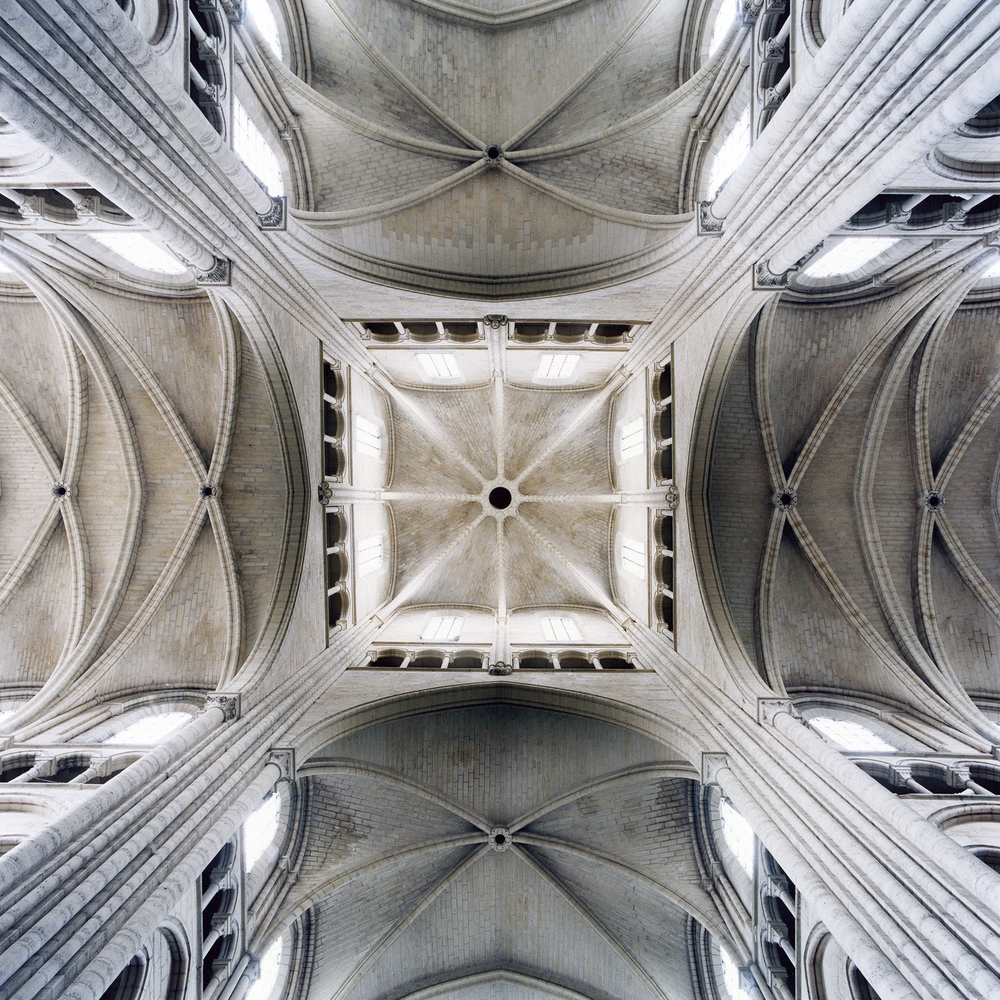
    David Stephenson (Australian born America, b. 1955) 'Nave, Laon Cathedral, Laon, France' 2006/07 from the exhibition 'Heavenly Vaults' by David Stephenson at John Buckley Gallery, Richmond, Nov 2009


    David Stephenson (Australian born America, b. 1955)
    Nave, Laon Cathedral, Laon, France
    2006/2007


    I remember many years ago, in the mid-1990’s, seeing the wonderful Domes of David Stephenson displayed in Flinders Lane in what is now fortfivedownstairs gallery. They were a revelation in this light filled space, row upon row of luminous domes seemingly lit from within, filled with the sense of the presence of divinity. On the opposite wall of the gallery were row upon row of photographs of Italian graves depicting the ceramic photographic markers of Italian dead – markers of the impermanence of life. The doubled death (the representation of identity on the grave, the momento mori of the photograph) slipped quietly into the earth while opposite the domes ascended into heaven through their numinous elevation. The contrast was sublime.

    Unfortunately the same cannot be said of the latest exhibition Heavenly Vaults by David Stephenson at John Buckley Gallery, Richmond.

    The problems start with the installation of the exhibition. As you walk into the gallery the 26 Cibachrome photographs are divided symmetrically down the axis of the gallery so that the prints reflect each other at both ends and each side of the gallery. It is like walking down the nave of a cathedral and observing the architectural restraint of the stained glass windows without their illumination. Instead of the punctum of light flooding through the stained glass windows, the varying of intensities, the equanimity of the square prints all exactly the same size, all reflecting the position of the other makes for a pedestrian installation. Some varying of the print size and placement would have added much life and movement to a static ensemble.

    Another element that needed work were the prints themselves which, with a few notable exceptions, seemed remarkably dull and lifeless (unlike their digital reproductions which, paradoxically, seem to have more life!). They fail to adequately represent the aspirations of the vaults as they soar effortlessly overhead transposing the earth bound into the heaven sent. In the earlier work on the domes (which can be found in the book Visions of Heaven: The Dome in European Architecture) the symmetry of the mandala-like domes with their light-filled inner illumination worked well with the square format of the images making the photographs stand as equivalents for something else, other ineffable states of being.

    “The power of the equivalent, so far as the expressive-creative photographer is concerned, lies in the fact that he can convey and evoke feelings about things and situations and events which for some reason or other are not or can not be photographed. The secret, the catch and the power lies in being able to use the forms and shapes of objects in front of the camera for their expressive-evocative qualities. Or to say this in another way, in practice Equivalency is the ability to use the visual world as the plastic material for the photographer’s expressive purposes. He may wish to employ the recording power of the medium, it is strong in photography, and document. Or he may wish to emphasize its transforming power, which is equally strong, and cause the subject to stand for something else too.”1

    As Minor White further observes,

    “When the image mirrors the man
    And the man mirrors the subject
    Something might take over”2


    When the distance between object and image and image and viewer collapses then something else may be revealed: Spirit.

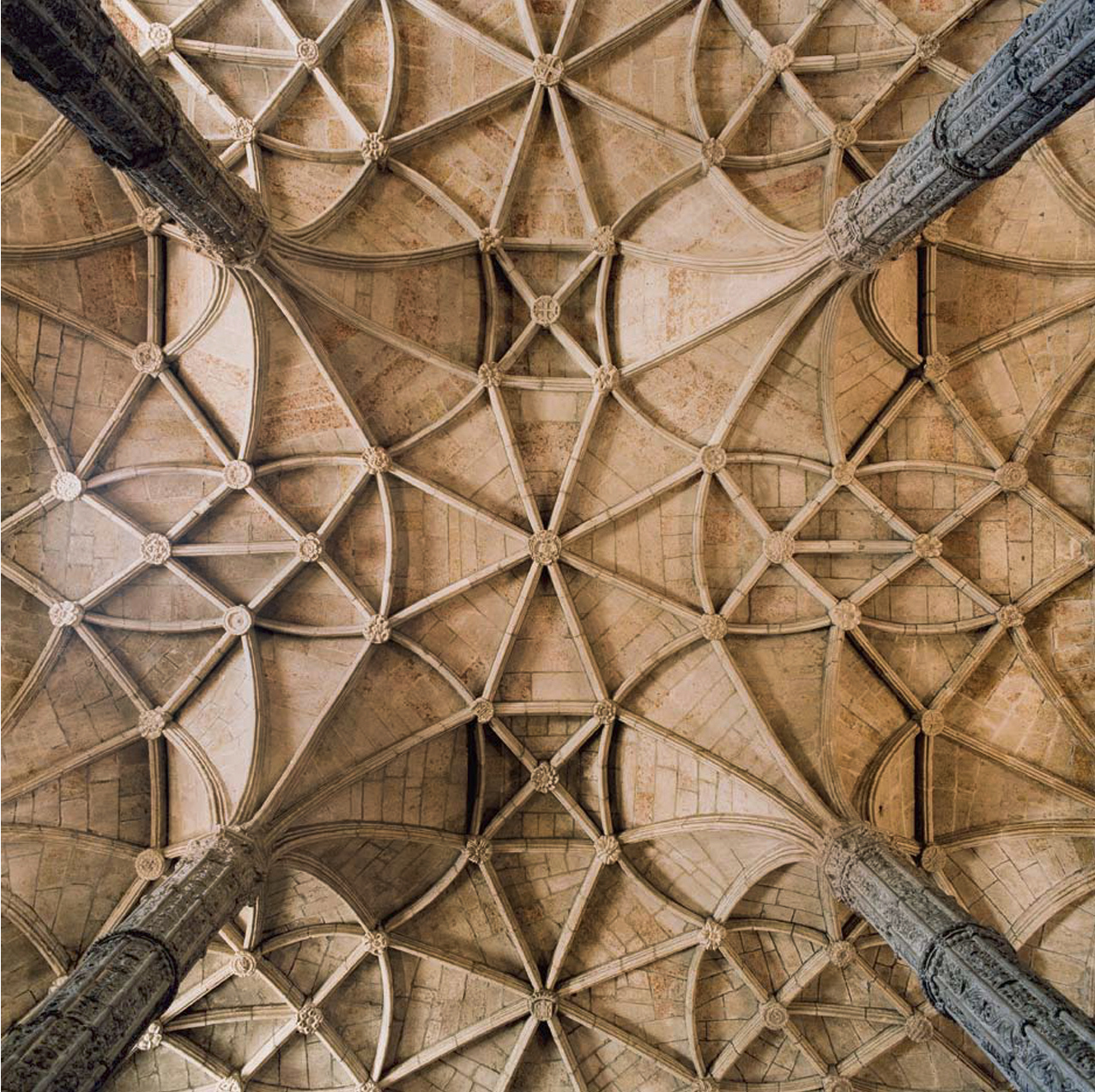
    In this exhibition some of the singular images such as the Crossings, Choirs and Nave of the Church of Santa Maria, Hieronymite Monastery, Belém, Portugal (see photograph below) work best to achieve this revelation. They transcend the groundedness of the earthly plane through their inner ethereal light using a reductive colour palette and strong highlight/shadow detail. Conversely the diptychs and triptychs of Nave and Choir (see photographs below and above) fail to impress. The singular prints pinned to the gallery wall are joined together to form pairs and trios but in this process the ‘space between’ the prints (mainly white photographic paper), the breathing space between two or more photographs that balances their disparate elements, the distance that Minor White calls ‘ice / fire’, does not work. There is no tension, no crackle, no visual crossover of the arches and vaults, spandrels and flutes. Here it is dead space that drags all down with it.

    I found myself observing without engagement, looking without wonder or feeling – never a good sign!

    The photographs of Domes and Vaults have served David Stephenson well for numerous years but the concept has become tired, the inspiration in need of refreshment through other avenues of exploration – both physical and spiritual.

    Dr Marcus Bunyan


    1/ White, Minor. “Equivalence: The Perennial Trend,” in PSA Journal, Vol. 29, No. 7, pp. 17-21, 1963 [Online] Cited 08/05/2019

    2/ White, Minor. “Three Canons,” from Mirrors, Messages, Manifestations. Viking Press, 1969


    Many thankx to Daniel and John Buckley Gallery for allowing me to reproduce the photographs from the exhibition. Please click on the photographs for a larger version of the image.


    David Stephenson (Australian born America, b. 1955) 'Choir, Laon Cathedral, Laon, France' 2006/07 from the exhibition 'Heavenly Vaults' by David Stephenson at John Buckley Gallery, Richmond, Nov 2009


    David Stephenson (Australian born America, b. 1955)
    Choir, Laon Cathedral, Laon, France
    2006/2007


    David Stephenson (Australian born America, b. 1955) 'St. Hugh’s Choir, Lincoln Cathedral, Lincoln, England' 2006/07 from the exhibition 'Heavenly Vaults' by David Stephenson at John Buckley Gallery, Richmond, Nov 2009


    David Stephenson (Australian born America, b. 1955)
    St. Hugh’s Choir, Lincoln Cathedral, Lincoln, England
    2006/2007


    Installation view of 'Heavenly Vaults' by David Stephenson at John Buckley Gallery, Richmond


    Installation view of Heavenly Vaults by David Stephenson at John Buckley Gallery, Richmond
    Photo: Marcus Bunyan


    David Stephenson (Australian born America, b. 1955) 'Nave, Cathedral of St. Barbara, Kutná Hora, Czech Republic' 2008/09


    David Stephenson (Australian born America 1955)
    Nave, Cathedral of St. Barbara, Kutná Hora, Czech Republic
    2008/2009


    David Stephenson (Australian born America, b. 1955) 'Choir, Cathedral of St. Barbara, Kutná Hora, Czech Republic' 2008/09


    David Stephenson (Australian born America 1955)
    Choir, Cathedral of St. Barbara, Kutná Hora, Czech Republic
    2008/2009


    “While the subject of my photographs has shifted… my art has remained essentially spiritual – furthermore than two decades I have been exploring a contemporary expression of the sublime – a transcendental experience of awe with the vast space and time of existence.”


    David Stephenson


    Internationally renowned photographer David Stephenson has dedicated his practice to capturing the sublime in nature and architecture. Fresh from a successful exhibition at Julie Saul Gallery in New York, Stephenson returns to John Buckley Gallery for his third highly anticipated exhibition Heavenly Vaults. The exhibition will feature 26 selected prints from his latest monograph published by Princeton Architectural Press; Heavenly Vaults: From Romanesque to Gothic in European Architecture. Shaun Lakin, Director of the Monash Gallery of Art, will launch the book and exhibition at the opening, November 7th.

    Stephenson began to photograph Gothic vaults in Spain and Portugal in 2003, while completing the work for his Domes project, and his first monograph Visions of Heaven: the Dome in European Architecture. He began to focus on the Vaults project in 2006, photographing Gothic churches and cathedrals in England, Belgium and France. With the assistance of an Australia Council Artist Fellowship in 2008-2009, Stephenson completed extensive fieldwork for the Vaults project, intensively photographing Romanesque and Gothic architecture in Italy, France, Spain, Portugal, Austria, the Czech Republic, Poland, and Germany. The exhibition at John Buckley Gallery coincides with the launch of his second monograph, Heavenly Vaults: from Romanesque to Gothic in European Architecture, published by Princeton Architectural Press, New York.

    Even though the traditional systems the underpinned church architecture have lost their unequivocal power, David Stephenson’s photographs capture the resonance of those times. More importantly his work also suggest that the feelings of aspiration, transcendence, and infinity these buildings evoke in the viewer have an ongoing relevance beyond the religious setting and help us understand who and what we are.

    Excerpt from Foreword, Heavenly Vaults, by Dr Isobel Crombie 2009


    David Stephenson’s new book of photography is a love letter to the intricate, seemingly sui generis vaults of Europe’s Romanesque and Gothic cathedrals and churches.

    Press release from the John Buckley website [Online] Cited 11/11/2009 no longer available online


    David Stephenson (Australian born America, b. 1955) 'Nave, Church of Santa Maria, Hieronymite Monastery, Belém, Portugal' 2008/09


    David Stephenson (Australian born America, b. 1955)
    Nave, Church of Santa Maria, Hieronymite Monastery, Belém, Portugal
    2008/2009


    ‘While the subject of my photographs has shifted from the landscapes of the American Southwest and Tasmania, and the minimal horizons of the Southern Ocean, and the icy wastes of Antarctica, to sacred architecture and the sky at both day and night, my art has remained essentially spiritual – for more than two decades I have been exploring a contemporary expression of the sublime – a transcendental experience of awe with the vast space and time of existence.’

    David Stephenson 1998.1


    With poetic symmetry the Domes series considers analogous ideas. It is a body of work which has been ongoing since 1993 and now numbers several hundred images of domes in countries including Italy, Spain, Portugal, Turkey, England, Germany and Russia. The typological character of the series reveals the shifting history in architectural design, geometry and space across cultures and time, demonstrating how humankind has continually sought meaning by building ornate structures which reference a sacred realm.2 Stephenson photographs the oculus – the eye in the centre of each cupola. Regardless of religion, time or place, this entry to the heavens – each with unique architectural and decorative surround – is presented as an immaculate and enduring image. Placed together, the photographs impart the infinite variations of a single obsession, while also charting the passage of history, and time immemorial.

    1. Van Wyk, S. 1998. “Sublime space: photographs by David Stephenson 1989-1998,” National Gallery of Victoria, Melbourne np
    2. Hammond, V. 2005. “The dome in European architecture,” in Stephenson, D. 2005, Visions of heaven: the dome in European architecture, Princeton Architectural Press, New York p. 190

    © Art Gallery of New South Wales Photography Collection Handbook, 2007


    David Stephenson (Australian born America, b. 1955) 'Choir, King's College Chapel, Cambridge, England' 2006/07


    David Stephenson (Australian born America, b. 1955)
    Choir, King’s College Chapel, Cambridge, England
    2006/2007


    David Stephenson (Australian born America, b. 1955) 'Crossing, York Minster, York, England' 2006/07


    David Stephenson (Australian born America, b. 1955)
    Crossing, York Minster, York, England
    2006/2007


    John Buckley Gallery

    This gallery is now closed.

    LIKE ART BLART ON FACEBOOK

    Back to top

    Review: ‘Unforced Intimacies’ by Patricia Piccinini at Tolarno Galleries, Melbourne

    Exhibition dates: 22nd October – 21st November 2009


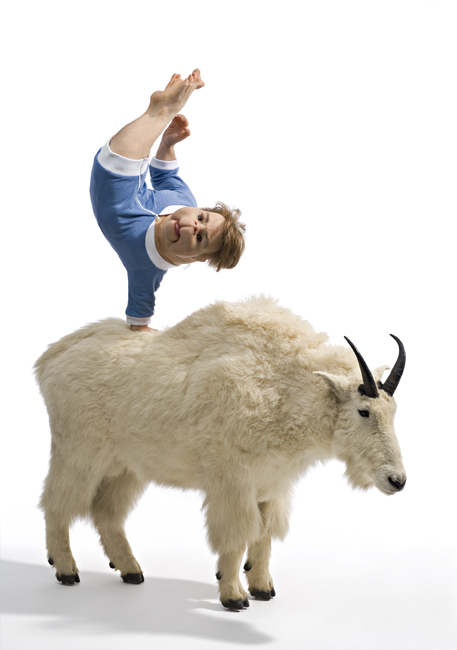
    Patricia Piccinini (Australian, b. 1965) 'The Strength of one Hand (With Canadian Mountain Goat)' 2009 from the exhibition 'Unforced Intimacies' by Patricia Piccinini at Tolarno Galleries, Melbourne, Oct - Nov, 2009


    Patricia Piccinini (Australian, b. 1965)
    The Strength of one Hand (With Canadian Mountain Goat)
    2009
    Silicone, fibreglass, human hair, clothing, Canadian Mountain Goat


    We are the clouds that veil the midnight moon;
    How restlessly they speed, and gleam, and quiver,
    Streaking the darkness radiantly! – yet soon
    Night closes round, and they are lost forever:

    Or like forgotten lyres, whose dissonant strings
    Give various response to each varying blast,
    To whose frail frame no second motion brings
    One mood or modulation like the last.

    We rest. – A dream has power to poison sleep;
    We rise. – One wandering thought pollutes the day;
    We feel, conceive or reason, laugh or weep;
    Embrace fond foe, or cast our cares away:

    It is the same! – For, be it joy or sorrow,
    The path of its departure still is free:
    Man’s yesterday may ne’er be like his morrow;
    Nought may endure but Mutability.

    Mutability by Percy Bysshe Shelley


    When human imagination takes flight, as it does in this exhibition, the results are superlative. Piccinini is at the height of her powers as an artist, in full control of the conceptual ideas, their presentation and the effect that they have on the viewer. Witty, funny, thought-provoking and at times a little scary Piccinini’s exhibition (paradoxically entitled Unforced Intimacies) is an act of revelatio: the pulling aside of the genetic curtain to see what lies beneath.

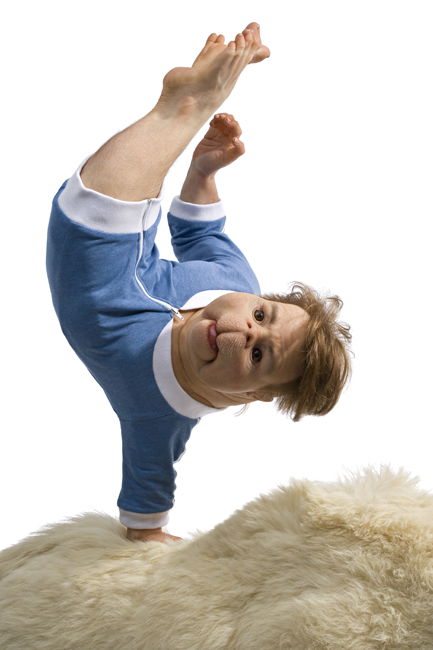
    Featuring hyperrealist genetically modified creatures and human child figures Piccinini’s sculptures, drawings and video seem passionately alive in their verisimilitude (unlike Ricky Swallow’s resplendently dead relics at the NGV). In The Strength of one Hand (With Canadian Mountain Goat), the title perhaps a play on the traditional Zen koan The Sound of One Hand Clapping, a meditation on the nature of inner compassion, a walrus-child balances on one hand on the back of a Canadian Mountain Goat. The walrus-child has extended eyes, a voluminous lower lip with whiskers under the nose; the hyperreality of the hand on the back of the goat makes it seem like the hand will come alive! A mane of hair flows down the walrus-child’s back to feet that are conjoined – like an articulated merman – ending not in flippers but in toes complete with dirty, cracked and broken nails. Here the natural athleticism of the mountain goat, now dead and stuffed, is surmounted by the mutated walrus-child’s natural athleticism, poignantly suspended like an exclamation mark above the in-animate pommel horse.

    In Balasana (The Child’s Pose) a child reposes in the yoga position on a tribal rug. Balanced on top of the child is a stuffed Red-necked Wallaby that perfectly inverts the concave of the child’s back, it’s front feet curled over while it’s rear feet are splayed. The luminosity of the skin of the child is incredible – such a technical feat to achieve this realism – that you are drawn to intimately examine the child’s face and hands. The purpose of The Child’s Pose in yoga is that it literally reminds us of our time as an infant and revives in us rather vivid memories of lying in this position. It also reminds us to cultivate our inner innocence so that we in turn may see the world without judgement or criticism. The paradoxes of the ‘unforced’ intimacy between the child and the wallaby can be read with this conceptualisation ‘in mind’.

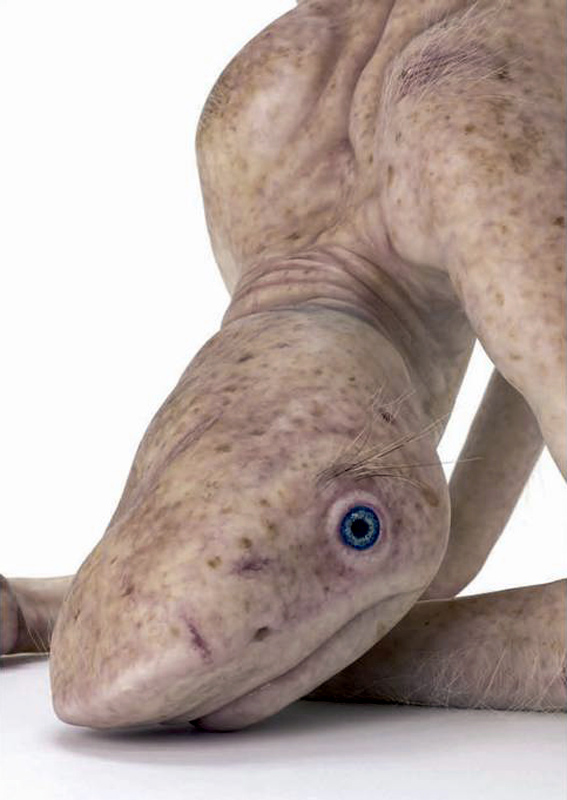
    With The Bottom Feeder (2009) Piccinini’s imagination soars to new heights. With the shoulders of a human, the legs and forearms of what seems like a marsupial, the lowered head of a newt with intense staring blue eye (see photograph above), luminescent freckled skin covered in hair and a rear end that consists of both male and female genitalia that forms a ‘face’, the hermaphroditic bottom feeder is a frighteningly surreal visage. Inevitably the viewer is drawn to the exposed rump through a seemingly unforced interactivity, examining the folds and flaps of the labia and the hanging scrotum of this succulent feeder. Here Piccinini draws on psychoanalysis and Lacan’s theory of the mirror stage in a child’s development – where the child wants to merge with the mother to erase the self / other split by fulfilling the mother’s desire by having sex with her – thus erasing the mother’s lack, the idea of lack represented by the lack of a penis.1

    As Jean Baudrillard notes of the mass of bodies on Brazil’s Copacabana beach, “Thousands of bodies everywhere. In fact, just one body, a single immense ramified mass of flesh, all sexes merged. A single, shameless expanded human polyp, a single organism, in which all collude like the sperm in seminal fluid … The sexual act is permanent, but not in the sense of Nordic eroticism: it is the epidermal promiscuity, the confusion of bodies, lips, buttocks, hips – a single fractal entity disseminated beneath the membrane of the sun.”2

    An so it is here, all sexes merged within the anthropomorphised body of The Bottom Feeder, a body that challenges and subverts human perceptions of the form and sexuality of animals (including ourselves) that inhabit the world.

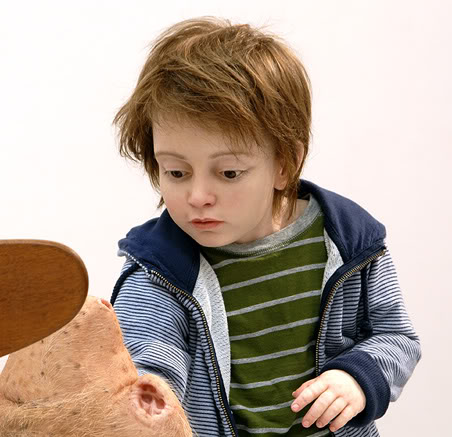
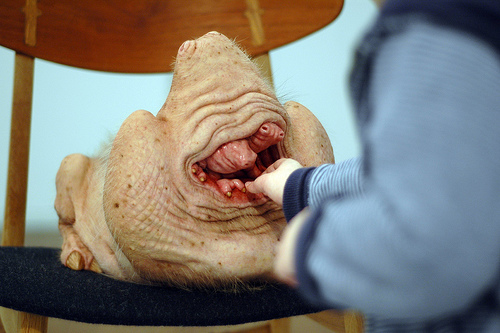
    In Doubting Thomas (2008), my favourite piece in the exhibition, a skeptical child with pale and luminous skin is about to put his hand inside the mouth of a genetically modified mole like creature that has reared it’s hairy snout to reveal a luscious, fluid-filled mouth replete with suckers and teeth. You want to shout ‘No, don’t go there!’ as the child’s absent mother has probably already warned him – to no avail. Children only learn through experience, I suspect in this case a nasty one.


    The terrains the Piccinini interrogates (nature and artifice, biogenetics, cloning, stem cell research, consumer culture) are a rematerialisation of the actual world through morphological ‘mapping’ onto the genomes of the future. Morphogenetic fields3 seem to surround the work with an intense aura; surrounded by this aura the animals and children become more spiritual in their silence. Experiencing this new world promotes an evolution in the way in which we conceive the future possibilities of life on this earth, this brave but mutably surreal new world.

    This is truly one of the best exhibitions of the year in Melbourne.

    Dr Marcus Bunyan


    1/ Klages, M. Jacques Lacan. Boulder: University of Colorado, 2001 [Online] Cited 09/10/2009 no longer available online

    2/ Baudrillard, Jean. Fragments: Cool Memories III, 1990-1995. London: Verso, 1997, p. 74

    3/ “A morphogenetic field is a group of cells able to respond to discrete, localised biochemical signals leading to the development of specific morphological structures or organs.” Morphogenetic field definition on Wikipedia [Online] Cited 05/05/2019


      Patricia Piccinini (Australian, b. 1965) 'The Strength of one Hand (With Canadian Mountain Goat)' 2009 from the exhibition 'Unforced Intimacies' by Patricia Piccinini at Tolarno Galleries, Melbourne, Oct - Nov, 2009


      Patricia Piccinini (Australian, b. 1965)
      The Strength of one Hand (With Canadian Mountain Goat)
      2009
      Silicone, fibreglass, human hair, clothing, Canadian Mountain Goat


      Patricia Piccinini (Australian, b. 1965) 'The Strength of one Hand (With Canadian Mountain Goat)' 2009 (detail) from the exhibition 'Unforced Intimacies' by Patricia Piccinini at Tolarno Galleries, Melbourne, Oct - Nov, 2009


      Patricia Piccinini (Australian, b. 1965)
      The Strength of one Hand (With Canadian Mountain Goat) (detail)
      2009
      Silicone, fibreglass, human hair, clothing, Canadian Mountain Goat


      Patricia Piccinini (Australian, b. 1965) 'The Bottom Feeder' 2009

      Patricia Piccinini (Australian, b. 1965) 'The Bottom Feeder' 2009


      Patricia Piccinini (Australian, b. 1965)
      The Bottom Feeder
      2009
      Silicone, fibreglass, steel, fox fur


      Patricia Piccinini (Australian, b. 1965) 'The Bottom Feeder' 2009 (detail)


      Patricia Piccinini (Australian, b. 1965)
      The Bottom Feeder (detail)
      2009
      Silicone, fibreglass, steel, fox fur


      Exploring concepts of what is “natural” in the digital age, Patricia Piccinini brings a deeply personal perspective to her work.

      Rachel Kent notes: “Since the early 1990s, Piccinini has pursued an interest in the human form and its potential for manipulation and enhancement through bio-technical intervention. From the mapping of the human genome to the growth of human tissue and organs from stem cells, Piccinini’s art charts a terrain in which scientific progress and ethical questions are intertwined.”

      Text from the Tolarno Galleries website [Online] Cited 05/05/2019 no longer available online


      Patricia Piccinini (Australian, b. 1965) 'Doubting Thomas' 2008


      Patricia Piccinini (Australian, b. 1965)
      Doubting Thomas
      2008
      Silicone, fibreglass, human hair, clothing, chair


      Patricia Piccinini (Australian, b. 1965) 'Doubting Thomas' 2008 (detail)


      Patricia Piccinini (Australian, b. 1965)
      Doubting Thomas (detail)
      2008


      Patricia Piccinini (Australian, b. 1965) 'Doubting Thomas' 2008 (detail)

      Patricia Piccinini (Australian, b. 1965) 'Doubting Thomas' 2008 (detail)


      Patricia Piccinini (Australian, b. 1965)
      Doubting Thomas (detail)
      2008


      “Time and again my work returns to children, and their ambiguous relationships with the (only just) imaginary animals that I create. Children embody a number of the key issues in my work. Obviously they directly express the idea of genetics – both natural and artificial – but beyond that they also imply the responsibilities that a creator has to their creations. The innocence and vulnerability of children is powerfully emotive and evokes empathy – their presence softens the hardness of some of the more difficult ideas, but it can also elevate the anxiety level.”


      Patricia Piccinini quoted on the Kaldor Public Art Projects website [Online] Cited 05/11/2009 no longer available online


      “I am interested in the way that contemporary biotechnology and even philosophy erode the traditional boundaries between the artificial and the natural, as well as between species and even the basic distinctions between animal and human.”


      Patricia Piccinini quoted in Sarah Hetherington. “Patricia Piccinini: Related Individuals,” on the Artlink website [Online] Cited 05/05/2019. No longer available online


      Patricia Piccinini (Australian, b. 1965) 'Balasana' 2009 (detail)


      Patricia Piccinini (Australian, b. 1965)
      Balasana
      Silicone, fibreglass, human hair, clothing, Red-necked Wallaby, rug
      2009


      Tolarno Galleries
      Level 4, 104 Exhibition Street,
      Melbourne, Vic, 3000
      Phone: +61 3 9654 6000

      Opening hours:
      Tuesday – Friday 10am – 5pm
      Saturday 1 – 5pm

      Tolarno Galleries website

      LIKE ART BLART ON FACEBOOK

      Back to top

      Review: ‘Nocturnalians and Shadow Eaters’ by Vera Möller at Sophie Gannon Gallery, Richmond, Melbourne

      Exhibition dates: 20th October – 14th November 2009


      Vera Möller (Australian, b. 1955 Germany arrived Australia 1986) 'Rabinova' 2009 from the exhibition 'Nocturnalians and Shadow Eaters' by Vera Möller at Sophie Gannon Gallery, Richmond, Melbourne, Oct - Nov, 2009


      Vera Möller (Australian, b. 1955 Germany arrived Australia 1986)
      Rabinova
      2009
      Oil on linen
      82 x 76cm


      “I am interested in this border between the real and the imagined, the constructed and the natural.”


      Vera Möller quoted in “Artist earns her stripes” on The Age newspaper website May 28, 2005 [Online] Cited 23/06/2022


      There is a lot of mutability floating around current exhibitions in Melbourne at the moment. At the National Gallery of Victoria we have the deathly, eloquent freeze frame mutability of Ricky Swallow; at Tolarno Galleries we have the genetic hyper-realist mutability of Patricia Piccinini; and at Sophie Gannon Gallery we have the surreal, spatial mutability of Vera Möller.

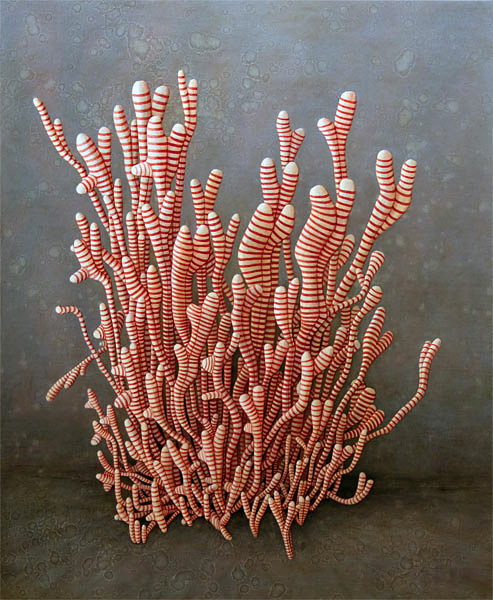
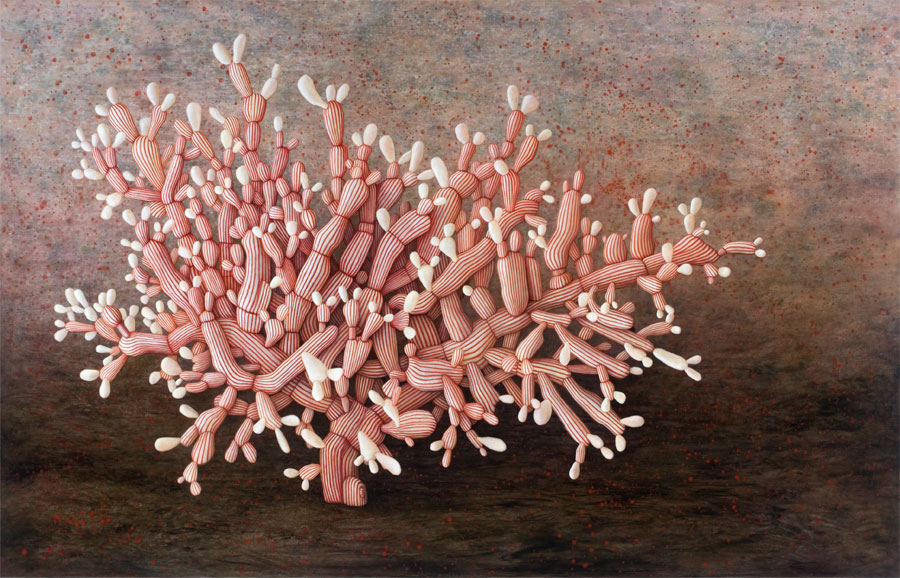
      In this exhibition the real meets the imagined and the constructed encounters the natural in delicate sculptures and beautiful paintings. Coral snake and mutated striped hydras float above Phillip Huntersque backgrounds, looking oh so innocent until one remembers that hydras are predatory animals: the stripes, like the strips of a prisoners uniform not so innocent after all.

      These ‘portraits’ (for that is what they strike me as) emerge from the recesses of the subconscious, rising up like some absurd alien fish from the deep. The sculptural forests of mutated specimens waft on the breeze of the ocean current. This detritus of biotechnology, living in the dark and the shadow, emerges into the light and space of the gallery – genetic recombinations in which a strands of genetic material are broken and then joined to another DNA molecule. In Möller’s work this chromosomal crossover has led to offspring (called ‘recombinants’) that dance to a surrealist tune: genetic algorithms that use mutation to maintain genetic diversity from one generation of chromosomes to the next.1

      Spatially there is a lightness of touch and a beauty to their representation that brings the work alive within the gallery space. However, Möller’s recombinants are as deadly as they are beautiful. I really liked these creatures narcoleptic shadow dances.

      Dr Marcus Bunyan


      1/ Definition of mutation (genetic algorithm) in Wikipedia.


        Many thankx to Sophie Gannon Gallery for allowing me to publish the art work in the posting. Please click on the photographs for a larger version of the image.


        Vera Möller (Australian, b. 1955 Germany arrived Australia 1986) 'Martinette' 2009 (installation view)


        Vera Möller (Australian, b. 1955 Germany arrived Australia 1986)
        Martinette (installation view)
        2009
        Modelling material, acrylic and enamel paint, MDF, perspex cove


        Vera Möller (Australian, b. 1955 Germany arrived Australia 1986) 'Veronium' 2007 from the exhibition 'Nocturnalians and Shadow Eaters' by Vera Möller at Sophie Gannon Gallery, Richmond, Melbourne, Oct - Nov, 2009


        Vera Möller (Australian, b. 1955 Germany arrived Australia 1986)
        Veronium
        2007
        Oil on canvas
        167 x 199cm


        Vera Möller (Australian, b. 1955 Germany arrived Australia 1986) 'Shapinette' 2009 from the exhibition 'Nocturnalians and Shadow Eaters' by Vera Möller at Sophie Gannon Gallery, Richmond, Melbourne, Oct - Nov, 2009


        Vera Möller (Australian, b. 1955 Germany arrived Australia 1986)
        Shapinette
        2009
        Oil on linen
        101 x 101cm


        Vera Möller (Australian, b. 1955 Germany arrived Australia 1986) 'Telenium' 2009


        Vera Möller (Australian, b. 1955 Germany arrived Australia 1986)
        Telenium
        2009
        Oil on linen
        165 x 135cm


        Vera Möller (Australian, b. 1955 Germany arrived Australia 1986) 'Rubella' 2008-2009


        Vera Möller (Australian, b. 1955 Germany arrived Australia 1986)
        Rubella
        2008-2009


        Vera Möller (Australian, b. 1955 Germany arrived Australia 1986) 'Bureniana' 2008 (installation view)


        Vera Möller (Australian, b. 1955 Germany arrived Australia 1986)
        Bureniana (installation view)
        2008
        Modelling material, acrylic and enamel paint, MDF, perspex cover
        60 x 61 x 61cm


        Installation photo of 'Nocturnalians and Shadow Eaters' by Vera Moller at Sophie Gannon Gallery, Melbourne

        Installation photo of 'Nocturnalians and Shadow Eaters' by Vera Moller at Sophie Gannon Gallery, Melbourne


        Installation photographs of Nocturnalians and Shadow Eaters by Vera Möller at Sophie Gannon Gallery, Melbourne
        Photos: Marcus Bunyan


        Interested in the boundaries between the real and the imagined, Vera Möller creates paintings and sculptures by placing fictional hybrid plants in existing terrains. Bright colours and patterns, coral-like and succulent-plant forms and toadstool shapes describe her depictions of dreamt-up specimens that evoke the natural world. Möller’s ‘fantasy specimens’ demonstrate the way in which her science background and art practice have steadily converged.

        After training as a biologist in Germany, Möller migrated to Australia in 1986. She later completed a Bachelor of Fine Art at the Victorian College of the Arts and a PhD at Monash University. Her work has been exhibited in the USA, Japan, Finland, France, Germany and the UK, as well as throughout Australia.

        Text from the Sophie Gannon Gallery website [Online] Cited 03/05/2019


        Vera Möller (Australian, b. 1955 Germany arrived Australia 1986) 'Benthinium' 2008-2009


        Vera Möller (Australian, b. 1955 Germany arrived Australia 1986)
        Benthinium
        2008-2009
        Oil on linen
        140 x 220cm


        Vera Möller (Australian, b. 1955 Germany arrived Australia 1986) 'Tokyana' 2009


        Vera Möller (Australian, b. 1955 Germany arrived Australia 1986)
        Tokyana
        2009
        Oil on linen
        137 x 107cm


        Sophie Gannon Gallery
        2, Albert Street, Richmond, Melbourne

        Opening hours:
        Tuesday – Saturday 11am – 5pm

        Sophie Gannon Gallery website

        LIKE ART BLART ON FACEBOOK

        Back to top

        Review: ‘Long Distance Vision: Three Australian Photographers’ at The Ian Potter Centre NGV Australia, Federation Square, Melbourne

        Exhibition dates: 28th August, 2009 – 21st February, 2010


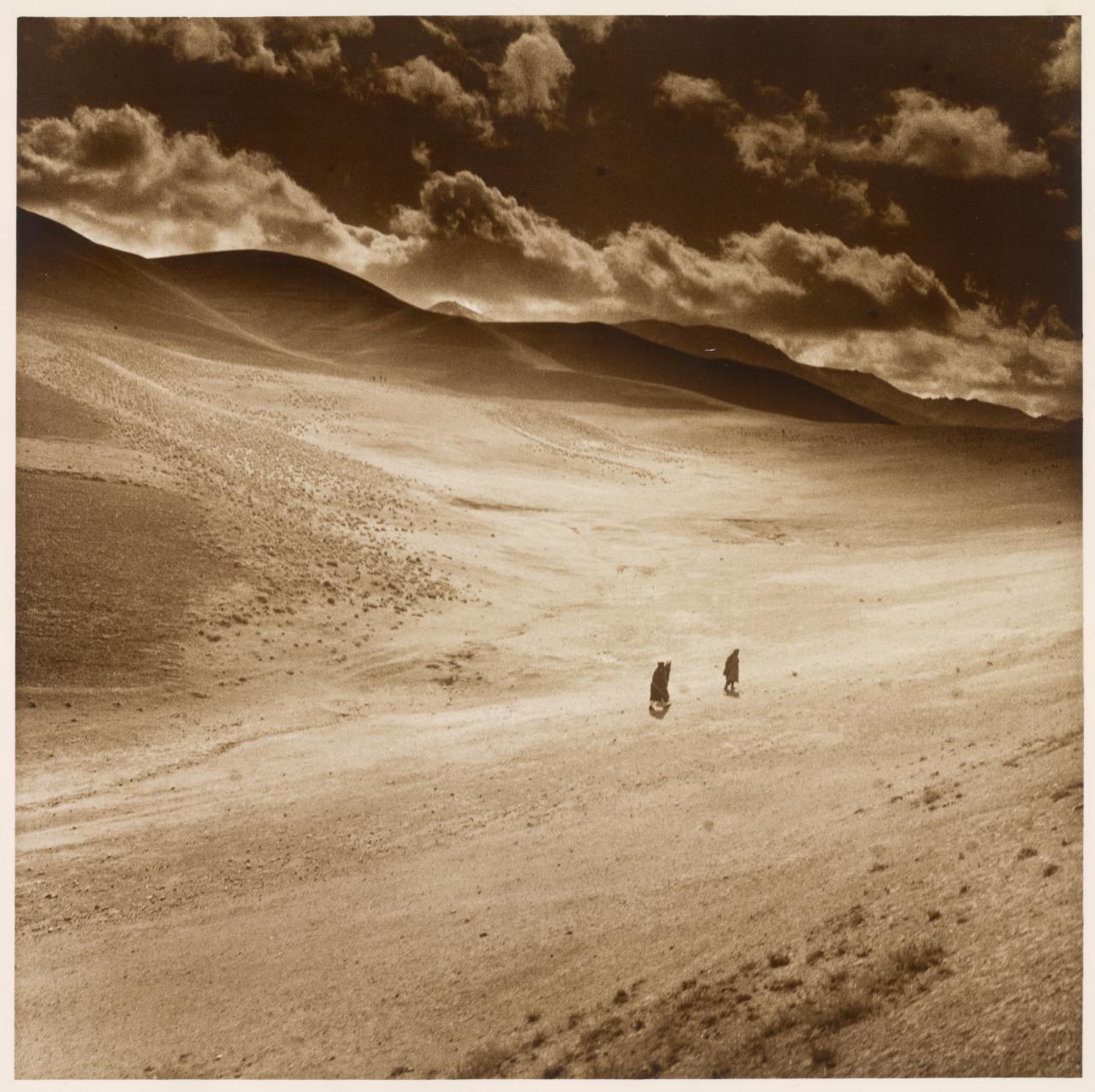
        Max Pam (born Australia 1949, lived in Brunei 1980-1983) 'Road from Bamiyan' 1971 from the exhibition 'Long Distance Vision: Three Australian Photographers' at The Ian Potter Centre NGV Australia, Federation Square, Melbourne, Aug 2009 - Feb 2010


        Max Pam (born Australia 1949, lived in Brunei 1980-1983)
        Road from Bamiyan
        1971
        Gelatin silver photograph
        20.1 x 20.1cm
        National Gallery of Victoria, Melbourne
        Purchased, 1979


        Long Distance Vision is a disappointingly wane exploration of travel photography at NGV Australia. With the exception of the work of Max Pam the exhibition lacks insight into the phenomena that the curators want the work to philosophically investigate: namely how photographs shape our expectations of a place (even before we arrive) and how photographs also serve to confirm our experience – the picture as powerful mnemonic tool.

        Firstly a quick story: when travelling in America to study at the Kinsey Institute I boarded a train from Chicago to what I thought was Bloomington, Indiana only to arrive many hours later at Bloomington, Illinois. Unbeknownst to me this Bloomington also had a motel of the same name as I was staying at in Indiana! After much confusion I ended up at the local airport trying to catch a single seater aircraft to Bloomington, Indiana with no luck – at the end of my tether, fearful in a foreign country, in tears because I just had to be at this appointment the next morning. Riding to my rescue was a nineteen year old kid with no shoes, driving an ex-cop car, who drove me across the Mid-West states stopping at petrol stops in the dead of night. It was a surreal experience, one that I will never forget for the rest of my life … fear, apprehension, alienation, happiness, joy and the sublime all rolled into one.

        I tell this story to illustrate a point about travel – that you never know what is going to happen, what experiences you will have, even your final destination. To me, photographs of these adventures not only document this dislocation but step beyond pure representation to become art that re-presents the nature of our existence.

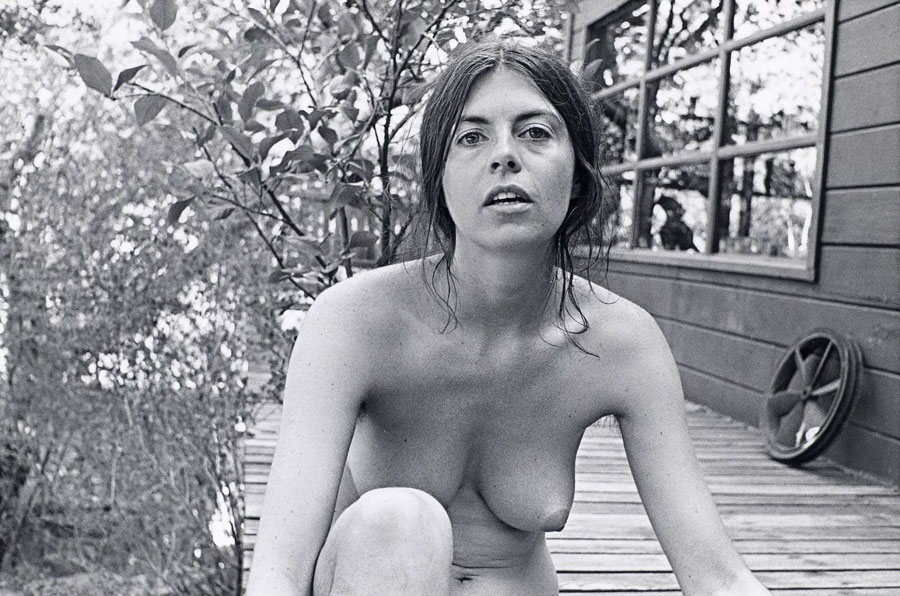
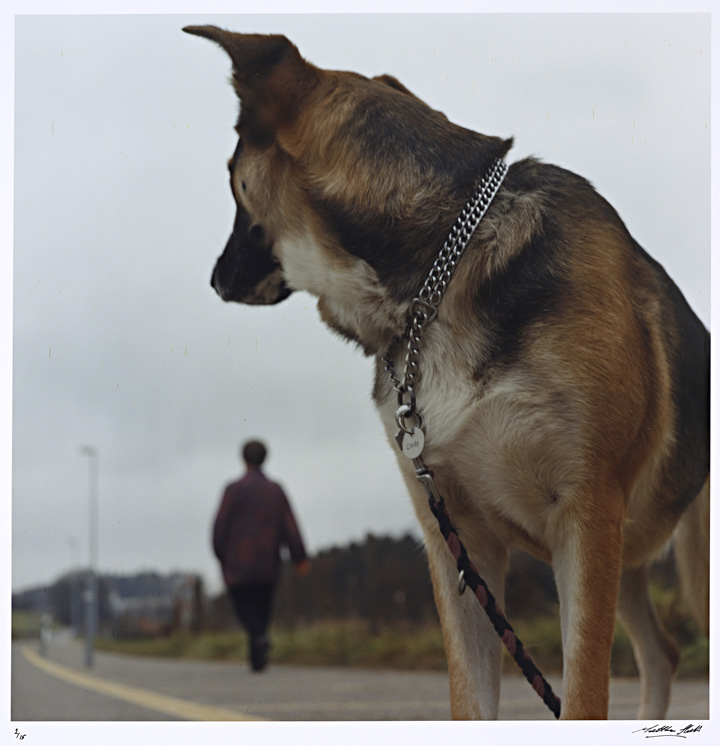
        Matthew Sleeth‘s street photographs could be taken almost anywhere in the world (if it were not for a building with German writing on it). His snapshot aesthetic of caught moments, blinded people and dissected bodies in the observed landscape are evinced (to show in a clear manner; to prove beyond any reasonable doubt; to manifest; to make evident; to bring to light; to evidence – yes to bring to light, to evidence as photography does!) in mundane, dull, almost lifeless prints – ‘heavy’ photographs with a lack of shadow detail combined with a shallow depth of field. His remains, the people walking down the street and their shadow, are odd but as as The Age art critic Robert Nelson succinctly notes in his review of this exhibition, To become art, the odd cannot remain merely quaint but has to signify an existential anomaly by implication.”1

        If we look at the seminal photographs from the book The Americans by Robert Frank we see in their dislocated view of America a foreigners view of the country the artist was travelling across – a subjective view of America that reveals as much about the state of mind of the artist as the country he was exposing. No such exposition happens in the works of Matthew Sleeth.

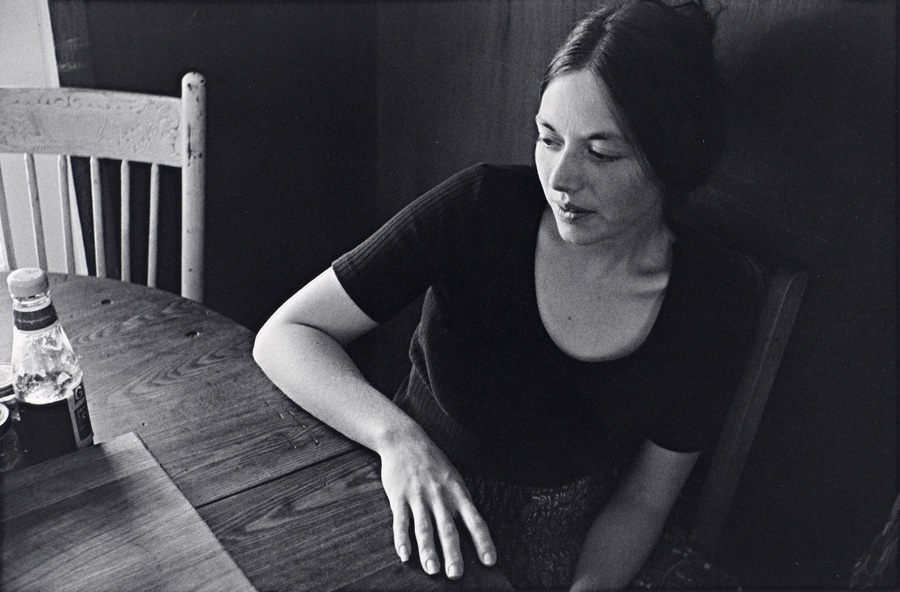
        Christine Godden‘s photographs of family and friends have little to do with travel photography and I struggle to understand their inclusion in this exhibition. Though they are reasonable enough photographs in their own right – small black and white photographs of small intimacies (at the beach, in the garden, at the kitchen table, on the phone, on the porch, on the float, etc…) Godden’s anthropomorphist bodies have nothing to do with a vision of a new land as she had been living in San Francisco, New York and Rochester for six years over the period that these photographs were taken. Enough said.

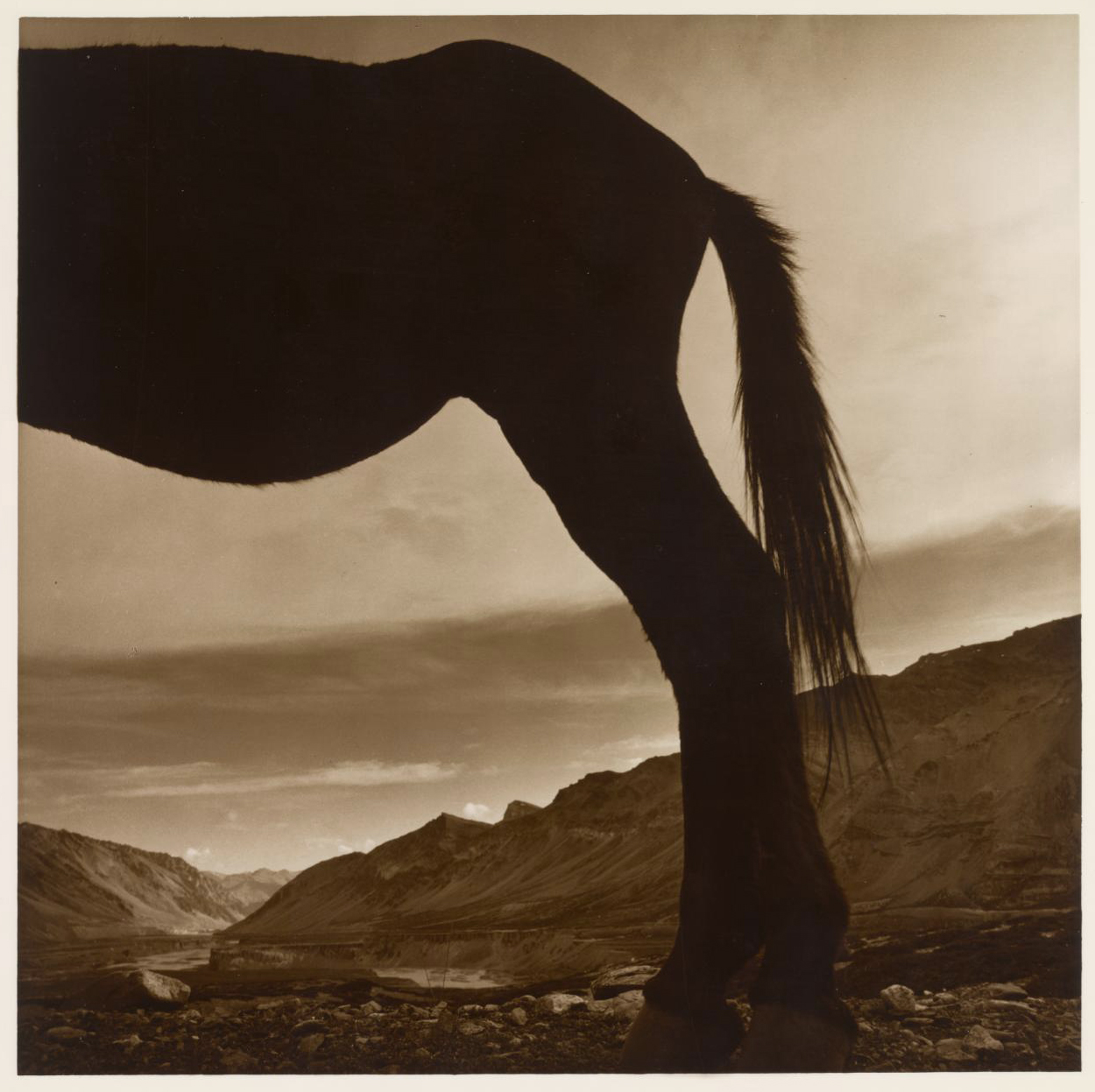
        The highlight of the exhibition is the work of Max Pam. I remember going the National Gallery of Victoria in the late 1980s to view this series of work in the collection – and what a revelation they were then and remain so today. The square formatted, dark sepia toned silver gelatin prints of the people and landscapes of Tibet are both monumental and personal at one and the same time. You are drawn into their intimacies: the punctum of a boys feet; the gathering of families; camels running before a windstorm; human beings as specks in a vast landscape.

        “If the world is unfair or beyond our understanding, sublime places suggest it is not surprising things should be thus. We are the playthings of the forces that laid out the oceans and chiselled the mountains. Sublime places acknowledge limitations that we might otherwise encounter with anxiety or anger in the ordinary flow of events. It is not just nature that defies us. Human life is as overwhelming, but it is the vast spaces of nature that perhaps provide us with the finest, the most respectful reminder of all that exceeds us. If we spend time with them, they may help us to accept more graciously the great unfathomable events that molest our lives and will inevitably return us to dust.”2

        The meditation on place and space that the artist has undertaken gives true insight into the connection of man and earth, coming closest to Alain de Botton’s understanding of the significance of sublime places. Through a vision of a distant land the photographs transport us in an emotional journey that furthers our understanding of the fragility of life both of the planet and of ourselves.

        While the National Gallery of Victoria holds some excellent photography exhibitions (such as Andreas Gursky and Rennie Ellis for example) this was a missed opportunity. The interesting concept of the exhibition required a more rigorous investigation instead of such a cursory analysis (which can be evidenced by the catalogue ‘essay’: one page the size of a quarter of an A4 piece of paper that glosses over the whole history of travel photography in a few blithe sentences).

        Inspiration could have easily been found in Alain de Botton’s excellent book The Art of Travel. Here we find chapters titled “On Anticipation”, “On Travelling Places”, “On the Exotic”, “On Curiosity”, “On the Country and the City” and “On the Sublime” to name but a few, with places and art work to illustrate the journey: what more is needed to excite the mind!

        Take Charles Baudelaire for example. He travelled outside his native France only once and never ventured abroad again. Baudelaire still dreamt of going to Lisbon, or Java or to the Netherlands but “the destination was not really the point. The true desire was to get away, to go, as he concluded, ‘Anywhere! Anywhere! So long as it is out of the world!'”3

        Heavens, we don’t even have to leave home to create travel photography that is out of the world! Our far-sighted vision (like that of photographer Gregory Crewdson) can create psychological narratives of imaginative journeys played out for the camera.

        Perhaps what was needed was a longer gestation period, further research into the theoretical nuances of travel photography (one a little death, a remembrance; both a dislocation in the non-linearity of time and space), a gathering of photographs from collections around Australia to better evidence the conceptual basis for the exhibition and a greater understanding of the irregular possibilities of travel photography – so that the work and words could truly reflect the title of the exhibition Long Distance Vision.

        Dr Marcus Bunyan


        1/ Nelson, Robert. “In blurred focus: le freak c’est chic,” in The Age newspaper. Friday, October 23rd 2009, p. 18

        2/ de Botton, Alain. The Art of Travel. London: Penguin, 2002, p. 178-179

        3/ Ibid., p. 34


        Max Pam (born Australia 1949, lived in Brunei 1980-83) 'My donkey, our valley, Sarchu' 1977 from the exhibition 'Long Distance Vision: Three Australian Photographers' at The Ian Potter Centre NGV Australia, Federation Square, Melbourne, Aug 2009 - Feb 2010


        Max Pam (born Australia 1949, lived in Brunei 1980-1983)
        My donkey, our valley, Sarchu
        1977
        Gelatin silver photograph
        20.1 x 20.1cm
        National Gallery of Victoria, Melbourne
        Purchased, 1979
        © Max Pam


        Max Pam (Australian, b. 1949) 'Sisters' 1977 from the exhibition 'Long Distance Vision: Three Australian Photographers' at The Ian Potter Centre NGV Australia, Federation Square, Melbourne, Aug 2009 - Feb 2010


        Max Pam (born Australia 1949, lived in Brunei 1980-1983)
        Sisters
        1977
        Gelatin silver photograph
        20.1 x 20.1cm
        National Gallery of Victoria, Melbourne
        Purchased, 1979
        © Max Pam


        Max Pam (Australian, b. 1949) 'Tibetan nomads' 1977


        Max Pam (born Australia 1949, lived in Brunei 1980-1983)
        Tibetan nomads
        1977
        Gelatin silver photograph
        20.1 x 20.2cm
        National Gallery of Victoria, Melbourne
        Purchased, 1979
        © Max Pam


        Christine Godden (Australian, b. 1947) 'Bobbie and Amitabha at the beach' c. 1972


        Christine Godden (Australian, b. 1947)
        Bobbie and Amitabha at the beach
        c. 1972
        Gelatin silver photograph
        13.2 x 20.1cm
        National Gallery of Victoria, Melbourne
        Purchased from Admission Funds, 1991
        © Christine Godden


        Christine Godden (Australian, b. 1947) 'Elliot holding a ring' 1973


        Christine Godden (Australian, b. 1947)
        Elliot holding a ring
        1973
        Gelatin silver photograph
        15.0 x 22.8cm
        National Gallery of Victoria, Melbourne
        Purchased from Admission Funds, 1991
        © Christine Godden


        Christine Godden.Christine Godden (Australian, b. 1947)kitchen table' 1973


        Christine Godden (Australian, b. 1947)
        Joanie at the kitchen table
        1973, printed 1986
        Gelatin silver photograph
        20.1 x 30.6cm
        National Gallery of Victoria, Melbourne
        Purchased from Admission Funds, 1991
        © Christine Godden


        Christine Godden (Australian, b. 1947) 'With Leigh on the porch' 1972


        Christine Godden (Australian, b. 1947)
        With Leigh on the porch
        1972, printed 1986
        Gelatin silver photograph
        20.2 x 30.5cm
        National Gallery of Victoria, Melbourne
        Purchased from Admission Funds, 1991
        © Christine Godden


        “The National Gallery of Victoria will celebrate the work of Christine Godden, Max Pam and Matthew Sleeth in a new exhibition, Long Distance Vision: Three Australian Photographers opening 28 August.

        Long Distance Vision will include over 60 photographs from the NGV Collection exploring the concept of the ‘tourist gaze’ and its relationship with the three artists.

        Susan van Wyk, Curator Photography, NGV said the exhibition provides a fascinating insight into the unusual perspective brought by the three photographers to their varied world travel destinations.

        “There’s a sense in the works in the exhibition that the photographers are not from the places they choose to photograph, and that each is a visitor delighting in the scenes they encounter.

        “What is notable about the photographs in Long Distance Vision is that rather than focussing on the well known scenes that each artist encountered, they have turned their attention to the ‘little things’, the details of the everyday,” said Ms van Wyk.

        From the nineteenth century, photography has been a means by which people could discover the world, initially through personal collection and albums, and later via postcards, magazines, books and the internet.

        Dr Gerard Vaughan, Director, NGV said that both contemporary photographers and tourists use the camera as a means to explore and capture the world.

        “Through their photographs, the three artists featured in Long Distance Vision show us highly individual ways of seeing the world. This exhibition will surprise and delight visitors as our attention is drawn to not only what is different but what remains the same as we travel the world,” said Dr Vaughan.

        Born in Melbourne in 1949, Max Pam began his career in various commercial photography studios in the 1960s. After responding to a university notice for assistance to drive a Volkswagen from Calcutta to London in 1969, Pam got his first taste of being a traveller. The body of Pam’s work in this exhibition is from the series The Himalayas, which was photographed over a number of early visits to India.

        Christine Godden also travelled the popular overland route between Europe and India in the early 1970s, returning to Sydney in 1978. In 1972, after a period of travelling, Godden found her home in the US where she remained for six years. Godden’s photographs in this exhibition were taken between 1972 and 1974 during her stay in the US.

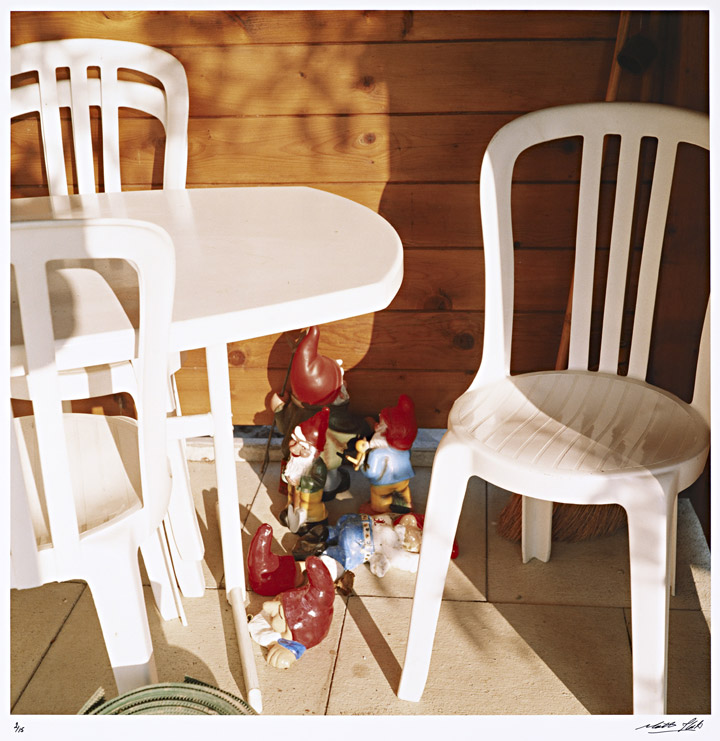
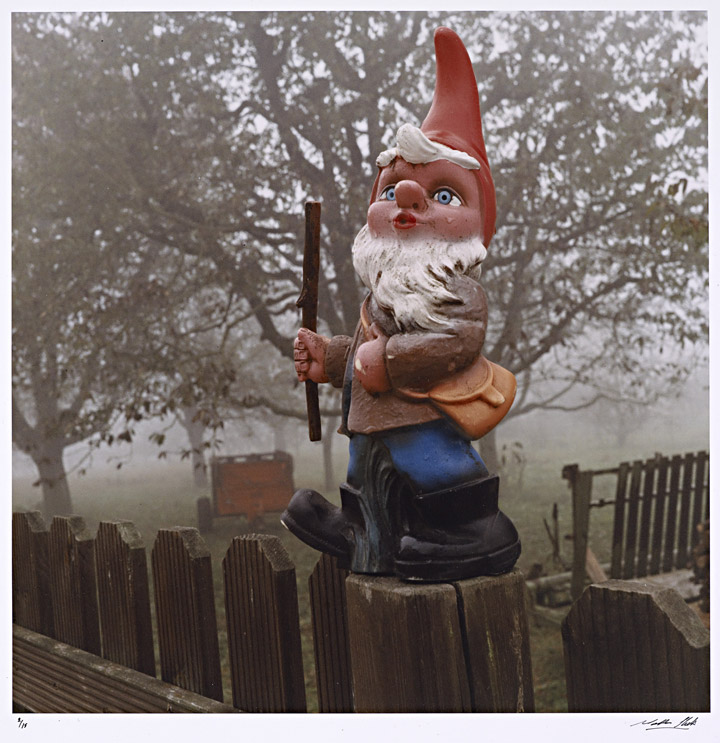
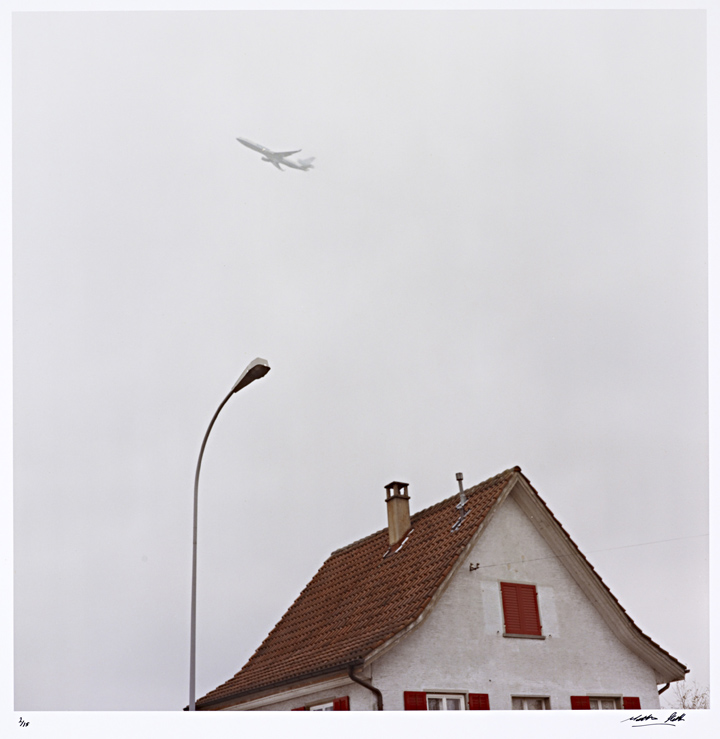
        Born in Melbourne in 1972, Matthew Sleeth is another seasoned traveller. During the late 1990s, Sleeth settled in Opfikon, an outer suburb of Zurich, Switzerland. The series of photographs in Long Distance Vision were taken during this time, showing Sleeth’s interest not only in street photography, but also in the narrative possibilities in everyday scenes. Dotted with garishly coloured playhouses, naive sculptures and whimsical arrangements of garden gnomes Sleeth’s photographs go beyond the ‘picture-perfect’ scenes of typical tourist photography.

        Long Distance Vision: Three Australian Photographers is on display at The Ian Potter Centre: NGV Australia, Federation Square from 28 August 2009 to 21 February 2010.”

        Text from the National Gallery of Victoria press release


        Matthew Sleeth (Australian, b. 1972) From the series 'Opfikon' 1997

        Matthew Sleeth (Australian, b. 1972) From the series 'Opfikon' 1997

        Matthew Sleeth (Australian, b. 1972) From the series 'Opfikon' 1997

        Matthew Sleeth (Australian, b. 1972) From the series 'Opfikon' 1997

        Matthew Sleeth (Australian, b. 1972) From the series 'Opfikon' 1997


        Matthew Sleeth (Australian, b. 1972)
        Photographs from the series Opfikon
        1997, printed 2004
        Type C photograph
        43.2 x 43.0cm
        National Gallery of Victoria, Melbourne
        Presented through the NGV Foundation by Patrick Corrigan, Governor, 2005
        © Matthew Sleeth courtesy of Sophie Gannon Gallery, Melbourne


        The Ian Potter Centre: NGV Australia Federation Square
        Corner of Russell and 
Flinders Streets, Melbourne

        Opening hours:
        Every day 10am – 5pm

        National Gallery of Victoria website

        LIKE ART BLART ON FACEBOOK

        Back to top

        Review: ‘October 2009’ jewellery by Carlier Makigawa at Gallery Funaki, Melbourne

        Exhibition dates: 6th October – 31st October, 2009


        Carlier Makigawa (Australian, b. 1952) 'Brooch' 2009 from the exhibition 'October 2009' jewellery by Carlier Makigawa at Gallery Funaki, Melbourne, October 2009


        Carlier Makigawa (Australian, b. 1952)
        Brooch
        2009
        Silver, paint


        Jewellery as art; is art

        Brooches, objects

        Robust/delicate

        Holistic body of work

        Affirmation of line and form

        Simplicity/complexity of shapes

        Span ______  (meta)physical

        [Interior] exterior!

        elemental | articulation

        Volume ((( ))) form

        &

        arch-itecture

        SPACE

        beauty

        ……………………….

        Dr Marcus Bunyan


        Many thankx to Gallery Funaki for allowing me to publish the photographs in the posting. Please click on the photographs for a larger version of the image.


        Carlier Makigawa (Australian, b. 1952) 'Brooch' 2009 from the exhibition 'October 2009' jewellery by Carlier Makigawa at Gallery Funaki, Melbourne, October 2009


        Carlier Makigawa (Australian, b. 1952)
        Brooch
        2009
        Silver


        Carlier Makigawa (Australian, b. 1952) 'Brooch' 2009


        Carlier Makigawa (Australian, b. 1952)
        Brooch
        2009
        Silver


        Carlier Makigawa (Australian, b. 1952) 'Brooch 1a' 2009 from the exhibition 'October 2009' jewellery by Carlier Makigawa at Gallery Funaki, Melbourne, October 2009


        Carlier Makigawa (Australian, b. 1952)
        Brooch
        2009
        Silver


        “A spiritual and private space. Ritual object, jewellery. Linear structures appear fragile and monumental to cradle the internal spirit. They appear to float in space, hovering, penetrating, a temporary existence. Nature is the reference, and the geometry of nature and architecture inform this world.”


        Carlier Makigawa


        Carlier Makigawa explores the parameters of small spaces in her new exhibition October 2009. Her spare, exacting constructions in silver wire have a monumentality that defies their scale and delicacy. Her new work consists of brooches and objects which move beyond the botanical inspiration of her earlier work to engage with more abstract notions of movement, compression and spatial manipulation.

        Text from the Gallery Funaki website [Online] Cited 01/05/2019 no longer available online


        Carlier Makigawa (Australian, b. 1952) 'Object' 2009


        Carlier Makigawa (Australian, b. 1952)
        Object
        2009
        Silver


        Carlier Makigawa (Australian, b. 1952) 'Object' 2009


        Carlier Makigawa (Australian, b. 1952)
        Object
        2009
        Silver


        Carlier Makigawa (Australian, b. 1952) 'Brooch 1' 2009


        Carlier Makigawa (Australian, b. 1952)
        Brooch
        2009
        Silver


        Carlier Makigawa (Australian, b. 1952) 'Geometric Neckpiece' 2009


        Carlier Makigawa (Australian, b. 1952)
        Neckpiece
        2009
        Silver


        Gallery Funaki website

        LIKE ART BLART ON FACEBOOK

        Back to top

        Review: ‘Sweet Complicity’ by eX de Medici at Karen Woodbury Gallery, Richmond, Melbourne

        Exhibition dates: 30th September – 24th October, 2009


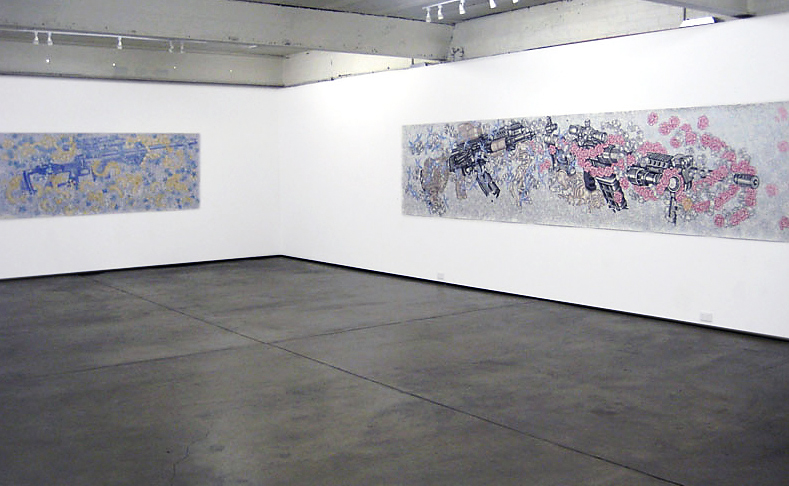
        eX de Medici (Australia, b. 1959) 'Tooth and claw' 2009 from the exhibition 'Sweet Complicity' by eX de Medici at Karen Woodbury Gallery, Richmond, Melbourne, Sept - Oct, 2009


        eX de Medici (Australia, b. 1959)
        Tooth and claw
        2009
        Pen, ink and mica on archival paper
        114.0 x 521.0cm


        Is it sinful to say that an Armalite rifle can be voluptuously seductive? Not in the hands of artist eX de Medici!

        Taking a variety of contemporary military high-powered weapons (Armalite AR30 Tactical .308 Sniper, Modified AK 47, Blackwater AR15, Patriot Ordinance P45 .223 for example) eX de Medici’s armaments have a steely presence softened and consumed by multitudinous garlands of traditional tattoo ‘flash’ iconography (flowers, skulls, bows, stars, Chinese dragons, waves and swallows repeated in Escher-like patterns) and contorted skeletons. Using individual colour palettes for each of the three large pen, ink and mica on paper works in the exhibition, eX subverts the masculine symbology of gun culture and decomposes it within an ornamentation of deathly desire – new compositions in the dance of death: ‘U hurt me Baby, U Fkd me up gd, the hole tht u made (cross) me Ded …’

        In other less skilled artist’s hands the subject matter could become cliched and trite but here de Medici balances the disparate elements in her compositions and brings the subject matter alive – sinuously jumping off the paper, entwining the viewer in their delicious ironies, all of us sweetly complicit in the terror war (send more meat, send more meat!), fighting tooth and nail to keep urban realities at arm’s length. The dark desires that these works contain possess an aesthetic beauty that swallows us up so that we, too, become ‘Barbarians All’. Highly recommended!

        Dr Marcus Bunyan


        Many thankx to Karen Woodbury Gallery for allowing me to publish the art work in the posting. Please click on some of the photographs for a larger version of the image.


        eX de Medici (Australia, b. 1959) 'Tooth and Claw' 2009 (detail) from the exhibition 'Sweet Complicity' by eX de Medici at Karen Woodbury Gallery, Richmond, Melbourne, Sept - Oct, 2009


        eX de Medici (Australia, b. 1959)
        Tooth and claw (detail)
        2009
        Pen, ink and mica on archival paper
        114.0 x 521.0cm


        eX de Medici (Australia, b. 1959) 'Tooth and claw' 2009 (detail)

        eX de Medici (Australia, b. 1959) 'Tooth and claw' 2009 (detail)


        eX de Medici (Australia, b. 1959)
        Tooth and claw (details)
        2009
        Pen, ink and mica on archival paper
        114.0 x 521.0cm


        Installation view of 'Sweet Complicity' by eX de Medici at Karen Woodbury Gallery, Melbourne showing at left, 'Send more meat' (2009) and at right, 'Tooth and claw' (2009)


        Installation view of Sweet Complicity by eX de Medici at Karen Woodbury Gallery, Melbourne showing at left, Send more meat (2009) and at right, Tooth and claw (2009)
        Photo: Marcus Bunyan


        eX de Medici (Australia, b. 1959) 'Send more meat' 2009


        eX de Medici (Australia, b. 1959)
        Send more meat
        2009
        Pen, ink and mica on archival paper


        eX de Medici (Australia, b. 1959) 'Send more meat' 2009 (detail)


        eX de Medici (Australia, b. 1959)
        Send more meat (detail)
        2009
        Pen, ink and mica on archival paper


        Sweet complicity is eX de Medici’s first and much anticipated exhibition at Karen Woodbury Gallery. The exhibition will comprise of three monumental pen, ink and mica works on archival paper. These works examine recurring themes in her practice such as power, war, death and violence via a decorative feminine veneer and aesthetic.

        The recurrent use of symbolism in the form of weapons, skulls and garlands in her work re-appear with the addition of Chinese imagery (Imperial golden dragons, China’s five-pointed star, and the use of chrysanthemums). These potent works display a latent interest in scientific illustration and allude to de Medici’s characteristic stylised tattoo motifs that stems from her work as a tattooist. The almost obsessive repetition of pattern and immense detailing display eX’s dedication to her practice through the strong mental and physical commitment required to complete such awe-inspiring artworks that seduce the viewer.

        There is an unmistaken polemic tone in de Medici’s practice that cannot be ignored. Different cultures, identities, actions and consequences are represented and centred on objects of warfare, allowing for disguised and layered political and moral statements.

        de Medici lives and produces much of her work in the nation’s capital Canberra. Streams of influences inform the work; Canberra’s political and physical agendas, research resourced from various national institutions such as the CSIRO Entomological and Taxonomy Division, the National Library of Australia and the Australian War Memorial. She has recently returned from the Solomon Islands where she was chosen as an official war artist.

        Text from the Karen Woodbury Gallery website [Online] Cited 05/10/2009. No longer available online


        The defining theme in eX de Medici’s paintings is a consistent interrogation of power. The notion of ‘the personal’ doesn’t interest the artist. Instead she investigates authority and dissent through paintings of guns, surveillance devices and gas masks.


        eX de Medici (Australia, b. 1959) 'American Sex/Funky Beat Machine' 2009


        eX de Medici (Australia, b. 1959)
        American Sex/Funky Beat Machine
        2009
        Pen, ink and mica on archival paper
        Diptych, 114.0 x 249.0cm


        eX de Medici (Australia, b. 1959) 'American Sex/Funky Beat Machine' 2009 (detail)


        eX de Medici (Australia, b. 1959)
        American Sex/Funky Beat Machine (detail)
        2009
        Pen, ink and mica on archival paper
        Diptych, 114.0 x 249.0cm


        Karen Woodbury Gallery

        This gallery is now closed.

        LIKE ART BLART ON FACEBOOK

        Back to top

        Review: ‘Slow Down, You Move Too Fast’ by Kirra Jamison at Sophie Gannon Gallery, Richmond, Melbourne

        Exhibition dates: 22nd September – 17th October, 2009


        Kirra Jamison (Australian) 'Livin' on a prayer' 2009 from the exhibition 'Slow Down, You Move Too Fast' by Kirra Jamison at Sophie Gannon Gallery, Richmond, Melbourne, Sept - Oct, 2009


        Kirra Jamison (Australian)
        Livin’ on a prayer
        2009
        Gouache, pen and vinyl on paper
        160 x 114cm


        Hit, Hit, Hit with a Miss

        Although all the work in this exhibition is dated 2009 this exhibition can fairly easily be divided into what seems to be two separate bodies of work: the excellent gouache, pen and vinyl works of paper and the ‘other’ less successful large paintings of owls and raccoons and the smaller paintings of hanging flowers and tree branches on dark purple ground.

        The latter large and small paintings fail to hit the spot with the exception of Belong to me (2009, below) which has visual and conceptual links to the works on paper, the twin bodies dissolving into a kaleidoscopic dream-like effervescence of life. The paintings of the owl (Last star, 2009 below), raccoons (Can you see my aura 2009, below) together with another fairytale painting With a roof of flint and a floor of chalk (2009) fail to communicate a shared vision being disparate items that conceptually don’t seem to hang well together. They lack a certain spark, that revelatory presence and appear flat both physically and metaphorically.

        On the flip side of the equation are works that are physically complex, conceptually robust and simply beautiful in their execution: no wonder so many of them have sold already! Using basic graphic patterns repeated and inverted (Jamison has an interest in graphics fostered through textile design), Jamison constructs fantasy worlds, fairytales on paper. In Livin’ on a prayer (2009, above) we have a splendid Carnival of the Animals as monkeys and creatures inhabit a boat sprouting flowers riding upon a sea made of flowers. In Willow weep 2 (2009, above) the tree of life is inhabited by creatures and a human figure (see halfway up on the right-hand side). In Future’s lovecraft (2009, below) incredible creatures again inhabit the imagined biospheric carnivalesque worlds. As Russian theorist Mikhail Bakhtin notes,

        “The carnival offers the chance to have a new outlook on the world, to realise the relative nature of all that exists, and to enter a completely new order of things.”1

        Here the new order of things is a thing of beauty to behold; the works draw you in with their colour and detail, their presence. I can’t wait to see what possibilities unfold next for the artist from this starting point for this is the very beginning of the path, a scratching of the surface of what is possible with this technique and themes. It is almost like an emotional texture, the breathe of cool air on your lungs in the early morning mist. I await developments with interest!

        Dr Marcus Bunyan


        1/ Bakhtin, Mikhail. Rabelais and his World (trans. Hélène Iswolsky). Bloomington: Indiana University Press, 1984, p. 34.


        Many thankx to Sophie Gannon Gallery for allowing me to publish the art work in the posting. Please click on the photographs for a larger version of the image.


        Kirra Jamison (Australian) 'Willow weep 2' 2009 from the exhibition 'Slow Down, You Move Too Fast' by Kirra Jamison at Sophie Gannon Gallery, Richmond, Melbourne, Sept - Oct, 2009


        Kirra Jamison (Australian)
        Willow weep 2
        2009
        Gouache and vinyl on paper
        160 x 114cm


        Kirra Jamison (Australian) 'Future's lovecraft' 2009


        Kirra Jamison (Australian)
        Future’s lovecraft
        2009
        Gouache and vinyl on paper
        160 x 114cm


        Installation view of 'Slow down, don't run so fast' by Kirra Jamison at Sophie Gannon Gallery, Richmond


        Installation view of Slow down, you move too fast by Kirra Jamison at Sophie Gannon Gallery, Richmond
        Photo: Marcus Bunyan


        Kirra Jamison (Australian) 'Belong to me (after Delaunay)' 2009


        Kirra Jamison (Australian)
        Belong to me (after Delaunay)
        2009
        Acrylic, gouache and pen on canvas
        220 x 183cm


        Kirra Jamison (Australian) 'Last Star' 2009


        Kirra Jamison (Australian)
        Last Star
        2009
        Acrylic, gouache, pen and ink on canvas
        185 x 153cm


        Kirra Jamison (Australian) 'Can you see my aura?' 2009


        Kirra Jamison (Australian)
        Can you see my aura?
        2009


        Sophie Gannon Gallery
        2, Albert Street, Richmond, Melbourne
        Phone: +61 3 9421 0857

        Opening hours:
        Tuesday – Saturday 11am – 5pm

        Sophie Gannon Gallery website

        LIKE ART BLART ON FACEBOOK

        Back to top

        Review: ‘Diction’ by Stormie Mills at Helen Gory Galerie, Prahran, Melbourne

        16th September – 10th October, 2009


        Stormie Mills (Australian, b. 1969) 'Some days all my shadow are behind me' 2009 from the exhibition 'Diction' by Stormie Mills at Helen Gory Galerie, Prahran, Melbourne, Sept - Oct, 2009


        Stormie Mills (Australian, b. 1969)
        Some days all my shadows are behind me
        2009
        Acrylic, spray paint and dirt on canvas
        1370 mm x 1620 mm


        This is a hit and miss show by Stormie Mills at Helen Gory Galerie in Prahran, Melbourne. Some pieces (mainly the smaller paintings) work incredibly well whilst others (mainly the larger paintings such as There is an unkroken continuity and Here I stand) fail to inspire, laden as they are with much dourness and lacking a lightness of touch.

        Mills’ uses a palette of greys, blacks and whites to create layered, dripping contextless backgrounds against which his characters tell their prophetic stories. His laconic figures offer a knowing stoicism, surviving everything the world throws at them. The best work made me chuckle at their delicious ironies: I feel how the character is in Some days all my shadows are behind me (2009, above). Not yet ready to quit (2009, below) portrays a boxer slumped on his stool surrounded in a halo of white paint. The heavy remarkably wax-like black carved frame reminds me of Victorian mourning frames and works well with the sentiment proposed by the painting: again I feel a direct response. Elsewhere the use of these heavy black frames less suit the works, even overpower the delicacy of some of the paintings (for example in Fabrique de Pain and Summer Solitude (both 2009)).

        The best grouping in the exhibition are eight works painted on the bottom of old drawers, complete with handles and hung together (three of which are pictured below). This cohesion of concept, painting and intensities seems to bring all the ideas together in a satisfying whole, the characters trapped by the four walls of the drawers, insulated in their contextless worlds. I adored 5 fathoms for the simplicity of it’s design and execution, the use of the box reminding me of the work of Joseph Cornell and the drawing Banksy at one and the same time. Here in this work there is a generosity of spirit which some of the other work lacks, a balance between dark and light, empathy and hope.

        Overall some interesting work that had me thinking and feeling but ultimately failed to convince with their melancholic melange.

        Dr Marcus Bunyan


        Many thankx to Helen Gory Galerie for allowing me to publish the art work in the posting. Please click on the photographs for a larger version of the image.


        Stormie Mills (Australian, b. 1969) 'Not yet ready to quit' 2009 from the exhibition 'Diction' by Stormie Mills at Helen Gory Galerie, Prahran, Melbourne, Sept - Oct, 2009


        Stormie Mills (Australian, b. 1969)
        Not yet ready to quit
        2009
        Acrylic, spray paint and dirt on canvas
        610 mm x 920 mm


        Stormie Mills (Australian, b. 1969) 'Come on mate, Get up' 2009 from the exhibition 'Diction' by Stormie Mills at Helen Gory Galerie, Prahran, Melbourne, Sept - Oct, 2009


        Stormie Mills (Australian, b. 1969)
        Come on mate, Get up
        2009
        Acrylic, spray paint and dirt on canvas
        1630 mm x 1370 mm


        Stormie Mills (Australian, b. 1969) '5 fathoms' 2009


        Stormie Mills (Australian, b. 1969)
        5 fathoms
        2009
        Mixed media on found object
        400 mm x 280 mm x 100 mm


        Stormie Mills (Australian, b. 1969) The pesca costume' 2009


        Stormie Mills (Australian, b. 1969)
        The pesca costume
        2009
        Mixed media on found object
        450 mm x 480 mm x 130 mm


        Stormie Mills (Australian, b. 1969) 'Wiping the smile from his face' 2009


        Stormie Mills (Australian, b. 1969)
        Wiping the smile from his face
        2009
        Mixed media on found object
        360 mm x 390 mm x 100 mm


        Helen Gory Galerie

        This gallery is now closed.

        LIKE ART BLART ON FACEBOOK

        Back to top

        Review: ‘Scenes’ by David Noonan at the Australian Centre for Contemporary Art (ACCA), Melbourne

        Exhibition dates: 15th August – 27th September, 2009

        Commissioning Curator: Juliana Engberg
        Coordinating Curator: Charlotte Day


        Installation view of 'Scenes' by David Noonan at ACCA


        Installation view of Scenes by David Noonan at ACCA
        Photo: Marcus Bunyan


        Thoughts

        Limited colour palette of ochres, whites, browns and blacks.

        Rough texture of floor covered in Jute under the feet.

        Layered, collaged print media figures roughly printed on canvas – elements of abstraction, elements of figuration.

        The ‘paintings’ are magnificent; stripped and striped collages. Faces missing, dark eyes. There is something almost Rembrandt-esque about the constructed images, their layering, like Rembrandt’s Night Watch (1642) – but then the performance element kicks in – the makeup, the lipstick, the tragic / comedic faces.

        Mannequin, doll-like cut-out figures, flat but with some volume inhabiting the tableaux vivant.

        Twelve standing figures in different attitudes – a feeling of dancing figures frozen on stage, very Japanese Noh theater. Spatially the grouping and use of space within the gallery is excellent – like frozen mime.

        The figures move in waves, rising and falling both in the standing figures and within the images on the wall.

        Looking into the gallery is like looking through a picture window onto a stage set (see above image).

        “The fracturing of identity, the distortion of the binaries of light and dark, absence/presence in spatio-temporal environments.

        The performance as ritual challenging a regularized and constrained repetition of norms.” (Judith Butler).

        Excellent, thought provoking exhibition.

        Dr Marcus Bunyan


        Many thankx to ACCA for allowing me to publish the photographs in the posting. Please click on the photographs for a larger version of the image.


        Photograph from 'Scenes' by David Noonan (installation view)


        Installation view of 'Scenes' by David Noonan at ACCA


        Installation views of Scenes by David Noonan at ACCA
        Photos: Marcus Bunyan


        Noonan often works with found photographic imagery taken from performance manuals, textile patterns and archive photographs to make densely layered montages. These works at once suggest specific moments in time and invoke disorientating a-temporal spaces in which myriad possible narratives emerge. The large-scale canvases framing this exhibition depict scenes of role-playing, gesturing characters, and masked figures set within stage-like spaces. Printed on coarsely woven jute, collaged fabric elements applied to the surface of the canvases further signal the cutting and splicing of images.

        Noonan’s new suite of figurative sculptures, comprise life size wooden silhouettes faced with printed images of characters performing choreographed movements. While the figurative image suggests a body in space, the works’ two dimensional cut-out supports insist on an overriding flatness which lends them an architectural quality – as stand-ins for actual performers and as a means by which to physically navigate the exhibition space.

        Press release from the Chisenhale Gallery website [Online] Cited 20/09/2009. No longer available online


        For the Helen Macpherson Smith Commission, he will bring the characters depicted in his signature collage works off the wall and onto an imagined ‘stage’. Several life-size, wooden cut-out figures will inhabit the ACCA exhibition gallery, frozen in choreographed movements.

        Noonan’s dancing figures will be framed by several large-scale canvas works, printed photographic and film imagery gleaned from performance manuals, textile patterns and interior books. Printed on coarse woven jute, he cuts, slices and montages images together constructing compositions that hover between two and three dimensionality, positive and negative space, past and present, stasis and action.

        “‘Scenes’ recalls the experimental workshops and youth-focused exuberance of a more optimistic era, coinciding with the artists own childhood in the 1970s” says curator Charlotte Day. “With these new works, Noonan re-introduces the idea of ritual, of creating a temporal space beyond reason that is filled with both danger and hope.”

        David Noonan (Australian, b. 1969) is the fifth recipient of the Helen Macpherson Smith Commission, one of the most significant and generous commissions in Australia. The partnership between ACCA and the Helen Macpherson Smith Trust offers Victorian artists the opportunity to create an ambitious new work of art, accompanied by an exhibition in ACCA’s exhibition hall.

        Press release from the ACCA website [Online] Cited 20/09/2009. No longer available online


        David Noonan returned to Melbourne with this significant project which extended his abiding interest in time and space. Using ACCA’s large room as a field of encounter, he created an ensemble of works in 2 and 3 dimensions that make purposeful use of the audience’s own navigation through the gallery. Visitors walking between David’s free-standing figures performed like time travellers in a landscape that had been paused. His enigmatic wall based works appeared to trap momentary scenes in a layered time warp.

        This major commission allowed for an ambitious project by a Victorian artist who had reached a significant platform in their own practice. Elements of the commission were gifted to a Victorian regional gallery. In this case the recipient was Bendigo Art Gallery.

        Text from the ACCA website [Online] Cited 24/04/2019


        Photograph from 'Scenes' by David Noonan at ACCA (installation view)


        Installation view of 'Scenes' by David Noonan at ACCA


        Installation views of Scenes by David Noonan at ACCA
        Photos: Marcus Bunyan


        Australia Centre for Contemporary Art (ACCA)
        111 Sturt Street, Southbank, Victoria 3006, Australia
        Phone: 03 9697 9999

        Opening Hours:
        Tuesday to Friday 10am – 5pm
        Weekends & Public Holidays 11am – 5pm
        Open all public holidays except Christmas Day and Good Friday

        ACCA website

        LIKE ART BLART ON FACEBOOK

        Back to top