Exhibition dates:Â 28th November – 20th December, 2008
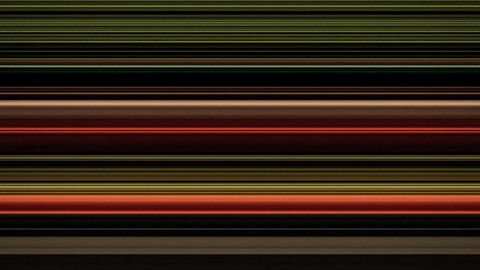
Daniel Crooks (New Zealand, b. 1973) Intersection No.2 (vertical plane) 2008
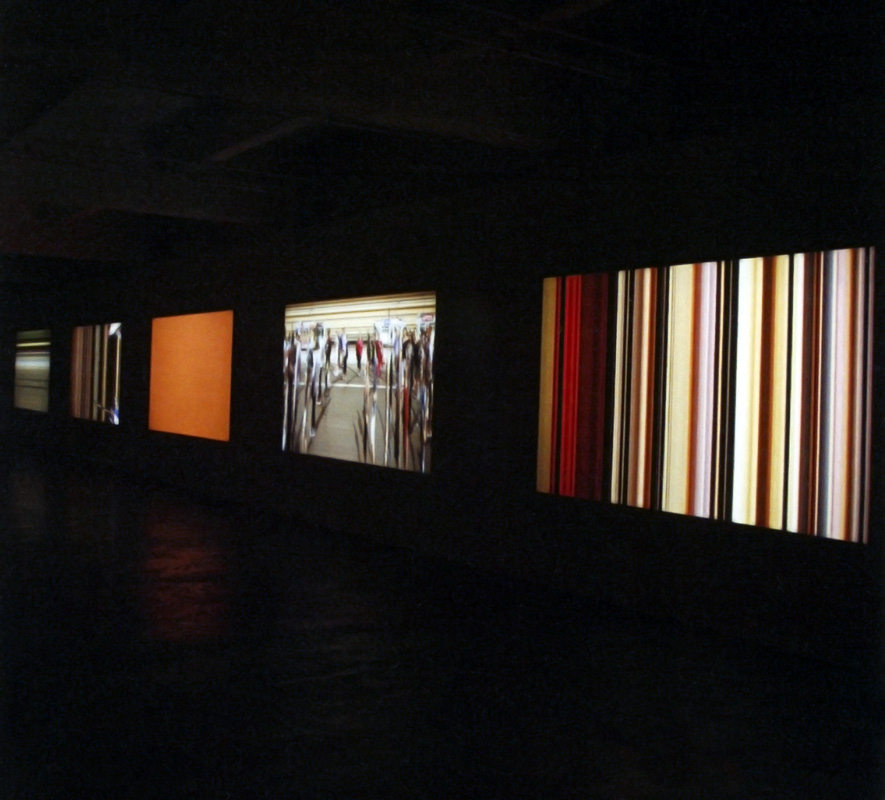
This was a magical exhibition – beautiful, insightful and mesmerising in equal parts. Five large video screens were presented in the long space of the Anna Schwartz gallery in Melbourne. The outer two videos feature striated horizontal and vertical bands of pulsating colours, fluxing up and down and from side to side, seemingly rushing past like tarmac outside a moving car. These videos add balance at each end of the installation.
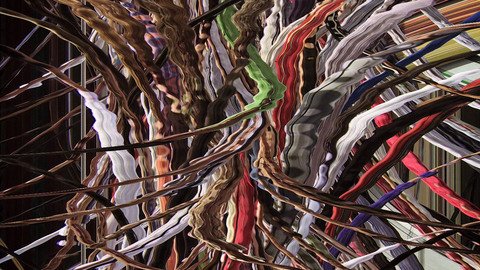
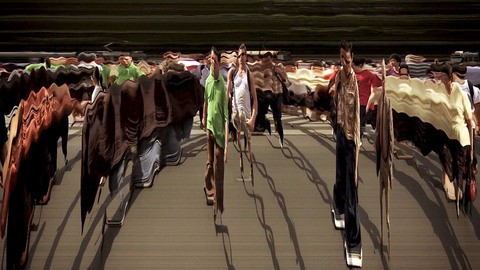
The inner videos on either side of the central panel are the most figurative of the work: the video on the left-hand side reminded me of a Jackson Pollock drip painting come alive, ribbons of paint in time and space morphing backwards, finally coalescing into figures and their shadows walking across tarmac; the video on the right-hand side shows people moving across a pedestrian intersection like an animated slow motion photograph flowing anamorphically across the screen, their shadows distorted on the ground as trams pass behind them. Up close the surface of the projected video breaks down into grided squares of light, hypnotic in their blooming, shape-shifting colours.
The central panel is the key to the whole work. Intensities of colour flash and fade in time with atmospheric ambient music (by J. David Franz and Byron Scullin) that works effectively with the whole installation. Beeps of the pedestrian crossing intersection intersperse the ambient music adding an almost sonar like pinging to the atmospheric soundtrack; after-images appear and glow as the colours fade, transcending the solidity of the ever-changing single pixel of colour taken through the block of video time. The pyrotechnics of the other screens are balanced by the colours/intensities/music of this central panel.
The installation reminds me of a folded out five-panel religious altarpiece form of the 15th century. The figures, shadows and lines of the outer videos surround the pulsing heart of the central panel that, for me, took on an almost transcendent spirituality (especially when you understand the transcendence of time and space that is being achieved and how that relates to your own path in life). If you stand very still against the far wall of the gallery and look at all five videos at the same time the central panel achieves the ‘Intersection’ that Daniel Crooks is imagining. Subtle, profound and intelligent the viewer is invited to spend time, no, to transcend time in the company of this work and that is a major achievement: to reveal certain truths about our existence in these moments of time, to inhabit the space between breath – no time, no space.
Dr Marcus Bunyan
Daniel Crooks (New Zealand, b. 1973) Intersection No.5 (horizontal volume) 2008
“The subjects of Daniel Crook’s oeuvre; the recurrence of city transport systems, lifts in high-rise buildings alongside images of the sea, invoke an idea of the world made as much of time as space and that indeed we ourselves are also made of time …
Crooks works, literally, from inside the medium, deconstructing its time-space matrix to reveal the inner truth about the subjects of video: they are purely temporal.
The five works comprising Intersection are all sourced from the same ‘volume’ of video footage. Each video is a formal variation that navigates an alternative path through the same light field, pushing its own ‘picture plane’ through the space along opposing axes.
The two most figurative videos navigate the entire volume of footage – each swapping time for the vertical or the horizontal. The second, more abstracted videos are reduced to horizontal and vertical ‘planes’. The centre work – a single pixel of information that tunnels through time – is the intersection between opposing axes, almost like the fulcrum or nodal point, and in turn acts as a pivot for the installation.”
Catalogue notes from Daniel Crooks exhibition Intersection at Anna Schwartz Gallery, Melbourne.
Daniel Crooks (New Zealand, b. 1973) Intersection No.4 (vertical volume) 2008
Daniel Crooks works preÂdomÂiÂnantÂly in video, phoÂtogÂraÂphy and sculpÂture. He is best known for his digÂiÂtal video and phoÂtoÂgraphÂic works that capÂture and alter time and motion. Crooks manipÂuÂlates digÂiÂtal imagery and footage as though it were a physÂiÂcal mateÂrÂiÂal. He breaks time down, frame by frame. The resultÂing works expand our sense of temÂpoÂralÂiÂty by manipÂuÂlatÂing digÂiÂtal ‘time slices’ that are norÂmalÂly imperÂcepÂtiÂble to the human eye.
Intersection installation view at Anna Schwartz Gallery, Melbourne Photo: Marcus Bunyan
Addendum 2019
Daniel Crooks Static No. 12 (extract) 2012 HD Video Courtesy Daniel Crooks & Anna Schwartz Gallery
Artistic Responses by Daniel Crooks | Symposium: Wider Vantages Are Needed Now, Times 18 2013
Daniel Crooks, New Zealand-born and Melbourne-based, is one of the foremost innovators in the quickly evolving fields of video and digital art.
Daniel Crooks: Phantom Ride 2016
Daniel Crooks’ Phantom Ride alludes to cinema history to create a seamless journey through a composite reality. By manipulating digital footage as though it were a physical material, the artist has constructed a collaged landscape that takes us through multiple worlds and shifts our perception of space and time.
Anna Schwartz Gallery 185 Flinders Lane Melbourne, Victoria 3000
Heide Museum of Modern Art has brought together nearly 100 pieces of work by the Australian artist Les Kossatz in an eclectic survey show, appropriately titled The Art of Existence. Featuring sculpture, painting and mixed media from the 1960s to the present the exhibition is appropriately titled because Kossatz’s work addresses certain archetypal themes that affect human existence:
“His life-long fascination with the natural world and desire to understand both its human and animal inhabitants; exploration of the systems of knowledge and codes of behaviour that structure individual and communal life; and his critical and playful reflections on contemporary behaviour and the mysteries of existence.”1
Strong symbolic paintings are the focus of the work in the 1960s, paintings that address the shocking brutality of war and its aftermath, when soldiers return home. To the observation that these are of the ‘pop-style’ school of painting suggested by the Heide website I feel these works are also influenced by the collage of Cubism, the boxes of Joseph Cornell and the dismembered bodies of Francis Bacon. They engage with the symbolism of war and remembrance: memory, myth, and the banality of heroism and sacrifice.
The key work in this series is the painting Diggers throne (1966). This is a powerful disturbing image, effervescent and unnerving at the same time. It features a disembodied arm on the hand of a throne, surrounded by a wonderful kaleidoscopic assemblage of pictorial planes, artefacts and memories – an English flag, the flag of St George, a crown, medals and the words RSL. The arm reminds me of the Francis Bacon painting Study after Velázquez’s Portrait of Pope Innocent X (1953) as it rests, roughly drawn in pencil on the arm of the throne, drawing the eye back up into nothingness.
The Diggers throne painting also features these prophetic words:
“throne slow to rot and twisted the memory becomes sacred. Bloody was the truth And this a chair.”
All other work in this period seems to flow through this painting – the other large paintings, the small canvases featuring individual medals and the less successful hanging banners. But it is to this work we return again and again as a viewer, trying to decipher and reconcile our inner conflicts about the painting.
As we move into the 1970s the work changes focus and direction. There emerges a concern with the desecration of the Australian landscape investigated in a series of large paintings and sculptures. In Packaged landscape 1 (1976) a steel suitcase with leather straps, slightly ajar, fulminates with artificial gum leaves trying to escape the strictures of the trap. In Caged landscape (1972) nature is again trapped behind steel wire, weighed in the balance on a set of miniature scales. The paintings feature trees that are surrounded by concrete and the rabbit becomes a powerful symbol for Kossatz – a suffering beast, strung up on fences, a plague in a pitted landscape of chopped down trees, erosion and empty holes.
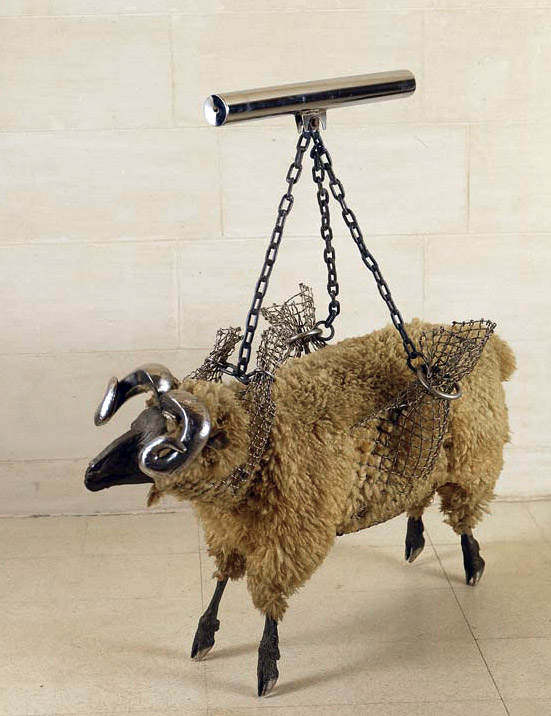
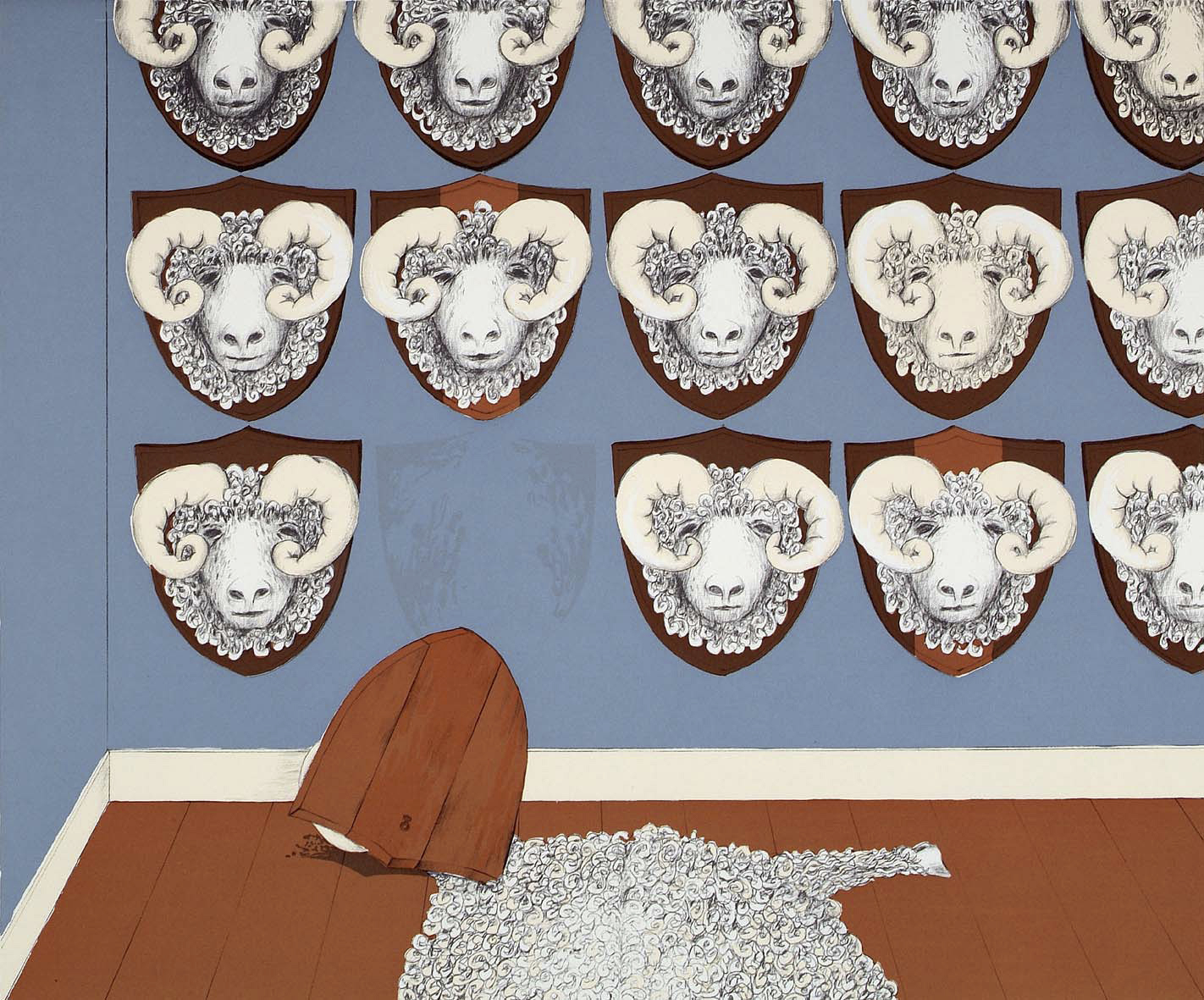
Into this vernacular emerges the key symbol of the artist’s oeuvre – the sheep. In 1972 Kossatz began a series of sculptures of sheep, “initially inspired by the experience of nursing an injured ram.” For Kossatz “the sheep represent the hardship of pioneer existence, the grazing industries prosperity, environmental concerns and the sheep act as narrative devices, potent metaphors for human behaviour.”2
The first sheep presented ‘in show’ is Ram in Sling (1973, below). In this sculpture a metal bar is suspended in mid-air and from this bar heavy wire mesh drops to support the fleecy stomach and neck of the ram almost seeming to strangle it in the process, it’s metal feet just touching the ground. Again the scales of justice seem to weigh nature in the balance.
The themes life and death, order and chaos are further developed in the work Hard slide (1980, below) where a sheep emerges mid-air from a trapdoor, two more tumble down a wooden slide end over end and another disappears into the ground through a wooden trapdoor opening. Sacrifice seems to be a consistent theme with both the earlier paintings and the metallised sheep:
“The completed life cycle, down the trapdoor, down the chute, after sacrifice by shearing.” ~ Daniel Thomas 1994
Further sculptures of sheep, both small maquettes and large sculptures follow in the next room of the exhibition. This is the artist is full flow, featuring the inventive taking of 2D things into the round, investigating the key themes of his work: the contrast between nature and artifice, or humanity.
The small maquettes of sheep feature races, gantries, sluices, pens, trapdoors and paddocks. Sheep tumble in a cataclysmic maelstrom, falling with flailing legs into the darkness of the holding pen below. These are my favourite works – small, intimate, detailed, dark bronzes of serious intensity – the sheep becoming a theatre of the absurd, suspended, weighed and balancing in the performance of ritualised acts, a cacophony of flesh at once both intricate and unsettling. Their skins lay flayed and lifeless disappearing into the ‘unearth’ of the slated wooden floor of the shearing shed. The sheep “can be viewed metaphorically as a commentary of the existential situation of the individual and collective behaviour.”3 As Kossatz himself has noted, “It is hard to bring a piece of landscape inside and give it a living animated form. The sheep somehow gives me this quality of landscape.”
But we must also remember that this strictly a white man’s view of the Australian landscape. Nowhere does this work comment on the disenfranchisement of the native people’s of this land – the destruction of native habitats that the sheep brought about, the starvation that they caused to Aboriginal people just as they bought riches to the pastoralists and the country that mined the land with this amorphous mass of flesh.
Recent work in the exhibition returns to the earlier social themes of memory, war, remembrance, religion, shrines, atomic clouds and temples but it is the work of the late 1970s-1980s that is the most cogent. As Kossatz ponders the nature of existence on this planet he does not see a definitive answer but emphasises the journey we take, not the arrival. Here is something that we should all ponder, giving time to the nature of our personal journey in this life, on this earth.
Here also is an exhibition worthy our time and attention as part of that journey. Go visit!
Dr Marcus Bunyan
Word count: 1,074
1/ From the Heide website 2/ From wall notes to the exhibition 3/ From wall notes to the exhibition
Many thankx to Heide Museum of Modern Art for allowing me to publish the photographs in the posting. Please click on the photographs for a larger version of the image.
Postscript 2018
The late Les Kossatz (1943-2011) was a well known Melbourne-based artist and academic whose work is represented in many regional and state galleries and the National Gallery of Australia. He studied art at the Melbourne Teachers’ College and the RMIT, and went on to teach at the RMIT and Monash University. Kossatz’s first significant commission was for the stained glass windows at the Monash University Chapel in Melbourne. Later commissions included works for the Australian War Memorial, the High Court, the Ian Potter Foundation at the National Gallery of Victoria and the Darling Harbour Authority, Sydney. His sculpture, Ainslie’s Sheep, commissioned by Arts ACT in 2000, is a popular national capital landmark in the centre of Civic. A major retrospective of Kossatz’s work was held in 2009 at the Heide Park and Art Gallery, Melbourne.
The art of existence is the first exhibition to review Les Kossatz’s contribution to Australian art in a career that spans the 1960s to today. Kossatz’s consistently experimental approach to media and techniques is revealed in works that display a lifelong fascination with humanity and the interaction of man and nature. His paintings, sculptures and works on paper stimulate a questioning and exploration of such concerns, which form the basis of this artist’s practice.
Les Kossatz’s early works of the 1960s draw on his training and ability to work across a diversity of media, including painting, drawing, printmaking and glass. Early paintings and etchings on the theme of the emptiness of memorials to the Australian ‘digger’ or soldiers were succeeded by images and objects offering impressions of the world around the artist – the rural domain and interior life of St Andrews in Victoria where Kossatz lived and worked. Such works demonstrated his determination to pursue a figurative practice at a time when abstract art had been imported to Australia and was considered the avant garde.
Remaining a staunchly independent artist, at the start of the 1970s Kossatz painted images of rabbits and sheep from St Andrews. In addition, the practice of working in three dimensions was to become more significant. Kossatz continued to develop familiar themes in the creation of installations and cast objects. Although he has produced drawings and prints across his career, working with sculpture has, since the early 1970s, been his primary mode of art-making. Large scale cast and assembled objects show Kossatz pursuing related themes of caged and packaged landscapes, shrines to the harvest and the still life.
The art of existence surveys Kossatz’s monumental life-sized sheep sculptures, which he began making in 1972 from casts of animal parts, and for which he is best known. These include Hard slide (1980), his prize-winning commission in the collection of the National Gallery of Victoria. Kossatz has won numerous commissions for outdoor sculptures that employ the sheep as literal and metaphorical beings. Kossatz’s work across three decades reveals a number of ongoing engagements, such as his observations of human behaviour and at times its similar manifestation in animals; the beliefs that sustain individuals and communities (such as religion, music and politics); and the forms of the landscape and our understanding of these relationships.
Introduction to the exhibition written by Zara Stanhope, Guest Curator, Heide Museum of Modern Art, 2008
Les Kossatz (Australian, 1943-2011) Hard slide 1980 Sheepskins, aluminium, Douglas-fir (Pseudotsuga sp.), leather, steel 372.0 x 100.0 x 304.0cm (installation)
Les Kossatz (Australian, 1943-2011) Guggenheim spiral 1983
Heide Museum of Modern Art 7 Templestowe Road Bulleen Victoria 3105 Australia Phone: +61 3 9850 1500
Opening hours: (Heide II and Heide III) Tuesday to Sunday and public holidays, 10am – 5pm
Exhibition dates:Â 7th October – 30th November, 2008
The exhibition includes works by Louise Bourgeois, Nan Goldin, Steve McQueen, Sophie Calle, Mariele Neudecker, Jesper Just, Gabrielle de Vietri, Felix Gonzalez-Torres, Mutlu Çerkez, Amikam Toren, Margaret Salmon and Annika Ström
Sophie Calle (French, b. 1953) Doleur exquise 1984/1999
Set up by Frank Gehry and Edwin Chan Exhibition view at Rotonde1, Luxembourg, 2007
An eclectic mix of mixed media, photography and video work is presented in this exhibition. The work examines concepts of intimacy – staged performances, stories of the city, of men, women, families and children; the artists “contemplate passion, love and longing, as well as feelings of disquiet, loss, and loneliness that embody intimate human relations.”
The show exudes a certain melancholia and is troubling in many aspects: loneliness, separation, desire for intimacy, desire for love all being expressed through the presented works. Some of the works are strong but others left me cold and uninterested. Few are joyous renditions of the closeness of intimate relations and most works ponder the dangers and disillusionment of failed intimacies that involve feelings of vulnerability (intimate acts often involve a degree of self-disclosure where intimates show something of themselves that may make them feel vulnerable), ambiguity (intimate acts are often an ambiguous and incomplete shared and often idiosyncratic view of the world) and secrecy (intimate acts are private: they are often constructed, by their participants, to be hidden from the view of others).1
The large work by English artist Steve McQueen features two naked black wrestlers shot in slow motion in grainy black and white video. The wrestlers are photographed from the waist down, images of moving legs, or from below, bodies clinging together, faces grimacing in a hyperreal performance of some hypnotic intimate dance – an acted out state of being.
Amikan Torren’s 2008 video work is by comparison is about the improbabilities of life’s daily encounters: in Downstairs over a video image of 3 steps outside a London railway station the narrator tells of a man, a stockbroker who after an accident sometimes needs help descending steps; in Blind the narrator comments on a person helping a blind man across the street; and in Carrots, over a video image of a London street the narrator tells a story about an adolescent and fresh carrots! The musings on the synchronicity and serendipity of everyday encounters are very effective.
Jesper Just’s two video works No Man Is An island II (2004) and The Lonely Villa (2004) were very effective and moving. In the first lonely men in a pub sing the Roy Orbison song Crying with pictures of naked ladies behind them – it is funny and sad at the same time. In the second men in the shadows sit or stand with telephones in front of them: two men sing to each other the song I Don’t Want To Set The World On Fire with close-ups of their lips singing into the telephone: songs of loss, longing and remembrance.
The two most interesting pieces are not video works, nor are they the overrated photographs of Nan Goldin featuring photographs of a family hugging and lying on a bed, but the work of two women: Sophie Calle and Louise Bourgeois.
In Doleur exquise (exquisite pain) Calle revisits fifteen years later the breakup of a relationship and the aftermath of that event: the distress and pain, the experiences of her friends in such circumstances and turns them into brilliant insightful art. A selection of the whole work is presented here that features colour photographs (multiples of a red telephone, abandoned car with it’s doors open, washbasins and empty bedrooms) above text woven onto linen – black on white, grey on grey. The texts are both painful and repetitive (Calle’s on the left) and others heartbreaking accounts of pain (on the right): “6 days ago, the man I love left me …”
(For an insightful analysis of this work see Can Pain Be Exquisite? Autofictional Stagings of Douleur exquise by Sophie Calle, Forced Entertainment and Frank Gehry and Edwin Chan by Anneleen Masschelein. “On the one hand, it deals with the most intense, acute experiences of pain in a human life. On the other hand, these moments are unique and “localised”, that is, they are connected to a concrete time and space, of which the details are forever inscribed in memory.”)
My favourite work from the show is Louise Bourgeois 10AM IS WHEN YOU COME TO ME (2006) – drawings on music paper of mainly red hands, the key a drawing of a 10am clock with a man the big hand with hands extended drawing towards him (or is it tethered to him) an armless woman, the small hand. Some have seen these as “ambiguous images of a hermetic cosmos, as acts of violence or love” but they represent “both Bourgeois’s hands and those of her friend and muse Jerry Gorovoy” and how he helps her and arrives at her studio at this, the designated hour.
To me they are joyous, liberating, spontaneous expressions of love and intimacy, fingerprints on the page, hands intertwining together. They made me feel the intimate expression of humanity: holding a babies hand, so small and vulnerable and feeling them grasp your hand. That connection is what Bourgeois achieves with this work and I thought it was wonderful.
This exhibition is no easy ride but is well worth the contemplation necessary to tease out the themes and feelings that the work investigates.
Dr Marcus Bunyan
1/ Steve Howard, Frank Vetere, Martin Gibbs, Jesper Kjeldskov, Sonja Pedell, Karen Mecoles, Marcus Bunyan, and John Murphy. Mediating Intimacy: Digital Kisses and Cut and Paste Hugs. 2004.
Sophie Calle (French, b. 1953) Doleur exquise (detail) 1984/1999
Louise Bourgeois (French-American, 1911-2010) TEN AM IS WHEN YOU COME TO ME (detail) 2006
Louise Bourgeois (French-American, 1911-2010) TEN AM IS WHEN YOU COME TO ME 2006
Australian Centre for Contemporary Art 111 Sturt Street, Southbank Victoria 3006, Australia Phone: 03 9697 9999
Opening hours: Tuesday – Friday 10am – 5pm Saturday – Sunday 11am – 5pm Monday Closed Open all public holidays except Christmas Day and Good Friday
Exhibition dates: 22nd October – 15th November, 2008
Robbie Rowlands (Australian, b. 1968) Scored 2008 Goal post, steel 160cm x 130cm x 50cm Photograph: Christian Capurro
“The philosopher Martin Heidegger argued that objects are often invisible to us gathered up as they are within a context of functionality and use. It is only when things break down that we become aware of them, seeing them with fresh eyes. In many ways Heidegger’s observation could form the basis of an approach to Robbie Rowlands’ work. Rowlands takes objects that are often forgotten, invisible or transparent to us, objects that exist on the verge of disappearance, and stages a kind of ‘breakdown’, inviting us to rediscover the object, poised somewhere between what it was and what it might become.”
Simon Cooper. Catalogue essay
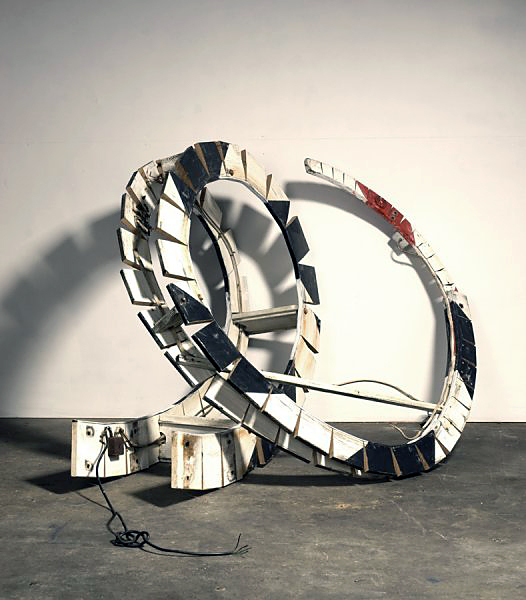
Sitting in pools of light in the elegant modern space of Place Gallery in Richmond, six theatrically lit sculptures are presented by artist Robbie Rowlands. Made of everyday objects (a boom gate, desk, chair, single bed, electricity pole, desk and footy goalpost) they have been de/constructed by the artist and reformed into curved objects. With ironic titles such as Down for the felled electricity pole and Collapse for the dismembered chair Rowland’s work hovers between one fixed state and an’other’ transformative state of being.
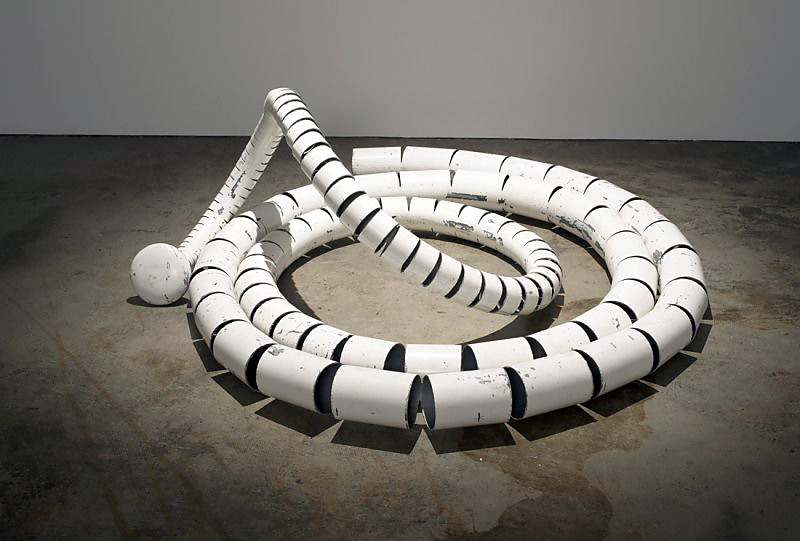
While the catalogue essay by Simon Cooper suggests that all of these objects are abandoned or nearly forgotten sharing a context of quasi-obsolescence, this is not the case. These were objects of purpose and form, the acts of ritualised production of a consumer society that contained signs that symbolised their status. In his creativity Rowland has used these technologies of production, which permit us to produce, transform or manipulate things to create new sensual forms of life. Some of the sculptures such as Boom (the boom gate; 2008, below) and Scored (the goal post; 2008, above) remind me of creatures emerging from the recesses of the unconscious, curling and rearing up like monsters from the deep. One of the most beautiful forms is the constructed white chair where the function of the object has collapsed into the essence of the form, like the surreal spatiality of a poetic Miro. As Gaston Bachelard reminds use in The Poetics of Space:
“The grace of a curve is an invitation to remain. We cannot break away from it without hoping to return. For the beloved curve has nest-like powers; it incites us to possession, it is a curved corner, inhabited geometry.”1
Cooper suggests that the curved forms that Rowland creates were “already there in the original object, even as it was sat on, written on, or passed by on the way to work.” He rightly notes that the process used contains a certain violence, but that we remember and reconstruct the old form even as we respond to the new construction. For these sculptures are a construction not, I believe, inherent in the original form. This can be seen in the sculpture Boom (2008, below) for example, where Rowland has used additional pieces of metal to hold the curve of the boom gate in place. Without this skilfully added, hidden sub-structure the transformative shape would collapse onto the floor. Rowland inhabits and possesses his new geometry with as much technology as the original but not in such an obvious form.
At their best these sculptures are both poetic palimpsest and heterotopic objects of otherness that are neither here nor there. The work would have been stronger if only four pieces were presented in the gallery space – the sculptures needed more room to breathe (understanding the dictum that less is more). The sculptures themselves also needed greater thematic cohesiveness perhaps using the colour white as the unifying theme. But they are sensual and beautiful gestures and deserve the attention of your visit.
Dr Marcus Bunyan
1/ Bachelard, Gaston. The Poetics of Space. Boston: Beacon, 1969 [originally 1958] p. 146
Robbie Rowlands (Australian, b. 1968) Boom 2008 Rail boom gate, wooden 160cm x 160cm x 130cm Photograph: Wren
Place Gallery 120 Collins Street Melbourne VIC 3000 Phone: (03) 9527 6378
You must be logged in to post a comment.