Review: ‘Up Close: Carol Jerrems with Larry Clark, Nan Goldin and William Yang’ at Heide Museum of Modern Art, Melbourne

Exhibition dates: 31st July – 31st October 2010


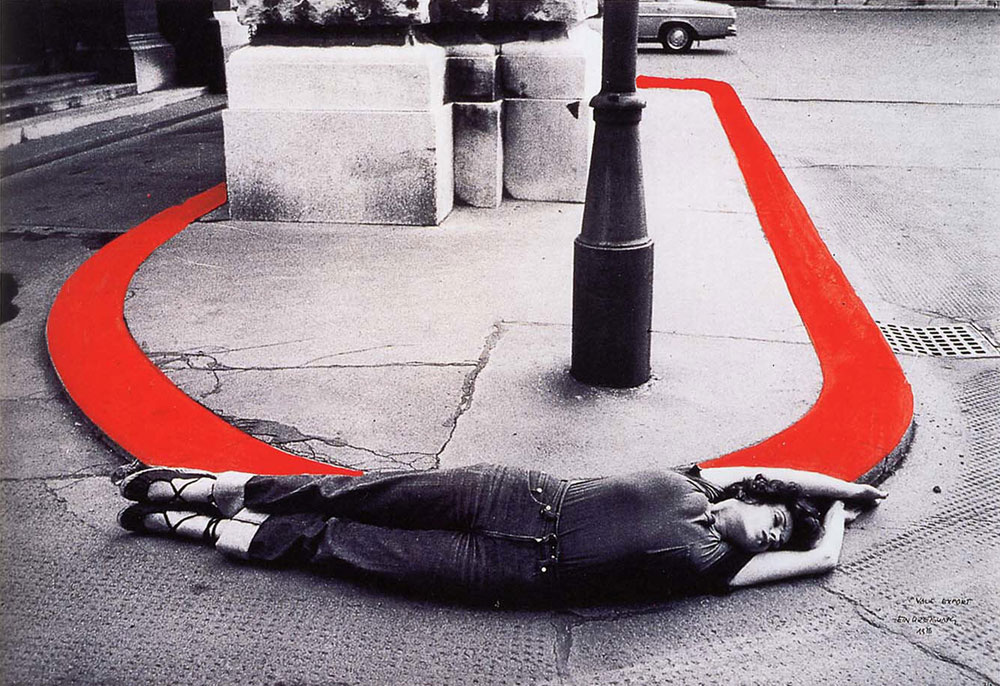
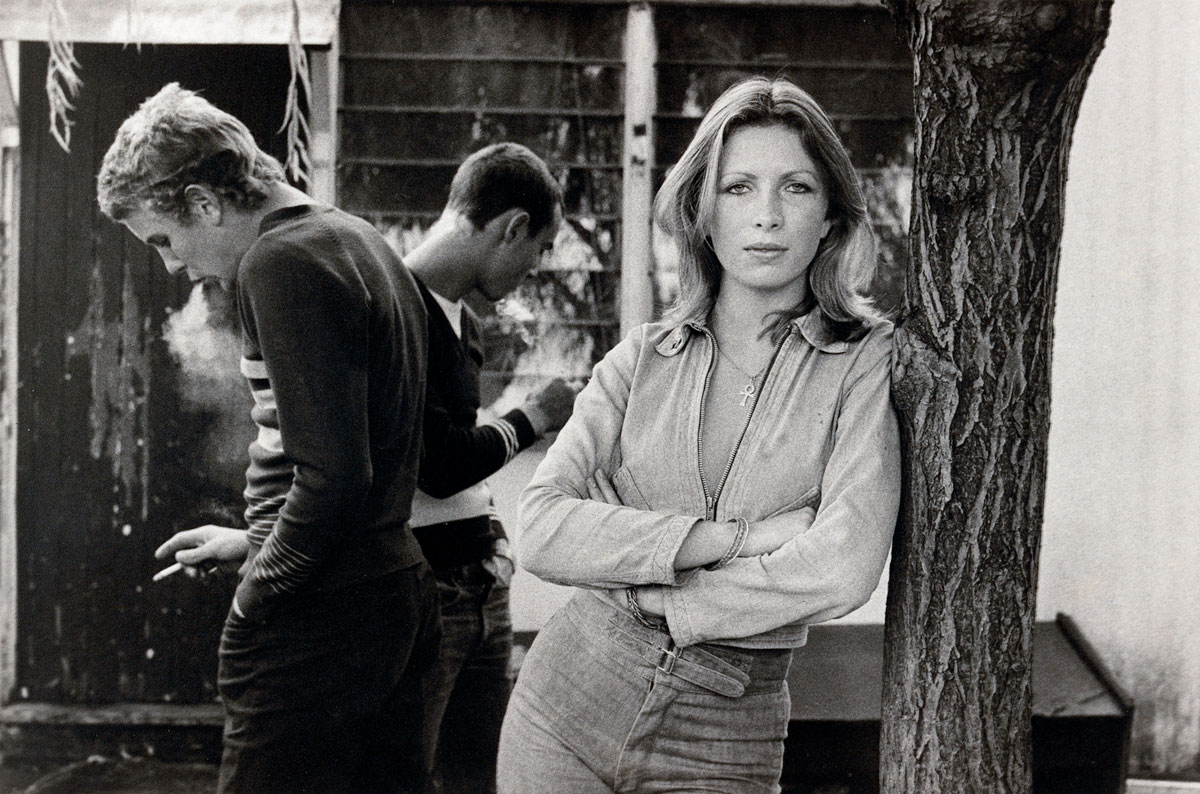
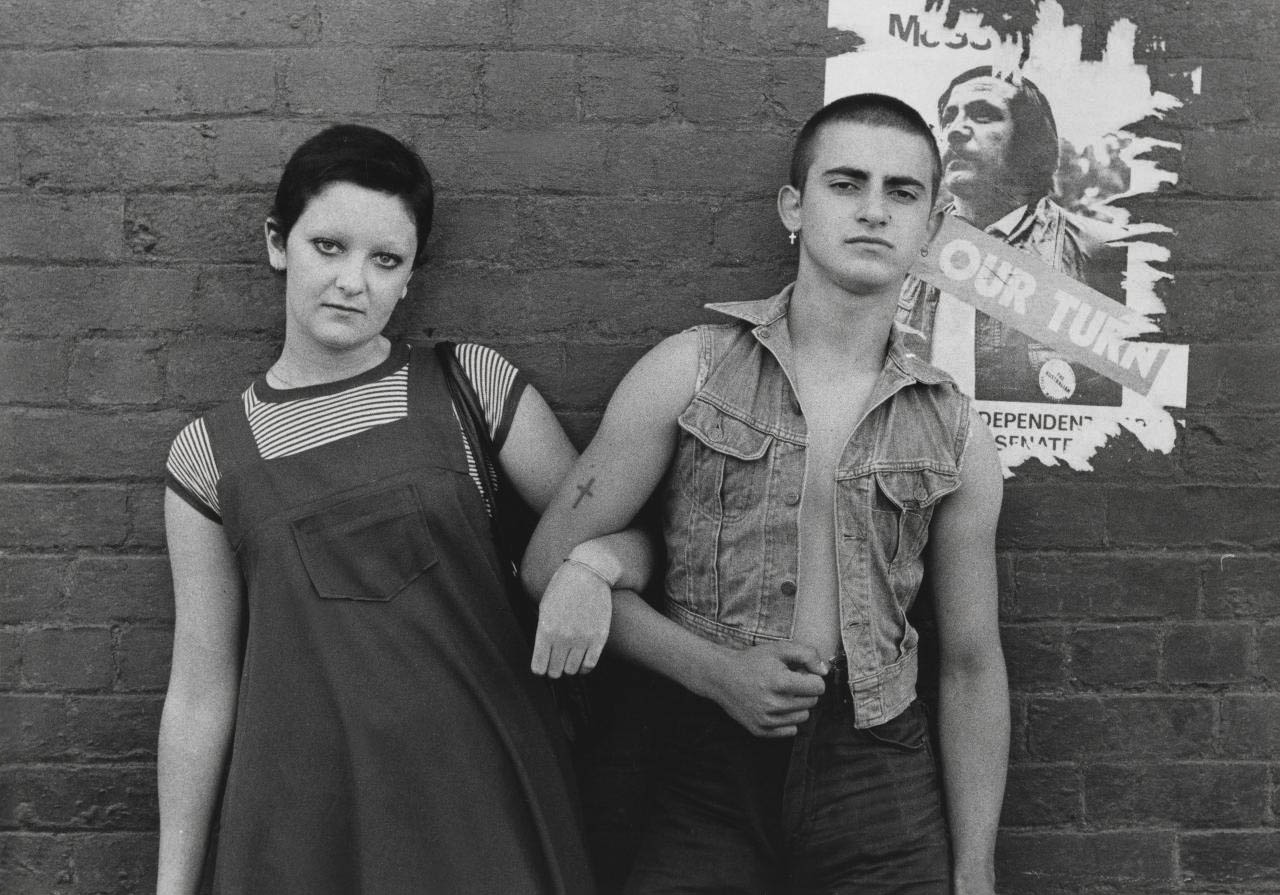
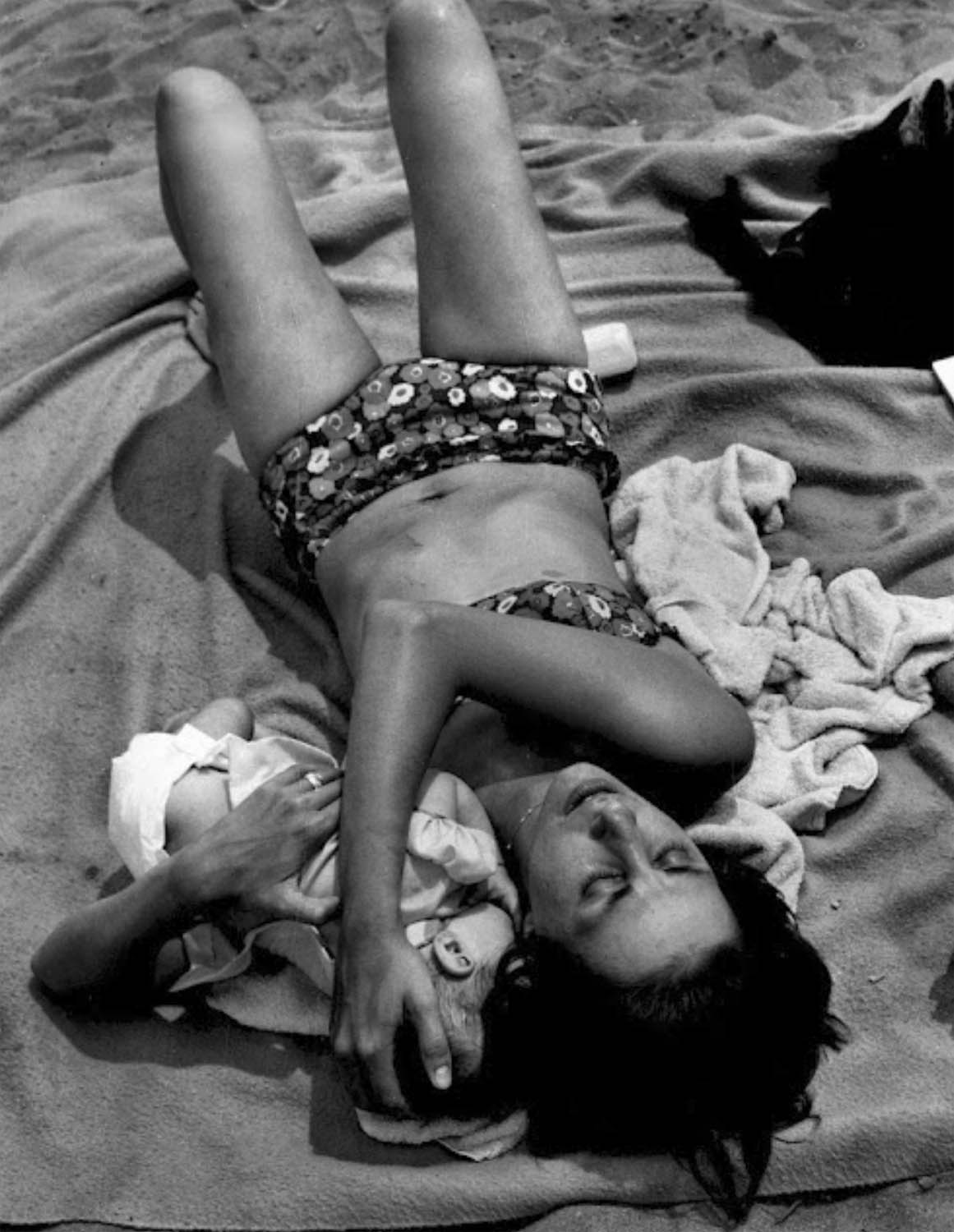
Carol Jerrems (Australian, 1949-1980) 'Vale Street' 1975 from the exhibition 'Up Close: Carol Jerrems with Larry Clark, Nan Goldin and William Yang' at Heide Museum of Modern Art, Melbourne, July - Oct 2010


Carol Jerrems (Australian, 1949-1980)
Vale Street
1975
Gelatin silver print
National Gallery of Australia, Canberra
Gift of the Philip Morris Arts Grant, 1982
© Ken Jerrems & the Estate of Lance Jerrems


“A face tells the story of what a person is thinking. The eyes reveal the suffering.”


Carol Jerems


Time and Truth: Looking again at the work of Carol Jerrems

This is a solid exhibition of the photographs of Carol Jerrems at Heide Museum of Modern Art, accompanied by small selections of the work of Larry Clark and William Yang and the sequence The Ballad of Sexual Dependency (1979) by Nan Goldin.

I like Jerrems work: it is strong, frontal, direct and truthful. What I dislike is the hagiography that has grown up around this artist, the mythologizing of Saint Jerrems. We don’t need a saint of Australian photography; what we need is an appreciation of the artist, the person and her legacy. While the personal history of this artist is well known – facing depression, putting herself in danger, sexually active, documenting the counter-culture sharps and skinheads and urban indigenous people, the photographing of women and her death at far too young an age – few people actually look at the photographs clearly.

Most of the photographs are 8″ x 10″ prints, mainly portraits, that are usually dark and contrasty, small and emotionally intense. Jerrems images are made full frame (the modernist conceit of filing out a negative carrier, so that if the negative was printed full frame there would be a black border around the picture) to avoid cropping in the darkroom. This shows good previsualisation by the artist, the composition of the image made at the time of the exposure. There is a closeness to the framing of the portraits and a conversant ambiguity about all of her backgrounds – mainly low depth of field, anonymous places (perhaps a brick wall or a close up of a street corner). In fact it is difficult to pin down any actual place in her photographs unless you are told in the title of the work. The contextlessness of her backgrounds allows the viewer to focus on the people placed before her lens and here Jerrems gets up close and personal, trying to capture the truth of her subjects, their soul (in this sense she is like Diane Arbus, thrusting her camera into places it was not supposed to go until something gives – the subject gives up, drops the mask, even if just for a split second, and click, the artist has their image). The mainly head and shoulders photographs of women are most impressive in this regard as Jerrems portrays the women’s strength and vulnerability as are the photographs of the artist herself in hospital fighting her debilitating illness, the most moving, emotional photographs in the exhibition.

Other photographs show constructed intimacies between people, the camera and the artist. In Esben and Dusan, Cronulla (1977, above), Jerrems uses the yin yang black, white background to frame the two protagonists, bringing forward the body of Esben in the right portion of the frame and letting Dusan recede into the darkness. In Boys (1973) two bodies are photographed in a bed, legs and arms entwined but the print is so dark that you would never know they were two boys unless you were told – and this adds to a sense of mystery, the imaging of the most beautiful, sensitive, abstract embrace. Mark Lean with Arms Crossed (1975) shows a cocky, self-assured Lean staring directly at the camera as though it were not there, as though he were conversing directly with Jerrems, the camera an extension of the artist capturing his brave-aura: one camera, one lens, one vision. If you study the contact sheet for the photograph Vale Street (1975, above), Jerrems eventually draws the central luminous figure forward in the frame to create the now iconic image while the two acolytes hover, brooding and menacing in the darkened background.

As Kathy Drayton has observed, “Her photographs engage the viewer in an intimate relationship with her subjects. It’s not always a friendly intimacy – sometimes her subjects look defensive, irritated or even menacing, but you always sense that you’re seeing beyond the mask into the soul.”1


Jerrems saw herself as a serious photographer; if something happened she felt she should be commenting on it. She was also quite naive but always pushed herself and her art into sometimes dangerous places. She would have thought ‘how do I say something that is true’ and her endeavour, which is also constructed, was seeing things in terms of opportunities for a good photograph. Jerrems removed the safeguards; she got right in there among her volatile characters, her potential sexual predators: let’s just see what happens when the safety fence goes down. Although I believe there is a lack of really good photographs that Jerrems made (what I call highlight pieces, namely the iconic Vale Street, Mozart Street, and Mark and Flappers all 1975, see photographs below) there is a consistency to her work and how it exemplifies an exchange that takes place between the artist and the world. What I would call “a good deal.”

When looking at art, one of the best experiences for me is gaining the sense that something is open before you, that wasn’t open before. I don’t mean accessible, I mean open like making a clearing in the jungle, or being able to see further up a road, or just further on. And also like an open marketplace – where there were always good trades. There is the feeling that if you put in a certain amount of honesty, then you would get something back that made some room for you in front – some room that would allow you to look forward, and maybe even walk into that space. Seeing Jerrems work gives you that feeling.

Jerrems had the power to draw themes together, to ramp up the intensity, to empower her photographs and she was possibly on the way to becoming the things that people now say she was, but her early death curtailed this journey. Her photographs have social significance and photographic integrity and evidence time in the visible – the time in which Jerrems took them, the 1970s, and the truthfulness of her self and her style. I would have loved to have seen Jerrem’s response to the film still work of Cindy Sherman, the layering of the Sherman personas and the challenge to the feminist critique. As it is Jerrems photographs are very frontal in today’s terms and, because of her early death, she lacked the opportunity to interact with the development of more complex theories. The layers present at the time are now conflated into seemingly one layer, supported by back stories and obfuscation that clouds the work – it’s naked frontality and boldness. This obfuscation formalises her legacy into mythology.

Jerrems work does not need this. She struggled with her art, to get the best out of herself and her visualisation, to step into those spaces that I mentioned earlier. What we need is an appreciation of the time of her endeavour and the truthfulness of her art. To say that the work achieved fulfilment is to deny the importance of her death.

Dr Marcus Bunyan


1/ Drayton, Kathy quoted in Wilmoth, Peter. “The ’70s stripped bare,” on The Age website. July 17th, 2005. [Online] Cited 05/10/2010


Many thankx to Jade Enge and Heide Museum of Modern Art for allowing me publish the photographs in the posting. Please click on all of the photographs for a larger version of the image.


Carol Jerrems. 'Mozart Street' 1975 from the exhibition 'Up Close: Carol Jerrems with Larry Clark, Nan Goldin and William Yang' at Heide Museum of Modern Art, Melbourne, July - Oct 2010


Carol Jerrems (Australian, 1949-1980)
Mozart Street
1975
Gelatin silver print
National Gallery of Australia, Canberra
Gift of the Philip Morris Arts Grant, 1982
© Ken Jerrems & the Estate of Lance Jerrems


Carol Jerrems (Australian, 1949-1980) 'Mark and Flappers' 1975


Carol Jerrems (Australian, 1949-1980)
Mark and Flappers
1975
Gelatin silver print
National Gallery of Victoria, Melbourne
Gift of James Mollison, 1994
© Ken Jerrems & the Estate of Lance Jerrems


Carol Jerrems (Australian, 1949-1980) 'Sharpies' 1976


Carol Jerrems (Australian, 1949-1980)
Sharpies
1976
Gelatin silver print
© Ken Jerrems & the Estate of Lance Jerrems


Carol Jerrems (Australian, 1949-1980) 'Dusan and Esben' 1977


Carol Jerrems (Australian, 1949-1980)
Dusan and Esben
1977
Gelatin silver print
© Ken Jerrems & the Estate of Lance Jerrems


Carol Jerrems (Australian, 1949-1980) 'Flying Dog' Nd


Carol Jerrems (Australian, 1949-1980)
Flying Dog
Nd
Gelatin silver print
© Ken Jerrems & the Estate of Lance Jerrems


Carol Jerrems (Australian, 1949-1980) 'Butterfly Behind Glass' 1975


Carol Jerrems (Australian, 1949-1980)
Butterfly Behind Glass
1975
Gelatin silver print
National Gallery of Australia, Canberra
Gift of Mrs Joy Jerrems, 1981
© Ken Jerrems & the Estate of Lance Jerrems


Carol Jerrems (Australian, 1949-1980) 'Evonne Goolagong, Melbourne' 1973


Carol Jerrems (Australian, 1949-1980)
Evonne Goolagong, Melbourne
1973
Gelatin silver print
National Gallery of Australia, Canberra
Gift of Mrs Joy Jerrems, 1981
© Ken Jerrems & the Estate of Lance Jerrems


Featuring the exceptional talent of four photographers whose images capture people, places and events with candid intimacy, Up Close traces the significant legacy of Australian photographer Carol Jerrems (1949-1980) alongside that of contemporary artists Larry Clark (USA), Nan Goldin (USA) and William Yang (Sydney). According to Guest Curator Natalie King, ‘Up Close takes its inspiration from the way each artist candidly depicts a social milieu and urban life of the 1970s and early 1980s’. Sharing an interest in sub-cultural groups and individuals on the margins of society, each artist reveals a remarkable capacity to provide an empathetic glimpse into semi-private worlds through intimate depictions of people and their surroundings.

Newly discovered prints by Jerrems are included as well as rare archival material from Jerrems’ family and previously unseen out-takes from Kathy Drayton’s documentary film, ‘Girl in the Mirror.’ It is 30 years since Jerrems’ death and 20 years since the first and only survey of her work was presented. Jerrems’ photographic practice was associated with a feminist and political imperative; as she put it: ‘the society is sick and I must help change it’. This exhibition uncovers Jerrems’ preoccupation with people and their environment, subcultures, forgotten and dispossessed groups, especially Aboriginal communities of the time.

Larry Clark unflinchingly turned the camera onto himself and his amphetamine-shooting coterie to produce Tulsa (1971), a series of photographs repeatedly cited for its raw depiction of marginalized youth. This significant publication and photographic series influenced Goldin and a generation of artists who aspired to break with the more traditional documentary modes. With its grainy shot-from-the-hip style, Tulsa exposes a world of sex, death, violence, anxiety and boredom capturing the aimlessness and ennui of teenagers.

First shown at Frank Zappa’s birthday party in 1979 at the Mudd Club in New York, Nan Goldin’s The Ballad of Sexual Dependency has evolved to be an iconic work of its time. Goldin’s snapshot aesthetic is evident in this immersive installation of close to 700 slides full of saturated colour and intimate framing accompanied by a soundtrack. Mining the emotional depths of her friends, lovers and family, Ballad signals a riveting intimacy whilst uncovering the bohemian life of New York’s Lower East Side. Goldin says, ‘I was documenting my life. It comes directly from the snapshot, which is always about love…’

William Yang’s photographs from the 1970s further the snapshot aesthetic through journeying into the intimate world of his particular social milieu: drag queens, Sydney gay and inner-city culture. Yang’s direct, unpretentious photographs provide a unique chronicle of marginalised groups especially as he put it: “… people who are gay, who were invisible, who were too scared to come out. During gay liberation people became visible, people became politicised, and there was a Mardi Gras that was a symbol of the movement.”

Up Close reveals how photographic practices provide an empathetic glimpse into semi-private worlds with close up depictions of people and their surroundings.

The accompanying publication provides for the first time an in-depth account of Carol Jerrems’ work alongside that of her peers and will feature a number of newly commissioned essays. Edited by Natalie King and co-published by Heide and Schwartz City, it will be available at the Heide Store from 31 July.”

Press release from the Heide Museum of Modern Art website


Carol Jerrems (Australian, 1949-1980) 'Juliet Holding Vale Street' 1976


Carol Jerrems (Australian, 1949-1980)
Juliet Holding Vale Street
1976
Gelatin silver print
National Gallery of Australia, Canberra
Gift of Mrs Joy Jerrems 1981
© Ken Jerrems & the Estate of Lance Jerrems


Carol Jerrems (Australian, 1949-1980) 'Lynn' 1976


Carol Jerrems (Australian, 1949-1980)
Lynn
1976
Gelatin silver print
National Gallery of Australia, Canberra
Gift of the Philip Morris Arts Grant 1982
© Ken Jerrems & the Estate of Lance Jerrems


Larry Clark (American, b. 1943) 'Untitled' 1979


Larry Clark (American, b. 1943)
Untitled
1979
Gelatin silver print
National Gallery of Australia, Canberra
Purchased 1980
© Larry Clark
Image courtesy of the artist and Luhring Augustine, New York


Larry Clark (American, b. 1943) 'No Title (Billy Mann)' 1963 from the portfolio 'Tulsa'


Larry Clark (American, b. 1943)
No Title (Billy Mann)
1963
from the portfolio Tulsa
Gelatin silver print
National Gallery of Australia, Canberra
Purchased 1980
Image courtesy of the artist and Luhring Augustine, New York


William Yang (Australian, b. 1943) 'Peter Tully, Gay & Lesbian Mardi Gras' 1981


William Yang (Australian, b. 1943)
Peter Tully, Gay & Lesbian Mardi Gras
1981
Gelatin silver print
edition 2/10
40.4 x 27cm
National Library of Australia
Courtesy of the artist


Heide Museum of Modern Art
7 Templestowe Road, Bulleen, Victoria 3105

Opening hours:
(Heide II & Heide III)
Tues – Sun 10.00am – 5.00pm

Heide Museum of Art website

LIKE ART BLART ON FACEBOOK

Back to top

Exhibition: ‘Hipsters, Hustlers, and Handball Players: Leon Levinstein’s New York Photographs, 1950-1980’ at The Metropolitan Museum of Art, New York

Exhibition dates: 8th June – 17th October, 2010


Leon Levinstein (American, 1910-1988) 'Handball Players, Lower East Side, NY' 1950s-1960s from the exhibition 'Hipsters, Hustlers, and Handball Players: Leon Levinstein's New York Photographs, 1950-1980' at The Metropolitan Museum of Art, New York, June - October, 2010


Leon Levinstein (American, 1910-1988)
Handball Players, Lower East Side, NY
c. 1950s-1960s
Gelatin silver print
Purchase, The Horace W. Goldsmith Foundation Gift, through Joyce and Robert Menschel, 1987
© Howard Greenberg Gallery


Although taken in the same city at around the same period as the work of Helen Levitt, these photographs by Leon Levinstein have less formality in their composition and definitely possess a more eclectic style evidenced by the dissection and placement of bodies within the image frame. This is not to denigrate either artist but merely to observe how two great photographers can see the same city in totally different ways. In both previsualisation was strong, the camera freezing what is placed before the lens in a balletic display that captured “just what you see.”

Dr Marcus Bunyan


Many thankx to The Metropolitan Museum of Art, New York for allowing me to publish the photographs in the posting.


Leon Levinstein (American, 1910-1988) 'Nuclear Protest, Wall Street' 1970s from the exhibition 'Hipsters, Hustlers, and Handball Players: Leon Levinstein's New York Photographs, 1950-1980' at The Metropolitan Museum of Art, New York, June - October, 2010


Leon Levinstein (American, 1910-1988)
Nuclear Protest, Wall Street
1970s
Gelatin silver print
Gift of Gary Davis, 2009
© Howard Greenberg Gallery


Leon Levinstein (American, 1910-1988) 'Street Scene - Elderly Man Walking with Cane, New York City' 1970s from the exhibition 'Hipsters, Hustlers, and Handball Players: Leon Levinstein's New York Photographs, 1950-1980' at The Metropolitan Museum of Art, New York, June - October, 2010


Leon Levinstein (American, 1910-1988)
Street Scene: Elderly Man Walking with Cane, New York City
1970s
Gelatin silver print
Gift of Gary Davis, 2009
© Howard Greenberg Gallery


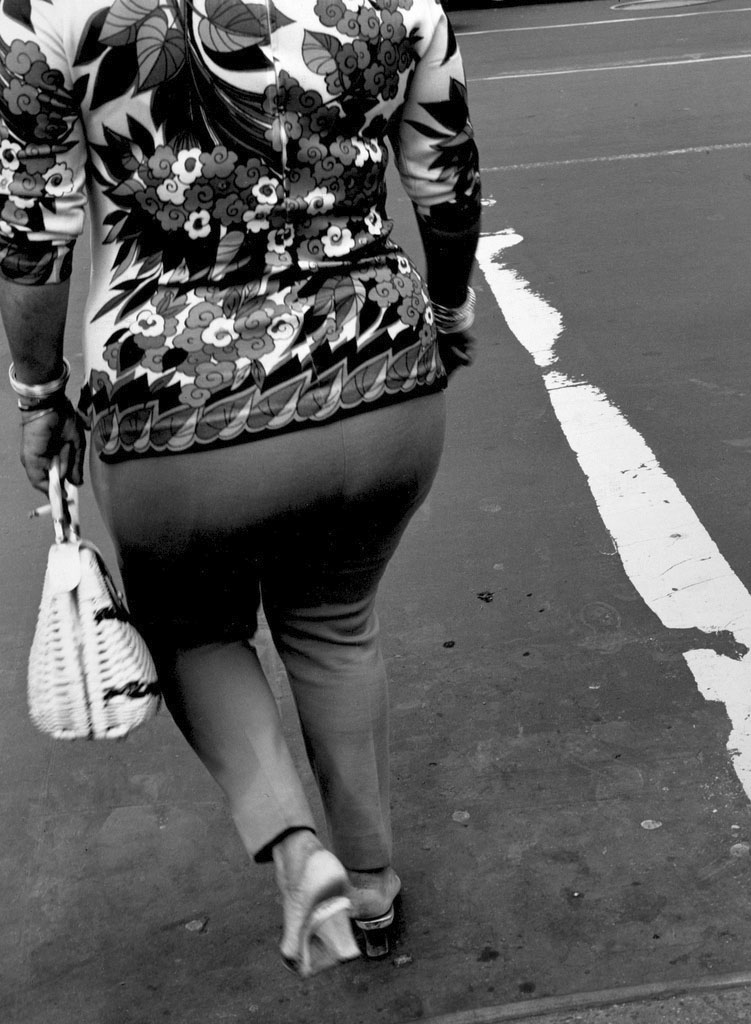
Leon Levinstein (American, 1910-1988) 'Street Scene - Woman in Blonde Wig and Tight Dress, New York City' 1960s


Leon Levinstein (American, 1910-1988)
Street Scene: Woman in Blonde Wig and Tight Dress, New York City
1960s
Gelatin silver print
Gift of Gary Davis, 2009
© Howard Greenberg Gallery


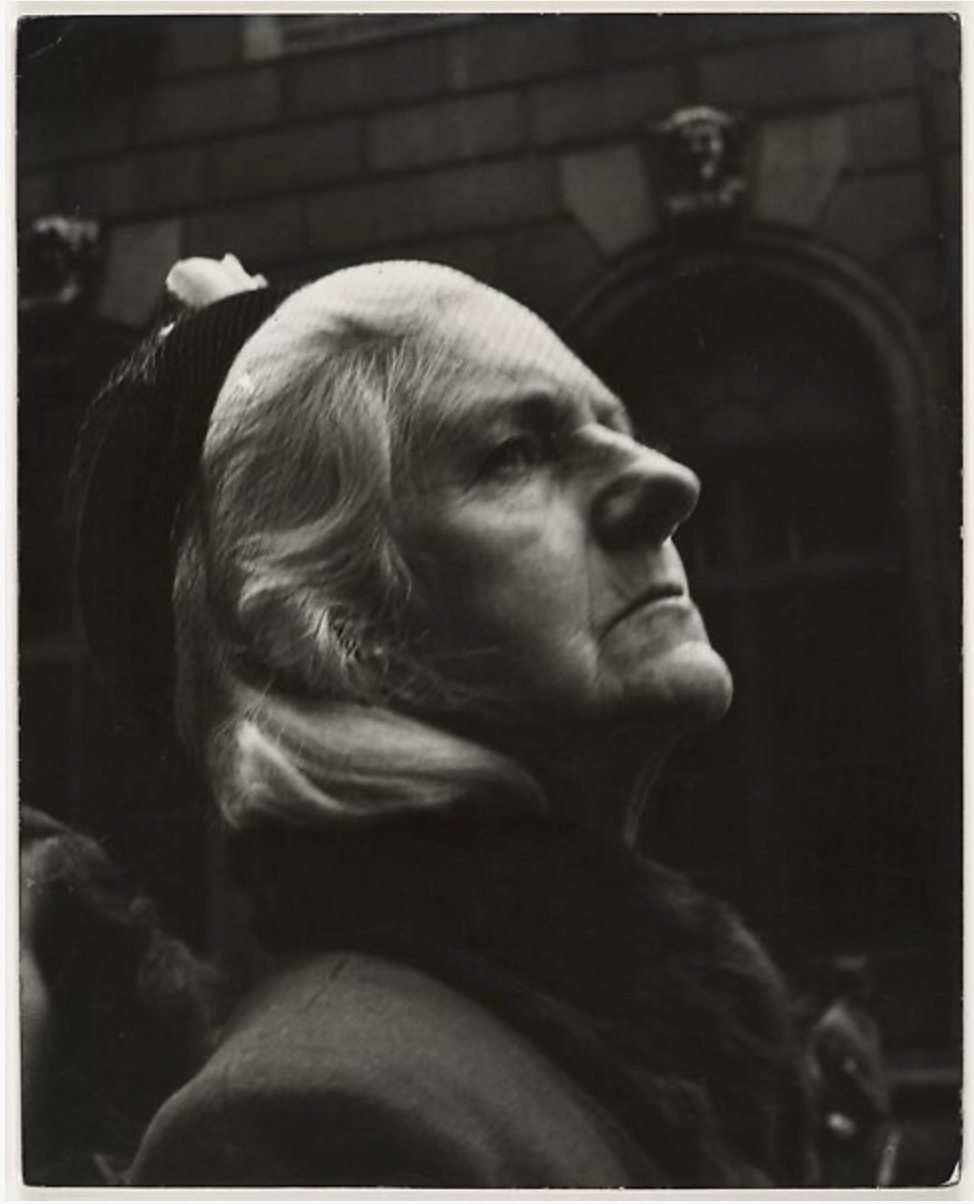
Leon Levinstein (American, 1910-1988) 'Untitled [Head of Man with Hat and Cigar]' c. 1960 from the exhibition 'Hipsters, Hustlers, and Handball Players: Leon Levinstein's New York Photographs, 1950-1980' at The Metropolitan Museum of Art, New York, June - October, 2010


Leon Levinstein (American, 1910-1988)
Untitled [Head of Man with Hat and Cigar]
c. 1960
Gelatin silver print
27.8 x 33.3cm (10 15/16 x 13 1/8 in.)
Stewart S. MacDermott Fund, 1986


A master of classic American street photography, Leon Levinstein (American, 1910-1988) is best known for his candid and unsentimental black-and-white figure studies made in New York City neighborhoods from Times Square and the Lower East Side to Coney Island. From June 8 through October 17, 2010, The Metropolitan Museum of Art presents Hipsters, Hustlers, and Handball Players: Leon Levinstein’s New York Photographs, 1950-1980. This exhibition, drawn exclusively from the Metropolitan’s collection, features 44 photographs that reflect Levinstein’s fearless approach to the medium. Levinstein’s graphic virtuosity – seen in raw, expressive gestures and seemingly monumental bodies – is balanced by an unusual compassion for his off-beat subjects from the demimonde.

Born in West Virginia in 1910, Levinstein moved to New York in 1946 and spent the next 35 years obsessively photographing strangers on the streets of his adopted home. Early in his career, Levinstein was quoted in Photography Annual 1955: “In my photographs I want to look at life – at the commonplace things as if I just turned a corner and ran into them for the first time.” With daring and dedication to his subject, Levinstein captured the denizens of New York City at extremely close range. He used his superb sense of composition to frame the faces, flesh, poses, and movements of his fellow city dwellers in their myriad guises: sunbathers, young couples, children, businessmen, beggars, prostitutes, proselytisers, society ladies, and characters of all stripes.

Although he was a life-long loner, Levinstein was mentored and supported by Alexey Brodovitch, artistic director of Harper’s Bazaar, and Edward Steichen, the eminent photographer and curator at The Museum of Modern Art in New York, both of whom recognised his unique talent in the medium of photography. He was also greatly influenced by workshops led by the distinguished photographer and teacher Sid Grossman.

In the 1950s and 1960s, Levinstein’s work appeared frequently in photography magazines and books alongside that of his peers, such as Robert Frank, Richard Avedon, and Diane Arbus. Nonetheless, he rarely worked on assignment, as they often did; nor did he ever produce his own book of photographs. Instead, he worked as a graphic designer and devoted his evenings and weekends to photography. In 1975, Levinstein received a grant from the Guggenheim Foundation to “photograph as wide a spectrum of the American scene as my experience and vision will allow… I want my photographs to be spontaneous rather than contrived.” Despite this recognition of his achievement, he never seemed able to fit into the commercial photography market that emerged in the 1970s and 1980s, and consequently, his powerful body of work continues to be known mainly by other photographers and by specialists in the field.

Press release from The Metropolitan Museum of Art website [Online] Cited 28/09/2010 no longer available online


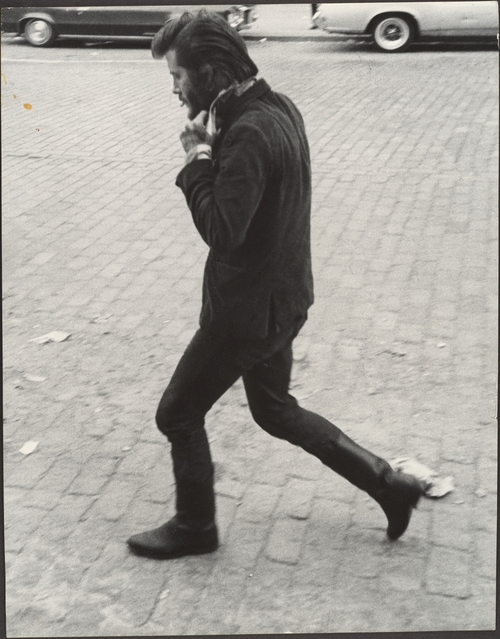
Leon Levinstein (American, 1910-1988) 'Street Scene - Man in Boots Walking and Adjusting His Collar, New York City' 1960s-1970s


Leon Levinstein (American, 1910-1988)
Street Scene: Man in Boots Walking and Adjusting His Collar, New York City
c. 1960s-1970s
Gelatin silver print
Gift of Gary Davis, 2007
© Howard Greenberg Gallery


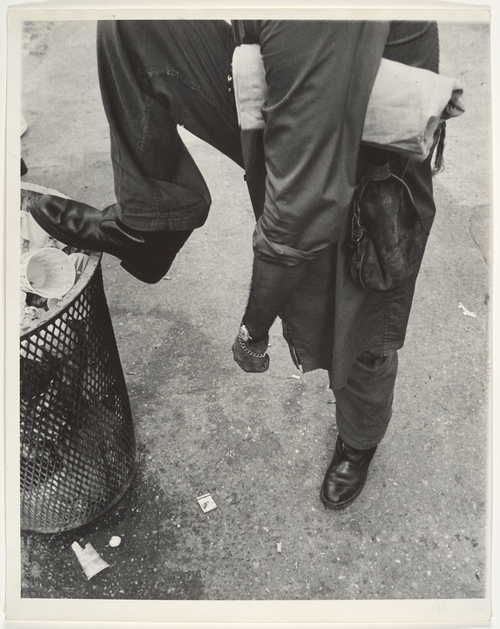
Leon Levinstein (American, 1910-1988) 'Street Scene - Man Resting Foot on Lip of Trashcan, New York City' 1970s


Leon Levinstein (American, 1910-1988)
Street Scene: Man Resting Foot on Lip of Trashcan, New York City
1970s
Gelatin silver print
Gift of Gary Davis, 2009
© Howard Greenberg Gallery


That idea of authenticity, ineffably captured as a decisive instance on a strip of light-sensitive celluloid, was ridden out of town a long time ago by postmodern theorists and certainly seems quaint today, but its power, as fixed in black and white by Levinstein, is undeniable. His mtier was a kind of reductivist monumentality, in which he captured his subjects – ordinary New Yorkers going about their business – in close-up, a technique commonly associated with cinema, to create images that were at once abstract and pregnant with narrative.

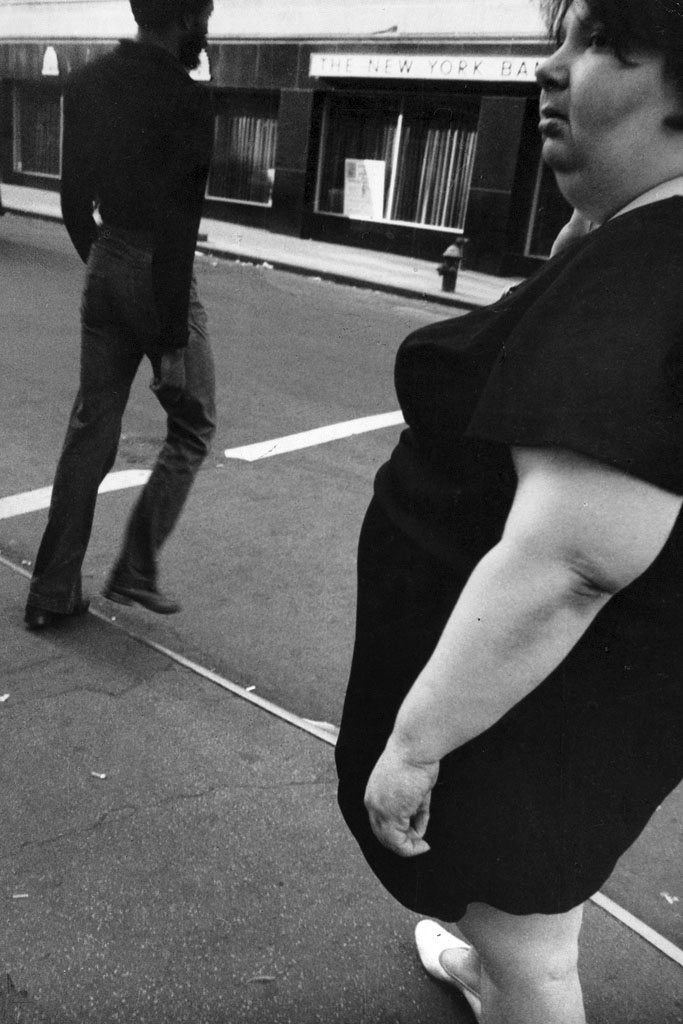
Like Weegee and Diane Arbus, Levinstein had a taste for the offbeat and grotesque (he often zeroed in on corpulent pedestrians; midsections and backsides, absent any trace of individuality, were a frequent motif). Also like them, he could be accused of engaging in a form of slumming. But he was less interested in abjection than he was in grandeur, and in this respect, the people in his photos are imbued with a sculptural nobility that simply doesn’t exist in the work of either Weegee or Arbus. More often than not, the “hipsters, hustlers and handball players” of the show’s title loom into the lens, crowding out background details. We get only fragments of the metropolis around them: a bit of stoop or curbstone, or a patch of sand out at Coney Island. Yet the pictures themselves express a sense of velocity, of lives hurtling toward some destiny that’s as heroic as it is bleak. What’s remarkable about Levinstein is that his framing – both epic and destabilising – stands in for the pitiless dynamic of New York itself.

Howard Halle. “Hipsters, Hustlers, and Handball Players: Leon Levinstein’s New York Photographs, 1950-1980,” on the Time Out New York website, Monday June 14, 2010 [Online] Cited 26/12/2019 no longer available online


Leon Levinstein (American, 1910-1988) 'Street Scene - Woman in Striped Dress on Stoop, New York City' 1970s


Leon Levinstein (American, 1910-1988)
Street Scene: Woman in Striped Dress on Stoop, New York City
1970s
Gelatin silver print
Gift of Gary Davis, 2007
© Howard Greenberg Gallery


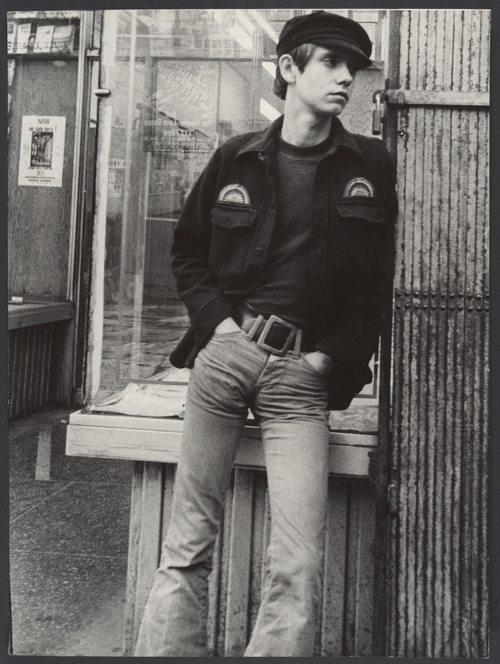
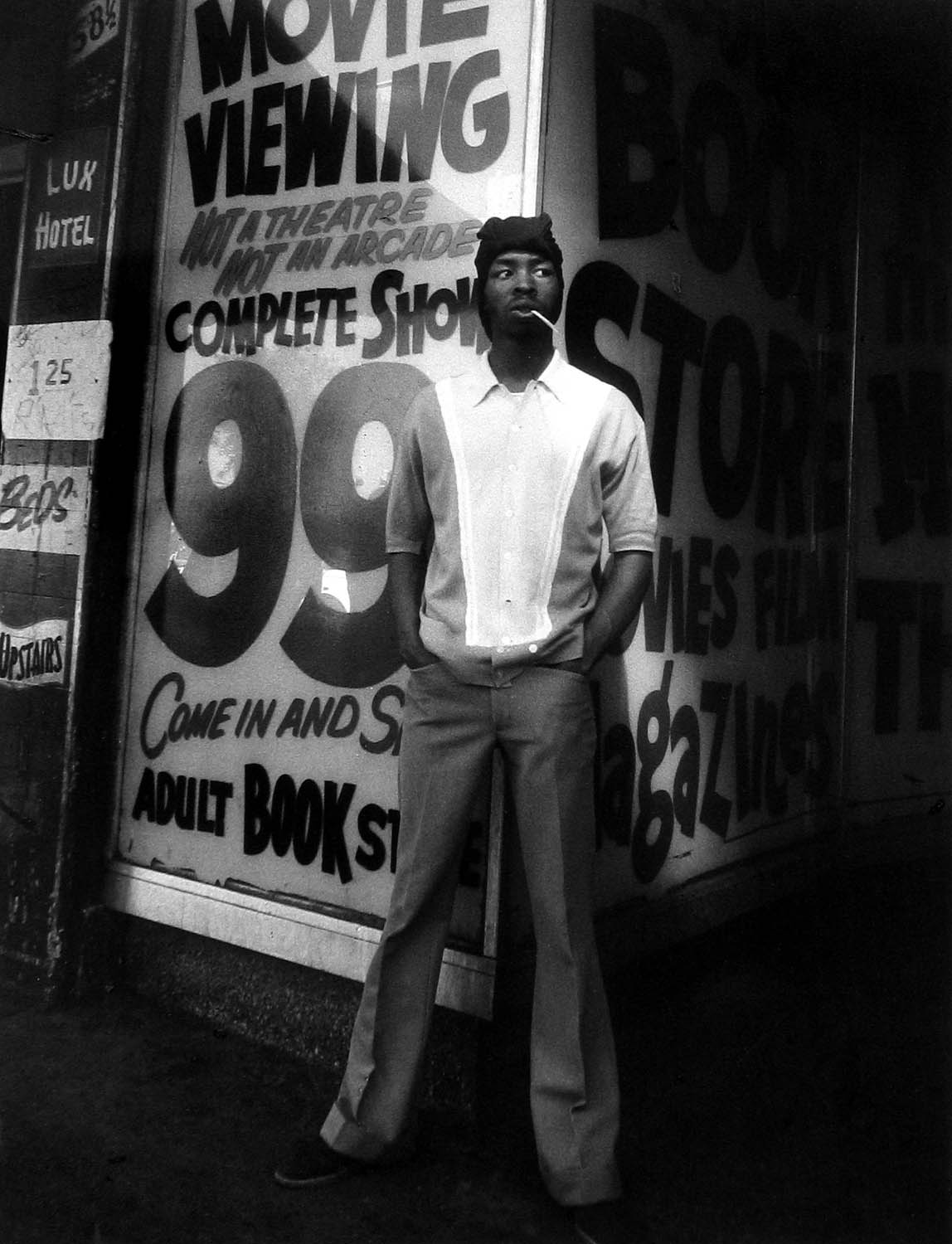
Leon Levinstein (American, 1910-1988) 'Street Scene - Young Man Leaning against Shopfront Window, New York City?' 1972


Leon Levinstein (American, 1910-1988)
Street Scene: Young Man Leaning against Shopfront Window, New York City?
1972
Gelatin silver print
Gift of Gary Davis, 2008
© Howard Greenberg Gallery


Leon Levinstein (American, 1910-1988) 'Untitled' New York City, 1960s-1970s


Leon Levinstein (American, 1910-1988)
Untitled
New York City, 1960s-1970s
Gelatin silver print
34.5 x 25.8cm (13 9/16 x 10 3/16)
© Howard Greenberg Gallery


Leon Levinstein (American, 1910-1988) 'Untitled' New York City, 1960s-1970s


Leon Levinstein (American, 1910-1988)
Untitled
New York City, 1960s-1970s
Gelatin silver print
35.5 x 26.3cm (14 x 10 3/8 in.)
© Howard Greenberg Gallery


Leon Levinstein (American, 1910-1988) 'Untitled' New York City, 1960s-1970s


Leon Levinstein (American, 1910-1988)
Untitled
New York City, 1960s-1970s
Gelatin silver print
34.5 x 25.8cm (13 9/16 x 10 3/16 in.)
© Howard Greenberg Gallery


I think Levinstein’s gift lay in his ability to capture the essence of New York’s rough, funky cool (particularly in the 1960s and 1970s), without getting overly sentimental or kitchy. Nearly all of his images were taken at close range, often cropping out unneeded heads and body parts, focusing on overlooked subjects and elemental gestures found on the city’s streets and sidewalks. His compositions are often angled and dark, and he was particularly adept at capturing the nuances of clothing and fashion as worn by New York’s imperfect and eclectic masses, finding the hidden joy in a bold pattern, a wide collar or a tight fitting pair of shorts. The pictures are tough, edgy, sometimes harsh, and always refreshingly real.

As you look more closely at these candid pictures, Levinstein’s talent for making the common look uncommon shines through. He finds earthy wonder in a foot perched on a wire trash can, a sweat stained tank top, 70s-era moustaches, a grey pinstripe suit, bulging stomachs and belts, a man fluffing his afro in a window, eating corn on the cob on the beach, tattoos, an overcoat with shiny buttons, kissing on a stoop, and a groovy floral blouse paired with tight leggings. He seems to have been fond of backs and sides, abstracting his subjects into fragments of movement or pose, paring them down into types and moments that were representative of something larger in society.

Loring Knoblauch. “Hipsters, Hustlers, and Handball Players: Leon Levinstein’s New York Photographs, 1950-1980 @Met,” on the Collector Daily website, July 23, 2010 [Online] Cited 21/03/2025


Leon Levinstein (American, 1910-1988) '54th Street, New York' 1950s


Leon Levinstein (American, 1910-1988)
54th Street, New York
1950s
Gelatin silver print
34.9 x 27.9 cm (13 3/4 x 11 in.)
Gift of Gary Davis, 2009


Leon Levinstein (American, 1910-1988) 'Untitled [Beach Scene: Woman Wearing Paper Bag Hat, Coney Island, New York]' 1950s


Leon Levinstein (American, 1910-1988)
Untitled [Beach Scene: Woman Wearing Paper Bag Hat, Coney Island, New York]
1950s
Gelatin silver print
35.4 x 28.1cm (13 15/16 x 11 1/16 in.)
Gift of Gary Davis, 2009
© Howard Greenberg Gallery


Leon Levinstein (American, 1910-1988) 'Coney Island' 1955


Leon Levinstein (American, 1910-1988)
Coney Island
1955
Gelatin silver print
© Howard Greenberg Gallery


Leon Levinstein (American, 1910-1988) 'Untitled' Coney Island, 1960s


Leon Levinstein (American, 1910-1988)
Untitled
Coney Island, 1960s
Gelatin silver print
35.5 x 28.1cm (14 x 11 1/16 in.)
© Howard Greenberg Gallery


The Metropolitan Museum of Art
1000 Fifth Avenue at 82nd Street
New York, New York 10028-0198
Information: 212-535-7710

Opening hours:
Sunday – Tuesday and Thursday: 10am – 5pm
Friday and Saturday: 10am – 9pm
Closed Wednesday

The Metropolitan Museum of Art website

LIKE ART BLART ON FACEBOOK

Back to top

Exhibition: ‘Beat Memories: The Photographs of Allen Ginsberg’ at the National Gallery of Art, Washington, D.C.

Exhibition dates: 2nd May – 6th September 2010


Many thankx to Anabeth Guthrie and the National Gallery of Art, Washington for allowing me to publish the photographs in the posting. Please click on the photographs for a larger version of the image.


Allen Ginsberg (American, 1926-1997) 'Jack Kerouac the last time he visited my apartment 704 East 5th Street, N.Y.C.… Fall 1964' 1964  from the exhibition 'Beat Memories: The Photographs of Allen Ginsberg' at the National Gallery of Art, Washington, D.C., May - Sept, 2010


Allen Ginsberg (American, 1926-1997)
Jack Kerouac the last time he visited my apartment 704 East 5th Street, N.Y.C…. Fall 1964
1964
Gelatin silver print
Image: 29.5 x 20.8cm (11 5/8 x 8 3/16 in)
Sheet: 35.5 x 27.5cm (14 x 10 13/16 in)
National Gallery of Art, Gift of Gary S. Davis
© 2010 The Allen Ginsberg LLC. All rights reserved


Allen Ginsberg (American, 1926-1997) 'Francesco Clemente looking over hand-script album with new poem I’d written out for his Blake-inspired watercolor illuminations…Manhattan, October 1984' 1984 from the exhibition 'Beat Memories: The Photographs of Allen Ginsberg' at the National Gallery of Art, Washington, D.C., May - Sept, 2010


Allen Ginsberg (American, 1926-1997)
Francesco Clemente looking over hand-script album with new poem I’d written out for his Blake-inspired watercolor illuminations… Manhattan, October 1984…
1984
Gelatin silver print
Image: 40.4 x 27cm (15 7/8 x 10 5/8 in)
Sheet: 50.5 x 40.5cm (19 7/8 x 15 15/16 in)
National Gallery of Art, Gift of Gary S. Davis
© 2010 The Allen Ginsberg LLC. All rights reserved


Allen Ginsberg (American, 1926-1997) 'Jack Kerouac, railroad brakeman's rule-book in pocket…206 East 7th Street near Tompkins Park, Manhattan, probably September 1953' 1953 from the exhibition 'Beat Memories: The Photographs of Allen Ginsberg' at the National Gallery of Art, Washington, D.C., May - Sept, 2010


Allen Ginsberg (American, 1926-1997)
Jack Kerouac, railroad brakeman’s rule-book in pocket… 206 East 7th Street near Tompkins Park, Manhattan, probably September 1953
1953
Gelatin silver print; printed 1984-1997
Image: 34.8 x 23.5cm (13 11/16 x 9 1/4 in)
Sheet: 51.7 x 40.5cm (20 3/8 x 15 15/16 in)
National Gallery of Art, Gift of Gary S. Davis
© 2010 The Allen Ginsberg LLC. All rights reserved


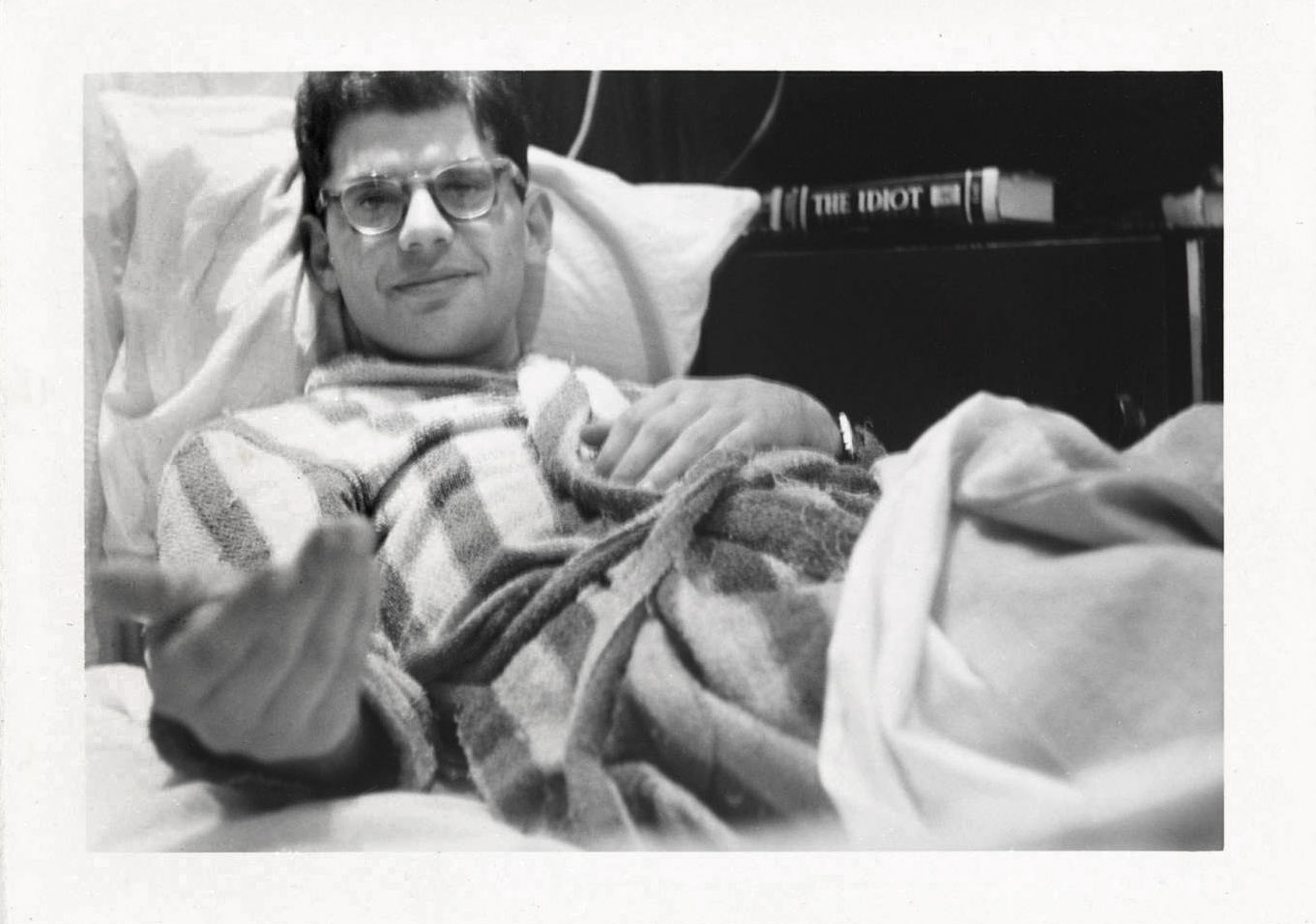
Some of the most compelling photographs taken by renowned 20th-century American poet Allen Ginsberg (1926-1997) of himself and his fellow Beat poets and writers – including William S. Burroughs, Neal Cassady, Gregory Corso, and Jack Kerouac – are the subject of the first scholarly exhibition and catalogue of these works. Beat Memories: The Photographs of Allen Ginsberg explores all facets of his photographs through 79 black-and-white portraits, on view at the National Gallery of Art, Washington, from May 2 through September 6, 2010.

The works are selected largely from a recent gift to the Gallery by Gary S. Davis as well as from private lenders. Davis acquired a master set of Ginsberg’s photographs from the poet’s estate, including one print of every photograph in Ginsberg’s possession at the time of his death. If more than one print existed, Ginsberg’s estate selected the one with the most compelling inscription. In 2008 and 2009 Davis donated more than 75 of these photographs to the National Gallery.

“We owe an enormous debt of gratitude to Gary Davis for his dedication to Ginsberg’s work and for his donations to the National Gallery,” said Earl A. Powell III, director, National Gallery of Art. “Joining other large and important holdings of photographs by such 20th-century artists as Harry Callahan, Walker Evans, Robert Frank, Lee Friedlander, André Kertész, Irving Penn, Alfred Stieglitz, and Paul Strand, this Ginsberg collection will allow future generations to study the evolution of the visual art of this important poet in all its rich complexity and to assess his contributions to 20th-century American photography.”

The same ideas that informed Ginsberg’s poetry – an intense observation of the world, a deep appreciation for the beauty of the vernacular, a faith in intuitive expression – also permeate his photographs.

When Ginsberg first began to take photographs in the 1950s, he – like countless other amateurs – had his film developed and printed at a local drugstore. The exhibition begins with a small selection of these “drugstore” prints.

The exhibition showcases examples of his now celebrated portraits of Beat writers such as Burroughs, Kerouac, and Ginsberg himself, starting just before they achieved fame with their publication, respectively, of Naked Lunch (1959), On the Road (1957), and Howl (1956), and continuing through the 1960s. In the photograph Bob Donlon (Rob Donnelly, Kerouac’s ‘Desolation Angels’), Neal Cassady, myself in black corduroy jacket… (1956), Ginsberg captures the tender, playful quality of his close-knit group of friends.

Photographs such as The first shopping cart street prophet I’d directly noticed… (1953) and Ginsberg’s apartment at 1010 Montgomery Street, San Francisco (1953), reveal his self-taught talents and careful attention to the world around him.

The second section of the exhibition presents Ginsberg’s later photographs, taken from the early 1980s until his death. These images were immediately embraced by the art world in the 1980s, and works such as Publisher-hero Barney Rosset whose Grove Press legal battles liberated U.S. literature & film… (1991) and Lita Hornick in her dining room… (1995) were exhibited in galleries and museums around the world. Prestigious institutions acquired Ginsberg’s photographs for their permanent collections, and two books were published on his photographic accomplishments. Ginsberg was not simply a happy bystander, witnessing these events from afar; he was one of the most active promoters of his photography. With their handwritten captions by Ginsberg himself, often reflecting on the passage of time, his photographs are both records and recollections of an era.

Allen Ginsberg (1926-1997)

Allen Ginsberg began to take photographs in 1953 when he purchased a small, secondhand Kodak camera. From then until the early 1960s, he photographed himself and his friends in New York and San Francisco, or on his travels around the world. At the same time, he was formulating his poetic voice. Ginsberg first commanded public attention in 1955 when he read his provocative and now famous poem Howl to a wildly cheering audience at the Six Gallery in San Francisco. It was published the following year by City Lights Books with an introduction by William Carlos Williams.

Together with On the Road (1957), written by Kerouac, Howl was immediately hailed as a captivating, if challenging expression of both a new voice and a new vision for American literature. Celebrating personal freedom, sexual openness, and spontaneity, Ginsberg and Kerouac came to be seen as the embodiment of a younger generation – the Beats – who were unconcerned with middle-class American values and aspirations and decried its materialism and conformity. Ginsberg abandoned photography in 1963.

In 1983, with this rich, full life largely behind him, Ginsberg became increasingly interested in ensuring and perpetuating his legacy. Inspired by the discovery of his old negatives and encouraged by photographers Berenice Abbott and Robert Frank, he reprinted much of his early photographs and made new portraits of longtime friends and other acquaintances, such as the painter Francesco Clemente and musician Bob Dylan. With his poetic voice refined, Ginsberg, also added extensive inscriptions beneath each image, describing both his relationship with the subject and his memories of their times together.

Unlike many other members of the Beat Generation whose careers were cut short, Ginsberg wrote and published deeply moving and influential poetry for the rest of his life, including Kaddish (1961), his soulful lament for his mother, and The Fall of America: Poems of These States, 1965-1971 (1972), which was awarded a National Book Award in 1974. Using his fame to advance social causes, he also continued to capture public attention as an outspoken opponent to the Vietnam War and American militarism and as a champion of free speech, gay rights, and oppressed people around the world. In the midst of this popular acclaim, Ginsberg’s photographs have not received much critical attention, especially in the years since his death in 1997.

Although Ginsberg’s photographs form one of the most revealing records of the Beat and counterculture generation from the 1950s to the 1990s, tracing their journey from youthful characters to ageing, often spent figures, his pictures are far more than historical documents. Drawing on the most common form of photography – the snapshot – he created spontaneous, uninhibited pictures of ordinary events to celebrate and preserve what he called “the sacredness of the moment.

Press release from the National Gallery of Art website [Online] Cited 01/09/2010 no longer available online


Allen Ginsberg (American, 1926-1997) 'William Burroughs, 11 pm late March 1985, being driven home to 222 Bowery…' 1985


Allen Ginsberg (American, 1926-1997)
William Burroughs, 11 pm late March 1985, being driven home to 222 Bowery…
1985
Gelatin silver print
Image: 19.7 x 18.9cm (7 3/4 x 7 7/16 in)
Sheet: 25.4 x 20.3cm (10 x 8 in)
National Gallery of Art, Gift of Gary S. Davis
© 2010 The Allen Ginsberg LLC. All rights reserved


Allen Ginsberg (American, 1926-1997) 'Myself seen by William Burroughs…our apartment roof Lower East Side between Avenues B & C…Fall 1953' 1953; printed 1984-1997


Allen Ginsberg (American, 1926-1997)
Myself seen by William Burroughs… our apartment roof Lower East Side between Avenues B & C… Fall 1953
1953; printed 1984-1997
Gelatin silver print
Image: 28.58 x 43.82cm (11 1/4 x 17 1/4 in)
Sheet: 40.5 x 50.5cm (15 15/16 x 19 7/8 in)
National Gallery of Art, Gift of Gary S. Davis
© 2010 The Allen Ginsberg LLC. All rights reserved


Allen Ginsberg (American, 1926-1997) '“Now Jack as I warned you"… William Burroughs… lecturing…Jack Kerouac…Manhattan, 206 East 7th St. Apt. 16, Fall 1953' 1953; printed 1984-1997


Allen Ginsberg (American, 1926-1997)
Now Jack as I warned you” … William Burroughs… lecturing… Jack Kerouac… Manhattan, 206 East 7th St. Apt. 16, Fall 1953
1953; printed 1984-1997
Gelatin silver print
Image: 28.3 x 44.2cm (11 1/8 x 17 3/8 in)
Sheet: 40.4 x 50.2cm (15 7/8 x 19 3/4 in)
National Gallery of Art, Gift of Gary S. Davis
© 2010 The Allen Ginsberg LLC. All rights reserved


Allen Ginsberg (American, 1926-1997) 'William S. Burroughs looking serious, sad lover's eyes, afternoon light in window…New York, Fall 1953' 1953; printed 1984-1997


Allen Ginsberg (American, 1926-1997)
William S. Burroughs looking serious, sad lover’s eyes, afternoon light in window… New York, Fall 1953
1953; printed 1984-1997
Gelatin silver print
Image: 19.2 x 29cm (7 9/16 x 11 7/16 in)
Sheet: 27.9 x 35.2cm (11 x 13 7/8 in)
National Gallery of Art, Gift of Gary S. Davis
© 2010 The Allen Ginsberg LLC. All rights reserved


Allen Ginsberg (American, 1926-1997) 'Neal Cassady and his love of that year the star-crossed Natalie Jackson…San Francisco, maybe March 1955' 1955; printed 1984-1997


Allen Ginsberg (American, 1926-1997)
Neal Cassady and his love of that year the star-crossed Natalie Jackson… San Francisco, maybe March 1955
1955; printed 1984-1997
Gelatin silver print
Image: 24.9 x 38cm (9 13/16 x 14 15/16 in)
Sheet: 40.5 x 50.5cm (15 15/16 x 19 7/8 in)
National Gallery of Art, Gift of Gary S. Davis
© 2010 The Allen Ginsberg LLC. All rights reserved


Allen Ginsberg (American, 1926-1997) 'William Burroughs' 1953


Allen Ginsberg (American, 1926-1997)
William Burroughs
1953
gelatin silver print
Image: 10.2 x 15.2cm (4 x 6 in)
Sheet: 11.3 x 16.1cm (4 7/16 x 6 5/16 in)
Howard Greenberg Gallery, New York
© 2010 The Allen Ginsberg LLC. All rights reserved


Allen Ginsberg (American, 1926-1997) 'Jack Kerouac wandering along East 7th street…' 1953


Allen Ginsberg (American, 1926-1997)
Jack Kerouac wandering along East 7th street…
1953
Gelatin silver print, printed 1984-1997
Image: 11 1/2 x 17 3/4 in.
National Gallery of Art
Gift of Gary S. Davis
© 2010 The Allen Ginsberg LLC. All rights reserved


Allen Ginsberg (American, 1926-1997) 'Allen Ginsberg' 1955


Allen Ginsberg (American, 1926-1997)
Allen Ginsberg
1955
Gelatin silver print
Image: 2 11/16 x 3 15/16 in.
Howard Greenberg Gallery, New York
© 2010 The Allen Ginsberg LLC. All rights reserved


Allen Ginsberg (American, 1926-1997) 'Peter Orlovsky at James Joyce’s grave' 1980; printed 1984-1997


Allen Ginsberg (American, 1926-1997)
Peter Orlovsky at James Joyce’s grave
1980; printed 1984-1997
gelatin silver print
Image: 19 x 28.5cm (7 1/2 x 11 1/4 in)
Sheet: 27.8 x 35.5cm (10 15/16 x 14 in)
Collection of Gary S. Davis
© 2010 The Allen Ginsberg LLC. All rights reserved


Allen Ginsberg (American, 1926-1997) 'William Burroughs at rest in the side-yard of his house... Lawrence, Kansas May 28, 1991…' 1991


Allen Ginsberg (American, 1926-1997)
William Burroughs at rest in the side-yard of his house… Lawrence, Kansas May 28, 1991…
1991
gelatin silver print
Image: 22.23 x 33.02cm (8 3/4 x 13 in)
Sheet: 27.9 x 35.4cm (11 x 13 15/16 in)
National Gallery of Art, Gift of Gary S. Davis
© 2010 The Allen Ginsberg LLC. All rights reserved


National Gallery of Art, Washington DC
The National Gallery of Art, located on the National Mall between 3rd and 7th Streets at Constitution Avenue NW

Opening hours:
Daily 10.00am – 5.00pm

National Gallery of Art website

LIKE ART BLART ON FACEBOOK

Back to top

Exhibition: ‘Climate Capsules: Means of Surviving Disaster’ at Museum fur Kunst und Gewerbe Hamburg

Exhibition dates: 28th May – 12th September, 2010


Many thankx to Michaela Hille and Museum fur Kunst und Gewerbe Hamburg for allowing me to publish the photographs in the posting. Please click on the photographs for a larger version of the image.


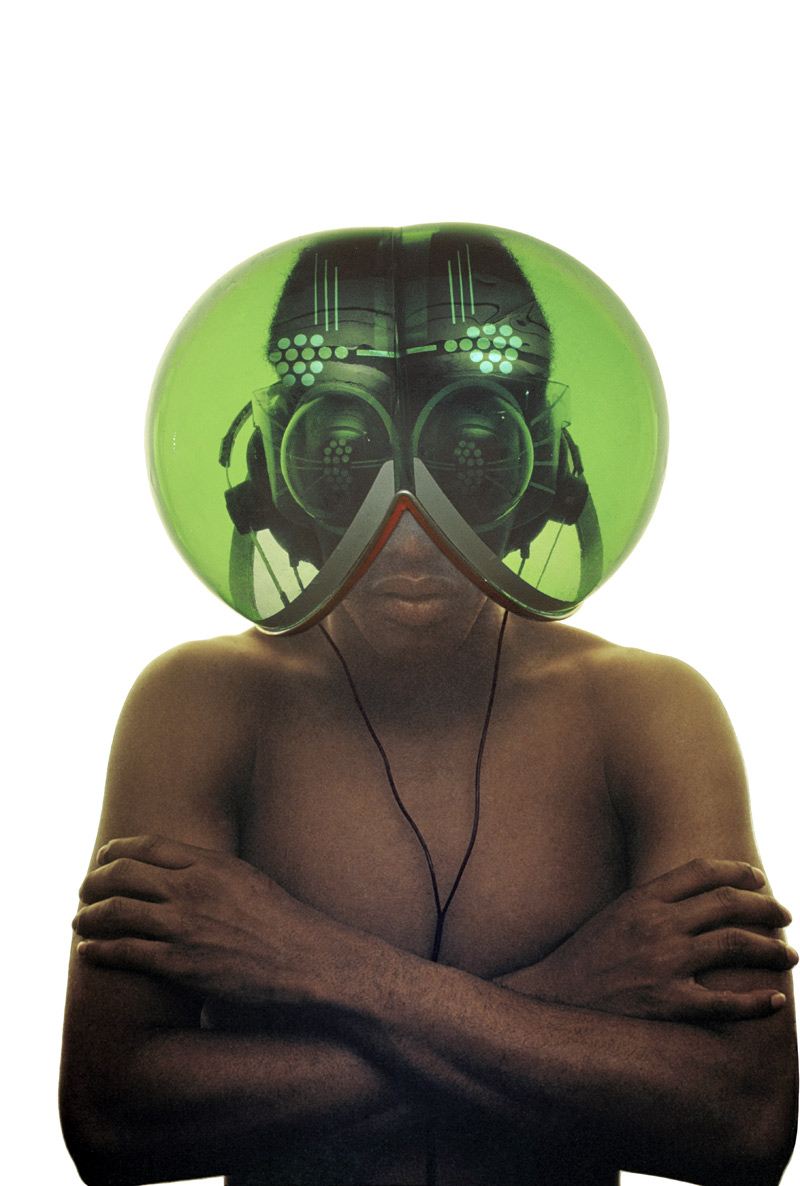
Haus-Rucker-Co (Laurids Ortner, Günter Zamp Kelp, Klaus Pinter) 'Flyhead (Environment Transformer)', Vienna, 1968 from the exhibition 'Climate Capsules: Means of Surviving Disaster' at Museum fur Kunst und Gewerbe Hamburg, may - September, 2010


Haus-Rucker-Co (Laurids Ortner, Gunter Zamp Kelp, Klaus Pinter)
Flyhead (Environment Transformer)
Vienna, 1968
Helmet consisting of two transparent green, symmetrical, hemispherical plastic fragments partially covered with foil. Inside the helmet, with the aid of a metal construction, audio-visual filters are arranged by means of which the normality of the surroundings is acoustically distorted and visually faceted.
Photo: Ben Rose, New York


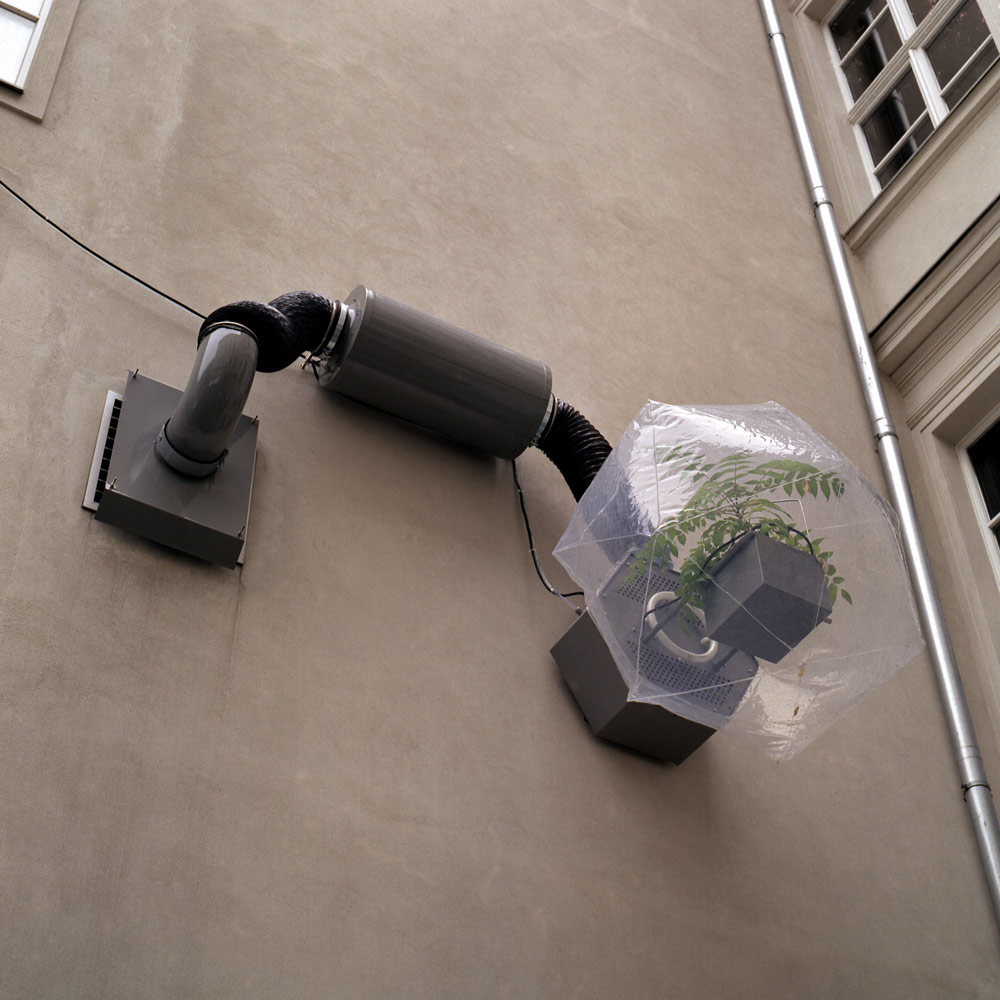
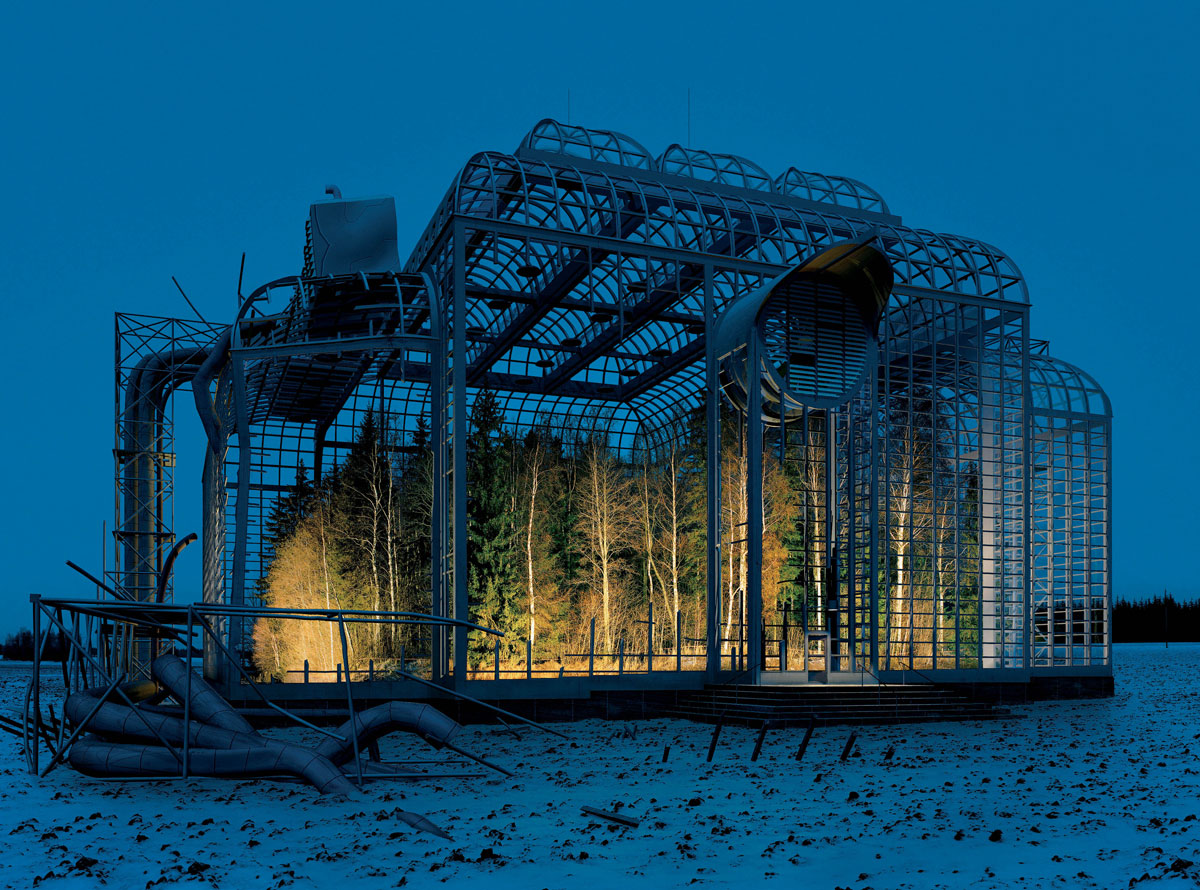
Ingo Vetter (Germany, b. 1968) 'Adaptation Laboratory' 2004 from the exhibition 'Climate Capsules: Means of Surviving Disaster' at Museum fur Kunst und Gewerbe Hamburg, may - September, 2010


Ingo Vetter (Germany, b. 1968)
Adaptation Laboratory
2004
Exhaust-operated greenhouse with tree of heaven (Ailanthus altissima)
Ingo Vetter
© Ingo Vetter for the Detroit Tree of Heaven Woodshop, 2004


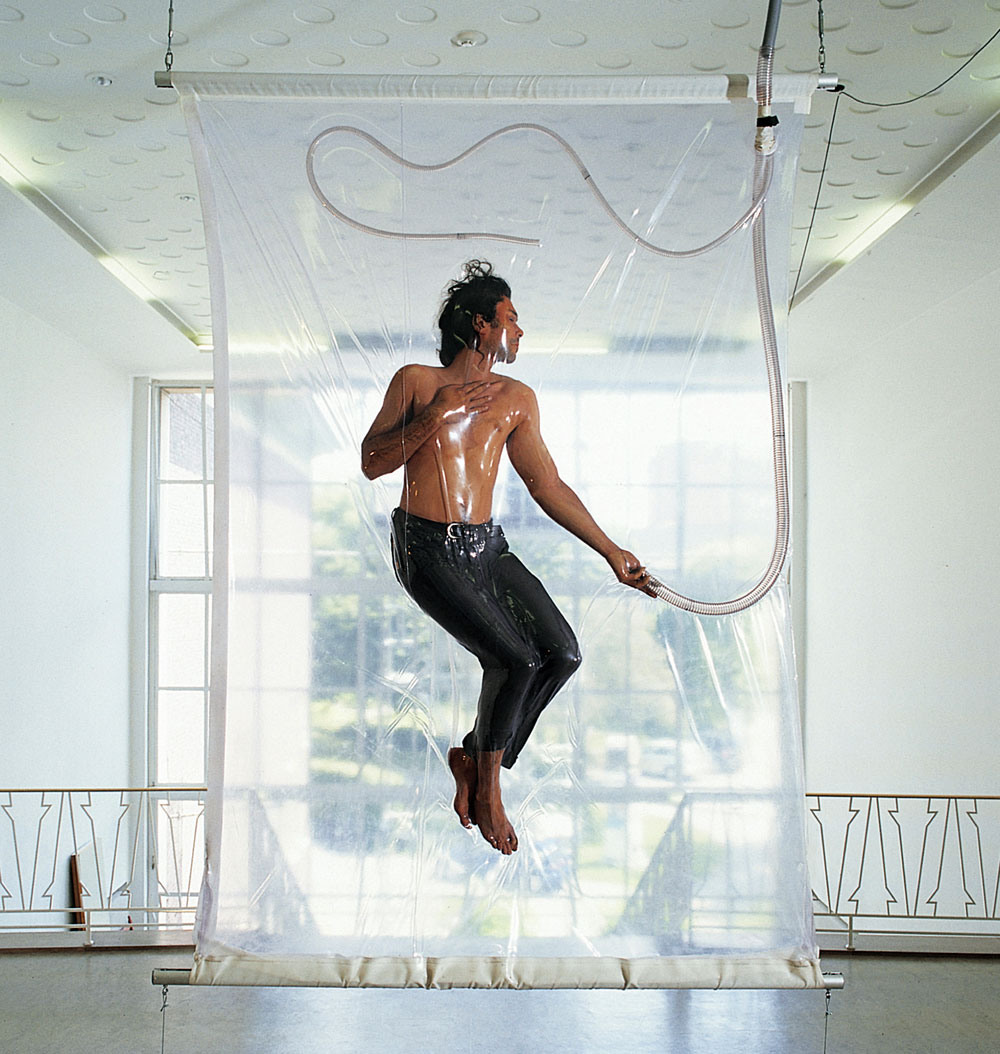
Lawrence Malstaf (Belgian, b. 1972) 'Shrink' 1995 from the exhibition 'Climate Capsules: Means of Surviving Disaster' at Museum fur Kunst und Gewerbe Hamburg, may - September, 2010


Lawrence Malstaf (Belgian, b. 1972)
Shrink
1995
Performative Installation
© Lawrence Malstaf/Galerie Fortlaan 17, Ghent (B)


In view of the advancing climate change, the exhibition Climate Capsules: Means of Surviving Disaster at the Museum fur Kunst und Gewerbe Hamburg poses the question: “How do we want to live in the future?” and draws attention to the socio-political consequences of coexistence under new climatic conditions. In view of the fact that the politicians are hesitant to enforce strict measures for climate protection and the citizens very sluggish about changing their habits, the change appears inevitable. The world community is accordingly confronted with the challenge of investigating various possible means of adapting to the climate change. This exhibition is the first to bring together historical and current climate-related models, concepts, strategies, experiments and utopias from the areas of design, art, architecture and urban development – pursuing not the aim of stopping the climate change, but envisioning means of surviving after disaster has struck. More than twenty-five mobile, temporary and urban capsules intended to make human life possible independently of the surrounding climatic conditions will be on view – from floating cities and body capsules to concepts for fertilising sea water or injecting the stratosphere with sulphur. A symposium, film programme, readings, performances and workshops will revolve around the interplay between design processes and political factors such as migration, border politics and resource conflicts, and investigate the consequences for social and cultural partitioning and exclusion.

The public discussion on the climate change concentrates primarily on preventing change by reducing climate damaging emissions. This reduction is to be achieved through new means of obtaining energy as well as the optimisation of energy consumption. The consumption-oriented lifestyle of the industrial nations is also to become more “environmentally friendly”; the citizens are called upon to change their habits. Emerging nations are admonished to avoid the mistakes made by the West from the start. There is not the slightest guarantee, however, that enough nations and enough people around the world will participate in such reductions, and that a “low-carbon culture” will become the globally predominant lifestyle. Nor does anyone know for sure whether the reduction goals presently being discussed will suffice to delay or stop the climate change, which is already measurable today. In the search for alternative solutions, there is a category discussed substantially less often in public: adaptation. Here strategies are developed which aim not to slow or stop the climate change but to adapt to its expected consequences. They include protective measures against flooding and overheating as well as geo-engineering, i.e. large-scale interventions in the global climate.

These technologies are usually subjected only to critical discussion with regard to their technical feasibility. Until now, their possible socio-political effects have for the most part been ignored. Their impact on the structure of the global society, however, can hardly be overestimated: in the endeavour to make life possible independently of outward climatic conditions, these strategies encourage spatial, social and political isolation. Ostensibly motivated by climate-related considerations, they could well lead to inclusion and exclusion on all levels of life, from the interpersonal to the global. They create the conditions for social segregation and global polarisation.

The exhibition Climate Capsules: Means of Surviving Disaster will focus primarily on application-oriented projects for climatological capsules from the areas of design, art, architecture, urban development and geoengineering. The show will reflect on the (political, cultural, socio-spatial) impact of these current adaptation strategies on society by means of contemporary artistic approaches and avant-garde concepts of the twentieth century. Historical projects in the context of the climate change will thus assume new meaning. The current artistic projects question the positivist perspective of their counterparts of the past, and offer the exhibition visitor a further level of sensory experience. The exhibition objects can be divided into five types: body capsules, living capsules, urban capsules, nature capsules and atmosphere capsules.

Body capsules

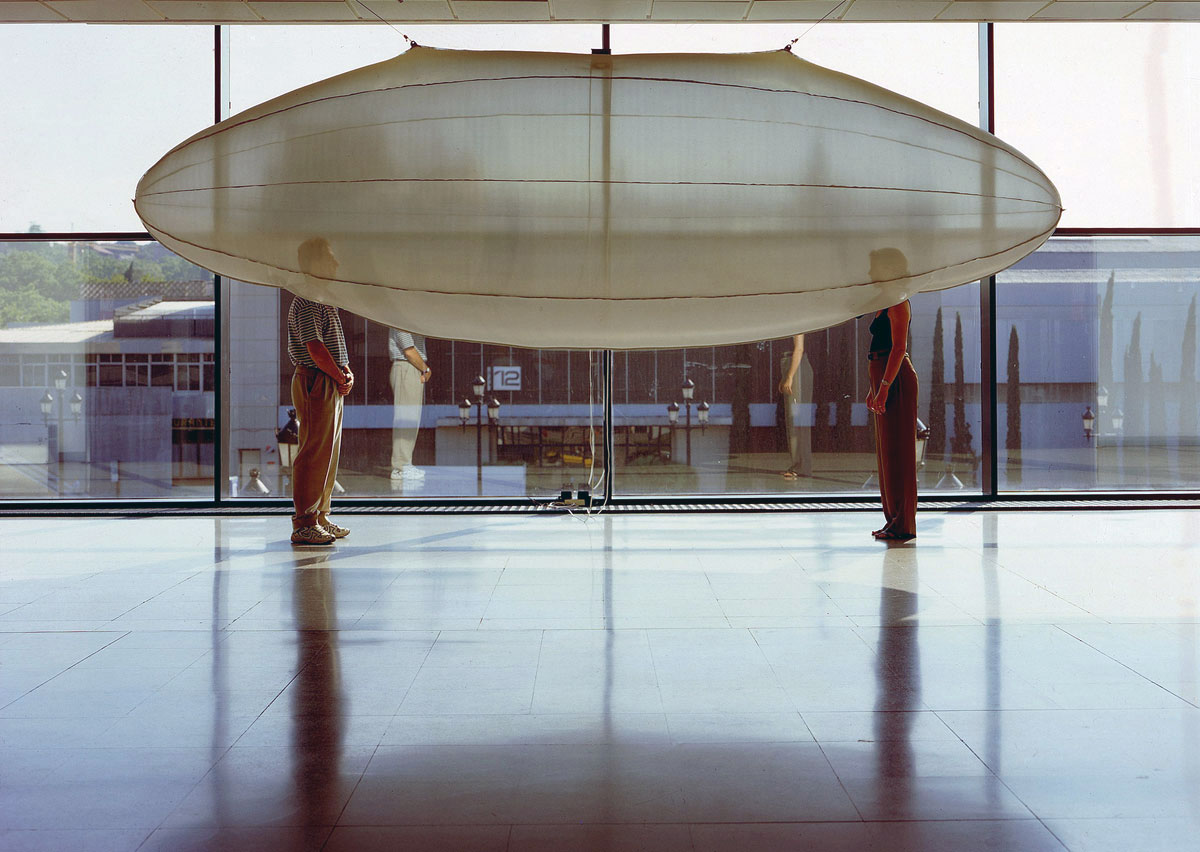
The exhibition begins with the interactive installation La Parole by Pablo Reinoso. Two visitors at a time can poke their heads into the inflatable textile construction and share the air they breathe as well as a common visual and audio space. The experience of this work raises the question as to how people can protect their bodies from contaminated air, pollutants, storms and aggressive solar radiation. Again and again in the course of the show, the visitor encounters “body capsules” addressing the topic of clothing as bodily protection from climatic conditions.

Living capsules

The objects belonging to this group extend the encapsulated space from the body encasement to the immediate living space. Utopian designs for mobile capsules of the 1960s such as the Walking City by Ron Herron (Archigram) still figured in the discussion emphasising temporary and mobile structures as experimental free spaces after ideas introduced by such architects as Constant or Yona Friedman. Today mobility is no longer just a question of freedom – the counterpart to voluntary mobility is flight, the spatial equivalent the temporary camp. The visitor thus stumbles across Michael Rokowitz’s paraSITE, for example, an inflatable tent which the artist developed in collaboration with the homeless person Bill Stone. Like the other tents in the series, it is designed for use in an exhaust air shaft. It can dock onto a building as a temporary parasite. In this context of precarious modi vivendi – brought about not least of all by global inequality (which is further aggravated by the climate change) and the resulting mass migration – what were once visionary temporary living concepts appear in a new light. They are not spaces of liberation, but of isolation.

Urban capsules

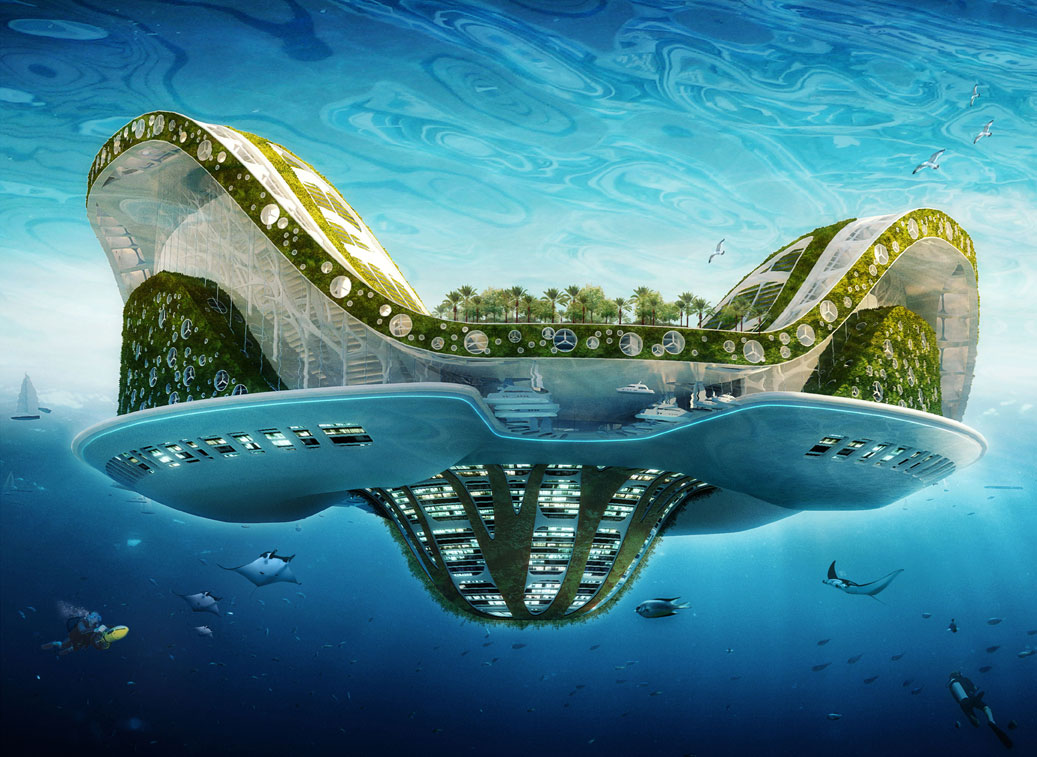
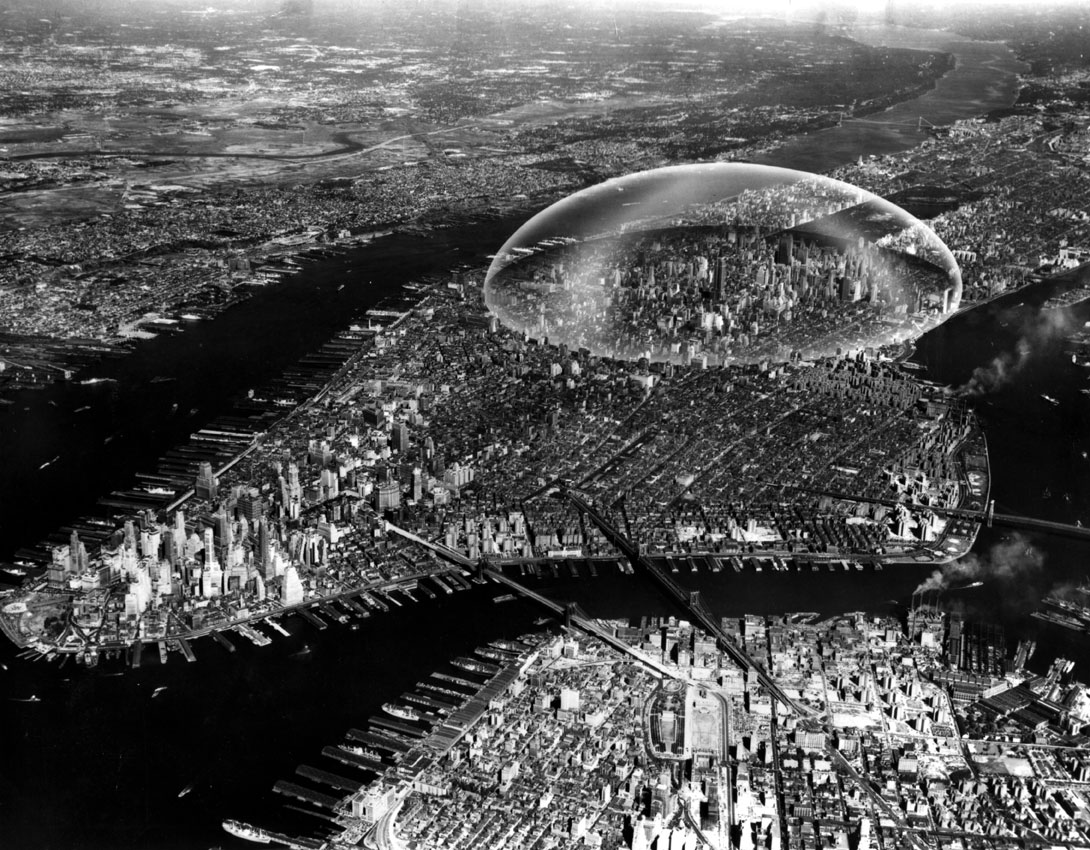
Cities are the largest energy consumers, and urbanisation continues to increase worldwide. Zero waste, zero emission, zero energy are the creeds of the present. Already in the 1950s, Richard Buckminster Fuller and Shoji Sadao sketched the utopia of a climatically self-sufficient reorganisation of the city with their Dome over Manhattan. In this vision, a huge dome covers a large proportion of the island. Today, these encapsulations from the outside are already being realised in conjunction with the design of internal climate worlds, whether on the scale of large building complexes or energy-self-sufficient cities such as Masdar by Norman Foster. Other concepts show that, against the background of imminent climate disasters, the urban system is conceived of increasingly as an autarchic unit, sealed from the outside world, and confronted with the need for the self-contained management of its ecological resources. This debate is carried to the furthest extreme by Vincent Callebaut’s conception for a floating city – Lilypad – intended as a haven for climate refugees.

Nature capsules

Just as the city is to be protected from the climatologically changing environment, nature is also to be elevated into a sphere of safe artificiality and preserved in nature capsules. Ecosystems are replicated by human hand on the micro level and sealed off from the outside. A concept which initially presents itself as a protective mechanism robs the flora and fauna assembled within it of their connection to the macrolevel ecosystem: Earth. The question arises: can that which is being protected inside such a capsule still be thought of as nature? Or is it a deceptively genuine human artefact? These considerations are made very vivid in Ilkka Halso’s photo series Museum of Nature, consisting of digital montages which insert forests, lakes and rivers into imaginary museum buildings.

Atmosphere capsules

The maximum scale of adaptive design strategies is reached with geo-engineering. With chemical or physical interventions, attempts are made to control climatological, geochemical and biochemical systems actively on the global level, and thus to moderate the climate. The historical forerunners of this development are psychoanalyst Wilhelm Reich’s para-scientific Cloudbusters and the U.S. Army’s Project Cirrus, both of which sought to influence the weather technically by different means. Today, various well-known scientists and research institutes are working on large-scale interventions aiming to protect the global climate from negative influences. Utopian proposals are juxtaposed with feasible projects such as endeavours to reduce global warming through the use of reflective white paint on roofs and streets. To date it is impossible to calculate the consequences of such far-reaching interventions, and they are nowhere near realisation. Yet the fact that they are discussed seriously indicates how close climatological developments have already come to the point where emission-reduction strategies become obsolete.

Participating artists, designers and architects: Anderson Anderson Architecture (US), Ant Farm (US), Richard Buckminster Fuller (US), Vincent Callebaut (B), Juan Downey (US), David Greene (GB), Tue Greenfort (DK), Ilkka Halso (FI), Haus-Rucker-Co (AT), Ron Herron (GB), Kouji Hikawa (JP), Christoph Keller (D), Lawrence Malstaf (B), Gustav Metzger (D), N55 (DK), Lucy Orta (GB), Michael Rakowitz (US), Pablo Reinoso (ARG/F), Shoji Sadao (US), Tomás Saraceno (planet earth), Werner Sobek (D), Jan-Peter E.R. Sonntag (D), Matti Suuronen (FI), Ingo Vetter (D).

Press release from the Museum fur Kunst und Gewerbe website [Online] Cited 17/08/2010 no longer available online


Pablo Reinoso (Argentine-French, b. 1955) 'La Parole' 1998


Pablo Reinoso (Argentine-French, b. 1955)
La Parole
1998
Fabric and electrically powered ventilators
length. 620cm, diam. 200cm
Pablo Reinoso
© Pablo Reinoso Studio


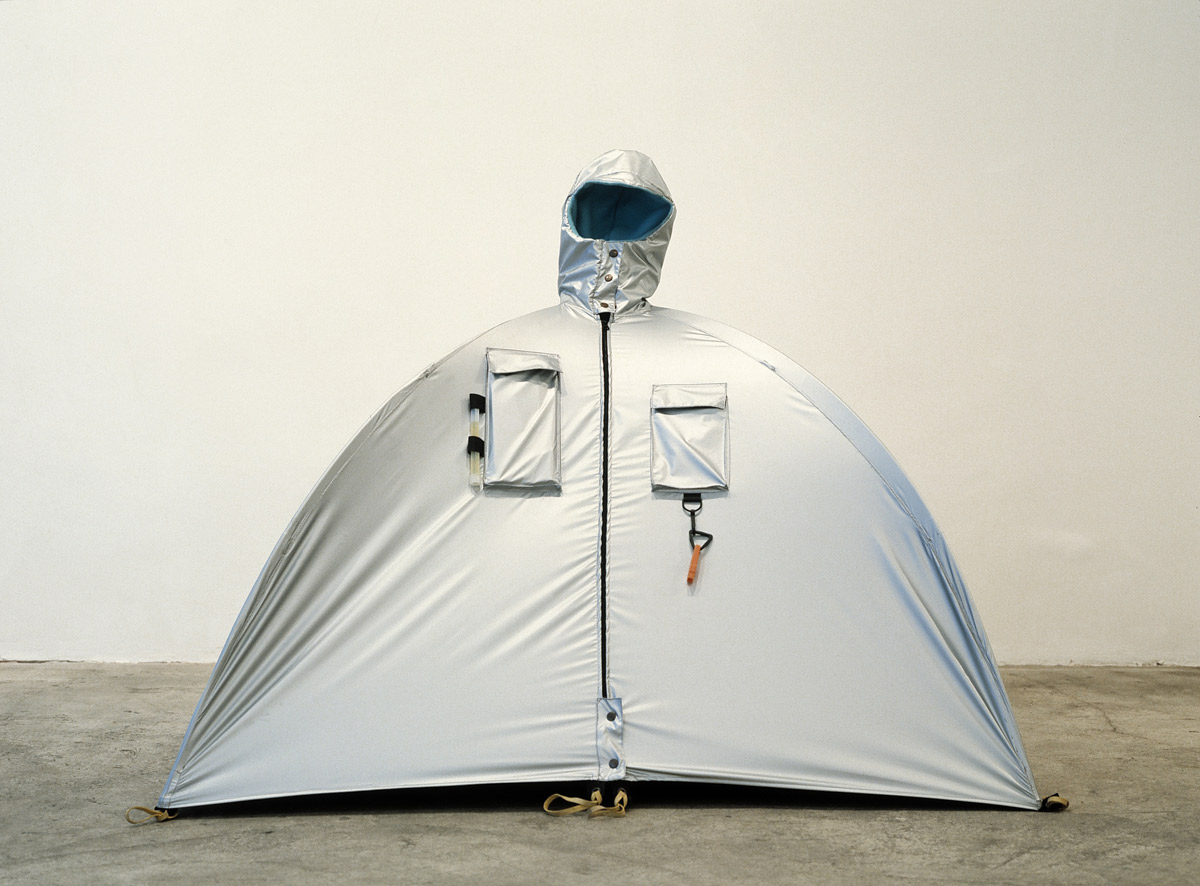
Lucy Orta (English, b. 1966) 'Refuge Wear – Habitent' 1992


Lucy Orta (English, b. 1966)
Refuge Wear – Habitent
1992
Polyamide encased in aluminium, polar fleece, aluminium tent poles, whistle, lantern, compass
125 x 125 x 125cm
Galleria Continua
Photo: Galerie Anne de Villepoix, Courtesy Galleria Continua, San Gimignano / Beijing / Le Moulin


Vincent Callebaut (Belgium, c. 1977) 'Lilypad, A Floating Ecopolis for Climate Refugees' 2008


Vincent Callebaut (Belgium, c. 1977)
Lilypad, A Floating Ecopolis for Climate Refugees
2008
Digital rendering, dimensions variable
© Vincent Callebaut Architectures


Richard Buckminster Fuller, Shoji Sadao. 'Dome over Manhattan' c. 1960


Richard Buckminster Fuller, Shoji Sadao
Dome over Manhattan
c. 1960
Silver gelatine print
34.9 x 46.7cm
Courtesy the Estate of R. Buckminster Fuller


Ilkka Halso (Finnish, b. 1965) 'Museum I' 2003


Ilkka Halso (Finnish, b. 1965)
Museum I
2003
from the work Museum of Nature


Museum für Kunst und Gewerbe Hamburg
Steintorplatz, 20099 Hamburg

Opening hours:
Tuesday to Sunday 10am – 6pm
Thursday 10am – 9pm

Museum fur Kunst und Gewerbe Hamburg website

LIKE ART BLART ON FACEBOOK

Back to top

Review: ‘Jill Orr: Vision’ at Jenny Port Gallery, Richmond, Melbourne

Exhibition dates: 2nd June – 3rd July, 2010


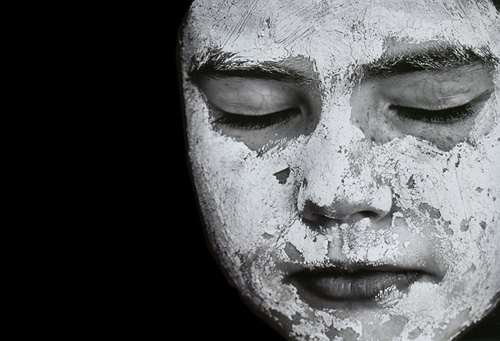
Jill Orr (Australian, b. 1952) 'Megan' 2009 from the exhibition Review: 'Jill Orr: Vision' at Jenny Port Gallery, Richmond, Melbourne, June - July, 2010


Jill Orr (Australian, b. 1952)
Megan
2009


A huge gallery crawl on Wednesday last saw me take in exhibitions at Nellie Castan Gallery (Malleus Melficarum: strong sculptural work by James and Eleanor Avery; Broken Canon: vibrant mixed media collages by Marc Freeman); Anita Traverso Gallery (Peristereonas: sculptures, photographs and mixed media by Barry Thompson); John Buckley Gallery (Perpetua by Emma can Leest, beautiful cut paper works; rather mundane paintings by Christian Lock); Karen Woodbury Gallery (Every breath you take: wonderful galaxy-like paintings, perhaps as seen by the Hubble telescope, with a geometric / cellular base by Lara Merrett); The Centre for Contemporary Photography (Event horizon: a group exhibition that “engages the horizon as a means to establish a physical locality with relation to the Earth’s surface and more broadly to the universe of which it is a miniscule component.” An exhibition that left me rather cold); and ACCA (Towards an elegant solution by Peter Cripps, again a singularly unemotional engagement with the precise, contained work: interesting for how the work explores spatial environments but in an abstract, intellectual way).

The stand out work from this mammoth day was Jill Orr: Vision at Jenny Port Gallery. Simply put, it was the strongest, most direct, most emotionally powerful work that I saw all day.

Dr Marcus Bunyan


Many thankx to Amelia Douglas and Jenny Port Gallery for allowing me to publish the photographs in this posting.


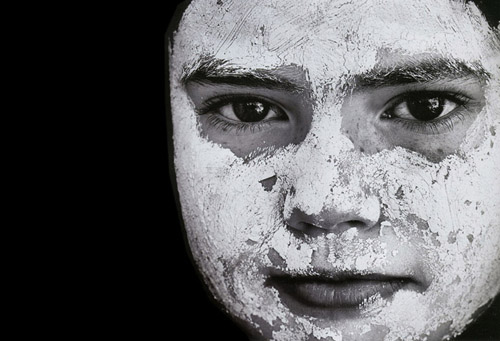
Jill Orr (Australian, b. 1952) 'Megan' 2009 from the exhibition Review: 'Jill Orr: Vision' at Jenny Port Gallery, Richmond, Melbourne, June - July, 2010


Jill Orr (Australian, b. 1952)
Megan
2009


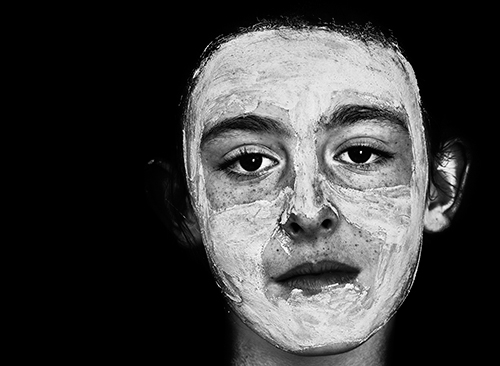
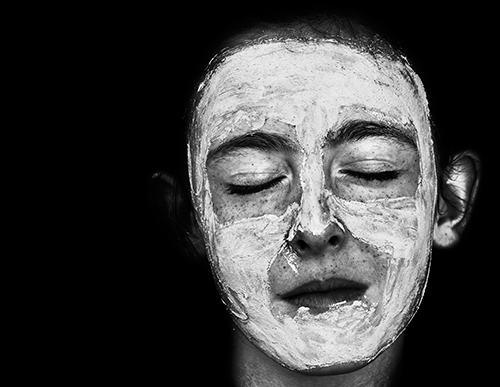
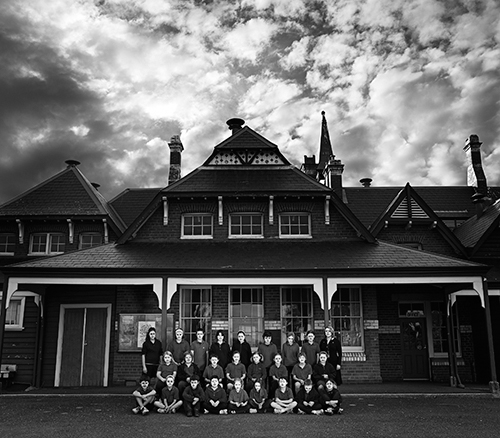
Jill Orr’s new participatory performances are photographs of children from Avoca Primary School painted with white clay from the area, displayed in pairs. The children are photographed once with eyes open, once with eyes closed. Orr asked the children to imagine their future life when they had their eyes closed. The key to the work is a group photograph of the ghostly children outside the primary school where everyone is isolated from each other (see photograph below).

“White faces loom up out of a dark ground, described by Orr as a void. On the surface these portraits are finely crafted, the skin of masked face becomes one with the digital file to create a facial landscape. The materiality of the face and the photographic file are exposed for the viewer. Titling the series ‘vision’ Orr ventures into a ‘haptic visuality’ where “vision itself can be tactile, as though one were touching a film with one’s eyes.”


From the catalogue essay by Professor Anne Marsh, Monash University


In the performance, the ritual of being photographed, Orr instructs the children who are placed under the surveillance of the camera. “We are confronted with the pose, the conscious composition of the image to be photographed, the inherent constructedness of the posed photograph.”1 The child assumes the pose by which they wish to be memorialised. The gaze (of the camera, of the viewer) is returned / or not in this spectacle.

Something happens when we look at these photographs. The text of the photographs becomes intertextual, producing as Barthes understands a “plurality of meanings and signifying / interpretive gestures that escape the reduction of knowledge to fixed, monological re-presentations, or presences.”2 This is because, as Foucault observes, texts “are caught up in a system of references to … other texts, other sentences: it is a node within a network …  Its unity is variable and relative.”3

The photographs invite us to share not only the mapping of the surface of the skin and the mapping of place (the history of white people living on the land in country Australia) and identity but the sharing of inner light, the light of the imaginary as well – and in this observation the images become unstable, open to reinterpretation. The distance between viewer and subject is transcended through an innate understanding of inner and outer light. The photographs seduce, meaning, literally, to be led astray.

As American photographer Minor White, who photographed in meditation hoping for a revelation in spirit though connection between person > subject > camera > negative > print, observes in one of his Three Canons

When the image mirrors the man
And the man mirrors the subject
Something might take over
4


Here the power of the photographer acting in isolation, the modernist tenet of authorship, is overthrown. In it’s place, “White supposes a relationship with subject that is a two way street: by granting the world some role in its own representation we create a photograph that is not so much a product solely of individual actions as it is the result of a negotiation in which the world and all its subjects might participate.”5 The autobiography of a soul born in the age of mechanical reproduction. This is the power of these photographs for something intangible within the viewer does take over. I found myself looking at the photographs again and again for small nuances, the detail of hairs on the head, the imagining of what the person was thinking about with their eyes closed: their future, their fears, their hopes, the ‘active imagination as a means to visualise sustainable futures’ (Orr, 2010).

These photographs seem to lengthen or protract time through this haptic touching of inner light. As Pablo Helguera observes in his excellent essay How To Understand the Light on a Landscape that examines different types of light (including experiental light, somber light, home light, ghost light, the light of the deathbed, protective light, artificial light, working light, Sunday light, used light, narrated light, the last light of day, hotel light, transparent light, after light, the light of the truly blind and the light of adolescence but not, strangely, inner light)

“Experience is triggered by light, but not exclusively by the visible light of the electro-magnetic spectrum. What the human eye is incapable to perceive is absorbed by other sensory parts of the body, which contribute to the perception that light causes an effect that goes beyond the merely visual …

There is the LIGHT OF ADOLESCENCE, a blinding light that is similar to the one we feel when we are asleep facing the sun and we feel its warmth but don’t see it directly. Sometimes it marks the unplace, perhaps the commonality of all places or perhaps, for those who are pessimists, the unplaceness of every location …

We may choose to openly embrace the darkness of light, and thus let ourselves through the great gates of placehood, where we can finally accept the unexplainable concreteness of our moments for what they are.”6


In the imagination of the darkness that lies behind these children’s closed eyes is the commonality of all places, a shared humanity of memory, of dreams. These photographs testify to our presence and ask us to decide how we feel about our life, our place and the relation to that (un)placeness where we must all, eventually, return.

Dr Marcus Bunyan


1/ Feiereisen, Florence and Pope, Daniel. “True Fiction and Fictional Truths: The Enigmatic in Sebald’s Use of Images in The Emigrants” in Patt, Lise (ed.,). Searching for Sebald: Photography after W.G. Sebald. Los Angeles: The Institute of Cultural Inquiry, 2007, p. 175.

2/ Barthes, Roland. “From Work to Text” in Image, Music, Text. trans. S. Heath. New York: Hill and Wang, 1977 quoted in Thumlert, Kurt. Intervisuality, Visual Culture, and Education. [Online] Cited 10/08/2006. www.forkbeds.com/visual-pedagogy.htm (link no longer active)

3/ Foucault, Michel. The Order of Things: An Archeology of the Human Sciences. New York: Vintage, 1973 quoted in Thumlert, Kurt. Intervisuality, Visual Culture, and Education. [Online] Cited 10/08/2006. www.forkbeds.com/visual-pedagogy.htm (link no longer active)

4/ White, Minor. Mirrors, Messages and Manifestations. Aperture, 1969

5/ Leo, Vince. Review of Mirrors, Messages and Manifestations on the Amazon website [Online] Cited 26/06/2010

6/ Helguera, Pablo. “How to Understand the Light on a Landscape,” in Patt, Lise (ed.,). Searching for Sebald: Photography after W.G. Sebald. Los Angeles: The Institute of Cultural Inquiry, 2007, pp. 110-119


    Jill Orr (Australian, b. 1952) 'Jacinta' 2009 from the exhibition Review: 'Jill Orr: Vision' at Jenny Port Gallery, Richmond, Melbourne, June - July, 2010

    Jill Orr (Australian, b. 1952) 'Jacinta' 2009 from the exhibition Review: 'Jill Orr: Vision' at Jenny Port Gallery, Richmond, Melbourne, June - July, 2010


    Jill Orr (Australian, b. 1952)
    Jacinta
    2009


    Jill Orr (Australian, b. 1952) 'Avoca Primary School' 2009


    Jill Orr (Australian, b. 1952)
    Avoca Primary School
    2009


    Jill Orr’s work centres on issues of the psycho-social and environmental where she draws on land and identities. Grappling with the balance and discord that exists between the human spirit, art and nature, Orr has, since the 1970s, delighted, shocked and moved audiences through her performance installations.

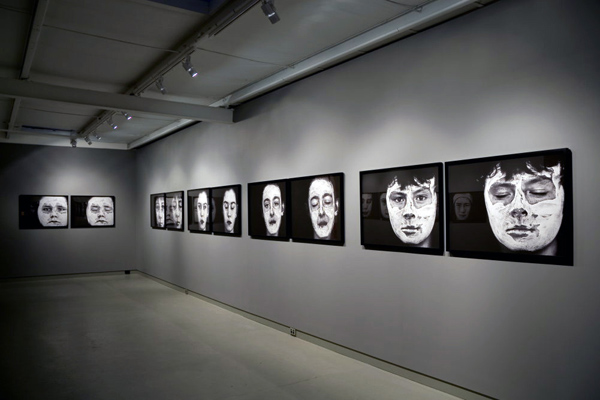
    This current body of work involved children from the Avoca Primary School as active participants in Orr’s performance for the camera. The result is a series of high contrast black and white photographic portraits, which are shown as diptychs portraying the different states of seeing both outwardly and inwardly. One of each pair frames the child looking directly at the camera. The gaze meets the viewer. Who is looking at whom? The second captures the child whose eyes are closed. An inner world is intimated, but not accessible to the viewer.

    In terms of the ‘gaze’, these works turn to the child as conveyer of the imaginary engaging both within and without. “I have found that creative acts require the visionary sensibilities of both the inner and outer world to operate simultaneously, consciously and unconsciously as dual aspects of the one action. In this instance the action is that of active imagination as a means to visualise sustainable futures.” (Jill Orr, 2010). The portraits also reflect the present relationship to place that is etched into the faces of youth as already kissed by the harsh Australian sun.

    Avoca is one of many townships that has been socially, economically and environmentally affected by drought and climate change. The portraits are created against this background.

    Text from the Jenny Port Gallery website [Online] Cited 26/06/2010 no longer available online


    Jill Orr (Australian, b. 1952) 'Vision' installation photograph at Jenny Port Gallery

    Jill Orr (Australian, b. 1952) 'Vision' installation photograph at Jenny Port Gallery


    Jill Orr (Australian, b. 1952)
    Vision installation photographs at Jenny Port Gallery
    June 2010
    Photos: Marcus Bunyan


    Jenny Port Gallery

    This gallery has now closed.

    Jill Orr website

    LIKE ART BLACK ON FACEBOOK

    Back to top

    Review: ‘Cloud’ by Guan Wei at Arc One Gallery, Melbourne

    Exhibition dates: 1st June – 29th June, 2010


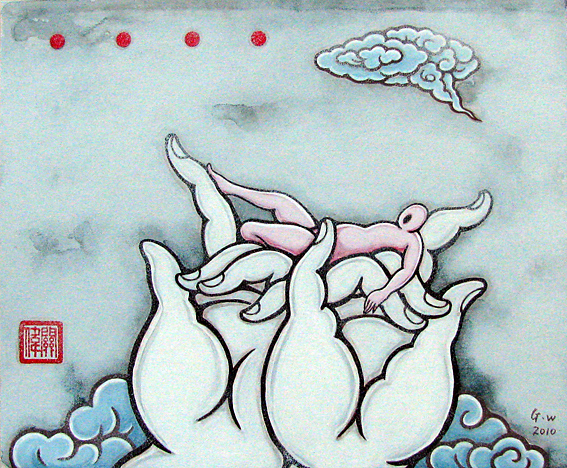
    Guan Wei (China, b. 1957) 'Buddha's hand' 2010 from the exhibition 'Cloud' by Guan Wei at Arc One Gallery, Melbourne, June 2010


    Guan Wei (China, b. 1957)
    Buddha’s hand
    2010


    The exhibition Cloud by Australian artist Guan Wei at Arc One Gallery in Melbourne contains two bodies of work that are outstanding: the series of paintings on paper titled Buddha’s Hand and the series of five figurative sculptures titled Cloud. Each body of work compliments and informs the other.

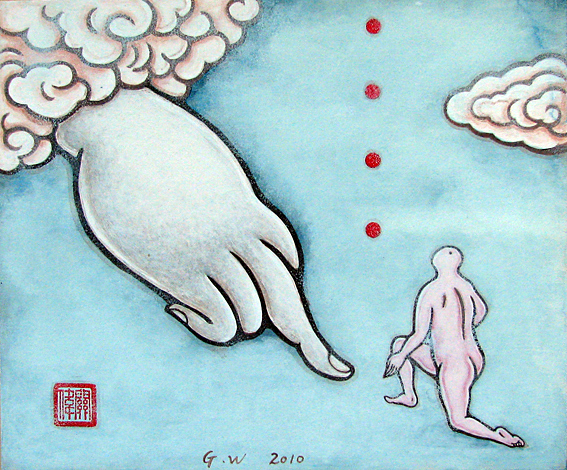
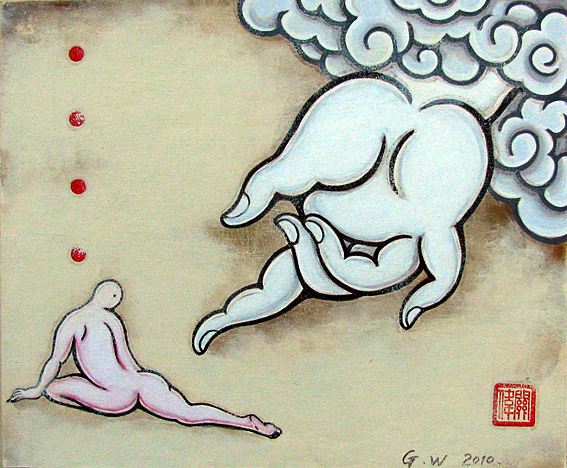
    The small Buddha’s Hand paintings (see below) are the most delicate of creatures – sensual, poetic almost fetishistic in their composition and utterly beguiling in their beauty. Referencing the history of cave paintings of the Buddha, Wei updates the ancient allegories expressing his message of harmony and leisure, identity and place through visual symbolic representation. These works are profoundly moving, the figurative compositions balanced masterfully through colour, shape and form, studded with the punctum of red bindi-like energy centres arising from the faceless yogic figures.

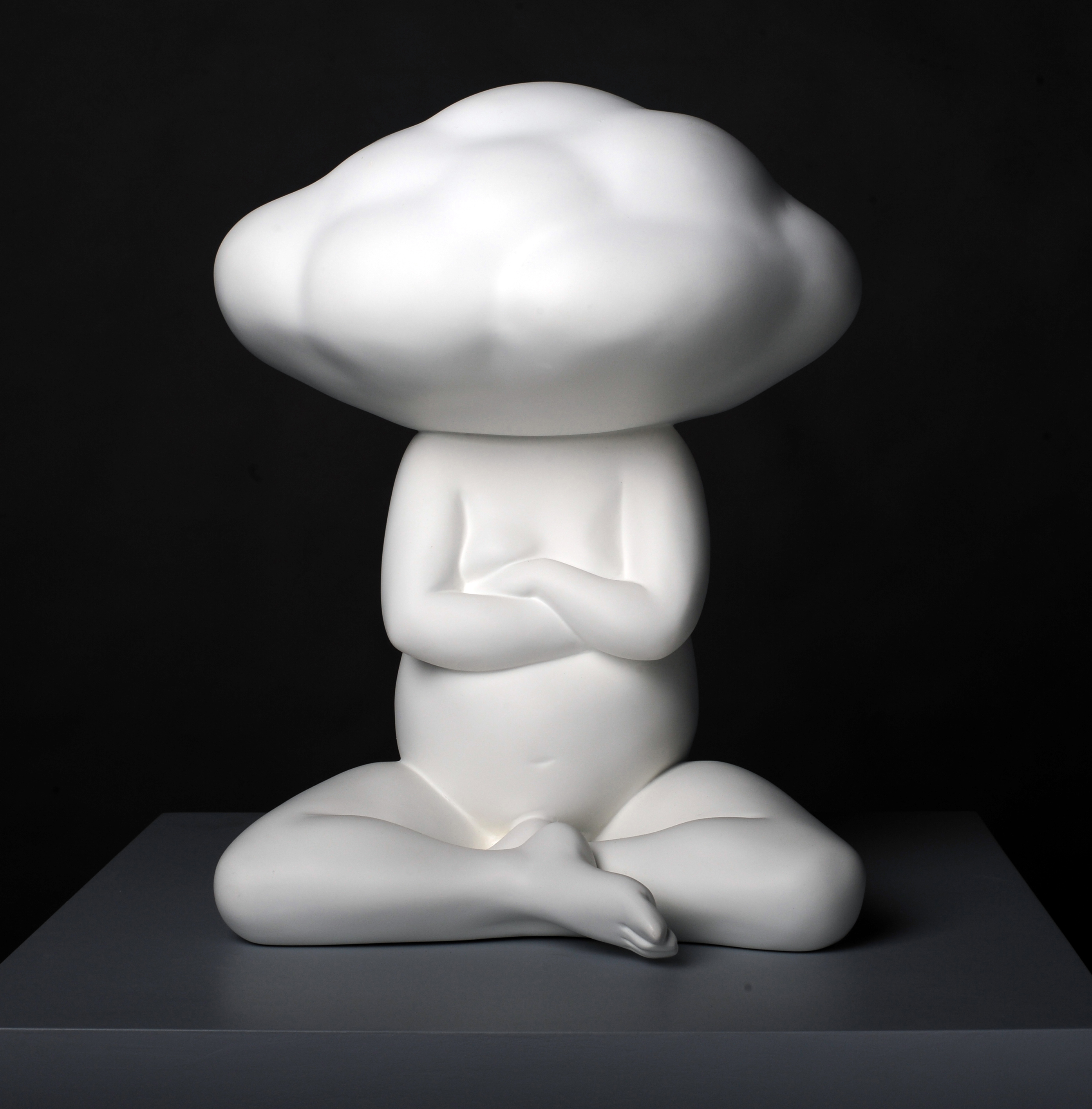
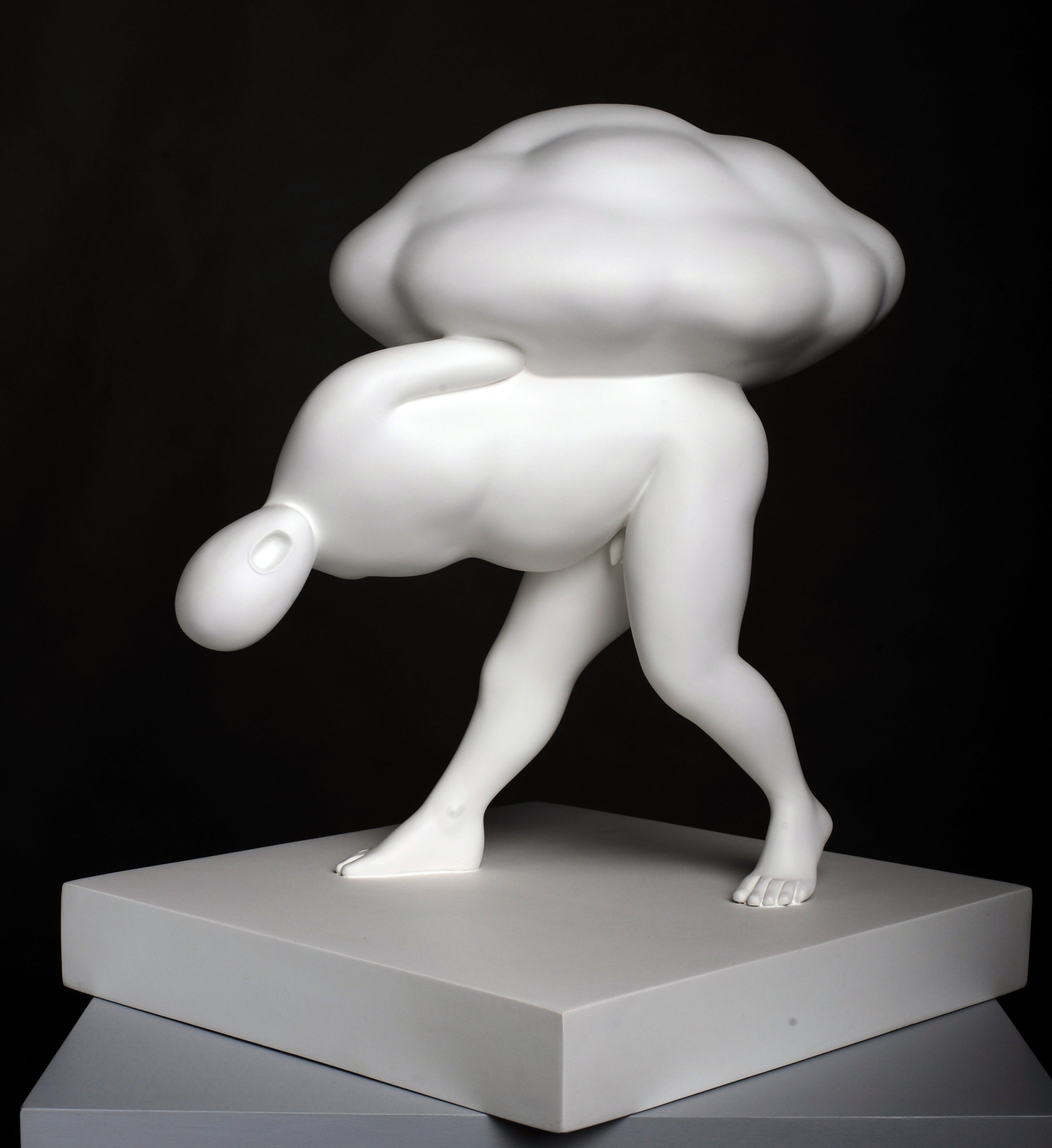
    Sitting on white pedestals and positioned close to the Buddha’s Hand paintings in the gallery are the series of five Cloud figures (see below). Made of bronze that has been spray painted white these are wonderful sculptures, full of delicious humour and vibrancy. There is a sensuality and delicacy about the figures that is emphasised by their snowy whiteness, a whiteness that subverts the tactility, colour and weight that one usually associates with the metal bronze. Here the figure has, variously, it’s head in the clouds while pensively crossing arms; bearing the weight of the world on the back while the vacant mouth is open; preparing to throw the cloud as Zeus would a thunderbolt; reclining while balancing the cloud on one foot and with one foot stuck in the earth that is cloud. The cloud becomes a metaphor for thought and action in the world, acting on the world. In these sculptures there is no creed nor race, no ideology or nation and I believe that Wei attains his stated aim to redefine our relationship with one another and nature by transcending both. I am not alone in liking these sculptures – they have proved very popular and all five sculptures in editions of five have already sold out!

    Other work in the exhibition is more prosaic – a multi-panelled screen, the On Cloud and Zodiac series never seem to breathe the same rarefied air as the above two bodies of work. They are disappointments that only serve to illuminate how brilliant holding the Buddha’s hand and living your life with your head in the clouds can be.

    Dr Marcus Bunyan


    Many thankx to Angela Connor and Arc One Gallery for allowing me to reproduce the photographs in the posting. Please click on the photographs for a larger version of the image.


    Guan Wei (China, b. 1957) 'Buddha's hand' 2010 from the exhibition 'Cloud' by Guan Wei at Arc One Gallery, Melbourne, June 2010


    Guan Wei (China, b. 1957)
    Buddha’s hand
    2010


    Guan Wei (China, b. 1957) 'Buddha's hand' 2010


    Guan Wei (China, b. 1957)
    Buddha’s hand
    2010


    “I hope that we will be able to transcend the restrictions imposed on us by such notions as nation, ethnicity, ideology, cultural and history, and redefine our relationship with one another and nature.”


    Guan Wei


    Guan Wei is an adept storyteller who masterfully engages his audiences. Retaining the humour, wisdom and cross-cultural knowledge that have become characteristics of his ongoing oeuvre, his work breathes an awareness of our current social and environmental dilemmas exploring ideas of immigration, colonisation, identity politics and cultural tolerance.

    Flirtatious and aesthetically whimsical, Guan Wei’s works are instantly recognisable. In this latest exhibition, Cloud, Guan Wei fuses sculpture, drawings and paintings to form what is part of his most beguiling trademark – ‘the art of idleness’. For the first time since returning to China, he will present new sculptures that employ his ongoing preoccupation with the figure and the figure in relation to the natural form. These sculptures are Guan Wei’s personal visual symbols of harmony and leisure. They form the thread for the four series of works in this exhibition.

    During the past fifteen years, Guan Wei has help change the identity of Australian Art. He draws on his own experience as a Chinese national who migrated to Australia from China in the period following the Tiananmen Square massacre (1989). Guan Wei has spent twenty years living and working as an artist raising the awareness of Australia being a multicultural country. He has had over 40 solo exhibitions, been the recipient of numerous awards and included in every major collection. In 2009, Guan Wei was selected for the prestigious Clemenger Contemporary Art Award at the National Gallery of Victoria.

    Press release from the Arc One Gallery website [Online] Cited 10/06/2010 no longer available online


    Guan Wei (China, b. 1957) 'Cloud No.4' 2009 from the exhibition 'Cloud' by Guan Wei at Arc One Gallery, Melbourne, June 2010


    Guan Wei (China, b. 1957)
    Cloud No.4
    2009
    Bronze statue
    edition of 5
    39 x 30 x 25cm


    Guan Wei (China, b. 1957) 'Cloud No.5' 2009


    Guan Wei (China, b. 1957)
    Cloud No.5
    2009
    Bronze statue
    edition of 5
    47 x 35 x 35cm


    Arc One Gallery
    45 Flinders Lane
    Melbourne, 3000
    Phone: +61 3 9650 0589

    Opening hours:
    Tuesday – Saturday 11am – 5pm

    Arc One Gallery website

    LIKE ART BLART ON FACEBOOK

    Back to top

    Four exhibitions in Albert Street, Richmond: Pamela Rataj at Anita Traverso Gallery, Claudia Damichi at Sophie Gannon Gallery, Steve Randall at John Buckley Gallery and Robert Boynes at Karen Woodbury Gallery

    April 2010


    Four interesting exhibitions in Albert Street, Richmond – from the beautiful, formed leather sculptures of Pamela Rataj to the wonderfully vibrant tropical bird, chair and decorative pattern paintings of Claudia Damichi; from the intensely observed canvas environments of Steve Randall to the post-photographic silk-screen textualisations of Robert Boynes. Well worth a visit on a Saturday afternoon!

    As always, many thankx to the galleries for allowing me to publish the images in this posting. Please click on the images for a larger version.

    ~ Pamela Rataj. The Morphology of Forgetting at Anita Traverso Gallery. 7th April – 1st May 2010

    ~ Claudia Damichi. The Bitter Sweet at Sophie Gannon Gallery. 30th March – 25th April 2010

    ~ Steve Rendall. Security, Storage and Recreation at John Buckley Gallery. 8th April – 1st May 2010

    ~ Robert Boynes. Postscript at Karen Woodbury Gallery. 7th April – 1st May 2010


    Pamela Rataj. The Morphology of Forgetting at Anita Traverso Gallery

    7th April – 1st May 2010


    Pamela Rataj. 'Tangent Bundle' 2009


    Pamela Rataj (Australian)
    Tangent Bundle
    2009


    Pamela Rataj. 'Ravel' 2009


    Pamela Rataj (Australian)
    Ravel
    2009


    Pamela Rataj. 'Kairos' 2009


    Pamela Rataj (Australian)
    Kairos
    2009


    How to draw a boundary between self and other, past time and today?

    Patterns and forms in nature often resemble one another, connecting life forms in unexpected ways. Tide lines left in the sand resemble the grains found in a piece of wood, and the veins in a leaf or those in a hand.

    The age lines in the trunk of a tree form as each outer layer covers the one preceding it and echoes its shape. This makes me think of the way past experience resurfaces as memory, receding or becoming more important at different times in our lives, as each new experience envelopes our previous states of being and yet is shaped by them.

    The wrapped and layered forms in The Morphology of Forgetting explore coexistence and connection.

    I dedicate this exhibition to my parents, whose recent deaths have helped me appreciate memory as a way to connect through time.

    Pamela Rataj 2010

    Press release from the Anita Traverso Gallery website [Online] Cited 10/04/2010. No longer available online


    Pamela Rataj (Australian) 'Faisceaux 1' 2009


    Pamela Rataj (Australian)
    Faisceaux 1
    2009


    Pamela Rataj. 'Faisceaux 4' 2009


    Pamela Rataj (Australian)
    Faisceaux 4
    2009


    Claudia Damichi. The Bitter Sweet at Sophie Gannon Gallery

    30th March – 25th April 2010


    Claudia Damichi (Australian, b. 1972) 'Birds eye' 2010


    Claudia Damichi (Australian, b. 1972)
    Birds eye
    2010
    Acrylic on canvas
    46 x 41cm


    Claudia Damichi (Australian, b. 1972) 'Star Gazer' 2009


    Claudia Damichi (Australian, b. 1972)
    Star Gazer
    2009
    Acrylic on canvas
    46 x 41cm


    Claudia Damichi (Australian, b. 1972) 'Gridlock' 2010


    Claudia Damichi (Australian, b. 1972)
    Gridlock
    2010
    Acrylic on canvas
    41 x 46cm


    Claudia Damichi (Australian, b. 1972) 'Reading between the lines' 2010


    Claudia Damichi (Australian, b. 1972)
    Reading between the lines
    2010
    Acrylic on canvas
    46 x 41cm


    Claudia Damichi’s surrealist still life paintings are characterised by vivid colours, elaborate patterns and distorted spatial proportions. In her paintings of domestic interiors, flowers, birds and furniture, colour is inflated and scale is playfully manipulated – solitary domestic interiors are reconfigured into places of fantasy and illusion. Inspired by the enduring aesthetic of modern industrial design, her surreal and theatrically staged scenarios self-consciously conjure a sense of the absurd. Graphic patterning, high-croma colour and whimsical compositions foster worlds that are at once playful and claustrophobic, satirical and real, tapping into an ambiguous nostalgia that leaves the viewer feeling that anything is possible.

    Visit the Sophie Gannon website


    Claudia Damichi (Australian, b. 1972) 'Look out' 2010


    Claudia Damichi (Australian, b. 1972)
    Look out
    2010
    Acrylic on canvas
    46 x 56cm


    Steve Rendall. Security, Storage and Recreation at John Buckley Gallery

    8th April – 1st May 2010


    Steven Rendall (Australian born Britain, b. 1969; Australia from 2000) 'Archive 1' 2010


    Steven Rendall (Australian born Britain, b. 1969; Australia from 2000)
    Archive 1
    2010
    Oil on linen


    Steven Rendall (Australian born Britain, b. 1969; Australia from 2000) 'Archive 2' 2010


    Steven Rendall (Australian born Britain, b. 1969; Australia from 2000)
    Archive 2
    2010
    Oil on linen


    Citing the British artist Walter Sickert as an important influence on his painterly style, Rendall’s work displays a form and content that has attracted the attention of both critics and collectors. A key work in the exhibition is a large-scale painting on un-stretched linen titled Fountain (Rosemary’s Baby) that sprawls across 4.5m. Certain fountains, along with other apparently arbitrary images of television monitors, speedboats, clothing racks, shelving units and museum interiors are recurring motifs in Rendall’s paintings.

    Rendall aims to ‘collect and synthesise’ images from around his home and en route to and from his Brunswick studio. Passing observations of window displays, charity shops and various light industrial warehouses are registered and recorded in conjunction with the accumulation of promotional flyers spruiking leisure activities and museum experiences. This shambolic collection of images is transcribed into an array of compositions in Rendall’s paintings. Images occasionally materialise in unlikely places, such as the spectral diver’s head that is resting on a warehouse shelf in the appropriately titled Storage.

    In the exhibition Security, Storage and Recreation, you are invited to enter the image bank of Steven Rendall; a ‘wake in fright’ experience where one can become immersed and caught up in the maelstrom of the artist’s visual language – a sequence of painterly dreams each similar yet different to the last.”

    Press release from the John Buckley Gallery website [Online] Cited 10/04/2010 no longer available online


    Steven Rendall (Australian born Britain, b. 1969; Australia from 2000) 'Flat Screens (Green)' 2010


    Steven Rendall (Australian born Britain, b. 1969; Australia from 2000)
    Flat Screens (Green)
    2010
    Oil on linen


    Steven Rendall (Australian born Britain, b. 1969; Australia from 2000) 'Pipes' 2010


    Steven Rendall (Australian born Britain, b. 1969; Australia from 2000)
    Pipes
    2010
    Oil on linen


    Steven Rendall (Australian born Britain, b. 1969; Australia from 2000) 'Claustrophobia' 2010


    Steven Rendall (Australian born Britain, b. 1969; Australia from 2000)
    Claustrophobia
    2010
    Oil on linen


    Steven Rendall (Australian born Britain, b. 1969; Australia from 2000) 'Redacted 2' 2010


    Steven Rendall (Australian born Britain, b. 1969; Australia from 2000)
    Redacted 2
    2010
    Oil on linen


    Robert Boynes. Postscript at Karen Woodbury Gallery

    7th April – 1st May 2010


    Robert Boynes (Australian, b. 1942) 'Street Runner' 2010


    Robert Boynes (Australian, b. 1942)
    Street Runner
    2010
    Acrylic on canvas and velvet
    120 x 242cm


    Robert Boynes (Australian, b. 1942) 'Days that we forgot' 2010


    Robert Boynes (Australian, b. 1942)
    Days that we forgot
    2010
    Acrylic on canvas


    Robert Boynes (Australian, b. 1942) 'Signal Driver' 2010


    Robert Boynes (Australian, b. 1942)
    Signal Driver
    2010
    Acrylic on canvas and velvet
    120 x 190cm


    Postscript is Robert Boynes’ second solo exhibition with Karen Woodbury Gallery. This series continues with his exploration of urban themes, contemporary experience and experimentation into ways of using paint. In this most recent body of work Robert has employed the use of text in juxtaposition to various materials such as wood and velvet. The text conveys a feeling of noise and urban clatter, acting as a context and environment for the figures within the work.

    His technique involves transferring photographic images to large silk screens and dragging paint through the mesh onto canvas. Robert thus has control in the manipulation of colour, density and translucency of the images. This process results in still moments that magnify and investigate everyday observable reality. The anonymous figures are juxtaposed with text and layering of saturated, contrasting colours, appearing objectified and ghostly.

    These works embody a filmic quality, the multi-panelled paintings signify fragmented narratives and enquire into perceptions of time and space.

    Text from the Karen Woodbury Gallery website [Online] Cited 10/04/2010 no longer available online


    Robert Boynes (Australian, b. 1942) 'Body Type' 2 2010


    Robert Boynes (Australian, b. 1942)
    Body Type 2
    2010
    Acrylic on canvas


    Robert Boynes (Australian, b. 1942) 'Body Type 3' 2010


    Robert Boynes (Australian, b. 1942)
    Body Type 3
    2010
    Acrylic on canvas


    Robert Boynes (Australian, b. 1942) 'Things we leave behind' 2009


    Robert Boynes (Australian, b. 1942)
    Things we leave behind
    2009
    Acrylic on canvas
    120 x 180cm


    Robert Boynes (Australian, b. 1942) 'The layered moment' 2009


    Robert Boynes (Australian, b. 1942)
    The layered moment
    2009
    Acrylic on canvas


    Robert Boynes (Australian, b. 1942) 'Postscript' 2009


    Robert Boynes (Australian, b. 1942)
    Postscript
    2009
    Acrylic on canvas
    120 x 124cm


    All galleries have closed except for Sophie Gannon Gallery, Richmond.

    Sophie Gannon Gallery
    2 Albert Street Richmond VIC 3121 Australia
    Phone: +61 3 9421 0857

    Sophie Gannon Gallery website

    LIKE ART BLART ON FACEBOOK

    Back to top

    Exhibition: ‘Alexey Titarenko: Saint Petersburg in Four Movements’ at Nailya Alexander Gallery, New York

    Exhibition dates: 11th February – 24th April, 2010


    Alexey Titarenko (American born Soviet Union, b. 1962) '#1 Untitled (Boy)' 1993 from the exhibition 'Alexey Titarenko: Saint Petersburg in Four Movements' at Nailya Alexander Gallery, New York, February - April, 2025


    Alexey Titarenko (American born Soviet Union, b. 1962)
    #1 Untitled (Boy)
    1993
    Gelatin silver print


    Many thankx to the Nailya Alexander Gallery for allowing me to reproduce the images in the posting. Please click on the photographs for a larger version of the image.

    Dr Marcus Bunyan


    Alexey Titarenko (American born Soviet Union, b. 1962) '#3 Untitled (Crowd 1)' 1992 from the exhibition 'Alexey Titarenko: Saint Petersburg in Four Movements' at Nailya Alexander Gallery, New York, February - April, 2025


    Alexey Titarenko (American born Soviet Union, b. 1962)
    #3 Untitled (Crowd 1)
    1992
    Gelatin silver print


    Alexey Titarenko (American born Soviet Union, b. 1962) '#7 Untitled (Three Women Selling Cigarettes)' 1992 from the exhibition 'Alexey Titarenko: Saint Petersburg in Four Movements' at Nailya Alexander Gallery, New York, February - April, 2025


    Alexey Titarenko (American born Soviet Union, b. 1962)
    #7 Untitled (Three Women Selling Cigarettes)
    1992
    Gelatin silver print


    Alexey Titarenko (American born Soviet Union, b. 1962) '#11 Untitled (Begging Woman)' 1999 from the exhibition 'Alexey Titarenko: Saint Petersburg in Four Movements' at Nailya Alexander Gallery, New York, February - April, 2025


    Alexey Titarenko (American born Soviet Union, b. 1962)
    #11 Untitled (Begging Woman)
    1999
    Gelatin silver print


    Nailya Alexander Gallery is pleased to announce Alexey Titarenko: Saint Petersburg in Four Movements opening on February 11th, in her new space at the Fuller Building, 41 E 57th Street, Suite 704. The reception for the artist will be from 6-8pm. Gallery hours are Tuesday through Saturday, 10am-6pm and by appointment.

    This will be Alexey Titarenko’s first major exhibition in New York that features his entire St. Petersburg series (1991-2009). The four underlying sequences, or movements – to borrow a term from the vocabulary of music, which features prominently in the artist’s mind, are The City of Shadows, The Anonymous, The Light of Saint Petersburg and Unfinished time. Like music, the expression of time is a presence in Titarenko’s art, associated with literature and in particular, the works of Marcel Proust.

    This majestic and history-laden city, where Titarenko was born in 1962, is the central subject of his photography, or to be more accurate it is the soul of the city and therefore that of Russia. As the artist himself explains:

    “It would be en error to consider my photographs within the context of the values now fashionable in the arts in general and photography in particular. To align them with such and such a trend, without taking into account that their very purpose in existing is defined by the past. Even the most factual of them are not reportage, but a novel. The principal motivation for their creation is, in fact, always the same: Russia’s history throughout the 20th century, which is an unending series of tragedies of ever more baffling dimensions, whether you consider the wars, the famines or the so-called times of peace. The history of Russia … but in the form of rather contemporary images, made in a single location, a single city – St. Petersburg. Rather than the city (which is mostly only vaguely visible), these images represent emotion – the range of emotions forming the deep inner character of the people who lived in this country and endured all these disasters, people who were usually only represented from outside. And it is therefore these emotions which, in themselves, are quite general and have remained unchanged in the course of the century, like the emotions aroused by the music of Shostakovich, for example, or by the novels of Solzhenitsyn, which are the true subject of my photographs, and my goal would be to convey them to the viewer, to make him or her feel them … understand, to feel compassion and love.”

    Titarenko was able to develop a form of expression reminiscent of Dostoyevsky’s stories, inspired by the moods and rhythms of the music of Shostakovich. Often, the city, veiled in winter’s shadows or bright with summer’s dazzle, is inhabited by nearly transparent phantoms. They dwell in its streets, cross its courtyards: crowds on the move, spreading over a vast square like a wave, their individual identities blurred and indistinct. Nevertheless, sometimes a few isolated, improbable figures emerge from the crowd. This photographic technique, involving relatively slow shutter speeds, confirms a taste for randomness and makes each image a unique adventure, a potential source of surprise. The approach also bespeaks Titarenko’s long-standing interest in 19th-century landscape photographers, especially those who operated in cities. In addition to this style of representation, which eschews any temptation to be objective and is finally quite impressionistic, the darkroom technique Titarenko uses transforms the black-and-white print into a composition endowed with subtle, suggestive hues and ever-differing nuances of gray. Titarenko never reproduces exactly the same rendering of light and shadow from one print to the next.

    Press release from the Nailya Alexander Gallery website [Online] Cited 06/04/2010 no longer available online


    Alexey Titarenko (American born Soviet Union, b. 1962) '#12 Untitled (Crowd 2)' 1993 from the exhibition 'Alexey Titarenko: Saint Petersburg in Four Movements' at Nailya Alexander Gallery, New York, February - April, 2025


    Alexey Titarenko (American born Soviet Union, b. 1962)
    #12 Untitled (Crowd 2)
    1993
    Gelatin silver print


    Alexey Titarenko (American born Soviet Union, b. 1962) '#15 Untitled (Asking for a Smoke)' 1995 from the exhibition 'Alexey Titarenko: Saint Petersburg in Four Movements' at Nailya Alexander Gallery, New York, February - April, 2025


    Alexey Titarenko (American born Soviet Union, b. 1962)
    #15 Untitled (Asking for a Smoke)
    1995
    Gelatin silver print


    Alexey Titarenko (American born Soviet Union, b. 1962) '#21 Untitled (Woman on the Corner)' 1995 from the exhibition 'Alexey Titarenko: Saint Petersburg in Four Movements' at Nailya Alexander Gallery, New York, February - April, 2025


    Alexey Titarenko (American born Soviet Union, b. 1962)
    #21 Untitled (Woman on the Corner)
    1995
    Partially toned gelatin silver print


    Alexey Titarenko (American born Soviet Union, b. 1962) 'Untitled (Windows)' (Attic) 1993 from the exhibition 'Alexey Titarenko: Saint Petersburg in Four Movements' at Nailya Alexander Gallery, New York, February - April, 2025


    Alexey Titarenko (American born Soviet Union, b. 1962)
    Untitled (Windows)(Attic)
    1993
    Partially toned gelatin silver print


    Nailya Alexander Gallery
    41 E 57th Street, Suite 704,
 New York, NY 10022

    By appointment only

    Nailya Alexander Gallery website

    LIKE ART BLART ON FACEBOOK

    Back to top

    Exhibition: ‘Georgia O’Keeffe: Abstraction’ at The Phillips Collection, Washington D.C.

    Exhibition dates: 6th February – 9th May 2010


    Georgia O'Keeffe (American, 1887-1986) 'Grey Blue & Black - Pink Circle' 1929 from the exhibition 'Georgia O'Keeffe: Abstraction' at The Phillips Collection, Washington D.C., February - May, 2010


    Georgia O’Keeffe (American, 1887-1986)
    Grey Blue & Black – Pink Circle
    1929
    Oil on canvas
    36 x 48 in. (91.4 x 121.9cm)
    Dallas Museum of Art
    Gift of The Georgia O’Keeffe Foundation


    Many thankx to Shira Pinsker and The Phillips Collection for allowing me to reproduce the images in the posting. Please click on the photographs for a larger version of the image.

    For an excellent analysis of the convergences between Georgia O’Keeffe and Ansel Adams see Geneva Anderson’s review Masters of the Southwest: Georgia O’Keeffe and Ansel Adams Natural Affinities.

    Dr Marcus Bunyan


    “It is surprising to me to see how many people separate the objective from the abstract. Objective painting is not good painting unless it is good in the abstract sense. A hill or tree cannot make a good painting just because it is a hill or a tree. It is lines and colours put together so that they say something. For me that is the very basis of painting. The abstraction is often the most definite form for the intangible thing in myself that I can only clarify in paint.”

    “I long ago came to the conclusion that even if I could put down accurately the thing that I saw and enjoyed, it would not give the observer the kind of feeling it gave me. I had to create an equivalent for what I felt about what I was looking at – not copy it.”


    Georgia O’Keeffe, 1976


    Georgia O'Keeffe (American, 1887-1986) 'Flower Abstraction' 1924 from the exhibition 'Georgia O'Keeffe: Abstraction' at The Phillips Collection, Washington D.C., February - May, 2010


    Georgia O’Keeffe (American, 1887-1986)
    Flower Abstraction
    1924
    Oil on canvas
    48 x 30 in.
    Whitney Museum of American Art, New York.
    50th Anniversary Gift of Sandra Payson
    © Georgia O’Keeffe Museum/Artist Rights Society (ARS), New York


    Georgia O'Keeffe (American, 1887-1986) 'Jack-in-the-Pulpit No. IV' 1930 from the exhibition 'Georgia O'Keeffe: Abstraction' at The Phillips Collection, Washington D.C., February - May, 2010


    Georgia O’Keeffe (American, 1887-1986)
    Jack-in-the-Pulpit No. IV
    1930
    Oil on canvas
    40 x 30 in.
    National Gallery of Art, Washington, D.C. Alfred Stieglitz Collection, Bequest of Georgia O’Keeffe
    Image courtesy of the Board of Trustees, National Gallery of Art, Washington


    Georgia O’Keeffe (1887-1986) is fixed in the public imagination as a painter of places and things. She has long been recognised for her still lifes of flowers, leaves, animal bones and shells, her images of Manhattan skyscrapers, and her Lake George and New Mexico landscapes. Yet it was with abstraction that O’Keeffe entered the art world and first became celebrated as an artist. In the spring of 1916, she burst onto the New York art scene with a group of abstract charcoal drawings that were among the most radical works produced in the United States in the early twentieth century. As she expanded her repertoire in the years that followed to include watercolour and oil, she retained the fluid space and dynamic, organic motifs of these early charcoals.

    Abstraction dominated O’Keeffe’s output in the early part of her career and remained a fundamental language for her thereafter. Some of her abstractions have no recognisable source in the natural world; others distill visible reality into elemental, simplified forms. For O’Keeffe, abstraction offered a way to portray what she called the “unknown” – intense thoughts and feelings she could not express in words and did not rationally understand. Her abstractions recorded an array of emotions and responses to people and places. At the heart of her practice was an affinity for the flux and sinuous rhythms of nature. Through swelling forms and sumptuous colour, O’Keeffe depicted the experience of being in nature – so enveloped by its sublime mystery and beauty that awareness of all else is suspended.

    Wall text from the exhibition


    Georgia O'Keeffe (American, 1887-1986) 'Early Abstraction' 1915


    Georgia O’Keeffe (American, 1887-1986)
    Early Abstraction
    1915
    Charcoal on paper
    24 x 18 5/8 in. (61 x 47.3cm)
    Milwaukee Art Museum
    Gift of Jane Bradley Pettit Foundation and The Georgia O’Keeffe Foundation
    Photography by Malcolm Varon
    © Milwaukee Art Museum


    Georgia O'Keeffe (American, 1887-1986) 'Blue II' 1916


    Georgia O’Keeffe (American, 1887-1986)
    Blue II
    1916
    Watercolour on paper
    27 7/8 x 22 1/4 in. (70.8 x 56.5cm)
    Georgia O’Keeffe Museum, Santa Fe, New Mexico
    Gift, The Burnett Foundation
    © Georgia O’Keeffe Museum/Artist Rights Society (ARS), New York


    Georgia O'Keeffe (American, 1887-1986) 'Untitled (Abstraction/Portrait of Paul Strand)' 1917


    Georgia O’Keeffe (American, 1887-1986)
    Untitled (Abstraction/Portrait of Paul Strand)
    1917
    Watercolour on paper
    12 x 8 7/8 in. (30.5 x 22.5cm)
    Georgia O’Keeffe Museum, Santa Fe, New Mexico
    Gift, The Burnett Foundation
    © Georgia O’Keeffe Museum/Artist Rights Society (ARS), New York


    The artistic achievement of Georgia O’Keeffe is examined from a fresh perspective in Georgia O’Keeffe: Abstraction, a landmark exhibition debuting this winter at The Phillips Collection. While O’Keeffe (1887-1986) has long been recognised as one of the central figures in 20th-century art, the radical abstract work she created throughout her long career has remained less well-known than her representational art. By surveying her abstractions, Georgia O’Keeffe: Abstraction repositions O’Keeffe as one of America’s first and most daring abstract artists. The exhibition, one of the largest of O’Keeffe’s work ever assembled, goes on view February 6 – May 9, 2010.

    Including more than 125 paintings, drawings, watercolours, and sculptures by O’Keeffe as well as selected examples of Alfred Stieglitz’s famous photographic portrait series of O’Keeffe, the exhibition has been many years in the making.

    While it is true that O’Keeffe has entered the public imagination as a painter of sensual, feminine subjects, she is nevertheless viewed first and foremost as a painter of places and things. When one thinks of her work it is usually of her magnified images of open flowers and her iconic depictions of animal bones, her Lake George landscapes, her images of stark New Mexican cliffs, and her still lifes of fruit, leaves, shells, rocks, and bones. Even O’Keeffe’s canvasses of architecture, from the skyscrapers of Manhattan to the adobe structures of Abiquiu, come to mind more readily than the numerous works – made throughout her career – that she termed abstract.

    This exhibition is the first to examine O’Keeffe’s achievement as an abstract artist. In 1915, O’Keeffe leaped into the forefront of American modernism with a group of abstract charcoal drawings that were among the most radical creations produced in the United States at that time. A year later, she added colour to her repertoire; by 1918, she was expressing the union of abstract form and colour in paint. First exhibited in 1923, O’Keeffe’s psychologically charged, brilliantly coloured abstract oils garnered immediate critical and public acclaim. For the next decade, abstraction would dominate her attention. Even after 1930, when O’Keeffe’s focus turned increasingly to representational subjects, she never abandoned abstraction, which remained the guiding principle of her art. She returned to abstraction in the mid 1940s with a new, planar vocabulary that provided a precedent for a younger generation of abstractionists.

    Abstraction and representation for O’Keeffe were neither binary nor oppositional. She moved freely from one to the other, cognisant that all art is rooted in an underlying abstract formal invention. For O’Keeffe, abstraction offered a way to communicate ineffable thoughts and sensations. As she said in 1976, “The abstraction is often the most definite form for the intangible thing in myself that I can only clarify in paint.” Through her personal language of abstraction, she sought to give visual form (as she confided in a 1916 letter to Alfred Stieglitz) to “things I feel and want to say – [but] havent [sic] words for.” Abstraction allowed her to express intangible experience – be it a quality of light, colour, sound, or response to a person or place. As O’Keeffe defined it in 1923, her goal as a painter was to “make the unknown – known. By unknown I mean the thing that means so much to the person that he wants to put it down – clarify something he feels but does not clearly understand.”

    This exhibition and catalogue chronicle the trajectory of O’Keeffe’s career as an abstract artist and examine the forces impacting the changes in her subject matter and style. From the beginning of her career, she was, as critic Henry McBride remarked, “a newspaper personality.” Interpretations of her art were shaped almost exclusively by Alfred Stieglitz, artist, charismatic impresario, dealer, editor, and O’Keeffe’s eventual husband, who presented her work from 1916 to 1946 at the groundbreaking galleries “291”, the Anderson Galleries, the Intimate Gallery, and An American Place. Stieglitz’s public and private statements about O’Keeffe’s early abstractions and the photographs he took of her, partially clothed or nude, led critics to interpret her work – to her great dismay – as Freudian-tinged, psychological expressions of her sexuality.

    Cognisant of the public’s lack of sympathy for abstraction and seeking to direct the critics away from sexualised readings of her work, O’Keeffe self-consciously began to introduce more recognisable images into her repertoire in the mid-1920s. As she wrote to the writer Sherwood Anderson in 1924, “I suppose the reason I got down to an effort to be objective is that I didn’t like the interpretations of my other things [abstractions].” O’Keeffe’s increasing shift to representational subjects, coupled with Stieglitz’s penchant for favouring the exhibition of new, previously unseen work, meant that O’Keeffe’s abstractions rarely figured in the exhibitions Stieglitz mounted of her work after 1930, with the result that her first forays into abstraction virtually disappeared from public view.”

    Text from the Phillips Collection website [Online] Cited 15/03/2010 no longer available online


    Georgia O'Keeffe (American, 1887-1986) 'Music, Pink and Blue No. 2' 1918


    Georgia O’Keeffe (American, 1887-1986)
    Music, Pink and Blue No. 2
    1918
    Oil on canvas, 35 x 29 1/8 in. (88.9 x 74cm)
    Whitney Museum of American Art, New York
    Gift of Emily Fisher Landau in honour of Tom Armstrong
    © Georgia O’Keeffe Museum/Artist Rights Society (ARS), New York
    Photograph by Sheldan C. Collins


    Georgia O'Keeffe (American, 1887-1986) 'Series I - No. 3' 1918


    Georgia O’Keeffe (American, 1887-1986)
    Series I – No. 3
    1918
    Oil on board
    20 x 16 in. (50.8 x 40.6cm)
    Milwaukee Art Museum
    Gift of Jane Bradley Pettit Foundation and The Georgia O’Keeffe Foundation
    Photography by Larry Sanders
    © Milwaukee Art Museum


    Georgia O'Keeffe (American, 1887-1986) 'Series I, No. 4' 1918


    Georgia O’Keeffe (American, 1887-1986)
    Series I, No. 4
    1918
    Oil on canvas
    20 x 16 in. (50.8 x 40.6cm)
    Städtische Galerie im Lenbachhaus, Munich
    Gift of The Georgia O’Keeffe Foundation


    Georgia O'Keeffe (American, 1887-1986) 'Abstraction White Rose' 1927


    Georgia O’Keeffe (American, 1887-1986)
    Abstraction White Rose
    1927
    Oil on canvas
    36 x 30 in. (91.4 x 76.2cm)
    Georgia O’Keeffe Museum, Santa Fe, New Mexico
    Gift, The Burnett Foundation and The Georgia O’Keeffe Foundation
    © Georgia O’Keeffe Museum/Artist Rights Society (ARS), New York


    Georgia O'Keeffe (American, 1887-1986) 'Black Place II' 1944


    Georgia O’Keeffe (American, 1887-1986)
    Black Place II
    1944
    Oil on canvas
    36 x 40 in. (91.4 x 101.6cm)
    Georgia O’Keeffe Museum, Santa Fe, New Mexico
    Gift, The Burnett Foundation
    © 1987, Private Collection


    The Phillips Collection
    1600 21st Street, NW, Washington, D.C., near the corner of 21st and Q Streets, NW

    Opening hours:
    Tuesday – Sunday 11am – 6pm

    Phillips Collection website

    LIKE ART BLART ON FACEBOOK

    Back to top

    Three Openings Wednesday 3rd March 2010

    March 2010

    Camilla Tadich: Slabalong and Mark Hislop: Drawing at Sophie Gannon Gallery; Simon Obarzanek at Karen Woodbury Gallery; Kent Wilson Higher Breeds and Alice Wormald Wayside and Hedgerow at Shifted


    Camilla Tadich: Slabalong and Mark Hislop: Drawing at Sophie Gannon Gallery, 2 Albert Street, Richmond
    March 2nd – March 27th 2010
    Sophie Gannon Gallery website

    Simon Obarzanek at Karen Woodbury Gallery, 4 Albert Street, Richmond
    March 3rd – March 27th 2010
    This gallery is now closed

    Kent Wilson Higher Breeds and Alice Wormald Wayside and Hedgerow at Shifted, Level 1, 15 Albert Street, Richmond
    This gallery is now closed

    All photos by Marcus Bunyan


    Sophie Gannon Gallery opening


    Sophie Gannon Gallery opening
    Photo: Marcus Bunyan


    Sophie Gannon Gallery opening - Mark Hislop 'Drawing'

    Sophie Gannon Gallery opening - Mark Hislop 'Drawing'

    Sophie Gannon Gallery opening - Mark Hislop 'Drawing'


    Sophie Gannon Gallery opening – Mark Hislop Drawing
    Photos: Marcus Bunyan


    Camilla Tadich (Australian, b. 1982) 'Bordertown' 2010


    Camilla Tadich (Australian, b. 1982)
    Bordertown
    2010
    Photo: Marcus Bunyan


    Sophie Gannon Gallery opening - Camila Tadich 'Slabalong'


    Sophie Gannon Gallery opening – Camila Tadich Slabalong
    Photo: Marcus Bunyan


    Karen Woodbury Gallery opening – Simon Obarzanek


    Karen Woodbury Gallery opening – Simon Obarzanek
    Photo: Marcus Bunyan


    Simon’s photographs come from observing the physical movements of people pushing through the space around them in a city. He senses a universal language through movement and is drawn to this rather than their faces, as he normally is.

    He noted that the “strained movements against gravity struck me with force… When I see a person creating a shape with their body in the street I do not sense the individual but a part, a piece of a larger performance. Each individual connects with others to create a visual language. I did not want faces to interrupt this larger work.”

    Simon collects the movements on his camera, as photographic sketches, then he rephotographs the movement using friends and family as models. Removed from the busy streets, dislocated, his subject is isolated and framed against a dark background. Some twist away from the camera, or stagger against an unseen wind, sheltering their face from rain that is not falling. Simon does not show their faces, which emphasises the movement and makes the figures anonymous. These photographs are theatrical and mysterious, emphasising the loneliness and alienation that can be encountered living in a big city.

    Text from the Turner Galleries website [Online] Cited 28/06/2019


    Karen Woodbury Gallery – Simon Obarzanek opening, the artist standing centre in the grey t-shirt
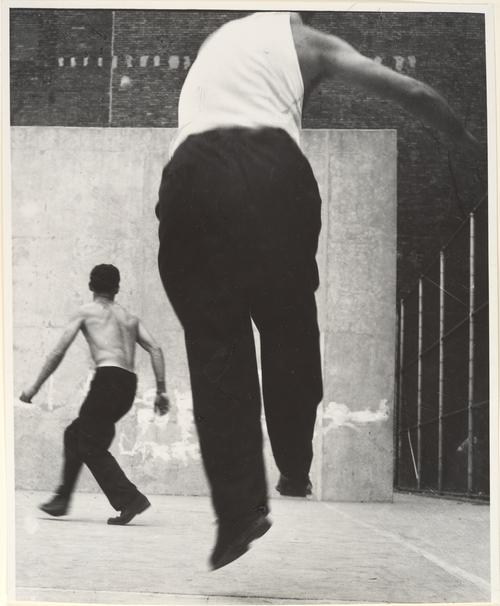
     

    Karen Woodbury Gallery – Simon Obarzanek opening, the artist standing centre in the grey t-shirt
    Photo: Marcus Bunyan


    Karen Woodbury Gallery - Simon Obarzanek opening

    Simon Obarzanek (Israel, lives and works Melbourne, b. 1968) 'Untitled movement No.2 No.7' 2010


    Simon Obarzanek (Israel, lives and works Melbourne, b. 1968)
    Untitled movement No.2 No.7
    2010
    C-Type hand print
    100 x 120cm
    Photos: Marcus Bunyan


    Shifted opening - Kent Wilson 'Higher Breeds'

    Shifted opening - Kent Wilson 'Higher Breeds'


    Shifted opening – Kent Wilson Higher Breeds
    Photos: Marcus Bunyan


    Kent Wilson (Australian) Image from the 'HoneySucker' series 2009  (detail)


    Kent Wilson (Australian)
    Image from the HoneySucker series (detail)
    2009
    Photo: Marcus Bunyan


    Shifted opening - Alice Wormald 'Wayside & Hedgerow'

    Shifted opening - Alice Wormald 'Wayside & Hedgerow'


    Shifted opening – Alice Wormald Wayside & Hedgerow
    Photos: Marcus Bunyan


    LIKE ART BLART ON FACEBOOK

    Back to top