Exhibition: ‘The Art of the Automobile: Masterpieces of the Ralph Lauren Collection’ at The Arts Décoratifs Museum, Paris

Exhibition dates: 28th April – 28th August 2011


Many thankx to The Arts Décoratifs Museum for allowing me to publish the photographs in the posting. Please click on the images for a larger version of the image.


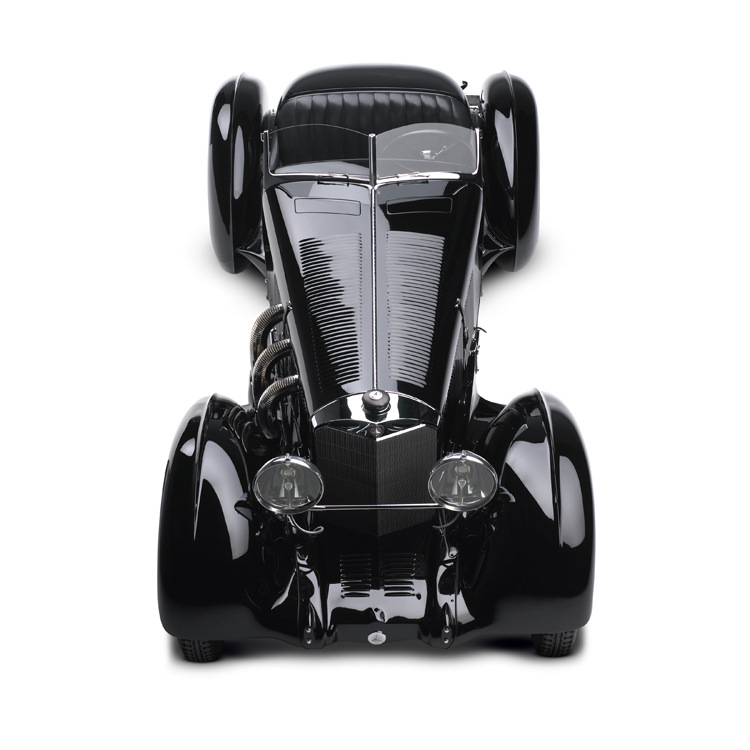
Mercedes Benz SSK “Count Trossi”, 1930


Mercedes Benz SSK “Count Trossi”
1930
Ralph Lauren collection
© Photo Michael Furman


The notion of line in a car echoes that of the perfectly harmonious line of trajectory. The design is never far from this line, even in those coachworks designed without drawing boards, of which some of the most marvellous examples are seen here. It is interesting to see that in the French language at least, cars have taken on board the concept of ligne (or “line”), a word with many meanings. Yet the term ligne, taken in the sense that it is used nowadays in reference to coachwork, is classified by French lexicographer Littré within the sphere of fine art, and defined by him as: “the general effect produced by the coming together and combination of different parties of either a natural object or a composition.” The natural development of language thus shows us the relationship between cars and fine art.


Excerpt from the catalog, Editions Les Arts Décoratifs, Paris 2011


In 1970, Les Arts Décoratifs presented a selection of competition cars, “Bolides Design.” To compile the exhibition, a special jury was assembled, featuring designers Joe Colombo, Roger Tallon and Pio Manzu, and the artists Jean-Paul Riopelle, Jean Tinguely and Victor Vasarely, as well as Robert Delpire and François Mathey. The jury chose the models with the idea of the car as a design object, a work of art, showing that “art and technique, each at their own level, are the expression of man and his relationship with design.”

The Ralph Lauren collection can be seen from the same perspective. Patiently assembled over several decades by the fashion designer in a quest for speed and performance, it includes some of the most extraordinary jewels in the crown of European automobile history, with beauty as its common denominator.

Within the collection are some of the most elegant and innovative cars in automotive history, from the “Blower” Bentley (1929), the Ferrari 250 GTO (1962), the famous Mercedes 300 SL (1955) and the unforgettable Jaguar “D type,” whose shark fin blazed a triumphant trail at Le Mans in 1955, 1956 and 1957. But the grand tourer, the Bugatti Atlantic (1938) of which only four models were produced, represents the ultimate in luxury while showcasing the evolution of styles and techniques on the road. Each of these exceptional vehicles was designed as a masterpiece blending technological innovation and boldness of style.

For its first presentation in Europe, the Ralph Lauren collection will be put on display by Jean-Michel Wilmotte, who has opted for an intimate visual approach as these vehicles stand out both for their overall design and detail, as well as for bodywork, chassis and engines.

The kinetic and sound of the vehicles will be reproduced by means of several films and recordings. A seminar on automobile design will also be held during the exhibition.

Press release from The Arts Décoratifs Museum website


Mercedes Benz SSK “Count Trossi”, 1930


Mercedes Benz SSK “Count Trossi”
1930
Ralph Lauren collection
© Photo Michael Furman


Chassis number SSK 36038, currently owned by Ralph Lauren, remained unsold by the Mercedes-Benz factory in 1928, but was then sent out to Japan in 1930, before being brought back to Europe. This car was put together by the young British coach builder, Willy White, based on a design suggested by its aristocratic owner-cum-industrialist, Count Carlo Felice Trossi, himself a racing driver. The SSK, the archetypal Mercedes of the 1920s, built on a short chassis, is dominated by a colossal hood with a trio of exhaust pipes emerging from each side – a hood encompassing over half the car’s length with a radiator projecting out front as a windbreak. Its flamboyant rear end, dramatically tapered, adds a touch of civility to this extraordinary model, contrasting with the hieratic image of its front end. The supercharging gives the Mercedes SSK its fiery temperament, as well as the legendary noise of its seven litre straight 6 cylinder engine producing 300 CV and enabling a flat-out speed of 235kph!


Bugatti 57 SC Atlantic, 1938


Bugatti 57 SC Atlantic, 1938


Bugatti 57 SC Atlantic
1938
Collection Ralph Lauren
© Photo Michael Furman


According to Paul Bracq, “the Atlantic is a monument in the history of French coach building! More than any other car, it expresses a French-Italian look. An incredible sense of lightness is given off by this sculpture.” Powered by a straight 8 cylinder engine fitted with twin overhead camshafts and a compressor, this beauty is also incredibly fast, capable of reaching 200 kph. As the aluminium alloy used for the coachwork did not lend itself to shaping and soldering, Jean Bugatti was obliged to make the wings and roof in two parts and then assemble them with rivets. His talent lay precisely in the art of transforming this inconvenient technique into a stylistic advantage. Power and speed are suggested by the doors which are cut out of the roof and the ellipsoidal windows reminiscent of airplanes. Chassis number 57591 was the last of the four examples originally produced, a masterpiece embodying sport and luxury at their height – in short, the automobile exception.


Alfa Romeo 8C 2900 Mille Miglia, 1938


Alfa Romeo 8C 2900 Mille Miglia
1938
Collection Ralph Lauren
© Photo Michael Furman


This racing model fitted out with a straight 8 cylinder 2.9 litre engine with twin overhead camshafts supercharged by two compressors is equipped with fully independent suspension and a four speed rear transaxle. The whole thing is perfectly balanced, resulting in the most extraordinary roadholding. The hydraulic brakes are an additional bonus, enabling it to outclass its rivals at over 185 kph. The Turin factory called upon Carrozzeria Touring to design a small series of four two-seater roadsters intended to take part in the 1938 Mille Miglia, the first example of which is the car exhibited here. Driven by the Pintacuda-Mambelli team, the car came in an incredible second under the number 142. The tear drop shaped wings add the final touch to this extraordinary car which is considered to be one of the most prestigious pre-War Grand Touring Alfa Romeos.


Ferrari 375 Plus, 1954


Ferrari 375 Plus
1954
Collection Ralph Lauren
© Photo Michael Furman


The Ferrari known as the 375 Plus was an extrapolation of the Type 375 MM, a model powered by a V12 engine with three carburettors, a gearbox with four speeds plus reverse that increased its engine size to nearly 5 litres, giving it more power and enabling it to reach 340 CV, and attain 250 kph. Because Ferrari did not have its own design department, the 375 Plus, an absolute masterpiece, was created by highly qualified, talented artisans under the guidance of Pinin Farina, Ferrari’s official coach builder. Only five examples of the Type 375 Plus were made, including a spyder version which won the Le Mans 24 Hours in 1954. Ralph Lauren’s car, chassis number 0398 AM – the last of the series – left the factory in 1954 and had a relatively illustrious career in Argentina, often driven by Valiente.


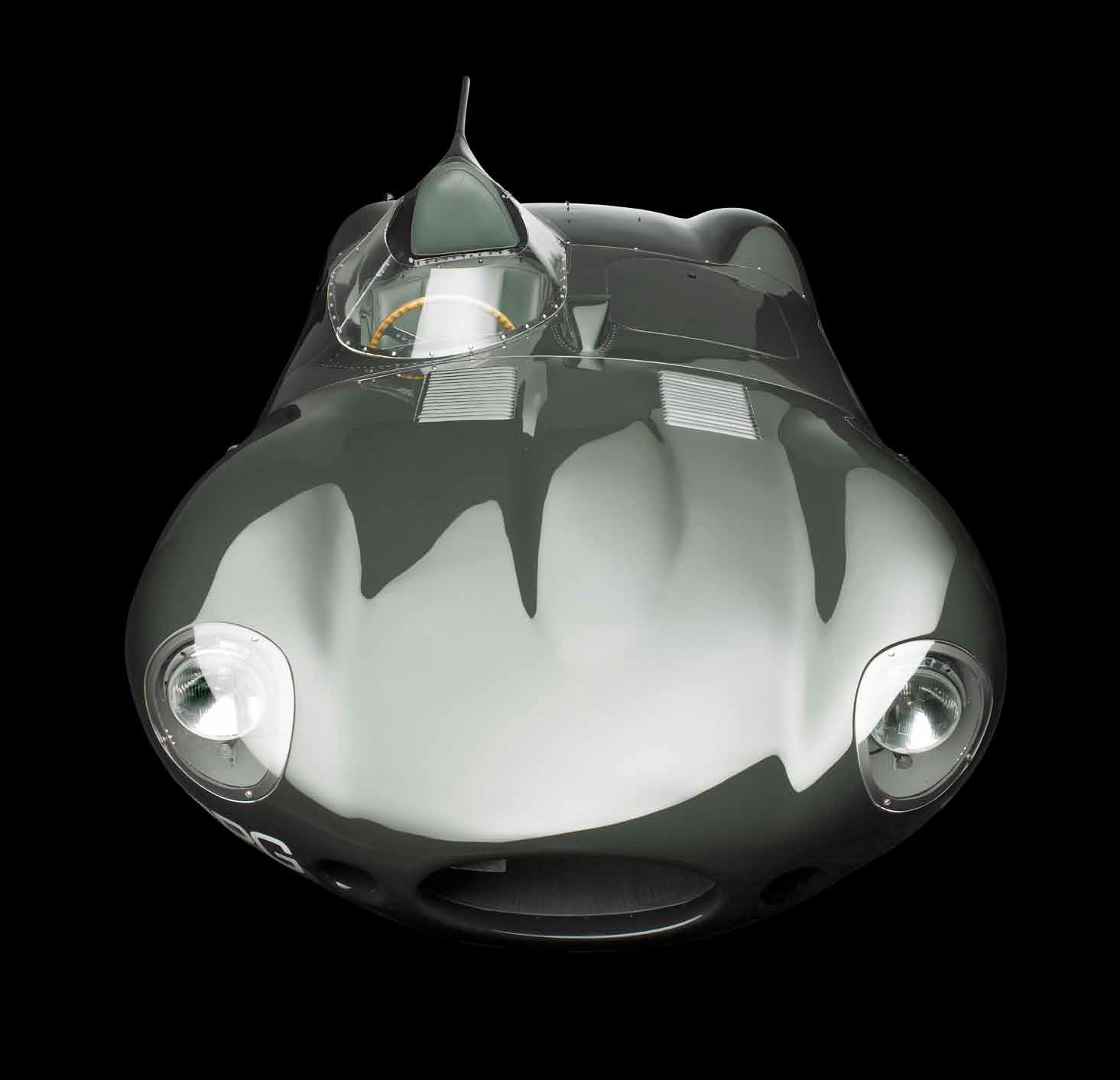
Jaguar XKD, 1955


Jaguar XKD
1955
Collection Ralph Lauren
© Photo Michael Furman


In order to find a worthy successor to the brilliant Jaguar Type XKC, winner on two occasions of the Le Mans 24 Hours, the aeronautic aerodynamicist Malcolm Sayer came up with a non-conformist vehicle. The D-Type has a long hood with no radiator grille, opening away from the block and a slender, extremely graceful rear, easily recognisable thanks to the highly original fin that extends the driver’s head-rest, providing greater stability at high speeds. With the classic straight 6 cylinder 3.4 litre engine, the D-Type, built on a monocoque structure, also has disk brakes. The “long-nosed” version (only 10 examples of which left the factory, including Ralph Lauren’s 505/601) gained an additional 15 kph at maximum speed, pushing it to 260 kph. No other car from the 1950s embodies speed better than this Jaguar D, with three consecutive victories in the Le Mans 24 Hours between 1955 and 1957 and another at Nurburgring in 1956. It was the most successful racing car of its generation.


Jaguar XKSS, 1958


Jaguar XKSS
1958
Collection Ralph Lauren
© Photo Michael Furman


Following on from Jaguar’s magnificent victories in the 1955 and 1956 Le Mans 24 Hours, demand from its enthusiastic clients was such that the company decided to make a road version of the XKD (straight 6 cylinder 3.4 litre engine with a 250 CV output capable of propelling the car to nearly 250 kph) which was named the XKSS. Principally aimed at the American market, it differed from the racing model in having a windscreen, a convertible roof, bumpers and a more civilised interior, and the famous fin was removed. Only 16 examples were constructed between January and February 1957, and a further two examples of the D-Type were transformed by the factory in 1958. Ralph Lauren’s car is one of these, created from the XKD 533 in 1956. It participated in the Six Heures du Forez in 1957, driven by Monnoyeur and Dupuy, finishing 7th, behind a fleet of Jaguar Ds which took the three first places.


Ferrari 250 Testa Rossa, 1958


Ferrari 250 Testa Rossa
1958
Collection Ralph Lauren
© Photo Michael Furman


The 250 Testa Rossa (red head) owes its name to the red camshaft covers of its V12 3 litre engine. Made by Carrozzeria Scaglietti, adapted from a design by Pinin Farina introducing a torpedo shaped body, the car had a headrest that stuck out above the bodywork and integrated headlights behind protruding Plexiglas protection. The very particular line of this vehicle proved to be primarily functional, rather than aesthetic. Indeed, the originality of the pontoon fenders enabled the wheels to remain partially uncovered, to allow for a sufficient supply of cold air to the drum brakes. Equipped with a light body that allowed it to attain 270 kph, its 300 CV engine carried it to victory on numerous occasions, including in the Le Mans 24 Hours in 1958, 1960 and 1961. Ralph Lauren’s car is the 14th of 34 similar examples produced by Ferrari.


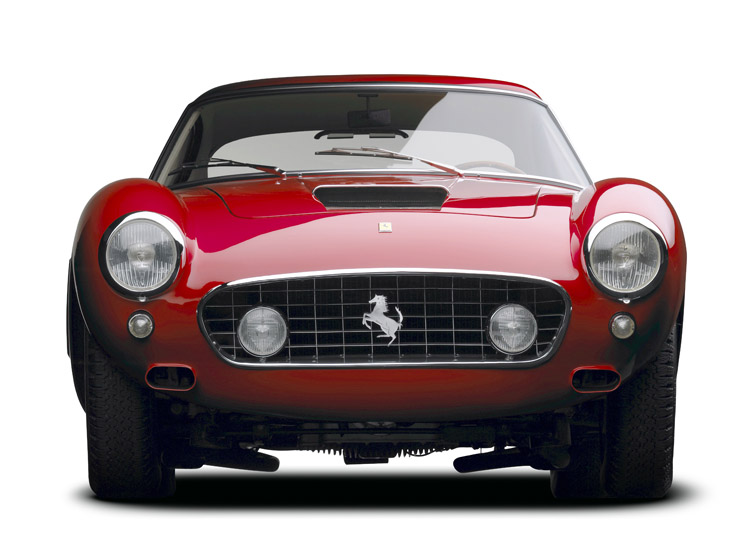
Ferrari 250 GT Berlinetta SWB, 1960


Ferrari 250 GT Berlinetta SWB
1960
Collection Ralph Lauren
© Photo Michael Furman


While the name 250 GT appeared in the Maranello catalog in 1955, the 1959 Paris Motor Show presented a short chassis Berlinetta version, with a wheelbase 20 cms shorter than other versions of the line – a thoroughbred equipped for the road, with aluminium coachwork designed by Pinin Farina and made in the Scaglietti workshops in Modena. Compared to the grand tourer version, intended for road use, the racing version was devoid of all luxury interior trimmings and bumpers, but equipped with disk brakes and a 280 CV engine that enabled this flagship model to masterfully dominate the legendary Tour de France automobile for three consecutive seasons (1960-1962) and the GT category of the Le Mans 24 Hours. Its sensual line, unequalled handling and performance (250kph), and list of victories, all combined to make the short chassis 250 GT Berlinetta one of Ferrari’s most popular models. Ralph Lauren’s car was the 31st example to leave the factory out of the 165 produced.


Ferrari 250 GTO, 1962


Ferrari 250 GTO
1962
Collection Ralph Lauren
© Photo Michael Furman


Designed in the utmost secrecy, the 250 GTO is considered by aficionados today to be the quintessential vintage Ferrari model, both technically and aesthetically, embodying one of the most famous and most expensive sports cars of all time. This Grand Tourer, of which only 39 examples were produced, clocked up an impressive list of victories, including the International Championship for GT Manufacturers in 1962, 1963 and 1964, thanks to its V12 300 CV engine situated up front, but also because of the lightness of its aluminium body, enabling it to attain 280 kph flat out! With its Scaglietti coachwork and its long hood, stocky cockpit and truncated rear, it symbolised the Grand Tourer par excellence. Ralph Lauren’s car was the 21st out of 36 Series I GTOs produced, and won many races driven by Pedro and Ricardo Rodriguez, Roger Penske, Augie Pabst and Richie Ginther.


The Arts Décoratifs Museum
107 rue de Rivoli
75001 Paris
Phone: +33 01 44 55 57 50

Open Tuesday to Sunday 11am – 6pm

The Arts Décoratifs Museum website

LIKE ART BLART ON FACEBOOK

Back to top

Exhibition: ‘Patricia Piccinini: The Fitzroy Series’ at the Centre for Contemporary Photography (CCP), Fitzroy, Melbourne

Exhibition dates: 12th August – 4th September 2011


Patricia Piccinini (Australian, b. 1965) 'Library, 8.45pm' 2011


Patricia Piccinini (Australian, b. 1965)
Library, 8.45pm
2011
Type C photograph
100 x 160cm
Courtesy the artist; Tolarno Galleries, Melbourne; Roslyn Oxley9 Gallery, Sydney; and Haunch of Venison, New York


A wonderful suite of photographs by Patricia Piccinini. When you see them “in the flesh” so to speak, five out of the six works (except for the last image below, Sitting Room, 2.30pm) are suffused with a beautiful, rich, dark honey-coloured light, even more so than the reproductions. This tonality adds to the romantic notion of the imaginary animals Piccinini creates – genetically modified, mutant child creatures and “Bottom Feeder” (for that is their name) rubbish scouring pets. The ordinariness of the environs that surround the mise-en-scènes supplements this feeling: books and bedrooms, workshops and sitting rooms allaying our fears, increasing our empathy. The humour is also delicious. Note the squirrel light in Bedroom, 10.30pm : inspired!

Of as much interest was Piccinini’s source material shown in the front gallery. I wrote most of the books, magazines and subjects of the photographs down because I was fascinated to see the inspiration for this artist:

~ Motorised chairs
~ Knots
~ Nests
~ American Native Indian hair (Edward S. Curtis)
~ Claws
~ Walruses
~ Skulls
~ Skeletons
~ Pupae
~ Scientific specimens
~ Birds covered in oil
~ Mammals of Australia
~ Darwin
~ Voyages of Discovery by Dr Tony Rice
~ Hiroshima Mon Amour by Marguerite Duras
~ Mag wheels
~ Big rigs (trucks)
~ Vespas
~ Custom cars and trucks
~ Morphed racing helmets
~ Photograph from Hitchcock’s The Birds
~ Braindead movie
~ Frankenstein by Mary Shelley
~ Newsweek: The Meaning of Michael (Jackson) July 13th, 2009
~ Rare breeds (sheep)
~ Simians, Cyborgs, and Women: The Reinvention of Nature by Donna ~ Haraway
~ Louise Bourgeois
~ Macro/Hall by Erwin Wurm
~ Le Cere del Museo dell Instituto Fiorentino di Anatonia Patalogia deformatives


Great work and a wonderful gesture by artist and galleries to support the Centre for Contemporary Photography.

Dr Marcus Bunyan


Many thankx to Karra Rees for her help and to the CCP for allowing me to publish the photographs in the posting. Please click on the photographs for a larger version of the image.


Patricia Piccinini (Australian, b. 1965) 'Alley, 11.15am' 2011


Patricia Piccinini (Australian, b. 1965)
Alley, 11.15am
2011
Type C photograph
100 x 160cm
Courtesy the artist; Tolarno Galleries, Melbourne; Roslyn Oxley9 Gallery, Sydney; and Haunch of Venison, New York.


Patricia Piccinini (Australian, b. 1965) 'Bedroom, 10.30pm' 2011


Patricia Piccinini (Australian, b. 1965)
Bedroom, 10.30pm
2011
Type C photograph
100 x 160cm
Courtesy the artist; Tolarno Galleries, Melbourne; Roslyn Oxley9 Gallery, Sydney; and Haunch of Venison, New York.


Patricia Piccinini (Australian, b. 1965) 'Street, 3.10am' 2011


Patricia Piccinini (Australian, b. 1965)
Street, 3.10am
2011
Type C photograph
100 x 160cm
Courtesy the artist; Tolarno Galleries, Melbourne; Roslyn Oxley9 Gallery, Sydney; and Haunch of Venison, New York.


Patricia Piccinini (Australian, b. 1965) 'Workshop, 7.00pm' 2011


Patricia Piccinini (Australian, b. 1965)
Workshop, 7.00pm
2011
Type C photograph
100 x 160cm
Courtesy the artist; Tolarno Galleries, Melbourne; Roslyn Oxley9 Gallery, Sydney; and Haunch of Venison, New York


To mark Centre for Contemporary Photography’s 25th Anniversary Patricia Piccinini has made a new series of work, never seen before. Entitled The Fitzroy Series, the exhibition of Piccinini’s new body of work, accompanied by video work and a display of her source material, is the major event in the celebrations of CCP’s 25th Anniversary in 2011.

CCP is delighted to be offering this exciting new series for the CCP 25th Anniversary Limited Edition Print fundraiser, each image in the series is generously provided in a limited edition of 4 + 1AP.

Eighty percent of funds raised through Limited Edition Prints enable CCP to support the practice and presentation of contemporary photography through provision of exhibitions, publications, education and public programs, with the artist retaining twenty percent.

What: CCP 25th Anniversary Limited Edition Print
Price: $9,320 each framed by Neo Frames (inc. gst on frame)
The first 12 prints are available at the CCP fundraiser price of $9,320 each framed by Neo Frames (inc. GST on frame)
NB. Credit card purchases attract a 1.5% merchant fee.
Prints are accompanied by a signed, numbered certificate and are provided courtesy of the artist; Tolarno Galleries, Melbourne; Roslyn Oxley9 Gallery, Sydney; and Haunch of Venison, New York.
Free Artist Floortalk: midday 27 August 2011


Patricia Piccinini (Australian, b. 1965) 'Sitting Room, 2.30pm' 2011


Patricia Piccinini (Australian, b. 1965)
Sitting Room, 2.30pm
2011
Type C photograph
100 x 160cm
Courtesy the artist; Tolarno Galleries, Melbourne; Roslyn Oxley9 Gallery, Sydney; and Haunch of Venison, New York.


Centre for Contemporary Photography

No permanent exhibition space at the moment

Centre for Contemporary Photography website

LIKE ART BLACK ON FACEBOOK

Back to top

Exhibition: ‘Hiroshima: Ground Zero 1945’ at the International Center of Photography, New York

Exhibition dates: 20th May – 28th August, 2011


United States Strategic Bombing Survey, Physical Damage Division. '[Ruins of the Hiroshima Prefectural Commercial Exhibition Hall (A-Bomb Dome)]' October 24, 1945


United States Strategic Bombing Survey, Physical Damage Division
[Ruins of the Hiroshima Prefectural Commercial Exhibition Hall (A-Bomb Dome)]
October 24, 1945
Gelatin silver print
© International Center of Photography


The “United States Strategic Bombing Survey, Physical Damage Division”. Don’t you just love the irony in this title? The aim of the military group who took these photographs as part of a survey on “strategic bombing” of Hiroshima was to document the physical damage that took place. As if an atomic bomb is anything other than destructive! As if an atomic bomb is anything other than catastrophic! As if an atomic bomb is anything less than death itself!

Upon this realisation, the father of the atomic bomb, J. Robert Oppenheimer, famously quoted the Bhagavad Gita after the detonation of the first bomb on July 16, 1945 in the Trinity test in New Mexico, “Now, I am become Death, the destroyer of worlds.”

In saying that, military jurisprudence, that disciplinary machine of death, becomes not only the recorder of destruction but also the re-ordering of the world, thus re(c)ording the world under Foucault’s Matrix of Practical Reason:

~ Through the technologies of production, which permit us to produce, transform or manipulate things

~ Through the technologies of power, which determine the conduct of individuals and submit them to certain ends or domination, an objectivising of the subject.1


In short, the military is power; the military subjugates humans; and the military destroys at will.

The strange beauty of the Physical Damage Division photographs is that they simply document what remains. Like the “shadow” of a hand valve wheel on the painted wall of a gas storage tank, Ground Zero is burnt onto the ground glass of the camera.

Like the “shadow” these events are eternally seared into the collective memory never, ever, to be forgotten.

Dr Marcus Bunyan


1/ Foucault, Michel. “Technologies of the Self,” quoted in Martin, Luther and Gutman, Huck and Hutton, Patrick (eds.,). Technologies of the Self: A Seminar with Michel Foucault. London: Tavistock Publications, 1988, p. 18


Many thankx to the International Center of Photography for allowing me to publish the photographs in the posting. Please click on the photographs for a larger version of the image.


United States Strategic Bombing Survey, Physical Damage Division. '[View of burned-over area with Hiroshima Kirin Beer Hall at far right]' October 16, 1945


United States Strategic Bombing Survey, Physical Damage Division
[View of burned-over area with Hiroshima Kirin Beer Hall at far right]
October 16, 1945
Gelatin silver print
3 11/16 x 4 9/16 in. (9.4 x 11.6cm)
© International Center of Photography
Purchase, with funds provided by the ICP Acquisitions Committee, 2006


United States Strategic Bombing Survey, Physical Damage Division. '[Ruins of Shima Surgical Hospital, Hiroshima]' October 24, 1945


United States Strategic Bombing Survey, Physical Damage Division
[Ruins of Shima Surgical Hospital, Hiroshima]
October 24, 1945
Gelatin silver print
4 1/8 x 6 1/16 in. (10.5 x 15.4cm)
© International Center of Photography
Purchase, with funds provided by the ICP Acquisitions Committee, 2006


United States Strategic Bombing Survey, Physical Damage Division. '[Group of people near damaged trolley cars, Hiroshima]' October 31, 1945


United States Strategic Bombing Survey, Physical Damage Division
[Group of people near damaged trolley cars, Hiroshima]
October 31, 1945
Gelatin silver print
3 11/16 x 4 7/16 in. (9.4 x 11.3cm)
© International Center of Photography
Purchase, with funds provided by the ICP Acquisitions Committee, 2006


United States Strategic Bombing Survey, Physical Damage Division. '[Distorted steel-frame structure of Odamasa Store, Hiroshima]' November 20, 1945


United States Strategic Bombing Survey, Physical Damage Division
[Distorted steel-frame structure of Odamasa Store, Hiroshima]
November 20, 1945
Gelatin silver print
© International Center of Photography


United States Strategic Bombing Survey, Physical Damage Division. '[Reinforced-concrete fire shutter in cast wall of Yasuda Life Insurance Company, Hiroshima branch]' November 15, 1945


United States Strategic Bombing Survey, Physical Damage Division
[Reinforced-concrete fire shutter in cast wall of Yasuda Life Insurance Company, Hiroshima branch]
November 15, 1945
Gelatin silver print
3 11/16 x 4 3/4 in. (9.4 x 12.1cm)
© International Center of Photography
Purchase, with funds provided by the ICP Acquisitions Committee, 2006


United States Strategic Bombing Survey, Physical Damage Division. '[Ruins of Chugoku Coal Distribution Company or Hiroshima Gas Company]' November 8, 1945


United States Strategic Bombing Survey, Physical Damage Division
[Ruins of Chugoku Coal Distribution Company or Hiroshima Gas Company]
November 8, 1945
Gelatin silver contact print
© International Center of Photography


United States Strategic Bombing Survey, Physical Damage Division. '[Remains of a school building]' November 17, 1945


United States Strategic Bombing Survey, Physical Damage Division
[Remains of a school building]
November 17, 1945
Gelatin silver contact print
© International Center of Photography


Once-classified images of atomic destruction at Hiroshima will be displayed in a new exhibition Hiroshima: Ground Zero 1945 at the International Center of Photography (1133 Avenue of the Americas at 43rd Street) from May 20 to August 28, 2011. Drawn from ICP’s permanent collection, the Hiroshima archive includes more than 700 images of absence and annihilation, which formed the basis for civil defence architecture in the United States. These images had been mislaid for over forty years before being acquired by ICP in 2006.

This exhibition will include approximately 60 contact prints and photographs as well as the secret 1947 United States Strategic Bombing Survey (USSBS) report, The Effects of the Strategic Bombing on Hiroshima, Japan. It will be accompanied by a catalogue published by ICP/Steidl, with essays by John W. Dower, Adam Harrison Levy, David Monteyne, Philomena Mariani, and Erin Barnett.

After the nuclear attacks in August 1945, President Truman dispatched members of the USSBS to Japan to survey the military, economic, and civilian damage. The Survey’s Physical Damage Division photographed, analysed, and evaluated the atomic bomb’s impact on the structures surrounding the Hiroshima blast site, designated “Ground Zero.” The findings of the USSBS provided essential information to American architects and civil engineers as they debated the merits of bomb shelters, suburbanisation, and revised construction techniques.

The photographs in this exhibition were in the possession of Robert L. Corsbie, an executive officer of the Physical Damage Division who later worked for the Atomic Energy Commission. An architectural engineer and expert on the effects of the atomic bomb, he used what he learned from the structural analyses and these images to promote civil defence architecture in the U.S. The photographs went through a series of unintended moves after Corsbie, his wife and son died in a house fire in 1967.

The U.S., at war with Japan, detonated the world’s first weaponised atomic bomb over Hiroshima, a vast port city of over 350,000 inhabitants, on August 6, 1945. The blast obliterated about 70 percent of the city and caused the deaths of more than 140,000 people. Three days later, the U.S. dropped a second nuclear bomb on Nagasaki, resulting in another 80,000 fatalities. Within a week, Japan announced its surrender to the Allied Powers, effectively ending World War II.

“Once part of a classified cache of government photographs, this archive of haunting images documents the devastating power of the atomic bomb,” said ICP Assistant Curator of Collections Erin Barnett, who organised the exhibition.

Press release from the International Center of Photography website


United States Strategic Bombing Survey, Physical Damage Division. '["Shadow" of a hand valve wheel on the painted wall of a gas storage tank; radiant heat instantly burned paint where the heat rays were not obstructed, Hiroshima]' October 14 - November 26, 1945


United States Strategic Bombing Survey, Physical Damage Division
[“Shadow” of a hand valve wheel on the painted wall of a gas storage tank; radiant heat instantly burned paint where the heat rays were not
obstructed, Hiroshima]
October 14 – November 26, 1945
Gelatin silver print
© International Center of Photography


United States Strategic Bombing Survey, Physical Damage Division. '[Interior of Hiroshima City Hall auditorium with undamaged walls and framing but spalling of plaster and complete destruction of contents by fire]' November 1, 1945


United States Strategic Bombing Survey, Physical Damage Division
[Interior of Hiroshima City Hall auditorium with undamaged walls and framing but spalling of plaster and complete destruction of contents by fire]
November 1, 1945
Gelatin silver print
© International Center of Photography


United States Strategic Bombing Survey, Physical Damage Division. '[Ruins of Sumitomo Fire Insurance Company, Hiroshima branch]' October 24, 1945


United States Strategic Bombing Survey, Physical Damage Division
[Ruins of Sumitomo Fire Insurance Company, Hiroshima branch]
October 24, 1945
Gelatin silver print
3 3/16 x 4 7/16 in. (8.1 x 11.3cm)
© International Center of Photography
Purchase, with funds provided by the ICP Acquisitions Committee, 2006


United States Strategic Bombing Survey, Physical Damage Division. '[Rooftop view of atomic destruction, looking southwest, Hiroshima]' October 31, 1945


United States Strategic Bombing Survey, Physical Damage Division
[Rooftop view of atomic destruction, looking southwest, Hiroshima]
October 31, 1945
Gelatin silver print
© International Center of Photography


United States Strategic Bombing Survey, Physical Damage Division. '[Burned-over landscape north of ground zero in the vicinity of Hiroshima Castle]' October 31, 1945


United States Strategic Bombing Survey, Physical Damage Division
[Burned-over landscape north of ground zero in the vicinity of Hiroshima Castle]
October 31, 1945
Gelatin silver print
3 3/4 x 4 5/8 in. (9.5 x 11.7cm)
© International Center of Photography
Purchase, with funds provided by the ICP Acquisitions Committee, 2006


United States Strategic Bombing Survey, Physical Damage Division. '[Interior with heavy spalling of cement plaster by fire in combustiible floor of Yasuda Life Insurance Company, Hiroshima branch]' November 1, 1945


United States Strategic Bombing Survey, Physical Damage Division
[Interior with heavy spalling of cement plaster by fire in combustiible floor of Yasuda Life Insurance Company, Hiroshima branch]
November 1, 1945
Gelatin silver print
3 11/16 x 4 3/4 in. (9.4 x 12.1cm)
© International Center of Photography
Purchase, with funds provided by the ICP Acquisitions Committee, 2006


United States Strategic Bombing Survey, Physical Damage Division. '[Damaged turbo-generator and electrical panel of Chugoku Electric Company, Minami Sendamachi Substation, Hiroshima]' November 18, 1945


United States Strategic Bombing Survey, Physical Damage Division
[Damaged turbo-generator and electrical panel of Chugoku Electric Company, Minami Sendamachi Substation, Hiroshima]
November 18, 1945
Gelatin silver print
3 13/16 x 4 7/16 in. (9.7 x 11.3cm)
© International Center of Photography
Purchase, with funds provided by the ICP Acquisitions Committee, 2006


United States Strategic Bombing Survey, Physical Damage Division. '[Steel stairs warped by intense heat from burned book stacks of Asano Library, Hiroshima]' November 15, 1945


United States Strategic Bombing Survey, Physical Damage Division
[Steel stairs warped by intense heat from burned book stacks of Asano Library, Hiroshima]
November 15, 1945
Gelatin silver contact print
© International Center of Photography


International Center of Photography
79 Essex Street, New York, NY 10002
between Delancey Street and Broome Street

Opening hours:
Wednesday – Monday 11am – 7pm
Closed: Tuesday

International Center of Photography website

LIKE ART BLART ON FACEBOOK

Back to top

The Museum of Old and New Art (MONA), Hobart

August 2011


MONA exterior, Hobart


MONA exterior, Hobart
Image Courtesy of MONA Museum of Old and New Art


“Lyotard writes,”We must not begin with transgression, we must immediately go to the very end of cruelty, construct the anatomy of polymorphous perversion, unfold the immense membrane of the libidinal ‘body,’ which is quite the inverse of a system of parts.” Lyotard sees this “membrane” as composed of the most heterogeneous items: human bone and writing paper, steel and glass, syntax and the skin on the inside of the thigh. In the libidinal economy, writes Lyotard: “All of these zones are butted end to end … on a Moebius strip … a moebian skin [an] interminable band of variable geometry (a concavity is necessarily a convexity at the next turn) [with but] a single face, and therefore neither exterior nor interior.”


Jean-François Lyotard quoted in Victor Burgin. In/Different Spaces 1


“Taking a walk is also an extremely immediate form of experience. Serge Daney describes the act of perception while taking a walk: ‘Because I am not particularly fond of bravura pieces, I always need a transition from one thing to the next. And I am glad that I can find it through by body and experience of walking…’
The visual memory of the walker / viewer determines the sequence of the pictures. Since the 1960s Marcel Broodthaers has defined the exhibition as a cinematic sequence of pictures and objects, thereby subverting the fixity of the single object through recontextualisation.”


Serge Daney quoted in Hans Obrist. “In the Midst of Things, At the Centre of Nothing.”2


Libidinal, Moebic MONA

My analogy: you are standing in the half-dark, your chest open, squeezing the beating heart with blood coursing between your fingers while the other hand is up your backside playing with your prostrate gland. I think ringmeister David Walsh would approve.

My best friends analogy: a cross between a car park, night club, sex sauna and art gallery.

Weeks later I am still thinking about the wonderful immersive, sensory experience that is MONA. Peter Timms in an insightful article in Meanjin calls it a post-Google Wunderkammer, or wonder chest.3 It can be seen as a mirabilia – a non-historic installation designed primarily to delight, surprise and in this case shock. The body, sex, death and mortality are hot topics in the cultural arena4 and Walsh’s collection covers all bases. The collection and its display are variously hedonistic, voyeuristic, narcissistic, fetishistic pieces of theatre subsumed within the body of the spectacular museum architecture.

The experience starts with the ferry ride from the wharf in Hobart to the museum – the only way to arrive. During the 20 minutes of the journey mental baggage seems to drop away as you look over the water to the industrial zinc works, pass under bridges and then the museum comes into view. Perched on a promontory of land the museum rises like a rusted ancient temple. After disembarking you climb a colossal staircase to the entrance of the museum, all angles and mirrored surfaces. You enter one of two Roy Grounds listed modernist buildings built in the 1950s – beautiful, crisp white spaces that house the shop and a cafe, cloakroom and inquiry desk where you collect your ‘O’, an iPhone-like device that tracks all the artworks that you look at. The are no didactic text panels in the museum freeing the viewer to just experience, all data such as artists names and educational information and the tit-bit Gonzo text being accessed through the ‘O’. Into the large enclosed forecourt space a spiral staircase with a circular lift in the centre descends into the abyss (an inspired piece of design) and your journey proper has begun. Three levels deep into the ground you travel, the space carved out of solid rock. Impressive.

The museum is the body and the artworks are the organs, fragments of the whole exhibition (that of the actual museum). The experience is very kinaesthetic as the body gets lost within the space of the gallery. We wandered like flâneur among the darkened, cinema-like spaces, almost floating from one area to the next, discovering, feeling disorientated, following underground passages, tunnels and stairs, emerging into light and then descending into the abyss again. Hours passed. Like a Moebius strip there seemed to be no interior/exterior to the body. As Lyotard notes the membrane of the libidinal ‘body’ is composed of the most heterogeneous items: here was rock, steel, shit, bestiality, intestines, brain, touch, burial etc… the curating of the collection within the space “creating a safe space for the appreciation and consideration of seemingly extreme and subversive practices.”5

Into this space of controlled transgression, the carnivalesque mise-en-scène allow the artists to delve into the deeper and darker areas of the human condition: “as Anthony Everitt once said of Damien Hirst [to] ‘open up paths for the viewer into areas of experience which are not anti-moral or amoral but extra-moral… a world where bad taste is driven to the point of elegance and disgust is filtered into delight’.”6

While some of the works were spotlit in the darkened galleries, “this dramatic lighting working to decontextualise the art objects, evoking a crepuscular and “timeless” sense of space, out of which the individual pieces emerged,”7 there also seemed to be an affinity between the building itself and the artworks (relating to the concept of affinity in museum curation). The diversity of installation techniques made an acknowledgement of the institutionalising processes part of the viewer’s experience of the show, disrupting a unified, totalising presentation of these objects and their cultures as “exhibition.”8 The intertextual tableaux mixed a Damien Hirst spin painting with Egyptian sculpture, ancient artefacts with Fat Cars. The context of the objects and their relationship to each other and the architecture is how the works are “framed.” This device emphasises the aesthetic rather than information and encourages the viewer to think about the relationship between the artefacts, objects and contemporary works. These inventive arrangements create a meta-narrative that offers the possibility of multiple interpretations to the viewer, multiple truths. All of this undertaken as the body moves through the spaces of the gallery and gets “lost”. As Norman Bryson has observed, “Architecture is sensed primarily through the eye and through bodily movement, and these sensations also play a key role in the way in which the contents of museums make their impact.”9

While the items are not explicitly related in terms of subject, medium or style through unexpected confrontation the works spring to dissonant life. Most of the time. When this process doesn’t work the viewer is left a little flat feeling, and…. so? wandering from piece to piece becoming slightly disenchanted. Little of the work at MONA took me to new spaces; in fact some of it was pretty mediocre, including the very dated Sir Sidney Nolan Snake (1970 to 1972, see below) that is permanent ‘wallpaper’ and takes up a whole, beautiful gallery wall. The tri-screen video by Russian collective AES+F, the works by Anselm Kiefer and the ancient artefacts (most of all) were notable exceptions. The museum is not a place for prolonged concentration and contemplation. This is not really the point of the place. The whole museum is a sensory, immersive surprising experience that cannot be broken down to its parts. David Walsh’s collection does tick all the fashionable boxes: here a Juan Davila, there a Del Kathyrn Barton, now a Howard Arkeley as though his buyers have advised him on just what to buy, but it is his personal vision, his collection. You can’t argue with that.

On of the problems of lumping all of these works together is obvious: “Ancient objects whose meaning is lost to us, medieval utensils, Christian religious images, and art objects made by modern masters were reduced to one meaning – stylistic resemblances providing evidence of the essential nature of humanity.”10 In other words a return to the globalising view of humanity evidenced by Edward Steichen’s MoMA world touring photographic exhibition of the 1950s The Family of Man. Conversely, when this strategy works well it promotes for the viewer different modes and levels of ‘interpretation’ through subtle juxtaposition of ‘experience’. As Emma Barker has observed, “we still need a curator to stimulate readings of the collection and to establish those ‘climatic zones’ which can enrich our appreciation and understanding of art… Our aim must be to generate a condition in which visitors can experience a sense of discovery in looking at particular paintings, sculptures or installations in a particular room at a particular moment, rather than find themselves standing on the conveyer belt of history.”11 Within this plastic space experience is paramount, allowing the viewer to develop their own reading without relying on the curatorial interpretation of history, setting new parameters for the relationship between viewer and object. As Barker notes such juxtapositions are a more natural strategy for a private collector than for a museum curator, with exhibitions and displays according to this dialectical principle happening with more frequency.12 The museum looses its fundamental didactic, educational purpose.

Other problems may also become evident. In a museum whose spectacular architecture was specifically designed for David Walsh’s collection it will be interesting to see how outside, touring exhibitions (such as the recently installed Experimenta Utopia Now exhibition) display in the space, especially given the psychosexual nature of his collection and its relationship to the building. If the quality of the temporary exhibitions is overwhelmed by the architecture, if the labyrinthine, enigmatic and layered nature of the space (all those floating bridges and the huge Void that can be seen in the photographs below) engulfs lesser works then it may well fall very flat.

At the end of the day we emerged into the afternoon light, expelled from the museum in a tidal wave of humanity, exhausted, satiated. Where else in Australia could you spend all day at a museum and not have seen enough? On flying home you can log into the MONA website to retrieve your ‘O’ tour, to see what art you liked and what you didn’t; what pieces you saw and all those that somehow you missed! The physical and its remembrance transported into the virtual.


Since Laura Mulvey’s essay of 1974 “Visual Pleasure and Narrative Cinema,” we have been aware of the voyeuristic and fetishistic character of our psychosexual relation to cinema. Engulfed in the dark cube, that psychosexual panorama, the cinematic labyrinth that is MONA has the viewer absenting themselves in front of the art in favour of the Eye and the Spectator.13 Spectatorship and their attendant erotics has MONA as a form of fetishistic cinema. It is as if what Barthes calls “the eroticism of place” were a modern equivalent of the eighteenth century genius loci, the “genius of the place.”

The place is spectacular, the private collection writ large as public institution, the symbolic power of the institution masked through its edifice. The art become autonomous, cut free from its cultural associations, transnational, globalised, experienced through kinaesthetic means; the viewer meandering through the galleries, the anti-museum, as an international flaneur. Go. Experience!

Dr Marcus Bunyan


Footnotes

1/ Lyotard, Jean-François. Économie Libidinale. Paris: Éditions de Minuit, 1974, pp. 10-11 quoted in Burgin, Victor. In/Different Spaces: Place and Memory in Visual Culture. Berkeley: University of California Press, 1995, p. 150

2/ Obrist, Hans Ulrich. “In the Midst of Things at the Center of Nothing,” in Harding, Anna (ed.,). Curating: The Contemporary Museum and Beyond, (Art & Design Magazine Profile No. 52), London: A.D., 1997, p. 88

3/ Timms, Peter. “A Post-google Wunderkammer: Hobart’s Museum of Old and New Art Redefines the Genre,” in Meanjin, Vol. 70, No. 2, Winter 2011. pp. 31-39

4/ Keidan, Lois. “Showtime: Curating Live Art  in the 90s,” in Harding, Anna (ed.,). Curating: The Contemporary Museum and Beyond, (Art & Design Magazine Profile No. 52), London: A.D., 1997, p. 41

5/ Ibid., p. 41

6/ Ibid., p. 41

7/ Staniszewski, Mary Anne. The power of display: a history of exhibition installations at the Museum of Modern Art. Cambridge, Mass.: MIT Press, 1998, p. 84

8/ Ibid., p. 97

9/ Bryson, Norman. “A Walk for a Walk’s Sake,” in De Zegher, Catherine (ed.,). The Stage of Drawing: Gesture and Act. London: Tate, 2003, pp. 149-58.

10/ Staniszewski, op. cit. p. 129

11/ Barker, Emma. “Exhibiting the Canon: The Blockbuster Show,” in Barker, Emma (ed.,). Contemporary Cultures of Display. New Haven and London: Yale University Press, 1999, p. 55

12/ Ibid., p. 45

13/ O’Neill, Paul. “The Curatorial Turn: From Practice to Discourse,” in Rugg, Judith and Sedgwick, Michèle (eds.,). Issues in Curating Contemporary Art and Performance. Bristol: Intellect, 2007, pp. 13-28


Many thankx to Delia Nicholls for all her help and to MONA for allowing me to publish most of the photographs in the posting (all except the top two and the one of us inside Babylonia that were taken by Fredrick White). Please click on the photographs for a larger version of the image.


Zinc works from the ferry on the way to MONA

Zinc works from the ferry on the way to MONA


Zinc works from the ferry on the way to MONA
Photos: Marcus Bunyan


3d schematic from the O, showing the levels and nodes indicating art works visited, MONA


3d schematic from the O, showing the levels and nodes indicating art works visited, MONA


MONA The Void February 2011


The Void
February 2011
Museum of Old and New Art – interior
Photo credit: MONA/Leigh Carmichael
Image Courtesy of MONA Museum of Old and New Art


MONA B1 walkway overlooking The Void February 2011


B1 walkway overlooking The Void
February 2011
Museum of Old and New Art – interior
Photo credit: MONA/Leigh Carmichael
Image Courtesy of MONA Museum of Old and New Art


MONA Loop System Quintet/Untitled (stool for guard)


Loop System Quintet/Untitled (stool for guard)

Left:
Taiyo Kimura (Japanese, b. 1970)
Untitled (stool for guard)
2007
Mixed media, clothes, cd player, speaker

Right:
Conrad Shawcross (English, b. 1977)
Loop System Quintet

2005
Waxed machined oak, five light bulbs, electric motor and gearbox, drive shafts, cogs, universal joints, flange units, screws, bolts, nuts, washers

Photo credit: MONA/Leigh Carmichael
Image Courtesy of MONA Museum of Old and New Art


Callum Morton (Australian born Canada, b. 1965) 'Babylonia' 2005


Callum Morton (Australian born Canada, b. 1965)
Babylonia
2005
Wood, polystyrene, epoxy resin, acrylic paint, light, carpet, mirror and sound
Photo credit: MONA/Leigh Carmichael
Image Courtesy of MONA Museum of Old and New Art


Sculptor Fredrick White and Marcus Bunyan inside Callum Morton's 'Babylonia' wearing the 'O'


Sculptor Fredrick White and Marcus Bunyan inside Callum Morton’s Babylonia wearing the ‘O’


Portrait gallery. Various artworks by various artists. Museum of Old and New Art - interior


Portrait gallery
Various artworks by various artists
Museum of Old and New Art – interior
Photo credit: MONA/Leigh Carmichael
Image Courtesy of MONA Museum of Old and New Art


Masturbation. It is a source of endless irony to me that when I was young, and desperately in need of endless fucking, no one was interested in helping me out, whereas now, older and slower, I could fill even my desired adolescent quota. What saved me then was my right hand, even though I call myself left-handed. Surely the hand that you wank with (I guess John Holmes was ambidextrous) defines you just as much as the hand you write with? Anyway, who writes anymore? It’s so much easier to type. Mental masturbation allows me to pretend I’m a mental John Holmes, takes both hands. But no brains.

Art. I’m not at all sure that conceptual art and traditional art are the same thing. One can come from muscle memory, from pragma; at its best it’s not at all conscious. The former, though, is so self-aware it’s often targeting its own self-awareness. Check out the Hirst and the Pylypchuk at the other end of the gallery.


David Walsh 2011


MONA Corten Stairwell February 2011


Corten Stairwell
February 2011
Museum of Old and New Art – interior
Photo credit: MONA/Leigh Carmichael
Image Courtesy of MONA Museum of Old and New Art


MONA Corten Stairwell & Surrounding Artworks February 2011


Corten Stairwell & Surrounding Artworks
February 2011
Museum of Old and New Art – interior
Photo credit: MONA/Leigh Carmichael
Image Courtesy of MONA Museum of Old and New Art


MONA The Nolan Gallery February 2011


The Nolan Gallery

Sir Sidney Nolan (Australian, 1917-1992)
Snake
1970 to 1972
Mixed media on paper, 1620 sheets

Jannis Kounellis (Greece, 1936-2017)
Untitled

2002
Jute coffee bags, coal; three parts

Photo credit: MONA/Leigh Carmichael
Image Courtesy of MONA Museum of Old and New Art


Erwin Wurm (Austrian, b. 1954) 'Fat Car' 2006
 at MONA


Erwin Wurm (Austrian, b. 1954)
Fat Car
2006
Steel chassis and body; leather interior, with polystyrene and fibreglass
Photo credit: MONA/Leigh Carmichael
Image Courtesy of MONA Museum of Old and New Art


Museum of Old and New Art
655 Main Road Berriedale
Hobart Tasmania 7011, Australia

Opening hours:
Fridays – Mondays, 10am – 5pm
MONA website

LIKE ART BLART ON FACEBOOK

Back to top

Opening: ‘John Bodin: Rite of Passage’ at Anita Traverso Gallery, Richmond

Exhibition dates: 11th August – 3rd September, 2011


John Bodin (Australian) 'I Was Far Away From Home' 2009


John Bodin (Australian)
I Was Far Away From Home
2009
Type C print on metallic paper
80 x 110cm


Reprinted below is the speech I gave at the opening. Beautiful work (shot mostly in Tasmania from the passenger seat of a moving car). Many thanx to Anita and John for asking me to speak at the opening – it was fun!

Opening night speech

I want to preface what I am about to say by noting that I am interested in how these photographs, as physical objects, might speak to what is not physical, what is intangible and ineffable about the spaces they display.

I saw a fantastic documentary about the pianist Artur Rubenstein recently on SBS. When he was playing in concert he believed that he recognised in the audience a person that was more attuned to the nuances of his phrasing and performance than others and he played for them – he wanted to show them something new, insightful and challenging. This made him play better, taking more risks for greater reward, for himself and for the audience. These moments have the possibility of becoming moments in eternity (or to introduce the analogy of the road, milestones). For us it is the recognition of these moments in eternity (or to keep the analogy going, a journey), the unenclosed and apparently insignificant. The material world’s strange mixture of familiarity and otherness, ‘humanness’ and non-humanness.

Where these ideas share a quality with the photographs by John is a recognition of the fluid energy flowing through these spaces, like infinite ribbons of consciousness. For me this is not an escapement nor contentment but a point of stillness within self – an awareness and balance at that moment, at that point in time, in that line of sight when the photograph was taken. A stillness within self that acknowledges the journey taken and the journey to be taken – something that is beyond language and goes to the most intimate place of our being.

The photographs become the surface of the body, stitched together with lines, markers pointing the way – they are encounters with the things that we see before us but also the things that we carry inside of us. It is the interchange between these two things, how one modulates and informs the other. It is this engagement that holds our attention: the dappled light, ambiguity, unevenness, the winding path that floats and bobs before our eyes looking back at us, as we observe and are observed by the body of these landscapes.

One of the fundamental qualities of the photographs is that they escape our attempts to rationalise them and make them part of our understanding of the world, to quantify our existence in terms of materiality. I have an intimate feeling with regard to these sites of engagement. They are both once familiar and unfamiliar to us; they possess a sense of nowhereness. A sense of groundlessness and groundedness. A collapsing of near and far, looking down, looking along, a collapsing of the constructed world.

Why here? Why this particular angle? This section of the visible, this turn in the road. Not quite knowing where we are, we are neither here nor there, within nor without. It is an experience of being between the two – a potential space, a “between” that is formed only in the simultaneous presence of the two. As Donald Winnicott has observed in the book In/different Spaces by Victor Burgin, it is “the potential space between the subjective object and the object objectively perceived” that becomes the location of cultural experience.

“Those things of which I can perceive the beginnings and the end are not my self.” Grimm says. Like the road in these photographs there is no self just an infinite time that has no beginning and no end. The time before my birth, the time after my death. We are just in the world, just being somewhere. Life is just a temporary structure on the road from order to disorder. “The road is life,” writes Jack Kerouac in On the Road.

John’s skill as a photographer is to make visible the not really seen, potential spaces that we could have not have imagined otherwise. And for that, John, I am grateful.

Dr Marcus Bunyan


John Bodin (Australian) 'Into the Mystic' 2009


John Bodin (Australian)
Into the Mystic
2009
Type C print on metallic paper
80 x 110cm


John Bodin (Australian) 'Into Timeless Shadows' 2009


John Bodin (Australian)
Into Timeless Shadows
2009
Type C print on metallic paper
80 x 110 cm


John Bodin (Australian) 'Remembrance of Some Lost Bliss' 2009


John Bodin (Australian)
Remembrance of Some Lost Bliss
2009
Type C print on metallic paper
80 x 110 cm


John Bodin (Australian) 'So Ghostly Easy' 2009


John Bodin
So Ghostly Easy
2009
Type C print on metallic paper
80 x 110 cm


John Bodin (Australian) 'Somewhere Along the Line the Pearl would be Handed to Me' 2009


John Bodin (Australian)
Somewhere Along the Line the Pearl would be Handed to Me
2009
Type C print on metallic paper
80 x 110 cm


John Bodin (Australian) 'The One Distinct Moment of My Life' 2009


John Bodin (Australian)
The One Distinct Moment of My Life
2009
Type C print on metallic paper
80 x 110 cm


Anita Traverso Gallery
PO Box 7001, Hawthorn North 3122
Phone: 0408 534 034

Anita Traverso Gallery website

LIKE ART BLART ON FACEBOOK

Back to top

Exhibition: ‘Alexander Rodchenko – Revolution in Photography’ at Fotomuseum Winterthur, Zurich

Exhibition dates: 28th May – 14th August 2011


Many thankx to Fotomuseum Winterthur for allowing me to publish the photographs in the posting. Please click on the photographs for a larger version of the image.


Alexander Rodchenko (Russian, 1891-1956) 'Boats' 1926


Alexander Rodchenko (Russian, 1891-1956)
Boats
1926
Vintage print on silver gelatin paper
© A. Rodchenko – W. Stepanova Archive


Alexander Rodchenko (Russian, 1891-1956) '
Pine trees, Pushkino', 1927


Alexander Rodchenko (Russian, 1891-1956)
Pine trees, Pushkino
1927
Vintage print on silver gelatin paper
© A. Rodchenko – W. Stepanova Archive


Alexander Rodchenko (Russian, 1891-1956) 'Laying Asphalt, Leningrad Highway' 1929


Alexander Rodchenko (Russian, 1891-1956)
Laying Asphalt, Leningrad Highway
1929
Vintage print on silver gelatin paper
Collection of Moscow House of Photography Museum / Multimedia Art Museum Moscow
© A. Rodchenko – W. Stepanova Archive


Alexander Rodchenko (Russian, 1891-1956) 'Radio listeners' 1929


Alexander Rodchenko (Russian, 1891-1956)
Radio listeners
1929
Vintage print on silver gelatin paper
Collection Museum Moscow House of Photography / Multimedia Art Museum, Moscow
© A. Rodchenko – W. Stepanova Archive


Alexander Rodchenko (Russian, 1891-1956) '
Shukhov Tower' 1929


Alexander Rodchenko (Russian, 1891-1956)
Shukhov Tower
1929
Vintage print on silver gelatin paper
21.6 x 29.5cm
Private collection
© Rodchenko’s Archive /
 2011, ProLitteris, Zurich


Alexander Rodchenko (Russian, 1891-1956) 'Stairs' 1930


Alexander Rodchenko (Russian, 1891-1956)
Stairs
1930
Vintage print on silver gelatin paper
Collection of Moscow House of Photography Museum / Multimedia Art Museum Moscow
© Rodchenko’s Archive /
 2011, ProLitteris, Zurich


Alexander Rodchenko (Russian, 1891-1956) 'Bus' 1932


Alexander Rodchenko (Russian, 1891-1956)
Bus
1932
Vintage print on silver gelatin paper
© Rodchenko’s Archive /
 2011, ProLitteris, Zurich


Alexander Rodchenko (Russian, 1891-1956) 'Morning exercises, Student Campus in Lefortovo' 1932


Alexander Rodchenko (Russian, 1891-1956)
Morning exercises, Student Campus in Lefortovo
1932
Vintage print on silver gelatin paper
22.8 x 29.5cm
Private collection
© Rodchenko’s Archive /
 2011, ProLitteris, Zurich


Alexander Rodchenko (Russian, 1891-1956) / Warwara Stepanowa (Russian, 1894-1958) 'Young Gliders' 1933 Sketch of a double page for the magazine 'USSR under Construction'


Alexander Rodchenko (Russian, 1891-1956) / Warwara Stepanowa (Russian, 1894-1958)
Young Gliders
1933
Sketch of a double page for the magazine USSR under Construction
Gelatin silver print, Vintage print, Photomontage
41.2 x 60.5cm
Moscow House of Photography Museum
© Rodchenko’s Archive / 
2011, ProLitteris, Zurich


Modernism made photography what it is. It gave it self-confidence and made it trust itself. Self confident because photography in the 1920s recognised and developed its own possibilities and qualities: a probing vision of the world, an investigation of the visible reality from various perspectives, direct, clear, from above, below, behind, from the front, but without references to the pool of art history. Russian Constructivism is an important part of this great shift. In 1924, Alexander Rodchenko (1891-1956), already known as a painter, sculptor, and designer, conquered traditional photography with the slogan “Our duty is to experiment!” This resulted in a reconsideration of the concept and role of photography. Conceptual work entered the stage. Instead of being an illustration of reality, photography became a means to visually represent intellectual constructs, and the artist became an “artist-engineer”.

Yet Rodchenko was much more than a dynamic image maker. He wrote manifestos to accompany almost every one of his picture series, tirelessly promoting his concept of Russian Constructivism to the world. Destabilising diagonals, harsh contrasts, tilted views, and picture and text collages are design elements found in his photographs. To this day they form, together with his texts, a unique document of the indefatigable artistic energy that is also manifest in Alexander Rodchenko’s posters, invitation cards, and publications.

At the beginning of the 1920s, Rodchenko worked together with his friend the poet Vladimir Mayakovsky on bold, photographic illustrations for Mayakovsky’s volume of poems Pro Eto. Rodchenko soon became coeditor, with Mayakovsky, of the magazine LEV (Left Front of the Arts), and was responsible for its cover designs in the years 1923-24. He designed posters for Sergei Eisenstein’s film Battleship Potemkin and was commissioned to design the Soviet pavilion to the world exhibition in Paris in 1925. The experimental and innovative “new vision” was celebrated across Europe. Rodchencko took part in the pioneering exhibition Film und Foto (Film and Photo) of the Stuttgart Werkbund in 1929. Yet already at the beginning of the 1930s, the mood had shifted in Russia; photography was increasingly being instrumentalised by the state in the interests of socialism. Rodchenko was repeatedly forced to defend himself against accusations of formalism made over his photograph Pioneer with Trumpet, and, in the end, he was expelled from the October artists group, which he himself had cofounded in 1928, for refusing to adapt his style of working to the new times.

Press release from the Fotomuseum Winterthur website


Alexander Rodchenko (Russian, 1891-1956) 'Lilia Brik. Portrait for the poster "Knigi"' 1924


Alexander Rodchenko (Russian, 1891-1956)
Lilia Brik. Portrait for the poster “Knigi”
1924
Vintage print
Collection of Moscow House of Photography Museum / Multimedia Art Museum Moscow
© Rodchenko’s Archive /
 2011, ProLitteris, Zurich


Alexander Rodchenko (Russian, 1891-1956) '
Caricature Showing Osip Brik, variant of a cover for LEF Magazine' 1924


Alexander Rodchenko (Russian, 1891-1956)

Caricature Showing Osip Brik, variant of a cover for LEF Magazine
1924
Gelatin silver print
24.2 x 17.9cm
Private collection
© Rodchenko’s Archive /
 2011, ProLitteris, Zurich


Alexander Rodchenko (Russian, 1891-1956) 'Portrait of Mother' 1924


Alexander Rodchenko (Russian, 1891-1956)
Portrait of Mother
1924
Vintage print on silver gelatin paper
22.7 x 16.5cm
Private collection
© Rodchenko’s Archive /
 2011, ProLitteris, Zurich


Alexander Rodchenko (Russian, 1891-1956) 'Vladimir Mayakovsky' 1924


Alexander Rodchenko (Russian, 1891-1956)
Vladimir Mayakovsky
1924
Vintage print on silver gelatin paper
© Rodchenko’s Archive /
 2011, ProLitteris, Zurich


Alexander Rodchenko (Russian, 1891-1956) 'Mosselprom Building' 1926


Alexander Rodchenko (Russian, 1891-1956)
Mosselprom Building
1926
Vintage print on silver gelatin paper
29 x 23.3cm
Private collection
© Rodchenko’s Archive /
 2011, ProLitteris, Zurich


Alexander Rodchenko (Russian, 1891-1956) 'Varvara Stepanova' 1928


Alexander Rodchenko (Russian, 1891-1956)
Varvara Stepanova
1928
Vintage print on silver gelatin paper
Collection of Moscow House of Photography Museum / Multimedia Art Museum Moscow
© Rodchenko’s Archive /
 2011, ProLitteris, Zurich


Varvara Fyodorovna Stepanova (1894-1958) was a Russian artist. With her husband Alexander Rodchenko, she was associated with the Constructivist branch of the Russian avant-garde, which rejected aesthetic values in favour of revolutionary ones. Her activities extended into propaganda, poetry, stage scenery and textile designs.


Alexander Rodchenko (Russian, 1891-1956) 'Gears' 1929


Alexander Rodchenko (Russian, 1891-1956)
Gears
1929
Vintage print on silver gelatin paper
28.8 x 23cm
Private collection
© Rodchenko’s Archive /
 2011, ProLitteris, Zurich


Alexander Rodchenko (Russian, 1891-1956) 'Pioneer with a trumpet' 1930


Alexander Rodchenko (Russian, 1891-1956)
Pioneer with a trumpet
1930
Vintage print on silver gelatin paper
44.5 x 38.5cm
Moscow House of Photography Museum
© Rodchenko’s Archive / 
2011, ProLitteris, Zurich


Alexander Rodchenko (Russian, 1891-1956) 'Girl with Leica' 1934


Alexander Rodchenko (Russian, 1891-1956)
Girl with a Leica
1934
Vintage print on silver gelatin paper
45 x 29.5cm
Private collection
© Rodchenko’s Archive / 
2011, ProLitteris, Zurich


Fotomuseum Winterthur
Grüzenstrasse 44 + 45
CH-8400
Winterthur (Zürich)

Opening hours:
Tuesday to Sunday 11am – 6pm
Wednesday 11am – 8pm
Closed on Mondays
Fotomuseum Winterthur website

LIKE ART BLART ON FACEBOOK

Back to top

Exhibition: ‘Adam Fuss A Survey of his Work: 1986/2010’ at Huis Marseille Museum for Photography, Amsterdam

Exhibition dates: 11th June – 4th September 2011


Many thankx to the Huis Marseille Museum for allowing me to publish the text and photographs in the posting. Please click on the photographs for a larger version of the image.


Installation view of the exhibition 'Adam Fuss A Survey of his Work: 1986/2010' at Huis Marseille Museum for Photography, Amsterdam showing at right, 'Untitled' (1999) from the series 'My Ghost'


Installation view of the exhibition Adam Fuss A Survey of his Work: 1986/2010 at Huis Marseille Museum for Photography, Amsterdam showing at right, Untitled (1999, below) from the series My Ghost


Adam Fuss (British, b. 1961) From the series 'My Ghost' 1999


Adam Fuss (British, b. 1961)
Untitled
1999
From the series My Ghost
Gelatine silver print photogram
195.3 x 141.3cm
Unique piece
Courtesy Cheim & Read, New York
© Adam Fuss


Installation view of the exhibition 'Adam Fuss A Survey of his Work: 1986/2010' at Huis Marseille Museum for Photography, Amsterdam showing at second right, 'Untitled' (1999) from the series 'My Ghost'


Installation view of the exhibition Adam Fuss A Survey of his Work: 1986/2010 at Huis Marseille Museum for Photography, Amsterdam showing at second right, Untitled (1999, below) from the series My Ghost


Adam Fuss (British, b. 1961) From the series 'My Ghost' 1999


Adam Fuss (British, b. 1961)
Untitled
1999
From the series My Ghost
Platinum print photogram
100.3  x 76.2cm
Unique piece
Courtesy Cheim & Read, New York
© Adam Fuss


Installation view of the exhibition 'Adam Fuss A Survey of his Work: 1986/2010' at Huis Marseille Museum for Photography, Amsterdam showing at left, 'Untitled' (2003)


Installation view of the exhibition Adam Fuss A Survey of his Work: 1986/2010 at Huis Marseille Museum for Photography, Amsterdam showing at left, Untitled (2003, below)


Adam Fuss (British, b. 1961) 'Untitled' 2003 Digital pigment print


Adam Fuss (British, b. 1961)
Untitled
2003
Digital pigment print
182.9 x 111.8cm
Edition 6/7
Courtesy Cheim & Read, New York
© Adam Fuss


Adam Fuss (British, b. 1961) 'Untitled' 1998 Cibachrome photogram


Adam Fuss (British, b. 1961)
Untitled
1998
76.2 x 101.6cm
Private Collection
© Adam Fuss


Adam Fuss (British, b. 1961) 'Invocation' 1992


Adam Fuss (British, b. 1961)
Invocation
1992
Cibachrome photogram
101.6 x 76.2cm
Unique piece
Courtesy Cheim & Read, New York
© Adam Fuss


Distance

What immediately stands out with the work of Adam Fuss is that, both in terms of the chosen subject matter and in his approach to the photographic technique, he has greatly dissociated himself from conventional photography. That which Fuss produces is, in fact, still a photograph; but in order to achieve that, he did rid himself of all the finer luxuries available to users of the medium nowadays. Like a present-day alchemist, Fuss has mastered the medium’s most elementary and primitive forms; he sees just as much potential for creativity in technical knowledge as in the imagination, or the visionary power of the photographer.

His subjects (silhouettes, gossamer christening gowns, rabbits, butterflies, snakes, lace, smoke, drops of water) have also been removed from their natural habitats. In the studio they become so epitomised that they assume the strength and quality of a symbol, or icon, fraught with emotion. Fuss seems, figuratively speaking, to have given wings to his images: they have a weightless and elusive appearance, as though being supernatural in origin and import.

Bipolarity

Though ostensibly sublime, the work’s impact on the viewer is nevertheless one of predominantly earthly beauty. This may be a consequence of the bipolarity that lies at the heart of it. All of Fuss’s endeavours have a twofold focus: on matter and mind, on earth or water and the dynamics of fire or air – in short, on vital forces in relation to space and history. Sometimes, as a true photographic magician, he allows the vital fluids of animals (snakes, rabbits) literally to corrode the silver salts of the light-sensitive photographic emulsions. As though trying to allow the image and its model to share the same source of life.

In his technique as well, Fuss wants to reconcile, to connect, past and present. With this he goes back, through experimentation, to the source. Here and there his printing technique is reminiscent of the zeal and the limitations with which Daguerre and Fox Talbot, the disputed founders of photography, wanted to put their discoveries into practice. In the course of time, he came to master the various old and highly complex processes – that of the daguerreotype, the calotype, the photogram, the platinum print – to a degree that remains unsurpassed. Each of these works is unique, and their technical standard is unparalleled. Fuss’s accomplishments include the making of the world’s largest daguerreotypes. (Both daguerreotypes of the Taj Mahal on display here can be counted among these.)

‘Poetic Genius’

Throughout his work Adam Fuss seeks the very essence of the image; to him that lies particularly at the point where an observation of reality is so intensified that it takes on magical powers, so to speak. His outlook on this comes from the notion of ‘Poetic Genius’ expressed by the British poet, writer, engraver and painter William Blake (1757-1827). It seems that Fuss’s idea of producing daguerreotypes of poems and incorporating them into his work also began with Blake.

In Fuss’s extensive 1998 interview with Mark Haworth Booth (then Curator of Photography at the Victoria & Albert Museum in London) he explained this in relation to his photographs of babies in water, saying that the colour photographs are actually not about an individual, a child. The titles Invocation, Journey, Wish have more to do with emotional, romantic ideas. What the image conveys is a feeling, a sensibility. This is no depiction of a baby in water, even though it may be that as well.

Fuss has an incomparable command of the photogram technique. Since 1988 he has been achieving astonishing results with this. The photogram is produced without a camera – and yields, by definition, a unique print. The physical and lifelike quality of these silhouettes is further heightened by the 1:1 scale on which this technique is based. The previously mentioned photographs of babies in water, from the series Invocation (a continuous series with silhouettes of children) are the earliest photograms shown here. Since 1999 Fuss has been making work which he titles My Ghost. Here the themes relate to memory, loss, but also images of remarkable beauty, such as those of peacock feathers. In this series his magnificent daguerreotypes play a leading role.

Press release from the Huis Marseille Museum


Adam Fuss (British, b. 1961) 'For Allegra' from the series 'My Ghost' 2009 Daguerreotype


Adam Fuss (British, b. 1961)
For Allegra
2009
From the series My Ghost
Daguerreotype
70 x 105cm
Collection Richard Edwards, Aspen, Colorado
© Adam Fuss


Adam Fuss (British, b. 1961) 'Untitled' 1988 Gelatin silver print photogram


Adam Fuss (British, b. 1961)
Untitled
1988
Gelatin silver print photogram
144.8 x 141cm
Unique piece
Collection Robin Katz
© Adam Fuss


Installation view of the exhibition 'Adam Fuss A Survey of his Work: 1986/2010' at Huis Marseille Museum for Photography, Amsterdam showing at left, 'Untitled' (1999) from the series 'My Ghost'; at second left, 'Medusa' (2010); and at right, 'Untitled' (1999) from the series 'My Ghost'


Installation view of the exhibition Adam Fuss A Survey of his Work: 1986/2010 at Huis Marseille Museum for Photography, Amsterdam showing at left, Untitled (1999, below) from the series My Ghost; at second left, Medusa
(2010, below); and at right, Untitled (1999, below) from the series My Ghost


Adam Fuss (British, b. 1961) From the series 'My Ghost' 1997


Adam Fuss (British, b. 1961)
Untitled
1997
From the series My Ghost
Gelatin silver print photogram
160 x 104.1cm
Collection Jan Widlund
© Adam Fuss


Adam Fuss (British, b. 1961) 'Medusa' from the series 'Home and the World' 2010


Adam Fuss (British, b. 1961)
Medusa
2010
From the series Home and the World
Gelatin silver print photogram
240 x 144.1cm
Edition of 9
Unique print
Courtesy Timothy Taylor Gallery, London
© Adam Fuss


Adam Fuss (British, b. 1961) From the series 'My Ghost' 1999


Adam Fuss (British, b. 1961)
Untitled
1999
From the series My Ghost
Gelatine silver print photogram
38 x 75cm
Unique piece
Collection John Cheim
© Adam Fuss


Adam Fuss (British, b. 1961) 'Love' 1993


Adam Fuss (British, b. 1961)
Love
1993
Cibachrome photogram
124.5 x 98.4cm
Unique piece
Courtesy Cheim & Read, New York
© Adam Fuss


Huis Marseille Museum for Photography
Keizersgracht 401
1016 EK Amsterdam

Opening hours:
Daily 10 – 18 hr

Huis Marseille Museum for Photography website

LIKE ART BLART ON FACEBOOK

Back to top

Review: ‘Ricky Maynard: Portrait of a Distant Land’ at The Ian Potter Museum of Art, Melbourne

Exhibition dates: 25th May – 14th August 2011


Ricky Maynard (Australian, b. 1953) 'The Healing Garden, Wybalenna, Flinders Island, Tasmania' 2005 from the series 'Portrait of a Distant Land'


Ricky Maynard (Australian, b. 1953)
The Healing Garden, Wybalenna, Flinders Island, Tasmania
2005
From the series Portrait of a Distant Land
Gelatin silver resin-coated print
Museum of Contemporary Art, purchased with funds provided by the Coe and Mordant families, 2010
© Courtesy the artist


Having posted about this exhibition when it was presented at the Museum of Contemporary Art, Sydney I was looking forward to seeing it ‘in the flesh’ at The Ian Potter Museum of Art. I have seen the exhibition three times now and each time I have left feeling underwhelmed.

While it is encouraging to see the development of an Aboriginal photographic art practice and the documentary depiction from inside this culture as a form of visual oral history, there is something leaden about this story telling. Other than a few incisive images I had no feeling for these photographs; the photographs don’t really take me anywhere. The best of them give access to the spaces they depict (usually the landscapes of distant islands or mountains that evoke “a sense of absence that exist within these landscapes,” a sense of displacement and departure) but most of the work seems to be blocked at the surface of the image: there just seems to be no way in to the emotional and psychological aspects of the photographs. The viewer is hardly ever drawn into the pictures force field. Occasionally they come alive but even when photographing scenes of friends and happiness there is a deadness about the work – a portrait of an emotionally distant and constrained land that is understandable (due to the “existence of the struggle beneath the surface”) but does not make for very compelling art. Even in the printing the highlights are occluded and grey as though a miasma hovers over their production. Commenting in The Age newspaper, Dan Rule observes that series such as Maynard’s mid-80s The Moonbird People that describes the Aboriginal community of his native Flinders Island during the annual mutton bird season, “are at once formally sparse and richly layered in the textural and historical narrative of the land.” Poetic and bearing an incredible weight of history. Personally I didn’t buy into the poetry of the storytelling and I found the photographs heavy going as though that incredible weight of history was inexorably weighing them down. If you want to see real poetry in the art of photography look at the work of William Clift.

I am asked by the curator Keith Munro “Do not forget these faces” but there is nothing truly memorable about them unlike, for example, some of the photographs of Sue Ford or Carol Jerrems. A perfect example are the photographs of Wik elders from the series Returning to places That Name Us (2000, see three photographs below). The viewer is caught at the surface of these images, observing the minutiae of detail, the faces closely cropped at the forehead and neck against a contextless white background. These are confronting images of presence at the large size they are produced in the exhibition but what else are they? At a smaller scale one might have related to the scars, creases and furrows of the Elders like the bark of the tree weathering the storm, an intimacy with a fellow human being and their life journey – but not here. My favourite photograph was an untitled landscape from the series In the Footsteps of Others. In this beautiful image a mountain hovers in the distance while in the foreground dark grasses and trees are shot through with raked sunlight. A mysterious, haunting evocation of space and place that left me wanting more precisely because of its ambiguity and longing.

While the photographs capture individuals and their relationship to place it is a journey they do not take me on. This is the crux of the matter for a photographer – allowing the viewer to see things that are not immediately visible, to construct their own narrative and take that leap of faith invested in the equivalency of the image. For me this never happened with this exhibition.

Dr Marcus Bunyan


Many thankx to Katrina Raymond for her help and to The Ian Potter Museum of Art for allowing me to publish the text and photographs in the posting. Please click on the photographs for a larger version of the image.


“For me, photographs have always been personal and I hope to convey the intimacy of a diary. Photography has the ability to tell stories about the world and how the photograph has power to frame a culture.”

Ricky Maynard


Installation view of the exhibition 'Ricky Maynard: Portrait of a Distant Land' at The Ian Potter Museum of Art, Melbourne showing at left, 'Custodians' (2005); at third left, 'Coming Home' (2005); at second right, 'Mission'
(2005); and at right, 'Vansittart Island' (2007)


Installation view of the exhibition Ricky Maynard: Portrait of a Distant Land at The Ian Potter Museum of Art, Melbourne showing at left, Custodians (2005, below); at third left, Coming Home (2005, below); at second right, Mission
(2005, below); and at right, Vansittart Island (2007, below)


Ricky Maynard (Australian, b. 1953) 'Custodians' 2005 From the series ‘Portrait of a distant land’


Ricky Maynard (Australian, b. 1953)
Custodians
2005
From the series Portrait of a distant land
Gelatin silver resin-coated print
Museum of Contemporary Art, purchased with funds provided by the Coe and Mordant families, 2010
© Courtesy the artist


Ricky Maynard (Australian, b. 1953; Trawlwoolway) 'Coming Home' 2005 From the series 'Portrait of a distant land'


Ricky Maynard (Australian, b. 1953)
Coming Home
2005
From the series Portrait of a Distant Land
Gelatin silver photograph, selenium toned
37.4 × 54.1cm
© Ricky Maynard


Ricky Maynard (Australian, b. 1953) ‘Mission’ 2005 from the series ‘Portrait of a distant land’


Ricky Maynard (Australian, b. 1953)
Mission
2005
From the series Portrait of a distant land
Gelatin silver resin-coated print
70 x 100cm
Museum of Contemporary Art, purchased with funds provided by the Coe and Mordant families, 2010
© Courtesy the artist


Ricky Maynard (Australian, b. 1953) 'Vansittart Island' 2007 From the series 'Portrait of a Distant Land'


Ricky Maynard (Australian, b. 1953)
Vansittart Island
2007
From the series Portrait of a Distant Land
Gelatin silver photograph, selenium toned
33.9 x 52.1cm
© Ricky Maynard


Ricky Maynard (Australian, b. 1953) 'Broken Heart' 2005 From the series 'Portrait of a Distant Land'


Ricky Maynard (Australian, b. 1953)
Broken Heart
2005
From the series Portrait of a Distant Land
Gelatin silver resin-coated print
Museum of Contemporary Art, purchased with funds provided by the Coe and Mordant families, 2010
© Courtesy the artist


Portrait of a Distant Land is an exhibition of 60 works by leading indigenous photographer Ricky Maynard, spanning two decades of his practice. Through his photographs Ricky Maynard offers a journey of alternative perspectives and cultural insights. His passion and meticulous attention to detail encapsulates an honest and deeply felt interpretation of his people and the land they inhabit.

Drawing on six bodies of work, this remarkable exhibition was first shown as part of the inaugural Photoquai Biennale organised by Musée du Quai Branly in Paris.

Maynard is based on Flinders Island in Bass Strait and has been recording the lives of his people since the mid 1980s. Several of Maynard’s renowned photographs trace songlines, massacre sites, key historical events, important meeting places, sacred cultural sites and practices of Tasmanian Aboriginal people.

The artist works closely with the communities he photographs and his approach to social documentary represents a major development in the representation of Aboriginal and Torres Strait Islander people in Australia.

In Urban Diary (1997) Maynard focuses on the experiences of Aboriginal people in Melbourne’s beachside suburb, St Kilda, while his portraits of Wik elders in Returning to Places that Name Us (2000) are inspired by the landmark High Court of Australia’s ruling which recognised the existence of the traditional lands of the Wik people located on Cape York in northern Queensland. Also on view are images from the series The Moonbird People (1985-88) which depicts a Tasmanian Aboriginal community during the annual muttonbird season, and No More Than What You See (1993), a confrontational and emotionally-charged portrait of Indigenous people incarcerated in the South Australian prison system.

Maynard’s personal pilgrimage and spiritual journey as a member of the Ben Lomond and Big River people of Tasmania comes full circle with his images of important cultural sites, ochre trails and scarred trees represented in the series In the Footsteps of Others (2003).

Press release from The Ian Potter Museum of Art


Ricky Maynard (Australian, b. 1953) ‘Untitled’ 1997 From the series ‘Urban diary’


Ricky Maynard (Australian, b. 1953)
Untitled
1997
From  the series Urban diary
Gelatin silver fibre print
Museum of Contemporary Art, purchased with funds provided by the Coe and Mordant families, 2010
© Courtesy the artist


Ricky Maynard (Australian, b. 1953) ‘Untitled’ 1997 From the series ‘Urban diary’


Ricky Maynard (Australian, b. 1953)
Untitled
1997
From the series Urban diary
Gelatin silver fibre print
Museum of Contemporary Art, purchased with funds provided by the Coe and Mordant families, 2010
© Courtesy the artist


Portrait of a Distant Land

DO NOT FORGET THESE FACES – THEY HOLD SOMETHING YOU WOULD NOT BELIEVE 1

Through his photographs Ricky Maynard offers a journey of alternative perspectives and cultural insights. His passion and meticulous attention to detail encapsulates an honest and deeply felt interpretation of his people and the land they inhabit.

Maynard, of Tasmanian Aboriginal descent, is a documentary photographer who lives on Flinders Island in the Bass Strait between Tasmania and the southeast Australian mainland. This exhibition presents his latest developing body of work Portrait of a Distant Land, which he began in 2005, as well as a selection of images from five earlier series including The Moonbird People (1985-88), No More Than What You See (1993), Urban Diary (1997), Returning to Places that Name Us (2000) and In The Footsteps of Others (2003), tracing key aspects of Maynard’s practice to the present day.

The ten works from the Portrait of a Distant Land series trace song lines, key historical events, massacre sites, petroglyphs and midden2, important meeting places, sacred cultural sites and practices of Tasmanian Aboriginal people. Presented alongside insightful and poignant quotations by community members who have maintained their local cultural heritage, these powerful images reaffirm a cultural dynamic forged by a strong belief in the importance of upholding cultural integrity both in and through picture making. Importantly, they provide the viewer with a greater understanding of both individual and  collective histories from outside a dominant gaze. Wybalenna on Flinders Island as depicted in Death in Exile and The Healing Garden for instance, is one of numerous historically-scarred sites; and for Maynard Vansittart Island encapsulates the crude and culturally insensitive research and documentation by dominant societies that continues to this day. Some photographs such as Mission, Broken Heart and A Free Country capture moments of reflection while others, like Traitor and The Spit are powerfully loaded references to either specific historical acts of oppression that contributed greatly to the devastation of Aboriginal people of Tasmania or recall childhood memories of people and place. Alongside these works, Coming Home is an example of cultural assertion: it depicts the ongoing significance of muttonbird hunting to Maynard’s people.

The annual muttonbirding season is the subject of Maynard’s powerful and innovative black and white series The Moonbird People, a deeply personal story relating the importance of this tradition to the people on the islands in Bass Strait3. The series was commissioned for the book After 200 Years: Photographic Essays on Aboriginal and Islander Australia Today, produced as part of Australia’s bicentennial celebrations in 1988 4. These images record a cultural practice that significantly predates European colonisation and continues today.
Urban Diary focuses on the experiences of Aboriginal people in Melbourne’s beachside suburb, St Kilda. This body of work captures the interactions between members of the community whilst also depicting some of the challenges Aboriginal people face in urban environments. Through his ability to connect with his subjects, Maynard reveals and honours the humility of this group of individuals who have invited him into their lives.

In the early 1990s, Maynard was given special access by the South Australian Correctional Service to document the life of Aboriginal inmates held in South Australian prisons. No More Than What You See goes beyond mere documentation. The photographs not only reveal the regimented and sanitised environment that inmates are forced to inhabit, they emphasise the dehumanising aspects that have had an indelible impact upon their lives – suggesting personal experiences that may have led to imprisonment and demonstrating the effects of prison life upon them. The fact that the photographs were taken in 1993 during the International Year of the Indigenous People, makes the series more poignant.

Contributing to the provocative nature of this diverse range of images of male and female inmates are the piercing eyes that confront us and expressions of individuality: the family snapshots pinned to the walls of their cells that express the desire to make even the most hostile spaces appear homely. Maynard’s portrayal stands in stark contrast to the impersonal and statistical report of the Royal Commission into Aboriginal Deaths in Custody (1987-1990)5 and to the common presumption that young Aboriginal and Torres Strait Islander detainees will become adult offenders.

There is a change of direction in Returning to Places that Name Us. This series of exclusive large-scale portraits was inspired by the landmark High Court of Australia’s Wik ruling which recognised the existence of the traditional lands of the Wik people located on Cape York in northern Queensland.6 Maynard’s visit to Aurukun to photograph Wik elders became complicated because the Federal Government responded to the High Court ruling on Native Title with the introduction of an amended Wik ‘Ten Point Plan’. In his portraits of Wik elders, Maynard’s aim was to:

IDENTIFY IN THESE PICTURES THE EXISTENCE OF STRUGGLE BELOW THE SURFACE, TO SEE THINGS THAT ARE NOT IMMEDIATELY VISIBLE AND TO RECOGNISE THAT WHAT THINGS MEAN HAS MORE TO DO WITH THE OBSERVER.7

As Maynard has stated: ‘… I seek a balance between craftsmanship and social relevance. Photography has the ability to tell stories about the world and… the photograph has the power to frame a culture.’8

Important cultural sites found in the artist’s ‘country’ are the focus of the series In The Footsteps of Others including ochre trails, petroglyphs, stonework sites and scarred trees. Points of travel, contact and interaction, departure and displacement are also referenced. What you begin to sense in these landscapes is a strange absence, an echo of which occurs in his current body of work Portrait of a Distant Land. There is also a strong sense of presence within this absence – of markings, events and cultural practice that have been in existence for thousands of years.

In all of his photographs, Ricky Maynard’s emphasis is on the broader social and cultural context: he is determined not to present Aboriginal people as victims. Rather, he challenges the assumptions of many non-Indigenous Australians and proposes social change by questioning popular notions of historical events and shared histories. He addresses elements of historical amnesia or highlights social issues that affect Aboriginal people.

While this form of documentary photography is not something new, what becomes an interesting development is the formation of an Aboriginal photographic practice, documenting a cultural framework that sees Maynard acknowledge the importance of co-authorship between image maker and subject. This is significant from a wider Aboriginal viewpoint and certainly from the local perspective he represents in his latest body of work.

Focusing on Aboriginal people who historically were ignored and continually denied their cultural heritage, Ricky Maynard considers landscape photography to be a process of rediscovery, a ‘revaluation of where we find ourselves’… ‘a continuing journey’, a way ‘to address issues of identity, site, place and nation’.9 His personal pilgrimage and spiritual journey as a member of the Ben Lomond and Big River people of Tasmania back to the country where he produced his very first body of work The Moonbird People becomes then, much more than just a portrait of a distant land.

Keith Munro
Curator, Aboriginal and Torres Strait Islander Programs
Museum of Contemporary Art, Sydney


Footnotes

1/ Quote accompanying Custodians 2005, from the series Portrait of a Distant Land.

2/ Petroglyphs, pictures carved into stone, are one of the oldest forms of human expression. A midden (or kitchen midden) is an archaeological term used worldwide to describe any kind of feature containing waste products such as animal bones, shells and other refuse that indicate a site of human settlement. Shell middens, some nearly 40,000 years old, have been found in Australian coastal regions.

3/ Muttonbirding is the seasonal harvest of petrel chicks, especially the shearwater species, for food, oil and feathers. It usually refers to the more sustainable and regulated harvesting of chicks in the southern regions of Australia and New Zealand for five weeks every autumn. For the Bass Strait Islanders it is short-tailed shearwater, or ‘yolla’; and in Aotearoa/New Zealand it is the sooty shearwater or ‘titi’.

4/ Penny Taylor (ed), After 200 Years: Photographic Essays of Aboriginal and Islander Australia Today, Australian Institute of Aboriginal Studies, Aboriginal Studies Press, Canberra, 1988.

5/ The Royal Commission into Aboriginal Deaths in Custody led to fundamental changes to the way the criminal justice system deals with Indigenous people in Australia. The Commission (October 1987 and November 1990) investigated the deaths of 99 Aboriginal persons in police and prison custody between 1983-1987. The disproportionate rate at which Aboriginal people were arrested and imprisoned in Australia was identified as the principal and immediate explanation for deaths in custody. Although more than 300 of the Commission’s recommendations were adopted, little has changed and there is still widespread suspicion in the Aboriginal community about a spate of deaths in custody.

6/ Following the 1992 Mabo Decision that established that native title is recognised under Australian law, The High Court of Australia’s 1996 Wik Decision further investigated land ownership of pastoral leases. The Wik Decision recognised native title rights for land that was owned on behalf of the Australian public by government; issuing co-existence to Indigenous peoples and pastoral owners. The Native Title Amendment Act (commonly referred to as the ‘Ten Point Plan’), passed by the government in 1998 in response to the Wik Decision, counteracted the coexistence and authorised the absolute governing of land rights issues to the newly established Native Title Tribunal.

7/ Artist statement, Returning to Places that Name Us 2000.

8/ Artist statement, In Response to Place, exhibition catalogue, City Gallery, Melbourne Town Hall, Melbourne, 2007.

9/ Ibid.,


Ricky Maynard (Australian, b. 1953) ‘Bruce, Wik elder’ 2000


Ricky Maynard (Australian, b. 1953)
Bruce, Wik elder
2000
From the series Returning to places that name us
Gelatin silver fibre print
Museum of Contemporary Art, purchased with funds provided by the Coe and Mordant families, 2010
© Courtesy the artist


Ricky Maynard (Australian, b. 1953) ‘Arthur, Wik elder’ 2000


Ricky Maynard (Australian, b. 1953)
Arthur, Wik elder
2000
From the series Returning to places that name us
Gelatin silver fibre print
Museum of Contemporary Art, purchased with funds provided by the Coe and Mordant families, 2010
© Courtesy the artist


Ricky Maynard (Australian, b. 1953) ‘Gladys, Wik elder’ 2000


Ricky Maynard (Australian, b. 1953)
Gladys, Wik elder
2000
From the series Returning to places that name us
Gelatin silver fibre print
Museum of Contemporary Art, purchased with funds provided by the Coe and Mordant families, 2010
© Courtesy the artist


The Ian Potter Museum of Art
The University of Melbourne,
Corner Swanston Street and Masson Road
Parkville, Victoria 3010

Opening hours: Tuesday – Saturday 11am – 5pm

The Ian Potter Museum of Art website

LIKE ART BLART ON FACEBOOK

Back to top

Exhibition: ‘Another Story. Photography from the Moderna Museet Collection’ at Moderna Museet, Stockholm

Exhibition dates: 1st February, 2011 – 19th February, 2012


Installation view of the exhibition 'Another Story' at Moderna Museet, Stockholm


Installation view of the exhibition Another Story at Moderna Museet, Stockholm
Photo: Albin Dahlström/Moderna Museet


A posting from an exhibition highlighting a collection of over 100,000 photographs – how lucky are they!

Dr Marcus Bunyan


Many thankx to the Moderna Museet for allowing me to publish the photographs in the posting. Please click on the photographs for a larger version of the image.


Annika von Hausswolff (Swedish, b. 1967) 'I Am the Runway of Your Thoughts' 2008


Annika von Hausswolff (Swedish, b. 1967)
I Am the Runway of Your Thoughts
2008
Moderna Museet
© Annika von Hausswolff


In 2011, all the galleries will be successively rehung exclusively with photographic art. The chronology will be the same, but the 20th century will be presented from a partly new perspective. Moderna Museet will take a radical step, with Another Story – Photography from the Moderna Museet Collection. …

There is a growing interest in photography today, as proven by the panoply of exhibitions, fairs and festivals throughout the world. And this is hardly surprising. Nowadays, practically everyone is a photographer, at the very least snapping pictures with the camera built into most mobiles.

Moderna Museet’s collection of photography, ranging from 1840 to the present day, is one of the finest in Europe, featuring many of the most prominent names in photo history and comprising more than 100,000 photographs. The collection provides a historic background to the art of photography, and now we are sharing this with all our visitors. Moreover, several magnificent private donations have recently enriched the collection with works by famous artists practising in the field of photography.

Text from the Moderna Museet website


Another Story: Possessed by the Camera

1970-2010

Another Story: Possessed by the Camera highlighting contemporary photo-based art 1970-2010

From the 1970s, people have challenged the notion that the purpose of art is to show authentic identities. Instead, the camera is used to emphasise the potential of role-play and how identity can be constructed.

The reproduction of reality in the mass media has radically changed the conditions for our lives. The camera became an especially useful artistic tool in exploring the role-play of existence. The veracity of photography was called into question. By manipulating images and presenting them as authentic depictions, artists warned viewers to be critical and on their guard against how images are used in general.

These changes generated a broad range of photographic practices. Traditionally oriented photographers refined their aesthetic methods towards exquisitely artificial images. Robert Mapplethorpe, for instance, revived classical notions of beauty to undermine social prejudices against homosexuality.

Others experimented with digital manipulations and created new realities out of existing worlds. In the 1980s, the artistic use of photography went even further, in veritably philosophical studies of the many levels of meaning in representation. Since the late 1970s, Cindy Sherman has portrayed herself in stereotypical female disguises as a means of exploring the complexity of specific identities.

As a consequence of the dramatic innovations of the digital era, information and entertainment from far and wide are intermingled. Our formerly distinct notions of time and space have become fuzzier.

Annika von Hausswolff’s I Am the Runway of Your Thoughts from 2008 captures the feeling of trying to grasp and control something that is perceived as a vague threat. The concept of identity is no longer only linked to ethnicity, gender and class. Instead, it can be constructed out of surprising mixtures of given conditions and chosen ideals.

Text from the Moderna Museet website


Annika von Hausswolff (Swedish, b. 1967) 'I Am the Runway of Your Thoughts' 2008 (detail)


Annika von Hausswolff (Swedish, b. 1967)
I Am the Runway of Your Thoughts (detail)
2008
Moderna Museet
© Annika von Hausswolff


Andreas Gursky (German, b. 1955) 'Bibliothek' 1999


Andreas Gursky (German, b. 1955)
Bibliothek
1999
Moderna Museet
© Andreas Gursky/BUS 2011


Candida Höfer (German, b. 1944) 'The Louvre in Paris X 2005 - the caryatid hall' 2005


Candida Höfer (German, b. 1944)
The Louvre in Paris X 2005 – the caryatid hall
2005
Moderna Museet
© Candida Höfer/BUS 2011


Graciela Iturbide (Mexican, b. 1942) 'Magnolia (2), Juchitán, México' (Magnolia with Sombrero / Magnolia con sombrero) 1986


Graciela Iturbide (Mexican, b. 1942)
Magnolia (2), Juchitán, México (Magnolia with Sombrero / Magnolia con sombrero)
1986
Gelatin silver print
Moderna Museet
© Graciela Iturbide


Thomas Ruff (German, b. 1958) 'Häuser Nummer 9' 1989


Thomas Ruff (German, b. 1958)
Häuser Nummer 9
1989
Moderna Museet
© Thomas Ruff/BUS 2011


Cindy Sherman (American, b. 1954) 'Untitled' 2008


Cindy Sherman (American, b. 1954)
Untitled
2008
Moderna Museet
© Courtesy of the Artist and Metro Pictures


In 2011, Moderna Museet’s new directors, Daniel Birnbaum and Ann-Sofi Noring, will launch a new presentation of the collection. Another Story gives a fresh angle on art history, based on works from the Moderna Museet collection. We will start by focusing on photography, which will gradually be given a more prominent position, only to fill the entire exhibition of the permanent collection this autumn.

If you want an art collection to develop and stay alive, it can’t remain static. You need to present it in new ways and look at it from new angles. That may sound obvious, but it is not that common. In 2011, Moderna Museet will take a radical step, with Another Story. Photography from the Moderna Museet Collection. This is possibly the most extreme re-hanging of the collection undertaken in the history of the museum.

There is a growing interest in photography today, as proven by the panoply of exhibitions, fairs and festivals throughout the world. And this is hardly surprising. Nowadays, practically everyone is a photographer, at the very least snapping pictures with the camera built into most mobiles.

Moderna Museet’s collection of photography, ranging from 1840 to the present day, is one of the finest in Europe, featuring many of the most prominent names in photo history and comprising more than 100,000 photographs. The collection provides a historic background to the art of photography, and now we are sharing this with all our visitors. Moreover, several magnificent private donations have recently enriched the collection with works by famous artists practising in the field of photography.

Moderna Museet has one of Europe’s finest collections of photography, ranging from 1840 to the present day. Many of the most famous names in photographic history are represented, and the collection comprises more than 100,000 works. The re-hanging of the permanent collection exhibition will be done in three stages. In February, we will open the first part, Another Story: Possessed by the Camera, which presents contemporary photography-based art. Just before summer, we open Another Story: See the World!, presenting the period 1920-1980. This autumn, finally, we look at the early days of photography. Another Story: Written in Light presents the pioneers of photography from 1840 to the first three decades of the 20th century. In autumn 2011 and for the rest of the year, the entire permanent collection exhibition will consist of photography and photo-based art.

Text from the Moderna Museet website [Online] Cited 22/07/2011 no longer available online


Aleksandr Rodchenko (1891-1956) 'Sjukov-masten, radiomast i Moskva' 1929


Aleksandr Rodchenko (Russian, 1891-1956)
Sjukov-masten, radiomast i Moskva
1929
Gelatin silver print
Moderna Museet
© Aleksandr Rodtjenko


Another Story: See the World!

1920-1980

Another Story: See the World! focuses on the period 1920-1980.

Many documentary photographers are driven by a strong urge to portray events, places and people in their everyday surroundings. For some, it has been a life-long commitment to uncover and reveal social injustices. For others, it has represented a way of sharing experiences and developing documentary photography in a more personal and artistic direction.

The camera give photographers opportunities to approach vulnerable, sometimes hidden or forgotten, groups and environments. This presentation includes Larry Clark’s intimate and controversial photographs of his drugabusing friends in their hometown, Tulsa. The same theme is found in Nan Goldin’s raw colour portraits.

Amalias Street 5a is on the outskirts of old Riga, a wooden house with 37 inhabitants, documented by the photographer Inta Ruka since 2004. Together with Antanas Sutkus, she is a prominent figure on the Baltic photography scene that commented on and adapted itself to the Soviet Union in the 1980s and 90s, and then documented the changes in the post-Soviet era.

Christer Strömholm and his students also worked in the documentary tradition. Anders Petersen is perhaps the photographer who has most distinctly followed in Strömholm’s footsteps, as in his legendary series from Café Lehmitz in Hamburg (1967-70). Other photographers who have developed individual perspectives in their portrayals of Swedish society are JH Engström, Catharina Gotby and Lars Tunbjörk.

Throughout the history of photography, photographers have ventured for long periods into other people’s worlds and lives. To do that, however, and to earn their living while doing it, many photographers have worked simultaneously on independent projects, and on various commercial assignments. This has led to interesting links and shifts between socially oriented reportage, documentary projects, portrait photography and photographic art.

Text from the Moderna Museet website


August Sander (German, 1876-1964) 'Die elegante Frau - Sekrutärin beine WDR' 1927 /c. 1975


August Sander (German, 1876-1964)
Die elegante Frau – Sekrutärin beine WDR
1927 / c. 1975
Gelatin silver print
Moderna Museet
© August Sander/BUS 2011


August Sander (German, 1876-1964) 'Konditor' (Pastry Cook) 1928


August Sander (German, 1876-1964)
Konditor (Pastry Cook)
1928
Gelatin silver print
Moderna Museet
© August Sander/BUS 2011


August Sander (German, 1876-1964) 'Boxers. Paul Röderstein and Hein Hesse. Köln' c. 1928


August Sander (German, 1876-1964)
Boxers
1929
Gelatin silver print
Moderna Museet
© August Sander/BUS 2011


Christer Strömholm (Swedish, 1918-2002) 'Barcelona' 1959


Christer Strömholm (Swedish, 1918-2002)
Barcelona
1959
Gelatin silver print
Moderna Museet
© Christer Strömholm/Bildverksamheten Strömholm


Christer Strömholm (Swedish, 1918-2002) 'Gina and Nana' 1960


Christer Strömholm (Swedish, 1918-2002)
Gina and Nana
1960
Gelatin silver print
Moderna Museet
© Christer Strömholm/Bildverksamheten Strömholm


Christer Strömholm (Swedish, 1918-2002) 'Hiroshima' 1963/1981


Christer Strömholm (Swedish, 1918-2002)
Hiroshima
1963/1981
Gelatin silver print
Moderna Museet
© Christer Strömholm/Bildverksamheten Strömholm


Nan Goldin (American, b. 1953) 'Couple in bed, Chicago' 1977


Nan Goldin (American, b. 1953)
Couple in bed, Chicago
1977
Dye destruction print, Cibachrome
Moderna Museet
© Nan Goldin


Irving Penn (American, 1917-2009) 'Frozen Foods with String Beans, New York, 1977'


Irving Penn (American, 1917-2009)
Frozen Foods with String Beans, New York, 1977
1977
Moderna Museet
© Irving Penn Foundation


Irving Penn (American, 1917-2009) 'Mouth (for L'Oréal), New York, 1986'


Irving Penn (American, 1917-2009)
Mouth (for L’Oréal), New York, 1986
1986
Moderna Museet
© Irving Penn Foundation


Inta Ruka (Latvia, b. 1958) 'Rihards Stibelis' 2006


Inta Ruka (Latvia, b. 1958)
Rihards Stibelis
2006
From the series Amãlija’s street 5a
Gelatin silver print
Moderna Museet
© Inta Ruka


Julia Margaret Cameron (British born India, 1815-1879) 'The Mountain Nymph, Sweet Liberty' 1866


Julia Margaret Cameron (British born India, 1815-1879)
The Mountain Nymph, Sweet Liberty
1866
Albumen print
Moderna Museet


Another Story: Written in Light

1840-1930

Another Story: Written in Light focuses on the pioneers from 1840 and up to the first three decades of the 20th century

The third part of Another Story. Photography from the Moderna Museet Collection has the subtitle Written in Light. It delineates the infancy of photography, from the moment when the Frenchman Louis Jacques Mandé Daguerre developed the photographic process of the daguerreotype in 1839, to August Sander’s fascinating project People of the Twentieth Century, black-and-white portraits of German citizens from the first half of the 20th century.

In six rooms we present several pioneering feats of photography, unique works that contribute to Moderna Museet’s exceptional position among photography-collecting institutions. The section includes Julia Margaret Cameron, who portrayed famous Brits in the 1860s, revealing both their inner and outer character.

Guillaume Berggren’s photographs from 1880s Constantinople are legendary, as are Carleton E. Watkins’ documentation of the American West a few decades earlier. In addition to portraits, landscapes, nature and architecture were typical subjects for the early photographers. A few examples of present-day photography are interspersed, for instance Tom Hunter’s series in which he explored the urban landscape in the wake of industrialism around the turn of the millennium.

What does pictorialism stand for? In one of the larger rooms, we show photographs from the late 1800s up to the outbreak of the First World War, by photographers who were primarily fascinated by optical and visual issues. A seminal figure in the field of art photography is Henry B. Goodwin, famous for his striking artist portraits, painterly nudes and softly hazy Stockholm views.

Photography literally means “written in light”. The various experiments and remarkable documentations shown here encompass Nils Strindberg’s photographs from a disastrous balloon expedition to the North Pole in 1897. Three decades later, his negatives were developed, and the resulting prints are now in the Moderna Museet collection of photography.

Text from the Moderna Museet website


Carleton Watkins (American, 1829-1916) 'The Three Brothers' 1861


Carleton Watkins (American, 1829-1916)
The Three Brothers
1861
Moderna Museet
Albumen print


Julia Margaret Cameron (British born India, 1815-1879) 'Henry Taylor' October 10, 1867


Julia Margaret Cameron (British born India, 1815-1879)
Henry Taylor
October 10, 1867
Albumen print
Moderna Museet


G Félix T Nadar (France, 1820-1910) and Paul Nadar (France, 1856-1939) 'Sarah Bernhardt in Pierrot, Murder of His Wife' 1883/1938


G Félix T Nadar (France, 1820-1910) and Paul Nadar (France, 1856-1939)
Sarah Bernhardt in Pierrot, Murder of His Wife (Sarah Bernhardt dans Pierrot, assassin de sa femme)
1883/1938
Gelatin silver photograph from wet collodion negative mounted on cardboard
29.8 × 18.1cm
Moderna Museet
Purchase 1965


Nils Strindberg (Swedish, 1872-1897) '14/7 1897. The Eagle Balloon after landing' 1897/1930


Nils Strindberg (Swedish, 1872-1897)
Örnen efter landningen. Ur serien Ingenjör Andrées luftfärd, 14/7 1897
The Eagle after landing. From the series Engineer Andrée’s flight, 14/7 1897 
1897/1930
Moderna Museet
Gelatin silver print


Nils Strindberg (4 September 1872 – October 1897) was a Swedish photographer and scientist. He was one of the three members of S. A. Andrée’s ill-fated Arctic balloon expedition of 1897. …

Strindberg was invited to the Arctic balloon expedition of 1897 to create a photographic aerial record of the arctic. Before perishing on Kvitøya (White Island) with Andrée and Knut Frænkel, Strindberg recorded on film their long-doomed struggle on foot to reach populated areas. When the remains of the expedition were discovered by the Norwegian Bratvaag Expedition in 1930, five exposed rolls of film were found, one of them still in the camera. Docent John Hertzberg of the Royal Institute of Technology in Stockholm managed to save 93 of the theoretically 240 frames. A selection of these photos were published along with the diaries of the expedition as Med Örnen mot Polen (Stockholm: Bonnier (1930); British edition The Andrée diaries (1931); American edition Andrée’s Story (1932). The book credited the three explorers as its authors. In an article from 2004, Tyrone Martinsson published some digitally enhanced versions of Strindberg’s photos of the expedition, while lamenting the lack of care with which the original negatives were stored from 1944.

Text from the Wikipedia website


Henry B. Goodwin (Swedish, 1878-1971) 'Katarina Lift (Katarinahissen), Slussen, Stockholm, Sweden' 1918


Henry B. Goodwin (Swedish, 1878-1971)
Katarina Lift (Katarinahissen), Slussen, Stockholm, Sweden
1918
Moderna Museet
Public domain


Moderna Museet, Stockholm

Moderna Museet is ten minutes away from Kungsträdgården, and twenty minutes from T-Centralen or Gamla Stan. Walk past Grand Hotel and Nationalmuseum on Blasieholmen, opposite the Royal Palace. After crossing the bridge to Skeppsholmen, continue up the hill. The entrance to Moderna Museet and Arkitekturmuseet is on the left-hand side.

Opening hours:
Tuesday – Sunday 10am – 6pm
Closed Mondays
Moderna Museet website

LIKE ART BLART ON FACEBOOK

Back to top

Review: ‘Paradise’ by Brook Andrew at Tolarno Galleries, Melbourne

Exhibition dates: 18th June – 30th July 2011


Brook Andrew 'Paradise' installation at Tolarno Galleries, Melbourne


Brook Andrew Paradise installation at Tolarno Galleries, Melbourne


This is a strong, refined photo-ethnographic exhibition by Brook Andrew at Tolarno Galleries in Melbourne, one that holds the viewers attention, an exhibition that is witty and inventive if sometimes veering too closely to the simplistic and didactic in some works.

Rare postcards of Indigenous peoples and their colonising masters and surrounded by thick polished wood frames (the naturalness of the wood made smooth and perfect) and coloured neon lights that map out the captured identities, almost like a highlighting texta and forms of urban graffiti. This device is especially effective in works such as Men and Women (both 2011, below) with their male and female neon forms, and Flow Chart (2011, below) that references an anthropological map.

Other works such as Monument 1 (2011, below) lay the postcards into the rungs of a small step ladder covered in white paint that has echoes of the colonisers renovation of suburban homes and becomes a metaphor for the Indigenous peoples being stepped on, oppressed and downtrodden. In a particularly effective piece, Monument 2 (2011, below) the viewer stares down into a black box with multiple layers of neon that spell out the words ‘I see you’ in the Wiradjuri language: we can relate this work to Lacan’s story of the sardine can, where the point of view of the text makes us, the viewer, seem rather out of place in the picture, an alien in the landscape. The text has us in its sights making us uncomfortable in our position.

The work Paradise (2011, six parts, above) can certainly be seen as paradise lost but the pairing of black / white / colour postcards is the most reductive of the whole exhibition vis a vis Indigenous peoples and the complex discourse involved in terms of oppression, exploitation, empowerment, identity, mining rights and land ownership. The two quotations below can be seen to be at opposite ends of the same axis in this discourse. My apologies for the long second quotation but it is important to understand the context of what Akiko Ono is talking about with regard to the production of Indigenous postcards.


White… has the strange property of directing our attention to color while in the very same movement it exnominates itself as a color. For evidence of this we need look no further than to the expression “people of color,” for we know very well that this means “not White.” We know equally well that the color white is the higher power to which all colors of the spectrum are subsumed when equally combined: white is the sum totality of light, while black is the total absence of light. In this way elementary optical physics is recruited to the psychotic metaphysics of racism, in which White is “all” to Black’s “nothing”…”


Victor Burgin 1


“In his study of Aboriginal photography, Peterson also looks at the dynamics of colonial power relations in which both European and Aboriginal subjects are constituted in and by their relations to each other. Peterson in the main writes about two different contexts of the usage of photography of Aboriginal people

1. popular usage of photographs, especially in the form of postcards in the early twentieth century (Peterson 1985, 2005)

2. anthropologists’ ethnographic involvement with photography (Peterson 2003, 2006).

Regarding the first, Peterson depicts how the discourses of atypical (that is, disorganised) family structures and destitution among Aboriginal people were produced and interacted with the prevalent moral discourses of the time. He makes an important remark about the interactive dimensions that existed between the photographer and the Aboriginal subject. Hand-printed postcards in the same period showed much more positive images of Aboriginal people (Peterson 2005: 18-22). These were ‘real’ photographs taken by the photographers who had daily interactions with Aboriginal people…

Peterson gives greater attention to photographs taken by anthropologists for scientific purposes, and in this second context provides a more detailed treatment of his insight regarding the discrepancies between the colonisers’ discourse and the actual visual knowledge that photography offers…

These two contexts are not, of course, mutually exclusive. By dealing with image ethics and the changing photographic contract, Peterson (2003) shows the interlocking formations of popular image, anthropological knowledge and Aboriginal self-representation. In particular, it is important to remember that Aboriginal people have not always rejected collaboration with and appropriation of the idioms of the coloniser. Aboriginal people were not bothered by posing for photographers to produce images such as ‘naked’ Aboriginal men and women in formal pose, accompanied by an ‘unlikely combination’ of weapons (Peterson 2005); and at times complex negotiations occurred between the photographer and the photographed – resulting in both consent and refusal (Peterson 2003: 123-31).

These anecdotes suggest the necessity of unravelling the ‘lived’ dimensions of colonial and / or racial subjugation and resistance to that subjugation from the site of their occurrence …

Rather than scrutinising the authenticity of Aboriginality or taking it for granted that ethnographic photography is doomed to reproduce a colonial or anthropological power structure, it is more important to attend to the ‘instances in which colonized subjects undertake to represent themselves in ways that engage with the colonizer’s own terms’, as Pratt (1992: 7, emphasis in the original) suggests. She proposes the term ‘autoethnography’ to refer to these instances: ‘If ethnographic texts are a means by which Europeans represent to themselves their (usually subjugated) others, autoethnographic texts are those the others construct in response to or in dialogue with those metropolitan representations’ (Pratt 1992).


Akiko Ono 2


The work Paradise buys into the first quotation in a big way, playing as it does with the idioms of black / white / colour. It can also be seen as a form of autoethnographic text that uses rare postcards to critique historical relations between peoples and cultures. What it does not do, I feel, is delve deeper to try to understand the “interlocking formations of popular image, anthropological knowledge and Aboriginal self-representation” and resistance to that subjugation from the site of their occurrence. As the quotation observes “Aboriginal people have not always rejected collaboration with and appropriation of the idioms of the coloniser” and it is important to understand how the disciplinary systems of the coloniser (the ethnographic documenting through photography) were turned on their head to empower Indigenous people who undertake to represent themselves in ways that engage with the coloniser’s own terms. Nothing is ever just black and white. It is the interstitial spaces between that are always the most interesting.

In conclusion this an elegant exhibition of old and new, an autoethnographic text that seeks to address critical issues that look back at us and say – ‘I see you’.

Dr Marcus Bunyan


1/ Burgin, Victor. In/Different Spaces: Place and Memory in Visual Culture. Berkeley: University of California Press, 1995, p. 131

2/ Ono, Akiko. “Who Owns the ‘De-Aboriginalised’ Past? Ethnography meets photography: a case study of Bundjalung Pentecostalism,” in Musharbash, Yasmine and Barber, Marcus (eds.,). Ethnography & the Production of Anthropological Knowledge: Essays in honour of Nicolas Peterson. The Australian National University E Press [Online] Cited 16/07/2011 (no longer available online)

~ Peterson, N. 1998. “Welfare colonialism and citizenship: politics, economics and agency,” in N. Peterson and W. Sanders (eds.,). Citizenship and Indigenous Australians: Changing Conceptions and Possibilities. Cambridge: Cambridge University Press, pp. 101-17.
~ Peterson, N. 1999. “Hunter-gatherers in first world nation states: bringing anthropology home,” in Bulletin of the National Museum of Ethnology 23 (4), pp. 847-61.
~ Peterson, N. 2003. “The changing photographic contract: Aborigines and image ethics,” in C. Pinney and N. Peterson (eds.,). Photography’s Other Histories. Durham, NC: Duke University Press, pp. 119-45.
~ Peterson, N. 2005. “Early 20th century photography of Australian Aboriginal families: illustration or evidence?” in Visual Anthropology Review 21 (1-2), pp. 11-26.
~ Peterson, N. 2006. “Visual knowledge: Spencer and Gillen’s use of photography in The Native Tribes of Central Australia,” in Australian Aboriginal Studies (1), pp. 12-22
~ Pratt, M. L. 1992. Imperial Eyes: Travel Writings and Transculturation. London: Routledge


Footnote 1. Peterson has built up a collection of process-printed (that is, mass-produced) postcard images and hand-printed images dating from 1900 to 1920 (that is, real photographic postcards), over 20 years, during which time he obtained a copy every time he saw a new image. He feels confident that he has seen two-thirds of the process-printed picture postcards from the period although it is harder to estimate how many hand-printed images were circulating (Peterson 2005: 25n.3). He had a collection of 528 process-printed postcards (Peterson 2005: 25) and 272 hand-printed photographs (p. 18) by 2005.


Many thankx to Olivia Radonich for her help and to Tolarno Galleries for allowing me to publish the text and photographs in the posting. Please click on the photographs for a larger version of the image. Images courtesy the artist and Tolarno Galleries, Melbourne. Photos by Christian Capurro.


Brook Andrew 'Paradise' installation at Tolarno Galleries, Melbourne


Brook Andrew Paradise installation at Tolarno Galleries, Melbourne


Brook Andrew (Australian, b. 1970) 'Paradise 1 (red)' 2011


Brook Andrew (Australian, b. 1970)
Paradise 1 (red)
2011
Rare postcards, sapele, and neon
24.5 x 28.5 x 8cm


Brook Andrew (Australian, b. 1970) 'Paradise 2 (orange)' 2011


Brook Andrew (Australian, b. 1970)
Paradise 2 (orange)
2011
Rare postcards, sapele, and neon
24.5 x 34 x 8cm


Brook Andrew (Australian, b. 1970) 'Paradise 3 (yellow)' 2011


Brook Andrew (Australian, b. 1970)
Paradise 3 (yellow)
2011
Rare postcards, sapele, and neon
24.5 x 28.5 x 8cm


Brook Andrew (Australian, b. 1970) 'Paradise 4 (green)' 2011


Brook Andrew (Australian, b. 1970)
Paradise 4 (green)
2011
Rare postcards, sapele, and neon
25 x 33.5 x 8cm


Brook Andrew (Australian, b. 1970) 'Paradise 5 (magenta)' 2011


Brook Andrew (Australian, b. 1970)
Paradise 5 (magenta)
2011
Rare postcards, sapele, and neon
24.5 x 28 x 8cm


Brook Andrew (Australian, b. 1970) 'Flow Chart' 2011


Brook Andrew (Australian, b. 1970)
Flow Chart
2011
Rare postcards, sapele and neon
283 x 449.5 x 8.5cm


Brook Andrew 'Paradise' installation at Tolarno Galleries, Melbourne


Brook Andrew Paradise installation at Tolarno Galleries, Melbourne


Brook Andrew (Australian, b. 1970) 'Men' 2011


Brook Andrew (Australian, b. 1970)
Men
2011
Rare postcards, sapele, and neon
82 x 264 x 12.5cm


Brook Andrew (Australian, b. 1970) 'Women' 2011


Brook Andrew (Australian, b. 1970)
Women
2011
Rare postcards, sapele, and neon
179 x 179 x 6cm


Brook Andrew (Australian, b. 1970) 'Women' 2011 (detail)


Brook Andrew (Australian, b. 1970)
Women (detail)
2011
Rare postcards, sapele, and neon
179 x 179 x 6cm


Tolarno Galleries is pleased to present Paradise, a major solo exhibition by Brook Andrew. Widely regarded as a multi-disciplinary artist, Brook Andrew’s Jumping Castle War Memorial was a highlight of the 17th Biennale of Sydney. Recently his major installation, Ancestral Worship 2010, was included in 21st Century: Art in the First Decade at Gallery of Modern Art, Brisbane. His powerful new installation – Marks and Witness: A Lined crossing in Tribute to William Barak 2011 – was commissioned by the National Gallery of Victoria and is currently on display at Federation Square, Melbourne.

Paradise expands Brook Andrew’s interest in forgotten histories. His new works ask us to think about what has disappeared from our worlds, literally, and also from our consciousness. The exhibition features a number of assemblages made in neon and wood and incorporating rare postcards and photographs collected over many years. Men 2011 includes the original postcard that became the source for Sexy and Dangerous, Andrew’s iconic work of 1995.

Brook Andrew’s continuing search for curious portrait images from the 19th and early 20th century represents his fascination with the way the camera has documented a particular ‘colonial’ gaze and an interest in the exotic. Outlining or highlighting these images in glorious coloured neon emphasises this point.

However bright the neon, Brook Andrew’s works are characterised by a formal beauty and simplicity that explores conceptually complex ideas and themes. Nowhere is this more apparent than in Monument 4, a ‘boomerang bar’ or Monument 2, a black lacquer box of neon containing the words ‘I see you’ in Wiradjuri. Gazing into this ‘well of words’ is like looking into infinity.

Brook Andrew’s work is held in every major collection in Australia. An important survey of his work: Brook Andrew Eye to Eye was presented by Monash University Museum of Art in 2007. In 2008 his work was showcased in Theme Park at AAMU Museum of Contemporary Aboriginal Art in The Netherlands. Major publications accompanied both of these solo exhibitions.”

Press release from Tolarno Galleries


Brook Andrew (Australian, b. 1970) 'Monument 2' 2011


Brook Andrew (Australian, b. 1970)
Monument 2
2011
Black lacquer, wood, perspex, neon, mirror and wire
38 x 99 x 87cm


Brook Andrew (Australian, b. 1970) 'Monument 2' 2011 (detail)


Brook Andrew (Australian, b. 1970)
Monument 2 (detail)
2011
Black lacquer, wood, perspex, neon, mirror and wire
38 x 99 x 87cm


Brook Andrew (Australian, b. 1970) '18 lives in Paradise' Single box detail


Brook Andrew (Australian, b. 1970)
18 lives in Paradise
Single box detail
2011


The basic unit used in 18 Lives in Paradise is a cardboard printed box 50 x 50 x 50 cm. The boxes are the building blocks for a sculpture, wall or any other structure. The box is also a parody of the courier box – those containers daily transported around the globe in the vast movement of lives and identities today. What was thought of as fixed may not be so.

The images are sourced from postcards. The postcards range from the early to mid-twentieth century and form part of a worldwide curiosity in indigenous people, circus acts and personalities, environment and resources … The images come together as an assemblage of ‘freaks’ and represent the collision paths of indigenous and non-indigenous cultures; those being documented out of curiosity and those belonging to dominant cultures who have used the land and its people for entertainment and wealth.

18 Lives in Paradise can form a column or wall. It can be a barrier, a beacon or epitaph. En masse, the boxes are a symbol of many lives whose identities are sometimes twisted for the gaze of the curious world.

Brook Andrew 2011


Brook Andrew (Australian, b. 1970) 'Monument 1' 2011


Brook Andrew (Australian, b. 1970)
Monument 1
2011
Black lacquer, are postcards, wood, mirror and metal
104.5 x 69.5 x 58cm


Tolarno Galleries
Level 4, 104 Exhibition Street
Melbourne VIC 3000 Australia
Phone: +61 3 9654 6000

Opening hours:
Tues – Fri 10am – 5pm
Sat 1pm – 4pm

Tolarno Galleries website

LIKE ART BLART ON FACEBOOK

Back to top