The exhibition Cloud by Australian artist Guan Wei at Arc One Gallery in Melbourne contains two bodies of work that are outstanding: the series of paintings on paper titled Buddha’s Hand and the series of five figurative sculptures titled Cloud. Each body of work compliments and informs the other.
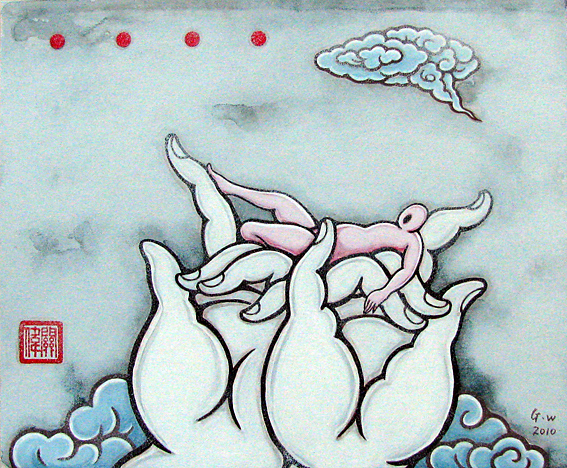
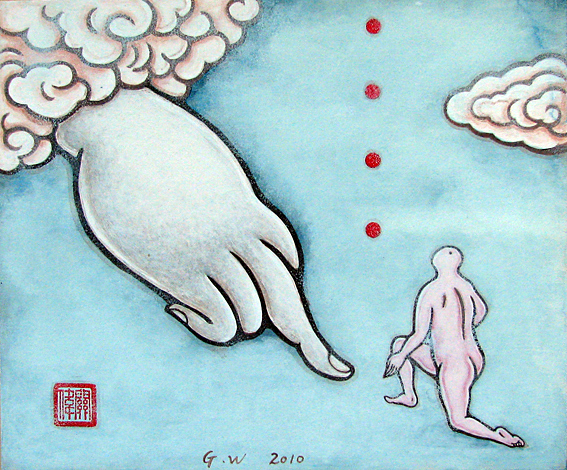
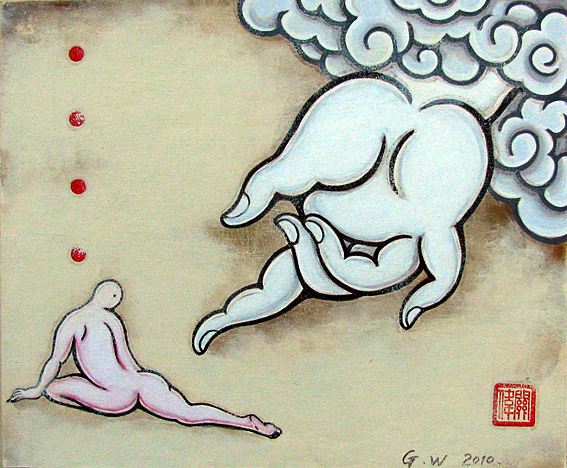
The small Buddha’s Hand paintings (see below) are the most delicate of creatures – sensual, poetic almost fetishistic in their composition and utterly beguiling in their beauty. Referencing the history of cave paintings of the Buddha, Wei updates the ancient allegories expressing his message of harmony and leisure, identity and place through visual symbolic representation. These works are profoundly moving, the figurative compositions balanced masterfully through colour, shape and form, studded with the punctum of red bindi-like energy centres arising from the faceless yogic figures.
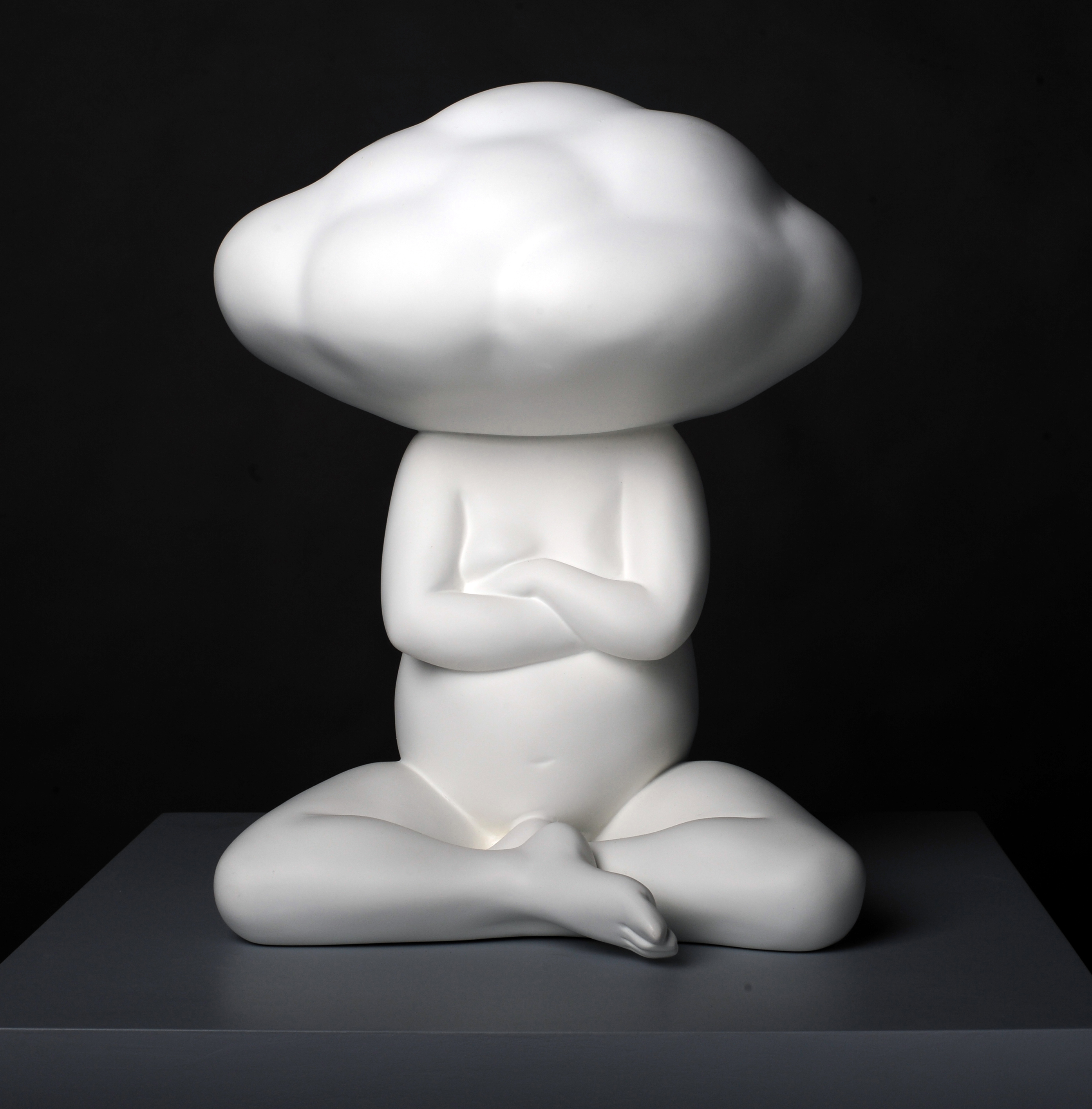
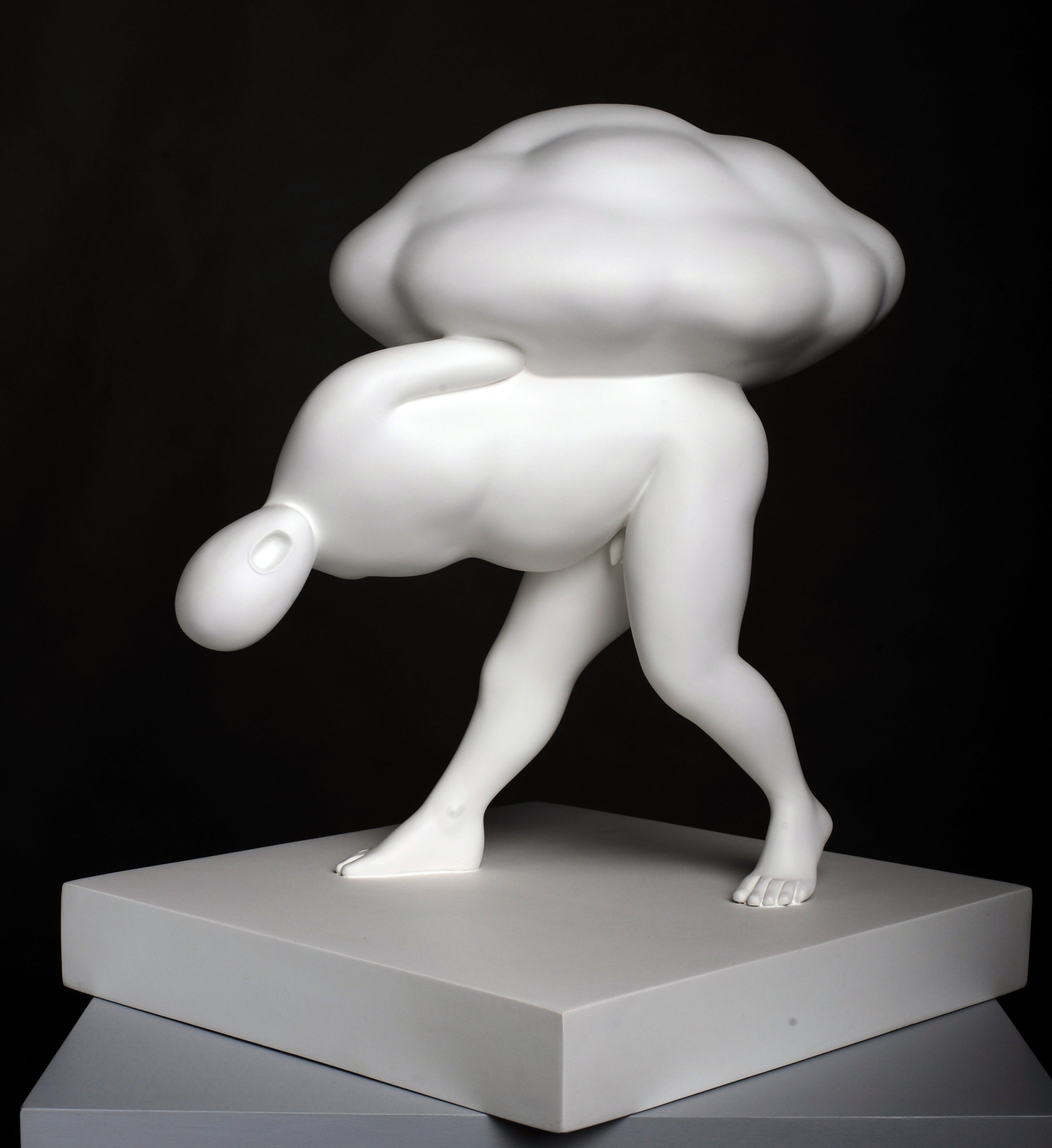
Sitting on white pedestals and positioned close to the Buddha’s Hand paintings in the gallery are the series of five Cloud figures (see below). Made of bronze that has been spray painted white these are wonderful sculptures, full of delicious humour and vibrancy. There is a sensuality and delicacy about the figures that is emphasised by their snowy whiteness, a whiteness that subverts the tactility, colour and weight that one usually associates with the metal bronze. Here the figure has, variously, it’s head in the clouds while pensively crossing arms; bearing the weight of the world on the back while the vacant mouth is open; preparing to throw the cloud as Zeus would a thunderbolt; reclining while balancing the cloud on one foot and with one foot stuck in the earth that is cloud. The cloud becomes a metaphor for thought and action in the world, acting on the world. In these sculptures there is no creed nor race, no ideology or nation and I believe that Wei attains his stated aim to redefine our relationship with one another and nature by transcending both. I am not alone in liking these sculptures – they have proved very popular and all five sculptures in editions of five have already sold out!
Other work in the exhibition is more prosaic – a multi-panelled screen, the On Cloud and Zodiac series never seem to breathe the same rarefied air as the above two bodies of work. They are disappointments that only serve to illuminate how brilliant holding the Buddha’s hand and living your life with your head in the clouds can be.
Dr Marcus Bunyan
Many thankx to Angela Connor and Arc One Gallery for allowing me to reproduce the photographs in the posting. Please click on the photographs for a larger version of the image.
Guan Wei (China, b. 1957) Buddha’s hand 2010
Guan Wei (China, b. 1957) Buddha’s hand 2010
“I hope that we will be able to transcend the restrictions imposed on us by such notions as nation, ethnicity, ideology, cultural and history, and redefine our relationship with one another and nature.”
Guan Wei
Guan Wei is an adept storyteller who masterfully engages his audiences. Retaining the humour, wisdom and cross-cultural knowledge that have become characteristics of his ongoing oeuvre, his work breathes an awareness of our current social and environmental dilemmas exploring ideas of immigration, colonisation, identity politics and cultural tolerance.
Flirtatious and aesthetically whimsical, Guan Wei’s works are instantly recognisable. In this latest exhibition, Cloud, Guan Wei fuses sculpture, drawings and paintings to form what is part of his most beguiling trademark – ‘the art of idleness’. For the first time since returning to China, he will present new sculptures that employ his ongoing preoccupation with the figure and the figure in relation to the natural form. These sculptures are Guan Wei’s personal visual symbols of harmony and leisure. They form the thread for the four series of works in this exhibition.
During the past fifteen years, Guan Wei has help change the identity of Australian Art. He draws on his own experience as a Chinese national who migrated to Australia from China in the period following the Tiananmen Square massacre (1989). Guan Wei has spent twenty years living and working as an artist raising the awareness of Australia being a multicultural country. He has had over 40 solo exhibitions, been the recipient of numerous awards and included in every major collection. In 2009, Guan Wei was selected for the prestigious Clemenger Contemporary Art Award at the National Gallery of Victoria.
Press release from the Arc One Gallery website [Online] Cited 10/06/2010 no longer available online
Guan Wei (China, b. 1957) Cloud No.4 2009 Bronze statue edition of 5 39 x 30 x 25cm
Guan Wei (China, b. 1957) Cloud No.5 2009 Bronze statue edition of 5 47 x 35 x 35cm
Arc One Gallery 45 Flinders Lane Melbourne, 3000 Phone: +61 3 9650 0589
Artists: Lionel Bawden, Penny Byrne, Nicholas Folland, Locust Jones, Rhys Lee, Rob McHaffie, Derek O’Connor, Alex Spremberg, Madonna Staunton
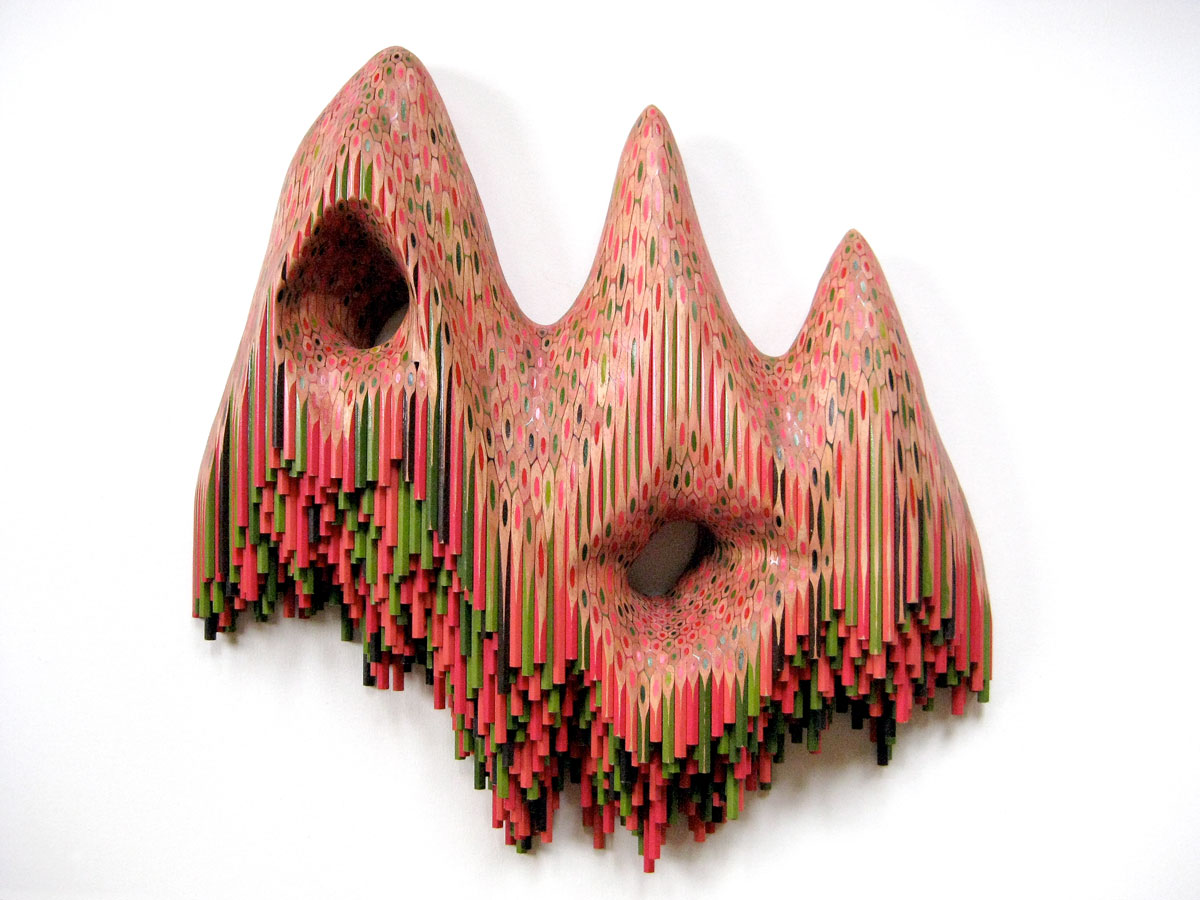
Lionel Bawden (Australian, b. 1974) formless worlds move through me 2010 Coloured Staedtler pencils, epoxy, incralac 51.0 x 51.0 x 9.5cm
Some good work in this exhibition – especially the Staedtler hexagonal coloured pencil constructions by Lionel Bawden. Beautifully crafted by hand they remind me of ghosts, the ‘millefiori’ (thousand flowers) of Italian glass and the inside of caverns with their stalactites.
Dr Marcus Bunyan
Many thankx to the Karen Woodbury Gallery for allowing me to publish the photographs in the posting. Please click on the photographs for a larger version of the image.
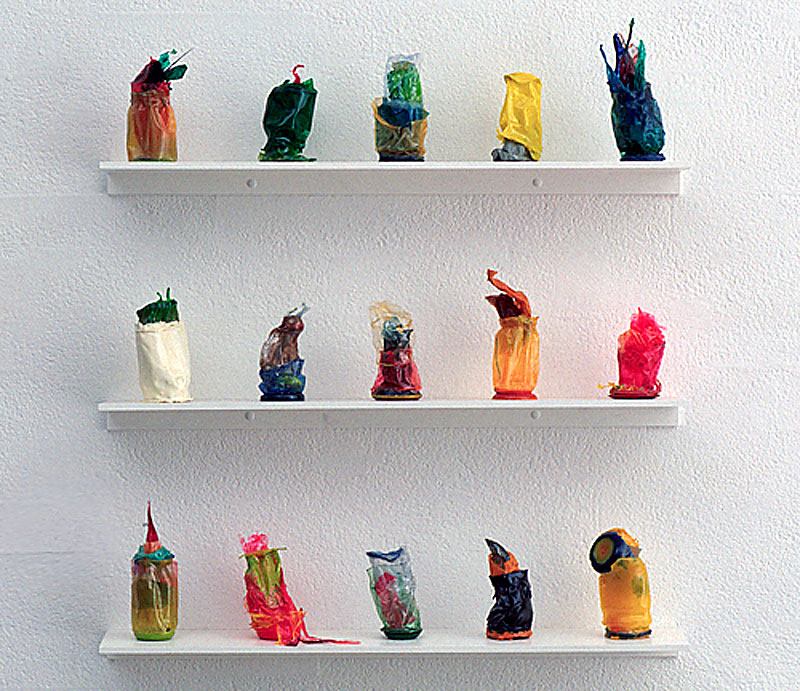
Alex Spremberg (Australian born Germany, b. 1950) Inside skins 2002
These artists have been selected for their interest in ideas of assemblage and re-use of pre-existing materials. Working across a range of media, each artist in the exhibition employs a process of manipulation to create completely different concepts and forms with their finished works. These works comprise of found objects and assembled from disparate elements, scavenged or foraged by the artists and juxtaposed in inventive ways. All works included in The Navigators take on their own form and imbue a new meaning to the original source materials.
Not originally intended as art materials, yet these artists have seen potential for a new idea in the materials; creating a new thought for the object. The original useful element of the preformed material thus comes under more aesthetic and creative significance. The impetus for such artistic practice is located in a desire by these artists to re-use, re-model, reshape and recycle within their practices. Despite an obvious interest and emphasis in the materiality of the works, the conceptual underpinning are the key motivation within these varying works and pose questions regarding the value of the objects within society. The artists included in The Navigators are continuously surveying and navigating their practice, allowing for deeper exploration in their work.
The exhibition will include various two and three-dimensional objects that interact with each other in unique ways. In the example of Lionel Bawden’s sculptures, his work exploits hexagonal coloured pencils as a sculptural material, reconfiguring and carving into amorphous shapes. Here the rich qualities of colour are explored as pencils are carved, shaped and fused together. Bawden explores themes of flux, transformation, rhythm and repetition as preconditions to our experience of the physical world. Bawden’s wall mounted works ‘the caverns of temporal suspension’ explore shapes within and outside the work as they hover ominously, melting, conjoined, growing, in transformation. These works are at the forefront of his current practice.
Penny Byrne’s work makes use of vintage porcelain sculptures that are adorned with a range of materials. Through this process, Byrne makes the base sculptures appear starkly different to that of the original, taking on new connotations that are often humorous and quirky but also convey political and social issues. In her work Mercury Rising. Hunted, Slaughtered, Eaten vintage porcelain dolphins and new plastic Manga figurines are employed to relate to the annual Japanese slaughter of tens of thousands dolphins as highlighted in the documentary ‘The Cove’. The Japanese eat the dolphins and then suffer mercury poisoning due to the high mercury levels in the dolphins flesh, leading to symptoms of madness.
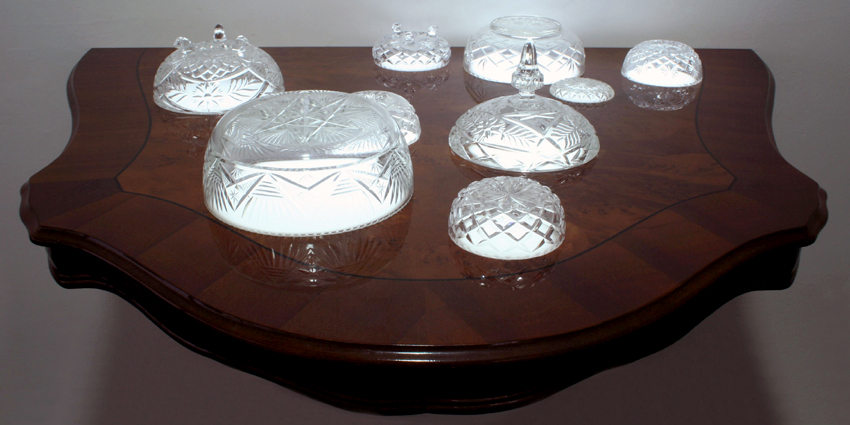
Nicholas Folland’s Navigator sculptures are indicative Folland’s continued interest in utilising, modifying and experimenting with various sourced materials. These sculptures comprise of various upturned intricately detailed crystal objects that sit above a wood panelled shelf. These glass object are lit and act as beacons or floating satellite cities. Folland personifies the intrepid creative explorer via his navigation of various found materials.
Locust Jones’ three-dimensional globes are made from papier mache and pictorially and graphically convey global issues. These works sit on the floor and allow the viewer to orient themselves around the works allowing for a detached, objective perspective on contemporary societal issues. The quickly worked surfaces reflect a stream of consciousness in process. Imagery and themes are taken from various media such as the Internet, photojournalism, film culture and nightly news broadcasts.
The two sculptures in the exhibition by Rhys Lee imbue associations of debris and deal with found objects such as a money box, a dead bird and a clowns face. These trophy-like pieces are decorated by old, worn and found vintage materials that engage with the everyday. The intimate scale of these works do not account for the potency of symbolism and accumulation of collected ideas. The blistered silver patina and bronze sculptures allude to a dark gothic sentiment that extends beyond the morphing forms. The shapes have been smashed, manipulated and stuck back together again resulting in frozen miniature icons that represent a contemporary zest for defiance.
Rob McHaffie’s works comprise a pastiche of painted anonymous unrelated objects and shapes that somehow come together to create unlikely compositions and formations. The highly skilled execution of McHaffie’s paintings attracts the viewer, who is then faced with a banality in subject matter, often of depictions of clothing, crumpled paper, plants and disfigured creatures and figures. These perfectly rendered images of everyday objects are unsettling in their clarity and realism, which are then skewed, moulded and displaced in unlikely relationships. There is a sense of a deliberate haphazard nature to McHaffie’s work that draws upon a range of elements brought together to mimic something else. Humour surfaces through this stylistic creative process.
Derek O’Connor’s re-worked painting collages resemble distorted and fragmented realities and stories via the manipulation and playful technique of alteration and re-use of book covers and record album and EP covers. O’Connor’s characteristic gestural sweeping luscious brushstrokes are employed with precision yet allow for organic spontaneity. The old material takes on new meaning and are given new life via O’Connor’s creations.
Alex Spremberg’s work Inside Skins highlights the artist’s accidental processes at work. This sculptural piece was made as an ancillary to his broader practice – working with acrylic, enamel and varnish on board and canvas. These objects where literally created via chance – an after thought that was noticed to be a finished piece in its own right. Left to dry within their containers these ‘skins’ were extracted and proved to provide aesthetic attraction and conceptual ideas of the ready-made.
The mainstay of Madonna Staunton’s practice surrounds the physicality of assemblage. Essentially she is a collage artist. The components of her two- and three-dimensional assemblages are usually drawn from old, faded and battered discards such as frames and chairs that are carefully put together in new ways and given another life. A play between precision and randomness animates her work. Her sensitivity to tonal and formal arrangement always remains acute during this process and the results are austerely and chaotically beautiful.
Press release from the Karen Woodbury Gallery website [Online] Cited 20/05/2010 no longer available online
Nicholas Folland (Australian, b. 1967) Navigators 1 2008 Glassware, table and lightbox 25.0 x 110.0 x 87.0cm
Nicholas Folland (Australian, b. 1967) Navigators 2 2008 Glassware, table and lightbox 25.0 x 110.0 x 87.0cm
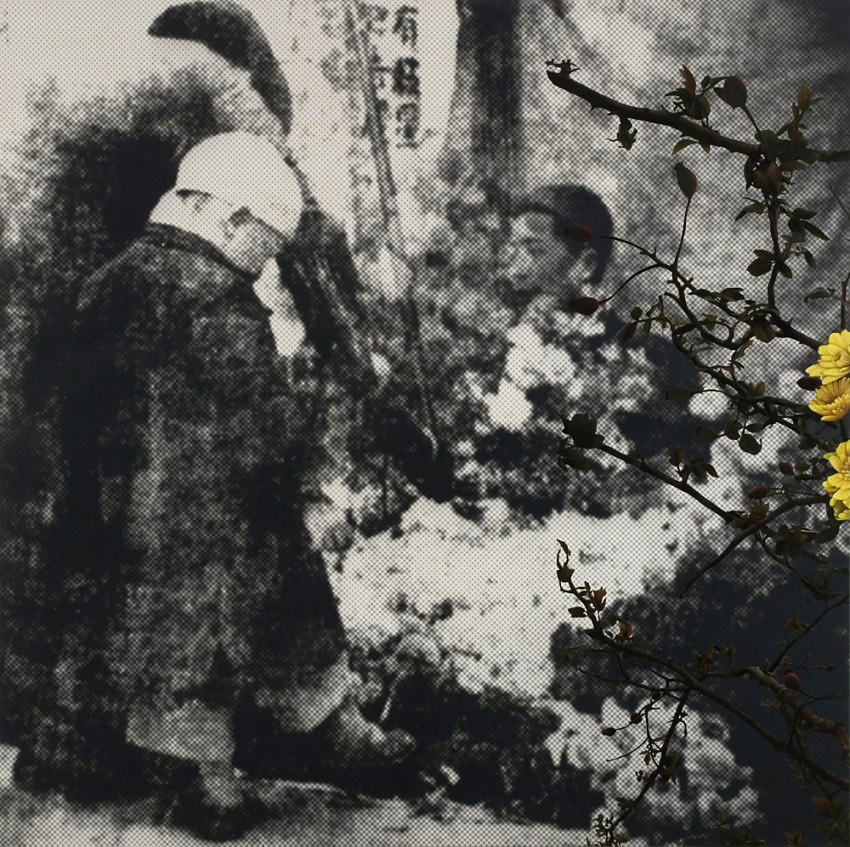
John Young (Australian born Hong Kong, b. 1956) Flower Market (Nanjing 1936) #2 2010 Digital print and oil on Belgian linen 240 x 331cm image courtesy of the artist and Anna Schwartz Gallery
What can one say about work that is so confronting, poignant and beautiful – except to say that it is almost unbearable to look at this work without being emotionally charged, to wonder at the vicissitudes of human life, of events beyond one’s control.
Simply, this is the best exhibition that I have seen in Melbourne so far this year.
The exhibition tells the story of the massacre of 300,000 people in the city of Nanjing in Jiangsu, China by Japanese troops in December, 1937 in what was to become known as the Nanjing Massacre. It also tells the story of a group of foreigners led by German businessman John Rabe and American missionary Minnie Vautrin who set up a “safety zone” to protect the lives of at least 250,000 Chinese citizens. The work is conceptually and aesthetically well resolved, the layering within the work creating a holistic narrative that engulfs and enfolds the viewer – holding them in the shock of brutality, the poignancy of poetry and the (non)sublimation of the human spirit to the will of others.
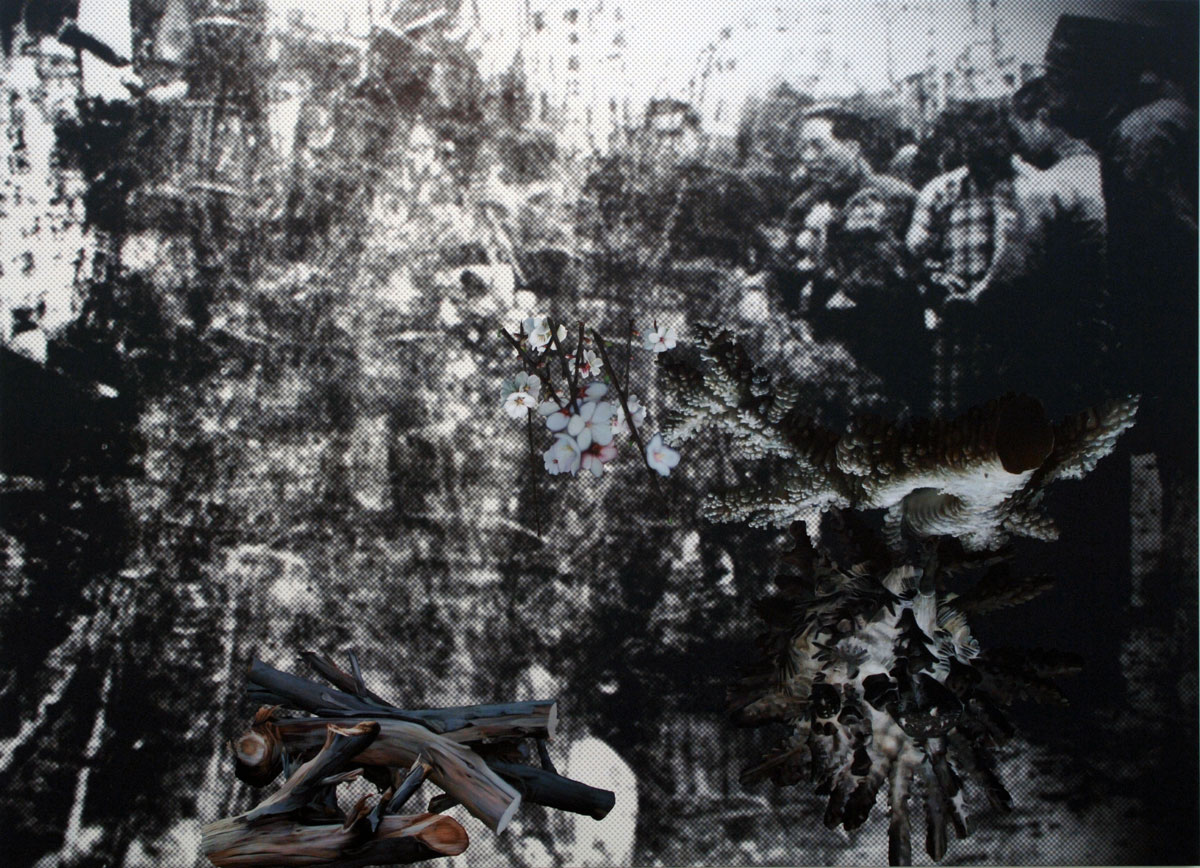
On the left wall of the gallery are three large mixed-media paintings of screen printed photographs of the Nanjing Flower Market taken the year before the massacre (see three images directly below). The printing of the press photographs at such a scale (a la Marco Fusinato) emphasises the dot structure of the photograph, the intensity of a newspaper reality ‘blown up’ to a huge scale. Unfortunately, you cannot see this deconstruction of the image very well in the examples below (clicking on the lower two images to get a larger version will give you a better idea), but believe me it most effective in creating a spatio-temporal distance between the viewer and the image. The dissolution of the image into dots is surmounted by painted cherry blossoms, bleached corals and piles of logs that overlay the photographic text. The reason-ances are sublime. The mind tries to process the distance between the death of the people and the photograph, the knowledge of what is about to happen to them, and the sensuality of the buds and flowers: new life!
To my friend and I the coral in the last painting reminded us both of the emanations of psychic phenomena at a seance, a series of radiations originating in the godhead.
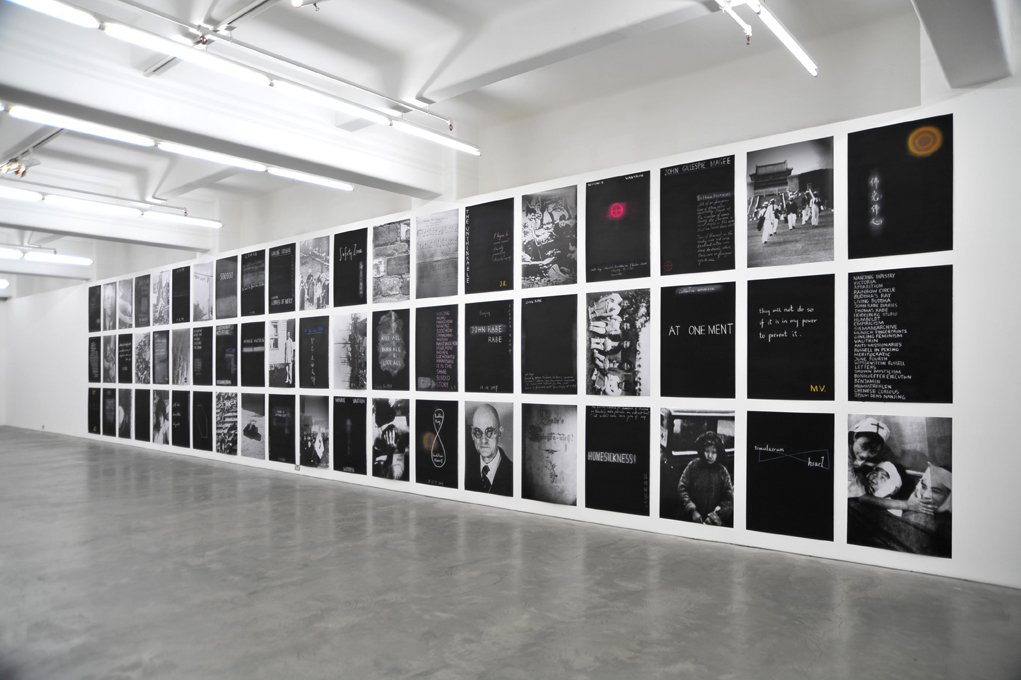
On the right wall of the gallery is a grid of three rows of twenty images that make up the work Safety Zone (2010, see bottom image). Made up of chalk drawings on black paper (a la Rudolf Steiner), writings by the Europeans including Vautrin and Rabe, statistics, gruesome photographs of the massacre and observations by the artist, this is in part both a confronting and benevolent work.
Archival photographs are printed digitally (the dot structure working to less affect here); some vertical photographs are shown horizontally. Text written in chalk is erased with a sweep of the hand. Thoughts of the Buddha, the infinity symbol linked to the Buddha’s Ray and the Buddha’s Heart are a physical presence. Two blue chalk lines intersect and cross over, so poignant and sublime amongst the destruction that surrounds. Golf clubs, beer bottles, bayonets.
‘THERE IS NOTHING LEFT’ 13.12.37 (Robert Wilson)
‘HOME SICKNESS’
‘Simulacrum > Heart’
A simply drawn coffin shape on black ground
‘I began to roam around the city preventing further atrocities myself’
‘They will not do so, if it is in my power to prevent it’ (Minnie Vautrin)
UNSPEAKABLE ACTS OF EVIL … BECOMING BANAL
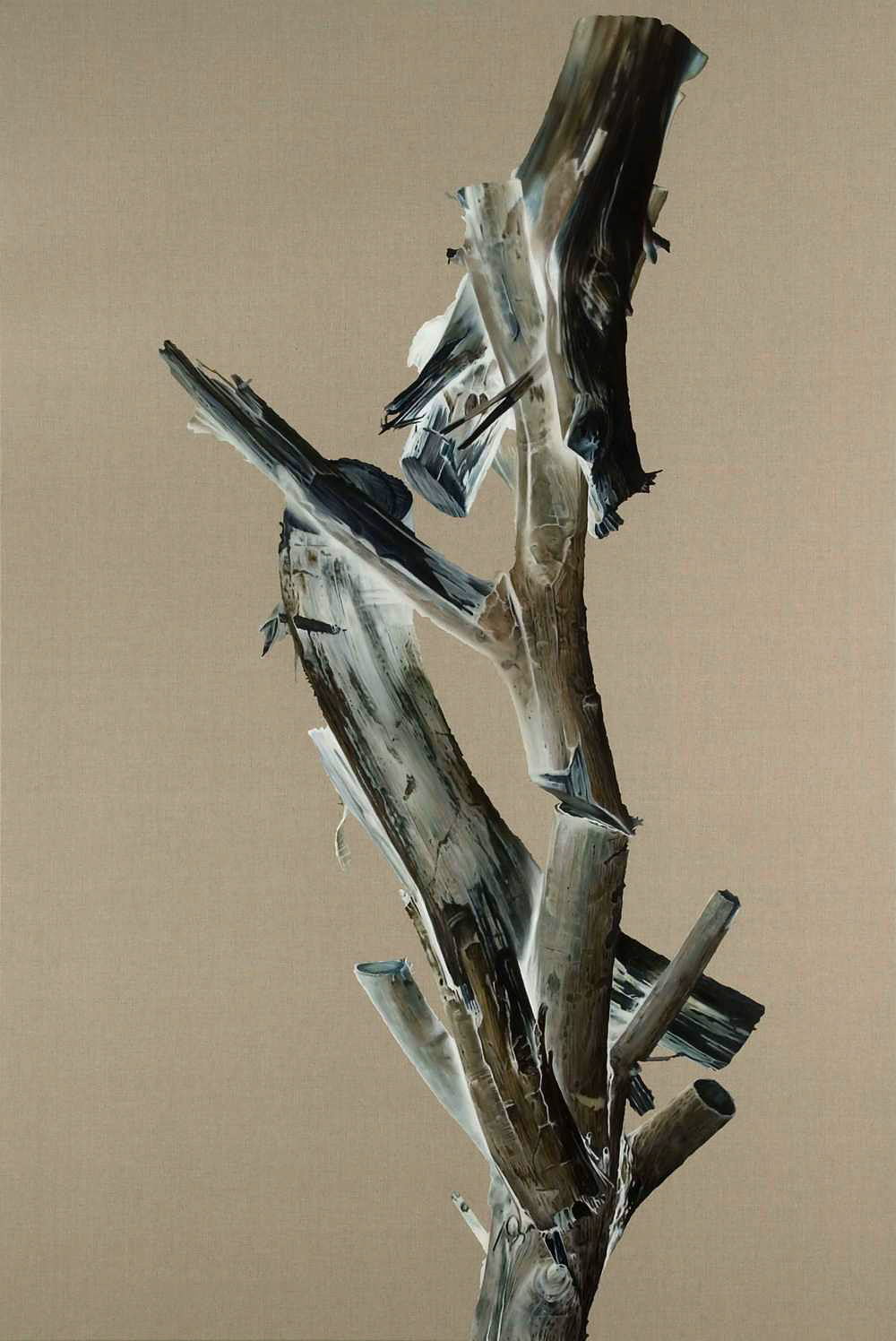
At both ends of the gallery is the last element in this play of hope, mutability and madness. Two large oil-on-linen paintings, titled The Crippled Tree #1 & #2 (see images below) “provide another register to the memory of the event. According to Young, the battered and split logs, painted in the negative, resonate and recollect the violence done to the victims of the massacre.” Unfortunately the two small images below cannot really give you an idea of the metaphorical power of these paintings. Like twisted and broken bodies larger than life size they become the glue that holds the other elements of the exhibition together. Without them there would be no transition from one side of the gallery, one element of the work to another. In their solarisation they emote an energy that flows down the length of the gallery = is this possible? Yes it is!
You feel the cracking of their branches, the amputation of their limbs but their spirit, their efflorescence (which, most appropriately considering the use of the Flower Market photographs, means “to flower out” in French) shines on. Such is the nature of the human spirit. Take the time and see this work. It is well worth the journey.
Dr Marcus Bunyan
Many thankx to the artist, Serena Bentley and Anna Schwartz Gallery for allowing me to reproduce the images in the posting. Please click on the photographs for a larger version of the image.
John Young (Australian born Hong Kong, b. 1956) Flower Market (Nanjing 1936) #3 2010 Digital print and oil on Belgian linen 240 x 331cm image courtesy of the artist and Anna Schwartz Gallery
John Young (Australian born Hong Kong, b. 1956) Flower Market (Nanjing 1936) #1 2010 digital print and oil on Belgian linen 240 x 331cm image courtesy of the artist and Anna Schwartz Gallery
Safety Zone, John Young’s latest project presents a series of intricate paintings that reassemble historical reminiscences of human survival by linking experimental contemporary art with investigative visual reports, in historical photographs and documents.
This body of work draws attention to incidents across the city of Nanjing in Jiangsu, China, just moments before the onset of the Nanjing Massacre, which followed the capture of the city by Japanese Imperial Forces on 13 December 1937. In the six weeks following the invasion, a quarter of a million Chinese citizens were killed in what the American historian Iris Chang described as the ‘forgotten holocaust of World War II’.
Through Chang’s book, The Rape of Nanking, the world was introduced to the personal memoirs of foreigners living in Nanjing who had been working on creating a ‘safety zone’ that would protect 250,000 Chinese citizens from the invading Japanese troops. Two of the twenty-one foreigners who stayed in the city to help set up the Nanjing Safety Zone were the American missionary Minnie Vautrin and the German businessman John Rabe. Their experiences have been noted by Young, who travelled to Nanjing, Berlin and Heidelberg, conducting first hand interviews and research for this compelling multi-layered project which exemplifies the transformative function of art.
The installation Safety Zone consists of three series of works which reference acts of resistance by individuals to protect fellow human beings against these atrocities that were underpinned by autocratic regimes and nationalist ideologies.
In the Flower Market (Nanjing 1936) series, carefully painted spring flowers and bleached corals are superimposed over historical photographs taken in Nanjing a year prior to the massacre. The meticulously rendered impressions of logs in The Crippled Tree #1 & #2 provide another register to the memory of the event. According to Young, the battered and split logs, painted in the negative, resonate and recollect the violence done to the victims of the massacre.
The carefully assembled bank of 60 chalk drawings and digital prints that make up the centerpiece of Safety Zone provides an intricate understanding of the humanity that lies beneath this tragic event through the revelation of extraordinary acts of self-sacrifice.
Dr Thomas J. Berghuis Department of Art History and Film, The University of Sydney
John Young (Australian born Hong Kong, b. 1956) The Crippled Tree #1 2010 Oil on linen 274 x 183cm image courtesy of the artist and Anna Schwartz Gallery
John Young (Australian born Hong Kong, b. 1956) The Crippled Tree #2 2010 Oil on linen 274 x 183cm image courtesy of the artist and Anna Schwartz Gallery
John Young (Australian born Hong Kong, b. 1956) Safety Zone (installation view) 2010 60 works, digital prints on photographic paper and chalk on blackboard-painted archival cotton paper Image courtesy of the artist and Anna Schwartz Gallery
Anna Schwartz Gallery 185 Flinders Lane Melbourne, Victoria 3000
Many thankx to the Metropolitan Museum of Art for allowing me to publish the images in this posting. Please click on the photographs for more information about the images from the Metropolitan Museum of Art.
Dr Marcus Bunyan
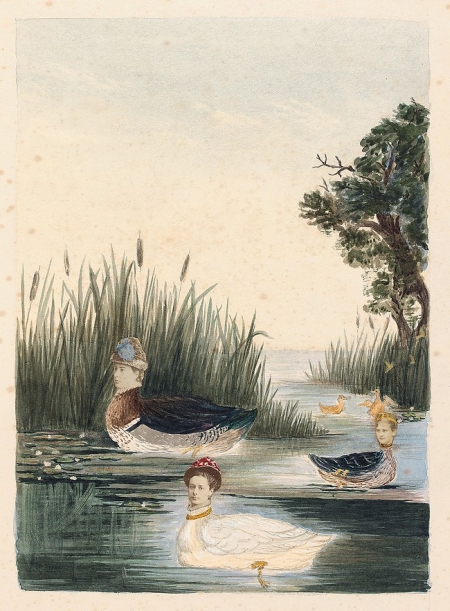
Kate Edith Gough (English, 1856-1948) Untitled page from the Gough Album Late 1870s Collage of watercolour and albumen silver prints 14 5/8 x 11 5/8 in. (37 x 29.5cm) V&A Images / Victoria and Albert Museum, London
Kate Gough was one of fourteen children born to the wealthy businessman Thomas Rolls Hoare and his wife, Emma. Although the Hoares possessed neither title nor land, their vast accumulated fortune allowed them to emulate the aristocratic lifestyle, renting a Sussex estate and dividing their time between the country and the city, where they enjoyed a variety of cultural amusements. Kate read widely, from Charles Dickens to Punch magazine, while also learning such feminine accomplishments as sketching and china painting. In 1878 she met Hugh Gough, a lieutenant in the Royal Navy. The couple married in January 1879 and lived the peripatetic life that Lieutenant Gough’s service and their lack of children enabled. Gough probably assembled her album during her courtship and early years of marriage.
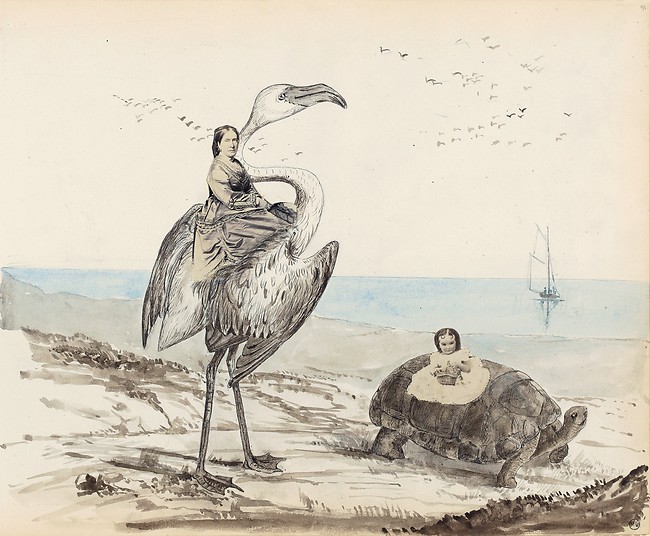
A remarkable number of images found in photocollage albums combine humans and animals in fantastical ways; the temptation to cut out a photographed head and place it atop a painted animal seems to have been irresistible. This composition of ducks bearing ladies’ faces – one of them Kate herself, or her identical twin sister, Grace – may have been inspired by Charles Darwin’s new theories of evolution or by political cartoons from magazines such as Punch. On other pages of the Gough Album as well, an irreverent humor, disorienting scale shifts, mischievous visual puns, and whimsical fantasies reveal a sophisticated mind and very accomplished hand.
Text from The Metropolitan Museum of Art website
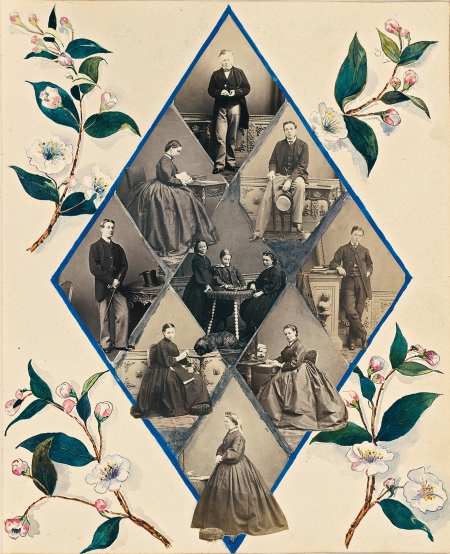
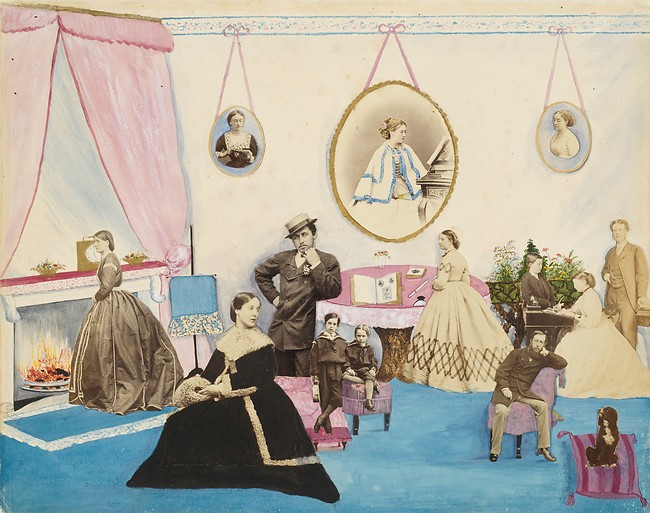
Frances Elizabeth, Viscountess Jocelyn (English, 1820-1880) Diamond Shape with Nine Studio Portraits of the Palmerston Family and a Painted Cherry Blossom Surround from the Jocelyn Album 1860s Collage of watercolour and albumen silver prints 11 x 9 1/8 in. (28 x 23.2cm) National Gallery of Australia, Canberra
The daughter of the exceedingly wealthy Peter Clovering-Cowper, Earl Cowper, and the legendary society hostess Emily Lamb, Countess Cowper, Viscountess Jocelyn was born into a life of privilege and social connections. When her mother remarried after her father died, Frances (known as Fanny) became the stepdaughter of Henry Temple, Viscount Palmerston, who would become the prime minister in 1855. Fanny also garnered the favor of Queen Victoria, serving as a bridesmaid at her wedding to Prince Albert and later as a Lady of the Bedchamber. In 1841 she wed Robert, Viscount Jocelyn, and bore six children over the next decade. Her husband died in 1854, and she lost each of her children to illness before her own death in 1880.
Unlike the other album makers in this exhibition, Jocelyn practiced amateur photography, using the wet-collodion process, a cumbersome technique that required time, money, education, and skill. A separate section of this album, entitled The Bygone Hours of the Viscountess Jocelyn, features nine photographs that she made of herself and her children in the garden of their estate. Most of the pages in the album, however, are photocollages employing amateur photographs and commercial cartes de visite in highly skilled watercolour designs that honour her aristocratic lifestyle, depicting family and friends, the estates they owned or visited, the jewellery and finery they wore, and the various pastimes they enjoyed.
Text from The Metropolitan Museum of Art website
The Johnstone Album represents the appropriation by the commercial printing press of an activity that was originally aristocratic and handmade. Here the grids are commercially printed and the collage maker need only paste within the shapes, offering the opportunity for those with less leisure time to create similar family albums.
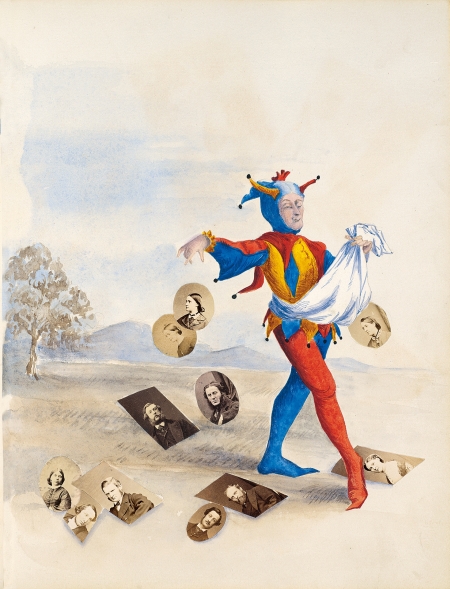
Maria Harriet Elizabeth Cator (English, d. 1881) Untitled page from the Cator Album Late 1860s/1870s Collage of watercolour and albumen silver prints 10 7/8 x 8 1/2 in. (27.7 x 21.7cm) Hans P. Kraus, Jr., New York
Maria Harriet Elizabeth Cator, the likely maker of this album, filled its pages in the 1860s and 1870s with scenes of her childhood home, portraits of family members, and commemorative collages memorializing her father, who died in 1864, and a young niece who died as a child in 1866. Family mottoes and photographs of country seats belonging to relatives appear throughout the album, suggesting that it was intended more for family than for society. Set among all this seriousness, this image of a playful jester carelessly strewing photographs on the ground is surprising. Instead of serving as mementos of a loved one or records of an ancestral home, the jester’s photographs are stripped of symbolic meaning and used in the service of a lighthearted composition.
Text from The Metropolitan Museum of Art website
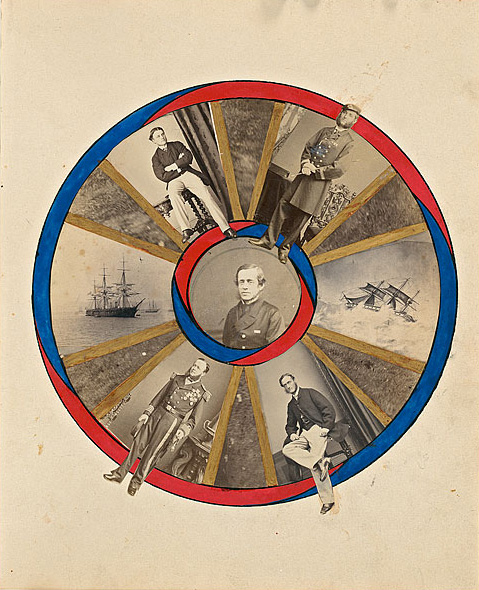
Viscount Jocelyn (Great Britain, 1820-1880) attributed to Circular design containing five male studio portraits and two ships c. 1860 Leaf 3 from an Untitled Album Collage (albumen silver photographs, water colour, pencil) Printed image 28.0 h x 23.2 w cm Purchased 1985 National Gallery of Canberra
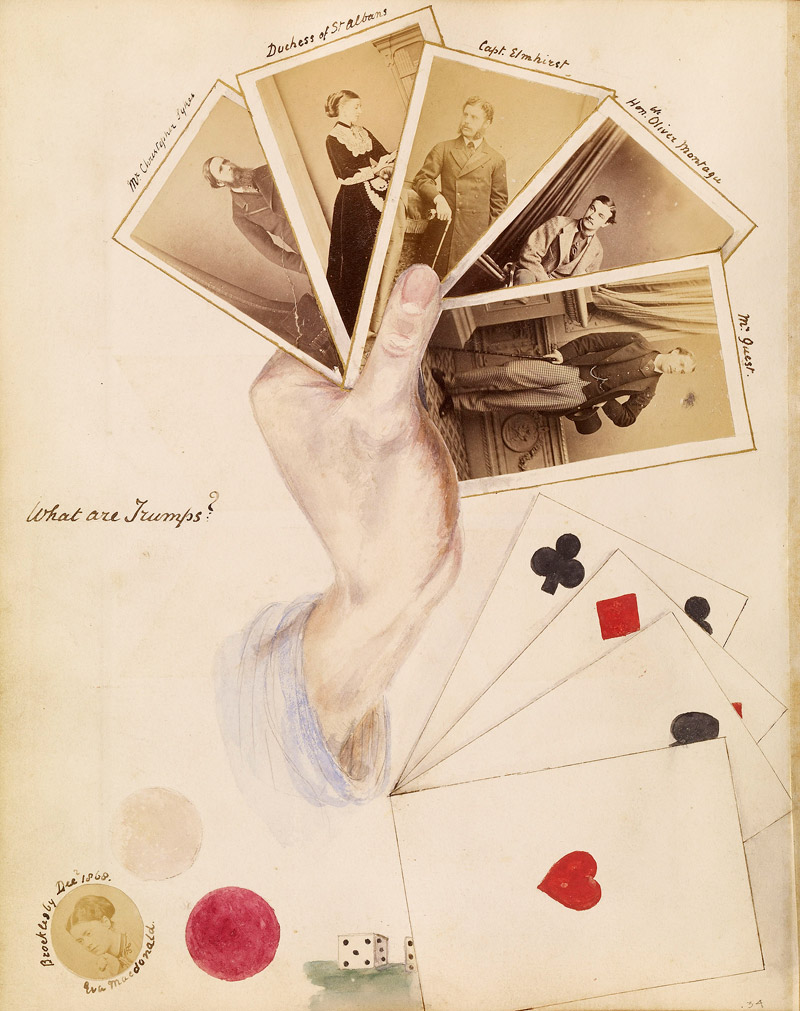
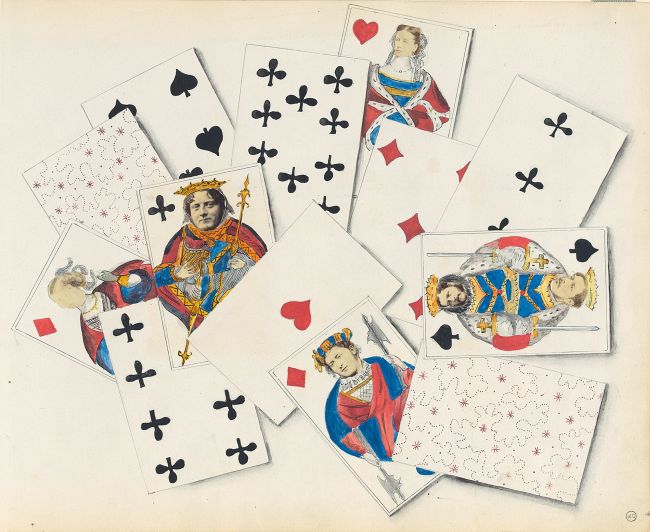
Eva Macdonald (English, 1846/1850-?) “What Are Trumps?,” from the Westmorland Album 1869 Collage of watercolour and albumen prints The J. Paul Getty Museum, Los Angeles
A common leisure pastime in Victorian high society, card playing provided opportunities for socializing and flirting. Compositions involving cards are commonly found in photocollage albums, as if to emphasise the playfulness of the process of making such images. In many of these collages, photographic portraits replace the heads of kings and queens, elevating the subjects in rank and giving new meaning to the term “face cards.”
Text from The Metropolitan Museum of Art website
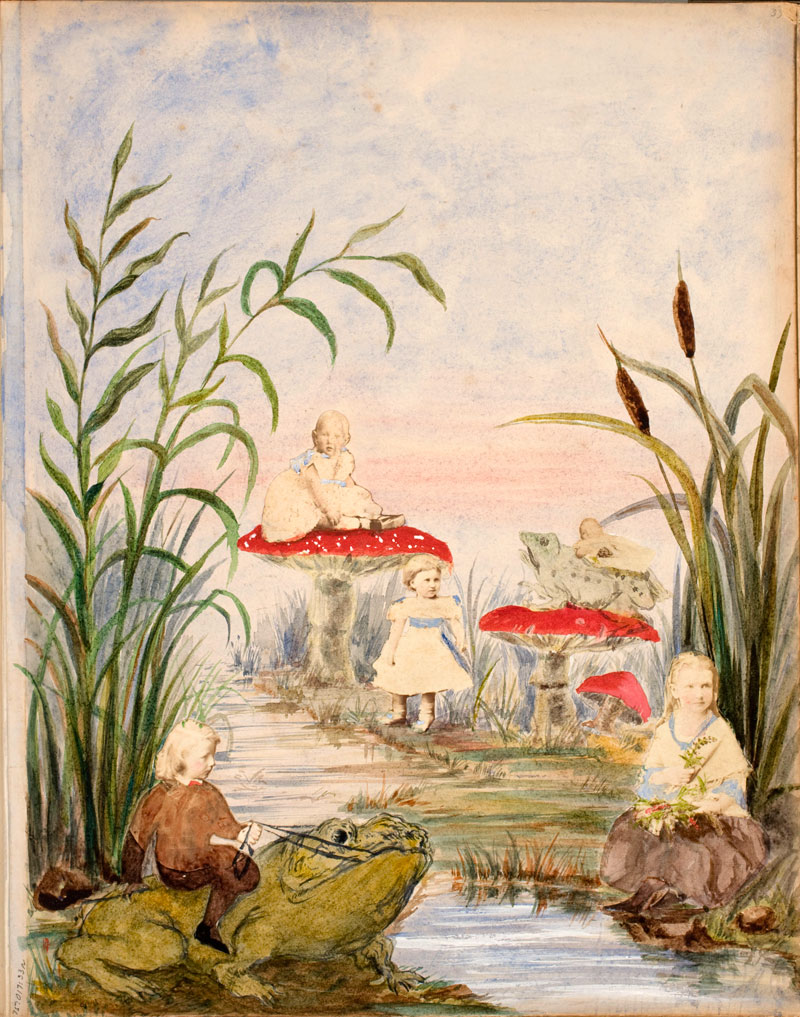
Elizabeth Pleydell-Bouverie (English, d. 1889) and Jane Pleydell-Bouverie (English, d. 1903) or Ellen Pleydell-Bouverie (English, 1849-?) and Janet Pleydell-Bouverie (English, 1850-1906) Untitledpage from the Bouverie Album 1872/1877 Collage of watercolour and albumen prints Courtesy of George Eastman House, International Museum of Photography and Film
Popular children’s tales by the Brothers Grimm, Hans Christian Anderson, and Lewis Carroll became fertile material for photocollages, including this one, which appears to relate the story of Thumbelina. Although the identity of the maker of this collection remains a mystery, the initials E.P.B. and J.P.B and the name Bouverie on various pieces suggest that it belonged to the Pleydell-Bouverie family.
Text from The Metropolitan Museum of Art website
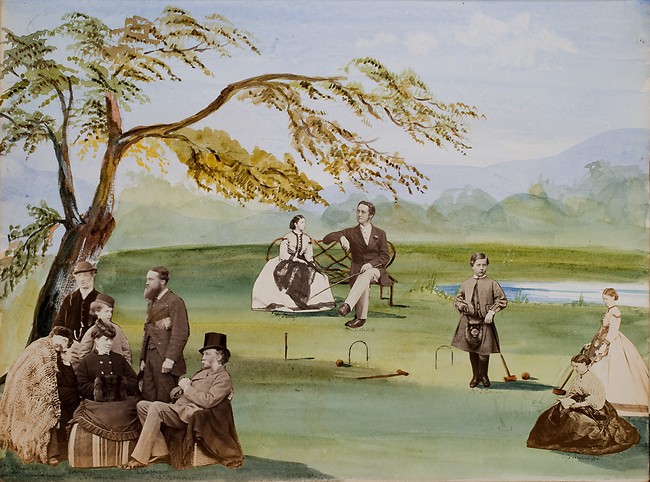
In the 1860s and 1870s, long before the embrace of collage techniques by avant-garde artists of the early 20th century, aristocratic Victorian women were experimenting with photocollage. Playing with Pictures: The Art of Victorian Photocollage, on view at The Metropolitan Museum of Art February 2 – May 9, 2010, is the first exhibition to comprehensively examine this little-known phenomenon. Whimsical and fantastical Victorian photocollages, created using a combination of watercolour drawings and cut-and-pasted photographs, reveal the educated minds as well as accomplished hands of their makers. With subjects as varied as new theories of evolution, the changing role of photography, and the strict conventions of aristocratic society, the photocollages frequently debunked stuffy Victorian clichés with surreal, subversive, and funny images. Featuring 48 works from public and private collections – including many that have rarely or never been exhibited before – Playing with Pictures will provide a fascinating window into the creative possibilities of photography in the 19th century.
“In other recent exhibitions at the Metropolitan, we’ve shown masterpieces of 19th-century British photography by the period’s most prominent professionals and serious amateurs (almost always men), whose works were often displayed at the annual salons of the photographic societies and sold by printsellers throughout England and Europe,” commented Malcolm Daniel, Curator in Charge of the Department of Photographs. “What is so exciting about this exhibition is that we see a different type of artist – almost exclusively aristocratic women – using photography in highly imaginative ways, and creating pictures meant for private pleasure rather than public consumption. It is an aspect of photography’s history that has rarely been seen or written about.”
In England in the 1850s and 1860s, photography became remarkably popular and accessible as people posed for studio portraits and exchanged these pictures on a vast scale. The craze for cartes de visite – photographic portraits the size of a visiting card – led to the widespread hobby of collecting small photographs of family, friends, acquaintances, and celebrities in scrapbooks. Rather than simply gathering such portraits in the standard albums manufactured to hold cartes de visite, the amateur women artists who made the photocollages displayed in Playing with Pictures cut up these photographic portraits and placed them in elaborate watercolour designs in their personal albums.
With sharp wit and dramatic shifts of scale akin to those Alice experienced in Wonderland, Victorian photocollages stand the rather serious conventions of early photography on their heads. Often, the combination of photographs with painted settings inspired dreamlike and even bizarre results: placing human heads on animal bodies; situating people in imaginary landscapes; and morphing faces into common household objects and fashionable accessories. Such albums advertised the artistic accomplishments of the aristocratic women who made them, while also serving as a form of parlour entertainment and an opportunity for conversation and flirtation with the opposite sex.
Playing with Pictures showcases the best Victorian photocollage albums and loose pages of the 1860s and 1870s, on loan from collections across the United States, Europe, and Australia, including the Princess Alexandra Album lent by Her Majesty Queen Elizabeth II. Thirty-four photocollage album pages will be shown in frames on the wall and 11 separate albums will be displayed in cases, open to a single page. These works will be accompanied by “virtual albums” on computer monitors that allow visitors to see the full contents of the albums displayed nearby. As an introduction, the exhibition also includes two carte-de-visite albums of the period and a rare uncut sheet of carte-de-visite portraits from 1859.
Playing with Pictures: The Art of Victorian Photocollage is curated by Elizabeth Siegel, Associate Curator of Photography at The Art Institute of Chicago. The exhibition is organised at the Metropolitan Museum by Malcolm Daniel.
Ann Bermingham, professor, Department of the History of Art and Architecture, University of California, Santa Barbara
Sixty years before the embrace of collage techniques by avant-garde artists of the early twentieth century, aristocratic Victorian women were already experimenting with photocollage. The compositions they made with photographs and watercolours are whimsical and fantastical, combining human heads and animal bodies, placing people into imaginary landscapes, and morphing faces into common household objects. Such images, often made for albums, reveal the educated minds as well as the accomplished hands of their makers. With sharp wit and dramatic shifts of scale akin to those Alice experienced in Wonderland, these images stand the rather serious conventions of early photography on their heads. The exhibition features forty-eight works from the 1860s and 1870s, from public and private collections.
Text from the YouTube website
Society Cut-ups: Victorians and the Art of Photocollage
Elizabeth Siegel, Associate Curator of Photography, The Art Institute of Chicago
Sixty years before the embrace of collage techniques by avant-garde artists of the early twentieth century, aristocratic Victorian women were already experimenting with photocollage. The compositions they made with photographs and watercolors are whimsical and fantastical, combining human heads and animal bodies, placing people into imaginary landscapes, and morphing faces into common household objects. Such images, often made for albums, reveal the educated minds as well as the accomplished hands of their makers. With sharp wit and dramatic shifts of scale akin to those Alice experienced in Wonderland, these images stand the rather serious conventions of early photography on their heads. The exhibition features forty-eight works from the 1860s and 1870s, from public and private collections.
Text from the YouTube website
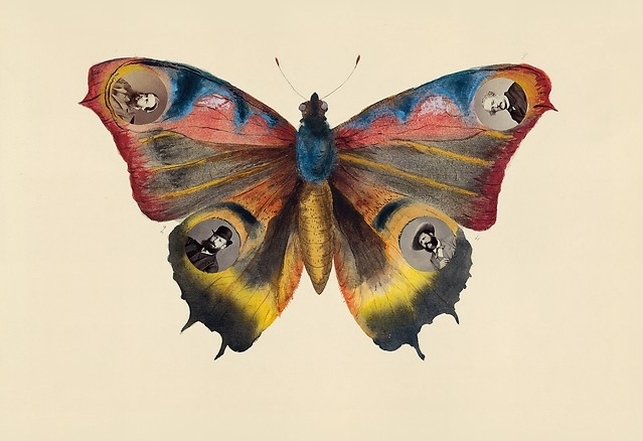
Marie-Blanche-Hennelle Fournier (French, 1831-1906) Untitled page from the Madame B Album 1870s Collage of watercolour, ink, and albumen silver prints 11 1/2 x 16 1/2 in. (29.2 x 41.9cm) The Art Institute of Chicago, Mary and Leigh Block Endowment
Marie-Blanche-Hennelle Fournier probably made the album from which this page was taken. Known as Blanche, she was the second wife of the career diplomat Hugues-Marie-Henri Fournier, who was posted in Stockholm and then in Rome during the years the album was made. Among the clues to the maker’s identity are the large painted B that graces the opening page, the many diplomats and Swedish figures and sites that fill the album, and the frequent depictions of the Fourniers and their daughter, Pauline (born 1855).
Because photocollage albums were almost exclusively made by upper-class English women, this album, with its French maker, is a rare exception. Fournier, however, likely was exposed to English diplomats in the international circles in which she traveled, and she may have been inspired to create her own album after seeing other examples or learning of the practice from her English acquaintances. As the second wife of a diplomat, Fournier may have used her album to help establish herself and her family within a specific social set or to demonstrate her role as a new wife. The album may also have functioned as a sort of travelogue, depicting places she visited or was stationed with her husband. The painted elements reveal that the maker of the album was knowledgeable about the artistic styles of various cultures and skilled in botanical and zoological drawing. Together, the photographs and watercolors often combine to create daring and fantastic compositions, transcending the simple recording of friends, family, and sites.
In the accomplished depiction of a peacock butterfly seen here, the “eye” spots on the wings have been replaced with portraits. Such a composition allowed Fournier to exhibit her artistic talents and her knowledge of natural history.
Text from The Metropolitan Museum of Art website
Georgina Berkeley (English, 1831-1919) Untitled page from the Berkeley Album 1867/71 Collage of watercolour and albumen silver prints 10 x 12 5/8 in. (25.5 x 32cm) Musée d’Orsay, Paris Photo credit: Réunion des Musées Nationaux / Art Resource, NY
Despite her lack of title or inheritance, Georgina Berkeley maintained the sophisticated lifestyle that her ancestry provided. Her collages reveal her fascination with London’s urban pastimes as well as her cutting social commentary.
Text from The Metropolitan Museum of Art website
Georgina Berkeley (English, 1831-1919) Untitled page from the Berkeley Album 1867/71 Collage of watercolour and albumen silver prints 10 x 12 5/8 in. (25.5 x 32cm) Musée d’Orsay, Paris Photo credit: Réunion des Musées Nationaux / Art Resource, NY
As the great-granddaughter of the 4th Earl of Berkeley, Georgina Louisa Berkeley occupied the lower echelon of aristocratic society. Despite her lack of title or inheritance, she maintained the sophisticated lifestyle that her ancestry provided. Georgina and her older sister, Alice, participated in the country-house party circuit, enjoying the hospitality of their many landed and titled relatives. Their home in London’s prestigious Belgravia district also offered them access to the city’s cultural amenities. At age forty-six, Berkeley married a man seven years her junior, Sydney Kerr Buller Atherley, the grandson of the 5th Marquess of Lothian. Sadly, Atherley died just ten months after the wedding. Rather than move back to the home of her father and sister, Georgina upheld her independence, keeping her own household and traveling with or visiting her relatives until her death in 1919.
Berkeley began to assemble the album from which this page is drawn about a decade before her marriage, when she was in her mid-thirties. In her designs, Berkeley constructed a vision of modern life far removed from the secluded domesticity of women that was idealised by middle-class Victorian culture. Many of the pages convey a fascination with London’s cosmopolitan pastimes, depicting bustling streets, theatrical entertainments, and various modes of travel. Berkeley’s photocollages reveal how this particularly modern medium enabled upper-class album makers to represent themselves as independent, urban women.
Text from The Metropolitan Museum of Art website
Mary Georgiana Caroline, Lady Filmer (English, 1838-1903) Untitled loose page from the Filmer Album mid-1860s Collage of watercolour and albumen silver prints 8 3/4 x 11 1/4 in. (22.2 x 28.6cm) Paul F. Walter
Constance Sackville-West (English, 1846-1929) or Amy Augusta Frederica Annabella Cochrane Baillie (English, 1853-1913) Untitled page from the Sackville-West Album 1867/73 Collage of watercolour and albumen silver prints 9 5/8 x 11 13/16 in. (24.5 x 30cm) Courtesy of George Eastman House, International Museum of Photography and Film
This album’s scenes of country-house life and London cosmopolitanism provide tongue-in-cheek commentary regarding the aristocratic society in which the Cochrane-Baille sisters grew up. The album contains a variety of styles suggesting more than one artist. Constance Sackville-West or Amy Augusta Frederica Annabella Cochrane-Baillie.
Text from The Metropolitan Museum of Art website
Metropolitan Museum of Art 1000 Fifth Avenue at 82nd Street New York, New York 10028-0198 Information: 212-535-7710
Opening hours: Sunday – Tuesday and Thursday: 10am – 5pm Friday and Saturday: 10am – 9pm Closed Wednesday
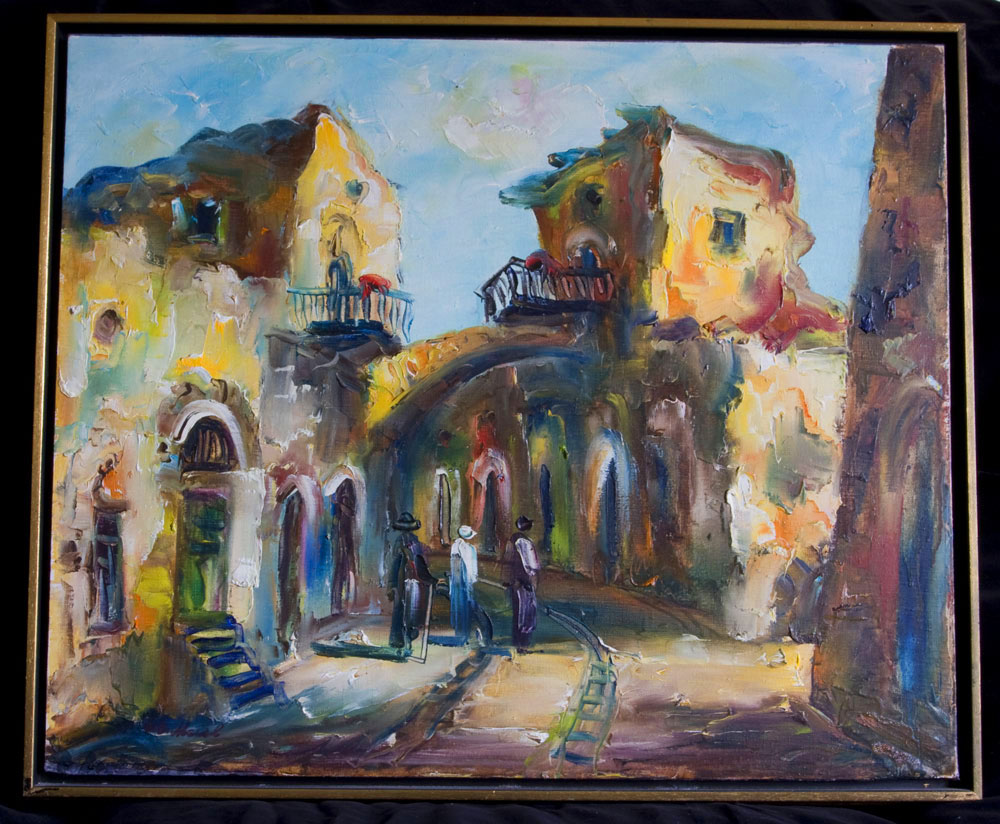
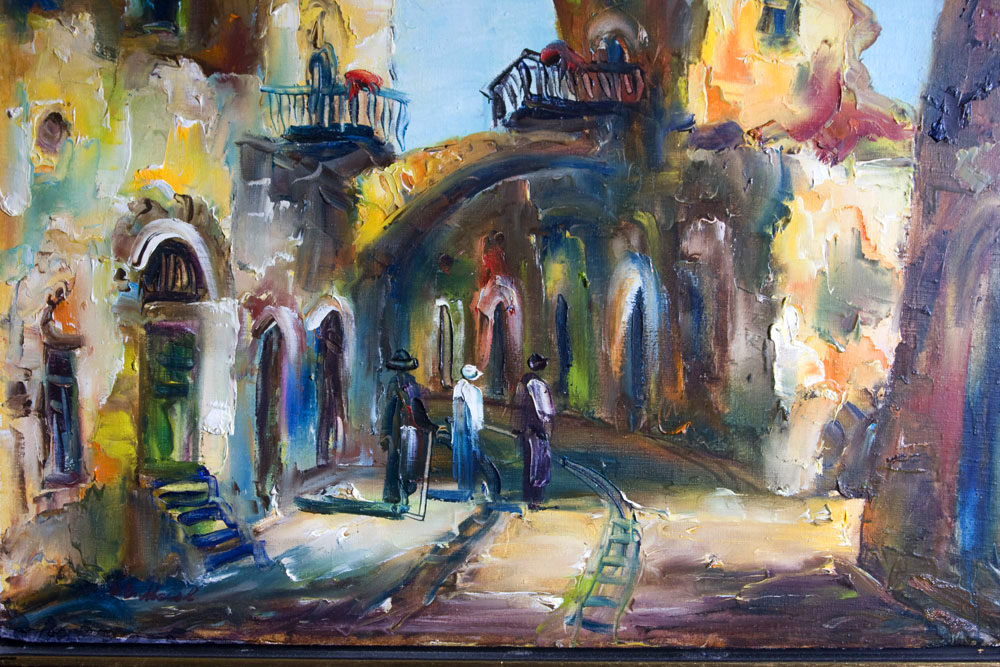
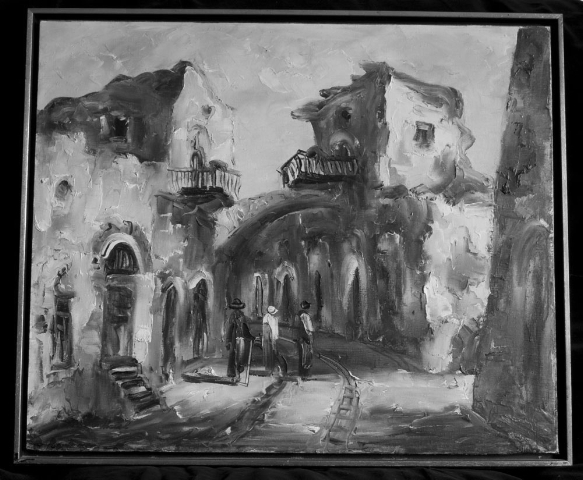
Edith Meisl-Bernhard Untitled 1965(?) Oil on canvas
I bought this luminous painting from Camberwell Market many years ago.
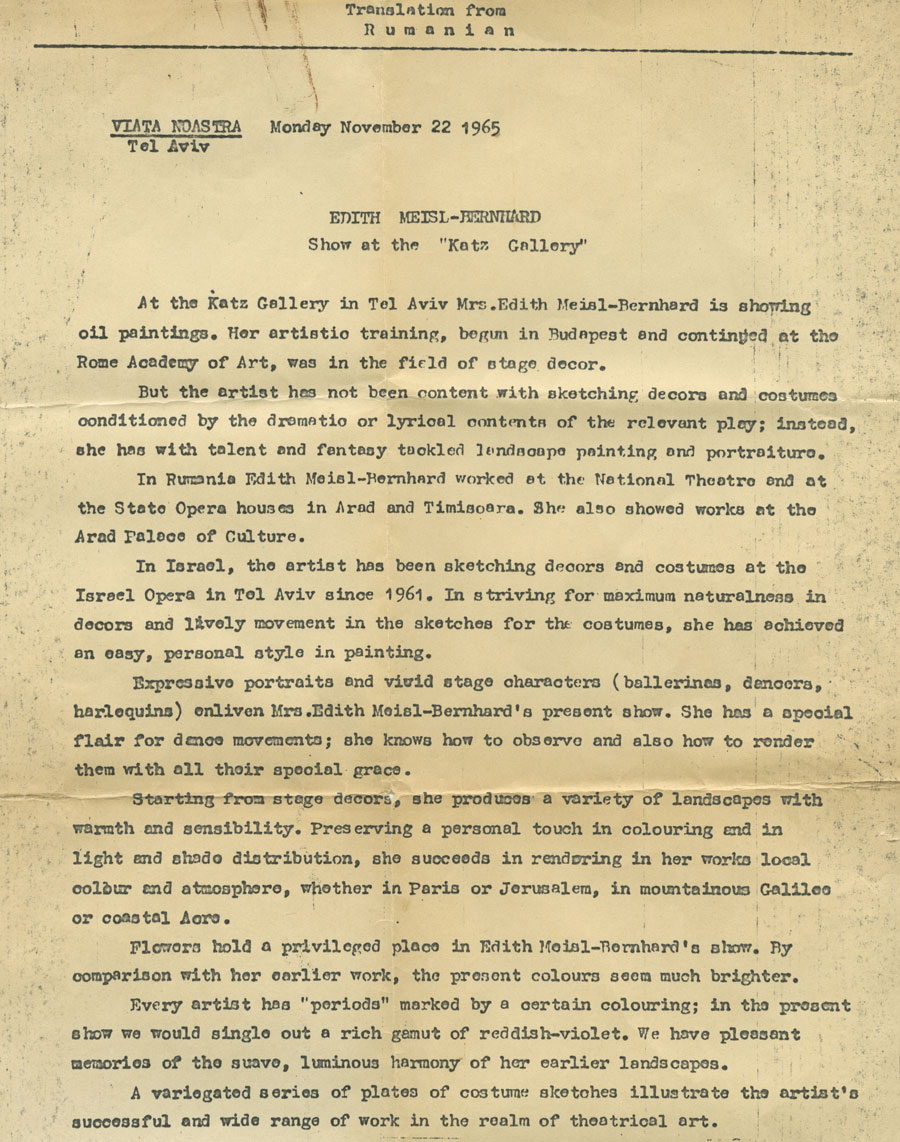
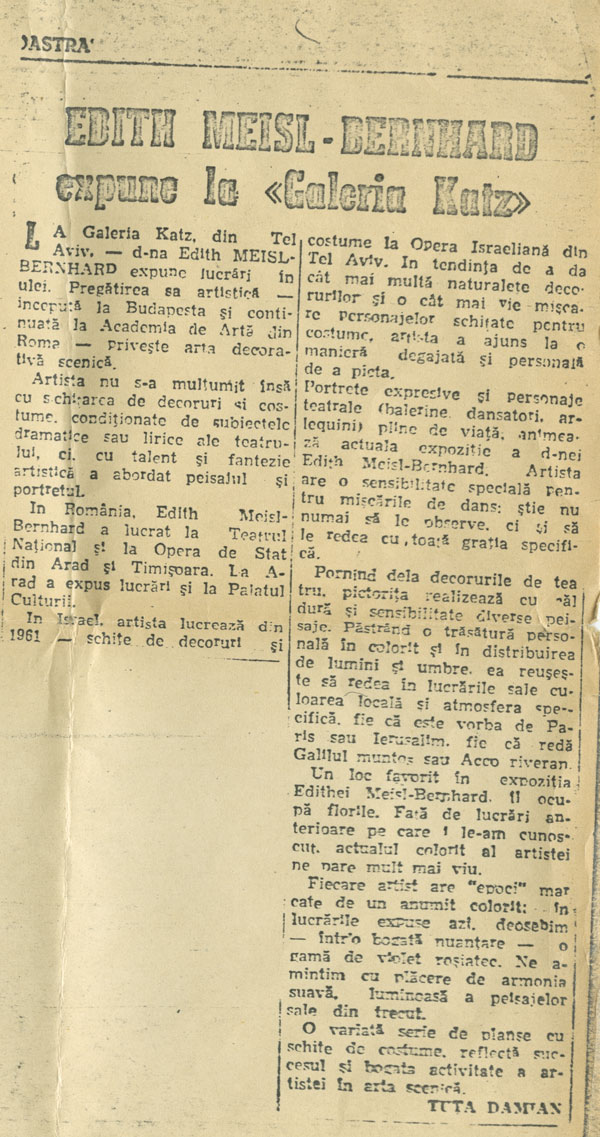
Tucked into the back of the canvas was the photostat review of an exhibition by Edith Meisl-Bernhard at the Katz Gallery in Tel Aviv in 1965, from which this painting presumably comes. It is the only thing that I can find out about the artist but what a life it seems: art training in Budapest and at the Rome Academy of Art; set design at the National Theatre and State Opera houses in Arad and Timisoara, Rumania; set design and costumes at the Israel Opera, Tel Aviv; and exhibiting artist. I have always treasured this painting – for the light, the colours and the atmosphere the artist creates within the picture frame. If anyone knows more about the artist could you please contact me. Thank you.
Dr Marcus Bunyan
Please click on the images for a larger version.
“Starting from stage decors, she produces a variety of landscapes with warmth and sensibility. Preserving a personal touch in colouring and in light and shade distribution, she succeeds in rendering in her works local colour and atmosphere, whether in Paris or Jerusalem, in mountainous Galileo or coastal Acre.”
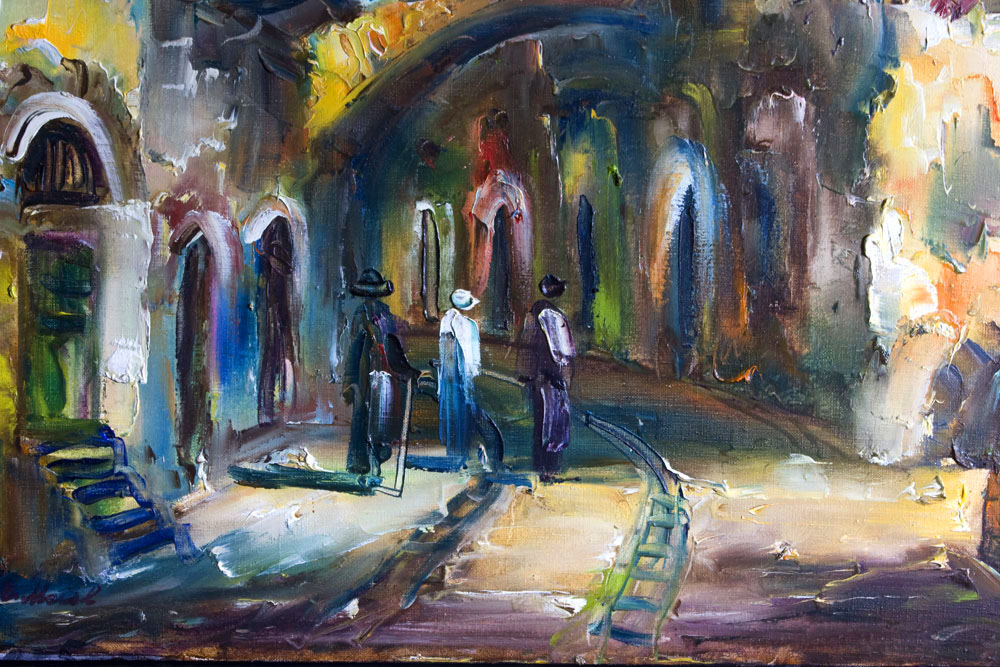
Edith Meisl-Bernhard Untitled (detail) 1965(?) Oil on canvas
Edith Meisl-Bernhard exhibition at the Katz Gallery
Edith Meisl-Bernhard Untitled (detail) 1965(?)
Edith Meisl-Bernhard Untitled (detail) 1965(?)
Thankx to my friend Ian Lobb, here is the luminosity of the painting – without the colour you can easily see the tonal structure!!
Many thankx to the Blanton Museum of Art for allowing me to reproduce images from the exhibition in the post. Please click on the photographs for a larger version of the image.
Marcus
Olaf Breuning (Swiss, b. 1970) Brian 2008 C-print 60 x 70 inches Courtesy the artist and Metro Pictures, New York
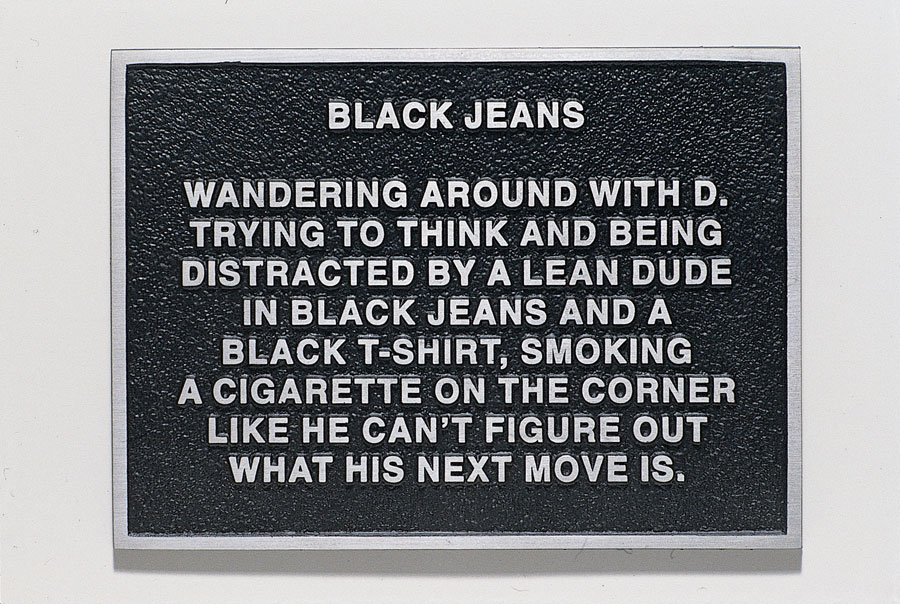
Glenn Ligon (American, b. 1960) Lest We Forget 1998 Series including cast aluminium or bronze plaques, colour photographs of plaques on site Courtesy the artist and Luhring Augustine Gallery, New York
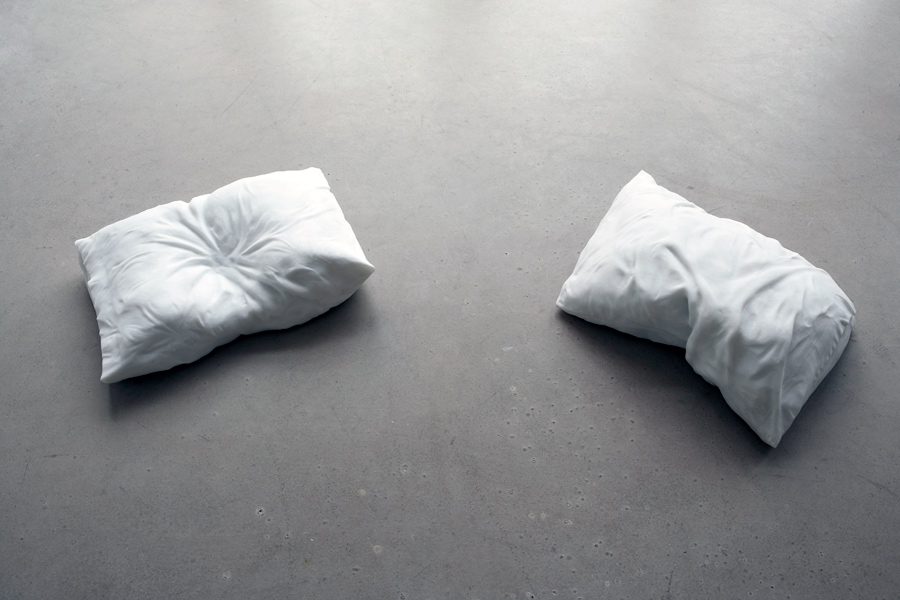
Valeska Soares (Brazilian, b. 1957) Duet 2008 Hand-carved white marble Installation dimensions variable Private Collection
Tracey Emin (English, b. 1963) You Should Have Loved Me 2008 Warm white neon Courtesy of Lehmann Maupin Gallery, New York
This February, The Blanton Museum of Art at The University of Texas at Austin investigates the notion of desire in an exhibition of the same name. Curated by Annette DiMeo Carlozzi, Blanton curator of American and contemporary art and director of curatorial affairs, the exhibition features over fifty works from an international group of contemporary artists working in all media, including Glenn Ligon, Marilyn Minter, Petah Coyne, Bill Viola, Tracey Emin, Isaac Julien and many others. The accompanying illustrated catalogue will contain texts by art critics, fiction writers, poets, performing and visual artists, all written in direct response to the works of art in the exhibition.
Carlozzi states, “”Desire” is a complex human emotion and a driving force in our lives from childhood through old age. We all can recall examples of literature, film, and music that are rife with expressions of physical desire, but how do contemporary visual artists portray it, and all its attendant psychological states – anticipation, arousal, longing, regret, and so on? “Desire” assembles a really broad range of compelling works that together present a surprisingly diverse portrait of the experience.”
One provocative aspect of the exhibition is not its imagery, per se, but the manner by which many of the works translate intimate experiences into art a public expression. Marilyn Minter’s Crystal Swallow would seem to capture a private moment of visceral response, yet in such detail and exaggerated scale that it becomes a grotesque advertisement for arousal. Glenn Ligon’s series, Lest We Forget, commemorates those flickers of romantic fantasy that sometimes occur while people watching. And Tracey Emin’s You Should Have Loved Me is an accusation from a lover scorned, created with the neon light of public signage as if to broadcast raw feeling to an uncaring world.
Works by Kalup Linzy, William Villalongo, Olaf Breuning, James Drake, Petah Coyne, Gajin Fugita, Georganne Deen, Adam Pendleton, Peter Saul, Valeska Soares, Danica Phelps, Miguel Angel Rojas, Mads Lynnerup, Rochelle Feinstein, Richard Prince, Laurel Nakadate, Jesse Amado, Isabell Heimerdinger, Alejandro Cesarco, Eve Sussman, Robert Kushner, Luisa Lambri, Chris Doyle, and a dozen others, provide an engaging multi-generational exploration of desire. In addition, an informed selection of works of art from The Blanton’s print collection will add a historic counterpoint to the contemporary works on view.
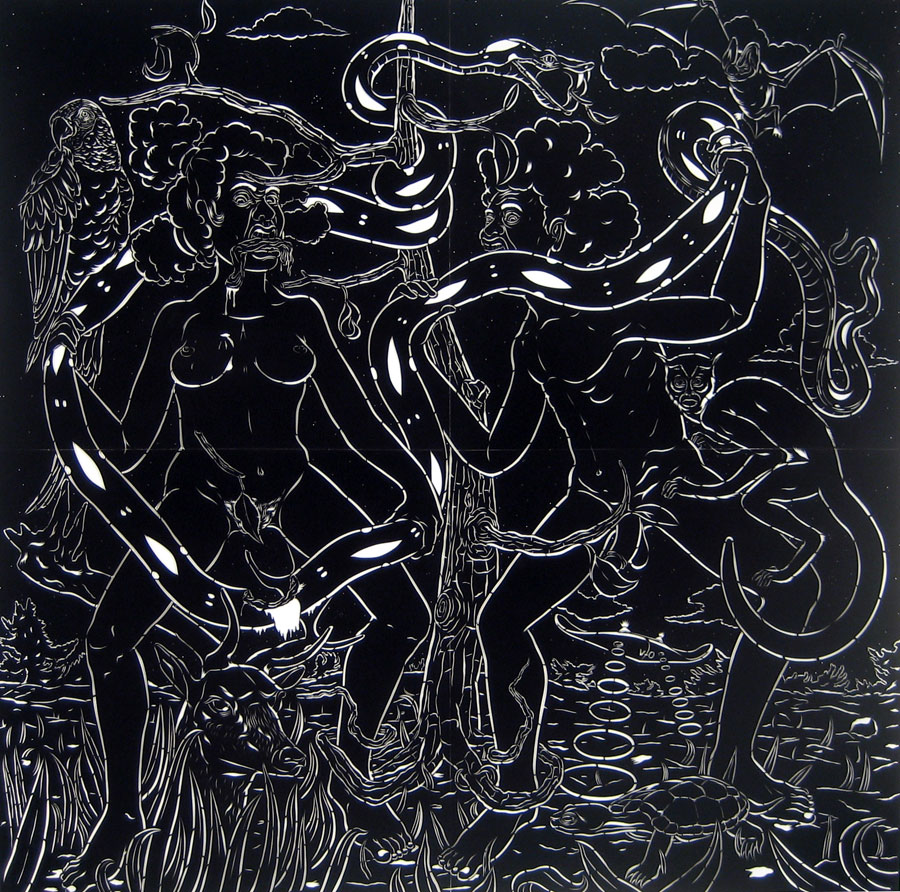
Will Villalongo (American, b. 1975) The Last Days of Eden 2009 Cut velour paper Courtesy the artist and Susan Inglett Gallery, New York
William Villalongo (born December 14, 1975 in Hollywood, Florida) is an American artist working in painting, printmaking, sculpture, and installation. Currently based in Brooklyn, New York, Villalongo is also a professor at the Cooper Union School of Art in New York.
Villalongo typically focuses in his works on the politics of historical erasure, with a particular focus on the artistic reassessment of Western, American, and African Art histories. The artist states that his intention toward these reassessments evolves in part from the West’s histories of “taking African art objects and placing them on the side of the sofa to decorate, although that is not their purpose. We are obsessed with fitting a narrative, a story.”
His works engage with the black body, examining the influences of socialisation, history, occupation, dress, and speech on it. In many of his portraits, bodies emerge from “a tumult of white negative space cut out of black velour paper,” in ways that evoke leaves, branches, feathers, or slashes.
Villalongo is also influenced by Pablo Picasso, who incorporated African masks into his primitivist works, and Aaron Douglas who he credits as inspiring him. Villalongo reexamines the power dynamics of history and representation in his own pieces. “It’s problematic and interesting, and I wanted to think about how to use it and tell a story.”
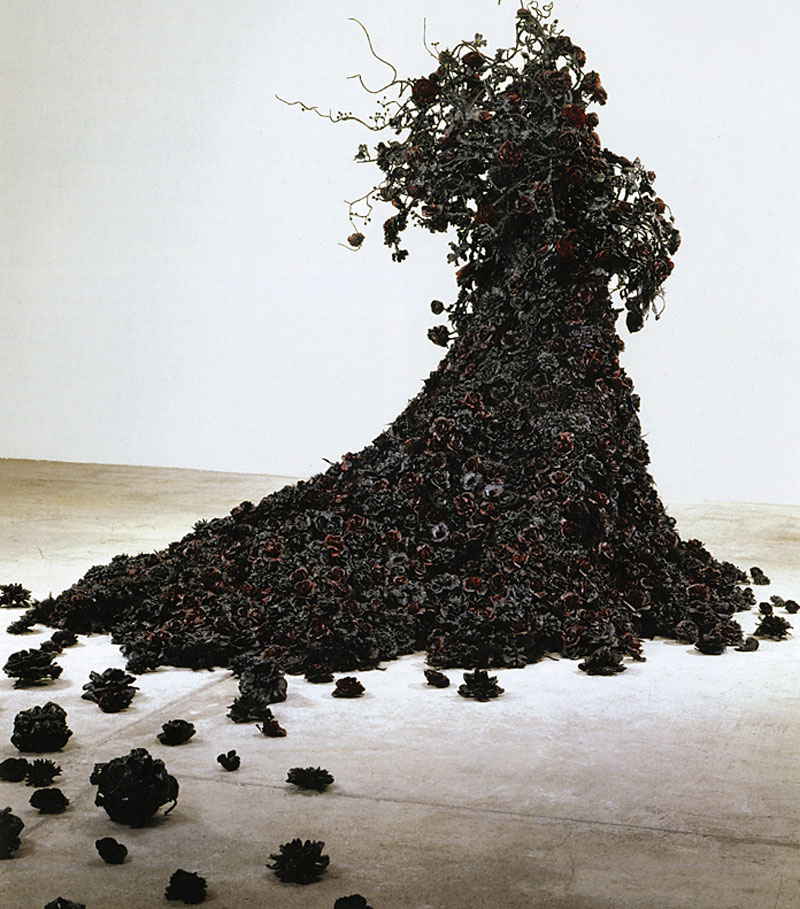
Petah Coyne (American, b. 1953) Untitled #1103 (Daphne) 2002-2003 Mixed media 77 x 83 x 86 inches Collection of Julie and John Thornton
Petah Coyne (born 1953) is an American sculptor and photographer. She is known for her large-scale sculptures composed of unconventional, and often organic, materials, such as clay, silk, wax, and hair.
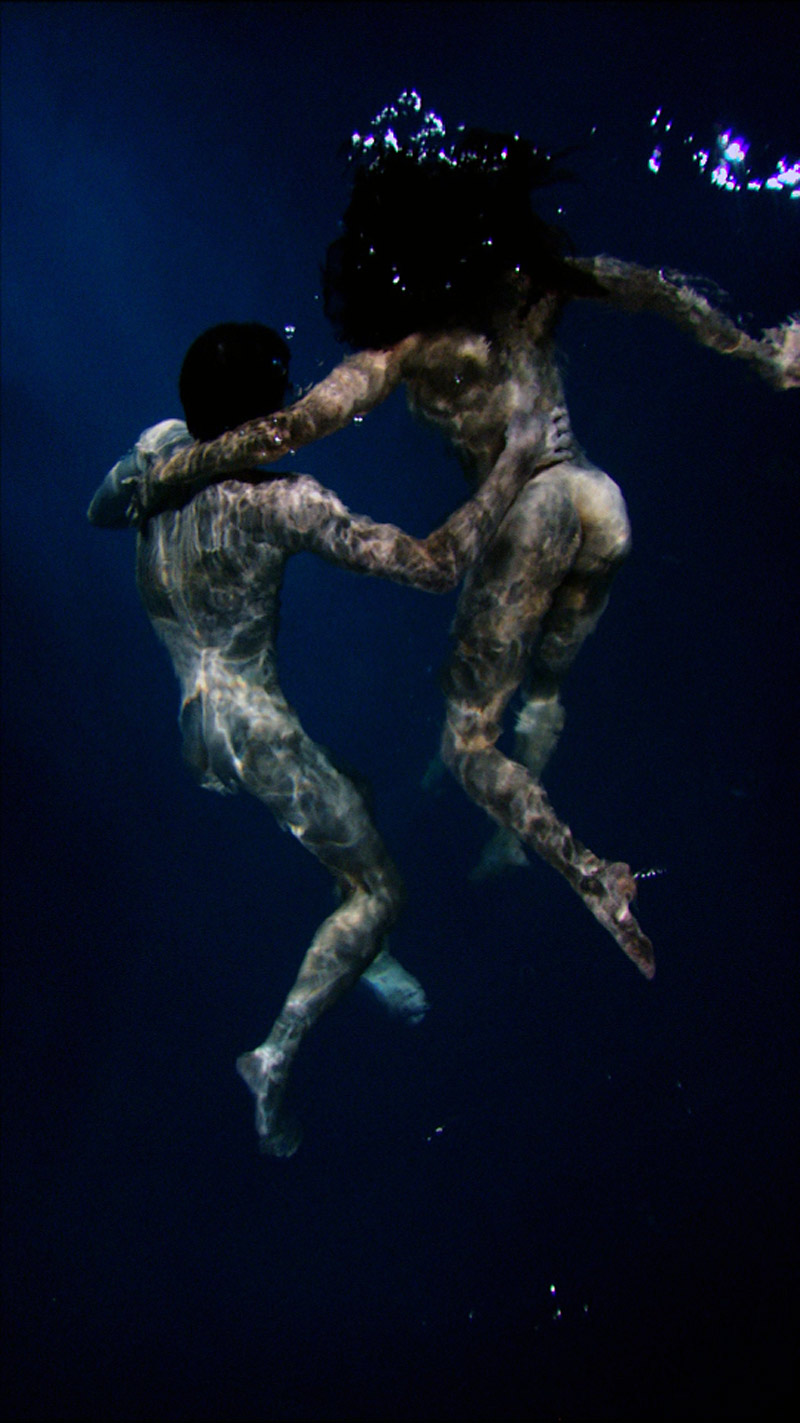
Bill Viola (American, 1951-2024) Becoming Light (still) 2005 Colour High-Definition video on plasma display mounted on wall 47.6 in x 28.5 in x 4 in (121 x 72.5 x 10.2cm) Performers: John Hay, Sarah Steben Photo: Kira Perov Courtesy Bill Viola Studio
Marilyn Minter (American, b. 1948) Crystal Swallow 2006 Enamel on metal Promised gift of Jeanne and Michael Klein, 2007
Blanton Museum of Art MLK at Congress (200 East MLK) Austin, Texas 78701
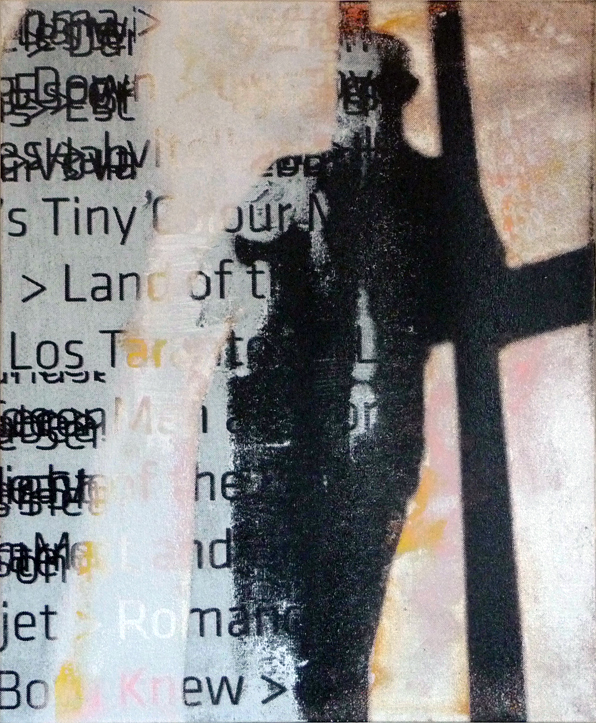
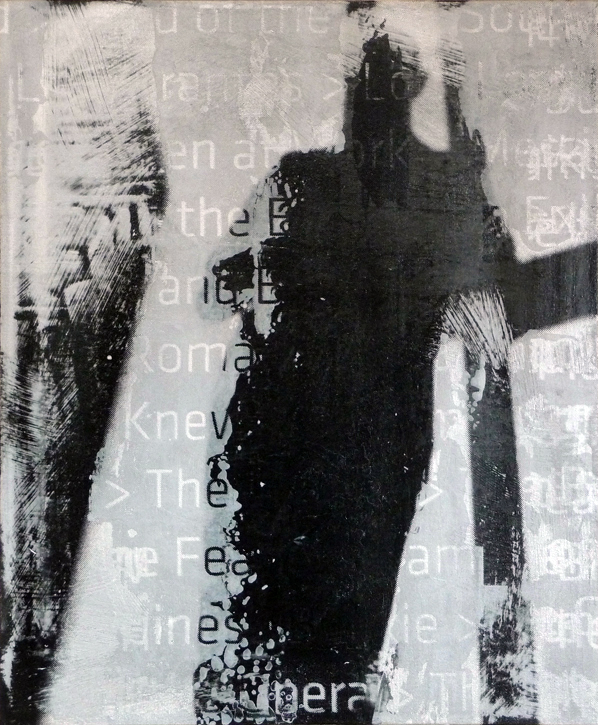
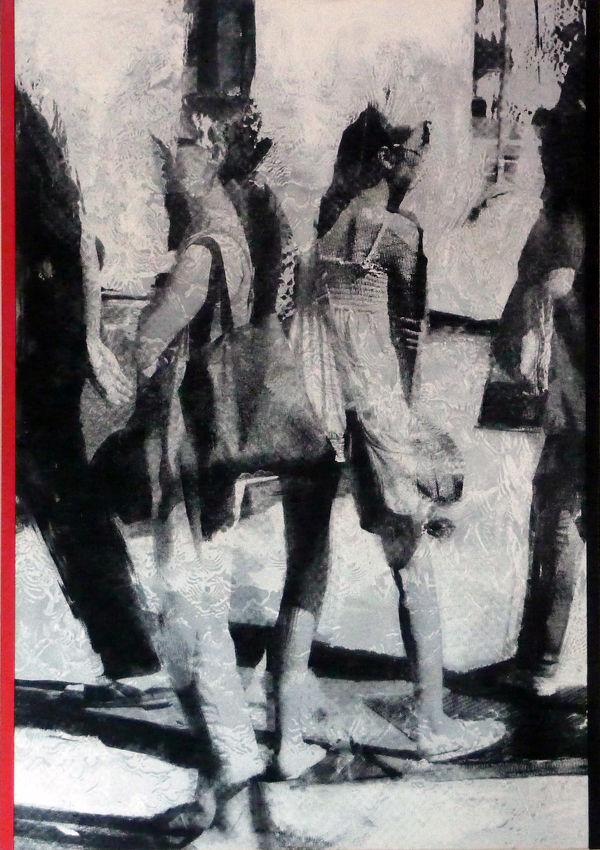
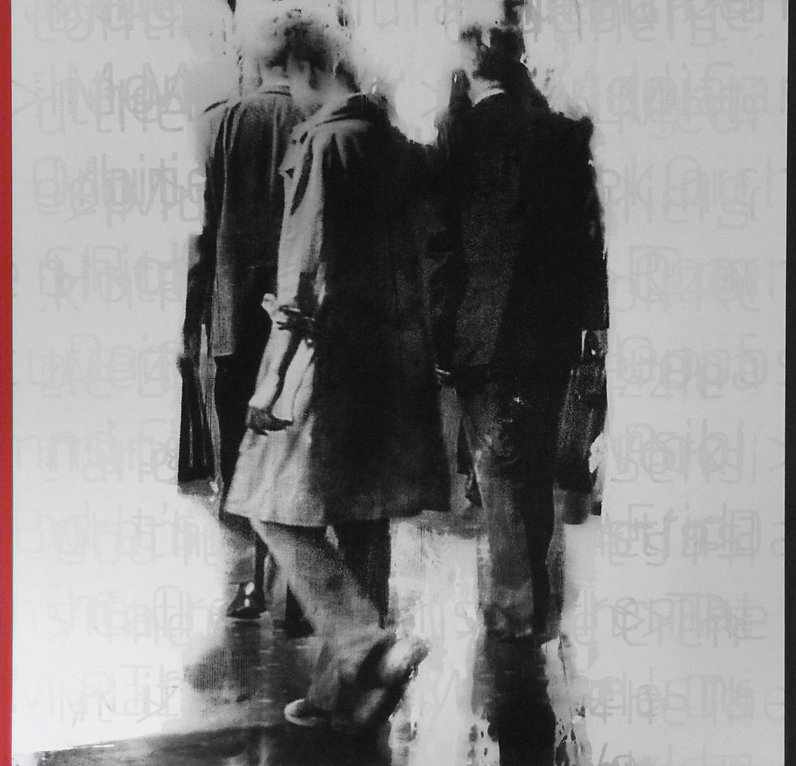
Four interesting exhibitions in Albert Street, Richmond – from the beautiful, formed leather sculptures of Pamela Rataj to the wonderfully vibrant tropical bird, chair and decorative pattern paintings of Claudia Damichi; from the intensely observed canvas environments of Steve Randall to the post-photographic silk-screen textualisations of Robert Boynes. Well worth a visit on a Saturday afternoon!
As always, many thankx to the galleries for allowing me to publish the images in this posting. Please click on the images for a larger version.
~ Pamela Rataj. The Morphology of Forgetting at Anita Traverso Gallery. 7th April – 1st May 2010
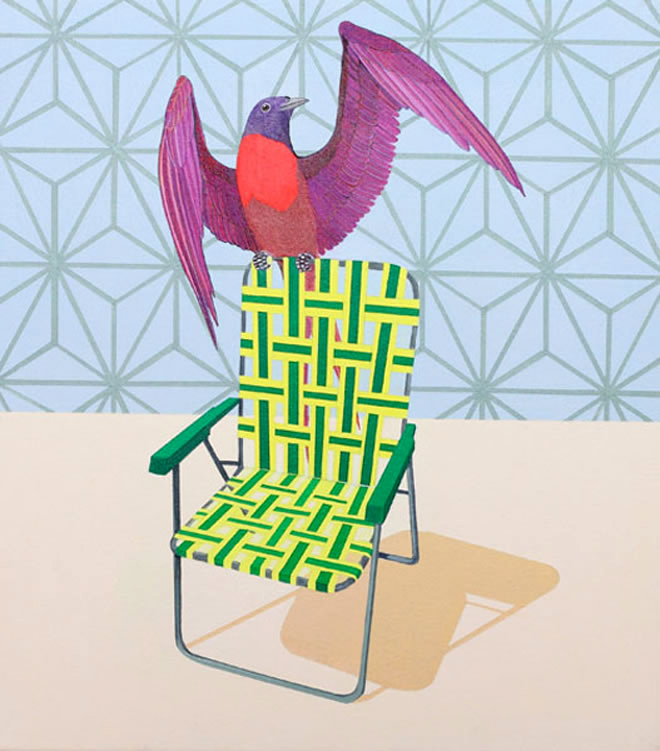
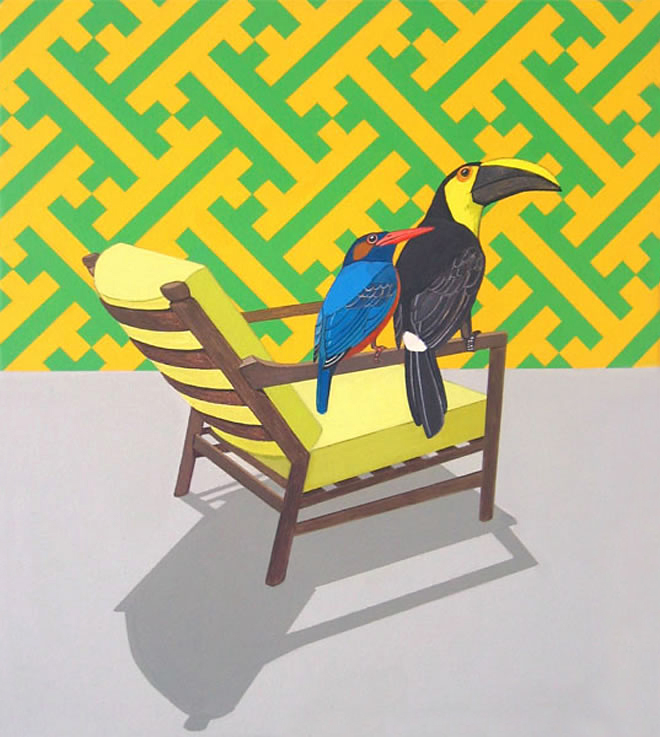
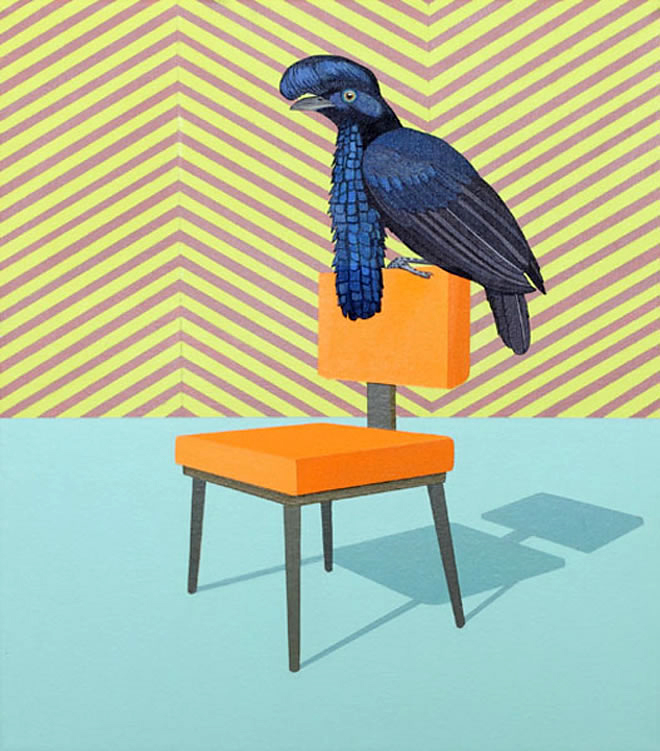
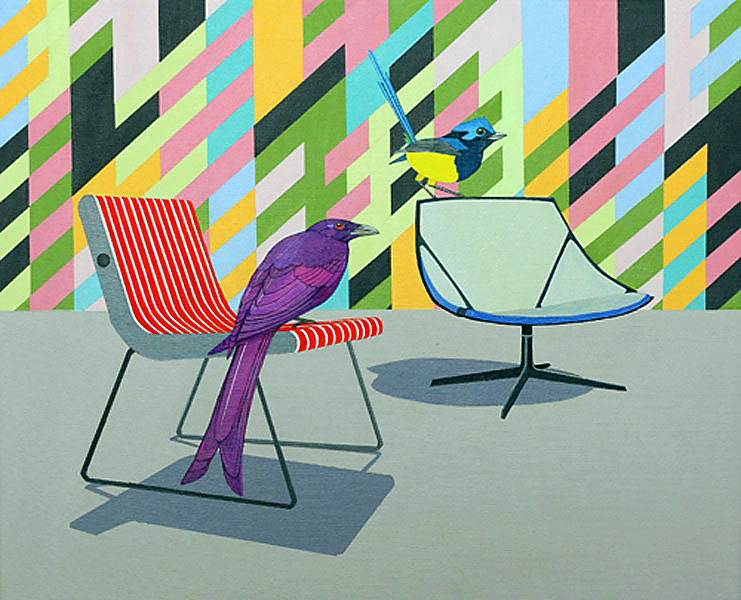
~ Claudia Damichi. The Bitter Sweet at Sophie Gannon Gallery. 30th March – 25th April 2010
~ Steve Rendall. Security, Storage and Recreation at John Buckley Gallery. 8th April – 1st May 2010
~ Robert Boynes. Postscript at Karen Woodbury Gallery. 7th April – 1st May 2010
Pamela Rataj. The Morphology of Forgetting at Anita Traverso Gallery
7th April – 1st May 2010
Pamela Rataj (Australian) Tangent Bundle 2009
Pamela Rataj (Australian) Ravel 2009
Pamela Rataj (Australian) Kairos 2009
How to draw a boundary between self and other, past time and today?
Patterns and forms in nature often resemble one another, connecting life forms in unexpected ways. Tide lines left in the sand resemble the grains found in a piece of wood, and the veins in a leaf or those in a hand.
The age lines in the trunk of a tree form as each outer layer covers the one preceding it and echoes its shape. This makes me think of the way past experience resurfaces as memory, receding or becoming more important at different times in our lives, as each new experience envelopes our previous states of being and yet is shaped by them.
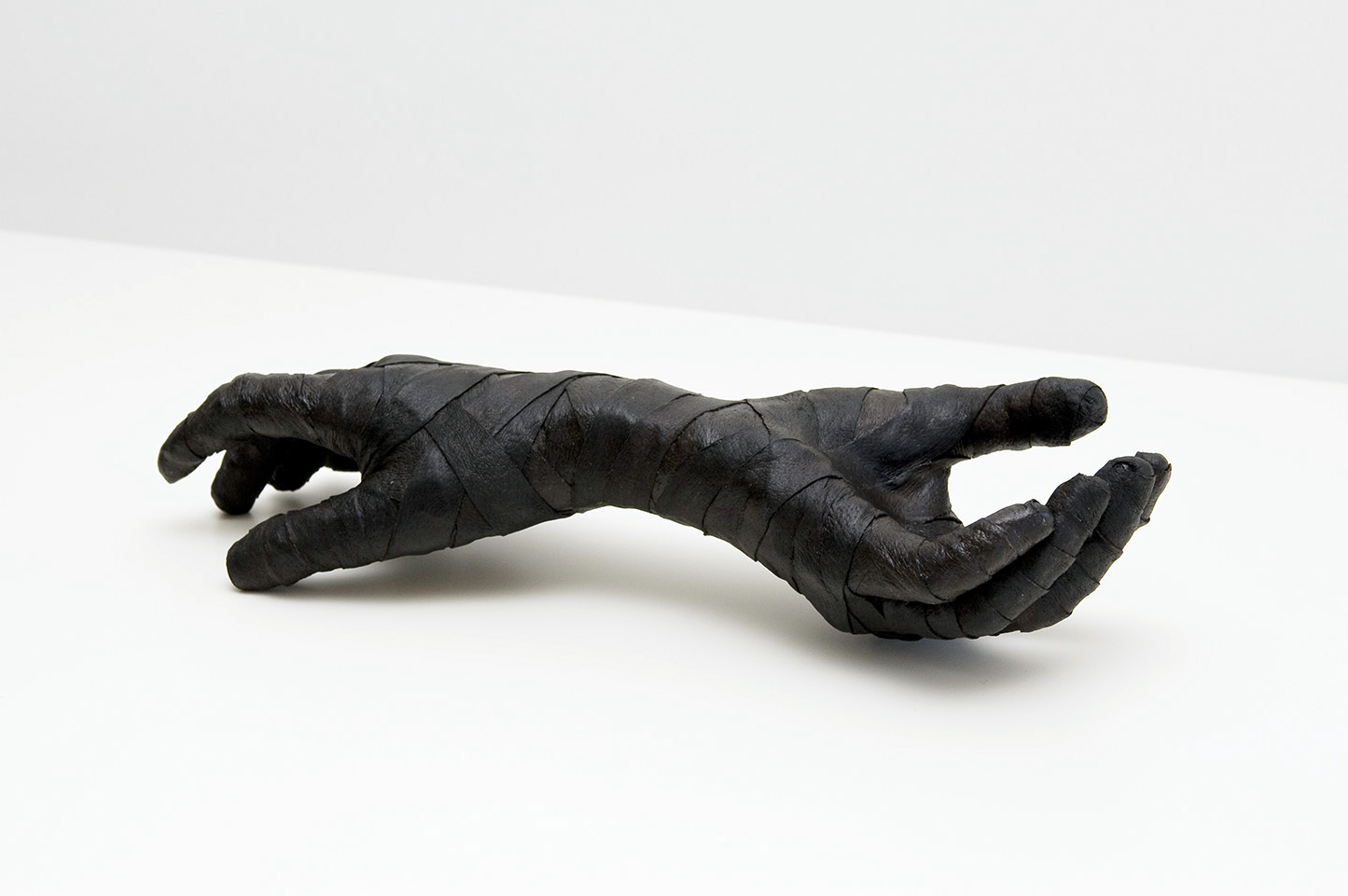
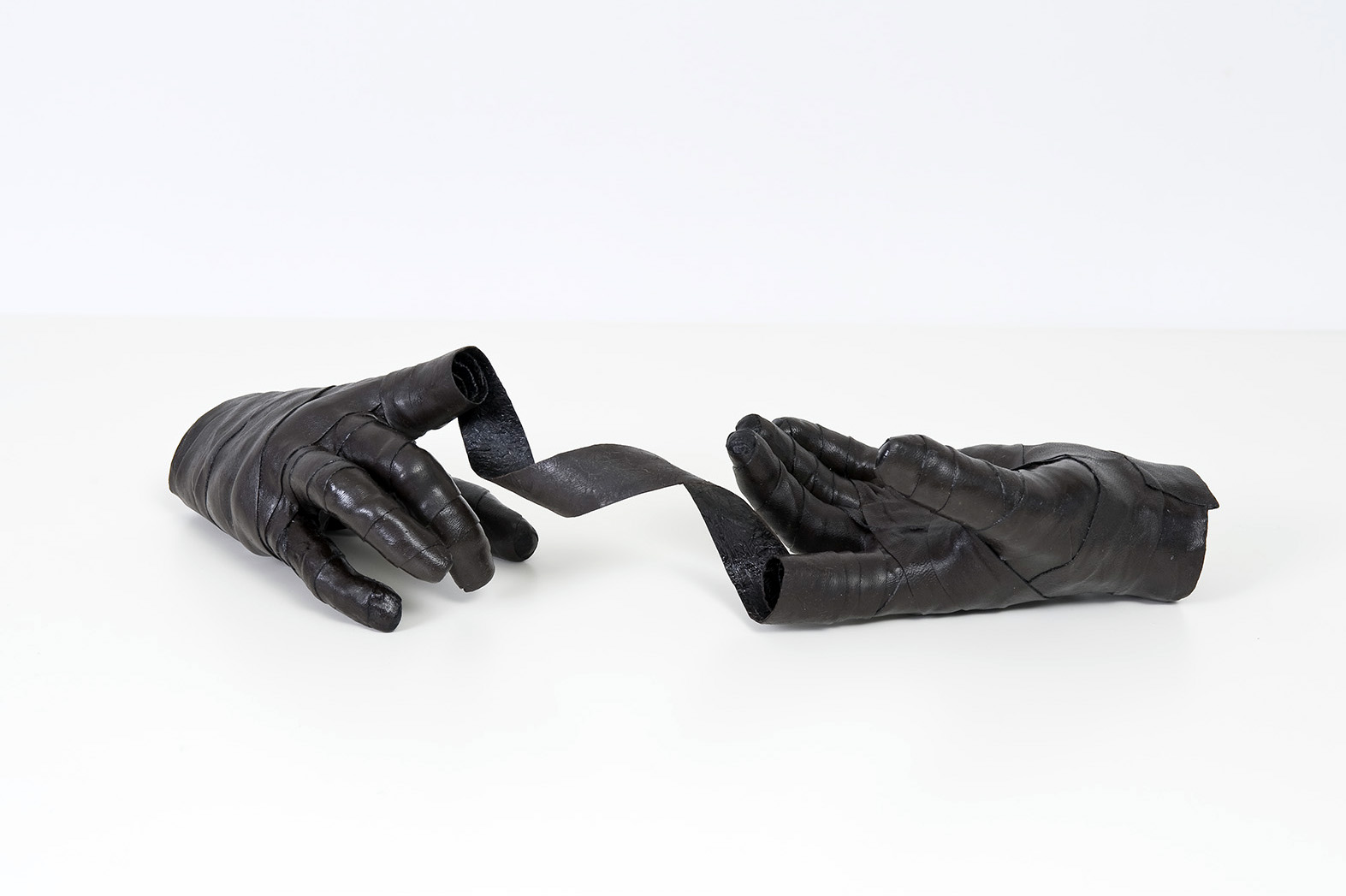
The wrapped and layered forms in The Morphology of Forgetting explore coexistence and connection.
I dedicate this exhibition to my parents, whose recent deaths have helped me appreciate memory as a way to connect through time.
Pamela Rataj 2010
Press release from the Anita Traverso Gallery website [Online] Cited 10/04/2010. No longer available online
Pamela Rataj (Australian) Faisceaux 1 2009
Pamela Rataj (Australian) Faisceaux 4 2009
Claudia Damichi. The Bitter Sweet at Sophie Gannon Gallery
30th March – 25th April 2010
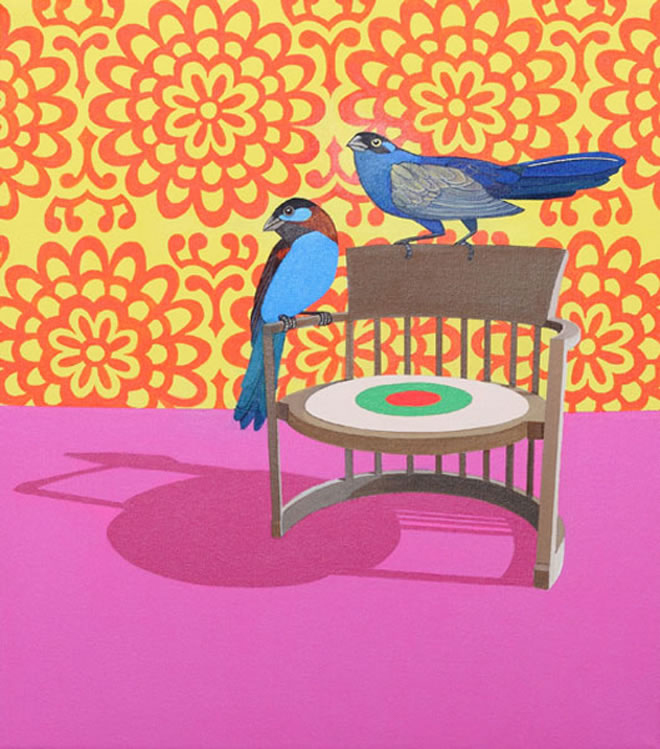
Claudia Damichi (Australian, b. 1972) Birds eye 2010 Acrylic on canvas 46 x 41cm
Claudia Damichi (Australian, b. 1972) Star Gazer 2009 Acrylic on canvas 46 x 41cm
Claudia Damichi (Australian, b. 1972) Gridlock 2010 Acrylic on canvas 41 x 46cm
Claudia Damichi (Australian, b. 1972) Reading between the lines 2010 Acrylic on canvas 46 x 41cm
Claudia Damichi’s surrealist still life paintings are characterised by vivid colours, elaborate patterns and distorted spatial proportions. In her paintings of domestic interiors, flowers, birds and furniture, colour is inflated and scale is playfully manipulated – solitary domestic interiors are reconfigured into places of fantasy and illusion. Inspired by the enduring aesthetic of modern industrial design, her surreal and theatrically staged scenarios self-consciously conjure a sense of the absurd. Graphic patterning, high-croma colour and whimsical compositions foster worlds that are at once playful and claustrophobic, satirical and real, tapping into an ambiguous nostalgia that leaves the viewer feeling that anything is possible.
Claudia Damichi (Australian, b. 1972) Look out 2010 Acrylic on canvas 46 x 56cm
Steve Rendall. Security, Storage and Recreation at John Buckley Gallery
8th April – 1st May 2010
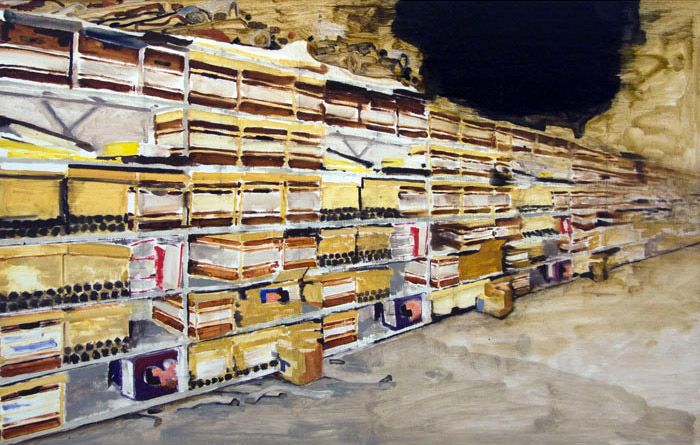
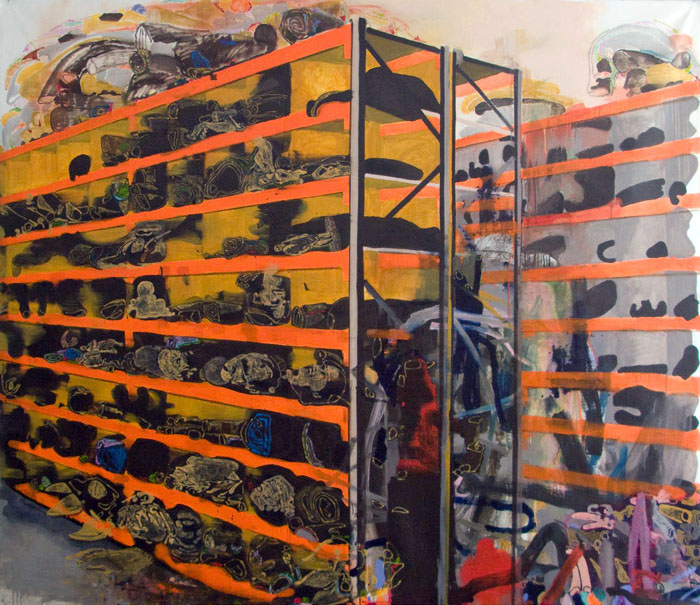
Steven Rendall (Australian born Britain, b. 1969; Australia from 2000) Archive 1 2010 Oil on linen
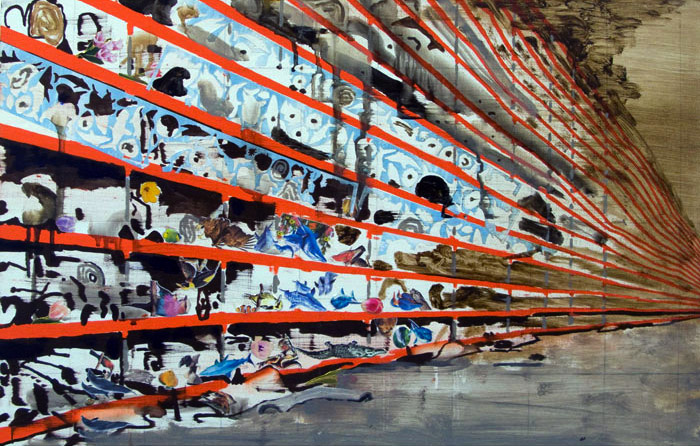
Steven Rendall (Australian born Britain, b. 1969; Australia from 2000) Archive 2 2010 Oil on linen
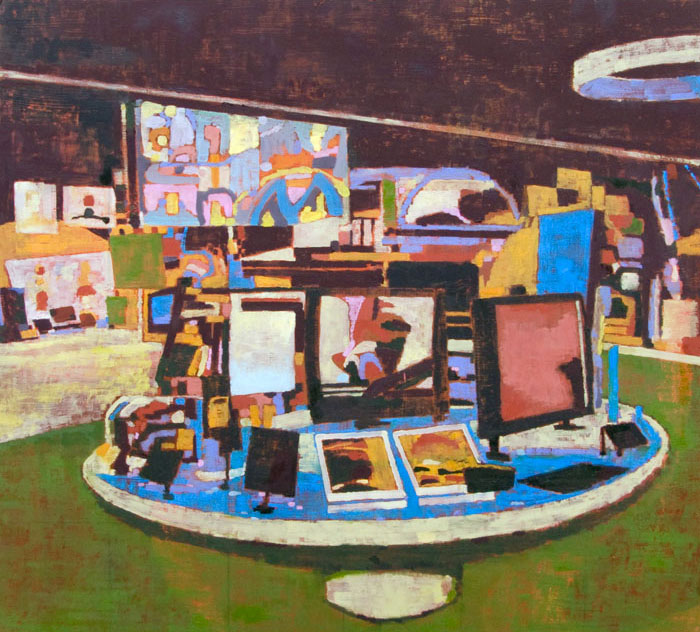
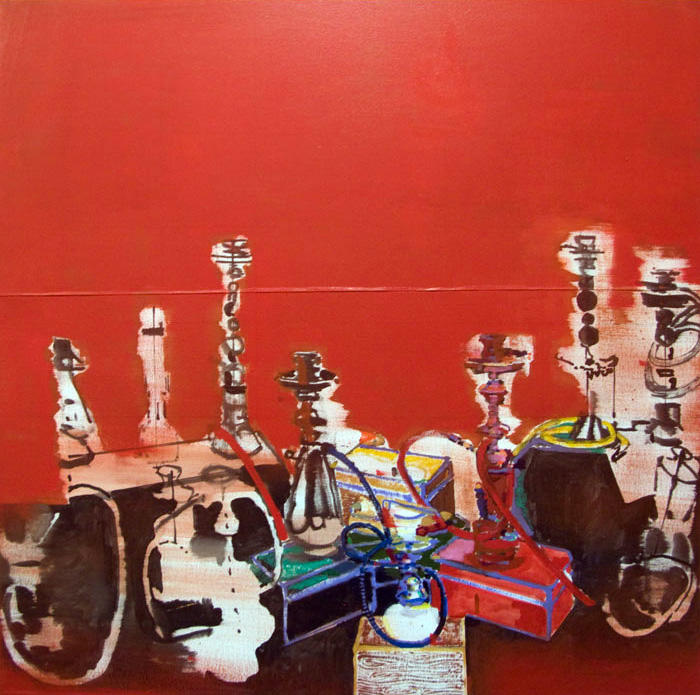
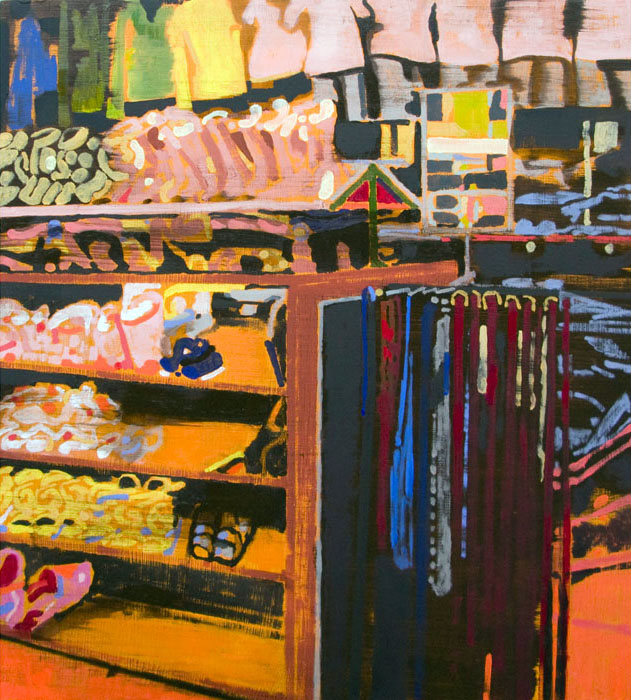
Citing the British artist Walter Sickert as an important influence on his painterly style, Rendall’s work displays a form and content that has attracted the attention of both critics and collectors. A key work in the exhibition is a large-scale painting on un-stretched linen titled Fountain (Rosemary’s Baby) that sprawls across 4.5m. Certain fountains, along with other apparently arbitrary images of television monitors, speedboats, clothing racks, shelving units and museum interiors are recurring motifs in Rendall’s paintings.
Rendall aims to ‘collect and synthesise’ images from around his home and en route to and from his Brunswick studio. Passing observations of window displays, charity shops and various light industrial warehouses are registered and recorded in conjunction with the accumulation of promotional flyers spruiking leisure activities and museum experiences. This shambolic collection of images is transcribed into an array of compositions in Rendall’s paintings. Images occasionally materialise in unlikely places, such as the spectral diver’s head that is resting on a warehouse shelf in the appropriately titled Storage.
In the exhibition Security, Storage and Recreation, you are invited to enter the image bank of Steven Rendall; a ‘wake in fright’ experience where one can become immersed and caught up in the maelstrom of the artist’s visual language – a sequence of painterly dreams each similar yet different to the last.”
Press release from the John Buckley Gallery website [Online] Cited 10/04/2010 no longer available online
Steven Rendall (Australian born Britain, b. 1969; Australia from 2000) Flat Screens (Green) 2010 Oil on linen
Steven Rendall (Australian born Britain, b. 1969; Australia from 2000) Pipes 2010 Oil on linen
Steven Rendall (Australian born Britain, b. 1969; Australia from 2000) Claustrophobia 2010 Oil on linen
Steven Rendall (Australian born Britain, b. 1969; Australia from 2000) Redacted 2 2010 Oil on linen
Robert Boynes. Postscript at Karen Woodbury Gallery
7th April – 1st May 2010
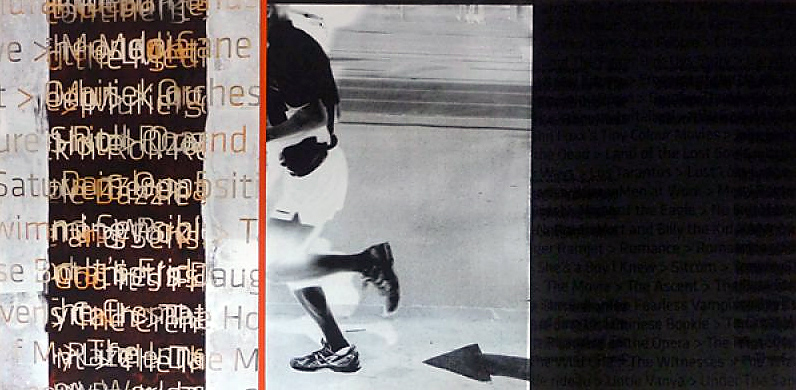
Robert Boynes (Australian, b. 1942) Street Runner 2010 Acrylic on canvas and velvet 120 x 242cm
Robert Boynes (Australian, b. 1942) Days that we forgot 2010 Acrylic on canvas
Robert Boynes (Australian, b. 1942) Signal Driver 2010 Acrylic on canvas and velvet 120 x 190cm
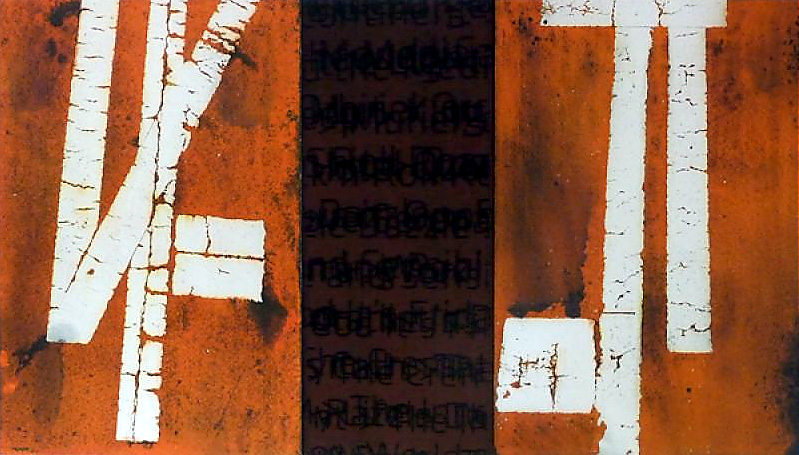
Postscript is Robert Boynes’ second solo exhibition with Karen Woodbury Gallery. This series continues with his exploration of urban themes, contemporary experience and experimentation into ways of using paint. In this most recent body of work Robert has employed the use of text in juxtaposition to various materials such as wood and velvet. The text conveys a feeling of noise and urban clatter, acting as a context and environment for the figures within the work.
His technique involves transferring photographic images to large silk screens and dragging paint through the mesh onto canvas. Robert thus has control in the manipulation of colour, density and translucency of the images. This process results in still moments that magnify and investigate everyday observable reality. The anonymous figures are juxtaposed with text and layering of saturated, contrasting colours, appearing objectified and ghostly.
These works embody a filmic quality, the multi-panelled paintings signify fragmented narratives and enquire into perceptions of time and space.
Text from the Karen Woodbury Gallery website [Online] Cited 10/04/2010 no longer available online
Robert Boynes (Australian, b. 1942) Body Type 2 2010 Acrylic on canvas
Robert Boynes (Australian, b. 1942) Body Type 3 2010 Acrylic on canvas
Robert Boynes (Australian, b. 1942) Things we leave behind 2009 Acrylic on canvas 120 x 180cm
Robert Boynes (Australian, b. 1942) The layered moment 2009 Acrylic on canvas
Robert Boynes (Australian, b. 1942) Postscript 2009 Acrylic on canvas 120 x 124cm
All galleries have closed except for Sophie Gannon Gallery, Richmond.
Sophie Gannon Gallery 2 Albert Street Richmond VIC 3121 Australia Phone: +61 3 9421 0857
Exhibition dates: 13th February – 11th April, 2010
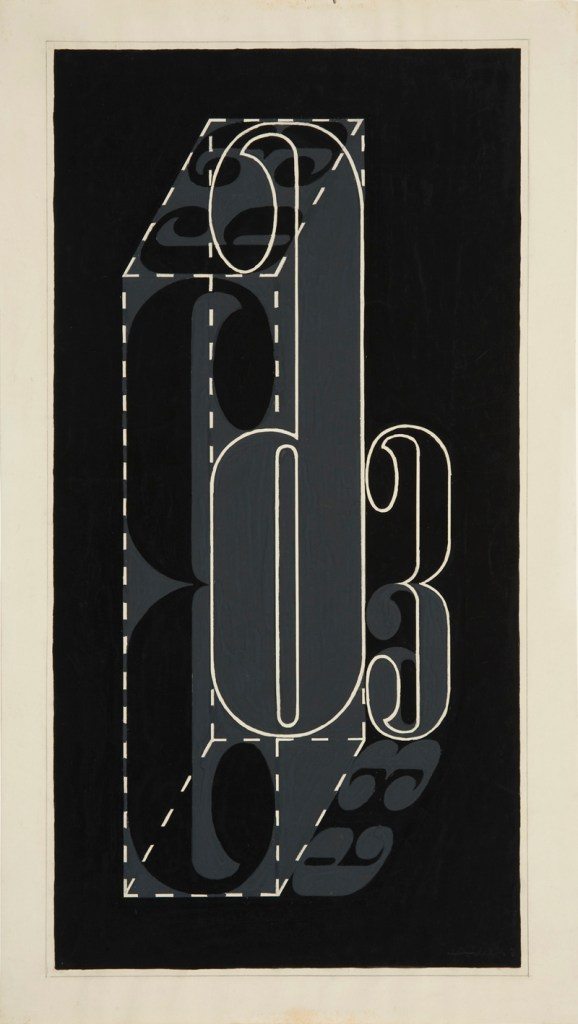
Josef Albers (German, 1888-1976) 6 and 3 1931
One of my favourite artists – what a genius!
His exploration of colour and form is exquisite, sensitive and very moving – despite his belief that colours have no inherent emotional associations.
Marcus
Many thankx to the Hirshhorn Museum for allowing me to publish the images in the posting. Please click on the photographs for a larger version of the image.
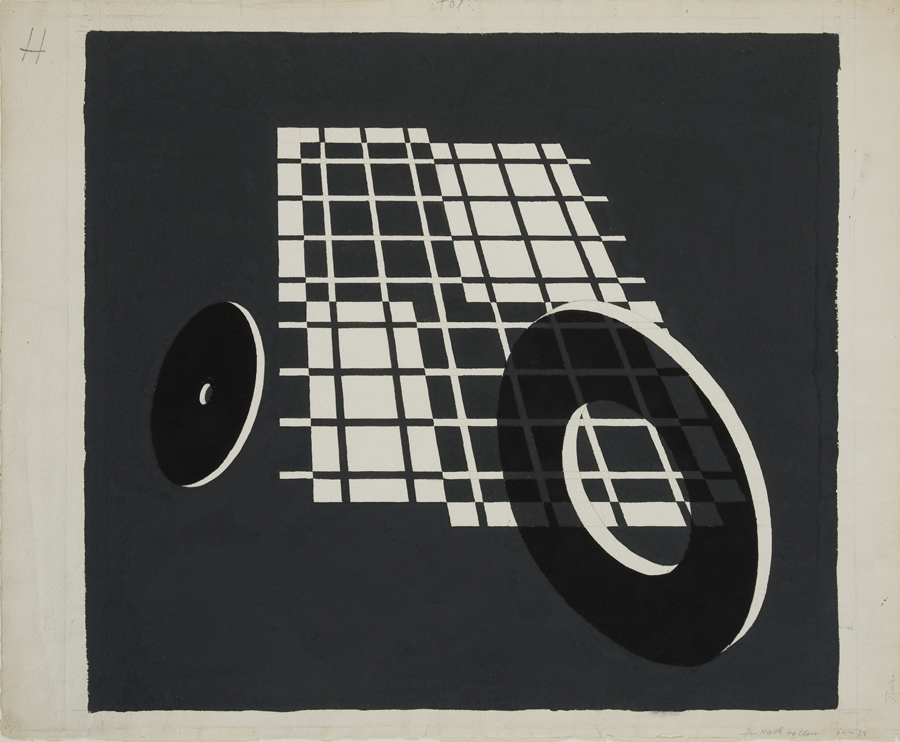
Josef Albers (German, 1888-1976) Rolling After 1925-28
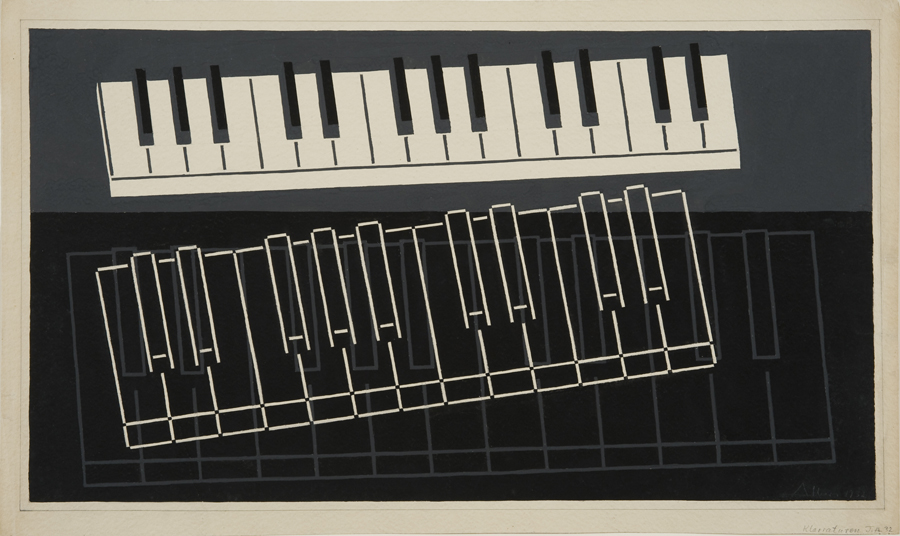
Josef Albers (German, 1888-1976) Piano Keys 1932
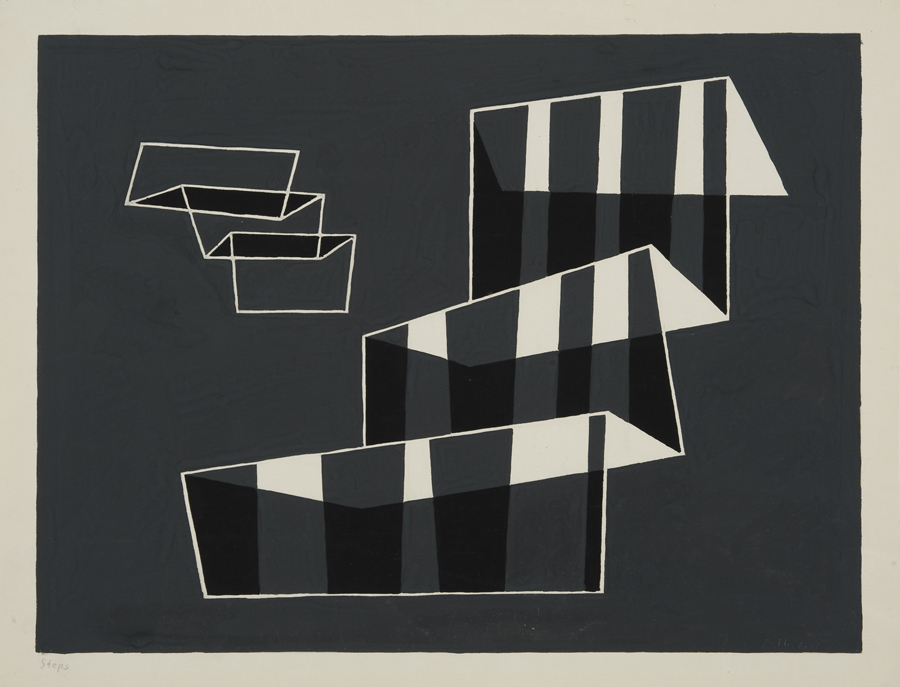
Josef Albers (German, 1888-1976) Steps 1932
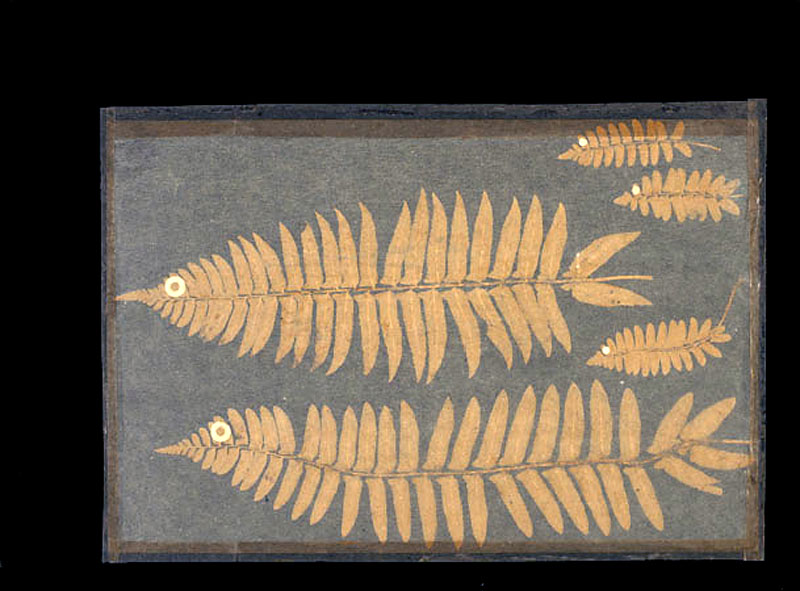
Josef Albers (German, 1888-1976) Untitled (Leaf Study) c. 1940
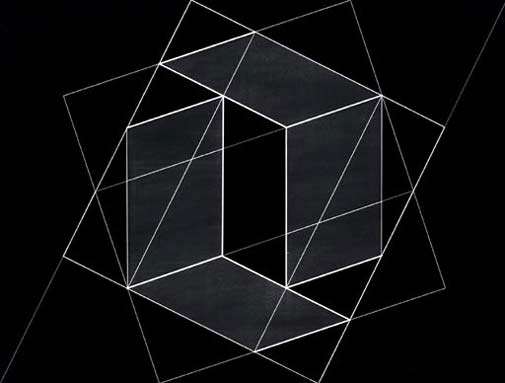
Josef Albers (German, 1888-1976) Structural Constellation, Transformation of a Scheme No.12 1950 Machine engraving on black vinylite mounted on board
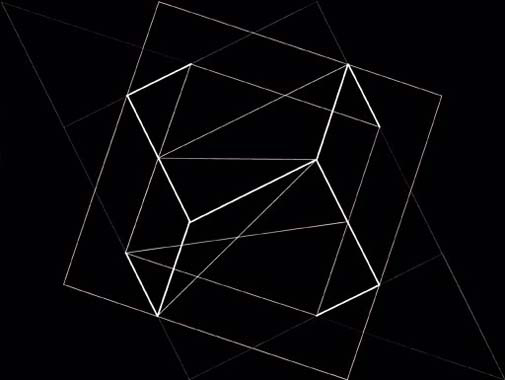
Josef Albers (German, 1888-1976) Structural Constellation, Transformation of a Scheme No.23 1951 Machine engraving on black vinylite mounted on board
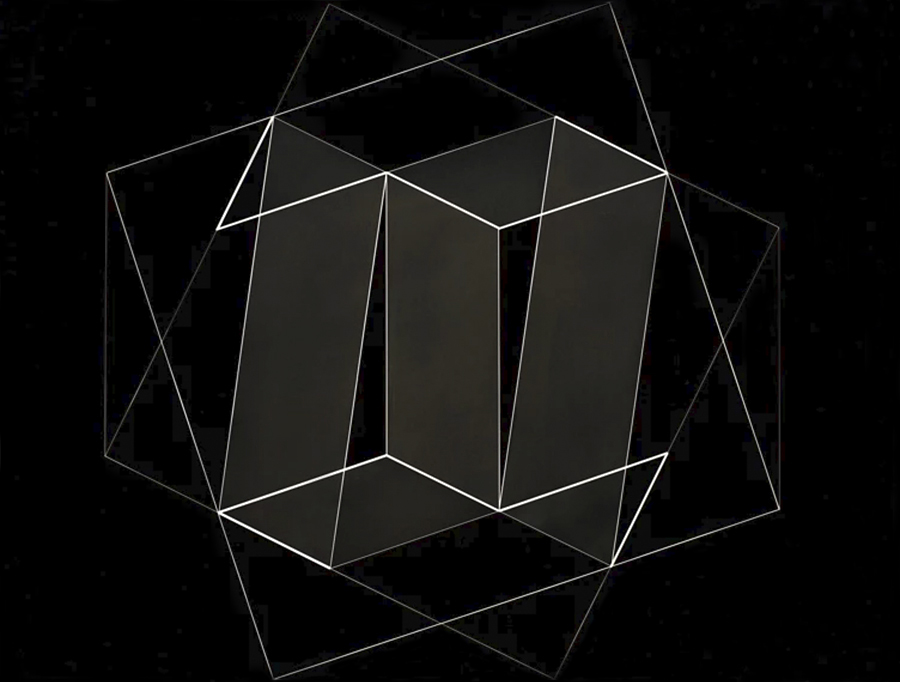
Josef Albers (German, 1888-1976) Structural Constellation, Transformation of a Scheme No.10 1950-51 Machine engraving on black vinylite mounted on board
Exhibition Illustrates Albers’ Sphere of Influence
The Hirshhorn possesses one of the world’s largest and most comprehensive collections of work by Josef Albers (b. Bottrop, Germany, 1888; d. New Haven, Connecticut, 1976). “Josef Albers: Innovation and Inspiration” presents nearly 70 works spanning the artist’s 55-year career, many on view for the first time. Supplementing pieces from the museum’s holdings are key objects on loan from the Josef and Anni Albers Foundation. Organised by senior curator Valerie Fletcher, the exhibition also includes documentary photographs and examples of Albers’ teaching aids, and concludes with a display of works by artists who knew, worked with, studied under or openly admired Albers. The exhibition opens on February 11 and runs through April 11, 2010.
Josef Albers: Innovation and Inspiration encompasses the artist’s distinguished career from 1917 to 1973. The exhibition begins with four early self-portrait prints dating from the years of World War I, followed by a group of boldly abstract compositions from Albers’ tenure at Germany’s revolutionary Bauhaus, where he taught alongside such remarkable modernists as Wassily Kandinsky, Paul Klee, László Moholy-Nagy, Walter Gropius and Mies van der Rohe. Albers participated in the school’s utopian aspiration to improve modern life through manufacturing and design-ideas that resonated throughout Albers’ career. The Hirshhorn’s show includes a series of black-and-white designs intended for mass production in glass, such as “6 and 3” (1931, see above), and an illuminated display of eight glass panels, in which the artist modernised and transformed the medieval tradition of stained-glass windows, best characterised by “Fugue (B)” (1925-1928).
Following the Nazi party’s rise to power, the Bauhaus was forced to close in 1933. Albers fled to the United States, where he was recruited to head the art program at the new Black Mountain College in North Carolina. There, Albers introduced a modified Bauhaus curriculum and hired vanguard modernists as teachers. He enthusiastically taught his students how art could be made from virtually any material, which he demonstrated in some of his own works, such as three “Leaf Study” collages (c. 1940, see above). Albers continued to advocate the clear structures of geometric abstraction, still mostly in black, white and primary colours, but was open to different stylistic approaches. He also briefly adopted the biomorphic forms associated with surrealism, as seen in the work “Proto-Form (B)” (1938).
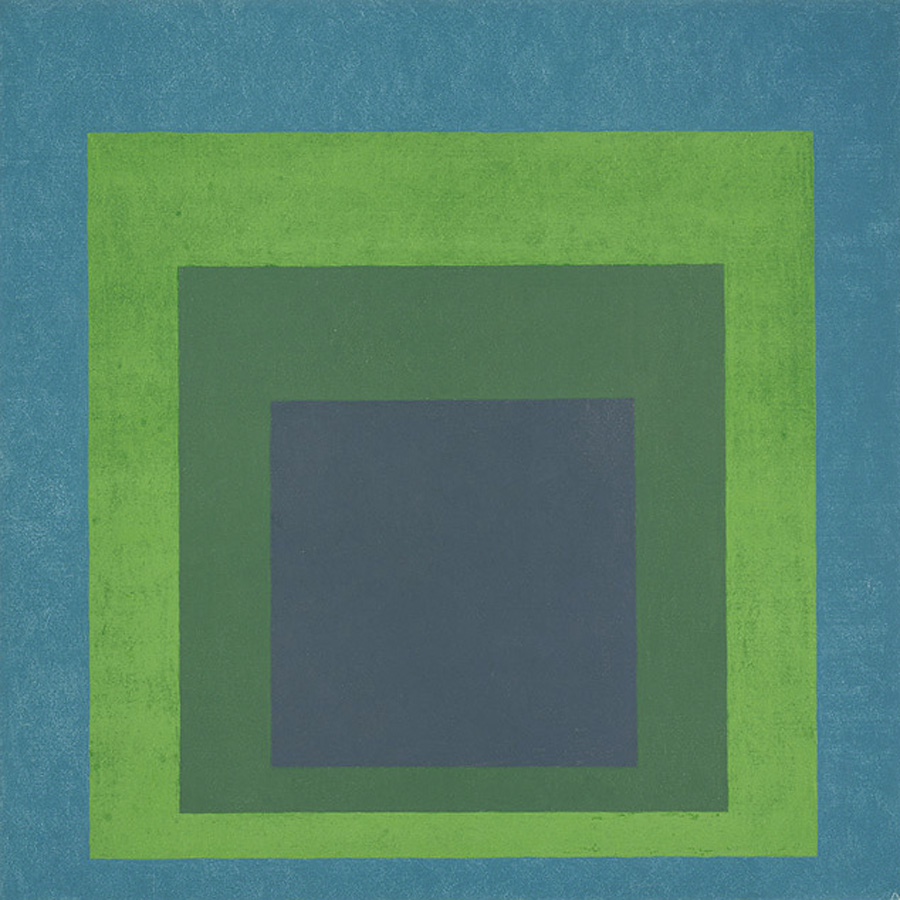
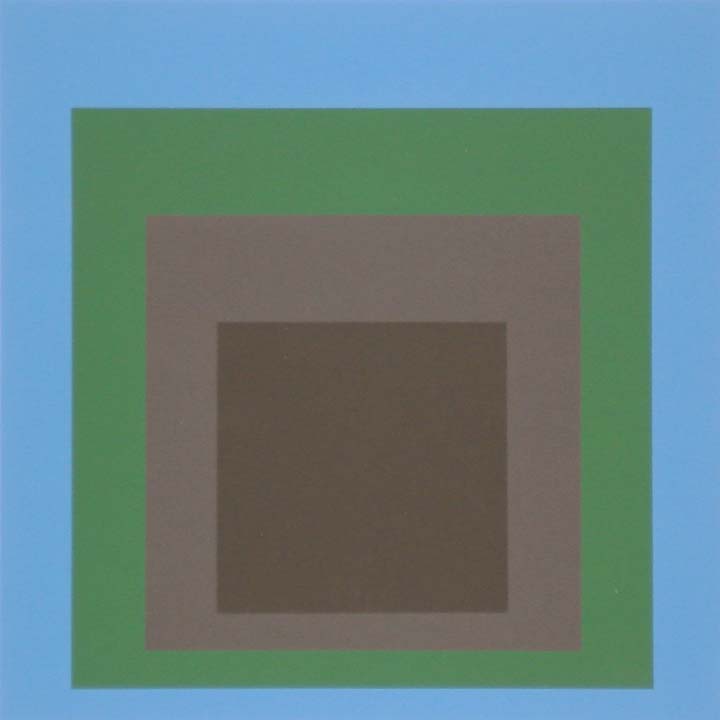
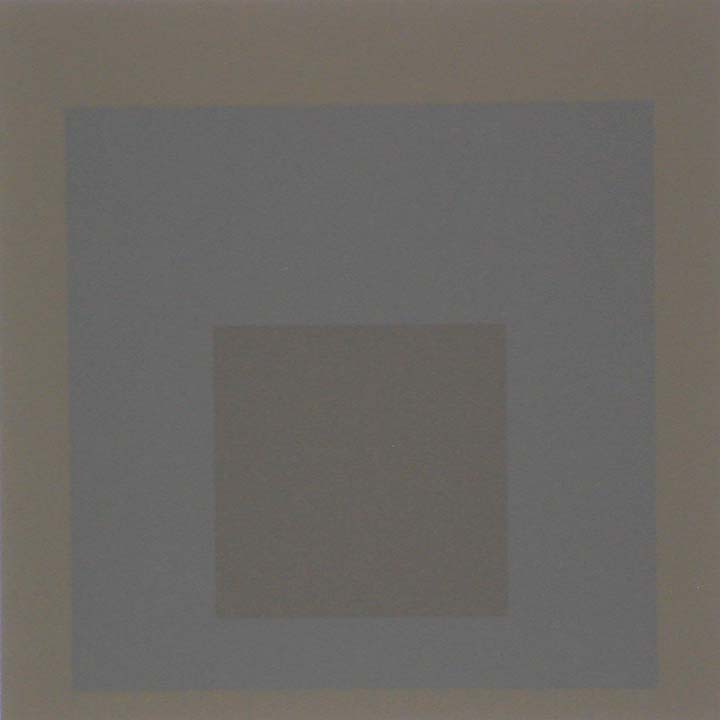
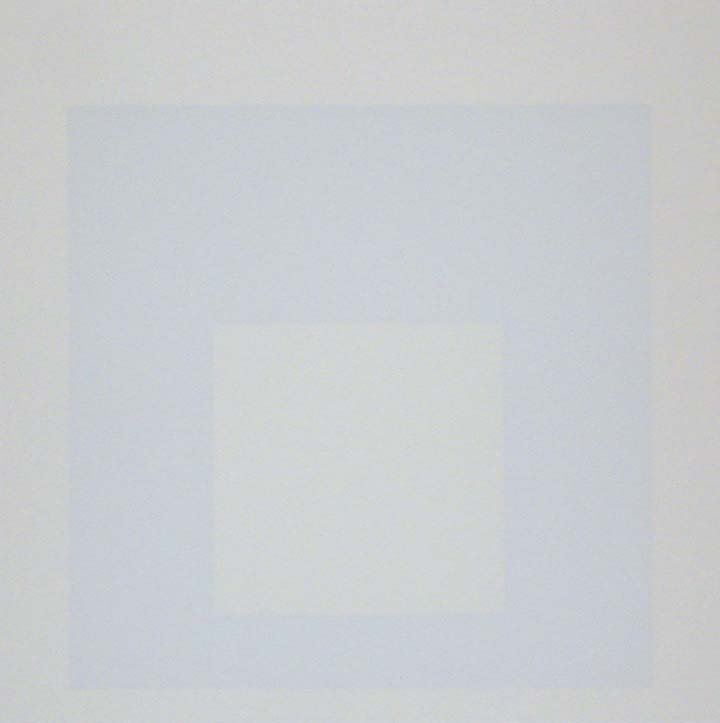
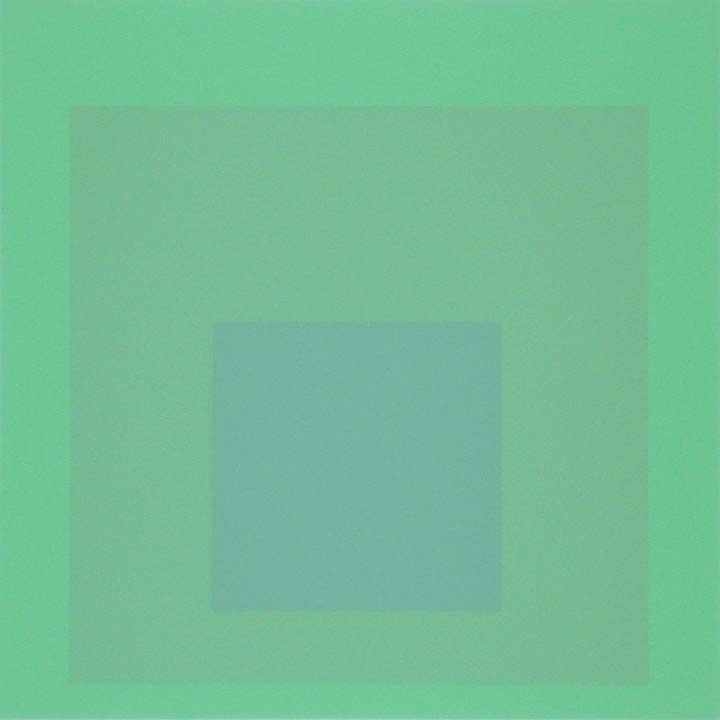
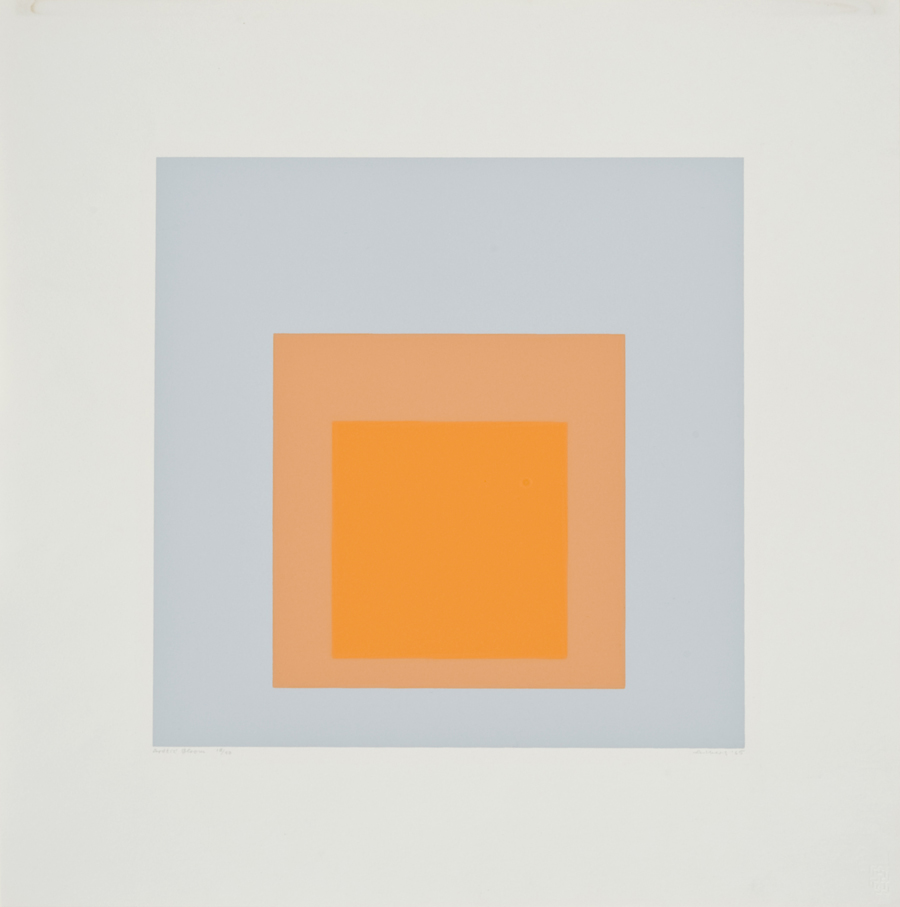
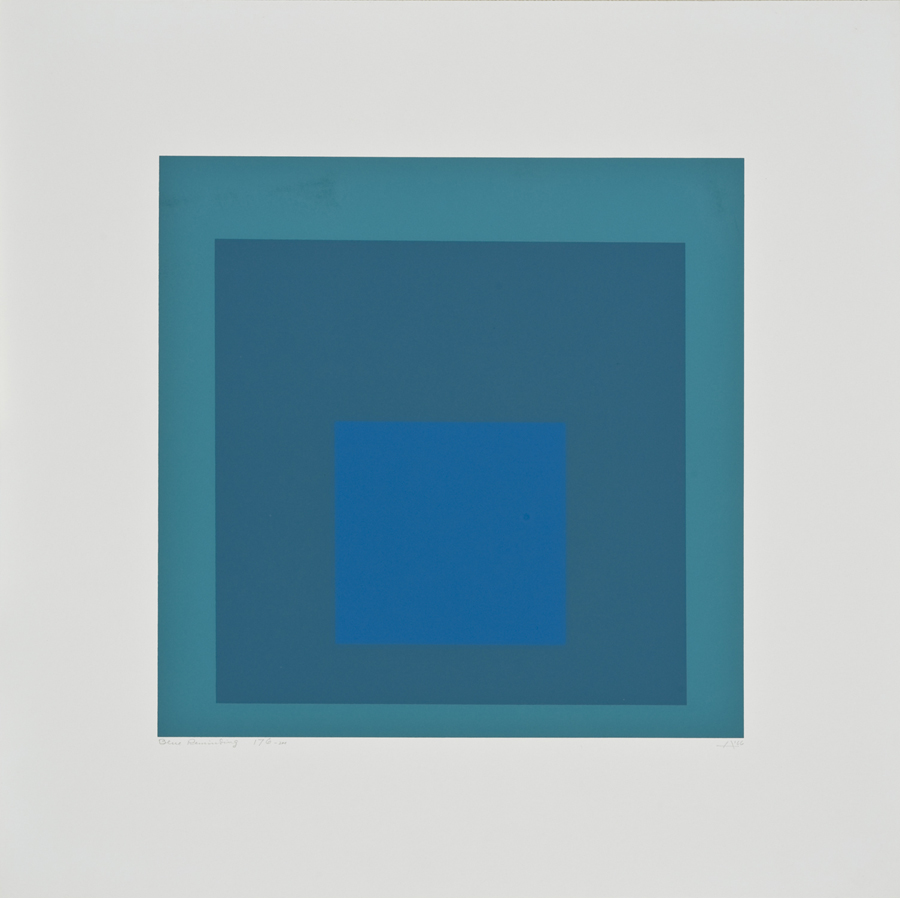
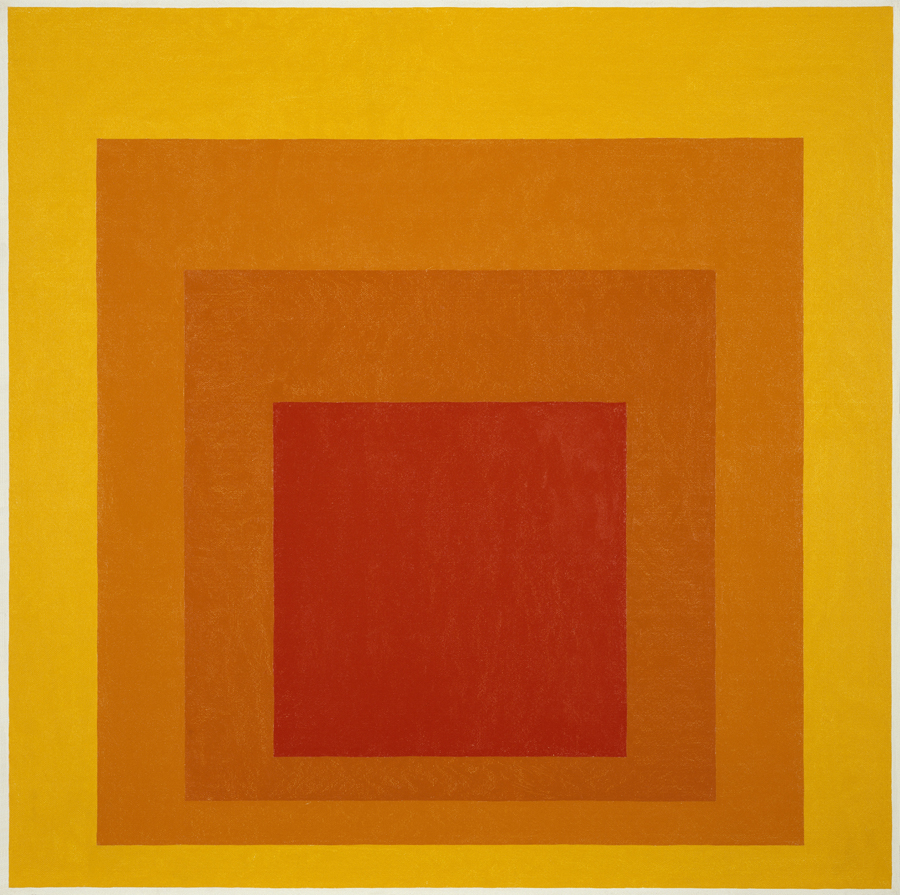
In 1949, at the age of 62, Albers became chairman of the art school at Yale University, with a mandate to transform it from a conservative academic program to a proponent of modern concepts and applications. Believing firmly that colours have no inherent emotional associations, he meticulously explored their nuances and combinations in his work. He eventually limited the shape and number of his forms, which resulted in a standardised format that he called “Homage to the Square,” for which he is best known. Two dozen “Homage to the Square” compositions fill the central gallery in the exhibition, inviting viewers to examine the subtle complexities of their perceptions. The vivid yellow-orange-reds of “Glow” (1966, see below) startle the eye, while the pale grays of “Nacre” (1965, see below) suggest cool neutrality. These images create optical illusions, challenging viewers’ visual acuity. This series concludes with the artist’s vivid red-print duo, “In Honor of the Hirshhorn Museum,” on view for the first time since the museum opened in 1974.
In addition, this exhibition includes examples from Albers’ “Structural Constellation” series of reliefs (1954-1964, see above), which anticipated op art with their linear patterns. The reliefs’ commonplace material-laminated plastic-also fulfils the utopian goal of making art affordable to everyone. The two largest paintings on view, both titled “Variant” (1973), were donated by the artist’s wife and foundation in 1979.
Albers remained active and influential until his death in 1976, and many of his pedagogical innovations have become standard methodology in art schools across the country. His explorations of abstract form and colour also inspired and stimulated generations of artists and designers. Shortly after his arrival in America, he became a co-founder of the American Abstract Artists group and participated in exhibitions across the country, from New York to Michigan and beyond. The Hirshhorn’s exhibition ends with an array of works by colleagues, students and admirers, among them: weavings by the artist’s wife, Anni Albers; abstract constructions by Burgoyne Diller; streamlined images of labor by Jacob Lawrence; a large op art painting by Richard Anuskiewicz; textured creations by Eva Hesse and Robert Rauschenberg; and a minimalist stacked wall sculpture by Donald Judd.”
Many thankx to the Pinakothek Der Moderne for allowing me to publish the photographs in the posting. Please click on the photographs for a larger version of the image.
Over the past fifteen years, the Frankfurt-based photographer Peter Loewy (b. 1951) has gained prominence with a number of powerful series of works. His first book of photographs, Jüdisches (Jewish), was published in 1996, showing details taken from inside the family homes of both famous and unknown Jewish families in Frankfurt. This was followed by the volume Lèche-vitrine, as well as series on the IG Farben Building in Frankfurt and intimate pictures of the working environment of internationally acclaimed artists (Private Collection).
Loewy’s photographs of drawings by well and lesser-known artists from centuries past form a new cycle that is to be exhibited for the first time in the showcase passage at the Staatliche Graphische Sammlung München in the Pinakothek der Moderne.
Quite by chance the photographer came across a book on ethnography and was fascinated by the ‘photographic’ accuracy, use of perspective and shading of drawings of people from the most varied of cultures, depicted in their respective local dress. He switched off the automatic focus option, zoomed in so closely that only a detail could be seen, and selected a filter and distance that went against any standard logic until he achieved a rich blurred image. “I was thrilled”, writes Loewy. “On my display I had a picture that was out of focus, not a drawing. I felt as if I had brought the person back to life – that’s how full of himself a photographer can be compared to a draughtsman. … As a lover of drawings I felt I had to rummage through the history of art as well, or rather masses of books, and revive people from across the centuries in the form of photos. That’s how a mass of portraits of famous and unknown people came about. I also produced a collection of famous and unknown artists, too, who I enshrouded in a misty blurredness.”
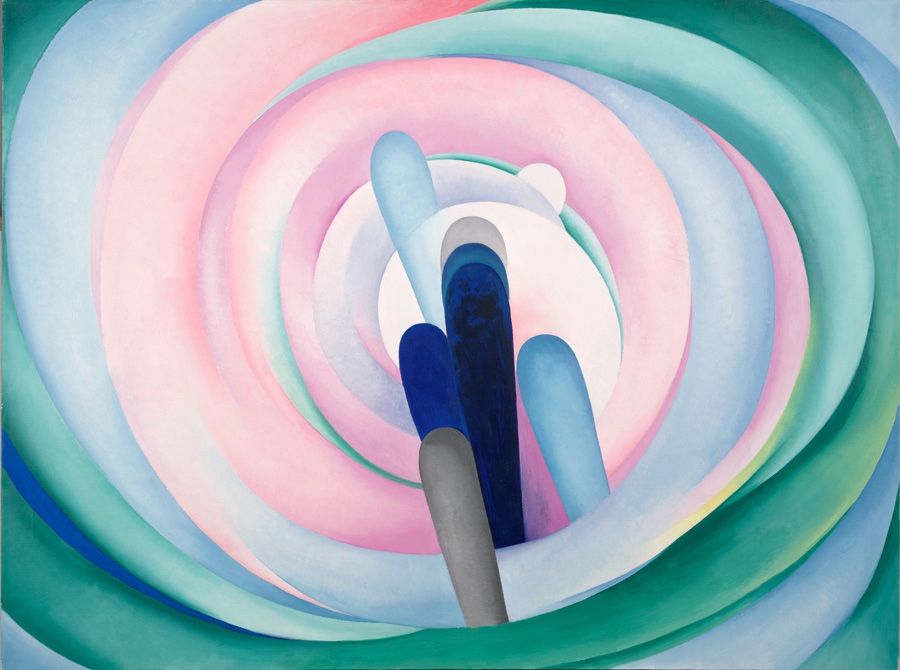
Georgia O’Keeffe (American, 1887-1986) Grey Blue & Black – Pink Circle 1929 Oil on canvas 36 x 48 in. (91.4 x 121.9cm) Dallas Museum of Art Gift of The Georgia O’Keeffe Foundation
Many thankx to Shira Pinsker and The Phillips Collection for allowing me to reproduce the images in the posting. Please click on the photographs for a larger version of the image.
“It is surprising to me to see how many people separate the objective from the abstract. Objective painting is not good painting unless it is good in the abstract sense. A hill or tree cannot make a good painting just because it is a hill or a tree. It is lines and colours put together so that they say something. For me that is the very basis of painting. The abstraction is often the most definite form for the intangible thing in myself that I can only clarify in paint.”
“I long ago came to the conclusion that even if I could put down accurately the thing that I saw and enjoyed, it would not give the observer the kind of feeling it gave me. I had to create an equivalent for what I felt about what I was looking at – not copy it.”
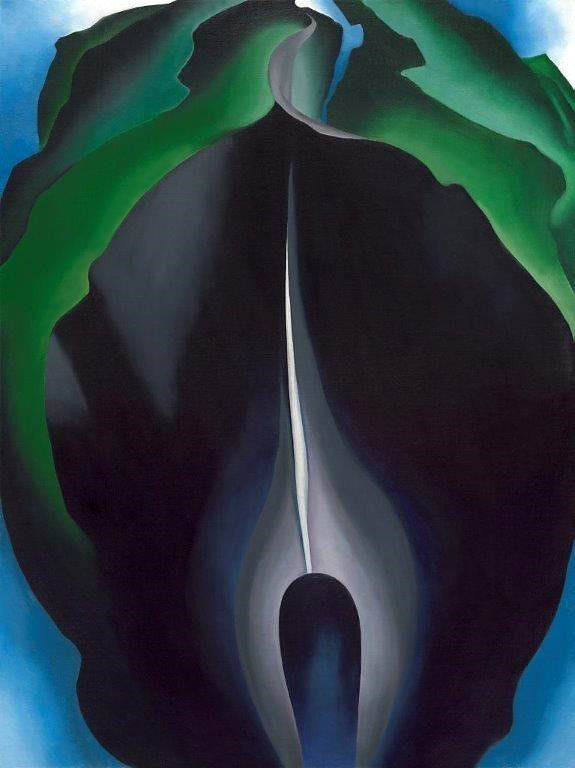
Georgia O’Keeffe (American, 1887-1986) Jack-in-the-Pulpit No. IV 1930 Oil on canvas 40 x 30 in. National Gallery of Art, Washington, D.C. Alfred Stieglitz Collection, Bequest of Georgia O’Keeffe Image courtesy of the Board of Trustees, National Gallery of Art, Washington
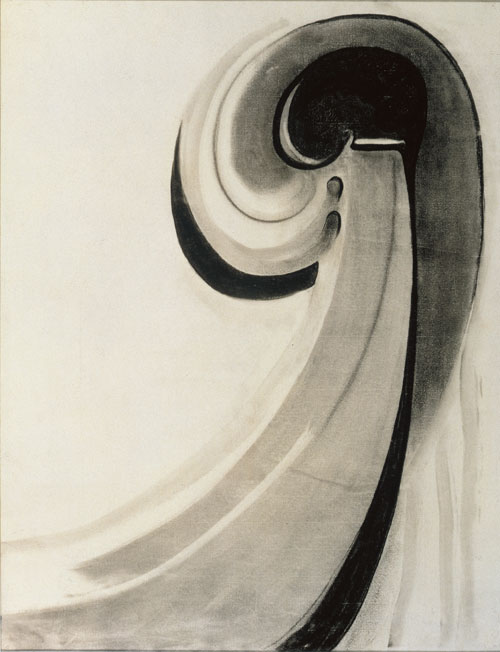
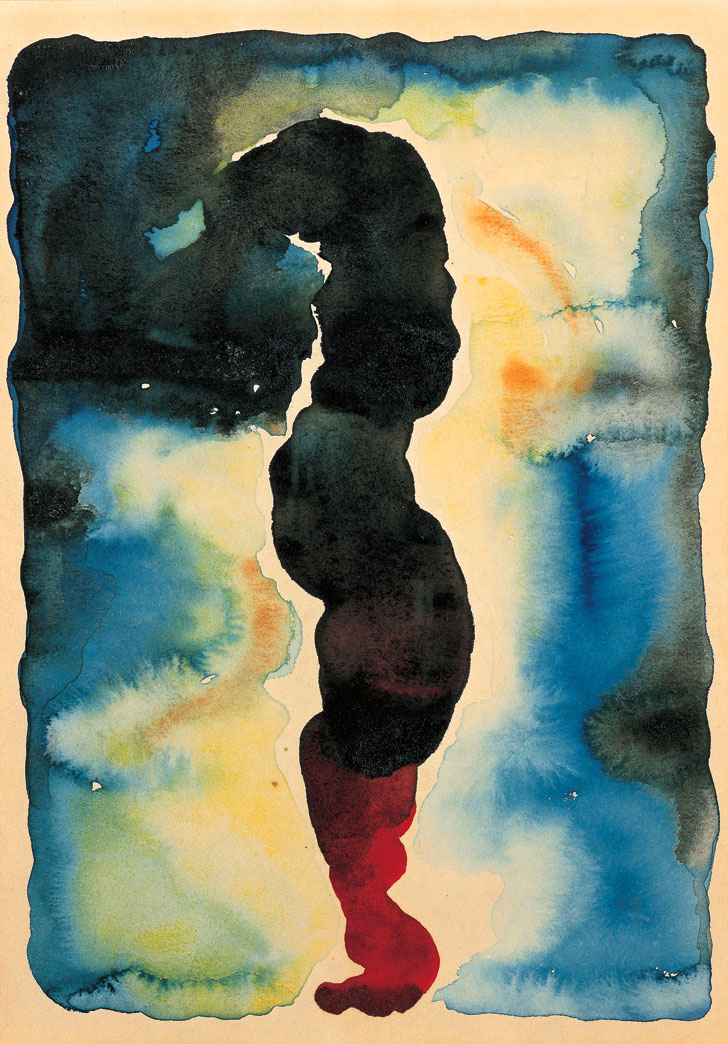
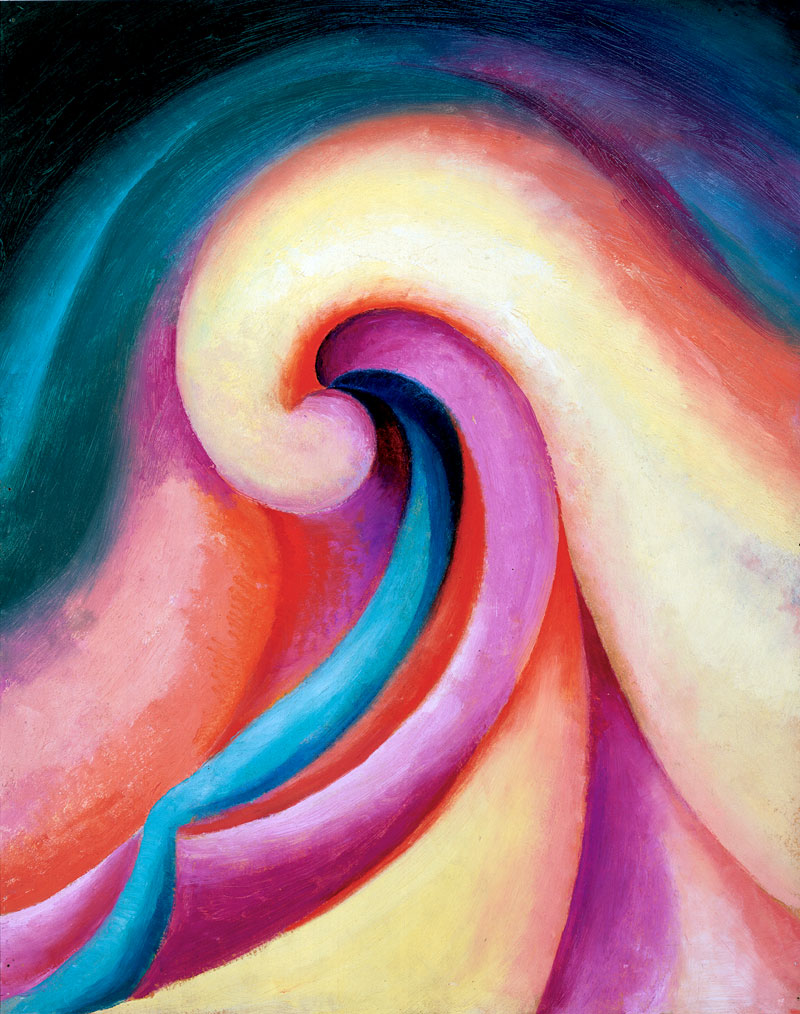
Georgia O’Keeffe (1887-1986) is fixed in the public imagination as a painter of places and things. She has long been recognised for her still lifes of flowers, leaves, animal bones and shells, her images of Manhattan skyscrapers, and her Lake George and New Mexico landscapes. Yet it was with abstraction that O’Keeffe entered the art world and first became celebrated as an artist. In the spring of 1916, she burst onto the New York art scene with a group of abstract charcoal drawings that were among the most radical works produced in the United States in the early twentieth century. As she expanded her repertoire in the years that followed to include watercolour and oil, she retained the fluid space and dynamic, organic motifs of these early charcoals.
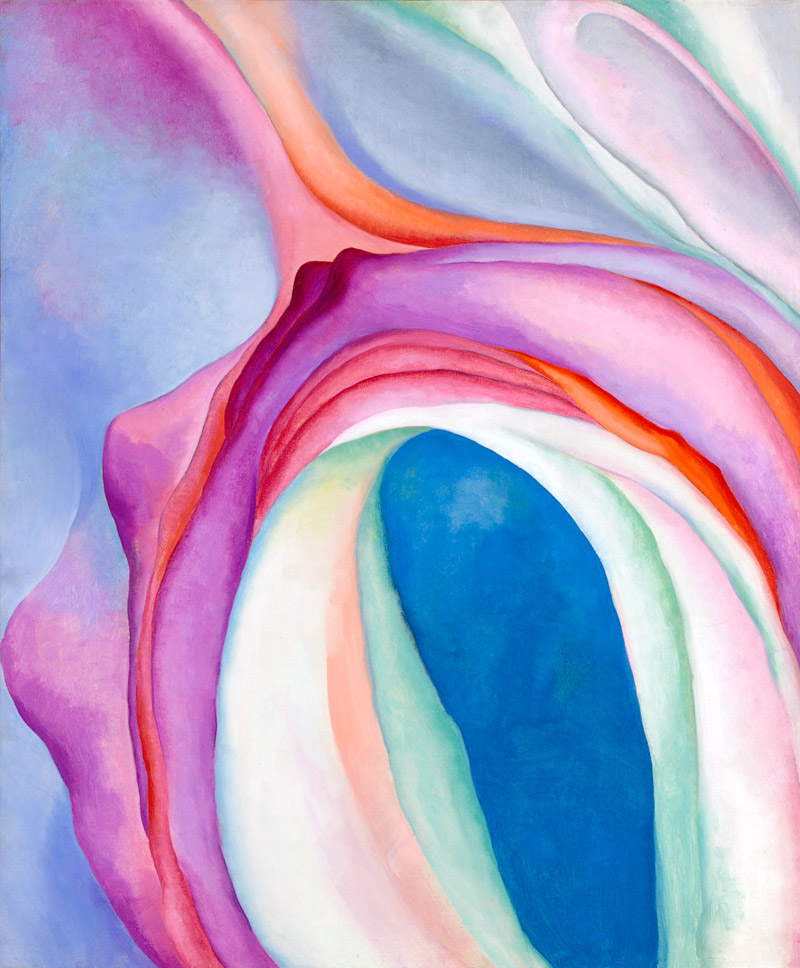
Abstraction dominated O’Keeffe’s output in the early part of her career and remained a fundamental language for her thereafter. Some of her abstractions have no recognisable source in the natural world; others distill visible reality into elemental, simplified forms. For O’Keeffe, abstraction offered a way to portray what she called the “unknown” – intense thoughts and feelings she could not express in words and did not rationally understand. Her abstractions recorded an array of emotions and responses to people and places. At the heart of her practice was an affinity for the flux and sinuous rhythms of nature. Through swelling forms and sumptuous colour, O’Keeffe depicted the experience of being in nature – so enveloped by its sublime mystery and beauty that awareness of all else is suspended.
The artistic achievement of Georgia O’Keeffe is examined from a fresh perspective in Georgia O’Keeffe: Abstraction, a landmark exhibition debuting this winter at The Phillips Collection. While O’Keeffe (1887-1986) has long been recognised as one of the central figures in 20th-century art, the radical abstract work she created throughout her long career has remained less well-known than her representational art. By surveying her abstractions, Georgia O’Keeffe: Abstraction repositions O’Keeffe as one of America’s first and most daring abstract artists. The exhibition, one of the largest of O’Keeffe’s work ever assembled, goes on view February 6 – May 9, 2010.
Including more than 125 paintings, drawings, watercolours, and sculptures by O’Keeffe as well as selected examples of Alfred Stieglitz’s famous photographic portrait series of O’Keeffe, the exhibition has been many years in the making.
While it is true that O’Keeffe has entered the public imagination as a painter of sensual, feminine subjects, she is nevertheless viewed first and foremost as a painter of places and things. When one thinks of her work it is usually of her magnified images of open flowers and her iconic depictions of animal bones, her Lake George landscapes, her images of stark New Mexican cliffs, and her still lifes of fruit, leaves, shells, rocks, and bones. Even O’Keeffe’s canvasses of architecture, from the skyscrapers of Manhattan to the adobe structures of Abiquiu, come to mind more readily than the numerous works – made throughout her career – that she termed abstract.
This exhibition is the first to examine O’Keeffe’s achievement as an abstract artist. In 1915, O’Keeffe leaped into the forefront of American modernism with a group of abstract charcoal drawings that were among the most radical creations produced in the United States at that time. A year later, she added colour to her repertoire; by 1918, she was expressing the union of abstract form and colour in paint. First exhibited in 1923, O’Keeffe’s psychologically charged, brilliantly coloured abstract oils garnered immediate critical and public acclaim. For the next decade, abstraction would dominate her attention. Even after 1930, when O’Keeffe’s focus turned increasingly to representational subjects, she never abandoned abstraction, which remained the guiding principle of her art. She returned to abstraction in the mid 1940s with a new, planar vocabulary that provided a precedent for a younger generation of abstractionists.
Abstraction and representation for O’Keeffe were neither binary nor oppositional. She moved freely from one to the other, cognisant that all art is rooted in an underlying abstract formal invention. For O’Keeffe, abstraction offered a way to communicate ineffable thoughts and sensations. As she said in 1976, “The abstraction is often the most definite form for the intangible thing in myself that I can only clarify in paint.” Through her personal language of abstraction, she sought to give visual form (as she confided in a 1916 letter to Alfred Stieglitz) to “things I feel and want to say – [but] havent [sic] words for.” Abstraction allowed her to express intangible experience – be it a quality of light, colour, sound, or response to a person or place. As O’Keeffe defined it in 1923, her goal as a painter was to “make the unknown – known. By unknown I mean the thing that means so much to the person that he wants to put it down – clarify something he feels but does not clearly understand.”
This exhibition and catalogue chronicle the trajectory of O’Keeffe’s career as an abstract artist and examine the forces impacting the changes in her subject matter and style. From the beginning of her career, she was, as critic Henry McBride remarked, “a newspaper personality.” Interpretations of her art were shaped almost exclusively by Alfred Stieglitz, artist, charismatic impresario, dealer, editor, and O’Keeffe’s eventual husband, who presented her work from 1916 to 1946 at the groundbreaking galleries “291”, the Anderson Galleries, the Intimate Gallery, and An American Place. Stieglitz’s public and private statements about O’Keeffe’s early abstractions and the photographs he took of her, partially clothed or nude, led critics to interpret her work – to her great dismay – as Freudian-tinged, psychological expressions of her sexuality.
Cognisant of the public’s lack of sympathy for abstraction and seeking to direct the critics away from sexualised readings of her work, O’Keeffe self-consciously began to introduce more recognisable images into her repertoire in the mid-1920s. As she wrote to the writer Sherwood Anderson in 1924, “I suppose the reason I got down to an effort to be objective is that I didn’t like the interpretations of my other things [abstractions].” O’Keeffe’s increasing shift to representational subjects, coupled with Stieglitz’s penchant for favouring the exhibition of new, previously unseen work, meant that O’Keeffe’s abstractions rarely figured in the exhibitions Stieglitz mounted of her work after 1930, with the result that her first forays into abstraction virtually disappeared from public view.”
Georgia O’Keeffe (American, 1887-1986) Series I, No. 4 1918 Oil on canvas 20 x 16 in. (50.8 x 40.6cm) Städtische Galerie im Lenbachhaus, Munich Gift of The Georgia O’Keeffe Foundation














 Art Blart _ art and cultural memory archive
You must be logged in to post a comment.