Exhibition: ‘Chris Killip, Retrospective’ at The Photographers’ Gallery, London

Exhibition dates: 7th October, 2022 – 19th February, 2023


Chris Killip (British, 1946-2020) 'Family on a Sunday walk, Skinningrove' 1982 from the exhibition 'Chris Killip, Retrospective' at The Photographers' Gallery, London, October 2022 - Feb 2023


Chris Killip (British, 1946-2020)
Family on a Sunday walk, Skinningrove
1982
From Skinningrove 1981-1984
Gelatin silver print
© Chris Killip Photography Trust
All images courtesy Martin Parr Foundation


Forever present

So many words have been written about the gritty photographs of British photographer Chris Killip that sometimes it feels hard to say something new, something that reveals more about the work. Perhaps I am just adding to the noise around the artist? What can I say that is insightful / eloquent?

Please allow me to talk about how the work makes me feel … interspersed with some of the facts that we know.

I feel humble before this work. Somehow less important as human being than the directness of the photographers vision and the stories he tells through his photographs about salt of the earth people. Human beings existing, getting by, in hardship, in winter, gathering coal at the edge of the sea under the ramparts of a power station – a tough place but not an unhappy place.

“Killip says that Lynemouth, where the sea-coalers worked, was a “tough place, but it wasn’t an unhappy place … There was lots of energy and lots of fun,” he adds. “There was rivalry and enthusiasms and passions. People were not despairing. It was a very complex community and with a great sense of purpose, which was: get the coal and make money. And I’ve always been interested in places that had purpose.”1

Killip’s purpose was to capture human dignity amid industrial decline in England’s north-east, “the human element of economic deprivation” and the resilience of communities affected. He embedded himself in his community – “I stayed in Newcastle for fifteen years. I mean, to get the access to photograph the sea-coal workers took eight years. You do get embroiled in a place”2 – in order for people to accept his presence and be relaxed in front of his large format camera. It’s almost as though the photographer and his very big, very visible camera were part of the scenery, as though the photographer and his equipment became invisible, indivisible from the story.

“In Winter 1983, believing his photographs felt too ‘remote’, Killip acquired a caravan of his own, and moved it onto the beach. Despite storm and snow, he could now photograph at will, in accordance with he rhythms of life on the camp itself. Killip tempers the extreme conditions of work with intimacy, kinships, and the quiet dignities of family life – so much so, that ‘photography’ seems hardly involved.”3

So much so, that ‘photography’ seems hardly involved. Just take a second to think about that statement.

And so admiration is another feeling that swells in the breast, through an understanding of how difficult these poetic images would have been to take with a large format camera (slung around the photographer’s neck, fired using a pistol grip in his hand without Killip ever looking through the lens, the artist just going on when it felt right to take a photograph and the intensity of the moment). How much patience, time, knowledge of the history of art and photography, technique and visualisation it would take to imagine these images into existence: these intimate photographs of families, friends, dogs, motorcycles, cars, ships, cranes and idle time that showcase not only Killip’s empathy for subject matter but also for himself, for he is also part of the story.4

“For a photographer whose work was grounded in the urgent value of documenting “ordinary” peoples’ lives, these nuanced images – radiating a vast stillness of light and time, embedded with the granularity of lives lived – reveal Killip’s conviction that no life is ordinary: everyday lives are sublime.”5

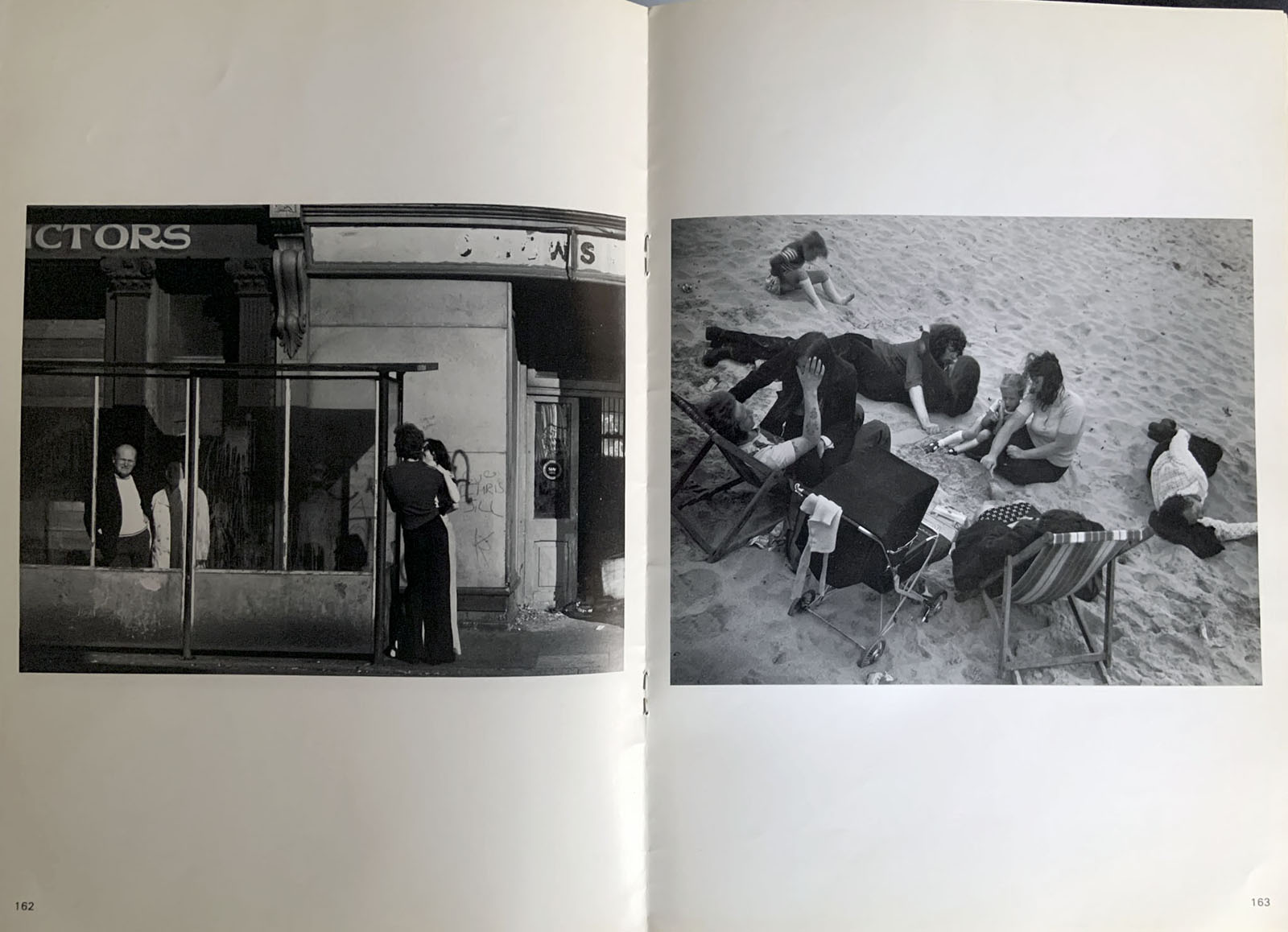
Killip’s visualisations always engage with the light of being and the place of existence with honesty and integrity. To see this, just look at the pairing and sequencing of images from Creative Camera in May 1977 at the end of the posting. A graveyard overlooked by a far away power station opposite two old men, the bald man’s hat hanging on the railing, overlooked by an “all out” demonstration poster; a man with platform shoes and flares, slumped on the ground bracing himself with a tattooed arm, surrounded by graffiti, supports a sleeping almost dead child in the crook of his other arm… whilst opposite a desolate scene of public housing, bleak pillars and fleeing mother and child overwhelmed by concrete madness; and a shrouded, dark, bent, woman in silhouette opposite the trappings of power in the civic robes of the mayors of Jarrow and South Shields. Every life is valuable.

Early influences in the Isle of Man images come from photographers such as August Sander, Paul Strand and Frank Sutcliffe. Later photographs have hints of the photo stories of Bill Brandt. Ultimately Killip forged his own authentic voice as an artist through his persistence in documenting “the human element of economic deprivation” and the resilience of communities affected. As he observed, “I wanted to record people’s lives because I valued them. I wanted them to be remembered. If you take a photograph of someone they are immortalised, they’re there forever. For me that was important, that you’re acknowledging people’s lives, and also contextualising people’s lives.”6

Killip’s focused (ie. in the zone, a mental state of focused concentration on the performance of an activity, in which one dissociates oneself from distracting or irrelevant aspects of one’s environment), complex and layered photographs are forever present. In a world where “there is nothing permanent except change” (Heraclitus), and where there are few traces left of the transitional worlds that Killip was documenting – “The sea-coal camp has gone, so have the coal mine and the power station. The area has been landscaped and now looks like an unused golf course. You would never know that the sea-coal camp had existed.”7 – Killip’s palpable realities make these human beings live and breathe again.

We care about them because Killip’s photographs enable within us a clarity of perception that means we are able to grasp what is there, the way it is. “If reality enters you without distortion, that is proper perception. The rest is distortion.” (Sadhguru)

Clear seeing and clear feeling. Where the forever is ever present.

Dr Marcus Bunyan


1/ Carolina A. Miranda. “Seven photos, seven stories: Chris Killip on capturing the declining industrial towns of England in the ’70s and ’80s,” on the Chicago Tribune website Jul 22, 2017 [Online] Cited 27/01/2023. No longer available online

2/ Anonymous. “Chris Killip,the closest way to make our memories seem real,” on the In de stilte website 17 April 2019 [Online] Cited 27/01/2023

3/ Wall text from the exhibition

4/ Here we could adapt what Pierre Boulez said about his work Pli selon pli (Fold by fold): “So, fold by fold, as the five movements develop, a portrait of Killip is revealed.” See Anonymous. “Pli selon pli,” on the Wikipedia website Nd Footnote 3 [Online] Cited 10/02/2023

5/ Anonymous. “Chris Killip: Skinningrove,” on the Amazon website Nd [Online] Cited 10/02/2023

6/ Chris Killip quoted in Diane Smyth. “Now Then: Chris Killip and the Making of In Flagrante,” on the British Journal of Photography website 6 June 2017 [Online] Cited 26/01/2023

7/ Chris Killip quoted in Olivier Laurent and Natalie Matutschovsky. “Chris Killip’s Celebrated Photobook In Flagrante Makes Its Return,” on the Time website January 27, 2016 [Online] Cited 26/01/2023


Many thankx to The Photographers’ Gallery for allowing me to publish the photographers in the posting. Please click on the photographs for a larger version of the image.


“The photography that I practice takes place in a specific time and place, depicting real moments in peoples lives. In many ways I think of myself as a historian, but not of the world. History is most often written from a distance, and rarely from the viewpoint of those who endured it.”

“I don’t want photography to transcend its subject matter, but for many art historians that is the limitation of photography … I don’t see it as a limitation; it puts me more in the camp of photography than art when I say I don’t acknowledge that as a limitation, I acknowledge it as an interesting fact and strength. Why would I want to transcend the subject when I am interested in the subject matter.”


Chris Killip


“The working class get it in the neck basically, they’re the bottom of the pile,” says Chris Killip. “I wanted to record people’s lives because I valued them. I wanted them to be remembered. If you take a photograph of someone they are immortalised, they’re there forever. For me that was important, that you’re acknowledging people’s lives, and also contextualising people’s lives.”


Chris Killip quoted in Diane Smyth. “Now Then: Chris Killip and the Making of In Flagrante,” on the British Journal of Photography website 6 June 2017 [Online] Cited 26/01/2023


‘I didn’t set out to be the photographer of the English de-Industrial Revolution. It happened all around me during the time I was photographing’ Chris Killip, 2019

Grounded in sustained immersion and participation in the communities he photographed, Chris Killip’s keenly observed work chronicled ordinary people’s lives in stark, yet sympathetic, detail. His photographs are recognized as some of the most important visual records of 1980s Britain; as editor of this book Ken Grant reflects, they tell the story of those who ‘had history “done to them”, who felt its malicious disregard and yet, like the photographer with whom they shared so much of their lives, refused to yield or look away’.”


Anonymous. “Chris Killip,” on the Magnum Photos website Nd [Online] Cited 26/01/2023


Chris Killip’s continued efforts to value and document the lives of those affected by the economic shifts in the North of England, throughout the 1970s and 80s, have made him one of the most influential figures of British Photography. This retrospective exhibition of more than 140 works, serves as the most comprehensive survey of the photographer’s work to date and includes previously unseen works.

His sustained immersion into the communities he photographed remains without parallel. Whilst marking a moment of deindustrialisation, Killip’s stark yet tender observation moves beyond the urgency to record such circumstances, to affirm the value of lives he grew close to – lives that, as he once described ‘had history done to them’, who felt history’s malicious disregard and yet, like the photographer himself, refused to yield or look away.

Against a background of shipbuilding and coal mining, he witnessed the togetherness of communities and the industries that sustained them and stayed long enough to see their loss.

Text from The Photographers’ Gallery website


Chris Killip, retrospective trailer – The Photographers’ Gallery (7 October 22 – 19 February 23)

This retrospective exhibition of more than 140 works, serves as the most comprehensive survey of the photographer’s work to date and includes previously unseen works. Chris Killip’s continued efforts to value and document the lives of those affected by the economic shifts in the North of England, throughout the 1970s and 80s, have made him one of the most influential figures of British Photography.


Chris Killip, retrospective – An Interview with Exhibition Curators Tracy Marshall Grant and Ken Grant

An interview with Chris Killip, retrospective exhibition curators Tracy Marshall-Grant and Ken Grant.


CAMERA Exhibitions: Chris Killip, retrospective. The Photographers Gallery

This retrospective exhibition of more than 140 works, serves as the most comprehensive survey of Chris Killip’s work to date and includes previously unseen works.


Chris Killip

In 1963, aged 17, Chris Fillip opened a copy of Paris Match magazine hoping for news of the Tour de France cycle race, and instead found Henri Cartier-Bresson’s photograph of a boy carrying two bottles of wine in Rue Mouffetard, Paris. Sensing the potential for photography to serve as an untethered means of expression, Killip’s life took a new turn. He didn’t own a camera, yet nevertheless told his father he would become a photographer. A summer working as a beach photographer earned him enough to leave for London in 1964, where he finally secured a position assisting the commercial photographer Adrian Flowers.

Killip’s immersion into the London cultural scene of te 1960s, share with painters and musicians, brought an appreciation for its buoyant gallery culture and an education that was both self-directed and formative. Quickly establishing himself as a sought-after freelance assistant, he led the production of major campaigns, until a 1969 trip to New York prompted an epiphany and a return to his native Isle of Man. There, he began the first of the long-term bodies of worksheet would define his career, each of which are characterised by their independence, tenderness and profound humanity.

Chris Killip’s legacy bears witness to an era of deindustrialisation, whilst serving as a portent to its longer consequences. From that first urgent return to the Isle of Man, into the early 1970s, when he first photographed in the North of England, until his death in October 2020, Fillip remained close to those he photographed ‘those’, he once said, ‘who’d had history done to them’.

Wall text from the exhibition


Isle of Man 1970-1973

In Autumn 1969, while in New York for a commercial photo shoot, a visit to Bill Brandt’s exhibition at the Museum of Modern Art would cause Killip’s life to change course again. It was the permanent collection that inspired him most: Paul Strand, August Sander, Walker Evans… each offered license to make photography for its own sake, free of commercial imperatives, and Fillip left the museum reeling. That same evening, he rang his father, telling him he would return to the Isle of Man to photograph.

By the late 1960s, a peasant culture that had long word the land and sea had been joined by many working financial enterprises on the island. Two instinct Isles of Man were emerging, one of which was now threatened. Between 1970 and 1972, Fillip photographed during the day and worked evenings in his father’s pub. Time away from the island had clarified the political shifts and external influences that were coming to bear on his family and their community, and he knew the urgency of his task. Though completed in 1973, Isle of Man: A book about the Manx, was published in 1980.

Wall text from the exhibition


Chris Killip (British, 1946-2020) 'Golden Meadow mill, Castletown' 1972 from the exhibition 'Chris Killip, Retrospective' at The Photographers' Gallery, London, October 2022 - Feb 2023


Chris Killip (British, 1946-2020)
Golden Meadow mill, Castletown
1972
From Isle of Man 1970-1973
Gelatin silver print
© Chris Killip Photography Trust
All images courtesy Martin Parr Foundation


Chris Killip (British, 1946-2020) 'Cashtal ny Ard, Maughold (neolithic burial site)' 1972 from the exhibition 'Chris Killip, Retrospective' at The Photographers' Gallery, London, October 2022 - Feb 2023


Chris Killip (British, 1946-2020)
Cashtal ny Ard, Maughold (neolithic burial site)
1972
From Isle of Man 1970-1973
Gelatin silver print
© Chris Killip Photography Trust
All images courtesy Martin Parr Foundation


Chris Killip (British, 1946-2020) 'Interior of St Luke's church, Baldwin' 1972


Chris Killip (British, 1946-2020)
Interior of St Luke’s church, Baldwin
1972
From Isle of Man 1970-1973
Gelatin silver print
© Chris Killip Photography Trust
All images courtesy Martin Parr Foundation


Chris Killip (British, 1946-2020) 'Mr 'Snooker' Corkhill and his son, Castletown' 1970-1973


Chris Killip (British, 1946-2020)
Mr ‘Snooker’ Corkhill and his son, Castletown
1970-1973
From Isle of Man 1970-1973
Gelatin silver print
© Chris Killip Photography Trust
All images courtesy Martin Parr Foundation


Chris Killip (British, 1946-2020) 'Mrs Pitts, Slieu Whuallian' 1970-1973


Chris Killip (British, 1946-2020)
Mrs Pitts, Slieu Whuallian
1970-1973
From Isle of Man 1970-1973
Gelatin silver print
© Chris Killip Photography Trust
All images courtesy Martin Parr Foundation


Chris Killip (British, 1946-2020) 'John Radcliffe, Black Hill, Ballasalla' 1970-1973


Chris Killip (British, 1946-2020)
John Radcliffe, Black Hill, Ballasalla
1970-1973
From Isle of Man 1970-1973
Gelatin silver print
© Chris Killip Photography Trust
All images courtesy Martin Parr Foundation


Mr Radcliffe remained a bachelor all his life. When he was given a print of this photograph he folded it in four and put it in his pocket, but told the photographer he was glad to have it as he had lost his cat in the meantime to a traffic accident.


Chris Killip (British, 1946-2020) 'Ms Redpath, Regaby' 1970-1973


Chris Killip (British, 1946-2020)
Ms Redpath, Regaby
1970-1973
From Isle of Man 1970-1973
Gelatin silver print
© Chris Killip Photography Trust
All images courtesy Martin Parr Foundation


Chris Killip (British, 1946-2020) 'Mrs Hyslop, Ballachrink Farm, the Braaid' 1970-1973


Chris Killip (British, 1946-2020)
Mrs Hyslop, Ballachrink Farm, the Braaid
1970-1973
From Isle of Man 1970-1973
Gelatin silver print
© Chris Killip Photography Trust
All images courtesy Martin Parr Foundation


Chris Killip (British, 1946-2020) 'Thrashing, Grenaby Farm, Isle of Man' 1970-1973


Chris Killip (British, 1946-2020)
Thrashing, Grenaby Farm, Isle of Man
1970-1973
From Isle of Man 1970-1973
Gelatin silver print
© Chris Killip Photography Trust
All images courtesy Martin Parr Foundation


In Thrashing, Grenaby … I think I failed better, although I suspect that its atmosphere of ‘bucolic idyll’ would be a different sort of problem. This photograph more accurately describes threshing work, and shows something from the past: agricultural labour as communal effort.


Chris Killip (British, 1946-2020) 'TT Races Supporter, Isle of Man' 1971


Chris Killip (British, 1946-2020)
TT Races Supporter, Isle of Man
1971
From TT Races 1970-1972
Gelatin silver print
© Chris Killip Photography Trust
All images courtesy Martin Parr Foundation


“Making a portrait fills me with a certain amount of dread. It’s the impertinence of what you are about to do in reducing a human being into one fixed moment. You think about the subject’s complexity (knowing them makes this worse) and the predetermined limitations that surround any attempt at portraiture. Then you convince yourself that you have to try, and you go ahead. This brief moment between you and the person in front of you is based on their trust in your intent.”

~ Chris Killip


Early work 1974-1977

In 1972, a commission by the Arts Council of Great Britain led Fillip to photograph Bury St Edmunds and Huddersfield. Drawn to the Yorkshire city’s mills, tenement housing and workplaces, he photographed widely in the region, making portraits in the street, and settling on an approach that would continue in subsequent decades.

After a move to Newcastle in 1975 to undertake a British Gas / Northern Arts Fellowship, Fillip used his non-contracted time to photograph independently. From the edges of the shipyards near his new home, to the coalmining towns of Castleford and Workington, he gathered an understanding of the industrial regions of the North and built an accord with the communities bound by them. An early search for a Newcastle darkroom led to Amber Films, an association that would eventually see him taking on the directorship of Amber’s Side Gallery between 1977-1979.

In May 1977, the editors of Creative Camera magazine [see the end of this posting] gave over the entire issue to a portfolio of Killip’s Northeast photographs – a rare move that acknowledged the work’s authority, whilst suggesting something of the potential future sequencing of work drawn from across the region.

Wall text from the exhibition
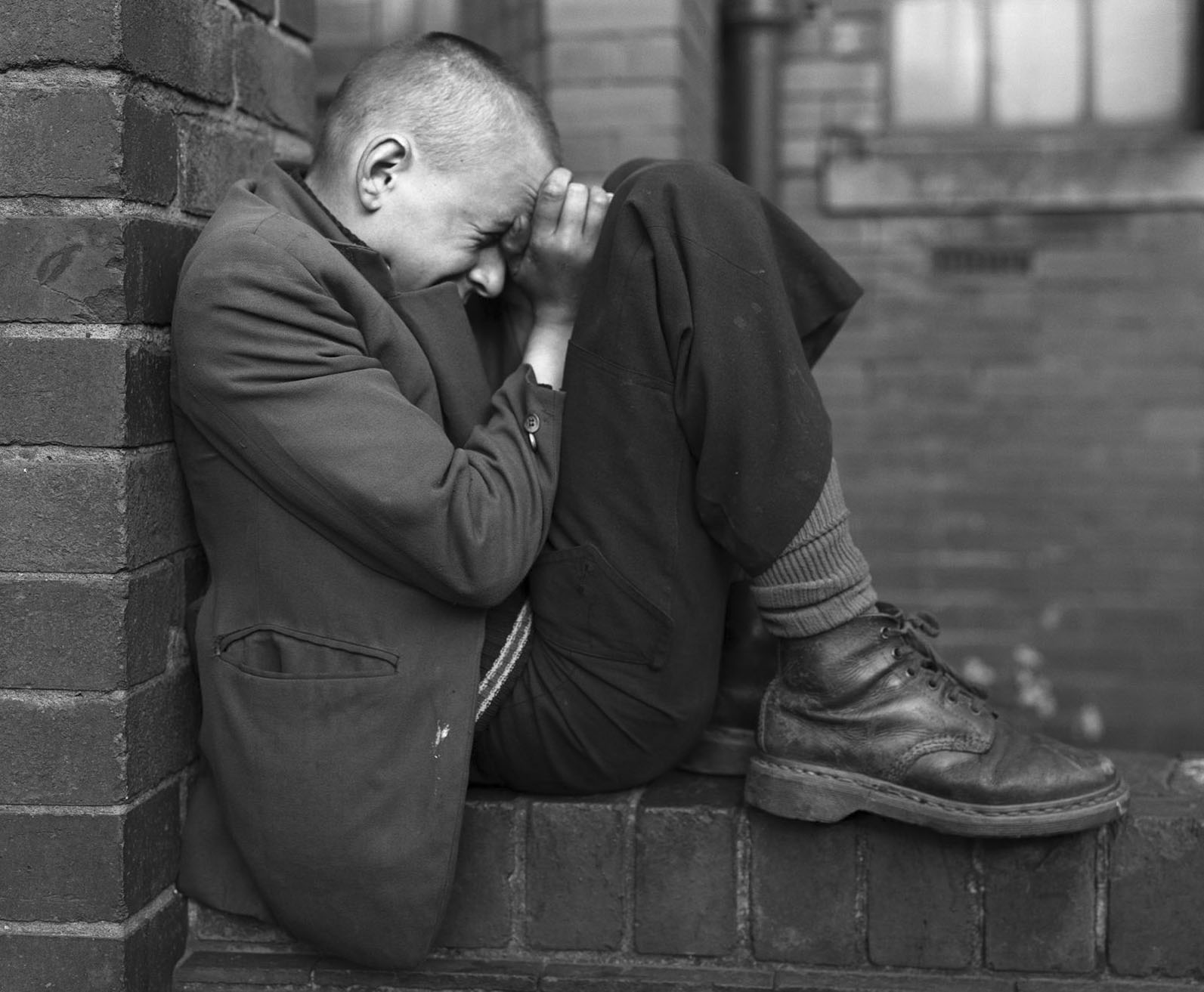
 

Chris Killip (British, 1946-2020) 'Youth on wall, Jarrow, Tyneside' 1975


Chris Killip (British, 1946-2020)
Youth on wall, Jarrow, Tyneside
1975
Gelatin silver print
© Chris Killip Photography Trust
All images courtesy Martin Parr Foundation


The boy with his Punk hair and boots seems to be a study in bravado and insecurity, recorded with magnifying glass clarity by a 5 × 4 camera. Chris later told me that he had captured this unlikely picture by putting a false lens on the side of his view camera (à la Paul Strand) and wearing a hazard jacket, like a council surveyor.

Mark Haworth-Booth. “Chris Killip,” on the V&A Blog website October 30, 2020 [Online] Cited 26/01/2023


Chris Killip (British, 1946-2020) 'Whippet Fancier, Huddersfield' 1973


Chris Killip (British, 1946-2020)
Whippet Fancier, Huddersfield, Yorkshire
1973
Gelatin silver print
© Chris Killip Photography Trust
All images courtesy Martin Parr Foundation


Chris Killip (British, 1946-2020) 'Two girls, Grangetown, Middlesbrough, Teesside' 1975


Chris Killip (British, 1946-2020)
Two girls, Grangetown, Middlesbrough, Teesside
1975
Gelatin silver print
© Chris Killip Photography Trust
All images courtesy Martin Parr Foundation


The Last Ships 1975-1977


Chris Killip (British, 1946-2020) 'Tyne Pride at the end of the street, Wallsend' 1976


Chris Killip (British, 1946-2020)
Tyne Pride at the end of the street, Wallsend
1976
From The Last Ships 1975-1977
Gelatin silver print
© Chris Killip Photography Trust
All images courtesy Martin Parr Foundation


Chris Killip (British, 1946-2020) 'Girls Playing in the street, Wallsend, Tyneside' 1976


Chris Killip (British, 1946-2020)
Girls Playing in the street, Wallsend, Tyneside
[Looking East on Camp Road, Wallsend]

1976
From The Last Ships 1975-1977
Gelatin silver print
© Chris Killip Photography Trust
All images courtesy Martin Parr Foundation


“When I was making my shipbuilding photographs I didn’t show them to anyone, as shipbuilding on Tyneside had become a personal obsession. I made them with a sense of urgency as I thought it wasn’t going to last. I didn’t set out to be the photographer of the English de-industrial revolution, it happened all around me during the time I was photographing.”

~ Chris Killip


This photograph belongs to a bigger series by Chris Killip called The Last Ships, which traces the decline of shipbuilding on the Tyne. “I made them with a sense of urgency, as I thought it wasn’t going to last,” Killip said later. “I didn’t set out to be the photographer of the English de-Industrial Revolution. It happened all around me during the time I was photographing.”

Killip was intrigued by the contrast between the epic scale of the ships that loomed over the streets of Wallsend and South Shields and the working-class communities that lived in their shadow. Here, children play on a quiet terraced street beneath the towering outline of the Tyne Pride, the biggest ship ever built on the Tyne and, as it turned out, one of the last. The red-brick houses, the stone wall, the fog lend the scene an almost Victorian feel. Within a few years, though, that way of life came to an end with a brutal finality. Just two years after this photograph was taken, Killip made another in the same place: the street was demolished, the community scattered. …

Many of Killip’s shipbuilding photographs, though, remained unseen until recently. Now, alongside three other series he made in the north-east – The Station (1985), Skinningrove (1981-84) and Portraits (1970-89) – The Last Ships (1975-1977) has been published as a large format zine. The scale suits the subject matter perfectly. The images, which move from the epic to the intimate, evoke another England in which the terms “working class” and “community” were still synonymous. It seems an eternity ago.

Sean O’Hagan. “The big picture: Chris Killip captures the last days of shipbuilding,” on The Guardian website Sun 6 Jan 2019 [Online] Cited 26/01/2023


“The ship was so massive you could see it from miles around dominating the area, not to mention the cranes and the noises from the yard which could be heard clattering through the night. When I think of those yards, which have just been filled in, flattened and abandoned, I think it’s a crying shame. We’re an island nation that cannot build a ship. If I had to pick a symbol to represent what the shipyards meant to me, it was the comradeship in the yards. We were a close-knit community of people living and working together. Everyone relied on each other and are all linked. When I look at the remains of what’s left I feel nothing. The community’s gone. There’s nothing left. It hasn’t changed for the best. You’ve saved money and destroyed this community.”

Frank Duke quoted in Hunter Charlton. Landscape and Change: Shipbuilding and Identity on the Tyne. University of Bristol, 2015, p. 4.


Chris Killip (British, 1946-2020) 'Wallsend in the snow' 1976


Chris Killip (British, 1946-2020)
Wallsend in the snow
1976
From The Last Ships 1975-1977
Gelatin silver print
© Chris Killip Photography Trust
All images courtesy Martin Parr Foundation
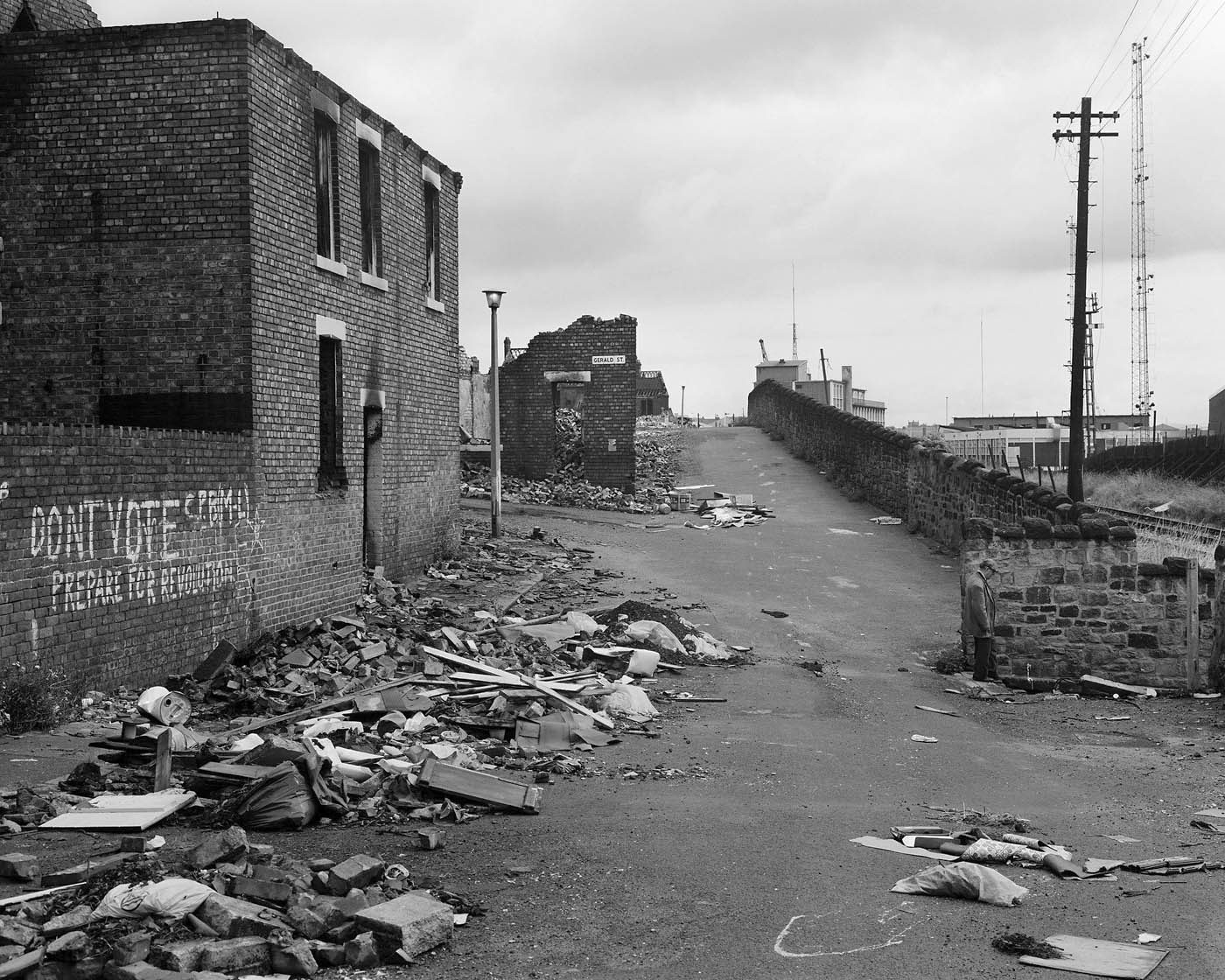
 

Chris Killip (British, 1946-2020) 'Demolished housing, Wallsend' August 1977


Chris Killip (British, 1946-2020)
Demolished housing, Wallsend
August 1977
From The Last Ships 1975-1977
Gelatin silver print
© Chris Killip Photography Trust
All images courtesy Martin Parr Foundation


Chris Killip (British, 1946-2020) 'The Ship Inn' 1975


Chris Killip (British, 1946-2020)
The Ship Inn
1975
From The Last Ships 1975-1977
Gelatin silver print
© Chris Killip Photography Trust
All images courtesy Martin Parr Foundation


Charles Sheeler (American, 1883-1965) 'Ford Plant - Criss-Crossed Conveyors' 1927


Charles Sheeler (American, 1883-1965)
Ford Plant – CrissCrossed Conveyors
1927
Gelatin silver print
© The Lane Collection
Courtesy, Museum of Fine Arts, Boston


Chris Killip (British, 1946-2020) 'Untitled? [Shipbuilding on Tyneside]' 1975-1977


Chris Killip (British, 1946-2020)
Untitled? [Shipbuilding on Tyneside]
1975-1977
From The Last Ships 1975-1977
Gelatin silver print
© Chris Killip Photography Trust
All images courtesy Martin Parr Foundation


Sealcoal 1981-1984

Killip first attempted to photograph the beach at Lynemouth, Northumberland, in 1976, only to be chased away by men on horse-drawn carts wary of any stranger. He’d hoped to photograph as winter tides returned the waste coal expelled into the sea from a nearby mine. After attempts over several years were met with violent rejection, Killip’s eventual acceptance came in 1982, when visiting a pub the seculars frequented to make a final plea. A man recognised him as the Manx photographer he’d give tea and shelter to during a rainstorm at Appleby Horse Fair, and confirmed Killip’s intentions were good.

In Winter 1983, believing his photographs felt too ‘remote’, Killip acquired a caravan of his own, and moved it onto the beach. Despite storm and snow, he could now photograph at will, in accordance with he rhythms of life on the camp itself. Killip tempers the extreme conditions of work with intimacy, kinships, and the quiet dignities of family life – so much so, that ‘photography’ seems hardly involved. Perhaps that’s what Killip liked so much when, years later, he called the words of seacoaler Brian Ladler, ‘…the commandment: love one another. It’s not a bad idea, is it Chris?’

Wall text from the exhibition


Chris Killip (British, 1946-2020) 'Gordon in the water, Seacoal Beach, Lynemouth' 1983


Chris Killip (British, 1946-2020)
Gordon in the water, Seacoal Beach, Lynemouth
1983
From Seacoal 1982-1984
Gelatin silver print
© Chris Killip Photography Trust
All images courtesy Martin Parr Foundation


In 1975 Chris Killip received a fellowship from the Northern Gas Board to photograph the laying of a natural gas pipeline near Newcastle, which for him became the start of a deep engagement with that area of the North East. He first attempted to photograph on Lynemouth Beach in 1976 but was quickly given the boot by those living and working there – again he tried, and in the end it took nearly six years to gain the trust of the community.

Between 1982 to 1984, Killip lived on and off in a caravan at the seacoal camp in Lynemouth – becoming an embedded part of the community, Killip observed the daily struggles to work and survive in this inhospitable environment. As well as the scenes of hard working conditions, images of tenderness in the relationships between the residents show kindness and camaraderie in times of uncertainty as the region underwent rapid de-industrialisation.

Anonymous. “Seacoal 1982-1984,” on the Martin Parr Foundation website Nd


Killip states that his impression of the beach was “the Middle Ages and twentieth century entwined” (Killip, 2022, p. 80).


Chris Killip (British, 1946-2020) 'Unidentified man and Brian Laidler, Seacoal Beach, Lynemouth' January 1984


Chris Killip (British, 1946-2020)
Unidentified man and Brian Laidler, Seacoal Beach, Lynemouth
[Blondie and Brian in the water, Seacoal Beach, Lynemouth, Northumberland]

January 1984
From Seacoal 1982-1984
Gelatin silver print
© Chris Killip Photography Trust
All images courtesy Martin Parr Foundation


Chris Killip (British, 1946-2020) 'Helen and her Hula-hoop, Seacoal Camp, Lynemouth, Northumbria' 1984


Chris Killip (British, 1946-2020)
Helen and her Hula-hoop, Seacoal Camp, Lynemouth, Northumbria
1984
From Seacoal 1982-1984
Gelatin silver print
© Chris Killip Photography Trust
All images courtesy Martin Parr Foundation


Chris Killip (British, 1946-2020) 'Alice and the little dog, Lynemouth, Northumberland' 1983


Chris Killip (British, 1946-2020)
Alice and the little dog, Lynemouth, Northumberland
1983
From Seacoal 1982-1984
Gelatin silver print
© Chris Killip Photography Trust
All images courtesy Martin Parr Foundation


Chris Killip (British, 1946-2020) 'Cookie in the snow, Seacoal Camp, Lynemouth, Northumbria' 1984


Chris Killip (British, 1946-2020)
Cookie in the snow, Seacoal Camp, Lynemouth, Northumbria
1984
From Seacoal 1982-1984
Gelatin silver print
© Chris Killip Photography Trust
All images courtesy Martin Parr Foundation


‘I remember speaking with Josef Koudelka in 1975 about why I should stay in Newcastle. Josef said that you could bring in six Magnum photographers, and they could stay and photograph for six weeks – and he felt that inevitably their photographs would have a sort of similarity. As good as they were, their photographs wouldn’t get beyond a certain point. But if you stayed for two years, your pictures would be different, and if you stayed for three years they would be different again. You could get under the skin of a place and do something different, because you were then photographing from the inside. I understood what he was talking about. I stayed in Newcastle for fifteen years. I mean, to get the access to photograph the sea-coal workers took eight years. You do get embroiled in a place.’

Anonymous. “Chris Killip,the closest way to make our memories seem real,” on the In de stilte website 17 April 2019 [Online] Cited 27/01/2023


Killip’s photos have an austere beauty to them – such as the image of a man nicknamed “Cookie” purposefully walking through a snowstorm. But the stories behind them can be quite humorous.

“Cookie was one of the people I was very friendly with,” Killip says. “It was a Sunday morning and his horse, Creamy, had just won a trotting race against guys from town. He’d won a £1,000. The race takes place very early so the police aren’t around. Then we go to the pub – at half past 7 in the morning – and the drinks are on Cookie because he has all of this money.

“Walking back to camp, I knew Cookie had to come back that way,” he adds. “I put the camera on the tripod and I’m swaying quite a bit because I’m drunk. But I knew exactly when I was going to take the picture of him. He didn’t lift his head. I took that one picture, just one frame.” …

Killip says that Lynemouth, where the sea-coalers worked, was a “tough place, but it wasn’t an unhappy place.”

“There was lots of energy and lots of fun,” he adds. “There was rivalry and enthusiasms and passions. People were not despairing. It was a very complex community and with a great sense of purpose, which was: get the coal and make money. And I’ve always been interested in places that had purpose.”

Carolina A. Miranda. “Seven photos, seven stories: Chris Killip on capturing the declining industrial towns of England in the ’70s and ’80s,” on the Chicago Tribune website Jul 22, 2017 [Online] Cited 27/01/2023. No longer available online


Chris Killip: I’m still in touch with the sea-coalers that I was big friends with and I’m up to date with how they are doing now that they have moved away from the area. The sea-coal camp has gone, so have the coal mine and the power station. The area has been landscaped and now looks like an unused golf course. You would never know that the sea-coal camp had existed.

I went back to Skinningrove three years ago and that was a big shock as it was so quiet as only two boats do any fishing from there. Everyone else has stopped as they couldn’t keep up with European Economic Community and Health and Safety regulations. It was as if all the life had gone out of the place.

Chris Killip quoted in Olivier Laurent and Natalie Matutschovsky. “Chris Killip’s Celebrated Photobook In Flagrante Makes Its Return,” on the Time website January 27, 2016 [Online] Cited 26/01/2023


Chris Killip (British, 1946-2020) ''Boo' on a horse, Seacoal Camp, Lynemouth, Northumbria' 1984


Chris Killip (British, 1946-2020)
‘Boo’ on a horse, Seacoal Camp, Lynemouth, Northumbria
1984
From Seacoal 1982-1984
Gelatin silver print
© Chris Killip Photography Trust
All images courtesy Martin Parr Foundation


The Photographers’ Gallery this autumn presents a full-career retrospective of work by one of the UK’s most important and influential post-war documentary photographers, Chris Killip (1946-2020).

Taking place over two upper floors of the Gallery, the retrospective exhibition of more than 150 works serves as the most comprehensive survey of the photographer’s work to date and includes previously unseen ephemera and colour works.

Grounded in his sustained immersion into the communities he photographed, Chris Killip’s photographs of those affected by economic shifts throughout the 1970s and 80s in the North of England remain without parallel. Whilst marking a moment of deindustrialisation, Killip’s stark yet tender observation moves beyond the urgency to record such circumstances, to affirm the value of lives he grew close to – lives that, as he once described ‘had history done to them’, who felt history’s malicious disregard and yet, like the photographer himself, refused to yield or look away.

From early work made in his native Isle of Man, through overlapping series’ made over two decades in the North of England, Killip’s approach to portraying communities is explored. Against a background of shipbuilding and coal mining, he witnessed the togetherness of communities and the industries that sustained them and stayed long enough to see their loss. At Lynemouth, for his series ‘Seacoal’, he photographed men on horse-driven carts reclaiming coal which had been discarded into the sea by a nearby mine, and at Skinningrove he documented a group of young men, their friendships and labours as they waited for the tide to turn.

The exhibition, curated by Tracy Marshall-Grant and Ken Grant, also draws upon less familiar work by a photographer whose life and career has proved so influential in shaping British photography. Killip’s dedicated recording of the miners’ strike of 1984-1985 and his engagement with shipbuilding a decade earlier, remain lesser known yet pivotal works that betrayed not only a changing economy, but the concerns of a photographer moved to witness them. In dialogue with the prints made by the photographer towards the end of his life, the exhibition also considers Killip’s photo books, drawing on early maquettes to map the development of books acknowledged as landmarks in the genre and offer new perspectives on the photographer’s storytelling.

The exhibition is accompanied by a major monograph co-published with Thames and Hudson, edited by Ken Grant and Tracy Marshall-Grant and designed by Niall Sweeney. The book includes a foreword by Brett Rogers, in depth essays by Ken Grant and texts by Amanda Maddox, Greg Halpern and Lynsey Hanley. The exhibition will tour to the BALTIC Centre of Contemporary Art in 2023. Exhibition supported by the Isle of Man Arts Council.

Chris Killip

Born in Douglas, Isle of Man in 1946, Chris Killip left school at age sixteen and joined the only four star hotel on the Isle of Man as a trainee hotel manager. In June 1964 he decided to pursue photography full time. He worked as a freelance assistant for various photographers in London from 1966-1969. In 1969, after seeing his very first exhibition of photography at the Museum of Modern Art in New York, he decided to return to photograph in the Isle of Man. In 1972 he received a commission from The Arts Council of Great Britain to photograph Huddersfield and Bury St Edmunds for the exhibition Two Views – Two Cities. In 1975, he moved to live in Newcastle-upon-Tyne on a two year fellowship as the Northern Arts Photography Fellow. He was a founding member, exhibition curator and advisor of Side Gallery, Newcastle-upon-Tyne, as well as its director, from 1977-1979. In 1989 he received the Henri Cartier Bresson Award and in 1991 was invited to be a Visiting Lecturer at the Department of Visual and Environmental Studies, Harvard University. In 1994 he was made a tenured professor and was department chair from 1994-1998. He retired from Harvard in December 2017 and died in 2020. His work is featured in the permanent collections of major institutions such as the Museum of Modern Art, New York; George Eastman House; Fine Arts Museum of San Francisco; Museum Folkwang, Essen; the Stedelijk Museum, Amsterdam; National Gallery of Australia, Canberra; and the Victoria and Albert Museum, London.

Press release from The Photographers’ Gallery


The Time of In Flagrante 1976-1987

In 1985, David Godwin, then Editor at Secker & Warburg, had written to Fillip to suggest that if he wished to make another book, he would like to publish it. Although Secker had no track record of working with photography, Fillip liked the prospect of reaching a wider audience and a collaboration began with editor Mark Holborn and designer Peter Dyer that led to the 1988 book In Flagrante.

In Flagrante‘s achievements are manifold. Whilst Fillip threw himself into long term series, like the 1984-85 Miners’ Strike, the uncoupling of photographs from their original contexts freed them from more conventional narratives. Mindful of the Yeats poem He wishes for the cloths of heaven, which head chosen to open the book, Killip reads softly, to achieve work that John Berger recognised as being ‘branded, like a hundred cattle, with the tenderness of those eight lines.’

Wall text from the exhibition


He wishes for the cloths of heaven

W.B. Yeats 1899

Had I the heavens’ embroidered cloths,
Enwrought with golden and silver light,
The blue and the dim and the dark cloths
Of night and light and the half light,
I would spread the cloths under your feet:
But I, being poor, have only my dreams;
I have spread my dreams under your feet;
Tread softly because you tread on my dreams.


Replaced in In Flagrante Two (2016) with:

“The photographs date from 1973 to 1985 when the Prime Ministers were: Edward Heath, Conservative (1970-1974), Harold Wilson, Labour (1974-1976), James Callaghan, Labour (1976-1979), Margaret Thatcher, Conservative (1979-1990).”

In Flagrante means ‘caught in the act,’ and that’s what my pictures are. You can see me in the shadow, but I’m trying to undermine your confidence in what you’re seeing, to remind people that photographs are a construction, a fabrication. They were made by somebody. They are not to be trusted. It’s as simple as that.” ~ Chris Killip


Chris Killip: My camera’s very visible. It’s big. And there’s something good about this, where you have to deal with the fact that I am a photographer and I am here. Look at this great big contraption.

Laura Hubber: When you take a picture of someone, what are you hoping to capture or convey?

CK: I don’t know. You want the picture to be good. You want the picture to represent the complexity that you know that this person has.

My pictures are a mixture of people I know well and intimately and people I don’t know.

It’s more difficult when you have strong feelings about the person. Sometimes you’re more successful when you know less about someone, because I think I see them more clearly. I don’t see them as my friend, or the people that I know, or a person that I maybe even don’t like that much or something. They have no baggage. I see them just as a visual thing with no preconditions.

Laura Hubber. “Caught in the Act: A Conversation with Photographer Chris Killip,” on the Getty website July 7, 2017 [Online] Cited 26/01/2023


“You’re going to get a picture by being there. It’s never easy. Sometimes you’re good and they’re good… I’d never seen them before and I never saw them again.” ~ Chris Killip


Chris Killip (British, 1946-2020) 'Miners' Strike, Easington, Co Durham' 1984


Chris Killip (British, 1946-2020)
Miners’ Strike, Easington, Co Durham
1984
From Miners’ Strike 1984-1985
Gelatin silver print
© Chris Killip Photography Trust
All images courtesy Martin Parr Foundation


Skinningrove 1982-1984

Killip photographed Skinningrove, North Yorkshire, between 1982 and 1984, but first noted it during an early drive up the east coast of England in 1974. He’d been impressed by the steelworks, which had sat above the village since the 1870s to service ironstone excavation, and noticed that, by any measure, Skinningrove was ‘a difficult place to see’.

Villagers dovetailed shifts on the hill with fishing, forcibly discouraging those inclined to trespass in their waters. Killip’s presence in the village was made easier by a young local called Leso, who calmed anyone nervous of the camera. Leso’s life was tragically cut short after the fishing boat in which he and some friends had been at sea overturned. Leso and his friend David drowned, while Bever was washed ashore. After David’s mother asked for photographs of her lost son, Killip made her an album of three dozen photographs showing the boy between the ages of thirteen and seventeen. He would go on to do the same for Leso’s father, later reflecting that if this gesture, between precious life and loss, was the only reason to have even been in the village at all, perhaps that was reason enough.

Wall text from the exhibition


Killip’s working practice is distinctive for the way he immerses himself into the communities he photographs and builds relationships with his subjects over a long period of time. This close level of involvement shows itself through images that are sensitive to the local environment and its inhabitants, as seen in the Skinningrove series.

Text from the Tate website


Chris Killip (British, 1946-2020) 'Boat repair and seven men, Skinningrove' 1982


Chris Killip (British, 1946-2020)
Boat repair and seven men, Skinningrove
1982
From Skinningrove 1981-1984
Gelatin silver print
© Chris Killip Photography Trust
All images courtesy Martin Parr Foundation


Chris Killip (British, 1946-2020) 'Leso, Blackie, Bever, ?, David, on a bench, Whippet standing, Skinningrove (Leso and David were to drown of Skinningrove on July 29, 1986)' 1982-1983


Chris Killip (British, 1946-2020)
Leso, Blackie, Bever, ?, David, on a bench, Whippet standing, Skinningrove (Leso and David were to drown of Skinningrove on July 29, 1986)
1982-1983
From Skinningrove 1981-1984
Gelatin silver print
© Chris Killip Photography Trust
All images courtesy Martin Parr Foundation
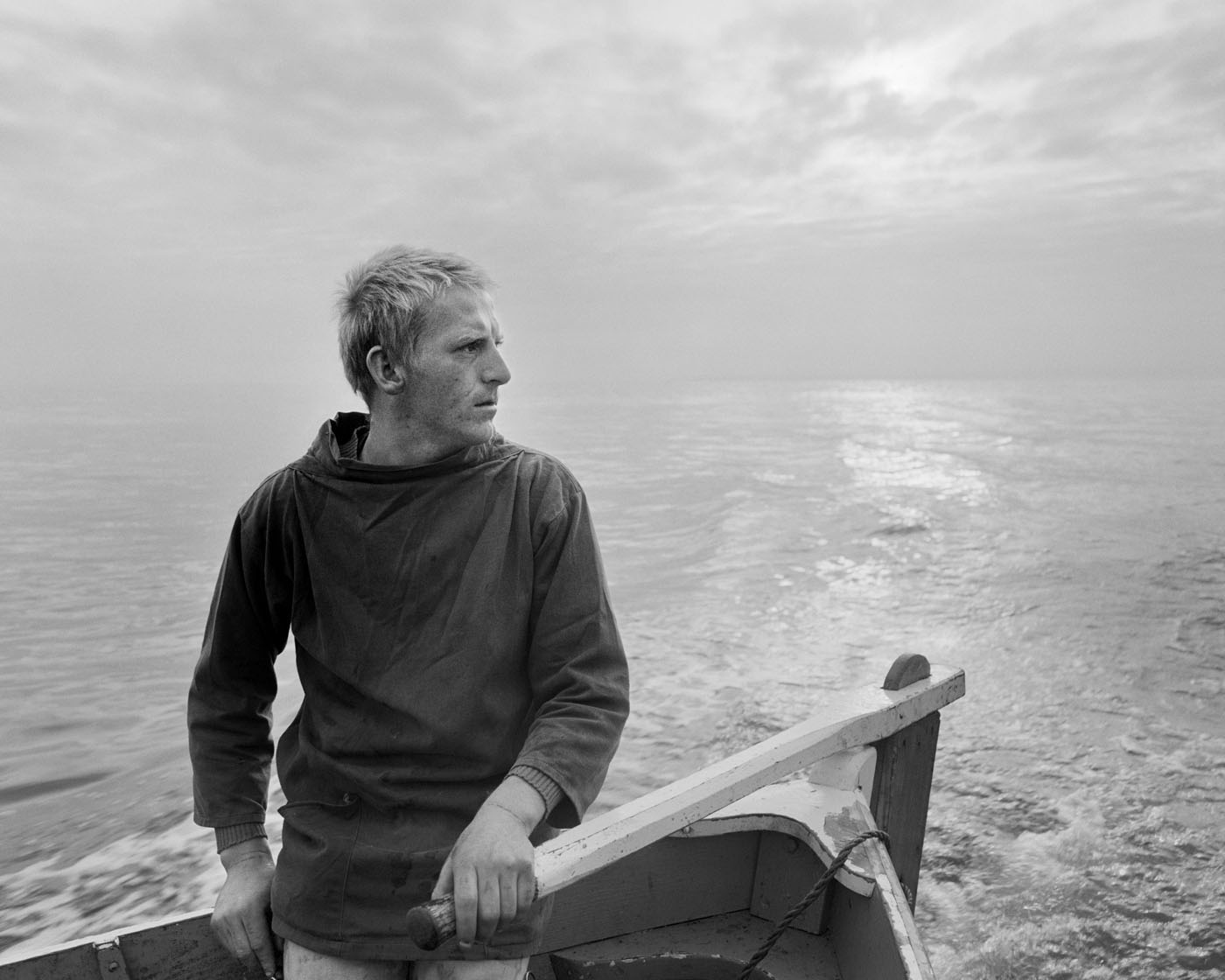
 

Chris Killip (British, 1946-2020) 'Leso at sea, Skinningrove' 1983


Chris Killip (British, 1946-2020)
Leso at sea, Skinningrove
1983
From Skinningrove 1981-1984
Gelatin silver print
© Chris Killip Photography Trust
All images courtesy Martin Parr Foundation


Chris Killip (British, 1946-2020) 'Crabs and People, Skinningrove, North Yorkshire, UK' 1981


Chris Killip (British, 1946-2020)
Crabs and People, Skinningrove, North Yorkshire, UK
1981
From Skinningrove 1981-1984
Gelatin silver print
© Chris Killip Photography Trust
All images courtesy Martin Parr Foundation


There’s nothing showy about these pictures. Framing and composition just seem to occur — which is, of course, the highest compliment one can pay a photographer. A photograph like “Crabs and People” requires a second look, or even a third, to realize how much is going on in it: the people, the dogs, the interplay of car and pram and cart, of ocean and rock.

Mark Feeney. “Where the greeting is ‘now then’ rather than ‘hello’,” on The Boston Globe website May 15, 2019 [Online] Cited 27/01/2023. No longer available online


Chris Killip 'Crabs and People, Skinningrove, North Yorkshire, UK' 1981 analysis


Chris Killip’s Crabs and People, Skinningrove, North Yorkshire, UK 1981 showing the construction of the pictorial plane, including Killip’s use of opposing triangles, the two people looking away to form the vanishing point, the man in the car looking towards the camera and the two dogs facing out of the picture in opposite directions.


Chris Killip (British, 1946-2020) 'Bever, Skinningrove, N. Yorkshire' 1983


Chris Killip (British, 1946-2020)
Bever, Skinningrove, N. Yorkshire
1983
From Skinningrove 1981-1984
Gelatin silver print
© Chris Killip Photography Trust
All images courtesy Martin Parr Foundation


Chris Killip might not be as well known as Martin Parr or have the cult kudos of Tony Ray-Jones, but the work he produced in the 1970s and ’80s arguably stands above either of them. Killip was born on the Isle of Man and returned there after quitting commercial photography in the early 1970s to concentrate on the communities he grew up amongst. It still looks like the 1930s: men till fields with horses, stone walls grid the landscape under glowering skies. Killip’s portraits are full of dignity and empathy for the relentless bleak toil of these people’s lives. It would be a fine body of work in itself, but it’s what comes next that makes this show so vital.

Taking his cues from the changes he saw happening to the traditional Manx way of life, Killip started exploring other disintegrating communities in the north of England: Tyne shipbuilders, steelworkers in Yorkshire and seacoal scavengers on the Northumbrian coast. The prow of gigantic oil tanker Tyne Pride appears suddenly and surreally at the end of a glum terraced street as children play in its shadow. But the ship’s buyer fell through, and when Killip returns two years later, the shipyard is gone and the street is being demolished. …

Killip isn’t brutal for brutality’s sake. If anything, the overriding emotion here is tenderness coupled with a certain discreet awe that people want to continue, to strive, to live. That’s the real power of this show. Whether it’s gangs of glue-sniffers or burly men trying to get a rare ray of seaside sunshine, the people that Killip portrays, and the landscapes they inhabit, are always shockingly, immediately alive, full of interest and possibility. Possibility that they are always denied, except through Killip’s photography.

Chris Waywell. “Chris Killip: Retrospective,” on the TimeOut website Tuesday 8 November 2022 [Online] Cited 26/01/2023


Skinningrove

In the short film, “Skinningrove,” 2013, Chris Killip tells personal stories about the people in his photographs. Director Michael Almereyda made the film from a lecture Killip gave at Harvard University.


Chris Killip (British, 1946-2020) 'Father and son watching a parade, West-end of Newcastle, Tyneside' 1980


Chris Killip (British, 1946-2020)
Father and son watching a parade, West-end of Newcastle, Tyneside
1980
Gelatin silver print
© Chris Killip Photography Trust
All images courtesy Martin Parr Foundation


Killip points out he spent years getting to know the area, living in Newcastle for 26 years (from 1975, when he won a two-year fellowship from Northern Arts to photograph North East England, until 1991, when he started teaching at Harvard).

He says he stayed because he liked it, and that he might never have left had the Harvard job not come along – but he was also inspired by the Magnum photographer Josef Koudelka, who came to visit him early on and “talked about the importance of being in one place, to get under the surface of things”. He was also interested in how differently Paul Strand and Manuel Alvarez Bravo photographed Mexico, he says, despite Strand’s sympathetic, card-carrying Communist credentials.

“Strand beautifies poverty and simplifies the Mexican people into ‘the poor Mexicans, but isn’t this wonderful visually’,” he says. “But Alvarez Bravo was Mexican, his pictures are very complicated because he was able to accept ambiguities and contradictions, which Strand couldn’t… I think because I lived in Newcastle for so long I was able to accept ambiguities and not worry about them, just accept them and show them. I wanted to be there and be more accepting.”

Diane Smyth. “Now Then: Chris Killip and the Making of In Flagrante,” on the British Journal of Photography website 6 June 2017 [Online] Cited 26/01/2023


‘I went to my father and said: Dad, I’m going to become a photographer’ Interview with Chris Killip

Born on the Isle of Man in 1946, Chris Killip was a Professor of Visual and Environmental Studies at Harvard University where he had taught from 1991. Since 2012 he has held solo exhibitions at Museum Folkwang, Essen; Le Bal, Paris; Tate Britain, London; Museo Reina Sofia, Madrid; and the J. Paul Getty Museum, Los Angeles. Killip’s works are held in the permanent collections of institutions including the Museum of Modern Art, New York; George Eastman House, Rochester; and the Victoria and Albert Museum, London. His books with Steidl are ‘Pirelli Work’ (2006), ‘Seacoal’ (2011), ‘Arbeit / Work’ (2012), ‘Isle of Man Revisited’ (2015), ‘In Flagrante Two’ (2016) and most recently ‘The Station’ (2020).


The Station 1985


Chris Killip (British, 1946-2020) 'The Station, Gateshead' 1985


Chris Killip (British, 1946-2020)
The Station, Gateshead
1985
From The Station 1985
Gelatin silver print
© Chris Killip Photography Trust
All images courtesy Martin Parr Foundation


Chris Killip (British, 1946-2020) 'The Station, Gateshead' 1985


Chris Killip (British, 1946-2020)
The Station, Gateshead
1985
From The Station 1985
Gelatin silver print
© Chris Killip Photography Trust
All images courtesy Martin Parr Foundation


“Inside, the place was painted black. The ceiling was black, the floor was black. There were no lights. I was photographing with my big 4×5 plate camera and Norman flash. And in the end, there was a sameness about all the pictures. So after about six months I stopped because I felt I was repeating myself.

I used one photo for my book ‘In Flagrante’ and packed the rest away. I forgot I even had them. Then in 2016 my son was in my studio looking through some boxes and said, ‘Dad you should really do something with these photos.’ That’s how the book, The Station, came about. Looking back, I didn’t realise what I had. If my son hadn’t kicked me up the backside to go and look at them again, they’d still be in that box now. …

“There is a great value in capturing these cultural moments. It’s a part of somebody else’s history, and it’s a history that gets overlooked. Young people doing something – succeeding at doing something, organising this club, running it successfully – it’s all forgotten. My hope is that it can be an inspiration to young people today. As in: get your act together, don’t ask permission, get on with it and do it. Raise some money, you know. That’s what they did.”


Chris Killip. “Chris Killip’s timeless portrait of working class punk culture,” on the Huck website 4th September, 2020 [Online] Cited 26/01/2023. No longer available online


In 1985, Chris Killip was “trying unsuccessfully to photograph nightlife in Newcastle” when a friend told him about the Station, a former police social club in nearby Gateshead that had been turned into a live venue by a collective of local punks.

“I went there and everything else around it had been demolished,” he recalls. “You could hear the music echoing across this vast urban wasteland as you approached the building. Inside, the noise coming off the stage was deafening and the punks were thrashing around, banging into each other, drinks flying. I just stood there. It was so loud and so intense that I was overwhelmed.”

Nevertheless, between March and October, Killip returned to the Station “about 20 times”, placing himself in the centre of the maelstrom in order to capture the visceral energy of the place. …

He describes the Station fondly as “a total anarcho-punk zone: black walls, black ceiling, black floor. There was a big sign saying, ‘No glue, no glass bottles’, but there was a bit of glue-sniffing and gallons of strong cheap cider. Basically they didn’t have money for better drugs.”

The atmosphere, he says, was charged but never threatening despite the pummelling music and the ritual aggression enacted on the dance floor. Throughout his time there, he never witnessed a single fight or experienced any hassle save for one “mad-eyed guy” who would occasionally emerge from the melee “to take a swing” at his head.

In the pitch-black interior of the Station, he cut a curious figure, carrying a big plate camera around his neck as well as a flash and an outsized battery that was strapped to his waist. “No one ever said, ‘Who the fuck are you?’ They were in their own world and I was in mine. I was concentrating so much that I never had time to chat. After three hours in there, I’d be totally exhausted. I used to drive home and go straight to sleep, the noise ringing in my ears.” …

“It [The Station] created its own scene, not dependent on elsewhere. For the people who went there every week, it was part of their identity. It had a meaning for them that outsiders would have found hard to understand. It was a place for them to consolidate their identity. In Thatcher’s Britain, they were the ignored, the overlooked, the dismissed. The Station was their home. It was them.”

Sean O’Hagan. “Moshpit mayhem: the northern club where punks rampaged to Hellbastard,” on The Guardian website Tue 31 Mar 2020 [Online] Cited 26/01/2023


Chris Killip (British, 1946-2020) 'The Station, Gateshead' 1985


Chris Killip (British, 1946-2020)
The Station, Gateshead
1985
From The Station 1985
Gelatin silver print
© Chris Killip Photography Trust
All images courtesy Martin Parr Foundation


Pages from “Chris Killip Photographs 1975-1976” in Creative Camera magazine May 1977

It is interesting to note the pairing and sequencing of the photographs. These photographs are not in the exhibition.


Pages from "Chris Killip Photographs 1975-1976" as seen in 'Creative Camera' magazine May 1977

pp. 150-151
Pages from "Chris Killip Photographs 1975-1976" in 'Creative Camera' May 1977

pp. 154-155
Pages from "Chris Killip Photographs 1975-1976" in 'Creative Camera' May 1977

pp. 156-157
Pages from "Chris Killip Photographs 1975-1976" in 'Creative Camera' May 1977

pp. 160-161
Pages from "Chris Killip Photographs 1975-1976" in 'Creative Camera' May 1977

pp. 162-163
Pages from "Chris Killip Photographs 1975-1976" in 'Creative Camera' May 1977

pp. 164-165
Pages from "Chris Killip Photographs 1975-1976" in 'Creative Camera' May 1977

pp. 166-167
Pages from "Chris Killip Photographs 1975-1976" in 'Creative Camera' May 1977

pp. 168-169
Pages from "Chris Killip Photographs 1975-1976" in 'Creative Camera' May 1977

pp. 170-171


“Chris Killip Photographs 1975-1976” in Colin Osman (ed.,). Creative Camera May 1977 Number 155. London: Coo Press Ltd., 1977, pp. 150-171


The Photographers’ Gallery
16-18 Ramillies Street
London
W1F 7LW

Opening hours:
Mon – Wed: 10.00 – 18.00
Thursday – Friday: 10.00 – 20.00
Saturday: 10.00 – 18.00
Sunday: 11.00 – 18.00

The Photographers’ Gallery website

LIKE ART BLART ON FACEBOOK

Back to top

Exhibition: ‘Aubrey Beardsley’ at Tate Britain, London

Exhibition dates: 4th March – 25th May, 2020

Curators: Caroline Corbeau-Parsons, Curator of British Art 1850-1915, and Stephen Calloway with Alice Insley, Assistant Curator, Historic British Art

#MuseumFromHome


Frederick Evans (British, 1853-1943) 'Aubrey Beardsley [with hands]' 1893 from the exhibition 'Aubrey Beardsley' at Tate Britain, London, March - May, 2020


Frederick Evans (British, 1853-1943)
Aubrey Beardsley [with hands]
1893
Platinum print and photogravure, mounted on opposing pages of a paper folio
Wilson Centre for Photography


While working as a clerk, Beardsley spent his lunchtimes browsing in Frederick Evans’ nearby second-hand bookshop. This had an important impact on his developing artistic and literary tastes. Beardsley became close friends with Evans, who was also a talented amateur photographer. The image on the left has become known as the ‘gargoyle portrait’ because Beardsley’s pose echoes the famous carved figure on Notre-Dame Cathedral in Paris. This portrait was used in early editions of Beardsley’s work and has become the defining image of the artist.


There he is

There he is, all aquiline nose, patrician air; thin wrists and hands that infinity strengthens,

Mannerist hands, hands like the buttresses of some great cathedral, supporting that noble face.

There he is, this genius of invention, this suave sophisticate, this pervader of decadent beauty,

this grotesque who produced a thousand drawings in seven years, who lived a thousand lives in just seven years.

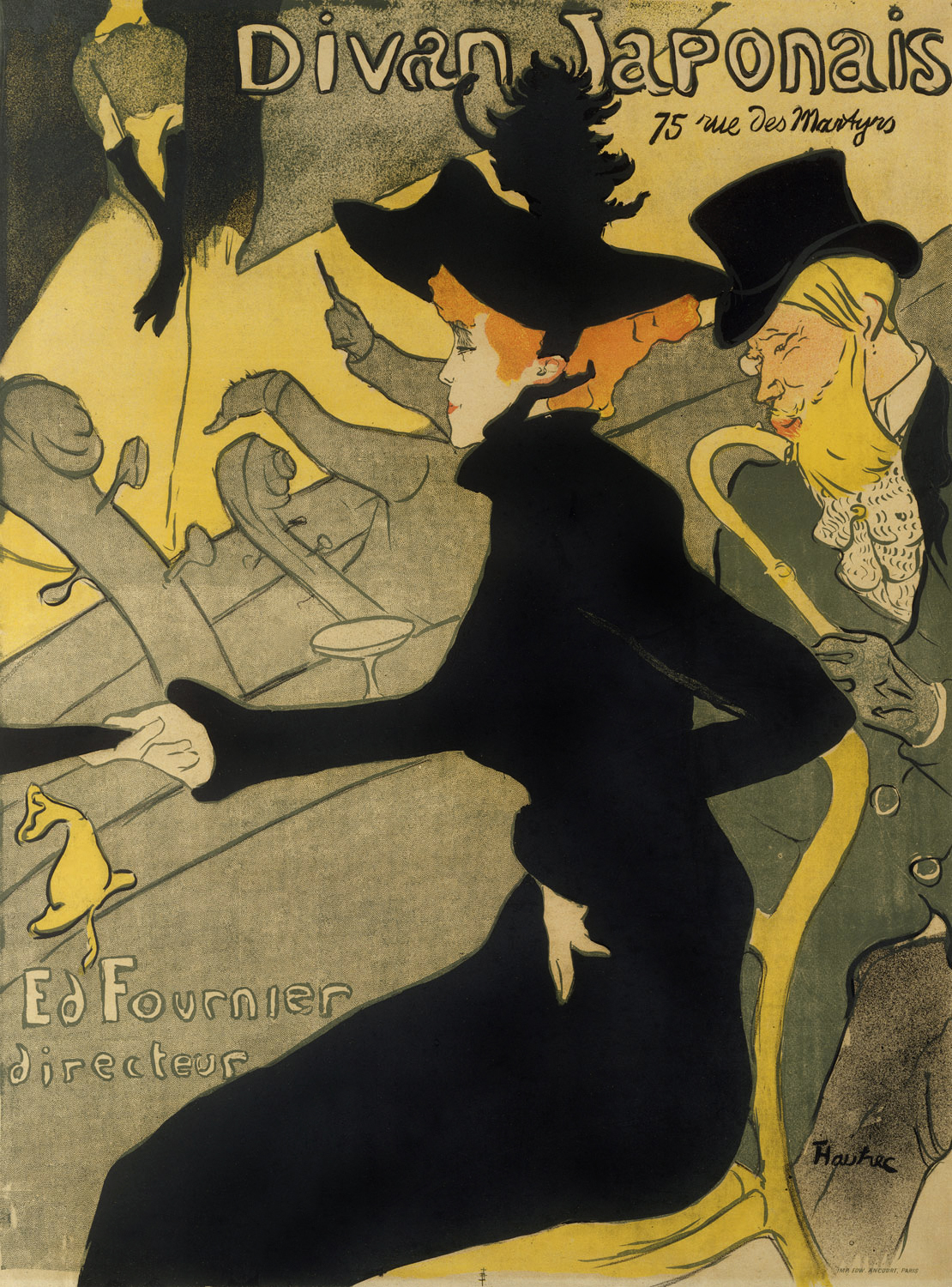
There he is, this son of Blake, this offspring of Lautrec and japonaiserie,

all primed in subtle sexualities, shocking, fame, subversion… strange.

There he is, love of yellow, flowering enormous genitalia, erotic illustrations of distorting scale, women ambiguity,

as bold as life, diseased as death, driving his body on while his mind accretes mythologies.

Now he stands, a fantastical visionary, existing as product of unchecked imagination.

An illusion, a fabrication of the mind; an unrealisable dream, a fancy,

his utopia a grotesque, chimerical beauty.


Dr Marcus Bunyan


Many thankx to Tate Britain for allowing me to publish the media images in the posting. Please click on the photographs for a larger version of the image.


Tate Britain’s major new exhibition celebrates the brief but astonishing career of Aubrey Beardsley. Although he died tragically young at the age of just 25, Beardsley’s strange, sinuous black-and-white images have continued to shock and delight for over a century. Bringing together 200 spectacular works, this is the largest display of his original drawings in over 50 years and the first exhibition of his work at Tate since 1923.

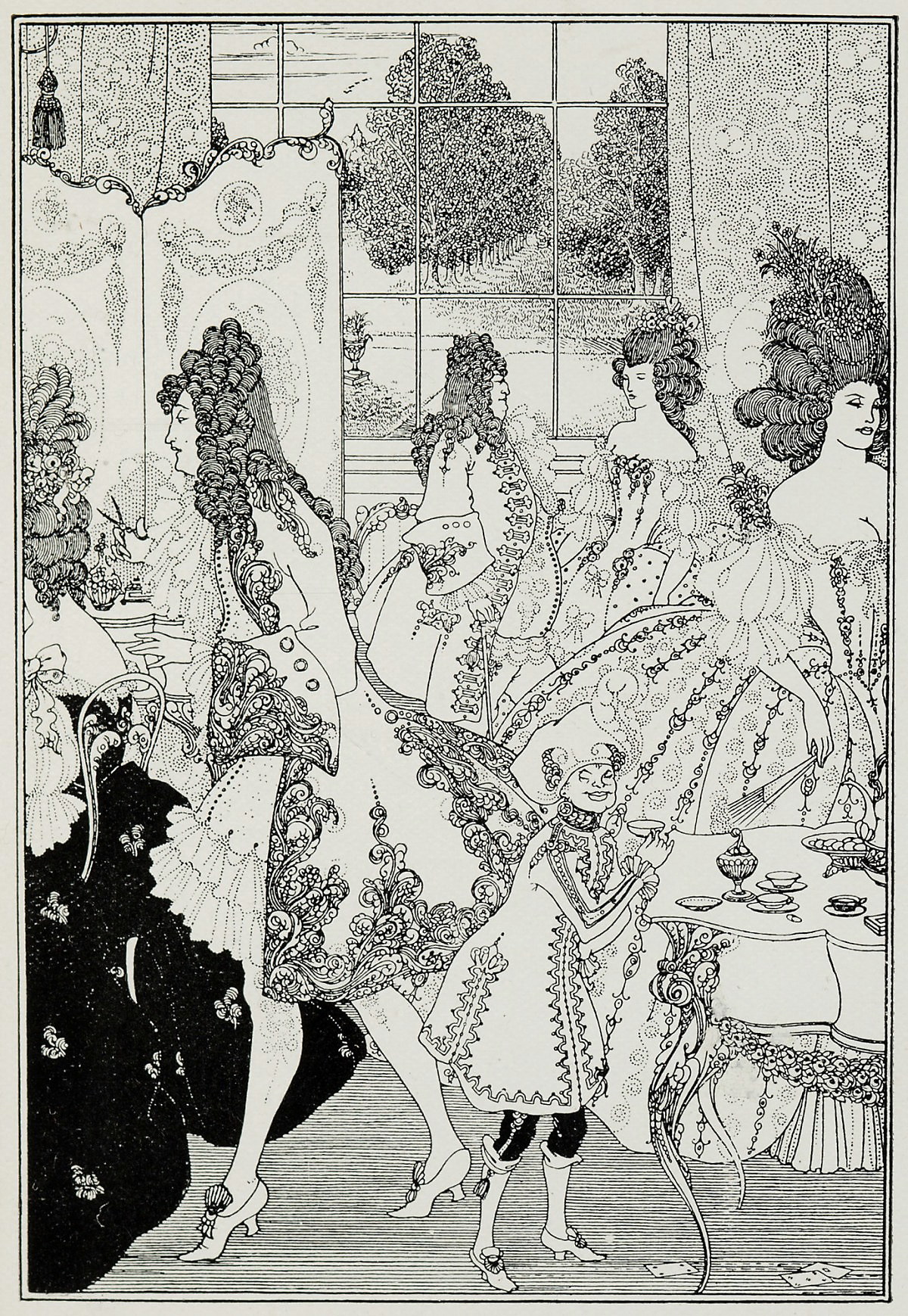
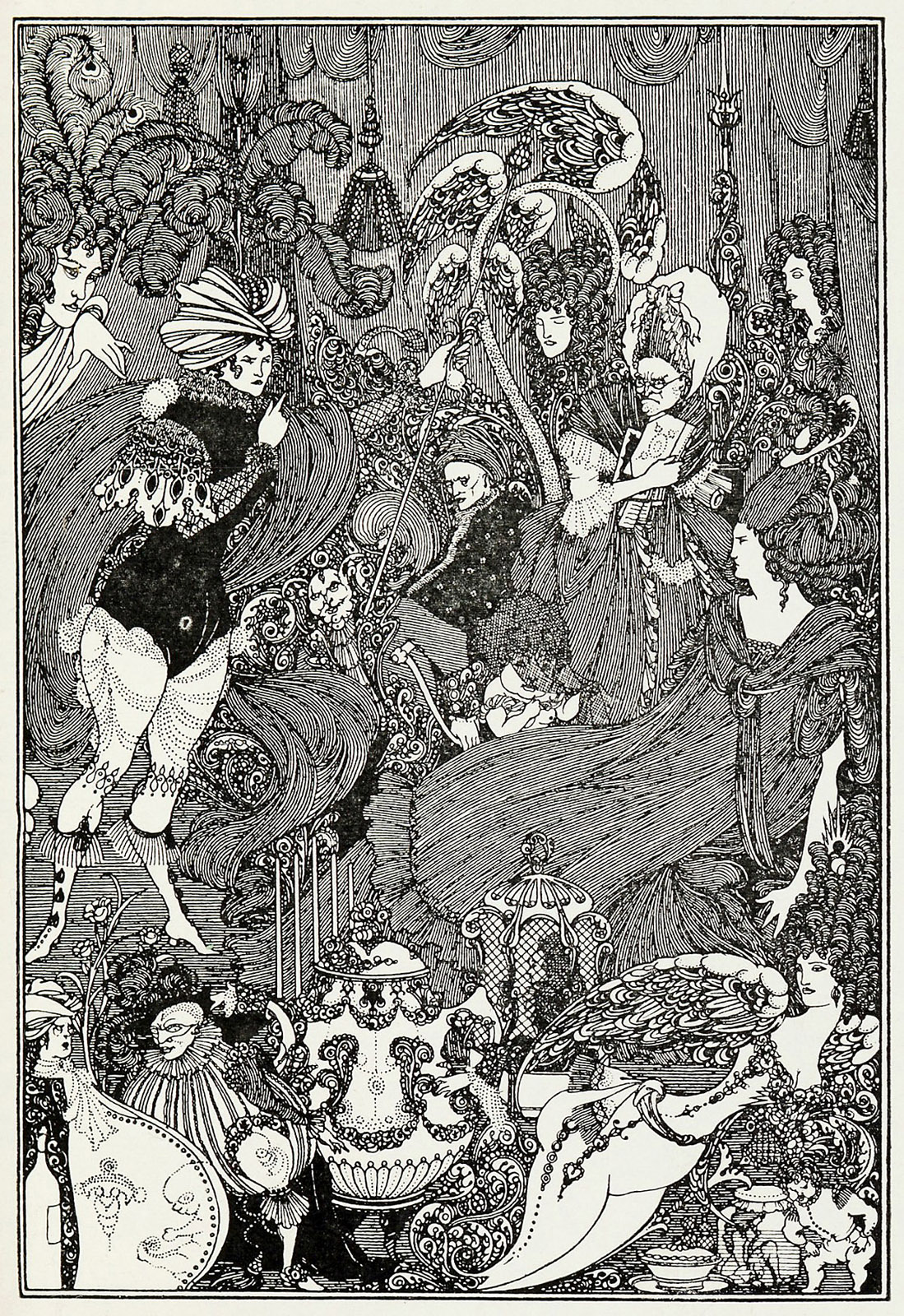
Beardsley (1872-1898) became one of the enfants terribles of fin-de-siècle London, best remembered for illustrating Oscar Wilde’s controversial play Salomé. His opulent imagery anticipated the elegance of Art Nouveau but also alighted on the subversive and erotic aspects of life and legend, shocking audiences with a bizarre sense of humour and fascination with the grotesque. Beardsley was prolific, producing hundreds of illustrations for books, periodicals and posters in a career spanning just under seven years. Line block printing enabled his distinct black-and-white works to be easily reproduced and widely circulated, winning notoriety and admirers around the world, but the original pen and ink drawings are rarely seen. Tate Britain exhibits a huge array of these drawings, revealing his unrivalled skill as a draughtsman in exquisite detail.

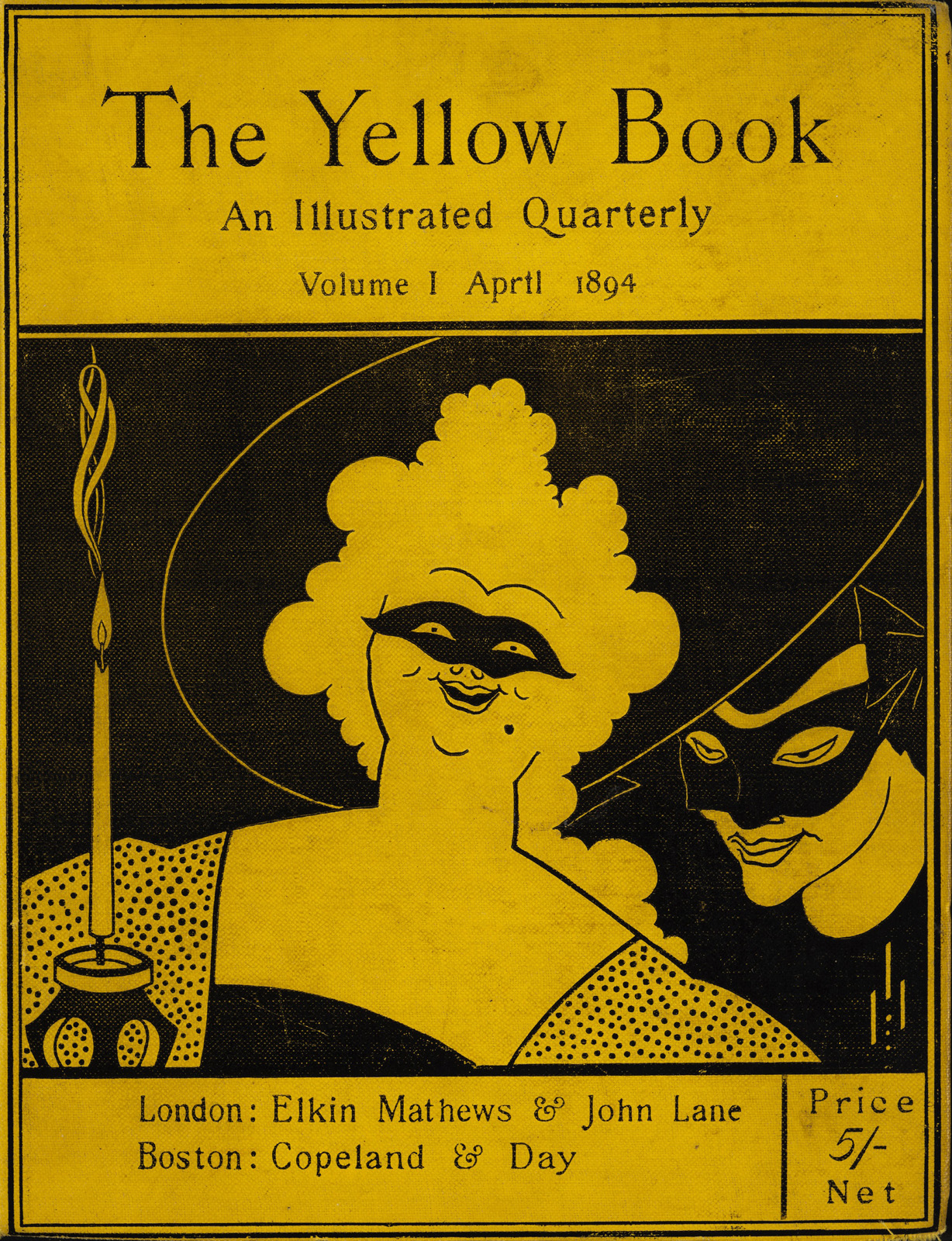
The exhibition highlights each of the key commissions that defined Beardsley’s career as an illustrator, notably Malory’s Le Morte d’Arthur 1893-1894, Wilde’s Salomé 1893 and Alexander Pope’s The Rape of the Lock 1896, of which five of the original drawings are shown together for the first time. As art director of the daring literary quarterly The Yellow Book, the artist also created seminal graphic works that came to define the decadence of the era and scandalised public opinion. Bound editions and plates are displayed alongside subsequent works from The Savoy and illustrations for Volpone 1898 and Lysistrata 1896, in which Beardsley further explored his fascination with eroticism and the absurd.

Beardsley’s imagination was fuelled by diverse cultural influences, from ancient Greek vases and Japanese woodblock prints, to illicit French literature and the Rococo. He also responded to his contemporaries such as Gustave Moreau, Edward Burne-Jones and Toulouse Lautrec, whose works are shown at Tate Britain to provide context for Beardsley’s individual mode of expression. A room in the exhibition is dedicated to portraits of Beardsley and the artist’s wider circle, presenting him at the heart of the arts scene in London in the 1890’s despite the frequent confinement of his rapidly declining health. As notorious for his complex persona as he was for his work, the artist had a preoccupation with his own image, relayed throughout the exhibition by striking self-portraits and depictions by the likes of Walter Sickert and Jacques-Emile Blanche.

Additional highlights include a selection of Beardsley’s bold poster designs and his only oil painting. Charles Bryant and Alla Nazimova’s remarkable 1923 film Salomé is also screened in a gallery adjacent to Beardsley’s illustrations, showcasing the costume and set designs they inspired. The exhibition closes with an overview of Beardsley’s legacy from Art Nouveau to the present day, including Picasso’s Portrait of Marie Derval 1901 and Klaus Voormann’s iconic artwork for the cover of Revolver 1966 by the Beatles.

Aubrey Beardsley is organised by Tate Britain in collaboration with the Musée d’Orsay, Paris, with the generous support of the V&A, private lenders and other public institutions. It is curated by Caroline Corbeau-Parsons, Curator of British Art 1850-1915, and Stephen Calloway with Alice Insley, Assistant Curator, Historic British Art.

Press release from the Tate Britain website


Aubrey Beardsley at Tate Britain – Exhibition Tour | Tate

Join Tate curators Caroline Corbeau-Parsons and Alice Insley as they discuss the iconic illustrator’s short and scandalous career.

Before his untimely death aged twenty-five, Beardsley produced over a thousand illustrations. He drew everything from legendary tales featuring dragons and knights, to explicit scenes of sex and debauchery. His fearless attitude to art continues to inspire creatives more than a century after his death.


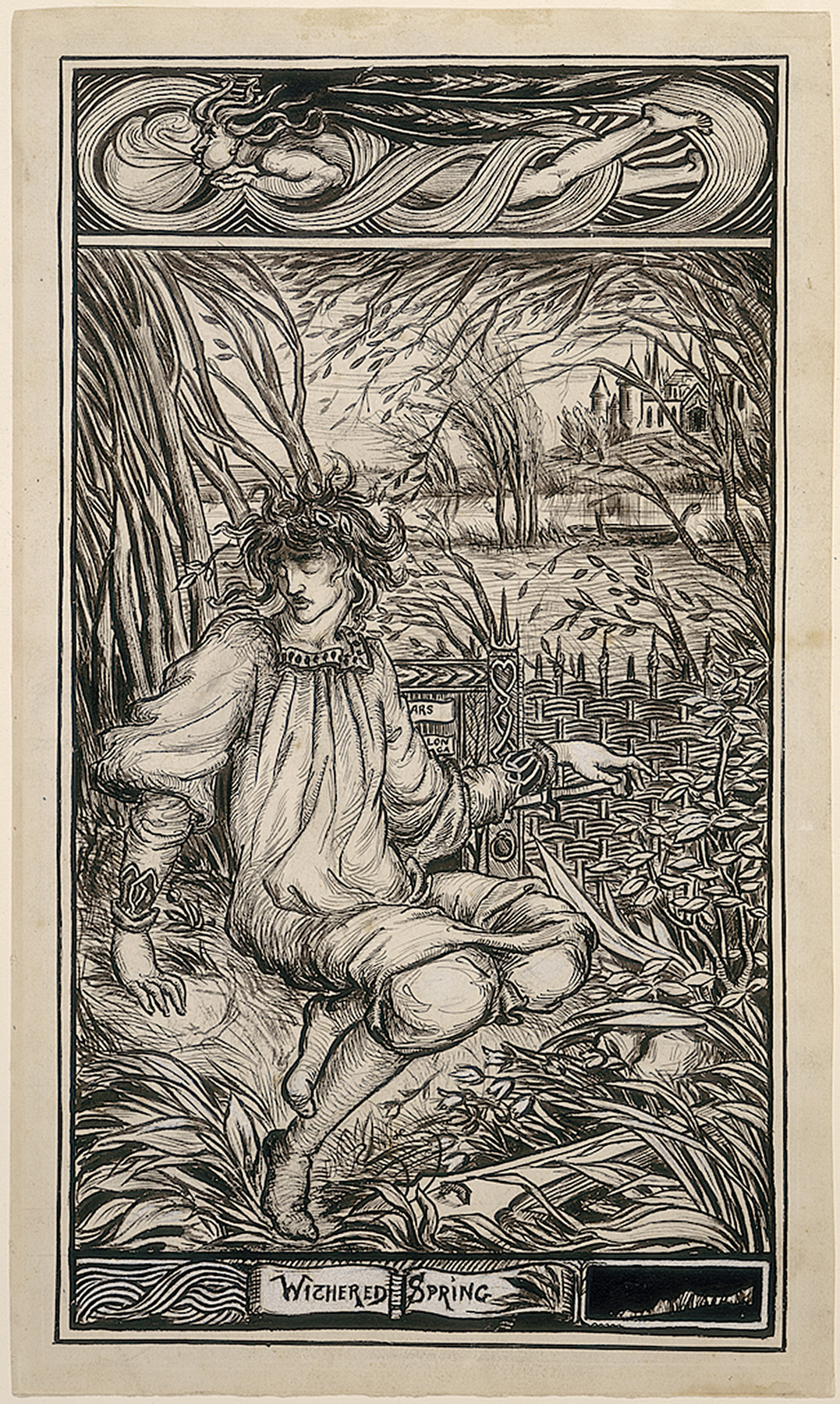
Aubrey Beardsley (British, 1872-98) 'Withered Spring' 1891 from the exhibition 'Aubrey Beardsley' at Tate Britain, London, March - May, 2020


Aubrey Beardsley (British, 1872-1898)
Withered Spring
1891
Graphite, ink and gouache on paper
National Gallery of Art, Washington, Rosenwald Collection


The framing of the main image by ornamental panels and lettering shows the influence of aesthetic movement illustrators, as well as that of Burne-Jones. The inscription on the gate behind the figure is partly obscured. In full it would read ‘Ars Longa Vita Brevis’ (‘art is long-lasting, life is short’). As Beardsley was diagnosed with tuberculosis aged seven, this Latin saying must have had personal resonance.


Introduction

Few artists have stamped their personality so indelibly on their era as Aubrey Beardsley. He died in 1898 at the age of just 25 but had already become one of the most discussed and celebrated artists in Europe. His extraordinary black-and-white drawings were instantly recognisable. Then, as now, he seemed the quintessential figure of 1890s decadence.

At the end of the 19th century, a period that had seen vast social and technological changes, many began to fear that civilisation had reached its peak and was doomed to crumble. ‘Decadent’ artists and writers retreated into the imagination. Severing the link between art and nature, they created a new sensibility based upon self-indulgence, refinement and often a love of the bizarre. No other artist captured the danger and the beauty, the cynicism and brilliance of the age as Beardsley did with pen and ink.

Beardsley was diagnosed with tuberculosis at the age of seven. The disease was then incurable, so he knew from childhood that his life would be a brief one. This led him to work at a hectic pace. One contemporary described his determination ‘to fill his few working years with the immediate echo of a great notoriety’. Moving rapidly from style to style, he created well over a thousand illustrations and designs in just five years. Beardsley was catapulted to fame in 1893 by an article about his work in The Studio magazine. He went on to illustrate Oscar Wilde’s play Salome and become art editor of The Yellow Book, a periodical that came to define the era.

Beardsley’s illustrations displayed remarkable skill and versatility, but few people ever saw his actual drawings. He always drew for publication and his work was seen primarily in books and magazines. He was one of the first artists whose fame came through the easy dissemination of images, his reputation growing day by day as his sensational designs appeared.

This exhibition offers a rare chance to see many of Beardsley’s original drawings. It also sets Beardsley in his social and artistic context. Works by other artists punctuate the exhibition, showing how he absorbed diverse artistic influences but always retained his own style.


Aubrey Beardsley (British, 1872-98) 'Incipit Vita Nova' 1892


Aubrey Beardsley (British, 1872-1898)
Incipit Vita Nova
1892
Graphite, ink and gouache on paper
Linda Gertner Zatlin


The title of this drawing refers to Dante Alighieri’s 1294 text La Vita Nuova and translates as ‘New Life Begins’. Some have seen the foetus as a potent symbol for Beardsley. Its significance is unclear beyond linking sexuality, life and death, all key themes in Beardsley’s work. It also reflects his fascination with shocking imagery and the grotesque, the term used traditionally to describe deliberate distortions and exaggerations of forms to create an effect of fantasy or strangeness. He once said, ‘if I am not grotesque I am nothing’.


Beginnings

Beardsley’s artistic career spanned just under seven years, between 1891 and 1898. When he was 18 he met the Pre-Raphaelite painter Edward Burne-Jones, an artist he deeply admired. Having seen Beardsley’s portfolio, Burne-Jones responded: ‘I seldom or never advise anyone to take up art as a profession, but in your case I can do nothing else.’ On his recommendation, for a short time Beardsley attended classes at Westminster School of Art.

Beardsley longed for fame and recognition. This went hand in hand with an intensely cultivated self-image and pose as a dandy-aesthete. This important aspect of his identity is illuminated through self-portraits and portraits by his contemporaries throughout the exhibition.

Witty, tall, ‘spotlessly clean & well-groomed’, Beardsley was soon noted for his dandyism. A delight in refinement and artificiality in both dress and manner, dandyism was integral to the decadent creed. Some contemporaries related the artist’s extreme thinness and fragile physical appearance to ideas of morbidity also associated with decadence.

While Beardsley rejected the label of decadence, his work explores many aspects of it, such as a fascination with the ‘anti-natural’ and the bizarre, with sexual freedom and gender fluidity. What present-day society refers to as LGBTQIA+ identities were only just beginning to be formulated and articulated during his lifetime. Beardsley was attracted to women, but he was a pioneer in representing what we might now call queer desires and identities. Though fascinated by all aspects of sexuality, it seems likely that his explorations of these interests were primarily through literature and art.


Aubrey Beardsley (British, 1872-98) 'Self-portrait' 1892


Aubrey Beardsley (British, 1872-1898)
Self-portrait
1892
Ink on paper
British Museum
Presented by Robert Ross in 1906


Apart from a few childish sketches, this is Beardsley’s first recorded self-portrait, made at the age of about 19. His newly adopted centre-parted fringe, fashionable high collar and large bow tie show that he had already formed a distinctive self-image. A few months earlier, he had described himself as having ‘a vile constitution, a sallow face and sunken eyes’.


Russell & Sons. 'Portrait of Aubrey Beardsley' c. 1893?


Russell & Sons (Photographers)
Portrait of Aubrey Beardsley
c. 1893?
Cartes de visite / cabinet card
Albumen print

Please note: This photograph is not in the exhibition


Edward Coley Burne-Jones (British, 1833-1898) 'The Finding of Medusa; The Death of Medusa (The Birth of Pegasus and Chrysaor); Perseus Pursued by the Gorgons' 1875-1876


Edward Coley Burne-Jones (British, 1833-1898)
The Finding of Medusa; The Death of Medusa (The Birth of Pegasus and Chrysaor); Perseus Pursued by the Gorgons
1875-1876
Gouache, paint and ink on paper
Tate. Presented by the Trustees of the Chantrey Bequest 1919
Image released under Creative Commons CC-BY-NC-ND (3.0 Unported)


This design forms part of Burne-Jones’s ambitious scheme for a series of large wall decorations on the theme of Perseus. Although the work was never completed as he intended, Burne-Jones still proudly displayed ten full-scale preparatory drawings for the panels in his garden studio. They must have made a strong impression on Beardsley when he visited Burne-Jones in August 1891.


Edward Coley Burne-Jones (British, 1833-1898) 'The Finding of Medusa' 1875-1876


Edward Coley Burne-Jones (British, 1833-1898)
The Finding of Medusa
1875-1876
Gouache, paint and ink on paper
Tate. Presented by the Trustees of the Chantrey Bequest 1919
Image released under Creative Commons CC-BY-NC-ND (3.0 Unported)


Edward Coley Burne-Jones (British, 1833-1898) 'The Death of Medusa (The Birth of Pegasus and Chrysaor)' 1875-1876


Edward Coley Burne-Jones (British, 1833-1898)
The Death of Medusa (The Birth of Pegasus and Chrysaor)
1875-1876
Gouache, paint and ink on paper
Tate. Presented by the Trustees of the Chantrey Bequest 1919
Image released under Creative Commons CC-BY-NC-ND (3.0 Unported)


Edward Coley Burne-Jones (British, 1833-1898) 'Perseus Pursued by the Gorgons' 1875-1876


Edward Coley Burne-Jones (British, 1833-1898)
Perseus Pursued by the Gorgons
1875-1876
Gouache, paint and ink on paper
Tate. Presented by the Trustees of the Chantrey Bequest 1919
Image released under Creative Commons CC-BY-NC-ND (3.0 Unported)


Perseus eventually discovers Medusa with her sisters, the Gorgons. Unlike her they are all immortal. Using Athena’s mirror to defend himself, Perseus beheads Medusa, at which point the winged horse Pegasus and the warrior Chrysaor spring from her decapitated body. When the Gorgons attempt to punish Perseus for killing their sister, he evades them by using the helmet given to him by the sea nymphs, thus becoming invisible.

Gallery label, June 1993


Aubrey Beardsley (British, 1872-98) 'The Litany of Mary Magdalen' 1891


Aubrey Beardsley (British, 1872-1898)
The Litany of Mary Magdalen
1891
Graphite on cream wove paper laid down on board
227 × 169 mm
The Art Institute of Chicago, The Charles Deering Collection
Public domain


The Italian painter Andrea Mantegna (c. 1431-1506) was a key reference for both Burne-Jones and Beardsley. At Burne-Jones’s suggestion, Beardsley particularly studied the early engravings after Mantegna’s designs. Throughout his life Beardsley kept a set of reproductions of these prints pinned to his wall. In this subject of his own invention, he freely borrows details of costume, pose and gesture from figures in various of Mantegna’s works, particularly The Entombment (c. 1465-1470).


Andrea Mantegna (Italian, c.  1431-1506) 'The Entombment of Christ' c. 1465-1475


Andrea Mantegna (Italian, c.  1431-1506)
The Entombment of Christ
c. 1465-1475
Engraving and drypoint; second state of two
11 7/16 × 16 3/8 in. (29 × 41.6cm)
The Metropolitan Museum of Art, Harris Brisbane Dick Fund, 1937
Public domain

Please note: This engraving is not in the exhibition


Aubrey Beardsley (British, 1872-98) 'Tannhäuser' 1891


Aubrey Beardsley (British, 1872-1898)
Tannhäuser
1891
Ink, wash and gouache on paper
National Gallery of Art, Washington, Rosenwald Collection
Public domain


Beardsley was an avid opera-goer. He attended several performances of Wagner’s works at this time, including Tannhäuser at Covent Garden in April or May 1891. He would return to Wagnerian subjects many times in his art and writings. The story of Tannhäuser was a particular favourite. He later made it the subject of his own erotic novella The Story of Venus and Tannhäuser. Here he shows the knight in pilgrim’s robes, among trees that appear like prison bars, trying to find his way back to the goddess’s enchanted realm, the Venusberg.


Aubrey Beardsley (British, 1872-98) 'Die Götterdämmerung' 1892


Aubrey Beardsley (British, 1872-1898)
Die Götterdämmerung
1892
Ink, wash and gouache on paper
Aubrey Beardsley Collection, Manuscripts Division, Department of Special Collections, Princeton University


Beardsley took this subject from Wagner’s opera, the title of which translates as ‘The Twilight of the Gods’. It has been suggested that the frieze-like composition depicts three different moments of the story. According to this interpretation, the scene to the right refers to the prologue, showing the Fates, with the bearded Wotan holding his magic spear. He also appears seated at the centre of the composition with Siegfried standing by him to tell his story to a group of hunters. Finally, Wotan may be represented again seated, in profile, wearing his Wanderer’s hat.


Götterdämmerung (Twilight of the Gods), is the last in Richard Wagner’s cycle of four music dramas titled Der Ring des Nibelungen (The Ring of the Nibelung, or The Ring for short). It received its premiere at the Bayreuth Festspielhaus on 17 August 1876, as part of the first complete performance of the Ring.

Die Götterdämmerung,” notes Emma Sutton in Aubrey Beardsley and British Wagnerism in the 1890s (2002), “Beardsley’s only drawing of the concluding part of the Ring cycle, was probably prompted by the first performance for a decade of the Ring in London in June and July 1892. It is extremely likely that he attended a performance of the drama; he certainly attended Siegfried, and produced drawings on Siegfried and Götterdämmerung, and of the principle singers, in this year.

No interpretation of the drawing has, to my knowledge, ever been offered, perhaps because its stylistics might suggest that it is an incomplete or experimental, Impressionistic work. The drawing is, however, an intricate and highly knowledgeable representation of Wagner’s work, demonstrating Beardsley’s comprehensive knowledge of Die Götterdämmerung (and, indeed, of the whole cycle) from the very start of the decade. Beardsley presents the gods shrouded in long drapes in a bleak forest setting; with their elongated limbs and enveloping robes they appear androgynous figures, listless and melancholy, entrapped by the sharp bare stems that rise from the border and ground around them.

Despite the undulating lines of the landscape, Die Gotterdammerung is a scene of desolate stasis, bleakly portraying Wagner’s Twilight of the Gods. A compression of several scenes from Wagner’s drama, the drawing is, I would suggest, an extraordinarily innovative and ambitious attempt to evoke concisely the narrative events and cumulative tone of the entire drama.”

~ Emma Sutton, Aubrey Beardsley and British Wagnerism in the 1890s (2002)


Anonymous. “Aubrey Beardsley’s “Die Götterdämmerung”,” on the Graphic Arts Collection, Princeton website [Online] Cited 02/03/2020


Le Morte Darthur

In early 1892, Beardsley received his first major commission. His friend, the photographer and bookseller Frederick H. Evans, introduced him to J.M. Dent. The energetic and enterprising publisher was looking for an illustrator for Le Morte Darthur, Sir Thomas Malory’s 15th-century version of the legends of King Arthur. Dent planned a substantial edition in the style of William Morris’s Kelmscott Press books. Between autumn 1892 and June 1894 Beardsley produced 353 drawings, including full and double-page illustrations, elaborate border designs and numerous small-scale ornamental chapter headings. He received £250 over the course of this commission. This freed him to leave his hated job as a clerk and focus on art-making.

Beardsley gradually grew weary of this colossal undertaking and went off-brief. Subversive details started to appear in his drawings. He also introduced incongruous characters such as mermaids and satyrs, goat-legged hybrid creatures from classical mythology.

His illustrations were reproduced using the relatively new and economical line block printing process in which drawings are transferred onto printing plates photographically. Beardsley was at first disappointed with the printing of his drawings, but he quickly adapted his style to suit the line block process. Uniquely, this could reproduce both the finest of lines and large, flat areas of black.

The works in this room demonstrate the development of Beardsley’s art over two years, and how he combined many different sources to create his own visual language.


Aubrey Beardsley (British, 1872-98) 'The Achieving of the Sangreal' 1892


Aubrey Beardsley (British, 1872-1898)
The Achieving of the Sangreal
1892
Ink and wash on paper
Private collection


This is the sample drawing that secured Beardsley the Morte Darthur commission. Dent declared it ‘a masterpiece’, and it was used as the frontispiece for Volume II. It seems to refer to the crucial episode of the book, in Chapter XIV, where Sir Percival kneels to make a prayer to Jesus in the presence of Sir Ector, and the Sangreal (popularly called the Holy Grail) appears to him, ‘borne by a maiden’.


Aubrey Beardsley (British, 1872-98) 'How Morgan Le Fay Gave a Shield to Sir Tristram' 1893


Aubrey Beardsley (British, 1872-1898)
How Morgan Le Fay Gave a Shield to Sir Tristram
1893
Ink on paper
The Syndics of the Fitzwilliam Museum, University of Cambridge


(Illustration from: Sir Thomas Malory, Le Morte d’Arthur. London: Dent, 1894)


Aubrey Beardsley (British, 1872-98) 'How la Beale Isoud Wrote to Sir Tristram' c. 1893


Aubrey Beardsley (British, 1872-1898)
How la Beale Isoud Wrote to Sir Tristram
c. 1893
Ink over graphite on paper
Alessandra and Simon Wilson


This drawing brings to mind the comment by the art historian John Rothenstein that ‘the greatest among Beardsley’s gifts was his power of assimilating every influence and yet retaining, nay developing, his own peculiar individuality’.

Isoud (Isolde) here resembles the Pre-Raphaelite figure Jane Morris. The German Renaissance form of her desk is borrowed from Albrecht Dürer’s engraving St Jerome in his Study (1513-1514). The simple, flattened construction of the space reflects Beardsley’s interest in Japanese prints. These contrast with the flowing lines of the sunflower border, a typical aesthetic motif.


Aubrey Beardsley (British, 1872-98) 'How Sir Tristram Drank of the Love Drink' 1893


Aubrey Beardsley (British, 1872-1898)
How Sir Tristram Drank of the Love Drink
1893
Ink on paper
Harvard Art Museums/Fogg Museum, Bequest of Scofield Thayer


This is one of Beardsley’s boldest and most rhythmic drawings. Tristram’s outstretched arm follows the movement of the hybrid flower. The flat outline of Isolde’s recoiling body parallels that of Tristram’s cloak, all against the strong vertical and horizontal lines formed by the curtains with their stylised rose border. Isolde’s long cape, seen from the back, is a forerunner of Beardsley’s famous Peacock Skirt in his Salome illustrations (on display later in this exhibition).


Aubrey Beardsley (British, 1872-98) 'How La Beale Isoud Nursed Sir Tristram' 1893


Aubrey Beardsley (British, 1872-1898)
How La Beale Isoud Nursed Sir Tristram
1893
Ink over graphite on paper
Harvard Art Museums/Fogg Museum, Bequest of Scofield Thayer


Aubrey Beardsley (British, 1872-1898) 'How King Arthur saw the Questing Beast, and thereof had great marvel' 1893


Aubrey Beardsley (British, 1872-1898)
How King Arthur saw the Questing Beast, and thereof had great marvel
1893
Ink and wash on paper
Victoria and Albert Museum


Together with Siegfried Act II (shown nearby), this drawing reflects the height of Beardsley’s fine ‘hair-line manner’. The drawing has great variety of treatment, showing that Beardsley’s style evolved while working on the commission. To alleviate boredom, he took great liberties with Malory’s text. He introduced mythological characters with little to do with the Arthurian legend, such as Pan, here. There are also discreet additions, including a treble clef top right, and even a phallus on the far left of the bank.


Something suggestive of Japan

The European craze for Japanese visual culture had begun in the 1860s after trade links were re-established. Beardsley grew up surrounded by western interpretations of Japanese art. In the summer of 1891, together with his sister Mabel, he visited the London mansion of the shipping magnate Frederick Leyland. There he saw the ‘Peacock Room’ created 15 years earlier by the expatriate North American artist James McNeill Whistler. Decorated with borrowed and reworked Japanese motifs, this masterpiece of the aesthetic movement had become one of the most celebrated interiors in London. Mesmerised by his visit, Beardsley began to introduce such details into his own drawings.

Japanese woodblock prints (Ukiyo-e) were also an important influence. Beardsley adopted their graphic conventions. His new style included areas of flat pattern contrasted with precisely drawn figures against abstracted or empty backgrounds. Like several artists at this time, he also favoured the distinctive, tall and narrow format of traditional Japanese kakemono scrolls.

In a letter to a friend, Beardsley bragged, ‘I struck for myself an entirely new method of drawing and composition, something suggestive of Japan… The subjects were quite mad and a little indecent.’


Aubrey Beardsley (British, 1872-1898) Design for a Frontispiece to 'Virgilius the Sorcerer' c. 1893


Aubrey Beardsley (British, 1872-98)
Design for a Frontispiece to Virgilius the Sorcerer
c. 1893
Ink over graphite on paper laid down on board
The Art Institute of Chicago, Gift of Robert Allerton


Following the glowing article in The Studio, many publishers approached Beardsley with commissions for illustrations and book covers. David Nutt, an old established publishing firm, generally specialised in early texts and folklore. Although made for Nutt’s ‘medieval legends’ series, Beardsley’s design is, somewhat incongruously, in the style of a Japanese print.


A New Illustrator

Beardsley first came to public notice in April 1893. He was the subject of the lead article, ‘A New Illustrator’, in the first issue of the new art magazine The Studio. In it, the graphic art expert Joseph Pennell praised Beardsley’s work as ‘quite as remarkable in its execution as in its invention: a very rare combination.’

Pennell welcomed Beardsley’s use of ‘mechanical reproduction for the publication of his drawings’. The article highlighted how photographic line block printing showed the true quality of an artist’s line.

The reproductions in The Studio article included both medieval and Pre-Raphaelite style illustrations for the forthcoming Le Morte Darthur and examples of Beardsley’s work inspired by Japanese woodblock prints. This displayed his versatility and led to further commissions for books and popular journals, such as the Pall Mall Magazine. J.M. Dent, the publisher of Le Morte Darthur, rightly worried Beardsley would get bored of that long-term project. To keep him interested, he invited him to create hundreds of tiny ‘grotesque’ illustrations for the Bon-Mots series, three miniature books of witty sayings. In this context, the term grotesque relates to distortion or exaggeration of form to create an effect of fantasy or strangeness. For Beardsley the idea was central to his way of seeing the world. Summing up his own art, he later said, ‘I am nothing if I am not grotesque.’

Grotesque

In art history, the grotesque – which originally referred to the decoration of grottoes – has come to denote a strand of Renaissance art composed of deliberately weird elements, often including imaginary hybrid forms. These often combine parts of human heads and bodies, animals and plants. Mermaids, satyrs, fauns and other mythical figures frequently appear in Beardsley’s art. But he also added foetuses, often with adult bodies, and other distorted figures to his grotesque repertoire. The resulting imagery is playful, irreverent and fantastical, but also has dark undertones. The grotesque lies at the heart of Beardsley’s art. He explained: ‘I see everything in a grotesque way. When I go to the theatre, for example, things shape themselves before my eyes just as a I draw them… They all seem weird and strange to me. Things have always impressed me in this way.’


Aubrey Beardsley (British, 1872-1898) 'The Kiss of Judas' 1893


Aubrey Beardsley (British, 1872-1898)
The Kiss of Judas
1893
Ink on paper
Victoria and Albert Museum


This drawing illustrates a short story by ‘X.L’ (the North American writer of horror fiction Julian Osgood Field). The macabre tale tells of a legend of the descendants of Judas, the disciple who betrayed Jesus in the Christian New Testament. It is written with the arch tone of much 1890s fiction:

‘They say that the children of Judas, lineal descendants of the arch traitor, are prowling about the world, seeking to do harm, and that they will kill you with a kiss.’ ‘Oh, how delightful!’ murmured the Dowager Duchess.


Smaller figures appear in many of Beardsley’s works, such as the nude in The Kiss of Judas. Some viewers have read these as representations of people with dwarfism. In most cases we do not know if this was Beardsley’s intention. He never strived for realism in his work. He played with scale, exaggerating and distorting lines and shapes, including in self-portraits. But the cultural stereotyping of people with dwarfism was prevalent in Beardsley’s lifetime. In the late 19th and early 20th century, they were predominantly seen as sources of entertainment in ‘freak shows’ and carnivals. These offensive attitudes almost certainly influenced Beardsley’s imagery to some extent.

Salomé

In 1892, Beardsley made a drawing in response to Salomé, Oscar Wilde’s play, originally written in French and based on the biblical story. Salomé falls in love with Iokanaan (John the Baptist). When he rejects her, she demands his head from her step-father, Herod Antipas, as a reward for performing the dance of the seven veils. Beardsley depicts her about to kiss Iokanaan’s severed head. Wilde admired the drawing and he and his publisher, John Lane, chose Beardsley to illustrate the English translation of the play. The illustrations weave together themes of sensuality and death, and explore a wide range of sexual desires. The play’s publication created a sensation, just as Beardsley and Wilde had hoped.

Beardsley delighted in hiding provocative elements in his drawings. Lane recalled, ‘one had, so to speak, to place his drawings under a microscope, and look at them upside down’. Nervously, he censored ‘problematic’ details in Beardsley’s title page and the illustration Enter Herodias and rejected two designs altogether from the first edition. Even so, Lane missed many erotic details and, surprisingly, also allowed publication of Beardsley’s teasing drawings that include caricatures of Wilde.

Beardsley produced 18 designs in total, of which only 10 appeared in the first printing of the play. The impressions exhibited here come from the portfolio which Lane issued in 1907, almost a decade after Beardsley’s death. This was the first edition to contain all the original designs and an additional one, Salome on Settle.


Aubrey Beardsley (British, 1872-1898) 'The Climax' 1893


Aubrey Beardsley (British, 1872-1898)
The Climax
1893
Line block print on paper
Stephen Calloway


The flowing, sinuous lines in this design demonstrate how much art nouveau is indebted to Beardsley. He abandoned the Japanese kakemono format and hairline style of his original version of the image J’ai baisé ta bouche, Iokanaan (also in this room). By simplifying the lines of the design, he creates a more powerful focus on the moment when Salome can finally kiss Jokanaan’s lips – now that he has been beheaded. The stream of blood forms an elegant ribbon, while the lily rising from the pool that the fluid creates symbolises his chastity.


The Climax

The Climax is an 1893 illustration by Aubrey Beardsley (1872-1898), a leading artist of the Decadent (1880-1900) and Aesthetic movements. It depicts a scene from Oscar Wilde’s play Salome, in which the femme fatale Salome has just kissed the severed head of John the Baptist, which she grasps in her hands. Elements of eroticism, symbolism, and Orientalism are present in the piece. This illustration is one of sixteen Wilde commissioned Beardsley to create for the publication of the play. The series is considered to be Beardsley’s most celebrated work, created at the age of 21. …

First published in 1894, The Climax consists of strong, precise lines, decorative motifs characteristic of the developing Art Nouveau style, and the use of only black ink. Beardsley’s style was influenced by Japanese woodcuts also known as Ukiyo-e, which comes through in the flatness of imagery, compositional arrangement, and the stylistic motifs. Elements of eroticism are also apparent.

The main focus of this illustration, Salome, floats in midair and in her hands she holds the head of John the Baptist just after she kissed it, depicting the final words said by Salome in the play “J’ai baisé ta bouche Iokanaan, j’ai baisé ta bouche” (“I have kissed your mouth, Jokannan, I have kissed your mouth”). Her hair billows in snake-like tendrils above her as she stares powerfully into the eyes of John the Baptist. His severed head drips blood that nourishes the phallic lily. The flower also symbolises purity. Composing the background behind these two figures is a white quarter section of the moon and a stylised depiction of peacock feathers, a signature motif in Beardsley’s illustrations, made of concentric circles.

Beardsley satirised Victorian values regarding sex, that at the time highly valued respectability, and men’s fear of female superiority, as the women’s movement made gains in economic rights and occupational and educational opportunities by the 1880s. Salome’s power over men can be seen in the way that Beardsley presents her as a monster-like figure, reminiscent of Medusa.

Reaction

Beardsley said of his drawing that rather than using thicker lines for the foreground than those for the background, he felt that the lines should be the same width. Morgan Meis of The New Yorker states that “his influence on the look of Art Nouveau, and then on early modernism, is hard to overstate. His thick black lines fused the graphical ideas of the past with the techniques and subject matter of a new age just on the horizon.” He was an inspiration to Japanese illustrators, graphic designers, and printmakers of the early 20th century Taishō period.

The Climax is described as among his finest works by Ian Fletcher and established him as one of the “Decadence”. It was not appreciated, though, by mainstream art critics of the time, who found the Salome drawings repulsive and unintelligible. Art historian Kenneth Clark said that it “aroused more horror and indignation than any graphic work hitherto produced in England.”

Text from the Wikipedia website


Aubrey Beardsley (British, 1872-1898) 'The Dancer’s Reward' 1893


Aubrey Beardsley (British, 1872-1898)
The Dancer’s Reward
1893
Line block print on paper
Stephen Calloway


Salome is contemplating her prize. Gaping, she tilts Jokanaan’s severed and bleeding head towards her. Once again, their expressions mirror each other. The elongated arm of the executioner holds up the platter on which the head rests. This drawing resonates with European symbolist art, in which the contemplation of a severed head is a recurring image.


Aubrey Beardsley (British, 1872-1898) 'The Toilette of Salome' (second version) 1893


Aubrey Beardsley (British, 1872-1898)
The Toilette of Salome (second version)
1893
Line block print on paper
Stephen Calloway


Aubrey Beardsley (British, 1872-1898) 'The Stomach Dance' 1893


Aubrey Beardsley (British, 1872-1898)
The Stomach Dance
1893
Line block print on paper
Stephen Calloway


Salome is shown performing her celebrated dance to the sounds produced by an impish musician. Wilde wrote appreciatively to Beardsley after Salome was published: ‘For Aubrey: for the only artist who, besides myself, knows what the dance of the seven veils is, and can see that invisible dance.’


Aubrey Beardsley (British, 1872-1898) 'The Eyes of Herod' 1893


Aubrey Beardsley (British, 1872-1898)
The Eyes of Herod
1893
Line block print on paper
Stephen Calloway


This illustrates the passage before Salome’s famous dance in exchange for the head of Jokanaan. Talking about Herod, Salome remarks pensively: ‘Why does the Tetrarch look at me all the while with his mole’s eyes under his shaking eyelids? It is strange that the husband of my mother looks at me like that. I know not what it means. Of a truth I know it too well.’


Aubrey Beardsley (British, 1872-1898) 'Enter Herodias' 1893


Aubrey Beardsley (British, 1872-1898)
Enter Herodias
1893 (published 1907)
Stephen Calloway


Enter Herodias is named after a stage direction in Oscar Wilde’s play Salomé. Wilde originally wrote the play in French, and he chose Beardsley to illustrate the English translation of the play. Beardsley drew erotic and satirical images, some of which were entirely unrelated to the plot of play.

Enter Herodias shows the moment when Salome’s mother enters the stage. To the bottom right there is a caricature of Oscar Wilde holding a copy of Salome and gesturing up at his own play. It also includes two nude figures. Herodias’s breasts are exposed but she is covered by the large cloak. John Lane, who was Beardsley’s publisher, demanded that Beardsley cover the page on the right’s genitalia with a fig-leaf. But he failed to spot the penis-shaped candles the artist had drawn in the foreground, and the erection of the figure to the left.

Beardsley’s obsession with the erotic played upon Victorian taboos. Beardsley was often deliberately trying to be provocative. Many people at the time thought that Beardsley’s obsession with erotic art came from the fact that he was young and ‘consumptive’. Today we call ‘consumption’ Tuberculosis (or TB). A strange, but frequent 19th century perception of TB was that it went hand in hand with an obsession about sex.


Aubrey Beardsley (British, 1872-1898) 'John and Salome' 1893


Aubrey Beardsley (British, 1872-1898)
John and Salome
1893
Line block print on paper
Stephen Calloway


This depicts a scene of powerful tension between Jokanaan (left) and Salome (right). By the use of mirrored poses and interlocking folds of drapery – like an image of yin and yang – he expresses the characters’ conflicted feelings of attraction and rejection. John Lane refused the design, either because of the partial nudity of Salome, or possibly because of the androgynous appearance of the Baptist who could here be Salome’s twin.


Aubrey Beardsley (British, 1872-1898) 'The Black Cape' 1893


Aubrey Beardsley (British, 1872-1898)
The Black Cape
1893
Line block print on paper
Stephen Calloway


Aubrey Beardsley (British, 1872-1898) 'The Peacock Skirt' 1893


Aubrey Beardsley (British, 1872-1898)
The Peacock Skirt
1893
Line block print on paper
Stephen Calloway


This is one of Beardsley’s most famous and acclaimed designs. It conflates two scenes from the play. In one, the page of Herodias warns the young Syrian about looking too much at Salome. In the other, Herod promises 50 of his white peacocks in exchange for Salome’s dance and imagines them forming a ‘great white cloud’ around her. The scene was abstracted by Beardsley in a flamboyant demonstration of his calligraphic skills.


Aubrey Beardsley (British, 1872-1898) 'J’ai baisé ta bouche Iokanaan' 1892-1893


Aubrey Beardsley (British, 1872-1898)
J’ai baisé ta bouche Iokanaan
1892-3
Ink and wash on paper
Aubrey Beardsley Collection, Manuscripts Division, Department of Special Collections, Princeton University


This is Beardsley’s first interpretation of Oscar Wilde’s play, before it was translated into English. It was reproduced in the first issue of The Studio, and it is characteristic of Beardsley’s intricate hairline style. It may well have been a bid to illustrate the play. If it was, it paid off, as Wilde did ask John Lane to commission Beardsley. The artist applied some green watercolour to the drawing after it was published.


Gustave Moreau. 'The apparition' 1874-1876 (detail)


Gustave Moreau (French, 1826-1898)
The Apparition (detail)
1874-1876
Watercolour on paper
Musée d’Orsay, Paris, gift of Charles Ayem


This watercolour made a strong impression on Oscar Wilde at the 1876 Paris Salon exhibition. It represents the bloody vision of John the Baptist’s head appearing while Salomé dances for Herod. It featured in Joris-Karl Huysmans’s 1884 novel À Rebours (Against Nature). In it, the reclusive hero contemplates this watercolour. Wilde could quote at length from this ‘bible’ of decadence. Both the novel and The Apparition played a part in the creation of Wilde’s own Salomé.


Alla Nazimova (1879-1945)
Charles Bryant (1879-1948)
Salomé
1923
Film, 35 mm, black and white
Running time: 1hr 12mins
Sets and costumes by Natacha Rambova, after Aubrey Beardsley


This 1923 silent “Salome” is probably the best filmed version of the scandalous Oscar Wilde one-act play. It’s basically a photographed avant-garde theatre production performed on a single set based on Aubrey Beardsley’s illustrations for the published play.


Alla Nazimova’s Salomé

This 1923 silent film is an adaptation of Oscar Wilde’s play. The imaginative set and costumes by Natacha Rambova are directly inspired by Beardsley’s drawings, and credited as such. The project was conceived and led by Alla Nazimova, a famous Hollywood actor during the silent movie era. She was drawn to Salome and financed its screen adaptation herself. Nazimova had relationships with women and her film reflects themes of same-sex desire present in Beardsley’s drawings. Charles Bryant, with whom she pretended to be married, was credited as the director, as women did not have equal status in Hollywood.

This film perpetuates some demeaning stereotypes that were current during Beardsley’s lifetime and beyond. This is reflected particularly in the portrayal of the musicians with dwarfism. At that time people with restricted growth were widely associated with servitude and treated as a source of spectacle.

Posters

When Beardsley first travelled to Paris in 1892, he was enthralled by the many posters that adorned the city. The French posters showed the possibilities of this new mass-produced outdoor format and the potential of large-scale colour reproduction. Beardsley was quick to embrace this. Understanding that posters would be viewed in passing, often at a distance, his designs experimented with bold, simplified forms and solid blocks of colour. For Beardsley, advertising was central to modern life and an opportunity to integrate art into everyday experience. As he put it, ‘Beauty has laid siege to the city’.

In the autumn of 1894, the first ever English exhibition of posters opened in London. Pictorial posters were enjoying a boom in Britain and were beginning to be recognised as an art form. The exhibition featured work by celebrated French artists such as Jules Chéret and Henri de Toulouse-Lautrec, known as the ‘fathers’ of the modern poster. Significantly, it also included several works by Beardsley. Not only did this place Beardsley’s posters on a par with the art that had inspired him, it also attested to his importance in the development of British poster design.


Henri de Toulouse-Lautrec (French, 1864-1901) Divan Japonais 1892


Henri de Toulouse-Lautrec (French, 1864-1901)
Divan Japonais
1892
Colour lithograph on paper
Victoria and Albert Museum


In Paris, Beardsley would have encountered Toulouse-Lautrec’s posters, including this one, on hoardings across the city. It advertises the popular cabaret nightspot, the Divan Japonais, and depicts two stars of Parisian nightlife, the singer Yvette Guilbert and the dancer Jane Avril. Beardsley was inspired as much by Toulouse-Lautrec’s vivid portrayal of modern life as his striking style, typified by dramatic blocks of colour, silhouettes and bold outlines. The admiration was mutual: Toulouse-Lautrec also expressed the wish to buy a copy of Salome.


Aubrey Beardsley (British, 1872-1898) 'The Pseudonym and Autonym Libraries' 1894


Aubrey Beardsley (British, 1872-1898)
The Pseudonym and Autonym Libraries
1894
Colour lithograph on paper
Victoria and Albert Museum


This poster shares its title with the series of novels and short story collections it promotes. The name was inspired by the publisher, T. Fisher Unwin’s, recognition that women often wrote under a pseudonym, whereas men used their actual name (autonym). The woman pictured here appears confident as she rushes towards the bookshop, implying that knowledge brings freedom.


Aubrey Beardsley (British, 1872-1898) 'Isolde' Printed 1899


Aubrey Beardsley (British, 1872-1898)
Isolde
Printed 1899
Colour lithograph and line block print on paper
Victoria and Albert Museum


Turning again to Wagner for inspiration, Beardsley depicts the tragic heroine, Isolde, on the brink of drinking the fateful love potion. She stands against a stage curtain, bright red in the original design and equally bold in the orange used for this first printing. Beardsley asserted, ‘I have no great care for colour, but [in posters] colour is essential’. This design was published as a colour lithograph supplement in The Studio in October 1895.


Aubrey Beardsley (British, 1872-1898) 'A Comedy of Sighs' 1894


Aubrey Beardsley (British, 1872-1898)
A Comedy of Sighs
1894
Colour lithograph on paper
Victoria and Albert Museum


This was Beardsley’s first poster design. It appeared on walls and hoardings around London shortly after the publication of Salome and introduced his art to an even wider audience. The poster stole the limelight from the performances of the two short plays it advertised. Critics were outraged by the woman’s ‘ugliness’ and the indecency of her plunging neckline. Punch magazine even punned, ‘Let’s “Ave-a-nue” Poster!’


Beardsley’s Circle

This room introduces the key figures in Beardsley’s life. The glowing article in The Studio and his success with Le Morte Darthur had brought him into the public eye at the age of 20. Following this, a sequence of fortuitous meetings with leading cultural figures of the day led him to the heart of avant-garde literary and artistic circles in 1890s London. Witty, talented and well-read, he was rapidly taken up by a group of young artists and writers who identified as aesthetes, acutely sensitive to art and beauty. These included the portrait painter William Rothenstein; Max Beerbohm, the essayist and caricaturist; and the art critic and dealer Robert Ross, the friend and former lover of Oscar Wilde. Beardsley’s fame grew with the publication of his illustrations to Wilde’s Salome in 1894 and his involvement in the fashionable magazine The Yellow Book, a period addressed in the following room. At this point his group of friends began to expand rapidly. But with the fall of Wilde early in 1895, Beardsley moved first to Dieppe, and thereafter spent little time in England.

In his last years his circle included fellow contributors to The Savoy magazine: the poets W.B. Yeats and Arthur Symons and the painter Charles Conder. The wealthy French-Russian poet and writer Marc-André Raffalovich became an important supporter and patron. His most significant friend in this period was Leonard Smithers, his endearing but unscrupulous publisher.

His mother and sister Mabel were constants throughout his brief life. They were with him when he died at Menton on the French Riviera in 1898.

This room nods at Beardsley’s orange and black decoration scheme in the Pimlico house that he and Mabel owned briefly in 1894. ‘Orangé’ was famously described as the chief decadent colour by Joris-Karl Huysmans in his 1884 novel À rebours (Against Nature), which may have informed Beardsley’s choice.


Aubrey Beardsley (British, 1872-1898) 'Professor Fred Brown' 1892


Aubrey Beardsley (British, 1872-1898)
Professor Fred Brown
1892
Graphite and ink on paper
Tate. Presented by Mrs Helen Thorp 1927


In 1891 Beardsley enrolled at the Westminster School of Art on the advice of Edward Burne-Jones. For just a few months he attended evening classes given by the school’s principal, the painter Fred Brown. Brown was a pillar of the avant-garde exhibiting society, the New English Art Club. Beardsley added the society’s initials to Brown’s name in the title of this drawing.


Jacques-Émile Blanche (French, 1861-1942) 'Charles Conder' 1904


Jacques-Émile Blanche (French, 1861-1942)
Charles Conder
1904
Oil paint on canvas
Tate, Presented by Georges A. Mevil-Blanche 1947


Conder specialised in painting fans and small pictures on silk depicting romanticised figures in 18th-century costume. He and Beardsley became close during the planning of The Savoy magazine in the summer of 1895 when many of their circle were gathered in Dieppe.

Jacques-Emile Blanche lived near Dieppe and was a friend of Degas, Manet and Renoir. However, he also made frequent visits to England, where he painted and exhibited and was well known in artistic and society circles. This is a portrait of the British painter Charles Conder (1868-1909), who was greatly interested in contemporary French art. Conder befriended Toulouse-Lautrec who helped him obtain an exhibition in Paris. Blanche first met Conder in Paris, but they became friends in 1895 when they both spent the summer in Dieppe. This portrait, which captures his flamboyant character, was painted in Conder’s house in London.

Gallery label, August 2004


Jacques-Émile Blanche (French, 1861-1942) 'Aubrey Beardsley' 1895


Jacques-Émile Blanche (French, 1861-1942)
Aubrey Beardsley
1895
Oil paint on canvas
National Portrait Gallery, London


The society painter Blanche welcomed many of the English artists and writers who visited Dieppe to his nearby family home. This portrait, painted during the summer of 1895, shows the extent to which Beardsley had adopted the dress and cultivated the manner of Parisian dandies such as Comte Robert de Montesquiou.


Walter Richard Sickert (British, 1860-1942) 'Aubrey Beardsley' 1894


Walter Richard Sickert (British, 1860-1942)
Aubrey Beardsley
1894
Tempera on canvas
Tate, Purchased with assistance from the Art Fund 1932


Sickert observed Beardsley in Hampstead churchyard following a ceremony for the unveiling of a bust commemorating the Romantic poet John Keats (1795-1821). Though angular and painfully thin, he was elegantly dressed as always. Keats had died young from tuberculosis. The parallel between the poet and the artist cannot have been lost on those friends, like Sickert, who knew of Beardsley’s condition.


Alvin Langdon Coburn (English, born America 1882-1966) 'W.B. Yeats' 1908


Alvin Langdon Coburn (English born America, 1882-1966)
W.B. Yeats
1908
Photo-etching on paper
National Portrait Gallery, London


Yeats was a leading figure of the Irish poetic and nationalist movement, the ‘Celtic Twilight’. He was also central as an activist in London literary circles. The idea of the poets, writers and artists of the 1890s as sensitive, decadent and doomed owes much to Yeats’s myth-making in his later memoirs. In these he painted a compelling picture of ‘The Tragic Generation’.


William Rothenstein (British, 1872-1945) 'Robbie Ross' 1895-1930


William Rothenstein (British, 1872-1945)
Robbie Ross
1895-1930
Oil on canvas
13 1/8 in. x 10 in. (333 mm x 254 mm)
Accepted in lieu of tax by H.M. Government and allocated to the Gallery, 2005
© National Portrait Gallery, London


The writer and art critic Robert Ross was a pivotal figure in the aesthetic and decadent culture of 1890s London. He was Oscar Wilde’s first male lover and later became his literary executor, working tirelessly to safeguard his works and re-establish his reputation. Ross also used his connections and influence to promote and protect many friends, including Beardsley and his family. His 1909 book on Beardsley was one of the first serious studies and remains a valuable source of insights.


Reginald Savage (British, 1886-1932) 'John Gray' c. 1896-1897


Reginald Savage (British, 1886-1932)
John Gray
c. 1896-1897
Lithograph on paper
National Portrait Gallery, London


As a young poet John Gray was initially a protégé of Oscar Wilde. He later moved away from the decadents and converted to Catholicism. He was ordained in 1901 and served for many years as the priest at St Peter’s Morningside, Edinburgh. The church was built by his lifelong companion Marc-André Raffalovich, a wealthy writer who provided Beardsley’s principal financial support in his last years.


The Yellow Book

In 1894, Beardsley became art editor of The Yellow Book, a magazine that would become the most iconic publication of the decade. Its distinctive appearance immediately set the tone. Yellow was fashionable, urban, ironic and risqué, recalling the yellow wrappers of popular French erotic novels. The first volume was an instant and controversial success. Notably, it put art and literature on an equal footing. But it was Beardsley’s drawings that stole the show and gave the magazine its avant-garde reputation. Their bold style and daring modernity received praise and scorn in equal measure. With each new volume, his notoriety increased. To many the publication embodied the decadent spirit, and, as one critic observed, ‘to most, Aubrey Beardsley is The Yellow Book.

However, Beardsley’s meteoric success was short-lived. In 1895, Oscar Wilde was put on trial for sexual relationships with men and prosecuted for ‘gross indecency’. As the scandal tore through London, the backlash turned towards the notorious magazine and its audacious art editor. In the public mind, Beardsley was already connected to Wilde through his Salome illustrations. When Wilde was seen at his arrest carrying a yellow book (in fact a French novel, not The Yellow Book), the link between the author and the artist was damning. Outraged crowds broke the windows of the publishing house. John Lane, the publisher, succumbed to pressure and sacked Beardsley.


Aubrey Beardsley (British, 1872-1898) 'Cover Design for 'The Yellow Book'' Vol.I 1894


Aubrey Beardsley (British, 1872-1898)
Cover Design for The Yellow Book Vol.I
1894
Ink on paper
Tate. Bequeathed by John Lane 1926


Beardsley instantly set the tone for the magazine with this design for the first volume. His highly stylised manner, dramatically setting pure white against flat black, was completely new. The subject, two masked revellers abandoning themselves to hedonism, was also bold. The overt sensuality of the laughing woman was particularly shocking for the time. Oscar Wilde described her as ‘a terrible naked harlot’.


Aubrey Beardsley (British, 1872-1898) 'The Yellow Book' Volume I 1894


Aubrey Beardsley (British, 1872-1898)
Edited by Aubrey Beardsley 1872-1898 (art) and Henry Harland 1861-1905 (literature)
The Yellow Book, Volume I
1894
Elkin Mathews & John Lane, London April 1894
Stephen Calloway


In 1894 Aubrey Beardsley became the first Art Editor for The Yellow Book, a new literary periodical. There were hostile reactions to The Yellow Book from the wider press, who were alarmed by the shocking and ‘immoral’ illustrations and writing. The Westminster Gazette even commented that the publication should be made illegal. Things only got worse for Beardsley and The Yellow Book in 1895. The trial and conviction of Oscar Wilde for ‘gross indecency’ with men became linked to the publication. The press mistakenly reported seeing Wilde leaving the Cadogan Hotel with a copy of The Yellow Book under his arm. In fact, he was carrying a French erotic novel, which often had yellow covers.

Beardsley, who had collaborated with Wilde on Salome and whose art was strongly linked with The Yellow Book, was caught up in the scandal. He was dismissed as editor for The Yellow Book. Having lost his regular source of income, he was forced to sell his house and he temporarily moved to France.


Aubrey Beardsley (British, 1872-1898) 'The Slippers of Cinderella' 1894


Aubrey Beardsley (British, 1872-1898)
The Slippers of Cinderella
1894
Ink and watercolour on paper
Mark Samuels Lasner Collection, University of Delaware Library, Museums and Press


This is one of the rare drawings in which Beardsley used colour. It was first printed in black and white as he added the watercolour later. When it was published in the second volume of The Yellow Book, it was accompanied by a caption, probably written by the artist himself. This outlined a darker version of the Cinderella story, in which she is poisoned by powdered glass from her own slippers.


Aubrey Beardsley (British, 1872-1898) 'La Dame aux Camélias' 1894


Aubrey Beardsley (British, 1872-1898)
La Dame aux Camélias
1894
Ink and watercolour on paper
Tate. Presented by Colonel James Lister Melvill at the request of his brother, Harry Edward Melvill 1931


Beardsley was fascinated with the depiction of women at their dressing-tables. Here, the woman gazing into the mirror is the tragic heroine of the novel La Dame aux Camélias (1848), by French writer Alexandre Dumas. Beardsley may have identified with her because she, like him, had tuberculosis. He added washes of watercolour to the drawing between 1894 and 1897, after it had been published in The Yellow Book.

The title refers to the novel by Alexandre Dumas fils, published in 1852, which tells the tragic story of a courtesan who sacrificed herself for her lover. The picture is part of a group of drawings of a woman at her dressing table and was originally published simply as Girl at Her Toilet. It is not clear whether Beardsley intended it from the outset to be a portrait of Madeleine Gautier, but it appears to relate to an earlier drawing of 1890, which is inscribed with the title of Dumas’s novel and bears some resemblance to this work in the silhouetted figure and treatment of the draperies. Beardsley may have identified with Madeleine Gautier, since, like her, he suffered from tuberculosis and would eventually also die of the disease.

The leitmotif of a woman admiring herself in a mirror recalls the paintings of Dante Gabriel Rossetti (1828-1882), which Beardsley would have known. He may also have had in mind the work of Edgar Degas (1834-1917), who devoted much of his later career to pictures of woman at their toilet. Like many of Beardsley’s drawings of this period the picture is highly stylised. A solid black mass envelops the lower half of the room and seems about to consume the figure. Her arms have disappeared altogether, and her face is barely revealed above the extravagant collar of her frilly overcoat. The influence of Japanese woodcuts, which Beardsley collected, is apparent in the broad flat areas of colour and the use of silhouette. The most carefully realised passages in the drawing are the objects on the dressing table and the floral pattern of the wallpaper, which depicts either roses or camellias. The woman’s profile reveals dark shadows under the narrowed eyes and a turned down mouth, giving the impression of either illness or dissipation. However, in general, realism and individuality are suppressed in favour of surface pattern and overall design.

The drawing was first published in the journal St Paul’s on 2 April 1894, and at the time it was one of Beardsley’s most popular works. Six months later it was illustrated with the present title in Volume Three of The Yellow Book, an avant-garde journal of which Beardsley was art editor. Between 1894 and 1897 Beardsley added watercolour washes of pinkish-purple to the drawing, reducing the clarity of the image.


Aubrey Beardsley (British, 1872-1898) 'The Black Cat' 1894-1895


Aubrey Beardsley (British, 1872-1898)
The Black Cat
1894-1895
Line block print on paper
Stephen Calloway


Commissioned by a North American publisher, Beardsley made four designs for the macabre tales of Edgar Allan Poe (1809-1849). This illustrates Poe’s story of a man who tries to cover up the murder of his wife by concealing her body in the wall. He is betrayed by the shrieks of his black cat, mistakenly enclosed in the wall as well. The fearsome cat appears out of the darkness, its form outlined in white and starkly contrasting with the white of the dead woman’s face.


Aubrey Beardsley (British, 1872-1898) 'Frontispiece to Chopin’s Third Ballade' 1895


Aubrey Beardsley (British, 1872-1898)
Frontispiece to Chopin’s Third Ballade
1895
Ink and wash on paper
Tate. Presented by the Patrons of British Art through the Tate Gallery Foundation 1999
Image released under Creative Commons CC-BY-NC-ND (3.0 Unported)


The Polish composer Frédéric Chopin (1810-1849) was one of Beardsley’s musical heroes. Beardsley emphasises his delicately pointed fingers here. This relates to Chopin’s reputation as a powerful and subtle pianist. Beardsley’s setting is not historically accurate. Instead it is reminiscent of 1870s aesthetic movement interiors. The position of the figure and the curtain recall Whistler’s celebrated portrait of his mother, copied by Beardsley in the letter nearby.

Private collection, Maas Gallery


The Third Ballade was one of the greatest compositions by the Polish pianist and composer Frédéric Chopin who died in 1849 at the age of thirty nine. While an initial viewing might suggest a simple equestrian portrait, there is an implicit subtext of female domination in the woman’s mastery of the horse. Her determined expression, and the disparity between the horse and rider, reinforce this. Although never published in his lifetime, this design was used to illustrate Beardsley’s obituary in The Studio in 1898.

Gallery label, August 2004


Aubrey Beardsley (British, 1872-1898) 'The Fat Woman' 1894


Aubrey Beardsley (British, 1872-1898)
The Fat Woman
1894
Ink on paper
Tate. Presented by Colonel James Lister Melvill at the request of his brother, Harry Edward Melvill 1931


John Lane refused to publish this drawing in The Yellow Book. The most likely reason is because it is an unflattering caricature of the artist Beatrice Whistler, James McNeill Whistler’s wife. Seated in the Café Royal, she is depicted as a domineering member of the demi-monde. Beardsley’s alternative title for the drawing – A Study in Major Lines – emphasises its artistic qualities but also jibes at Whistler’s musical titles.


Aubrey Beardsley (British, 1872-1898) Title page to 'The Story of Venus and Tannhäuser' 1895


Aubrey Beardsley (British, 1872-1898)
Title page to The Story of Venus and Tannhäuser
1895
Line block and letterpress print on paper
Victoria and Albert Museum


This design was planned as the frontispiece for Beardsley’s own novel. The story was an erotic and humorous version of the Tannhäuser legend, in which the poet discovers the home of Venus and becomes one of her worshippers. Beardsley had ambitions to be a writer and he continued to obsess over the ultimately unfinished novel until his death. He admitted early on that it progressed ‘tortoise fashion but admirably’. Initially Lane agreed to publish the novel, but in the aftermath of Wilde’s trial he did not dare.


Aubrey Beardsley (British, 1872-1898) 'The Mirror of Love' 1895


Aubrey Beardsley (British, 1872-1898)
The Mirror of Love
1895
Ink over traces of graphite on paper
Victoria and Albert Museum


Beardsley first met Marc-André Raffalovich, a poet and writer, in April 1895. It was not long afterwards that he drew this frontispiece for his collection of poems, The Thread and the Path. The figure in the mirror expresses the theme of the first poem: the quest towards a new ideal that transcended traditional definitions of gender and sexuality. However, the publisher, David Nutt, was shocked by the figure which he believed had both female and male attributes and refused to print it.


Aubrey Beardsley (British, 1872-1898) 'Venus between Terminal Gods' 1895


Aubrey Beardsley (British, 1872-1898)
Venus between Terminal Gods
1895
Ink on paper
Trustees of the Cecil Higgins Art Gallery (The Higgins Bedford)


This drawing was also intended as an illustration for Beardsley’s unrealised novel for John Lane. It depicts Venus framed by two statues of male gods in the form of herms. Frederic Leighton (1830-1896), then President of the Royal Academy, was interested in the rising generation of artists and often commissioned drawings from them. Beardsley recorded that Leighton was encouraging about his work and greatly admired this design.


Aubrey Beardsley (British, 1872-1898) 'Caprice' c. 1894


Aubrey Beardsley (British, 1872-1898)
Caprice
Verso: Masked Woman with a White Mouse
c. 1894
Oil paint on canvas
Tate. Purchased 1923


This is Beardsley’s only known oil painting. Unusually, it is double-sided. He began it in Walter Sickert’s studio, under his guidance. The subject on the front, Caprice, was painted first and relates closely to The Comedy Ballet of Marionettes I, displayed nearby. It shows a young woman being led through a doorway by an unfinished figure in a fanciful 18th-century costume. In the late-17th and 18th centuries, servants in European noble households included people of colour who were often enslaved and people with dwarfism. They were considered as ‘trophies’, demonstrating the power and status of those they served. Servants with dwarfism were often treated as ‘pets’, expected to amuse and entertain.


This is the only known oil painting by the illustrator Aubrey Beardsley and was painted in the studio of Walter Sickert. It comprises two pictures on one canvas. Caprice, in which a woman is invited through a doorway by a dwarf, and on the back, Woman with a White Mouse. Both are ambiguous scenes that appear to represent carnival. Caprice derives from the drawing Comedy Ballet of Marionettes I which appeared in The Yellow Book in 1894. Like Beardsley’s drawings, Caprice simplifies shape and colour to strengthen the effect.

Gallery label, February 2016


This is the only known oil painting by Beardsley and, unusually, it comprises two pictures on the one canvas. The first painting to be completed appears to have been A Caprice, a fanciful yet sinister work, depicting a woman in a black dress with green trimmings and a black dwarf in a red costume. On the other side, painted between the stretchers, is an almost surreal image of a masked woman with a white mouse. Both works are unfinished, and should be regarded as experimental

A Caprice appears to derive from the drawing Comedy Ballet of Marionettes I, one of a series of three which appeared in the avant-garde journal, The Yellow Book, in July 1894. In both drawing and painting the woman is being invited by the sinister dwarf to pass through a doorway. The sexual connotations of this gesture are made more overt in the drawing, where the phallic form of the door is emphasised. Beardsley was constantly challenging the conventional view of male-female relations and in the second drawing in the series the woman approaches a door symbolising the female sexual organs.

The symbolism of Woman with a White Mouse also appears to be sexual, and Wilson refers to Freud’s theory that in dreams such things as mice become a substitute for the penis. Nevertheless, although Reade, too, describes the symbolism in this picture as ‘Freudian’, he also points out that Freud’s work was unknown in England in 1894.

Aware of the dramatic potential of black and shadowed areas, Beardsley contrasts areas of dark and light to great effect in both works. He also employs his favourite complementaries, red and green, to provide a stronger colour note in A Caprice. Stylistically he may have been influenced in these paintings by the early work of William Rothenstein (1872-1945), with whom he shared a studio, and whose pictures are inhabited by similarly bold and gloomy saturated forms. He may also have had in mind the work of the Venetian artist Pietro Longhi (1702-1783).

The title A Caprice was invented by the Beardsley scholar R.A. Walker who was the picture’s first owner. The name invites associations with the work of the fin-de-siècle poet Théodore Wratislaw (1871-1933), who published a selection of poems entitled Caprices in 1893.

Frances Fowle
December 2000


Aubrey Beardsley (British, 1872-1898) 'Masked Woman with a White Mouse' c. 1894


Aubrey Beardsley (British, 1872-1898)
Masked Woman with a White Mouse
c. 1894
Oil paint on canvas
Tate. Purchased 1923


Masked Woman with a White Mouse was painted second. Beardsley seems to have preferred this side and hung it on the wall in the house he bought in Pimlico.


The Savoy

Dismissed from The Yellow Book, Beardsley faced the loss of his income and a newly hostile atmosphere in London. Despite his international fame, his financial situation was precarious, and he was forced to sell his house. Beardsley left England for Dieppe, the favourite French seaside resort of English writers and artists. There he encountered Leonard Smithers, an enterprising publisher (and occasional pornographer). Smithers proposed starting a new magazine to rival The Yellow Book.

With Beardsley as art editor and the poet Arthur Symons in charge of literature, The Savoy was launched in 1896, at first as a quarterly. After two issues, Smithers – perhaps unwisely – decided to publish monthly. The consequent strain on his resources meant The Savoy folded after just a year. However, over just eight numbers it became one of the most significant and most beautifully produced ‘little magazines’ of the period.

The Savoy was published in Britain, but social and artistic conservatism were on the rise there following Wilde’s trial. Smithers was the only publisher who would print work by Wilde or Beardsley at this time. Some booksellers, like W.H. Smith, refused to display works by Beardsley in their windows. W.B. Yeats famously declared that The Savoy had valiantly waged ‘warfare on the British public at a time when we had all against us’.


Aubrey Beardsley (British, 1872-1898) 'The Savoy', Number 1 1896


Aubrey Beardsley (British, 1872-1898)
The Savoy, Number 1
1896
Edited by Aubrey Beardsley 1872-1898 (art) and Arthur Symons 1865-1945 (literature)
Leonard Smithers, London, January 1896
Stephen Calloway


Aubrey Beardsley (British, 1872-1898) 'Third Tableau of Das Rheingold' c. 1896


Aubrey Beardsley (British, 1872-1898)
Third Tableau of Das Rheingold
c. 1896
Ink on paper
Lent by Museum of Art, Rhode Island School of Design, Providence, Museum Appropriation Fund


This drawing, like a play-within-a-play, illustrates an episode in Under the Hill in which the Abbé is ‘ravished with the wit and beauty’ of a performance of Wagner’s opera Das Rheingold.


Aubrey Beardsley (British, 1872-1898) 'The Savoy', Number 2 1896


Aubrey Beardsley (British, 1872-1898)
The Savoy, Number 2
1896
Edited by Aubrey Beardsley 1872-1898 (art) and Arthur Symons 1865-1945 (literature)
Leonard Smithers, London, April 1896
Stephen Calloway


Aubrey Beardsley (British, 1872-1898) 'Ave Atque Vale' 1896


Aubrey Beardsley (British, 1872-1898)
Ave Atque Vale
1896
Ink on paper
Private collection


This drawing accompanies Beardsley’s translation of the Hail and Farewell poem (Carmen CI) by Catullus (c. 84 – c. 54 BCE). In it, the Roman poet addresses his dead brother. Beardsley’s spare and beautiful composition captures the moving spirit of the poem. It attracted considerable praise when it appeared in the seventh number of The Savoy. Max Beerbohm wrote that ‘Catullus could not have craved a more finely emotional picture for his elegy’.


The Rape of Lock

Beardsley was a great admirer of the poet Alexander Pope (1688-1744). Oscar Wilde had ridiculed his poetic taste, claiming ‘there are two ways of disliking poetry; one way is to dislike it, the other is to like Pope’.

Yet in 1896 Beardsley embarked on the illustration of his mock-epic poem, The Rape of the Lock (1712). In Pope’s title, the word ‘rape’ is used in its original sense of theft or abduction, rather than referring to sexual assault. The poem makes fun of a real incident during which Lord Petre (renamed ‘the Baron’) cut off a lock of the hair of Arabella Fermor (‘Belinda’ in the poem) without her permission, causing a feud between their families.

Inspired by the linear intricacies of French 18th-century copper-plate engravings, which he admired and collected, Beardsley developed a new, highly decorative style. The title page amusingly credits him as having ’embroidered’ the illustrations.

This is the first time that so many of the original drawings for the book have been exhibited together.


Aubrey Beardsley (British, 1872-1898) 'The Dream' 1896


Aubrey Beardsley (British, 1872-1898)
The Dream
1896
Ink over graphite on paper
The J. Paul Getty Museum, Los Angeles


Beardsley drew this as the frontispiece for Pope’s poem. It illustrates Ariel, Belinda’s guardian sylph (a spirit of the air), by her bed, while she is still dreaming. Beardsley used his new ‘stippled manner’ or use of dots, to render the intricate patterns on the bed curtains.


Aubrey Beardsley (British, 1872-1898 'The Baron’s Prayer' 1896


Aubrey Beardsley (British, 1872-1898)
The Baron’s Prayer
1896
Ink and graphite on paper
Harvard Art Museums/Fogg Museum, Bequest of Scofield Thayer


The Baron is depicted kneeling at an altar made from a pile of books of love stories. He prays to the God of Love for help to obtain the prize of a lock of Belinda’s hair.


Aubrey Beardsley (British, 1872-1898 'The Rape of the Lock' 1896


Aubrey Beardsley (British, 1872-1898)
The Rape of the Lock
1896
Ink over graphite on paper
Private collection


The drawing illustrates the fateful moment when the Baron approaches to cut a lock of Belinda’s hair. She is unaware, her back turned to him. The fancifully dressed pageboy in the foreground (who may be a person with dwarfism) seems to reference a similar character in The Toilette scene in the Marriage A-la-mode series by William Hogarth (1697-1764). This adds an 18th-century connection to the work. He is the only figure to engage with the viewer, as if to point knowingly to the Baron’s mischief.


Aubrey Beardsley (British, 1872-1898) 'The Cave of Spleen' 1896


Aubrey Beardsley (British, 1872-1898)
The Cave of Spleen
1896
Ink on paper
Museum of Fine Arts, Boston. William Sturgis Bigelow Collection


Belinda, sitting to the right, across the drawing, has sought refuge in the Cave of Spleen. Umbriel, a gnome, is addressing her. Beardsley interpreted the author’s fantastical description of the cave and creatures within. This unleashed his delight in grotesque forms:

Unnumbered throngs on every side are seen
of bodies changed to various forms by Spleen.
Here living teapots stand, one arm held out,
One bent; the handle this, and that the spout…
Men prove with child, a powerful fancy works,
And maids, turned bottles, cry aloud for corks.


Aubrey Beardsley (British, 1872-1898) 'The Battle of the Beaux and the Belles' c. 1896


Aubrey Beardsley (British, 1872-1898)
The Battle of the Beaux and the Belles
c. 1896
Ink on paper
The Henry Barber Trust, the Barber Institute of Fine Art, The University of Birmingham


Belinda, furious at the theft of the lock of her hair, faces her attacker the baron. Beardsley chose to depict the moment in the poem just before she throws a pinch of snuff in his face and overpowers him. This drawing was praised for its dramatic action. Beardsley’s virtuosity as a draughtsman is seen in the close-laid lines of his Rape of the Lock illustrations which were particularly admired by his contemporaries. Many thought this series of designs his best work.


Mademoiselle de Maupin

Beardsley worked on illustrating Théophile Gautier’s novel Mademoiselle de Maupin (1835) for Leonard Smithers between February and October 1897. The hero of the story, D’Albert, searches for the ‘perfect’ woman. Instead he becomes overwhelmingly drawn to a young man. The object of his desire is eventually revealed to be Madelaine de Maupin, a woman who does not conform to gender expectations of the day, particularly through dress, and is attracted to both men and women. The plot reflects on an ideal unification of male and female attributes, a widely discussed idea in literary and artistic circles in 19th-century Europe.

In his preface, Gautier promoted ‘art for art’s sake’. This would become the doctrine of the aesthetic movement, which developed in the late 19th century to promote beauty over meaning or morality in art. D’Albert and de Maupin’s sexual encounter is described in terms of aesthetic perfection. However, de Maupin leaves D’Albert immediately afterwards.

Beardsley used watercolour in his drawings to create a new softer decorative style. His friend Robert Ross suggested that this technique was ‘less demanding’ at a time when his health was in rapid decline. But Beardsley later reverted to a more detailed approach, showing that he was simply exploring new modes of expression.


Aubrey Beardsley (British, 1872-1898) 'Mademoiselle de Maupin' 1898


Aubrey Beardsley (British, 1872-1898)
Mademoiselle de Maupin
1898
Photo-etching on paper
Stephen Calloway


This is Beardsley’s frontispiece for Mademoiselle de Maupin. It shows the heroine dressed in her preferred outfit, men’s clothes as imagined by Beardsley. This is the first illustration of just six that Beardsley completed for Smithers’s planned edition of Gautier’s novel. He had optimistically intended to draw 32 but was too unwell to fulfil this ambition.


Aubrey Beardsley (British, 1872-1898) 'The Lady with the Rose' 1897


Aubrey Beardsley (British, 1872-1898)
The Lady with the Rose
1897
Ink, wash and graphite on paper
Harvard Art Museums/Fogg Museum, Bequest of Scofield Thayer


D’Albert does not find Madelaine de Maupin straight away. He first embarks on an affair with a woman he calls Rosette, the subject of this illustration. Beardsley developed different ‘types’ of women in his work, defined by particular features. Here, Rosette, sultry with large, heavy-lidded eyes, conforms to Beardsley’s late ‘type’. The striped walls of the room recall the style of interior decoration that Beardsley had favoured in his own house at 114 Cambridge Street, Pimlico.


Curiosa

While recuperating in the south of England during the summer of 1896, Beardsley began his two most explicit series of drawings yet. These were both inspired by classical sources. The first was a set of eight designs for the Ancient Greek comedy, Lysistrata, by Aristophanes. In this famous satirical play, Athenian and Spartan women bring an end to conflict by refusing to have sex with their warring menfolk until there is peace between their two cities. Beardsley’s other, equally outrageous set of drawings was made for Juvenal’s Sixth Satire, a misogynistic attack on the morals and sexual habits of the women of Ancient Rome.

These subjects chimed with Beardsley’s own irreverent humour and fascination with all aspects of sexuality – and, perhaps, his own sexual frustrations. Smithers, who prided himself that he would ‘publish what all the others are afraid to touch’, no doubt encouraged him. Matching the exuberant eroticism of the texts, Beardsley adopted a starkly linear style for these drawings. This bold new direction was inspired by his knowledge of Ancient Greek vase painting and Japanese erotic prints.

Very few of Beardsley’s contemporaries would have known of these drawings. Their ‘indecency’ meant they could not be published and advertised in the usual way. Instead they were only made available by Smithers to a select group of like-minded collectors through private subscription. Even so, Beardsley seems to have had second thoughts, perhaps prompted by his growing Catholic faith. On his deathbed, he wrote to Smithers imploring him to destroy all his ‘obscene drawings’, a request that Smithers ignored.


Aubrey Beardsley (British, 1872-1898) 'Lysistrata Shielding her Coynte' 1896


Aubrey Beardsley (British, 1872-1898)
Lysistrata Shielding her Coynte
1896
Ink over graphite on paper
Victoria and Albert Museum


Beardsley made this as the frontispiece image for the book. It introduces the key themes of the play. Lysistrata, the women’s leader, turns her back on a statue of an aroused male deity, usually a symbol of fertility and virility. With one hand she seems to bar sexual relations or, perhaps, pleasure herself. With the other she holds an olive branch and delicately touches the top of an enormous phallus. The implication is that peace will bring an end to war and male sexual frustration. Her knowing smile reveals her control. Her sexual empowerment disrupts traditional Victorian views of male power and of female ignorance about sex.


Aubrey Beardsley (British, 1872-1898) 'Two Athenian Women in Distress' 1896


Aubrey Beardsley (British, 1872-1898)
Two Athenian Women in Distress
1896
Collotype print on paper
Victoria and Albert Museum


Beardsley referred to this scene as ‘the rampant women’. The play describes the women deserting Athens as abstinence begins to take its toll. One woman even tries to escape by flying on the back of a sparrow. The bird was used as a symbol for male virility and dominance in contemporary pornography, as Beardsley would have known. He subverts that association here by making the sparrow a symbol of female sexual liberation. The drawing for this illustration was destroyed in a fire in 1929. Fortunately, a set of full-size collotype photographic reproductions had been made shortly before.


Aubrey Beardsley (British, 1872-1898) 'Cinesias Entreating Myrrhina to Coition' 1896


Aubrey Beardsley (British, 1872-1898)
Cinesias Entreating Myrrhina to Coition
1896
Line block printed in purple on paper
Victoria and Albert Museum
Wikipedia Commons Public domain


Originally Beardsley wanted to print the Lysistrata series in purple ink, but Smithers abandoned this idea, probably for financial reasons. It depicts Myrrhina dashing away after teasing her husband, Cinesias. Myrrhina has provoked him to the point that he will do anything in return for sex. She has all the power while her husband is incapacitated by desire. Her clothes, particularly the thigh-high black stockings, suggest Beardsley was influenced by 18th-century pornography and more recent erotic works such as those of the Belgian artist Félicien Rops (1833-1898).


Aubrey Beardsley (British, 1872-1898) 'The Examination of the Herald' 1896


Aubrey Beardsley (British, 1872-1898)
The Examination of the Herald
1896
Ink over graphite on paper
Victoria and Albert Museum


Beardsley was greatly inspired by Japanese shunga (erotic) prints. He even hung a series by Utamaro (c. 1753-1806) on the walls of his house in Pimlico, London – to the shock of those that visited. His study of such art is apparent in his adoption of exaggeratedly large phalluses to dramatise the extent of the men’s sexual frustration. In this illustration, the herald’s arrival in Athens to announce that Sparta is prepared to make peace becomes a bawdy joke. The young Spartan is conspicuously vigorous and virile. In contrast, the Athenian is elderly and shrivelled. His close inspection could be read as desire for the younger man or an interest in restoring his own virility.


Aubrey Beardsley (British, 1872-1898) 'The Lacedaemonian Ambassadors' 1896


Aubrey Beardsley (British, 1872-1898)
The Lacedaemonian Ambassadors
1896
Ink over graphite on paper
Victoria and Albert Museum


The success of the women’s sex strike is apparent in this drawing. The Lacedaemonian (or Spartan) ambassadors arrive in Athens to make peace, their frustrated sexual desires evident in their absurdly enlarged erections. Beardsley subverts this symbol of male virility and power as it incapacitates the Spartans and makes them ridiculous. The drawing also reveals Beardsley’s knowledge of classical culture. In Ancient Greek comic stage performances, actors sometimes wore large stage-prop phalluses to signal aspects of their character to the more distant sections of the audience.


Aubrey Beardsley (British, 1872-1898) 'The Impatient Adulterer' 1896-1897


Aubrey Beardsley (British, 1872-1898)
The Impatient Adulterer
1896-7
Ink over graphite on paper
Victoria and Albert Museum


Beardsley described this drawing as ‘the adulterer fiddling with his foreskin in impatient expectation’. It illustrates Juvenal’s warning against Roman women who pretend to be ill, only so they can stay in bed and await their lovers. The man’s intention is clear, his toes are curled in desire and echo his insulting hand gesture, making the horns of a cuckold (a man whose wife is unfaithful). Contemporary viewers would also have identified his low brow as an indicator of an unintelligent and brutish character – perhaps a subtle signal that this is not his plot, but that of his scheming lover.


Aubrey Beardsley (British, 1872-1898) 'Messalina and her Companion' 1895


Aubrey Beardsley (British, 1872-1898)
Messalina and her Companion
1895
Graphite, ink and watercolour on paper
Tate. Presented by A.L. Assheton 1928


Messalina was the third wife of the Roman Emperor, Claudius I, and a shrewd political strategist. Yet historically she has been portrayed entirely in terms of her sexuality, either as a woman with no control over her desires or as a ruthless courtier using sex to achieve her goals. In his Sixth Satire, Juvenal perpetuated the myth that she secretly volunteered in a brothel. In this, Beardsley’s first depiction of the empress, he shows her disguised in a blonde wig and hooded cloak as she goes on one of her nightly visits. It was rejected from The Yellow Book as too daring.


Epilogue

After a wild spur-of-the-moment trip to Brussels in the spring of 1896, Beardsley suffered a much more severe haemorrhage of the lung from which he never fully recovered. Painfully aware of his own mortality, he moved from place to place in search of the ‘healthier’ air his doctors advised. Though the advance of his condition was relentless, with each change of location came new inspiration. His final years are characterised by a pattern of enthusiastically taking up new projects only to grow tired and abandon them. While his focus and energy gradually diminished, his late works show that his ambition, intellect, imagination and technical power did not.

Beardsley died in Menton in the south of France on 16 March 1898. He was 25 years old. As his friend Robert Ross commented: ‘there need be no sorrow for an “inheritor of unfulfilled renown.” Old age is no more a necessary complement to the realisation of genius than premature death. Within six years… he produced masterpieces he might have repeated but never surpassed.’


William Rothenstein (English, 1872-1945) 'Aubrey Beardsley' 1897


William Rothenstein (English, 1872-1945)
Aubrey Beardsley
1897 (published 1899)
Lithograph on paper
National Portrait Gallery, London


This sensitive portrait of Beardsley was drawn by Rothenstein, one of his closest friends. It was probably done while Beardsley was in Paris in April 1897. The city – with its promenades, shops and cafés – raised his spirits and temporarily revived his health.


Aubrey Beardsley (British, 1872-1898) 'Volpone Adoring his Treasure' 1898


Aubrey Beardsley (British, 1872-1898)
Volpone Adoring his Treasure
1898
Ink over graphite on paper
Aubrey Beardsley Collection, Manuscripts Division, Department of Special Collections, Princeton University Library


Beardsley’s final project was to illustrate Ben Jonson’s 17th-century play, Volpone or the Foxe. He had originally planned a sequence of 24 illustrations but died before the project was completed. This picture of Volpone worshipping at the altar of his wealth is a testament to Beardsley’s technical skill. Evoking 17th-century engravings, the drawing balances intricate linework with curving forms and blocks of white space. This was to be his last great drawing. It poignantly shows that Beardsley’s imagination and stylistic development continued even as his health was declining.


Monsieur Abel. 'Aubrey Beardsley in the room in which he died, Hôtel Cosmopolitain, Menton' 1897


Monsieur Abel
Aubrey Beardsley in the room in which he died, Hôtel Cosmopolitain, Menton
1897
Photograph, collodion printing-out paper print on paper
National Portrait Gallery, London


This photograph is the last portrait of Beardsley before his death. Despite his poor health, he is still dressed elegantly and languorously posed. The walls are covered with his cherished prints by Andrea Mantegna (c. 1431-1506). The bookshelf is lined with photographs of those he loved and admired: his mother and sister, Raffalovich and a likeness of Wagner. On his desk stands a crucifix, reflecting his recent conversion to Catholicism.


Aubrey Beardsley (British, 1872-1898) 'Ali Baba' 1897


Aubrey Beardsley (British, 1872-1898)
Ali Baba
1897
Line block print on paper
Victoria and Albert Museum


This is Beardsley’s only other completed design for Ali Baba and the Forty Thieves. It was made almost a year after his first drawing (shown nearby) and intended as the cover of the book. Ali Baba is shown, having discovered the cave of treasures, dripping in jewels and grown fat.


After Beardsley – The Early Years

The fall of Oscar Wilde was a blow from which the decadent artistic and literary world of the fin de siècle (‘end of century’) never fully recovered. But it was Beardsley’s death in 1898 that truly marked the end of an era. His friend Max Beerbohm caught this mood when he wrote of himself, ‘I belong to the Beardsley period’.

Beardsley’s drawings had been much imitated in his lifetime. Following his death, many young illustrators sought to step into his shoes. They worked in his style or, in some cases, made deliberate forgeries of his work. Few approached his skill as a draftsman or the rich fantasy of his imagination. Gathered here are some notable exceptions.

Collected editions of Beardsley’s drawings published after his death brought his work to an even wider audience. Alongside the illustrations to his most famous books, these included many of his drawings previously printed only in ephemeral publications. His designs proved influential for artists not only in Britain, but also throughout Europe and in Russia and Japan.


Charles Rennie Mackintosh (Scottish, 1868-1928) 'Poster for ‘The Glasgow Institute of Fine Arts’' 1894-1896


Charles Rennie Mackintosh (Scottish, 1868-1928)
Poster for ‘The Glasgow Institute of Fine Arts’
1894-1896
© The Hunterian, University of Glasgow


The large stylised flower held by the woman and the bold expressive lines used by Mackintosh in this poster were enough for contemporaries to make a link with Beardsley. The art dealer Alexander Reid exhibited posters and designs by Mackintosh, Beardsley and others together in his Glasgow gallery in 1895. This prompted a comparison between both artists in the press.


Harry Clarke (Irish, 1889-1931) 'The Hindu Maid' 1916


Harry Clarke (Irish, 1889-1931)
The Hindu Maid
1916
In Hans Christian Andersen, Fairy Tales, 1st edition, George Harrap & Co, London 1916
Private collection


Harry Clarke (Irish, 1889-1931) '‘Music! Music’ cried the Emperor. ‘You little precious golden bird, sing!’' 1916


Harry Clarke (Irish, 1889-1931)
‘Music! Music’ cried the Emperor. ‘You little precious golden bird, sing!’
1916
In Hans Christian Andersen, Fairy Tales, 1st edition, George Harrap & Co, London 1916
Private collection


The Irish artist Harry Clarke became known for his book illustrations and, later in his career, for his stained-glass windows. His illustrations for Hans Christian Andersen’s Fairy Tales were his first to be published, in 1916. They reveal a close observation of Beardsley’s intricate lines, but also of his subjects. ‘Music! Music’ … in particular seems to pay homage to Beardsley’s Self-portrait in Bed, published in The Yellow Book.


Harry Clarke (Irish, 1889-1931) ''I know what you want,' said the Sea Witch' 1916


Harry Clarke (Irish, 1889-1931)
‘I know what you want,’ said the Sea Witch
1916
In Hans Christian Andersen, Fairy Tales, 1st edition, George Harrap & Co, London 1916
Private collection
Wikipedia Commons Public domain


Tate Britain
Millbank, London SW1P 4RG
United Kingdom
Phone: +44 20 7887 8888

Opening hours:
10.00am – 18.00pm daily

Tate Britain website

LIKE ART BLART ON FACEBOOK

Back to top

Exhibition: ‘Joel-Peter Witkin – Photographs 1980-2016’ at William Mora Galleries, Melbourne

Exhibition dates: 3rd – 25th August, 2017


Joel-Peter Witkin (American, 1939-) 'Arms Broken By A Window, New Mexico' 1980 from the exhibition 'Joel-Peter Witkin – Photographs 1980-2016' at William Mora Galleries, Melbourne, August 2017


Joel-Peter Witkin (American, b. 1939)
Arms Broken By A Window, New Mexico
1980
Tirage argentique
64 x 64cm
Courtesy Baudoin Lebon and William Mora Galleries
© Joel-Peter Witkin


“I think this whole conversation can be compressed into one thing. It’s that life is joyous and wonderful and it’s meant for us to grow as individuals, as citizens, as human beings and spirits. The terrible thing is that we have a choice and usually the negative choice is the easy way. That’s what we regret because we know we’ve harmed and we’re not meant to harm. We’re meant to heal and grow and share and if I had a knife at my neck or a gun to my head I’d say the same thing.”


Joel-Peter Witkin


Magical momenti mori

This will be short and sweet because I am on holiday in Europe.

It was a privilege to visit William Mora Galleries to see the first ever exhibition in Australia of the work of the renowned American photographer Joel-Peter Witkin. To be able to spend time with these photographic constructions in such a tranquil space truly was a blessing.

While it is possible to read all sorts of influences into the work – running from Diane Arbus (masks) through Surrealism, collage and homages to still-life “Vanitas” style paintings from the 1600s, the ‘Storyville’ prostitue photos of E.J. Bellocq, carte-de-visite and the conversant arched form of the window cut-outs of Victorian photo albums, mythological themes, ars moriendi (“The Art of Dying”), post-mortem photography, et al – what makes Witkin’s photographs so unique is that they could only, ever, be the work of this artist. When you look at these beautiful photographs they bear his unmistakable signature.

Witkin is able to construct in a performative space placed before the lens, engaging narratives which often have an allusive mystery embedded in them. I for one do not pretend to understand all that is going on within the images in terms of their symbolism – but this is not necessary. What I can feel is the profound love and affection that the artist has towards his subjects and his craft. Witkin is not afraid: of life, of death, of ambiguities of sexuality, identity and disability, that confront each and every one of us throughout life. He is not afraid to make bold moves in his art, scratching into the surface of the negative, bleaching into the print, collaging over the top of the base print, never afraid of high key moments in the mise-en-scène, all to create the affect that he wants in order to tell the story. He directs his imagination through the presence and physicality of the final print.

Witkin’s allegories, his mediations on the universality of death as memento mori, or meme/n/to (a meme is an element of a culture or system of behaviour passed from one individual to another, as in the multiple rituals of death) mori, remind people of the fragility of their lives and how vain are the glories of earthly life. His imaginative renditions posit this: no matter one’s station in life, the Dance of Death unites us all.

Dr Marcus Bunyan


Many thankx to Anna and William Mora for allowing me to publish the photographs in the posting. All installation photographs © Dr Marcus Bunyan, William Mora Galleries, Melbourne and the artist. Please click on the photographs for a larger version of the image.


A sudden blow: the great wings beating still
Above the staggering girl, her thighs caressed
By the dark webs, her nape caught in his bill,
He holds her helpless breast upon his breast.

How can those terrified vague fingers push
The feathered glory from her loosening thighs?
And how can body, laid in that white rush,
But feel the strange heart beating where it lies?

A shudder in the loins engenders there
The broken wall, the burning roof and tower
And Agamemnon dead.
Being so caught up,
So mastered by the brute blood of the air,
Did she put on his knowledge with his power
Before the indifferent beak could let her drop?


W. B. Yeats (1865-1939)
‘Leda and the Swan’


Joel-Peter Witkin (American, b. 1939) 'The Great Masturbator And The Country He Rode In On, New Mexico' 2017 from the exhibition 'Joel-Peter Witkin – Photographs 1980-2016' at William Mora Galleries, Melbourne, August 2017


Joel-Peter Witkin (American, b. 1939)
The Great Masturbator And The Country He Rode In On, New Mexico
2017
Tirage argentique
35 x 32cm
Courtesy Baudoin Lebon and William Mora Galleries
© Joel-Peter Witkin


“Trump is a child living in a narcissistic hollow man – with the power to destroy the world…

Trump is not qualified to be President. His election to that office represents the ignorance of the American electorate and the corruption of our political representatives. Ours is not an intellectual culture in which thought and reason are unselfishly presented. It is a “Pop Culture” of materialistic escapism which has elected an autocratic, draft dodging, corrupt business man, who has made this country the laughing stock of the world.

The Great Masturbator And The Country He Rode In On took several months to create. The Trump model was willing to pose nude. In his right hand is the nuclear button. On his extended left arm is written: “The Only Conquest Left Is Ivanka.” On his right arm, he is wearing the symbol of Communism, the secret agenda Russia is promoting today under Putin. And for reasons yet unknown, all of us look forward to know why Trump is Putin’s marionette.

I made this photograph because I am involved in mankind. As a citizen of this formally great country, and as an artist, I made this photograph to help defeat the Republican party in the 2018 elections for its cowardice in putting their party ahead of their country. Where are our elected leaders, the Lincoln’s, the Kennedy’s of today? Where are our citizen’s hero’s, the César Chávez’s, the Martin Luther King’s, the Rosa Parks of today?

What ever happened to morality, courage and integrity?”

Joel-Peter Witkin


Installation photographs


Installation view of the exhibition 'Joel-Peter Witkin - Photographs 1980-2016' at William Mora Galleries, Melbourne

Installation view of the exhibition 'Joel-Peter Witkin - Photographs 1980-2016' at William Mora Galleries, Melbourne

Installation view of the exhibition 'Joel-Peter Witkin - Photographs 1980-2016' at William Mora Galleries, Melbourne

Installation view of the exhibition 'Joel-Peter Witkin - Photographs 1980-2016' at William Mora Galleries, Melbourne

Installation view of the exhibition 'Joel-Peter Witkin - Photographs 1980-2016' at William Mora Galleries, Melbourne

Installation view of the exhibition 'Joel-Peter Witkin - Photographs 1980-2016' at William Mora Galleries, Melbourne

Installation view of the exhibition 'Joel-Peter Witkin - Photographs 1980-2016' at William Mora Galleries, Melbourne

Installation view of the exhibition 'Joel-Peter Witkin - Photographs 1980-2016' at William Mora Galleries, Melbourne


Installation views of the exhibition Joel-Peter Witkin – Photographs 1980-2016 at William Mora Galleries, Melbourne
© Dr Marcus Bunyan, William Mora Galleries, Melbourne and the artist


Joel-Peter Witkin (American, b. 1939) 'Man With Dog, Mexico' 1990


Joel-Peter Witkin (American, b. 1939)
Man With Dog, Mexico
1990
Tirage argentique
95 x 72cm
Courtesy Baudoin Lebon and William Mora Galleries
© Joel-Peter Witkin


Joel-Peter Witkin (American, b. 1939) 'Self Portrait Reminiscent As A Self Portrait As A Vanity' 1995


Joel-Peter Witkin (American, b. 1939)
Self Portrait Reminiscent As A Self Portrait As A Vanity
1995
Tirage argentique
42 x 34cm
Courtesy Baudoin Lebon and William Mora Galleries
© Joel-Peter Witkin


Joel-Peter Witkin (American, b. 1939) 'Beauty Had Three Nipples' 1998


Joel-Peter Witkin (American, b. 1939)
Beauty Had Three Nipples
1998
Tirage argentique
55 x 63cm
Courtesy Baudoin Lebon and William Mora Galleries
© Joel-Peter Witkin


Joel-Peter Witkin (American, b. 1939) 'Monsieur Baguette As Orpheo' 2004


Joel-Peter Witkin (American, b. 1939)
Monsieur Baguette As Orpheo
2004
Tirage argentique
72 x 65cm
Courtesy Baudoin Lebon and William Mora Galleries
© Joel-Peter Witkin


Orpheus is a legendary musician, poet, and prophet in ancient Greek religion and myth. The major stories about him are centred on his ability to charm all living things and even stones with his music, his attempt to retrieve his wife, Eurydice, from the underworld, and his death at the hands of those who could not hear his divine music. As an archetype of the inspired singer, Orpheus is one of the most significant figures in the reception of classical mythology in Western culture, portrayed or alluded to in countless forms of art and popular culture including poetry, film, opera, music, and painting.


Joel-Peter Witkin (American, b. 1939) 'Mother Of The Future' 2004


Joel-Peter Witkin (American, b. 1939)
Mother Of The Future
2004
Tirage argentique
67 x 76cm
Courtesy Baudoin Lebon and William Mora Galleries
© Joel-Peter Witkin


Joel-Peter Witkin (American, b. 1939) 'Ars Moriendi' 2007


Joel-Peter Witkin (American, b. 1939)
Ars Moriendi
2007
Tirage argentique
66 x 71cm
Courtesy Baudoin Lebon and William Mora Galleries
© Joel-Peter Witkin


“It happened on a Sunday when my mother was escorting my twin brother and me down the steps of the tenement where we lived. We were going to church. While walking down the hallway to the entrance of the building, we heard an incredible crash mixed with screaming and cries for help. The accident involved three cars, all with families in them. Somehow, in the confusion, I was no longer holding my mother’s hand. At the place where I stood at the curb, I could see something rolling from one of the overturned cars. It stopped at the curb where I stood. It was the head of a little girl. I bent down to touch the face, to speak to it – but before I could touch it someone carried me away.”


Joel-Peter Witkin


Ars Moriendi

The Ars moriendi (“The Art of Dying”) are two related Latin texts dating from about 1415 and 1450 which offer advice on the protocols and procedures of a good death, explaining how to “die well” according to Christian precepts of the late Middle Ages. It was written within the historical context of the effects of the macabre horrors of the Black Death 60 years earlier and consequent social upheavals of the 15th century. It was very popular, translated into most West European languages, and was the first in a western literary tradition of guides to death and dying. There was originally a “long version” and a later “short version” containing eleven woodcut pictures as instructive images which could be easily explained and memorised. …

Ars moriendi consists of six chapters:

1/ The first chapter explains that dying has a good side, and serves to console the dying man that death is not something to be afraid of

2/ The second chapter outlines the five temptations that beset a dying man, and how to avoid them. These are lack of faith, despair, impatience, spiritual pride and avarice

3/ The third chapter lists the seven questions to ask a dying man, along with consolation available to him through the redemptive powers of Christ’s love

4/ The fourth chapter expresses the need to imitate Christ’s life

5/ The fifth chapter addresses the friends and family, outlining the general rules of behaviour at the deathbed

6/ The sixth chapter includes appropriate prayers to be said for a dying man

Allegorically the images depicted the contest between angels and demons over the fate of the dying man. In his dying agony his soul emerges from his mouth to be received by one of a band of angels. Common themes portrayed by illustrators include skeletons, the Last Judgement, corpses, and the forces of good and evil battling over souls.

Text from Wikipedia website


Joel-Peter Witkin (American, b. 1939) 'Bad Student' 2007


Joel-Peter Witkin (American, b. 1939)
Bad Student
2007
Tirage argentique
86 x 70cm
Courtesy Baudoin Lebon and William Mora Galleries
© Joel-Peter Witkin


Joel-Peter Witkin (American, b. 1939) 'Myself As A Dead Clown' 2007


Joel-Peter Witkin (American, b. 1939)
Myself As A Dead Clown
2007
Tirage argentique
93 x 99cm
Courtesy Baudoin Lebon and William Mora Galleries
© Joel-Peter Witkin


Joel-Peter Witkin (American, b. 1939) 'La Giovanissima' 2007


Joel-Peter Witkin (American, b. 1939)
La Giovanissima
2007
Tirage argentique
87 x 76cm
Courtesy Baudoin Lebon and William Mora Galleries
© Joel-Peter Witkin


Joel-Peter Witkin (American, b. 1939) 'The Scale, Bogota' 2008


Joel-Peter Witkin (American, b. 1939)
The Scale, Bogota
2008
Tirage argentique
77 x 88cm
Courtesy Baudoin Lebon and William Mora Galleries
© Joel-Peter Witkin


I was born and grew up with this sexual controversy enduring ridicule and insults and humiliations. My family took advantage of me for being joto. And I’m not to blame for being born so tired of so much reproach I left my house to study and fight against everything. I made my life and I’m happy. I hope you catch me sometime and to Saint Sebastian I thank that I left with the good of this operation that changed my life. Bogota 2008


Joel-Peter Witkin (American, 1939-) 'Model At The End Of Art School' 2009


Joel-Peter Witkin (American, b. 1939)
Model At The End Of Art School
2009
Tirage argentique
72 x 65cm
Courtesy Baudoin Lebon and William Mora Galleries
© Joel-Peter Witkin


Beauty for some provides escape,
Who gain a happiness in eyeing
The gorgeous buttocks of the ape
Or Autumn sunsets exquisitely dying.

Julian Huxley (1887-1975)
Ninth Philosopher’s Song (1920)


Joel-Peter Witkin (American, b. 1939) 'The Paris Triad : Venus in Chains, Paris' 2010


Joel-Peter Witkin (American, b. 1939)
The Paris Triad: Venus in Chains, Paris
2010
Tirage argentique
123 x 95cm
Courtesy Baudoin Lebon and William Mora Galleries
© Joel-Peter Witkin


Joel-Peter Witkin (American, b. 1939) 'The Green Princess, Paris' 2011


Joel-Peter Witkin (American, b. 1939)
The Green Princess, Paris
2011
Tirage argentique
82 x 73cm
Courtesy Baudoin Lebon and William Mora Galleries
© Joel-Peter Witkin


Joel-Peter Witkin (American, b. 1939) 'A History Of The White World' 2011


Joel-Peter Witkin (American, b. 1939)
A History Of The White World
2011
Tirage argentique
67 x 76cm
Courtesy Baudoin Lebon and William Mora Galleries
© Joel-Peter Witkin


Joel-Peter Witkin (American, b. 1939) 'Presenter Of The End Of Time Award' 2013


Joel-Peter Witkin (American, b. 1939)
Presenter Of The End Of Time Award
2013
Tirage argentique
113 x 103cm
Courtesy Baudoin Lebon and William Mora Galleries
© Joel-Peter Witkin


Joel-Peter Witkin (American, b. 1939) 'Imperfect Thirst' 2016


Joel-Peter Witkin (American, b. 1939)
Imperfect Thirst
2016
Tirage argentique
67 x 54cm
Courtesy Baudoin Lebon and William Mora Galleries
© Joel-Peter Witkin


The symbolism of food and drink [in European painting 1400-1800] has roots in classical literature. Fruits, nuts, herbs, and grain are discussed in treatises on farming and natural history, and appear widely in mythology as attributes of gods and goddesses – grapes for Bacchus, god of wine; a sheaf of corn or wheat for Ceres, the grain goddess – and in metaphors for virtue and vice. Early religious writings such as the Bible and the Apocrypha, and Christian texts of the Middle Ages and Renaissance are also rich in this imagery, often borrowing from pagan symbolism and occasionally supplanting it. The pomegranate, for example, is depicted in mythological paintings as an attribute of Venus and a symbol of desire, fertility – because of its many seeds – and marriage, but appears as frequently in sacred images of the Virgin and Child. There are several legends of the pomegranate’s creation, contributing to its symbolic potency; according to one, it grew out of blood streaming from the wounded genitals of the lustful Acdestis. The pomegranate is perhaps best known, however, for its fateful role in the myth of Proserpina. Ovid tells in the Metamorphoses of Proserpina’s abduction by Pluto, ruler of the Underworld. Proserpina’s mother, Ceres, secured her release from Hades, but, before leaving Proserpina, ate the seeds from a pomegranate and, because she had consumed food in the Underworld, was compelled to spend part of every year there. Proserpina’s cyclical descent to Hades and rise to Earth was believed to bring about the changing of seasons, and the pomegranate was thus seen as a symbol of resurrection and immortality.

Jennifer Meagher. “Food and Drink in European Painting, 1400-1800,” on The Met website [Online] Cited 06/08/2017


William Mora Galleries
60 Tanner Street, Richmond
Victoria, Australia 3121

Opening hours:
Wednesday – Friday 10am – 4pm

William Mora Galleries website

LIKE ART BLART ON FACEBOOK

Back to top