Exhibition: ‘L’envol’ (‘Flight’) at La maison rouge, Paris

Exhibition dates: 16th June – 28th October, 2018

Co-curators: Antoine de Galbert, Barbara Safarova, Aline Vidal and Bruno Decharme


Georges Méliès (French, 1861-1938) 'Le voyage dans la lune. Le clair de terre - (10e tableau)' 1902 from the exhibition 'L'envol' ('Flight') at La maison rouge, Paris, June - October, 2018


Georges Méliès (French, 1861-1938)
Le voyage dans la lune. Le clair de terre – (10e tableau)
A Trip to the Moon
1902
Courtesy Collection La Cinémathèque française


Another fantastic, esoteric exhibition that will resonant with a lot of human beings. The curators of L’envol (Flight) “have imagined an exhibition that examines mankind’s dream of flying – though without any reference to those who have actually made this dream come true.”

Man has long wanted to fly even though even though men are not birds. But we can, each in our own way, imagine what it is like to fly; we can dream about flying; we can meditate on flying; we can partake in shamanic rituals where our spirit becomes a bird (Carlos Castaneda); we can fly during orgasmic sex as we are taken out of our own body (la petite mort); we can loose ourselves ecstatically during a dance party when we commune with the cosmic beyond; or we can make films such as Alan Parker’s outstanding film Birdy where the protagonist “imagines himself flying like a bird around his room, throughout the house and outside in the neighbourhood.”

Many and varied are the ways human beings examine the melancholy and fantastical desire to fly.

In my own contemporary work, I investigate the moral and ethical reasons why a human being would want to fly the very latest piece of technology, a fighter plane, only to kill, bomb and maim. The reason to fly such war machines, to be as one with the latest technology, the speed, the thrill of flying – to fight for freedom, democracy, to bomb, to kill; and the moral and ethical choices that human beings make, to undertake one action over another.

Again, the melancholy and the fantastical, perhaps flight as a means of escape from the realities of the everyday, much as a child I often imagined being a bird and flying away, never to come back. So this exhibition has special resonance with me. What an incredible collection of ideas, feelings, dreams and fantastical creations these magnificent inventors have released into the universe, in order to defy a literal and promote a metaphysical gravity (love).

Dr Marcus Bunyan


Many thankx to La maison rouge for allowing me to publish the photographs in the posting. Please click on the photographs for a larger version of the image.


“Love is metaphysical gravity”


Buckminster Fuller


Henry Darger (American, 1892-1973) 'Young Rebonna Dorthereans Blengins - Catherine Isles, Female, One Whip-Lash-Tail' 1920-1930 from the exhibition 'L'envol' ('Flight') at La maison rouge, Paris, June - October, 2018


Henry Darger (American, 1892-1973)
Young Rebonna Dorthereans Blengins – Catherine Isles, Female, One Whip-Lash-Tail
1920-30
Pencil and watercolour on paper
© Kiyoko Lerner, Adagp, 2018
Courtesy Musée d’art moderne de la Ville de Paris
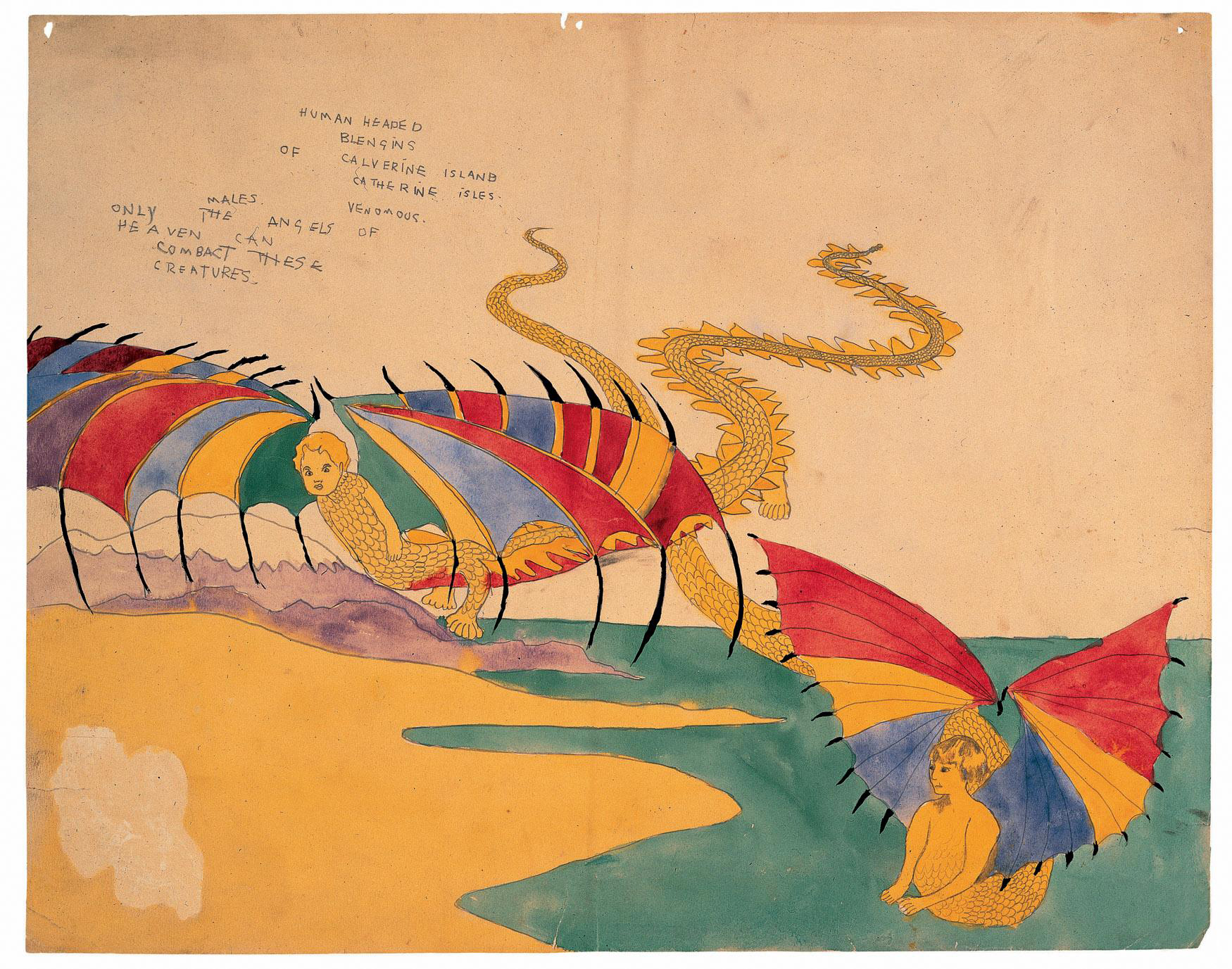
 

Henry Darger (American, 1892-1973) 'Human headed Blengins of Calverine Island Catherine Isles' 1920-1930


Henry Darger (American, 1892-1973)
Human headed Blengins of Calverine Island Catherine Isles
1920-30
Pencil and watercolour on paper


 Henry Joseph Darger (American, 1892-1973)

Henry Joseph Darger Jr. (c. April 12, 1892-April 13, 1973) was a reclusive American writer and artist who worked as a hospital custodian in Chicago, Illinois. He has become famous for his posthumously discovered 15,145-page, single-spaced fantasy manuscript called The Story of the Vivian Girls, in What Is Known as the Realms of the Unreal, of the Glandeco-Angelinian War Storm, Caused by the Child Slave Rebellion, along with several hundred drawings and watercolour paintings illustrating the story.

The visual subject matter of his work ranges from idyllic scenes in Edwardian interiors and tranquil flowered landscapes populated by children and fantastic creatures, to scenes of horrific terror and carnage depicting young children being tortured and massacred. Much of his artwork is mixed media with collage elements. Darger’s artwork has become one of the most celebrated examples of outsider art. …

In the Realms of the Unreal is a 15,145-page work bound in fifteen immense, densely typed volumes (with three of them consisting of several hundred illustrations, scroll-like watercolour paintings on paper derived from magazines and colouring books) created over six decades. Darger illustrated his stories using a technique of traced images cut from magazines and catalogues, arranged in large panoramic landscapes and painted in watercolours, some as large as 30 feet wide and painted on both sides. He wrote himself into the narrative as the children’s protector.

The largest part of the book, The Story of the Vivian Girls, in What is Known as the Realms of the Unreal, of the Glandeco-Angelinian War Storm Caused by the Child Slave Rebellion, follows the adventures of the daughters of Robert Vivian, seven princesses of the Christian nation of Abbieannia who assist a daring rebellion against the child slavery imposed by John Manley and the Glandelinians. Children take up arms in their own defense and are often slain in battle or viciously tortured by the Glandelinian overlords. The elaborate mythology includes the setting of a large planet, around which Earth orbits as a moon (where most people are Christian and mostly Catholic), and a species called the “Blengigomeneans” (or Blengins for short), gigantic winged beings with curved horns who occasionally take human or part-human form, even disguising themselves as children. They are usually benevolent, but some Blengins are extremely suspicious of all humans, due to Glandelinian atrocities.

Text from the Wikipedia website


Charles August Albert Dellschau (American, 1830-1923) 'Untitled' 1921


Charles August Albert Dellschau (American, 1830-1923)
Untitled
1921
Book
Courtesy Collection abcd / Bruno Decharme


Charles August Albert Dellschau (American born Prussia, 1830-1923)

Charles August Albert Dellschau (4 June 1830 Brandenburg, Prussia-20 April 1923 Houston, Texas) was one of America’s earliest known visionary artists, who created drawings, collages and watercolours of airplanes and airships and bound them in 12 known large scrapbooks that were discovered decades after his death. …

After his death, Dellschau’s home remained in the hands of his descendants. His notebooks of paintings and drawings, as well as his diaries were left virtually untouched for half a century until the late 1960s. Following a fire, the house was cleared and at least 12 of the notebooks were placed on the sidewalk to be discarded. Fred Washington, a local antiques and used furniture dealer, spotted the books, and for $100 bought them from the trash collector. The books sat undisturbed in Washington’s store under a pile of discarded carpet for over a year. In 1968, Mary Jane Victor, an art student at the University of St. Thomas in Houston stumbled upon the notebooks, and persuaded Washington to lend some of them to the university for a display on the story of flight. She also brought them to the attention of art patron and collector Dominique de Menil. Mrs. de Menil purchased four of the notebooks for $1,500. Of the remaining books, seven were purchased Peter (Pete) G. Navarro, a Houston commercial artist and UFO researcher. After studying them, Navarro sold four of the notebooks to the Witte Museum in San Antonio, and the San Antonio Museum of Art. One notebook ultimately ended in the private abcd (art brut connaissance & diffusion) collection in Paris belonging to Bruno Decharme, a French filmmaker and art collector. The rest of the notebooks ended up in private hands. Some were dismantled and single pages were sold. In 2016, a double sided page dated 1919, sold for $22,500 at Christie’s.

Dellschau’s earliest known work is a diary dated 1899, and the last is an 80-page book dated 1921-1922, giving his career as an artist a 21-year span. His work was in large part a record of the activities of the “Sonora Aero Club,” of which he was a purported member. Dellschau’s writings describe the club as a secret group of flight enthusiasts who met in Sonora, California in the mid-19th century. According to Dellschau, one of the club members discovered a formula for an anti-gravity fuel called “NB Gas.” The club mission was to design and build the first navigable aircraft using the NB Gas for lift and propulsion. Dellschau called these flying machines Aeros. Dellschau never claimed to be a pilot or a designer of any of the airships; he identifies himself only as a draftsman for the Sonora Aero Club. His collages incorporate newspaper clippings (called “press blooms”) of then-current news articles about aeronautical advances and disasters.

Despite exhaustive research, including searches of census records, voting rosters, and death records, nothing has been found to substantiate the existence of this group except for a few gravestones in the Columbia Cemetery where several of the surnames are found. It is speculated that, like the voluminous “Realms of the Unreal” notebooks by outsider artist Henry Darger (1882-1973), the Sonora Aero Club is a fiction by Dellschau.

Text from the Wikipedia website


L’envol is the final exhibition at La maison rouge, which will close its doors for the last time on October 28, 2018. Antoine de Galbert has invited Barbara Safarova, Aline Vidal and Bruno Decharme as co-curators. Together, these specialists in art brut and contemporary art have imagined an exhibition that examines mankind’s dream of flying – though without any reference to those who have actually made this dream come true. As always at La maison rouge, the curators have considered the subject matter independently of “categories” to bring together works of art brut, modern, contemporary, ethnographic and folk art. A walk through the various themes reveals a succession of some 200 works, including installations, films, documents, paintings, drawings and sculptures.

In the beginning there was Dedalus, that inspired inventor who dreamed of escaping into the skies, taking his son Icarus with him. Harnessed to wings made from feathers and wax, they rose into the heavens, intoxicated with their flight, borne aloft into the atmosphere. We all know what happened next. Icarus ventured too near the sun, his wings melted and he hurtled into the sea to die. From legend to reality, the sky has always been a dangerous playground for mankind. This is no small undertaking by the 130 artists in Lenvol, as they endeavour to challenge the laws of gravity, break free of Earth’s magnetic field, launch themselves into the unknown or experience the gaseous envelope of the atmosphere between two periods of turbulence. Some are hedonists, others are activists, intent on saving mankind as the world heads for destruction, whether by building flying shelters or constructing utopias. The sky offers ample territory for experiment, shared between the extravagant artists who are convinced of their ability to overcome gravity and the gods that live there, and the conceptualists designing utopias – more poet than scientist.

Defying gravity

The dream of flying may be as old as mankind – and the sky may have lost some of its mystery thanks to progress in aviation – but men are not birds, all the same. Clothing oneself in feathers is not enough. We are earthly creatures, and the body alone will always struggle to leave the ground. We can never achieve this freedom nor expand the scope of our action without the will to surpass ourselves.

Devoid of wings, dancers soar upwards, defying the laws of gravity with no fear of falling or exhaustion (Loie Fuller, Nijinsky, Cuningham, etc.) Rodchenko, a photographer for the Russian propaganda machine, uses daring, low-angle shots to make his athletes appear to take off in flight, idealising the body to further the needs of the revolution whose heroes were held aloft.

Lucien Pelen seeks anti-matter as he attempts to merge his body with the atmosphere. Arms outstretched, he launches himself into the air and, for a split second, achieves the ecstasy of flight before coming brutally back down to earth. Such is this fragile balance at the boundaries of possibility.

When Gustav Messmer attached springs to his shoes so he could bounce rather than walk, or fitted a bicycle with enormous bat-like wings, did he realise how precarious these inventions were? To hell with scepticism! Surely it takes some degree of madness to invent your own freedom?

Or engage in excesses like Rebecca Horn who, in search of new ways to experience the space around her, shrouds her ailing body in feather fans then seeks the limits of its extension, stretching these articulated wings as far as they will go before the mechanism gives way.

To infinity and beyond

The weight of the world gives artists cause to wander in the shadow of earthly paradises. Fréderic Pardo, a psychedelic star, uses tempera, an ancient technique, to produce spaced-out paintings while high on LSD. He floats alongside magic carpets (Urs Lüthi), ridden by souls from an Arabian Nights dream. We discover a limitless space filled with superheroes, Batman and witches straddling broomsticks; a world teeming with chimera and fairies.

The sky seethes with mystery. Shamans, accustomed to travelling between worlds, converse with spirits and collect information while improbable creatures, part angel, part human, bump and bowl along (Henry Darger’s Blengins side by side with Moebius’s Arzach, Friedrich Schröder-Sonnenstern’s hybrids and Kiki Smith’s bird-women).

Engineering the impossible

Tatlin’s sculpture, more fine art than flying machine, seeks to rediscover an age-old, mythical experience. Letatlin is a melding of art, technique and utopia; an attempt at a personal dream. The year is 1929 and the Great Depression has spared no-one. Heads are hot with the desire to escape, minds filled with fantasies of infinity. “We must learn to fly through the air just as we learned to swim in the water or ride a bicycle,” Tatlin declared.

Some forty years later, Belgian artist Panamarenko appears to have taken him at his word. Obsessed with the freedom of flight, he makes sophisticated yet poetic constructions, bristling with bellows and motors. However crazy or technically unfeasible they may be, the artist never tires of convincing us they will lift him off the ground.

These are beautiful machines, created by the engineers of the impossible and of no purpose whatsoever – except for the dreams they inspire. Snuggling into Fabio Mauri’s Luna inspires a feeling of weightlessness with the senses immersed in a light, fluffy environment. Stationed on the deck of his Spacecraft, inspired as much by the Mercury project as Henry David Thoreau’s cabin in the woods, Stéphane Thidet combines musical arrangements with conversations between astronauts in an electroacoustic performance.

They shut themselves away in their own worlds, all the better to escape to another place, experience the extraordinary and relive childhood fantasies, but with adult toys. Roman Signer, for example, plays with explosives and sets off conflagrations that are both fascinating and illusory. After all, what is the point of smashing everyday objects to smithereens? Of starting up a helicopter in an inflatable pool when it will probably destroy everything around? What is the point of risking danger, other than to try and become one with the inventor of the world and reproduce the forces of nature.

Indoor aviators

Some of these dream merchants are inspired by an intercelestial mission. They are the off-the-wall artists, incomprehensible to the rational world, imbued with a different logic and convinced that flight can be achieved with contraptions made from bits and bobs. Theirs is a world free from explosions or falls, bolstered by belief and the quest for the absolute. Hans-Jörg Georgi, for one, is driven by the need to save humanity from inevitable destruction. His studio is crammed with the aeroplanes he painstakingly builds, day after day, from cardboard boxes stuck together with glue.

Karl Hans Janke is another master of the art of spaceship building, having produced an astonishing 4,500 drawings describing hundreds of technical innovations. Charles Dellschau is further testament to this obsessive dream of flying. He was a member of the Sonora Aero Club, a secret group of mid-nineteenth-century flight enthusiasts whose self-appointed mission was to build the world’s first navigable aircraft.

These are crazy escapades, guided only by the imagination and ultimately less dangerous, and just as exhilarating, as those undertaken by reality’s utopians. Adolf Wölfli chose to rise above it all, deliriously determined to embrace Creation, Space and Eternity. His associations of opposite perspectives produce apparently real and contradictory visions that are dizzying to behold.

Aviation’s spectacular progress has in no way diminished the dreams of these magnificent inventors. Two irreconcilable worlds continue to share the skies. And why shouldn’t artists seek inspiration from other suns? Despite his fall, Icarus is a hero for all eternity.

Excerpt from the exhibition catalogue, introduction by Aline Vidal.


Fabio Mauri (Italian, 1926-2009)
Luna
1968
Installation


Anonymous photographer. 'Untitled' c. 1940


Anonymous photographer
Untitled
c. 1940
Black and white photograph
Courtesy Collection abcd / Bruno Decharme


Alexandre Rodchenko (Russian, 1891-1956) 'A leap' 1934


Alexandre Rodchenko (Russian, 1891-1956)
A leap
1934
Black and white photograph
Courtesy Collection Multimedia Art Museum, Moscow / Moscow House of Photography Museum


Photographs made from above or below or at odd angles are all around us today – in magazine and television ads, for example – but for Rodchenko and his contemporaries they were a fresh discovery. To Rodchenko they represented freedom and modernity because they invited people to see and think about familiar things in new ways.

Text from the MoMA website


Photography was important to Rodchenko in the 1920s in his attempt to find new media more appropriate to his goal of serving the revolution. He first viewed it as a source of preexisting imagery, using it in montages of pictures and text, but later he began to take pictures himself and evolved an aesthetic of unconventional angles, abruptly cropped compositions, and stark contrasts of light and shadow. His work in both photomontage and photography ultimately made an important contribution to European photography in the 1920s.

Text from The Art Story website


Eikoh Hosoe (Japan, b. 1933) 'Kamaitachi 17' 1965


Eikoh Hosoe (Japan, b. 1933)
Kamaitachi 17
1965
Black and white photograph
© Eikoh Hosoe. Courtesy galerie Jean-Kenta Gauthier, Paris


Eikoh Hosoe’s groundbreaking Kamaitachi was originally released in 1969 as a limited-edition photobook of 1,000 copies. A collaboration with Tatsumi Hijikata, the founder of ankoku butoh dance, it documents their visit to a farming village in northern Japan and an improvisational performance made with local villagers, inspired by the legend of kamaitachi, a weasel-like demon who haunts rice fields and slashes people with a sickle. Hosoe photographed Hijikata’s spontaneous interactions with the landscape and the people they encountered. A seductive combination of performance and photography, the two artists enact an personal and symbolic investigation of Japanese society during a time of massive upheaval.

Text from the Aperture website
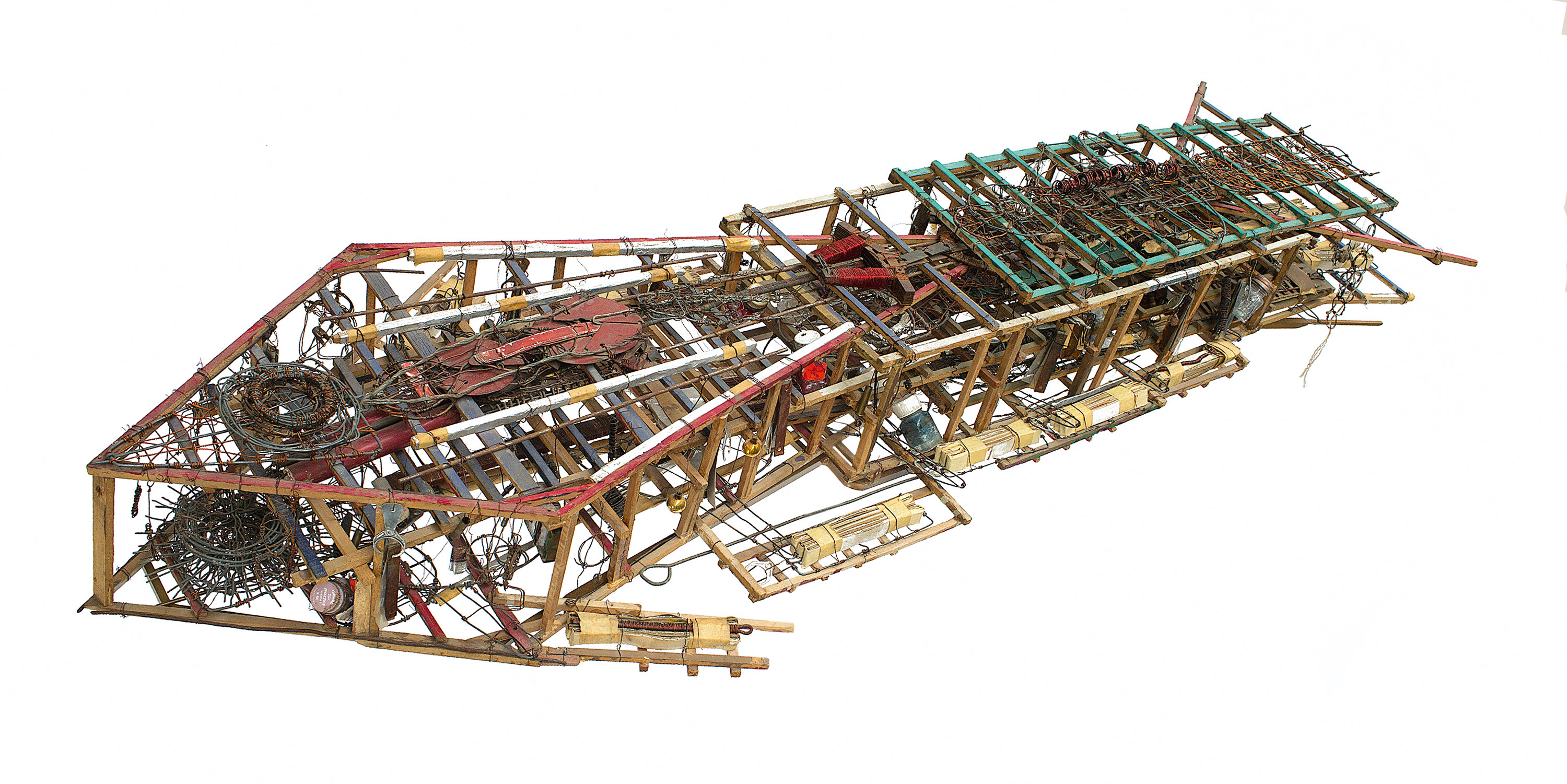
 

Emery Blagdon (American, 1907-1986) 'Untitled' Nd


Emery Blagdon (American, 1907-1986)
Untitled
Nd
Courtesy Collection abcd / Bruno Decharme


From the late 1950s until his death in 1986, Emery Blagdon created a constantly changing installation of paintings and sculptures in a small building on his Nebraska farm. He believed in the power of “earth energies” and in his own ability to channel such forces in a space that, through constant adjusting and aesthetic power, could alleviate pain and illness.

Blagdon used found materials like hay baling wire, magnets, and remnant paints from farm sales, but he also sought out special ingredients like salts and other “earth elements” through a nearby pharmacy. He called the individual pieces his “pretties,” but collectively they comprised The Healing Machine. Blagdon worked on his Healing Machine for more than three decades, tending, tinkering with, and reorganising its components every day and, in his own words, “according to the phases of the moon.” He believed it was a functional machine in which energies were drawn upward from the building’s earthen floor into the space, where they could bounce around and remain dynamic.

Text from the Wikipedia website


Lucien Pelen (French, b. 1978) 'Chair n°2' (detail) 2005


Lucien Pelen (French, b. 1978)
Chair n°2 (detail)
2005
Black and white photograph
Lucien Pelen / Courtesy Galerie Aline Vidal


Jacques-Henri Lartigue (1894-1986) 'L'envol de Bichonnade' 1905


Jacques-Henri Lartigue (French, 1894-1986)
L’envol de Bichonnade (The flight of Bichonnade or Bichonnade leaping)
Paris 1905
Gelatin silver print
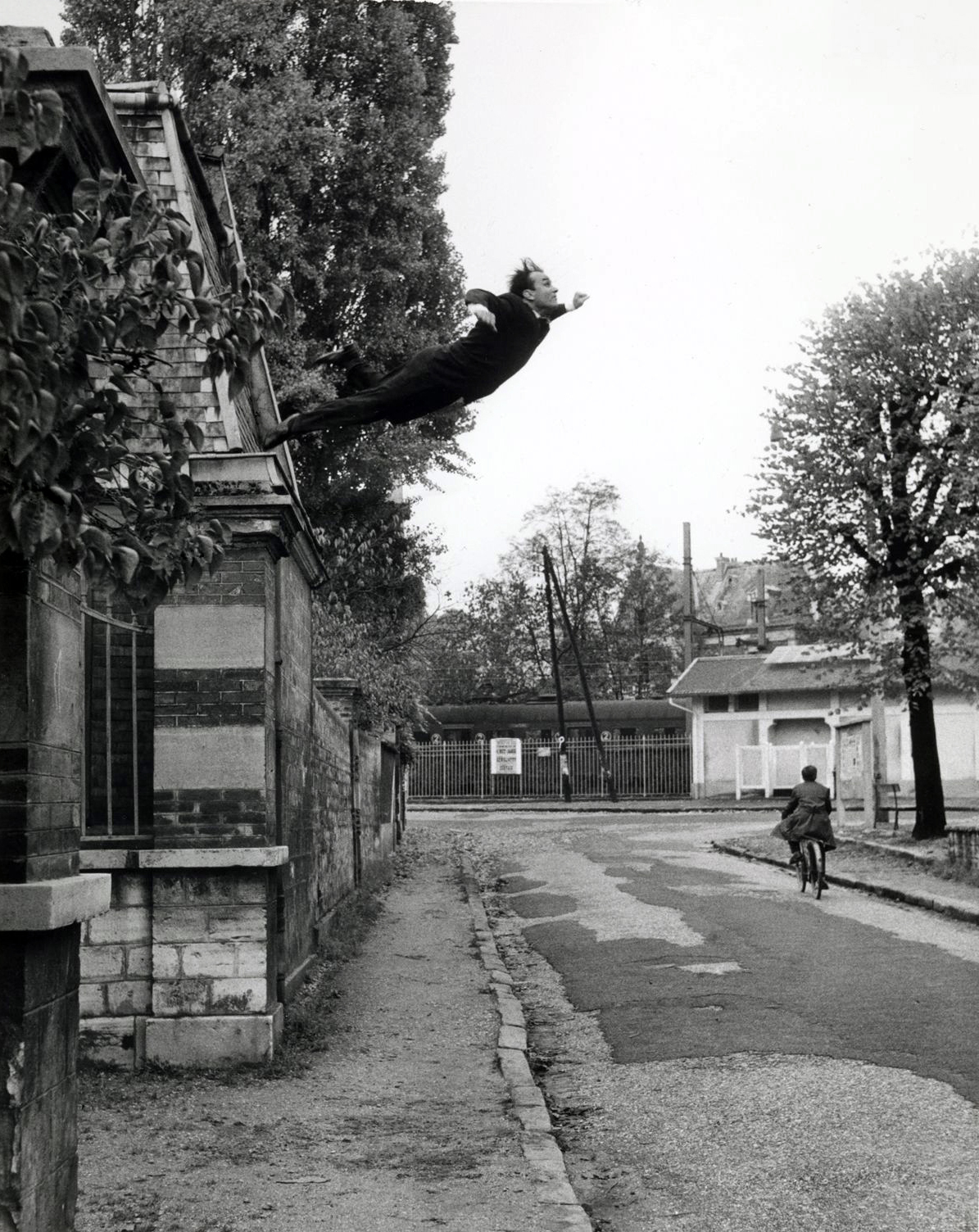
 

Yves Klein (French, 1928-1962) 'Leap into the Void' 1960


Yves Klein (French, 1928-1962)
Leap into the Void
1960
Black and white argentic print
© Succession Yves Klein c/o Adagp, Paris
© Photo Collaboration Harry Shunk and Janos Kender
© J. Paul Getty Trust. The Getty Research Institute, Los Angeles


As in his carefully choreographed paintings in which he used nude female models dipped in blue paint as paintbrushes, Klein’s photomontage paradoxically creates the impression of freedom and abandon through a highly contrived process. In October 1960, Klein hired the photographers Harry Shunk and Jean Kender to make a series of pictures re-creating a jump from a second-floor window that the artist claimed to have executed earlier in the year. This second leap was made from a rooftop in the Paris suburb of Fontenay-aux-Roses. On the street below, a group of the artist’s friends from held a tarpaulin to catch him as he fell. Two negatives – one showing Klein leaping, the other the surrounding scene (without the tarp) – were then printed together to create a seamless “documentary” photograph. To complete the illusion that he was capable of flight, Klein distributed a fake broadsheet at Parisian newsstands commemorating the event. It was in this mass-produced form that the artist’s seminal gesture was communicated to the public and also notably to the Vienna Actionists.

Text from The Metropolitan Museum of Art website
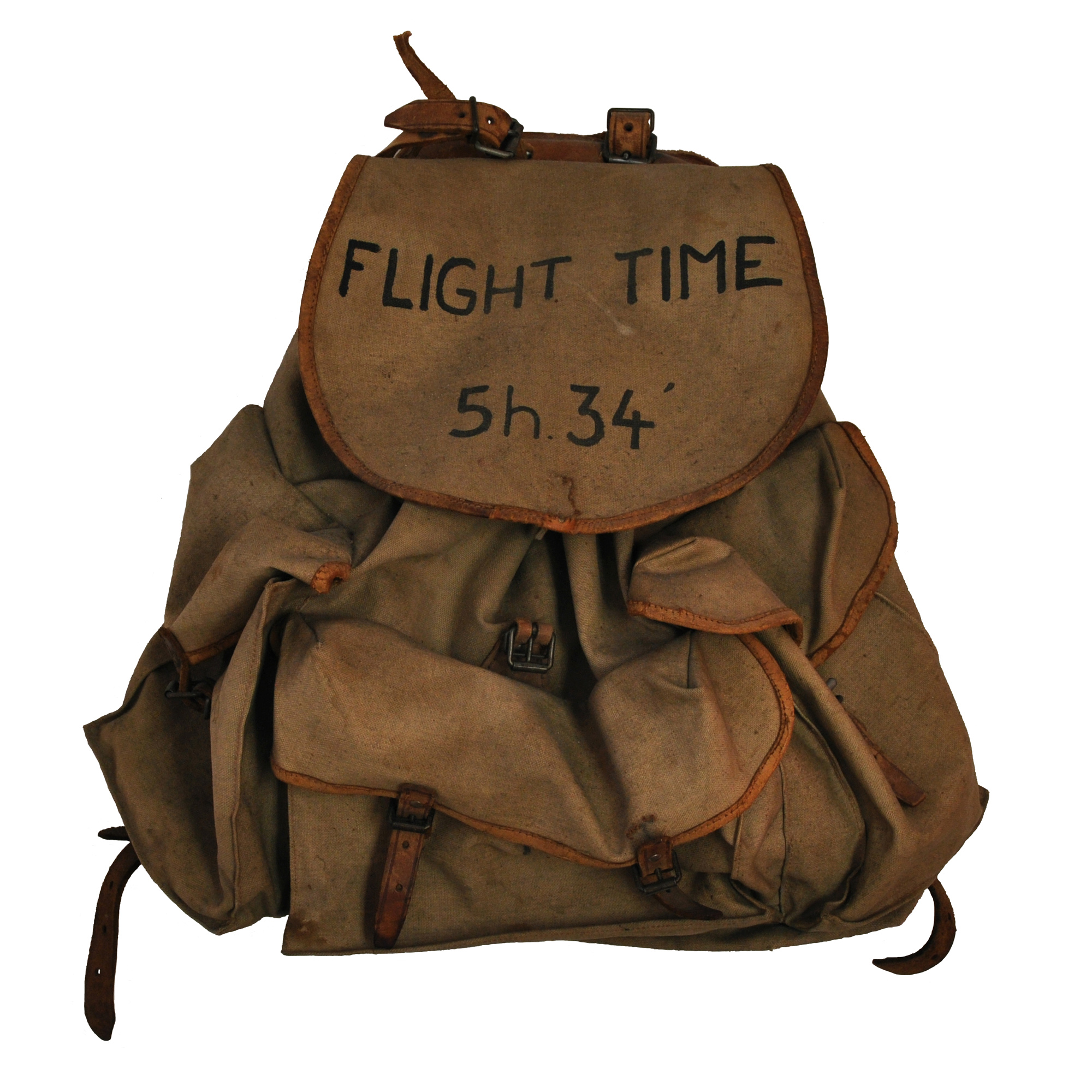
 

Philippe Thomassin. 'Flight Time 5h34'' 1989-1991


Philippe Thomassin
Flight Time 5h34′
1989-1991
Courtesy collection Antoine de Galbert
Photo: Célia Pernot
© Philippe Thomassin


Rebecca Horn (German, b. 1944) 'The little Mermaid' 1990


Rebecca Horn (German, b. 1944)
The little Mermaid
1990
Courtesy collection Antoine de Galbert
Photo: Célia Pernot
© Rebecca Horn


Rebecca Horn (born 24 March 1944, Michelstadt, Hesse) is a German visual artist, who is best known for her installation art, film directing, and her body modifications such as Einhorn (Unicorn), a body-suit with a very large horn projecting vertically from the headpiece. She directed the films Der Eintänzer (1978), La ferdinanda: Sonate für eine Medici-Villa (1982) and Buster’s Bedroom (1990). Horn presently lives and works in Paris and Berlin.
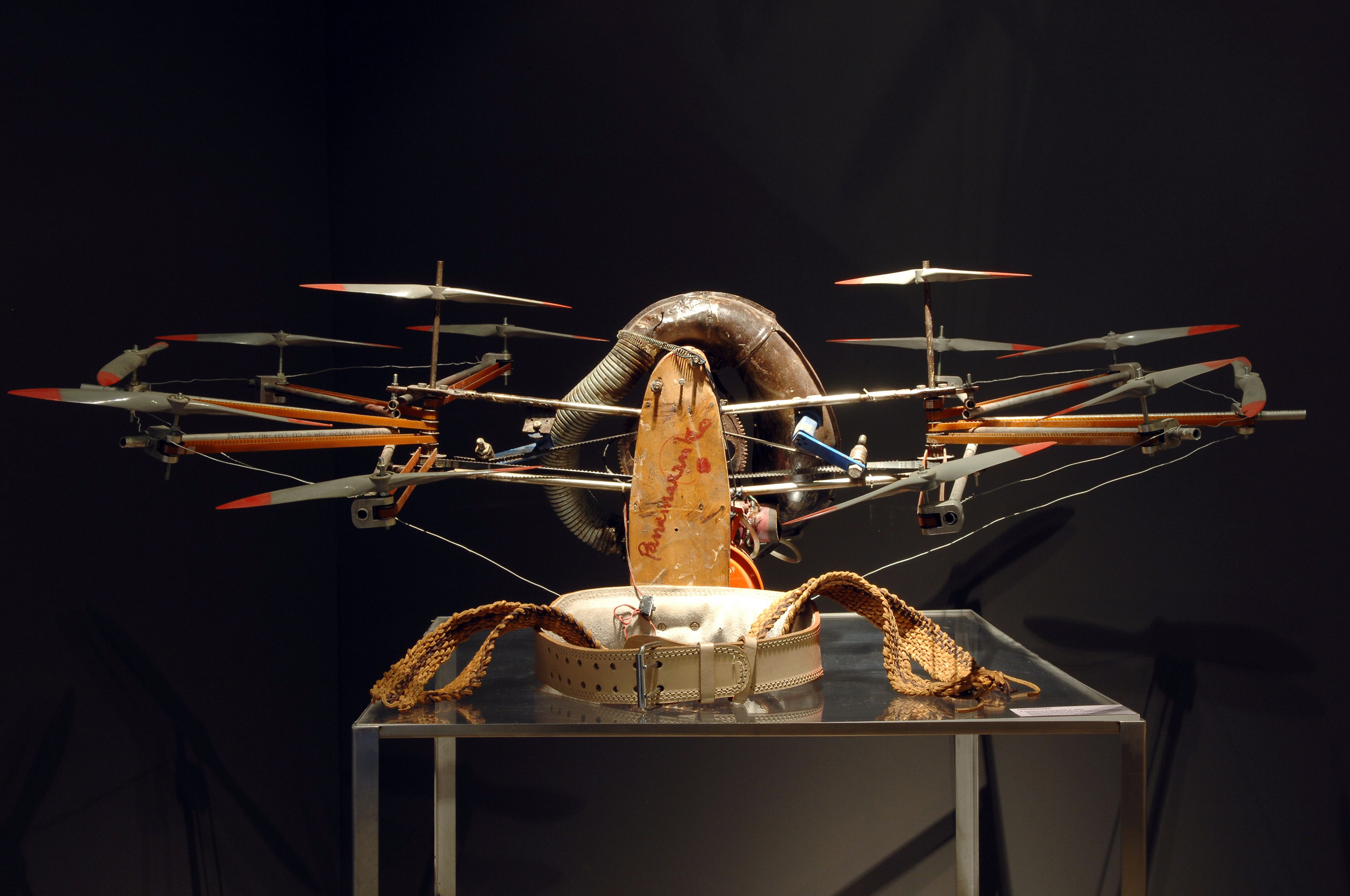
 

Panamarenko (Belgian, b. 1940) 'Japanese Flying Pak 3' 2001


Panamarenko (Belgian, 1940-2019)
Japanese Flying Pak 3
2001
Courtesy Galerie Jamar, Anvers
Photo: Wim Van Eesbeek
© Panamarenko


Panamarenko (pseudonym of Henri Van Herwegen, born in Antwerp, 5 February 1940) was a prominent assemblagist in Belgian sculpture. Famous for his work with aeroplanes as theme; none of which are able nor constructed to actually leave the ground.

Panamarenko studied at the academy of Antwerp. Before 1968, his art was inspired by pop-art, but early on he became interested in aeroplanes and human powered flight. This interest is also reflected in his name, which supposedly is an acronym for “Pan American Airlines and Company”.

Starting in 1970, he developed his first models of imaginary vehicles, aeroplanes, balloons or helicopters, in original and surprising appearances. Many of his sculptures are modern variants of the myth of Icarus. The question of whether his creations can actually fly is part of their mystery and appeal.

Text from the Wikipedia website
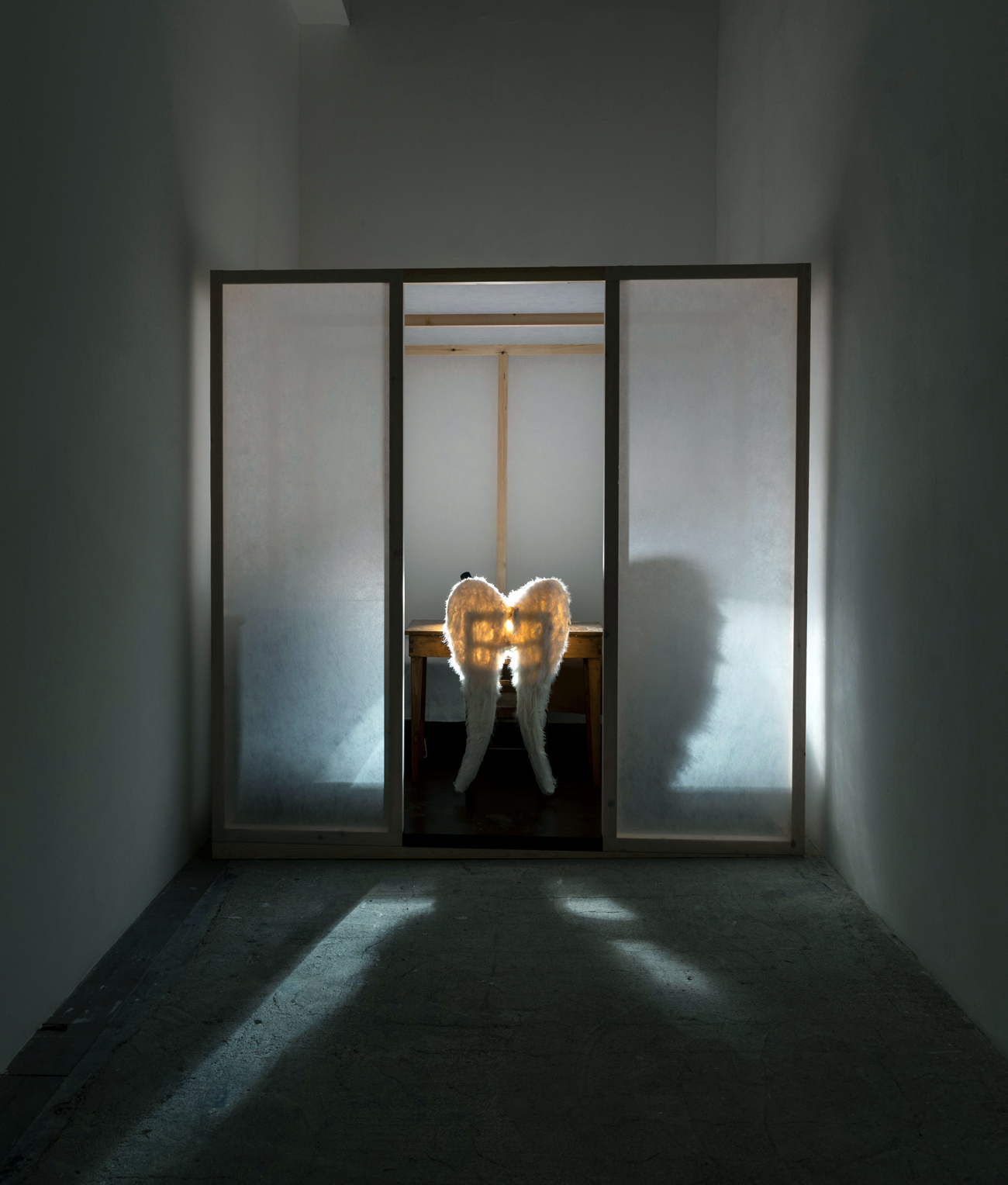
 

Ilya and Emilia Kabakov (American born Russia, b. 1933 and 1945) 'How Can One Change Oneself' 2010


Ilya and Emilia Kabakov (American born Russia, b. 1933 and 1945)
How Can One Change Oneself
2010
Installation
Courtesy of the artist et Galleria Continua, San Gimignano/Beijing/Les Moulins/ Habana
© Ilya et Emilia Kabakov


The Kabakovs are amongst the most celebrated artists of their generation, widely known for their large-scale installations and use of fictional personas. Critiquing the conventions of art history and drawing upon the visual culture of the former Soviet Union – from dreary communal apartments to propaganda art and its highly optimistic depictions of Soviet life – their work addresses universal ideas of utopia and fantasy; hope and fear. …

The Kabakovs are best known for their ‘total’ installations, a type of immersive artwork that they pioneered. A ‘total installation’ completely immerses the viewer in a dramatic environment. They transform the gallery spaces they are displayed in, creating a new reality for the viewer to enter and experience. They often explore dark themes like power and control, oppression and destruction. Over their career, the Kabakovs have created almost two hundred total installations.

“Ilya’s world and work are based and built on fantasy and on the history of art. I, on the other hand, very early in life, somehow learned to combine both reality and fantasy and to live in both. My fantasy world is always close to and coexists with reality. Our life is very much based on this combination: I am trying to make reality seem like the realisation of fantasy, or, maybe, a continuation of fantasy, where there is no place for real, everyday situations and problems. Our life consists of our work, dreams and discussions.”

Emilia Kabakov, 2017

Text from the Tate website


Moebius (Jean Henri Gaston Giraud) (French, 1938-2012) 'Arzach' 1977


Moebius (Jean Henri Gaston Giraud) (French, 1938-2012)
Arzach
1977
Heavy Metal Magazine, April 1977, Vol. I, No. 1


The first of Moebius’ Arzach comic series. Arzach made his debut in the first issue of Heavy Metal Magazine April – Vol. 1 No. 1. Arzach is seen flying atop his trusty pterodactyl in a strange world. Spotting a beautiful naked woman through a rounded window, Arzach is determined to win her heart, but what awaits him is utterly unexpected.


Jean Henri Gaston Giraud (French, 8 May 1938 – 10 March 2012) was a French artist, cartoonist, and writer who worked in the Franco-Belgian bandes dessinées (BD) tradition. Giraud garnered worldwide acclaim under the pseudonym Mœbius, as well as Gir outside the English-speaking world, used for the Blueberry series – his most successful creation in the non-English speaking parts of the world – and his Western-themed paintings. Esteemed by Federico Fellini, Stan Lee, and Hayao Miyazaki, among others, he has been described as the most influential bande dessinée artist after Hergé.

His most famous works include the series Blueberry, created with writer Jean-Michel Charlier, featuring one of the first antiheroes in Western comics. As Mœbius, he created a wide range of science-fiction and fantasy comics in a highly imaginative, surreal, almost abstract style. These works include Arzach and the Airtight Garage of Jerry Cornelius. He also collaborated with avant garde filmmaker Alejandro Jodorowsky for an unproduced adaptation of Dune and the comic book series The Incal.

Mœbius also contributed storyboards and concept designs to numerous science-fiction and fantasy films, such as Alien, Tron, The Fifth Element, and The Abyss. Blueberry was adapted for the screen in 2004 by French director Jan Kounen.

Text from the Wikipedia website
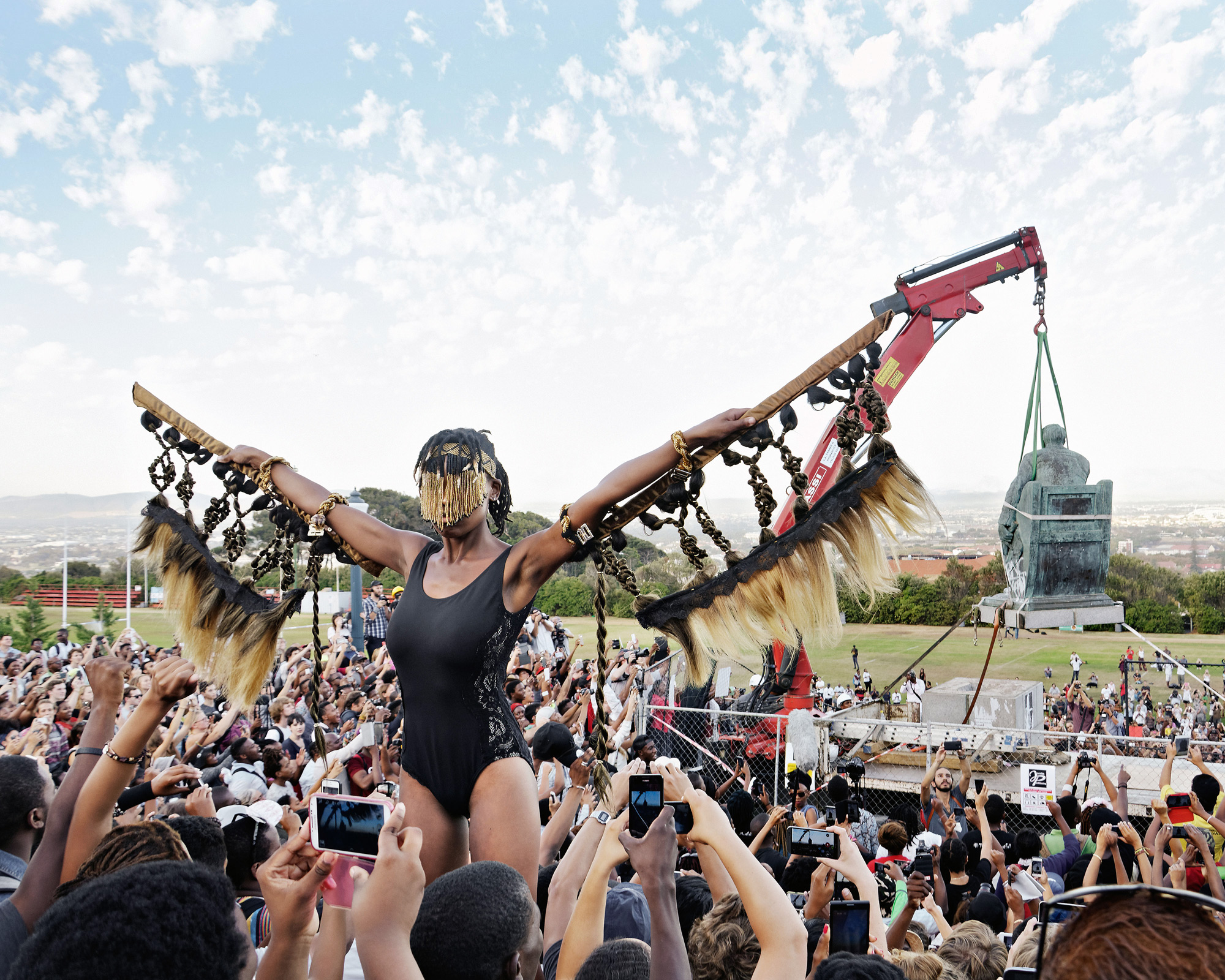
 

Sethembile Msezane (South Africa, b. 1991) 'Chapungu - The Day Rhodes Fell' 2015


Sethembile Msezane (South African, b. 1991)
Chapungu – The Day Rhodes Fell [University of Cape Town, South Africa]
2015
Coloured photograph
Courtesy private collection
© Sethembile Msezane


Sethembile Msezane was born in 1991 in KwaZulu Natal, South Africa. She lives and works in Cape Town, South Africa. Using interdisciplinary practice encompassing performance, photography, film, sculpture and drawing, Msezane creates commanding works heavy with spiritual and political symbolism. The artist explores issues around spirituality, commemoration and African knowledge systems. She processes her dreams as a medium through a lens of the plurality of existence across space and time, asking questions about the remembrance of ancestry. Part of her work has examined the processes of myth-making which are used to construct history, calling attention to the absence of the black female body in both the narratives and physical spaces of historical commemoration.

Text from the Tyburn Gallery website


“The Rhodes Must Fall protests had been going on for a month, kickstarted by an activist smearing his statue with excrement. During a lecture, students were asked whether they were for or against. Most said “for”, that it was a painful reminder of our colonial past, but one student – with a piece of paper that said “#procolonialism” on her chest – called protesters neanderthals, and said, “If you’re against the statue you’re against enlightenment and education, and you shouldn’t be at university.”

I knew it was only a matter of time before the statue fell, but at 11am on 9 April my supervisor said: “It’s coming down today.” I’d prepared my costume for the occasion and rushed to get ready. A friend helped me transport my plinth and wings. I arrived just before 2pm and was up on the plinth by quarter past. It was a little nerve-racking to be so high up because I was wearing high heels.

I looked at people’s phones and sunglasses, trying to see the reflection of the statue coming down. I saw the shadow move and thought, “This is the moment.” That’s when I lifted my wings.

I was up there for four hours. I would hold up my wings for about two minutes, take a 10-minute break and then put them up again. My legs hurt, but I didn’t realise how sore my arms were until I came down – they were shaking. My feet were blue, I was sunburnt; I had heat stroke and blurry vision from looking directly into the sun. I went home, had a shower and went straight to sleep. I felt like we were beginning to question this idealistic “rainbow nation”.”

I first saw the picture the next day on Facebook. When someone told me it was all over the global news, I was surprised.”

Sethembile Msezane. “Sethembile Msezane performs at the fall of the Cecil Rhodes statue, 9 April 2015,” on The Guardian website, Sat 16 May 2015


Agnès Geoffray (French, b. 1973) 'Suspendue' 2016


Agnès Geoffray (French, b. 1973)
Suspendue
2016
Black and white photograph
Courtesy of the artist
© Agnès Geoffray


Largely inspired by The Defaming Portrait and by the hung man’s figure, the series Les Suspendus uses assemblage and montage to rephrase a new reality, which combines two images in a series of several diptychs. Agnès Geoffray interrogates the fictional power of imagery through her own staging and through assembled images. She accomplishes this by presenting multiple associations to the idea of suspension as a frozen moment between falling and ascension, collapsing and rising. Geoffray creates a gap and confusion between preexisting images and her own, which makes the resulting image appear as if it is part of an archive. Geoffray multiplies the references, axes of meaning of the text and genres of her work through still life, archive and stage settings to create a space, which plays with the unlimited possibilities of interpretation. The images convey the relic of the gestures and the violence connected to them, like a memory or a future memory of disorders and disasters.


Urs Lüthi (Swiss, born 1947) 'Selfportrait (flying carpet)' 1976


Urs Lüthi (Swiss, b. 1947)
Selfportrait (flying carpet)
1976
Black and white photograph
Courtesy private collection
© Urs Lüthi, Pro Litteris


Urs Lüthi (born 1947, Kriens) is a Swiss conceptual artist who attended the School of Applied Arts in Zurich. Noted for using his body and alter ego as the subject of his artworks, he has worked in photography, sculpture, performance, silk-screen, video and painting.


Fabio Mauri (Italian, 1926-2009) 'Macchina per fissare acquerelli [Machine for fixing watercolours]' 2007


Fabio Mauri (Italian, 1926-2009)
Macchina per fissare acquerelli [Machine for fixing watercolours]
2007
Courtesy succession de Fabio Mauri et Hauser & Wirth, Zürich
© Fabio Mauri, Adagp, 2018
Photo: Sandro Mele


Several important themes can be found in Mauri’s work, all shaped into his works of art: the Screen, the Prototypes, the Projections, the Photography as Painting, the substantial Identity of Expressive Structures, the lasting relationship between Thought and World and between Thought as World. Mauri’s work, as complex as an history essay, becomes his autobiography, compact and uniform in its development and multifaceted in the attention to the contemporary world: an analysis where the fate of the individual and history co-exist.
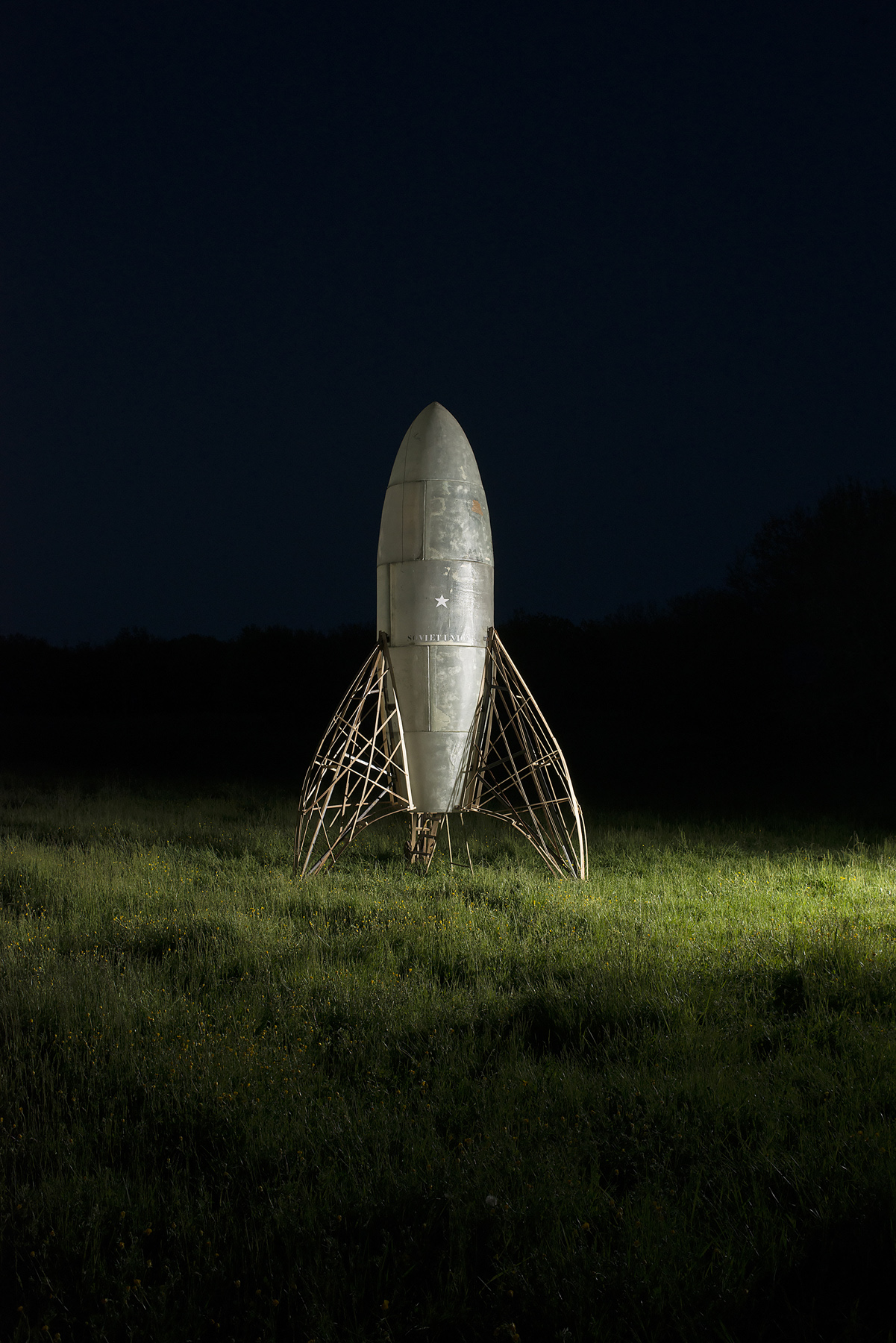
 

François Burland (Swiss, b. 1958) 'Fusée Soviet Union' 2013


François Burland (Swiss, b. 1958)
Fusée Soviet Union
2013
Photo: Romain Mader et Nadja Kilchhofer
© François Borland, Atomik Magic Circus


La maison rouge
Fondation antoine de galbert
10 bd de la bastille – 75012
Paris France
Phone: +33 (0) 1 40 01 08 81

Opening hours:
Wednesday – Sunday 11am – 7pm
Late nights Thursday until 9pm

LIKE ART BLART ON FACEBOOK

Back to top

Exhibition: ‘Balthasar Burkhard’ at Fotomuseum Winterthur and Fotostiftung Schweiz, Winterthur, Zurich

Exhibition dates: 10th February – 21st May, 2018


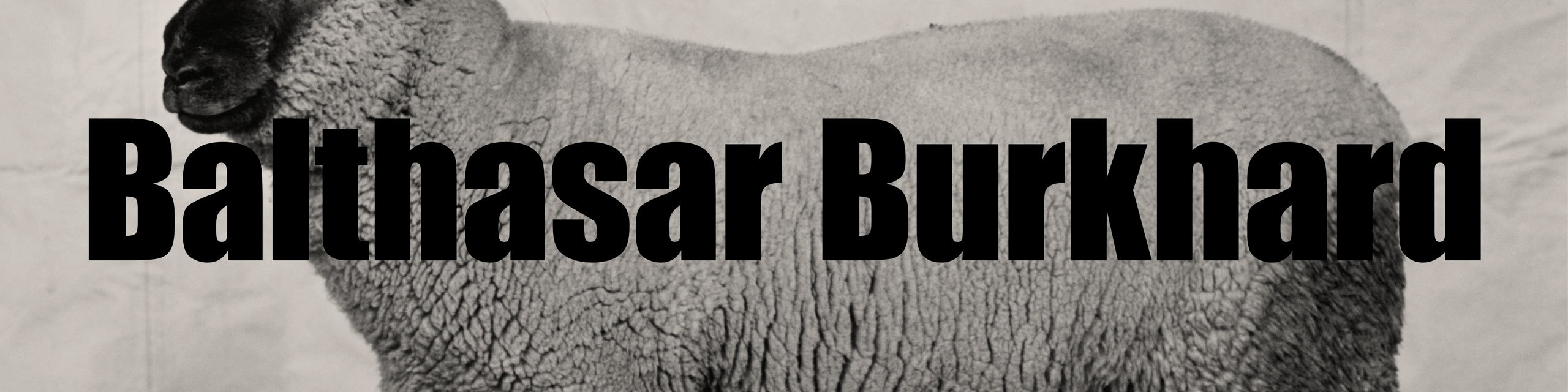
Balthasar Burkhard poster for his exhibition at Fotomuseum Winterthur

Balthasar Burkhard


As is so often the case with an artist, it is the early work that shines brightest in this posting.

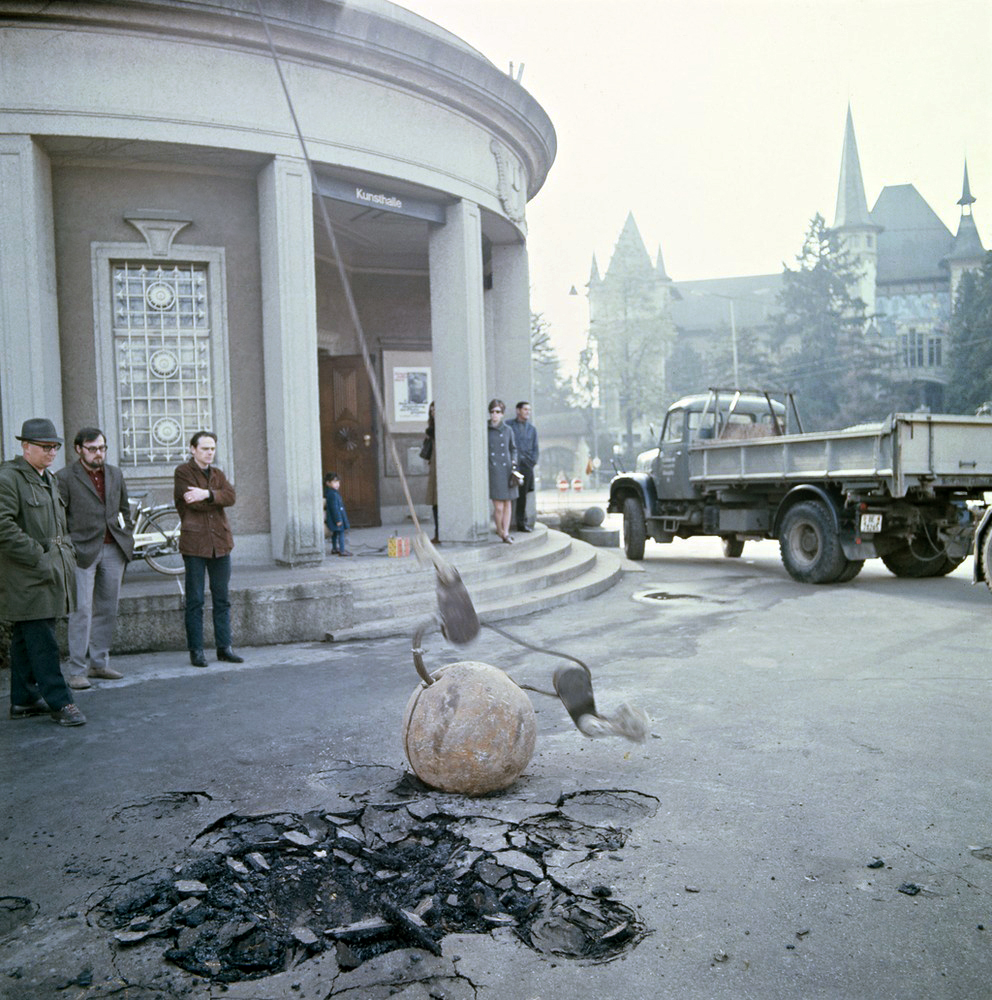
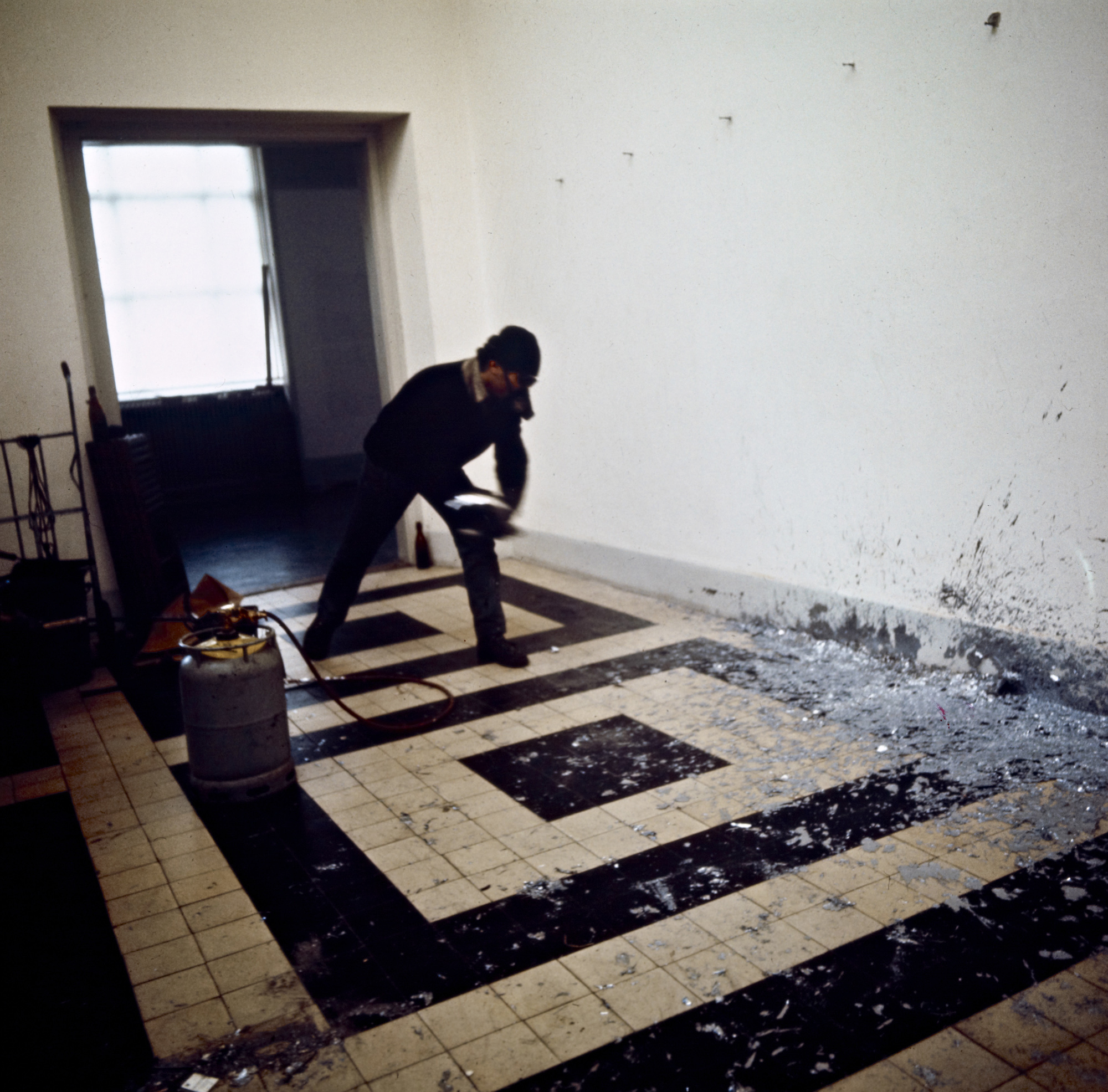
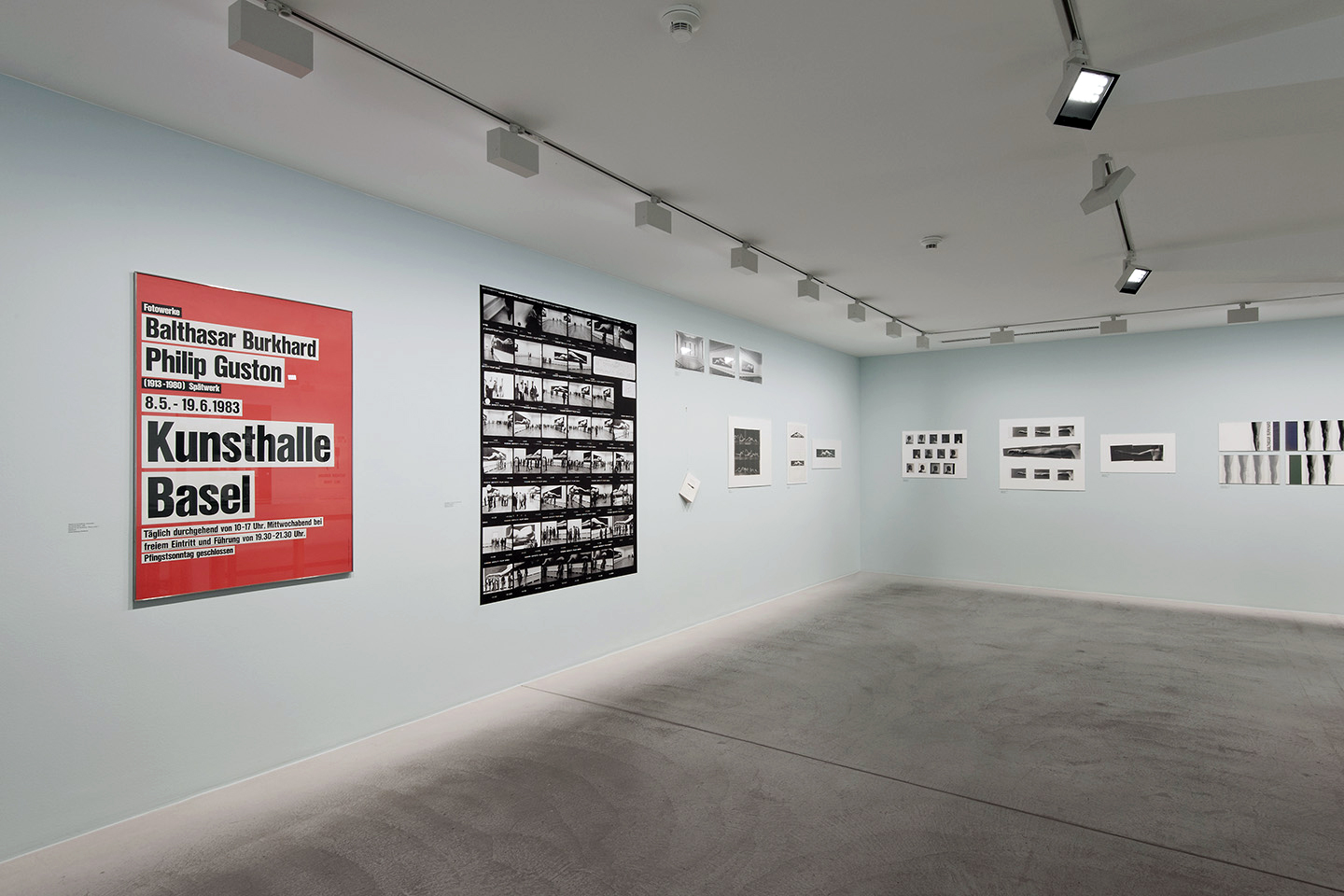
The works from On the Alp possess an essential power; the daring capture of actions and performances by the international avant-garde of the day make you wish you had been there; and the installation photograph of ‘The Knie’, Kunsthalle Basel in 1983 (below) makes me want to see more of his 1980s installations, with their shift in scale and repetitive nature. There are no more examples online, but a couple of photographs can be seen in the first installation photograph below.

I can leave the underwhelming aerial, cloud and landscape work well alone. There are many people in the history of photography who have taken better photographs of such subject matter. His life-sized photographs of animals again do nothing for me. They possess a reductive minimalism riffing on the canvas backgrounds of Avedon blown up to enormous size (as in most contemporary photography, as if by making something large the photograph gains aura and importance) but they lead nowhere. Perhaps in their actual presence (the physicality of the print) I might be transported to another place, but in reproduction they are a one-dimensional non sequitur.

From the energy of the earlier work emerges “a beauty contest between animals in a photo-shoot”, scrupulous studio photos that demand to be taken seriously, but mean very little. Here, passion has lost out to rigorous and deathly control.

Dr Marcus Bunyan


Many thankx to Fotomuseum Winterthur and Fotostiftung Schweiz for allowing me to publish the photographs in the posting. Please click on the photographs for a larger version of the image.


Together, Fotomuseum Winterthur and Fotostiftung Schweiz will showcase the oeuvre of Swiss artist Balthasar Burkhard (1944-2010) in a major retrospective. Burkhard’s work spans half a century: from his early days as a trainee photographer with Kurt Blum to his seminal role in chronicling the art of his time, eventually becoming a photographic artist in his own right who brought photography into the realms of contemporary art in the form of the monumental tableau. More than 150 works and groups of works chart not only the progress of his own photographic career, but also the emergence of photography as an art form in the second half of the twentieth century. An exhibition in collaboration with Museum Folkwang, Essen, and Museo d’arte della Svizzera italiana, Lugano.


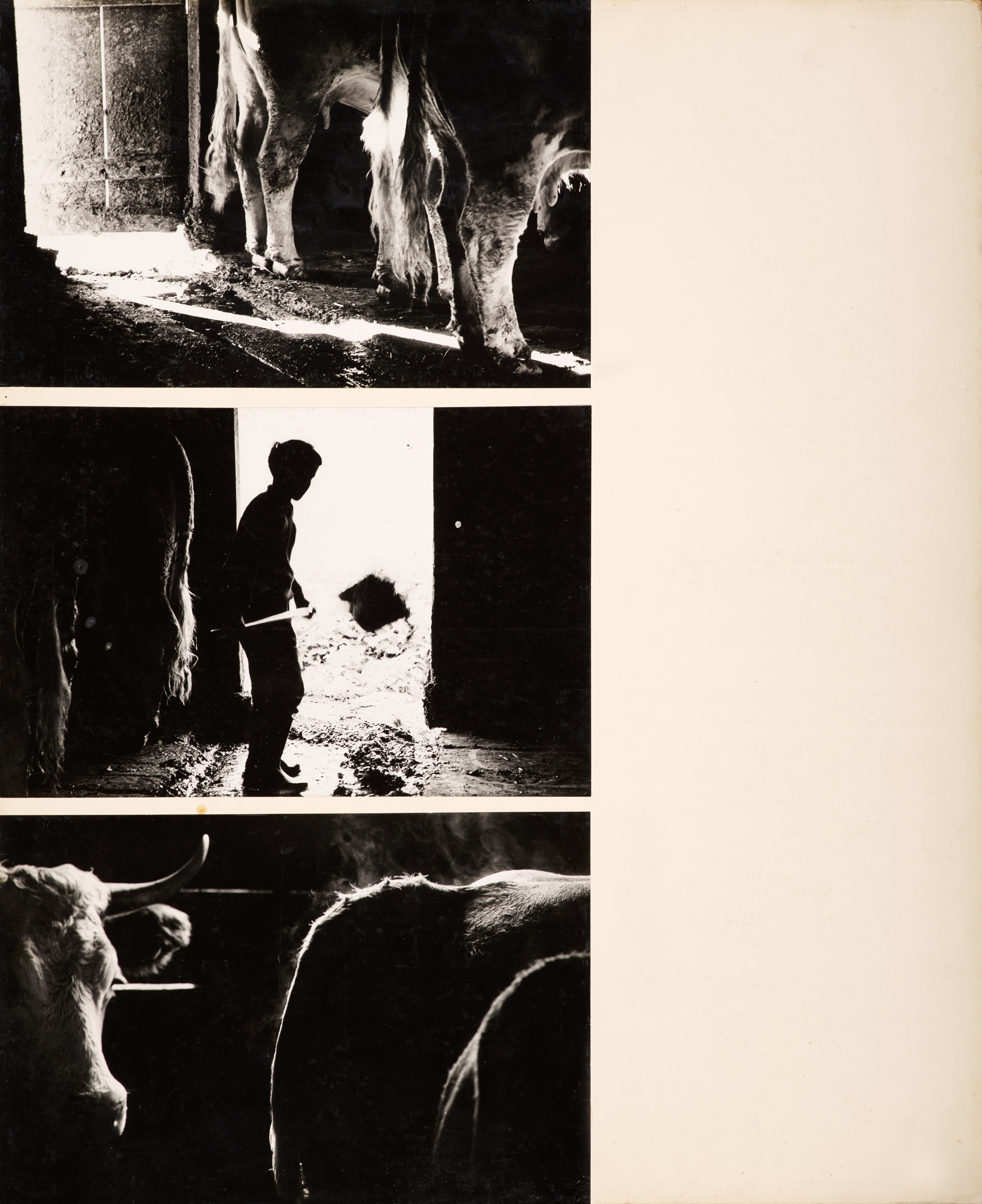
Balthasar Burkhard (Swiss, 1944-2010) from 'On the Alp' 1963 from the exhibition 'Balthasar Burkhard' at Fotomuseum Winterthur and Fotostiftung Schweiz, Winterthur, Zurich, Feb - May, 2018


Balthasar Burkhard (Swiss, 1944-2010)
from On the Alp
1963
© Estate Balthasar Burkhard


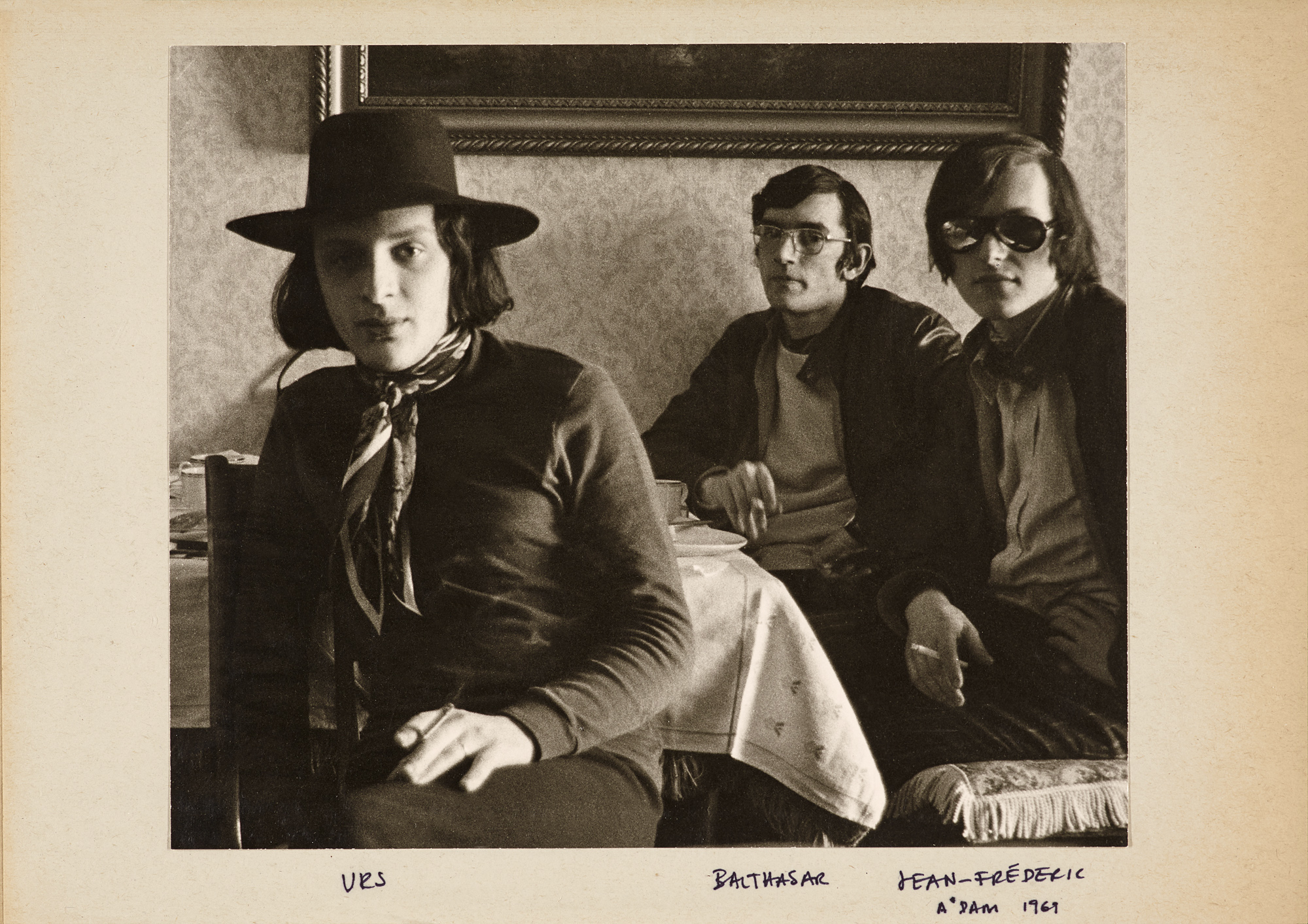
Balthasar Burkhard (Swiss, 1944-2010) 'Untitled (Urs Luthi, Balthasar Burkhard, Jean-Frederic Schnyder), Amsterdam' 1969 from the exhibition 'Balthasar Burkhard' at Fotomuseum Winterthur and Fotostiftung Schweiz, Winterthur, Zurich, Feb - May, 2018


Balthasar Burkhard (Swiss, 1944-2010)
Untitled (Urs Luthi, Balthasar Burkhard, Jean-Frederic Schnyder), Amsterdam
1969
© Estate Balthasar Burkhard


Urs Lüthi (b. 1947) is a Swiss conceptual artist who attended the School of Applied Arts in Zurich. Noted for using his body and alter ego as the subject of his artworks, he has worked in photography, sculpture, performance, silk-screen, video and painting.

Jean-Frédéric Schnyder (Swiss, b. 1945) began producing experimental objects in the late 1960s within the context of pop art and has since gone on to create a broad oeuvre encompassing photographs, sculptures, paintings, objects, and installations.


Balthasar Burkhard (Swiss, 1944-2010) 'Untitled (Jean-Christophe Ammann at Andy Warhol's Factory), New York' 1972


Balthasar Burkhard (Swiss, 1944-2010)
Untitled (Jean-Christophe Ammann at Andy Warhol’s Factory), New York
1972
© Estate Balthasar Burkhard


Jean-Christophe Ammann (14 January 1939 – 13 September 2015) was a Swiss art historian and curator.


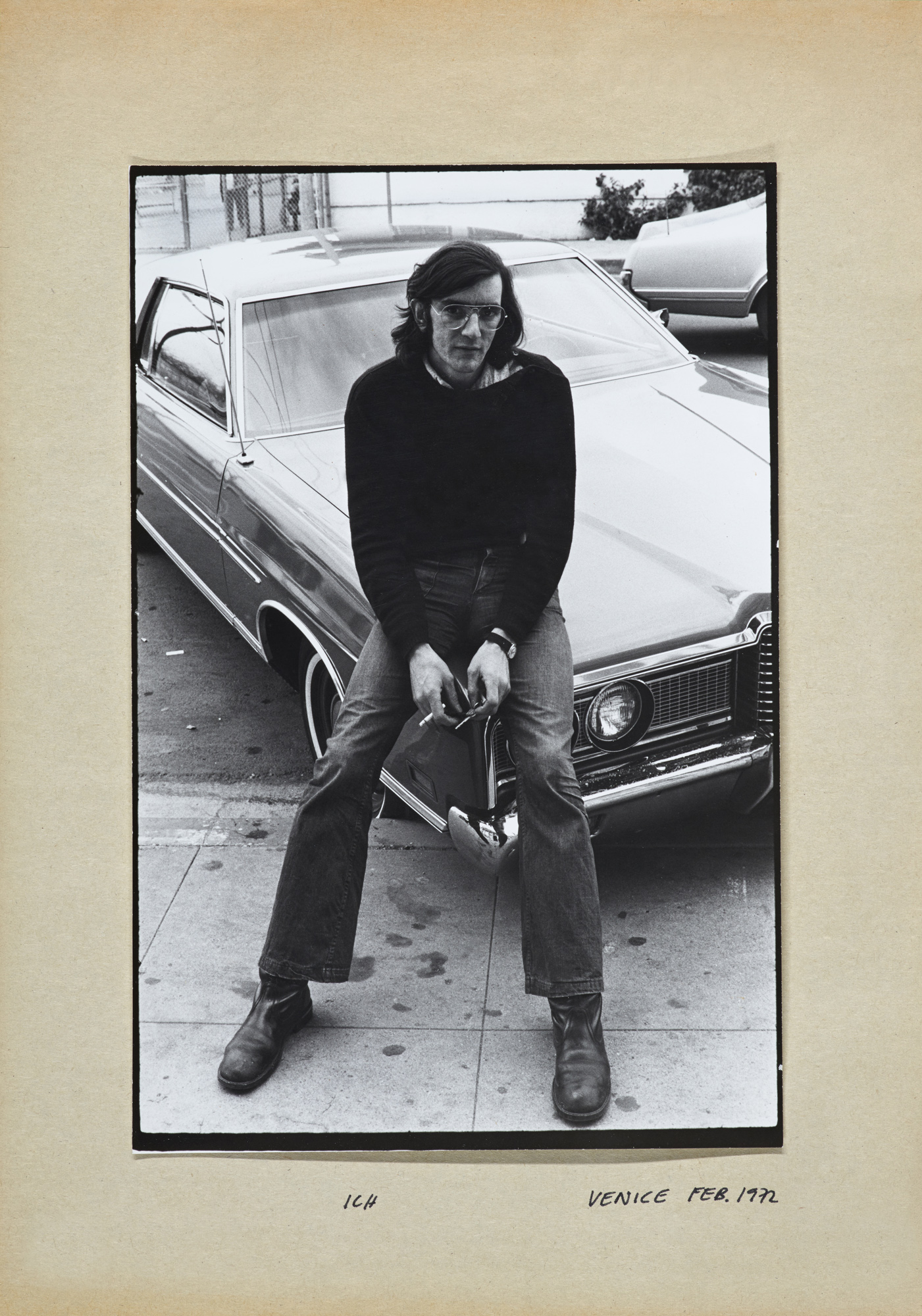
Jean-Christophe Ammann (Swiss, 1939-2015) 'Untitled (Balthasar Burkhard), USA' 1972


Jean-Christophe Ammann (Swiss, 1939-2015)
Untitled (Balthasar Burkhard), USA
Venice, 1972
© Estate Balthasar Burkhard


Together, Fotomuseum Winterthur and Fotostiftung Schweiz have launched a major retrospective exhibition dedicated to the lifetime achievement of Swiss artist Balthasar Burkhard (1944-2010). His oeuvre is almost unparalleled in the way it reflects not only the self-invention of a photographer but also the emancipation of photography as an artistic medium in its own right during the second half of the twentieth century.

The exhibition charts the many facets of Burkhard’s career, step by step, from his apprenticeship with Kurt Blum – in which he adhered closely to the traditional reportage and illustrative photography of the 1960s, and undertook his first independent photographic projects – to his role alongside legendary curator Harald Szeemann, and his documentation of Bern’s bohemian scene in the 1960s and 1970s. Balthasar Burkhard is the author of many iconic images of such groundbreaking exhibitions as When Attitudes Become Form at Kunsthalle Bern in 1969 and the 1972 documenta 5, capturing radical and frequently ephemeral works, actions and performances by the international avant-garde of the day.

Meanwhile, Burkhard endeavoured to make his mark both as a photographer and as an artist, developing his first large-scale photographic canvases in collaboration with his friend and colleague Markus Raetz, trying out his skills as an actor in the USA, and ultimately being invited to hold his own highly influential exhibitions at Kunsthalle Basel and Musée Rath in Geneva in 1983 and 1984. These enabled him to liberate photography from its purely documentary role by creating monumental tableaux in which he developed the motif of the body into sculptural human landscapes and site-specific architectures.

Throughout the course of his career, Burkhard turned time and again to portraiture. Whereas his early photographs tended to show artists in action within their own setting, his later portraits adopted an increasingly formalised approach. During the 1990s, he transposed this stylistic reduction to a wide-ranging series of animal portraits reminiscent of the encyclopaedic style of nineteenth century photography.

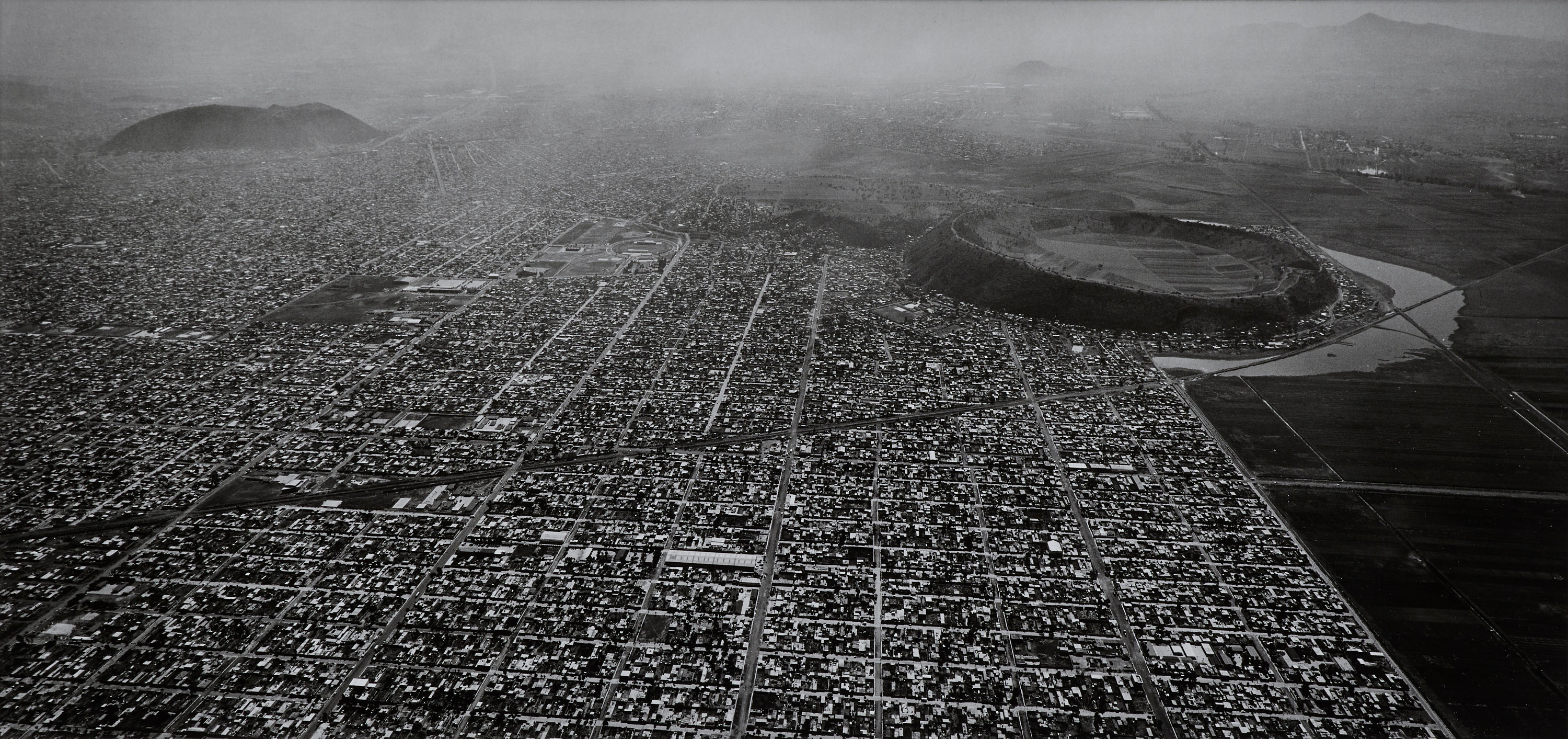
Another milestone of Burkhard’s oeuvre can be found in his vast aerial photographs of major mega cities such as Tokyo and Mexico City. These images, shot from an aircraft, like his images of the earth’s deserts, were destined to become a personal passion. Balthasar Burkhard’s quest for a morphology, for a formula that could encapsulate both nature and culture, is particularly evident in his later work, which ranges from pictures of waves and clouds, Swiss mountains and rivers, to the delicate fragility of plants. His interest was always focused on the materiality of the image. Alongside the highly idosyncratic and somewhat darkly sombre tonality of his prints, Burkhard constantly sought to explore every aspect of photography’s aesthetic and technical potential.

Encompassing half a century of creativity, the joint exhibition by Fotomuseum and Fotostiftung not only shows individual works, but also reflects on Balthasar Burkhard’s own view of how his photographs should be presented, underpinned by a wealth of documents from the archives of the artist. The exhibition is divided in two parts and shown in parallel in the exhibition spaces of Fotomuseum and Fotostiftung.

Press release


Balthasar Burkhard (Swiss, 1944-2010) / Markus Raetz (Swiss, 1941-2020) 'The Bed' 1969/1970


Balthasar Burkhard (Swiss, 1944-2010) / Markus Raetz (Swiss, 1941-2020)
The Bed
1969-1970
© Estate Balthasar Burkhard


Balthasar Burkhard (Swiss, 1944-2010) 'Untitled (Michael Heizer, Berne Depression), Berne' 1969


Balthasar Burkhard (Swiss, 1944-2010)
Untitled (Michael Heizer, Berne Depression), Berne
1969
© J. Paul Getty Trust. Getty Research Institute, Los Angeles


Balthasar Burkhard (Swiss, 1944-2010) 'Untitled (Richard Serra, Splash Piece), Berne' 1969


Balthasar Burkhard (Swiss, 1944-2010)
Untitled (Richard Serra, Splash Piece), Berne
1969
© J. Paul Getty Trust. Getty Research Institute, Los Angeles


Richard Serra (1938-2024) was an American artist known for his large-scale sculptures made for site-specific landscape, urban, and architectural settings. Serra’s sculptures are notable for their material quality and exploration of the relationship between the viewer, the work, and the site.


Balthasar Burkhard (Swiss, 1944-2010) 'Untitled (Harald Szeemann, the last day of documenta 5), Kassel' 1972


Balthasar Burkhard (Swiss, 1944-2010)
Untitled (Harald Szeemann, the last day of documenta 5), Kassel
1972
© Estate Balthasar Burkhard


With this major retrospective, Fotomuseum Winterthur and Fotostiftung Schweiz pay homage to the Swiss artist Balthasar Burkhard (1944-2010). His oeuvre is almost unparalleled in the way it reflects not only the self-invention of a photographer, but also the emancipation of photography as an artistic medium in its own right during the second half of the twentieth century.

Together, the two institutions chart the many and varied facets of Burkhard’s career, step by step. Fotostiftung presents early works from the days of his apprenticeship with Kurt Blum and his first independent documentary photographs. The exhibition also traces Burkhard’s role as a photographer alongside the curator Harald Szeemann and capturing images of Bern’s bohemian scene in the 1960s and 1970s. During that time, Burkhard carved his niche as a photographer and artist, developing his first large-scale photographic canvases in collaboration with his friend Markus Raetz and eventually breaking away from the European art world in search of both himself and new inspiration in the USA.

The second part of the exhibition at Fotomuseum shows the work created by Burkhard after his return to Europe, and his exploration of the photographic tableau. It was during this phase that he largely succeeded in emancipating photography from its purely documentary function. Using monumental formats, he translated the motif of the human body into sculptural landscapes and site-specific architectures. He went on to apply his stylistic device of formal reduction to portraits and landscapes. This marked the beginning of a series of experiments in the handling of photographic techniques. From long-distance aerial photographs of mega-cities such as Mexico City and Tokyo to close-up studies of flowers and plants, Burkhard seemed to be constantly seeking a formula that would embrace both nature and culture, encapsulating a sensory and sensual grasp of visible reality.

Encompassing half a century of creativity, the exhibition not only shows individual works, but is also underpinned by applied projects, films and many documents from the archives of the artist. This wealth of material allows a reflection both on Balthasar Burkhard’s own view of how his photographs should be presented in the exhibition space as well as his constant weighing-up of other media.

Part I (Fotostiftung Schweiz)

Early photographs

Balthasar Burkhard was just eight years old when his father gave him a camera to take along on a school excursion. Burkhard himself describes this early experience with the camera as the starting point of his career. It was also his father who suggested an apprenticeship with Kurt Blum, one of Switzerland’s foremost photographers, ranking along-side Paul Senn, Jakob Tuggener and Gotthard Schuh. Blum taught the young Balz, as he was nicknamed, all the finer points of darkroom technique as well as the art of large-format photography. The earliest work from Burkhard’s apprentice years is a reportage of the school, in the form of a book, while his documentation of the Distelzwang Society’s historic guildhall in the old quarter of Bern was clearly a lesson in architectural photography. Yet, no sooner had he completed his apprenticeship than Burkhard was already embarking on his very own independent projects inspired by post-war humanist photography, such as Auf der Alp, a study of rural Alpine life, for which he was awarded the Swiss Federal Grant for Applied Arts in 1964.

Chronicler of Bohemian Life in Bern

Even during his apprenticeship, Burkhard moved in the Bernese art circles to which his teacher Kurt Blum also belonged. In 1962, he created a first portrait, in book form, of painter and writer Urs Dickerhof. Shortly after that, he became friends with his near-contemporary Markus Raetz, and started taking photographs for the charismatic curator Harald Szeemann, who was director of Kunsthalle Bern from 1961 to 1969. Burkhard immersed himself in the vibrantly dynamic Swiss art scene, documenting the often controversial exhibitions of conceptual art at the Kunsthalle, and capturing the lives of Bern’s bohemian set with his 35mm camera. These visual mementos would later be collated in a kind of photographic journal. Initial collaborative projects with artists included a 1966 artists’ book about the village of Curogna (Ticino) and a window display for the Loeb department store in Bern featuring photographic portraits of the Bernese artist Esther Altorfer, devised in collaboration with Markus Raetz and his later wife, fashion designer Monika Raetz-Müller.

Landscapes 1969

Inspired by his friend Raetz, Burkhard photographed bleak and rugged snow-covered landscapes in the Bernese Seeland region. Heaps of earth piled up along the wayside reminded him of Robert Smithson’s Earthworks, which had just emerged in contemporary art. As Burkhard would later explain, “I wanted to leave out everything relating to myself, so that I could truly relate to what remained. I distanced myself from my subject-matter. I succeeded in stepping back both from myself and from my work.”

A close-up of bare agricultural soil, vaguely reminiscent of a lunar landscape, forms the basis for an object with a neon tube created in 1969 for the legendary exhibition When Attitudes Become Form in collaboration with Harald Szeemann, Markus Raetz and Jean-Frédéric Schnyder. In 1969, Burkhard’s brown-toned landscapes were included in the 1969 exhibition photo actuelle suisse in Sion. They were subsequently published as his first independent portfolio by Allan Porter in the May issue of Camera magazine, which was dedicated to avant-garde European photography and its affinity with contemporary art.

The Amsterdam Canvases 1969-1970

When Markus Raetz took a studio in Amsterdam in 1969, he and Burkhard continued to work on joint projects. Photographs of everyday motifs were enlarged, practically life-sized, onto canvas, and caused a sensation in the spring 1970 exhibition Visualisierte Denkprozesse (Visualised thought processes) at Kunstmuseum Luzern, curated by Jean-Christophe Ammann, who wrote: “On huge canvases, they [Raetz and Burkhard] showed, among other things, a spartan studio space, a bedroom, a kitchen, a curtain. They relativised the purely object-like character by hanging the canvases on clips. The resulting folds enriched the images by adding a new dimension.” In other words, the folds in the canvas created a “quasi ironic and disillusioning barrier.” Burkhard’s large-format works foreshadowed the monumental photographic tableaux that would eventually herald the ultimate march of photography into the museum space some ten years later.

Documentarist of the International Art Scene

By the end of the 1960s, Harald Szeemann and his polarising, controversial exhibitions were drawing increasing attention far beyond the boundaries of Switzerland. In particular, his (in)famous 1969 show When Attitudes Become Form unleashed heated debates that ultimately led to Szeemann’s resignation as director of Kunsthalle Bern. Then, in 1970, he shocked the members and visitors of the Kunstverein in Cologne with an exhibition dedicated to Happening & Fluxus. Here, too, Burkhard was on hand with his camera. Jean-Christophe Ammann, with whom Burkhard undertook a research trip to the USA in 1972, photographing many artists’ studios, proved no less controversial a figure. Moreover, Burkhard also photographed artists, actions and installations at the 1972 documenta 5 in Kassel, which was headed by none other than Szeemann himself. Given the expanded concept of art that prevailed at the time, which strengthened the role of performance art and installation works alike, photography, too, gained a newfound core significance. Indeed, it was only through photography that many of these innovative works were preserved for posterity.

Chicago and the Self-Invention of the Artist

Following a relatively unproductive period in the wake of documenta 5, during which he worked, among other things, on an unfinished documentary project about the small Swiss town of Zofingen, Burkhard spent the years between 1975 and 1978 in Chicago, where he taught photography at the University of Illinois. It was while he was there that he once again reprised the series of photo canvases he had been working on in Amsterdam between 1969 and 1970. This led to new large-format works portraying everyday scenes such as the back seat of an automobile or the interior of a home with a TV, as well as three now lost photographs of roller skaters and a very androgynous back-view nude study of a young man. In 1977 the Zolla/Lieberman Gallery in Chicago presented these canvases together with a selection of the Amsterdam works in what was Burkhard’s first solo exhibition. Critics were impressed by his “soft photographs”. The Chicago Tribune, for instance, enthused: “‘European’ grace is wedded to ‘American’ strength in a supreme artistic fiction that suggests the wide-screen format of film.”

Self-Portraits

In Chicago, Burkhard rekindled his friendship with performance and conceptual artist Thomas Kovachevic, whom he had first met at documenta 5 and who now introduced him to the local art scene. At the same time, Burkhard toyed with the notion of trying his chances as a film actor in Hollywood. With Kovachevich’s help, he produced a series of self-portraits, both Polaroids and slides, which he presented in a small snakeskin-covered box as his application portfolio. He approached Alfred Hitchcock and Joshua Shelley of Columbia Pictures, albeit unsuccessfully. His only film role was in Urs Egger’s 1978 Eiskalte Vögel (Icebound; screened in seminar room I). Burkhard later transformed some of his self-portraits into large-scale canvases, through which he asserted his newfound sense of identity as an artist, making himself the subject-matter of his own artistic work. One of these was also shown in the Photo Canvases exhibition at Zolla/Lieberman Gallery.


Balthasar Burkhard (Swiss, 1944-2010) 'feet 2' 1980


Balthasar Burkhard (Swiss, 1944-2010)
feet 2
1980
© Estate Balthasar Burkhard


Balthasar Burkhard (Swiss, 1944-2010) 'The Knie', Kunsthalle Basel (installation view) 1983


Balthasar Burkhard (Swiss, 1944-2010)
‘The Knie’, Kunsthalle Basel 
(installation view)
1983
© Estate Balthasar Burkhard


Balthasar Burkhard (Swiss, 1944-2010) 'Study of The Head' c. 1983


Balthasar Burkhard (Swiss, 1944-2010)
Study of The Head
c. 1983
© Estate Balthasar Burkhard


Balthasar Burkhard (Swiss, 1944-2010) 'Design for Body II' c. 1983


Balthasar Burkhard (Swiss, 1944-2010)
Design for Body II
c. 1983
© Estate Balthasar Burkhard


Part II (Fotomuseum Winterthur)

Body and Sculpture

The 1980s heralded the advent of a particularly productive period for Balthasar Burkhard in which he adopted a more sculptural approach to photography, treating his prints as an integral part of the exhibition architecture. Just as he himself had witnessed how the generation of artists before him had called the classic exhibition space into question, so too did his own latest works now begin to take control of that space. Burkhard became one of the foremost proponents of large-scale photographic tableaux, as evidenced by his groundbreaking exhibitions at Kunsthalle Basel in 1983 and Museé Rath, Geneva, in 1984.

It was in the photo canvases he made in Chicago during the late 1970s that Burkhard first turned towards the motif of the body as a sculptural form with which he would continue to experiment over the coming years. Such an overtly sculptural approach to the body and to the nude as landscape soon began to demand a larger format than Burkhard had previously been using. An arm, almost four metres long, framed by heavy steel, or the multipart installation Das Knie (Knee), reflect the very core of his creative oeuvre in all its many facets: monumentality, fragmentation and the breaking of genre boundaries by transposing two-dimensional images into spatially commanding installations.

Portraits: Types and Individuals

The increasing formal reduction of Balthasar Burkhard’s images continued in the field of portraiture. He invited fellow artists such as Lawrence Weiner and Christian Boltanski to sit for him. With this series, it seemed that he had finally put behind him his days as a chronicler of the art scene, reliant on the techniques of applied photography.

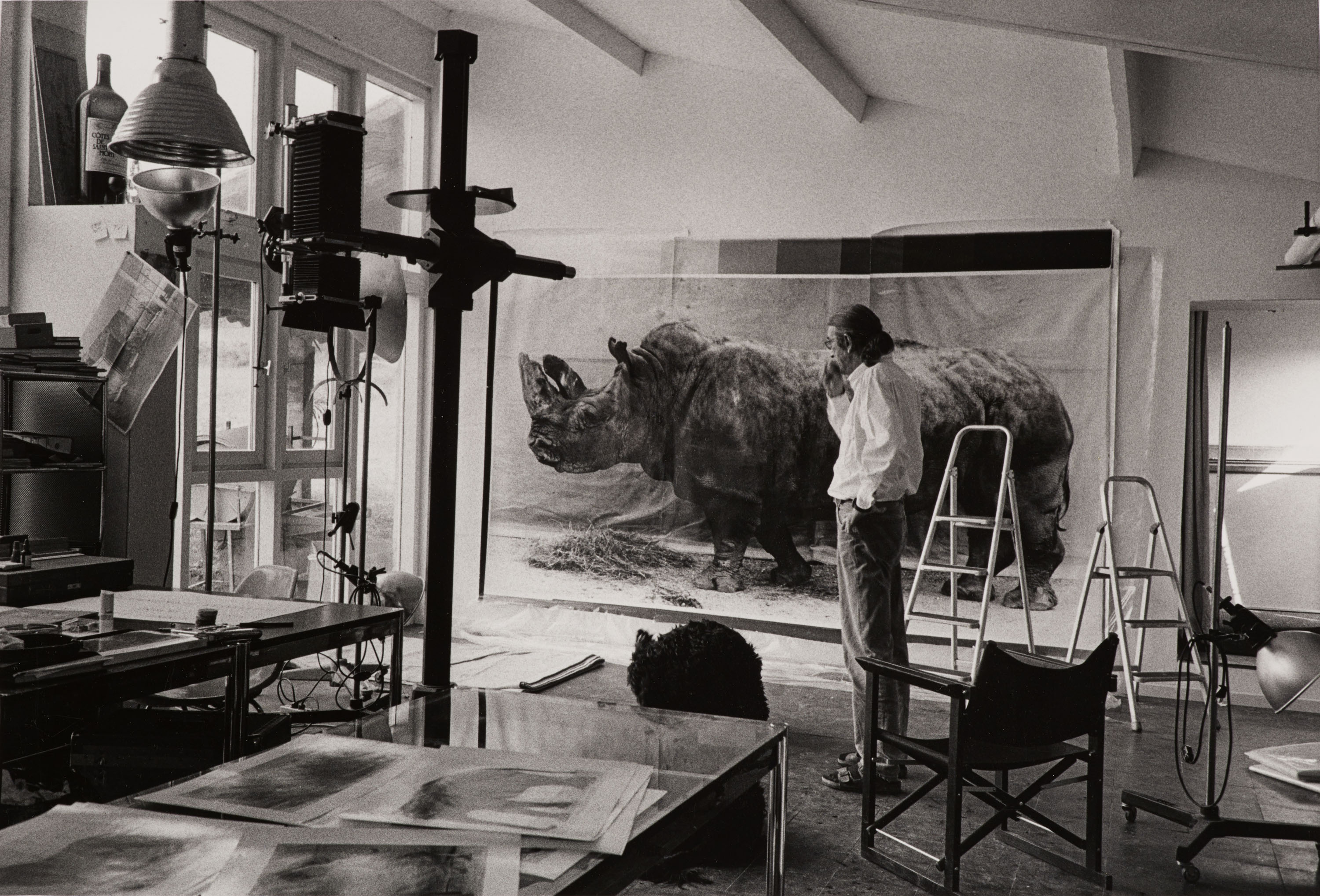
Portraits of a rather different kind are his profiles of animals, in an equally reduced setting, against the backdrop of a tarpaulin. Redolent of Renaissance drawings or nineteenth century animal photography, his images of sheep, wolves and lions come across as representing ideal and typical examples of their species without anthropomorphising them, while at the same time wrenching them out of their natural environment. These images reached a broad audience through the popular 1997 children’s book “Click!”, said the Camera, which was republished in its second edition in 2017.

Architectural Photography

Given his increasing success in the art world, Burkhard could well afford to be selective about his choice of commissioned works. He had already been taking photographs for architects connected with the Bern-based firm Atelier 5 back in the 1960s, and was still accepting commissions in this field in the 1990s. Burkhard’s photographic essay on the Ricola building designed by Swiss architects Herzog & de Meuron indicates just how thoroughly his own distinctive artistic syntax permeates his commissioned and architectural photography, right through to the details of fragments and materials. These photographs were shown in the Swiss Pavilion at the Venice Biennale of Architecture in 1991, having been explicitly designed for this particular exhibition space. As in his artistic oeuvre, Burkhard operates here with spatially commanding installations, skilfully dovetailing the architectural motif with the presentational form.

Aerial Photography

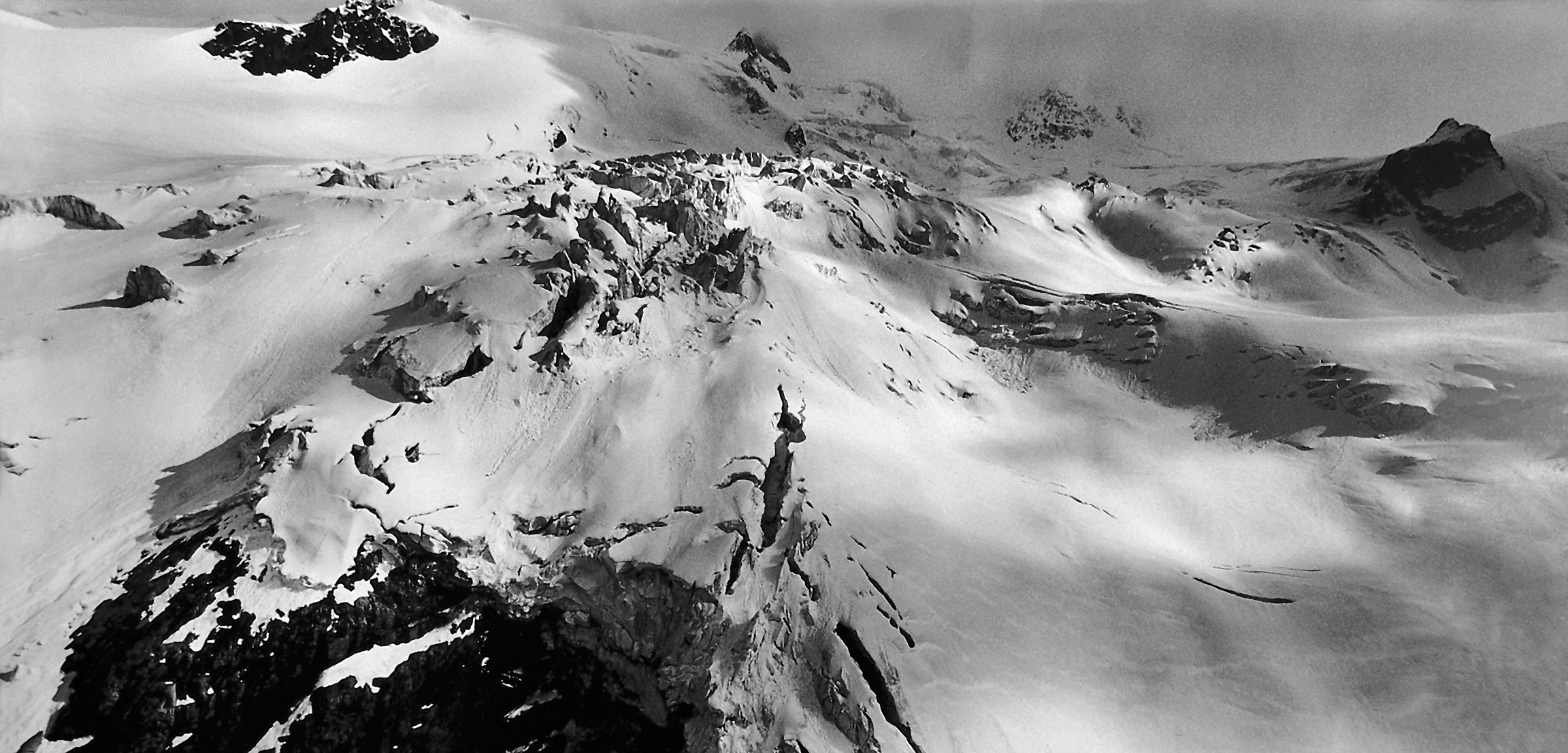
In the 1990s, before the art world had even begun to turn its attention to the subject of megacities, Burkhard was already taking a keen interest in the world’s major conurbations. Following in the footsteps of his father, who had been a Swiss airforce pilot, he took bird’s-eye-view photographs from a plane. His panoramic shots of cities such as London, Mexico City and Los Angeles were preceded by small-format studies of clouds: the so-called Nuages series. Having incorporated a study of rural Switzerland into his formative training in 1963 with the series Auf der Alp (On the Alp), he returned once more to focus on the landscape of his homeland in the early 2000s with an entire series of aerial photographs of the Bernina mountain range.

Landscape and Flora

In the last two decades of his life, Burkhard concentrated primarily on landscape and flora, turning to historical precedents both in his techniques and in his choice of motif. The desert formations of Namibia, in which all sense of proportion is lost amid the remote and untouched wilderness, set a counterpoint to the sprawling urban expanses of Mexico City and London. The diptych Welle (Wave), by contrast, pays homage to the work of French artist Gustave Courbet, with Burkhard making a pilgrimage to the tide swept shores where the father of Realism had painted in 1870.

In another series, Burkhard adapts the aesthetics of botanical plant studies, which were as widely used around the turn of the twentieth century as the complex photographic process of heliography, and transposes these to larger-than-life formats. Whereas Burkhard, as a young photographer, had captured the exuberant art scene of the 1960s and 1970s, snapshot-style, he later went on, as an artist-photographer, to explore the potential of the photographic tableau, diligently researching near-forgotten techniques and the sensual details of the visible world.

Artwork and Commissioned Work

The site-specific installations of his photographs and Burkhard’s own dedicated approach to museum spaces warrant an excursion into the archives of the artist, paying particular attention to four exemplary exhibitions.

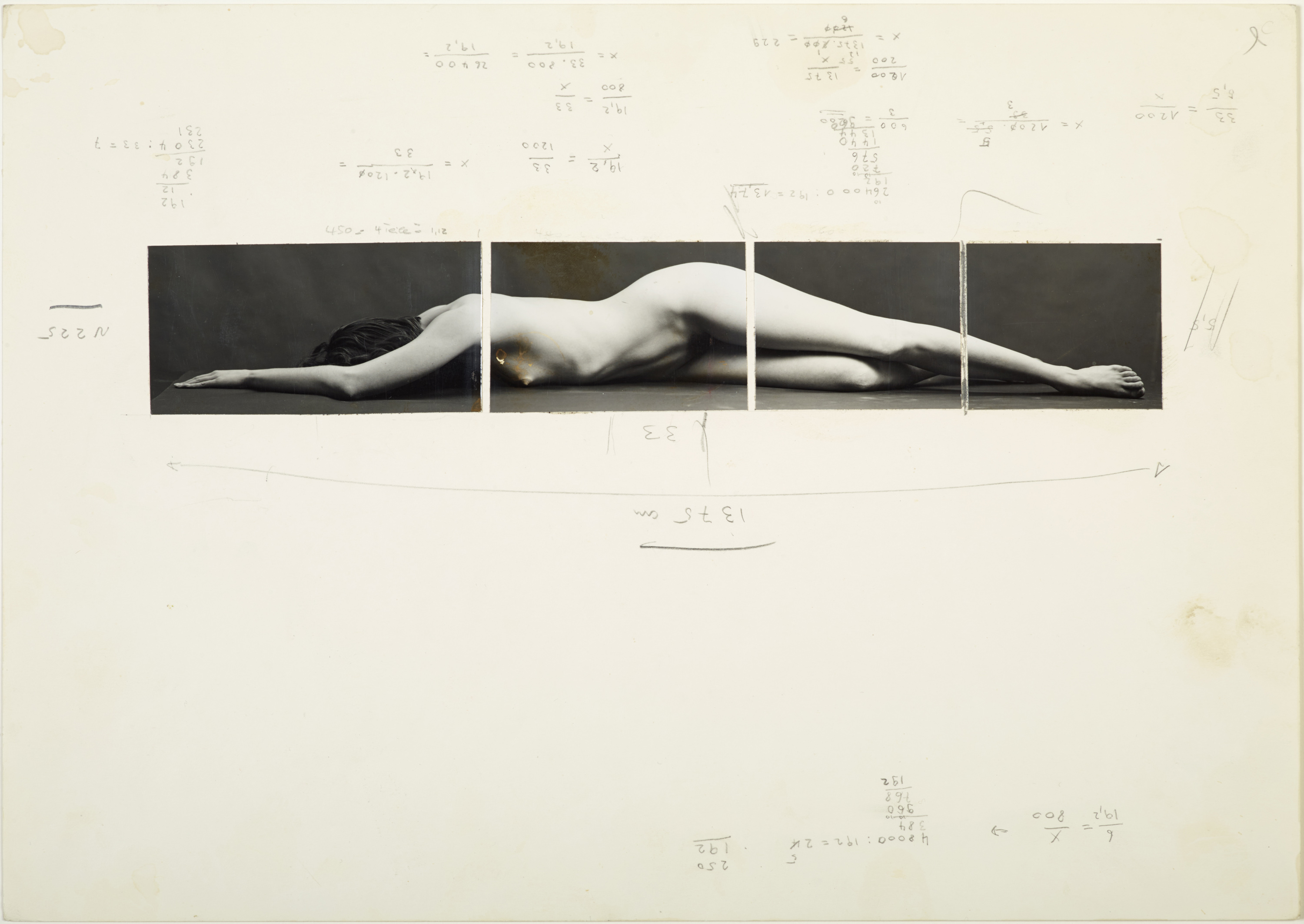
One spectacular and iconic show was the Fotowerke (Photo works) exhibition at Kunsthalle Basel in 1983. Curated by artist Rémy Zaugg, the installations can be reconstructed thanks to the catalogue and copious documentation. Contact prints and studies, for instance, help to give an insight into the no longer extant thirteen metre work Körper I (Body I) as well as shedding light on the choice of motif for further body fragments.

A 1984 solo exhibition at the Le Consortium in Dijon, on the other hand, shows how Burkhard responded with his group of works Das Knie (Knee) to an entirely different installation context within the given space. Similarly, at the Musée Rath in Geneva that same year, Burkhard, together with his friend Niele Toroni, instigated a radical juxtaposition of photography and painting based on the pillars of the exhibition venue.

At Grand-Hornu in the Belgian town of Mons, by contrast, his life-sized photographs of animals were mounted at eye level. While Burkhard chose a large format for the exhibition venue, the images in his children’s book “Click!”, said the Camera tell of a beauty contest between animals in a photo-shoot. This apparent discrepancy between artwork and commissioned work never seemed to be relevant to Burkhard. The sheer volume of his studio photos, alone, indicates just how scrupulously precise he was about the way he wanted to be perceived as a serious photographer.

Wall text from the exhibition


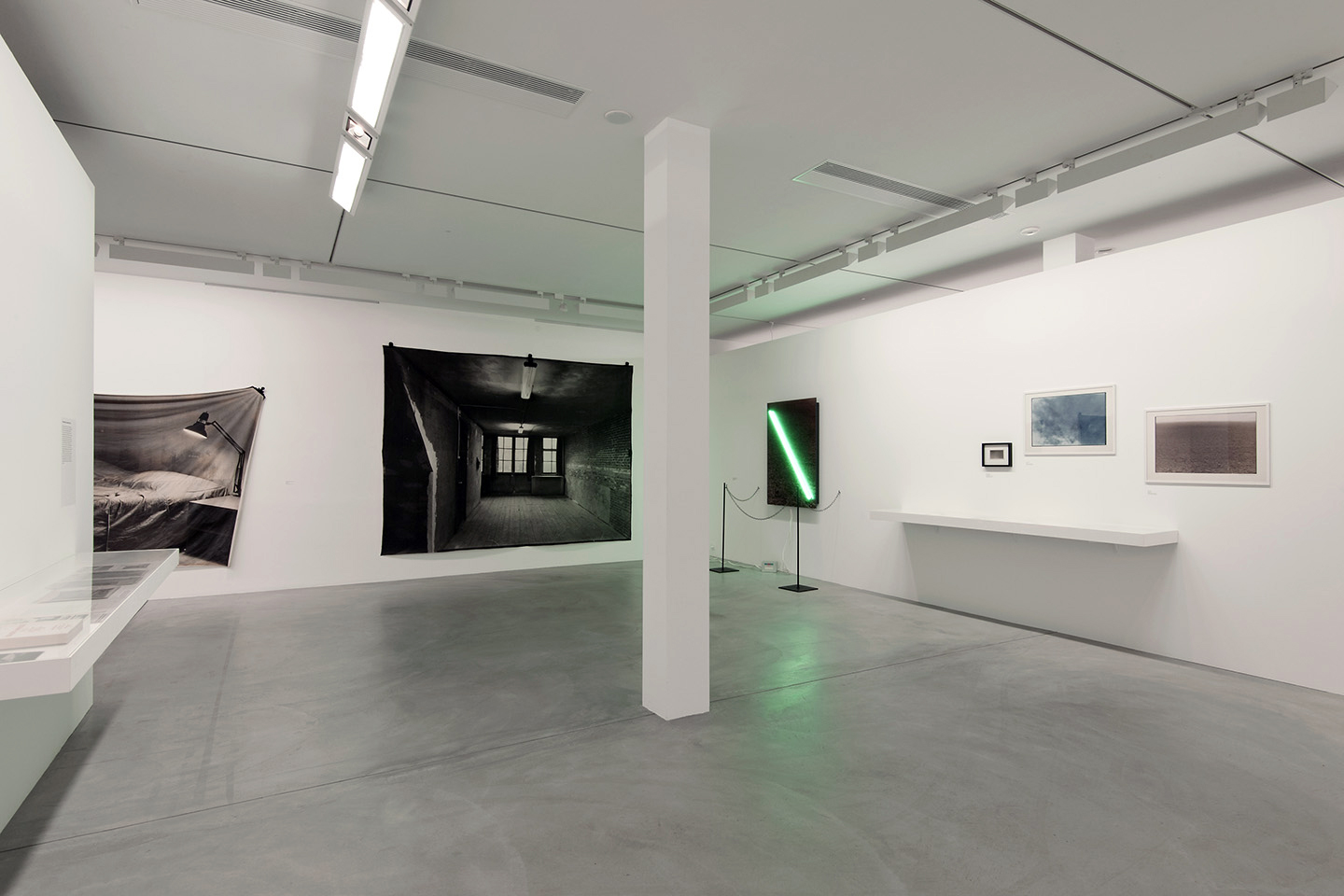
Installation view of the exhibition 'Balthasar Burkhard' at Fotomuseum Winterthur and Fotostiftung Schweiz, Winterthur, Zurich February - May 2018

Installation view of the exhibition 'Balthasar Burkhard' at Fotomuseum Winterthur and Fotostiftung Schweiz, Winterthur, Zurich February - May 2018

Installation view of the exhibition 'Balthasar Burkhard' at Fotomuseum Winterthur and Fotostiftung Schweiz, Winterthur, Zurich February - May 2018

Installation view of the exhibition 'Balthasar Burkhard' at Fotomuseum Winterthur and Fotostiftung Schweiz, Winterthur, Zurich February - May 2018

Installation view of the exhibition 'Balthasar Burkhard' at Fotomuseum Winterthur and Fotostiftung Schweiz, Winterthur, Zurich February - May 2018


Installation views of the exhibition Balthasar Burkhard at Fotomuseum Winterthur and Fotostiftung Schweiz, Winterthur, Zurich February – May 2018


Balthasar Burkhard (Swiss, 1944-2010) 'Balthasar Burkhard in his studio' 1995


Balthasar Burkhard (Swiss, 1944-2010)
Balthasar Burkhard in his studio
1995
© Estate Balthasar Burkhard


Balthasar Burkhard (Swiss, 1944-2010) 'Camel' 1997


Balthasar Burkhard (Swiss, 1944-2010)
Camel
1997
© Estate Balthasar Burkhard


Balthasar Burkhard (Swiss, 1944-2010) 'Bull' 1996


Balthasar Burkhard (Swiss, 1944-2010)
Bull
1996
© Estate Balthasar Burkhard


Balthasar Burkhard (Swiss, 1944-2010) 'The Reindeer' 1996


Balthasar Burkhard (Swiss, 1944-2010)
The Reindeer
1996
© Estate Balthasar Burkhard


Balthasar Burkhard (Swiss, 1944-2010) 'Mexico City' 1999


Balthasar Burkhard (Swiss, 1944-2010)
Mexico City
1999
© Estate Balthasar Burkhard


Balthasar Burkhard (Swiss, 1944-2010) 'Mexico City' 1999


Balthasar Burkhard (Swiss, 1944-2010)
Mexico City
1999
© Estate Balthasar Burkhard


Balthasar Burkhard (Swiss, 1944-2010) 'Nuages ​​8' 1999


Balthasar Burkhard (Swiss, 1944-2010)
Nuages ​​8
1999
© Estate Balthasar Burkhard


Balthasar Burkhard (Swiss, 1944-2010) 'Ecosse' (Scotland) 2000


Balthasar Burkhard (Swiss, 1944-2010)
Ecosse (Scotland)
2000
© Estate Balthasar Burkhard


Balthasar Burkhard (Swiss, 1944-2010) 'Bernina' 2003


Balthasar Burkhard (Swiss, 1944-2010)
Bernina
2003
© Estate Balthasar Burkhard


Balthasar Burkhard (Swiss, 1944-2010) 'Silberen' 2004


Balthasar Burkhard (Swiss, 1944-2010)
Silberen
2004
© Estate Balthasar Burkhard


Balthasar Burkhard (Swiss, 1944-2010) 'Rio Negro' 2002


Balthasar Burkhard (Swiss, 1944-2010)
Rio Negro
2002
© Estate Balthasar Burkhard


Fotostiftung Schweiz
Grüzenstrasse 45
CH-8400 Winterthur (Zürich)
Phone: +41 52 234 10 30

Opening hours:
Tuesday – Saturday 11am – 6pm
Wednesday 11am – 8pm
Closed on Mondays

Fotostiftung Schweiz website

Fotomuseum Winterthur
Grüzenstrasse 44 + 45
CH-8400
Winterthur (Zürich)

Opening hours:
Tuesday to Sunday 11am – 6pm
Wednesday 11am – 8pm
Closed on Mondays

Fotomuseum Winterthur website

LIKE ART BLART ON FACEBOOK

Back to top

Exhibition: ‘The Weak Sex – How Art Pictures the New Male’ at Kunstmuseum Bern

Exhibition dates: 18th October 2013 – 9th February 2014

Participating artists: Vito Acconci / Bas Jan Ader / Luc Andrié / Lynda Benglis / Luciano Castelli / Martin Disler / VALIE EXPORT and Peter Weibel / Gelitin / Pascal Häusermann / Alexis Hunter / Cathy Joritz / Jesper Just / Jürgen Klauke / Frantiček Klossner / Elke Silvia Krystufek / Marie-Jo Lafontaine / Peter Land / Littlewhitehead / Sarah Lucas / Urs Lüthi / Manon / Paul McCarthy / Tracey Moffatt / Josef Felix Müller / Ursula Palla / Adrian Piper / Anne-Julie Raccoursier / Ugo Rondinone / Carole Roussopoulos / Rico Scagliola and Michael Meier / Sylvia Sleigh / Nedko Solakov / Megan Francis Sullivan / Sam Taylor-Johnson / Costa Vece / William Wegman / Silvie Zürcher.

PLEASE NOTE: THIS POSTING CONTAINS ART PHOTOGRAPHS OF MALE NUDITY AND MALE SEXUAL AROUSAL – IF YOU DO NOT LIKE PLEASE DO NOT LOOK, FAIR WARNING HAS BEEN GIVEN


Alexis Hunter (New Zealand, b. 1948) 'Approach to Fear: XVII: Masculinisation of Society – exorcise' 1977


Alexis Hunter (New Zealand, b. 1948)
Approach to Fear: XVII: Masculinisation of Society – exorcise
1977
10 Colour photographs, mounted on two panels, both 25 x 101cm
Courtesy of Richard Saltoun Gallery
© 2013 ProLitteris, Zürich
(From the section Experiments)


The Cult of Muscularity


“… muscularity is a key term in appraising men’s bodies … this comes from men themselves. Muscularity is the sign of power – natural, achieved, phallic.”


Richard Dyer. Only Entertainment. London: Routledge, 1992, p. 114


“The formation of ‘The Cult of Muscularity’ (Elliott Gorn. The Manly Art. London: Robson Books, 1986) in the last decade of the 19th century was a reaction to the perceived effeminisation of heterosexual masculinity. The position of the active, heroic hetero-male was under attack from the passivity of industrialisation, from the expansion of women’s rights and their ability to become breadwinners, and through the naming of deviant sexualities that were seen as a threat to the stability of society. By naming deviant sexualities they became visible to the general public for the first time, creating apprehension in the minds of men gazing upon the bodies of other men lest they be thought of as ‘pansies’. (Remember that it was in this decade the trials of Oscar Wilde had taken place in England after he was accused of being a sodomite by The Marquis of Queensbury. It is perhaps no coincidence that the rules that governed boxing, a very masculine sport in which a man could become a popular hero, were named after his accuser. By all accounts he was a brute of a man who despised and beat his son Lord Alfred Douglas and sought revenge on his partner, Oscar Wilde, for their sexual adventures). Muscles became the sign of heterosexual power, prowess, and virility. A man had control over his body and his physical world. His appearance affected how he interacted with this world, how he saw himself, and was seen by others, and how closely he matched the male physical ‘ideal’ impacted on his own levels of self-esteem. The gymnasium became a meeting point for exercise, for health, for male bonding, and to show off your undoubted ‘masculinity’…”

The development of ‘The Cult of Muscularity’ may also have parallels in other social environments which were evolving at the turn of the century. For example, I think that the construction of the muscular mesomorphic body can be linked to the appearance of the first skyscrapers in cities in the United States of America. Skyscrapers were a way increasing visibility and surface area within the limited space of a crowded city. One of the benefits of owning a skyscraper like the Chrysler Building in New York, with its increased surface area, was that it got the company noticed. The same can be said of the muscular body. Living and interacting in the city, the body itself is inscribed by social interaction with its environment, its systems of regulation and its memories and historicities (his-tor-i-city, ‘tor’ being a large hill or formation of rocks). Like a skyscraper, the muscular body has more surface area, is more visible, attracts more attention to its owner and is more admired. The owner of this body is desired because of his external appearance which may give him a feeling of superiority and power over others. However this body image may also lead to low self-esteem and heightened body dissatisfaction in the owner (causing anxiety and insecurity in his identity) as he constantly strives to maintain and enhance his body to fulfil expectations he has of himself.

Of course, body image is never a static concept for the power of muscular images of the male body resides in their perceived value as a commodity. This value is reinforced through social and moral values, through fluid personal interactions, and through the desire of self and others for a particular type of body image; it is a hierarchical system of valuation. It relies on what type of body is seen as socially desirable and ‘beautiful’ in a collective sense, even though physical attractiveness is very much a personal choice.”

Dr Marcus Bunyan. Excerpt from “Bench Press,” in Pressing the Flesh: Sex, Body Image and the Gay Male, PhD thesis, RMIT University, Melbourne, 2001.


Many thankx to the Kunstmuseum Bern for allowing me to publish the art work in the posting. Please click on the photographs for a larger version of the image.


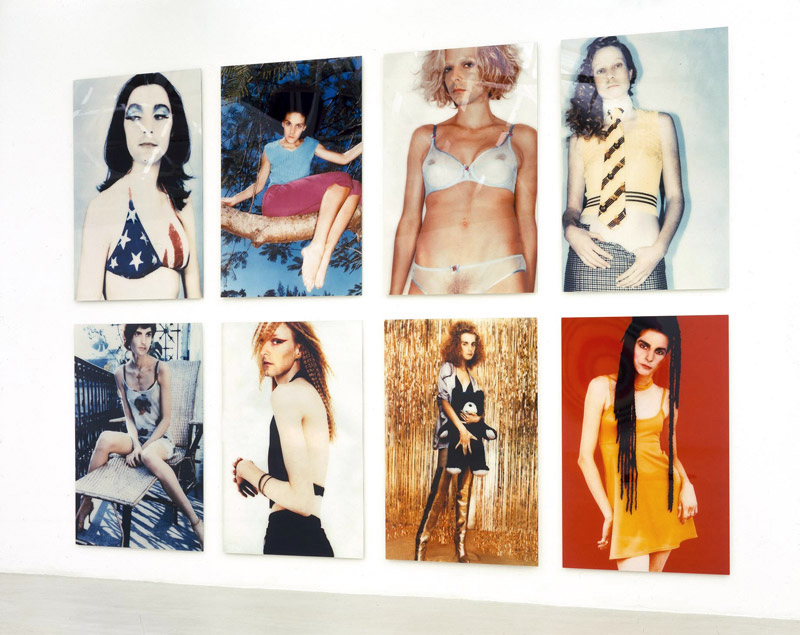
Ugo Rondinone (Switzerland, b. 1962) 'I Don't Live Here Anymore' 1998


Ugo Rondinone (Switzerland, b. 1962)
I Don’t Live Here Anymore
1998
C-prints between Alucobond and Plexiglas
Each 180 × 125cm
Kunstmuseum Bern, purchased with the donation of an Art Lover
(From the section Masculinity as Masquerade)


Digitally manipulates photos of women depicted in various suggestive poses, replacing their features with his own in a sufficiently consistent way for the image to retain its erotic content. By slipping into different bodies, he tests his own body and appearance, and he raises the issue of reality. The artist can only offer his own, man-made version.


Lynda Benglis (American, b. 1941) 'Artforum Advertisement in: Artforum, November 1974, Vol. 13, No. 3, S. 3-4' 1974


Lynda Benglis (American, b. 1941)
Artforum Advertisement in: Artforum, November 1974, Vol. 13, No. 3, S. 3-4
1974
26.7 × 26.5 × 0.5cm
Bayerische Staatsbibliothek, München
(From the section Experiments)


Peter Land (Danish, b. 1966) 'Peter Land d. 5. maj 1994' 1994


Peter Land (Danish, b. 1966)
Peter Land d. 5. maj 1994
1994
Colour video
Time, 25 Min.
Courtesy Galleri Nicolai Wallner
(From the section Crisis and Criticism)


Ursula Palla (Switzerland, b. 1961) 'balance' 2012


Ursula Palla (Switzerland, b. 1961)
balance
2012
Colour video installation
Time, 8 Min.
Courtesy the artist
(From the section Crisis and Criticism)


Masculinity under scrutiny

This themed group exhibition is our contribution to the discussion on new role definitions of the male gender, a topic that has long been on the agenda of academia and popular culture. Works by artists of both sexes will address the issue of how contemporary art stages male role models and masculinity, critically scrutinising the content of the same.

Who or what makes a man? How do men define themselves in art since feminism; how do they reflect on their gender and the portrayal thereof? Whereas the preferred angle of engaging with female artists is still today via “gender”, this is still a novel angle for looking at male artists. And as feminist art has finally become an established entity in major institutions, it is time to take a closer look at the art produced by men about men. The Sexual Revolution as well as the feminist and gay movements did not have only one side to them: they likewise impacted the roles of men and transformed images of masculinity. The exhibition therefore explores how contemporary Western artists of both sexes have, since the 1960s, invented new notions of masculinity or shattered existing ones. It does this with some 45 installations, some of which are large and extensive.

With this exhibition, the Kunstmuseum Bern is addressing a topic that, until now, has hardly been tackled in a museum context: the “normal” white heterosexual male, hitherto the ultimate measure for everything we consider characteristically human, is now facing a crisis. The exhibition and catalogue draw on the reflections and insights gained from masculinities studies to throw light on the consequences of the contemporary male crisis and how it is reflected in art, making the extent of the crisis visually palpable.

The works selected for the show have been divided up into six sections. These sections explore what “normal” might be and what the new nuances inherent in being “male” are today. The prescribed tour of the exhibition begins with the chapter on “Strong Weaknesses” and then proceeds through the sections focusing thematically on “Experiments”, “Emotions”, “Eroticism”, “Critique and Crisis”, and “Masculinity as Masquerade”. This route follows, at the same time, a roughly chronological order. The show is accompanied by a rich fund of educational programs with tours of the exhibition, discussions of artworks with invited guests, as well as a film program in collaboration with the cinema Kino Kunstmuseum, and not least, workshops for schools.

Text from the Kunstmuseum Bern website


Tracey Moffat (Australian, b. 1960) 'Heaven' 1997 (still)

Tracey Moffat (Australian, b. 1960) 'Heaven' 1997 (still)

Tracey Moffat (Australian, b. 1960) 'Heaven' 1997 (still)


Tracey Moffat (Australian, b. 1960)
Heaven (3 stills)
1997
Colour video
Time, 28 Min.
© 2013 ProLitteris, Zürich
(From the section Eroticism)


Male to the Hilt: Images of Men

The exhibition The Weak Sex – How Art Pictures the New Male zeroes in on the evolution of male identity since the 1960s. On view are works by 40 artists regardless of gender who question masculinity and stage it anew. The Kunstmuseum Bern seeks to foster dialogue in the exhibition and is therefore increasing its focus on social media. For the first time our visitors can respond to issues raised by an exhibition immediately on location…

The whole spectrum of art media and male images

The exhibition is presenting works that cover the entire range of media used by artists, including paintings, drawings, photographs, films, videos, sculptures and performance-installations. Artists of all ages are represented in the exhibition, enabling it to highlight images of men in all age groups. Each of the artworks questions social norms, who or what a man is, while orchestrating masculinity in novel ways and reflecting on what it means to be a “man”. The artworks in the show take up the theme of masculinity or male emotions – as discussed in society in general or as openly demonstrated by men today: as weeping sport heroes, the disadvantaged position of divorced fathers, overstrained top managers or criminal youths.

Of strong weaknesses, eroticism and the male in crisis

The exhibition is divided into six sections that explore key aspects of masculinity studies and thus simultaneously follow a loose art-historical chronological thread. The introductory section takes up the theme of “Strong Weaknesses” with representations of men weeping or expressing fear. The second section “Experiments” scrutinises the exciting events that took place in conjunction with the social movements of the 1960s and 1970s. The section “Emotions” presents male emotionality in intensely stirring artistic orchestrations. The section “Eroticism” take us through a selection of artworks that investigate men as objects of desire. The last two sections of the exhibition “Crisis and Critique” and “Masculinity as Masquerade” investigate traditional male images and give us an account of the potential of new gender orientations.

Press release from the Kunstmuseum Bern website


Bas Jan Ader (born Winschoten, Netherlands, 1942, died 1975 presumably on the high seas. Lived in California, USA, as of 1963) 'I'm Too Sad to Tell You' 1970-1971


Bas Jan Ader (born Winschoten, Netherlands, 1942, died 1975 presumably on the high seas. Lived in California, USA, as of 1963)
I’m Too Sad to Tell You
1970-1971
16mm, s/w
Time, 3:34 Min.
Museum Boijmans Van Beuningen, Rotterdam
(From the section Strong Weaknesses)


Sylvia Sleigh (born Llandudno, Wales, Great Britain, 1916; died New York, USA, 2010) 'Paul Rosano in Jacobson Chair' 1971


Sylvia Sleigh (born Llandudno, Wales, Great Britain, 1916; died New York, USA, 2010)
Paul Rosano in Jacobson Chair
1971
Oil on canvas
131 x 142cm
Courtesy The Estate of Sylvia Sleigh & Freymond-Guth Fine Arts Zürich
(From the section Eroticism)


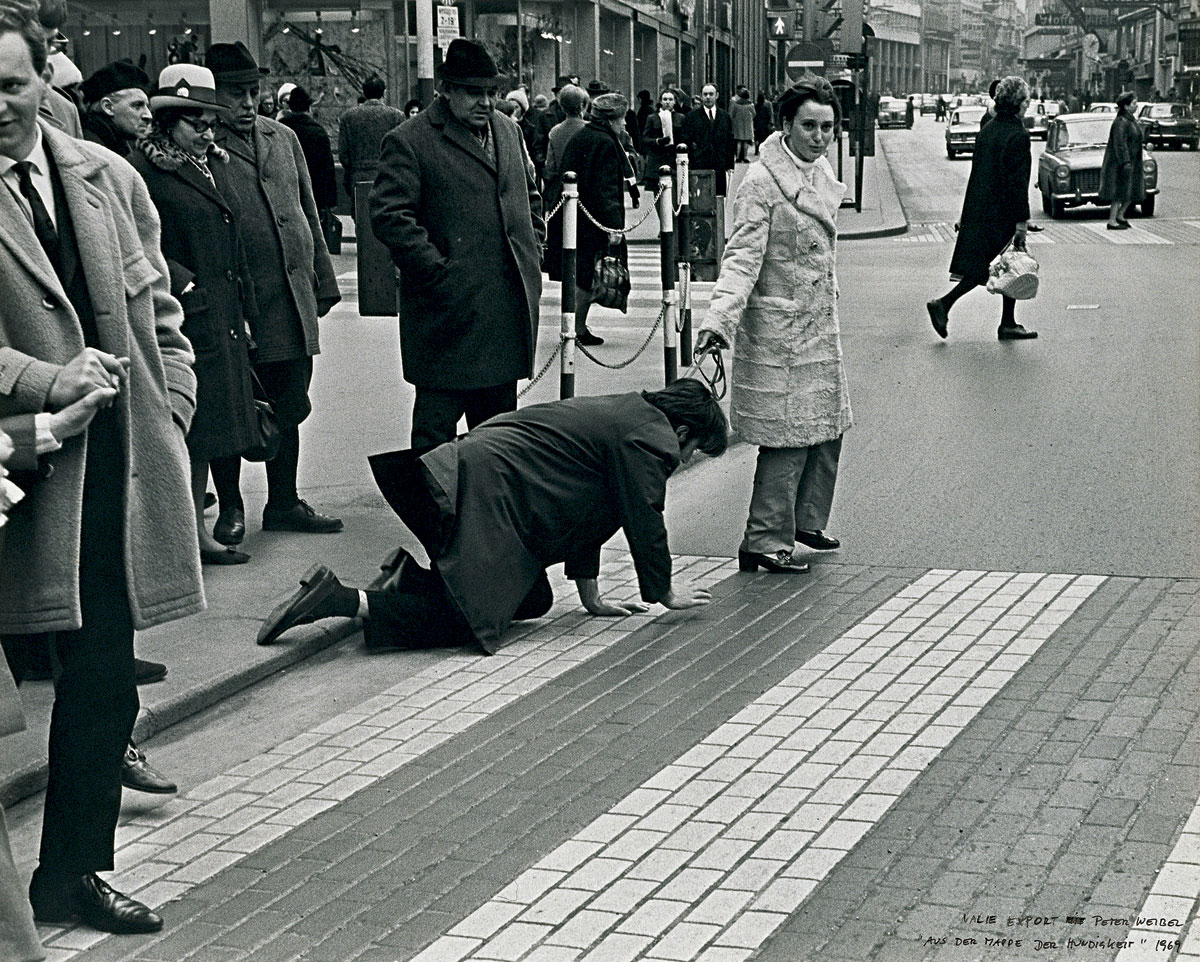
Peter Weibel with Valie EXPORT. 'Peter Weibel Aus der Mappe der Hundigkeit' (Peter Weibel From the Underdog File) 1969


Peter Weibel (Austrian, b. 1944) with Valie EXPORT (Austrian, b. 1940)
Peter Weibel Aus der Mappe der Hundigkeit (Peter Weibel From the Underdog File)
1969
Documentation of the action
5 s/w photographs, 40.4 x 50 cm / 50 x 40.4cm
Sammlung Generali Foundation
Vienna Foto: Josef Tandl
© Generali Foundation © 2013 ProLitteris, Zürich
(From the section Experiments)


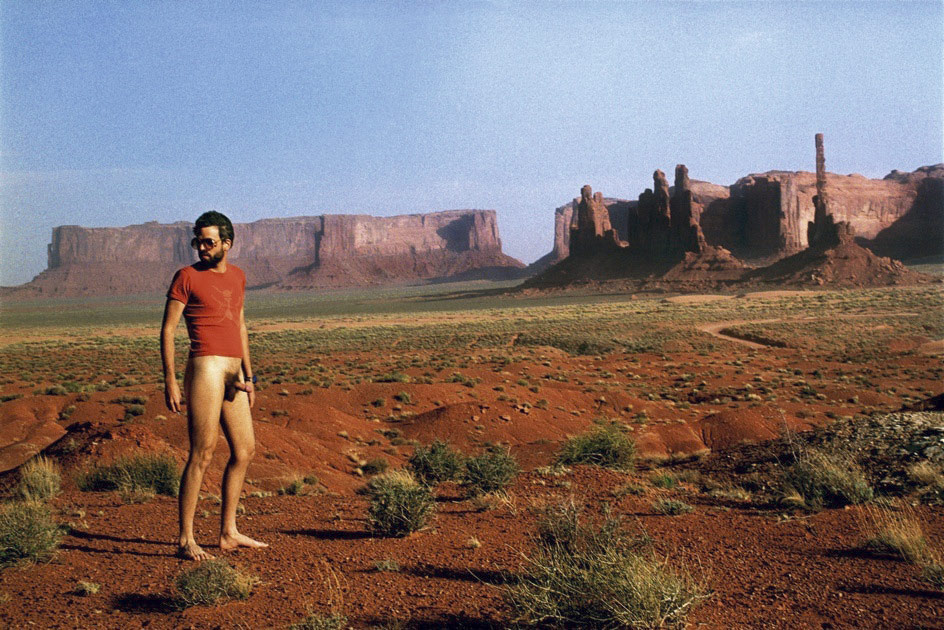
Gelitin. 'Ständerfotos – Nudes' (Standing Photos – Nudes) 2000


Gelitin
Ständerfotos – Nudes (Standing Photos – Nudes)
2000
Series of 15 Lambda prints
Various dimensions
(From the section Eroticism)


Gelitin. 'Ständerfotos – Nudes' (Standing Photos – Nudes) 2000


Gelitin
Ständerfotos – Nudes (Standing Photos – Nudes)
2000
Series of 15 Lambda prints
Various dimensions
(From the section Eroticism)


Austrian artists’ collective with Wolfgang Gantner, Ali Janka, Florian Reither, and Tobias Urban. Apparently became acquainted at a summer camp in 1978. Changed their name from Gelatin to Gelitin in 2005.


Those who lived through their childhood and youth as members of the baby-boomer generation in the period of the late nineteen-fifties to the mid-seventies, as we did, received a clear view of the world along the way. It was the Cold War. There were precise dividing lines, and it was possible to completely separate good and evil, right and wrong, from one other. The division of roles between men and women was regulated in a way that was just as self-evident. For many children of this time, it was natural that the father earned the money while the mother was at home around the clock and, depending on her social position, went shopping and took care of the laundry herself, or left the housework to employees in order to be able to dedicate herself to “nobler” tasks such as, for instance, beauty care. Family and social duties were clearly distributed between husband and wife: the “strong” sex was responsible for the material basics of existence and for the social identity of the family. The “weak” or also fair sex, in contrast, was responsible for the “soft” factors inside: children, housekeeping, and the beautification of the home. The year 1968 did away with bourgeois concepts of life. Feminism and emancipation anchored the equality of men and women in law. And since the nineteen-sixties, art has also dealt intensively and combatively with feminism and gender questions.

Since VALIE EXPORT walked her partner Peter Weibel on a leash like a dog in their public action that unsettled the public in 1968, legions of creators of art, primarily of the female sex, have questioned the correlations between the genders and undertaken radical reassessments. The formerly “strong” gender has thus long since become a “weak” one. Nevertheless, the exhibition The Weak Sex: How Art Pictures the New Male is not dedicated first and foremost to the battlefield of the genders. Nor is the gender question, which has so frequently been dealt with, posited in the foreground. The Weak Sex is instead dedicated to man as object of research. In what state does he find himself now that his classical role has been invalidated? How does he behave after the shift from representative external appearance to work within the family unit? And where does he stand in the meantime in the midst of so many strong women? What has become of the proud and self-assured man who once signed the school report cards with praise or reproach as head of the family? What has become of the XY species since then is presented – insightfully, sarcastically, and wittily – in the exhibition by Kathleen Bühler.

Part of the Preface to the exhibition by Matthias Frehner, Director of the Kunstmuseum Bern and Klaus Vogel, Director of the Deutsches Hygiene-Museum Dresden


Sam Taylor-Johnson (British, b. 1967) 'Steve Buscemi' 2004


Sam Taylor-Johnson (British, b. 1967)
Steve Buscemi
2004
From the series: Crying Men, 2002-2004
C-Print
99.2 x 99.2cm framed
Courtesy White Cube
© Sam Taylor-Johnson
(From the section Strong Weaknesses)


Sam Taylor-Johnson (British, b. 1967) 'Gabriel Byrne' 2002


Sam Taylor-Johnson (British, b. 1967)
Gabriel Byrne
2002
From the series: Crying Men, 2002-2004
C-Print
86.2 x 86.2cm framed
Courtesy White Cube
© Sam Taylor-Johnson
(From the section Strong Weaknesses)


Costa Vece (Swiss, b. 1969) 'Me as a Revolutionary, Dictator, Guerilla, Freedom Fighter, Terrorist, Jesus Christ' 2007


Costa Vece (Swiss, b. 1969)
Me as a Revolutionary, Dictator, Guerilla, Freedom Fighter, Terrorist, Jesus Christ
2007
Ultrachrome – Digitalprint
106 × 80cm
(From the section Crisis and Criticism)


Ugo Rondinone (Swiss, b. 1962) 'I Don't Live Here Anymore' 1998


Ugo Rondinone (Swiss, b. 1962)
I Don’t Live Here Anymore
1998
C-print between Alucobond and Plexiglas
180 × 125cm
Kunstmuseum Bern, purchased with the donation of an Art Lover
(From the section Masculinity as Masquerade)


Rico Scagliola & Michael Meier (Swiss, b. 1985; Swiss, b. 1982) Nude, Leaves and Harp 2012


Rico Scagliola & Michael Meier (Swiss, b. 1985; Swiss, b. 1982)
Nude, Leaves and Harp
2012
Floor Installation, HD Digital Print on Novilux traffic, dimensions variable
Ed. 1/5


Jürgen Klauke (Germany, b. 1943) 'Rot' 1974


Jürgen Klauke (Germany, b. 1943)
Rot
1974
Series of 7 photographs
Each 40 × 30cm
Kunstmuseum Bern
(From the section Experiments)


Stronger and Weaker Sexes: Remarks on the Exhibition

Kathleen Bühler Curator Kunstmuseum Bern

In 1908, the Genevan politician and essayist William Vogt wrote the book Sexe faible (The Weak Sex), in which he examines the “natural” weaknesses and inabilities of the female gender. Intended as a “response to absurd exaggerations and feminist utopias,”1 since then the catchy title has shaped the battle of the sexes as a dictum. Like Otto Weininger’s misogynistic study Geschlecht und Charakter (Sex and Character, 1903), Sexe faible is one of the texts from the turn of the previous century that justified the legal, political, and social subordination of women based on their anatomical and, according to the opinion of the author, thus also intellectual inferiority in comparison with men.2 The perception of women as the “weak sex” persisted tenaciously. It is first in recent years that this ascription has slowly been shifted to men, as for instance in the report by neurobiologist Gerald Huther called Das schwache Geschlecht und sein Gehirn (The Weak Sex and His Brain) published in 2009.

Polemics has long since yielded to statistics, and the most recent biological discoveries are gaining currency, such as the fact that male babies are already at risk in the womb because they lack a second X chromosome.3 This genetic “weakness” would apparently lead seamlessly to a social weakness, since males more frequently have problems in school, turn criminal, and die earlier.4 In addition to the findings on biologically based weaknesses also comes the social, economic, and political challenge, which has for some years been discussed as a “crisis of masculinity.” With this metaphor, “an attempt is made to apprehend all the changes that contribute to the fact that the dominance of the male gender, which was formerly consolidated to a large extent, … has lost the obviousness of being self-evident.”5 Nothing therefore demonstrates the transience of gender stereotypes more clearly, and one might rightly ask whether the earlier “weaknesses” might long since have come to be considered new “strengths.” The exhibition at the Kunstmuseum Bern takes up the thread that was already spun by the small but noteworthy exhibition in Switzerland Helden Heute (Heroes Today) in 2005.6 At that time, the focus was put on hero images in contemporary art and on society’s current need for strong men in art and politics.7 The current exhibition in Bern, in contrast, argues quite differently that specifically images of “weak” men best represent the social and cultural liberation movements of the twentieth and twenty-first centuries. The fact that men today are allowed to express their feelings publicly, as is shown for instance by the example of the exceptional Swiss athlete Roger Federer, or that they are staged by female artists as object of desire and no longer as subject of desire is a crucial innovation in the visualisation of gender identities. After various exhibitions in recent years were dedicated to gender relations, gender imprinting, or the social latitude in performative stagings of gender,8 the exhibition at the Kunstmuseum Bern focuses exclusively on men in contemporary art for the first time.9 It brings together the points of view of male and female artists who deal either with their own experiences with men and / or being a man, or with an examination of the images of men that are available. This exhibition has been long overdue.

Nonetheless, what first needs to be overcome is the perception that “gender” themes are a woman’s matter and that only marginalised positions have addressed their social gender. Hegemonic male types – thus men who, according to general opinion, embody the dominant masculine ideal most convincingly – have only been reflected in public through media for a relatively short time, even though the male gender is also a sociocultural construct, just like that of women, transgender, or inter-gender individuals.10 What comes to be expressed here is the invisibility of norms. As is generally known, it is those social groups that hold the most power that actually expose their own status the least. In Western cultural tradition, these are physically sound, white heterosexual men.11 They remain the norm unchallenged as a “blind spot” without their position of power and their power to make decisions ever becoming a focus. The masculine-heterosexual dominance succeeds in “remaining out of the question itself,” as the art historian Irit Rogoff has criticised, by subordinating all representations of the “other” to their own norm, including women, individuals with a different sexual orientation, and non-whites.12

The fact that male bodies are becoming visible today in the most unexpected places is demonstrated in a striking way by the work Nude, Leaves and Harp (2012) by Rico Scagliola and Michael Meier, which graces the entrance area to the exhibition in Bern. The artist duo incorporated detailed images of their naked, sculpted bodies into a palm and marble decor on the floor. The path to the exhibition literally leads over their nakedness. Two exhibitions in Austria were also recently dedicated to this new presence of the naked man,13 with numerous works documenting “the deconstruction of hegemonic models of masculinity – the look of desire at the male body as well as body cult and exploitation,” which is also a focus of the exhibition in Bern.14 However, while those responsible in Linz and Vienna assumed a distanced, art-historical perspective by taking an iconographic approach based on the selection of motifs or a chronological approach according to epoch, the exhibition in Bern favours a different perspective. It focuses on representations of masculinity in art since the nineteen-sixties while simultaneously taking the historical conditions of being a man into consideration by utilising central issues in masculinity research as a guide. What thus results is a logical division of the exhibition and this publication into six chapters.

The introductory chapter “Strong Weaknesses” revolves around the change in gender virtues and considers this based on the example of the weeping and fearful man. The chapter “Experiments” presents eccentric artistic stagings and socio-critical actions that were influenced by the sexual revolution. The chapter “Emotions” highlights the point in time at which men themselves increasingly cast aside the image of the successful and unflinching hero and explore men’s emotionality through doing so. The chapter “Eroticism” describes the change in gaze and position from the male subject to object of desire. The final two chapters “Crisis and Criticism” and “Masculinity as Masquerade,” in contrast, are dedicated to a younger generation of artists who deal out criticism of their “fathers” and also discover the arsenal of gender stagings and their utopian potential anew.


Footnotes

1/ Une riposte aux exagérations, aux absurdités et aux utopies du féminisme is the subtitle.

2/ Otto Weininger, Geschlecht und Charakter, 19th ed. (Leipzig and Vienna, 1920), p. 390. Both Weininger’s book and Vogt’s pamphlet, which saw signs of cultural decay in the women’s movement, are considered to be expressions of a growing antifeminism. The often-used term “weak sex” then also provided the title of a theatre piece by Edouard Bourdet in 1929, which was even filmed in 1933.

3/ “Männer – Das schwache Geschlecht und sein Gehirn: Peter Schipek im Gespräch mit Prof. Dr. Gerald Hüther,” p. 2 (accessed July 2013) No long available online.

4/ Carmen Sadowski, “Der Mann: das schwache Geschlecht,” Express.de, (accessed July 14, 2013) No longer available online.

5/ Michael Meuser and Sylka Scholz, “Krise oder Strukturwandel hegemonialer Männlichkeit?,” in In der Krise? Männlichkeiten im 21. Jahrhundert, ed. Mechthild Bereswill and Anke Neuber (Münster, 2011), p. 56. See also the text by Michael Meuser in this book.

6/ Helden Heute: Das Heldenbild in der zeitgenössischen Kunst, Centre Pasquart, Biel, 2005.

7/ Sociologists interpret this as a sign of need in times of social upheaval. See Dolores Denaro, in Helden Heute: Das Heldenbild in der zeitgenössischen Kunst, ed. Dolores Denaro, exh. cat. Centre Pasquart (Biel, 2005), p. 20.

8/ Oh boy! It’s a Girl, Kunstverein München, 1994; Féminin – Masculin, Centre Georges Pompidou, Paris, 1995; Rosa für Jungs: Hellblau für Mädchen, Neue Gesellschaft für Bildende Kunst, Berlin, 1999; Das achte Feld, Museum Ludwig, Cologne, 2006; to name but a few.

9/ To date, this has occurred only in smaller exhibition spaces, above all during the nineteen-eighties and nineties, and has remained practically undocumented. An exception in this respect was the exhibition Women’s Images of Men (1984) at the Institute of Contemporary Art, London, organised by Joyce Agee, Catherine Elwes, Jacqueline Morreau, and Pat Whiteread.

10/ Inge Stephan, “Im toten Winkel: Die Neuentdeckung des ‘ersten Geschlechts’ durch men’s studies und Männlichkeitsforschung,” in Männlichkeit als Maskerade: Kulturelle Inszenierungen vom Mittelalter bis zur Gegenwart, ed. Claudia Benthien and Inge Stephan (Cologne et al., 2003), p. 13.

11/ Richard Dyer, “Introduction,” in The Matter of Images: Essays on Representation, ed. Richard Dyer (London and New York, 1993), p. 4.

12/ Irit Rogoff, “Er selbst: Konfigurationen von Männlichkeit und Autorität in der Deutschen Moderne,” in Blick-Wechsel: Konstruktionen von Männlichkeit und Weiblichkeit in Kunst und Kunstge-schichte, ed. Ines Lindner et al. (Berlin, 1989), p. 141.

13/ Nude Men, Leopold Museum, Vienna, 2012-13; The Naked Man, Lentos Museum, Linz, 2012-13.

14/ Barnabàs Bencsik and Stella Rollig, “Vorwort,” in Der nackte Mann: Texte, exh. cat. Lentos Kun-stmuseum Linz and Ludwig Museum – Museum of Contemporary Art (Budapest, 2012), p. 7.


Urs Lüthi (Swiss, b. 1947) 'Lüthi weint auch für Sie' (Lüthi also cries for you) 1970


Urs Lüthi (Swiss, b. 1947)
Lüthi weint auch für Sie (Lüthi also cries for you)
1970
Offset printing on paper
85.5 x 58.6cm
Ed. 15/100
Kunstmuseum Bern Sammlung Toni Gerber (Schenkung 1983)
© Urs Lüthi
(From the section Experiments)


Luciano Castelli (Swiss, b. 1951) 'Lucille, Straps Attractive' 1973


Luciano Castelli (Swiss, b. 1951)
Lucille, Straps Attractive
1973
Collage on cardboard
100 x 70cm
Kunstmuseum St. Gallen
© 2013 ProLitteris, Zürich
(From the section Experiments)


littlewhitehead (Craig Little, born Glasgow (UK), 1980. Blake Whitehead, born Lanark (UK), 1985) 'The Overman' 2012


littlewhitehead (Craig Little, born Glasgow (UK), 1980. Blake Whitehead, born Lanark (UK), 1985)
The Overman
2012
Mannequin, towels, Boxing Glove, wooden base
120 x 120 x 120cm
Saatchi Collection, London Courtesy of the artist/Sumarria Lunn Gallery/Saatchi Collection
(From the section Crisis and Criticism)


Pascal Häusermann (Swiss, b. 1973) 'Megalomania, No. 8' 2009


Pascal Häusermann (Swiss, b. 1973)
Megalomania, No. 8
2009
Monotype, oil paint, shellac
43 x 29cm
Private Collection, Courtesy the artist
(From the section Crisis and Criticism)


Sarah Lucas (British, b. 1962) 'Self Portrait with Knickers' 1999


Sarah Lucas (British, b. 1962)
Self Portrait with Knickers
1999
From Self Portraits 1990-1999
1999
Iris print on watercolour paper
80 x 60cm
© Sarah Lucas, courtesy Sadie Coles HQ, London
(From the section Masculinity as Masquerade)


Sarah Lucas (British, b. 1962) 'Self Portrait With Skull' 1996


Sarah Lucas (British, b. 1962)
Self Portrait With Skull
1996
From Self Portraits 1990-1999
1999
Iris print on watercolour paper
80 x 60cm
© Sarah Lucas, courtesy Sadie Coles HQ, London
(From the section Masculinity as Masquerade)


Sarah Lucas (British, b. 1962) 'Smoking' 1998


Sarah Lucas (British, b. 1962)
Smoking
1998
From Self Portraits 1990-1999
1999
Iris print on watercolour paper
80 x 60cm
© Sarah Lucas, courtesy Sadie Coles HQ, London
(From the section Masculinity as Masquerade)


Silvie Zürcher (Swiss, b. 1977) 'Blue Shorts' 2005-2006


Silvie Zürcher (Swiss, b. 1977)
Blue Shorts
2005-6
From the series I Wanna Be a Son
Collage
31.5 x 24.4cm
Courtesy Silvie Zürcher
(From the section Masculinity as Masquerade)


Kunstmuseum Bern
Hodlerstrasse 12
3000 Bern 7
Phone: +41 31 328 09 44
E: info@kunstmuseumbern.ch

Opening hours:
Tuesday: 10h – 21h
Wednesday to Sunday: 10h – 17h
Mondays: closed

Kunstmuseum Bern website

LIKE ART BLART ON FACEBOOK

Back to top